Hebrews 10:1
Hebrews 10:2
Hebrews 10:3
Hebrews 10:4
Hebrews 10:5
Hebrews 10:6
Hebrews 10:7
Hebrews 10:8
Hebrews 10:9
Hebrews 10:10
Hebrews 10:11
Hebrews 10:12
Hebrews 10:13
Hebrews 10:14
Hebrews 10:15
Hebrews 10:16
Hebrews 10:17
Hebrews 10:18
Hebrews 10:19
Hebrews 10:20
Hebrews 10:21
Hebrews 10:22
Hebrews 10:23
Hebrews 10:24
Hebrews 10:25
Hebrews 10:26
Hebrews 10:27
Hebrews 10:28
Hebrews 10:29
Hebrews 10:30
Hebrews 10:31
Hebrews 10:32
Hebrews 10:33
Hebrews 10:34
Hebrews 10:35
Hebrews 10:36
Hebrews 10:37
Hebrews 10:38
Hebrews 10:39
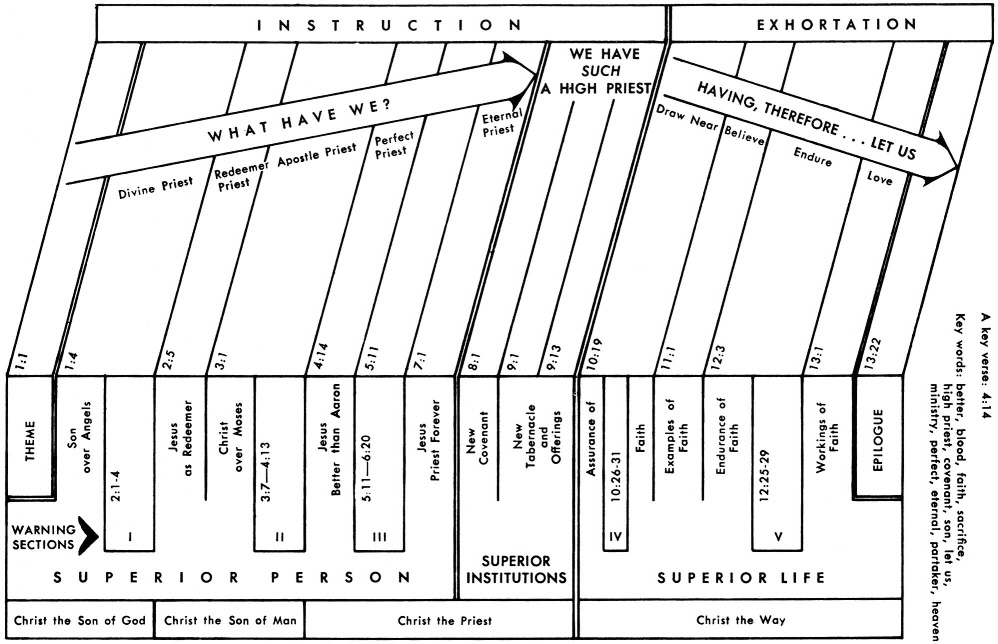
CONSIDER JESUS OUR GREAT HIGH PRIEST
Click chart to enlarge
Charts from Jensen's Survey of the NT - used by permission
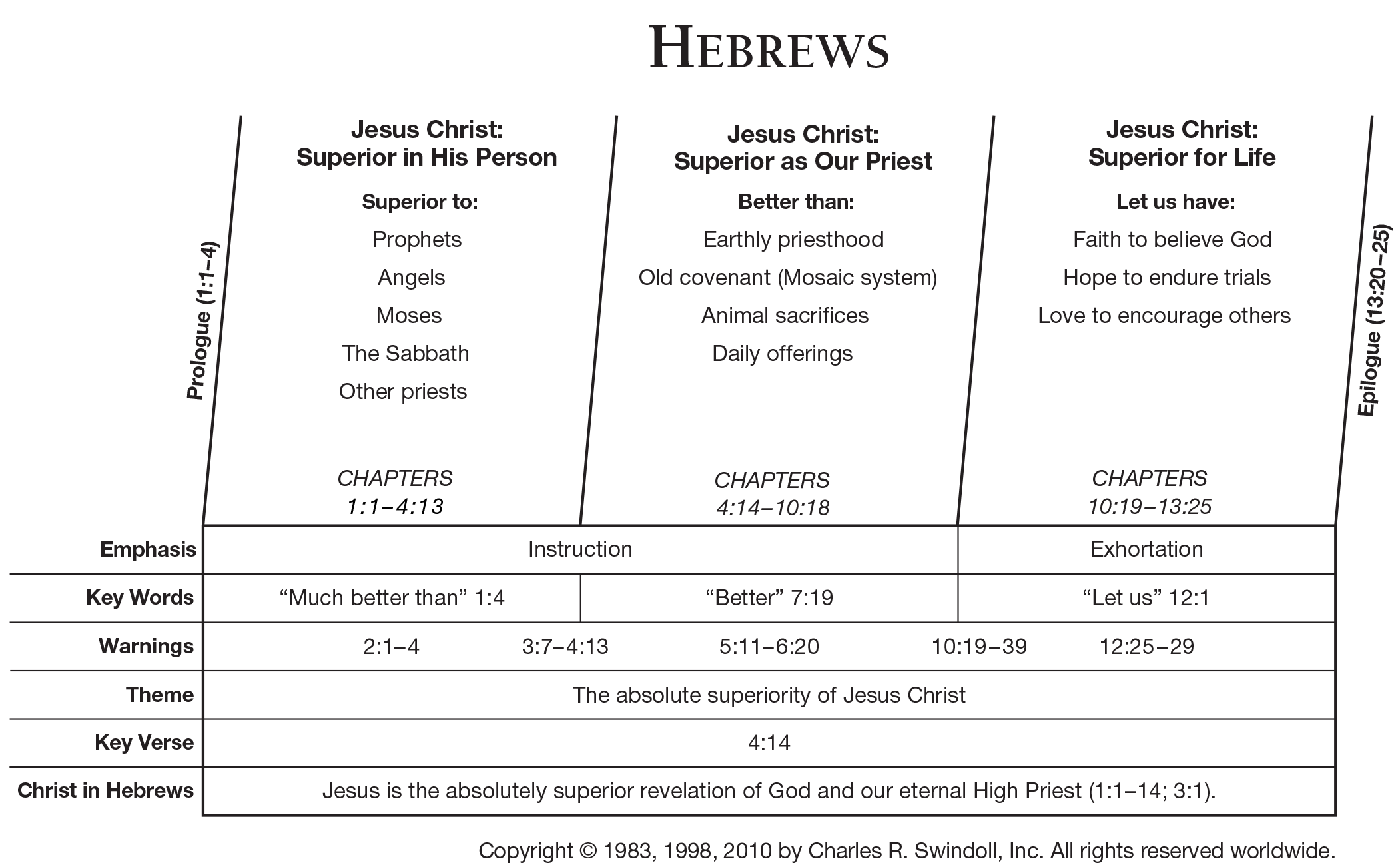
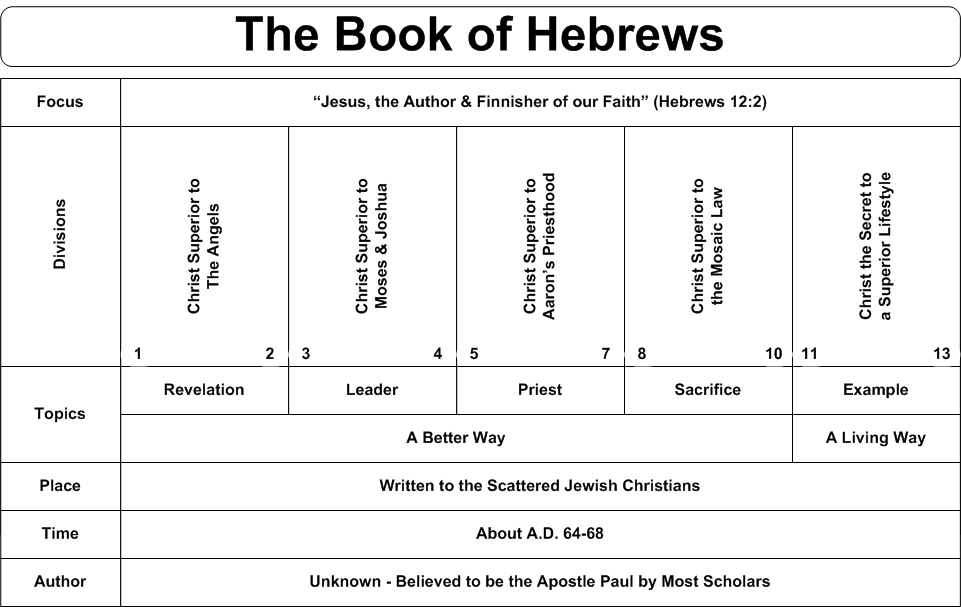
Swindoll's Chart, Interesting Pictorial Chart of Hebrews, Another Chart

|
The Epistle |
||||
| INSTRUCTION Hebrews 1-10:18 |
EXHORTATION Hebrews 10:19-13:25 |
|||
| Superior Person of Christ Hebrews 1:1-4:13 |
Superior Priest in Christ Hebrews 4:14-10:18 |
Superior Life In Christ Hebrews 10:19-13:25 |
||
| BETTER THAN PERSON Hebrews 1:1-4:13 |
BETTER PRIESTHOOD Heb 4:14-7:28 |
BETTER COVENANT Heb 8:1-13 |
BETTER SACRIFICE Heb 9:1-10:18 |
BETTER LIFE |
| MAJESTY OF CHRIST |
MINISTRY OF CHRIST |
MINISTERS FOR CHRIST |
||
|
DOCTRINE |
DUTY |
|||
|
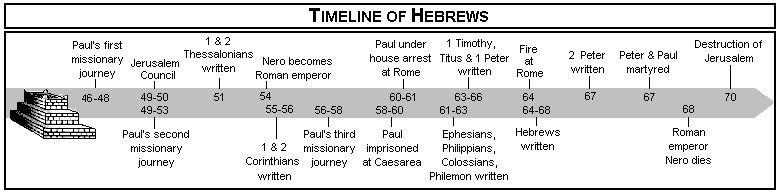
DATE WRITTEN: |
||||

See ESV Study Bible "Introduction to Hebrews"
(See also MacArthur's Introduction to Hebrews)
Borrow Ryrie Study Bible
Hebrews 10:28 Anyone who has set aside the Law of Moses dies without mercy on the testimony of two or three witnesses. (NASB: Lockman)
Greek: athetesas (AAPMSN) tis nomon Mouseos choris oiktirmon epi dusin e trisin martusin apothneskei; (3SPAI)
Amplified: Any person who has violated and [thus] rejected and set at naught the Law of Moses is put to death without pity or mercy on the evidence of two or three witnesses. [Deut. 17:2-6.] (Amplified Bible - Lockman)
Barclay: Anyone who regards the law of Moses as a dead letter dies without pity on the evidence of two or three witnesses. (Westminster Press)
NLT: Anyone who refused to obey the law of Moses was put to death without mercy on the testimony of two or three witnesses. (NLT - Tyndale House)
KJV He that despised Moses' law died without mercy under two or three witnesses:
NKJ Anyone who has rejected Moses' law dies without mercy on the testimony of two or three witnesses.
NET Someone who rejected the law of Moses was put to death without mercy on the testimony of two or three witnesses.
BGT ἀθετήσας τις νόμον Μωϋσέως χωρὶς οἰκτιρμῶν ἐπὶ δυσὶν ἢ τρισὶν μάρτυσιν ἀποθνῄσκει·
CSB If anyone disregards Moses' law, he dies without mercy, based on the testimony of two or three witnesses.
ESV Anyone who has set aside the law of Moses dies without mercy on the evidence of two or three witnesses.
NIV Anyone who rejected the law of Moses died without mercy on the testimony of two or three witnesses.
Phillips: The man who showed contempt for Moses' Law died without hope of appeal on the evidence of two or three of his fellows. (Phillips: Touchstone)
Wuest: Anyone who has set aside Moses’ law, without mercy, upon the evidence of two or three witnesses, dies.
Young's Literal: any one who did set at nought a law of Moses, apart from mercies, by two or three witnesses, doth die,
|
THE FIVE WARNING PASSAGES |
| Heb 2:1-4+ |
| Heb 3:7-4:13+ |
| Heb 5:11-6:12+ |
| Heb 10:19-39+ |
| Heb 12:14-29+ |
- has set aside - He 2:2; Nu 15:30,31,36; Dt 13:6, 7, 8, 9, 10; 17:2-13; 2Sa 12:9,13)
- without - Dt 19:13; Isa 27:11; Jer 13:14; Ro 9:15; Jas 2:13
- two or three - Dt 17:2,6,7; 19:15; Mt 18:16; Jn 8:17; 2Co 13:1
- Hebrews 10 Resources - Multiple sermons and commentaries
- Hebrews 10:26-31 The Only Options: Christ or Judgment? - Steven Cole
- Hebrews 10:28-39 Apostasy: The Negative Response to the New Covenant 2 - John MacArthur
- Hebrews 10 A Warning to Not Skip Church, or Something More? - John MacArthur
- Click for 5W/H Study Questions — ideal for leading a group or personal study of Hebrews
Related Passages:
Hebrews 2:2-3+ For if the word spoken through angels proved unalterable, and every transgression and disobedience received a just penalty, how will we escape if we neglect so great a salvation? After it was at the first spoken through the Lord, it was confirmed to us by those who heard,
Deuteronomy 17:2-7+ “If there is found in your midst, in any of your towns, which the LORD your God is giving you, a man or a woman who does what is evil in the sight of the LORD your God, by transgressing His covenant, 3 and has gone and served other gods and worshiped them, or the sun or the moon or any of the heavenly host, which I have not commanded, 4 and if it is told you and you have heard of it, then you shall inquire thoroughly. Behold, if it is true and the thing certain that this detestable thing has been done in Israel, 5 then you shall bring out that man or that woman who has done this evil deed to your gates, that is, the man or the woman, and you shall stone them to death. 6 “On the evidence of two witnesses or three witnesses, he who is to die shall be put to death; he shall not be put to death on the evidence of one witness. 7 “The hand of the witnesses shall be first against him to put him to death, and afterward the hand of all the people. So you shall purge the evil from your midst.
Numbers 35:30+ ‘If anyone kills a person, the murderer shall be put to death at the evidence of witnesses, but no person shall be put to death on the testimony of one witness.
A DEAD END
JOURNEY!
The writer now proceeds to describe the process by which one traverses the treacherous road to the eternal dead end in apostasy by using the well-known Jewish rabbinic reasoning pattern that appears frequently in Scripture, especially in Hebrews, Romans, and the teachings of Jesus. The Hebrew term is Qal vahomer which means literally “light and heavy.” (Qal = “light” or lesser and Chomer = “heavy” or greater) This style of argument was typical of the Rabbinical school and was “the first of Hillel’s seven rules for exegesis”. The writer's argument reasons that if something is true in a lesser case (Heb 10:28), it must be even more true in a greater case (Heb 10:29). In the present context, the lesser is despising Moses’ law brought physical death while the greater is rejecting Christ which brings eternal judgment.
Anyone who has set aside (atheteo) the Law (nomos) of Moses dies (apothnesko) without mercy (oiktirmos) on the testimony of two or three witnesses (martus/martys) - Anyone (tis) means just that - "anyone". In other words, there are no exceptions to this basic tenet. Set aside is placed first in sentence for emphasis. This "anyone" regards God's laws as nothing as shown by their rebellion. Rejecting the Law brought just recompense (He 2:2) from which there was no escape if confirmed by two witnesses (see Dt 17:2-7+).
The Law (nomos) of Moses - The Law (nomos) was a shadow or picture of the reality (substance) fulfilled in Christ and His perfect sacrifice. And so even under the Old Covenant to reject the Law of Moses brought dire consequences. It follows that even more serious consequences will be incurred for rejecting the reality (substance) of Messiah.
Dies (apothnesko) without mercy (oiktirmos) - Mercy is shown by not allowing the death sentence on the basis of a single witness. Once duly convicted of idolatry against God, there is no longer a sacrifice remaining to so speak and no remaining mercy. Why? Because this heinous act represents the purposeful personal choice of deliberate sin against clear commandments in the Law of Moses. The public demonstration of God's punishment for idolatry was to serve to awaken the remaining Israelites to their need to pursue holiness (Lev 11:44, 45, 19:2; 20:7, 26). The Jewish reader's of this letter were aware of this Old Covenant law and thus the writer uses it (lesser-to-greater argument) to emphasize the greater condemnation brought on by setting aside or regarding as nothing Christ's blood of the New Covenant!
Hebrews 10:28 seems to allude to Dt 17:2-7 which records that upon testimony of 2 or 3 witnesses, death by stoning was punishment for apostasy—going after and serving false gods (Dt 17:2). Then in Hebrews 10:29, the one who would despise the person of Jesus and His ministry as High Priest is worthy of even greater judgment. Hebrews 10:29 (due to the verb and participles used) should not be understood as judgment that has happened because of such apostasy, but as judgment that would happen should such apostasy occur. The author places his recipients and himself ("we" go on sinning) under this warning just as he did in the earlier warnings (See comment on "we" by Bob Utley). By so doing he demonstrates that the warnings are intended for the saved as well as for the unsaved. Yet, here, as in Hebrews 6, the author does not say that anyone has committed this sin. He describes what would happen, not what has happened. He is describing a hypothetical situation. The severe admonition of this warning, and all others in Scripture, is God’s means to ensure our perseverance.
Mercy (literally plural = "mercies") (3628)(oiktirmos from oikteiro = to have compassion {used only in Romans 9:15 - see note} in turn derived from oiktos = compassion or pity which in turn is said to be derived from the interjection oi = "Oh!") denotes the inward feeling of compassion which abides in the heart. It represents the display of concern over or compassion with another’s misfortune. Compassion (from Latin com = with + pati = to bear, suffer - thus literally to "bear with" or "to suffer with") is a sympathetic consciousness of other's distress together with a desire to alleviate it and in the case of God, with the ability to in fact do so! The meaning of oiktirmos is like splagchnon [word study], related primarily the viscera, which were thought to be the seat of compassion. The word came to signify manifestations of pity and refers to the pity that is aroused by the sight of another's suffering.
Witnesses (3144)(martus/martys) basically describes one who remembers something and testifies concerning what they remember. Notice that martus has a two fold meaning of (1) describing one who has seen and/or experienced something or someone and (2) one who testifies to what he or she saw. The testimony could be in a legal setting (Mk 14:63; Acts 6:13; 7:58; Heb. 10:28) or in the general sense of recounting firsthand knowledge (Lk 11:48; 1Ti. 6:12; Heb 12:1; 1Pe 5:1). A martus is one who attests to a fact or event, one who gives evidence (testifies in a court to the truth of a fact or event), one who has seen or has personal knowledge of something or someone, especially as an "eye witness" (eg, the apostles in Acts having and relating their personal knowledge of Jesus' post-resurrection appearances). A witness is one who furnishes evidence or proof, confirming the truth by verbal testimony.
Set aside (114) (atheteo from áthetos = not placed from a = without + thetós = placed) means to regard as nothing, to declare invalid, to not recognize, to annul (make ineffective, inoperative or nonexistent), to spurn, to despise. To do away with what has been laid down (in this case the Law of Moses).
Thayer writes that atheteo means "to act toward anything as though it were annulled; hence, to deprive a law of force by opinions or acts opposed to it, to transgress… to thwart the efficacy of anything, nullify, make void, frustrate… to render prudent plans of no effect (1Cor 1:19)… to reject, refuse, slight (eg, "the grace of God" Gal 2:21)
Atheteo - 16x in 16v - nullify(1), refuse(1), reject(1), rejected(1), rejects(6), rejecting(1), set aside(3), sets… aside(1), setting aside(1). Mark 6:26; 7:9; Luke 7:30; 10:16; John 12:48; 1 Cor 1:19; Gal 2:21; 3:15; 1 Thess 4:8; 1 Tim 5:12; Heb 10:28; Jude 1:8. NAS =
Atheteo - 52x in the Septuagint (LXX) - Ex 21:8; Deut 21:14; Judg 9:23; 1 Sam 2:17; 13:3; 1 Kgs 8:50; 12:19; 2 Kgs 1:1; 3:5, 7; 8:20, 22; 18:7, 20; 24:1, 20; 1 Chr 2:7; 5:25; 2 Chr 10:19; 36:13f; Esth 2:15; Ps 14:4; 32:10; 88:35; 131:11; Isa 1:2; 21:2; 24:16; 31:2; 33:1; 48:8; 63:8; Jer 3:20; 5:11; 9:1; 12:1, 6; 15:16; Lam 1:2; Ezek 22:26; 39:23; Dan 3:95.
Judges 9:23 Then God sent an evil spirit between Abimelech and the men of Shechem; and the men of Shechem dealt treacherously (Hebrew = bagad = were disloyal, acted unfaithfully, were traitorous; Lxx = atheteo) with Abimelech, (Comment: Treachery against man)
Isaiah 48:8 "You have not heard, you have not known. Even from long ago your ear has not been open, Because I knew that you would deal very treacherously (Hebrew = bagad = were disloyal, acted unfaithfully, were traitorous; Lxx= atheteo); And you have been called a rebel from birth. (Comment: Treachery against God)
Jeremiah 3:20 "Surely, as a woman treacherously departs (Hebrew = bagad = were disloyal, acted unfaithfully, were traitorous; Lxx= atheteo) from her lover, so you (Jehovah speaking to His chosen people Israel) have dealt treacherously (Hebrew = bagad = were disloyal, acted unfaithfully, were traitorous; Lxx= atheteo) with Me, O house of Israel," declares the LORD. (cp same picture in Jer 5:11)
From these OT passages we can see that the Greek verb atheteo is used to translate the Hebrew word bagad, a verb which speaks of unfaithfulness and is fittingly translated as dealing treacherously! Indeed, is not apostasy dealing unfaithfully with God's revealed truth and thus dealing treacherously with His Truth which is manifest in Jesus? Webster says that "treacherous" identifies one who violates allegiance or faith pledged, one who betrays a trust, one who violates his engagements or his pledged faith, fitting descriptions of an apostate!
Charles Simeon
WE cannot be too strongly on our guard against attaching ourselves to human systems in religion. The partisans of human systems take a partial view of the Scriptures, leaning invariably to those passages which appear to sanction their favourite dogmas, and excluding all mention of those which have a contrary aspect. They all take it for granted, that the things which they know not how to reconcile, are contrary to, and inconsistent with, each other. But as in a machine wheels may move in opposite directions, and yet so harmonize as to subserve one common end, so, in the word of God, truths, which have an opposite aspect, may be perfectly reconcileable to each other, and equally conducive to the accomplishment of the Divine purposes. The Apostle Paul insisted, as strongly as any one could do, on the doctrines of grace, shewing that all was ordered by God according to the counsel of his own will: yet no Apostle spoke more strongly than he on the danger of apostasy; or taught more forcibly the necessity of continual watchfulness on our part in order to the attainment of those blessings which God had from all eternity prepared for us. It is on this subject that he is speaking in the passage before us; wherein he cautions the Hebrew converts against apostasy, bidding them to hold fast the profession of their faith without wavering; and warning them, that, if they turned back from God, it would be to their everlasting perdition.
In the words which I have just read, he sets forth,
I. The evil of apostasy—
It is not of all sin, or even of all wilful sin, that he speaks: for, if there were no pardon for wilful sin after baptism, or after we have embraced the Gospel, who could hope ever to attain salvation, since there is not a man in the universe who has not, on some one occasion at least, knowingly and willfully done what he ought not, or left undone what he ought to have done.
The sin spoken of in the text, is, a total and wilful apostasy from the Gospel of Christ. This appears from the whole context, both from that which precedes, and that which follows. In the preceding context he bids them to “hold fast the profession of their faith without wavering;” (Heb 10:23-note) and then he adds, “for, if we sin willfully;” (Heb 10:26-note) that is, by renouncing our holy profession, we reduce ourselves to the most awful condition that can be imagined; seeing that, having put away all affiance (= The marriage contract or promise; faith pledged; trust in general; confidence) in the sacrifice of Christ, there remains no other sacrifice for our sins. In the following context the sin is opened at large under three separate heads, which, whilst they mark distinctly the nature of the sin which is intended, display the evil of it in most tremendous colours.
Let us consider each of them in its order—
[Apostasy, he tells us, is a “treading under foot the Son of God.” The Son of God, the Lord Jesus Christ, came down from heaven to seek and to save them that were lost. We, when we are baptized in his name (cp Ro 6:3-note, 1Co 12:13), or make a profession of faith in Him, acknowledge Him before all to be the Saviour of the world. All other lords we then renounce; and all other grounds of hope before God; and in effect we say with Peter, “Lord, to whom shall we go? thou hast the words of eternal life: and we believe and are sure that thou art that Christ, the Son of the living God.” (Jn 6:68, 69) But when we renounce our faith in Him, we, as far as in us lies, cast Him down from His throne, and trample him under our feet; declaring, that He is unworthy of the honour which we had erroneously put upon Him, and that we will “no longer have him to reign over us:” (Lk 19:14) yea, we even “crucify Him afresh, and put Him to an open shame.” (Heb 6:6)
Next, it is a “counting of the blood of the covenant an unholy thing.” (Heb 10:29) The Mosaic covenant was ratified with blood; and with that blood both the tabernacle with all its vessels, and the people who worshipped before it, were sanctified, and set apart as holy to the Lord. The covenant of grace is ratified with the blood of our Lord Jesus Christ; and, when we “come to the knowledge of the truth,” (He 10:26) we also are sanctified with it, and set apart to the service of our God. We profess to consider that blood as the one procuring cause of all that we either have or hope for: and we look for all the blessings of the covenant solely through the merit of His blood as shed for us, and as sprinkled on us.
But, when we cast off our profession, we declare before all, that we consider the blood of Christ as having no virtue at all as an atonement for sin, and as being, in fact, of no more efficacy than the blood of bulls and goats, or even of a malefactor, justly put to death.
Further, it is a doing of “despite unto the Spirit of grace.” (Heb 10:29) The Holy Spirit, both before and after the death of Jesus, bare witness to Him by signs and wonders innumerable (cp Heb 2:4): and, when we are brought to the knowledge of the truth, it is by that same blessed Spirit illuminating our minds (Heb 10:32KJV), and sealing the truth with power upon our souls (cp 2Co 1:22, Ep 1:13, Ep 4:30). But, when we renounce the truth we have received, we insult that Divine Agent, as having borne witness to a falsehood: and we ascribe all His miracles either to Satanic agency, or to some mysterious imposture. We even laugh also at the impressions which He has made upon our minds, and deride all his merciful suggestions as fanaticism and delusion.]
In this view of apostasy, say, if it be not a most tremendous evil?
[Those who are guilty of it, speak of it only as a change of sentiment resulting from conviction; and thus they take credit to themselves as having grown in wisdom, and been faithful to their convictions. But God seeth not as man seeth. God beholds all the evils of the heart which have been accessory to this change; and all the injury that results from it, both to his honour, and to the world at large. He sees the pride of heart which will not receive the truth upon his testimony. He sees the love of the world which operates to draw the heart from him; yea, and the enmity of the heart against him, which will not submit, either to be saved or governed in so mysterious a way. In other sins he beholds only a resistance to his authority; but in this, a contempt of all the wonders of his wisdom and love. A person who has never received the knowledge of the truth, cannot commit this sin, or any sin of equal malignity. It is the resisting of light that has been imparted, and the acting contrary to it to such an extent as to call it darkness; this it is which makes the guilt so great, that, humanly speaking, it can never be forgiven. Were it indeed repented of, and were mercy sought through the blood of Jesus, even this sin, great as it is, might be forgiven: but the commission of it implies such desperate wickedness and obduracy, that it never can, without a miracle of mercy, be repented of.]
Hence then may be seen,
II. The danger of it—
This is declared,
1. From the very nature of the sin itself—
[Consider what the sin is: it is a discarding of the only remedy which God has provided for the necessities of fallen man. Under the Mosaic dispensation, God revealed himself to the Hebrews as the only true God; and entered into covenant with them to be their God, if they would serve Him in sincerity and truth. But, if any one made void that law, and departed from Him to worship other gods, He appointed, that, upon the fact being proved by two or three witnesses, the offender should be stoned to death; and it was expressly forbidden to any person to conceal the crime: if it should have been committed by a man’s dearest friend or relative, he must reveal it to the constituted authorities, and take the lead in executing sentence on the offender. In this law the Hebrews had acquiesced as holy, and just, and good (Ro 7:12). (Here let me suggest, by the way, that the illustration here brought by the Apostle farther shows, what the sin was of which he spake; namely, that it was not every wilful sin, but a wilful renunciation of the Gospel of Christ.)
Now, says the Apostle, if so severe a sentence was executed, without any mercy, on the contemner (a despiser; a scorner) of the Mosaic covenant, and the judges themselves declared the offender to be “worthy of it,” “of how much sorer punishment, suppose ye, shall he be thought worthy, who has renounced the Christian covenant; since he has trodden under-foot the Son of God, &c.?”
Here he appeals to them, and makes them judges in their own cause. And to you also do I appeal. If they who renounced that legal covenant, the provisions of which were chiefly of a temporal nature, and the engagements of it ratified only with the blood of beasts, were counted worthy of such a tremendous punishment as death; of how much sorer punishment must he be worthy, who renounces the covenant of grace, in which all the blessings of grace and glory are made over to us, and which has been ratified and confirmed with the blood of God’s only dear Son? I consent that you shall be judges in your own cause, and the arbiters of your own fate. They who renounced the law were guilty of most egregious folly and ingratitude: but their impiety was not to be compared with yours: for whilst, as renouncing the only means of salvation, you resemble them, your impiety is greater than theirs, in proportion as the covenant which you despise is more glorious than theirs, and the mercies which you reject have been purchased for you at a dearer rate.
Know then, that to such persons “there remains no more sacrifice for sins.” Under the law, the sacrifices were repeated from year to year; but not so under the Gospel: Christ will never die for your sins again; nor will any other offering be made in his stead: and therefore, having renounced him, “nothing remains for you but a certain fearful looking-for of judgment,” whilst you continue here; and “of fiery indignation,” when you go hence, “that shall devour all the adversaries” of God and his Christ. Even here, I say, the punishment of such persons is awful: for, to say the least, they are in a state of uncertainty what shall be their fate in the eternal world; and they have frequently in their minds and consciences such an anticipation of their doom, as appals their souls, and terrifies their spirits, and forms a very hell within them: and the moment they go hence, the wrath of an incensed God comes upon them to the uttermost.]
2. From the fixed determination of God to punish it—
[God has said, “Vengeance belongeth unto me; and I will recompense.” And again, “The Lord shall judge his people.” Now if he, as the moral Governor of the universe, has determined to execute justice, as well as to shew mercy; and if the administering of justice be no less necessary to his own glory than the dispensing of mercy, what have the contemners of his Gospel to expect? He has said, he will thus display his righteousness at the last day: and “we know him who has said it:” we know that he is almighty, and therefore able to inflict punishment; and we know he is true, and therefore will fulfil his word. It is in vain to think that he will change: for “he is not a man, that he should lie; or the son of man, that he should repent.” Seeing then that he will take the matter into his own hands, judge ye, whether it be not “a fearful thing to fall into the hands of the living God.” Were it only a mortal man that was incensed, and you had no way of escape from him, it were a terrible state for you to be in: but what must it be to be exposed to the wrath of the living God, who, whilst he ever lives to execute vengeance, will preserve you in existence, that you may eternally endure it? Think of enduring “the wrath of the Lamb,” which will be so much the more terrible, in proportion as his mercy in submitting to be slain for you has been slighted and despised.]
“Suffer ye then, brethren, a word of Exhortation”—
1. Watch and pray against every wilful sin—
[“Keep thy servant from presumptuous sin,” said David; “then shall I be innocent from the great transgression.” Now, though it is true that every wilful sin, or every presumptuous sin, does not involve us in all the guilt of apostasy, yet it leads to apostasy as its natural end and issue; because it hardens the heart, and sears the conscience, and grieves the Holy Spirit, and provokes God to leave us to ourselves: and, if once God say of us, “They are joined to idols; let them alone;” our doom is sealed, and our perdition sure. Let me then affectionately entreat you to guard against every wilful sin, whether of commission or omission. A man does not become an apostate all at once: he first indulges some secret lust, some filthiness either of the flesh or spirit. Then he declines into formality in his secret walk with God: then his besetting sin gets an ascendant over him: then he becomes indifferent to public ordinances; and so, from opposing the Gospel in his heart and life, he comes to abandon it even in profession, and to relapse into avowed infidelity, and a contempt of all true religion. The misery which such persons frequently endure in this life, is sufficient to make us dread such an event as this — — — But that which the apostate soul shall endure in the eternal world, surpasses all conception. It would have been better for such an one never to have known the way of righteousness, than, having known it, to desert it, and make shipwreck of his faith.]
2. Bear in mind your obligations to Christ and to his Holy Spirit—
[Why did the Lord Jesus Christ die under the load of all your guilt? Was it that you might continue in your sins? — — — Why did the Holy Spirit undertake to renew and sanctify your souls; and why has he begun a work of grace in your hearts? Was it that you might “return again with the dog to his vomit, and the sow that was washed to a wallowing in the mire?” Let then the Lord Jesus Christ behold in you the fruits of his love — — — and let the Holy Spirit rejoice in beholding in you the efficacy of his grace — — — Then it will be no formidable thing to “fall into the hands of the living God:” on the contrary, you may then with joyful hope look forward to the time of your departure, and, after the example of that Saviour in whom you have believed, you may say in your dying hour, “Father, into thy hands I commend my spirit.”] (Simeon, C. 1832-63. Horae Homileticae Vol. 19: 2 Timothy to Hebrews Page 343)
He that despised Moses’ law died without mercy under two or three witnesses.—Heb. 10:28.
A young lady, once awakened, then becoming careless, was seized with consumption, and said to the minister calling upon her, “Such a time I had pardon and salvation offered me; but now I am a reprobate. I can not pray, and if I could, it would not be heard.” When she felt the chill of death, she began to cry aloud, “O, I can’t die; I am not fit to die; you must not let me die! If I die, I am lost for ever! O, send for the doctor. Can’t he save my life? O, must I die in my guilt?” Her little brother burst into tears, and said, “Why don’t you pray to God? Why don’t you pray for mercy?” “There is no mercy for me,” she answered; “I have abused mercy. When God offered me mercy, I rejected it. Now there is no mercy for me. I have ‘shut the door of mercy against myself.’ ” Thus she continued her cries, growing weaker and weaker, till her voice was hushed in death. Who shall say that for her wicked choice she had not been given over of God?
THE Epistle has set before us the more excellent glory of the New Testament. We can draw near to God as Israel never could; God hath indeed made His grace to abound more exceedingly. But let no one think that greater grace means less stringency with sin, or less fierceness of the fire of judgment. Nay, the very opposite. Greater privilege brings greater reasonability, and, in case of failure, greater judgment. As elsewhere (Hebrews 2:2; 12:25) we are reminded that the New Testament exceeds the Old not only in its blessing but also in its curse. As he had asked "How much more will the blood of Christ cleanse?" so here he asks, "How much more sore will the punishment be?" Oh that men would believe it; the New Testament, with its revelation of God as love, brings on its rejecters a far more fearful judgment than the Old. May God in mercy show us what it means, for our own sakes and that of others.
A man that hath set at naught Moses' law dieth without compassion, note this terrible word, without compassion: of how much sorer punishment, think ye, shall he be judged worthy, who sins against New Testament grace? The measure" of the superior greatness of the New Testament will be the only measure of the greater fearfulness of the punishment sent; as in the first warning the greatness of salvation was connected with the part each person in the Holy Trinity had taken in it, so here too. The Father gave His Son: of how much sorer punishment shall he be counted worthy, who hath trodden under foot the Son of God. The Son gave His blood: here is one who hath counted the blood of the covenant, wherewith he was sanctified, an unholy thing. The Father and the Son gave the Spirit: he hath done despite to the Spirit of grace. Under Moses' law a man died without compassion: how much sorer punishment, without compassion, shall be the fate of them that reject Christ. Hear what all this means.
Who hath trodden under foot the lion of God! There was once an aged father, who had often pleaded in vain with a dissipated son to forsake his evil ways. One night, as the son was preparing again to go out, the father, after renewing his entreaties, went and stood in the door, saying, "My son, I cannot let you go, if you do, it will be over my body." The son tried to push the father aside. The old man fell, and in rushing out he trod on the father! Jesus Christ, God's Son, comes and stands in the sinner's way, pleading with him to turn from his evil way. He casts Himself in the way, with His wounded, bleeding body. And the sinner, not heeding what he does, passes over it: he hath trodden under foot the Son of God! What a sin against the Father and the love that gave the Son!
And hath counted the blood of the covenant, wherewith he Was sanctified, an unholy thing. The Father gave the Son.
And the Son gave His blood, the blood of the covenant, securing and conveying to us all its wondrous privileges--the blood with which he was sanctified, admitted to the Holiest of All and the Holy One, he hath counted an unholy thing. When I come to water in which I wish to wash, and find it impure, I reject it; I throw it out. Christ calls the sinner to wash in His blood and be clean. He rejects it as an unclean thing. Yes, the blood that speaks of the love of Jesus, and remission of sins, and the opened heaven, is rejected and cast aside! Oh, what sin! If the rejecters of the blood of bulls and goats died without compassion, how much more--the despisers of the blood of the Son of God.
And hath done despite unto the Spirit of grace! I can put no greater affront on my king, or my father, than by shutting my door in his face. If they come to me with a message or a gift of love in my Wretchedness, to turn them away is to do them despite. The Spirit comes as the Spirit of grace, to convince of sin and stir to prayer and lead to Jesus. To close the door, to refuse surrender, to open the heart to the spirit of the world instead of Him, is to do despite to the Spirit of grace! The Son trodden under foot, the blood counted unclean, the Spirit of grace despised and rejected,--alas, what terrible sin!
For such there remaineth no more a sacrifice for sins! And such are they among us and around us who reject the Christ of God! And such their fate! For we know Him that said, Vengeance belongeth unto Me, I will recompense. And again, the Lord shall judge His people.--For we know Kiln! How many there are who profess to believe in Scripture, and to worship God, but who do not know this God. They have framed to themselves a God, after their own instincts and imagination; they believe not in the Holy One in whom righteousness and love meet in perfect harmony. They refuse to say, We know Him that said, Vengeance belongeth unto Me, I will recompense. Oh, let us seek so to know Him" that our hearts may be filled with compassion for all who are still exposed to this fearful vengeance. For it is a fearful thing to fall into the hands of the living God. Let us think in love on all who are still exposed to this judgment, until it stir us to thanksgiving for our own redemption, to an infinite compassion for all who are in danger, to new fervency of prayer for their salvation, and to a consecration of ourselves to the one work of warning them of their danger and leading them to Christ.
1. In accepting God's word let us remember that as little as we could have devised or understood the glorious redemption in Christ, such as God's love has provided, without a divine revelation, can we arrange for or understand a judgment day such as God's righteousness requires. The one is a mystery of love and the other a mystery of wrath, beyond all we can think or know.
2. It was to meet the judgment and the wrath of God Christ's blood was needed. The blood stands midway between the judgment threatened and the Judgment yet to be poured out, As we believe in the judgment we shall honour the blood; as we believe in the blood we shall fear the judgment. Andrew Murray. The Holiest of All
Hebrews 10:29 How much severer punishment do you think he will deserve who has trampled under foot the Son of God, and has regarded as unclean the blood of the covenant by which he was sanctified, and has insulted the Spirit of grace? (NASB: Lockman)
Greek: poso dokeite (2PPAI) cheironos axiothesetai (3SFPI) timorias o ton uion tou theou katapatesas, (AAPMSN) kai to aima tes diathekes koinon egesamenos (AMPMSN) en o egiasthe, (3SAPI) kai to pneuma tes charitos enubrisas? (AAPMSN)
BGT πόσῳ δοκεῖτε χείρονος ἀξιωθήσεται τιμωρίας ὁ τὸν υἱὸν τοῦ θεοῦ καταπατήσας καὶ τὸ αἷμα τῆς διαθήκης κοινὸν ἡγησάμενος, ἐν ᾧ ἡγιάσθη, καὶ τὸ πνεῦμα τῆς χάριτος ἐνυβρίσας;
Amplified: How much worse (sterner and heavier) punishment do you suppose he will be judged to deserve who has spurned and [thus] trampled underfoot the Son of God, and who has considered the covenant blood by which he was consecrated common and unhallowed, thus profaning it and insulting and outraging the [Holy] Spirit [Who imparts] grace (the unmerited favor and blessing of God)? [Exod. 24:8.] (Amplified Bible - Lockman)
Barclay: Of how much worse punishment, do you think, that man will be deemed worthy who has trampled underfoot the Son of God, who has failed to regard the blood of the new covenant, with which he was made fit for God’s presence, as a sacred thing, and who has insulted the Spirit through whom God’s grace comes to us? (Westminster Press)
NLT: Think how much more terrible the punishment will be for those who have trampled on the Son of God and have treated the blood of the covenant as if it were common and unholy. Such people have insulted and enraged the Holy Spirit who brings God's mercy to his people. (NLT - Tyndale House)
KJV Of how much sorer punishment, suppose ye, shall he be thought worthy, who hath trodden under foot the Son of God, and hath counted the blood of the covenant, wherewith he was sanctified, an unholy thing, and hath done despite unto the Spirit of grace?
NKJ Of how much worse punishment, do you suppose, will he be thought worthy who has trampled the Son of God underfoot, counted the blood of the covenant by which he was sanctified a common thing, and insulted the Spirit of grace?
NET How much greater punishment do you think that person deserves who has contempt for the Son of God, and profanes the blood of the covenant that made him holy, and insults the Spirit of grace?
CSB How much worse punishment do you think one will deserve who has trampled on the Son of God, regarded as profane the blood of the covenant by which he was sanctified, and insulted the Spirit of grace?
ESV How much worse punishment, do you think, will be deserved by the one who has trampled underfoot the Son of God, and has profaned the blood of the covenant by which he was sanctified, and has outraged the Spirit of grace?
NIV How much more severely do you think a man deserves to be punished who has trampled the Son of God under foot, who has treated as an unholy thing the blood of the covenant that sanctified him, and who has insulted the Spirit of grace?
Phillips: How much more dreadful a punishment will he be thought to deserve who has poured scorn on the Son of God, treated like dirt the blood of the agreement which had once made him holy, and insulted the very Spirit of grace? (Phillips: Touchstone)
Wuest: By how much do you think shall he be thought worthy of sorer punishment who has trodden under foot the Son of God, and has considered the blood of the testament a common thing by which [blood] he was set apart for God and His service, and has insulted the Spirit of grace?
Young's Literal: For we -- wilfully sinning after the receiving the full knowledge of the truth -- no more for sins doth there remain a sacrifice,
- How much severer - He 2:3; 12:25
- Has trampled - 2Ki 9:33; Ps 91:13; Isa 14:19; 28:3; Lam 1:15; Ezek 16:6; Mic 7:10; Mt 7:6; Ro 16:20; 1Co 15:25,27
- the blood - He 9:20; 13:20
- by which - He 2:11; 9:13; Jer 1:5; John 10:36; 17:19; 1Co 11:27,29
- Hebrews 10 Resources - Multiple sermons and commentaries
- Hebrews 10:26-31 The Only Options: Christ or Judgment? - Steven Cole
- Hebrews 10:28-39 Apostasy: The Negative Response to the New Covenant 2 - John MacArthur
- Hebrews 10 A Warning to Not Skip Church, or Something More? - John MacArthur
- Click for 5W/H Study Questions — ideal for leading a group or personal study of Hebrews
Related Passages:
Hebrews 2:3+ how will we escape if we neglect so great a salvation? After it was at the first spoken through the Lord, it was confirmed to us by those who heard,
Hebrews 12:25+ See (present imperative = keep on being aware) to it that you do not refuse Him who is speaking. For if those did not escape when they refused him who warned them on earth, much less will we escape who turn away from Him who warns from heaven.
Hebrews 9:20+ saying, “THIS IS THE BLOOD OF THE COVENANT WHICH GOD COMMANDED YOU.”
Hebrews 13:20+ Now the God of peace, who brought up from the dead the great Shepherd of the sheep through the blood of the eternal covenant, even Jesus our Lord,
THE GREATER SIN
WARRANTS GREATER JUDGMENT
How much severer (cheiron - worse) punishment (timoria - judicial penalty) do you think (dokeo - suppose) he will deserve (axioo) who has trampled (katapateo) under foot the Son (huios) of God, and has regarded (hegeomai) as unclean (koinos) the blood (haima) of the covenant (diatheke) by which he was sanctified (hagiazo), and has insulted (enubrizo - arrogantly insult or show utter contempt for) the Spirit (pneuma) of grace (charis) - Note the writer's use of the lesser (Heb 10:28) to greater argument in making a rhetorical appeal to his reader's consciences. He is calling them to weigh the logic of the case themselves. He argues that if those who rejected Moses’ Law died without mercy (Hebrews 10:28), how much worse will it be for those who reject the Son of God. Indeed, he expects the hearers to realize that the judgment on those who reject God’s work in Christ will be immeasurably worse than the judgment of Israel (and they were stoned in the OT passages to which the writer refers! Woe!).
Under the law, a sin against God’s government was met with the death penalty.
In the New Testament, the sin is against God’s grace.
--John Phillips
R Kent Hughes adds on much severer "One thing is sure—there will be no mercy shown for the hardened apostate, just as there was no mercy shown to those who willfully transgressed the Law. But the greater severity is that breaking the Old Covenant brought physical death, while rejecting Christ brings spiritual death." (See Hebrews: An Anchor for the Soul)
R C H Lenski on deserve (axioo) - “To count worthy of” is used when honor is the object; to use it with the opposite, with τιμωρία or “punishment” in the sense of vindication, makes the verb more striking. “To trample under foot” is illustrated by Matt. 7:6 where the hogs trample pearls into the mire. To do this to “the Son of God” brings to mind all that this epistle has said of his infinite exaltation from 1:2 onward. The writer does not say trample down some gift the Son of God brought as he says “Moses’ law” but trample down this infinitely exalted Son who is very God himself. (BORROW the interpretation of the epistle to the hebrews PAGE 117)
William Barclay - One of the old divines wrote a kind of catechism. He ends by asking what happens if men disregard the offer of Jesus Christ. His answer is that condemnation must necessarily follow, “and so much the more because thou hast read this book.” The greater the knowledge, the greater the sin. The conviction of the writer to the Hebrews was that, if under the old law, apostasy was a terrible thing, it had become doubly terrible now that Christ had come.
Charles Simeon notes that in using the verb “do you think,” the writer "appeals to them, and makes them judges in their own cause." Vine adds that "the appeal is made to their consciences and to their judgment. The word timoria, punishment, is used here only in the New Testament; the corresponding verb in Acts 22:5; 26:11. It suggests the vindication of honor." (Collected Writings of W. E. Vine) The thought, then, is clear: if the penalty for despising God’s servants under the Old Covenant was severe, how infinitely greater will be the penalty for despising His Son under the New!
Ponder what the writer is saying here - The judgment of God is described as punishment, one far worse than death, because it extends beyond the grave. He wants his readers to try and imagine a punishment worse than death! Although the doctrine of degrees of punishment in hell is not directly taught here, the Scriptures clearly teach this truth (See Mt 11:21-24, Mt 10:15; Mk 6:11; Lk 12:47, 48). As Jesus explained to Pilate "He who delivered Me up to you has the greater sin." (Jn 19:11). In other words, the sin of Judas Iscariot was greater than the sin of Pilate. To be sure both men were unbelievers, but Judas' unbelief was the "greater" unbelief of an apostate one who had received full light yet rejected it. Judas had witnessed the miracles of Christ and heard His teaching firsthand; he possessed the knowledge of the truth yet willfully and deliberately chose to betray the Lord. His guilt was therefore immeasurably greater, for greater light spurned brings greater condemnation "earned!"
In deliberately, continually rejecting Jesus, the writer identifies three grievous acts they have committed - they have trampled the Son of God, regarded His blood as unclean, and insulted the Spirit of grace. Such deliberate contempt makes their severer punishment not only certain but just.
William Barclay says the writer in effect "gives us three definitions of sin. (i) Sin is to trample Christ under foot. It is not mere rebelliousness against law; it is the wounding of love. A man can stand almost any attack on his body; the thing that beats him is a broken heart. It is told that in the days of the Hitler terror there was a man in Germany who was arrested, tried, tortured and put into a concentration camp. He faced it all with gallantry and emerged erect and unbroken. Then by accident he discovered who it was who had laid information against him—it was his own son. The discovery broke him and he died. Attack by an enemy he could bear; attack by one whom he loved killed him. When Caesar was murdered he faced his assassins with almost disdainful courage. But when he saw the hand of his friend Brutus raised to strike, he wrapped his head in his mantle and died. Once Christ had come, the awfulness of sin lay not in its breaking of the law but in its trampling of the love of Christ under foot. (ii) Sin is the failure to see the sacredness of sacred things. Nothing produces a shudder like sacrilege. The writer to the Hebrews says in effect: “Look at what has been done for you; look at the shed blood and the broken body of Christ; look at what your new relationship to God cost; can you treat it as if it did not matter? Don’t you see what a sacred thing it is?” Sin is the failure to realize the sacredness of that sacrifice upon the Cross. (iii) Sin is the insult to the Holy Spirit. The Holy Spirit speaks within us, telling us what is right and wrong, seeking to check us when we are on the way to sin and to spur us on when we are drifting into lethargy. To disregard these voices is to insult the Spirit and to grieve the heart of God. All through this, one thing comes out. Sin is not disobedience to an impersonal law; it is the wrecking of a personal relationship and the wounding of the heart of the God whose name is Father.
Who has trampled under foot (katapateo) the Son of God is clearly used figuratively with the sense of to treat contemptuously, to thoroughly despise, to spurn (reject disdainfully) or to treat with insulting neglect where the active voice indicates this was their willful choice. Think of your everyday life, if you trample something underfoot, it is usually something you regard as completely worthless, like a cockroach or scorpion! It was the picture of crushing something under one's feet as worthless or vile. In the ancient Near East one of the gestures used to show contempt for someone was to “lift up the foot” against or toward them (cf Ps 41:9). To walk on top of someone or something was a more extreme gesture showing utter contempt and scorn (cf 2Ki 9:33; Isa 14:19; Mic 7:10; Zec 10:5). In Hebrews 10:29, such contempt demonstrates a complete rejection of Christ as Savior and Lord. It is interesting to recall Jesus' warning of Himself as a stumbling-stone declaring “Everyone who falls on that stone will be broken to pieces; but on whomever it falls, it will scatter him like dust.” (Lk 20:18+, cf Ro 9:32). But to trample under foot the Son (huios) of God is far more serious than stumbling over Him (as serious as that is also). Note that Son of God is the same Name used (not Jesus, not Savior, not Messiah) to describe those who again crucify Him and put Him to open shame (Heb 6:6+). Gooding says "they deliberately and with determination deny the deity of the Lord Jesus." The irony is that God will make those who trampled Him “a footstool for his feet” (Ps 110:1, Heb 1:13)!
John MacArthur adds "To have trampled under foot means to have scorned, to have counted as worthless. A person who sees a coin on the sidewalk may think it is a slug and walk by it or perhaps kicks it into the gutter. He doesn’t bother to pick it up and examine it. Some people walk by Christ and think He is nothing. They see Him clearly, and have gotten close enough to examine Him carefully had they chosen to. But they count Him as worthless, and go on their way. It is a fearful and damning thing to count as worthless the One whom the Father has declared to be of infinite worth." (See Hebrews Commentary - Page 279)
ILLUSTRATION - In Hebrews 12:15-16+ we read "See to it that no one comes short of the grace of God; that no root of bitterness springing up causes trouble, and by it many be defiled that there be no immoral or godless (bebelos) person like Esau, who sold his own birthright for a single meal." This reference to Esau serves as a vivid living illustration of apostasy. Like those described in Hebrews 10:26—who had “received the knowledge of the truth” yet willfully sinned—Esau possessed great spiritual privilege but exchanged it for fleeting pleasure from a bowl of porridge! The word bebelos (baino = to tread + belos = threshold) means to treat as common that which is holy, to profane what should be revered. Thus, bebelos (“godless”) and katapateo (“to trample under foot”) share the same root idea: defilement through contempt—a willful disregard for the sacred. (See Esau's Profane Act by S Lewis Johnson)
William Barclay on bebelos - Bebēlos is an ugly word with a queer history. It originally meant simply that which can be trodden upon, in contradistinction to that which is sacred to some god and therefore inviolable. It then came to mean profane in opposition to sacred, then the man who profanes the sacred things, who desecrates God’s day, disobeys his laws and belittles his worship. The man who is bebelos soils everything he touches.
He lived for himself, and himself alone;
For himself, and none beside.
Just as if Jesus had never lived,
And as if he had never died!
And has regarded (hegeomai) as unclean (koinos - as common or trivial) the blood (haima) of the covenant (diatheke) - This is the second grievous act of the apostates. Has regarded (hegeomai) signifies they made a conscious, deliberate judgment, a decision made after weighing the facts. (Note: reflexive middle voice underscores the personal, intentional nature of their act.) Unclean (koinos) literally means “common, shared by all, public” and from this root comes the sense of “not sacred” or that which is not set apart for God’s use. "The idea here is that the apostate regarded Messiah’s blood as common, having no more sacred character or specific worth than the blood of any ordinary person." (Wuest) The blood (haima) of the covenant (diatheke) speaks of the Cross and Christ's death as a substitute for sinners, so this in effect is despising the work of redemption accomplished by His precious blood! WOE! They have in effect closed the door on eternal life, for there is no other offering the Father will be satisfied (propitiated) with!
Ray Stedman adds on regarded as common... - They have regarded the blood of Jesus as having no more value than the blood of any other man, and therefore, in practice, insisted that religious activities ought to be enough to satisfy God. And they are saying this even though they have previously acknowledged that the death of Christ has ruled out such means. Once they regarded themselves as holy (sanctified) by the blood of Jesus, but now they deny this and reject the cross as unnecessary for acceptance before God. (A Fourth Warning Against Apostasy)
Philip E Hughes - The blood which made it possible for him to enter into the sphere of God’s holiness he has treated as a thing unholy, thus completely contradicting the profession he had formerly made. (A Commentary on the Epistle to the Hebrews)
R C H Lenski on on regarded as common... - It is the holy blood of the incarnate Son, and the readers will be compelled to think of all that this epistle has said about this blood of the new testament which it established. See διαθήκη in Heb 7:22; and fail not to remember Matt. 26:28. To former Jews κοινόν means “without sacredness,” like any common blood, and in this case, since Christ was crucified and executed, no better than the blood of the two malefactors who were crucified with him. And yet at one time this man had his heart sprinkled with this blood from a wicked conscience (v. 22), had experienced its sacred, sanctifying power, “had been sanctified in connection with it.” The blood that once sanctified him so that he experienced its sanctifying power fully he finally counts as common, as not even being sacred. The enormity of sacrilege can go no farther. (BORROW the interpretation of the epistle to the hebrews PAGE 117)
Grant Osborne says it this way "Treated as an unholy thing the blood of the covenant that sanctified them”—The entire central section of the letter has stressed the sacred character of the “blood of the covenant”—that is, Jesus’ blood sacrifice that has instigated the new age of salvation. Those who apostatize will have mocked that sacrifice and “treated it as an unholy thing.” The Greek is koinon hēgēsamenos, “considered it common or profane.” While the first reason involved contempt, this one looks at indifference. These people consider Christ’s sacrificial death irrelevant and of no worth. His was just another tragic death of an innocent person. Both Christ’s person and his work are of no consequence and simply don’t matter. (See Hebrews Verse by Verse - Page xciv)
John MacArthur on “That anyone who regards as unclean the blood of the covenant is worthy of severer punishment,” he means to say, “Someone who treats with disrespect or disdain the atoning work of Christ.” Not just the blood as an entity; a physical thing itself, but the atoning work of Christ" (Sermon - The Precious Blood).
Leon Morris - The author regards it as a dreadful thing to take lightly the shedding of the blood of one who is so high and holy and whose blood moreover is the means of establishing the new covenant that alone can bring men near to God. The apostate regards that blood as “a common thing” (koinon). That is to say he treats the death of Jesus as just like the death of any other man. The word “common” can also be understood over against the holy and it thus comes to mean “unhallowed.” (See The Expositor's Bible Commentary - Abridged Edition - Page 1322)
Simon Kistemaker on by which he was sanctified - The sinner knows the Christian faith, for he was sanctified by the blood of the covenant. That is, at one time he professed his faith in Christ, listened to the preaching of the Word of God, and partook of the holy elements when he celebrated the Lord’s Supper. But his faith was not an internal fulfillment. In word and deed he now repudiates his relationship to Christ’s work. He breaks with his past. (BORROW Exposition of the Epistle to the Hebrews PAGE 294)
How did they regard as unclean the blood of the covenant? The implication is that they "took communion", drinking the cup which symbolized the blood of the new covenant, and went away to sin, as if it were not the most precious reality in the universe. (cp the serious, sober manner in which one should enter into the taking of the cup symbolic of the blood of the New Covenant - 1Co 11:23-30 where "sleep" = death!)
Oh, precious is the flow
That makes me white as snow;
No other fount I know,
Nothing but the blood of Jesus.
(Play Nothing but the Blood)
Christ’s death inaugurated or ratified the New Covenant…
for this is My blood of the covenant, which is poured out for many for forgiveness of sins. (Mt 26:28)
And He said to them, "This is My blood of the covenant, which is poured out for many. (Mark 14:24)
And in the same way He took the cup after they had eaten, saying, "This cup which is poured out for you is the new covenant in My blood. (Luke 22:19)
His blood was poured out for the forgiveness of sins. Thus to regard this precious blood as "unclean" leaves absolutely no sacrifice for sins! Would a genuine born again person trample the precious blood of the Lamb of God. I doubt it. Yes it is true -- We all wander (and wonder) and stray off path but not to the point of such abysmal, utter blasphemy as to trample ( figuratively it means to treat contemptuously) Jesus' blood!
Spurgeon - who considers ordinary the blood of the covenant Did Jesus die as His people’s Substitute? That is the question; and there are some, I grieve to say it, to whom this text is applicable. This is the chief aim of the enemy’s assaults: to get rid of Christ, to get rid of the atonement, to get rid of His suffering in the room and place and stead of men. They say they can embrace the rest of the gospel; but what “rest” is there? What is there left? A bloodless, Christless gospel is fit neither for the land nor for the dunghill; it neither honors God nor converts the sons of men.
He was sanctified - It should not be surprising that sanctified is controversial and some take it to mean that one can be born again, justified by faith, on their way to heaven, experiencing sanctification, and yet in the final analysis be lost and destroyed as a result of forsaking the truth. This type of interpretation arises from the fact that these apostates are said to have been sanctified. But Scripture does not support the teaching that one can lose their salvation. In Hebrews 3:14 the writer says "For we have become partakers of Christ, if we hold fast the beginning of our assurance firm until the end (see note +) The meaning is that if we do not hold fast to the end, then we "had not become a partaker of Christ." It follows that failure to persevere in the faith is not a sign of losing salvation but of never having had it in the first place. You cannot lose what you never possess. And Hebrews 10:14 says "By one offering He has perfected for all time those who are being sanctified (descriptive of an ongoing process of growth in Christlikeness). (see note +) In other words, there is a kind of true, spiritual sanctification that is sure evidence that one is eternally perfected in God's sight and for all time. And the evidence that it is done, is that we are progressively being truly made holy or sanctified.
It should not be surprising that the term “sanctified” in Hebrews 10:29 has been considered controversial. Some interpreters take it to mean that a person can be born again, justified by faith, progressing in sanctification, and yet, in the end, be lost — ultimately destroyed for forsaking the truth. This interpretation arises from the statement that these apostates were “sanctified.” However, Scripture does not support the notion that genuine believers can lose their salvation. In Hebrews 3:14+, the writer declares: “For we have become partakers of Christ, if we hold fast the beginning of our assurance firm until the end.” The implication is clear: perseverance is the evidence of possession. If one fails to hold fast, it does not mean they lost salvation; it reveals they never possessed it. “You cannot lose what you never truly had.” Likewise, Hebrews 10:14+ affirms: “By one offering He has perfected for all time those who are being sanctified.” This verse distinguishes between positional sanctification (a once-for-all standing before God through Christ’s finished work) and progressive sanctification (the ongoing process of growth in holiness). The continual evidence of being “sanctified” is the believer’s steady conformity to Christ — proof of a perfected standing already secured. Thus, the “sanctified” in Hebrews 10:29 likely refers to an external, covenantal sanctification (set apart by association with the covenant community and its privileges), not the internal, saving sanctification of true believers. Those who “draw back” (FAIL TO PERSEVERE)(Heb 10:38–39) never possessed saving faith, but only proximity to it.
Steven Cole explains how this can be addressed to unbelievers in light of the fact that the verb used is sanctified - The main difficulty for this view is the phrase “by which he was sanctified” (Heb 10:29). There are several ways that those who take this view explain the phrase. John Owen (An Exposition of Hebrews) argues that it does not refer to the apostate, but to Christ Himself, “who was sanctified and dedicated unto God to be an eternal high priest, by the blood of the covenant which he offered unto God….” This is possible grammatically, although it seems to force into the context something that is specifically taught in John 17:19, but only alluded to in Hebrews (2:10; 5:7, 9; 9:11, 12). A second way to understand “sanctified” is that it refers to outward sanctification in the sense of being identified with God’s people, but not to the person’s true heart condition before God. This outward sanctification may have been through baptism or communion. The person is “set apart” from the world in the sense that he has joined with the church and its ordinances. He sits under the preaching of the Word and even agrees with it intellectually (10:26, he has received “the knowledge of the truth”). But his heart has not been transformed by God’s saving grace. When pressure comes to turn away from Christ due to persecution or temptation to sin, he shows his true colors by repudiating his faith in Christ. This terrible sin (further described in 10:29) puts the apostate on the path toward certain, terrifying judgment. This view is in line with the interpretation that I took of 6:4–8. The difficulty of the view, I admit, is that you must take the word “sanctified” in an outward sense (contrary to its use in 10:10 & 14, but in line with Heb 9:13 (Hebrews 9:13 SAYS "for if the blood of goats and bulls and the ashes of a heifer sprinkling those who have been defiled sanctify for the cleansing of the flesh," ED: NOTE HERE CLEARLY "SANCTIFY" DOES NOT MEAN THEY WERE BORN AGAIN!). But in spite of this difficulty, I think that it best fits the context of Hebrews. It also lines up with Heb 10:39, which contrasts those who shrink back to destruction with those who have faith to the preserving of the soul. (The Only Options: Christ or Judgment?)
Wuest - The words by which he was sanctified in connection with the identity of the person who committed this sin, might trouble the reader when he remembers that the historical background and analysis of the book show that that person is an unsaved person. But the difficulty disappears when we remember that the writer is addressing himself to the professing Christian church, made up of saved and unsaved, and that the idea here is, “by which he professed to be sanctified.” (Hebrews Commentary online)
In my opinion, the correct interpretation of this difficult passage is that the apostate pictured here at one time professed faith in Christ, listened to the Word preached, and even celebrated the Lord’s Supper with genuine believers. His "faith", such as it was, was not internal and was not genuine (see discussion of faith), and the fruit of that root of his faithlessness was a conscious rejection of Christ’s finished work. For example, he might come to the point where he says something like "The blood of Christ is common and just like any other man’s. There is nothing special about it". In short, this latter interpretation necessitates a conclusion that sanctification of Hebrews 10:29+ is not the same as the sanctification of Hebrews 10:14-note. The one proves eternal perfection (Hebrews 10:14) and the other proves great guilt after apostasy (Hebrews 10:29).
What is this fruitless sanctification? What does it look like? As alluded to above, this "sanctification" appears to be an external religious separation and outward purification that often happens when a person becomes part of the visible church. Such a person was “sanctified” externally — set apart by exposure to the gospel and participation in the visible church — but never internally transformed (born again). The Pharisees of Jesus' day are a perfect illustration of those who on the outside looked so devout, so legitimate, so "set apart" (ironically the root meaning of Pharisee even means set apart - from Aramaic word peras, signifying to separate to a different manner of life from that of the general public - which sounds a lot like "sanctified"!) Jesus Himself testified to their external set apartness or "sanctification" declaring to the audience listening to His Sermon on the Mount… "For I say to you, that unless your righteousness surpasses that of the scribes and Pharisees, you shall not enter the kingdom of heaven." (Matthew 5:20+) Could anyone have been more righteous appearing than the Pharisees? Clearly not, at least according to Jesus' assessment. And yet what did these "set apart" ones do (most of them at least)? Did they not reject Jesus the essence of Truth even to the point of seeking to kill Him (compare "trampled under foot the Son of God")? Surely their desire to kill Jesus was nothing short of willful sinning and an insult to the Spirit of grace! In the same way, the apostates the writer of Hebrews is describing had heard and come under the influence of truth about Jesus. They had mingled with and to a degree come under the influence of the love of Christ among His true followers. They had come under the influence of Christian ordinances like water baptism and the Lord's Supper (both of which are external acts that can easily be performed by unbelievers). And when one looked at their acclamations and actions, for all intents and purposes these men and women appeared to be set apart from the corruption of the world. But their sanctification was only on the outside. They were set apart in much the same way as were the people of Israel in the OT who were set apart from the Gentile nations, even though many (probably most) of them were faithless apostates! (This paragraph is based on a similar discussion by John Piper - Woe to Those Who Trample the Son of God)
Spurgeon - Everything lies in the bowels of this sin—the rejecting of Christ. There is murder in this; for if the man on the scaffold rejects a pardon, does he not murder himself? There is pride in this; for you reject Christ, because your proud hearts have turned you aside. There is rebellion in this; for we rebel against God when we reject Christ. There is high treason in this; for you reject a king. You put far from you Him who is crowned king of the earth, and you incur therefore the weightiest of all guilt. Oh, to think that the Lord Jesus should come from heaven—to think for a moment that He should hang upon the tree—that there He should die in extreme agonies, and that from that cross He should this day look down upon you, and should say, “Come to me, all of you who labor and are burdened” (Matt 11:28), that you should still turn away from him—it is the unkindest stab of all. What more brutish, what more devilish, than to turn away from Him who gave His life for you? If this does not mean that unbelief is a sin, and the sin that, above all others, damns men’s souls, they do not mean anything at all. But they are just a dead letter in the Word of God. Now, adultery and murder, and theft, and lying—all these are damning and deadly sins; but repentance can cleanse all these, through the blood of Christ. But to reject Christ destroys a man hopelessly. The murderer, the thief, the drunkard, may yet enter the kingdom of heaven, if, repenting of his sins, he will lay hold on the cross of Christ. But with these sins, a man is inevitably lost, if he does not believe on the Lord Jesus Christ (Acts 16:31).
Punishment (5098)(timoria from timoreo = to punish, vindicate, avenge from timoros = watching one's honor) means vengeance, penalty, retribution. The idea is the vindication of honor or penal retribution and refers to punishment inflicted to uphold justice or restore the honor of the one offended. In Heb 10:29 the author chooses timoria to signal retributive judgment (not fatherly correction) against deliberate apostasy.In secular Greek, it described legal or judicial penalty, but here, it refers to divine retribution, God’s just response to deliberate apostasy and contempt for Christ. The point is that this is not arbitrary wrath, but righteous, deserved punishment that vindicates God’s holiness.
Used only here in the NT and 4 times in the Septuagint - Pr 19:29; Pr 24:22; Jer 31:21; Da 2:18.
Gilbrant adds this note on timoria that "The writer to the Hebrews warns us here not to fall back into sin (10:26). Moulton-Milligan argues that the main thought of the word is “punishment,” not “discipline.” The word indicates giving an offender what he deserves. (Complete Biblical Library)
Trampled under foot (2662) (katapateo from kata = intensifies the meaning + pateo = tread, trample) is used literally in Mt 5:13-note, Lk 8:5 and Lk 12:1, but here in Hebrews 10:29 katapateo is clearly used figuratively with the sense of to treat contemptuously, to thoroughly despise, to spurn (reject disdainfully) or to treat with insulting neglect.
Jesus employed katapateo to describe the fate of salt which has lost its saltiness (Mt 5:13) and which, when it lost its savor, was thrown into the road. Applying that same idea to Heb. 10:29, we see that these apostates who “deliberately keep on sinning” regard Christ as being utterly worthless and useless!
Unclean (2839)(koinos) conveys the fundamental idea is that which is “shared by all, public” of that which was “common” or “unclean” (Mk 7:2; Acts 10:14, 28; 11:8; Ro 14:14). From this comes the idea of “not sacred” that is, “not set apart for God’s use.” The idea here is that the apostate regarded Messiah’s blood as common, having no more sacred character or specific worth than the blood of any ordinary person and implies that Christ was a sinner and a blemished sacrifice!
Blood (129) haima is literally the red fluid that circulates in the heart, arteries, capillaries, and veins of a vertebrate animal carrying nourishment and oxygen to and bringing away waste products from all parts of the body and thus is essential for the preservation of life. Haima gives us English words like hemorrhage (Gk - haimorragia from haimo- + rragia from regnuo - to burst) English derivatives inclue hematology (study of blood) and "leukemia" which is from leuco (white) plus haima (blood), which is fitting as leukemia is a disease that affects the white blood cells. Derivatives of haima are : haimatekchusía (130), shedding of blood; haimorroéō (131), to hemorrhage. Haima was used to describe “descent” or “family” in ancient times. “To shed blood” is to destroy life.
Zodhiates adds that "haima is used to denote life given up or offered as an atonement since, in the ritual of sacrifice, special emphasis is laid upon it as the material basis of the individual life. The life of the animal offered for propitiation appears in the blood separated from the flesh which the Jews were forbidden to eat (Ge. 9:4; Lev. 3:17; 17:10-14; Deut. 12:23; Heb. 9:7-13, 18-25; 11:28; 13:11). This life is, on the one hand, in the blood, presented to God; on the other hand by sprinkling, appropriated to man (Heb. 9:7, 19, 20). This blood thus becomes the blood of the covenant or testament (see diathekē) which God commanded to us (Heb. 9:20). (Complete Word Study Dictionary- New Testament)
HAIMA IS A KEYWORD IN HEBREWS - 22X OUT OF 97X IN NT - Heb. 2:14; Heb. 9:7; Heb. 9:12; Heb. 9:13; Heb. 9:14; Heb. 9:18; Heb. 9:19; Heb. 9:20; Heb. 9:21; Heb. 9:22; Heb. 9:25; Heb. 10:4; Heb. 10:19; Heb. 10:29; Heb. 11:28; Heb. 12:4; Heb. 12:24; Heb. 13:11; Heb. 13:12; Heb. 13:20
Hebrews 2:14 Therefore, since the children share in flesh and blood,
Hebrews 9:7 only the high priest enters once a year, not without taking blood,
Hebrews 9:12 and not through the blood of goats and calves, but through His own blood
Hebrews 9:13 For if the blood of goats and bulls
Hebrews 9:14 how much more will the blood of Christ, who through the eternal Spirit offered Himself
Hebrews 9:18 even the first covenant was not inaugurated without blood.
Hebrews 9:19 he took the blood of the calves and the goats
Hebrews 9:20 saying, “THIS IS THE BLOOD OF THE COVENANT WHICH GOD COMMANDED YOU
Hebrews 9:21 he sprinkled both the tabernacle and all the vessels of the ministry with the blood
Hebrews 9:22 almost say, all things are cleansed with blood,
Hebrews 9:22 and without shedding of blood there is no forgiveness.
Hebrews 9:25 high priest enters the holy place year by year with blood that is not his own.
Hebrews 10:4 For it is impossible for the blood of bulls and goats to take away sins.
Hebrews 10:19 confidence to enter the holy place by the blood of Jesus,
Hebrews 10:29 has regarded as unclean the blood of the covenant by which he was sanctified
Hebrews 11:28 By faith he kept the Passover and the sprinkling of the blood
Hebrews 12:4 have not yet resisted to the point of shedding blood
Hebrews 12:24 Jesus, the mediator of a new covenant, and to the sprinkled blood
Hebrews 12:24 which speaks better than the blood of Abel.
Hebrews 13:11 For the bodies of those animals whose blood is brought into the holy place
Hebrews 13:12 He might sanctify the people through His own blood
Hebrews 13:20 the great Shepherd of the sheep through the blood of the eternal covenant
Spurgeon has the following sermons related to blood…
- Exodus 12:13 The Blood
- Hebrews 12:24-25 The Blood Of Sprinkling
- Hebrews 12:24-25 The Blood Of Sprinkling
- Hebrews 13:20 The Blood Of The Everlasting Covenant
- Hebrews 9:19-20 The Blood Of The Testament
- Hebrews 9:22 Blood-Shedding
Covenant (1242) (diatheke from dia = two + tithemi = to place pictures that which is placed between two Thus, a covenant is something placed between two, an arrangement between two parties.) was a commonly used in the Greco-Roman world to define a legal transaction in settling an inheritance. Diatheke denotes an irrevocable decision, which cannot be cancelled by anyone. A prerequisite of its effectiveness before the law is the death of the disposer and thus diatheke was like a "final will and testament". In reference to the divine covenants, such as the Abrahamic covenant, diatheke is not a covenant in the sense that God came to agreement or compromise with fallen man as if signing a contract. Rather, it involves declaration of God’s unconditional promise to make Abraham and his seed the recipients of certain blessings.
AND HAS INSULTED THE SPIRIT OF GRACE: kai to pneuma tes charitos enubrisas (AAPMSN):
- Has insulted - Isaiah 63:10; Matthew 12:31,32; Luke 12:10; Acts 7:51; Ephesians 4:30
- The Spirit of grace - Ps 143:10; Zechariah 12:10
- Hebrews 10 Resources - Multiple sermons and commentaries
- Hebrews 10:26-31 The Only Options: Christ or Judgment? - Steven Cole
- Hebrews 10:28-39 Apostasy: The Negative Response to the New Covenant 2 - John MacArthur
- Hebrews 10 A Warning to Not Skip Church, or Something More? - John MacArthur
- Click for 5W/H Study Questions — ideal for leading a group or personal study of Hebrews
Related Passages:
Matthew 12:31-32+ “Therefore I say to you, any sin and blasphemy shall be forgiven people, but blasphemy against the Spirit shall not be forgiven. 32 “Whoever speaks a word against the Son of Man, it shall be forgiven him; but whoever speaks against the Holy Spirit, it shall not be forgiven him, either in this age or in the age to come.
INSULTING
THE SPIRIT OF GRACE
And has insulted (enubrizo) the Spirit (pneuma) of grace (charis) - And links this as the third reason these professors (see discussion above) deserve much greater punishment. Insulted (enubrizo) is in the aorist tense indicating past completed action and in the active voice indicates they did their arrogant insulting volitionally or by choice. The Spirit (pneuma) of grace (charis) is the Agent of the Trinity Who applies the grace of God to human hearts. Recall that even while Christ was ministering on earth the enemy sought to ascribe His works of grace, not to the Holy Spirit of God, but to the unholy spirit, Satan! (Mt 12:24-25, 28+, Lk 11:15-20+)
Observe the threefold progression of apostasy from trampling under foot the Son of God (open contempt for Christ’s person), to regarding as unclean the blood of the covenant (rejecting His atoning work and finally insulting the Spirit of grace (in effect deliberately blaspheming the Spirit’s testimony!) This final phrase signifies deliberate, willful (active voice) mockery of the Holy Spirit’s convicting and regenerating work and parallels Matthew 12:31–32+, where Jesus warned against blasphemy of the Holy Spirit, the unpardonable sin, because it rejects the only source of grace.
Kenneth Wuest - Doing despite (ED: as in the KJV = Webster = Extreme malice; violent hatred; malignity; malice irritated or enraged; active malignity; angry hatred) to the Spirit of grace is a sin against God the Holy Spirit. “Despite” in the Greek text has the idea of insulting. It refers to the act of this professed Hebrew, who after allowing the Holy Spirit to lead him along in His pre-salvation work of convicting him of sin and of energizing him to the act of repentance, now turns away from His further ministration of imparting faith, back to the temple sacrifices. (Hebrews Commentary online)
The Spirit can be Quenched - 1Th 5:19+, Grieved - Eph 4:30+ an Resisted - Acts 7:51+ and now as Hebrews 10:29 shows—insulted. Each of these attitudes suppresses or hinders the Spirit’s gracious work in a person’s life. Each represents a progressive hardening of the heart that suppresses His gracious influence. To quench is to stifle His fire; to grieve is to wound His heart (Spurgeon Grieving the Holy Spirit); to resist is to oppose His conviction; and to insult is to despise His presence. Such attitudes inevitably hinder the transforming work of the Spirit in a believer’s life.
Lewis Sperry Chafer, founder of Dallas Theological Seminary, made a statement that certainly sounds reasonable that if we grieve not the Spirit (Eph. 4:30), quench not the Spirit (1 Thess. 5:19-20), and walk by the Spirit (Gal. 5:16+), we will be filled with the Spirit (Eph. 5:18+).I would adjust it slightly, because there is no way to obey the command to walk by the Spirit unless we are first filled with, controlled by, and empowered by the Holy Spirit. I would also note that filling with the Spirit is intimately associated with filling with the Word (see Filled with His Spirit/Richly Indwelt with His Word) The negative commands if broken (grieve, quench) clearly will effectively "neutralize" the power of the Spirit in our lives. For that reason, in some ways those two negative commands are two of the most important commands in the Bible for a believer pursuing sanctification/holiness (Heb 12:14+)!
Compare Isaiah
(Isa 63:10) But they rebelled And grieved (Heb = atsab = to hurt, pain; Lxx = paroxuno = to provoke to wrath, irritate, cause to be upset) His Holy Spirit; Therefore, He turned Himself to become their enemy, He fought against them.
John Phillips explains that "There are three ways in which the Holy Spirit can be opposed. He can be grieved, He can be quenched, and He can be resisted. Only a Spirit-indwelt believer can grieve the Holy Spirit. The word grieve is a love-word. We can grieve only someone who loves us and who stands in a special relationship to us. A church can quench the Holy Spirit by allowing men to usurp His authority, by refusing to follow His leading, or by permitting false doctrine or moral evil to take root. Sinners resist the Holy Spirit. Stephen now dropped his defense and went boldly to the attack, vilifying his listeners for their persistent and continuing opposition to God. Their chief sin was that of resisting the Holy Spirit. Their treatment of the saviors, the Scriptures, and the sanctuaries God had given them, and, above all, their treatment of the Son of God, constituted a persistent sin against the Holy Ghost." (See Exploring Acts: An Expository Commentary - Page 141)
The Spirit of grace offers mercy
The apostate returns mockery.
Bob Utley - "and has insulted the Spirit of grace" He convicts of sin, brings us to Christ, baptizes us into Christ and forms Christ in us as believers (cf. John 16:8-11). The Spirit is insulted or outraged when unbelievers reject His wooing and convicting. Some of the recipients of this book were rejecting Christ in the presence of clear revelation from other members of the synagogue
David Guzik - We offend the Holy Spirit, whose purpose it is to present Jesus and His work to us (John 16:8–15) when we reject Jesus and His finished work on our behalf.
John Calvin on insulted the Spirit of grace - “To treat him with scorn, by whom we are endowed with so many benefits, is an impiety extremely wicked.”
Jamieson-Fausset-Brown calls this "The climax of guilt — the sin against the Holy Ghost — rejecting not only the Son’s atonement, but the Spirit’s testimony to it."
ESV Study Bible - Such rejection of the knowledge of the truth (10:26) through willful disobedience is tantamount to trampling upon God’s Son, reckoning his blood to be defiled, and insulting the Spirit who has offered such grace; the one who does this deserves eternal judgment (v. 27). Some have argued that the statement by which he was sanctified (Gk. hagiazō, “set apart,” “sanctify”) indicates that the person in view here was a true believer (see note on 3:14, however, indicating a fundamental difficulty with this view). Given the immediate context, it seems most likely that “he was sanctified” should be understood in the sense of someone who had been “set apart” or identified as an active participant in the Christian community of believers, but who has subsequently committed apostasy by renouncing his identification with other believers, by denying the “knowledge of the truth” that he had heard, and by repudiating the work and the person of Christ himself. Such a person’s apostasy is thus evidence that his identification with the Christian community was only superficial and that he was not a genuine believer. Another view is that the author is confident that the grave warning in these verses will be the means by which those who are truly elect will be braced to persevere in faith and obedience, and so to be saved (see note on 6:4–8). (Borrow ESV Study Bible page 2378)
Elmer Towns - A third sin against the Holy Spirit is described as insulting the Holy Spirit (Heb. 10:29). This sin is identified in one of the five warning passages of Hebrews. Many Bible teachers believe these passages were specifically directed to unsaved persons who had become a part of the Early Church, yet had not entered into a personal relationship with God through Christ. This teaching serves as a warning of the consequences of continued delay in responding to the gospel. Therefore, insulting the Holy Spirit may involve unnecessary delay in receiving the gospel once one has realized his or her need and been drawn to Christ by the Holy Spirit. (The Names of the Holy Spirit)
Towns summarizes TERMS FOR THE MATURING WORK OF THE HOLY SPIRIT
1. A New Spirit - He gives the believer the Spirit-filled life.
2. A Spirit of Grace - He helps the believer walk by grace, not law.
3. Spirit of Supplication - He motivates the believer to pray.
4. My Witness - He bears witness of the believer's salvation.
5. My Helper - He helps the believer grow in Christ.The Life of God in Human Lives
1. Union with God - He puts the believer in God.
2. Communion with God - He helps the believer's fellowship with God. (Ibid)
Robertson McQuilkin - He is called the Spirit of grace (Zech. 12:10) because He is actually the dispenser of all of God's free gifts. (Life in the Spirit)
A C Gaebelein - He is called in this verse "the Spirit ,of Grace" because He is given through the grace of God and He communicates that grace to the heart and life of the believing sinner. This exhortation (Heb 10:29) had its special meaning for those Hebrews who had not been fully converted and were halting between two opinions; it is of the same meaning as Hebrews 6:1-6. (The Holy Spirit in the NT)
R A Torrey on the Spirit of grace - This name brings out the fact that it is the Holy Spirit’s work to administer and apply the grace of God: He Himself is gracious, it is true, but the name means far more than that, it means that He makes ours experimentally the manifold grace of God. It is only by the work of the Spirit of grace in our hearts that we are enabled to appropriate to ourselves that infinite fullness of grace that God has, from the beginning, bestowed upon us in Jesus Christ. It is ours from the beginning, as far as belonging to us is concerned, but it is only ours experimentally as we claim it by the power of the Spirit of grace.
If you say no to the God of grace, one day,
the God of judgment will say no to you.
--Adrian Rogers
William Evans - As the executive of the Godhead (ED: Reverently speaking the Spirit is the "C.O.O." Chief Operating Office; the Father - “C.E.O.” Chief Executive Officer and the Son “C.F.O.” Chief Fulfillment Officer), the Spirit confers grace. To resist the Spirit, therefore, is to shut off all hope of salvation. To resist His appeal is to insult the Godhead. That is why the punishment mentioned here is so awful. (ONLINE The Great Doctrines of the Bible)
We see this same phrase "Spirit of grace" in the end times when "all" (all those who believe) will be saved (Ro 11:26+), which is the diametric opposite of Heb 10:29!
Zechariah 12:10+ “And I will pour out on the house of David and on the inhabitants of Jerusalem, the Spirit of grace and of supplication, so that they will look on Me whom they have pierced; and they will mourn for Him, as one mourns for an only son, and they will weep bitterly over Him, like the bitter weeping over a first-born.
R Kent Hughes comments that "This is the only place in the New Testament where the Holy Spirit is called “the Spirit of grace” (Ed: but see Zechariah 12:10), and what a beautiful and fitting title it is. He enlightens our minds (Eph 1:18, 1Cor 2:12-16), He seals our hearts in adoption (Eph 1:13, Eph 4:30), He regenerates us with spiritual life (Jn 3:6-8, Titus 3:5), and he grafts us into the Body of Christ (1Cor 12:13)—all effects of grace. We ought to make note of this lovely ascription and use it devotionally. The Spirit of grace—the Holy Spirit of grace—He gives and gives and gives! (See Hebrews: An Anchor for the Soul)
Henry Morris - there are seven distinct appellations given to the Holy Spirit in the New Testament. He is called: (1) Spirit of Truth (John 16:13); (2) Spirit of Holiness (Romans 1:4); (3) Spirit of Faith (2 Corinthians 4:13); (4) Spirit of Wisdom (Ephesians 1:17); (5) Spirit of Power (2 Timothy 1:7); (6) Spirit of Grace (Hebrews 10:29); and (7) Spirit of Glory (1 Peter 4:14).
Indeed, Amazing Grace, not cheap, but free,
sufficient to save a wretch like me,
the first day, and then every day for the rest (pun intended) of my life!
In a passage that bears some resemblance to that here in Hebrews 10, Matthew records Jesus words regarding blasphemy of the Spirit…
Therefore I say to you, any sin and blasphemy shall be forgiven men, but blasphemy against the Spirit shall not be forgiven. And whoever shall speak a word against the Son of Man, it shall be forgiven him; but whoever shall speak against the Holy Spirit, it shall not be forgiven him, either in this age, or in the age to come. (Matthew 12:31,32+)
COMMENT - Jesus' warning deserves some explanation. From the context one notes that the unpardonable sin is a knowledgeable, verbal, and continuous attributing of the work of the Holy Spirit to Satan. Can one commit this sin today is the question? (SEE What is blasphemy? What does it mean to blaspheme the Holy Spirit - Gotquestions.org).
Here are two other related NT passages upon which to mediate…
Luke 12:10+ “And everyone who will speak a word against the Son of Man, it shall be forgiven him; but he who blasphemes against the Holy Spirit, it shall not be forgiven him.
Acts 7:51+ “You men who are stiff-necked and uncircumcised in heart and ears are always resisting the Holy Spirit; you are doing just as your fathers did.
Comment: Stiff-necked = sklerotrachelos (sklerós = hard + tráchelos = the neck) - Note that this word is first in the Greek for emphasis. This is the climax of Stephen’s speech, the personal application that cut his hearers to the heart. Throughout the centuries, Israel had refused to submit to God and obey the truths He had revealed to them. Their ears heard sounds but did not hear the truth, their hearts did not receive the truth, and their necks did not bow (surrender, submit) to the truth. As a result, they killed their own Messiah!
Uncircumcised = aperitmetos - They had only the physical circumcision which was useless. The Jews placed great stress on the physical ritual of circumcision, forgetting that it was meant to be symbolic of their complete dedication to the will and purposes of God. Thus, their hearts were still cold toward God and their ears inattentive to His Word, so that God could not reach them
Resisting - antipipto in present tense (continually) falling or rushing against in a hostile manner, assault, resist by force and violence.
Gracious Spirit
Come, Holy Dove,
Descend on silent pinion,
Brood o'er my sinful soul with patient love,
Till all my being owns Thy mild dominion.
Spirit of grace,
Reveal in me my Saviour,
That I may gaze upon His mirrored Face,
Till I reflect it in my whole behaviour.
—Richard Wilton,
quoted in You Can Say That Again.
Christianity Today
William MacDonald has a well worded thought on the unpardonable sin writing that…
These verses mark a crisis in Christ’s dealings with the leaders of Israel. He accuses them of committing the unpardonable sin by blaspheming against the Holy Spirit, that is, by charging that Jesus performed His miracles by the power of Satan rather than by the power of the Holy Spirit. In effect, this was calling the Holy Spirit Beelzebub, the ruler of demons.
There is forgiveness for other forms of sin and blasphemy. A man may even speak against the Son of Man and be forgiven. But to blaspheme the Holy Spirit is a sin for which there is no forgiveness in this age or in the millennial age to come. When Jesus said in this age, He was speaking of the days of His public ministry on earth. There is reasonable doubt whether the unpardonable sin can be committed today, because He is not bodily present performing miracles.
The unpardonable sin is not the same as rejecting the gospel; a man may spurn the Savior for years, then repent, believe, and be saved. (Of course, if he dies in unbelief, he remains unforgiven.) Nor is the unforgivable sin the same as backsliding; a believer may wander far from the Lord, yet be restored to fellowship in God’s family.
Many people worry that they have committed the unpardonable sin. Even if this sin could be committed today, the fact that a person is concerned is evidence that he is not guilty of it. Those who committed it were hard and unrelenting in their opposition to Christ. They had no qualms about insulting the Spirit and no hesitancy in plotting the death of the Son. They showed neither remorse nor repentance. (Borrow Believer's Bible Commentary)
James Smith writes:
Brethren, we need the Holy Spirit, as the Spirit of grace--to make us gracious and graceful Christians. Without the Spirit of grace . . .
we cannot live up to our profession;
we cannot copy the example of our beloved Master;
we cannot keep His commandments;
we cannot love one another as He has loved us;
we cannot sympathize with lost sinners as we should;
we cannot keep God's glory in view in all that we do;
we cannot walk in high and holy fellowship with God;
we cannot meet death with peace and joy (see his full message below)
Has insulted (only used here in Bible)(1796) (enubrizo from en = in + hubrizo = act arrogantly, ill-treat, exercise violence, abuse, use reproachfully or despitefully, act insolently or spitefully toward someone) means to treat with reproach, to insult, outrage, treat despitefully. To show insolent disdain toward; to insult grievously. To arrogantly insult. Liddell-Scott = "to insult or mock one in a thing." To insult grossly; to treat despitefully; to heap injury and scorn upon. To insult in a particularly offensive way; to treat shamefully with contempt. Only here in the New Testament (hapax legomenon = occurs once).
Kevin Anderson - The verb enybrizō (an intensive form of hybrizō) denotes acting out of hybris (“hubris”)—that is, arrogance, insolence, audacity. It is manifested in behavior that degrades, insults, or violently mistreats another. Aristotle classified “insult” as one of three kinds of slight (along with disdain and spitefulness). Insult consists of “causing injury or annoyance whereby the sufferer is disgraced.” Insult is designed not to gain any legitimate advantage or redress any wrong, but only to dishonor someone out of the sheer pleasure of displaying one’s superiority (Rhet. 2.2.5). (Hebrews: A Commentary in the Wesleyan Tradition)
Insulting the Spirit of grace describes a deliberate act of spiritual arrogance and rejection. It is the height of hubris—an individual’s willful refusal of the Holy Spirit’s gracious witness after He has pursued their soul. This phrase portrays the rejection of the very Spirit who had once illuminated their understanding of the gospel and testified to its truth. The verb used (enubrizō) conveys the idea of outrageous arrogance or insolence—to act with deliberate contempt and the intent to degrade or insult. Such insolence is unspeakably serious when directed toward the Spirit of grace, the divine agent of conviction, regeneration, and sanctification. This sin represents a total repudiation of the Christian faith—a conscious decision to turn away from Christ and re-embrace the world from which His blood had once set them apart. It is the ultimate expression of dishonor and ingratitude toward divine mercy, an act the ancients rightly regarded as the height of impiety and deserving of judgment.
Grace (favor) (5485)(charis from from chairo = to rejoice. English = charity. Beggars need "charity" even as sinners need grace, for we are all spiritual paupers outside of Christ, but "God gives where he finds empty hands"-Augustine [cp Mt 5:3-note]) is a word which defies a simple definition but at its core conveys the sense of favor while the specific nuances of charis depend on the context in which it is used. Someone has written that the word grace is probably the greatest word in the Scriptures, even greater even than “love,” because grace is love in action, and therefore includes it. It is hardly too much to say that God has in no word uttered Himself and all that was in His heart more distinctly than in this word grace (charis)!
Grace in simple terms is God's unmerited favor and supernatural enablement and empowerment for salvation and for daily sanctification. Grace is everything for nothing to those who don't deserve anything. Grace is what every man needs, what none can earn and what God Alone can and does freely give (see Ro 8:32+ where "freely give" is charizomai from charis = a grace gift!). Grace addresses man's sin, while mercy addresses man's misery. The gift of grace makes men fit for salvation, miraculously making separated strangers into God's beloved sons (1Th 1:4+, 1Jn 3:1+, 1Jn 3:2+, 1Jn 3:3+).
CHARIS IN HEBREWS - Heb. 2:9; Heb. 4:16; Heb. 10:29; Heb. 12:15; Heb. 12:28; Heb. 13:9; Heb. 13:25;
Hebrews 2:9 But we do see Him who was made for a little while lower than the angels, namely, Jesus, because of the suffering of death crowned with glory and honor, so that by the grace of God He might taste death for everyone.
Hebrews 4:16 Therefore let us draw near with confidence to the throne of grace, so that we may receive mercy and find grace to help in time of need.
Hebrews 10:29 How much severer punishment do you think he will deserve who has trampled under foot the Son of God, and has regarded as unclean the blood of the covenant by which he was sanctified, and has insulted the Spirit of grace?
Hebrews 12:15 See to it that no one comes short of the grace of God; that no root of bitterness springing up causes trouble, and by it many be defiled;
Hebrews 12:28 Therefore, since we receive a kingdom which cannot be shaken, let us show gratitude, by which we may offer to God an acceptable service with reverence and awe;
Hebrews 13:9 Do not be carried away by varied and strange teachings; for it is good for the heart to be strengthened by grace, not by foods, through which those who were so occupied were not benefited.
Hebrews 13:25 Grace be with you all.
ILLUSTRATION - Too many of us (yours truly included far too often!) are like the story of the poor European family who saved for years to buy tickets to sail to America. Once at sea, they carefully rationed the cheese and bread they had brought for the journey. After 3 days, the boy complained to his father, “I hate cheese sandwiches. If I don’t eat anything else before we get to America, I’m going to die.” Giving the boy his last nickel, the father told him to go to the ship’s galley and buy an ice-cream cone. When the boy returned a long time later with a wide smile, his worried dad asked, “Where were you?” “In the galley, eating three ice-cream cones and a steak dinner!” “All that for a nickel?” “Oh, no, the food is free,” the boy replied. “It comes with the ticket.
They trampled down the Son of God,
The gift that angels stand in awe;
They spurned the blood that mercy bought,
And mocked the covenant they saw.
They called His crimson “common stain,”
The cup of life a worthless thing;
They bruised the Spirit’s pleading voice,
The gentle Dove that sought to bring.
Grace stretched its hand—they turned away,
Love pled, but pride refused to bow;
And every step of scornful tread
Echoed the cross they trample now.
O trembling soul, heed Heaven’s call!
The hands once pierced still open wide;
For those who scorn will one day fall
Into those hands they crucified.
ILLUSTRATIONS -
The Torn Treaty
A king graciously offers peace to rebels by signing a blood-sealed treaty. One subject takes the royal scroll, tears it to pieces, and stamps it underfoot. That’s Hebrews 10:29 — trampling under foot the Son of God, despising the blood of the covenant. The treaty rejected leaves only war with the King.
The Rejected Rescue Line
Firemen lower a lifeline to a man trapped on a burning roof. He scoffs, kicks it away, and mocks the rescuers — then the structure collapses. So the apostate treats the cross. The rope of grace was lowered in Christ’s blood; to reject it is to insult the Spirit of grace who offered it.
The Desecrated Chalice
In medieval times, when an enemy army captured a cathedral, they sometimes drank wine from the communion cup and filled it with filth. That desecration mirrors calling the blood of the covenant “common.” What is sacred becomes scorned, and what is holy is treated as refuse.
Judas’s Kiss
The most chilling symbol of hypocrisy: a kiss of intimacy used as the mark of betrayal. So too, the apostate kisses Christ outwardly — professing faith — but inwardly betrays Him. That kiss is the picture of “trampling under foot the Son of God.”
The Broken Seal
In ancient covenants, breaking the seal of the king’s signet was treason. The “blood of the covenant” is the divine seal of redemption. To call it koinos (“unclean, common”) is to tear off heaven’s seal and declare the covenant null.
The Snuffed Lamp
A lighthouse keeper, angry at his wages, extinguishes the light and walks away — and a ship smashes on the rocks. The apostate extinguishes the light of the Spirit in his own heart and in doing so brings ruin on himself and others. The Spirit of grace insulted is the lamp rejected.
Adrian Rogers - Years ago, I heard Tom Elliff tell a story about a man who was sitting in his office. He was a businessman. He got one of those phone calls that none of us want to get. He said, “Sir, we hate to tell you, but your son, your grown son, was crossing the street. He was hit by an automobile.” “Well, how is he?” “Sir, we have no other way to tell you but this: your son was killed instantly.” “Well, where was it?” “It was at thus-and-such a corner. We have his body down here at the hospital. We’d like for you to come down.” “Well,” he said, “I’ll be right there.” And, he put on his coat. And, he remembered the spot where they said his son had been hit by that automobile, and he drove past that spot. And, he could see there in the pavement, in the asphalt, the blood of his son. And, by then the ambulance had come and gone, and by then the police had left. And, automobiles, with their dirty tires, were running right through that blood down the street. It enraged him! He didn’t know what to do. He got out of the car. He stopped. He took off his coat. He got out in the traffic and said, “Stop! Stop! Stop! You can’t do that! That’s my son’s blood! Don’t you run your cars through that!” I wonder how God feels when we trample beneath our feet the precious blood of the Lord Jesus Christ.
Trodden under Foot (Hebrews 10:29)
“Of how much sorer punishment, suppose ye, shall he be though worthy, who hath trodden under foot the Son of God … ” (Heb. 10:29). The story is told of a great scientist, a naturalist, who one lovely summer day, went out in the Highlands of Scotland to study under his microscope the heather bell in all its native glory. In order to see its perfection, he got down on his knees, without plucking the flower, adjusted his instrument, and was reveling in its color, its delicacy, its beauty, lost in “wonder, love, and praise.” How long he stayed there he does not know, but suddenly there was a shadow on him and his instrument. He waited for a time, thinking it might be a passing cloud. But it stayed there, and presently looking up over his shoulder saw a Highland shepherd watching him. Without saying a word the scientist plucked a heather bell and handed it, with the microscope, to the shepherd that he, too, might see what he was beholding. The old shepherd put the instrument up to his eyes, got the heather bell in place and looked at it until the tears ran down his rugged face like bubbles on a mountain stream. Then handing the microscope back to the scientist, he said, “I wish you had never shown me that. I wish I had never seen it.” “Why? asked the surprised scientist. “Because,” was the reply, “mon, this rude foot has trodden on so many of them.” Even so, when once you look through God’s telescope—the Word of God—and see the marvels of His love displayed at Calvary’s Cross, you, too, will accuse yourself for having ever treated Him badly for a single moment. The Lord open our eyes to see the exceeding sinfulness of any light-hearted regarding of the sacrifice He made there for our salvation.
James Smith - GRACE.
1. The Source of Grace, 1 Peter 5:10; John 3:16
2. The Channel of Grace, 1 Cor. 1:4
3. The Administration of Grace, Heb. 10:29
4. The Gospel of Grace Acts 20:24
5. The Application of Grace, Rom. 3:24
6. The Reign of Grace, Heb. 4:16
R. Kent Hughes gives an illustration of trampling "the Son of God under foot" writing that…
The January 1991 issue of Harper’s Magazine carried a reproduction of an anti-Christian tract entitled Dear Believer, a “non-tract” published by the Freedom from Religion Foundation of Madison, Wisconsin. The tract variously attacked creation and miracles and then God Himself, finally coming to Jesus and saying:
And Jesus is a chip off the old block. He said, “I and My Father are One,” and He upheld “every jot and tittle” of the Old Testament law. He preached the same old judgment: vengeance and death, wrath and distress, hell and torture for all nonconformists. He never denounced the subjugation of slaves or women. He irrationally cursed and withered a fig tree for being barren out of season. He mandated burning unbelievers. (The Church has complied with relish.) He stole a horse. You want me to accept Jesus, but I think I’ll pick my own friends, thank you. I also find Christianity to be morally repugnant. The concepts of original sin, depravity, substitutionary forgiveness, intolerance, eternal punishment, and humble worship are all beneath the dignity of intelligent human beings.
This tract captures the emotion of the word “trampled,” which is a singularly powerful expression for disdain as, for example, when the swine find your pearls and “trample them under their feet, and then turn and tear you to pieces” (Matthew 7:6; cf. Matthew 5:13; Luke 8:5). Figuratively, the metaphor portrays taking “the Son of God”—the highest accord given to Christ in Hebrews—and grinding him into the dirt. Thus, turning away from Christ is an attack on his person. (See Hebrews: An Anchor for the Soul )
ILLUSTRATION - Imagine a prisoner offered a royal pardon, who spits upon the seal of the king and mocks the messenger bringing it. That is the image of enubrízō — scorning the Spirit of grace who alone brings pardon.
SPIRIT OF GRACE (Hebrews 10:29) - Ray Pritchard (BORROW Names of the Holy Spirit PAGE 190)
The book of Hebrews addressed genuine believers who, during a time of persecution, were sorely tempted to return to their Jewish roots. But if they had taken such a drastic step, they would have lost a great reward and ultimately faced the judgment of God. For them to leave the Christian church would have been the equivalent of deliberately sinning after receiving the knowledge of the truth (Hebrews 10:26). In that case, they would discover that there is no other sacrifice for sin. If you turn away from Jesus, you’re leaving the only One who can forgive your sins. No one else can do what He does.
The only thing that is left for such a person is the expectation of God’s judgment, a fact taught in the law of Moses (Heb 10:27–28). If God judged His people for the sin of unbelief in the Old Testament, the same sin will bring greater punishment during the age of grace (Heb 10:29). The law itself reminds us of this truth (Heb 10:30). It is a dreadful thing for a sinning believer to fall into God’s hands for judgment (Heb 10:31).
The particular sin envisioned has three parts: First, there is public rejection of Christ (“trampled the Son of God under foot”). Second, there is disrespect for the blood of Christ (“treated as an unholy thing the blood of the covenant that sanctified him”). Third, there is mocking the Holy Spirit (“insulted the Spirit of grace”). A person committing such a sin deserves God’s harsh punishment.
Could a genuine believer ever do such a thing? The answer seems to be yes. In fact, it seems likely that only a believer could sin this way. More than that, this sin (however rare it may be) can only be committed by those who have been Christians for a fairly long period of time. Of all people, they should know better because they have experienced the riches of God’s salvation. On the other hand, an unbeliever has never been truly “sanctified” by the blood of Christ.
In that light, the title “Spirit of grace” comes into clear focus. Only willful, presumptuous, hard-hearted believers who rebel in the face of all that God’s Spirit has done for them can commit such a sin.
Such a prospect ought to fill every believer with godly fear. When Jesus announced that one of the disciples would betray Him, they individually (and rightly) replied, “Lord, is it I?” (Matthew 26:22 KJV). Peter boasted that he would never deny His Lord, but he fell into sin less than four hours later.
God’s grace ought to lead us to righteous living, but our self-confidence may lead us into unexpected sin. Take nothing for granted. Guard your heart. Keep short accounts with God.
If we follow Jesus with grateful hearts, we have nothing to fear.
Keep me true to You, Lord Jesus, lest I should begin to drift away. May I never take You for granted, not even for a moment. Amen.
Herbert Lockyer - The Holy Spirit is styled—
• The Spirit of Grace, since He is the Dispenser of the divine favor to all men.
• The Spirit of Supplication, because He teaches us how to pray and for what to pray.
• The Spirit of Revelation, because He reveals Christ to the eye of faith.
• The Spirit of Wisdom, because He imparts wisdom from above.
• The Spirit of Adoption, because He certifies the believer's sonship.
• The Spirit of Christ, because He was sent by the Father through the mediation of the Son.
• The Spirit of Truth, because He makes the Word of Truth and "The Truth" real to us. "Theology without the Holy Spirit," said Professor Beck of Tūbingen, "is not only a cold stone, it is a deadly poison."
• The Spirit of the Lord God, because He shares the sovereignty of the Godhead.
• The Seven Spirits of God, because of the plenitude of His power and His diversified activity.
"And I will pour out on the house of David and the inhabitants of Jerusalem the Spirit of grace and supplication. They will look on me, the one they have pierced, and they will mourn for him as one mourns for an only child, and grieve bitterly for him as one grieves for a firstborn son." Zechariah 12:10
Grace is one of the most beautiful words in God's Book. The very sound of it is musical to the believer who understands it. It just meets our case, for it tells us that God is inclined to be favorable unto us; more, that he is prepared to shower down the richest blessings upon us; and that what he gives — he gives freely, from the love of his own heart.
Grace is favor shown to the unworthy, without any cause or reason — but what is found in God's own bosom. Grace never looks outside of itself for a motive — but is its own motive. It dwells in all its fullness in Jesus, and is the glory of the gospel scheme. But we are not going to dwell upon grace itself — but to fix the eye upon the Holy Spirit, as called, "the Spirit of grace."
The Spirit is the gift of God's grace — one of it's greatest gifts. Indeed, it has no greater. Grace gave Jesus, and it gives the Holy Spirit; these gifts are equal in value and importance, as they are equal in nature, power, and glory. Without Jesus, we could have no deliverance from wrath, or title to Heaven; and without the Holy Spirit, we would never realize deliverance, or be made fit for glory. The Father promised the Spirit to his Son, and the Son bestows the Spirit upon his church, and makes us new creatures in Christ Jesus. The Father laid up our fortune in Jesus; Jesus has preserved for us all that the Father entrusted to him; but it is the Holy Spirit who makes known to us — the wealth which our heavenly Father has laid up for us, and conveys the foretastes and pledges of it into our souls. Holy and blessed Spirit, daily bring down into our souls fresh and fuller supplies of grace from the Father and the Son!
The Holy Spirit produces all our graces within us. He is the root — and our graces are his fruits; hence we read, "The fruit of the Spirit is love, joy, peace, patience, gentleness, goodness, faith, meekness, temperance." If we believe, it is through grace. If we love, it is because the love of God is shed abroad in our hearts by the Holy Spirit. If we rejoice, it is in consequence of his revealing and applying the truth to our souls. When his influence is put forth within us — then we . . .
believe God's word,
hope in his mercy,
rejoice in his goodness,
cleave to his cause,
walk in his ways,
love his truth, his people, and himself,
holiness is then happiness,
duties are then pleasant, and
even the cross lays light upon our shoulders.
But if the Spirit hides Himself, withdraws His influences, and leaves us to ourselves — then we . . .
doubt and fear,
fret and pine,
kick and rebel,
rove from thing to thing, and
nothing will either please or satisfy us.
We often . . .
question the past,
are wretched at present,
and dread the future.
But when he puts forth his power in us again . . .
our graces shoot forth like bulbous roots in the spring,
our sighs are exchanged for songs,
our fears are exchanged for fortitude,
our doubts are exchanged for confidence,
and our murmurings are exchanged for gratitude and love.
We then . . .
sink into the dust of self-abasement,
admire the forbearance and longsuffering of God,
condemn our own conduct, and
wonder that we are out of Hell.
Then we take down our harps from the willows, and with a melting heart, a weeping eye, and a tremulous voice we sing, "The winter is past; the rains are over and gone. Flowers appear on the earth; the season of singing has come, the cooing of doves is heard in our land. The fig tree forms its early fruit; the blossoming vines spread their fragrance." Our wilderness is now turned into an Eden, and our desert into the garden of the Lord. Come, Holy Spirit, come, and produce a spring season in our souls, for, with the church of old, we cry, "Turn us again, O Lord God Almighty; cause your face to shine, and we shall be saved."
The Holy Spirit is, emphatically, the gracious Spirit. All that he does for us, and all that he works within us — is of grace. His grace is his glory, and he glories in his grace. We may obtain his presence, and receive his blessing in answer to prayer — but we can never deserve either, nor can we by any works we perform merit them. He graciously . . .
quickens the dead,
instructs the ignorant,
liberates the captives,
restores the wanderers,
comforts the dejected,
strengthens the weak,
and sanctifies the impure.
His work is his delight, and to see us holy and happy his pleasure!
Nothing grieves him like neglect, indifference, and going back to the beggarly elements of this present world. Such conduct wounds his loving heart, grieves his kind and tender nature; hence it was said of Israel: "They vexed and grieved his Holy Spirit." And the apostle exhorts us: "Grieve not the Holy Spirit of God."
Brethren, we need the Holy Spirit, as the Spirit of grace--to make us gracious and graceful Christians. Without the Spirit of grace
we cannot live up to our profession;
we cannot copy the example of our beloved Master;
we cannot keep His commandments;
we cannot love one another as He has loved us;
we cannot sympathize with lost sinners as we should;
we cannot keep God's glory in view in all that we do;
we cannot walk in high and holy fellowship with God;
we cannot meet death with peace and joy
Let us look up, therefore, to our heavenly Father, let us plead his precious promises, let us go in the name of the Lord Jesus, and let us entreat him to give us more of "the Spirit of grace." He is not backward to bestow — if we are willing to receive. He will not refuse to listen to us — if we are earnest, hearty, and importunate. He will grant us the blessing — if we seek it as that which is essential to our holiness and happiness, and to his honor and praise. His word warrants us to expect that he will give his Holy Spirit to those who ask him. (Luke 11:13). His nature and his name, encourage us to persevere in our application to his throne, until we receive. Oh, For Jacob's spirit — that we may wrestle until we prevail! Oh, for David's power with God — that a messenger may be caused to fly very swiftly, to assure us that our prayer is heard! Oh, for the faith and fervor of the first Christians — that we may be all filled with the Holy Spirit and with power! Oh, for the fullness of "the Spirit of grace," to be poured out upon every member of the one church of Jesus, that we may all love each other, and endeavor, by all possible means, to glorify his glorious name!
"I will pour out on the house of David and the inhabitants of Jerusalem — a spirit of grace and supplication." Zechariah 12:10
"The Spirit of grace" - Heb 10:29
The Holy Spirit is gracious in his nature, and his office in the economy of redemption is, to convey grace . . .
from the Father,
through the Son,
into the sinner's heart.
Our heavenly Father is the God of all grace;
this grace flows into Jesus, and he is full of grace and truth;
and this grace is by the Holy Spirit directed into our hearts, so that out of his fullness we receive grace upon grace.
The grace we receive from Jesus — conforms us to Jesus; for grace is that which purifies and elevates our nature, and sanctifies us to the Lord's glory and praise. Grace is . . .
the spring of all real prayer,
the source of all good works, and
the root of all spiritual excellency.
If we would serve God acceptably — we must receive grace to do so.
If we would live as befits the gospel of Christ — it must be by grace received from God.
If we would patiently endure afflictions, and cheerfully carry our cross — we must come boldly to a throne of grace, that we may obtain mercy and find grace to help us in time of need.
All our graces are wrought in us by the Spirit.
All our graces are preserved and kept alive by the Spirit.
All our graces are excited and drawn forth by the Spirit.
Nor is the plant in nature more dependent on the moisture of the soil, the rays of the sun, the dews of heaven, and the air of the atmosphere — than our graces are dependent on the Spirit of grace. We can do anything through grace — but we can do nothing correctly, or as it ought to be done, without grace.
O Spirit of grace, fill us with grace from Jesus, and teach us to make use of all our grace for Jesus, and at length may grace ripen into glory to the honor of Jesus!
"Restore unto me the joy of your salvation; and uphold me with your free Spirit." Psalm 51:12.
"Ye do always resist the Holy Ghost" (Acts 7:51).
The Lord Jesus Christ stands outside the life of each individual man, seeking to enter in.
He is willing to save; He is unwilling that any should perish.
To His own people, Israel, Christ said: "How often would I * * and ye would not" (Matt. 23:37).
Christ seemed to be saying, "I would, ye would not, I could not."
We are now about to consider the fact that man may refuse the work of the Holy Ghost.
The Spirit of God convicts him of his sin, but he will not hear.
Three things may be said.
1. The sinner may resist Christ. The scene in Acts is a solemn one. Stephen was a man full of faith and power. He preached a plain, positive, pungent message, to Israel, concerning her treatment of the Prophets, and of the Saviour.
Those who heard Stephen were pricked in their hearts. They knew that he spoke of them; they knew that they were a stiffnecked and an uncircumcised people, both in their heart and in their ears.
Stephen told them plainly: "Ye do always resist the Holy Ghost: as your fathers did, so do ye" (Acts 7:51).
Then the men, cut to their heart, gnashed on him with their teeth; stopping their ears and crying with a loud voice, they ran upon him with one accord, "and cast him out of the city, and stoned him" (Acts 7:58).
This is the attitude of many a lost man toward the Lord Jesus Christ.
They will not come unto Him that they might have life; they stubbornly and steadfastly set their hearts against Him; and they will not hear.
2. The sinner may do despite (definition of despite) unto the Holy Spirit. "He that despised Moses' Law died without mercy under two or three witnesses: of how much sorer punishment, suppose ye, shall he be thought worthy, who hath trodden under foot the Son of God, and hath counted the blood of the covenant, wherewith he was sanctified an unholy thing, and hath done despite unto the Spirit of grace" (Heb. 10:28, 29).
The passage above seems to speak of "doing despite unto the Spirit of grace," as a climax of sin.
Does "doing despite" mean more than "hardening the heart, and stiffening the neck?"
Does "doing despite" mean more than "neglecting so great salvation," and "refusing Him Who spake?" (see Heb. 2:3).
Is there not carried in the Word "despite" almost the depth of that sin against the Spirit, elsewhere called "blasphemy"?
One thing we know — it is a sin of terrible results. Let no one do despite unto the Spirit of Grace. (Sermons and Bible Studies)
Half-Baked Christians - The prophet Hosea used the tribe of Ephraim as a poetic representation of the northern kingdom of Israel. In a colorful admonition, he wrote that Ephraim had become "a cake unturned" (Hosea 7:8).
In today's terminology, the prophet might have said that Ephraim was "half-baked." The people were like a pancake burned on one side but raw on the other. Although they took advantage of the Lord's goodness, they did not seek Him with their heart. When they needed help, they turned to other sources (Hos 7:10, 11,14, 15,16). They had become tasteless and useless to God, so He was forced to judge them.
Jesus echoed the words of the prophet. Although He had gentle words for penitent sinners, He gave a scathing rebuke to the haughty and self-righteous who wanted to live as they pleased. He was furious at two-faced religious leaders who talked a good talk but turned around and exploited their followers (Matthew 23:13-30).
God is never soft on sin. He sent His only Son to redeem us from sin's penalty (John 3:16). Let's not be half-baked Christians, claiming God's forgiveness but still living as we please. The only fitting response to God's mercy and grace is to serve Him in humility and love.—Haddon W. Robinson (Our Daily Bread, Copyright RBC Ministries, Grand Rapids, MI. Reprinted by permission. All rights reserved)
Thinking It Through
- What is the basis of our salvation? (Ephesians 2:8-9).
- How are we to respond to God's grace? (v.10).
- How does God correct His children? (Hebrews 12:5-11).
Two Christians are better than one--
when they're one.
We all depend upon the strength
We draw from one another,
For we are one in faith and love
With every Christian brother.
--Sper
God's grace is not license to live as we please—it's liberty to please God.
Grace is not freedom from obedience, but freedom for obedience.
Grace does not overlook sin—it overcomes it.
Grace is not a pass to sin, but the power to serve.
Saving grace trains us to “yes” to God and then say “no” to sin.
Grace doesn’t make sin safe—it makes holiness possible.
Where grace reigns, sin loses its throne.
Grace never lowers God’s standard; it lifts us up to meet it.
Grace sets us free—not to wander, but to worship.
Grace is not leniency toward lawlessness, but liberty toward love.
Grace is not a license for the flesh, but a lifeline to the Spirit.
Grace doesn’t condone sin; it conquers it.
Grace grants liberty, not laxity.
SUMMING IT UP - Romans 6:14 "“For sin shall not be master over you, for you are not under law but under grace.”"
Grace is not a permission slip for sin but the power to live a brand new life (2Co 5:17). The same grace that saves also trains us—“instructing (paideuo = child training/correcting/disciplining - present tense - continually) us to deny ungodliness and worldly desires and to live sensibly, righteously, and godly in the present age looking for the blessed hope and the appearing of the glory of our great God and Savior, Christ Jesus” (Titus 2:11–13+). Who you are looking for will impact Who you are living for! When we were under (subject to) the law, sin ruled like a harsh monarch; but under grace, Christ reigns as our gentle King (Ro 6:12-13). Grace frees us from sin’s penalty and power, not to indulge the flesh, but to delight our Father. True liberty is not doing what we want, but wanting what ever seeking to please our Father in Heaven. The Spirit of Grace does not lower the standard, but lifts our steps to walk on the highway of holiness (Gal 5:16), empowered by His indwelling presence (1Co 6:20), enabling us to obey (Gal 3:3) what He commands. (see our need to depend on the Holy Spirit to obey)