Hebrews 10:1
Hebrews 10:2
Hebrews 10:3
Hebrews 10:4
Hebrews 10:5
Hebrews 10:6
Hebrews 10:7
Hebrews 10:8
Hebrews 10:9
Hebrews 10:10
Hebrews 10:11
Hebrews 10:12
Hebrews 10:13
Hebrews 10:14
Hebrews 10:15
Hebrews 10:16
Hebrews 10:17
Hebrews 10:18
Hebrews 10:19
Hebrews 10:20
Hebrews 10:21
Hebrews 10:22
Hebrews 10:23
Hebrews 10:24
Hebrews 10:25
Hebrews 10:26
Hebrews 10:27
Hebrews 10:28
Hebrews 10:29
Hebrews 10:30
Hebrews 10:31
Hebrews 10:32
Hebrews 10:33
Hebrews 10:34
Hebrews 10:35
Hebrews 10:36
Hebrews 10:37
Hebrews 10:38
Hebrews 10:39
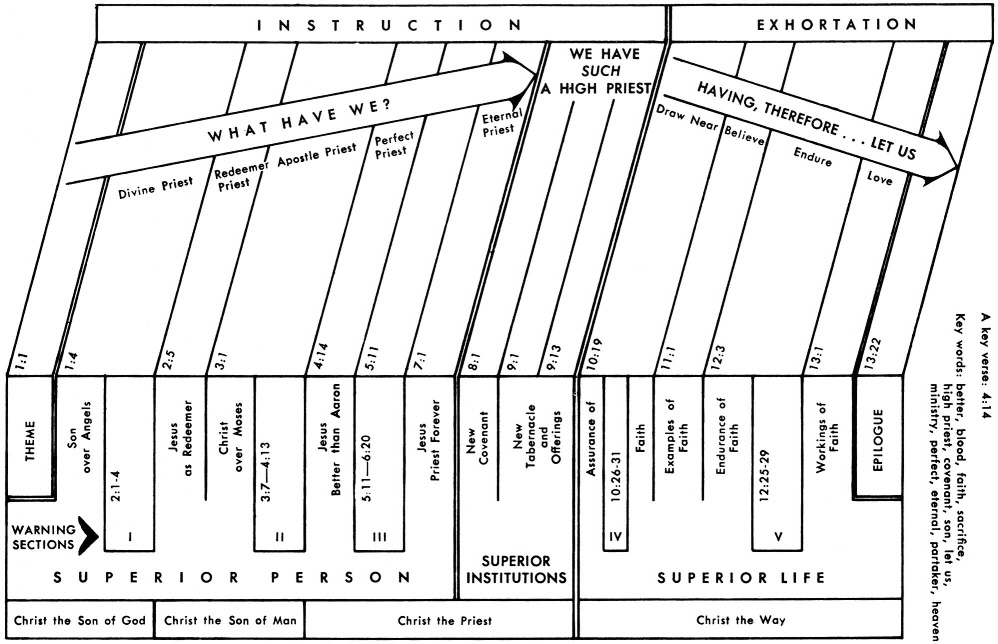
CONSIDER JESUS OUR GREAT HIGH PRIEST
Click chart to enlarge
Charts from Jensen's Survey of the NT - used by permission
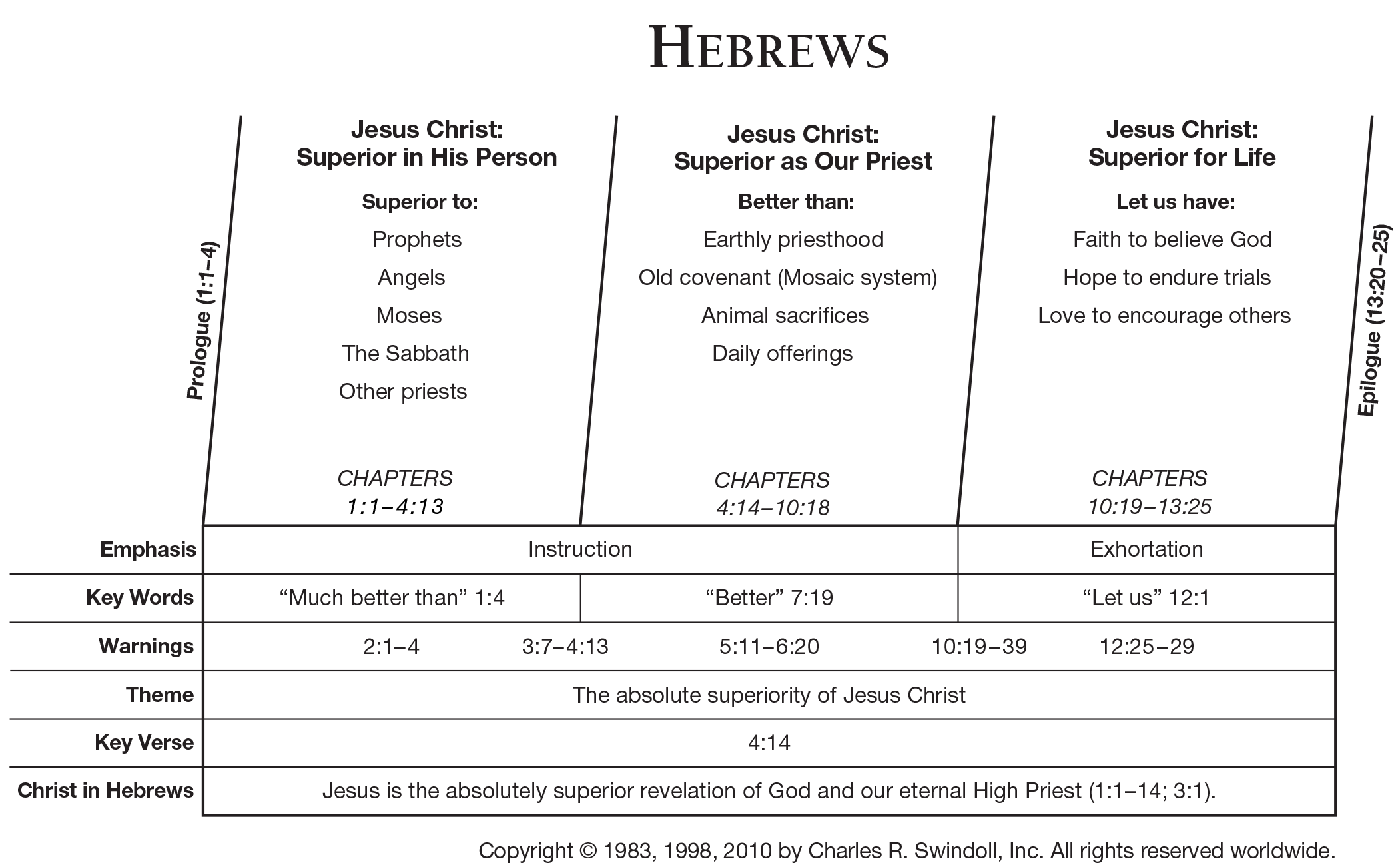
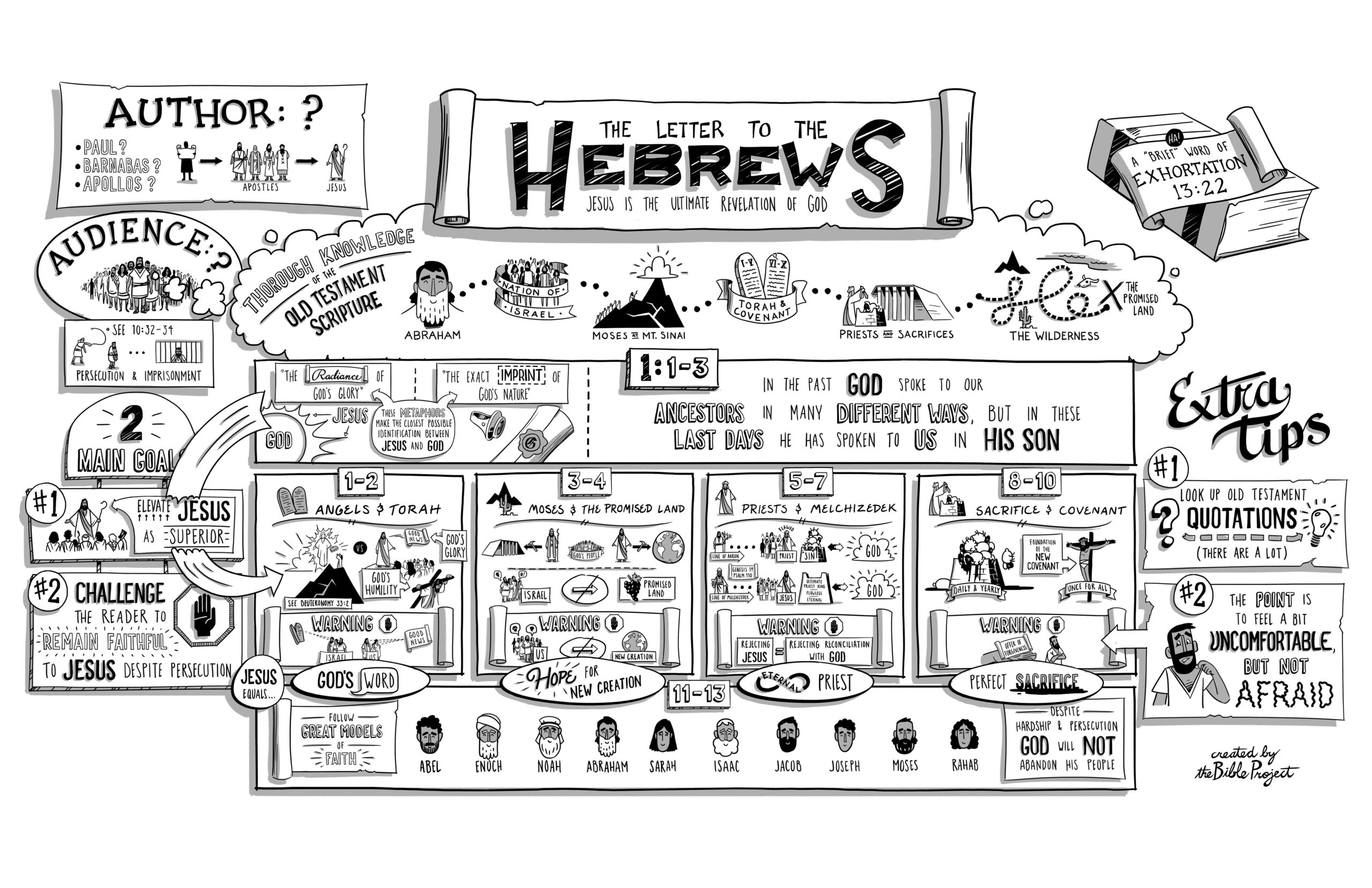
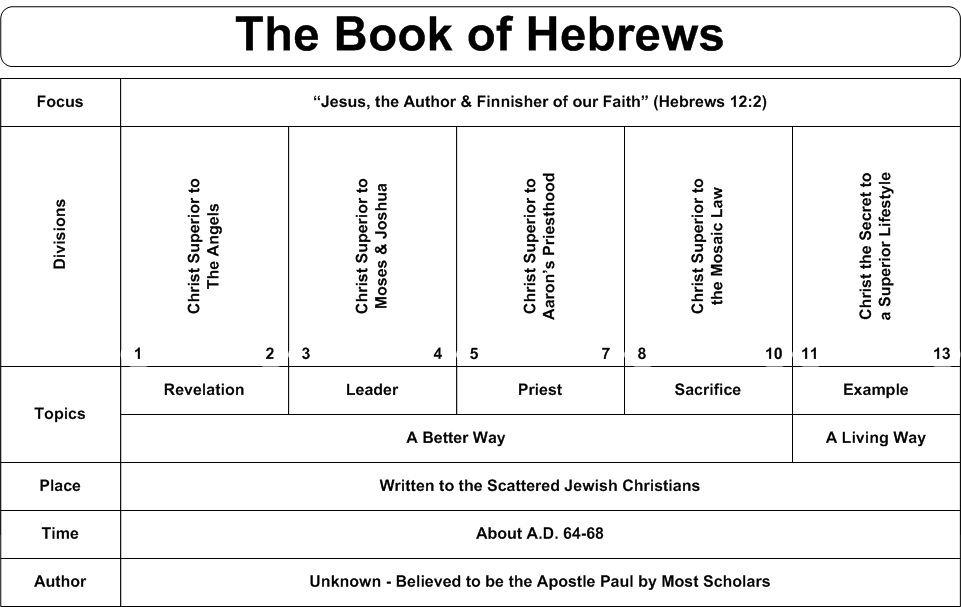
Swindoll's Chart, Interesting Pictorial Chart of Hebrews, Another Chart
|
The Epistle |
||||
| INSTRUCTION Hebrews 1-10:18 |
EXHORTATION Hebrews 10:19-13:25 |
|||
| Superior Person of Christ Hebrews 1:1-4:13 |
Superior Priest in Christ Hebrews 4:14-10:18 |
Superior Life In Christ Hebrews 10:19-13:25 |
||
| BETTER THAN PERSON Hebrews 1:1-4:13 |
BETTER PRIESTHOOD Heb 4:14-7:28 |
BETTER COVENANT Heb 8:1-13 |
BETTER SACRIFICE Heb 9:1-10:18 |
BETTER LIFE |
| MAJESTY OF CHRIST |
MINISTRY OF CHRIST |
MINISTERS FOR CHRIST |
||
|
DOCTRINE |
DUTY |
|||
|
DATE WRITTEN: |
||||

See ESV Study Bible "Introduction to Hebrews"
(See also MacArthur's Introduction to Hebrews)
Borrow Ryrie Study Bible
Hebrews 10:3 But in those sacrifices there is a reminder of sins year by year. (NASB: Lockman)
Greek: all' en autais anamnesis amartion kat' eniauton
BGT ἀλλ᾽ ἐν αὐταῖς ἀνάμνησις ἁμαρτιῶν κατ᾽ ἐνιαυτόν·
Amplified: But [as it is] these sacrifices annually bring a fresh remembrance of sins [to be atoned for], (Amplified Bible - Lockman)
Barclay: So far from that, in them there is a year by year reminder of sin. (Westminster Press)
NLT: But just the opposite happened. Those yearly sacrifices reminded them of their sins year after year. (NLT - Tyndale House)
KJV But in those sacrifices there is a remembrance again made of sins every year.
NKJ But in those sacrifices there is a reminder of sins every year.
NET But in those sacrifices there is a reminder of sins year after year.
CSB But in the sacrifices there is a reminder of sins every year.
ESV But in these sacrifices there is a reminder of sins every year.
NIV But those sacrifices are an annual reminder of sins,
Phillips: In practice, however, the sacrifices amounted to an annual reminder of sins; (Phillips: Touchstone)
Wuest: But in them [the sacrifices] there was a calling to mind of sins year by year,
Young's Literal: but in those sacrifices is a remembrance of sins every year,
Paraphrase Each annual sacrifice served not to remove sin but to remind the people that sin still remained.
Paraphrase Instead of erasing guilt, the continual offerings recalled it to mind year after year.
Paraphrase Every Day of Atonement reopened the wound rather than healing it.
- He 9:7; Exodus 30:10; Leviticus 16:6, 7, 8, 9, 10, 11,21,22,29,30,34; 23:27,28; Nu 29:7, 8, 9, 10, 11; 1Kings 17:18; Mt 26:28
- Hebrews 10 Resources - Multiple Sermons and Commentaries
- Hebrews 10:1-18 Total Forgiveness - Steven Cole
- Hebrews 10:1-18 Christ: The Living Sacrifice - John MacArthur
- Click for Hebrews 5W/H Study Questions — ideal for leading a group or for personal study
REPETITION THAT REMINDS
NOT REDEMPTION THAT REMOVES
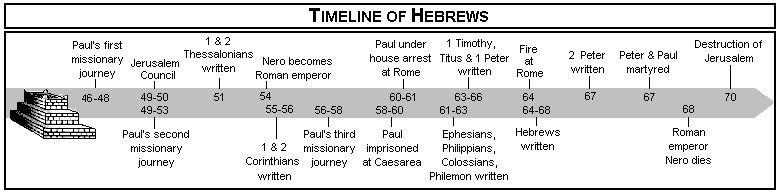
Notice from the chart above where we are in the Letter to the Hebrews -- the author is on the "home stretch" of his doctrinal defense of all that is better in the New Covenant and in Hebrews 10:19 will move into the section dealing with "Duty."
Far from removing guilt, the old covenant sacrifices actually highlighted it. Each annual Day of Atonement and every repeated offering stood as a continual reminder that sin still remained. Instead of providing lasting cleansing, the sacrifices pointed the worshiper back to the reality of separation from God and the need for a better sacrifice. Their very repetition underscored their inadequacy. This verse sets the stage for the contrast: what the Law could only remind us of, Christ’s sacrifice removes once-for-all.
What should have signified cleansing instead
served as a constant reminder of uncleanness.
But (alla) introduces a sharp and emphatic contrast with Heb 10:2, not the cessation of sacrifices or the cleansing of the conscience, but the very opposite! Instead of bringing rest and assurance, the continual repetition of offerings proved their ineffectiveness and kept the worshipers ever conscious of sin. What should have signified cleansing instead served as a constant reminder of uncleanness. The “but” therefore underscores the tragic irony: what the Law could only shadow, Christ would one day accomplish in substance.
In those sacrifices there is a reminder (anamnesis) of sins (hamartia) year by year (eniautos) - In those sacrifices refers to the repeated Levitical offerings, especially the annual Day of Atonement (Leviticus 16:1ff) as indicated by the time phrase year by year. A reminder means instead of true forgiveness (or clean conscience), there was a constant bringing of sins back into memory which served as a testimony that guilt remained. Of sins refers to the offenses that separated the people from God, showing their guilt was not yet removed. Year by year highlighted the continual cycle, so that the calendar itself became a witness to the insufficiency of the sacrifices. Daily, monthly, yearly, sacrifice after sacrifice - in fact more than 300,000 lambs were sacrificed in Jerusalem on Passover to the point that blood ran down as red rivulets into the Kidron Valley.
🙏 THOUGHT- Ever tie a string around your finger? Why did you do that? You were giving yourself a reminder! Beloved, every time they celebrated the Day of Atonement the Jews were in effect tying a string around their finger each year, a divine reminder of sin and a divine finger pointed to their need for a Savior. And so every time an Israelite brought a sacrifice and especially every time they celebrated the annual Day of Atonement, they were reminded that they had sinned against God.
What a contrast the writer of Hebrews pictures (See list of 100 contrasts between the Old and the New)…
OLD COVENANT - REMEMBER YOUR SINS
NEW COVENANT - REMEMBER YOUR SAVIOR
Instead of soothing the conscience, the Levitical system stabbed the conscience, awakening it anew each year when the High Priest confessed their sins. Indeed, the old covenant sacrifices did not truly erase sin but actually rehearsed their sin. The sacrifices were God’s ordained “reminder system,” pointing Israel to their need for a better sacrifice. Oh, the wonder of grace, for the New Covenant reverses the pattern, so that today we are called to remember not the sins but the sacrifice for those sins. (see above Lk 22:19; 1Cor 11:24) The contrasting promise of the New Covenant was that the sin would be removed and even God would “remember” their sins “no more” (He 8:12, He 10:17 from Jer 31:34).
Spurgeon says the blood of animals "was only a picture, an emblem, a type of far more precious blood—the shadow of the real atonement that was afterward to be offered. There was a lamb slain every morning, and that sacrifice must have reminded at least some of them that a perpetual atonement was provided (ED: SPURGEON IS ALLUDING WHO THOSE WHO BELIEVED IN MESSIAH AND SAW IN THE SACRIFICES A SHADOW THAT HAD BEHIND IT THE SUBSTANCE OF CHRIST IN WHOM THEY BELIEVED). But, as with an undertone of thunder, it also reminded them all that such an atonement was still needed; that, after a thousand years of the offering of lambs, sacrifices were still required. There was ordained a day of atonement with especially solemn ceremonies, but what did that day say to the Jews? That atonement was provided? No, but that an atonement was still needed. For, as soon as ever that year was up, the atonement had not been made, and they must have another day of atonement.
"The offerings, thus, in their inability to remove sin,
remind of sin."
Clinton Arnold sums up that the writer's "point applies to the whole of the old covenant sacrificial system, as it is epitomized in the Day of Atonement sacrifice. Since the sacrifices really cannot cleanse the worshipers, as is shown by the offerings’ repetition, all they really serve to do is affirm the perpetual state of sin in which the worshipers suffer. The offerings, thus, in their inability to remove sin, remind of sin." (See Hebrews to Revelation: Volume Four)
Animal sacrifices were proved to be inadequate
by their very repetition.
Marvin Vincent… Each successive sacrifice was a fresh reminder of sins to be atoned for; so far were the sacrifices from satisfying the conscience of the worshipper. (Contrast the result of the better covenant - He 10:17) (cp reminder of iniquity in Nu 5:15)
S Lewis Johnson - Now, if the Day of Atonement was a sacrifice for Israel, which removed their sins, why does it have to be repeated? Well, for the simple reason that in the meantime they have also been sinning and it is necessary again for the atonement sacrifices to be made in order that Israel may remain in good standing with the covenant of the Old Testament. So just appealing to experience would or should have taught Israel and should have taught anyone else that there is no definitive cleansing in the Old Testament sacrifices. You can see it in so many ways. I remember in one year, many years ago, I had an automobile that I had some difficulty with after I’d purchased it. And I remember taking it back to the dealer and having him fix it. And then, after I’d had it for a few more days I had to take it back again. It was a Dodge, I remember, and the name of the company was Nichols Brothers. And I gave advice to a lot of people don’t buy one from that company because I had to keep taking it back. The very fact that I took it back a couple of times was evidence that they hadn’t fixed what they said they were fixing. Well, this is like our author’s argument here. He says, “For then would they not have ceased to be offered?” For then, would I not have ceased having to take that automobile back to Nichols Brothers, if they had fixed it the first time? “For the worshipers, once purified, would have had no more conscience sense of guilt for sins. But in those sacrifices there is a reminder of sins every year.” So every time I drove it back to Nichols Brothers, it was a reminder to anyone who knew the facts that Nichols Brothers had not fixed that car. (The Shadow and the Reality)
Jamieson writes that this reminder is "a recalling to mind by the high priest’s confession, on the day of atonement, of the sins both of each past year and of all former years, proving that the expiatory sacrifices of former years were not felt by men’s consciences to have fully atoned for former sins; in fact, the expiation and remission were only legal and typical (Heb 10:4, He 10:11). The Gospel remission, on the contrary, is so complete, that sins are “remembered no more” (He 10:17) by God. It is unbelief to “forget” this once-for-all purgation, and to fear on account of “former sins” (2Pe 1:9). The believer, once for all bathed, needs only to “wash” his hands and “feet” of soils, according as he daily contracts them, in Christ’s blood (Jn 13:10). (Hebrews 10)
Cornerstone Commentary - The argument here recalls that of Paul in Romans to the effect that the law only makes people aware of their sin and thereby heightens or magnifies it (see Ro 3:20; 5:13, 20; 7:7). (See 1-2 Timothy, Titus, Hebrews - Page 409)
Although not using the word anamnesis, the following passage from Numbers conveys the same idea intended by the writer of Hebrews…
(In context of a wife being unfaithful) the man shall then bring his wife to the priest, and shall bring as an offering for her one-tenth of an ephah of barley meal; he shall not pour oil on it, nor put frankincense on it, for it is a grain offering of jealousy, a grain offering of memorial, a reminder of iniquity. (Nu 5:15)
Think of it this way. If someone is ill, medicine may be prescribed which effects a cure. Then every time he looks at the bottle after that, he will say: "That is what gave me back my health." On the other hand, if the medicine is ineffective, every time he looks at the bottle he will be reminded that he is still sick and that the recommended cure was useless. So it was with the Law and the Levitical system which could not cure the sin sickness.
🙏 THOUGHT - Now how does this apply to believers today? Do we not all have a tendency to return to our own "little sacrificial systems", saying things like "My quiet time wasn't long enough this morning, so God won't bless me today!" We have just returned to our little "ritual". Although there was no blood spilt, the gist of our action is the same as it was for Israel under the Old Covenant. But like Israel we learn that ritual and rules only serve to remind us of our inability to keep even our own rules! We need to remember that we are not longer under the law and a sacrificial system but under grace. We need to walk by faith in the light of this new covenant truth. Then, our quiet time becomes a time of freedom and fellowship, not a time of burdensome legalism.
Excerpt from The Purpose of the Law - a "negative" effect -- As an aside one purpose of the law has an interesting (and unwanted) "side effect" -- while law is given to reveal sin, what is amazing is that law in fact increases sin. This is one of the great dangers of a legalistic spirit. To say "I won't" in reliance on my natural power is to put myself under the law which is exactly where my flesh wants me to be placed! Living under the “Law” never changes you. If you focus only on what you shouldn’t do, you will be pulled more powerfully to do it. Here is a Scripture that supports this premise "For while we were in the flesh, the sinful passions, which were aroused by the Law,were at work in the members of our body to bear fruit for death." (Romans 7:5).....
Augustine - Nothing could be truer. For a prohibition always increases an illicit desire so long as the love of and joy in holiness is too weak to conquer the inclination to sin. So without the aid of divine grace it is impossible for man to love and delight in sanctity. (CITY OF GOD)
I will never forget an illustration of this by Charles Swindoll who described a beautiful "putting green" like lawn in his front yard. And to keep it pristine, he placed a sign so the kids would not ride their bikes over the lawn "STAY OFF THE LAWN." You guessed it! Kids began to ride "rampant" over his "putting green" lawn. That's the effect of the Law!!!
In Galveston, Texas, a hotel on the shore of the Gulf of Mexico put this notice in each room: NO FISHING FROM THE BALCONY Yet every day, hotel guests threw in their lines to the waters below. Then the management decided to TAKE DOWN THE SIGNS – Guess what happened? The fishing stopped! (For more discussion see The Purpose of the Law - a "negative" effect)
But (235) alla means 1) but 1a) nevertheless, notwithstanding 1b) an objection 1c) an exception 1d) a restriction 1e) nay, rather, yea, moreover 1f) forms a transition to the cardinal matter. Alla implies in speech a contrast or addition to what has preceded; it is used to mark opposition, antithesis, or transition. In the NASB, alla is translated most often as “but,” but also appears as “rather,” “instead,” “yet,” “nevertheless,” “on the contrary,” and occasionally “indeed/certainly.” In sum, alla is the strongest adversative in the Greek language.
Alla often corrects or overturns the previous statement as in these examples - Galatians 1:1 — “not from men, nor through the agency of man, but (ἀλλά) through Jesus Christ…” Matthew 10:20 — “For it is not you who speak, but (ἀλλά) the Spirit of your Father who speaks in you.” The contrast in both is not mild but absolute.
Alla retains its typically adversative sense in the Septuagint. Thus God promises Abram that his heir would not be his servant but his own son (Genesis 15:4). And when the Lord changed Abram’s name we read that it was no longer “Abram” but “Abraham” (Genesis 17:5). Alla contrasts, shows change, and limits. Its sense of limiting appears clearly in Exodus 8:28 (only you shall not go very far away.)
Gingrich on alla - adversative particle but (stronger than de): most frequently after a negative, as Mt 5:17; Mk 9:37; Eph 1:21. Followed by ou, in strong contrast to a preceding positive statement 1 Cor 10:23. Yet, and yet Jn 1:31; 8:26; 12:27; rather Lk 1:60; instead of that 1 Cor 6:6; nevertheless Ro 5:14; except Mk 4:22; 2 Cor 1:13; certainly, at least Mk 14:29; Ro 6:5. Strengthening an imperative now, so Mt 9:18; Mk 9:22. Alone, or with kai, ge kai,, or oude,, emphatically introducing what follows indeed, why!, and not only this, but also 2 Cor 7:11 (6 times); Jn 16:2; 1 Cor 3:2. Elliptical alla. (touto gegonen, e.g.) hina but (this has happened, e.g.) in order that Mk 14:49; Jm 1:8. (BORROW Shorter Lexicon of the Greek New Testament)
Friberg on alla - alla, an adversative conjunction indicating contrast, difference, or limitation but, however, yet, nevertheless, at least; (1) after a negative; (a) to introduce a contrast but, however, yet, nevertheless (Mt 7.21); (b) to provide ascensive force to a statement ouv monon . . . a. kai, not only . . . but also (Acts 26.29 ); with ou monon implied even more than that (2Co 7.11); (c) to introduce a main point after questions with an implied negative answer rather, instead (Lk 13.5); (d) to negate an incorrect declaration rather, instead (Lk 1.60); (e) to introduce an exception except, however (2Co 1.13); (2) to provide transition between independent clauses, with limiting or differing force but, yet, however (Mk 14.36); (3) to strengthen a command now, then, so (Mk 16.7; Acts 10.20); (4) in the consequence clause of conditional sentences to change thought direction yet, certainly, at least (Mk 14.29). (BORROW Analytical Lexicon of the Greek New Testament)
Gilbrant - Alla appears in every book in the New Testament with a variety of meanings. It was a favorite conjunction of Paul and it is widely used in the Gospels, especially John’s. Again it serves to contrast—often the positive versus the negative (e.g., Matthew 5:39; 6:13; 9:13).
A unique feature of alla in John’s writings is that “the parts contrasted are not always of equal standing grammatically” (Bauer). Sometimes “rather” is an appropriate translation. For example, in John 3:28, John the Baptist declared that he was not the Christ; “rather,” he was sent ahead of Him. John was not a direct opposite to the Christ, but he was different.
Under other circumstances alla also has a force other than strictly adversative. It limits in some cases (e.g., Mark 14:36; John 11:42) and adds emphasis in others (e.g., 1 Corinthians 8:6: “but to us there is but one God, the Father”). Nevertheless, the sense of contrast is almost always latent. Alla contrasts the fact that the daughter of a ruler had died, or at least that death was imminent, with the ruler’s trust that “nevertheless” Jesus should “come and put His hand on her” (Matthew 9:18). The use of alla here adds emphasis to the man’s plea (cf. Bauer; Matthew 24:6; Mark 13:20). (Complete Biblical Library)
Alla is used over 1000x in the Septuagint and the NT
SEPTUAGINT - Gen. 15:4; Gen. 17:5; Gen. 17:15; Gen. 18:15; Gen. 19:2; Gen. 20:12; Gen. 21:23; Gen. 21:26; Gen. 24:4; Gen. 24:38; Gen. 28:17; Gen. 32:29; Gen. 34:31; Gen. 35:10; Gen. 38:23; Gen. 40:14; Gen. 40:15; Gen. 40:23; Gen. 42:12; Gen. 42:34; Gen. 44:26; Gen. 45:1; Gen. 45:8; Gen. 47:18; Gen. 47:30; Gen. 48:19; Exod. 8:24; Exod. 9:2; Exod. 10:25; Exod. 12:9; Exod. 16:8; Exod. 16:20; Exod. 21:13; Exod. 23:5; Exod. 23:24; Exod. 32:18; Exod. 33:16; Lev. 11:21; Lev. 21:2; Lev. 21:14; Lev. 26:15; Lev. 26:23; Lev. 27:21; Lev. 27:29; Num. 10:30; Num. 13:28; Num. 13:30; Num. 13:33; Num. 14:9; Num. 14:14; Num. 14:21; Num. 14:23; Num. 14:30; Num. 16:30; Num. 18:15; Num. 20:19; Num. 22:20; Num. 23:13; Num. 26:37; Num. 31:23; Num. 35:33; Num. 36:9; Deut. 1:28; Deut. 4:12; Deut. 4:26; Deut. 5:3; Deut. 7:5; Deut. 7:8; Deut. 8:3; Deut. 9:4; Deut. 9:5; Deut. 10:12; Deut. 12:5; Deut. 12:14; Deut. 12:15; Deut. 12:18; Deut. 16:6; Deut. 20:17; Deut. 20:19; Deut. 20:20; Deut. 21:17; Deut. 21:23; Deut. 28:65; Deut. 29:14; Deut. 29:19; Jos. 1:18; Jos. 3:4; Jos. 6:18; Jos. 7:3; Jos. 11:13; Jos. 11:20; Jos. 11:22; Jos. 13:6; Jos. 14:4; Jos. 17:3; Jos. 22:5; Jos. 22:24; Jos. 22:27; Jos. 22:28; Jos. 23:8; Jos. 24:18; Jos. 24:21; Jdg. 2:2; Jdg. 7:12; Jdg. 15:13; 1 Sam. 1:23; 1 Sam. 2:10; 1 Sam. 2:30; 1 Sam. 6:3; 1 Sam. 6:9; 1 Sam. 8:7; 1 Sam. 8:19; 1 Sam. 10:19; 1 Sam. 12:12; 1 Sam. 14:30; 1 Sam. 15:19; 1 Sam. 15:30; 1 Sam. 16:6; 1 Sam. 17:43; 1 Sam. 18:25; 1 Sam. 20:3; 1 Sam. 21:5; 1 Sam. 21:6; 1 Sam. 21:7; 1 Sam. 29:9; 1 Sam. 30:2; 1 Sam. 30:17; 1 Sam. 30:22; 2 Sam. 10:3; 2 Sam. 12:3; 2 Sam. 13:33; 2 Sam. 16:18; 2 Sam. 19:29; 2 Sam. 21:2; 2 Sam. 24:24; 1 Ki. 3:11; 1 Ki. 3:22; 1 Ki. 3:23; 1 Ki. 8:19; 1 Ki. 17:12; 1 Ki. 17:13; 1 Ki. 18:18; 1 Ki. 20:29; 1 Ki. 22:8; 1 Ki. 22:18; 1 Ki. 22:31; 2 Ki. 4:2; 2 Ki. 5:15; 2 Ki. 5:17; 2 Ki. 10:23; 2 Ki. 13:7; 2 Ki. 14:6; 2 Ki. 17:36; 2 Ki. 17:39; 2 Ki. 19:18; 2 Ki. 20:10; 2 Ki. 20:15; 2 Ki. 23:23; 1 Chr. 2:34; 1 Chr. 15:2; 1 Chr. 22:12; 1 Chr. 23:22; 1 Chr. 29:1; 2 Chr. 1:4; 2 Chr. 2:5; 2 Chr. 15:17; 2 Chr. 16:12; 2 Chr. 17:4; 2 Chr. 18:17; 2 Chr. 18:30; 2 Chr. 19:3; 2 Chr. 19:6; 2 Chr. 20:12; 2 Chr. 20:15; 2 Chr. 20:33; 2 Chr. 21:17; 2 Chr. 25:2; 2 Chr. 25:4; 2 Chr. 26:18; 2 Chr. 27:2; 2 Chr. 28:22; 2 Chr. 29:34; 2 Chr. 30:11; 2 Chr. 30:18; 2 Chr. 32:25; 2 Chr. 35:22; Ezr. 5:13; Ezr. 10:13; Neh. 1:11; Neh. 9:29; Est. 1:16; Est. 4:17; Est. 5:12; Est. 8:12; Ps. 1:2; Ps. 1:4; Ps. 43:4; Ps. 51:9; Ps. 113:9; Ps. 113:26; Ps. 117:17; Ps. 118:85; Ps. 130:2; Ps. 132:1; Prov. 1:25; Prov. 4:13; Prov. 9:18; Prov. 20:9; Prov. 23:17; Prov. 23:31; Prov. 24:8; Prov. 25:10; Prov. 26:5; Prov. 27:4; Prov. 29:19; Eccl. 5:10; Job 1:11; Job 1:12; Job 2:5; Job 2:9; Job 3:7; Job 3:8; Job 4:16; Job 5:3; Job 5:7; Job 5:8; Job 6:3; Job 6:5; Job 6:25; Job 9:23; Job 9:35; Job 10:7; Job 11:5; Job 12:6; Job 12:7; Job 13:3; Job 14:4; Job 14:22; Job 17:10; Job 18:19; Job 21:17; Job 22:7; Job 24:23; Job 27:7; Job 27:11; Job 32:8; Job 32:21; Job 33:1; Job 33:30; Job 34:11; Job 34:36; Job 36:10; Job 36:21; Job 38:11; Job 40:7; Job 40:15; Hos. 1:6; Hos. 7:14; Amos 7:14; Amos 8:11; Mic. 6:8; Zech. 4:6; Zech. 8:12; Mal. 2:9; Mal. 2:15; Mal. 2:16; Isa. 3:13; Isa. 5:7; Isa. 5:24; Isa. 5:25; Isa. 7:8; Isa. 7:17; Isa. 8:6; Isa. 9:9; Isa. 9:11; Isa. 9:16; Isa. 9:19; Isa. 9:20; Isa. 10:4; Isa. 10:7; Isa. 10:16; Isa. 10:20; Isa. 11:4; Isa. 23:18; Isa. 26:18; Isa. 28:27; Isa. 29:23; Isa. 30:5; Isa. 30:6; Isa. 30:10; Isa. 30:16; Isa. 32:3; Isa. 35:9; Isa. 37:19; Isa. 37:34; Isa. 39:4; Isa. 41:18; Isa. 42:3; Isa. 42:19; Isa. 43:17; Isa. 43:24; Isa. 44:9; Isa. 45:18; Isa. 48:6; Isa. 49:10; Isa. 49:15; Isa. 50:7; Isa. 53:3; Isa. 55:9; Isa. 58:6; Isa. 59:2; Isa. 60:18; Isa. 60:19; Isa. 62:9; Isa. 63:9; Isa. 63:16; Isa. 65:2; Isa. 65:18; Isa. 66:2; Jer. 2:20; Jer. 2:33; Jer. 2:34; Jer. 2:35; Jer. 3:10; Jer. 7:23; Jer. 7:24; Jer. 7:32; Jer. 9:13; Jer. 9:23; Jer. 15:17; Jer. 16:15; Jer. 19:6; Jer. 20:3; Jer. 22:12; Jer. 22:17; Jer. 23:8; Jer. 33:15; Jer. 38:30; Jer. 41:4; Jer. 45:4; Jer. 45:6; Jer. 50:3; Jer. 51:14; Ezek. 5:7; Ezek. 14:16; Ezek. 18:11; Ezek. 36:22; Ezek. 39:10; Ezek. 44:10; Ezek. 44:22; Ezek. 44:25; Ezek. 46:9; Dan. 2:28; Dan. 2:30; Dan. 3:39; Dan. 3:42; Dan. 3:95; Dan. 6:6; Dan. 6:8; Dan. 6:13; Dan. 9:18; Dan. 10:21;
NEW TESTAMENT - Matt. 4:4; Matt. 5:15; Matt. 5:17; Matt. 5:39; Matt. 6:13; Matt. 6:18; Matt. 7:21; Matt. 8:4; Matt. 8:8; Matt. 9:12; Matt. 9:13; Matt. 9:17; Matt. 9:18; Matt. 9:24; Matt. 10:20; Matt. 10:34; Matt. 11:8; Matt. 11:9; Matt. 13:21; Matt. 15:11; Matt. 16:12; Matt. 16:17; Matt. 16:23; Matt. 17:12; Matt. 18:22; Matt. 18:30; Matt. 19:6; Matt. 19:11; Matt. 20:23; Matt. 20:26; Matt. 20:28; Matt. 21:21; Matt. 22:30; Matt. 22:32; Matt. 24:6; Matt. 26:39; Matt. 27:24; Mk. 1:44; Mk. 1:45; Mk. 2:17; Mk. 2:22; Mk. 3:26; Mk. 3:27; Mk. 3:29; Mk. 4:17; Mk. 4:22; Mk. 5:19; Mk. 5:26; Mk. 5:39; Mk. 6:9; Mk. 6:52; Mk. 7:5; Mk. 7:15; Mk. 7:19; Mk. 7:25; Mk. 8:33; Mk. 9:8; Mk. 9:13; Mk. 9:22; Mk. 9:37; Mk. 10:8; Mk. 10:27; Mk. 10:40; Mk. 10:43; Mk. 10:45; Mk. 11:23; Mk. 11:32; Mk. 12:14; Mk. 12:25; Mk. 12:27; Mk. 13:7; Mk. 13:11; Mk. 13:20; Mk. 13:24; Mk. 14:28; Mk. 14:29; Mk. 14:36; Mk. 14:49; Mk. 16:7; Lk. 1:60; Lk. 5:14; Lk. 5:31; Lk. 5:32; Lk. 5:38; Lk. 6:27; Lk. 7:7; Lk. 7:25; Lk. 7:26; Lk. 8:16; Lk. 8:27; Lk. 8:52; Lk. 11:33; Lk. 11:42; Lk. 12:7; Lk. 12:51; Lk. 13:3; Lk. 13:5; Lk. 14:10; Lk. 14:13; Lk. 16:21; Lk. 16:30; Lk. 17:8; Lk. 18:13; Lk. 20:21; Lk. 20:38; Lk. 21:9; Lk. 22:26; Lk. 22:36; Lk. 22:42; Lk. 22:53; Lk. 23:15; Lk. 24:6; Lk. 24:21; Lk. 24:22; Jn. 1:8; Jn. 1:13; Jn. 1:31; Jn. 1:33; Jn. 3:8; Jn. 3:16; Jn. 3:17; Jn. 3:28; Jn. 3:36; Jn. 4:2; Jn. 4:14; Jn. 4:23; Jn. 5:18; Jn. 5:22; Jn. 5:24; Jn. 5:30; Jn. 5:34; Jn. 5:42; Jn. 6:9; Jn. 6:22; Jn. 6:26; Jn. 6:27; Jn. 6:32; Jn. 6:36; Jn. 6:38; Jn. 6:39; Jn. 6:64; Jn. 7:10; Jn. 7:12; Jn. 7:16; Jn. 7:22; Jn. 7:24; Jn. 7:27; Jn. 7:28; Jn. 7:44; Jn. 7:49; Jn. 8:12; Jn. 8:16; Jn. 8:26; Jn. 8:28; Jn. 8:37; Jn. 8:42; Jn. 8:49; Jn. 8:55; Jn. 9:3; Jn. 9:9; Jn. 9:31; Jn. 10:1; Jn. 10:5; Jn. 10:8; Jn. 10:18; Jn. 10:26; Jn. 10:33; Jn. 11:4; Jn. 11:11; Jn. 11:15; Jn. 11:22; Jn. 11:30; Jn. 11:42; Jn. 11:51; Jn. 11:52; Jn. 11:54; Jn. 12:6; Jn. 12:9; Jn. 12:16; Jn. 12:27; Jn. 12:30; Jn. 12:42; Jn. 12:44; Jn. 12:47; Jn. 12:49; Jn. 13:9; Jn. 13:10; Jn. 13:18; Jn. 14:24; Jn. 14:31; Jn. 15:16; Jn. 15:19; Jn. 15:21; Jn. 15:25; Jn. 16:2; Jn. 16:4; Jn. 16:6; Jn. 16:7; Jn. 16:12; Jn. 16:13; Jn. 16:20; Jn. 16:25; Jn. 16:33; Jn. 17:9; Jn. 17:15; Jn. 17:20; Jn. 18:28; Jn. 18:40; Jn. 19:21; Jn. 19:24; Jn. 19:34; Jn. 20:7; Jn. 20:27; Jn. 21:8; Jn. 21:23; Acts 1:4; Acts 1:8; Acts 2:16; Acts 4:17; Acts 4:32; Acts 5:4; Acts 5:13; Acts 7:39; Acts 7:48; Acts 9:6; Acts 10:20; Acts 10:35; Acts 10:41; Acts 13:25; Acts 15:11; Acts 15:20; Acts 16:37; Acts 18:9; Acts 18:21; Acts 19:2; Acts 19:26; Acts 19:27; Acts 20:24; Acts 21:13; Acts 21:24; Acts 26:16; Acts 26:20; Acts 26:25; Acts 26:29; Acts 27:10; Rom. 1:21; Rom. 1:32; Rom. 2:13; Rom. 2:29; Rom. 3:27; Rom. 3:31; Rom. 4:2; Rom. 4:4; Rom. 4:10; Rom. 4:12; Rom. 4:13; Rom. 4:16; Rom. 4:20; Rom. 4:24; Rom. 5:3; Rom. 5:11; Rom. 5:14; Rom. 5:15; Rom. 6:5; Rom. 6:13; Rom. 6:14; Rom. 6:15; Rom. 7:7; Rom. 7:13; Rom. 7:15; Rom. 7:17; Rom. 7:19; Rom. 7:20; Rom. 8:4; Rom. 8:9; Rom. 8:15; Rom. 8:20; Rom. 8:23; Rom. 8:26; Rom. 8:32; Rom. 8:37; Rom. 9:7; Rom. 9:8; Rom. 9:10; Rom. 9:12; Rom. 9:16; Rom. 9:24; Rom. 9:32; Rom. 10:2; Rom. 10:8; Rom. 10:16; Rom. 10:18; Rom. 10:19; Rom. 11:4; Rom. 11:11; Rom. 11:18; Rom. 11:20; Rom. 12:2; Rom. 12:3; Rom. 12:16; Rom. 12:19; Rom. 12:20; Rom. 12:21; Rom. 13:3; Rom. 13:5; Rom. 13:14; Rom. 14:13; Rom. 14:17; Rom. 14:20; Rom. 15:3; Rom. 15:21; Rom. 16:4; Rom. 16:18; 1 Co. 1:17; 1 Co. 1:27; 1 Co. 2:4; 1 Co. 2:5; 1 Co. 2:7; 1 Co. 2:9; 1 Co. 2:12; 1 Co. 2:13; 1 Co. 3:1; 1 Co. 3:2; 1 Co. 3:6; 1 Co. 3:7; 1 Co. 4:3; 1 Co. 4:4; 1 Co. 4:14; 1 Co. 4:15; 1 Co. 4:19; 1 Co. 4:20; 1 Co. 5:8; 1 Co. 6:6; 1 Co. 6:8; 1 Co. 6:11; 1 Co. 6:12; 1 Co. 6:13; 1 Co. 7:4; 1 Co. 7:7; 1 Co. 7:10; 1 Co. 7:19; 1 Co. 7:21; 1 Co. 7:35; 1 Co. 8:6; 1 Co. 8:7; 1 Co. 9:2; 1 Co. 9:12; 1 Co. 9:21; 1 Co. 9:27; 1 Co. 10:5; 1 Co. 10:13; 1 Co. 10:20; 1 Co. 10:23; 1 Co. 10:24; 1 Co. 10:29; 1 Co. 10:33; 1 Co. 11:8; 1 Co. 11:9; 1 Co. 11:17; 1 Co. 12:14; 1 Co. 12:22; 1 Co. 12:24; 1 Co. 12:25; 1 Co. 14:2; 1 Co. 14:17; 1 Co. 14:19; 1 Co. 14:20; 1 Co. 14:22; 1 Co. 14:33; 1 Co. 14:34; 1 Co. 15:10; 1 Co. 15:35; 1 Co. 15:37; 1 Co. 15:39; 1 Co. 15:40; 1 Co. 15:46; 2 Co. 1:9; 2 Co. 1:12; 2 Co. 1:13; 2 Co. 1:19; 2 Co. 1:24; 2 Co. 2:4; 2 Co. 2:5; 2 Co. 2:13; 2 Co. 2:17; 2 Co. 3:3; 2 Co. 3:5; 2 Co. 3:6; 2 Co. 3:14; 2 Co. 3:15; 2 Co. 4:2; 2 Co. 4:5; 2 Co. 4:8; 2 Co. 4:9; 2 Co. 4:16; 2 Co. 4:18; 2 Co. 5:4; 2 Co. 5:12; 2 Co. 5:15; 2 Co. 5:16; 2 Co. 6:4; 2 Co. 7:5; 2 Co. 7:6; 2 Co. 7:7; 2 Co. 7:9; 2 Co. 7:11; 2 Co. 7:12; 2 Co. 7:14; 2 Co. 8:5; 2 Co. 8:7; 2 Co. 8:8; 2 Co. 8:10; 2 Co. 8:13; 2 Co. 8:19; 2 Co. 8:21; 2 Co. 9:12; 2 Co. 10:4; 2 Co. 10:12; 2 Co. 10:13; 2 Co. 10:18; 2 Co. 11:1; 2 Co. 11:6; 2 Co. 11:17; 2 Co. 12:14; 2 Co. 12:16; 2 Co. 13:3; 2 Co. 13:4; 2 Co. 13:7; 2 Co. 13:8; Gal. 1:1; Gal. 1:8; Gal. 1:12; Gal. 1:17; Gal. 2:3; Gal. 2:7; Gal. 2:14; Gal. 3:12; Gal. 3:16; Gal. 3:22; Gal. 4:2; Gal. 4:7; Gal. 4:8; Gal. 4:14; Gal. 4:17; Gal. 4:23; Gal. 4:29; Gal. 4:30; Gal. 4:31; Gal. 5:6; Gal. 5:13; Gal. 6:13; Gal. 6:15; Eph. 1:21; Eph. 2:19; Eph. 4:29; Eph. 5:4; Eph. 5:15; Eph. 5:17; Eph. 5:18; Eph. 5:24; Eph. 5:27; Eph. 5:29; Eph. 6:4; Eph. 6:6; Eph. 6:12; Phil. 1:18; Phil. 1:20; Phil. 1:29; Phil. 2:3; Phil. 2:4; Phil. 2:7; Phil. 2:12; Phil. 2:17; Phil. 2:27; Phil. 3:7; Phil. 3:8; Phil. 3:9; Phil. 4:6; Phil. 4:17; Col. 2:5; Col. 3:11; Col. 3:22; 1 Thess. 1:5; 1 Thess. 1:8; 1 Thess. 2:2; 1 Thess. 2:4; 1 Thess. 2:7; 1 Thess. 2:8; 1 Thess. 2:13; 1 Thess. 4:7; 1 Thess. 4:8; 1 Thess. 5:6; 1 Thess. 5:9; 1 Thess. 5:15; 2 Thess. 2:12; 2 Thess. 3:8; 2 Thess. 3:9; 2 Thess. 3:11; 2 Thess. 3:15; 1 Tim. 1:13; 1 Tim. 1:16; 1 Tim. 2:10; 1 Tim. 2:12; 1 Tim. 3:3; 1 Tim. 4:12; 1 Tim. 5:1; 1 Tim. 5:13; 1 Tim. 5:23; 1 Tim. 6:2; 1 Tim. 6:4; 1 Tim. 6:17; 2 Tim. 1:7; 2 Tim. 1:8; 2 Tim. 1:9; 2 Tim. 1:12; 2 Tim. 1:17; 2 Tim. 2:9; 2 Tim. 2:20; 2 Tim. 2:24; 2 Tim. 3:9; 2 Tim. 4:3; 2 Tim. 4:8; 2 Tim. 4:16; Tit. 1:8; Tit. 1:15; Tit. 2:10; Tit. 3:5; Phlm. 1:14; Phlm. 1:16; Heb. 2:16; Heb. 3:13; Heb. 3:16; Heb. 4:2; Heb. 5:4; Heb. 5:5; Heb. 7:16; Heb. 9:24; Heb. 10:3; Heb. 10:25; Heb. 10:39; Heb. 11:13; Heb. 12:11; Heb. 12:22; Heb. 12:26; Heb. 13:14; Jas. 1:25; Jas. 1:26; Jas. 2:18; Jas. 3:15; Jas. 4:11; 1 Pet. 1:15; 1 Pet. 1:19; 1 Pet. 1:23; 1 Pet. 2:16; 1 Pet. 2:18; 1 Pet. 2:20; 1 Pet. 2:25; 1 Pet. 3:4; 1 Pet. 3:14; 1 Pet. 3:16; 1 Pet. 3:21; 1 Pet. 4:2; 1 Pet. 4:13; 1 Pet. 5:2; 1 Pet. 5:3; 2 Pet. 1:16; 2 Pet. 1:21; 2 Pet. 2:4; 2 Pet. 2:5; 2 Pet. 3:9; 1 Jn. 2:2; 1 Jn. 2:7; 1 Jn. 2:16; 1 Jn. 2:19; 1 Jn. 2:21; 1 Jn. 2:27; 1 Jn. 3:18; 1 Jn. 4:1; 1 Jn. 4:10; 1 Jn. 4:18; 1 Jn. 5:6; 1 Jn. 5:18; 2 Jn. 1:1; 2 Jn. 1:5; 2 Jn. 1:8; 2 Jn. 1:12; 3 Jn. 1:9; 3 Jn. 1:11; 3 Jn. 1:13; Jude 1:6; Jude 1:9; Rev. 2:4; Rev. 2:6; Rev. 2:9; Rev. 2:14; Rev. 2:20; Rev. 3:4; Rev. 3:9; Rev. 9:5; Rev. 10:7; Rev. 10:9; Rev. 17:12; Rev. 20:6
Reminder(364) (anamnesis from ana = again + mimnesko = remember) means for causing someone to remember. Each successive sacrifice was a fresh reminder of sins to be atoned for; so far were the sacrifices from satisfying the conscience of the worshipper.
Vine comments on anamnesis in this verse noting that it… suggests more than the mere memory of having done wrong, it involves an awakening of mind, the consciousness of guilt in the sight of God, and the consequent realization, in seeking to draw near to God, of a hindrance to the unclouded enjoyment of His presence. Communion with God is impossible where guilt is upon the conscience. Where sins are not removed through acceptance of God’s means by the blood of Christ, sins and their consequences must remain both now and in the eternal state hereafter. (Collected writings of W. E. Vine)
Wuest - The word reminder is the translation of anamnesis which speaks of “a calling to mind.” The memory of sins committed, is revived by the continual repetition of the yearly sacrifice on the Day of Atonement. The sacrifices themselves did not satisfy the consciences of the worshippers. They knew that these sacrifices did not pay for sin. (Hebrews Commentary online)
Here are all the other uses of anamnesis in Scripture in the Septuagint…
Leviticus 24:7 "And you shall put pure frankincense on each row, that it may be a memorial portion for the bread, even an offering by fire to the LORD.
Numbers 10:10 "Also in the day of your gladness and in your appointed feasts, and on the first days of your months, you shall blow the trumpets over your burnt offerings, and over the sacrifices of your peace offerings; and they shall be as a reminder of you before your God. I am the LORD your God."
Psalm 38:1 A Psalm of David, for a memorial. O Lord, rebuke me not in Thy wrath; And chasten me not in Thy burning anger.
Psalm 70:1 For the choir director. A Psalm of David; for a memorial. O God, hasten to deliver me; O LORD, hasten to my help!
The most memorable (pun intended) use of anamnesis is by our Lord Who on the night He was betrayed "when He had taken some bread and given thanks, He broke it, and gave it to them, saying, "This is My body which is given for you; do (present imperative) this in remembrance (anamnesis) of Me." (Luke 22:19) Comment: The memory of the greatness of His sacrifice should serve to motivate praise to the Savior and abstinence from sin. Is this not the idea inherent in the spiritual principle the expulsive power of a new affection? I think it is!
Paul reiterates this wish of our Lord "and when He had given thanks, He broke it, and said, "This is My body, which is for you; do (present imperative) this in remembrance of Me. In the same way He took the cup also, after supper, saying, "This cup is the new covenant in My blood; do (present imperative) this, as often as you drink it, in remembrance of Me." (1Cor 11:24, 25)
Sins (266) (hamartia originally conveyed the idea of missing the mark as when hunting with a bow and arrow and then came to mean missing or falling short of any goal, standard, or purpose. In Scripture sin often describes our thoughts, words and deeds that miss the ultimate purpose God has for each individual, these thoughts, words and deeds falling short of God’s perfect standard of holiness. In this verse Sin speaks of the principle or propensity inherited from Adam which causes us to commit sins (plural).
W. H. Auden, a well- known twentieth century poet, has said "All sin tends to be addictive and the terminal point of addiction is what is called damnation (Ed: cp He 9:27).
Vincent calls us to "Note the singular number, sin. The sacrifice of Christ dealt with Sin as a principle: the Levitical sacrifices with individual transgressions (Ed: But still did not remove them completely!). (Ibid)
Spurgeon - Sin.” It is a very little word, but it contains an awful abyss of meaning. “Sin” is transgression against God, rebellion against the King of kings, violation of the law of right, commission of all manner of wrong. Sin is in every one of us. We have all committed it; we have all been defiled with it. Christ came to put away sin. You see, the evil is put in one word, as if wrongdoing was made into one lump, all heaped together, and called, not “sins,” but “sin.” Can you catch the idea? All the sinfulness, all the omissions, all the commissions, and all the tendencies to rebel that ever were in the world are all piled together, hill upon hill, mountain upon mountain, and then called by this one name, “sin.” Christ was revealed to put away sin. He did not come into the world to palliate it merely, or to cover it up, but He came to put it away. Observe, He not only came to put away some of the attributes of sin, such as the filth of it, the guilt of it, the penalty of it, the degradation of it; He came to put away sin itself. For sin, you see, is the fountain of all the mischief. He did not come to empty out the streams, but to clear away the fatal source of the pollution. He appeared to put away sin itself, sin in its essence and being.
HAMARTIA IS A KEY WORD IN HEBREWS - 25X OUT OF 150V IN NT - Heb. 1:3; Heb. 2:17; Heb. 3:13; Heb. 4:15; Heb. 5:1; Heb. 5:3; Heb. 7:27; Heb. 8:12; Heb. 9:26; Heb. 9:28; Heb. 10:2; Heb. 10:3; Heb. 10:4; Heb. 10:6; Heb. 10:8; Heb. 10:11; Heb. 10:12; Heb. 10:17; Heb. 10:18; Heb. 10:26; Heb. 11:25; Heb. 12:1; Heb. 12:4; Heb. 13:11
Hebrews 1:3 When He had made purification of sins, He sat down at the right hand of the Majesty on high,
Hebrews 2:17 to make propitiation for the sins of the people.
Hebrews 3:13 so that none of you will be hardened by the deceitfulness of sin.
Hebrews 4:15 One who has been tempted in all things as we are, yet without sin.
Hebrews 5:1 in order to offer both gifts and sacrifices for sins;
Hebrews 5:3 and because of it he is obligated to offer sacrifices for sins
Hebrews 7:27 who does not need daily, like those high priests, to offer up sacrifices, first for His own sins
Hebrews 7:27 then for the sins of the people, because this He did once for all when He offered up Himself.
Hebrews 8:12 AND I WILL REMEMBER THEIR SINS NO MORE.”
Hebrews 9:26 He has been manifested to put away sin by the sacrifice of Himself.
Hebrews 9:28 so Christ also, having been offered once to bear the sins of many
Hebrews 10:2 having once been cleansed, would no longer have had consciousness of sins?
Hebrews 10:3 But in those sacrifices there is a reminder of sins year by year.
Hebrews 10:4 For it is impossible for the blood of bulls and goats to take away sins.
Hebrews 10:6 IN WHOLE BURNT OFFERINGS AND sacrifices FOR SIN YOU HAVE TAKEN NO PLEASURE.
Hebrews 10:8 WHOLE BURNT OFFERINGS AND sacrifices FOR SIN YOU HAVE NOT DESIRED
Hebrews 10:11 the same sacrifices, which can never take away sins;
Hebrews 10:12 but He, having offered one sacrifice for sins for all time
Hebrews 10:17 AND THEIR SINS AND THEIR LAWLESS DEEDS I WILL REMEMBER NO MORE
Hebrews 10:18 there is no longer any offering for sin
Hebrews 10:26 there no longer remains a sacrifice for sins,
Hebrews 11:25 than to enjoy the passing pleasures of sin,
Hebrews 12:1 let us also lay aside every encumbrance and the sin which so easily entangles us
Hebrews 12:4 You have not yet resisted to the point of shedding blood in your striving against sin;
Hebrews 13:11 whose blood is brought into the holy place by the high priest as an offering for sin
Year (1763) (eniautos) a year or any definite time. The phrase year by year points to the yearly sacrifices associated with the annual Day of Atonement ceremonies.
Friberg - (1) year (Jn 11.49); kat eniauton = every year, annually (Heb 9.25); (2) a cycle of seasons or years, perhaps sabbatical years (Gal 4.10); (3) as an extended period time, age, era (Lk 4.19) (Borrow Analytical Lexicon of the Greek New Testament)
Gilbrant - Eniautos has referred to a year’s length of time from classical times through the patristic age. The exact meaning comes out of the context and genre of the text. The time frame usually has some specificity such as “one year from today.” It occurs in relation to the terms of a contract, for example, in rental agreements which have been preserved from the ancients. The Septuagint uses the term many times. One representative usage is Exodus 12:2 where the Lord tells the Israelites that 10 days before the Passover will begin the first month of their year. This same usage is common in the New Testament. For instance, James wrote of Elijah’s prayer which held back rain for 3 1/2 years (James 5:17). John, in his Gospel, spoke of the high priest for that year (John 11:49). The New Testament also uses eniautos in a more general reference to denote a longer, nonspecific time frame. Thinking in terms of messianic eschatology, Luke 4:19 refers to the age of the Messiah, thus the year (eniautos) of the Lord’s favor is the age of salvation for men. (Complete Biblical Library)
ENIAUTOS - 17X/14V - Lk. 4:19; Jn. 11:49; Jn. 11:51; Jn. 18:13; Acts 11:26; Acts 18:11; Gal. 4:10; Heb. 9:7; Heb. 9:25; Heb. 10:1; Heb. 10:3; Jas. 4:13; Jas. 5:17; Rev. 9:15
ENIAUTOS IN SEPTUAGINT - Gen. 1:14; Gen. 17:21; Gen. 26:12; Gen. 47:17; Gen. 47:28; Exod. 12:2; Exod. 23:14; Exod. 23:16; Exod. 23:17; Exod. 23:29; Exod. 30:10; Exod. 34:22; Exod. 34:23; Exod. 34:24; Lev. 16:34; Lev. 23:41; Lev. 25:5; Lev. 25:10; Lev. 25:11; Lev. 25:15; Lev. 25:29; Lev. 25:30; Lev. 25:50; Lev. 25:52; Lev. 25:53; Lev. 27:17; Lev. 27:18; Lev. 27:23; Lev. 27:24; Num. 10:11; Num. 14:34; Num. 28:14; Deut. 11:12; Deut. 14:22; Deut. 14:28; Deut. 15:20; Deut. 16:16; Deut. 24:5; Deut. 31:10; Jos. 5:12; Jdg. 11:40; 1 Sam. 1:7; 1 Sam. 7:16; 2 Sam. 11:1; 2 Sam. 21:1; 1 Ki. 2:35; 1 Ki. 4:7; 1 Ki. 5:11; 1 Ki. 5:17; 1 Ki. 10:14; 1 Ki. 10:25; 1 Ki. 12:24; 1 Ki. 14:21; 1 Ki. 14:25; 1 Ki. 15:9; 1 Ki. 16:28; 1 Ki. 18:1; 1 Ki. 20:22; 1 Ki. 20:26; 1 Ki. 22:2; 2 Ki. 8:26; 2 Ki. 13:20; 2 Ki. 17:4; 2 Ki. 18:9; 2 Ki. 18:10; 2 Ki. 19:29; 2 Ki. 24:18; 2 Ki. 25:8; 2 Ki. 25:27; 1 Chr. 27:1; 2 Chr. 8:13; 2 Chr. 9:13; 2 Chr. 9:24; 2 Chr. 22:2; 2 Chr. 24:5; 2 Chr. 24:23; 2 Chr. 27:5; 2 Chr. 36:10; Neh. 10:32; Neh. 10:34; Neh. 10:35; Job 3:6; Ps. 65:10; Prov. 2:19; Isa. 6:1; Isa. 21:16; Isa. 29:1; Isa. 32:10; Isa. 34:8; Isa. 37:30; Isa. 61:2; Isa. 63:4; Jer. 11:23; Jer. 17:8; Jer. 23:12; Jer. 28:16; Jer. 32:1; Jer. 36:1; Jer. 45:1; Jer. 48:44; Jer. 52:31; Ezek. 4:6; Ezek. 15:4; Dan. 10:1; Dan. 11:1; Dan. 11:6; Dan. 11:13; Zech. 14:16
USES IN HEBREWS -
Hebrews 9:7 only the high priest enters once a year, not without taking blood
Hebrews 9:25 the high priest enters the holy place year by year with blood that is not his own.
Hebrews 10:1 can never, by the same sacrifices which they offer continually year by year
Hebrews 10:3 But in those sacrifices there is a reminder of sins year by year.
ILLUSTRATIONS: These can help show the difference between reminder under the Old Covenant and removal under Christ.
1. Unpaid Debt Notices
Imagine receiving a debt statement in the mail every month. Each notice reminds you that your balance is still due. Payments made never cover the full amount; they just delay the penalty. That’s what the yearly sacrifices did — they reminded Israel the debt of sin still stood. Only Christ could cancel the account once-for-all (Col 2:14).
2. Recurring Alarm Clock
Think of an alarm clock that goes off every morning. Hitting “snooze” quiets it for a while, but the alarm always returns. Old Covenant sacrifices were the “snooze button” — they postponed judgment, but could not silence sin forever. Only Christ “turned off the alarm” by removing sin completely.
3. Band-Aid on a Deep Wound
A band-aid placed over a serious wound can cover it temporarily, but every day you peel it back, the wound is still there. Sacrifices were like that — temporary coverings, reminders that the wound of sin remained unhealed. Christ, the Great Physician, brought the cure by His blood.
4. Unfinished Homework
A student turns in an assignment, but every week the teacher returns it with “Incomplete” stamped in red. No matter how many times it’s resubmitted, the work never satisfies the requirement. The sacrifices were that “Incomplete” — a continual reminder that sin was not dealt with. Christ turned in the perfect work, satisfying the requirement once-for-all.
5. Courtroom Adjournment
A judge keeps delaying a case, granting continuance after continuance, but never rendering a final verdict. Each hearing reminds the defendant that justice is still pending. The sacrifices were continual adjournments — reminders that judgment awaited. Christ’s sacrifice brought the final verdict: “Paid in full.”
6. Shadow vs. Substance
Walking behind someone in the sun, you see their shadow on the ground. The shadow reminds you of the real person but cannot take their place. The sacrifices were shadows — reminders pointing to the reality of sin and the need for a Savior. Christ Himself is the substance who removes sin.
7. Credit Card Minimum Payments
Paying only the minimum balance on a credit card never clears the debt; it just prolongs it. Each monthly bill reminds you the balance remains. The sacrifices were like minimum payments — temporary, never settling the account. Christ paid it all in full.
8 Medicine That Masks, Not Heals
A painkiller eases the symptoms for a while, but every few hours the pain returns, reminding you the sickness is still there. Old sacrifices dulled the sting of guilt but never healed sin. Christ, the Great Healer, brought the cure.
9. Unfinished Construction Project
Imagine driving by a building project year after year and seeing the same scaffolding up. Each time you pass, you’re reminded: the work is still incomplete. That’s what the sacrifices did — year after year, scaffolding, never completion. Christ finished the work (John 19:30).
10. Temporary Password Reset
When you forget your password, you get a temporary code that grants short-term access, but soon it expires and you must reset again. The sacrifices were like that — temporary access, always expiring. Christ gave the permanent password: His blood.
11 A Calendar Marked with Due Dates
Think of a calendar filled with red circles marking upcoming deadlines. Each time you turn the page, another reminder pops up: payment is due again. The sacrifices were those constant calendar reminders of sin’s due date. Christ canceled the calendar by one final payment.
QUESTION - Why did God require animal sacrifices in the Old Testament? Gotquestions.org WATCH VIDEO
ANSWER - God required animal sacrifices to provide a temporary covering of sins and to foreshadow the perfect and complete sacrifice of Jesus Christ (Leviticus 4:35, 5:10). Animal sacrifice is an important theme found throughout Scripture because “without the shedding of blood there is no forgiveness” (Hebrews 9:22). When Adam and Eve sinned, animals were killed by God to provide clothing for them (Genesis 3:21). After the flood receded, Noah sacrificed animals to God (Genesis 8:20-21).
God commanded the nation of Israel to perform numerous sacrifices according to certain procedures prescribed by God. First, the animal had to be spotless. Second, the person offering the sacrifice had to identify with the animal. Third, the person offering the animal had to inflict death upon it. When done in faith, this sacrifice provided a temporary covering of sins. Another sacrifice called for on the Day of Atonement, described in Leviticus 16, demonstrates forgiveness and the removal of sin. The high priest was to take two male goats for a sin offering. One of the goats was sacrificed as a sin offering for the people of Israel (Leviticus 16:15), while the other goat was released into the wilderness (Leviticus 16:20-22). The sin offering provided forgiveness, while the other goat provided the removal of sin.
Why, then, do we no longer offer animal sacrifices today? Animal sacrifices have ended because Jesus Christ was the ultimate and perfect sacrifice. John the Baptist recognized this when he saw Jesus coming to be baptized and said, “Look, the lamb of God who takes away the sin of the world!” (John 1:29). You may be asking yourself, why animals? What did they do wrong? That is the point—since the animals did no wrong, they died in place of the one performing the sacrifice. Jesus Christ also did no wrong but willingly gave Himself to die for the sins of mankind (1 Timothy 2:6). Jesus Christ took our sin upon Himself and died in our place. As 2 Corinthians 5:21 says, “God made him [Jesus] who had no sin to be sin for us, so that in him we might become the righteousness of God.” Through faith in what Jesus Christ accomplished on the cross, we can receive forgiveness.
In summation, animal sacrifices were commanded by God so that the individual could experience forgiveness of sin. The animal served as a substitute—that is, the animal died in place of the sinner, but only temporarily, which is why the sacrifices needed to be offered over and over. Animal sacrifices have stopped with Jesus Christ. Jesus Christ was the ultimate sacrificial substitute once for all time (Hebrews 7:27) and is now the only mediator between God and humanity (1 Timothy 2:5). Animal sacrifices foreshadowed Christ’s sacrifice on our behalf. The only basis on which an animal sacrifice could provide forgiveness of sins is Christ who would sacrifice Himself for our sins, providing the forgiveness that animal sacrifices could only illustrate and foreshadow.
Related Resources:
- Why did the sacrificial system require a blood sacrifice?
- Will there be animal sacrifices during the millennial kingdom?
- If God hates human sacrifice, how could Jesus' sacrifice be the payment for our sins?
- If the Jewish people do not offer animal sacrifices, how do they believe they can receive forgiveness from God?
- What were the various sacrifices in the Old Testament?
- Why would the aroma of a sacrifice be important to God?
- How do we bring blemished offerings to God (Malachi 1:8)?
- Sermon by Charles Simeon on Hebrews 10:3 Season of Penitence Recommended
Hebrews 10:4 For it is impossible for the blood of bulls and goats to take away sins. (NASB: Lockman)
Greek: adunaton gar aima tauron kai tragon aphairein (PAN) amartias.
BGT ἀδύνατον γὰρ αἷμα ταύρων καὶ τράγων ἀφαιρεῖν ἁμαρτίας.
Amplified: Because the blood of bulls and goats is powerless to take sins away. (Amplified Bible - Lockman)
Barclay: For it is impossible for the blood of bulls and goats to take away sin. (Westminster Press)
NLT: For it is not possible for the blood of bulls and goats to take away sins. (NLT - Tyndale House)
NKJ For it is not possible that the blood of bulls and goats could take away sins.
NET For the blood of bulls and goats cannot take away sins.
CSB For it is impossible for the blood of bulls and goats to take away sins.
ESV For it is impossible for the blood of bulls and goats to take away sins.
NIV because it is impossible for the blood of bulls and goats to take away sins.
Phillips: for the blood of bulls and goats cannot really remove the guilt of sin. (Phillips: Touchstone)
Wuest: for it is impossible for the blood of bulls and of goats to be taking away sins.
Young's Literal: for it is impossible for blood of bulls and goats to take away sins.
Paraphrase For it is utterly impossible — completely beyond all human or ritual power — that the blood of bulls and goats, the lifeblood of mere animals offered again and again upon Israel’s altars, could ever remove, erase, or expiate sins.
- Impossible - He 10:8; 9:9,13; Ps 50:8-12; 51:16; Isa 1:11-15; 66:3; Je 6:20; 7:21-22; Ho 6:6; Amos 5:21,22; Mic 6:6-8; Mk 12:33
- Take away He 10:11; Hosea 14:2; John 1:29; Romans 11:27; 1Jn 3:5
- Hebrews 10 Resources - Multiple Sermons and Commentaries
- Hebrews 10:1-18 Total Forgiveness - Steven Cole
- Hebrews 10:1-18 Christ: The Living Sacrifice - John MacArthur
- Click for Hebrews 5W/H Study Questions — ideal for leading a group or for personal study
Related Passages:
Leviticus 17:11 ‘For the life of the flesh is in the blood, and I have given it to you on the altar to make atonement for your souls; for it is the blood by reason of the life that makes atonement.
Galatians 3:24 Therefore the Law has become our tutor to lead us to Christ, that we may be justified by faith.
John 1:29 The next day he *saw Jesus coming to him and *said, “Behold, the Lamb of God who takes away the sin of the world!
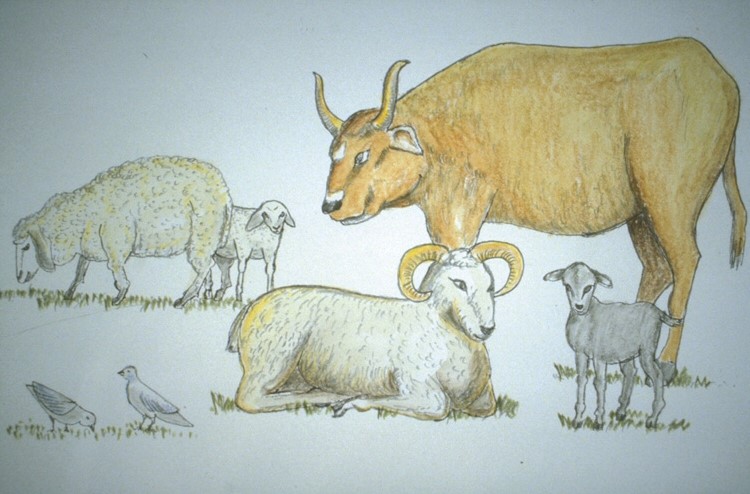
THE INEFFICACY OF
ANIMAL BLOOD
Inefficacy describes the failure to produce the desired effect or the lack of power to produce a desired effect. It is the state or quality of being incapable of producing a desired result. Synonyms include feebleness, helplessness, impotence, inadequacy, incapability, ineffectiveness, ineffectualness, powerlessness, uselessness, weakness. Such was the effect of the blood of animal sacrifices.
The writer now delivers the decisive statement that exposes the utter inadequacy of the old sacrificial system. After reasoning that the endless repetition of offerings could never perfect the worshiper, he now drives the truth home with unmistakable finality — it was not merely difficult, but absolutely impossible for animal blood to remove sin. These sacrifices could cover sin temporarily, providing ceremonial cleansing and maintaining covenant fellowship, but they could never cleanse the conscience or remove guilt before God. Only the perfect, once-for-all offering of Christ could accomplish what the blood of beasts could only symbolize.
For (gar) - always pause to prayerfully ponder this poignant term of explanation. The author now gives an explanation of (Heb 10:1-3) "We don’t need any more animal sacrifices. They cannot take away sins. They cannot accomplish a definitive cleansing from sin." (Johnson).
It is impossible (adunatos - utterly powerless, completely without ability) for the blood (haima - lifeblood) of bulls and goats to take away (aphaireo - remove, cut off, or carry away completely, implies complete separation) sins (hamartia) - Impossible (adunatos) is first in the Greek sentence for emphasis. It's as if the author wants to make it blazingly, blatantly clear…it is not just difficult but literally "Impossible it is… "! One can hardly miss his point. In regard to man’s moral offense, there is no "permanent cure" effected by the physical blood of animals. The blood (haima - lifeblood) of sacrificial animals, symbolizing life offered in substitution (See Lev 17:11 above) Take away (aphaireo) means that the animal sacrifices could not remove sin from existence or erase its record before a holy God. They could only symbolically transfer guilt and temporarily cover it.
Leon Morris adds that take away (aphaireo) “is used of a literal taking off, as of Peter’s cutting off the ear of the high priest’s slave (Lk 22:50), or metaphorically as of the removal of reproach (Lk 1:25). It signifies the complete removal of sin so that it is no longer a factor in the situation. That is what is needed and that is what the sacrifices could not provide." (The Expositor's Bible Commentary)
Animal blood cannot take away sins (hamartia). Here in Hebrews the use of the present tense points to a continual action and thus emphasizes what is always true. The Levitical offerings could cover (kaphar) sin ceremonially, providing outward cleansing, but they could never cut away (aphaireo) the inward corruption or cancel sin’s debt. Only God can fully take away sins which He will do for "all Israel" in the end times (Ro 11:27) The Levitical system was not designed by God to take away sins. The visible sacrifices were always meant to be a reflection of the heart change of the one offering the sacrifice, even as external circumcision was to picture internal circumcision, of the heart, by the Spirit and not the letter (Ro 2:28, 29).
Spurgeon - There was a perpetual remembrance of sin in everyone of the offerings under the ceremonial law. They were intended—the most of them, at any rate—continually to remind men that sin was not washed away. Thus all the ceremonies drew up a handwriting, and said to the Jews, and to us, too, “You need an atonement by blood; you are guilty, and there is no hope of your ever coming to God except by a sacrifice, which these rams and bullocks represent, but the place of which they cannot possibly fill.”
Kenneth Wuest… The truth of this statement is so obvious that it hardly needs proof. There is no relation between the physical blood of animals and man’s moral offence. (Hebrews Commentary online)
Pfeiffer - The reason it was necessary to repeat the Old Testament sacrifices is not hard to find: “It is not possible that the blood of bulls and of goats should take away sins” (Heb 10:4). They served a temporary function, but they pointed to the need of a greater sacrifice. Jesus came as the Lamb of God who purposed to take away the sin of the world. He was named Jesus because He was destined to take upon Himself the sin of His people. (See Hebrews- Everyman's Bible Commentary - Page 77)
Charles Swindoll - If the author of Hebrews could have used bold font, 10:4 probably would have been emphasized. It represents the clear, concise explanation for the assertion in Hebrews 10:1, that the sacrifices can never make worshipers perfect: “For it is impossible for the blood of bulls and goats to take away sins” (Hebrews 10:4). Underscore the word impossible. Not improbable, not difficult, not unlikely, not rare. IMPOSSIBLE. Notice that it wasn’t simply rendered impossible because of the death of Christ. The context is referring to the limitations of the sacrifices under the Old Testament Law itself. It has always been impossible for the blood of animal sacrifices to take away sins. If the sacrifices did anything permanently, it was to remind the people of Israel of their sinfulness. Just as a speed limit sign reminds us of the law, and a speeding ticket reminds us of our guilt, the Law and the sacrifices stood as a constant reminder of sin (Rom. 3:20-23). Under the old system, Israel’s national sins accumulated daily over the course of the year; then the sacrifices of the Day of Atonement temporarily covered them. They accumulated again the next year; the Day of Atonement covered them again. The old covenant kept kicking the can down the road, so to speak. But that system of endless blood got old. (See Insights on Hebrews)
Albert Barnes comments that the writer is emphasizing that "there was no efficacy in the blood of a mere animal to wash away a moral offence. It could not repair the law; it could not do anything to maintain the justice of God; it had no efficacy to make the heart pure. The mere shedding of the blood of an animal never could make the soul pure. This the (writer) states as a truth which must be admitted at once as indisputable. (Hebrews)
William Barclay - Let us take an analogy. A man is ill. A bottle of medicine is prescribed for him. If that medicine effects a cure, every time he looks at the bottle thereafter, he will say: "That is what gave me back my health." On the other hand, if the medicine is ineffective, every time he looks at the bottle he will be reminded that he is ill and that the recommended cure was useless. So the writer to the Hebrews says with prophetic vehemence: "The sacrifice of animals is powerless to purify a man and give him access to God. All that such sacrifices can do is to remind a man that he is an uncured sinner and that the barrier of his sin is between himself and God." So far from erasing his sin, they underline it. The only effective sacrifice is the sacrifice of Jesus Christ. (Hebrews)
Max Alderman comments on the inadequacy of the blood of bulls and goats noting that…
We immediately understand that His blood is superior to animal blood. His blood is superior to all blood. Animal sacrifice under the Old Covenant could only cover sin. The Hebrew word for atonement is kophar, which literally means “to cover.” But animal sacrifice could never take away sins. Only Jesus, the Perfect Sacrifice of the New Covenant, takes sins away. The sacrifices of the old economy had a prophetic significance. They were offered not only to protect, but also to project an object lesson pertaining to the greater offering of Jesus. The greater offering was in every way superior to the lesser offering. Thank God that He is the altogether Lovely One. This is demonstrated in the fact that God found pleasure in Him. He was pleased with His Son as indicated at both the baptism of Jesus and also the transfiguration of Jesus. Notice these scriptures.
And lo a voice from heaven, saying, This is my beloved Son, in whom I am well pleased. (Mt 3:17).
This voice came at the baptism of Jesus and it was the voice of the Father declaring that His Son pleased Him. Then the same occurrence of the voice took place at the transfiguration giving the same declaration:
While he yet spake, behold, a bright cloud overshadowed them: and behold a voice out of the cloud, which said, This is my beloved Son, in whom I am well pleased; hear ye him (Mt 17:5)
These are two major public events that let something take place that had never happened before, when the Lord publicly placed His acceptance and satisfaction on His Son. Once again, under the inspiration of the Holy Ghost, Peter restated the fact that the Father was satisfied with His Son as they witnessed from the holy mount the voice of God.
For he received from God the Father honour and glory, when there came such a voice to him from the excellent glory, This is my beloved Son, in whom I am well pleased. And this voice which came from heaven we heard, when we were with him in the holy mount (2Pe 1:17,18)
These events took place indicating the superiority of the Son of God as being One uniquely set apart from all others in being able to please God. (Reference)
Rich Cathers - The best the Old Testament sacrifices could do was to look forward in faith to a perfect sacrifice – Jesus. But the Old Testament sacrifices themselves did not have the ability to do anything with your sins. We may not bring animal sacrifices to God in order to find forgiveness, but people do all sorts of things to try and take away their awareness of guilt. And they too don’t work. Some people try to do good works, hoping in the end that their good works will somehow offset the evil of their sins. Some people try to punish themselves for their sins. They either sabotage the good things in their life so they can be more miserable, or they choose to stay away from things that could be a blessing all because they feel they deserve some sort of punishment. What’s worse is often the person isn’t quite aware they’re doing it to themselves. Others just try and cover up their sense of guilt through self-medication: Drugs, alcohol, sex. Have you found the complete forgiveness that Jesus offers to you? (Sermon)
Cathers adds - Because the Old Testament sacrifices weren't strong enough to do the real job, the people had to keep offering them. On the Day of Atonement, each year the past sins of the entire year were to be recalled (remembrance made). If the Old Testament sacrifices were really effective, then they wouldn't have had to be done each year. Jesus' sacrifice was so awesome, that He only had to do it once, and it was good enough for all time. (Hebrews 10:1-14)
Under the Old Covenant, the priests were busy all day, from dawn to dusk, slaughtering and sacrificing animals. It is estimated that at Passover as many as 300,000 lambs would be slain within a week. The slaughter would be so massive that blood would run out of the Temple ground through specially prepared channels into the Brook Kidron, which seemed to be running red with blood. But no matter how many sacrifices were made, or how often, they were always ineffective for they could not bring access to God, could not remove sin and were only external.
Ray Stedman observes that "These animal deaths were unwilling, even unconscious, sacrifices of a lower and quite different nature and therefore inadequate substitutes for humans made in the image of God. It is impossible, says the author, for the blood of bulls and goats to take away sins. Isaiah had quoted God long before saying, “I have no pleasure in the blood of bulls and lambs and goats” (Is 1:11). Nevertheless, despite this limitation, through the deaths of many animals, one unchanging message was being pounded out. Every sacrifice declared it and every offering told the same story. It was burned in blood and smoke into every listening heart. The essential point for a God-approved dealing with sin in one’s life was that a life be laid down. Every dying animal meant a life brought to an end. Sin was serious; it forfeited life. Unless the sin could actually be removed, the sinner must die. To save the sinner from such a fate, an equal and willing substitute must be found. Such a substitute the author now finds described in the words of Psalm 40. (Hebrews 10:1-39 Let Us Go On!)
The essential defects in the animal sacrifices were that they were not of the same nature with those who sinned, were not of sufficient value to make satisfaction for the affronts done to God and as mere beasts, the victims could not consent to put themselves in the sinner's place. The atoning sacrifice must be by One capable of and willing to consent to substitute Himself in the sinner's stead! Hallelujah, what a Savior. Hallelujah, what a Friend!
The old covenant sacrifices were ordained by God, but they were never equal in kind to those they represented. The blood of bulls and goats (Heb 10:4) could symbolize atonement, but could never substitute for a human life in a moral, spiritual sense. Why?
1. The Animal Sacrifices were Different in Nature
An animal could die physically in place of a sinner,
it could not die morally in the sense of bearing guilt
The offender was human, made in God’s image, a moral and spiritual being capable of sin, guilt, and conscience. The sacrifice was animal, a creature without moral awareness or spiritual capacity. Therefore, while an animal could die physically in place of a sinner, it could not die morally in the sense of bearing guilt or consciously offering obedience to God. As Augustine observed, “A man’s sin cannot be purged by the death of a beast.” The life of the animal could illustrate substitution, but it could not equal the offender’s moral nature or guilt. The beasts offered up under the law could not consent to put themselves in the sinner's room and place. The atoning sacrifice must be one capable of consenting, and must voluntarily substitute himself in the sinner's stead: Christ did so.
2. The Animal Sacrifices were Different in Value
The value of a sacrifice depends on the worth of the life offered. The life of an animal is inferior to the life of a man, and infinitely inferior to the holiness of God whom sin offends. Therefore, no amount of animal blood could match the infinite worth required to satisfy divine justice. Only Christ, who took upon Himself human nature (Heb 2:14–17), could offer a sacrifice of equal—and indeed surpassing—value. He was both truly man, to represent us, and truly God, to make His offering infinitely sufficient.
3. The Animal Sacrifices were Different in Efficacy
Animal sacrifices could only cover sin temporarily (atonement = “covering”), postponing judgment until the true Sacrifice came. They could purify ceremonially, making one outwardly clean to enter worship, but not cleanse the conscience (Heb 9:9–10). They could typify forgiveness, but not secure it. They were placeholders—shadows of the coming substance, types pointing to Christ (Heb 10:1).
4. The Animal Sacrifices pointed to Christ: The Perfect Substitute
What the animals lacked—shared nature, moral capacity, infinite worth—Christ possessed fully. He became man, “made like His brethren in all things” (Heb 2:17), so He could represent humanity genuinely. As the sinless God-Man, His death had infinite moral and spiritual value, satisfying the demands of God’s holiness and justice once for all.
In short: Animal sacrifices were different in nature, inferior in value, and ineffective in result. Only the incarnate Christ could stand in man’s place and offer a perfect, once-for-all sacrifice that truly takes away sin (Heb 10:10–14).
“Only His Blood”
No beast that bled on altar stone,
Could cleanse the heart or sin atone;
Their crimson streams could never pay,
The debt that sin could not allay.The blood of bulls, the goats once slain,
Could cover guilt, but not the stain;
Year after year the priests would cry,
Yet sin remained—its weight stood nigh.But then the Lamb from heaven came,
Without a fault, without a blame;
His blood once shed, no more to flow,
Removed what none could e’er bestow.Now guilt is gone, the debt erased,
Through Christ’s own blood — full truth, full grace;
The altar’s shadow fades away,
For Jesus lives — our sin’s decay.
Impossible (102)(adunatos from a = without + dunatós = possible, able, or powerful from dunamai = to be able or have power by virtue of inherent ability and resources. Note the stem duna- or dyna- conveying the basic sense of ability or capability, power, strength, might) means impossible, incapable of being or of occurring, incapable of being done. Adunatos is used twice to convey the idea of one who is impotent, has no strength or lacks capability in functioning adequately, once in a literal sense (Acts 14:8 below = powerless) and once in a spiritual sense (Ro 15:1 = of those who do not "strongly" believe).
Adunatos - 26 uses in the Septuagint (LXX) - Job 5:15,16; 20:19; 24:4, 6, 22; 29:16; 30:25; 31:16, 20, 34; 34:20; 36:15, 19; Pr 30:18; Joel 3:10)
Adunatos - 10 uses in the NT. NAS = impossible(6), no strength(1), things that are impossible(1), could not do(1), without strength(1).
One will note the obvious concentration of "impossibilities" in the book of Hebrews!
Matthew 19:26 And looking upon them Jesus said to them, "With men this is impossible, but with God all things are possible."
Mark 10:27 Looking upon them, Jesus said, "With men it is impossible, but not with God; for all things are possible with God."
Luke 18:27 But He said, "The things impossible with men are possible with God."
Acts 14:8 And at Lystra there was sitting a certain man, without strength in his feet, lame from his mother's womb, who had never walked.
Romans 8:3 For what the Law could not do (adunatos), weak as it was through the flesh, God did: sending His own Son in the likeness of sinful flesh and as an offering for sin, He condemned sin in the flesh
Comment: The truth in Romans parallels that in Hebrews 10, Romans dealing with the Law per se and Hebrews addressing the Levitical sacrificial system. Neither source had the inherent ability to make man right before the Holy God and both point ultimately to the Son, the perfect Sacrifice and the fulfillment of the Law!
Romans 15:1 Now we who are strong ought to bear the weaknesses of those without strength and not just please ourselves.
Hebrews 6:4 (ESV) For it is impossible to restore again to repentance those who have once been enlightened, who have tasted the heavenly gift, and have shared in the Holy Spirit,
Note: the NASB places "impossible" in Heb 6:6) (Note also that commentators and some translators take adunatos to mean "difficult" but clearly from the other NT uses and specifically the uses in Hebrews this is inappropriate and leads to a thoroughly incorrect interpretation of this stern warning passage.
Hebrews 6:18 in order that by two unchangeable things, in which it is impossible for God to lie, we may have strong encouragement, we who have fled for refuge in laying hold of the hope set before us.
Hebrews 10:4 For it is impossible for the blood of bulls and goats to take away sins.
Hebrews 11:6 And without faith it is impossible to please Him, for he who comes to God must believe that He is, and that He is a rewarder of those who seek Him.
Blood (129) haima is literally the red fluid that circulates in the heart, arteries, capillaries, and veins of a vertebrate animal carrying nourishment and oxygen to and bringing away waste products from all parts of the body and thus is essential for the preservation of life. Haima gives us English words like hemorrhage (Gk - haimorragia from haimo- + rragia from regnuo - to burst) English derivatives inclue hematology (study of blood) and "leukemia" which is from leuco (white) plus haima (blood), which is fitting as leukemia is a disease that affects the white blood cells. Derivatives of haima are : haimatekchusía (130), shedding of blood; haimorroéō (131), to hemorrhage. Haima was used to describe “descent” or “family” in ancient times. “To shed blood” is to destroy life.
Zodhiates adds that "haima is used to denote life given up or offered as an atonement since, in the ritual of sacrifice, special emphasis is laid upon it as the material basis of the individual life. The life of the animal offered for propitiation appears in the blood separated from the flesh which the Jews were forbidden to eat (Ge. 9:4; Lev. 3:17; 17:10-14; Deut. 12:23; Heb. 9:7-13, 18-25; 11:28; 13:11). This life is, on the one hand, in the blood, presented to God; on the other hand by sprinkling, appropriated to man (Heb. 9:7, 19, 20). This blood thus becomes the blood of the covenant or testament (see diathekē) which God commanded to us (Heb. 9:20). (Borrow The Complete Word Study Dictionary: New Testament)
HAIMA IS A KEYWORD IN HEBREWS - 22X OUT OF 97X IN NT - Heb. 2:14; Heb. 9:7; Heb. 9:12; Heb. 9:13; Heb. 9:14; Heb. 9:18; Heb. 9:19; Heb. 9:20; Heb. 9:21; Heb. 9:22; Heb. 9:25; Heb. 10:4; Heb. 10:19; Heb. 10:29; Heb. 11:28; Heb. 12:4; Heb. 12:24; Heb. 13:11; Heb. 13:12; Heb. 13:20
Hebrews 2:14 Therefore, since the children share in flesh and blood,
Hebrews 9:7 only the high priest enters once a year, not without taking blood,
Hebrews 9:12 and not through the blood of goats and calves, but through His own blood
Hebrews 9:13 For if the blood of goats and bulls
Hebrews 9:14 how much more will the blood of Christ, who through the eternal Spirit offered Himself
Hebrews 9:18 even the first covenant was not inaugurated without blood.
Hebrews 9:19 he took the blood of the calves and the goats
Hebrews 9:20 saying, “THIS IS THE BLOOD OF THE COVENANT WHICH GOD COMMANDED YOU
Hebrews 9:21 he sprinkled both the tabernacle and all the vessels of the ministry with the blood
Hebrews 9:22 almost say, all things are cleansed with blood,
Hebrews 9:22 and without shedding of blood there is no forgiveness.
Hebrews 9:25 high priest enters the holy place year by year with blood that is not his own.
Hebrews 10:4 For it is impossible for the blood of bulls and goats to take away sins.
Hebrews 10:19 confidence to enter the holy place by the blood of Jesus,
Hebrews 10:29 has regarded as unclean the blood of the covenant by which he was sanctified
Hebrews 11:28 By faith he kept the Passover and the sprinkling of the blood
Hebrews 12:4 have not yet resisted to the point of shedding blood
Hebrews 12:24 Jesus, the mediator of a new covenant, and to the sprinkled blood
Hebrews 12:24 which speaks better than the blood of Abel.
Hebrews 13:11 For the bodies of those animals whose blood is brought into the holy place
Hebrews 13:12 He might sanctify the people through His own blood
Hebrews 13:20 the great Shepherd of the sheep through the blood of the eternal covenant
Spurgeon has the following sermons related to blood…
- Exodus 12:13 The Blood
- Hebrews 12:24-25 The Blood Of Sprinkling
- Hebrews 12:24-25 The Blood Of Sprinkling
- Hebrews 13:20 The Blood Of The Everlasting Covenant
- Hebrews 9:19-20 The Blood Of The Testament
- Hebrews 9:22 Blood-Shedding
Take away (851) (aphaireo from apó = from + haireo = to take, seize, grasp, make a choice of one or more possible alternatives) means to put or take something away from its normal location, to put out of the way or to remove. Luke 1:25 uses aphaireo to refer to taking away of one's reproach. (cf Ge 30:23) (cf Lk 1:24 Elizabeth who said "This is the way the Lord has dealt with me in the days when He looked with favor upon me, to take away my disgrace among men.”) All three synoptic gospels record the literal use in describing Peter's removing of an ear "away from" the slave's head!
APHAIREO - 10 times in the NT…
Matthew 26:51 And behold, one of those who were with Jesus reached and drew out his sword, and struck the slave of the high priest, and cut off (took away) his ear.
Mark 14:47 But a certain one of those who stood by drew his sword, and struck the slave of the high priest, and cut off (took away) his ear.
Luke 1:25 "This is the way the Lord has dealt with me in the days when He looked with favor upon me, to take away my disgrace among men."
Luke 10:42 but only a few things are necessary, really only one, for Mary has chosen the good part, which shall not be taken away from her."
Luke 16:3 "And the steward said to himself, 'What shall I do, since my master is taking the stewardship away from me? I am not strong enough to dig; I am ashamed to beg.
Luke 22:50 And a certain one of them struck the slave of the high priest and cut off (took away) his right ear. ( uses it
Romans 11:27 "And this is My covenant with them, when I take away their sins."
Comment: He is referring of course to the New Covenant in His blood, the covenant even prophesied about in the OT in Je 31:31, 32, 33. This verse speaks of Israel's future forgiveness which was prophesied by Isaiah 27:9 "Therefore through this Jacob's iniquity will be forgiven" [LXX = aphaireo = taken away]… ". When the Redeemer returns to Zion to triumph over the Antichrist and his cohorts at the end of the Great Tribulation, when He then sets up His Millennial Kingdom) 1Sa 17:51; Is 9:14; 18:5
Hebrews 10:4 For it is impossible for the blood of bulls and goats to take away sins.
Revelation 22:19 and if anyone takes away from the words of the book of this prophecy, God shall take away his part from the tree of life and from the holy city, which are written in this book.
Comment: This is a serious warning - sow a take away and reap the most horrible of all take away's - eternal destruction! The reader would be advised to consult Tony Garland's excellent comments on this verse in Re 22:19) (The LXX uses aphaireo in a similar way, Moses recording "You shall not add to the word which I am commanding you, nor take away from it, that you may keep the commandments of the LORD your God which I command you." Deuteronomy 4:2)
Aphaireo is used 132 times in the Septuagint (LXX) -- Ge 21:25; 30:23; 31:9, 16, 31(Jacob fearing that Laban would take away his daughters); Ge 40:19 (Joseph's prophecy of Pharaoh taking away the head of the baker); Ge 48:17; Ex 5:8, 11; 13:12; 29:27; 33:5, 23 ("Then I will take My hand away and you shall see My back, but My face shall not be seen."); Ex 34:7 (God "Who forgives [takes away] iniquity"), Ex 34:9 ("Thou pardon our iniquity and our sin"); Ex 35:24; Lev. 1:16; 2:9; 4:10; 6:10, 15; 8:29; 9:21; 10:17; 22:15; Nu 11:17; 14:18; 15:19, 20; 18:19, 26, 28, 29, 30, 32; 21:7; 31:28, 52; 36:3, 4; Dt. 4:2; 12:32; Jos. 5:9; 1Sa 5:4; 7:14; 17:36, 39, 46, 51; 21:6; 24:4,5, 11; 30:18; 2Sa 4:7; 16:9; 20:22; 1Ki. 15:12; 20:41; 2Ki. 6:32; 1Chr 11:23; 19:4; Esther 4:4, 17; 8:2,3; Job 1:21; 9:21; 19:9; 22:6; 24:7, 10; 36:7; 38:15; Ps 76:12; Pr 1:19; 4:16; 11:30; 13:18; 14:35; 22:9; 26:7; 27:13; 30:7; Eccl 3:14; Is 1:16, 25; 3:1, 18; 4:1; 5:5, 8; 6:7; 7:17, 20; 8:8; 9:4, 14; 10:13, 27; 11:13; 14:25; 16:2; 18:5; 20:2; 22:17, 19, 25; 25:8; 27:9; 28:18; 30:11; 38:15; 40:27; 53:10; 58:9; Je 6:2; 11:15; 26:2; Ezek 21:26; 23:25; 26:16; 36:26; 45:9; 48:14; Da 4:1, 31; 5:20; 9:25; Ho 2:9; Mic 2:8; Zec 3:4; 10:11).
Here is a representative use of aphaireo in the LXX…
Genesis 30:23 So she (Jacob's wife Rachel was remembered by God and she) conceived and bore a son and said, "God has taken away (aphaireo) my reproach."
Leviticus 10:17 "Why did you not eat the sin offering at the holy place? For it is most holy, and He gave it to you to bear away (aphaireo) the guilt of the congregation, to make atonement for them before the LORD.
1 Samuel 17:51 Then David ran and stood over the Philistine and took his sword and drew it out of its sheath and killed him, and cut off (aphaireo) his head with it. When the Philistines saw that their champion was dead, they fled.
Isaiah 6:7 And he touched my mouth with it and said, "Behold, this has touched your lips; and your iniquity is taken away (aphaireo), and your sin is forgiven."
Zechariah 3:4 And he spoke and said to those who were standing before him saying, "Remove (aphaireo) the filthy garments from him." Again he said to him, "See, I have taken your iniquity away from you and will clothe you with festal robes."
Sacrifice - In the agony of Psalm 51, David seems to contradict himself. He exclaims, “You do not desire sacrifice, or else I would give it; You do not delight in burnt offering” (Ps 51:16). Then, two verses later, he says, “You shall be pleased with the sacrifices of righteousness, with burnt offering” (Ps 51:19). Does God want our sacrifices or not?
Sacrifices resemble the flowers a husband gives to his wife after a heated argument. The wife doesn’t need the flowers. They are valuable to her only if they accurately represent her husband’s feelings. If she thinks they are merely a ritual and do not symbolize his regret, the flowers make the divide between them worse.
God didn’t need the animals offered to Him in sacrifice. Hebrews says, “It is not possible that the blood of bulls and goats could take away sins” (He 10:4). These sacrifices pointed to the once-for-all payment Jesus would make with His own blood when He died for our sins.
What mattered was the attitude of those making the sacrifices. If the offerings were without repentance, the ritual was a mockery. That’s why David wrote, “The sacrifices of God are a broken spirit, a broken and a contrite heart—these, O God, You will not despise” (Psalm 51:17).— Haddon W. Robinson (Our Daily Bread, Copyright RBC Ministries, Grand Rapids, MI. Reprinted by permission. All rights reserved)
For Further Study - Learn more about David’s sin and his return to God. Read David & Manasseh: Overcoming Failure
Repentance is sorrow for the deed, not for getting caught
SIMILAR SAYINGS...
True repentance mourns over sin, not its consequences.
Godly sorrow grieves over the offense, not the outcome.
Remorse fears punishment; repentance hates sin.
The penitent weeps for sin itself; the hypocrite weeps for its fruit.
Regret looks back at the pain; repentance looks up to God.
Repentance changes the heart; regret only condemns the mind.
Worldly sorrow dreads exposure; godly sorrow desires cleansing.
Regret laments getting caught; repentance laments having sinned.
Repentance is a turning from sin, not a tactic to avoid its cost.
True sorrow for sin ends not in despair but in deliverance.
Sir Arthur Conan Doyle, the author of the Sherlock Holmes detective novels, was a practical joker. One time he sent a telegram to twelve famous people in London whom he knew. It read: “Flee at once. All is discovered.” Although all twelve were upright citizens, they all quickly left the country.
That story may be fictitious, but it illustrates the fact that a guilty conscience is a common thing. Even in the church many are uncertain about their standing before God because of past sins. These ghosts from the past stay out of sight for a while, but then they come out of nowhere to haunt them. They wonder if anyone else knows what they have done. They’re fearful that the truth may leak out. But even more seriously, they wonder if God has truly forgiven them. They’re not sure how it will go when they stand before Him someday. Will God punish them in this life or in eternity for the terrible things that they have done? Such people need the assurance that our text hammers home:
Through Christ’s obedience to God’s will at the cross, new covenant believers receive what those under the Law could not receive: Total forgiveness.
As I said last week, the author of Hebrews uses repetition to drive his point home. He has already told us the bulk of what he tells us here again. This section concludes the main argument of the Book of Hebrews. It “expresses the very heart” of the book (BORROW Donald Hagner, Encountering the Book of Hebrews [Baker], p. 128).
If the original readers were to go back to Judaism, with its sacrificial system, they would forfeit the tremendous benefits that Jesus Christ secured for them. His death on the cross fulfilled all that the old system pointed toward. What it could not do completely, He did, namely, provide total forgiveness for those who draw near to God through Him. The old system, by its very design, barred the average worshiper from drawing near to God’s presence. Only the high priest could go into the Holy of Holies, and that only once a year. But in Christ, every believer has free access to God’s presence because Christ’s once-and-for-all sacrifice of Himself provides perfect standing with God.
The author piles up a number of synonymous phrases which show either negatively what the Law with its sacrifices could not do, or positively what Christ’s sacrifice did accomplish. Note:
Heb 10:1: The sacrifices of the Law could never “make perfect those who draw near.”
Heb 10:2: Those sacrifices could not completely cleanse the worshipers and take away their consciousness of sins.
Heb 10:3: Those sacrifices provided a yearly reminder of sins.
Heb 10:4: Those sacrifices could not take away sins.
Heb 10:10: By God’s will through the cross, “we have been sanctified” once for all.
Heb 10:12: Christ “offered one sacrifice for sins for all time.”
Heb 10:14: “By one offering He has perfected for all time those who are being sanctified.”
Heb 10:17: God promises to remember their sins and lawless deeds no more.
Heb 10:18: “Where there is forgiveness…” “there is no longer any offering for sin.”
All of these phrases add up to news that sounds too good to be true, and yet is true: In Christ we receive a complete, final, once for all pardon for all of our sins, past, present, and future! We’re prone to say, “What’s the catch?” There’s no such thing as an absolutely free lunch, but there is such a thing as God’s absolutely free pardon from all of our sins. It is totally free to us, because Christ bore the awful penalty that we deserved to pay.
Before we work through the text, let me clarify that we are talking here about our standing or position before God in Christ. In our daily walk, when we sin we need to confess our sins in order to receive what we may call “God’s family forgiveness.” But even our worst sins do not eradicate our positional forgiveness as children of God.
For example, my children enter my family through natural birth, and nothing that they do changes their standing as family members. But if they sin against me, they need to confess that sin and ask forgiveness so that our relationship is not hindered. Even so, like Peter we may fail the Lord badly, but our failures do not remove us from God’s family. We possess our standing in the family through the new birth, which provides total forgiveness. We maintain daily fellowship as God’s children by confessing our sins and asking forgiveness of the Father.
Our text falls into four sections. In Heb 10:1-4, the author shows how the sacrifices of the Law could not completely remove the guilt of sin. In Heb 10:5-10, he shows that Christ’s obedience to God’s will at the cross set aside the Old Testament sacrifices and provided for us perfect standing before God. As I understand it, Heb 10:11-18 consists of an illustration and a quotation that both drive home the same point. In Heb 10:11-14, the author illustrates the totality of our forgiveness by contrasting the unfinished, repetitive ministry of the Old Testament priests with the finished, all-sufficient sacrifice of Christ. Then in Heb 10:15-18, he cites again the Old Testament prophecy of the new covenant (Jer. 31:31-34) to show that the total forgiveness that it promises means that the one sacrifice of Jesus Christ is sufficient and final.
1. The sacrifices prescribed by the Law could not completely remove guilt and sin (Heb 10:1-4).
First (Heb 10:1, 2), the author argues that the Law was only the shadow of good things to come, and not the very form of things. For this reason, the repeated sacrifices could not make perfect those who draw near. Otherwise, they would have ceased to be offered, because the worshipers, having once been cleansed, would no longer have had a consciousness of sins. “To make perfect” refers to our standing in God’s sight. It includes total cleansing from sin, so that we have a clean conscience. If our consciences are aware of sins that have not been confessed and forgiven, we will hesitate to draw near to God.
This was illustrated with Adam and Eve. As soon as they sinned, they tried to hide from God’s presence. They didn’t want to face Him because of what they had done. Every parent has had the same experience. You come home and your child avoids you. When you track him down, he won’t look you in the eye. He doesn’t want to draw near to you because he has a guilty conscience. Even dogs have this sense of guilt, where they avoid you if they’ve done something that they know is wrong!
In Heb 10:3 the author goes on to argue that the annual sacrifices (on the Day of Atonement) only provided a yearly reminder of sins. The fact that every year the people had to go through this ritual sacrifice again and again only showed that it had not completely removed their guilt. It put it off for another year, but just like our April 15th tax deadline, that day of reckoning kept coming around. Then (Heb 10:4) the author states plainly, “it is impossible for the blood of bulls and goats to take away sins.” Animal blood has no permanent efficacy for human sins. God designed that system of animal sacrifice to point ahead to His provision of the sacrifice of His own Son. As eternal God, His sacrifice has infinite value. As man, His sacrifice atones for human sin in a way that the blood of animals never could.
It’s interesting that the word “reminder” (Heb 10:3) is the same Greek word used in the institution of the Lord’s Supper, where Jesus says, “Do this in remembrance of Me” (Luke 22:19; 1Cor. 11:24). While we are instructed to examine ourselves and confess our sins before partaking of the elements, the gospel transforms our remembrance from one of guilt to one of grace (Philip Hughes, A Commentary on the Epistle to the Hebrews [Eerdmans], p. 394).
The Lord’s Supper reminds us that the penalty we deserve for our sins was put completely on Jesus Christ. His death accomplished what the blood of animal sacrifices never could accomplish, namely, it took away all of our sin and guilt!
2. Christ’s obedience to God’s will at the cross set aside the Old Testament sacrifices and provided perfect standing for us before God (Heb 10:5-10).
In Heb 10:5-7, the author puts a quote from Psalm 40:6-8 (LXX) in the mouth of Jesus as He comes into this world. This assumes the preexistence of Jesus Christ as eternal God. There is a difficulty in that the Hebrew of this psalm reads, “My ears You have opened,” whereas the LXX translated it, “A body You have prepared for Me.” Apparently the Greek translators rendered an interpretive paraphrase of the Hebrew text, using a part and expanding it into the whole (SEE F. F. Bruce, The Epistle to the Hebrews). “To dig out an ear” (the literal Hebrew) is a part of God’s fashioning a whole body out of clay. It does not refer to the master boring the servant’s ear with an awl (Exod. 21:6; Deut. 15:17). Rather, the picture is that of God’s opening the ear of His servant so that He would be obedient to the cross (Isa 50:5f.). The LXX rendering puts the emphasis on God’s preparing a body for Jesus that He would offer as the suitable sacrifice for our sins, thus supplanting the Old Testament sacrifices. These verses (Heb 10:5-10) make three points:
A. The cross was the direct will of God.
The cross was not an accident or an unforeseen tragedy that took Jesus by surprise. It was not a temporary setback that God figured out how to turn for good. Rather, the cross was God’s predetermined plan, before the beginning of time, to deal with our sin. The Son of God would come into this world as a man, would fulfill through His obedience the complete Law of God, and then would die as the sacrifice that the justice of God demands as the payment for sins.
There is a great mystery here that we must submit to: even though God ordained the cross, down to minute details (e.g. casting lots for Jesus’ clothing), He is not in any way responsible for the sin of those who crucified Jesus. As Acts 4:27, 28 puts it: “For truly in this city there were gathered together against Your holy servant Jesus, whom You anointed, both Herod and Pontius Pilate, along with the Gentiles and the peoples of Israel, to do whatever Your hand and Your purpose predestined to occur.”
By coming into this world specifically to go to the cross, Jesus not only provided the sacrifice for sins that we need. He also provided a supreme example of resolute obedience to the complete will of God. The author twice repeats Jesus’ words from this psalm, “I have come to do Your will, O God.” As Luke 9:51 puts it, “He set His face to go to Jerusalem” (NASB, margin). As Jesus prayed in the garden, “not My will, but Yours be done” (Luke 22:42). We cannot imagine how difficult it was for the sinless Son of God to be made sin for us. But His determined obedience to God’s will, no matter how difficult, teaches us to commit ourselves to obey His will, whatever the cost. You don’t decide to obey God at the moment of temptation. It has to be a rational commitment that you make before you find yourself facing temptation.
B. Christ’s obedience to God’s will at the cross set aside the Old Testament sacrifices once and for all.
“He takes away the first [O.T. sacrifices] to establish the second [the will of God at the cross]” (Heb 10:9). When the psalm states that God did not desire or take pleasure in sacrifices (Heb 10:5-6), it reflects a frequent theme in the Old Testament, that God did not desire sacrifices for their own sake. Rather, the sacrifices should reflect a repentant heart (1 Sam. 15:22; Ps. 51:16, 17; Isa. 1:11, 12, 13; 66:3, 4; Jer. 7:21, 22, 23; Hos. 6:6; Amos 5:21, 22, 23, 24; Micah 6:6, 7, 8). God is displeased when people go through the outward motions of worship, but their hearts harbor sin that they are unwilling to forsake. In modern terms, you can go to church and partake of communion, but if you are living in disobedience to God or if you are covering some sin in your heart, God is not pleased with your worship.
But the author’s main point to his original readers is that the sacrifice of Christ on the cross permanently replaced the Old Testament sacrificial system. For this reason, I cannot accept the view that animal sacrifices will again be offered in the millennium. It is explained that they are “memorials” of the cross, but I cannot reconcile that with Hebrews. The cross supremely fulfilled and re-placed that old system. There is no reason to go back to it, even as a memorial, when we can gaze at the Lamb on the throne!
C. By Christ’s obedience to God’s will at the cross, we receive perfect standing before God once and for all.
That is the point of Heb 10:10. The author of Hebrews uses “sanctified” to refer to “inward cleansing from sin” and “being made fit for the presence of God, so that …[we] can offer Him acceptable worship” (Bruce, p. 236). “Have been sanctified” is the Greek perfect tense, signifying a past action that has ongoing results. By way of contrast with the often-repeated Old Testament sacrifices, the one offering of Christ on the cross conveys to believers perfect standing before God for all time. As I explained, this refers to our position before God, not to our daily relationship. As we will see (in Heb 10:14), even though we are perfect in our standing, we are progressing in our growth in holiness.
The author has shown that the Old Testament sacrifices could not completely remove guilt and sin (Heb 10:1-4), and that Christ’s sacrifice on the cross removed the sacrificial system and provides for our perfect standing before God (Heb 10:5-10). He goes on to illustrate his main point in Heb 10:11-14.
3. The totality of our forgiveness is illustrated by the contrast between the unfinished, repetitive ministry of the Old Testament priests and the finished, sufficient sacrifice of Christ (Heb 10:11-14).
Heb 10:11 portrays the priest, who stood daily “offering time after time the same sacrifices, which can never take away sins.” You can feel a sense of futility in these words! But He 10:12 contrasts the “one sacrifice for sins for all time” that Jesus offered, after which He “sat down at the right hand of God.” The standing of the priests indicates unfinished work that is never done (there were no chairs in the sanctuary). The sitting of Jesus indicates that His work of sacrifice is finished, and that He has been exalted to the place of supreme honor.
The author could have ended the quote (from Ps. 110:1) after the reference to Jesus’ sitting at God’s right hand, but he adds (Heb 10:13), “waiting from that time onward until His enemies be made a footstool for His feet.” He may have done this for two reasons. First, he didn’t want his readers to grow discouraged because of the cross, as if it represented a defeat for God. Perhaps their unbelieving Jewish friends were taunting them for their belief in a crucified Messiah. If Jesus is really Lord, then why do His people suffer persecution and martyrdom? The author says, “Just wait! The day is coming when Jesus’ enemies will all become His footstool, just as Psalm 110 predicts.”
Second, the author may be giving a subtle warning to his readers. If they abandoned the faith and went back to Judaism, they would be placing themselves on the losing side in history. They would be making themselves enemies of Jesus, and that’s not where you want to be, because Jesus’ enemies are headed for certain defeat and judgment.
In Heb 10:14, the author again repeats the effect of Jesus’ one offering: “He has perfected for all time those who are being sanctified” (literal translation). This verse brings together two vital truths. First, the position of believers before God is that they are perfect.
God has forgiven all of their sins through Christ’s sacrifice, and He has imputed Christ’s perfect righteousness to them. These great facts are the basis of our standing before God. Second, the practice of believers is that they are being sanctified. They are growing in holiness in thought, word, and deed. The position is granted instantly at the moment of saving faith. The practice is worked out over a lifetime of growth in obedience. If there is no growth in holiness, there is reason to question whether the person has been perfected in his position through faith in Christ.
The author wraps up this section with a supporting quote:
4. The Old Testament prophecy of the new covenant supports the totality of our forgiveness (Heb 10:15-18).
Note that the author attributes Jeremiah’s prophecy to the Holy Spirit, who inspires all Scripture (Heb 10:15). He paraphrases (perhaps from memory) what he had earlier cited (8:11-12) from Jeremiah 31:33-34, because this quote gives God’s own testimony to what the author has been arguing. God promises to put His laws upon His peoples’ hearts and to write them on their minds (Heb 10:16). The author may have cited this part of the new covenant promise to preempt any criticism from a Jewish reader to the effect that the setting aside of the Law (Heb 10:9) would lead to lawless living. “Not so! God’s people are marked by obedience from the heart.”
Then he adds the part of the new covenant that is directly to his point, “And their sins and their lawless deeds I will remember no more.” God’s not remembering our sins does not mean that He is forgetful, but rather that He will not bring up our sins against us for judgment. They are totally forgiven because of God’s covenant decree. And so the conclusion is, “Now where there is forgiveness of these things, there is no longer any offering for sin” (Heb 10:18). The Old Testament sacrifices are now rendered worthless and obsolete. What they pointed to, Jesus has completely fulfilled. Through the cross, believers under the new covenant receive God’s total forgiveness! If you have total forgiveness in Christ, why go back to a system that could never provide that?
Conclusion
If the Roman Catholic Church and the Orthodox Churches would accept the message of our text, they would do away with the doctrine of purgatory, which is not in the Bible anyway. Purgatory is supposed to be a place where, after death, our remaining sins are purged away. Supposedly, the friends and loved ones of the deceased person can pay to have masses or prayers said on their be-half to shorten the time in purgatory. What a blatant denial of the gospel of God’s grace in Christ! If His death places us in perfect standing with God, purgatory is a lie!
Our text also eliminates the practice of penance. Not to be confused with penitence (a synonym for repentance), penance is the Catholic teaching that certain good deeds prescribed by the church will make satisfaction for sins and thus lessen time in purgatory. Sometimes this is coupled with indulgences, which supposedly remove the guilt or punishment of temporal sins.
All of these unbiblical practices detract from the total merit of Christ’s sacrificial death for us. His death obtained total forgiveness for believers. His death perfected us for all time. His death sanctified us once for all. His death completely takes away the guilt of our sins. To believe in purgatory and to practice penance and indulgences is like going back to the Jewish sacrificial system!
Imagine a young man who falls in love, but he and his lover are separated by distance. He has a beautiful photograph of her that he gazes at every day. Finally, the two get married. The photo is still there, but now he has her.
But then one day, he starts behaving rather strangely. He stands before his wife, clutching the photo to his chest. He tells her, “I’ve really missed your photo, so I’m going back to it. He passionately kisses the picture and goes out the door mumbling, “Oh, how I love you, dear photo! You’re everything to me.” (Adapted from Kent Hughes, Hebrews: An Anchor for the Soul [Crossway], Heb 2:19). We would rightly conclude that this guy’s dipstick reads a quart low!
But that guy’s weird behavior illustrates what people do when they abandon Christ for the shadow. Christ and His sufficient sacrifice on the cross provide total forgiveness of all of our sins. Any religious system that devises human works to atone for sins is a mere shadow. Trust in Christ alone and God bestows on you by grace alone His total forgiveness!
Discussion Questions
1. If the Old Testament sacrifices could not provide total forgiveness, why did God institute that system for 1,500 years?
2. Why is it important to distinguish between our position in Christ and our daily practice with regard to God’s forgiveness?
3. How do the Catholic teachings on purgatory and penance completely undermine the gospel of God’s grace in Christ?
4. How would you answer the charge that total forgiveness by grace alone will lead to licentious living? (Hebrews 10:1-18 Total Forgiveness)
SIN the institutions of the Mosaic law, burthensome as they were, God consulted the best interests of his people. Repentance, faith, and obedience, were inculcated in them all. The daily sacrifices and frequent ablutions were intended to shew them, that they stood in need of mercy and of spiritual renovation: and the authority with which they were enjoined, taught them, that their whole happiness depended on an entire submission to the will of God. Those ordinances had also a further use; which was, to lead the minds of all to the contemplation of mysteries, which should in due season be more fully revealed. They did not themselves convey any solid or lasting benefit: they were mere shadows, which indicated indeed a substance; but which would vanish away, when that substance should appear. This is the view given of the law in the passage before us. The Apostle says, “The law, having a shadow of good things to come, and not the very image of the things, can never with those sacrifices which they offered year by year continually make the comers thereunto perfect. For then, would they not have ceased to be offered? because that the worshippers, once purged, should have had no more conscience of sins.” Hence it appears, that the most solemn institutions of the law, not excepting the sacrifices offered ou the great day of annual expiation, were, in fact, no more than mere “remembrances of sins,” which could never be removed, but by that better Sacrifice which should in due time be offered.
But that we may have a fuller insight into this subject, I will endeavour more distinctly to shew,
I. For what end those annual remembrances of sins were enjoined—
Doubtless they were intended, as the whole of the Mosaic ritual also was, to separate the Jewish people more entirely from all the nations of the world. But they were more particularly designed,
1. To make them sensible of their need of a Saviour—
[Every offering had this tendency: no man could see his victim bleed, without seeing and acknowledging what was his own desert before God. But, if there had been no day of annual expiation appointed, the people would have been ready to imagine that every offering which they had presented to God had actually taken away the sin for which it had been offered. To guard against this fatal error, a day was appointed annually for a more especial remembrance of their sins, and for a deeper humiliation of their souls before God on account of them. Thus they were taught that neither their repentances nor their sacrifices had really availed to put away their sins: for, if they had, there had been no occasion for a repetition of them. Moreover, the same ordinances being still appointed annually, and annually observed, they were made to feel, that not even these more solemn rites had been able to prevail for the expiation of sin; so that, in fact, the guilt contracted throughout their whole lives still abode upon their souls; no offerings, which they had ever presented, having been able to remove it. In the view of this, they were particularly required to “afflict their souls.” And, in truth, this ordinance was well calculated to produce in them the deepest humiliation: for, having occasion every year to review their lives through the past year; and to add, as it were, the sum of their recent iniquities to the incalculable score that was against them in consequence of former transgressions; and being at the same time necessitated to see that nothing which they either had done, or could do, could cancel the smallest portion of their debt; they would, of necessity, be led to cry for mercy with the deepest contrition, and to acknowledge their need of that Saviour whom they were instructed to expect.]
2. To shew, then, the insufficiency of the legal sacrifices—
[Nothing could carry stronger conviction with it than this particular ordinance: for, if former sacrifices had prevailed, why should they be repeated? What occasion was there for the annual offerings, if the occasional ones had answered their full end? or why should the same sins be atoned for in a future year, which have been expiated in the present year, if the present expiation has been satisfactory and complete? Here, then, was the axe laid to the root of all self-righteous conceits. It was to no purpose that these ordinances were of Divine appointment; or that they were observed according to the strict letter of the law: they were never intended to serve as real expiations of sin; nor was the observance of them ever intended to form a justifying righteousness before God: they were intended only to shadow forth a Saviour, to whom all must look, and through whom all must be justified; and the very repetition of them was, in fact, not only a remembrance of the sins which rendered a Saviour necessary; but a pledge, that such a Saviour as they needed should in due time be sent them.]
3. To direct their eyes to that Great Sacrifice that should in due time be offered—
[In every sacrifice which was offered, they saw the Lord Jesus Christ exhibited before them: and were reminded, that in due time he should “come to take away sin by the sacrifice of himself.” They were informed, that there was to arise from the loins of Abraham, “a Seed, in whom all the nations of the earth should be blessed.” The Prophets Isaiah and Daniel had fully described the way in which the promised seed should effect the work assigned him: that he should “be cut off, but not for himself;” that he should be “wounded for our transgressions, and be bruised for our iniquities;” that he should “make his soul an offering for sin; and that in this way he should “finish transgression, and make an end of sin, and bring in an everlasting righteousness,” by which all the sinners of mankind, who should believe in him, should be “justified.” Now, all this was set before them; and was seen by them, with more or less distinctness, according to the faith they had in exercise: and in every sacrifice which, from year to year, was offered, they saw an herald sent, and heard his proclamation, “Behold the Lamb of God, that taketh away the sins of the world!”]
That we may bring the matter more home to ourselves, let us consider,
II. What good may be expected from stated remembrances of sins amongst us—
It is granted, that nothing equivalent to the Mosaic ordinances is required of us. Yet, if we were to appoint stated seasons for ourselves — seasons for reviewing our past lives, and for special humiliation of our souls before God—I am persuaded we should find it highly conducive to our spiritual welfare. Such seasons would be useful,
1. For the deepening of our repentance—
[We are apt to lose, very speedily, the convictions which sin has fastened upon our mind. At first, perhaps, they are pungent, and cause considerable anguish; but in a little time the impression wears away, and we almost forget that we have sinned at all. But if we had stated seasons for calling our ways to remembrance, our past convictions would be revived, and our humiliation before God be greatly promoted. The sins of early life being thus from time to time set before us, and those of daily incursion being added to them, we should have juster views of our extreme unworthiness. The whole life would then appear to be, what in reality it is, one continued scene of iniquity. For want of such seasons of recollection, men view their sins as they do the heavens in a cloudy night, when they can see only here and there a star of greater magnitude, and at remote distances: whereas, if our self-examinations were strict, and our retrospect frequent, our lives would appear rather like the heavens in the clearest night, full of stars of a greater or lesser order, and so connected as scarcely to leave an interval between them. With such views of ourselves, our repentance would not be slight, partial, transient; but deep, universal, permanent.]
2. For the endearing of the Saviour to us—
[True is that saying, that “where much is forgiven, men will love much; and little, where little has been forgiven.” Now, if we be in the habit of bringing before our eyes the sins of our whole life, and of viewing them, even as God does, in the aggregate, how shall we adore that mercy of God that has been extended to us, and that love of Christ which he has evinced in giving himself for us! Verily, it will appear almost incredible that even God himself should be capable of such condescension and grace. This self-knowledge is at the root of the experience of the saints in heaven. Behold them all prostrate before the throne, and casting down their crowns at the Saviour’s feet; whilst they sing, “To Him that loved them, and washed them from their sins in his own blood.” This is the state of mind which self-knowledge has a tendency to generate: and if our seasons of humiliation were more deep and frequent, we should more resemble the glorified saints, both in the nature and in the expressions of our joy.]
3. For the augmenting of our vigilance against the recurrence of sin—
[It is a truth not generally considered, that the sins which more easily beset us in early life, continue, more or less, our besetting sins to the end of our days. Pride, envy, wrath, malice, lewdness, covetousness, rarely leave the soul of which they have once got an undisturbed possession. Now, if a person has been in the habit of self-examination from year to year, and of seeing by what temptations chiefly he has been overcome, he will know the better against what he needs more especially to watch: he will have seen, how, on many occasions, that, which, if resisted in the first moment, might have been easily overcome, has, by being harboured in the mind, acquired an ascendant over him, and defied his utmost efforts to subdue it. He will have seen, especially, how he has been betrayed, by unwatchfulness, into sins to which he had no natural propensity; and that there is not an evil in the human heart against which he has not reason to watch and pray. In a word, he will feel the need of committing himself wholly to the guidance of his God, and of crying continually, “Hold thou me up, and I shall be safe.”]
From this subject, then, we may learn,
1. What use to make of the present season—
[There are seasons which seem to claim somewhat more than an ordinary regard. The commencement of a new year, or the return of our natal day, may well lead us to a review of the past year, and consequently of our whole lives: and, were it so improved, how far more profitable should we find the season, than if it were spent in carnal mirth! I may add, too, how important is this suggestion in reference to eternity! Thousands go into the eternal world without having ever, in their whole lives, devoted one single day to the revision of their lives, and to humiliation for their sins. God forbid, my brethren, that you should be of that unhappy number! Let me recommend it to you all to begin, this day, to call your ways to remembrance; to enter minutely into the sins of your early youth, and of every succeeding year, even to the present hour. Let me recommend you to mark, not merely the sins of greater enormity, but those which the world accounts slight and venial. Let me recommend to you to notice the sins of omission, as well as of commission; and the sins of defect, as well as those of utter neglect. Could you be prevailed upon to take such a retrospect, it could not fail of being attended with the best consequences to your spiritual edification in this life, and to your eternal welfare in the life to come.]
2. What especially to aim at, in all the exercises of your souls—
[There is a frame of mind peculiarly characteristic of the advanced Christian: and which, I conceive, is suggested by the considerations of my text. You have seen that the most pious of God’s people, no less than others, were to observe a day in every year for the special purpose of remembering their past sins, and of afflicting their souls on account of them; whilst, at the same time, they were to renew their applications to God for mercy through the appointed sacrifices. A sense of sin was not to weaken their hope of God’s mercy, on the one hand; nor was their confidence in God’s mercy to weaken their sense of sin, on the other hand: both were to be retained in constant and united exercise; that so, whilst they “rejoiced with trembling,” they might tremble with rejoicing. Now, this is a state of mind by no means so common as might be wished. The generality of Christians, if they could feel towards God as a loving, obedient, and devoted spouse towards her husband, would conceive that they had attained the highest state of which they are capable. But, to make that image fully suited to our case, we must suppose the spouse to have been originally taken from the lowest and most degraded state by her husband; and, after her union with him, to have dishonoured him, and debased herself, by the grossest enormities. We must further suppose her husband to have followed her with the most affectionate entreaties to return to him; to have assured her of his most entire forgiveness; and, having prevailed on her to return, to be exercising towards her all imaginable kindness, without ever once uttering a single word of upbraiding. Now, suppose her to become faithful and obedient, and you will have a juster conception of the Christian’s state. Though her husband has forgiven her, can you imagine that she has forgiven herself? On the contrary, does not every act of love on her husband’s part fill her with deeper humility and self-abhorrence, for having ever acted so basely towards one of so exalted a character? Does not her whole intercourse with him, from day to day, augment her admiration of him, and her lothing of herself? Yes; though forgiven, she never for a moment forgets what she is, or what she deserves: and her whole soul is prostrate before God and man, even in the midst of her fondest endearments or her sublimest joys. Here is the Christian character: here is the character which I wish you all to attain. Do not mistake; you need not rush into gross sins in order to have a foundation for it: the adulteries of every one of you are manifest enough, without any fresh iniquities: you need only see how you have treated your divine Husband, and what base lusts you have harboured in your bosoms, from your youth up even until now, and you will see that you have need to “walk softly before God all your days,” and to “lothe yourselves before him in dust and ashes.” This is “walking humbly with God.” This will not abate either your confidence or your joy: but it will temper the one with fear, and the other with contrition.] (Horae Homileticae or, Discourses)