Hebrews 10:1
Hebrews 10:2
Hebrews 10:3
Hebrews 10:4
Hebrews 10:5
Hebrews 10:6
Hebrews 10:7
Hebrews 10:8
Hebrews 10:9
Hebrews 10:10
Hebrews 10:11
Hebrews 10:12
Hebrews 10:13
Hebrews 10:14
Hebrews 10:15
Hebrews 10:16
Hebrews 10:17
Hebrews 10:18
Hebrews 10:19
Hebrews 10:20
Hebrews 10:21
Hebrews 10:22
Hebrews 10:23
Hebrews 10:24
Hebrews 10:25
Hebrews 10:26
Hebrews 10:27
Hebrews 10:28
Hebrews 10:29
Hebrews 10:30
Hebrews 10:31
Hebrews 10:32
Hebrews 10:33
Hebrews 10:34
Hebrews 10:35
Hebrews 10:36
Hebrews 10:37
Hebrews 10:38
Hebrews 10:39
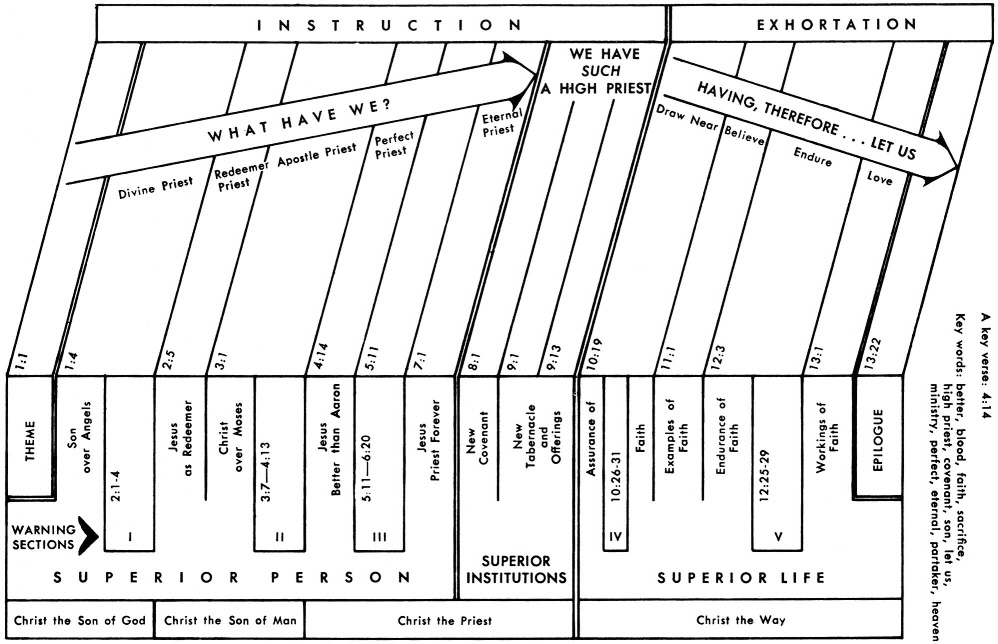
CONSIDER JESUS OUR GREAT HIGH PRIEST
Click chart to enlarge
Charts from Jensen's Survey of the NT - used by permission
Swindoll's Chart, Interesting Pictorial Chart of Hebrews, Another Chart
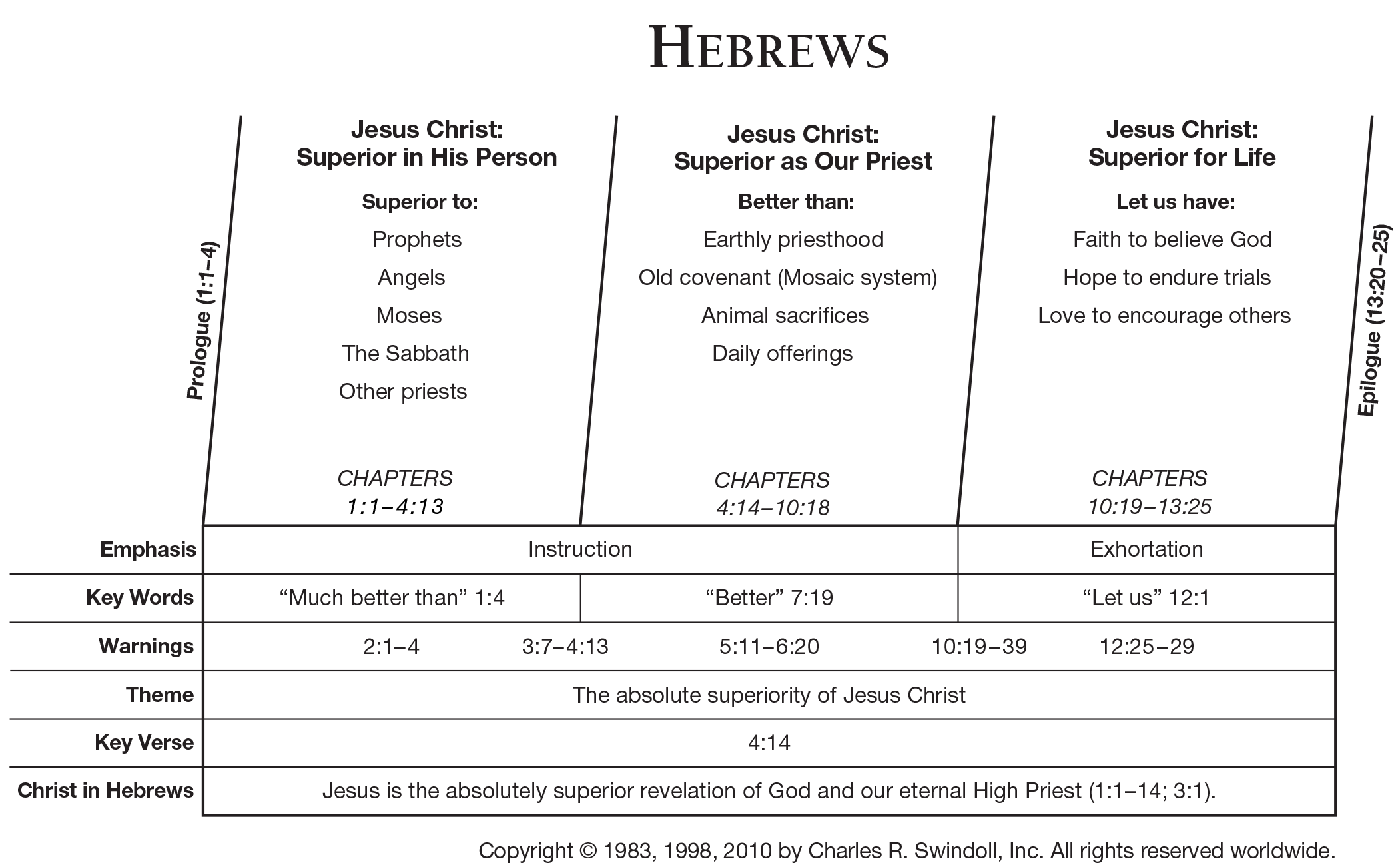

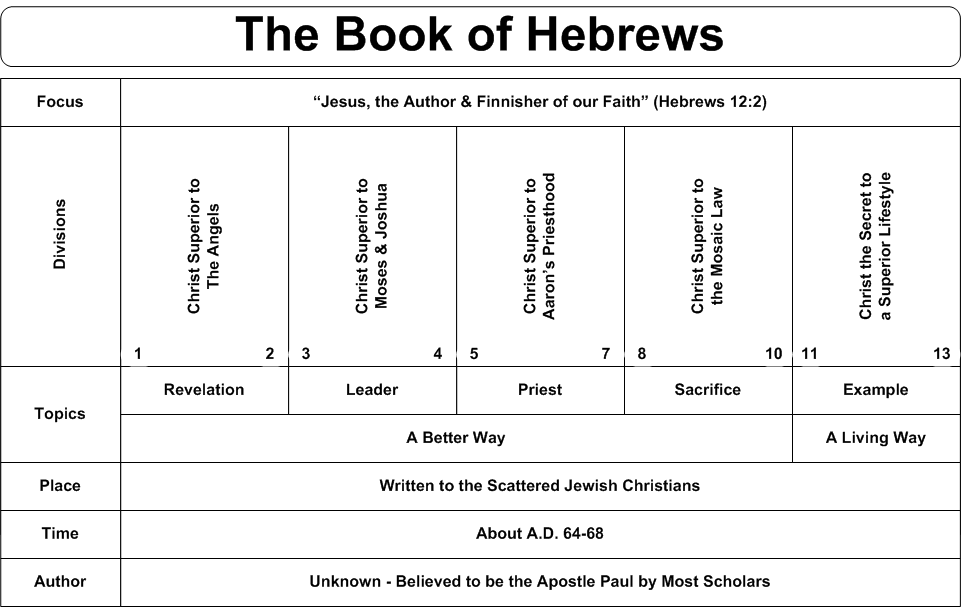
|
The Epistle |
||||
| INSTRUCTION Hebrews 1-10:18 |
EXHORTATION Hebrews 10:19-13:25 |
|||
| Superior Person of Christ Hebrews 1:1-4:13 |
Superior Priest in Christ Hebrews 4:14-10:18 |
Superior Life In Christ Hebrews 10:19-13:25 |
||
| BETTER THAN PERSON Hebrews 1:1-4:13 |
BETTER PRIESTHOOD Heb 4:14-7:28 |
BETTER COVENANT Heb 8:1-13 |
BETTER SACRIFICE Heb 9:1-10:18 |
BETTER LIFE |
| MAJESTY OF CHRIST |
MINISTRY OF CHRIST |
MINISTERS FOR CHRIST |
||
|
DOCTRINE |
DUTY |
|||
|
DATE WRITTEN: |
||||

See ESV Study Bible "Introduction to Hebrews"
(See also MacArthur's Introduction to Hebrews)
Borrow Ryrie Study Bible
Hebrews 10:30 For we know Him who said, "VENGEANCE IS MINE, I WILL REPAY." And again, "THE LORD WILL JUDGE HIS PEOPLE." (NASB: Lockman)
Greek: oidamen (1PRAI) gar ton eiponta, (AAPMSA) Emoi ekdikesis, ego antapodoso; (1SFAI) kai palin, Krinei (3SFAI) kurios ton laon autou.
BGT οἴδαμεν γὰρ τὸν εἰπόντα· ἐμοὶ ἐκδίκησις, ἐγὼ ἀνταποδώσω. καὶ πάλιν· κρινεῖ κύριος τὸν λαὸν αὐτοῦ.
Amplified: For we know Him Who said, Vengeance is Mine [retribution and the meting out of full justice rest with Me]; I will repay [I will exact the compensation], says the Lord. And again, The Lord will judge and determine and solve and settle the cause and the cases of His people. [Deut. 32:35, 36] (Amplified Bible - Lockman)
Barclay: For we know who it was who said: “Vengeance belongs to me; it is I who will repay,” and again: “The Lord will judge his people.” (Westminster Press)
NLT: For we know the one who said, "I will take vengeance. I will repay those who deserve it." He also said, "The Lord will judge his own people." (NLT - Tyndale House)
KJV For we know him that hath said, Vengeance belongeth unto me, I will recompense, saith the Lord. And again, The Lord shall judge his people.
NKJ For we know Him who said, "Vengeance is Mine, I will repay," says the Lord. And again, "The LORD will judge His people."
NET For we know the one who said, "Vengeance is mine, I will repay," and again, "The Lord will judge his people."
CSB For we know the One who has said, Vengeance belongs to Me, I will repay, and again, The Lord will judge His people.
ESV For we know him who said, "Vengeance is mine; I will repay." And again, "The Lord will judge his people."
NIV For we know him who said, "It is mine to avenge; I will repay," and again, "The Lord will judge his people."
Phillips: For we know the one who said: 'Vengeance is mine: I will repay'. And again: 'The Lord will judge his people'. (Phillips: Touchstone)
Wuest: For we know the One who said, To me the meting out of full justice belongs. I will recompense. And again, The Lord will judge His people.
Young's Literal: for we have known Him who is saying, 'Vengeance is Mine, I will recompense, saith the Lord;' and again, 'The Lord shall judge His people;'--
- Warning passages - Heb 2:1-4 (notes) Heb 3:7-4:13 (notes) Heb 5:11-6:12 (notes) Heb 10:19-39 (notes) Heb 12:14-29 (notes)
- Vengeance is Mine - Dt 32:35; Ps 94:1; Isa 59:17; 61:2; 63:4; Nah 1:2; Ro 12:19; 13:4
- Hebrews 10 Resources - Multiple Sermons and Commentaries
- Hebrews 10:26-31 The Only Options: Christ or Judgment? - Steven Cole
- Hebrews 10:28-39 Apostasy: The Negative Response to the New Covenant 2 - John MacArthur
- Click for 5W/H Study Questions — ideal for leading a group or personal study of Hebrews
Related Passages:
Deuteronomy 32:35-36+ ‘Vengeance is Mine, and retribution, In due time their foot will slip; For the day of their calamity is near, And the impending things are hastening upon them.’ 36 “For the LORD will vindicate His people, And will have compassion on His servants, When He sees that their strength is gone, And there is none remaining, bond or free. \
COMMENT - Note Dt 32:35 was the foundational verse for Jonathan Edwards' sermon "Sinners in the Hand of an Angry God."
Psalm 145:20 The LORD keeps all who love Him, But all the wicked He will destroy.
1 Peter 4:17+ For it is time for judgment to begin with the household of God; and if it begins with us first, what will be the outcome for those who do not obey the gospel of God?
PAY DAY
SOME DAY!
Robert G Lee had a famous sermon by this same title which he preached over 1000 times. Click to listen to this timeless message or better audio.
This verse is includes two quotes from the Septuagint (LXX). Here is the first Septuagint (LXX) rendering of Dt 32:35 = ekdikeseos antapodoso (1SFAI) which is similar to Hebrews 10:30 emoi ekdikesis, ego antapodoso. The second quote (identified by all caps in NAS) "THE LORD WILL JUDGE HIS PEOPLE" is from the Septuagint of Dt 32:36 which reads krinei kurios ton laon which is identical to the Greek in Heb 10:30 (Krinei kurios ton laon) It is notable that this quote comes from the Song of Moses which was well known to the Jewish readers because they sang it in their worship services. Keep in mind that the Song of Moses is his farewell address reminding them of God’s gracious dealings with them but also admonishing them regarding the dire consequences of ingratitude and apostasy.
For ( gar) explains why the previous statement (re: "severer punishment") is an absolute certainty for the apostate. The idea of for in this context is “Here is why what I just said is true.” As the writer points out from the OT, this punishment is certain because the God we know has already declared in His Word that vengeance belongs to Him.
We know (eido - beyond a shadow of a doubt) Him who said (he affirms God speaks to men), "VENGEANCE (ekdikesis - retribution) IS MINE (His divine prerogative), I WILL REPAY (antapodidomi - give back in return, recompense)." And again, "THE LORD WILL JUDGE (krino) HIS PEOPLE. - We know shows the writer including himself in this sure knowledge and was a technique employed by Paul (I am not saying he wrote Hebrews) in a way to appeal to the understanding of his readers (cf Ro 2:2, 3:19, 6:3, etc). The point is that his readers cannot claim ignorance of how God has dealt with willful sin! The truth of God taking vengeance is not a possibility but a certainty where such action is warranted as in the case of the individual who is apostate. But remember that Divine vengeance is not human vindictiveness. These are two promises of God you probably won't find in those little books entitled "Promises of God" but they are just as certain as all His positive promises! The fact is that because God judged covenant breakers under the Old Covenant, He will most certainly judge apostates under the New! While many dispute the truth of a judgmental God, God’s Word, not human opinion, is the final proof that those who trample under foot the Son of God, regard as as unclean the blood of the covenant and insult the Spirit of grace (Heb 10:29) will face His holy and horrifying hand of justice! And be careful to note in regard to the apostates who committed the horrible sins in Hebrews 10:29 this judgment is referring to the Great White Throne (NOT the Judgment Seat of Christ which is for believers only) where all unbelievers will be judged. And this same truth applies to the apostates in the first century and every century, because Jesus Christ (the Judge - Jn 5:22+) is the same yesterday, today and forever (Heb 13:8+). Amen.
🙏 THOUGHT - You may have been unjustly treated as a believer and you would love to give payback or perhaps you have already tried to give payback. The truth of the principle of this passage should calm the storm within your heart and allow you to rest (rest rather than retaliate) in the truth that the unjust treatment you received will be justly repaid by the omniscient Judge, Who will never forget your maltreatment or the perpetrators of that treatment! (read Ro 12:17-21+) You can stake your life on it! So drop the desire for revenge or vindication and rest in the Lord Your Helper and Sustainer to do right for He Himself declared "Shall not the Judge of all the earth deal justly?" (Ge 18:25). Cease striving (Ps 46:10+) for your own justice and instead cling to the Judge Who never errs! And remember beloved of God, His justice may be delayed, but it is never denied!
Vengeance is God's domain,
not man's!
Nothing escapes God, and there is no exception - even though it may appear that the wicked are getting away with their actions, they will not escape judgment. There will be an ultimate reckoning and final accountability. Everyone will have to give an account to God, and no one escapes ultimate accountability.
Woe to those, in that day, who are a defilement to His Church
and an adulteration to the purity of His people!
Spurgeon - God’s fire is in Zion, and his furnace in Jerusalem. If a man tries nothing else, he will test his gold; and if no others shall be judged, yet certainly those will be who say that they are the Lord’s people. In that dread day, He will separate the goats from the sheep, the tares from the wheat, and the dross from the gold; His fan will be in His hand, and He will thoroughly purge His floor; He will sit as a refiner of silver, and He will purify the sons of Levi; He shall be like a refiner’s fire, and like fuller’s soap. Woe to those, in that day, who are a defilement to His Church and an adulteration to the purity of His people!
The vengeance that will overtake the apostate
results not from personal passion but from outraged law.
-- John Phillips
Steven Cole comments that
Even though he has been issuing this strong warning, the author has all along included himself with his readers by using the first person plural (“Let us,” Heb 10:22, 23, 24; “we,” Heb 10:26, 30). Here he says, “For we know Him who said,” and then he cites two references from the Song of Moses (Dt. 32:35, 36). As we have seen before (Heb 3:7; 8:8; 10:15), for this author what Scripture says, God says.
The first quote (Dt. 32:35) establishes God’s sole right to take vengeance, but here the emphasis is on the fact that those who wrong such a Being as God have no chance of escape. You may wrong another person and somehow manage to escape his vengeance. But God will repay!
The second quote (Dt. 32:36) in its original context has the nuance of God vindicating His people by judging their enemies. Although the apostates had formerly been associated with God’s people, their rebellion has put them on the side of God’s adversaries (Heb 10:27). They will not escape. Leaving the fellowship and repudiating the sacrifice of Christ does not remove them from judgment, but rather, places them squarely in line for judgment! As Hughes says (A Commentary on the Epistle to the Hebrews - Page 426), “So far from escaping from God, the apostate falls into the hands of the living God: he abandons God as his Savior only to meet him as his Judge.” (Hebrews 10:26-31 The Only Options: Christ or Judgment?)
Phil Newton…
God will exact justice. He is a just God and therefore must satisfy his justice. Here we see the legal aspect of divine justice. Quoting from Moses' song in Deuteronomy 32:35, 'Vengeance is Mine, I will repay." It was a warning to Israel in anticipation of their apostasy. It is in that text he warns, "In due time their foot will slip." A person may think that he is getting away with his sin, and in this case, deliberate opposition to the gospel. But divine justice will be exacted; "in due time their foot will slip."
Justice will always be served. We observe this on a regular basis as men and women who have committed crimes against society for extended periods, thinking that they would never be discovered, are caught and judged, though some appear to get away with their crimes.
Paul Johnson, in his book Modern Times (BORROW BOOK), details the Nazi war crimes against the Jews and other European citizens. His descriptions of Auschwitz where 25,000 Jews "were literally worked to death" and 2,000,000 were gassed with Zyklon-B, followed by "the ghastly search for gold and the removal of the teeth and hair which were regarded by the Germans as strategic materials," then burned to ashes at the rate of "2,000 bodies every twelve hours," defies the imagination. He explains the Nuremberg trial where German industrialists involved in the death camps were given remarkably light sentences and paid little reparations for those victimized. Then he asks the probing question, "But who is foolish enough to believe there is justice in this world?" [Modern Times, 415, 417, 422]. He is right. Vengeance belongs to the Lord; He will repay. (Hebrews 10:26-31 The Peril of Playing Christian)
Wuest - The certainty of the punishment is assured by the word of God. Vincent says that the word vengeance is “an unfortunate translation, since it conveys the idea of vindictiveness which does not reside in the Greek word. It is the full meting out of justice to all parties. The quotation is an adaptation of the Lxx of Dt 32:35. The second citation is literally from Lxx of Dt 32:36.” (Hebrews Commentary online)
Refuse His grace now and
you will face His judgment later.
Vengeance (1557)(ekdikesis from ek = out, from + dike = justice; see also ekdikos) is literally that which proceeds "out of justice". Ekdikesis means to give justice to someone who has been wronged. It means to repay harm with harm on assumption that initial harm was unjustified and that retribution is therefore called for. The word indicates full, complete punishment. Ekdikesis was a technical term for administrative justice.
W E Vine says ekdikesis describes pay back that is based on justice and "not (as often with human vengeance) from a sense of injury, or merely out of indignation. The judgments of God are holy and right, and free from any element of self-gratification… There is thus no element of vindictiveness, of “taking revenge,”… in the judgments of God; they are both holy and right (cp Rev 16:7-note). (Vine, W. Collected writings of W. E. Vine. Nashville: Thomas Nelson)
Ekdikesis is punishment which represents a just response. Just or righteous retribution ( = Repayment. That which is given or exacted in recompense).
So on one hand ekdikesis describes the execution of justice, seeing to it that proper justice is accomplished, giving justice to someone who has been wronged (Lk 18:7, 8, Acts 7:24. In the Lxx = Nu 31:2, Jdg 11:36)
On the other hand ekdikesis speaks of the penalty inflicted on the unjust (wrongdoers) or the recompense for harm done (Ro 12:19-note, Heb 10:30). It describes punishing on the basis of what is rightly deserved. Vengeance is God's prerogative alone!
The related verb ekdikeo in the papyri was used to decide a case, work as an advocate, defend or help someone to obtain his rights.
Ekdikesis is the carrying out what is right by the exacting of a penalty. The ekdikos is the one who exacts satisfaction for a wrong by punishing the wrongdoer or by inflicting punishment in retaliation for an injury or offense. In secular Greek ekdikos was used for the office of an official legal representative.
The root noun dike describes the basic tenet that a society can expect a certain level or standard of behavior and if that standard is violated ensuing judgment can be expected. In Greek mythology "dike" was the goddess of just punishment. In secular usage dike meant a legal decision or judgment.
Vengeance describes the punishment inflicted in retaliation for an injury or offense. Vengeance is the full meting out of justice to all parties. The 1828 Webster's dictionary has a longer definition…
The infliction of pain on another, in return for an injury or offense. Such infliction, when it proceeds from malice or mere resentment, and is not necessary for the purposes of justice, is revenge, and a most heinous crime. When such infliction proceeds from a mere love of justice, and the necessity of punishing offenders for the support of the laws, it is vengeance, and is warrantable and just. In this case, vengeance is a just retribution, recompense or punishment. In this latter sense the word is used in Scripture, and frequently applied to the punishments inflicted by God on sinners.
Ekdikesis - 9x in 9v - NAS = avenging of wrong(1), justice(2), punishment(1), retribution(1), vengeance(4).
Luke 18:7+ now, will not God bring about justice for His elect who cry to Him day and night, and will He delay long over them? 8 "I tell you that He will bring about justice for them quickly. However, when the Son of Man comes, will He find faith on the earth?"
Luke 21:22+ because these are days of vengeance, so that all things which are written will be fulfilled.
Acts 7:24+ "And when he saw one of them being treated unjustly, he defended him and took vengeance for the oppressed by striking down the Egyptian.
Comment: Moses brought retribution to the Egyptian for mistreating his fellow Israelites. In a similar (but perfect way) God will bring retribution to those who reject Him and mistreat His people (see 2Th 1:8 below)
Romans 12:19+ Never take your own revenge (ekdikeo), beloved, but leave room for the wrath of God, for it is written, "VENGEANCE IS MINE, I WILL REPAY," says the Lord.
Comment: This is a very difficult truth for most Christians to apply in everyday life because our old nature is so prone to retaliate. The modern world breeds the "tit for tat" get even mentality. Only believers controlled by the Spirit (cp "self-control") can carry out this instruction.
Wuest: Ekdikesis = "“a revenging, punishment,” the latter word more applicable in this context as connected with God. God cannot be said to have vengeance in the sense that a person has vengeance, namely, a retaliatory feeling which prompts a vindictive requital."
2 Corinthians 7:11+ For behold what earnestness this very thing, this godly sorrow, has produced in you: what vindication of yourselves, what indignation, what fear, what longing, what zeal, what avenging of wrong! (This use refers to judicial punishment) In everything you demonstrated yourselves to be innocent in the matter.
2 Thessalonians 1:8+ dealing out retribution to those who do not know God (not "know about God" which even so-called atheists could affirm, but to know Him intimately and personally, ultimately as their Father - note - God is NOT the Father of unbelievers contrary to prevalent liberal false teaching - see Jn 1:12, 13+. Their father is Satan Jn 8:44+) and to those who do not obey the gospel of our Lord Jesus
Comment: Note that "Obey" is used in place of "believe" so that clearly the NT teaches that one aspect indicating true, saving belief is obedience (cp "believes...obey" in Jn 3:36+). This is not the obedience of legalism like the Pharisees, but the obedience that is internally motivated and empowered by the indwelling Holy Spirit. In this sense, one might say that "obedience" while clearly calling for a personal choice, is evidence of supernatural work in a person's heart. In this way to "obey" is used in lieu of to "believe".
The KJV has "Vengeance" which is somewhat of an unfortunate rendering for to many individuals (specifically the non-believing world) the word vengeance as commonly used in secular settings implies that God has a sort of personal vindictiveness when in fact He has perfect righteousness and justice! God's "vengeance" is so different from fallen men's vengeance.
Vincent writes that "To know God is to know Him as the One, true God as distinguished from false gods; to know His will, His holiness, His hatred of sin, and His saving intent toward mankind.
Hebrews 10:30+ For we know Him who said, "VENGEANCE IS MINE, I WILL REPAY." And again, "THE LORD WILL JUDGE HIS PEOPLE."
1 Peter 2:14+ or to governors as sent by him for the punishment of evildoers and the praise of those who do right.
Ekdikesis - 47x in the non-apocryphal Septuagint -Ex 7:4; 12:12; Num 31:2f; 33:4; Deut 32:35; Judg 11:36; 14:4; 2 Sam 4:8; 22:48; Ps 18:47; 58:10; 79:10; 94:1; 149:7; Isa 59:17; 66:15; Jer 11:20; 20:10, 12; 46:10, 21; 50:15, 27f, 31; 51:6, 11, 36; Lam 3:60; Ezek 5:15; 9:1; 14:21; 16:38, 41; 20:4; 23:10, 45; 24:8; 25:11f, 14f, 17; 30:14; Hos 9:7; Mic 5:15; 7:4;
Exodus 12:12 'For I will go through the land of Egypt on that night, and will strike down all the firstborn in the land of Egypt, both man and beast; and against all the gods of Egypt I will execute judgments (Hebrew = shephet; Lxx = ekdikesis) -- I am the LORD.
Numbers 31:3 Moses spoke to the people, saying, "Arm men from among you for the war, that they may go against Midian to execute the LORD'S vengeance (Hebrew = neqamah; Lxx = ekdikesis ) on Midian (used again in the phrase "executed judgments" Nu 33:4).
Deuteronomy 32:35 'Vengeance (naqam; Lxx = ekdikesis) is Mine, and retribution, In due time their foot will slip; For the day of their calamity is near, And the impending things are hastening upon them.'
2 Samuel 22:48 The God who executes vengeance Hebrew = neqamah; Lxx = ekdikesis) for me, And brings down peoples under me, (Repeated in Ps 18:47)
Spurgeon: It is God that avengeth me. To rejoice in personal revenge is unhallowed and evil, but David viewed himself as the instrument of vengeance upon the enemies of God and his people, and had he not rejoiced in the success accorded to him he would have been worthy of censure. That sinners perish is in itself a painful consideration, but that the Lord's law is avenged upon those who break it is to the devout mind a theme for thankfulness. We must, however, always remember that vengeance is never ours, vengeance belongeth unto the Lord, and he is so just and withal so longsuffering in the exercise of it, that we may safely leave its administration in his hands.
Psalm 58:10 The righteous will rejoice when he sees the vengeance (Hebrew = neqamah; Lxx = ekdikesis); He will wash his feet in the blood of the wicked.
Spurgeon: The righteous shall rejoice when he seeth the vengeance. He will have no hand in meting out, neither will he rejoice in the spirit of revenge, but his righteous soul shall acquiesce in the judgments of God, and he shall rejoice to see justice triumphant. There is nothing in Scripture of that sympathy with God's enemies which modern traitors are so fond of parading as the finest species of benevolence. We shall at the last say, "Amen," to the condemnation of the wicked, and feel no disposition to question the ways of God with the impenitent. Remember how John, the loving disciple, puts it. "And after these things I heard a great voice of much people in heaven, saying, Alleluia; Salvation and glory, and honour, and power, unto the Lord our God: for true and righteous are his judgments: for he hath judged the great whore, which did corrupt the earth with her fornication, and hath avenged the blood of his servants at her hand. And again they said, Alleluia. And her smoke rose up for ever and ever."
The righteous shall rejoice when he seeth the vengeance. Not that he shall be glad of the vengeance purely as it is a hurt, or a suffering to the creature, but the righteous shall be glad when he seeth the vengeance of God, as it is a fulfilling of the threatening of God against the sin of man, and so evidence of his own holiness. Psalms 59:9-10. Joseph Caryl.
Psalm 94:1 O LORD, God of vengeance (Hebrew = neqamah; Lxx = ekdikesis ), God of vengeance (Hebrew = neqamah; Lxx = ekdikesis), shine forth!
Spurgeon: O LORD God, to whom vengeance belongeth; O God, to whom vengeance belongeth, shew thyself: or, God of retribution, Jehovah, God of retribution, shine forth! A very natural prayer when innocence is trampled down, and wickedness exalted on high. If the execution of justice be a right thing, -- and who can deny the fact? -- then it must be a very proper thing to desire it; not out of private revenge, in which case a man would hardly dare to appeal to God, but out of sympathy with right, and pity for those who are made wrongfully to suffer, Who can see a nation enslaved, or even an individual downtrodden, without crying to the Lord to arise and vindicate the righteous cause? The toleration of injustice is here attributed to the Lord's being hidden, and it is implied that the bare sight of him will suffice to alarm the tyrants into ceasing their oppressions. God has but to show himself, and the good cause wins the day. He comes, he sees, he conquers! Truly in these evil days we need a manifest display of his power, for the ancient enemies of God and man are again struggling for the mastery, and if they gain it, woe unto the saints of God.
Isaiah 66:15 For behold, the LORD will come in fire And His chariots like the whirlwind, To render His anger (Lxx = ekdikesis) with fury, And His rebuke with flames of fire.
Repay (pay back, render) (467) antapodidomi from antí = in turn, in exchange, in response to + apodídomi = render <> from apo = from + didomi = give - apo has the force of “due” as it has also in various other compounds so what is due “from” me to give) means to give back in return for something received. The idea is to practice reciprocity with respect to an obligation. It emphasizes correspondence or equivalence between an action and its result. It is reciprocal by nature or a “payback” word. It means to pay back something owed. We as Christians owe to God joyful thanksgiving and praise for what He has done. In a positive sense it means to repay, to recompense or to reward. In a negative sense it means to requite or exact retribution. Requite implies a paying back according to one’s preference and often not equivalently.
To the rebellious, antapodidōmi warns: ‘God will repay.’
To the righteous, it whispers: ‘God will make it right.’
ANTAPODIDOMI - 6V - Lk. 14:14; Rom. 11:35; Rom. 12:19; 1 Thess. 3:9; 2 Thess. 1:6; Heb. 10:30
AND AGAIN, "THE LORD WILL JUDGE HIS PEOPLE": kai palin: krinei (3SFAI) kurios ton laon autou:
- Judge - Deuteronomy 32:36; Ps 50:4; 96:13; 98:9; 135:14; Ezekiel 18:30; 34:17; 2Corinthians 5:10
- Hebrews 10 Resources - Multiple Sermons and Commentaries
- Hebrews 10:26-31 The Only Options: Christ or Judgment? - Steven Cole
- Hebrews 10:28-39 Apostasy: The Negative Response to the New Covenant 2 - John MacArthur
- Click for 5W/H Study Questions — ideal for leading a group or personal study of Hebrews
DIVINE JUDGMENT IS
IMPARTIAL & INEVITABLE!
The LORD (kurios) will judge (krino) His people - Note the phrase His people indicates that there is no partiality with God. In other words, God will not only judge the enemies of His people, but based on His impartiality He will also judge His own when they forsake His covenant. With great privilege comes great responsibility. God's judgment is just and unbiased and distributed without favoritism, always in an upright and unprejudiced manner. Note that judge (krino) can refer to favorable as well as adverse judging, but in this context it is the latter it clearly conveys the latter sense.
God will judge His people;
no one escapes His judgment.
Ray Stedman on "WILL JUDGE HIS PEOPLE" - The second quote, however, looks more to the severity of God on those of His own who presumptuously play with sin even when knowing better. (WOE!!!) (A Fourth Warning Against Apostasy) (See related discussion - Does God punish us when we sin? | GotQuestions.org)
Simon Kistemaker - God will judge His people; no one escapes His judgment. Those whose faith is rooted in Jesus Christ find a God of grace and mercy. Their sins have been forgiven because of the Son’s sacrifice on the cross. And they will hear the verdict acquitted. But they who have spurned the person and work of Christ and have arrogantly despised the Holy Spirit face the infinite wrath of God, the judge of heaven and earth...The sinner who breaks God’s law purposely to grieve God has passed the stage of repentance (Heb. 6:4–6+). He falls “into the hands of the living God” (also see Heb. 3:12), and that confrontation is indescribable. The writer of Hebrews says it is dreadful. (BORROW Exposition of the Epistle to the Hebrews PAGE 296)
🙏 THOUGHT - Do not be deceived, for whatever a man sows, this he will reap (Gal 6:7-8+). So while believers will be acquitted of their sins because of the fully atoning blood of Jesus ("Paid in full" Jn 19:30+, tetelestai), they are still subject to God's loving discipline in this life (Hebrews 12:5-11+) and His righteous judgment in the future life (2Co 5:10+, 1Co 3:11-15+).
Most see this verse as a quote from the Septuagint (LXX) rendering of the Song of Moses in Deuteronomy…Here is the Septuagint (LXX) of Dt 32:36 = krinei kurios ton laon autou This quote could also be from Ps 135:14 which in the NAS is rendered "For the LORD will judge His people (in the following context idolatry seems to be in view - Ps 135:15-18), and will have compassion on His servants.
THE EXAMPLE
OF KING DAVID
The thrust of these OT passages is clear - God looks more to those who are His own and yet who presumptuously play with sin even though they should know better. We see this illustrated in the case of David in 2 Samuel 24, a passage that can be somewhat confusing, even suggesting God incited David to sin, and so it must be properly cross referenced.
2 Samuel 24:1+ says "Now again the anger of the LORD burned against Israel, and it incited David against them to say, "Go, number Israel and Judah."
Cross referencing this passage we read the parallel record in 2 Chronicles 21+…"Then Satan stood up against Israel and moved David to number Israel (How do we resolve this? Clearly Satan is the perpetrator of the evil influence on David. And yet we know that Satan can do nothing unless God allows it. So clearly God did not incite David to sin, but He did allow Satan to do it. Satan still has access to God's throne in this present age, and nothing can come into our lives that is out of God's sovereign control! This is an immutable principle beloved! cp Job 1:6, 7, 8, 9, 10, 11, 12f, cp Mk 5:13, Lk 8:32, Lk 22:31). So David said to Joab and to the princes of the people, "Go, number Israel from Beersheba even to Dan, and bring me word that I may know their number." (God even gave David an opportunity to retract his sinful order before it was actually carried out!) And Joab said, "May the LORD add to His people a hundred times as many as they are! But, my lord the king, are they not all my lord's servants? Why does my lord seek this thing? Why should he be a cause of guilt to Israel?" Nevertheless, the king's word prevailed against Joab. Therefore, Joab departed and went throughout all Israel, and came to Jerusalem. (2Chr 21:1-4+)
Disciple's Study Bible - This passage (1 Chronicles 21+) may seem to picture God as very harsh and vindictive. It was crucially important for Him to establish in the minds of His people the importance of following His will, not that of Satan or themselves. It is a serious matter to act against God's will in a flagrant manner. (ED: ESPECIALLY IF YOU ARE A BELIEVER!) The destruction exacted here seems enormous (see 1Ch 21:9-18) --but if later generations profit from this lesson, it will have served its purpose. Even in exercising His wrath, God does what is right and just. The most faithful of God's people make mistakes. King David's command was evil and brought God's judgment. Even judgment brought evidence of God's mercy (1Chr 21:15). (Disciple's Study Bible)
David is given a choice of three painful penalties because of his sin of numbering the people of Israel, an act which was expressly forbidden by the Lord. -- And God was displeased with this thing, so He struck Israel. 8 And David said to God, "I have sinned greatly, in that I have done this thing. But now, please take away the iniquity of Thy servant, for I have done very foolishly." 9 And the LORD spoke to Gad, David's seer, saying, 10 "Go and speak to David, saying, 'Thus says the LORD, "I offer you three things; choose for yourself one of them, that I may do it to you."'" (1Chr 21:7-10)
Here is the point --- If such a greatly beloved believer as King David (cp Acts 13:22, 1Sa 16:7) could be dealt with so severely by God, the argument (similar to that used several times in the epistle to the Hebrews) is how much more would the apostate individual experience the full impact of the Holy God's righteous wrath!
Phil Newton - Distinguishing promised - Some will consider that their involvement with the church at some point in their lives is adequate cover from the wrath of God. But the next quote from Deuteronomy 32:36 explodes this deceitful notion: "The Lord will judge His people." The implication in context is that the Lord discerns among His people. There are those who were part of the nation of Israel, the people of God, who were not believers. Outwardly they appeared to share in the blessings of God, but inwardly their hearts rebelled. The same is true in the church. The visible church does not contain a pure body of genuine believers. As much as church leaders try, as closely as Scriptural principles are adhered to, absolute purity is impossible in this world. Tares are found among the wheat (Mt 13:36, 37, 38, 39, 40, 41, 42, 43). Goats are part of the flock of sheep (cp Mt 25:31, 32, 33, 34, 35, 36, 37, 38, 39, 40, 41, 42, 43, 44, 45, 46). But the day will come when the Lord distinguishes between the wheat and tares, the goats and sheep. In that day there will be no more hiding and masquerading as Christians. What will that day expose about you (ME)? (Hebrews 10:26-31 The Peril of Playing Christian)
Warren Wiersbe on God judging HIS PEOPLE - If we fail to listen and obey, then He begins to chasten us. This chastening process is the theme of Hebrews 12, the climactic chapter in the epistle. “The Lord will judge his people” (Heb. 10:30). God does not allow His children to become spoiled brats by permitting them willfully to defy His Word. He always chastens in love (Rev. 3:19 kjv). (SEE Pause for Power: A 365-Day Journey through the Scriptures - Page 125)
Lord (master, owner)(2962)(kurios from kuros = might or power, related to kuroo = to give authority) primarily means the possessor, owner, master, the supreme one, one who is sovereign (used this way of Roman emperors - Act 25:26) and possesses absolute authority, absolute ownership and uncontested power. Kurios is used of the one to whom a person or thing belonged, over which he has the power of deciding, the one who is the master or disposer of a thing (Mk 7:28)
KURIOS IN HEBREWS - Heb. 1:10; Heb. 2:3; Heb. 7:14; Heb. 7:21; Heb. 8:2; Heb. 8:8; Heb. 8:9; Heb. 8:10; Heb. 8:11; Heb. 10:16; Heb. 10:30; Heb. 12:5; Heb. 12:6; Heb. 12:14; Heb. 13:6; Heb. 13:20;
Judge (decide, determine, condemn)(2919)(krino and its cognates [see below] is a root of English words like critic, critical [kritikos] = a decisive point at which judgment is made) primarily signifies to distinguish, to decide between (in the sense of considering two or more things and reaching a decision), to make up one's mind, to separate, to discriminate. to distinguish between good and evil, right and wrong, without necessarily passing an adverse sentence, although that is often what is usually involved. As you will see from this study, krino has various shades of meaning which must be determined from the context. The basic meaning of krino is to form an opinion after separating and considering the particulars in the case. Krino means to evaluate and determine what is right, proper, and expedient for correction.
KRINO IN HEBREWS - Heb. 10:30; Heb. 13:4 ("fornicators and adulterers God will judge")
ILLUSTRATIONS - Divine vengeance is never vindictive — it is holy justice delayed, not denied. Leave the gavel in God’s hand; He alone knows when and how to strike. The same hand that holds the cross holds the gavel — grace offered today will be justice tomorrow.
The Unpaid Debt
A missionary once told of a native convert who was wronged by a fellow believer. When asked if he would seek revenge, he replied, “I am too poor to afford revenge; I will leave it to the Lord who is rich enough to repay.” That’s Hebrews 10:30 in action — God keeps perfect accounts. What man forgets or twists, He will balance in time.
The Book of Accounts
A Scottish preacher once said, “God has a long memory but a perfect ledger.” Human vengeance writes hastily in anger; divine justice writes slowly but in indelible ink. Those who mock God’s patience confuse delay with disregard, but Hebrews 10:30 reminds us: “He will repay.”
The Boomerang of Judgment
In the 1800s, an Australian farmer accidentally struck a friend while showing how to throw a boomerang. He later said, “I never meant it to come back so hard.” That’s a picture of divine retribution: sin, once hurled in defiance, always returns. The wages of sin never miss their mark. God’s vengeance isn’t random — it’s rebound justice.
The Judge Who Never Forgets
An elderly English judge was once asked how he could still remember cases from decades earlier. He replied, “I forget most things, but never a crime that came before my bench.” So too, the Lord will judge His people. His justice is never dulled by time, never clouded by emotion, and never overturned on appeal.
David and Shimei (2 Samuel 16; 19)
When Shimei cursed David during his flight from Absalom, David refused to strike him down, saying, “Perhaps the Lord will look upon my affliction and repay me with good.” David lived Hebrews 10:30 centuries before it was written — entrusting vengeance to God rather than taking it into his own hands.
The Cross: Justice and Mercy Meet (cf Ps 85:10 Lovingkindness and truth have met together; Righteousness and peace have kissed each other.)
At Calvary, the vengeance of God and the grace of God met and embraced. God’s justice demanded payment; His mercy provided it. Those who reject that payment will face vengeance in judgment; those who receive it find vengeance forever satisfied in Christ.
The Earthquake of Lisbon (1755)
After the Lisbon earthquake destroyed tens of thousands of lives, Voltaire mocked divine judgment. John Wesley responded, “The Lord of all will one day make it plain that His judgments are righteous altogether.” (See note on Voltaire - Borrow Last Words of Saints and Sinners by Hebert Lockyer, a fascinating book). Hebrews 10:30 calls believers to trust divine justice even when providence seems perplexing. We would expect John Wesley to come to the last hour in a different frame of mind from Voltaire, who carried no hope beyond the grave.
'Tis sweet to grow old in the fear of the Lord,
As life's shadows longer creep.
Till our step grows slow, and our sun swings low —
He gives His beloved sleep.

The Burning Fuse
An old Puritan wrote, “The vengeance of God is like a fuse that burns slowly, but it burns all the way to the powder.” Delay is not escape. The fuse of patience leads inevitably to the explosion of justice. There is a great application here for believers, for the Greek verb makrothumeo means to be patient or longsuffering and is the first quality of Spirit energized, God-like love in 1Co 13:1+. But here's the interesting analogy—the verb makrothumeo is from makro = long + thumos = passio or anger, which conveys the picture of one having a "long fuse!" Does that describe your love, beloved? It should if you are filled with the Spirit (Eph 5:18+), Who Alone can enable such a "long fuse love!"
The Gavel of God
A courtroom gavel may strike and silence the room, but not the conscience. When God’s gavel falls, it silences not only the noise of men but the argument of sin. Hebrews 10:30 assures us: the same hand that writes “Mercy” also holds the gavel of “Justice.”
Simon Kistemaker (borrow book) has some wise words for modern preachers of the Gospel entitled "Practical Considerations in 10:26–31"
Preaching sermons on hellfire appears to be something that happened in the past but not today. This type of preaching is considered an oddity of the eighteenth century; it should not be heard from a twentieth-century pulpit.
True. Sermons ought to proclaim the gospel of salvation, the call to repentance, the assurance of pardon, and the message of reconciliation between God and man. Proportionally, Scripture says little about God’s burning wrath that consumes his enemies. If Scripture sets the example, we should follow its practice.
Nevertheless, no preacher may fail to warn the people of the dire consequences of turning away from the living God. The recurring theme of the Epistle of Hebrews is one of warning God’s people. Note these three texts:
Hebrews 3:12 “See to it, brothers, that none of you has a sinful, unbelieving heart that turns away from the living God.”
Hebrews 4:1 “Therefore, since the promise of entering [God’s] rest still stands, let us be careful that none of you be found to have fallen short of it.”
Hebrews 4:11 “Let us, therefore, make every effort to enter that rest, so that no one will fall by following their example of disobedience.”
The terrifying consequences of living a life of intentional sin ought to be mentioned in sermons. In Hebrews we read that every believer has the responsibility to seek the spiritual welfare of his fellow Christians. We may call this corporate responsibility because it is our mutual task. And pastors may refer to hellfire in their sermons, for such a warning also belongs to the full message of God’s revelation.
As the pastor warns the wayward, so he encourages the faint-hearted. A believer may lack the assurance of salvation, fearing that he has committed the sin against the Holy Spirit. But the unpardonable sin cannot be attributed to a person who doubts his or her salvation. Only the person who demonstrates an open and deliberate hatred toward God, divine revelation, and Christ’s accomplished work of salvation has committed that sin. The doubter, then, needs words of encouragement. He should be invited to repeat the reassuring words of Paul, “Yet I am not ashamed, because I know whom I have believed, and am convinced that he is able to guard what I have entrusted to him for that day” (2 Tim. 1:12).
PREACHING SHOULD COMFORT THE AFFLICTED
AND CONVICT THE COMFORTABLE!
Hebrews 10:31 It is a terrifying thing to fall into the hands of the living God. (NASB: Lockman)
Greek: phoberon to empesein (AAN) eis cheiras theou zontos. (PAPMSG)
BGT φοβερὸν τὸ ἐμπεσεῖν εἰς χεῖρας θεοῦ ζῶντος.
Amplified: It is a fearful (formidable and terrible) thing to incur the divine penalties and be cast into the hands of the living God! (Amplified Bible - Lockman)
Barclay: It is a terrifying thing to fall into the hands of the living God. (Westminster Press)
NLT: It is a terrible thing to fall into the hands of the living God. (NLT - Tyndale House)
KJV It is a fearful thing to fall into the hands of the living God.
NKJ It is a fearful thing to fall into the hands of the living God.
NET It is a terrifying thing to fall into the hands of the living God.
CSB It is a terrifying thing to fall into the hands of the living God!
ESV It is a fearful thing to fall into the hands of the living God.
NIV It is a dreadful thing to fall into the hands of the living God.
Phillips: Truly it is a terrible thing for a man who has done this to fall into the hands of the living God! (Phillips: Touchstone)
Wuest: It is a fearful thing to fall into the hands of the living God.
Young's Literal: fearful is the falling into the hands of a living God.
- Terrifying thing - Heb 10:27; Isa 33:14; Lk 21:11
- To fall into - Heb 12:29; Ps 50:22; 76:7; 90:11; Mt 10:28; Lk 12:5
- Hebrews 10 Resources - Multiple Sermons and Commentaries
- Hebrews 10:26-31 The Only Options: Christ or Judgment? - Steven Cole
- Hebrews 10:28-39 Apostasy: The Negative Response to the New Covenant 2 - John MacArthur
- Click for 5W/H Study Questions — ideal for leading a group or personal study of Hebrews
Related Passages:
Hebrews 3:12+ Take care, brethren, that there not be in any one of you an evil, unbelieving heart that falls away from the living God.
Hebrews 9:14+ how much more will the blood of Christ, who through the eternal Spirit offered Himself without blemish to God, cleanse your conscience from dead works to serve the living God?
Hebrews 12:22+ But you have come to Mount Zion and to the city of the living God, the heavenly Jerusalem, and to myriads of angels,
2 Samuel 24:14+ (A DIFFERENT, MORE MERCY FILLED "FALLING" DESCRIBED BY DAVID A MAN OF FAITH) Then David said to Gad, “I am in great distress. Let us now fall into the hand of the LORD for (DAVID EXPLAINS WHY THIS CHOICE) His mercies are great, but do not let me fall into the hand of man.”
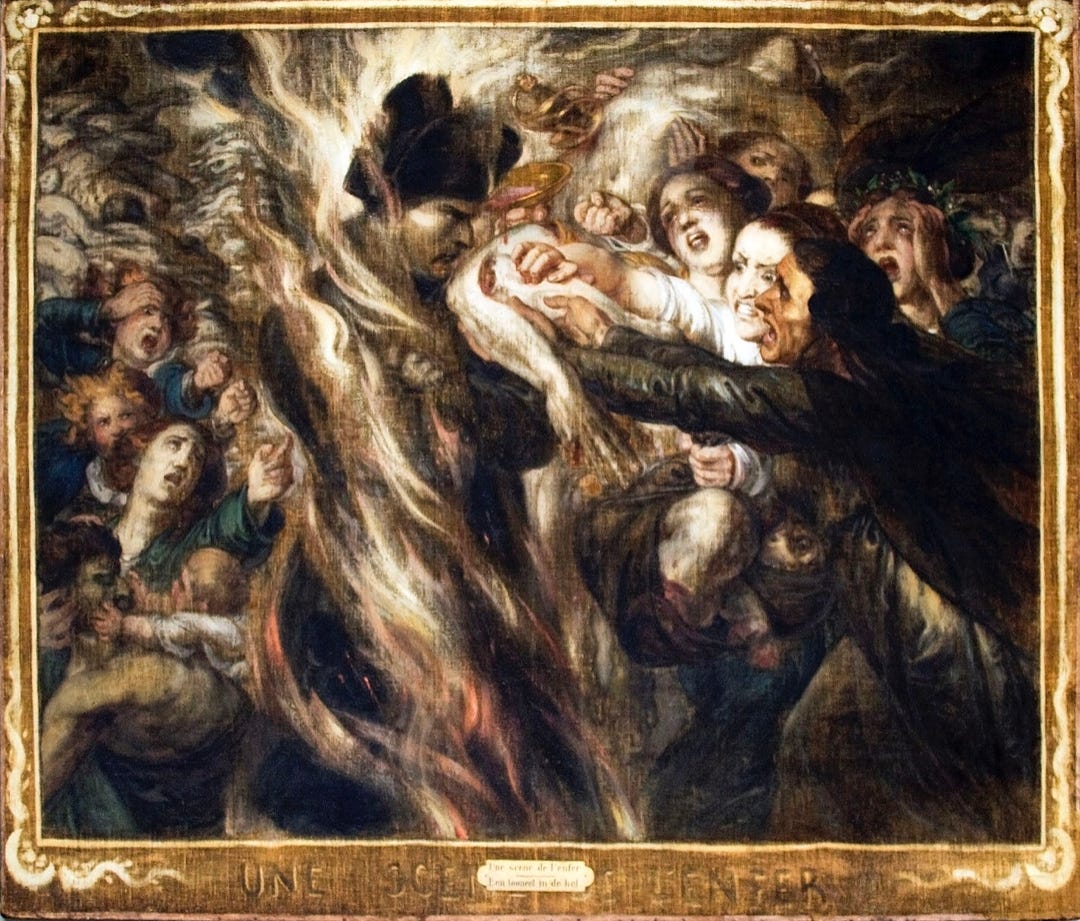
Antoine Wiertz's "A View of Hell"
(see note by Hughes)
THE LIVING FALLING INTO
THE HANDS OF THE LIVING GOD
Having just declared that “the Lord will judge His people,” the writer now presses home the fearful reality of that prophesied divine retribution. This is no idle threat, but a sober reminder that the same God Who offers mercy in Christ to those who call on Him (Ro 10:13+) will execute justice upon those who reject His Son, even trampling on the blood of His covenant!
It is a terrifying (phoberos - cf "terrifying expectation" in Heb 10:27+) thing to fall into (empipto - aorist tense = completed, final fall!) the hands (figurative for power, possession, control) of the living (zao - present tense - continually living) God - The first word in the Greek for emphasis is, not surprisingly, phoberos or terrifying! It is notable that this passage would have struck a chord with Jewish readers for “Falling into [someone’s] hands” and “living God” were both regular Jewish expressions. This description was meant to be a frightening verse to those readers who were being tempted to commit apostasy. The writer is trying to get their attention before it is too late and they make the fateful, fearful choice of rejecting the only refuge of escape from the hands of the Living God. It is interesting to note that in Scripture the hands of God could on one hand (pun intended) represent His protection (Dt 33:3+, Jn 10:28-29+) but, on the other hand, as in the present passage, depict divine punishment (cf Jdg 2:15+) (see Hand of the Lord). The word terrifying (phoberos) was used of being overtaken by enemies ("fell into the robbers" - Lk 10:36) and implies a sense of helplessness because once one has fallen into God's omnipotent hands, there is no escape, no defense, no negotiation. Believers have a Mediator between us and God, but when these apostates fall into the hands of the living God, there is no mediator, no mercy, no appeal. (Take a moment to read "Sinners in the Hands of an Angry God") Resist His redemption, and you will receive His retribution.
Note the striking, tragic contrast in Hebrews 3:12, unbelief causes one to fall away from the living God—the One Who gives eternal life—while in Hebrews 10:31, judgment causes one to fall into the hands of the living God—the One who takes that life away. In short, those who fall away from the Living God will one day fall into the hands of the Living God! Take your choice!
If a soul resists and falls away from God's grace and eternal life
They will irresistibly fall into God's grasp and eternal death!
🙏 THOUGHT - Believers should apply the truth of this passage to their life! There is a tendency to think "Sure, I've sinned, but I can just confess it (1 John 1:9+)." We can just confess it. This is true, but we need to ask the Spirit to help our heart develop a proper balance between holy fear of offending God and God's holy mercy when we do offend Him. And inherent in confession is repentance from that sin (cf Pr 28:13+). Job gives us a perfect example of a godly man to follow (cf Heb 6:11-12+) - "There was a man in the land of Uz whose name was Job; and that man was blameless, upright, fearing God and turning away from evil." (Job 1:1). Why did Job turn from evil? What did the writer say in the immediate context? So there is your answer about why a proper fear of God is so valuable in serving as an impediment to committing a sin when we are sorely tempted.
Kenneth Wuest - The certainty of the punishment is assured by the word of God. Vincent says that the word vengeance is “an unfortunate translation, since it conveys the idea of vindictiveness which does not reside in the Greek word. It is the full meting out of justice to all parties. The quotation is an adaptation of the Lxx of Dt 32:35. The second citation is literally from Lxx of Dt 32:36.” (Hebrews Commentary online)
Gareth Cockrill gives us an excellent perspective - Before beginning his Grand Exposé of Christ’s high priesthood, he warned his hearers that they were fully accountable before God because they were completely and absolutely exposed by his “living and active” word (Heb 4:12–13). He has now shown that the full sufficiency of Christ their High Priest is the content of that divine word. Thus, by explaining the sufficiency of Christ, he has enabled God’s word to do its work—they now have no excuse. If those so exposed reject God’s “living word,” they will experience that most “terrifying thing”—falling “into the hands of the living God.” (See The Epistle to the Hebrews - Page 494)
Reject Jesus as Savior and
you will meet Him as Judge
I think Puritan John Owens was correct about this concept of eternal damnation as "terrifying" when he said that "People are prone not to think about this. But God’s judgment exists and will be dreadful, terrible, and eternally destructive of everything that is not good. To fall into the hands of someone is a common expression and refers to anyone falling into and under the power of his enemies. When a person falls into the hands of his enemies there is no law or love between him and them, and he can expect nothing but death. This is what it is to fall into the hands of the living God. There is nothing in the law, there is nothing in the Gospel that can be appealed to to stop the punishment.
Peter O'Brien - As one who is convinced of the awesome holiness and majesty of the living God, our author ends his severe warning with words that summarize and intensify the message of Deuteronomy 32: It is a dreadful thing to fall into the hands of the living God. A reference to the terrifying nature of God’s judgment opened this section of the paragraph (Heb 10:27) (ED: ALMOST LIKE "BOOKENDS OF TERROR" PUTTING THE SOBERING NATURE OF THE INTERVENING PASSAGES IN PROPER CONTEXT!!!), and it will appear again in the description of the encounter at Sinai (Heb 12:21). In the present context, where the expression ‘it is terrifying’ is emphatic because of its initial position in the original, it underlines the magnitude of the sin of apostasy and the inevitability of judgment for those who are guilty of this sin and who have proven to be God’s enemies. (The Letter to the Hebrews)
Ray Stedman - To encounter the living God in the full majesty of his holiness is a terrifying and awesome experience. (A Fourth Warning Against Apostasy)
Ray Stedman's comment congers up some Biblical responses believers not from unbelievers as described in this verse. It is interesting that in both the examples below, each man was given an important mission to carry out, Isaiah to proclaim truth to Israel and John to record the Revelation of Jesus Christ!
Isaiah 6:1-5+ In the year of King Uzziah’s death I saw the Lord sitting on a throne, lofty and exalted, with the train of His robe filling the temple. 2 Seraphim stood above Him, each having six wings: with two he covered his face, and with two he covered his feet, and with two he flew. 3 And one called out to another and said, “Holy, Holy, Holy, is the LORD of hosts, The whole earth is full of His glory.” 4 And the foundations of the thresholds trembled at the voice of him who called out, while the temple was filling with smoke. 5 Then I said, “Woe is me, for I am ruined! Because I am a man of unclean lips, And I live among a people of unclean lips; For my eyes have seen the King, the LORD of hosts.”
Revelation 1:12-19+ Then I turned to see the voice that was speaking with me. And having turned I saw seven golden lampstands; 13 and in the middle of the lampstands I saw one like a son of man, clothed in a robe reaching to the feet, and girded across His chest with a golden sash. 14 His head and His hair were white like white wool, like snow; and His eyes were like a flame of fire. 15 His feet were like burnished bronze, when it has been made to glow in a furnace, and His voice was like the sound of many waters. 16 In His right hand He held seven stars, and out of His mouth came a sharp two-edged sword; and His face was like the sun shining in its strength. 17 When I saw Him, I fell at His feet like a dead man. And He placed His right hand on me, saying, “Do not be afraid; I am the first and the last, 18 and the living One; and I was dead, and behold, I am alive forevermore, and I have the keys of death and of Hades. 19 “Therefore write the things which you have seen, and the things which are, and the things which will take place after these things.
As Spurgeon said "a low view of Hell usually is associated with a low view of the Cross."
Thomas Schreiner - The expression “fall into the hands of” means to come under the power of another. In some contexts falling into the hands of God refers to his mercy (2 Sam 24:14; 1 Chr 21:13; cf. Sir 2:18), but in this context the final judgment is clearly in view. The idea that the author refers merely to the loss of rewards doesn’t fit the severity of the language. (See Commentary on Hebrews - Page 328)
R A Torrey wrote: Shallow views of sin and of God’s holiness, and of the glory of Jesus Christ and His claims upon us, lie at the bottom of weak theories of the doom of the impenitent. When we see sin in all its hideousness and enormity, the Holiness of God in all its perfection, and the glory of Jesus Christ in all its infinity, nothing but a doctrine that those who persist in the choice of sin, who love darkness rather than light, and who persist in the rejection of the Son of God, shall endure everlasting anguish, will satisfy the demands of our own moral intuitions… The more closely men walk with God and the more devoted they become to His service, the more likely they are to believe this doctrine"
Phil Newton…
John Owen's comment explains,"When a person falls into the hands of his enemies there is no law or love between him and them, and he can expect nothing but death."
Such has been the case through the centuries in times of great conflict. But Owen adds, "This is what it is to fall into the hands of the living God. There is nothing in the law, there is nothing in the gospel that can be appealed to to stop the punishment" [The Crossway Classic Commentaries: Hebrews, 215].
Just as God has shown us the excellence of his love through Christ, he will also show the terror of his wrath to those who reject Jesus Christ and the offer of pardon in the gospel [Edwards 10].
Conclusion - Are you playing Christian? I would not suppose that any among us have gone to the extreme of apostasy but neither had any of those who listened to this epistle being read in the church. But the danger is there because of the deceitfulness of sin (Heb 3:13-note) and unbelief (Heb 3:19-note). I just made the statement that we have not seen wrath displayed, but we have in one place, the Cross (cp Gal 3:13). Christ bore the wrath of God for you so that through faith in Him alone you might be declared righteous (just) before God and know the delights of divine grace for eternity. I plead with you to turn to Christ in repentance and faith while mercy awaits.(Hebrews 10:26-31 The Peril of Playing Christian)
So clearly this section of Hebrews should be a frightening for those church members who are religious but who lack relationship with Christ (cp Mt 7:21-note, Mt 7:22, 7:23-note, Titus 1:16-note, 2Cor 13:5+). As someone has well said "You can have tons of religion without an ounce of salvation."
When Jonathan Edwards preached his famous sermon over 260 years ago, "Sinners in the Hands of an Angry God," his text came from Dt 32:35, and the words for his title came from this text. "It is a fearful thing to fall into the hands of the living God."
The hands of Christ are very frail
For they were broken with a nail.
But only those reach Heaven at last
Whom those broken hands hold fast.
Living God - 28x in the Bible - Deut 5:26; Josh 3:10; 1 Sam 17:26, 36; 2 Kgs 19:4, 16; Ps 42:2; 84:2; Isa 37:4, 17; Jer 10:10; 23:36; Dan 6:20, 26; Hos 1:10; Matt 16:16; 26:63; Acts 14:15; Rom 9:26; 2 Cor 3:3; 6:16; 1 Tim 3:15; 4:10; Heb 3:12; 9:14; 10:31; 12:22; Rev 7:2
Steven Cole comments that :the author concludes, “It is a terrifying thing to fall into the hands of the living God.” He is trying, quite literally, to scare the hell out of them! (Ed: otherwise certain assignment of them to hell) The Apostle John (Rev 6:12+, Re 6:13+, Re 6:14+, Re 6:15+) describes the terror of God’s judgment as it overtakes kings and commanders, the rich and the poor. After a great earthquake, the sun turns black and the moon turns blood red. The stars fall to earth and the sky splits apart. Mountains and islands move out of their places. Hiding themselves in caves and among the rocks of the mountains, everyone cries out to the mountains and to the rocks, “Fall on us and hide us from the presence of Him who sits on the throne, and from the wrath of the Lamb; for the great day of their wrath has come, and who is able to stand?” (Re 6:16+, Re 6:17+) (Hebrews 10:26-31 The Only Options: Christ or Judgment?)
If the manifestations of God’s wrath throughout time are truly terrifying,
how much more will the manifestations of his wrath in eternity be!
--Daniel Petty
Spurgeon - It must be a fearful thing for impenitent sinners to fall into God’s hand when we remember the character of God as revealed in His judgments of old. Taking the Scriptures as our guide, we see in them a revelation of God differing very widely from that which is so current nowadays. The God of Abraham, as revealed in the Old Testament, is as different from the universal Father of modern dreams as he is from Apollo or Bacchus. Let me remind you that ever since the day when Adam fell, with but two exceptions, the whole of the human race have been subjected to the pains of sickness and of death. If you would behold the severity of Him who judges all the earth, you have only to remember that this whole world has been for ages a vast burying place. (Sermon - Future Punishment a Fearful Thing)
Spurgeon - to fall into the hands of the living God - What a terrible verse is that! It is a text that ought to be preached from by those who are always saying that the punishment of the wicked will be less than, according to our minds, the Word of God leads us to expect it to be. Upon such a subject we cannot afford to trifle. Besides, the mystery of Calvary indicates to us that sin must deserve at God’s hand a terrible penalty. Did Jesus suffer so bitterly to save men, and will not the unsaved endure bitterness indeed? Must the eternal and holy Son of God, upon whom sin was only an imputed thing—must He bleed, and die, and offer up His life, with His soul exceedingly heavy even unto death—and is the world to come a thing about which men can afford to sport or idly dream?
God is not in all your thoughts now—
it is the only place where He is not;
but when you enter the future state,
you will not be able to escape from the thought of God!
Spurgeon on terrifying thing - The punishment to be endured is here described as falling into the hands of the living God. Will not that be fearful? You hear men speak of falling into the hands of the devil; that, no doubt, would be something terrible, but this is much worse, falling into the hands of the living God. But what could there be that would terrify and alarm the soul in falling into the hands of the living God? Let me remind you. You sinners, when you begin to think of God, feel uneasy. In a future state you will be compelled to think of God. God is not in all your thoughts now—it is the only place where he is not; but when you enter the future state, you will not be able to escape from the thought of God; you will then realize the words of David, “If I make my bed in hell, thou art there also.” That thought will torment you. You will have to think of God as one to whom you were ungrateful. You will look up and think, “There is the God Who made me, Who fed me, clothed me, and if He chastened me, did it for my good, and I never thanked Him, but perhaps I used His name by way of blasphemy.” You will feel remorse, but not repentance, as you recollect that He did honestly invite you to come to Him, that He did call and you refused, that He stretched out His hand and you did not regard Him. As you think of the happiness of those whose hearts were given to Him, it will make your miseries great to think of what you have lost. You will hate Him, and here it seems to me will be your misery. Well may the wicked gnash their teeth, as they note the overthrow of evil and the establishment of good! Ungodly men, both here and hereafter, hate God just because He is good, just as of old the wicked hated the saints because they were saints. And they hate Him all the more because He is so powerful that they cannot defeat Him or frustrate His designs. Those sins of yours will feed the flame within your conscience and will be an undying worm within your heart. Turn to Him, for to turn from Him is to be unhappy! To love God is heaven; to hate Him brings hell. You are so made that you cannot sin and be happy. It was right of God to make you such a creature that holiness and happiness should go together; it was right of Him to make you such a creature that sin and sorrow must go together, and if you will have sin, you must have sorrow. Turn from it, while you may. May God’s Spirit turn you now before you enter into that world where there is no turning, but where the die is cast and the road is chosen. As the arrow, once shot, speeds onward in its course and does not turn from it, so must you speed on in holiness and happiness or in sin and sorrow, for there is no turning from the course.(Sermon - Future Punishment a Fearful Thing)
John Piper comments on the vitally important doctrine of the wrath of God which seems not to be a popular doctrine in the modern church..
If the real world that God has created includes the reality of divine judgment and vengeance and the terrifying, furious fire of God's wrath, then honesty and love and wisdom will all include warnings of danger, not just promises of blessing…
We are soft and we are presumptuous. And, what's most appalling, though very few regard it as most appalling, is that when it comes to God, all we want to hear is the sweet side , the tender side, the warm side. We believe that the only good motivation comes from hearing about grace, not judgment. And little by little we let that motivational conviction (as unbiblical as it is) creep into our view of God Himself, until we have no categories anymore to understand, let alone love, a God whose wrath is a fury of fire against sinners. But the writer of this book of Hebrews will not be silent about the wrath of God.
It is a book utterly devoted to living by faith in future grace. O, the grace of God in this book! Chapter after chapter celebrates the glorious provision of God in Jesus Christ to free us from our sin and turn our future into a paradise of hope. The book begins and ends with Christ making purification for sins and sitting down at the right hand of God , our perfect sacrifice and priest and shepherd, who will never leave us or forsake us. But, like no other book of the New Testament, this book is also relentless in its warnings about the dangers of carelessness in the Christian life. And the warnings are not that we might forfeit a few heavenly rewards, but that we might forfeit our souls in the fury of God's wrath.
COMMENT - OH BROTHERS AND SISTERS, WHAT AN IMPORTANT STATEMENT BY JOHN PIPER, FOR POPULAR MODERN COMMENTATORS LIKE THOMAS CONSTABLE WHO WRITES "Willful rebels under the Old Covenant only lost their lives (cf. Deut. 17:2–7; 13:8), but willful rebels under the New Covenant lose an eternal reward." (Hebrews 10)
AND HERE IS ANOTHER COMMENTATOR I HOLD IN HIGH REGARD CHARLES SWINDOLL WHO WRITES "The warning in Hebrews 10 addresses those who have genuinely received eternal salvation by grace through faith, but who, through backsliding, can enter a state of sin from which there is no possibility of return. As such, they face temporal judgment and loss of heavenly reward, but not the loss of eternal life." (SEE Insights on Hebrews - Page 160)
Click here for a collection of the interpretations of Hebrews 10:26-31. Be a Berean - Acts 17:11+
So here is a book that stands against the motivational assumption that the only motivating news is good news. There is both the promise of joy and the warning of pain. We saw it in Hebrews 2:3, "How shall we escape if we neglect so great a salvation." We saw it in Hebrews 3:11, 12, As I swore in my wrath, they shall never enter my rest. Take care, brethren, lest there should be in any one of you an evil, unbelieving heart, in falling away from the living God." We saw it in Hebrews 6:4,6,8 "It is impossible to restore again to repentance those who have once been enlightened… if they then commit apostasy… [they are like land that is] worthless and near to being cursed."" (See full sermon Woe to Those Who Trample the Son of God)
Terrifying (5398) phoberos from phobos= fear from phébomai = flee from) is an adjective which means causing or inspiring fear, frightful, formidable: fearful, dreadful, terrible, horrifying. Phoberos is frequently used in the OT (Septuagint) to describe God as awesome (Dt 10:17, Neh 1:5, Neh 9:32, Ps 66:5, 89:7, 99:3, 111:9, Da 9:4) as well as His awesome deeds (Ps 66:3, 5, 106:22, 145:6) In Heb 12:21 even Moses trembled before the holiness of God at Sinai but in Heb 10:27 and Heb 10:31 the unrepentant sinner faces that holiness without a mediator!
Vine on phoberos - "fearful" (akin to phobos), is used only in the Active sense in the NT, i.e., causing "fear, terrible." (Vine's Expository Dictionary)
PHOBEROS - 3X - Heb. 10:27; Heb. 10:31; Heb. 12:21
Fall into (1706) empipto (from en = in + pipto = fall) means literally to fall into something, as into a pit (Mt 12.11+). Figuratively empipto means to experience something suddenly, to be beset by, or to encounter as "the man who fell into the robbers’ hands?” (Lk 10.36+) In Ge 14:10 (Lxx) of those who "fled and fell into" tar pits.
EMPIPTO Matt. 12:11; Lk. 6:39; Lk. 10:36; 1 Tim. 3:6; 1 Tim. 3:7; 1 Tim. 6:9; Heb. 10:31
R Kent Hughes illustrates the Terror of Judgment - In the gallery of Antoine Wiertz in Brussels, there is a collection of the most astounding and overpowering paintings—most of them exposing the brutality and horrors of war and the cruelty of conquerors, but some of them heralding the Empire of Peace and the triumph of Christ. Walking down the hall where these awesome paintings hang, one is suddenly brought to a halt by a great painting entitled A View of Hell (see picture above). With folded arms and familiar cocked hat on his head, there stands the figure of a man. There is no name given, but there is no need, for he is recognized as the Little Corporal from Corsica. On his shadowed face there is a look of astonishment, with just a trace of dread and fear, as he beholds what is all around him. By the light of the flames of Hell burning all about him, you can see behind him the ranks of the slain in battle. Little children stretch out clenched fists at the emperor. Mothers, with agony on their countenances, surround him, holding up the bleeding, amputated arms and legs of the slaughtered. On the faces of the children, the wives, and the mothers are depicted rage, horror, hate, and infinite pain and sorrow. The scene is macabre, terrible, horrible! Yes, and that is just what Wiertz meant it to be, for it is Napoleon in Hell! The artist’s moral imagination has tried to picture Napoleon with his just deserts, an equitable punishment for a man who caused so much pain. (See Hebrews: An Anchor for the Soul)
Matthew Mead, "Falling into the Hands of the Living God!" 1629-1699
It is a terrifying thing to fall into the hands of the living God, because, as He is the all-knowing and Almighty God-so He is the just and righteous God; and will be so forever, for He is the living God. His righteousness and justice are everlasting-and this makes Hell so dreadful.
As it is the great comfort of believers to have such a Mediator and Surety, such a high priest to live forever to make intercession for them-so this is the great misery of lost sinners: to fall into the hands of that God, who ever lives to avenge Himself on their unbelief and rebellion. It is a terrifying thing to fall into the hands of the living God . . .
who knows all their sins,
who is so holy-that He must punish them,
who is so powerful-that He can punish them,
who is so just-that He does punish all impenitent sinners forever!
God has three hands! Matthew Mead (1629-1699) (See also Hand of the Lord)
"It is a terrifying thing to fall into the hands of the living God!" Hebrews 10:31
What is meant by God's hands?
1. There is God's protecting hand, which is sweet and comfortable.
2. There is God's chastening hand, which is bitter, but profitable.
3. There is God's revenging hand, which is neither comfortable nor profitable, but astonishing and fearful. This is the hand of God's wrath, by which He executes judgment on unrepentant sinners, without remedy, and without mercy. This is the hand which the text points at: "It is a terrifying thing to fall into the hands of the living God!"
Now men go on in their sins securely-and God is quiet and lets them alone. Now they speak peace to themselves in the midst of their sin and rebellion. But when God's hand takes hold of them in judgment-then He will repay sinners for all the wrongs they have done Him all their lives long, "As surely as I live forever, when I sharpen My flashing sword and My hand grasps it in judgment-I will take vengeance on My adversaries and repay those who hate Me!" Deuteronomy 32:41
God being the living God, is matter of great terror to those who hate Him-as it is of comfort to those who love and fear Him!
He is the living God, and if you fall into His hands-then you must be the eternal prisoner of His wrath! As long as God lives-you will be miserable, and damned and undone! He is the living God, and as long as He lives-so the sinner shall live under the weight of His wrath and vengeance. The unrepentant sinner will bear His wrath as long as He is the living God!
God lives forever, and therefore, the believer's Heaven shall be forever!
And because God lives forever-the sinner's Hell shall be forever!
The life of God is eternal, and therefore He can punish us eternally. So Christ says: "Do not be afraid of those who kill the body and after that can do no more. But I will show you whom you should fear: Fear Him who, after the killing of the body, has power to throw you into Hell. Yes, I tell you, fear Him!" Luke 12:4-5
O! that you would seriously consider that God is a living God! Think of this when you are about to sin: "This sin is done in the sight of the living God! I must give an account of this sin before the living God!"
It would be an awakening thing if we would but let this thought dwell in our minds-that God is a living God, and that I must have to deal with this living God forever, either in Heaven or Hell!
Nothing is so dreadful to a soul under wrath, as to consider that God lives forever. It is that which puts a terror into all those attributes of God which are engaged against the lost soul. The justice of God and the wrath of God are terrible-and the power of God is that which makes them so. God's wrath is made even more terrible, by its being eternal. It is His power that makes His justice terrible-and eternity that makes His power dreadful. The eternity of Hell, makes Hell more dreadful than His power; His power makes it sharp and painful-His life makes it everlasting-and everlastingness is the sharpest sting in Hell's misery!
George Swinnock - Oh, it is a fearful thing to fall into the hands of the living God! Heb. 10:31. His wrath is as the roaring of a lion, Amos. 3:4; as a terrible earthquake, which makes the hills to quake, Ps. 18:7, 8; as the rage of a bear robbed of her whelps, Hosea 13:8; it is a devouring fire, the most terrible of all God’s creatures. Tophet is prepared of old—for unregenerate ones it is prepared; he hath made it deep and large, the pile thereof is fire and much wood; the breath of the Lord, like a stream of brimstone, doth kindle it, Isa. 3:26. Fire, which is so irresistible, that thou art but straw and stubble before it; so intolerable, that thou wilt moan and mourn, sigh and sob, under it; so unquenchable, that when it is kindled in God’s anger, it shall burn to the lowest hell, Deut. 32; this fire, I say, will speak a little what that great fury is which thou shalt feel. I have read, that a frown of Queen Elizabeth’s killed Sir Christopher Hatton, the lord chancellor of England. What then will the frowns of the King of nations do? If the rocks rent, the mountains melt, and the foundations of the earth tremble under his wrath, what wilt thou do?
Spurgeon - We are sometimes accused of using language too harsh, too ghastly, too alarming with regard to the world to come, but we shall not soon change our note. We solemnly believe that if we could speak thunderbolts, and our every look were a lightning flash, and if our eyes dropped blood instead of tears, no tones, words, gestures, or similitudes of dread could exaggerate the awful condition of a soul which has refused the gospel and is delivered over to justice
A W Tozer - The Pattern of Unbelief: Begins at the Bible Man: The Dwelling Place of God
It is a fearful thing to fall into the hands of the living God. Hebrews 10:31
The present refusal of so many religious teachers to accept the doctrine of the wrath of God is part of a larger pattern of unbelief that begins with doubt concerning the veracity of the Christian Scriptures.
Let a man question the inspiration of the Scriptures and a curious, even monstrous, inversion takes place: thereafter he judges the Word instead of letting the Word judge him; he determines what the Word should teach instead of permitting it to determine what he should believe; he edits, amends, strikes out, adds at his pleasure; but always he sits above the Word and makes it amenable to him instead of kneeling before God and becoming amenable to the Word!
The tender-minded interpreter who seeks to shield God from the implications of His own Word is engaged in an officious effort that cannot but be completely wasted.
Why such a man still clings to the tattered relics of religion it is hard to say. The manly thing would be to walk out on the Christian faith and put it behind him along with other outgrown toys and discredited beliefs of childhood, but this he rarely does. He kills the tree but still hovers pensively about the orchard hoping for fruit that never comes!
English preacher John Donne “It is a fearful thing to fall into the hands of a living God [as Jonathan Edwards once stated]: but to fall out of the hands of the living God, is a horror beyond our expression, beyond our imagination.”
James Bolick - SINNERS IN THE HANDS OF THE LIVING GOD HEBREWS 10:31
INTRODUCTION. The message of the judgment of God is not a pleasant one. Yet you will find more in the Word of God on the subject of judgment than you will on love. Jesus spoke of it again and again. Matt. 11:21–24. Paul preached it. Acts 17:30, 31. And here the Writer of Hebrews in speaking of judgment says that it is a fearful thing to fall into the hands of the living God.
I. IT IS CERTAIN THAT MAN (UNBELIEVERS) SHALL FALL INTO THE HANDS OF THE LIVING GOD.
A. Because God’s Word declares this to be true. Eccl. 11:9; Acts 17:30, 31.
B. Because God spared not His Only Begotten Son, when He was made sin for us. Rom. 8:32—And he will not spare those who spurn His love.
C. Because God has dealt in judgment with sinful men before.
Examples: (1) Noah’s day. (2) Sodom—Gomorrah.
II. IT WILL BE A FEARFUL THING TO FALL INTO THE HANDS OF THE LIVING GOD.
A. Because of what God provided for sinners when Christ died. John 3:16—The greatest gift ever made.
B. Because of the light that God has given to mankind. John 1:9; 3:19, 20. Men willfully reject the light.
C. Because of the future punishment that awaits every unbeliever. Luke 16:19–31. Rev. 21:9.
III. HOW CAN MAN ESCAPE THIS FALLING INTO THE HANDS OF THE LIVING GOD?
A. By receiving Christ as Saviour and Lord. John 1:12; Rom. 10:9, 10.
B. This is done only by faith. Eph. 2:8, 9.
In the hands of the living God:—
We are all, in one sense, in “the hands of the living God” (Psa. 139:7–10). In conversion, too, the sinner, in some sense, “falls into the hands” of God. The alien is restored—the rebel is welcomed back again—the prodigal returns to his Father’s house, and sinks into his Father’s arms. Glorious privilege!—And yet, the sacred writer testifies, “It is a fearful thing to fall into the hands of the living God.” Jehovah is here regarded as the God of vengeance. To fall into the hands of Jehovah as the unreconciled Thunderer, is certain ruin for the guilty soul of man. In that case, the righteous Governor fulfils upon the sinner the curses of the broken covenant of works; the dark and dreadful threatenings of His word upon the workers of iniquity are carried into execution; God meets men as an enemy, and His wrath blazes out against them. Nor does the mercy with which Christianity is suffused interfere with the execution of the threatenings of heaven upon those who finally reject the “great salvation.” The very greatness of that salvation, and the very “meekness and gentleness of Christ,” serve to aggravate their guilt, and to augment their punishment. Oh, now let the sinner fall into His hands as the hands of God in Christ, bidding him welcome to their kind and sheltering embrace; lest, hereafter, he “fall into His hands” as the hands of an avenging potentate—an unreconciled and desolating foe. (A. S. Patterson.)
John Owen on terrifying thing... - φοβερόν, a “fearful, dreadful thing;” that which no heart can conceive, nor tongue express. Men are apt to put off thoughts of it, to have slight thoughts about it; but it is, and will be, dreadful, terrible, and eternally destructive of every thing that is good, and inflictive of every thing that is evil, or that our nature is capable of.
Falling Into the Hands of the Living God
“It is a fearful thing to fall into the hands of the living God.”—Heb. 10:31
The text is a sudden exclamation of fear and almost of pain forced from the writer, by considering the terrible doom of those who wilfully apostatise from Christ The whole passage is black with judgment, and we hardly wonder to see the writer overpowered with solemnity and emotion.
I. Consider these words as a warning of the guilt and doom of wilful apostasy from Christ. The moral condition of those referred to here is not that of men who have lived and died in ignorance of the great salvation: nor of those, pardoned and justified, who nevertheless have fallen into wilful sin; nor of those who have rejected Christ’s offer of mercy. It is a sin that goes deeper and further than these, which is here pronounced to be beyond the reach of mercy—the sin of men, once saved by Christ, but who have deliberately renounced their Saviour and His authority. So extreme a case is scarcely conceivable, but the writer says that in such a case it is hopeless. He begins with an “if” (ver. 26).
II. These words protest against the error of supposing that God will not personally punish sin. As the result of the developments of physical science, we have enthroned law as the creator and moral governor of the world. We carefully explain that sin is its own punishment in the same way that virtue is its own reward. But the moment you withdraw the penalty of sin from the will of God, you withdraw it from the conscience of man, and deprive it; of its moral appeal to the sinner’s heart. It is the supreme moral effort that the punishment of the sinner entails on a God of infinite love, which gives to that punishment all its moral significance. It may be a terrible thing to be ground to pieces by a law, but “it is a fearful thing to fall into the hands of the living God.” G. S. B.
James Girdwood - There are a million different ways to miss God’s grace, but only one way to enjoy it now and throughout eternity. Only faith in and obedience to Jesus our Savior will deliver us from the dreadful judgment that awaits “the enemies of God” (Hebrews 10:27). The dangers of choosing evil or drifting away from our commitment to Jesus may not be great in a group such as this, but the tendency to continue in sin poses a serious and ongoing threat. Let us be sure that we never trample Jesus under foot and place ourselves in danger of God’s wrath by continuing in deliberate sin. Sin is, after all, serious business indeed.
Daily Light on the Daily Path - “You were as a brand plucked out of the burning.”
The sinners in Zion are afraid; trembling has seized the godless: “Who among us can dwell with the consuming fire? Who among us can dwell with everlasting burnings?”—Indeed, we felt that we had received the sentence of death. But that was to make us rely not on ourselves but on God who raises the dead. He delivered us from such a deadly peril, and he will deliver us. On him we have set our hope that he will deliver us again.—For the wages of sin is death, but the free gift of God is eternal life in Christ Jesus our Lord.
It is a fearful thing to fall into the hands of the living God.—Therefore, knowing the fear of the Lord, we persuade others.
Be ready in season and out of season.—Save others by snatching them out of the fire; to others show mercy with fear.
“Not by might, nor by power, but by my Spirit, says the Lord of hosts.”—Who desires all people to be saved and to come to the knowledge of the truth.
Amos 4:11; Isa. 33:14; 2 Cor. 1:9–10; Rom. 6:23; Heb. 10:31; 2 Cor. 5:11; 2 Tim. 4:2; Jude 23; Zech. 4:6; 1 Tim. 2:4
Spurgeon - Future punishment a fearful thing (Sermon - Future Punishment a Fearful Thing)
‘It is a fearful thing to fall into the hands of the living God.’ Hebrews 10:31
It is the highest benevolence to warn men of their danger, and to exhort them to escape from the wrath which will surely come upon them, for ‘It is a fearful thing to fall into the hands of the living God.’ We feel that it must be a fearful thing to be punished for sin when you remember the atonement. It is our full belief as Christians, that, in order to pardon human sin, it was necessary that God himself should become incarnate, and that the Son of God should suffer excruciating pains, to which the dignity of his person added infinite weight. Brethren, if the wrath of God be a mere trifle, there was no need of a Saviour to deliver us; it were as well to have let so small a matter take its course; or, if the Saviour came merely to save us from a pinch or two, why is so much said in his praise? What need for heaven and earth to ring with the glories of him who would save us from a small mischief? But mark the word. As the sufferings of the Saviour were intense beyond all conception, and as no less a person than God himself must endure these sufferings for us, that must have been an awful, not to say infinite evil, from which there was no other way for us to escape except by the bleeding and dying of God’s dear Son. Think lightly of hell, and you will think lightly of the cross. Think little of the sufferings of lost souls, and you will soon think little of the Saviour who delivers you from them. God grant we may not live to see such a Christ-dishonouring theology dominant in our times.
No Mercy Except Through Christ
It is a fearful thing to fall into the hands of the living God.—Heb. 10:31.
“Nothing so cold as lead, yet nothing more scalding if molten; nothing more blunt than iron, and yet nothing so keen if sharpened. The air is soft and tender, yet out of it are engendered thunderings and lightnings; the sea is calm and smooth, but if tossed with tempests it is rough above measure. Thus it is that mercy abused turns to fury: God, as he is a God of mercies, so he is a God of judgment; and it is a fearful thing to fall into his punishing hands. He is loth to strike, but when he strikes he strikes home. If his wrath be kindled, yea, but a little, woe be to all those on whom it lights; how much more when he is sore displeased with a people or person! Who knows the power of his anger? says Moses. Let every one therefore submit to his justice, and implore his mercy. Men must either burn or turn; for even our God is a consuming fire.
R C Sproul - Hands of the Living God HEBREWS 10:30–31 “It is a fearful thing to fall into the hands of the living God” (Heb. 10:31).
Over the past few days we have been studying the second half of Hebrews 10 and the exhortations and warnings that are given about our need to persevere. We have seen that deliberate and unrepentant sin can lead professing church members into final apostasy and the awful judgment that it deserves (vv. 26–29).
These warnings may frighten us, and that is not altogether a bad thing. After all, the fear of the Lord is an important theme throughout Scripture (Prov. 1:7; 1 Peter 2:17). It would be a mistake, however, to let this fear paralyze us. It would be a mistake for us to think that just because we have some sinful tendencies that there is no hope for us. We must not think that Christ will not receive us back after committing gross sin if we confess it (1 John 1:8–10).
The purpose of these warnings is to prevent us from falling into final apostasy. The author is not telling us that we can snatch ourselves from the Father’s hand. Rather, he has a biblical view of providence. He knows that God accomplishes His will, including our salvation, through human agency. He knows that one of the ways God preserves us is by giving these warnings so that we will heed them and, by doing so, persevere in the faith (Heb. 10:39).
At this point in redemptive history, we still await the consummation of all things. We wait for the day when the sheep will be separated from the goats and the wheat separated from the chaff. Until that day, the visible community of faith will include true believers, as well as unbelievers who have made a false profession. Warnings are needed to help distinguish the two groups and to ensure that the elect will stand with Christ no matter the cost.
We all must heed these warnings. We must not take our salvation for granted (Heb. 2:3). We must live in a way that we grow more obedient to God and more in line with the great cost Jesus paid for our salvation. Only if we do this can we know that we truly believe.
The author of Hebrews knew this quite well. In today’s passage, he includes himself in his warnings (v. 30). He knew that only those who persevere until the end are saved. When we heed these warnings, we confirm the reality of our faith and avoid the judgment for those who ignore them and fall into the hands of the living God (v. 31).
CORAM DEO Psalm 109–111 Romans 16 John Owen writes concerning these verses: “People are prone not to think about this. But God’s judgment exists and will be dreadful, terrible, and eternally destructive of everything that is not good.” These warnings are real. If we do not think they apply to us then we are ignoring them at our own peril.
A W Pink - “It is a fearful thing to fall into the hands of the living God” (v. 31). Here is the un-escapable conclusion which must be drawn from all that has been before us. This word “fearful” ought to make every trifler with sin tremble as did Belshazzar when he saw the Hand writing upon the wall. To “fall into the hands of” is a metaphor, denoting the utter helplessness of the victim when captured by his enemy. The One into whose hands the apostate falls is “the living God.” “A mortal man, however incensed he may be, cannot carry his vengeance beyond death; but God’s power is not bounded by so narrow limits” (John Calvin). No, forever and ever will God’s wrath burn against the objects of His judgment. Nor will the supplications of sinners prevail upon Him: see Proverbs 1:28, Ezekiel 8:18.
Prophecy promotes witnessing The Best is Yet to Come: Bible Prophecies Throughout the Ages
When we study prophecy, God is letting us know what is going to happen tomorrow, and far beyond that. But God does not tell us about the future so we can argue about it or show how much we know. He wants us to know the truth about tomorrow and about eternity, because people on their way to hell need to know God today, before it’s too late for them. Let me show you several verses that underscore what I’m talking about. “It is a terrifying thing to fall into the hands of the living God” (Hebrews 10:31). “Our God is a consuming fire” (Hebrews 12:29). “Therefore knowing the fear of the Lord, we persuade men” (2 Corinthians 5:11). As we learn a lot about prophecy of end times in this final part of the book, let us go beyond knowing to doing. Let’s make sure we are ready to tell others the good news of God’s plan.
Puritan Daily Readings - Dreadful Presence
It is a fearful thing to fall into the hands of the living God.Hebrews 10:31
God’s presence is dreadful, and that not only His presence in common, but His special, yea, His most comfortable and joyous presence. When God comes to bring a soul news of mercy and salvation, even that visit, that presence of God is fearful. When Jacob went from Beersheba towards Haran, he met with God in the way, by a dream, in the which he saw a ladder set up on the earth, whose top reached to heaven; now, in this dream, from the top of this ladder, he saw the Lord, and heard Him speak unto him, not threateningly, not as having His fury come up into his face; but in the most sweet and gracious manner, saluting him with promise of goodness after promise of goodness, to the number of eight or nine; as will appear if you read the place (Gen. 28:10-17). Yet, I say, when he awoke, all the grace that discovered itself in this heavenly vision to him, could not keep him from dread and fear of God’s majesty. “And Jacob awaked out of his sleep, and he said, Surely the Lord is in this place; and I knew it not. And he was afraid, and said, How dreadful is this place! this is none other but the house of God, and this is the gate of heaven” (vv. 16-17). At another time, to wit, when Jacob had that memorable visit from God, in which He gave him power as a prince to prevail with Him; yea, and gave him a name, that by his remembering it he might call God’s favor the better to his mind; yet even then and there, such dread of the majesty of God was upon him, that he went away wondering that his life was preserved….Man crumbles to dust at the presence of God; yea, though He shows Himself to us in His robes of salvation.
During the Franco-German War of 1870-71, a homeowner found two unexploded shells near his house. He cleaned them up and put them on display near his fireplace. A few weeks later he showed them to a visitor. His friend, an expert in munitions, had a horrible thought. "What if they're still loaded?" After examining the shells, he ex-claimed, "Get them away from the fire immediately! They're as deadly as the day they were made!" Without realizing it, the homeowner had been living in peril.
Likewise, many people unknowingly live in constant jeopardy of something far worse—a Christ-less eternity in hell. Failing to recognize the consequences of unbelief, they risk sealing their doom at any moment. We cannot exaggerate the danger of rejecting Christ and living in unbelief, for what we do with Him and His offer of salvation determines where we will spend eternity.
The words of our text are among the most chilling found in the Bible. They emphasize the truth of Hebrews 10:31 : that it is "a fearful thing to fall into the hands of the living God." Our Lord describes hell as a terrible place of outer darkness (Matt. 22:13 ) and eternal hopelessness (Matt. 18:8-9) . —H. G. Bosch (Our Daily Bread, Copyright RBC Ministries, Grand Rapids, MI. Reprinted by permission. All rights reserved)
When it comes to salvation,
he who hesitates may be lost!
The Ultimate Tragedy - It was an immense tragedy. More than two million pilgrims had gathered outside Mecca to take part in an annual religious event when something caused a stampede. After the dust had settled, nearly 200 people lay dead, trampled in the mad rush.
Imagine the irony! These worshipers were attempting to get closer to God. When they died, however, they found out sooner than they ever imagined whether their devotion had brought them nearer to God or not.
The real tragedy of the situation was not in the deaths themselves, as heart-wrenching as that is. Death spares no one, though its icy grip ensnares some before others. It's not death that is the ultimate tragedy but death without Jesus Christ. For any person who does not know Jesus Christ as Savior, the tragedy of death is compounded by eternal separation from God (2 Thessalonians 1:9; Hebrews 10:31).
Acts of religious devotion do not gain for us access into God's eternal presence. Entrance to heaven is a free gift, received by faith in Christ—believing that He lived, died, and rose from the grave to rescue us from the penalty of sin.
If you're not depending on Jesus, you'll suffer the ultimate tragedy. Don't let it happen to you. —Dave Branon (Ibid)
Salvation is a gift of God,
Not something earned or won;
He freely gives eternal life
To all who trust His Son. —Sper
You can have tons of religion
without an ounce of salvation.
JONATHAN EDWARDS didn't forget about the righteous wrath of God and presented one of given in July, 1841 at Enfield, Mass," SINNERS IN THE HANDS OF AN ANGRY GOD" - here is an excerpt from that sermon
O sinner! Consider the fearful danger you are in: it is a great furnace of wrath, a wide and bottomless pit, full of the fire of wrath, that you are held over in the hand of that God, whose wrath is provoked and incensed as much against you, as against many of the damned in hell. You hang by a slender thread, with the flames of divine wrath flashing about it, and ready every moment to singe it, and burn it asunder; and you have no interest in any Mediator, and nothing to lay hold of to save yourself, nothing to keep off the flames of wrath, nothing of your own, nothing that you ever have done, nothing that you can do, to induce God to spare you one moment… Your wickedness makes you as it were heavy as lead, and to tend downwards with great weight and pressure towards hell; and if God should let you go, you would immediately sink and swiftly descend and plunge into the bottomless gulf, and your healthy constitution, and your own care and prudence, and best contrivance, and all your righteousness, would have no more influence to uphold you and keep you out of hell, than a spider’s web would have to stop a falling rock… There are the black clouds of God’s wrath now hanging directly over your heads, full of the dreadful storm, and big with thunder; and were it not for the restraining hand of God, it would immediately burst forth upon you. The sovereign pleasure of God, for the present, stays his rough wind; otherwise it would come with fury, and your destruction would come like a whirlwind, and you would be like the chaff of the summer threshing floor"
He was by all accounts never a spellbinding speaker, and he did not wish to be. All of his sermons were delivered in the same calm fashion—but with penetrating force. For three days Edwards had not eaten a mouthful of food: for three nights he had not closed his eyes in sleep. Over and over again, he had been saying to God, “Give me New England! Give me New England!” and when he arose from his knees, and made his way into the pulpit they say that he looked as if he had been gazing straight into the face of God. They say that before he opened his lips to speak, conviction fell upon his audience.
When the congregation at Enfield could not control themselves as they listened to Sinners in the Hands of an Angry God, and Edwards could not be heard for the commotion, he stopped and requested that they be quiet to hear the rest of the sermon, and refrain from weeping and crying out! Edwards had the manuscript held up so close to his face that they could not see his face. He went on and on until the people in that crowded church were moved almost beyond control. One man sprang up, rushed down the aisle and cried, “Mr. Edwards, have mercy!” (from Christian History Institute)
Others caught hold of the backs of pews lest they should slip into the pit. Most thought that the day of judgment had dawned on them. The power of that sermon is still felt in the United States today. However, the secret of that sermon’s power is known to few Christians. Some believers in that vicinity of Enfield, Mass., had become alarmed that, while God was blessing other places, He should in anger pass them by. And so they met on the evening before the sermon—and spent that whole night in agonizing prayer. The rest is history. Edwards has often been portrayed as a hell-fire and brimstone preacher because of this sermon. Unfortunately, most people only think of this one sermon when they think of Edwards. But, as the historian Sydney Ahlstrom pointed out, Edwards, who wrote over 1,000 sermons, wrote less than a dozen of this type. Rather than gleefully picturing the doom of sinners, as English teachers often have portrayed him, Edwards would shudder to think that any of his hearers might not heed his warnings about eternal damnation:
O Sinner! Consider the danger you are in!
’Tis a great Furnace of Wrath,
a wide and bottomless Pit,
full of the Fire of Wrath … !
Controversy arose between Edwards and his congregation when he sought to restrict admission to Communion to only those who could give satisfactory evidence of conversion. In 1750 he was dismissed from his charge at Northampton and the following year resettled in Stockbridge, Massachusetts, where he led the small Stockbridge church and served as teacher and missionary to the Housatonnoc Indians who resided in the vicinity. In 1758 he reluctantly assumed duties as president of the College of New Jersey (later Princeton) but died a month later (March 22, 1758) at age 55 of a smallpox inoculation.
In 1734 Edwards preached two sermons on the subject of justification, which caused a spiritual awakening among his and neighboring congregations. News of the revival spread as far as Britain and elicited from Edwards a written account of the events that was published in 1737 as A Faithful Narrative of the Surprising Work of God. In it Edwards interpreted the revival as a genuine work of God’s redemptive grace among the people of New England. Three years later, during the first Great Awakening, Edwards wrote two influential works in defense of the revival that established him as the leading theologian of the movement. The Distinguishing Marks of a Work of the Spirit of God was published in 1741 and set forth a theological defense of the revival, explicating and defending it as authentic by distinguishing “true signs” of religious experience from “false signs.” In 1743 this work was expanded and published as Some Thoughts Concerning the Present Revival. In addition to answering the critics of the revival, here Edwards also stressed the aberrant nature of religious experience in order to temper revival enthusiasts. Edwards’ most mature analysis of religious experience, A Treatise Concerning Religious Affections, (336 pages, 288 page, 466 page) was published in 1746, several years after the revival was spent.
The work is divided into three parts. The first defines the nature of religious experience as a matter primarily of the heart, stating that true religion is seated in the affections or inclinations. The second identifies and examines those manifestations that are not sure signs of true religion. The third, which takes up nearly three quarters of the Treatise, describes twelve marks that arise from a genuine religious conversion. True religion is essentially a changed heart that manifests itself in Christian practice. Edwards’ position was attacked by Charles Chauncey, minister of the First Church of Boston, in his sermons “The Late Religious Commotions in New England Considered” and “Seasonable Thoughts on the State of Religion.” These sum up the position taken by the critics of Edwards and the revival.
Edwards’ emphasis on visible religion eventually placed him in conflict with his congregation at Northampton. By limiting church membership and participation in Communion to only those who professed their Christian faith as founded upon a definite religious experience, he reversed the position instituted by his grandfather, Solomon Stoddard, who had eliminated tests for Communion. In A Humble Inquiry Concerning Qualifications for Communion, published in 1749, Edwards set forth in characteristically explicit terms his position, which led to his dismissal in 1750.
Edwards lived with a sense of the imminency of Christ's return as shown by this entry:
"It is not unlikely that this Work of God’s Spirit, so extraordinary and wonderful, is the Dawning, or at least a Prelude of that glorious Work of God, so often foretold in Scripture, which, in the Progress and Issue of it, shall renew the World of Mankind … And there are many things that make it probable that this Work will begin in America. "