Hebrews 10:1
Hebrews 10:2
Hebrews 10:3
Hebrews 10:4
Hebrews 10:5
Hebrews 10:6
Hebrews 10:7
Hebrews 10:8
Hebrews 10:9
Hebrews 10:10
Hebrews 10:11
Hebrews 10:12
Hebrews 10:13
Hebrews 10:14
Hebrews 10:15
Hebrews 10:16
Hebrews 10:17
Hebrews 10:18
Hebrews 10:19
Hebrews 10:20
Hebrews 10:21
Hebrews 10:22
Hebrews 10:23
Hebrews 10:24
Hebrews 10:25
Hebrews 10:26
Hebrews 10:27
Hebrews 10:28
Hebrews 10:29
Hebrews 10:30
Hebrews 10:31
Hebrews 10:32
Hebrews 10:33
Hebrews 10:34
Hebrews 10:35
Hebrews 10:36
Hebrews 10:37
Hebrews 10:38
Hebrews 10:39
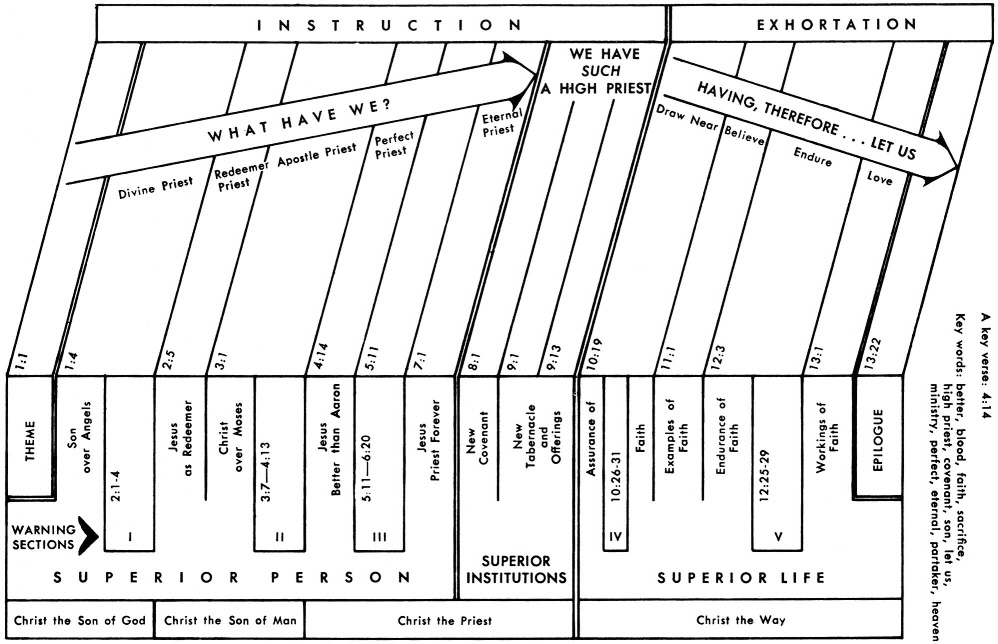
CONSIDER JESUS OUR GREAT HIGH PRIEST
Click chart to enlarge
Charts from Jensen's Survey of the NT - used by permission
Swindoll's Chart, Interesting Pictorial Chart of Hebrews, Another Chart
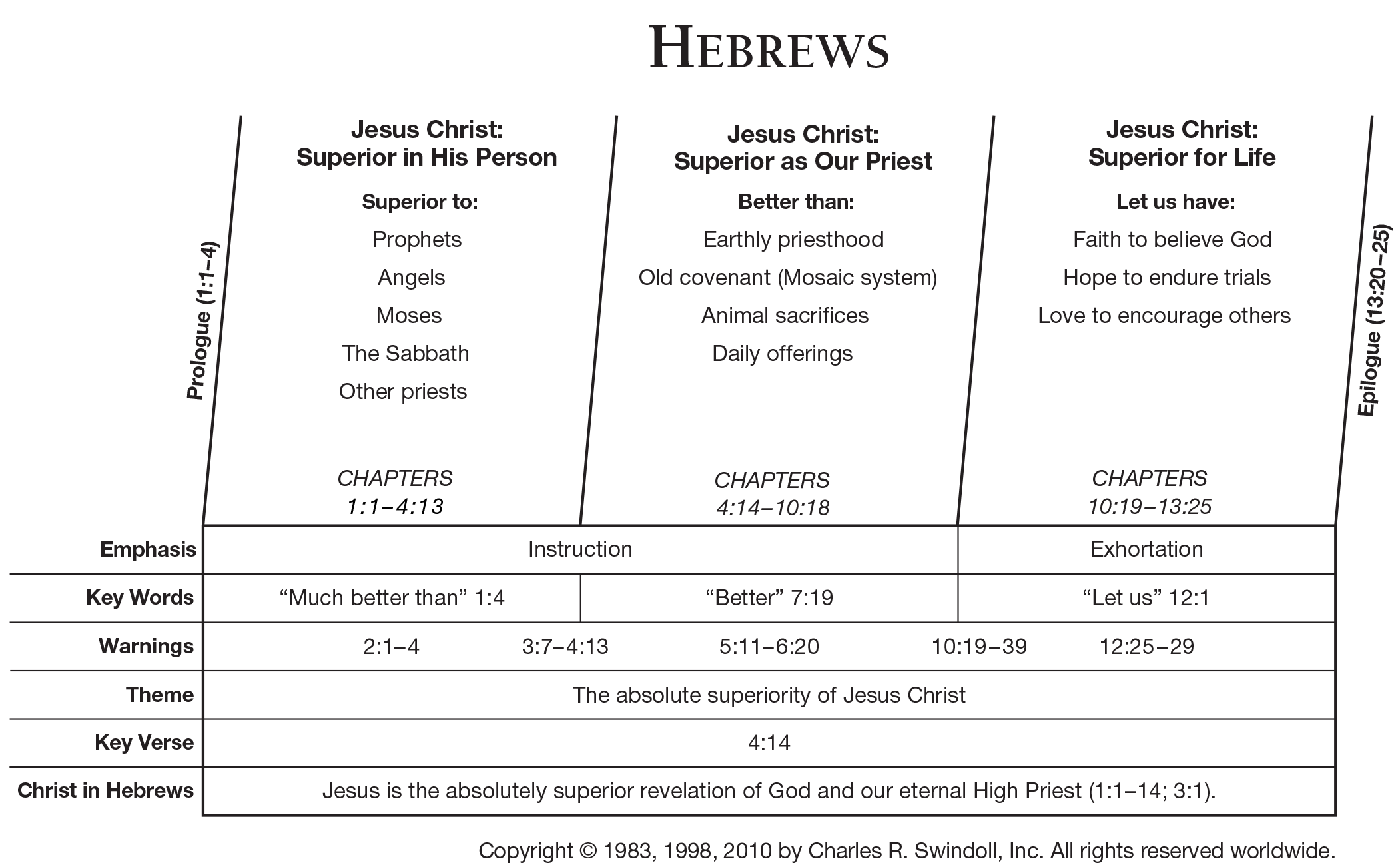

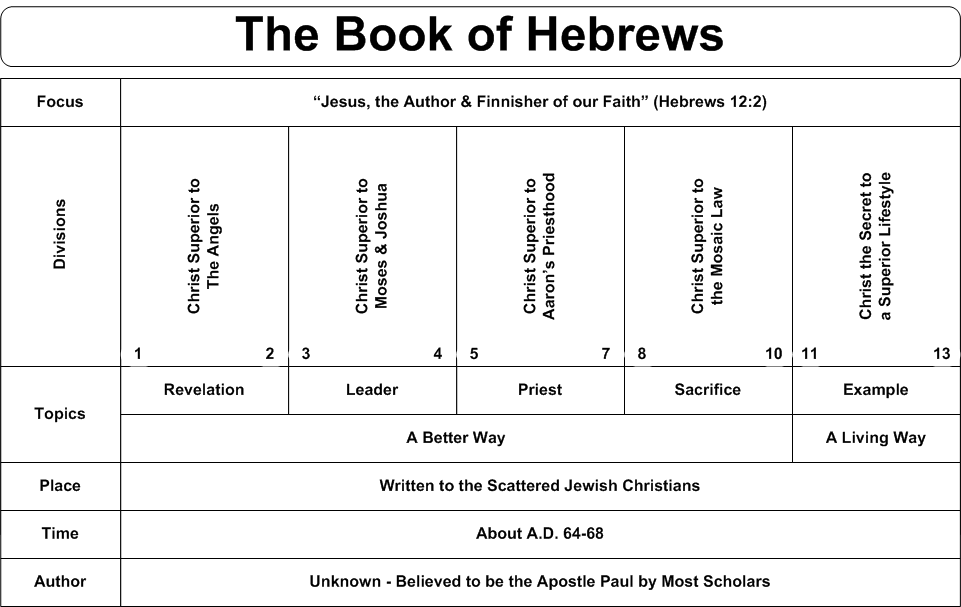
|
The Epistle |
||||
| INSTRUCTION Hebrews 1-10:18 |
EXHORTATION Hebrews 10:19-13:25 |
|||
| Superior Person of Christ Hebrews 1:1-4:13 |
Superior Priest in Christ Hebrews 4:14-10:18 |
Superior Life In Christ Hebrews 10:19-13:25 |
||
| BETTER THAN PERSON Hebrews 1:1-4:13 |
BETTER PRIESTHOOD Heb 4:14-7:28 |
BETTER COVENANT Heb 8:1-13 |
BETTER SACRIFICE Heb 9:1-10:18 |
BETTER LIFE |
| MAJESTY OF CHRIST |
MINISTRY OF CHRIST |
MINISTERS FOR CHRIST |
||
|
DOCTRINE |
DUTY |
|||
|
DATE WRITTEN: |
||||

See ESV Study Bible "Introduction to Hebrews"
(See also MacArthur's Introduction to Hebrews)
Borrow Ryrie Study Bible
Hebrews 10:32 But remember the former days, when *, after being enlightened, you endured a great conflict of sufferings, (NASB: Lockman)
Greek: Anamimneskesthe (2PPMM) de tas proteron emeras, en ais photisthentes (APPMPN) pollen athlesin upemeinate (2PAAI) pathematon
BGT Ἀναμιμνῄσκεσθε δὲ τὰς πρότερον ἡμέρας, ἐν αἷς φωτισθέντες πολλὴν ἄθλησιν ὑπεμείνατε παθημάτων,
Amplified: But be ever mindful of the days gone by in which, after you were first spiritually enlightened, you endured a great and painful struggle, (Amplified Bible - Lockman)
Barclay: Remember the former days. Remember how, after you had been enlightened, you had to go through a hard struggle of suffering, (Westminster Press)
NLT: Don't ever forget those early days when you first learned about Christ. Remember how you remained faithful even though it meant terrible suffering. (NLT - Tyndale House)
KJV But call to remembrance the former days, in which, after ye were illuminated, ye endured a great fight of afflictions;
NKJ But recall the former days in which, after you were illuminated, you endured a great struggle with sufferings:
NET But remember the former days when you endured a harsh conflict of suffering after you were enlightened.
CSB Remember the earlier days when, after you had been enlightened, you endured a hard struggle with sufferings.
ESV But recall the former days when, after you were enlightened, you endured a hard struggle with sufferings,
NIV Remember those earlier days after you had received the light, when you stood your ground in a great contest in the face of suffering.
Phillips: You must never forget those past days when you had received the light and went through such a great and painful struggle. (Phillips: Touchstone)
Wuest: But constantly be recalling the former days in which after being enlightened, you remained steadfast throughout a great struggle consisting of sufferings,
Young's Literal: And call to your remembrance the former days, in which, having been enlightened, ye did endure much conflict of sufferings,
|
CONTRASTING MESSAGE TO |
||
|
THE WARNING |
THE ENCOURAGEMENT |
|
| Advantages |
(1) Received knowledge of the truth (He 10:26) (2) Sanctified (He 10:29) |
(1) Enlightened (He 10:32) |
| Actions |
(1) Go on willfully sinning (He 10:26) (2) Trample under foot Son of God (He 10:29) (3) Regard as unclean the blood of New Covenant (He 10:29) (Cp setting aside Old Covenant He 10:28) (4) Insult Spirit of Grace (He 10:29) (5) Shrink back to destruction (He 10:39) |
(1) Endured great conflict of suffering (He 10:32) -- Made public spectacle -- Sharers w those made spectacle (2). Sympathized with prisoners (He 10:34) (3) Accepted joyfully seizure of property (He 10:34) (4) Live by faith (He 10:38) (5) Have faith to the preserving of the soul (He 10:39) |
|
Accounting |
(1) No longer remains a sacrifice for sins (He 10:26)
(2) Terrifying judgment (He 10:27) (3) Fury of consuming fire (He 10:27) (4) Deserve > punishment than those committed "high handed" sins under the Old Covenant. (He 10:29) (5) God Himself will repay (He 10:30) (6) Lord will judge (He 10:30) (7) God has no pleasure in him (He 10:38) (8) Destruction (He 10:39). |
(1) A Better Possession (abiding one). (He 10:34) (2) Great Reward (He 10:35) (3) What was promised (He 10:36) (4) Righteous (He 10:38) (5) Soul preserved (He 10:39) |
BUT REMEMBER THE FORMER DAYS WHEN, AFTER BEING ENLIGHTENED YOU ENDURED A GREAT CONFLICT OF SUFFERINGS: de Anamimneskesthe (2PPMM) de tas proteron hemeras en ais photisthentes (APPMPN) pollen athlesin hupemeinate (2PAAI) pathematon:
- Remember - Gal 3:3-4; Php 3:16; 2Jn 1:8; Rev 2:4-5; 3:3
- After being enlightened - He 6:4; Acts 26:18; 2Cor 4:6
- You endured - Heb 12:4; Acts 8:1-3; Acts 9:1,2; Php 1:29,30; Col 2:1; 2Ti 2:3-13; 4:7,8
- Hebrews 10 Resources - Multiple Sermons and Commentaries
- Look at the Book - John Piper on Hebrews 10:32-35 - A Better and Abiding Possession
Related Passages:
Galatians 3:3-4+ Are you so foolish? Having begun by the Spirit, are you now being perfected by the flesh? 4 Did you suffer so many things in vain–if indeed it was in vain?
Galatians 5:7+ You were running well; who hindered you from obeying the truth?
Philippians 3:16+ however, let us keep living by that same standard to which we have attained.
2 John 1:8+ Watch (present imperative see our need to depend on the Holy Spirit to obey) yourselves, that you do not lose what we have accomplished, but that you may receive a full reward.
Revelation 2:4-5+ (3 "R'S" - REMEMBER...REPENT...REPEAT) ‘But I have this against you, that you have left your first love. 5 ‘Therefore remember (present imperative see our need to depend on the Holy Spirit to obey - KEEP ON REMEMBERING!!!) from where you have fallen, and repent (aorist imperative see our need to depend on the Holy Spirit to obey) and do (aorist imperative see our need to depend on the Holy Spirit to obey) the deeds you did at first; or else I am coming to you and will remove your lampstand out of its place–unless you repent.
Hebrews 6:4+ For in the case of those who have once been enlightened and have tasted of the heavenly gift and have been made partakers of the Holy Spirit,
Acts 26:18+ to open their eyes (AKA "ENLIGHTENMENT") so that they may turn from darkness to light and from the dominion of Satan to God, that they may receive forgiveness of sins and an inheritance among those who have been sanctified by faith in Me.’
2 Corinthians 4:6+ For God, who said, “Light shall shine out of darkness,” is the One who has shone in our hearts to give the Light of the knowledge of the glory of God in the face of Christ.
1 Peter 2:19-20+ For this finds favor, if for the sake of conscience toward God a person bears up under sorrows when suffering unjustly. 20 For what credit is there if, when you sin and are harshly treated, you endure it with patience (hupomeno)? But if when you do what is right and suffer for it you patiently endure (hupomeno) it, this finds favor with God.
REMEMBER THE
"GOOD OLD DAYS!"
I like the way Gareth Cockerill sets the stage for this next section writing that the author "has come to the point where warning must be balanced with encouragement lest they fall into despair. It takes both warning and encouragement to sustain perseverance." (The Epistle to the Hebrews - Page 494)
W E Vine sets the context "The writer now turns to minister comfort to his readers who are truly regenerate, just as he did at Heb 6:9+ when he said, “But, beloved, we are persuaded better things of you.” He reminds them of their former afflictions, their endurance and devoted ministry, exhorts them to boldness and patience in view of the coming of the Lord, and rejoices that he and they are not of them that “shrink back unto perdition,” as in the case of those whose judgment he had mentioned in Heb 10:26–31, but “of them that have faith to the saving of the soul.” (Collected Writings)
Ray Stedman - Once again, as in chapter 6, we see the writer's confidence that most of those he addresses are not apostate, as he describes in He 10:32-34. He seeks to recall them to the love and steadfastness they had exhibited when their faith in Jesus was new. They had received the light as had also those now threatening apostasy, as He 10:26 makes clear. But most had: (1) accepted insult and persecution to their own person, or supported others so treated; (2) visited and sustained those put In prison for their faith; and (3) actually felt joy over watching their property confiscated, since they took comfort in the fact that their true treasures were in heaven, not on earth. Such actions were the product of true faith, and he urges them to keep this confident faith in verses 35-36, since perseverance is the proof of reality. The persecutions and injustices they endured presented strong temptations to give up, to accept the values of society around, and to forget what they had learned about the realities of life, death and eternity. Many are tempted today to throw away [their] confidence. Confidence is what motivates appropriate action in view of the times in which one lives. (Hebrews Commentary Part II)
Kenneth Wuest - The writer now turns from his solemn warnings against apostasy, to a word of encouragement arising from the conduct of his readers in the past. Their firmness under persecution did not look likely to end in apostasy. So he cheers and invigorates them by recalling to their memories their past afflictions because of their testimony to the crucified risen, ascended Messiah. These persecutions came from the adherents of Judaism. Just as a Jew who receives the Lord Jesus is bitterly persecuted today by his brethren after the flesh, so it was in the first century. (Hebrews Commentary)
Chrysostom prefaces this next section noting that "The best Physicians after they have made a deep incision, and have increased the pains by the wound, soothing the afflicted part, and giving rest and refreshment to the disturbed soul, proceed not to make a second incision, but rather soothe that which has been made with gentle remedies, and such as are suited to remove the violence of the pain."
But (de) marks a contrast with the preceding warning message which describes falling away (see the table above for points of contrast). The writer now proceeds to encourage his readers to do exactly the opposite, to endure in the face of adversity.
Remember (anamimnesko - call to mind) the former (proteros) days, when, after being enlightened (photizo), you endured (hupomeno) a great (polus) conflict (athlesis) of sufferings (pathema - plural!) -- Remember (anamimnesko - call to mind) in this verse is a command in the present tense (present imperative see our need to depend on the Holy Spirit to obey) charging his faithful readers to continually recall to their minds the truths listed ("advantages, actions, accounting" in above table), one by one. It is good to rehearse our past experiences with the Lord and His faithfulness for this strengthens present faith. Remember is in the middle voice which is reflexive and can be rendered something like "remind yourselves" (cp similar use 2Cor 7:15+).
John MacArthur comments that the idea of remember (anamimnesko) in this passage "is that these fellow Jews, who were so close to salvation, should, truth-by-truth and event-by-event, look back on what they had learned and on what they had experienced because of the gospel of Jesus Christ. This would be a strong deterrent to apostasy and a strong encouragement to belief." (See Hebrews Commentary - Page 281)
Andrew Murray on remember - The retrospect would call up the joy with which they once had sacrificed all for the name of Jesus, would humble them in view of past backsliding and present coldness, would stir within the desire and the hope of regaining the place they once had occupied.
Richard Brooks on remember - There can be a great benefit in this exercise, particularly when the Christian is ‘up against it’, for it is a means of sharpening our often dull recollection of the kindness and faithfulness of God, who has daily followed us with his ‘goodness and mercy’ (Psalm 23:6). It is commended, for example, way back in Deuteronomy 8:2+, where Moses exhorts the people to ‘remember the whole way that the Lord your God has led you these forty years in the wilderness, that he might humble you, testing you to know what was in your heart, whether you would keep his commandments or not’. Indeed, the entire book of Deuteronomy is really what we might call a book of ‘remembrance’ or ‘remembering’. (Hebrews: The Name High Over All)
Remembering former grace
fuels present endurance.As Charles Spurgeon beautifully put it “We must fish up from the deeps of memory the pearls of past deliverance, and wear them as jewels of encouragement.”
The former (proteros) days identifies what the writer is saying as a definite experience of his readers at a certain time in the past; at some time in the past they had the experienced enlightening (cp He 5:12+, He 5:13, 14+), when they professed conversion and confessed Christ publicly and without shame, as those who had been turned from darkness to light (Acts 26:18+). After their enlightenment, apparently spiritual warfare kicked in but they stood firm, held fast, did not faint nor give way to discouragement (Heb 12:4+).
R Fuller - The former days—times of trial, conflict, discouragement, temptation. Did we oftener call these to remembrance, with how much more delight would we make the covert of God’s faithfulness our refuge, exclaiming with the psalmist, “Because Thou hast been my help, therefore in the shadow of Thy wings will I rejoice.” (See D L Moody's Thoughts for the Quiet Hour)
Steven Cole - “The former days” refers to the time just after these Hebrew Christians had been saved. The author draws their minds back to how God had worked in their lives during that time, in spite of some very difficult circumstances. His point is, “You did well then, so you can hang in there now and in the future if persecution hits.” (ED: cf 1Pe 4:12+) He reminds them of three things that were true of them as new converts, which also are true of all believers: Remember how God enlightened you with a new, godly understanding of life. Unbelievers are described in Scripture as being spiritually blind, unable to “see the light of the gospel of the glory of Christ.” (2Co 4:4+) Only God can command the light to shine out of darkness. (2Co 4:6+) He “shone in our hearts to give the Light of the knowledge of the glory of God in the face of Christ” (2Co 4:4, 6+). Before God opened our eyes, we did not even see our need for the Savior. We mistakenly thought that we were good enough to get into heaven by our own righteousness. We had no idea of how terrible our sins were or of how holy God is. We did not appreciate the fact that the Son of God gave Himself on the cross to pay our debt of sin. But then, while we were yet in such darkness, God graciously opened our eyes. With the converted slave trader, John Newton, we could sing, “I once was blind, but now I see!” I remind you, however, that the apostates had experienced some degree of enlightenment, and yet they were not truly saved (He 6:4+). It is possible to have a fair amount of theological understanding, and yet be lost! Some men have devoted their lives to studying the Bible and writing scholarly books. But these scholars have never repented of their sins and put their trust in Christ as Savior. They are “enlightened,” but headed for eternal destruction. (Enduring Faith Hebrews 10:32-39)
Being enlightened (photizo) in the aorist tense (past completed action) and passive voice (an effect produced by an outside Source, in context, the Holy Spirit = "divine passive" - Jn 3:3-8+, cf 1Co 2:10+) is a metaphor for conversion, being born again, coming to know the truth of the gospel by which they were "rescued from the domain of darkness, and transferred to the kingdom of His beloved Son." (Col 1:13+). And once enlightened, they themselves became lights shining the truth of Jesus in a spiritually dark and blind world (Mt 5:14-16+), but the reaction was not always attraction! Little wonder that their "honeymoon" period after their new birth was followed by a great conflict (athlesis) of sufferings (pathema).
After being enlightened - They had heard the truth of the Gospel and intellectually had understood that truth. While faith necessitates hearing the truth of the Gospel, faith that is effective to bring about salvation must impact not just one's head, but one's heart. In other words, the belief that brings about the new birth is more than a "demonic" like, intellectual assent to a set of facts or truths (Jas 2:19+), for while the demons believe in God, clearly they are not saved. To be sure, genuine belief which results in salvation clearly involves intellectual assent ("enlightenment"), but it also includes an act of one's heart and will.(Read Ro 10:9,10+). Biblical saving faith is not passive assent but an active staking of one's life on the claims of God.
The respected Greek scholar W E Vine defines belief as consisting of (1) a firm conviction which produces full acknowledgment of God's revelation of Truth - (2Th 2:11+ -"in order that they all may be judged who did not believe [pisteuo] the truth, but took pleasure in wickedness.") (2) a personal surrender to the Truth (Jn 1:12+ "But as many as received Him, to them He gave the right to become children of God, even to those who believe [pisteuo] in His name") and (3) a conduct inspired by and consistent with that surrender. This is not faith plus works but a faith that works. Faith alone saves but the faith that saves is not alone.
So what does "enlightenment" mean in the present context? Examination of their "works" ("endured a great conflict of sufferings… made a public spectacle… sharers with those who were so treated… sympathy with the prisoners [this surely would not have been "safe"]… accepted joyfully the seizure of your property" - He 10:32-34) strongly supports that these "enlightened" individuals were genuine saints who had undergone true conversion to Christ (see Jas 2:14-26+).
In one sense every man is enlightened (Jn 1:9+), but enlightenment does not necessarily guarantee salvation. Head knowledge never saved anyone. Whether enlightenment refers to intellectual knowledge regarding the "good news" (see Heb 6:4+; He 10:26+) or is indicative of Spirit wrought regeneration ultimately is demonstrated by one's life (Jas 2:20+, cp 2Co 13:5+). In the present case note that the group he is referring to in this section seems to manifest fruit in keeping with genuine repentance - they were persecuted and did not immediately fall away suggesting that they were genuine believers (Heb 10:39+).
William Kelly commenting on this section writes that "Relaxation is ever a danger for soldiers when on service, as Christians always are here below; and those who had been Jews were exposed to it as much at least as Gentile brethren…The Hebrew believers had begun well (cp Gal 5:7+); they are here urged to continue enduring the fierce conflict of the enemy."
Spurgeon - The apostle is not expecting that any of them will ever go back to where they were before; he is persuaded that they will persevere even to the end. The very warning that he gives is a powerful preventive against apostasy. Now comes the exhortation: “Call to remembrance the former days.” Some of you can “call to remembrance” the time when you joined the church, when you had to run the gauntlet for Christ’s sake. Then, in your early Christian life, you feared nothing and nobody so long as you could glorify God. Then, you had great enjoyment, sweet seasons of communion with your Lord: “Call to remembrance the former days.”
🙏 THOUGHT - Beloved you may have begun well and if so you certainly want to end well (cf 2Ti 4:7-8+, 1Co 9:24-27+, Php 3:12-14+, and my life verse Acts 20:24+). Remember that the Christian life is not a hundred-yard dash but a lifelong marathon. The finish line is not conversion but glorification and the prize is not earthly applause but the ‘Well done’ of the Master. (Mt 25:21+) Here the writer of Hebrews says that a major component of finishing well is to remember well. And so the writer seeks to remind and recall them to manifest the love and steadfastness they had exhibited when they first fell in love with Jesus (cp Rev 2:4,5+). Oh, how we all need to hear and heed the sage writer's plea to remember! Let us finish well Lord, by the power of Your Word and Spirit, for Your glory and through the blood of Your Lamb. Amen
S Lewis Johnson - Now, the encouragement that he wants to give them is the same kind of encouragement that the author offered in the 6th chapter. You can see how this is very much upon his heart; the encouragement of believers who have been suffering for their faith. Back in Hebrews 6:10, he wrote to them, “For God is not unjust to forget your work and labor of love which you have shown toward His name, in that you have ministered to the saints, and do minister.” And, you’ll notice, He 10:32, reminds one of that, “But recall the former days in which, after you were illuminated, you endured a great struggle with sufferings.” And then in Hebrews 6:12, he said, “[But] do not become sluggish, but imitate those who through faith and patience inherit the promises.” And in Hebrews 10:36, he says, “For you have need of endurance, so that having done the will of God, you may receive the promise.” (Hebrews)
To have enduring faith in trials,
remember how God worked in the past.
When the Spirit of Truth makes one a new creature in Christ (2Co 5:17+), he will come under attack from the enemy and the temptation will be to turn back to their former way of life. The one who turns back (descriptive of apostasy in the language of Hebrews) and remains "turned away" from Christ, demonstrates that they were never truly born again (cp Mt 13:5, 6, 20, 21, Lk 8:6, 13).
Steven Cole has a great word encompassing our past, present and future...To have faith that endures trials, remember how God worked in the past, focus on doing His will in the present, and look to His promises in the future.
You endured (hupomeno - bore up under pressure of) a great (not trivial or small) conflict (athlesis - a hard fought athletic contest) of sufferings (pathema - note the plural) - You held your ground through a massive athletic-like contest of many sufferings. What a word of encouragement to these persecuted saints! The readers would naturally call to mind the Greek athletes straining in the arena, training, bleeding, and refusing to quit. Endurance was the athlete's key to victory and was also the key for the believer to experience Christ's victory already won for them at the Cross! And of course, they would not break the tape at the finish line until they had faithfully run their race all the way to the end. (Heb 3:6+, Heb 3:14+). Nero’s shadow was approaching. Yet they endured rather than renounced Christ. Endured is in the aorist tense (past completed action), active voice (their choice) and the indicative mood (mood of reality) which emphasizes that this group of readers really did endure, standing firm instead of running fast! This was a "historical" reality for them. Note that endured does not describe one gritting their teeth and bearing up like a stoic, but one who is energized by the Holy Spirit to courageously persevere despite suffering physical and/or emotional pain for the sake of Christ (1Pe 2:19-20+, 1Pe 3:14+, 1Pe 3:17+, 1Pe 4:15-16+, 1Pe 5:9+). These brothers and sisters did not collapse under persecution but they remained under the weight of suffering, anchored by their faith in Christ and empowered by the Spirit of grace, waiting expectantly for the indescribable reward of God’s “Unshakable Kingdom” (Hebrews 12:25–29+). May their tribe increase! The persecution was like a hard-fought athletic contest viewed by a partisan, even hostile crowd. There was nothing passive in their display. In fact, they showed superb spiritual athleticism as they stood their ground!
🙏 THOUGHT - Endurance is a critical Christian virtue. Unless we have endurance, we can never learn many of the truths that God wants us to learn, truths that will lead us into a deeper (experiential) life in Christ and a more fruitful ministry. Children are usually impatient; they cannot sit still long enough to get the things done that need to be done. “How long do we have to wait?” is the child's typical question. Impatience is a mark of immaturity. Impatience is also a mark of unbelief. May our Father grant us by His Spirit the inner power to endure to the end of our race. In the Name of the One Who ran and won! Amen
The doctrine of endurance is a key truth in this final practical portion of Hebrews being found in various forms (endure, endured, endurance) in 8x/8v - Heb 10:32, Heb 10:36, Heb 11:25, Heb 11:27, Heb 12:1, Heb 12:2, Heb 12:3, Heb 12:7
Spurgeon - In your early Christian days, you were pointed at, and regarded as quite singular for being servants of Christ; or, possibly, it was not yourselves so much as your pastors, your leaders, your friends who were prominent in the church, at whom the arrows of the adversaries were aimed. They shot at you through them; and, sometimes, that pained you much more than when they distinctly attacked you. Altogether, it was “a great fight of afflictions” that you had to endure.
Jamieson-Fausset-Brown - A great fight of afflictions—the phrase implies a well-sustained and nobly-endured struggle. They had shown themselves champions of the faith.
Vincent’s Word Studies - Athlēsis…the athletic figure is appropriate to the idea of endurance under persecution. Their sufferings were viewed as part of the contest-training of the spiritual athlete.
Spurgeon - The Lord’s people have always been an exercised people; their trials are the gymnasium of their graces.
Gareth Cockerill on conflict (athlesis) of sufferings (pathema) - Athletic competition was an important part of the Greek emphasis on excellence of body as well as mind. Furthermore, it was common for contemporary philosophers to liken the virtuous life to an athletic “contest” that required discipline and was shaped by the endurance of suffering. The Stoics, in particular, were fond of using such imagery to describe the pursuit of the good life. Philo and other Jewish writers influenced by the Greek philosophical tradition made abundant use of this athletic metaphor....Furthermore, the status given victorious athletes in the contemporary world made this way of speaking a most effective way to encourage a suffering minority by turning their present shame into a badge of honor. By enduring the very abuse and shame heaped on them by an unbelieving world, they win the honor and glory of a victor’s crown. (See The Epistle to the Hebrews - Page 497)
Homer Kent on conflict (athlesis) of sufferings (pathema) - A great contest of sufferings depicts these afflictions somewhat figuratively as a contest (athlēsin), in which their enemies or perhaps the trials themselves are viewed as fighting against them. The important thing to notice is that they had endured these sufferings without flinching. In the first bloom of their faith, the fact of suffering for the name of Christ was taken for granted, just as in the case of the early believers in Jerusalem (Acts 5:41). (Borrow Hebrews Commentary)
R Kent Hughes on conflict (athlesis) of sufferings (pathema) - This was a challenge to recall how they had marvelously stood unmoved some fifteen years earlier during the persecution under the Roman Emperor Claudius in A.D. 49. A famous quotation from the historian Suetonius indicates the character of the Claudian persecution: “There were riots in the Jewish quarter at the instigation of Chrestus. As a result, Claudius expelled the Jews from Rome” (Life of the Deified Claudius, 25.4). Historians believe “Chrestus” is a reference to Christ and that the riots and expulsion occurred when Jewish Christians were banished from the synagogue by the Jewish establishment. No one had been killed (cf. 12:4), but it was nevertheless a wrenching time of humiliation and abuse. (See Hebrews: An Anchor for the Soul
John MacArthur - Do you remember when you first came to Christ and it was … you came to the fellowship of believers and you heard about Christ. And I’m not talking about being saved yet (Ed: In referring to this verse in Hebrews 10:32), but just the facts. And you knew it and it was exciting it was kind of neat and it was warm and something was real going on there and you could sense it and you showed up and you liked it. Hey, he says, anamimnesko… remember those things. Look back and pick them up again. Run over in your mind, the word means one by one, the things you felt when you first came, how exciting and how fresh and how real and how, oh, it seemed like maybe this was answer to your problems. And little by little you grew cold and indifferent and begin to fade. And even that, he says, remember that you even endured a great fight of affliction. You even got persecuted along with the rest of us. I mean, you were so visibly identified with us, you got some of the abuse that we got. Remember that? Interesting word for fight there … Athlesis from which we get athletic… you went through all the rigors with us. It’s so common when Christianity is fresh, people come and they don’t worry about what others think. I always say it’s interesting how bold new Christians are. They haven’t learned to be cowards yet. It takes a while. They come to Christianity and it’s fresh and exciting and they like it, you know. And they get into the swing of it a little bit and then the pressure mounts up and it gets to be old hat. And they really don’t want to come to Christ because they like their sin and etc., etc., and they fade. And so the writer says remember. Remember those fresh days, those exciting days when it all began? The first time you ever heard it? Remember. (Hebrews 10:28-39 Apostasy: The Negative Response to the New Covenant 2)
John Piper discusses how the enlightenment of the Hebrew Christians led to sufferings -
"After Being “Enlightened” - The writer tells the church to “remember the former days, when, after being enlightened, you endured a great conflict of sufferings.” The word “enlightened” is used at least two ways in the New Testament: it can mean that the one enlightened sees more clearly or shines more clearly. For example, it can mean that light “goes on” in the heart and truth is seen clearly that once was dark (as when Paul prayed that the Ephesians would have the eyes of their hearts enlightened to know God—Eph 1:18+. Or it can mean that what is enlightened (doesn’t see more clearly but) shines more clearly (as when Paul says that Christ lightened life and immortality, that is, Christ brought them to light; he made them shine more clearly—2 Timothy 1:10+). What does it mean here in Hebrews 10:32? It’s pretty clearly a reference to their conversion. And both meanings seem to be very relevant from what we know about that conversion. On the one hand to become a Christian means (from 2 Corinthians 4:6+) that God says, “Let there be light,” in our hearts and “the light of the knowledge of the glory of God in the face of Christ” fills us with confidence of his reality and worth. So we are “enlightened” in the first sense—we see the glory of God and the reality of Christ more clearly. Lights go on in us. But then the New Testament talks about how becoming a Christian means we also shine like lights in the midst of a crooked and perverse world (Philippians 2:15+). We don’t just see the light of God’s glory more clearly, we begin to reflect it. God shines into us and we shine out to the world. So I take Hebrews 10:32 to point to these two things. These Christians had come to see the light of the gospel of the glory of God as true and infinitely valuable; AND they had then begun to shine in the world as a witness to this truth and value. The first experience set them free from the world and the second made them stand out from the world.
And the result was suffering. “But remember the former days, when, after being enlightened, you endured a great conflict of sufferings.” It is not unnatural for the world to see the shining of Christian truth and Christian love and hate it. Just before Jesus said, “Let your light so shine before men that they may see your good deeds and give glory to your Father in heaven” (which sounds like a positive response), he also said, “Blessed are you when men reproach you and persecute you and utter all kinds of evil against you falsely on my account” (Matthew 5:16+, Mt 5:11+). In other words, some are enlightened by your shining; others are incensed by your shining (ED: cf our aroma - 2 Cor 2:14-16). In the former days, after the Hebrew Christians started to see the glory of Christ and to shine with the glory of Christ, they also started to suffer for Christ. That’s what Christianity meant. Receive Christ and receive suffering. Evidently they thought things or said things or did things that were not politically correct in those days and the upshot was that some of them got arrested and some others got in trouble because they stood by those who got arrested. (You Joyfully Accepted the Plundering of Your Property)
SUFFERINGS ARE
A SAINT'S LOT
The sufferings (pathema) of this life are the lot of all believers but keep in mind that for believers suffering takes on a different meaning and purpose then suffering in general - as believers we suffer for our faith in Christ (and Christ in us Who the world hates) and we suffer that we might be conformed to His image. Furthermore, any suffering and shame we experience in this life for the sake of the Christ "are not worthy to be compared with the glory that is to be revealed to us" (see Ro 8:18+)
🙏 THOUGHT - Sufferings (pathema) are the mark of all true Christians. Realizing that other Christians suffer in other places of the world, encourages us to move on in the faith (cp 1Pe 5:9,10+). Suffering also unites believers a "brotherhood" of shared experiences. We can handle anything that life may bring us if we know the principles of the Word of Truth, which is the foundation for our shield of faith (Ro 10:17+, Ep 6:16+). And remember that we are not to be ignorant of Satan's schemes (2Co 2:11+), one of which is to use suffering, trials, adversity, etc to discourage us and to "dislodge" us so that we don't continue to stand firm in the true grace of God (cp 1Pe 5:12+, a passage also in the context of discussion of suffering = 1Pe 5:10+). Our inveterate foe the Devil (more likely his underling angels) shoots fiery missiles (Ep 6:16+) like "You're the only one suffering like this." And this fiery missile is a soul withering thought if not taken captive to Christ (2Co 10:5+), for in the midst of the fire of affliction, it is easy to grow weary and want to give up (cp He 12:3,4+) under the mistaken impression that no one else has as much trouble as we do. In this section the writer of Hebrews reminds his readers of God's truth which defeats and deflates Satan's lie.
Remember (363) (anamimnesko from ana = again + mimnesko = remember so literally recall again is more forceful than mimnesko alone) carries idea of carefully thinking back and reconstructing something in one’s mind, not merely remembering. Call to remembrance. Cause to remember. To remind someone of something. In passive voice means to be reminded or to remember.
Wuest - The words “call to remembrance” are the translation of Anamimnesko which Alford says is stronger than the simple verb, and means “call over in your minds, one by one,” the present tense implying constant habit. (Hebrews Commentary online)
Anamimnesko is stronger than the simple verb mimnesko. Anamimnesko carries the idea of carefully thinking back over something in one’s mind, not simply remembering (2Cor 7:15). Compare the writer's charge here to the charge by Joshua to the leaders of the tribes to set up stones to function as signs (memorials)…
Joshua 4:7 (Context = Josh 4:5, 6) then you shall say to them, ‘Because the waters of the Jordan were cut off before the ark of the covenant of the Lord; when it crossed the Jordan, the waters of the Jordan were cut off.’ So these stones shall become a memorial to the sons of Israel forever.”
🙏THOUGHT - Dear believer have you heaped up any rocks as a memorial to testify to the power of God in your life - fulfilled promises, answered prayer, miraculous deliverances, wonderful providential circumstances, and the list is endless, for God's grace giveth and giveth as beautifully penned in this poem by Annie Johnson Flint
HE GIVETH MORE GRACE
He giveth more grace when the burdens grow greater,
He sendeth more strength when the labors increase;
To added affliction He addeth His mercy,
To multiplied trials, His multiplied peace.
When we have exhausted our store of endurance,
When our strength has failed ere the day is half done,
When we reach the end of our hoarded resources,
Our Father's full giving is only begun.
His love has no limit, His grace has no measure;
His power no boundary known unto men;
For out of His infinite riches in Jesus
He giveth and giveth and giveth again
Anamimnesko - 6x in 6v - NAS = remember(1), remembered(1), remembers(1), remind(2), reminded(1).
Mark 11:21 Being reminded, Peter said to Him, "Rabbi, look, the fig tree which You cursed has withered."
Mark 14:72 Immediately a rooster crowed a second time. And Peter remembered how Jesus had made the remark to him, "Before a rooster crows twice, you will deny Me three times." And he began to weep.
Comment: This surely is one of the most poignant NT uses of anamimnesko! Put yourself in Peter's sandals for a moment, imagining his body heart rate pick up as he heard the first ominous crow of a rooster crow. Surely he won't crow again. And then as the second crow sounded forth imagine how he must have painfully recalled to his mind his Master's prophetic prediction!
1 Corinthians 4:17 For this reason I have sent to you Timothy, who is my beloved and faithful child in the Lord, and he will remind you of my ways which are in Christ, just as I teach everywhere in every church.
2 Corinthians 7:15 His (Titus - 2Co 7:13, 14) affection abounds all the more toward you, as he remembers the obedience of you all (This "reminds" me of one of my favorite verses for those I have had the privilege to disciple - 3John 1:4), how you received him with fear and trembling.
2 Timothy 1:6+ For this reason I remind you to kindle afresh the gift of God which is in you through the laying on of my hands.
Comment: Paul is constantly actively stirring up "embers" of past memories to stimulate Timothy not to shrink from the sufferings (reproach and tribulation) that a stand for Christ is "guaranteed" to bring but that he should press on to maturity, to run the race with endurance, to fight the good fight, to finish the course, to keep the faith. Paul is saying in essence "Remember when God did this or that for us… when He answered our prayers so clearly… when He removed incredible obstacles… when He performed the impossible… etc.
🙏THOUGHT - Beloved of the Father, may He grant each of us His all sufficient grace to continually have a ready recall of the great things God has done in our life so that we are encouraged and confident that He will complete the work He has begun in each of us (Php1:6+).
Hebrews 10:32 But remember the former days, when, after being enlightened, you endured a great conflict of sufferings,
Anamimnesko - 19x in the non-apocryphal Septuagint - Gen 41:9; Exod 23:13; Num 5:15; 10:9; 2 Sam 18:18; 20:24; 1 Kgs 4:20; 17:18; 2 Kgs 18:18, 37; Job 24:20; Ps 109:14; Jer 4:16; Ezek 21:23f; 23:19; 29:16; 33:13, 16. Here are some representative uses…
Numbers 5:15 the man shall then bring his wife to the priest, and shall bring as an offering for her one-tenth of an ephah of barley meal; he shall not pour oil on it nor put frankincense on it, for it is a grain offering of jealousy, a grain offering of memorial, a reminder (Hebrew = zakar; Lxx - anamimnesko) of iniquity.
Numbers 10:9 "When you go to war in your land against the adversary who attacks you, then you shall sound an alarm with the trumpets, that you may be remembered (Hebrew = zakar; Lxx - anamimnesko) before the LORD your God, and be saved from your enemies.
Former (4387) (proteros from pró = forth, before) means prior (earlier in time or order), previous (going before in time, implying existing or occurring earlier), of an earlier time, all pertaining to a point of time earlier in a sequence. Proteros refers to a period of time preceding another period of time. Before (at an earlier time), formerly; first, first of all; at first, the first time, originally. Louw-Nida add that proteros is used in Gal 4:13 to mean "first, with the implication of emphasis, frequently in reference to time—‘the first time.’"
Earlier in Hebrews the writer had used proteros to describe the OT Israelites…
Hebrews 4:6 Therefore, since it remains for some to enter it, and those who formerly had good news preached to them failed to enter because of disobedience (Note: disobedience equates with unbelief in Heb 3:18, 19+)
PROTEROS - 11x/11v-Jn. 6:62; 7:50; 9:8; 2Co 1:15; Gal 4:13; Eph 4:22; 1Ti 1:13; Heb 4:6; 7:27; 10:32; 1Pe 1:14. NAS - as before(2), first(2), first time(1), former(3), formerly(2), previously(1).
John 6:62 "What then if you see the Son of Man ascending to where He was before?
John 7:50 Nicodemus (he who came to Him before, being one of them) said to them,
John 9:8 Therefore the neighbors, and those who previously saw him as a beggar, were saying, "Is not this the one who used to sit and beg?"
2 Corinthians 1:15 In this confidence I intended at first to come to you, so that you might twice (Literally "a second grace" or "second favor" = idiom for a second visit) receive a blessing;
Galatians 4:13 but you know that it was because of a bodily illness that I preached the gospel to you the first time;
Vincent on proteros in this verse: Either generally, at an earlier time than the present (as Jn 6:62; 9:8; 1Ti 1:13), or the first time (as Heb 7:27). Here in the latter sense. Paul had visited the Galatians twice before he wrote this letter.
Ephesians 4:22+ that, in reference to your former manner of life, you lay aside the old self, which is being corrupted in accordance with the lusts of deceit,
1 Timothy 1:13 even though I was formerly a blasphemer and a persecutor and a violent aggressor. Yet I was shown mercy because I acted ignorantly in unbelief;
Hebrews 4:6+ Therefore, since it remains for some to enter it, and those who formerly had good news preached to them failed to enter because of disobedience,
Hebrews 7:27+ who does not need daily, like those high priests, to offer up sacrifices, first for His own sins and then for the sins of the people, because this He did once for all when He offered up Himself.
Hebrews 10:32+ But remember the former days, when, after being enlightened, you endured a great conflict of sufferings,
1 Peter 1:14+ As obedient children, do not be conformed to the former lusts which were yours in your ignorance,
PROTEROS - 61x in the non-apocryphal Septuagint -Ge 13:3; 26:1; 28:19; 38:28; 40:13; Exod 10:14; 23:28; 33:19; Lev 4:21; 5:8; 18:27; 26:45; Num 6:12; 10:33; 14:14; 21:26; 32:17, 30; Deut 1:22, 33; 2:10, 12, 20; 4:32; 9:18; 24:4; Josh 1:14; 3:14; 10:14; 11:10; 14:15; 15:15; 24:12; Judg 1:10; 18:29; 2 Sam 19:20; 1 Kgs 13:6; 1 Chr 9:2; 15:13; 29:29; Neh 13:5; Job 42:5; Eccl 7:10; Isa 1:26; 41:22; 46:9f; 48:3, 7; 52:4, 12; 61:4; 65:17; Jer 11:10; 28:8; 30:20; 33:7, 11; 34:5; Dan 3:22; Hos 2:7
Genesis 13:3 He went on his journeys from the Negev as far as Bethel, to the place where his tent had been at the beginning (Lxx = proteros), between Bethel and Ai,
Genesis 26:1 Now there was a famine in the land, besides the previous (Lxx = proteros) famine that had occurred in the days of Abraham. So Isaac went to Gerar, to Abimelech king of the Philistines.
Genesis 28:19 He called the name of that place Bethel; however, previously (Lxx = proteros) the name of the city had been Luz.
Isaiah 65:17 "For behold, I create new heavens and a new earth; And the former (Lxx = proteros) things will not be remembered or come to mind.
Enlightened (5461) (photizo from phos = light <> from phao = to shine) means to give light or to cause light to shine upon some object, in the sense of illuminating the object (see below for Eadie's description of the effect of photizo). Figuratively, it means to cause something to be fully known by revealing clearly and in some detail. It means to shed light upon or to illuminate.
John Eadie comments on Paul's use of the verb photizo in Ephesians 3:9+ -The verb photizo, followed by the accusative of the thing (Ed: "former days"), denotes to bring it into light; but followed by the accusative of the person, it signifies to throw light upon him—not only to teach (didasko), but to enlighten inwardly—to give spiritual apprehension. If one gaze upon a landscape as the rising sun strikes successive points, and brings them into view in every variety of tint and shade, both subjective and objective illumination is enjoyed. No wonder that in so many languages light is the emblem of knowledge. That mystery which was now placed in clear light was not discerned by the Jew, and could not have been perceived by the Gentile for the shadow which lay both on him and it.
PHOTIZO - 11V - Lk. 11:36; Jn. 1:9; 1 Co. 4:5; Eph. 1:18; Eph. 3:9; 2 Tim. 1:10; Heb. 6:4; Heb. 10:32; Rev. 18:1; Rev. 21:23; Rev. 22:5
Hebrews 6:4+ For in the case of those who have once been enlightened and have tasted of the heavenly gift and have been made partakers of the Holy Spirit, (DESCRIBES INTELLECTUAL ENLIGHTENMENT BUT NOT INTERNAL CONVERSION -- Enlightenment may open the eyes, but only regeneration opens the heart. Light received intellectually can still be rejected volitionally. One may see the Light and yet never step into it.)
Endured (5278) (hupomeno from hupó = under, as in under the rule of someone + meno = to abide or remain - study noun hupomone) means literally to remain under not simply with resignation, but with a vibrant hope. The idea of enduring is not just to "grin and bear it" but to remain under trials in a such a way that we glorify God as we learn the lessons the trials are meant to teach us, instead of seeking ways to get out from under (cf the prefix preposition "hupo" = under) the trials and be relieved of the pressure. Hupomeno was a military term used of an army’s holding a vital position at all costs. Every hardship and every suffering was to be endured in order to hold fast. In the Greek OT this word group had the connotation of expectant waiting upon God. In the realm of Greek moral philosophy it described the endurance of hardship and suffering without relief or reward.
Bishop Trench defined hupomeno (hupomone) as manifesting the "temper of spirit in which we accept God’s dealings with us as good, and therefore without disputing or resisting."
HUPOMENO-17x/16v - endure(3), endure… with patience(1), endured(5), endures(3), patiently endure(1), perseveres(1), persevering(1), remained(1), stayed behind(1). Mt 10:22; 24:13; Mk 13:13; Lk 2:43; Acts 17:14; Ro 12:12; 1Co 13:7; 2Ti 2:10, 12; Heb 10:32; 12:2f, 7; Jas 1:12; 5:11; 1Pe 2:20.
HUPOMENO = 4X in Hebrews (~25% of all uses in the NT) and the first two below should help motivate us to endure, for we are called to imitate Christ (1 Cor 11:1+)...(1) fix our eyes on Jesus and (2) consider His endurance in face of hostility.
Hebrews 12:2 fixing our eyes on Jesus, the author and perfecter of faith, who for the joy set before Him endured the cross, despising the shame, and has sat down at the right hand of the throne of God.
Hebrews 12:3 For consider Him who has endured such hostility by sinners against Himself, so that you will not grow weary and lose heart.
Hebrews 12:7 It is for discipline that you endure; God deals with you as with sons; for what son is there whom his father does not discipline?
The related noun hupomone is used twice in Hebrews...
Hebrews 10:36 For you have need of endurance, so that when you have done the will of God, you may receive what was promised.
Hebrews 12:1 Therefore, since we have so great a cloud of witnesses surrounding us, let us also lay aside every encumbrance and the sin which so easily entangles us, and let us run with endurance the race that is set before us,
Conflict (119) (athlesis from athleo - this is the only Biblical use; English word = athletic) is a noun which means a contest or combat, a challenge, and figuratively a struggle or a conflict. The only Scriptural use is Heb 10:32 (including no uses in Lxx or Apocrypha). In secular Greek athlesis was used of a "contest" especially of athletes. The Christian life, especially under persecution, is likened to a strenuous contest. In short, the Christian life is not a playground but a battleground. The sufferings of these saints were not accidents but appointments, in effect God’s training ground for further endurance (cf Jas 1:2-4+). The verb form athleo means to engage in competition or conflict. Athleo is used figuratively in 2Ti 2:5+ where Paul encourages his readers to endure hardship and compares the believer to one “who competes as an athlete” to receive the victor’s crown!
Athlesis "evokes the image of public struggle in the arena". (TDNT) Athlesis conveys the idea of a struggle that requires great determination to win. Athlesis, which always described a man involved in a tremendous athletic competition. This kind of athlete was serious about his sport and totally committed to the goal of climbing to the top in his profession. He was willing to undergo any hardship, any training, any regimen, and any kind of discipline in order to reach that goal of becoming the very best in his field of sports. The word athlesis describes this type of committed, full-time, professional, determined athlete.
TDNT on this word group - athleo means literally “to engage in competition or conflict”; it is also used figuratively in 4 Maccabees. athleo in 2Ti 2:5 suggests the need for exertion, sacrifice, and discipline. sunathleo in Phil. 1:27; 4:3 carries the idea of striving, suffering, and working together. Athlesis in Heb 10:32–33 evokes the image of public struggle in the arena. Athlesis is used by Ignatius (To Polycarp 1.3) and 1 Clement (5.1) for leaders and the apostles, while Christ is the supreme Athlesis in Acts of Thomas 39.
Wuest - The word conflict is the translation of athlesis, which was used by the Greeks to speak of an athletic contest or combat. This word was used in the next generation, of martyrdom. It refers to a terrific struggle. (Hebrews Commentary)
Sufferings (3804) (pathema) describes what happens to a person and must be endured. Pathema is talking about the actual suffering itself - it refers to the very pain that we are experiencing right now - those very things that we can "see, touch and feel" - those things that are causing us anguish and emotional trauma. The writer is not discounting the feelings of his suffering readers who are standing firm. This is a good word for all of us - it is so tempting to tell a suffering brother or sister "You shouldn't feel that way." Even as the suffering is very real, so too are the feelings that are evoked by the suffering. Yes, tell them to hold on to their faith, and their feelings may soon "get in line", but in the meantime don't discount their feelings which are very real.
PATHEMA - - 16x - NAS - note most often in plural - passions, 2; suffering, 2; sufferings, 12.Ro. 7:5+; Ro 8:18+; 2Co. 1:5, 6, 7; Gal. 5:24; Phil. 3:10+; Col 1:24+; 2Ti 3:11+; Heb. 2:9+ ; Heb 2:10+; Heb 10:32+; 1Pe 1:11+; 1Pe 4:13+; 1Pe 5:1+, 1Pe 5:9+.
Hebrews 2:9 But we do see Him who was made for a little while lower than the angels, namely, Jesus, because of the suffering of death crowned with glory and honor, so that by the grace of God He might taste death for everyone.
Hebrews 2:10 For it was fitting for Him, for whom are all things, and through whom are all things, in bringing many sons to glory, to perfect the author of their salvation through sufferings.
Wayne Detzler recounts an amazing true life example of Christian perseverance writing that
"True Christian perseverance is not tied to tenacity. It is rather the work of God the Holy Spirit in a believer's life. The starch in a saint's spine is shown by Scripture to be nothing less than the sanctifying work of the Holy Spirit. Only in this way can one explain the work of Gladys Aylward, a London parlor maid. Societies scorned her missionary application (China Missionary Society - See clip a must listen!). She seemed too dull to master Chinese and fulfill her vision of serving in China. Realizing this, she scoured up her own fare to China and sailed in 1930. After slogging her way across Siberia (see clip) she reached her field in remote Yangcheng. When the Japanese invaded in 1940 she led 100 children on an epic journey that caught the imagination of Hollywood (Ed: Watch the movie about her life - The Inn of the Sixth Happiness NOT FREE). In 1947 failing health forced her back to England where she crusaded for missions until her death in 1970. That was tenacity, not just British grit. It is God's persevering grace. (BORROW New Testament Words in Today's Language)
Related Resource - Recording of Gladys Aylward's testimony (A recording in 1950's)
Another great example of a Christian who endured (persevered) under trials in a God honoring way is William Wilberforce (biography in Wikipedia or short bio in Christian History) the 19th-century parliamentarian, who was moved by the Lord to oppose the lucrative but humanly degrading slave trade. In 1807 Wilberforce brought about the banning of the slave trade in England but it was not until 1833 was slavery as an institution abolished, this news reaching Wilberforce even as he lay on his deathbed. Talk about persevering!
A few takeaways from this great verse -
- Remember Past Endurance – When new trials arise, don't react but act by rehearsing how God carried you before.
- View Trials as Training – Each suffering is part of your "athletic conditioning" in godliness (1Ti 4:7-8+, cf Heb 5:14+)
- Don’t Confuse Pain with Defeat – Pain is the proof you’re still in the contest.
- Fix Your Eyes first on the Person (Heb 12:2+) and then the Prize – The “crown of life” awaits those who finish well, for "blessed is a man who perseveres under trial" (James 1:12+).
- Encourage Fellow Runners (Heb 10:24-25) because the Christian life is not a solo sprint but a team relay but each believer passing on the baton of faith, urging the next disciple to run with endurance and finish well (2 Tim 2:2+).
William Barclay - Ease had ruined them when struggle had only toughened them. That is often true of Christian life. Often a man can meet with honour the great hour of testing and of trial; and yet lets the time of plain sailing sap his strength and emasculate his faith. The appeal of the writer to the Hebrews is one that could be made to every man. In effect, he says: “Be what you were at your best.” If only we were always at our best, life would be very different. Christianity does not demand the impossible (ED: ACTUALLY IT DOES DEMAND THE IMPOSSIBLE! JUST ONE EXAMPLE - IT IS IMPOSSIBLE FOR US TO KILL SIN WITHOUT THE AID OF THE SPIRIT - Ro 8:13+ -THEN IT IS "HIM"-POSSIBLE!); but if we were always as honest, as kind, as courageous, as courteous as we can be, life would be transformed.
Rick Renner - A Fight Always Follows Illumination Hebrews 10:32 Sparkling Gems From the Greek Vol. 1: 365 Greek Word Studies
Have you ever received a word from the Lord that gave you the exact direction you needed? If so, let me guess what happened next. Suddenly—BOOM! It seemed like all hell broke loose! The craziest circumstances erupted, seeming to directly challenge and assault that word you had just received from God!
If I’ve just described what you’ve gone through or what you are going through right now, be encouraged! You must be right on track! A spiritual fight usually does occur when you’ve been specially illuminated to the plan God has for your life.
In Hebrews 10:32, the Bible says, “But call to remembrance the former days, in which, after ye were illuminated, ye endured a great fight of afflictions.…” Today I want us to look at three key words in this verse: “great,” “fight,” and “afflictions.” These words describe what you and I might experience after the Lord has given us a word of instruction to illuminate us regarding His plan for our lives.
First, let’s look at the word “great.” In Greek, it’s the word mega, and it describes something very big. For instance, the word mega is where we get the word megaphone, an instrument for making a very big noise. This word mega is used by people when they speak of mega-bills, mega-problems, mega-work, and so on. By using this word, the writer of Hebrews tells us that spiritual conflicts accompanying a word of divine direction are normally not small—they’re usually mega! They’re BIG!
The second word I want you to see is the word “fight.” It comes from the Greek word athlesis and refers to a committed athlete. This undoubtedly tells you that when you receive a word from the Lord, it may throw you into one of the greatest challenges of your entire life! You’ll feel like you’ve just entered the ring and are competing for the prize!
Finally, we come to the third word, “afflictions.” It is the Greek word pathema and usually refers to mental pressure or to suffering that affects the mind. This isn’t talking about mental sickness; rather, it points to a war in your soul or an attack on your mind.
John Bunyan - HEBREWS 10:32
The stage of suffering often
becomes the pulpit of witness.
--Witness his book Pilgrim's Progress!
DOST THOU SUFFER FOR RIGHTEOUSNESS' sake? Why then, thy righteousness is not diminished, but rather increased by thy sufferings. Righteousness thriveth best in affliction, the more afflicted, the more holy man; the more persecuted, the more shining man.
The prison is the furnace, thy graces are the silver and the gold; wherefore, as the silver and the gold are refined by the fire, and so made more to show their native brightness, so the Christian that hath and that loveth righteousness, and that suffereth for its sake, is by his sufferings refined and made more righteous, and made more Christian, more godly.
Some indeed, when they come there, prove lead, iron, tin, and the best, but the dross of silver; and so are fit for nothing, but there to be left and consumed.
A life of overcoming,
A life of ceaseless praise,
Be this thy blessed portion
Throughout the coming days,
The victory was purchased
On Calvary's cross for thee,
Sin shall not have dominion,
The Son hath made thee free
And would'st thou know the secret
Of constant victory?
Let in the Overcomer
And He will conquer thee!
Thy broken spirit, taken
In sweet captivity
Shall glory in His triumph
And share His victory.
David Jeremiah - STRUGGLES TO STRENGTH David Jeremiah Morning and Evening Devotions: Holy Moments ...
Recall the former days in which . . . you endured a great struggle with sufferings. HEBREWS 10:32
The cocoon of the emperor moth is flask-like in shape. To develop into a perfect insect, the moth must force its way through the neck of its cocoon with hours of intense struggle. Entomologists explain that this pressure is nature’s way of forcing a life-giving substance into its wings.
Wanting to lessen the seemingly needless trials and struggles of the moth, an observer said, “I’ll lessen the pain and struggles of this helpless creature!” With small scissors, he snipped the restraining threads to make the moth’s emergence painless and effortless. But the creature never developed wings. For a brief time before its death, it simply crawled, instead of flying through the air on rainbow-colored wings! If only the moth had been allowed to finish struggling, its life would have been transformed into beauty. Similarly, sorrow, suffering, trials, and tribulations are wisely designed to grow us into being like Christ.
Today’s temptation can become tomorrow’s strength; today’s trial, tomorrow’s triumph; today’s crisis, tomorrow’s crown. Christians suffer from spiritual atrophy when they are not strengthened through struggles. The refining and developing processes are oftentimes slow; but through grace, we emerge triumphant.
Today’s testing can forge tomorrow’s testimony;
today’s pain, tomorrow’s power;
today’s burden, tomorrow’s blessing.
A Fighting Hymn
Isaac Watts wrote a great hymn in which he asks some pointed questions. The hymn goes:
Am I a soldier of the Cross,
a follower of the Lamb?
And shall I fear to own his cause
or blush to speak his name?
Must I be carried to the skies
on flowery beds of ease,
While others fought to win the prize
and sailed through bloody seas?
Are there no foes for me to face?
Must I not stem the flood?
Is this vile world a friend of grace
to help me unto God?
Sure I must fight if I would reign.
Increase my courage, Lord.
I'll bear the toil, endure the pain,
supported by Thy word.
See: 1 Timothy 6:12; Hebrews 10:32; 11:34
George Morrison from The Anguish of Light
No blessing is nobler than illumination. It tells of the benediction of the light, of a life that has arisen from darkness and moved into the sun. After illumination—a great joy? We would have looked for some conclusion such as that. After illumination, liberty and peace that the world cannot take away? Scripture does not deny these blessed consequences, but in its fidelity to all experience it says that after illumination may come battle.
Think, then, of the illumination of the intellect and of all that follows on the light of knowledge. That is not always liberty and power; it is sometimes conflict. When Eve ate of the tree of the knowledge of good and evil, her eyes were opened, and she was illuminated, yet that light did not bring peace to Eve nor gladness nor any rest of the heart, but only the sorrow of struggle. The more we know the more we want to know. The more we know the more we cannot know. And doubts are born and much that once seemed certain grows unstable, until at last, wearied and in perplexity, not through the power of darkness but of light, we realize how grim is the struggle that follows illumination.
There are those here who can recall the struggle that followed the light. Here for instance is a young man, a student, who has been trained in a pious home. There he accepted without questioning the faith of his father and mother. Their character commended it to him—he saw it lived and therefore felt it true—and in a faith that never had been shaken, he joined in worship and in prayer. There are many who never lose that childhood faith. But often, with that light of knowledge that the years bring to most of us today, there falls a different story. Illumination comes by what we read: it flashes on us in our college lectures. And the world is different, and God and humanity are different. And then begins that time of stress and strain, so bitter and yet so infinitely blessed, through which people must fight their way, alone, to faith and peace and character and God. There is a strife that is nobler than repose. There is a battle more blessed than tranquility. There is a stress and strain that comes when God arises and cries to a young heart “Let there be light.” All which, so modern that it seems of yesterday, is yet so old that Scripture understands it.
It may be we have been groping in the darkness, not seeing clearly what our duty was. And choice was difficult, so much depended on it—there was so much to win, so much to lose. And then it may be in one radiant hour, never to be forgotten throughout the years, we heard, as it were, a voice behind us saying, “This is the way; walk in it.” Perhaps by some word from friendly lips or by some providence or disappointment, clear as the sun shining in midheavens we saw what for us must be the path of duty. Such hours of high and resolute decision are among the greatest hours of human life. There is not a power or faculty we have that is not illuminated by the glory of them. And yet the struggle and torment that preceded them, when we were stumbling and groping toward decision, may not be half so terrible and searching as the struggle and the strain that follow after. Never do things renounced appeal to us so sweetly and so subtly and so secretly as in the season when we have turned our backs on them and set our faces bravely to the morn. The most difficult task in life is not to win. The most difficult task is to keep what we have won—never to falter, when the shadows deepen, from the verdict of our high and radiant hours; never to go back on our decisions; never to listen again to any voices that in our worthiest and purest moments we knew to be the voices of the Enemy. That is the reason why great decisions ought to be reinforced by prayer. There is no weapon on earth like prayer for helping us to keep what we have won. For prayer unites us to the living Christ and touches the vilest of us with the touch of heaven and brings to our aid that power of perfect living which was witnessed long ago in Galilee. In the gloomiest day you may lift your heart up and draw for your need out of the grace of Jesus. And so the highest comes back to us once more, and we see it and love it again, for all our faltering.
The illumination of the heart is love. Just as the light of the intellect is truth, so the light of every heart is love. Without love the heart is always dark, and with love the heart is always light. The most common dwelling becomes a palace with it, and there is sunshine for the dreariest day. And all the wealth of Ormus and of Ind and all the joy of fame and whirl of fashion can never irradiate these hearts of ours like love. Whoever dwells in love dwells in God, and whoever dwells in God is in the light. The luster of the heart is always there, but it is unlighted until love comes in. And now remember the former days in which, after you were illuminated, you endured a great fight of afflictions. Long years ago some of you mothers here gathered you firstborn child into your arms, and there was such gladness in these eyes of yours that every neighbor saw your life illuminated. And now as you look back on it all and think of all that has come and gone since then, you know the sorrows that have followed love. What sleepless nights—what hours of weary watching—what seasons of agony when death was near! What struggle to do what was hard to do, when wills were rebellious and lips untruthful. All this followed the illumination that came when the love of motherhood was born, and all this is the anguish of the light. Let people love their work, and in that light they will be led to many a weary wrestling. Let people love their land, and in that light they will take up burdens that are not easily borne. Let people love their risen and living Savior, and in that light their lives will be a battlefield, as they struggle daily not against flesh and blood but against the rulers and the powers of this dark world. Love has its triumphs, but it has its tortures. Love has its paradise and it has its purgatory. Love has its mountains of transfiguration and its love gardens where the sweat is blood. Love is the secret of the sweetest song that ever was uttered by human lips, and love is the secret of the keenest suffering that ever pierced the heart. (The Weaving of Glory)
R Kent Hughes story of the great contest of suffering of "Hugh Latimer, the great English Reformer. On one notable occasion Latimer preached before Henry VIII and offended Henry with his boldness. So Latimer was commanded to preach the following weekend and make an apology On that following Sunday, after reading the text, he addressed himself as he began to preach:
Hugh Latimer, dost thou know before whom thou art this day to speak? To the high and mighty monarch, the king’s most excellent majesty, who can take away thy life if thou offendest; therefore, take heed that thou speakest not a word that may displease; but then consider well, Hugh, dost thou not know from whence thou comest; upon whose message thou art sent? Even by the great and mighty God! who is all-present, and who beholdeth all thy ways, and who is able to cast thy soul into hell! Therefore, take care that thou deliverest thy message faithfully.
He then gave Henry the same sermon he had preached the week before—only with more energy!2 Latimer was superb! And his memory is a great treasure of the Church. (See Hebrews: An Anchor for the Soul)
SOME APPLICATIONS OF REMEMBERING THE FORMER DAYS:
In discouragement or trial, we can look back on how God sustained us previously and draw strength. (Gal 6:9-10+)
In seasons of waning zeal or faith, recalling God's presence in past devotion, breakthroughs, spiritual growth helps rekindle the flickering flame.
When facing persecution, opposition, or ridicule, we are not entering uncharted territory because the New Testament often describes suffering, and we stand in the line of those who endured for Christ and are called to be "imitators of those who through faith and patience inherit the promises." (Heb 6:12+)
We resist the temptation to retreat or renounce, by reminding ourselves: “I have done this before (by God’s grace), and He is able again.” (2Cor 12:9-10)
Tabletalk - The Former Days
HEBREWS 10:32–33
“Recall the former days when, after you were enlightened, you endured a hard struggle with sufferings” (Heb. 10:32).
Over the past few days we have been examining the exhortations the author of the letter to the Hebrews gives to his audience in order to help them remain faithful to the Gospel. We have seen that it is necessary for Christians to encourage one another (Heb 10:24–25) so that they can overcome deliberate sin (Heb 10:26–27). Such sin will lead a person into apostasy and into the fearful judgment that will come to all who profess faith in Christ but then later fall away (Heb 10:28–31).
These teachings can be hard to receive. They point out one of the many tensions in which we now must live. We know that God preserves all those who have true faith (John 6:39; Rom. 8:29–30). Yet at the same time we see that we contribute to our perseverance. We hold onto our faith; we strive to grow in grace.
This is not to say that we earn salvation. Our efforts do not add to our redemption, nor are they meritorious in any sense. In the end, the only reason we hold onto Christ at all is because of the Holy Spirit’s sovereign work in our hearts. Nevertheless, God has ordained that one way in which He preserves us is by giving us warnings that motivate us to make the real and meaningful decision to persevere.
The warnings in Hebrews 10:26–31 might give us the impression that no one in the original audience of this epistle had true faith. But this is not the case. Today’s passage begins to offer some comfort and assurance to the audience regarding the state of their souls. Heb 10:32–39 remind us once again that the author had confidence that some, if not all, in his audience were true believers and would persevere to the end. As we have said before, such confidence is possible only because he knew that those with true faith can never lose their salvation.
In Heb 10:32–33 the author calls his audience to remember the day when they were first enlightened. In those days they endured in faith despite all their sufferings. Our author is saying that if they could endure then, they could still endure at this later point in their lives.
We see that while we must never base our assurance solely on a decision that we made years ago, it is still appropriate to remember the days when we were first converted. For when we do this, we remember the joy and assurance that Christ gives to His children, joy and assurance that can be ours again if we continue to persevere in our faith.
CORAM DEO
Are you struggling because you do not feel any of the joy or assurance that we should have as believers? If so, look back on your conversion or other moments in your life when you have felt particularly close to God. Let these past evidences of God’s work in your life motivate you to trust God’s promises.
Talmage - There is a way in which the lapidary tells whether a diamond is genuine or not. He breathes on it, and if the breath linger there, it is a false diamond; if the breath immediately vanish, it is a real diamond. Then he has the grinding process afterward, if the first fail. So you can tell God’s jewel. If the breath of temptation comes on it, and soon vanishes, it is a real diamond; if that breath lingers, and continues to blur it, it is a false diamond. But better than all is the grinding machine of affliction. If a soul can go through that and keep bright, it is one of God’s jewels.
ILLUSTRATION OF ADVERSITY STIMULATING MEMORY OF FORMER THINGS - It is with wealth as with a water reservoir. When the drought has dried it up, you find in the deserted bed things that were lost years ago, and curious interesting things which but for this circumstance would never have been known. So, where it is a believing contented mind, it will discover, when the flood of fortune has drained away, in the deserted channel unsuspected sources of enjoyment and lost things, feelings which long since vanished, simple pleasures and primitive emotions which abundance had overflowed.
F. Whitfield - Our boldness for God before the world must always be the result of individual dealing with God in secret (ED: cf the Source of boldness in Acts 4:31+). Our victories over self, and sin, and the world, are always first fought where no eye sees but God’s.… If we have not these secret conflicts, well may we not have any open ones. The outward absence of conflict betrays the inward sleep of the soul.
ILLUSTRATIONS -
Early Christians after Pentecost — Acts 8:1–4+
After being “enlightened” by the Spirit at Pentecost, believers in Jerusalem endured fierce persecution. Saul ravaged the church, yet “those who had been scattered went about preaching the word.” Their new light immediately brought fire—persecution purified their faith rather than extinguished it.
Moses after illumination — Hebrews 11:24–26+
Once Moses “considered the reproach of Christ greater riches than the treasures of Egypt,” he chose mistreatment over comfort. Parallel: True enlightenment exposed to Moses the emptiness of Egypt and the enduring worth of obedience.
Paul’s Damascus Road — Acts 9
The literal blinding light of Christ marked the beginning of Paul’s lifelong sufferings. “I will show him how much he must suffer for My name’s sake.” (Acts 9:16+) The same light that opens the eyes also paints a target on the back of the believer.
Early Church Martyrs — Foxe’s Book of Martyrs - free online or youtube video
Believers newly awakened to gospel truth endured “a great conflict of sufferings”—flames, lions, prisons—yet sang hymns while dying. Lesson: Enlightenment produces endurance when anchored in eternal hope.
Trudging the Trail - On a warm summer afternoon, three young people and I decided to hike along a five-mile stretch of the picturesque Tahquamenon River in Michigan's Upper Peninsula. We started out with energy and vigor, taking the first few hundred yards with ease. But then the path began to twist and turn as it followed the river's course. We trudged through low, muddy areas and scrambled up steep ridges. Fallen trees blocked the path, and we had to climb over or crawl under. To cross some of the creeks that flowed into the river, we either jumped or walked gingerly along narrow logs. We weren't sure how far we had to go or what lay ahead. Yet we knew our friends would be waiting at the end of the trail, so we had to keep going.
When we did stop for a brief rest, we talked about some parallels between our obstacle-ridden walk and the Christian life. We usually begin our Christian walk with great vigor, excited about our salvation. But it isn't long before we come upon the twists and turns of temptations and trials. We can get mired in the mud of mediocrity or plunge from the peaks of pride. All sorts of dangers and difficulties block our path. We aren't sure what's ahead, and we get weary and discouraged. But we know what awaits us in eternity, so we "run with endurance" the path that is set before us.
All of us get discouraged and tired at times. How pleasant it would be to stay where we are. When that temptation hovers, we must take a deep breath of the Spirit and keep moving on. For rich rewards await us at the end of the trail. —D. C. Egner (Our Daily Bread, Copyright RBC Ministries, Grand Rapids, MI. Reprinted by permission. All rights reserved)
Falling drops at last will wear the stone.—Lucretius
Hebrews 10:33 partly by being made a public spectacle through reproaches and tribulations, and partly by becoming sharers with those who were so treated. (NASB: Lockman)
Greek: touto men oneidismois te kai thlipsesin theatrizomenoi, (PPPMPN) touto de koinonoi ton outos anastrephomenon (PPPMPG) genethentes; (APPMPN)
BGT τοῦτο μὲν ὀνειδισμοῖς τε καὶ θλίψεσιν θεατριζόμενοι, τοῦτο δὲ κοινωνοὶ τῶν οὕτως ἀναστρεφομένων γενηθέντες.
Amplified: Sometimes being yourselves a gazingstock, publicly exposed to insults and abuse and distress, and sometimes claiming fellowship and making common cause with others who were so treated. (Amplified Bible - Lockman)
Barclay: partly because you yourselves were held up to insult and involved in affliction and partly because you had become partners with people whose life was like that. (Westminster Press)
NLT: Sometimes you were exposed to public ridicule and were beaten, and sometimes you helped others who were suffering the same things. (NLT - Tyndale House)
KJV Partly, whilst ye were made a gazingstock both by reproaches and afflictions; and partly, whilst ye became companions of them that were so used.
NKJ partly while you were made a spectacle both by reproaches and tribulations, and partly while you became companions of those who were so treated;
NET At times you were publicly exposed to abuse and afflictions, and at other times you came to share with others who were treated in that way.
CSB Sometimes you were publicly exposed to taunts and afflictions, and at other times you were companions of those who were treated that way.
ESV sometimes being publicly exposed to reproach and affliction, and sometimes being partners with those so treated.
NIV Sometimes you were publicly exposed to insult and persecution; at other times you stood side by side with those who were so treated.
Phillips: It was partly because everyone's eye was on you as you endured harsh words and hard experiences, partly because you threw in your lot with those who suffered much the same. (Phillips: Touchstone)
Wuest: on the one hand, this, while you were being publicly exposed to reproach and affliction, and on the other hand, this, while you made yourselves fellow partakers of those who experienced the same.
Young's Literal: partly both with reproaches and tribulations being made spectacles, and partly having become partners of those so living,
- Partly by being made a public spectacle - He 11:36; Ps 71:7; Nah 3:6; Zech 3:8; 1Co 4:9
- Through reproaches - He 11:26; 13:13; Ps 69:9; 74:22; 79:12; 89:51; Is 51:7; 2Co 12:10
- Hebrews 10 Resources - Multiple Sermons and Commentaries
Related Passages:
1 Corinthians 4:9+ For, I think, God has exhibited us apostles last of all, as men condemned to death; because we have become a spectacle (theatrizo) to the world, both to angels and to men.
Hebrews 11:36+ and others experienced mockings and scourgings, yes, also chains and imprisonment.
Luke 6:22+ “Blessed are you when men hate you, and ostracize you, and insult you, and scorn your name as evil, for the sake of the Son of Man.
Philippians 1:29+ For to you it has been granted for Christ’s sake, not only to believe in Him, but also to suffer for His sake,
2 Timothy 3:12+ Indeed, all who desire to live godly in Christ Jesus will be persecuted.
PUBLICLY COST OF
THEIR ENLIGHTENMENT
The new found light of the saints did not lead to their ease but their exposure, as their faith in the blood of Christ. The point is that spiritual light attracts both followers and foes. Do not be naive!
Partly by being made a public spectacle (theatrizo - be put on stage, made a show of, exposed to public gaze and shame) through reproaches (oneidismos - verbal insults/abuse/reviling/taunting,etc) and tribulations (thlipsis crushing pressure of their trials) -- The believers in Messiah in effect became like actors in the grand drama of redemption, being dragged on stage to face the anti-Christ hostility of the lost world. Picture the scenes as they were dragged before courts, shamed before neighbors, ridiculed in marketplaces, in effect put “on display” for their faith in Christ. Their allegiance to Christ made them a spectacle to the watching world, scorned by persecutors and yet strengthened by fellowship with the afflicted. But even more important, their unwavering faith (cf Heb 10:23+) and refusal to recant became a powerful testimony of their transformed lives before a watching, lost world.” Reproaches while not testing the body, do test the heart and the sting of scorn can sometimes hurt more than the strike of the sword. Reproaches (oneidismos) were calculated to hurt their hearts, while tribulations (thlipsis) were to hurt their body and their life circumstances. The other two uses of oneidismos in Hebrews, Heb 11:26+ and Heb 13:13+, make it clear that the reproaches they suffered were for the sake of (and the Name) of Christ. The tribulations (thlipsis) were not light irritations but heavy, ongoing pressures, including loss of property, imprisonment, social exclusion and physical suffering.
The world turned them into a spectacle of shame,
but heaven viewed them as heroes of faith (chapter 11)!
And partly by becoming sharers (koinonos) with those who were so treated (anastrepho) - He is beginning to explain some of the great conflict of sufferings they had endured. Do we all not derive some comfort from knowing that others understand the difficulties we have (or are) experiencing.
This section reminds one of Peter's words describing the path on which believers are to walk "For you have been called for this purpose, since Christ also suffered for you, leaving you an example (hupogrammos) for you to follow in His steps, 22 WHO COMMITTED NO SIN, NOR WAS ANY DECEIT FOUND IN HIS MOUTH; (Now Peter describes that "path") 23 and while being reviled, He did not revile in return; while suffering, He uttered no threats, but kept entrusting Himself to Him who judges righteously (1Pe 2:21-23+)
Steven Cole says "when someone from a strong Jewish family embraces Jesus as the Messiah, he often is made a spectacle-ridiculed and rejected by all of his friends and family… These new believers (Referring to the first century Jews who received Jesus as Messiah) suffered “by being made a public spectacle through reproaches.” Why put up with that? Why not just blend in with the crowd? Why not laugh at the same dirty jokes? Why not be one of the guys? Because their new focus was not on pleasing people, but God, who examines the heart (1Th 2:4+; He 10:38, “no pleasure”). Worldly people live for the acclaim of others. They want people to like them, and so their focus is on making a good impression. But those who have been rescued from sin by the crucified and risen Savior live to please Him." (Enduring Faith Hebrews 10:32-39)
Wuest - In this verse we are given two forms in which the persecution was aimed at the recipients of this letter. They were made a gazingstock. The latter word is the translation of theatrizo from which we get our word “theatre,” and which means “to bring upon the stage, to set forth as a spectacle, expose to contempt.” This was literally true in the case of the Roman Empire exposing Christians to the wild beasts in the amphitheatre. But in the case of apostate Judaism in its treatment of its former adherents who became converts to the New Testament truth, it was not by means of lions but by means of reproaches and afflictions. The word “reproaches” is the translation of oneidismos. The verb of the same root means “to upbraid, to revile, to cast in one’s teeth.” It is used of unjust reproach. Here the word refers to a bitter invective hurled at the Jews for having forsaken the temple sacrifices and having embraced the New Testament truth. “Tribulations” is the translation of…thlipsis. The word means “a pressing together,” thus, “oppression, affliction, tribulation, distress, straits.” All this was the result of the persecution. (Hebrews Commentary online)
F. F. Bruce draws from the ancient Roman writer Tacitus’ Annals to describe the public persecutions which were on the horizon - "Their death … was made a matter of sport: they were covered in wild beasts’ skins and torn to pieces by dogs; or were fastened to crosses and set on fire in order to serve as torches by night when daylight failed (Tacitus, Annals, xv.44)." (See The Epistle to the Hebrews - Page 268)
The reproaches (oneidismos) of these believers is in a sense a fulfillment of Jesus' "prophetic" warning to His disciples (this includes you and me beloved)
"If the world hates you, you know that it has hated Me before it hated you. If you were of the world, the world would love its own; but because you are not of the world, but I chose you out of the world, therefore the world hates you. Remember the word that I said to you, 'A slave is not greater than his master.' If they persecuted Me, they will also persecute you; if they kept My word, they will keep yours also. But all these things they will do to you for My name's sake, because they do not know the One who sent Me." (Jn 15:18-21+)
Comment: No one enjoys being "hated" but Jesus clearly states that is the lot of all true believers! Forewarned is forearmed!
Suffering believers need to read God's OT word of encouragement…
Listen to Me, you who know righteousness, a people in whose heart is My law (An unequivocal description of a believer in the New Covenant -Ps 37:31 40:8 Jer 31:33,34 2Co 3:3 He10:16+ cp Ro 6:17+). Do not fear the reproach of man, nor be dismayed at their revilings. (Isaiah 51:7)
Comment - Why not fear? Read the explanation in context = Isa 51:8, cp Ro 12:19+)
We would all do well to emulate/imitate the approach of Paul who said…
Therefore (because of the truth of 2Co 12:9+) I am well content with weaknesses, with insults, with distresses, with persecutions, with difficulties, for Christ's sake; for when I am weak, then I am strong. (2Co12:10+)
The truth be known, tribulations have the effect of demonstrating what is really on the inside of one's heart. For example in Matthew 13:21+, Jesus said that when "pressing circumstances" (affliction - thlipsis) come because of the Word and there is no root (in Christ), that person will immediately (not a slow process) falls away (literally "be scandalized").
In another warning coupled with an encouragement Jesus declared…
These things I have spoken to you, so that in Me you may have peace. In the world you have tribulation (thlipsis), but take courage (tharseo - present imperative see our need to depend on the Holy Spirit to obey); I have overcome (nikao - perfect tense - enduring effect of the Cross) the (godless, anti-Christ) world. (John 16:33+)
Luke records that
"Through many tribulations (thlipsis) we must enter the kingdom of God.” (Acts 14:22b+)
In Romans Paul gives this encouragement regarding tribulations
"And not only this, but we also exult in our tribulations, knowing that tribulation brings about perseverance (hupomone), and perseverance, proven character (dokime); and proven character, hope (elpis) (Ro 5:3+) and "Just as it is written, “For Your sake we are being put to death all day long; We were considered as sheep to be slaughtered.” (Ro 8:36+ )
Morris rightly notes that "No one likes troubles of this kind, but they may be seen as difficulties to be overcome, as ways of opening up new possibilities. One who sees them in this light glories in them." (Ed: Methinks glorying in troubles requires the enablement of the Holy Spirit!)
Martin Luther wrote that "Whatever virtues tribulation finds us in, it develops more fully. If anyone is carnal, weak, blind, wicked, irascible, haughty, and so forth, tribulation will make him more carnal, weak, blind, wicked and irritable. On the other hand, if one is spiritual, strong, wise, pious, gentle and humble, he will become more spiritual, powerful, wise, pious, gentle and humble."
Spurgeon writes that…THE early Christians had to suffer for their faith. They were exposed to great ridicule and enmity: they were, indeed, the by-word, the laughing-stock, and the derision of all mankind. There are still to be seen in Rome, in the praetorian guard-room, caricatures of Christians and of their Lord. I dare not mention what they are, but they are so insulting to everything which we hold dear that they remain as lasting evidence that Christians were counted as the off scouring of all things for the sake of Jesus their crucified Savior. Nor did it end in ridicule: they were deprived of their goods. Ruinous fines were exacted from them. They were driven from city to city, and not thought worthy to dwell among the sons of men. They were made a spectacle to all men, both in their lives and deaths. Very frequently they were not put to death as other condemned persons were, but their execution was attended with circumstances of cruelty and scorn, which made it still harder to bear: they were daubed with pitch, and set up in the gardens of Nero to be burned alive to light that tyrant’s debaucheries, or taken to the amphitheater, there to fight with beasts, and to be torn in pieces. Everything that could be invented that was at once degrading and cruel their persecutors devised for them: malice exhausted its ingenuity upon believers in Christ. Yet there was never a braver race of men. “Men,” did I say? Why, the women were as brave as their brethren. The name of such women as Blandina will remain in everlasting recollection. Set in a hot iron chair, tormented with whips, or tossed upon the horns of bulls, such heroines showed no cowardice. The tenderness of their sex only increased the glory of the courage with which they adhered to their Master under torments unutterable. The despised sect wearied out a long succession of Roman emperors. Those despots passed edict upon edict, each one more ferocious than its predecessor, in order to exterminate the followers of the Nazarene; but the more they persecuted them the more they multiplied, and instead of hiding themselves they came boldly to the courts of the magistrates, confessing Christ, and defying death. Never was the victory of patience more complete than in the early church. The anvil broke the hammer by bearing all the blows that the hammer could place upon it. The patience of the saints was stronger than the cruelty of tyrants. Christ them, the immortal Christ, was stronger than all the pangs of death, and they triumphed though they were slain. Truly did the apostle say, “In all these things we are more than conquerors through him that loved us.” The secret reason for the triumph of Christians in those circumstances was their confidence in Christ. Brethren and sisters, we are not subjected to the like persecution, and it will not do for us to wrap ourselves about with the garments of our ancestors and to say that Christians are this and that, as though we were to be honored without enduring trial. Yet, remember, there are still conflicts for you. If you be real Christians you will have to endure the trial of cruel mockings. In some cases family ties are the source of far greater sorrow than comfort: truly is it written, “A man’s foes shall be they of his own household.” The coming of the gospel into a man’s heart has often rendered him the object of hatred to those who loved him before. In his own house, and in society abroad, the Christian working man has at this day to run the gauntlet much more severely than some suppose; and in almost every sphere of life the genuine Christian meets with the “cold shoulder” and the sneer, and sometimes with cruel misrepresentation and slander; for, until the hearts of men are changed, persecution in some form or other will continue. Those that are bow after the flesh will always persecute those that are born after the Spirit. For us, then, our only defense is holy confidence — the confidence which sustained the martyrs, and to us Paul speaks as well as unto them. “Cast not away therefore your confidence, which hath great recompence of reward.” (Hebrews 10:35 Hold Fast Your Shield )
Being made a public spectacle (2301) (theatrizo from theatron; our English word "theater") means to bring upon the stage, to set forth as a spectacle, and in this context to publicly expose to contempt, reproach, derision, shame or affliction (tribulations = thlipsis= afflictions). It is notable that common criminals were sometimes exposed and punished in the theater. Similar action was literally carried out in the case of Christians who were exposed to wild beasts in the Roman coliseum. On the other hand Jewish believers were not so much exposed to lions (some may have been exposed in Rome) but to reproaches and tribulations.
Vine says theatrizo "signifies to be exposed in the theater by way of shame, or shameful and horrible treatment."
See Wikipedia article on persecution of Christians although the writer later says of his audience "You have not yet resisted to the point of shedding blood in your striving against sin." (Heb 12:4) This would suggest that while they were persecuted, at the time of the writings they had not shed blood.
Theatrizo means to hold up to derision as if being placed on a stage in the theater to be put to shame and humiliated in front of others. Perhaps this has happened to you as non-believing workers or relatives came to realize you shared a radically different worldview from theirs. When we are treated is this manner, is when we need to take up the shield of faith to fend off these hurtful words and actions of unbelievers. This is when we need to walk by faith not sight, in order that we might envision our promised future reward and might recall to our mind that Jesus is coming soon and that His reward is with Him (Rev 22:12+). We need to recall that that those who endure reproach for His name down here will be abundantly recompensed by Him up there (Mt 5:10,11,12+). So the writer cheers them on by recalling to their mind specific afflictions they have suffered in their stand for Christ.
Theatrizo is related to theatron which described the place where drama and other public spectacles were exhibited and where the people convened to hear debates or hold public consultations
Paul used theatron in describing treatment he endured for the sake of the Name of Christ "For, I think, God has exhibited us apostles last of all, as men condemned to death; because we have become a spectacle (theatron) to the world, both to angels and to men. (1Co 4:9)
Reproaches (3680)(oneidismos from oneidizo = to defame, find fault in a way that demeans another [used in Mt 5:11+] in turn derived from oneidos = disgrace, insult, [used in Lk 1:25]) is a noun which is an expression of rebuke or disapproval and means to insult, abuse or disgrace. The idea in the present passage is that the insult or reviling represents unjustifiable verbal abuse inflicted on the readers because of their choice of Jesus (the Gospel of grace) over Moses (the works of the Law). Unjust reproach.
The suffering the readers are enduring places them in good company, for the writer uses oneidismos later in his description of Moses who considered "the reproach of Christ greater riches than the treasures of Egypt; for he was looking to the reward. (He 11:26+)
Comment: Don't miss the fact that Moses earthly choices were motivated by "heavenly vision". Lord, give us all a "Moses like" vision of Thy coming Kingdom that we might be enabled to endure for Thy Name's sake. Amen
In his closing words the writer used oneidismos of Jesus in the form of an "invitation" or exhortation "So, let us go out to Him outside the camp, bearing His reproach. (He 13:13+)
Comment: Clearly here oneidismos describes the “disgrace” which Jesus bore at His is crucifixion.
ONEIDISMOS - 5x in 5v - Ro 15:3+; 1 Ti 3:7; Heb 10:33+; He 11:26+; He 13:13+
Hebrews 11:26+ considering the reproach of Christ greater riches than the treasures of Egypt; for he was looking to the reward.
Hebrews 13:13+ So, let us go out to Him outside the camp, bearing His reproach
Oneidismos is used much more in the OT (49x in the non-apocryphal Septuagint). You might take a moment and observe a few of these interesting OT uses. Josh 5:9; 1Sa 25:39; Neh 1:3; 4:4; 5:9; Ps 15:3; 69:7, 9f, 19f; 74:22; 79:12; 89:50; 119:39; Isa 4:1; 37:3; 43:28; 47:3; 51:7; Jer 6:10; 12:13; 15:15; 20:8; 23:40; 24:9; 25:9; 31:19; 42:18; 44:8, 12; 49:13; 51:51; Lam 3:30, 61; 5:1; Ezek 21:28; 34:29; 36:6, 15, 30; Dan 9:2, 16; 11:18; 12:2; Hos 12:14; Joel 2:19; Zeph 2:8; 3:18
Tribulation (2347)(thlipsis from thlibo = to crush, press together, squash, hem in, compress, squeeze in turn derived from thláo = to break) originally expressed sheer, physical pressure on a man. Thlipsis is a strong term which does not refer to minor inconveniences, but to real hardships. Figuratively a pressure which weighs down one's spirit. However, for the believer who is enabled by the indwelling Spirit to endure, the tribulation becomes a means of triumph. Medically thlipsis was used of the pulse (pressure). It also described a pressing together as one would do with a bunch of grapes in order to bring forth precious juices. Thlipsis conveys the idea of being squeezed or placed under pressure or crushed beneath a weight. When, according to the ancient law of England, those who willfully refused to plead guilty, had heavy weights placed on their breasts, and were pressed and crushed to death, this was literally thlipsis. The iron cage was stenochoria (see below). Thlipsis thus refers not to mild discomfort but to great difficulty.
THLIPSIS - 43 VERSES - Matt. 13:21; Matt. 24:9; Matt. 24:21; Matt. 24:29; Mk. 4:17; Mk. 13:19; Mk. 13:24; Jn. 16:21; Jn. 16:33; Acts 7:10; Acts 7:11; Acts 11:19; Acts 14:22; Acts 20:23; Rom. 2:9; Rom. 5:3; Rom. 8:35; Rom. 12:12; 1 Co. 7:28; 2 Co. 1:4; 2 Co. 1:8; 2 Co. 2:4; 2 Co. 4:17; 2 Co. 6:4; 2 Co. 7:4; 2 Co. 8:2; 2 Co. 8:13; Eph. 3:13; Phil. 1:17; Phil. 4:14; Col. 1:24; 1 Thess. 1:6; 1 Thess. 3:3; 1 Thess. 3:7; 2 Thess. 1:4; 2 Thess. 1:6; Heb. 10:33; Jas. 1:27; Rev. 1:9; Rev. 2:9; Rev. 2:10; Rev. 2:22; Rev. 7:14
In ancient Rome and the Greco-Roman world, criminals and political rebels were paraded through the streets or displayed in amphitheaters as objects of scorn.
Takeaway - Tribulation reveals whether faith is superficial or steadfast; it crushes pretenders but refines possessors.
Pressure produces perseverance
Persecution purifies faith.
The Complete Gathered Gold: A Treasury of Quotations- John Blanchard - recommended
- Times of affliction are usually gaining times to God’s people. Joseph Alleine
- Adversity introduces a man to himself. Anon.
- Affliction is God’s shepherd dog to drive us back to the fold. Anon.
- Affliction is the school of faith. Anon.
- Affliction, like the iron-smith, shapes as it smites. Anon.
- Afflictions are often God’s best blessings sent in disguise. Anon.
- Crosses are ladders that lead to heaven. Anon.
- Fire is the test of gold, adversity of strong men. Anon.
- Our great Teacher writes many a bright lesson on the blackboard of affliction. Anon.
- Some hearts, like evening primroses, open more beautifully in the shadows of life. Anon.
- The Christian justifies tribulation. Ten thousand times ten thousand saints … are ready to witness that their most manifest and rapid spiritual growth is traceable to their periods of trial. Anon.
- The darker the night, the brighter the stars; the hotter the fire, the purer the gold. Anon.
- The gem cannot be polished without friction, nor man perfected without trials. Anon.
- The hammer shatters glass, but forges steel. Anon.
- The more a tree of righteousness is shaken by the wind, the more it is rooted in Christ. Anon.
- The water that dashes against the wheel keeps the mill going; so trial keeps grace in use and motion. Anon.
- Trial is the school of trust. Anon.
- Where there are no trials in life, there are no triumphs. Anon.
- The purpose of the tests of life are to make, not break us. Maltbie Babcock
- Prosperity is the blessing of the Old Testament; adversity is the blessing of the new. Francis Bacon
- Night brings out stars as sorrow shows us truths. Gamaliel Bailey
- Suffering so unbolts the door of the heart that the Word hath easier entrance. Richard Baxter
- Weakness and pain helped me to study how to die; that set me on studying how to live. Richard Baxter
- The brook would lose its song if you removed the rocks. Fred Beck
- Troubles are often the tools by which God fashions us for better things. Henry Ward Beecher
- For the Christian, trials and temptations are not only means for proving his faith but for improving his life. John Blanchard
- I have learned more from life’s trials than from its triumphs. John Blanchard
- The Christian’s midnight is brighter than the sinner’s noon. John Blanchard
- The trials of life are meant to make us better, not bitter. John Blanchard
- Affliction is the shaking of the torch that it may blaze the brighter. Horatius Bonar
- We have got more from Paul’s prisonhouse than from his visit to the third heavens. Andrew Bonar
- It is the usual way of providence with me that blessings come through several iron gates. Thomas Boston
- Afflictions are blessings. Thomas Brooks
- Afflictions are but as a dark entry into our Father’s house. Thomas Brooks
- Afflictions are the mother of virtue. Thomas Brooks
- Affliction is an excellent comment upon the Scriptures. Thomas Brooks
- Afflictions ripen the saint’s graces. Thomas Brooks
- Afflictions, they are but our Father’s goldsmiths who are working to add pearls to our crowns. Thomas Brooks
- God’s house of correction is his school of instruction. Thomas Brooks
- Stars shine brightest in the darkest night. Torches are the better for beating. Grapes come not to the proof till they come to the press. Spices smell sweetest when pounded. Young trees root the faster for shaking. Vines are the better for bleeding. Gold looks the brighter for scouring; and juniper smells sweeter in the fire. Thomas Brooks
- The grand design of God in all the afflictions that befall his people is to bring them nearer and closer to himself. Thomas Brooks
- The vinegar of adversity quickens our graces. Thomas Brooks
- As threshing separates the wheat from the chaff, so does affliction purify virtue. Richard E. Burton
- The Lord uses his flail of tribulation to separate the chaff from the wheat. John Bunyan
- Thou art beaten that thou mayest be better. John Bunyan
- Afflictions ought ever to be estimated by their end. John Calvin
- In the darkness of our miseries the grace of God shines more brightly. John Calvin
- Our afflictions prepare us for receiving the grace of God. John Calvin
- Our faith is really and truly tested only when we are brought into very severe conflicts, and when even hell itself seems opened to swallow us up. John Calvin
- The more we are afflicted by adversities, the more surely our fellowship with Christ is confirmed! John Calvin
- Whatever poison Satan produces, God turns it into medicine for his elect. John Calvin
- The staying power of our faith is neither demonstrated nor developed until it is tested by suffering. D. A. Carson
- There is a certain kind of maturity that can be attained only through the discipline of suffering. D. A. Carson
- The saint knows not why he suffers as he does, yet he comprehends with a knowledge that passes knowledge that all is well. Oswald Chambers
- The brightest crowns that are worn in heaven have been tried, and smelted, and polished, and glorified through the furnace of tribulation. E. H. Chapin
- We often learn more under the rod that strikes us, than under the staff that comforts us. Stephen Charnock
- Affliction makes saints eminent.
- Chrysostom In prosperity, our friends know us; in adversity we know our friends. Churton Collins
- It is not until we have passed through the furnace that we are made to know how much dross there is in our composition. C. C. Colton
- Calamity is the perfect glass wherein we truly see and know ourselves. William Davenant
- There is no education like adversity. Benjamin Disraeli
- Fiery trials make golden Christians. William Dyer
- Eminent virtue always shows brightest in the fire. Pure gold shows its purity chiefly in the furnace. Jonathan Edwards
- Great men are made greater by their misfortunes. Minucius Felix
- Afflictions … are as necessary for our waftage to heaven as water is to carry the ship to her port. William Gurnall
- God’s wounds cure; sin’s kisses kill. William Gurnall
- God sometimes snuffs out our brightest candle that we may look up to his eternal stars. Vance Havner
- It takes the grindstone to sharpen the axe. Vance Havner
- It is better to drink of deep griefs than to taste shallow pleasures. William Hazlitt
- The Lord doesn’t take us into deep water to drown us but to develop us. Iry Hedstrom
- Afflictions are continued no longer than till they have done their work. Matthew Henry
- Afflictions are sent for this end, to bring us to the throne of grace, to teach us to pray and to make the word of God’s grace precious to us. Matthew Henry
- Extraordinary afflictions are not always the punishment of extraordinary sins, but sometimes the trial of extraordinary graces. Matthew Henry
- If we cry to God for the removal of the oppression and affliction we are under, and it is not removed, the reason is not because the Lord’s hand is shortened or his ear heavy, but because the affliction has not done its work. Matthew Henry
- It has been the advantage of God’s people to be afflicted. Matthew Henry
- Many are taught with the briars and thorns of affliction that would not learn otherwise. Matthew Henry
- Of the many that are afflicted and oppressed, few get the good they might get by their affliction. It should drive them to God, but how seldom is this the case! Matthew Henry
- Outward losses drive good people to their prayers, but bad people to their curses. Matthew Henry
- Sanctified afflictions are spiritual promotions. Matthew Henry
- Sometimes God teaches us effectually to know the worth of mercies by the want of them and whets our appetite for the means of grace by cutting us short in those means. Matthew Henry
- The injuries men do us should drive us to God, for to him we may commit our cause. Matthew Henry
- Let prosperity be as oil to the wheels of obedience and affliction as wind to the sails of prayer. Philip Henry
- Affliction is the medicine of the mind. John P. K. Henshaw
- The great blows of God are designed to make a man stand up. John Hercus
- Afflictions are the cause of eternal glory. Not the meritorious cause, but still the procuring cause. Charles Hodge
- Afflictions are unavoidable; they occupy a large proportion of life, and of godliness. William Jay
- The Christian is more formed from his trials than from his enjoyments. William Jay
- As the wicked are hurt by the best things, so the godly are bettered by the worst. William Jenkyn
- Trouble is only opportunity in work clothes. Henry J. Kaiser
- Only in the hot furnace of affliction do we as Christians let go of the dross to which, in our foolishness, we ardently cling. David Kingdon
- This school of trial best discloses the hidden vileness of the heart and the vast riches of a Saviour’s grace. Henry Law
- Christian people are generally at their best when they are in the furnace of affliction and being persecuted and tried. D. Martyn Lloyd-Jones
- Trials and tribulations are very good for us in that they help us to know ourselves better than we knew ourselves before. D. Martyn Lloyd-Jones
- Affliction is the Christian’s theologian. Martin Luther
- I never knew the meaning of God’s Word until I came into affliction. Martin Luther
- No man, without trials and temptations, can attain a true understanding of the Holy Scriptures. Martin Luther
- We should never see the stars if God did not sometimes take away the day. Kenneth Macrae
- God’s children never gain so much honour as in their troubles. Thomas Manton
- Trial is not only to approve, but to improve. Thomas Manton
- Affliction is the whetstone of prayer and obedience. Edward Marbury
- Trouble is the structural steel that goes into character-building. Douglas Meador
- A dark hour makes Jesus bright. Robert Murray M’Cheyne
- Affliction is the school in which great virtues are acquired, in which great characters are formed. Hannah More
- No pain, no palm; no thorns, no throne; no gall, no glory; no cross, no crown. William Penn
- One breath of paradise will extinguish all the adverse winds of earth. A. W. Pink
- Afflictions often possess remarkable power to remind us of our sins. William S. Plumer
- It is a blessed thing when our trials cure our earnest love for things that perish. William S. Plumer
- By afflictions God is spoiling us of what otherwise might have spoiled us—when he makes the world too hot for us to hold, we let it go. John Powell
- The hiding places of men are discovered by affliction. S. I. Prime
- I have never met with a single instance of adversity which I have not in the end seen was for my good—I have never heard of a Christian on his deathbed complaining of his affliction. Alexander M. Proudfit
- Afflictions clarify the soul. Francis Quarles
- Afflictions are a fan in God’s hand to separate between good and evil men. Maurice Roberts
- No enemy of Christ’s cause … has it in his competence to inflict so much as one naked blow on the Christian or on the church. Every blow is parried for our good. Every curse aimed at us is sweetened into a blessing. Every poisonous dart is deflected. Every wound is healed. Every accusation is silenced. Maurice Roberts
- Grace grows best in the winter. Samuel Rutherford
- Affliction is a searching wind which strips the leaves off the trees and brings to light the bird’s nests. J. C. Ryle
- In the resurrection morning … we shall thank God for every storm. J. C. Ryle
- Let us settle it firmly in our minds that there is a meaning, a needs-be and a message from God in every sorrow that falls upon us. J. C. Ryle
- Prosperity is a great mercy, but adversity is a greater one, if it brings us to Christ. J. C. Ryle
- There are no lessons so useful as those learned in the school of affliction. J. C. Ryle
- The tools that the great Architect intends to use much are often kept long in the fire, to temper them and fit them for work. J. C. Ryle
- Trials are intended to make us think, to wean us from the world, to send us to the Bible, to drive us to our knees. J. C. Ryle
- Trials are the resistances God gives us to strengthen our spiritual muscles. George Seevers
- Misfortune is an occasion to demonstrate character. Seneca
- No one appears to me more pitiable than the man who has never known misfortune. Seneca
- We become wiser by adversity. Seneca
- Afflictions should be the spiritual wings of the soul. Richard Sibbes
- After conversion we need bruising, to see that we live by mercy. Richard Sibbes
- Poverty and affliction take away the fuel that feeds pride. Richard Sibbes
- When the afflictions of Christians are doubled, then they are commonly most humbled. Richard Sibbes
- As Jacob was blessed and halted both at one time, so a man may be blessed and afflicted both together. Henry Smith
- A true Christian’s losses are gains in another shape. C. H. Spurgeon
- I am afraid that all the grace that I have got out of my comfortable and easy times and happy hours might almost lie on a penny. But the good that I have received from my sorrows, and pains, and griefs, is altogether incalculable. What do I not owe to the crucible and the furnace, the bellows that have blown up the coals, and the hand which has thrust me into the heat? C. H. Spurgeon
- I am sure I have derived more real benefit and permanent strength and growth in grace, and every precious thing, from the furnace of affliction, than I have ever derived from prosperity. C. H. Spurgeon
- I bear my witness that the worst days I have ever had have turned out to be my best days. C. H. Spurgeon
- I can bear my personal testimony that the best piece of furniture that I ever had in the house was a cross. I do not mean a material cross; I mean the cross of affliction and trouble. C. H. Spurgeon
- I owe more than I can tell to the graver’s tool, and I feel the lines of its cutting even now. C. H. Spurgeon
- In shunning a trial we are seeking to avoid a blessing. C. H. Spurgeon
- None of us can come to the highest maturity without enduring the summer heat of trials. C. H. Spurgeon
- On some few occasions I have had troubles which I could not tell to any but my God, and I thank God I have, for I learned more of my Lord then that at any other time. C. H. Spurgeon
- Our troubles have always brought us blessings, and they always will. They are the dark chariots of bright grace. C. H. Spurgeon
- Stars may be seen from the bottom of a deep well, when they cannot be discerned from the top of a mountain. So are many things learned in adversity which the prosperous man dreams not of. C. H. Spurgeon
- The anvil, the fire and the hammer are the making of us. C. H. Spurgeon
- The Christian gains by his losses. He acquires health by his sickness. He wins friends through his bereavements, and he becomes a conqueror through his defeats. C. H. Spurgeon
- The tears of affliction are often needed to keep the eye of faith bright. C. H. Spurgeon
- There are some of your graces which would never be discovered if it were not for your trials. C. H. Spurgeon
- There is nothing that makes a man have a big heart like a great trial. C. H. Spurgeon
- We find no sword-blades so true in metal as those which have been forged in the furnace of soul-trouble. C. H. Spurgeon
- Jesus was transfigured on the hilltop, but he transforms us in the valley. J. Charles Stern
- It takes a world with trouble in it to train men for their high calling as sons of God and to carve upon the soul the lineaments of the face of Christ. J. S. Steward
- A sanctified person, like a silver bell, the harder he is smitten, the better he sounds. George Swinnock
- Cold blasts make a fire to flame the higher and burn the better. George Swinnock
- God’s rod, like Jonathan’s, is dipped in honey. George Swinnock
- We are safer in the storm God sends us than in a calm when we are befriended by the world. Jeremy Taylor
- For a Christian, even the valleys are on higher ground. D. Reginald Thomas
- Despise not the desert. There is where God polishes his brightest gems. R. A. Torrey
- As the hotter the day the greater the dew at night; so the hotter the time of trouble the greater the dews of refreshing from God. John Trapp
- Better be preserved in brine than rot in honey. John Trapp
- Better be pruned to grow than cut up to burn. John Trapp
- Troubles are free school-masters. John Trapp
- Affliction is God’s flail to thresh off our husks. Thomas Watson
- Christians are commonly best in affliction. Thomas Watson
- Is it any injustice in God to put his gold into the furnace to purify it? Thomas Watson
- Jonah was sent into the whale’s belly to make his sermon for Nineveh. Thomas Watson
- The eyes that sin shuts affliction opens. Thomas Watson
- The whale that swallowed Jonah was the means of bringing him safe to land. Thomas Watson
- There is more evil in a drop of sin than in a sea of affliction. Thomas Watson
- When God lays men on their backs, then they look up to heaven. Thomas Watson
- Whilst I continue on this side of eternity, I never expect to be free from trials, only to change them. For it is necessary to heal the pride of my heart that such should come. George Whitefield.
- We know not what we lose when we pray to be delivered out of afflictions, because God always increases his consolation and grace as afflictions abound. Thomas Wilson
- I am mended by my sickness, enriched by my poverty, and strengthened by my weakness. Abraham Wright
- What fools we are, then, to frown upon our afflictions! These, how crabbed so ever, are our best friends. They are not intended for our pleasure, they are for our profit. Abraham Wright
- Among my list of blessings infinite stands this the foremost that my heart has bled. Edward Young
AND PARTLY BY BECOMING SHARERS WITH THOSE WHO WERE SO TREATED: touto de koinonoi ton houtos anastrephomenon (PPPMPG) genethentes:
- And partly by becoming sharers - Philippians 1:7; 4:14; 1Th 2:14; 2 Ti 1:8,2Ti 1:16-18
- Hebrews 10 Resources - Multiple Sermons and Commentaries
Related Passages:
Galatians 6:2+ Bear (present imperative see our need to depend on the Holy Spirit to obey) one another’s burdens, and thereby fulfill the law of Christ.
Philippians 4:14+ Nevertheless, you have done well to share (sugkoinoneo) with me in my affliction
1 Thessalonians 2:14+ For you, brethren, became imitators of the churches of God in Christ Jesus that are in Judea, for you also endured the same sufferings at the hands of your own countrymen, even as they did from the Jews,
2 Timothy 1:8+ (PAUL WRITING FROM PRISON) Therefore do not be ashamed of the testimony of our Lord or of me His prisoner, but join with me (aorist imperative see our need to depend on the Holy Spirit to obey) in suffering (sugkakopatheo) for the gospel according to the power of God (PARALLELS THOUGHT OF NEED TO RELY ON POWER OF THE SPIRIT),
2 Timothy 1:16-18+ The Lord grant mercy to the house of Onesiphorus, for he often refreshed me and was not ashamed of my chains; 17 but when he was in Rome, he eagerly searched for me and found me– 18 the Lord grant to him to find mercy from the Lord on that day–and you know very well what services he rendered at Ephesus.
FELLOWSHIP OF THE
UNASHAMED
See this famous declaration below. This was part of the conflict (athlesis) that these believers were experiencing, but at the same time beautifully illustrates Christian solidarity under persecution (and obedience to the exhortation in Hebrews 10:24-25+).
And partly - As Paul Harvey used to say "And now for the rest of the story". When our brethren suffer, we suffer for we all belong to the same body. (cp 1Co 12:14, 26). Their conflict involved the previously described personal persecution and now their vicarious suffering through solidarity with the persecuted brothers and sisters.
By becoming sharers (koinonos) means that one aspect of the conflict they were experiencing was related to the truth that they were in fellowship with others who were similarly treated. The point is that these believers did not merely pity the suffering of their brethren, but they identified with them, even sharing their reproach and loss. One might call this costly compassion, because associating with persecuted believers could bring the same persecution upon oneself! In summary, this passage shows the twofold pattern of their suffering, directly for their faith (made a public spectacle) and indirect (so to speak) suffering through association with their suffering brethren, which is why the declaration below is so apropos.
One is reminded of Paul's "treatise" on the body of Christ writing "And if one member suffers, all the members suffer with it; if one member is honored, all the members rejoice with it." (1Co 12:26+)
With those who were so treated (anastrepho) - In the present context the literal text reads something like "to live in such a way (with reproach and affliction) and in this context means to be treated in such a way. They stood by the imprisoned, knowing they might soon be imprisoned themselves. Such fellowship in suffering is the hallmark of genuine Christianity. They were like a phalanx of Roman soldiers, standing shoulder to shoulder with the sufferers, reminding us of the hymn "Onward Christian Soldiers!"
John Calvin “They were not only themselves exposed to reproaches, but also became companions of others who were so treated; which was a proof of their singular constancy. For there is nothing more contrary to nature than to draw upon ourselves the hatred of the world by taking the part of the afflicted.”
Matthew Henry - “They not only bore reproaches and afflictions themselves, but they were the companions of those who were so used, and had compassion of them, and relieved them in their sufferings, though they thereby exposed themselves to the same dangers.”
Jamieson-Fausset-Brown - They had shown Christian sympathy with those so treated, not ashamed to own them as brethren, though it cost themselves suffering.
Wuest comments that "these Jews were not persecuted only because they had renounced Judaism and embraced the New Testament, but because they became companions of their fellow-Jews who were being persecuted… These became co-sharers with other persecuted Jews in the sense of He 6:10+, where the writer is speaking of the saved among his readers who ministered to the saints. That is, they helped others in a financial way when they lost their earthly belongings by reason of persecution. The writer exhorts to the same thing in He 13:3+. For this they were persecuted, for sympathizing with others who were persecuted. (Hebrews Commentary online)
As discussed above, suffering should not surprise believers but should be expected! Obviously, this is not most of us want to hear and thus it is not popular fodder for pulpit platitudes. And so it is little wonder that so many believers are caught off guard when they encounter various trials. Does the NT speak of suffering as a believer's "destiny" in this life? Clearly it is a frequent topic of discussion - see Php 1:29+,1Th 2:14+ 2Ti 1:8+, 2Ti 1:16, 17, 18+
Here their "spiritual athleticism" is manifest in the readers, for in sharing in the suffering, they transcend the normal human tendency to be passive and avoid . What gallantry and honor! “I stand with my brothers and sisters here. If you insult them, you insult me!” Side-by-side, with arms locked, they chose to face persecution together.
In the NT, there are examples of those who willingly exposed themselves to possible arrest and harassment because they sought to help those who were persecuted for their faith. Among genuine believers who might be given as examples of helping the persecuted, there was Onesiphorus (2Ti1:16, 17, 18+).
Sharers (2844) (koinonos from koinos = common, shared by all. See also koinonia) means one who fellowships and shares something in common with another partner (Lk 5.10); partaker (1Co 10.18); fellow participant, companion (Heb 10.33) Describes fellowship based on participation, not just sympathy from afar.
KOINONOS - 10V - Matt. 23:30; Lk. 5:10; 1 Co. 10:18; 1 Co. 10:20; 2 Co. 1:7; 2 Co. 8:23; Phlm. 1:17; Heb. 10:33; 1 Pet. 5:1; 2 Pet. 1:4
Treated (390)(anastrepho from aná = again, back + strepho = turn) literally means to turn down or back, to wheel about and hence, to move about in a place or to sojourn. Figuratively anastrepho means to conduct or behave (as in the conduct of one's life).
ANASTREPHO - 9V - Acts 5:22; Acts 15:16; 2 Co. 1:12; Eph. 2:3; 1 Tim. 3:15; Heb. 10:33; Heb. 13:18; 1 Pet. 1:17; 2 Pet. 2:18
Hebrews 13:18 Pray for us, for we are sure that we have a good conscience, desiring to conduct ourselves honorably in all things.
Hugh Latimer, the great English Reformer. On one notable occasion Latimer preached before Henry VIII and offended Henry with his boldness. So Latimer was commanded to preach the following weekend and make an apology. On that following Sunday, after reading the text, he addressed himself as he began to preach:"Hugh Latimer, dost thou know before whom thou art this day to speak? To the high and mighty monarch, the king’s most excellent majesty, who can take away thy life if thou offendest; therefore, take heed that thou speakest not a word that may displease; but then consider well, Hugh, dost thou not know from whence thou comest; upon whose message thou art sent? Even by the great and mighty God! who is all-present, and who beholdeth all thy ways, and who is able to cast thy soul into hell! Therefore, take care that thou deliverest thy message faithfully." - He then gave Henry the same sermon he had preached the week before—only with more energy!
Fellowship in the Prisons (Early Church Example) - During the first centuries, Roman authorities sought to isolate Christian prisoners by cutting them off from outside aid. But believers risked everything to visit their brothers and sisters in jail — bringing food, clothing, Scripture portions, and encouragement. Tertullian (A.D. 200) records “The prison is but another school of Christ… the dark dungeon becomes radiant with His light.” These early Christians lived out Hebrews 10:33–34 literally. Visiting a prisoner often meant being imprisoned yourself, for association with “enemies of the State.” Yet they counted it an honor to “share the reproach of Christ” (Heb 13:13). A perfect example is Onesiphorus ("bring profit" or "bringing help") in 2 Timothy 1:16-18+
🙏 THOUGHT - God grant each of the Spirit's power to be an "Onesiphorus to others," being one who “brings benefit,” who refreshes weary servants of Christ, unashamed to associate with those suffering for the gospel. For Your glory in Jesus' Name. Amen.
Fellowship in the Dungeon (Acts) - When Peter was imprisoned in Acts 12, the church “earnestly prayed to God for him” (Acts 12:5+). They could not all enter the cell, but they entered his suffering through prayer. Hebrews 10:33b echoes that same fellowship — love that kneels beside those in chains even when it cannot open the door.
Fellowship with the Martyrs (Foxe’s Book of Martyrs) - In 16th-century England, when Protestants were burned at the stake, believers often stood in the crowd singing hymns as their brethren perished. Some gathered the ashes afterward as sacred reminders of steadfast faith. They could not save the martyrs but they refused to hide their identity with them.
In like manner, in the afternoon, William and Alice Munt (ED: covenanted by marriage in life and now in death the ultimate koinonia = shared participation in suffering and death!), Rose Allen, and John Johnson, were brought to the place where their fellow-martyrs had suffered in the morning. As soon as they arrived at the fatal spot, they all kneeled down, and, for some time, prayed with the greatest fervency. After prayers they arose, and cheerfully submitted to be fastened to the stakes, and with their latest breath testified their faith in Christ crucified (Foxe’s Book of Martyrs page 476)
Fellowship in the Concentration Camp - In Nazi Germany, Pastor Martin Niemöller was imprisoned for his stand against Hitler. Fellow believers secretly sent letters, food, and encouragement despite the threat of arrest. Their courage mirrored Hebrews 10:33b — sharing the treatment of the persecuted even when it could cost everything.
Fellowship in the Modern Underground Church - Today in parts of the Middle East, Asia, and Africa, Christians still visit imprisoned pastors or families stripped of homes for their faith. They bring food, blankets, and prayer. To stand with such believers may bring arrest or violence — but they see it as sharing Christ’s sufferings (Phil 3:10). See praying for the persecuted church.
Polycarp of Smyrna (AD 155) when asked to deny Christ, the aged bishop replied, “Eighty and six years have I served Him, and He has never done me wrong. How then can I blaspheme my King and Savior?” Bound to the stake, he said, “You threaten me with fire that burns for a season, but are ignorant of the fire of everlasting punishment.” The crowd mocked; heaven applauded.
Savonarola in Florence - Publicly paraded and burned for preaching repentance, Savonarola was mocked as a fool by onlookers. Yet his faith, not his flames, lit a light in Italy that could not be quenched.
The Furnace and the Watching Crowd — Daniel 3+ Shadrach, Meshach, and Abed-nego were publicly condemned and thrown into fire before the eyes of Babylon. The spectacle became salvation’s stage: a fourth Man walked with them, and the flames could not burn. The hottest trials are often the clearest theaters for Christ’s presence.
The Rose Trampled Yet Fragrant - A rose releases its fragrance most when crushed. So too the believer under reproach: the crushing of public shame releases the fragrance of Christ.
I am part of the fellowship of the unashamed. I have Holy Spirit power.
The die has been cast. I have stepped over the line. The decision has been made. I am a disciple of His. I won’t look back, let up, slow down, back away or be still.
My past is redeemed. My present makes sense. My future is secure. I’m finished with low living, sight walking, small planning, smooth knees, colorless dreams, tamed visions, worldly talking, cheap giving, and dwarfed goals.
I no longer need preeminence, prosperity, position, promotions, plaudity, or popularity. I don’t have to be right, first, tops, recognized, praised, regarded or rewarded. I now live by faith, lean on His presence, walk by patience, am uplifted by prayer and labor by power.
My pace is set. My gait is fast. My goal is heaven. My road is narrow. My way rough. My companions few. My Guide is reliable and my mission is clear.
I cannot be bought, compromised, detoured, lured away, turned back, deluded or delayed.
I will not flinch in the face of sacrifice, hesitate in the presence of the adversary, negotiate at the table of the enemy, pander at the pool of popularity or meander in the maze of mediocrity.
I won’t give up, shut up, let up, until I’ve stayed up, stored up, prayed up, paid up, preached up for the cause of Christ.
I am a disciple of Jesus. I must go till He comes, give ’til I drop, preach till all know, and work till He stops me. And when He comes for His own, He’ll have no problem recognizing me. My banner will be clear!
Steven Cole
Our text exhorts us to have enduring faith in times of persecution. It is a difficult topic to speak about because probably none of us have ever experienced what could legitimately be called “persecution” for our faith. Sure, most of us have faced instances of reproach or rejection when people discovered that we believe in Christ. I’ve had people say false things about me and slander me. Occasionally, people have tried to get me removed from my position as pastor.
But I’ve never been beaten, tortured, or thrown in prison be-cause of my faith. I’ve never had my property confiscated or my family torn away from me because I confess Christ as Lord. That probably is true of most of you, too. A who had suffered real persecution could deliver a more credible message than I can.
Another reason that it’s difficult to speak on this text is that American Christians for many years have bought into a false view of the Christian life that emphasizes the benefits of the faith in this life. We’re told,
“God offers an abundant plan for your life. Trust in Jesus and He will help you overcome all of your problems and enjoy life to the fullest!”
Jesus is marketed as the solution to every-thing from weight loss to success in business to having a happy marriage. The sales pitch is that receiving Christ will bring you the greatest happiness in this life.
Somehow, getting persecuted and losing your material possessions and maybe your life don’t harmonize with that message! Most of us signed up for the prosperity plan, not for the persecution plan! If we encounter difficult trials, we get angry at God and maybe even decide,
“If that’s the way He’s going to treat me, I’m not going to follow Him! Hardship, persecution, and suffering aren’t in the deal that I signed up for!”
How could we have strayed so far from
the biblical picture of the Christian life?
It is often referred to as a fight or war (Ep 6:10-20+; 2Ti 2:3+; 2Ti 4:7+), neither of which are pleasant. Many passages tell us to expect trials and hardship (Jn 16:33; 2Ti 1:8+; 1Pe 4:12+). The abundant life that Jesus promised has nothing to do with a trouble-free life, but rather with having His joy in the midst of tribulation. He stated plainly the requirements for following Him: Deny yourself and take up your cross daily (Lk 9:23). A cross was not a slightly irritating circumstance; it was an instrument of slow, tortuous death!
Our text comes on the heels of the strong warning against apostasy (He 10:26, 27, 28, 29, 30, 31). Following the same pattern as in the strong warning of He 6:4, 5, 6, 7, 8, the author assumes the best about his readers. He encourages them by saying that he knows they are not going to turn away from Christ, but rather that they will endure in faith, in spite of whatever hardships they may suffer. The author shows how to have a faith that endures any kind of trial, but especially, persecution. If you’re going to make it as a Christian, you must learn to apply what he says here about enduring faith:
To have faith that endures trials,
remember how God worked in the past,
focus on doing His will in the present,
and look to His promises in the future.
Before we work through the text, one other word of introduction may be helpful.
Jesus’ parable of the sower
Jesus’ parable of the sower (Mt 13:3-23; Mark 4:3-20; Luke 8:5-15) serves as a useful backdrop to our text. Jesus described the seed of the Word as sown on four types of soil.
(Soil #1) Some fell beside the road, where the birds ate it, so that it never took root and sprouted. This represents unbelievers who hear the gospel, but do not understand or believe it.
(Soil #2) Other seed fell on the rocky ground, where there was no depth of soil. It quickly sprang up, but it had no roots, and so it withered. This represents those who hear the Word and immediately receive it with joy. But when affliction or persecution arises, they quickly fall away.
(Soil #3) The third soil is infested with thorns. The seed sprouts, but the thorns, representing worries, riches, and pleasures of this life (Lk 8:14), choke out the word so that it does not bring forth any fruit.
(Soil #4) The fourth type is good soil, representing those who hear, understand, and accept the Word, and bear fruit with perseverance (Lk 8:15).
In my understanding, only the fourth type of soil represents true believers who “have faith to the preserving of the soul” (He 10:39). The rocky soil and the thorny soil both make a profession of faith for a while but eventually, they “shrink back to destruction.” In other words,
Genuine saving faith
endures trials and bears fruit.
The amount of fruit will vary (“some a hundredfold, some sixty, and some thirty,” Mt 13:23), but there will be observable evidence of a transformed heart. True believers may fail under pressure, as Peter did when he denied Jesus. Every believer struggles daily against sin, not always victoriously. But if God has changed the heart and if His saving life is “in the vine,” the person will repent, endure in faith, and bear fruit unto eternal life.
1. To have enduring faith in trials, remember how God worked in the past (He 10:32, 33, 34).
“The former days” refers to the time just after these Hebrew Christians had been saved. The author draws their minds back to how God had worked in their lives during that time, in spite of some very difficult circumstances. His point is, “You did well then, so you can hang in there now and in the future if persecution hits.”
He reminds them of three things that were true of them as new converts, which also are true of all believers:
A. Remember how God enlightened you with a new, godly understanding of life.
Unbelievers are described in Scripture as being spiritually blind, unable to “see the light of the gospel of the glory of Christ.” Only God can command the light to shine out of darkness. He “shone in our hearts to give the Light of the knowledge of the glory of God in the face of Christ” (2Co 4:4, 6). Before God opened our eyes, we did not even see our need for the Savior. We mistakenly thought that we were good enough to get into heaven by our own righteousness. We had no idea of how terrible our sins were or of how holy God is. We did not appreciate the fact that the Son of God gave Himself on the cross to pay our debt of sin. But then, while we were yet in such darkness, God graciously opened our eyes. With the converted slave trader, John Newton, we could sing, “I once was blind, but now I see!”
I remind you, however, that the apostates had experienced some degree of enlightenment, and yet they were not truly saved (He 6:4+). It is possible to have a fair amount of theological under-standing, and yet be lost! Some men have devoted their lives to studying the Bible and writing scholarly books. But these scholars have never repented of their sins and put their trust in Christ as Savior. They are “enlightened,” but headed for eternal destruction.
B. Remember your newfound joy in the faith, no matter what your circumstances.
Coming to Christ is like falling in love. The Lord rebukes the church at Ephesus for losing their first love. He tells them to remember from where they had fallen and repent (Rev 2:4+, Rev 2:5+). These Hebrew Christians had known the same exuberance when they had first come to faith in Christ.
Not long into the process, they encountered some difficult trials. The author calls it “a great conflict of sufferings.” Our word “athletic” comes from the Greek word translated “conflict.” It was like a hard-fought athletic contest, with Satan vying for their souls. Some of them were “made a public spectacle through reproaches and tribulations.” We get our word “theater” from the Greek word for “public spectacle.” As you know, when someone from a strong Jewish family embraces Jesus as the Messiah, he often is made a spectacle-ridiculed and rejected by all of his friends and family.
Some of these Hebrew Christians had been imprisoned. Those who remained free showed sympathy to the prisoners and publicly identified themselves in solidarity with them. They probably visited them and brought them food and clothing, since the jails in that time did not supply such things. Some of them lost their property, either by corrupt officials taking it or by mobs stealing everything of value and then destroying their houses.
But the significant word in He 10:34 is joyfully! They didn’t just grimly endure the loss of their property; they accepted it joyfully! Many modern Christians would rage at such unfair treatment and file a lawsuit to recover what they lost, plus damages for emotional suffering! But these new believers had such profound joy in knowing Christ that they sang the doxology as the mob hauled off their belongings and leveled their houses. They were not rocky-ground or thorny-ground believers!
C. Remember how your values and focus in life radically shifted.
These verses reveal four ways that these new believers had experienced a radical shift in their values and focus. If you think back to your conversion, you should be able to identify with them.
1) There was a change in your priorities and values from the temporal to the eternal.
The only way that they could joyfully accept the seizure of their property was, they knew that they had “a better possession and a lasting one.” They had “treasures in heaven, where neither moth nor rust destroys, and where thieves do not break in or steal” (Mt 6:20+).
They knew that Jesus had gone to prepare a place for them to dwell with Him forever and that He was coming again to take them to be with Him there (John 14:2, 3). So while, no doubt, it was hard to lose their earthly possessions, their focus had shifted from the temporal to the eternal.
In 1986, I was preaching through 1 Corinthians and came to 1Co 15:19, where Paul caps his argument for the resurrection with these startling words:
“If we have hoped in Christ in this life only, we are of all men most to be pitied.”
That verse jarred me. I asked myself, “Can I really say that?” Being a Christian provides me with a good life. I have a wonderful wife and children. I get paid to study and teach God’s Word. I have brothers and sisters worldwide. I know that my sins are forgiven. And, heaven is thrown in as a bonus after this life is over! Such a deal!”
But Paul says, “If there is no heaven, if this life is all there is, being a Christian is ludicrous!” Why suffer ridicule? Why give your money away? Why spend this short life serving the Lord? Why deny yourself the pleasures of sin? Why bother living for anyone other than yourself? Better to eat and drink today, for tomorrow you may die. But, a Christian knows that this life is not all there is. Christians have shifted their priorities and values from the temporal to the eternal.
2) There was a change from valuing what others think of you to valuing more what God thinks of you.
These new believers suffered “by being made a public spectacle through reproaches.” Why put up with that? Why not just blend in with the crowd? Why not laugh at the same dirty jokes? Why not be one of the guys? Because their new focus was not on pleasing people, but God, who examines the heart (1Th 2:4+; He 10:38, “no pleasure”). Worldly people live for the acclaim of others. They want people to like them, and so their focus is on making a good impression. But those who have been rescued from sin by the crucified and risen Savior live to please Him.
3) There was a change from putting self first to putting God and others ahead of self.
Every unbeliever lives for himself or herself. We are innately self-centered. If helping someone will get us some advantage, we’ll do it. But our overall aim in life is to be happy and get ahead, even if it means stepping on others at times.
But a Christian focuses on loving God and others (the two great commandments). Christians take their focus off of self and consider the needs of others (the Golden Rule). So these Hebrew believers had showed sympathy for the prisoners. They were willing to share in the sufferings of those who were mistreated.
4) There was a change from demanding that God be “fair” to submitting to His sovereign will.
Unbelievers want God to treat them “fairly,” as they think they deserve to be treated. They don’t understand that if God gave them what they deserve, they would go straight to hell! When a tragedy strikes them, they rail against God and complain, “This isn’t fair! I don’t deserve to be treated in this way!”
Notice that some of the new Hebrew believers were thrown in prison, but some were not. God has different purposes for His people with regard to persecution and suffering. We have no right to question His wisdom or justice if He chooses to send trials our way, while other believers escape such trials. If we are the ones who are not in the hospital or in prison for our faith, then we ought to visit those who are there and show them compassion (He 13:3+). If trials come our way, we should submit to God’s dealings, trusting Him to work all things together for our good.
So the first way to have enduring faith in times of trial is, remember how God worked in your life in the past. Remember how He saved you and opened your eyes to the truth. Remember your new joy in knowing Christ. Remember how faithful He was to bring you through trials. Remember how He turned your life around. Remembering these things will help you endure by faith in the present time of trials.
2. To have enduring faith in trials, focus on confidently doing God’s will in the present (He 10:35, 36).
The author gives two aspects of this:
A. To do God’s will in the present, don’t throw away your confidence in Christ (He 10:35).
He is not talking about confidence in yourself, but confidence in Christ. I have heard many Christians say, “You’ve got to believe in yourself!” That is a worldly idea, but not a biblical one! Our confidence is in God (2Co 3:5). This is the fourth (and last) time that the author uses this word. In He 3:6+, he exhorted us to “hold fast our confidence and the boast of our hope firm until the end.” In He 4:16+, he encouraged us to “draw near with confidence to the throne of grace.” In He 10:19+ he reminds us again that “we have confidence to enter the holy place by the blood of Jesus.” Clearly, our confidence is in Jesus Christ and His shed blood, not in anything in us. It refers to maintaining and testifying to a settled assurance of the truth of the gospel in the face of persecution or trials.
Such confidence is at the core of saving faith, and thus it has a great reward, namely, heaven and eternal glory with Christ. The “great reward” of He 10:35 is synonymous with “the promise” of He 10:36. Both refer to God’s promise of eternal life.
B. To do God’s will in the present, persevere in obedience, especially when you are tempted to compromise under pressure (He 10:36).
The author further explains, “For you have need of endurance, so that when you have done the will of God, you may receive the promise.” God’s will refers to His moral commandments and priorities as revealed in His Word. Under the pressure of trials, it is easy to justify moral compromise. In He 10:7, 8, 9+, the author cited Psalm 40 to show that Jesus came to do the Father’s will, namely, the cross. It was not easy! Satan tempted Jesus to dodge it: “Just worship me and I’ll give you all the kingdoms of this world” (Mt 4:8, 9; see also Mt 16:21, 22, 23). “No need to suffer and die as the sin-bearer!” But Jesus resisted all compromise and steadfastly obeyed God’s will, even when it meant a horrible death. We should also endure in obeying God, even if it means suffering or persecution. After you have suffered, you will receive God’s promise of salvation. This last phrase of He 10:36 points toward the future:
3. To have enduring faith in trials, look to God’s promises for the future (He10:37, 38, 39).
The author combines a quote from Isaiah 26:20, 21 with an-other from the LXX of Habakkuk 2:4, inverting the order of the Habakkuk quote to suit his purpose here. The Hebrew of this verse is translated, “Behold, as for the proud one, his soul is not right within him; but the righteous will live by his faith.” The difference between the Hebrew and the Greek may be due to a now unknown Hebrew variant, or the Greek translators may have rendered an interpretive paraphrase. Philip Hughes explains,
“The discrepancy between ‘he shrinks back’ here and ‘he is puffed up’ in the Hebrew of Habakkuk 2:4 is not fundamental, for the man who shrinks back is precisely the man who is puffed up with self-sufficiency and is therefore blind to the need of trustful and patient endurance” (A Commentary on the Epistle to the Hebrews [Eerdmans], p. 436).
The author is repeating here for emphasis the same concepts that he has already stated or implied.
A. Get God’s perspective on time and eternity (He 10:37).
“For yet in a very little while, He who is coming will come, and will not delay.” The “very little while” is from God’s perspective of time, not from our perspective! The original quote in Isaiah was written to the people of Judah who were being threatened by hostile enemies. God is encouraging them to hold on for a little while, until He delivers them and judges their enemy. The point is, this present life is “a very little while” in comparison with the eternal joys of heaven. That is why Paul could call his many trials “momentary, light affliction” which was producing “an eternal weight of glory far beyond all comparison” (2Cor. 4:17). To have enduring faith in trials now, get God’s eternal perspective.
B. Live by faith every day (He 10:38).
The Christian life is not a 100-yard dash; it’s a marathon. God’s righteous ones (the ones He declares righteous through faith in Christ; Ro 1:17+; Gal. 3:11) live by faith. Saving faith is not a one-time action, but an ongoing, daily matter of trusting in God’s promise of salvation in Christ. (Ed: Do not misunderstand. Saving faith brings about our one time justification but then faith is necessary for our daily sanctification - we walk by faith not by sight!) Peter reminded suffering Christians of their inheritance,
“reserved in heaven for you, who are protected by the power of God through faith for a salvation ready to be revealed in the last time” (1Pe 1:4, 5+).
I meet many Christians who live by their feelings, not by faith in Christ. We are to walk with Christ just as we received Him, by grace through faith (Col 1:6+; Ep 2:8, 9+). Our aim should be to please Him, as the author will go on to say: “Without faith it is impossible to please God” (He 11:6+). Not to trust God is to call Him a liar and to question His integrity. Genuine faith perseveres through difficult trials. False believers shrink back to destruction.
C. Let eternal reality govern your present way of life (He 10:39).
The author expresses his confidence that his readers, with him, “are not of those who shrink back to destruction, but of those who have faith to the preserving [lit., obtaining] of the soul.” He is saying, “Let God’s threat of eternal damnation and your faith in His promise of eternal life govern the way you live.” We should live in such a manner that if God’s promises about heaven are not true, we are fools to live as we do. Paul said,
“For I consider that the sufferings of this present time are not worthy to be compared with the glory that is to be revealed to us” (Ro 8:18+).
If we have hoped in Christ in this life only, pity us! But if there is a heaven and a hell, living by faith in God’s promises is the only way to go.
Conclusion
Spend your time, your money, and your very life as if God’s promises in the gospel are true. Remember how God worked in your life in the past, when you first came to faith in Christ. Live in that same way now, because you know that in Christ you have a better and lasting possession than you ever had on earth. Focus on doing God’s will in the present, especially when trials tempt you to compromise. Look to God’s promises for the future. Live with enduring faith in God and He will sustain you through every trial.
Discussion Questions
- Some Christians did not have a dramatic conversion experience. How can they apply the first point?
- Has the American church put too much emphasis on the present benefits of the gospel and not enough on the eternal benefits? How does this affect our view of suffering?
- Some counselors advise Christians to express their anger at God when they think He has treated them unfairly. Is this wise counsel? Why/why not?
- How would your life be different if you lived with an eternal focus?
- What needs to be changed in light of the reality of heaven? (Enduring Faith Hebrews 10:32-39)
Andrew Murray - Hebrews 10:33, 34
THE solemn warning now, just as was the case in Hebrews 6:9, turns to encouragement and exhortation. As there, the Hebrews are reminded of the former days, when they were first enlightened--the time of their first love. But, in the previous instance, they were told that God was not unrighteous to forget their work and love; here they are urged themselves not to forget what had taken place.
Call to remembrance the former days.
The retrospect would call up the joy with which they once had sacrificed all for the name of Jesus, would humble them in view of past backsliding and present coldness, (Ed: Beloved do either of these descriptions "stab" at your heart?) would stir within the desire and the hope of regaining the place they once had occupied (cp Rev 2:4, 5).
Call to remembrance, he says, the former days, in which ye endured a great conflict of sufferings, in not only bearing reproaches and taking joyfully the spoiling of your possessions, but also in compassion towards and being partakers with others who were in bonds.
It is a sad thought that a community that had so remarkably proved its faithfulness to the Lord, in the midst of persecution and suffering, should in a few years have gone so far back as to need the warnings that have just been given. And yet it has often been so. In some cases it happened that the persecution ceased, and the spirit of case and of sloth, or of worldly prosperity, obtained the mastery. In others, the persecution lasted too long, and those who had appeared to forsake all, succumbed to the severity and length of the trial. The Hebrews were not only an instance of such defection, but of so many other cases, in which Christians, after having begun well, wax weary, fainting in their souls.
They stand out as beacons to warn us of the danger the Epistle so strongly urges--that the best beginning will not avail unless we endure to the end (Hebrews 3:14; 6:11; 12:3).
They call us to remember that we need a faith and a religion that stands fast and lasts; because it has its steadfastness, as the Epistle teaches, in the promise and the oath of God; in the hope within the veil; in Him the surety of the covenant, who is seated on the right hand of God, the Priest after the power of an endless life, the surety of an everlasting covenant.
In reminding them of the past a very remarkable expression is used to indicate what the power was that enabled them at first to endure so bravely.
Ye took joyfully the spoiling of your possessions,
knowing that ye yourselves have a better and abiding possession.
The Christian stands between two worlds; each offers him its goods as possessions. In unceasing conflict the two compete for mastery. The one has the advantage of being infinitely more worthy than the other, giving infinite satisfaction, and lasting for ever. The other is in no wise to be compared with it--it cannot satisfy, and it does not last.
But, in the conflict, it has two immense, two terrible advantages. The one is, it is nearer; it is visible; it has access to us by every sense; its influence on us is natural and easy and unceasing. The other, that our heart is prepossessed; the spirit of the world is in it. And so it comes that the possessions of this world with the most actually win the day, even against the better and abiding possession.
Ye took joyfully the spoiling of your possessions, knowing that ye have a better and abiding possession.
What is this better and abiding possession? It is the love and grace of God. It is the eternal life within. It is Christ as our heart's treasure. It is a life and a character in the likeness of Christ. The old heathen moralists teach us most striking lessons as to the nobility of a man who knows that all earthly possessions are as nothing compared with the being master of himself. How much more reason the Christian has to rejoice in the good things, in the eternal realities which Christ bestows, both in the heaven above and the heart within. The world may rob you of personal liberty or earthly goods; it cannot compel you to commit sin or separate you from the living God in Christ Jesus. Heaven and its blessing in your heart can fill you with a joy that counts every sacrifice a privilege, that makes every loss a gain, and that turns all suffering into an exceeding weight of glory.
Alas that the Hebrews, after knowing this better and abiding possession, and having, for its sake, joyfully taken the spoiling of their possessions, should yet, many of them, have waxed weary, and fainted and turned back! Alas for the terrible possibility of making sacrifices, and enduring reproach for Christ, and then falling away! No wonder that our author at once follows up his appeal to the former days with the exhortation: Cast not away your boldness--ye have need of patience.
Let us learn the solemn lesson: the lawful possessions and pleasures and occupations of this world, its literature and its culture, are unceasingly and most insidiously seeking to undermine the influence of the better and abiding possession. This influence is greater than we know, because they are seen and near and ever active. Nothing can secure us against their power but a life of faith, a life in the Holiest, a life in the power of Christ, the Priest for ever, who works all in the power of the endless life. Alone through Him who abideth continually can we abide continually too, can we endure unto the end.
1. If there be any reader who has to look back with shame and regret on his first love, and his leaving it, let him listen to the call: Remember the former days. Think of them. Face the fact of your having gone back. Confess it to God. And take courage in the assurance, there is restoration and deliverance. Trust Jesus.
2. A better and abiding possession. A rich man counts his money. He spends time and thought on preserving it safe, and making it more. Our power to resist the world, so that its possessions shall not tempt us, nor its threats terrify us, lies in the full consciousness and enjoyment of our heavenly treasures. Take time to know your possessions, draw out am inventory of what you have and what you expect, and all the world offers will have no power. Andrew Murray. The Holiest of All
Disclaimer - These are very "rough" notes and are not all grammatically correct, so if you use them realize they are "as is".
Three great "hinges" - but (32) (turns the corner), for (34) explains sharers, therefore (35) conclusion
Remember - command, pres imp, mid voice = personal involvement, - keep on remembering (not naturally possible, supernaturally possible by depending on Spirit) Literally = recall again Stronger word than mimnesko so calls for them to carefully think back/reconstructing the thoughts in their mind not simply remembering (Same verb of Peter remembering in Mk 14:72) anamimnēskō (from aná, "up, completing a process" and mimnēskō, "turning the mind towards") – properly, recollect by going through a process, i.e. the journey of where the remembrance leads (extends) to.
Enlightened - contrasts with Heb 6 - There note "once been enlightened" (6:4)....and then have fallen away (6:6) Here enlightened but instead of falling away "endured" - Endurance to the end proves one is real. Not by our efforts, but by His power and His promise as in Php 1:6 "confident of this very thing, that He who began a good work in you will perfect it until the day of Christ Jesus." Are you barely hanging on -- The writer of Hebrews says "It is to soon to quit!" Winston Churchill's shortest but greatest speech "Never give up. Never give up. Never give up." Of course we can do this not by relying on our grit but His grace supplied by His Spirit.
Endured - hupmone - "remaining under the load") for believers means allowing the Lord to shoulder all (and only) the burdens He apportions. bearing up (enduring); for believers living in God's power and joy to walk with Him – not just "for" Him (cf. Great prayer for noun form hupomone - 2 Thes 3:5 = May the Lord direct your hearts into the love of God and into the steadfastness (hupomone) of Christ. 1 Th 1:3 "steadfastness of hope in our Lord Jesus Christ" And in Hebrews 12:2 a great cross ref = "let us run with endurance the race that is set before us,"
Another XRef - Jesus Mt 10:22 “You will be hated by all because of My name (EXACTLY WHAT HAPPENED TO THEM AND TO MANY OF US), but it is the one who has endured to the end who will be saved. (PERSEVERANCE OF THE SAINTS IS PROOF THEY ARE TRULY SAINTS!)
Great conflict - not just a conflict but a GREAT one - not megas great but polus great -- What's the point - the idea is a "great many" bc polus speaks of quantity. They had MANY or numerous conflicts not just one -- If you have walked with Jesus for more than a few days, you probably can attest to the fact that you have experienced a number of conflicts bc of your belief in Jesus. The writer would say PRESS ON, HOLD ON, KEEP THE FAITH, DON'T GIVE UP, don't be discouraged, you are in a marathon, not a 100 yard dash and when you break the tape you will receive your eternal reward! It will all prove MORE THAN WORTH IT! Paul uses the verb form athleo in 2 Ti 2:5 to encourage Timothy to keep on keeping on - keep the rules, you will win the prize!
Conflict - Athlesis - Classical writers also apply this to military “combat.” In general it can describe any “struggle” (Liddell-Scott). picture of struggling athlete engaged in a rigorous contest idea = struggle that requires great determination to win. it denotes the act of meeting a difficult situation which necessitates a fight and exercise of one’s power. Suffering in the life of a believer does not cause him to merely be passive, remaining under them, but produces in him the determination to resist Satan by exercising every power in his spiritual being as enabled by the Spirit. This is a contest of life and death. In the Apostolic Fathers, athleō is used to describe the conflict the martyrs faced
These believers became recipients of the light given to them by God.This did not exempt them from sufferings brought about by someone else which is indicated by the word pathēmátōn, the gen. pl. of páthēma <G3804>, suffering. Such sufferings did not crush these believers, indicated by the aor. hupemeínate from hupoménō <G5278>, to remain under. Suffering in the life of a believer does not cause him to merely be passive, remaining under them, but produces in him the determination to resist Satan by exercising every power in his spiritual being.
Related word synathleo used in Php 1:27 - Only conduct yourselves in a manner worthy of the gospel of Christ, so that whether I come and see you or remain absent, I will hear of you that you are standing firm in one spirit, with one mind striving together for the faith of the gospel; - Contending, competing for the Gospel -- another reason we NEED each other -- we need to be like "giant Sequoia's" -- standing firm, striving together - sunathleo refers to an athletic contest in which a group of athletes (THAT'S US AT OHBC) co-operates as a team against another team, working in perfect co-ordination against a common opposition.
Public spectacle - theatrizzo - Criminals were sometimes exposed and punished in the theater. publicly exposed (theatrizomai [2278]). This vividly recalls the picture of the stadium’s crowd of spectators who watch each contest. putting them on exhibit for public jest and mockery
Reproaches (plural) - insult aimed to damage (disgrace) reputation -- Ever happened to you? Then you are in good company!
Tribulations - (what constricts, rubs together in a narrow place that "hems in"); tribulation, focusing on internal pressure that causes one to feel confined (restricted, "without options"). thlípsis ("compression, tribulation") is principally an "inside-out" matter. All pressure is ultimately internal and only truly dealt with by the Lord's inworking of faith
XRef that ties together tribulations - perseverance (hupomone)
Ro 5:3-5 And not only this, but we also exult in our tribulations, knowing that tribulation brings about perseverance; (WHAT IS THE VALUE OF TRIBULATIONS? WHEN WE WEATHER THE STORM ENABLED BY GOD'S GRACE WE DEVELOP PERSEVERANCE) 4 and perseverance, proven character; and proven character, hope; 5 and hope does not disappoint, because the love of God has been poured out within our hearts through the Holy Spirit who was given to us.
Reflection: All the "limitations" ("confinements") of life are authorized by the Lord, i.e. every tribulation happens under God's plan (1012/boulē, see Ac 4:28; Eph 1:11). Accordingly, the Lord works His eternal purpose in each one which offers the best way to prepare for heaven.
Great reward - megas reward - Contrast - great (polus) conflict (we are now running in a race, a marathon, not 100 yd dash) - it is a great race that has a great reward! The great conflict is ONLY TEMPORAL, the GREAT REWARD is eternal - HANG ON -- YOU WILL SEE ONE DAY IT IS ALL MORE THAN WORTH IT!!!
KNOWING - The key - knowing about our FUTURE enables us to suffer as more than conquerors in the PRESENT. How? We read the Bible every day and we know veses/truths like those below in Romans and 2 Cor 4 (see below)
Peter says (1 Pe 1:13) Therefore, prepare (GIRD) your minds (SPEAKS OF THE CRITICAL IMPORTANCE OF KNOWING) for action, keep sober in spirit, fix your hope completely on the grace to be brought to you at the revelation of Jesus Christ (FUTURE GRACE!!!)
Ro 8:18 For I consider that the sufferings of this PRESENT time are not worthy to be compared with the glory that is to be revealed to us (FUTURE GLORY!!!).
2 Cor 4:16-18 Therefore we do not lose heart, but though our outer man is decaying, yet our inner man is being renewed day by day. 17For momentary, light affliction is producing for us an eternal weight of glory far beyond all comparison, 18 while we look not at the things which are seen, but at the things which are not seen; for the things which are seen are temporal, but the things which are not seen are eternal.
THIS MIGHT BE AN ILLUSTRATION TO BRING YOUR MESSAGE TO A CLOSE -- ARE YOU EXPERIENCING AFFLICTION IN THE "POUNDER ROOM?" - THE Steinway piano has been preferred by keyboard masters such as Rachmaninoff, Horowitz, Cliburn, and Liszt— and for good reason. It is a skillfully crafted instrument that produces phenomenal sound. Steinway pianos are built today the same way they were 140 years ago when Henry Steinway started his business. Two hundred craftsmen and 12,000 parts are required to produce one of these magnificent instruments. Most crucial is the rim-bending process in which eighteen layers of maple are bent around an iron press to create the shape of a Steinway grand. Five coats of lacquer are applied and hand rubbed to give the piano its outer glow. The instrument then goes to the Pounder Room, where each key is tested 10,000 times to ensure quality and durability. THESE HEBREW CHRISTIAN HAD BEEN IN THE POUNDER ROOM AND WERE BEING COMMANDED TO NOT FORGET THAT GOD HAD ALLOWED THEM TO BE FORMED AND SHAPED INTO THE IMAGE OF HIS SON - ARE YOU IN THE POUNDER ROOM TODAY? Followers of Christ are also being "handcrafted." We are pressed and formed and shaped to make us more like Him. We are polished, sometimes in the rubbing of affliction, until we "glow." We are tested in the laboratory of everyday human experience. The process is not always pleasant, but we can persevere with hope, knowing that our lives will increasingly reflect the beauty of holiness to the eternal praise of God.
SYMPATHY - sympatheo - sounds like Spanish "sympatico!"
Accepted - Not simply accept but (prodechomai) means to accept deliberately and readily, even welcoming it (cf James 1:2 consider it what???? ALL JOY when not if you encounter various trials WHY? knowing that the testing of your faith produces ENDURANCE -- THERE IS OUR WORD AGAIN - HUPOMONE -- and then verse 4 says MATURITY, ultimately CHRIST-LIKENESS). LET ME ASK YOU? HOW DO YOU RESPOND WHEN THE TRIALS COME (GOD EITHER SENDS THEM OR ALLOWS THEM AND THEY ARE ALWAYS "FILTERED" THROUGH HIS HANDS OF LOVE AND KNOWING WHAT IS BEST FOR YOU TO MAXIMIZE YOUR FUTURE REWARDS)?
Joyfully - (literally "with joy") -- WOULD REALLY TRY TO BURN THIS ONE HOME -- THIS IS NOT NATURAL BUT SUPERNATURAL!!! HOW DO YOU REACT WHEN YOU BEGIN TO EXPERIENCE WINDS OF ADVERSITY, AFFLICTION, SUFFERING. HEBREWS 6:12 SAYS "LET US BE IMITATORS" OF MEN AND WOMEN LIKE THESE BROTHERS AND SISTERS OF OURS (WE WILL MEET THEM SOMEDAY AND THANK THEM FOR ENCOURAGING US TO ENDURE - TO BEAR UNDER THE LOAD)
HERE ARE SOME VERY GOOD XRef
Gal 5:22 But the fruit of the Spirit is love, joy, (JOY IS SUPERNATURAL -- J.O.Y. WOULD REALLY APPLY TO THESE CHRISTIANS -- JESUS OTHERS YOURSELF -- BECAUSE THEY LOVED JESUS, THEY WERE WILLING TO AND EMPOWERED TO SUFFER JOYFULLY FOR OTHERS!!!
GREAT XREF - 1 Th 1:6 You also became imitators of us and of the Lord, having received the word (THIS DESCRIBES WELL THESE HEBREW CHRISTIANS) in much (POLUS - MANY) tribulation (THLIPSIS) with the joy of the Holy Spirit, (OBSERVE - 1- THEY EXPERIENCED JOY IN PRESSING CIRCUMSTANCES!!! AND 2 - THE SOURCE OF THEIR JOY WAS THE HOLY SPIRIT! - THERE IS NO OTHER WAY BELOVED -- MARK IT DOWN...
JOY IS SUPERNATURAL.AND IS INDEPENDENT OF WHAT HAPPENS
HAPPY IS NATURAL AND DEPENDS ON WHAT HAPPENS.Acts 5:41 So they (PETER AND THE APOSTLES HAD JUST BEEN FLOGGED FOR JESUS!!!) went on their way from the presence of the Council, rejoicing that they had been considered worthy to suffer shame for His name.
FINALLY THE SLOGAN ON THE "T-SHIRTS" OF THESE HEBREW CHRISTIANS WAS PROBABLY THE FAMOUS WORDS OF NEHEMIAH WHICH WE HAVE EVEN TURNED INTO A SONG TODAY...
"Do not be grieved, (WHY NOT) for the joy of the LORD is your strength.”
Nehemiah 8:10b
Seizure - harpage - Guess what that is related to? Harpazo - the word Paul uses in 1 Th 4 for the RAPTURE. Here's the point -- they may seize our possessions NOW, but God will one day soon SEIZE us as His eternal possession -- HOW GOOD IS THAT? DOES IT NOT MAKE IT EASIER TO BEAR PRESENT SEIZURES FOR HIS NAME'S SAKE? I THINK SO! And in fact what does He give us A BETTER POSSESSION.
WHAT DOES GOD PROMISE US -- A POSSESSION (I THINK THIS IS SUPREMELY JESUS CHRIST!) -- AND WHAT ARE HIS TWO QUALIFIERS ABOUT THIS POSSESSION?
(1) It is BETTER - FAVORITE WORD IN HEBREWS ( Heb. 1:4; Heb. 6:9; Heb. 7:19; Heb. 7:22; Heb. 8:6; Heb. 9:23; Heb. 10:34; Heb. 11:4; Heb. 11:16; Heb. 11:35; Heb. 11:40; Heb. 12:24)
(2) IT IS ABIDING - PRESENT TENSE - CONTINUALLY - IN FACT ETERNALLY!!!
Note the writer's play on words --- your property (v34) (or possessions) and your better possession - first is TEMPORAL,second is ETERNAL (ABIDING OR ENDURING ETERNALLY) As Jim Elliot wisely and rightly said "He is no fool who gives us what he cannot keep to gain what he cannot lose!" AMEN? AMEN!!!
REWARD -- You gotta uses Jesus' promise of reward to nail this one done...
Mt 5:11-12 Blessed (SPIRITUALLY SATISFIED INDEPENDENT OF THE CIRCUMSTANCES!) are you when people insult (ONEIDIZO - SAME AS NOUN IN HEB 10:33 - ONEIDISMOS) you and persecute you, and falsely say all kinds of evil against you because of Me (COMPARE REPROACHES IN HEB 10:33). 12 “Rejoice and be glad (BOTH OF THESE ARE PRES IMPER COMMANDS - ONLY POSSIBLE AS ONE RELIES ON THE SPIRIT'S POWER AND BE GLAD IS CRAZY GOOD VERB -- IT MEANS JUMP FOR JOY!!!!! ARE YOU KIDDING ME? NO, THAT IS WHAT IT MEANS), for your reward in heaven is great (POLUS) for in the same way they persecuted the prophets who were before you.
NOW DON'T MISS THIS -- HERE JESUS USES POLUS NOT MEGAS AS THE WRITER OF HEBREWS IN V35 -- HERE IS THE POINT - OUR REWARD WILL NOT ONLY BE POLUS = MUCH, BUT MEGAS = GREAT AND COMBINED WITH V 32 IT WILL BE LASTING = ETERNAL
Notice Jesus' promise speaks of present (jump for joy now and in light of what's coming) and future "reward in heaven" -- HE KNOWS THAT PRESENT JOY, PRESENT PRACTICAL LIVING IS BASED ON KNOWING DEEP DOWN THE BEST IS YET TO COME. THINK ABOUT THIS A MOMENT -- IF YOU ARE HERE TODAY AND DO NOT KNOW CHRIST AS YOUR SAVIOR AND LORD THIS WORLD IS YOUR BEST!!! FOR YOU THE WORST IS YET TO COME! BUT IF YOU ARE A BELIEVER BE ENCOURAGED TODAY WHATEVER TRIALS, STRUGGLES, SUFFERINGS, PAINS, OR ADVERSITIES YOU ARE NOW EXPERIENCING, BECAUSE JESUS WHO CANNOT LIE, IS PROMISING YOU THAT YOUR BEST IS YET TO COME. HANG ON. ENDURE TO THE END. IT WILL BE MORE THAN WORTH IT FOREVER AND EVER AMEN.