Hebrews 10:1
Hebrews 10:2
Hebrews 10:3
Hebrews 10:4
Hebrews 10:5
Hebrews 10:6
Hebrews 10:7
Hebrews 10:8
Hebrews 10:9
Hebrews 10:10
Hebrews 10:11
Hebrews 10:12
Hebrews 10:13
Hebrews 10:14
Hebrews 10:15
Hebrews 10:16
Hebrews 10:17
Hebrews 10:18
Hebrews 10:19
Hebrews 10:20
Hebrews 10:21
Hebrews 10:22
Hebrews 10:23
Hebrews 10:24
Hebrews 10:25
Hebrews 10:26
Hebrews 10:27
Hebrews 10:28
Hebrews 10:29
Hebrews 10:30
Hebrews 10:31
Hebrews 10:32
Hebrews 10:33
Hebrews 10:34
Hebrews 10:35
Hebrews 10:36
Hebrews 10:37
Hebrews 10:38
Hebrews 10:39
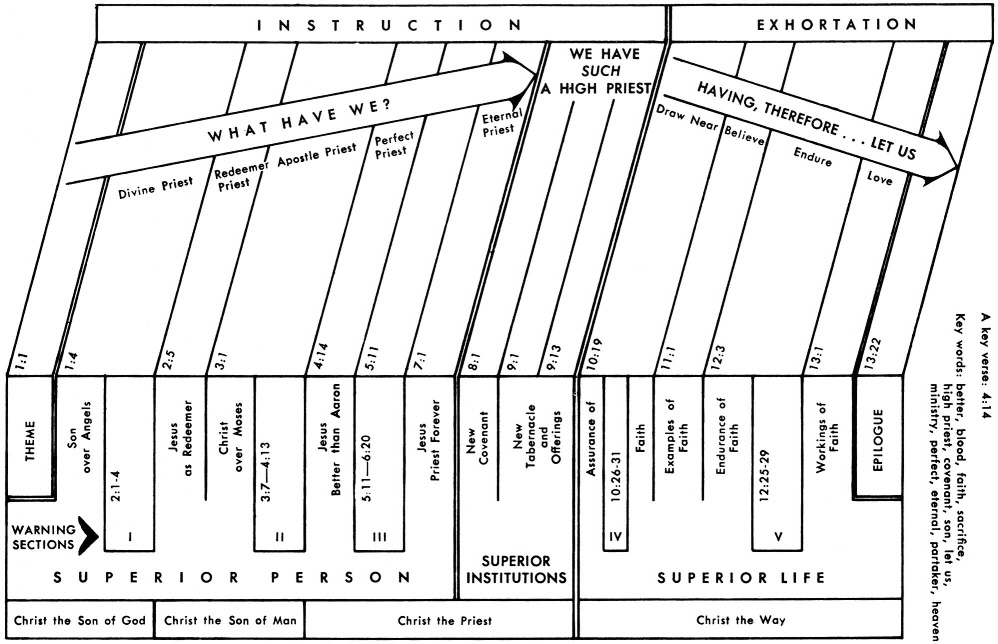
CONSIDER JESUS OUR GREAT HIGH PRIEST
Click chart to enlarge
Charts from Jensen's Survey of the NT - used by permission
Swindoll's Chart, Interesting Pictorial Chart of Hebrews, Another Chart
|
The Epistle |
||||
| INSTRUCTION Hebrews 1-10:18 |
EXHORTATION Hebrews 10:19-13:25 |
|||
| Superior Person of Christ Hebrews 1:1-4:13 |
Superior Priest in Christ Hebrews 4:14-10:18 |
Superior Life In Christ Hebrews 10:19-13:25 |
||
| BETTER THAN PERSON Hebrews 1:1-4:13 |
BETTER PRIESTHOOD Heb 4:14-7:28 |
BETTER COVENANT Heb 8:1-13 |
BETTER SACRIFICE Heb 9:1-10:18 |
BETTER LIFE |
| MAJESTY OF CHRIST |
MINISTRY OF CHRIST |
MINISTERS FOR CHRIST |
||
|
DOCTRINE |
DUTY |
|||
|
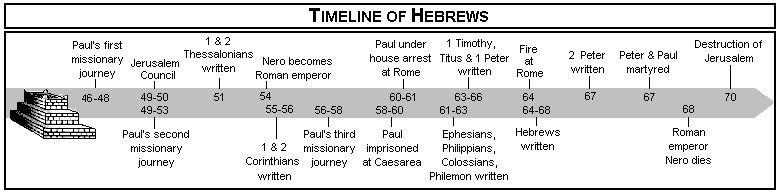
DATE WRITTEN: |
||||

See ESV Study Bible "Introduction to Hebrews"
(See also MacArthur's Introduction to Hebrews)
Borrow Ryrie Study Bible
|
THE FIVE WARNING PASSAGES |
| Heb 2:1-4 (notes) |
| Heb 3:7-4:13 (notes) |
| Heb 5:11-6:12 (notes) |
| Heb 10:26-31 (notes) |
| Heb 12:14-29 (notes) |
Hebrews 10:36 For you have need of endurance, so that when you have done the will of God, you may receive what was promised. (NASB: Lockman)
Greek: upomones gar echete (2PPAI) chreian ina to thelema tou theou poiesantes (AAPMPN) komisesthe (2PAMS) ten epaggelian.
BGT ὑπομονῆς γὰρ ἔχετε χρείαν ἵνα τὸ θέλημα τοῦ θεοῦ ποιήσαντες κομίσησθε τὴν ἐπαγγελίαν.
Amplified: For you have need of steadfast patience and endurance, so that you may perform and fully accomplish the will of God, and thus receive and carry away [and enjoy to the full] what is promised. (Amplified Bible - Lockman)
Barclay: You need fortitude so that, after you have done the will of God, you may receive the promise. (Westminster Press)
KJV: For ye have need of patience, that, after ye have done the will of God, ye might receive the promise.
NLT: Patient endurance is what you need now, so you will continue to do God's will. Then you will receive all that he has promised. (NLT - Tyndale House)
KJV For ye have need of patience, that, after ye have done the will of God, ye might receive the promise.
NKJ For you have need of endurance, so that after you have done the will of God, you may receive the promise:
NET For you need endurance in order to do God's will and so receive what is promised.
CSB For you need endurance, so that after you have done God's will, you may receive what was promised.
ESV For you have need of endurance, so that when you have done the will of God you may receive what is promised.
NIV You need to persevere so that when you have done the will of God, you will receive what he has promised.
Phillips: Patient endurance is what you need if, after doing God's will, you are to receive what he has promised. (Phillips: Touchstone)
Wuest: for you have need of patience in order that, having done the will of God, you might receive the promise.
Young's Literal: for of patience ye have need, that the will of God having done, ye may receive the promise,
Paraphrase You have need of steadfast endurance, in order that after fulfilling God’s will through obedient perseverance, you may fully receive what He has promised.
- You have need - Heb 6:15; 12:1; Ps 37:7; 40:1; Mt 10:22; 24:13; Lk 8:15; 21:19; Ro 2:7; Ro 5:3,4; 8:25; 15:4,5; 1Co 13:7; Gal 6:9; Col 1:11; 1Th 1:3; Jas 1:3; Jas 1:4; 5:7, 8, 9, 10, 11; Re 13:10; 14:12
- When you have done the will of God - Heb 13:21; Mt 7:21; 12:50; 21:31; Jn 7:17; Acts 13:22,36; Ro 12:2; Ep 6:6; Col 4:12; 1Jn 2:17
- You may receive what was promised - Heb 6:12,15,17; 9:15; Colossians 3:24; 1 Peter 1:9
- Hebrews 10 Resources - Multiple Sermons and Commentaries
Related Passages:
Hebrews 3:6+ but Christ was faithful as a Son over His house–whose house we are, if we hold fast our confidence and the boast of our hope firm until the end.
Hebrews 3:14+ For we have become partakers of Christ, if we hold fast the beginning of our assurance firm until the end,
Hebrews 9:15+ (WHAT IS THE PROMISE?) For this reason He is the mediator of a new covenant, so that, since a death has taken place for the redemption of the transgressions that were committed under the first covenant, those who have been called may receive the promise of the eternal inheritance.
HANG ON TO THE
END FOR THE PRIZE
For (gar) should cause you to pause to ponder this term of explanation, asking what is being explained? In light of the exhortation just given not to throw away their confidence, he explains that to accomplish this they need endurance. In Heb 10:32–34 they were called to remember past endurance under suffering. Then in Heb 10:35 they were exhorted not to throw away their confidence. And now in Heb 10:36 they have need to continue to endure so that they might be enabled to hold fast, running to the end of their race, receiving what was promised.
Not everyone interprets the FOR the same way so here are some remarks from other respected men...
David Allen - Verse 36 is subordinated to v. 35 by the use of gar, (inferential here rather than causal) which provides the grounds for the preceding exhortation, and does so in counterpart fashion by pitting “endurance” against “throwing away.” “Endurance” connotes perseverance. Hughes interpreted it as referring to the means for doing the will of God mentioned later in the verse.128 Hewitt understood it in the sense of “endurance is God’s will for you.”129 Moffatt observed a conditional element reflected in the noun “endurance” in the sense that “if you endure, you will receive the promise.”130 The result131 of having such endurance is the reception of what God has promised.132 As Koester pointed out, “Endurance is not a precondition for God making the promise, but an expression of confidence that God will keep the promise.”133 What God has promised is eternal life (9:15); a share in God’s rest (4:10); and a place in the heavenly Jerusalem (12:22–24). (See Hebrews: An Exegetical and Theological Exposition)
Gareth Cockerill - The opening words of this verse provide the clearest expression of the author’s pastoral concern for his hearers: “you have need of endurance.” It is for this reason that he sought to forestall their drifting (Heb 2:1–4) and awaken them from lethargy (Heb 5:11–14). It is for this that he explained the great high-priestly work of Christ (Heb 4:14–10:18) as both motivation and adequate resource for endurance. Every warning and every promise has been crafted to encourage endurance and forestall discouragement engendered by opposition or by the dulling effect of time. Those who endure persist in a life of faith and obedience despite opposition from the unbelieving world. Thus, the pastor can describe the person who has endured to the end as one who has “done the will of God.” (The aorist tense of ποιήσαντες, “having done,” refers to the completion of the life of faith.) Although his hearers now have an “enduring possession,” it is then, and only then, that they “will receive” what God has promised. There is no smell of merit about this doing of God’s will. To do his will is merely to continue in the obedience that comes from living in reliance on Christ and the salvation that he has provided by his own obedience to the divine will (Heb 10:5–10).37 (See The Epistle to the Hebrews - Page 504)
Harold Greenlee - QUESTION—What relationship is indicated by γάρ ‘for’? 1. It introduces the grounds for the preceding exhortation [Alford, Miller, Lünemann in Meyers Com], the counterpart to the first part of the preceding verse [NIGTC]. This verse looks both to what precedes and to what follows [Ellingworth - NIGTC]. 2. It introduces an inference from what precedes [WBC]. (An Exegetical Summary of Hebrews)
Henry Alford or FOR - "justification of the foregoing μὴ ἀποβάλητε κ.τ.λ."
Paul Ellingworth - This transitional verse looks both backwards and forwards. Ὑπομονῆς recalls ὑπεμείνατε in v. 32 (Vanhoye 179; Spicq; F. F. Bruce 271 n. 191 disagrees). Γάρ (gar) indicates that v. 36a forms a positive counterpart to v. 35a. (The Epistle to the Hebrews - Page 38)
You have need (chreia) of endurance (hupomone) -- You have need is in the present tense indicating that they have a continual need. Indeed, in this life on earth they (and we) never outgrow this need. Need (chreia) denotes necessity which is indispensable. In context, the use of the word chreia underscores that endurance (hupomone) is not optional, but is a vital requirement for obtaining what God has promised. To put it another way, the writer is not saying, “You could use some endurance,” but is saying “You cannot receive the promise without it.” In light of their trials (which are sure to continue), in order to persevere to the end (note clear parallel with Heb 3:6, 14), they need to exercise endurance.
🙏 THOUGHT - How is this endurance supplied? Is endurance natural or supernatural? Although the word for endurance (makrothumia) described as a fruit of the Holy Spirit is different in Gal 5:22+, there is overlap in the meaning with hupomone. To wit (in other words), trying to endure in spiritual warfare in reliance on our own intrinsic strength is IM-possible, but in reliance on the Spirit, it is HIM-possible (“It is the Spirit who gives life; the flesh profits nothing.” Jn 6:63+). And not only do we have the indwelling Spirit to give us the desire and power (Php 2:13NLT+) to endure, we have the perfect Example to imitate (cf 1Co 11:1+, Walking Like Jesus Walked!) We are not called to endure by gritting our teeth and pushing through in our own strength. Instead, we are called to continually be "fixing our eyes on Jesus, the Author and Perfecter of faith, Who for the joy set before Him endured (hupomeno) the cross" and by His Spirit empowers us to follow His example. And this is another reason we need to be continually praying for one another that each of us according to the riches of His glory, would be strengthened with power through His Spirit in the inner man, for this strengthening is essential for enduring trials, resisting sin, and remaining faithful. Without the Spirit’s power, our flesh is weak and prone to giving IN or giving UP (cf. Mt 26:41+). Dear brother or sister, it is too soon to quit! Press on! As an aside, our understanding and acknowledging of our need to be supplied by God in order to endure is another manifestation of humility which is how we "tap into" His amazing grace (Jas 4:6+). As Major W Ian Thomas put it "I can’t — You never said I could; but You can, and always said You would. That is all I need to know.” But don't misunderstand, it is not "Let go, let God" (that's passivity, which is not Biblical), but "Let God, let's go" (His sovereignty and my responsibility).
“The endurance of the saints is the masterpiece of divine grace.
Where the grace of God truly lives, it creates
a holy perseverance that defies temptation, trial, and time.”
--C H Spurgeon
So that (hina - purpose clause) when you have done (poieo in aorist tense - complete act) the will (thelema) of God, you may receive (komizo) what was promised (epaggelia/epangelia) - So that (hina - purpose clause) introduces the intended goal or divine purpose for their endurance. The writer has just reminded them of their past faithfulness under persecution (Heb 10:32-34) and urged them not to throw away their confidence (Heb 10:35). Now he explains why endurance is necessary. You need endurance to do the will of God, a phrase which in effect speaks of their obedience. Have done (poieo) is not speaking of legalistic obedience, but obedience from the heart motivated by love and trust (faith) in God's word (His promise of reward, cp poieo in Mt 7:21+ where "done" is poieo in the present tense - speaking of one's lifestyle). The will (thelema) of God refers not to a cold command from God, but to the loving intention of His heart, for our good and His glory. We imitate our Lord when we do the Father's will, for Jesus declared "not My will, but Thine be done" (Lk 22:42+). In short, in this passage the will of God means faithful endurance or perseverance in the course God has ordained, this obedience flowing from their faith, even in the midst of sufferings.
Alexander Stewart - The necessity of the perseverance of faith for the attainment of final salvation pervades the entire book (Heb 2:3; 3:6, 12–14; 4:1, 11; 6:11–12, 18; 9:28; 10:23, 35–36; 12:1, 3, 12), explains the urgency of the warning passages, and is the motivating force behind Hebrews’ hortatory strategy. The (hina - purpose clause) clause of Heb 10:36 best communicates this conviction and should be used to inform the interpretation of the conditional clauses of Heb 3:6 and Heb 3:14. “You have need of perseverance (ὑπομονῆς) in order that ( ἵνα) when you have done the will of God you might receive the promise” (Heb 10:36; my translation) (Cosmology, Eschatology, and Soteriology in Hebrews: A Synthetic Analysis)
Endurance is the bridge
between obedience and reward.
Craig Evans - The author wants to encourage them that the reward is indeed close at hand (Heb 10:35), and also to emphasize the good consequences of remaining firm (“faithful”) (ED: AND ENDURING) and the bad consequences of “shrinking back” from their commitment to Jesus on account of the difficulties society imposes. (See The Bible Knowledge Background Commentary)
Steven Cole gives a summary statement - To have faith that endures trials, remember how God worked in the past, focus on doing His will in the present, and look to His promises in the future.
Dave Guzik - The toughest and most discouraging trials are when we are called to obey God’s will when the fulfillment of His promise seems so far away. This is why we need endurance. Faithfulness during the time when the promise seems unfulfilled is the measure of your obedience and spiritual maturity. This endurance is built through trials, the testing of our faith (Jas 1:2-4+).
The Jewish audience is being exhorted to remain under the persecutions and not seek to escape them by renouncing their professed faith in Messiah. Those that remained under the persecution and thus under the chastening hand of God, maintaining their faith in the Messiah, did not earn salvation but proved themselves to be true sons of God (He 12:7, Mt 13:21). Those who did not remain under this persecution, but renounced their profession to return to the sacrifices, proved themselves to be professors and not possessors (He 12:8, He 3:6+; He 3:14+)
R C Lenski notes Ὑπομονή (hupomone) is bravely remaining under a load and holding out. That is exactly what the readers need; having this virtue, they will not let continued affliction induce them to throw away their assurance and to think of turning from Christ because of persecution in order to seek ease and safety in the old Judaism. They need this perseverance “so that (ἵνα, contemplated result), by having done (effective aorist) the will of God (his good and gracious, saving will, John 6:40+), you may carry off the promise,” objective, what God has promised, namely everlasting life. This promise is the great pay-gift referred to in Heb 10:35; κομίζεσθαι (komizo), middle voice, means to bring or carry away something as one’s own and thus to have and enjoy it.(BORROW The Interpretation of the Epistle to the Hebrews page 372).
John Butler - Waiting requires patience. This is a struggle for all saints, for after you have obeyed and done what God says to do, the results do not always come immediately. But patience will help you wait for the results. And patience involves remaining loyal to the Lord and being pure in conduct as well as not giving up on the promise. (Analytical Bible Expositor - Hebrews to Revelation)
Charles Spurgeon - This is sweet counsel for you, O pilgrim, bound to Zion’s city. When you were young and strong, you walked many a weary mile with that staff of promise. It helped you over the ground. Don’t throw it aside as useless now that you are old and infirm. Lean upon it. Rest upon that promise, in your present weakness, which lightened your labor in the days of your vigor.
To paraphrase Spurgeon (not a direct quote) we are not saved by a sprint but by an endurance race. Patience must have her perfect work. He that hath done God’s will must not faint until he receives the promise. The blessing is certain, but it will come in God’s time.
John Owen - The apostle does not accuse them of lacking perseverance, but reminds them about the necessity of continually exercising patience. Perseverance is the grace of suffering Christians (Jas 1:4+; Jas 1:5+) and the correct reaction to all tribulations (Ro 5:4, 5+).
Andrew Murray says "This is one of the great practical lessons of the Epistle. Without perseverance, endurance, steadfastness, faith is vain; the only proof that it is a living, saving faith, is that it holds fast its boldness firm unto the end."
So that (hina) introduces the result/benefit (see discussion of terms of purpose or result ) of maintaining one's endurance.This is an essential prerequisite to the exercise of patience and to obtain the promised blessing. There is no promise to those who keep on doing wrong. (Note association of faith and obedience when you compare He 3:18, 19-see notes He 3:18; 19) and obtaining of the promises (He 6:12+)
The will (thelema) of God - Paul explains how believers can do the will of God, writing that it takes a voluntary whole hearted presentation of ourselves to God and then continual choosing to turn away from the world's way and allow the Spirit to renew our mind with "Godward" thoughts. Paul puts it this way…
I urge you therefore, brethren, by the mercies of God, to present your bodies a living and holy sacrifice, acceptable to God, which is your spiritual service of worship. And do not be conformed to this world, but be transformed by the renewing of your mind, that you may prove (dokimazo test and approve after examination) what the will of God is, that which is good and acceptable and perfect. (Ro 12:1, 2+; +)
It is notable that after encouraging with the truth (that they would receive the promise) which should motivate them to do the will of God, the writer than prays for them to have the power to do the will of God! And so we read his great prayer at the end of his epistle...
Now the God of peace, who brought up from the dead the great Shepherd of the sheep through the blood of the eternal covenant, even Jesus our Lord, equip you in every good thing TO DO (poieo in present tense ) His will, working in us that which is pleasing in His sight, through Jesus Christ, to whom be the glory forever and ever. Amen. (Heb 13:20-21+)
COMMENT - Notice the phrase "equip you in every good thing....working in us that which is pleasing in His sight," Whose responsibility is that? That is God's sovereign provision of power to actually do every good thing. Then he prays "TO DO HIS WILL." Whose responsibility is that? Our's of course beloved! But do not miss the crucial spiritual truth which is that we can ONLY DO HIS WILL because He gives us His provision (HE EQUIPS US IN ANSWER TO THIS PRAYER)! In other words we need to learn Paul's secret that we can do all things through Him Who strengthens us (cf Php 4:13+). And how does He equip us in the New Covenant? It is by the power (dunamis) of His indwelling Spirit working in us, the Spirit of Christ (cf Acts 1:8+, Eph 3:16+, etc). As we are filled with His Spirit (Eph 5:18+) and walking by His Spirit (Gal 5:16+), we will be supernaturally enabled to carry out God's will, for the Spirit in us will continually be energizing us, giving us both the desire and the power to walk and work pleasing to the Father (Php 2:13NLT+), and in so doing we will be working out our salvation in fear and trembling (Php 2:12+). DOES THIS MAKE SENSE? For more on this important spiritual truth see the notes on the "Paradoxical Principle of 100% Dependent and 100% Responsible" (100/100).
Our problem as believers is too often we attempt to do His Will in our natural strength (cf Gal 3:3+) and this will invariably lead to failure, futility and frustration. Natural cannot produce supernatural. Jesus was clear on that when He declared “I am the vine, you are the branches; he who abides in Me and I in him, he bears much fruit, for apart from Me you can do nothing." (Jn 15:5). And when Jesus said nothing, He used the specific Greek word that meant ABSOLUTELY NOTHING (of eternal value). It may look good before men, but unless it passes the God test, it is wood, hay and stubble and will burned up.
Spurgeon - This is sweet counsel for you, O pilgrim, bound to Zion’s city. When you were young and strong, you walked many a weary mile with that staff of promise. It helped you over the ground. Don’t throw it aside as useless now that you are old and infirm. Lean upon it. Rest upon that promise, in your present weakness, which lightened your labor in the days of your vigor. There must first be the doing of the will of God, and then the reward will come afterward. God will not give to His people their full reward yet. Patience, then, brother; patience, sister. Saturday night will come one of these days; your week’s work will then be over, and you will be more than repaid for anything you have done for your Lord.
Kenneth Wuest ties this all together commenting that "The word “receive” is the translation of komizo which means “to receive and carry away for use and enjoyment.” Endurance is spoken of by the writer as a necessary prerequisite to receiving the promise of God, namely, salvation through faith in the blood of Messiah. The word “patience” is the translation of hupomone which means literally “remain under.” That is, these Jews are exhorted to remain under the persecutions and not seek to escape them by renouncing their professed faith in Messiah. Those that remained under the persecution and thus under the chastening hand of God, maintaining their faith in the Messiah, were true sons of God (Heb 12:7+). Those who did not remain under this persecution, but renounced their profession to return to the sacrifices, were only unsaved professed believers (Heb 12:8+). (Hebrews Commentary online)
Phil Newton adds that "These believers needed to see endurance as a necessity for persevering in the Christian life. To endure does not imply a grim resignation of your circumstances so that you keep a "stiff upper lip," as the expression goes. It is "a blazing hope; it is not the spirit which sits statically enduring in one place, but the spirit which bears things because it knows that these things are leading to a goal of glory" [Fritz Rienecker and Cleon Rogers, The Linguistic Key to the Greek New Testament]. Endurance must accompany the believer daily, bearing up under the threats of the world with joyous confidence in Jesus Christ. Endurance sustains you in devotion to obeying God's will: "so that when you have done the will of God." To practice endurance will always lead you to walking in the revelation of God through the Word. We need not be confused about the will of God for our lives; it is found in the Word of God. We need only follow in obedience. Endurance ends in a heavenly reward: "you may receive what was promised." Here it is not reward based on our merit but it is the eternal reward that is ours through the merits of Christ. It is the proof of Christ's righteousness in our lives made plain through endurance that ends with the heavenly reward. (Hebrews 10:32-39 No Shrinking Back)
Need (5532) (chreia from chraomai = to use, make use of or chreos = a debt) means a necessity, requirement, what is needed or the occasion of need. That which is lacking and is particularly needed. It describes not an optional desire, but a pressing necessity—a must-have condition for reaching an intended end. Samples - Mt 6:8 = “Your Father knows what you need.” Lk 5:31 = “Those who are well have no need of a physician.” Acts 2:45 = “Distributed to all, as anyone had need.” Phil 4:19 = “God will supply all your needs.” (NOT YOUR "GREEDS") Chreia can describe both material needs (food, money, clothing) and moral/spiritual needs (endurance, wisdom, patience).
Chreia - 49x in the NT - Mt 3:14; 6:8; 9:12; 14:16; 21:3; 26:65; Mk. 2:17, 25; 11:3; 14:63; Lk. 5:31; 9:11; 10:42; 15:7; 19:31, 34; 22:71; Jn 2:25; 13:10, 29; 16:30; Ac 2:45; 4:35; 6:3; 20:34; 28:10; Ro 12:13; 1Co. 12:21, 24; Ep 4:28, 29; Php 2:25; 4:16, 19; 1Th 1:8; 4:9, 12; 5:1; Titus 3:14; He 5:12; 7:11; 10:36; 1Jn 2:27; 3:17; Rev 3:17; 21:23; 22:5.
Hebrews 5:12 For though by this time you ought to be teachers, you have need again for someone to teach you the elementary principles of the oracles of God, and you have come to need milk and not solid food.
Hebrews 7:11 Now if perfection was through the Levitical priesthood (for on the basis of it the people received the Law), what further need was there for another priest to arise according to the order of Melchizedek, and not be designated according to the order of Aaron?
The writer speaks of patience elsewhere
Hebrews 6:15 And so, having patiently waited (makrothumeo) , he obtained the promise.
Hebrews 12:1 Therefore, since we have so great a cloud of witnesses surrounding us, let us also lay aside every encumbrance and the sin which so easily entangles us, and let us run with endurance the race that is set before us,
Endurance (5281) (hupomone from hupo = under + meno = stay, remain, abide) is literally abiding under. The root idea of hupomone is that of remaining under some discipline, subjecting one’s self to something which demands the acquiescence of the will to something against which one naturally would rebel. It portrays a picture of steadfastly and unflinchingly bearing up under a heavy load and describes that quality of character which does not allow one to surrender to circumstances or succumb under trial. The picture is that of constancy and endurance with a forward look and the ability to focus on what is beyond the current pressures. And so hupomone does not describe a grim resignation or a passive "grin and bear" attitude but a triumphant facing of difficult circumstances knowing that even out of evil God guarantees good. It is courageous gallantry which accepts suffering and hardship and turns them into grace and glory.
HUPOMONE - It is the spirit that can bear things not simply w. resignation but w. blazing hope; it is not the spirit that sits statically enduring in one place, but the spirit that bears all things because it knows that these things are leading to a goal of glory. (BORROW The Linguistic Key to the Greek New Testament)
William Barclay - “It is not the patience which can sit down, and bow its head, and let things descend upon it, and passively endure until the storm has passed. It is the spirit which can bear things not simply with resignation, but with blazing hope. It is not the spirit which sits statically, enduring in one place, but the spirit which bears things because it knows that these things are leading to a goal of glory. It is not patience which grimly waits for the end, but patience which radiantly hopes for the dawn.”
The writer sets before us our Perfect Example of Endurance, our Lord Jesus Christ "Who for the joy set before Him endured [verb form hupomeno] the Cross despising the shame" He 12:2+).
HUPOMONE - 31V - Lk. 8:15; Lk. 21:19; Rom. 2:7; Rom. 5:3; Rom. 5:4; Rom. 8:25; Rom. 15:4; Rom. 15:5; 2 Co. 1:6; 2 Co. 6:4; 2 Co. 12:12; Col. 1:11; 1 Thess. 1:3; 2 Thess. 1:4; 2 Thess. 3:5; 1 Tim. 6:11; 2 Tim. 3:10; Tit. 2:2; Heb. 10:36; Heb. 12:1; Jas. 1:3; Jas. 1:4; Jas. 5:11; 2 Pet. 1:6; Rev. 1:9; Rev. 2:2; Rev. 2:3; Rev. 2:19; Rev. 3:10; Rev. 13:10; Rev. 14:12
Hebrews 12:1 Therefore, since we have so great a cloud of witnesses surrounding us, let us also lay aside every encumbrance and the sin which so easily entangles us, and let us run with endurance the race that is set before us, 2 fixing our eyes on Jesus, the author and perfecter of faith, who for the joy set before Him endured endured (verb = hupomeno) the cross, despising the shame, and has sat down at the right hand of the throne of God.
Will (2307) thelema from thelo = to will with the "-ma" suffix indicating the result of the will = "a thing willed") generally speaks of the result of what one has decided. One sees this root word in the feminine name "Thelma." In its most basic form, thelema refers to a wish, a strong desire, and the willing of some event. (Note: See also the discussion of the preceding word boule for comments relating to thelema).
Zodhiates says that thelema is the "Will, not to be conceived as a demand, but as an expression or inclination of pleasure towards that which is liked, that which pleases and creates joy. When it denotes God's will, it signifies His gracious disposition toward something. Used to designate what God Himself does of His own good pleasure. (Complete Word Study Dictionary: New Testament)
Thelema has both an objective meaning (“what one wishes to happen” or what is willed) and a subjective connotation (“the act of willing or desiring”). The word conveys the idea of desire, even a heart’s desire, for the word primarily expresses emotion instead of volition. Thus God’s will is not so much God’s intention, as it is His heart’s desire.
Most of the NT uses of thelema (over 3/4's) refer to God's will and signify His gracious disposition toward something. God's will usually refers to what He has decreed, but occasionally God's will refers to what He desires but has not decreed (Mt 18:14). Of the remainder of the uses of thelema twice refers to the will of the exalted Christ (Acts 21:14, Ep 5:17), once to the will of the devil (2Ti 2:26) and 12 times to human will most often in contrast to God's will (eg Lk 23:25, Jn 1:13, Ep 2:3). Paul was an apostle only because it was the will (thelema) of God - 1Cor 1:1, 2Cor 1:1, Ep 1:1, Col 1:1, 2Ti 1:1.
Receive (2865) (komizo from komeo = tend, take care of) means receive back, recover, receive back what is one's own, to be recompensed or rewarded. As A T Robertson says "This is a general law of life and of God and it is fair and square." Komizo conveys the thought of getting something for oneself and carrying it off as wages or a prize. The verb implies, not mere obtaining, but receiving and carrying away for use and enjoyment. Komizo carries the nuance of receiving what one has coming—whether a reward or recompense—and often implies a completed process (having done something and then obtaining the result, the reward still solely based on grace, not one's works). In 1 Peter 5:4 Peter uses komizo to teaching that in that coming Day of Judgment at the bema seat of Christ the faithful shepherds will joyfully "carry away as their own" (komizo) “the unfading crown of glory.” Komizo can describe a reward for good (1Pe 5:4+, Ep 6:8+, Col 3:25+) and is the verb used by Paul describing the bema seat of Christ where each believer will "be recompensed (komizo) for his deeds in the body, according to what he has done, whether good or bad." (2Co 5:10+). Note 3/11 NT uses of komizo in one chapter, Hebrews 11 (see below)!
KOMIZO - 11V - Mt. 25:27; Lk. 7:37; 2 Co. 5:10; Eph. 6:8; Col. 3:25; Heb. 10:36; Heb. 11:13; Heb. 11:19; Heb. 11:39; 1 Pet. 1:9; 1 Pet. 5:4
Hebrews 10:36 For you have need of endurance, so that when you have done the will of God, you may receive what was promised.
Hebrews 11:13 All these died in faith, without receiving the promises, but having seen them and having welcomed them from a distance, and having confessed that they were strangers and exiles on the earth.
Hebrews 11:19 He considered that God is able to raise people even from the dead, from which he also received him back as a type.
Hebrews 11:39 And all these, having gained approval through their faith, did not receive what was promised,
Promised (1860) (epaggelia/epangelia from epaggello = announce upon) originally meant a favorable message or an announcement. It was primarily a secular legal term denoting summons and thus was a promise to do or give something. In the NT it refers only to the promises of God (except Acts 23:21). Epaggelia is the thing promised or the gift graciously given. God is a covenant keeping God and therefore He never breaks His promises, for they are yea and amen in Christ Jesus, Who Himself is the Covenant Messenger. This grand truth should encourage you to "Hangeth thou in there" and you will receive the ultimate promise of everlasting life in His presence.
EPPAGGELIA IN HEBREWS - Heb. 4:1; Heb. 6:12; Heb. 6:15; Heb. 6:17; Heb. 7:6; Heb. 8:6; Heb. 9:15; Heb. 10:36; Heb. 11:9; Heb. 11:13; Heb. 11:17; Heb. 11:33; Heb. 11:39
Hebrews 4:1 Therefore, let us fear if, while a promise remains of entering His rest, any one of you may seem to have come short of it.
Hebrews 6:12 so that you will not be sluggish, but imitators of those who through faith and patience inherit the promises.
Hebrews 6:15 And so, having patiently waited, he obtained the promise.
Hebrews 6:17 In the same way God, desiring even more to show to the heirs of the promise the unchangeableness of His purpose, interposed with an oath,
Hebrews 7:6 But the one whose genealogy is not traced from them collected a tenth from Abraham and blessed the one who had the promises.
Hebrews 8:6 But now He has obtained a more excellent ministry, by as much as He is also the mediator of a better covenant, which has been enacted on better promises.
Hebrews 9:15 For this reason He is the mediator of a new covenant, so that, since a death has taken place for the redemption of the transgressions that were committed under the first covenant, those who have been called may receive the promise of the eternal inheritance.
Hebrews 10:36 For you have need of endurance, so that when you have done the will of God, you may receive what was promised.
Hebrews 11:9 By faith he lived as an alien in the land of promise, as in a foreign land, dwelling in tents with Isaac and Jacob, fellow heirs of the same promise;
Hebrews 11:13 All these died in faith, without receiving the promises, but having seen them and having welcomed them from a distance, and having confessed that they were strangers and exiles on the earth.
Hebrews 11:17 By faith Abraham, when he was tested, offered up Isaac, and he who had received the promises was offering up his only begotten son;
Hebrews 11:33 who by faith conquered kingdoms, performed acts of righteousness, obtained promises, shut the mouths of lions,
Hebrews 11:39 And all these, having gained approval through their faith, did not receive what was promised,
Heb. 10:35, 36. Charles Simeon
THERE have been, to the Church of Christ, seasons of bitter persecution, and seasons of comparative tolerance and peace: but in whichever of these states we be, it becomes us not to yield to dejection on the one hand, or undue security on the other. We are soldiers on the field of battle, and must be ready to encounter our enemies whensoever they may advance against us. It will be time enough to put off our armour, when we have received our dismission from an earthly warfare, and are crowned with laurels in the realms of bliss. There had been to the Hebrew Christians seasons of severe trial, which the Apostle called to their remembrance: and it is probable, that when this epistle was written to them they enjoyed somewhat of tranquillity: but he bade them not to cast away their confidence: since they would still have need of it, as long as they should continue in the body.
In this apostolic injunction we see,
I. What state of mind befits the Christian—
The “confidence” here spoken of is a holy boldness in confessing Christ—
[This is essential to the Christian character. Not even faith itself will avail for our salvation, where this is wanting: “With the heart, man believeth unto righteousness; but, with the mouth, confession is made unto salvation.” “If we are ashamed of Christ, and deny him, he will be ashamed of us, and deny us.”
This holy fortitude we should maintain, under all circumstances. Never, for a moment, should we “cast it away.” If trials increase, we need it the more: if they abate, or even cease, we still need this divine quality; because we know not how soon it may be called for, or to what an extent it may be required.]
And it will bring its own reward along with it—
[It will keep us from all that disquietude and distraction which the menaces of the world might occasion in an unstable mind. It will induce a consistency of conduct, under all circumstances; and will bring into the soul, stability and peace. It will be to him who exercises it an unquestionable evidence of his own sincerity; and will doubtless be honoured with peculiar manifestations of the Divine favour. If more than ordinary supports are called for by reason of the augmented troubles that assault us, they shall be vouchsafed to us; even as they were to the Hebrew Youths in the furnace, when the Son of God himself condescended visibly to appear in their behalf]
To every Christian is this requisite, because of,
II. The occasion he will have for it—
Different as may be the path of different persons in some respects, in their great outline they are all the same. In their progress, all these different steps may be clearly and distinctly seen:
1. Duty—
[Every Christian “does the will of God.” To believe in Christ, to receive every thing from Christ in the exercise of faith and prayer, and to give himself up to God without reserve; this is the one habit of his mind, and the one labour of his life. From day to day he does not his own will, or the will of an ungodly world; but the will of God, as it is revealed in his blessed word.]
2. Suffering—
[This will always more or less attend a faithful discharge of our duty to God. There will now, as formerly, be seasons of comparative peace: but it is not possible for unregenerate men to love the light, whether it be set before them in the word, or be exhibited before them in the conduct of God’s faithful servants. “The servant cannot be greater than his Lord:” if they called the Master of the house Beelzebub, those of his household must assuredly expect some opprobrious designation at the least. And though, in comparison of imprisonment and death, this may be regarded as a light matter; yet is it not light, when we consider, that the names with which the godly are designated, are a signal for the world to load them with every species of obloquy and contempt.]
3. Patience—
[Our blessed Lord was “as a sheep led to the slaughter,” and, in the midst of all the indignities that were offered him, “opened not his mouth.” And in this manner his faithful followers also “possess their souls in patience.” They expect that they shall “have need of patience;” and it is their endeavour so to demean themselves under their trials, that “patience may have its perfect work; that so they may be perfect and entire, wanting nothing.”]
4. Glory—
[This is the object of their pursuit; and to this they press forward with all their might. They know, that “if they draw back, it must be unto perdition;” and that it is by believing only, and maintaining their faith with steadfastness, that they ever can be saved. They are well assured, that the means must be used for the attainment of the end; and that if used aright, the end shall be attained. They are well aware, that duty must be performed, suffering expected, patience exercised: and in this way they have no doubt but that glory shall be ultimately secured. “By a patient continuance in well-doing, they seek, and will obtain, eternal life.”]
Application—
1. Let us be thankful for the peace that we are privileged to enjoy—
[These are days of extraordinary toleration and candour. We cannot indeed say that “the offence of the cross has ceased:” for it never can cease, as long as the ungodly constitute the great majority of the world. But persecution, except in private circles, is but little known. The flames of martyrdom are no longer kindled amongst us, as in the days of old. Let us, then, make a due improvement of this great mercy, for the more abundant edification of our own souls, and for a more active advancement of Christ’s kingdom in the world.]
2. Let us, however, stand prepared for other days—
[No one can tell how soon the face of things may be changed. If Popery were to gain an ascendant again, it would, in all probability, bring with it all its attendant horrors. But even in private life we may be called to make severe sacrifices, and to suffer the loss of all our prospects upon earth. But let us remember, that Heaven will richly repay us for all that we may either lose or suffer: and if only we “receive at last the promise” of eternal life, we shall never have reason to regret the “patience” we exercised, and the “confidence” we maintained.]
A Timely Letter- Young William Wilberforce was discouraged one night in the early 1790s after another defeat in his 10 year battle against the slave trade in England. Tired and frustrated, he opened his Bible and began to leaf through it. A small piece of paper fell out and fluttered to the floor. It was a letter written by John Wesley shortly before his death. Wilberforce read it again: "Unless the divine power has raised you up… I see not how you can go through your glorious enterprise in opposing that (abominable practice of slavery), which is the scandal of religion, of England, and of human nature. Unless God has raised you up for this very thing, you will be worn out by the opposition of men and devils. But if God be for you, who can be against you? Are all of them together stronger than God? Oh, be not weary of well-doing. Go on in the name of God, and in the power of His might."
J C Philpot - Hebrews 10:36
Why is patience needed? Because if we are the Lord’s people, we are sure to have many trials. The Lord sends us afflictions that He may give us the grace of patience to bear them. But O, what a rebellious heart do we carry in our bosom! What perverseness, peevishness, and self-will dwell in us! How soon our temper is stirred up, and our irritable minds roused in a moment by the veriest strifle! How little patience have we under the trials that God sees fit to lay upon us! We thus learn our need of patience, and that it is not a fruit of nature’s soil. The want of it makes the soul follow after it; and when the Lord does give submission to His will, and enables His children to see how profitable these trials are for their souls, and how, but for this heavy ballast, they would certainly have been carried away into the world, they can see His merciful hand in their heavy afflictions. Thus sometimes by feeling peevish and rebellious, and thus knowing their need of patience; and sometimes by feeling submissive, and enjoying the sweetness of it, they see what a blessed grace patience is. Scarcely any grace do we more daily need. We need it toward God, when He crosses us in our schemes, thwarts us in our desires, and instead of shewing why He afflicts us, hides Himself behind a thick cloud that neither faith nor prayer can pierce through. We need patience with each other, with the world, with our relations in life, and with the Church of God. We need patience when anything is said or done to hurt our minds, wound our feelings, irritate our tempers, and stir us up to revenge. And what a mercy it is, under these sharp trials, to have patience, and thus follow the example of the blessed Lord, “who, when he was reviled, reviled not again; when he suffered, he threatened not, but committed himself to Him that judgeth righteously.”
LONG-TERM COMMITMENT
PERSEVERE SO THAT WHEN YOU HAVE DONE THE WILL OF GOD, YOU WILL RECEIVE WHAT HE HAS PROMISED.—Hebrews 10:36
Although the impact of our good works may occasionally be more immediate, for most of us the influence of our faithful labor will be told in years and not in days, perhaps in the next generation, long after we are gone, in the lives of our children and grandchildren.
Which makes living in a world of immediate gratification, ready cash, and instant Internet access a real challenge to authentic Christianity. Much of God’s work calls for stick-to-itiveness over the long haul. Raising a godly family demands long-term commitment. Witnessing to a lost friend is rarely an overnight success. Discipling new believers is about long-term growth. Think of God’s perseverance and patience in your life and mine. How long has He been at work—and we aren’t even close to finished yet! We too need to be people of routine faithfulness over the long haul to see the fruit of our labor.
Effective Christianity is not a snapshot. It’s a feature-length film whose conclusion is played out in eternity.
For believers who lived in the former Soviet Union, it took seventy years of faithfulness in the midst of phenomenal
oppression, persecution, and martyrdom to have the story of their lives used to lift the lid of oppression and open the gates of an atheistic empire to the good news of Jesus Christ. In a meeting with top-level bureaucrats concerning the disintegration of their economy, Gorbachev asked, “Why do we oppress the people who do not absent themselves from work, who are not alcoholics, and who give us a good day’s work?” The Russian regime found it hard to argue with lives so well lived. It was finally the moment for triumph. Finally . . . after seventy years.
We are called to be faithful to a nonnegotiated, persevering obedience. Unwavering commitment is our task. The outcomes are God’s responsibility . . . in His time and His way.
Be not weary in well doing . . . your labor is not in vain in the Lord. (1 Corinthians 15:58)
It was Bishop Hugh Latimer who said that a drop of rain made a hole in a stone, not by violence but by continually falling. So we need patience and perseverance.
Hebrews 10:36 TODAY IN THE WORD
People don’t always live to see the fulfillment of things they have hoped for and lived for. At least two American presidents died on the verge of seeing their hopes fulfilled. Abraham Lincoln lived to see the Civil War brought to an end on April 9, 1865, but he was assassinated just three days later. His hoped-for healing and restoration of the nation occurred without him. Franklin D. Roosevelt, who led America during World War II, died on April 12, 1945, just a few weeks before the Allies declared victory in Europe on May 8.
The Old Testament believers who populate Hebrews 11 also had a sense of incompleteness to their lives. The Bible says that “none of them received what had been promised” (v. 39). That’s why they felt like such aliens and pilgrims on earth.
Don’t get the wrong idea. There was nothing defective about the faith of these heroic saints. It’s just that they lived in an era when God’s promise of salvation through the coming of the Messiah was still ahead. They looked into the future and saw the promise, and embraced it by faith. But they died with a sense of longing that we don’t have today because we live on this side of the cross.
We may feel as if our faith is small compared to the faithful of Hebrews 11, but in several ways the experience of God’s people in the church completes and perfects their faith. We have received the fullness of God’s promise in Jesus Christ.
Therefore, we can look back at those who went before us and say, in effect, “You were right to live by faith. The fulfillment of God’s promise has come. Salvation is complete. You are made perfect in Christ.”
TODAY ALONG THE WAY
The faith stories of the Hebrews heroes have been told. Ours are still being written, which is why we need to hold on to our confidence in Christ and persevere for Him (Heb. 10:36).
Staying Power
Sean Jones, one of my former Green Bay teammates, still recounts the advice his grandfather gave him years ago.
"Son," his grandfather said, "always remember this: your marriage will never be successful unless you die married. Some people are married for 20, 30, even 40 years, then get a divorce. That's not a successful marriage. A successful marriage is when you die married."
Delayed Gratification
Calvin was not granted citizenship in Geneva until five years before his death in 1564. He had been the city's most famous person for over twenty years.
Humor: The Bitter End
Getting antsy during a day-long church seminar, a friend of mine leaned over to the man seated next to him and whispered, "Are you going to stay to the bitter end?" To which the man replied, smiling, "I am the bitter end." —David L. Roper, Judsonia, Arkansas. Christian Reader, "Lite Fare."
See: Ecclesiastes 7:8; Hebrews 10:36; James 1:4.
John Butler - PATIENCE FOR GOD’S PRIZES - Sermon Starters
Hebrews 10:36 “Ye have need of patience that after ye have done the will of God, ye might receive the promises” (Hebrews 10:36).
Our text is a good text about patience in serving God. We need many things to serve Him well, none is needed more than patience.
FIRST—PATIENCE
“Ye have need of patience.” If you do not fit here, you do not fit anywhere. We all need patience especially in living the Christian faith. We need patience to practice the Christian faith when we see our competitor prosper through unscrupulous means while we suffer losses trying to do right. We need patience to do right when, as a student in school, we see the cheat get the grade point honors while we try to be honest and proper and come up short on the honors. We need patience when the dishonest businessman through trickery and deceit in advertising and service makes sales while we practice honesty and do not get the sales but get into debt and cannot pay our bills. We need patience to practice godliness though it seems to put us on the short end of things again and again.
SECOND—PERFORMANCE
“After ye have done the will of God, ye might receive the promises.” The only performance that God promises to bless is the performance that does the will of God. Therefore, we need to know the will of God about everything we do. The will of God may not be popular or esteemed highly by our fellowman, but if you know the will of God, do it! Do not be beguiled into doing other than the will of God. You will come up on the short end of things every time when you do things contrary to the will of God.
THIRD—PROMISES
“Ye night receive the promises.” The promises of God are the awards of God for our living and serving Him.
• The promises are sure. Men often promise to reward us. but often they fail or are unable to fulfill their promise.
• The promises are superior. God’s promises are greater than any that man makes. His promises are eternal not just temporal. He can bless us in eternity, not just in time (as men is limited to blessing).
• The promises are satisfactory. God awards will satisfy. Men’s awards often do not satisfy. In fact man’s awards wear out (I have some sports trophies obtained in basketball in the Navy that are now eroded, and rusted, and falling apart.
• The promises are slow. “Ye have need of patience that after ye have done the will of God ye might receive he promises.” Our text is all about the time element in receiving God’s awards. The best awards are the longest in coming, but they last the longest. Do not sell out to the world for their cheap awards simply because they can be had now. Remember God’s awards/promises, while taking the longest, will be around for eternity.
Russell Spray - The Need for Patience
“For ye have need of patience, that, after ye have done the will of God, ye might receive the promise” (Heb. 10:36).
I. Patience in Suffering
“Ye have heard of the patience of Job …” (James 5:11).
A. Job was patient in suffering. He won the approval and blessing of God through his trust and determination (Job 13:15).
B. We should also be patient in suffering. We should look for its purpose and seek to glorify God through it.
II. Patience in Sorrow
“I waited patiently for the Lord; and he … heard my cry” (Ps. 40:1).
A. Jesus was a man of sorrow. He bore deception, disgrace, and death with patience, compassion, and forgiveness.
B. We should also be patient in sorrow. We should endure trials, troubles, and testings as Jesus did (Eph. 4:32).
III. Patience in Success
“… let us run with patience the race that is set before us” (Heb. 12:1).
A. Patience is needed in attaining success. Overconfidence and overwork are to be avoided.
B. Patience is needed when success has been attained. A person’s motives may be misjudged by others, but God looks on the heart (1 Sam. 16:7).
IV. Patience in Setbacks
“Rest in the Lord, and wait patiently for him” (Ps. 37:7).
A. Setbacks are difficult to bear. They bring feelings of discouragement, defeat, and humiliation.
B. God has a purpose in allowing setbacks. We must trust in Him, knowing that His ways are always best. We must wait patiently for His will to be revealed (Rom. 8:28).
V. Patience in Service
“And so, after he had patiently endured, he obtained the promise” (Heb. 6:15).
A. Service should be performed as unto the Lord. The more we do, the more criticism we often receive from other people.
B. Perseverance is needed when results are slow in coming. Patience is needed in all our service for God (Col. 3:23, 24).
David Jeremiah - SAFE IN THE WILL OF GOD Sanctuary: Finding Moments of Refuge in the Presence of God
HEBREWS 10:36 You have need of endurance, so that after you have done the will of God, you may receive the promise.
When we have trials in our lives, we always have three choices:
We can endure our trials. Of course, some people make us endure their trials with them. We ask them how they’re doing, and they’re more than happy to tell us. But when we merely endure our troubles, we run the risk of becoming bitter.
We can just escape. Run! Leave! Get out of there! When we do that, we get away from where we are. But if God hasn’t told us to leave, we leave the place where God can help us.
We can enlist our troubles. This is the right thing to do. In other words, we can let God use the crises in our lives to make us better, to help us grow in His way. We can step up on our trouble and move to a higher level.
We all have a natural “flight syndrome” that causes us to think, If I could just run away! But when we do that, if we’re not careful, we make matters worse instead of better. Someone has said that no matter how difficult our circumstances, the safest place for us is always in the will of God.
Patrick Morley - PERSEVERANCE: THE NEED FOR PERSEVERING FAITH Devotions for the Man in the Mirror: 75 Readings- Page 183
You need to persevere so that when you have done the will of God, you will receive what he has promised. Hebrews 10:36
Have you ever known a time when you thought you would die if the Lord did not give you His touch? A time when no friend could comfort you? When you could see no way out? When your circumstances gave new meaning to the word bleak?
Bart decided to ask God to shape his character. He surrendered his own will to the will of God. At the time, Bart’s business floundered on the verge of failure. “Should I throw in the towel, or keep trying to hang on?” Bart wondered.
God replies, “You need to persevere.” After we have done the will of God, then we will receive our reward. God’s will is for us to demonstrate to a hurting world how wonderfully His power can work within the person who perseveres.
Certainly, there are days when we feel like we will die, or maybe even wished we could, but we keep going. Why? Why do we keep going? Because when we have done the will of God, we will receive what He has promised.
Will persevering guarantee we will succeed in the worldly sense of success? Is that what He has promised? Does it mean we will not go out of business if we hang on? No, but we can state emphatically that if we don’t persevere we will not succeed in any sense. Not persevering guarantees we will fail.
What exactly is it, then, that He has promised? Jesus said, “‘Whoever does God’s will is my brother and sister and mother’” (Mark 3:35). When you have persevered, you become transformed into part of the family of Christ. You become His friend, and He prays for you in the presence of the Father.
Beyond succeeding in a worldly sense, though, God wants our character to succeed more than our circumstances to succeed. He will adjust our circumstances in such a way that our character eventually succeeds, for that is His highest aim, His will.
To receive this kingdom of God is our highest aim. We want to be part of the world that is coming, not part of the world that is going. So we must conclude we want to do the will of God. But is our life and lifestyle really an expression of that will?
What Turns Us from the Will of God?
When prosperity surrounds a man too long, his own self-will begins to growl within him like the deep rumblings of an inactive volcano just before it once again erupts. Though now dormant, its rugged features remind us of the violent eruptions of which it is capable. In the same way, we walk calmly with Christ, but our features give us away. Tiny, barely visible rivulets of cooled-down pride give us away and betray our past. Our pride is not gone, only dormant. Prosperity prompts pride; it reactivates a volcano of self-will, and that person forgets God.
Here is how Moses put it:
When you have eaten and are satisfied, praise the Lord your God for the good land he has given you. Be careful that you do not forget the Lord your God, failing to observe his commands, his laws and his decrees… Otherwise…your heart will become proud and you will forget the Lord your God. (Deuteronomy 8:10-14)
Suffering is not far behind.
What Turns Us Back to the Will of God?
When Christians suffer, their agony grinds out of them the desire to have a will of their own apart from the will of God. Suffering can produce a good result: perseverance. When you do persevere, you will receive what was promised—you will become His brother. You will be like Him. He will be able to use your life to strengthen other broken people. Your sympathy will become empathy.
And because you persevered, because you received what was promised, because you have no will of your own, because you are the brother—the sister—of Jesus, you will become the expression of Christ’s compassion to your brother on earth. People will ask if they can speak privately with you so they can weep and pour out their desperation to you.
So why persevere? He has promised the joy of being Christ’s brother and administering the gospel of His compassion. D. L. Moody was fond of saying, “The reward of service is more service.” Christ’s reward for you is useful service, service that lasts.
I SURRENDER
Lord Jesus, help me to persevere. Sometimes I feel like giving up. I vacillate between Your will and my own, between prosperity and suffering. Stabilize me. Give me the strength to persevere, and let me receive the reward You have promised. Amen.
A W Tozer - Deliverance: Saved from the World’s Nervous Scramble he Pursuit of the Divine: A. W. Tozer Collection
For we have need of patience, that, after ye have done the will of God, ye might receive the promise. Hebrews 10:36
Christians have often been accused of being reactionary because they cannot show any enthusiasm for the latest scheme that someone thinks up to bring in the millennium.
Well, it is not to be wondered at. A true Christian’s firsthand acquaintance with God saves him from the nervous scramble in which the world is engaged and which is popularly touted as progress.
A real Christian is an odd number anyway. He feels supreme love for One whom he has never seen, talks familiarly every day to Someone he cannot see, expects to go to heaven on the virtue of Another, empties himself in order to be full, admits he is wrong so he can be declared right, goes down in order to get up, is strongest when he is weakest, richest when he is poorest, and happiest when he feels worst!
He dies so he can live, gives away so he can keep, sees the invisible, hears the inaudible and knows that which passes knowledge.
The man who has met God is not looking for something—he has found it. He is not searching for light—upon him the Light has already shined!
His religion is not hearsay. He is not a copy, not a facsimile print: he is an original from the hand of the Holy Ghost!
He may hear the tin whistle starting every new parade, but he will be cautious. He is waiting for a trumpet note that will call him away from the hurly-burly and set in motion a series of events that will result at last in a new heaven and a new earth.
He can afford to wait!
Rick Renner - Shaking the Gifts!
For ye have need of patience.…—Hebrews 10:36
Oh, how I looked forward to Christmas morning as a young boy, when we would finally be able to open all the gifts under the Christmas tree! Day by day, Daddy and Mother would gradually add gifts, and the pile of presents would grow higher and higher. I’d always wonder, Did they get me what I really wanted? What is inside those beautifully wrapped boxes?
As the Christmas gifts begin to stack up around the base of the Christmas tree, I’d feel a strong temptation to vigorously shake the boxes up and down to try to figure out what was inside. I remember Daddy telling me to stop and to put them back in their places under the tree. That urge to shake the gifts and “guess” their contents was too great a temptation to resist! In fact, all three of us siblings—Ronda, Lori, and I—got in trouble multiple times each year for giving in to that temptation! It would only be a short time before we’d be allowed to open those gifts, but the desire to figure out what was inside them was almost too much for us to control. Maybe you can relate to this as you remember back to your childhood!
One year, Ronda even coaxed me to get up after everyone was asleep and join her in secretly unwrapping all the gifts to find out what they were. Once we examined all the presents, we carefully rewrapped each gift so we wouldn’t get caught and get in trouble. To our misfortune, we weren’t that good at rewrapping, so Daddy and Mother figured out what we had done—and we got in trouble anyway! Even worse, it took all the fun out of Christmas morning because we already knew what was in every gift box. And the saddest part was that it really took the joy out of the event for our parents, who were so disappointed that they missed the thrill of seeing us surprised as we discovered what was in each wrapped gift.
Patience is something that everyone struggles with in life. Whether it’s a child who wants a gift immediately, a teenager who wants a car, a wife who wants a new dress, or a husband who wants a new car or fishing boat—in some respect, everyone has to learn the lesson of patience.
In Hebrews 10:36, the Bible says, “For ye have need of patience, that, after ye have done the will of God, ye might receive the promise.” We know that the Bible is full of promises that are part of our inheritance in Christ. Every one of those promises is a “gift” to unwrap. But if you’ve walked any length of time with the Lord, you know that there is sometimes a period of waiting between the “believing” that a particular gift from Heaven is yours and the “unwrapping” of that gift!
Perhaps there is a particular promise that you have released your faith to receive, and it seems that the manifestation of that promise keeps being delayed again and again. Maybe that promise even involves God’s good plan for your life and the fulfillment of the very reason He put you on this earth. To you, the Bible says, “For ye have need of patience.…”
The word “patience” is the Greek word hupomeno, a compound of hupo and meno. The word hupo means to firmly stand by a thing, and the word meno means to resolutely stay in one spot with no intention to move for any reason. When compounded, they form the word hupomeno, which is the resolute decision that you will receive what you desire and that you will not be moved by any situation until you receive it. It is to be immovable until the thing prayed for is manifested.
Inherent in this word hupomeno is the implication that situations will arise in life that will try to move you off your targeted goal. But with hupomeno working inside you, you have the ability to outlast any competition or obstacle and stay on course until you’ve fully done the will of God—and at long last, you receive the coveted prize of your faith.
Spiritually speaking, if you’ve asked the Father for a specific thing that He has already promised you in His Word, there is no need for you to go about “shaking boxes” to see if He has given you what you’ve released your faith to receive. In fact, “shaking the gift” to figure out what is in it should alert you that you’re still not fully in faith about your request!
You have to find what God has said about the matter in His Word and get it settled in your heart. That promise is sitting “wrapped under the tree,” and it already has your name on it!
So whenever you’re feeling impatient about God’s timing, don’t start trying to figure out in your mind what’s in the box before He’s ready for you to open it. Trust the Lord that He has His best in store for you. If you’ve asked in faith, God will do what you’ve asked Him to do in Jesus’ name. The timing may be a little different than what you anticipated, but you can rest assured that God will come through for you—because He is faithful and He cannot lie (see Titus 1:2).
Your part is to obey God, believe His Word, let hupomeno work inside you, and enter into the rest of faith (see Hebrews 4:3). As you do, it will only be a matter of time until you receive exactly what the Father has desired to give you all along. That is the promise of Hebrews 10:36!
MY PRAYER FOR TODAY
Father, I repent for my impatience as I wait for the fulfillment of what I’ve asked You to do for me. In a certain sense, I’ve been “shaking the gifts” and not trusting that You would do what You said You would do. Waiting a little longer won’t hurt me. In fact, it will help me develop my character and learn patience. For this, I say thank You. And for my impatience, I ask You to forgive me and to help me keep growing in this aspect of my life.
I pray this in Jesus’ name!
MY CONFESSION FOR TODAY
I confess that patience is a strong force in my life. As I walk with Christ and learn to trust in Him ever more dearly, the attribute of patience is growing stronger and stronger in me. I don’t have to mistrust the Lord or check Him out to see if He is really doing what I asked. If I have asked for something in faith, it’s only a matter of time until what I’ve prayed for comes to pass!
I declare this by faith in Jesus’ name!
DISCERNING ROAD BLOCKS - Os Hillman
You need to persevere so that when you have done the will of God, you will receive what he has promised. HEBREWS 10:36
How do you know when the obstacles in your path have been placed by God to protect you, or by Satan to hinder God's purposes in your affairs?
I was once in California, traveling four hours to a speaking engagement, when terrible fires broke out and many of the highways were shut down. As a result, I had to detour to a small town and was questioning whether I should turn around and go back home or continue on to my meeting. I stopped at a convenience store to pray and consider, and a woman pumping gas next to me said that the interstate was closed and if I was going north I would never get there—and even if I did get there, I'd have difficulty getting back.
Suddenly, fear struck me with the prospects of being stranded in a strange place. I quietly prayed, asking the Lord whether this was a warning for me to turn back or Satan's hindrance. I went into the convenience store to inquire about a map. While I was standing there a man walked up to me and said, “Where are you trying to go?” I told him my dilemma and he explained that the interstate was open just north of where we were. In fact, he had to go to the exact spot I was headed and would be glad to guide me there.
This man took me through all sorts of side roads in very unfamiliar areas. I would never have reached my destination by myself, nor would I have made the attempt.
When we came to the interstate ramp just above where the fires were, he waved as he sent me on my way. I had no more trouble. I arrived at the luncheon on time and ministered to the businessmen.
I often look at that situation and wonder if God sent His angel to lead me where I was to go. Immediately after I had prayed at that convenience store, the man approached me and gave me the answer.
Do you have a situation in which you're having trouble discerning whether God is protecting you or Satan is hindering you? Ask God to show you His way.
Daily Light on the Daily Path - My eyes are weary with looking upward.
Be gracious to me, O Lord, for I am languishing; heal me, O Lord, for my bones are troubled. My soul also is greatly troubled. But you,
O Lord—how long? Turn, O Lord, deliver my life; save me for the sake of your steadfast love.—My heart is in anguish within me; the terrors of death have fallen upon me. Fear and trembling come upon me, and horror overwhelms me. And I say, “Oh, that I had wings like a dove! I would fly away and be at rest.”—For you have need of endurance.
And while they were gazing into heaven as he went, behold, two men stood by them in white robes, and said, “Men of Galilee, why do you stand looking into heaven? This Jesus, who was taken up from you into heaven, will come in the same way as you saw him go into heaven.”—But our citizenship is in heaven, and from it we await a Savior, the Lord Jesus Christ.—Our blessed hope, the appearing of the glory of our great God and Savior Jesus Christ.
Isa. 38:14; Ps. 6:2–4; Ps. 55:4–6; Heb. 10:36; Acts 1:10–11; Phil. 3:20; Titus 2:13
ILLUSTRATIONS - Marathon, Not a Sprint
A marathon runner doesn’t collapse at mile 25 because the finish line is near; he fixes his eyes on the goal, ignoring pain and fatigue. The cheering crowd, the ribbon ahead, the joy of completion — these sustain him when muscles cry for rest. Endurance is not about speed but staying power. Spiritual maturity is measured not by bursts of zeal but by consistent obedience “to the end.” It is not the beginner who receives the crown, but he who endures to the end.
Farmer Waiting for the Harvest (James 5:7–8)
The farmer tills, plants, and waters — yet months pass with no visible fruit. Still he waits, trusting the process. Early and late rains will come. Believers “do the will of God” through faithful sowing, trusting the unseen harvest — the promise of eternal reward.
“We must do the will of God before we receive the promise; work before wages, sow before reap.”
Rowing Against the Current
A rower on a river pulls steadily against the current. If he stops rowing, he drifts backward. The Christian life is the same: endurance is rowing by faith, not sight, against the world’s flow. The “will of God” is often upstream, but perseverance brings us to the destination where God’s promise awaits.
Abraham’s Long Wait
Abraham received the promise at 75, but Isaac came 25 years later (Gen 12–21). He “patiently waited and obtained the promise” (Heb 6:15). Faith endures delays without doubting divine fidelity. God’s delays are not denials; they are tests of trust.
Joseph in the Dungeon
Joseph did the will of God in obscurity — betrayed, enslaved, forgotten. Yet endurance shaped him into the man God could exalt (Gen 37–50). The dungeon precedes the throne. Every dark delay refines faith until it is fit for the promise.
Missionary Endurance — William Carey
William Carey labored seven years in India before his first convert. When asked his secret, he said, “I can plod. I can persevere.” God uses plodding saints, not merely gifted ones. Endurance transforms ordinary faithfulness into eternal fruit.
Spurgeon on Endurance - To paraphrase endurance is not the gift of nature but the grace of God. When the gold is in the crucible, it must not leap out because of the fire, but lie still till the Refiner sees His own image reflected.
O pilgrim, press through weary years,
Though faith be tried and sore;
The path is wet with saints’ old tears,
Yet hope leads on before.
The God who called will not forget,
His word shall never fail;
The crown awaits beyond regret,
Beyond the storm and gale.
Endure, endure, the promise nears,
Hold fast through dark and flame;
When work is done and dawn appears,
The Lord will call your name.
The finish line is just ahead,
The joy set full in view;
Press on where saints and angels tread—
He waits to welcome you.
And when the race of faith is run,
All labors past and done,
You’ll hear Him say, “Well done, My child,
Come share My promised crown.”
Bill Bright - Practicing Patience
“You need to keep on patiently doing God’s will if you want him to do for you all that he has promised.” HEBREWS 10:36
During a Bible study on this passage, Ted made this contribution: “Spiritually,” he said, “I’m a sprinter, not a long-distance runner.”
Many Christians would identify with that, for there is little patience, persistence and tenacity among believers. When adversity comes, many are prone to give up and lose their wind. That is the reason James says in his first chapter, verses 2–4, “Dear brothers, is your life full of difficulties and temptations? Then be happy, for when the way is rough, your patience has a chance to grow. So let it grow, and don’t try to squirm out of your problems. For when your patience is finally in full bloom, then you will be ready for anything, strong in character, full and complete.”
Note the emphasis on patience. All of us face problems, temptations, adversities and trials in varying degrees. We can determine, by our attitudes and actions, whether or not our tragedies will turn to triumph. Our heartache and sorrow can become joy by our exercising patience, which is merely the ability to relax in the confidence that God rules in the affairs of men and nations. Everything is under His control. And, as we walk in faith and obedience, we will be a part of His wonderful and perfect plan.
But how can we increase this patience that unlocks the door to supernatural living? The answer is found in Galatians 5:22, 23 in the listing of the fruit of the Spirit, for one of the nine characteristics mentioned is patience or longsuffering.
Are you patient with your spouse, parents, children, neighbors, coworkers and fellow church members? Or do you find yourself critical and complaining—more prone to judge than to bless?
As we increasingly yield ourselves to God’s indwelling Holy Spirit, the fruit of patience is increased, along with all the other fruit.
Persevere Through The Storms - Peter Kennedy
Topics: Perseverance
Bible Verses: Hebrews 10:36; James 1:4
On September 18, 2003, all federal government offices were closed with most of Congress leaving town. Museums and monuments were shut down as Washington’s streets, usually crowded with tourists, stood abandoned. Even the Metro subway was closed.
Hurricane Isabel was bearing down on Washington, D.C. So severe was the storm that for the first time, in nearby Arlington National Cemetery, the soldiers who guard the Tomb of the Unknowns (a memorial to unidentified fallen soldiers) were given permission to abandon their posts and seek shelter. Since a sentry was first posted there in 1930, the tomb has been guarded continuously with a half-dozen soldiers taking turns standing guard on 24-hour shifts.
But the guards at the Tomb of the Unknowns remained resolute in their determination to stay at their post. When reminded of the opportunity to seek shelter, Sgt. Christopher Holmes responded, “They told us that. But that’s not what’s going to happen. That’s not what’s going to happen. It’s just considered to be the greatest honor to go out there and guard. It’s not only the unknowns. It’s a symbol that represents everyone who’s fought and died for our country.”
During the height of the storm, Sergeant of the Guard Geary took it upon himself to march for 5 ½ hours in front of the tomb against heavy rain and 60-mph wind gusts. The wind was so strong it felled at least 24 trees on cemetery grounds, most more than 20 years old. Three headstones were crushed.
In our earthly struggles, we must persevere during the most difficult times. We must keep our eyes upon Jesus, the Author and Finisher of our faith.
A W Tozer - Few Lovers of His Cross Men Who Met God: Twelve Life-Changing Encounters
For ye have need of patience, that, after ye have done the will of God, ye might receive the promise. —Hebrews 10:36
When God needs a person for His service—a good person, an effective person, a humble person—why does He most often turn to a person in deep trouble? Why does He seek out a person deep in the crucible of suffering, a person who is not the jovial, “happy-happy” kind? I can only say that this is the way of God with His human creation.…
Ezekiel did not come out of pleasant and favorable circumstances. The light had gone out in his heart. He probably thought that God takes a long time to work out His will.
Does not this same view surface in much of our Christian fellowship? We do not want to take the time to plow and to cultivate. We want the fruit and the harvest right away! We do not want to be engaged in any spiritual battle that takes us into the long night. We want the morning light right now!
We do not want to go through the processes of planning and preparation and labor pains. We want the baby this instant!
We do not want the cross. We are more interested in the crown.
The condition is not peculiar to our century. Thomas à Kempis wrote long ago, “The Lord has many lovers of His crown but few lovers of His cross.”
Andrew Murray - WHEN TROUBLE COMES
Patient endurance is what you need now, so you will continue to do God’s will. Then you will receive all that he has promised HEBREWS 10:36
The first concern of most Christians in trouble is to be delivered from it. However, perhaps this should not be the primary thing. Our one great desire ought to be that we do not fail in knowing or doing the will of God in anything. This is the secret of strength and true character in the Christian life.
When trials come, though, it is beyond human power to think of and do God’s will first. It is indeed something beyond human power but not beyond the power of grace. It is just for this that our Lord Jesus came to earth—to do God’s will. He went to the cross with the prayer to God: “Not My will, but Yours be done.”
Ask God to renew your spirit and your mind and to show you how He would have you live wholly in His will. Yield yourself to that will in everything you know and do it. Yield yourself to that will in all its divine love and quickening power as it works in you and makes you partaker of its inmost nature. Pray, pray, pray until you see increasingly in Jesus’ life and death the promise and pledge of what God will work in you. Your abiding in Him and your oneness with Him mean nothing less than your being called to do the will of God as He did it.
Don’t Give Up Stand Firm Day by Day: Let Nothing Move You - Page 20
You need endurance, so that after you have done God’s will, you may receive what was promised. (Heb. 10:36)
The Easy Out
Often the easiest thing to do is to quit. Just give up. Return to the comfort and convenience of mediocrity. Forget about your dream, your passion, or your goal. Give in to the words of the critics, give up to the opposition, and give way to the obstacles. Simply tuck tail and run away.
But effective people are able to accomplish seemingly impossible tasks because they never give up. They never buckle under. Despite mounting criticism, intense opposition, and overwhelming obstacles, they persevere with determined resolve. They refuse to throw in the towel.
The Fight Within
Great power is embodied in persistence. The race is not always won by the fastest; the game is not always won by the strongest. Instead, the one who keeps on keeping on will receive “what was promised.” Consider the postage stamp. Its usefulness consists in the ability to stick to one thing until it gets there.
When you are tempted to quit, resist. Endure in the battle until the evil day is over. Press on in the face of every reason to withdraw. Until the war is over, fight to the end. Until the race is finished, keep running. Until the wall is built, keep stacking bricks. Never give up. Never. The promises of God are always at the end. So don’t quit. Don’t give up.
Bottom Line
It is always too soon to quit. Keep persevering. Keep fighting.
The Great American Foot Race
Topics: PERSEVERANCE, PRIZE, RUN
Bible Verses: Hebrews 10:36; Hebrews 12:1
On March 4, 1928 at 3:30 pm, 199 runners set of from the Ascot Speedway in Los Angeles, California along Route 66 in hopes of winning the $25,000 grand prized offered in the “Great American Foot Race”.
The finish line was Madison Square Garden, in New York City, some 3,422 miles away.
The runners ranged in age from 16 to 63 and they came from all over the world.
Some of the runners left jobs to run the race; others ran just to be able to say they did, but for the most part the runners were men who had nothing to lose.
Facing scorching temperatures, intermittent supplies of food and water, competing without modern running shoes or equipment, only 55 runners finished the 84-day race.
On May 26, 1928, a 19-year-old Cherokee Indian Andy Payne, the shy son of an Oklahoma farmer, crossed the finish line first at Madison Square Garden.
Though he had never run a race more than one and a half miles, he trained faithfully on Oklahoma roads several months before the run. During the race, he came in first at only three checkpoints, but he never fell below fifteenth place overall, even when he was sick with tonsillitis. He said he entered the race because “I just thought I could do it.”
The Lord has called each of us to run the race of our lives with perseverance.
Persevere in Your Faith
Topics: FAITH, PERSEVERANCE, WITNESS
Bible Verses: 2 Thessalonians 1:4; Hebrews 10:36
Albert McMakin was a 24-year-old farmer who came to faith in Christ in 1934.
He was so full of enthusiasm that he filled a truck with people and took them to a meeting to hear about Jesus.
There was a good-looking farmer’s son whom he was especially keen to get to a meeting, but this man was hard to persuade. He was too busy falling in and out of love with different girls. He did not seem to be attracted to Christianity. Eventually, Albert McMakin managed to persuade him to come by asking him to drive the truck.
When they arrived, Albert’s guest decided to go in and was “spellbound” and began to have thoughts that he had never known before.
He went back night after night until one night he went forward and gave his life to Jesus Christ.
Since then, the young truck driver has spoken to at least 250 million people about Christ during his lifetime, and went on to become a spiritual advisor to the last nine US Presidents.
The young truck driver was Billy Graham.
We are not all called to be Billy Grahams but we can be Albert McMakins, bringing our friends to Jesus.
J I Packer - HEBREWS 10:36
Biblical Christianity, speaking from its unashamedly otherworldly standpoint from which it sees this life as the journey home and the future life as home itself, proclaims the vision, adoration, and enjoyment of God, in perfect righteousness with fullness of joy and love, as the true end of man. Now if worship and godliness were not integral to our happiness, the moral authority of God’s summons to both would be in question, for commands whose fulfillment goes against the well-being of those commanded are to that extent morally disreputable. But the Christian claim is that because of the way we are made, the more wholeheartedly and thankfully we submit to God’s authority, the deeper will be the personal fulfillment into which we come. Thus, under the gospel, duty and interest coincide. In heaven our fulfillment will be complete, partly because there our acceptance of God’s authority will be complete too. Here on Earth we are called to move toward that goal as far and as fast as we can, by doing the will of God from our hearts. (“The Reconstitution of Authority,”) I find fulfillment as I do God’s will. (Knowing God's Purpose)
How Many Times Have You been Throwed? - The story is told that Andrew Jackson's boyhood friends just couldn't understand how he became a famous general and then the President of the United States. They knew of other men who had greater talent but who never succeeded. One of Jackson's friends said, "Why, Jim Brown, who lived right down the pike from Jackson, was not only smarter but he could throw Andy three times out of four in a wrestling match. But look where Andy is now." Another friend responded, "How did there happen to be a fourth time? Didn't they usually say three times and out?" "Sure, they were supposed to, but not Andy. He would never admit he was beat -- he would never stay 'throwed.' Jim Brown would get tired, and on the fourth try Andrew Jackson would throw him and be the winner." Picking up on that idea, someone has said, "The thing that counts is not how many times you are 'throwed,' but whether you are willing to stay 'throwed'." We may face setbacks, but we must take courage and go forward in faith. Then, through the Holy Spirit's power we can be the eventual victor over sin and the world. The battle is the Lord's, so there is no excuse for us to stay "throwed"!
Let's Keep Digging - Scottish physician A. J. Cronin (1896-1981) was forced by illness to take a leave of absence from his medical practice. He then decided to write a novel. But when half done, he became disheartened and threw his manuscript into a garbage can.
Totally discouraged, Cronin was walking the Scottish Highlands and saw a man digging in a bog, trying to drain it for use as a pasture. As Cronin talked with him, the man said, "My father dug at this bog and never made a pasture. But my father knew and I know that it's only by digging you can make a pasture. So I keep on digging."
Rebuked and remotivated, Cronin went home, picked his manuscript out of the garbage can, and finished it. That novel, Hatter's Castle, sold three million copies. Cronin left his medical practice and became a world-famous writer.
At times, you and I may feel trapped by circumstances that demand patience and persistence. Are we willing to keep digging away at whatever "bog" God has assigned to us?
The book of Hebrews tells us that we have "need of endurance" (He 10:36), and that we must "run with endurance the race that is set before us" (He 12:1-note). How? By "looking unto Jesus, the author and finisher of our faith" (He 12:2-note). With Christ as our example, let's keep on digging! —Vernon C Grounds (Our Daily Bread, Copyright RBC Ministries, Grand Rapids, MI. Reprinted by permission. All rights reserved)
Whatever you're doing for Jesus today,
Be sure to keep at it—don't stop or delay;
If you are discouraged, don't give up your place,
For God will sustain you by His matchless grace.
—Hess
In serving the Lord,
it's always too soon to quit.
Hebrews 10:37 FOR YET IN A VERY LITTLE WHILE, HE WHO IS COMING WILL COME, AND WILL NOT DELAY. (NASB: Lockman)
Greek: eti gar mikron oson oson, o erchomenos (PMPMSN) hexei (3SFAI) kai ou chronisei; (3SFAI)
BGT ἔτι γὰρ μικρὸν ὅσον ὅσον, ὁ ἐρχόμενος ἥξει καὶ οὐ χρονίσει·
Amplified: For still a little while (a very little while), and the Coming One will come and He will not delay. (Amplified Bible - Lockman)
Barclay: For in a short time, a very short time, “He who is to come will come and he will not delay. (Westminster Press)
NLT: For in just a little while, the Coming One will come and not delay. (NLT - Tyndale House)
KJV For yet a little while, and he that shall come will come, and will not tarry.
NKJ "For yet a little while, And He who is coming will come and will not tarry.
NET For just a little longer and he who is coming will arrive and not delay.
CSB For yet in a very little while, the Coming One will come and not delay.
ESV For, "Yet a little while, and the coming one will come and will not delay;
NIV For in just a very little while, "He who is coming will come and will not delay.
Phillips: 'For yet a little while, and he who is coming will come and will not tarry. (Phillips: Touchstone)
Wuest: For yet a little, a very little while, and He who comes will come and will not delay.
Young's Literal: for yet a very very little, He who is coming will come, and will not tarry
- Isa 26:20; Isa 60:22; Hab 2:3,4; Lk 18:8; Jas 5:7-9; 2 Pe 3:8; Re 22:20
- Hebrews 10 Resources - Multiple Sermons and Commentaries
Related Passages:
Isaiah 26:20 (PREVIOUSLY QUOTED IN Heb 10:27b) Come, my people, enter into your rooms And close your doors behind you; Hide for a little while Until indignation runs its course.
Habakkuk 2:3-4+ “For the vision is yet for the appointed time; It hastens toward the goal and it will not fail. Though it tarries, wait for it; For it will certainly come, it will not delay. 4 “Behold, as for the proud one, His soul is not right within him; But the righteous will live by his faith.
Hebrews 12:3+ For consider Him who has endured such hostility by sinners against Himself, so that (hina - purpose clause) you will not grow weary and lose heart.
James 5:8+ You too be patient (makrothumeo - aorist imperative see our need to depend on the Holy Spirit to obey); strengthen (sterizo - aorist imperative see our need to depend on the Holy Spirit to obey) your hearts, for (WHY?) the coming of the Lord is near.
Revelation 22:12+ “Behold, I am coming quickly, and My reward is with Me, to render to every man according to what he has done. (ARE YOU READY?)
1 John 2:28+ Now, little children, abide (present imperative see our need to depend on the Holy Spirit to obey) in Him, so that (hina - purpose clause) when (NOT IF) He appears, we may have confidence and not shrink away from Him in shame at His coming.
Revelation 22:20+ He who testifies to these things says, “Yes, I am coming quickly.” Amen. Come, Lord Jesus.
Buster Keaton looking expectantly
"The Navigator" 1924
THE COMING ONE
WILL COME IN A "MICRON"
The Greek word for "little" is mikros. We derive our English word micron from the Greek. A micron is a unit of length equal to one millionth of a meter, used in many technological and scientific fields. Now think about applying the word to time - what the writer is saying is that Jesus is coming in "one millionth of a second" a "micron moment!" There was an old song entitled "Hold On, I'm Coming" which would be a perfect song for this passage! Jesus told the disciples He was coming in John 14:3 promising " I will come again and receive you to Myself," a verse many take as a reference to the rapture. The “little while longer” is God’s way of saying “Don’t quit just before the finish line — the Coming One is already on His way.”
For a gripping glimpse of a mere “micron” of time beside the magnitude of eternity, take four minutes and watch Francis Chan’s illustration. Illustration of Eternity
For (gar) what a strategic term of explanation we find here! The writer has just spoken of holding on of their need for enduring and gave them motivation to do so that they might receive what God promised. Now he explains a further reason for them to endure and that is the certainty and soonness of the Second Coming!
Endurance (v36) is
strengthened by expectancy (v37).
YET IN A VERY LITTLE (mikros) WHILE, HE WHO IS COMING (erchomai) WILL COME, AND WILL NOT DELAY (chonizo) - Amplified = "a little while (a very little while)" Barclay = "in a short time, a very short time". Note these are prophetic promises and God never breaks a promise! The writer reaches back to the OT again, quoting a passage many of his hearers likely knew. In a very little while speaks of imminence (see links below) The double diminutive (“very, very little”) calls believers to live in constant expectancy. It gives assurance of divine timing and speaks of God’s faithfulness despite delay. This focus on time would also be reminder that their suffering would not last long.
What seems long to our flesh
is “a little while” to our faith
Notice that the CSB and NLT render it "the Coming One," (ho erchomenos ~ the specific coming [one]) which was a recognized title among the Jews for the Messiah, the long-awaited Redeemer (cf Mt 11:3+, Lk 7:19+ where "Expected" = Erchomai). Thus the writer anchors his reader's weary hearts (Heb 12:3b) in the certainty and imminence of Christ’s Personal return. The promise is not vague but vibrantly personal — He who is coming — the very One Who once came in grace will soon come in glory. You've heard it before and this verse depicts it -- "Delay is not Denial!" Coming (erchomai) is present tense indicating Jesus is on His way! What seems slow to man is swift to God, for His timetable never falters and promises never fail. The persecuted saints of Hebrews are told that they can endure the present because the future is already in motion. Indeed, the footsteps of the Coming One are approaching even now. Notice how he is calling them not to anchor their hope in their changing circumstances but upon an unchanging Person.
He who is coming emphasizes certainty (and to some degree imminence) and will not delay emphasizes imminence. God’s timing is not like ours. What seems like a delay is actually God’s mercy, giving more people time to repent (2Pe 3:9, Ro 2:4). He delays not because of forgetfulness, but because of longsuffering. The Bridegroom tarries that the last of His elect may be gathered in, but the appointed hour will strike, and He will come, and will not tarry one instant beyond His appointed time. And so we see His return is certain, and so they (and we) must daily live in light of His soon return, everready to meet Him. (See Vertical Vision Empowers Horizontal Living)
Kenneth Wuest - The exhortation to patience is strengthened by the promise of the soon coming of Messiah. The expression is very much stronger in the Greek text. Expositor’s translates it: “For yet a little—a very little—while and He that cometh will come and will not delay.” Another translates it: “For yet a little—ever so little—while.” The expression comes from Habakkuk 2:3. Vincent says: “In the Hebrew (Hab. 2:3), the subject of the sentence is the vision of the extermination of the Chaldees (Babylonians). ‘The vision—will surely come.’ As rendered in the LXX either Jehovah or Messiah must be the subject. The passage was referred to Messiah by the later Jewish theologians, and is so taken by our writer.” The disciples of John the Baptist asked Jesus, “Art thou He that should come or look we for another?” The expression “He that should come” is Jewish and refers to Messiah. (Hebrews Commentary online)
John Owen summarizes Heb 10:37-39 calling us to "Note three things in these verses: first, a proposal about the object of faith, which is the coming of Christ, He 10:37; second, the necessity for faith in this matter, and a warning about the definite ruin of those who shrink back, He 10:38; and, third, the apostle’s judgment about their faith, He 10:39."
The writer of Hebrews had earlier alluded to Christ's Second Coming...
So Christ also, having been offered once to bear the sins of many, will appear a second time for salvation without reference to sin, to those who eagerly await Him. (Heb 9:28+)
Comment - Eagerly await is the verb apekdechomai (present tense) means to wait in great anticipation with patience ("wait it out"), fully expecting His return. Wuest adds that the root verb dechomai "speaks of a welcoming or appropriating reception such as is tendered to a friend who comes to visit one; the word “off,” (apo) speaking here of the withdrawal of one’s attention from other objects, and the word “out,” (ek) used here in a perfective sense which intensifies the already existing meaning of the word. The composite word speaks of an attitude of intense yearning and eager waiting for the coming of the Lord Jesus into the air to take His Bride to heaven with Him, the attention being withdrawn from all else and concentrated upon the Lord Jesus." This begs the question are you a faithful bride, eagerly longing for His return, and living in the power of His Spirit in light of His imminent return? What you are looking for will radically impact what you are looking for beloved.
Spurgeon - Then shall the Bridegroom’s attendants rejoice with unspeakable joy, because the Bridegroom Himself has come. The day of His marriage has arrived. I ask you, if you have been silent, and hung your harps on the willows, take them down at once, and sing and give praise to God for the glory which is yet to be revealed in us. Give praise for the precious things that are laid up for them that love Him, which eye has not seen, nor ear heard, but the certainty of which He has revealed unto us by His Spirit.
Butler - The believer will discover that after the Lord has come, it really was not a long wait. It seems so long but the promise is true and Christ will come back right on time. (Analytical Bible Expositor)
He is quoting from two OT passages, Isaiah 26:20 and Habakkuk 2:3 (see discussion below).
Isaiah 26:20 reads…
Come, my people, enter into your rooms, and close your doors behind you; Hide for a little while, until indignation runs its course. (Isaiah 26:20)
Comment: "The indignation" may have had a past partial fulfillment but the final, future fulfillment is during the great tribulation (the "indignation"), during the height of which many of the believing Israelites will be preserved supernaturally by God in the wilderness (Rev 12:13, 14, 15+). In a secondary application, this promise will also be fulfilled for all the saints who are caught up [raptured] in the air to be with Christ forever, this event occurring just prior to the onset of the seven year "tribulation" period (see Daniel's Seventieth Week; 1Th 4:17+; 1Th 5:3+). Raptured believers (Jew and Gentile) will be spared the "indignation" of the Great Tribulation.
For in just a very little (mikros) while serves to underscore the emphasis in Scripture on prophetic fulfillment. In relation to eternity, it is only very little while before Christ returns. The author of Hebrews uses the quote from Isaiah 26:20 to heighten the imminence of Christ’s return, both for judgment of the adversaries and for bringing the promised reward, which is thus quite near, as the author affirmed (Heb. 10:36).
Phil Newton - As the biblical writers so often do, this ancient pastor reminds these believers of the return of Christ (ED: 1 IN 20-25 NT VERSES ALLUDE TO SECOND COMING). Fresh motivation to faithful endurance is found in realizing the brevity of this life and the certainty of eternity ahead. (Hebrews 10:32-39 No Shrinking Back)
Steven Cole - The “very little while” is from God’s perspective of time, not from our perspective! The original quote in Isaiah was written to the people of Judah who were being threatened by hostile enemies. God is encouraging them to hold on for a little while, until He delivers them and judges their enemy. The point is, this present life is “a very little while” in comparison with the eternal joys of heaven. That is why Paul could call his many trials “momentary, light affliction” which was producing “an eternal weight of glory far beyond all comparison” (2Co 4:17). To have enduring faith in trials now, get God’s eternal perspective. (Enduring Faith Hebrews 10:32-39)
🙏 THOUGHT - It is worth noting that historically when one sees a decline in the church (especially manifest by a decline of interest in serious Bible study and pursuit of holiness and separation from this evil world system), that the members begin to lose sight of the blessed hope of Christ’s coming (Titus 2:11+ , Titus 2:12+, Titus 2:13, 14+). Such spiritual apathy and decrement of hope (of imminent Second Coming) often manifest itself in the church emphasizing PROGRAMS rather than the PERSON of Christ (the One Whose return we should be eagerly awaiting!) and such detours from "the Way, the Truth and the Life" (Jn 14:6+) lead many to forsake sound doctrine and instead seek to have their ears tickled (see notes on Paul's warning - 2Ti 4:2+, 2Ti 3, 4+). Loss of focus on our Future Blessed Hope (Messiah) leads the church to become increasingly more interested in social causes at the expense of spiritual causes, especially the proclamation of the Gospel and reaching the unreached (Hidden People Groups). This spiritual "devolution" is highlighted by social causes becoming more appealing which in turn results in less interest on the certainty of Christ's imminent return. Scoffers arise (even in the church and sometimes, especially in the church), as Peter predicted and they question the more "radical" members (those seeking to live in the light of Christ's return) asking "Where is the promise of His coming? For ever since the fathers fell asleep, all continues just as it was from the beginning of creation." (2Pe 3:4+).
A B Simpson - There are two ways of looking at the Lord’s coming: a looking for it and a looking at it. It is possible to look at it with keen intellect and profound interest, and yet have it mean nothing to us personally. It is also possible to know but little of the theology of the subject, and yet have a deep and holy longing for our Lord to appear. May this theme be not only our study but also our personal hope; for “unto them that look for him shall he appear a second time without sin unto salvation.”

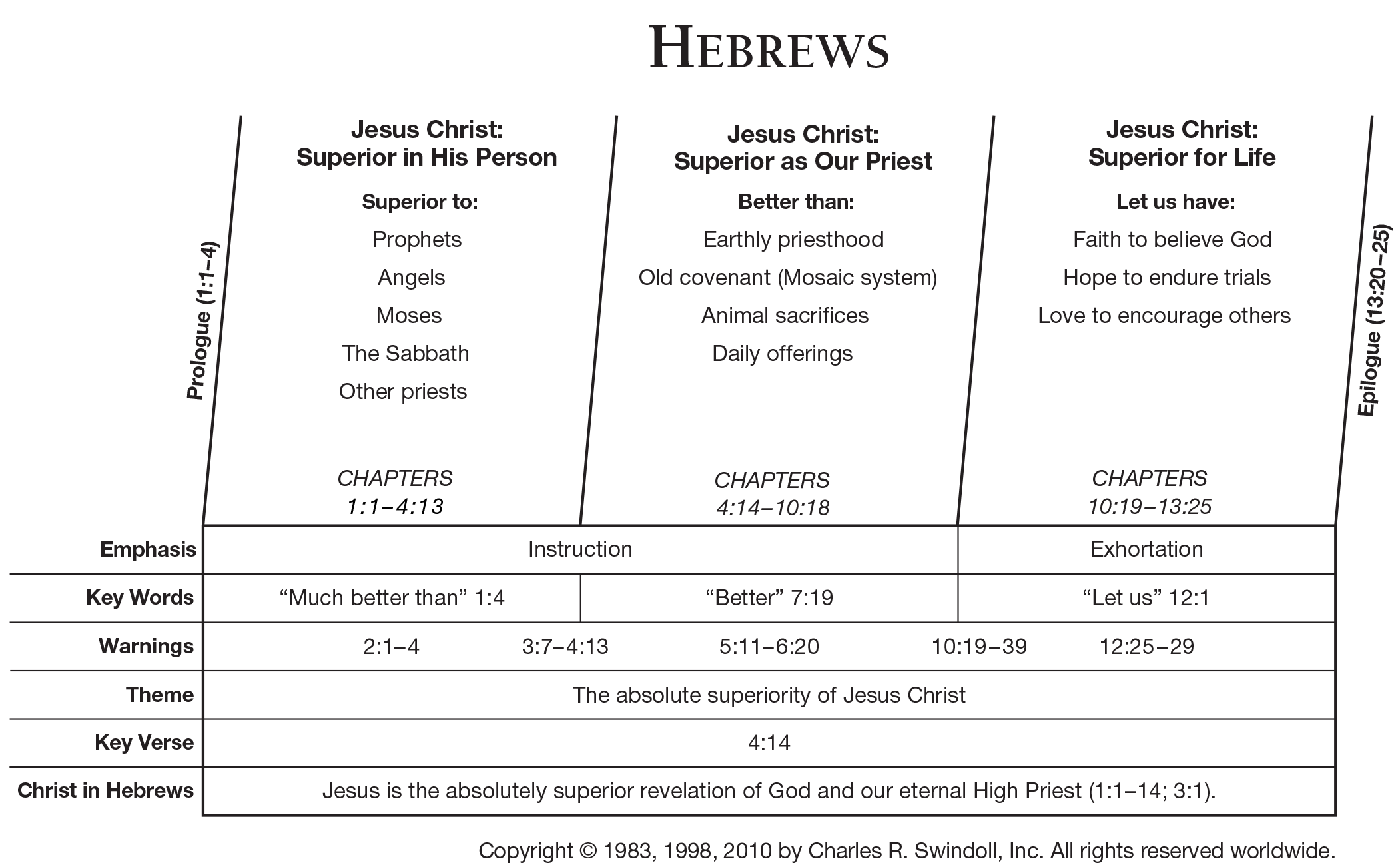
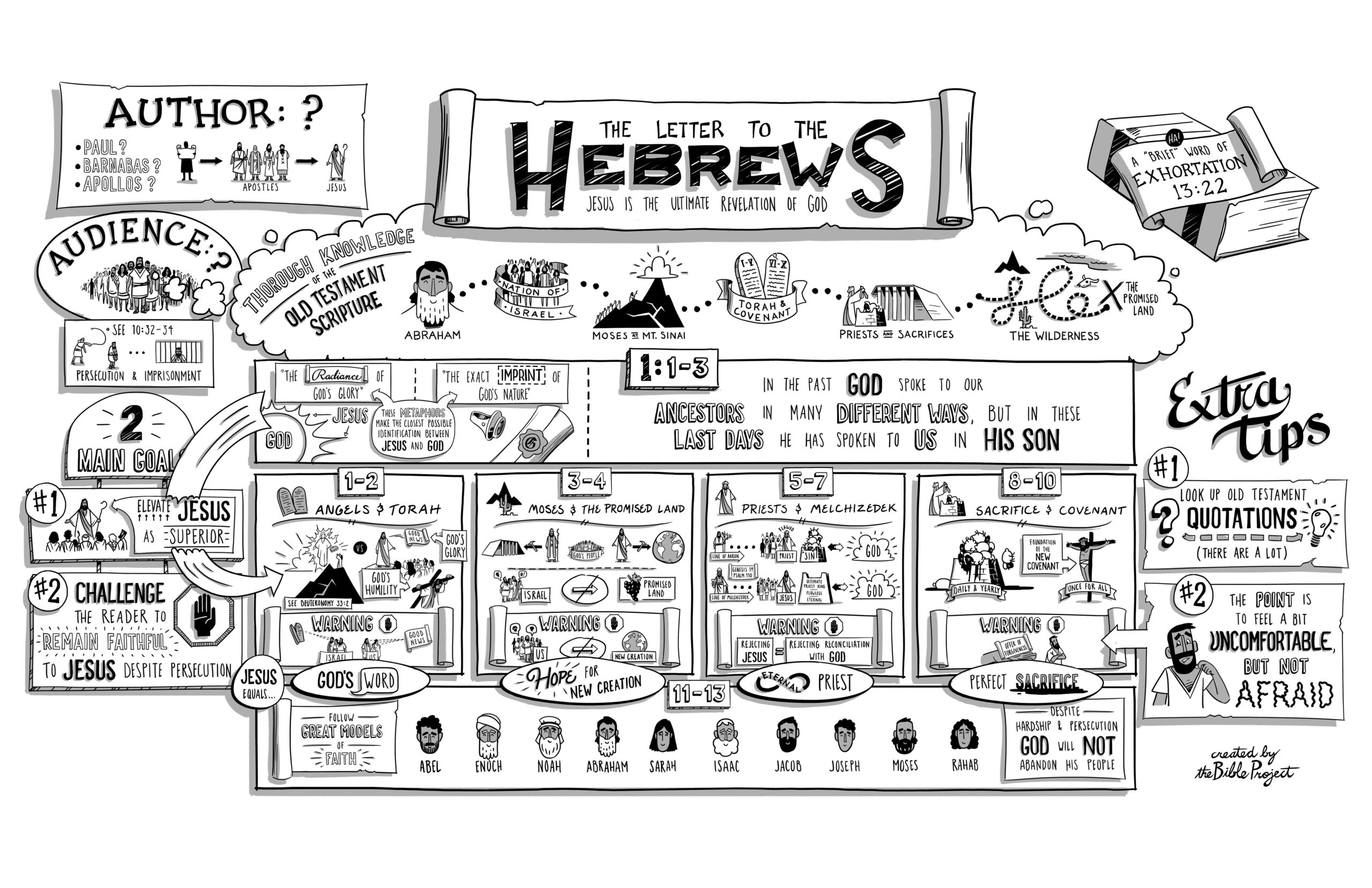
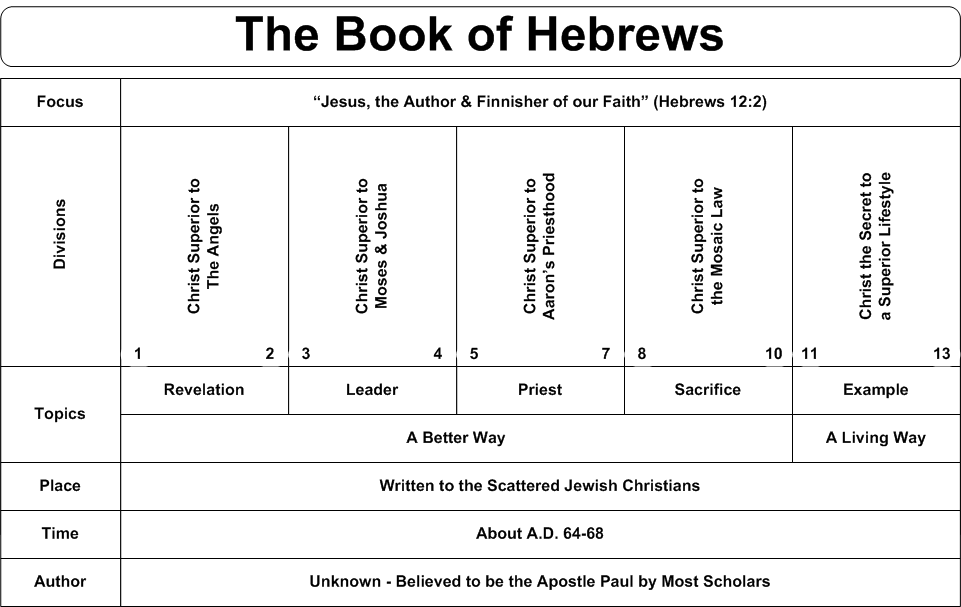
HE THAT
SHOULD COME
Habakkuk 2:3+ records "For the vision is yet for the appointed time; It hastens toward the goal, and it will not fail. Though it tarries, wait for it; For it will certainly come, it will not delay." The Septuagint (LXX) of Habakkuk 2:3 reads slightly different from the Hebrew (the NAS text [as with all English Bibles] above is translated from the Hebrew Scripture rather than the Greek Septuagint) "For the vision is yet for a time, and it shall shoot forth at the end, and not in vain: though he should tarry, wait for him; for he will surely come, and will not tarry."
Note that the phrase reads "It will certainly come" (NAS) rather than "He will surely come" (Septuagint). The Septuagint translation clearly gives this verse a Messianic sense. Keep in mind the historical context of Habakkuk. His oracle was written about 609 BC just prior to the Babylonian exile, the first stage of that exile occurring in 605 BC (final stage in 586 BC). Thus when he said "IT" is coming and will not delay, he was referring to the immediate fulfillment of the judgment of God on Israel in the destruction of Jerusalem and the Temple and exile to Babylon. But many prophecies have an immediate and a distant fulfillment and such is the case with Habakkuk 2:3+ the writer of Hebrews clearly applying it to the return of the Messiah as did the Jewish scholars who authored the Septuagint. The partial fulfillment of Habakkuk 2:3 occurred at the time of Babylonian exile but was just a shadow of the ultimate judgment to be meted out by Messiah when he returns in Rev 19:11-15-+
It is also worth noting that Habakkuk 2:3 was referred to Messiah by the later Jewish theologians, and clearly this is the intent of the writer of Hebrews. The disciples of John the Baptist asked Jesus, “Art thou He that should come or look we for another?” (Lk 7:19-20+) The expression “He that should come” is Jewish and refers to Messiah!
Habakkuk 2:3+ speaks of a revelation which is coming; Hebrews changes it to a Person who is coming. Since Jesus is both a Person and God’s final Word to mankind (Heb 1:1+ "in the last days has spoken in His Son"!), the change is appropriate. The application is that the believer's hope is centered not in a prophecy or timeline, but in a Person, “He Who is coming.”
How can we resolve in just a very little while with 2,000 years since this promise was given? Peter helps, of course, with his reminder that “with the Lord a day is like a thousand years, and a thousand years are like a day.” (2Pe 3:8+) By that reckoning it has only been "two days" since Jesus left us with a promise to return (realizing that Peter was not necessarily literally equating a day with 1000 years, but was emphasizing that to God time is relative for He created it). Further, it is a mistake to project the limitations of time into eternity future for they are two different things. Heaven (eternity future), with all its implications of “absent from the body, present with the Lord” is fully experienced at the death of a believer, and thus the "coming of the Lord" is never any further away than one’s personal death.
Remember our Lord’s ("the First and the Last") words to the persecuted church of Smyrna "Be (present imperative - calls for this to be our lifestyle - only possible as we rely on the supernatural enablement of the Holy Spirit ) faithful, even to the point of death, and I will give you the crown of life (Rev 2:10+)
Little (3398)(mikron) small, little. In all but two instances mikron functions as an adverb of time and is translated “a little while” (e.g., John 16:16). The only exceptions to this use are seen at Matthew 26:39 (cf. Mark 14:35) where it appears to be functioning adverbially in relation to the verb proelthōn: “He went a little further.”
Gingrich - small Mt 13:32; Lk 12:32; Jas 3:5; Rev 3:8. Small or young Mk 15:40. Little one, child Mt 18:6, 10, 14; cf. Acts 8:10; Rev 11:18. Humble Mk 9:42; the one of least importance Mt 11:11. Short Jn 7:33. Little 1 Cor 5:6. a little 2Co11:1, 16. soon Jn 16:16–19. alone a short distance Mt 26:39; a short time Mk 14:70; Jn 13:33. (BORROW Shorter Lexicon of the Greek New Testament)
Friberg - with a basic meaning small, little, translated according to the context; (1) of persons; (a) of physical size small, little (Lk 19.3 ); (b) of age young, little (Mt 18.10 etc.) (c) as measuring esteem or importance - insignificant, lowly, unimportant (Mt 10.42); comparative - on least, most insignificant (Mt 11.11); (2) of things; (a) of quantity or mass small, little, insignificant (1Co 5.6); neuter as a substantive = little (bit) (2Co 11.16); (b) of time short ( Jn 7.33); neuter as a substantive short time, little while ( Jn 13.33); idiomatically = literally little, how much, how much, i.e. very soon, in a very little while (Heb 10.37 ); (c) of space, neuter as a substantive little way, short distance (Mt 26.39) (BORROW Analytical Lexicon of the Greek New Testament)
MIKRON - 43V - Matt. 10:42; Matt. 11:11; Matt. 13:32; Matt. 18:6; Matt. 18:10; Matt. 18:14; Matt. 26:39; Matt. 26:73; Mk. 4:31; Mk. 9:42; Mk. 14:35; Mk. 14:70; Mk. 15:40; Lk. 7:28; Lk. 9:48; Lk. 12:32; Lk. 17:2; Lk. 19:3; Jn. 7:33; Jn. 12:35; Jn. 13:33; Jn. 14:19; Jn. 16:16; Jn. 16:17; Jn. 16:18; Jn. 16:19; Acts 8:10; Acts 26:22; 1 Co. 5:6; 2 Co. 11:1; 2 Co. 11:16; Gal. 5:9; Heb. 8:11; Heb. 10:37; Jas. 3:5; Rev. 3:8; Rev. 6:11; Rev. 11:18; Rev. 13:16; Rev. 19:5; Rev. 19:18; Rev. 20:3; Rev. 20:12
Hebrews 8:11 AND THEY SHALL NOT TEACH EVERYONE HIS FELLOW CITIZEN, AND EVERYONE HIS BROTHER, SAYING, ‘KNOW THE LORD,’ FOR ALL WILL KNOW ME, FROM THE LEAST TO THE GREATEST OF THEM.
MIKRON IN SEPTUAGINT - Gen. 19:11; Gen. 19:20; Gen. 24:17; Gen. 24:43; Gen. 26:10; Gen. 30:30; Gen. 42:2; Gen. 42:32; Gen. 43:2; Gen. 44:25; Gen. 47:9; Exod. 17:4; Exod. 23:30; Num. 16:9; Num. 16:13; Num. 22:18; Deut. 1:17; Deut. 7:22; Deut. 25:13; Deut. 25:14; Jos. 22:17; Jos. 22:19; Jdg. 4:19; Jdg. 6:15; Ruth 2:7; 1 Sam. 2:19; 1 Sam. 5:9; 1 Sam. 9:21; 1 Sam. 15:17; 1 Sam. 16:11; 1 Sam. 20:2; 1 Sam. 20:35; 1 Sam. 22:15; 1 Sam. 25:36; 1 Sam. 30:2; 1 Sam. 30:19; 2 Sam. 7:19; 2 Sam. 9:12; 2 Sam. 12:3; 2 Sam. 12:8; 2 Sam. 17:20; 2 Sam. 24:25; 1 Ki. 2:20; 1 Ki. 3:7; 1 Ki. 8:64; 1 Ki. 11:17; 1 Ki. 17:13; 1 Ki. 18:44; 1 Ki. 22:31; 2 Ki. 2:23; 2 Ki. 4:10; 2 Ki. 5:2; 2 Ki. 5:14; 2 Ki. 23:2; 2 Ki. 25:26; 1 Chr. 12:14; 1 Chr. 25:8; 1 Chr. 26:13; 2 Chr. 10:10; 2 Chr. 12:7; 2 Chr. 18:30; 2 Chr. 21:17; 2 Chr. 22:1; 2 Chr. 31:15; 2 Chr. 34:30; 2 Chr. 36:18; Ezr. 9:8; Est. 1:1; Est. 10:3; Job 2:9; Job 3:19; Job 10:20; Job 36:2; Ps. 42:6; Ps. 73:2; Ps. 104:25; Ps. 115:13; Prov. 6:10; Prov. 15:16; Prov. 20:10; Eccl. 9:14; Cant. 2:15; Cant. 3:4; Cant. 8:8; Isa. 7:13; Isa. 9:14; Isa. 10:25; Isa. 11:6; Isa. 18:5; Isa. 22:5; Isa. 22:24; Isa. 26:16; Isa. 26:20; Isa. 28:10; Isa. 28:13; Isa. 28:25; Isa. 29:17; Isa. 30:14; Isa. 33:4; Isa. 33:19; Isa. 54:7; Isa. 54:8; Isa. 63:18; Jer. 6:13; Jer. 31:34; Jer. 42:1; Jer. 42:8; Jer. 44:12; Jer. 49:15; Jer. 51:33; Lam. 4:18; Ezek. 8:17; Ezek. 11:16; Ezek. 16:20; Ezek. 16:47; Ezek. 17:6; Ezek. 43:14; Ezek. 46:22; Dan. 7:8; Hos. 1:4; Hos. 8:10; Amos 6:11; Amos 8:5; Jon. 3:5; Zech. 4:10
Related Resources: Related to Second Coming
- Second Coming of Christ
- Imminency, Imminent - As related to Christ's Second Coming
- Another discussion on imminency
- What is the difference between the Rapture and the Second Coming?
- What is the Second Coming of Jesus Christ?
- Why is Jesus going to return on a white horse?
- What is the blessed hope?
- Can the return of Christ truly be said to be imminent?
- Is it possible to know when Jesus is coming back?
- Does the Old Testament truly predict a second advent of the Messiah?
The saintly Presbyterian pastor Robert Murray McCheyne was known to on occasion ask people
Do you believe that Jesus is coming today?” If they replied in the negative, he would say, “Then you had better be ready, for He is coming at an hour when you think not!
DO YOU HAVE A BIG GRANDFATHER CLOCK IN YOUR HOUSE? - Every tick of that beautiful old clock echoes forth heaven’s promise ‘He Who is coming will come.’ To the impatient, the wait feels long; to the faithful, it is ‘a very little while.’ God’s timetable is never behind, only beyond our sight.” The believer’s posture, then, is not restless waiting but reverent watching—eyes lifted, heart anchored, faith steadfast. Every swing of the pendulum whispers, “Soon.” Each sunrise is one dawn nearer His return. Though the world mocks delay, the child of God measures time not by minutes, but by moments of mercy and milestones of grace. When impatience tempts the heart, let the steady rhythm of God's promise resound again: “He who is coming will come.”
He came once in humility to redeem.
He comes now by His Spirit to sustain.
He will come again in glory to reign.
Until the clock "strikes 12," may our faith keep time
with heaven’s clock—trusting the unseen hand that winds it.
William MacDonald -
“Surely I come quickly.” (Rev. 22:20)
As we approach the end of the age, it is predictable that many will abandon the hope of Christ’s any-moment return. But the truth is still there whether men hold it or not.
The fact is that the Lord Jesus may come at any time. We do not know the day or hour of the Bridegroom’s return for His bride; this means that He could come today. There is no prophecy that needs to be fulfilled before we hear His shout, the voice of the archangel and the trump of God. True, the church expects to experience tribulation throughout its time on earth, but the horrors of the Tribulation period are not part of its destiny. If the church has to go through, the Tribulation, that would mean that the Lord couldn’t come for at least seven years, because we certainly are not in the Tribulation now, and when it does come, it will last for seven years.
There is a large body of Scripture texts that teach us to be ready at all times for the Savior to appear. Notice the following:
“…nearer than when we believed” (Rom. 13:11).
“The night is far spent, the day is at hand” (Rom. 13:12).
“The Lord is at hand” (Phil. 4:5).
“For yet a little while, and He that shall come will come, and will not tarry” (Heb. 10:37).
“…the coming of the Lord draweth nigh” (James 5:8).
“…the judge standeth before the door” (James 5:9).
“But the end of all things is at hand’”(1 Pet. 4:7).
These verses seem designed to create the impression on the mind that the Lord’s coming is imminent. It is an event for which we should be watching and waiting. We should be busy in His service, faithfully carrying out our stewardship.
R. A. Torrey once said, “The imminent return of our Lord is the great Bible argument for a pure, unselfish, devoted, unworldly, active life of service. In much of our preaching we urge people to live holy and work diligently because death is swiftly coming, but this is never the Bible argument. The Bible argument always is, Christ is coming; be ready when He comes.”
Our responsibility is clear. Our loins should be girded, our lights should be burning, and we should be like those who wait for their Lord (see Luke 12: 35, 36). Let us not succumb to those who teach that we have no right to expect Him at any moment. Rather let us believe in His imminent return, teach it enthusiastically, and let the truth shine out in our lives.
The Watchful Church
Keeps her eyes on the horizon — “looking for the blessed hope and the appearing of the glory of our great God and Savior, Christ Jesus” (Titus 2:13).
Lives with holy expectancy, purity, and mission urgency.
Her lamps are trimmed and burning (Matthew 25:1–13).
The Apathetic Church
Professing belief but living as though He will never return.
Grows lukewarm, self-satisfied, and distracted by the world (Revelation 3:15–17).
Ceases to watch, pray, and witness with urgency.
Christ’s word to such a church is sobering:
“Be watchful, and strengthen (aorist imperative see our need to depend on the Holy Spirit to obey) the things which remain, that are ready to die.” — Revelation 3:2
Why Watchfulness Matters
a. Looking Shapes Living
“Everyone who has this hope fixed on Him purifies himself, just as He is pure.” — 1 John 3:3
Expectation produces purification. (See Vertical Vision)
Those who look for Christ’s appearing live differently — they love, forgive, serve, and persevere with eternity in view.
b. Apathy Breeds Apostasy
When the church loses her longing, she loses her light.
The parable of the Ten Virgins (Matthew 25) warns us: those who slumber spiritually may be caught unprepared when the Bridegroom comes.
The church which forgets the hope of her Lord’s return grows worldly; but let her expect Him and she will gird up her loins and trim her lamp
The anticipation of Christ’s coming purifies the church and energizes her mission. When that hope fades, spiritual indifference follows
The great design of the gospel is to teach us to look for Christ’s second coming, and to live so as that we may be found ready.
When believers look for Him, they live as His bride — pure, ready, eager.
When they lose that longing, they live as if the world were their home.
Takeaway - A church expecting Christ is alive with hope; a church ignoring His return is adrift in apathy. One watches;the other withers.
The watching Church keeps lamps alight,
Her gaze fixed upward through the night;
Though storms may rage and shadows press,
She waits her Lord in readiness.
The drowsing Church, grown rich, at ease,
Seeks comfort more than she seeks to please;
Her heart forgets the trumpet’s call,
Content within her gilded hall.
But soon the midnight cry will sound—
The Bridegroom’s steps are on the ground!
Then watchful hearts will rise in flame,
While slumbering souls shrink back in shame.
O Church of Christ, lift up thine eyes;
The clouds are rent—salvation nigh!
Trim now thy lamp, renew thy vow;
The coming One is nearing now.
Here is a song by Keith Green I would challenge your song leader to sing next Sunday!
Do you see? Do you see?
All the people sinking down?
Don't you care? Don't you care?
Are you gonna let them drown?
How can you be so numb?
Not to care if they come
You close your eyes and pretend the job's done
"Oh, bless me, Lord, bless me, Lord"
You know, it's all I ever hear
No one aches, no one hurts
No one even sheds one tear
But, He cries, He weeps, He bleeds
And He cares for your needs
And you just lay back and keep soaking it in
Oh, can't you see it's such sin?
'Cause He brings people to your door
And you turn them away
As you smile and say
"God bless you, be at peace"
And all Heaven just weeps
'Cause Jesus came to your door
You've left Him out on the streets
Open up, open up
And give yourself away
You see the need, you hear the cries
So how can you delay?
God's calling and you're the one
But like Jonah, you run
He's told you to speak but you keep holding it in
Oh, can't you see it's such sin?
The world is sleeping in the dark
That the church just can't fight
'Cause it's asleep in the light
How can you be so dead
When you've been so well fed?
Jesus rose from the grave
And you, you can't even get out of bed
Oh, Jesus rose from the dead
Come on, get out of your bed
How can you be so numb
Not to care if they come?
You close your eyes and pretend the job's done
You close your eyes and pretend the job's done
Don't close your eyes, don't pretend the job's done
Come away, come away
Come away with me, my love
Come away from this mess
Come away with me, my lov
Come away from this mess
Come away with me, my love
Come away, come away, oh
Come away with me, my love
The Consummation of His Work:
(1) He shall return again to this earth (Acts 1:11; Hebrews 10:37; John 14:3).
(2) Believers in Christ shall be bodily resurrected to begin a new, undying life (1 Thessalonians 4:17–18; 1 Corinthians 15:51–58).
(3) He will reign as King of kings and Lord of lords over His new creation (2 Peter 3:10–13; Revelation 22:3–5).
Robert Neighbour - “For yet a little while, and He that shall come will come, and will not tarry.” (Heb. 10:37.)
‘Tis but a little while, and Christ will come,
A little while;
He’s waiting in His high and heav’nly home
A little while:
He’ll surely come; let not the world beguile,
He’ll greet us with His favor and His smile,
Hell tarry not, His promise knows no guile,
“A little while.”
‘Twill not be long, and then He’ll come again,
‘Twill not be long;
He’ll come with angel-host, and heav’nly train,
‘Twill not be long:
We’ll hear the trumpet, as its notes prolong,
The Savior’s shout will stir our hearts to song,
We’ll join our praises with the heav’nly throng;
Twill not be long.
“A Little while, how little, how little!” The words ring out their clarion call to saints who are caught in the debris of this present world collapse.
“He that cometh, will come; and will not tarry.” What assurance, what comfort, what stirring hope swells in our breast: “Behold, the Bridegroom cometh!”
The kings of the earth may set themselves together against the Lord, and against His Anointed, saying, “Let us cast away their cords from us”; yet, He will surely come.
Men may tell us that Christ will never come; that we are deceived in watching and waiting, looking and longing, praying and pleading for Him to quickly come, and yet, He will not tarry; He will come for His promise is sure.
All nature is travailing in pain together until now, waiting for Him to come; saints down the ages, with yearning souls have cried, “Lord Jesus, quickly come”; He has, Himself, been sitting at the Father’s right hand “expecting,” till He come; yes, He “will come, and will not tarry.”
When the hour strikes, He will hasten to us like a hart, or a young roe over the mountains of Bether (separation).
Then shout and sing, hosannahs ring,
Lift up your heart and voice,
Christ comes again, with heavenly train,
Let all the saints rejoice.
Daily Light on the Daily Path - “‘When shall I arise?’ But the night is long.”
“Watchman, what time of the night?” . . . The watchman says: “Morning comes.”
Yet a little while, and the coming one will come and will not delay.—“He dawns on them like the morning light, like the sun shining forth on a cloudless morning.”
“In my Father’s house are many rooms. If it were not so, would I have told you that I go to prepare a place for you? And if I go and prepare a place for you, I will come again and will take you to myself, that where I am you may be also. . . . Let not your hearts be troubled, neither let them be afraid. You heard me say to you, ‘I am going away, and I will come to you.’”
“So may all your enemies perish, O Lord! But your friends be like the sun as he rises in his might.”—For you are all children of light, children of the day. We are not of the night or of the darkness.
And there will be no night there.
Job 7:4; Isa. 21:11–12; Heb. 10:37; 2 Sam. 23:4; John 14:2–3, 27–28; Judg. 5:31; 1 Thess. 5:5; Rev. 21:25
Daily Light on the Daily Path - He has prepared for them a city.
“And if I go and prepare a place for you, I will come again and will take you to myself, that where I am you may be also.”—An inheritance that is imperishable, undefiled, and unfading, kept in heaven for you.—Here we have no lasting city, but we seek the city that is to come.
“This Jesus, who was taken up from you into heaven, will come in the same way as you saw him go into heaven.”—Be patient, therefore, brothers, until the coming of the Lord. See how the farmer waits for the precious fruit of the earth, being patient about it, until it receives the early and the late rains. You also, be patient. Establish your hearts, for the coming of the Lord is at hand.—“Yet a little while, and the coming one will come and will not delay.”
We who are alive, who are left, will be caught up together with them in the clouds to meet the Lord in the air, and so we will always be with the Lord. Therefore encourage one another with these words.
Heb. 11:16; John 14:3; 1 Pet. 1:4; Heb. 13:14; Acts 1:11; James 5:7–8; Heb. 10:37; 1 Thess. 4:17–18
Daily Light on the Daily Path - “Yet a little while, and the coming one will come and will not delay.”
“Write the vision; make it plain on tablets, so he may run who reads it. For still the vision awaits its appointed time; it hastens to the end—it will not lie. If it seems slow, wait for it; it will surely come; it will not delay.”
But do not overlook this one fact, beloved, that with the Lord one day is as a thousand years, and a thousand years as one day. The Lord is not slow to fulfill his promise as some count slowness, but is patient toward you, not wishing that any should perish, but that all should reach repentance.—But you, O Lord, are a God merciful and gracious, slow to anger and abounding in steadfast love and faithfulness.—Oh that you would rend the heavens and come down. . . . From of old no one has heard or perceived by the ear, no eye has seen a God besides you, who acts for those who wait for him.
Heb. 10:37; Hab. 2:2–3; 2 Pet. 2:8–9; Ps. 86:15; Isa. 64:1, 4
Daily Light on the Daily Path - You have set up a banner for those who fear you, that they may flee to it from the bow.
The Lord Is My banner.—For he [the enemy] will come like a rushing stream, which the wind of the Lord drives.
May we shout for joy over your salvation, and in the name of our God set up our banners!—“The Lord has brought about our vindication; come, let us declare in Zion the work of the Lord our God.”—We are more than conquerors through him who loved us.—But thanks be to God, who gives us the victory through our Lord Jesus Christ.—The founder of their salvation.
Finally, be strong in the Lord and in the strength of his might.—Falsehood and not truth has grown strong in the land.—“Fight the Lord’s battles.”—“Be strong, all you people of the land, declares the Lord. Work. . . . Fear not.”—“Lift up your eyes, and see that the fields are white for harvest.”—“Yet a little while, and the coming one will come and will not delay.”
Ps. 60:4; Ex. 17:15; Isa. 59:19; Ps. 20:5; Jer. 51:10; Rom. 8:37; 1 Cor. 15:57; Heb. 2:10; Eph. 6:10; Jer. 9:3; 1 Sam. 18:17; Hag. 2:4–5; John 4:35; Heb. 10:37
Daily Light on the Daily Path - “What do you mean, you sleeper? Arise.”
This is no place to rest, because of uncleanness that destroys.—Set your minds on things that are above, not on things that are on earth.—If riches increase, set not your heart on them.—“Now set your mind and heart to seek the Lord your God. Arise.”
“Why are you sleeping? Rise and pray that you may not enter into temptation.”—“But watch yourselves lest your hearts be weighed down with dissipation and drunkenness and cares of this life, and that day come upon you suddenly like a trap.”—“As the bridegroom was delayed, they all became drowsy and slept.”—“Yet a little while, and the coming one will come and will not delay.”—The hour has come for you to wake from sleep. For salvation is nearer to us now than when we first believed.—“Therefore stay awake—for you do not know when the master of the house will come, in the evening, or at midnight, or when the rooster crows, or in the morning—lest he come suddenly and find you asleep.”
Jonah 1:6; Mic. 2:10; Col. 3:2; Ps. 62:10; 1 Chron. 22:19; Luke 22:46; Luke 21:34; Matt. 25:5; Heb. 10:37; Rom. 13:11; Mark 13:35–36
John Bennett - Hebrews 10:37 HE THAT SHALL COME WILL COME - Day by Day: Bible Promises
Believers are exhorted to be steadfast, v. 36, in the light of the Lord’s imminent return. It is but ‘a little while’, ‘a little while, how little, how little’ W. E. VINE, and He will come. How could this be, seeing nearly two thousand years have passed since the Epistle to the Hebrews was written? But, wait a minute, in the light of eternity, how short a period two thousand years really is; just a flash! The time of His return is set indelibly in God’s calendar. ‘He that shall come will come and will not tarry’. Nothing will upset God’s timing, nothing that men or angels or even the devil can do could possibly delay God’s purposes in the coming of Christ.
This promise was first spoken by Habakkuk, where it primarily refers to the deliverance of Israel from the Chaldeans, Hab. 2:3. However, in the context here, it is applied to present day believers, the coming of Christ for His people at the rapture, when He comes to the air and the saints are caught up to meet Him.
If it was but ‘a little while’ in the first century of Christianity how much nearer it must be now, when some believe the portents of His coming are seen on every hand. It is felt by some that since the time of the flood there has never been such a great quantity of evil committed, or such a brazen rejection of God. Men generally are so full of pride and conceit in their own ideas that God’s intervention in judgement must be close. But, first, Christ is to come for His bride the church.
In Matthew 25:1–13 the Lord tells the parable of the ten virgins. He says, ‘While the bridegroom tarried’, v. 5. Some commentators suggest that this parable refers to the coming of the Lord for His true bride. How is it, then, that He ‘tarries’, when our promise tells us that ‘He will not tarry’? From man’s point of view, it seems as though He tarries, but, in fact, He is not delaying His coming at all. In heaven, the appointed time has been set and has not, and never will be, altered.
In view of His coming, let us devote ourselves to Him and His service, that ‘when he shall appear, we may … not be ashamed before him at his coming’, 1 John 2:28.
Vance Havner - ONE OF THESE DAYS
For yet a little while, and he that shall come will come, and will not tarry. Hebrews 10:37.
Did you get up this morning and from the burnt toast onward you knew that it was going to be "one of those days"? Nothing came out right, that letter you expected did not come, that prayer you prayed was not answered, your arthritis acted up worse than ever and all you were aware of was the cold hard law of cause and effect. Not a break in the clouds, not a hint of heaven, everything was of the earth—earthy. Never mind, dear heart, it may have been "one of those days," but ahead lies "one of these days," another kind of day. If you are in Christ, beyond the snow of winter lies the sunshine of spring, beyond the grave lies resurrection. Yet a little while and He that shall come will come and will not tarry....
One of these days.
During World War II occurred early in the war when the Japanese army stormed the Philippines and forced United States General Douglas MacArthur to leave the islands. Upon leaving the Philippines, General MacArthur declared his famous promise, “I shall return.” And he did, walking ashore a victor at Leyte in the Philippines several years later. In an even more famous quote, the Captain of the hosts, the Lord Jesus Christ declared to His fearful band of disciples “I will come again” (John 14:3)
He that rose from the clods we expect from the clouds. - Thomas Adams
A little while—then Christ will come;
The glorious hour draws nigh
When He will come to take His bride
To dwell with Him on high.
—Gilmore
Christ’s second coming is as certain as His first.
When it comes to belief in the Lord's return there are two kinds of Christians—gazers and goers.
He is coming! Oh, the rapture
To behold His lovely face,
And to tell Him how I love Him,
Who has saved me by His grace.
—Dimmock
Christ is coming—perhaps today!
A Scottish preacher once said, “The doctrine of the Lord’s second coming, as it appears in the New Testament, is like a lofty mountain that dominates the entire landscape.” Commenting on that statement, author A. J. Gordon adds, “No matter what road you take, no matter what pass you tread, you will find the mountain bursting on your vision at every turn of the way, and at every parting of the hills. What first struck me in reading the New Testament was this: Whatever doctrine I was pursuing, whatever precept I was enforcing, I found it fronting toward and terminating in the hope of the Lord’s second coming. All paths of obedience and service lead on to that mountain.” Someone has pointed out that there are more than 300 references to Christ’s return in the New Testament. One fact is clear—Jesus is coming back. Each day we are getting closer to that climactic moment. Today could be the day! (Reprinted by permission from Our Daily Bread Ministries. Please do not repost the full devotional without their permission.)
The Lord has said He will return
To judge the world someday;
Are you prepared for Him to come
Or hoping for delay?
—Sper
Don't complain about what this world is coming to.
Proclaim the One who is coming to this world.
He who loves the coming of the Lord is not he who affirms it is far off, nor is it he who says it is near. It is he who, whether it be far or near, awaits it with sincere faith, stead-fast hope and fervent love. - Augustine
That day lies hid that every day we be on the watch. - Augustine
The certainty of the Second Coming of Christ should touch and tincture every part of our daily behavior. - John Blanchard
In the first advent God veiled his divinity to prove the faithful; in the second advent he will manifest his glory to reward their faith. -Chrysostom
The only remedy for all this mass of misery is the return of our Lord Jesus Christ. Why do we not plead for it every time we hear the clock strike? - Anthony Ashley Cooper
As Christians, we should not be exitists, looking for our going, but adventists, looking for his coming. - William Freel
The subject of the second coming of Christ has never been popular to any but the true believer. - Billy Graham
Christ hath told us he will come, but not when, that we might never put off our clothes, or put out the candle. - William Gurnall
Oh, the joy to see thee reigning,
Thee, my own beloved Lord!
Every tongue thy name confessing,
Worship, honour, glory, blessing,
Brought to thee with glad accord—
Thee, my Master and my Friend,
Vindicated and enthroned,
Unto earth's remotest end
Glorified, adored and owned!
- Frances Ridley Havergal
Christ will come when he pleases, to show his sovereignty, and will not let us know when, to teach us our duty. - Matthew Henry
What seems like ‘delay’ from earth’s clock is ‘soon’ on heaven’s calendar.
We look not for a phantom, but for a Friend; not for a doctrine, but for the Divine Deliverer.
If this (Second Coming) is not an integral part of the faith once given to the saints, I do not know what is. - C. S. Lewis
Precisely because we cannot predict the moment, we must be ready at all moments. - C. S. Lewis
The primitive church thought a great deal more about the coming of Christ than about death, and thought a great deal more about his coming than about heaven. - Alexander Maclaren
I never preach a sermon without thinking that possibly the Lord may come before I preach another. - D. L. Moody
Christ is coming to the earth, in such form at least as shall fulfil his purposes of mercy to his friends and justice to his foes. - Thomas V. Moore
I never begin my work in the morning without thinking that perhaps he may interrupt my work and begin his own. I am not looking for death, I am looking for him. - G. Campbell Morgan
There is such a danger of our being so occupied with the things that are to come more than with Him Who is to come. - Andrew Murray
Millions of graves are dug every year, but it is inspiring to think that one generation of Christians will cheat the undertaker. - J. C. Pollock
The return of Christ represents not only the ultimate sense of accountability but the ultimate sense of hope as well. - RBC Booklet
Oh, that Christ would make long strides! Oh, that he would fold up the heavens as a cloak, and shovel time and days out of the way! - Samuel Rutherford
There shall be no time for parting words or a change of mind when the Lord appears. -J. C. Ryle
Uncertainty about the date of the Lord's return is calculated to keep believers in an attitude of constant expectation and to preserve them from despondency. - J. C. Ryle
If I knew that our Lord would come this evening, I should preach just as I mean to preach; and if I knew he would come during this sermon, I would go on preaching until he did. - C. H. Spurgeon
Oh, that the Lord would come! He is coming! He is on the road and travelling quickly. The sound of his approach should be as music to our hearts! - C. H. Spurgeon
The fact that Jesus Christ is to come again is not a reason for star-gazing, but for working in the power of the Holy Ghost. - C. H. Spurgeon
Since he may come any day, it is well to be ready every day. - J. Hudson Taylor
He who came in humility and shame will return in spectacular magnificence. - John R. W. Stott
The imminent return of our Lord is the great Bible argument for a pure, unselfish, devoted, unworldly, active life of service. - R. A. Torrey
This is pinned as a badge to the sleeve of every true believer—that he looks for and longs for Christ's coming to judgement. - John Trapp
The Christian hope is not a matter for tickling our minds, but for changing our minds and influencing society. - Stephen Travis
I am daily waiting for the coming of the Son of God. - George Whitefield
The brightness of Christ's advent will reveal the true character of those things which were previously hidden by darkness. - Geoffrey B. Wilson
Use "AS IS"
1 Peter 1:13 Therefore, prepare your minds for action, keep sober in spirit, fix your hope completely on the grace to be brought to you at the revelation of Jesus Christ.
FUTURE LOOKING (LOOKING TO THE REWARD v36 AND BEST OF ALL TO THE "REWARDER" HIMSELF!!! v37 = JESUS IS THE ULTIMATE AND BEST REWARD WE WILL EVER EXPERIENCE IN ALL ETERNITY!) ENABLES (undergirds, strengthens our faith) PRESENT LIVING. (ENDURING, DOING WILL OF GOD)
Both Present Living and Future Looking depend on faith (e.g., we look at things not seen - 2 Cor 4:18 "we walk by faith not sight" 2 Cor 5:7) .
But the incredible paradox is that future looking also strengthens our faith for present living, present enduring. The idea is similar to Ro 10:17 that "FAITH comes by hearing and hearing by the Word of Christ." So as we "hear" (READ THEM AND/OR HEAR THEM PREACHED, ETC) these great promises of the imminent return of Jesus, they stir up and stabilize our faith so we can then better endure the trials and tribulations that are sure to come our way -- in this way the Spirit enables us to persevere and not shrink back.
Or it could be titled Past Remembering, Present Endurint, Future Looking
Hebrews 10:36 For you have need of endurance, so that when you have done the will of God, you may receive what was promised.
YOU HAVE NEED FOR ENDURANCE - It sounds like this is not an option for these Hebrew readers-- that is they had a need or requirement for endurance. For these Hebrews needed to have endurance which is opposite of falling away (Heb 10:26-31). One either holds fast or he lets go. Jesus echoes what the writer of Hebrews was saying - Mt 24:13 Jesus said "But the one who endures (hupomeno) to the end, he will be saved. It is called by some the "perseverance of the saints" -- Don't misunderstand what Jesus was saying -- "doctrine of perseverance." An individual's perseverance does not save them. One cannot merit salvation. On the other hand one's perseverance shows or demonstrates that they (and in context these Hebrews) are truly saved. Why? Because only a saved individual could persevere to the end, because only a saved person would have the Spirit given supernatural power to endure to the end and not shrink away.
If, as the writer to the Hebrews says, we need endurance, for we can expect to encounter difficulty. Mark it well: Faith never escapes testing.
Patient endurance—it even sounds awful; it sounds grim and cheerless and foreboding. Few things in life are more unappealing, more agonizing, more maddening, than waiting. How is it possible to stand calmly on the deck of a storm-battered ship and wait patiently for God to still the tempest? It is the element of anticipation that makes such patient endurance possible. And that is what the author of Hebrews is speaking of in chapter 10, verse 37:
But how do we apply this truth about endurance to our lives? These are just some thoughts -- it may be too much material but I thought that everyone needs to understand the meaning of endurance and how this wonderful virtue can be cultivated and fertilized in our spiritual gardens (so to speak). I think folks need to understand as I explain below that endurance is more that just "grin and bear it!"
- What is endurance? Comes from two words which help give a picture of the meaning = hupo = under + meno = abide under -- So the picture is that believers need to be able to abide under which the implication that what they are "abiding under" is difficult circumstances!
- Are you going through any difficult circumstances today?
- Then you are in need of HUPOMONE -- THIS WORD HAS TO DO WITH CIRCUMSTANCES - hanging in there when circumstances are difficult. NOte that this is not just a passive acceptance (like "I'll just grit my teeth and bear it" or "Grin and bear it!") No, it is a strong fortitude in the face of opposition or difficulty. William Barclay said that hupomone "is the spirit which can bear things, not simply with resignation, but with blazing hope" Okay, I begin to get the picture, so....
- Where or how is the need for endurance going to come from? Think about it -- if it were grin and bear it that would be our natural strength, our power. But as most of us have found out that doesn't work very well. So by default, it is not natural, it has to be supernatural. It has to be a work of God. We don't have time for an in depth study but I do not want to leave you hanging -- so here are 3 (or 4) ways of how to experience supernatural endurance. (You probably won't have time for all 4 -- maybe not even a couple, so in the category "for what it's worth")
- REMEMBER PAST VICTORIES in difficult circumstances and how God brought you through -- Heb 10:32 But remember (command to keep on remembering!) the former days, when, after being enlightened (YOU WERE SAVED), you endured a great conflict of sufferings.
PAST Remembering of God's grace which enabled you to endure some great difficulty in your life will strengthen PRESENT endurance in your faith which may be feeling a little shaky! Remembering is the place to begin as when Israel the crossed the Jordan to enter the promised land (as told in Joshua 4) They set up 12 stones of remembrance to help them remember that God opened a path for them to cross over on dry ground. Do you have some "dry ground crossings" in your walk with Christ? Have you written them down? An old Hebrew professor used to say, "Paper is cheaper than brains." And this is a great tool to use with your kids to teach them by these reminders that God is faithful and worthy of their trust.
- READ THE OLD TESTAMENT and PRAY FOR PERSEVERANCE -
Ro 15:4-5 (READ) For whatever was written in earlier times (OT) was written for our instruction, so that through perseverance(hupomone) and the encouragement of the Scriptures (THE OT, BUT OF COURSE IT WOULD APPLY TO READING THE NT) we might have hope (ABSOLUTE ASSURANCE THAT GOD WILL DO GOOD TO US IN THE FUTURE). 5 (PRAY) Now may the God who gives perseverance (hupomone) and encouragement grant you to be of the same mind with one another according to Christ Jesus- KEEP LOOKING TO JESUS - Jesus endured the greatest trial (the Cross) giving us His example to follow in His steps (1 Peter 2:21)
Heb 12:1-2 let us run with endurance the race that is set before us, fixing (MEANS TO LOOK AWAY FROM ALL DISTRACTIONS AND LOOK TO JESUS - THIS VERB REMINDS ME OF HORSES WHO HAVE PATCHES ON EITHER SIDE OF THEIR EYES TO KEEP THEM FROM BEING DISTRACTED AND TO STAY FOCUSED ON THE ROAD AHEAD!) our eyes on Jesus, the author and perfecter of faith, Who for the joy set before Him endured (HUPOMENO) the cross (FUTURE JOY MOTIVATED PRESENT SUFFERING/ENDURANCE -- THE SAME DYNAMIC APPLIES TO OUR LIVES -- THE KEY IS VIEWING THE PRESENT TRIALS WITH A FUTURE PERSPECTIVE - WHICH IS WHAT HEB 10:37 WILL HELP US DO) , despising the shame, and has sat down at the right hand of the throne of God.- ACCEPT TRIALS - God's Word says they have a holy purpose and are not random events. He is in control.
James 1:2-3 Consider it all joy, my brethren, when you encounter various trials, knowing that the testing of your faith produces endurance (HUPOMONE)
WILL OF GOD - THIS IS WAY TOO MUCH BUT MAY BE ABLE TO EXTRACT A FEW USEFUL, MEMORABLE POINTS
God’s REVEALED WILL is most clearly revealed in the HIS WORD, which provides clear guidelines regarding moral and spiritual matters
Chuck Swindoll says that “The better you get to know the WORD OF GOD, the less confusing is the WILL OF GOD. Those who struggle the least with the will of God are those who know the Word of God best.”
It follows that the best way to know GOD’S REVEALED WILL is by diligently studying HIS REVEALED WORD . But we need to beware of the delusion that just reading His Word is sufficient to discern His will (cf Jas 1:22). When we obey what we read we will be blessed in what we do (Jas 1:25).
In John 7:17 Jesus explains that whoever is willing to do (obey) God’s will, will know whether His teaching is of God or merely His own. The first prerequisite to ascertaining God's leading in some matter is a willingness to follow God's will, even if the answer goes against our preference. Someone has well said that most people don't really want to know the will of God in order to do it. They want to know it in order to consider it.
Alan Redpath warns us “Don’t expect God to reveal His will for you next week until you practice it for today.”
In short, the best way to know God's WILL is to say "I WILL" to God!
RECEIVE WHAT WAS PROMISED -- What is the promise?
This same word is used in Heb 4:1 "Therefore, let us fear if, while a promise remains of entering His rest, any one of you may seem to have come short of it." There promised rest speaks of salvation and the assurance of heaven.
Heb 9:15 - says we will receive "the promise of the eternal inheritance." referring to salvation.
The NT verb for RECEIVE (komizo) has another use which helps us understand what the promise is. It is the same verb used by Paul to describe the Judgment Seat of Christ
For we must all appear before the judgment seat of Christ, so that each one may be recompensed (KOMIZO for his deeds in the body, according to what he has done, whether good or bad. (2 Cor 5:10)
So here komizo speaks of future rewards at the Judgment Seat.
WHAT WAS PROMISED - would include rewards, but primarily salvation
This is amazing grace indeed that God's promise includes salvation and eternal life in heaven but also eternal rewards in Heaven.
Heb 10:37 FOR YET IN A VERY LITTLE WHILE, HE WHO IS COMING WILL COME, AND WILL NOT DELAY.
I would probably avoid too much explanation about the differences between Masoretic and Lxx. But knowing how many love Israel and Jewish things, you might consider this little note -- It is also worthy of note that Habakkuk 2:3 was referred to Messiah by the later Jewish theologians, and clearly this is the intent of the writer of Hebrews. This is the very phrase (ho erchomenos) is used by the disciples of John the Baptist who asked Jesus in Lk 7:20 - NAS has "Are you the Expected One" but more literally they were asking "Are you the coming One" -- so here in Hebrews "He who is coming" is a well known Jewish way of describing the Messiah.
Fresh motivation to faithful endurance is found in realizing the brevity of this present life and the certainty AND length of eternity
PREVIOUS MENTION OF SECOND COMING
Heb 9:28 so Christ also, having been offered once to bear the sins of many, will appear a second time for salvation without reference to sin, to those who eagerly await Him.
Eagerly await is the present tense meaning to continually (as one's habitual practice) to wait in great anticipation with patience ("wait it out"), fully expecting His return.
THE COMING ONE WILL COME IN A "MICRON"
The Greek word for "little" is mikros. We derive our English word micron from the Greek. A micron is a unit of length equal to one millionth of a meter, used in many technological and scientific fields. Now think about applying the word to time - what the writer is saying is that Jesus is coming in "one millionth of a second."
Here is Francis Chan's stunning illustration of Eternity - https://www.youtube.com/watch?v=YWk7RUg3ZV4 (TAKES 4' 19") YOU COULD INTRODUCE IT BY SAYING WE HAVE A GUEST PREACHER WHO HAS JUST COME IN FROM CALIFORNIA!
SECOND COMING - Think of it as a "High Peak" you can always see (with eyes of faith 2 Cor 4:18, 2 Cor 5:8)
A Scottish preacher once said, “The doctrine of the Lord’s second coming, as it appears in the New Testament, is like a lofty mountain that dominates the entire landscape.” Commenting on that statement, author A. J. Gordon adds, “No matter what road you take, no matter what pass you tread, you will find the mountain bursting on your vision at every turn of the way, and at every parting of the hills. What first struck me in reading the New Testament was this: Whatever doctrine I was pursuing, whatever precept I was enforcing, I found it fronting toward and terminating in the hope of the Lord’s second coming. All paths of obedience and service lead on to that mountain.” Someone has pointed out that there are more than 300 references to Christ’s return in the New Testament. (1 in every 30 verses) One fact is clear—Jesus is coming back. Each day we are getting closer to that climactic moment. Today could be the day!
A few other Second Coming quotes in category FYI
- Don't complain about what this world is coming to. Proclaim the One who is coming to this world.
- Christ’s second coming is as certain as His first.
- Uncertainty about the date of the Lord's return is calculated to keep believers in an attitude of constant expectation and to preserve them from despondency. - J. C. Ryle
- The absolute certainty (= "HOPE" - hope sure, not hope so) of the Second Coming of Christ should touch and tincture every part of our daily behavior.
- During World War II occurred early in the war when the Japanese army stormed the Philippines and forced United States General Douglas MacArthur to leave the islands. Upon leaving the Philippines, General MacArthur declared his famous promise, “I shall return.” And he did, walking ashore a victor at Leyte in the Philippines several years later. In an even more famous quote, the Captain of the hosts, the Lord Jesus Christ declared to His fearful band of disciples “I will come again” (John 14:3)
- I never begin my work in the morning without thinking that perhaps he may interrupt my work and begin his own. I am not looking for death, I am looking for him. - G. Campbell Morgan
- If I knew that our Lord would come this evening, I should preach just as I mean to preach; and if I knew he would come during this sermon, I would go on preaching until he did. - C. H. Spurgeon
- Oh, that the Lord would come! He is coming! He is on the road and travelling quickly. The sound of his approach should be as music to our hearts! - C. H. Spurgeon
- The fact that Jesus Christ is to come again is not a reason for star-gazing, but for working in the power of the Holy Ghost. - C. H. Spurgeon
- Since he may come any day, it is well to be ready every day. - J. Hudson Taylor
Steven Cole - The “very little while” is from God’s perspective of time, not from our perspective! The original quote in Isaiah was written to the people of Judah who were being threatened by hostile enemies. God is encouraging them to hold on for a little while, until He delivers them and judges their enemy. The point is, this present life is “a very little while” in comparison with the eternal joys of heaven. That is why Paul could call his many trials “momentary, light affliction” which was producing “an eternal weight of glory far beyond all comparison” (2Co 4:17). To have enduring faith in trials now, get God’s eternal perspective.
Hebrews 10:38 BUT MY RIGHTEOUS ONE SHALL LIVE BY FAITH; AND IF HE SHRINKS BACK, MY SOUL HAS NO PLEASURE IN HIM.
Shrinks back is in essence described in Heb 10:26-31 - that's what a person who "shrinks back" looks like. And the "reward" there is the same as in v39 (shrinks back to destruction = falling "into the hands of the living God" in Heb 10:31)
FAITH - Faith is manifest by not believing in spite of evidence but obeying in spite of consequence.
Hebrews 11:6 And without faith it is impossible to please Him, for he who comes to God must believe that He is and that He is a rewarder of those who seek Him.
The opposite of apostasy is faith, the faith in this verse being a preview of the subsequent chapter (Hebrews 11). It is faith which pleases God (Heb 11:6) (NOTE IN V38 THE SHRINKING BACK PROVES THIS ONE DOES NOT HAVE SAVING FAITH -- AND THUS WE SEE THIS IS ALMOST AN ILLUSTRATION OF THE TRUTH OF HEBREWS 11:6 FOR ONLY FAITH PLEASES GOD). The individual who draws back from the knowledge of the gospel and faith will prove his apostasy. ON THE OTHER HAND Endurance proves (does not earn) one is genuinely saved. Believers are saved from sin by faith, but must continue to live by faith (THAT'S WHAT HE MEANS BY "MY RIGHTEOUS ONE SHALL LIVE" DAILY "BY FAITH" - FAITH SAVE US AND FAITH ENABLES US TO LIVE VICTORIOUSLY DAY BY DAY) and this LIFE OF OF FAITH WILL BE A major theme in Hebrews chapters 11 through 13.
A W Pink on Hebrews 10:38 "Patient endurance is a fruit of faith, yet it is only as that vital and root grace is in daily exercise, that the Christian is enabled to stand firm amid the storms of life. Those whom God declares righteous in Christ are to pass their lives here, not in doubt and fear, but in the maintenance of a calm trust in and a joyful obedience to Him. Only as the heart is engaged with God and feeds upon His Word, will the soul be invigorated and fitted to press onwards when everything outward seems to be against him. It is by our faith being drawn out unto things above (ED: HEBREWS 10:37 - SECOND COMING) that we receive the needed strength which causes us to look away from the discouraging and distracting scene around us. (ED: FUTURE (THAT COMMENT IN BOLD IS EXCELLENT!) As faith lives upon Christ (Jn 6:56, 57), it draws virtue from Him, as the branch derives sap from the root of the vine. Faith makes us resign ourselves and our affairs to Christ’s disposing, cheerfully treading the path of duty and patiently waiting that issue which He will give. Faith is assured that our Head knows far better than we do what is good and best.
ILLUSTRATION DOES NOT ADD THAT MUCH BUT MIGHT BE A GOOD ILLUSTRATION FOLKS COULD USE WHEN SHARING THE GOSPEL AND THE PERSON SAYS WELL WHAT ABOUT FAITH -- THAT'S JUST A LEAP INTO THE DARK. WE KNOW IT IS THE OPPOSITE A LEAP INTO THE LIGHT! - When missionary John Paton was translating the Scripture for the South Sea islanders, he was unable to find a word in their vocabulary for the concept of believing, trusting, or having faith. He had no idea how he would convey that to them. One day while he was in his hut translating, a native came running up the stairs into Paton's study and flopped in a chair, exhausted. He said to Paton, “It’s so good to rest my whole weight in this chair.” John Paton had his word: Faith is resting your whole weight on God. That word went into the translation of their New Testament and helped bring that civilization of natives to Christ. Believing is putting your whole weight on God. If God said it, then it’s true, and we’re to believe it.
Hebrews 10:39 - But we are not of those who shrink back to destruction, but of those who have faith to the preserving of the soul.

Picture of 5-6 sails furled up (curled up) around the masts
DEAR BELIEVERS ---
DON'T FURL THE SAILS!
Why this title? It is based on the key verb shrinks back which was used in classic Greek to describe a ship's sail that was furled (wrapped around and fastened to the mast) and thus slowing down the ship's progress (no sail up, no wind caught!) As one ponders this metaphor, think of yourself (or your will) as like a sail. Keep it fully unfurled, so that the "wind" of the Holy Spirit (pneuma = wind) propels you along on your course whether the seas (cf your circumstances) be choppy or smooth! Compare 2 Peter 1:21+ "men moved (borne along) by the Holy Spirit spoke from God."
But - This marks a stark contrast with those whose light briefly "flicker" but in the end "fizzle out" (like sparklers on July 4th) and make the volitional choice (a catastrophic one) to turn away from (apostasize) and shrink back from Christ.
We - This would have been most encouraging to his readers, for with this pronoun the writer identifies himself with them. Clearly he is on the side of faith not falling away.
Observe the Striking contrast in verse 39 - There are only 2 roads - no middle road - Perdition or Preservation
Preserving (peripoiesis) = acquiring for one's self - The thought is that those who believe in a sense win their souls; they acquire them for their “possession. (Of course ultimately for God's possession)
Same word for preservation used in 1Pe 2:9 - God's own possession - But you are A CHOSEN RACE, A royal PRIESTHOOD, A HOLY NATION, A PEOPLE FOR God’s OWN POSSESSION, so that you may proclaim the excellencies of Him who has called you out of darkness into His marvelous light;
Jesus describing the narrow way of salvation for all who would be saved...
“Enter through the narrow gate; for the gate is wide and the way is broad that leads to destruction (apoleia), and there are many who enter through it. (Mt 7:13+)
Those who shrink back - The individuals described in Heb 10:26-31
XRef
1 John 2:19 They went out from us (FROM THE BODY OF BELIEVERS) but they were not really of us; for if they had been of us, they would have remained with us; but they went out, so that it would be shown that they all are not of us. (IN SHORT THEY "SHRANK BACK") THEY DID NOT ENDURE OR PERSEVERE TO THE END.
Destruction (apoleia) - This is a frightening word and some have tried to soften the blow by saying it is annihilation or cessation of existence. This is false! APOLEIA speaks of the loss of everything that makes human existence worthwhile. Thus the idea is not loss of being (annihilation), but loss of well-being. This is a horrible word for it defines an utter and hopeless loss of all that gives worth to existence.
This word s to me one of the most tragic words in the entire Bible - Why? Because of the very first question in the Westminster Confession
Q: What is the chief end of man?
A: Man's chief end is to glorify God, and to enjoy him forever.
What a contrast with the fate of those who SHRINK AWAY! They will never attain to the very end for which they were created, being unable to glorify Him and unable to enjoy Him forever, for they won't even be in His glorious presence, for as Paul writes...
2 Thes 1:9 says all those who shrink away "will pay the penalty of eternal destruction, away from the presence of the Lord and from the glory of His power,
The Word of God (eg Jn 10:28-29 I give eternal life to them, and they will never perish; and no one will snatch them out of My hand. 29“My Father, who has given them to Me, is greater than all; and no one is able to snatch them out of the Father’s hand.) is very clear in its statements to the effect that a person once saved can never be lost. Therefore, this person who draws back to perdition was never saved person.
Judas is an tragic illustration of one who was exposed to the Light of the World and yet chose to shrink back and lose all in this life and also in the life to come! Jesus in His great prayer to His Father the night before His crucifixion declared...
“While I was with them, I was keeping them in Your name which You have given Me; and I guarded them and not one of them perished but the son of perdition, (apoleia) so that the Scripture would be fulfilled. (Jn 17:12)
BUT - This is as dramatic a contrast as one encounters in the entire Bible! It is the stark contrast of those who shrink back to destruction and those who have faith to the preserving of the soul! In fact this entire last section beginning in Hebrews 10:26 through Hebrews 10:39 could be succinctly summarized as...
PERDITION for the faithless
PRESERVATION for the faithful
OF THOSE WHO HAVE FAITH TO THE PRESERVING OF THE SOUL - I would define faith in Heb 11:1 as it is a good lead in to next sermon.
Having given us this exhortation to endure, to hold fast, to keep the faith, the writer will then proceeds to illustrate the quality of faith that pleases God in the famous Hebrews "hall of faith" in Hebrews 11. In the next chapter the idea is “Let me give you an example of some people who went through difficult things and they endured in the faith.”