Hebrews 10:1
Hebrews 10:2
Hebrews 10:3
Hebrews 10:4
Hebrews 10:5
Hebrews 10:6
Hebrews 10:7
Hebrews 10:8
Hebrews 10:9
Hebrews 10:10
Hebrews 10:11
Hebrews 10:12
Hebrews 10:13
Hebrews 10:14
Hebrews 10:15
Hebrews 10:16
Hebrews 10:17
Hebrews 10:18
Hebrews 10:19
Hebrews 10:20
Hebrews 10:21
Hebrews 10:22
Hebrews 10:23
Hebrews 10:24
Hebrews 10:25
Hebrews 10:26
Hebrews 10:27
Hebrews 10:28
Hebrews 10:29
Hebrews 10:30
Hebrews 10:31
Hebrews 10:32
Hebrews 10:33
Hebrews 10:34
Hebrews 10:35
Hebrews 10:36
Hebrews 10:37
Hebrews 10:38
Hebrews 10:39
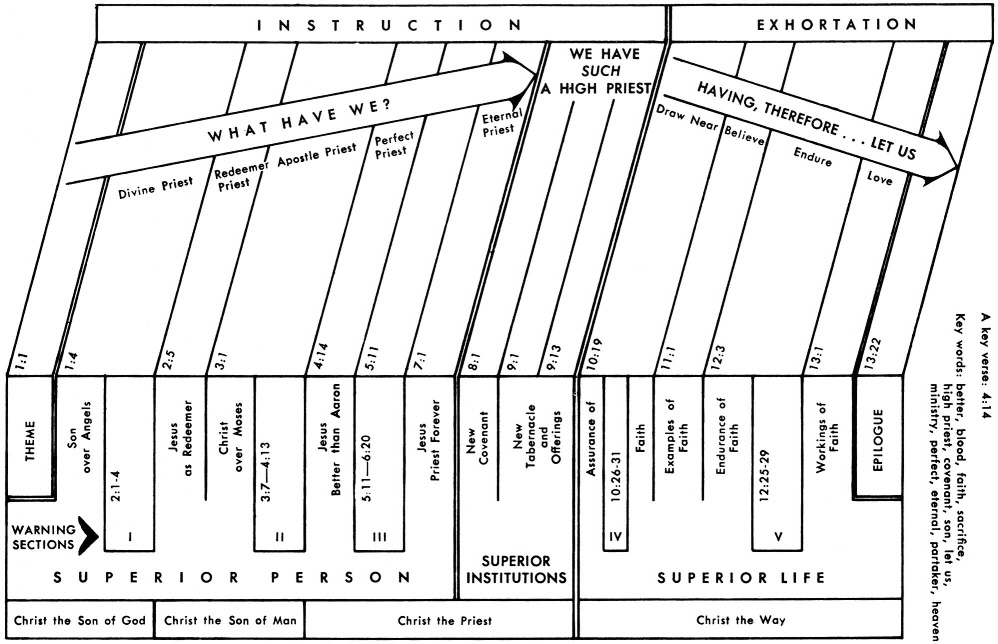
CONSIDER JESUS OUR GREAT HIGH PRIEST
Click chart to enlarge
Charts from Jensen's Survey of the NT - used by permission
Swindoll's Chart, Interesting Pictorial Chart of Hebrews, Another Chart
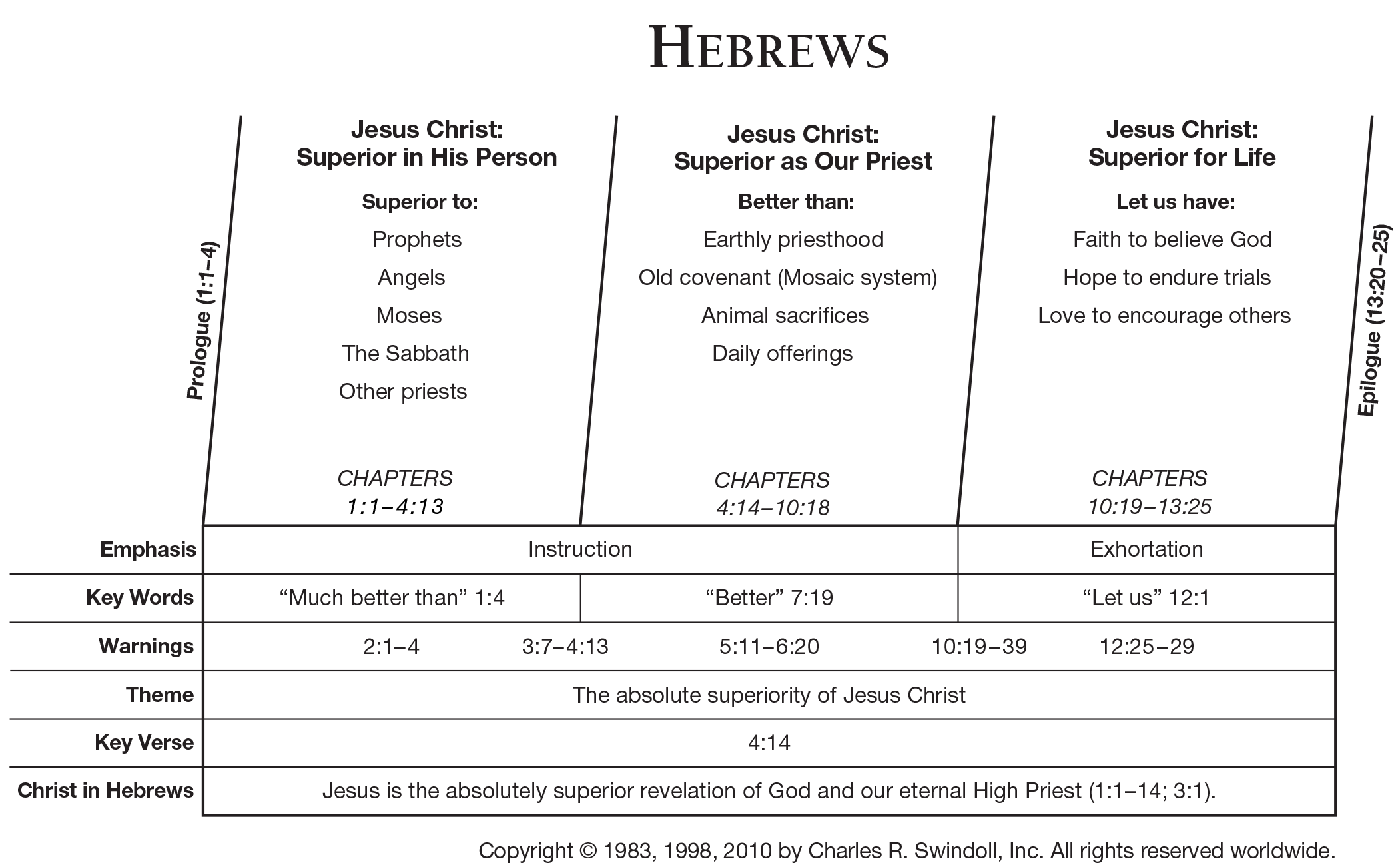
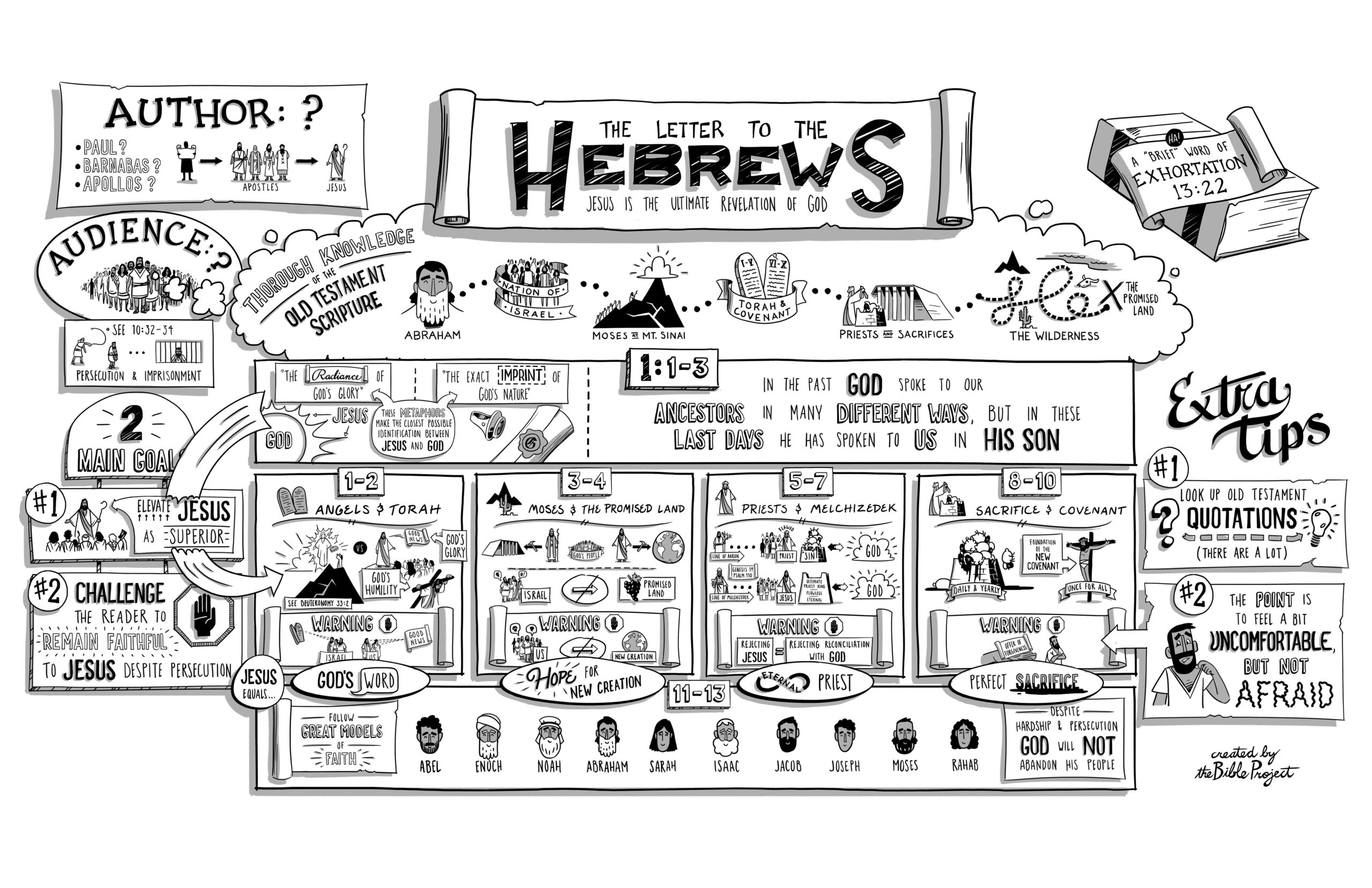
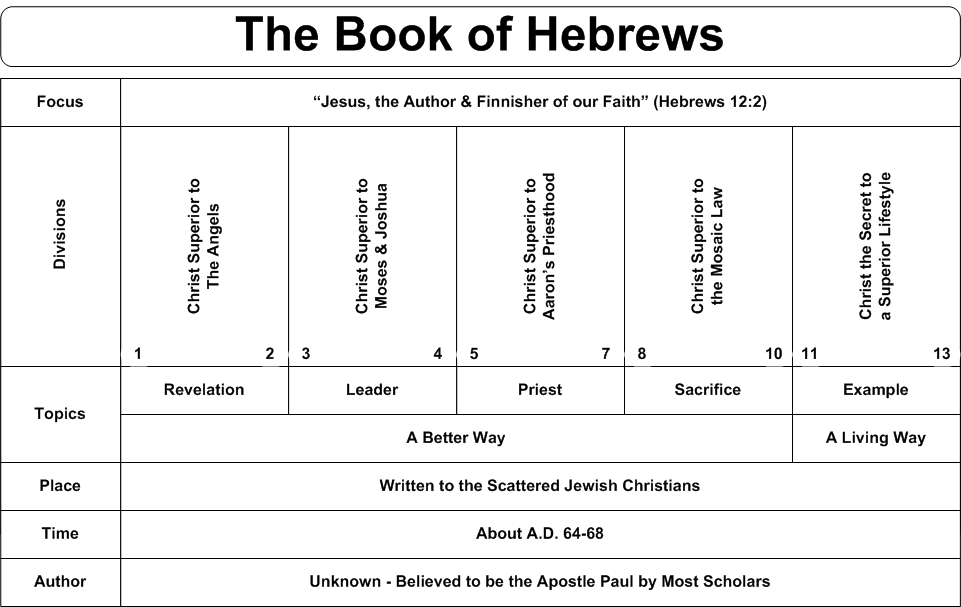
|
The Epistle |
||||
| INSTRUCTION Hebrews 1-10:18 |
EXHORTATION Hebrews 10:19-13:25 |
|||
| Superior Person of Christ Hebrews 1:1-4:13 |
Superior Priest in Christ Hebrews 4:14-10:18 |
Superior Life In Christ Hebrews 10:19-13:25 |
||
| BETTER THAN PERSON Hebrews 1:1-4:13 |
BETTER PRIESTHOOD Heb 4:14-7:28 |
BETTER COVENANT Heb 8:1-13 |
BETTER SACRIFICE Heb 9:1-10:18 |
BETTER LIFE |
| MAJESTY OF CHRIST |
MINISTRY OF CHRIST |
MINISTERS FOR CHRIST |
||
|
DOCTRINE |
DUTY |
|||
|
DATE WRITTEN: |
||||

See ESV Study Bible "Introduction to Hebrews"
(See also MacArthur's Introduction to Hebrews)
Borrow Ryrie Study Bible
|
THE FIVE WARNING PASSAGES |
| Heb 2:1-4+ |
| Heb 3:7-4:13+ |
| Heb 5:11-6:12+ |
| Heb 10:19-39+ |
| Heb 12:14-29+ |
Hebrews 10:38 BUT MY RIGHTEOUS ONE SHALL LIVE BY FAITH; AND IF HE SHRINKS BACK, MY SOUL HAS NO PLEASURE IN (NASB: Lockman)
Greek: o de dikaios mou ek pisteos zesetai, (3SFMI) kai ean uposteiletai, (3SAMS) ouk eudokei (3SPAI) e psuche mou en auto
BGT ὁ δὲ δίκαιός μου ἐκ πίστεως ζήσεται, καὶ ἐὰν ὑποστείληται, οὐκ εὐδοκεῖ ἡ ψυχή μου ἐν αὐτῷ.
Amplified: But the just shall live by faith [My righteous servant shall live by his conviction respecting man’s relationship to God and divine things, and holy fervor born of faith and conjoined with it]; and if he draws back and shrinks in fear, My soul has no delight or pleasure in him. [Hab. 2:3, 4.] (Amplified Bible - Lockman)
Barclay: And my just man shall live by faith; but if he shrinks back, my soul will not find pleasure in him.” (Westminster Press)
NLT: And a righteous person will live by faith. But I will have no pleasure in anyone who turns away." (NLT - Tyndale House)
KJV Now the just shall live by faith: but if any man draw back, my soul shall have no pleasure in him.
NKJ Now the just shall live by faith; But if anyone draws back, My soul has no pleasure in him."
NET But my righteous one will live by faith, and if he shrinks back, I take no pleasure in him.
CSB But My righteous one will live by faith; and if he draws back, I have no pleasure in him.
ESV but my righteous one shall live by faith, and if he shrinks back, my soul has no pleasure in him."
NIV But my righteous one will live by faith. And if he shrinks back, I will not be pleased with him."
Phillips: Now the just shall live by faith; but if anyone draws back, my soul has no pleasure in him'. (Phillips: Touchstone)
Wuest: Now, my righteous person shall live by faith. But if he draw back in fear, my soul shall have no pleasure in him.
Young's Literal: and 'the righteous by faith shall live,' and 'if he may draw back, My soul hath no pleasure in him,'
- My righteous one - Habakkuk 2:4; Romans 1:17; Galatians 3:11
- Hebrews Study Questions
- Hebrews 10 Resources - Multiple Sermons and Commentaries
Related Passages:
Romans 3:21-24+ But now apart from the Law the righteousness of God has been manifested, being witnessed by the Law and the Prophets, 22 even the righteousness of God through faith in Jesus Christ for all those who believe; for there is no distinction; 23 for all have sinned and fall short of the glory of God, 24 being justified as a gift by His grace through the redemption which is in Christ Jesus;
Romans 1:17+ (see note) For in it the righteousness of God is revealed from faith to faith; as it is written, “BUT THE RIGHTEOUS man SHALL LIVE BY FAITH.”
Galatians 3:11+ (see note) Now that no one is justified by the Law before God is evident; for, “THE RIGHTEOUS MAN SHALL LIVE BY FAITH.”
|
Habakkuk 2:3b–4 |
Hebrews 10:37–38 |
|
3 For yet … wait for him. |
37 For yet in a very little while, |
|
for coming he will come and |
the coming one will come and |
|
will not delay. |
will not delay |
|
4 If he should draw back, |
38 But my righteous one shall |
|
my soul has no pleasure in him |
live by faith |
|
But the righteous one shall |
but if he should draw back, |
|
live by my faith |
my soul has no pleasure in him |
| Italics and boldface have been added to the two clauses in Hab 2:4/Heb 10:38 to show the way in which they have been reversed. The Habakkuk translation is from the Septuagint. | |
HABAKKUK'S FAMOUS
QUOTATION
The writer now quotes from Habakkuk 2:4+, which is used in 3 NT epistles with a slightly different intended meaning. Warren Wiersbe sums up these differences stating "Romans emphasizes “the just,” Galatians deals with “shall live,” and Hebrews centers on “by faith.” (See more discussion by David Levy) In Hebrews the quote from Habakkuk emphasizes that the not shrinking back even in persecution equates with saving faith and that the person who has been declared righteous by God lives (and survives the coming ordeal) by faith.
Cockerill explains the table above and why the Habakkuk passages are reversed by the writer of Hebrews - This change clarifies the identity of both the “coming” one and the one who “draws back.” It establishes a clear contrast between drawing “back” and living “by faith.” First, it makes Hab 2:4a, “if he should draw back, my soul has no pleasure in him,” refer unambiguously to “my righteous one” who lives by faith in Hab 2:4b, rather than the “coming one” of Hab 2:3b. Second, by clarifying the identity of the “coming one,” this reversal brings the syntax of these verses into accord with the broader context. This “coming one” is not merely the Messiah, whose identity is confirmed by the fact that he does not “draw back,”57 but the Lord himself.58 Third, this change establishes a clear contrast between the righteous person who “lives by faith” and the erstwhile righteous person who “draws back” and experiences the ultimate of divine displeasure.59 This contrast is closer to the intention of the original Hebrew text.60 The prophet Habakkuk compared two kinds of people—the wicked (Hab 2:4a, “his soul is puffed up with pride, it is not right in him”) and the righteous (Hab 2:4b, “my righteous one shall live by faith”).61 The pastor contrasts two alternatives for the righteous—they can live “by faith”; they can “draw back” from faith.62 Those who ‘ “draw back” are indeed the wicked; they are “puffed up with self-sufficiency” and are “therefore blind to the need of trustful and patient endurance.”63 This contrast between living “by faith” and “drawing back” is fundamental to the pastor’s concern for his hearers. If the wilderness generation embodied those to be avoided because they “drew back” (Heb 3:7–4:11), the heroes of chapter 11 represent those to be emulated because they persevered in living “by faith.” The pastor’s hearers have much in common with those addressed by Habakkuk. They, too, must endure suffering while they wait patiently in the confidence that God will fulfill his promise. Finally, this reversal of clauses allows Hab 2:4b, “but my righteous one will live by faith,” to become the centerpiece of the quotation. This affirmation anticipates the description of the “righteous” (Heb 11:4) who, according to Heb 11:1–40, lived by faith, and who are now, through Christ, in God’s presence (Heb 12:23). (The Epistle to the Hebrews - Page 510)
BUT MY RIGHTEOUS (dikaio) ONE - My righteous one identifies this person as one who has been declared righteous (just) by faith, also known as imputed righteousness or justification. And don't miss the possessive pronoun "my!" "Oh MY!" Why? It reveals ownership, intimacy and divine delight. As Paul says "you are not your own, for you have been bought with a price: therefore glorify God in your body." (1Co 6:19-20+) God is saying, “This righteous one who lives by faith is Mine, My possession, My child, My delight.” We belong to God now beloved! This MY transforms righteousness from a cold legal status into warm covenant communion. It depicts our Father claiming His children (John 1:12, 1Jn 3:1, Ro 8:16), a Shepherd owning His sheep (John 10:14) and a Redeemer possessing what He purchased (Titus 2:14). While justification says “You are righteous," adoption adds “You are Mine.” Justification not only changes our status, it should also change our allegiance. Those of us that live by faith are God’s peculiar people (cf 1Pe 2:9KJV); He owns us as His, and we own Him as ours. To say My righteous one is to utter the language of infinite affection.
BUT MY RIGHTEOUS (dikaio) ONE SHALL LIVE (zao - physical life, spiritual life, eternal life) BY FAITH (pistis); AND IF (3CC) HE SHRINKS BACK (hupostello - aorist middle subjunctive), MY SOUL (psuche) HAS NO (ou - absolutely no) PLEASURE (eudokeo in present tense) IN HIM - LIVE (zao) means life as God intended us to live it, ideally and optimally living in Christ by His Spirit (cf Gal 2:20+)! To live denotes more than to exist but expresses the entire sphere of one’s conduct and experience. The righteous one lives by faith just as the fish lives in the sea. If you take him out of it, he dies (believers of course don't die but their walk of faith withers). By faith (pistis) is literally "out of faith" (ek pisteos), denoting source or origin. In other words the idea is arising from faith, rooted in faith or by faith as the cause or means. Faith is viewed as the source from which righteousness is derived and stands in stark contrast to the phrase "from (out of) works of the law." Stated another way faith is the channel through which God’s righteousness flows to the believer. In the context of Hebrews (Heb 10:36-39) where the writer is calling for endurance, the meaning of "by faith" describes faith as the "lifeline" by which the justified continue to live and persevere amid trials and sufferings. In other words, saving faith is not just a single act, but a continual attitude. Faith is not a single leap but a lifelong walk!
By - This is the Greek preposition ek which is genitive (expresses possession) in this verse and so serves as a marker of personal possession of faith. In other words, whereas ek normally means out of , in this verse ek means "of" (genitive); i.e., ek means the person lives "as a result of" or "by reason of" or "by means of" faith.
To “live by faith” is to draw every breath from God’s promises, to see the Invisible, to endure the unendurable, and to keep walking when the road disappears beneath your feet. It is life sustained by trust, not by sight. (2Co 5:7, 2Co 4:18)
Habakkuk 2:4,5 is descriptive of the proud who do not live by faith. It is the proud who are self-sufficient and who fail to realize the necessity of patient endurance and trust in God. The proud Jew will be rejected if he does not exercise faith. He will be judged along with the Gentiles.
Vincent comments on "the just shall live by faith" - In the original prophecy the just man is contrasted with the haughty Chaldean invaders, who are puffed up and not upright. Through his steadfast obedience to God he shall be kept alive in the time of confusion and destruction.
John Owen observes that "What is principally meant here is that characteristic of a righteous person that is the opposite of pride and unbelief, which makes people shrink back from God. The righteous one is humble, meek, sincere, submissive to God’s will, waiting to do his wishes. Sincere faith will carry people through all difficulties, hazards, and troubles, to the certain enjoyment of eternal blessedness. (Owen, John: Hebrews)
Perseverance is one of the distinguishing
characteristics of a child of God
A W Pink - The first half of this verse is a quotation from Habakkuk 2:4, and its pertinency to the admonition which the apostle was pressing upon the Hebrews is not difficult to perceive. The prophet is cited in proof that perseverance is one of the distinguishing characteristics of a child of God. He who has been justified by God, through the imputation of Christ’s righteousness to his account, lives by faith as the influencing principle of his life. Thus the apostle declared, "The life which I now live in the flesh I live by the faith of the Son of God" (Gal. 2:20). The one whom God has exonerated from the curse and condemnation of the law, is not him who has merely "believed," but is the man who continues "believing," with all that that word includes, and involves. Let the reader fully note the force of the present (present tense) "believeth" in John 3:15, 16, 18- perfect in v18; Jn 5:24 etc., and contrast the "for a while believed" of Luke 8:13+! (Hebrews 10)
William Newell - Verse 38: But My righteous one by (ek, along the line of) faith (or, along the line of believing) shall keep living, (or, be living), And if he shrinks back, My soul delights not in him. The three N.T. occurrences of this quotation from Hab. 2:3-4, "The just shall live by faith," are, Rom. 1:17; Gal. 3:11 and Heb. 10:38, our text. Proper emphasis in each case brings out the special meaning. In Romans, the question is one of righteousness before God, so that we read there, "Therein (in the Gospel) is revealed a righteousness of God on the principle of faith, (where faith exists) as it is written, The righteous shall live by faith." Here the emphasis is on the just, or the righteous. In Galatians, it is the subject of being perfected. They were "foolish." Having "begun in the Spirit," they were now seeking to be "perfected in the flesh" (Gal 3:3). So the question is about living, and the answer, "The righteous shall live by faith." In Heb. 10:38 the emphasis is on the word "faith." The "great conflict of sufferings" of "former days after they were enlightened" has been brought up. They were not to "cast away their boldness ... For they had need of patience, that, having done the will of God (which may involve suffering and trial), they might receive THE PROMISE,--the great promise of our Lord's coming again--His absence being for "a very little while." Meanwhile, God directs, My righteous one shall live by faith, faith being his spirit's constant attitude God-ward--the vital air of all the hosts of witnesses who are about to be set before us in the great eleventh chapter! (Ref)
The opposite of apostasy is faith, the faith in this verse being a preview of the following chapter (Hebrews 11). It is faith which pleases God (Heb 11:6). The individual who draws back from the knowledge of the gospel will prove his apostasy. Endurance proves (does not earn) one is genuinely saved (Heb 3:6, 14). Believers are saved from sin by faith, but must continue to live by faith and this is a major theme in Hebrews 11 through 13.
This allusion to Hab 2:4 and the vital relationship between faith and righteousness serves as an introductory preview to Hebrews 11, well known as the "hall of faith". In this this last section of Hebrews 10 and throughout Hebrews 11, the writer's point is that faith alone pleases God (cp Heb 11:6+). And so here in Hebrews 10:38 by faith equates with "holding on", not shrinking back even in the face of persecution, but instead holding fast in obedience (He 3:6+, He 3:14+, He 4:2+). The individual who shrinks back from the truth of the Gospel is demonstrating their lack of faith which in turn proves their apostasy (their falling away from the truth of the Gospel). As the writer has clearly and repeatedly stated in this epistle, these individuals have heard the truth but they have failed to receive/believe that truth, and thus are left with no hope in this life or the life to come (cp Ep 2:12+)!
That the righteous shall live by faith was the truth that sparked the Reformation. When Martin Luther (see note below), an Augustinian monk, had his eyes opened to this great truth, he came to realize that a sinner is justified by God upon the basis of and in answer to his faith in the Lord Jesus. (See discussion of "by faith" in Ro 1:17)
A W Pink - The constant exercise of faith by the saint is… essential… we can only be delivered from the power of indwelling sin, from the temptations of Satan, from an enticing world which seeks to destroy us, by a steady and persistent walking by faith. (Hebrews 10)
MacArthur adds "the way to become righteous is by faith and the way the righteous should live is by faith."
To live by faith is to live by the Word of God.
Faith is simply believing the Word of God.
-- John Butler
C H Spurgeon - The ground of the sinner’s acceptance in the first moment of his faith is the finished work of Christ, and, after fifty years of earnest service, that must still be the sole cause of his acceptance with God, and the only Rock upon which his soul must dare to build. The act of simple faith, looking out of self, and looking alone to Christ, is a thing for your penitent tax collector when first he beats his breast (Luke 18:13+). It is also for your dying David, when he knows that the covenant is ordered in all things and sure. The righteous man will carry his faith into his ordinary life. He will live by faith. All the actions of his life, such as have in them any decree of moral or spiritual aspect—all of these shall be conspicuously ruled by his confidence in God. Even the lowliest and commonest affairs in which he takes a part shall be subdued and elevated by the dignity of his trust and the fidelity of his adherence. He shall live by faith. Not alone in the study and in the closet, not alone in the assembly of the saints and at the table of fellowship, but in the market and on the exchange, in the shop and the counting-house, in the parlor or the drawing room, at the plough-tail or at the carpenter’s bench, in the senate house or at the judgment hall. The just man, wherever his life is cast, shall carry his faith with him; indeed, his faith shall be in him as part of his life; he shall live there by faith. (Sermon The Vital Force)
Endurance takes place
through faith being exercised
Phil Newton commenting on the endurance needed (Heb 10:36) notes that this…Endurance takes place through faith being exercised. "But My righteous one shall live by faith." (He 10:38) Faith is not punctiliar but linear, not a one time experience but an ongoing trust and confidence in Christ (ED: "present tense faith"). David Clarkson, the Puritan pastor that followed John Owen wrote, "This living by faith is not a single and transient act, but something habitual and permanent" [The Works of David Clarkson, vol. 1, 175]. Clarkson's exposition on this text offers some great help for us in understanding how "the object of faith is God in Christ, as made known in His attributes, offices, relations, promises, and providences" [176]:
1. Divine attributes. Those are the pillows and grounds of faith, rocks of eternity, upon which faith may securely repose… [e.g., power, wisdom, justice, faithfulness, truth, mercy]
2. The offices of Christ. These are strong supports to faith as any, though less made use of: in special his Priestly office… Regal Office… Prophetical Office…
3. Mutual relations betwixt God and his people. These are the sweet food of faith, which, digested, nourish it into strength, and enable it to vigorous actings… [e.g., "Thou, O Lord, art in the midst of us, and we are called by thy name; leave [us] not" Jer. 14:9].
4. Promises. These and faith are so usually joined, as though they were relatives… These are the wells of salvation, out of which faith draws joy…
5. Providences of God are objects and encouragements to faith. The consideration of what he has done for others, and for themselves, has supported the saints. These are the hands of God stretched out, on which faith takes hold… Now herein God offers himself to be seen and felt, and leaves men without excuse if they continue in unbelief [pp. 176-177]. (Hebrews 10:32-39 No Shrinking Back)
Righteous (1342) dikaios from dike = right, just) defines that which is in accordance with high standards of rectitude. It is that which is in right relation to another and so in reference to persons defines the one who is morally and ethically righteous, upright or just. The meaning of the root word dike is based on the assumption that men expect a certain standard of behavior and if this is not attained judgment may result. It follows that the basic meaning of the adjective dikaios describes that which is proper, right, fitting, fair, righteous, just (acting or being in conformity with what is morally upright or good). From a forensic or legal viewpoint dikaios refers to one who is law-abiding (doing all that law or justice requires), honest and good in behavior and from a religious viewpoint one who is rightly related to God. Those who are truly righteous have God’s verdict in their favor; they are acquitted and pronounced just. In simple terms this trait describes being in accordance with what God requires. The righteous man does what he ought. He is the person who conforms to the standard, will or character of God. For example, Luke describes Zacharias and Elizabeth (John the Baptist's parents) as "both righteous (dikaios) in the sight of God, walking blamelessly in all the commandments and requirements of the Lord. (Lk 1:6+, see Luke 2:25+ "Simeon… was righteous") They were rightly related to God and because of that right relationship, they walked accordingly. Again we see righteous character is associated with righteous conduct. That's what Paul is calling for in those men who would lead God's church.
DIKAIOS - 3 USES IN HEBREWS
Hebrews 10:38 BUT MY RIGHTEOUS ONE SHALL LIVE BY FAITH; AND IF HE SHRINKS BACK, MY SOUL HAS NO PLEASURE IN HIM.
Hebrews 11:4 By faith Abel offered to God a better sacrifice than Cain, through which he obtained the testimony that he was righteous, God testifying about his gifts, and through faith, though he is dead, he still speaks.
Hebrews 12:23 to the general assembly and church of the firstborn who are enrolled in heaven, and to God, the Judge of all, and to the spirits of the righteous made perfect,
Live (2198) (zao) refers literally to natural physical life (opposite of death, Acts 22:22, 25:24, 28:4, Ro 7:1-3, 1Cor 7:39, of Adam = 1Cor 15:45; 2Cor 4:11 = refers to natural lives of believers; Php 1:22 - "to live on in the [physical] flesh"; 1Th 4:15,17 = believers physically alive at time of Rapture; Heb 2:15; Heb 9:17; James 4:15 = "we shall live" physically if God so wills it!), to come to life after death (Mt 9:18), to recover life after sickness (Jn 4:50). Zao refers to supernatural, spiritual life (cf Jn 11:25, 26), Paul explaining that Christ "lives because of the power of God." (2Cor 13:4) In Rev 16:3 "living thing" refers to the biological life of all the sea animals. In Rev 19:20 the Antichrist and his False Prophet will be "thrown alive into the lake of fire," indicating they will have conscious awareness of their torment (forever and ever).
ZAO IN HEBREWS - Heb. 2:15; Heb. 3:12; Heb. 4:12; Heb. 7:8; Heb. 7:25; Heb. 9:14; Heb. 9:17; Heb. 10:20; Heb. 10:31; Heb. 10:38; Heb. 12:9; Heb. 12:22 - NOTE - "LIVING GOD" - 4X
Hebrews 2:15 and might free those who through fear of death were subject to slavery all their lives.
Hebrews 3:12 Take care, brethren, that there not be in any one of you an evil, unbelieving heart that falls away from the living God.
Hebrews 4:12 For the word of God is living and active and sharper than any two-edged sword, and piercing as far as the division of soul and spirit, of both joints and marrow, and able to judge the thoughts and intentions of the heart.
Hebrews 7:8 In this case mortal men receive tithes, but in that case one receives them, of whom it is witnessed that he lives on.
Hebrews 7:25 Therefore He is able also to save forever those who draw near to God through Him, since He always lives to make intercession for them.
Hebrews 9:14 how much more will the blood of Christ, who through the eternal Spirit offered Himself without blemish to God, cleanse your conscience from dead works to serve the living God?
Hebrews 9:17 For a covenant is valid only when men are dead, for it is never in force while the one who made it lives.
Hebrews 10:20 by a new and living way which He inaugurated for us through the veil, that is, His flesh,
Hebrews 10:31 It is a terrifying thing to fall into the hands of the living God.
Hebrews 10:38 BUT MY RIGHTEOUS ONE SHALL LIVE BY FAITH; AND IF HE SHRINKS BACK, MY SOUL HAS NO PLEASURE IN HIM.
Hebrews 12:9 Furthermore, we had earthly fathers to discipline us, and we respected them; shall we not much rather be subject to the Father of spirits, and live?
Hebrews 12:22 But you have come to Mount Zion and to the city of the living God, the heavenly Jerusalem, and to myriads of angels,
Faith (4102) (pistis - occurs 243x in 227v = a major NT word!) on one hand means that which evokes trust (thus it means faithfulness, reliability, fidelity, commitment) and on the other hand (as in the present passage) it describes a personal act of belief directed toward a person (in this case God and His Gospel concerning Jesus). It is synonymous with trust and is the personal conviction of the truth of respecting man's relationship to God and divine things. Subjectively faith is firm persuasion, conviction, belief in the truth, veracity, reality or faithfulness (though rare). Objectively faith is that which is believed (usually designated as "the faith"), doctrine, the received articles of faith. Click separate study of "the faith (pistis)" True faith is not based on empirical evidence but on divine assurance.
As faith (pistis) relates to God, it is the conviction that God exists and is the Creator and Ruler of all things well as the Provider and Bestower of eternal salvation through Christ. As faith (pistis) relates to Christ it represents a strong and welcome conviction or belief that Jesus is the Messiah, through Whom (as a result of His work of redemption, the sacrifice of His blood to pay the price for sin) we obtain eternal salvation and entrance into the Kingdom of Heaven. Stated another way, eternal salvation comes only through belief in Jesus Christ and no other way (Acts 4:12, Jn 14:6).
A W Pink commenting on Hebrews 10:38 writes that "Patient endurance is a fruit of faith, yet it is only as that vital and root grace is in daily exercise, that the Christian is enabled to stand firm amid the storms of life. Those whom God declares righteous in Christ are to pass their lives here, not in doubt and fear, but in the maintenance of a calm trust in and a joyful obedience to Him. Only as the heart is engaged with God and feeds upon His Word, will the soul be invigorated and fitted to press onwards when everything outward seems to be against him. It is by our faith being drawn out unto things above that we receive the needed strength which causes us to look away from the discouraging and distracting scene around us. As faith lives upon Christ (Jn 6:56, 57), it draws virtue from Him, as the branch derives sap from the root of the vine. Faith makes us resign ourselves and our affairs to Christ’s disposing, cheerfully treading the path of duty and patiently waiting that issue which He will give. Faith is assured that our Head knows far better than we do what is good and best. (Hebrews 10)
It is notable that only the book of Romans surpasses the book of Hebrews (see the uses in Hebrews below) in the number of uses of pistis (Romans = 35, Hebrews = 31, out of 243 NT uses) Pistis is translated in the NAS as faith, 238; faithfulness, 3; pledge, 1; proof, 1.
True faith that saves one's soul includes at least three main elements (1) firm persuasion or firm conviction, (2) a surrender to that truth and (3) a conduct emanating from that surrender. In sum, faith shows itself genuine by a changed life. (Click here for W E Vine's similar definition of faith)
Faith is the foot of the soul by which it can march
along the road of the commandments.
-- C H Spurgeon
Respected theologian Louis Berkhof defines genuine faith in essentially the same way noting that it includes an intellectual element (notitia), which is "a positive recognition of the truth”; an emotional element (assensus), which includes “a deep conviction of the truth”; and a volitional element (fiducia), which involves “a personal trust in Christ as Savior and Lord, including a surrender … to Christ.” (Systematic Theology. Grand Rapids: Eerdmans, 1939)
Faith is relying on what God has done rather than on one’s own efforts. In the Old Testament, faith is rarely mentioned. The word trust is used frequently, and verbs like believe and rely are used to express the right attitude to God. The classic example is Abraham, whose faith was reckoned as righteousness (Ge 15:6). At the heart of the Christian message is the story of the cross: Christ’s dying to bring salvation. Faith is an attitude of trust in which a believer receives God’s good gift of salvation (Acts 16:30,31) and lives in that awareness thereafter (Gal 2:20; cf. Heb 11:1).
J. B. Lightfoot discusses the concept of faith in his commentary on Galatians. He notes that in Hebrew, Greek, and Latin, the definition of the word for faith "hovers between two meanings: trustfulness, the frame of mind which relies on another; and trustworthiness, the frame of mind which can be relied upon… the senses will at times be so blended together that they can only be separated by some arbitrary distinction. The loss in grammatical precision is often more than compensated by the gain in theological depth… They who have faith in God are steadfast and immovable in the path of duty."
Faith, like grace, is not static. Saving faith is more than just understanding the facts and mentally acquiescing. It is inseparable from repentance, surrender, and a supernatural longing to obey. None of those responses can be classified exclusively as a human work, any more than believing itself is solely a human effort.
Faith is manifest by not believing in spite of evidence but obeying in spite of consequence. John uses the related verb pisteuo to demonstrate the relationship between genuine faith and obedience writing ""He who believes (present tense = continuous) in the Son has eternal life; but he who does not obey the Son shall not see life, but the wrath of God abides on him." (John 3:36)
To disbelieve Christ is to disobey Him.
And logically, to believe in Christ is to obey Him.Charles Swindoll commenting on faith and obedience in John 3:36 concludes that "In Jn 3:36 the one who “believes in the Son has eternal life” as a present possession. But the one who “does not obey the Son shall not see life.” To disbelieve Christ is to disobey Him. And logically, to believe in Christ is to obey Him (ED: COMPARE "disobedient" in Heb 3:18 and "unbelief" in Heb 3:19). As I have noted elsewhere, “This verse clearly indicates that belief is not a matter of passive opinion, but decisive and obedient action.” (quoting J. Carl Laney)… Tragically many people are convinced that it doesn’t really matter what you believe, so long as you are sincere. This reminds me of a Peanuts cartoon in which Charlie Brown is returning from a disastrous baseball game. The caption read, “174 to nothing! How could we lose when we were so sincere?” The reality is, Charlie Brown, that it takes more than sincerity to win the game of life. Many people are sincere about their beliefs, but they are sincerely wrong!" (Understanding Christian Theology) (This book is recommended if you are looking for a very readable, non-compromising work on "systematic theology". Wayne Grudem's work noted above is comparable.)
Faith is the cable that holds our ship to the anchor.
Though the ship may toss upon the waves, she cannot drift away;
for faith keeps her fast to the Rock of Ages.
Clearly faith is a key word in Hebrews. Study the 31 uses of pistis in Hebrews in context …
Hebrews 4:2+ - For indeed we have had good news preached to us, just as they also; but the word they heard did not profit them, because it was not united by faith in those who heard.
Hebrews 6:1+ - Therefore leaving the elementary teaching about the Christ, let us press on to maturity, not laying again a foundation of repentance from dead works and of faith toward God,
Hebrews 6:12+ -so that you will not be sluggish, but imitators of those who through faith and patience inherit the promises.
Hebrews 10:2+ - let us draw near with a sincere heart in full assurance of faith, having our hearts sprinkled clean from an evil conscience and our bodies washed with pure water.
Hebrews 10:38+ - BUT MY RIGHTEOUS ONE SHALL LIVE BY FAITH; AND IF HE SHRINKS BACK, MY SOUL HAS NO PLEASURE IN
Hebrews 10:39+ - But we are not of those who shrink back to destruction, but of those who have faith to the preserving of the soul.
Hebrews 11:1+ - Now faith is the assurance of things hoped for, the conviction of things not seen.
Hebrews 11:3+ - By faith we understand that the worlds were prepared by the word of God, so that what is seen was not made out of things which are visible.
Hebrews 11:+4 - By faith Abel offered to God a better sacrifice than Cain, through which he obtained the testimony that he was righteous, God testifying about his gifts, and through faith, though he is dead, he still speaks.
Hebrews 11:5+ - By faith Enoch was taken up so that he would not see death; AND HE WAS NOT FOUND BECAUSE GOD TOOK HIM UP; for he obtained the witness that before his being taken up he was pleasing to God.
Hebrews 11:6+ - And without faith it is impossible to please Him, for he who comes to God must believe that He is and that He is a rewarder of those who seek Him.
Hebrews 11:7+ - By faith Noah, being warned by God about things not yet seen, in reverence prepared an ark for the salvation of his household, by which he condemned the world, and became an heir of the righteousness which is according to faith.
Hebrews 11:8+ - By faith Abraham, when he was called, obeyed by going out to a place which he was to receive for an inheritance; and he went out, not knowing where he was going.
Hebrews 11:9+ - By faith he lived as an alien in the land of promise, as in a foreign land, dwelling in tents with Isaac and Jacob, fellow heirs of the same promise;
Hebrews 11:11+ - By faith even Sarah herself received ability to conceive, even beyond the proper time of life, since she considered Him faithful who had promised.
Hebrews 11:13+ - All these died in faith, without receiving the promises, but having seen them and having welcomed them from a distance, and having confessed that they were strangers and exiles on the earth.
Hebrews 11:17+ - By faith Abraham, when he was tested, offered up Isaac, and he who had received the promises was offering up his only begotten son;
Hebrews 11:20+ - By faith Isaac blessed Jacob and Esau, even regarding things to come.
Hebrews 11:21+ - By faith Jacob, as he was dying, blessed each of the sons of Joseph, and worshiped, leaning on the top of his staff.
Hebrews 11:22+ - By faith Joseph, when he was dying, made mention of the exodus of the sons of Israel, and gave orders concerning his bones.
Hebrews 11:23+ - By faith Moses, when he was born, was hidden for three months by his parents, because they saw he was a beautiful child; and they were not afraid of the king's edict.
Hebrews 11:24+ - By faith Moses, when he had grown up, refused to be called the son of Pharaoh's daughter,
Hebrews 11:27+ - By faith he left Egypt, not fearing the wrath of the king; for he endured, as seeing Him who is unseen.
Hebrews 11:28+ - By faith he kept the Passover and the sprinkling of the blood, so that he who destroyed the firstborn would not touch them.
Hebrews 11:29+ -By faith they passed through the Red Sea as though they were passing through dry land; and the Egyptians, when they attempted it, were drowned.
Hebrews 11:30+ - By faith the walls of Jericho fell down after they had been encircled for seven days.
Hebrews 11:31+ - By faith Rahab the harlot did not perish along with those who were disobedient, after she had welcomed the spies in peace.
Hebrews 11:33+ -who by faith conquered kingdoms, performed acts of righteousness, obtained promises, shut the mouths of lions,
Hebrews 11:39+ - And all these, having gained approval through their faith, did not receive what was promised,
Hebrews 12:2+ - fixing our eyes on Jesus, the author and perfecter of faith, who for the joy set before Him endured the cross, despising the shame, and has sat down at the right hand of the throne of God.
Hebrews 13:7+ - Remember those who led you, who spoke the word of God to you; and considering the result of their conduct, imitate their faith.
David Levy gives an excellent analysis of the the three NT uses of Habakkuk 2:4 specifically describing the distinctions of each use in the respective context of Romans, Galatians and Hebrews.
This verse is not only the theme of Habakkuk, it is a central passage for three New Testament epistles: Romans, Galatians, and Hebrews.
In Romans 1:17, the emphasis is on, “The just shall live by faith.” The only people who can live by faith are just people. When sinners put their faith in the shed blood of Jesus Christ to take away their sin, God declares and treats them as justified; their sins are forgiven, and no charge can be laid against them (Ro 8:1, 31–34). Closely connected to the term justification is the word righteousness. To justify someone is to declare that person legally righteous in God’s eyes. Justified people have the imputed righteousness of Christ deposited in their lives. Thus, justified (righteous) people are able to live by faith. It is their faith (trust in God) that keeps them through times of adversity.
In Galatians 3:11, the emphasis is on, “The just shall live by faith.” Paul quoted this verse to counter the Judaizers, who were teaching that people might be justified through faith, but to retain their salvation they must keep the law in their daily lives. Paul countered, Not true. People who are justified by faith live this principle of life too. People could never gain acceptance by the works of the law, for the law only condemned them. This was true even when Israel lived under the law, for God said to Habakkuk, “the just shall live by his faith.” Thus, righteous people live by faith, not by keeping the legalistic system in the law.
In Hebrews 10:38, the emphasis is on, “the just shall live by faith.” In this context, many of the Hebrew Christians, who had been justified by faith in Jesus Christ, considered turning back to their old Jewish religion because of persecution. The writer of Hebrews tried to fortify them for future trials by reminding them of how they originally exercised faith in Jesus as their Messiah. He encouraged them not to cast away their confidence in the Lord, for He would richly reward them in the future if they stayed true to the faith. They had to persevere until the Lord came, which would not be long (Heb. 10:35–37). If they denounced their faith in Christ and returned to Judaism, they would become apostates, bringing the Lord’s disfavor upon them for the remainder of their lives. Quoting from Habakkuk 2:4, the writer showed that people who are truly justified by faith will live by faith (Heb. 10:38).
The writer of Hebrews gave further evidence of what it means to live by faith in chapter 11. There he described what true faith is and then illustrated his point from the lives of Old Testament men and women who lived by faith in the midst of severe persecution.
No one knew better what it meant to wait patiently by faith in prayer for God’s appointed time than did Hudson Taylor. Dr. Edman wrote,
Hudson Taylor knew the testing that tempers the steel of the soul. Invalided, home at twenty-nine after six years of intensive service in China, he settled with his little family in the east end of London. Outside interests lessened; friends began to forget; and five long hidden years were spent in the dreary street of a poor part of London, where the Taylors were “shut up to prayer and patience.” From the record of those years it has been written, “Yet, without those hidden years, with all their growth and testing, how could the vision and enthusiasm of youth have been matured for the leadership that was to be?” Faith, faithfulness, devotion, self-sacrifice, unremitting labor, patient, persevering prayer became their portion and power, but more, there is “the deep, prolonged exercise of a soul that is following hard after God…the gradual strengthening here, of a man called to walk by faith not by sight; the unutterable confidence of a heart cleaving to God and God alone, which pleases Him as nothing else can.” As the years of obscurity progressed, “prayer was the only way by which the burdened heart could obtain any relief”; and when the discipline was complete, there emerged the China Inland Mission, at first only a tiny root, but destined of God to fill the land of China with gospel fruit. (BORROW V. Raymond Edman, The Disciplines of Life p. 80.)
Believing friend, God has an appointed time in which He will reveal what He has for you in every situation of your life. But like Habakkuk, you must by faith say, “I will stand…set myself…to see what He [God] will say unto me.” (BORROW When prophets speak of judgment : Habakkuk, Zephaniah, Haggai page 54)
Robert Morgan - Luther’s Verse
One famous verse in the Bible is repeated three times in the New Testament—Romans 1:17, Galatians 3:11, and Hebrews 10:38.
That was too many times for Martin Luther to miss.
Luther had intended to become a lawyer, but while caught in a violent lightning storm, he cried, “Help me, St. Anne! I will become a monk!” So off he went to the monastery, and within two years he was a priest. But Luther had no inward peace, and he grew increasingly terrified by the wrath of God.
These words, The just shall live by faith, kept coming to Luther. While it is difficult to pinpoint the moment this phrase first impacted him toward personal conversion, there is an interesting handwritten letter displayed in a glass case in the Library of Rudolstadt in Germany. It is written by the reformer’s youngest son, Dr. Paul Luther.
In the year 1544, my late dearest father, in the presence of us all, narrated the whole story of his journey to Rome. He acknowledged with great joy that, in that city, through the Spirit of Jesus Christ, he had come to the knowledge of the truth of the everlasting gospel. It happened in this way. As he repeated his prayers on the Lateran staircase, the words of the prophet Habakkuk came suddenly to his mind: “The just shall live by faith.” Thereupon he ceased his prayers, returned to Wittenburg, and took this as the chief foundation of all his doctrine.
In the preface to his collected Latin works, Martin Luther described an event that occurred sometime after returning to Wittenburg, while he was in the “toilet”—monastic slang for “in the pits.” As he meditated on Habakkuk’s words as quoted in Romans 1:17, I began to understand. This immediately made me feel as though I had been born again, and as though I had entered through open gates into paradise itself. From that moment, I saw the whole face of Scripture in a new light.
The Christian world was never again the same. (BORROW From this verse : 365 inspiring stories about the power of God's word)
Spurgeon - The vital force (Sermon The Vital Force)
‘Now the just shall live by faith.’ Hebrews 10:38
Some people seem to imagine that there is a kind of finality in each stage of religious experience, as though we are to repent in the first dawn of our spiritual life, but afterwards we may leave off repenting, and account henceforth that this bitter cup of gall is emptied, no more to sting the conscience with remorse or move the heart to godly sorrow; whereas, I suppose, we shall pass through the pearly gates brushing away the last tear of repentance, always till then having need to mourn past sins and grieve for present frailties in penitential showers of grief. It seems to have been the fancy of others, that we are to stand as sinners once for all at the foot of the cross, look to Jesus and be lightened; but after that, we are to press to something higher, something yet beyond, a repose calm and undisturbed, free from rough winds and rude alarms. Surely such people do not know what the Christian’s inner life is. Depend upon it, that as much at the last as at the first ‘the just shall live by faith’. He that is ripest and nearest heaven has no more ground of confidence than he who only five minutes ago, like the dying thief, received the assurance of his pardon. The ground of the sinner’s acceptance in the first moment of his faith is the finished work of Christ, and, after fifty years of earnest service, that must still be the sole cause of his acceptance with God and the only rock upon which his soul must dare to build. The act of simple faith, looking out of self and looking alone to Christ, is a thing for the penitent publican when first he smites on his breast; but it is also for the dying David, when he knows that the covenant is ‘ordered in all things, and sure’. Thus it well becomes the maturest saint, with his last breath, to express his confidence in the God who pardons sin through the application of the precious blood.
Streams in the Desert - “The just shall live by faith.” (Heb. 10:38.)
SEEMINGS and feelings are often substituted for faith. Pleasurable emotions and deep satisfying experiences are part of the Christian life, but they are not all of it. Trials, conflicts, battles and testings lie along the way, and are not to be counted as misfortunes, but rather as part of our necessary discipline.
In all these varying experiences we are to reckon on Christ as dwelling in the heart, regardless of our feelings if we are walking obediently before Him. Here is where many get into trouble; they try to walk by feeling rather than faith.
One of the saints tells us that it seemed as though God had withdrawn Himself from her. His mercy seemed clean gone. For six weeks her desolation lasted, and then the Heavenly Lover seemed to say:
“Catherine, thou hast looked for Me without in the world of sense, but all the while I have been within waiting for thee; meet Me in the inner chamber of thy spirit, for I am there.”
Distinguish between the fact of God’s presence, and the emotion of the fact. It is a happy thing when the soul seems desolate and deserted, if our faith can say, “I see Thee not. I feel Thee not, but Thou art certainly and graciously here, where I am as I am.” Say it again and again: “Thou art here: though the bush does not seem to burn with fire, it does burn. I will take the shoes from off my feet, for the place on which I stand is holy ground.”—London Christian.
Believe God’s word and power more than you believe your own feelings and experiences. Your Rock is Christ, and it is not the Rock which ebbs and flows, but your sea.
—Samuel Rutherford.
Keep your eye steadily fixed on the infinite grandeur of Christ’s finished work and righteousness. Look to Jesus and believe, look to Jesus and live! Nay, more; as you look to him, hoist your sails and buffet manfully the sea of life. Do not remain in the haven of distrust, or sleeping on your shadows in inactive repose, or suffering your frames and feelings to pitch and toss on one another like vessels idly moored in a harbor. The religious life is not a brooding over emotions, grazing the keel of faith in the shallows, or dragging the anchor of hope through the oozy tide mud as if afraid of encountering the healthy breeze. Away! With your canvas spread to the gale, trusting in Him, who rules the raging of the waters. The safety of the tinted bird is to be on the wing. If its haunt be near the ground—if it fly low—it exposes itself to the fowler’s net or snare. If we remain grovelling on the low ground of feeling and emotion, we shall find ourselves entangled in a thousand meshes of doubt and despondency, temptation and unbelief. “But surely in vain the net is spread in the sight of THAT WHICH HATH A WING” (marginal reading Prov. 1:17). Hope thou in God.—J. R. Macduff.
When I cannot enjoy the faith of assurance, I live by the faith of adherence.—Matthew Henry.
ILLUSTRATION - When missionary John Paton was translating the Scripture for the South Sea islanders, he was unable to find a word in their vocabulary for the concept of believing, trusting, or having faith. He had no idea how he would convey that to them. One day while he was in his hut translating, a native came running up the stairs into Paton's study and flopped in a chair, exhausted. He said to Paton, “It’s so good to rest my whole weight in this chair.” John Paton had his word: Faith is resting your whole weight on God. That word went into the translation of their New Testament and helped bring that civilization of natives to Christ. Believing is putting your whole weight on God. If God said it, then it’s true, and we’re to believe it.
Nothing before, nothing behind,
The steps of faith
Fall on the seeming void, and find
The rock beneath
-- Whittier
AND IF HE SHRINKS BACK MY SOUL HAS NO PLEASURE IN HIM: kai ean huposteiletai (3SAMS) ouk eudokei (3SPAI) e psuche mou en auto:
- If he shrinks back - He 10:26,27; 6:4, 5, 6; Ps 85:8; Ezek 3:20; 18:24; Zeph 1:6; Mt 12:43, 44, 45; 13:21; 2 Pe 2:19, 20, 21, 22; 1 Jn 2:19
- My soul has no pleasure in him - Ps 5:4; 147:11; 149:4; Isaiah 42:1; Malachi 1:10; Mt 12:18; 1 Th 2:15
- Hebrews Study Questions
- Hebrews 10 Resources - Multiple Sermons and Commentaries
Related Passages:
1 John 2:19+ They went out from us, but they were not really of us; for if they had been of us, they would have remained with us; but they went out, so that it would be shown that they all are not of us.

Picture of 5-6 sails furled up (curled up) around the masts
DON'T FURL
THE SAILS!
Why this title? Furl means to roll up a sail (an umbrella, etc) neatly. It is based on the key verb shrinks back which was used in classic Greek to describe a ship's sail that was furled (wrap around and fasten to the mast) and thus slowing down the ship's progress (no sail up, no wind caught!) As one ponders this metaphor, think of yourself (or your will) as like a sail. Keep it fully unfurled, so that the "wind" of the Holy Spirit (pneuma = wind) propels you along on your course whether the seas (cf your circumstances) be choppy or smooth! Compare 2 Peter 1:21+ "men moved (borne along) by the Holy Spirit spoke from God."
(GOD IS DECLARING) AND IF HE SHRINKS BACK (hupostello - aorist middle subjunctive), MY SOUL (psuche) HAS NO (ou - denies completely, thus absolutely no) PLEASURE (eudokeo) IN - To paraphrase it - “I have no pleasure whatsoever in,” or “I utterly disapprove.” After stating clearly the manner of gaining a righteous standing before God ("justification by faith", "justified by faith", "declared righteous by faith") is by faith in Jesus the Great High Priest, the writer warns those among his readers who had made a mere profession of faith ("lip service" without "life change"), that if they draw back to the temple sacrifices, renouncing their professed faith in Messiah, God would have no pleasure in that person. They are in effect shrinking back from perseverance. In context "no pleasure" is not just that they receive a "frown" from God, but they receive a verdict of guilty which warrants their eternal destruction (Heb 10:39). What a dramatic contrast is "no pleasure" for the apostates versus "well done" for the faithful!
God’s pleasure is always in faith.
His displeasure is always in unbelief.
Keep in mind that Hebrews is written to the assembly of those who professed belief in Messiah but that the assembly was composed of both true believers and false believers (unbelievers). In this passage the writer is addressing the one who professes to be justified or righteous in God's sight, but who in fact has only an intellectual faith (head knowledge) and who lacks a heart trust as evidenced by his "work" of shrinking back.
In Acts we encounter Simon whose belief proved to be only a profession but not a genuine possession of new life in Christ…
Acts 8:13+ Even Simon himself believed; and after being baptized, he continued on with Philip, and as he observed signs and great miracles taking place, he was constantly amazed. ",
Acts 8:21+ [Peter's direct pronouncement on Simon] = "You have no part or portion in this matter, for your heart is not right before God."
If = 3rd Class Condition: Ean + subjunctive mood implying uncertainty. It means if at any time, whenever; a combination of the conditional ei and the particle an to denote uncertainty or indefiniteness.
This passage is very difficult to interpret because the question is "To whom does "HE" refer?" In context, it is difficult to escape the conclusion that this refers to the "righteous one" just mentioned. The problem of course is that one might then interpret it as the writer is teaching a "righteous one" can lose their salvation (which Adam Clarke an Arminian in fact flatly states is the case based on this passage - read his comment with which I strongly disagree). On the other hand there are many other passages that undergird the doctrine of perseverance of the saints, so in my opinion that cannot be the interpretation of this passage. The only two alternatives I can discern are (1) this is a hypothetical setting, that if a righteous one could shrink back, he would be displeasing to God, but I do not find this listed as an interpretation by most of the commentaries so I mention it only in the the category "for what it is worth!" (2) He is referring now to one who professed to be a "righteous one" when in fact they were not a true believer. (Spurgeon's view) But honestly both of these interpretations are not totally defensible Scripturally, so frankly I am left with being forced to say I do not know how to interpret this passage. And so it should not be surprising that many (most) commentaries tend to avoid any significant discussion of this passage.
That said, here are comments from various writers to help you make up your mind (led by the Spirit):
The KJV/NKJV in a sense somewhat "bypasses" the issue raised by the rendering "IF HE SHRINKS BACK" by putting "any man" (KJV) and "anyone" (NKJV) in parentheses.
Kenneth Wuest - After stating again the terms of salvation, a personal faith in Messiah as High Priest, the writer warns those among his readers who only made a profession of faith, that if any draw back to the temple sacrifices, renouncing their professed faith in Messiah, his soul shall have no pleasure in that person… The translation should read “If he.” We must keep in mind that this letter is written to the professing Church which is made up of true believers and of unbelievers. Here the writer is thinking of the one who professes to be justified but who has only an intellectual faith, not a heart trust (Acts 8:13, 21). The verb translated “shrinks back” means “to shrink in fear.” The persecution would be that which is feared in this case. (Hebrews Commentary online)
A W Pink - "But if any man draw back, My soul shall have no pleasure in him." It seems to the writer that the translators of the A.V. took an unwarranted liberty with the Word of God when they inserted (in italics) the words "any man" and changed "and" (kai) into "but": the Holy Scripture should never be altered to suit our ideas of evangelical truth—the R.V. correctly gives "if he shrink back," and Bag. Int. "and if he draw back." Yes, if the "just" man himself were to draw back and continue in apostasy, he would finally perish. "By this solemn consideration, therefore, the apostle urges on them the importance of perseverance, and the guilt and danger of apostasy from the Christian faith. If such a case should occur, no matter what might have been the former condition, and no matter what love or zeal might have been evinced, yet such an apostasy would expose the individual to the certain wrath of God. His former love could not save him, any more than the former obedience of the angels saved them from the horrors of eternal chains and darkness" (A. Barnes). "And if he drew back, My soul shall have no pleasure in him." Once more the apostle faithfully warns the Hebrew Christians (and us) of the dreadful consequence which would attend the continuance in a course of backsliding. He who thinks that by refusing to take up his cross daily and follow the example left by Christ, can escape the world's reproach and persecution and yet go to Heaven, is fatally deluding himself. Said the Lord Jesus, "For whosoever will save his life shall lose it" ( Matthew 16:25): that Isaiah , he who is so diligent in looking after his temporal prospects, worldly reputation and personal comforts, shall eternally lose his soul. It was to stir up the Hebrews unto the more diligent laboring after living the life of faith that the apostle here pointed out the terrible alternative: unless they maintained a steady trust in God and an obedient submission unto His revealed will, they were in grave danger of backsliding and apostatizing. If any should "draw back"then God would have "no pleasure in him," which is but the negative way of saying that he would be an object of abhorrence. But observe closely, it does not say God would have "no more pleasure in him," which would conflict with the uniform teaching of the Word concerning the unchanging love of God ( Malachi 3:6 , John 13:1 , Romans 8:35-39) toward His own. O the minute accuracy of Holy Writ! The practical application of this solemn word to us Isaiah , that in order to have a scripturaly-grounded assurance of God's taking pleasure in us, we must continue cleaving closely unto Him. "But we are not of them who draw back unto perdition; but of them that believe to the saving of the soul" (verse 39). The word "perdition" shows plainly that the "drawing back" of the previous verse is a fatal and final one. Nevertheless, so far is verse 38 from establishing the doom of any child of God, the apostle assures the Hebrews that no such fate would overtake them. What is added here in this verse, was to prevent their being unduly affrighted with the solemn warnings previously given, and lest they should conclude that Paul thought evilly of them: though he had warned, he did not regard them as treading the broad road to destruction, instead he was "persuaded better things of them" ( Hebrews 6:9). "Let it be noticed that this truth belongs also to us, for we, whom God has favored with the light of the Gospel, ought to acknowledge that we have been called in order that we may advance more and more in our obedience to God, and strive constantly to draw nearer to Him. This is the real preservation of the soul, for by so doing we shall escape eternal perdition" (John Calvin). (Ref)
J Harold Greenlee in his book An Exegetical Summary of Hebrews asks and gives two answers - Who is the implied subject of the verb ὑποστείληται ‘draw back’? (1) The subject is ‘he’, that is, ὁ δίκαιος ‘the righteous one’ [Alford, Bloomfield, Expositor's Greek Testament, Good News Commentary, HNTC, P E Hughes, Thomas Hewitt, ICC, Lange, Lenski, Mil, My, NIC-F F Bruce, NTC-Kistemaker, Westcott; NAB, NASB, NIV, NJB, TEV, TNT]: if my righteous one should draw back. If he draws back he would cease to be ὁ δίκαιος ‘the righteous one’ [My]. (2) The subject is an implied τις ‘anyone’ (without manuscript authority) [CEV, KJV, NLT, NRSV, REB]: if anyone should draw back. (An Exegetical Summary of Hebrews)
Warren Wiersbe (does not address it at all) - We are not just saved from our sin by faith; we also must live by faith. This is the theme of Hebrews 11–13. (Bible Exposition Commentary)
If he perseveres in faith he will gain his life;
if he shrinks back he will prove himself reprobate.F F Bruce - In his quotation of Hab. 2:4 our author inverts the two parts of the verse: “my righteous one shall live by faith” is applied to the Christian believer, tempted to wonder if Christ will ever return in accordance with his promise; and the warning about the divine displeasure which will rest upon anyone who draws back is applied to him who yields to the temptation to relapse from his Christian profession into his earlier way of life. The reason for the inversion is not hard to determine: by this means “my righteous one” becomes the subject of both parts of the verse. If he perseveres in faith he will gain his life; if he shrinks back he will prove himself reprobate. (NICNT-Hebrews)
Nicoll Robertson - καὶ ἐὰν ὑποστείληται, “and if he withdraw himself” or “shrink”. The verb, as Kypke shows, means to shrink in fear, and it is thus used in Gal. 2:12. It is the very opposite of παρρησία. Accordingly it is thoroughly displeasing to God, whose purpose it is to bring men to Himself in confident hope. But the idea that any of the “Hebrews” can be in so ignominious and dangerous a position is at once repudiated (ED: in Heb 10:39). ἡμεῖς δὲ.… “But as for us we are not of those who shrink (literally of shrinking) to perdition but of faith to the gaining of the soul”. That is, we are not characterised by a timid abandonment of our confession (ver. 23) and confidence. Cf. 1 Thess. 5:5. What such timidity leads to (εἰς ἀπώλειαν, cf. Acts 8:20; Rom. 9:22) is hopeless perdition. (Expositor's Greek Testament)
Leon Morris is non-committal - The quotation from Habakkuk makes it clear that God is not at all pleased with the one who draws back. It is important to go forward in the path of faith. (See The Expositor's Bible Commentary - Abridged Edition: ... - Page 1324)
Raymond Brown - The use of Habakkuk is interesting, for in the late seventh century BC, distressed by widespread godlessness and disobedience, that prophet had cried for help to the Lord God. The divine reply was that Habakkuk was to be patient. It was all very relevant in the difficult circumstances of the first century. These believers, tested and troubled, must remember that God’s righteous ones live by faith (10:38). (BORROW Message of Hebrews)
Kent Hughes skips over commenting on the sticky wicket simply saying "Here in Hebrews the writer quotes Habakkuk 2:4 to stress that the whole Christian life is to be lived by faith. It is sola fide, both for salvation and Christian living. (SEE Hebrews: An Anchor for the Soul)
Peter O'Brien - In the second clause, which is antithetical to the first, if the believer ‘draws back’ and relapses into his earlier way of life, then the Lord says, ‘I myself will reject him’. Shrinking back does not refer to the community’s withdrawal from the world but, in the light of the context, signifies withdrawing from the Christian assembly (v. 25), defection and apostasy (vv. 26–31). The warning that God will not be favourable to those who shrink back recalls the judgment of God on the wilderness generation; divine displeasure and destruction (v. 39) will fall on those who fail to enter God’s rest because of unbelief (3:7–4:11). (The Letter to the Hebrews)
Lunemann - from that of Paul, is the believing, faithfully enduring trust in God and His promises. The second member, καὶ ἐὰν ὑποστείληται κ.τ.λ., has been misunderstood by the LXX. In the Hebrew: הִנֵּה עֻפְּלַה לֹא־יָשְׁרָה נַפְשׁוֹ בֹּו, behold, lifted up, not upright is his (sc. the Chaldean’s) soul in him.—ἐὰν ὑποστείληται] if so be that he with faint heart draws back. Comp. Gal. 2:12. In the application: if he becomes lukewarm in Christianity, and apostatizes from the same. ὑποστείληται does not stand impersonally; nor have we, with Grotius, Maier, and others, to supply τίς, or, with de Wette, Winer, Gramm., 7 Aufl. p. 487 (less decidedly, 5 Aufl. p. 427), and Buttmann, Gramm. des neutest. Sprachgebr. p. 117, to supplement from the foregoing ὁ δίκαιος the general idea ἄνθρωπος as subject. The subject is still the foregoing ὁ δίκαιός μου. This is, moreover, placed beyond doubt, since δίκαιος above is not to be taken in the narrower Pauline sense, but in the general sense of the devout man; he, however, who is in this sense δίκαιος, ceases by the ὑποστέλλεσθαι, to be a δίκαιος. (Critical and Exegetical Commentary on the New Testament).
John Calvin - A theological dispute has arisen, though unnecessarily, from the construction of the last clause in this verse. The introduction of “any one,” or any man, has been objected to, and that it ought to be “but if he,” i.e., “the righteousness” draw back, etc. The probability is, that as “anyone” should not be ascribed to Beza, for Pagininus and others had done so before him. However, the doctrine of perseverance is in no way imperiled by leaving out “any one.” The Bible is full of this mode of addressing Christians, and yet the Bible assures us that the sheep of Christ shall never perish. Warnings and admonitions are the very means which God employs to secure the final salvation of his people; and to conclude from such warnings that they may finally fall away, is by no means a legitimate argument. (Ref)
Kistemaker - In the face of opposition, persecution, and temptation, the believer ought to stand firm in his faith. Should he shrink back in fear, should he abandon his faith, and should he eventually turn away, God “will not be pleased with him.” Instead God’s displeasure will rest upon him because he has forsaken the author of his salvation. The quotation from Habakkuk, then, contains a warning to remain true to God. That does not mean that the recipients of Hebrews are forsaking their Lord. On the contrary, the author encourages them by writing reassuring words. (BORROW Exposition of the book of Hebrews)
Gingrich - God is displeased with those who draw back from going on to perfection (completion) in the things of God. If this drawing back continues, then God’s wrath falls, Heb 10:31.
Jamieson - If any man draw back. The Greek admits Alford's, 'if he (the just man) draw back.' This would not disprove the final perseverance of saints: for 'the just man' in this latter clause would mean one seemingly, and in part really, though not savingly, "just;" (ED: This is an interesting statement but seems to be making the text say something it does not say although he does try to support it with 2 interesting passages from Ezekiel) as in Ezekiel 18:24; Ezekiel 18:26. In the Hebrew this latter half stands first. Therefore 'and' (not "but"), in Paul (ED: Like many he assumes Paul is the author of Hebrews), merely joins his two quotations: the 'drawer back' answering to the 'lifted-up soul' must, if Paul follows Habakkuk (Hebrews 2:4, note), be distinct from "the just;" for the former stands first, and refers to the Chaldean, or else the unbelieving Jews. "Behold, his soul which is lifted up is not upright in him." Habakkuk states the cause of drawing back: a soul lifted up by prosperity, like the Chaldean, in self-inflated unbelief setting itself up against God. Paul, by the Spirit, states the effect: it draws back. What in Habakkuk is, "his soul ... is not upright in him," is in Paul, "my soul shall have no pleasure in him." Habakkuk states the cause, Paul the effect: He who is not right in his own soul does not stand right with God; God has no pleasure in him. (JFB)
William Newell - Here, of course, not only the first step of faith, but a vital continuing on the path of faith, is set before us as a way of life: not only the obtaining of life, but the manner of life of the true believer--one of whom God says, My righteous one. Then the contrast: one of the most solemn and awakening warnings in all the book of Hebrews: the one who shrinks back from the path of faith, through fear, through weariness, through influence of mere religionists about him; or through neglect of the means of living (the Word of God, and constant contemplation of the great salvation); or through unjudged thorns and thistles of the old life (Ch. 6); but most particularly through that unreadiness of the human heart to "endure as seeing Him Who is invisible" (Ch. 11:27).
If any, after making a profession such as this, turn back,
they prove that there was no real faith in the soul...
There is an intellectual believing that saves no one.H A Ironside - It is remarkable the way a brief text from an obscure Old Testament writer (Hab 2:4) is used by the Spirit of God in emphasizing the great truth that is characteristic of the present age, “The just shall live by faith.” We are justified by faith; we are maintained in a righteous life by faith; and by faith we live to God. If any, after making a profession such as this, turn back, they prove that there was no real faith in the soul, and God declares, He hath “no pleasure in them.” But how comforting the words with which the chapter closes. What assurance they are designed to impart to every trusting one. “But we are not of them who draw back unto perdition; but of them that believe to the saving of the soul.” There is an intellectual believing that saves no one. One may accept Christianity as a system one day and give it up the next. But he who truly trusts in Christ is saved even now, and will never draw back unto eternal loss (Heb 3:6,14). Concerning all such our Lord has said, “Those that Thou gavest Me, I have kept, and none of them is lost.” (Jn 17:12+) And we are told that He who hath begun a good work in them will perform it unto the day of Christ. (Php 1:6) Therefore it should be plain that salvation is not in our keeping, but we ourselves are kept by the power of God. None can pluck us out of the hands of the Father and the Son. (Jn 10:28-29+) Eternal life would not be “eternal” if it were forfeitable and could ever be lost. (Ref)
William Burkitt - Observe, 1. The crime supposed, if any man that has embraced Christianity, shall, either for sufferings feared or felt, draw back from his holy profession. The word signifies to sneak and slink away out of fear; and the apostle means by it, a quitting our profession of Christianity for fear of suffering. Learn hence, That in and under great, sharp, and long trials, persons are in danger of drawing back from that profession of the gospel wherein they are engaged. Observe, 2. The sentence pronounced upon this crime, My soul shall have no pleasure in him; that is, God will be exceedingly displeased with him, and punish him very severely; intimating, that apostacy from the profession of God's true religion, is a sin highly provoking to him, and will be most severely punished by him. Here note, That these threatenings imply, that there is a possibility of the saints falling away, considered in themselves; but not that they are ever totally deserted by the Holy Spirit, and left under the reigning power of sin. These threatenings are intended to awaken their care, and have a singular influence on their preservation. From the whole learn, That backsliders from the gospel are, in a peculiar manner, the abhorrency of the soul of God: If any man draw back, my soul shall have no pleasure in him.
Cambridge Greek Testament for Schools and Colleges “And if he shrink back.” The A.V. renders this “but if any man draw back.” But it is clear that ὁ δίκαιος is understood, not ἄνθρωπος. The introduction of the words “any man” is wholly unwarrantable, and at first sight looks as if it were due to dogmatic bias and a desire to insinuate the Calvinistic doctrine of the “indefectibility of grace.” But throughout this Epistle there is not a word which countenances the dogma of “final perseverance.” The true rendering is “And if he draw back My soul approveth him not”; i.e. “if my just man draw back” (comp. Ezekiel 18:24, “when the righteous turneth away from his righteousness”). The verb ὑποστέλλεσθαι implies that shrinking from a course once begun which is used of St Peter in Galatians 2:12. It means primarily “to strike or shorten sail,” and then to withdraw or hold back (comp. Acts 20:20; Acts 20:27). This quotation follows the LXX. in here diverging very widely from the Hebrew of Habakkuk 2:4, which has, “Behold his (the Chaldean’s) soul in him is puffed up, it is not humble (lit. “level”); but the righteous shall live by his faithfulness.” All that we have seen of previous quotations shews us how free was the use made, by way of illustration, of Scripture language. Practically the writer here applies the language of the old Prophet, not in its primary sense, but to express his own conceptions (Calvin). On the possible defection of “the righteous” see Article 16. of our Church. (Ref)
John Gill - but if any man draw back, my soul shall have no pleasure in him. The Hebrew word עפלה, used in Habakkuk 2:4 and which, by the Septuagint there, and by the apostle here, is translated by υποστειληται, and rendered "draw back", according to R. David KimchiF3 signifies, pride and haughtiness of heart; and, according to R. Sol. JarchiF4 it signifies impudence; R. Moses KimchiF5 takes it to be the same with עפל, which is used for a tower, or fortified place; and thinks it designs one who betakes himself to such a place for safety from the enemy, and seeks not to God for deliverance: so that such a person seems to be designed, who swells with pride and confidence in his own righteousness; who betakes himself to some fortress of his own for safety; who withdraws from the assembly of the saints, through fear of reproach and persecution; who withholds the truth, shuns to declare it, or maintain a profession of it; plays the hypocrite, and deals deceitfully in religious things; and, in short, it may intend one, who finally and totally apostatizes from the doctrine of faith, and the profession of it: and in such persons God has no pleasure, never had, nor never will have; but, on the contrary, they are abominable to him, and will lie under his sore displeasure, and feel the keen resentments of it; such stand opposed to the just man, that lives by faith, walks humbly with God, in a dependence, not on his own righteousness, but on the righteousness of Christ, in which he is safe from condemnation, and secure of the divine favour; for drawing back is not supposed of the just man, but of any man, as we, with the Ethiopic version, rightly supply; and is to be understood of anyone of the external professors of religion, who forsake the assembling of the saints, Hebrews 10:25 and is denied of the truly righteous in the following words.
Spurgeon - If there be a drawing back from faith, God can have no pleasure in us; but shall we draw back? That is the question, and here is the answer: — Hebrews 10:39. But we are not of them who draw back unto perdition;- We who have believed in Jesus, we who have sincerely committed ourselves to his care, we who have been born again of the Holy Spirit, we in whom there is the real work of grace which God has pledged to carry on, — “we are not of them who draw back unto perdition:” ....The drawers back-the mere professors-those who say they have been illuminated, and who have tasted, in a measure, the sweetness of religion, yet who never received Christ in their inmost heart,-these are the people in whom God hath no pleasure.....It ought to comfort every believer in Christ who has been distressed by the earlier verses: “we”-— Hebrews 10:39. But of them that believe to the saving of the soul. What a blessed truth is this! O Christian, as you see the danger that lies before you if you did prove to be an apostate, bless that sovereign grace which will not suffer you so to do, even as Paul wrote to the Philippians, “Being confident of this very thing, that he which hath begun a good work in you will perform it until the day of Jesus Christ.”
Vincent's Word Studies Now the just shall live by faith ( ὁ δὲ δίκαιός ( μου ) ἐκ πίστεως ζήσεται ) Cited by Paul, Romans 1:17; Galatians 3:11. In the original prophecy the just man is contrasted with the haughty Chaldaean invaders, who are puffed up and not upright. Through his steadfast obedience to God he shall be kept alive in the time of confusion and destruction. But if any man draw back ( καὶ ἐὰν ὑποοτείληται ) Omit if any man. Rend. “and if he draw back,” that is, the just man. The possibility of the lapse of even the just is assumed. See on Hebrews 6:4-6. The verb only here, Acts 20:20, Acts 20:27; Galatians 2:12. See on Acts 20:20. Rare in lxx. Shall have no pleasure ( οὐκ εὐδοκεῖ ) Rend. “hath no pleasure.” “If he draw back - in him,” not in the Hebrew, which reads, “
Phillip Schaff - But if he (A. V. ‘any man’)—Owen and Gill, Winer and De Wette, prefer ‘he,’ which is simpler and in harmony with the context; the same person is described in the two clauses—draw back—the rendering of the Septuagint adopts apparently a different reading of the Hebrew text, as it does to a small extent in the following clause. The reference of those two clauses to the same person need create no difficulty. The apostasy of a professed Christian is always possible, or warnings would be needless: not necessarily the apostasy of a true Christian. The perseverance of the elect is one thing; the perseverance of a particular person is to us another. (ED: Interesting comment!) (Ref)
Charles Simeon gives one of the most complete and honest comments - But in order to maintain our steadfastness in this way, it is necessary we should consider, II. The danger of departing from it—On few passages of Scripture do we behold more glaring perversions than in comments upon these words. Some, in order to uphold a favourite system (ED: alluding to the doctrine of "perseverance of the saints" as championed by John Calvin, the "P" in "TULIP" - Perseverance of the Saints - The precise ones God has elected and drawn to Himself through the Holy Spirit will persevere in faith. None whom God has elected will be lost; they are eternally secure (John 10:27-29; Romans 8:29-30; Ephesians 1:3-14), will deny that the persons here cautioned against apostasy are the same as are spoken of in the preceding (ED: Presumably "after being enlightened" of Heb 10:32) and following context (ED: Presumably the "WE" of Heb 10:39). But I entreat you, brethren, never so to wrest the word of God. Take the word as little children, without inquiring what human system it appears to favour; and let it have all the force which it evidently bears in the passage from whence it is taken: and if you cannot reconcile different parts of God’s blessed word, leave that to him, saying, “What I know not now, I shall know hereafter.” It is plain that every man, whatever his attainments be, has need of this solemn warning: it is evident beyond all contradiction, that many, after having long professed to believe in Christ, and some also of the most distinguished attainments in religion, have gone back, and made shipwreck of their faith: and Paul himself felt a need of exercising continual watchfulness and self-denial, “lest, after having preached to others, he himself should be a cast-away.” (1 Cor 9:27) Consider then, all of you, the danger of turning back from the good way in which you are now walking: 1. You will inexpressibly grieve and offend your God— God says, “My soul shall have no pleasure in you.” In the humble and steadfast saint he has great delight; “he taketh pleasure in them that fear him, in them that hope in his mercy.” (Ps. 147:11) But if any man leave off to behave himself wisely, how can God take pleasure in him? Whilst walking steadfastly and uprightly before God, the believer complies with all God’s gracious designs, and furthers, to that extent at least, the glory of God’s name. But when he draws back from God, he proclaims to all around him, that, in his estimation at least, God is not so worthy to be loved and served as once he had thought him to be; and that, after a full estimate of their respective claims, the world and the flesh are deserving of at least an equal regard with him, if not also a superior regard. Now, I ask, can a jealous God look with complacency on such a man? “Would even a fellow-creature, when once admitted into the nearest relation to us, be satisfied with such an avowal? But the words in my text are intended to convey much more than they express: they import that God will look upon such a backslider as an object of his utter abhorrence. This is more plainly declared in the book of Revelation; where the Lord Jesus Christ, addressing the Laodicean Church, says, “I would thou wert cold or hot: but because thou art lukewarm, and neither cold nor hot, I will spue thee out of my mouth.” (Rev 3:15-16) This shews us the true light in which God views “the backslider in heart;” he lothes and abhors him as a base ungrateful wretch, who has ceased to behave himself wisely, and has “returned, like a dog to his vomit, and like a sow that has been washed to her wallowing in the mire.” (2 Pe 2:22) (Sermon)
John Owen - The first is expressed by ὑποστείληται. The word in the prophet denotes the cause of the sin intended; herein, its nature and effect. The original of all defection from the gospel is in the sinful elation of heart, not submitting unto, not acquiescing in the will of God, not satisfied with the condition of temporal sufferings on the account of the eternal reward. When men are under the power of this evil frame of heart, they will “draw back,” subduct themselves out of that state and condition wherein they are exposed to these inconveniencies. ᾿᾿εὰν ὑποστείληται, — ‘“ If any man” who hath made or doth make profession of faith in Christ and of the gospel, upon the invasion and long continuance of trials, temptations, and sufferings for them, do, through want of submission unto and acquiescence in the will of God, “withdraw” himself from that profession, and from communion therein with them who persist faithful in it, “my heart shall not,” etc.’This is the evil which the great design of the whole epistle is to obviate and prevent, which the apostle applies himself unto with all manner of arguments, motives, exhortations, and threatenings, to make effectual For this was that sin which, by reason of their sufferings and persecutions, professors were exposed unto, and which was absolutely ruinous unto the souls of them that fell under the power of it. (Commentary)
Philip E Hughes - In verse 38, which continues the quotation from Habakkuk, there is a transposition of the two clauses as they appear in the original. Thus Habakkuk 2:4 reads: “Behold, he whose soul is not upright in him is puffed up; but the righteous shall live by his faith”; while as cited here it reads: “but my righteous one shall live by faith, and if he shrinks back, my soul has no pleasure in him.” This transposition does no violence to the thought of the prophet, and it has the advantage, as F. F. Bruce observes, of allowing “my righteous one” to become the subject of both parts of the verse in a manner particularly suited to the situation which our author is addressing: “If he perseveres in faith he will gain his life; if he shrinks back he will prove himself reprobate.” The discrepancy between “he shrinks back” here and “he is puffed up” in the Hebrew of Habakkuk 2:4 is not fundamental, for the man who shrinks back is precisely the man who is puffed up with self-sufficiency and is therefore blind to the need of trustful and patient endurance.
The man whom God calls my righteous one, that is, the man accounted righteous by God, is, by contrast, the man who lives by faith, that is, who has abandoned every pretension to self-sufficiency and whose whole life is one of trust in God (cf. Gal. 2:19f.). To “shrink back” is to renounce the life of faith, and in the man who does this God has no pleasure, for, as our author will shortly explain (11:6), “without faith it is impossible to please God.” “Faith is now the life of the heart, until he comes who will give life of both soul and body,” comments Herveus; “and every just one of mine is justified by faith, not by the works of the law. For he who is justified by the works of the law is not mine, but his own just person, because he is justified not by me but by himself, and he glories not in me but in himself. But he who is justified by faith is my just one, because he is justified by the gift of my grace, and he attributes the fact that he is justified to my grace and not to himself.” The central significance of this principle of justification by faith in the theology of the new covenant is apparent throughout the teaching of Christ and his apostles. Paul, who cites Habakkuk 2:4 on two occasions (Rom. 1:17 and Gal. 3:11; cf. Phil. 3:9), makes justification by faith the dominant theme of his epistles to the Romans and to the Galatians; and the declaration, “my righteous one shall live by faith,” provides the motif of the great eleventh chapter of our epistle at which we have now arrived.
Our author’s confidence that a genuine work of grace has taken place in the hearts of those whom he is addressing is expressed unequivocally in verse 39, and is made all the more appealing by his use once again (cf. v. 26) of the first-person plural, we. In view of the signs of God’s grace at work in their midst, he is unwilling to believe that, in general, they are not one with him in Christ, even though he finds himself under necessity to warn them of the real and grave danger of apostasy. We are not of those who shrink back, he affirms, and who, ultimately and inevitably, are destroyed. Destruction is the appointed end of those who desert the faith (cf. Phil. 3:18f.; 2 Pet. 3:7; 1 Jn. 2:19). Those who do draw back in unbelief give proof that they are not “heirs of the righteousness which comes by faith” (Heb. 11:7; cf. 9:15; 1 Pet. 1:4). As in 6:9 above, however, the writer of Hebrews believes “better things that belong to salvation” of his readers: he is confident that they belong to those who have faith and keep their souls—those, in other words, in whom God has pleasure. It is faith, gospel faith, that leads to the possession or appropriation of one’s existence, which is the very opposite of the destruction that overtakes those who through failure of faith withdraw from the company of believers. (See A Commentary on the Epistle to the Hebrews - Page 435)R C H Lenski - Since the time is short and Christ is coming without delay, the thing for us to do is to have faith and not to cast it away and to shrink back. This is the simple sense which should not be confused by the exegetical discussion about the LXX’s rendering of Hab. 2:4 which is used also by Paul in Rom. 1:17 and Gal. 3:11. On the details see Rom. 1:17; these need not be repeated here. It is enough to say that the LXX misunderstood Hab. 2:4 on only one point: they inserted μου because they thought that the prophet meant “my” (God’s) πίστις, “faith” or “faithfulness,” Treue. The Hebrew has “his (the righteous one’s) faith,” fiducia. Like Paul, our writer leaves out “my” and the Hebrew “his”; like Paul, he deems the latter unnecessary. Some texts have “my” in our passage, and some commentators support it on the basis of the claim that its cancellation aimed at conformity with the reading found in Rom. 1:17 and Gal. 3:11. But “my” plainly bears the mark of being an insertion; those texts that have “my” are uncertain as to where it should be placed and apparently attempt to harmonize the reading with the LXX’s rendering of Hab. 2:4.
In Rom. 1:17 and Gal. 3:11 this word of the prophet is quoted in the interest of justifying faith; our writer uses it as stating the necessity of faith for spiritual life. All three, Romans, Galatians, Hebrews, construe alike: “The righteous—from faith shall he live,” i.e., his spiritual life has gone if faith is gone. Woe to us if Christ finds us so at his coming! The future tense is not to be referred to a future life that is yet to be received but to the spiritual life that is now rooted in faith, that springs from faith and will continue throughout the future. Here, as always, ὁ δίκαιος has the forensic sense: “the righteous one” who has this quality by virtue of God’s forensic verdict, “the one declared righteous by God.”
“And if he shall shrink back, my soul takes no pleasure in him” is the negative side. The verb means to turn oneself back secretly or in cowardly fashion, i.e., to give up one’s faith, the very thing some of the readers are inclined to do. It is a mild expression to say “my soul has no pleasure in him,” yet it is the more ominous for that very reason. The renegade shall not carry off the promise and pay-gift. (BORROW The Interpretation of the Epistle of the Hebrews)Bruce Barton - those who have drawn back forfeit the heavenly blessing because they prove that they do not belong to God's household. "Draw back" is an allusion to apostasy. People who defect from the Christian faith when persecution comes will be forfeiting the ultimate goal of salvation—living forever with Christ. (See Hebrews - Page 171)
William MacDonald - On the other hand the life that displeases God is that of the man who renounces the Messiah and returns to the obsolete sacrifices of the temple: But if anyone draws back, My soul has no pleasure in him. (BORROW Believer's Bible Commentary)
John Phillips - It is faith that draws the line of demarcation between the apostate and the true believer. The apostate has neither the faith nor the faithfulness to continue, so he draws back; and in so doing, he incurs God's active displeasure. The true believer takes a fresh look at the Lord Jesus and reaffirms his faith. The emphasis on faith as the vital ingredient prepares the writer's way for the next major section of his letter in which he gives the best definition and the finest illustrations of faith anywhere in the Word of God. (BORROW Exploring Hebrews: An Expository Commentary)
Matthew Henry - Apostasy is the mark and the brand of those in whom God takes no pleasure and it is a cause of God's severe displeasure and anger. God never was pleased with the formal profession and external duties and services of such as do not persevere. He saw the hypocrisy of their hearts then and he is greatly provoked when their formality in religion ends in an open apostasy from religion. He beholds them with great displeasure they are an offence to him. (3.) The apostle concludes with declaring his good hope concerning himself and these Hebrews, that they should not forfeit the character and happiness of the just, and fall under the brand and misery of the wicked (Hebrews 10:39): But we are not, &c. (Ref)
Homer Kent takes the hypothetical approach - If he should turn back is the proper rendering, not “if any man” as in the King James Version. The subject of the verb is undoubtedly the same person who is called the “righteous one” in the previous clause. The statement is drawn from the Septuagint (where it precedes the assertion about the righteous one living by faith), but is considerably different from the Hebrew text, at least in the form of that text available to us. Certainly God could not be pleased if one of His children should abandon the faith. It should not be inferred from this verse, however, that some had done so. On the contrary, the next verse clearly states that such had not occurred. The passage is therefore a statement of God’s displeasure with lack of faith, and must have been somewhat hypothetical as it sketched the prospects for a righteous one who would turn back. It is a cautionary passage, pertinent to all, but Scripture is clear that a true Christian will not finally apostatize. (BORROW Hebrews Commentary)
Phil Newton notes that the writer has just emphasized the certainty of Christ's return and that this is truth should motivate all believers…
to hope, holiness, and humility in daily life. In light of this he reminds us of the danger of shrinking back. Shrinking back involves not a momentary struggle or weakness but a calculated moving away from confidence in Christ. It is the opposite of living by faith in Christ. It throws away confidence in Christ (He 10:35) to pursue one's own path. So our writer quotes from Habakkuk 2:4, "But My righteous one shall live by faith; and if he shrinks back, My soul has no pleasure in him."
Shrinking back meets with divine displeasure and ends in "destruction," a clear warning of eternal damnation. As we have seen on several occasions in this epistle, the writer warns of apostasy, a deliberate turning away from Christ after being under the influence of the gospel and having made a profession of knowing Christ. It is the clear revelation that such a person's faith is spurious; and God's displeasure meets him with "destruction." (Bolding added) (Hebrews 10:32-39 No Shrinking Back)
Shrinks back (Withdraws) (5288) (hupostello from hupo = under, underneath + stello = to set, place; in middle voice = take care against a thing, avoid = 2Co 8:20) is usually found in the middle voice (reflexive; subject initiates action and participates in result/effect thereof) and conveys the sense of withdraw oneself and so to be timid, to cower, to shrink from, to shy away from. In the active voice (only in Gal 2:12) means to draw down and so to consciously withdraw from a position. As noted in the comment appended to Galatians below, hupostello was used in secular Greek to describe strategic military operations.
Vine writes that hupostello "here in (Heb 10:38) the middle voice, suggesting determination in the act, signifies to withdraw from holding the truth. (Collected writings of W. E. Vine. Nashville: Thomas Nelson)
In classic Greek hupostello was used to describe a dog tucking (letting down) his tail, a ship's sail that was furled (= to wrap around a stay or mast and fasten by a cord) or drawn down. The lowering of the sail slackens the course. The point in Hebrews is that the one who "lowers his sail and slackens his course" is the one in whom God takes no pleasure!
Rengstorf writes that hupostello…
1. This word means “to draw aside or back,” “to retreat,” “to withdraw,” “to hold back,” “to keep away from,” “to keep silence,” “to conceal.”
2. In the LXX the term means “to hide” in Job 13:18, “to shrink from” in Dt 1:17, and “to hold back” in Hag. 1:10. The sense “to subordinate” occurs in Philo.
3.a. In the NT Paul says in Gal. 2:11, 12 that when certain people come from James to Antioch, Peter, who has been eating with the Gentiles, “draws back,” or even perhaps “hides.”
3.b. In Acts 20:18ff. Paul stresses to the Ephesians elders (Acts 20:20, 27) that he has not shrunk or held back from declaring all God’s truth to them.
3.c. Heb. 10:37, 38 has the verb in a Christological quotation of Hab 2:4… there can thus be no confidence or reward if (one is) guilty of shrinking back or concealment. (Kittel, G., Friedrich, G., & Bromiley, G. W. Theological Dictionary of the New Testament. Eerdmans)
Hupostello - 4x in 4v - NAS = shrink(2), shrinks back(1), withdraw(1).
Acts 20:20+ how I did not shrink from declaring to you anything that was profitable, and teaching you publicly and from house to house,
Vincent comments on hupostello: A picturesque word. Originally, to draw in or contract. Used of furling sails, and of closing the fingers; of drawing back for shelter; of keeping back one’s real thoughts; by physicians, of withholding food from patients. It is rather straining a point to say, as Canon Farrar, that Paul is using a nautical metaphor suggested by his constantly hearing the word for furling sail used during his voyage. Paul’s metaphors lie mainly on the lines of military life, architecture, agriculture, and the Grecian games. The statement of Canon Farrar, that he “constantly draws his metaphors from the sights and circumstances immediately around him,” is rather at variance with his remark that, with one exception, he “cannot find a single word which shows that Paul had even the smallest susceptibility for the works of nature” (“Paul,” i., 19). Nautical metaphors are, to say the least, not common in Paul’s writings. I believe there are but three instances: Ep 4:14; 1Ti 1:19; 6:9. Paul means here that he suppressed nothing of the truth through fear of giving offence. Compare Gal 2:12; He 10:38.
Acts 20:27+ "For I did not shrink from declaring to you the whole purpose of God.
Comment: Here hupostello is emphasizes that Paul has no reluctance to proclaim the whole truth. May his tribe increase in this day of relative Biblical illiteracy, especially of the truth about God and man in the Old Testament!
Galatians 2:12+ For prior to the coming of certain men from James, he used to eat with the Gentiles; but when they came, he began to withdraw and hold himself aloof, fearing the party of the circumcision.
Comment: Hupostello is in the imperfect tense, indicating that “he was drawing back (over and over, again and again),” suggesting a considerable degree of vacillation. The same word is used of reluctance to proclaim the whole truth, Acts 20:20, 27, and of apostasy from the faith.
MacArthur explains that hupostello "was used frequently to describe strategic military operations. This suggests that it was part of Peter’s strategy in the circumstances with which he was faced. Polybius used this word of the drawing back of troops in order to place them under shelter. This suggests a retreat on the part of Peter from motives of caution. The tense is imperfect, indicating that Peter did not start his withdrawal from the Gentile tables at once, but gradually, under the pressure of their criticism. It gives a graphic picture of the Jerusalem apostle’s irresolute and tentative efforts to withdraw from an intercourse that gave offense to these visitors. The verb also was used of furling the sails of a boat. Peter, the former fisherman, was expert at that. Now. he was trimming his sails in a controversy that involved Jewish freedom from the Mosaic law which had been set aside at the Cross." (MacArthur, J. Galatians. Chicago: Moody Press)
Hebrews 10:38 BUT MY RIGHTEOUS ONE SHALL LIVE BY FAITH; AND IF HE SHRINKS BACK, MY SOUL HAS NO PLEASURE IN HIM.
Hupostello - 5x in the Septuagint - Ex23:21; Deut 1:17; Job 13:8; Hab 2:4; Hag 1:10;
Habakkuk 2:4 "Behold, as for the proud one, His soul is not right within him; But the righteous will live by his faith.
Comment: Here is the Septuagint rendering - Hab 2:4 If he should draw back (hupostello), my soul has no pleasure (eudokeo) in him: but the just shall live by my faith.
Haggai 1:10 "Therefore, because of you the sky has withheld its dew and the earth has withheld (Lxx = hupostello) its produce.
Check these parallel NT verses that present a picture of one who "shrinks back":
Mt 13:21. Lk 8:13, 14, 9:62. 1Ti 1:19, 4:1, 5:15, 6:10 2Ti 4:10, 2Pe 2:19, 20, 21,22, 1Jn 2:19.
Matthew 13:21 yet he has no firm root in himself, but is only temporary, and when affliction or persecution arises because of the word, immediately he falls away.
Luke 8:13; 14; “Those on the rocky soil are those who, when they hear, receive the word with joy; and these have no firm root; they believe for a while, and in time of temptation fall away. (8:14) “The seed which fell among the thorns, these are the ones who have heard, and as they go on their way they are choked with worries and riches and pleasures of this life, and bring no fruit to maturity.
1 Timothy 1:19 keeping faith and a good conscience, which some have rejected and suffered shipwreck in regard to their faith.
1 Timothy 4:1 But the Spirit explicitly says that in later times some will fall away from the faith, paying attention to deceitful spirits and doctrines of demons,
1 Timothy 5:15 for some have already turned aside to follow Satan.
1 Timothy 6:10) For the love of money is a root of all sorts of evil, and some by longing for it have wandered away from the faith and pierced themselves with many griefs.
2 Timothy 4:10 for Demas, having loved this present world, has deserted me and gone to Thessalonica; Crescens has gone to Galatia, Titus to Dalmatia.
2 Peter 2:19 promising them freedom while they themselves are slaves of corruption; for by what a man is overcome, by this he is enslaved.
2 Peter 2:20 For if, after they have escaped the defilements of the world by the knowledge of the Lord and Savior Jesus Christ, they are again entangled in them and are overcome, the last state has become worse for them than the first. 21 For it would be better for them not to have known the way of righteousness, than having known it, to turn away from the holy commandment handed on to them. 22 It has happened to them according to the true proverb, “A DOG RETURNS TO ITS OWN VOMIT,” and, “A sow, after washing, returns to wallowing in the mire.”
1 John 2:19 They went out from us, but they were not really of us; for if they had been of us, they would have remained with us; but they went out, so that it would be shown that they all are not of us.
Has (no) pleasure (2106) (eudokeo from eu = well, good + dokeo = to think) means literally to think well of and so to be well pleased, to take pleasure or delight in (This is the sense in which eudokeo is used in He 10:38). The idea is to find satisfaction in something or someone or to view with approval. To delight means to take great pleasure, to give keen enjoyment, to provide a high degree of gratification. In this regard it is notable that five of the first six uses (the Gospels) refer to the Father's taking pleasure in His Son (in Whom He was "well pleased") (cf. Matt. 3:17; 12:18; 17:5; Mark 1:11; Luke 3:22; cp 2Pe 1:17). A related sense is to be well pleased with some object and thus to like, prefer or approve of (1Th 3:1, 2Th 2:12). Be content, pleased, delighted (2Co 12:10)
Eudokeo means to consider something as good and thus worthy of choice (Lk 12:32, 1Cor 1:21, Gal 1:15). To be glad to do. To be willing. The sense is to take pleasure in doing, eg, in Lk 12:32 God expressed His pleasure by His willingness to grant His kingdom to His children. In 1Cor 1:21, God was "well pleased" or willing to save those who believe the Gospel.
Thayer adds "as in secular authors, followed by an infinitive, it seems good to one, is one's good pleasure; to think it good, choose, determine, decide"
Strong's summary definition…
1) it seems good to one, is one’s good pleasure.
1a) think it good, choose, determine, decide.
1b) to do willingly.
1c) to be ready to, to prefer, choose rather.
2) to be well pleased with, take pleasure in, to be favorably inclined towards one.
NIDNTT writes that…The verb eudokeo is a colloquial term from Hellenistic times (attested from the 3rd cent. B.C.). It is thought to be derived from the hypothetical eudokos, formed from eu, good, and dechomai, to accept. In classic Greek it means to be well pleased or content, to consent, approve; in the pass. to be favoured, i.e. prosper; to find favour with…In the Septuagint (LXX) eudokeo occurs some 60 times. Where there is an underlying Heb. text, it generally trans. rasâh, to take pleasure in, like, enjoy, decide upon, elect, and denotes a passionate and positive volition. The godly man rejoices over the sanctuary (1Chr. 29:3; Ps 101:15)… Yahweh takes pleasure in his people (Ps. 44:3; Ps 149:4), in a pious man (2Sa 22:20), in those who fear him (Ps. 147:11). A man prays that it may please Yahweh to deliver him (Ps 40:13). On the other hand, Yahweh has no pleasure in the calf (i.e. the strength) of a man’s leg (Ps 147:10), nor in anyone who does evil (Mal. 2:17). A penitent mind is more pleasing to Yahweh than a sacrifice (Ps. 51:16, 19; Jer 14:12).
Zodhiates adds that eudokeo "means to think well of something by understanding not only what is right and good, as in dokeo, but stressing the willingness and freedom of an intention or resolve regarding what is good (Lk 12:32; Ro 15:26, 27; 1Co 1:21; Gal 1:15; Col 1:19; 1Th 2:8)
Richards - The same meaning of pleasure regarding one's choice expressed in that person's will or purpose is in the verb (eudokeo), translated "to be pleased" fifteen times in the NIV (Mt 3:17; 17:5; Mk 1:11; Lk 3:22; 12:32; Ro 15:26, 27; 1Co 1:21; 10:5; Gal 1:15; Col 1:19; Heb 10:6, 8, 38; 2Pe 1:17) out of the twenty-one times it occurs in the NT. Thus, a statement that the churches to which Paul ministered were "pleased" to make a contribution to the poor (Ro 15:26, 27) indicates not only their state of mind but also their determined choice. (Richards, L O: Expository Dictionary of Bible Words: Regency)
Eudokeo - 21x/21v - am well content(1), am well-pleased(5), been pleased(1), chosen gladly(1), good pleasure(1), has… pleasure(1), pleased(2), prefer(1), taken pleasure(1), taken… pleasure(1), thought it best(1), took pleasure(1), well-pleased(4).
Matthew 3:17 and behold, a voice out of the heavens said, "This is My beloved Son, in whom I am well-pleased."
Comment: "God had examined, as it were, His beloved Son, who would offer Himself as a sacrifice for the sins of those with whom He was willing to identify Himself. No imperfection could be found in Him, and God was delighted." (MacArthur, J: Matthew 1-7 Chicago: Moody Press)
"What does it mean when the NT reports that God spoke of Jesus as one with whom he was "well pleased" (Mt 3:17)? It means, among other things, that Jesus was fulfilling the messianic role to which God had called him. In contrast, God was not pleased with the sacrifices and offerings of the OT system (Heb 10:6, 8). They could not be established in his purpose as a way to cleanse humanity from sin." (Richards, L O: Expository Dictionary of Bible Words: Regency)
Matthew 12:18 "BEHOLD, MY SERVANT WHOM I HAVE CHOSEN; MY BELOVED IN WHOM MY SOUL is WELL-PLEASED; I WILL PUT MY SPIRIT UPON HIM, AND HE SHALL PROCLAIM JUSTICE TO THE GENTILES.
Matthew 17:5 While he was still speaking, a bright cloud overshadowed them, and behold, a voice out of the cloud said, "This is My beloved Son, with whom I am well-pleased; listen to Him!"
Mark 1:11 and a voice came out of the heavens: "You are My beloved Son, in You I am well-pleased."
Luke 3:22 and the Holy Spirit descended upon Him in bodily form like a dove, and a voice came out of heaven, "You are My beloved Son, in You I am well-pleased."
Luke 12:32 "Do not be afraid, little flock, for your Father has chosen gladly (YLT = did delight; NET = "has been pleased") to give you the kingdom.
Romans 15:26 For Macedonia and Achaia have been pleased to make a contribution for the poor among the saints in Jerusalem. 27 Yes, they were pleased to do so, and they are indebted to them. For if the Gentiles have shared in their spiritual things, they are indebted to minister to them also in material things.
Comment: Here eudokeo means "to be well pleased, to think it good, stresses the willingness and freedom of an intention or resolve as to what is good" (Vine)
1 Corinthians 1:21 For since in the wisdom of God the world through its wisdom did not come to know God, God was well-pleased through the foolishness of the message preached to save those who believe.
1 Corinthians 10:5 Nevertheless, with most of them God was not well-pleased; for they were laid low in the wilderness.
2 Corinthians 5:8 we are of good courage, I say, and prefer rather to be absent from the body and to be at home with the Lord.
2 Corinthians 12:10-note Therefore I am well content with weaknesses, with insults, with distresses, with persecutions, with difficulties, for Christ's sake; for when I am weak, then I am strong.
Galatians 1:15 But when God, who had set me apart even from my mother's womb and called me through His grace, was pleased ("to reveal His Son in me" Gal 1:16))
Colossians 1:19-note For it was the Father's good pleasure (was pleased) for all the fullness to dwell in Him,
1 Thessalonians 2:8-note Having so fond an affection for you, we were well-pleased to impart to you not only the gospel of God but also our own lives, because you had become very dear to us.
1 Thessalonians 3:1-note Therefore when we could endure it no longer, we thought it best (ESV = we were willing, NET, NLT = we decided; ) to be left behind at Athens alone,
2 Thessalonians 2:12 in order that they all may be judged who did not believe the truth, but took pleasure in wickedness.
Hebrews 10:6-note IN WHOLE BURNT OFFERINGS AND sacrifices FOR SIN YOU HAVE TAKEN NO PLEASURE.
Hebrews 10:8-note After saying above, "SACRIFICES AND OFFERINGS AND WHOLE BURNT OFFERINGS AND sacrifices FOR SIN YOU HAVE NOT DESIRED, NOR HAVE YOU TAKEN PLEASURE in them" (which are offered according to the Law),
Comment: Contrast "well pleased" in Mt 3:17 where eudokeo means, among other things, that Jesus was fulfilling the messianic role to which God had called Him. In contrast, God was not pleased with the sacrifices and offerings of the OT system here in (Heb 10:6 and He 10:8) for they could never fulfill his purpose as a way to cleanse humanity from sin.
Hebrews 10:38-note BUT MY RIGHTEOUS ONE SHALL LIVE BY FAITH; AND IF HE SHRINKS BACK, MY SOUL HAS NO PLEASURE IN HIM.
2Pe 1:17-note For when He received honor and glory from God the Father, such an utterance as this was made to Him by the Majestic Glory, "This is My beloved Son with whom I am well-pleased "--
Eudokeo - 36x in the non-apocryphal Septuagint (LXX) -Gen 24:26, 48; 33:10; Lev 26:34, 41; Judg 11:17; 15:18; 19:10, 25; 20:13; 2 Sam 22:20; 1 Chr 29:3, 23; 2 Chr 10:7; Esth 4:17; Job 14:6; Ps 40:13; 44:3; 49:13; 51:16, 19; 68:16; 77:7; 85:1; 102:14; 119:108; 147:10f; 149:4; Eccl 9:7; Jer 2:19; 14:10, 12; Hab 2:4; Hag 1:8; Mal 2:17
2 Samuel 22:20 "He also brought me forth into a broad place; He rescued me, because He delighted in me.
Psalm 40:13 Be pleased (Heb = ratsah; Lxx = eudokeo), O LORD, to deliver me; Make haste, O LORD, to help me
Psalm 51:16 For You do not delight in sacrifice, otherwise I would give it; You are not pleased (Heb = ratsah; Lxx = eudokeo) with burnt offering.
Psalm 51:19 Then You will delight (Heb = ratsah; Lxx = eudokeo) in righteous sacrifices, In burnt offering and whole burnt offering; Then young bulls will be offered on Your altar.
Psalm 147:11 The LORD favors (Heb = ratsah; Lxx = eudokeo) those who fear Him, Those who wait for His lovingkindness.
Psalm 149:4 For the LORD takes pleasure (Heb = ratsah; Lxx = eudokeo) in His people; He will beautify the afflicted ones with salvation.
How Dr. George Truett Was Called to Preach
George Truett (1867–1944) was converted to Christ at age 19 after hearing a sermon based on Hebrews 10:38: The just shall live by faith. The following Wednesday night, his pastor encouraged him to share his testimony, and the crowd was amazed at the power and passion of his words. From that time, many people encouraged him to enter the ministry. His primary vocational interest, however, was teaching school. Whenever asked to speak at church services or evangelistic meetings, he demonstrated remarkable ability. He was once introduced with the words, “Brethren, this is George Truett, and he can speak like Spurgeon. George, tell them what the Lord has done for you …” Still Truett worked at school teaching and toyed with the idea of studying law. One Saturday, he heard that a special business meeting was going to be held at his church that night. He arrived to discover that the church was meeting to vote to ordain him into the ministry. The oldest deacon present rose to his feet and said, “I move that this church ordain brother Charles Truett to the full work of the gospel ministry.” Truett, 23, rose to protest, but the church would have none of it. He later recalled, “There I was, against a whole church, against a church profoundly moved. There was not a dry eye in the house … one of the supremely solemn hours in a church’s life. I was thrown into the stream, and just had to swim.”
Another story by Robert Morgan - George Truett (1867–1944) was converted to Christ at age nineteen after hearing a sermon based on Hebrews 10:38: Now the just shall live by faith. The following Wednesday night, his pastor encouraged him to share his testimony, and the crowd was amazed at the power and passion of his words. From that time on, many people encouraged him to enter the ministry. His primary vocational interest, however, was teaching school.
Whenever asked to speak at church services or evangelistic meetings, he demonstrated remarkable ability. He was once introduced with the words, “Brethren, this is George Truett, and he can speak like Spurgeon. George, tell them what the Lord has done for you …” Still Truett worked at school, teaching, and toyed with the idea of studying law.
One Saturday, he heard that a special business meeting was going to be held at his church that night. He arrived to discover that the church was meeting to vote to ordain him into the ministry. The oldest deacon present rose to his feet and said, “I move that this church ordain brother Charles Truett to the full work of the Gospel ministry.”
Truett, twenty-three, rose to protest, but the church would have none of it. He later recalled, “There I was, against a whole church, against a church profoundly moved. There was not a dry eye in the house … one of the supremely solemn hours in a church’s life. I was thrown into the stream, and just had to swim.”Addendum from Adrian Rogers - George W. Truett was one of the greatest preachers the Southern Baptist has ever known. He was the pastor of the great First Baptist Church in Dallas, Texas. One time in an evangelism conference in Florida, George W. Truett told what happened when he was a youngster. In his town where he was, they had a revival meeting. A preacher came in to preach. He preached in the daytime in the little school, and at nighttime he preached in the church. When that preacher preached, George Truett gave his heart to Jesus Christ and was saved. George sat in school by a boy next to him in the classroom, and George told that boy what had happened in his heart and said to that youngster, “I want you to come to the service tonight.” The boy said to him, “Not tonight, George; later.” George Truett went to the service. The little boy didn’t come to school the next day. George Truett on his way home stopped by the house to see what happened to his best friend. His mother said, “He’s sick, so I kept him in.” The next day George Truett went by, and his mother said, “We think he has pneumonia.” They didn’t know how to treat pneumonia as well as today. They didn’t have sulfur drugs and these other things. “We think he has pneumonia.” The next day when George Truett went by, they said, “He has double pneumonia, and the doctor says he is very gravely ill.” The next day when George Truett went by to see him, the mother said, “The doctor says he’s dying. If you want to see him alive, you may come in.” George Truett said he went in to that room to see his boyhood chum. He said the boy was there in the bed. There was the fever and the sickness, the weakness, but he was moving his lips. George said, “I knew he was trying to say something to me. And I put my ear down to hear what he was saying—and this is what he was saying: ‘Not tonight, George; tomorrow. Not tonight, George; tomorrow. Not tonight, George; tomorrow.’ That’s all he said, over and over and over again.” And George Truett said, “I sat there and watched him die, and all he could say is, ‘Not tonight, George; tomorrow.’ ” George Truett said, “I left that room determined that I would urge people to come to Jesus while they could to receive Christ.” I think that’s one of the things that made him the great preacher—that he would stand in the pulpit and beg people to come to Jesus while they could.•
WHAT TYPE OF FAITH DO YOU HAVE?
ILLUSTRATION: Anxiously anticipating the quite premature delivery of our triplets, I will never forget the moment that the doctor looked at me and announced, “They’re all alive!” It was not a foregone conclusion (at least for one of them) and until that report, my wife and I were in suspense. All of the wishful thinking—even from certified medical professionals—could not alleviate that suspense, turning possibility into actuality. I could believe all I wanted in a successful delivery, but I had no promise to rely on, either from God or the doctors, and the intensity of my believing it had nothing to do with the state of affairs. My confidence developed entirely on the words that the doctor uttered. Similarly, the gospel is news because it reports a completed event. Faith does not make something true, but embraces the truth.
1. NO FAITH—THE UNBELIEVER
Now the just shall live by faith: but if any man draw back, my soul shall have no pleasure in him.—Hebrews 10:38
2. LITTLE FAITH—THE DOUBTER
Which when Jesus perceived, he said unto them, O ye of little faith, why reason ye among yourselves, because ye have brought no bread?—Matthew 16:8
3. GROWING FAITH—THE HEALTHY SAINT
We are bound to thank God always for you, brethren, as it is meet, because that your faith groweth exceedingly, and the charity of every one of you all toward each other aboundeth.—2 Thessalonians 1:3
4. STRONG FAITH—THE SENIOR SAINT
He staggered not at the promise of God through unbelief; but was strong in faith, giving glory to God.—Romans 4:20
5. FULL OF FAITH—THE FEARLESS SAINT
And Stephen, full of faith and power, did great wonders and miracles among the people.—Acts 6:8
Ole Hallesby —HEBREWS 10:38
We spoke yesterday about the two replies which we can make to God’s gracious invitation: acceptance or recoil.
Those who shrink back from God’s convincing message do it in somewhat varying ways.
Some break off completely, immediately.
They feel deeply impressed when God shows them how selfish and unclean their life is. And they are afforded a glimpse into a bright and happy life of forgiveness, lived in a good conscience. A life of love and purity, of willingness to sacrifice.
But they see what it will cost them each day in the way of sacrifice and self-denial. This seems too burdensome. And as a consequence they shrink back, breaking off brutally the contact with God which they have had.
Others shrink back in a finer way.
They would be religious. They would enjoy the richness of life to which the soul is given access by experiencing the eternal, the invisible. Their sensitive souls have discovered that the melody of heaven is earth’s finest music. And they seek it wherever possible. Out in God’s free out of doors or within the stillness and impressiveness of a church. They are deeply impressed by the music of the church and by the mystery of the sacrament of the Lord’s Supper.
But they will go no farther. They have provided themselves with a religion for their senses, but not for their consciences.
Every time God touches their consciences, they shrink back at once. With arguments that are more or less valid, as the case may be.
It is of serious consequence to shrink back when spoken to by the living God.
Therefore the Scriptures speak of those who shrink back unto perdition. Those who are spoken to by God, but shrink back, betray their most sacred convictions. They practice that guile by which they injure their own souls.
F B Meyer
THE Epistle has been for some time glowing with ever-increasing heat; and now it flames out into a vehement expostulation, which must have startled and terrified those Hebrew Christians who were still wavering between Judaism and Christianity. As we have had more than one occasion to remark, it had become a great question with some of them whether they should go back to the one, or go on with the other. The splendid ceremonial, venerable age, and olden associations of Judaism, were fighting hard to wean them away from the simplicity and spiritual demands of the later faith. But surely the retrograde movement would be arrested, and the impetus toward Christ accelerated, by these sublime and soul-stirring remonstrances.
I. THE THREEFOLD CONCLUSION ALREADY ARRIVED AT IS
Summed up in three momentous propositions.
We may boldly enter the holiest by the blood of Jesus. The holiest was the chamber of innermost communion with God. To enter it was to speak with God face to face. And its equivalent for us is the right to make our God our confidant and friend, into whose secret ear we may pour the whole story of sin and sorrow and need. Nor need the memory of recent sin distress us; because the blood of Jesus is the pledge of the forgiveness and acceptance of those who are penitent and believing. We may go continually, and even dwell, where Israel's high priests might tread but once each year.
Jesus has inaugurated a new and living way. The veil of the Temple was rent when Jesus died, to indicate that the way to God was henceforth free to man, without let or hindrance, and without the intervention of a human priest. Priests have tried to block it, and to compel men to pay them toll for Opening it. But their pretensions are false. They have no such power. The way stands open still for every trembling seeker. It is new, because, though myriads have trodden it, it is as fresh as ever for each new priestly foot. It is living, because it is through the living Saviour that we come to God. "No man cometh unto the Father but by me." Stay here to note that the veil, with its curious workmanship, was a symbol of the body of Christ. "The veil, that is to say, his flesh." We get near to God through the death of that Son of man who, in real human sorrow, hung on the cross for us.
We have a Great priest. We belong to the household of God by faith; but we need a Priest. Priests need a Priest. And such a one we have, who ever liveth to make intercession for us, and to offer our prayers on the golden altar, mingled with the much incense of his own precious merit. These are the three conclusions which recapitulate the positions laid down and proved up to this point.
II. THE THREEFOLD EXHORTATION FOUNDED ON THE PREVIOUS CONCLUSIONS
"Let us draw near" (Heb 10:22).
"Let us hold fast" (Heb 10:23).
"Let us consider one another" (Heb 10:24).
And each of these three exhortations revolves around one of the three words which are so often found in combination in the Epistles-Faith, Hope, and Love (R.V).
(1) FAITH
Consists of two parts belief, which accepts certain declarations as true; and trust in the person about whom these declarations are made. Neither will do without the other. On the one hand, we cannot trust a person without knowing something about him; on the other hand, our knowledge will not help us unless it leads to trust, any more than it avails the shivering wretch outside the Bank of England to know that the vaults are stored with gold. A mere intellectual faith is not enough. The holding of a creed will not save. We must pass from a belief in words to trust in the Word. By faith we know that Jesus lives, and by faith we also appropriate that life. By faith we know that Jesus made on the cross a propitiation for sin; and by faith we lay our hand reverently on his dear head and confess our sin. Faith is the open hand receiving Christ. Faith is the golden pipe through which his fullness comes to us. Faith is the narrow channel by which the life that pulses in the Redeemer's heart enters our souls. Faith is the attitude we assume when we turn aside from the human to the divine. We ought not to be content with anything less than the full assurance of faith. The prime method of increasing it is in drawing near to God. In olden days the bodies of the priests were bathed in water and sprinkled with blood ere they entered the presence of God. Let us seek the spiritual counterpart of this. Relieved from the pressure of conscious guilt, with hearts as sincere and guileless as the flesh is clean when washed with pure water, let us draw near to God and keel) in fellowship with him; and in that attitude faith will grow exceedingly. It will no longer sit in the dust, but clothe itself in beautiful garments. It will wax from a thread to become a cable. No longer the trembling touch of a woman's hand, it will grasp the pillars of the Temple with a Samson's embrace.
(2) HOPE
Is more than faith, and has special reference to the unknown future which it realizes, and brings to bear on our daily life. The veil that hides the future parts only as smitten by the prow of our advancing boat; it is natural, therefore, that we should often ask what lies beyond.
Foreboding is the prophet of ill; Hope of good. Foreboding cries, "We shall certainly fall by the hand of; Hope replies, "No weapon that is formed against us shall prosper." Foreboding cries, "Who shall roll away the stone? " Hope sings merrily, "The Lord shall go before us, and make the crooked places straight." Foreboding, born of unbelief, cries, "The people are great and tall, and the cities walled up to heaven"; Hope already portions out the land and chooses its inheritance. But Christian hope is infinitely better and more reliable than that of the worldling. In ordinary hope there is always the element of uncertainty; it may be doomed to disillusion and disappointment; things may not turn out as we expect: and so, being the characteristic of youth, it dies down as the years advance. But Christian hope is based on the promise of God, and therefore it cannot disappoint; nay, it is the anchor of the aged soul, becoming brighter and more enduring as the years pass by, because "he is faithful that promised." But how may we increase our hope, so as never to let it slip, but to hold it fast with unwavering firmness? There is nothing which will sooner strengthen it than to consider his faithfulness whose promises are hope's anchorage. Has he ever failed to fulfill his engagements? Do not the stars return to their appointed place to a hairbreadth of their time? Have not good men given a unanimous testimony to the fidelity of the covenant-keeping God? He has never suffered his faithfulness to fail-and never will. Our hope, therefore, need not falter, but be strong and very courageous.
(3) LOVE
Comes last. She is queen of all the graces of the inner life. Love is the passion of self-giving. It never stays to ask what it can afford, or what it may expect to receive; but it is ever shedding forth its perfume, breaking its alabaster boxes, and shedding its heart's blood. It will pine to death if it cannot give. It must share its possessions. It is prodigal of costliest service. Such love is in the heart of God, and should also be in us; and we may increase it materially by considering one another, and associating with our fellow-believers. Distance begets coldness and indifference. When we forsake the assembly of our fellow- Christians we are apt to wrap ourselves in the chill mantle of indifference. But when we see others in need, and help them; when we are willing to succor and save; when we discover that there is something attractive in the least lovable; when we feel the glowing sympathy of others-our own love grows by the demands made on it, and by the opportunities of manifestation. Let us seek earnestly these best gifts; and that we may have them and abound, let us invoke the blessed indwelling of the Lord Jesus, whose entrance brings with it the whole train of sweet Christian graces.
III. THE THREEFOLD REMONSTRANCE
Go forward! otherwise penally (Heb. 10:26). If a man unwittingly broke Moses' law, he was forgiven; but if he willfully despised it, he died without mercy. What then can be expected by those who sin willfully, not against the iron obligations of Sinai, but against the gracious words which distill from the lips of the dying Saviour! The heart that can turn from the love and blood-shedding of Calvary, and ignore them, and trample them ruthlessly under foot, is so hard, so hopeless, so defiant of the Holy Spirit as to expose itself to the gravest displeasure of God, and can expect no further offering for its sins. There is no sacrifice for the atonement of the sin of rejecting Calvary.
Go forward! otherwise past efforts nullified (Heb. 10:32). These Hebrew Christians had suffered keenly on their first entrance into the Christian life. The martyrdom of the saintly Stephen; the great havoc wrought in the Church by Saul of Tarsus; the terrible famines that visited Jerusalem, causing widespread destitution. They had become even a gazing-stock by reproaches and afflictions. But they had taken joyfully the spoiling of their goods, not shrinking from the ordeal. To go back to Judaism now would annul the advantages which otherwise might have accrued from their bitter experience; would miss the harvest of their tears; would counterwork the respect with which they were being regarded; and would rob them of the reward which the Lord might give to them, if they only endured to the end. "Cast not away your boldness, which hath great recompense of reward."
Go forward! the Lord is at hand (Heb. 10:36). Jesus was about to come in the fall of Jerusalem, as lie will come ere long to close the present age; and every sign pointed to the speedy destruction of the Jewish polity by the all-conquering might of Rome. How foolish then would it be to return to that which was on the eve of dissolution: to the Temple that would burn to the ground; to sacrifices soon to cease; to a priesthood to be speedily scattered to the winds! There was only one alternative: not to go back to certain perdition, to the ruin of all the nobler attributes of the soul, to disgrace and disappointment and endless regret; but to go on through evil and good report, through sorrow and anxiety and blood, until the faithful servant should be vindicated by the Lord's approval, and welcomed into the realms of endless blessedness. Are we amongst those who go on to the saving of the soul? Here, as so often, the salvation of the soul is viewed as a process. True, we are in a sense saved when first we turn to the cross and trust the Crucified. But it is only as we keep in the current that streams from the cross, only as we remain in abiding fellowship with the Saviour, only as we submit ourselves habitually to the gracious influences of the divine Spirit, that salvation pervades and heals our whole being. Then the soul may be said to be gained (R.V., marg.), i.e., restored to its original type as conceived in the mind of God before he built the dust of the earth into man, and breathed into him the breath of life, and he became a living soul. F. B. Meyer. The Way Into the Holiest
Hebrews 10:39 But we are not of those who shrink back to destruction, but of those who have faith to the preserving of the soul (NASB: Lockman)
Greek: emeis de ouk esmen (1PPAI) upostoles eis apoleian, alla pisteos eis peripoiesin psuches
BGT Hebrews 10:39 ἡμεῖς δὲ οὐκ ἐσμὲν ὑποστολῆς εἰς ἀπώλειαν ἀλλὰ πίστεως εἰς περιποίησιν ψυχῆς.
Amplified: But our way is not that of those who draw back to eternal misery (perdition) and are utterly destroyed, but we are of those who believe [who cleave to and trust in and rely on God through Jesus Christ, the Messiah] and by faith preserve the soul. (Amplified Bible - Lockman)
Barclay: We are not men to shrink back from things and so to come to disaster, but we are men of a faith which will enable us to possess our souls. (Westminster Press)
KJV: But we are not of them who draw back unto perdition; but of them that believe to the saving of the soul.
NKJ But we are not of those who draw back to perdition, but of those who believe to the saving of the soul.
NET But we are not among those who shrink back and thus perish, but are among those who have faith and preserve their souls.
CSB But we are not those who draw back and are destroyed, but those who have faith and obtain life.
ESV But we are not of those who shrink back and are destroyed, but of those who have faith and preserve their souls.
NIV But we are not of those who shrink back and are destroyed, but of those who believe and are saved.
NLT: But we are not like those who turn their backs on God and seal their fate. We have faith that assures our salvation. (NLT - Tyndale House)
Phillips: Surely we are not going to be men who cower back and are lost, but men who maintain their faith until the salvation of their souls is complete! (Phillips: Touchstone)
Wuest: But if he draw back in fear, my soul shall have no pleasure in him. But as for us, we are not of the shrinking-back kind who draw back to perdition, but of the believing kind who believe to the end of the saving of the soul.
Young's Literal: and we are not of those drawing back to destruction, but of those believing to a preserving of soul.
- We are not those who shrink back - He 6:6, 7, 8, 9; 1Sa 15:11; Ps 44:18; Pr 1:32; 14:14; Luke 11:26; 1 John 5:16; Jude 1:12,13
- To destruction - Heb 10:26; Jn 17:12; 2Th 2:3; 1Ti 6:9; 2 Pe 3:7; Rev 17:8,11
- Hebrews Study Questions
- Hebrews 10 Resources - Multiple Sermons and Commentaries
Related Passages:
Philippians 3:19+ whose end is destruction, whose god is their appetite, and whose glory is in their shame, who set their minds on earthly things.
1 Timothy 6:9+ But those who want to get rich fall into temptation and a snare and many foolish and harmful desires which plunge men into ruin and destruction.
2 Thessalonians 2:3+ Let no one in any way deceive you, for it will not come unless the apostasy comes first, and the man of lawlessness is revealed, the son of destruction,
2 Peter 3:7+ But by His word the present heavens and earth are being reserved for fire, kept for the day of judgment and destruction of ungodly men
Picture of 5-6 sails furled up (curled up) around the masts
WE ARE NOT LIKE APOSTATES
WHO SHRINK BACK
As described above, the picture of a sailing vessel with sails furled up depicts the soul that shrinks back for this word group was used in classic Greek to describe a ship's sail that was furled (wrapped around and fastened to the mast) and thus slowing down the ship's progress (no sail up, no wind caught!) Such a human vessel would drift eventually into the "sea" named eternal destruction.
But - This marks a stark contrast with those whose light briefly "flickered" but in the end "fizzled out" (like sparklers on July 4th) and make the volitional (willful) choice (a catastrophic one) to turn away from and shrink back from Christ and into perdition.
We - This pronoun change (from "he" in v38) would have been most encouraging to his readers, for with this pronoun the writer identifies himself with the readers. Clearly he is on the side of faith not falling away.
We are (present tense - emphasizes their lifestyle is) not (ou - absolutely not) of those who shrink back (hupostole) to destruction (apoleia - utter ruin, eternal loss) - WE is first word in Greek text to emphasize the writer and all believers are in this "safe" group, not the group doomed to destruction. The writer adds the stronger negative (ou) to say that destruction was absolutely not their future fate. To shrink back (hupostole) is tantamount to failing to hold fast, failing to persevere as do genuine believers in Messiah. The end of those who draw back (contrast believers who "draw near") is destruction. They are not believers who lose salvation. They may have (like so many today) professed an intellectual belief in Messiah, but Spirit wrought circumcision of their heart never took place.
Thomas Manton - IN the verse immediately preceding there is a dreadful doom pronounced on apostates, that God will take no pleasure in them. Now lest they should be much affrighted with the terror of it, and suppose that he had too hard an opinion of them, he shows that though he did warn them, he did not suspect them, presuming other things of them, according to their profession: But we are not of them that draw back unto perdition; but of them that believe to the saving of the soul.
W E Vine - But we are not of them that shrink back unto perdition;-lit., “we are not of shrinking back” (hupostole). The “we” is very emphatic. A complete distinction is being made, as previously in this passage and in ch. 6, between true believers, whose life is that of doing the will of God, with the consequent reward, and those who are mere professors, whose doom is perdition. Perdition is not the destiny of any child of God.
Steven Cole - The author expresses his confidence that his readers, with him (ED: alluding to the "WE"), “are not of those who shrink back to destruction, but of those who have faith to the preserving [lit., obtaining] of the soul.” He is saying, “Let God’s threat of eternal damnation and your faith in His promise of eternal life govern the way you live.” We should live in such a manner that if God’s promises about heaven are not true, we are fools to live as we do. (Enduring Faith)
Kenneth Wuest - The words “of them who draw back” are the translation of one word in the Greek text which is not preceded by the definite article, all of which means that character or nature are stressed. (Hebrews Commentary online)
William Newell - Here we have the same stepping into the circle-shall we say?--of true believers, as in Hebrews 6:9. There, it was "Beloved, we are persuaded better things of you, and things that accompany salvation"--though he had just spoken most solemnly of those who merely taste, and fall away. Here, we have in the "we" the same circle, and the same blessed consciousness of persevering in that living faith which in the preceding verse was the faith in which God's justified ones were living; the faith is viewed as that which operates to preserve the soul from that perdition unto which go those that shrink back from the path of faith.
Ray Stedman - In verse 39, the writer places himself in the picture again, but this time identified clearly with those who believe and are saved. The two groups he addresses throughout the letter are here placed in direct contrast. Some are “shrinking back” and are headed for destruction. Others, the majority he feels, continue to believe and thus experience the saving of their souls. This is exactly what Jesus had promised to persecuted saints in Luke 21:19: “By standing firm, you will gain life.” This reference in Habakkuk to the faith by which the righteous shall live serves to introduce the last section of Hebrews with its brilliant focus on this operative word of the Christian life. Faith is the way we begin the life in Christ; faith is also the way it is maintained; and faith is what will bring us at last in triumph through the gates of glory into the very presence of the Lord himself. Chapters 11–13 provide a fitting climax to the letter, pursuing its themes with vivid pictures of faith in human lives. (Encouragement to Persevere)
Spurgeon - Our old evil nature, though it may have lost some of its strength, yet is capable of wonderful outbursts of power, and the world outside of us is full of grief. We must expect to be tempted in many fresh ways between here and the celestial city. But there is no lulling temptation in them all, for the just shall live by his faith. Empty your quiver, O enemy of souls, but this divine shield shall catch every arrow and quench its fire, and blunt those points, and save and deliver us from them all. I look with admiration upon brothers who have remained faithful to God for sixty or seventy years. It seems to me that the length of the Christian’s life is, in itself, oftentimes a very severe trial. A man might stand at the stake and burn for a few minutes, but hanging up over a slow fire—who can bear that? To do one brave and generous action, this seems simple enough; but to stand on the watchtower day and night, always vigilant; watching, lest the foe surprise us; watching, lest our hearts betray us; watching unto prayer, that we may keep ourselves in the love of God. Oh, this is a work—this is a labor that only grace can help us to perform. But here is the comfort. No length of days can exhaust the believer’s patience or peril his spiritual life, because the just shall live by faith.
John Butler - This problem of recanting has been mentioned repeatedly throughout the book. There were some who had made an outward profession but did not possess salvation inwardly. These folks were likely to recant when persecution came, but recanting the faith would lead to judgment. The judgment here is twofold. First, disapproval. “My soul shall have no pleasure in him” (Hebrews 10:38). Paul the writer will not approve of the recanting but, as we learn in other Scriptures, this disapproval is also of the Lord. Hebrews 11:6 says, “Without faith it is impossible to please him.” Second, damnation. “We are not of them who draw back unto perdition” (Hebrews 10:39). It is a tragic thing for a person to have heard the truth, professed outwardly to believe it, be in a Bible-believing church, and then recant and turn away from the truth and end up in perdition (hell fire) for eternity. More members of our Bible-believing churches than we realize are going to experience this. This is not the loss of salvation but the judgment upon those who had the light, and for a time professed allegiance to the light, but then turned away from it. (Analytical Bible Expositor)
Warren Wiersbe - The believer who lives by faith will “go on to perfection” (Heb 6:1+). But the believer who lives by sight will “draw back unto perdition” (Heb 10:39+). (Comment - I know from other writings that Wiersbe did not believe a genuine believer could lose their salvation, so this is a very strange comment and I am not sure how to interpret it. See additional note below)
Vincent - Drawing back makes for and terminates in (eis) destruction.
Wuest - The shrinking back ones are said to be shrinking back to perdition. The word perdition (destruction) is the translation of apoleia which means “utter destruction,” and in this context means “the destruction which consists in the loss of eternal life; eternal misery, perdition,” which is the lot of those who would renounce their professed faith in Messiah as High Priest and return to a dependence upon the abrogated sacrifices for salvation. The Word of God is very clear in its statements to the effect that a person once saved can never be lost. Therefore, this person who draws back to perdition must be an unsaved person. The writer informs his readers that he is of the believing kind whose faith is answered with the gift of salvation. (Hebrews Commentary online)
Judas is an excellent illustration of one who was exposed to the Light of the World and yet chose to shrink back and lose all in this life and the life to come! Jesus in His great prayer to His Father the night before His crucifixion declared...
“While I was with them, I was keeping them in Your name which You have given Me; and I guarded them and not one of them perished but the son of perdition, (apoleia) so that the Scripture would be fulfilled. (Jn 17:12+)
Peter uses this word to describe Simon who sought to buy the power of the Holy Spirit and who like Judas was "enlightened" but chose not to receive salvation.
But Peter said to him, “May your silver perish (apoleia) with you, because you thought you could obtain the gift of God with money! (Acts 8:20+)
Jesus describing the way of salvation commanded all who would be saved...
“Enter (aorist imperative - "Just Do It!" - See discussion of the Need for the Holy Spirit) through the narrow gate; for the gate is wide and the way is broad that leads to destruction (apoleia), and there are many who enter through it. (Mt 7:13+)
I must admit that I am a bit surprised that expositors like Warren Wiersbe interpret destruction not as eternal destruction but as a reference to believers commenting that "The Greek word translated “perdition” is used about twenty times in the New Testament and is translated by different words: “perish” (Acts 8:20), “die” (Acts 25:16), “destruction” (Ro 9:22), and “waste” (Mt. 26:8). The word can mean eternal judgment, but it need not in every instance. I personally believe that “waste” is the best translation for this word in Hebrews 10:39. A believer who does not walk by faith goes back into the old ways and wastes his life." (Bible Exposition Commentary)
COMMENT - While I hesitate to disagree with a respected commentator like Dr Wiersbe, it seems that he is disregarding the context of the passage from Hebrews 10:26-39 which clearly is a warning to not fall into the hands of the living God (Heb 10:31). In Hebrews 10:39 it seems clear the writer is contrasting "those who shrink back to destruction" with "those who have faith to the preserving of the soul." Is not preserving of the soul a synonym for salvation? And what is the antithesis of salvation? In context it seems very clear that it is destruction. Wiersbe's interpretation is potentially misleading when he says "A believer who does not walk by faith and goes back into the old ways and wastes his life." This comment begs a serious question - How long does he live in his old ways? The rest of his life? We all have times of sin, even seasons, and those times are wasted. But if we continually live in our old ways, it is hard to say that the "radical change" of 2 Cor 5:17 has taken place, if "old things" have not passed away. And so one is continually living in his or her old ways to the end of their life that goes against the doctrine of perseverance of the saints which the writer of Hebrews has touched on several times (e.g., read Heb 3:6 and Heb 3:14). To sum up the reason I feel so strongly about Wiersbe's comment is this - If a person says they are a believer and even lives like a believer for a while and then turns away from Jesus for the rest of their life, are they not the very ones the writer has been warning about in Hebrews 10:26-31? How can such a person honestly be called a genuine "believer?" And do they pass the test of 2 Cor 13:5? And also how would such a description fit with Jesus' words that "the one who endures to the end, he will be saved." (Mt 24:13) I agree with Wiersbe a genuine believer can waste their life, because every time we sin we are wasting precious moments we could be redeeming. That's why believers should keep short "accounts" with God, confess and repent quickly. But I would say beware if you know someone who you thought was a believer and they no longer walk by faith and instead have gone back into the old ways, they need to be warned that they are in damage.
One other comment on Wiersbe's comment regarding the meaning of apoleia - This word is used 17 times in the NT and only twice does it refer to "waste" and both of those uses refer to wasted perfume, not a "wasted" life. Not once does the NT use apoleia to refer to a "wasted" life (unless Heb 10:39 be that one example). Even the two men whose lives are linked closely with apoleia are both men whose will be eternally destroyed. Yes, both of their lives were "wasted" but that pales in comparison to their lives suffering eternal loss - Read Judas (Jn 17:12) and the Antichrist (2 Th 2:3). In fact the first NT use is Jesus' command to "“Enter through the narrow gate; for the gate is wide and the way is broad that leads to destruction, and there are many who enter through it." (Mt 7:13) Read all the uses of apoleia in the NT and you will see that by far the dominant meaning of the word is destruction, not waste. And so to say apoleia means "waste" rather than destruction here in Hebrews 10:38 is to go against the weight of all the other uses in Scripture. Matt. 7:13; Matt. 26:8; Mk. 14:4; Jn. 17:12; Acts 8:20; Rom. 9:22; Phil. 1:28; Phil. 3:19; 2 Thess. 2:3; 1 Tim. 6:9; Heb. 10:39; 2 Pet. 2:1; 2 Pet. 2:3; 2 Pet. 3:7; 2 Pet. 3:16; Rev. 17:8; Rev. 17:11
Addendum - In fairness it should be note that there are some others who interpret apoleia as waste. Zane Hodges writes somewhat dogmatically wand without giving Biblical support the following - "The words “are destroyed” reflect the Greek apōleia, which can refer either to temporal or eternal ruin. In this context the former is correct." (Bible Knowledge Commentary) Thomas Constable (an associate of Zane Hodges) wrote "“Destruction” (or ruin) could refer to either eternal damnation in hell or to temporal punishment. In view of what has preceded, the latter alternative is probably in view (cf. Matt. 26:8; Mark 14:4; Acts 25:16). The writer did not want his readers to be the objects of God’s discipline."
S Lewis Johnson adds some similar comments - Notice, “We are not of those who draw back to perdition.” Perdition? In other words, the alternative is Heaven; the enjoyment of the promises of God, the blessings of God, which you already have in part and will have. And the alternative to it is not loss of fellowship, not loss of millennial blessing, the loss, the alternative, he says, is perdition! Now, that’s not made plain in the other warnings. “How shall we escape if we neglect so great salvation?” Escape what? One might say to the author. You didn’t say what we would escape. Loss of fellowship? Or loss of salvation? But, we have the clue, I think, here. “We are not of those who draw back to perdition.” That word occurs, I believe, eighteen times in the New Testament, apoleia. Whenever it has to do with a human being, it refers to perdition, eternal punishment, not waste. Now, when it refers to a physical substance, it can be called perdition. In that case, it may refer to something that is wasted. But when it refers to a human being it always refers to perdition. And, I have a series of passages here, if you interested in looking them up. I don’t have time to cite them, but I’ll tell them to you. John 17, well, I am going to cite the references. 17:12 John, 17, verse 12. 2 Thessalonians 2:3. 2 Peter 2:1. Revelation 17:8, 11, and Romans 9:22. So to my mind, the only view of these warnings that permits a consistent interpretation of the alternatives in the warnings is to take the alternative as being perdition. And if that’s so then the warnings are against apostasy; not against loss of fellowship of believers, but they are against apostasy, individuals who have made profession of the faith but only profession. (The Peril of Drawing Back)
Gil Rugh - Some (ED: cf Wiersbe above) have argued that the word 'destruction' actually means the 'chastening' of believers. But it is obvious that the context of this passage refers to the destruction of the unbeliever. This truth is illustrated in Matthew 7:13-14 as well; 'Enter by the narrow gate; for the gate is wide, and the way is broad that leads to destruction, and many are those who enter by it. For the gate is small, and the way is narrow that leads to life, and few are those who find it.' The truth is clear: Many people will reject the person and work of Jesus Christ, but God says their way leads to 'destruction,' while those who believe will be given 'life.' Phil 1:27-30 has the same context and emphasis as Hebrews 10:32-39. Paul says, 'Only conduct yourselves in a manner worthy of the gospel of Christ; so that whether I come and see you or remain absent, I may hear of you that you are standing firm in one spirit, with one mind striving together for the faith of the gospel. In no way alarmed by your opponents - which is a sign of destruction for them, but of salvation for you, and that too, from God...' (vs 27-28). Paul continues in verses 29 and 30, illustrating our privileges in Christ; 'For to you it has been granted for Christ's sake, not only to believe in Him, but also to suffer for His sake, experiencing the same conflict which you saw in me, and now hear in me.' Paul considers it a privilege that we, as believers, are allowed to suffer for the Christ's sake. Why? Because suffering teaches us endurance, and by enduring we will be granted our reward. Notice that those who do not trust in the person and work of Jesus Christ are 'opponents' and are marked for 'destruction.' This is the same word that is used to describe the anti-Christ, and refers to ultimate, final destruction away from the presence of God forever. The only way we can avoid destruction is through faith in Jesus Christ, building our endurance and keeping our eyes on our reward. The warning to the Hebrews was that they needed to persevere under the difficulties, building their courage and boldness for Him. It is the same for us today. (Hebrews 10:32-39 Endurance Through Conflict)
John Gill has an interesting comment on "shrink back" with which I totally agree - There is a drawing back which is not unto perdition; persons may be attended with much unbelief, may be very cold and indifferent to Gospel ordinances, may fall into great sins, and may greatly backslide, and yet be recovered, as David, Peter, and others (ED: AND MANY OF US READING COULD LOOK AT OUR LIVES AFTER RECEIVING CHRIST AND SAYING WE HAVE HAD SOME "DAVID-LIKE" SEASONS OF SHRINKING BACK, BUT LIKE THEM WE EVENTUALLY COME BACK TO JESUS!): and there is a drawing back to perdition; when Christ is rejected as the alone Saviour; when he is not held to as the head; when false doctrines and damnable heresies are given into; and when men draw back, and never return, nor are they, nor can they be returned, and their apostasy is total, and final: but true believers do not, and cannot draw back in this sense; because they are held fast in the arms, and with the cords of everlasting love, are chosen of God unto salvation, are given unto Christ, and secured in him; they are redeemed and purchased by him; they are united to him, and built upon him; they are interested in his prayers and preparations, and are his jewels, and his portion; they are regenerated, sanctified, inhabited, and sealed by the Spirit of God, and have the promises and power of God, on their side.
John Piper on destruction - In other words, don't look at the temporary cost of love and shrink back from confidence in God's infinitely superior promises. Not only will you lose out on the promises; you will be destroyed. Hell is at stake here, not just the loss of a few extra rewards. Verse 39 says, "We are not of those who shrink back to destruction." That is eternal judgment. So we warn each other: Don't drift away. Don't love the world. Don't start thinking nothing huge is at stake. Fear the terrible prospect of not cherishing the promises of God above the promises of sin. (Present Power of a Future Possession)
John MacArthur - Then 39, and this is positive. But we are not of them who draw back unto perdition - or judgment or damnation - we are not of them who draw back, but we are of them that believe to the saving of the soul. See what he’s saying? Don’t go this way. We’re not of those that go back; we’re of those that believe to the saving of the soul. It’s one thing to believe, it’s something else to believe to the saving of the soul. Lots of people believe. The Bible says the devils even believe and tremble. He says don’t fall back; go forward. We are not of them that draw back but of them that believe to the saving of the soul. It ends on a positive note. (Hebrews 10:28-39 Apostasy: The Negative Response to the New Covenant 2)
FAITH > PRESERVATION
DRAWING BACK > PERDITION
I like John Calvin's simple summary of the writer setting forth two diametrically opposed destinations writing "And he again sets faith and drawing back in opposition the one to the other, and also the preservation of the soul to its perdition."
William Newell - Unto perdition--(eis apoleian) sets forth damnation, especially as the destination and condition of those who have left this world under judgment, as in Rev. 17:11 of the Antichrist: "He goeth into perdition;" and in 2 Thess. 2:3, same word concerning the same being. The wicked, in Rom. 9:22, are called "vessels of wrath fitted unto destruction." Judas is called "the son of perdition." Destruction (Gr., olethron), and perdition, are named together in 1 Tim. 6:9.
John Owen - This whole band of rovers, though in profession they were harnessed like the children of Ephraim, yet turned their backs in the day of battle. The event of this defection was “destruction.” Gradual decays and declensions there may, be among true believers, from which they may be recovered; but those here intended are such as fall into eternal ruin. For although some respect may be had unto that woful fiery destruction that was coming upon them, in the desolation of the city, land, and temple, yet it is eternal ruin and destruction that is principally intended, as is manifest in the antithesis, wherein it is opposed unto “the saving of the soul.” (Exposition of the Epistle to the Hebrews)
F F Bruce - For, says he, in a further affirmation of his essential confidence in them, and including himself among them, “we are not in the ranks of those who draw back and perish; we belong to those who believe and thus gain our lives.” They had begun their Christian career in that carefree spirit which accepts without questioning the assurance of Christ that “whoever would save his life will lose it; and whoever loses his life for my sake and the gospel’s will save it” (Mark 8:35). Let them maintain that spirit of faith to the end, and they would certainly gain their souls and “take hold of the life which is life indeed.” That this will prove true with our author and his readers alike is his firm assurance. (See The Epistle to the Hebrews - Page 275)
P E Hughes on destruction - We are not of those who shrink back, he affirms, and who, ultimately and inevitably, are destroyed. Destruction is the appointed end of those who desert the faith (cf. Phil. 3:18f.; 2 Pet. 3:7; 1 Jn. 2:19). Those who do draw back in unbelief give proof that they are not “heirs of the righteousness which comes by faith” (Heb. 11:7; cf. Heb 9:15; 1 Pet. 1:4). As in 6:9 above, however, the writer of Hebrews believes “better things that belong to salvation” of his readers: he is confident that they belong to those who have faith and keep their souls—those, in other words, in whom God has pleasure. It is faith, gospel faith, that leads to the possession or appropriation of one’s existence, which is the very opposite of the destruction that overtakes those who through failure of faith withdraw from the company of believers. (See A Commentary on the Epistle to the Hebrews - Page 437)
Ray Stedman - In verse 39, the writer places himself in the picture again, but this time identified clearly with those who believe and are saved. The two groups he addresses throughout the letter are here placed in direct contrast. Some are “shrinking back” and are headed for destruction. Others, the majority he feels, continue to believe and thus experience the saving of their souls. This is exactly what Jesus had promised to persecuted saints in Luke 21:19: “By standing firm, you will gain life.” (Encouragement to Persevere)
Charles Simeon - So says my text: they who draw back, “draw back unto perdition.” O what a fearful thought! Who can tell all that is implied in the word “perdition?” It is remarkable, that the day of judgment is expressly called, “the day of the perdition of ungodly men:” and so indeed it will prove. Now the ungodly have the upper hand, and do what they can to destroy the interests of the Redeemer’s kingdom in the world: but then the Judge of quick and dead will deal with them, and recompense upon their heads all the evil that they have done. But on none will so severe a doom be inflicted as on those who “have forsaken the right way,” and “after having once escaped the pollutions of the world, have been again entangled therein and overcome: with them the latter end will be worse than the beginning.” Yet, though the danger of falling is such as may well excite in us a holy watchfulness, it need not generate in us a slavish fear: since God engages to uphold the upright in heart: and they are therefore warranted in expecting from him all needful aid.
Henry Alford on Hebrews 10:39 says in context destruction refers to "everlasting perdition."...Faith saves the soul, by linking it to God, the living One. The unbelieving man loses his soul: for not being God’s, neither is he his own: all that his personality has in itself and round itself, is fallen under wrath and the powers of wrath”).
John Trapp on Hebrews 10:39 - Apostates have martial law, they run away but into hell’s mouth. A worse condition they cannot likely choose onto themselves; for they are miserable by their own election, Jonah 2:8, and are wholly destined to utter destruction.
Peter Pett - Note the contrasts of ‘shrinking back’ with positive ‘faith’, and of ‘destruction’ with ‘salvation’. Positive response to Christ results in salvation, a final shrinking back from Him in destruction.
Heinrich Meyer's Critical and Exegetical Commentary on the New Testament - The author expresses his confidence that the readers and himself belong not to the class of men who, because they draw back from Christianity out of cowardly misgiving, fall a prey to destruction, but rather to the class of those who do not grow weary in the Christian faith, and therefore attain to life.
Johann Bengel on apoleia in Heb 10:39 - They perish, who do not approve their souls unto GOD.
Matthew Poole - We are not sons of defection, persons withdrawing and backsliding from Christ, his gospel, or duties; apostates from the truth, whose end is destruction, an utter separation from all good, life, and glory, and full subjection of body and soul to eternal torments in hell, by the righteous sentence of God, Matthew 10:28: who are sons of defection, are sons of perdition, John 17:12 2 Thessalonians 2:3. But of them that believe to the saving of the soul; sons of faith, true and sincere believers, cleaving to Christ and his body, rooted in his faith, and persevering in it to the end, Ephesians 3:17 Colossians 2:7: which faith acquiring, purchasing, or obtaining, according to the gospel covenant, the soul for salvation, and glory for the soul, John 3:15,16,36 5:40 2 Thessalonians 2:14. Faith realizing, applying, and keeping fast the price which Christ himself paid to God for the purchasing of these for them on their souls.
William Burkitt - Observe, 2. A twofold opposite event, perdition on the one hand and salvation on the other. The first of these is denied (ED: BY HIS "WE" ARE NOT OF THOSE), the latter is affirmed, concerning these Hebrews: We are not of them that draw back into perdition: But of them that believe, to the saving of the soul. Where note, 1. The actual influence of apostasy on the one hand to destruction; nothing can free apostates from eternal ruin. Note, 2. The actual influence of faith on the other hand to the saving of the soul. Thence learn, That sincere faith will carry men through all difficulties, hazards, and troubles, unto the certain enjoyment of eternal blessedness. We are of them that do believe, unto the saving of the soul.
Peter O'brien - By using the emphatic ‘we’ at the beginning of the sentence, the author clearly identifies himself with his friends as those who do not shrink back and are destroyed....The result of such behaviour is ‘destruction’, that fearful judgment which has already been described (Heb 10:30–31) and to which reference will again be made (12:26–29). (The Letter to the Hebrews)
Bob Utley on destruction” - This term is often used of those who do not have eternal life (cf. Matt. 7:13; Phil. 1:28; 3:19; 2 Thess. 2:3; 1 Tim. 6:9; 2 Pet. 2:1, 3; 3:7). This is not to be understood as ultimate annihilation of the unbeliever, but the loss of physical life. The same metaphorical use is abundant in the OT. One of the mysteries and pain of Hell is its eternal aspect (cf. Dan. 12:2; Matt. 25:46).
R C H Lenski - “Turning back” repeats the idea of the verb in the form of a noun, and “faith” is the opposite. But two phrases now bring out fully what is involved: any cowardly turning back leads “to perdition,” apoleia, utter and eternal perishing (the word is regularly used in this awful sense); faith, on the other hand, is “for preservation of soul,” περιποίησις is used in this sense also in the papyri. The two alternatives are presented plainly to the readers, and the writer has full confidence that they will recoil from the one and embrace the other. (BORROW Hebrews Commentary)
Bruce Barton - The writer knew that these readers were not of those who shrink back and thus would be destroyed. Such people are hard-hearted and stubborn, rejecting Christ as Savior (Heb 10:29). Instead, the readers were of those who believe and are saved. This vote of confidence readies the believers to learn from the examples of faith and perseverance that will be cited in the next chapter. Living by faith is far better than merely fulfilling rituals and rules. The examples of faith in chapter 11 can challenge us to grow in faith and to live in obedience to God each day. (SEE Hebrews - Page 172)
Robert Gromacki - Judas Iscariot was the perfect example of a professing believer who drew back into perdition. Christ called him “the son of perdition” (John 17:12). Although Judas identified himself socially and religiously with Christ and the apostolic group, he never was saved (John 13:10–11). He never was a gift from the Father to the Son in the eternal decree of election (John 6:37; 17:9–10). The withdrawal was the evidence of an unregenerate heart, and the destination of all lost men is “perdition” (apōleian), eternal separation from God in the lake of fire. The term “perdition” is related to the other descriptive words for the unsaved: the “lost” (Luke 19:10) and the “perishing” (1 Cor. 1:18). The author then expressed his confidence that both his readers and he were truly saved (Heb 10:39b). They were “them that believe,” namely those who were justified and living by genuine faith. Their ultimate destiny was “the saving of the soul,” the aspect of ultimate sanctification in which a person becomes totally conformed to Christ at His return. Justifying faith is a persevering faith. (Stand Bold in Grace: An Exposition of Hebrews)
Simon Kistemaker - As in many other passages, the author identifies himself with the readers. He places himself on their level when he uses the personal pronoun we. He points out two classes: “those who shrink back” and “those who believe.” The first group perishes; the second is saved. The pastor-writer encourages his people. He gives them words of comfort and assurance. He says, “We belong to those people who believe and are saved.” He knows the readers of his epistle and is confident that they will continue to believe. And the people realize that the person who shrinks back faces eternal condemnation, whereas he who believes obtains salvation. (BORROW Baker NTC)
Arnold Fruchtenbaum - In verse 39, he makes the application to these Jewish believers. They are the ones who have faith, not those who shrink back. But we [meaning the writer and the people to whom he is writing] are not of them that shrink back unto perdition. Those who shrink back to perdition are unbelievers; believers live by faith. Believers are not like Judas, who was the son of perdition (Jn. 17:12), and who, according to John 13:10–11, was never saved to begin with. Believers are of them that have faith unto the saving of the soul. They, the writers and his readers, have salvation faith. The point is that their sufferings will not last forever, but their salvation will last forever because they have saving faith. The point in this segment is that they had exercised patience and endurance in the past. In light of this fact, they must continue exercising patience and endurance while knowing that in due time God will fulfill His purpose.
William Lane - For some this event (the Return of Jesus) will bring the great reward of life, but for others it will result in destruction because of the inappropriate response of withdrawal. (See Hebrews 9-13 - Page 307)
Roy Gingrich - As in Heb 6:9, the writer, after warning the readers of apostasy, hastens to assure them of his confidence in them, confidence that they will not continue to draw back until they end in perdition (utter and eternal perishing) but that they will continue to believe until the soul is eternally preserved in the age to come.
It is a tragic thing for a person to have heard the truth, professed outwardly to believe it,
be in a Bible-believing church, and then recant and turn away from the truth
and end up in perdition (hell fire) for eternity.
John Butler - The peril in the walking. “If any man draw back” (Hebrews 10:38). This problem of recanting has been mentioned repeatedly throughout the book. There were some who had made an outward profession but did not possess salvation inwardly. These folks were likely to recant when persecution came, but recanting the faith would lead to judgment. The judgment here is twofold. First, disapproval. “My soul shall have no pleasure in him” (Hebrews 10:38). Paul the writer will not approve of the recanting but, as we learn in other Scriptures, this disapproval is also of the Lord. Hebrews 11:6 says, “Without faith it is impossible to please him.” Second, damnation. “We are not of them who draw back unto perdition” (Hebrews 10:39). It is a tragic thing for a person to have heard the truth, professed outwardly to believe it, be in a Bible-believing church, and then recant and turn away from the truth and end up in perdition (hell fire) for eternity. More members of our Bible-believing churches than we realize are going to experience this. This is not the loss of salvation but the judgment upon those who had the light, and for a time professed allegiance to the light, but then turned away from it. (Analytical Bible Expositor)
A C Gaebelein - He was sure that they are not of them who draw back unto perdition, but of them that believe (literally: of faith) to the saving of the soul.
Steven Ger - The exercise of their faith will keep them from aligning themselves with the nation under judgment and will therefore preserve their lives (psuche, a word with a complex meaning that ranges from the material, "lives," to the immaterial, "souls," and every nuance in between; the context and theology of Hebrews necessitates the physical aspect). Alternatively, as they already had been warned four times, a failure of faith and a triumph of fear would lead to their "destruction" (10:39) in the impending outpouring of divine wrath against the Jewish generation who had rejected His Son. (Twenty-First Century Commentary)
Shrink back (5289) (hupostole from hupostello = to draw aside or back, to withdraw, to retreat, to hold back) strictly speaking referred to "lowering of sails, hence lack of steadfastness, shrinking back, giving up." (Friberg) Hupostole figuratively describes a withdrawing or turning back, a timidity, a ceasing to do something, in some instances (as in the present passage), because of adverse circumstances and/or fear of reprisal. The idea is a drawing back, an evasion, an apostasy. Hupostole was used by the Greek writer Plutarch in a good sense to describe a stealthy retreat. Josephus uses it to describe a dissimulation (hiding under a false appearance). Secular writings also use hupostole to describe "holding a body of troops in reserve position." (BDAG) See modern day example of those who do not shrink back (click here). Rengstorf adds that "The only NT instance is in Heb.10:39 (cf. Heb 10:37+), where, in tension with pistis (faith), it denotes “lack of steadfastness” of “unreliability” (cf. Heb 2:1+). (TDNT)
Destruction (684) (apoleia from apo = marker of separation, away from + olethros = ruin, death but not annihilation <> from ollumi = to destroy) means utter and hopeless loss of all that gives worth to existence. Note that contrary to popular opinion apoleia does not refer to extinction or annihilation or an end of existence, but to total ruin so far as the purpose of existence is concerned. The more common sense of apoleia is as a description of the destruction which one experiences, when man instead of becoming what he might have become by redemption through the blood of Christ (new creature/creation in Christ - 2 Cor 5:17), is ruined ("spiritually bankrupt", in a state of "eternal disrepair") suffering loss of value or usefulness (ultimately usefulness to God - this is sad beyond words and even as I write this note tears well up in my eyes for the plight of these men and women, created in the image of God.) Think of the picture of a once beautiful edifice which has suffered the ravages of time and circumstances and all that one sees is the useless, collapsed, disintegrated remains.
APOLEIA - 17V - Matt. 7:13; Matt. 26:8; Mk. 14:4; Jn. 17:12; Acts 8:20; Rom. 9:22; Phil. 1:28; Phil. 3:19; 2 Thess. 2:3; 1 Tim. 6:9; Heb. 10:39; 2 Pet. 2:1; 2 Pet. 2:3; 2 Pet. 3:7; 2 Pet. 3:16; Rev. 17:8; Rev. 17:11
Apoleia in one sense means the destruction that one causes as the result of disregard for the value of that which is destroyed or "wasted" (see Matthew 26:8, Mark 14:4).
In short, apoleia speaks of the loss of everything that makes human existence worthwhile. The idea is not loss of being, but loss of well-being. And so apoleia describes utter ruin, complete loss and as such fittingly summarizes eternal "destruction" (the second death) visited on the ungodly. It is the wasteful end of earthly existence with no chance for a fulfilling future existence. Note however that there is a sense that the ungodly have "wasted" their one life on earth. What a tragic picture irregardless of how much wealth, pleasure or power they might have experienced while they were alive.
This is a horrible word for it defines an utter and hopeless loss of all that gives worth to existence. It means to perish, but not to the point of extinction. It is associated with a loss of well-being. Destruction was commonly used in NT of the everlasting punishment or judgment of unbelievers (cf. Mt 7:13; Ro 9:22; Php 1:28; 3:19; 1Ti 6:9). Judas and the Man of Sin are called “son of perdition” (or "destruction") a Hebrew way (Semitism) of indicating that one is “perdition bound”; Jn 17:12; 2Th 2:3).
The writer expresses confidence that believing readers (“we”) will not be counted among “those” who fall away to destruction. Apostates will draw back from Christ but there are some who are near to believing who can be pulled “out of the fire” (cf. Jude 1:23).
ILLUSTRATIONS OF THOSE WHO SHRINK BACK:
- Lot’s wife (Ge 19:26+) “looked back” — a picture of one who could not fully trust God’s deliverance and turned back to ruin. (Thus Jesus' warning "Remember Lot's wife" Lk 17:32,33+)
- Israel in the wilderness at Kadesh-Barnea (or here) (Nu 14:1-45+) — drew back in unbelief and perished outside the land. (cf Heb 3:18,19+, Ps 95:11)
BUT OF THOSE WHO HAVE FAITH TO THE PRESERVING OF THE SOUL: alla pisteos eis peripoiesin psuche:
- Those who have faith - He 11:1; Mark 16:16; Jn 3:15,16; 5:24; 6:40; 20:31; Acts 16:30,31; Ro 10:9,10; 1Th 5:9; 2Th 2:12, 13, 14; 1Pe 1:5; 1Jn 5:5
- Hebrews Study Questions
- Hebrews 10 Resources - Multiple Sermons and Commentaries
TRUE FAITH PERSEVERES
DEMONSTRATING SALVATION
But (alla - strong contrast) - Marks the contrast with those who shrink back (apostates). The writer is making a sharp division between apostasy and faithful endurance.
Of those who have faith (pistis) to the preserving (peripoiesis - making or keeping safe) of the soul (psuche) Note no verb "have" so literally it reads "of faith unto preserving soul." Clearly keeping safe or preserving is the opposite of destruction. In short preserving of the soul is the equivalent of salvation. As discussed above it is important to understand that faith is not mere intellectual assent to the truth of the Gospel but is an ongoing trust and reliance on God's Word of Truth. In the present context, one critical attribute of genuine faith is that the one who holds such faith continues to endure the persecutions and sufferings for the Lord. Preserving (peripoiesis) in the NT often carries the sense of keeping something safe for future possession (cf. 1Th 5:9; 2Th 2:14; 1Pe 2:9). And so Paul in the context of salvation in Thessalonians writings "For God has not destined us for wrath, but for obtaining (peripoiesis) salvation through our Lord Jesus Christ, (1Th 5:9+) "Having given us these exhortations to endure, to hold fast, to keep the faith, the writer will then proceeds to illustrate the quality of faith that pleases God in the famous Hebrews "hall of faith" in Hebrews 11. In the next chapter the idea is “Let me give you an example of some people who went through difficult things and they endured in the faith.” Soul (psuche) in this context refers to the whole person, especially one’s eternal life, not just the inner self.
Here is a table contrasting the two alternatives the writer is describing in Heb 10:26-39:
|
The Shrinking Back |
The Believing |
|
apōleias — destruction, perdition |
peripoiēsin psychēs) — preservation of soul |
|
Leads to ruin |
Leads to life |
|
Retreat from faith |
Perseverance in faith |
|
Apostasy |
Endurance |
|
This dramatic difference in the two paths leading to two different destinies |
|
Spurgeon - What a blessed truth this is! Christian, as you see the danger that lies before you if you did prove to be an apostate, bless that sovereign grace that will not allow you to do so, even as Paul wrote to the Philippians, “I am convinced of this same thing, that the one who began a good work in you will finish it until the day of Christ Jesus” (Phil 1:6).
Franz Delitzsch - The man of faith, on the other hand, the man who keeps his faith unto the end, he saves his soul, wins her back as from the pit of destruction which threatened to devour her, and so may be said to gain and possess her for the first time as now truly his. (Hebrews Commentary - Volume 2)
Jamieson - The kindred verb (to peripoiesis is peripoieo in Acts 20:28+) is applied to Christ’s acquiring the Church as the purchase of his blood (Acts 20:28+). If we acquire our soul’s salvation, it is through Him who has obtained it for us by His bloodshedding. ‘The unbeliever loses his soul; for not being God’s, neither is he his own (cf. Matt. 16:26 with Luke 9:25): faith saves the soul by linking it to God’ (Delitzsch in Alford).
Tabletalk - Despite his harsh warnings, the author is confident that his audience will persevere. For he tells them in Hebrews 10:39 that they are not of those who will abandon Christ and be destroyed but will, by faith, preserve their souls. This confidence is only possible because he knew that God would keep His elect safe and because he believed that there were still some with true faith in his audience. At the end of many warnings and exhortations, the author of Hebrews tells us that we are of those who have faith and preserve their souls. Such assurance encourages us to persevere despite all obstacles. If you are lacking assurance, look in your heart to see if you have any love for Christ at all and ask the Lord to increase your assurance. (Ligonier Ministry)
Charles Pfeiffer - The author of the epistle associates himself with his readers in the observation, “We are not of them who draw back unto perdition; but of them that believe to the saving of the soul” (10:39). True believers press on with the full assurance of faith. Trials serve to divide those who merely profess faith from those whose lives are actually built on the firm foundation of Christian reality. It cannot be denied that there have been many who have professed faith in Christ who have subsequently turned back. John speaks of such: “They went out from us, but they were not of us; for if they had been of us, they would no doubt have continued with us: but they went out, that they might be made manifest that they were not all of us” (1 John 2:19). (Borrow Everyman's Bible Commentary)
Steven Cole - Conclusion - Spend your time, your money, and your very life as if God’s promises in the gospel are true. Remember how God worked in your life in the past, when you first came to faith in Christ. Live in that same way now, because you know that in Christ you have a better and lasting possession than you ever had on earth. Focus on doing God’s will in the present, especially when trials tempt you to compromise. Look to God’s promises for the future. Live with enduring faith in God and He will sustain you through every trial. (Enduring Faith)
Preserving (4047) (peripoiesis from peripoieomai = literally means to make around oneself and then to acquire or purchase) means that which is acquired by purchase with the corresponding idea of preservation of that which is purchased. Here in Hebrews 10:39 the meaning of peripoiesis is that of experiencing of security, keeping safe or preserving.
W E Vine - The word peripoiēsis, rendered “saving,” means possessing, or gaining, the act of acquiring anything, as, e.g., salvation in its completeness; it is rendered “obtaining” in 1 Thessalonians 5:9; 2 Thessalonians 2:14. The exercise of faith by a believer enables him so to live that he gains his life or soul by so living as to receive a full reward hereafter.
John Phillips comments on peripoiesis as used in 1 Pe 2:9 - Peter mentions God's secured people: "Ye are... a peculiar people" (2:9d). The word peculiar is Old English. The Greek word used by Peter is peripoiēsis, which means literally "to make round," "to obtain," "acquire," or "possess." Here it emphasizes the fact that we are God's own special people. He personally owns us. Wuest says that each saint is uniquely, personally, and privately owned by God as His own special possession. (Explore the Bible)
Peripoiesis - 5x in 5v - Ep 1:14; 1Th 5:9; 2Th 2:14; He 10:39; 1Pe 2:9. NAS = gain(1), obtaining(1), possession(2), preserving(1).
3x in Septuagint - 2 Chr. 14:13; Hag. 2:9; Mal. 3:17 "on the day that I prepare My own possession"
J Vernon McGee - You remember the story of the French Huguenots. They were persecuted, and they were betrayed. When France destroyed them, it destroyed the best of French manhood and womanhood. The French Huguenots went into battle, knowing they were facing certain death, and their motto was: "If God be for us, who can be against us?" The nation of France has never since been the nation it was before it destroyed these people. We believers today need a motto like the Huguenots. There is a lot of boo-hooing today among Christians. There is a lot of complaining and criticizing. There are a bunch of crybabies and babies that need to be burped. Oh, my Christian friend, the whole tenor of this marvelous epistle is "Let us go on." So let us go on for God! (See Thru the Bible)
Steven Cole - Jesus’ parable of the sower (Matt. 13:3-23; Mark 4:3-20; Luke 8:5-15) serves as a useful backdrop to our text. Jesus described the seed of the Word as sown on four types of soil. Some fell beside the road, where the birds ate it, so that it never took root and sprouted. This represents unbelievers who hear the gospel, but do not understand or believe it. Other seed fell on the rocky ground, where there was no depth of soil. It quickly sprang up, but it had no roots, and so it withered. This represents those who hear the Word and immediately receive it with joy. But when affliction or persecution arises, they quickly fall away. The third soil is infested with thorns. The seed sprouts, but the thorns, representing worries, riches, and pleasures of this life (Luke 8:14), choke out the word so that it does not bring forth any fruit. The fourth type is good soil, representing those who hear, understand, and accept the Word, and bear fruit with perseverance (Luke 8:15). In my understanding, only the fourth type of soil represents true believers who “have faith to the preserving of the soul” (Heb. 10:39). The rocky soil and the thorny soil both make a profession of faith for a while but eventually, they “shrink back to destruction.” In other words, genuine saving faith endures trials and bears fruit. The amount of fruit will vary (“some a hundredfold, some sixty, and some thirty,” Matt. 13:23), but there will be observable evidence of a transformed heart. True believers may fail under pressure, as Peter did when he denied Jesus. Every believer struggles daily against sin, not always victoriously. But if God has changed the heart and if His saving life is “in the vine,” the person will repent, endure in faith, and bear fruit unto eternal life. (Enduring Faith)
You’re One of “Those” - Joni E Tada More Precious Than Silver: 366 Daily Devotional Readings - Page 9
We are not of those who shrink back and are destroyed, but of those who believe and are saved. —Hebrews 10:39
Who are “those”? This verse raises the question, Who are those who believe and are saved? The writer of Hebrews has some special people in mind. His answer follows in Hebrews 11, the great honor roll of those who persevered: Moses, Enoch, Noah, Sarah, Abraham, Rahab, Gideon, David, and Samuel, to mention a few.
You are one of “those.” You’re linked with Moses and Enoch! Yes, even though these men and women had problems, they demonstrated great faith. Moses, although he erupted in anger, repented; Noah had a problem with alcohol yet didn’t shrink back; Sarah mocked God yet survived and was saved; Rahab had loose morals; Gideon had serious doubts; David had uncontrolled passions; and Samuel had the aches and pains of old age. Ultimately they did not collapse but believed and were saved. They were counted as righteous because they lived by faith. And so must you.
Hebrews 12 begins, “Therefore, since we are surrounded by such a great cloud of witnesses, let us throw off everything that hinders and the sin that so easily entangles.” Sound hard? Hebrews 12:2–3 reminds us to “fix our eyes on Jesus, the author and perfecter of our faith…Consider him who endured such opposition from sinful men, so that you will not grow weary and lose heart.” Don’t give up. Don’t shrink back. Others hung in there and so can you.
Lord, I forget about the saints of old with whom I am intimately linked in you. I am grateful to be one of them…to be a faithful servant…I fix my eyes on you. I believe you…Praise God, I am saved.
We Live by Believing
But we are not of them who draw back unto perdition, but of them that believe to the saving of the soul.—Heb. 10:39.
Dr. Johnson could not find the primary meaning nor the origin of the word believe. It was formed from the Gothic Be-lifian, which is something by which a person lives. When a man believes anything, he adapts his life to it. Hence the great significance of this word. When a man professes to believe Christianity, and fails to conform his life to it, he thereby shows that he does not believe what he professes. There are many such persons, to whom Plato’s use of the word opinion may be correctly applied. Plato said that “opinion is the: half-way house between ignorance and knowledge;” and a great many opinions take their final lounge in the domain of ignorance.
The important place which belief occupies in the economy of salvation, is seen by our Lord making belief the condition! of salvation—“He that believeth on the Son hath life,” &c.
J C Philpot - But we are not of them who draw back unto perdition; but of those who believe to the saving of the soul." Hebrews 10:39
The Scriptures have brought certain marks not only to test, but also to comfort God's people. But in order to keep them tremblingly alive to the fear of being deceived; in order to set up an effectual beacon lest their vessel should run upon the rocks, the blessed Spirit has revealed such passages as we find in the sixth and tenth chapters of the Hebrews. They seem set up by the Spirit of God as a lighthouse at the entrance of a harbor. Is it not so naturally? Some shoal or sand-bank often lies near the entrance of a port, which the mariner has to guard against. How is he guarded? A light-house is erected on or near the spot, which warns him of the shoal. Now I look on the sixth and tenth chapters of the Epistle to the Hebrews as two light-houses standing near the entrance of the harbor of eternal safety. And their language is, "Beware of this shoal! Take care of that sand-bank! There are gifts without grace; there is profession without possession; there is form without power; there is a name to live while the soul is dead."
The shoal naturally often lies at the very entrance of a harbor--and as the ship makes for the port, the sandbank lies in her very course; but when the harbor is neared, the friendly beacon not only warns her of the shoal, but also points out the safe passage into the haven. And so spiritually, from these two chapters many of God's people have seen what shoals lie in the way, and have, perhaps, before they were warned off, come near enough to see the shipwrecked vessels. The gallant barks that sailed from the same port with themselves they have seen wrecked on the rocks, the freight lost, and the dead bodies and broken fragments floating on the waves.
But these never looked for the lighthouse, nor saw the bank; they were intoxicated, or fast asleep; they were sure of going to heaven; and on they went, reckless and thoughtless, until the vessel struck on the shoal, and every hand on board perished. These dreadful warnings and solemn admonitions seem to me so written that they may scrape, so to speak, as nearly as possible the quick of a man's flesh. And they appear couched in language of purposed ambiguity that they may be trying passages; no, the very beauty and efficacy of them, and the real good to be wrought by them, is in their ambiguity, so that the people of God may take a more solemn warning by them, and may cry unto the Lord more earnestly that they may not be deceived.
Then it is not the poor, desponding children of God who are tried by these passages, that have reason to fear them; their being thus tried shows that their conscience is tender in God's fear, and that they are "the earth which drinks in the rain that comes often upon it, and bringing forth herbs fit for them by whom it is dressed, receives blessing from God;" and that they are not that "which bears thorns and briers, which is rejected, and is near unto cursing, whose end is to be burned." And thus, these very fears and suspicions, by which many of God's people are exercised, causing strong cries unto the Lord, that he would teach, guide, and lead them, are so many blessed marks that they are not graceless persons, but partakers of the grace of God, and at the same time prove, "that he who has begun a good work in them" will carry it on, and "will perform it until the day of Jesus Christ," and bring them into the eternal enjoyment of God, that they may see him for themselves, and not another.
TODAY IN THE WORD - Hebrews 10:39
The legendary runner, John A. Kelly (1907-2004), started a record 61 Boston Marathons, completed 58, finished as runner-up 7 times, and won 2 of these grueling 26.2-mile races. He was a three-time Olympic athlete and named Runner of the Century by Runner's World magazine. Boston honored him with a larger-than-life statue in his likeness, commemorating his longevity in the marathon and life.
The race of faith marked out for us is not a sprint, but rather a marathon that requires our endurance. As we read the record of faith heroes in verses 32 through 37, we sense it could go on indefinitely—and that is precisely the author's intent. This catalogue only begins the attendance list of witnesses who testify that God is faithful and commendable faith is possible (12:1). If faith is possible for Jephthah, for example, despite his imprudence (cf. Judg. 11:29-40), then faith is possible for us, despite our shortcomings. If God's people of the past remained faithful in the face of great suffering, Hebrews encourages us to be faithful when we face suffering.
Verse 40 links the first readers of Hebrews—and us today!—with people of faith from the Old Testament. God's “better” plan is Christ, who through His death and resurrection offers us eternal life and unites people from every tongue, nation, and generation.
Hebrews directs us to rid ourselves of sin and everything that impedes commitment to Christ, such as love of wealth, fixation with image, or sexual impurity (v. 1; cf. 12:14-17; 13:4-5). We are inspired not only by the faithful witnesses of the past, but most effectively by the victory of Christ (vv. 2-3). His perseverance and faithfulness is not only exemplary but also empowering! The author of Hebrews knew how we can become exhausted in the journey of faith. When life's struggles are disheartening and seem never-ending, and when the alternative tempts us with a quick fix, the remedy is a resolute gazing upon Christ.
TODAY ALONG THE WAY
John Chrysostom, an early church leader in the fourth century A.D., once observed, “Faith both accomplishes great things and suffers great things.” Many people throughout history have proved him right. Foxe's Book of Martyrs recounts the stories of the earliest Christians who died triumphantly for the name of Jesus. By Their Blood tells of twentieth-century Christians who have died for their faith. These books are available in bookstores or online. They will encourage you to gaze on Christ even through difficult times.
Example of the "we" who do not shrink back Global Prayer Digest, June 20, 1999…
Evangelistic recordings in Sumatra Evangelistic recordings are now being made and distributed to many of the unreached peoples who live on hundreds of smaller islands close to Sumatra. For these groups, often illiterate and steeped in both Islam and animism, evangelistic tapes are one of the least threatening ways to introduce them to the gospel. One such tribe is the two million Melayu Riau. There are only 30 known Christians among them, but a few more of them have become believers recently. After putting their faith in Christ, they have suffered tremendous pressure from their families to recant their faith. Fortunately, God is using these pressure situations as a witness to their friends as these believers stand firm for Christ. An even smaller ethnic group are the 55,000 Bengkulu with only 25 known Christians. Neither of these two groups have the gospel in their language, so evangelistic tapes are very effective in preparing their hearts for future witnessing. Let's pray for the work of making evangelistic recordings among these two unreached groups. Pray the gospel tapes will inspire hundreds from each of these two people groups to put their faith in Christ.
Today in the Word - Most people tend to think that great artists and musicians produce their works in relatively quick bursts of creative energy. But the facts suggest otherwise. It is said that Beethoven rewrote each bar of his music at least a dozen times. For his work ""Last Judgment,"" considered one of the twelve master paintings of the ages, Michelangelo produced more than 2 sketches and renderings during the eight years it took him to complete his masterpiece.
It's safe to say that anything of lasting value requires patient commitment even in the face of adversity. That includes the Christian life. First-century believers must have needed that reminder often. Otherwise, we wouldn't have all those great verses in the New Testament urging us to walk faithfully with Christ no matter what the cost.
The Hebrew believers who received this letter were among those early believers who needed this strong word of encouragement. The closing verses of chapter 10 reveal that they were not just a group of weak-willed Christians who were ready to renounce Christ in a heartbeat. They had walked with the Lord long enough to have experienced some pretty intense suffering.
These Christians had suffered public persecution, imprisonment, and loss of personal property in the earlier days of their Christian lives. They even suffered such losses joyfully because they had their eyes on eternal things.
There is a suggestion here that one of the Hebrews' current problems was that they were uncertain regarding Christ's return. They may have been expecting Him to come to relieve them of their suffering; and when that did not happen right away, they began to lose heart.
We know that the earliest generations of believers expected Christ to return in
their lifetime. The Thessalonians became upset when some of their fellow believers began dying and Christ had not returned. Paul had to comfort them and set them straight about the issue (1Th 4:13, 14+, 1Th 4:15, 16+, 1Th 4:17, 18+).
Whatever the reason for their wavering, the Hebrews needed to recall those early days of faithfulness and repeat them. Their confidence in Christ would be ""richly rewarded"" (He 10:35).
TODAY ALONG THE WAY - Today we read about Christians who ""joyfully accepted the confiscation of [their] property"" (He 10:34) for the Lord's sake, and maybe we wonder if the same could be said of us.We don't know what God may require of us in the days ahead, but we can help prepare ourselves by adopting the attitude that everything we are and have belongs to Christ. So today is a good time to ask yourself, ""Am I holding my possessions in an open hand? If God were to take something I value, would I respond in obedience or in anger?""
WE ARE Not Quitters - Ken Hemphill We Are - Page 72
Hebrews 10:39 We are not those who draw back and are destroyed, but those who have faith and obtain life.
If you are a sports fan, you understand the nature of athletic events. You don’t mind seeing a team honestly beaten if they did their best until the final whistle. But if you’ve watched many sporting events at all, you’ve seen what happens when a team gives up, becoming so defeated in their own minds that they quit before the time expires.
The writer of Hebrews was concerned that some of the early believers might be tempted to quit or “draw back” before the race was over. He wanted them to understand that they were winners, that they had the resources to endure.
Few of us can imagine experiencing intense hostility for believing in Christ, but such was the case for the early believers, many of whom were put to death for their faith. This is why the inspired writer of Hebrews quoted an Old Testament passage in verse 38 to remind them: “My righteous one will live by faith.” Faith (he was telling them) is not only saving faith, but it is that which sustains us and gives substance to our hope. Our faith, sufficient to raise us from the depths of our sin condition, can also sustain us as we face various trials.
God works through our circumstances to complete our faith. Because we know he is altogether good and powerful, we can be patient in the process and confident in his character. We know that he can and will work everything to our advantage. So we are able to remain loyal. We are not those who “draw back.”
What have you faced recently that made you wonder if you could stand firm? Are you dealing with circumstances that make you want to throw in the towel? Are there mornings when the thought of getting out of bed requires all the inner resources you have? Are there people at school or at work who harass you because of your stand for Christ? Take comfort, then, from this promise: “We are not those who draw back.” The sovereign God of the universe is working for you in all these things.
Andrew Murray
IN the summary we had (Hebrews 10:19-25) of what life in the Holiest means, the last word, after we had been urged to exhort one another, was:
And so much the more as ye see the day drawing nigh.
And then came the warning of the fearful expectation of judgment, and the terror of falling into the hands of the living God. Here the warning closes with once again pointing to the Lord's coming as not far off.
Christian faith lives not only in the unseen present but also in the future;
more especially in the future of the coming of Him who shall appear a second time to them that wait for Him, Him who is now seated on the throne, expecting till all His enemies be made His footstool. Let our faith so live in the future, that all our life may be in the power of eternity, and of Him in whom eternity has its glory.
The passage quoted is from Habakkuk 2:4, the same that forms the text of the Epistles to the Galatians and Romans. The prophet is told by God, in the midst of the oppression of Israel by the Chaldeans, that the vision will surely come.
Two classes among the people are spoken of.
Of one it is said: His soul is puffed up, it is not upright in him.
Of the other: But the righteous shall live by his faith.
Our writer uses the words to contrast the two classes among the Hebrews (He 10:38).
On the one side, those who are not upright;
On the other, the righteous who live by faith.
The righteous man will in the midst of trouble, and while the vision is delayed, put his trust in God, and live in that trust. He shall live by it too, the God whom He trusts will not fail him but send deliverance.
Our writer introduces the passage of set purpose, to serve as the text of the following chapter. He had in Hebrews 3 and Hebrews 4 spoken of unbelief as the great sin through which Israel had perished in the wilderness (He 3:18,19), of faith as the one thing needful if we are to enter into the rest of God.
In Hebrews 6 of the faith by which the fathers inherited the promises (He 6:12).
He had in our chapter, in his summing up of the Epistle, said:
Let us draw nigh in the fulness of faith (He 10:22).
He wishes, after his exposition of what the purpose and the work of Jesus can be to us, to show us the way to a full personal experience and enjoyment of it all, through faith alone. He proposes to do so by proving how all the Old Testament saints had lived and conquered through faith (Hebrews 11), and how it is the one only thing God asks if we are to experience His mighty saving power and the blessedness of His good pleasure. He is going to point out all the variety of circumstances and difficulties in which faith will give us God's help and sure deliverance, as well as all the various tempers and dispositions with which it will be accompanied. For all this he finds a most suggestive text in the words:
My righteous one shall live by faith.
That means a great deal more than what many think, the sinner shall be counted righteous by faith; more, too, than the righteous shall have eternal life by faith.
It means, the righteous shall live,
his whole life shall be, by faith.
This is just the lesson we need. The righteous who lives by faith is contrasted with him who draws back, of whom God says: My soul shall have no pleasure in Him.
The one cause of backsliding is
the want of faith in the unseen,
a yielding of the heart to the visible,
and, in the battle against it,
a trusting in our own strength and not in Christ.
We see here again that there is no other alternative---either believing or drawing back. In the Christian life nothing will avail to keep us from backsliding but the fulness of faith--always and in everything to live the life of faith. It is only when faith gives itself up entirely to Christ for Him to do all in us, to keep us standing too, and when faith so dominates our life that every moment and every engagement shall all be under its influence, that we can hope to be safe from drawing back.
If I am to be sure of salvation,
if I am to be strong against every temptation,
if I am to live daily as one in whom God's soul has pleasure,
I must see to one thing--to be a man of faith.
Let us prepare ourselves for the wonderful chapter that is coming, and all its blessed teaching, by looking back on what has been set before us of Christ and His redemption as the object of our faith. He is the Priest forever (He 5:6, He 6:20, He 7:17, He 7:21, He 7:24), the Priest of God's oath (He 7:20, 21), able to save completely (He 7:25)--shall we not throw our whole being wide open to Him in trust? '
We have Him, a Priest-King upon the throne, the Minister of the sanctuary He has opened for us, and where He presides, to bring us in---oh, shall we not be strong in faith, giving glory to God?
We have Him, the Mediator of the new covenant (He 8:6, He 9:15, He 12:24), who with one sacrifice hath perfected Himself and us for evermore (He 10:12), and whose work it is to write and put God's law within us as the power of a living obedience (He 8:10, He 10:16),--again, I say, shall we not believe, and allow this mighty Saviour to do His perfect work in us?
We have entered the Holiest of All, we have in faith claimed God's presence, and the life of abiding continually in it as our portion, and we have the great Priest over the house of God to make it all true and sure to us (He 10:21); surely it needs no words to urge us to make faith, faith alone, the faith of the heart, the unceasing sacrifice we bring our God. So may we too say,
We are not of them that draw back,
but of them that believe to the saving of the soul.
1. The only cure for all the coldness and backsliding in the Church is "the preaching of faith." Holiness by faith, standing by faith, being kept by the power of God through faith, having Christ dwell in our heart by faith,--this must be the daily food of the Christian. A preaching that insists upon salvation by faith chiefly as pardon and acceptance must produce feeble Christians. The fulness of faith is indispensable to the full Christian life.
2. Believing or drawing back--there is no other alternative. Look back over the warning of which these words form the conclusion, and let us fear at the terrible possibility for ourselves and others. And look forward to the coming chapter, with the one prayer that our whole life may be in the fulness of faith, in the very presence and power of God. Andrew Murray. The Holiest of All
Alexander Maclaren…
THE writer uses a somewhat uncommon word in this clause (peripoiesis), which is not altogether adequately represented by the translation ‘saving.’ Its true force will be apparent by comparing one or two of the few instances in which it occurs in the New Testament. For example, it is twice employed in the Epistles to the Thessalonians; in one case being rendered, ‘God hath not appointed us to wrath, but to obtain’ (or, more correctly, to the obtaining of) ‘salvation by our Lord Jesus Christ’; and in another, ‘called to the obtaining of glory through Jesus Christ.’ It is employed twice besides in two other places of Scripture, and in both of these it means ‘possession.’ So that, though practically equivalent to the idea of salvation, there is a very beautiful shade of difference which is well worth noticing.
The thought of the text is substantially this—those who believe win their souls; they acquire them for their “possession. We talk colloquially about ‘people that cannot call their souls their own.’ That is a very true description of all men who are not lords of themselves through faith in Jesus Christ. ‘They who believe to the gaining of their own souls’ is the meaning of the writer here.
And I almost think that we may trace in this peculiar expression an allusion, somewhat veiled but real, to similar words of our Lord’s. For He said, when, like the writer in the present context, He was encouraging His disciples to steadfastness in the face of difficulties and persecutions,’ In your patience’—in your persistent adherence to Me, whatever might draw you away,—‘ye shall win’—not merely possess, as our Bible has it, and not a commandment, but a promise—‘in your patience ye shall win your souls.’ Whether that allusion be sustainable or no matters comparatively little; it is the significant and beautiful thought which underlies the word to which I wish to turn, and to present you with some illustrations of it.
I. First, Then, If We Lose Ourselves We Win Ourselves.
All men admit in theory that a self-centred life is a blunder. Jesus Christ has all moralists and all thoughtful men wholly with Him when He says,’ He that loveth his life shall lose it; and he that loseth his life shall find it.’ There is no such way of filling a soul with enlargement and blessedness and of evolving new powers and capacities as self-oblivion for some great cause, for some great love, for some great enthusiasm. Many a woman has found herself when she held her child in her arms, and in the self-oblivion which comes from maternal affections and cares has sprung into a loftier new life. Many a heart, of husband and wife, can set its seal to this truth, that the blessedness of love is that it decentralises the soul, and substitutes another aim for the wretched and narrow one that is involved in self-seeking. And even if we do not refer to these sacred heights of maternal or of wedded love, there are many other noble counterpoises to the degrading influence of self-absorption, which all men recognise and some men practise. Whoever has once tasted the joy and rapture of flinging himself into some great enthusiasm, and has known how much fuller life is when so inspired than in its ordinary forms, needs no words to convince him that the secret of blessedness, elevation, and power, if it is to be put into one great word, must be put into this one, ‘self-oblivion.’
But whilst all these counterpoises to the love of self are, in their measure and degree, great and noble and blessed, not one of them, nor all of them put together, will so break the fetters from off a prisoned soul and let it out into the large place of utter and glad self-oblivion as the course which our text enjoins upon us when it says: If you wish to forget yourselves, to abandon and lose yourselves, fling yourselves into Christ’s arms, and by faith yield your whole being, will, trust, purposes, aims, everything—yield them all to Him; and when you can say, ‘We are not our own,’ then first will you belong to yourselves and have won your own souls.
There is nothing except that absolute departure from all reliance upon our own poor powers, and from all making of ourselves our centre and aim in life, which gives us true possession of ourselves. Nothing else is comparable to the talismanic power of trust in Jesus Christ. When thus we lose ourselves in Him we find ourselves, and find Him in ourselves.
I believe that, at bottom, a life must either spin round on its own axis, self-centred and self-moved, or else it must be drawn by the mass and weight and mystical attractiveness of the great central sun, and swept clean out of its own little path to become a satellite round Him. Then only will it move in music and beauty, and flash back the lustre of an unfading light. Self or God, one or other will be the centre of every human life.
It is well to be touched with lofty enthusiasms; it is well to conquer self in the eager pursuit of some great thought or large subject of study; it is well to conquer self in the sweetness of domestic love; but through all these there may run a perverting and polluting reference to myself. Affection may become but a subtle prolongation of myself, and study and thought may likewise be tainted, and even in the enthusiasm for a great cause there may mingle much of self-regard; and on the whole there is nothing that will sweep out, and keep out, the seven devils of selfishness except to yield yourselves to God, drawn by His mercies, and say, ‘I am not my own; I am bought with a price.’ Then, and only then, will you belong to yourselves.
II. Secondly If We Will Take Christ For Our Lord We Shall Be Lords Of Our Own Souls.
I have said that self-surrender is self-possession. It is equally true that self-control is self-possession; and it is as true about this application of my text as it was about the former, that Christianity only says more emphatically what moralists say, and suggests and supplies a more efficient means of accomplishing the end which they all recognise as good. For everybody knows that the man who is a slave to his own passions, lusts, or desire is not his own master. And everybody knows that the man who is the sport of circumstance, and yields to every temptation that comes sweeping round him, as bamboos bend before every blast; or the man who is guided by fashion, conventionality, custom, and the influence of the men amongst whom he lives, and whom he calls ‘the world,’ is not his own master. He ‘dare not call his soul his own.’
What do we mean by being self-possessed, except this, that we can so rule our more fluctuating and sensitive parts as that, notwithstanding appeals made to them by external circumstances, they do not necessarily yield to these? He possesses himself who, in the face of antagonism, can do what is right; who, in the face of temptation, will not do what is wrong; who can dare to be in the right with one or two; and who is not moulded by circumstances, howsoever they may influence him, but reacts upon them as a hammer, and is not as an anvil. And this superiority over the parts of my nature which are meant to be kept down, and this assertion of independent power in the face of circumstances, and this freedom from the dominion of cliques and parties and organs of opinion and loud voices round us, this is best secured in its fulness and completeness by the path which my text suggests.
Trust in Jesus Christ, and let Him be your Commander-in-chief, and you have won your souls. Let Him dominate them, and you can dominate them. If you will give your wills into His hands, He will give them back to you and make you able to subdue your passions and desires. Put the reins into Christ’s hands and say, ‘Here, O Lord, guide Thou the horses and the chariot, for I cannot coerce them, but Thou canst.’ Then He will come and bring a new ally in the field, and cast a new weight into the scale, and you will no longer be the slave of the servile and inferior parts of your nature; nor be kicked about, the football of circumstances; nor be the echo of some other body’s views, but you will have a voice of your own, and a will of your own, and a soul of your own, because you have given them to Christ, and He will help you to control them. Such a man—and I verily believe, from the bottom of my heart, such a man only—in the fullest sense, is,
‘Free from slavish bands,
Of hope to rise, or fear to fall;
Lord of himself, though not of lands;
And having nothing, yet hath all.’
What does some little rajah, on the edge of our great Indian Empire, do when troubled with rebels whom he cannot subdue? He goes and makes himself a feudatory of the great central power at Calcutta, and then down comes a regiment or two, and makes very short work of the rebellion that the little kinglet could do nothing with. If you go to Christ and say to Him, ‘Dear Lord, I take my crown from my head and lay it at Thy feet. Come Thou to help me to rule this anarchic realm of my own soul,’ you will win yourself.
III. Thirdly, If We Have Faith In Christ We Acquire A Better Self.
The thing that most thoughtful men and women feel, after they have gone a little way into life, is not so much that they want to possess themselves, as that they want to get rid of themselves—of all the failures and shame and disappointment and futility of their lives. That desire may be accomplished. We cannot strip ourselves of ourselves by any effort. The bitter old past keeps living on, and leaves with us seeds of weakness and memories that sometimes corrupt, and always enfeeble: memories that seem to limit the possibilities of the future in a tragic fashion. Ah, brethren! we can get rid of ourselves; and, instead of continuing the poor, sin-laden, feeble creatures that we are, we can have pouring into our souls the gift most real—though people nowadays, in their shallow religion, call it mystical—of a new impulse and a new life. The old individuality will remain, but new tastes, new aspirations, aversions, hopes, and capacities to realise them may all be ours, so that ‘if any man be in Christ he is a new creature’; and in barter for the old garment he receives the robe of righteousness. You can lose yourselves, in a very deep and earnest sense, if, trusting in Jesus Christ, you open the door of the heart to the influx of that new life which is His best gift. Faith wins a better self, and we may each experience, in all its fulness and blessedness, the paradox of the apostle when he said, ‘I live’ now, at last, in triumphant possession of this better life: ‘I live’ now—I only existed before—‘yet not I, but Christ liveth in me.’ And with Christ in me I first find myself.
IV. Lastly, If By Faith We Win Our Souls Here, We Save Them From Destruction Hereafter.
I have said that the word of my text is substantially equivalent to the more frequent and common expression ‘salvation’; though with a shade of difference, which I have been trying to bring out. And this substantial equivalence is more obvious if you will note that the text is the second member of an antithesis of which the first is, ‘we are not of them which draw back into perdition.’
So, then, the writer sets up, as exact opposites of one another, these two ideas—perdition or destruction on the one hand, and the saving or winning of the soul on the other. Therefore, whilst we must give due weight to the considerations which I have already been suggesting, we shall not grasp the whole of the writer’s meaning unless we admit also the thought of the future. And that the same blending of the two ideas, of possession and salvation in the more usual sense of the word, was implied in the Lord’s saying, of which I have suggested there may be an echo here, is plain if you observe that the version in St. Luke gives the text which I have already quoted: ‘In your patience ye shall win your souls’; and that of St. Matthew, in the same connection, gives, instead, the saying, ‘he that endureth ’—which corresponds with patience—‘he that endureth to the end, the same shall be saved.’
So, then, brethren, you cannot be said to have won your souls if you are only keeping them for destruction, and such destruction is clearly laid down here as the fate of those who turn away from Jesus Christ.
Now, it seems to me that no fair interpretation can eject from that word ‘perdition,’ or ‘destruction,’ an element of awe and terror. However you may interpret the ruin, it is ruin utter of which it speaks. And I am very much afraid that in this generation eager discussions about the duration of punishment, and the final condition of those who die impenitent, have had a disastrous influence on a great many minds and consciences in reference to this whole subject, by making it rather a subject of controversy than a solemn truth to be pondered. However the controversies be settled, there is terror enough left in that word to make us all bethink ourselves.
I lay it on your hearts, dear friends—it is no business of mine to say much about it, but I lay it on your hearts and on my own; and I beseech you to ponder it. Do not mix it up with wholly independent questions as to what is to become of people who never heard about Jesus Christ. ‘The Judge of all the earth will do right.’ What this verse says applies to people that have heard about Him—that is, to you and me—and to people that do not accept Him—and that is some of us; and about them it says that they ‘draw back unto perdition.’
Now, remember, the alternative applies to each of us. It is a case of ‘either—or’ in regard to us all. If we have taken Christ for our Saviour, and, as I said, put the reins into His hands and given ourselves to Him by love and submission and confidence, then we own our souls, because we have given them to Him to keep, ‘and He is able to keep that which is committed to Him against that day.’
But I am bound to tell you, in the plainest words I can command, that if you have not thus surrendered yourself to Jesus Christ, His sacrifice, His intercession, His quickening Spirit, then I know not where you are to find one foothold of hope that upon you there will not come down the overwhelming fate that is darkly portrayed in that one solemn word.
Oh, brethren! let us all ponder the question,
‘What shall it profit a man if he gain the whole world, and lose his own soul?’