Hebrews 10:1
Hebrews 10:2
Hebrews 10:3
Hebrews 10:4
Hebrews 10:5
Hebrews 10:6
Hebrews 10:7
Hebrews 10:8
Hebrews 10:9
Hebrews 10:10
Hebrews 10:11
Hebrews 10:12
Hebrews 10:13
Hebrews 10:14
Hebrews 10:15
Hebrews 10:16
Hebrews 10:17
Hebrews 10:18
Hebrews 10:19
Hebrews 10:20
Hebrews 10:21
Hebrews 10:22
Hebrews 10:23
Hebrews 10:24
Hebrews 10:25
Hebrews 10:26
Hebrews 10:27
Hebrews 10:28
Hebrews 10:29
Hebrews 10:30
Hebrews 10:31
Hebrews 10:32
Hebrews 10:33
Hebrews 10:34
Hebrews 10:35
Hebrews 10:36
Hebrews 10:37
Hebrews 10:38
Hebrews 10:39
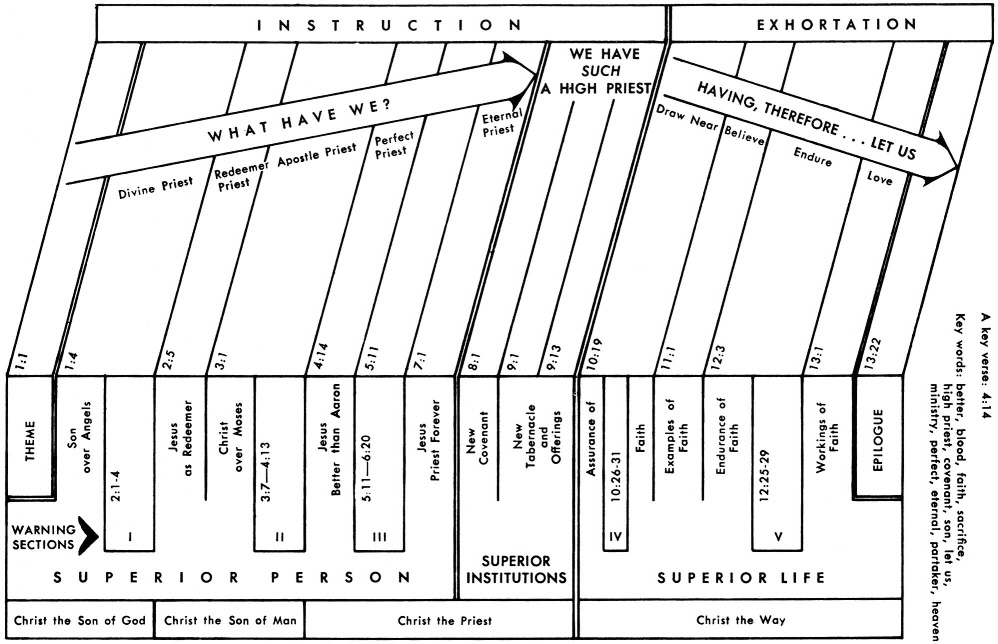
CONSIDER JESUS OUR GREAT HIGH PRIEST
Click chart to enlarge
Charts from Jensen's Survey of the NT - used by permission
Swindoll's Chart, Interesting Pictorial Chart of Hebrews, Another Chart
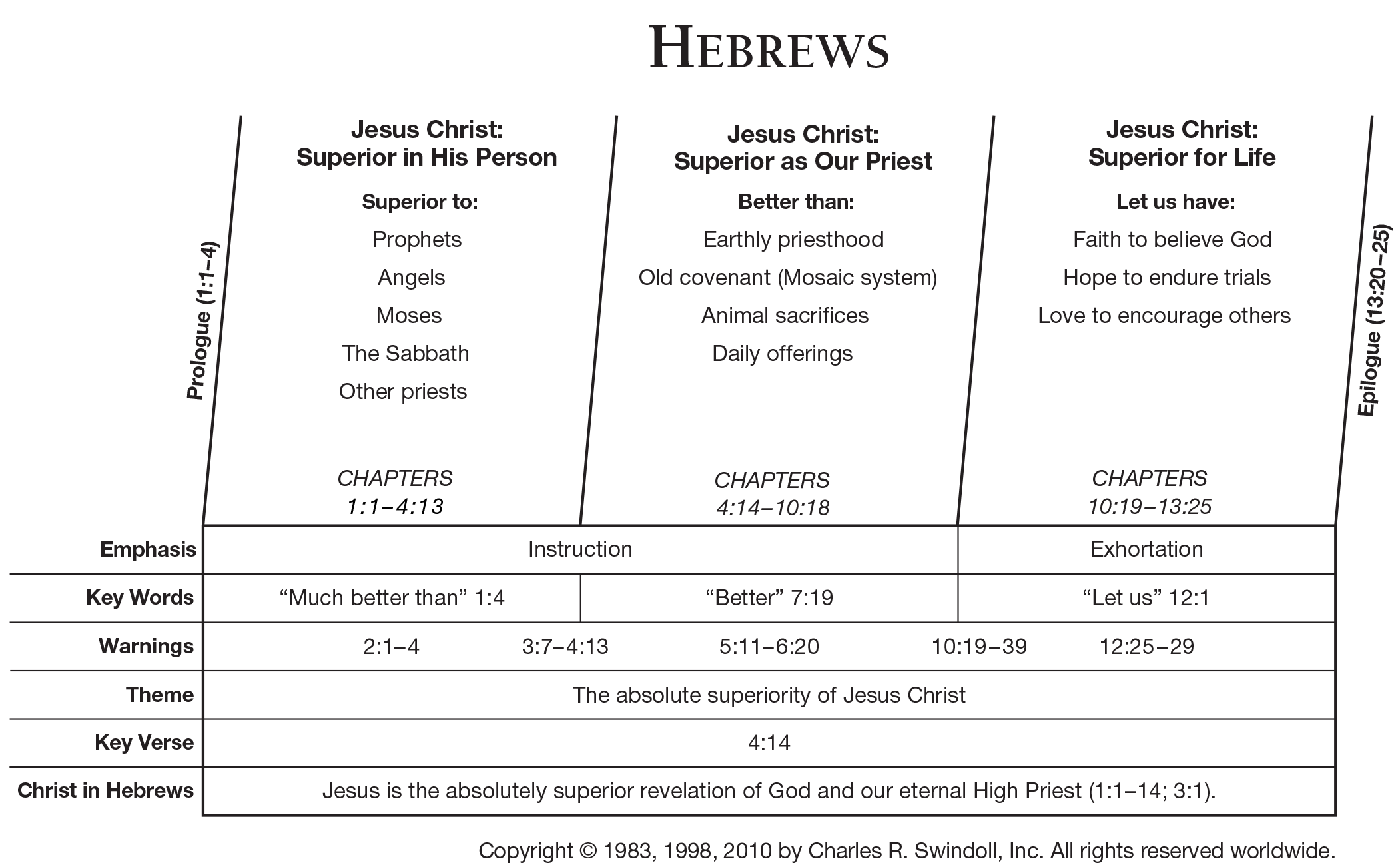
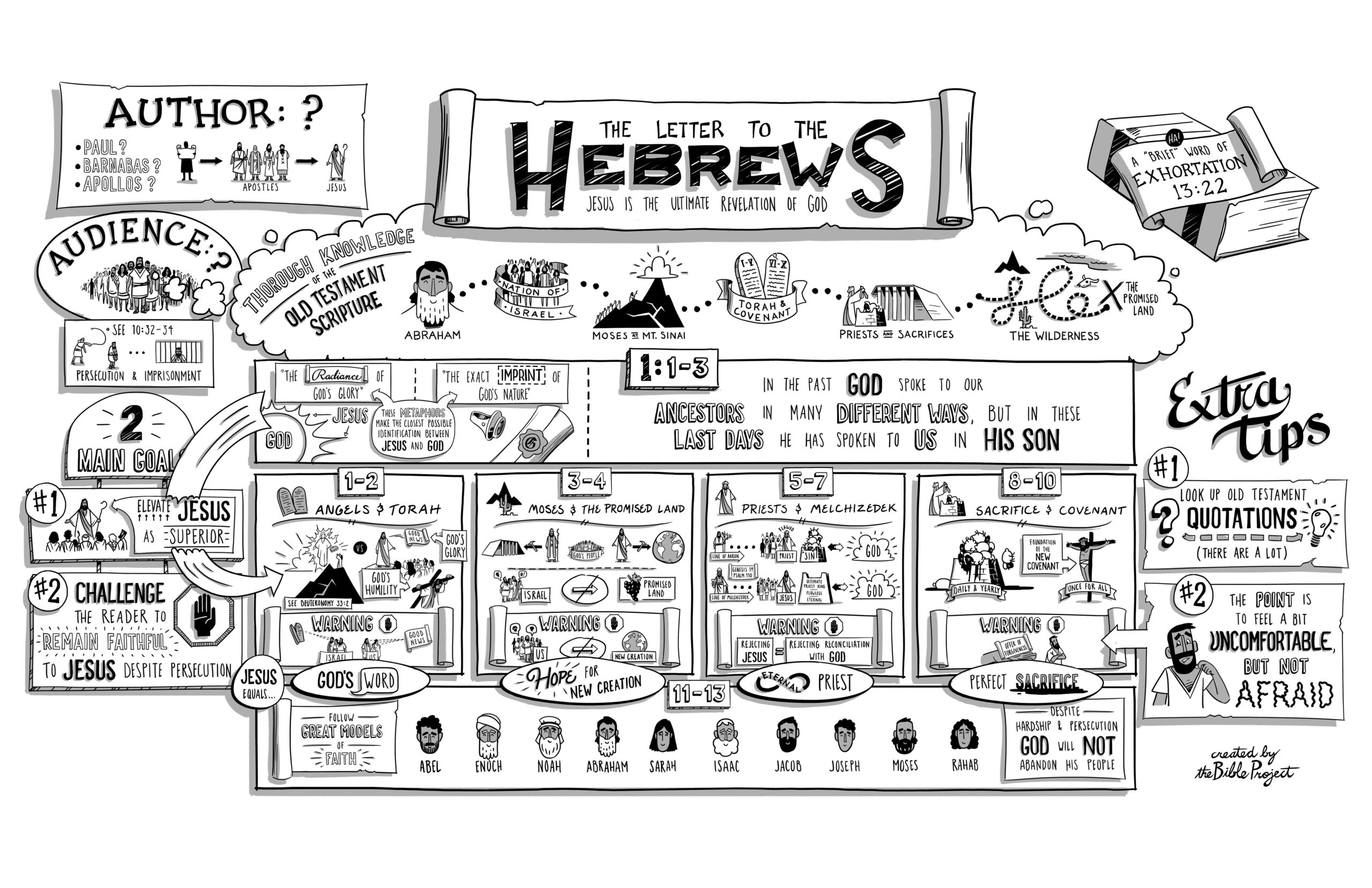
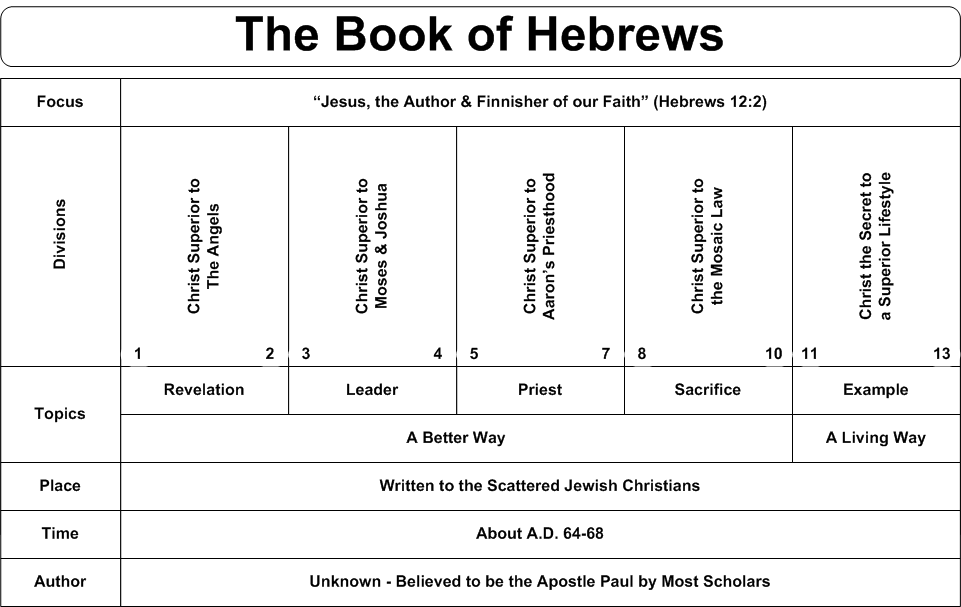
|
The Epistle |
||||
| INSTRUCTION Hebrews 1-10:18 |
EXHORTATION Hebrews 10:19-13:25 |
|||
| Superior Person of Christ Hebrews 1:1-4:13 |
Superior Priest in Christ Hebrews 4:14-10:18 |
Superior Life In Christ Hebrews 10:19-13:25 |
||
| BETTER THAN PERSON Hebrews 1:1-4:13 |
BETTER PRIESTHOOD Heb 4:14-7:28 |
BETTER COVENANT Heb 8:1-13 |
BETTER SACRIFICE Heb 9:1-10:18 |
BETTER LIFE |
| MAJESTY OF CHRIST |
MINISTRY OF CHRIST |
MINISTERS FOR CHRIST |
||
|
DOCTRINE |
DUTY |
|||
|
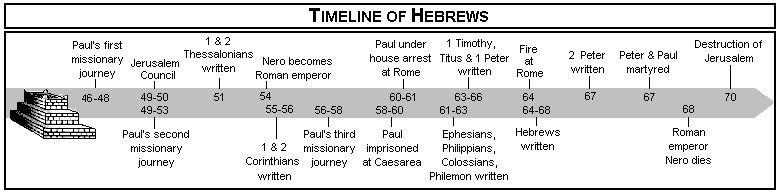
DATE WRITTEN: |
||||

See ESV Study Bible "Introduction to Hebrews"
(See also MacArthur's Introduction to Hebrews)
Borrow Ryrie Study Bible
Hebrews 10:5 Therefore, when He comes into the world, He says, "SACRIFICE AND OFFERING YOU HAVE NOT DESIRED, BUT A BODY YOU HAVE PREPARED FOR (NASB: Lockman)
Greek: Dio eiserchomenos (PMPMSN) eis ton kosmon legei, (3SPAI) thusian kai prosphoran ouk ethelesas, (2SAAI) soma de katertiso (2SAMI) moi
BGT Διὸ εἰσερχόμενος εἰς τὸν κόσμον λέγει· θυσίαν καὶ προσφορὰν οὐκ ἠθέλησας, σῶμα δὲ κατηρτίσω μοι·
Amplified: Hence, when He [Christ] entered into the world, He said, Sacrifices and offerings You have not desired, but instead You have made ready a body for Me [to offer]; (Amplified Bible - Lockman)
Barclay: That is why he says as he enters the world: “You did not desire sacrifice and offering; it is a body you have prepared for me. (Westminster Press)
NLT: That is why Christ, when he came into the world, said, "You did not want animal sacrifices and grain offerings. But you have given me a body so that I may obey you. (NLT - Tyndale House)
KJV Wherefore when he cometh into the world, he saith, Sacrifice and offering thou wouldest not, but a body hast thou prepared me:
NKJ Therefore, when He came into the world, He said: "Sacrifice and offering You did not desire, But a body You have prepared for Me.
NET So when he came into the world, he said, "Sacrifice and offering you did not desire, but a body you prepared for me.
CSB Therefore, as He was coming into the world, He said: You did not want sacrifice and offering, but You prepared a body for Me.
ESV Consequently, when Christ came into the world, he said, "Sacrifices and offerings you have not desired, but a body have you prepared for me;
NIV Therefore, when Christ came into the world, he said: "Sacrifice and offering you did not desire, but a body you prepared for me;
Phillips: Therefore, when Christ enters the world, he says: 'Sacrifice and offering you did not desire, but a body you have prepared for me. (Phillips: Touchstone)
Wuest: Wherefore, when coming into the world He says, Sacrifice and offering you did not desire, but a body you prepared for me.
Young's Literal: Wherefore, coming into the world, he saith, 'Sacrifice and offering Thou didst not will, and a body Thou didst prepare for me,
Paraphrase When Christ entered the world, He declared, “You did not want animal sacrifices or offerings, but You made ready a body for Me to offer.”
Paraphrase So, when Christ appeared in human form, He said, “The sacrifices You required under the Law were never Your ultimate desire; You prepared Me as the sacrifice that fulfills Your will.
Paraphrase Christ’s entrance into the world marked the end of external sacrifices. He said, “You do not delight in the blood of animals, but in perfect obedience. You have given Me a human body so I can become the true sacrifice.”
- When - He 10:7; 1:6; Mt 11:3; Lk 7:19
- Sacrifice - Ps 40:6-8; Isa 50:8-23; Isa 1:11; Je 6:20; Am 5:21,22
- Hebrews 10 Resources - Multiple Sermons and Commentaries
- Click for 5W/H Study Questions — ideal for leading a group or personal study of Hebrews
Related Passages:
Psalm 40:6-8+ (PSALM WRITER QUOTES IN PART) Sacrifice and meal offering You have not desired; My ears You have opened; Burnt offering and sin offering You have not required. 7 Then I said, “Behold, I come; In the scroll of the book it is written of me. 8 I delight to do Your will, O my God; Your Law is within my heart.”
1 Samuel 15:22+ (OBEDIENCE TRUMPS SACRIFICES!) Samuel said, “Has the LORD as much delight in burnt offerings and sacrifices As in obeying the voice of the LORD? Behold, to obey is better than sacrifice, And to heed than the fat of rams.
Psalm 51:16-17+ (A BROKEN HEART TRUMPS SACRIFICES!) For You do not delight in sacrifice, otherwise I would give it; You are not pleased with burnt offering. 17 The sacrifices of God are a broken spirit; A broken and a contrite heart, O God, You will not despise.
Hosea 6:6+ (LOYALTY BEFORE SACRIFICE) For I delight in loyalty rather than sacrifice, And in the knowledge of God rather than burnt offerings.
CHRIST ENTERED THE WORLD WITH
A MESSAGE NOT A RITUAL
Therefore (1352) (dio) hearkens back to the truths just recorded regarding the impotency and inadequacy of animal sacrifices to make the worshiper perfect and give them a clean conscience. A greater sacrifice was necessary. See importance of pausing to prayerfully ponder terms of conclusion.
“Therefore” marks the moment when the eternal Son steps from heaven into history, speaking the purpose of His incarnation. Quoting Psalm 40, the writer reveals that even before His birth, Christ’s mission was defined by divine dialogue—the Son responding to the Father’s will. God never took ultimate pleasure in animal sacrifices as ends in themselves. They were not His final will. What He desired was obedience (1 Samuel 15:22) and ultimately the incarnate Son offering Himself in full obedience (Heb 10:7–10). Christ’s body, prepared for Him, was the true offering God willed from eternity. So the OT sacrifices had provisional, typological value only because they pointed to Christ. God did not “desire” them as permanent solutions, but as pictures leading up to the real sacrifice. God’s ultimate desire was not animal blood, but Christ’s obedience and self-offering in the body prepared for Him.
Wuest adds that "The contents of this verse confirm the statement of Heb 10:4. In view of the fact that the blood of sacrificial animals cannot take away sin, the Messiah, when He became incarnate in humanity to perform His priestly work of offering a sacrifice that would pay for sin, did not offer animal sacrifices, but instead, Himself in His physical body gotten through virgin birth from Mary. (Hebrews Commentary)
Albert Barnes - This word (therefore) shows that the apostle means to sustain what he had said by a reference to the Old Testament itself. Nothing could be more opposite to the prevailing Jewish opinions about the efficacy of sacrifice than what he had just said. It was, therefore, of the highest importance to defend the position which he had laid down by authority which they would not presume to call in question, and he therefore makes his appeal to their own Scriptures.
When He comes (eiserchomai) into the world (kosmos), He (the Son) says (underscores divine initiative), "SACRIFICE (thusia) AND OFFERING (phosphora) YOU (God the Father) HAVE NOT (ou-absolutely not) DESIRED (thelo) - This describes the incarnation of Christ (Jn 1:1, 14+) The phrase He comes (eiserchomai) into the world (kosmos) signifies His entrance into the human realm in a body prepared by God. You have not desired conveys not mere dislike, but divine dissatisfaction. As explained more below the Father desired obedience, not repetition; a perfect will fulfilled, not mere ritual performed.
Grant Osborne - Interestingly, Christ is presented as the virtual author of Psalm 40:6–8, singing it at his incarnation (“when Christ came into the world, he said”). He begins his earthly sojourn with surrender to the Father and promises to obey the Father’s will. This is a Davidic psalm, and his promise of fealty is fulfilled in the son of David, the royal Messiah, at the same time the Son of God. (See Hebrews Verse by Verse - Page lxxxiv)
Kenneth Wuest - The reference is to Psalm 40:7–9, the theme of which is that deliverance from sin is not obtained by animal sacrifices, but by fulfilling God’s will. Vincent says, “The course of thought in the Psalm is as follows: ‘Thou, O God, desirest not the sacrifice of beasts, but thou hast prepared my body as a single sacrifice, and so I come to do thy will, as was predicted of me, by the sacrifice of myself.’ Christ did not yield to God’s will as authoritative constraint. The constraint lay in His eternal spirit. His sacrifice was no less His own will than God’s will.” This reminds one of the words in 9:14, “who through eternal Spirit offered Himself without spot to God.” Expositor’s says; “In the Psalm, indeed, sacrifice is contrasted with obedience to the will of God. A body is prepared for Christ that in it He may obey God. But it is the offering of this body as a sacrifice in contrast to the animal sacrifices of the law, which the writer emphasizes … The passage in the epistle is far from saying that the essence or worth of Christ’s offering of Himself lies simply in obedience to the will of God. It does not refer to the point wherein lies the intrinsic worth of the Son’s offering, or whether it may be resolved into obedience unto God. Its point is quite different. It argues that the Son’s offering of Himself is the true and final offering for sin, because it is the sacrifice, which according to prophecy, God desired to be made” (Davidson). (Hebrews Commentary)
Phil Newton… The "therefore" has potent force! After explaining that the repetition of the sacrificial system demonstrated its impotency and reinforcing this by explaining that the bloody sacrifices could never take away sin, he sets forth the whole rationale for Jesus Christ entering the world to be our redeemer. The statement has an intentional ring of the preexistence of Christ, for "He comes into the world" as one who created the world (He 1:2, 3), and as one who has a specific purpose (He 10:9). Our writer once again finds refuge in the Old Testament Scriptures to prove his point. He was not coming up with a new idea of religion but simply amplifying what the prophets before him had spoken many times over. The sacrificial system was not the end-all for a right relationship with God. Hebrews 10:1-18 What Can Wash Away My Sins? (1)
It was the heart that God desired to change.
Sacrifices did nothing to change the heart.
Phil Newton - When David sought the Lord for forgiveness in regard to his sin with Bathsheba, he prayed, "For You do not delight in sacrifice, otherwise I would give it; You are not pleased with burnt offerings. The sacrifices of God are a broken spirit; a broken and a contrite heart, O God, You will not despise" (Ps. 51:16, 17). When Samuel reproved King Saul who offered a sacrifice contrary to the word of the Lord, the prophet declared, "Has the Lord as much delight in burnt offerings and sacrifices as in obeying the voice of the Lord? Behold, to obey is better than sacrifice, and to heed than the fat of rams" (1Sa 15:22). It was the heart that God desired to change. Sacrifices did nothing to change the heart. Thus through the psalmist, Isaiah, Jeremiah, Hosea, Amos, and Micah, God thundered to awaken the slumbering people under the old covenant that their burnt offerings apart from a changed heart were worthless (Ps 40:6-8; Is 1:11-13a; Isa 66:3-4; Je 7:21-23; Hos 6:6; Amos 5:21-24; Micah 6:6-8—I was helped by Kent Hughes' insights at this point, (SEE Hebrews: An Anchor for the Soul).
The divine will demanded perfect obedience
and perfect satisfaction
Who would do the will of God? Who would walk in perfect obedience and honor God from a perfect heart of submission? Did Moses or David or Isaiah or Jeremiah fulfill that divine desire? Just like you and me, none of them did. But Jesus Christ did perfectly obey the will of God! The divine will led our Lord to the cross. Two things happened in this: Christ fulfilled God demands for righteousness in regard to the Law and Christ satisfied God's demand of righteousness in regard to our sin. "THEN I SAID, 'BEHOLD, I HAVE COME (IN THE SCROLL OF THE BOOK IT IS WRITTEN OF ME) TO DO YOUR WILL, O GOD'." The divine will demanded perfect obedience and perfect satisfaction. Bulls and goats could do neither. They had no consciousness of walking in obedience to fulfill the law of God vicariously for the worshipers. Nor could they satisfy the divine justice rendered by atonement since they did not qualify as morally responsible human beings. So Jesus Christ came to do both! Jesus Christ obeyed the Father's will. (Sermons from the Epistle to the Hebrews)
W E Vine points out that the writer's appeal to the Old Testament Scriptures "would help to counteract any mere prejudice that he was merely belittling the Levitical sacrifices. Moreover, what he quotes from Psalm 40 is shown to be the language of Christ Himself."
Now he says positively that Christ’s sacrifice,
which established the new covenant, was effectual.
Leon Morris adds that the writer's "argument up till now has been the negative one that the animal sacrifices of the old covenant were unavailing. Now he says positively that Christ’s sacrifice, which established the new covenant, was effectual. It really put away sin. And it was foreshadowed in the same passage from Jeremiah. (See The Expositor's Bible Commentary - Abridged Edition)
Spurgeon - When once the life is gone out of the best symbolism, the Lord abhors the carcass, and even a divinely ordained ritual becomes a species of idolatry. When the heart is gone out of the externals of worship, they are as shells without the kernel. Habitations without living tenants soon become desolations, and so do forms and ceremonies without their spiritual meaning. Toward the time of our Lord’s coming, the outward worship of Judaism became more and more dead; it was time that it was buried. It had decayed and waxed old, and was ready to vanish away. And vanish away it did, for our Lord set aside the first, or old, that He might establish the second, or new. What did God require of man? Obedience. He said by Samuel, “To obey is better than sacrifice; to give heed than the fat of rams” (1 Sam 15:22). He says in another place, “He has told you, O mortal, what is good; and what does Yahweh ask from you, but to do justice, and to love kindness, and to walk humbly with your God?” (Mic 6:8) The requirement of the law was love to God and love to men. This has always been God’s great requirement. He seeks spiritual worship, obedient thought, holy living, grateful praise, devout prayer—these are the requirements of the Creator and Benefactor of men.
Although this question has been addressed above, you may still be wondering "But in the OT God ask for Israel to bring sacrifices, and now He changes His mind and says He doesn't desire them. Which is true?" Both are true!
1. God Commanded Sacrifices (External Obedience) Under the Mosaic Law, God did require sacrifices (Lev 1–7). They served as visible, instructive pictures of sin, substitution, and atonement. These sacrifices taught Israel about the seriousness of sin and the need for a substitute — a life for a life (Lev 17:11). 🩸 They were divinely ordained symbols — not ends in themselves. “The sacrifices were shadows pointing forward to the reality in Christ” (Heb 10:1).
God desires sincerity,
not ceremony.2. God Did Not Desire Sacrifices (Internal Reality) - We see the OT repeatedly warning Israel that sacrifices as an external formality without internal change were not pleasing to God (Isa 1:11–13; Amos 5:21–24). God never delighted in the outward act of sacrifice alone. What He truly desired was obedience, faith, and repentance expressed through the sacrifice. God desired obedience from a heart motivated by love not legalism. “For I delight in loyalty rather than sacrifice, And in the knowledge of God rather than burnt offerings.” (Hosea 6:6) “You do not delight in sacrifice, otherwise I would give it; You are not pleased with burnt offering.” (Psalm 51:16–17) These verses reveal that sacrifices were acceptable only when they reflected a heart of trust and submission to God. When the ritual became mechanical or hypocritical, it became offensive to Him.
The motions of religion mean nothing
without the devotion of the heart.
What God does not delight in is external acts or religious rituals which can never replace a repentant heart. In other words He looks at the person's heart (attitude, motivation, etc) behind the act. Mark it down that God always inspects the giver, before He inspects the gift! How can one who is unclean offer a clean sacrifice? The constant urging of Scripture is that God’s servants give their hearts and their lives in contrition and brokenness of spirit, before they observe feasts, fasts, Sabbaths, sacrifices, etc. Rote religion is never a substitute for purity of heart. Lip service without life surrender is lifeless worship. Ceremony without sincerity is vanity. Piety without purity is hypocrisy. Sacrifice without surrender is self-deception. You can light candles to God (AS SOME RELIGIONS DO!) and still walk in darkness. God is not condemning sacrifices but the unrepentant spirit of those who offer them, which defeats the whole purpose of the offering.
Ray Stedman adds that "Wholehearted obedience is the quality which God desires in sacrifices. He makes the point many times in the Old Testament, notably, in 1Sa 15:22 ("… to obey is better than sacrifice, And to heed than the fat of rams."); Isaiah 1:11-14 (see notes); and Amos 5:21,22 (see below). As Morris rightly says, “God takes no delight in the routine performance of the ritual of sacrifice” (Hebrews. Bible Study Commentary. Lamplighter Books. Grand Rapids: Zondervan. 1983:91). Undoubtedly, he feels the same way about routine worship services today! Hebrews 10:1-39 Let Us Go On!)
Max Alderman (Reference) offers the following explanation of why offerings were not desired by God - We are told in this chapter that the Lord found no pleasure in burnt offerings and sacrifices. We must understand that it was God who ordained the legal system when He gave the law to Moses. We also must understand that there is nothing wrong with the law. The offerings that were given which pertained to the law were not capable of satisfying the holy demands of God; these weak sacrifices could only put off the wrath of God for a little while. In an absolute and also in a relative sense, the Lord could not find pleasure in the offering of the “burnt offerings and sacrifices for sin” (He 10:6, 7). When the offerings are compared to the offering of His Son, they proved to be entirely inadequate. When these burnt offerings and sacrifices are seen by the Lord they absolutely do not measure up, thus He finds no pleasure in them. One might ask, if these offerings were not suitable to put off forever the wrath and anger of God, then why did He ordain the legal system? Galatians 3:19-25 answers this concern when it tells us that the law “was our schoolmaster to bring us unto Christ” (Gal 3:24). We also are instructed that the law was “added because of transgressions, till the seed should come to whom the promise was made; and it was ordained by angels in the hand of a mediator” (Gal 3:19). This verse shows us that the offerings served a very temporary purpose until the “seed should come,” and that seed was the Lord Jesus Christ.
I. God’s Displeasure Revealed Concerning the Old Offering (Heb 10:1-8);
II. God’s Pleasure Recognized Concerning the New Offering (He 10:9-18).
Sacrifices (2378) thusia from thuo/thyo = to slay, sacrifice or kill a sacrificial victim; to bring a religious offering to a deity) refers literally to animal sacrifices that were slain and offered on the altar. Homer (about nine centuries before Christ) used thusia to describe the "smoke or burnt offering." Later the sense of thusia was broadened to mean the actual slaying of a sacrifice. According to Pindar, thusia was the very ritual of sacrifice, the religious service in which a sacrifice was brought.
Thusia is used figuratively in the NT. Thusia refers to the death of Christ as an offering of Himself to God (Ep 5:2+). Thusia is used to refer to the volitional choice of a believer to make a consecration or surrender of one's whole life unto God (Ro 12:1+). thusia refers to the believer's offering of praise and good deeds (He 13:16+) to God, an offering that is acceptable to God only through Jesus, only on the basis of His shed blood (He 13:15+). Peter concurs saying we are "to offer up spiritual sacrifices acceptable to God through Jesus Christ." (1Pe 2:5+)
THUSIA IN HEBREWS - Heb. 5:1; Heb. 7:27; Heb. 8:3; Heb. 9:9; Heb. 9:23; Heb. 9:26; Heb. 10:1; Heb. 10:5; Heb. 10:8; Heb. 10:11; Heb. 10:12; Heb. 10:26; Heb. 11:4; Heb. 13:15; Heb. 13:16
Hebrews 5:1 in order to offer both gifts and sacrifices for sins;
Hebrews 7:27 who does not need daily, like those high priests, to offer up sacrifices,
Hebrews 8:3 every high priest is appointed to offer both gifts and sacrifices;
Hebrews 9:9 both gifts and sacrifices are offered which cannot
Hebrews 9:23 the heavenly things themselves with better sacrifices than these.
Hebrews 9:26 He has been manifested to put away sin by the sacrifice of Himself.
Hebrews 10:1 by the same sacrifices which they offer continually year by year
Hebrews 10:5 He says, “SACRIFICE AND OFFERING YOU HAVE NOT DESIRED
Hebrews 10:8 After saying above, “SACRIFICES AND OFFERINGS AND WHOLE BURNT OFFERINGS AND
Hebrews 10:8 sacrifices FOR SIN YOU HAVE NOT DESIRED
Hebrews 10:11 offering time after time the same sacrifices
Hebrews 10:12 He, having offered one sacrifice for sins for all time
Hebrews 10:26 there no longer remains a sacrifice for sins,
Hebrews 11:4 By faith Abel offered to God a better sacrifice than Cain
Hebrews 13:15 let us continually offer up a sacrifice of praise to God
Hebrews 13:16 for with such sacrifices God is pleased.
Offering (4376) phosphora from pros = toward, before + phero = to bring or bear) literally is "a bringing before" and thus describes the act of offering or a bringing to and metonymically to that which is offered (a gift, a present). The major Scriptural use of prosphora is found in Hebrews 10 (5x) and thus it behooves one to study these passages in context to derive a good sense of the meaning of the word.
Gilbrant - Related to the compound verb prosphero, the noun prosphora indicates a “bringing to, a presenting, an offering” of something. Passively it is something received, such as a “present, gift, offering.” Similarly it can also denote an “increase, benefit, donation,” and a marriage “dowry” (cf. Moulton-Milligan; Liddell-Scott). Unlike the verb prospherō, which is highly specialized and frequently used in the Septuagint for making an offering, prosphora carries a more general sense and is less frequent (two canonical appearances). The noun and the verb do not occur in conjunction with one another except in a noncanonical reading in Daniel 4:34. Usually one offers (prospherō) a “gift” (dōron [1428]; Hebrew minchāh, qorbān, or lechem) or a “sacrifice” (thusia [2355]). Although prosphora apparently lacks the specialized sense that the verb has, it can still be used of “offerings” in a general sense. The use in Psalm 40:6 (LXX 39:6) suggests this is so (“Sacrifice and offering you [God] did not desire” [NIV]). According to Weiss, prosphora first took on the meaning “sacrifice” in the Septuagint (“pherō,” Kittel, 9:68). First Kings 7:48 (LXX 3 Kings 7:48), the second canonical use, links prosphora to the bread of Presence (literally “bread of offering” here; cf. the word prothesis [4145]; the Hebrew is pānîm, cf. Exodus 39:36; 2 Chronicles 4:19). By the time of the apocryphal writings the trend toward understanding prosphora in a more specialized way was developing (e.g., Sirach 14:11; 34:18 [LXX 31:18]; 35:1 [32:1]).
In the New Testament the technical aspect of prosphora is developed even further. Paul expected an offering to be made after his days of purification were over (Acts 21:26). Also, in Acts 24:17 Paul’s offerings in the temple (Acts 24:18) were clearly religious in nature. Yet these are individual and not priestly offerings. Metaphorically, Paul spoke of the Gentiles as “offerings acceptable” to God, “sanctified by the Holy Spirit” (Romans 15:16 [NIV]). In Ephesians Paul wrote that Jesus himself was a fragrant offering and sacrifice to God (Eph 5:2). The writer of Hebrews shared a similar perspective, giving prosphora a direct link to the Old Testament ritual system. First, God did not desire “sacrifice and offering” (Psalm 40:6 [LXX 39:6]); rather, He desired someone to do His will. Then we read that Christ our High Priest fulfilled God’s desire for obedience by offering himself as the “sacrifice” (NIV; cf. “offering” [KJV]) which makes us holy (Hebrews 10:10,14). This offering once and for all made God’s forgiveness possible, and it eliminated the need for any further sacrifice (Hebrews 10:18).
PHOSPHORA - KEY WORD IN HEBREWS 10 - offering(6), offerings(2), sacrifice(1). Acts 21:26; Acts 24:17; Rom. 15:16; Eph. 5:2; Heb. 10:5; Heb. 10:8; Heb. 10:10; Heb. 10:14; Heb. 10:18
Hebrews 10:5 He says, “SACRIFICE AND OFFERING YOU HAVE NOT DESIRED,
Hebrews 10:8 After saying above, “SACRIFICES AND OFFERINGS AND WHOLE BURNT OFFERINGS
Hebrews 10:10 we have been sanctified through the offering of the body of Jesus Christ once for all.
Hebrews 10:14 (For by one offering He has perfected for all time those who are sanctified.
Hebrews 10:18 Now where there is forgiveness of these things, there is no longer any offering for sin.
Henry Morris - The Opened Ear and the Father's Will
"Sacrifice and offering thou didst not desire; mine ears hast thou opened: burnt offering and sin offering hast thou not required" (Ps. 40:6).
That Psalm 40 is primarily a Messianic psalm speaking mainly about the work of Christ is evident from its quotation as such in Hebrews 10:5-10. The psalm is prophesying particularly of His incarnation, as He says: "Lo, I come: in the volume of the book it is written of me" (Ps. 40:7).
Burnt offerings and sin offerings were indeed required from God's people under the law, but these were not an end in themselves. These sacrifices were meaningless unless they were offered out of a willing heart, obedient expressions of submission to a forgiving God.
That was the implication of the "opened ear," a symbolic expression indicating one's willingness thenceforth to hear only the voice of his master and to submit to His will in all things. If a freed bondservant "shall plainly say, I love my master... I will not go out free: Then his master shall... bore his ear through with an aul; and he shall serve him for ever" (Exod. 21:5-6). This was the testimony of the coming Messiah, as reported in our text.
Then note its application as recorded in Hebrews 10:5: "Wherefore when he cometh into the world, he saith, Sacrifice and offering thou wouldest not, but a body hast thou prepared me." That is, the phrase, "mine ears hath thou opened," would be translated by the Holy Spirit as "a body hast thou prepared me." The perfect submission of the Son to the Father required that He become a man, with a very special human body prepared by His Father. Then Psalm 40:7 becomes (in Heb. 10:7): "Lo, I come... to do thy will, O God." "By the which will we are sanctified through the offering of the body of Jesus Christ once for all" (Heb. 10:9-10).
Selwyn Hughes - A Temple, Not a Trap You prepared a body for Me.—HEBREWS 10:5 (Every Day with Jesus Daily Bible: With Devotions)
We continue to meditate on things we must do if we are to stay spiritually fresh. My next suggestion may come as a surprise: keep your body in good physical shape.
One of the most disastrous divorces that ever took place in Christendom was that between the physical and the spiritual. In the early days of Christianity, the two were one. When the disciples wanted men to look after the physical nourishment of those who were in need in the early church, the first of those they selected was Stephen, "a man full of faith and the Holy Spirit" (Ac 6:5). This combination of faith and the Holy Spirit was to be carried into the satisfying of physical needs, for the early church regarded the physical as being important as well as the spiritual. Not supremely important, of course, but important nevertheless.
In more recent centuries, the physical has been looked upon with greater suspicion in the church. In my youth I heard thundering sermons on the text, "our vile body" (Php 3:21, KJV), in which preachers propounded the idea that the body was the enemy of the soul. The suggestion was that the body must be ignored until the day when it is finally discarded and we are given a new resurrection body. These preachers failed to understand that the phrase "vile body" in the King James Version really means "the body of our humble condition" (HCSB) and not something to be treated with contempt. Let's be done with this morbid idea concerning the body that still lingers in parts of the Christian church. Our bodies are not to be seen as traps, but as temples of the Holy Spirit.
Prayer
Blessed Lord Jesus, help me see my body in the way You saw Yours—not as something to be avoided but as something to be used. Show me the steps I need to take to be healthy in soul and in body. For Your own dear name's sake. Amen.
Andrew Murray
When he cometh into the world, he saith … A body hast thou prepared me Heb. 10:5
The word of Christ must be adopted by each of His followers. Nothing will help us to live in this world and keep ourselves unspotted but the Spirit that was in Christ, that looked upon His body as prepared by God for His service; that looks upon our body as prepared by Him too, that we might offer it to Him. Like Christ, we too have a body in which the Holy Spirit dwells. Like Christ, we too must yield our body, with every member, every power, every action, to fulfill His will, to be offered up to Him, to glorify Him. Like Christ, we must prove in our body that we are holy to the Lord.
I take no pleasure in the blood
of bulls, lambs, or goats
In Isaiah 1:11ff, in strong terms God ask faithless, rebellious Israel ""What are your multiplied sacrifices to Me?" Says the LORD. "I have had enough of burnt offerings of rams, And the fat of fed cattle. And I take no pleasure in the blood of bulls, lambs, or goats. 12 "When you come to appear before Me, Who requires of you this trampling of My courts? 13 "Bring your worthless offerings no longer, Incense is an abomination to Me. New moon and sabbath, the calling of assemblies-- I cannot endure iniquity and the solemn assembly. 14 "I hate your new moon festivals and your appointed feasts, They have become a burden to Me. I am weary of bearing them. 15 "So when you spread out your hands in prayer, I will hide My eyes from you, Yes, even though you multiply prayers, I will not listen. Your hands are covered with blood. (Note: even in the midst of God's diatribe, He offers the way of escape in the next two verses) 16 "Wash yourselves, make yourselves clean; Remove the evil of your deeds from My sight. Cease to do evil, 17 Learn to do good; Seek justice, Reprove the ruthless; Defend the orphan, Plead for the widow. (Isaiah 1:11-17) (See Isaiah 1:10-15 Commentary)
Solomon puts proper sacrifice in perspective writing that "The sacrifice of the wicked is an abomination to the Lord, but the prayer of the upright is His delight." (Pr 15:8)
John Piper comments on Proverbs 15:8: … An act which is good in itself (Ed: Sacrifices that He Himself has ordained) can become displeasing to God when it is done with the wrong inner disposition. An outward act that looks pious to us can look horrible in God’s eyes because the pious act comes from a heart that is wrong. There seems to be a principle implied here that would go something like this: in God’s eyes the beauty (and hence enjoyableness) of an act is the outworking of inward beauty, and the ugliness of an act is the outworking of an inward ugliness. Since God always looks on the heart (1Sa 16:7+), He always sees our outward acts not as man sees them, but as extensions of what He sees on the inside. Whether our acts are immoral, like stealing and lying and adultery, or whether our acts are moral like church attendance and community service, both may be abominable in God’s eyes if the heart is not right. Paul teaches the same thing when he says in Ro 14:23+ Whatever is not from faith is sin. The inner beauty of hoping in God, of trusting Him for help and guidance, makes the external act beautiful. And if this faith is not there motivating the act, the act is not pleasing to the Lord; it is sin. Hebrews 11:6+ teaches this when it says, “Without faith it is impossible to please God.” Mere external righteousness does not please God. In fact, we will see that it is not righteousness at all if it does not come from faith. In the near context of Hebrews 11:6+ the very same issue of sacrifices is addressed that we have here in Proverbs 15:8. Hebrews 11:4+ says, “By faith Abel offered to God a more acceptable sacrifice than Cain.” Why was Abel’s sacrifice pleasing to God and not Cain’s? The reason is that Abel’s sacrifice was offered by faith, but Cain’s wasn’t; and without faith it is impossible to please God. (SEE The Pleasures of God: Meditations on God's Delight in Being God)
In Psalm 51 David declared "Thou dost not delight in sacrifice, otherwise I would give it; Thou art not pleased with burnt offering. The sacrifices of God are a broken spirit; A broken and a contrite heart, O God, Thou wilt not despise." (Psalm 51:16-17)
Charles Haddon Spurgeon comments -
For thou desirest not sacrifice. This was the subject of the last Psalm. The psalmist was so illuminated as to see far beyond the symbolic ritual; his eye of faith gazed with delight upon the actual atonement.
Else would I give it. He would have been glad enough to present tens of thousands of victims if these would have met the case. Indeed, anything which the Lord prescribed he would cheerfully have rendered. We are ready to give up all we have if we may but be cleared of our sins; and when sin is pardoned our joyful gratitude is prepared for any sacrifice.
Thou delightest not in burnt offering. He knew that no form of burnt sacrifice was a satisfactory propitiation. His deep soul need made him look from the type to the antitype, from the external rite to the inward grace.
The sacrifices of God are a broken spirit. All sacrifices are presented to thee in one, by the man whose broken heart presents the Saviour's merit to thee.
When the heart mourns for sin,
thou art better pleased than
when the bullock bleeds beneath the axe.
A broken heart is an expression implying deep sorrow, embittering the very life; it carries in it the idea of all but killing anguish in that region which is so vital as to be the very source of life. So excellent is a spirit humbled and mourning for sin, that it is not only a sacrifice, but it has a plurality of excellences, and is preeminently God's sacrifices.
A broken and a contrite heart, O God, thou wilt not despise.
A heart crushed
is a fragrant heart.
Men contemn those who are contemptible in their own eyes, but the Lord sees not as man sees.
He despises what men esteem,
and values that which they despise.
Never yet has God spurned a lowly, weeping penitent, and never will he while God is love, and while Jesus is called the man who receiveth sinners. Bullocks and rams he desires not, but contrite hearts he seeks after; yea, but one of them is better to him than all the varied offerings of the old Jewish sanctuary.
See also What does it mean that God will not despise a broken spirit and contrite heart (Psalm 51:17)?
Jesus also declared the superiority of obedience over sacrifice declaring we are to "TO LOVE HIM WITH ALL THE HEART AND WITH ALL THE UNDERSTANDING AND WITH ALL THE STRENGTH, AND TO LOVE ONE'S NEIGHBOR AS HIMSELF, is much more than all burnt offerings and sacrifices." (Mark 12:33+)
Through His prophet Amos God declared "I hate, I reject your festivals, Nor do I delight in your solemn assemblies. 22 "Even though you offer up to Me burnt offerings and your grain offerings, I will not accept them; And I will not even look at the peace offerings of your fatlings. 23 "Take away from Me the noise of your songs; I will not even listen to the sound of your harps. 24 "But let justice roll down like waters And righteousness like an ever-flowing stream. 25 "Did you present Me with sacrifices and grain offerings in the wilderness for forty years, O house of Israel? 26 "You also carried along Sikkuth your king and Kiyyun, your images, the star of your gods (idols) which you made for yourselves. (Amos 5:21-26)
Comment: Note Amos 5:25 speaks of sacrifices to God but Amos 5:26 exposes the duplicity of their hearts to run after vain idols! In Verse 25 they pretended at religious ceremony but in Verse 26 they practiced spiritual adultery. In short, their sacrifices were tainted by divided allegiance which is exactly the kind of worship God does not desire!
Samuel's words to disobedient King Saul (as God removes the kingdom from him) explain God has always desired obeying His voice over sacrifices from empty, deceived hearts…
And Samuel said, "Has the LORD as much delight in burnt offerings and sacrifices As in obeying the voice of the LORD? Behold, to obey is better than sacrifice, And to heed than the fat of rams. For rebellion is as the sin of divination, And insubordination is as iniquity and idolatry. Because you have rejected the word of the LORD, He has also rejected you from being king. (1Sa 15:22, 23+)
Comment: In King Saul's mind sparing King Agag and keeping the best of the sheep and oxen, claiming he did it “to sacrifice to the Lord was reflected partial obedience and he deceptively reasoned that he would his sparing Agag and animals could be excused if it was wrapped in religious intention. Wrong! Samuel confronted him with these cutting words in this passage showing that religious acts cannot compensate for a rebellious heart. In effect Samuel was saying to Saul “Do you really think God is pleased with offerings when they come from disobedience?” In sum, God commanded sacrifices, yes but they were never meant to replace obedience. They were expressions of devotion, not substitutes for it.
See also Why is obedience better than sacrifice?
BUT A BODY THOU HAST PREPARED FOR ME: soma de katertiso (2SAMI) moi:
- But a body - He 10:10; Heb 2:14-15; Heb 8:3; Ge 3:15; Isa 7:14; Jer 31:22; Mt 1:20-23; Luke 1:35; Jn 1:14; Gal 4:4; 1Ti 3:16; 1Jn 4:2,3; 2Jn 1:7
- Hebrews 10 Resources - Multiple Sermons and Commentaries
Related Passages:
Hebrews 10:10+ By this will we have been sanctified through the offering of the body of Jesus Christ once for all.
Hebrews 2:14-15+ Therefore, since the children share in flesh and blood, He Himself likewise also partook of the same, that through death He might render powerless him who had the power of death, that is, the devil, 15 and might free those who through fear of death were subject to slavery all their lives.
THE BODY BUILT
FOR THE CROSS
But a body (soma) - In this psalm Messiah contrasts the sacrifices of the bodies of animals with His ultimate, perfect sacrificial body, as the Lamb of God, the incarnation of Jesus the eternal Son. This body puts an end to need for any and all animal bodies for sacrifices!
Thou hast prepared (katartizo) for me - Prepared (katartizo) means to fit, equip, or make ready, emphasizing that God the Father personally fashioned a human body for the Son as the perfect instrument of obedience and sacrifice. The eternal Word took on true humanity, not merely appearing as man, but becoming fully man—so that through this body He could do the Father’s will and offer Himself once for all as the perfect sacrifice for sin.
Hebrews 11:3 uses this same verb katartizo to describe "preparing" the world "By faith we understand that the worlds were prepared (katartizo) by the Word of God, so that what is seen was not made out of things which are visible." In short, the writer is saying that God formed the human body of His Son with the same mighty power and wisdom with which He formed the universe.
The original Hebrew of Psalm 40:6 reads "Sacrifice and meal offering Thou hast not desired; My ears Thou hast opened; Burnt offering and sin offering Thou hast not required." The Lxx/Septuagint writers translated substituted soma (body) for otia (ears) rendering it "Sacrifice and offering thou wouldest not; but a body (soma) hast thou prepared me: whole-burnt-offering and sacrifice for sin thou didst not require." In Exodus 21:6+ when the master pierced a servant's ear with an awl, the servant was to serve the master permanently. Thereafter the servant was in a sense to hear and obey only the voice of his master. This OT picture is a foreshadowing of Christ, Who willingly became a bondservant (Php 2:5-8+), even to the point of death, in perfect obedience to His Father's will. But before Jesus heard and obeyed, He had to have a human body, with human ears.
Rienecker explains that "The words (in Psalm 40:6) "a body you have prepared for me" were evidently taken from the Lxx/Septuagint and are an interpretative paraphrase of the Hebrew text. It could have been that the Greek translators regarded the Hebrew words as an instance of "a part for the whole," i.e., the "digging" or hollowing out of the ears is part of the total work of fashioning a human body. It may also have been that the "ears" were taken as a symbol of obedience in that they were the organ of reception of the divine will and the body was considered the organ of the fulfillment of the divine will. Or finally there may be illusion to the custom of piercing a slave's ears showing that he had voluntarily refused his liberty (Ex 21:1-6+, Dt 15:17+). (BORROW The new linguistic and exegetical key to the Greek New Testament page 538 - Rienecker was the original author of this book not Cleon Rogers)
W E Vine offers this explanation of the Psalm 40:6 quotation writing that "these quotations from Psalm 40:5-7+ are in the Psalm prophetic utterances anticipative of the language of Christ. The quotation is from the Lxx/Septuagint Version. The Hebrew version is “ears hast Thou digged for Me”; the LXX has, “a body didst Thou prepare for Me.” The latter is another way of conveying the same thought. If there is a body, it contains ears wherewith to receive instruction; and that there are ears to hear implies the existence of a body by means of which the instruction received is carried out. What is set forth in the Hebrew version of Psalm 40 is quite distinct from the subject of Exodus 21:6, where the master is instructed to bore the ear of his willing servant through with an awl. The thought suggested in Psalm 40, and so in the present passage in Hebrews, is that of preparation for obedience. In the Exodus passage the idea is that of binding under a permanent obligation to render service. “Ears hast thou digged” suggests the impartation of the physical faculty by which the capacity of fulfilling the will of another would be exercised. Cp. Isaiah 50:5. The body prepared by the Father for the Son was the instrument of His self-surrender and His entire and devoted submission to the Father’s will. The Son Himself, in partaking of flesh and blood, put Himself into the position for rendering perfect obedience. We are on holy ground. We are listening to the son’s most intimate communion with the Father as to the way in which the Son would become incarnate, in obedience to the Father’s will, and all for the fulfillment of the counsels of sovereign grace. (Collected writings of W. E. Vine)
C H Spurgeon - The whole body of Christ was prepared for Him and for His great work. To begin with, it was a sinless body, without taint of original sin, else God could not have dwelt in it. It was a body made highly vital and sensitive, probably far beyond what ours are, for sin has a blunting and hardening effect even upon flesh. And His flesh, though it was in the “likeness of sinful flesh” (Rom 8:3), was not sinful flesh, but flesh that yielded prompt obedience to His spirit, even as His whole human nature was obedient to death, even the death of the cross (Php 2:8+). His body was capable of great endurance, so as to know the griefs and agonies and unspeakable sorrows of a delicate, holy, and tender kind, which it was necessary for Him to bear (cf Heb 5:8). The human nature of Christ was taken on Him in order that He might be able to do for us that which God desired and required. (ED: HE HAD TO TAKE ON FLESH AND BLOOD IN ORDER TO QUALIFY AS OUR KINSMAN-REDEEMER) God desired to see an obedient man—a man who would keep His law to the full, and He sees Him in Christ. God desired to see one who would vindicate the eternal justice and show that sin is no trifle. Behold our Lord, the eternal Son of God, entering into that prepared body, was ready to do all this mighty work by rendering to the law a full recompense for our dishonor of it!
Prepared (2675) (katartizo from katá = with + artízo = to adjust, fit, finish, in turn from artios = fit, complete) conveys the fundamental idea of putting something into its appropriate condition so it will function well. It conveys the idea of making whole by fitting together, to order and arrange properly. When applied to that which is weak and defective, it denotes setting right what has gone wrong, to restore to a former condition, whether mending broken nets or setting broken bones. To make fitted or equipped for a duty or function. To make someone completely adequate or sufficient for something. To thoroughly prepare something to meet demands. Wuest says katartizo "has in it the idea of equipping something or preparing it for future use." (Hebrews Commentary) Katartizo was used in secular Greek to describe a trainer who adjusts parts of the body, as a surgical term of the setting of a broken bone or putting a dislocated limb back in place or of the repairing and refitting of a damaged vessel (ship).
KATARTIZO - 13x/13v - Matt. 4:21; Matt. 21:16; Mk. 1:19; Lk. 6:40; Rom. 9:22; 1 Co. 1:10; 2 Co. 13:11; Gal. 6:1; 1 Thess. 3:10; Heb. 10:5; Heb. 11:3; Heb. 13:21; 1 Pet. 5:10
William Cowper expressed well God's desire for obedience from a transformed heart rather than sacrifice from a hardened heart...
The Heart Healed and Changed by Mercy
Sin enslaved my many years,
And led me bound and blind;
Till at length a thousand fears
Came swarming o’er my mind.
“Where,” said I, in deep distress,
“Will these sinful pleasures end?
How shall I secure my peace,
And make the Lord my friend?”
Friends and ministers said much
The gospel to enforce;
But my blindness still was such,
I chose a legal course:
Much I fasted, watch’d and strove,
Scarce would shew my face abroad,
Fear’d almost to speak or move,
A stranger still to God.
Thus afraid to trust His grace,
Long time did I rebel;
Till despairing of my case,
Down at His feet I fell:
Then my stubborn heart He broke,
And subdued me to His sway;
By a simple word He spoke,
“Thy sins are done away.”
In Hebrews 10:5-9, the quotation follows the LXX, with a minor variation, instead of the Hebrew text, as do many of the several hundred quotations of the OT found in the N.T. Quotations are used in various ways:
(1) Invariably the authors attribute unqualified divine authority to the OT, in some instances basing their argument on one word (Mt 2:15; 22:43, 44, 45; Jn 10:34; 19:36,37; Ro 4:3; etc.).
(2) The Septuagint (LXX) is usually employed, as it is here in Hebrews, in the same way as an English translation may be quoted today (Mt 1:23; cp. Isa 7:14 in LXX).
(3) Variations in quotations may originate in the desire to translate the original Hebrew more accurately than the Septuagint (LXX) (1Cor 14:21; cp. Isa 28:11, 12 in LXX and Hebrew).
(4) Many quotations were not intended to be verbatim, but are paraphrases designed to bring out the meaning or particular application (Gal 4:30 cp. Ge 21:10).
(5) Some quotations are a summary of OT truth taken from several passages, giving the sense if not the exact words of the original (Ro 11:26,27 cp. Isa 59:20,21 27:9).
(6) In some cases the quotation is only an allusion and is not intended to be an exact quotation (Ro 9:27; cp. Isa 10:22,23).
(7) the Holy Spirit who inspired the OT was free to reword a quotation just as a human author may restate his own writings in other words without impugning the accuracy of the original statement (Mt 2:6; cp. Micah 5:2). The doctrine of plenary inspiration requires only that revelation be expressed without error.
Related Resource: Old Testament Passages in the NT - listing by each book in the New Testament
Lo, I Come to Do Thy Will
Eternal Word from heaven came,
Clothed in flesh, despising shame;
No more lambs on altars slain,
Christ the Lamb of God was slain.
Not by blood of beasts once shed,
But by His own blood freely shed.
Chorus
O Lord, Thy will I come to do,
My heart and body given too;
No sacrifice could set men free,
But all was done at Calvary.
The Law spoke shadows, dim and cold,
Of better things the prophets told;
But now the True, the Promised One,
Appears—the Father’s will is done.
The fire of love consumes the dross,
And mercy triumphs through the cross.
Chorus
No ritual rite, no priestly hand,
Could make the sinner righteous stand;
But in that body, pure and tried,
The Son obeyed, the Father glorified.
The Perfect Offering took our place,
Revealing mercy, truth, and grace.
Chorus
ILLUSTRATIONS OF HEBREWS 10:5
1. The Empty Gift Box
A child, wanting to please his father, wraps a large box in beautiful paper but forgets to put anything inside. The father smiles at the gesture, but his heart aches because the gift, though outwardly impressive, is empty. So too were Israel’s sacrifices—beautifully wrapped in ritual but empty of heart. God desired not the box of religion, but the heart of obedience placed within it.
2. The Broken Instrument
A musician tries to play a beautiful melody on a broken instrument—it produces only discordant noise. God’s people offered sacrifices with hearts out of tune with His will. Then Christ came, the perfectly tuned instrument of obedience, whose life produced the music of redemption that pleased the Father.
3 The Bouquet Without Fragrance
A man buys a bouquet of artificial flowers—beautiful, colorful, and perfect in form—but without fragrance or life. His wife smiles politely, but her heart longs for the real thing. So it is with God: lifeless sacrifices, however beautiful in ceremony, cannot replace the living fragrance of obedience from the heart.
4 The King Who Wanted Loyalty, Not Lavish Gifts
A king asked his subjects for loyalty. Instead, they flooded his palace with gold, jewels, and fine robes—but their hearts were far from him. He said, “I do not want your treasures; I want your trust.” God likewise desires not our outward sacrifices but the inward loyalty of a heart that delights to do His will.
5 The Broken Clock Offering
A man brings his father an antique clock as a gift, unaware that it doesn’t run. The father smiles but says gently, “I asked you not for an heirloom, but to come and spend time with me.” So God says to His people, “I desire your presence, not your performance; your obedience, not your offerings.”
6 The Unread Love Letter
A woman writes daily love letters to her husband, yet when he comes home, she ignores him. The words were written, but the relationship was absent.
The Israelites recited prayers and brought sacrifices but neglected the relationship God wanted—faith expressed through obedience.
7 The Mask of Religion
A priest performs every rite flawlessly, yet his heart is cold and proud. Another humbly kneels and says, “Lord, teach me to obey.”
One impressed men; the other pleased God. God looks beyond the ritual to the reality of the heart.
8 The Silent Piano
A pianist polishes his instrument daily but never plays a note. The piano gleams, but the music is missing.
So too religion without obedience—impressive to the eye, but silent to heaven. God desires the harmony of a heart in tune with His will.
Andrew Murray…Hebrews 10:5-7.
THE writer has reminded us of the utter insufficiency of the sacrifices of the law to do what was needed to take sin away, or to perfect the worshipper. In contrast to these he will now unfold to us the inner meaning, the real nature and worth of the sacrifice of Christ. In speaking of the blood in Hebrews 9. he has taught us what its infinite power and efficacy is. But what we need still to know is this: what gave it that infinite efficacy; what is its spiritual character, and what its essential nature, that it has availed so mightily to open for us the way to God. Even when we believe in Christ's death, we are in danger of resting content with what is not much better than its shadow, the mere doctrinal conception of what it has affected, without entering so into its divine significance, that the very image, the real likeness of what it means, enters into us in power.
Our writer here again finds what he wants to expound, in the Old Testament. He quotes from Psalm 40., where the Psalmist uses words which, though true of himself, could only have their full meaning revealed when the Messiah came. Our author makes special use of two significant expressions, A body thou didst prepare for Me, and, Lo, I am come to do Thy will O God. Speaking of the sacrifices of the Old Testament, the Psalmist had shown that he understood that they never were what God really willed: they were but the shadows pointing to something better, to a spiritual reality, a life in the body given up to the will of God, as a divine prophecy of what has now been revealed in Christ.
A body didst thou prepare for Me. Instead of the sacrifices, God prepared a body for Christ, which He so offered up or sacrificed that we have now been sanctified by the offering of the body of Jesus Christ once for all. Christ's body was to Him just what any man's is to him--the dwelling and organ of the soul; the channel for intercourse with the outer world, susceptible of impressions of pleasure and of pain, and therefore liable to temptation. In Paradise, Satan's temptation appealed to the body. In the wilderness Satan appealed to the appetite of hunger, after Christ had been fasting. Christ conquered, maintaining the victory to its final completion, when He offered His body a sacrifice on the Cross. He was filled with one thought--God prepared Me this body; I have it for His disposal, for His service and glory; I hold it ready every moment to be a sacrifice to Him. The body comes from God; it belongs to Him; it has no object of existence but to please Him. The one value My body has is, that I can give it a sacrifice to God.
It was the purpose of the Old Testament sacrifices to waken this disposition in the worshipper. There was to be not only the thought--as specially in the sin offering--This sacrifice dies in my stead, so that I need not die. But the farther thought--this the burnt offering specially symbolised--The giving up of this lamb and its life in sacrifice to God, is the image and the pledge of my giving up my life to Him. I offer the sacrifice to God, in token of my offering myself to Him. Substitution and Consecration were equally symbolised in the altar.
This was the feeling of David in writing the Psalm. What he could only partly understand and fulfil has been realised in Christ. And what Christ accomplished for us, of that we become full partakers as it is wrought into us, in a life of fellowship with Him. The word comes to us, Present your bodies a living sacrifice unto God. The real essential nature of the sacrifice of Christ, what gives it worth and efficacy, is this: the body that God prepared for Him, He offered up to God. And just as David, before Christ, through the Spirit of Christ. said these words of himself, so every believer after Christ, in the Spirit and power of Christ, says them too: A body hast thou prepared for me. This is the new and living way that Christ has opened up, David walked in it by anticipation; Christ the Leader and Forerunner walked in it and fully opened it up; it is only as we, too, by participation with Him, walk in it, that we can find access into the Holiest.
Every believer who would be fully delivered from the Old Testament religion, the trust in something done outside of us, that leaves us unchanged, and would fully know what it means that we are sanctified and perfected by the one offering of the body of Christ, must study to appropriate fully this word as true of Christ and himself as a member of His body--A body didst thou prepare for Me. In paradise it was through the body sin entered; in the body it took up its abode and showed its power. In the lust for forbidden food, in the sense of nakedness and shame, in the turning to dust again, sin proved its triumph. In the body grace will reign and triumph. The body has been redeemed; it becomes a temple of the Spirit and a member of Christ's body; it will be made like His glorious body. A body didst thou prepare for Me: through the body lies, for Christ and all who are sanctified in Him, the path to perfection.
And yet how many believers there are to whom the body is the greatest hindrance in their Christian life. Simply because they have not learnt from Christ what the highest use of the body is--to offer it up to God. Instead of presenting their members unto God, of mortifying the deeds of the body through tie Spirit, of keeping under the body, they allow it to have its way, and are brought into bondage. Oh for an insight into the real nature of our actual redemption, through a body received from God, prepared by Him, and offered up to Him.
1. The soul dwells in the body. The body has been well compared to the walls of a city. In time of war, not only the city and its indwellers must be under the rule of the king, but specially the walls, Jesus, for whom God prepared a body, who offered His body, knows to keep the body too.
2. The mystery of the Incarnation is that Godhead dwelt in a body. The mystery of atonement, the one offering of the body of Christ. The mystery of full redemption, that the Holy Spirit dwells in and sanctifies wholly the body too.
3. "Know ye not that your body is a temple of the Holy Ghost, which is in you? Glorify God, therefore, in your body." (1Co 6:19, 1Co 6:20) Did you ever know that the Holy Spirit is specially for the body to regulate Its functions and sanctify it wholly? Andrew Murray. The Holiest of All
F B Meyer
IN that old Hebrew world that lies now so far back in the dim twilight of the past, there were several customs, of more than transient interest, one of which claims our thought as it glistens for a moment beneath the touch of this Epistle, as a wave far out to sea, when smitten for a moment by the sunlight. It appears that if an Israelite, through the stress of bad seasons and disappointing harvests, were to fall into deep arrears to some rich neighboring creditor-so much so that he owed him even more than the land of his inheritance was worth-he was permitted not only to alienate his land till the year of jubilee, but to sell his own service so as to work out his debt. It must have been a very painful thing for the peasant proprietor to say farewell to his humble home and endeared possessions, in which his forefathers had lived and thriven, and to go forth into the service of another. Very affecting must have been the farewell walk around the tiny plot, which he and his might not live to revisit. And yet the bitterness of the separation must have been greatly mitigated and lessened by the instant freedom from anxiety which ensued. No more dark forebodings for the future; no eager questioning of how to keep the wolf from the door; no unequal struggle with the adverse seasons. All responsibility-for the payment of other creditors, for supplies of food and clothing for himself and his wife and children-from henceforth must rest on the shoulders of another. So the appointed six years passed away, and at their close the master would call the laborer into his presence, to give him his discharge. But at that moment he might, if he chose, bind himself to that master's service forever. If he shrank from facing the storms of poverty and difficulty; if he preferred the shelter and plenty of his master's home to the struggle for existence from which he had been so happily shielded; if, above all, he loved his master, and desired not to be separated from him again, he was at liberty to say so" I love my master, I will not go out free." Then, solemnly, and before the judges, that the choice was deliberately ratified, his master bored his ear through with an awl to the doorpost, leaving a permanent and indelible impression of the relationship into which they had entered. "And he shall serve him forever" (Ex 21:6). This custom was-
I. ALLUDED TO BY THE PSALMIST
(Psalm 40:6). Living amid the routine of daily, monthly, and yearly sacrifices, this saint felt deeply their inability to take away sin, and saw that the true offering to God must be of another kind. What could he do adequately to express his sense of the wonderful works and countless thoughts of God! Surely the offered sacrifice of flour or blood, the burnt-offering or sin offering could not be the highest expression of human love and devotion; and then he bethought him of a more excellent way. He will come to God, bearing in his hand the volume of the book of his will; his heart shall dote upon that holy transcript of his Father's character; yea, he will translate its precepts into prompt and loving obedience. "I delight to do thy will, O my God; yea, thy law is within my heart." " This shall please the Lord better than an ox or bullock that hath horns and hoofs." Nor is this all; recalling the ancient usage to which we have alluded, he imagines himself repeating the vow of the Hebrew bond-servant, and standing meekly and voluntarily at God's door, while his ear is bored to it forever. Henceforth he may almost cry with the Apostle, "From henceforth let no man trouble me; for I bear branded on my body the marks of Jesus." "Mine ears hast thou bored." "Truly I am thy servant, thou hast loosed my bonds." We need not wonder at the glad outburst which succeeds (Heb. 10:10). As with emphatic and repeated phrase the Psalmist avows his intention of telling the great congregation his discoveries of the love of God, we can well understand the reason of his exultation. There is no life so free as that which has escaped all other masters in becoming the bond-slave of Jesus. There is no nature so exuberant with joy and peace unspeakable as that which has felt the stab of the awl, has been tinged with the blood of self-sacrifice for his dear sake, and has passed through the open doorway to go out nevermore. There is no rest so unutterable as that which knows no further care; since all care has been once and forever laid on him who can alone bear the pressure of sorrow and sin, responsibility and need.
II. APPROPRIATED BY THE LORD JESUS
In his incarnation our blessed Lord has realized all the noblest aspirations and assertions which had ever been spoken by the lips of his most illustrious saints. The very words used by them can, therefore, be literally appropriated by him, without exaggeration, save where they falter with the broken confessions of sin and mortal weakness. Amongst others, when he came into the world, he could take up those olden words of the Fortieth Psalm, and, through them, fulfill the meaning of the ancient Hebrew custom. The sacrifices of Leviticus had served a very necessary purpose in familiarizing men with the thoughts of God as to the true aspect in which our Saviour's death was to be viewed; but it was evident that they could not exhaust his idea, or fill up the measure of his redeeming purpose. His will went far beyond them all, and, therefore, they could not be other than incomplete; and, on account of their very incompleteness, they needed incessant repetition; and even then, though repeated for centuries, they could not accomplish the purposes on which the divine nature was set. As well fill up the ocean with cartloads of soil, as accomplish the measure of God's will by the blood of bulls and goats. But when Jesus came into the world he at once set himself to accomplish that holy will. This was his constant cry: "Lo, I come to do thy will, O God! "And he not only essayed to do God's will in every minute particular and detail of his life, but especially where it touched the removal of sin, the redemption of men, the sanctification and perfecting of those who believe. It was to accomplish God's will in these respects that the Saviour died on the cross. And it is because he perfectly succeeded, cutting out the entire pattern of the divine mind in the cloth of his obedience, that the ineffective sacrifices of Judaism have been put an end to; whilst his own sacrifice has not required the addition of a single sigh or tear or hour of darkness or thrill of agony. By the offering of his body once for all we have been sanctified, i.e., our judicial standing before God is completely satisfactory. And by one offering he bath perfected forever them that are being sanctified, i.e., he has accomplished all the objective work of our redemption in such wise as that in him we stand before God as accepted saints, though much more has yet to be done in our subjective inward experience (Heb. 10:10-14). The entire submission of our Lord to his Father's will comes out very sweetly in a slight change here made in quoting the ancient Psalm. It may be that some older version, or various reading, is given, with the sanction of the divine Spirit. Instead of saying "Mine ear hast thou opened," the Lord is represented as saying, "A body hast thou prepared for me." In point of fact, though the ear carried the body with it, because it is notoriously difficult to move hand or foot so long as the ear is a captive, yet the Hebrew slave only gave his ear to the piercing awl in token of his surrender. But our Lord Jesus gave, not his ear only, but his whole body, in every faculty and power. He held nothing back, but yielded to God the Father the entirety of that body which was prepared for him by the Holy Ghost in the mystery of the holy incarnation. Ah! blessed is our lot, that God's holy redemptive purpose has been so utterly and so efficiently fulfilled, through the offering of that body once for all nailed, not to the doorpost, but to the cross.
III. APPLICABLE TO OURSELVES
There is a strong demand amongst God's people in the present day for that "more abundant life" which the Good Shepherd came to bestow. Out of this demand is springing a mighty movement, which if it obey the following rules and conditions, will surely be a blessing to the Church.
It must be natural. The saintliness that cannot romp and laugh with little children, and looks askance on the great movements in the world around, and shuts itself up in cloistered seclusion, is not the ideal of Jesus Christ, who watched the children playing in the market places, and called them to his arms, and mingled freely at the dinner-tables of the rich. It is easier, perhaps, than his, but it is a profound mistake to suppose that it will satisfy his heart. No; the saintliness of the true saint must find its home in the ordinary homes and haunts of men.
It must be humble. Directly a man begins to boast of what he has attained, you may be sure that he makes up in talk for what he lacks in vital experience. The tone with which some speak of perfection indicates how far they are from it. To brag of sinlessness is to yield to pride, the worst of sins. No face truly shines so long as its owner wists it. No heart is childlike which is conscious of itself.
It must lay stress on the objective side of Christ's work. There must be introspection for the detection and removal of anything that lies between the soul and God; just as there must be sometimes a discharge of gunpowder to dislodge the accumulated soot of a foul chimney. But when the necessary work of introspection and confession is over, there should be an instant return to God, with the devout outlook of the soul on the person and work of the Lord Jesus. We must never encourage the introspection, except with the view of a more uninterrupted vision of Jesus. If these three conditions are complied with, the movement now afoot cannot but be fraught with blessing to the universal Church; and it will probably have the effect of leading multitudes to pass through an experience like that indicated in the Psalm. Previously they may have acted merely from a sense of legalism and duty, giving sacrifices and offerings as appointed by the law. But from the glad hour that they realize all the claims of Jesus on their emancipated and surrendered natures, they will exclaim, "We love our Master; we will not go out free; bore our ears to his door, that we may serve him forever; we delight to do his will; his law is within our hearts; we are eager to do all things written in the roll of the book of his will." Have you ever uttered words like these? Has your life been only a monotonous round of unavoidable service, of which the key-word has been "must"? Alas! you have not as yet tasted how easy is his yoke, how light his burden. But if only from this moment you would open your whole heart to the work of the Holy Spirit, yielding fully to him, he would shed the love of God abroad within you, kindling your love to him; and, at once, you would do from love what you have done from law: you would be so knit to Christ that you would not be free from him, even though you could do without him; you would have forever the scar of the slavery of Jesus wrought into your very nature. There is nothing in the world that gives so much rest to the soul as to do the will of God; whether it speaks on the page of Scripture, or through the inspirations of the Holy Spirit within the shrine of the heart, or in the daily routine of ordinary or extraordinary Providence. If only we could always say, "I delight to do thy will; I come, I come!" if only we could offer up to God, as Jesus did, the bodies which he has prepared for us, though to the very bitterness of the cross, if only we were as intent on finishing the work given us to do by him, as men are in achieving the ends of personal ambition: then the spirit of heaven, where the will of God is done, would engird our barren, weary lives, as the Gulf Stream some wintry shore, dispelling the frost and mantling the soil with flowers of fairest texture and fruits of Paradise. Do not try to feel the will of God: will it, choose it, obey it; and as time goes on, what you commenced by choosing you will end by loving with ardent and even vehement affection. F. B. Meyer. The Way Into the Holiest
Hebrews 10:6 IN WHOLE BURNT OFFERINGS AND sacrifices FOR SIN YOU HAVE TAKEN NO PLEASURE (NASB: Lockman)
Greek: holokautomata kai peri hamartias ouk eudokesas. (2SAAI)
BGT ὁλοκαυτώματα καὶ περὶ ἁμαρτίας οὐκ εὐδόκησας.
Amplified: In burnt offerings and sin offerings You have taken no delight. (Amplified Bible - Lockman)
Barclay: You took no pleasure in whole burnt-offerings and in sin-offerings. (Westminster Press)
NLT: No, you were not pleased with animals burned on the altar or with other offerings for sin. (NLT - Tyndale House)
KJV In burnt offerings and sacrifices for sin thou hast had no pleasure.
NKJ In burnt offerings and sacrifices for sin You had no pleasure.
NET "Whole burnt offerings and sin-offerings you took no delight in.
CSB You did not delight in whole burnt offerings and sin offerings.
ESV in burnt offerings and sin offerings you have taken no pleasure.
NIV with burnt offerings and sin offerings you were not pleased.
Phillips: In burnt offerings and sacrifices for sin you had no pleasure. (Phillips: Touchstone)
Wuest: In whole burnt offerings also for sin you took no pleasure.
Young's Literal: in burnt-offerings, and concerning sin-offerings, Thou didst not delight,
Paraphrase God was never truly pleased with burnt offerings or sin sacrifices.
Paraphrase The outward sacrifices failed to meet the inward standard of holiness that delights You.
- Burnt offerings - He 10:4; Leviticus 1:1-6
- YOU HAVE TAKEN - Ps 147:11; Malachi 1:10; Matthew 3:17; Eph 5:2; Phil 4:18
- Hebrews 10 Resources - Multiple Sermons and Commentaries
- Click for 5W/H Study Questions — ideal for leading a group or personal study of Hebrews
Related Passages:
Matthew 3:17+ and behold, a voice out of the heavens said, “This is My beloved Son, in whom I am well-pleased.”
Malachi 1:10+ “Oh that there were one among you who would shut the gates, that you might not uselessly kindle fire on My altar! I am not pleased with you,” says the LORD of hosts, “nor will I accept an offering from you.
Ephesians 5:2+ and walk (present imperative see our need to depend on the Holy Spirit to obey) in love, just as Christ also loved you and gave Himself up for us, an offering and a sacrifice to God as a fragrant aroma.
Philippians 4:18+ But I have received everything in full and have an abundance; I am amply supplied, having received from Epaphroditus what you have sent, a fragrant aroma, an acceptable sacrifice, well-pleasing to God.
Isaiah 1:11 “What are your multiplied sacrifices to Me?” Says the LORD. “I have had enough of burnt offerings of rams And the fat of fed cattle; And I take no pleasure in the blood of bulls, lambs or goats.
Jeremiah 6:20 “For what purpose does frankincense come to Me from Sheba And the sweet cane from a distant land? Your burnt offerings are not acceptable And your sacrifices are not pleasing to Me.”
Hosea 6:6 For I delight in loyalty rather than sacrifice, And in the knowledge of God rather than burnt offerings.
Amos 5:21; 22 “I hate, I reject your festivals, Nor do I delight in your solemn assemblies. 22 “Even though you offer up to Me burnt offerings and your grain offerings, I will not accept them; And I will not even look at the peace offerings of your fatlings.
RITUAL WITHOUT
RELATIONSHIP
The writer continues his quotation from Psalm 40, emphasizing that God’s ultimate desire has never been external rituals but inward righteousness. Though the Law required sacrifices, they could never satisfy the heart of God, for they pointed to something far greater — the perfect obedience and self-offering of Christ. God was not pleased with endless burnt offerings and sin sacrifices because they could never cleanse the conscience or reconcile man to Himself. True delight comes only through the obedient heart and perfect sacrifice of His Son.
IN WHOLE BURNT OFFERINGS (holokautoma) AND sacrifices (thusia) FOR SIN (hamartia) YOU HAVE TAKEN NO PLEASURE (eudokeo - no ultimate approval, since they could not cleanse the conscience) - This statement underscores God’s divine dissatisfaction with the entire Levitical system — not because He had not commanded it, but because those sacrifices were incomplete shadows pointing forward to Christ’s perfect offering. Whole burnt offerings (holokautoma) refers to sacrifices that were entirely consumed on the altar, symbolizing total consecration to God. Yet even these total offerings could not totally cleanse the heart. They expressed outward devotion, but they could not inwardly deliver. Sacrifices (thusia) more generally encompasses all ritual offerings prescribed under the Law — both for worship and for sin — but every repetition of them proclaimed their insufficiency. You have taken no pleasure (eudokeo) means “You have found no satisfaction or delight.” God was not pleased with mere ritual performance. His heart was not in smoke and ceremony, but in obedience springing from love (cf. 1Sa 15:22). What He desired was not another animal wholly slain, but a heart wholly surrendered (a holy heart) — and that ultimate obedience would be found only in Christ, Whose willing sacrifice truly delighted the Father (cf. Mt 3:17; Jn 8:29).
God takes no delight in the routine performance
of the ritual of sacrifice.
-- Leon Morris
Warren Wiersbe - Twice in this paragraph, the writer stated that God “had no pleasure” in the Old Covenant sacrifices (see Heb. 10:6, 8). This does not suggest that the old sacrifices were wrong, or that sincere worshipers received no benefit from obeying God’s Law. It only means that God had no delight in sacrifices as such, apart from the obedient hearts of the worshipers. No amount of sacrifices could substitute for obedience (1 Sam. 15:22, Ps. 51:16–17; Isa. 1:11, 19; Jer. 6:19–20; Hosea 6:6; Amos 5:20–21). (Bible Exposition Commentary)
Grant Osborne adds "God was not displeased with the system as a whole. After all, he had given it to Moses, and it was God’s will for the interim period until he sent his Son. However, the sacrifice he truly wants is total obedience to his will and complete access to his presence, and sacrificial offerings were only of true value when they were outward expressions of inward piety and obedience. Jesus fulfilled these intentions perfectly, for his was an absolute surrender to the will of God throughout his earthly life." (See Hebrews Verse by Verse - Page lxxxiv)
Sacrifices are but substitutes. Instead he wants genuine, devoted service.
He delights in perfect obedience to his will.
-- Simon Kistemaker
Kenneth Wuest - The point is not that God took no pleasure in the offering of the Levitical sacrifices. These offerings were according to His will, and He did take pleasure in the fact that they were offered, since the act of offering them was in obedience to His will. But when it came to the place where they failed to pay for sin, God took no pleasure in them. (Hebrews Commentary)
Albert Barnes has a slightly different take… The idea is, that God had no pleasure in them as compared with obedience. He preferred the latter (cp 1Sa 15:22), and they could not be made to come in the place of it, or to answer the same purpose. When they were performed with a pure heart, he was doubtless pleased with the offering. As used here in reference to the Messiah, the meaning is, that they would not be what was required of Him. Such offerings would not answer the end for which he was sent into the world, for that end was to be accomplished only by his being "obedient unto death." (Php 2:8-note)
John MacArthur explains why God took no pleasure in their sacrifices - It is essential to know that the external ceremonies had an internal requirement to make them acceptable to God. The person who did not sacrifice out of an honest heart was not covered even externally or ceremonially (see Amos 4:4–5; 5:21–25). It is this sort of sacrifice that Thou hast not desired. The people had taken what was meant to be a symbol of real faith and used it as a substitute for faith. Their trust was in the outward form. It came to be seen as a form of magic, wherein the prescribed words or actions automatically produced the desired result. God Himself had instituted the sacrificial system, but as a means for expressing obedience to Him, not as a means of using Him....When sacrifices were not offered in the right spirit, they could not even cover sin temporarily. They even lost their symbolic value. They were mere form without content and were absolutely worthless. Instead of pleasing God, they became an abomination that He hated (Isa. 1:13–14). (See Hebrews Commentary)
What God desires, and always has,
is the heartfelt devotion of the person.
Homer Kent - The point, of course, is not that God disapproved of animal sacrifices, for it was He who had instituted them. But God does not want mere sacrifices, for animal sacrifices per se were valueless, nor does He want them forever. What God desires, and always has, is the heartfelt devotion of the person. Such may be present when sacrifices are made, and in the Old Testament such sacrifices pleased God. The animal alone, however, did not satisfy Him. (Borrow The Epistle to the Hebrews : a commentary page 188)
C H Spurgeon - The Lord God had no desire for matters so trivial and unsatisfactory. They were good for the people, to instruct them, if they had been willing to learn. But they fulfilled no desire of the heart of God. He says, “Do I eat the flesh of bulls, or drink the blood of goats?” (Psa 50:13) By the prophet Micah He asks, “Will Yahweh be pleased with thousands of rams, with myriads of rivers of oil?” (Mic 6:7) A clean sweep has been made of all the ancient rites, from circumcision up to the garment with its fringe of blue. These were for the childhood of the Church, the pictures of her first schoolbooks. But we are no longer minors, and we have grace given us to read with opened eyes that everlasting classic of “the glory of God in the face of Jesus Christ” (2 Cor 4:6) Now has the brightness of the former dispensation been quite eclipsed by the glory that excels.
Apologetics Study Bible on taken no pleasure -writes that… Some skeptics charge that, if these verses are true (including He 10:4, 11), then much of the OT is false. They need to remember, however, that the OT sacrifices, which prefigured Christ’s sacrifice, could “sanctify” and “purify” (He 9:13, 23), but they could never remove sin and its guilt; otherwise, they would not have been repeated. The OT sacrifices were able to make worshipers externally, ceremonially clean, but they could never perpetually and effectively cleanse from sin so as to establish right standing before God. Christ’s sacrifice, however, is better—it really does cleanse from sin; it takes away sin and its guilt; it is decisive and does not need to be repeated. Jesus is the perfect sacrifice who appeases God’s wrath toward our sin. He atones for our sin, taking it upon Himself so that we might be saved by this wonderful grace of God through faith. (See The Apologetics Study Bible: Understand Why You Believe)
Whole burnt offering (3646) (holokautoma from hol- = whole + kaustos = burnt) describes a wholly-consumed sacrifice. This word is used only 3x in the NT (Mk 12:33, Heb 10:6+, Heb 10:8+) Holokautoma refers to a wholly-consumed sacrifice, whole burnt offering, whole victim burned. Holokautoma gives us our English word "holocaust" (Webster says holocaust is derived from Gk holokauston, from neuter of holokaustos = burnt whole, from hol- = whole + kaustos = burnt). It is a whole burnt offering for the whole victim was burned. BDAG summary of holokautoma = (1) a cultic sacrifice in which the animal was entirely consumed by fire - whole burnt offering, literally holocaust (See Jewish Holocaust) (2) a person punished with death by fire because of personal conviction, whole burnt offering, holocaust figurative extension of (1) - used of Polycarp (who was martyred by burning at the stake)
This word gives rise to our English word "holocaust", which is defined by Webster as a sacrifice consumed by fire. The modern term refers of course to the mass slaughter of European Jews by the Nazis during World War II, many of whom were in fact burned to death. The point is that the offerings and sacrifices could not satisfy (propitiate) God's demand for justice.
Holokautoma is found only 3x in the NT, twice in Hebrews 10 (He 10:6, 10:8) and once in Mark 12:22 "AND TO LOVE HIM WITH ALL THE HEART AND WITH ALL THE UNDERSTANDING AND WITH ALL THE STRENGTH (Dt 6:5), AND TO LOVE ONE'S NEIGHBOR AS HIMSELF (Lev 19:18), is much more than all burnt offerings and sacrifices." (Mk 12:33)
Holokautoma - A major word in the OT - some 175x -Exod 10:25; 18:12; 20:24; 24:5; 29:18; 30:20, 28; 32:6; Lev 1:3, 6, 10; 3:2, 5; 4:7, 24f, 29f, 33, 35; 5:7, 10, 12; 6:25; 7:2, 8, 37; 8:18, 21, 28; 9:2, 7, 12ff, 16f, 22, 24; 10:19; 12:6, 8; 14:13, 19f, 22, 31; 15:15, 30; 16:3, 5; 17:4, 8; 22:18; 23:8, 12, 18, 25, 27, 36f; Num 6:11, 16; 7:15, 21, 27, 33, 39, 45, 51, 57, 63, 69, 75, 81; 8:12; 10:10; 15:3, 6, 8, 24; 23:6; 28:6, 10f, 14, 19, 23f, 27, 31; 29:2, 6, 8, 13, 36, 39; Deut 12:6, 11, 13f, 27; 27:6; Josh 8:30; 22:23; Judg 6:26; 11:31; 13:16, 23; 1 Sam 15:22; 2 Sam 6:17; 24:22, 24; 1 Kgs 18:29, 33f, 38; 2 Kgs 3:27; 5:17; 10:24; 1 Chr 6:49; 16:1f, 40; 21:26, 29; 23:31; 29:21; 2 Chr 2:4; 4:6; 7:1, 7; 8:12; 9:4; 13:11; 23:18; 24:14; 29:7; 30:15; 35:14, 16; Ezra 8:35; Neh 10:33; Ps 20:3; 40:6; 50:8; 51:16, 19; 66:13, 15; Isa 1:11; 56:7; Jer 6:20; 7:21f; 14:12; 17:26; Ezek 40:40, 42; 43:18, 24, 27; 44:11; 45:15, 17, 23, 25; 46:2, 4, 12f, 15; Hos 6:6; Amos 5:22; Mic 6:6
Sin (266) (hamartia) literally conveys the sense of missing the mark as when hunting with a bow and arrow (in Homer some hundred times of a warrior hurling his spear but missing his foe). Later hamartia came to mean missing or falling short of any goal, standard, or purpose. Ryrie adds that "this is not only a negative idea but includes the positive idea of hitting some wrong mark."
Hebrews 10:2 having once been cleansed, would no longer have had consciousness of sins?
Hebrews 10:3 But in those sacrifices there is a reminder of sins year by year.
Hebrews 10:4 For it is impossible for the blood of bulls and goats to take away sins.
Hebrews 10:6 IN WHOLE BURNT OFFERINGS AND sacrifices FOR SIN YOU HAVE TAKEN NO PLEASURE.
Hebrews 10:8 WHOLE BURNT OFFERINGS AND sacrifices FOR SIN YOU HAVE NOT DESIRED
Hebrews 10:11 the same sacrifices, which can never take away sins;
Hebrews 10:12 but He, having offered one sacrifice for sins for all time
Hebrews 10:17 AND THEIR SINS AND THEIR LAWLESS DEEDS I WILL REMEMBER NO MORE
Hebrews 10:18 there is no longer any offering for sin
Hebrews 10:26 there no longer remains a sacrifice for sins,
Taken...pleasure (2106)(eudokeo from eu = well, good + dokeo = to think) means literally to think well of and so to be well pleased, to take pleasure or delight in. The idea is to find satisfaction in something or someone or to view with approval. The idea is to find satisfaction in something or someone or to view with approval. To delight means to take great pleasure, to give keen enjoyment, to provide a high degree of gratification. In this regard it is notable that five of the first six uses (the Gospels) refer to the Father's taking pleasure in His Son (in Whom He was "well pleased") (cf. Matt. 3:17; 12:18; 17:5; Mark 1:11; Luke 3:22; cp 2Pe 1:17). A related sense is to be well pleased with some object and thus to like, prefer or approve of (1Th 3:1, 2Th 2:12). Be content, pleased, delighted (2Co 12:10) Eudokeo means to consider something as good and thus worthy of choice (Lk 12:32, 1Cor 1:21, Gal 1:15). To be glad to do. To be willing. The sense is to take pleasure in doing, eg, in Lk 12:32 God expressed His pleasure by His willingness to grant His kingdom to His children. In 1Cor 1:21, God was "well pleased" or willing to save those who believe the Gospel.
EUDOKEO - 21V - Matt. 3:17; Matt. 12:18; Matt. 17:5; Mk. 1:11; Lk. 3:22; Lk. 12:32; Rom. 15:26; Rom. 15:27; 1 Co. 1:21; 1 Co. 10:5; 2 Co. 5:8; 2 Co. 12:10; Gal. 1:15; Col. 1:19; 1 Thess. 2:8; 1 Thess. 3:1; 2 Thess. 2:12; Heb. 10:6; Heb. 10:8; Heb. 10:38; 2 Pet. 1:17
Hebrews 10:6 (IN WHOLE BURNT OFFERINGS AND sacrifices FOR SIN YOU HAVE TAKEN NO PLEASURE.
Hebrews 10:8 After saying above, “SACRIFICES AND OFFERINGS AND WHOLE BURNT OFFERINGS AND sacrifices FOR SIN YOU HAVE NOT DESIRED, NOR HAVE YOU TAKEN PLEASURE in them” (which are offered according to the Law),
Hebrews 10:38 BUT MY RIGHTEOUS ONE SHALL LIVE BY FAITH; AND IF HE SHRINKS BACK, MY SOUL HAS NO PLEASURE IN HIM.
- God prefers obedience over offerings, and devotion over duty.
- External piety without internal purity brings no pleasure to God.
- Ceremony without sincerity is a stench, not a sweet savor.
- Formal religion cannot replace the Father’s desire for sincere faith.
- Burnt offerings could cover sin, but never cleanse the soul.
- God seeks the heart’s surrender, not the ritual’s splendor.
- Obedience delights but offerings displease when the heart is distant.
Hebrews 10:7 "THEN I SAID, 'BEHOLD, I HAVE COME (IN THE SCROLL OF THE BOOK IT IS WRITTEN TO DO YOUR WILL, O GOD.' " (NASB: Lockman)
Greek: tote eipon, (1SAAI) Idou (5628) eko, (1SPAI) en kephalidi bibliou gegraptai (3SRPI) peri emou, tou poiesai, (AAN) o theos, to thelema sou
BGT τότε εἶπον· ἰδοὺ ἥκω, ἐν κεφαλίδι βιβλίου γέγραπται περὶ ἐμοῦ, τοῦ ποιῆσαι ὁ θεὸς τὸ θέλημά σου.
Amplified: Then I said, Behold, here I am, coming to do Your will, O God—[to fulfill] what is written of Me in the volume of the Book. [Ps. 40:6-8.] (Amplified Bible - Lockman)
Barclay: So then I said: ‘So then I come—in the roll of the book it is written of me—to do, O God, your will.’” (Westminster Press)
NLT: Then I said, 'Look, I have come to do your will, O God-- just as it is written about me in the Scriptures.'" (NLT - Tyndale House)
KJV Then said I, Lo, I come (in the volume of the book it is written of me,) to do thy will, O God.
NKJ Then I said,`Behold, I have come-- In the volume of the book it is written of Me-- To do Your will, O God.'"
NET "Then I said, 'Here I am: I have come– it is written of me in the scroll of the book– to do your will, O God.'"
CSB Then I said, "See-- it is written about Me in the volume of the scroll-- I have come to do Your will, God!"
ESV Then I said, 'Behold, I have come to do your will, O God, as it is written of me in the scroll of the book.'"
NIV Then I said, 'Here I am--it is written about me in the scroll-- I have come to do your will, O God.' "
Phillips: Then I said, Behold, I have come - in the volume of books it is written of me - to do your will, O God'. (Phillips: Touchstone)
Wuest: Then I said, Behold, I come, in the volume of the book it stands written concerning me, to do your will, O God.
Young's Literal: then I said, Lo, I come, (in a volume of the book it hath been written concerning me,) to do, O God, Thy will;'
Paraphrase Then I said, “Look, I have come — just as the Scriptures foretold — to do Your will, O God.
Paraphrase I said, “See, I have come to fulfill what was recorded about Me in Your Word, to accomplish Your purpose, O God.”
Paraphrase The Son willingly steps forward, declaring that His life and mission were foretold in Scripture — He came to perfectly fulfill the Father’s redemptive will.
- Behold Heb 10:9,10; Proverbs 8:31; John 4:34; 5:30; 6:38
- In the scroll - Ge 3:15
- Hebrews 10 Resources - Multiple Sermons and Commentaries
- Click for 5W/H Study Questions — ideal for leading a group or personal study of Hebrews

BEHOLD THE OBEDIENT ONE COMES
GOD'S PLAN IN PERSON
Having declared that God found no lasting pleasure in animal sacrifices, the writer now turns to the heart of divine purpose — the coming of the Son to fulfill God’s will perfectly. In Heb 10:7, Christ speaks prophetically through Psalm 40, saying, “Behold, I have come to do Your will, O God.” Unlike the priests of old who offered what could never remove sin, Jesus came as the willing Servant whose entire life and death embodied joyful obedience to the Father’s plan. Here, the emphasis shifts from ritual performance to redemptive purpose — from the shadows of the Law to the substance found in Christ. This verse marks the turning point where God’s pleasure is finally realized, not in sacrifices offered for sin, but in the Son who offers Himself as the sacrifice for sin.
Then
Then is an important time phrase (See expressions of time) - Spurgeon comments "Observe when he says this. It is in the time of failure. All the sacrifices had failed. The candle flickered and was dying out, and then the great light arose, even the eternal light, and like a trumpet the words rung out, “Behold, I have come.” All this has been of no avail; now I come. It is in the time of failure that Christ always does appear. The last of man is the first of God; and when we have come to the end of all our power and hope, then the eternal power and Godhead appears with its “Behold, I have come.” The infinite Ego appears: “Behold, I have come.” No mere man could talk thus and be sane. No servant or prophet of God would ever say, “Behold, I have come.” Saintly men do not talk so. God’s prophets and apostles have a modest sense of their true position. They never magnify themselves, though they magnify their office. It is for God to say, “Behold, I have come.” He who says it takes the body prepared for Him and comes in His own proper personality as the I AM. “In him all the fullness of deity dwells bodily” (Col 2:9). He comes forth from the ivory palaces to inhabit the tents of manhood. He takes upon Himself the body prepared for Him of the Lord God, and He stands forth in His matchless personality ready to do the will of God. “He was well pleased for all the fullness to dwell in him” (Col 1:19). Everything is stored up in His blessed person, and we are complete in Him."
I SAID, 'BEHOLD (idou), I HAVE COME (IN THE SCROLL [kephalis] OF THE BOOK (biblion) IT IS WRITTEN (grapho) TO DO (poieo) YOUR WILL (thelema), O GOD (theos) - The Messiah (Christ) is speaking to His Father. WRITTEN (grapho) is in the perfect tense - written in the past and still in effect. The Lord Jesus Christ frequently affirmed He had come to do the will of His Father (John 4:34; Jn 5:30; Jn 6:38). Unlike the sacrifices that brought no pleasure to God, He comes not to offer ritual, but to render perfect obedience.
Albert Barnes notes that… The time here referred to by the word "then" is, when it was manifest that sacrifices and offerings for sin would not answer all the purposes desirable, or when in view of that fact the purpose of the Redeemer is conceived as formed to enter upon a work which would effect what they could not. (Hebrews 10 Commentary)
F F Bruce - The psalmist’s words, ‘Lo, I am come to do thy will, O God,’ sum up the whole tenor of our Lord’s life and ministry, and express the essence of that true sacrifice which God desires. (See The Epistle to the Hebrews - Page 242)
Kenneth Wuest - The words “In the volume of the book it is written of Me,” speak of the fact that in the Old Testament are written instructions regarding the divine will for the Messiah (Hebrews Commentary)
John Phillips observes that "The Hebrews ought not to be strangers to this truth, the writer argues, because of a Book. In this Book Christ's coming was foretold. "Then said I, Lo, I come (in the volume of the book it is written of me,) to do thy will, O God" (He 10:7). The writer of Hebrews is still pointing to Psalm 40. The law, the psalms, and the prophets all foretold Christ's coming. His whole life was controlled by the Book. His birth, His behavior, His death, His burial, His resurrection—all were foretold. In type and shadow, in precept and principle, in prophetic vision and direct utterance, the Old Testament was full of the theme. What possible excuse could there be for a person familiar with the Book to turn his back upon the reality in Christ? This is equally true today for a person living in a land where there is an open Bible. We, too, have the Book. Not only was His coming foretold; Christ's cross was foretold as well. David understood full well the total inadequacy of the Levitical system (Ps. 40:6). If David understood it a thousand years before the coming of Christ, how much more the Hebrews, living in the momentous days of Calvary, should understand it. How much more should we, with nearly two thousand years of accumulated Christian testimony upon which to draw, understand the significance of the cross! Then, too, Christ's competence was foretold. Again Psalm 40 is appealed to as proof that the promised Messiah would fulfill the divine counsels. His very acts of submission, dependence, and humiliation were acts of omnipotence. The descent of God's Son from heaven to assume a human body and, in that body, to fulfill God's will was a miracle, a miracle that was foretold, foreshadowed, and foreknown. (BORROW Exploring Hebrews: An Expository Commentary PAGE 122)
W E Vine adds that…"not only did the Lord declare that He had come to do the Father’s will, He also showed how inseparable were His own person and work from the testimony of Old Testament Scripture. He had come to fulfill both the Law and the prophets (Mt 5:17). He was the one great subject of their testimony (John 5:39). What He taught His disciples before His death He repeated after His resurrection, “that all things must needs be fulfilled, which are written in the Law of Moses, and the prophets, and the Psalms concerning Me” (Lk 24:44). So when He says, “Lo, I come to do Thy will, O God,” He declares in the same breath, “In the roll of the Book it is written of Me.” (Collected writings of W. E. Vine)
Albert Barnes adds on scroll that ancient "Books were usually so written as to be rolled up; and when they were read they were unrolled at one end of the manuscript, and rolled up at the other as fast as they were read. See [Lk 4:17]. The rods on which they were rolled had small heads, either for the purpose of holding them or for ornament; and hence the name head came metaphorically to be given to the roll or volume. (Hebrews 10 Commentary)
Phil Newton comments on "Behold I have come… to do Thy will, O God"…There it is! It was Jesus Christ who met the demands of the law with perfect righteousness so that Paul could declare, "Christ is the end of the law for righteousness to everyone who believes" (Ro 10:4+). This will of God led to the cross so that the demands of righteousness were satisfied through the substitutionary death of Christ. Therefore in the high priestly prayer our Lord declared to the Father, "I glorified You on the earth, having accomplished the work which You have given Me to do" (John 17:4). Hebrews 10:1-18 What Can Wash Away My Sins? (1)
David Guzik comments…"The sacrifice of Jesus was determined before the foundation of the world (1Pe 1:20+; Revelation 13:8+). But it was still an act of His will to submit to the cross at the appointed time and by that will we have been sanctified through the offering of the body of Jesus Christ. Jesus’ submission to God’s the Father’s will had its ultimate fulfillment in His obedience to the cross. This desire to do God’s will was shown in the Garden of Gethsemane (Luke 22:39-44+). When was it written of Christ to do God's will. From the beginning it was written, Moses recording God's promise to Satan…"And I will put enmity between you and the woman, and between your seed (all men born into Adam and never born again into Christ) and her Seed (Messiah). He shall bruise you on the head, and you shall bruise him on the heel." (Genesis 3:15+)
Henry Morris makes an interesting comment: The book of God had been written in heaven long before it was transmitted to men on earth, and this certainly included God's great plan of redemption (Ps 119:89, 139:16 1Pe 1:18, 19, 20 Rev 13:8). (Defenders Study Bible)
Jamieson writes that…Here we have the creed, as it were, of Jesus: 'I am come to fulfil the law,' Mt 5:17; to preach, Mk 1:38; to call sinners to repentance, Lk 5:32; to send a sword and to set men at variance, Mt 10:34, 35; I came down from heaven to do the will of Him that sent me, Jn 6:38, 39 (so here, Ps 40:7, 8); I am sent to the lost sheep of the house of Israel, Mt 15:24; I am come into this world for judgment, Jn 9:39; I am come that they might have life, and might have it more abundantly, Jn 10:10; to save what had been lost, Mt 18:11; to seek and to save that which was lost, Lk 19:10; compare 1Ti 1:15; to save men's lives, Lk 9:56; to send fire on the earth, Lk 12:49; to minister, Mt 20:28; as "the Light," Jn 12:46; to bear witness unto the truth, Jn 18:37. See, reader, that thy Saviour obtain what He aimed at in thy case. Moreover, do thou for thy part say, why thou art come here? Dost thou, then, also, do the will of God? From what time? and in what way?" [BENGEL].When the two goats on the day of atonement were presented before the Lord, that goat on which the lot of the Lord should fall was to be offered as a sin offering; and that lot was lifted up on high in the hand of the high priest, and then laid upon the head of the goat which was to die; so the hand of God determined all that was done to Christ. Besides the covenant of God with man through Christ's blood, there was another covenant made by the Father with the Son from eternity. The condition was, "If He shall make His soul an offering for sin, He shall see His seed," etc. (Isa 53:10). The Son accepted the condition, "Lo, I come to do Thy will, O God" [BISHOP PEARSON]. Oblation, intercession, and benediction, are His three priestly offices.
In the roll - Jamieson writes… literally, "the roll": the parchment manuscript being wrapped around a cylinder headed with knobs. Here, the Scripture "volume" meant is the fortieth Psalm. "By this very passage 'written of Me,' I undertake to do Thy will [namely, that I should die for the sins of the world, in order that all who believe may be saved, not by animal sacrifices, Heb 10:6, but by My death]." This is the written contract of Messiah (cp Ne 9:38), whereby He engaged to be our surety. So complete is the inspiration of all that is written, so great the authority of the Psalms, that what David says is really what Christ then and there said.
C H Spurgeon - When our Lord comes, it is with the view of filling up the vacuum that had now been sorrowfully seen. God does not desire these things; God does not require these things. But He does desire and He does require something better, and behold, the Christ has come to bring that something. That awful gap that was seen in human hope when Moses had passed away, and the Aaronic priesthood and all the ordinances of it were gone, Christ was born to fill. It looked as if the light of ages had been quenched, and God’s glorious revelation had been forever withdrawn. Then, in the dark hour, Jesus cries, “Behold, I have come!” He fills the blank abyss; He gives to man in reality what he had lost in the shadow. His own will was absorbed in the divine will. It was His pleasure to say, “Not my will but yours be done” (Luke 22:42). It was His meat and His drink to do the will of Him that sent Him, and to finish His work. Though He was Lord and God, He became a lowly servant for our sakes. Though high as the highest, He stooped low as the lowest. The King of kings was the servant of servants that He might save His people. He took upon Himself the form of a servant, and girded Himself, and stood obediently at His Father’s call.
Behold (2400) idou is the second person singular aorist middle imperative of eidon which means to see, perceive, look at. In the NT idou is used as a demonstrative particle that draws attention to what follows. Idou in the middle voice means "you yourself look, see, perceive!" The aorist imperative is a command emphasizing "Do it now! Don't delay!"
Spurgeon reminds us that "Behold is a word of wonder; it is intended to excite admiration. Wherever you see it hung out in Scripture, it is like an ancient sign-board, signifying that there are rich wares within, or like the hands which solid readers have observed in the margin of the older Puritanic books, drawing attention to something particularly worthy of observation." I would add, behold is like a divine highlighter, a divine underlining of an especially striking or important text. It says in effect "Listen up, all ye who would be wise in the ways of Jehovah!"
Zodhiates writes that idou is a "demonstrative particle. “Lo and behold!”, serving to call attention to something external or exterior to oneself; usually used at the beginning of a clause or only with kai (and), before it, but sometimes in the mid. of a clause before words which are to be particularly noted (Mt 23:34; Lk 13:16; Acts 2:7). (The Complete Word Study Dictionary: New Testament. AMG)
IDOU IN HEBREWS - Heb. 2:13; Heb. 8:8; Heb. 10:7; Heb. 10:9;
Hebrews 2:13 And again, “I WILL PUT MY TRUST IN HIM.” And again, “BEHOLD, I AND THE CHILDREN WHOM GOD HAS GIVEN ME.”
Hebrews 8:8 For finding fault with them, He says, “BEHOLD, DAYS ARE COMING, SAYS THE LORD, WHEN I WILL EFFECT A NEW COVENANT WITH THE HOUSE OF ISRAEL AND WITH THE HOUSE OF JUDAH;
Hebrews 10:7 “THEN I SAID, ‘BEHOLD, I HAVE COME (IN THE SCROLL OF THE BOOK IT IS WRITTEN OF ME) TO DO YOUR WILL, O GOD.’”
Hebrews 10:9 then He said, “BEHOLD, I HAVE COME TO DO YOUR WILL.” He takes away the first in order to establish the second.
Scroll (2777) (kephalis from kephale = head) is literally a "little head" and was used to describe the round heads of wooden rod around which parchments were rolled. The name kephalis was a metonymy (figure of speech consisting of the use of the name of one thing for that of another of which it is an attribute or with which it is associated) that stood for the entire roll or volume. The word is used only here in the NT (Heb 10:7 quoted from Ps. 40:7).
Friberg - diminutive of kephale,; little head; strictly, the top or round heads of wooden rolls used to roll up scrolls; by metonymy roll of a book consisting of several such rolls or sections, scroll ( Heb 10.7) (Borrow Analytical Lexicon of the Greek New Testament)
Will (2307)(thelema from thelo = to will with the "-ma" suffix indicating the result of the will = "a thing willed") generally speaks of the result of what one has decided. One sees this root word in the feminine name "Thelma." In its most basic form, thelema refers to a wish, a strong desire, and the willing of some event. (Note: See also the discussion of the preceding word boule for comments relating to thelema).
Zodhiates says that thelema is the "Will, not to be conceived as a demand, but as an expression or inclination of pleasure towards that which is liked, that which pleases and creates joy. When it denotes God's will, it signifies His gracious disposition toward something. Used to designate what God Himself does of His own good pleasure. (BORROW The Complete Word Study Dictionary:)
Thelema has both an objective meaning (“what one wishes to happen” or what is willed) and a subjective connotation (“the act of willing or desiring”). The word conveys the idea of desire, even a heart’s desire, for the word primarily expresses emotion instead of volition. Thus God’s will is not so much God’s intention, as it is His heart’s desire.
THELEMA IN HEBREWS -
Hebrews 10:7 “THEN I SAID, ‘BEHOLD, I HAVE COME (IN THE SCROLL OF THE BOOK IT IS WRITTEN OF ME) TO DO YOUR WILL, O GOD.’”
Hebrews 10:9 then He said, “BEHOLD, I HAVE COME TO DO YOUR WILL.” He takes away the first in order to establish the second.
Hebrews 10:10 By this will we have been sanctified through the offering of the body of Jesus Christ once for all.
Hebrews 10:36 For you have need of endurance, so that when you have done the will of God, you may receive what was promised.
Hebrews 13:21 equip you in every good thing to do His will, working in us that which is pleasing in His sight, through Jesus Christ, to whom be the glory forever and ever. Amen.
“Behold, I Have Come”
Before the dawn of time began,
The Father formed redemption’s plan.
The scroll was written, sealed above,
Its theme — obedience born of love.
No smoke or blood of beasts could save,
No altar fire, no temple grave.
Then Heaven’s silence broke with thrill —
“I come, O God, to do Your will.”
Not forced by fear, nor bound by law,
But moved by love the world once saw.
The Word made flesh, His purpose clear,
To bring the distant sinner near.
Each prophecy now finds its voice,
In Christ, the Father’s perfect choice.
The plan complete, the promise done —
All heaven sings, “Behold, the Son!”
- The Son stepped from eternity to execute the Father’s will in time.
- Prophecy became person when Christ came to perform God’s plan.
- The Scroll predicted; the Savior performed.
- The will of God found its yes in the work of Christ.
- He came not with ritual, but with resolve; not to sacrifice another, but Himself.
- God’s pleasure is not in burnt offerings, but in the Beloved’s obedience.
- The Word written became the Word willing.
- Christ fulfilled what the centuries had foreshadowed.
- The Father’s will was the Son’s delight and the sinner’s deliverance.
- Behold — the Divine “Yes” to every promise of redemption!
HENRY DRUMMOND. - I come to do Thy will, O God.” That is what we are here for,—to do God’s will. That is the object of your life and mine,—to do God’s will. Any of us can tell in a moment whether our lives are right or not. Are we doing God’s will? We do not mean, are we doing God’s work?—preaching, or teaching, or collecting money,—but God’s will. A man may think he is doing God’s work when he is not even doing God’s will. And a man may be doing God’s work and God’s will quite as much by hewing stones, or sweeping streets, as by preaching or praying. So the question means just this, are we working out our common every-day life on the great lines of God’s will?
He Is in the Book - Donald Cantrell
Heb 10:7 Then said I, Lo, I come (in the volume of the book it is written of me,) to do thy will, O God.
If we search the scriptures with the intention of finding Jesus, we will also find him in the life of Moses. He is that rock that was smitten; he is the rock that followed the children of Israel around in the wilderness. Jesus can be found as the Captain that confronted Joshua as he headed to overtake Jericho. If we continue our search he is found in the book of Ruth, he is the Kinsman Redeemer that offered handfuls of purpose to the little Moabitesh woman, Jesus is our Boaz.
If we keep on walking through the scriptures he is the fourth man found walking in the fire. If we smell the flowers in the Song of Solomon, he is the Lily of our Valleys, he is my Rose of Sharon, he is my Banner of Love, and he escorts me to the banqueting table. If we look out our windows we see him peeking in through the lattice, he is playing peek-a-boo with his bride.
1. The Scriptures Openly Portray Him
2. The Scriptures Secretly Portray Him
3. The Scriptures Mysteriously Portray Him
Greg Laurie - READ THE MANUAL Because... - Page 24
Then I said, “Behold, I have come—in the volume of the book it is written of Me—to do Your will, O God.” (Hebrews 10:7)
If you want to learn about Jesus, then learn to study this wonderful book God has given to us, the Bible. It is the user’s manual of life. It tells us what is right and wrong and what is good and evil. It tells us how to live, how to do business, and how to have a successful marriage. But most importantly, the Bible tells us how to know and walk with God. In fact, everything you need to know about God is found in the pages of the Bible.
Abraham Lincoln said of the Bible, “All of the good from the Savior is communicated through this Book. All things that are desirable to man are contained in it.”
Sadly, many people today own Bibles but seldom read them. As many as 93 percent of Americans own at least one Bible, but little more than half read it, only 25 percent read it every day.
Yet success or failure in the Christian life is determined by how much of the Bible you get into your heart and mind on a daily basis and how obedient you are to it. Think about that for a moment.
What amazes me are Christians who have known the Lord for many years, yet do not read the Bible. They attend church and Bible studies and listen a little here and there, but they don’t actually open the Word of God and read it.
If you want to grow spiritually, then this must become a regular part of your life. It is essential. It is not something you will outgrow, any more than you will outgrow eating or breathing.
Daily Light on the Daily Path - “You always hear me.”
And Jesus lifted up his eyes and said, “Father, I thank you that you have heard me.”—“Father, glorify your name.” Then a voice came from heaven: “I have glorified it, and I will glorify it again.”—“Behold, I have come to do your will, O God.”—“Not my will, but yours, be done.”
As he is so also are we in this world.—And this is the confidence that we have toward him, that if we ask anything according to his will he hears us.
Whatever we ask we receive from him, because we keep his commandments and do what pleases him.
And without faith it is impossible to please him, for whoever would draw near to God must believe that he exists and that he rewards those who seek him.
He always lives to make intercession for them.—We have an advocate with the Father, Jesus Christ the righteous.
John 11:42; John 11:41; John 12:28; Heb. 10:7; Luke 22:42; 1 John 4:17; 1 John 5:14; 1 John 3:22; Heb. 11:6; Heb. 7:25; 1 John 2:1
Why Did Jesus Die? David L. Hocking
In relation to God the Father.
1. To do God’s will: Hebrews 10:7, 9.
2. To demonstrate God’s love: John 3:16; Romans 5:8; I John 3:16; 4:10.
3. To reconcile us to God: Romans 5:9–11; II Corinthians 5:18–19; Ephesians 2:16; Colossians 1:20–22.
4. To bring us to God: I Peter 3:18; Hebrews 2:9–13.
5. To demonstrate God’s righteousness: Romans 3:24–26; II Corinthians 5:21.
In relation to the devil.
1. To destroy the power and works of the devil: Colossians 1:13; 2:15; Hebrews 2:14–15; I John 3:8.
In relation to the law:
Galatians 3:13-14; 4:5; Romans 7:1-6; 10:4.
In relation to sin.
1. To bear our sins: I Peter 2:24.
2. To take away sin: John 1:29; Hebrews 9:26–28; 10:4, 11; I John 3:5.
3. To be a final sacrifice for sin: Hebrews 7:26–27.
4. To be the propitiation for our sins: I John 2:2; 4:20.
5. To cleanse us from all sin: I John 1:7; Revelation 1:5.
6. To forgive us of our sins: Ephesians 1:7; Colossians 1:14; 2:13–14.
7. To redeem us: Galatians 3:13–14; 4:5; I Peter 1:18–19; Titus 2:14; Revelation 5:9–10.
8. To save sinners: I Timothy 1:15; Hebrews 7:25.
In relation to the believer’s future.
1. To perfect us forever: Hebrews 10:14.
2. To give us eternal life: John 3:14–16; Romans 6:22–23; I John 5:6–13.
3. To save us from wrath: Romans 5:9.
(From The Biola Hour Guidelines, What We Believe)
Halley - Statements in the Psalms that in the New Testament are explicitly said to refer to Christ
• “You are my Son; today I have become your Father” (Ps 2:7; Acts 13:33).
• “You put everything under his feet” (Ps 8:6; Hebrews 2:6–10).
• “Because you will not abandon me to the grave, nor will you let your Holy One see decay” (Ps 16:10; Acts 2:27).
• “My God, my God, why have you forsaken me?” (Ps 22:1; Matthew 27:46).
• “He trusts in the LORD; let the LORD rescue him.” (Ps 22:8; Matthew 27:43).
• “They have pierced my hands and feet” (Ps 22:16; John 20:25).
• “They divide my garments among them and cast lots for my clothing” (Ps 22:18; John 19:24).
• “Here I am, I have come … to do your will, O my God” (Ps 40:7–8; Hebrews 10:7).
• “Even my close friend, whom I trusted, he who shared my bread, has lifted up his heel against me” (Ps 41:9; John 3:18).
• “Your throne, O God, will last for ever and ever” (Ps 45:6; Hebrews 1:8).
• “Zeal for your house consumes me” (Ps 69:9; John 2:17).
• “They put gall in my food and gave me vinegar for my thirst” (Ps 69:21; Matthew 27:34, 48).
• “May another take his place of leadership” (Ps 109:8; Acts 1:20).
• “the LORD says to my Lord: ‘Sit at my right hand until I make your enemies a footstool for your feet’ ” (Ps 110:1; Matthew 22:44).
• “The LORD has sworn and will not change his mind: ‘You are a priest forever, in the order of Melchizedek’ ” (Ps 110:4; Hebrews 7:17).
• “The stone the builders rejected has become the capstone” (Ps 118:22; Matthew 21:42).
• “Blessed is he who comes in the name of the LORD” (Ps 118:26; Matthew 21:9).
Charles Simeon
THERE is not any important truth contained in the New Testament, which was not before revealed in the Old. But we have an advantage over the Jews, in that the obscurity, which was cast over the language of prophecy, is removed by the interpretations of men divinely inspired to explain the sacred oracles. Hence we are enabled to see, what the Jews could never comprehend, though plainly and repeatedly declared to them, God’s determination to abrogate the Mosaic economy, in order to make way for the Christian dispensation. This was declared by David, while the law was yet in full force: and the author of the Epistle to the Hebrews both quotes his words in proof of this point, and confirms them by additional declarations to the same effect.
We shall consider,
I. The quotation as explained by the Apostle—
In his comment on David’s words the Apostle throws great light upon,
1. What is expressed in them—
The Psalm beyond all doubt refers to Christ: for it was not possible that David should boast of his own obedience as superseding the law; since a compliance with the law constituted a very essential part of his duty. If it be thought that what is spoken in ver. 12. is adverse to this construction, it must be remembered that the sins of the whole world were Christ’s by imputation; and therefore they might justly draw from him that complaint.
In the Psalm David speaks in the person of Christ, whom he represents as addressing the Father to this effect: ‘Thou didst never design the legal sacrifices to take away sin; that office thou hast assigned to me: and I have most willingly undertaken it, nor will ever relinquish my services till I have completed all that I have undertaken.’
That the sacrifices were never ordained to take away sin is plain, from the contempt poured upon them by God himself in comparison of moral duties; yes, and absolutely too, if unaccompanied with suitable dispositions in the offerers.
That Christ was sent into the world for that end appears also from the very first promise made to man, that “the seed of the woman should bruise the serpent’s head.”
That he willingly undertook the office is declared by David much more strongly than in the passage as quoted by the Apostle. In the passage as quoted in my text, it is merely said, “I come to do thy will, O God:” but in the Psalm it is written, “Lo, I come; I delight to do thy will, O my God; yea thy law is within my heart.” All which additional expressions shew the zeal with which Christ undertook our cause, and executed the arduous work that was assigned him.
That he would never relinquish it till it was accomplished was also strongly declared in those words, “Mine ears thou hast opened,” which refer to the custom of boring the ear of a servant who refused to be liberated at the day of release, and engaged to abide for ever in his master’s service. The Apostle, in citing the passage, varies it in words, though he adheres to it in sense. He says, “A body hast thou prepared me;” that is, It was necessary to the completion of my undertaking, that I should have somewhat to offer in sacrifice; and therefore thou hast prepared for me a body in the womb of a pure virgin, that being free from the taint and corruption transmitted to all the posterity of Adam, it might be fit to be offered in sacrifice for the sins of the whole world.
But, to the inconceivable advantage of the Church, the Apostle brings forth from David’s words,]
2. What is implied in them—
[Here we see the benefit of having an inspired commentator on the Old Testament. No Jew could have conceived all that was designed to be revealed in these words: but we are informed by God himself, that “when it was said, Lo, I come to do thy will, O God,” it was designed to intimate, that all the legal sacrifices should be swept away, and the whole Jewish economy be superseded by the Christian dispensation: “He taketh away the first, that he may establish the second.” This was an explanation of God’s hidden purpose, an explanation, which no uninspired man could have dared to offer. But in several other parts of this epistle are similar explanations given, and not in a way of conjecture, but of authoritative declaration. Thus, from the mention of a new covenant which God would make with his people, the Apostle infers, “In that he saith, A new covenant, he hath made the first old. Now that which decayeth and waxeth old is ready to vanish away.” In another place, having cited God’s declaration that, to those who laid hold on that covenant, their sins and iniquities he would remember no more, he draws this inference; “Now where remission of sins is, there is no more offering for sin; and consequently all the Jewish sacrifices are swept away. Again, in another place having cited the words of the Prophet Haggai, “Yet once more I shake not the earth only, but also heaven,” he says, “This word, Yet once more, signifieth the removing of those things that are shaken, as of things which are made, that those things which cannot be shaken may remain.”]
Thus we have obtained a deep insight into the recondite meaning of our text, and may with confidence proceed to consider,
II. His declaration founded upon it—
There are two important points which the Apostle deduces from these words of David; namely, that salvation flows,
1. From God’s will as the source—
[Sanctification imports a setting apart of any thing for God. Hence the tabernacle with all its vessels are said to have been sanctified; and Christ himself says, “For their sakes I sanctify myself:” and it is in this sense that the term “sanctified” is used in the text: it means a separation for God, in order to eternal salvation.
Now it is solely from the “will of God” thus made known to his Son, and thus fulfilled by him, that any of the children of men are made partakers of salvation. It was not possible for any such plan to have originated with any other than God himself. When God’s dealings with the fallen angels were considered, who would have imagined that man, partaking of their iniquity, should yet be rescued from their doom? Supposing that such a thought could have entered into the mind of man, who could have contrived such a way of maintaining the honour of the Divine government, and of making the discordant attributes of justice and mercy to harmonize in the salvation of man? If such an expedient as the substitution of God’s own Son in the place of sinners could have been devised, who could have dared to propose it to the Deity; or have prevailed upon him to acquiesce in it? The more this is considered, the more will the salvation of man appear to be totally independent of man himself (as far as respects the contriving or the meriting of it), and to be the fruit of infinite wisdom, sovereign grace, and unbounded love. From the first laying of the foundation to the bringing forth of the top-stone, we must cry, Grace, grace unto it.]
2. From Christ’s sacrifice as the means—
[It might seem that men, under the law, were accepted on account of the sacrifices, which were offered according to the Mosaic ritual. But, not to mention the impossibility that the blood of bulls and of goats should take away sin, the very repetition of those sacrifices shewed their insufficiency for the removal of guilt, or for the satisfying of men’s consciences. They had no effect but as they led the offerers to the Lord Jesus Christ, or expressed their faith in his all-atoning sacrifice. All who have ever found acceptance with God, whether before the law, or under it, or since its abolition, have been admitted to mercy purely “through the one offering of Jesus Christ.” Nothing but that could ever satisfy Divine justice; nothing but that could ever atone for one single sin: nor can any creature, to the end of the world, ever obtain favour with God, but in consideration of that sacrifice presented to God for us, and pleaded by us as the one ground of our hope. Here I cannot but call your attention to the minuteness and force of David’s statement, and to the redoubled force and energy expressed in the Apostle’s citation of it. David enumerates the different kinds of sacrifices, in order to shew, that none (whether those burnt without the camp, or those consumed on the altar, or those of which but a small part was burnt, and the rest was divided between the priest and the offerer) were of any avail to take away sin. And twice does the Apostle repeat this enumeration of them, in order the more abundantly to manifest the eternal purpose of God to liberate us from the Jewish yoke, and to establish throughout the world the purer dispensation of the Gospel; so that all, whether Jews or Gentiles, should henceforth “know nothing as a ground of hope, but Jesus Christ and him crucified.”]
Infer—
1. How vain is men’s confidence in any services of their own!
[To have been baptized in our infancy, to have attended punctually the outward duties of the Sabbath, and to have waited occasionally upon the Lord at his table, are deemed in general satisfactory evidences of our conversion to God, and sufficient grounds for our hope towards him. But, if the whole multitude of legal institutions, framed by God’s own order, and according to a model shewn to Moses in the mount, were of no value as recommending men to God, how much less can the few services which we perform be sufficient to procure us acceptance with him? But it may be said, that moral services are more pleasing to God than ceremonial: true; but we are not told that God willed them, any more than the others, as means of effecting our reconciliation with him. It was the incarnation and death of Christ that God “willed;” and, in a remarkable correspondence with the text, he thrice, by an audible voice from heaven, said, This is my beloved Son, in whom I am well pleased. Let every self-righteous hope then be banished; and let us learn to glory in Christ alone.]
2. What encouragement have all to devote themselves to God through Christ!
[We have the united testimony of Prophets and Apostles that God willeth the salvation of men through the sacrifice of his own Son, and that Christ as willingly offered himself a sacrifice in order to effect their salvation. What more can be wanted but that we go to God in that new and living way, which is so clearly pointed out to us? We can have no doubt of God’s willingness to save, or of the sufficiency of that salvation which he has provided for us. Let nothing then keep us back from God: but let us look to Christ as the propitiation for our sins, and plead the merit of his all-atoning blood. Thus, sanctifying ourselves in his name, we shall be perfected before God; being sanctified also by the Holy Ghost, we shall be acceptable in the sight of God and our Father for ever and ever.] (Horae Homileticae or, Discourses)