Hebrews 10:1
Hebrews 10:2
Hebrews 10:3
Hebrews 10:4
Hebrews 10:5
Hebrews 10:6
Hebrews 10:7
Hebrews 10:8
Hebrews 10:9
Hebrews 10:10
Hebrews 10:11
Hebrews 10:12
Hebrews 10:13
Hebrews 10:14
Hebrews 10:15
Hebrews 10:16
Hebrews 10:17
Hebrews 10:18
Hebrews 10:19
Hebrews 10:20
Hebrews 10:21
Hebrews 10:22
Hebrews 10:23
Hebrews 10:24
Hebrews 10:25
Hebrews 10:26
Hebrews 10:27
Hebrews 10:28
Hebrews 10:29
Hebrews 10:30
Hebrews 10:31
Hebrews 10:32
Hebrews 10:33
Hebrews 10:34
Hebrews 10:35
Hebrews 10:36
Hebrews 10:37
Hebrews 10:38
Hebrews 10:39
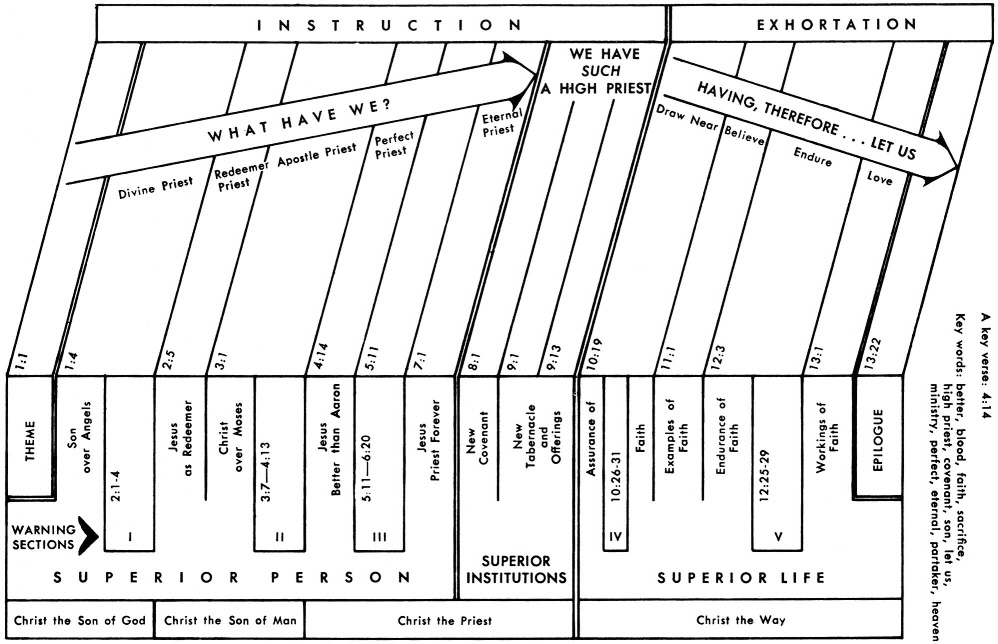
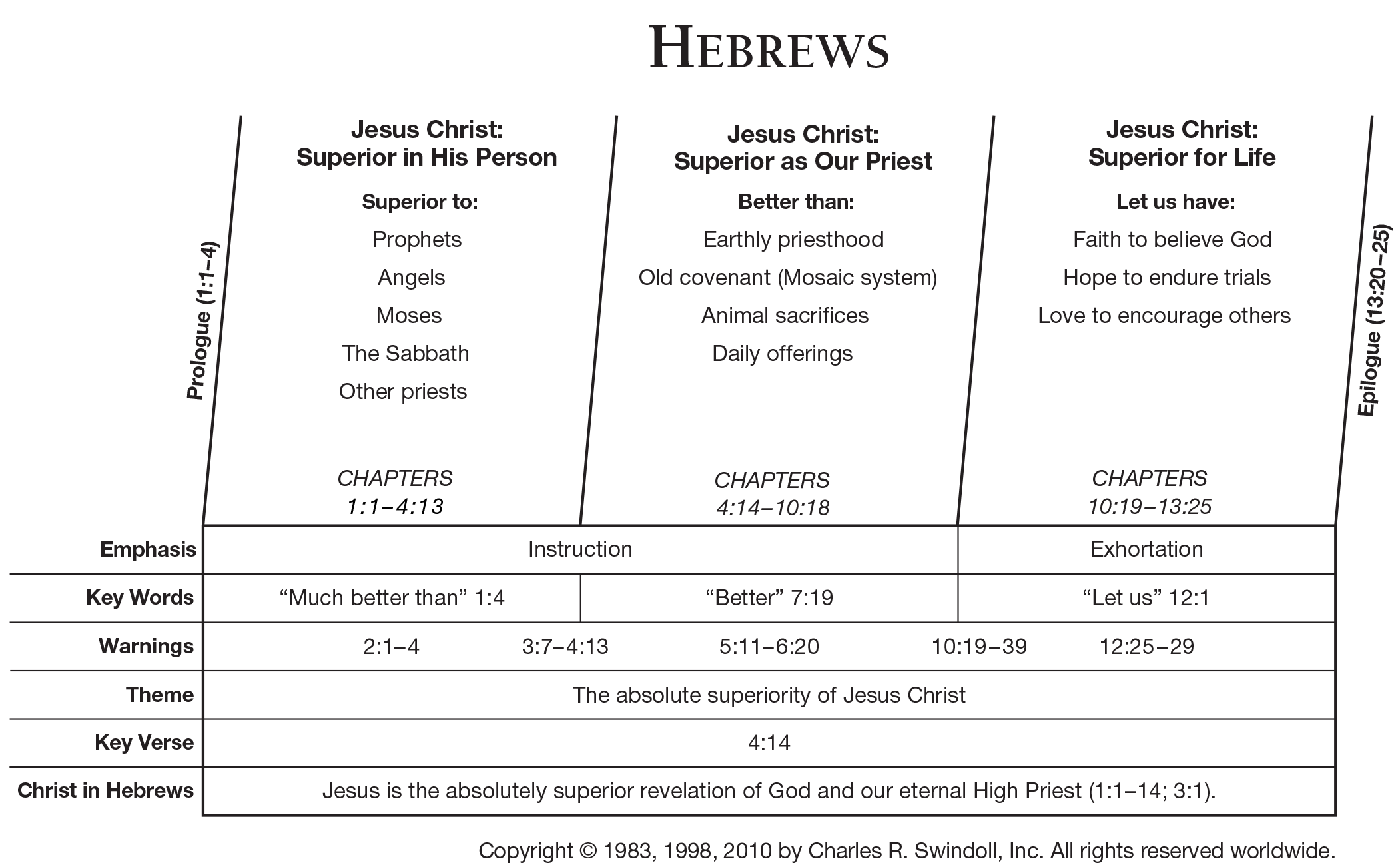
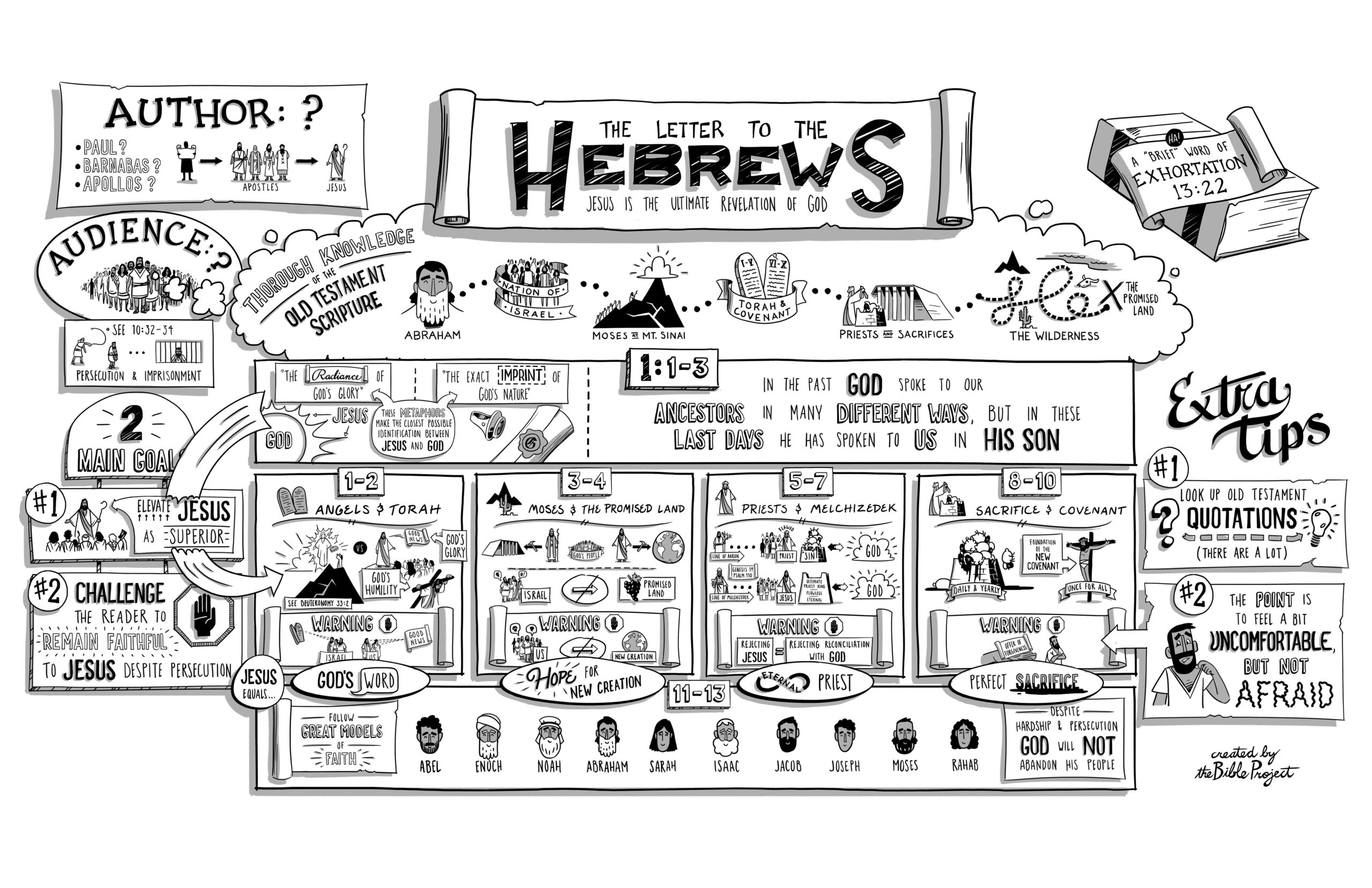
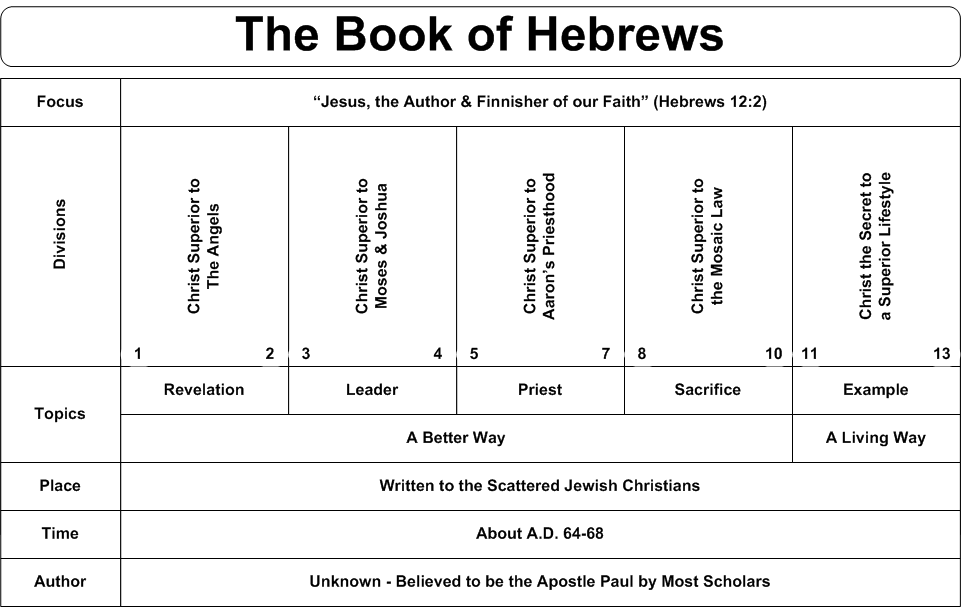
CONSIDER JESUS OUR GREAT HIGH PRIEST
Click chart to enlarge
Charts from Jensen's Survey of the NT - used by permission
Swindoll's Chart, Interesting Pictorial Chart of Hebrews, Another Chart
|
The Epistle |
||||
| INSTRUCTION Hebrews 1-10:18 |
EXHORTATION Hebrews 10:19-13:25 |
|||
| Superior Person of Christ Hebrews 1:1-4:13 |
Superior Priest in Christ Hebrews 4:14-10:18 |
Superior Life In Christ Hebrews 10:19-13:25 |
||
| BETTER THAN PERSON Hebrews 1:1-4:13 |
BETTER PRIESTHOOD Heb 4:14-7:28 |
BETTER COVENANT Heb 8:1-13 |
BETTER SACRIFICE Heb 9:1-10:18 |
BETTER LIFE |
| MAJESTY OF CHRIST |
MINISTRY OF CHRIST |
MINISTERS FOR CHRIST |
||
|
DOCTRINE |
DUTY |
|||
|
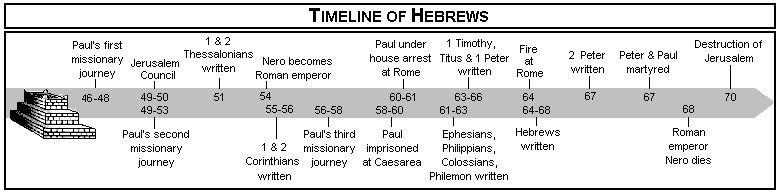
DATE WRITTEN: |
||||

See ESV Study Bible "Introduction to Hebrews"
(See also MacArthur's Introduction to Hebrews)
Borrow Ryrie Study Bible
Hebrews 10:8 After saying above, "SACRIFICES AND OFFERINGS AND WHOLE BURNT OFFERINGS AND sacrifices FOR SIN YOU HAVE NOT DESIRED, NOR HAVE YOU TAKEN PLEASURE in them" (which are offered according to the Law), (NASB: Lockman)
Greek: anoteron legon (PAPMSN) oti Thusias kai prosphoras kai olokautomata kai peri amartias ouk ethelesas (2SAAI) oude eudokesas, (2SAAI) aitines kata nomon prospherontai, (3PPPI)
BGT ἀνώτερον λέγων ὅτι θυσίας καὶ προσφορὰς καὶ ὁλοκαυτώματα καὶ περὶ ἁμαρτίας οὐκ ἠθέλησας οὐδὲ εὐδόκησας, αἵτινες κατὰ νόμον προσφέρονται,
Amplified: When He said just before, You have neither desired, nor have You taken delight in sacrifices and offerings and burnt offerings and sin offerings—all of which are offered according to the Law— (Amplified Bible - Lockman)
Barclay: At the beginning of this passage he says: “You did not desire sacrifices and offerings and whole burnt-offerings and sin-offerings and you took no pleasure in them,” and it is such offerings as these that the law prescribes. (Westminster Press)
NLT: Christ said, "You did not want animal sacrifices or grain offerings or animals burned on the altar or other offerings for sin, nor were you pleased with them" (though they are required by the law of Moses). (NLT - Tyndale House)
KJV Above when he said, Sacrifice and offering and burnt offerings and offering for sin thou wouldest not, neither hadst pleasure therein; which are offered by the law;
NKJ Previously saying, "Sacrifice and offering, burnt offerings, and offerings for sin You did not desire, nor had pleasure in them" (which are offered according to the law),
NET When he says above, "Sacrifices and offerings and whole burnt offerings and sin-offerings you did not desire nor did you take delight in them" (which are offered according to the law),
CSB After He says above, You did not want or delight in sacrifices and offerings, whole burnt offerings and sin offerings (which are offered according to the law),
ESV When he said above, "You have neither desired nor taken pleasure in sacrifices and offerings and burnt offerings and sin offerings" (these are offered according to the law),
NIV First he said, "Sacrifices and offerings, burnt offerings and sin offerings you did not desire, nor were you pleased with them" (although the law required them to be made).
Phillips: After saying, "Sacrifice and offering, burnt offerings, and offerings for sin you did not desire, nor had pleasure in them" (which are made according to the Law), (Phillips: Touchstone)
Wuest: Above, when saying, Sacrifice and offering and whole burnt offerings also for sin you did not desire nor even have pleasure in, which were of such a nature as those being offered according to law,
Young's Literal: saying above -- 'Sacrifice, and offering, and burnt-offerings, and concerning sin-offering Thou didst not will, nor delight in,' -- which according to the law are offered--
Paraphrase After saying earlier that God did not desire or take pleasure in sacrifices and offerings — though they were offered as the Law required —
Expanded paraphrase - After quoting the earlier part of the Psalm, the writer points out that God Himself declared His dissatisfaction with the entire system of sacrifices — all kinds of offerings prescribed under the Law. Though they were commanded and offered faithfully, they could not bring the pleasure or fulfillment God desired, for they were only shadows of the true and final sacrifice that was yet to come — the body of Christ prepared for obedience unto death.
- Hebrews 10 Resources - Multiple Sermons and Commentaries
- Hebrews Commentary online - Kenneth Wuest
- Hebrews 10:1-18 Total Forgiveness - Steven Cole
- Hebrews 10:1-18 Christ: The Living Sacrifice - John MacArthur
- Hebrews 10:5-18 The Sufficiency of Christ's Sacrifice - John MacArthur
- Click for 5W/H Study Questions — ideal for leading a group or personal study of Hebrews
LAWFUL BUT NOT DELIGHTFUL
DIVINE DISPLEASURE IN DEAD RITUAL
The writer now summarizes and reinforces what he has just quoted from Psalm 40: God was never ultimately satisfied with the sacrificial system itself, though He had ordained it under the Law. The repetition of these offerings — sacrifices, grain offerings, burnt offerings, and sin offerings — could never touch the root of man’s sin or bring lasting fellowship with God. They were required, yet inadequate; commanded, yet not complete. The Law prescribed them, but the heart of God longed for something deeper — a perfect obedience and a once-for-all sacrifice that would truly remove sin. In this verse, the writer highlights the contrast between divine requirement and divine delight — what God allowed for a time, He never accepted as final.
After saying above (anoteros), "SACRIFICES (thusia) AND OFFERINGS (phosphora) AND WHOLE BURNT OFFERINGS (holokautoma) AND sacrifices FOR SIN (hamartia) YOU HAVE NOT DESIRED (thelo - did not align with God’s ultimate will), NOR HAVE YOU TAKEN PLEASURE (eudokeo) in them (which are offered [prosphero] according to the Law [nomos]), - In Hebrews 10:8-9 the writer again quotes from Ps 40:6-8, but this time in a condensed form, continuing to reason from the Scripture he just cited. Saying in present tense indicates continually saying which would refer to the enduring character of any and all of God's Word (Mt 24:35, Mk 13:31, Lk 21:33) Note that his list covers the entire range of Old Testament sacrifices (Leviticus 1–7) and that by listing all four, he emphasize the completeness of the old system (every type of offering imaginable), and yet God was not ultimately satisfied with any of them! Regarding the OT sacrifices, etc, though these were offered [prosphero] according to the Law [nomos]—commanded by God Himself—yet they could not remove sin nor satisfy His justice. The writer explains that all these repeated offerings, though divinely ordained, were temporary symbols and shadows pointing to the final and perfect sacrifice of Christ. God’s heart was never in the mere ritual itself but always desired obedience and a transformed heart, not endless ceremonies (cf. 1Sa 15:22; Ps 51:16–17; Isa 1:11–17; Mic 6:6–8).
NOR HAVE YOU TAKEN PLEASURE (eudokeo) intensifies the contrast for not only did God not desire them, He also did not delight in them as an end in themselves. They might have been externally correct, but they could not satisfy God’s holy requirement for sin’s removal — because animal blood could never cleanse the conscience (cf. Heb 10:4).
(which are offered [prosphero] according to the Law [nomos]) is a parenthetical note to clarify that these sacrifices were legitimate. The ultimate issue was not disobedience to the Law, but the inherent limitation of the Law itself. Even when perfectly performed, the system could not achieve what God ultimately desired — true remission of sin, clean consciences and restored fellowship.
Kenneth Wuest - “Above” (anoteros) refers back to Heb 10:5. The writer shows the incompetence of animal sacrifices to satisfy the will of God, and the setting aside of the same in order that room might be made for that Sacrifice which will permanently satisfy His holy requirements. When Messiah offers Himself as the sacrifice, God takes away the First Testament and brings in the second or the New Testament. And this is the argument of the Book of Hebrews. (Hebrews Commentary online)
Albert Barnes writes that…Saying above (anoteros), when he said. That is, the Messiah. The word "above" refers here to the former part of he quotation. That is, "having in the former part of what was quoted said that God did not require sacrifices, in the latter part he says that he came to do the will of God in the place of them." Sacrifice and offering and burnt, offerings, etc. These words are not all used in the Psalm from which the apostle quotes, but the idea is, that the specification there included all kinds of offerings. The apostle dwells upon it because it was important to show that the same remark applied to all the sacrifices which could be offered by man. When the Redeemer made the observation about the inefficacy of sacrifices, he meant that there was none of them which would be sufficient to take away sin.
Ralph Earle remarks that Sacrifices and offerings "may carelessly be thought of as synonymous. But they are not. The first, prosphora, literally means "something brought to." It aptly describes an "offering," which was "brought to" the altar. It might be composed of meal or oil, or even be a drink offering. On the other hand, "sacrifice" is thusia… Christ was both. It takes all the offerings of the OT—described in detail in the early chapters of Leviticus—to typify the many-sided work of Christ in His redemption of humanity." (Borrow Word Meanings in the New Testament)
Warren Wiersbe explains this easily confused statement… This does not suggest that the old sacrifices were wrong, or that sincere worshipers received no benefit from obeying God's Law. It only means that God had no delight in sacrifices as such, apart from the obedient hearts of the worshipers. No amount of sacrifices could substitute for obedience (1Sa 15:22, Ps. 51:16, 17; Is 1:11, 19; Je 6:19, 20; Ho 6:6; Am 5:20, 21). (Bible Exposition Commentary)
C H Spurgeon - If we had to render to God something by which we should be accepted, we should be always in jeopardy. But now, since we are accepted “in the beloved” (Eph 1:6+), we are safe beyond all hazard. Had we to find that with which we should appear before the Most High God, we might still be asking, “Shall I approach him with burnt offerings, with bull calves a year old? Will Yahweh be pleased with thousands of rams, with myriads of rivers of oil?” (Micah 6:6-7+) nor did you delight in An end was made of the types and shadows of the ceremonial law, that the real substance might be introduced by Christ. Never imagine that the old Jewish ceremonial law is to drag on its existence and to be intermingled with the Christian dispensation. No! As the shadows of the night vanish when the sun arises, as the lamps in the street are put out when daylight returns, so was it with all the types and shadows of the ancient law when the great Antitype appeared.
Simon J. Kistemaker helps us understand God's displeasure at the sacrifices which were according to the Law by taking us "back to the beginning of human history recorded in Genesis. God looked with favor on the offering that Abel brought him, but with disfavor on Cain's offering. Why was Abel's offering—"fat portions from some of the firstborn of his flock"—acceptable, and the offering of Cain—"some of the fruits of the soil"—unacceptable (Ge 4:3-5+)? The writer of Hebrews answers by saying,"By faith Abel offered God a better sacrifice than Cain did. By faith he was commended as a righteous man, when God spoke well of his offerings" (He 11:4+). The author of Hebrews asserts not that God has an aversion to offerings presented to him, but that sacrifices offered without faith and obedience are an abomination (Is 1:11-14+; Amos 5:21, 22). Through Hosea God says to Israel, "For I desire mercy, not sacrifice, and acknowledgment of God rather than burnt offerings" (Ho 6:6). (BORROW Exposition of the Epistle to the Hebrews PAGE 276) (Bolding added)
Sacrifice without obedience is sacrilege.
--William Gurnall
Ray Stedman notes that… That none of his readers should miss this important point the writer takes pains to indicate clearly, in Hebrews 10:8, 9, 10, the meaning of the quote from Psalm 40. He acknowledges that though God authorized the animal sacrifices of the past, He did not delight in them. Then he stresses the fact that Christ deliberately set Himself to do the will of the Father, though He knew it would lead to pain and separation. Intimations of Gethsemane are certainly present in these words, though it was on the Cross that they were fully carried out. Here the writer also declares that the death of Jesus, by fulfilling the will of the Father, completely replaces the provision of animal deaths which had provided some degree of forgiveness before. Finally, he announces the only possible conclusion: it is by the fulfillment of the will of God in the once-for-all sacrifice of Jesus Christ (note the double name, only here in Hebrews) that we (all believers) have been made holy. The Greek expression for made holy indicates action with a lasting effect. We have been made holy by the death of Jesus, and we remain holy even though we struggle with daily weakness and sin. This should be borne in mind when we come to the statement in He 12:14 (see +), “without holiness no one will see the Lord.” It is a holiness obtained by faith, not by self-righteous effort, and it is not lost by momentary failure. “There is now no condemnation for those who are in Christ Jesus!” (Ro 8:1+). (Hebrews 10:1-39 Let Us Go On!)
Above (511) (anoteros) is the comparative of ano (above) and can mean above or preceding as in this verse (a higher place in the written column) or higher, better or more honorable place at the table as in the only other NT use (Lk 14:10). Anoteros is first in the Greek sentence for emphasis.
Sacrifices (2378) (thusia/thysia from thuo/thyo = to slay, sacrifice or kill a sacrificial victim; to bring a religious offering to a deity) refers literally to animal sacrifices that were slain and offered on the altar.
Homer (about nine centuries before Christ) used thusia to describe the "smoke or burnt offering." Later the sense of thusia was broadened to mean the actual slaying of a sacrifice. According to Pindar, thusia was the very ritual of sacrifice, the religious service in which a sacrifice was brought.
NIDNTT notes that in classic Greek usage the verb form thuo (which has been in use since Homer some 9 centuries prior to Christ)…has in secular Gk. the basic meaning of to sacrifice, though originally in connexion with the smoke-offering it meant to smoke, and in particular, in the active form, to offer a smoking or a burnt sacrifice (Homer, Il. 9, 219; Xen., Cyr. 8, 7, 3). Because sacrificial animals or portions of animals-and human beings also-were burnt, thyo also assumed the meaning to slaughter for cultic ends (Hdt., 1, 216; Eur., Iph. Taur. 621). The noun thysia (since Pindar) signifies the ritual of sacrifice as well as the sacrificial animal or any other similar sacrificial gift (Hdt., 4, 60; Thuc., 8, 70). (See online 23 page discussion on sacrifice in Brown, Colin, Editor. New International Dictionary of NT Theology. 1986. Zondervan)
Thusia is used figuratively in the NT. Thusia refers to the death of Christ as an offering of Himself to God (Ep 5:2+). Thusia is used to refer to the volitional choice of a believer to make a consecration or surrender of one's whole life unto God (Ro 12:1+). thusia refers to the believer's offering of praise and good deeds (He 13:16+) to God, an offering that is acceptable to God only through Jesus, only on the basis of His shed blood (He 13:15+). Peter concurs saying we are "to offer up spiritual sacrifices acceptable to God through Jesus Christ." (1Pe 2:5+)
Sacrifice is the ecstasy of giving the best
we have to the one we love the most.
Wayne Detzler notes that…In the Septuagint Greek Old Testament, this word (thusia) was used to describe the Jewish sacrificial system. It also characterized the action of bringing a sacrifice. In fact, most of the major characters in the Old Testament brought sacrifices. Among them were: Noah (Ge 8:20), Abraham (Ge 12:6), Isaac (Ge 26:25), Jacob (Ge 33:20), Moses (Ex. 17:15), Elijah (1Ki 18:31), and David (2Sa 24:18)…The words (thusia/thuo - Thuo = 14x in 13v - Mt 22:4; Mk 14:12; Lk 15:23, 27, 30; 22:7; Jn 10:10; Ac 10:13; 11:7; 14:13, 18; 1Co 5:7; 10:20) pertaining to sacrifice occur about 40 times in the Greek New Testament. Jesus gave basic teaching about the priority of sacrifice. In the Sermon on the Mount He warned against bringing a sacrifice when there is sin in one's life (Mt 5:23, 24). Later on He chided some Pharisees, because they substituted sacrifices for mercy (He 9:13; 12:7). When sacrifices were turned into commerce and exploited for personal gain, Jesus struck out literally and expelled the animal salesmen from the temple (Jn 21:12-17). Nevertheless, the earthly parents of Jesus, Joseph and Mary, brought a sacrifice at the time of Jesus' temple dedication (Lk 2:24). Their sacrifice was sincere.
In the Book of Acts, the church moved away from the Jewish sacrificial system. The early Christians realized that Jesus Christ had brought the only perfect Sacrifice, Himself.
It was the perversion of the old sacrifices, the offering to a golden calf, that Stephen condemned in his last sermon (Ac 7:41). The Apostle Paul fulfilled his vow and brought a sacrifice when he returned to Jerusalem at the end of his missionary journeys (Ac 21:26).
The Epistles emphasize the perfection of Christ's sacrifice, and the effectiveness of His death on our behalf. The theme is sounded in Romans, where Paul proclaimed that the sacrificed Saviour made us right with God (Ro 3:23+, Ro 3:24+, Ro 3:25+).
It is in Hebrews, however, that this theme is fully developed. The priesthood of Christ is built on the idea of His atoning sacrifice (He 2:17+). Part of the priestly task was sacrifice, which was exemplified perfectly in Christ (He 5:1-9). Not only did Christ present Himself as a sacrifice, but His sacrifice was once for all (He 7:27+). Animal sacrifices could never cleanse one's conscience, but Christ's sacrifice could (He 9:9-14). On the basis of His sacrifice, Christ now exercises an intercessory ministry on our behalf (He 10:11, 12+).
Because Christ sacrificed Himself on our behalf, Christians are also told to make sacrifices. They should present their bodies as living sacrifices to God (Ro 12:1-2). Their daily lives of separation from sin are an imitation, though a pale one, of the sacrifice of Christ (Ep 5:2+). When Christians financially support the ministry, they also bring sacrifices to the Lord (Php 4:18+). In fact, all Christians are priests designated to bring spiritual sacrifices to the Lord (1Pe 2:5+, 1Pe 2:9+).
Because of the deep significance attached to the sacrifice of Christ, the New Testament is strong in condemning sacrifices to idols. At the Jerusalem Council all of the apostolic leaders agreed to denounce sacrifices to idols (Acts 15:29). Paul insisted that idols were no gods at all; in fact they were nothing but bits of wood or stone (1Co 8:1, 4, 7).
Since Christ has been sacrificed, all other religious sacrifices are out of date. The only acceptable sacrifice is the sacrifice of worship and service which dedicated believers bring to their Lord. (BORROW New Testament words in today's language)
Thusia - 28x in the NT - Matt. 9:13; Matt. 12:7; Mk. 12:33; Lk. 2:24; Lk. 13:1; Acts 7:41; Acts 7:42; Rom. 12:1; 1 Co. 10:18; Eph. 5:2; Phil. 2:17; Phil. 4:18; Heb. 5:1; Heb. 7:27; Heb. 8:3; Heb. 9:9; Heb. 9:23; Heb. 9:26; Heb. 10:1; Heb. 10:5; Heb. 10:8; Heb. 10:11; Heb. 10:12; Heb. 10:26; Heb. 11:4; Heb. 13:15; Heb. 13:16; 1 Pet. 2:5
Matthew 9:13 "But go and learn what this means: 'I DESIRE COMPASSION, AND NOT SACRIFICE,' for I did not come to call the righteous, but sinners."
Comment: This verse is an excellent "commentary" on Hebrews 10:8 - God took no delight in sacrifices as such if they were not the product of a proper attitude. The same comment would apply to the next two uses of thusia below.
Matthew 12:7 "But if you had known what this means, 'I DESIRE COMPASSION, AND NOT A SACRIFICE,' you would not have condemned the innocent.
Mark 12:33 AND TO LOVE HIM WITH ALL THE HEART AND WITH ALL THE UNDERSTANDING AND WITH ALL THE STRENGTH, AND TO LOVE ONE'S NEIGHBOR AS HIMSELF, is much more than all burnt offerings and sacrifices."
Luke 2:24 (Context Jesus' parents offering sacrifice - Lk 2:22, 23) and to offer a sacrifice according to what was said in the Law of the Lord, "A PAIR OF TURTLEDOVES OR TWO YOUNG PIGEONS."
Luke 13:1 Now on the same occasion there were some present who reported to Him about the Galileans whose blood Pilate had mixed with their sacrifices.
MacArthur comments: Evidently, some worshipers from Galilee were condemned by Rome—perhaps because they were seditious zealots (see Mt 10:4)—and were sought out and killed in the temple by Roman authorities while in the process of offering a sacrifice. Such a killing would have been the grossest sort of blasphemy. Incidents like this inflamed the Jews’ hatred of Rome and finally led to rebellion, and the destruction of Jerusalem in a.d. 70. (MacArthur, J.: The MacArthur Study Bible Nashville: Word)
Acts 7:41 "At that time they made a calf and brought a sacrifice to the idol, and were rejoicing in the works of their hands. 42 "But God turned away and delivered them up to serve the host of heaven; as it is written in the book of the prophets, 'IT WAS NOT TO ME THAT YOU OFFERED VICTIMS AND SACRIFICES FORTY YEARS IN THE WILDERNESS, WAS IT, O HOUSE OF ISRAEL?
Comment: From the outset when Israel was solemnly given the law, they rebelled against the Giver and only Living God and willfully turned to worthless and lifeless idols.
Romans 12:1+ Therefore I urge you, brethren, by the mercies of God, to present your bodies a living and holy sacrifice, acceptable to God, which is your spiritual service of worship.
John Sutherland Bonnell - "Take that gift God has entrusted to you, and use it in the service of Christ and your fellowmen. He will make it glow and shine like the very stars of heaven."
John Benton - Sacrifice is the giving up of something we genuinely value in order to express our devotion to God.
Jim Elliot - He is no fool who gives what he cannot keep to gain what he cannot lose.
C T Studd - If Jesus Christ be God and died for me, then no sacrifice can be too great for me to make for him.
Amy Carmichael poetically pictures the living and holy sacrifice of Romans 12:1 in her famous poem…
Give me the love that leads the way,
The faith that nothing can dismay,
The hope no disappointments tire,
The passion that will burn like fire.
Let me not sink to be a clod;
Make me thy fuel, Flame of God.
1 Corinthians 10:18 Look at the nation Israel; are not those who eat the sacrifices sharers in the altar?
Ephesians 5:2+ and walk in love, just as Christ also loved you and gave Himself up for us, an offering and a sacrifice to God as a fragrant aroma.
Philippians 2:17+ But even if I am being poured out as a drink offering upon the sacrifice and service of your faith, I rejoice and share my joy with you all.
Vine comments that thusia: "here stands for the victim, not for the act of sacrificing. While in one aspect the believers were the sacrifice, as being consecrated to God, each being “a living sacrifice,” and that by reason of their faith, yet in Paul’s view here they were the offerers, their faith was the sacrifice, and Paul was the libation." (Collected writings of W. E. Vine)
R. G. LeTourneau (read his bio!) (1888-1969) was a man who typifies "the sacrifice" of his faith. Having become a multi-millionaire from the invention and production of earth-moving machinery he used his machinery and money to build roads in Latin America to open the jungle for missionary advance. He founded a Christian university in LeTourneau College in Longview, Texas (one of my disciples opens each morning's class with the sola Scriptura devotional of the day - Daily Light indicating LeTourneau U. has not drifted from its Christian moorings!). LeTourneau's legacy included building large Christian and Missionary Alliance Churches at Lima. Though LeTourneau made millions, he gave nine-tenths of it to the Lord's work (so much for the "tithe"!), setting a high standard for the sacrifice of faith! As F B Meyer once said (and as proven truth in LeTourneau's life and continuing legacy) "God will be our compensation for every sacrifice we have made."
The famous orphanage founder and man of prayer George Mueller said that "Self-denial is not so much an impoverishment as a postponement: we make a sacrifice of present good for the sake of a future and greater good."
Philippians 4:18+ But I have received everything in full and have an abundance; I am amply supplied, having received from Epaphroditus what you have sent, a fragrant aroma, an acceptable sacrifice, well-pleasing to God.
Hebrews 5:1+ For every high priest taken from among men is appointed on behalf of men in things pertaining to God, in order to offer both gifts and sacrifices for sins;
Hebrews 7:27+ who does not need daily, like those high priests, to offer up sacrifices, first for His own sins and then for the sins of the people, because this He did once for all when He offered up Himself.
Hebrews 8:3+ For every high priest is appointed to offer both gifts and sacrifices; so it is necessary that this high priest also have something to offer.
Hebrews 9:9+ which is a symbol for the present time. Accordingly both gifts and sacrifices are offered which cannot make the worshiper perfect in conscience,
Hebrews 9:23+ Therefore it was necessary for the copies of the things in the heavens to be cleansed with these, but the heavenly things themselves with better sacrifices than these.
Hebrews 9:26+ Otherwise, He would have needed to suffer often since the foundation of the world; but now once at the consummation of the ages He has been manifested to put away sin by the sacrifice of Himself.
Hebrews 10:1+ For the Law, since it has only a shadow of the good things to come and not the very form of things, can never, by the same sacrifices which they offer continually year by year, make perfect those who draw near.
Hebrews 10:5+ Therefore, when He comes into the world, He says, "SACRIFICE AND OFFERING YOU HAVE NOT DESIRED, BUT A BODY YOU HAVE PREPARED FOR ME;
Hebrews 10:8+ After saying above, "SACRIFICES AND OFFERINGS AND WHOLE BURNT OFFERINGS AND sacrifices FOR SIN YOU HAVE NOT DESIRED, NOR HAVE YOU TAKEN PLEASURE in them" (which are offered according to the Law),
Hebrews 10:11+ Every priest stands daily ministering and offering time after time the same sacrifices, which can never take away sins;
Hebrews 10:12+ but He, having offered one sacrifice for sins for all time, SAT DOWN AT THE RIGHT HAND OF GOD,
Hebrews 10:26+ For if we go on sinning willfully after receiving the knowledge of the truth, there no longer remains a sacrifice for sins,
Hebrews 11:4+ By faith Abel offered to God a better sacrifice than Cain, through which he obtained the testimony that he was righteous, God testifying about his gifts, and through faith, though he is dead, he still speaks.
Hebrews 13:15+ Through Him then, let us continually offer up a sacrifice of praise to God, that is, the fruit of lips that give thanks to His name. 16 And do not neglect doing good and sharing, for with such sacrifices God is pleased.
Comment: Webster defines sacrifice as the act of offering to a deity something precious! Here thusia is used metaphorically to describe their volitional offering of their words.
1 Peter 2:5+ you also, as living stones, are being built up as a spiritual house for a holy priesthood, to offer up spiritual sacrifices acceptable to God through Jesus Christ.
Thusia - 295x in the non-apocryphal Septuagint (LXX) (Often rendered offering in NAS) - Gen 4:3, 5; 31:54; 46:1; Ex 10:25; 12:27; 18:12; 24:5; 29:34, 41f; 30:9; 32:6; Lev 1:9, 13, 17; 2:1ff, 13ff; 3:1, 3, 6, 9; 4:10, 26, 31, 35; 5:13; 6:14f, 20f, 23; 7:9ff, 15ff, 20f, 29, 32, 34, 37; 9:4, 17f; 10:12, 14; 14:10, 20f, 31; 17:5, 7f; 19:5; 21:6, 21; 22:21, 29; 23:13, 16, 18f, 37; 26:31; Num 4:16; 5:15, 18, 25f; 6:15, 17f; 7:13, 17, 19, 23, 25, 29, 31, 35, 37, 41, 43, 47, 49, 53, 55, 59, 61, 65, 67, 71, 73, 77, 79, 83, 87f; 8:8; 10:10; 15:3ff, 8f, 24; 16:15; 23:3, 15; 25:2; 28:5, 8f, 13, 20, 26, 28, 31; 29:3, 6, 9, 11, 14, 16, 18f, 21f, 24f, 27f, 30f, 33f, 37ff; Deut 12:27; 27:7; 32:38; 33:19; Josh 8:30; 22:23, 26ff; Judg 6:18; 13:19, 23; 1Sa 1:21, 24; 2:17, 19, 29; 3:14; 6:15; 9:12f; 10:8; 11:15; 15:22; 16:3, 5; 20:6, 29; 26:19; 2Sa 14:17; 1 Kgs 8:62ff; 12:27; 18:29; 2 Kgs 3:20; 10:19, 21; 16:13, 15; 1 Chr 9:31; 21:23; 23:29; 29:21; 2 Chr 7:1, 5, 12; 29:31; 30:22; 31:2; 33:16; Ezra 7:17; 9:4f; Neh 10:33; Job 1:5; 20:6; Ps 4:5; 20:3; 27:6; 40:6; 50:5, 8, 14, 23; 51:16f, 19; 96:8; 106:28; 107:22; 116:17; 141:2; Prov 7:14; 15:8; 16:7; 21:3, 27; Eccl 5:1; Isa 1:11; 19:21; 34:6; 43:23f; 56:7; 57:6f; 65:4; 66:20; Jer 6:20; 7:21f; 14:12; 17:26; 46:10; Ezek 39:17, 19; 42:13; 44:11, 15, 29; 45:15, 17, 24; 46:5; Dan 2:46; 4:1; 8:11ff; 9:21, 25; 11:31; 12:11; Hos 3:4; 6:6; 8:13; 9:4; Joel 1:9, 13; 2:14; Amos 4:4; 5:22, 25; Jonah 1:16; Zeph 1:7f; 3:10; Zech 9:1; Mal 1:8, 10f, 13; 2:12f; 3:3f
Offerings (4376) (phosphora from pros = toward, before + phero = to bring or bear) literally is "a bringing before" and thus describes the act of offering or a bringing to and metonymically to that which is offered (a gift, a present).The major Scriptural use of prosphora is found in Hebrews 10 (5x) and thus it behooves one to study these passages in context to derive a good sense of the meaning of the word.
Gilbrant - Related to the compound verb prosphero, the noun prosphora indicates a “bringing to, a presenting, an offering” of something. Passively it is something received, such as a “present, gift, offering.” Similarly it can also denote an “increase, benefit, donation,” and a marriage “dowry” (cf. Moulton-Milligan; Liddell-Scott). Unlike the verb prospherō, which is highly specialized and frequently used in the Septuagint for making an offering, prosphora carries a more general sense and is less frequent (two canonical appearances). The noun and the verb do not occur in conjunction with one another except in a noncanonical reading in Daniel 4:34. Usually one offers (prospherō) a “gift” (dōron [1428]; Hebrew minchāh, qorbān, or lechem) or a “sacrifice” (thusia [2355]). Although prosphora apparently lacks the specialized sense that the verb has, it can still be used of “offerings” in a general sense. The use in Psalm 40:6 (LXX 39:6) suggests this is so (“Sacrifice and offering you [God] did not desire” [NIV]). According to Weiss, prosphora first took on the meaning “sacrifice” in the Septuagint (“pherō,” Kittel, 9:68). First Kings 7:48 (LXX 3 Kings 7:48), the second canonical use, links prosphora to the bread of Presence (literally “bread of offering” here; cf. the word prothesis [4145]; the Hebrew is pānîm, cf. Exodus 39:36; 2 Chronicles 4:19). By the time of the apocryphal writings the trend toward understanding prosphora in a more specialized way was developing (e.g., Sirach 14:11; 34:18 [LXX 31:18]; 35:1 [32:1]).
In the New Testament the technical aspect of prosphora is developed even further. Paul expected an offering to be made after his days of purification were over (Acts 21:26). Also, in Acts 24:17 Paul’s offerings in the temple (Acts 24:18) were clearly religious in nature. Yet these are individual and not priestly offerings. Metaphorically, Paul spoke of the Gentiles as “offerings acceptable” to God, “sanctified by the Holy Spirit” (Romans 15:16 [NIV]). In Ephesians Paul wrote that Jesus himself was a fragrant offering and sacrifice to God (Eph 5:2). The writer of Hebrews shared a similar perspective, giving prosphora a direct link to the Old Testament ritual system. First, God did not desire “sacrifice and offering” (Psalm 40:6 [LXX 39:6]); rather, He desired someone to do His will. Then we read that Christ our High Priest fulfilled God’s desire for obedience by offering himself as the “sacrifice” (NIV; cf. “offering” [KJV]) which makes us holy (Hebrews 10:10,14). This offering once and for all made God’s forgiveness possible, and it eliminated the need for any further sacrifice (Hebrews 10:18). (Complete Biblical Library)
Phosphora - 9x in 9v - offering(6), offerings(2), sacrifice(1).
Acts 21:26 Then Paul took the men, and the next day, purifying himself along with them, went into the temple giving notice of the completion of the days of purification, until the sacrifice was offered for each one of them.
Acts 24:17 "Now after several years I came to bring alms to my nation and to present offerings;
Romans 15:16+ to be a minister of Christ Jesus to the Gentiles, ministering as a priest the gospel of God, so that my offering of the Gentiles may become acceptable, sanctified by the Holy Spirit.
Ephesians 5:2+ and walk in love, just as Christ also loved you and gave Himself up for us, an offering and a sacrifice to God as a fragrant aroma.
Hebrews 10:5+ Therefore, when He comes into the world, He says, "SACRIFICE AND OFFERING YOU HAVE NOT DESIRED, BUT A BODY YOU HAVE PREPARED FOR ME;
Hebrews 10:8+ After saying above, "SACRIFICES AND OFFERINGS AND WHOLE BURNT OFFERINGS AND sacrifices FOR SIN YOU HAVE NOT DESIRED, NOR HAVE YOU TAKEN PLEASURE in them" (which are offered according to the Law),
Hebrews 10:10+ By this will we have been sanctified through the offering of the body of Jesus Christ once for all.
Hebrews 10:14+ For by one offering He has perfected for all time those who are sanctified.
Hebrews 10:18+ Now where there is forgiveness of these things, there is no longer any offering for sin.
Prosphora - 4x in the Septuagint - 1Ki 7:34; Ps 39:7; Da 3:38; 4:37
Whole burnt offerings (3646) (holokautoma) refers to a victim the whole (and not like other victims only a part) of which is burned (Latin holocaustum). This word is used in the Septuagint The Septuagint Ex 30:20; Lev 5:12; 23:8,25,21).
Sin (266) (hamartia literally conveys the sense of missing the mark as when hunting with a bow and arrow (in Homer some hundred times of a warrior hurling his spear but missing his foe). Later hamartia came to mean missing or falling short of any goal, standard, or purpose. Ryrie adds that "this is not only a negative idea but includes the positive idea of hitting some wrong mark."
(Not = absolute negation) Desired (2309) (thelo) means first resolved, determined, or purposed, then to desire or wish and as here in Hebrews to take delight or have pleasure (cp Col 2:18, Mt 9:13, 12:7 [Lxx of Ho 6:6], Lxx Ps 112:1, 147:10, Ezek 18:32).
Have you taken pleasure (2106) (eudokeo from eu = well, good + dokeo = to think) means literally to think well of and so to be well pleased, to take pleasure or delight in (This is the meaning of eudokeo in this passage albeit in a negative sense). The idea is to find satisfaction in something or someone or to view with approval. To delight means to take great pleasure, to give keen enjoyment, to provide a high degree of gratification, something God did not do with the sacrifices and offerings (for reasons discussed elsewhere).
Offered (4374) (prosphero from prós = to, toward + phéro = bring) means to carry or bring something into the presence of someone usually implying a transfer of something to that person carry to. It refers to an offering, whether of gifts, prayers, or sacrifices.
“What God Desired”
The smoke arose, the altar burned,
Yet still God’s heart was not returned.
The lamb was slain, the blood was shed,
But sin still chained the souls it fed.
The Law required, yet love still sighed,
“For hearts, not rituals, I’ve desired.”
The priest stood weary, year by year,
While Heaven whispered, “Christ is near.”
What God required, man could not fill,
Till One appeared to do His will.
No bull, no goat could cleanse within —
But Jesus came to conquer sin.
Now sacrifice has found its end,
In Christ, our Savior and our Friend.
The smoke is gone, the veil is torn —
God’s pleasure blooms where grace is born.
- God commanded the offerings, but He never cherished them.
- The Law required repetition; Love desired redemption.
- What was lawful was not lasting.
- Ritual obedience could not replace relational obedience.
- God legislated sacrifices, yet longed for surrender.
- The Father sought devotion, not mere duty.
- The smoke of sacrifice rose, but God’s pleasure did not.
- Legal forms without living faith failed to please Jehovah.
- The altar satisfied the Law, but not the Lord.
Hebrews 10:9 then He said, "BEHOLD, I HAVE COME TO DO YOUR WILL." He takes away the first in order to establish the second. (NASB: Lockman)
Greek: tote eireken, (3SRAI) Idou eko (1SPAI) tou poiesai (AAN) to thelema sou. anairei (3SPAI) to proton ina to deuteron stese; (3SAAS)
Amplified: He then went on to say, Behold, [here] I am, coming to do Your will. Thus He does away with and annuls the first (former) order [as a means of expiating sin] so that He might inaugurate and establish the second (latter) order. [Ps. 40:6-8.](Amplified Bible - Lockman)
Barclay: Then he went on to say: “Behold, I come to do your will.” He abolishes the kind of offering referred to in the first quotation in order to establish the kind of offering referred to in the second. (Westminster Press)
NLT: Then he added, "Look, I have come to do your will." He cancels the first covenant in order to establish the second.(NLT - Tyndale House)
KJV Then said he, Lo, I come to do thy will, O God. He taketh away the first, that he may establish the second.
NKJ then He said, "Behold, I have come to do Your will, O God." He takes away the first that He may establish the second.
NET then he says, "Here I am: I have come to do your will." He does away with the first to establish the second.
BGT τότε εἴρηκεν· ἰδοὺ ἥκω τοῦ ποιῆσαι τὸ θέλημά σου. ἀναιρεῖ τὸ πρῶτον ἵνα τὸ δεύτερον στήσῃ,
CSB He then says, See, I have come to do Your will. He takes away the first to establish the second.
ESV then he added, "Behold, I have come to do your will." He does away with the first in order to establish the second.
NIV Then he said, "Here I am, I have come to do your will." He sets aside the first to establish the second.
Phillips: Christ then says, "Behold, I have come to do your will, O God." That means he is dispensing with the old order of sacrifices, and establishing a new order of obedience to the will of God, (Phillips: Touchstone)
Wuest: then He said, Behold, I come to do your will. He takes away the first [testament] in order that He may establish the second [testament],
Young's Literal: then he said, 'Lo, I come to do, O God, Thy will;' he doth take away the first that the second he may establish;
- Behold - He 9:11-14
- Takes away He 7:18-19; Heb 8:7-13; Heb 12:27,28
- Hebrews 10 Resources - Multiple Sermons and Commentaries
- Hebrews Commentary online - Kenneth Wuest
- Hebrews 10:1-18 Total Forgiveness - Steven Cole
- Hebrews 10:1-18 Christ: The Living Sacrifice - John MacArthur
- Hebrews 10:5-18 The Sufficiency of Christ's Sacrifice - John MacArthur
- Click for 5W/H Study Questions — ideal for leading a group or personal study of Hebrews
Related Passages
Philippians 2:5-8+ (CHRIST'S DOING WILL OF HIS FATHER) Have this attitude in yourselves which was also in Christ Jesus, 6 Who, although He existed in the form of God, did not regard equality with God a thing to be grasped, 7 but emptied Himself, taking the form of a bond-servant, and being made in the likeness of men. 8 Being found in appearance as a man, He humbled Himself by becoming obedient to the point of death, even death on a cross.
Hebrews 7:18-19+ For, on the one hand, there is a setting aside of a former commandment (THE FIRST) because of its weakness and uselessness 19 (for the Law made nothing perfect), and on the other hand there is a bringing in of a better hope (THE SECOND), through which we draw near to God.
OUT WITH THE OLD
IN WITH THE NEW
The writer now draws the conclusion of the Psalm 40 quotation: Christ’s coming was the turning point in God’s redemptive plan. The “first” covenant — the system of sacrifices, priesthood, and temple rituals — served its temporary purpose, pointing forward to the greater reality of Christ. But when Jesus came to do the Father’s will, He fulfilled the old system and rendered it obsolete (Heb 8:13). His perfect obedience accomplished what endless offerings never could: the establishment of a new and living way of access to God (Heb 10:19-21). The first covenant is taken away — not by rebellion, but by fulfillment; not by destruction, but by completion. The shadow passes, and the substance stands revealed in the Son who said, “Behold, I have come to do Your will.”
Then He said - The writer is continuing the quotation from Psalm 40:7–8, where the Messiah (Christ) speaks to the Father. He is now focusing on the final phrase of the Psalm — “I have come to do Your will, O God.” This is the voice of the Son, speaking of His incarnation and His obedient purpose in coming to earth.
BEHOLD (idou) - Behold is a clarion call to give attention to something external or exterior to oneself; usually used at the beginning of a clause. Spurgeon says "Behold is a word of wonder; it is intended to excite admiration. Wherever you see it hung out in Scripture, it is like an ancient sign-board, signifying that there are rich wares within, or like the hands which solid readers have observed in the margin of the older Puritanic books, drawing attention to something particularly worthy of observation."
I HAVE COME TO DO (poieo) YOUR WILL (thelema)." He takes away (anaireo) the first (protos) in order to (hina - term of purpose) establish (set firmly in place, make valid - see note) the second (deuteros) - Christ declares His mission and His mindset, which entails His complete obedience to the Father’s redemptive plan. In this verse anaireo means to do away with or remove the validation of something, specifically the first covenant or old covenant. The idea is to invalidate it, the process of invalidation implying making something powerless or unacceptable by declaration of its logical or moral or legal unsoundness. The first (protos) refers to the first covenant, the Mosaic system of sacrifices, rituals, and priesthood. Christ’s coming renders it obsolete (cf. Heb 8:13 — “He has made the first obsolete”). The Law and its sacrificial system are now set aside, because their purpose, which is to point to Christ, has been fulfilled. To sum up, the first system (the Law with sacrifices) is taken away because it served its temporary purpose. The second (New Covenant) is established forever by His obedient self-offering. And the means of this bringing about this transition is Christ’s perfect obedience: “I have come to do Your will.”
Grant Osborne on establish - “Establish” is a legal term for “causing to stand” as law, and the two terms (“set aside,” “establish”) picture one law removed and another put in place to supersede it. The new law of Christ has brought final salvation and will carry though into eternity. This provides a proper close to the legal discussion and prepares the way for 10:19–25, which will challenge the readers to live out this new reality in their daily lives and segue into the exhortation (10:26–13:19) that will end this letter. (See Hebrews Verse by Verse - Page lxxxv)
C H Spurgeon - He came cheerfully among the sons of men. You who are sent of Christ must always go gladly to your service; never look as if you were driven to the field like oxen that do not love the plough. God does not delight in a slavish spirit. If we serve Christ because of the yoke of duty, we shall serve badly. But when our service is our pleasure, when we thank God that to us is this grace given that we should “proclaim the good news of the fathomless riches of Christ to the Gentiles” (Eph 3:8), then we shall labor wisely, zealously, and acceptably.
Phil Newton comments…Having done the Father's will, "He takes away the first [that is, the old covenant with all of its sacrificial system and inadequacies] in order to establish the second." Through the righteousness of Christ and His death on our behalf, the old covenant was overturned! The word for "take away," was used in Classical Greek to refer to a law or government or custom that was abolished or repealed or destroyed. The strength of the word must have been startling to the audience receiving this epistle. They knew precisely what the writer meant: it is over. The old covenant has no more demand over your life. The sacrificial system offers you nothing. The rituals and ceremonies are no longer valid or needed. You are free from the tyranny of the old covenant that constantly exposed your weakness but gave you nothing to change the heart.But the good news is that not only did Christ through obedience to the will of the Father overturn the old covenant, but also established the new covenant: "in order to establish the second." The first covenant had to be removed so that the new covenant mediated through Jesus Christ might be established. All who cling to the hope or even fear that obeying the law or following a ritual will put you into a right relationship with God must see that this old covenant is removed. But you are not left hanging with no hope; instead you have a better hope, a sure one (He 3:6+, He 6:11+, He 6:19+, He 7:19+, He 10:23+) in what Christ has done. Jesus Christ established with finality the new covenant. The language of the text expresses this beautifully. A literal rendering would be, 'He removes and forever removes the first in order that the second might be established with finality' (the use of present tense for "takes away" and aorist for "establish" makes this clear). Hebrews 10:1-18 What Can Wash Away My Sins? (1) Hebrews 10:1-18 What Can Wash Away My Sins? (2)
What is the first? He is referring to the first covenant, not the Abrahamic but the Mosaic. As Paul taught in Romans, believers are now no longer under the Law but have been made to die to the Law and thus are released from the Law…
Therefore, my brethren, you also were made to die to the Law (how?) through the body of Christ, (why?) that you might be joined to another, to Him Who was raised from the dead, (what is to be the result?) that we might bear fruit for God. (Why did we need to die to the Law?) 5 For while we were in the flesh, the sinful passions, which were aroused by the Law, were at work in the members of our body to bear fruit for death. 6 (What is the contrast of our life now compared with life under the Law?) But now we have been released from the Law, having died to that by which we were bound, so that we serve in newness of the Spirit and not in oldness of the letter. (See notes Romans 7:4; 7:5; 7:6)
This truth about the believer's new relationship with the Law does not mean we are lawless because in fact in the New Covenant the Law is actually written upon our hearts Jeremiah prophesying of this new covenant writing that…
But this is the covenant which I will make with the house of Israel after those days," declares the LORD, "I will put My law within them, and on their heart I will write it; and I will be their God, and they shall be My people. (Jer 31:34; quoted He 8:10+ - See +)
The Old (First) Covenant was in a sense a covenant dealing with shadows, the substance of which was fulfilled in Christ in the New Covenant. The first was thus like a 2,000 year "picture book" and we all know how children love to look at picture books when first learning!
Spurgeon - He takes away the type because the great Antitype has come. He abolishes the offering of bullocks, and goats, and lambs, because He has come whom they all foreshadowed. There is a first in order that there may be a second. The first has to be taken away when it has fulfilled its design in order that then we may enter upon the second. Some lower good precedes the higher. When the lower good has educated us for the higher, then it is removed and the greater blessing fills its place.
Will (2307)(thelema from thelo = to will with the "-ma" suffix indicating the result of the will = "a thing willed") generally speaks of the result of what one has decided. One sees this root word in the feminine name "Thelma." In its most basic form, thelema refers to a wish, a strong desire, and the willing of some event. (Note: See also the discussion of the preceding word boule for comments relating to thelema).
Zodhiates says that thelema is the "Will, not to be conceived as a demand, but as an expression or inclination of pleasure towards that which is liked, that which pleases and creates joy. When it denotes God's will, it signifies His gracious disposition toward something. Used to designate what God Himself does of His own good pleasure. (BORROW The Complete Word Study Dictionary:)
Thelema has both an objective meaning (“what one wishes to happen” or what is willed) and a subjective connotation (“the act of willing or desiring”). The word conveys the idea of desire, even a heart’s desire, for the word primarily expresses emotion instead of volition. Thus God’s will is not so much God’s intention, as it is His heart’s desire.
Thelema - 62x in 58v - Mt 6:10; 7:21; 12:50; 18:14; 21:31; 26:42; Mark 3:35; Luke 12:47; 22:42; 23:25; Jn 1:13; 4:34; 5:30; 6:38, 39, 40; 7:17; 9:31; Acts 13:22; 21:14; 22:14; Ro 1:10+; Ro 2:18+; Ro 12:2+; Ro 15:32+; 1Cor 1:1; 7:37; 16:12; 2Cor 1:1; 8:5; Gal 1:4; Ep 1:1+, Ep 1:5+, Ep 1:9+, Ep 1:11+; Ep 2:3+; Ep 5:17+; Ep 6:6+; Col 1:1+, Col 1:9+; Col 4:12+; 1Th 4:3+; 1Th 5:18+; 2Ti 1:1+; 2Ti 2:26+; He 10:7+, He 10:9+, He 10:10+, He 10:36+; He 13:21+; 1Pe 2:15+; 1Pe 3:17+; 1Pe 4:2+, 1Pe 4:19+; 2Pe 1:21+; 1Jn 2:17; 5:14; Rev 4:11+. NAS = desire(1), desires(1), will(57).
Takes away (337) (anaireo from aná = an emphatic or up + haireo = to take) means iterally means to take up or lift up (from the ground), which is used literally to describe Pharaoh's daughter when she "took him (Moses) away and nurtured him as her own son." (Acts 7:21). In the figurative sense in Heb 10:9 the writer of Hebrews says "He takes away (in sense of to abolish, invalidate) the first (the OT sacrificial system described in Heb 10:8) in order to establish the second (the new, once for all time sacrifice of Christ)." Most of the uses of anaireo are used in an active sense to refer to literal killing or putting to death (Mt. 2:16; Acts 5:36; 7:28; 9:23, 24, 29; 16:27; 23:15, 21, 27; 25:3). Anaireo speaks of public execution (Luke 23:32; Acts 2:23; 10:39; 12:2; 13:28; 22:20; 26:10).
Anaireo - 24x in 23v - do away(1), executed(1), kill(4), killed(2), put… to death(8), put to death(3), slain(1), slay(3), slaying(1), slew(1), takes away(1), took… away(1). Matt. 2:16; Lk. 22:2; Lk. 23:32; Acts 2:23; Acts 5:33; Acts 5:36; Acts 7:21; Acts 7:28; Acts 9:23; Acts 9:24; Acts 9:29; Acts 10:39; Acts 12:2; Acts 13:28; Acts 16:27; Acts 22:20; Acts 23:15; Acts 23:21; Acts 23:27; Acts 25:3; Acts 26:10; 2 Thess. 2:8; Heb. 10:9
First (4413) (protos) is used in this context to refer to the first in time and/or first in a series. Sometimes protos implies superior, but in this context that is clearly not the meaning.
FRIBERG - adjectivally first of several; (1) of time; (a) in comparison of past and present earlier, first, former (Rev 2:5); (b) in antithesis between the beginning and the end first, before anything else (Rev 1:17), opposite ἔσχατος (last, final); (2) of rank and value first (of all), foremost, chief, most important of all; (a) of things (Mt 22:38); (b) substantivally, of persons οἱ πρῶτοι the leading men, the most important persons (Mk 6:21); (3) of number or sequence first (Mt 21:28; HE 10:9); (4) spatially front; substantivally ἡ πρώτη the outer (tent) (Heb 9:2, 6, 8); II. substantivally, neuter singular πρῶτον as an adverb; (1) of time at first, to begin with, (for) the first time (Ro 1:16); before, earlier (Jn 15:18); (2) of priority or value first of all (Mt 5:24); of degree above all, especially, in the first place (Mt 6:33) (Borrow Analytical Lexicon of the Greek New Testament )
PROTOS IN HEBREWS - Heb. 7:2; Heb. 8:7; Heb. 8:13; Heb. 9:1; Heb. 9:2; Heb. 9:6; Heb. 9:8; Heb. 9:15; Heb. 9:18; Heb. 10:9
Hebrews 7:2 was first of all, by the translation of his name, king of righteousness
Hebrews 8:7 For if that first covenant had been faultless
Hebrews 8:13 When He said, “A new covenant,” He has made the first obsolete.
Hebrews 9:1 Now even the first covenant had regulations of divine worship
Hebrews 9:2 For there was a tabernacle prepared, the outer one
Hebrews 9:6 priests are continually entering the outer tabernacle performing the divine worship,
Hebrews 9:8 not yet been disclosed while the outer tabernacle is still standing,
Hebrews 9:15 transgressions that were committed under the first covenant
Hebrews 9:18 Therefore even the first covenant was not inaugurated without blood.
Hebrews 10:9 He takes away the first in order to establish the second.
Second (1208) (deuteros) refers to the second in time or order and in context refers to the second or new covenant. The second is elsewhere described as the better covenant for it accomplishes for sinners what the first could never accomplish but only point us toward -- the need for a Savior.
Friberg - (1) as an ordinal number second (Rev 2.11); (2) of what follows in a series; in time (Mt 26.42); in place (Acts 12.10); in a succession of persons (Mt 22.26); in a succession of events afterward, later (Jude 5); (3) neuter as an adverb (to.) deuteron of enumerations second (1Co12.28); for the second time, again (Jn 3.4; 2C 13.2); ek deuterou second time (Mt 26.42); (4) substantivally o` d. the second one (Mt 22.26) (Borrow Analytical Lexicon of the Greek New Testament )
DEUTEROS - Matt. 21:30; Matt. 22:26; Matt. 22:39; Matt. 26:42; Mk. 12:21; Mk. 12:31; Mk. 14:72; Lk. 12:38; Lk. 19:18; Lk. 20:30; Jn. 3:4; Jn. 4:54; Jn. 9:24; Jn. 21:16; Acts 7:13; Acts 10:15; Acts 11:9; Acts 12:10; Acts 13:33; 1 Co. 12:28; 1 Co. 15:47; 2 Co. 1:15; 2 Co. 13:2; Tit. 3:10; Heb. 8:7; Heb. 9:3; Heb. 9:7; Heb. 9:28; Heb. 10:9; 2 Pet. 3:1; Jude 1:5; Rev. 2:11; Rev. 4:7; Rev. 6:3; Rev. 8:8; Rev. 11:14; Rev. 14:8; Rev. 16:3; Rev. 19:3; Rev. 20:6; Rev. 20:14; Rev. 21:8; Rev. 21:19
Hebrews 8:7 there would have been no occasion sought for a second.
Hebrews 9:3 Behind the second veil there was a tabernacle which is called the Holy of Holies,
Hebrews 9:7 but into the second, only the high priest enters once a year,
Hebrews 9:28 will appear a second time for salvation without reference to sin, to those who eagerly await Him.
Hebrews 10:9 He takes away the first in order to establish the second.DEUTEROS IN SEPTUAGINT Gen. 1:8; Gen. 2:13; Gen. 4:19; Gen. 7:11; Gen. 8:14; Gen. 11:10; Gen. 22:15; Gen. 27:36; Gen. 29:33; Gen. 30:7; Gen. 30:12; Gen. 32:8; Gen. 32:19; Gen. 41:5; Gen. 41:43; Gen. 41:52; Gen. 45:6; Gen. 47:18; Exod. 1:15; Exod. 2:13; Exod. 16:1; Exod. 18:4; Exod. 25:12; Exod. 25:19; Exod. 25:32; Exod. 26:4; Exod. 26:5; Exod. 26:10; Exod. 26:20; Exod. 26:27; Exod. 27:15; Exod. 28:10; Exod. 28:18; Exod. 29:19; Exod. 29:39; Exod. 29:41; Exod. 37:3; Exod. 37:8; Exod. 37:13; Exod. 38:15; Exod. 39:11; Exod. 40:17; Lev. 5:10; Lev. 8:22; Lev. 13:5; Lev. 13:6; Lev. 13:7; Lev. 13:33; Lev. 13:54; Lev. 13:58; Num. 1:1; Num. 1:18; Num. 2:16; Num. 7:18; Num. 9:1; Num. 9:11; Num. 10:6; Num. 10:11; Num. 11:26; Num. 28:4; Num. 28:8; Num. 29:17; Deut. 9:18; Deut. 26:12; Jos. 6:12; Jos. 10:32; Jos. 19:1; Jdg. 6:25; Jdg. 6:26; Jdg. 6:28; Jdg. 20:24; Jdg. 20:25; Ruth 1:4; 1 Sam. 1:2; 1 Sam. 3:6; 1 Sam. 8:2; 1 Sam. 14:49; 1 Sam. 20:27; 1 Sam. 20:34; 1 Sam. 23:17; 1 Sam. 29:3; 2 Sam. 3:3; 2 Sam. 4:2; 2 Sam. 14:29; 2 Sam. 16:19; 1 Ki. 5:17; 1 Ki. 6:24; 1 Ki. 6:25; 1 Ki. 6:26; 1 Ki. 6:27; 1 Ki. 6:34; 1 Ki. 7:15; 1 Ki. 7:16; 1 Ki. 7:17; 1 Ki. 7:18; 1 Ki. 7:21; 1 Ki. 9:2; 1 Ki. 15:25; 1 Ki. 16:29; 1 Ki. 19:7; 2 Ki. 6:29; 2 Ki. 9:19; 2 Ki. 10:6; 2 Ki. 14:1; 2 Ki. 15:27; 2 Ki. 15:32; 2 Ki. 19:29; 2 Ki. 25:17; 1 Chr. 2:13; 1 Chr. 3:1; 1 Chr. 3:15; 1 Chr. 5:12; 1 Chr. 7:15; 1 Chr. 8:1; 1 Chr. 8:39; 1 Chr. 12:9; 1 Chr. 15:18; 1 Chr. 23:11; 1 Chr. 23:19; 1 Chr. 23:20; 1 Chr. 24:7; 1 Chr. 24:17; 1 Chr. 24:23; 1 Chr. 25:9; 1 Chr. 25:29; 1 Chr. 26:2; 1 Chr. 26:4; 1 Chr. 26:11; 1 Chr. 26:16; 1 Chr. 27:4; 1 Chr. 29:22; 2 Chr. 3:2; 2 Chr. 27:5; 2 Chr. 30:2; 2 Chr. 30:13; 2 Chr. 30:15; Ezr. 3:8; Ezr. 4:24; Neh. 3:11; Neh. 3:19; Neh. 3:20; Neh. 3:21; Neh. 3:24; Neh. 3:27; Neh. 3:30; Neh. 5:14; Neh. 8:13; Neh. 11:9; Neh. 12:38; Neh. 13:6; Est. 1:1; Est. 2:14; Est. 3:13; Est. 7:2; Est. 8:12; Job 33:14; Job 40:5; Job 42:14; Ps. 48:1; Eccl. 4:8; Eccl. 4:10; Eccl. 4:15; Isa. 37:30; Isa. 61:7; Jer. 1:13; Jer. 33:1; Jer. 41:4; Jer. 52:22; Ezek. 37:16; Ezek. 40:7; Ezek. 40:39; Ezek. 40:40; Ezek. 41:24; Ezek. 43:22; Dan. 2:1; Dan. 2:7; Jon. 3:1; Zeph. 1:10; Hag. 1:1; Hag. 1:15; Hag. 2:10; Hag. 2:20; Zech. 1:1; Zech. 1:7; Zech. 4:12; Zech. 6:2; Zech. 11:14
- Christ canceled the first to confirm the final.
- The Son’s submission secured salvation.
- He abolished the shadow to establish the substance.
- The will of God became the work of Christ.
- The Son's obedience opened the door the Law could never unlock.
- The Law retired; the Lamb reigns.
- He removed the temporary to reveal the timeless.
- The old was taken down; the new was raised up.
- Christ’s “Yes” to God ended centuries of “not yet.”
- The covenant of command gave way to the covenant of completion.
He Takes Away the First”
The altar fades, the shadows flee,
The Lamb steps forth — the true decree.
No longer law, but love fulfilled,
The Son obeys the Father’s will.
The first is gone, its work now done,
Replaced forever by the Son.
The old removed, the new made sure,
God’s perfect plan — both just and pure.
No priest now stands with blood of beast,
For Christ’s one work has brought us peace.
The veil is torn, the way is new —
God’s will accomplished, tried, and true.
From F B Meyer, Our Daily Homily… He taketh away the first, that He may establish the second.
The meaning of this is clear. In the old covenant the stress was laid on the outward rite; but in the new covenant, for burnt-offerings and sacrifices for sin are substituted first the entire devotion and consecration of the blessed Lord to his Father’s will; and next, ours in Him.
It is very noticeable that by the offering of the cross, in which the Savior’s yielded will culminated, we are said to have been sanctified, consecrated, or set apart once for all (Hebrews 10:10). The thought there is, evidently, that our Savior’s death has implicated us for evermore; and that his Church, whom He represented in that supreme act, is for ever pledged to be dead unto the world and sin.
But still later we learn that He hath perfected for ever them that are sanctified (Hebrews 10:14). The change of tense surely indicates that what was accomplished for us in the purpose of God when Jesus died, must be accomplished in us by the operation of the Holy Spirit. Every time, therefore, our will is brought into more perfect union with that of God, a further step is taken towards that glorious elevation which Jesus made ours in the death of the cross.
And if you would have an incentive to this, remember how Jesus promised that all who would do the will of God should be reckoned members of the holy family (Matthew 12:46–50). Are you a member of that family? You may be, and sit only on the outer circle, for the constituent members are always altering their position towards the central Christ; now advancing towards the inner heart, now receding. Oh, see to it that you are not only within the holy circle of the will of God, but that you are near the golden centre where Jesus is seated. (Meyer, F. B. Our Daily Homily)
ON the word, A body didst thou prepare for Me, as the expression of God's claim, there follows now in the Psalm that other on the surrender to that claim--Lo, I am come to do Thy will In this, the doing of God's will, we have the destiny of the creature, the blessedness of heaven, the inmost secret of redemption. In this consists the worth of Christ's sacrifice, and this alone is the reason why His blood prevails. The path He opened up to God, the path He walked in and we walk in, to enter the Holiest, is--I am come to do Thy will It is through God's will alone we enter in to God Himself. The central blessing, Jesus, the Mediator of the new covenant, gives us, when He gives us Himself, is a heart in which the will of God lives.
We have more than once spoken of the two aspects of Christ's death--substitution with the atonement it wrought, and fellowship with the conformity it brings. The two are inseparably connected. As long as we look to the substitution simply as an act accomplished outside of us, without seeking to know its inner nature and meaning, the fellowship and conformity of Christ's death will be an impossibility. But as we enter into the real meaning of the death for us and in our stead, to that which constituted its divine life and power, we shall find that death and the life out of death becomes ours in truth, laying hold of us, and bringing us into the true life-fellowship with our blessed Leader and Forerunner; we shall see and experience that what was to Him the way into the Holiest will be to us the only but the certain, the living way thither.
Lo, I am come to do Thy will, O God. "He humbled Himself, and became obedient--therefore God hath highly exalted Him." Because God is the all-perfect fountain of life and goodness and blessing, there can be no life or goodness or blessing but in His will. The whole evil and ruin of sin is that man turned from God's will to do his own. The redemption of Christ had no reason, no object, and no possibility of success, except in restoring man to do God's will. It was for this Jesus died. He gave up His own will; He gave His life, rather than do His own will. It was this that gave value to His bearing our sins, with their curse and consequences, to His tasting death for every man. It was this that gave such infinite worth to His blood. It was this that made Him a real propitiation for the sins of the world. And it is this we are made partakers of--first, as an obedience for the sake of which we are made righteous; but, further also, in the fellowship of the very spirit of the death and the life in which He entered the presence of God. I come to do Thy will, is the way into the Holiest, for Him and for us.
By which will we have been sanctified. By which will as willed by God, as done and fulfilled by Christ in His one offering, as accepted by us in faith. When we accept Christ, the will of God wrought out in Christ on our behalf, is accepted by us too; it becomes the power that rules in our life by the Holy Spirit. In which will, not as a dead past transaction, or as the mere performance of a certain work to be done, but as a living eternal reality restoring man into God's will in living power, this it is in which we have the new and living way to God.
In which will we have been sanctified. Sanctification in this Epistle is a word of larger meaning than what is meant by that title in ordinary Church doctrine. It includes all that is implied in bringing us into living fellowship with God. He is the Holy One. His life is His holiness. The inner sanctuary to which we enter in, is the Holiness of Holinesses. In Hebrews 2. we read: Both He that sanctifieth, and they who are sanctified are all of one. Our sanctification is rooted in our oneness with Jesus. In the which will we are sanctified, delivered from the power of sin and this evil world, brought into fellowship with the Holy One, and fitted for entering the Holiest of All.
In the which will we have been sanctified through the offer. Lug of the body of Jesus Christ. His offering has such power, because it was the doing of the will of God, the entering into the will of God, and through it into the holiness of God, into the very Holiest of All. And now, as no one but Christ had power of Himself to say, go, I am come to do Thy will, so no one can speak thus, or live thus, but because the divine nature of Christ is truly born and formed within him, and is become the life of his life and the spirit of his Spirit. It is thus that His priesthood manifests His power to bring us nigh to God.
Fellow-Christian! hast thou learnt to believe and to regard thyself as sanctified in the will of God as done by Jesus, admitted to the fellowship of the Holy One? Is not this possibly the reason that thou hast not yet entered the rest of God within the veil, because thou hast never, in accepting Christ, accepted that which really constitutes Him the Christ? He is the Christ who came to do the will of God--this constitutes Him a Saviour. Oh, come and believe that this is what He did for thee and on thy behalf, that thou mightest be able to do it too. The new and living way into the Holiest, which Jesus as Leader and Forerunner hath opened up, is the way of a body prepared for me by God, a body offered to Him, and a life given to do His will. As I say with Jesus, I am come to do Thy will, I have no other object in life, for this alone I live, I shall with Him abide in God's presence.
1. The only way to God is through the will of God. A truth so simple and self-evident! and yet so deep and spiritual that but few fully apprehend it. Yes, this is the way, the only way, the new and living way into the Holiest which Jesus opened up. Let us follow Him, our Leader and Forerunner, walking in His footsteps, in the will of God.
2. Be not afraid to say--Yes, O my God, here am I, absolutely given up in everything to the will of God; by Thy grace and Holy Spirit, to make every part of my being a doing of the will of God! So help me, God!
3. For the penitent convert it is enough to know the beginning of the doctrine of Christ, His obedience has atoned and makes me righteous. The believer who seeks to grow and become conformed to the image of the Son, seeks and finds more. The obedience that gave the sacrifice its power in heaven, exercises that power in his heart. The adorable Substitute becomes the beloved Leader and Brother, the High Priest in the power of the heavenly life, bringing us near to God by leading us and keeping us in His will. -- Andrew Murray. The Holiest of All
Hebrews 10:10 By this will we have been sanctified through the offering of the body of Jesus Christ once for all. (NASB: Lockman)
Greek: en o thelemati egiasmenoi (RPPMPN) esmen (1PPAI) dia tes prosphoras tou somatos Iesou Christou ephapax
BGT ἐν ᾧ θελήματι ἡγιασμένοι ἐσμὲν διὰ τῆς προσφορᾶς τοῦ σώματος Ἰησοῦ Χριστοῦ ἐφάπαξ.
Amplified: And in accordance with this will [of God], we have been made holy (consecrated and sanctified) through the offering made once for all of the body of Jesus Christ (the Anointed One). (Amplified Bible - Lockman)
Barclay: It is by this way of “the will” that we have been purified through the once and for all offering of the body of Christ. (Westminster Press)
NLT: And what God wants is for us to be made holy by the sacrifice of the body of Jesus Christ once for all time. (NLT - Tyndale House)
KJV By the which will we are sanctified through the offering of the body of Jesus Christ once for all.
NKJ By that will we have been sanctified through the offering of the body of Jesus Christ once for all.
NET By his will we have been made holy through the offering of the body of Jesus Christ once for all.
CSB By this will of God, we have been sanctified through the offering of the body of Jesus Christ once and for all.
ESV And by that will we have been sanctified through the offering of the body of Jesus Christ once for all.
NIV And by that will, we have been made holy through the sacrifice of the body of Jesus Christ once for all.
Phillips: and in that will we have been made holy by the single unique offering of the body of Christ. (Phillips: Touchstone)
Wuest: by means of which will [God’s will that His Son should be the sacrifice for sin] we stand permanently set apart for God and His service through the offering of the body of Jesus Christ once for all.
Young's Literal: in the which will we are having been sanctified through the offering of the body of Jesus Christ once,
- We have been sanctified - Heb 2:11; 13:12; Zech 13:1; Jn 17:19; 19:34; 1Cor 1:30; 6:11; 1Jn 5:6
- The offering of the body of Jesus Christ - He 10:5,12,14,20; Heb 9:12,26,28
- Hebrews 10 Resources - Multiple Sermons and Commentaries
- Hebrews 10:1-18 Total Forgiveness - Steven Cole
- Hebrews 10:1-18 Christ: The Living Sacrifice - John MacArthur
- Hebrews 10:5-18 The Sufficiency of Christ's Sacrifice - John MacArthur
- Click for 5W/H Study Questions — ideal for leading a group or personal study of Hebrews
Related Passages:
Hebrews 2:11+ For both He who sanctifies and those who are sanctified are all from one Father; for which reason He is not ashamed to call them brethren,
Hebrews 2:14+ (CHRIST'S BODY) Therefore, since the children share in flesh and blood, He Himself likewise also partook of the same, that through death He might render powerless him who had the power of death, that is, the devil,
1 Pet 2:24+ He Himself bore our sins in His body on the cross, so that we might die to sin and live to righteousness; for by His wounds you were healed.
SANCTIFIED BY THE SAVIOR'S
SUBMISSION ONCE FOR ALL
This verse declares the glorious outcome of Christ’s obedience to the Father’s will. The will of God that Christ came to fulfill (Heb 10:9) was not merely an abstract purpose but a redemptive plan — that through His once-for-all offering, believers might be sanctified, set apart as God’s own. The writer moves from theology to triumph for what the Law could never achieve through endless sacrifices, God has accomplished in a single act — the self-giving of His Son. One single divine act in history forever secured our eternity! The repetition of “once for all” (cf Heb 7:27, Heb 9:12) signals the finality of Christ’s work and the permanence of our position before God. No further offering, no additional ritual, no human effort can improve upon the perfect will accomplished at the cross. The covenant is complete, the conscience cleansed, and the believer consecrated...once for all!
By this will (thelema) refers to the previous verse “I have come to do Your will.” It is God’s will, perfectly carried out by Jesus Christ, that is the ground of our sanctification. What the First Testament sacrifices could never accomplish — the true sanctification of humanity — was fully achieved through the once-for-all sacrifice of Christ.
Spurgeon on will - It is an eternal will. We have no vacillating deity, no fickle God. He wills changes, but He never changes His will. “But he is alone, and who can dissuade him? And whatever he desires, Indeed, he does it” (Job 23:13). The will of God is invincible as well as eternal. We are told in Eph 1:11 that He works all things according to the counsel of His will. “There is not one who can hold back His hand, or ask Him, ‘What are you doing?’ ” (Dan 4:35) The good pleasure of His will is never defeated; there cannot be such a thing as a vanquished God. “’My plan shall stand,’ and ‘I will accomplish all my wishes’ ” (Isa 46:10). In fact, the will of God is the motive force of all things. “For he himself spoke and it came to pass. He himself commanded and it stood firm” (Psa 33:9). His word is omnipotent because His will is at the back of it and it puts force into it.
Wuest on will - The word “will” refers here to the will of God which Messiah came to do. The will of God which the First Testament sacrifices could not accomplish was the sanctification of men. This was accomplished through the sacrifice of Messiah. (Hebrews Commentary)
James Denney wrote "It is the Atonement which explains the Incarnation: the Incarnation takes place in order that the sin of the world may be put away by the offering of the body of Jesus Christ." (See Death of Christ)
We have been sanctified (hagiazo) through the offering (phosphora - a bringing near) of the body (soma) of Jesus Christ once for all (ephapax) - Have been sanctified (hagiazo) is in the perfect tense which speaks of completed past action with ongoing results. It is what is often referred to as past tense salvation ("positional sanctification" - our standing before God), a one time event, at which time the sinner is justified the moment they exercise faith in Christ. We will never need to be justified again. Our position in Christ is forever righteous and forever secure. Distinguish this once-for-all setting apart from the sanctification described in Hebrews 10:14 ("are sanctified" in present tense) which describes progressive sanctification, the progressive growth in holiness and Christlikeness which continues throughout our earthly life.
The offering (phosphora) of the body (soma) was the Great High Priest presenting the supreme sacrifice—His very own body. His offering was was both voluntary and vicarious, voluntary because Jesus laid down His life of His own accord (John 10:18+) and vicarious because He did it in our place, bearing the judgment our sins deserved (Isa 53:5–6+, see Doctrine of Substitution). The body (soma) emphasizes the importance of the doctrine of the incarnation, for the offering had to be a fully human body (see fully Man/fully God) to become the perfect substitutionary sacrifice. In His body, Jesus obeyed perfectly (sinlessly) where Adam failed (Ro 5:19+). In His body, Jesus bore our sins on the cross (1 Pet 2:24+). In His body, He shed blood that could cleanse the conscience (Heb 9:14+, Heb 10:22+), not merely cover sin as animal blood did, for "without shedding of blood there is no forgiveness." (Heb 9:22+) At Calvary, Jesus took the altar into His own body. The wood of the cross became the place of His offering, the fire of divine wrath fell, and the sacrifice was accepted. When He cried, “It is finished,” the final offering was made, the debt paid, the way opened.
Now saints draw near through opened door,
The veil is rent to bar no more;
Our hearts made clean, our conscience free—
Forever we rest in Calvary’s plea.
Warren Wiersbe on sanctified - No Old Covenant sacrifice could do that. An Old Covenant worshiper had to be purified from ceremonial defilement repeatedly. But a New Covenant saint is set apart finally and completely. (Bible Exposition Commentary)
Kenneth Wuest on sanctified - The Greek word “to sanctify,” hagiazo, means “to set apart for God.” Here the work of sanctification refers to the placing of the believing sinner into the status of a saved person, with all the accompanying blessings and enablements which that act includes. The words “we have been sanctified” are in the Greek text a perfect participle and a finite verb, showing in the strongest way the permanent and continuous state of salvation into which the believer is brought and in which he lives. (Hebrews Commentary online)
In sum, in Hebrews 10:10 the writer is describing positional sanctification or past tense salvation (see Three Tenses of Salvation). However past tense salvation indubitably leads to present tense salvation or progressive sanctification which the writer describes in Hebrews 10:14+ where he again uses the verb hagiazo, albeit in the present tense which speaks of one's practice and not their position.
Ray Stedman adds "We have been made holy by the death of Jesus, and we remain holy even though we struggle with daily weakness and sin. This should be borne in mind when we come to the statement in Heb 12:14, “without holiness no one will see the Lord.” It is a holiness obtained by faith, not by self-righteous effort, and it is not lost by momentary failure. “There is now no condemnation for those who are in Christ Jesus!” (Rom 8:1)." (Hebrews 10:1-10 A Willing Sacrifice)
C H Spurgeon - We have passed over from death to life. We have escaped from under the dominion of law into the kingdom of grace. We have come from under the curse, and we dwell in the region of blessing. We have believed on Him who justifies the ungodly, and our faith is counted for righteousness. There is now no condemnation to us, for we are in Christ Jesus our Lord, and do not life according to the flesh but according to the Spirit. It was the will of God the Father, but it was carried out by the divine Son when He came into the world. A body was prepared for Him, and into that body, in a mysterious manner that we will not attempt even to conceive of, He entered, and there He was the incarnate God. This incarnate God, by offering His own blood, by laying down His own life, by bearing in His own body the curse, and in His own spirit enduring the wrath, was able to effect the purpose of the everlasting Father in the purging of His people, in the setting of His chosen apart, and making them henceforth holy unto the Lord (Zech 14:21). “It is finished” (John 19:30). Does the divine law require for our acceptance perfect submission to the will of the Lord? He has rendered it. Does it ask complete obedience to its precepts? He has presented the same. Does the fulfilled will of the Lord call for abject suffering, a sweat of blood, pangs unknown, and death itself? Christ has presented it all, whatever that “all” may be. Just as, when God created, His word effected all His will, so when God redeemed His blessed and incarnate Word has done all His will. In every point, as God looked on each day’s work and said “It is good,” so, as He looks upon each part of the work of His dear Son, He can say of it, “It is good.” The Father joins in the verdict of His Son that it is finished; all the will of God for the sanctification of His people is accomplished.
Once for all sin, once for all men,
The work is complete — never again.
Leon Morris on the offering - The offering of Jesus’ body was made “once for all” (GK 2384). It matters immensely that this one offering avails for all people at all times. This contrasts sharply with the sacrifices under the old covenant, as the author has been emphasizing. But it contrasts also with other religions. No other religion speaks of one great event that brings salvation through the centuries and through the world. This is the distinctive doctrine of Christianity. (See The Expositor's Bible Commentary - Abridged Edition- Page 1318)
Once for all sin,
once for all time!
Wuest on once for all - The words “once for all” are to be taken with “the offering of the body of Jesus Christ,” not here with the act of sanctifying, although verse 14 speaks of the latter fact. The context here is contrasting the many offerings under the Levitical system with the once for all offering of our Lord. (Hebrews Commentary online)
Once for all sin, once for all years,
The cross has silenced all our fears.
🙏 THOUGHT - Philip Bliss (who died at the young age of 38) was meditating one day on Hebrews 10:10+ and after he finished was led to compose his famous hymn ONCE FOR ALL. Of course the fact that we have been eternally sanctified (set apart, made positionally holy) in Christ and are free in Him does not mean we can now live lawless lives (aka antinomianism), but that our salvation in Christ is fully sufficient and precludes the need to legalistically keep the Law in a vain attempt to add to the finished work of Christ (cf Jn 19:30+). The Law is now internal, having been written on our hearts (Hebrews 8:10+) and the indwelling Spirit daily provides us with the power to obey the law of love (Gal 5:14) out of love, not legalism (cf Ro 8:13+). The lost man thinks that freedom is the right to do anything he desires in order to please himself, but true freedom in the New Covenant with Christ is the power to do what we should, doing so to please our Father in Heaven! Indeed, oh, happy condition!
Free from the law—oh, happy condition!
Jesus hath bled, and there is remission;
Cursed by the law and bruised by the fall,
Christ hath redeemed us once for all.Once for all—oh, sinner, receive it;
Once for all—oh, doubter, believe it;
Cling to the cross, the burden will fall,
Christ hath redeemed us once for all.2 There on the cross your burden upbearing,
Thorns on His brow your Savior is wearing;
Never again your sin need appall,
You have been pardoned once for all.3 Now we are free—there’s no condemnation;
Jesus provides a perfect salvation:
“Come unto Me,” oh, hear His sweet call,
Come, and He saves us once for all.4 Children of God—oh, glorious calling,
Surely His grace will keep us from falling;
Passing from death to life at His call,
Blessed salvation once for all.
Will (2307) (thelema from thelo = to will, the ending -ma signifying the result of something, in this case of God willing) in this case is God’s gracious disposition towards God hating sinners! His will is reflected in His electing and predestining sinners unto adoption as sons, not as a result of any merit in us nor as a result of anything outside of God Himself. This will in sanctifying us is a reflection of His own pure goodness, originating wholly in the freedom of His own thoughts and loving counsel. It is what God Himself does of His own good pleasure.
THELEMA IN HEBREWS -
Hebrews 10:7 “THEN I SAID, ‘BEHOLD, I HAVE COME (IN THE SCROLL OF THE BOOK IT IS WRITTEN OF ME) TO DO YOUR WILL, O GOD.’”
Hebrews 10:9 then He said, “BEHOLD, I HAVE COME TO DO YOUR WILL.” He takes away the first in order to establish the second.
Hebrews 10:10 By this will we have been sanctified through the offering of the body of Jesus Christ once for all.
Hebrews 10:36 For you have need of endurance, so that when you have done the will of God, you may receive what was promised.
Hebrews 13:21 (SINCE JESUS DID GOD'S WILL, WE ARE NOW SUPERNATURALLY ENABLED TO DO GOD'S WILL!) equip you in every good thing to do His will, working in us that which is pleasing in His sight, through Jesus Christ, to whom be the glory forever and ever. Amen.
We have been sanctified (37) (hagiazo from hagios = holy, set apart) conveys the idea of setting someone apart, in this case God's Spirit setting the sinner apart from the world, the flesh and the devil and unto God, to be His possession (1Pe 2:9+) and His willing vessel. Hagiazo in the perfect tense speaks of a past completed action (which took place at the moment of our salvation) with permanent or lasting effect (we are forever set apart). As an aside, the permanence of the perfect tense undergirds the NT teaching that the believer once saved is eternally secure (but of course one must be absolutely certain that their salvation is genuine, an important issue addressed by Peter in 2Pe 1:10,11+).
HAGIAZO - 25V - Matt. 6:9; Matt. 23:17; Matt. 23:19; Lk. 11:2; Jn. 10:36; Jn. 17:17; Jn. 17:19; Acts 20:32; Acts 26:18; Rom. 15:16; 1 Co. 1:2; 1 Co. 6:11; 1 Co. 7:14; Eph. 5:26; 1 Thess. 5:23; 1 Tim. 4:5; 2 Tim. 2:21; Heb. 2:11; Heb. 9:13; Heb. 10:10; Heb. 10:14; Heb. 10:29; Heb. 13:12; 1 Pet. 3:15; Rev. 22:11
Hebrews 2:11 For both He who sanctifies and those who are sanctified are all from one Father; for which reason He is not ashamed to call them brethren,
Hebrews 9:13 For if the blood of goats and bulls and the ashes of a heifer sprinkling those who have been defiled sanctify for the cleansing of the flesh,
Hebrews 10:10 By this will we have been sanctified through the offering of the body of Jesus Christ once for all.
Hebrews 10:14 For by one offering He has perfected for all time those who are sanctified.
Hebrews 10:29 How much severer punishment do you think he will deserve who has trampled under foot the Son of God, and has regarded as unclean the blood of the covenant by which he was sanctified, and has insulted the Spirit of grace?
Hebrews 13:12 Therefore Jesus also, that He might sanctify the people through His own blood, suffered outside the gate.
Once for all (one time) (2178) ephapax from epi = upon, at + hapax = once, a compound of "ha-" [="heis" in compounds] and "pax" [pegnumi = make firm, bring together] = giving hapax the fundamental meaning of numerical singularity and completeness which needs no additions) means once and for all or all at once. At the same time (all together) as here in 1Co 15:6. Friberg says that ephapax is used "as a religious technical term for the uniqueness and singularity of the Christ's death and the resultant redemption once (and) for all (Heb 10:10) (Borrow Analytical Lexicon of the Greek New Testament )
Ephapax - 5x in 5v = once for all(4), one time(1). - Ro 6:10; 1Cor 15:6; Heb 7:27; 9:12; 10:10. As you observe these passages below, notice that all except for 1Co 15:6 relate to the sacrificial death of Christ. There are no uses in the Septuagint.
Hebrews 7:27 who does not need daily, like those high priests, to offer up sacrifices, first for His own sins and then for the sins of the people, because this He did once for all when He offered up Himself.
Hebrews 9:12 and not through the blood of goats and calves, but through His own blood, He entered the holy place once for all, having obtained eternal redemption.
Hebrews 10:10 By this will we have been sanctified through the offering of the body of Jesus Christ once for all.
QUESTION - What is the meaning of the Incarnation of Christ? | GotQuestions.org
ANSWER - Incarnation is a term used by theologians to indicate that Jesus, the Son of God, took on human flesh. This is similar to the hypostatic union. The difference is that the hypostatic union explains how Jesus’ two natures are joined, and the Incarnation more specifically affirms His humanity.
The word incarnation means “the act of being made flesh.” It comes from the Latin version of John 1:14, which in English reads, “The Word became flesh and made His dwelling among us.” Because of the near-exclusive use of the Latin Vulgate in the church through the Middle Ages, the Latin term became standard.
Biblical support for Jesus’ humanity is extensive. The Gospels report Jesus’ human needs including sleep (Luke 8:23), food (Matthew 4:2; 21:18), and physical protection (Matthew 2:13-15; John 10:39). Other indications of His humanity are that He perspired (Luke 22:43-44) and bled (John 19:34). Jesus also expressed emotions including joy (John 15:11), sorrow (Matthew 26:37), and anger (Mark 3:5). During His life, Jesus referred to Himself as a man (John 8:40), and after His resurrection His humanity was still recognized (Acts 2:22).
But the purpose of the Incarnation was not to taste food or to feel sorrow. The Son of God came in the flesh in order to be the Savior of mankind. First, it was necessary to be born “under the law” (Galatians 4:4). All of us have failed to fulfill God’s Law. Christ came in the flesh, under the Law, to fulfill the Law on our behalf (Matthew 5:17; Galatians 4:5).
Second, it was necessary for the Savior to shed His blood for the forgiveness of sins (Hebrews 9:22). A blood sacrifice, of course, requires a body of flesh and blood. And this was God’s plan for the Incarnation: “When Christ came into the world, he said: ‘Sacrifice and offering [under the Old Covenant] you did not desire, but a body you prepared for me’” (Hebrews 10:5). Without the Incarnation, Christ could not really die, and the cross is meaningless.
God did an incredible work in sending His only begotten Son into the world and providing us with a salvation we do not deserve. Praise the Lord for that moment in which “the Word became flesh.” We are now redeemed “with the precious blood of Christ, a lamb without blemish or defect” (1 Peter 1:19).
Jesus was both human and divine. Please read about the divinity of Jesus here.
QUESTION - What is positional sanctification? | GotQuestions.org
ANSWER - To sanctify means to set apart as holy, which is what happens to sinners who are saved from sin by the grace of God through the gift of faith (Ephesians 2:8–9). The three “phases” of salvation are positional sanctification, progressive sanctification, and final sanctification. At the moment of salvation, we are sanctified or set apart positionally; that is, we are saved from the ultimate penalty of sin. Then begins progressive sanctification, the process whereby we are saved from the practice and power of sin. And after this physical life is over, we will be sanctified finally; that is, we will be saved from the presence of sin.
Positional sanctification is a one-time act of the Holy Spirit on the hearts of unbelievers whom He has chosen for salvation from sin. At the moment of salvation, believers understand and acknowledge their sinful state, their inability to save themselves through any works of their own, their need of a savior, their acceptance of the sacrifice of Christ on the cross as sin’s payment, and their faith in Jesus’ resurrection. At that moment, believers are brought out of darkness into the light. Our position before God has been changed forever. No longer dead in trespasses, we are made alive together with Christ (Ephesians 2:5). Our position changes in that we are made citizens of a whole new kingdom: “He has rescued us from the dominion of darkness and brought us into the kingdom of the Son he loves” (Colossians 1:13).
Positional sanctification also changes our position as sinners deserving of God’s wrath to the position of beloved children of the Father and perfect in His eyes. Our new position means we are part of the body of Christ (1 Corinthians 12:27); God’s special possession (1 Peter 2:9); new creations (2 Corinthians 5:17); dead to sin (Romans 6:2); and possessors of the divine nature (2 Peter 1:4). Because salvation is an act of the Spirit, the believer’s new position cannot change, be lost, or be given back. We cannot “un-save” ourselves, nor can we alter our position before God through any of our works or the lack thereof. We are kept in the position of beloved for the rest of our lives and throughout eternity. Positional sanctification is the work of God whereby He sets us apart and considers us holy in His eyes: “God raised us up with Christ and seated us with him in the heavenly realms in Christ Jesus” (Ephesians 2:6). Positional sanctification is not dependent on our feelings or whims; it is a fact of salvation, even though our actions on earth do not always align with our position in heaven.
Positional sanctification inevitably leads to progressive sanctification, with good works as the inevitable result. Those who are born again will naturally begin to act according to their new nature in Christ, and the result will be increasing holiness in personal living (1 Peter 1:15–16). The positionally sanctified will be progressively sanctified by the same Holy Spirit who regenerated us in the first place. The works that God has foreordained for us will be accomplished through His power (Ephesians 2:10).
Once we have been positionally sanctified, the process of progressive sanctification begins. Progressive sanctification is the lifelong process of becoming more Christlike as we cooperate with the Holy Spirit and yield to His control (Romans 8:29; 2 Corinthians 3:18). Once we are positionally sanctified, the Holy Spirit uses the Word of God to progressively sanctify us (John 17:17) so that in the end our practical holiness aligns with our positional holiness when we see Christ face to face in glory (1 John 3:2).
F B Meyer (The "Once" of a Purged Conscience) on the word "once"…
THERE is a word here which recurs, like a note on an organ beneath the tumult of majestic sound. Five times, at least, it rolls forth its thunder, pealing through all ages, echoing through all worlds, announcing the finality of an accomplished redemption to the whole universe of God "ONCE!" And there is another phrase which we must couple with it, spoken by the parched lips of the dying Saviour, yet with a loud voice, as though it were the cry of a conqueror: "When Jesus, therefore, had received the vinegar, he said, 'It is finished'; and he bowed his head and gave up the ghost." It is very seldom that man can look back on a finished life-work. The chisel drops from the paralyzed hand ere the statue is complete; the chilling fingers refuse to guide the pen along another line, though the book is so nearly done; the statesman must leave his plans and far-reaching schemes to be completed by another, perhaps his rival. But as from his cross Jesus Christ our Lord looked upon the work of redemption which he had undertaken, and in connection with which he had suffered even to the hiding of his Father's face, he could not discover one stitch, or stone, or particle deficient. For untold myriads for thee and me and all there was done that which never needed to be done again, but stood as an accomplished fact forevermore…
THE "ONCE" OF A FULFILLED PURPOSE - (Heb. 10:10). Space forbids our lingering longer. In our next chapter we may show how completely the purpose of God has been realized in Jesus, and, therefore, that there is no necessity for a repetition of his sacrificial work. The will or purpose of God for man's redemption asks for nothing more than that which is given it in the life and death of our Saviour. Nothing more is required for the glory of God, for the accomplishment of the divine counsels, or for the perfect deliverance and sanctification of those who believe.
Once for all, O sinner, receive it!
Once for all, O brother, believe it!
Cling to the cross, the burden will fall;
Christ has redeemed us, once for all
“Once for All”
One offering — no more to give,
Through Christ’s great death, we truly live.
The will of God, the work complete,
Our sanctified position sweet.
No priest need stand, no blood be poured,
The perfect Lamb has pleased the Lord.
Once for all — the deed is done,
The holy made through God’s own Son.
By His will and by His grace,
We stand forgiven, face to face.
The cross has closed the endless call —
We’re His forever — once for all.
- By the will of God, the work of Christ, and the worth of His blood, we are made holy.
- The Savior’s submission secures the saint’s sanctification.
- Once offered, forever effective.
- The Father’s will became the believer’s washing.
- The cross was the climax of divine will and human redemption.
- Holiness was heaven’s design, achieved through Calvary’s death.
- Christ’s obedience produced our consecration.
- The will of God wrote the word “finished.”
- No more sacrifice, no more striving — the Son’s offering suffices.
- The once-for-all offering makes us forever His.
One Sacrifice - Journalist Jill Neimark wrote an article titled "Shaman in Chicago" about her very unconventional uncle. A well-educated, prosperous commodities trader, he has become a high priest in the Ifa religion, which practices animal sacrifice as its highest act of worship. Formerly an atheist, he is now a convinced believer in a divine energy that he insists cannot be experienced in traditional religion.
Neimark thinks her uncle is an extreme example of those millions of questing Americans who crave a firsthand experience with dynamic supernaturalism. As one of Neimark's friends put it, "We want to dial God direct; we don't want to go through the operator." Or as Neimark says, we're "beating our own path to God."
We who know the truth, power, and joy of the gospel of Jesus Christ can be grateful for these truths: (1) There is no need for any further sacrifice, because Jesus offered Himself as the perfect, all-sufficient sacrifice for our sin (Heb. 10:10). (2) There is no need for any other mediator between God and us, because Jesus, who is our mediator (1Ti 2:5), guarantees direct access to God. (3) There is no need to beat our own way to God, because Jesus is "the way, the truth, and the life" (Jn. 14:6). --V C Grounds (Our Daily Bread, Copyright RBC Ministries, Grand Rapids, MI. Reprinted by permission. All rights reserved)
The cross of Christ is all we need
To take our sins away;
He is our perfect sacrifice--
The life, the truth, the way.
--Sper
Salvation is achieved by Christ's atonement, not by our attainment.
Redemption rests on His sacrifice, not our striving.
He finished the work; we simply receive the worth.
Salvation is based on substitution, not self-effort.
Christ’s accomplishment, not our achievement, secures our acceptance.
It is not our performance but His perfection that saves.
Forgiveness flows from His finished work, not our feeble works.