Hebrews 11:1
Hebrews 11:2
Hebrews 11:3
Hebrews 11:4
Hebrews 11:5
Hebrews 11:6
Hebrews 11:7
Hebrews 11:8
Hebrews 11:9
Hebrews 11:10
Hebrews 11:11
Hebrews 11:12
Hebrews 11:13
Hebrews 11:14
Hebrews 11:15
Hebrews 11:16
Hebrews 11:17
Hebrews 11:18
Hebrews 11:19
Hebrews 11:20
Hebrews 11:21
Hebrews 11:22
Hebrews 11:23
Hebrews 11:24
Hebrews 11:25
Hebrews 11:26
Hebrews 11:27
Hebrews 11:28
Hebrews 11:29
Hebrews 11:30
Hebrews 11:31
Hebrews 11:32
Hebrews 11:33
Hebrews 11:34
Hebrews 11:35
Hebrews 11:36
Hebrews 11:37
Hebrews 11:38
Hebrews 11:39
Hebrews 11:40
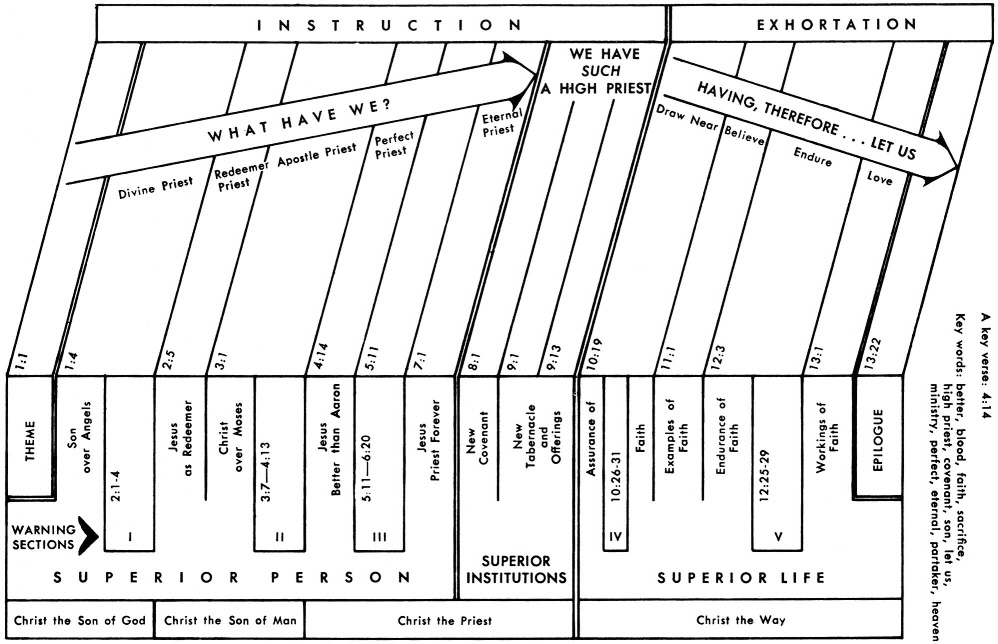
CONSIDER JESUS OUR GREAT HIGH PRIEST
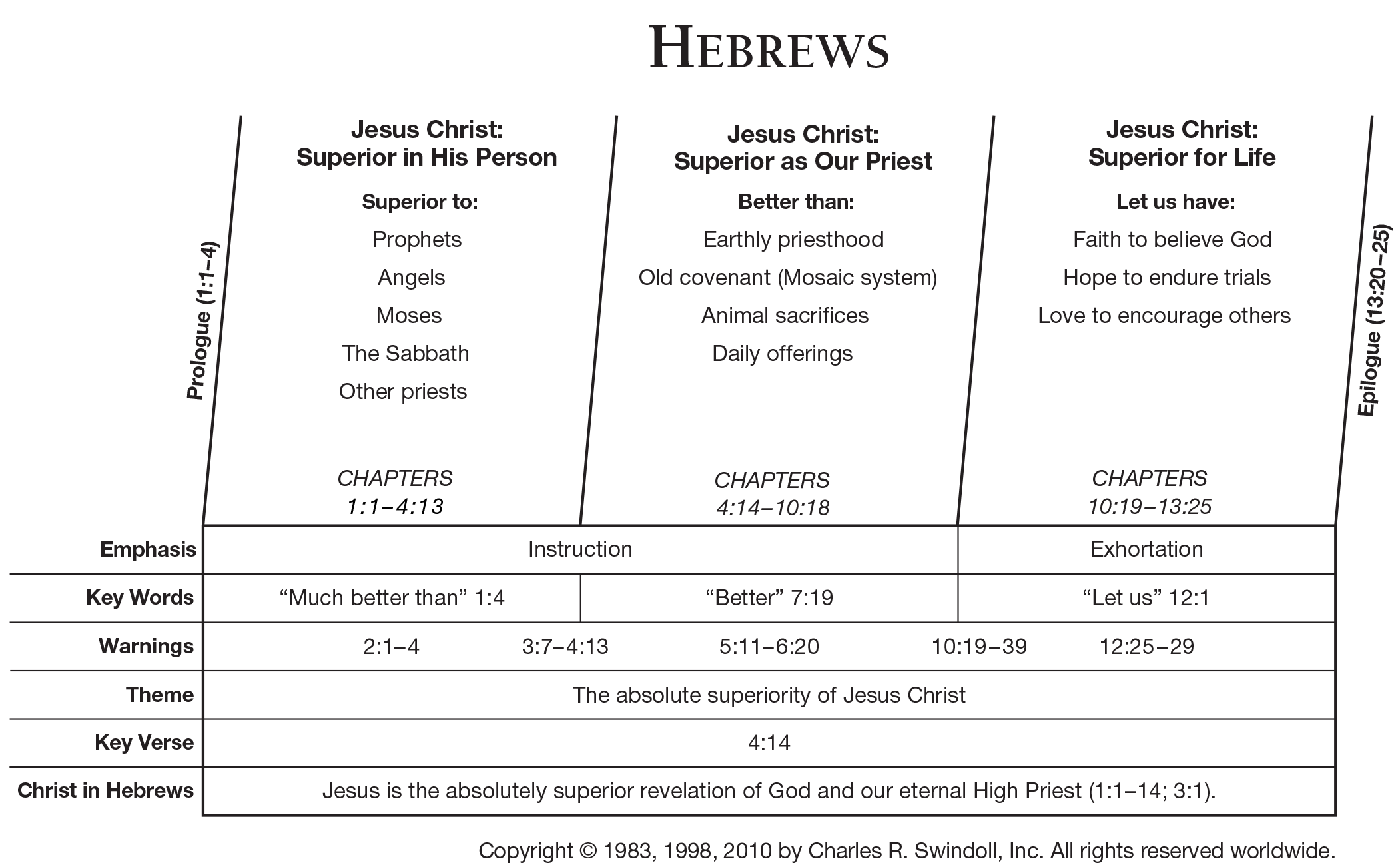
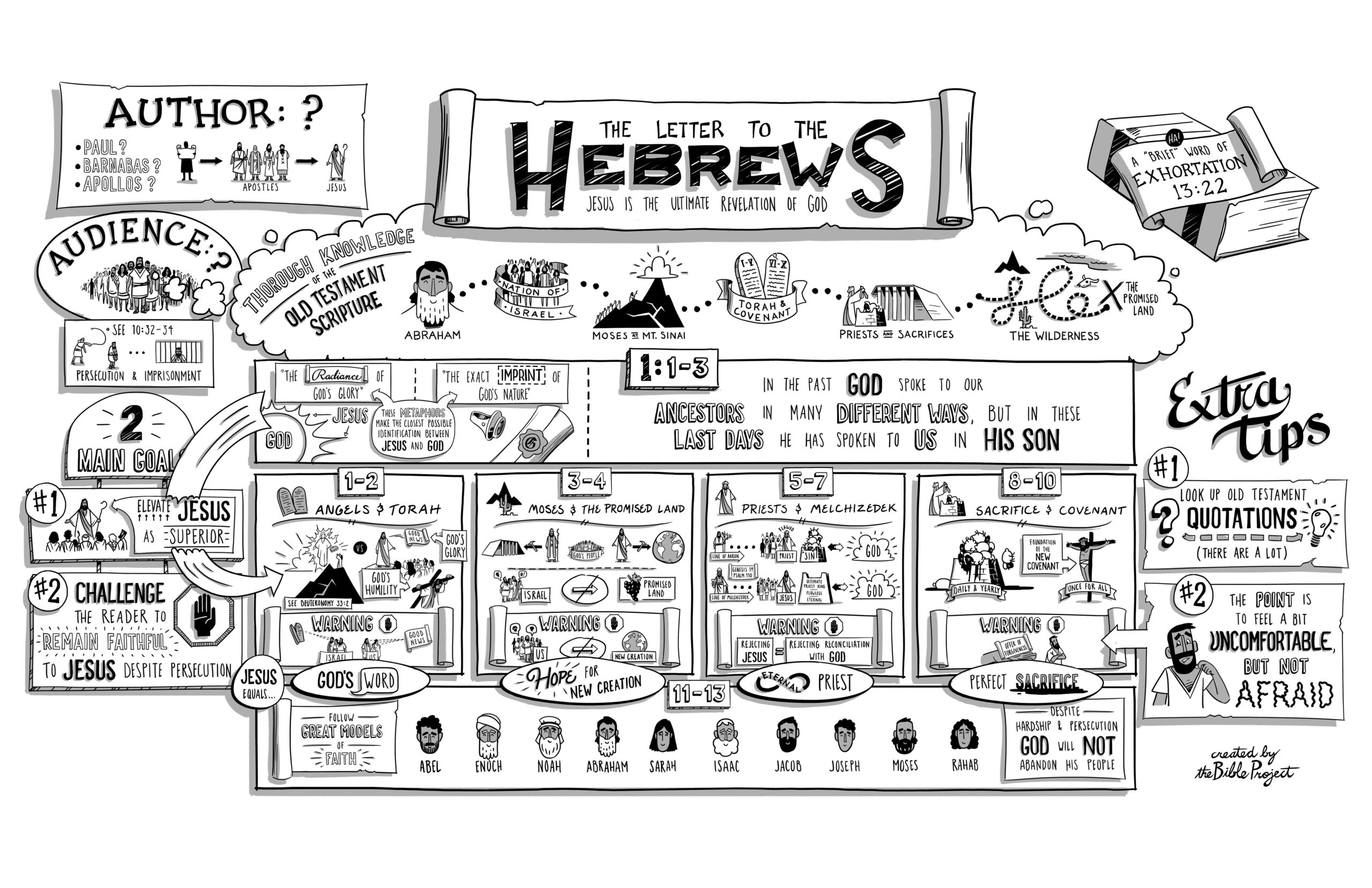
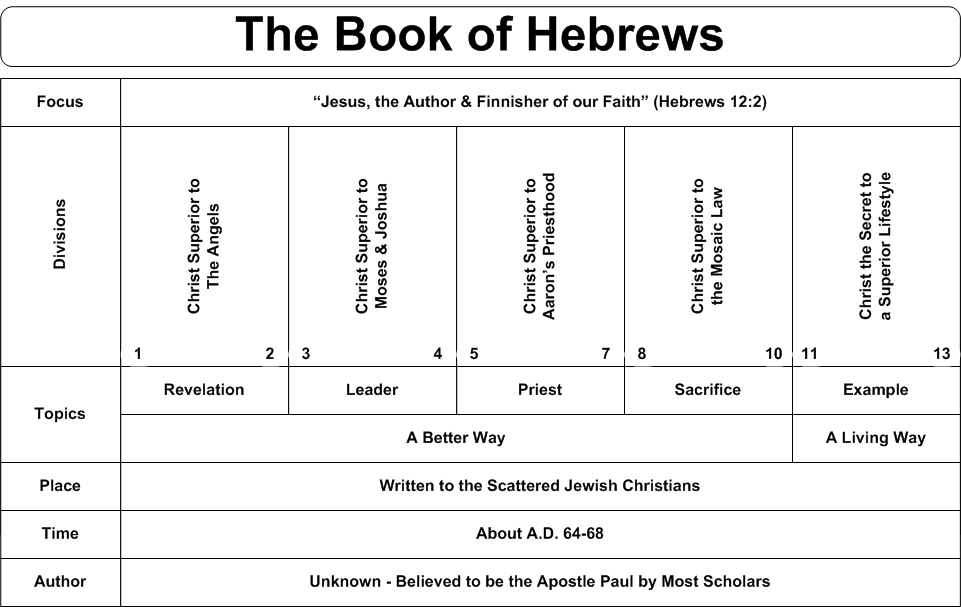
Click chart to enlarge
Charts from Jensen's Survey of the NT - used by permission
Swindoll's Chart, Interesting Pictorial Chart of Hebrews, Another Chart
|
The Epistle |
||||
| INSTRUCTION Hebrews 1-10:18 |
EXHORTATION Hebrews 10:19-13:25 |
|||
| Superior Person of Christ Hebrews 1:1-4:13 |
Superior Priest in Christ Hebrews 4:14-10:18 |
Superior Life In Christ Hebrews 10:19-13:25 |
||
| BETTER THAN PERSON Hebrews 1:1-4:13 |
BETTER PRIESTHOOD Heb 4:14-7:28 |
BETTER COVENANT Heb 8:1-13 |
BETTER SACRIFICE Heb 9:1-10:18 |
BETTER LIFE |
| MAJESTY OF CHRIST |
MINISTRY OF CHRIST |
MINISTERS FOR CHRIST |
||
|
DOCTRINE |
DUTY |
|||
|
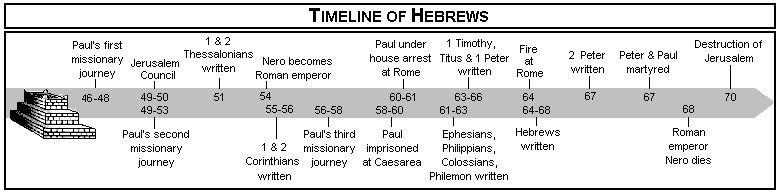
DATE WRITTEN: |
||||

See ESV Study Bible "Introduction to Hebrews"
(See also MacArthur's Introduction to Hebrews)
Borrow Ryrie Study Bible
Hebrews 11:11 By faith even Sarah herself received ability to conceive *, even beyond the proper time of life, since she considered Him faithful who had promised. (NASB: Lockman)
CLICK THIS PAGE FOR ALL ENGLISH TRANSLATIONS
Greek: Pistei kai aute Sarra steira dunamin eis katabolen spermatos elaben (3SAAI) kai para kairon elikias, epei piston egesato (3SAMI) ton epaggeilamenon; (AMPMSA)
BGT Πίστει καὶ αὐτὴ Σάρρα στεῖρα δύναμιν εἰς καταβολὴν σπέρματος ἔλαβεν καὶ παρὰ καιρὸν ἡλικίας, ἐπεὶ πιστὸν ἡγήσατο τὸν ἐπαγγειλάμενον.
Amplified: Because of faith also Sarah herself received physical power to conceive a child, even when she was long past the age for it, because she considered [God] Who had given her the promise to be reliable and trustworthy and true to His word. (Amplified Bible - Lockman)
Barclay: It was by faith that Sarah, too, received power to conceive and to bear a son, although she was beyond the age for it, for she believed that he who gave the promise could be absolutely relied upon. (Westminster Press)
NKJ By faith Sarah herself also received strength to conceive seed, and she bore a child when she was past the age, because she judged Him faithful who had promised.
NET By faith, even though Sarah herself was barren and he was too old, he received the ability to procreate, because he regarded the one who had given the promise to be trustworthy.
CSB By faith even Sarah herself, when she was unable to have children, received power to conceive offspring, even though she was past the age, since she considered that the One who had promised was faithful.
ESV By faith Sarah herself received power to conceive, even when she was past the age, since she considered him faithful who had promised.
NIV By faith Abraham, even though he was past age--and Sarah herself was barren--was enabled to become a father because he considered him faithful who had made the promise.
NIV (NEWEST VERSION) And by faith even Sarah, who was past childbearing age, was enabled to bear children because she considered him faithful who had made the promise. (THE MARGINAL NOTE NOW HAS THE VERSE ABOVE)
NLT: It was by faith that Sarah together with Abraham was able to have a child, even though they were too old and Sarah was barren. Abraham believed that God would keep his promise. (NLT - Tyndale House)
Phillips: It was by faith that even Sarah gained the physical vitality to become a mother despite her great age, and she gave birth to a child when far beyond the normal years of child-bearing. She could do this because she believed that the one who had given the promise was utterly trustworthy. (Phillips: Touchstone)
Wuest: By faith Sarah herself also received power as regards the deposition of seed, and that when she was past age, because she considered Him faithful who promised.
TLB Sarah, too, had faith, and because of this she was able to become a mother in spite of her old age, for she realized that God, who gave her his promise, would certainly do what he said.
Young's Literal: By faith also Sarah herself did receive power to conceive seed, and she bare after the time of life, seeing she did judge Him faithful who did promise;
Paraphrase: Through faith Sarah herself also received ability for the deposition of seed, even beyond the age limit, because she regarded as faithful the One who had promised.
- By faith even Sarah - Ge 17:17-19; Ge 18:11-14; 21:1,2; Lk 1:36; 1Pe 3:5,6
- Since she considered - Heb 10:23; Ro 4:20-21
- Hebrews 11 Resources - Multiple Sermons and Commentaries
Related Passages:
Genesis 17:17-19 (ABRAHAM LAUGHED) Then Abraham fell on his face and laughed, and said in his heart, “Will a child be born to a man one hundred years old? And will Sarah, who is ninety years old, bear a child?” 18 And Abraham said to God, “Oh that Ishmael might live before You!” 19 But God said, “No, but Sarah your wife will bear you a son, and you shall call his name Isaac; and I will establish My covenant with him for an everlasting covenant for his descendants after him.
Genesis 18:11-14 (SARAH LAUGHED) Now Abraham and Sarah were old, advanced in age; Sarah was past childbearing. 12 Sarah laughed to herself, saying, “After I have become old, shall I have pleasure, my lord being old also?” 13 And the LORD said to Abraham, “Why did Sarah laugh, saying, ‘Shall I indeed bear a child, when I am so old?’ 14 “Is anything too difficult for the LORD? At the appointed time I will return to you, at this time next year, and Sarah will have a son.”
Romans 4:20-21 yet, with respect to the promise of God, he did not waver in unbelief (EVEN THOUGH HE LAUGHED!) but grew strong in faith, giving glory to God, 21 and being fully assured that what God had promised, He was able (dunatos from dunamis) also to perform.
Hebrews 10:23 Let us hold fast the confession of our hope without wavering, for He who promised is faithful;
GOD IS FAITHFUL TO KEEP
HIS APPOINTMENTS
The interpretation of this verse is difficult, primarily because of the phrase eis katabolēn spermatos which is considered by some experts as a phrase that refers only to the male parent. The resulting translations then favor this passage as referring primarily to the faith of Abraham rather than the faith of Sarah. There are 64 Bible Translations on Biblegateway's page and below are the 17 (if you count the older version of the NIV - see NIV note below) which favor the passage as referring to Abraham. The reasons for the differences in the translations are summarized by Kistemaker and Metzger (see note below).
- NET "By faith even though Sarah herself was barren and he was too old, he received the ability to procreate, because he regarded the one who had given the promise to be trustworthy." (NET NOTE - Greek “power to deposit seed.” Though it is not as likely, some construe this phrase to mean “power to conceive seed,” making the whole verse about Sarah: “by faith, even though Sarah herself was barren and too old, she received ability to conceive, because she regarded the one who had given the promise to be trustworthy.”)
- NIV - "By faith Abraham, even though he was past age--and Sarah herself was barren--was enabled to become a father because he considered him faithful who had made the promise." (NOTE: THIS IS THE OLD VERSION OF NIV - THE NEWEST VERSION HAS SARAH AS THE PRIMARY SUBJECT AND PUTS THIS RENDERING IN THE MARGINAL NOTE - CLEARLY THIS REFLECTS THE NIV'S TRANSLATION COMMITTEE'S DIFFICULTY IN THE TRANSLATION OF THIS VERSE!)
- CJB - By trusting, he received potency to father a child, even when he was past the age for it, as was Sarah herself; because he regarded the One who had made the promise as trustworthy.
- ERV - Sarah was not able to have children, and Abraham was too old. But he had faith in God, trusting him to do what he promised. And so God made them able to have children.
- EASY - Abraham and his wife, Sarah, were too old to have children. But Abraham believed God's promise that they would have children. He trusted God to do what he had promised. As a result of his faith, God made it possible for him and Sarah to have a baby.
- EHV - By faith Abraham also received the ability to conceive children, even though Sarah herself was barren and he was past the normal age, because he considered him faithful who made the promise.
- EXB - He was too old to have children, and Sarah [or Sarah was too old and] ·could not have children [was barren/sterile]. It was by faith that ·Abraham was made able to become a father, because he [or Sarah was made able to bear children, because she] ·trusted God [L considered God faithful/trustworthy] to do what he had promised [Gen. 21:2]. (COMMENT - NOTE THAT THE EXPANDED BIBLE GIVES BOTH ALTERNATIVES IN THIS DISPUTED PASSAGE).
- GW - Faith enabled Abraham to become a father, even though he was old and Sarah had never been able to have children. Abraham trusted that God would keep his promise.
- LEB By faith also, with Sarah, he received the ability to procreate even past the normal age, because he regarded the one who had promised to be faithful.
- MOUNCE By faith · Abraham was enabled to become a father—even though Sarah herself was sterile and beyond the normal age of childbearing—because he regarded as faithful the one who had made the promise.
- NOG Faith enabled Abraham to become a father, even though he was old and Sarah had never been able to have children. Abraham trusted that God would keep his promise.
- NABRE By faith he received power to generate, even though he was past the normal age—and Sarah herself was sterile—for he thought that the one who had made the promise was trustworthy.
- NCB By faith Abraham also received the power of procreation, even though he was well past the age—and Sarah herself was barren—because he believed that the one who had made the promise would be faithful in fulfilling it.
- NCV He was too old to have children, and Sarah could not have children. It was by faith that Abraham was made able to become a father, because he trusted God to do what he had promised.
- NRSVA By faith he received power of procreation, even though he was too old—and Sarah herself was barren—because he considered him faithful who had promised.
- NRSVACE By faith he received power of procreation, even though he was too old—and Sarah herself was barren—because he considered him faithful who had promised.
- NRSVCE By faith he received power of procreation, even though he was too old—and Sarah herself was barren—because he considered him faithful who had promised.
By faith (see note on "by faith") emphasizes trust, reliance, and confident dependence upon God’s Word rather than human reasoning or visible evidence. Both Sarah and Abraham had faith that God could do the impossible! By faith is the key that unlocks the door to the land of promise. Faith acts on what God has said even when the senses find no confirmation.
🙏 THOUGHT - Does the preceding note describe your faith? If not, do not be discouraged. God's Spirit can grow our faith as we spend regular time in His faithful Word. Paul explains this dynamic writing that "FAITH comes from hearing (OR READING), and hearing by the Word of Christ." (Ro 10:17). But remember that for the Word to have it's full effect, we must obey what we learn. We must daily regularly feed on God's truth, obey God's truth, and God's Spirit will use this truth to increase our faith (cf 2Co 3:18). A second factor that affects our faith is testing. James writes that "the testing of your faith produces endurance." (James 1:3). James 1:4 goes on to add "And let endurance have its perfect result, so that you may be perfect and complete, lacking in nothing." And surely this end result of "perfect and complete" includes a growing faith. Finally, we can and should also ask God like the apostles did in Luke 17:5 "Lord, “Increase our faith!”" (cf Mk 9:24). Let's sum it up - faith is the gift of God, and it is God Who must supernaturally increase it. And yet our faith is increased by Scripture intake, by obedience to what is taken in, by the trials He allows in our lives and by prayer. In short, faith is not static but dynamic. As we learn to trust God in little things, we will find our faith increases to trust Him in greater things. As someone has said faith is strengthened more by acting than by sitting still. As muscles are developed by use, so faith increases as it is exercised. (See also Adrian Rogers' sermon Six Principles to Fortify Faith page 481)
At 90 (Genesis 17:17, see Abraham's ages listed below), Sarah was long past the proper time or season for child-bearing and in fact had never been able to conceive. God enabled her, however, because of her faith in His promise
Then the LORD took note of Sarah as He had said, and the LORD did for Sarah as He had promised. So Sarah conceived and bore a son to Abraham in his old age, at the appointed time of which God had spoken to him. And Abraham called the name of his son who was born to him, whom Sarah bore to him, Isaac. (Genesis 21:1-3).
Note that while 17/64 English versions above favor Abraham as the subject, I have chosen to interpret the passage based on the translation that favors Sarah as the main subject of faith. In fairness, even if one interpreted this as primarily referring to the faith of Abraham, it is inconceivable that Sarah would not also have faith (yes, even though she had laughed at the prospect of a child - have you ever laughed at a promise of God?). How else would she have been willing to allow Abraham to impregnate her at age 90 if she did not believe the promise of God to give them a son? That is rhetorical! So in my opinion, clearly Sarah believed God's promise.
Even Sarah herself received (lambano) ability (dunamis) to conceive (katabole sperma), even beyond the proper time (kairos) of life (helika), since she considered (hegeomai) Him faithful (pistos) Who had promised (epaggellomai) - Even Sarah emphasizes surprise because even she, who once laughed in disbelief (Ge 18:12), eventually came to genuine faith. How did this change transpire? Clearly this supernatural change highlights God’s grace transforming a doubting heart into believing obedience. Sarah’s womb was barren, Abraham’s body as good as dead (Ro 4:19). Conceive (katabole sperma) means literally “the laying down of seed,” which as discussed in these notes usually refers to the male impregnating the female, but is taken here as a statement describing Sarah's ability to receive the sperm and to ovulate. It seems quite unlikely that God would have given Sarah the power to ovulate from her ovary if she refused to believe His promise of a son!
Sarah rested not on biology, but on theology,
For her confidence was in the God Who cannot lie.
The ability (dunamis) to conceive (katabole) indicates Isaac's conception which was naturally impossible was made supernaturally possible. The ability (or power) to conceive is an illustration of Paul's confession that God’s "power is perfected in weakness." (2Co 12:9).
Even beyond the proper time (kairos) of life (helika) - Beyond the proper time is a nice way of saying she was 90 years old. And that of course is why Sarah laughed when she angelic visitors told Abraham (who was 100 years old) that Sarah would get pregnant and give birth to a son (Genesis 18:9-15) At 90 Sarah was well beyond the normal age for female fertility. And yet clearly God miraculously (dunamis often translated "miracle" in NT) revived her reproductive powers that had long since atrophied. Her faith was the channel through which God’s miracle power (dunamis) operated. In other words, her conception was not due to the natural process, but was linked to her faith that the placement of Abraham’s seed in her would, in spite of her advanced age, result in the birth of a child according to the promise God had given to Abraham. Both the faith of Abraham and of Sarah was rewarded with strength to impregnate (Abraham) and strength to conceive (Sarah), her fertilized ovum germinating into the child of promise, Isaac. This miracle of conception was clear proof that nothing is too hard for the Lord.
Since she considered (hegeomai - regarded) Him faithful (pistos) Who had promised (epaggellomai) - The verb considered (hegeomai - regarded) can mean one makes a decision after weighing the facts or circumstances. In Sarah's case, she considered the impossible odds and the divine promise and regarded the promise as possible because of the One Who made the promise! So although Sarah initially doubted ("laughed"), her story is encouraging for it shows that that faith may struggle at first but ultimately can come to fully rest on the faithfulness of God’s Word. Sarah’s faith came late, but it came real. The timing was determined by God, for He waited until all human ability was gone to display His supernatural ability so that He alone would get the glory.
Spurgeon on Sarah's faith - this holy woman is enrolled among these saintly ones. Her faith was not all it ought to have been, but God saw that it was true faith, and He loved it, and He wrote the record of it.
🙏 THOUGHT- In Sarah's case it resulted in the son of promise Isaac being conceived in her womb. But every believer needs this "power through God ability" provided by the Holy Spirit to grow in Christ-likeness or progressive sanctification. Just as our initial new birth was supernatural and was by grace through faith, so too our daily growth in godliness is supernatural and by faith, not by our efforts to be godly! And so just as Sarah (and Abraham's faith) laid hold of the promise of a "miracle child" Isaac, so too believers by faith need to lay hold of the promise of growth in Christ-likeness. Legalists do not like this teaching and so in Galatia Jewish legalists had bewitched the believers prompting Paul to ask the believers "Are you so foolish? Having begun by the Spirit, are you now being perfected (sanctified) by the flesh?" (Gal 3:3) Of course the answer is a resounding "No!" We began by the Spirit's "ability" we are to continue by His "ability." "Therefore as you have received Christ Jesus the Lord, so walk in Him." (Col 2:6)
Spurgeon on considered Him faithful - And that was good judgment, was it not? There is no mistake about that. Whatever difficulties may lie in the way, we may always know that he is faithful who has promised. You are not past age, my brother. God will bless you in seeking to do good. You are not past age, my sister. Have faith in God, and then in your old age you may bring many to the Savior’s feet. He is faithful who has promised.Sarah looked away from herself and her barrenness and her age and banked on her Faithful God for the fulfillment of his promise that she would have a child and be the mother of many nations. This didn't come easy for Sarah. In fact, when she heard God make the promise to Abraham, she laughed to herself and did NOT believe (Ge 18:12). But then God rebuked her for the laughter of unbelief, and said, "Is anything too hard for the Lord?" (Ge 18:14,15). And the next thing we hear from Sarah is a word of exultation to God when Isaac is born. She says, God has made laughter for me; every one who hears will laugh over me... Who would have said to Abraham that Sarah would suckle children? Yet I have borne him a son in his old age. She gives God the glory for the child, and so we may assume, with the writer to the Hebrews, that God's rebuke, and the reminder that nothing is too hard for the Lord, restored Sarah's faith and caused her to hope in God.
Your faith may light a fire for God
that will burn long after you are gone.
Ray Pritchard - When God writes their story in Hebrews 11, he makes sure that Sarah gets equal billing with Abraham. It’s true that Abraham gets more space, but she made the Book! Husbands, take notice. Make sure your wife is included in every victory. Abraham couldn’t make a child by himself. He needed Sarah in order to produce Isaac. What if God had worked a miracle in Abraham but not in Sarah? What if she had said, “No thanks. I’m too old. I don’t want to be changing diapers when I’m 90"? In order to fulfill the promise, God had to work several miracles. First, he had to touch their old, tired, worn-out bodies and make them able to reproduce. Second, he had to touch their hearts so that they would have faith to believe the first miracle had taken place. But there is another side to all this. Sarah didn’t live to see the ultimate end of her faith. Genesis 23:1 says that she was 127 years old when she died, meaning that she lived for 37 years after Isaac was born. But she didn’t live long enough to meet Isaac’s wife Rebekah. She never met her grandsons Jacob and Esau. And she never knew about her many great-grandchildren or the tribes of Israel that would emerge from the unruly sons of Jacob. All of that was hidden to her because she only lived long enough to experience the great miracle of Isaac’s birth and then to see him grow up. She would not see the descendants as numerous as the stars in the sky or the sand on the seashore. Rarely will any of us see the full results of what we lived for. That, too, is part of the life of faith....Faith is the great divider. By your life, you may influence the next Abraham, the next Sarah, the next David, the next Daniel, the next Esther. Your faith may light a fire for God that will burn long after you are gone.....God may arrange things so that your faith bears vast fruit in the years to come. Your legacy will be most clearly seen after you have gone to heaven....May the Holy Spirit take the truth of the Word and enlarge your faith to believe God for great things now and in the future. Amen. (The Blessing of a Believing Spouse)
Ray Stedman - We must not exclude Sarah from this reckoning of those who triumphed by faith, as the NIV rendering of verse 11 does. For though she laughed incredulously when she overheard God’s promise to Abraham that she would bear a son (Gen 18:11–12), nevertheless, God countered her incredulity with the question, “Is anything too hard for the LORD?” Those challenging words would surely have been the source of her meditation in the days that followed. Genesis 21:1 states, “Now the LORD was gracious to Sarah as he had said, and the LORD did for Sarah what he had promised.” God’s invariable method for fulfilling a promise is to awaken faith first in the recipient. Sarah’s growth in grace and spiritual maturity is recognized in 1 Peter 3:6, and all this would powerfully support the design of our author by including Sarah’s name deliberately. She shared with Abraham that faith which produced descendants as numerous as the stars in the sky and as countless as the sand on the seashore. (Faith Made Visible)
WHAT DOES GOD DO WHEN FAITH DOUBTS HIS PROMISES? The writer of Hebrews leaves out part of the story of Isaac's miraculous conception. Recall that Sarah she laughed
Genesis 18:8-15 He (ABRAHAM) took curds and milk and the calf which he had prepared, and placed it before them; and he was standing by them under the tree as they ate. 9 Then they said to him, “Where is Sarah your wife?” And he said, “There, in the tent.” 10 He (THIS IS THE PRE-INCARNATE LORD) said, “I will surely return to you at this time next year; and behold, Sarah your wife will have a son.” And Sarah was listening at the tent door, which was behind him. 11 Now Abraham and Sarah were old, advanced in age; Sarah was past childbearing. 12 Sarah laughed to herself, saying, “After I have become old, shall I have pleasure, my lord being old also?” 13 And the LORD said to Abraham, “Why did Sarah laugh, saying, ‘Shall I indeed bear a child, when I am so old?’ 14 “Is anything too difficult for the LORD? At the appointed time I will return to you, at this time next year, and Sarah will have a son.” 15 Sarah denied it however, saying, “I did not laugh”; for she was afraid. And He said, “No, but you did laugh.”
God countered her skepticism with the question /a question, “Is anything too difficult for the LORD?" God speaks truth to turn Sarah's doubting into faith in His promise of a son to a 90 year old woman. Think about this story for a moment - Here is a most encouraging example of faith. When Sarah first heard the promise, she doubted and laughed. But her first doubts were overcome. Ultimately God had the last laugh…for Isaac’s name in fact meant laughter. And later after Isaac's birth Sarah declared " “God has made laughter for me; everyone who hears will laugh with me.” (Ge 21:6)
To help understand the magnitude of the miracle birth of Isaac consider:
- Sarah was barren (Genesis 11:30).
- Sarah had borne Abraham no children (Genesis 16:1).
- Abraham and Sarah were old, advanced in years (Genesis 18:11).
- Sarah had passed the age of childbearing (Genesis 18:11).
- Sarah was a “worn-out woman” (Genesis 18:12).
- Abraham was old (Genesis 18:12).
- Sarah was old (Genesis 18:13).
- There was no reason for Abraham or Sarah to hope for children (Romans 4:18).
- Abraham thought his body was as good as dead (Romans 4:19).
- Sarah’s womb was also dead (Romans 4:19).
- Sarah was long past childbearing age (Hebrews 11:11).
- Abraham was as good as dead (Hebrews 11:12).
These verses remind us of the utter hopelessness of their situation.
Faith (4102)(pistis) is synonymous with trust or belief and is the conviction of the truth of anything, but in Scripture speaks of belief respecting man's relationship to God and divine things, generally with the included idea of trust and holy fervor born of faith and joined with it. As pistis relates to God, it is the conviction that God exists and is the Creator and Ruler of all things well as the Provider and Bestower of eternal salvation through Christ. As faith relates to Christ it represents a strong and welcome conviction or belief that Jesus is the Messiah, through Whom we obtain eternal salvation and entrance into the Kingdom of Heaven. Stated another way, eternal salvation comes only through belief in Jesus Christ and no other way.
PISTIS IN HEBREWS - Heb. 4:2; Heb. 6:1; Heb. 6:12; Heb. 10:22; Heb. 10:38; Heb. 10:39; Heb. 11:1; Heb. 11:3; Heb. 11:4; Heb. 11:5; Heb. 11:6; Heb. 11:7; Heb. 11:8; Heb. 11:9; Heb. 11:11; Heb. 11:13; Heb. 11:17; Heb. 11:20; Heb. 11:21; Heb. 11:22; Heb. 11:23; Heb. 11:24; Heb. 11:27; Heb. 11:28; Heb. 11:29; Heb. 11:30; Heb. 11:31; Heb. 11:33; Heb. 11:39; Heb. 12:2; Heb. 13:7
For more discussion on the meaning of faith (pistis) click Commentary on Hebrews 10:22-23
Forsaking All I Trust Him
Acrostic: F-A-I-T-H
Faith is believing that God will keep His promises, despite circumstances that seem to be to the contrary! True faith that saves one's soul includes at least three main elements - (1) firm persuasion or firm conviction, (2) a surrender to that truth and (3) a conduct emanating from that surrender. In sum, faith shows itself genuine by a changed life.
FAITH…
Sees the invisible
Believes the incredible
Receives the impossibleI like Jerry Bridges practical definition of faith as that which "involves both a renunciation and a reliance. First, we must renounce any trust in our own performance as the basis of our acceptance before God. We trust in our own performance when we believe we’ve earned God’s acceptance by our good works. But we also trust in our own performance when we believe we’ve lost God’s acceptance by our bad works—by our sin. So we must renounce any consideration of either our bad works or our good works as the means of relating to God. Second, we must place our reliance entirely on the perfect obedience and sin-bearing death of Christ as the sole basis of our standing before God—on our best days as well as our worst. (The Bookends of the Christian Life).
Bridges goes on to emphasize that faith is dynamic, and just as we needed faith to be saved the first time (justification), we need faith to be saved every day (sanctification) - (In regard to justification) The gospel of justification by faith in Christ is the mainspring of the Christian life. And like the mainspring in old watches, it must be wound every day. Because we have a natural tendency to look within ourselves for the basis of God’s approval or disapproval, we must make a conscious daily effort to look outside ourselves to the righteousness of Christ, then to stand in the present reality of our justification… (In regard to sanctification) Faith involves both renunciation and reliance. We have to first renounce all confidence in our own power and then rely entirely on the power of the Holy Spirit. We must be enabled, not merely helped. What’s the difference? The word help implies we have some ability but not enough; we need someone else to supplement our partially adequate ability. By contrast, enablement implies that we have no ability whatsoever. We’re entirely powerless. We can do nothing. But when by faith we renounce self-sufficiency and embrace reliance on the power of the Holy Spirit, we receive divine empowerment, enablement, and strength for personal transformation and ministry. (I highly recommend his book The Bookends of the Christian Life).
Ability (1411)(dunamis) describes achieving power and in this case speaks of supernatural power, power to achieve something one could not achieve naturally. In short dunamis means for the believer, power to achieve through the Lord's inherent ability (power). We should not be surprised the that dunamis is translated miracle (miracles, miraculous) some 22 times in the NT. It is power through God ability!
DUNAMIS 6X IN HEBREWS - Heb. 1:3; Heb. 2:4; Heb. 6:5; Heb. 7:16; Heb. 11:11; Heb. 11:34
Hebrews 1:3 And He is the radiance of His glory and the exact representation of His nature, and upholds all things by the word of His power. When He had made purification of sins, He sat down at the right hand of the Majesty on high,
Hebrews 2:4 God also testifying with them, both by signs and wonders and by various miracles and by gifts of the Holy Spirit according to His own will.
Hebrews 6:5 and have tasted the good word of God and the powers of the age to come,
Hebrews 7:16 who has become such not on the basis of a law of physical requirement, but according to the power of an indestructible life.
Hebrews 11:11 By faith even Sarah herself received ability to conceive, even beyond the proper time of life, since she considered Him faithful who had promised.
Hebrews 11:34 quenched the power of fire, escaped the edge of the sword, from weakness were made strong, became mighty in war, put foreign armies to flight.
Conceive (2602) (katabole from kataballo = to throw down from kata = down + ballo = throw, cast) is literally a casting down or laying down. The original idea was the laying down of the foundation of a house. In Heb 11:11 Katabole is translated “to conceive,” which in reality means Abraham’s discharge or seed. It is used in the passive because the seed was received by Sarah.
R C H Lenski - Καταβολὴ σπέρματος (katabole sperma), the standard and technical term for the projection or deposition of the semen virile into the womb by the male organ, is even combined with δύναμις: “ability” for such an action. This makes it impossible to say that Sarah received such ability, καὶ αὐτή, “even herself.” Only by putting a different meaning into the expression, a meaning that is not found anywhere, can a female be made the subject. (Borrow Interpretation of Hebrews page 392)
Katabole was a technical term for putting seed into the ground, it is also used of the role of the male in impregnating the female and there is one such use in Hebrews 11:11, referring to the casting in or sowing of seed, conveying the idea of begetting.
Wuest - The word katabole means originally “a throwing down,” hence, here the depositing of the male seed in the womb. The sentence may be explained either, “received strength as regards the deposition of seed,” to fructify it, or, “received strength for the foundation of a posterity.”
TDNT adds that katabole meant “laying down” is used for, e.g., the casting of seed, human begetting, the sowing of war, and the establishment of government.
Ten of the 11 NT uses of katabole (there are no uses in the LXX) are in the phrase "foundation of the world". Here are the uses in Hebrews...
Hebrews 4:3 (note) For we who have believed enter that rest, just as He has said, "As I swore in My wrath, They shall not enter My rest," although His works were finished from the foundation of the world.
Hebrews 9:26 (note) Otherwise, He would have needed to suffer often since the foundation of the world; but now once at the consummation of the ages He has been manifested to put away sin by the sacrifice of Himself.
Hebrews 11:11 (note) By faith even Sarah herself received ability to conceive, even beyond the proper time of life, since she considered Him faithful who had promised;
Proper time (2540)(kairos) means a point of time or period of time, time, period, frequently with the implication of being especially fit for something and without emphasis on precise chronology. It means a moment or period as especially appropriate the right, proper, favorable time (at the right time).
Kairos can refer to a fixed and definite time, the time when things are brought to crisis, the decisive epoch waited for or a strategic point in time. Kairos speaks of a limited period of time, with the added notion of suitableness ("the suitable time", "the right moment", "the convenient time"). Kairos refers to a distinct, fixed time period, rather than occasional moments.
Kairos is not so much a succession of minutes (Greek chronos 5550), but a period of opportunity. In other words, kairos defines the best time to do something, the moment when circumstances are most suitable, the psychologically "ripe" moment.
Considered (counted, regarded) (2233) hegeomai from ago = to lead, carry, bring) has two basic meanings in the NT. One is to lead as one would do in a supervisory capacity as when describing men in any leading position - ruler, leader, governor (Acts 7:10) and stands opposite of a diakonos or servant in (Lk 22:26). The second meaning of hegeomai means to engage in an intellectual process (2Co 9:5, Php 2:25, Php 3:8, 2Pe 1:13). In this latter sense, hegeomai conveys the picture of leading out (note the root verb of origin = ago = to lead) before the mind, and thus to regard, esteem, count, reckon. This latter meaning is found in the present verse. In this sense, hegeomai pictures one giving careful thought to something and not making a quick decision. In the present verse it pictures Moses carefully thinking through his decision, weighing out the pros and cons. He weighed what Egypt had to offer in time against what God offered in both time and eternity. In secular Greek hegeomai was a mathematical term which meant "Think about it and come to a conclusion."
HEGEOMAI - 27V - Matt. 2:6; Lk. 22:26; Acts 7:10; Acts 14:12; Acts 15:22; Acts 26:2; 2 Co. 9:5; Phil. 2:3; Phil. 2:6; Phil. 2:25; Phil. 3:7; Phil. 3:8; 1 Thess. 5:13; 2 Thess. 3:15; 1 Tim. 1:12; 1 Tim. 6:1; Heb. 10:29; Heb. 11:11; Heb. 11:26; Heb. 13:7; Heb. 13:17; Heb. 13:24; Jas. 1:2; 2 Pet. 1:13; 2 Pet. 2:13; 2 Pet. 3:9; 2 Pet. 3:15
Faithful (4103) (pistos from peitho = to persuade - induce one by words to believe, have confidence) is something or someone who is worthy of faith or keeps promises and is applied to God, humans, His Word, etc
PISTOS-63V - USES IN Heb. 2:17; Heb. 3:2; Heb. 3:5; Heb. 10:23; Heb. 11:11
Hebrews 2:17 Therefore, He had to be made like His brethren in all things, so that He might become a merciful and faithful high priest in things pertaining to God, to make propitiation for the sins of the people.
Hebrews 3:2 He was faithful to Him who appointed Him, as Moses also was in all His house.
Hebrews 3:5 Now Moses was faithful in all His house as a servant, for a testimony of those things which were to be spoken later;
Hebrews 10:23 Let us hold fast the confession of our hope without wavering, for He who promised is faithful;
Hebrews 11:11 By faith even Sarah herself received ability to conceive, even beyond the proper time of life, since she considered Him faithful who had promised.
Vincent gives a nice summary (expanded in the discussion that follows) of the meaning of pistos, faithful, writing that it is used - (1), of one who shows Himself faithful in the discharge of a duty or the administration of a trust (Mt 24:45). Hence, trustworthy (2Ti 2:2). Of things that can be relied upon (2Ti 2:11). (2), Confiding; trusting; a believer (Gal 3:9; Acts 16:1; 2Cor 6:15; 1Ti 5:16) (Word Studies in the New Testament)
Webster says that Faithful means firm in adherence to whatever one owes allegiance and implies unswerving adherence to a person or thing or to the oath or promise by which a tie was contracted.
Pistos is used in two senses in the NT active and passive - 1) ACTIVE = trusting or believing - This is the less frequent usage. This sense speaks of a sinner exercising faith in the Lord Jesus. In the first NT use in this sense, Jesus "said to Thomas, “Reach here your finger, and see My hands; and reach here your hand, and put it into My side; and be not unbelieving, but believing." (Jn 20:27) Paul instructs Timothy to "let those who have believers (pistos) as their masters not be disrespectful to them because they are brethren, but let them serve them all the more, because those who partake of the benefit are believers (pistos) and beloved. Teach and preach these principles." (1Ti 6:2) When pistos is used in this active sense to refer to the faith which a lost sinner must place in the Lord Jesus in order to be saved, it includes the following ideas -- the act of considering the Lord Jesus worthy of trust as to His character and motives, the act of placing confidence in His ability to do just what He says He will do, the act of entrusting the salvation of his soul into the hands of the Lord Jesus, the act of committing the work of saving his soul to the care of the Lord. This means a definite taking of one’s self out of one’s own keeping and entrusting one’s self into the keeping of the Lord Jesus. Thus Paul says "So then those who are of faith are blessed with Abraham, the believer (pistos)." (Gal 3:9) Using a striking contrast, Paul asks "what harmony has Christ with Belial, or what has a believer in common with an unbeliever?" (2Cor 6:15) Luke records that Paul "came also to Derbe and to Lystra. And behold, a certain disciple was there, named Timothy, the son of a Jewish woman who was a believer, but his father was a Greek." (Acts 16:1) Note also that with regard to believers, they are spoken of sometimes in the Active sense (as "believers") and sometimes in the Passive (as "faithful"). The New Testament concept of faith includes three main elements, mutually connected and requisite, though according to circumstances sometimes one and sometimes another may be more prominent (1) a fully convinced acknowledgement of the revelation of grace; (2) a self-surrendering fellowship (adhesion); and (3) a fully assured and unswerving trust (and with this at the same time hope) in the God of salvation or in Christ. (Modified from Cremer)
2) PASSIVE = trustworthy or faithful - which is the use here in Hebrews 11 - Here the basic idea is that of trustworthiness. In this sense pistos describes God, Christ, servants, His Word as faithful, reliable, worthy of belief or trust, , , dependable. Marvin Vincent adds that pistos used of God describes Him as "True to his own nature and promises; keeping faith with Himself and with man." Paul writes that even "if we are faithless, He remains faithful; for He cannot deny Himself. (2Ti 2:13) Pistos in this passive sense is used of one who shows Himself faithful in the discharge of a duty or the administration of a trust "Who then is the faithful and sensible slave whom his master put in charge of his household to give them their food at the proper time?" Mt 24:45. Hence, pistos describes the one who is trustworthy "And the things which you have heard from me in the presence of many witnesses, these entrust to faithful men, who will be able to teach others also." (2Ti 2:2). Of the Word of God (which is the sense pistos is used in Titus 1:9) that can be relied upon "It is a trustworthy statement: if any man aspires to the office of overseer, it is a fine work he desires to do. (1Ti 3:1)"It is a trustworthy statement: For if we died with Him, we shall also live with Him. (2 Timothy 2:11)In this passive sense of trustworthy or faithful, pistos is applied to God as fulfilling His own promises (He 10:23; He 11:1), as fulfilling the purpose for which He called men (1Th 5:24; 1Cor 1:9), as responding with guardianship to the trust reposed in Him by men (1Co 10:13; 1Pe 4:19). Christ is faithful (2Th 3:3; He 3:2; He 2:17; Rev 19:11) Christ as the faithful witness (Re 1:5; Re 3:14). God’s and Christ's faithfulness in these verses speak not only of His essential being (faithful is Who He is), but also of His faithfulness toward us, as shown for example in the famous verse "If we confess our sins, He is faithful and righteous to forgive us our sins and to cleanse us from all unrighteousness." (1Jn 1:9) In the papyri, we find the following illustrations of the use of pistos -- "Whom no one would trust even if they were willing to work" = confidence in the person’s character and motives. "I have trusted no one to take it to her" = confidence in the ability of another to perform a certain task. Moses in turn records the following of God writing "Know therefore that the LORD your God, He is God, the faithful (Lxx = pistos) God, Who keeps His covenant and His lovingkindness to a thousandth generation with those who love Him and keep His commandments." (Dt 7:9) Notice the seal of assurance stamped upon God's covenant. It is backed up by His faithful character.
Promised (1861) epaggello from epi = an intensifier of the verb + aggello = to tell, declare) means to proclaim, promise, declare, announce, claim (profess).
Friberg - (1) as a divine or human declaration, offering to do something (make a) promise, offer (James 1.12); (2) as what one is asserting about himself profess, lay claim to (1Ti 2.10) (Borrow Analytical Lexicon of the Greek New Testament)
Vine - "to announce, proclaim," has in the NT the two meanings "to profess" and "to promise," each used in the Middle Voice; "to promise" (a) of "promises" of God, Acts 7:5 ; Romans 4:21 ; in Galatians 3:19 , Passive Voice; Titus 1:2 ; Hebrews 6:13 ; 10:23 ; 11:11 ; 12:26 ; James 1:12 ; 2:5 ; 1 John 2:25 ; (b) made by men, Mark 14:11 ; 2 Peter 2:19. (Vine's Expository Dictionary)
EPAGGELLO - 15V - Mk. 14:11; Acts 7:5; Rom. 4:21; Gal. 3:19; 1 Tim. 2:10; 1 Tim. 6:21; Tit. 1:2; Heb. 6:13; Heb. 10:23; Heb. 11:11; Heb. 12:26; Jas. 1:12; Jas. 2:5; 2 Pet. 2:19; 1 Jn. 2:25
Hebrews 6:13 For when God made the promise to Abraham, since He could swear by no one greater, He swore by Himself,
Hebrews 10:23 Let us hold fast the confession of our hope without wavering, for He who promised is faithful;
Hebrews 11:11 By faith even Sarah herself received ability to conceive, even beyond the proper time of life, since she considered Him faithful who had promised.
Hebrews 12:26 And His voice shook the earth then, but now He has promised, saying, “YET ONCE MORE I WILL SHAKE NOT ONLY THE EARTH, BUT ALSO THE HEAVEN.”
Simon Kistemaker on the translation differences in NET/NIV and most other versions (NAS, ESV, CSB, NLT, et al) -
a. The writer of Hebrews places the expression and Sarah herself near the beginning of the original Greek sentence, immediately after the phrase by faith. He seems to indicate, by the nominative case, that Sarah is the subject of the sentence. The translators of the New International Version and the Good News Bible have inserted the name Abraham to show that the patriarch is the logical subject and that the name Abraham suits the broader context.
b. The Greek idiom, translated literally and modestly as “power for the laying down of seed,” always refers to the male and not to the female. Therefore, to translate the idiom as “power to conceive” is contrary to linguistic usage. It fails to do justice to the original text and appears to be an accommodation to the presence of the name Sarah.
c. Many commentators take the approach that as husband and wife are one so Abraham and Sarah should be mentioned together. They contend that the original Greek for the words Sarah herself may be read as a dative. The reading then is, “By faith he [Abraham] also, together with Sarah, received power to beget a child.” (F F Bruce, R C H Lenski, Leon Morris) Plausible as this explanation may be, the fact remains that manuscript evidence cannot provide definite proof for this reading.
d. Still others suggest that the subject of verse 11 is Sarah and that the idiom “power for the laying down of seed” actually means “she received power to establish a posterity.” (See P E Hughes - A Commentary on the Epistle to the Hebrews - Page 473) The difficulty this suggestion meets is that Abraham, not Sarah, is the father and founder of the nation Israel.
e. Perhaps we should understand the words “and Sarah herself was barren” to be a parenthetical thought of the author. If the words referring to Sarah had not been in the text, no one would have difficulty translating and interpreting the text. Verse 11 expresses the thought that Abraham “was enabled to become a father” and is a natural introduction to verse 12. To delete the clause about Sarah is unthinkable because of manuscript support for these words. But to understand it as a parenthetical comment is feasible and sensible. (See note by Metzer)
Also Paul comments on Abraham’s faith in God, who would make him “the father of many nations.” Says Paul, “Without weakening in his faith, he faced the fact that his body was as good as dead—since he was about a hundred years old—and that Sarah’s womb was also dead” (Rom. 4:19). Abraham trusted that God would honor his promise. God is faithful. (BORROW Exposition of the Epistle to the Hebrews PAGE 322)
Bruce Metzger - A textual commentary on the Greek New Testament page 672. - The difficulties of this verse are well known (for example, in Greek the expression δύναμιν εἰς καταβολὴν σπέρματος ἔλαβεν is regularly used of the male in begetting, not the female in conceiving) and have led some scholars (including F. Field, Windisch, Zuntz) to suggest that καὶ αὐτὴ Σάρρα στεῖρα is an early gloss that somehow got into the text. Appreciating the lexical difficulty, but unwilling to emend the text, a majority of the Committee understood the words καὶ αὐτὴ Σάρρα στεῖρα to be a Hebraic circumstantial clause,2 thus allowing Ἀβραάμ (ver. 8) to serve as subject of ἔλαβεν (“by faith, even though Sarah was barren, he [Abraham] received power to beget …”).
It is also possible to construe the words αυτη σαρρα στειρα as a dative of accompaniment (in uncial script iotas subscript are ordinarily not indicated), so that the sentence runs, “By faith he [Abraham] also, together with barren Sarah, received power to beget …”3
A second problem involves στεῖρα, which is absent from several important witnesses (𝔓13vid א A Dc 33 614 al). Although admitting that the word might have been added as an interpretative gloss in an ancestor of 𝔓46 D* P Ψ 81 88 1739 it vg syrp, h al, a majority of the Committee regarded it as more likely that the word dropped out through transcriptional oversight (σαρραστειρα). It was agreed that ἡ (Db vid 81 88 1739 Euthalius al) and οὖσα (P 104 436 1984 2127 al) are obviously secondary.
Leon Morris writes "This verse presents us with a problem so difficult that Hering speaks of it as a “cross which is frankly too heavy for expositors to bear” (in loc.). The difficulty is that on the face of it the verse ascribes to Sarah an activity possible only to males: dynamin eis katabolēn spermatos (“power for the depositing of semen”)." (To read Morris' lengthy explanation Borrow Expositor's Bible Commentary, page 994)
Steven Cole writes that...
Faith overcomes insurmountable problems by God’s power (He 11:11, 12).
Abraham and Sarah were unable to conceive children. God promised them not only a son, but also nations of descendants. To underscore the promise, God changed his name from Abram (“exalted father”) to Abraham (“father of a multitude”). Then God promised, “I will make you exceedingly fruitful, and I will make nations of you, and kings will come forth from you” (Ge 17:5, 6). But the problem was, not only were Abraham and Sarah unable to conceive children; also, they were both past the time in life when anyone normally could conceive.
There is a difficult interpretive issue in our text, reflected in the difference between the NASB, which makes Sarah the subject of the sentence, and the NIV, which makes Abraham the subject. The problem with making Sarah the subject is that the phrase “received the ability to conceive” is literally “power for the laying down of seed” (NASB, margin), an exclusively male function. Without getting too technical, probably the sense of the NIV is correct, even though Abraham is not named in the verse (in Greek). There is a textual variant that describes Sarah as “barren.” If it is original, the sense would be, “By faith, even though Sarah was barren, he [Abraham] received power to beget …” (A Textual Commentary of the Greek New Testament, Bruce Metzger [United Bible Societies], 4th ed., p. 602). The final phrase would read, “since he considered Him faithful who had promised.”
This view also alleviates another problem, namely, that in the account in Genesis 18, Sarah is rebuked for her unbelief rather than commended for her faith. When the Lord confronts her, she denies, rather than confesses, her unbelief. Probably, in spite of her initial doubt, she eventually came to believe God’s promise as Abraham did. But if Abraham is the subject of He 11:11, then the emphasis is on his faith, not on Sarah’s faith. There are two lessons in these two verses:
A. Rather than focusing on human impotence, faith focuses on God’s power and faithfulness (He 11:11).
In Genesis 18:14, the Lord rebukes Sarah’s unbelief with the rhetorical question, “Is anything too difficult for the Lord?” He goes on to restate the promise, that at the appointed time the next year, Sarah would have a son. She and Abraham rested on God’s faithful character. Since He promised, He would do it.
We need to be careful in applying this. It is easy to misapply promises in the Bible out of their context, and then become disappointed when God doesn’t do what we think He promised. The problem does not lie with God, of course, but with our misunderstanding of how to apply His promises.
For example, many Christians claim that if we have faith in God, He has promised to heal us from all our diseases. I have heard of these mistaken saints going to the bedside of a terminally ill Christian and accusing him of not having enough faith to be healed! That is cruel! God has not promised healing from every disease to those who believe. If He had, people of faith would live forever. I’ve never known of a faith healer that lived past 100! In fact, several prominent ones died relatively young!
At the same time, we would be wrong not to trust God to do far beyond our human abilities. Nothing is impossible with God (Luke 1:37). He is “able to do far more abundantly beyond all that we ask or think” (Eph. 3:20). Our faith is not in ourselves or in our faith, but in God who is faithful.
Robert Hawker - Because she judged him faithful who had promised.—Heb. 11:11.
I admire what the Holy Ghost hath here recorded of Sarah’s faith. After what we read of the weakness of her faith at first, in the history to which this refers, I cannot but rejoice in this recovery of the great mother in Israel, through grace, and read with very much pleasure this honourable testimony which the Holy Ghost himself hath given of her. And I admire yet more the grace and goodness of the Eternal Spirit, in causing it to be handed down to the Church, among the list of such worthies, and desire to bless his holy name for this scripture. And while I bless God for the memorial, I pray him to give me a spirit of wisdom, to improve it to my own furtherance in faith. The faith of Sarah, like that of her husband, was the more illustrious from the seeming impossibilities which lay in the way of the accomplishment of God’s promise. For what the Lord engaged to do, was contrary to the whole course of nature. But what was that to Sarah? All she had to do, was to consider the promise, and keep an eye upon the almighty Promiser. “If there are difficulties in the way, that is God’s business, and not mine,” might Sarah say. “How the Lord will bring it to pass, is with him, and not with me: I have no concern with that. My province is to believe; it is God’s to work.” Here was an act of illustrious faith! and the sequel of Sarah’s history shows how well-founded it was. But the Holy Ghost explains the subject, and shows how it was accomplished; “because she judged him faithful who had promised.” Now, my soul, see to it, that thou make the same grand cause the foundation of thy faith, namely, Jehovah’s faithfulness; and, depend upon it, every promise of the gospel, even Jesus, with all his fulness, thou mayest, as well as Sarah, rely upon; and thou wilt be always able to do it, as long as thou makest the same perfection of Jehovah thy confidence: “because she judged him faithful that promised.” While I rest upon his faithfulness, I rest upon the Rock of ages, which can never give way: and every difficulty, or seeming impossibility, which comes between the promise of a faithful God, and the accomplishment of that promise, hath no more to do with the thing itself, than the tide hath with unsettling the rock; but which, like the tide, will soon ebb, and withdraw, and leave the ground dry. Oh! the blessedness of judging him faithful, who hath promised!
More Moravians
Not long after the first Moravian missionaries had left for the West Indies, John Wesley, unconverted at the time, found himself aboard ship alongside another group of them. It was January 25, 1736, and the weather was rough. Three storms had already battered the boat, and a fourth was brewing. Wesley scribbled in his journal, “Storm greater: afraid!” But the Moravians were trusting God so simply and so completely that they evidenced no signs of fear, and they even persevered in their plans for a worship service. In the middle of their singing, a gigantic wave rose over the side of the vessel, splitting the main-sail, covering the ship, pouring water like Niagara Falls between decks “as if the great deep had already swallowed us up.”
The English passengers screamed as the ship lurched and pitched between towering waves. A terrified Wesley clung on for dear life. But the German missionaries didn’t miss a note. Wesley, awestruck by their composure, later went to the leader and asked, “Weren’t you afraid?”
“I thank God, no.”
“Were not your women and children afraid?”
“No,” replied the man. “Our women and children are not afraid.”
Back in London, Wesley was so struck by their sturdy faith that he attended a Moravian meeting on Aldersgate Street on May 24, 1738. He later said, “I felt my heart strangely warmed. I felt I did trust in Christ, Christ alone for salvation, and an assurance was given to me that He had taken away my sins, even mine.”
Wesley became a famous evangelist and social reformer, with the world as his parish. But he himself was won to Christ by the power of a small group whose faith in Christ was strong enough to keep them unflappable in a storm.
Adrian Rogers - The Victory Principle (See full sermon - Six Principles to Fortify Faith page 481)
And it is the victory principle. Enjoy the blessings. Hebrews 11, verses 11 and 12: “Through faith also Sarah herself received strength to conceive seed, and was delivered of a child when she was past age, because she judged him faithful who had promised.” Sarah got her baby, friend. “Therefore spring there even of one, and him as good as dead, so many as the stars of the sky in multitude, and as the sand which is by the seashore innumerable.” Abraham’s name is great. His descendants are great. Abraham has been a blessing to the world. He’s been a blessing to me. God gave Abraham the land. God made his name great. And, listen. Think of all the things that God did through Abraham. From Abraham came the Jewish nation. From Abraham came the prophets. From Abraham came the Bible. And in the flesh, from the seed of Abraham, our dear Lord and Savior Jesus Christ. It all came by faith.
There is the victory principle. There is no way—no way—you’ll live in victory apart from faith. This is the victory that overcomes the world, even our faith.
David Jeremiah - DIVINE IMPOSSIBILITY Discovering God: 365 Daily Devotions - Page 195
By faith Sarah . . . bore a child when she was past the age, because she judged Him faithful who had promised. HEBREWS 11:11
What would you do if a couple in their nineties told you they were expecting their first child? Maybe you’d stifle a laugh or launch into all the reasons why that would be humanly impossible.
Years ago, Sarah and Abraham faced similar arguments. God had promised them a son, Isaac, in their old age. Although Sarah went through moments of disbelief, she ultimately believed God. She had hope when there was no logical reason to have hope.
Sarah weighed the human impossibility of becoming a mother in her old age against the divine impossibility of God breaking His promise. Like Sarah, you can say that it would be a divine impossibility for God to break any of His promises to you.
When the angel asserted that “with God nothing shall be impossible,” the two negatives add up to a ringing positive. A. W. TOZER
James Smith - FAITH HEBREWS 11
Faith’s:
1. Description, Substance and Evidence (1).
2. Report, Elders (2).
3. Credence, Creation (3).
4. Worship, Abel (4).
5. Witness, Enoch (5, 6).
6. Work, Noah (7).
7. Walk, Abraham (8).
8. Patience, Abraham (9, 10).
9. Willingness, Sarah (11, 12).
10. Welcome, Unknown Heroes (13–16).
11. Sacrifice, Abraham (17–19).
12. Triumph, Isaac (20–22).
13. Preservation, Parents of Moses (23).
14. Renunciation, Moses (24–26).
15. Flight, Moses (27).
16. Contagion, “He” then “Them” (28, 29).
17. Exploit, Israel (30).
18. Salvation, Rahab (31).
19. Manifold Activities, Many Saints
Keep Kicking
Two frogs fell into a tub of cream. The one looked at the high sides of the tub which were too difficult to crawl over and said, “It is hopeless.” So he resigned himself to death, relaxed, and sank to the bottom. The other one determined to keep swimming as long as he could. “Something might happen,” he said. And it did. He kept kicking and churning, and finally he found himself on a solid platform of butter and jumped to safety.
Vance Havner on Faithfulness
God is faithful, and He expects His people to be faithful. God’s Word speaks of faithful servants, faithful in a few things, faithful in the least, faithful in the Lord, faithful ministers. And all points up that day when He will say, “Well done, thou good and faithful servant.”
What terrible times we have in our churches trying to keep people faithful in attendance and loyalty! How we reward and picnic and coax and tantalize church members into doing things they don’t want to do but which they would do if they loved God! The only service that counts is faithful service.
True faith shows up in faithfulness. Not everyone one can sing or preach, but all can be faithful.*
An Old Story
One of our oldest sermon illustrations still provides a powerful illustration of the personal nature of faith. A far-famed tightrope walker came to Niagara Falls and stretched his rope across the thunderous currents from Canada to the United States. Before the breathless multitudes, he walked, then ran, across the falls. He did the same blindfolded, with drums rolling. Then, still blindfolded, he pushed a wheelbarrow across the falls.
The crowds went wild, and the aerialist shouted to them, “Who believes I can push a man in this wheelbarrow across these falls?”
A gentleman in the front waved his hands, shouting, “I do! I believe!”
“Then,” said the walker, “come and get in the wheelbarrow.”
To no surprise, the man’s intellectual assent failed to translate into personal belief.
Faith, Mighty Faith
Charles Wesley, studying Abraham’s faith as described in Romans 4:13, wrote a hymn of eleven stanzas about faith. The most popular stanza has provided a watchword for the Victorious Christian Life movement for a hundred years:
Faith, mighty faith, the promise sees,
And looks to that alone;
Laughs at life’s impossibilities,
And cries, It shall be done!
Why God Responds to Faith
Houston pastor John Bisango describes a time when his daughter Melodye Jan, age five, came to him and asked for a doll house. John promptly nodded and promised to build her one, then he went back to reading his book. Soon he glanced out the study window and saw her arms filled with dishes, toys, and dolls, making trip after trip until she had a great pile of playthings in the yard. He asked his wife what Melodye Jan was doing.
“Oh, you promised to build her a doll house, and she believes you. She’s just getting ready for it.”
“You would have thought I’d been hit by an atom bomb,” John later said. “I threw aside that book, raced to the lumber yard for supplies, and quickly built that little girl a doll house. Now why did I respond? Because I wanted to? No. Because she deserved it? No. Her daddy had given his word, and she believed it and acted upon it. When I saw her faith, nothing could keep me from carrying out my word.”*
Manning’s Faith in God
Henry Edward Cardinal Manning (1808–1892) began his ministry in the Anglican Church, but after his conversion to Rome, he became Archbishop of Westminster, and a popular writer. During a period of great depression and a darkening of his faith, he went into a well-known bookstore for a copy of one of his own books, entitled Faith in God. As he waited for the book to be sent up from the storeroom, he heard a man’s voice call up saying, “Manning’s Faith in God is all gone.”
That was all the lesson he needed to hear.
Spurgeon on Faith
Look at the faith of the master mariner! He looses his cable, he streams away from the land. For days, weeks, even months, he sees neither sail nor shore, yet on he goes day and night without fear, till one morning he finds himself exactly opposite the desired haven toward which he has been steering.
How has he found his way over the trackless deep? He has trusted his compass, his nautical almanac, his glasses, and the heavenly bodies; and obeying their guidance, without sighting land, he has steered so accurately that he has not changed a point to enter port.
It is a wonderful thing.… It is glorious to be so far out on the ocean of Divine love, believing in God, and steering for Heaven straight away, by the direction of the Word of God.*
Biblical Definitions of Faith
• Believing there will be a fulfillment of those things that are told us by the Lord—Luke 1:45
• Believing that it will be just as was told us—Acts 27:25
• Not wavering at the promise of God, but being fully convinced that what He has promised He is able to perform—Romans 4:20–21
• Judging Him faithful who has promised—Hebrews 11:11
• The substance of things hoped for, the evidence of things not seen—Hebrews 11:1
Max Lucado -
Faith is trusting what the eye can’t see.
Eyes see the prowling lion. Faith sees Daniel’s angel.
Eyes see storms. Faith sees Noah’s rainbow.
Your eyes see your faults. Your faith sees your Savior.
Your eyes see your guilt. Your faith sees his blood.
Martin Luther - Hebrews 11:11 The Bible clearly shows that promises of physical blessings also include spiritual blessings. We weren’t created for an existence like that of cattle and donkeys. Instead, we were created for eternity. When God gives us a promise, he doesn’t limit himself to our physical needs. He isn’t concerned only about our stomachs. He also wants to keep our souls from being destroyed and wants to give us eternal life. Consequently, promises concerning external and physical matters are like the shell of a nut. But the real essence, or inner kernel, is Christ and eternal life. God, who makes the promises, isn’t speaking to donkeys and cattle. As Paul points out, “Is it about oxen that God is concerned?” (1 Corinthians 9:9). Rather, he’s concerned about intelligent human beings created in his image to live with him for eternity. Clearly the promises of physical blessings are like the nuts and apples we use to get the attention of our children. God gets our attention with physical blessings so that we will learn to appreciate eternal blessings. This is how God encourages us to expect eternal life. God’s purpose in giving us food and water isn’t merely that we eat and drink without thinking, as horses and donkeys do. Rather, he gives us physical blessings so that we will realize that he is loving and kind. This will help us to believe he will take care of all our needs. Even if God gave us only a piece of straw, he would want us to acknowledge him as the eternal God whose kindness is overflowing. If we still believe in him, we will have eternal life. Even though Abraham didn’t see all of these promises fulfilled in his own lifetime, he still believed God. That’s why he was given eternal life.
Robert Neighbour - Sara, or the Faith That Sees an Innumerable Seed Begotten of One As Good As Dead
"Through faith also Sara herself received strength to conceive seed, and was delivered of a child when she was past age, because she judged Him faithful Who had promised.
"Therefore sprang there even of one, and him as good as dead, so many as the stars of the sky in multitude, and as the sand which is by the sea shore innumerable" (Heb. 11:11, 12).
Sara's faith was not always that steady and strong faith that confides unwaveringly in the Promiser. However, as the years rolled by Sara turned from all suggested subterfuges and placed an unswerving trust in God. Therefore it was that there sprang "of one, and him as good as dead, so many as the stars of the sky in multitude, and as the sand which is by the sea shore innumerable."
Sara's faith bore testimony to the definition of faith given in verse 1, because it was a faith that received strength to conceive seed and looked down the centuries and saw two great lines of sons — the one line, children of faith and the other children of the flesh.
For our own part we believe that the patriarchs by faith saw things far more definitely than we are accustomed to acknowledge. Neither Abraham nor Sara may have seen all that we see, for God has given many added revelations since their day, but they did see some things clearly and they did believe what they saw implicitly.
Sara's faith did hold conviction concerning two distinct companies which should come through the son whom her faith and God's provision made possible.
First, faith saw in Isaac the Seed of the woman, Christ, and a multitude of sons, spiritually born, as many as the stars of the heaven.
Second, faith saw in Isaac a seed, an innumerable race, physically born, and as many as the sand which is by the sea shore.
Those of us who are distanced from Sara by many centuries need no faith to grasp these two lines of Abraham's children, because we see by sight, as an accomplished fact, what Sara saw by faith. However we may go beyond Sara and see the two lines of seed inheriting all of the exceeding great and precious promises which are vouchsafed the seeds of Abraham.
For shame that we should ever doubt the Lord. The very fact that God has vindicated the first stage of Sara's faith and verified her faith in the presence on earth and in Heaven of the "sons of promise" born again by faith in Christ Jesus, and also the presence on earth of the sons of the flesh, the Jewish people, born by physical generation, unto Abraham, is enough to make easy our faith in the larger fulfillment of God's promises to both seeds.
No wonder that these saints of old confessed themselves strangers and pilgrims on the earth. They demonstrated clearly that they were seeking a Heavenly fatherland, far better than the one from which they came out.
The faith of Sara saw a seed
Born unto one as good as dead;
Her faith gave strength to her to bear
And bring to birth this seed, this heir
Of promises foretold. In him
She saw a multitude of men,
In numbers as the stars of sky,
And as the sands of seashore, nigh.
Hebrews 11:11-12; Genesis 17:15-18:15
Is anything too hard for the Lord? - Genesis 18:14
TODAY IN THE WORD
Children born in biblical days were often given names that reflected their parents’ circumstances before that child’s birth. Isaac (meaning “laughter”) certainly fit into that category, because both of his parents laughed at the idea that Isaac would ever be born.
The two laughers were Abraham and Sarah. They considered themselves far too old to become parents after so many years of being childless. But Isaac was born when his parents were age 100 and 90, respectively, and it’s a story of doubt and faith that we can learn from today.
The problem with Abraham and Sarah is that they laughed in doubt. It had been twenty-five years since God first promised Abraham that he would become a great nation, and yet nothing seemed to be happening. Fourteen years earlier (Gen. 16:16), Sarah had tried to help the promise along by giving her servant Hagar to Abraham, resulting in the birth of Ishmael.
But God had other plans. Abraham wavered for a moment when God announced that Sarah would have a son and become “the mother of nations” (Gen. 17:16). That struck Abraham as so unlikely that he laughed and asked God to make Ishmael his heir. God did not directly rebuke Abraham, but restated His plan to establish His covenant through Isaac.
Abraham’s full confidence in God was restored by the time God Himself and two angels appeared to the patriarch in the form of three men. This time, Sarah laughed inwardly in disbelief as she heard the promise of a son being made one more time (Gen. 18:12).
Despite these displays of humanness, God kept His promise to send Isaac. Abraham was commended for believing that God could bring life from two people who were as good as dead when it came to having children (Heb. 11:12).
TODAY ALONG THE WAY
Have you ever laughed at the idea that God could do something that seems impossible to you?
Hebrews 11:12 Therefore there was born even of one man, and him as good as dead at that, as many descendants AS THE STARS OF HEAVEN IN NUMBER, AND INNUMERABLE AS THE SAND WHICH IS BY THE SEASHORE. (NASB: Lockman)
Greek: dio kai aph' enos egennethesan, (3PAPI) kai tauta nenekromenou, (RPPMSG) kathos ta astra tou ouranou to plethei kai os e ammos e para to cheilos tes thalasses e anarithmetos.
Amplified: So from one man, though he was physically as good as dead, there have sprung descendants whose number is as the stars of heaven and as countless as the innumerable sands on the seashore. (Amplified Bible - Lockman)
BGT διὸ καὶ ἀφ᾽ ἑνὸς ἐγεννήθησαν, καὶ ταῦτα νενεκρωμένου, καθὼς τὰ ἄστρα τοῦ οὐρανοῦ τῷ πλήθει καὶ ὡς ἡ ἄμμος ἡ παρὰ τὸ χεῖλος τῆς θαλάσσης ἡ ἀναρίθμητος.
Barclay: So from one man, and he a man whose body had lost its vitality, there were born descendants, as many as the stars of the sky in multitude, as countless as the sand upon the seashore. (Westminster Press)
NKJ Therefore from one man, and him as good as dead, were born as many as the stars of the sky in multitude-- innumerable as the sand which is by the seashore.
NET So in fact children were fathered by one man– and this one as good as dead– like the number of stars in the sky and like the innumerable grains of sand on the seashore.
CSB Therefore from one man-- in fact, from one as good as dead-- came offspring as numerous as the stars of heaven and as innumerable as the grains of sand by the seashore.
ESV Therefore from one man, and him as good as dead, were born descendants as many as the stars of heaven and as many as the innumerable grains of sand by the seashore.
NIV And so from this one man, and he as good as dead, came descendants as numerous as the stars in the sky and as countless as the sand on the seashore.
NLT: And so a whole nation came from this one man, Abraham, who was too old to have any children—a nation with so many people that, like the stars of the sky and the sand on the seashore, there is no way to count them. (NLT - Tyndale House)
Phillips: So it happened that from one man, who as a potential father was already considered dead, there arose a race "as numerous as the stars", as "countless as the sands of the sea-shore". (Phillips: Touchstone)
Wuest: And therefore there sprang from one, and this one a dead man, even as the stars of the heaven in multitude and as the sand beside the lip of the sea innumerable.
Young's Literal: wherefore, also from one were begotten--and that of one who had become dead--as the stars of the heaven in multitude, and as sand that is by the sea-shore--the innumerable.
- And him as good as dead Ro 4:19
- Innumerable as the sand - Ge 22:17; Ge 32:12; Josh 11:4; Jdg 7:12; 1Sa 12:5; 2Sa 17:11; 1Ki 4:20; Is 10:22; 48:19; Jer 33:22; Ho 1:10; Hab 1:9; Ro 4:18; 9:27; Rev 20:8
- Hebrews 11 Resources - Multiple Sermons and Commentaries
Related Passages:
Luke 1:37 “For nothing will be impossible with God.”
Romans 4:19-21 Without becoming weak in faith he contemplated his own body, now as good as dead since he was about a hundred years old, and the deadness of Sarah’s womb; 20 yet, with respect to the promise of God, he did not waver in unbelief but grew strong in faith, giving glory to God, 21 and being fully assured that what God had promised, He was able also to perform.
Genesis 13:16 “I will make your descendants as the dust of the earth, so that if anyone can number the dust of the earth, then your descendants can also be numbered.
Genesis 15:5 And He took him outside and said, “Now look toward the heavens, and count the stars, if you are able to count them.” And He said to him, “So shall your descendants be.”
Genesis 22:17 (REITERATION OF PROMISE TO ABRAHAM) indeed I will greatly bless you, and I will greatly multiply your seed as the stars of the heavens and as the sand which is on the seashore; and your seed shall possess the gate of their enemies.
Genesis 26:4 (PROMISE PASSED ON TO ISAAC) “I will multiply your descendants as the stars of heaven, and will give your descendants all these lands; and by your descendants all the nations of the earth shall be blessed;
Genesis 32:12 (PROMISE PASSED ON TO JACOB) “For You said, ‘I will surely prosper you and make your descendants as the sand of the sea, which is too great to be numbered.’”
FROM A DYING BODY FAITH
BRINGS FORTH A LIVING NATION
Therefore (dio) is a term of conclusion. In this context verse 12 is the conclusion (the inevitable result) based on the previous statement that Sarah (and Abraham) believed God's promise and received power from on high to conceive when impregnated with Abraham's seed.
There was born even of one man, and him as good as dead (nekroo) at that - One man emphasizes the small beginning, which is not a problem for God. Abraham was dead in the sense that he was no longer able to produce children. One man, one mustard seed of faith, one surrendered life, God used to bless the nations. God loves to multiply the little! He delights to use the things that are not, to bring to nothing the things that are (cf 1Co 1:26-29). Faith does not measure the smallness of the beginning, but magnifies the greatness of the God Who begins with small things (cf Zech 4:10, Job 8:7). While our sense looks at the our difficulty, faith looks at His Omnipotence. In effect Abraham was physically impotent, incapable of reproduction, and this combined with Sarah's barren womb meant producing an offspring was humanly impossible, setting the stage for the HIM-possible! By God's supernatural provision and plan, Abraham's faith triumphed over the deadness. In short, at age 99, Abraham was well beyond the age to father children apart from divine intervention (Ge 17:1,15-17; Ge 21:1-5). Faith in God’s promise produced a miracle of life from the dead. God multiplied that one man’s faith into a nation and, ultimately, into the redeemed people of God, spiritual descendants of Abraham (Gal. 3:7–9). And in a sense Abraham’s experience prefigures resurrection power, God’s ability to bring life where death reigned. Ultimately it points to the resurrection of Christ, the true Seed through Whom all the promises are fulfilled (Gal 3:16, 2Co 1:20NIV). God Alone is able to bring life out of death! Never underestimate what God can do through one person wholly yielded to Him.
- At age 75 (Ge 12:4) God told Abraham to go to Canaan and promised him many descendants (Ge 12:1-9).
- At age 85 the promised son had not yet arrived and Sarah becoming impatient suggests that Abraham go into to her maid and father a child (born according to the flesh), trying to fulfill God's supernatural promise but fleshly means (Ge 16:1-3).
- At age 86 (Ge 16:16) Abraham gets Hagar pregnant and Sarah gets jealous of the son Ishmael! (Ge 16:4-16).
- At age 99 (Ge 17:1 - "Abram was 99") God promises Abraham a son and tells him to name him Isaac. (Ge 17:19 = "God said, “No, but Sarah your wife will bear you a son, and you shall call his name Isaac; and I will establish My covenant with him for an everlasting covenant for his descendants after him")
- At age 100 (Ge 17:17) Isaac is born (Ge 21:1-7).
Spurgeon on who is him as good as dead - Perhaps the reference is to Abraham, who was as good as dead, being so old; or to Isaac, who was as good as dead, for he was laid upon the altar (Ge 22), and was practically “offered up” as a sacrifice unto the Lord. There were many deaths to work against the life of faith, yet life triumphed over death after all.
Little faith will bring your soul to heaven,
but great faith will bring heaven to your soul.
-- C H Spurgeon
As many descendants AS THE STARS OF HEAVEN IN NUMBER, AND INNUMERABLE AS THE SAND WHICH IS BY THE SEASHORE (quotes from Ge 15:5; Ge 22:17; Ge 32:12) - This description of stars and sand is clearly hyperbole but does emphasize the vastness of the population that would come from Abraham’s loins, but even more it emphasizes the greatness of the lovingkindnesses of the Lord to give such a gracious promise. The promise of innumerable descendants echoes God’s covenant to Abraham (Ge 15:5; Ge 22:17).
R Kent Hughes asks "How did Abraham come to such a massive exercise of faith? He weighed the human impossibility of becoming a father against the divine impossibility of God being able to break his word and decided that since God is God, nothing is impossible. In other words, he believed that “[God] is, and that he is a rewarder of them that diligently seek him” (11:6, KJV). Thus he became certain that God would do what he said—dynamic certitude! He had visual certitude as he saw that promised baby boy in his mind’s eye and future certitude as he saw it as present." (See Hebrews: An Anchor for the Soul)
Warren Wiersbe - He also obeyed when he did not know how God’s will would be accomplished (Heb. 11:11–12). Both Abraham and Sarah were too old to have children. Yet they both believed that God would do the miracle (Rom. 4:13–25). Unbelief asks, “How can this be?” (Luke 1:18–20) Faith asks, “How shall this be?” (Luke 1:34–37) (Bible Exposition Commentary)
John MacArthur - Your faith in Christ will influence future generations. I’ve been blessed with a wonderful Christian heritage. In fact, I’m the fifth generation of preachers in our family. The faith of my predecessors has had an enormous impact on my life—either directly or indirectly. I have the same responsibility they did to influence others for good, as do you. (See Drawing Near: Daily Readings for a Deeper Faith - Page 39)
God had promised Abraham that he would become the father of a great nation (Gen. 12:2). But Sarah, Abraham’s wife, had always been barren, and both of them were advanced in years. At one point Sarah became impatient and decided to take things into her own hands. She persuaded Abraham to have a son by her maid, Hagar (Ge 16:1–4). That act of disobedience proved to be costly because Ishmael, the child of that union, became the progenitor of the Arab people, who have been constant antagonists of the Jewish nation.
Despite his times of disobedience, Abraham believed that God would keep His promise. God honored Abraham’s faith by giving him not only Isaac, the child of promise, but descendants too numerous to count. One man’s faith literally changed the world!
Similarly, the faith you exercise today will influence others tomorrow. So, be faithful and remember that despite your failures, God “is able to do exceeding abundantly beyond all that we ask or think, according to the power that works within us” (Eph. 3:20). (Drawing Near)
Steven Cole writes that...Rather than focusing on answers in this life, faith trusts God to keep His word in His time (He 11:12).
What did Abraham get in this life for his life of faith? He was uprooted from family and friends, never to see them again. If he had a house in Ur or Haran, it was his last. He lived the rest of his life in tents, moving from place to place. He lived to see Isaac, the son of the promise, born. He lived 15 years after the birth of Jacob, but he didn’t see any of Jacob’s sons. He did not live long enough to get even a hint of the fulfillment of God’s promise to multiply his descendants as the stars or the sand. The only piece of Canaan that he owned was a burial plot. As He 11:13 states, he “died in faith, without receiving the promises.” As we’ve already seen, Abraham’s faith was focused on eternity, not on this life only.
One of the most important lessons in the school of faith is to learn that God’s time is not our time. From Abraham’s time frame, even though he lived for 175 years, God’s promises failed. He died with one son and two grandsons, hardly an innumerable nation! But from God’s time frame, the true children of Abraham, those who believe in Abraham’s seed (Christ) number in the billions! From our limited time frame, certain events don’t fit with God’s promises. But from His time frame, He who promised is faithful.
Conclusion
ILLUSTRATION - George Muller of Bristol exemplified the nitty-gritty of a life of faith. After being a wild youth, he was converted in his early twenties. He obeyed God’s call by living a life of faith and obedience. He lived in a manner that the world could not fathom. He and his wife sold all of their earthly possessions, founded an orphanage, and lived by faith alone, making their needs and those of the orphans known only to God in prayer. They often faced insurmountable problems that were overcome by faith in God’s power.
In 1877, Muller was on board a ship that was stalled off the coast of Newfoundland in dense fog. The captain had been on the bridge for 24 hours when Muller came to see him. Muller told him that he had to be in Quebec by Saturday afternoon. The captain replied, “It is impossible.”
“Very well,” said Muller, “if your ship cannot take me, God will find some other way-I have never broken an engagement for 52 years. Let’s go down to the chart room and pray.” The captain wondered what lunatic asylum Muller had escaped from.
“Mr. Muller,” he said, “do you know how dense this fog is?”
“No, my eye is not on the density of the fog, but on the living God, Who controls every circumstance of my life.”
Muller knelt down and prayed simply. When he had finished, the captain was about to pray, but Muller put his hand on his shoulder, and told him not to: “First, you do not believe He will; and second, I believe He has, and there is no need whatever for you to pray about it.” The captain looked at Muller in amazement.
“Captain,” he continued, “I have known my Lord for 52 years, and there has never been a single day that I have failed to get an audience with the King. Get up, captain, and open the door, and you will find the fog is gone.” The captain walked across to the door and opened it. The fog had lifted. (From, Roger Steer, George Muller: Delighted in God [Harold Shaw Publishers], p. 243.)
I wish I could tell you stories like that from my own experience, but I cannot. But George Muller and Abraham should challenge us to grow in the life of faith in the God who is faithful. Obey God’s call to salvation by faith. Live as an alien in this world by faith. Ask God by His power to overcome the insurmountable problems you face by faith.
Discussion Questions
Is the call to discipleship (following Christ) different than the call to salvation? What difference does it make?
Why is saving faith necessarily obedient faith? How would you answer the charge that this confuses faith and works?
What are some practical implications of living as a pilgrim?
How can we know if specific promises in the Bible apply directly to us today? (Hebrews 11:8-12 The Nitty-gritty of Faith)
R Kent Hughes "George Sweeting, a past president of Moody Bible Institute, once gave this memorable definition of optimism:
“Optimism is when an 85 year-old man marries a 35 year-old woman and moves into a 12 room house next to an elementary school!”
But I have a better definition for him: Optimism is when a ninety-nine-year-old man and his ninety year-old bride hear God say they are going to be parents and believe their offspring will fill, not a schoolhouse, but the whole earth—that they will be “as numerous as the stars in the sky and as countless as the sand on the seashore” (Hebrews 11:12)! We are not to indulge in fideism—faith without reason—or rationalism—reason without faith. We are to rationally assess all of life. We are to live reasonably. When we are aware that God’s Word says thus-and-so, we are to rationally assess it. Does God’s Word actually say that, or is it man’s fallible interpretation? And if God’s Word does indeed say it, we must then be supremely rational, weighing the human impossibility against the divine impossibility of God being able to break his word. And we must believe. (See Hebrews: An Anchor for the Soul)
James Smith's study of FAITH : AS EXHIBITED IN HEBREWS 11.
FAITH.—STUDY 1
1. Nature of faith (Heb 11:1, 2). It is the substance or ground of things hoped for; it is neither a shadow nor a feeling; it is the evidence of things not seen. Jacob exercised it when he prized the birthright and sold the pottage. He laid hold on the promise, and made no provision for the flesh, so by faith he obtained a good report. Faith gives a good report of God, and gains a good report for the believer. I believe, and therefore have I spoken.
2. Knowledge of faith (Heb 11:3). “Through faith we understand.” Seeing is believing, says the world. Believe, and thou shalt see, says the Word. By faith we understand that Christ has died, that sin has been put away, that we have eternal life, and are accepted in the Beloved. Unbelief cannot understand this; no unbeliever ever knew it. Do you know these things? “These things have I written unto you that believe that you may know” (1 John 5:13).
3. Worship of faith (Heb 11:4). “By faith Abel offered unto God.” He that cometh to God must believe. God is a Spirit. Faith enters within the veil and adores. Of the outside worshippers it may be said they worship they know not what. Remember the three musts. The first lies at the door of the kingdom: “Ye must be born again” (John 3:7); the next at the door of prayer: “must believe” (v. 6); the third at the door of worship: “must worship in the Spirit” (John 4:24).
4. Translation of faith (Heb 11:5). “By faith Enoch was translated.” We often speak of justification by faith, but seldom of translation by faith; every believer has been translated by faith into the kingdom of His dear Son (Col. 1:13), and seated with Christ in heavenly places, far above all principality, and power, and might, and dominion, and every name that is named, not only in this world. This is the victory that overcometh the world. You often think about the higher Christian life, and long to be delivered from the stifling atmosphere and deadening influences of the present world. Did you ever try Enoch’s way? Have faith in God.
5. Preciousness of faith (Heb 11:6). “Without faith it is impossible to please God.” Faith is precious because it pleases God. There are two great things that please God: (1) The precious Blood of Christ. Are you pleased with that? (2) Faith in that Blood. God is pleased with that. Here are two truths, grasp them by faith, then all things are possible: 1st, believe that He is; 2nd, that He is what He says He is—a Rewarder. Many believe in His existence who practically deny His gracious character. Have you received like precious faith?
6. Testimony of faith (Heb 11:7). “Noah prepared an ark, by the which He condemned the world.” The works of every believer should condemn the world. The building of the ark was Noah’s everyday work for 120 years. Every stroke of the hammer said, salvation to his house, but the echo whispered, condemnation to the world. Every conversation and every transaction of the Christian should have this testimony.
7. Obedience of faith (Heb 11:8). “Abraham when he was called went, not knowing whither he went.” Faith does not question, but follows. To the Israelites God said, “Go forward.” They obeyed, and step by step the waters fled from before them. He always makes a way of escape for the faithful. The Lord called Peter on to the troubled waters with Himself, and he obeyed, although he had not gone that way heretofore. The obedient follow Jesus anywhere. The Master hath come and calleth for thee. To the questioning ones He says, “What is that to thee? Follow thou Me.”
8. Walk of faith (Heb 11:9). “By faith he sojourned in the land of promise.” Every believer has been called out from the world to be a sojourner with God in the land that is His (Lev. 25:23). With such a companion you need take no thought for your life. “My God shall supply all your need; be not afraid, only believe.”
FAITH - PART 2
1. Aspiration of faith (Heb 11:10). “Looks for a city whose Builder and Maker is God.” Faith will not be satisfied with temples made with hands. It looks higher up for God’s building, and sees the Holy City, the New Jerusalem, coming down from God. Faith seeks eternal realities; only the things unseen are eternal. Lord, increase our faith.
2. Fruit of faith (Heb 11:11, 12). “Through faith Sara conceived seed.” Many as well as Sara have at first laughed at God’s exceeding great and precious promises, but afterwards have judged Him faithful, and, like Isaac, have sown the seed and received in the same year an hundredfold (Gen. 26:12). Unbelief is barren. Have you not been glorifying the Father in bearing much fruit, O ye of little faith?
3. Vision of faith (Heb 11:13). “Having seen them afar off.” It is only the anointed eyes that can see at all. Faith climbs to Pisgah’s top and views the land that is afar off. It is the privilege of faith not only to dream of a ladder that reaches to Heaven, but to gaze on it continually. Unbelief is blind. “The pure in heart shall see God.”
4. Confession of faith (Heb 11:13, 14). “Confessed and declared plainly.” The faithful are not ashamed to confess that they are strangers and pilgrims on the earth. There was no ambiguity about the declarations of Ruth (chap. 1:16). The plain, practical confession of the young widow is much wanted among present-day saints with regard to Christ.
5. Devotedness of faith (Heb 11:15, 16). “If they had been mindful they might have returned, but now they desire a better country.” Faith has but one hand, and it reaches forth to those things which are before, forgetting the things that are behind, The language of faith is, “One thing I do” (Phil. 3:13).
6. Trial of faith (Heb 11:17–19). “By faith Abraham offered up Isaac.” The trial of faith is more precious than gold. Your faith will be tried if it is real it will stand the fire, like the Hebrew youths. The young ruler’s faith was tried and found wanting; but Abraham was ready to sell all that he had. Are you? Our Lord and Master sold all that He had and bought the field—the field is the world.
7. Blessings of faith (Heb 11:20, 21). “By faith Isaac and Jacob blessed.” The promise is to you and to your children. The believing parent receives it by faith, and lays it on the head of his offspring. Faith is able to claim blessing for others (Matt. 8:13). Are others blessed through our faith? The prayers of the righteous availeth much. How much?
8. Remembrance of faith (Heb 11:22, margin). “By faith Joseph remembered the departing of Israel.” We often talk about realising the promise, but all faith needs is to remember it. The butler said, “I do remember my faults this day.” So did Peter when the Lord looked on him. Remember the words of the Lord Jesus.
9. Secrets of faith (Heb 11:23). “By faith Moses was hid three months.” Some read this as if by fear Moses was hid; but they were “not afraid of the king’s command.” Like the parents of Moses, every believer has his hidden hopes and secret expectations that no stranger can intermeddle with; every child of faith is a “goodly child.”
FAITH - PART 3 -
1. Choice of faith (Heb 11:24, 25). “By faith Moses refused, … choosing rather to suffer.” Lot chose the well-watered plains, which were just pleasures for a season. Esau preferred the pottage; this also was pleasure for a season. Sense chooses in the light of the present; faith in the light of Eternity. Faith refuses the honours of the world at the cost of Christ, and such faith never blunders.
2. Estimate of faith (Heb 11:26). Faith esteems the “reproach of Christ greater riches than all the treasures of Egypt.” If you are reproached for the Name of Christ, happy are ye, your position is to be coveted. Why? Because the Spirit of glory and of God resteth upon you (1 Peter 4:14). If we believe this, would we not more willingly go forth without the camp bearing His reproach?
3. Flight of faith (Heb 11:27). “By faith he forsook Egypt.” This may look like cowardice, but faith never fears. “Not fearing the wrath of the king.” We are constantly surrounded with those temptations and snares, and hurtful lusts which drown men, but Paul sounds the note of warning, “O man of God, flee these things.” Are you living with any lust acquired in your youth? “Flee also youthful lusts.” Are you often tempted to sin? Have the courage, like Joseph, to flee (Gen. 39:12).
4. Means of faith (Heb 11:28). “Through faith he kept … the sprinkling of blood.” Human means can only accomplish a human purpose. Faith uses, with all confidence, the divinely appointed means, no matter how feeble or ridiculous they appear to the world. God has no faith in rods, small stones, ram’s horns, jawbones, or broken pitchers; but God has faith in His own Word, and faith lays hold on that as the means omnipotent.
5. Boldness of faith (Heb 11:29). “By faith they passed through the Red Sea.” Faith has boldness to enter anywhere if invited, even into the Holiest. Faith is Divine authority, and is more mighty than any of David’s three mighty men. It marches courageously through the foe, the furnace, and the flood, and speaks as one having authority. The word of faith is with power.
6. Victory of faith (Heb 11:30). “By faith the walls of Jericho fell.” Jacob heard of Esau’s 400 men, and was greatly afraid, but at Penuel he got the victory through faith. Those who would win open victories for God must first conquer in the closet (Matt. 6:6). We have this treasure (the light of the knowledge of the glory of God) in the earthen vessel; that our light may shine the pitcher must be broken. Broken pitchers precede victory. “I tell you even weeping.” This is light from a broken pitcher.
7. Salvation of faith (Heb 11:31). “By faith Rahab perished not.” “Whosoever believeth in Him should not perish.” Israel would have been unjust if they had forgotten Rahab. The butler forgot Joseph. We have a just God and a Saviour who is faithful that hath promised. Rahab was willing and obedient because she believed. If ye be willing and obedient ye shall eat the good of the land. “By grace are ye saved through faith, and that not of yourselves, it is the gift of God” (Eph. 2:8), but “faith without works is dead” (James 2:17).
8. All-sufficiency of faith (Heb 11:32–35). “What shall I say more, time would fail me to tell of … who through faith.” Faith is one of the three that never faileth. If thou canst believe, all things are possible to him that believeth. What wilt thou that I should do unto thee? According to your faith be it unto you.
9. Sufferings of faith (Heb 11:36–38). Mocked, scourged, imprisoned, stoned, sawn, destitute, afflicted, tormented. We have left all and followed Thee. What shall we have? An hundredfold now in this life, with persecutions, and in the world to come eternal life; but the “with persecutions” is accompanied with the blessedness of Matthew 5:10: “He for the joy that was set before Him endured the Cross, despising the shame.” If we suffer with Him we shall also reign with Him. “In the world ye shall have tribulation, but be of good cheer, I have overcome the world” (John 16:33).
Hebrews 11:12; Genesis 48:1-22
Each generation of the upright will be blessed. - Psalm 112:2
TODAY IN THE WORD
Cyrus McCormick, the inventor of the reaper and manufacturer of farming equipment, was a friend of Dwight L. Moody and a generous supporter of Moody’s work. McCormick’s son, Cyrus Jr., also a very capable business leader, later stepped into his father’s place and led the company, International Harvester, for more than thirty years. He was also committed to Christian work, and became one of the original trustees of Moody Bible Institute.
God is always looking for faithful people to bless generation after generation. One of the greatest benefits of a life of faith, which Hebrews 11 demonstrates so well, is the opportunity it gives us to pass on a godly legacy.
Abraham’s family is Exhibit A of this principle at work. His grandson Jacob inherited and preserved the blessing--though far from perfectly, given Jacob’s years of deceit and the faithless actions of his older sons in their treatment of Joseph among other things.
Despite everything, Jacob was still the “blessing carrier” for his generation, and he followed a family pattern in the way he blessed Manasseh and Ephraim, the two sons born to Joseph in Egypt (v. 5).
Like Isaac, Jacob had bad eyesight, suggesting that he couldn’t tell Joseph’s boys apart. Jacob seemed to be confused when he crossed his hands to confer the blessing, despite the fact that Joseph lined the sons up so that Jacob’s right hand would rest on Manasseh (v. 14).
But Jacob knew what he was doing when he reached across and blessed Ephraim instead. This was the fourth generation in a row in which the younger son received God’s blessing: Isaac over Ishmael, Jacob over Esau, Joseph over Reuben, and now Ephraim over Manasseh. By basically adopting Joseph’s sons, Jacob gave his faithful son’s family a double inheritance.
TODAY ALONG THE WAY
Looking back on the time when you first came to know the Lord, you can probably remember several people who played a role in bringing you to faith.
David Roper - The Impossible Dream A Burden Shared - Page 141
Warm-up: Genesis 18:1–15
Is anything too hard for the Lord? Genesis 18:14
Is anything too hard for the Lord?” That’s what the stranger asked Abraham and Sarah when he met them under the oaks at Mamre. It was a question that became a maxim in Israel.
Jeremiah had the same question when he bought a piece of ground near Jerusalem. The Babylonians were outside the city; the siege was on. They were not likely to give it up or go away.
Yet Jeremiah’s purchase was made in good faith because God had promised to give the land back to Judah one day. So, based on that word, Jeremiah signed the deed. When challenged he asked, Is anything too hard for the Lord? (Jeremiah 32:17, 27).
When the stranger first posed the question to Abraham and Sarah, they were waiting for God to come through. Twenty-five years before, God had promised them a son. Now Abraham, almost one hundred years old, was “as good as dead” (Hebrews 11:12). Sarah herself was almost ninety, and “it ceased to be with Sarah after the manner of women” (Genesis 18:11 KJV).
Nevertheless, the stranger persisted, saying, “I will return to you at the appointed time next year and Sarah will have a son” (Genesis 18:14). Sarah laughed, but one year later “the LORD did for Sarah what he had promised. Sarah became pregnant and bore a son to Abraham in his old age, at the very time God had promised him” (Genesis 21:1–2).
It was an impossible task that God had—making life in Sarah’s dead body and bringing salvation into the world. But the stranger was right: “Is anything too hard for the LORD?”
There are those impossible people with whom we work who seem to have no heart for God,who are out of touch with reality and utterly untouched by the preaching of God’s Word.
There are those impossible boards that are encumbered by men and women who have consecrated themselves to mild discipleship and devotion and who think and act as though God had never spoken.
There are those impossible communities where everything ugly and obscene is permitted and cultivated, but no one wants us to talk about the loveliness of Jesus.
There are those impossible churches with their unofficial power centers and self-appointed aristocracies who seem bent upon frustrating every God-given plan.
And then, there’s you and me. It’s an impossible job God has—ridding us of our private perversions, our bad habits and compulsions, the unholy attitudes and actions that plague us and inhibit us and, despite God’s extraordinary grace, make us feel defiled and unqualified to serve.
Yes, there are people, places, and things that are impossible, but “What is impossible with men is possible with God” (Luke 18:27). He has His way of doing what cannot otherwise be done. He will not be hurried, but He’s always at hand. He “is able to do immeasurably more than all we ask or imagine, according to his power that is at work within us” (Ephesians 3:20).
As Hudson Taylor learned, “There are three stages in every great work of God. First it is impossible. Then it is difficult. And then it is done!”
These are "rough" notes - used to prepare sermon so use in "as is" condition.
Here is an interesting thought to consider in introducing these biographies of men and women of faith -- and it is something you would not normally think about when you read/study Hebrews 11. In fact we read it and think to ourselves "I could never have a faith like Noah or Abraham, etc." What we forget is that Hebrews "Hall of Faith" could also be subtitled something like "God's Hall of Reclaimed Failures!" Why would I say that? Because a study of most of the individuals in this chapter also had a significant failure of their faith. So what's the point? Perhaps you are here today and you have experienced a "faith fizzle" a spiritual "flat tire" so to speak. Well, we're glad you're here because God specializes in restoring failures as evidenced by the lives of most of these individuals. (Case in point - Abraham and Sarah unwilling to wait for God to fulfill His promise of a son - Sarah urges Abraham to go into the Egyptian maid Hagar which never should have even been in their house in the first place. The result was Ishmael, the son of the flesh! And we are still paying for Abraham and Sarah's "faith fizzle" in the form of the unresolved Middle East Arab-Israeli conflict - Arabs being descendants of Ishmael and Jews descendants of Isaac). Have you failed before? We all have! Have you been restored? All who have been redeemed by the blood of Christ are trophies of God's restoring grace! So take heart as we study these "faith biographies" and remember that while exemplary, they are not examples of perfect faith, but are examples of faith in a perfect God, a God Who is always faithful to keep His promises!
Verses 8-12 are packed with powerful truth that you could preach on and apply -- if you do too many verses, you won't be able to illustrate and apply the powerful principles in these five verses. So that is just my two cents. I am going to send this as preliminary "rough" thoughts but will send it again tomorrow with revisions and additions.
When you get to Hebrews 11 it gets so great, why?
Because for the first time we are changing from principles to people.
It’s going from living by faith and seeing not only belief, but you are seeing biography.
The thing that would thrill you today is to be able to understand that if you are having a rough time there are people before you who have had a rough time and have negotiated life just like you have and they’ve done it successfully. It brings you great inspiration and it gives you the ability to persevere and press on when you hear that doesn’t it? I mean it just thrills us when we hear these stories. Well that’s what the writer is getting ready to do.
Now when we look at the first three verses of Hebrews 11 we are talking about what faith does, we are not talking about what faith is.
Hope looks forward with certainty founded on conviction. Solid conviction based on God’s word.
Somebody said, “Faith makes the future present and the invisible seen.”
Somebody said, “We see the invisible, hear the inaudible, touch the intangible, and do the impossible!
That’s people who have learned to walk by faith. Are you aware of the unseen and the reality of the unseen?
1 Peter 1:8 And though you have not seen Him, you love Him, and though you do not see Him now, but believe in Him, you greatly rejoice with joy unspeakable and full of glory.
You can’t see Him but you can know Him and the reality of His presence in your life is something very, very beautiful. That’s what faith does.
FAITH IS EXERCISED WHEN WE ARE PERSEVERING AND HANGING ON TO THE PROMISES WHEN THERE IS NO EVIDENCES OF GOD’S INTERVENTION IN OUR LIFE AND CIRCUMSTANCES. You see, the greatest demonstration of faith is not when everything is going great for you. The greatest demonstration of faith is your hanging on to the promises when God has some greater purpose that you don’t understand . And you’re having a tremendous testimony to the authenticity of the promises of God by the fact that you’re hanging on to them by faith. Every one of these characters in Hebrews 11 are going to show that to you in bold relief today, of how beautiful faith is demonstrated in their lives
Illustration of Heb 11:3 - There was an orangutan in the zoo and the zookeeper came by and in his hand he had a Bible and in his other hand he had Darwin. Zookeeper said can you understand what you are reading? The orangutan said well, I’m a little confused. This book says I’m my brothers keeper and this one says I’m my keepers brother.
The nearest star in our very average galaxy, Alpha Centauri, is 25,000,000 miles away. Our glorious sun that fills our sky and lights our days is but a mere speck in our galaxy. The huge star Betelgeuse is 27,000,000 times larger than our sun. It would take fourteen 25,000,000-mile trips to get around that one star. All that, and yet our galaxy is only one of a hundred thousand million other galaxies. All the universe ought to do is cause you to praise God.
So faith sees creation as evidence of the existence of God and the promises which he makes, which we hang on to in the midst of life’s adversities.
The writer moves from the principles of faith in v1-3 to the people of faith. He movers in Heb 11:1-3 from belief to Heb 11:4ff to biography. Last week we looked at the "BF's" and this week we will look at the "AF's" - you're asking what is he talking about? Glad you asked! BF = Before the Flood (Abel, Enoch, Noah); AF = After the Flood - beginning with Abraham.
We looked last week at Faith Worshiping (Abel), Faith Walking (Enoch) and Faith Working (Noah)
Heb 11:4 - How is Abel still speaking - 1. You have to come to God by faith. 2. You have to come to God his prescribed way, you can’t come your own way. 3. And third – you can come the wrong way and it will lead to rejection on the part of God.
Heb 11:5 - Recall that the turning point of Enoch's life was age 65 when Methuselah was born and after that he walks 300 years with God - Enoch begs the question - What is the primary focus in your life today? What is the most important thing to you today? If you say anything other than your walk with God you may want to re-evaluate your priorities. Have you had any special times with the Lord this week? Enoch convicts us all for he walked for 300 years. God wants a relationship, not a performance.
Heb 11:7 - Here is a man who is addressing a culture so similar to our own that is under judgment and he is following God’s instructions. He is a doer of the word. God speaks clearly to Noah and he is able, after addressing this culture with the right attitude and doing what God says, to save his own family as well as himself in the fact that God is getting ready to judge. In Noah you see faith at work.
The life of Abraham (vv 8-12) teaches us three great practical lessons about
(1) Faith obeys God's call (Heb 11:8)
(2) Faith lives as an alien in this present world (Heb 11:9-10)
(3) Faith overcomes insurmountable problems in God's power (Heb 11:11-12)
Another way to divide it would be
Heb 11:8-10 Having Faith When You Don't Know Where
Heb 11:11-12 Having Faith When You Don't Know When
Hebrews 11:8 By faith Abraham, when he was called, obeyed by going out to a place which he was to receive for an inheritance; and he went out, not knowing where he was going.
Abraham is extolled in Scripture as “the father of all who believe” (Ro 4:11+). and is revered by over one-half the world’s population being held in high esteem by Jews, Muslims and Christians. In ancient times the Jews considered Abraham to be almost worthy of their worship. In the Bible, Abraham is presented to us as a great example of a man who lived his life by faith. James 2:23 records the fact that Abraham was called the “Friend of God.” Even the first verse in the NT begins by mentioning Abraham's name (Mt 1:1). But remember that before he was a Friend of God" Abraham was a pagan—an absolute pagan, an idolater! Faith took him from worshipping idols to worshipping the one true and living God! To learn about faith, it makes sense to go to Abraham. He is extolled in Scripture as “the father of all who believe” (Ro 4:11-note). Genesis 12-25 chronicles his story. The apostle Paul uses Abraham as his prime example of justification by faith alone, apart from works (Romans 4; Gal. 3:6-18). He makes the startling assertion that it is not Jews by physical birth that are Abraham’s descendants. Rather, those who believe are the true children of Abraham. He says, “Therefore, be sure that it is those who are of faith who are sons of Abraham…. And if you belong to Christ, then you are Abraham’s descendants, heirs according to promise” (Gal. 3:7, 29).It is not surprising that in the great faith chapter, Hebrews 11, Abraham receives more verses than any other person. His life illustrates Heb 11:1-note, “Now faith is the substance of things hoped for, the proof of things not seen.” Our text reveals three essentials of faith:
Faith obeys God’s call, lives as an alien in this world, and overcomes insurmountable problems by God’s power.
Here is a guy who has a word from the Lord, that he is to leave home. So he puts a real estate sign “for sale” in his yard and before long he is out of there. They ask him where he is going and he doesn’t know
He went out - faith is coupled with obedience and leads to action. Unhesitating obedience manifest by action. Spurgeon writes that "there is no hint of hesitation, parleying, or delay. When he was called to go out, he went out." As you have likely heard "delayed obedience is disobedience." The Acronym "F.A.I.T.H." REALLY FITS ABRAHAM'S RESPONSE TO GOD'S CALL - Forsaking All I Trust Him - Abraham forsook what he knew (earthly residence in Ur) to trust God enough to go to a place he did not know. In short, he trusted God's promise.
God didn’t tell him until later that the destination was Canaan. He didn’t send color brochures picturing the bountiful harvest of the land or describing the pleasant climate. There was no home awaiting him when he arrived from the long journey. He had to leave his culture, his familiar way of life in Ur and later in Haran, his friends, his family, and his earthly inheritance. It was a long and dangerous trip, made without U-Haul or Interstate highways. But Abraham obeyed, risking everything on God’s word of promise.
SOURCE OF ABRAHAM'S FAITH - Charles Swindoll - Note that Abraham’s faith-walk began “when he was called” (Heb 11:8). His faith wasn’t founded on a subjective feeling about God’s will, a billowy cloud formation pointing like an arrow, or a vague message from a fortune-teller staring into a crystal ball. The Bible says “the Lord had spoken to him” (Gen. 12:4), and “the Lord appeared to Abram” (Gen. 12:7). This is where true faith rests—on the clear revelation of God (Ro 10:17). God’s calling to Abram was audible, objective, and specific. He responded with faithful obedience. (Swindoll's Living Insights New Testament Commentary – Hebrews)
Faith obeys - Genuine faith always obeys God. We are saved by faith alone, but saving faith is never alone. By its very nature, it results in obedience. If someone professes, “I believe,” but does not obey, his faith is superficial and worthless. For example, if you say, “I believe that seat belts save lives,” but do not buckle up and you’re involved in a crash, your “belief” was worthless. If you really believe that seat belts save lives, you will buckle up. Buckling up demonstrates the reality of your faith.
God just says, “Get up and go.” And he left, enrolled himself in the School of Faith.
Verses showing relationship between faith and obedience
Romans 1:5 through whom we have received grace and apostleship to bring about the obedience of faith among all the Gentiles for His name’s sake,
Romans 16:26 but now is manifested, and by the Scriptures of the prophets, according to the commandment of the eternal God, has been made known to all the nations, leading to obedience of faith;
John 3:36 “He who believes in the Son has eternal life; but he who does not obey the Son will not see life, but the wrath of God abides on him.”
Compare Hebrew 3:18-19 And to whom did He swear that they would not enter His rest, (SALVATION REST) but to those who were disobedient? 19 So we see that they were not able to enter because of unbelief. -- CLEARLY the writer of Hebrews links faith and obedience, unbelief and disobedience.
Jesus warned, “Not everyone who says to Me, ‘Lord, Lord,’ will enter the kingdom of heaven, but he who does(PRESENT TENSE = DIRECTION NOT PERFECTION) the will of My Father who is in heaven will enter” (Mt. 7:21).
Jesus told the Jews who claimed Abraham as their father, but sought to kill Jesus -- “If you are Abraham’s children, do the deeds of Abraham” (John 8:39).
One could also compare salvation by faith alone (Eph 2:8-9) with good works of Eph 2:10.
BOTTOM LINE - Obedience proves that faith is genuine. Now don't get the cart (obedience) before the horse (faith) -- As the Reformer John Calvin said "Faith alone saves but the faith that saves is not alone."
Brian Bell illustrates Abraham's going without knowing (Has God ever asked you to be going but not knowing where? Get this picture in your mind of tactical military information that begins with the Joint Chiefs of Staff and goes down to the tactical level...under sealed orders. Whoever represents the “boots on the ground” may receive their orders only when they need them, or in route, as they go. So, they open their orders, and they are told where to go next. And that's the way Abraham lived. Can you trust when you can’t trace? Abraham reminds us, faith frees us to venture confidently into the unknown
Abraham went out, not knowing where he was going. When God calls us to the adventure of faith, He does not furnish a road-map in advance. We have a sinking feeling of having stepped out on nothing, but then God is always doing wonderful things with nothing: He hangs the earth on nothing (Job 26:7), and calls those things which are not as though they were (Ro 4:17).
Sight rests on some thing, some where; faith rests upon someone, anywhere! (2Cor 5:7)
Dwight Pentecost makes a great point
Our faith is often tested most when our present circumstances seem completely contrary to what God has revealed to us through His Word. That is precisely the situation Abraham faced, and yet he did not succumb to “doubting in the dark what God told him in the light.” Instead, he lived his life in accordance with what God had said. This essentially is the lesson of Hebrews 11.
Don't Doubt in the Dark What God Has Shown You in the Light = This is Corrie ten Boom's definition of faith. Biblical examples of those who waited on God in faith during periods of delay:. Abraham waited 25 years for Isaac to be born
You can say God may be slow but He’s never late. (Because His timing is perfect).
In Abraham you have FAITH WAITING.
FAITH WORSHIPPING IN ABEL,
FAITH WALKING IN ENOCH,
FAITH WORKING IN NOAH,
FAITH WAITING IN ABRAHAM.
Hebrews 11:9 By faith he lived as an alien in the land of promise, as in a foreign land, dwelling in tents with Isaac and Jacob, fellow heirs of the same promise;
We have seen that faith obeys God's call (Heb 11:8).
Now let's look at Hebrews 11:9-10 that teach us Faith lives as an alien in this present world, our present living being enabled by expectant looking to the world to come. (Heb 11:9-10) Stated another way FUTURE LOOKING enables PRESENT LIVING!
By faith - The key that unlocks the door to the land of promise. don't miss this point - it took faith to live “as an alien” in the Promised Land. And it follows that we too will have to have FAITH in God's Promises to live as "aliens and strangers" (1 Pe 2:11). Abraham walked by faith not by sight (2 Cor 5:7). Remember the context -- The writer is speaking to Hebrews, to Jews being drawn to believe in Christ. But in striking contrast to the role of faith, the rabbis had long taught that Abraham pleased God because of his works. They believed that God looked around the earth and finally found an outstandingly righteous man, Abraham, who because of his goodness was selected to be the father of God's chosen people. That false teaching needed to be corrected. It was necessary to show, from the Old Testament itself, that Abraham was not righteous in himself but was counted righteous by God because of his faith. (See Genesis 15:6) For a Jew to accept the truth that salvation is by faith, he would have to be shown that this truth applied to Abraham. The Jews were right in looking to Abraham as a great example. The problem was that they looked at him in the wrong way. They knew that he pleased God, but they had to be shown that God was pleased with him not because of any good works he did, but because he trusted Him.The New Testament makes it clear that Abraham was the first true man of faith. Since his time, everyone who trusts in God, Jew or Gentile, is spiritually a child of Abraham. "Therefore, be sure that it is those who are of faith who are sons of Abraham" (Gal. 3:7; cf. v. 29). Those who trusted God before the Flood—such as Abel, Enoch, and Noah—were only partial examples of faith. Abraham was the first established man of faith, and he is the pattern, the prototype, of faith for men of all ages.
Kent Hughes pictures it as if God promised you and your descendants the land of Guatemala. In obedience, you traveled there, but then you had to live the rest of your life in your camper! Not only you, but also your sons’ families lived in their campers, moving from place to place. He goes on to point out that just after Abraham arrived in the land of promise, there was a famine that drove him from the land. But he returned and lived in the land by faith alone.
APPLICATION - The application is that as people of faith, we often must live in this world with conditions that seemingly contradict God’s promises (look at Heb 11:35-39). The “health and wealth gospel” does not square with Scripture. Sometimes God’s people face great adversity and trial - perhaps that describes you today. Here's a promise you can bank on
Who will separate us from the love of Christ? Will tribulation, or distress, or persecution, or famine, or nakedness, or peril, or sword?...For I am convinced that neither death, nor life, nor angels, nor principalities, nor things present, nor things to come, nor powers, nor height, nor depth, nor any other created thing, will be able to separate us from the love of God, which is in Christ Jesus our Lord. (Ro 8:35, 38-39)
Abraham, the alien in a foreign land, dwelling in tents, stands in contrast with his nephew Lot, who moved to Sodom and lived in a house. Although Lot was a believer, he became tainted by the godless values of Sodom. Abraham, the alien, was involved with his neighbors in Canaan, but he always remained distinct. As pilgrims, we need to adopt the mindset of pilgrims. When you travel in a foreign country, you stand out as different. They can spot you! They know that you are not one of them. You may temporarily adopt some of their local customs, so as not to be offensive, but on most things you think and live differently, according to the customs of your homeland. As God’s people, our homeland is heaven. We’re just passing through this earth. Our mindset toward success, possessions, and purpose in life should be radically different than the mindset of the natives. The natives’ hopes center in this life only, and so they try to accumulate all of the things and engage in all of the activities that they think will bring them happiness in this life. But pilgrims’ hopes center in Jesus Christ and their eternal inheritance in Him. So they hold the things of this life loosely. They enjoy all that God provides, but their real treasures are in heaven (1Ti 6:17, 18, 19).
THOUGHT: This life is as bad as it will get for believers, but is as good as it will get from non-believers. This is their "heaven" on earth! By faith we wait for our Heaven, but it is sure, because God promised it and He is faithful to keep His promises as we learn in the story of Abraham and Sarah receiving the promised son Isaac, not in their timing but in God's perfect timing!
Jack Arnold - Abraham endured patiently in faith, knowing that God would fulfill His promise that he and his seed would possess the land forever. Abraham was 175 when he died and did not possess the land. Was God unfaithful to his promise? No, a thousand times no. God will one day raise Abraham from the dead to possess this land in the yet future millennial kingdom. Abraham died in faith without receiving the promise, but one day he will receive it because God is faithful. (Sermon)
Fellow heirs of the same promise - Promise is (1) a seed (descendants) and the "Seed" was Christ (Gal 3:16) and Gal 3:8 (quoting Ge 12:3) was the Gospel which Abraham believed in Ge 15:6. God also promised Abraham, Isaac and Jacob the land (Ge 12:7, Ge 13:15).
This same Greek word is used in Ro 8:17 of believers -
"And if (SINCE WE ARE GOD'S) children, (WE ARE) heirs also, heirs of God and fellow heirs with Christ, if indeed we suffer with Him so that we may also be glorified with Him."
We tend to forget that Abraham did not build a house to live in but that he lived in a tent all of his life. Put yourself in his DUSTY SANDALS FOR A MOMENT AS YOUR READ VERSE 10!
Hebrews 11:10 for he was looking for the city which has foundations, whose architect and builder is God.
= FAITH'S FUTURE FOCUS
As Steven Cole says "The life of faith focuses on eternity."
Abraham's faith was an expectant faith which was looking (imperfect tense = steady, patient waiting in spite of disappointment) (the verb ekdechomai is not simply "looking" but "expectantly waiting" in sense of to welcome and middle voice speaks of his personal interest, focusing on the end-product of what is earnestly expected) beyond the temporaland enabled him to see the eternal! And it was his belief in eternity and the fact that it gripped his heart, that he was to navigate circumstances in his life that were not always the most pleasant. Paul voiced this in his letter to the Corinthians...
Therefore we do not lose heart, but though our outer man is decaying, yet our inner man is being renewed day by day. 17 For momentary, light affliction is producing for us an eternal weight of glory far beyond all comparison, 18 while we look not at the things which are seen, but at the things which are not seen; for the things which are seen are temporal, but the things which are not seen are eternal.(2 Cor 4:16-18+)
James 5:7-8 uses ekdechomai in an exhortation to believers to be patient as they expectant wait the return of the Lord
Therefore be patient (makrothumeo in the aorist imperative) brethren, until the coming of the Lord. The farmer waits (ekdechomai in the present tense) for the precious produce of the soil, being patient (makrothumeo) about it, until it gets the early and late rains. 8 You too be patient (makrothumeo in the aorist imperative); strengthen (sterizo in aorist imperative) your hearts, for the coming of the Lord is near.
John MacArthur writes that "Focusing on Heaven is the best way to endure difficulties on earth. If following God’s call is a challenge for us, imagine how it was for Abraham, who had no Bible, no pastor, no sermons, no commentaries, and no Christian encouragement or accountability. But what he did have was the promise of a (1) nation, (2) a land, and (3) a blessing (Gen. 12:1–3). That was enough for him. Abraham never settled in the land of promise. Neither did his son Isaac or his grandson Jacob. They were aliens, dwelling in tents like nomads. Abraham never built houses or cities. The only way he would possess the land was by faith. As important as the earthly land was to him, Abraham was patient because his sight was on his heavenly home, “the city … whose architect and builder is God” (Heb. 11:10). He knew beyond any doubt that he would inherit that city (THAT WAS HIS FAITH), whether or not he ever saw his earthly home in his lifetime. Now applying this our lives being heavenly minded gives us the patience to continue living for the Lord when things get tough. It’s the best cure for discouragement or spiritual fatigue. As Paul says to “set your mind on the things above, not on the things that are on earth” (Col. 3:2). If your mind is set on Heaven, you will be enabled to endure whatever happens here.
Abraham “was looking for the city which has the foundations, whose Architect and Builder is God.” (The Greek has the definite article before “foundations.”) The city with the foundations stands in contrast with life in a tent, which has no foundation. Since God is both the Architect and Builder of this city, the foundations are solid and secure. It refers to the city above, the heavenly Jerusalem (Heb 12:22), the eternal dwelling place of all of God’s saints (Rev 21:1ff).
Abraham understood what the Apostle John saw in the Book of Revelation.
“And I saw a new heaven and a new earth; for the first heaven and the first earth passed away, and there is no longer any sea. And I saw the holy city, New Jerusalem, coming down out of heaven from God, made ready as a bride adorned for her husband. And I heard a loud voice from the throne, saying, ‘Behold, the tabernacle of God is among men, and He shall dwell among them, and they shall be His people, and God Himself shall be among them, and He shall wipe away every tear from their eyes; and there shall no longer be any death; there shall no longer be any mourning, or crying, or pain: the first things have passed away’” (Rev. 21:1-4).
The author of Hebrews is saying that when Abraham went out from his father’s country to Canaan, he was not just counting on God’s promise for that piece of real estate. He was looking beyond it to the promise of heaven. God promised the land of Canaan to Abraham’s descendants (Ge. 17:8) and He later gave them that land (Josh. 23:13, 14). But the land was never the final or full realization of the promise. It was only an earthly picture of the full promise, which is the eternal city that God has prepared for His people (He 11:16). Abraham viewed himself as a stranger and sojourner in the land of Canaan (Ge 23:4). His focus was on heaven, and so should ours be.
Like Abraham, we are looking or a home prepared for us by the Lord Himself THE ARCHITECT AND BUILDER. This was His promise, and faith expects Him to keep it. Faith will not be disappointed!
“Do not let your heart be troubled; believe in God, believe also in Me. (NOTE FAITH COUNTERS A TROUBLED HEART - BUT FAITH HAS A PROMISED HOME IN THE FUTURE) 2 “In My Father’s house are many dwelling places; if it were not so, I would have told you; for I go to prepare a place for you. 3“If I go and prepare a place for you, I will come again and receive you to Myself, that where I am, there you may be also.
Faith Looks For A Prepared Home – “builder and maker” – We look for a home prepared for us by the Lord Himself. This was His promise, John 14:1-3, and faith expects Him to keep it. Faith will not be disappointed!
Faith Looks For A Perfect Home – “God” – This home will be built by God and God does not make junk! The home He is preparing for His people is a perfect land designed for a perfected people. In that land, none of the things that blemish this land will ever be found there, Rev. 21:4; Rev. 21:27. It is glorious beyond description and faith longs to be there!
Faith Looks For A Permanent Home – “foundations” – This home is not a temporary home like the tents Abraham dwelt in, or the homes we live in. That heavenly home is a permanent home, a place that will never fade away, fall away, rust away or rot away, 1 Pet. 1:4; Matt. 6:19-20. It is a permanent home, and faith longs to settle down over there!
Abraham's theme song may have been "This World is Not My Home"
This world is not my home I'm just a passing through
My treasures are laid up somewhere beyond the blue
The angels beckon me from heaven's open door
And I can't feel at home in this world anymore
Oh lord you know I have no friend like You
If heaven's not my home then lord what will I do
The angels beckon me from heaven's open door
And I can't feel at home in this world anymore
ILLUSTRATION - HAVE YOU EVER BEGUN TO FEEL A BIT NAUSEATED WHEN A BOAT YOU ARE ON BEGINS TO MOVE OUT ON THE OPEN WATER? DO YOU KNOW WHAT SAILOR'S SAY - "JUST STARE AT THE HORIZON." EXPERIENCED SAILORS SAY THIS HELPS REGAIN A SENSE OF PERSPECTIVE. The Maker of the horizon (Job 26:10) knows that sometimes in life we may become fearful and restless. We can regain perspective by focusing on the distant but steady point of our future destiny in Heaven. The writer of Hebrews understood this fear, and sensed discouragement in his readers. Persecution had driven many of them from their homes. So he reminded them that other people of faith had endured extreme trials and had been left homeless, but they were enabled by the Spirit to endure it all because they anticipated something better. As exiles, the readers and you and I can look forward to the city whose Architect is God, the heavenly country, the city God prepared for all those who believe in Jesus (Hebrews 11:10, 14, 16). So even in his final exhortations in the last chapter, the writer asked his readers to focus on God’s promises. “For here we do not have an enduring city, but we are looking for the city that is to come” (Hebrews 13:14). Present troubles are real but they are also temporary. We are sojourners, aliens (Hebrews 11:9), who need to make it our frequent practice to gaze at the horizon of God’s promises which will provides the point of reference we need to weather the storm. Beloved, if you are experiencing some stormy seas in your life and beginning to feel a little queasy (sickly), take a moment to focus on God and His promises which are yea and amen in Christ (2 Cor 1:20KJV) and the Spirit can use this to renew your mind and calm your heart. You could pray a prayer like this - Father in the midst of the storms in my life, enable me by Your Spirit and Your Word to focus on Your promises all fulfilled in Jesus Christ. Amen
Abraham’s life shows us that faith obeys God’s call; faith lives as an alien in this world.
Have you ever heard the saying that some people who are so heavenly-minded that they are no earthly good. But according to the writer of Hebrews, there is a proper heavenly-mindedness like that of Abraham in Hebrews 11:10. And it was just this "future focus" or "vertical vision" (even while living horizontally) that enabled Abraham, Isaac, and Jacob to live by faith as tent-dwelling nomads in Canaan (Heb 11:9-10).
In his book Mere Christianity, C. S. Lewis wrote,made a statement that I think is profound (I WOULD PUT THIS ONE ON A SLIDE TO NAIL IT DOWN IN THE FOLK'S MEMORIES) (Mere Christianity - online without restrictions or here)
"If you read history you will find that the Christians who did the most for the present world were just those who thought most of the next. The apostles themselves,...the great men who built up the Middle Ages, the English evangelicals who abolished the slave trade, all left their mark on earth, precisely because their minds were occupied with heaven. It is since Christians have largely ceased to think of the other world that they have become so ineffective in this. Aim at heaven and you will get earth 'thrown in.'"
If our minds are properly occupied with heaven, we cannot help but do earthly good. And even more amazing is the fact that in doing "earthly good" in the power of the Spirit and for the glory of God, we will in fact be storing up for ourselves treasures in Heaven, which we will then experience and enjoy forever and ever. That's a deal that sounds too good to be true, but it is true because God's Word promises it!
And remember Abel -- though dead he still speaks -- that can be our legacy when our occupation with heaven causes us to carry out good works on earth. And remember what John wrote - Revelation 14:13 says about the martyrs of the Tribulation period: Their works do follow them. Your works done by abiding in Christ, empowered by His Spirit and for His glory will "follow" after you throughout the endless ages of eternity. O to have a faith as big as a mustard seed which would really believe that is true (BECAUSE IT IS TRUE!).
Here is a way to close out the first 3 verses (Heb 11:8-10)...There are many parallels with Abraham’s experience and that of Christians. So let's each ask ourselves...
Do I feel at home here?
Or do I feel like a missionary, like an expatriates (one who lives outside their native country)?
Would you describe yourself as:
-- A pilgrim, a sojourner, a camper, or an alien? Or,
-- A citizen, a permanent resident, an occupant, one who’s perfectly at home here?
Beloved, many God enable us to live, as Martin Luther once put it "with one foot in the air."
Paul said it well
For our citizenship is in heaven, from which also we eagerly wait (apekdechomai very similar to ekdechomai in Heb 11:10) for a Savior, the Lord Jesus Christ; Who will transform the body of our humble state into conformity with the body of His glory, by the exertion of the power that He has even to subject all things to Himself. (Php 3:20-21)
Hebrews 11:11 By faith even Sarah herself received ability to conceive, even beyond the proper time of life, since she considered Him faithful who had promised.
We have seen that faith obeys God's call (Heb 11:8).
Then we looked at Heb 11:9-10 that teaches us Faith lives as an alien in this present world by looking expectantly for the future world.
Now we will look at a third aspect of faith -- Faith in God's promises overcomes insurmountable problems in God's power (Heb 11:11-12)
The Future Fulfillment of God’s Promises
We do not yet see the future fulfillment of all God’s promises. And this is a primary emphasis of Hebrews 11. God has given us promises in the Bible to cover every contingency we’ll ever face. The promises of God are the most precious portions of Scripture to our souls. They are the basis of our entire life of faith. The Bible says God has granted to us His precious and magnificent promises, so that by them you may become partakers of the divine nature, having escaped the corruption that is in the world by lust. (2 Peter 1:4). But those promises unfold with time which is what we saw with Noah and now with Abraham. They are not always instantly fulfilled; they sometimes await the day of fulfillment. They point to a moment in the future when God will do exactly as He has said. Recall what Noah had been promised by God
By faith Noah, when warned about things not yet seen, in holy fear built an ark to save his family. (Hebrews 11:7)
What was not yet seen? The coming flood. God promised to deal with the wickedness and evil on the earth by destroying the world with a flood. The flood came in its own timing, and its fulfillment was not yet seen when the promise was given, but Noah, by faith, built an ark for the saving of his family.
Look at Abraham
By faith, Abraham, when called to go to a place he would later receive as his inheritance, obeyed and went, even though he did not know where he was going. By faith, he made his home in the promised land like a stranger in a foreign country; he lived in tents, as did Isaac and Jacob, who where heirs with him of the same promise. For he was looking forward to the city with foundations, whose builder and maker is God.
What, then, is faith?
Faith is the confidence and the assurance that these unseen realities (God the Father, the Son, the Spirit, Angels, Heaven) are just as real and just as great and far more important and far more enduring than the visible circumstances we face. Read that again - Faith is the confidence and the assurance that the unseen realities are just as real and just as great and far more important and far more enduring than the visible circumstances we face.
This is a fantastic thing to understand. Yes, we have problems. We have challenges. We have a society descending into atheism and moral chaos. We have a reversal of values. We have Christianity attacked by anti-faith forces, and we have problems of every kind. We have personal problems. We have financial problems. We have family problems. We have physical problems. We never know what a day may bring. We’re hit by bad news, sometimes devastating news, and we’re in danger of shrinking back and losing heart. But we do not lose heart because we live by unseen realities. WE LIVE BY FAITH - PAUL EXPLAINED IT THIS WAY
Therefore we do not lose heart. Though outwardly we are wasting away, yet inwardly we are being renewed day-by-day. For our light and momentary troubles are achieving for us an eternal glory that far outweighs them all. So we fix our eyes not on what is seen, but on what is unseen, since what is seen is temporary but what is unseen is eternal.
We see God the Father. We see God the Son. We see God the Holy Spirit. We see Heaven. We see the angels that populate the heavens and surround the earth. We see the promises of God and their unseen but unstoppable fulfillment. And these unseen realities are just as real and far more impacting than the negative realities that surround us day by day. Faith is being sure of what we hope for and confident of what we do not see. This is what the ancients were commended for. This is what God expects of us—as individuals and as a church.
He expects us to have the common sense of recognizing that what we see is not all there is. There is an unseen world, and we should base our attitudes and actions on the reality of that unseen world. We should fix our eyes, not on what is seen but on what is unseen. We have terrible problems and challenges, but we must fix our eyes on the unseen realities of God, including all of His promises, and persevere. We must not lose heart. We must be renewed day-byday. For what is seen is temporary, but what is unseen is eternal.
Hebrews 11:12 Therefore there was born even of one man, and him as good as dead at that, as many descendants AS THE STARS OF HEAVEN IN NUMBER, AND INNUMERABLE AS THE SAND WHICH IS BY THE SEASHORE.
At age 75 (Ge 12:4) God told Abraham to go to Canaan and promised him many descendants (Ge 12:1-9).
At age 85 the promised son had not yet arrived and Sarah becoming impatient suggests that Abraham go into to her maid and father a child (born according to the flesh), trying to fulfill God's supernatural promise but fleshly means (Ge 16:1-3).
At age 86 (Ge 16:16) Abraham gets Hagar pregnant and Sarah gets jealous of the son Ishmael! (Ge 16:4-16).
At age 99 (Ge 17:1 - "Abram was 99") God promises Abraham a son and tells him to name him Isaac. (Ge 17:19 = "God said, “No, but Sarah your wife will bear you a son, and you shall call his name Isaac; and I will establish My covenant with him for an everlasting covenant for his descendants after him")
At age 100 (Ge 17:17) Isaac is born (Ge 21:1-7).
AT AGE 75 GOD PROMISED ABRAHAM MANY DESCENDANTS BUT NOT UNTIL 25 YEARS LATER DID GOD GIVE HIM THE SON OF PROMISE!
REMEMBER THE GREAT WORDS OF ISAIAH 40:31 -
Yet those who wait for the LORD Will gain new strength;
(MORE LITERALLY THIS MEANS THEY WILL EXCHANGE THEIR STRENGTH FOR HIS STRENGTH!!!)
They will mount up with wings like eagles,
They will run and not get tired,
They will walk and not become weary.
Parents trying to get pregnant…trust God for this. I believe it is still God who opens & closes the womb. God is in control of every child birth.
WHAT DOES GOD DO WHEN FAITH DOUBTS HIS PROMISES?
The writer of Hebrews leaves out part of the story of Isaac's miraculous conception. Recall that Sarah she laughed
Genesis 18:8-15 He (ABRAHAM) took curds and milk and the calf which he had prepared, and placed it before them; and he was standing by them under the tree as they ate. 9 Then they said to him, “Where is Sarah your wife?” And he said, “There, in the tent.” 10 He (THIS IS THE PRE-INCARNATE LORD) said, “I will surely return to you at this time next year; and behold, Sarah your wife will have a son.” And Sarah was listening at the tent door, which was behind him. 11 Now Abraham and Sarah were old, advanced in age; Sarah was past childbearing. 12 Sarah laughed to herself, saying, “After I have become old, shall I have pleasure, my lord being old also?” 13 And the LORD said to Abraham, “Why did Sarah laugh, saying, ‘Shall I indeed bear a child, when I am so old?’ 14 “Is anything too difficult for the LORD? At the appointed time I will return to you, at this time next year, and Sarah will have a son.” 15 Sarah denied it however, saying, “I did not laugh”; for she was afraid. And He said, “No, but you did laugh.”
God countered her skepticism with the question /a question, “Is anything too difficult for the LORD?" God speaks truth to turn Sarah's doubting into faith in His promise of a son to a 90 year old woman. Think about this story for a moment - Here is a most encouraging example of faith. When Sarah first heard the promise, she doubted and laughed. But her first doubts were overcome. Ultimately God had the last laugh…for Isaac’s name in fact meant laughter. And later after Isaac's birth Sarah declared " “God has made laughter for me; everyone who hears will laugh with me.” (Ge 21:6)
GOOD WAY TO END - What, then, is faith? Faith is the confidence and the assurance that these unseen realities are just as real and just as great and far more important and far more enduring than the visible circumstances we face. This is a fantastic thing to understand.
Yes, we have problems. We have challenges. We have a society descending into atheism and moral chaos. We have a reversal of values. We have Christianity attacked by anti-faith forces, and we have problems of every kind. We have terrible personal problems. We have financial problems. We have family problems. We have physical problems. We never know what a day may bring. We’re hit by bad news, sometimes devastating news, and we’re in danger of shrinking back and losing heart. But we do not lose heart because we live by unseen realities. Biblical examples of those who waited on God in faith during periods of delay:. Abraham waited 25 years for Isaac to be born
"Therefore we do not lose heart. Though outwardly we are wasting away, yet inwardly we are being renewed day-by-day. For our light and momentary troubles are achieving for us an eternal glory that far outweighs them all. So we fix our eyes not on what is seen, but on what is unseen, since what is seen is temporary but what is unseen is eternal." (2 Cor 4:16-18)
SO BROTHERS AND SISTERS - DON'T LOSE HEART!
We see God the Father. We see God the Son. We see God the Holy Spirit. We see Heaven. We see the angels that populate the heavens and surround the earth. We see the promises of God and their unseen but unstoppable fulfillment. And these unseen realities are just as real and far more impacting than the negative realities that surround us day by day.
WHAT ARE YOU LOOKING AT TODAY? ARE YOU LOOKING AT THE THINGS THAT CAN BE SEEN? OR YOU LOOKING AT THE THINGS WHICH ARE NOT SEEN AND CAN ONLY BE SEEN WITH EYES OF FAITH? AND REMEMBER IF YOUR LEVEL OF FAITH IS DROOPING BEGIN TO DAILY GET IN THE WORD SO THAT THE WORD CAN GET INTO YOU AND THE SPIRIT WILL USE THAT WORD TO GROW YOUR FAITH FOR AS PAUL SAYS "FAITH COMES BY HEARING AND HEARING BY THE WORD OF CHRIST." (Ro 10:17).
Don't Doubt in the Dark What God Has Shown You in the Light
Corrie ten Boom's definition of faith. She also wrote the following..
Look around and be distressed.
Look inside and be depressed.
Look at Jesus (our Hope) and be at rest."