Hebrews 11:1
Hebrews 11:2
Hebrews 11:3
Hebrews 11:4
Hebrews 11:5
Hebrews 11:6
Hebrews 11:7
Hebrews 11:8
Hebrews 11:9
Hebrews 11:10
Hebrews 11:11
Hebrews 11:12
Hebrews 11:13
Hebrews 11:14
Hebrews 11:15
Hebrews 11:16
Hebrews 11:17
Hebrews 11:18
Hebrews 11:19
Hebrews 11:20
Hebrews 11:21
Hebrews 11:22
Hebrews 11:23
Hebrews 11:24
Hebrews 11:25
Hebrews 11:26
Hebrews 11:27
Hebrews 11:28
Hebrews 11:29
Hebrews 11:30
Hebrews 11:31
Hebrews 11:32
Hebrews 11:33
Hebrews 11:34
Hebrews 11:35
Hebrews 11:36
Hebrews 11:37
Hebrews 11:38
Hebrews 11:39
Hebrews 11:40
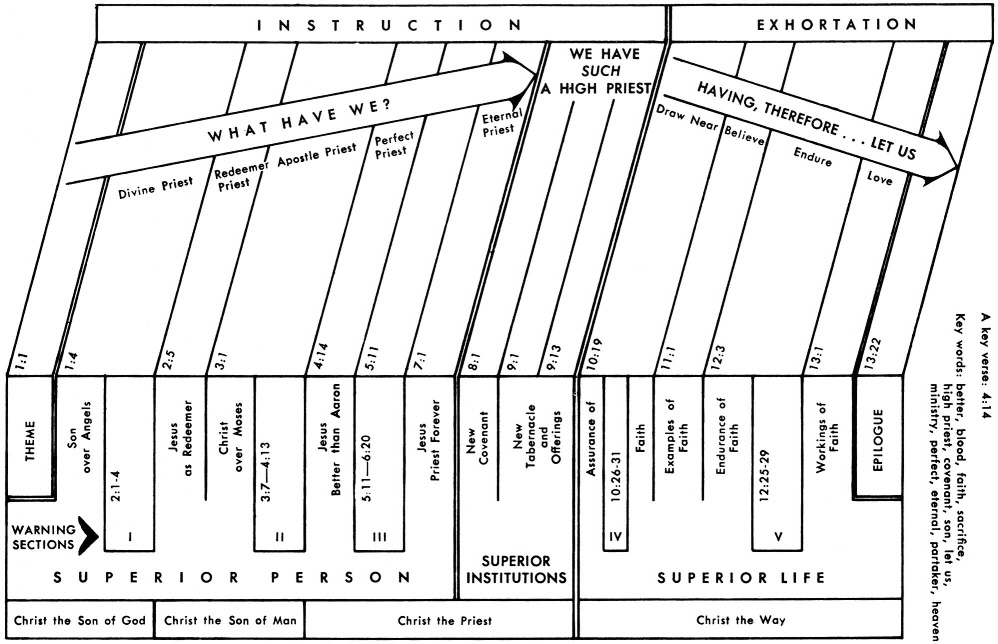
CONSIDER JESUS OUR GREAT HIGH PRIEST
Click chart to enlarge
Charts from Jensen's Survey of the NT - used by permission
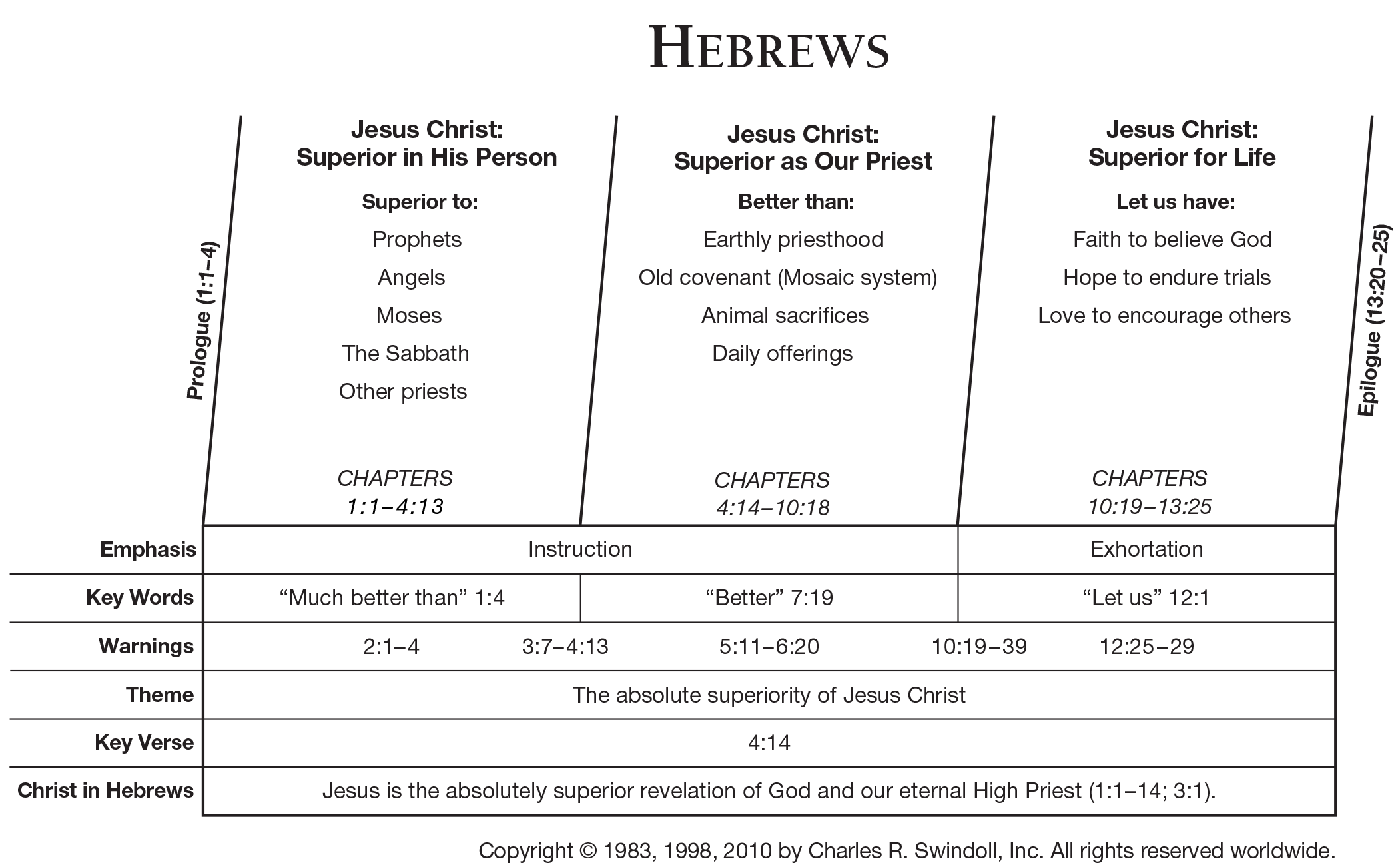
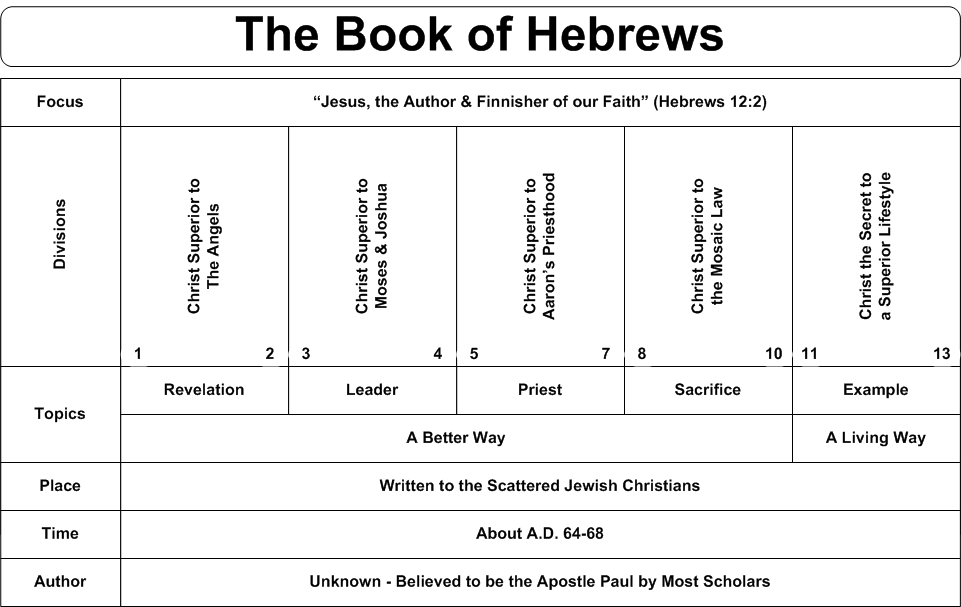
Swindoll's Chart, Interesting Pictorial Chart of Hebrews, Another Chart

|
The Epistle |
||||
| INSTRUCTION Hebrews 1-10:18 |
EXHORTATION Hebrews 10:19-13:25 |
|||
| Superior Person of Christ Hebrews 1:1-4:13 |
Superior Priest in Christ Hebrews 4:14-10:18 |
Superior Life In Christ Hebrews 10:19-13:25 |
||
| BETTER THAN PERSON Hebrews 1:1-4:13 |
BETTER PRIESTHOOD Heb 4:14-7:28 |
BETTER COVENANT Heb 8:1-13 |
BETTER SACRIFICE Heb 9:1-10:18 |
BETTER LIFE |
| MAJESTY OF CHRIST |
MINISTRY OF CHRIST |
MINISTERS FOR CHRIST |
||
|
DOCTRINE |
DUTY |
|||
|
DATE WRITTEN: |
||||

See ESV Study Bible "Introduction to Hebrews"
(See also MacArthur's Introduction to Hebrews)
Borrow Ryrie Study Bible
Hebrews 11:13 All these died in faith, without receiving the promises, but having seen them and having welcomed them from a distance, and having confessed that they were strangers and exiles on the earth. (NASB: Lockman)
Greek: Kata pistin apethanon (3PAPI) outoi pantes, me labontes (AAPMPN) tas epaggelias, alla porrothen autas idontes (3PPAI) kai aspasamenoi, (AMPMPN) kai homologesantes (AAPMPN) oti xenoi kai parepidemoi eisin (3PPAI) epi tes ges;
GNT Κατὰ πίστιν ἀπέθανον οὗτοι πάντες, μὴ λαβόντες τὰς ἐπαγγελίας ἀλλὰ πόρρωθεν αὐτὰς ἰδόντες καὶ ἀσπασάμενοι καὶ ὁμολογήσαντες ὅτι ξένοι καὶ παρεπίδημοί εἰσιν ἐπὶ τῆς γῆς.
Amplified: These people all died controlled and sustained by their faith, but not having received the tangible fulfillment of [God’s] promises, only having seen it and greeted it from a great distance by faith, and all the while acknowledging and confessing that they were strangers and temporary residents and exiles upon the earth. (Amplified Bible - Lockman)
Amplified (Revised): All these died in faith [guided and sustained by it], without receiving the [tangible fulfillment of God’s] promises, only having seen (anticipated) them and having welcomed them from a distance, and having acknowledged that they were strangers and exiles on the earth.
CSB These all died in faith without having received the promises, but they saw them from a distance, greeted them, and confessed that they were foreigners and temporary residents on the earth.
ESV These all died in faith, not having received the things promised, but having seen them and greeted them from afar, and having acknowledged that they were strangers and exiles on the earth.
KJV: These all died in faith, not having received the promises, but having seen them afar off, and were persuaded of them, and embraced them, and confessed that they were strangers and pilgrims on the earth.
Technical Note - KJV and NKJV add that persuaded of, but there is virtually no manuscript evidence for this reading.
NET These all died in faith without receiving the things promised, but they saw them in the distance and welcomed them and acknowledged that they were strangers and foreigners on the earth.
NIV All these people were still living by faith when they died. They did not receive the things promised; they only saw them and welcomed them from a distance. And they admitted that they were aliens and strangers on earth.
NLT: All these faithful ones died without receiving what God had promised them, but they saw it all from a distance and welcomed the promises of God. They agreed that they were no more than foreigners and nomads here on earth. (NLT - Tyndale House)
NLT (revision) All these people died still believing what God had promised them. They did not receive what was promised, but they saw it all from a distance and welcomed it. They agreed that they were foreigners and nomads here on earth.(NLT - Tyndale House)
Phillips: All these whom we have mentioned maintained their faith but died without actually receiving God's promises, though they had seen them in the distance, had hailed them as true and were quite convinced of their reality. They freely admitted that they lived on this earth as exiles and foreigners (Phillips: Touchstone)
Wuest: These all died dominated by faith, not having received the promises, but having seen them afar off and greeted them, also confessed that they were strangers, even those who had settled down alongside of a pagan population upon the earth.
Young's Literal: In faith died all these, not having received the promises, but from afar having seen them, and having been persuaded, and having saluted them, and having confessed that strangers and sojourners they are upon the earth,
- All these died in faith Ge 25:8; Ge 27:2, 3, 4; Ge 48:21; Ge 49:18,28,33; Ge 50:24
- Hebrews 11 Resources - Multiple Sermons and Commentaries
Related Passages:
Hebrews 11:39 And all these, having gained approval through their faith, did not receive what was promised,
Hebrews 6:12 so that you will not be sluggish, but imitators of those who through faith and patience inherit the promises.
Hebrews 10:36 For you have need of endurance, so that when you have done the will of God, you may receive what was promised.
Romans 4:21 and being fully assured that what God had promised, He was able also to perform.

LOOKING AT THE HORIZON
The patriarchs died looking by faith at the distant horizon, looking forward to the day when their heavenly promises would go from faith to sight. Dear believer, you need consider the lives of these great patriarchs "so that you will not be sluggish, but imitators of those who through faith and patience inherit the promises." (Heb 6:12+)
Note that beginning in Hebrews 11:13 and going through verse 16 the writer takes a break and instead of giving examples of saints who expressed faith, he comments on the nature of the faith that he has been illustrating in this individuals. Notice that one could go from Hebrews 11:12 to Hebrews 11:17 without skipping a beat.
As Charles Swindoll says "At this point, the writer of Hebrews sets aside the palette of paints he had been using to fill his canvas with examples of faith. He steps back, as it were, gestures at the procession of personalities he’s been painting, and makes a sweeping statement: “All these,” he says, “died in faith, without receiving the promises”. Wait . . . didn’t Abraham make it to the Promised Land? Didn’t Sarah have her promised child, Isaac? Yes, but what they experienced in this life was merely a foretaste, a shadow of things to come. Abraham didn’t receive the full promise, just a down payment. Abraham and Sarah had only one child—the promise was for descendants “innumerable as the sand which is by the seashore” (Heb 11:12). The land in which he sojourned was indeed the Promised Land, but he, Sarah, Isaac, and all their household lived there as “strangers and exiles on the earth” (Heb 11:13; cf. 1 Pet. 2:11). (SEE Insights on Hebrews)
All these died (apothnesko) in faith (pistis) - Literally - “According to faith died these all.” NIV says they "were still living by faith when they died." All these (always seek to practice the 5W/H questions! e.g., All who? Who are these?) - In context (which is king for interpretation) this reference refers to the recipients to whom the promises were made, those just mentioned in He 11:9-12, specifically the patriarchs of Israel, Abraham, Isaac, and Jacob (these also includes Sarah) and not all whom the writer had listed to this point. God's promise to Abraham (Abram) was passed to Isaac (Ge 26:2-5,24) and from Isaac it was passed to Jacob (Ge 28:10-15). This interpretation is supported by the fact that the promises began with Abraham (cf. Acts 7:17; Ro 4:13; Gal 3:14-18) and were passed on to Isaac (Ge 26:2-5,24) and Jacob (Ge 28:10-15). In addition, only those individuals fit the description in Heb 11:15 for Enoch did not die. See Hebrews 6:15. These people of faith didn’t know when they would inherit the promise. They had a life in the land, but did not possess the land.
Died (apothnesko) in faith (pistis) indicates they died still governed by faith — their entire life and death were marked by faith’s perspective. Faith was not a transient response but an enduring attitude. They died trusting, not having received. They died believing, not having seen. They died with hearts resting on the promises of God which they had not yet experienced. These saints lived in faith, died in faith, and left a testimony to faith. They died with the anchors of their faith still firmly attached to God's sure promises. How much better was it for them to die in faith, than to live by sight as the dead souls of the world do.
Those who died in faith passed from this world still trusting God’s promises though they had not received them. Their faith clung to the unseen reality of God’s word; therefore, their death was not defeat but fulfillment. What a stark contrast with the majority of this lost world who “live by sight” as those dead in their trespasses and sin (Eph 2:1+) Though physically alive, they are spiritually lifeless, only able to see what is temporal and blind to the eternal (cf. 2Co 4:18+). To say it somewhat paradoxically, it is far better to die in faith than to live in unbelief, for the faithful die to live forever, but the unbelieving live to die forever! Indeed, the truth is that those who died in faith are not dead, but now even more alive than they were during their life! And their dying in faith confirms that theirs was not a temporary belief but genuine, persevering, saving faith, the kind of faith that endures to the end (cf. Heb 3:6+; Heb 3:14+).
Donald Guthrie - The words, These all died in faith, imply that faith was their dominant characteristic to the end of their days. The words in faith (kata pistin) could more literally be translated 'according to faith', which shows faith to be the rule by which they lived and died. (BORROW Tyndale New Testament Commentaries – Hebrews)
R Kent Hughes comments on the phrase died in faith noting that "Death is the final test of faith, and they all passed with flying colors, living by faith right up to the last breath. The beauty of their dying was that they died in faith though never receiving the fullness of the universal blessing that had been promised. The reason they could do this was, they saw the unseen—they were certain of what they did not see. The patriarchs could see through the eye of faith the ultimate fulfillment of the promises, like sailors who become content they can see their final destination on the horizon. Land ahoy!" (SEE Hebrews: An Anchor for the Soul)
Charles Spurgeon says "The grave—what is it? It is the bath in which the Christian puts on the clothes of his body to have them washed and cleansed. Death—what is it? It is the waiting room where we robe ourselves for immortality; it is the place where the body, like Esther, bathes itself in spices that it may be fit for the embrace of its Lord. Death is the gate of life; I will not fear to die, then."
Faith faces death trusting God to fulfill His future promises,
even when circumstances seem to contradict those promises.
--Steven Cole
I agree with Jack Arnold who said "The Patriarchs possessed the title deed to the land because God had given it to them, but they did not actually possess one square foot of the land because it was occupied by the Canaanites. The land by right was Abraham’s, Isaac’s and Jacob’s, but they never received the land that God had given them. They died still believing the promise but they never actually possessed the land. They only possessed the land by faith and not in actuality. It is my opinion that one day God will resurrect Abraham, Isaac and Jacob and all believing Jews to possess this land, and this will take place in the millennium. Heaven belongs to the Christian while he is on earth because God has promised it to him, but the Christian does not actually possess it as yet. Christians have been promised by God that they have eternal life and that they are already seated with Christ in heavenly places. (Jn 10:28, Eph 2:4-7) One day every Christian will literally possess heaven and be with Christ forever. “For now we see in a mirror dimly, but then face to face ...” (1 Cor.13:12)." (Sermon)
The Westminster Shorter Catechism summarizes the Bible's teaching on what death does for a believer: "The souls of believers are at their death made perfect in holiness, and do immediately pass into glory, and their bodies, being still united to Christ, do rest in their graves till the resurrection" (Q/A 37).
Thomas Watson writes: A believer at death is freed from sin; he is not taken away in, but from his sins; he shall never have a vain, proud thought more; he shall never grieve the Spirit of God any more....Death smites a believer as the angel did Peter, and made his chains fall off (Acts 12:7). Believers at death are made perfect in holiness....Oh! what a blessed privilege is this, to be without spot or wrinkle; to be purer than the sunbeams; to be as free from sin as the angels! (Eph. 5:27). This makes a believer desirous to have his passport and to be gone; he would fain live in that pure air where no black vapours of sin arise. (Read The Death of the Righteous)
D L Moody comments on the fact that they all died in faith without receiving the promises - We ought in these days to have far more faith than Abel, or Enoch, or Abraham had. They lived away on the other side of the Cross. We talk about the faith of Elijah, and the patriarchs and prophets; but they lived in the dim light of the past, while we are in the full blaze of Calvary and the resurrection. When we look back and think of what Christ did, how He poured out His blood that men might be saved, we ought to go forth in His strength and conquer the world. Our God is able to do great and mighty things.
C H Spurgeon sees "all these" patriarchs as representative of all believers writing...“These all died in faith.” Believers constitute a class by themselves, — “These.” They are the people that dwell alone, and shall not be numbered among the nations. We see a great many distinctions in the world which God takes no notice of: there is neither Jew nor Gentile, bond nor free, in his sight. But there is a distinction which men think little of, which is greatly observed of God; and that is the distinction between them that believe and those that believe not. Faith puts you across the border most effectually, for it brings you out of darkness into marvelous light, from death to life, and from the dominion of Satan into the kingdom of God’s dear Son. It is the most important thing under heaven that we should know that we believe in God. The Holy Spirit puts believers by themselves, and speaks of them as “These.”...Dying In Faith. What does it mean? Does it not mean that, when they came to die, they had not faith to seek, but having had faith in life, they had faith in death? I will pronounce no opinion upon death-bed repentance. I have heard judgments far too sanguine, I have heard verdicts far too severe. Where we know little, we had better say little, but this much I may say: I would not like to lie upon a sick-bed, much less upon a dying bed, and have a Savior to seek there. (Hebrews 11:13,14 An Inscription for the Mausoleum of the Saints)
Spurgeon on all died in faith - They did die, although they had faith, for faith is not given to us that we should escape death, but that we may die in faith. God will not in every case hear our prayers for restoration to health. It is not true that if we gather together and pray for a sick man he will always be restored. No believer would die if that were the case, for every Christian man would find some friends in Christ to pray for his recovery. Saints die as well as sinners. David dies as well as Saul. He who leaned on the bosom of Jesus lived long, but died at last—died as surely as Judas did, though in a better style. “It is destined for people to die once” (Heb 9:27). Two have entered into glory by another way, but only two. There shall come a day when we who are alive and remain shall not see death, but that day is not yet.
Bruce Barton - These people of faith died without receiving all that God had promised, but they never lost their vision of heaven ("a better country—a heavenly one," Hebrews 11:16NIV). Many Christians become frustrated and defeated because their needs, wants, expectations, and demands are not immediately met when they believe in Christ. They become impatient and want to quit. They expect instant, not distant, answers. Take courage from these heroes of faith who lived and died without seeing the fruit of their faith on earth and yet continued to believe (see 11:35-39). (SEE Hebrews - Page 186)
Ray Pritchard - John Wesley, the father of the Methodist movement, used to say, “Our people die well.” Dying well is something of a lost art today. We don’t talk about it or preach about it or think about it, and we certainly don’t train our people in how to do it. We have “grief recovery” classes that help those who have lost loved ones. But when was the last time you attended a class on how to die well? The Puritans saw things differently. They preached a great deal to their people about how to die well—full of faith and hope and joy in the Lord. By this they did not mean how to plan your own death, nor did they intend to suggest that you could somehow avoid the sudden death that comes to so many people. But they meant to train their people so that they would live with conscious, abiding faith in Jesus Christ to the very end of life, and that they would give a joyful testimony to the watching world they left behind.
🙏 Beloved, may God grant that we all live well (according to faith 2Co 5:7+ He 6:11,12+) that we will like the patriarchs "die well", according to faith, even as did the NT saints like Paul who was confident that "He (the Lord) is able to guard what I have entrusted to Him until that day." (2Ti 1:12+)
Gil Rugh applies this passage suggesting that "for most of us, there might be some discontent with God when, after years and years in a foreign land, none of His promises came true in our lifetimes. Abraham left his home, and witnessed the death of his wife (Ge 23:1,2) in this foreign land; but did this curtail his faith? No. He accepted his circumstance, and continued to trust the Lord and as He 11:13 proclaims, he 'died in faith.' (By Faith Abraham)
LIVING FAITH WILL GIVE US
DYING FAITH!
Faith (pistis) feeds on the word of God. Without a steady diet it gets weaker and weaker. If you want faith that gives you to see your eternal home with 20/20 vision , make sure you are taking in a steady diet of the Word including many of the over 3000 promises of God. Remember "So faith comes from hearing, and hearing by the word of Christ. " (Ro 10:17)
In faith in Hebrews 11:13 literally this reads "according to faith." What does this mean?
Vine comments that the idea is that they died "in keeping with their life of faith." And so they died, as they lived.
Wuest feels that the idea is that "These all died dominated by faith." That is, their strong, persevering faith was a controlling characteristic of their life.
Spurgeon comments that "In faith they lived. It was their comfort, their guide, their motive, and their support, and in the same spiritual grace they died, ending their life-song in the sweet strain in which they had so long continued. They did not die resting in the flesh or upon their own achievements; they made no advance from their first way of acceptance with God but held to the way of faith to the end.
In a sermon entitled The Two Pivots on Hebrews 11:16 Spurgeon writes ...
Notice that it is said, “These all died in faith,” so that they did not believe in God for a little while, and then become unbelievers; but, throughout the whole of their lives, from the moment when they were called by God’s grace, they continued to believe Him, they trusted Him till they came to their graves; so that this epitaph is written over the mausoleum where they all lie asleep, “These all died in faith.” Ah! my beloved brother’s and sisters, it is very easy to say, “I believe,” and to get very enthusiastic over the notion that we have believed; but so to believe as to persevere to the end,— this is the faith which will save the soul. “He that shall endure unto the end the same shall be saved.”
The faith that many waters cannot drown and the fiercest fires cannot burn,— the faith that plods on throughout a long and weary life,— the faith that labors on, doing whatever service God appoints it,— the faith that waits patiently, expecting the time when every promise of God shall be fulfilled to the letter when its hour has come,— that is the faith which, if it be in a man, makes him such a man that God is not ashamed to be called his God (Heb 11:16). I put it to every one of you, have ’you a faith that will hold on and hold out,— not a faith that starts with a fine spurt, but a faith that runs from the starting-place to the goal? Some of you, I know, have believed in God these twenty, thirty, forty, or even fifty years. Just before I came to this service, I stood by the bedside of a dear brother who is the nearest to Job of any man I ever saw, for he is covered from head to foot with sore blains (pustules, blisters); I might almost say, “wounds, and bruises, and putrefying sores;” and yet he is as happy as anyone among us, joyful and. cheerful as he talks about the time when he shall be “with Christ, which is far better.” Oh, that is the faith we want! “These all died in faith,” “wherefore God is not ashamed to be called their God.”
He is not the God of apostates, for He hath said, “If any man draw back, My soul shall have no pleasure in him.” (Heb 10:38+) If he has put his hand to the plough, and. looks back, he is not worthy of the kingdom. (Lk 9:62+ - see comments related to "Remember Lot's wife") It is the man who steadily, and perseveringly, resting in his God, and believing Him against all that may be said by God’s foes, holds on until he sees the King in his beauty in the land which is very far off. Of such a man it may be truly said that God is not ashamed to be called his God. (Read full sermon Hebrews 11:16 The Two Pivots)
The writer of Hebrews wrote a similar description of Noah who acted on God's warning even though he could not see it at the time it was given and as a result he "became an heir of the righteousness which is according to faith (kata pistis)." (Heb 11:7+)
Comment: In short Noah was "saved by grace through faith" in the promises of God, specifically the promise that He would save Noah and his family in the Ark, a beautiful picture of the "Ark" of our salvation, Christ Jesus. Are you in the Ark? Don't wait until the flood waters begin to rise before you try to get into the Ark of Christ, for then it will be too late for the LORD will close the door (cp Ge 7:16, cp Lk 16:24 25+, cp Mt 25:10)
Jesus warned: But of that day and hour no one knows, not even the angels of heaven, nor the Son, but the Father alone. 37 For the coming of the Son of Man will be just like the days of Noah. 38 For as in those days which were before the flood they were eating and drinking, they were marrying and giving in marriage, until the day that Noah entered the ark, 39 and they did not understand until the flood came and took them all away; so shall the coming of the Son of Man be. 40 Then there shall be two men in the field; one will be taken, and one will be left. 41 Two women will be grinding at the mill; one will be taken, and one will be left. 42 Therefore be on the alert (present imperative = command calling for this to be one's continual attitude), for you do not know which day your Lord is coming. (Mt 24:36-42+)
Steven Cole explains that the idea according to faith indicates that "Faith was the dominant characteristic of their lives, right up to the point of death. None of them realized the promise of the land of Canaan, or the promise of innumerable descendants (eg Ge 15:5 6). They viewed themselves as strangers and exiles on earth. If they had doubted God’s promise (Ed: While their faith was not perfect and they had moments of doubting, they did not manifest a habitual practice of doubting like James describes Jas 1:6, 7+ Jas 1:8+), they could have gone back to their homeland. “But as it is, they desire a better country, that is, a heavenly one” (He 11:16). And so they died well, “according to faith” in the yet unfulfilled, unseen promises of God. As such, they are examples of how to live and die according to faith as exiles on earth, while we pant after a better country in heaven. Our text makes two main points: (Hebrews 11:13-16 Desiring a Better Country)
Matthew Poole adds that "they did not only live according to faith, walking with, worshipping of, and waiting on God, testifying against sin, but finished their course by dying according to faith; by faith, as the instrumental efficient of it; in faith, as the regulating cause of it; according to faith, as in the state of believing. Faith was immortal in them as their souls, making their death a covenant dissolution, Lk 2:29, a voluntary, hopeful, blessed death, as 2Co 5:8+ 1Th 4:13+.
Faith "is the assurance of things hoped for, the conviction of things not seen." (He 11:1+)
Faith sees the invisible (He 11:26, 27+, 2Co 5:7+, 2Co 4:18+) and believes the impossible (cp Abraham in Ro 4:19 20 21+)
“E’en now by faith we join our hands
With those that went before; "
And greet the blood-besprinkled bands
On the eternal shore.”
Without receiving (lambano) the promises (epaggelia) - "but not having received the tangible fulfillment of [God’s] promises" (Amplified) The promises (epaggelia) refers to God's commitment or announcement of future blessing and in context refers primarily to God's covenant promises to Abraham, Isaac and Jacob. They in effect had the "title deed," but had not yet received the land (cf Ge 13:15+). The promises also included descendants without number, a nation and their descendants as a blessing to all nations. (Ge 12:1-3) Their faith was not anchored in immediate possession but in confident expectation. They trusted the Promiser, even when the promise was delayed (cf. Ro 4:20-21). Their faith looked beyond time and death to the ultimate realization of God’s redemptive plan in Christ and His kingdom.
Ray Pritchard - What he means is, all the heroes of faith lived and died without ever fully entering into what God had promised them. They were like sailors who saw the shoreline a great distance away, and stood at the rail waving and shouting and saying, “See, there it is! What a beautiful land! And look at all those people! They are waving back at us.” The sailors see the land, but their ship never reaches the shore. So they sail on, left with their memories of a harbor they never seem to reach. (Why We Keep Believing)
Donald Guthrie on Without receiving the promise - In spite of not having received the promise, they had in a measure experienced it: They had seen it ... from afar, as men who saw the objective on the horizon, but never actually reached it in this life. This is a remarkable example of the statement in verse 1 that 'faith is the conviction of things not seen', except that the conviction has now become so strong that the 'not seen' has become seen (BORROW Tyndale New Testament Commentaries – Hebrews)
Leon Morris - We must be careful how we understand this, for the author has already said that Abraham "received what was promised" (Heb 6:15+). Humanly speaking, when there was no hope of having a son, he saw Isaac born. The promise, however, meant far more than that. Actually, it is the fullness of the blessing that is in mind in Heb 11:13. The best that happened to the saints of old was that they had glimpses of what God had for them. Perhaps it will help us to see something of what is meant if we recall Moses' view of the Promised Land. He prayed that God would let him enter the land (Deut 3:23-25), but the most God would permit was for him only to see it (Deut 3:26-28; 34:1-4). The patriarchs did no more than "see" their equivalent of the Promised Land. "See" can be used of various kinds of sight. Here it is plainly an operation of faith that is in mind, and the word points to an inner awareness of what the promises meant. In their attitude, the patriarchs showed that they knew themselves to be no more than "aliens and strangers." The latter term means those living in a country they do not belong to, i.e., resident aliens. (BORROW Expositor's Bible Commentary PAGE 996)
🙏 THOUGHT - Read the Word of God to Moses in Dt 32:49-52 = "Go up to this mountain of the Abarim, Mount Nebo, which is in the land of Moab opposite Jericho, and look at the land of Canaan, which I am giving to the sons of Israel for a possession. Then die on the mountain where you ascend, and be gathered to your people, as Aaron your brother died on Mount Hor and was gathered to his people, because you broke faith with Me in the midst of the sons of Israel at the waters of Meribah-kadesh, in the wilderness of Zin, because you did not treat Me as holy in the midst of the sons of Israel. For you shall see the land at a distance, but you shall not go there, into the land which I am giving the sons of Israel." Now with God's Words to Moses ringing in your ears, pause and play this beautiful instrumental song Mount Nebo by Twila Paris and see if it does not emote from you a sense of the pathos that Moses must have felt as he gazed out over the promised land that he had been journeying toward for over 40 years! I almost cry every time I hear this song as I think of the pain he must have felt that day!
Spurgeon on without receiving the promises - They had received a great deal, but they had not received the fullness of the promises. Abraham had not beheld his seed so many as the sands upon the seashore. Neither Isaac nor Jacob had ever seen the Shiloh, in whom all the nations of the earth are blessed. No, they had not received the promises. And you and I have not received all the promises. We have received a great deal, but there are certain promises that we have not received yet. The coming, the glorious coming, which is the brightest hope of the church, when the Lord “will descend from heaven with a shout of command, with the voice of the archangel and with the trumpet of God” (1Th 4:16+)—we have not received that as yet. And heaven itself, with all its splendor, its white robes and palms of victory, we have not yet received. We are looking for these. We do not die in the fruition of these. We die in faith, expecting that we shall enter upon the fulfillment of these promises.
Barnes - The covenants of promise were those various arrangements which God made with his people, by which he promised them future blessings, and especially by which he promised that the Messiah should come. To be in possession of them was regarded as a high honour and privilege; and Paul refers to it here to show that, though the Ephesians had been by nature without these, yet they had now been brought to enjoy all the benefits of them. (Albert Barnes. Barnes NT Commentary)
Richard Phillips - This verse might seem to express a tragedy. After all, Abraham and those with him spent their whole lives longing for things they were promised, longing to have a home of their own. They trusted God for this and believed the promises he gave them, yet they died without having received them. What a dismal story! What a poor commendation for the faith they represented! If this is what our faith is about, dying with only unfulfilled hopes, then surely we are, as Paul said, "of all people most to be pitied" (1 Cor. 15:19). One thing this tells us, however, is that Christianity is not a religion focused on the earth and this present life. The Scriptures make this point over and over again. Paul says, "Set your minds on things that are above, not on things that are on earth" (Col. 3:2). Jesus taught, "Do not lay up for yourselves treasures on earth, where moth and rust destroy and where thieves break in and steal, but lay up for yourselves treasures in heaven, where neither moth nor rust destroys and where thieves do not break in and steal" (Matt. 6:19-20). This directly confronts a view that is quite prevalent in our time: a packaged version of Christianity that offers mainly temporal benefits. It goes like this: "If you trust Jesus, you will do better at work, you will be a better husband or wife or parent, you will have less stress and lose weight." Certainly, Christianity does give us spiritual resources that transform this present life— resources like righteousness, peace, and joy. But how easily we forget that to be a Christian means to be persecuted in this world. Our blessings are spiritual rather than material (see Eph. 1:3). To be a Christian means living as an alien and a pilgrim; it means not being able to fit in with others who are slaves to sin; it means denying yourself and picking up your cross; it means a life of struggle and fellowship in the sufferings of Christ. The Christian life means peace with God, but war with the flesh, the world, and the devil. The primary blessings Christianity offers do not lie in this life at all, but in the life to come, in the resurrection from the dead. Indeed, even our present blessings, abundant and wonderful as they are, are located in heaven and are accessed by the exercise of faith. It never crossed Paul's mind that to be a Christian meant happiness and health and wealth in this present life. Instead, he admitted that if we do not receive great blessings beyond the grave, we would be better off living like hedonists, enjoying the temporary pleasures of sin. "If the dead are not raised," he argued, "let us eat and drink, for tomorrow we die" (1 Cor. 15:32). This is essentially how the world lives, but it is not the way of the Christian. The Christian realizes that even at the end of this life, the blessings we have hoped for will not yet have been received. We are pilgrims here, and our homeland, our rest, our treasure lies in the land across the grave. Hebrews 11:13 says, "These all died in faith, not having received the things promised, but having seen them and greeted them from afar." Christians are presently filled with joy because of the certainty of what lies ahead; by faith we greet and enjoy the things promised for the life to come. It is obvious, therefore, that the Christian has a vastly different view of death than does the non-Christian. I mentioned the apostle Paul's emphasis on the life to come; that emphasis shaped his view of death. He wrote his Letter to the Philippians from a Roman jail, fully aware that he might be put to death. His attitude to all this was wonderfully straightforward: "For to me to live is Christ, and to die is gain" (Phil. 1:21). Paul lived in this world as a servant of Christ, with a longing for Christ, and therefore death became the means by which his heart's desire could be achieved. Paul was not suicidal; he was willing to live as long as the Lord intended. But far from fearing death, he saw it as the crowning moment of his faith. (Hebrews Commentary)
Died (599)(apothnesko from apo = marker of dissociation implying a rupture from a former association, separation, departure, cessation + thnesko = die) literally means to die off and can speak of literal physical death (Ro 6:9+) but in this context speaks figuratively (metaphorically) of a believer's death to sin (Ro 6:2+, Ro 6:7+, Ro 6:8+, Col 3:3+), self, Satan, the law (Ro 7:6+, Gal 2:19) and the world (Col 2:20+, cp Gal 6:14+ - crucified used instead of died) which was effected when Christ was crucified and when by faith we believed in Him and in God's reckoning (albeit a "mysterious" teaching) were crucified with Him (Ro 6:6+).
It is notable that as life was never meant to be merely existence, for indeed death which is the antonym of life does not mean non-existence. It is important to note that to die does not mean one is annihilated as some falsely teach (including even some who classified as "evangelicals"! Be a Berean - Acts 17:11+ when you read anything but the Bible -- and this warning applies to the site you are currently reading!). Everyone who has every been born will continue to exist, either in the presence of God or to experience conscious existence in separation from God (see 2Th 1:9+).
Faith (4102)(pistis) is synonymous with trust or belief and is the conviction of the truth of anything, but in Scripture speaks of belief respecting man's relationship to God and divine things, generally with the included idea of trust and holy fervor born of faith and joined with it. As pistis relates to God, it is the conviction that God exists and is the Creator and Ruler of all things well as the Provider and Bestower of eternal salvation through Christ. As faith relates to Christ it represents a strong and welcome conviction or belief that Jesus is the Messiah, through Whom we obtain eternal salvation and entrance into the Kingdom of Heaven. Stated another way, eternal salvation comes only through belief in Jesus Christ and no other way. For more discussion on the meaning of faith see commentary on Hebrews 11:1-2.
Faith is believing that God will keep His promises, despite circumstances that seem to be to the contrary! True faith that saves one's soul includes at least three main elements - (1) firm persuasion or firm conviction, (2) a surrender to that truth and (3) a conduct emanating from that surrender. In sum, faith shows itself genuine by a changed life.
W E Vine comments on three prepositions that precede faith - In Romans the frequent phrase is “of” or “from” faith (ek), indicating faith as the source of righteousness, e.g., Ro 1:17; Ro 9:30; Ro 10:6, and by faith (dia), signifying the instrument. Here (Heb 11:7) it is kata, “according to” faith, that is, in agreement with, or consistent with, faith.
The writer of Hebrews tightly links faith with obedience (Heb 3:18, 19). Do not misunderstand -- Faith alone saves but the faith that saves is not alone.
Faith is relying on what God has done rather than on our own efforts. It may surprise you that the word faith is rarely mentioned in the Old Testament (only 4x in NAS = Dt 32:51 Job 39:12 Ps 146:6 Hab 2:4). The word trust is used frequently (79x in 78v in NAS). In addition, and verbs like believe (39x in 38v in NAS) and rely (14x in 11v in NAS) are used to express the right attitude to God. The classic example is Abraham, whose faith was reckoned as righteousness (Ge 15:6 - See word study on Hebrew word for "believe" = 'aman). At the heart of the Christian message is the story of the cross: Christ's dying to bring salvation. Faith is an attitude of trust in which a believer receives God's good gift of salvation (Acts 16:30,31) and lives in that awareness thereafter (Gal 2:20+; cp He 11:1+).
Alexander Maclaren said that Faith is the hand that grasps. It is the means of communication, it is the channel through which the grace which is the life, or, rather, I should say, the life which is the grace, comes to us. It is the open door by which the angel of God comes in with his gifts. It is like the petals of the flowers, opening when the sunshine kisses them, and, by opening, laying bare the depths of their calyxes to be illuminated and coloured, and made to grow by the sunshine which itself has opened them, and without the presence of which, within the cup, there would have been neither life nor beauty. So faith is the basis of everything; the first shoot from which all the others ascend...Faith works. It is the foundation of all true work; even in the lowest sense of the word we might almost say that. But in the Christian scheme it is eminently the underlying requisite for all work which God does not consider as busy idleness...
Although I do not agree with all of William Barclay's theology, he offers a sound definition of Biblical (saving) faith writing that "Faith begins with receptivity. It begins when a man is at least willing to listen to the message of the truth. It goes on to mental assent. A man first hears and then agrees that this is true. But mental assent need not issue in action. Many a man knows very well that something is true, but does not change his actions to meet that knowledge. The final stage is when this mental assent becomes total surrender. In full-fledged faith, a man hears the Christian message, agrees that it is true, and then casts himself upon it in a life of total yieldedness. (The Daily Study Bible Romans 1)
Promises (1860) (epaggelia/epangelia from epí = intensifies verbal meaning + aggéllo = to tell, declare) originally referred to an announcement or declaration but in later Greek came to mean a declaration to do something with the implication of obligation to carry out what is stated (thus a promise or pledge). Epaggelia was primarily a legal term denoting summons, a promise to do or give something.
EPAGGELIA IN HEBREWS - Heb. 4:1; Heb. 6:12; Heb. 6:15; Heb. 6:17; Heb. 7:6; Heb. 8:6; Heb. 9:15; Heb. 10:36; Heb. 11:9; Heb. 11:13; Heb. 11:17; Heb. 11:33; Heb. 11:39
Hebrews 4:1 Therefore, let us fear if, while a promise remains of entering His rest, any one of you may seem to have come short of it.
Hebrews 6:12 so that you will not be sluggish, but imitators of those who through faith and patience inherit the promises.
Hebrews 6:15 And so, having patiently waited, he obtained the promise.
Hebrews 6:17 In the same way God, desiring even more to show to the heirs of the promise the unchangeableness of His purpose, interposed with an oath,
Hebrews 7:6 But the one whose genealogy is not traced from them collected a tenth from Abraham and blessed the one who had the promises.
Hebrews 8:6 But now He has obtained a more excellent ministry, by as much as He is also the mediator of a better covenant, which has been enacted on better promises.
Hebrews 9:15 For this reason He is the mediator of a new covenant, so that, since a death has taken place for the redemption of the transgressions that were committed under the first covenant, those who have been called may receive the promise of the eternal inheritance.
Hebrews 10:36 For you have need of endurance, so that when you have done the will of God, you may receive what was promised.
Hebrews 11:9 By faith he lived as an alien in the land of promise, as in a foreign land, dwelling in tents with Isaac and Jacob, fellow heirs of the same promise;
Hebrews 11:13 All these died in faith, without receiving the promises, but having seen them and having welcomed them from a distance, and having confessed that they were strangers and exiles on the earth.
Hebrews 11:17 By faith Abraham, when he was tested, offered up Isaac, and he who had received the promises was offering up his only begotten son;
Hebrews 11:33 who by faith conquered kingdoms, performed acts of righteousness, obtained promises, shut the mouths of lions,
Hebrews 11:39 And all these, having gained approval through their faith, did not receive what was promised,In Acts Luke records this instructive passage...And we preach to you the good news of the promise made to the fathers, (Abraham, Isaac, Jacob to whom and through whom the Abrahamic Covenant passed) that God has fulfilled this promise to our children in that He raised up Jesus, as it is also written in the second Psalm, 'THOU ART MY SON; TODAY I HAVE BEGOTTEN THEE.' (Acts 13:32-33+)
In Romans Paul speaks of the promise of the Abrahamic Covenant writing... For if those who are of the Law are heirs, faith is made void and the promise is nullified; for the Law brings about wrath, but where there is no law, neither is there violation. For this reason it is by faith, that it might be in accordance with grace, in order that the promise may be certain to all the descendants, not only to those who are of the Law, but also to those who are of the faith of Abraham, who is the father of us all, (as it is written, "A FATHER OF MANY NATIONS HAVE I MADE YOU") in the sight of Him whom he believed, even God, who gives life to the dead and calls into being that which does not exist. (Ro 4:14-17+)
Illustration of faith - When missionary John Paton was translating the Scripture for the South Sea islanders, he was unable to find a word in their vocabulary for the concept of believing, trusting, or having faith. He had no idea how he would convey that crucial concept to them. One day while in his hut translating, a native came running up the stairs into Paton's study and flopped in a chair, exhausted. He said to Paton, "It's so good to rest my whole weight in this chair." John Paton had his word: Faith is resting your whole weight on God. That word went into the translation of their New Testament and helped bring that civilization of natives to Christ. Believing is putting your whole weight on God. If God said it, then it's true, and we're to believe it. (See also Heaven Born are Heaven Bound or Missionary's Return)
ILLUSTRATION - Many years ago, a ship known as Empress of Ireland went down with 130 Salvation Army officers on board, along with many other passengers. Only 21 of the Salvation Army people survived. Of the 109 that drowned, not one had a life preserver. Many of the survivors told how these brave people, seeing that there were not enough life preservers, took off their own and gave them to others, saying, “I know Jesus, so I can die better than you can!” NOW THAT IS DYING IN FAITH TO THE VERY LAST BREATH!
ILLUSTRATION - NOT HOME YET - (Play song) - Just after the turn of the century, pioneer missionary Henry C. Morrison often told of coming home from one of his many travels, having carried the message of the gospel to foreign lands. He arrived in New York aboard the same ship that brought President Theodore Roosevelt from one of his safaris in Africa. Thousands swarmed the docks to greet the illustrious hunter, but not a person was there to welcome Morrison. "Aha!" said the devil. "See how they greet the men of the world, and you—one of God's preachers—do not even have one person to meet you." He boarded the train for his home in Wilmore, Kentucky, and after several weary and lonely hours arrived at the station. No one from his family met him, for there had been a delay in information concerning his time of arrival. His heart ached as he rode alone in a hired carriage to his house. After all, he had spent four decades in the Lord’s service. Humanly speaking, he had reason to complain; however, the Lord impressed upon him this thought: "Henry, you are not Home yet!" His lord said unto him, "Well done, good and faithful servant; thou hast been faithful over a few things, I will make thee ruler over many things. Enter thou into the joy of thy lord." (Matthew 25:23)
At death you won't leave home.
You will go home!
ILLUSTRATION OF FAITH - George Müller (1805-1898) was a Christian missionary evangelist and a coordinator of orphanages in Bristol, England. Through his faith and prayers (and without asking for money) he had the privilege of caring for over 120,000 orphan children. He also traveled over 200,000 miles (by ship) to preach the Gospel of Jesus Christ in 42 countries and to challenge believers about world missions and trusting God. In his journals, Müller recorded miracle-after-miracle of God’s provision and answered prayer:
One morning, all the plates and cups and bowls on the table were empty. There was no food in the larder and no money to buy food. The children were standing, waiting for their morning meal, when Müller said, “Children, you know we must be in time for school.” Then lifting up his hands he prayed, “Dear Father, we thank Thee for what Thou art going to give us to eat.” There was a knock at the door. The baker stood there, and said, “Mr. Müller, I couldn’t sleep last night. Somehow I felt you didn’t have bread for breakfast, and the Lord wanted me to send you some. So I got up at 2 a.m. and baked some fresh bread, and have brought it.” Mr. Müller thanked the baker, and no sooner had he left, when there was a second knock at the door. It was the milkman. He announced that his milk cart had broken down right in front of the orphanage, and he would like to give the children his cans of fresh milk so he could empty his wagon and repair it.
DYING IN FAITH - Spurgeon's devotional from Morning and Evening - "These all died in faith." Hebrews 11:13
Behold the epitaph of all those blessed saints who fell asleep before the coming of our Lord! It matters nothing how else they died, whether of old age, or by violent means; this one point, in which they all agree, is the most worthy of record, they all died in faith. In faith they lived-it was their comfort, their guide, their motive and their support; and in the same spiritual grace they died, ending their life-song in the sweet strain in which they had so long continued. They did not die resting in the flesh or upon their own attainments; they made no advance from their first way of acceptance with God, but held to the way of faith to the end. Faith is as precious to die by as to live by.
Dying in faith has distinct reference to the past. They believed the promises which had gone before, and were assured that their sins were blotted out through the mercy of God.
Dying in faith has to do with the present. These saints were confident of their acceptance with God, they enjoyed the beams of his love, and rested in his faithfulness.
Dying in faith looks into the future. They fell asleep, affirming that the Messiah would surely come, and that when He would in the last days appear upon the earth, they would rise from their graves to behold Him. To them the pains of death were but the birth-pangs of a better state.
Take courage, my soul, as thou readest this epitaph (a brief statement commemorating or epitomizing a deceased person or something past).
Thy course, through grace, is one of faith, and sight seldom cheers thee; this has also been the pathway of the brightest and the best.
Faith was the orbit in which these stars of the first magnitude moved all the time of their shining here; and happy art thou that it is thine. Look anew to-night to Jesus, the Author and Finisher of thy faith (He 12:2+), and thank Him for giving thee like precious faith with souls now in glory.
The Vision of Faith - The characteristic of those living by faith is that they have a "Visionary Faith," they see the promises from far off.
ILLUSTRATION - Two men are on a cruise ship looking over the edge - one looks out and only sees miles, miles of water but the other sees fishing boats. What was the difference? One has a telescope. Well The Bible is the telescope through which faith looks into the distant future! Faith is the eye of the soul, the organ by which we see God's Promises (and there are some 3000+ precious and magnificent promises and all are "Yea and amen in Christ" Through our vision with eyes of faith we get a proper perspective on this short time on earth versus the time forever in the future. PERSPECTIVE defined as (1) A particular attitude toward or way of regarding something; a point of view. (2) The appearance of things relative to one another as determined by their distance from the viewer (3) the capacity to view things in their true relations or relative importance. Jonathan Edwards America's greatest theologian prayed "O Lord, please stamp eternity on my eyeballs!” Jonathan Edwards was saying that he DESIRED that every choice he made WOULD BE ASSESSED IN THE CONTEXT OF ITS POTENTIAL ETERNAL CONSEQUENCES. Dearly beloved, may that be our prayer also. Yes Lord, stamp eternity on our eyeballs. Give us an ETERNAL PERSPECTIVE. Amen
Hebrews 11:13-16 Our citizenship is in heaven. And we eagerly await a Savior from there, the Lord Jesus Christ. - Philippians 3:20-21+
TODAY IN THE WORD - An ad placed in a London newspaper by Arctic explorer Ernest Shackleton drew thousands of responses, even though the ad made this offer: “Men wanted for hazardous journey. Small wages, bitter cold, long months of complete darkness, constant danger, safe return doubtful.” Shackleton’s goal was to reach the South Pole and prove that it was on land rather than beneath the Arctic Ocean. People will give up a lot when they believe the goal they’re sacrificing for is worth it. The heroes mentioned in the early verses of Hebrews 11 were willing to give up whatever it took to follow God. We could call this the perspective of faith, and it’s the only way to live. The opposite of this faith (with an eternal perspective) is to live only for this life--to pile up all the possessions we can and enjoy them while we can. In Jesus’ story of the rich man and Lazarus, Abraham said to the rich man at his death, “Remember that in your lifetime you received your good things” (Luke 16:25+). But all of the man’s wealth did not prepare him for eternity.
John Ortberg popular author and evangelical pastor wrote that "Career successes and failures—which look so huge in my day-to-day life—take on a much smaller look from an eternal perspective."
It’s possible to read today’s verses and feel sorry for these people of faith who didn’t receive everything God promised them. But the writer is making a positive statement, not a complaint. The idea is that these people were still going strong in the Lord and full of faith when they died. They were content to be aliens without a country and pilgrims (“strangers”), always on the move, because they believed that when God makes a promise, it’s as good as done (v. 13). Abraham, for example, left behind his citizenship papers and a settled existence in Ur to trust God and travel to Canaan on the strength of nothing but God’s command. Abraham and the others didn’t have the Bible’s teaching on heaven that we have, but they knew the God of heaven. And that’s where they anchored their hope (Heb. 6:19). Living by faith may mean that we settle for a little less here on earth.
We are to have an eternal perspective on material possessions rather than focusing on the temporary prosperity of the wicked. The “Asaph” who wrote Psalm 73 went through a period of doubt and disillusionment when he envied “the prosperity of the wicked” (Ps 73:3). However, when he was worshiping in the tabernacle, he regained an eternal perspective. What the wicked had in this life would never bring ultimate fulfillment and certainly not eternal life. With this new insight, Asaph wrote these powerful words: “Who do I have in heaven but You? And I desire nothing on earth but You” (Ps 73:25).
Jesus reiterated what Asaph had discovered: -- Do not store up for yourselves treasures on earth, where moth and rust destroy, and where thieves break in and steal. 20“But store up for yourselves treasures in heaven, where neither moth nor rust destroys, and where thieves do not break in or steal; 21 for where your treasure is, there your heart will be also. (Mt 6:19-21) NOW THAT'S PROPER ETERNAL PERSPECTIVE!
Peter adds we have “an inheritance which is imperishable and undefiled and will not fade away, reserved in heaven for you, 5who are protected by the power of God through faith for a salvation ready to be revealed in the last time.” (1 Pet 1:4-5).
Jesus ended his discussion on anxiety declaring that we "seek first His kingdom and His righteousness, and all these things will be added to you." (Mt 6:33)
Alexander Maclaren - Living or dying, faith and hope must stay themselves on God’s word. Happy they whose closing eyes see the form of the King, and whose last thoughts are of God’s faithful promise l Happy they whose forecasts of the future, nearer or more remote, are shaped by His word! Happy they who, in the triumphant energy of such a faith, can with dying lips proclaim that His promises overlap, and contain, all their salvation and all their desire!
THE FEEDING OF FAITH - John Piper - Romans 10:17 "Please Feed Me More!" The Cry of Dying Faith
January 7, 1997 | by John Piper | Topic: Faith
Faith feeds on the word of God. Without a steady diet it gets weaker and weaker. If you are dissatisfied with your Christian courage and joy and purity of heart, check the way you are feeding your faith.
Compare the way you eat. Suppose that you start the day with a glass of orange juice. It’s good, and good for you. It takes you maybe five minutes to drink it, if you read the newspaper at the same time. Then you go off to work or school. You don’t eat anything else until the next morning. And you have another glass of juice. And so you go on drinking one glass of juice a day until you drop.
That’s the way a lot of Christians try to survive as believers. They feed their faith with five minutes of food in the morning, or evening, and then don’t eat again until 24 hours later. Some even skip one or two mornings and don’t give their faith anything to eat for days.
Now the effect of starving your faith is that faith starves. Not hard to understand. And when faith is starving, it is weak and not able to do much. It has a hard time trusting God and worshipping and rejoicing and resisting sin. It is gasping and stumbling.
But someone may say, “How do you know faith needs the food of the word to thrive and grow?” Well, there are some biblical clues.
First, Romans 10:17 says, “Faith comes by hearing and hearing by the word of Christ.” If faith comes by the word, it goes by the absence of the word.
Second, Psalm 78:5-7 says that God “appointed a law in Israel, which he commanded our fathers, that they should teach them to their children…that they should put their confidence in God.” In other words, the aim of teaching the word of God to our children is to foster confidence (that is, faith) in God. Thus faith feeds on the word of God.
Third, Proverbs 22:18-19 says, “It will be pleasant if you keep [the words of God] within you, that they may be ready on your lips. So that your trust may be in the Lord, I have taught you today, even you.” This shows that the words of God are “so that you may trust in God.” Faith feeds on the word of God.
Fourth, compare Psalm 1:2-3 and Jeremiah 17:7-8. One says that the one who meditates on the word of God is like a tree that remains strong; and the other says that the man who trusts in the Lord is like a tree that remains strong. Which is it? It’s both. Why? Because the person who meditates on the word of God day and night feeds his faith day and night, so that his trust is strong.
Fifth, it simply stands to reason that faith feeds on the word because the word is what faith trusts. And where trustworthy words are not present, faith has nothing to bite into. That’s the nature of faith. It exists by what it trusts. It has no life but what it gets from the truth it believes. So if we do not feed it with a substantial diet of life-giving truth, it will shrivel.
All this means that we should memorize Scripture day by day so that we can feed our faith hourly throughout the day. Only a few people have the luxury of being able to open a Bible every hour or so. But all of us can consult our memory every hour. In fact we need to.
So, with all my heart, I encourage you to do this. When you have devotions in God’s word, find a phrase or a verse and memorize it. This is like putting faith-food in the pantry of your mind. Then throughout the day you reach in and take a bite from that morsel. It may be as simple as, “I will never leave you or forsake you.” Take that out and chew on it hourly. The nutrition will feed your faith and your faith will grow strong and you will pray for fruit and it will come.
Learning with you how the word abides in us,
Pastor John
James Scudder - In November of 1975, the huge freighter Edmond Fitzgerald sank in the cold waters of Lake Superior during a fierce storm. Only a week before the tragedy, the chief steward Robert Rafferty sent a postcard to his wife in Toledo, Ohio. He wrote, "I may be home by November 8. However, nothing is ever sure."
Nothing in this life is for sure, except death. Death is unexpected and unpredictable. It's not the subject people enjoy discussing, because most fear it. As Christians, we need not fear death, because we have assurance that our salvation in Christ is secure. To live a successful Christian life, we must adopt an eternal perspective. I've heard some caution against being so heavenly-minded that we become of no earthly good. I disagree with that. I don't believe we can be too heavenly-minded. In fact, our problem is usually that we are too earthly-minded. A popular advertising campaign declares that "life is short." Life really is short. The Apostle James compared it to vapour that is here one moment, then quickly vanishes away. Life is a speck in the sea of eternity. To make our lives count for eternity, we must not live for now, but for the life beyond. (LIKE THE PATRIARCH DID!)
We must not waste our time pursuing our own personal goals and ambitions, but in fulfilling God's will for our lives.
"But lay up for yourselves treasures in heaven, where neither moth nor rust doth corrupt, and where thieves do not break through nor steal." Matthew 6:20
What receives the primary investment of our lives?
Are we storing up treasures in today's earthen vessels that will decay or are we storing up treasure in the Bank of Heaven?
Life is incredibly short and nothing is sure except the reality of Heaven.
Do you have an eternal perspective?
Treasures in heaven are laid up only as treasures on earth are laid down.
Steven Cole - Gain God’s eternal perspective on death and judgment (Psalm 73:18-22, 27).
When Asaph went into the sanctuary, he perceived the end of the wicked (Ps 73:17). He says (Ps 73:18-20), “Surely You set them in slippery places; You cast them down to destruction. How they are destroyed in a moment! They are utterly swept away by sudden terrors! Like a dream when one awakes, O Lord, when aroused, You will despise their form.” He sums this up again in verse 27, “For, behold, those who are far from You will perish; You have destroyed all those who are unfaithful to You.”
These proud, defiant, powerful sinners thought that they were invincible. But in God’s sovereign time, He sets them in slippery places. Like people who step on a patch of ice and go down, these proud men were strutting along with no problems. The next second, they crashed to the ground, mortally wounded. It may seem to the godly and ungodly alike that God is now sleeping. But when He is aroused, these wicked will be “destroyed in a moment,” “utterly swept away by sudden terrors” (Ps 73:19). Ps 73:20 shows “how utterly inconsequential the lives of such men really are” (Leupold, 529). They thought that they were all-important, but God brushes them aside like a dream.
It is important that we always remember that God holds the trump cards of death and judgment. If the Bible makes anything clear, it is the fact that no one will escape death and judgment. If we do not live in light of this eternal perspective, we are like senseless beasts that live and die without any thought of eternity (Ps 73:22).
So, to get out of the “life isn’t fair” pity-party, face your responsibility as a believer. Take time to think biblically about what really matters before you act. Meet with God and His people. Gain God’s eternal perspective on death and judgment
British scholar Harry Blamires, in his classic book, The Christian Mind , states, “A prime mark of the Christian mind is that it cultivates the eternal perspective. That is to say, it looks beyond this life to another one” (p. 67). I agree with Blamires that we have largely lost this in contemporary evangelicalism. For too many believers our focus has become that of this world: What can Jesus do for me in the here and now? Heaven is nice and hell must be terrible, but those aren’t matters of concern for the present. We have lost the eternal perspective
Job kept an eternal perspective in a temporal world: "Naked I came from my mother's womb, and naked I will depart" (Job 1:21). Someone asked me about this statement recently, which is in a modern worship song. It means that things come and go, and that God is sovereign over all. A young businessman going through tough times said to me, "You won't make it unless you get an eternal perspective." Job speaks of three realities:
1. "Naked"—he knew material blessings are temporary.
2. "My mother's womb"—he knew life is brief.
3. "I will depart"—he believed in heaven.
John MacArthur- (Heb. 11:13–16). Resting in God’s promises brings true satisfaction.
I remember watching in horror and disgust as angry mobs swept through Los Angeles, killing people and setting thousands of buildings on fire. Under the cover of chaos, countless people ransacked and looted every store in sight. I saw entire families—moms, dads, and little children—loading their cars and trucks with anything they could steal.
That was the most graphic demonstration of lawlessness I’ve ever seen. It was as if they were saying, “I’m not satisfied with the way life’s treating me, so I’m entitled to grab everything I can—no matter who gets hurt in the process.”
Perhaps we don’t realize how selfish and restless the human heart can be until the restraints of law and order are lifted and people can do whatever they want without apparent consequences. Then suddenly the results of our godless “me first” society are seen for what they are. Instant gratification at any cost has become the motto of the day.
That’s in stark contrast to people of faith like Abraham, Isaac, and Jacob, who trusted in God even when their circumstances were less than they might have expected. God promised them a magnificent land, but they never possessed it. They were, in fact, strangers and refugees in their own land. But that didn’t bother them because they looked forward to a better place—a heavenly city.
Their faith pleased God, and He was not ashamed to be called their God. What a wonderful testimonial! I pray that’s true of you. Don’t let earthbound hopes and dreams make you dissatisfied. Trust in God’s promises, and set your sights on your heavenly home. (Drawing Near)
Bob Gass - TOO FAR TO TURN BACK - Any pilot will tell you that there is a “point of no return.” The runway has all been used up, and there’s no turning back—it’s fly or die! In Hebrews 11, you have a list of ordinary people who did extraordinary things for God, because they never lost the vision, and in the worst of times they refused to turn back. When you follow God, not everybody will go with you; your vision can be their nightmare. After all, if you succeed, how will they ever explain it? Often, the first place you’ll feel this will be at home. Joseph did, and so did Jesus. That’s a risk you must take. If failure is not a possibility, then success doesn’t mean anything. When Abraham decided to follow God and leave home, he had no idea where that journey would take him; neither will you, when you leave your comfort zone. It begins with God stirring up your nest. (See Deuteronomy 32:11.) Until your misery factor exceeds your fear factor, you won’t move. If you’re comfortable, don’t expect God to give you any more—you don’t need it. When you start taking some risks, however, you’ll pray like you’ve never prayed before, and you’ll stay in the Word until you get answers, because your life depends on it.
THE MOMENT YOU DECIDE, “I’VE COME TOO FAR WITH GOD TO TURN BACK,” YOU’LL BEGIN TO SEE HIS HAND AT WORK IN YOUR LIFE. THE QUESTION IS—WHEN ARE YOU GOING TO START?
R C Sproul - One of the most important advantages the Bible gives us is that it provides information that is not available anywhere else. Our universities provide us with a wealth of knowledge acquired by human investigation of the natural world. We learn by observation, analysis and abstract speculation. We compare and contrast varied opinions from notable scholars. But with all the skills of knowledge that we have at our disposal in this world, there is no one who can speak to us from a transcendent perspective, no one who can reason with us, as the philosophers say, sub species aeternitatis (from the eternal perspective).
Only God can provide us with an eternal perspective and speak to us with absolute and final authority.
IN LIGHT OF ETERNITY - After the 1991 military coup in Haiti, the international community imposed an embargo on the tiny Caribbean nation. Life for many Haitians became a daily struggle for survival.
A missionary told me about a Christian woman who stood up in a meeting and prayed, "We thank You, Lord, for the embargo. It has taught us to depend more fully on You. And it has given us a greater longing for heaven."
Those believers were able to live joyfully, though weak and undernourished, because they kept their eyes of faith focused on the riches and glory they would one day receive in heaven.
We who enjoy comfortable houses and have plenty of food could learn from our Haitian brothers and sisters who live in one of the poorest countries of the world. We need to look at life with an eternal perspective.
I anticipate the time when all sin and pain and sorrow will have ended. I am troubled by all the suffering and evil in the world. But I'm sure those Haitian believers who were sick and hungry, and who sometimes lived under the fear of being killed, had a greater sense of anticipation than I do.
Lord, help us view life in light of eternity, even when things are going well.
A MATTER OF PERSPECTIVE - Joseph Stowell
SINCE . . . YOU HAVE BEEN RAISED WITH CHRIST, SET YOUR HEARTS ON THINGS ABOVE, WHERE CHRIST IS SEATED AT THE RIGHT HAND OF GOD.
—Colossians 3:1
As believers, we have an important edge when it comes to attitudes toward tragedy and prosperity. Paul writes of this advantage: “So we fix our eyes not on what is seen, but on what is unseen. For what is seen is temporary, but what is unseen is eternal” (2 Corinthians 4:18). We, thanks to His saving grace, have more than just the here and now. All of life here must be seen in the context of what is yet to come. Peace in troubling times and wisdom in prosperity come not from our own short-term ingenuity but from seeing all of life from God’s point of view—from an eternal perspective.
Focusing only on what is “seen” ultimately creates anxiety and confusion. We either get lost in the frustrations of our problems or see our prosperity in terms of how we can use our gain to our own advantage.
Joseph was instructed not to focus on the embarrassment of Mary’s pregnancy. Job was reminded not to focus on his pain and loneliness. Noah was not to focus on the overwhelming task of building an oversized boat. The Christians at Laodicea were reproved for their self-sufficient focus on wealth. Life takes on new meaning when we see it all in terms of that which is “unseen” and eternal. As Scripture tells us, “Faith is being sure of what we hope for and certain of what we do not see” (Hebrews 11:1).
What long-term gain might He be working out through your pain? What could you do for eternity with the wealth of your energies, talents, possessions, and finances? Is there an aspect of His will for you that in the short term seems unreasonable and risky? By faith, rest in the reliable character and love of your Father in heaven and with great resolve make sure that the goodness of God in your life is reinvested in that which is of lasting value.
Are you focusing too intently on something that is keeping your eyes off the things of heaven?
HEAVENLY PERSPECTIVE - Fanny Crosby lost her sight as an infant. Yet, amazingly, she went on to become one of the most well-known lyricists of Christian hymns. During her long life, she wrote over 9,000 hymns. Among them are such enduring favorites as “Blessed Assurance” and “To God Be the Glory.”
Some people felt sorry for Fanny. A well-intentioned preacher told her, “I think it is a great pity that the Master did not give you sight when He showered so many other gifts upon you.” It sounds hard to believe, but she replied: “Do you know that if at birth I had been able to make one petition, it would have been that I was born blind? . . . Because when I get to heaven, the first face that shall ever gladden my sight will be that of my Savior.” Fanny saw life with an eternal perspective. Our problems look different in light of eternity: “For our light affliction, which is but for a moment, is working for us a far more exceeding and eternal weight of glory, while we do not look at the things which are seen, but at the things which are not seen. For the things which are seen are temporary, but the things which are not seen are eternal” (2 Cor. 4:17-18). All our trials dim when we remember that one glorious day we will see Jesus! — Dennis Fisher
Dear God, please help us to see this life from a heavenly perspective. Remind us that our trials, however difficult, will one day fade from view when we see You face to face.
The way we view eternity will affect the way we live in time.
Though Fanny was blind listen to her words describing her 20/20 eyes of faith!
Perfect submission, all is at rest
I in my Savior am happy and blessed
Watching and waiting, looking above
Filled with His goodness, lost in His love
Steven Cole - How can you tell if your life is marked by the eternal perspective? If you are living for the eternal, not the temporal, you will experience three facets of contentment: freedom from greed; freedom from anxiety; and, freedom from circumstances as the basis for happiness. Prescription For Contentment (1 Timothy 6:6-8)
Make Life Productive - It was then that I started to wrestle with what I wanted out of the second half of my life. I was gripped with an unformed but very compelling idea that I should make my life truly productive, not merely profitable. I began to reckon with the implications of the seasons of my life and to listen for the sound of the gentle stillness that breaks forth, unexpectedly, after the fire. I began asking myself questions like these;
- Am I listening for the still, small voice?
- Is my work still the center of my life and identity?
- Do I have an eternal perspective as a prism through which I view my life?
- What is my truest purpose? My life work? My destiny?
- What does it really mean to "have it all"?
- What do I want to be remembered for?
- What would my life look like if it really turned out well?
- Live with eternity in view, and the ravages of time will not distress you.
- Remember every time you pray " Thy Kingdom Come," know that this Prayer Puts This Life in Eternal Perspective
BUT HAVING SEEN THEM AND HAVING WELCOMED THEM FROM A DISTANCE : alla porrothen autas idontes (AAPMPN) kai aspasamenoi (AMPMPN)
- But having seen them - He 11:27; Ge 49:10; Nu 24:17; Job 19:25; Jn 8:56; 12:41; 1Pe 1:10, 11, 12
- Were persuaded (Not in best Greek Manuscripts - only in Textus Receptus > KJV) - Ro 4:21; 8:24; 1Jn 3:19
- Having confessed - Ge 23:4; 47:9; 1Chr 29:14,15; Ps 39:12; 119:19; 1Pe 1:17; 2:11
- Hebrews 11 Resources - Multiple Sermons and Commentaries
SEEING, EMBRACING AND CONFESSING
THE PROMISES BY FAITH
But (contrast - always ask 5W/H questions like "What is being contrasted?" "Why?" "When?" "How?", etc) These OT saints of great faith did not receive the literal fulfillment of the divine promises but (contrast) they saw the promises with eyes of faith, a good example for all who are beloved by God (1Th 1:4+) to imitate.
Having seen them - The verb having seen is horao which means to see and here clearly is used figuratively to describe how the patriarchs "spiritually saw" the promises, they saw with the "eyes of their heart" (Eph 1:18) so to speak. They saw them with the eye of faith which sees what the natural human eye cannot see. They took their natural eyes off the temporal things of this earth and enabled by supernatural faith they raised them to beyond the horizon to heaven. They had never read Paul's words in 2 Cor 4:18 but they practiced them and looked "not at the things which are seen, but at the things which are not seen; for the things which are seen are temporal, but the things which are not seen are eternal." They pondered heaven. They prized heaven. They pointed to heaven by their thoughts, words and deeds. As Paul would say they were "seeking the things above, where Christ is, seated at the right hand of God." (Col 3:1+). They purposed in their heart (it was a choice for them, it is a choice for us also) to set their minds on the things above, not on the things of the earth (Col 3:2+). And they did not even know the reason Paul gave to motivate us to set our mind on the things above that they had died and that their life was hidden with God in Christ. (Col 3:3+) And we do not know if they had the even greater promise that one day Christ would return and we would be glorified with Him. And yet they still made the conscious day by day choice to see with eyes of faith. They walked by faith, not by sight even though they had never read Paul's words in 2 Cor 5:7. What motivated them? Only one thing! They had the promises of God. That was enough for them.
🙏 THOUGHT - How much more should we be motivated today for we possess a completed revelation of God's Word which has by some estimates more than 3000 promises! This begs the question -- do we read God's "promise book" so that His sure promises (all of which are "yea and amen in Christ" 2 Cor 1:20KJV+) become part of our spiritual makeup? That's the answer for getting and maintaining a heavenly mindset in a world which is continually holding new bling and babbles before our natural eyes seeking to attract our attention away from eternal realities. Are we more excited about the next generation of Iphone, the promises of AI or the eternal realities in Heaven? That's a good test of whether we have a heavenly mindset like the patriarchs. Beloved, if we do not frequently ponder the things above, then the only alternative is that we will ponder the things below. The former is eternal and lasting and forever and more real than the things of this earth. John says "The world is passing away, and also its lusts; but the one who does the will of God lives forever." (1 Jn 2:18). Writing to the saints at Rome, who were living in a dark, morally decaying society, Paul said "Do this, knowing the time, that it is already the hour for you to awaken from sleep; for now salvation is nearer to us than when we believed. 12 The night is almost gone, and the day is near. (NOTICE ALL THE TIME PHRASES IN PRECEDING) Therefore (GIVEN THE FACT THAT THE RETURN OF CHRIST IS NEAR) let us lay aside the deeds of darkness and put on the armor of light. 13 Let us behave properly as in the day, not in carousing and drunkenness, not in sexual promiscuity and sensuality, not in strife and jealousy. 14 But put on (aorist imperative see our need to depend on the Holy Spirit to obey) the Lord Jesus Christ, and make no provision (present imperative with a negative see our need to depend on the Holy Spirit to obey = stop doing this) for the flesh in regard to its lusts. (Ro 13:11-14+).
The psalmist understood the heavenly mindset, this eternal perspective of the patriarchs when he ask the question we all need to ask frequently...
Whom have I in heaven but You? And besides You, I desire nothing on earth. 26 My flesh and my heart may fail, But God is the strength of my heart and my portion forever. 27 For, behold, those who are far from You will perish; You have destroyed all those who are unfaithful to You. 28 But as for me, the nearness of God is my good; I have made the Lord GOD my refuge, That I may tell of all Your works. (Ps 73:25-29+)
I would suggest memorizing Colossians 3:1-4 and Romans 13:11-14 (Augustine was saved reading these latter passages!) to help frequently ponder our eternal future in a world that gone crazy. And if you have time study the article on Vertical Vision. When was the last time you read Revelation 21-22? It may be a bit too long for most of us to memorize, but it is not too long to read a few times every month. The Spirit of God will use the truths about our promised home to enable us to not be conformed to this world but to transformed by the renewing of our mind or as the picturesque Phillips paraphrase puts it...
With eyes wide open to the mercies of God, I beg you, my brothers, as an act of intelligent worship, to give Him your bodies, as a living sacrifice, consecrated to Him and acceptable by Him. Don’t let the world around you squeeze you into its own mould, but let God re-mould your minds from within, so that you may prove in practice that the plan of God for you is good, meets all his demands and moves towards the goal of true maturity. (Romans 12:1-2+)
Charles Spurgeon in his unique style said "To rule a kingdom, is a nobler matter than to play with marbles." ...What, then, is the folly of the worldling's choice, when he prefers to be contending among men for earthly toys — instead of seeking those eternal treasures above! ....How great is the degradation of professing Christians, when their minds are taken up with fashionable trivialities — instead of living alone to glorify their God, and acting as those whom Jesus has made to be kings and priests! ....Who cares for pebbles — when jewels glitter before him? Who would choose toys and rattles — when the wealth of the Indies is offered him? Let us be no longer children or fools — but act as men who have put away childish things....."Therefore if you have been raised up with Christ — keep seeking the things above, where Christ is, seated at the right hand of God. Set your mind on the things above — not on the things that are on earth!" Colossians 3:1-2
And J C Ryle had this to say - The possession of the whole world and all that it contains, will never make a person happy. Its pleasures are false and deceptive! Its riches, rank, and honors, have no power to satisfy the heart! So long as we have not got them—they glitter, sparkle, and seem desirable. The moment we have them—we find that they are empty bubbles, and cannot make us feel content! ....
And, worst of all, when we possess this world's good things to the utmost bound of our desire—we cannot keep them! Death comes in and separates us from all our property forever! Naked we came upon earth, and naked we go forth—and of all our possessions, we can carry nothing with us. ...Such is the world, which occupies the whole attention of thousands! Such is the world, for the sake of which millions are every year destroying their souls! "This world is fading away, along with everything that people crave!" 1 John 2:17
Their faith was a patient faith, a persevering faith, a faith willing to weather great hardships because they believed their great God had promised them something better, something greater! As a result of their faith (and a manifestation of the authenticity of their faith - cp Jas 2:14+, Jas 2:17+) they had no desire to go back to the paganism and idol worship of Ur of the Chaldees, (See map = The World of The Patriarchs) but chose to look forward to and longed for their future home, a new heaven and a new earth where righteousness dwells (Job 19:25,26; Ps 27:4). Beloved, what you are looking for will radically affect what you are living for! If you are looking for satisfaction in the things of this passing world, that is what you will live for. But if you are continually seeking the things above (Col 3:1+), setting your mind on the things above (Col 3:2+, cp Titus 2:13+), you will be motivated by love, empowered by the Spirit, to live for the revelation of your future grace (1Pe 1:13+) and your future day of redemption ("glorification", Read Lk 21:28, Ro 8:23+, Eph 1:14+, Eph 4:30b+, cp 1Co 15:51 52 53 54). These wonderful divine promises to all NT saints beg two questions...
WHAT ARE YOU LOOKING FOR?
WHAT ARE YOU LIVING FOR?
And having welcomed (aspazomai) them from a distance (porrothen - afar off, far away) - He is still referring to the promises. How could they welcome them? The had to first "see" them with eyes of faith in order to welcome or embrace them. They were not disheartened by delay. The distance between promise and fulfillment did not diminish their joy. Welcomed (aspazomai) them means to embrace and conveys warm affection and eager reception, not a cold acknowledgment but a joyful, heartfelt greeting. What do we often do when we meet a close Christian brother we have not seen for a while? We usually greet them with a (man) hug don't we? Now think about these patriarchs who had such acute spiritual vision that when they "met a promise" from God, they embraced it as they would a dear friend. The King James is more descriptive rendering welcomed as "embraced them." Thus welcomed (aspazomai) suggests an inward embrace of the promises — though unseen and distant, they were cherished as if already possessed. From a distance (porrothen) expresses both spatial and temporal remoteness, indicating they saw the promises far ahead in time, and yet greeted them as real and near. Even though the promises lay “afar off” (porrothen) — centuries away in fulfillment — they greeted them with joy, as if already theirs.
🙏 THOUGHT - This begs a simple question - Are the promises of God like your close friends? Do you seek to embrace them, even kiss them? You need to "meet" these "close friends" in order to embrace them. You need to daily be in the Word. And memorization will enable you to greet them anywhere, anytime.
Imagine Abraham standing under the starry sky (Ge 15:5), gazing toward what his eyes could not yet see — a fulfilled nation, a heavenly city, and a Redeemer. Though the light of those promises lay porrothen, afar off, he aspazomai— joyfully embraced them with the arms of faith. Their faith transformed distant hope into present assurance, so that they lived as if the unseen future were already present and sure.
As Guthrie says they were "men who saw the objective on the horizon, but never actually reached it in this life." (BORROW Hebrews)
I love what Charles Haddon Spurgeon says - "Though the promises could only be seen from a distance, FAITH has such long arms that it embraced them, clung to them as loving relatives cling to one another, and would not let them go. So may we see the promises, and be persuaded that they belong to us, and embrace them as we clasp to our bosom those who are nearest and dearest to us!" (AND ALL GOD'S PEOPLE SAID "AMEN!")
Delitzsch on welcomed them - From afar they saw the promises in the reality of their fulfillment, from afar they greeted them as the wanderer greets his longed-for home even when he only comes in sight of it at a distance, drawing to himself as it were magnetically and embracing with inward love that which is yet afar off. The exclamation, ‘I have waited for thy salvation, O Lord,’ Ge 49:18, is such an aspasmos, such a greeting of salvation from afar.
Faith can see what eye never saw,
and can greet from afar what sense cannot approach.
Spurgeon - They saw them from a distance. Faith touched their eyes with salve so that Abraham could see his seed in Egypt—his seed coming out of the land of Zoan. He could see the people traveling through the wilderness. He could see them entering Canaan and taking possession of the land. Indeed, our Lord said, “Abraham saw my day” (John 8:56). He saw the babe in Bethlehem. He saw the Son of God, who was the Son of Man, the son of Abraham, too.
R C H Lenski on having welcomed them from a distance - They were like pilgrims to the Holy City who see its towers and spires on the horizon, ecstatically point to the vision and shout their acclaim. This is all they had during their earthly lives. (Borrow The Interpretation of the epistle to the Hebrews page 396)
Marvin Vincent “having seen them from afar and greeted them”: as seamen wave their greeting to a country seen far off on the horizon, on which they cannot land.
Having welcomed (having embraced) (782)(aspazomai from a + spao = draw out as a sword, pull, breathe) means to enfold in arms, to welcome, to embrace. To salute one (not in a military sense), greet, bid, wish well to. In classical literature aspazomai can also be used of physical expressions of welcome, such as “embrace” and “kiss.” Used in Hebrews 13:24+ "Greet (aorist imperative) all of your leaders and all the saints. Those from Italy greet you."
From a distance ("from afar") (4207)(porrothen from porro = far off + suffix -then = from or at a place) means from afar (Heb 11:13, Job 2:12, Isa 49:12). From a distance - "ten leprous men who stood at a distance" as required by law (Lk 17:12+). Louw-Nida says "from a point of time considerably prior to another point of time - 'far ahead of time, long before." In Hebrews 11:13 porrothen is used not in a physical sense as with Lk 17:12+, but referring more to time. Thus the faithful patriarchs did not see the realization of divine promise in their lifetime but foresaw its realization in the distant future.
ILLUSTRATION - In view of the fact that aspazomai in ancient Greece even depicted giving a greeting with a kiss here is a vivid illustration of how believers should greet the Word with a "kiss" --- A French girl had been born blind and after she learned to read by touch, a friend gave her a Braille copy of Mark’s gospel which she read so frequently that her fingers became calloused and lost their sense of touch. In an effort to regain her feeling, she cut the skin from the ends of her fingers. Tragically her callouses were replaced by permanent, even more insensitive scars. She sobbingly gave the book one final goodbye kiss, saying, “Farewell, farewell, sweet word of my heavenly Father.” In doing so, she discovered that her lips were even more sensitive than her fingers had been, and she spent the rest of her life reading her great treasure with her lips. Would that every Christian had such an desire for the Word of God! (AMEN)
Here is a tragic true story of a man who was looking down (temporal) rather than looking up (eternal). Could it be he is a picture of many Christians today who are looking horizontally rather than vertically and as a result of living for time rather than timeless, living for the temporal, passing pleasures of earth rather than the eternal, enduring pleasures of Heaven?
ILLUSTRATION OF DESIRING THE WRONG COUNTRY - An article in a San Francisco newspaper reported that a young man who once found a $5 bill on the street resolved that from that time on he would never lift his eyes while walking. The paper went on to say that over the years he accumulated, among other things, 29,516 buttons, 54,172 pins, 12 cents, a bent back, and a miserly disposition. But he also lost something—the glory of sunlight, the radiance of the stars, the smiles of friends, and the freshness of blue skies. I’m afraid that some Christians are like that man. While they may not walk around staring at the sidewalk, they are so engrossed with the things of this life that they give little attention to spiritual and eternal values. Perhaps they’ve gotten a taste of some fleeting pleasure offered by the world and they’ve been spending all their time pursuing it (Eccl 1:14, 12:1, 8, 13,14). But that is dangerous. When God’s children, who are “seated...with Him in the heavenly places,” (Ep 2:6) give their affection and attention to a world that is passing away (1Jn 2:8,17 1Co 7:31 Jas 1:10,11 4:14 1Pe 1:24 4:7), they lose the upward look. Their perspective becomes distorted, and they fail to bask in heaven’s sunlight. Taken up with the baubles of this world, they become beaten down by the lusts of this world and end up as defeated, delinquent Christians. Some like Demas who loved this present world (2Ti 4:10) proved by their love of this world where their true love lay! Our temporal affections give a definite clue to our eternal destiny. Do not be deceived! Buttons, pins, and pennies, but no treasures laid up in heaven. The apostle Paul would advise you to , “Set your mind on the things above, not on the things that are on earth.” To live for the things of this world is to miss life’s best. Let’s set our sights on the heights!
Steven Cole comments that there are four implications...
(1) We must see God’s promises - Before we can believe in God’s promises, we must see them. Before we can see them, God must open our spiritually blind eyes (Mt. 13:11, 12, 13, 14, 15). As Paul explains, “the god of this world has blinded the minds of the unbelieving so that they might not see the light of the gospel of the glory of Christ, who is the image of God.” In order for us to see spiritual truth, the God who said, “Light shall shine out of darkness,” has to shine in our hearts “to give the Light of the knowledge of the glory of God in the face of Christ” (2Co 4:4, 6).
Faith, which is the gift of God (Eph. 2:8, 9+), enables us to prove the things not seen (Heb. 11:1+) by bringing them into our present experience. In this way, Abraham rejoiced to see Jesus’ day. “He saw it and was glad” (John 8:56). A personal relationship with God begins when He opens your eyes to see His promise in Jesus Christ, that whoever believes in Him has eternal life (John 3:16). If you have never seen this, read the Gospel of John with the prayer, “Lord, open my eyes to see the glory of Jesus Christ.”
(2) We must welcome God’s promises - Having seen God’s promises, the patriarchs welcomed them. (KJV and NKJV add that they were persuaded or assured of the promises, but there is virtually no manuscript evidence for this reading.) They greeted God’s promises with open arms. They brought God’s promises into their lives as gladly as they welcomed guests into their tents. Have you done that? Have you welcomed Jesus Christ into your life as Savior and Lord? Have you embraced Him as you would a long lost friend? If God has opened your eyes to your true condition as a guilty sinner before Him and to the glory of the Savior who bore the penalty you deserved, then you rush to welcome Him warmly into your life!
(3) We can only see and welcome the promises from a distance - What does this mean? It amplifies the opening phrase of the verse, that these men “died in faith, without receiving the promises.” But, Hebrews 6:15+ states, “having patiently waited, [Abraham] obtained the promise.” Hebrews 11:17 says that Abraham “had received the promises.” So, in what sense did he not receive the promises, or, receive them at a distance?
The author means that the patriarchs did not receive the total fulfillment of God’s promises in this life. They only received a taste of them. Abraham and Sarah finally received the promise of a son in Isaac. But Abraham died with only two heirs according to the promise, Isaac and Jacob, hardly an innumerable nation! Isaac owned a few wells, plus some grazing land for his flocks. But he still lived in a tent and was not in any significant way the heir of the land. Jacob died with about 70 descendants, including his sons, who became patriarchs of the 12 tribes. But they were forced to move out of the land into Egypt, because of the famine. So the patriarchs had a taste of the fulfillment of the promises, but they only welcomed them from a distance.
The same is true of all believers. God has promised us eternal life, and yet, like the patriarchs, we all die (unless we’re alive when the Lord returns). The world scoffs at an epitaph like Hebrews 11:13: “All these died in faith”! What a joke! That’s “pie in the sky when you die”! The world says (with Reverend Ike), “I want cash in the stash here and now, not pie in the sky when I die!” But, as C. S. Lewis observed (The Problem of Pain [Macmillan], pp. 132-133):
Scripture…habitually put the joys of heaven into the scale against the sufferings of earth, and no solution of the problem of pain which does not do so can be called a Christian one. We are very shy nowadays of even mentioning heaven. We are afraid of the jeer about “pie in the sky,”….
But either there is “pie in the sky” or there is not. If there is not, then Christianity is false, for this doctrine is woven into its whole fabric. So, we must see and welcome God’s promises, although we can only do so in this life from a distance.
(4) Seeing and welcoming God’s promises alienates us from this world - The reason that Abraham left his homeland and migrated to Canaan was that he had seen and welcomed God’s promises. If he had ignored God’s promises, he would have continued to live in his native land, where he blended in with everyone else. But because he believed God and obeyed His call, he went out from his family and friends and “lived as an alien in the land of promise, as in a foreign land, dwelling in tents with Isaac and Jacob, fellow heirs of the same promise” (He 11:9+).
Seeing and welcoming God’s promises disrupted the rest of Abraham’s life on this earth. Instead of blending in, he was different now. People stood and stared at them when they journeyed past the villages of Canaan, or when they pitched their tents outside of town. “Who are they? Where did they come from? Why do they look different? Why are they here? What do they want from us? Be careful around them! They might be dangerous!”
Have you ever felt like an outsider? Marla and I have felt it when we’ve traveled in Eastern Europe. You can try to blend in, but you still stand out as different. You don’t speak their language. You can’t read the signs or the newspapers. They use different money. You stand out by your appearance. You don’t share or understand many of their customs. While the native believers are very friendly and hospitable, and do everything they can to make you feel welcome, you’re still a stranger.
As Christians, we’re supposed to feel that way about living in this evil world. We shouldn't fit in!
- The world pursues different goals and pleasures than we do.
- The world laughs at jokes and scenes in movies that we find repugnant.
- The world lives for this life only, but we live in light of eternity.
- The world lives as if there is no God, but we live to please the God Who knows our every thought and motive.
- The world should not be able to understand us, because we think, act, and live so differently than they do.
AND HAVING CONFESSED THAT THEY WERE STRANGERS AND EXILES ON THE EARTH: ai homologesantes (AAPMPN) hoti xenoi kai parepidemoi eisin (3PPAI) epi tes ges:
Related Passages:
Ps 119:19 I am a stranger (Heb - ger = sojourner; Lxx = paroikos) in the earth; Do not hide Your commandments from me."
1 Peter 2:11+ "Beloved, I urge you as aliens (paroikos) and strangers (parepidemos) to abstain (present tense - See discussion of the Need for the Holy Spirit) from fleshly lusts which wage war (present tense = a continual war!!! Don't fall asleep at your post or you will be overwhelmed!) against the soul."
1 Peter 1:1+ "Peter, an apostle of Jesus Christ, To those who reside as aliens (parepidemos), scattered throughout Pontus, Galatia, Cappadocia, Asia, and Bithynia, who are chosen"
CONFESSING EARTH
IS NOT OUR HOME
Having confessed (homologeo) that they were strangers (xenos - foreigners, aliens in land not their own) and exiles (parepidemos - foreigners, sojourners, nomads, pilgrims) on the earth (ge) - Having confessed (homologeo) means they openly declared, by both their words and lives, that they did not belong to this world, that this world was not their home. They openly acknowledged their temporary, pilgrim status in this world and declared their true allegiance to a heavenly homeland. They no longer saw themselves as citizens of Ur, Haran, or Canaan, but of heaven (cf believers - Phil 3:20+). Abraham, Isaac and Jacob acknowledged that they on earth they were foreigners and temporary residents (See their confessions). They professed that their principal concern was not in things present, but a better country. The patriarchs lived in tents not well-constructed homes much less palaces. Exiles (parepidemos) pictures the patriarchs as "just passing through" this passing world (1Jn 2:17+). A stranger has his home far away, and a pilgrim is on his way there.
Exiles (parepidemos) essentially means they were settled down alongside pagans. In Greek writings parepidemos was applied to someone lodging temporarily in an inn, without a home in the place where he sojourned, even if he would be there for a while.
🙏 THOUGHT - Strangers and exiles are not "tethered" to this present world but are pressing on toward another world (Php 3:13+, Php 3:14+). Christians have always had to live among the pagans, among those whose habitual practices are dominated by the fallen desires of their flesh. We are living beside them, but we are not to live like them. How can a believer live in the world and not be of the world? It is not the natural tendency of our fallen flesh. It necessitates continual dependence on a supernatural Source, the indwelling Spirit, Who enables us to live with a heavenly mindset, heavenly desires. And it is also possible because this was the final prayer request of Jesus in John 17 when He asked His Father that we might be IN the world but not OF the world...
""And I am no more in the world; and yet they themselves are in the world....I have given them Thy word; and the world has hated them, because they are not of the world, even as I am not of the world. 15 "I do not ask Thee to take them out of the world, but to keep them from the evil one. 16 "They are not of the world, even as I am not of the world....21 that they may all be one; even as Thou, Father, art in Me, and I in Thee, that they also may be in Us; that the world may believe that Thou didst send Me. (John 17:11, 14-16, 21+)
Warren Wiersbe wrote that "Dr. George Morrison, a great Scottish preacher, once said, "The important thing is not what we live in, but what we look for." These men and women of faith lived in tents, but they knew a heavenly city awaited them. God always fulfills His promises to His believing people, either immediately or ultimately." (Bible Exposition Commentary) Play this song about The Holy City of Jerusalem (Rev 21:2+)
The Christian life is a pilgrim journey,
not a sightseeing tour!"
Spurgeon - They not only were strangers and pilgrims, but they confessed it. Confessed faith is requisite. Oh, you who, like Nicodemus, come to Christ by night, be ashamed that you are ashamed, and come out, and boldly confess what you are!
We are not at home in this world
because we are made for a better one.
--Vance Havner
Here are the confessions of the patriarchs...
ABRAHAM - “I am a stranger (Lxx = paroikos = someone who did not enjoy rights usually possessed by residents)) and a sojourner (Hebrew = tosab; Lxx = parepidemos = temporary resident among you; give me a burial site among you that I may bury my dead out of my sight.” (Genesis 23:4 )
ISAAC “My master (Isaac) made me swear, saying, ‘You shall not take a wife for my son from the daughters of the Canaanites, in whose land I live (Lxx = paroikos);(Genesis 24:37)
JACOB “May He also give you (Jacob) the blessing of Abraham, to you and to your descendants with you, that you may possess the land of your sojournings, (Lxx paroikesis [related to paroikos] = living as an alien) which God gave to Abraham.” (Genesis 28:4)
JACOB "CONFESSED" to Pharaoh - So Jacob said to Pharaoh, "The years of my sojourning (Lxx = paroikos) are one hundred and thirty; few and unpleasant have been the years of my life, nor have they attained the years that my fathers lived during the days of their sojourning." (Genesis 47:9).
Comment: Though God promised the land of Canaan to Abraham, the iniquity of the Amorites was not yet full (Ge 15:16), and all the patriarchs were considered as sojourners there. The majority of their descendants were called by this term while in Egypt (Ex. 23:9). In fact, Moses named his son Gershom (meaning refugee, exile) to commemorate his stay in Midian (Ex. 18:3). He had been exiled from both Egypt and Canaan.
Bruce Barton - These faithful people knew that heavenly bliss could never be achieved on earth through status, money, or other means. Their future hope was not for this earth. Thus they agreed that they were no more than foreigners and nomads here on earth. Their "agreement" was not passive receptivity, but an active declaration and pronouncement because of their faith in God. The patriarchs of the Jewish nation called themselves "foreigners and nomads" even after they had arrived at the Promised Land (see Genesis 23:4; 28:4). They knew that this world does not contain the ultimate fulfillment of God's promises. Loss of a job or relocation may force us to realize that we are "foreigners and nomads." This world is not our home, and there is no heaven on earth. We cannot live here forever (1 Peter 1:1). It is best for us to stay unattached to this world's desires and possessions so that we can move out at God's command. (SEE Hebrews - Page 187)
Guide me, O Thou great Jehovah,
Pilgrim through this barren land;
I am weak, but Thou art mighty,
Hold me with Thy powerful hand.
—Williams
Play the believer's "theme song" This world is not my home sung by Ricky Skaggs (I bet you can't keep from tapping your foot to this song!)...
This world is not my home
I’m just a passing through
My treasures are laid up
Somewhere beyond the blue
The angels beckon me
From heaven’s open door
And I can’t feel at home
In this world anymore
Ray Pritchard - In our shrinking, flat, and increasingly crowded world, we are all continually reminded that “we aren’t from around here.” If we get on a bus in a strange city, we look for someone who looks like us. And traveling in a large city overseas can be a scary experience if we don’t speak the language—and sometimes even if we do, especially when we see people looking at us, whispering to each other, sometimes laughing at us, sometimes pointing. During our last visit to Jerusalem, as our group made its way through the Old City, we were accosted by a very angry man who began shouting at us, waving his arms, making various political statements, and uttering vague threats. Now that’s unnerving because you can’t engage a man like that in a discussion or things will quickly escalate. All you can do is keep walking—and remember, “We’re not from around here.” Christians are truly “not from around here.” That’s the whole point of verse 13. We are from somewhere else, a realm not visible or touchable. We’ve got a green card that says, “Citizen of Heaven.” (Why We Keep Believing)
We are sojourners exiled
from our fatherland.
--Augustine
William Barclay - All their days the patriarchs were strangers in a strange land. That picture of the sojourner became a picture of the Christian life. It was not that the Christians were foolishly other-worldly, detaching themselves from the life and work of this world; but they always remembered that they were people on the way. There is an unwritten saying of Jesus: The world is a bridge. The wise man will pass over it but will not build his house upon it. (ED: And yet the wise man does in fact build his house upon the Rock! Mt 7:24, 25+) The Christian regards himself as the pilgrim of eternity. (The Daily Study Bible - Hebrews 11)
Having confessed (3670)(homologeo from homoú = together with + lego = to say) literally means to say the same or to agree in one's statement. To express openly one's allegiance to a proposition or a person. To acknowledge a fact publicly (eg in reference to sin 1Jn 1:9) To make an emphatic declaration which can be public (Mt 7:23; Acts 7:17) Homologeo drew on in the contemporary legal system where confess meant to agree with a charge brought against one and to acknowledge guilt before the court. Thus homologeo has strong legal connotations and a person can confess to a charge in court and thus openly acknowledge guilt. Or one may agree with a court order and thus make a legally binding commitment to abide by it.
HOMOLOGEO - Matt. 7:23; Matt. 10:32; Matt. 14:7; Lk. 12:8; Jn. 1:20; Jn. 9:22; Jn. 12:42; Acts 7:17; Acts 23:8; Acts 24:14; Rom. 10:9; Rom. 10:10; 1 Tim. 6:12; Tit. 1:16; Heb. 11:13; Heb. 13:15; 1 Jn. 1:9; 1 Jn. 2:23; 1 Jn. 4:2; 1 Jn. 4:3; 1 Jn. 4:15; 2 Jn. 1:7; Rev. 3:5
Hebrews 13:15 Through Him then, let us continually offer up a sacrifice of praise to God, that is, the fruit of lips that give thanks to His name.
Strangers (3581)(xenos) means a foreigner . Xenos describes that when is unfamiliar because it is unknown (strange doctrine, Heb 13:9, a strange deity Acts 17:18). Xenos can mean strange in the sense of unheard of or surprising (1Pe 4:12). Xenos refers to Gentiles who are unacquainted with God as strangers or estranged or without interest in God (Ep 2:12). The ideas is “To reside abroad carried with it a certain stigma” (Moffatt) It describes one without citizenship rights, dwelling among others yet remaining distinct. Words that use the xen- stem. Xenos is used once in the NT to describe a host (who treats a stranger as a guest) and elsewhere we note that hospitable is a derivative which means love of strangers (philoxenos). Uses - Matt 25:35 – “I was a stranger, and you invited Me in.” Eph 2:12, 19 – before Christ, Gentiles were “strangers to the covenants of promise.”
XENOS - 14x in 14v - host(1), strange(2), strange thing(1), stranger(4), strangers(6).Matt. 25:35; Matt. 25:38; Matt. 25:43; Matt. 25:44; Matt. 27:7; Acts 17:18; Acts 17:21; Rom. 16:23; Eph. 2:12; Eph. 2:19; Heb. 11:13; Heb. 13:9; 1 Pet. 4:12; 3 Jn. 1:5
Hebrews 13:9 Do not be carried away by varied and strange teachings; for it is good for the heart to be strengthened by grace, not by foods, through which those who were so occupied were not benefited.
Gilbrant - In Classical Greek this is a common word used to express the idea of what is “strange, foreign,” or even “surprising.” There are two distinct usages of this term. First, when used as an adjective it describes something or someone as “foreign, unacquainted, or unusual.” Second, when used substantively (as a noun) it refers generally to a “stranger.” As an adjective xenos could be a “man from without, strange, hard to fathom, surprising, unsettling, sinister.” As a noun, it could be a “stranger” who gives or receives hospitality (cf. Stahlin, “xenos,” Kittel, 5:1). Classical Greek writers applied the term to persons who gave and received hospitality, i.e., host and guest. The major emphasis was often placed on a guest who could be any visitor, traveler, foreigner, alien, refugee, wanderer, or beggar. Foreigners generally were not treated well in primitive times. All of these are in contrast to the idea of belonging as a family member or citizen. In religion, devotees were given hospitality, protection, and asylum, but foreign beliefs were refused as a corruption of morals. Because the gods were feared, strangers were shown hospitality as long as the moral beliefs and religious practices were not tampered with (Bietenhard, Foreign, Colin Brown, 1:686f.). In philosophy, the soul is a stranger in the world because its true home lies beyond this material realm (ibid., 1:687). Xenos is used 21 times in the Septuagint. Occasionally, it is used figuratively; for example, in Psalm 69:8 (LXX 68:8) David cried out in distress: “I am become a stranger unto my brethren, and an alien unto my mother’s children.” Usually xenos is used literally of “strangers.” In a prayer for mercy Jeremiah said: “Our inheritance is turned to strangers, our houses to aliens” (Lamentations 5:2), where “strangers” refers to the captors of Israel. In 2 Samuel 15:19 ( LXX 2 Kings 15:19) it is the exiles who are referred to as “strangers.” In both Ruth 2:10 and 2 Samuel 12:4 ( LXX 2 Kings 12:4) the “stranger” is one who is innocent, needy, and a traveler from a foreign land. And in Job 31:32 there is an exhortation to show hospitality to the “stranger” (cf. according to the Mosaic law, Deuteronomy 24:14). There are many other uses of “stranger” in the Old Testament that are relevant (but do not use xenos). For example, Abraham befriended the heavenly visitors (Genesis 18). Nationally, Israel was a stranger in Egypt (Exodus 22:21) and xenos from the other nations, i.e., the Gentiles. In religion, all that was strange or foreign was to be rejected as idolatry (Deuteronomy 4:15-28; Joshua 24:23; 1 Kings 11:1-13; Jeremiah 5:19, et al.). However, during the time of the Dispersion a great part of the people lived abroad as strangers, and consequently there was a mutual need of understanding between Jews and other groups of people, despite marked religious differences. The word in the papyri is used very much like the descriptions above but also added is the idea of immigrants who were waiting to receive full citizenship (Moulton-Milligan). (Complete Biblical Library Greek-English Dictionary)
William Barclay summarizes xenos - Xenos is the word for a stranger and a foreigner. In the ancient world the fate of the stranger was hard. He was regarded with hatred and suspicion and contempt. In Sparta xenos was the equivalent of barbaros, barbarian. A man writes complaining that he was despised “because I am a xenos”. Another man writes that, however poor a home is, it is better to live at home than epi xenes, in a foreign country. When clubs had their common meal, those who sat down to it were divided into members and xenoi. Xenos can even mean a refugee. All their lives the patriarchs were foreigners in a land that never was their own. (The Daily Study Bible) In the ancient world the 'stranger' had an uncomfortable time. In the papyri a man writes...home to tell his people 'Do not be anxious about me because I am away from home, for I am personally acquainted with these places and I am no xenos, stranger, here.' ....' In the ancient world clubs in which the members met to have a common meal were very common; and those who sat down were divided into sundeipnoi, fellow-members, and xenoi, outsiders, who are guests only on sufferance and by courtesy. A mercenary soldier who was serving in a foreign army was xenos, a stranger (Xenophon, Anabasis, 1.1.10). In Sparta the 'stranger' was automatically regarded as a 'barbarian'. Xenos and bar-bows meant one and the same thing (Herodotus, 9.11). (BORROW New Testament Words)
TDNT - abridged online- Strangeness produces mutual tension between natives and foreigners, but hospitality overcomes the tension and makes of the alien a friend. Historically foreigners are primarily enemies or outlaws who should be killed. It is then found, however, that hospitality is a better way to deal with strangers, and they thus become the wards of law and religion.
XENOS - 9x in the non-apocryphal Septuagint (LXX)- Ruth 2:10; 1Sa 9:13; 2Sa 12:4; 15:19; Job 31:32; Ps 69:8; Eccl 6:2; Isa 18:2; Lam 5:2
Ruth 2:10+ Then she (Ruth) fell on her face, bowing to the ground and said to him (Boaz), "Why have I found favor in your sight that you should take notice of me, since I am a foreigner (Lxx = xenos - because she was a Moabitess in Israel)?"
Exiles (3927) (parepidemos from para = near by and here implies a transitory sense describing one who passes near but on to something beyond + epidemos = stranger, epidemos from epi = in or among + demos = a people) literally means a stranger alongside and so a stranger or sojourner. This person is not simply one who is passing through, but a foreigner who has settled down, however briefly, next to or among the native people. What a picture of the believer in the midst of a crooked and perverse generation! (Php 2:15+) Two cognate words (words related by derivation), parepidemeo and parepidemia, are used in inscriptions in connection with civil servants who distinguish themselves for exemplary conduct while on international duty.
PAREPIDEMOS - 3V - Heb. 11:13; 1 Pet. 1:1; 1 Pet. 2:11
Barclay - A parepidēmos was a person who was staying there temporarily and who had his permanent home somewhere else. Sometimes his stay was strictly limited. A parepidēmos was a man in lodgings, a man without a home in the place where life had sent him. All their lives the patriarchs were men who had no settled place that they could call home. It is to be noted that to dwell in a foreign land was a humiliating thing in ancient days; to the foreigner in any country a certain stigma attached. In the Letter of Aristeas the writer says: “It is a fine thing to live and to die in one’s native land; a foreign land brings contempt to poor men and shame to rich men, for there is the lurking suspicion that they have been exiled for the evil they have done.” (The Daily Study Bible)
Parepidemos describes one who makes a brief stay in a strange or foreign place, who sojourns (stays as a temporary resident) or who resides temporarily among a native people to whom he or she does not belong. The parepidemos did not expect to be regarded as a native of the place he resided.
THOUGHT - Beloved are you becoming too comfortable and too familiar with this evil world system which is "devolving" and corrupting almost daily before our very eyes (and ears)? Remember that you are an "alien".
Vincent writes that parepidemos refers to "Persons sojourning for a brief season in a foreign country. Though applied primarily to Hebrews scattered throughout the world (Ge 23:4; Ps 39:12-[Spurgeon's comment] parepidemos is used in Greek of both these OT passages), it has here a wider, spiritual sense, contemplating Christians as having their citizenship in heaven. (Word studies in the New Testament)"
The great Puritan writer Thomas Manton expounds on the spiritual meaning of a stranger...
(1) A stranger is one that is absent from his country, and from his father's house: so are we, heaven is our country, God is there, and Christ is there. (Rev 22:3+, Rev 22:4+ Isa 30:18b, 2Ti 4:8b+ Heb 9:28b+ Titus 2:13+)
Spurgeon writes: Oh, how sweet the prospect of the time when we shall not behold Him at a distance, but see Him face to face: when He shall not be as a wayfaring man tarrying but for a night, but shall eternally enfold us in the bosom of His glory. We shall not see Him for a little season, but
“Millions of years our wondering eyes,
Shall o’er our Savior’s beauties rove;
And myriad ages we’ll adore,
The wonders of his love.”In heaven there shall be no interruptions from care or sin; no weeping shall dim our eyes; no earthly business shall distract our happy thoughts; we shall have nothing to hinder us from gazing for ever on the Sun of Righteousness (Mal 4:2) with unwearied eyes. Oh, if it be so sweet to see Him now and then, how sweet to gaze on that blessed face for aye, and never have a cloud rolling between, and never have to turn one’s eyes away to look on a world of weariness and woe! Blest day, when wilt thou dawn? Rise, O unsetting Sun!
The joys of sense may leave us as soon as they will, for this shall make glorious amends. If to die is but to enter into uninterrupted communion with Jesus, then death is indeed gain (Php1:21+, Php 3:7, 8+), and the black drop is swallowed up in a sea of victory."
Thinking about the joys to come moved the renowned English physician Thomas Browne (1605-1682) to write,
When we begin to talk about life after death, we're like two infants in a womb discussing the nature of their future life. The difference between our present knowledge and understanding of what it will be to share God's glory is no less great than what exists between unborn babes and a man in the strength of his days....As Christians, we know it is indescribable and thus we can rejoice, but it will be even greater than our wildest imagination."
In life's darkest or most joyous moments, let's never forget that the best is yet to be.
To see His face, this is my goal,
The deepest longing of my soul;
Through storm and stress my path I'll trace
Till, satisfied, I see His face!
-Chisholm
(2) A stranger in a foreign country is not known, nor valued according to his birth and breeding: so the saints walk up and down in the world like princes in disguise. (1Jn 3:1+, 1Jn 3:2+, 1Jn 3:3+)
(3) Strangers are liable (subject) to inconveniences: so are godly men in the world. Religion (specifically Christianity), says Tertullian, is like a strange plant brought from a foreign country, and doth not agree with the nature of the soil, it thrives not in the world. (Jn 17:15, 16 Ro 12:2+)
(4) A stranger is patient, standing not for ill usage, and is contented with pilgrim's fare and lodging. We are now abroad and must expect hardship. (1Pe 4:12+ Acts 14:22b)
(5) A stranger is wary, that he may not give offense, and incur the hatred and displeasure of the natives. (1Pe 2:12+ 2Pe 3:11+)
(6) A stranger is thankful for the least favor; so we must be thankfully contented with the things God hath bestowed upon us: anything in a strange country is much. (1Th 5:18+ Eph 5:20+ - How possible? Eph 5:18+, Col 3:17+ Php 4:6+ Ps 34:1+ He 13:15+ Job 1:21)
(7) A stranger, that has a journey to go on, would pass over it as soon as he could, and so we, who have a journey to heaven, desire to be dissolved (Php 1:23+ Php 1:21+, 2Co 5:8 Lk 2:29 30).
(8) A stranger buys not such things as he cannot carry with him; he doth not buy trees, house, household stuff, but jewels and pearls, and such things as are portable. Our greatest care should be to get the jewels of the covenant, the graces of God's Spirit, those things that will abide with us. (1Jn 2:15+, 1Jn 2:16+, 1Jn 2:17+ Jas 4:4+)
(9) A stranger's heart is in his country; so is a saint's. (Mt 6:21+ Mt 6:24+ Mt 6:33+)
(10) A stranger is inquisitive after the way, fearing lest he should go amiss, so is a Christian. (Ps 111:10+, Pr 1:7 2:5 8:13 9:10 10:27 14:26 27 15:16 33 16:6 19:23 22:4 23:17 2Co 5:11+, 2Co 7:1+ Eccl 12:13, 14 Rev 14:7+)
(11) A stranger provides for his return, as a merchant, that he may return richly laden. So we must appear before God in Zion. What manner of persons ought we to be? Let us return from our travel well provided. (Mt 6:19, 20+ Lk 12:33 Moses in He 11:26+ 1Pe 1:4+ 1Ti 4:7,8+)
Hebrews 11:13 reminds one of David's prayer in Psalm 39...
Hear my prayer, O LORD, and give ear to my cry. Do not be silent at my tears;
For I am a stranger with Thee, A sojourner like all my fathers. (Ps 39:12)
Spurgeon comments: Not to thee, but with thee. Like thee, my Lord, a stranger among the sons of men, an alien from my mother's children. God made the world, sustains it, and owns it, and yet men treat him as though he were a foreign intruder; and as they treat the Master, so do they deal with the servants. "It is no surprising thing that we should be unknown." These words may also mean, "I share the hospitality of God," like a stranger entertained by a generous host. Israel was bidden to deal tenderly with the stranger, and the God of Israel has in much compassion treated us poor aliens with unbounded liberality. And a sojourner, as all my fathers were. They knew that this was not their rest; they passed through life in pilgrim guise, they used the world as travellers use an inn, and even so do I. Why should we dream of rest on earth when our fathers' sepulchres are before our eyes? If they had been immortal, their sons would have had an abiding city this side the tomb; but as the sires were mortal, so must their offspring pass away. All of our lineage, without exception, were passing pilgrims, and such are we. David uses the fleeting nature of our life as an argument for the Lord's mercy, and it is such a one as God will regard. We show pity to poor pilgrims, and so will the Lord.
Thomas Manton comments: How settled soever their condition be, yet this is the temper of the saints upon earth -- to count themselves but strangers. All men indeed are strangers and sojourners, but the saints do best discern it, and most freely acknowledge it. Wicked men have no firm dwelling upon earth, but that is against their intentions; their inward thought and desire is that they may abide for ever; they are strangers against their wills, their abode is uncertain in the world, and they cannot help it. And pray mark, there are two distinct words used in this case, strangers and sojourners. A stranger is one that hath his abode in a foreign country, that is not a native and a denizen of the place, though he liveth there, and in opposition to the natives he is called a stranger: as if a Frenchman should live in England, he is a stranger. But a sojourner is one that intends not to settle, but only passes through a place, and is in motion travelling homeward. So the children of God in relation to a country of their own in another place, namely, heaven, they are denizens there, but strangers in the world; and they are sojourners and pilgrims in regard of their motion and journey towards their country.
Robert Leighton comments: Now, in this prayer of David, we find three things, which are the chief qualifications of all acceptable prayers. The first is humility. He humbly confesses his sins, and his own weakness and worthlessness. We are not to put on a stoical, flinty kind of spirit under our affliction, that so we may seem to shun womanish repinings and complaints, lest we run into the other evil, of despising the hand of God, but we are to humble our proud hearts, and break our unruly passions.… The second qualification of this prayer is, fervency and importunity, which appears in the elegant gradation of the words, “Hear my prayer,” my words; if not that, yet “Give ear to my cry,” which is louder; and if that prevail not, yet, “Hold not thy peace at my tears,” which is the loudest of all; so David, elsewhere, calls it “the voice of my weeping.” … The third qualification is faith, “He who comes to God must believe that He is, and that He is a rewarder of them that diligently seek Him.” Heb. 11:6+. And, certainly, as he that comes to God must believe this, so he that believes this, cannot but come to God; and if he be not presently answered, “he that believes makes no haste,” he resolves patiently to wait for the Lord, and to go to no other. (Amen)
David declared: "For we are sojourners (Hebrew = ger) before You, and tenants, as all our fathers were; our days on the earth are like a shadow, and there is no hope (David shortly before he died, asserted that as for humans, their days were without any hope in this short life - He did not give the answer for this hopeless state but Paul did describing Jesus as our "Hope" 1Ti 1:1, cp Titus 2:13+). (1Chr 29:15).
Wiersbe - Everybody has some metaphor to describe life—a battle, a race, a trap, a puzzle—and Jacob's metaphor was that of a pilgrimage. The patriarchs were pilgrims and strangers on the earth (Heb. 11:13-16), but so are all of God's people (1Chr 29:15; 1Pe 1:1+; 1Pe 2:11+). We agree with Abraham, Isaac, and Jacob that this world is not our home. Our time here is brief and temporary, and we're eagerly looking for our permanent home, the city of God in heaven. (Bible Exposition Commentary - Old Testament)
Pilgrim-Faith One-Liners - Steven Curtis Chapman - Not Home Yet
“Don’t drive your stakes too deep; we’re breaking camp soon.”
“Hold the world loosely—it isn’t home.”
“Travel light; heaven’s our destination.”
“Tents today, mansions tomorrow.”
“We’re not settlers here—we’re travelers.”
“A saint’s roots are in heaven, not in the soil of earth.”
“Faith builds altars, not foundations.”
“Those who see the city ahead don’t get too attached to the campsite behind.”
Henceforth, in this world we have no home, no true abiding home for our spirits… This is our inn, not our home. We tarry here a night: we are away in the morning.”
“I am a pilgrim in the world, but at home in my God. In the earth I wander, but in God I dwell in a quiet habitation.”
“A Christian lives by faith. We base our lives on what we’ve never seen… That’s how the Christian lives.”
“It is a wonder of wonders that saints should persevere; but when I remember the weakness of their nature, it seems a miracle of miracles that even one Christian could maintain his steadfastness for a single hour.”
A W Tozer - If we are genuine, committed Christians, intent upon walking by faith with our Lord Jesus Christ, then we are continually confessing that we are pilgrims and that we are strangers! The Holy Spirit, who is the real author of this Letter to the Hebrews, uses the terms pilgrims and strangers to remind the early Christians that they were not yet at their final home. The message still reads the same today. Christian pilgrims are journeying by faith from an old city that is cursed and under threat of judgment to a blessed and celestial city where dwells Immanuel! (cf Heb 11:13, 14, 15, 16; 1Pe 2:11, 12+; Rev 21:2+)
Spurgeon - They owned that they were not at home here. Abraham never built a house; Isaac never lived anywhere but in a tent, and though Jacob tried to dwell in a settled habitation, he got into trouble through it, and he was bound still to be a tent dweller. The reason why they lived in tents was because they wanted to show to all around them that they did not belong to that country. There were great cities with walls that, as men said, reached to heaven, but they did not go to dwell in those cities. You remember that Lot did, yet he was glad enough to get out again—“saved, but so as through fire” (1 Cor 3:15)—but Abraham, Isaac, and Jacob kept away from other men, for they were commanded to dwell alone, and not to be numbered among the nations. Nor were they; they kept themselves apart from other people as strangers and sojourners here below, so, for that very reason, God is not ashamed to be called their God. Remember how David says to the Lord, “I am an alien with you, a sojourner like all my ancestors” (Psa 39:12). That is a very singular expression: “an alien with you.” Blessed be God that it is not “an alien to you,” but “an alien with you.” That is to say, God is a stranger here. It is His own world, and He made it, but when Christ, who is the Son of God, and the Creator of the world, came into it, “He came to his own, and his own did not receive him” (John 1:11). They soon made him feel that the only treatment that He would receive at their hands was this: “This is the heir. Come, let us kill him and the inheritance will be ours” (Mark 12:7). There was no man who ever lived who was a truer man than was Christ the Lord, but there never was a man who was more unlike the rest of men. He was a homely man, a home-loving man to the last degree, yet He was never at home. This world was not His rest; He had nowhere even to lay His head, and what was true naturally was also true spiritually. This world offered Christ no rest whatsoever.
John MacArthur - Resting in God’s promises brings true satisfaction. I remember watching in horror and disgust as angry mobs swept through Los Angeles, killing people and setting thousands of buildings on fire. Under the cover of chaos, countless people ransacked and looted every store in sight. I saw entire families—moms, dads, and little children—loading their cars and trucks with anything they could steal.
That was the most graphic demonstration of lawlessness I’ve ever seen. It was as if they were saying, “I’m not satisfied with the way life’s treating me, so I’m entitled to grab everything I can—no matter who gets hurt in the process.”
Perhaps we don’t realize how selfish and restless the human heart can be until the restraints of law and order are lifted and people can do whatever they want without apparent consequences. Then suddenly the results of our godless “me first” society are seen for what they are. Instant gratification at any cost has become the motto of the day.
That’s in stark contrast to people of faith like Abraham, Isaac, and Jacob, who trusted in God even when their circumstances were less than they might have expected. God promised them a magnificent land, but they never possessed it. They were, in fact, strangers and refugees in their own land. But that didn’t bother them because they looked forward to a better place—a heavenly city.
Their faith pleased God, and He was not ashamed to be called their God. What a wonderful testimonial! I pray that’s true of you. Don’t let earthbound hopes and dreams make you dissatisfied. Trust in God’s promises, and set your sights on your heavenly home. (Drawing Near)
Ron Dunn - There may come a time when you need to give your dying faith mouth-to-mouth resuscitation—and remembering is the best way to do it. Let me encourage you to start a Book of Remembrances. My Hebrew professor used to say, "Paper is cheaper than brains." You can find a good hardcover book filled with blank pages at most bookstores; or, if you prefer, a regular spiral notebook will do the trick. The important thing is to preserve a record of God's activity in your life. A chronicle of God's dealings and deliverances may someday mean the difference between victory and defeat.
BETWEEN THE ETERNITIES - In the television western Broken Trail, cowboy Prentice Ritter must provide words of comfort at the funeral of a friend. Uncomfortable in the situation, he quietly says, "we are all travelers in this world. From the sweet grass to the packing house, birth till death, we travel between the eternities."
In a sense, he was right. We are travelers --- pilgrims --- in a world that offers no lasting peace or rest. And while there is only one eternity, we travel between eternity past and eternity future, waiting for promises of a home and a hope that will last forever --- promises yet to be fulfilled.
In those times of struggle and despair when our pilgrimage of life is difficult, it it helpful to remember that though we are pilgrims who travel between the eternities, we have a Savior who is the Lord and Master of eternity. He has offered us the promise of life with Him forever and has secured that promise with His own sacrifice. This was the promise spoken of by the writer of Hebrews 11:13.
We are locked into the moments and hours and days of life, but we look ahead by faith in Christ. One day, we will experience the promises of eternity when faith will become sight as we see Him. That hope is what lifts us beyond life between the eternities to a joy that is eternal. --- Bill Crowder (Our Daily Bread, Copyright RBC Ministries, Grand Rapids, MI. Reprinted by permission. All rights reserved)
Guide me, O Thou great Jehovah,
Pilgrim through this barren land;
I am weak, but Thou art mighty,
Hold me with Thy powerful hand.
--- Williams
(Play Modernized Youtube Version)
(Choir Version)
(Piano Version)
For time and eternity,
Jesus is all we need.
PILGRIMS - As Christians, we need to think of ourselves as travelers who are just passing through this sinful world. We are not permanent residents, but pilgrims on a journey to a better land. Therefore, we need to “travel light,” not burdening ourselves with an undue attachment to the material things of life. The more we care for the luxuries and possessions of earth, the more difficult will be our journey to heaven. The story is told about some Christians who were traveling in the Middle East. They heard about a wise, devout, beloved, old believer, so they went out of their way to visit him. When they finally found him, they discovered that he was living in a simple hut. All he had inside was a rough cot, a chair, a table, and a battered stove for heating and cooking. The visitors were shocked to see how few possessions the man had, and one of them blurted out, “Well, where is your furniture?” The aged saint replied by gently asking, "Where is yours?” The visitor, sputtering a little, responded, “Why, at home, of course. I don’t carry it with me, I’m traveling.” “So am I,” the godly Christian replied. “So am I.” This man was practicing a basic principle of the Bible: Christians must center their affections on Christ, not on the temporal things of this earth. Material riches lose their value when compared to the riches of glory. To keep this world’s goods from becoming more important to us than obeying Christ, we need to ask ourselves, “Where is our furniture?” -D. C. Egner (Our Daily Bread, Copyright RBC Ministries, Grand Rapids, MI. Reprinted by permission. All rights reserved)
TRAMPS AND PILGRIMS - During the Great Depression of the early 1930s, many men became tramps. They hopped freight trains to travel from place to place, slept in empty boxcars, and earned a little money by doing seasonal jobs. When they couldn’t find a job, they resorted to begging. My mother was a "soft touch" for any such drifters who came to our door for food. They had lost the comfortable security of a home. Like the tramp, a pilgrim may be without the comfort and protection of a home, but he knows where he is going. His hopes and aspirations are set upon a goal. The Christian is to be that kind of pilgrim. In Hebrews we read about the heroes of the faith, who "confessed that they were strangers and pilgrims on the earth" (Heb 11:13). They were able to live godly lives of faith because they looked forward to "a better, that is, a heavenly country" (Heb 11:16). The Lord is preparing you and me for eternity, and everything we do is full of significance. Though this earth is not our permanent place of habitation, we are not aimless vagabonds. We are to be sojourners who live responsibly as we travel to our prepared destination. We have a heavenly Father who loves us and will welcome us into that home made ready by our Savior. —Herbert Vander Lugt (Our Daily Bread, Copyright RBC Ministries, Grand Rapids, MI. Reprinted by permission. All rights reserved)
A few more watches keeping,
A few more foes to down,
As pilgrims brave we journey
To win the victor’s crown!
—Bosch
Don’t drive your stakes too deep.
We’re moving in the morning!
THE ULTIMATE PILGRIM - During the Cold War, I directed several study tours of Europe. Our itinerary took us from Amsterdam to Berlin, which meant that we had to go through Communist East Germany. At the border we had to show our passports, have our luggage examined, and let the guards check the bus. We waited about 3 hours for clearance. “Remember,” one official told me, “there is no American Consulate in East Germany, so do not lose your passports or entry papers.”
Talk about feeling unwanted! The message was clear: We’ll gladly take your money but we don’t want you. We felt the animosity until we left.
As a Christian, I sometimes feel that way about this world—that I just don’t belong. The Scripture makes it clear that as believers in Christ we are “strangers and pilgrims on the earth” (Heb 11:13). We are citizens of a far better land (Heb 11:16). As much as we may love our native country, we’ll never feel totally at home down here—and we shouldn’t.
How do we cope with being pilgrims who are just passing through? By looking to Christ and following His example. He was also unwanted in this world. When He left His home in heaven to enter our humanity, He became the ultimate pilgrim. One day He will welcome us home.— by David C. Egner (Our Daily Bread, Copyright RBC Ministries, Grand Rapids, MI. Reprinted by permission. All rights reserved)
Guide me, O Thou great Jehovah,
Pilgrim through this barren land;
I am weak, but Thou art mighty,
Hold me with Thy powerful hand.
—Williams
The Christian life is a pilgrim journey,
not a sightseeing tour.
BY FAITH - Every day Lisa and David Holden asked God for a baby. She writes that they prayed "sometimes with bitter disappointment, sometimes with a confidence that seemed infallible, and sometimes with frustration and a hurt so deep it ached." Lisa finally conceived, and 4-year-old Peter now brightens their lives.
Lisa and David had close friends who also wanted children. They too prayed fervently about their situation. Eventually they decided to adopt but were told they were too old. Both couples prayed in faith. One request was granted; the other was denied.
In Hebrews 11:11+ we read, "By faith Sarah herself also received strength to conceive." But in contrast, when the apostle Paul prayed that his unidentified "thorn in the flesh" be removed from him, the Lord responded, "My grace is sufficient for you" (2Co 12:9+), and the "thorn" remained. Even Christ Himself prayed to His heavenly Father that the cup of agony awaiting Him at Calvary might be taken from Him, but He added, "Nevertheless not My will, but Yours, be done" (Luke 22:42).
O Lord, whether or not our deepest longings and most desperate prayers are granted, our faith is in You. Help us to desire Your will above all else. Amen. -- David C. Egner (Our Daily Bread, Copyright RBC Ministries, Grand Rapids, MI. Reprinted by permission. All rights reserved)
I prayed -- the answer long deferred
Brought not the thing I sought;
He answered better than my plea,
Yes, better than my thought
--Anon.
When God's answer is negative,
His reason is affirmative.
GOLDEN GODS - God had seized the attention of Pharaoh and the Egyptians with a series of plagues. Now they were dying to be rid of their Hebrew slaves. But God didn't want the Israelites to leave Egypt empty-handed. After all, they had 400 years of wages due them. So they asked their former masters for articles of silver, gold, and clothing, and they got them. Exodus 12:36 says that the Israelites "plundered the Egyptians."
It wasn't long, however, until God's people fell into idolatry. They used their gold to make a golden calf, which they worshiped while Moses was on Mount Sinai receiving God's law (Ex 32:1 2 3 4). This tragic experience highlights the tension that Christians are required to maintain regarding their possessions. There is much in our society that we enjoy, but material things also pose grave dangers when we use them thoughtlessly. Os Guinness says that we are
"free to utilize"
but
"forbidden to idolize."
We are strangers and pilgrims on the earth (Hebrews 11:13), and we must not become so enamored with "the riches of Egypt" that we grow complacent and forget our true calling.
Are we using our material blessings to serve the Lord? Or have we become slaves to them?—Haddon W. Robinson (Our Daily Bread, Copyright RBC Ministries, Grand Rapids, MI. Reprinted by permission. All rights reserved)
I have an old nature that noisily clamors
To satisfy empty desire;
But God in His goodness has sent me a Helper
Who whispers, "Your calling is higher."
—Gustafson
Gold can be a helpful servant
but a cruel master
SEEING BACKWARDS - My husband and I rode the train backward from Grand Rapids to Chicago last summer. Sitting in seats that faced the rear of the train, all we could see was where we had been, not where we were going. Buildings, lakes, and trees flew by the window after we had passed them. I didn’t like it. I’d rather see where I’m going.
Sometimes we may feel that way about life too—wishing we could see ahead. We’d like to know how certain situations are going to turn out, how God is going to answer our prayers. But all we can know is where we’ve been. That is, if it were not for faith.
The “faith chapter” of the Bible, Hebrews 11, tells us about two realities that some people in Old Testament times could see by faith. It speaks of Noah, Abraham, and Sarah, who all died in faith, “having seen [the promises] afar off.” They “embraced them” and looked forward to “a better . . . heavenly country” (He 11:13,16). Besides the promise of heaven, He 11:27 tells us that by faith Moses could also see “Him who is invisible,” meaning Christ.
While we don’t know the outcome of today’s struggles, believers in Jesus can by faith see forward to where we’re going: We will have a heavenly home where we will live with Jesus forever. —Anne Cetas (Our Daily Bread, Copyright RBC Ministries, Grand Rapids, MI. Reprinted by permission. All rights reserved)
The future is seen in the Bible—
This knowledge with us God has shared;
By faith we can see the invisible,
The glory that He has prepared.
Hess
The promise of heaven
is our eternal hope.
What can strangers and travelers expect?
"I am a stranger and sojourner!" Psalm 39:12
- This world is not our rest.
- Here we have no continuing city.
- We are intended for another state.
- Our journey lies through the world—but our home is beyond it.
We are here for a time to do good, and to prepare for another and a better state. Let us not then attempt to settle down as children at home, or say as Job did, "I shall die in my nest!" But let us daily move on, keeping the eye steadily fixed on the things which are eternal.
Nor let us wonder if we are annoyed, opposed and tried—for what can strangers andtravelers expect? Certainly not to have everything smooth and easy!
Let us keep at a proper distance from the customs, pleasures and practices of the world! Let us beware lest its politics, speculations, and schemes, swallow us up!
We are not placed here to amass a fortune, or gain a name—but to glorify our Father who is in heaven.
J C Philpot - Strangers!
"To God's elect, strangers in the world." 1 Peter 1:1
"I am a stranger with you and a sojourner, as all my fathers were." Psalm 39:12
"I am but a stranger here on earth." Psalm 119:19
"They confessed that they were strangers and pilgrims on the earth." Hebrews 11:13
The main character of a child of God is that he is a stranger upon earth. One of the first effects of the grace of God upon our soul was to separate us from the world, and make us feel ourselves strangers in it.
The world was once our home—the active, busy center of all our thoughts, desires, and affections. But when grace planted imperishable principles of life in our bosom, it at once separated us from the world in heart and spirit, if not in actual life and walk. We are strangers inwardly and experimentally, by the power of divine grace making this world a wilderness to us.
J C Philpot - "To God's elect, strangers in the world." 1 Peter 1:1
Strangers! What makes the children of God so strange?
The grace of God which calls them out of this wretched world. Every man who carries the grace of God in his bosom is necessarily, as regards the world, a stranger in heart, as well as in profession, and life.
As Abraham was a stranger in the land of Canaan;
as Joseph was a stranger in the palace of Pharaoh;
as Moses was a stranger in the land of Egypt;
as Daniel was a stranger in the court of Babylon;
so every child of God is separated by grace,
to be a stranger in this ungodly world.
And if indeed we are to come out from it and to be separate, the world must be as much a strange place to us; for we are strangers to . . its views, its thoughts, its desires, its prospects, its anticipations, in our daily walk, in our speech, in our mind, in our spirit, in our judgment, in our affections.
We will be strangers from . . . the world's company, the world's maxims, the world's fashions, the world's spirit.
"They confessed that they were strangers and pilgrims on the earth." Hebrews 11:13
J C Philpot -Strangers & Pilgrims
"They confessed that they were strangers and pilgrims on the earth." Hebrews 11:13
You feel yourself a stranger in this ungodly world; it is not your element—it is not your home. You are in it during God's appointed time—but you wander up and down this world a stranger . . . to its company, to its maxims, to its fashions, to its principles, to its motives, to its lusts, to its inclinations, and all in which this world moves as in its native element.
Grace has separated you by God's distinguishing power, that though you are in the world, you are not of it. You feel yourself to be a stranger here—as David says, "a stranger and a sojourner, as all my fathers were."
I can tell you plainly . . . if you are at home in the world; if the things of time and sense are your element; if you feel one with . . . the company of the world, the maxims of the world, the fashions of the world, the principles of the world, grace has not reached your heart—the faith of God's elect does not dwell in your bosom.
The first effect of grace is to SEPARATE. It was so in the case of Abraham. He was called by grace to leave the land of his fathers and go out into a land that God would show him. And so God's own word to His people is now, "Come out from among them, and be separate." Separation, separation, separation from the world is the grand distinguishing mark of vital godliness! There may be indeed separation of body where there is no separation of heart. But what I mean is . . . separation of heart, separation of principle, separation of affection, separation of spirit.
And if grace has touched your heart and you are a partaker of the faith of God's elect—you are a stranger in the world, and will make it manifest by your life and conduct that you are such.
But they were also pilgrims—that is, sojourners through weary deserts—longing, longing for home, possessing nothing in which they could take pleasure—feeling the weariness of a long journey and anxious for rest.
Are you not at times almost worn out by . . . sin, self, trials, temptations, afflictions; so that you would gladly lay down your weary body in the grave—that your soul might rest in the sweet enjoyment of the King of kings?
If such is your spirit, you have something of the spirit of the pilgrim sojourning in a weary land, and and longing for . . . rest, happiness, and peace n a better country.
J C Philpot -The largest slice of the well-sugared cake
"They confessed that they were strangers and pilgrims on the earth." Hebrews 11:13
Many profess that they are strangers and pilgrims here below. But they take care to have as much of this world's comforts as they can scrape together by hook and by crook. They talk about being 'strangers,' yet can be in close friendship with men of the world. And could you see them at the exchange, at the market, behind the counter, or at home with their families—you would not find one mark to distinguish them from the ungodly! Yet they come to chapel—and if called upon to pray, they will tell the people they are "poor strangers and pilgrims in a valley of tears"—while all the time their hearts are in the world—and their eyes stand out with fatness—and they are as light and trifling as a comic actor—and have no concerns except to get the largest slice of the well-sugared cake that the world sets before them!
It is not the 'mere profession of the lips'—but 'grace in the heart,' that makes a man a stranger and a pilgrim. God's people are strangers and sojourners—the world is not their home—nor can they take pleasure in it. Sin is often a burden to them—guilt often lies as a heavy weight upon their conscience—a thousand troubles harass their minds—a thousand perplexities oppress their souls. They cannot bury their minds in business and derive all their happiness from their successes, for they feel that this earth is not their home. They are often cast down and exercised, because they have to live with such an ungodly heart in such an ungodly world. "They confessed that they were strangers and pilgrims on the earth."
James Smith - Home, sweet home! There is no place like home!
"These all died in faith . . . they confessed that they were strangers and pilgrims on the earth" Hebrews 11:13
The day of life with them is ended. Its duties are ended. Its responsibilities are past. Its hours are fled away. What a trying day some of them had! How stormy. How sultry. How often overcast. How gloomy. But it is now past — and past forever! The toils of the wilderness are over! They had much to afflict and pain them . . . a difficult and dangerous journey, a long wearisome march, many a heavy cross to carry, many a stubborn foe to face, many a painful doubt, numerous gloomy fears.
But now the wilderness is all behind them! The afflictions of the pilgrimage are terminated. Those sufferings were sharp, and some of them continued long. Many of them were endured in secret without sympathy, and without relief. They were soul sorrows, agony of mind — as well as sharp pains of body. But however multiplied, however severe, however protracted those sorrows — they are past and gone, never, never to return!
The sweetest repose is now enjoyed. The poor tabernacle has been taken down, and is laid in a quiet resting-place, until the resurrection morning. The soul is gone to be with Jesus. It has traveled through the rough path of life — and is now in God's presence, where there is fullness of joy, and pleasures for evermore!
As Christians, we are going to the same place. The graves will soon be ready for our bodies — and themansions of glory for our souls. We are going home! Home to our Father's house! Home where our heartshave long been. Home where all our prayers will be answered, and all our best desires will be gratified. "Home, sweet home! There is no place like home!" Especially our home! A paradise without a tempting serpent! A paradise where all are holy, all are safe, all are happy. Those pure and perpetual joys, which are at God's right hand, await us! We taste them now, and are delighted with a sip — but there we shall soon drink full draughts of eternal glory, eternal joy, and eternal blessedness!
Amidst present toils and trials, dangers and distresses — when wearied, way-worn, and tempted to fret — remember that you will soon be HOME! Think, think, O my soul, of an eternity of enjoyment — when the sufferings of time are ended! "Weeping may remain for a night — but rejoicing comes in the morning!" Psalm 30:5
Jack Hayford - Embracing and Promise
Having seen [the promises] afar off [they] were assured of them, embraced them and confessed that they were strangers and pilgrims on the earth. Hebrews 11:13
Hebrews 11 records glorious victories of faith’s champions yet here speaks of those who died “not having received the promises.” Still, they died in faith just as they had lived in faith.
The key to understanding this admirable group is that when given a promise by God, they became fully persuaded that the promise was true. Thus they embraced (literally “greeted”) that promise in their hearts. They also confessed (admitted and acknowledged) that the focus of their lives was beyond anything they could see in this world, that they were strangers and pilgrims here.
Thus, while each of these persons did receive many victories through faith, the text says that they did not receive everything that was promised. But whether or not they received what they asked and hoped for did not change their behavior nor their steadfast trust in God.
For us as well, faith’s worship and walk do not depend on answered or unanswered prayers. Our confession of the lordship of Jesus in our lives is to be consistent—a daily celebration, with deep gratitude.
Homesick For Heaven
Homesick sometimes,
Want to go home;
Aching with longing
Where’er I roam.
Weary sometimes,
Wishing to be
There in the glory
Eternally.
Coming sometime,
Great trumpet sound!
Glorious daybreak!
Joy will abound.
Trading sometime
Body of clay,
For one immortal;
Hasten blest day!
—Lilian Guthrie
When Things Fail The McQuilkins
Dr. McQuilkin, founder of Columbia Bible College, and his wife were booked to sail to Africa on the City of Lahore. A few days before the ship sailed, Dr. McQuilkin was crossing the city on a streetcar. He glanced casually at the newspaper of a seatmate. Suddenly the headlines came alive: “City of Lahore sinks in harbour.” It could not be true!—but there it was. The boat had caught fire and in an effort to keep the fire from spreading to the pier and other vessels, it had been sunk.
As far as they knew their earthly possessions were gone, along with their carefully-laid plans. But Mrs. McQuilkin said that when her husband called her with the news, there came to her a sense of sudden joy as she realized the utter worthlessness of things. Things did not matter when they had the same faithful, unchanging Lord.
As it turned out, their things, instead of being lost, were still on the dock, but they learned of this later.
—Prairie Overcomer
Pilgrims Here Below
Someone asked a Scotsman: “Are you on the way to heaven?” He replied: “Why man, I live there.”
What he meant was he was only a pilgrim here. Heaven was his home.
Over the door of a joiner’s shop, which is on the ground floor, these words are written: “Residence above.” We, too, should work below, but live above.
“Here we have no continuing city, but we seek one to come.” (Hebrews 13:14)
“These … confessed that they were strangers and pilgrims upon the earth.” (Heb. 11:13.)
I’m a stranger and a pilgrim, trav’ling through a foreign land,
I’ve no place to rest, or tarry, here upon this earthly strand;
Satan may harass my journey, but he can’t my peace destroy,
For my Savior walks beside me, turns my sorrow into joy;
Thorns may press my brow and hurt me, yet, His lilies round me grow;
Barren deserts here may greet me, there are roses where I go;
I’m not seeking worldly comfort, and an effervescent bliss,
I am trav’ling to a country, that is better far than this;
Naught that’s earthly can entice me to desert my upward way,
I’m a stranger and a pilgrim to a land of lasting day.
Would that there were more of the “stranger and pilgrim” attitude among saints. Too often we live as though we were citizens of earth, and not strangers. Too often we seek to build an abiding and permanent abode, where we have no continuing city.
Our attitude toward things earthly, and temporal, should be that of a “transient,” for we “look for a city whose builder and maker is God.” We should set our hope on things above, and not on things which are on the earth. We should love not the world, neither the things which are in the world. We should lay up our treasures in heaven, where the moth and rust cannot corrupt.
We should be tenting, not building; traveling not abiding; going home, not living at home.
Our affections should be elsewhere, our joys over there, our hearts never here.
Whether we be rich or poor, loved or despised, in peace or in pain, it should matter but little to us, so far as this world is concerned. It will not be long until we will reach another shore. Trials, will end in triumphs; sorrows, will end in songs; penury, will end in plenty.
Thank God for the glorious future.
Though I weep as on I journey, joy will come with Heaven’s morn,
There, the crown of life and glory will supplant the crown of thorn;
You may have your fun and frolic, I would rather travail here;
For, I’m going to a city, where there’s sunshine all the year.
“They confessed that they were strangers and pilgrims on the earth.” (Heb. 11:13.)
A pilgrim on this earth below,
No nest or rest I seek to know,
Since I have Thee.
Shut out by friends and those at home,
A stranger on the earth I roam,
Yet, peace I see.
Despised, rejected, laughed to scorn,
Forsaken, and beset, and torn,
I haste to Thee.
Thou provest, Lord, my all-in-all,
Thou lovest me whate’er befall,
To Thee I flee.
There are many confessions of faith, many tenets, many creeds, and many doctrinal positions. How about adopting our daily text as our statement of separation from the world? “They confessed that they were strangers and pilgrims on the earth.”
Our Lord said, “Ye are not of the world.” He also said that He had called us out of the world. According to Him, “in the world we shall have tribulation.” These statements are as true in the twentieth century as in the first.
Pilgrim, through a desert dreary,
Famished, faint, and worn;
Pilgrim, art thou often weary,
Pricked by briar and thorn?
One there is, now interceding,
Faithful, kind, and true;
For you now His heart is pleading,
See, He cares for you.
Pilgrim, as you travel onward,
O’er an hostile trail;
Pilgrim, turn your face now upward,
Christ will never fail;
Onward to your home supernal,
When your march is o’er;
Onward, then, in life eternal
Rest forevermore.
Inscriptions On the Tombs of Believers
These all died in faith, not having received the promises, but having seen them afar off, and were persuaded of them, and embraced them, and confessed that they were strangers and pilgrims on the earth.—Heb. 11:13.
One of the gloomiest tokens of the emptiness of all worldly gayety, fashion, and power, is in the uniform tone of faithless despondency among the inscriptions of Père Lachaise—itself a sadder monument than any in the field. French vivacity and genius have found no serene thoughts to chisel on the splendid marbles of rank and fame.
But go from Paris to Rome; read the epitaphs of those first Christians, who worshiped and suffered martyrdom in the catacombs. They were cut by unlettered gravers, on rough rocks, with rude instruments, in subterranean chambers, where converted sand-diggers nursed the early church, and where the indomitable confessors of Christ hid from the fierce cruelties of royal persecutors. Often they were scraped in haste and in the dark; and the ill-spelled plebeian names show how God, as his economy often is, chose the witnesses of his religion out of lowly places, and made the weak things of the world to confound the wisdom of the mighty. For they have confounded it.
When the Cross had triumphed over the Prætorian eagles, and the despised religion of Nazareth had gone up to sit on the throne of the Cæsars, those humble gravestones were lifted from the shadows of the catacombs into the light, and installed in honored niches among the pomps of the Vatican. There you may read, in impressive contrast with the formal flatteries and inflated threnodies of more artificial days, what phrases men who stood very near to the Master thought worthy to be stamped on the sepulchers of their friends. Simple, as the Saviour’s beatitudes! Brief, as if a life so sorely straitened by trial had no time for diffuse eulogies! Patient, as if they had lived long enough when they might go home to their God, or when they could shed their blood for Christ—words actually written on the tomb of Marius, a young soldier, slain for his faith! No petulant murmurs at their losses and separations; no arrogant suspicions of the providential mercy; no vengeful anathemas on their murderers; but such sweet, plain, sublime sentences as these, mostly from evangelists and apostles: “In peace;” “In Christ;” “At rest with God;” “Maximius, friend of all men;” “Gorgonius, enemy of none;” “Our beautiful boy, Irenæus, borne away by angels;.” “My husband, faithful unto death;” “A wife, fallen asleep in Jesus;” “To Claudius, the well-deserving, who loved me;” “Victorina sleeps;” “Arethusa in God;” “Lannæus, Christ’s martyr, rests here;” “Petronia, a deacon’s wife, the image of modesty. Spare your tears, and believe that it is forbidden to weep for one who lives for God.”
All speak of love and peace, victory and life eternal.—Huntingdon.
A W Tozer - TOO MUCH “AT HOME” Jesus, Author of Our Faith: 12 Messages from the Book of Hebrews
These all died in faith…and confessed that they were strangers and pilgrims on the earth. Hebrews 11:13
One of the most telling indictments against many of us who comprise our Christian churches is the almost complete acceptance of the contemporary scene as our permanent home!
We have been working and earning, getting and spending, and now we are enjoying the creature comforts known to human beings in this land. You may bristle a bit and ask: “Is there anything wrong with being comfortable?”
Let me answer in this way: If you are a Christian and you are comfortably “at home” in Chicago or Toronto, in Iowa or Alberta or any other address on planet earth, the signs are evident that you are in spiritual trouble.
The spiritual equation reads like this: The greater your contentment with your daily circumstances in this world, the greater your defection from the ranks of God’s pilgrims en route to a city whose architect and builder is God Himself!
If we can feel that we have put down our roots in this present world, then our Lord still has much to teach us about faith and attachment to our Savior!
D L Moody - Hebrews 11:13.
WE OUGHT in these days to have far more faith than Abel, or Enoch, or Abraham had. They lived away on the other side of the cross. We talk about the faith of Elijah, and the patriarchs and prophets; but they lived in the dim light of the past, while we are in the full blaze of Calvary and the resurrection. When we look back and think of what Christ did, how He poured out His blood that men might be saved, we ought to go forth in His strength and conquer the world. Our God is able to do great and mighty things.
C H Spurgeon - An inscription for the mausoleum of the saints
‘These all died in faith, not having received the promises, but having seen them afar off, and were persuaded of them, and embraced them, and confessed that they were strangers and pilgrims on the earth.’ Hebrews 11:13
These good people—Abel, Noah, Enoch, Abraham, Isaac, Sarah—did they never get beyond faith? We have heard of some who think they have done so. Having begun in the Spirit, they are afterwards made perfect by the flesh. First it is the sinner’s simple trust; but they get beyond that, and reach ‘the second blessing.’ I wish that they would get beyond that also, and reach the third blessing, and then they would feel more deeply than ever the deep depravity of the old nature, and cling still more closely to Christ. To go on from a second to a third, and a fourth, and a fifth, and a sixth, and a seventh, and an eighth, and a ninth, and a tenth blessing, is the thing for a child of God to do; but to get into a state of pride, and cry that he has got a second blessing, is a poor way of growing. There are ten thousand times ten thousand blessings after which believers are constantly ready to reach; but, reach what they may, ‘The just shall live by faith’; he shall never get beyond trusting in the faithful promise of a gracious God, living out of himself upon Christ who must be our all in all. ‘These all died in faith’, the very best of them. They never got beyond that. How could they? Those who get above faith are like the man who went up so high on the ladder that he came down on the other side. They get to be so good that they trust in themselves instead of resting in him who is the Lord our Righteousness. The Lord save us from self-conceit! But then, while they did not get beyond faith, the mercy is that they never got below it. They still had faith. They were sometimes troubled with suspicions of themselves and doubts as to whether the Lord had really wrought a work in their souls, but they never quite gave up faith
Not Yet Home
I heard Dr. Morrison tell at Winona Lake about his trip around the world, preaching and teaching the gospel truth. He went on this trip at the same time that Roosevelt went to Africa. Morrison preached the gospel at every port. “Teddy” went to Africa to do some exploring and shoot a few water hogs. When he came back, he was accorded a reception such as few living men had. The governor and the mayor greeted him, the bands played, and countless thousands thronged the wharf to welcome him.
Morrison came home. The governor of the state did not come to meet him, nor did the mayor or the police force. The fire department never noticed him. No flags were waving, no whistles blowing. He did not even have a relative waiting for him. In New York Roosevelt boarded a train and had the same sort of reception all over again when he reached his home city. He was lauded and honored all the way.
Morrison also boarded a train and went home. He did not have a reception at all. Nobody met him. The only person who recognized him was the old baggage master, and he just said, “Hello, there!” in a casual sort of way.
Morrison said: “I picked up my heavy grips and started off, all alone. I could not help contrasting the homecoming of Roosevelt with my own. God had privileged me to lead ten thousand souls to Christ on that trip—and yet there I was, without a soul to meet me! Nobody cared. Suddenly I stopped. A new, glorious truth had gripped me. And I found myself saying aloud, slowly, exultantly, “Maybe I’m not home yet! Maybe I’m not home!” ”
—Words in Season
On His Way Home
A fugitive is one who is running from home,
A vagabond is one who has no home;
A stranger is one away from home,
And a PILGRIM is on his way home.
J J Knapp - Strangers and Pilgrims Heb. 11:13
To be sojourners or strangers and foreigners on the earth,—that was the confession of the patriarchs, a confession that was confirmed by their walk. They truly showed to have no abiding city here below, and rather than live in well founded houses, they put up their portable tents and moved from one place to another. They offered the image of a nation of pilgrims, that moved through the earthly life and served God in it, but that looked for a better fatherland. It could be seen on them that they did not expect to remain here forever, but that their desires reached for a higher and holier world.
To be sojourners and foreigners upon the earth,—that should also be the practical confession of the New Testament congregation, that does not seek the focal point of life in the here and now but in the hereafter. She should realize clearly that she has a God-given commission on the earth, of which she shall once have to give an account, a task, that has decisive value for eternity, because whoever on earth is faithful in little, shall overthere be placed in command of much. However, the child of God shall not take root upon the earth. The world does not truly fulfil the deepest aspirations of the heart. It does not feel at home upon an earth that lies under the curse of God, but it rather sojourns as a stranger, who is often not understood. It lives there in a volatile tabernacle and it knows in its best moments the burning homesickness for the eternal City that has foundations.
Sojourners and foreigners. Then there should be no complains about the little inconveniences on the journey. While on a trip we are inclined to deny ourselves much of what we normally crave. A difficult way, a meagre dish, an unpleasant encounter, a simple inn, a plain dress, even great shortages,—it is only for a while and it is compensated for by the expectation of the end of the journey.
Sojourners and foreigners. Let us not be overly bound to the things of the earth. Let us learn to be content with what God the Lord has appointed for us. Let us not be bowed down with treasures that can be demanded from us any time and that only make the journey more difficult. Let us live daily from what comes out of God’s hand and from His blessing, like Israel was fed daily from His hand on the journey through the desert.
Sojourners and foreigners. Let us not complain that the world does not understand our language, does not grasp our ideas, does not fathom our needs,—how should it be able to, since the spirit of this world is different from the Spirit of our God? Instead, let us go forward with steady tread, with the pilgrim’s coat upon our shoulders, the pilgrim’s staff in the hand, the pilgrim’s song upon the lips, and within the pilgrim’s heart!
Outline From Family Times
I. Their confidence (He 11:13). “These all died in faith, not having received the promises, but having seen them a far off were persuaded (assured) of them...”
II. Their witness (He 11:13). “...embraced them and confessed that they were strangers and pilgrims on the earth.”
III. Their goal (He 11:4). “For they that say such things declare plainly that they seek a country."
IV. Their discernment (He 11:15). “And truly, if they had been mindful of that country from whence they came out, they might have had opportunity to have returned.”
V. Their security (He 11:16). “God is not ashamed to be called their God: for He hath prepared for them a city.
(Commentary Hebrews 11:13-16 from Family-Times)
Hebrews 11:14 For those who say such things make it clear that they are seeking a country of their own. (NASB: Lockman)
Greek: oi gar toiauta legontes (PAPMPN) emphanizousin (3PPAI) oti patrida epizetousin. (3PPAI)
BGT οἱ γὰρ τοιαῦτα λέγοντες ἐμφανίζουσιν ὅτι πατρίδα ἐπιζητοῦσιν.
Amplified: Now those people who talk as they did show plainly that they are in search of a fatherland (their own country). (Amplified Bible - Lockman)
Amplified (Revised): Now those who say such things make it clear that they are looking for a country of their own.
KJV: For they that say such things declare plainly that they seek a country.
NKJ For those who say such things declare plainly that they seek a homeland.
NET For those who speak in such a way make it clear that they are seeking a homeland.
CSB Now those who say such things make it clear that they are seeking a homeland.
ESV For people who speak thus make it clear that they are seeking a homeland.
NIV People who say such things show that they are looking for a country of their own.
NLT: And obviously people who talk like that are looking forward to a country they can call their own. (NLT - Tyndale House)
Phillips: Men who say that mean, of course, that their eyes are fixed upon their true home-land. (Phillips: Touchstone)
Wuest: For they who say such things as these declare plainly that they are seeking a fatherland.
Young's Literal: for those saying such things make manifest that they seek a country;
- Hebrews 11 Resources - Multiple Sermons and Commentaries
Related Passages:
Philippians 3:20+ For our citizenship is in heaven, from which also we eagerly wait for a Savior, the Lord Jesus Christ;
1 Peter 2:11+ Beloved, I urge you as aliens and strangers to abstain from fleshly lusts which wage war against the soul.
Colossians 3:1-2+ Therefore if you have been raised up with Christ, keep seeking the things above, where Christ is, seated at the right hand of God. 2 Set your mind on the things above, not on the things that are on earth.
Hebrews 13:14+ For here we do not have a lasting city, but we are seeking the city which is to come.
WE ARE NOT
HOME YET
For (gar - term of explanation) - Explains that their confession as "strangers and exiles" (= "say such things" ~ "confessed" in Heb 11:13) indicated they were heavenly minded ("seeking a country of their own"), and that they were not home yet!
R C H Lenski explains that "With “for” the writer points out the fact that this negative confession of being nothing but strangers and pilgrims involves a great positive thought: For they saying such things keep indicating that they are earnestly seeking a fatherland." (Borrow The Interpretation of the epistle to the Hebrews page 396)
Those who say such things make it clear (emphanizo) - Make it clear (emphanizo) is in the present tense, indicating they continually made it plain and evident. The idea is they to brought into the open what might otherwise remain unseen. They "emphasize" (emphanizo)! They emphatically tell the world that this world is not their home. The patriarchs’ words and lives revealed unmistakably where their true allegiance lay — not to Mesopotamia, Canaan, or Egypt, but to a heavenly homeland. Even their speech betrayed them, for their pilgrim language told that others they were not citizens of this world. Their testimony was unmistakable. They had no interest in returning to the old country; their hearts were set on the heavenly city. Think of Jesus. Radical Christianity is "emphatic", but it is not confrontational or "in your face". Jesus said "“If you were of the world, the world would love its own; but because you are not of the world, but I chose you out of the world, because of this the world hates you." (Jn 15:19+) Their confession wasn’t lip service, but flowed from an inner conviction. Their pilgrim lifestyle made visible what they truly believed. Genuine faith doesn’t whisper; it witnesses.
🙏 THOUGHT - This verse deeply convicts me (and I hope it does you as well). By what they said and how they lived, the men and women of Hebrews 11 made their spiritual position unmistakably clear — their hearts were set on things above, where Christ is seated. And remember, they did this without knowing Him as fully as we do. So what is our excuse? Their confession was the outward evidence of their inward persuasion. Their faith (so to speak) spoke, and when it spoke, it proclaimed plainly that they were strangers here, not yet home! May their faithful example move us to a sincere spiritual checkup: Where is my allegiance? They “made it clear” who they belonged to — do we? Can others plainly see, by the way I live, that I am leaving soon? What does my lifestyle proclaim about my true homeland? Would an observer conclude that I’m just passing through or settling in? Our speech, priorities, and lifestyle should make it clear that we are not at home here. And finally our faith should make us homesick for heaven.
Faith speaks through both lips and life.
What you truly believe will become visible;
your life will always confess your loyalties.
This title is from the old Steven Curtis Chapman song Not Home Yet. Give it a listen if you have never heard it. It gives a little "context" to Hebrews 11:13-16.
To all the travelers
Pilgrims longing for a home
From one who walks with you
On this journey called life's road
It is a long and winding road
From one who's seen the view
And dreamt of staying on the mountains high
And one who's cried like you
Wanting so much to lay down and die
I offer this, we must remember this
We are not home yet
We are not home yet
Keep on looking ahead
Let you heart not forget
We are not home yet
Not home yet
So close your eyes with me
And hear the Father saying, welcome home
Let us find the strength
In all His promises to carry on
He said, I go prepare a place for you
So let us not forget
Make clear (1718)(emphanizo from en = in, into + phaino = show, make visible, make conspicuous) means to make visible, to lay something open to view (clear or plain) so all can see (Jn 14:22, cp Ex 33:13 = idea is "reveal Yourself to me", Mt 27:53, He 9:24). To provide information so as to make clear, to explain or to inform (Acts 23:22, He 11:14, Jn 14:21 Isa 3:9). To present evidence or bring charges as in a formal judicial report (Acts 24:1, 25:2, Esther 2:22)
Gilbrant - Emphanizo appears in classical Greek from the time of Plato (ca. Fourth Century B.C.). It is another term intensified by the addition of a preposition (in this case en [1706] to the verb [here phanizō]). Emphanizō means “to demonstrate, to show” in a secular sense and “to make manifest” in a religious sense. Passively it means “to become visible.” A “quasi-technical sense of this word = ‘make an official report’ is witnessed in papyri as early as 221 B.C.” (Moulton-Milligan). Emphanizō occurs only four times in the canonical writings of the Septuagint, and it translates four different words. Moses requested that God “manifest himself” (Exodus 33:13, Hebrew yādha‛) and “show me (Moses) your glory” (Exodus 33:18; rā’âh; cf. Wisdom of Solomon 1:2). The sense of “to make known” or “to reveal” occurs in Esther 2:22 (cf. Isaiah 3:9, RSV “proclaims” [of sins]; Wisdom of Solomon 18:18; 2 Maccabees 11:29). In the New Testament emphanizō depicts the making of an official report (see above) by Paul to a tribunal (Acts 23:15). This idea “to inform” is echoed throughout Acts (Acts 23:22+; Acts 24:1+; Acts 25:2,15+). The sense of “to demonstrate” occurs in Hebrews 11:14. The notion of “to appear” occurs in Matthew 27:53 of the dead who are raised and who “appear” (cf. Wisdom of Solomon 17:4), and in Hebrews 9:24 of Christ who “appears” in heaven on our behalf. John may have been echoing the Old Testament idea that God manifests himself to men (Exodus 33:13,18; cf. Philo Allegorical Method 3.101 cited by Bultmann/Luhrmann, “emphanizō,” Kittel, 9:7). Jesus “reveals” himself only to those who love Him and who are loved by the Father (John 14:21,22; cf. emphanēs, Acts 10:40f.; Romans 10:20; Isaiah 65:1). (Complete Biblical Library Greek-English Dictionary)
NIDNTT writes that in secular Greek emphanizo "is used basically in the sense of to manifest, exhibit, and passively to become visible. The word also connotes the ideas of making plain (Plato, Sophocles), declaring or explaining (Aristotle). The adjective emphanēs connotes the idea of visible, open, manifest.
Emphanizo - 10x in 8v - NAS = appear(1), appeared(1), brought charges(3), disclose(2), make...clear(1), notified(1), notify(1).
Matthew 27:53 and coming out of the tombs after His resurrection they entered the holy city and appeared to many.
John 14:21 "He who has My commandments and keeps them is the one who loves Me; and he who loves Me will be loved by My Father, and I will love him and will disclose Myself to him." 22 Judas (not Iscariot) said to Him, "Lord, what then has happened that You are going to disclose Yourself to us and not to the world?"
Comment: Judas has a resurrection, appearance in mind but Jesus is speaking about his self-revelation in believers when he and the Father come to reside in them. (cp use of emphanizo in Lxx of Ex 33:13).
William MacDonald writes: The real proof of one’s love to the Lord is obedience to His commandments. It is useless to talk about loving Him if we do not want to obey Him. In one sense, the Father loves all the world. But He has a special love for those who love His Son. Those are also loved by Christ, and He makes Himself known to them in a special way. The more we love the Savior, the better we shall know Him.
Acts 23:15+ "Now therefore, you and the Council notify the commander to bring him down to you, as though you were going to determine his case by a more thorough investigation; and we for our part are ready to slay him before he comes near the place."
Acts 23:22+ So the commander let the young man go, instructing him, "Tell no one that you have notified me of these things."
Acts 24:1+ After five days the high priest Ananias came down with some elders, with an attorney named Tertullus, and they brought charges to the governor against Paul.
Acts 25:2+ And the chief priests and the leading men of the Jews brought charges against Paul, and they were urging him,
Acts 25:15+ and when I was at Jerusalem, the chief priests and the elders of the Jews brought charges against him, asking for a sentence of condemnation against him.
Hebrews 9:24+ For Christ did not enter a holy place made with hands, a mere copy of the true one, but into heaven itself, now to appear in the presence of God for us;
Hebrews 11:14+ For those who say such things make it clear that they are seeking a country of their own.
There are 3 uses in the non-apocryphal Septuagint - Ex 33:13, Esther 2:22, Isa 3:9.
Now therefore, I pray You, if I have found favor in Your sight, let me know (Hebrew = yada; Lxx = emphanizo) Your ways that I may know You, so that I may find favor in Your sight. Consider too, that this nation is Your people.” (Ex 33:13).
Comment: The sense of emphanizo in this OT use is that of making known or revealing the ways of God.
Ray Pritchard has the following comments on Hebrews 11:13-16...
This text tells us three important facts about why these people did what they did:
1) They understood that they would never be fully at home in the world. They saw themselves as “strangers” and “aliens.” They were like “resident aliens” in the world, living here but having their citizenship in heaven. Therefore, they were not dismayed when the promises weren’t fulfilled in their lifetime.
2) They openly confessed their faith in God. The text says they “admitted” they were strangers and aliens. I think this means that Noah told everyone why he was building the ark, even though he knew they would think he was nuts. And I think Abraham told everyone who asked why he was leaving Ur of the Chaldees for parts unknown. Living by faith means telling others who ask, “This is why I’m doing what I’m doing,” even though you know they will not understand. It means speaking up for God at work, in your classroom, in your neighborhood, and at your family reunion even though you know some people will laugh at you.
3) They never stopped looking forward to heaven. Abraham could have gone back to Ur, but he never did. The old life had no appeal for him. Noah could have stopped building the ark, but he didn’t. It was the same for David and the same for Daniel and the same for the people of faith throughout the Bible. They always went forward, never backward. They understood that when God calls a man, he calls him to a great adventure. He calls him to go forth into the unknown, to face hardship and difficulty, to venture forth in his name, and to do it with no guarantees about tomorrow.
This week we were reminded again of the story of Todd Beamer and the heroes of Flight 93 who on September 11, 2001, decided to fight back against terror even if they died in the process. When the time drew near to take action, these were Todd Beamer’s final recorded words: “God help me. Jesus help me. Are you ready? Let’s roll.” Then he dropped the phone and the men moved down the aisle to confront the hijackers. The operator heard some screams and then the line went dead. Ten minutes later the plane crashed into a field not far from Pittsburgh. Though everyone on board died, the hijackers’ dream of assaulting Washington, D.C. had been foiled. Todd Beamer was a Christian, and for him the choice was clear. Those who knew him said they weren’t surprised because that’s the sort of man he was. We all come again and again to moments when we have to decide whether or not to get personally involved. We have to decide whether or not we’ll move out of our comfort zone. Many times the outcome will not be certain. In those moments we must say, “God help me. Jesus help me. Are you ready? Let’s roll.” And down the aisle we go, ready to do what needs to be done, leaving everything else in the hands of God.
How does God regard those who dare to risk it all for him? Verse 16 tells us two things:
1) He is not ashamed to be called their God. That’s a stunning statement. I don’t know of another verse like it in the Bible.
We have heard of “The God of Abraham, Isaac and Jacob.” What about “The God of Ray Pritchard?” What about “The God of _______________?” (Put your own name in the blank.)
2) He has prepared a city for them.
He says to the world, “Take a look at him. That’s my boy. Take a look at her. She’s my daughter.” And then He says to His children when they trust Him, “Don’t worry about your future. I’m saving a place for you in heaven.” (Level Three Faith and How to Get There)
THAT THEY ARE SEEKING A COUNTRY OF THEIR OWN: hoti patrida epizetousin (3PPAI):
- Seeking - He 11:16; 13:14; Ro 8:23-25; 2Co 4:18; 2Co 5:1-7; Php 1:23
- Hebrews 11 Resources - Multiple Sermons and Commentaries
Related Passages:
Romans 8:23-25 And not only this, but also we ourselves, having the first fruits of the Spirit, even we ourselves groan within ourselves, waiting eagerly for our adoption as sons, the redemption of our body. 24 For in hope we have been saved, but hope that is seen is not hope; for who hopes for what he already sees? 25 But if we hope for what we do not see, with perseverance we wait eagerly for it.
2 Corinthians 5:1-7 For we know that if the earthly tent which is our house is torn down, we have a building from God, a house not made with hands, eternal in the heavens. 2 For indeed in this house we groan, longing to be clothed with our dwelling from heaven, 3 inasmuch as we, having put it on, will not be found naked. 4 For indeed while we are in this tent, we groan, being burdened, because we do not want to be unclothed but to be clothed, so that what is mortal will be swallowed up by life. 5 Now He who prepared us for this very purpose is God, who gave to us the Spirit as a pledge. 6 Therefore, being always of good courage, and knowing that while we are at home in the body we are absent from the Lord– 7 for we walk by faith, not by sight–
Philippians 1:23 But I am hard-pressed from both directions, having the desire to depart and be with Christ, for that is very much better;
1 Chronicles 29:15 For we are sojourners before You, and tenants, as all our fathers were; our days on the earth are like a shadow, and there is no hope.
THEY ARE SEEKING
A FATHERLAND
Why "fatherland?" In English fatherland means "the nation of one's "fathers", "forefathers" or "patriarchs"." The Greek word for "country of their own" is patris (see below) derived from pater, Greek for "father."
They are seeking (epizeteo) a country of their own (patris) - This implies that the patriarchs intentionally turned their hearts away from their earthly origins (e.g., Ur of the Chaldeans) and fixed their hope on something greater. They were not nostalgic for the past but forward-looking, anticipating the fulfillment of God’s eternal promises. Yes, they were seeking a "land" but ultimately they were seeking the Lord (and a life with Him). Seeking (epizeteo) is in the present tense indicating that this was their lifestyle, their ongoing desire, their habitual pursuit to be looking vertically (so to speak) (See Vertical Vision) even while living horizontally. Their tents were (so to speak) pitched toward heaven and spoke louder than their tongues, declaring in effect "we’re not home yet." Pilgrims never stop longing for full fellowship with Jesus and the next verse (Heb 11:15) makes it clear that were not wishing to go back but forward to the city “whose architect and builder is God.” The life of faith has no reverse gear! These faithful patriarchs were the antithesis of Lot's wife who when told to flee to Zoar ignored the angelic command "do not look behind you" (Ge 19:17+), willfully disobeyed and "looked back and she became a pillar of salt." (Ge 19:26+) The important point is that these genuine believers demonstrated their faith not by longing for what they left behind, but by desiring what God has promised ahead. Faith does not look back wistfully but forward expectantly. They had continually set their mind on the things above, not on the things that are on the earth (Col 3:2+).
🙏 THOUGHT - The motto of the patriarchs might have been something like "Tents pitched on Canaan, hearts anchored in Heaven!" We, as descendants of Abraham, are called to be "imitators of those who through faith and patience inherit the promises." (Heb 6:12+) How are you doing beloved? Imitators of faith don’t just begin well — they finish well. The old Puritans frequently preached on “the art of dying” or “dying well in the Lord.” Richard Baxter said that “He that would die well must learn to live well; and he that would live well must oft think of dying well.” Lord, by Your Spirit and Word, let us imitate the passion of the patriarchs and daily seek to die well for Your glory. In Jesus' Name. Amen.
Thou hast made us for Thyself, and our
heart is restless until it finds rest in Thee.
--Augustine
Jack Arnold - The Patriarchs made it clear when they declared themselves strangers and pilgrims that they had a hope that went beyond just that of an earthly land. They had a heavenly hope; they were seeking a heavenly country and that country was what motivated them to keep on persevering in faith while they were on this earth. Christians today must continually seek the reality of spiritual things and long for their heavenly home, the New Jerusalem. (Sermon)
Is your spiritual posture like the patriarchs—
living in the world, but not of it.
Spurgeon applies the pattern of the patriarchs to believers - Ah, but God’s people are not mindful of that country from whence they came out! They have opportunity to return; but they have no wish to return. May God’s grace always keep any of you from turning back; for it is to turn back unto perdition! Your faces are heavenward to-day; keep them so. Remember the doom of any that apostatize. It is impossible, “if they shall fall away, to renew them again unto repentance.” “If the salt have lost his savor, wherewith shall it be salted? It is thenceforth good for nothing, but to be cast out, and to be trodden under foot of men.” Lord, keep thy servants! Hold us up, and we shall be safe.
Ray Pritchard - In an essay called You’d Cry Too If It Happened to You, Peggy Noonan ponders what happens when we lose our faith in a world beyond this world. After considering the many advancements of the last 500 years, she concludes that while life in every way is much easier nowadays, we are not happier people. “I believe we are just cleaner, more attractive sad people than we used to be.”
I think we have lost the old knowledge that happiness is overrated—that, in a way, life is overrated. We have lost, somehow, a sense of mystery—about us, our purpose, our meaning, our role. Our ancestors believed in two worlds, and understood this to be the solitary, poor, nasty, brutish and short one. We are the first generations of man that actually expected to find happiness here on earth, and our search for it has caused such unhappiness. The reason: If you do not believe in another, higher world, if you believe only in the flat material world around you, if you believe that this is your only chance at happiness—if that is what you believe, then you are not disappointed when the world does not give you a good measure of its riches, you are despairing.
The writer to the Hebrews is making the same point in his own way. In earlier generations people believed in two worlds, and they knew that the next world was the “real” world, the one that would last forever. And so they lived in this world (the solitary, poor, nasty, brutish and short one) with one eye looking forward to the next one. They understood that this world could not, cannot, and does not bring you ultimate happiness. And so we believe there is another world. Hebrews 11 calls it a “a country of their own”and “a better country—a heavenly one.” We are destined to live and die feeling slightly (and maybe more than slightly) out of place. A famous Southern gospel song called This World Is Not My Home. (Why We Keep Believing)
Steven Cole - When you fall in love, you seek to be with your beloved because you desire her company. These are strong motivational words. I have seen young men in college, carrying a heavy academic load and working many hours to pay their bills. They don’t have a minute of spare time. Then, they fall in love. It’s simply amazing how suddenly they have hours every day to spend with this gorgeous creature! They seek her because of desire. We are to seek heaven because we desire to be with Jesus, the lover of our souls. If you are not rearranging your busy schedule so that you can seek the things above, where Christ is (Col. 3:1+), you need to examine your heart. You may have left your first love for the Savior, who gave Himself to secure you as His bride. (Full sermon Desiring a Better Country)
Swindoll - The author of Hebrews highlights this important aspect of their faith-walk: They were seeking an ultimate fulfillment of God’s promises beyond the horizon of this world (Heb 11:14-15). Abraham called himself a “stranger and a sojourner” (Ge. 23:4), even in the Land of Promise. This indicated that he regarded himself as still on a journey to a land that was truly his (Heb. 11:14). (See Insights on Hebrews - Page 177)
|
Theme |
Explanation |
Supporting Verse |
|---|---|---|
|
Heavenly Citizenship |
Believers are citizens of heaven, not earth. |
Philippians 3:20 |
|
Pilgrimage |
Life on earth is a journey toward a better, eternal home. |
1 Peter 2:11 |
|
Faith in the Unseen |
The faithful live by trusting in promises not yet fulfilled. |
Hebrews 11:1 |
|
God’s Approval |
God is not ashamed of those who long for His kingdom. |
Hebrews 11:16 |
Seeking (1934) (epizeteo from epi = intensifies meaning + zeteo = try to learn location of something, searching for) means to search or look for (people [Jesus] Lk 4:42). To seek in order to know describing an intellectual inquiry (Ac 19:39). To have a strong desire for and so to wish for (Mt 6:32, Lk 12:30 Ro 11:7). To desire (a sign = Mt 12:39, 16:4, Lk 11:29). Inquire of (Lxx = 2Ki 1:3). Seek a charge (Lxx = 2Sa 3:8)
Friberg has four nuances - (1) with regard to persons search for, look for, seek out ( Lk 4.42); (2) of intellectual inquiry inquire about, want to know ( Acts 19.39); (3) of yearning of the heart desire, seek after, wish for (Mt 6.32); (4) as making an effort to get what one wants demand, strive for, require (MT 12.39)
Gilbrant - Epizēteō appears 13 times in the New Testament. It depicts the “demand” for a sign by the “evil and adulterous generation” (Matthew 12:39; 16:4). In reference to “desires” it is used of the Gentiles who “seek” (cf. NIV “run after”) to satisfy their desires for food and clothing. The believer is to “seek” (zēteō) instead the kingdom of God and His righteousness (Matthew 6:32f.; Luke 12:30; cf. Philippians 4:17). The idea of desire is latent in Sergius Paulus’ “seeking” to hear the word of God (Acts 13:7). In Acts 12:19 it describes Herod’s making a thorough search (cf. NIV) for Peter. From a different perspective it characterizes the “searching” of the patriarchs for a better land (Hebrews 11:14; 13:14, of searching for the coming city). Paul declared in Romans 11:7 that what Israel sought so earnestly it did not obtain, but the elect did. Here the “earnest seeking” (epizēteō) of Israel was not good. What Israel had previously sought was to become righteous through the works of the Law (cf. Romans 9:31). Only the “elect,” that is, those living by faith, obtained righteousness as Abraham so vividly illustrates.
Epizeteo - 13x in 12v - NAS = craves(1), eagerly seek(2), searched(1), searching(1), seek(2), seeking(3), seeks after(1), sought(1), want(1).
Matthew 6:32+ "For the Gentiles eagerly seek all these things; for your heavenly Father knows that you need all these things.
Matthew 12:39 But He answered and said to them, "An evil and adulterous generation craves for a sign; and yet no sign will be given to it but the sign of Jonah the prophet;
Matthew 16:4 "An evil and adulterous generation seeks after a sign; and a sign will not be given it, except the sign of Jonah." And He left them and went away.
Luke 4:42 When day came, Jesus left and went to a secluded place; and the crowds were searching for Him, and came to Him and tried to keep Him from going away from them.
Luke 12:30 "For all these things the nations of the world eagerly seek; but your Father knows that you need these things.
Acts 12:19 When Herod had searched for him and had not found him, he examined the guards and ordered that they be led away to execution. Then he went down from Judea to Caesarea and was spending time there.
Acts 13:7 who was with the proconsul, Sergius Paulus, a man of intelligence. This man summoned Barnabas and Saul and sought to hear the word of God.
Acts 19:39 "But if you want anything beyond this, it shall be settled in the lawful assembly.
Romans 11:7+ What then? What Israel is seeking, it has not obtained, but those who were chosen obtained it, and the rest were hardened;
Philippians 4:17+ Not that I seek the gift itself, but I seek for the profit which increases to your account.
Hebrews 11:14+ For those who say such things make it clear that they are seeking a country of their own.
Hebrews 13:14+ For here we do not have a lasting city, but we are seeking the city which is to come.
Epizeteo - 13x in the non-apocryphal Septuagint - Jdg 6:29; 1Sa20:1; 2Sa3:8; 2Ki 1:2 3; 3:11; 8:8; 22:18; 2Chr 18:6; Esther 8:7; Isa 62:12; Hos 3:5; 5:15
Isaiah 62:12 And they will call them, “The holy people, the redeemed of the Lord”; And you will be called, “Sought out (Hebrew = daras = to seek, to inquire; Lxx = epizeteo), a city not forsaken.”
Comment: Note the three new names for those in Israel who in the future believe in the Messiah - Holy people (cp Ex 19:6, Dt 7:6). Redeemed of the Lord. Sought out. Compare parallel passage of "a city not forsaken" in Isaiah 62:4KJV where Hephzibah = “My delight is in her”; Beulah = “Married”. These terms signify restoration of her relationship with the Lord.
Hosea 3:5+ Afterward the sons of Israel will return and seek (Lxx = epizeteo) the Lord their God and David their king; and they will come trembling to the Lord and to His goodness in the last days (cp Jer 23:20)
Comment: See similar references in Dt. 4:30; Isa. 2:2; Micah 4:1. This passage is a prophecy of Israel's restoration, when the remnant will .Some would say this "David" refers to Messiah but other Scripture seems to teach David himself will reign over the 12 tribes in the Millennial kingdom. Of course Messiah will be King over King David for He alone is the "King of kings". References to this concept are found in Jer 30:9 33:15 16 17; Ezekiel 34:2324; 37:2425 with more indirect references in Isaiah 55:3 4 and Amos 9:11.
Hosea 5:15+ I will go away and return to My place until they acknowledge their guilt and seek (Lxx = epizeteo) My face; In their affliction (Time of Jacob's distress) they will earnestly seek Me.
Comment: This will be fulfilled just prior to the return of their Messiah, in the time of Jacob's trouble, the Great Tribulation about which the Lord Jesus warned in Mt 24:21. Then they will respond according to Zech 12:10, and Da 12:10 ("Many will be purged, purified and refined...). Jesus Himself predicted this...
For I say to you, from now on you shall not see Me UNTIL (expression of time) you say, 'BLESSED IS HE WHO COMES IN THE NAME OF THE LORD!'" (Mt 23:39)
Woods agrees writing that "The language (of Hos 5:15) would appear to reach into the Millennium, when the Israelites will indeed repent before God and seek his face (cf. Isa 1:10,11 2:14-23). (Gaebelein, F, Editor: Expositor's Bible Commentary 6-Volume New Testament. Zondervan Publishing)
A country of their own (3968)(patris from pater = father; cf. patriotic, patriotism.) means literally "of one's fathers," and so speaks of one's native country (homeland). It literally refers to a fatherland—a homeland, a place of origin, or a place where one truly belongs. It is not merely a geographical location, but a place of identity, belonging, and inheritance. Used of Jesus of His own city Nazareth which was his hometown because He was brought up there (Mt. 13:54, 57; Mark 6:1, 4; Luke 4:23, 24; John 4:44). Figuratively, as in Heb 11:14 it refers to the believer's heavenly home where our Father dwells.
Patris - country(1), country of their own(1), hometown(6). Matt. 13:54; Matt. 13:57; Mk. 6:1; Mk. 6:4; Lk. 4:23; Lk. 4:24; Jn. 4:44; Heb. 11:14
Patris in the Septuagint - Lev. 25:10; Est. 2:10; Est. 2:20; Est. 8:6; Jer. 22:10; Jer. 46:16; Ezek. 23:15
Gilbrant on patris - The use in Hebrews 11:14 is interesting. It suggests that the Christian’s true homeland cannot be found in this life. Like the patriarchs of old who searched for the promises but did not receive them, God’s people, as “aliens and strangers on earth . . . are looking for a country of their own” (Hebrews 11:13,14, NIV). (Complete Biblical Library Greek-English Dictionary)
Lenski says patris refers "not just “country”, nor “a country of their own,” but “fatherland,” where one’s native home is, where one really belongs and is entirely happy. There is much more in this word than is generally noted. Unlike children of this world, these persons cannot settle down in some earthly place as their “fatherland” and feel fully satisfied and content there. They are born of God, they are children of God, this earth is not their home, and, although they are compelled to stay here, they constantly speak only as strangers and pilgrims speak and always show by this, show even unconsciously, that they are seeking for a fatherland in which they really belong." (Borrow The Interpretation of the epistle to the Hebrew)
Barclay...In spite of everything these men never lost their vision and their hope. However long that hope might be in coming true, its light always shone in their eyes. However long the way might be, they never stopped tramping along it. Robert Louis Stevenson said: “It is better to travel hopefully than to arrive.” (Ed: And yet one day believers will arrive home! Hallelujah!) They never wearily gave up the journey; they lived in hope and died in expectation.
Spurgeon - If they were seeking a country, might they not have gone back to their own country from which they came out? No; true believers know nothing about going back. We are bound to go forward to the better land that is before us. Almighty grace will not permit the people of God to turn aside and find their rest anywhere else. We are bound for the kingdom and, by the grace of God, we shall not rest until we enter it, to go out no more forever. (Expositions)
Steven Cole has an interesting note on the patriarchs who were seeking a country of their own (i.e., a heavenly country He 11:16)...
A man encountered three young boys and asked them, “Do you want to go to heaven?” “Not me,” one said. The other was shocked. “You don’t want to go to heaven when you die?” “Oh, when I die? Yeah, sure!” the boy replied. “I thought you were getting up a group to go right now!”
Most of us probably share that boy’s feelings about heaven. Someday, it would be nice to go there, but at the moment, we’re not interested. It’s just too nice here on earth. Besides, if we were honest, we’d probably admit that heaven seems a bit boring. Gary Larson pictured this in a Far Side cartoon. A guy with wings, white robe, and a halo is sitting alone on a cloud, thinking, “wish I’d brought a magazine.”
But the author of Hebrews counters these disinterested views of heaven by showing that rather than settling in and feeling comfortable on earth, believers feel out of place here. They confess that they are “strangers and exiles on the earth” (He 11:13). And rather than viewing heaven as a nice extra thrown in after we enjoy the good life here below, he shows that believers long for heaven. “They desire a better country, that is, a heavenly one” (He 11:16). Our text teaches us that…
We who live and die according to faith are exiles on earth desiring a better country in heaven. The hymn writer, Henry Francis Lyte put it like this (in F. F. Bruce, Commentary on the Epistle to the Hebrews [Eerdmans], p. 306):
It is not for me to be seeking my bliss
And building my hopes in a region like this;
I look for a city which hands have not piled
I pant for a country by sin undefiled.
In our day, our emphasis is far too much on the good life here and now, and not enough on the promised joys of heaven.
Thus many that profess Christ as Savior live with their minds on the things on earth, rather than setting their minds on the things above (Col. 3:1+ Col 3:2+ Col 3:3 4+). They are motivated more by collecting treasures on earth than by storing up treasures in heaven (Mt 6:19, 20+). Our focus is on what Christ can do for us here and now. Heaven is a nice extra, but it does not govern how we live day to day. But, it should!
As we’ve seen, the first readers of this epistle were tempted, under the threat of persecution, to go back to their Jewish religion (cp He 10:38 39+). The implication of our text in its context is that to go back to Judaism would be like Abraham, Isaac, and Jacob going back to settle permanently in Mesopotamia. God had promised them a new country, the land of Canaan. But, being men of faith, they looked beyond that piece of real estate to the heavenly country that God had prepared for them. (Ed: They walked by faith not sight 2Co 5:7+. They saw their present persecutions as momentary and light compared to their eternal weight of glory because they viewed their temporal circumstances with eternal vision. 2Co 4:17+, 2Co 4:18+).
They all died according to faith (the literal rendering of He 11:13+). Faith was the dominant characteristic of their lives, right up to the point of death. None of them realized the promise of the land of Canaan, or the promise of innumerable descendants. They viewed themselves as strangers and exiles on earth. If they had doubted God’s promise (cp He 11:6+), they could have gone back to their homeland. “But as it is, they desire a better country, that is, a heavenly one” (He 11:16). And so the patriarchs all died well, “according to faith” in the yet unfulfilled, unseen promises of God. As such, they are examples of how to live and die according to faith as exiles on earth, while we pant after a better country in heaven (Desiring a Better Country).
Ed comment: How can one best imitate the examples of the patriarchs? The simple answer is by studying their lives so that we know what to imitate (See the exhortation in He 6:11, 12+).
Spurgeon comments on those who are seeking a better country which clearly implies they are patiently persevering in this present world which is not their home...
You remember Mr. Bunyan’s description of the two children, Passion and Patience. Passion would. have his best things now, and he had them; but he soon spoiled them, misused them, and abused them. But Patience would have his best things last; and, as Bunyan very prettily says, “There is nothing to come after the last.” Therefore, when Patience got his best things, they lasted on for ever and for ever. God, loves not the passion, but he loves the patience. “The husbandman waiteth for the precious fruit of the earth, and hath long patience for it;” (Jas 5:7KJV) and I would fain imitate him. “My soul, wait thou only upon God; for my expectation is from Him.” (Ps 62:5KJV+) The worldly man lives in the present; but that is a poor way of living, worthy only of the beasts that perish...To God, there is no past, present, or future; He sees all at a single glance. And when a man comes to feel that
he is not living simply in today
which will so soon end,
but that he is living in the eternity
which will never end,
when he is rejoicing in the covenant, “ordered, in all things, and sure,” (2Sa 23:5KJV) made from before the foundation of the world,— when a man feels that he is living in the future as well as the present, that his vast estates are on the other side of Jordan, that his chief joy is up there where Christ sits at the right hand of God, and that his own heart has gone up there where his treasure is, for “where your treasure is, there will your heart be also,” (Mt 6:21+) — when the affection is set, not upon things below, but upon things above (Col 3:2+),— that is the man whom God loves, because he has learned how to live in God’s atmosphere, in God’s own eternity. He has risen above the beggarly elements of time and space. He is not circumscribed by almanacs, and days, and months, and years; his thoughts range right away from that glorious declaration, “I have loved thee with an everlasting love,” (Jer 31:3) to those endless, dateless periods when still the everlasting love of God shall be the constant delight of His people. I see, then, why it is written that “God, is not ashamed to be called their God,” (Heb 11:16) because they are content to live without having received the promises, but to keep on patiently waiting, with a holy, joyful confidence, till the hour of God’s gracious purpose shall arrive, and the promise shall be fulfilled. (Read the full sermon Hebrews 11:16 The Two Pivots)
SEEKING A CITY - Vance Havner
He looked for a city which hath foundations, whose builder and maker is God.... They seek a country.... God... hath prepared for them a city. Hebrews 11:10, 14, 16.
Abraham looked for a city and all who follow in his train seek a country. They are self-confessed strangers, pilgrims on the earth. Their quest is not in vain for God has prepared for them a city. Abraham's tent knew no secure foundations, only pegs driven in the desert sand. The gates of God's city are open to those who do His commandments (Revelation 22:14).
We read that the voyagers with Paul deemed that they drew near to some country (Acts 27:27). We are nearing that City and that Country!
In the middle of Hebrews 11, popularly dubbed “Faith’s Hall of Fame,” the writer paused to summarize the lives of such heroes as Enoch, Noah, and Abraham. What set their faith apart? “Admitting that they were foreigners and strangers on earth, people who say such things show that they are looking for a country of their own. If they had been thinking of the country they had left, they would have had opportunity to return. Instead, they were longing for a better country—a heavenly one. Therefore God is not ashamed to be called their God, for he has prepared a city for them” (Heb. 11:13–16).
To live as “foreigners and strangers on earth” and to be “longing for a better country” is exactly what it means to set our hearts on Christ (v. 1). Up to this point in Colossians, Paul had laid a powerful doctrinal foundation, explaining clearly and beautifully the person of Christ and the message of the gospel. He had also used that doctrine to expose and condemn the syncretism and false teaching that was infiltrating the Colossian church.
Now he turned his full attention to the flip side. If the heresy had gotten it all wrong, then what is an authentic godly lifestyle?
The rest of the book answers this question. An authentic godly lifestyle that is to say, how people who have “died with Christ” should live—starts with us setting our hearts and minds on Him. This means our whole person, including thoughts, feelings, choices (our will), and creativity (our imagination). The weak alternative is to be preoccupied with and live for things that are only temporal, earthly, and human (v. 2).
To set our sights on “things above” is to live every moment in light of the beauty of Christ (v. 4). Faith that strives for this orientation is the surest path to spiritual growth. Thankfully, we don’t have to (and can’t!) do this in our own strength. Christ, whose redemptive mission is complete (that’s why He’s pictured as seated at God’s right hand), will empower us because our life is now actually hidden in Him (v. 3).
Apply the Word
Living as “foreigners and strangers” can wear us down. We would rather be home (v. 4). The road can seem long, even when we’re walking with the Lord. A good book, some good music, or time with Christian friends might be the spiritual pick-me-up we need. Some recommended books in this regard are
- Hunger for Reality, by George Verwer (BORROW);
- Don’t Waste Your Life, by John Piper;
- Eternity: Reclaiming a Passion for What Endures (borrow), by Joseph Stowell.
Quote from Eternity: Reclaiming a Passion for What Endures (borrow), by Joseph Stowell. - Paul Azinger was at the height of his professional golf career when the doctor told him that he had life-threatening cancer. Up to that moment he had not given much thought to dying. Life was too all-consuming for him to stop and consider the reality of the grave and all that is beyond. But that encounter with the inevitability of eternity was an abrupt reality check. His life would never again be the same. Even the $1.46 million he had made as a professional golfer that year paled to insignificance. All he could think about was what the the chaplain of the tour had said: "We think that we are in the land of the living going to the land of the dying when in reality we are in the land of the dying headed for the land of the living."
As believers, we are called to live as strangers and exiles (1 Peter 2:11), not placing our ultimate hope in nations, possessions, or earthly security. Our identity is rooted in Christ, and our citizenship is in heaven (Philippians 3:20). This perspective shapes how we endure suffering, resist sin, and live with purpose.
The phrase “a country of their own” is not about nationalism or earthly territory—it is about the deep longing of the soul for the eternal home God has prepared. It reminds us that we are pilgrims, and that our true inheritance is not here, but in the kingdom of God, secured by Christ.
“For here we have no lasting city, but we seek the city that is to come.”— Hebrews 13:14
God grant us by Your Spirit and Word to live with that hope, walking by faith, and longing for the day when we will dwell forever in the presence of our Father. In Jesus' Name. Amen
Although Christians recognize their earthly citizenship and exercise their rights as citizens and fulfill their responsibilities, they, together with Abraham and other patriarchs, “are looking for a country of their own” (Heb. 11:14) and “longing for a better country-a heavenly one” (Heb 11:16). Christians recognize that “here we do not have an enduring city, but we are looking for the city that is to come” (Heb 13:14).- John Walvoord
THIS WORLD IS NOT MY HOME
I'M JUST A PASSING THROUGH?
MY TREASURES ARE LAID UP
SOMEWHERE BEYOND THE BLUE.
Ron Dunn - These pilgrims of faith
SAW THE PROMISES,
WELCOMED THE PROMISES,
CONFESSED THE PROMISES.
God had promised them a city whose builder and maker was the Lord. On the basis of that promise they believed that this world was not their home; they were just passing through. By confessing that they were strangers and exiles on the earth, they made it clear to those around that they believed God.
Gene Getz in Men of Character - God wants all of His children to walk through life seeing beyond the temporal and on into eternity.
In this sense, Old Testament greats teach us a wonderful lesson. They definitely saw beyond life on this earth. When Moses made his decision to identify with his people, he was motivated by eternal values. Abraham also followed God fully because "he was looking forward to the city with foundations whose architect and builder is God" (Heb. 11:10). The author of Hebrews summarizes this idea by referring to a number of those listed in this great Hebrew "Hall of Faith": "All these people were still living by faith when they died. They did not receive the things promised; they only saw them and welcomed them from a distance. And they admitted that they were aliens and strangers on earth. People who say such things show that they are looking for a country of their own. If they had been thinking of the country they had left, they would have had opportunity to return. Instead, they were longing for a better country—a heavenly one" (Heb. 11:13-16a).
Unfortunately, many Christians today lose sight of the fact that our real citizenship is in heaven. We are indeed strangers and aliens on earth. In the words of the old gospel song—"This world is not my home, I'm just passing through."
God has left us on earth to fulfill His purposes—to bring glory to His name by building His kingdom. This means being devoted to carrying out the Great Commission. We are to be busy at this great task—both directly and indirectly—until Jesus Christ comes again. Some of us will be more directly involved by "going" and winning people to Christ and planting churches. Others of us will be more indirectly involved through giving and praying for those who are more directly involved. But all of us together are carrying out the real reason we have been left on earth.
Michael Mangis - Signature Sins: Taming Our Wayward Hearts - Page 188 - Longing breaks through the illusion that everything is fine the way it is. I am encouraged in the practice of longing by my favorite passage of Scripture, Hebrews 11:13-16. The writer has been describing Abraham and other giants of the faith. Then the writer goes on to say:
All these people were still living by faith when they died. They did not receive the things promised; they only saw them and welcomed them from a distance. And they admitted that they were aliens and strangers on earth. People who say such things show that they are looking for a country of their own. If they had been thinking of the country they had left, they would have had opportunity to return. Instead, they were longing for a better country—a heavenly one. Therefore God is not ashamed to be called their God, for he has prepared a city for them. (Heb 11:13-16)
Every time I meditate on this passage, it disrupts my world. I am always surprised when other people aren’t taken aback by it. When I read this passage I hear the writer challenging me to give up all illusions that I can have a home in this world. I am condemned to always be an alien and a stranger until I die or the Lord returns.
Ray Pritchard - Hebrews 11:13-16 - This text tells us three important facts about why these people did what they did:
1) They understood that they would never be fully at home in the world. They saw themselves as “strangers” and “aliens.” They were like “resident aliens” in the world, living here but having their citizenship in heaven. Therefore, they were not dismayed when the promises weren’t fulfilled in their lifetime.
2) They openly confessed their faith in God. The text says they “admitted” they were strangers and aliens. I think this means that Noah told everyone why he was building the ark, even though he knew they would think he was nuts. And I think Abraham told everyone who asked why he was leaving Ur of the Chaldees for parts unknown. Living by faith means telling others who ask, “This is why I’m doing what I’m doing,” even though you know they will not understand. It means speaking up for God at work, in your classroom, in your neighborhood, and at your family reunion even though you know some people will laugh at you.
3) They never stopped looking forward to heaven. Abraham could have gone back to Ur, but he never did. The old life had no appeal for him. Noah could have stopped building the ark, but he didn’t. It was the same for David and the same for Daniel and the same for the people of faith throughout the Bible. They always went forward, never backward. They understood that when God calls a man, he calls him to a great adventure. He calls him to go forth into the unknown, to face hardship and difficulty, to venture forth in his name, and to do it with no guarantees about tomorrow.
Good News From A Far Country - Vance Havner
WE believers are pilgrims in a strange land. We look for a city, we seek a country, we desire a better country, that is, an heavenly (Heb. 11:10, 14, 16). Our citizenship is in heaven (Phil. 3:20). Throughout our earthly sojourn we are privileged to hear from our eternal home, and "as cold waters to a thirsty soul, so is good news from a far country" (Prov. 25:25).
It may come in the hour of prayer, in the calm of meditation, through a good sermon, a spiritual book, conversation with a friend. Many are the messengers that bring us tidings from afar. Sometimes they come gay and radiant, and sometimes they wear black. But every bearer should be welcomed, even through tears, if he bears good news from God's country.
I have a book of letters from the far country. Over half of it is filled with messages made known through angels and men of God. Then a heavenly host announces, "Fear not: for, behold, I bring you good tidings of great joy, which shall be to all people. For unto you is born this day in the city of David a Saviour, which is Christ the Lord." That is the Gospel which means simply Good News. Then there came One Who announced Himself as the fulfilment of all prophecy before Him and Who brought the message of the kingdom of God. When they killed Him He arose to bring good news of victory over death. And finally He returned to an old disciple on lonely Patmos to show Himself glorified and triumphant.
Through this good Book I learn that God loves me; that Jesus died for me; that whosoever believes on Him shall not perish, but have everlasting life. I learn that if I believe in Him He pleads my cause before the Father; that He indwells me; that through Him I can reign in life. I find that death is not the end; that He is coming to earth again; that I shall live forever with Him in glory. As cold waters to a thirsty soul, so is such good news from a far country.
This good news, this Gospel, is for every one. It reaches in every direction like the very word "news," N for north, E for east, W for west, and S for south. It is the power of God unto salvation to every one that believeth.
You and I can bear this good news, for there is a "Gospel According to You and Me." We are epistles of Christ (2 Cor. 3:3). The world reads us more closely than it does the Bible. Do we relay good news from God? If so, we, too, shall be as cold water to thirsty souls. "The water that I shall give him shall be in him a well of water springing up into everlasting life" (Jno. 4:14).
Men like to read news and the printing-presses grind out tons of it each morning. But not much of it is good news, and far less is good news from the Far Country. Is it not strange that, while in each home lies a Bible with news from heaven, men let dust gather upon it from week to week while they peruse the county paper!
Good news from a far country! Brother, do you read it? Do you heed it? Do you speed it to others?
They that say such things declare plainly that they seek a country.—Hebrews 11:14.
For our citizenship is in heaven.—Philippians 3:20 (R. V.).
Green are the fields of the earth, holy and sweet her joys;
Take, and taste, and be glad—as fruit and blossom and bird,
But still as an exile, Soul; then, hey, with a singing voice,
For the stars and sun and sweet heaven, whose ultimate
height is the Lord!
Ripe, lovely, and glad, you shall grow in the light of His
face and His word.
KATHERINE TYNAN HINKSON.
Stand still awhile, and seriously consider the noble end for which you were created, and for which God has placed you in this world. You were not created for time and the creature, but for God and eternity—to occupy yourself with God and the things of eternity. You are in this world so that you may once again seek God and His countenance, which alone gives blessedness, from which you turned away through sin. You were made that you might be sanctified and enlightened, that God might have joy, delight, and pleasure in you—and you in Him.
That prayer taught by the saints, “Make me reach, my God, the degree of holiness to which Thou didst call me in creating me!” LADY GEORGIAN A. FULLERTON.
Daily Light on the Daily Path - Seek the things that are above, where Christ is, seated at the right hand of God.
Get wisdom; get insight.—The wisdom from above.—“The deep says, ‘It is not in me,’ and the sea says, ‘It is not with me.’”—We were buried therefore with him by baptism into death, in order that, just as Christ was raised from the dead by the glory of the Father, we too might walk in newness of life. For if we have been united with him in a death like his, we shall certainly be united with him in a resurrection like his.
Let us also lay aside every weight, and sin which clings so closely, and let us run with endurance the race that is set before us.—God . . . made us alive together with Christ . . . and raised us up with him and seated us with him in the heavenly places in Christ Jesus.
People who speak thus make it clear that they are seeking a homeland.—Seek the Lord, all you humble of the land, who do his just commands; seek righteousness; seek humility.
Col. 3:1; Prov. 4:5; James 3:17; Job 28:14; Rom. 6:4–5; Heb. 12:1; Eph. 2:4–6; Heb. 11:14; Zeph. 2:3
James Smith - TRUE HEARTED SEEKERS.
"They shall ask the way to Zion with their faces thitherward, saying, Come, let us join ourselves unto the Lord in a perpetual covenant that shall not be forgotten" (Jer. 50:5). They ask—
1. The way to Zion. They are honest enough to confess that they do not know the way. They are not ashamed to take the place of anxious inquirers, acknowledging that they have been in the wrong way. They declare plainly that they seek a city (Heb. 11:14).
2. With their faces thitherward. This is another evidence of an honest, inquirer. They don't inquire with their faces toward Sodom, like Lot's wife. They ask, not theoretically, not for curiosity, not hypocritically, but honestly and with a downright practical object in view. "Ye receive not because ye ask amiss" (Jas. 4:3).
3. That they might join themselves unto the Lord.
They are anxious not merely to join the Church, but to join themselves to the Lord. It is Himself they seek. They know that there is Salvation in none other Name. Like the Greeks, they say, "Sir, we would see Jesus." When a man has deserted from the service of Satan he will surely be desirous to enter' the Zion of Salvation.
4. That they might make a perpetual covenant.
They are willing and prepared now to bind themselves to the Lord and His service all the days of their life (Luke 1:74, 75). To be saved by the Lord means to be married to Him. "Ye are not your own, ye are bought with a price, therefore glorify Him in your body and your spirit which are His" (1 Cor. 6:20; 7:23).
Hebrews 11:15 And indeed if they had been thinking of that country from which they went out, they would have had opportunity to return. (NASB: Lockman)
Greek: kai ei men ekeines emnemoneuon (3PIAI) aph' es exebesan, eichon (3PIAI) an kairon anakampsai; (AAN)
BGT καὶ εἰ μὲν ἐκείνης ἐμνημόνευον ἀφ᾽ ἧς ἐξέβησαν, εἶχον ἂν καιρὸν ἀνακάμψαι·
Amplified: If they had been thinking with [homesick] remembrance of that country from which they were emigrants, they would have found constant opportunity to return to it. (Amplified Bible - Lockman)
Amplified (Revised): And if they had been thinking of that country from which they departed [as their true home], they would have had [a continuing] opportunity to return.
ESV If they had been thinking of that land from which they had gone out, they would have had opportunity to return.
GWN If they had been thinking about the country that they had left, they could have found a way to go back.
KJV: And truly, if they had been mindful of that country from whence they came out, they might have had opportunity to have returned.
NET In fact, if they had been thinking of the land that they had left, they would have had opportunity to return.
NIV If they had been thinking of the country they had left, they would have had opportunity to return.
NLT: If they had longed for the country they came from, they could have gone back. (Old Version - they would have found a way to go back) (NLT - Tyndale House)
Phillips: If they had meant the particular country they had left behind, they had ample opportunity to return. (Phillips: Touchstone)
Wuest: And if indeed they had been remembering that country from which they had gone out, in that case they would have had constant opportunity to bend their way back again.
Young's Literal: and if, indeed, they had been mindful of that from which they came forth, they might have had an opportunity to return,
- If they had been thinking of that country - Ge 11:31; 12:10; Ge 24:6-8; Ge 31:18; Ge 32:9-11
- Hebrews 11 Resources - Multiple Sermons and Commentaries
Related Passages:
Luke 9:62+ (DON'T GO BACK!) But Jesus said to him, “No one, after putting his hand to the plow and looking back, (see note on Lk 17:32) is fit for the kingdom of God.”
Genesis 24:6-8 (ABRAHAM FORBADE ISAAC TO RETURN TO MESOPOTAMIA) Then Abraham said to him, “Beware that you do not take my son back there! 7“The LORD, the God of heaven, who took me from my father’s house and from the land of my birth, and who spoke to me and who swore to me, saying, ‘To your descendants I will give this land,’ He will send His angel before you, and you will take a wife for my son from there. 8“But if the woman is not willing to follow you, then you will be free from this my oath; only do not take my son back there.”
THINKING OF
OF "OLD COUNTRY"
Remember that the writer is speaking to Jews some of whom are being tempted to go back to the former "country" so to speak, to Judaism and the futile attempts to merit righteousness before God based on their works. The writer's point is that these great patriarchs of the Jews did not turn back to what they had left and in short did not apostatize. And so this is again evidence of the persevering faith, in the patriarchs case faith that persevered to their dying breath! They were "of those who have faith to the preserving of the soul." (Heb 10:39)
If they had been thinking (mnemoneuo) of that country they would have had opportunity (kairos) to return (anakampto) - Amplified says "If they had been thinking with [homesick] remembrance of that country." Thinking (mnemoneuo) in the imperfect tense pictures one in the habit of remembering again and again. The verb mnemoneuo (“to remember”) underscores that what occupies our minds ultimately directs our hearts. What we continually recall, we often return to. This spiritual principle is vividly illustrated in the hearts of the Israelites, who longed for the leeks and garlic of Egypt—forgetting the cruel bondage from which they had been delivered. In Numbers 11:5+ they they lamented, “We remember the fish which we used to eat free in Egypt, the cucumbers and the melons and the leeks and the onions and the garlic!” Leeks rather than the LORD—what a tragic exchange! How different was the faith of the patriarchs, who could easily have returned to Ur if their hearts had been there. Instead, faith moved them forward, not backward. Their refusal to return was the visible evidence of their genuine faith—faith that broke decisively with the past and pressed on toward the heavenly city. Their hearts were fixed in heaven, and their feet faithfully followed their hearts!
🙏 THOUGHT - Are there any “leeks” in your life or mine—things we nostalgically remember, forgetting the bondage they once brought (cf Pr 5:22+)? What are the “old countries” in your life, those things God has called you to leave behind? Are there “opportunities to return” which you are still entertaining in thought or affection? If so, remember that faith not only moves forward but also burns the bridges behind. To say it another way faith leaves no forwarding address back to "Ur." Am I living with a backward glance (horizontal) or a forward gaze (vertical)?
Looking back
is the first step back.
Some things are best not remembered (compare this to Jesus' call to disciples not to keep looking backwards - see comments below on Lk 17:32).
I am reminded of Paul's words in Philippians 3:13-14+ "Brethren, I do not regard myself as having laid hold of it yet; but one thing I do: forgetting what lies behind and reaching forward to what lies ahead, 14 I press on toward the goal for the prize of the upward call of God in Christ Jesus."
Faith forgets what it left
because it loves where it’s going.
A T Robertson on if...= Condition of second class (note [an] in conclusion) with the imperfect (not aorist) in both condition and conclusion. So it means: “If they had continued mindful, they would have kept on having” (linear action in both cases in past time).
Marvin Vincent - The meaning here is, that if, in their declaration (He 11:14) that they were seeking a country, they had called to mind the country from which they came out, they could have returned thither, so that it is evident that they did not mean that country.
Charles Swindoll notes that Abraham did not "consider Ur of the Chaldeans to be “a country of their own”; it never crossed his mind to return there, even when he had to bury his dead (Heb 11:15; see Ge 23:4). (See Insights on Hebrews - Page 177)
The faithful heart is homesick for heaven,
not homebound for earth.
Jack Arnold - Abraham, Isaac and Jacob could have gone back to their original homeland ("fatherland" = patris) in Ur of the Chaldees if they wanted to, but they did not want to go back to that old way of life. God had called them and put new desires in their hearts for the one, true and living God. They put to death those thoughts that they might have had of returning to Ur and pushed on to do God’s will as He had promised. Christians have been given new desires by God for spiritual realities and those sinful aspects of our lives that are a carryover from our unsaved state must be put to death. “Therefore consider the members of our earthly body as dead (aorist imperative - Do this now! Don't put this off! - See discussion of the Need for the Holy Spirit to obey) to immorality, impurity, passion, evil desire, and greed, which amounts to idolatry” (Col. 3:5+). No true Christian will ever go back (PERMANENTLY) into the world system because God has called him to salvation and through the new birth has put new desires in his heart for God and holiness of life. A Christian may flirt (ED: SEE BACKSLIDE) with the world for a time but he will come back because he really belongs to God and longs for the things of God. A mere professing Christian (ED: THIS IS AN OXYMORON = A PROFESSING CHRISTIAN IS NOT A CHRISTIAN!), however, can and will go back into the world system because he does not have a changed heart. “for Demas, having loved this present world, has deserted me and gone to Thessalonica” (2 Tim 4:10+). By faith a true Christian perseveres in faith, pushing on towards his heavenly homeland. Once a Christian has truly tasted heavenly realities, he does not want to go back into the world and he knows he can never be happy and satisfied in that world system. (Sermon)
Richard Phillips - Nothing stood between Abraham and his former home—nothing except his faith. The fact that he made no attempt to go back shows the strength and reality of that faith. Practically the worst thing that can be said of someone who once professed faith in Christ is that he went back to the home he had left. Lot's wife was turned into a pillar of salt simply because she looked back on Sodom; her heart went back with her eyes, and God judged her for unbelief. (Lk 17:32+) The strongest charge laid against the Israelites in the exodus was that they complained about the hardships of their journey and longed to return to their former slavery in Egypt. They cried, "Oh that we had meat to eat! We remember the fish we ate in Egypt that cost nothing, the cucumbers, the melons, the leeks, the onions, and the garlic" (Num. 11:4-5+). For this and many other sins God made a whole generation wander and die in the desert. It was for the same spiritual betrayal that Paul sadly reported the apostasy of one of his helpers: "Demas, in love with this present world, has deserted me" (2 Tim. 4:10+). In contrast to these examples, people of faith are like Peter and James and John when Jesus called them to be his disciples. Luke 5:11+ tells us they "brought their boats to land, they left everything and followed him."Whether or not we have really left this world, the place of our former allegiance, is determined not just by what we say, but by how we live. This teaching seems to have been stressed in the early church. One very early document, the Epistle to Diognetus, speaks in strong terms: "[Christians] dwell in their own countries, but only as sojourners.... Every foreign country is a homeland to them, and every homeland is foreign.... Their existence is on earth, but their citizenship is in heaven." Jesus put this as a simple challenge: "Where your treasure is, there your heart will be also" (Matt. 6:21+). And where your heart is, surely that is your home. (Hebrews: Reformed Expository Commentary)
Leon Morris - There is some difficulty in translating the verb mnemonenuo (NIV, "thinking"). The usual meaning is "remember." Some, however, point out that in v. 22 it must mean something like "make mention of," "speak about." So they think that a similar meaning will suit this passage. Others prefer to keep the term in the region of thought. Perhaps NEB's "If their hearts had been in the country they had left" gives the fuller sense. The patriarchs could have gone back had they so chosen, whether we understand this to mean "going back to Mesopotamia" or "going back to the things of this world." There was nothing physical to stop them. But their attitude excluded the possibility. (BORROW The Expositor's Bible Commentary page 996)
PRAYER - Lord, keep me seeking and setting my mind on things above, remembering that where my heart is, there is my treasure. In Jesus' Name. Amen. (And Lord, give me vertical vision.)
Colossians 3:1+ Therefore if you have been raised up with Christ, keep seeking (present imperative) the things above, where Christ is, seated at the right hand of God.
Colossians 3:2+ Set your mind (present imperative) on the things above, not on the things that are on earth.
Note - See discussion of the Need for the Holy Spirit to obey NT commands or "How to Keep All 1642 Commandments in the New Testament!"
Had been thinking of (3421) (mnemoneuo from mimnesko = to recall to one's mind) means to exercise memory, call something to mind, recollect, to pay attention to something and so to be warned.
MNEMONEUO - 21V - Matt. 16:9; Mk. 8:18; Lk. 17:32; Jn. 15:20; Jn. 16:4; Jn. 16:21; Acts 20:31; Acts 20:35; Gal. 2:10; Eph. 2:11; Col. 4:18; 1 Thess. 1:3; 1 Thess. 2:9; 2 Thess. 2:5; 2 Tim. 2:8; Heb. 11:15; Heb. 11:22; Heb. 13:7; Rev. 2:5; Rev. 3:3; Rev. 18:5
Hebrews 13:7 Remember those who led you, who spoke the word of God to you; and considering the result of their conduct, imitate their faith.
Mnemoneuo is used in Jesus' warning in Luke... Luke 17:32+ "Remember (present imperative = command calling for ready recall to be one's continual attitude. Keep this historical event constantly on the "front burner" of your mind!) Lot's wife." She left Sodom in body but not in heart and the cost of one glance was eternal loss as she foolishly looked back at what God was burning! In truth, she turned to see what she loved — and became what she was. Mark it down beloved that we cannot cling to Sodom and claim salvation. The lesson for us is when God says “Flee,” don’t hesitate, evaluate, or speculate — just obey! (1Co 6:18+).
Lot’s wife stands as a monument —
not of stone, but of spiritual hesitation.
When God delivers, don’t look back at what He’s destroying. The pilgrim heart faces forward; the worldly heart lingers behind.
Comment: Jesus is speaking to disciples, knowing that He is about to go to the Cross. (See Lk 17:22 - genuine followers, compare the name of the "disciples" in Acts 11:26 - note that the most common name for believers in Acts was "disciples" - 30x in 28 verses - eg look at the birth of the Church in Ac 6:1 2 7 9:1 13:52 Note the effect of the preaching of the Gospel - Acts 14:21 22 - some teach that "disciples" are a separate category of believers - What does God's Word teach? For a pithy, provocative study of what Scripture teaches consider Being a Disciple Counting the Real Cost) And so here Jesus warns the disciples to remember Ge 19:17, 26 which parallels His earlier pithy teaching in Luke 9:62 (where "looking" is in the present tense = continually looking back. We all "look back" at the world and our possessions occasionally but that is not our lifestyle - a believer's lifestyle is looking forward, fixing one's eyes on Jesus Hebrews 12:2+, looking for the blessed hope Titus 2:13+, loving the thought of His appearing 2Ti 4:8+). What did Lot's wife decision reflect? Disobedience. And her disobedience was a manifestation of her lack of faith (see relationship between faith and obedience [cp "disobedient" to "unbelief"] in Hebrews 3:18, 19+). And thus if a person professes to follow after Jesus and yet continually manifests a heart like Lot's wife, they are not genuine followers of Christ and Jesus Himself declares them not fit for the kingdom of God (Lk 9:62+ - the phrase "kingdom of God" in this verse and the previous one Lk 9:60, 61 ["proclaim everywhere the kingdom of God"] is equivalent to or tantamount to salvation because the truly saved [born again] are the only ones who will "see the kingdom of God" as Jesus' explained to Nicodemus in John 3:3+.).
A TEST OF TRUE
CHRIST FOLLOWERS
🙏 THOUGHT - Jesus' call to remember Lot's wife conveys a serious, sobering warning to all who would seek to follow Him. In a sense His charge to "Remember Lot's wife" serves as a test of the bent or direction of our heart - Is our heart generally going in a world-ward or a God-ward direction? (Note: The latter refers to direction, not perfection...at least in this present life!) Are we genuine followers of Christ, truly disciples, (Jn 8:31+) or are we like those who wanted the physical bread from Christ but did not desire the Bread from heaven and whose actions of turning back and departing indicated the true condition of their heart (uncircumcised - see Circumcision Of the Heart) (Jn 6:66+)?
If we are true followers of Christ, we will be like the Patriarchs of old, who did not seek to go back to the "fleshpots of Egypt" as many of their descendants desired. In flying there is what is called the point of no return. When the airplane has reached that point it cannot go back. Beloved when we have truly become followers of Christ, we have reached the point of no return. Earth is no longer our destination. We are pressing on to heaven. It is always too soon to quit following Jesus. And yet the truth is none of us could follow Him unless we were enabled to do so by His grace and His Spirit! (cp the truth of Php 2:13+ which enables the us to fulfill the command of Php 2:12+ and persevere to the end - Mt 10:22+ Mt 24:13+ Heb 3:6+ Heb 3:14+).
🙏 THOUGHT - One side note - As we make a habitual practice to remember the truth of God's Word (truths like the tragic outcome of Lot's wife - cp 1Co 10:5, 6, 11+ - take a moment and read this entire sobering section 1Co 10:1-13, 14+), we are in a sense practicing a form of meditation, mulling His truth over and over in our heart and mind. This is the essence of Biblical Meditation, a seemingly lost discipline in the modern church, but one for which God promises incredible spiritual blessings a truth which by itself should strongly motivate us to practice pondering! (Joshua 1:8+, Ps 1:1+, Ps 1:2+, Ps 1:3+). And as we seek to remember God's Word (especially choosing to memorize it), we are laying the groundwork to be able then to meditate on it. (Compare the association of remember and meditate in Ps 63:6).
THEY WOULD HAVE HAD OPPORTUNITY TO RETURN: eichon (3PIAI) an kairon anakampsai (AAN):
- Hebrews 11 Resources - Multiple Sermons and Commentaries
OPPORTUNITY FOR THE OLD LIFE
IS ALWAYS "OPEN"
Opportunity in English means a possibility due to a favorable combination of circumstances. A chance to do something, or a situation in which it's easy for you to do something. It has been said that opportunity only knocks once, but unfortunately our fallen flesh tempts us with many opportunities to return to our former practices before we were in Christ.
If they had been thinking (mnemoneuo) of that country they would have had opportunity (kairos) to return (anakampto) - The verb “had” (echo) in the imperfect tense portrays them as repeatedly having chances to turn back. But they didn’t. Beloved, the same is true for us as New Testament believers. We too face countless opportunities to turn back—to return to the garbage pail of this fallen, God-hating world.
Opportunity (kairos) to return (anakampto - to bend back) - God does not force anyone into heaven. If we are not looking forward to our true home, we will find plenty of opportunities to become entangled again in this present, passing world (See Arnold's comment). The word “country” is supplied by translators but clearly refers to Abraham’s former homeland, the pagan land of Ur of the Chaldees. The point is that they continually had (imperfect tense) opportunity to return. There, Abraham and his family could have enjoyed the sensual comforts of civilization rather than the rough tent life of faith, but they chose the road less traveled, the celestial highway to heaven!
🙏 THOUGHT - How clear is this application to all those who have been called out of darkness and into His marvelous light (1Pe 2:9+). Yet how persistent is our old, fallen flesh in seeking to lure us back (Jas 1:14, 15+) to the passing pleasures of "Egypt"”—the world (cf Heb 11:25+)—which itself is passing away (1Jn 2:17+) along with its strong lusts that ceaselessly seek to seduce us to gratify self. But such desires never satisfy, for true satisfaction and contentment come only as we seek and surrender to the sweet will of our Gentle Shepherd and Lord, Christ Jesus (Jn 14:27+, Jn 16:33+, Php 4:6+, Php 4:7+, Php 4:11, 12+, Php 4:13+). This reminds us that the ongoing battle of living IN the world but not OF it is ultimately fought in the mind and in the heart.
Ray Pritchard on DON'T GO BACK - What difference does it make—this vision of a world beyond this world? There are many answers, I suppose, but the one in verse 15 is extremely satisfying. That vision of heaven keeps us moving forward when it would be easier to give up and go back. Spurgeon has a marvelous sermon on this text call, simply, Go Back, Never! He points out that if you want a way out, you’ll always find one. Quitters always have an excuse. So do backsliders and complainers and compromisers. When we get entangled with the world—as we all do from time to time—we find that it does not satisfy the way we thought it would. No one is more miserable than a Christian living in sin. We can sin—and we certainly do—and we can make really stupid choices—and we do—and sometimes we can persist in sinful ways for a long time—but (mark this carefully) true Christians cannot be truly happy in sin. Having pledged to follow Jesus, we will not be happy hanging with the devil’s crowd. Spurgeon gives us his whole message in just one sentence: “Our expectations are our largest possessions.” That’s really good. Those six words sum up the whole Christian life and why we keep believing. We have “expectations” of something much better than anything this world has to offer. Near the end of his sermon Spurgeon applies the text this way: "Don’t expect the men of this world to treat you as one of themselves—if they do, be afraid. Dogs don’t bark when a man goes by that they know—they bark at strangers. When people slander and persecute you no longer, be afraid. If you are a stranger, they naturally bark at you. Don’t expect to find comforts in this world that your flesh would long for. This is our inn, not our home. We tarry here a night; we are away in the morning." That’s why we don’t go back. That’s why we won’t turn around. That’s why we keep our eyes always on heaven. We live by a different standard and we die with a different hope. Death for the believer is not what it is for the unbeliever. For those who know Jesus, death is going home, to our real home, our eternal home, to the place where when we get there, we will say, “This is where I belong.” (Why We Keep Believing)
Steven Cole applies these truths about the patriarchs forward focus to motivate and encourage his vacillating Hebrew readers noting that
The author is writing to people who were encountering hardships in their new life as Christians (Ed: Or least those who professed to be Christians). They were tempted to go back to their old religion. So he points out that the patriarchs could have returned to Mesopotamia if they had been looking for an earthly inheritance. The living conditions in their former homeland were probably far more developed than in the land of Canaan. If they had returned, their family and friends would have welcomed them with open arms, whereas in Canaan, they were kept at a distance. But they endured the hardships and didn’t go back because they were seeking a better country, that is, a heavenly one. (He 11:16) True, Abraham sent his servant back to the old country to get a bride for Isaac. But he sternly warned the servant not to take Isaac back there (Ge 24:6, 8). Jacob fled to the old country for 20 years to escape from Esau’s murderous intentions. But it was never his true homeland. He told Laban, “Send me away, that I may go to my own place and to my own country” (Ge 30:25).
The application is that as believers, we must make a break from our old life and from the world. We live in the world, but we cannot be of the world (John 17:14, 15, 16, 17, 18). Often, like Ur of the Chaldees, the world (kosmos) is sophisticated and modern (Ed: And resolutely, intractably anti-God!). The church seems old fashioned and out of touch with the latest trends. Therefore when we face hardships because of our faith, we may be tempted to go back to the world. But to do so would be to turn away from God’s promises in Christ (cp Jn 6:66, 1Jn 2:19, 2Jn 1:9, Mt 24:13). (Full sermon Desiring a Better Country)
Spurgeon - The people of God were not forced to continue because they could not return. If they had been mindful of the place from where they came, they might have found opportunities to return. Frequent opportunities came in their way. There was communication kept up between them and the old family house at Paddan-Aram. They had news concerning the family house. More than that, there were messages exchanged; servants were sometimes sent. There was also a natural relationship kept up. Did not Rebekah come from there? And Jacob, one of the patriarchs, was driven to go down into the land, but he could not stay there. He was always restless until at last he stole a march upon Laban and came back to the proper life, the life that he had chosen—the life that God had commanded him to live—of a pilgrim and stranger in the land of promise. You see, then, they had many opportunities to have returned, to have settled down comfortably and tilled the ground, which their fathers did before them. But they continued to follow the uncomfortable life of wanderers of the weary foot, who dwell in tents, who own no plot of land. They were aliens in the country that God had given them by promise. True pilgrims never think of going back; they know that, whatever difficulties and trials lie ahead of them, there are far greater ones in “that land from which they went out.” Bunyan’s Christian was quite resolved not to go back to the City of Destruction whatever perils he might have to face on his way to the Celestial City. (Go Back)
Opportunity (2540)(kairos) means a period of time, frequently with the implication of being especially fit for something and without emphasis on precise chronology. It means a moment or period as especially appropriate the right, proper, favorable time (at the right time).
KAIROS - 81V - 4X IN HEBREWS Heb. 9:9; Heb. 9:10; Heb. 11:11; Heb. 11:15
Hebrews 9:9 which is a symbol for the present time. Accordingly both gifts and sacrifices are offered which cannot make the worshiper perfect in conscience,
Hebrews 9:10 since they relate only to food and drink and various washings, regulations for the body imposed until a time of reformation.
Hebrews 11:11 By faith even Sarah herself received ability to conceive, even beyond the proper time of life, since she considered Him faithful who had promised.
Hebrews 11:15 And indeed if they had been thinking of that country from which they went out, they would have had opportunity to return.
To return (344) (anakampto from aná = back again + kámpto = bend) means literally to bend back or turn back and so to return. To bend back one's course. To bend one's steps back. The "bent" of the hearts of the patriarchs was toward heaven not earth!
ANAKAMPTO - 4x in 4v - Mt 2:12; Lk 10:6; Acts 18:21; Heb 11:15
Matthew 2:12 And having been warned by God in a dream not to return to Herod, the magi left for their own country by another way.
Luke 10:6+ "If a man of peace is there, your peace will rest on him; but if not, it will return to you.
A T Robertson - The peace in that case will bend back with blessing upon the one who spoke it.
Acts 18:21+ but taking leave of them and saying, "I will return to you again if God wills," he set sail from Ephesus.
Hebrews 11:15 And indeed if they had been thinking of that country from which they went out, they would have had opportunity to return.
A T Robertson - Continual hankering would have found a way. Cf. the Israelites in the wilderness yearning after Egypt.
ANAKAMPTO - 9x in the non-apocryphal Septuagint - Ex 32:27; 2Sa 1:22; 8:13; 1Kgs 12:20; 1Chr 19:5; Job 39:4; Jer 3:1; 15:5; Zech 9:8
Hebrews 11:16 But as it is, they desire a better country, that is, a heavenly one. Therefore God is not ashamed to be called their God; for He has prepared a city for them. (NASB: Lockman)
Greek: nun de kreittonos oregontai, (3PPMI) tout' estin (3SPAI) epouraniou. dio ouk epaischunetai (3SPPI) autous o theos epikaleisthai (PPN) auton, etoimasen (3SAAI) gar autois polin.
BGT νῦν δὲ κρείττονος ὀρέγονται, τοῦτ᾽ ἔστιν ἐπουρανίου. διὸ οὐκ ἐπαισχύνεται αὐτοὺς ὁ θεὸς θεὸς ἐπικαλεῖσθαι αὐτῶν· ἡτοίμασεν γὰρ αὐτοῖς πόλιν.
Amplified: But the truth is that they were yearning for and aspiring to a better and more desirable country, that is, a heavenly [one]. For that reason God is not ashamed to be called their God [even to be surnamed their God—the God of Abraham, Isaac, and Jacob], for He has prepared a city for them. (Amplified Bible - Lockman)
Amplified (Revised): But the truth is that they were longing for a better country, that is, a heavenly one. For that reason God is not ashamed [of them or] to be called their God [even to be surnamed their God—the God of Abraham, Isaac, and Jacob]; for He has prepared a city for them.
KJV: But now they desire a better country, that is, an heavenly: wherefore God is not ashamed to be called their God: for he hath prepared for them a city.
NKJ But now they desire a better, that is, a heavenly country. Therefore God is not ashamed to be called their God, for He has prepared a city for them.
NET But as it is, they aspire to a better land, that is, a heavenly one. Therefore, God is not ashamed to be called their God, for he has prepared a city for them.
CSB But they now desire a better place-- a heavenly one. Therefore God is not ashamed to be called their God, for He has prepared a city for them.
ESV But as it is, they desire a better country, that is, a heavenly one. Therefore God is not ashamed to be called their God, for he has prepared for them a city.
NIV Instead, they were longing for a better country--a heavenly one. Therefore God is not ashamed to be called their God, for he has prepared a city for them.
NLT: But they were looking for a better place, a heavenly homeland. That is why God is not ashamed to be called their God, for he has prepared a heavenly city for them. (NLT - Tyndale House)
Phillips: No, the fact is that they longed for a better country altogether, nothing less than a heavenly one. And because of this faith of theirs, God is not ashamed to be called their God for in sober truth he has prepared for them a city in Heaven. (Phillips: Touchstone)
Wuest: But now as the case stands, they are reaching out in their desires for a better, that is, a heavenly one, because of which God is not ashamed of them to be surnamed their God, for He prepared for them a city.
Young's Literal: but now they long for a better, that is, an heavenly, wherefore God is not ashamed of them, to be called their God, for He did prepare for them a city.
- They desire a better country - He 11:14; Heb 12:22-24
- Hebrews 11 Resources - Multiple Sermons and Commentaries
Related Passages:
Hebrews 12:22-24+ But you have come to Mount Zion and to the city of the living God, the heavenly Jerusalem, and to myriads of angels, 23 to the general assembly and church of the firstborn who are enrolled in heaven, and to God, the Judge of all, and to the spirits of the righteous made perfect, 24 and to Jesus, the mediator of a new covenant, and to the sprinkled blood, which speaks better than the blood of Abel.
NO LOOKING BACK TO UR
LONGING FOR HEAVEN
The writer now lifts our gaze from tents and pilgrim paths to the city whose Architect and Builder is God (Heb 11:10+). Having turned their backs on the world they left in Ur, the patriarchs fixed their hearts on a better homeland—not Canaan in the flesh, but heaven in the spirit. Their longing was not for geography but for glory (Rev 21:10,11+, Rev 21:23+); not for soil, but for the Sovereign God Who promised a Sabbath rest (Heb 4:9,10,11+). Earth could no longer satisfy hearts awakened to heaven’s hope (Ps 17:15+, cf 1Jn 3:2+).
But as it is (nun de) - The idea is but now (KJV, NKJV), "as the situation truly stands," "as the case really is," or “as the case now stands.” The writer is shifting the focus from what might have been true (in Heb 11: 15 their opportunity to return to their earthly homeland) to what actually is true (their heavenly focus). In sum, the flow is "but now (in fact) they desire a better country than Ur..." It is a beautiful contrast between the thought that "they could have returned to Ur if their hearts had still been there" and their actual present desire "as the case really is" that their real longing was for a heavenly homeland. In effect, the hearts of these patriarchs were set forward and upward, not backward. Not only that, but by their forward, upward focus, they were demonstrating that they faith was genuine. And remember the writer is dealing with a mixed group, some of whom were wavering and being tempted to go backward (to Judaism) rather than forward and upward to Christ and their heavenly country. The patriarchs refused to settle where comfort was easy and compromise convenient. Their tents were pitched loosely; their hopes were fastened firmly. They remind us that this world, with all its glitter, is only a hallway leading home.
They desire (oregomai) a better ( kreitton/kreisson) country, that is, a heavenly (epouranios) one. - Desire (oregomai) is a rare verb and is used here to gives us a vivid picture of the patriarchs stretching out to reach for this better country. Desire (oregomai) in the present tense depicts them as continually stretching out, desiring to grasp heaven, continually living with this "other worldly" mindset.
🙏 THOUGHT - This verse stands as both commendation and invitation—a commendation of those who lived and died as pilgrims, and an invitation to us to do the same, to imitate their pattern (Heb 6:12+), to live as heaven’s citizens while still on earth, to walk as strangers in the here and now, and to long for the heavenly city that beckons all who die in faith. It is as though God is speaking to each of us today through their example, urging us “Don’t anchor where you’re passing through. Keep your eyes on where you’re going to.” To live as heaven’s citizens now is to walk through this world with light feet and lifted eyes, enjoying God's good gifts without setting our hearts on them. The pilgrim life is not withdrawal from the world—a “holy huddle”—but rather holy detachment from it (IN it, but not OF it), with a heart that focuses on eternity even while serving God faithfully in time on terra firma. May God by His Spirit and His Word grant us the desire and the power to live each day with this pilgrim mindset, motivating us by the truth that the best is yet to come! In the Name of the Coming One. Amen.
Rod Mattoon writes - We are not only soldiers, we are pilgrims on the march. This world is NOT our final home. We are not to settle permanently here. The wilderness is not a place to build a home. A fugitive is one who running from home. A vagabond is one who has no home. A stranger is one away from home. A pilgrim is one who is on his way home. We are marching to an appointed place. Our home is Heaven.
Charles Swindoll notes that "the author of Hebrews concludes, the people who lived and died in faith were longing for “a better country, that is, a heavenly one” (Heb. 11:16). This faith—“the assurance of things hoped for, the conviction of things not seen”—is what gained them approval from God (Heb 11:1-2). This faith reserved their place in that heavenly city (Heb 11:16). (See Insights on Hebrews - Page 177)
Desire (3713) (oregomai used only in middle voice of verb orego) literally means to stretch out especially with one's hands, to snatch, to reach out for. It pictures one stretching one’s self out in order to touch or to grasp something. Metaphorically oregomai means to desire something, to covet, to long after, to try to gain, to be ambitious. Oregomai pictures a runner lunging for the finish line.
Marvin Vincent - Originally to stretch forth, to reach after. Here it implies not only desiring but seeking after.
W E Vine - The verb oregomai, “desire,” literally means to stretch out the hand, to reach after, expressive of eager desire....A stronger word, epekteinomai (epekteino), to stretch forward, is used in Php 3:13+
TDNT writes that...orégō means “to reach out,” “to reach for.” It is used figuratively for 1. intellectual or spiritual striving, either generally, e.g., for fellowship, or philosophically, e.g., rational or irrational aspiration, or, in Philo, homesickness for the world of ideas; and 2. physical craving, e.g., for nourishment. (TDNT - abridged online)
NIDNTT commenting on the secular Greek use says...Like the noun orexis (Plato onwards) it denotes striving (a) of the heart and mind, (b) of bodily desire (relatively seldom). The Stoics gave it the special sense of a striving of the soul, following on a deliberate decision of the will guided by human reason. When the power and discipline of reason are removed the striving becomes desire (epithumia). The highest ideal of life is striving in conformity with one’s own self (kata physin). Philo sees in orexis the soul’s homesickness for the world of ideas. It speaks of the desire of faith for a better and heavenly homeland, i.e. a home with God. This desire does not come from immanent impulses in man or from his essential nature but from response to God’s promise (He 11:9, 13, 15). It manifests itself in utter reliance upon the promise and the obedience of faith (He 11:8, 17). This means that it is no inner emotional feeling divorced from reality. It brings the will into line with a goal given by God which is expressed in the real things of this world. (Brown, Colin, Editor. New International Dictionary of NT Theology. 1986. Zondervan )
A derivative orexis describes this consuming, passionate desire (specifically sexual desire) gone awry in Ro 1:27+ where men seek after men (even blatantly parking their vehicles in local parks in hopes a "consenting" party will stop by). Turn this desire 180 degrees the other way and you can see how intense the picture is that writer of Hebrews is trying to convey regarding the patriarchs desire for heaven, the home of their faithful covenant keeping God.
PRAYER - Lord give me "oregomai" type desire for my better heavenly "hometown" deep within my innermost being.
Oregomai - 3x in the NT - Here in Heb 11:16 and twice in First Timothy. Notice that the context determines how legitimate is the stretching and reaching.
1 Timothy 3:1 It is a trustworthy statement: if any man aspires (present tense = continually aspires) to the office of overseer, it is a fine work he desires (epithumeo) to do. (1Ti 3:1)
Comment: Webster's 1828 dictionary defines aspire as "To desire with eagerness; to pant after an object, great, noble or spiritual; followed by to or after; as to aspire to a crown, or after immortality."
John MacArthur offers an excellent analysis: The first (oregomai) means “to reach out after.” It describes external action, not internal motive. The second (epithumeo) means “a strong passion,” and refers to an inward desire. Taken together, these two words aptly describe the type of man who belongs in the ministry—one who outwardly pursues it because he is driven by a strong internal desire. (MacArthur Study Bible Nashville: Word)
1 Timothy 6:10 For the love of money is a root of all sorts of evil, and some by longing (stretching themselves out to touch it, to grasp it -$$$! The present tense pictures this as their [context refers to false teachers but applicable to anyone who loves manna more than God] habitual practice. They spend their lives grasping for money and miss the greatest prize of all, abundant life in Christ Jesus!) for it have wandered away from the faith, and pierced themselves with many a pang.
D Edmond Hiebert comments: The connotation in ‘the love of money’ (philaguria) is not the acquisition of wealth in order that it may be used in prodigal expenditure but rather the miserly accumulation and hoarding of money for the very love of it. That which should be a means to support life is made the end of life itself....The Christian faith which they once professed has become displaced by their love for money as the chief goal of their lives. Added to this fateful negative loss is the positive damage of self-inflicted sorrow, “and have pierced themselves through with many sorrows.” In their eagerness to pluck the fair flower of wealth they have pierced and wounded themselves with its sharp, unsuspected thorns. A condemning conscience assails them and destroys their happiness, while they suffer under their poignant disillusionment. (1Timothy Everyman's Bible Commentaries) (Anything by Hiebert is superb and recommended).
John MacArthur: Gold has replaced God for these apostates (See discussion of apostasy), who have turned away from pursuing the things of God in favor of money. (MacArthur Study Bible)
Patrick Fairbairn: The sentiment is, that there is no kind of evil to which the love of money may not lead men, when once it fairly takes hold of them. (Pastoral Epistles - Comments on 1Ti 6:10)
Better (2909) kreitton/kreisson is a comparative of kratus (strong) and the comparative degree of agathos which means “good”. This reminds one of our English comparative "good, better, best." That which is of high status, is more prominent or higher in rank (Of a person -Heb 7:7; of things Heb 7:19). Kreitton relates to that which has "a relative advantage in value" (BDAG) (Heb 6:9). Better in English - in a more excellent manner, to greater advantage, to a higher or greater degree. More advantageous. More acceptable. Superior excellence.
Friberg summarizes kreitton/kreisson - (1) of persons superior, better, higher in rank (Heb 1.4); substantivally more important person (Heb 7.7); (2) of what is more advantageous, better, more useful (1Cor 7.9); neuter as a substantive to. kreitton the advantage, the more profitable thing (1Cor 11.17; perhaps Heb 12.24), opposite to the worse; ta. kreissona more useful things (Heb 6.9); (3) neuter as an adverb (in a) better (way) (probably Heb 12.24). (Borrow Analytical Lexicon of the Greek New Testament)
KREITTON KEY WORD IN HEBREWS - 19x/18v - NAS = better(17), better things(1), greater(1). 1 Co. 7:9; 1 Co. 7:38; 1 Co. 11:17; Phil. 1:23; Heb. 1:4; Heb. 6:9; Heb. 7:7; Heb. 7:19; Heb. 7:22; Heb. 8:6; Heb. 9:23; Heb. 10:34; Heb. 11:16; Heb. 11:35; Heb. 11:40; Heb. 12:24; 1 Pet. 3:17; 2 Pet. 2:21 Kreitton is used only twice in the Septuagint = Pr 3:14, Pr 25:24.
Better is a KEYWORD in Hebrews. This repetition of "better" demonstrates beyond all doubt to the Jewish reader that the New is better than the Old system. Study the uses below. What is better? You will need to read the surrounding context to answer this question.
Hebrews 1:4+ having become as much better than the angels, as He has inherited a more excellent name than they.
Hebrews 6:9+ But, beloved, we are convinced of better things concerning you, and things that accompany salvation, though we are speaking in this way.
Hebrews 7:19+ (for the Law made nothing perfect), and on the other hand there is a bringing in of a better hope, through which we draw near to God.
Hebrews 7:22+ so much the more also Jesus has become the guarantee of a better covenant.
Hebrews 8:6+ But now He has obtained a more excellent ministry, by as much as He is also the mediator of a better covenant, which has been enacted on better promises.
Hebrews 9:23+ Therefore it was necessary for the copies of the things in the heavens to be cleansed with these, but the heavenly things themselves with better sacrifices than these.
Hebrews 10:34+ For you showed sympathy to the prisoners, and accepted joyfully the seizure of your property, knowing that you have for yourselves a better possession and an abiding one.
Hebrews 11:4+ By faith Abel offered to God a better sacrifice than Cain, through which he obtained the testimony that he was righteous, God testifying about his gifts, and through faith, though he is dead, he still speaks.
Hebrews 11:16+ But as it is, they desire a better country, that is a heavenly one. Therefore God is not ashamed to be called their God; for He has prepared a city for them.
Hebrews 11:35+ Women received back their dead by resurrection; and others were tortured, not accepting their release, in order that they might obtain a better resurrection;
Hebrews 11:40+ because God had provided something better for us, so that apart from us they should not be made perfect.
Hebrews 12:24+ and to Jesus, the mediator of a new covenant, and to the sprinkled blood, which speaks better than the blood of Abel.
Heavenly (2032) (epouranios from epi = upon + ouranos = heaven) means celestial, what pertains to or is in heaven, that is, upon heaven or existing in heaven (RWP), not the heavenly body of human beings or angels
EPOURANIOS - 19V - heaven(1), heavenly(14), heavenly one(1), heavenly things(3). Jn. 3:12; 1 Co. 15:40; 1 Co. 15:48; 1 Co. 15:49; Eph. 1:3; Eph. 1:20; Eph. 2:6; Eph. 3:10; Eph. 6:12; Phil. 2:10; 2 Tim. 4:18; Heb. 3:1; Heb. 6:4; Heb. 8:5; Heb. 9:23; Heb. 11:16; Heb. 12:22. One time in Ps 68:14.
Friberg - (1) as an adjective, with reference to heaven as the dwelling of God and what belongs there heavenly (Heb 12.22), opposite evpi,geioj (earthly); (2) substantivally; (a) hoi` epouranioi - dwellers in heaven, heavenly beings (Phil 2.10); (b) ta epourania - what is derived from God = heavenly things, divine or spiritual things (Jn 3.12); (c) ta epourania = as the dwelling place of God heaven, the heavenly world, the heavenly places ( Eph 3.10); (3) as an adjective, with reference to the sky as the realm of the sun, moon, and stars in the sky, celestial ( 1Co 15.40) (Borrow Analytical Lexicon of the Greek New Testament)
NIDNTT (in depth online resource) - CL ouranos, heaven, possibly related to an Indo-European root meaning water,rain, means that which moistens or fructifies. The related adj. ouranios means what is in heaven, comes from heaven, or appears in the heavens, i.e. heavenly. But it can also mean what is appropriate to a god, i.e. divine, and can even stand for god or the deity. On the other hand, it can mean simply that which belongs to the firmament or sky. epouranios means in heaven, belonging to the divine heaven.
Prepared (made ready) (2090) hetoimazo from heteos = fitness - see study of related word hetoimasia) means to make ready, specifically to make ready beforehand for some purpose, use, or activity. Those entities that can be made ready or put in a state of readiness include (1) Things - The King's way, Mt 3:3, Mk 1:3, Lk 3:4, (2) People - Soldiers = Acts 23:23; The Bride of Christ, the Church = Rev 19:7; A city, the New Jerusalem (compared to a "bride") = Rev 21:2;
Our English word prepare (from pre/prae = before + parare = to procure, to make ready) includes ideas such as to fit, adapt or qualify for a particular purpose, end, use, service or state, by any means whatever (eg, men and women are prepared to be disciples by being properly discipled! Webster's 1828 = "holiness of heart is necessary to prepare men for the enjoyment of happiness with holy beings."), to put in a proper state of mind (eg, a heart prepared to hear from the Lord in one's "quiet time"), to work out the details, to plan or make ready in advance usually for a particular use or disposition (eg, prepare the roads for a King's arrival, prepare strategy for a fund raising campaign, to prepare a meal, to prepare the table for entertaining company, to prepare to go, etc), to put together (eg, prepare a prescription), to put in written form (eg, prepare a sermon or doctoral thesis), to make ready for use or consideration, make or get ready to do or deal with something (eg, prepared to preach or teach this coming Sunday), to be prepared to do something, to be willing (and able) to do something, to equip or outfit as for an expedition (cp 2Ti 2:21).
Thomas Watson asks "Are we heavenly in our affections? Do we set our affections on the kingdom of heaven? Col 3:2+. If we are heavenly, we despise all things below—in comparison with the kingdom of God; we look upon the world but as a beautiful prison; and we cannot be much in love with our fetters, though they are made of gold. Our hearts are in heaven. A stranger may be in a foreign land to gather up debts owing him—but he desires to be in his own kingdom and nation: so we are here awhile as in a strange land—but our desire is chiefly after the kingdom of heaven, where we shall be forever. The world is the place of a saint's abode, not his delight. Is it thus with us? Do we, like the patriarchs of old, desire a better country? Heb 11:16. This is the temper of a true saint, his affections are set on the kingdom of God: his anchor is cast in heaven, and he is carried there with the sails of desire.... There needs be no exhortation for us to set our hearts on things below. How is the curse of the serpent upon most men! " (Lords Prayer)
Thomas R. Taylor penned these profound words in his hymn I’m But a Stranger Here (Note: This hymn, written apparently during his last illness before he died at age 28, was published in his Memoirs and Select Remains, by W. S. Matthews, 1836. As your read or sing the words to his hymn, you will realize that he was a man who desired a better country!)
I'm but a stranger here,
Heaven is my home;
Earth is a desert drear;
Heaven is my home:
Danger and sorrow stand
Round me on every hand;
Heaven is my fatherland,
Heaven is my home.
What though the tempest rage,
Heaven is my home;
Short is my pilgrimage,
Heaven is my home:
And time's wild wintry blast
Soon shall be overpast;
I shall reach home at last,
Heaven is my home.
There at my Saviour's side,
Heaven is my home;
I shall be glorified,
Heaven is my home.
There are the good and blest,
Those I love most and best;
And there I too shall rest,
Heaven is my home.
Therefore I murmur not,
Heaven is my home;
Whate'er my earthly lot,
Heaven is my home:
And I shall surely stand
There at my Lord's right hand:
Heaven is my fatherland,
Heaven is my home.
Amen.
Puritan writer John Owen encourages us...
Fix your affections upon the things that are above, and this will enable you to mortify sin (Col 3:5+). Heavenly things are blessed and suitable objects—God Himself, in His beauty and glory; the Lord Jesus Christ, who is 'altogether lovely,' the 'chief of ten thousand'; grace and glory; and the blessed promises of the Gospel.
Were our affections filled, taken up, and possessed with these things, as it is our duty that they should be—and it is our happiness when they are—what access could sin, with its painted pleasures, with its sugared poisons, with its envenomed baits, have into our souls? How should we loathe all sin's proposals, and say unto them, "Away with you, you abominable thing!"
For what are the vain, transitory pleasures of sin—in comparison to the heavenly glories (Ed: the better country, the prepared city) which are proposed unto us?
Joseph Stowell - Don’t Get Stuck
"Instead, they were longing for a better country—a heavenly one. Therefore God is not ashamed to be called their God, for he has prepared a city for them." Hebrews 11:16
I had just landed in Phoenix for some meetings when the clerk at the rental car desk told me they were all out of cars except for one expensive luxury car that he would give me for the compact rate.
Admittedly, I was a little worried that someone seeing me drive up in this cool over-the-top auto would think that I had lost any sense of good stewardship. But it was, take the car or walk. So I took the car! And, I must admit, I loved driving the car—until my trip back to the airport.
Gliding down the highway in style, I heard an ominous thumping noise and knew immediately that it was a flat tire. I was stuck, and regardless of how nice the car was, I was going nowhere and would probably miss the plane. You probably know the feeling. You need to get somewhere and suddenly you’re stuck in a snowdrift or a muddy ditch—or you get a flat tire. No matter what, getting stuck is not a good thing.
And as bad as it is when you’re traveling, it’s even worse if you get stuck spiritually. You probably know what it’s like. Someone special to you wounds you with their words or actions, and rather than forgiving and turning the other cheek you get stuck in a fight with them only to realize that the more you try to get even the more stuck you become. Or perhaps in the midst of difficult circumstances, seeds of disappointment and bitterness take root and you get stuck in discouragement land. To say nothing of the fact that the spiritual blow of unconfessed sin can completely immobilize us.
All of this makes me love what I read in Hebrews 11: 6-16 . Real people, living in a world like yours and mine, refused to get stuck by the disappointing and discouraging circumstances of their lives. The common thread woven through these individuals is the fact that they saw themselves as “aliens and strangers” in this world, on their way to a “better country—a heavenly one.” Simply put, they caught sight of the fact that they were on a journey and that something greater awaited them. Nothing, or no one, would deter them from keeping their eyes on where they were headed. They refused to get stuck! And in Hebrews 11:16, we get a glimpse of God’s pleasure and delight in the way they persisted in their journey when we read that He is not “ashamed to be called their God, for He has prepared a city for them.”
So, the next time someone’s words or actions threaten to mire you down—the next time life’s circumstances give you an excuse to blow out and get stuck—remember who you are and where you’re headed. There isn’t a person or thing in your life that is worth getting stuck for! You’re headed home. They can duke it out by themselves if they choose!
YOUR JOURNEY…
Is there any bitterness, unconfessed sin, unforgiveness, or doubt keeping you from moving forward on this journey?
How does the reality of the “better country” described by the writer of Hebrews motivate you to get spiritually unstuck?
What steps can you take today to move forward in your journey with Christ?
Joseph Stowell - Don’t Look Back
“They were longing for a better country—a heavenly one.” Hebrews 11:16
Have you ever felt the pull of past comforts, wishing things could go back to the way they used to be?
Imagine how Abraham felt. Having once lived in Ur of the Chaldeans, a highly sophisticated culture in ancient times, Abraham responded to the call of God to move to Canaan—a journey which, quite frankly, had its fair share of rough moments. Like the time when there was a great famine (Genesis 12:10) or when Pharaoh took Abe’s wife Sarah into his palace (Genesis 12:15) or the years that Sarah spent as a barren woman when God had promised to make Abraham’s offspring as countless as the stars (Genesis 15:5) or (déjà vu) the time when the king of Gerar took Sarah into his harem (Genesis 20:2) or—the ultimate test—when God asked Abraham to sacrifice his long-awaited son Isaac (Genesis 22:2).
I can almost picture it: Sarah sitting in her tent sulking, telling Abraham, “Remember back in Ur when I used to meet with all of my friends for tea at 3:00 on Friday? I really miss that. What on earth are we doing out here?”
Imagine if Abraham had said, “I know, I miss tennis with my buddies. Let’s go back.” What if he had caved in to the pull of past comforts and had decided to go back to where life was more familiar and more rewarding? Although God had made some amazing promises to Abraham and Sarah, I can’t help but wonder if in the dark moments they struggled with their decision to follow God.
On our journey of faith, you can count on it—the road will be littered with challenges. And the temptation will be to look back and say, “I wish my life could go back to the way it used to be.” When someone offends you, maybe you say to yourself: I remember when I could not only get mad, I could get even. Or when you’re alone at the computer, you think about the rush of adrenalin you used to feel when you looked at forbidden sites. It’s easy to think of how rewarding it would feel to spend all your money on yourself like you used to. The list of things in your past life that beckon you back is long.
But remember who is behind the urge to put your life in reverse. Satan delights to lure us back into the sludge of life the way it used to be—the toxic dump of what ultimately leads to regret, guilt, and brokenness.
So, while life may seem challenging going forward with God, we need to remind ourselves that in spite of the challenges, God is taking us to a better place. The writer of Hebrews sheds some light on this when, speaking of Abraham and Sarah, he tells us, “They admitted that they were aliens and strangers on earth. . . . If they had been thinking of the country they had left, they would have had opportunity to return. Instead, they were longing for a better country—a heavenly one. Therefore God is not ashamed to be called their God, for he has prepared a city for them” (Hebrews 11:13-16).
Remember that you are “aliens and strangers.” You’re on a journey, and you don’t belong here in the first place. And remember where you are headed—to a better place. Don’t let the potholes damage your resolve!
YOUR JOURNEY…
What are some situations that cause you to feel the lure of past comforts?
Do you feel like an “alien and stranger on earth,” or are you pretty comfortable here? What types of things should make you feel uncomfortable?
Although they lived thousands of years before us, what can we learn from the journey of Abraham and Sarah? In what ways can you identify with the challenges they faced?
What are some tangible ways to focus your attention and hopes on what’s ahead, rather than on what’s behind you?
A BETTER COUNTRY- Ian Paisley - Do you see Abel? I see him. He is standing at the gate of Eden. The cherubim's sword touches the lamb which he is offering, and the fire consumes the sacrifice. Many times Abel stands there and looks into the Paradise which is lost. He longs to get into that Paradise again. But God says, "I have a better Paradise for you. I have a better place for you than that. I am going to transfer that tree of life from Eden into Heaven." Yes, and there is a day coming, you read about it in the Revelation, when there is a better country, that great City where the tree of life grows in the midst of the Paradise of God. "Abel, I have a better country for you. Not Eden, it is the Eden above. Not an earthly garden, but rather the City of God." The Blood speaketh better things. It speaks of a better country. I am glad I am not going to be here forever. Some day I will finish the course. Some day, please God, I will fight the last battle and I will have run my race. God will then say, "Come up higher," and the Lord will say "Welcome home." What a better country we are going to. They will never mutilate the hillsides of Glory with the gravedigger's spake. No hospitals yonder. No shrouds or coffins there. No pain or aches. No death dew or death rattles. Praise God it is a better country. The Blood speaketh better things. It tells me tonight of a better country. (Expository Sermons)
CORN IN THE BARNYARD - In his book Hurrying Big for Little Reasons, Ronald Meredith spoke of a quiet spring night when the silence was broken by the sound of wild geese flying. “I ran to the house,” Meredith comments, “and breathlessly announced the excitement I felt. What is to compare with wild geese across the moon? It might have ended there, except for the sight of our tame mallards on the pond. They heard the wild call they had once known. The honking out of the night sent little arrows of prompting deep into their wild yesterdays. Their wings fluttered a feeble response. The urge to fly—to take their place in the sky for which God had made them—was sounding in those feathered breasts, but they never raised from the water. The matter had been settled long ago. The corn of the barnyard was too tempting!
THEY DESIRE A BETTER COUNTRY - Christina Rossetti
I. I would not if I could undo my past,
Tho' for its sake my future is a blank;
My past for which I have myself to thank,
For all its faults and follies first and last.
I would not cast anew the lot once cast,
Or launch a second ship for one that sank,
Or drug with sweets the bitterness I drank,
Or break by feasting my perpetual fast.
I would not if I could: for much more dear
Is one remembrance than a hundred joys,
More than a thousand hopes in jubilee;
Dearer the music of one tearful voice
That unforgotten calls and calls to me,
"Follow me here, rise up, and follow here."II. What seekest thou, far in the unknown land?
In hope I follow joy gone on before;
In hope and fear persistent more and more,
As the dry desert lengthens out its sand.
Whilst day and night I carry in my hand
The golden key to ope the golden door
Of golden home; yet mine eye weepeth sore,
For long the journey is that makes no stand.
And who is this that veiled doth walk with thee?
Lo, this is Love that walketh at my right;
One exile holds us both, and we are bound
To selfsame home-joys in the land of light.
Weeping thou walkest with him; weepeth he?--
Some sobbing weep, some weep and make no sound.III. A dimness of a glory glimmers here
Thro' veils and distance from the space remote,
A faintest far vibration of a note
Reaches to us and seems to bring us near;
Causing our face to glow with braver cheer,
Making the serried mist to stand afloat,
Subduing languor with an antidote,
And strengthening love almost to cast out fear:
Till for one moment golden city walls
Rise looming on us, golden walls of home,
Light of our eyes until the darkness falls;
Then thro' the outer darkness burdensome
I hear again the tender voice that calls,
"Follow me hither, follow, rise, and come."
AN EAGLE IN THE BARNYARD - The Scottish preacher John McNeill liked to tell about an eagle that had been captured when it was quite young. The farmer who snared the bird put a restraint on it so it couldn’t fly, and then he turned it loose to roam in the barnyard. It wasn’t long till the eagle began to act like the chickens, scratching and pecking at the ground. This bird that once soared high in the heavens seemed satisfied to live the barnyard life of the lowly hen. One day the farmer was visited by a shepherd who came down from the mountains where the eagles lived. Seeing the eagle, the shepherd said to the farmer, “What a shame to keep that bird hobbled here in your barnyard! Why don’t you let it go?” The farmer agreed, so they cut off the restraint. But the eagle continued to wander around, scratching and pecking as before. The shepherd picked it up and set it on a high stone wall. For the first time in months, the eagle saw the grand expanse of blue sky and the glowing sun. Then it spread its wings and with a leap soared off into a tremendous spiral flight, up and up and up. At last it was acting like an eagle again. Perhaps you have let yourself be comfortable in the barnyard of the world—refusing to claim your lofty position as God’s child. He wants you to live in a higher realm. Confess your sins, and “seek those things which are above.” You will soon be longing to rise above the mundane things of this world. Like the eagle, it’s not too late to soar to greater heights again.
SEEKING A BETTER COUNTRY (from D L Moody - read his entire encouraging book entitled HEAVEN) - What has been, and is now, one of the strongest feelings in the human heart? Is it not to find some better place, some lovelier spot, than we have now? It is for this that men are seeking everywhere; and they can have it if they will; but instead of looking down, they must look up to find it. As men grow in knowledge, they vie with each other more and more in making their homes attractive, but the brightest home on earth is but an empty barn, compared with the mansions in the skies.
What is it that we look for at the decline and close of life? Is it not some sheltered place, some quiet spot, where, if we cannot have constant rest, we may at least have a foretaste of the rest that is to be? What was it that led Columbus, not knowing what would be his fate, across the unsailed western seas, if it were not the hope of finding a better country? This it was that sustained the hearts of the Pilgrim Fathers, driven from their native land by persecution, as they faced an iron-bound, savage coast, with an unexplored territory beyond. They were cheered and upheld by the hope of reaching a free and fruitful country, where they could be at rest and worship God in peace.
Somewhat similar is the Christian's hope of heaven, only it is not an undiscovered country, and in attractions cannot be compared with anything we know on earth. Perhaps nothing but the shortness of our range of sight keeps us from seeing the celestial gates all open to us, and nothing but the deafness of our ears prevents our hearing the joyful ringing of the bells of heaven. There are constant sounds around us that we cannot hear, and the sky is studded with bright worlds that our eyes have never seen. Little as we know about this bright and radiant land, there are glimpses of its beauty that come to us now and then.
"We may not know how sweet its balmy air,
How bright and fair its flowers;
We may not hear the songs that echo there,
Through these enchanted bowers.
"The city's shining towers we may not see
With our dim earthly vision,
For Death, the silent warder, keeps the key
That opes the gates Elysian.
"But sometimes when adown the western sky
A fiery sunset lingers,
Its golden gate swings inward noiselessly,
Unlocked by unseen fingers.
"And while they stand a moment half ajar,
Gleams from the inner glory
Stream brightly through the azure vault afar,
And half reveal the story."
It is said by travelers that in climbing the Alps the houses of far distant villages can be seen with great distinctness, so that sometimes the number of panes of glass in a church window can be counted. The distance looks so short that the place to which the traveler is journeying appears almost at hand, but after hours and hours of climbing it seems no nearer yet. This is because of the clearness of the atmosphere. By perseverance, however, the place is reached at last, and the tired traveler finds rest. So sometimes we dwell in high altitudes of grace; heaven seems very near, and the hills of Beulah are in full view. At other times the clouds and fogs caused by suffering and sin cut off our sight. We are just as near heaven in the one case as we are in the other, and we are just as sure of gaining it if we only keep in the path that Christ has pointed out.
I have read that on the shores of the Adriatic sea the wives of fishermen, whose husbands have gone far out upon the deep, are in the habit of going down to the sea-shore at night and singing with their sweet voices the first verse of some beautiful hymn. After they have sung it they listen until they hear brought on the wind, across the sea, the second verse sung by their brave husbands as they are tossed by the gale--and both are happy.
Perhaps, if we would listen, we too might hear on this storm-tossed world of ours, some sound, some whisper, borne from afar to tell us there is a Heaven which is our home; and when we sing our hymns upon the shores of the earth, perhaps we may hear their sweet echoes breaking in music upon the sands of time, and cheering the hearts of those who are pilgrims and strangers along the way. Yes, we need to look up--out, beyond this low earth, and to build higher in our thoughts and actions, even here!
You know, when a man is going up in a balloon, he takes in sand as ballast, and when he wants to mount a little higher, he throws out some of it, and then he will mount a little higher; he throws out a little more ballast, and he mounts still higher; and the more he throws out the higher he gets, and so the more we have to throw out of the things of this world the nearer we get to God.
Let go of them; let us not set our hearts and affections on them, but do what the Master tells us--lay up for ourselves treasures in heaven.(Colossians 3:2+, Matthew 6:19-21+)
In England I was told of a lady who had been bedridden for years. She was one of those saints whom God polishes up for the kingdom; for I believe there are many saints in this world whom we never hear about; we never see their names heralded through the press; they live very near the Master; they live very near heaven; and I think it takes a great deal more grace to suffer God's will than it does to do it; and if a person lies on a bed of sickness, and suffers cheerfully, it is just as acceptable to God as if they went out and worked in His vineyard.
Now this lady was of those saints. She said that for a long time she used to have a great deal of pleasure in watching a bird that came to make its nest near her window. One year it came to make its nest, and it began to build so low down she was afraid something would happen to the young; and every day that she saw that bird busy at work making its nest, she kept saying, "O bird, build higher!"
She could see that the bird was likely to come to grief and disappointment. At last the bird got its nest done, and laid its eggs and hatched its young; and every morning the lady looked out to see if the nest was there, and she saw the old bird bringing food for the little ones, and she took a great deal of pleasure looking at it. But one morning she awoke, looked out, and she saw nothing but feathers scattered all around, and she said: "Ah, the cat has got the old bird and all her young." It would have been a kindness to have torn that nest down. That is what God does for us very often--just snatches things away before it is too late. Now, I think that is what we want to say to professing Christians--if you build for time you will be disappointed. God says: Build up yonder. It is a good deal better to have life with Christ in God than anywhere else. I would rather have my life hid with Christ in God than be in Eden as Adam was. Adam might have remained in Paradise for 16,000 years, and then fallen, but if our life is hid in Christ, how safe!
THOUGHTS OF HOME
--Anna Shipton
O Lord, 'twas Thine to labor and wear the thorns for me;
Thou sharest all my sorrows; Thou knowest what 'twill be
To see the Father's glory, to hear Thy welcome there,
Where never cross or burden remains for us to bear.
I seem to pace the glittering street, and hear the harps of gold,
The echo of the new song that never groweth old;
I hear Thy praise, Lord Jesus, my Life, my Lord, my King,
Until my worn heart pineth the strains of heaven to sing.
Safe in the better country my loved ones I shall find,
And some in that bright multitude I feared were left behind;
Then loud shall sound our praises within the jasper wall,
As cherubim and seraphim before the Holiest fall.
With folded wings, expectant, the angel bands will come
To listen to the tale of grace that wooed the children home;
And sitting at Thy feet, Lord, my joyful lips shall tell
How much He hath forgiven, Who "doeth all things well."
Thou blessed Spirit, cheering this valley land for me,
With glimpses of the glory of that which soon shall be;
Each harpstring, dull and broken, Thy gentle breath awaits;
Then let me sing of JESUS up to the golden gates.
THEREFORE GOD IS NOT ASHAMED TO BE CALLED THEIR GOD: dio ouk epaischunetai (3SPPI) autous o theos theos epikaleisthai (PPN)
- God is not ashamed - He 2:11
- To be called their God - Ge 17:7,8; Exodus 3:6,15; Isaiah 41:8, 9, 10; Jer 31:1; Mt 22:31,32; Mk 12:26; Lk 20:37; Acts 7:32
- For He has prepared a city - He 11:10; 13:14; Mt 25:34; Lk 12:32; Php 3:20
- Hebrews 11 Resources - Multiple Sermons and Commentaries
Related Passages:
Hebrews 2:11+ For both He who sanctifies and those who are sanctified are all from one Father; for which reason He is not ashamed (epaischunomai - present tense - continually not ashamed) to call them brethren,
Mark 8:38+ “For whoever is ashamed of Me and My words in this adulterous and sinful generation, the Son of Man will also be ashamed of him when He comes in the glory of His Father with the holy angels.”
Psalm 149:4 For the LORD takes pleasure in His people; He will beautify the afflicted ones with salvation.
WHAT? GOD
UNASHAMED OF BELIEVERS!
Therefore (term of conclusion - always asks "What is it there for?") - Because they were looking for a heavenly country which reflected their God seeking heart (Heb 11:6), God was not ashamed. Because the patriarchs desired a better, heavenly country and lived by faith as pilgrims, God responded with divine pleasure. Their faith honored Him, so He honored them.
God (theos) is (ou- absolutely) not ashamed (epaischunomai - present tense - continually not ashamed) to be called (epikaleomai - named as) their God (theos); for (gar - term of explanation) He has prepared (hetoimazo) a city for them - God (theos) is not ashamed (epaischunomai) is in effect a term of divine approval, for despite the weaknesses and imperfections of the patriarchs (e.g., Abram's "faltering faith" detour to Egypt and his foolish misstep with Hagar - Ge 12:10ff+, Ge 16:1ff+), God is still pleased to be associated with them because of their faith, for "without faith it is impossible to please Him." (Heb 11:6+).
Our faith not only brings us to heaven in the future,
but brings heaven’s seal of approval now!
To be called (epikaleomai - named as) their God (theos) shows that God identified Himself with the patriarchs. He was not ashamed to have His great Name linked with mere mortals! This truth recalls Ex 3:6+, where God testified to Moses, “I am the God of your father, the God of Abraham, the God of Isaac, and the God of Jacob.” And so we see that called their God is the language of covenant (Heb 8:10b+), showing that God was not some distant, impersonal Deity, but that He was their very own God, in an intimate, personal relationship with them based on His covenant with Abraham. This truth recalls David's words in Ps 25:14+ that "The secret (sod = intimacy, sweet fellowship) of the LORD is for those who fear Him, and He will make them know (yada - speaks of intimate knowledge) His covenant."
🙏 THOUGHT - In light of the great truth of God's heart for those in covenant with Him (you are now in the even better covenant, the New Covenant), pause from your busy day and turn the words of this old song into your earnest prayer to Him - Oh, I Want To Know You More. O, have the desire of Moses, to cry out in desperation "I pray Thee, show me Thy glory." (Ex 33:18,19+) O, to have the passion of Paul who cried out "that I may know Him, and the power of His resurrection and the fellowship of His sufferings, being conformed to His death." (Php 3:10+). Do you want to know Him more? Beloved of God, He longs for you to long for Him more and more! If your heart is set on God and His promises, even when the world calls you a stranger, God is not ashamed to be called your God.
Ray Stedman explains God is not ashamed - "Because their faith grew to encompass eternal realities as well as earthly prospects, the writer declares that God is not ashamed to be called their God. Once again we see the deliberate link between the visible and the invisible. The land of Canaan was a picture of the heavenly country which would be theirs by faith, as Hebrews 4:8-9 asserts. Since, as we have seen, "faith is being sure of what we hope for," this meant that they were already enjoying, in their inner lives, the intimate blessings that the resurrected body promised when the city of God came down from heaven (Rev 21:10). Such inner fulfillment is the gift of faith to those who today are willing to look beyond death to God's day of perfect fulfillment. We cannot demand instant answers from God for all our earthly problems, but we can welcome them from a distance. We must not lose faith that God will satisfy every promise. (Hebrews Commentary)
What a stunning declaration! The Holy, Righteous, Sovereign God of Heaven is not ashamed to identify Himself with those who believe in Him and continually trust Him. This is the kind of believer we are called to be—one whose faith so honors God that He delights to be named as our God. God is not ashamed of those who are not ashamed of Him. Faith that honors God is faith God delights to own. Faith makes us God’s joy—and God our glory.
Jack Arnold on God is not ashamed - Abraham, Isaac and Jacob were not ashamed to renounce the world and seek after the living God and long for their heavenly home. Because of their faith, God was not ashamed to be called their God. They honored God and God honored them. Each Christian who honors God is honored by God. God places His covenant love upon all who obey Him by faith. God’s true children pant to know the living God, and God is not ashamed of them. “Whom have I in heaven but thee? And besides Thee, I desire nothing on earth” (Psalm 73:25) (Sermon)
Kenneth Quick - Naming Himself in relation to them. The Lord bestows honor by addressing Himself in terms related to His children. “God is not ashamed to be called their God.” (Heb. 11:16) He is not embarrassed to be known as “the God of Abraham” or “the Dread of Isaac” or “the God of Jacob” or “the Lord God of Elijah”—thus attaching His name to theirs. Bruce says properly: The patriarchs honored God by putting their faith in Him; He honored them by calling Himself “the God of Abraham, the God of Isaac, and the God of Jacob” (Ex. 3:6). What higher honor than this could be paid to any mortal?" In the Kingdom, one can imagine that there will be others whom God honors in a similar way, not ashamed to be known as “_____________’s God.”
Richard Phillips - What could be more lovely than this: that God, the holy God and the God of grace, the sovereign God of all the world, is not ashamed of those who trust in him, who sojourn in this world longing for the home he has prepared? What Jesus said to the woman by the well is true of Abraham and all who walk in his steps: "The Father is seeking such people to worship him" (John 4:23). All those long years Abraham identified himself not by the home he had left or by the place where he resided, but by the home he was seeking and the God who called him and gave the promises he believed. He and his sons were willing to be called men of God, not men of the world, and therefore God was willing to say, as we so often read in the Old Testament: "I am... the God of Abraham, the God of Isaac, and the God of Jacob" (Ex. 3:6). If we would walk in Abraham's steps, then we may insert our own names in that place. God eagerly says to us, "I will be your God, and you will be my people." To all who will hear he unashamedly says of us, "I am their God," if in return we will say to the world that we are his. (Hebrews: Reformed Expository Commentary)
Ray Pritchard on God is not ashamed - Lewis Sperry Chafer said that believing in Jesus means trusting him so much that if he can’t take me to heaven, I’m not going to go there. I like that. Believing in Jesus means risking it all on him. I don’t have a Plan B. Jesus is my only hope of heaven. Romans 10:11 says that those who trust in Jesus will never be put to shame. Hebrews 11:16 tells us something even more wonderful. God is not ashamed to be the God of very imperfect people who put their trust in him. He never looks down from heaven and says, “You are such a loser. I’m through with you.” He is not ashamed to be the God of those who trust in him. When I typed those words, I started smiling because they give me so much hope. Why do we keep believing? Because there is no God like our God and no Savior like Jesus. He does not judge us by what we are, but by what we will some day be. He has destined us for heaven, and no matter how many mistakes we may make along the way, his grace is more than sufficient to cover them all. He intends to take all his redeemed children to heaven—and not one of them will fail to make it. Some of us will run triumphantly; others will stumble across the finish line. But by grace we will prevail because God is not ashamed to be our God today, tomorrow and forever. Amen. (Why We Keep Believing)
Marvin Vincent explains God is not ashamed this way...Because they have commended themselves to God by their faith, so that he acknowledges them as his own. Comp. He 2:11+; Mk. 8:28, 38; Ro 1:16+; 2Ti 1:8+, 2Ti 1:16+.
Pritchard applies it to God Who in essence is saying "He says to the world, “Take a look at him. That’s my boy. Take a look at her. She’s my daughter.” And then He says to His children when they trust Him, “Don’t worry about your future. I’m saving a place for you in heaven.”
In Romans 10:11+ Paul writes
For the Scripture says, “WHOEVER BELIEVES IN HIM WILL NOT (ou = absolute negation) BE DISAPPOINTED (Kataischuno).”
Note - Other versions have "Will not be put to shame" (NET, ESV, CSB, NIV, NKJ), "Will never be disgraced" (Ro 10:11)
God is not ashamed of them to be called their God - God referred to Himself as “the God of Abraham, the God of Isaac, and the God of Jacob” (Ex 3:6; cf. Ge 28:13; Ge 32:9 Mt 22:32). This is a significant covenant formula whereby an individual or a people identified with God and He with them (cf. Lev 26:12).
Steven Cole - The God who is not ashamed of us is our God. Because these patriarchs desired the heavenly country, “Therefore, God is not ashamed of them [lit.], to be called their God.” The idea of God being ashamed is startling! It is a figure of speech, using the negative to mean the positive, that God is pleased to be called their God. But even this is startling! When God appeared to Moses at the burning bush, He said, “I am the God of your father, the God of Abraham, the God of Isaac, and the God of Jacob” (Ex 3:6; see Mt. 22:32). Even though these men were far from perfect, God was pleased to be identified with them. In fact, God is most often called the God of Jacob, who was the least exemplary of the three (Bruce, p. 307). (Full sermon Desiring a Better Country)
R C H Lenski explains what it means that God was not ashamed - What this means is explained: God “prepared for them a city.” These patriarchs God acknowledges as His children, and so He prepared a city for them, this heavenly city being their true, eternal fatherland. The final word “a city” takes us back to Heb 11:10 where we are told that Abraham kept waiting for this wonderful city. It is now entirely clear from the explanation given in Heb 11:13-16. (Borrow The Interpretation of the epistle to the Hebrews page 396)
To be called their God - God is OUR GOD. Read that again! Our God!!! Now that you've caught your breath, take a few moments to worship the Chris Tomlin's song Our God
Water You turned into wine
Opened the eyes of the blind
There's no one like You
None like You
Into the darkness You shine
Out of the ashes we rise
There's no one like You
None like You
Our God is greater
Our God is stronger
God You are higher than any other
Our God is Healer
Awesome in Pow
Our God, Our God
Into the darkness You shine
Out of the ashes we rise
There's no one like You
None like You
Our God is greater
Our God is stronger
God You are higher than any other
Our God is Healer
Awesome in power
Our God, Our God
And if our God is for us
Then who could ever stop us?
And if our God is with us
Then what could stand against?
And if our God is for us
Then who could ever stop us?
And if our God is with us
Then what could stand against?
What could stand against?
Our God…
Marvin Vincent writes...Lit. to be surnamed. Comp. Acts 4:36; 10:5, 18, 32. God was called the God of Abraham, of Isaac, and of Jacob. See Ex. 3:6.
for He has prepared a city for them: auton hetoimasen (3SAAI) gar autois polin:
- For He has prepared a city - He 11:10; 13:14; Mt 25:34; Lk 12:32; Php 3:20
- Play The Holy City a stirring rendition!
- Hebrews 11 Resources - Multiple Sermons and Commentaries
Related Passages:
Hebrews 12:22+ But you have come to Mount Zion and to the city of the living God, the heavenly Jerusalem, and to myriads of angels,
Hebrews 13:14+ For here we do not have a lasting city, but we are seeking the city which is to come.
Revelation 21:2+ And I saw the holy city, new Jerusalem, coming down out of heaven from God, made ready (hetoimazo - aorist tense says He has finished preparing) as a bride adorned for her husband.
Matthew 25:34+ “Then the King will say to those on His right, ‘Come, you who are blessed of My Father, inherit the kingdom prepared (hetoimazo - aorist tense) for you from the foundation of the world. (WHICH UNDERSCORES HIS FOREKNOWLEDGE)
THE CITY OF GOD FOR
THE CHILDREN OF GOD
For (gar - term of explanation) - For (gar - term of explanation) explains why God is unashamed to be called their God — because He has already made provision for them in glory. For (gar) explains why God gladly identifies Himself with those who live as strangers and exiles on the earth. It is because His relationship with them is covenantal and eternal, as demonstrated by the fact that He has already prepared their future home.
He has prepared (hetoimazo - aorist tense) a city for them - Has prepared (hetoimazo) is in the aorist tense which speaks of a past completed action. The Creator has made the necessary arrangements in advance. Has prepared speaks of his intentional, personal preparation and not an afterthought. Faith always looks forward, but here faith’s object is finished and ready, a home handcrafted by God Himself. the ultimate home of the redeemed. Heaven is not a reward for merit, but is a prepared place for a "prepared" people. Note the striking contrast of the city for them which is the New Jerusalem (Heb 12:22+; Heb 13:14+; Rev 21:2+), the permanent dwelling of God’s redeemed people, which contrasts sharply with the tents of their pilgrimage (Heb 11:9). For only a short time they lived as aliens and strangers on the shifting sands of their earthly dwelling places but they will live forever walking on streets of pure gold as citizens of heaven (Rev 21:21+). Glory!
Jesus had been "preparing" our dwellings in this city for 2000 years and He reminded His downcast disciples of this great truth to help encourage their faith
“Do not let your heart be troubled (present imperative with a negative); believe (present tense) in God, believe (present tense) also in Me. 2 “In My Father’s house are many dwelling places; if it were not so, I would have told you; for I go to prepare a place for you. 3 “If I go and prepare a place for you, I will come again and receive you to Myself, that where I am, there you may be also (John 14:1-3+)
Ashamed (1870)(epaischunomai from epi = upon or used to intensify the meaning of the following word + aischunomai from aischos = disfigurement & then disgrace) means to experience a painful feeling or sense of loss of status because of some particular event or activity. It describes one's consciousness of guilt or of exposure or the fear of embarrassment that one's expectations may prove false. Epaischunomai is associated with being afraid, feeling shame which prevents one from doing something, a reluctance to say or do something because of fear of humiliation, experiencing a lack of courage to stand up for something or feeling shame because of what has been done.
Epaischunomai - 11x in NAS - Mark 8:38; Luke 9:26; Ro 1:16; 6:21; 2Ti 1:8, 12, 16; Heb 2:11; 11:16. In Septuagint 3x - Ps 118:6, Job 34:19, Is 1:29
Hebrews 2:11 For both He who sanctifies and those who are sanctified are all from one Father; for which reason He is not ashamed to call them brethren,
Phillips illustrates the dramatic difference between the death of a saint and one who is not -
In 1899 two prominent men died, and the manner of their deaths well illustrates this difference. The first was Colonel Robert G. Ingersoll, for whom the Ingersoll lectures on immortality at Harvard University are named, and who gave his brilliant mind to the refutation of Christianity. Ingersoll died suddenly that year, leaving his unprepared family utterly devastated. So grief-stricken was his wife that she would not allow his body to be taken from their home until the health of the family required its removal. His remains then were cremated, and his funeral service was such a scene of dismay and despair that even the newspapers of the day commented upon it. Death came to this man and there was no hope, but only an irredeemable tragedy.
The other man who died that year was Dwight L. Moody, the great Christian evangelist. He had been declining for some time, and his family had gathered around his bed. On his last morning, his son heard him exclaim, "Earth is receding; heaven is opening; God is calling." "You are dreaming, Father," said his son. But Moody replied, "No, Will, this is no dream. I have been within the gates. I have seen the children's faces." Moody seemed to revive but then started to slip away again. "Is this death?" he was heard to say. "This is not bad; there is no valley. This is bliss. This is glorious." His daughter now had come and she began to pray for him to recover. "No, no, Emma," he said. "Don't pray for that. God is calling. This is my coronation day. I have been looking forward to it." Moody died not long after that, his family confident of his entry into heaven. His funeral was a scene of triumph and great joy. Those in attendance sang hymns and exalted God. "Where, O death, is your victory? Where, O death, is your sting?" they exclaimed. Walking in Abraham's steps, the Christian had found the home he had been seeking throughout his earthly sojourn. He had not been ashamed of God, and now God was not ashamed of him. He had lived for God in this world, leaving behind its pleasures and its glory, and God had prepared a city for him—"an inheritance," Peter says, "that is imperishable, undefiled, and unfading, kept in heaven" for him (1 Peter 1:4). "Now" he could say along with Paul, "there is laid up for me the crown of righteousness, which the Lord, the righteous judge, will award to me on that Day, and not only to me but also to all who have loved his appearing" (2 Ti 4:8).
Therefore God is not ashamed to be called their God, for he has prepared a city for them. - Hebrews 11:16b
TODAY IN THE WORD In 1952, the late King Farouk of Egypt was overthrown and went into exile with his daughters Fadia, Fawziyah, and Ferial. Farouk died in Rome in 1965. Now his daughters are trying to reclaim 1,774 acres of land and a palace in Cairo owned by their mother, Queen Farida, who had divorced Farouk in 1948. The late king’s daughters currently live in Switzerland and are suffering a variety of financial, health, and personal problems.
Few of us know what it’s like to leave behind everything that is familiar, comfortable, and secure to us and to live “like a stranger in a foreign country” (v. 9). However, this is the kind of existence to which God called Abraham and other fathers and mothers of the faith.
But there’s one important difference between those heroes of faith and these exiles like the Egyptian princesses. God’s “exiles” didn’t look back to the place they left to try to reclaim a slice of their former lives (v. 15). They kept looking ahead all the way along the road.
This might sound fairly easy to us, because we’ve read the Book and know how the story ends. But as a true exile, Abraham didn’t even know where he was going when God first called him to put the “For Sale” sign in his front yard at Ur.
Why did Abraham keep going? His obedience to God motivated him, as did his hope of reaching a city built by God--heaven. Abraham, Isaac, and Jacob reached the promised land of Canaan, but they understood that God’s promise pointed even farther ahead to their heavenly home.
In other words, faithful spiritual pioneers like Abraham and Sarah didn’t experience the full extent of God’s promises on earth because God’s promises reach far beyond this life. Abraham was constantly reminded of his temporary status on earth because he never had a permanent home in Canaan. Living in tents makes you realize you’re just passing through.
TODAY ALONG THE WAY The apostle Paul has a great word of counsel for us today as we think about heaven once again. He writes in Colossians 3:1-2, “Since, then, you have been raised with Christ, set your hearts on things above, where Christ is seated at the right hand of God. Set your minds on things above, not on earthly things.” Our ultimate home is in heaven with Christ, so it makes sense that our thoughts should center on things above
Hebrews 11:16 TODAY IN THE WORD
Let's suppose you are out driving on a hot day with your windows rolled up and the air-conditioner humming. You pull alongside another car at a red light and notice that the driver, whose windows are also rolled up, is tapping his fingers on the steering wheel. His mouth is moving and his head is swaying slightly back and forth--all for no apparent reason. Would you assume he was crazy, or would you just look away and drive on?
Chances are you would do the latter, having concluded that the other driver was simply listening to a song you couldn't hear.
That's the way it is with faith. God's Old Testament faithful ones were not beside themselves with the desert heat. They persevered because they ""saw him who is invisible"" (v. 27). They were, in effect, listening to a song others couldn't hear.
Abraham remains the classic example of a life of faith. Consider the greatness of this amazing man's faith. He journeyed forth at God's command, not knowing where he was going. He looked forward to a city that he was never to see in his lifetime. By their faith, he and Sarah had a child when it was all but impossible for them to conceive.
And in the greatest individual act of faith ever recorded, Abraham set out to sacrifice his long-awaited son, not knowing how God would fulfill His promises.
No wonder Abraham's descendants could also speak of things even far in the future as if they had already happened! Joseph spoke of the exodus from Egypt and ""gave instructions about his bones"" (v. 22) many years before the actual event.
Notice how the author of Hebrews stopped in the middle of his narration about Abraham to make some important summary comments (vv. 13-16). Given the readers' current situation, these verses would have carried a good deal of impact.
The point seems to be that if believers such as Abraham could keep on in faith throughout their whole lives without seeing all of God's promises fulfilled, the readers could make it too.
Moreover, Abraham didn't keep looking over his shoulder, sighing over what he had left behind and wishing he could go back to the easy life he had known. The obvious parallel to the Hebrews' condition could not have escaped their notice.
TODAY ALONG THE WAY
Do you ever have a little ""sanctified nostalgia,"" reminiscing about the good old days when you were a new believer, full of faith and on fire for the Lord?
Well, those days may be gone--but the Lord is the same today (Heb. 13:8! Would you like to be more daring, more enthusiastic for Jesus Christ as you walk with Him along the way? We suggest you talk to Him about this today. Just be ready for the answer--a desire for greater faith pleases the Lord.
Rod Mattoon - Hebrews 11:16—But now they desire a better country, that is, an heavenly: wherefore God is not ashamed to be called their God: for he hath prepared for them a city.
As pilgrims for the Lord....
1. We are to forsake all for the Lord.
Luke 14:26-27—If any man come to me, and hate not his father, and mother, and wife, and children, and brethren, and sisters, yea, and his own life also, he cannot be my disciple. [27] And whosoever doth not bear his cross, and come after me, cannot be my disciple.
2. We are to travel by faith.
Hebrews 11:9—By faith he sojourned in the land of promise, as in a strange country, dwelling in tabernacles with Isaac and Jacob, the heirs with him of the same promise:
3. We are to be encouraged by God's promises.
Hebrews 11:13—These all died in faith, not having received the promises, but having seen them afar off, and were persuaded of them, and embraced them, and confessed that they were strangers and pilgrims on the earth.
4. We are to be shining lights.
Philippians 2:15—That ye may be blameless and harmless, the sons of God, without rebuke, in the midst of a crooked and perverse nation, among whom ye shine as lights in the world;
5. We are to have an eye on eternity.
Colossians 3:1-2—If ye then be risen with Christ, seek those things which are above, where Christ sitteth on the right hand of God. [2] Set your affection on things above, not on things on the earth.
Vance Havner - "Let Us Go On"
The mountain traveler was bewildered. He was almost sure he had missed the way. Surely this couldn't be the right road! Finally, he drew up at a typical rustic cabin, where a typical mountaineer sat in hillbilly comfort on the porch.
"Could you tell me," asked the traveler, "if this is the right road to Blankville?"
The old man on the porch rearranged himself in his rocker, pondered the matter a moment, then drawled his reply. "Mister, it's too fur to go back. The side road is worse. And this ain't no place to stop. Looks like the only way is on."
Sometimes we come to a point on the old S and N, the Straight and Narrow, where we are beset with misgivings. Have we missed it somewhere? How about that other road? Isn't there a way not so rough? But the old mountaineer's answer holds for us too.
Certainly it is too far to go back. And who wants to go back? "If they had been mindful of that country from whence they came out, they might have had opportunity to return. But now they desire a better country, that is an heavenly." The pilgrim and stranger who seeks that City has no desire to go back.
And the byroad is worse. The detour is always rougher than the main road. Abraham tried it. And David. And Jonah. And Peter. And many another. It is rough going. It never pays to leave the King's Highway.
Furthermore, this is no place to stop. Demas loved this present world and settled down in it. Woe to him who drives his tent pegs down in this poor earth. A dog is satisfied in this world because he was made for only one world and will never reach another. But we are wretched when we settle here, for we are headed for another. We are transients and how foolish we are when we try to be "permanents."
That leaves only one thing to do: Let us go on. For one reason or another, entirely too many of us do not follow a crisis with continuance, we get stuck somewhere on our pilgrimage. "If ye continue in my word, then are ye my disciples indeed," said our Lord. That distinguishes believers from disciples. "Believe in me"—that is conversion. "Follow me"—that is continuance.
We need an Inwardness; it is well to look within and think on our ways. We need an Outwardness; we are not to look on our own things, but also on the things of others. The introvert needs to look out as much as the extrovert needs to look within. And we need an Upwardness. We need to look up for salvation and keep looking up for sanctification. "My Faith Looks Up to Thee" never grows out of date for the Christian.
But, with all these, some of us fail when it comes to Onwardness. We can stand still and become preoccupied with looking in and out and up and fail to go on. "I Feel Like Traveling On" is a good song, but we had better keep traveling on, whether we feel like it or not.
For it is too far to go back. The side road is worse. This is no place to stop. And the only way out is ON.
HEB 11:16 J.C. Philpot,
In desiring a better country these ancient pilgrims wanted something heavenly, something that tasted of God, savoured of God, smelt of God, and was given of God; a heavenly religion, a spiritual faith, a gracious hope, and a love shed abroad in the heart by the Holy Ghost; something which came from heaven and led to heaven; which gave heavenly feelings, heavenly sensations, heavenly delights, and heavenly joy, whereby the heart was purified from the love of sin, carnality, and worldliness by having something sweeter to taste, better to love, and more holy to enjoy. It is these heavenly visitations, droppings in of the favour, goodness, and mercy of God, which keep the soul alive in its many deaths, sweeten it amidst its many bitters, hold it up amidst its many sinkings, and keep it from being drowned while conflicting with many waters. A carnal mind has no taste for heavenly things, no sweet delight in the word of God; no delight in the Lord Jesus as revealing Himself in the word; no delight in closet duties, secret meditation, searching the Scriptures, communion with God, or even in the company of God’s dear family. There must be a heavenly element in the soul to understand, realise, enjoy, and delight in heavenly things. The Holy Ghost must have wrought in us a new heart, a new nature, capable of understanding, enjoying, and delighting in heavenly realities, as containing in them that which is sweet and precious to the soul. They desired, therefore, a better country, that is, a heavenly, a city which hath foundations, whose Builder and Maker is God; where pleasures are at God’s right hand for evermore; where the pure river of the water of life ever flows; where the tree grows on which are found leaves for the healing of the nations; such a city as John describes in the book of Revelation, where all is happiness, harmony, and peace.
David Jeremiah - STRANGERS IN THE WORLD Your Daily Journey with God: 365 Daily Devotions - Page 318
They desire a better, that is, a heavenly country. Therefore God is not ashamed to be called their God, for He has prepared a city for them. HEBREWS 11:16
The American philosopher Henry David Thoreau suggested that we should live so simply that if an enemy overtook our town, we could walk out of the gate empty handed and without anxiety. It is a reminder to us as Christians that we should travel light, remembering that this world is not our home.
In the Bible, when Pharaoh asked Jacob’s age, the old man replied, “The years of my pilgrimage are one hundred and thirty” (Genesis 47:9). Shortly before he died, King David prayed, “We are aliens and pilgrims before You” (1 Chronicles 29:15). In discussing Old Testament heroes, the writer of Hebrews 11:13 calls them “strangers and pilgrims on the earth.” He says they desired a better country and were looking for a city that God had prepared for them (verse 16); therefore God was not ashamed to be called their God.
The Bible says, “Beloved, I beg you as sojourners and pilgrims, abstain from fleshly lusts which war against the soul” (1 Peter 2:11).
Remember —this world is not our home; we’re just “a-passing through.”
Christians are not citizens of earth trying to get to heaven but citizens of heaven making their way through this world. VANCE HAVNER
The World
No one imagined that Charles Dutton would have achieved anything, for he spent many years imprisoned for manslaughter. But when someone asked this now-successful Broadway star of The Piano Lesson how he managed to make such a remarkable transition, he replied, “Unlike the other prisoners, I never decorated my cell.”
Dutton had resolved never to regard his cell as home. Christians, too, accomplish much in this world when they don’t accommodate themselves to it, but instead are “longing for a better country—a heavenly one” (Heb. 11:16).
THE FELLOWSHIP COLONY
They were longing for a better country—a heavenly one. HEBREWS 11:16
1620: Two tiny ships sailed from England on this date, heading for Virginia. One of them, the Speedwell, began to leak, so both ships returned to England. The other ship left England again, alone, on September 6. This was the Mayflower, and most of the passengers were Separatists, Christians who wanted no part of the state Church of England and its persecution of nonconformists. They were seeking religious freedom, and they were traveling as families, not individuals— the first group of European settlers to do so.
On November 21 the forty-one heads of households signed what is called the Mayflower Compact, agreeing to “covenant and combine ourselves into a civil body politic” so as to create “just and equal laws” based on Christian teachings. It was a unique thing: not a contract between master and servant or between a king and his people but between likeminded people who called upon God as a witness to what they considered a serious undertaking.
The Mayflower reached land—not Virginia but, thanks to some rough seas, Cape Cod, several hundred miles farther north—on December 11. They called their settlement Plymouth, after the English port they had sailed from. One of the group’s leaders, William Bradford, later wrote a history of the settlement and said of the people that “they knew they were pilgrims.” In the past a pilgrim was someone visiting a sacred place. Bradford saw himself and the other settlers as pilgrims of another kind: not visitors to a sacred place but permanent residents of one, a place they would make sacred by their devotion to God and by their separation from the corruptions of England. The Spanish settlements to the south were for making a profit, and to some extent this was true of the English in Virginia. But the Pilgrims were something new and unique: Christian families seeking a place to live God-centered lives in peace.
Prayer: Father, thank you for the stouthearted men and women who braved an ocean voyage and many dangers in the quest for religious freedom. Amen.
Daily Light on the Daily Path - “The one who conquers will have this heritage.”
If in Christ we have hope in this life only, we are of all people most to be pitied.—As it is, they desire a better country, that is, a heavenly one. Therefore God is not ashamed to be called their God, for he has prepared for them a city.—An inheritance that is imperishable, undefiled, and unfading, kept in heaven for you.
All things are yours, . . . the world or life or death or the present or the future—all are yours.—“What no eye has seen, nor ear heard, nor the heart of man imagined, what God has prepared for those who love him”—these things God has revealed to us through the Spirit.—Watch yourselves, so that you may not lose what we have worked for, but may win a full reward.—Let us also lay aside every weight, and sin which clings so closely, and let us run with endurance the race that is set before us.
Rev. 21:7; 1 Cor. 15:19; Heb. 11:16; 1 Pet. 1:4; 1 Cor. 3:21–22;1 Cor. 2:9–10; 2 John 8; Heb. 12:1
Daily Light on the Daily Path - He has prepared for them a city.
“And if I go and prepare a place for you, I will come again and will take you to myself, that where I am you may be also.”—An inheritance that is imperishable, undefiled, and unfading, kept in heaven for you.—Here we have no lasting city, but we seek the city that is to come.
“This Jesus, who was taken up from you into heaven, will come in the same way as you saw him go into heaven.”—Be patient, therefore, brothers, until the coming of the Lord. See how the farmer waits for the precious fruit of the earth, being patient about it, until it receives the early and the late rains. You also, be patient. Establish your hearts, for the coming of the Lord is at hand.—“Yet a little while, and the coming one will come and will not delay.”
We who are alive, who are left, will be caught up together with them in the clouds to meet the Lord in the air, and so we will always be with the Lord. Therefore encourage one another with these words.
Heb. 11:16; John 14:3; 1 Pet. 1:4; Heb. 13:14; Acts 1:11; James 5:7–8; Heb. 10:37; 1 Thess. 4:17–18
A W Tozer - Anticipation of Heaven: More Than Eschatology Renewed Day by Day Volume 1: Daily Devotional Readings - Page 11
But now they desire a better country, that is, an heavenly: wherefore God is not ashamed to be called their God: for he hath prepared for them a city. Hebrews 11:16
We have come to a wretched emphasis in the Christian church, so that when we talk about the future we talk about “eschatology” instead of heaven!
We must confess that Christians are living too much in the “present now”—and the anticipation of better things to come has almost died out of the church of Christ.
We find ourselves so well-situated now, that we don’t really need any tomorrow’s heaven. We don’t need to hope—we have everything well enough now!
In this kind of emphasis, the fact remains that the true Christian is one who is kind of sick of this world. When God works a miracle within the human breast, heaven becomes the Christian’s home immediately, and he is drawn to it as the bird is drawn in the springtime to fly north.
The Christian does have a homeland, and the fact that we are not anticipating it and looking forward to it with any pleasure is a serious mark of something that is wrong with us.
When I find someone who is settled down too snugly into this world and its system, I am forced to doubt whether he has ever truly been born again.
Actually, it is true that all of the Christians I meet who really amount to something for God are those very much out of key with their age—very, very much out of tune with their generation! Remember, you are on earth and God is in heaven—so don’t be afraid to dream high spiritual dreams, believing what your Bible says.
What a Country That Will Be
But now they desire a better country, that is, a heavenly; wherefore God is not ashamed to be called their God, for he hath prepared for them a city.—Heb. 11:16.
So much as moments are exceeded by eternity, and the sighing of a man by the joys of an angel, and a salutary frown by the light of God’s countenance, a few frowns by the infinite and eternal hallelujahs, so much are the sorrows of the godly to be undervalued in respect to what is deposited for them in the treasures of eternity. Their sorrows can die, but so can not their joys. And, if the blessed martyrs and confessors were asked concerning their past sufferings, and their present rest, and the joys of their certain expectations, you should hear them glory in nothing but in the mercies of God and in the cross of the Lord Jesus. Every chain is a ray of light, and every prison is a palace, and every loss is the purchase of a kingdom, and every affront in the cause of God is an eternal honor, and every day of sorrow is a thousand years of comfort, multiplied with a never-ceasing numeration; days without nights, joys without sorrows, sanctity without sin, charity without stain, possession without fear, society without envying, communication of joys without lessening; and they shall dwell in a blessed country, where an enemy never entered, and from whence a friend never went away.—Jeremy Taylor.
Billy Graham - An Upside-Down World Hope for Each Day Morning and Evening Devotions - Page 595
God is not ashamed to be called their God. HEBREWS 11:16
We live in an upside-down world. People hate when they should love, quarrel when they should be friendly, fight when they should be peaceful, wound when they should heal, steal when they should share, do wrong when they should do right.
I once saw a toy clown with a weight in its head. No matter how it was placed, it invariably assumed an upside-down position. It could be placed on its feet or on its side and when let go it flipped back on its head.
The clown illustrates why the disciples seemed to be misfits to the world. To an upside-down nonbeliever, a right-side-up follower of Christ seems upside down. To the nonbeliever, the true Christian is an oddity and an abnormality.
Yet this isn’t the whole picture, for all around us are people who sense something is wrong with their topsy-turvy lives, and they yearn to be right side up. Will you pray for them? Ask God to help you point them to life’s only solid foundation—Jesus Christ.
Life Is a Voyage
Life is a voyage over the ocean of Time to the harbor haven of Eternity. The last daily account of the Log Book on Columbus' celebrated voyage reads, "Sailed all this day due west, which was our course."
On the last day of the old year, how noble if we could truly write, "Sailed all the day due Heavenward, which was our course." Then at last, when all the years are passed, we shall reach the desired haven. Are you adrift, floating aimlessly, or on a voyage of discovery seeking a new world?
No Home Here
Heaven is not here, it's There. If we were given all we wanted here, our hearts would settle for this world rather than the next. God is forever luring us up and away from this one, wooing us to Himself and His still invisible Kingdom, where we will certainly find what we so keenly long for.
Medieval cathedral builders worked their whole lives knowing they would never see the completion of their work. Yet they built because they believed the glory of God would one day fill that house. So too, the patriarchs died in faith, “not receiving the promises,” but seeing them afar off (Heb 11:13). Their vision reached beyond their lifetime — toward the city God Himself would finish (Heb 11:10, 16).
Migrating birds travel thousands of miles yet always return home. Scientists can’t fully explain how, but they are guided by an unseen compass. So the Spirit implants in the believer a “homing instinct” for heaven. The truly regenerate heart will never be content here, for it knows where home is.
John Piper - What Makes God Proud
I want very much for God to say of me what he said of Abraham and the other heroes of faith in Hebrews 11: “I am not ashamed to be called your God” (Hebrews 11:16).
As risky as it sounds, does this not really mean God might actually be “proud” to be called my God? Maybe he would say, “Not only am I not ashamed to be called your God, I am proud to be called your God.” Possibly “not ashamed” might only mean, “I am pleased to be called your God.” But it seems that “not ashamed” is really an understatement for “proud.”
So I would really like to know what would make God proud to be called my God. Fortunately this wonderful possibility is surrounded (in Hebrews 11:16) by reasons: one before and one after.
Take the one behind first: “God is not ashamed to be called their God, [for] he has prepared for them a city.” The first reason he gives why he is not ashamed to be called their God is that he has done something for them. He made them a city—the heavenly city “whose architect and builder is God” (verse 10). So the first reason he is not ashamed to be called their God is that he has worked for them. Not the other way around. He did not say: “I am not ashamed to be called their God because they made for me a city.” He made something for them. That’s the starting point. The pride of God in being our God is rooted first in something he has done for us, not vice versa.
Now consider the reason he gives in front—in the first part of Hebrews 11:16. It goes like this: “They desire a better country, that is, a heavenly one. Therefore God is not ashamed to be called their God” (emphasis added). The word “therefore” signals that a reason has just been given for why he is not ashamed. The reason is their desire. They desire a better country—that is, a better country than the earthly one they live in; namely, a heavenly one. This is the same as saying they desire heaven, or they desire the city God has made for them.
So two things make God unashamed to be called our God. He has prepared something great for us, and we desire it above all that is on the earth. So why is he proud to be the God of people who desire his city more than all the world? Because our desire calls attention to the superior worth of what God offers over what the world offers.
In other words, the reason God is proud to be our God is not because we have accomplished something so great. But because he has accomplished something great, and we desire it. There is nothing to brag about in desiring. It’s like getting hungry when you are shown a delicious meal. That is what the city of God is like.
What a city it is! No pollution, no graffiti, no trash, no peeling paint or rotting garages, no dead grass or broken bottles, no harsh street talk, no in-your-face confrontations, no domestic strife or violence, no dangers in the night, no arson or lying or stealing or killing, no vandalism, and no ugliness. The city of God will be perfect because God will be in it. He will walk in it and talk in it and manifest himself in every part of it. All that is good and beautiful and holy and peaceful and true and happy will be there because God will be there. Perfect justice will be there, and recompense a thousandfold for every pain suffered in obedience to Christ. And it will never deteriorate. In fact, it will shine brighter and brighter as eternity stretches out into unending ages of increasing joy.
When we desire this city more than we desire all that this world can give, God is not ashamed to be called our God. When we make much of all he promises to be for us, he is proud to be our God. This is good news. God loves to magnify his work for us, not ours for him. Granted, it’s humbling. But if you want mercy more than you want merit, it’s good news.
So open your eyes to the better country and the city of God, and let yourself desire it with all your heart. God will not be ashamed to be called your God. (Taste and See Also in the Godward Life, Part 2)
With my eyes on the prize,
John Piper
Ray Pritchard - Our text ends with a word about our hope for the future. “Therefore God is not ashamed to be called their God, for he has prepared a city for them” (v. 16).
Hebrews 11 twice mentions the idea of a city. Verse 10 says that Abraham was looking for “a city” with eternal foundations, designed and built by God. Now in verse 16 we are told that God has prepared that city already. We can glean many things from this, but let’s focus on what cities are all about. They are all about people! If you have ever lived in a large city, then you know what I mean. Cities are crowded places. That was hard for me to get used to when we first moved to Chicago. After growing up in a small town in Alabama, I wasn’t prepared for the hustle and bustle. It’s hard to used to living in the midst of eight million people. I can still remember my total consternation when we purchased our first home in Oak Park. It was a tiny house on a tiny lot. The neighbors were too close for my comfort, a fact I learned the hard way when I was singing in the shower one morning and I heard someone next door sarcastically yell out, “Nice voice.” I remembered to shut the window next time.
I’m resting my hope on the fact that Christ died for me while I was still a sinner.
The concept of the heavenly city means that we won’t be alone any longer. We will be with the Lord and with his people forever.And all that we need will be right at our fingertips. Not long ago Harry Bollback told me he was a member of the Heavenly Fruit of the Month Club. What’s that? Revelation 22:2 says that in the New Jerusalem, there is a great river flowing from the throne of God down the middle of Main Street. “On each side of the river stood the tree of life, bearing twelve crops of fruit, yielding its fruit every month.” Just think of it as God’s provision for all his people, always and forever.
Our text ends with this wonderful thought. “God is not ashamed to called their God.” Sometimes we are ashamed of each other, more often we are ashamed of ourselves. There are moments—plenty of them—when we look in the mirror and say, “You ought to be a better person by now.” Who among us has not felt that way this very week?
You asked forgiveness—and then you did it again.
You lost your temper.
You ate too much.
You said something unkind about a friend.
You broke a promise and then covered it up.
You blamed someone else.
You exaggerated to make yourself look good.
You couldn’t stop complaining.
You neglected to pray.
You sinned in secret.
You murdered in your mind.
You committed adultery in your heart.
You were harsh with your children.
You broke your vows to God.
If you look in the mirror long enough, you are bound to feel bad about yourself. Romans 3:23 applies to Christians too. That’s why Martin Luther stressed justification by faith as the chief doctrine of the faith. It is our only hope of heaven. If we plan to make it by moral reformation, we’ll never get there.
If you look in the mirror long enough, you are bound to feel bad about yourself.
So how it is that God is not ashamed of us when we are so ashamed of ourselves? It has to do entirely with his grace. I remember reading a few years ago about a pastor in his early 30s who was diagnosed with cancer. (You can read more of his story at Surprised by Death.) After many tests, the doctors gave him the worst possible news. He was dying of cancer—and sooner rather than later. It turned out as the doctors had said. He lived for several more years and then he died. But as long as he was able to preach, he spoke to his people about what he was learning. The young pastor was given an insight that he shared with his congregation. It went something like this.
Twenty Seconds—And the Clock is Running!
When you start out in the Christian life, you realize that you have a long way to go, but you think to yourself, “I’ve got a lifetime to grow in grace.” Even though you know you’ll never reach perfection in this life, you assume that over the years, you will grow much closer to God. And while you struggle with various sins, bad habits, and a long list negative tendencies, you think, “Someday I’m going to be a better person.” After all, when someone points out a weakness to us, what do we usually say? “I’m working on that,” which means, “Give me time and I’ll get better." But what if you don’t live long enough to make even the elementary progress you planned on making? That’s the dilemma the young pastor faced, knowing that he didn’t have long to live. And it was precisely at this point that he gained wisdom from God.
He realized, “I’m not going to live long enough to get any better. I’m going to have to die the way I am right now.” That’s a shocking and sobering truth. Suddenly you look up at the scoreboard and where you thought you were in the middle of the second quarter, with plenty of time left in the game, to your dismay the clock shows 20 seconds left in the fourth quarter. And the clock is running!
What do you do then? It’s either the grace of God or it’s nothing at all. The young pastor shared with his congregation a fresh insight from Romans 5:8, a verse we normally use in our evangelism to the unsaved.
But God demonstrates his own love for us in this: While we were still sinners, Christ died for us.
Did you see the word “still"?
Still sinners.
The word “still” comes from a tiny Greek word—eti. Christ died for us while we were “still” sinners. But that little word eti applies to us too. We were and are “still” sinners. The dying pastor got up and said something like this. “I realize for the first time that I’m going to heaven because of that little Greek word eti. I am still a sinner, and I don’t have any time to get better, and when I die, I’m resting my hope on the fact that Christ died for me while I was still a sinner.”
That’s the true gospel of Christ.
That’s what being saved really means.
That’s our entire hope of heaven.
All of us who believe, even the best among us, have so far to go that we’ll never live long enough to get there on our own. Someone else has to do the work for us.
Just this week I received a letter from a prisoner who read my book An Anchor for the Soul. She wrote to thank me and to say that she was pondering the words of a little poem that appears near the end of the book.
Upon a life I did not live,
Upon a death I did not die,
I stake my whole eternity.
Lewis Sperry Chafer said that believing in Jesus means trusting him so much that if he can’t take me to heaven, I’m not going to go there. I like that. Believing in Jesus means risking it all on him. I don’t have a Plan B. Jesus is my only hope of heaven.
Romans 10:11 says that those who trust in Jesus will never be put to shame. Hebrews 11:16 tells us something even more wonderful. God is not ashamed to be the God of very imperfect people who put their trust in him. He never looks down from heaven and says, “You are such a loser. I’m through with you.”
Believing in Jesus means trusting him so much that if he can’t take me to heaven, I’m not going to go there.
He is not ashamed to be the God
of those who trust in Him.
He is not ashamed to be the God of those who trust in him. When I typed those words, I started smiling because they give me so much hope.
Why do we keep believing? Because there is no God like our God and no Savior like Jesus. He does not judge us by what we are, but by what we will some day be. He has destined us for heaven, and no matter how many mistakes we may make along the way, his grace is more than sufficient to cover them all. He intends to take all his redeemed children to heaven—and not one of them will fail to make it. Some of us will run triumphantly; others will stumble across the finish line. But by grace we will prevail because God is not ashamed to be our God today, tomorrow and forever. (Why We Believe)
Spurgeon actually based his entire sermon on these conjunctions therefore (wherefore in KJV) and for...I have been looking into this text very earnestly, and trying to find out exactly what was the meaning of the Holy Spirit in it; and I think I have discovered a due in two words which it contains; first, “Wherefore”: “Wherefore God is not ashamed. to be called their God;”— and next, “for”: “For he hath prepared for them a city.” As a door hangs upon two hinges, so my golden text turns upon these two pivots, “wherefore” and “for.”...the Lord was not ashamed to be called his people’s God because they had faith in Him....“These all died in faith.” If a man believes in God, trusts Him,— believes that His promise is true, and that He will keep it,— believes that God’s command is right, and therefore ought to be obeyed,— God is never ashamed to be called that man’s God. He is not the God of unbelievers, for they act contrary to His will. They set up their own will in opposition to his; many of them even doubt his existence, they deny his power, they distrust his love; wherefore, he is not called their God; but when a man comes to trust God, and to accept his Word, from that moment God sees in that man the work of his grace, which is very precious in his eyes, and he is not ashamed to be called that man’s God. I see, then, why it is written that “God is not ashamed of them, to be called their God”: because they are content to live without having received the promises, but to keep on patiently waiting, with a holy, joyful confidence, until the hour of God’s gracious purpose shall arrive, and the promise shall be fulfilled.(Read the full sermon Hebrews 11:16 The Two Pivots)
Steven Cole's offers some practical implications of desiring a better country...a heavenly one...
We as strangers and exiles on this earth have the opportunity to tell others about our homeland...As Paul explained (Php 3:19+, Php 3:20+), we are not like those “whose end is destruction, whose god is their appetite, and whose glory is in their shame, who set their minds on earthly things.” Rather, “our citizenship is in heaven”! Since we come from a different country, we talk and act differently than the natives of this world do. When they observe that we are different, we should be ready to tell them why (1Pe 3:15+). Tell them about God’s promise of heaven for all that believe in Christ, so that they can join us as pilgrims journeying toward our new country in heaven.....
We who live and die according to faith seek and desire a better country in heaven, prepared by God for us (He 11:16).
There are four aspects of He 11:16 that I can only touch on briefly: the better country; the prepared city; the desire that seeks; and, our God who is not ashamed.
The better country is heaven - We cannot answer many of our questions about heaven, but we can know for certain that it will be far better than the best existence that we can imagine on this earth. Every problem that we face on this earth is the result of the fall of the human race into sin. In heaven, there will be no curse, no death, no sorrow, and no pain (Rev 21:4+). Think of all of the businesses and jobs that will not be needed in heaven! No doctors or nurses, no police or armed forces, no locksmiths or keys, no need for anti-virus for your computer!
Heaven will be beautiful beyond our imagination. Golden streets, walls and gates made out of precious stones, and the clear river of the water of life flowing through it are mere earthly pictures to give us a dim idea of how magnificent it will be. But the best part of heaven is that God Himself will dwell among us as His people (Rev. 21:3+)! There will be no need of sun or moon, because the glory of God will illumine it all the time.
The prepared city is for us - The better country and the prepared city are the same thing, viewed from different perspectives. This is the heavenly city with foundations, whose architect and builder is God (He 11:10+; He 12:22+), “made ready as a bride adorned for her husband” (Rev. 21:2+). Many Christians envision heaven as a beautiful country estate, secluded in privacy from all neighbors. But the Bible pictures heaven as a city! We think of cities as dirty, polluted, crowded, run-down places, with graffiti defacing everything. But the heavenly city will be pristine and indescribably beautiful. Earthly cities are dangerous, because of the high crime rate. But the heavenly city will be with-out sin. In earthly cities, you have to put up with difficult neighbors and rude strangers. But the heavenly city will be a place of close, sweet fellowship with those filled with the love of Christ. Since it will be an eternal city, we will never be pressed for time! Since God prepared it for us (the same word, prepared, is in John 14:2, 3), it will be perfectly suited to all of our needs.
The God who is not ashamed of us is our God. Because these patriarchs desired the heavenly country, “Therefore, God is not ashamed of them [lit.], to be called their God.” The idea of God being ashamed is startling! It is a figure of speech, using the negative to mean the positive, that God is pleased to be called their God. But even this is startling! When God appeared to Moses at the burning bush, He said, “I am the God of your father, the God of Abraham, the God of Isaac, and the God of Jacob” (Ex 3:6; see Mt. 22:32). Even though these men were far from perfect, God was pleased to be identified with them. In fact, God is most often called the God of Jacob, who was the least exemplary of the three (Bruce, p. 307).
John writes "See how great a love the Father has bestowed on us, that we would be called children of God; and such we are. For this reason the world does not know us, because it did not know Him. Beloved, now we are children of God, and it has not appeared as yet what we will be. We know that when He appears, we will be like Him, because we will see Him just as He is. [Then he applies these glorious truths] And everyone who has this hope fixed on Him purifies himself, just as He is pure. (1Jn 3:1+, 1Jn 3:2+, 1Jn 3:3+)
Jonathan Edwards has a wonderful sermon titled, “The Christian Pilgrim). I put this quote under the glass on my desk, so that I can think on it often (p. 244):
God is the highest good of the reasonable creature; and the enjoyment of him is the only happiness with which our souls can be satisfied.-- To go to heaven, fully to enjoy God, is infinitely better than the most pleasant accommodations here. Fathers and mothers, husbands, wives, or children, or the company of earthly friends, are but shadows; but the enjoyment of God is the substance. These are but scattered beams; but God is the sun. These are but streams; but God is the fountain. These are but drops; but God is the ocean.--Therefore it becomes us to spend this life only as a journey towards heaven, as it becomes us to make the seeking of our highest end and proper good, the whole work of our lives; to which we should subordinate all other concerns of life. Why should we labor for, or set our hearts on, any thing else, but that which is our proper end, and true happiness?
Ask God to open your eyes to the beauty of the better country, which is heaven. Ask Him to fill your vision with the beauty of Jesus, so that with the psalmist (Ps. 73:25+, Ps 73:26+), you can testify,
Whom have I in heaven but You? And besides You, I desire nothing on earth. My flesh and my heart may fail, but God is the strength of my heart and my portion forever.
Discussion Questions - 1. What is worldliness? How can we avoid it? 2. Where is the balance between being distinct from the world, and yet relating to the world enough to be a witness? 3. How can we develop a deeper desire for heaven? 4. What does it mean (practically) to “seek the things above” (Col. 3:1+, Col 3:2+, Col 3:3, 4+)? (Full sermon Desiring a Better Country)
Herbert Lockyer - New Jerusalem (Revelation 21:2, 9-21) Revelation: Drama of the Ages
Play The Holy City
I saw the Holy City, the New Jerusalem. (Revelation 21:1)
In his description of perfect unity, John gives us an insight into the church's governmental relationship to everything else. (Here again we should note John's verbs of experience: I saw; I heard.) The New Jerusalem is contrasted with the old one. The earthly Jerusalem, the so-called Holy City, is most imperfect, but the New Jerusalem is perfect, holy, and from heaven. As a bride dressed in beautiful bridal robes, the church descends in all her glory. Formed by the wooing of the Spirit in the wilderness below, she was caught up at the return of the Bridegroom and, after her marriage to Him, is now adorned with eternal loveliness.
Some writers believe that Revelation 21:1 is an elaboration of the marriage supper of the Lamb (19:7). The first bride of the Bible (Genesis 2:18-24) can be used as a picture of the church's origin and relationship to Christ. The false bride, the prostitute (17:5), shone in human glory, but the Lamb's bride shines in the reflected beauty and glory of God. Even in the eternal state she lacks any inherent glory: "it shone with the glory of God" (21:11; see also Philippians 3:20-21).
John also likens the church to a city (see also 3:12). William Newell's exposition of the society of the redeemed, as a city, is extremely helpful. Here is an adapted summary of some of his points.
It is a literal city
Everything suggests literalness—gold, streets, dimensions, stones. This city comes down, for it is impossible to build a holy city here. In this new home of the church all the materials are provided by God. (The prostitute and the city of Babylon are Satan's counterfeit of 21:2, which is a summary of 21:9-11.)
It is a heavenly city
It comes down out of heaven, since it is for heavenly people. Without a heavenly nature (which the Holy Spirit makes possible in regeneration), one cannot respond to his eternal environment. "Instead, they were longing for a better country—a heavenly one. Therefore God is not ashamed to be called their God, for he has prepared a city for them" (Hebrews 11:16).
It is a home city
The city John so fully describes is to be the eternal home of Christ and His own, whose glorified bodies will correspond to Christ's. Others, of course, will also share this glory (21:24-26), but the church will be as a wife at home. The word "dwell" (Psalm 23:6) means to be "at home." What a prospect—at home with the Lord forever!
It is a vast city
The figures used for this city stagger the imagination. The length and width and height of this cubelike city are equal: 12,000 stadia (about 1,500 miles). Government perfection is suggested by the constant repetition of the number 12. There are twelve gates, angels, tribes, foundations, apostles, precious stones, and pearls. The twelve gates are identified with Israel (21:12) and the twelve foundations with the church (19:14; see also Ephesians 2:20).
It is a glorious city
The glory of God is to be its light: "It shone with the glory of God, and its brilliance was like that of a very precious jewel, like a jasper, clear as crystal" (21:11). The Lamb is to be the lamp—that is, the source of all necessary illumination. There will be no need of natural lights. The mention of a "measuring rod" (21:15) implies that when God measures a thing, He intends to use what belongs to Him. And everything will measure up to His requirements for the glorified; His church will be adorned with eternal loveliness.
It is a capital city
God's eternal home is to be in this capital city of the new creation, more resplendent than any renowned capital in the world today. This is the center of divine presence and government in the universe of God and the Lamb. With each view of the city the Lamb is named, and the sevenfold reference to Him (21:9, 14, 22, 23, 27; 22:1, 3) indicates that even though Christ delivers up the kingdom to the Father, He nevertheless shares it with the redeemed.
Published on Thursday, September 30, 1915
Delivered by C.H. SPURGEON, at the Metropolitan Tabernacle, Newington On Thursday Evening, July 13, 1871
“And truly, if they had been mindful of that country from whence they came out, they might have had opportunity to have returned. But now they desire a better country, that is an heavenly . . . city.”—Hebrews 11:15, 16.
Abraham left his country at God’s command, and he never went back again. The proof of faith lies in perseverance. There is a sort of faith which does run well for a while; but it is soon ended, and it does not obey the truth. The Apostle tells us, however, that the people of God were not forced to continue because they could not return. Had they been mindful of the place from whence they came out, they might have found opportunities to return. Frequent opportunities came in their way. There was communication kept up between them and the old family house at Padan–Aram. They had news concerning the family house. More than that, there were messages exchanged; servants were sometimes sent. There was also a natural relationship kept up. Did not Rebekah come from thence? And Jacob, one of the patriarchs, was driven to go down into the land; but he could not stay there; he was always unrestful, until at last he stole a march upon Laban and came back to the proper life, the life that he had chosen—the life that God had commanded him to live—of a pilgrim and stranger in the land of promise. You see, then, they had many opportunities to have returned, to have settled down comfortably and tilled the ground which their fathers did before them; but they continued to follow the uncomfortable life of wanderers of the weary foot, who dwell in tents, who own no plot of land. They were aliens in the country which God had given them by promise.
Now our position is a very similar one. As many of us as have believed in Christ Jesus have been called out. The very meaning of a church is called out—by Christ; we have been separated. I trust we know what it is to have gone without the camp bearing Christ’s reproach. Henceforth in this world we have no home, no true abiding home for our spirits. Our home is beyond the flood. We are looking for it among the unseen things. We are strangers and sojourners, as all our fathers were, dwellers in this wilderness, passing through it to reach the Canaan which is to be the land of our perpetual inheritance. I shall this evening first speak to you upon:
1. THE OPPORTUNITIES WHICH WE HAVE HAD, AND STILL HAVE, TO RETURN to the old house if we were mindful of it.
Indeed, in the text it seems to me as if the word “opportunities” were not in our case nearly strong enough. It is a wonder of wonders that we have not gone back to the world and to our own sin. When I think of the strength of divine grace, I do not marvel that saints should persevere; but when I remember the weakness of their nature, it seems a miracle of miracles that there should be one Christian in the world a single hour. It is nothing short of Godhead’s utmost stretch of might that preserves a Christian from going back to his old unregenerate condition. We have had opportunities to have returned. My brethren, we have such opportunities in our daily calling. Some of you are engaged in the midst of ungodly men. You have opportunities to sin as they do, to fall into their excess, into their forgetfulness of God, or even into their blasphemies. Oh! have you not often strong inducements, if it were not for the grace of God, to become as they are. Or if your occupation keeps you alone, yet, my brethren, there is one who is pretty sure to keep us company and to seek our mischief—the destroyer, the tempter. And how frequently will even solitude have temptations as severe as publicity could possibly bring! There are snares in company, but there are snares in our loneliness. We have many opportunities to return. In the parlor—in conversation, perhaps, in the kitchen about the day’s work—or in the field, or on the mart, on land, and on sea. Where can we go to escape from these opportunities to return? If we should mount upon the wings of the wind, could we find “a lodge in some vast wilderness” where we could be quite clear from all the opportunities to go back to the old sins in which we once indulged? No, each man’s calling may seem to him to be more full of temptation than his fellows, but it is not so. Our temptations are pretty equally distributed, I daresay, after all. And all of us might say that we find in our avocations from hour to hour many opportunities to return.
But, dear brethren, it is not merely in our business and in our calling—the mischief lies in our bones and in our flesh. Opportunities to return in our own nature.Ah! who that knows himself does not find strong incentives to return? Ah! how often will our imagination paint sin in very glowing colors; and though we loathe the sin and loathe ourselves for thinking of it, yet how many a man might say, “Had it not been for divine grace, my feet had almost gone, my steps had well–nigh slipped.” How strong is the evil in the best man, how stern is the conflict to keep under the body, lest corruption should prevail! You may be diligent in secret prayer, and perhaps the devil may have been asleep till you begin to pray; and when you are most fervent, then will he also become most rampant. When you get nearest to God, Satan will sometimes seem to get nearer to you. Opportunities to return as long as you are in this body will be with you to the very edge of Jordan. You will meet with temptations when you sit gasping on the banks of the last river, waiting for the summons to cross; it may be that your fiercest temptation may come even then. Oh! this flesh, this body of this death—wretched man that I am, who shall deliver me from it? But while it continues with me I shall find opportunities to return.
And, dear brethren and sisters, these opportunities to return are prepared for us in any condition of life and any change through which we may pass. For instance, how often have professors, when they have prospered, found opportunities to return? I sigh to think of how many that appeared very earnest Christians when they were struggling for bread have become very dull and cold now that they have become rich. How often does it happen that the poor earnest Christian has associated with the people of God at all meetings and felt proud to be there; but when he has risen in the world and stood an inch or two above others in common esteem, he could not go with God’s people any longer. He must seek out the world’s fashionable church and join in it to get a share of the respectability and prestige that will always gather there, and he has turned aside from the faith—if not altogether, in his heart at least, in the defense of it in his life. Beware of the high places; they are very slippery. There is not all the enjoyment that you may think to be gathered in retirement and in ease; but, on the contrary, luxury often puffs up, and abundance makes the heart to swell with vanity. If any of you are prospered in this world, oh! watch, lest you be mindful to return to the place whence you came out.
But it is just the same with adversity. Alas! I have had to mourn over Christian men—at least I thought they were—who have grown very poor, and when they have grown poor they hardly felt they could associate with those whom they knew in better circumstances. I think they were mistaken in the notion that they would be despised. I should be ashamed of the Christian who would despise his fellow because God was dealing with him somewhat severely in providence, yet there is that feeling in the human heart; and though there may be no unkind treatment, yet oftentimes the spirit is apt to imagine it, and I have known some absent themselves by degrees from the assembly of God. It is smoothing the way to return to your old places. And, indeed, I have not wondered when I have seen some professors grow cold when I have thought how they were compelled to live. Perhaps they lived in a comfortable home before, and now they have to take a room where there is no comfort and where sounds of blasphemy meet them. Or in some cases, perhaps, they have to go to the workhouse and be far away from all Christian intercourse or anything that could comfort them. It is only grace that can keep grace alive under such circumstances. You see, then, whether you grow rich, or whether you become poor, you will have these opportunities to return. If you want to go back to sin, to carnality, to a love of the world, to your old condition, you never need to be prevented from doing so by want of opportunities. It will be something else that will prevent you, for these opportunities are plentiful indeed.
Opportunities to return—let me say just this much more about them—are often furnished by the example of others.
“When any turn from Zion’s way,
Alas! what numbers do!
Methinks I hear my Savior say,
Wilt thou forsake me too?”
Departures from the faith of those whom we highly esteem are, at least while we are young, very severe trials to us. We cannot think that religion can be true if such a man is a hypocrite. It staggers us; we cannot make it out. Opportunities to return you have now, but ah! may grace be given you so that if others play the Judas, instead of leading you to do the same, it may only bind you more fast to your Lord and make you walk more carefully, lest you also prove a son of perdition.
And oh! my brethren and sisters, if some of us wished to return, we should have this opportunity to return in a certain sense. We should find that none of our old friends would refuse to receive us. There is many a Christian who, if he were to go back to the gaiety of the world, would find the world receive him with open arms. He was the favorite of the ballroom once; he was the wit that set the table on a roar; he was the man who, above all, was courted when he moved in the circle of the vain and frivolous; glad enough would they be to see him come back. What shouts of triumph would they raise, and how would they welcome him! Oh! may the day never come to you, you young people especially, who have lately put on the Lord Jesus Christ and professed his name, when you shall be welcomed by the world; but may you forever forget also your own kindred and your father’s house, so shall the king greatly desire your beauty, for he is your Lord, and worship you him. Separation from the world shall endear you to the Savior and bring you conscious enjoyment of his presence, but opportunities to return I have shown you now are plentiful enough.
Perhaps you will say, “Why does the Lord make them so plentiful? Could he not have kept us from temptation?” There is no doubt he could, but it never was the Master’s intention that we should all be hothouse plants. He taught us to pray, “Lead us not into temptation,” but at the same time he does lead us there and intends to do it; and this is for the proving of our faith to see whether it be true faith or not. Only he bids us also pray, “Deliver us from evil.” Depend upon it, faith that is never tried is not faith. It must be sooner or later exercised. God does not create useless things. He intends that the faith which he gives should have its test and should glorify his name. These opportunities to return are meant to try your faith, and they are sent to you to prove that you are a volunteer soldier. Why, if grace was a sort of chain that manacled you so that you could not leave your Lord, if it had become a physical impossibility for you to forsake your Savior, there would be no credit in your abiding faithful to him. He that does not run away because his legs are weak does not prove himself a hero; but he that could run, but won’t run, that could desert his Lord, but won’t desert him, has within him a principle of grace stronger than any fetter could be—the highest, strongest, noblest bond that unites a man to the Savior. By this you shall know whether you are Christ’s or not when you have opportunity to return—if you don’t return, that shall prove you are his. Two men are going along a road, and they have got a dog behind them. I do not know to whom that dog belongs, but I’ll tell you directly. They are coming to a cross road. One goes to the right, and the other goes to the left. Now which man does the dog follow? That is his master. Now when Christ and the world go together, you cannot tell which a man is following; but when there is a separation and Christ goes one way and your interest, your pleasure, seems to go the other way, if you can part with the world and keep with Christ, then you are one of his, so that these opportunities to return may serve us a good purpose by trying our faith and helping us to see whether we are, indeed, the Lord’s or no. But we must pass on (for we have a very wealthy text tonight) to notice the second point.
2. WE CANNOT TAKE THE OPPORTUNITY TO GO BACK BECAUSE WE DESIRE SOMETHING BETTER than we could get by going back. An insatiable desire has been implanted in us by divine grace, which urges us to:
“Forget the steps already trod,
And onward press our way.”
Notice how the text puts it, “But now they desire a better country, that is, a heavenly.” Brethren, we desire something better than this world. Do you not? Has the world ever satisfied you? Perhaps it did when you were dead in sin. A dead world may satisfy a dead heart; but ever since you have known something of better things, have you ever been contented with the world? Perhaps you have tried to fill your soul with worldly things. God has prospered you, and you have said, “Oh! this is well!” Your children have been about you; you have had many household joys, and you have said, “I could stay here forever.” Did not you find very soon that there was a thorn in the flesh? Did you ever get a rose in this world that was altogether without a thorn? Have you not been obliged to say, after you have had all that the world could give you, “Vanity of vanities, all is vanity?” I am sure it has been so with you. All God’s saints will confess that if the Lord were to say to them, “You shall have all the world, and that shall be your portion,” they would be broken–hearted men. “Nay, my Lord,” they would say, “don’t put me off so, don’t give me these husks, though thou give mountains of them. Thou art more glorious than all the mountains of praise. Give me thyself, and take these all away if it so please thee, but don’t my Lord, don’t think I can fill myself with these things.” We desire something better.
Notice, next, that there is this about a Christian, that even when he does not enjoy something better, he desires it. How much of character is revealed in our desires. I felt greatly encouraged when I read this, “Now they desire a better”—the word “country” has been inserted by our translators—they desire something better. I know I do. I do not always enjoy something better. Dark is my path. I cannot see my Lord, I cannot enjoy his presence; and though it may be a little thing to desire, let me say a good desire is more than nature ever grew. Grace has given it. It is a great thing to be desirous. They desire a better country. And because we desire this better thing, we cannot go back and be content with things which gratified us once.
More than that, if ever the child of God gets entangled, for a while he is uneasy in it. Abraham’s slips—for he made one or two—were made when he had left the land and gone down among the Philistines. But he was not easy there; he must come back again. And Jacob—he had found a wife, nay, two, in Laban’s land, but he was not content. No, no child of God can be. Whatever we may find in this world, we shall never find a heaven here. We may hunt the world through and say, “This looks like a little paradise,” but there is no paradise this side of the skies—for a child of God at any rate. There is enough out there in the farmyard for the hogs, but there is not for the children. There is enough in the world for sinners, but there is not for saints. They have stronger, sharper, and more vehement desires; for they have a nobler life within them, and they desire a better country; and even if they get entangled for awhile in this country and in a certain measure become citizens of it, they are still uneasy. Their citizenship is in heaven, and they cannot rest anywhere but there. After all, we confess tonight, and rejoice in the confessions, that our best hopes are for things that are out of sight. Our expectations are our largest possessions. The things that we have, that we value, are ours today by faith. We don’t enjoy them yet, but when our heirship shall be fully manifested and we shall come to the full ripe age, oh! then we shall come into our wealth, to the mansions and to the glory and to the presence of Jesus Christ our Lord. So, then, you see the reason why the Christian cannot go back, though he has many opportunities, lies in this, that through divine grace he has had produced in his heart desires for something better; and even when he does not as yet enjoy that something better, the desires themselves become mighty bonds that keep him from returning to what he was. Dear brethren, cultivate these desires more and more. If they have such a separating effect upon our character in keeping us from the world, let us cultivate them much. Do you think that we meditate enough upon heaven? Look at the miser. When does he forget his gold? He dreams of it. He has locked it up tonight, and he goes to bed; but he is afraid he heard a footstep downstairs, and he goes to see. He looks to that iron safe to be quite sure that it is well secured—he cannot forget his dear gold. Let us think of heaven, of Christ, of all the blessings of the covenant, and let us thus keep our desires wide awake. The more they draw us to heaven, the more we shall be separated from earth. But I must close with the sweetest part of the text.
3. WE HAVE FOR THIS REASON GREAT BLESSEDNESS.
“Wherefore God is not ashamed to be called their God, for he hath prepared for them a city.”
Because they are strangers and because they will not go back to their old abode, therefore God is not ashamed to be called their God. He might be. What poor people God’s people are—poor many of them in circumstances, but how many of them I might very well call poor as to spiritual things! I do not think if any of us had such a family as God has we should ever have patience with them. We cannot even have, when we judge ourselves rightly, patience with ourselves; but how is it that God bears with the ill manners of such a froward, weak, foolish, forgetful people as his people are? He might well be ashamed to be called their God if you look upon them as they are. Own them—how can he own them? Does he not himself sometimes say of them, “How can I put thee among the children?” and yet he does. Viewed as they are, they are such a rabble in many respects that it is marvelous he is not ashamed of them, and yet he never is; and to prove that he is not ashamed of them we have this fact, that he calls himself their God. “I will be your God,” and he oftentimes seems to speak of it as a very joyful thing to his own heart. “I am the God of Abraham, the God of Isaac, and the God of Jacob,” and while he calls himself their God he never forbids them to call him their God; and in the presence of the great ones of the earth they may call him their God—anywhere. He is not ashamed that it should be so.
We have sometimes heard of a brother who has become great and rich in the world, and he has had some poor brother or some distant relative; and when he has seen him in the street he has been obliged just to speak to him and own him; but I daresay he wished him a long way off, especially if some rich acquaintance happened to be with him who should say, “Why, Smith, who was that wretched seedy–looking fellow that you spoke to?” He does not like to say, “That is my relation,” or “That is my brother.”
But we find that Jesus Christ, however low his people may sink and however poor they may be, is not ashamed to call them brethren (Heb 2:11) nor to let them look up to him in all the depths of their degradation and call him “brother born for adversity.” He is not ashamed to call them brethren. And one reason seems to me to be because he does not judge them by what they are, but by what he has prepared for them. Notice the text, “Wherefore God is not ashamed to be called their God, for he hath prepared for them—he hath prepared for them a city.” They are poor now, but God, to whom things to come are things present, sees them in their fair white linen which is the righteousness of the saints. All you can see in the poor child of God is a hard–working, laboring man, who is mocked at and despised, but what does God see in him? He sees in him a dignity and a glory second only to himself. He has put all things under the foot of such a man as that and crowned him with glory and honor in the person of Christ, and the angels themselves are ministering servants to such a one as that. You see his clothes, you see not him; you see but his earthly tabernacle, but the Spirit, twice born immortal and divine, you see not that. God does. Or if you spiritually perceive that part, you see it as it is; but God sees it as it will be when it shall be like unto Christ, without spot or wrinkle, or any such thing. God sees the poorest child of God as he will be in that day when he shall be like Christ, for he shall see him as he is. It seems in the text that God looks to what he has prepared for these poor people—“he hath prepared for them a city.” And methinks that by what he has prepared for them he esteems them and loves them—esteeming them by what he means them to be rather than by what they appear to be.
Now let us look at this preparation just a minute; “he hath prepared for them”—them. I delight to preach a free gospel and to preach it to every creature under heaven; but we must never forget the specialty—“he hath prepared for them a city.” That is, for such as are strangers and foreigners, for such as have faith, and therefore have left the world and gone out to follow Christ. He has prepared for them, not for all of you, but only for such as he has prepared for the city, has he prepared the city. But note what it is. It is a city, which indicates, first, an abiding happiness. The y dwelt in tents—Abraham, Isaac, and Jacob; but he has prepared for them a city. Here we are tent–dwellers, but the tent is soon to be taken down. “We know that this earthly house of our tent shall be dissolved, but we have a house not made with hands eternal in the heavens.“ “He hath prepared for them a city.” A city is a place of social joy. In a lonely hamlet one has little company, but in a city much. There all the inhabitants shall be united in one glorious brotherhood—the true Communism; Liberty, Equality, and Fraternity, in the highest possible degree. There shall be delightful intercourse. “He hath prepared for them a city.” It is a city, too, for dignity. To be a burgess of the City of London is thought to be a great honor, and upon princes is it sometimes conferred; but we shall have the highest honor that can be given when we shall be citizens of the city which God has prepared.
But I must not dwell on this, delightful theme as it is; for I must close by noticing you, who are the children of God. Don’t wonder, don’t wonder if you have discomforts here. If you are what you profess to be, you are strangers. Don’t expect the men of this world to treat you as one of themselves—if they do, be afraid. Dogs don’t bark when a man goes by that they know—they bark at strangers. When people slander and persecute you no longer, be afraid. If you are a stranger, they naturally bark at you. Don’t expect to find comforts in this world that your flesh would long for. This is our inn, not our home. We tarry here a night; we are away in the morning. We may bear the discomforts of the eventide and the night, for the morning will break so soon. Remember that your greatest joy while you are a pilgrim is your God. So the text says, “Wherefore God is not ashamed to be called their God.” Do you want a greater source of consolation than you have got? Here is one that can never be diminished, much less exhausted. When the creature streams are dry, go to this eternal fountain, and you will find it ever springing up. Your God is your true joy; make your joy to be in your God.
Now what shall be said to those who are not strangers and foreigners? Oh! you dwell in a land where you find some sort of repose, but I have heavy tidings for you. This land in which you dwell, and all the works thereof, must be burned up. The city of which you who have never been converted to Christ are citizens is the City of Destruction, and as is its name such shall be its end. The king will send his armies against that wicked city and destroy it, and if you are citizens of it you will lose all you have—you will lose your souls, you will lose yourselves. “Whither away?” says one. “Where can I find comfort then, and security?” You must do as Lot did when the angels pressed him and said, “Haste to the mountain, lest thou be consumed.” The mountain of safety is Calvary. Where Jesus died, there you shall live. There is death everywhere else, but there is life in his death. Oh! fly to him! “But how?” says one. Trust him. God gave his Son, equal with himself, to bear the burdens of human sin; and he died a substitute for sinners, a real substitute, an efficient substitute for all who trust in him. If you will trust your soul with Jesus, you are saved. Your sin was laid on him. It is forgiven you. It was blotted out when he nailed the handwriting of ordinances to his cross. Trust him now and you are saved. That is, you shall henceforth become a stranger and a pilgrim; and in the better land you shall find the rest which you never shall find here and need not wish to find, for the land is polluted. Let us away from it. The curse has fallen. Let us get away to the uncursed and ever blessed, where Jesus Christ dwells forever. God add his blessing on these words for Christ’s sake. Amen.