Hebrews 11:1
Hebrews 11:2
Hebrews 11:3
Hebrews 11:4
Hebrews 11:5
Hebrews 11:6
Hebrews 11:7
Hebrews 11:8
Hebrews 11:9
Hebrews 11:10
Hebrews 11:11
Hebrews 11:12
Hebrews 11:13
Hebrews 11:14
Hebrews 11:15
Hebrews 11:16
Hebrews 11:17
Hebrews 11:18
Hebrews 11:19
Hebrews 11:20
Hebrews 11:21
Hebrews 11:22
Hebrews 11:23
Hebrews 11:24
Hebrews 11:25
Hebrews 11:26
Hebrews 11:27
Hebrews 11:28
Hebrews 11:29
Hebrews 11:30
Hebrews 11:31
Hebrews 11:32
Hebrews 11:33
Hebrews 11:34
Hebrews 11:35
Hebrews 11:36
Hebrews 11:37
Hebrews 11:38
Hebrews 11:39
Hebrews 11:40
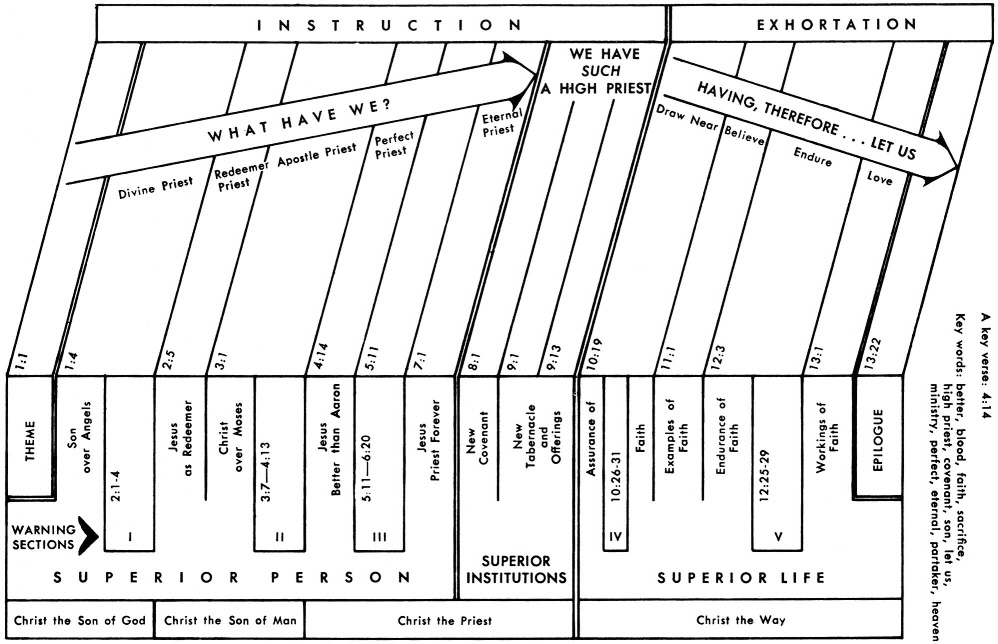
CONSIDER JESUS OUR GREAT HIGH PRIEST
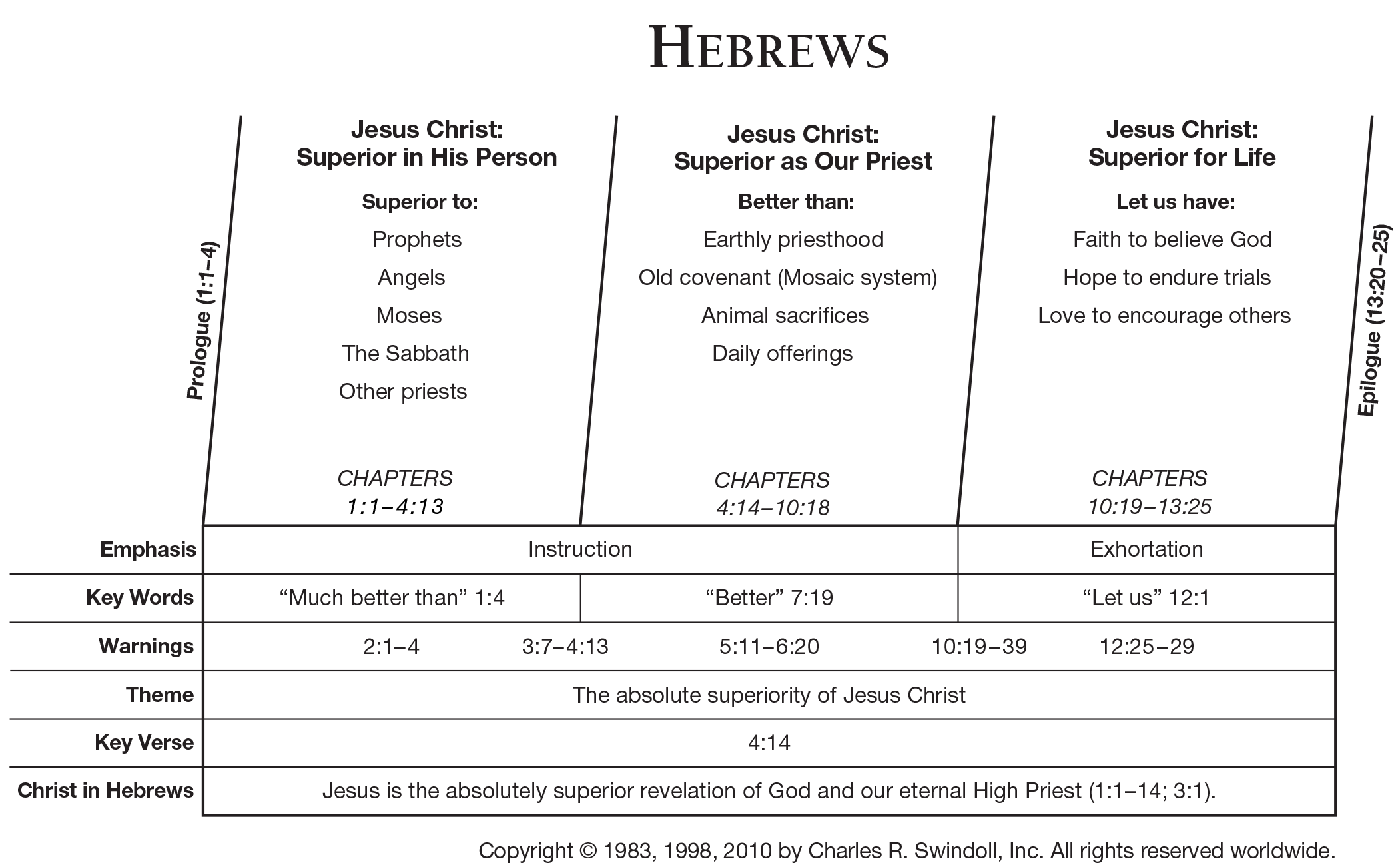
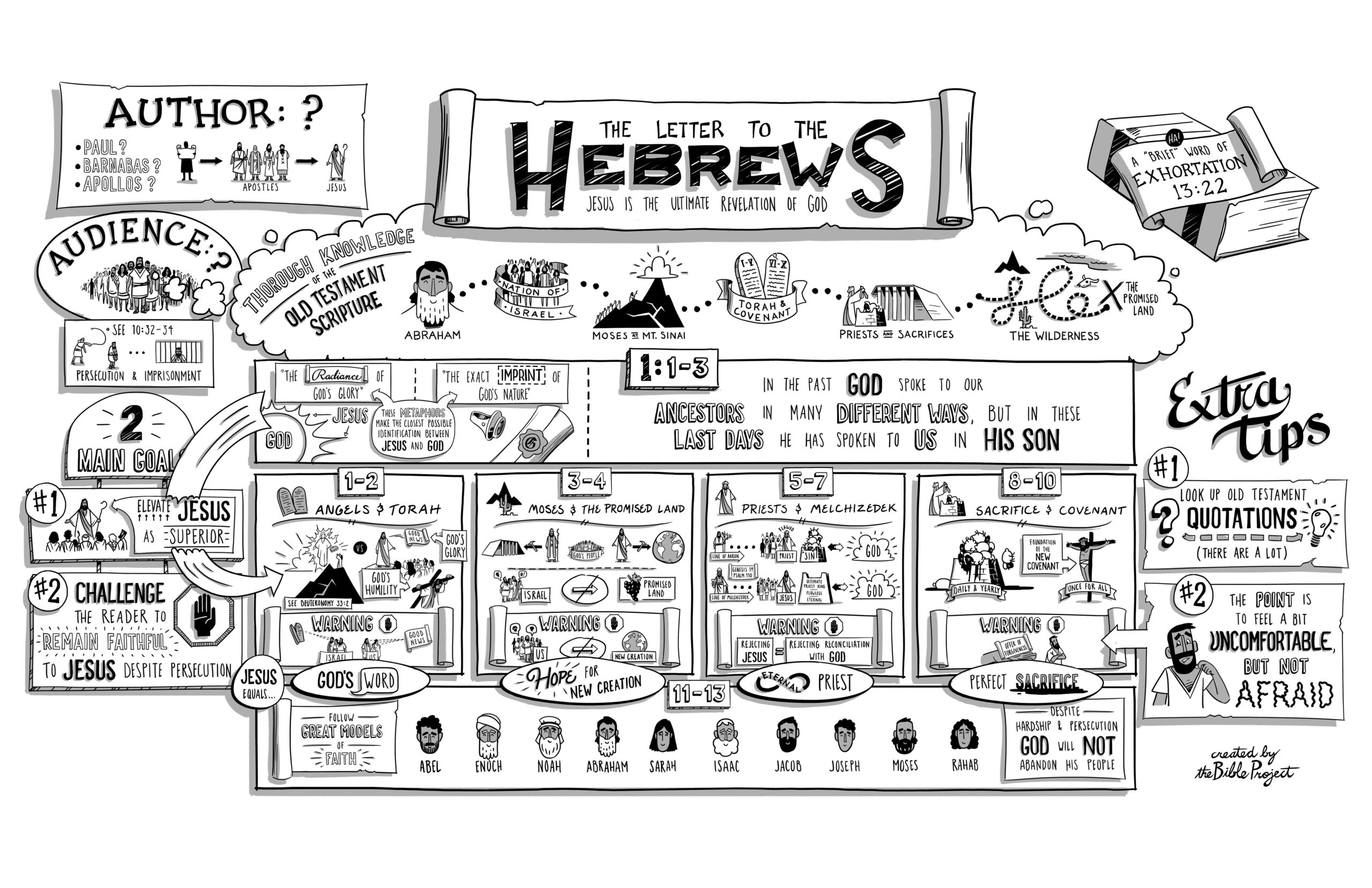
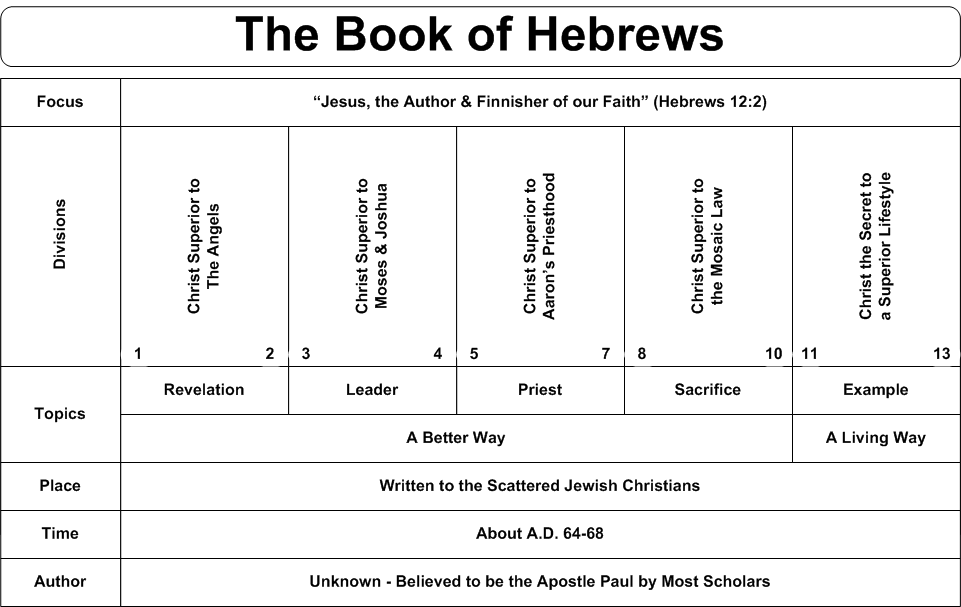
Click chart to enlarge
Charts from Jensen's Survey of the NT - used by permission
Swindoll's Chart, Interesting Pictorial Chart of Hebrews, Another Chart
|
The Epistle |
||||
| INSTRUCTION Hebrews 1-10:18 |
EXHORTATION Hebrews 10:19-13:25 |
|||
| Superior Person of Christ Hebrews 1:1-4:13 |
Superior Priest in Christ Hebrews 4:14-10:18 |
Superior Life In Christ Hebrews 10:19-13:25 |
||
| BETTER THAN PERSON Hebrews 1:1-4:13 |
BETTER PRIESTHOOD Heb 4:14-7:28 |
BETTER COVENANT Heb 8:1-13 |
BETTER SACRIFICE Heb 9:1-10:18 |
BETTER LIFE |
| MAJESTY OF CHRIST |
MINISTRY OF CHRIST |
MINISTERS FOR CHRIST |
||
|
DOCTRINE |
DUTY |
|||
|
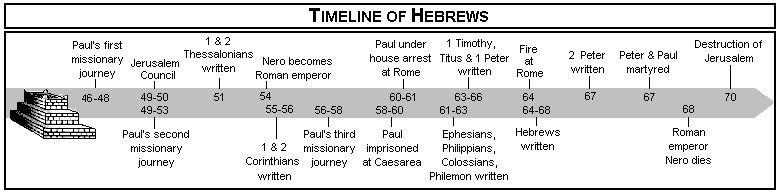
DATE WRITTEN: |
||||

See ESV Study Bible "Introduction to Hebrews"
(See also MacArthur's Introduction to Hebrews)
Borrow Ryrie Study Bible
Hebrews 11:17 By faith Abraham, when he was tested, offered up Isaac, and he who had received the promises was was offering up his only begotten son (NASB: Lockman)
Greek: Pistei prosenenochen (3SRAI) Abraam ton Isaak peirazomenos, (PPPMSN) kai ton monogene prosepheren (3SIAI) o tas epaggelias anadechamenos, (AMPMSN)
BGT Πίστει προσενήνοχεν Ἀβραὰμ τὸν Ἰσαὰκ πειραζόμενος καὶ τὸν μονογενῆ προσέφερεν, ὁ τὰς ἐπαγγελίας ἀναδεξάμενος,
Amplified: By faith Abraham, when he was put to the test [while the testing of his faith was still in progress], had already brought Isaac for an offering; he who had gladly received and welcomed [God’s] promises was ready to sacrifice his only son, [Ge 22:1-10.] (Amplified Bible - Lockman)
Barclay: It was by faith that Abraham offered up Isaac when he was put to the test. He was willing to offer up even his only son, (Westminster Press)
KJV By faith Abraham, when he was tried, offered up Isaac: and he that had received the promises offered up his only begotten son,
NKJ By faith Abraham, when he was tested, offered up Isaac, and he who had received the promises offered up his only begotten son,
CSB By faith Abraham, when he was tested, offered up Isaac. He received the promises and he was offering his unique son,
ESV By faith Abraham, when he was tested, offered up Isaac, and he who had received the promises was in the act of offering up his only son,
NET By faith Abraham, when he was tested, offered up Isaac. He had received the promises, yet he was ready to offer up his only son.
NIV By faith Abraham, when God tested him, offered Isaac as a sacrifice. He who had received the promises was about to sacrifice his one and only son,
NJB It was by faith that Abraham, when put to the test, offered up Isaac. He offered to sacrifice his only son even though he had yet to receive what had been promised,
NLT: It was by faith that Abraham offered Isaac as a sacrifice when God was testing him. Abraham, who had received God's promises, was ready to sacrifice his only son, Isaac, (NLT - Tyndale House)
Phillips: It was by faith that Abraham, when put to the test, made a sacrifice of Isaac. Yes, the man who had heard God's promises was prepared to offer up his only son (Phillips: Touchstone)
Wuest: By faith Abraham offered up Isaac while being put to the test; even he who received the promises, offered up his uniquely begotten, (Eerdmans)
Young's Literal: By faith Abraham hath offered up Isaac, being tried, and the only begotten he did offer up who did receive the promises,
- By faith - Ge 22:1-12; Jas 2:21-24
- When he was tested - Dt 8:2; 2Chr 32:31; Job 1:11,12; 2:3-6; Pr 17:3; Da 11:35; Zech 13:9; Mal 3:2,3; Jas 1:2, 3, 4; 5:11; 1Pe 1:6,7; 4:12; Re 3:10
- Offered - 2 Co 8:12
- Hebrews 11 Resources - multiple resources
- Hebrews 11:8-19 Abraham: An Exemplary Faith - John MacArthur
- Hebrews 11:17-19 Incredible Faith - Gil Rugh
- Hebrews 11:17-19 Abraham Offering Up Isaac - Charles Simeon
- Hebrews 11:8-19 The Faith of Abraham and Sarah - Ray Stedman
- Hebrews 11:8 - 12:2 How Faith Works - Ray Stedman
- Hebrews 11:8-19 By Faith, Abraham and Sarah... - J Ligon Duncan
- Hebrews 11:8-19 The Faith of Abraham - J Ligon Duncan
Related Passages:
Genesis 22:1-12+ Now it came about after these things, that God tested Abraham, and said to him, “Abraham!” And he said, “Here I am.” 2 He said, “Take now your son, your only son, whom you love, Isaac, and go to the land of Moriah, and offer him there as a burnt offering on one of the mountains of which I will tell you.” 3 So Abraham rose early in the morning and saddled his donkey, and took two of his young men with him and Isaac his son; and he split wood for the burnt offering, and arose and went to the place of which God had told him. 4 On the third day Abraham raised his eyes and saw the place from a distance. 5 Abraham said to his young men, “Stay here with the donkey, and I and the lad will go over there; and we will worship and return to you.” 6 Abraham took the wood of the burnt offering and laid it on Isaac his son, and he took in his hand the fire and the knife. So the two of them walked on together. 7 Isaac spoke to Abraham his father and said, “My father!” And he said, “Here I am, my son.” And he said, “Behold, the fire and the wood, but where is the lamb for the burnt offering?” 8 Abraham said, “God will provide for Himself the lamb for the burnt offering, my son.” So the two of them walked on together. 9 Then they came to the place of which God had told him; and Abraham built the altar there and arranged the wood, and bound his son Isaac and laid him on the altar, on top of the wood. 10 Abraham stretched out his hand and took the knife to slay his son. 11 But the angel of the LORD called to him from heaven and said, “Abraham, Abraham!” And he said, “Here I am.” 12 He said, “Do not stretch out your hand against the lad, and do nothing to him; for now I know that you fear God, since you have not withheld your son, your only son, from Me.”
James 2:21-26+ Was not Abraham our father justified (here justified means shown to be righteous not declared righteous - dikaioo is used this same way in Ro 3:4+] of God Who clearly did not need to be "declared righteous") by works, when he offered up Isaac his son on the altar? 22 You see that faith was working with his works, and as a result of the works, faith was perfected (aorist tense = a definite event, a completed actions. Faith was brought to its intended goal, accomplished the end God intended see related word teleios) 23 and the Scripture was fulfilled which says, "AND ABRAHAM BELIEVED GOD (here James clearly reiterates what "saved" Abraham - it was not his works but his faith in the promises of God, ultimately consummated in Abraham's "seed", Christ Jesus, cf Gal 3:16), AND IT WAS RECKONED (placed on Abraham's "spiritual account" so to speak) TO HIM AS RIGHTEOUSNESS," and he was called the friend of God. 24 You see that a man is justified (shown to be righteous) by works, and not by faith alone (James is not saying that works save anyone but he is teaching that one's "works" are a valid marker of whether or not their faith is genuine faith, faith that saves them. In other words faith alone saves but the faith that truly saves is not alone)
Romans 4:19-21+ Without becoming weak in faith he contemplated his own body, now as good as dead since he was about a hundred years old, and the deadness of Sarah’s womb; 20 yet, with respect to the promise of God, he did not waver in unbelief but grew strong in faith, giving glory to God, 21 and being fully assured that what God had promised, He was able also to perform.
James 1:12+ Blessed is a man who perseveres under trial; for once he has been approved, he will receive the crown of life which the Lord has promised to those who love Him.
1 Peter 1:6-7+ In this you greatly rejoice, even though now for a little while, if necessary, you have been distressed by various trials, 7 so that the proof of your faith, being more precious than gold which is perishable, even though tested by fire, may be found to result in praise and glory and honor at the revelation of Jesus Christ;
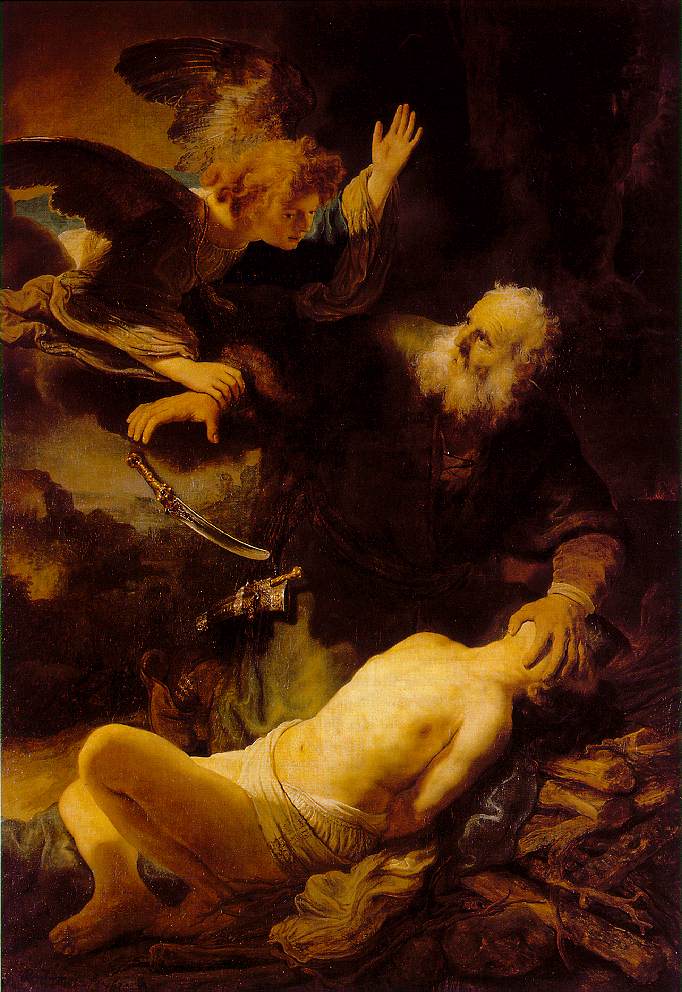
Abraham and Isaac - Rembrandt (1634)
ABRAHAM THE SUPREME EXAMPLE
OF TESTING ONE'S FAITH
This is the third illustration of Abraham’s faith in Hebrews 11 (Heb 11:8 = "by faith...when he was called" and Heb 11:9, 10, 11, 12 = "By faith he lived as an alien...") Hebrews 11:17–19 returns to Abraham, not to celebrate the start of his journey of faith (as in vv. 8–10), but to showcase its climax — the moment when faith was refined through testing. Earlier Abraham believed God’s promise; now he is called to surrender the promise itself.
By faith (see note on "by faith") emphasizes trust, reliance, and confident dependence upon God’s Word rather than human reasoning or visible evidence. Both Sarah and Abraham had faith that God could do the impossible! By faith is the key that unlocks the door to the land of promise. Faith acts on what God has said even when the senses find no confirmation. Remember that genuine faith in NT is not static but dynamic and is always associated with obedience. And so Abraham obeys God's command in Genesis 22:1-3 (see esp Ge 22:3) which tests his faith. (See also Obedience of faith) By faith - The key to chapter 11 of Hebrews is "by faith," a phrase used 41x in 41v in the Bible (not once in the OT) - Acts 15:9; 26:18; Ro 1:17; 3:28, 30; 4:16; 5:1, 2; 9:30, 32; 2 Co. 5:7; Gal. 2:16, 20; 3:8, 11, 22, 24; 5:5; 1 Tim. 1:4; Heb. 4:2; 10:38; 11:3-6, 7-9, 11, 17, 20-24, 27-30, 33; Jas. 2:24. In this section we note that by faith describes Abraham’s faith that produced immediate, unhesitating obedience. His faith was demonstrated by his works. Faith alone saves but the faith that saves is not alone. Faith shows itself to be genuine by obedience. To obey is better than sacrifice (1Sa 15:22+). Do not believe the lie that you can "Ask Jesus into your heart" and then live like the world and the devil the rest of your life and expect that you have a legitimate "fire insurance policy" (Read Jesus' strong warning in Mt 7:21-23+). See the proponents of this strange teaching.
Abraham - Surely he is one of the prime examples of man's faith in a story which brings us to the pinnacle of his faith.
🙏 THOUGHT - Abraham's faith should not discourage us and make us feel we would fall so far short. We must remember that Abraham did have failures, some with enduring consequences (the violence in the Middle East is basically a reflection of the offspring of Ishmael -- the Arabs -- which continually oppose the offspring of Isaac - the Jews). Beloved, God knows you will have times when your faith fails -- what He desires is not perfection but the direction of our faith (onward, upward, homeward and heavenward). As someone has said God delights more in a limping pilgrim heading home than a proud man standing still. In short, a heavenward heart is proof of genuine faith, even when the feet falter. And the good news is that while our faith may waver, the Spirit of grace (Heb 10:29) will not let it wander far! Thank You Jesus!
When he was tested (peirazo), offered up (prosphero) Isaac - This was not a temptation but a test . Satan tempts us (cf Mt 4:1+) to bring out the worst in us. God tests us to bring out the best. Satan tempts us in an attempt to corrupt and destroy us, but God never tests us to destroy us, but to display His own grace in us. In short, God placed Abraham in a situation designed to prove the reality and maturity of his faith, not to make him fall, but to show him faithful, to confirm his faith and to strengthen it. The offering of Isaac—after years of waiting for the promised son—was Abraham’s ultimate test of faith. The test was to reveal the obedience of Abraham's heart fully surrendered, demonstrating a living faith that trusted God’s promise even through the apparent contradiction of sacrificing his promised son. Abraham's faith did not demand explanation, but steadfastly clung to God's sure revelation and immutable promise.
Jewish tradition often highlights this event as the supreme example of obedience and devotion, holding it up as a model of faith to be emulated. It is fascinating to observe how close many Jewish sources come to the heart of the truth (especially Ge 15:6+), yet stop short of recognizing the fullness of Abraham’s faith in the coming Messiah, to Whom Isaac pointed. According to the Mishnah (Pirkei Avoth 5:3), the rabbis taught that Abraham faithfully endured ten trials, the greatest of which was God’s command to offer up his only son. While the number of “ten” tests is not explicitly stated in Scripture, rabbinic tradition developed this list to illustrate Abraham’s steadfastness. The Midrash Rabbah on Numbers (XVII.2) includes a non-biblical narrative that expands upon this event, stating that when the test of Isaac was finished, Abraham pleaded with God never again to subject him to such a trial, for it had nearly crushed him. Yet, the biblical record makes no mention of such a request; Scripture portrays Abraham as resting in God’s provision—“The LORD will provide” (Ge 22:14+)—and returning from Moriah with a deeper confidence in the God Who both tests and provides. Thus, while Jewish tradition captures the seriousness of the trial, only the New Testament reveals its ultimate significance: that Abraham’s faith foreshadowed the Father’s own offering of His beloved Son, the true Lamb Who would take away the sin of the world (Jn 1:29; Ro 8:32; Heb 11:17-19).
R C H Lenski (borrow) - This presents briefly the greatest act of Abraham’s faith, his trusting in the absolutely unseen, and that at a time when he was bidden to do what seemed to conflict directly with God’s own promise.
Offered up (prosphero) Isaac is perfect tense (a past completed action) when considered from the perspective of Abraham’s intention to comply with the solemn command views the sacrifice as an accomplished and perfectly accepted event. A T Robertson agrees that "The act was already consummated so far as Abraham was concerned when it was interrupted and it stands on record about him. (See Hughes note) Offered up (prosphero) in the active voice indicates Abraham gave the offering willingly, of his own free will. What a picture of one who was "dead to self" and fully surrendered to the sweet will of God, even when it did not appear to his fleshly reasoning as sweet (Can you imagine what Sarah was saying? Scripture is silent. Abraham's faith obeyed, even though undoubtedly the "reasoning" in his fallen flesh must have rebelled (cf Gal 5:17+)! Abraham’s surrender showed he trusted God not only for Isaac’s birth, but for Isaac’s resurrection (Heb 11:19).
Simon Kistemaker (Borrow) - "The perfect tense reveals that the sacrifice actually took place in the demonstration of Abraham’s willingness and obedience. The imperfect, by contrast, points to Abraham’s attempt to sacrifice Isaac."
Trials are the furnace that brings forth the gold of faith.
Without the fire, the gold would never shine!
R Kent Hughes has an interesting comment noting that Abraham ""really did “sacrifice” Isaac! But you are surely saying "Hold on! That's not what Genesis 22 says." Hughes anticipating your surprise and doubt explains that "The Greek perfect tense is used when the text says that he “offered Isaac as a sacrifice”—and the perfect tense refers to a completed action in past time. This means that the sacrifice actually took place as far as Abraham’s resolve and obedience were concerned. From the divine perspective, as well as from Abraham’s perspective, Abraham did it! But immediately the same verb is used in the imperfect tense in the following statement—he “was about to sacrifice his one and only son”—indicating that it did not physically happen. The point is, in terms of obedience to God, Abraham did it. He completely offered his beloved Isaac, the laughter and joy of his life. (See Hebrews: An Anchor for the Soul) (Bolding added)
And he who had received (anadechomai) the promises (epaggelia/epangelia - divine assurance) - The verb anadechomai indicates Abraham embraced the promises given by God, emphasizing that not only fully receiving them with favor but welcoming them by faith. This verb pictures a warm, personal reception of God’s word (cf Lk 8:15+). Abraham did not just hear the promises, but he embraced them as true and took them to heart. Abraham appropriated the promises, made them his own, and rested on them, because he was confident in what God had said (cf Ro 4:21+). Abraham's reliance was in the power and promises of God. His soul was at rest fully relying on the sufficiency of God's grace. God's promises were His covenantal commitments regarding Abraham's seed (Ge 12:2, Ge 15:4-5, Ge 17:19, Ge 22:17) and they were rooted in His unchanging, non-lying character. What God promises in time, He always completes in His perfect timing. His promises may be tested, but they will never be broken. Abraham’s altar indeed proved that what God had promised, He Himself would preserve.
What God has promised, He will do,
His Word is faithful, tried, and true;
Though years may pass, His plan stands fast,
The “yes” in Christ is sure to last.
Was was offering up (prosphero) his only begotten (monogenes) son - Offering up (prosphero) is derived from pros meaning toward and phero meaning to bring or carry gives us a perfect description of what Abraham did with his son Isaac, obediently bringing him toward the altar as an offering to God! What a beautiful foreshadowing of the words in Hebrews 9:14+ describing Jesus, the only begotten Son, "who through the eternal Spirit offered (prosphero) Himself without blemish to God." It is interesting that offering up (prosphero) is in the imperfect tense emphasizing he was in the process of offering up Isaac which emphasizes his continuous, unfolding obedience. The imperfect tense shows that the sacrifice was not completed but was ongoing, that Abraham was in the midst of carrying out the sacrifice. The NET Note adds the imperfect tense "indicates the attempt or readiness to sacrifice Isaac without the actual completion of the deed."
His only begotten (monogenes) son - The designation only begotten (monogenes) speaks of one of a kind, the only one of it's kind, not merely the "only-born." Clearly only begotten (monogenes) was meant to foreshadow Jesus, for this same word conveyed the same sense of one of a kind five times in the New Testament (John 1:14, 1:18, 3:16, 3:18; 1Jn 4:9). Abraham had other sons (Ishmael, and later children by Keturah), Isaac was unique, for he alone was the son of promise, the covenant heir (Ge 21:12+).
Isaac is probably the most vivid Old Testament picture of the sacrifice of Christ and thus furnishes us a beautiful type of Christ: (1) Both were only begotten sons. (2) Both were beloved of their fathers (Gen 22:2; Mt 3:17). (3) Both carried the wood for their own sacrifice (Ge 22:6; Jn 19:17). (4) Both were offered up on Moriah, on the same ridge as Calvary. (5) Both were given back from death (Isaac figuratively, Jesus literally). Certainly one cannot read the story of Abraham's sacrifice of Isaac without thinking of passages like "He who did not spare His own Son, but delivered Him up for us all, how will He not also with Him freely give us all things?" (Ro 8:32+)
Abraham...did not succumb to “doubting in the dark
what God told him in the light.”
Dwight Pentecost commenting on Abraham's faith and obedience exemplified in Hebrews 11:17-19 writes that "Our faith is often tested most when our present circumstances seem completely contrary to what God has revealed to us through His Word. That is precisely the situation Abraham faced, and yet he did not succumb to “doubting in the dark what God told him in the light.” Instead, he lived his life in accordance with what God had said. (SEE Faith That Endures: A Practical Commentary on the Book of Hebrews)
Philip E Hughes - Like the apostle Paul in a later age, Abraham was assured that it is precisely the powerlessness of man which provides the opportunity for the triumphant manifestation of the omnipotence of God (ED: see 2Co 12:9,10+). (A Commentary on the Epistle to the Hebrews)
Remember the context and flow of this letter of exhortation to those Hebrews who were being afflicted with various tribulations, which undoubtedly tempted some consider turning back to the Old Covenant ways of worshiping God. The writer of Hebrews is presenting the OT truths of the faith-life, so that their faith might be encouraged. He is not denying their trials, but here wants to show them an example of the trial of faith that they can imitate in their walk with Christ (Heb 6:12+)
In a parallel passage Paul emphasized the value of the OT Scriptures to encourage perseverance to to the end writing that "whatever was written in earlier times was written for our instruction, that through perseverance and the encouragement of the Scriptures we might have hope." (Ro 15:4+)
In Hebrews 11, the great “Faith” chapter, it is interesting to observe that Hebrews 11:1 "defines" what faith is and the other 39 verses demonstrate what real faith accomplishes or what genuine faith looks like in everyday life.
Charles Swindoll gives a good summation - Perhaps more shocking than God’s incomprehensible command to sacrifice Isaac was Abraham’s immediate obedience! No arguing. No hesitation. No bargaining. No reminding God how long he and Sarah had waited. Instead, Abraham got up early, saddled up his donkey, and headed out to obey (Gen. 22:3; Heb. 11:17). Sometimes, just one tiny letter in a word can make all the difference. In Genesis 22:5, Abraham told his servants that he and Isaac were going to go on farther, worship, and “return” (nasb). Abraham used the plural form of the Hebrew verb—nashuvah (“we will return”)—rather than the singular form—ashuvah (“I will return”). This one-letter change (a to na) evinces (reveals) Abraham’s complete trust in God’s promise to make Isaac’s offspring into a mighty nation (Heb. 11:18). This faith freed Abraham to fully obey a command he didn’t entirely understand. How could Abraham reconcile the command to offer Isaac as a burnt offering with his confidence that he and Isaac would both come down from the mountain? The author of Hebrews gives us the answer: “He considered that God is able to raise people even from the dead, from which he also received him back as a type” (Heb 11:19). Let’s be honest: To an outsider, Abraham’s actions would have looked like the deranged deeds of a maniac, not the faithful obedience of a man of God. And certainly, wicked people today commit vile acts, falsely claiming direction from God. What’s the difference between those criminals and our great patriarch of the faith? Abraham’s unflinching trust and unhesitating obedience rested on a foundation of solid theology.
What did Abraham know about God that undergirded his complete surrender and obedience?
- Abraham knew that God is completely good and never commands evil.
- Abraham knew that God is completely wise and must have had a plan.
- Abraham knew that God is completely just and would not treat Isaac unfairly.
- Abraham knew that God is completely powerful and would keep His promises.
Even in the midst of an apparent contradiction, Abraham could trust and obey—not because he knew exactly what was going on, but because he knew the One who did. And, when Abraham demonstrated his faith through this radical test, God provided a ram for Abraham to offer in place of Isaac (Gen. 22:11-13). The author of Hebrews notes that this event was a “type,” literally “a parable” (Heb. 11:19). A parable of what? Brown notes, “Isaac was received back from the verge of death, a sign of God’s unfailing provision in the moment of man’s desperate need.” (See Insights on Hebrews)
🙏 THOUGHT BASED ON SWINDOLL'S COMMENTS ABOVE - BELOVED THIS IS TRUE FOR US TODAY -- NONE OF US WILL HAVE A TEST LIKE ABRAHAM, BUT WE WILL HAVE TESTS AND WHEN WE DO WE NEED TO RUN INTO THE STRONG TOWER OF THE NAME OF GOD (The name of the LORD is a strong tower; The righteous runs into it and is safe. Pr 18:10+ - play Steve Green's great song) OBEYING HIM NOT BECAUSE WE UNDERSTAND TOTALLY WHY WE ARE BEING TESTED BUT OBEYING HIM BECAUSE WE KNOW GOD, WE KNOW HIS CHARACTER. THAT'S JUST ANOTHER REASON WE NEED TO BE IN THE BIBLE DAILY SO THAT THE BIBLE GETS IN US AND ENABLES US TO BETTER KNOW THE ONE WHO KNOWS US PERFECTLY.
AND WHAT WAS THE GREAT NAME THAT WE ENCOUNTER IN GENESIS 22? Jehovah Jireh - God our Provider
The fourth stanza (below) of one of the grand old hymns, Trust and Obey (Vocal version by Don Moen; chorale version), captures the essence of Abraham's sacrifice and the application of this truth to our lives. We have all sung this great hymn, but can I ask you gently "Do we all really believe what we are singing?" If I am honest with you many times I simply mouth the words, but those words really don't come from my heart of worship in spirit and in truth (Jn 4:23,24+)! Just being honest with you! God grant us the grace and the faith to be able to sing these words from our heart. Amen. O, to know God more and more as Jehovah Jireh in the midst of the time of testing!
But we never can prove the delights of His love
Until all on the altar we lay;
For the favor He shows, for the joy He bestows,
Are for them who will trust and obey.Refrain:
Trust and obey, for there’s no other way
To be happy in Jesus, but to trust and obey.
John MacArthur entitles his comments on this section of Hebrews 11 "The Proof of Faith" writing that "The proof of Abraham’s faith was his willingness to give back to God everything he had, including the son of promise, whom he had miraculously received because of his faith. After all the waiting and wondering, the son had been given by God. Then, before the son was grown, God asked for him back, and Abraham obeyed. Abraham knew that the covenant, which could only be fulfilled through Isaac, was unconditional. He knew, therefore, that God would do whatever was necessary, including raising Isaac from the dead, to keep His covenant... If Noah illustrates the duration of faith, Abraham shows the depth of faith. (SEE Hebrews Commentary - Page 335)
Forsaking All I Trust Him
Acrostic: F-A-I-T-H
Donald Guthrie - This event points to the paradox of faith—its willingness to surrender the fulfilment of what it has inherited in the form of promises. The testing of Abraham makes his faith stand out in greater relief. His quality of faith is seen in obedience. As Westcott aptly says, ‘The specific command could be fulfilled only in one way: the promise might be fulfilled in more than one.’ (BORROW TNTC - Hebrews)
R Kent Hughes - There was no arguing with God, no bargaining, no equivocating. Abraham had learned well from the lessons of life—for example, his own wasted sojourn in Haran, or the unforgettable tragedy of Lot’s wife. Therefore, his obedience was immediate and explicit. Though every fiber of his natural being rebelled against what God was calling him to do, though his feet felt like lead, he did not turn aside. What amazing faith!...No wonder he is the father of all who believe. No wonder he is called the friend of God. (See Hebrews: An Anchor for the Soul)
Spurgeon - It may be that Isaac, though a gift from God, began to usurp God’s place. An Isaac may become an idol. The dearest thing we have, the most precious, the most beloved, may still become an abomination by being made an idol to keep us away from God. Some of the heathen worship gods of mud, others worship gods of gold, but there is no difference in the idolatry, whether the image be made of mire or of the most precious metal. Do you have any idols, dear friends? I will not press the question too closely, but whatever your idols may be, they will bring you a world of trouble, for you must love nothing in comparison with God. He must be first, and everything else far away in the background. He will endure no rivals. He will permit no Dagon to stand in the place where the ark of the covenant abides. So God tests Abraham to see who has most of his heart’s love. (Full sermon Abraham's Trial: A Lesson for Believers)
The altar that was Abraham’s test,
also became his greatest triumph.
John Stevenson - The ultimate testing of Abraham’s faith came when he was called by God to offer up his only son as a sacrifice. This was the son for whom he had so long awaited. This was the son of promise. You remember the story. Abraham is told to sacrifice Isaac and they travel together to Mount Moriah. Leaving the servants at the bottom of the mountain, they go up together to the peak. There they build an altar and lay wood on it. Then Abraham binds Isaac and lays him upon the altar and prepares to take his life. Only then does an angel stop Abraham and allow him to substitute for his son a ram that is caught in a nearby thicket. Now we learn something new about Abraham’s faith. It is found in the words of Abraham to his servants as he and Isaac departed to climb to the top of Mount Moriah. And Abraham said to his young men, "Stay here with the donkey, and I and the lad will go yonder; and we will worship and return to you." (Genesis 22:5+). Do you see it? Abraham says, "WE will worship and WE will return." (NLT has "We will worship there, and then we will come right back.") Abraham was going up this mountain with the full intention of sacrificing his son, but he also believed that both he and his son would end up coming back down the mountain. He believed this because He considered that God is able to raise people even from the dead - He believed that he would sacrifice Isaac and that God would then raise him from the dead. (Hebrews 11 - The Hall of Faith)
The testing of one's faith/obedience was not unique to Abraham...
(Moses warning Israel) And you shall remember all the way which the LORD your God has led you in the wilderness these forty years, that He might humble you, testing you, to know what was in your heart, whether you would keep His commandments or not. (Deuteronomy 8:2+)
(Speaking of King Hezekiah) And even in the matter of the envoys of the rulers of Babylon, who sent to him to inquire of the wonder that had happened in the land, God left him alone only to test him, that He might know all that was in his heart. (2 Chronicles 32:31+)
Comment: King Hezekiah acted foolishly and in pride showed the Babylonian envoys his treasures, arousing their desire to possess them, a desire that would soon be fulfilled. See 2Ki 20:12-19).
The refining pot is for silver and the furnace for gold, but the LORD tests hearts. (Pr 17:3)
🙏 THOUGHT - The point that is emphasized in these verses on testing is that with the tests God provides opportunities for His children to demonstrate and grow their faith. In fact it is fair to state that every test the Father allows in our lives becomes either a stumbling block (King Hezekiah) or a stepping stone (as in Abraham's case in this passage).
Jonathan Edwards wrote that "The surest way to know our gold is to look upon it and examine it in God’s furnace, where He tries it for that end that we may see what it is. If we have a mind to know whether a building stands strong or no, we must look upon it when the wind blows. If we would know whether that which appears in the form of wheat has the real substance of wheat, or be only chaff, we must observe it when it is winnowed. If we would know whether a staff be strong, or a rotten, broken reed, we must see it when it is leaned on, and weight is borne upon it. If we would weigh ourselves justly, we must weigh ourselves in God’s scales, that He makes use of to weigh us."
Donald Guthrie - This event points to the paradox of faith—its willingness to surrender the fulfilment of what it has inherited in the form of promises. The testing of Abraham makes his faith stand out in greater relief. His quality of faith is seen in obedience. As Westcott aptly says, 'The specific command could be fulfilled only in one way: the promise might be fulfilled in more than one.'Hence the act of offering is spoken of in the perfect tense (prosenenochen) as if what was intended was regarded as a completed act with a continuous consequence. The second verb (prosepheren) is translated was ready to offer in an attempt to bring out the distinction between this and the former verb and to indicate that the act was considered in intention rather than fulfilment. (Tyndale New Testament Commentaries – Hebrews)
Kenneth Wuest - The word “tried” is the translation of peirazo which means “to put to the test.” Here it refers to the act of God putting Abraham to the test in order to prove his character and the steadfastness of his faith. The construction in the Greek (perfect tense) ("offered up Isaac") makes it clear that while the testing of Abraham was still in progress, he had already offered up his son, that is, before the trial had come to an issue, by the act of his obedient will, through faith in God. Abraham met the test through faith before there was any visible evidence of God’s intervening hand. Abraham fully expected to offer his son as a sacrifice, and as fully expected God to raise his body from the dead out of the ashes of the burnt sacrifice. He reasoned that since God promised him a line of ancestry through Isaac, He would have to do that. And he had faith to believe that God would do so. Vincent explains the words “Also he received him in a figure,” as follows: “Since the sacrifice did not take place as a literal slaughter, there could not be a literal restoration from death. There was a real offering in Abraham’s will, but not a real death of Isaac. Isaac’s death took place symbolically, in the sacrifice of the ram: correspondingly, the restoration was only a symbolic restoration from the dead.” (Hebrews Commentary)
Dwight Pentecost comments on the offering noting that "Since Isaac was set apart to be a burnt offering (ED: holokautoma - wholly consumed) (Lev 1:1–17+), he was being offered not in atonement for some sin, but as an act of worship to God. And the obedience of Abraham was itself acceptable worship. Thus, based on the life of Abraham, the writer desires that his readers should “imitate those who through faith and patience inherit the promises” (Heb. 6:12+) and show the same patient endurance and obedience that their faith ought to produce. (See Faith that Endures: A Practical Commentary on the Book of Hebrews)
The tests of faith become more difficult as we walk with God,
yet the rewards are more wonderful!
Warren Wiersbe - Abraham obeyed God by faith when he did not know why God was so working (Heb. 11:17–19). Why would God want Abraham to sacrifice his son when it was the Lord who gave him that son? All of a future nation’s promises were wrapped up in Isaac. The tests of faith become more difficult as we walk with God, yet the rewards are more wonderful! And we must not ignore the obedient faith of Isaac. (Bible Exposition Commentary)
THOUGHT - Abraham's willingness to offer up Isaac proved his faith, because the final standard of faith and its real proof is the willingness to sacrifice. This is an interesting thought to ponder especially in light of Paul's exhortation to us as believer's regarding our bodies (which of course includes their minds, their wills, their members) in Romans 12 - "I urge you, therefore brethren, by the mercies of God, to present your bodies a living and holy sacrifice, acceptable to God, which is your spiritual service of worship." (Ro 12:1+)
Abraham’s obedience
Demonstrated his faith.
Isaac was not literally the only son of Abraham—there was also Ishmael through Hagar (Ge 16:1-16) but Isaac was the "unique" (monogenes) son that God had promised and whose birth was a supernatural fulfillment of Jehovah's promise. Isaac was the sole heir to the divine covenant promises. The writer of Hebrews proceeds to quote from Ge 22:12+ to prove the point that Isaac was the unique (monogenes) son of Abraham for through Isaac's seed must pass the promises of the Abrahamic covenant, not through the seed of Abraham's other son Ishmael. In addition Abraham by Keturah had six more sons named in Genesis 25:1, 2. The apostle John brought the shadow seen in Isaac as the monogenes (“only begotten”) into its full substance in Christ, writing, he apostle John brought the shadow of (monogenes) in Isaac into the substance of Christ writing that "the Word became flesh, and dwelt among us, and we beheld His glory, glory as of the only begotten (monogenes) from the Father, full of grace and truth." (Jn 1:14+) "For God so loved the world, that He gave His only begotten (monogenes) Son, that whoever believes in Him should not perish, but have eternal life." (John 3:16+)
Donald Guthrie - It was this that constituted the real test to Abraham’s faith. To be commanded to offer any of his sons would have been a shattering challenge, but doubly so the child of promise. The writer of this epistle does not discuss, any more than Paul in his Roman letter, the moral problem of God commanding a human sacrifice, for to him there was no question of God accepting such a sacrifice. (Borrow Hebrews Commentary page 238)
Charles Spurgeon - How beautifully do we see the spirit of consolation exhibited in the character of Abraham, who, with all his troubles, as a stranger in a strange land, walks among men as a king! Have you never envied that quiet dignity with which, believing in God, he seemed also to master all around him without any sign of agitation of mind? Oh, that you had such comfort as he had when he took his son, his only son, whom he loved, to offer him up for a sacrifice! You never have had such a trial as that; probably you never will; but in all that time of testing, what solid comfort he had! There were no written Scriptures then, yet how grand is the consolation that the Scripture describes him as having! (Full sermon Patience, Comfort, and Hope from the Scriptures)
Faith (4102)(pistis) is synonymous with trust or belief and is the conviction of the truth of anything, but in Scripture speaks of belief respecting man's relationship to God and divine things, generally with the included idea of trust and holy fervor born of faith and joined with it. As pistis relates to God, it is the conviction that God exists and is the Creator and Ruler of all things well as the Provider and Bestower of eternal salvation through Christ. As faith relates to Christ it represents a strong and welcome conviction or belief that Jesus is the Messiah, through Whom we obtain eternal salvation and entrance into the Kingdom of Heaven. Stated another way, eternal salvation comes only through belief in Jesus Christ and no other way.
Faith is not believing in spite of evidence
but obeying in spite of consequences.
For more discussion on the meaning of faith see notes on Hebrews 11:1-2.
Faith is believing that God will keep His promises, despite circumstances that seem to be to the contrary! True faith that saves one's soul includes at least three main elements - (1) firm persuasion or firm conviction, (2) a surrender to that truth and (3) a conduct emanating from that surrender. In sum, faith shows itself genuine by a changed life.
Note that this discussion of pistis is only an overview and not a detailed treatise of this vitally important subject in Dr Wayne Grudem's book Systematic Theology: An Introduction to Biblical Doctrine Chapter 35 - Conversion = Faith and Repentance. What is true repentance? What is saving faith? Can people accept Jesus as Savior and not as Lord? page 616) Much of this "definition" deals with the general word group for faith (pistis = noun, pistos = adjective, pisteuo = verb)
The great theologian John Calvin defined faith as “a steady and certain knowledge of the Divine benevolence towards us, which, being founded on the truth of the gratuitous promise in Christ, is both revealed to our minds, and confirmed to our hearts, by the Holy Spirit.”
Note that faith is founded on divine truth (God’s promise) and is witnessed to by the Spirit in the heart. It has both objective and subjective aspects, and both are essential!
As pistis relates to God, it is the conviction that God exists and is the Creator and Ruler of all things well as the Provider and Bestower of eternal salvation through Christ. As faith relates to Christ it represents a strong and welcome conviction or belief that Jesus is the Messiah, through Whom we obtain eternal salvation and entrance into the Kingdom of Heaven. Stated another way, eternal salvation comes only through belief in Jesus Christ and no other way.
Abraham (11) (abraam) means "father of a multitude."
Related Resources on Abraham
- Nave Topical Bible Abraham
- Scofield Reference Index Abraham
- Thompson Chain Reference Abraham
- American Tract Society Abraham
- Bridgeway Bible Dictionary Abraham
- Baker Evangelical Dictionary Abraham
- Chabad Knowledge Base Abraham
- Easton's Bible Dictionary Abraham
- Fausset Bible Dictionary Abraham
- Hitchcock Bible Names Abraham
- Hastings' Dictionary of the Bible Abraham
- Hastings' Dictionary of the NT Abraham Abraham
- Morrish Bible Dictionary Abraham
- Hawker's Poor Man's Dictionary Abraham
- Whyte's Bible Characters Abraham
- Wilson's Bible Types Abraham
- International Standard Bible Encyclopedia Abraham
- Kitto Biblical Cyclopedia Abraham
- The Nuttall Encyclopedia Abraham
Tested (3985) (peirazo from the noun peira = test from peíro = perforate, pierce through to test durability of things) is a morally neutral word simply meaning “to test”. Whether the test is for a good (as it proved to be in Heb 11:17) or evil (Mt 4:1 "Then Jesus was led up by the Spirit into the wilderness to be tempted by the devil") depends on the intent of the one giving the test and also on the response of the one tested. (See study of similar word dokimazo) See also word study on related word - peirasmos
Temptations and trials are two sides of the same coin, for a single Greek word peirasmos conveys both ideas (cp Ja1:2 w Ja1:13) in short, all that goes to furnish a test of character. The trials may come from God or under His permissive will from Satan, or may be the result of our own wrong doing. The solicitations to do evil come from the world, the evil nature, or Satan.
Character is revealed by what you do in secret, when no one else is around to see. If you are not a person of integrity then you will not be a person of character. Maturity is revealed by what you do in your free time. A person of integrity uses their free time wisely.
In a sermon titled "Faith Tested and Crowned," Alexander Maclaren distinguished between being tempted and being tried. He said that "the former word conveys the idea of appealing to the worst part of man, with the wish that he may yield and do the wrong. The latter means an appeal to the better part of man, with the desire that he should stand." "Temptation says, 'Do this pleasant thing; do not be hindered by the fact that it is wrong.' Trial or proving says, 'Do this right and noble thing; do not be hindered by the fact that it is painful.'" Satan tempts us to bring out the worst in us; God tests us to bring out the best.
In the school of faith,
trials are the examinations.
Peirazo here in Hebrews 11:17 is in the present tense ("continually tested") which indicates the test was ongoing. It began with God's command in Genesis 22:1, 2, continued as he walked with Isaac to Moriah and culminated when God told him not to drop the sword on Isaac. Peirazo is a morally neutral word simply = to test but whether the testing is for a good (Heb 11:17) or evil (Mt 4:1) purpose depends on the intent of the one giving the test. When the scriptural context clearly indicates the testing is an enticement to evil, the word is most frequently translated by a form of the English tempt, which carries that negative connotation.
- Click for Multiple Quotes Related to Temptation—Avoiding and Resisting, Blessings of, Certainty of, And Satan
(1) Solicitation to evil: Ge 3:1-6, Mt 4:1, 1 Cor 10:13, 2 Cor 11:3,4, Ja1:14
(2) Testing under trial: Ge 22:1 Lu 22:28, Lu 4:2
Peirazo - 38x in 34v - NAS = did(1), put(1), put to the test(2), tempt(2), tempted(13), tempter(2), test(6), tested(2), testing(7), tried(2), trying(2). Matt. 4:1, 3; 16:1; 19:3; 22:18, 35; Mk. 1:13; 8:11; 10:2; 12:15; Lk. 4:2; 11:16; Jn. 6:6; 8:6; Acts 5:9; 9:26; 15:10; 16:7; 24:6; 1 Co. 7:5; 10:9, 13; 2 Co. 13:5; Gal. 6:1; 1 Thess. 3:5; Heb. 2:18; 3:9; 4:15; 11:17; Jas. 1:13f; Rev. 2:2, 10; 3:10)
Peirazo - 24 uses in the Septuagint (LXX) -Ge 22:1; Ex. 15:25; 16:4; 17:2, 7; 20:20; Nu 14:22; Dt. 4:34; 13:3; 33:8; Jdg 2:22; 3:1, 4; 6:39; 1Ki 10:1; 2Chr. 9:1; 32:31; Ps. 26:2; 35:16; 78:41, 56; 95:9; 106:14; Eccl. 2:1; 7:23; Isa 7:12; Da 1:12, 14; 12:10, Here are some examples...
Genesis 22:1 Now it came about after these things, that God tested (peirazo - clearly God is not tempting him to sin but testing his faith to show it to be genuine) Abraham, and said to him, “Abraham!” And he said, “Here I am.”
Exodus 15:25 Then he cried out to the LORD, and the LORD showed him a tree; and he threw it into the waters, and the waters became sweet. There He made for them a statute and regulation, and there He tested (peirazo) them.
Deut 13:3 you shall not listen to the words of that prophet or that dreamer of dreams; for the LORD your God is testing (periazo) you to find out if you love the LORD your God with all your heart and with all your soul.
Peirazo can have several nuances depending on the context:
(1) trials with a beneficial purpose and effect,
(2) divinely permitted or sent,
(3) with a good or neutral significance,
(4) of a varied character,
(5) definitely designed to lead to wrong doing, temptation,
(6) of men trying or challenging God.
The trials may come from God or under His permissive will from Satan, or may be the result of our own wrong doing. The solicitations to do evil come from the world, the evil nature (the "flesh"), or the Devil. When the Scriptural context clearly indicates the testing is an enticement to evil, the word is most frequently translated by a form of the English tempt, which carries that negative connotation and this NEVER refers to a test from God.
Bishop Trench compares the use of the related verbs peirazo and dokimazo
Dokimazo and peirazo often are used together, as in 2Corinthians13:5 andPsalm 94:10. Although our Authorized Version translates both words by "prove" ( Luke 14:19; John 6:6), "try" ( 1 Corinthians 3:13; Revelation 2:2), and "examine" ( 1 Corinthians 11:28; 2 Corinthians 13:5), they are not perfectly synonymous. Dokimazein is translated by four other words in the Authorized Version: "discern" ( Luke 12:56), "like" ( Romans 2:18), "approve" ( Romans 2:18), and "allow" ( Romans 14:22). Dokimazein always includes the idea of proving whether a thing is worthy to be received and is closely related to dechesthai (1209). In classical Greek dokimazein is the technical word used for putting money to the dokime (1382, proof) by use of the dokimion (1383, test). Whatever passes this test is dokimos (1384), and whatever fails is adokimos (96). These words are not, at least immediately, connected with dokimazein but with dechesthai. Because this proving is through fire ( 1 Corinthians 3:13), dokimazein and pyroun (4448) often are used together ( Psalm 95:9; Jeremiah 9:7). In the New Testament dokimazein almost always implies that the test is victoriously surmounted and the proved is also approved ( 2 Corinthians 8:8; 1 Thessalonians 2:4; 1 Timothy 3:10). Similarly, in English we speak of tried men, meaning not only those who have been tested but those who have stood the test. Sometimes dokimazein implies the further step of choosing the approved, not just approving the proved.
Not only does the dokimasia usually result in victory, but it implies that the trial itself was made in the expectation of such an outcome, or at least without a contrary anticipation. The ore is thrown into the refining pot in the expectation that though it may be mingled with dross, it is not all dross, and some good, purified metal will emerge from the fiery trial ( Hebrews 12:5-11;Hebrews 12 : 2 Maccabees 6:12-16). In the tests that God brings as the refiner of his church, his intention is not to find his saints pure gold but to make them pure by purging out their dross. He is the "God who tests [to dokimazontai] our hearts" ( 1 Thessalonians 2:4; cf. Psalm 17:3; Jeremiah 11:20). Job used an equivalent word: "When he has tested [diekrine] me, I shall come forth as gold" ( Job 23:10). God's people pray to him in words like Abelard's (who expounded the sixth petition of the Lord's Prayer): "Grant that through trial we be approved, not disapproved." This is the point of divergence between dokimazein and peirazein, as we shall now see.
Testing may have a different intention and outcome, especially in the case of the false-hearted and those who only seem to belong to God. Testing will cause its recipients to appear as what they always have been. This is predominantly, though not exclusively, the sense of peirazein. Nothing in the word requires it to refer to a trial given with the intention of entangling the person in sin. Peirazein properly means "to make an experience of," "to pierce or search into," or "to attempt" ( Acts 16:7; Acts 24:6). Later peirazein signified testing whose intention was to discover whether a person or thing was good or evil, or strong or weak ( Matthew 16:1; Matthew 19:3; Matthew 22:18; 1 Kings 10:1); or, if the outcome already was known to the tester, to reveal the same to the one being tested, as when Paul commanded the Corinthians, heautous peirazete,"try" or "examine yourselves" ( 2 Corinthians 13:5). In this way sinners are said to tempt God, to put him to the test by refusing to believe his word until he manifests his power. We must stop at this stage of the word's history when we say that God "tempts" people. God tempts people only in the sense we have just discussed for the purpose of self-knowledge and so that they may (and often do) emerge from testing holier, humbler, and stronger than they were before. As Augustine wrote:
In the statement "God tempts no one" 1:13] God must be understood not as tempting in every manner but in a certain manner of temptation, in order that the statement in Deuteronomy 13:3 may not be false, "Your God is tempting you," and that we may not deny that Christ is God or say that the evangelist is untruthful when we read in John 6:6 that Jesus questioned his disciple testing him. There is a testing which leads to sin, in which respect God tempts no one; there is also a testing which proves faithfulness, in which respect God deigns to test.
Thus James was able to say, "Count it all joy when you fall into various trials [peirasmois]"( James 1:2; cf. James 1:12) and to affirm that God tempts no man ( James 1:13).
But peirazein developed another meaning. The sad fact is that people often do break down under temptation, and this gave peirazein the predominant sense of putting to the test with the intention and the desire that the "proved" may not turn out "approved" but "reprobate" and break down under the test. Consequently, peirazein is applied to the solicitations and suggestions of Satan ( Matthew 4:1; 1 Corinthians 7:5;Revelation 2:10) that always are made with a malicious hope. Satan is called the tempter ( Matthew 4:3; 1 Thessalonians 3:5), and he reveals himself as such ( Genesis 3:1; Genesis 3:4-5; 1 Chronicles 21:1).
In conclusion we may say that though peirazein may rarely be used of God, dokimazein could not be used of Satan, since he never proves in order to approve, nor tests that he may accept. (Trench's Synonyms)
Temptation Resources:
- Gotquestions - What are the keys to resisting temptation?
- Introduction to John Owen's Overcoming Sin and Temptation (a compilation of 3 works edited by Kelly Kapic and Justin Taylor - recommended)
- Mortification of Sin - John Owen - pdf
- Of Temptation - John Owen
- Indwelling Sin - John Owen
- Triumphing Over Temptation - John MacArthur
- The Refiner's Fire - play the related song as your prayer beloved - Refiner's Fire
- See notes on 1 Corinthians 10:13 for comments on trials/temptations.
Here is a more readable version of John Owen's work modified by Gregg Herrick
- 1. Indwelling Sin and Romans 7:21
- 2. Indwelling Sin as a Law
- 3. The Seat of Sin, the Heart
- 4. Indwelling Sin as Enmity against God
- 5. Indwelling Sin as Enmity against God: Further Considerations
- 6. Indwelling Sin’s Enmity against God through Opposition
- 7. The Captivating Power of Indwelling Sin
- 8. Indwelling Sin’s Power through Deceit
Douglas Moo writes that "The word that is translated “trial”— peirasmos— and its verbal cognate — peirazo — are important words in this section: we find peirasmos in Jas 1:2+; Jas 1:12+ and peirazo in Jas 1:13, 14+. These words have two distinct meanings in the NT. They can denote either an outward trial or process of “testing” or they can denote the inner enticement to sin: “temptation” or “tempt.” The latter meaning is seen in verses such as 1Ti 6:9...(see also Lk 22:40, 46). 1Pe 4:12 (+), on the other hand, is a good example of the other meaning...(see also 1Pe 1:6+; Mt 26:41; Lk 22:28; Ac 20:19; Re 3:10+). In several verses, the meaning of the word is not clear. The Lord’s Prayer is a good example: most English translations have rendered “Do not lead us into temptation,” (Mt 6:13+) but many contemporary scholars argue for “Do not bring us to the time of trial” (NRSV). In other verses, the meaning of peirasmos/peirazo may even combine these ideas, in the sense that the external trial is at the same time a point of temptation (see, e.g., Lk 4:13; 1Co 10:13+; He 3:8+). A combination of meanings of this kind may well be present in Jas 1:13, 14, 15. In Jas 1:2, however, peirasmos means “trial.” The surrounding language makes this clear: believers run the risk of “falling into” these trials, which have as their purpose the “testing” of faith and need to be “endured.” These same terms are used elsewhere in the NT when peirasmos has the meaning “trial” (1Pe 1:6+; Jas 1:12+). (See The Letter of James - Page ii)
Swanson summarizes the meaning of peirazo as falling into one five general categories (modified from Swanson, J. Dictionary of Biblical Languages with Semantic Domains):
(1) To examine, submit another to a test, to learn the true nature or character of. To endeavor to discover the nature or character of something by testing. (2Co 13:5, 1Cor 10:13+) This use can refer to a trial of God by humans, the intent being to put God to the test, to discover whether God really can do a certain thing.
(2) To try to trap through a process of inquiry. To attempt to catch in a mistake (Mt 16:1)
(3) To tempt, test for purposes of making one sin (Mk 1:13)
(4) To attempt, try to do something, implying not succeeding at the endeavor. (Acts 9:26)
(5) The Tempter. (Mt 4:3)
In a sermon titled "Faith Tested and Crowned" (on Genesis 22:1-14 - definitely worth taking a moment to read the entire message) the able expositor Alexander Maclaren distinguished between being tempted and being tried writing that "the former word conveys the idea of appealing to the worst part of man, with the wish that he may yield and do the wrong. The latter means an appeal to the better part of man, with the desire that he should stand." "Temptation says, 'Do this pleasant thing; do not be hindered by the fact that it is wrong.' Trial or proving says, 'Do this right and noble thing; do not be hindered by the fact that it is painful.'"
Recommended Resources
- Gotquestions - What are the keys to resisting temptation?
- Introduction to John Owen's Overcoming Sin and Temptation (a compilation of 3 works edited by Kelly Kapic and Justin Taylor - recommended)
- Mortification of Sin - John Owen - pdf
- Of Temptation - John Owen
- Indwelling Sin - John Owen
- Triumphing Over Temptation - John MacArthur
Received (324) (anadechomai from aná = an emphatic + dechomai = receive kindly, accept deliberately and readily) means to receive kindly as one would receive a guest and so to entertain (see below). It means to experience something by being accepting. It was used in secular writings to describe one taking a burden upon himself. Received suggests more than a passive attitude, instead indicating a willingness to take what God offered. Anadechomai implies the seizing or laying hold upon that which is presented.
Westcott writes that anadechomai is an unusual word and "The idea which it suggests here seems to be that of welcoming and cherishing a divine charge which involved a noble responsibility. The word is used frequently of undertaking that which calls out effort and endurance (Wescott, B F: The Epistle to the Hebrews the Greek text with Notes and Essays. 1903)
Thayer writes that it was used "from Homer down; to take up, take upon oneself, undertake, assume; hence, to receive, entertain anyone hospitably.
In the only other NT use (none in LXX), Acts 28:7, anadechomai means to receive hospitably.
Now in the neighborhood of that place were lands belonging to the leading man of the island, named Publius, who welcomed us and entertained us courteously three days.
Leon Morris - "Moulton-Milligan find many examples of its use in the papyri in the legal sense of "undertake," "assume," and say, "The predominance of this meaning suggests its application in Heb 11:17. The statement that Abraham had `undertaken,' `assumed the responsibility of' the promises would not perhaps be alien to the thought" If we accept this, Abraham's faith is highlighted. (Expositor's Bible Commentary – Volume 12: Hebrews through Revelation)
The promises (1860) (epaggelia/epangelia from the verb epaggello = announce upon or engage to do something in turn from epí = intensities meaning + aggéllo = tell, declare) in secular Greek was used primarily as a legal term denoting summons and in Scripture refers to a promise to do or give something. It refers only to the promises of God (except Acts 23:21). Epaggelia is a gift graciously given and is not a pledge secured by negotiation. God's promise to Abraham was that Isaac would establish the guaranteed posterity.
Elsewhere the writer of Hebrews exhorts his readers "that you may not be sluggish, but imitators (mimetes = one who does what others do, especially the patriarchs like Abraham) of those who through faith and patience inherit the promises. For when God made the promise to Abraham, since He could swear by no one greater, He swore by Himself, saying, "I WILL SURELY BLESS YOU, AND I WILL SURELY MULTIPLY YOU." And thus, having patiently waited, he obtained the promise. (Hebrews 6:12-15)
Only begotten (3439) (monogenes from mónos = only + génos = offspring, posterity from verb gínomai = come into existence) means only begotten, unique, one of a kind or one and only. The word "son" is not in the Greek text so literally this reads "the only begotten".
MONOGENES - 9V - Lk. 7:12; Lk. 8:42; Lk. 9:38; Jn. 1:14; Jn. 1:18; Jn. 3:16; Jn. 3:18; Heb. 11:17; 1 Jn. 4:9
Offering up (4374) (prosphero from prós = toward + phéro = bring) It literally means to bring toward and so refers to an offering, whether of gifts, prayers, or sacrifices. The Septuagint (LXX) uses this word 124 times and often in the context of a sacrificial offering (more than 50 times in Leviticus alone!). The picture of this verb is to carry or bring something into the presence of someone usually implying that what is brought is then transferred to the one to whom it is brought. Abraham was offering up that which was most precious to him, his son of promise, through whom the covenant blessings given to Abraham were to flow.
PROSPHERO - IN HEBREWS Heb. 5:1; Heb. 5:3; Heb. 5:7; Heb. 8:3; Heb. 8:4; Heb. 9:7; Heb. 9:9; Heb. 9:14; Heb. 9:25; Heb. 9:28; Heb. 10:1; Heb. 10:2; Heb. 10:8; Heb. 10:11; Heb. 10:12; Heb. 11:4; Heb. 11:17; Heb. 12:7
Related Studies from Gotquestions.org:
- Why did God command Abraham to sacrifice Isaac?
- What is a burnt offering?
- What is the significance of Mount Moriah in the Bible?
- Jehovah Jireh: The LORD Will Provide:
- Why does God test us?
- Why did Abraham banish Ishmael (Genesis 21:14)?
Related discussions of the certainty of trials/testing and the benefits thereof:
Abraham's Faith
"Martin Luther taught the story of Abraham and Isaac this Way:"
Abraham was told by God that he must sacrifice the son of his old age by a miracle, the seed through whom he was to become the father of kings and of a great nation. Abraham turned pale. Not only would he lose his son, but God appeared to be a liar. He had said, "In Isaac shall be thy seed," but now he said, "Kill Isaac." Who would not hate a God so cruel and contradictory?
How Abraham longed to talk it over with someone! Could he not tell Sarah? But he well knew that if he mentioned it to anyone, he would be dissuaded and prevented from carrying out the behest.
The spot designated for the sacrifice, Mount Moriah, was some distance away; "and Abraham rose up early in the morning, and saddled his ass, and took two of his young men with him, and Isaac his son, and clave the wood for the burnt-offering." Abraham did not leave the saddling of the ass to others. He himself laid on the beast the wood for the burnt offering. He was thinking all the time that these logs would consume his son, his hope of seed. With these very sticks that he was picking up the boy would be burned.
In such a terrible case should he not take time to think it over? Could he not tell Sarah? With what inner tears he suffered! He girt the ass and was so absorbed he scarcely knew what he was doing.
He took two servants and Isaac his son. In that moment everything died in him; Sarah, his family, his home, Isaac. This is what it is to sit in sackcloth and ashes. If he had known that this was only a trial, he would not have been tried. Such is the nature of our trials that while they last we cannot see to the end.
"Then on the third day Abraham lifted his eyes, and saw the place afar off." What a battle he had endured in those three days! There Abraham left the servants and the ass, and he laid the wood upon Isaac and himself took the torch and sacrificial knife. All the time he was thinking, "Isaac, if you knew, if your mother knew, that you are to be sacrificed."
"And they went both of them together." The whole world does not know what here took place. They two walked together. Who? The father and the dearest son-the one not knowing what was in store but ready to obey, the other certain that he must leave his son in ashes.
Then said Isaac, "My father." And he said, "Yes, my son." And Isaac said, "Father, here is the fire and here the wood, but where is the lamb?" He called him father and was solicitous lest he had overlooked something, and Abraham said, "God will himself provide a lamb, my son."
When they were come to the mount, Abraham built the altar and laid on the wood, and then he was forced to tell Isaac. The boy was stupefied. He must have protested, "Have you forgotten: I am the son of Sarah by a miracle in her old age, that I was promised and that through me you are to be the father of a great nation?" And Abraham must have answered that God would fulfill his promise even out of ashes.
Then Abraham bound him and laid him upon the wood. The father raised the knife. The boy bared his throat. If God had slept an instant, the lad would have been dead. I could not have watched. I am not able in my thoughts to follow. The lad was as a sheep for the slaughter. Never in history was there such obedience, save only in Christ. But God was watching, and all the angels. The father raised his knife; the boy did not wince. The angel cried, "Abraham, Abraham!"
See how divine majesty is at hand in the hour of death. We say, "In the midst of life we die." God answers, "Nay, in the midst of death we live."
Historian Bainton adds: "Luther once read this story for family devotions. When he had finished, Katie said, 'I do not believe it. God would not have treated his son like that.' "
" 'But, Katie,' answered Luther, 'he did.' "
—Martin Luther in "Martin Luther-The Later Years and Legacy," Christian History, no. 39.
See: Genesis 22; Hebrews 11:17; 1 Samuel 15:22 John 3:16; John 14:31
Expedient Obedience
Hebrews 11:17 By faith Abraham, when he was tried, offered up Isaac: and he that had received the promises offered up his only begotten son.
Abraham had to deal with giving up his son without an explanation. God did not explain to Abraham what he was doing. He just called him one night and told him to get up the next morning and take his son to a mountain and off him as a sacrifice. God didn’t even tell Abraham which mountain until he was on his way. It is difficult to respond to God’s request when He doesn’t explain what He’s doing. God doesn’t always explain himself when he tells you to do something. Now eventually if you stay with him, you’ll understand Him. Even if you don’t understand all the time when He tells you what to do, you will do well to do it if God said it. Abraham knew that Isaac was a promised child. If Isaac would die, then what would happen to the promise God had made to Abraham? You see God had said to Abraham, “I’m going to bless you and bless your seed.” God made that promise to Abraham before a child was born. Then He said, “Not only will I bless your seed, I’m going to multiply your seed.” Then He turns around and plans to take the only seed Abraham has. How could God multiply without having anything to start with? Abraham had a serious problem to deal with. How could he go before the people around him and tell them that he had waited a hundred years for a son and when the son came up he took him and killed him. How could Abraham lift up his head if it got out he had killed his boy? Yet, Abraham rose up early in the morning and prepared to leave. He took everything he needed for a sacrifice. He carefully followed the proper procedures he knew for offering a sacrifice. Most of us think because we’re under pressure, we can do it any kind of way. “Lord you know what I’m going through.” But Abraham obeyed God.
Faith Tested Through Sacrifice: The Refiner’s Fire
Just as gold must pass through fire to have its impurities removed, faith must pass through testing to be proven genuine. The refiner never leaves the furnace; he keeps watch until he can see his reflection in the gold. In the same way, God’s eye is always on the believer, and His hand is on the thermostat. He knows just how hot and how long.
Abraham’s faith was not destroyed by the heat of testing—it was refined until it mirrored the character of God.
Obedience Without Full Understanding: The Bridge of Faith
A traveler came to a deep chasm spanned only by a rope bridge shrouded in fog. He couldn’t see the other side, but he trusted the voice calling him across. Faith begins where sight ends. Abraham stepped onto the “bridge” of obedience, not knowing how God would fulfill His promise, only that He would.
Abraham didn’t ask how God would provide—he simply obeyed, trusting God’s promise beyond his understanding.
H A Ironside - So the two of them went together. Genesis 22:8
There is a great mystery illustrated here: the mystery of the cross. Twice in this chapter we are told that Abraham the father, and Isaac the son, went both of them together to the place of sacrifice, the place where the only begotten son (Hebrews 11:17) was to be offered up, though at the last, as one has well said, “God spared that father’s heart a pang He would not spare His own.” So throughout all the ages it might be said of the eternal Father and the eternal Son, that they went both of them together. The cross was ever before God. Christ was delivered to death by the foreknowledge of God. Redemption was planned and provided for, long before sin lifted up its ugly head to mar God’s fair creation. All down the centuries the Father and the Son counseled together concerning the great redemption there to be wrought out.
Son of God, Thy Father’s bosom
Ever was Thy dwelling-place,
His delight, in Him rejoicing,
One with Him in power and grace.
Oh, what wondrous love and mercy!
Thou didst lay Thy glory by.
And for us didst come from heaven,
As the Lamb of God to die.
Tender Times, Hard Times
In your journey as a believer, you will encounter two kinds of spiritual seasons. One is tender, delightful, and filled with love. The other may feel obscure, dry, dark, and desolate. God gives the first to draw us to Himself; He gives the second to refine and purify us.
Charles Swindoll has an interesting note on the Jewish understanding of the binding of Isaac -- To Jews, the passage recounting Abraham’s binding and offering of Isaac in Genesis 22 had a central place in the story of their religious heritage. To this day, this passage has a special Hebrew name in Judaism: the Akedah (from āqad = bind), or “the binding of Isaac.” (Genesis 22:9) It was one of the most famous passages in Scripture, and it illustrates the mature faith and obedience of Abraham. (See Insights on Hebrews - Page 178)
Related Resource:
- Akedah – Jews for Jesus - here is an excerpt (click link for full discussion)...
This story has been elaborated in Jewish lore with a multitude of moral applications. At times, Isaac has served as the symbol of Jewish martyrs. In other contexts, the account has been used to demonstrate that God does not require a human sacrifice. Even the sounding of the shofar on Rosh Hashanah is said to be based on the Akedah.
One of the most intriguing commentaries on the Akedah sees the sacrifice as actually having been consummated, and as effecting atonement for Israel in the same manner as animal sacrifices:
There was…a remarkable tradition that insisted that Abraham completed the sacrifice and that afterward Isaac was miraculously revived…. According to this haggadah, Abraham slew his son, burnt his victim, and the ashes remain as a stored-up merit and atonement for Israel in all generations ….The Torah: A Modern Commentary (UAHC, 1981), p. 151, n.5
John MacArthur -The main reason God allows trials in the lives of Christians is to test the strength of their faith. The memorable example in Genesis 22 of Abraham’s testing is perhaps the severest trial any human being has ever faced. When God told Abraham to offer his only son Isaac as a burnt offering on one of the mountains of Moriah (Gen. 22:1–2), Abraham no doubt was stunned. In terms of God’s nature, His plan of redemption, His promise to Abraham, and His love for Isaac, the entire concept was utterly inconceivable and unprecedented. But in the face of all that, Abraham showed remarkable faith in dealing with this trial (Gen. 22:3–8). He did not second–guess God, as many of us would, but rather obeyed immediately (v. 3) and displayed the confidence that he and Isaac would return (v. 5) and that God would supply a lamb for the offering (v. 8). Then Abraham showed he was ready to obey completely. Genesis 22 tells us he “bound his son Isaac, and laid him on the altar on top of the wood. And Abraham stretched out his hand, and took the knife to slay his son” (vv. 9–10). What unbelievable faith, and what a dramatic moment when God spared Abraham from the full cost of obedience (vv. 11–12)! The story clearly shows us the nature of true faith (Gen. 15:6) and why Abraham was later called the father of the faithful (Rom. 4:11–12; Gal. 3:6–7). As heirs to Abraham and his extraordinary trust in God, we can also endure the most difficult trials and pass tests of faith that seem unimaginably severe at the time. God might want us to offer our own loved ones to Him and let them go His way rather than tightly holding on to them for our own purposes. However, if we look to God as Abraham did (Heb. 11:17–19), we can be confident in any trial and know with certainty that our faith has passed the test. (See Strength for Today: Daily Readings for a Deeper Faith - Page 4)
Second-Chance Champions
Read: Hebrews 11:17-32 | By faith Abraham . . . offered up Isaac, and he who had received the promises offered up his only begotten son. —Hebrews 11:17
The Senior PGA Tour, often called the “Second-Chance Tour,” has given many long-time teaching pros a new golfing career after age 50. Sportswriter Jack Cavanaugh says, “In no other sport does an athlete who never made it to the world-class level in his prime get a second chance in middle age to prove himself and amass riches that he could only dream about in his 20s, 30s, or 40s.”
Are you looking for a second chance? There’s a widespread idea that if you once miss “God’s best” you can never again render gold-medal service to Him. But in Hebrews 11, faith’s “hall of fame,” we read of several who failed yet came back strong for the Lord.
Abraham, often willful and impatient in waiting for the son God had promised, demonstrated amazing faith in offering up Isaac (vv.17-19). Jacob, the schemer who stole his brother’s birthright and blessing, became a man of faith who blessed his children and worshiped God (v.21). Moses spent 40 years in Midian before leading God’s people out of Egypt (vv.24-28).
Our previous mistakes do not necessarily exclude us from serving God. His best for us is that we turn away from our sin, learn from our failures, and begin anew to follow Christ. That’s the way to be a second-chance champion. By David McCasland (Our Daily Bread, Copyright RBC Ministries, Grand Rapids, MI. — Reprinted by permission. All rights reserved)
Our Savior does not cast us off
Because we fail or turn aside;
He will forgive when we repent,
Then in His love we will abide.
—D. De Haan
Champions of faith are people who have learned from their failures.
I am a stranger here,
within a foreign land;
My home is far away,
upon a golden strand;
Ambassador to be
of realms beyond the sea,
I’m here on business
for my King.
—E. T. Cassel
A Good Testimony
Read: Hebrews 11:17-40
All these, having obtained a good testimony through faith, did not receive the promise. —Hebrews 11:39
Lists can be boring, but not the one in Hebrews 11. It’s an impressive list of Old Testament believers and their amazing accomplishments. However, the writer kept interspersing the words “by faith,” for his emphasis was strictly faith, not fame. Through faith these people obtained a good testimony (v.39), but was there always a good outcome?
In verses 33-35, the writer highlighted those who by faith subdued kingdoms, stopped the mouths of lions, and escaped the edge of the sword. Then he mentioned “others” who were tortured and killed, those for whom sudden reprieves never came (vv.35-38). Did they obtain a bad testimony? No! Verse 39 says that “all these”—both the delivered and the undelivered—obtained a good testimony, for all had acted in faith.
I’m certain that all had asked the Lord for help. But some received deliverance, and others received an answer similar to the one given to Paul when he pleaded for his “thorn” to be removed: “My grace is sufficient for you, for My strength is made perfect in weakness” (2 Corinthians 12:9).
Be greatly encouraged! Whenever you act in faith and in God’s strength, you are obtaining a good testimony before Him—no matter what the outcome. (Our Daily Bread, Copyright RBC Ministries, Grand Rapids, MI. — Reprinted by permission. All rights reserved) By Joanie Yoder
Let us then be true and faithful,
Trusting, serving, every day;
Just one glimpse of Him in glory
Will the toils of life repay.
—Hewitt
Faithfulness is God's standard for a good testimony.
The Leap
By faith Abraham obeyed when he was called to go out. —Hebrews 11:8
During a baseball game in the summer of 2006, Boston Red Sox centerfielder Coco Crisp made a spectacular play. David Wright of the New York Mets hit a ball toward left centerfield. The ball was moving away from Crisp as he raced after it. Just as it began to fall to the ground, Crisp dove headlong toward it. With his body flying through the air, he stretched his gloved hand as far as possible—and caught the ball. Some called it the best catch they had ever seen.
What were his thoughts as the ball sliced through the air? Crisp said, “I didn’t think I could get there. I decided to go for it. I took a leap of faith.”
In Hebrews 11, we read of what Abraham discovered “by faith.” God called him to leave his country and family and go “to a land that I will show you” (Gen. 12:1). By faith, Abraham obeyed.
Is God calling you to do something difficult? Perhaps to take a missions trip to help people in need. Or to witness to someone throwing her life away with bad decisions. Or to show kindness and love in a relationship that needs encouragement. If you aren’t sure you can do it, ask God to help you. Then, trusting your loving heavenly Father, dive toward that goal. It could be the best play of your life. (Our Daily Bread, Copyright RBC Ministries, Grand Rapids, MI. — Reprinted by permission. All rights reserved) By Dave Branon
We who love Jesus are walking by faith,
Not seeing one step that’s ahead;
Not doubting one moment what our lot may be,
But looking to Jesus instead.
—Fields
When God presents you with a challenge,
take a leap of faith.
Life At Its Best
Read: Genesis 22:1-14 |
I know that you fear God, since you have not withheld your son, your only son, from Me. —Genesis 22:12
Abraham’s heart must have pounded as he stood on Mount Moriah with his son Isaac. He had offered many sacrifices during his lifetime, but this one was different. God was asking him to place his promised son on the altar and yet retain his confidence in God’s love and integrity.
When it was clear that Abraham was ready to slay Isaac, an angel stopped him and provided a ram instead. Abraham had totally surrendered his all to the Lord. And his son Isaac was returned to him.
This idea of total submission is illustrated in the animal world. When two wolves fight over a territorial boundary, the conflict ends in an unusual way. When one animal realizes he can’t win, he indicates surrender by exposing the underside of his neck to the teeth of his adversary. For some unexplainable reason, the victor does not kill him. Instead, he allows the conquered to go free.
We must be willing to give to Christ what is most precious to us. He wants more than our spare time and leftover possessions; He wants to be Lord of everything in our lives. Only when we are willing to let go of what we love the most can we experience the freedom that comes by yielding to Him. Surrender is the secret to life at its best!(Our Daily Bread, Copyright RBC Ministries, Grand Rapids, MI. — Reprinted by permission. All rights reserved) By Mart DeHaan
All to Jesus I surrender,
All to Him I freely give;
I will ever love and trust Him,
In His presence daily live.
—Van de Venter
Let God have your life;
He can do more with it than you can!
What’s For Dinner?
Read: Genesis 22:1-12 |
It came to pass . . . that God tested Abraham, and said to him, “Abraham!” And he said, “Here I am.” —Genesis 22:1
I can hardly imagine inviting special friends over for dinner and then throwing a few leftovers into the microwave to serve up to them. But if I were to do that, it would speak volumes about how I really feel about them.
Giving God the leftovers of our lives speaks volumes about His true worth to us. When God asked Abraham to give Isaac back to Him as an act of worship, Genesis 22:1 calls it a test. A test to see if there was anything in his life that he treasured more than God.
It’s no different for us. There are times when God requires something really important to get His work done. He’ll ask us to give up our natural instincts to seek revenge so that we can communicate His forgiving love by forgiving our enemies. He may call us to sacrifice portions of our time or money or comforts to advance His cause. Or He may require us to allow our sons and daughters to go to a far-off land to tell others about His saving love. The way we respond to what He requires says volumes about how we really feel about Him.
Anyone can offer the leftovers. Only those who love God more than anything else will serve up the very best for Him. (Our Daily Bread, Copyright RBC Ministries, Grand Rapids, MI. — Reprinted by permission. All rights reserved) By Joe Stowell
“Take up thy cross and follow Me,”
I hear the blessed Savior call;
How can I make a lesser sacrifice
When Jesus gave His all?
—Ackley
No sacrifice we make is too great for the One who sacrificed His all.
Foreshadowing Calvary: The Father and the Son
As Abraham walked up Mount Moriah with Isaac carrying the wood, centuries later another Father would watch His Son walk up that same hill (Mt Moriah) carrying the cross. But this time, there would be no substitute ram—the Father would provide the Lamb (Gen 22:8, Jn 1:29).
Abraham’s offering was a preview of God’s ultimate offering of His only Son.
Spurgeon: “The knife was in Abraham’s hand, but faith had already offered up his son; and that same faith saw Christ in the future offering up Himself for sinners.” (Spurgeon, “Faith’s Trial and Triumph”)
A FEW "TRUSTWORTHY" QUOTES ON TRUST:
“Faith untried may be true faith, but it is sure to be little faith, and it is likely to remain dwarfish so long as it is without trials.” — Charles Spurgeon
“When God tests you, it’s not to see what you will do, but to reveal what He already knows is in your heart.” — Adrian Rogers
“The greatest tests of faith come when the promises of God seem to contradict the commands of God.” — Warren Wiersbe
“A faith that cannot be tested cannot be trusted.” — A.W. Tozer
“The devil tempts us to destroy our faith; God tests us to develop our faith.” — Warren Wiersbe
“Faith never knows where it is being led, but it loves and knows the One who is leading.” — Oswald Chambers
“God’s commands are not always accompanied by explanations. Obedience is the test of love.” — John MacArthur
“True faith rests not upon what God is doing, but upon who God is.” — Ray Stedman
“When we cannot trace His hand, we must trust His heart.” — Charles Spurgeon
“The supreme test of faith is to trust God even when His plan seems to contradict His promise.” — Elizabeth Elliot
“Hold everything in your hands lightly, otherwise it hurts when God pries your fingers open.” — Corrie ten Boom
“Faith does not demand explanations; it rests in the character of God.” — Steven Cole
“It is one thing to trust God while holding Isaac in your arms; it is another to trust Him while raising the knife.” — Anonymous
“Abraham’s faith climbed the mountain of obedience and found God’s provision waiting at the top.” — Ray Pritchard
“The altar of obedience is the place where faith becomes sight.” — Anonymous
“Isaac carrying the wood up Moriah was a picture of Jesus carrying the cross to Calvary.” — David Guzik
“God spared Abraham’s son, but He did not spare His own. There was no voice from heaven for Calvary.” — John Phillips
“Abraham saw Christ’s day, and rejoiced; for Moriah pointed to Golgotha.” — Matthew Henry
“In the ram caught in the thicket, Abraham saw the shadow of Calvary’s Lamb.” — Spurgeon
“The reward of faith is to see what you have believed.” — Thomas Watson
“God’s delays are not denials; they are designs.” — Vance Havner
“He who trusts in God’s promise will never be put to shame, though the path may lead through the fire.” — John Owen
“Faith is not believing that God can, but knowing that He will—if it is for His glory.” — George Müller
When God’s Commands Seem to Contradict His Promises: The Two Letters
Imagine receiving two letters from the same king: one promising you a throne, the other commanding your execution. Which do you believe? Abraham held both in his hands—“Through Isaac your seed shall be called,” and “Offer up your son.” Faith resolved the tension by trusting the king’s character, not the seeming contradiction.
“Faith is not believing in spite of the evidence; it is obeying in spite of the consequences.” — Vance Havner
ARE YOU IN GOD'S "POUNDER ROOM"? - God is in control of all the adverse and difficult circumstances of our lives. You may be going through an adverse experience as you read these notes.
Let's call it ,for illustration purposes, a "STEINWAY EXPERIENCE" (read on).
If you had to name the most famous piano, the one that produced the most beautiful sound in the world which one would you name? Most people would say "Steinway". The Steinway piano has been preferred by keyboard masters such as Rachmaninoff, Horowitz, Cliburn, and Liszt and for good reason. It is a skillfully crafted instrument that produces a phenomenal sound. Steinway pianos are built today the same way they were 140 years ago when Henry Steinway started his business. 200 craftsmen and 12,000 parts are required to produce one of these magnificent instruments. Most crucial is the rim-bending process, where 18 layers of maple are bent around an iron press to create the shape of a Steinway grand. Five coats of lacquer are applied and then hand-rubbed to give the piano its outer glow. The instrument then goes into the "Pounder Room", where each key is pounded 10,000 times to ensure quality and durability.
Followers of Jesus Christ, much like the grand Steinway, are being "handcrafted" with all of the steps being watched over and directed by our Most High God, El Elyon , the One Who is in sovereign control of every detail of this process often referred to as "sanctification".
We are being pressed and formed and shaped , all that we might "become conformed (summorphos - molded with an inner, essential, not merely superficial conformity) to the image of His Son" (Ro 8:29+).
We are being polished, sometimes with the what seems like a great amount of what we could call the "rubbing of affliction", until we "glow."
We are then being continually tested in the laboratory of everyday human experience. The process of sanctification is not always pleasant, but we can persevere with hope, knowing that our lives will increasingly reflect the beauty of holiness to the eternal praise of the Most High God. Amen.
Are you going through a Steinway Piano experience? Is the Most High God bending, shaping, or polishing you right now? Can I trust God? Knowing the truth about His character, especially His trustworthiness and can I thank Him even in the painful times?
Remember that He does not allow trials to provoke us or destroy us
but
to refine us & ultimately make us more like Jesus…
Never forget the grand purpose for which He created you – to give Him glory.
A Test Of Faith
Read: Genesis 22:1-14 |
God will provide for Himself the lamb. —Genesis 22:8
When I was a boy, I disliked the story of Abraham going to Mount Moriah to sacrifice his son Isaac. Why would God tell Abraham to do such a thing? I was an only son, and I didn’t want that happening to me! My parents assured me that God was testing Abraham’s faith. And he passed that test. Even with the knife in his hand, Abraham believed God (Gen. 22:8-10). He had learned that the Lord could be trusted.
It is easy to make a profession of faith. But the real test comes when God asks us to lay our dearest treasures on the line. As with Abraham, the issue becomes one of obedience. A businesswoman lost a high-paying job because she wouldn’t compromise her standards. And a pastor was driven from his church when he obeyed God’s Word and spoke out about racism in his congregation.
Shouldn’t these people have been rewarded when they did the right thing? Faith meets its toughest test when we feel that the Lord has not rewarded our faithfulness.
You may be faced with giving back to God something you feel He has given you. Learn to see this test as an opportunity to demonstrate your faith in the One who always keeps His promises—even when you don’t understand. (Our Daily Bread, Copyright RBC Ministries, Grand Rapids, MI. — Reprinted by permission. All rights reserved) By Haddon Robinson
Be still, my soul—the Lord is on thy side!
Bear patiently the cross of grief or pain;
Leave to thy God to order and provide—
In every change He faithful will remain.
—von Schlegel
Faith is the ability to see God in the dark.
Eight Cows On The Altar
Read: Genesis 22:1-12 | God tested Abraham. —Genesis 22:1
Pastor Ed Dobson was speaking to a congregation on “putting all on the altar” in total surrender to Christ. After the service, an old German farmer came forward. He told Dobson that he had eight cows that were dying, which would mean great financial loss, and he had been struggling with accepting this as God’s will. Then he said, “Because of your message, I have found peace. Tonight I put them all on the altar.”
Christ’s lordship touches every area, every relationship, every concern of our lives. If we are willing to submit to Him, any loss in life will be seen as an opportunity of giving back to God what is rightfully His and trusting Him to provide what is needed.
When God told Abraham to sacrifice Isaac, He seemed to be undermining His own purposes. Isaac was the son of promise through whom God would bless the world. Yet Abraham’s faith had grown strong over the years, and baffled though he must have been, he said, “God will provide for Himself the lamb” (Genesis 22:8).
The issue is the same for us. Can we entrust everything to God—our possessions, job, health, family? If we commit ourselves to Him each day and thank Him for every blessing, our confidence in Him will survive any test. (Our Daily Bread, Copyright RBC Ministries, Grand Rapids, MI. — Reprinted by permission. All rights reserved) By Dennis J. De Haan
You have longed for sweet peace and for faith to increase,
And have earnestly, fervently prayed;
But you cannot have rest or be perfectly blest
Until all on the altar is laid.
—Hoffman
Submission to God means taking our hands off what belongs to Him.
The Father's Love
Read: Genesis 22:1-14
God was in Christ reconciling the world to Himself. —2 Corinthians 5:19
In his autobiography, a well-known TV personality describes the time when he asked, “If God the Father is so all-loving, why didn’t He come down and go to Calvary?” That comment reveals how little he understood the love of a good earthly father and the depth of love revealed in the Trinity.
Consider the love an earthly father has for his son. In Genesis 22, we read that God asked Abraham to sacrifice his son Isaac. We can only imagine the agony in his heart as he and the boy climbed the mountain. Surely Abraham must have wished he could take Isaac’s place.
As a father and grandfather myself, I would choose to die in place of my offspring, if given the choice.
Our love as earthly fathers is but a faint reflection of our heavenly Father’s love for His Son and for us. Because of the close relationship between the Father and the Son, Jesus could say, “I and My Father are one” (John 10:30). And the Bible tells us that “God was in Christ reconciling the world to Himself” (2 Corinthians 5:19). Without a doubt, therefore, the Father did share His Son’s pain at Calvary.
How wonderful to know that we have a loving Father in heaven! Because Jesus died for us, we can be forgiven and personally experience the Father’s love. (Our Daily Bread, Copyright RBC Ministries, Grand Rapids, MI. — Reprinted by permission. All rights reserved) By Herbert VanderLugt
Died He for me, who caused His pain?
For me, who Him to death pursued?
Amazing love! How can it be
That Thou, my God, shouldst die for me?
—Wesley
The Father's love knows no limit.
John Henry Jowett - INVINCIBLE RELIANCE Hebrews 11:17-22.
"ACCOUNTING that God was able.” That is the faith that makes moral heroes. That is the faith that prompts mighty ventures and crusades. It is faith in God’s willingness and ability to redeem His promises. It is faith that if I do my part He will most assuredly do His. It is faith that He cannot possibly fail. It is faith that when He makes a promise the money is already in the bank. It is faith that when He sends me into the wilderness the secret harvest is already ripe from which He will give me “daily bread.” It is faith that “all things are now ready,” and in that faith I will face the apparently impossible task.
And thus the “impossible” leads me to the “prepared.” The desert leads me to “fields white already.” The hard call to sacrifice leads me to the “lamb in the thicket.” “God is able,” and He is never behind the time. The critical need unveils His grace.
Faith goes out on this invincible reliance. It is “the assurance of things hoped for.” And by faith it inherits these things and is rich and strong in their possession.
Adrian Rogers' Outline of Hebrews 11:17 Dress Rehearsal for Calvary Main Scripture Text: Hebrews 11:17–19
Outline
Introduction
I. The Person Who Is Described
A. Isaac Is a Picture of Jesus
B. Isaac Was Born of a Miracle
C. Isaac’s Name Was Divinely Given
D. Isaac Was Conceived of a Miracle
E. Isaac Was Loved of His Father
F. Isaac Was Offered as a Sacrifice
G. Isaac Was Raised from the Dead
II. The Place That Is Designated
III. The Purpose That Is Designated
IV. The Promise That Is Declared
Conclusion
Adrian Rogers' Outline of Hebrews 11:17 The Testing of Your Faith
Outline
Introduction
I. Can I Trust God with the Possessions He Has Given to Me?
II. Can I Trust God with the Purpose He Has for Me?
A. Informed Obedience
B. Intentional Obedience
C. Immediate Obedience
D. Impassioned Obedience
III. Can I Trust God with the Promises He Has Made to Me?
Conclusion
James Smith - THE TRIAL OF FAITH. Genesis 22:1-14.
Faith is precious (2 Peter 1:1). See what it has done (Heb. 11). The trial of it is more precious than gold (1 Peter. 1:7). Here we might notice—
I. The Sacrifice of Faith. "His only loved son" (Ge 22:2). This simply meant his all. All must be given up to God (Matt. 19:21; Rom. 12:1, 2; 15:3).
II. The Obedience of Faith. "He rose up early" (Ge 22:3). By faith he obeyed (Heb. 11:7). Love makes swift the feet of faith. He reasoned not (John 2:5).
III. The Expectation of Faith. "I and the lad will come again" (Ge 22:5); accounting that God was able to raise him up (Heb. 11:19). His promise could not fail (Gen. 21:12).
IV. The Work of Faith. "He laid the burden (wood) on the offering" (Ge 22:6). Solemn work to faith. "He bore our sins in His own body on the tree" (1 Peter 2:24).
V. The Assurance of Faith. "God will provide" (Ge 22:8). On the path of obedience many a question will arise (Ge 22:7) which only faith can answer (Acts 27:25).
VI. The Persistence of Faith. "He bound Isaac, and took the knife" (v. 9). The faith that fails in the hour of trial is no faith (Mark 4:40).
VII. The Victory of Faith. "Now I know," says God, and the lad is saved; yet an offering made (Ge 22:12), and faith abundantly rewarded (Rom. 9:33; Mark 9:25; 1 John 5:4). (Handfuls of Purpose)
Vance Havner Devotional - AS GOOD AS DONE
By faith Abraham, when he was tried, offered up Isaac.... Hebrews 11:17.
Abraham did not actually slay Isaac upon the altar, but God knew his heart and took the will for the deed. It was as good as done. God sometimes asks of us a sacrifice which He may not let us actually make even as the Lord stayed Abraham's hand. The angel said, "Now I know that thou fearest God, seeing thou hast not withheld thy son, thine only son from me" (Genesis 22:12). What God looks for is the intent of the heart and, when in our hearts we have already made the sacrifice required, God may sometimes not ask us to actually finish what we meant to do. Abraham put God first, not Isaac, and we read, "In Isaac shall thy seed be called" (Genesis 21:12).
Our testimony is perpetuated by the Isaac we offer at God's command, whether consummated actually or intentionally.
In Our Daily Bread we read the devotional entitled "Unlikely Heroes"...
The Lord makes heroes out of very unlikely people. One such person is Angie Garber. She was born with a severe facial deformity. The surgery to correct her appearance left her deaf in one ear.
In her teens, Angie contracted polio. She survived, but after months of agonizing therapy and exercise her left leg and arm remained weak. During this difficult time her mother became ill. Angie and one of her sisters cared for their mom till she died.
Her brother George, who had done more to encourage Angie than any other person, died in an accident. And then crop failure made it necessary to sell the family farm.
But through it all, Angie kept praying that she could someday serve the Lord as a missionary-teacher. God honored her desire, and about 5 years after her mother's death Angie began her life's work as a teacher for the Navajo Mission. She became such an effective Christian worker that two books have been written about her. Today her happy face reflects her inner joy. Angie faced incredible obstacles in her walk of faith. Yet, like the heroes of faith listed in Hebrews 11, she continued to trust God.
If you're discouraged and feel like giving up, remember, God makes spiritual heroes out of unlikely people. --H V Lugt (Our Daily Bread, Copyright RBC Ministries, Grand Rapids, MI. Reprinted by permission. All rights reserved)
All God's testings have a purpose--
Someday you will see the light;
All He asks is that you trust Him,
Walk by faith and not by sight.
--ZollerSuffering can prepare ordinary Christians
for extraordinary service.
Pastor Steven Cole
Marla and I enjoy climbing Colorado’s 14er’s, the peaks that tower at least 14,000 feet above sea level. The views from the top are breathtaking! You get a perspective on the land below that you cannot get when you’re down there. I especially enjoy it when we are the only ones on the summit, just to sit and drink it in.
Today we are going to look up at the Mount Everest of faith. Abraham’s willingness to sacrifice his son, Isaac, is the highest point-the summit-of faith in all history, except for Jesus’ going to the cross. I have never climbed anywhere near this high. I can only stand below and look up, aware of how my own faith falls far short. But from below, we can learn some important lessons, which will help us to go higher. His story teaches us that…
The summit of faith is, when God tests us, to surrender to Him that which is most precious to us, counting on Him to keep His promises.
The author’s purpose in this chapter is to show these believers facing trials that faith overcomes all obstacles, even when circumstances seem contrary to God’s promises. Faith obtains the blessing-if not in this life, in eternity-by looking to God, not to circumstances. But faith is like a muscle: it grows stronger by frequent use. Thus,
1. God will test our faith.
“By faith Abraham, when he was tested, offered up Isaac….” As Peter wrote (1Pet. 1:6, 7) to believers facing persecution,
“In this [your salvation] you greatly rejoice, even though now for a little while, if necessary (SINCE NECESSARY), you have been distressed by various trials, so that the proof of your faith, being more precious than gold which is perishable, even though tested by fire, may be found to result in praise and glory and honor at the revelation of Jesus Christ.”
Testing through fire sounds scary, but keep in mind:
A. God will test our faith, but never beyond what we can bear.
Paul promises (1Co 10:13+),
No temptation has overtaken you but such as is common to man; and God is faithful, who will not allow you to be tempted beyond what you are able, but with the temptation will provide the way of escape also, so that you will be able to endure it.
Tempted comes from the same Greek verb translated tested in Heb. 11:17. James 1:13, 14+ explains,
Let no one say when he is tempted [same verb], ‘I am being tempted by God’; for God cannot be tempted by evil, and He Himself does not tempt anyone. But each one is tempted when he is carried away and enticed by his own lust.
God tests us and every testing is potentially a temptation if we yield to our lusts. But temptation does not come from God but from our sinful lusts. If we sin under testing, we cannot blame God, because He provides the way of escape for us in every testing. He knows how much we can handle.
If we fail the test, rather than blaming God, we need to examine why we failed and learn from it. Proverbs 19:3 observes,
The foolishness of man ruins his way, and his heart rages against the Lord.
Our own moral stupidity gets us in trouble, but then we’re prone to blame God. But rather than rage against the Lord, we need to accept responsibility for our failures. God tests our faith, but never beyond what we can bear. Why does He test us?
B. God’s purpose in testing our faith is not to make it fail, but to reveal the quality of our faith and to help us to grow.
His purpose in the testing is to prove to us and to others the genuine quality of our faith. Without testing, we don’t know if our faith is real. The test shows how strong the faith is. If we submit to God in the test by trusting Him, our faith will grow stronger.
When I was in college I took a course in First Aid. But in the 35 years since then, I’ve never once had to use what I learned in that course to save someone’s life. If you had a heart attack right now and stopped breathing, would you rather that I gave you CPR, or an EMT, who has done it often? I might be able to do it, but my skill has never been tested. You’d have a far better chance of survival if someone who has tested his skill at CPR many times came to your aid.
It is encouraging to realize that this test of sacrificing Isaac was not the first one that God laid on Abraham, and to know that Abraham had failed some of the earlier tests. (Maybe there is hope even for me!) God was patient and faithful to keep working with Abraham, growing his faith through repeated tests.
When God first called Abram to leave his family and his native country, he only partially obeyed. He went as far as Haran, but his father went with him. Only after his father’s death and a subsequent call of God, did Abram fully obey (Acts 7:2, 3, 4, compared with Ge 11:31, 32, Ge 12:1, 2, 3, 4). When he finally got to Canaan, there was a famine. Without seeking God, Abram went down to Egypt, and there he failed by passing off Sarah as his sister (Ge 12:10, 11, 12, 13, 14, 15, 16, 17, 18, 19, 20). Years later, when God delayed fulfilling the promise of a son, Abram failed by having relations with Hagar, resulting in the birth of Ishmael (Ge 16:1-16). Later, he failed the test again by lying about Sarah as his sister (Ge 20:1-18).
So it wasn’t as if Abraham started out strong in faith and never faltered. He had his ups and downs, just as we do. It was through the many times that his faith was tested, with some victories, but also with some failures, that Abraham grew in faith. So if you are going through a time of severe trial, take to heart Peter’s words to suffering saints (1Pe 4:12, 13+): “Beloved, do not be surprised at the fiery ordeal among you, which comes upon you for your testing, as though some strange thing were happening to you; but to the degree that you share the sufferings of Christ, keep on rejoicing, so that also at the revelation of His glory you may rejoice with exultation.”
Abraham’s response to this extreme test of faith instructs us about how we should respond when we are tested:
2. We should respond to the testing of our faith with prompt obedience and total surrender of that which is most precious to us.
That’s easily said, but not so easily done! Note Abraham’s response to this supreme test:
A. Abraham obeyed God promptly without argument, even though God’s command seemed to contradict His promise.
Abraham, being human, must have wrestled emotionally with this horrific command. During the three-day journey to the place that God had designated, Abraham must have been tempted with thoughts, such as, “Are you sure that it was God who spoke to you? Surely a good and loving God would not ask a father to slaughter his own son! It must have been Satan telling you to do this terrible deed! After all, if Isaac is the promised heir through whom Messiah will come, it would defeat God’s purpose to kill Isaac!”
But the Bible does not describe any such struggle. Genesis simply records that God commanded him to offer his son whom he loved, and that he arose early the next morning and proceeded to obey. In Hebrews 11:17, the tense of offered indicates that in purpose and intent, he offered Isaac. He would have done so if God had not stopped him at the last possible moment (F. F. Bruce, Commentary on the Epistle to the Hebrews [Eerdmans], p. 308).
Let me emphasize that God has never given such a command, either before or after Abraham’s time. This was unique in all of history. Also, Abraham did not have any portion of the Bible to guide him. I presume that God spoke to Abraham in an audible voice that he clearly recognized. Today, we have God’s complete revelation in His Word. He rarely, if ever, speaks to us audibly. He never commands us to do anything contrary to His written Word. When a demented person says that a voice told him or her to kill someone, it is not God, but Satan, who is speaking! God’s commandments do not contradict His Word.
So we must apply Abraham’s example carefully, but we must apply it. The application is this: When God’s Word commands us to do something difficult or distasteful, we must obey promptly, without disputing with God. It may be the command to stay in a difficult marriage, even though you would find great relief in leaving. It may be the command to love a difficult person, or to forgive someone who has greatly wronged you. There are many such difficult commands in the Bible. We will not grow in faith if we dodge them. We must submit to God with prompt obedience if we want to go higher in faith.
Also, there are some difficult truths in God’s Word that require submission, not debate, if we want to grow in faith. The doctrine of God’s sovereignty in choosing some, but not all, for salvation causes many to stumble. They think that it contradicts God’s will that none should perish and that it violates human freedom. Because they can’t reconcile these things, they deny what Scripture plainly and repeatedly teaches, that God “has mercy on whom He desires, and He hardens whom He desires” (Ro 9:18+). I believe that such difficult truths are not understood primarily through logic or arguments, but through submission.
So, even though God’s command to sacrifice Isaac seemed contradictory to God’s promises and to His love, Abraham submitted himself in prompt obedience.
B. Abraham surrendered to God that which was most precious to him.
It would have been easier for Abraham if God had said, “I’m going to take your life.” And, while Abraham dearly loved Sarah, I’m sure that it would have been easier to let her go than to sacrifice Isaac. Our text uses three phrases to hammer home how difficult it was for Abraham to offer up Isaac.
First, it refers to Abraham as “he who had received the promises.” God had repeatedly promised to make of Abraham a great nation. Abraham and Sarah had waited 25 years, from when he was 75 till he was 100, for God to give them Isaac, the son of the promise. After waiting so long, with no hope of any other fulfillment, God finally gave them this special son. But now, He tells Abraham to kill and incinerate this precious son!
Second, the text says that Abraham “was offering up his only begotten son.” Abraham had fathered Ishmael, and he would have other sons through Keturah (Gen. 25:1, 2, 5, 6). So the term does not mean his only son, but rather, his unique son, the son of the promise. It is the same term that John uses of Jesus (Jn 1:14, 18; 3:16, 18; 1 John 4:9), who is God’s unique Son in a way that no one else is or could be.
We all have hopes for our children, not only that they would be protected from danger and outlive us, but also that they might do well in life. But imagine how much greater were Abraham’s hopes for Isaac, the unique son of God’s promise, who had been miraculously conceived after all human hope was gone!
To further emphasize the difficulty, He 11:18 recites the promise, “In Isaac your descendants shall be called.” How confusing this must have been to Abraham! Before Isaac’s birth, Abraham had asked God to let Ishmael be the son of the promise. God refused, saying, “No, but Sarah your wife will bear you a son, and you shall call his name Isaac; and I will establish My covenant with him for an everlasting covenant for his descendants after him” (Ge 17:19). So now that Abraham has Isaac, and the boy has grown probably into his teens, God says, “Offer him as a burnt offering!” Nothing was more precious to Abraham than Isaac, and now God asks Abraham to kill him! With the exception of Jesus going to the cross, God has never given a more difficult command to anyone!
It’s not easy to apply what I’m about to say, but we all need to work at it: God should be more valuable to me than even the most precious gifts that He has given to me. That’s what Jesus meant when He said,
“If anyone comes to Me, and does not hate his own father and mother and wife and children and brothers and sisters, yes, and even his own life, he cannot be My disciple” (Luke 14:26).
In comparison with our love for Him, our love for those who are closest to us should seem like hatred.
It is so easy to shift your focus from the Giver to the gifts. You pray for a husband or wife, and after years of loneliness, God provides. There is the danger of loving that mate more than you love God! You’re childless, and pray for a child. God answers and gives you a beautiful baby. What if the Lord, in His wisdom and providence, takes that child in death? I admit that losing a child is still my greatest fear, even though my children are all adults now. But we need to face the question: If God took one or all of my children, would I bitterly rage at God? Or would I submit and say with Job,
“The Lord gave and the Lord has taken away. Blessed be the name of the Lord” (Job 1:21)?
We can even love a ministry more than we love God. It’s easy to get so caught up with advancing His kingdom that in all of our busyness, God takes a back seat to the work! I once heard the late Alan Redpath, an exemplary man of God, speak. He shared how God had struck him down with a stroke. It was at a time when the ministry was thriving and there were many opportunities. He lay in the hospital and asked God, “Why?” The Lord impressed on him, “Alan, you’ve gotten the work ahead of your worship!”
God wants the absolute first place in our hearts, even if it means offering up Isaac! It is a severe test of our faith when He takes something precious from us. Will we, like Abraham, obey with total surrender, or do we find fault with God? But, how did Abraham do this? In two words, “by faith.”
He 11:19 explains how his faith reasoned:
3. Faith counts on God to keep His promises, even if it requires the humanly impossible.
Abraham “considered that God is able to raise people even from the dead, from which he also received him back as a type.”
Abraham’s faith in God was so great that he thought, “If God wants me to kill Isaac, then to keep His promise, God will have to raise him from the dead!” This is amazing, in that there had been no resurrections from the dead in world history!
The Greek word translated considered comes from a word whose root meaning is numerical calculation. It came to be used metaphorically without reference to numbers to mean, a reckoning of characteristics or reasons (G. Abbott-Smith, A Manual Greek Lexicon of the New Testament [Charles Scribner’s Sons], p. 270). It means to take into account in light of the facts.
Abraham did not blindly take a leap of faith. Rather, he considered God’s attributes and character. He is loving, just, and mighty. He never deceives us. He is faithful to keep His covenant promises. He had promised that in Isaac, Abraham’s descendants would be numbered. Isaac did not yet have any children, and yet God now had asked Abraham to sacrifice Isaac. Therefore, God must be planning to raise Isaac from the dead! What logic!
Abraham’s thought process shows us how to work through any trial of faith that we encounter. Satan will invariably try to get us to doubt or deny some aspect of God’s character or attributes. He got Eve to doubt God’s goodness by implying that God was keeping back something good in forbidding her to eat the fruit. He sometimes tempts us in times of trial to doubt God’s love. That is why Paul affirms that no trial can separate us from God’s love in Christ (Ro 8:35, 36+, Ro 8:37, 38, 39+). Sometimes he tries to get us to doubt God’s sovereignty: “A good and loving God wouldn’t permit the kind of trial that you’re going through.” But, if you fall into that trap, you are giving Satan more power than he has, because he can only go as far in afflicting us as God directly permits him to go (Job 1-2).
As we’ve seen, faith is bringing into present reality the things hoped for (God’s promises). It proves things not seen (He 11:1+). Faith believes that God “is and that He is a rewarder of those who seek Him” (He 11:6+). With Abraham, faith says, “Even though my cur-rent situation seems to go against God’s love and goodness, based on His covenant promises to me, I trust that He will work it all together for good for me.” Or, as Joseph said after all of the rotten things that his brothers had done to him, “you meant evil against me, but God meant it for good” (Ge 50:20).
The last phrase of the verse, that he “received him back as a type,” means, “So dramatic was the sequence of events that it was as though Isaac really had died and had been raised up to life again” (Philip Hughes, A Commentary on the Epistle to the Hebrews [Eerdmans], p. 484). This points us to the real reason that God commanded Abraham to kill his own son: It was a type of what God Himself would do with His Son on the cross.
Instead of being against God’s love, His difficult command to Abraham actually demonstrates God’s love in an unforgettable way that every parent can identify with. I never really knew how much my own father loved me until I became a dad. Then it hit me: My dad loved me as much as I love my child! And, God loves me even more than that! As Paul wrote (Ro 8:32+), “He who did not spare His own Son, but delivered Him up for us all, how will He not also with Him freely give us all things?”
Conclusion
The September, 1930 Moody Monthly described the progress of Arthur and Ethel Tylee’s pioneering a work with the Nhambiquara Indians in Brazil. They had made some good progress in “over-coming prejudice, cultivating confidence, acquiring a smattering of their language, and giving the first demonstrations of Christian love.”
However, the December, 1930 issue reported the tragic deaths of Arthur Tylee, Mildred Kratz (a nurse who had joined the work), and the Tylees’ baby at the hands of the very Indians they loved and served. While the Tylees had made some progress gaining their confidence, conflict developed between the Indians and government workers who were attempting to erect a telegraph line through the area. Evidently the tribe’s animosity towards outsiders confused them and led them to attack the missionaries, who were easy targets as they opened their home to the Indians. Mrs. Tylee was seriously wounded, but survived. She wrote a letter on January 4, 1931, from the very place where she lost her husband, baby, and friend (in Moody Monthly [6/31]).
She began by thanking those who had faithfully prayed, assuring them that they were not at fault for the attack. Then she wrote, “We must believe that all happened according to the plan of an all-wise and loving Heavenly Father, even to the smallest detail. I do not say we must understand, but only believe.” She went on to describe the details of the attack, which left her unconscious after witnessing her husband’s murder.
Then she said, “As I came back from the darkness of unconsciousness to find myself not only without my own family but to find my entire household gone, it was to know a Father’s care so tender, so gentle, that even the intense loneliness of the first day’s separation were made sacred and hallowed. The ‘Kindly Light’ that never fails made even those days luminous with His presence. So I ask you to believe with me that no accident has happened but only the working out of our Father’s will. To you who knew and loved Arthur I beg you not to mourn him as dead, but to rejoice with me that he has been called to higher service.”
That is the summit of faith: When God tests us, to surrender to Him that which is most precious to us, counting that He will keep His promises. May we all climb higher in faith!
Discussion Questions
1. Why is it important to distinguish between testing and temptation? Why is it sin to rage against God in our trials?
2. How can we know if God is telling us to do something, or whether it is coming from some other source?
3. Does faith mean putting our brains in neutral? How can we know when to stop trying to understand and just to trust?
4. How can we overcome the fear that God may take that which is most precious from us? How do we process this mentally? (Hebrews 11:17-19 The Summit of Faith)
Hebrews 11:18 it was he to whom it was said, "IN ISAAC YOUR DESCENDANTS SHALL BE CALLED." (NASB: Lockman)
Greek: pros on elalethe (3SAPI) hoti en Isaak klethesetai (3SFPI) soi sperma
Amplified: Of whom it was said, Through Isaac shall your descendants be reckoned. [Gen. 21:12.] (Amplified Bible - Lockman)
Barclay: although it had been said to him: “It is in Isaac that your descendants will be named.” (Westminster Press)
KJV Of whom it was said, That in Isaac shall thy seed be called:
NKJ of whom it was said, "In Isaac your seed shall be called,"
NET God had told him, "Through Isaac descendants will carry on your name,"
BGT πρὸς ὃν ἐλαλήθη ὅτι ἐν Ἰσαὰκ κληθήσεταί σοι σπέρμα,
CSB the one it had been said about, Your seed will be traced through Isaac.
ESV of whom it was said, "Through Isaac shall your offspring be named."
NIV even though God had said to him, "It is through Isaac that your offspring will be reckoned."
NLT: though God had promised him, "Isaac is the son through whom your descendants will be counted." (NLT - Tyndale House)
Phillips: of whom it had been said 'In Isaac your seed shall be called'. (Phillips: Touchstone)
Wuest: with reference to whom it was said, In Isaac shall your offspring be called, (Eerdmans)
Young's Literal: of whom it was said -- 'In Isaac shall a seed be called to thee;'
- Genesis 17:19; 21:12; Romans 9:7
- Hebrews 11 Resources - multiple resources
- Hebrews 11:8-19 Abraham: An Exemplary Faith - John MacArthur
- Hebrews 11:17-19 Incredible Faith - Gil Rugh
- Hebrews 11:17-19 Abraham Offering Up Isaac - Charles Simeon
- Hebrews 11:8-19 The Faith of Abraham and Sarah - Ray Stedman
- Hebrews 11:8 - 12:2 How Faith Works - Ray Stedman
- Hebrews 11:8-19 By Faith, Abraham and Sarah... - J Ligon Duncan
- Hebrews 11:8-19 The Faith of Abraham - J Ligon Duncan
Related Passages:
Genesis 12:7 The LORD appeared to Abram and said, “To your descendants (LXX - sperma) I will give this land.” So he built an altar there to the LORD who had appeared to him.
Romans 9:7-8+ nor are they all children because they are Abraham’s descendants, but: “THROUGH ISAAC YOUR DESCENDANTS (sperma) WILL BE NAMED.” 8 That is, it is not the children of the flesh who are children of God, but the children of the promise are regarded as descendants (sperma).
Galatians 3:16+ Now the promises were spoken to Abraham and to his seed (sperma). He does not say, “And to seeds (sperma),” as referring to many, but rather to one, “And to your seed (sperma),” that is, Christ.
THE COVENANT IS PASSED
THROUGH ISAAC THE PROMISED SEED
R C H Lenski (borrow) makes an interesting distinction that "The examples continue after the digression (Hebrews 11:13–16), but whereas those cited in Hebrews 11:4–12 refer to faith in the blessed hereafter, which we all should share, this group of four are individual illustrations of a faith that is not to be duplicated in us but is intended to inspire us to show our faith in the individual situations that come to us."
Stated another way Heb 11:4–12 (Abel, Enoch, Noah, Abraham, Sarah) emphasize faith related to the hope of eternal life and unseen realities—the “blessed hereafter. These examples express the general principle of saving faith that all believers share. Hebrews 11:17–40, by contrast, turn to specific acts of faith in unique historical contexts. Abraham’s offering of Isaac, Moses’ renunciation of Egypt, the fall of Jericho, and the sufferings of the prophets are not acts for us to literally replicate, but they inspire imitation in principle—trusting and obeying God in our own personal tests and callings. The earlier examples show what saving faith is; the later examples show what faith does. The former describe faith’s essence and endurance; the latter display faith’s expression in varied, sometimes extreme, circumstances.
It was he to whom (Abraham) it was said (by God Himself Ge 21:12+), "IN ISAAC YOUR DESCENDANTS (sperma offspring, seed) SHALL BE CALLED (kaleo) - This passage explains the nature of the promises in Hebrews 11:17. The phrase (It was he = added by translators) “to whom it was said” reminds us that Abraham’s obedience rested on revelation, not reason. The point is that it is only through Isaac’s descendants that Abraham’s descendants will be counted. God had made a specific, covenantal promise—“In Isaac your descendants shall be called”—and Abraham clung to that word even when circumstances contradicted it.
It is notable that the word used in Heb 11:18 (and similar passages in Ro 9:7+ and Gal 3:16+) is sperma and not teknon. Sperma emphasizes the line of descent that carries the promise. Teknon refers more to an individual child in relation to parents and emphasize personal relationship, affection, or filial status. It does not necessarily imply covenantal lineage or inheritance (e.g. Ro 8:16, Eph 6:1, Php 2:15). Teknon speaks of relationship, while sperma speaks of propagation and promise. God’s covenant with Abraham was always phrased in “seed” terms — the sperma as the channel of blessing (cf. Gen 15:5; 17:7; 22:17-18). Isaac typifies Christ, the “promised seed,” through Whom resurrection life and covenant blessing flow. Thus, sperma retains the messianic and redemptive connotation more fully than teknon would because the latter only describes personal offspring. The upshot is that God’s promises flow through His chosen seed (Isaac), not mere physical descent (Ishmael). Ishmael was the first born son, but Isaac was the promised seed, and Christ's lineage runs through the promise.
Faith is tested most severely when obedience seems to threaten the very promise of God, yet true faith believes that God’s word cannot fail, even when His ways are not understood. Abraham reasoned that the God who could give life to a barren womb could also give life back to a sacrificed son (cf. Rom 4:17-21). Thus, Hebrews 11:18 stands as both a reminder and a rebuke: a reminder that faith rests on the certainty of God’s word, and a rebuke to our tendency to trust what we see rather than what He has said.
YOUR DESCENDANTS (offspring, seed) is sperma which can denote literal seed (as of plants) or figuratively, a line of descent. In this verse it is used of posterity, offspring, or the covenant line (Ge 12:7, Ro 9:7–8). Of course, a literal sperma had to be involved in order to pass on the posterity. Note that DESCENDANTS (sperma) in the Greek is not plural but singular, emphasizing not a multitude of natural descendants, but a specific lineage through which God’s redemptive purpose would be fulfilled, ultimately in Christ, the promised Seed (Gal 3:16+).
SHALL BE CALLED (kaleo) (CSB = will be traced, NET = will carry on your name) in this context means called in the sense of appointing or designating someone (Isaac) to a specific destiny (line of the Messiah). Called is in the passive voice (divine passive) indicating that it is God Who is doing the calling, for He Alone determines who belongs to the covenant line of the ultimate promised Seed, Christ. In this verse CALLED (kaleo) is a manifestation of God's election, stressing that the descendants of Abraham who are in the lineage of Christ are named, recognized, and counted as his true offspring only by God’s sovereign calling and not by natural birthright. God’s promise to Abraham would be perpetuated not through human effort (Ishmael), but through divine calling (Isaac).
R C H Lenski (borrow) - "Think of it—this son Abraham was now engaged in offering as a sacrifice! Who does not feel the tragedy that is being enacted? A father ordered by God to slay his own son, and such a son! God asking a human sacrifice, and such a victim as a sacrifice! We ourselves must feel that it is incredible; how much more did Abraham, the father, feel thus! Yet marvel of obedient, unquestioning faith: Abraham is going forward with the offering!"
The God Who promised an heir now commanded that heir’s sacrifice. Yet Abraham did not waver, because he believed that the promise of God could not fail. The key phrase is “It was he to whom it was said, ‘In Isaac your descendants shall be called’” which anchors Abraham's faith in the certainty (and surety) of God’s word. The promise was spoken by God. Abraham believed it and his obedience was shaped by God's Word of promise. As we see in the following passage, Abraham knew that the same God Who gives life can restore it. He believed that the same God who called Isaac could raise up Isaac. It is notable that Abraham's faith did not rest on explanations (he did not ask God to explain), but on divine revelation.
The same God who called Isaac into being
could call him from the dead.
In Isaac your descendants shall be called - Westcott observes that "The words "in Isaac" stand emphatically first: In Isaac, and in no other, a seed shall bear thy name, shall be called thine. (Ibid)
Leon Morris - The words "through Isaac" are placed in an emphatic position. The quotation from Genesis underlines the truth that the divine call had singled out the line through Isaac as the line through which God would fulfill his promise. (BORROW Expositor's Bible Commentary)
A T Robertson writes that "God’s very words (Genesis 21:12) were in the heart of Abraham now about Isaac “his only son” (Word Pictures)
It was he (added by translators) - It was to father Abraham God reaffirmed His promise. Note also that this reaffirmation in (Genesis 21:12+) is recorded about 15 years before (estimate based on Isaac being old enough to bear the wood for the sacrifice on his back Genesis 22:6) God's great test of Abraham in Genesis 22 (see study Covenant: Withholding Nothing from God and Jehovah Jireh - God our Provider)
Like most of the OT quotations in the book of Hebrews, this quote is not from the Hebrew text but is literally word for word from the Greek Septuagint (LXX) of Ge 21:12 which reads "en Isaak klethesetai (3SFPI) soi sperma"
But God said to Abraham, “Do not be distressed because of the lad and your maid; whatever Sarah tells you, listen to her, for through Isaac your descendants (LXX - sperma = SINGULAR NOT PLURAL) shall be named. (Genesis 21:12+)
With this quote, the writer explains the promise and the uniqueness of the promise fulfilled in Isaac, both facts he has just noted in the previous verse (Heb 11:17). In addition, as one reads through the promises of Abrahamic Covenant in Genesis, the promise here in Genesis 21 was another divine affirmation that the promises given to Abraham would pass through the line of Isaac, the child of promise, and not through the line of Ishmael, the child who was a product of the "flesh", who was begotten outside the promises of God due to a lapse of faith for a time by Sarah and Abraham. Abraham believed this promise and his belief was demonstrated to be genuine (see the relevant quotation by James in previous verse discussion) by his willingness to offer up Isaac, his only begotten son whom he loved.
C H Spurgeon - However puzzled Abraham may have been by the command to offer up the son in whom his seed was to be called, his plain duty was to obey that command and to leave the Lord to fulfill His own promise in His own way. Perhaps he had also learned, through his mistake concerning Ishmael, that God’s way of fulfilling His promise might not be his way, and that God’s way was always best. The faith that was undismayed when the promise of a son was uttered was still undaunted when the Lord demanded the life that He had so strangely given. Perhaps God gave it such a supreme test because of its very grandeur. The trial was terrible, but still Abraham believed. Possibly he did not understand the trial; he did not want to understand. He believed, and he took God at His word, and he would do what God bade him do, whatever that might be, and he would leave the Lord to extricate him out of any difficulties into which his obedience might bring him. Thus God tried his faith. (Spurgeon's Expositions)
John MacArthur - When John Bunyan was in jail for preaching the gospel, he was deeply concerned about his family. He was particularly grieved about his little blind daughter, for whom he had a special love. He wrote, “I saw in this condition I was a man who was pulling down his house upon the head of his wife and children. Yet, thought I, I must do it; I must do it. The dearest idol I have known, what err that idol be, help me to tear it from Thy throne and worship only Thee.” The patriarchs, therefore, held to the five great standards of faith: its pilgrimage, in separation from the world; its patience, in waiting for God to work; its power, in doing the impossible; its positiveness, in focusing on God’s eternal promise; and its proof, in obedient sacrifice. (See Hebrews MacArthur New Testament Commentary - Page 335)
True faith holds nothing back.
It clings not to the gift but to the Giver...
🙏 THOUGHT - Ray Pritchard has a sermon whose very title poses a convicting and personal challenge drawn from God’s test of Abraham: “WHAT IS YOUR ISAAC?” It’s a searching question every believer should pause to consider: what is that one thing, or person, that you might be tempted to hold back from God? The question goes straight to the heart of surrender and trust. Just as Abraham was called to place his most precious treasure—his beloved son—on the altar, so each of us must face the question: Is there anything or anyone we love more than God? And remember that anything we place between God and ourselves is in essence our idol! Our “Isaac” may not be a child, but it could be a relationship, a possession, a dream, a ministry, or even a good gift from God that has subtly taken first place in our affections. The test of faith always presses us to put God above every blessing He gives. Pritchard’s title challenges us to examine whether there is anything in our lives we would hesitate to yield if God required it. True faith holds nothing back. It clings not to the gift but to the Giver, trusting that whatever God asks us to surrender, He can raise up or replace with something far better, just as Abraham “considered that God is able to raise people even from the dead” (Heb 11:19). Read or listen to “WHAT IS YOUR ISAAC?”
Hebrews 11:19 He considered that God is able to raise people even from the dead, from which he also received him back as a type. (NASB: Lockman)
Greek: logisamenos (AMPMSN) oti kai ek nekron egeirein (PAN) dunatos o theos; othen auton kai en parabole ekomisato. (3SAMI)
BGT λογισάμενος ὅτι καὶ ἐκ νεκρῶν ἐγείρειν δυνατὸς ὁ θεός, ὅθεν αὐτὸν καὶ ἐν παραβολῇ ἐκομίσατο.
Amplified: For he reasoned that God was able to raise [him] up even from among the dead. Indeed in the sense that Isaac was figuratively dead [potentially sacrificed], he did [actually] receive him back from the dead. (Amplified Bible - Lockman)
Barclay: He was willing to do this for he reckoned that God was able to raise him even from the dead. Hence he did receive him back which is a parable of the resurrection.(Westminster Press)
NKJ concluding that God was able to raise him up, even from the dead, from which he also received him in a figurative sense.
NET and he reasoned that God could even raise him from the dead, and in a sense he received him back from there.
CSB He considered God to be able even to raise someone from the dead, and as an illustration, he received him back.
ESV He considered that God was able even to raise him from the dead, from which, figuratively speaking, he did receive him back.
NIV Abraham reasoned that God could raise the dead, and figuratively speaking, he did receive Isaac back from death.
NLT: Abraham assumed that if Isaac died, God was able to bring him back to life ag ain. And in a sense, Abraham did receive his son back from the dead. (NLT - Tyndale House)
Phillips: He believed that God could raise his son up, even if he were dead. And he did, in a manner of speaking, receive him back from death. (Phillips: Touchstone)
Wuest: counting upon the fact that God also was able to be raising him out from amongst the dead, because of which fact [namely, that Isaac only passed through the likeness of death] he also received him back in the form of a parable [i.e., not actually, for Isaac did not die]. (Eerdmans)
Young's Literal: reckoning that even out of the dead God is able to raise up, whence also in a figure he did receive him.
- He considered that God is able - Genesis 22:5:; Matthew 9:28; Romans 4:17, 18, 19, 20, 21
- From which he also received him back - He 11:11,12; 9:24; Ge 22:4,13; Romans 5:14
- Hebrews 11 Resources - multiple resources
- Hebrews 11:8-19 Abraham: An Exemplary Faith - John MacArthur
- Hebrews 11:17-19 Incredible Faith - Gil Rugh
- Hebrews 11:17-19 Abraham Offering Up Isaac - Charles Simeon
- Hebrews 11:8-19 The Faith of Abraham and Sarah - Ray Stedman
- Hebrews 11:8 - 12:2 How Faith Works - Ray Stedman
- Hebrews 11:8-19 By Faith, Abraham and Sarah... - J Ligon Duncan
- Hebrews 11:8-19 The Faith of Abraham - J Ligon Duncan
Related Passages:
Jeremiah 32:17+ (JEREMIAH'S TESTIMONY OF FAITH) Ah Lord GOD! Behold, You have made the heavens and the earth by Your great power and by Your outstretched arm! Nothing is too difficult for You,
Jeremiah 32:27+ “Behold, I am the LORD, the God of all flesh; is anything too difficult for Me?”
Romans 4:17+ (as it is written, “A FATHER OF MANY NATIONS HAVE I MADE YOU”) in the presence of Him whom he believed, even God, who gives life to the dead and calls into being that which does not exist.
EXPLANATION OF WHY ABRAHAM
READY TO OFFER ISAAC
In the Greek, Hebrews 11:19 is part of the same sentence as Hebrews 11:17-18.
He considered (logizomai) that God is able (dunatos - powerful, capable) to raise (egeiro) people even from (ek - out of) the dead (nekros), from which he also received him back (komizo) as a type (parabole) - He considered (logizomai) does not suggest a guess or vague hope, but deliberate reasoning, thinking through something carefully and logically. In classical Greek, it was a mathematical or accounting term, meaning to make a deliberate calculation. The idea is that Abraham carefully weighed the facts and, by faith, reached a reasoned conclusion grounded in his confidence in God’s unchanging character and faithful promises.
God is able (dunatos - powerful, capable) describes not just potential ability, but inherent power that can bring the impossible to pass. For example, when the disciples asked Jesus "Who can (dunamai) be saved?" He answered that "With people this is impossible (adunatos), but with God all things are possible (dunatos).” (Mt 19:25, 26)Thus, God has the power to perform miracles—whether raising a dead body or raising a person who is dead in their trespasses and sins (Eph 2:1+). The point is that when Abraham considered (logizomai), he was demonstrating his faith in the omnipotence of God, believing that the One who had miraculously given Isaac could just as miraculously restore him.
To raise (egeiro) people even from (ek - out of) the dead (nekros) - Abraham’s faith was a clear expression of faith in resurrection power. The point is that Abraham’s faith in the God of resurrection was not just theoretical but was practical, for he believed that if Isaac were slain, God would raise him up. He knew this was true because he knew God cannot break His promise.
🙏 THOUGHT - If we truly consider the character of our God—that He is able—we can obey even when we do not fully understand what He is doing in our lives. Faith rests not on explanations but on God’s unchanging nature.Abraham walked by faith, not by sight. His faith assured him that God was able to fulfill His purpose, even when Abraham could not see how it could possibly be accomplished. Faith doesn’t demand to see the full plan, but instead clings to the Faithful Planner. See discussion of God is Able.
Abraham clearly believed in the resurrection from the dead even though we are not told in Genesis that God specifically revealed that doctrine to him. In a sense, Abraham had to believe in resurrection, because, if God had allowed him to carry out the command and literally sacrifice Isaac, resurrection would have been the only way God could have kept His promise. Clearly Abraham understood the immutability of covenant promises which under girded his courageous obedience.
And lest we forget about the audience to whom this letter was written, John Phillips reminds us of the importance of this statement to his vacillating Hebrew readers - All this, of course, was of special relevance to the seeking Hebrews, confronted with the great central fact of Christianity: Christ's death and resurrection. It had happened! Surely, with the evidence of this fact—common knowledge in Jerusalem—they could believe. Abraham could believe without such evidence to buoy his faith. Could they not believe in the face of all the overwhelming evidence for Christ's resurrection from the dead? (BORROW Exploring Hebrews: An Expository Commentary)
Wiersbe - Dr. George Morrison, a great Scottish preacher, once said, “The important thing is not what we live in, but what we look for.” God always fulfills His promises to His believing people, either immediately or ultimately. (Bible Exposition Commentary)
Spurgeon - See how faith consecrates natural affection. See also how faith laughs at impossibilities. Abraham expects that God will raise his son from the dead, or do something equally wonderful, so that the promise He had given shall be fulfilled. It was not Abraham’s business to keep God’s promise for Him; it was God’s business to do that for Himself, and He did it. You remember how Rebekah tried to make God’s promise come true for Jacob, and what a mess she made by her plotting and scheming. When we give our attention to keeping God’s precepts and leave Him to fulfill His own promises, all will be well. It was Abraham’s part to offer up his son; it was God’s part to fulfill the promise to His seed according to the covenant that He had made.
Henry Morris on able to raise - Abraham had assured his servants that he and Isaac would return (Genesis 22:5), even though he fully intended to slay Isaac in obedience to God, simply because he believed God. Thus, even in a time when no one had ever been raised from the dead, Abraham believed God would raise Isaac up in order to keep His promise. Such was the faith of Abraham! (Defender's Study Bible)
Guzik - The ancient Greek word translated accounting means just what it sounds like in English. It is a term from arithmetic expressing “a decisive and carefully reasoned act.” (Guthrie) This means that Abraham calculated God’s promise worthy of confidence.
Westcott writes that "The obedience of Abraham rested on his faith in the creative power of God. His conclusion was made at once and finally (Ed note: as signified by the aorist tense) that God could raise from the dead. That this was his judgment follows of necessity from the fact that he was ready to surrender Isaac without giving up his faith in the fulfilment of the divine promise. (Ibid)
R Kent Hughes explains "The idea (of logizomai) is that Abraham used his stores of logic to reason the situation out. He didn’t indulge in fideism—faith without reason, blind faith. He was eminently logical—almost mathematical—in his reasoning. And his logic was audacious. God had said that Abraham would have children as numerous as the stars and the sand—and Abraham believed God (Genesis 15:5, 6). God had said that through Isaac the great covenant and blessing would come—and Abraham believed God even though his body was “as good as dead” (He 11:12; cf. He 11:1; Genesis 17:15,-22; Ro 4:18-21 - see notes Ro 4:18, 19, 20, 21). Abraham knew Isaac had come through a miraculous prophetic fulfillment of God’s word. He also knew Isaac had no children and, in fact, was not even married. Yet God had clearly told him to sacrifice Isaac. There was no mistake or misunderstanding. Therefore, Isaac was as good as dead! And from Abraham’s perspective it was now God’s problem, for God’s word through Isaac had to be fulfilled. Abraham’s breath-taking logic was: God could and would raise the dead. There had never been a resurrection, but he knew God had to bring Isaac back to life. There was no other way. God would keep his word! “Stay here with the donkey,” he told his servants, “while I and the boy go over there. We will worship and then we will come back to you” (Genesis 22:5, italics added).." (SEE Hebrews: An Anchor for the Soul)
Matthew Henry makes some practical observations related to Abraham's reasonings ("considered") writing that "(1.) God is able to raise the dead, to raise dead bodies, and to raise dead souls. (2.) The belief of this will carry us through the greatest difficulties and trials that we can meet with. (3.) It is our duty to be reasoning down our doubts and fears, by the consideration of the almighty power of God.
Believing that God’s promise regarding Isaac was unconditional, Abraham came to the conclusion that God would fulfill that promise even if it required raising Isaac from the dead. He was so convinced that he assured his servants that he and Isaac would return (Ge 22:5). Thus, even in a time when no one had ever been raised from the dead (as far as we can discern from Scripture) Abraham believed God would raise up Isaac in order to keep His promise. Such was the faith of Abraham.
The famous Puritan writer John Bunyan had a somewhat similar experience to that of Abraham in the sense that he had to make a choice between something very precious to him and his obedience to God's call on his life to preach the gospel. He chose to preach the gospel regardless of the consequences, and he was put in jail for his obedience (which by the way is the place he wrote one of the most beloved books in all of literature other than the Bible - Pilgrim's Progress). In jail Bunyan was deeply concerned about his family and was especially grieved about his little blind daughter, for whom he had a special love. Bunyan expressed his heart this way...
“I saw in this condition I was a man who was pulling down his house upon the head of his wife and children. Yet, thought I, I must do it; I must do it.
The dearest idol I have known,
What err th at idol be,
Help me to tear it from Thy throne
And worship only Thee.”
"God is able" is a most encouraging phrase found 5 times in the NASB (click) and 3 more times in the similar phrase "He (God) is able" (click)
Now to Him Who is able (dúnamai) to do exceeding abundantly beyond all that we ask or think, according to the power (dunamis) that works within us to Him be the glory in the church and in Christ Jesus to all generations forever and ever. Amen. (Ephesians 3:20-21) (see also James 4:12 , Jude 1:24)
Abraham obeyed and fully complied with God’s request. In fact, if God had not intervened, Isaac would have been killed. Abraham showed his unwavering faith in God in humble obedience to God’s word. He demonstrated his love for God above anyone else, even his son Isaac.
Spurgeon - The doctrine of the resurrection is a precious jewel that Faith weareth as in a ring on her right hand. “God can raise the dead,” says Faith, and that is a most comforting truth. O you bereaved ones, wear that ring! O you who fear to die, wear that priceless jewel ! It will be better than any amulet or talisman that the ancients ever wore.
Spurgeon - Here you have the triumph of faith, one of the greatest victories that was ever achieved by faith, when a man was willing, at God’s command, to offer up his son, his only son, his son according to promise, his son in whom all the covenant was to be fulfilled. In the 20th verse you get the discernment of faith, faith foreseeing
Spurgeon (from his sermon on Genesis 22:2 - "Mature Faith-Illustrated by Abraham's Offering Up Isaac") Abraham was sustained under the trial by the conviction that it was possible for God to raise his son from the dead, and so to fulfil his promise. But under that and lower down, there was in Abraham’s heart the conviction that by some means, if not by that means, God would justify him in doing what he was to do, that it could never be wrong to do what God commanded him, that God could not command him to do a wrong thing, and, therefore, that doing it he could not possibly suffer the loss of the promise made in regard to Isaac. In some way or other God would take care of him if he did but faithfully keep to God. And I think the more indistinct Abraham’s idea may have been of the way in which God could carry out the promise, the more glorious was the faith which still held to it that nothing could frustrate the promise, and that he would do his duty, come what may. Brethren beloved in the Lord, believe that all things work together for your good, and that if you are commanded by conscience and God’s word to do that which would beggar you or cast you into disrepute, it cannot be a real hurt to you; it must be all right. I have seen men cast out of work owing to their keeping the Lord’s Day, or they have been for a little time out of a situation because they could not fall into the tricks of trade, and they have suffered awhile; but, alas, some of them have lost heart after a time and yielded to the evil. O for the faith which never will fly from the field under any persuasion or compulsion. If men had strength enough to say, ‘If I die and rot, I will not sin; if they cast me out, yet nothing shall make me violate my conscience, or do what God commands me not to do, or fail to do what God commands me to perform!’ Such was the faith of Abraham.
William Newell - Note the double action of faith within Abraham's heart: first, he remembered that God had said, In Isaac shall thy seed be called--that Isaac would be the father of the coming, promised seed. Second, he remembered that God was able to raise up, even from the dead--for he did expect to slay Isaac. This was indeed to give "substance" to "things hoped for." The result? He did also in a figure receive him back ... from the dead (vs. 19).
Trial comes in the pathway of faith, and trial often touches our affections--what is nearest and dearest to us. God does not delight to deprive us of what we treasure. On the contrary, Paul tells us to have our hope "set on God, Who giveth us richly all things to enjoy." So to prevent His saints from forgetting the only Giver of good things--and thus passing into a life of selfishness, leading on to death, He is continually saying to His own, "Put back into My hands what I have given you." Blessed are they who, like Abraham, prove to God their love for Him above all, by surrendering all. The words of God out of Heaven when Abraham had offered Isaac, are most touching!
"Lay not thy hand upon the lad, neither do thou anything unto him, for now I know that thou fearest God, seeing thou hast not withheld thy son, thine only son, from Me ... And the angel of Jehovah called unto Abraham a second time out of Heaven, and said, by Myself have I sworn, said Jehovah, because thou hast done this thing, and hast not withheld thy son, thine only son: that in blessing I will bless thee, and in multiplying, I will multiply thy seed as the stars of the Heaven ... and in thy Seed shall all the nations of the earth be blessed, because thou hast obeyed My voice" (Gen. 22:2-18).
When God tries faith, it is to give still greater blessing. Let us not fear, let us not fail God, but as at the beginning of the life of faith, so in the trial of it, be like our father Abraham. (Hebrews Commentary)
A RESURRECTION
"PARABLE"
The title is a play on the Greek work for type, parabole.
Literally the last section reads "he received him back in a parable".
NET version has "he reasoned that God could even raise him from the dead, and in a sense he received him back from there." ESV, NRS, NIV have "figuratively speaking, he did receive him back." CSB has "as an illustration, he received him back."
Augustine said that “Faith is to believe what we do not see, and the reward of this faith is to see what we believe.”
Stedman - The substitution of a ram for the son was intended to portray that later scene at Golgotha when the Son of God would willingly lay down his life. It is, perhaps, this very scene that Paul has in mind when he writes, "He who did not spare his own Son, but gave him up for us all---how will he not also, along with him, graciously give us all things?" (Ref)
Spurgeon on Hebrews 11:17-19 - However puzzled Abraham may have been by the command to offer up the son in whom his seed was to be called, his plain duty was to obey that command, and to leave the Lord to fulfill his own promise in his own way. Perhaps he had also learned, through his mistake concerning Ishmael, that God’s way of fulfilling his promise might not be his way, and that God’s way was always best.....This was one of the grandest achievements of faith. It was also a figure or type of God’s offering up his well-beloved Son almost on the same spot.....Faith does not always account. She is satisfied with God’s word. But when she does account, then she is great at accounts, for here is a man who had not heard of the resurrection from the dead, yet believing in it. Christ had not risen from the dead. There had been no such chapter for Abraham to read as that wonderful one, the fifteenth chapter of the first Epistle to Corinthians; and yet his faith seemed to have a revelation within itself. God must keep his promise. Therefore, if I, in obedience to him, put the promised seed to death, God can raise him up, for he must keep his promise. He cannot lie.....See how faith consecrates natural affection. See also how faith laughs at impossibilities. Abraham expects that God will raise his son from the dead, or do something equally wonderful, so that the promise he had given shall be fulfilled. It was not Abraham’s business to keep God’s promise for him; it was God’s business to do that for himself, and he did it. You remember how Rebekah tried to make God’s promise come true for Jacob, and what a mess she made by her plotting and scheming. When we give our attention to keeping God’s precepts, and leave him to fulfill his own promises, all will be well. It was Abraham’s part to offer up his son; it was God’s part to fulfill the promise to his seed according to the covenant which he had made.....See how Abraham spied out the great doctrine of the resurrection. Though almost driven to desperation, he would not give up his faith in God. He was bidden to believe two apparently opposite things;—first, that in Isaac should his seed be called; and, secondly, that he must offer up Isaac;—but he bridged the two by believing another grand truth, that God was able to raise up Isaac, “even from the dead.” Whenever there are two things, revealed to you in Scripture, which you cannot quite reconcile, you may always believe that, between them, there lies something more glorious still, which your dim eyes as yet are scarcely able to perceive.
John MacArthur - As it turned out, because he did not actually die, Isaac became only a type of the resurrection. He was offered but he was not slain. God provided a substitute. It was the fact that Abraham offered up Isaac that proved his faith. The final standard of faith, its real proof, is willingness to sacrifice. “If anyone wishes to come after Me,” Jesus commands, “let him deny himself, and take up his cross, and follow Me” (Matt. 16:24). “I urge you therefore, brethren, by the mercies of God, to present your bodies a living and holy sacrifice, acceptable to God, which is your spiritual service of worship” (Rom. 12:1). When John Bunyan was in jail for preaching the gospel, he was deeply concerned about his family. He was particularly grieved about his little blind daughter, for whom he had a special love. He wrote, “I saw in this condition I was a man who was pulling down his house upon the head of his wife and children. Yet, thought I, I must do it; I must do it. The dearest idol I have known, what err that idol be, help me to tear it from Thy throne and worship only Thee.” (SEE Hebrews MacArthur New Testament Commentary - Page 335)
Spurgeon - This was one of the grandest achievements of faith. It was also a figure or type of God’s offering up his well-beloved Son almost on the same spot...The doctrine of the resurrection is a precious jewel that Faith weareth as in a ring on her right hand. “God can raise the dead,” says Faith, and that is a most comforting truth. O you bereaved ones, wear that ring! O you who fear to die, wear that priceless jewel ! It will be better than any amulet or talisman that the ancients ever wore....See how Abraham spied out the great doctrine of the resurrection. Though almost driven to desperation, he would not give up his faith in God. He was bidden to believe two apparently opposite things;—first, that in Isaac should his seed be called; and, secondly, that he must offer up Isaac;—but he bridged the two by believing another grand truth, that God was able to raise up Isaac, “even from the dead.” Whenever there are two things, revealed to you in Scripture, which you cannot quite reconcile, you may always believe that, between them, there lies something more glorious still, which your dim eyes as yet are scarcely able to perceive....Abraham expects that God will raise his son from the dead, or do something equally wonderful, so that the promise he had given shall be fulfilled. It was not Abraham’s business to keep God’s promise for him; it was God’s business to do that for himself, and he did it. You remember how Rebekah tried to make God’s promise come true for Jacob, and what s mess she made by her plotting and scheming. When we give our attention to keeping God’s precepts, and leave him to fulfill his own promises, all will be well. It was Abraham’s part to offer up his son; it was God’s part to fulfill the promise to his seed according to the covenant which he had made....He had virtually done so in the esteem of God though no trace of a wound could be found upon Isaac. How often God takes the will for the deed with his people! When he finds them willing to make the sacrifice that he demands, he often does not require it at their hands. If you are willing to suffer for Christ’s sake, it may be that you shall not be caused to suffer and if you are willing to be a martyr for the truth, you may be permitted to wear the martyr’s crown even though you are never called to stand at the stake, the scaffold or the block.
John Piper applies the test of Abraham to our lives...
Now I close by applying this to your life. For many of you right now - and for others of you the time is coming - obedience feels like the end of a dream. You feel that if you do what the word of God or the Spirit of God is calling you to do, it will make you miserable and that there is no way that God could turn it all for good.
Perhaps the command or call of God you hear just now is to stay married or stay single, to stay in that job or leave that job, to get baptized, to speak up at work about Christ, to refuse to compromise your standards of honesty, to confront a person in sin, to venture a new vocation, to be a missionary. And as you see it in your limited mind, the prospect of doing this is terrible - it's like the loss of Isaac. You have considered every human angle, and it is impossible that it could turn out well.
Now you know what it was like for Abraham. This story is in the Bible for you. It is in this message for you. It is at the end of the message so that you will not easily be able to walk away from it. Do you desire God and his way and his promises more than anything, and do you believe that he can and will honor your faith and obedience by being unashamed to call himself your God, and to use all his wisdom and power and love to turn the path of obedience into the path of life and joy?
That is the crisis you face now: Do you desire him? Will you trust him? The word of God to you is: God is worthy and God is able. (Hebrews 11:13-22 - The Hope of Exiles on the Earth)
Considered (3049) (logizomai from lógos = reason, word, account) means to reckon, compute, calculate, to take into account, to deliberate, weigh and implies a process of reasoning. Logizomai refers to a settled conclusion by careful study and reasoning and so represents a reasoned conclusion. It was a term frequently used in the business community of Paul's day and meant to impute or credit to one's account.
Logízomai was the term ancient accountants and book-keepers used for "adding things up" ("to count, reckon"). One example in the papyri reads, "Put to one's account; let my revenues be placed on deposit at the storehouse; reckoning wine at 16 drachmae"
William Barclay notes logízomai in antiquity "is an accountant's word. It is the word that is used for entering up an item in a ledger so that it will not be forgotten."
Logizomai suggest that Abraham used a process of thought or reasoning. He reasoned that since God promised him a line of ancestry through Isaac, He would have to do that. And he had faith to believe that God would do so. Cole says that considered "is from a word whose root meaning is numerical calculation...It means to take into account in light of the facts. IN OTHER WORDS = Abraham did not blindly take a leap of faith. Rather, he considered God’s attributes and character. He is loving, just, and mighty. He never deceives us. He is faithful to keep His covenant promises. He had promised that in Isaac, Abraham’s descendants would be numbered. Isaac did not yet have any children, and yet God now had asked Abraham to sacrifice Isaac. Therefore, God must be planning to raise Isaac from the dead! What logic!"
Able (1415) (dunatos related to dunamis refers having the power by virtue of inherent ability) means powerful, mighty, strong and is an attribute of God, Luke referring appropriately to God as "the Mighty One" (""For the Mighty One [dunatos] has done great things for me; and holy is His name. Luke 1.49). Notice that Greek words derived from the stem "duna-" all have the basic meaning of “being able” and speak therefore of possessing the “capacity”, and not surprisingly is the root of our English words "dynamic, dynamo, dynamite, etc".
DUNATOS - 32V - ONLY ONCE IN HEBREWS Heb. 11:19
See related article- GOD IS ABLE
To raise (1453) (egeiro) means literally to waken, rouse from sleep, and so to raise up from death and restore to life. Used both of physical resurrection (Matt 28:6 — “He is not here; He has been raised”) and of spiritual awakening (Eph 5:14). Literal sense: To raise up from a bed, seat, or lower place (Matt. 8:15 — Jesus “raised” her up). To awaken from sleep (Matt. 8:25 — “Lord, save us; we are perishing!”). Figurative and theological sense: To raise from the dead (Matt. 10:8; 1 Cor. 15:15–17 — referring to resurrection). To bring to life spiritually (Eph. 5:14; cf. Rom. 6:4). To cause to appear or bring forth (Acts 13:22 — “He raised up David to be their king”).
EGEIRO - 136V - ONLY ONCE IN HEBREWS - Heb. 11:19
Dead (3498) (nekros from nékus = a corpse [English - necropsy, necrophobia, etc]) means literally to have breathed one's last breath but figuratively refers to the spiritual condition of men apart from God (dead in their trespasses and sins). A dead person, dead body, corpse (Mt 23:27 Rev 20:13 Dt 28:26 Jer 7:33) Frequently used of the spiritual condition of unsaved men (Mt 8:22 Jn 5:25 Ep 2:1,5 5:14 Php 3:11 Col 2:13 Lu 15:24) Spiritual condition of believers in regard to sin (Ro 6:11).
NEKROS IN HEBREWS - Heb. 6:1; Heb. 6:2; Heb. 9:14; Heb. 9:17; Heb. 11:19; Heb. 11:35; Heb. 13:20
Hebrews 6:1 Therefore leaving the elementary teaching about the Christ, let us press on to maturity, not laying again a foundation of repentance from dead works and of faith toward God,
Hebrews 6:2 of instruction about washings and laying on of hands, and the resurrection of the dead and eternal judgment.
Hebrews 9:14 how much more will the blood of Christ, who through the eternal Spirit offered Himself without blemish to God, cleanse your conscience from dead works to serve the living God?
Hebrews 9:17 For a covenant is valid only when men are dead, for it is never in force while the one who made it lives.
Hebrews 11:19 He considered that God is able to raise people even from the dead, from which he also received him back as a type.
Hebrews 11:35 Women received back their dead by resurrection; and others were tortured, not accepting their release, so that they might obtain a better resurrection;
Hebrews 13:20 Now the God of peace, who brought up from the dead the great Shepherd of the sheep through the blood of the eternal covenant, even Jesus our Lord,
Friberg - (1) of persons; (a) literally; (i) of human beings and animals no longer physically alive dead, lifeless, deceased (Acts 28.6; Jas 2.26a); (ii) substantivally o` n. dead person (Lk 7.15); oi` nekroi, the dead, dead people (Mk 12.26); (b) figuratively; (i) of persons unable to respond to God because of moral badness or spiritual alienation dead, powerless (Eph 2.1, 5); (ii) of persons regarded as dead because of separation dead (Lk 15.24, 32); (iii) of persons no longer under the control of something dead to (Ro 6.11); (2) of things; literally lifeless (e.g. idols); figuratively, of what is of no benefit morally or spiritually utterly useless, completely ineffective (Heb 6.1; Jas 2.26b) (Borrow Analytical Lexicon of the Greek New Testament)
Received (2865) (komizo from komeo = tend, take care of) means to receive back, recover or receive back what is one's own. To bring bear or carry (used this way only in Lk 7:37) and in the middle voice to receive back (in sense of requital, recompense or reward) or to get what is promised (as in 1 Peter 5:4+, Hebrews 10:36+) or to get back something that is one's own or is owed to one (as in Mt 25:27) Komizo conveys the thought of getting something for oneself and carrying it off as wages or a prize. The verb implies, not mere obtaining, but receiving and carrying away for use and enjoyment. Peter is teaching that in that coming Day of Judgment at the bema seat of Christ these faithful shepherds will joyfully carry away as their own “the unfading crown of glory.” Komizo can describe a reward for good (as in 1 Peter 5:4), not a penalty for wrong (as in 2Peter 2:13 referring to the false teachers).
KOMIZO - 11V - Matt. 25:27; Lk. 7:37; 2 Co. 5:10; Eph. 6:8; Col. 3:25; Heb. 10:36; Heb. 11:13; Heb. 11:19; Heb. 11:39; 1 Pet. 1:9; 1 Pet. 5:4
Hebrews 10:36 For you have need of endurance, so that when you have done the will of God, you may receive what was promised.
Hebrews 11:13 All these died in faith, without receiving the promises, but having seen them and having welcomed them from a distance, and having confessed that they were strangers and exiles on the earth.
Hebrews 11:19 He considered that God is able to raise people even from the dead, from which he also received him back as a type.
As A T Robertson says "This is a general law of life and of God and it is fair and square."
Thayer has this note in regard to komizo with the sense of recompense - Since in the rewards and punishments of deeds, the deeds themselves are as it were requited and so given back to their authors, the meaning is obvious when one is said to be requited that which he has done, i.e. either the reward or punishment of the deed
Vincent says that komizo "originally means to take care of or provide for; thence to receive hospitably or entertain; to bring home with a view to entertaining or taking care of. Hence, to carry away so as to preserve, to save, rescue, and so to carry away as a prize or booty. Generally, to receive or acquire. Paul uses it of receiving the awards of judgment (2Cor 5:10; see Ep 6:8+; Col 3:25+).In Hebrews komizo is used of receiving the promise (Heb 10:36+; Heb 11:39+), and of Abraham receiving back Isaac (Hebrews 11:19). Peter uses it thrice, and in each case of receiving the rewards of righteousness or of iniquity. --- see 1 Peter 5:4+; 2Peter 2:13+.
Type (3850) (parabole [English "parable"] from parabállo = to compare in turn from pará = alongside, beside + bállo = to throw alongside) is literally a putting alongside for purposes of comparison and new understanding. Parabole refers to an illustration "thrown alongside" truth to make latter easier to understand. A parable is an earthly story used to illustrate or teach a spiritual truth. This refers to a rhetorical figure of speech whereby there is a setting of one thing beside another to form comparison or illustration.
PARABOLE - 48V - Heb. 9:9; Heb. 11:19
In Heb 9:9 ("which is a symbol [PARABOLE] for the present time") the writer uses parabole to refer to the Tabernacle as a model or example which anticipated and precedes a later realization (the shadows of the Tabernacle pointed to and were ultimately fulfilled in Jesus death on Calvary) "is a symbol (parabole) for the present time. Accordingly both gifts and sacrifices are offered which cannot make the worshiper perfect in conscience"
Abraham received Isaac back from the dead, as it were, even though Isaac had not been slain. In another sense Abraham had released Isaac into the hands of Jehovah and God gave Isaac back to him.
Vincent explains "type" ("in a parable") as follows - "Since the sacrifice did not take place as a literal slaughter, there could not be a literal restoration from death. There was a real offering in Abraham’s will, but not a real death of Isaac. Isaac’s death took place symbolically, in the sacrifice of the ram: correspondingly, the restoration was only a symbolic restoration from the dead." (Word Studies)
Spurgeon (Devotional Bible) - Isaac lived as if he had been raised from the dead, for he was dead in Abraham’s intent and expectation. In this way he became to the patriarch a living type of the resurrection. The faith of Abraham was tried in many fires, and so must ours be. Will it stand the test? Are we resting upon the faithfulness and omnipotence of God? Any pillars less strong than these will give way beneath us. The faith of God’s elect, which is the gift of God, and the work of the Holy Spirit, will endure and overcome and land us safely in the promised inheritance. Have we this faith or no? May the Lord grant us this most precious grace.)
My rest is in heaven, my rest is not here,
Then why should I tremble when trials are near?
Be hush’d my dark spirit, the worst that can come
But shortens thy journey, and hastens thee home.
It is not for me to be seeking my bliss,
Or building my hopes in a region like this;
I look for a city that hands have not piled,
I pant for a country by sin undefiled.
RESURRECTION FROM THE DEAD - The Only Logical Conclusion!
Faith counts on God to keep His promises, even if it requires the humanly impossible.
In Hebrews 11:18 the Greek word considered is from a word whose root meaning is numerical calculation and was an accounting term - for "adding things up." Logízomai was the term ancient accountants and book-keepers used for "adding things up" ("to count, reckon"). One example in the papyri reads, "Put to one's account; let my revenues be placed on deposit at the storehouse; reckoning wine at 16 drachmae"
And so Logizomai refers to a settled conclusion after careful study and reasoning. It means to take into account in light of the facts
Think of logizomai this way as Abraham "adding up the facts" (not taking a leap into the dark or blind leap of faith - his faith had a basis).
(1) Consider God's character - the truth about God (non-lying, promise keeping, trustworthy)
(2) Then add to God's character, God's promises He had made to Abe - one fulfilled, one future
(a) first a son in his old age (check that one off as a promise kept - in other words Abe has already seen God do the impossible. So that's one fact.
(b) then the promise seed as many as the stars (that one is future but to be fulfilled Abe would need the promised heir to somehow be alive in order to have offspring - by deduction they only way Isaac could be alive after being slain is for God to bring him back to life - aka "resurrection from the dead."
What is the summation of these facts? They "add up" to this - God can/will raise Isaac back to life).
IN OTHER WORDS = Abraham did not blindly take a leap of faith. Rather, he considered God’s attributes and character. He is loving, just, and mighty. He never deceives us. He is faithful to keep His covenant promises. He had promised that in Isaac, Abraham’s descendants would be numbered. Isaac did not yet have any children, and yet God now had asked Abraham to sacrifice Isaac. Therefore, God must be planning to raise Isaac from the dead! What logic! On the logic may have gone like this - Henry Morris on able to raise - Abraham had assured his servants that he and Isaac would return (Genesis 22:5), even though he fully intended to slay Isaac in obedience to God, simply because he believed God. Thus, even in a time when no one had ever been raised from the dead, Abraham believed God would raise Isaac up in order to keep His promise. Such was the faith of Abraham!
James Smith - THE TRIAL OF FAITH. Genesis 22:1-14.
Faith is precious (2 Peter 1:1). See what it has done (Heb. 11). The trial of it is more precious than gold (1 Peter. 1:7). Here we might notice—
I. The Sacrifice of Faith. "His only loved son" (v. 2). This simply meant his all. All must be given up to God (Matt. 19:21; Rom. 12:1, 2; 15:3).
II. The Obedience of Faith. "He rose up early" (v. 3). By faith he obeyed (Heb. 11:7). Love makes swift the feet of faith. He reasoned not (John 2:5).
III. The Expectation of Faith. "I and the lad will come again" (v. 5); accounting that God was able to raise him up (Heb. 11:19). His promise could not fail (Gen. 21:12).
IV. The Work of Faith. "He laid the burden (wood) on the offering" (v. 6). Solemn work to faith. "He bore our sins in His own body on the tree" (1 Peter 2:24).
V. The Assurance of Faith. "God will provide" (v. 8). On the path of obedience many a question will arise (v. 7) which only faith can answer (Acts 27:25).
VI. The Persistence of Faith. "He bound Isaac, and took the knife" (v. 9). The faith that fails in the hour of trial is no faith (Mark 4:40).
VII. The Victory of Faith. "Now I know," says God, and the lad is saved; yet an offering made (v. 12), and faith abundantly rewarded (Rom. 9:33; Mark 9:25; 1 John 5:4).
H A Ironside - “By faith Abraham, when he was tried, offered up Isaac … accounting that God was able to raise him up, even from the dead”—Heb. 11:17, 19.
God ever finds delight in the manifestation of implicit faith on the part of His children. It was this that was so precious in the character of Abraham. Although it took him some little time to venture out fully on the word of God, and there were occasional lapses afterward when he acted according to nature rather than in obedience to God, yet the trend of his life was that of confidence in God and obedience to His Word, even when that Word seemed to be contrary to all human experience and natural affection. In all this he becomes an example to us, bidding us receive the Word in all simplicity and act upon it in faith, however strange and difficult it may seem in the eyes of those who have never known the Lord for themselves.
“Faith, mighty faith, the promise claims,
And looks to God alone;
Laughs at impossibilities,
And cries, It shall be done!
Adrian Rogers' Outline of Hebrews 11:20 Faith to Face the Future
Outline
Introduction
I. Isaac and His Future
II. Isaac and His Family
A. A Scheming Mother
B. A Sneaky Son
C. A Sensual Father
D. A Sorry Brother
III. Isaac and His Faith
A. A Realization of the Will of God
B. A Resignation to the Will of God
C. A Reliance on the Will of God
Conclusion
Wayne Grudem on Resurrection in the Old Testament - OLD TESTAMENT SUPPORT FOR GLORIFICATION - see page 725 in Systematic Theology
Sometimes people have claimed that the Old Testament has little if any evidence of hope in a future resurrection of the body, but there is in fact more Old Testament evidence for this than we might realize. First, even before Jesus was raised from the dead, the New Testament indicates that many Jewish people living at the time of Christ had some hope of a future bodily resurrection. When Jesus comes to the home of Lazarus after he had died and says to Martha, “Your brother will rise again,” Martha responds, “I know that he will rise again in the resurrection on the last day” (John 11:23–24). Moreover, when Paul was on trial, he said to Felix that he had a “hope in God, which these men themselves [his Jewish accusers] accept, that there will be a resurrection of both the just and the unjust” (Acts 24:15).
As for the beliefs of those living in the time of the Old Testament, Hebrews 11 tells us that Abraham “was looking forward to the city that has foundations, whose designer and builder is God” (Heb. 11:10). We also read that many Old Testament saints “died in faith, not having received the things promised, but having seen them and greeted them from afar, and having acknowledged that they were strangers and exiles on the earth.… But as it is, they desire a better country, that is, a heavenly one. Therefore God is not ashamed to be called their God, for he has prepared for them a city” (Heb. 11:13–16). The author even says that Abraham “considered that God was able even to raise him from the dead” (Heb. 11:19).
When we look at the actual teachings of the Old Testament itself, there are indications that Old Testament authors had a strong expectation of the resurrection to come in the future. Job says: “For I know that my Redeemer lives, and at the last he will stand upon the earth. And after my skin has been thus destroyed, yet in my flesh I shall see God, whom I shall see for myself, and my eyes shall behold, and not another” (Job 19:25–27).3
We read in Isaiah, “Your dead shall live; their bodies shall rise” (Isa. 26:19). Daniel has a very explicit prophecy that “many of those who sleep in the dust of the earth shall awake, some to everlasting life, and some to shame and everlasting contempt” (Dan. 12:2). (Cf. also Ezekiel’s vision of the dry bones in Ezek. 37:1–14.)
Although Old Testament believers did not have as much detail about the nature of the resurrection or the way it would come about through the resurrection of the Messiah, and although they did not have as clear a basis for confidence in the resurrection as we do in the actual event of the bodily resurrection of Christ, which is a pattern for us, nonetheless there was certainly an expectation of a future day of bodily resurrection. People who for years had meditated on and believed these statements of Scripture (such as Martha in John 11:24) were prepared to receive the full-fledged New Testament teaching on the resurrection eagerly, for it simply provided more detail and more assurance for what they already had believed.
3 - Several words in this passage are difficult to interpret, and there is scholarly debate over the question of whether Job is looking forward to seeing God in this life (as he does in 42:5) or after his death (note that Job expects his Redeemer to stand upon the earth “in the end,” and expects to see God “in my flesh” but this will be “after my skin has been destroyed”). For a summary of the exegetical issues and a persuasive defense of the view that Job is looking forward to a physical resurrection after he dies, see Francis L. Andersen, Job, TOTC (Leicester: Inter-Varsity Press, 1976), 193–94. The view that this passage looks forward to seeing God in this life only is largely based on some scholars’ convictions that the idea of a future bodily resurrection was not found in Judaism until long after Job was written (but see Heb. 11:10, 19, commenting on Abraham’s faith in the resurrection).
ABRAHAM BELIEVED - John Bennett
What a great testimony the Spirit grants to us of this splendid man of faith, Heb. 11:8–19. His faith took him on the journey from Ur, throughout all God’s dealings with him. He received one promise after another from God, right till the time of offering Isaac in obedience to Him. His faith was so great that he believed ‘that God was able to raise him (Isaac) up, even from the dead’, Heb. 11:19—and in a figure that was what took place.
When God appeared to him the fourth time, Gen. 15:1, Abraham wondered at the seeming delay regarding God’s promise of the seed. The Lord showed him the stars of heaven and assured him of the number of his descendants, whereas in His third appearance the Lord showed him that his seed would be as the dust of the earth, Gen. 13:16. But the Lord still had not given him any seed, and Genesis 16 records Abraham’s and Sarah’s lapse of faith, causing untold problems then and even now.
Abraham had a lot to learn regarding faith and patience. God had a ‘set time’ for the seed’s appearing and it must be Sarah’s seed, not Hagar’s. It must also be a miracle seed, for Sarah’s womb must become ‘dead’, and his own body also ‘dead’.
And so the Lord made it clear that all had been precisely planned by Him. Isaac would be born when Abraham was 100. There was no delay or hastening. Another remarkable feature of the fulfilment of the redemption promise is that Isaac was born 2000 years after Abel, both being types of our Lord Jesus—Abel offered a burnt offering, and was killed. Isaac voluntarily surrendered himself as the burnt offering, and in a figure was raised from the dead, Heb. 11:19. Again, 2000 years after Isaac, the Lord Jesus Himself completed and fulfilled the redemption promises and prophecy—in the fullness of time!
Abraham’s faith did not begin when God showed him the stars. It commenced in Ur, characterized his whole earthly pilgrimage, and reached its zenith when in total obedience he offered Isaac on Mount Moriah. Because of his faith, God imputed righteousness to him.
James Smith - THE ABILITY OF GOD IN AND THROUGH HIS PEOPLE.
"The exceeding greatness of His power to us-ward who believe, according to the working of His mighty power, which He wrought in Christ, when He raised Him from the dead, and set Him at His own right hand in the heavenly places, far above all" (Eph. 1:19-21).
"I also labour, striving according to His working, which worketh in me mightily" (Col. 1:29).
"When I am weak, then am I strong" (2 Cor. 12:10).
This is a great thought, the invisible and Almighty God working in us—His believing people—and through us, accomplishing all the good purposes of His will. It is God who worketh in us, both to will and to do of His good pleasure (Phil. 2:13).
I. What God is able to do for us. He is—
1. ABLE TO SAVE US (Heb. 7:25). For this He came, for this was His Name called Jesus, for this He died and rose again. He saves from wrath, from sin, from the world, from self, from the Devil, and from death and the grave.
2. ABLE TO DELIVER US (Dan. 3:17). He delivers by shutting the mouths of our enemies and quenching the violence of their fiery passions (Heb. 11:33, 34).
3. ABLE TO MAKE US STAND (Phil. 3:21). This is a great comfort in these slippery days, when men will not endure sound doctrine. We will be able to stand if we are able so say, like Elijah, "The Lord God of Israel, before whom I stand" (1 Kings 17:1).
4. ABLE TO KEEP US (Jude 24). He can even keep from stumbling. In Christ, we are kept in the Father's hand, where no thief can steal. "Kept by the power of God through faith" (1 Peter 1:5).
5. ABLE TO SATISFY US (2 Cor. 9:8). What a treasure is here! "All grace abounding toward you, that you always may have all-sufficiency in all things." Is it so with you? Why not? God is able—able to do exceeding abundantly.
6. ABLE TO RAISE US (Heb. 11:19). He is able to keep that which we have committed unto Him—spirit, soul, and body. Joyful anticipation—this mortal shall put on immortality. What a change—a body like unto His own glorious body.
7. ABLE TO PRESENT US FAULTLESS (Jude 24). What a joy to Jesus! What a consolation to the Father! What a prospect and privilege for the Christian!
II. What God is able to do in us. He is—
1. ABLE TO DWELL IN US (Eph. 3:17-20). Know ye not that your body is the temple of God, and that God dwelleth in you? Christ dwelling in us by His Spirit in the inner man is to be the power that worketh in us, as the sap worketh in the branch.
2. ABLE TO SUBDUE (Phil. 3:21). If Christ reigns within, the enemies within will be subdued. He will subdue the lusts of the flesh, the fiery temper, and the hasty tongue.
3. ABLE TO SUCCOUR (Heb. 2:18). Temptations are common. If we are in fellowship with Christ we shall be succoured with His sympathy in the hour of trial. "He knows what sore temptations are."
4. ABLE TO STRENGTHEN (2 Tim. 4:17). Abiding in us by His Spirit, we are conscious of Him standing by us. A sense of His presence inspires with freshness and vigour.
5. ABLE TO BUILD UP (Acts 20:32). The inner life and character need building up—the new man—whose builder and maker is God. He builds up the believer by revealing the truth through the Holy Spirit, which is able to build us up into the image of His Son (Col. 2:7).
6. ABLE TO FILL (Col. 1:9). What a precious portion is ours, "Filled with the knowledge of His will" (Col. 1:9); and again, "Be filled with the Spirit" (Eph. 5:18). God has reserved to Himself the right to fill a human soul.
7. ABLE TO WORK (Heb. 13:21). Sweet thought, that amidst all the stubborn material within He is able to work in us that which is pleasing in His sight. Yield all, and all will be well (1 John 4:4).
III. What God is Able to Do Through Us. He is—
1. ABLE TO REVEAL (Gal. 1:16). If His Son has been revealed in us, it is that He might be revealed through us. If the light hath shined in our hearts, it is that others might see it and glorify God (1 Cor. 4:6). The treasure is put in the earthen vessel that the power may be of God.
2. ABLE TO RECONCILE (2 Cor. 5:18-20). What a responsibility that God should commit unto us the word of reconciliation! What a privilege that God should, through our feeble ministry, reconcile sinners to Himself 1
3. ABLE TO MINISTER (2 Cor. 3:16). Able to serve others through His consecrated servants. May He give us the tongue of the wise to know how to speak a word to the weary!
4. ABLE TO OVERCOME (Eph. 6:11). Our defeat is His dishonour. When we, clothed with the armour of God, get the victory over the wiles of the Devil, it is Christ conquering through us.
5. ABLE TO BEAR FRUIT (Col. 1:10). Walking worthy of the Lord, He will make us fruitful in every good work. The vine needs the branches to bear its fruit, so Christ needs His people to show forth the riches of His grace (John 15:5).
6. ABLE TO DO HIS OWN PLEASURE (Phil. 2:13). God worketh in you both to will and to do of His good pleasure. He is shut out from the hearts of the ungodly, but may His will be done in us as it is done in Heaven. We are "workers together with Him" (2 Cor. 6:1). We "dwell with the King for His Work" (1 Chron. 4:23)."Oh, to be filled with life divine;
Oh, to be clothed with might;
Oh, to reflect my Lord, and shine
As shine the saints in light!"
My All In All - Robert Morgan - see My All in All: Daily Assurance of God's Grace - Page 24
Genesis 22 is one of the most messianic chapters of the Old Testament, packed with pictures of the coming Messiah. Everything about Isaac in this chapter points to his being a type of Christ.
1. Both Isaac and Jesus were sons of promise. Angels announced their births in advance, even specifying their names before conception.
2. Both Isaac and Jesus were born miraculously, Isaac to an aged couple well past childbearing years, and Jesus to a virgin.
3. Both Isaac and Jesus were called the only begotten sons of their fathers (John 3:16, Heb. 11:17 NKJV).
4. Both Isaac and Jesus had fathers willing to sacrifice their only begotten sons on a hill far away, in Jerusalem.
5. Both Isaac and Jesus carried on their backs the wood on which they would be sacrificed.
6. Both were to be offered as an offering for sin.
7. Both were placed on the wood they had carried to the top of the mountain and became obedient unto death.
8. Both Isaac and Jesus were dead for three days. In Jesus' case, it was a literal death. In Isaac's case, it was figurative. Genesis 22:4 says, "On the third day...." And Hebrews 11:19 says, "Abraham reasoned that God could raise the dead, and figuratively speaking, he did receive Isaac back from death" (NIV).
Isaac prefigured Jesus to a t, and in Him—our Lord Jesus—is all the world blessed.
Jewish believer Michael Brown has some interesting thoughts on how the Jews interpreted Genesis 22 and the significance of the "death of the righteous" in the Jewish (non-Biblical) writings...
Almost every Jew has learned about the Maccabees, those noble warriors who fought against the oppressive Greek rulers in the second century B.C.E. It is their victory that we celebrate at Hannukah. But how many of us know what the Book of Fourth Maccabees (written by a Jewish author between 100 B.C.E. and 100 C.E.) records about the significance of their deaths? It is written that they prayed, “Cause our chastisement to be an expiation for them. Make my blood their purification and take my soul as a ransom for their souls” (4 Maccabees 6:28–29). Of these righteous martyrs it is recorded: “They have become as a ransom for the sin of our nation, and by the blood of these righteous men and the propitiation of their death, Divine Providence delivered Israel” (4 Maccabees 17:22).
Where did this concept of righteous martyrdom first arise? According to Jewish tradition, it went back to the binding of Isaac. When Abraham was ready to offer his own son as a sacrifice to God, this same Book of Fourth Maccabees states: “Isaac offered himself for the sake of righteousness.… Isaac did not shrink when he saw the knife lifted against him by his father’s hand” (4 Maccabees 13:12; 16:20).
This was the understanding of the rabbis. They believed that Isaac was a grown man (actually, thirty-seven years old!) when God tested Abraham, commanding him to offer Isaac on Mount Moriah (Genesis 22). Although the biblical account emphasizes the obedience of Abraham, the rabbis also stressed the obedience of Isaac. In fact, there is a midrash that says at the time of creation, when God was about to make man, the angels asked what man’s significance was. One of his answers was this: “You shall see a father slay his son, and the son consenting to be slain, to sanctify my Name” (Tanhuma, Vayyera, sec. 18). That was the height of sacrificial service: A father offering up his own son, and the son willingly laying down his life for the glory of God. Yes, I know that sounds like the gospel. In fact, the midrash compares Isaac, who carried on his shoulder the wood for the burnt offering (himself!), to “one who carries his cross on his own shoulder.”
And here is something truly fascinating: Although Isaac was not sacrificed, the rabbis taught that “Scripture credits Isaac with having died and his ashes having lain upon the altar” (Midrash HaGadol on Genesis 22:19). Yes, “God regards the ashes of Isaac as though they were piled upon the altar” (Sifra, 102c; b. Taʿanit 16a).
But there was a problem here. Geza Vermes, a world-renowned specialist in early Jewish traditions, from whose study on the binding of Isaac we have taken several of the previous references, explains that the rabbis needed to take this a step further because of the Rabbinic view that there was no atonement without the shedding of blood. (For more on this point, see above, 3.10.) So the rabbis needed to teach that Isaac actually shed his blood. And they did! One ancient source, compiled less than two hundred years after the death of Jesus, states, “The Holy One, blessed be He, said to Moses: ‘I keep faith to pay the reward of Isaac son of Abraham, who gave one fourth of his blood on the altar’ ” (Mekhilta d’Rashbi, p. 4; Tanh. Vayerra, sec. 23).
Vermes also notes that the “blood of the Binding of Isaac” is mentioned four times in the early Jewish midrash called the Mekhilta of Rabbi Ishmael. In Exodus 12:13, God promised the Israelites that when he passed through the land to destroy the firstborn sons of the Egyptians, he would pass over the houses of the Israelites who had applied the blood of the Passover lambs to the lintels and doorposts of their houses. The midrash interprets the verse to mean, “ ‘And when I see the blood, I will pass over you’—I see the blood of the Binding of Isaac.” God wasn’t looking at the blood of the lambs, he was looking at the blood of Isaac.
Vermes even states that
according to ancient Jewish theology, the atoning efficacy of the Tamid offering [the fixed, daily offering], of all the sacrifices in which a lamb was immolated, and perhaps, basically, of all expiatory sacrifice irrespective of the nature of the victim, depended upon the virtue of the Akedah [the binding of Isaac], the self-offering of that Lamb whom God had recognized as the perfect victim of the perfect burnt offering.
In keeping with this, one of the Targums to the Torah puts this prayer in the mouth of Abraham: “Now I pray for mercy before You, O Lord God, that when the children of Isaac come to a time of distress You may remember on their behalf the Binding of Isaac their father, and loose and forgive them their sins and deliver them from all distress.” This tradition is reflected in the New Year prayer of the Talmudic Rabbi Bibi bar Abba: “So when the children of Isaac commit sin and do evil, remember on their behalf the Binding of Isaac … and full of compassion towards them, be merciful to them.”274
This same thought is also carried over in a prayer still included in the additional service for the Jewish New Year (Rosh Hashanah), which culminates with the words, “Remember today the Binding of Isaac with mercy to his descendants.” We are forgiven through the merit of the sacrifice of Isaac! The rabbis even taught that the final resurrection of the dead would take place “through the merits of Isaac, who offered himself upon the altar” (Pesikta deRav Kahana, 32). Did you have any idea that such traditions existed among our people?
As we noted earlier, Solomon Schechter observed that “some [Talmudic] Rabbis would, on certain occasions, exclaim, ‘Behold, I am the atonement of Israel.’ ” To this day, when a leading rabbi dies, it is quite common for the mourners to say, “May his death serve as an atonement for us!” And in a moving account from the Holocaust, Rabbi Shem Klingberg, known among his followers as the Zaloshitzer Rebbe, was led out to be slaughtered by the Nazis. In a matter of moments, after saying his last prayer, he would be gunned down, but first, he stopped, lifted his eyes to heaven, and cried out in a piercing voice, “Let me be an atonement for Israel!” It is deeply ingrained in Jewish tradition that the death of the righteous atones. (ANSWERING JEWISH OBJECTIONS to JESUS Volume 2 Theological Objections)
Robert Neighbour - Abraham, or the Faith That Sees the Resurrection
"By faith Abraham, when he was tried, offered up Isaac; and he that had received the promises, offered up his only begotten son, "Of whom it was said, That in Isaac shall thy seed be called: "Accounting that God was able to raise him up, even from the dead; from whence also he received him in a figure" (Heb. 11:17-19)
Another distinct vision of Abraham's faith is recorded by the Holy Spirit. Abraham was called upon to offer up his son, Isaac. To be sure every promise of God to Abraham was tied up in this son of promise. Yet Abraham wavered not. He went a three-day journey to Mount Moriah. He prepared the altar, he fastened Isaac and placed him ready for sacrifice, he even lifted his hand to slay the lad. Then God spoke: "Abraham, Abraham, * * lay not thine hand upon the lad, neither do thou anything unto him."
As Abraham stayed his hand, and as turning he saw the substitute, a ram caught by its horns in the thicket, Abraham saw Christ's day and exulted.
But this is not all that Abraham saw. He saw Christ raised from the dead. He stood ready to slay Isaac because he believed God was able to raise him up. He did more, he saw in Isaac's resurrection a parable or a figure of another resurrection.
That resurrection included the resurrection of Christ, but it must have looked far beyond to the resurrection of those in Christ.
If Job who was, perhaps, a contemporary of Abraham, believed that he would stand again upon the earth and see God for himself, why should not Abraham have had a like faith? And that is just what Abraham did have. He stands before us in Hebrews 11 as an example of the faith that has unswerving convictions of the things to come. He looked down the ages and saw the resurrection of Christ, and beyond that, the resurrection of all those who sleep in Christ How could all the visions of faith already noted, be possible, apart from this added vision? Abraham believed God.
What shall we say? We have much added revelation concerning the resurrection. We have particularly the proof of the "first fruits," in the certified resurrection of Christ; can we doubt then that the Lord shall descend from Heaven with a shout and that the dead in Christ shall rise first and that those of us who remain and are alive at the coming of the Lord shall be changed and caught up to meet the Lord in the air? Let us be believing and not forever casting insult at the Holy Spirit of Promise.
The faith of Abraham did see
His son raised up, from death set free.
This man of faith looked down the years
And saw death robbed of all its fears,
Saw Christ raised up; believers too,
All raised, translated, made anew
With bodies changed and glorified
With Christ forever to abide.