Hebrews 11:1
Hebrews 11:2
Hebrews 11:3
Hebrews 11:4
Hebrews 11:5
Hebrews 11:6
Hebrews 11:7
Hebrews 11:8
Hebrews 11:9
Hebrews 11:10
Hebrews 11:11
Hebrews 11:12
Hebrews 11:13
Hebrews 11:14
Hebrews 11:15
Hebrews 11:16
Hebrews 11:17
Hebrews 11:18
Hebrews 11:19
Hebrews 11:20
Hebrews 11:21
Hebrews 11:22
Hebrews 11:23
Hebrews 11:24
Hebrews 11:25
Hebrews 11:26
Hebrews 11:27
Hebrews 11:28
Hebrews 11:29
Hebrews 11:30
Hebrews 11:31
Hebrews 11:32
Hebrews 11:33
Hebrews 11:34
Hebrews 11:35
Hebrews 11:36
Hebrews 11:37
Hebrews 11:38
Hebrews 11:39
Hebrews 11:40
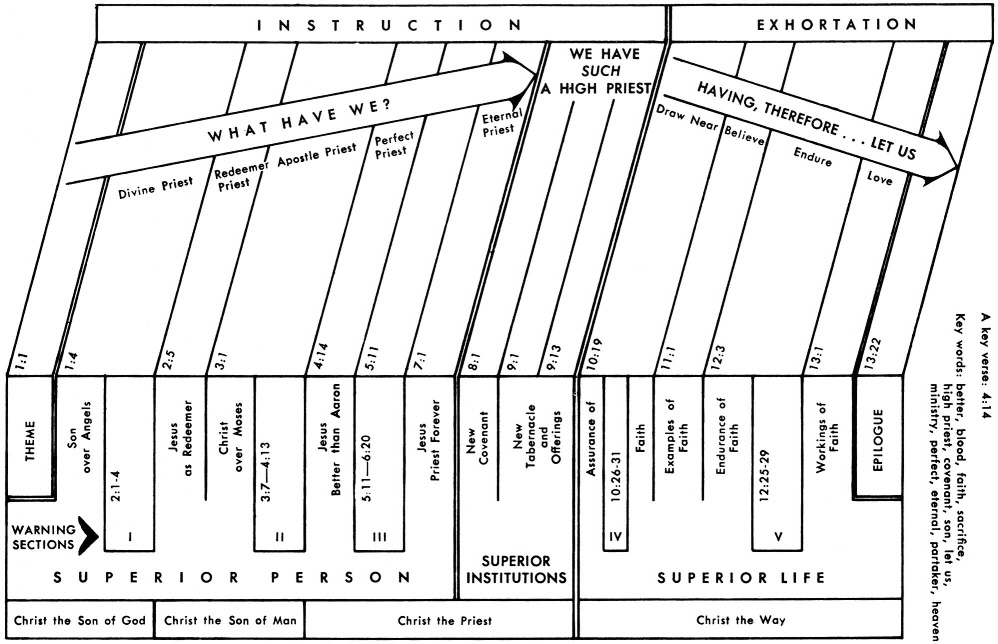
CONSIDER JESUS OUR GREAT HIGH PRIEST
Click chart to enlarge
Charts from Jensen's Survey of the NT - used by permission
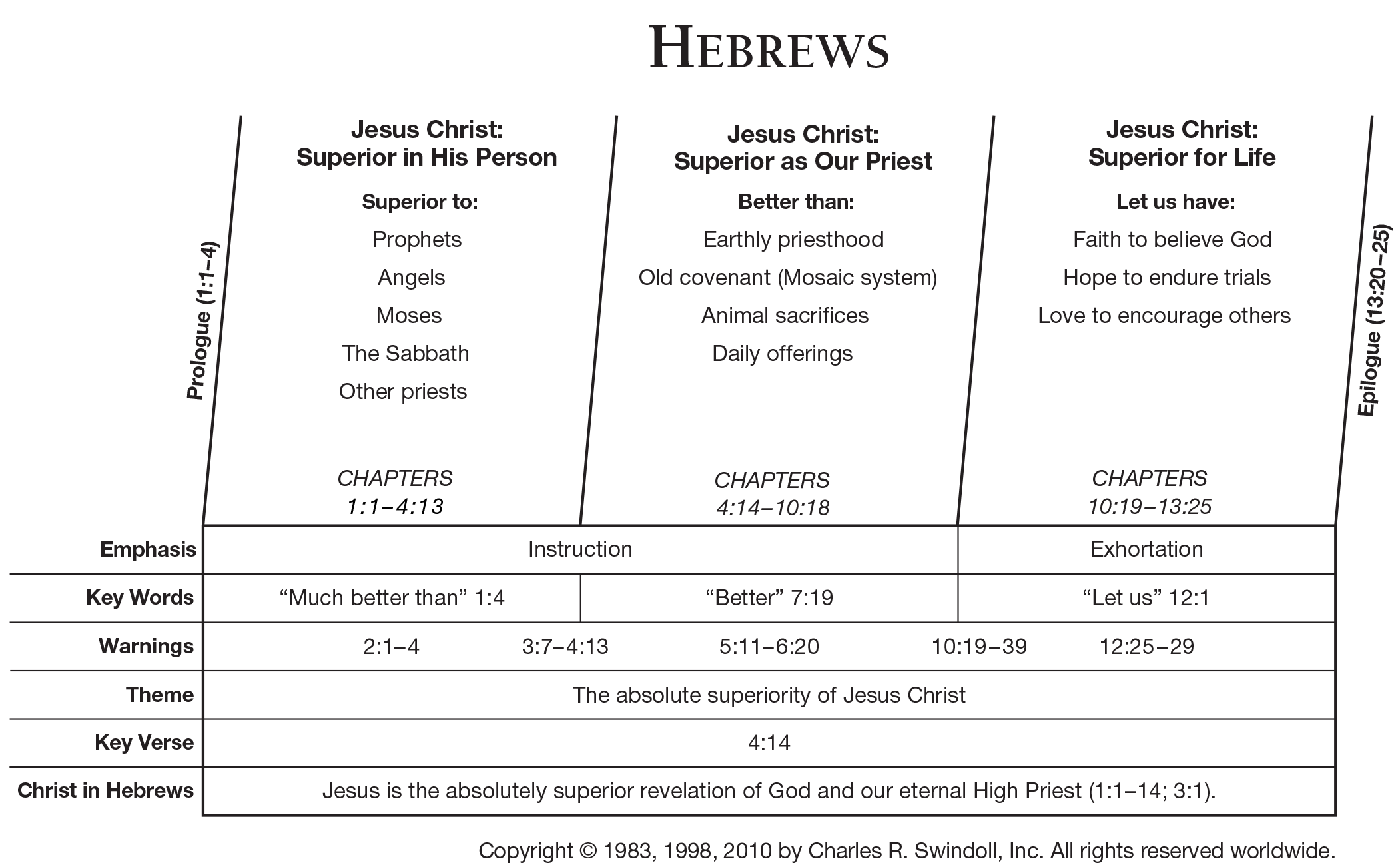
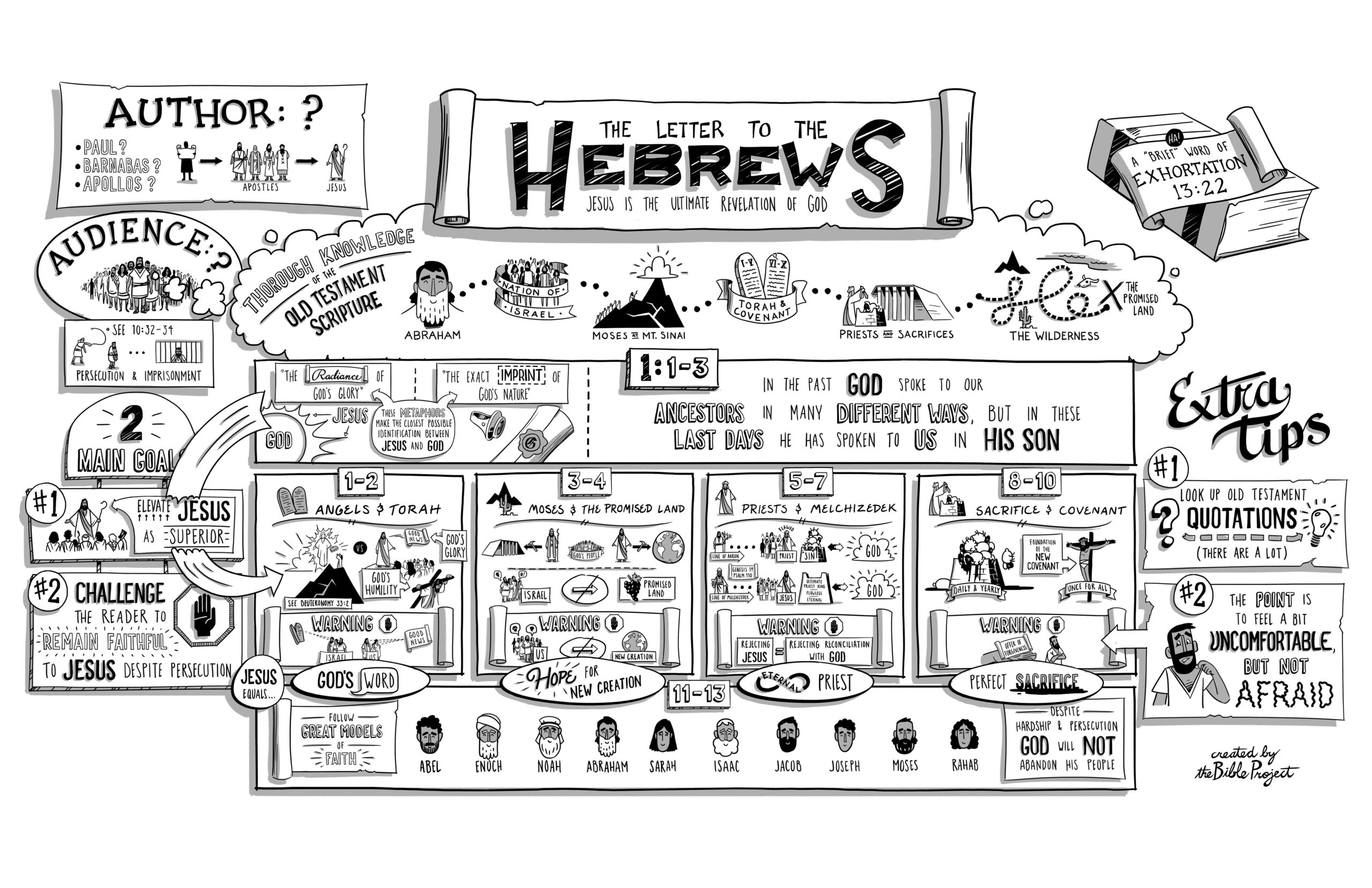
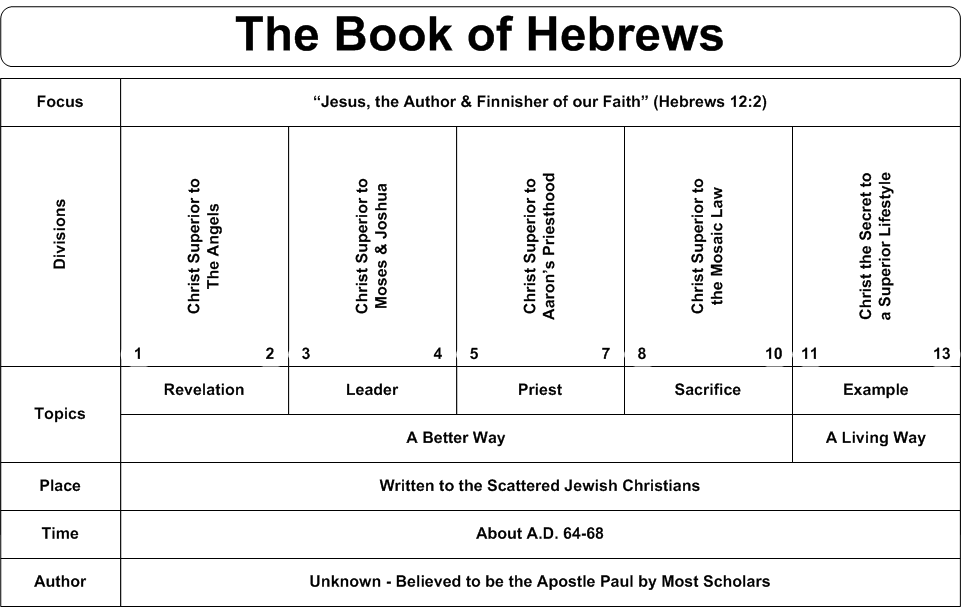
Swindoll's Chart, Interesting Pictorial Chart of Hebrews, Another Chart
|
The Epistle |
||||
| INSTRUCTION Hebrews 1-10:18 |
EXHORTATION Hebrews 10:19-13:25 |
|||
| Superior Person of Christ Hebrews 1:1-4:13 |
Superior Priest in Christ Hebrews 4:14-10:18 |
Superior Life In Christ Hebrews 10:19-13:25 |
||
| BETTER THAN PERSON Hebrews 1:1-4:13 |
BETTER PRIESTHOOD Heb 4:14-7:28 |
BETTER COVENANT Heb 8:1-13 |
BETTER SACRIFICE Heb 9:1-10:18 |
BETTER LIFE |
| MAJESTY OF CHRIST |
MINISTRY OF CHRIST |
MINISTERS FOR CHRIST |
||
|
DOCTRINE |
DUTY |
|||
|
DATE WRITTEN: |
||||

See ESV Study Bible "Introduction to Hebrews"
(See also MacArthur's Introduction to Hebrews)
Borrow Ryrie Study Bible
Hebrews 11:20 By faith Isaac blessed Jacob and Esau, even regarding things to come. (NASB: Lockman)
Greek: Pistei kai peri mellonton (PAPMPG) eulogesen (3SAAI) Isaak ton Iakob kai ton Esau
Amplified: [With eyes of] faith Isaac, looking far into the future, invoked blessings upon Jacob and Esau. (Amplified Bible - Lockman)
KJV: By faith Isaac blessed Jacob and Esau concerning things to come.
NKJ By faith Isaac blessed Jacob and Esau concerning things to come.
NET By faith also Isaac blessed Jacob and Esau concerning the future.
BGT Πίστει καὶ περὶ μελλόντων εὐλόγησεν Ἰσαὰκ τὸν Ἰακὼβ καὶ τὸν Ἠσαῦ.
CSB By faith Isaac blessed Jacob and Esau concerning things to come.
ESV By faith Isaac invoked future blessings on Jacob and Esau.
NIV By faith Isaac blessed Jacob and Esau in regard to their future.
NLT: It was by faith that Isaac blessed his two sons, Jacob and Esau. He had confidence in what God was going to do in the future. (NLT - Tyndale House)
Phillips: It was by faith that Isaac gave Jacob and Esau his blessing, for his words dealt with what should happen in the future. (Phillips: Touchstone)
Wuest: By faith, and that concerning things to come, Isaac blessed Jacob and Esau.
Young's Literal: By faith, concerning coming things, Isaac did bless Jacob and Esau
- Isaac blessed - Ge 27:27-40; Ge 28:2,3
- Reciprocal References: Genesis 27:4 - that my Genesis 27:23 - he blessed Genesis 27:28 - of the dew Genesis 27:33 - yea Genesis 27:39 - Behold Nu 6:23 - General, Hebrews 7:7 - the less
- Hebrews 11 Resources - Multiple Sermons and Commentaries
Related Passages:
Romans 9:10-13+ And not only this, but there was Rebekah also, when she had conceived twins by one man, our father Isaac; 11 for though the twins were not yet born and had not done anything good or bad, so that God’s purpose according to His choice would stand, not because of works but because of Him who calls, 12 it was said to her, “THE OLDER WILL SERVE THE YOUNGER.” 13 Just as it is written, “JACOB I LOVED, BUT ESAU I HATED.”
Psalms 33:11 (GOD'S SOVEREIGNTY IN PASSING THE BLESSING TO JACOB, NOT ESAU) The counsel of the LORD stands forever, The plans of His heart from generation to generation.
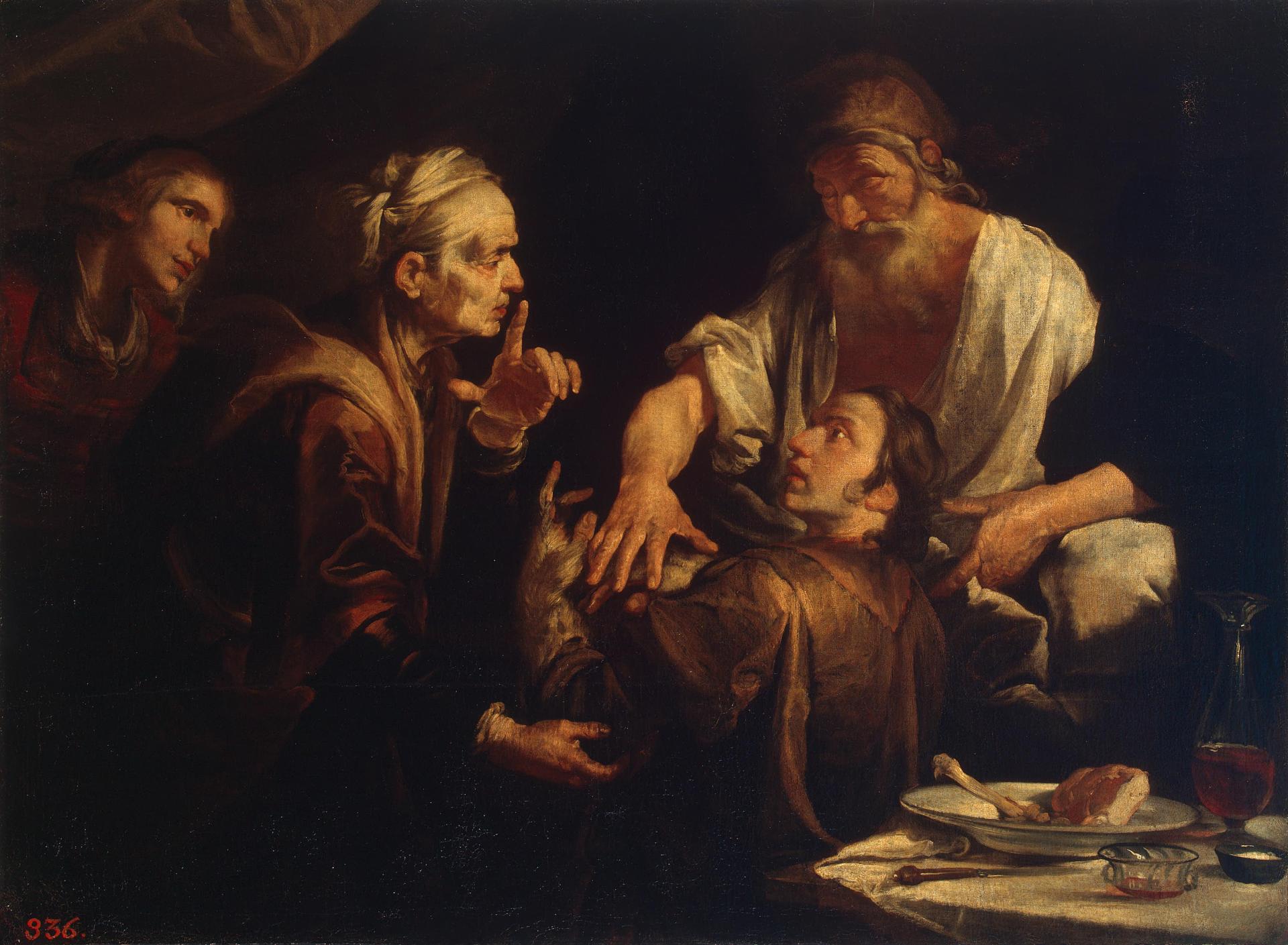
BY FAITH THE ABRAHAMIC
BLESSING WAS PASSED ON
In these next 3 verses, Hebrews 11:20-22, the writer looks at the end of the lives of the next three patriarchs after Abraham to emphasize how their lives (albeit not perfect) were examples of those who remained faithful even to the end of their life (all three are at the end of their lives!) Remember the writer is speaking primarily to Jews who are being tested and tempted to revert to Judaism and he wants these examples of perseverance to the end to encourage his readers that your forefathers did it and so can you.
The faith of these patriarchs was not grounded in earthly things, but in the unseen, eternal realities of God’s promises. Their eyes were fixed on what is above, on the spiritual and heavenly, not the temporal or material (cf. Col 3:1+, Col 3:2+). Just as Abraham looked forward to “the city which has foundations, whose architect and builder is God” (He 11:9, 10+), so too did his descendants live with a forward-looking faith.
🙏 THOUGHT - These truths raise several searching questions for us today: What are you looking for? What are you living for? Is your focus on this present world—“this present evil age” (Galatians 1:4+)—a world that is “passing away” along with its desires (1 John 2:17+)? Are you living by what you can see with your natural eyes, or by what you can see through the eyes of faith? As Paul reminds us, “we look not at the things which are seen, but at the things which are not seen” (2 Corinthians 4:18+), for “we walk by faith, not by sight” (2 Corinthians 5:7+).
Remember that the writer is addressing Hebrews and they would have been very familiar with the OT passages detailing the lives of Isaac, Jacob and Joseph, so he does not give any significant background. But most of us reading this are Gentiles and it is difficult to properly understand the passage without the OT background, so the passages that relate to the blessing of Jacob and Esau are included below with a few explanatory notes.
Hebrews 11:13+ is an allusion to the fact that the patriarchs never saw fulfillment of the promises to Abraham...
All these died in faith, without receiving the promises, but having seen them and having welcomed them from a distance, and having confessed that they were strangers and exiles on the earth.
By faith (pistis) - Click for more in depth discussion of by faith. Because the son of promise, Isaac, believed the promises of God that were initially given to his father Abraham, he pronounced the patriarchal blessing described in Genesis 27 and Ge 25:23–34, etc. It is a bit ironic that when Isaac blessed is sons, he was essentially blind (Ge 27:1, 23, cf Jacob's eyes "dim from age" Ge 48:10)! Ponder the incredible sovereignty of God. What if Isaac still had 20/20 vision? It would have been very difficult for Jacob to pretend to be Esau so he could receive the blessing of the firstborn. So it is no accident that Isaac's vision was impaired as he sat on death's door. Contrast Moses who "Although Moses was one hundred and twenty years old when he died, his eye was not dim, nor his vigor abated.” (Dt 34:7). For Moses, his clear vision allowed him to get a view of the promised land and hear the LORD's promise "I will give it to your descendants" (Dt 34:1-4+). In contrast, Isaac was preparing to pass the promises on to the wrong heir, but God gave him "corrective vision" so to speak, allowing Jacob to deceive his father and thereby fulfill God's plan! Several commentators have written that Isaac’s physical eyes were dim, but his spiritual eyes were even dimmer, because he was blind to the will of God—so blinded by carnal affection that he preferred the one whom God had rejected! And yet, remarkably, the text ("BY FAITH") still gives Isaac credit for passing on the blessing to Jacob.
Isaac blessed (eulogeo) Jacob and Esau - This looks back on the events of Genesis 27 and Genesis 28. Although the phrase is simple, it is rich in theological meaning and reveals how God's sovereign purposes unfolded, even in face of human weakness and family conflicts. Esau was the firstborn and Jacob was the younger. In Genesis 25:23 we read the prophecy concerning Jacob and Esau, for "The LORD said to her (ISAAC'S WIFE Rebekah), “Two nations are in your womb; And two peoples will be separated from your body; And one people shall be stronger than the other; And the older (ESAU) shall serve the younger (JACOB).” The problem arose because Isaac favored Esau and intended to bless him with the birthright blessing (Ge 27:1–4). Through the guidance of Rebekah and Jacob’s deception, Jacob received the blessing intended for Esau (Genesis 27:27–29). When Esau came in afterward, Isaac trembled and realized what had happened—but he did not revoke the blessing. Instead, he confirmed it, saying, “Indeed, he shall be blessed” (Genesis 27:33). Though Isaac initially tried to bless Esau against God’s revealed plan, he ultimately submitted to God’s will. Hebrews 11:20 commends Isaac’s faith, not in his initial intention of course, but in his ultimate acceptance of God’s sovereign choice.
Isaac gave two blessings. Jacob’s blessing (Ge 27:27–29) was the covenant blessing, the continuation of God’s promises to Abraham. Esau’s blessing (Ge 27:39–40) was lesser, but still prophetic. It foretold that Esau’s descendants (the Edomites) would live by the sword and eventually break free from Jacob’s dominance. The upshot is that both of Isaac’s blessings were prophetic declarations about the future of two nations, Israel (from Jacob) and Edom (from Esau).
This passage highlights God’s sovereignty over human plans. Even though Isaac tried to bless Esau, God’s plan prevailed. God’s purposes are not thwarted by human error or favoritism.
🙏 THOUGHT- Isaac’s blessing of Jacob and Esau reminds us that God’s plans are not dependent on human perfection. Even when our motives are flawed or our understanding is limited, God is faithful to fulfill His promises (cf Romans 8:28+). Isaac’s faith, though imperfect, was ultimately expressed in his submission to God’s revealed will. As believers, we are called to trust in the promises of God—even when we don’t fully understand how they will come to pass. Like Isaac, we must learn to say, “Indeed, he shall be blessed”—acknowledging that God’s way is always best.
Even regarding things to come (mello) - Isaac blessed both of his sons concerning their future, trusting God's word. Isaac with eyes of faith saw the futures of both Jacob and Esau. You might call this "Biblical fortune-telling," which is the only accurate fortune telling for it was based on God's Word and God's Spirit guiding Isaac!
John MacArthur in introducing his message on Hebrews 11:20-22 quips "We have a big challenge ahead of us tonight, although there are only three verses to look at in Hebrews 11. Essentially these three verses summarize a story that goes from Genesis chapter 12 to Genesis chapter 50!" (The Patriarchs: An Enduring Faith)
Ray Stedman - The thought of a faith still trusting in the very face of death leads the writer to focus on Abraham's descendants---Isaac, Jacob and Joseph. They see their own deaths and yet look beyond in unwavering faith (Heb 11:20-22). The point about all three is that they clearly saw aspects of the future because they exercised faith in what was invisible at the present....These men were not dreamers or merely wishful thinkers; they "saw" invisible realities, and adapted their own lives and that of their descendants accordingly. (Commentary)
Their faith, being stronger than death, in a way overcame death,
for their words were fulfilled.
Leon Morris - It was when he thought he was near death that Isaac blessed Jacob and Esau (Gen 27:2, 4). Jacob gave blessings and Joseph gave instructions in the light of the nearness of death. With all three the significant thing was their firm conviction that death cannot frustrate God's purposes. Their faith was such that they were sure God would work his will. So they could speak with confidence of what would happen after they died. Their faith, being stronger than death, in a way overcame death, for their words were fulfilled. (BORROW Expositor's Bible Commentary)
But even through all three men were old and near death, this truth did not deter them from passing on the promised blessing to their children, which is an act of faith ("by faith"). So even though they are soon to die, they still believed God would fulfill the promises to their children. The rested on the truth that God always keeps his words, that He was a covenant keeping God! Recall the exhortation in chapter 10 "Let us hold fast the confession of our hope without wavering, for He who promised is faithful (TRUSTWORTHY)." ( Hebrews 10:23+)
As John MacArthur says the three patriarchs in Hebrews 11:20-22 did not "die in the despair of unfulfilled dreams. They didn’t die saying, “Oh, it never came; it never came.” They died saying, “It will come,” because they believed God. They died, then, defeating death, knowing that they would die, but the promise of God could never die... God wants them (ED: the genuine Jewish Christians and ones who had intellectually assented) to know that this faith principle of the New Covenant is nothing new. So, He goes back all the way to beginning of history and shows how every real man of God is a man of faith, (because) the Jews had gotten into a works system. They believed they pleased God by their works. And so, as they went back in the history that they had to face, it was revealed to them that always it had been faith and never works. You’ll never earn your way to heaven; it can’t be done....You only get there (ED: To Heaven) by faith. And that’s the promise of the New Covenant, and that’s what He is trying to get across to these Jewish readers in this little Jewish community, that the only way to please God is by faith, not works." (Faith in the Face of Death)
🙏 THOUGHT - We each need to take careful inventory of our lives so that we might (if necessary) re-order our priorities to the unseen and the eternal and doing so not out of legalism but out of love for God and the sure hope that the best is yet to come! (cf Vertical Vision; Redeem the Time) God has promised, so it will be so (cp Josh 23:14+, 2Co 1:20KJV+). If we believe Him, really believe Him, we will live lives governed by that belief and we will enter into the fullness of His joy even in this temporal world (Ps 16:11+)! Remember that our life is but a vapor (Jas 4:14+)...don't waste your life (Eph 5:16+)! And it all comes down to a matter of daily, moment by moment choices! Choose for yourself today to serve Jehovah Jesus and not the gods of this present evil age (Joshua 24:15+).
While the Bible does not have nearly as much information about Isaac (just Genesis 25-27 which should be read for context) compared to about 12 chapters for each of the other patriarchs (Abraham, Jacob, Joseph), there is an interesting passage in Genesis 26:24 when God encouraged Isaac's faith with a personal appearance...
The LORD appeared to him the same night and said, “I am the God of your father Abraham; Do not fear, for I am with you. I will bless you, and multiply your descendants, For the sake of My servant Abraham.”
By faith Isaac blessed Jacob and Esau, even regarding things to come - Things to come refers to the respective futures of Jacob (see his future) and Esau (see his future). Humanly speaking since Esau was the first to come out of the womb (the "older"), he would naturally be expecting to be given the birthright. Normally the birthright meant receiving a double portion of the father’s inheritance but in this context it meant that through this son's line would come the Messiah. What is fascinating about this story is that even though Rebekah and Jacob used deceitful means to secure the blessing, Jacob had been prophesied to be God’s choice and God’s will was accomplished.
David Thompson - Isaac is nearing his own death and he blesses both of his sons, but he blesses the wrong son first because he was tricked. Now here is the thing. Once Isaac realized he had blessed the wrong son, he could have changed his mind and made things right. However, this is the point of Hebrews 11:20; Isaac was thinking of “things to come” and he realized that God’s hand was in this. He realized that Jacob would have the blessing of the Abrahamic covenant, not Esau, even though he also blessed him (Gen. 27:38-40). Certainly one thing stands out about this and that is, as Isaac was nearing his own death, his mind was totally focused on “things to come.” He knew Jesus Christ would come through Jacob (Matt. 1:1-2). (Sermon)
In the Scriptures below (see note on Ge 27:28,29), Isaac repeats the last part of God's covenant promise to Abraham "And blessed be those who bless you.” (Ge 12:3+). As Jack Arnold says "With this act, he also expressed a great confidence in God that God would fulfill His promise to Abraham -- a land, a great nation and the promised seed through whom Messiah would come and the world would be blessed." (Sermon)
Jack Arnold adds that "This incident of the blessing of Jacob and Esau shows us clearly that God’s plans come about in spite of the wrong actions of men. God rules and overrules and His hidden plans are never frustrated by men.
“Many are the plans in a man’s heart, But the counsel of the LORD, it will stand” (Prov. 19:21).
“The LORD nullifies the counsel of the nations; He frustrates the plans of the peoples” (Psa.33:10).
“Remember the former things long past, For I am God, and there is no other; I am God, and there is no one like Me, Declaring the end from the beginning And from ancient times things which have not been done, Saying, ‘My purpose will be established. And I will accomplish all My good pleasure’” (Isa. 46:9-10).
Faith faces death trusting God to fulfill His future promises,
even when circumstances seem to contradict those promises.
Kenneth Wuest on Isaac blessed - Isaac pronounced a blessing, and that concerning things to come,” namely, things beyond the lifetime of Jacob and Esau. The blessing was an act of faith. (Hebrews Commentary)
David Guzik - Isaac was really in the flesh, not in faith, when he first intended to bless Esau instead of Jacob. He wanted to bless Esau with the birthright for carnal reasons. He liked Esau as a more “manly” man, and he liked the wild game he brought home. Instead he should have chosen Jacob, whom God chose.....The faith in Isaac’s blessing came in after Isaac’s attempt to thwart the will of God was destroyed, when he said of Jacob, and indeed he shall be blessed (Genesis 27:33). He knew that his puny attempt to box God in was defeated, and he responded in the faith that said, “O.K. God, You win. Let Jacob be blessed with the birthright, and let Esau be blessed after him in his own way.
William MacDonald - Before the children were born, the Lord announced to Rebekah that the boys would become the source of two nations and that the older (Esau) would serve the younger (Jacob). Esau was Isaac’s favorite and, as the elder son, would normally have received the best portion from his father. But Rebekah and Jacob deceived Isaac, whose sight was now poor, into giving the best blessing to Jacob. When the plot was exposed, Isaac trembled violently. But he remembered God’s word that the older would serve the younger, and in spite of his predilection for Esau, he realized that God’s overruling of his natural weakness must stand. (BORROW Believer's Bible Commentary PAGE 2198)
Spurgeon - Isaac was old and blind, so that he did not know which of his sons came for the first blessing, yet he could see into the future sufficiently to bless both his sons “concerning things that were going to happen.” What wondrous power there is in faith even when it is exercised by very imperfect individuals! concerning things that were going to happen He looked into the future, although he was blind. He was a poor old man, lying upon his bed, with his eyes so dim that he could not tell one of his sons from another. But he could yet look into the future, and bless his sons “concerning things that were going to happen.” Oh, what sharp eyes faith has, even when the eyes of bodily vision have become dim! We may see far more by faith than we can by sight.
John MacArthur - The emphasis of this passage (Hebrews 11:20-22), however, is on the faith that Isaac, Jacob, and Joseph exhibited at the ends of their lives. Each one faced death in full, confident faith. Many believers find it difficult to anticipate and to face death. Yet a Christian who, for the most part, has walked with God faithfully often finds that the last hours of his life are the sweetest. Whatever the ups and downs of their lives, Isaac, Jacob, and Joseph went out basking in the sunlight of true faith. (SEE Hebrews MacArthur New Testament Commentary - Page 338)
Faith (4102)(pistis) is synonymous with trust or belief and is the conviction of the truth of anything, but in Scripture speaks of belief respecting man's relationship to God and divine things, generally with the included idea of trust and holy fervor born of faith and joined with it. As pistis relates to God, it is the conviction that God exists and is the Creator and Ruler of all things well as the Provider and Bestower of eternal salvation through Christ. As faith relates to Christ it represents a strong and welcome conviction or belief that Jesus is the Messiah, through Whom we obtain eternal salvation and entrance into the Kingdom of Heaven. Stated another way, eternal salvation comes only through belief in Jesus Christ and no other way. For more discussion on the meaning of faith see commentary on Hebrews 11:1-2.
Faith is believing that God will keep His promises, despite circumstances that seem to be to the contrary! True faith that saves one's soul includes at least three main elements - (1) firm persuasion or firm conviction, (2) a surrender to that truth and (3) a conduct emanating from that surrender. In sum, faith shows itself genuine by a changed life. (Click for W E Vine's definition of faith) Note that this discussion of pistis is only an overview and not a detailed treatise of this vitally important subject. Those interested are directed to respected, conservative books on systematic theology for more in depth discussion (eg, Dr Wayne Grudem's book Systematic Theology: An Introduction to Biblical Doctrine is an excellent, uncompromising, imminently readable resource for the lay person. See especially Chapter 35 (Click for online outline of Conversion and/or Listen to the Mp3 of Conversion) which addresses the question "What is saving faith?" in an easy to understand manner.) Much of this "definition" deals with the general word group for faith (pistis = noun, pistos = adjective, pisteuo = verb)
ILLUSTRATION - A man stretched a tightrope across Niagara Falls and pushed a wheelbarrow across it. Next, he filled the wheelbarrow with 200 lbs. of cement and pushed it across. The onlookers were astounded. Then, the tightrope walker asked the crowd, "How many of you believe I could do this with a man in the wheelbarrow?" The hands flew into the air. He pointed to a man who had his hand up and he said, "All right sir. You get in first." However, you couldn't see the man for the trail of dust he left behind. It is one thing to profess faith, it is quite another thing to possess faith, produce faith and practice faith. Faith is not only a head issue, or a heart issue, but a hand issue. In other words, true Bible faith is active, not passive.
Blessed (2127)(eulogeo from eu = good + lógos = word; see cognates eulogetos and eulogia) means speak good or well. When eulogeo is used by men toward men it means to speak well of with praise and thanksgiving (English "Eulogy" = an address in praise for one deceased ). To say good or positive things. Eulogeo can be from men to God, from men to men, and from God to men. When God blesses men He grants them favor and confers happiness upon them. When directed toward God → to bless, to praise Him for His goodness (Eph 1:3). When God is the subject → to bestow favor or grace upon. (Luke 24:50) When man is the subject toward man → to ask God to bless, to invoke favor. (Rom 12:14). Here eulogéō means to speak kindly, pray for, or wish well to. In the Septuagint (LXX) used to translate the Hebrew בָּרַךְ (bārak), meaning to bless. “God blessed them, saying, ‘Be fruitful and multiply’” (Gen 1:28 LXX). Thus, eulogéō often denotes the creative power of divine speech—God’s spoken word imparts life and favor.
EULOGEO - 38V - Matt. 14:19; Matt. 21:9; Matt. 23:39; Matt. 25:34; Matt. 26:26; Mk. 6:41; Mk. 8:7; Mk. 11:9; Mk. 11:10; Mk. 14:22; Lk. 1:42; Lk. 1:64; Lk. 2:28; Lk. 2:34; Lk. 6:28; Lk. 9:16; Lk. 13:35; Lk. 19:38; Lk. 24:30; Lk. 24:50; Lk. 24:51; Lk. 24:53; Jn. 12:13; Acts 3:26; Rom. 12:14; 1 Co. 4:12; 1 Co. 10:16; 1 Co. 14:16; Gal. 3:9; Eph. 1:3; Heb. 6:14; Heb. 7:1; Heb. 7:6; Heb. 7:7; Heb. 11:20; Heb. 11:21; Jas. 3:9; 1 Pet. 3:9
Hebrews 6:14 saying, “I WILL SURELY BLESS YOU AND I WILL SURELY MULTIPLY YOU.”
Hebrews 7:1 For this Melchizedek, king of Salem, priest of the Most High God, who met Abraham as he was returning from the slaughter of the kings and blessed him,
Hebrews 7:6 But the one whose genealogy is not traced from them collected a tenth from Abraham and blessed the one who had the promises.
Hebrews 7:7 But without any dispute the lesser is blessed by the greater.
Hebrews 11:20 By faith Isaac blessed Jacob and Esau, even regarding things to come.
Hebrews 11:21 By faith Jacob, as he was dying, blessed each of the sons of Joseph, and worshiped, leaning on the top of his staff.
Ray Pritchard - One of the first prayers I learned to pray was my bedtime prayer. I do not remember how old I was when I first learned it, but I know I was just a young boy. Over the years it has helped millions of children get ready to go to bed. You probably know it by heart:
Now I lay me down to sleep
I pray Thee, Lord, my soul to keep
If I should die before I wake,
I pray Thee, Lord, my soul to take.
It is the third line that has always struck me as unusual: “If I should die before I wake.” It seems odd that little children in the springtime of life should mention death in their bedtime prayer. But if you think about it, it’s not odd at all. Death comes to all of us sooner or later. Sometimes to children. And sometimes in the night before we wake. There is an art to dying well. The Puritans spoke of “dying grace,” which is the special help God gives his children as they prepare to cross the final river. I suppose all of us are planning to live a long time, but these days you can never be sure. he question therefore is not, “Will we die?” because the answer is always yes, but “How will we face our own death?” Here is one mark of genuine Christianity. When you come to the end of your life, you still hold on to what you believe. When someone dies suddenly, we all want to know: What were his final words? That’s what our text is all about—the final words and deeds of three famous men. Hebrews 11:20-22 contains three brief snapshots from the end of life. One verse is devoted to each man: Isaac in verse 20, Jacob in verse 21, and Joseph in verse 22. These patriarchs have this in common: 1) What they did, they did by faith; 2) What they did, they did in the last hours of their life. They were all old and infirm and on the edge of the grave. And the Bible bids us take a close look at what they did before they died. Here are three generations in focus: Isaac the father, Jacob his son, Joseph his grandson. From looking at these final moments we can discover how faith shows itself at the end of life. (Sermon)
There is an epitaph in Bristol, England which reads:
Here lie John and Richard Ben
Two lawyers and two honest men
God works miracles now and then
God had worked a miracle in the life of Jacob.
As a young man, we saw Jacob taking the blessing.
As an old man, we see Jacob giving the blessing.As a young man, we saw Jacob wrestling God.
As an old man, we see Jacob worshiping God.
A. W. Pink comments that there are at least 8 interesting contrasts in the life of Jacob.
- He went out young; he came back old.
- He went out single; he came back married.
- He went out poor; he came back rich.
- He went out healthy; he came back lame.
- He went out with an old name; he came back with a new name.
- He went out alienated; he came back reconciled to his brother.
- He went out with his mother alive; he came back with his mother dead.
- He went out walking from God; he came back walking with God.
Steven Cole's outline of Hebrews 11:20-22 (For amplification of each point see Dying Faith below)
1. Isaac’s blessing of Jacob and Esau shows faith in God’s promises, even when circumstances seem to contradict those promises (He 11:20).
2. Jacob’s blessing of Joseph’s sons and his worship show faith in God’s promises, even when circumstances seem to contradict those promises (He 11:21).
A. Jacob’s blessing of Joseph’s sons shows faith in God’s promises, even when circumstances seem to contradict those promises.
There are three applications of this story.
(1) God’s ways are not man’s ways; God’s ways according to His sovereign choice, will triumph over man’s ways.
(2) As parents and grandparents, we should seek spiritual blessings for our children above worldly success.
(3) God is sovereign in assigning different gifts and places to His children, both materially and spiritually.
B. Jacob’s worship shows faith in God’s promises, even when circumstances seem to contradict those promises.
3. Joseph’s mention of the exodus and his order about his bones show faith in God’s promises, even when circumstances seem to contradict those promises (He 11:22).
Ge 27:18 - Then he came to his father and said, “My father.” And he said, “Here I am. Who are you, my son?” 19 Jacob said to his father, “I am Esau (LIE #1) your firstborn (LIE #2); I have done as you told me (LIE #3). Get up, please, sit and eat of my game (LIE #4), that you may bless me.”
Jacob lies at least 4 times in one sentence! So he successfully deceives Isaac, living up to his name, Jacob, the supplanter (see notes on his name Jacob) Phillips notes "It did not bother Jacob that he would be a deceiver if he did what his mother suggested. He did not want to seem a deceiver. He wanted to keep up appearances even while practicing deliberate fraud. He deceived himself long before he set out to deceive his father." (Exploring Genesis)
20 Isaac (Yitschaq) said to his son, “How is it that you have it so quickly, my son?” And he said, “Because the LORD your God caused it to happen to me (LIE #5 even involving God in this lie!).”
21 Then Isaac (Yitschaq) said to Jacob, “Please come close, that I may feel you, my son, whether you are really my son Esau or not.”
22 So Jacob came close to Isaac (Yitschaq) his father, and he felt him and said, “The voice is the voice of Jacob, but the hands are the hands of Esau.”
23 He did not recognize him, because his hands were hairy like his brother Esau’s hands; so he blessed him.
24 And he said, “Are you really my son Esau?” And he said, “I am.”
25 So he said, “Bring it to me, and I will eat of my son’s game, that I may bless you.” And he brought it to him, and he ate; he also brought him wine and he drank.
26 Then his father Isaac (Yitschaq) said to him, “Please come close and kiss me, my son.”
27 So he came close and kissed him; and when he smelled the smell of his garments, he blessed him and said, “See, the smell of my son Is like the smell of a field which the LORD has blessed;
28 (THE CONTENT OF THE ABRAHAMIC BLESSING - vv 28-29) Now may God give you of the dew of heaven, And of the fatness of the earth, And an abundance of grain and new wine; 29 May peoples serve you, And nations bow down to you; Be master of your brothers, And may your mother’s sons bow down to you. Cursed be those who curse you, And blessed be those who bless you.”
30 Now it came about, as soon as Isaac had finished blessing Jacob, and Jacob had hardly gone out from the presence of Isaac his father, that Esau his brother came in from his hunting.
31 Then he also made savory food, and brought it to his father; and he said to his father, “Let my father arise and eat of his son’s game, that you may bless me.”
32 Isaac his father said to him, “Who are you?” And he said, “I am your son, your firstborn, Esau.”
33 Then Isaac trembled violently, and said, “Who was he then that hunted game and brought it to me, so that I ate of all of it before you came, and blessed him? Yes, and he shall be blessed ("He will indeed be blessed!" NET).”
Literally - "trembleth a very great trembling" “Jacob trembled a great trembling exceedingly”The word “trembled” (ḥarad) conveys the physical shaking, manifesting a person’s terror (e.g., Ge 42:28; Exod 19:16; Amos 3:6). The immediate apprehension was the irrevocable nature of the blessing. (New American Commentary – Genesis)
Tremble (02729)(charad) conveys the idea of movement resulting from agitation, usually trembling coming from emotional trauma. It can describe the shaking of a mountain (Ex 19:18) or the flitting of a bird (Jer 7:33), but it is most commonly used to describe trembling or shuddering from some sort of fear. The Arabic cognate of chāradh means "to be furious." Most occurrences refer to trembling from emotional agitation before an unusual circumstance, such as this first OT use describing Isaac's great tremor. The Septuagint (Lxx) translates charad with ekstasis (from existemi = "be out of one's senses") in a state of consternation or profound emotional experience to the point of being beside oneself, a good description of Isaac after giving his immutable blessing to Jacob rather than Esau.
"He will indeed be blessed!" - The point is he refuses to reverse the blessing.
Ray Pritchard writes that "This is an example of the overruling grace of God. He didn’t try to reverse the blessing obtained through deceit because he believed God was at work in the trickery of his wife and his younger son. He thus affirmed God’s choice of Jacob over Esau and God’s blessing of Jacob though he did not deserve it. His personal desire to bless Esau could not overcome God’s desire to bless Jacob first. By faith he ratified what God has ordained. Somehow he saw the hand of God behind all the conniving. What a lesson about the sovereignty of God working through sinful human circumstances. Isaac understood that God’s will comes first, and we must bow before it even when we don’t understand it. Sometimes we make decisions that hurt those we love the most. When that happens, we must do what is right even when it goes against our personal preferences. The question at that point becomes, Do we put God’s will above our own desires? Did Isaac have faith? Yes. He was strong in the end when it counted. He made sure his children were blessed “regarding the future.” He didn’t accomplish a great deal from a worldly point of view but he passed his faith along to his children. And in the end, that’s all that matters....God blessed these imperfect people in the Old Testament, and through them accomplished his will. That ought to encourage all of us. We are imperfect people living in an imperfect world—and God loves us in spite of our imperfections. So we can rejoice that God honored Isaac’s faith even though it occurred in the midst of a very dysfunctional family. (Sermon)
34 When Esau heard the words of his father, he cried out with an exceedingly great and bitter cry, and said to his father, “Bless me, even me also, O my father!”
NAC - Esau’s reaction was as vociferous as that of his father. The language employed to describe Esau’s outcry is the same syntactical pattern, lit., “he cried a great and exceedingly bitter cry” (v. 34). “Cry” (ṣ-ʾ-q) is a person’s wailing over a great loss (e.g., Ex 11:6; 12:30) or the scream of a person violated (e.g., 4:10; 19:13; Dt 22:24,27; Isa 5:7). The njps captures the tumultuous scene by “he burst into wild and bitter sobbing.” Esau appealed for a blessing also, presumably a comparable one, but Isaac cannot bequeath a blessing of value since Jacob by treachery received the full endowment, constituting the sole power and wealth of the father (v. 35). (See Genesis 11:27-50:26 - Page 434)
35 And he said, “Your brother came deceitfully (Lxx = dolos = strictly bait for fish; hence deceit, treachery, fraud) and has taken away your blessing.”
NAC - “Your blessing” here means that the blessing given was the one intended for Esau as the firstborn. Isaac’s portrayal of Jacob’s deed is especially appropriate: “deceitfully” (mirmâ) describes the treachery that Jacob himself will someday suffer (ramâ, 29:25; cf. mirmâ, 34:13), and “took” (laqaḥ) earlier repeatedly described Rebekah’s preparations (vv9,13,14,15). (See Genesis 11:27-50:26: An Exegetical and Theological - Page 434)
36 Then he said, “Is he not rightly named Jacob (Yaaqob from aqeb = heel), for he has supplanted (aqab from aqeb = heel; Lxx = pternizo) me these two times? He took away my birthright, and behold, now he has taken away my blessing.” And he said, “Have you not reserved a blessing for me?”
Note that supplanted (aqav/aqab) is from the same root as the name “Jacob.” (Yaaqob - both are from aqeb = heel). This Esau is saying something like Jacob “has ‘Jacob-ed’ me these two times”; “he has twice overreached me!”
Ge 25:26 Afterward his brother came forth with his hand holding on to Esau’s heel (aqeb; Lxx = pterna = heel ~ idiomatically, of treating someone maliciously as used in Jn 13:18+), so his name was called Jacob; and Isaac was sixty years old when she gave birth to them.
Note - Recall that God had prophesied to Jacob's mother before the twins were born that Jacob would be the blessed heir in Genesis 25:23 when Jehovah told Rebekah “Two nations are in your womb; and two peoples will be separated from your body; and one people shall be stronger than the other; and the older (ESAU) shall serve the younger (JACOB).”
Paul adds that "for though the twins were not yet born and had not done anything good or bad, so that God’s purpose according to His choice (ekloge) would stand, not because of works but because of Him who calls, 12 it was said to her, “THE OLDER WILL SERVE THE YOUNGER.” 13 Just as it is written, “JACOB I LOVED, BUT ESAU I HATED (Quoting Malachi 1:2-3+). 14 What shall we say then? (TO ALL WHO WOULD SAY TO GOD "THAT IS NOT FAIR!") There is no injustice with God, is there? May it never be!” (Romans 9:11-14+)
37 But Isaac replied to Esau, “Behold, I have made him your master, and all his relatives I have given to him as servants; and with grain and new wine I have sustained him. Now as for you then, what can I do, my son?”
38 Esau said to his father, “Do you have only one blessing, my father? Bless me, even me also, O my father.” So Esau lifted his voice and wept.
39 (CONTENT OF JACOB'S "BLESSING" ON ESAU) Then Isaac his father answered and said to him, (ISAAC'S "BLESSING" FOR ESAU) “Behold, away from the fertility of the earth shall be your dwelling, And away from the dew of heaven from above (IN DESERT AREAS - BUT AS PROVIDENCE WOULD HAVE IT DESERT RICH IN OIL RESERVES!). 40 “By your sword you shall live, And your brother (JACOB) you shall serve; But it shall come about when you become restless, That you will break his yoke from your neck.”
Isaac prophesies that Esau (later Edom) would eventually fight against Israel and become free of Israelite control. Read 2Ki 8:20; 2Chr 21:8-10; 2 Chr 28:16, 17.
Deceit (1388)(dolos from dello = to bait) literally refers to a fishhook, trap, or trick, all of which are various forms of deception. Dolos is a deliberate attempt to mislead, trick, snare or "bait" (baiting the trap in attempt to "catch" the unwary victim) other people by telling lies. It is a desire to gain advantage or preserve position by deceiving others. A modern term in advertising is called "bait and switch" where the unwary consumer is lured in by what looks like an price too good to be true! It is notable that this same word dolos is used in the Septuagint (Lxx) translation of Ge 34:13 which describes the deceit of Jacob's sons!
Supplanted (06117)(aqav/aqab from aqeb 06119 = heel) means to grasp at the heel, to supplant, to deceive. Jacob's name is also derived from aqeb.
Aqav/aqab - Ge 27:36; Job 37:4 = "He does not restrain"; Jer. 9:4 = "every brother deals craftily"; Hos. 12:3 = "he took his brother by the heel"
The Greek word used to translate aqav/aqab in the Septuagint of Ge 27:36 is pternizo literally means “to trip up by the heel,” “to overreach,” or “to supplant.” The idea is to go behind one's back so as to deceive, to outwit; metaphorically it means to bite the heel of someone; from wrestling, to trip or deceive craftily, to act deceitfully toward someone.
The root word is pterna, which is used metaphorically of deception or betrayal from behind, often describing subtle treachery rather than open opposition. This root pterna is used in the Septuagint of Ge 3:15 of God's prophecy to Satan that "you shall bruise him (MESSIAH) on the heel (ON THE CROSS HIS HEEL WAS BRUISED BECAUSE HE HAD TO PUSH UP FROM THE HEEL IN ORDER TO BREATH. WHEN ARMS ARE FIXED LIKE ON THE CROSS, THEY FIX THE INTERCOSTAL MUSCLES, PULL THE CHEST WALL UPWARD AND MAKE NORMAL DIAPHRAGMATIC BREATHING, ESPECIALLY EXHALATION. TO EXHALE JESUS HAD TO PUSH UP. EVERY EXHALATION WOULD HAVE CAUSED EXCRUCIATING PAIN FROM THE NAIL WOUND IN THE HEELS! AND YET BY THIS VERY ACT OUR LORD IN EFFECT CRUSHED THE SERPENT'S HEAD - Heb 2:14 Col 2:15, Ro 16:20).
Pternizo in the Septuagint (Lxx) - Gen. 27:36; Jer. 9:4; Hos. 12:3; Mal. 3:8; Mal. 3:9
Hebrew Alignment עקב 1—betray; seize someone by the heel, go behind someone; hamper, hinder (3): Ge 27:36; Jer 9:4; Hos 12:3 קבע—walk behind one another; rob, steal (2): Mal 3:8, 9
Compare related (cognate) word pternismos = supplanting; treachery. Used in the Septuagint in the Messianic description in Ps 41:9 "My close friend...has lifted up his heel (pternismos = cunning treachery, back-stabbing) against Me." (Jesus quotes this in Jn 13:18)
Jacob (03290)(Yaaqob from aqeb = heel) - Background on his name -
IAKOB - 25V IN THE NEW TESTAMENT - Matt. 1:2; Matt. 1:15; Matt. 1:16; Matt. 8:11; Matt. 22:32; Mk. 12:26; Lk. 1:33; Lk. 3:34; Lk. 13:28; Lk. 20:37; Jn. 4:5; Jn. 4:6; Jn. 4:12; Acts 3:13; Acts 7:8; Acts 7:12; Acts 7:14; Acts 7:15; Acts 7:32; Acts 7:46; Rom. 9:13; Rom. 11:26; Heb. 11:9; Heb. 11:20; Heb. 11:21
Jacob. Abraham's grandson through Isaac. Used collectively, it refers to the tribes of Israel, as descended from the twelve sons of Jacob. Jacob, the second of Isaac's twin sons, received the preeminence before birth (Genesis 25:23; an example of divine election in general, Romans 9:11-13). But he acquired his name when he was born "with his hand [symbolically] holding on to Esau's heel" (Genesis 25:26 NASB: Hosea 12:3 [H 4]). When he had later gained the birthright (Genesis 25:29-34) and stolen Isaac's blessing (Genesis 27:1-29), Esau thus exclaimed, "Is he not rightly named Jacob (yaʿăqōb), for he has supplanted me these two times?" (Genesis 27:36). See also his devices against Laban (Genesis 30:29-31:12; cf. Isaiah 43:27-28).
Yet at Bethel, as Jacob was fleeing from Esau, God assured him that he was with him (Genesis 28:12, 15) and renewed the covenant which he had previously revealed to Abraham and Isaac (Genesis 28:13-14; cf. Genesis 17:7-8; Genesis 26:3-4; Leviticus 26:42). Jacob thereupon vowed that Yahweh would be his God and receive his tithes (Genesis 28:20-22). Then at Peniel, enriched by the Lord but dreading to meet Esau, he uttered a model prayer (Genesis 32:9-12).
God, in the person of the Angel of Yahweh presumably Christ pre-incarnate (Genesis 32:24, 30; Hosea 12:4), next encountered Jacob, with whom the patriarch wrestled, literally, but also in prayer (Hosea 12:4). Broken by God (Genesis 32:25 [H 26]) Jacob thereby achieved his final spiritual victory and blessing (Genesis 32:29 [H 30]), for the Angel said "Your name will no longer be Jacob (yaʿăqōb "supplanter"), but Israel (yiśrāʿēl), for you have striven (śārâ) with God and with men and have prevailed" (Genesis 32:28 [H 29]; cf. his subsequent devotion, Hebrews 11:21).
Both names, Israel and Jacob, became designations of honor for the patriarch's descendants (from Numbers 23 onward; cf. Numbers 24:5, or Numbers 17 [Messianic]; Psalm 47:4). God "loves Jacob" (Malachi 1:2; cf. Romans 11:26). Yet finally the blessing reaches out to all the people of God, "the generation of those who seek Thy face—even Jacob" (Psalm 24:6 NASB; cf. Galatians 3:29). (Theological Wordbook of the Old Testament page 692)
YAAQOB - 319V (348X) - Gen. 25:26; Gen. 25:27; Gen. 25:28; Gen. 25:29; Gen. 25:30; Gen. 25:31; Gen. 25:33; Gen. 25:34; Gen. 27:6; Gen. 27:11; Gen. 27:15; Gen. 27:17; Gen. 27:19; Gen. 27:21; Gen. 27:22; Gen. 27:30; Gen. 27:36; Gen. 27:41; Gen. 27:42; Gen. 27:46; Gen. 28:1; Gen. 28:5; Gen. 28:6; Gen. 28:7; Gen. 28:10; Gen. 28:16; Gen. 28:18; Gen. 28:20; Gen. 29:1; Gen. 29:4; Gen. 29:10; Gen. 29:11; Gen. 29:12; Gen. 29:13; Gen. 29:15; Gen. 29:18; Gen. 29:20; Gen. 29:21; Gen. 29:28; Gen. 30:1; Gen. 30:2; Gen. 30:4; Gen. 30:5; Gen. 30:7; Gen. 30:9; Gen. 30:10; Gen. 30:12; Gen. 30:16; Gen. 30:17; Gen. 30:19; Gen. 30:25; Gen. 30:31; Gen. 30:36; Gen. 30:37; Gen. 30:40; Gen. 30:41; Gen. 30:42; Gen. 31:1; Gen. 31:2; Gen. 31:3; Gen. 31:4; Gen. 31:11; Gen. 31:17; Gen. 31:20; Gen. 31:22; Gen. 31:24; Gen. 31:25; Gen. 31:26; Gen. 31:29; Gen. 31:31; Gen. 31:32; Gen. 31:33; Gen. 31:36; Gen. 31:43; Gen. 31:45; Gen. 31:46; Gen. 31:47; Gen. 31:51; Gen. 31:53; Gen. 31:54; Gen. 32:1; Gen. 32:2; Gen. 32:3; Gen. 32:4; Gen. 32:6; Gen. 32:7; Gen. 32:9; Gen. 32:18; Gen. 32:20; Gen. 32:24; Gen. 32:25; Gen. 32:27; Gen. 32:28; Gen. 32:29; Gen. 32:30; Gen. 32:32; Gen. 33:1; Gen. 33:10; Gen. 33:17; Gen. 33:18; Gen. 34:1; Gen. 34:3; Gen. 34:5; Gen. 34:6; Gen. 34:7; Gen. 34:13; Gen. 34:19; Gen. 34:25; Gen. 34:27; Gen. 34:30; Gen. 35:1; Gen. 35:2; Gen. 35:4; Gen. 35:5; Gen. 35:6; Gen. 35:9; Gen. 35:10; Gen. 35:14; Gen. 35:15; Gen. 35:20; Gen. 35:22; Gen. 35:23; Gen. 35:26; Gen. 35:27; Gen. 35:29; Gen. 36:6; Gen. 37:1; Gen. 37:2; Gen. 37:34; Gen. 42:1; Gen. 42:4; Gen. 42:29; Gen. 42:36; Gen. 45:25; Gen. 45:27; Gen. 46:2; Gen. 46:5; Gen. 46:6; Gen. 46:8; Gen. 46:15; Gen. 46:18; Gen. 46:19; Gen. 46:22; Gen. 46:25; Gen. 46:26; Gen. 46:27; Gen. 47:7; Gen. 47:8; Gen. 47:9; Gen. 47:10; Gen. 47:28; Gen. 48:2; Gen. 48:3; Gen. 49:1; Gen. 49:2; Gen. 49:7; Gen. 49:24; Gen. 49:33; Gen. 50:24; Exod. 1:1; Exod. 1:5; Exod. 2:24; Exod. 3:6; Exod. 3:15; Exod. 3:16; Exod. 4:5; Exod. 6:3; Exod. 6:8; Exod. 19:3; Exod. 33:1; Lev. 26:42; Num. 23:7; Num. 23:10; Num. 23:21; Num. 23:23; Num. 24:5; Num. 24:17; Num. 24:19; Num. 32:11; Deut. 1:8; Deut. 6:10; Deut. 9:5; Deut. 9:27; Deut. 29:13; Deut. 30:20; Deut. 32:9; Deut. 33:4; Deut. 33:10; Deut. 33:28; Deut. 34:4; Jos. 24:4; Jos. 24:32; 1 Sam. 12:8; 2 Sam. 23:1; 1 Ki. 18:31; 2 Ki. 13:23; 2 Ki. 17:34; 1 Chr. 16:13; 1 Chr. 16:17; Ps. 14:7; Ps. 20:1; Ps. 22:23; Ps. 24:6; Ps. 44:4; Ps. 46:7; Ps. 46:11; Ps. 47:4; Ps. 53:6; Ps. 59:13; Ps. 75:9; Ps. 76:6; Ps. 77:15; Ps. 78:5; Ps. 78:21; Ps. 78:71; Ps. 79:7; Ps. 81:1; Ps. 81:4; Ps. 84:8; Ps. 85:1; Ps. 87:2; Ps. 94:7; Ps. 99:4; Ps. 105:6; Ps. 105:10; Ps. 105:23; Ps. 114:1; Ps. 114:7; Ps. 132:2; Ps. 132:5; Ps. 135:4; Ps. 146:5; Ps. 147:19; Isa. 2:3; Isa. 2:5; Isa. 2:6; Isa. 8:17; Isa. 9:8; Isa. 10:20; Isa. 10:21; Isa. 14:1; Isa. 17:4; Isa. 27:6; Isa. 27:9; Isa. 29:22; Isa. 29:23; Isa. 40:27; Isa. 41:8; Isa. 41:14; Isa. 41:21; Isa. 42:24; Isa. 43:1; Isa. 43:22; Isa. 43:28; Isa. 44:1; Isa. 44:2; Isa. 44:5; Isa. 44:21; Isa. 44:23; Isa. 45:4; Isa. 45:19; Isa. 46:3; Isa. 48:1; Isa. 48:12; Isa. 48:20; Isa. 49:5; Isa. 49:6; Isa. 49:26; Isa. 58:1; Isa. 58:14; Isa. 59:20; Isa. 60:16; Isa. 65:9; Jer. 2:4; Jer. 5:20; Jer. 10:16; Jer. 10:25; Jer. 30:7; Jer. 30:10; Jer. 30:18; Jer. 31:7; Jer. 31:11; Jer. 33:26; Jer. 46:27; Jer. 46:28; Jer. 51:19; Lam. 1:17; Lam. 2:2; Lam. 2:3; Ezek. 20:5; Ezek. 28:25; Ezek. 37:25; Ezek. 39:25; Hos. 10:11; Hos. 12:2; Hos. 12:12; Amos 3:13; Amos 6:8; Amos 7:2; Amos 7:5; Amos 8:7; Amos 9:8; Obad. 1:10; Obad. 1:17; Obad. 1:18; Mic. 1:5; Mic. 2:7; Mic. 2:12; Mic. 3:1; Mic. 3:8; Mic. 3:9; Mic. 4:2; Mic. 5:7; Mic. 5:8; Mic. 7:20; Nah. 2:2; Mal. 1:2; Mal. 2:12; Mal. 3:6
Related Resources:
- What was the story of Jacob and Esau?
- Why did God love Jacob and hate Esau (Malachi 1:3; Romans 9:13)?
- Who was Esau in the Bible?
QUESTION - Who was Jacob in the Bible?
ANSWER - Jacob’s life began with a struggle. As a twin in the womb with Esau, he jostled for position and was born grasping his brother’s heel. Jacob’s name is translated as “he deceives” (Genesis 25:26). When his mother, Rebekah, asked God during her pregnancy what was happening to her, God told her that there were two nations within her womb who would become divided. One would be stronger than the other, and the older would serve the younger (Genesis 25:23).
Jacob and Esau grew up together living a nomadic life. Esau became a fine hunter and loved to be out in the countryside while Jacob "was content to stay at home among the tents" (Genesis 25:27). Esau, being a hunter, was his father’s favorite as Isaac loved the wild game Esau brought home, while Jacob was favored by his mother (Genesis 25:28). This destructive favoritism would follow the family into the next generation, most notably with Jacob’s son Joseph. Such was Jacob’s favoritism for Joseph that it caused great resentment among his brothers and nearly cost Joseph his life.
When Isaac was old and his eyesight faded, he thought he was near to his death and made arrangements with Esau to pass on to him the blessings due to the firstborn son (Genesis 27:1-4). On hearing this, Rebekah devised a plan to deceive Isaac into blessing Jacob instead. Thus, Jacob received his father’s blessing in Esau’s place. Esau vowed he would kill Jacob for this as soon as the period of mourning for his father’s death ended (Genesis 27:41). As it turned out, his father did not die for about another twenty years (Genesis 35:27–29).
However, Rebekah became aware of Esau’s plan and warned Jacob. Rebekah also told Isaac that Jacob should find himself a wife from among his own people, so Isaac sent Jacob to his uncle Laban who lived in their ancestral home of Haran (Genesis 27:43). During Jacob’s journey, he had a dream of a ladder to heaven with God at the top and angels ascending and descending. This imagery is mirrored in Jesus’ words to His disciple Nathanael (John 1:51). God gave Jacob the assurance of His presence and reiterated His promise to Abraham (Genesis 28:13-15). As a result of this experience, Jacob renamed the place “Bethel,” meaning “house of God,” and he vowed to serve God.
After Jacob settled in Haran, Laban offered him payment for the work he had been doing as a shepherd looking after his flocks. Jacob offered to work for Laban for seven years in return for Laban’s daughter Rachel, whom he loved deeply. However, Jacob was to discover that his uncle Laban could be just as much a deceiver as he had been. On Jacob’s wedding night, Laban substituted his older daughter, Leah, for Rachel (Genesis 29:23-25). However, Laban agreed to give Jacob Rachel as well, provided Jacob finish the wedding week with Leah before taking Rachel as a wife, and then work another seven years for him. Jacob agreed to this plan. While both women remained Jacob’s wives, Jacob loved Rachel more than Leah (Genesis 29:30), a source of continued family strife.
While Rachel remained barren, Leah gave birth to Jacob’s firstborn son, Reuben. Then followed the birth of eleven more sons from Leah, Rachel, and their two handmaidens. These sons would be the progenitors of the twelve tribes of Israel. After the birth of Joseph, Rachel’s first child and Jacob’s eleventh, Jacob asked Laban to send him back to his homeland. Laban asked Jacob to remain, telling him to name his wages. Jacob requested only the specked and spotted sheep and goats from all Laban’s flocks that he tended, to make flocks of his own. It is unclear how or why it worked, but Jacob put striped branches in front of the flocks when they mated, and it resulted in specked and spotted offspring that he could claim for himself. Jacob did this only with the strong animals so that his flocks grew strong while Laban had weak flocks (Genesis 30:31–43). Jacob recognized that Laban and Laban’s sons' attitude toward him had changed. It was then that God commanded Jacob to return to the land of his fathers accompanied by His promise, “And I will be with you” (Genesis 31:3). Jacob left Haran, taking with him his wives and children and all the vast flocks he had accumulated. When Laban learned that Jacob left, he pursued him. But God told Laban in a dream to "be careful not to say anything to Jacob, either good or bad" (Genesis 31:24). Laban did ask Jacob why he’d left secretly and spoke of his power to harm Jacob were it not for God’s warning. He also accused Jacob of stealing his household idols. Continuing the legacy of deception, Rachel who had taken the idols unbeknownst to Jacob, concealed them from her father during his search. Laban and Jacob eventually parted company after swearing an oath not to invade one another’s lands.
Next Jacob had to face his brother, Esau. Though twenty years had passed since they had last seen each other, the memory of Esau’s threat to kill Jacob had never left him (Genesis 32:11). Jacob sent messengers ahead of him with gifts, instructing them to tell Esau that he was following after. The messengers returned to Jacob, telling him that Esau was coming to meet him along with four hundred men. Afraid that Esau was coming to destroy him, Jacob divided his family into two groups, hoping at least one group could escape attack. Jacob prayed for God to save him, reminding God that He had sent Jacob back to the land of Abraham and had promised to make him prosper and his descendants numerous (Genesis 32:9–12). Jacob selected more gifts for Esau, which he sent ahead with servants in waves, hoping to pacify Esau. That night he sent his wives and sons away from him as well. While alone, in the middle of the night and afraid for his life, Jacob wrestled with a man who he later learned was God (Genesis 32:22-31). The man touched Jacob’s hip, putting it out of socket, but at daybreak Jacob still refused to let the man go. He asked for a blessing and was told, "Your name will no longer be Jacob, but Israel, because you have struggled with God and with humans and have overcome" (Genesis 32:28). Jacob asked the man his name and then understood that He was God. Jacob named the place Peniel, recognizing that He had seen God and yet God had spared his life. This wrestling match and name change marked a new beginning for Jacob.
The reunion with Esau was not the attack he had feared: "Esau ran to meet Jacob and embraced him; he threw his arms around his neck and kissed him. And they wept" (Genesis 33:4). Esau offered to accompany Jacob the rest of the way. Jacob refused, citing the size of his family. Jacob also refused Esau’s offer to leave some of his men with the group. It seems that Jacob did not fully trust his brother Esau, and so, instead of meeting Esau in Seir, Jacob took his family another route where they finally purchased a plot of land and settled in El Elohe Israel or “Mighty is the God of Israel.” Though he had been given a new name, Jacob the deceiver was still wary of others who might be trying to deceive him. Here we see that the mind of those who plot to deceive is always suspicious of the motives of others and can never fully be at rest.
Genesis 34 records the rape of Jacob’s only daughter, Dinah, and the revenge her brothers Simeon and Levi carried out on the rapist’s entire community. Once again, we see how the deviousness of the parents is passed on to the children in the deceitful way they overcame their enemy. Jacob was angry with his sons and, in obedience to God’s guidance, moved his family back to Bethel (Genesis 35:1) where God reappeared to Jacob and confirmed His blessing (Genesis 35:9-13). In Jacob’s meeting with God, he received the promise that kings and many nations would come from him and that the land God had promised his forefathers would be his inheritance (Genesis 35:11-12).
Jacob and his family later moved from Bethel to Eder. On the way, Rachel gave birth to her second son, Jacob’s twelfth—Benjamin. Rachel died in childbirth. Jacob was reunited with his father, Isaac, in Mamre. When his father died, both Jacob and Esau buried him.
Similar to his mother, Jacob also had favorites. Rachel was his favorite wife, and her children—Joseph and Benjamin—were his favorite sons. In fact, Joseph was so favored that his brothers became jealous and sold him into slavery. But God was with Joseph, and he eventually fared well in Egypt and rescued his family, Jacob included, from famine. Jacob died in Egypt and was embalmed at Joseph’s request (Genesis 49:29—50:3). Joseph and his brothers took Jacob’s body back to Canaan to be buried alongside Abraham, Sarah, Isaac, Rebekah, and Leah. Prior to his death, Jacob had blessed his twelve sons and requested to be buried in the cave that Abraham had bought for burial. Jacob had also blessed Joseph’s two sons, giving the blessing of the firstborn to the younger son. Unlike his father who had been deceived into giving the blessing of the firstborn to Jacob, Jacob crossed his hands to purposefully give the uncustomary blessing.
The similarities in the lives of Abraham, Isaac, and Jacob are striking. In their stories we see the importance of family and the influence of example. Themes like deceit, favoritism, family strife, unexpected blessing, reconciliation, and faith flow through the narratives. Mostly, we see that God is faithful to His promises. He chooses to accomplish His kingdom purposes through sinful people who are willing to believe Him. He can make those sinful people new—giving Abram the name Abraham, Jacob the name Israel, and making those who believe in Jesus Christ new creations (2 Corinthians 5:17). Though our sinful patterns might still plague us, in Christ we find forgiveness for our sins as well as power to overcome. We are invited to participate in God’s work in the world. We have new names and can trust the promises of the God who proves Himself faithful time and time again.
Jacob’s name, "deceiver," does seem to characterize much of Jacob’s life. But he was also Israel, one to whom God made promises to which He remained faithful. God appeared to Jacob, and Jacob believed God’s promises. Despite Jacob’s faults, God chose him to be the leader of a great nation that still bears his name today. But for this, it is unlikely that we would know much about Jacob, who appears to be in the middle of events while the key players are those around him. There is no great wisdom or bravery in Jacob to speak of, and we are tempted to see him as little more than God’s passive instrument. If we are tempted to think that, because we aren’t in the spotlight performing great acts for God, we are unimportant to Him, then we should consider the life of Jacob and know that, in spite of our failings, God can and will still use us in His plan.
Jack Arnold introduces his sermon on Hebrews 11:20-23 with these comments...
My own personal study in the Book of Hebrews, especially the eleventh chapter, has been just super and has come at a very needy time in my own experience to walk by faith. However, in my study of these three verses, I had a difficult time at first getting any real spiritual truth. I came to the conclusion that there are two themes in these verses: 1) facing death by faith and 2) accepting God’s promises by faith.
Soren Kiekegaard, the Danish theologian and philosopher, made a profound statement. He said, “There comes a midnight when all men must unmask.” All men wear masks and all try to hide their true identity. For every one of us, in one way or another, life is a masquerade. We seek to hide our faults from others, to cover our inadequacies, so they will not be seen. We think that the masks we are wearing hide our real selves from those who would know us. Some men grapple with life more honestly and a few of their masks come down in this life, but no one has defeated totally the problem of hypocrisy.
However, there is a final midnight when we shall all be unmasked and that midnight is the time of death when all of a man’s life will be laid bare before Almighty God. Most men fear death; they do not want to talk about it or think about it. Perhaps you are even now saying to yourself, “I’m interested in life not death. I want to talk about life - don’t bring up death!” Fear of death is natural because death is man’s greatest foe. But as with all other foes, death must be faced.
Someone has said, “Life is not comprehended truly or lived fully unless the idea of death is grappled with honestly.”
Billy Graham has said, “We are not prepared to live until we are prepared to die.” We must gain the victory over the fear of death, or life will not reach its richest and deepest meaning for us.
Because people run from death, they never stop long enough to consider the reasons for their intense fear of it. One very obvious reason men fear death is that they do not know what lies beyond this life and what the final time of unmasking will be like. If we only knew what to expect, it would not be so bad. In other difficulties, we can usually find someone whom we can trust to guide us through hard times. In other circumstances, there is someone who has had the same experience, who can tell us what to expect, and how best to face it. Yet death is not that way. There is no mere human who can help a person in death, for there is no one who has experienced death who ever came back to tell us about it.
There is someone who died and rose from the dead who knows all about death-- that is Jesus Christ, the God-Man. Only God, as He is revealed in Christ, can help a person at the moment of death, for only a deep faith in the living God can ever take away the fear of death.
In Hebrews 11:20-22, we have three men, Isaac, Jacob and Joseph, all of whom were facing death. Yet, as we are going to find, none expressed fear of dying. Each one, instead, was marked by confidence and hope. They were desirous right up to the end of their lives to see God’s promises fulfilled. They had learned in their lifetime to trust God and, therefore, were ready to trust God in death. They were men of faith and the man of faith does not have to fear because the man of faith dies as he lives - by faith.
Unless you and I trust Jesus in life, we will have no one whom we can trust in death.
John MacArthur - THE RELUCTANT PATRIARCH Drawing Near: Daily Readings for a Deeper Faith - Page 22
“By faith Isaac blessed Jacob and Esau, even regarding things to come” (Heb. 11:20).
✧✧✧
When you disobey God,
you forfeit joy and blessing.
Isaac is a fascinating Old Testament character. He was Abraham’s long-awaited son, the covenant child, the child of promise. Yet aside from that, he was rather ordinary, passive, and quiet. Just over two chapters of Genesis center on him, whereas the other patriarchs (Abraham, Jacob, and Joseph) command about twelve chapters each.
In the final analysis, Isaac believed God and submitted to His will. But overall, his spiritual character seems more reluctant than resolute.
After a famine prompted Isaac to move his family to Gerar (a Philistine city on the border between Palestine and Egypt), he received a vision from the Lord. In it God passed on to Isaac the covenant promises He had made to Abraham: “Sojourn in this land and I will be with you and bless you, for to you and to your descendants I will give all these lands, and I will establish the oath which I swore to your father Abraham. And I will multiply your descendants as the stars of heaven, and will give your descendants all these lands; and by your descendants all the nations of the earth shall be blessed” (Gen. 26:3–4).
You would think such promises would infuse Isaac with boldness and confidence; yet no sooner had he received them when he lied to the men of Gerar about his wife, Rebekah, because he feared they might kill him to have her (v. 7).
It was only with great difficulty and prodding that the Lord finally brought Isaac into the Promised Land, where He once again repeated the covenant promises (vv. 23–24).
Later in his life Isaac even sought to bless his son Esau after Esau had sold his birthright to Jacob (27:4; 25:33). Only after he realized that God’s choice of Jacob was irreversible did Isaac acquiesce.
Isaac is a vivid reminder of how believers can forfeit joy and blessing by disobeying God. But he’s also a reminder of God’s faithfulness—even toward reluctant saints.
Is your obedience reluctant or resolute?
✧✧✧
Suggestions for Prayer: Thank God for His unwavering faithfulness to you. ✧ Seek His forgiveness when your obedience is reluctant or withheld altogether. ✧ Ask Him to teach you to love Him in the same unwavering, resolute way He loves you.
For Further Study: Read about Isaac in Genesis 25:19–26:33.
Adrian Rogers - Sermon on Faith to Face the Future - See page 516 in Hebrews Sermons
Main Scripture Text: Hebrews 11:20
“By faith Isaac blessed Jacob and Esau concerning things to come.”HEBREWS 11:20
Outline
Introduction
I. Isaac and His Future
II. Isaac and His Family
A. A Scheming Mother
B. A Sneaky Son
C. A Sensual Father
D. A Sorry Brother
III. Isaac and His Faith
A. A Realization of the Will of God
B. A Resignation to the Will of God
C. A Reliance on the Will of God
Conclusion
Adrian Rogers - Lessons from a Dysfunctional Family - page 529 in Hebrews Sermons
Outline
Introduction
I. The Failure of a Dysfunctional Family
A. A Sensual Father
B. A Scheming Mother
C. A Shady Son
D. A Sorry Brother
II. The Faith of a Disciplined Father
III. The Forecast of a Determined Future
Conclusion
TODAY IN THE WORD Hebrews 11:20; Genesis 27:1-40
These were all commended for their faith, yet none of them received what had been promised. - Hebrews 11:39
One basic principle of Bible study is that Scripture is often the best commentary on itself. Isaac’s inclusion in Hebrews 11 is a good example of how one part of the Bible helps us understand another part. Hebrews 11:20 shows how God used Isaac to accomplish His purposes even in the middle of all the deception and anger that surrounded Isaac’s blessing of Jacob and Esau.
This faith perspective is important because it’s hard to see from Genesis 27 how anyone in Isaac’s family was acting in faith. Isaac was famous mostly because of his famous family. He lived longer than either Abraham or Jacob, but there’s not much space given to him in Genesis. His most clearly recorded act of faith was to pray that he and his wife Rebekah would have children (Gen. 25:21).
When it came time to pass on his blessing, Isaac turned to Esau, probably ignoring God’s prophecy that Esau would be subservient to Jacob (Gen. 25:23). Isaac’s decision was motivated more by his appetite than anything, because he liked what Esau hunted and cooked.
Esau had already shown his contempt for spiritual things when he sold his birthright to satisfy his own hunger. The Bible says that Esau “despised” his birthright (Gen. 25:34).
Jacob wanted the blessing that God wanted him to have, but he and Rebekah used deception to get it instead of acting faithfully. Jacob seems to have been more worried about getting caught than he was about the rightness of the plan.
All four family members had their own agenda, but God overruled this biblical “soap opera” and Jacob became the next in line to inherit the promises God first made to Abraham.
TODAY ALONG THE WAY
God still overrules and uses human sin and weakness to work out His plan for our good and His glory.
Hebrews 11:21 By faith Jacob, as he was dying, blessed each of the sons of Joseph, and worshiped, leaning on the top of his staff. (NASB: Lockman)
Greek: Pistei Iakob apothneskon (PAPMSN) ekaston ton uion Ioseph eulogesen, (3SAAI) kai prosekunesen (3SAAI) epi to akron tes rabdou autou.
Amplified: [Prompted] by faith Jacob, when he was dying, blessed each of Joseph’s sons and bowed in prayer over the top of his staff. (Amplified Bible - Lockman)
KJV: By faith Jacob, when he was a dying, blessed both the sons of Joseph; and worshipped, leaning upon the top of his staff.
NKJ By faith Jacob, when he was dying, blessed each of the sons of Joseph, and worshiped, leaning on the top of his staff.
NET By faith Jacob, as he was dying, blessed each of the sons of Joseph and worshiped as he leaned on his staff.
BGT Πίστει Ἰακὼβ ἀποθνῄσκων ἕκαστον τῶν υἱῶν Ἰωσὴφ εὐλόγησεν καὶ προσεκύνησεν ἐπὶ τὸ ἄκρον τῆς ῥάβδου αὐτοῦ.
CSB By faith Jacob, when he was dying, blessed each of the sons of Joseph, and he worshiped, leaning on the top of his staff.
ESV By faith Jacob, when dying, blessed each of the sons of Joseph, bowing in worship over the head of his staff.
NIV By faith Jacob, when he was dying, blessed each of Joseph's sons, and worshiped as he leaned on the top of his staff.
NLT: It was by faith that Jacob, when he was old and dying, blessed each of Joseph's sons and bowed in worship as he leaned on his staff. (NLT - Tyndale House)
Phillips: It was by faith that the dying Jacob blessed each of Joseph's sons as he bowed in prayer over his staff. (Phillips: Touchstone)
Wuest: By faith Jacob, when dying, blessed each of the sons of Joseph, and worshipped upon his staff.
Young's Literal: by faith Jacob dying--each of the sons of Joseph did bless, and did bow down upon the top of his staff;
- By faith - Genesis 48:5-22
- Worshipped - Genesis 47:31
- Reciprocal:, Genesis 30:24 - And she Genesis 48:9 - bless them Genesis 48:15 - blessed Numbers 6:23 - General, 1 Kings 1:47 - bowed Acts 7:15 - died Hebrews 7:7 - the less Hebrews 9:14 - the living
- Hebrews 11 Resources - Multiple Sermons and Commentaries
ON DYING
WELL
By faith (pistis) - Click for more in depth discussion of by faith.
Jacob, as he was dying - Was dying is in present tense implying he was in the process of dying. Yes, he was dying, but his faith was alive and well. What an example Jacob gives us of holding fast his "confidence and the boast of (his) hope firm until the end" (Heb 3:6+) and "the beginning of (his) assurance firm until the end (OF HIS LIFE IN THIS CONTEXT)." (Heb 3:14+).
🙏 THOUGHT - So while Jacob ran his race a bit "crooked" at the beginning, by the end of his race he was running straight and strong in faith and he died well. The old Puritans frequently preached on “the art of dying” or “dying well in the Lord.” Puritan Richard Baxter once said that “He that would die well must learn to live well; and he that would live well must oft think of dying well.” Faith makes a man die well; unbelief makes him die ill. The believer sees a crown before him, the unbeliever a gulf beneath him. Lord, by Your Spirit and Word, let us imitate the passion Jacob and daily seek to die well for Your glory. In Jesus' Name. Amen.
Ray Pritchard (Why We Keep Believing) adds "John Wesley, the father of the Methodist movement, used to say, “Our people die well.” Dying well is something of a lost art today. We don’t talk about it or preach about it or think about it, and we certainly don’t train our people in how to do it. We have “grief recovery” classes that help those who have lost loved ones. But when was the last time you attended a class on how to die well?...There is an art to dying well. The Puritans spoke of “dying grace,” which is the special help God gives his children as they prepare to cross the final river.
David Thompson - It is amazing to me that Jacob ends up in the heroic faith chapter of Hebrews when you think about the fact that he was a liar, a schemer, and a thief as a believer. He had been, as one writer said, “a crafty crook.” Yet here he is in Hebrews 11. It has been well observed that God appeared to Abraham seven times and reveals something to him, and when He did, Abraham believed God and followed God. On the other hand, God appeared to Jacob five times and every time God appeared to him it was to correct him or to cause some change in his life. Jacob had been a wanderer most of his life, but as his life neared its end, he was now settled down in his faith. As I said, it is amazing that Jacob ends up in the faith chapter. But this is good news for the rest of us; because even though we too may have messed up time and time again, we too can finish a faith hero.(Sermon)
F F Bruce points out that "he blessed both of (HIS GRANDSONS -SEE BELOW) them concerning “things to come,” as he himself had been blessed by Isaac; and thus, while his earlier career had been marked by anything but faith, as he endeavored repeatedly by his own scheming to gain advantages for himself, yet at the end of his days he recognized the futility of all his scheming, and relied on the faithfulness of the “Mighty One of Jacob.” (Ge 49:24, Ps 132:2, 5, Isa 49:26, Isa 60:16). (See The Epistle to the Hebrews - Page 305)
The great Puritan writer Thomas Brooks phrased it this way - Death to a saint is nothing but the taking of a sweet flower out of this wilderness, and planting of it in the garden of paradise. (adding that) It is no credit to your heavenly Father for you to be loath to go home."
"When death strikes the Christian down,
he falls into heaven."
-- John Blanchard
Dying is a frightening thought to many because everyone knows the truth of the aphorism "You can't take it with you!" In fact as one sage succinctly phrased it...At death we leave behind all we have and take with us all we are.
William MacDonald - There were many inglorious chapters in the life of Jacob, but he is honored as a hero of faith nevertheless. His character improved with age and he died in a burst of glory (BORROW Believer's Bible Commentary)
Death stamps the characters and conditions of men for eternity.
As death finds them in this world, so will they be in the next.
-- Nathaniel Emmons
Matthew Henry wrote that "Death strips the soul of all the disguises wherein it appeared before men, that it may appear naked and open before God. Our grave-clothes are night-clothes...Damned sinners in hell shall not be allowed their light, being cast into utter darkness; and glorified saints in heaven shall not need their light, for God himself will be their everlasting light...Death to a godly man is like a fair gale of wind to convey him to the heavenly country; but to a wicked man it is an east wind, a storm, a tempest, that hurries him away in confusion and amazement, to destruction.
Death is not a period
Bringing the sentence of life to a close
Like the spilling of a moment
Or the dissolution of an hour.Death is a useful comma
Which punctuates, and labors
To convince
Of much to follow.
---John Donne
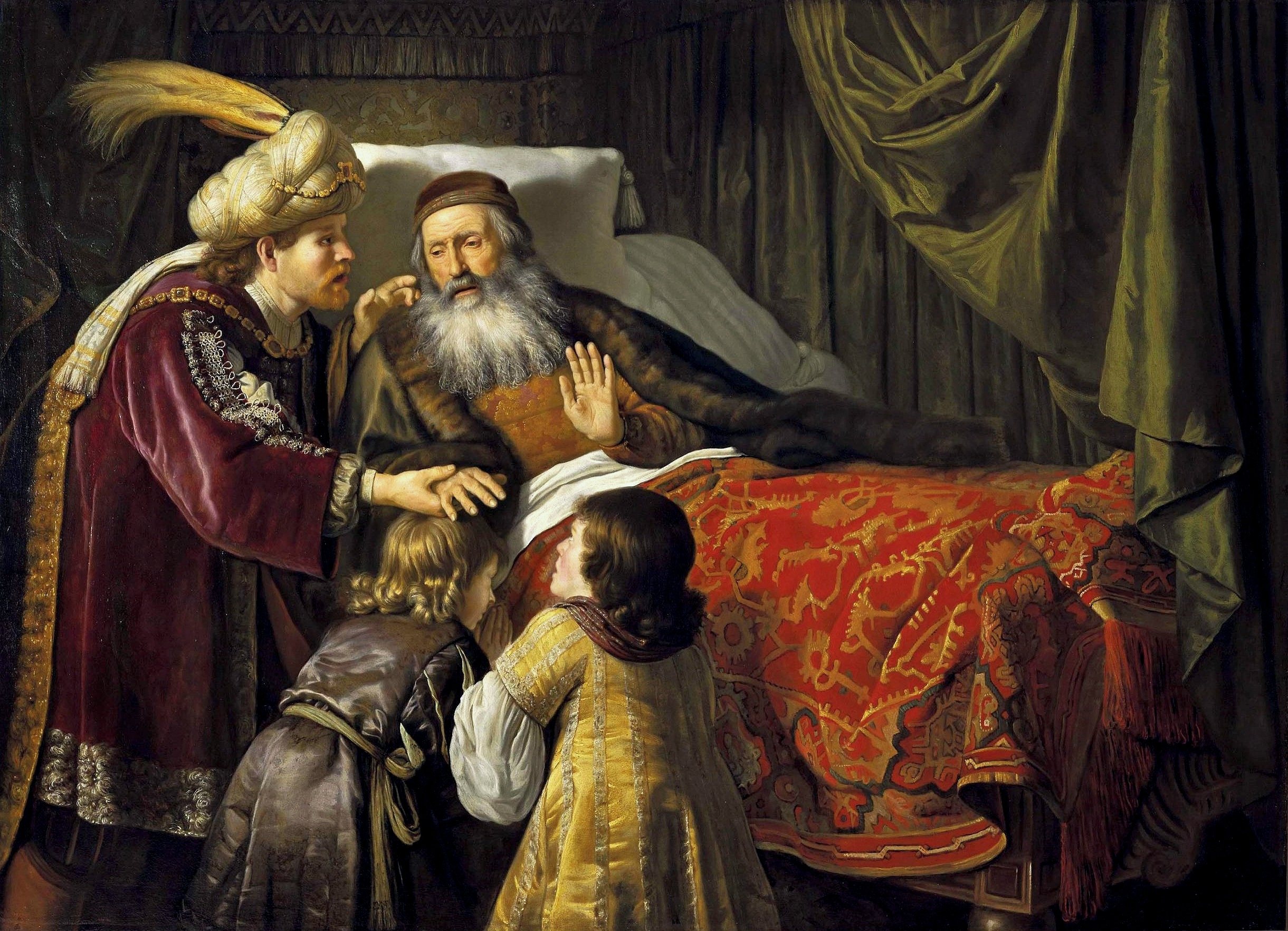
Blessed (eulogeo) each of the sons of Joseph - Which 2 sons? Manasseh and Ephraim. And although Manasseh was the oldest Jacob crossed his hand and the blessing fell on Ephraim the tribe through whom would come the promised Messiah.
Joseph took them both, Ephraim with his right hand toward Israel’s left, and Manasseh with his left hand toward Israel’s right, and brought them close to him. 14 But Israel stretched out his right hand and laid it on the head of Ephraim, who was the younger, and his left hand on Manasseh’s head, crossing his hands, although Manasseh was the firstborn. 15 He blessed Joseph, and said, “The God before whom my fathers Abraham and Isaac walked, The God who has been my shepherd all my life to this day, 16 The angel who has redeemed me from all evil, Bless the lads; And may my name live on in them, And the names of my fathers Abraham and Isaac; And may they grow into a multitude in the midst of the earth.” 17 When Joseph saw that his father laid his right hand on Ephraim’s head, it displeased him; and he grasped his father’s hand to remove it from Ephraim’s head to Manasseh’s head. 18 Joseph said to his father, “Not so, my father, for this one (Manasseh) is the firstborn. Place your right hand on his head.” 19 But his father refused and said, “I know, my son, I know; he also will become a people and he also will be great. However, his younger brother shall be greater than he, and his descendants shall become a multitude of nations (IN OTHER WORDS THE LINE OF MESSIAH WOULD BE THROUGH HIM).” (Ge 48:13-19)
F F Bruce - Isaac was misled by the plotting of his wife and younger son into giving the younger son the blessing which he had designed for the elder; but when Jacob on his deathbed blessed the two sons of Joseph he deliberately bestowed the greater blessing on Ephraim, the younger son. (See The Epistle to the Hebrews - Page 305)
Jacob's attitude was a lot like D L Moody's who once quipped "Some day you will read in the papers that D. L. Moody, of East Northfield, is dead. Don't you believe a word of it! At that moment I shall be more alive than I am now."
Worshiped (proskuneo) leaning on the top of his staff - No word in Greek for "leaning." This is a good way to prepare to depart - worshipping! The perfect preparation for entrance into the presence of the only One Worthy of worship! Jacob's example of how to die well sets the bar high but imminently attainable by faith. Faith in the Father's promise of a forever future is the only way to truly handle the prospect of death. The patriarchs trusted in God's promised resurrection, and thus were enabled to face death with a calm serenity. How else could you describe Jacob's worshiping God while resting on his staff. Mark it down that the mark of genuine believer is their approach to death with a peace that passes all human (natural) understanding because it comes from a Supernatural Source, God Himself! Death to a believer like Jacob is exchanging a prison for a palace and a putting off of our worthless rages for His righteous robes.
Leaning on the top of his staff - As noted in the passage from Genesis below, the text says "at the head of the bed" not "leaning on top of his staff." The writer of Hebrews is quoting from the Septuagint not the Masoretic text (Lxx = "epi to akron tes rhabdou autou" which is exactly what the Greek text says in Hebrews 11:21).
Genesis 47:31 He said, “Swear to me.” So he swore to him. Then Israel bowed in worship at the head of the bed.
A worshiper at last
instead of a schemer.
-- H A Ironside
Billy Graham's comment is also apropos to Jacob's worshiping even though dying "I have talked to doctors and nurses who have held the hands of dying people, and they say that there is as much difference between the death of a Christian and a non-Christian as there is between heaven and hell. (See chapter "The Dying Words of Christians" in Who's In Charge of a World That Suffers? - Page 194)(For an interesting read borrow Herbert Lockyer's Last words of saints and sinners)
David Guzik - Jacob had to lean on the top of his staff because he was given a limp many years before when God confronted him at Peniel (Genesis 32:24–32). As he leaned on his staff he remembered that God was great and held his future and the future of his descendants. Therefore he worshiped, demonstrating his faith and dependence on God.
KJV Bible Commentary on leaning on the staff - The reason for this statement probably lies in the fact that nothing depicted Jacob’s dedication and faith more dramatically than his staff. Evidently, Jacob’s life of surrender and faith began the night he wrestled with the Lord at Peniel (Ge 32:24–32). God permanently put Jacob’s thigh out of joint that night as a reminder of their encounter. Jacob’s staff was a daily reminder of God’s promises, and his life of faith was best symbolized by his staff. (Borrow KJV Bible Commentary page 2892 - no time limit)
C. H. Mackintosh summarizes this final event in Jacob's life - The close of Jacob’s career stands in most pleasing contrast with all the previous scenes of his eventful history. It reminds one of a serene evening after a tempestuous day: the sun, which during the day had been hidden from view by clouds, mists, and fogs, sets in majesty and brightness, gilding with his beams the western sky, and holding out the cheering prospect of a bright tomorrow. Thus it is with our aged patriarch. The supplanting, the bargain-making, the cunning, the management, the shifting, the shuffling, the unbelieving selfish fears,—all those dark clouds of nature and of earth seem to have passed away, and he comes forth, in all the calm elevation of faith, to bestow blessings, and impart dignities, in that holy skillfulness which communion with God can alone impart.
Spurgeon - If only by faith can a dying Jacob bless his descendants, so only by faith can we bless the sons of men. Have faith in God, and the instruction that you give shall really edify, the prayers you offer shall bring down showers of mercy, and your endeavors for your sons and daughters shall be prospered. God will bless what is done in faith; but if we do not believe, our work will not be established. Faith is the backbone and marrow of the Christian’s power to do good. We are weak as water until we enter into union with God by faith, and then we are omnipotent. Faith can bless other people as well as the believer himself. It not only brings good cheer into a man’s own heart, but it enables him to speak words of love and consolation to his children. Dying Jacob pronounces living blessings upon his sons, and upon their sons generation after generation. His legacies were all blessings that he possessed by faith only. He gave to Ephraim and Manasseh a portion each—but where and what? Did he fetch out a bag from the iron safe and say, “Here, young men, I give you the same portion of ready money as I give my sons”? No, there does not seem to have been a solitary shekel in the case. Did he call for the map of the family estates and say, “I give over to you, my boys, my freehold lands in such a parish, and my copyhold farms under such a manor”? No, no, he gave them no portion in Goshen, but each had a lot in Canaan. Did that belong to him? Yes, in one sense, but not in another. God had promised it to him, but he had not yet a foot of land in it. The Canaanites were swarming in the land; they were dwelling in cities walled up to heaven, and held the country by the right of possession, which is nine points of the law. But the good old man talks about Canaan as if it was all his own, and he foresees the tribes growing into nations as much as if they were already in actual possession of the country. He had, as a matter of fact, neither house nor ground in Palestine, and yet he counts it all his own, since a faithful God had promised it to his fathers. (Sermon - Jacob Worshipping on His Staff)
Spurgeon on Jacob's staff - That staff of his!—you know why he used it. I believe he loved it, because it made him remember the brook Jabbok where “he was limping because of his hip” (Gen 32:31). It had long been his companion, for he said, “With only my staff I crossed this Jordan” (Gen 32:10). But it became more necessary to him than ever after he had won that victory and had also learned his own weakness. And now, as if in memory of the God who had blessed him, he leans upon the top of his staff and blesses the sons of Joseph.
Ray Pritchard - Jacob’s faith is strong as he comes to the end of life. How could he be filled with such confidence? After all, he was a schemer, a born cheater, and a compulsive manipulator. All his life he had “worked the angles” to get ahead. Years earlier he had deceived his father and cheated his brother. With such a checkered past, how could he be so joyful? The answer goes to the heart of the gospel. God held him guilty for nothing. I do not doubt that during the long years when he thought Joseph was dead, he felt guilty and probably thought that Joseph’s fate was somehow his fault. But in the end it didn’t matter. All of God’s purposes fit together. He worshiped with joy as he thought of the happy ending of a life filled with sadness, anger, betrayal, separation, loneliness, and manipulation. God takes our wicked past and places it on his Son, the Lord Jesus Christ. And then God works through our sinful choices to accomplish his divine plan. This doesn’t make sin any less sinful but it does demonstrate the glory of God in overcoming evil with good. (Sermon)
David Thompson - Now the illustration that is used pertaining to the faith of Jacob comes from Genesis 48:9-21:
1) Jacob asked Joseph to bring him his two sons so he could bless them. Genesis 48:9
2) When the two boys came, he kissed each one and embraced them as he would full sons. Genesis 48:10
3) Manasseh was the oldest son and Ephraim was the youngest son. Since Joseph is standing in front of Jacob, his right hand should go on the eldest son, Manasseh, and his left hand should go on the youngest son, Ephraim, and Joseph did everything he could to orchestrate that. Genesis 48:13
4) Jacob (Israel) by faith crossed his hands and being guided by God and knowing the will of God, he put his right hand on Ephraim the youngest and his left hand on Manasseh the oldest. Genesis 48:14
5) Jacob blessed Joseph’s sons, fully acknowledging them to be his sons by judicial calculation Genesis 48:15-16
6) Joseph was so upset by this that he actually grabbed his father’s hand and attempted to reverse them. Genesis 48:17-18
7) By faith Jacob refused to change his hands in this blessing because he knew the will of God and he knew that the younger would be greater than the older. Genesis 48:19-20
Now what is the main faith issue about the second born being greater than the firstborn? How does this connect to this book of Hebrews and put Jacob in the faith hero chapter? We have seen this thing before in Scripture: Isaac the second born was greater than Ishmael the firstborn. Jacob the second born was greater than Esau the firstborn. Now Ephraim the second born is greater than Manasseh the firstborn. What is this business all about in this book of Hebrews? It is all about Jesus Christ. You see the blessings of God are not found in the first Adam but in the second Adam (Romans 5:14-21). Jacob apparently understood the ramifications of this and by faith stayed focused on this. He knew about One who would come who could redeem him from “all evil” (Gen. 48:16). By faith, as he neared his own death, he was focused on this One (Sermon)
Dr. Martyn Lloyd-Jones (What is DEATH) quotes from the poem by Minister James Powis Smith which expresses the triumphant attitude of Jacob (and all the patriarchs) in the face of that last enemy death...
The pale horse stands and will not bide,
The night has come and I must ride;
But not alone to unknown lands,
My Friend goes with me holding hands.
I’ve fought the fight; I’ve run the race,
I now shall see Him face to face,
Who called me to Him long ago
And bade me trust and follow.
The joys of life have been His gift,
My friends I’ll find when clouds shall lift;
I leave my home and all its store
To dwell with Him for evermore.
What does He give? His cup of love
Until with Him I rest above;
I’ll mount and ride, no more to roam,
The pale horse bears me to my home.
Dying (599) (apothnesko from apo = marker of dissociation implying a rupture from a former association, separation, departure, cessation + thnesko = die) literally means to die off and can speak of literal physical death (Ro 6:9+) as in this context. It is notable that as life was never meant to be merely existence, death which is the antonym of life does not mean non–existence. The important point is that to die does not mean one is annihilated as some falsely teach. Everyone who has every been born will continue to exist, either in the presence of God or banished from His presence and destined to experience conscious eternal existence in separation from God's majesty and glory and power (see 2Th 1:9). Apothnesko is used figuratively of a believer's death to sin (Ro 6:2+, Ro 6:7+, Ro 6:8+, Col 3:3+), self, Satan, the law (Ro 7:6+, Gal 2:19) and the world (Col 2:20+, cp Gal 6:14+ - crucified used instead of died) which was effected when Christ was crucified and when by faith we believed in Him and in God's reckoning (albeit a "mysterious" teaching) were crucified with Him (Ro 6:6+).
APOTHNESKO IN HEBREWS - Heb. 7:8; Heb. 9:27; Heb. 10:28; Heb. 11:4; Heb. 11:13; Heb. 11:21; Heb. 11:37
Hebrews 7:8 In this case mortal men receive tithes, but in that case one receives them, of whom it is witnessed that he lives on.
Hebrews 9:27 And inasmuch as it is appointed for men to die once and after this comes judgment,
Hebrews 10:28 Anyone who has set aside the Law of Moses dies without mercy on the testimony of two or three witnesses.
Hebrews 11:4 By faith Abel offered to God a better sacrifice than Cain, through which he obtained the testimony that he was righteous, God testifying about his gifts, and through faith, though he is dead, he still speaks.
Hebrews 11:13 All these died in faith, without receiving the promises, but having seen them and having welcomed them from a distance, and having confessed that they were strangers and exiles on the earth.
Hebrews 11:21 By faith Jacob, as he was dying, blessed each of the sons of Joseph, and worshiped, leaning on the top of his staff.
Hebrews 11:37 They were stoned, they were sawn in two, they were tempted, they were put to death with the sword; they went about in sheepskins, in goatskins, being destitute, afflicted, ill-treated
Worshiped (bowed down) (4352)(proskuneo from pros = before + kuneo = kiss or adore) means to prostrate oneself in homage before another in the full sense of worship, not mere reverence or courtesy. When Jesus Christ was born into this world, He was attended and worshipped by angels. (Lk 2:13, 14). The word proskuneo literally means to kiss toward someone, to throw a kiss in token of respect or homage, to prostrate oneself in homage, to do reverence to, to adore and so to worship and show respect. In the ancient Oriental (especially Persia) the mode of salutation between persons of equal rank was to kiss each other on the lips. When the difference of rank was slight, they kissed each other on the cheek. When one was much inferior, he fell upon his knees touched his forehead to the ground or prostrated himself, and as he was bowing down he would be throwing kisses toward the superior. It is this latter mode of salutation that is intended by the Greek writers in the use of the verb proskuneo .
In summary, proskuneo represents the most common Near Eastern act of adoration and reverence and also carries the idea of profound awe and respect. Some believe that the root word kuneo may be related to kuon which is the Greek word for dog and which then could be picturing a dog licking his master's hand.
Adrian Rogers - Learning to Lean - page 553 ahd page 563 in Hebrews Sermons
Hebrews 11:21
Outline
Introduction
I. Jacob, the Wretched Man
A. The Family That Formed Him
1. A Sensual Father
2. A Scheming Mother
3. A Sorry Brother
B. The Faults That Fettered Him
C. The Failure That Followed Him
II. Jacob, the Wrestling Man
A. God Brought Jacob to a Place of Isolation
B. God Brought Jacob to a Place of Confrontation
C. God Brought Jacob to a Place of Desperation
1. To Break Him
2. To Bless Him
III. Jacob, the Worshipping Man
Conclusion
A. Failure Need Not Be Final
B. Save Yourself a Wrestling Match
C. Let Suffering Teach You to Learn to Lean
D. The Most Important Thing Is That You Come to the End of Your Life Worshipping God
Andrew Murray in The Holiest of All...
It is remarkable how much, both in this chapter and through all Scripture, faith has to do with the relationship of parents and children. In nature the life of the parents is imparted to the children. In the spiritual world it may be so too; the intercourse of faith with God reaches the children too; the man of strong faith is a blessing to his children. We have seen in Noah and Abraham and Sarah how largely their faith in God had to do with their children. And here we find four more examples.
By faith Isaac blessed Jacob and Esau. His blessing on his children was the manifestation of his faith in the promise of God to his father and himself, and the transmission of the blessing to them. By faith Jacob blessed each of the sons of Joseph, giving each of them their place in the future that was coming. By faith Joseph made mention of the departure of the children of Israel saying, "I die, but God will surely visit you, and bring you up out of this land." By faith Moses was hid three months by his parents, because they saw he was a goodly child. Their faith in the destiny they knew was waiting for the children of Israel, and in the mercy of God watching over his people, gave them the courage not to fear the king's commandment. In all these cases faith was the secret inspiration of their treatment of their children, and the source of blessing. Faith never confines itself to the person of the; believer himself, but takes in his home and children.
And how is it that the Christian parent can secure this longed-for blessing for his children? There is but one answer: By faith. Our life must be all faith—that is, the unseen things must be our life, yea, rather, the unseen God must be our life. The blessing and the power are His; and it is as we have more of God in our life and in our home, there will be the hidden power resting on our children. Faith does not only mean a knowing that there is a covenant promise for our children, and a pleading of it in prayer. This is an exercise of faith, and has its. great value. But the chief thing is the life; faith is the making way for God and giving Him place in our life. And when at times the vision tarries, and the promise appears to fail, faith understands this as only a call to trust God more completely and more confidently. As we hold fast our confidence firm to the end, as in patience and longsuffering we are strong in faith, giving glory to God, we shall know for certain that we shall inherit this promise too. I will be thy God and the God of thy seed.
From the patriarchs we learn what the atmosphere and what the soil is in which there grows such a faith that blesses the children. They were living in the land of promise as strangers and pilgrims, or in Egypt as strangers and pilgrims too, longing for the return to the land. Their whole life was hope in God and what He would do. They were men whom God had taken hold of, to prove in their history how gloriously He would fulfil His promise. And they had nothing to live on but God. It is a law of nature that no body can be in two places at the same time. This is just as true of the heart. When God took Abraham and his seed out of their country, it was that the land of promise, the land of separation from men, of separation unto God, might be to them the training-school of faith. They went out from the fellowship of home and family, to live in the fellowship of God. It was there they learned by faith to bless the children.
Separation from the world, a being set apart unto God, the denial of self and its life, the imitation of Abraham in his going out, of Christ in His self-sacrifice,—this is the only way to the land of promise where the faith-life flourishes. To live wholly for God, to hope alone in God, always to walk with God, in all things to hearken to God,—this is the new and living way into the inner sanctuary, in which Jesus our High Priest leads us. What the land of promise was to the patriarchs, as the place for the life of separation and obedience and faith, that the Holiest of All is to us. That is the place of which God has said to us: Get thee out of thy land, to a place that I will show thee, and I will bless thee,—that is the only place where our faith can grow freely, and God can prove all His power in us, so that we, like they, can be a display of what God can do. And that is the place where our faith will in full measure be a blessing to our children.
It is only by faith we can bless. God is willing to bless us to larger circles than our own house. He is calling for vessels, empty vessels not a few, in which He can multiply his blessing. He is the only fountain of blessing; as our faith yields to God, and allows Him to be all, His blessing will flow. Let the Christian who would be a blessing be a man of faith,—that is, a man who has nothing and is nothing in himself, and in whom God has free scope to work, and the blessing will not be wanting. Oh that God might have the place that belongs to Him in this His own world. And if that may not yet be—oh that He might have that place in the hearts of His people. And if it is as if even that will not yet be—oh let Him have that place, my reader, in your heart and in mine. Let faith see and consent and prove that God is all, and He will prove that He is a God of blessing for thee and all around thee.
1. Parent, teacher, worker, the secret of blessing in the work, the power to Influence, is—faith. Not simply the faith in some promise at times, but the habit of a holy faith that makes God the All of our life. Have faith In God as the God of thy life, the God who maintains His life and presence within thee He will work through thee.
2. How blessed to be an Instrument in the hands of God, with which He works out His purpose; to be a vessel He fills with His love.
3. Learn to regard thyself as set to be a blessing, and let faith and love mark thy whole life.
Illustration of the death of Voltaire a vicious critic of God and the Bible. In Herbert Lockyer's fascinating book "Last Words of Saints and Sinners" he recounts the following story.
VOLTAIRE, the noted French infidel and one of the most fertile and talented writers of his time, used his pen to retard and demolish Christianity. Of Christ, Voltaire said: "Curse the wretch!"
He once boasted, "In twenty years Christianity will be no more. My single hand shall destroy the edifice it took twelve apostles to rear."
Shortly ,after his death the very house in which he printed his foul literature became the depot of the Geneva Bible Society!
The nurse who attended Voltaire said: "For all the wealth in Europe I would not see another infidel die."
The physician, Trochim, waiting up with Voltaire at his death said that he cried out most desperately: "I am abandoned by God and man! I will give you half of what I am worth if you will give me six months' life. Then I shall go to hell; and you will go with me. O Christ! O Jesus Christ!"
John MacArthur - DEFEATING DEATH Drawing Near: Daily Readings for a Deeper Faith - Page 39
“By faith Isaac blessed Jacob and Esau, even regarding things to come. By faith Jacob, as he was dying, blessed each of the sons of Joseph, and worshiped, leaning on the top of his staff. By faith Joseph, when he was dying, made mention of the exodus of the sons of Israel, and gave orders concerning his bones” (Heb. 11:20–22).
✧✧✧
Faith triumphs over death.
Commentator Matthew Henry said,
“Though the grace of faith is of universal use throughout the Christian’s life, yet it is especially so when we come to die. Faith has its great work to do at the very last, to help believers to finish well, to die to the Lord so as to honor Him, by patience, hope and joy so as to leave a witness behind them of the truth of God’s Word and the excellency of His ways.”
God is honored when His people die triumphantly. When we’ve lived a life to His glory, and have joyfully left the world behind to enter into His presence for all eternity, He is pleased, for “precious in the sight of the Lord is the death of His godly ones” (Ps. 116:15).
Many believers who have dreaded facing death have experienced a special measure of God’s grace that made their final hours the sweetest and most precious of their lives.
Isaac, Jacob, and Joseph are examples of men who faced death with great faith and confidence. Each “died in faith, without receiving the promises, but having seen them and having welcomed them from a distance, and having confessed that they were strangers and exiles on the earth” (Heb. 11:13). They hadn’t seen all God’s promises fulfilled, but by faith they passed them on to their children.
These men didn’t have perfect faith. Joseph was exemplary, but Isaac and Jacob often vacillated in their walk with God. Yet, each ended his life triumphantly. That’s the reward of all who trust God and cling to His promises.
Like every believer before you, you haven’t seen the fulfillment of all God’s promises. But certainly you’ve seen far more than Isaac, Jacob, or Joseph did. How much more, then, should you trust God and encourage those who follow you to do the same!
✧✧✧
Suggestions for Prayer: Thank God for His marvelous grace, which triumphs over sin and death.
For Further Study: Read the final words of Jacob and Joseph in Genesis 48:1–49:33 and 50:22–26.
Norman Geisler - HEBREWS 11:21 (cf. Ge 47:31)—Is there a discrepancy regarding the death of Jacob? from When Critics Ask
PROBLEM: Hebrews mentions that Jacob died worshiping, “leaning on the top of his staff” (Heb 11:21). Yet Genesis 47:31 mentions Jacob “bowed himself on the head of the bed.” How do we reconcile this apparent contradiction?
SOLUTION: The Hebrew words for “staff” and “bed” are spelled the same in their consonants. Since the vowels were not written in the original text, but were added around A.D. 700, words like the two above would look identical, since they had the same consonants. The Septuagint renders the passage in Genesis “staff” while later Jewish Masoretes translated the word “bed” instead of “staff.” In light of this, “top of his staff” would be the likely rendition of the verses (Heb. 11:21) and the rendering “bed” (in Gen. 47:31) would be a vowel-pointing mistake.
David Roper - My Staff
I’m growing fonder of my staff;
I’m growing dimmer in the eyes;
I’m growing fainter in my laugh;
I’m growing deeper in my sighs;
I’m growing careless of my dress;
I’m growing frugal of my gold;
I’m growing wise; I’m growing—yes—
I’m growing old.
—John Godfrey Saxe
There’s an antique rack in the entrance to our home in which we keep the canes and walking sticks of several generations of our family. My favorite is a slender staff with a gold-plated knob, engraved with the initials “DHR.” It belonged to Carolyn’s great-grandfather, whose name was Daniel Henry Rankin. Curiously, my initials are the
same.
My study houses another stick collection: my father’s peeled, apple-wood walking stick and an ancient, gnarled, blackthorn shillelagh among others.
Outside in a barrel in our garage there’s an assortment of cross-country ski poles, wading wands, and trekking sticks I’ve gathered over the years. One of these days, I’ll probably trade them all in for handrails and a walker.
I think of old Jacob, worshiping and “leaning on his staff.”23 Like Jacob, I too am crippled, broken-down, and ruined. I’ll always need something or someone to lean on.
These days, when I set out on an enterprise that seems daunting for me at my age, I take this staff along with me: “The Lord will go before [me].”24
When I see my friends struggling with sin and guilt, I hold up this rod: May they “have power . . . to grasp how wide and long and high and deep is the love of Christ, and to know this love that surpasses knowledge.”25
When there seems to be no time for reflection and quiet waiting and I think I must act now, I remember this stay: “Be still, and know that I am God.”26
When I note that my legs and heart have grown weaker and I can no longer wade swift streams, climb steep trails, and surmount other difficulties, I strengthen my inner person with this thought: God will not cast me away when I am old; He will not forsake me when my strength is gone. My strength now is in “quietness and confidence.”27
When I think of death and its certainty, I remember God’s faithfulness throughout my years: He has supported me with His right hand; He has guided me with His counsel; and “afterward [he] will take me into glory.”28
These truths and others are “the very staff of my age, my very prop.”29
Old Jacob, weary and worn-out—once strong, but now humbled and utterly dependent on God—worshiped, leaning on the top of his staff. Like Jacob, I’m growing old and fond of my staff. I aim to keep it close at hand.
Lord
With a crooked stick for a cane
I’m limping home.
Mocked and maligned
Stooped and stupid
Soiled and shabby
I limp toward You.
—Ruth Harms Calkin
An afterthought…
I re-read John Bunyan’s The Pilgrim’s Progress the other day and came across this passage: “After this, Mr. Ready-to-halt called for his fellow-pilgrims, and told them, saying, I am sent for, and God shall surely visit you also. So he desired Mr. Valiant to make his will. And because he had nothing to bequeath to them that should survive him but his crutches, and his good wishes, therefore thus he said: These crutches I bequeath to my son that shall tread in my steps, with a hundred warm wishes that he may prove better than I have been.”30
My staffs and crutches I bequeath to our three sons.
23 See Hebrews 11:21.
24 Isaiah 52:12
25 Ephesians 3:18–19
26 Psalm 46:10
27 Isaiah 32:17
28 Psalm 73:24
29 William Shakespeare, The Merchant of Venice, 2.2. 54.
30 John Bunyan, The Pilgrim’s Progress, Part 11, 8th stage.
ILLUSTRATION
Hebrews 11:21 states: “By faith Jacob, when he was dying, blessed each of Joseph’s sons, and worshiped as he leaned on the top of his staff.” Jacob’s entire life had been a great adventure of faith that had carried him to the promised land. And now in the evening of his years he still had his traveling staff in his hand, still ready for the open road. He was still ready to go wherever God wanted to take him. If we are to fully embrace the challenge of changing faith, we must never lose our spirit of adventure.
Spurgeon - Jacob worshipping on his staff
‘By faith Jacob, when he was a dying, blessed both the sons of Joseph; and worshipped, leaning upon the top of his staff.’ Hebrews 11:21
That expression, ‘when he was a dying,’ reminds me of many deathbeds, but I shall not speak of them now, for I desire each one of you to rehearse the scene of your own departure, for soon of every one a tale will be told, commencing ‘when he was a dying’. I want each one to project his mind a little forward to the time when he must gather up his feet in the bed, pronounce his last farewell and yield up the ghost. Before your actual departure there may be allotted to you, unless you are carried away with a sudden stroke, a little time in which it shall be said, ‘he was a dying’. Perhaps it is a desirable thing to occupy some weeks in departure, till the mind seems to have passed through the gate and to be already in the glory, while yet the body lingers here; but as we have had no experience, we are scarcely able to form a judgment. Very much might be said in favour of that sudden death which is sudden glory, but yet one might prefer to have enough time and sufficient clearness of mind to gaze into eternity, and so to become familiar with the thought of departing out of the body. It would seem desirable to lose the dread and first surprise of the chill torrent, and to become fully at ease on the banks of Jordan, sitting with your feet up to the ankles in its stream, and by degrees descending into the greater depths, singing and beginning even on earth the everlasting song which is heard for ever on the other side of the mysterious river. Such dying is a fit ending to a life of genuine piety, and both displays and proves its truthfulness. Jacob ‘was a dying’ and in his dying we see the man.
John MacArthur - FROM JACOB TO ISRAEL Drawing Near: Daily Readings for a Deeper Faith - Page 23
“By faith Jacob, as he was dying, blessed each of the sons of Joseph, and worshiped” (Heb. 11:21).
✧✧✧
Jacob’s life typifies the spiritual pilgrimage
from selfishness to submission.
Jacob’s life can be outlined in three phases:
- a stolen blessing,
- a conditional commitment, and
- a sincere supplication.
From the very beginning it was God’s intention to bless Jacob in a special way. But Jacob, whose name means “trickster,” “supplanter,” or “usurper,” tricked his father into blessing him instead of his older brother, Esau (Gen. 27:1–29). As a result, Jacob had to flee from Esau and spend fourteen years herding flocks for his Uncle Laban.
As Jacob traveled toward Laban’s house, God appeared to him in a dream (Gen. 28:10–22) and made him the recipient of the covenant promises first made to his grandfather, Abraham, and then to his father, Isaac.
Jacob’s response is revealing, for he “made a vow, saying, ‘If God will be with me and will keep me on this journey that I take, and will give me food to eat and garments to wear, and I return to my father’s house in safety, then the Lord will be my God’” (vv. 20–21, emphasis added). Jacob’s conditional vow said in effect, “God, if You’ll give me what I want, I’ll be Your man.”
Despite Jacob’s selfish motives, God did bless him, but He humbled him too. By the time he left Laban’s house, Jacob was ready to yield to God’s will unreservedly. Note his change of heart in Genesis 32:10: “I am unworthy of all the lovingkindness and of all the faithfulness which Thou hast shown to [me].”
Then the Lord appeared in the form of a man and wrestled with Jacob all night (v. 24). Jacob refused to let Him go until he received a blessing. That wasn’t a selfish request, but one that came from a heart devoted to being all God wanted him to be. That’s when the Lord changed Jacob’s name to “Israel,” which means “he fights or persists with God.”
Like Abraham and Isaac before him, Jacob never saw the fulfillment of God’s covenant promises. Yet on his spiritual journey from Jacob to Israel, from selfishness to submission, he learned to trust God and to await His perfect timing.
✧✧✧
Suggestions for Prayer: Pray for grace to consistently pursue God’s will and for patience to wait on His timing.
For Further Study: Read Jacob’s story in Genesis 27–35.
By faith Jacob . . . worshiped, leaning on the top of his staff. —Hebrews 11:21
Today's Scripture : Psalm 73:23-28
An antique rack in the entryway to our home holds the canes and walking-sticks of several generations of our family. My favorite is a slender staff with a gold-plated knob engraved with the initials “DHR.” It belonged to my wife Carolyn’s great-grandfather, Daniel Henry Rankin. Curiously, his initials are the same as mine.
In my study is another collection: my father’s peeled, apple-wood walking stick, among others. And in a barrel in our garage there’s an assortment of cross-country ski poles, wading wands, and trekking sticks I’ve gathered over the years. One of these days, I’ll trade them all in for a walker. I’ll always need something or someone to lean on.
I’m reminded of the old patriarch Jacob, once strong, now humbled and utterly dependent on God. When he was dying, by faith he “worshiped, leaning on the top of his staff” (Hebrews 11:21).
As I grow older, I’m learning to lean more on God and His faithfulness. Over the years, He has “held me by my right hand.” He is guiding me with His counsel, and afterward He will “receive me to glory” (Psalm 73:23-24).
Shakespeare said it well: God is “the very staff of my age, my very prop.”By: David H. Roper (Reprinted by permission from Our Daily Bread Ministries. Please do not repost the full devotional without their permission.)
Our vigor is fleeting, our best years are brief,
Our youth passes quickly—time’s ever a thief;
But hope yet becomes us—death’s sting holds no power;
We have a Redeemer—an unfailing Tower.
—Gustafson
Learning of our weakness teaches us to lean on God’s strength.
Hebrews 11:22 By faith Joseph, when he was dying, made mention of the exodus of the sons of Israel, and gave orders concerning his bones. (NASB: Lockman)
Greek: Pistei Ioseph teleuton (PAPMSN) peri tes exodou ton uion Israel emnemoneusen, (3SAAI) kai peri ton osteon autou eneteilato. (3SAMI)
BGT Πίστει Ἰωσὴφ τελευτῶν περὶ τῆς ἐξόδου τῶν υἱῶν Ἰσραὴλ ἐμνημόνευσεν καὶ περὶ τῶν ὀστέων αὐτοῦ ἐνετείλατο.
Amplified: [Actuated] by faith Joseph, when nearing the end of his life, referred to [the promise of God for] the departure of the Israelites out of Egypt and gave instructions concerning the burial of his own bones. (Amplified Bible - Lockman)
KJV: By faith Joseph, when he died, made mention of the departing of the children of Israel; and gave commandment concerning his bones.
NET By faith Joseph, at the end of his life, mentioned the exodus of the sons of Israel and gave instructions about his burial.
CSB By faith Joseph, as he was nearing the end of his life, mentioned the exodus of the Israelites and gave instructions concerning his bones.
ESV By faith Joseph, at the end of his life, made mention of the exodus of the Israelites and gave directions concerning his bones.
NIV By faith Joseph, when his end was near, spoke about the exodus of the Israelites from Egypt and gave instructions about his bones.
NLT: And it was by faith that Joseph, when he was about to die, confidently spoke of God's bringing the people of Israel out of Egypt. He was so sure of it that he commanded them to carry his bones with them when they left! (NLT - Tyndale House)
Phillips: It was by faith that Joseph on his death-bed spoke of the exodus of the Israelites, and gave confident orders about the disposal of his own mortal remains. (Phillips: Touchstone)
Wuest: By faith Joseph, when coming near to the end of his life, remembered the exodus of the sons of Israel and so gave a command concerning his bones. (Hebrews Commentary)
Young's Literal: by faith, Joseph dying, concerning the outgoing of the sons of Israel did make mention, and concerning his bones did give command.
- By faith Joseph - Genesis 50:24,25; Ex 13:19; Josh 24:32; Acts 7:16
- Reciprocal:, Genesis 30:24 - And she Genesis 47:29 - bury me not Genesis 49:33 - had made Acts 7:15 - died
- Hebrews 11 Resources - Multiple Sermons and Commentaries
Related Passages:
Genesis 50:25, 26 (JOSEPH'S PROPHECY) "Then Joseph made the sons of Israel swear, saying, "God will surely take care of you, and you shall carry my bones up from here." So Joseph died at the age of one hundred and ten years; and he was embalmed and placed in a coffin in Egypt. ()
Exodus 13:19+ Moses took the bones of Joseph with him, for he had made the sons of Israel solemnly swear, saying, "God will surely take care of you, and you shall carry my bones from here with you." ()
Joshua 24:32+ Moses took the bones of Joseph with him (How long? For 40 years!), for he had made the sons of Israel solemnly swear, saying, "God will surely take care of you, and you shall carry my bones from here with you.
COMMENT - And in due course the coffin which contained his embalmed body was carried from Egypt when the Israelites left that land under the guidance of Moses, and was buried at Shechem after the settlement in Canaan. (The Epistle to the Hebrews - Page 307)
JOSEPH PERSEVERES AND PROPHESIES
BELIEVING GOD'S PROMISES
As the writer of Hebrews continues his sweeping portrait of faith in chapter 11, he turns from the towering figure of Jacob to his son Joseph, one of the most remarkable men in Israel’s history. Though Joseph’s life was filled with dramatic events—betrayal, slavery, imprisonment, and exaltation in Egypt—the author of Hebrews chooses to highlight not his rise to power, but his final act of faith at the end of his life.
By faith (pistis) - Faith is trusting in the Word of God and the God of the Word and obeying Him implicitly, regardless of the circumstances or consequences. Joseph even while staring death in the face, did not suffer dimming of his spiritual eyesight for he kept his eyes of faith firmly fixed on His faithful Father! His body may have been dying, but not his faith. Joseph's faith is even more remarkable because he had been sold into slavery and out of the promised land of Canaan at age 17 (Ge 37:2) and lived in a foreign land until his death at 110 (Ge 50:26). But despite his time away from the promised land, his faith remained sure because it was based on the faithful promise of God.
The writer of Hebrews is saying that all these patriarchs ended well, because all trusted on His Word of promise. They were fully persuaded about what would happen after their deaths, not because they saw it, but because they believed the One who promised it. Their faith did not rest on visible fulfillment but on the unchanging reliability of God’s word. Though they died without receiving the full realization of the promise, they died believing—confident that God’s word was as certain as its fulfillment. Their lives stand as enduring witnesses that genuine faith perseveres to the end, trusting not in sight but in the steadfast faithfulness of God, who cannot lie (cf. Heb 11:13; Titus 1:2).
When he was dying (teleutao) made mention of the exodus (exodos) of the sons of Israel and gave orders (entellomai) concerning his bones - A deathbed prophecy by Joseph, a saint who persevered to the end! (cp Mt 10:22) Joseph, when he was dying, saw 400 years ahead to Israel's exodus from Egypt, and he made his "funeral arrangements" by faith, specifically for a funeral service in the promised land. He did not want to be buried in Egypt. Thus he symbolized his conviction that God was going to do exactly what he had said. And in the course of time it happened exactly that way.
Concerning his bones is a metonymy (an expression used as substitute for something with which it is closely associated, e.g. Washington for the US government) which conveys the idea of his burial.
Spurgeon on concerning his bones - A sure proof that he believed they would come out of Egypt. He would not be buried among the Pharaohs, though a prominent place would have been assigned to him there; but he would have his bones lie with those of his ancestors, Abraham, and Isaac, and Jacob. He wished his unburied body to share with the people of God in their captivity and their return. He was so certain that they would come out of the captivity that he postpones his burial until that glad event, and so makes what would have been but a natural wish a means of expressing a holy and gracious confidence in the divine promise.
Joseph even to the very end of his life demonstrated an unshakable faith (even his exalted position and prosperity did not dim nor diminish his faith) and confidence in God's prophetic promise to Abraham and his offspring (that his descendants would inherit the land of Canaan - cp God's covenant in Ge 15:13-21+, cp Ge 17:4-8+) and that God would fulfill this promise in His perfect timing which explains why he left instructions about his burial. Calvin comments that this "sharpened the desire of the people so that they would look more earnestly for their redemption. (Ed: Because only their redemption from the subsequent Egyptian bondage would allow them to fulfill this wish of Joseph).
The writer of Hebrews makes clear that Joseph and the other patriarchs (Isaac, Jacob) died without entering into the promise that God had made. And yet they had Heb 11:1 faith manifest by the assurance of things hoped for and the conviction of things not seen! The witness of these patriarchs of a firm faith and solid hope in God and His promises should stir and encourage a similar confidence that God will do good to us in the future (which is the definition of Biblical hope)! (cp "looking for the blessed hope" Titus 2:13+)
William Lincoln, writes “while surrounded by Egypt’s pomp and splendor, his heart was not there at all, but with his people in their future glory and blessing.”
Donald Guthrie - The faith attributed to Joseph was of a different kind, for in giving directions concerning his burial he had faith to believe that his descendants would one day leave Egypt for the promised land. He had cherished the promise to Abraham, Isaac and Jacob, and signified his own confidence (Gen. 50:24ff.). This was an act of considerable faith which proved to be fully justified. (Borrow TNTC-Hebrews page 240)
F F Bruce on Joseph - Joseph’s career certainly presents instances of faith in abundance, such as his steadfastness under temptation and his patience under unjust treatment: Joseph was sold as a slave: his feet were hurt with fetters, his neck was put in a collar of iron; until what he had said came to pass, the word of Yahweh tested him. He endured his trials nobly and triumphed over them, for (as Stephen puts it) “God was with him, and rescued him out of all his afflictions, and gave him favor and wisdom before Pharaoh king of Egypt; and he made him governor over Egypt and over all his house” (Acts 7:9-10+)... the one incident singled out by our author to illustrate his faith belongs to the end of his life, because, above everything else recorded of him, it expresses his conviction regarding “things to come.” (The Epistle to the Hebrews)
David Guzik- Joseph’s faith testified for years after his death. All during that time, when a child of Israel saw Joseph’s coffin and asked why it was there and not buried, they could be answered, “Because the great man Joseph did not want to be buried in Egypt, but in the Promised Land God will one day lead us to.”
Warren Wiersbe - The faith of Joseph was certainly remarkable. After the way his family treated him, you would think he would have abandoned his faith; but instead, it grew stronger. Even the ungodly influence of Egypt did not weaken his trust in God. Joseph did not use his family, his job, or his circumstances as an excuse for unbelief. Joseph knew what he believed—that God would one day deliver his people from Egypt (Gen. 50:24–26). Joseph also knew where he belonged—in Canaan, not in Egypt; so he made them promise to carry his remains out of Egypt at the Exodus. They did! (see Ex. 13:19 and Josh. 24:32) (Bible Exposition Commentary )
Jack Arnold - Joseph, by faith, believed God for things to come. Even though he was living in the luxury of Egypt as the prime minister of that country, he was a man of the future, for he knew that God would bring the children of Israel out of Egypt.
Joseph said to his brothers,
“I am about to die, but God will surely take care of you and bring you up from this land to the land which He promised on oath to Abraham, to Isaac and to Jacob.” (Genesis 50:24)
He believed in God’s promise and knew that it would come about, even though he did not exactly know how it would happen. Joseph predicted the exodus, even though the children of Israel were comfortably settled in Egypt, enjoying high privilege and great influence in the royal court. The exodus did not actually take place until 400 years later. Joseph was so confident that Israel would leave Egypt that he made the Israelites promise to take his bones with them when they left.
“Then Joseph made the sons of Israel swear, saying, ‘God will surely take care of you, and you shall carry my bones up from here’” (Gen. 50:25).
(Comment F F Bruce - Joseph had spent the whole of his long life, apart from the first seventeen years, in Egypt; but Egypt was not his home. Even when the rest of his family came down to Egypt at his invitation, he knew that their residence there would be but temporary. Just as his father Jacob had insisted on being carried back to the promised land for burial, so Joseph made his relatives swear that they would perform the like service for him. - See The Epistle to the Hebrews - Page 307)
Joseph had trusted God all through his life and he was ready to trust the Lord in death. God would be faithful in death as He was faithful in life. Joseph had a calm assurance and confidence that God was faithful. There was no fear, only commitment to God and confidence that God would keep His promise. May I suggest to you another reason Joseph wanted his bones removed from Egypt was that on resurrection day he would be raised in the Promised Land. Joseph could have been buried in an Egyptian tomb but chose a mere coffin, a temporary burying place, because he had a higher hope than an earthly tomb. He believed in resurrection. (Sermon)
Matthew Henry - Now Joseph gave this order, not that he thought his being buried in Egypt would either prejudice his soul or prevent the resurrection of his body (as some of the rabbis fancied that all the Jews who were buried out of Canaan must be conveyed underground to Canaan before they could rise again), but to testify,
[1.] That though he had lived and died in Egypt, yet he did not live and die an Egyptian, but an Israelite.
[2.] That he preferred a significant burial in Canaan before a magnificent one in Egypt.
[3.] That he would go as far with his people as he could, though he could not go as far as he would.
[4.] That he believed the resurrection of the body, and the communion that his soul should presently have with departed saints, as his body had with their dead bodies.
[5.] To assure them that God would be with them in Egypt, and deliver them out of it in his own time and way.
Jamieson writes that "Joseph's eminent position in Egypt did not make him regard it as his home: in faith he looked to God's promise of Canaan being fulfilled and desired that his bones should rest there: testifying thus:
(1) that he had no doubt of his posterity obtaining the promised land: and
(2) that he believed in the resurrection of the body, and the enjoyment in it of the heavenly Canaan. His wish was fulfilled
Charles Spurgeon - Death is a great tester of a man’s sincerity, and a great shaker down of bowing walls and tottering fences. Men have thought that it was all well with them, but when the swellings of Jordan have been about them, they have found matters quite otherwise. Here we see Joseph so calm, so quiet, that he remembers the covenant, falls back upon it, and rejoices in it. He speaks of dying as though it were only a part of living, and comparatively a small matter to him. He gives no evidence of trepidation whatever. No fear distracts him, but he bears his last witness to his brothers who gather about his bed concerning the faithfulness of God and the infallibility of his promise. (Sermon Joseph's Bones)
R C H Lenski - From his youth until his death Joseph lived as an Egyptian, the vice-ruler of the land. Mummified, his body would lie in some grand Egyptian tomb. What more could Joseph wish for? Ah, much more! He took an oath from the descendants of Jacob to carry his body to Canaan when God should remove them from Egypt (Gen. 50:25). His bones were taken along (Exod. 13:19) on that long, long journey and were finally buried in Shechem (Josh. 24:32). That was faith, indeed! Joseph believed all the Abrahamic promises, believed that they would all be fulfilled in Canaan although this would occur years and years after his death; he believed so fully and strongly that he wanted his remains to rest in the land where the promise of salvation would be fulfilled. His, too, in so clear a way was faith in the sense of confidence in things hoped for, conviction in regard to things not seen (Heb 11:1). (BORROW The Interpretation of the Epistle to the Hebrews PAGE 406)
H A Ironside comments that "the bones of Joseph were buried at last in the parcel of ground that Jacob bought from the sons of Hamor, the father of Shechem. There Joseph's bones rest until the morning of the first resurrection. Joseph's faith evidently looked expectantly toward this resurrection. This hope enabled him to maintain his alienage in Egypt, a type of this present evil world. And so this series ends, and in the next verse another begins.
Warren Wiersbe makes the point that "We have to admire the faith of the patriarchs. They did not have a complete Bible, and yet their faith was strong. They handed God's promises down from one generation to another. In spite of their failures and testings, these men and women believed God and He bore witness to their faith. How much more faith you and I should have!" (Bible Exposition Commentary )
Bruce Barton - Other than Abraham, Joseph may have lived the greatest life of faith. He lived by faith while he remembered God's promises to him and to his descendants. Joseph, one of Jacob's sons, was sold into slavery by his jealous brothers (Genesis 37). Eventually, Joseph was sold again—this time to an official of the pharaoh of Egypt. Because of Joseph's faithfulness to God, he was promoted to a top-ranking position in Egypt. Although Joseph could have used that position to build a personal empire, he remembered God's promise to Abraham. After he had been reconciled to his brothers, Joseph brought his family to be near him. Joseph believed God's promise that Israel would return to Canaan and gave instructions concerning his bones (Genesis 50:24-25; Exodus 13:19; Joshua 24:32). Like Isaac, Joseph gave these instructions when he was dying. At that same time, Joseph made mention of the departure of the children of Israel (a departure that occurred under Moses about four hundred years later). Even on his deathbed, Joseph persevered in his faith, looking forward to the promises God had made. (See Hebrews - Page 192)
John MacArthur has an excellent point of application reminding us that "All three of these men believed God in the face of death. Their faith had sometimes wavered in life, but it was strong and confident in death. Death is the acid test of faith. For hundreds, perhaps thousands, of years, courts of law have taken a dying man’s word at face value. The need for lying and deception is over, and what is said on a deathbed is usually believed. So with our testimony of faith. Not only is the need for hypocrisy and pretense over, but it is extremely difficult to fake faith when you know you are facing eternity. A dying man’s faith is believable because a sham cannot stand this test. A Christian who fears death has a serious weakness in his faith, for to die in Christ is simply to be ushered into the Lord’s presence. "For to me, to live is Christ," Paul says, "and to die is gain" (Phil. 1:21+). For those who believe, "Death is swallowed up in victory" (1 Cor. 15:54+). (See Hebrews MacArthur New Testament Commentary - Page 342)
Joseph's persevering and dying faith reminds me of the old Ricky Skaggs song below. Joseph had it all - fame, fortune, etc - but it did not dampen his faith for his future home as reflected in commanding his bone be taken back to the promised land...
This world is not my home I'm just a passing through
My treasures are laid up somewhere beyond the blue
The angels beckon me from heaven's open door
And I can't feel at home in this world anymore
Oh lord you know I have no friend like you
If heaven's not my home then lord what will I do
The angels beckon me from heaven's open door
And I can't feel at home in this world anymore
When he was dying ("finishing his life")(5053)(teleutao from telos = end, goal) means "coming to an end" and is used intransitively in the NT meaning to come to the end, which is a euphemistic way to say to come to the end of one's life and thus to die. I love the derivation of this verb from telos which means the goal and which congers up the picture of one who has run the race well and crossed the finish line! In fact the related verb teleo is used in 2 Ti 4:7+ in which Paul affirmed "I have finished [teleo] the course".
Vincent - Compare (use of teleutao in) Ge 6:17 ("shall perish"), Septuagint (LXX). The verb means to finish or close, with life understood. Always in this sense in NT See Mt 2:19; 9:18; Lk 7:2, etc. Never used by Paul. Rendered "when near his end."
Gilbrant - This verb is related to the term telos, “end,” and can be found in classical Greek from the Eighth Century B.C. meaning “bring to pass, accomplish, fulfill, finish” (cf. Liddell-Scott). It was used in a wide variety of ways, especially in reference to “fulfilling” an oath or “finishing” life (i.e., “dying”; ibid.). In the Septuagint it almost always translates the Hebrew term mûth, meaning “die” or “end one’s life,” especially in reference to physical death.The word teleutaō occurs 11 times in the New Testament. It appears four times in Matthew; two times in Mark; once each in Luke, some texts of John, and Hebrews; and twice in Acts. Of these occurrences, three are quotations from the Old Testament (Matthew 15:4; Mark 7:10; 9:48). Of greatest note are the occurrences in Matthew 9:18 and John 11:39. Both of these usages refer to persons who are raised from the dead by Jesus. The word usage here carries with it the certainty of the death of the persons in question, i.e., Lazarus and Jairus’ daughter. The word is also used to describe the death of Herod in Matthew 2:19. It refers to the deaths of David, Jacob, and Joseph in Acts 2:29; 7:15; and Hebrews 11:22. It is also used in the story of brothers who died, recorded in Matthew 22:25. The usage in Mark 9:48 is somewhat different in that it refers to the powerful impact of self-destructive thought on a person’s conscience. Some texts duplicate Mark 9:48 in 9:44 and 46.
Teleutao - deceased(1), die(4), died(5), dying(1), put(2). Matt. 2:19; Matt. 9:18; Matt. 15:4; Matt. 22:25; Mk. 7:10; Mk. 9:44; Mk. 9:46; Mk. 9:48; Lk. 7:2; Jn. 11:39; Acts 2:29; Acts 7:15; Heb. 11:22
Teleutao in Septuagint - Gen. 6:17; Gen. 25:32; Gen. 30:1; Gen. 44:31; Gen. 50:16; Gen. 50:26 = "So Joseph died at the age of one hundred and ten years"; Exod. 1:6; Exod. 2:23; Exod. 4:19; Exod. 7:18; Exod. 7:21; Exod. 8:13; Exod. 9:4; Exod. 9:6; Exod. 9:7; Exod. 9:19; Exod. 11:5; Exod. 19:12; Exod. 21:16; Exod. 21:17; Exod. 21:34; Exod. 21:35; Exod. 21:36; Exod. 22:10; Exod. 35:2; Lev. 16:1; Lev. 21:11; Lev. 24:16; Num. 3:4; Num. 6:6; Num. 20:1; Num. 35:16; Deut. 17:5; Deut. 25:6; Deut. 32:50; Deut. 34:5; Deut. 34:7; Jos. 1:2; Jos. 24:33; Jdg. 2:8; 1 Chr. 29:28; 2 Chr. 13:20; 2 Chr. 16:13; 2 Chr. 24:15; Job 1:19; Job 2:9; Job 3:11; Job 12:2; Job 14:8; Job 14:10; Job 21:25; Job 27:15; Job 34:15; Job 42:17; Prov. 5:23; Prov. 10:21; Prov. 11:7; Prov. 15:10; Isa. 66:24; Jer. 11:22; Ezek. 6:12; Ezek. 7:15; Ezek. 12:13; Ezek. 17:16; Ezek. 18:17; Amos 7:11; Amos 7:17; Amos 9:10;
Made mention (remembered) (3421)(mnemoneuo from mimnesko = to recall to one's mind) means to exercise memory, call something to mind, recollect. The verb mnemoneuō carries more than just mental recollection—it implies intentional, purposeful remembrance that leads to action. In the New Testament, it is often used in the present imperative, meaning believers are commanded to continually remember certain truths, people, or events. (Heb 13:7) This is not passive memory, but active spiritual mindfulness.
Wuest adds that this verb also means "to remember." Joseph on his death-bed remembered the promise of God to give the land of Canaan to the seed of Abraham (Ge 12:7, 13:5, 15:7), and also the prediction that Abraham's descendants should spend 400 years in bondage in a strange land, and should afterward be brought out thence (Ge 15:13, 14)." (Hebrews Commentary)
MNEMONEUO - 21V - Matt. 16:9; Mk. 8:18; Lk. 17:32; Jn. 15:20; Jn. 16:4; Jn. 16:21; Acts 20:31; Acts 20:35; Gal. 2:10; Eph. 2:11; Col. 4:18; 1 Thess. 1:3; 1 Thess. 2:9; 2 Thess. 2:5; 2 Tim. 2:8; Heb. 11:15; Heb. 11:22; Heb. 13:7; Rev. 2:5; Rev. 3:3; Rev. 18:5
Hebrews 11:15 And indeed if they had been thinking of that country from which they went out, they would have had opportunity to return.
Hebrews 11:22 By faith Joseph, when he was dying, made mention of the exodus of the sons of Israel, and gave orders concerning his bones.
Comment: Joseph’s use of exodos shows that the Exodus was not just a historical event, but a prophetic act of faith. He trusted in the covenant promises made to Abraham (Genesis 15:13–14), even though their fulfillment would come long after his death.
Hebrews 13:7 Remember those who led you, who spoke the word of God to you; and considering the result of their conduct, imitate their faith.
Comment: The call to ‘remember’ is not merely to recall their names, but to reflect on their lives and imitate their faith. The memory of faithful leaders is meant to inspire continued perseverance in the faith. To remember them is to consider their doctrine, their manner of life, and their end—how they lived and how they died in the faith. This remembrance is not passive but should stir up imitation
Exodus (1841)(exodos from ex = out + hodos = way) is literally "the road out" or "the way out"! Exodus is literally a going out, departure and is used historically, of the exodus of Israel from Egypt (Heb 11.22) and euphemistically, of the end of earthly life departure, death (Lk 9:31+, 2 Pe 1:15+). Exodos speaks not of an end but of an entrance—out from one realm into another. The Christian’s death is his exodus, his journey home.” Peter viewed his coming death as an exodus—a release from this world and an entrance into the eternal kingdom of his Lord. (2 Pe 1:15+) Death to the believer is but the exodus—the going out of the slave into freedom, the leaving of the tent for the house eternal.” The word ἔξοδος (exodos) carries profound theological weight. In the Old Testament, the Exodus was the defining act of God’s deliverance—bringing His people out of slavery in Egypt and into covenant relationship with Himself (Exodus 6:6–7). In the New Testament, this theme is fulfilled in Christ, whose death and resurrection constitute the ultimate Exodus—delivering His people from sin, death, and judgment.
EXODOS - 3V -
- Lk. 9:31+ = "speaking of His departure" ; -- The use of exodos here is rich in meaning. Jesus’ death is not merely an end, but a redemptive departure—a new Exodus. Just as Moses led Israel out of slavery, Jesus would lead His people out of sin and death through His crucifixion and resurrection.
- Heb. 11:22 -- In Joseph’s faith, we see a forward-looking trust in God’s redemptive plan.
- 2 Pet. 1:15+ = "at any time after my departure " -- Peter uses exodos to describe his impending death, viewing it not as a tragic end but as a transition to eternal life. The term reflects a hopeful and purposeful view of death, rooted in the resurrection of Christ.
Gave orders (1781)(entellomai from en = in, upon + tellomai = to accomplish) means to enjoin, charge, command. The verb ἐντέλλομαι (entellomai) is rich with covenantal and authoritative significance. It is not a casual suggestion but a binding directive from a superior—often God Himself. In the New Testament, it is frequently used in the context of: Jesus’ commands to His disciples (John 15:17; Matthew 28:20) God’s covenantal instructions (Hebrews 9:20) Apostolic commissioning (Acts 1:2; Acts 13:47)
ENTELLOMAI - 15V - Matt. 4:6; Matt. 17:9; Matt. 19:7; Matt. 28:20; Mk. 10:3; Mk. 13:34; Lk. 4:10; Jn. 8:5; Jn. 14:31; Jn. 15:14; Jn. 15:17; Acts 1:2; Acts 13:47; Heb. 9:20; Heb. 11:22
Hebrews 9:20 saying, “THIS IS THE BLOOD OF THE COVENANT WHICH GOD COMMANDED YOU.”
C H Spurgeon - Joseph’s bones
‘By faith Joseph, when he died, made mention of the departing of the children of Israel; and gave commandment concerning his bones.’ Hebrews 11:22
No man may be said to have real faith who is not concerned that faith may be found in the hearts of his fellow men. But, say you, ‘What did Joseph do to encourage the faith of others?’ Why, he left his bones to be a standing sermon to the children of Israel. We read that they were embalmed and put into a coffin in Egypt and thus they were ever in the keeping of the tribes. What did that say? Every time an Israelite thought of the bones of Joseph, he thought, ‘We are to go out of this country one day.’ Perhaps he was a man prospering in business, laying up store in Egypt; but he would say to himself, ‘I shall have to part with this; Joseph’s bones are to be carried up; I am not to be here for ever.’ And then while it acted as a warning, his body would serve also as an encouragement, for when the taskmasters began to afflict the people and their labour was increased, the despondent Israelite would say, ‘I shall never come up out of Egypt.’ But others would say, ‘Joseph believed we should; there are his bones still unburied. He has left us the assurance of his confidence that God would in due time bring up his people out of this house of bondage.’ It seems to me that Joseph had thought of this device as being the best thing on the whole he could do to keep the Israelites perpetually in remembrance that they were strangers and sojourners, and to encourage them in the belief that in due time they would be delivered from the house of bondage and settled in the land that flowed with milk and honey. True faith seeks to propagate herself in the hearts of others. She is earnest, eager and intense, if by any means she may scatter a handful of holy seed that may fall in good soil and bring forth glory to God.
Ian Paisley - The Three Burials
"Joshua... they buried him." Joshua 24:30
"The bones of Joseph they buried." Joshua 24:32
"Eleazar the son of Aaron they buried him." Joshua 24:33
These three burials have a relationship and a special typical significance.
Joseph—the Burial of a Prophet
"The bones of Joseph they buried"
Joseph was a prophet and as such he had his prophetic dreams. When he lay dying he still had the prophetic vision. "And Joseph took an oath of the children of Israel, saying, God will surely visit you, and ye shall carry up my bones from hence" Genesis 50:25. So sure was Joseph of what was going to happen that he gave "commandment concerning his bones." (Hebrews 11:22)
Eleazar—the Burial of a Priest
Eleazar was the son of Aaron and was the second High Priest over Israel. His succession was made certain by the death in judgement fire of Nadab and Abihu his older brothers. His son Phinehas, the third High Priest far outshone him in faithfulness.
Notice emphasis is put on Phinehas even in Eleazar's burial notice. See Numbers 25:11-13. Eleazar's death enabled Phinehas to be exalted.
Joshua—the Burial of a Prince
Joshua was a prince, the heir to Moses the King, for he was King in Jeshurim (Deut. 32:15). What a mighty prince Joshua was and what a mighty work he accomplished. But the Prophets, Priests and Princes of the Old Testament, though types of Christ, were all mortal. They died and were buried.
Christ the Prophet, Priest and Prince of His people not only died but lives for evermore. By being bone of His bone we gain the promised land. He is our Joseph. By his death we become like Phinehas the heir of righteousness. He is our Eleazar. Further, by His burial our heritage is secured. He is our Joshua for He gains our heritage for us.
TODAY IN THE WORD Hebrews 11:22; Genesis 50:15-26
Let us purify ourselves from everything that contaminates body and spirit. - 2 Corinthians 7:1
Last August, the class of 1970 at Texas Tech University in Lubbock, Texas, finally held its commencement exercises. The 30-year delay was the result of a deadly tornado that struck the city on May 11, 1970, days before the university’s graduation exercises. The ceremonies were called off as Lubbock dealt with the tragedy. A group of those 1970 graduates, now fifty-somethings with children old enough to graduate from college, participated in commencement exercises.
Some things are too important to be forgotten with the passage of time. We’ve been meeting “heroes from Hebrews” whose faith in God and His promises did not fade throughout more years than most of us expect to live. In fact, “These people were still living by faith when they died” (Heb. 11:13).
Joseph was one of these faith champions. His confidence in God never wavered from the time he was a seventeen-year-old sold into slavery in Egypt until he died at the age of 110. The writer of Hebrews could have drawn on many dramatic stories from Joseph’s life to prove his faith.
But Hebrews 11:22 also speaks of Joseph’s prophecy concerning Israel’s future (Gen. 50:24-25). Woven into this account is a dramatic statement of faith in God’s ability to keep His word.
Genesis 50:20 has been called the Romans 8:28 of the Old Testament. It takes a faith perspective to realize that even the hateful actions of other people are part of God’s greater plan for our good. Joseph’s faith was put into action (James 2:18-26) when he embraced his brothers and their families instead of taking revenge on them.
But Joseph’s greatest act of faith may have been his last act on earth. He looked ahead and believed that God would someday bring the Israelites out of Egypt and back into the promised land. Joseph’s command to take his coffin with them was a statement of his confidence in God’s fulfillment (Gen. 50:24-25).
TODAY ALONG THE WAY Joseph’s life is the embodiment of today’s verse. He believed God’s promises and made faith commitments that kept him true to God even in the face of temptation (Gen. 39:1-12).
H A Ironside - Heb. 11:22
“Joseph took an oath of the children of Israel, saying, God will surely visit you, and ye shall carry up my bones from hence. So Joseph died, … and he was put in a coffin in Egypt”—Gen. 50:25, 26.
“A coffin in Egypt.” These are the words with which the Book of Genesis closes. It leaves Israel as a people developing into a nation, with Joseph their brother and protector now dead. Before his passing, he “gave commandment concerning his bones” (Heb. 11:22). His embalmed body was to remain in an Egyptian sarcophagus until the nation went up out of Goshen to take possession of Canaan, as promised by God to Abraham. When the day of deliverance arrived, they took the bones of Joseph with them (Exod. 13:19). All through the wilderness journey they guarded these sacred remains of their deliverer, until at last they were laid to rest in the land of Promise (Josh. 24:32). There is more than a hint here, easily understood by the spiritually-minded, of our present responsibility: “Always bearing about in the body the dying of the Lord Jesus” (2 Cor. 4:10) until we enter the rest that remains eternally for the people of God (Heb. 4:9).
“O Lord, I want my life to speak on
When I am gone:
May something I have done my days outlive,
Some sacred act of faith its memory weave,
And unto men a lasting blessing give,
When life is done.
Oh, may some word I’ve said, some deed of love,
A comfort prove:
Let something stand a lasting monument—
Approved of God, an holy complement,
That I upon His work was full intent,
Sent from above.”
—R. E. Neighbor.
David Jeremiah - AN UNUSUAL LAST REQUEST Discovering God: 365 Daily Devotions - Page 198
By faith Joseph, when he was dying, made mention of the departure of the children of Israel, and gave instructions concerning his bones. HEBREWS 11:22
Have you ever wondered why Joseph took the time on his deathbed to talk about his bones?
To understand Joseph’s unusual last request, we must go back to his circumstance. Although he had spent many years under the influence of Egyptian culture, he knew that Egypt was not his home. He didn’t want to be buried there. By faith, he dreamed of going with the children of Israel when they entered the Promised Land.
Do you have the same awareness that Joseph had about his true home? It can be easy to grow comfortable with the way life works here on earth. Day-to-day activities can fill your calendar to the point that you forget to look at life with an eternal perspective. Like Joseph, do you have an eye on your heavenly home?
Joseph’s bones were carried out of Egypt and buried in the plot of land that belonged to his inheritance. We, too, are strangers and pilgrims on the earth. The Promised Land for us is yet to come.
Let your heart not forget / We are not home yet.
STEVEN CURTIS CHAPMAN
(Play Not Home Yet)
Adrian Rogers - The Blessing in a Box of Bones - page 573 in Hebrews Sermons (see also page 584)
Hebrews 11:22
Outline
Introduction
I. Faith Remembers the Unbreakable Promises of God
II. Faith Relies on the Unshakeable Power of God
III. Faith Results in the Unmistakable Peace of God
Conclusion
Adrian Rogers - The Bones of Belief - see also page 594
Hebrews 11:22
Outline
Introduction
I. Faith Remembers the Unbreakable Promises of God
II. Faith Relies on the Unshakeable Power of God
III. Faith Results in the Unmistakable Peace of God
Conclusion
ACKNOWLEDGING GOD’S SOVEREIGNTY
“By faith Joseph, when he was dying, made mention of the exodus of the sons of Israel, and gave orders concerning his bones” (Heb. 11:22).
✧✧✧
God uses your present circumstances
to accomplish His future purposes.
Like Abraham, Isaac, and Jacob, Joseph was an heir to the covenant promises of God. His hope was firmly fixed on God, and he knew that someday his people would be at home in the Promised Land.
Although he spent all his adult life in Egypt, never seeing the Promised Land for himself, Joseph’s faith never wavered. At the end of his life, he instructed his brothers to remove his bones from Egypt and bury them in their future homeland (Gen. 50:25). That request was fulfilled in the Exodus (Ex. 13:19).
But Joseph’s faith wasn’t in the promises of future events only, for his life was marked by exceptional trust in God and personal integrity. His understanding of God’s sovereignty was unique among the patriarchs. Even though he suffered greatly at the hands of evildoers (including his own brothers, who sold him into slavery), Joseph recognized God’s hand in every event of his life and submitted to His will.
Joseph said to his brothers, “Do not be grieved or angry with yourselves, because you sold me here; for God sent me before you to preserve life … and to keep you alive by a great deliverance. Now, therefore, it was not you who sent me here, but God” (Gen. 45:5, 7–8). Later, after their father’s death, he reassured them again: “Do not be afraid, for am I in God’s place? And as for you, you meant evil against me, but God meant it for good in order to … preserve many people alive” (Gen. 50:19–20).
The genius of Joseph’s faith was his understanding the role that present circumstances play in fulfilling future promises. He accepted blessing and adversity alike because he knew God would use both to accomplish greater things in the future.
Joseph is the classic Old Testament example of the truth that God works all things together for good to those who love Him (Rom. 8:28). That’s a promise you can rely on too.
✧✧✧
Suggestions for Prayer: Reaffirm your trust in God’s sovereign work in your life.
For Further Study: Read about Joseph’s life in Genesis 37–50.
Robert Hawker - By faith, Joseph, when he died, made mention of the departing of the children of Israel; and gave commandment concerning his bones.—Heb. 11:22.
See, my soul, the triumphs of faith in this lively instance of the patriarch Joseph! How many have I known, who, though they have given up their souls, with full assurance of faith, into the hands of Jesus, conscious of an interest in him, and of redemption in his blood, have nevertheless, felt fears and alarms for the moment in which the soul separates from the body, and have wanted faith “concerning their bones?” Look at the patriarch when dying, and learn from him whence to derive strength and comfort for every emergency, and for every concern. “By faith:” is the one universal charm. Jesus is in every thing, and for every thing the believer can possibly need or require, all the way home; in death, as in life; concerning the bones, or concerning the soul. In him the soul goes forth boldly from the body at the hour of death; and in him the body as safely and securely reposeth in the grave. The believer hears, or may hear, the voice of Jesus, in terms like those he spake to Jacob: “Fear not to go down into Egypt; I will go down with thee:” so Jesus speaks to his people: “Fear not to go down into the grave; I will go down with thee!” Hence, by faith, like the patriarch, the believer feels a holy confidence in Jesus concerning his bones. And who can feel concern, when, by faith, all is committed unto Jesus? Who would fear concerning their bones, if Jesus make the grave, and appoint the sepulchre where and when they are to be deposited; yea, inters the remains, visits and watches over the dust of his saints with more care than the goldsmith doth the golden particles, which he suffereth not the least air to blow away? Precious Jesus! be it my portion, like Joseph, when dying, to have the same lively actings of faith as he had in thee, (and sure I am, he had not greater cause for the full exercise of this principle than believers now,) and may I then enjoy with equal, yea, with increasing strength, this blessed assurance in thee, and by the same faith that hath carried me through many sharp trials in the past, be carried through this last and trying conflict. Lord! let me die as I have lived, believing; yea triumphing in believing. And when the earth gives way under my feet, and every object of sense is sinking also, then may my soul go forth as the jewel from the casket, in all the joy which a soul in Christ must find; and in the last act of the holy triumph of faith, leave all with thee “concerning my bones!”
Ray Pritchard - In July (2007) Tony Snow, former White House Press Secretary and well-known news anchor and political commentator, died of colon cancer at the age of 53. After he was diagnosed in 2005, he sought treatment and went into remission. When the cancer returned in 2007, he wrote an article for Christianity Today called Cancer’s Unexpected Blessings. Here in an excerpt in which he reflects on one of those blessings:
The moment you enter the Valley of the Shadow of Death, things change. You discover that Christianity is not something doughy, passive, pious, and soft. Faith may be the substance of things hoped for, the evidence of things not seen. But it also draws you into a world shorn of fearful caution. The life of belief teems with thrills, boldness, danger, shocks, reversals, triumphs, and epiphanies.
I like that phrase—"shorn of fearful caution.” That’s how we all ought to live—shorn of fearful caution—free from fear, living life to the fullest, taking risks, going all in, living on the edge instead of playing it safe all the time. As Shirley Banta often said to me, “Pastor Ray, have a blast while you last.”
Three Lessons for Today - What can we learn from these glimpses at the last words and deeds of Isaac, Jacob and Joseph?
1) The greatest thing you can do is to pass your faith along to your children and grandchildren.
Abraham gave it to Isaac, Isaac gave it to Jacob, Jacob gave it to Joseph, and Joseph gave his faith to the whole nation of Israel.
The Christian faith is not a sprint and it’s not really a marathon. It’s a relay race and I am but one member of a team that stretches across the generations. I have faith because someone gave it to me. And someone gave it to the person who gave it to me. On and on the line goes, stretching back 2000 years. I must make sure my three boys follow in my steps. I must not fail here. The baton of faith must be passed on to the next generation. As the years quickly pass I am seeing more and more that passing my faith along is the work of an entire lifetime. It’s never done no matter how old I get. As long as I have life and breath I am to be like old Jacob with his children and grandchildren and the entire clan gathered round his bedside waiting to hear his final words. When that time comes for me, I pray that my family will be by my side, and I pray even harder that I will have something worthwhile to say.
The life of faith draws you into a world shorn of fearful caution.
2) The saddest thing that can happen is to become bitter in your old age.
We’ve all seen it happen to people we know and love. They become bitter, angry, and filled with resentment because life didn’t turn out the way they thought it would. Abraham had a promise from God but he never saw it completely fulfilled. Isaac had the same promise but he died without seeing it fulfilled. Jacob had the same promise and he died in Egypt. Joseph had the same promise but died in Egypt too. If ever any one had the right to become bitter it was these three men—Isaac, Jacob and Joseph. They lived and died with the promise unfulfilled but to their credit they never gave up hope.
3) The happiest way to live is to realize that God’s work is bigger than you are.
That’s why Isaac saw God’s hand at work in spite of the trickery of Rebekah and Jacob. That’s why Jacob blessed his grandchildren before he died. And that’s why Joseph said, “Don’t leave my bones in Egypt. Bury me in the Promised Land.” They all said the same thing: “God’s promises are true. I may never see the final fulfillment. But that doesn’t matter. My sons will see it. Or my grandsons will see it. I may die but everything God said will eventually come true.” Isaac, Jacob and Joseph were three links in God’s great chain of faith. They never gave up believing in God and they died in faith and in the faith.
I may live for 70 or 80 years and never see all that I dream about. I may pray for things that never happen. I may trust God for things that do not appear. I may struggle against great difficulty for many years. The way may be hard, the road steep, the path lonely. I may climb and climb and still never reach the summit of all that I set out to do. It may not be given to me to see everything I would like to see, but it is given to me to live faithfully day after day so that after I am gone, others may stand on my shoulders and see things I never saw. Here is a great goal: To have dreams so big they can’t possibly be fulfilled in my lifetime.
And this brings us to a tremendous truth: God’s plans are bigger than mine. My part is to live for God and to pass my faith along to my children and then to my grandchildren. And I must live so that those things for which I am praying and those things I dream about may happen some day after I am gone.
In one of his books James Dobson sums up what matters most this way:
I have concluded that the accumulation of wealth, even if I could achieve it, is an insufficient reason for living. When I reach the end of my days, I must look backward onto something more meaningful than the pursuit of houses and land and machines and stocks and bonds. Nor is fame of any lasting benefit. I will consider my earthly existence to have been wasted unless I can recall a loving family, a consistent investment in the lives of people, and an earnest attempt to serve the God who made me. And nothing else makes much sense.
Death cannot exhaust the promises of God. That’s why Paul could say, “O death, where is your victory? O death, where is your sting?” (I Corinthians 15:55).
Years ago I heard Stanley Collins, then director of Forest Home Conference Center in California, tell a story from his days with the British Army in World War II. One day he and another soldier came upon an unexploded land mine. Later that night he nearly passed out when he walked into the barracks and found his buddy resting his head on the same mine. Then he discovered that his buddy had removed the firing pin, rendering the land mine harmless. What had been an instrument of destruction had become a pillow for a weary soldier. Jesus has taken the sting out of death and given us victory over the grave.
For all the wonderful things that we have experienced at the hand of the Lord, we still must pass through the valley of the shadow of death. Our hope is this. But we know that he who has seen us this far will not abandon us when we need him most. He will be with us when we must cross the dark Jordan. He will personally escort us to the mansions of eternal light.
Cheer up, child of God. Smile through your tears. Death is the worst that can happen to us. The best is yet to come. (Sermon)
Jack Arnold summarizes the deaths of these three godly men...
Isaac, Jacob and Joseph were all wealthy men, but on their death beds they were not talking about their earthly riches but were more concerned with spiritual riches. They thought about the future and God’s blessing. The promises of God gripped their souls and prepared them for death.
Isaac, Jacob and Joseph at death were concerned about their children and that they would have the blessing of God. What are you passing on to your children? The thing of most value to pass on to our children is not our wealth but our spiritual heritage in Christ. We must teach our children to love and obey the God of Abraham, Isaac and Jacob as He is manifested in Christ.
The patriarchs were concerned about God’s blessing on their children. The last thoughts their children had of Isaac, Jacob and Joseph were about their concern to keep God’s promise.
What will your children remember you for when you die? Will it be your wealth, your wit, your great name, your great person? I trust not, but that your children will remember you as men and women of faith who were not afraid of death and believed in the one, true and living God.
CONCLUSION
For you without Christ, the lesson God wants you to learn is that death is a horrible fate for a person outside of Christ. Death for a non-Christian means a face-to-face confrontation with the God of wrath and eternal judgment. If you are outside of Christ, you should fear death. Fear should grip your soul every time the concept of death crosses your mind.
However, I have good news for you. God has made it possible for you to get deliverance from this fear of death. The solution to death is trusting in Jesus Christ, who rose victorious over sin and death.
“Since then the children share in flesh and blood, He Himself likewise also partook of the same, that through death He might render powerless him who had the power of death, that is, the devil and might deliver those who through fear of death were subject to slavery all their lives” (Heb. 2:14-15).
Those who learn to trust Christ in this life have nothing to fear in the hour of death, for God is faithful to His promise about life and about death.
“Truly, truly, I say to you, he who hears My word, and believes Him who sent Me, has eternal life and does not come into judgment, but has passed out of death into life” (John 5:24).
“Jesus said to her, ‘I am the resurrection, and the life; he who believes in Me shall live even if he dies, and everyone who lives and believes in Me shall never die. Do you believe this?’” (John 11:25-26). (Sermon)
Steven Cole
The Puritans used to emphasize the importance of dying well. With the apostle Paul (Phil 1:20+), they desired that “Christ will even now, as always, be exalted in my body, whether by life or by death.”
Matthew Henry wrote, "Though the grace of faith is of universal use throughout our whole lives, yet it is especially so when we come to die. Faith has its greatest work to do at last, to help believers to finish well, to die to the Lord, so as to honor him, by patience, hope, and joy-so as to leave a witness behind them of the truth of God’s word and the excellency of his ways." (Matthew Henry's Commentary [Revell], 6:946).
When he was on his own deathbed at age 52, Henry said to a friend “You have been used to take notice of the sayings of dying men-this is mine: that a life spent in the service of God and communion with Him, is the most pleasant life that anyone can live in this world.”
Facing death is the acid test of our faith. Will it sustain us at that time? As the author of Hebrews gives multiple examples of those who lived and died in faith, he briefly mentions Isaac, Jacob, and Joseph. He calls attention to incidents from each man’s life just before he died. In Isaac’s case, he does not state specifically that he was near death, but this incident happened when he was very old, feeble, and blind. In the case of the other two men, the author states specifically that they were dying. In each case, as they faced death, none of God’s promises was near fulfillment. Circumstances seemed contrary to their fulfillment. These men had lived all of their lives hearing about and believing in God’s promises, but God had not yet delivered. Even so, they all died with their faith and focus on things to come, believing that God would keep His word. They teach us that…
Faith faces death trusting God to fulfill His future promises,
even when circumstances seem to contradict those promises.
While there are some different lessons to be learned from each man, the author uses each example to drive home the same basic point. Each one died with faith in God’s promises, even though circumstances seemed to contradict those promises. In the cases of Isaac and Jacob, they both had many failures in the life of faith, and yet, by God’s grace, they crossed the finish line with a strong flourish of faith. They illustrate what Paul wrote (Phil. 1:6+),
For I am confident of this very thing, that He who began a good work in you will perfect it until the day of Christ Jesus.
If, by God’s grace, you and I have begun the life of faith, by that same grace we will die strong in faith, testifying to others that God’s promises are true, in spite of our circumstances.
1. Isaac’s blessing of Jacob and Esau shows faith in God’s promises, even when circumstances seem to contradict those promises (He 11:20).
“By faith Isaac blessed Jacob and Esau, even regarding things to come.”
The story comes from Genesis 27. Isaac was old and blind. He called his favorite son, Esau, and requested that he bring back some fresh game and cook it up his favorite way. Then he would bless Esau.
The father’s blessing involved conferring a double portion of the family inheritance on the firstborn son, coupled with prophetic words about his future. At the birth of the twins, God had directly told Rebekah (Ge 25:23),
Two nations are in your womb; and two peoples will be separated from your body; and one people shall be stronger than the other; and the older shall serve the younger.
Jacob, the father of the nation Israel, was the younger. Esau, the father of the nation Edom, was the older. Isaac, however, had a natural liking toward Esau, whereas Jacob was a mama’s boy.
When mama overheard that dad was about to confer the family blessing on the older son, she went into action with a plan to secure the blessing on her favorite son. Whether she thought that she was rescuing God’s prophetic word from oblivion or whether she just was running interference for her favorite son, we do not know, but the emphasis was probably on favorite son. Isaac probably was not deliberately going against God’s revealed word. Rather, he probably didn’t understand the significance of that word and was just following custom with his favorite son. But he had not exerted much effort to inquire of God as to the meaning of the prophecy or how he should apply it. He seems far more interested in tasting his favorite meat than in following God’s ways.
I assume that you know the story, how Jacob dressed up in his brother’s garments and took mama’s stew to his aged father to con him and his brother out of the blessing. Being deceived, Isaac inadvertently fulfilled God’s earlier prophecy to Rebekah by conferring the blessing on Jacob.
You may wonder, “How did Isaac act by faith when he was deceived? He didn’t even know what he was doing!” But the author doesn’t go into such details or to the difference between the blessings on Jacob and Esau. His emphasis is rather that by blessing his sons, Isaac was acting in the faith that God would fulfill the prophetic aspects of the blessing in the future. To his credit, when Isaac discovered that he had been deceived, he did not revoke the blessing in anger. Rather, he seemed to realize that God’s word to Rebekah at the birth of the twins would truly come to pass. So he told Esau that he had blessed his brother and then affirmed, “Yes, and he shall be blessed” (Ge 27:33).
Just before Jacob fled to Haran, Isaac charged him not to take a wife from the daughters of Canaan. Then he said to Jacob,
May God Almighty bless you and make you fruitful and multiply you, that you may become a company of peoples. May He also give you the blessing of Abraham, to you and to your descendants with you, that you may possess the land of your sojournings, which God gave to Abraham (Ge 28:3, 4).
Jacob didn’t even have a wife, let alone a company of peoples descended from him! Neither Isaac nor Jacob owned a square foot of the promised land, except for a burial cave! But by pronouncing the blessing, Isaac demonstrated faith that God’s promises would not fail, even though there was no indication at that time that they ever would be fulfilled.
The story behind Hebrews 11:20 is not flattering to any of the participants, except for Isaac’s faith regarding things to come. Isaac seemed to be more interested in a tasty meal than in God’s prophetic word. Esau was a profane man, who had despised his spiritual heritage for a bowl of stew. Rebekah deliberately deceived her husband and encouraged her son to lie. Jacob agreed to go along with the lies, taking advantage of his blind father.
But God used the whole soap opera, with each character acting selfishly without regard for God, to fulfill His sovereign purpose. God had chosen Jacob and rejected Esau. His purpose according to His choice will stand (Ro 9:11, 12, 13+). It does not depend on people fully understanding His purpose. Isaac obviously did not understand it at first. It doesn’t depend on people obeying Him, although they should obey. But He used Rebekah’s and Jacob’s deception to fulfill His purpose. Paul relates this story and then says that God’s purpose does not depend on the man who wills or the man who runs, but on God who has mercy” (Ro 9:16+).
The story of Isaac blessing his sons is in the Bible so that we will learn to trust God, even when circumstances seem to contradict His promises. We may look at the sinfulness around us, even of those who claim to be His children, and think, “There is no way that the Great Commission will ever be fulfilled or that the church will bring glory to God’s name.”
But God has said that there will be some from every tongue and people and nation, purchased with Jesus’ blood, gathered around His throne (Rev. 5:9+). He has said that the church will be a pure and spotless bride, made ready for her husband (Eph. 5:27+; Rev. 21:3+). In spite of all of our shortcomings and failures, His purpose will be fulfilled. That should not cause us to shrug our shoulders in apathy or to sin that grace may abound. It ought to encourage us to be faithful in spite of disappointments with sinful people or ominous world events. It should cause us to be steadfast and immovable in the Lord’s work, knowing that our work is never in vain in the Lord (1Co 15:58).
2. Jacob’s blessing of Joseph’s sons and his worship show faith in God’s promises, even when circumstances seem to contradict those promises (He 11:21).
There are two incidents here, in reverse chronological order.
A. Jacob’s blessing of Joseph’s sons shows faith in God’s promises, even when circumstances seem to contradict those promises.
This event is recorded in Genesis 48. Jacob and all of his sons and their families had migrated to Egypt to endure the famine. Joseph heard that his father was ill and took his two sons to visit his aged father. Jacob recalled God’s appearance to him, when the Lord reaffirmed the Abrahamic covenant. Then he claimed Joseph’s two sons for himself as heirs. In effect, this meant designating Joseph as the firstborn, who received a double portion of the inheritance. Reuben, the natural firstborn, had forfeited his position by having relations with his father’s concubine, Bilhah (Ge 35:22; 49:4). So now Joseph’s two sons each receive a full portion of the inheritance.
But, when Jacob went to lay hands on the young men for the blessing, he deliberately crossed his hands, laying his right hand on Ephraim, the younger, and his left hand on Manasseh, the older. This troubled Joseph, who tried to correct his father. But Jacob replied that he knew exactly what he was doing. Jacob predicted that while both sons would be great, the younger son’s descendants would be the greater of the two (Ge 48:19). So he put Ephraim before Manasseh.
There are three applications of this story.
(1) God’s ways are not man’s ways; God’s ways according to His sovereign choice, will triumph over man’s ways.
The natural order would have been for Manasseh, the first-born, to have preeminence over his younger brother. But Jacob himself demonstrated the same point, that God’s choice of the younger over the elder would thwart man’s ways. In spite of human ignorance and sin to do things man’s way, God’s way and His choice always triumph.
This applies to the way of salvation. Man’s way is according to human choice and human merit. Good people who make the right choices are in; bad people who make the wrong choices are out. But God’s way of salvation is according to His choice and purpose, not according to man’s choice (Lk 10:22; Jn 1:13; 6:65, 70; Ro 9:11+, Ro 9:15, 16, 17, 18+). As James 1:18+ puts it,
“In the exercise of His will He brought us forth by the word of truth, so that we would be a kind of first fruits among His creatures.”
Salvation rests on God’s will and God’s power.
(2) As parents and grandparents, we should seek spiritual blessings for our children above worldly success.
Ephraim and Manasseh were the sons of the second most powerful man in Egypt. They had been raised in the most luxurious conditions in the world. No doubt they were personal friends with Pharaoh’s children. Servants attended to their every need. They had received the best education available at that time. They were heirs to a huge financial estate. They easily could have succeeded in whatever careers they chose in Egypt. In these circumstances, it would have been natural for a grandfather to bless his grandsons by saying, “May you prosper in Egypt even as your father has prospered. May you amass great fortunes and enjoy the best that the world has to offer!”
But instead, Jacob, the lowly shepherd, who is a pilgrim in Egypt to avoid starvation in the famine-stricken Canaan, adopts these two princes as his own and confers on them the blessing of Abraham. A worldly-minded parent could have thought, “Whoopde-do! You’re giving them a double portion of the famine-stricken land of Canaan, but you don’t own a square foot of it, except for your burial cave! Here in Egypt, they’ve got everything that anyone could dream of having, and you’re giving them a piece of dry ground that you don’t even own to give away!”
But what was Jacob really giving his grandsons? By faith in God’s yet unfulfilled promises, he was giving the boys the spiritual blessings of Abraham, which were far better than the worldly blessings of Egypt. Even though there was not a shred of tangible evidence that God would give the land to Jacob’s descendants, Jacob believed God’s promises and handed this off to his grandsons.
It is a tragedy that many Christian parents today hope more that their children and grandchildren will succeed materially than that they will succeed spiritually! They would be thrilled to hear that one of their kids got accepted into medical school or landed a fat contract with a professional sports team. But if they heard that the kids were headed for the mission field in a poor country, they would try to “talk some sense into them.” They wouldn’t want them to “throw their lives away” with nothing (materially) to show for it. Besides, they’d rather have the grandkids nearby. That is a thoroughly worldly attitude! First and foremost, we should want our children to walk with God, wherever that may lead them in terms of a career or a geographic location.
(3) God is sovereign in assigning different gifts and places to His children, both materially and spiritually.
The story of Jacob and Esau shows that God is free to distinguish between individuals in the matter of salvation, according to His sovereign purpose (Ro 9:10, 11, 12, 13, 14, 15, 16, 17, 18+). But the story of Jacob blessing Ephraim and Manasseh shows that God is free to give different material and spiritual blessings to those who are His children, according to His purpose. Some are wealthy, some are not. Some have powerful spiritual gifts, but others have lesser gifts (1Cor 12:4, 5, 6, 7). Each of us is responsible to use what the Lord has given us to advance His kingdom, and not to compare ourselves with others or be envious that we had what they have been given.
B. Jacob’s worship shows faith in God’s promises, even when circumstances seem to contradict those promises.
Jacob’s worshiping on the top of his staff happened before he blessed Joseph’s sons (Ge 47:29, 30, 31). Joseph had heard that his father was near death, and he visited him privately. Jacob asked Joseph to swear that he would not bury him in Egypt, but rather in the Cave of Machpelah with his ancestors. When Joseph swore that he would do so, Jacob bowed in worship.
There is a discrepancy in that the Massoretic text, which lies behind our Old Testament, says that he worshiped at the head of his bed, whereas the LXX says that he worshiped on the top of his staff. The Hebrew language was written with consonants only until the sixth to eighth centuries, A.D., when Hebrew scholars added the vowel points. The noun in question reads bed if pointed in one way, but staf if pointed another way. Since the LXX was translated about nine centuries before the Massoretic pointing was added, it probably best reflects the original text, staf (Philip Hughes, A Commentary on the Epistle to the Hebrews [Eerdmans], pp. 488, 489).
Either way, the point is to show an old man whose body is weak, but whose faith is strong in God’s promises. Although all of his descendants are now living comfortably in Egypt, he doesn’t want to signal that that is okay. When Joseph agrees to bury him in Canaan, he worships God because he sees in Joseph’s promise a glimmer of hope that God will fulfill His promises. The staff may be symbolic for the pilgrim life that Jacob had lived as an heir of the promise to Abraham. His hope was not in this life, but in God’s promises for a better country, namely, a heavenly one (He 11:16). So even though he was dying as a poor man in a foreign land, he died in faith in God’s promise.
3. Joseph’s mention of the exodus and his order about his bones show faith in God’s promises, even when circumstances seem to contradict those promises (He 11:22).
Both things refer to the same incident (Ge 50:24, 25). As he was dying, Joseph told his brothers (fellow Jews) that God would bring them back to the land which He promised to Abraham, Isaac, and Jacob. Then he made them swear that they would carry his bones with them when they returned to Canaan.
Joseph demonstrated many instances of strong faith in God throughout his lifetime. He had resisted the seductive attempts of Potiphar’s wife. He remained true to God while imprisoned unjustly. His faith enabled him to interpret dreams on more than one occasion. He dealt in a godly manner with his brothers who had wronged him. He administered the food relief program fairly, without greed. But the author of Hebrews skips all of these examples of faith and picks out the one about Joseph’s bones! Why?
The main reason is that it shows us a man facing death at a time when God’s promises seemed unlikely ever to be fulfilled. God had given the promises to Abraham more than 200 years before, but here were his descendants living in Egypt, not in Canaan. They were doing quite well in Egypt at this point, thanks to Joseph. Their enslavement followed his death. It would still be over 200 years before Moses led them out of Egypt and 40 years after that before they entered Canaan. Yet Joseph made mention of the exodus, and ordered that they take his bones when they left Egypt.
By so doing, he was disassociating himself from all of his success in Egypt and associating himself with God’s people and God’s promises. He didn’t want a grand tomb in Egypt, where future generations of Egyptians could pay homage to the man who had saved their country from ruin. Instead, he wanted his final resting place to be in the land of God’s promise. His burial instructions were a strong exhortation to his people not to be satisfied with the blessings of Egypt. They should only be satisfied with God’s promises for the future.
The temptations of success and comfort are often much greater than the temptations faced by those in poverty. The poor man more readily sees his need to trust in the Lord, but the rich man can easily trust in his riches and forget the Lord. The story of Joseph’s bones should remind us not to put our hopes in material success, but to realize how empty riches are when we’re on our deathbed. But how rich we truly are if our hope is in God’s promises about eternity! What does it profit to gain the whole world and yet to lose your soul (see Luke 9:25; 12:15, 16, 17, 18, 19, 20, 21)?
Conclusion
Many years ago, a ship known as Empress of Ireland went down with 130 Salvation Army officers on board, along with many other passengers. Only 21 of the Salvation Army people survived. Of the 109 that drowned, not one had a life preserver. Many of the survivors told how these brave people, seeing that there were not enough life preservers, took off their own and gave them to others, saying, “I know Jesus, so I can die better than you can!” (In “Our Daily Bread,” Fall, 1980.)
A young woman was about to be operated on for throat cancer. Her chances of survival were slim. At best, she might lose the ability to speak for the rest of her life.
“We’re going to begin now,” the surgeon told her, “so if you have anything you’d like to say….”
For a moment or two the young woman remained silent, though her mouth moved several times as if to speak. Finally, she said in a calm, clear voice, “Blessed be the name of Jesus.” I don’t know the outcome of her surgery. I do know that she trusted God’s promises, even though circumstances seemed contradictory.
Faith faces death by trusting God to fulfill His future promises, even when circumstances seem to contradict those promises. By so doing, we join Isaac, Jacob, and Joseph, who all “died in faith, without receiving the promises, but having seen them and having welcomed them from a distance” (He 11:13).
Discussion Questions
- Why is belief in God’s sovereign election essential for solid assurance of salvation?
- How would you answer the charge that if God’s purpose in salvation will be accomplished, then we don’t need to witness?
- Should Christian parents leave a large inheritance to worldly children? Why/why not?
- Why must a believer’s hope be in God’s promises for heaven, not on health and wealth in this life? (Index to Pastor Steven Cole's sermons by Bible book - Highly Recommended - They read much like a verse by verse commentary)