Hebrews 11:1
Hebrews 11:2
Hebrews 11:3
Hebrews 11:4
Hebrews 11:5
Hebrews 11:6
Hebrews 11:7
Hebrews 11:8
Hebrews 11:9
Hebrews 11:10
Hebrews 11:11
Hebrews 11:12
Hebrews 11:13
Hebrews 11:14
Hebrews 11:15
Hebrews 11:16
Hebrews 11:17
Hebrews 11:18
Hebrews 11:19
Hebrews 11:20
Hebrews 11:21
Hebrews 11:22
Hebrews 11:23
Hebrews 11:24
Hebrews 11:25
Hebrews 11:26
Hebrews 11:27
Hebrews 11:28
Hebrews 11:29
Hebrews 11:30
Hebrews 11:31
Hebrews 11:32
Hebrews 11:33
Hebrews 11:34
Hebrews 11:35
Hebrews 11:36
Hebrews 11:37
Hebrews 11:38
Hebrews 11:39
Hebrews 11:40
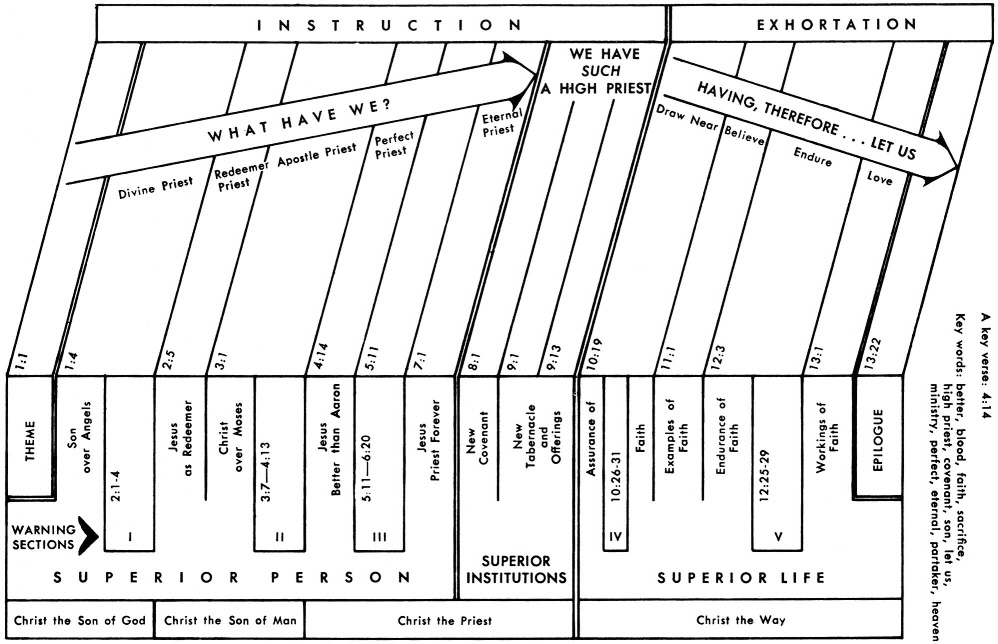
CONSIDER JESUS OUR GREAT HIGH PRIEST
Click chart to enlarge
Charts from Jensen's Survey of the NT - used by permission
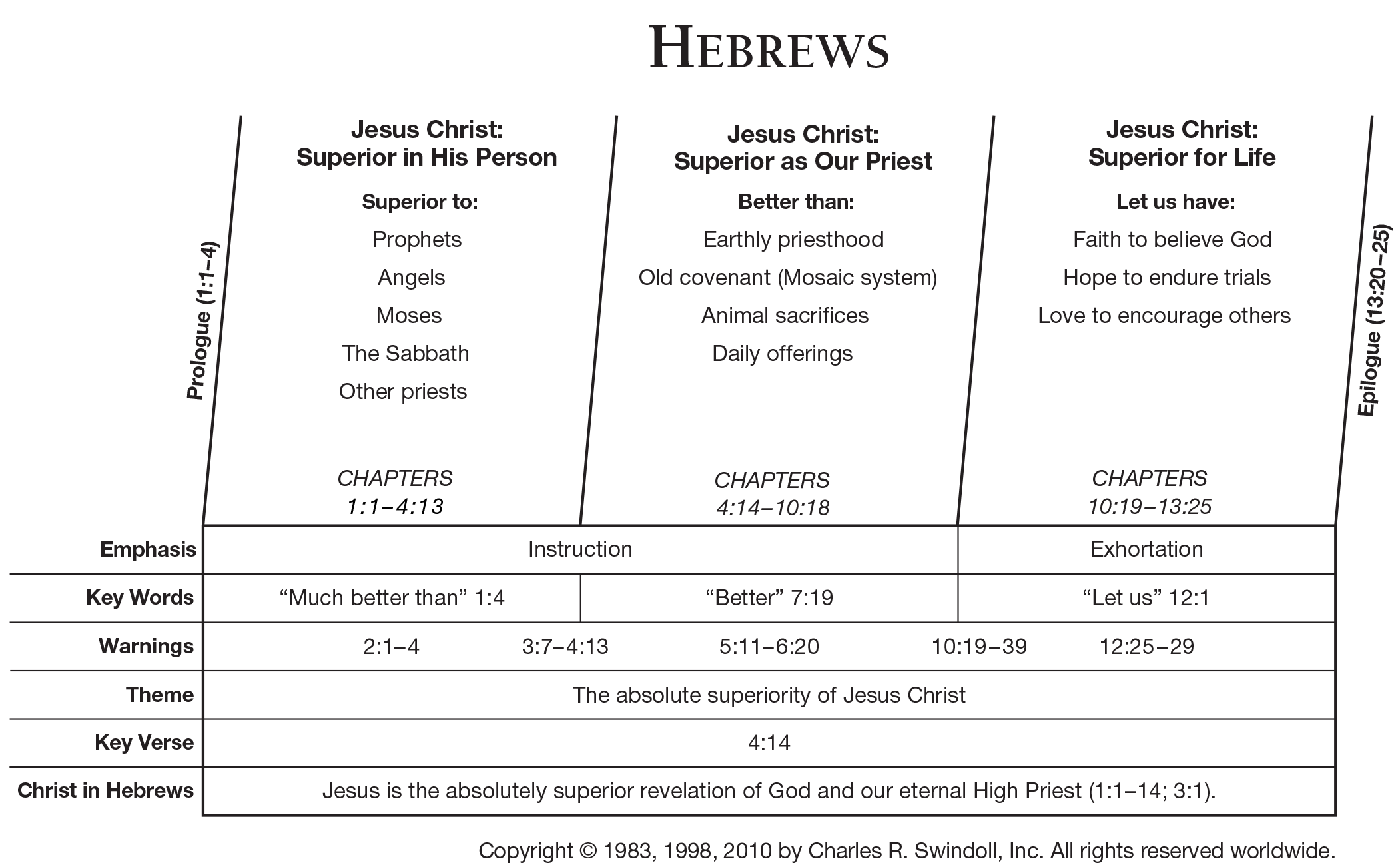
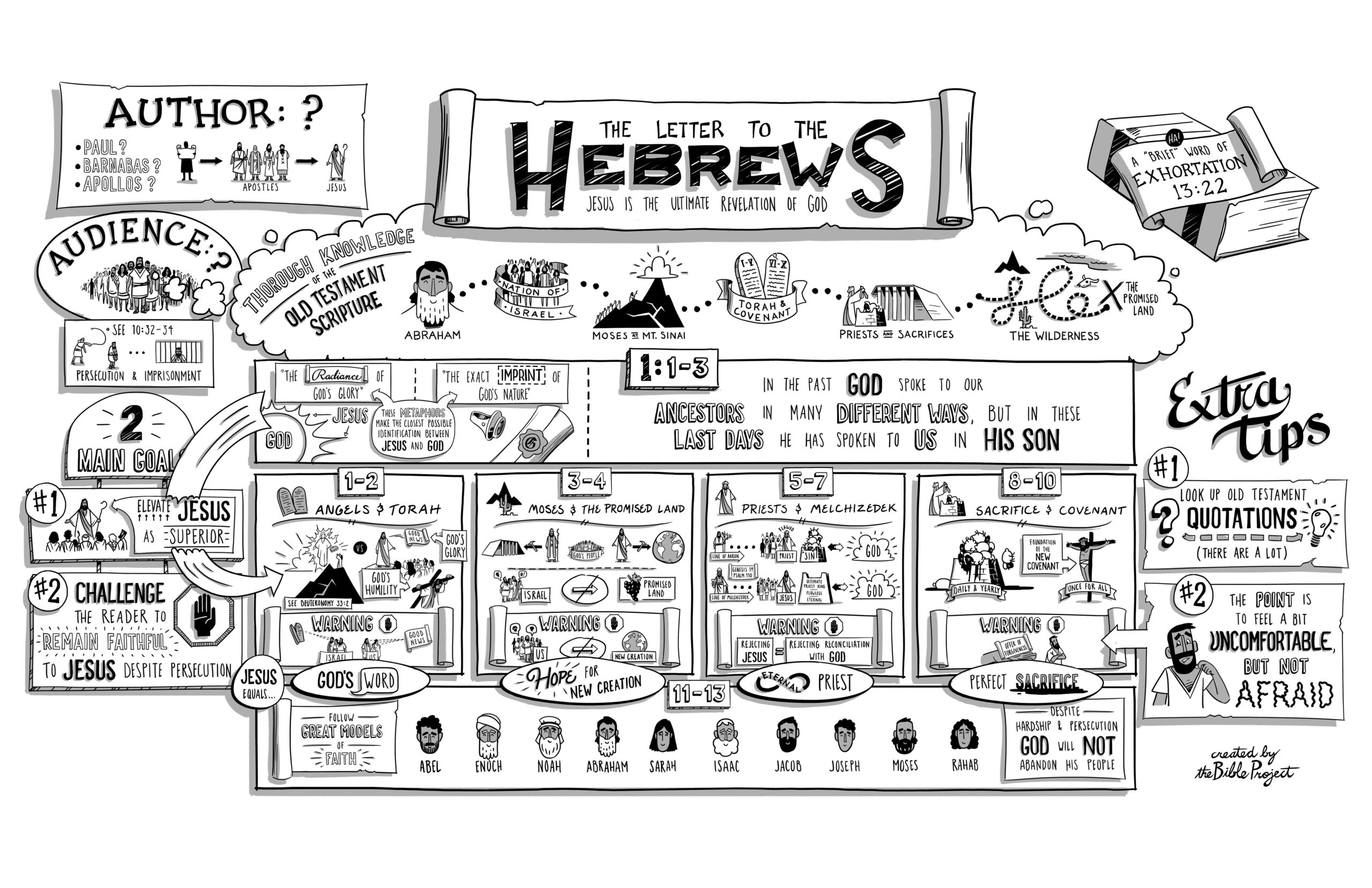
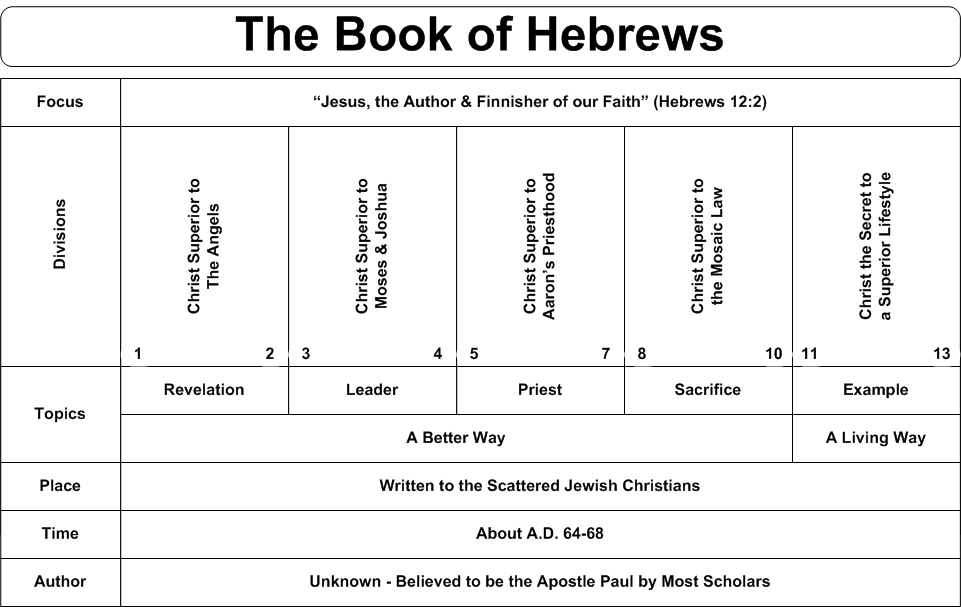
Swindoll's Chart, Interesting Pictorial Chart of Hebrews, Another Chart
|
The Epistle |
||||
| INSTRUCTION Hebrews 1-10:18 |
EXHORTATION Hebrews 10:19-13:25 |
|||
| Superior Person of Christ Hebrews 1:1-4:13 |
Superior Priest in Christ Hebrews 4:14-10:18 |
Superior Life In Christ Hebrews 10:19-13:25 |
||
| BETTER THAN PERSON Hebrews 1:1-4:13 |
BETTER PRIESTHOOD Heb 4:14-7:28 |
BETTER COVENANT Heb 8:1-13 |
BETTER SACRIFICE Heb 9:1-10:18 |
BETTER LIFE |
| MAJESTY OF CHRIST |
MINISTRY OF CHRIST |
MINISTERS FOR CHRIST |
||
|
DOCTRINE |
DUTY |
|||
|
DATE WRITTEN: |
||||

See ESV Study Bible "Introduction to Hebrews"
(See also MacArthur's Introduction to Hebrews)
Borrow Ryrie Study Bible
Hebrews 11:23 By faith Moses, when he was born, was hidden for three months by his parents, because they saw he was a beautiful child; and they were not afraid of the king's edict. (NASB: Lockman)
Greek: Pistei Mouses gennetheis (APPMSN) ekrube (3SAPI) trimenon hupo ton pateron autou, dioti eidon (3PAAI) asteion to paidion, kai ouk ephobethesan (3PAPI) to diatagma tou basileos.
Amplified: [Prompted] by faith Moses, after his birth, was kept concealed for three months by his parents, because they saw how comely the child was; and they were not overawed and terrified by the king’s decree. (Amplified Bible - Lockman)
KJV: By faith Moses, when he was born, was hid three months of his parents, because they saw he was a proper child; and they were not afraid of the king's commandment. (NLT - Tyndale House)
NKJ By faith Moses, when he was born, was hidden three months by his parents, because they saw he was a beautiful child; and they were not afraid of the king's command.
NET By faith, when Moses was born, his parents hid him for three months, because they saw the child was beautiful and they were not afraid of the king's edict.
BGT Πίστει Μωϋσῆς γεννηθεὶς ἐκρύβη τρίμηνον ὑπὸ τῶν πατέρων αὐτοῦ, διότι εἶδον ἀστεῖον τὸ παιδίον καὶ οὐκ ἐφοβήθησαν τὸ διάταγμα τοῦ βασιλέως.
CSB By faith, after Moses was born, he was hidden by his parents for three months, because they saw that the child was beautiful, and they didn't fear the king's edict.
ESV By faith Moses, when he was born, was hidden for three months by his parents, because they saw that the child was beautiful, and they were not afraid of the king's edict.
NIV By faith Moses' parents hid him for three months after he was born, because they saw he was no ordinary child, and they were not afraid of the king's edict.
Phillips: It was by faith that Moses was hidden by his parents for three months after his birth, for they saw that he was an exceptional child and refused to be daunted by the king's decree that all male children should be drowned. (Phillips: Touchstone)
Wuest: By faith Moses, having been born, was hid three months by his parents, because they saw that he was a comely child. And they did not fear the mandate of the king.
Young's Literal: By faith Moses, having been born, was hid three months by his parents, because they saw the child comely, and were not afraid of the decree of the king
- By faith - Ex 2:2, 3, 4, 5, 6, 7, 8, 9, 10; Acts 7:20
- Because they saw He 13:6; Ps 56:4; 118:6; Isa 8:12,13; 41:10,14; 51:7,12; Da 3:16-18, 6:10; Mt 10:28; Lk 12:4,5
- King's edict Exodus 1:16,22
- Hebrews 11 Resources - Multiple Sermons and Commentaries
- Art related to Moses
Related Passages:
Exodus 1:22+ Then Pharaoh commanded all his people, saying, “Every son who is born you are to cast into the Nile, and every daughter you are to keep alive.”
Exodus 2:2+ The woman conceived and bore a son; and when she saw that he was beautiful, she hid him for three months.
Exodus 6:20+ (MOSES' PARENTS) Amram (+) married his father’s sister Jochebed, and she bore him Aaron and Moses; and the length of Amram’s life was one hundred and thirty-seven years.
Acts 7:20+ "It was at this time that Moses was born; and he was lovely in the sight of God, and he was nurtured three months in his father’s home. (NET = At that time Moses was born, and he was beautiful to God. For three months he was brought up in his father's house, Act 7:20NET)
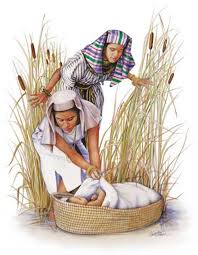
THE FEARLESS FAITH OF
MOSES' GODLY PARENTS
As the author of Hebrews continues his inspired survey of Old Testament faith, he now turns to the story of Moses, one of the most pivotal figures in redemptive history. The focus now turns from faith’s pilgrim life (Abraham, Isaac, Jacob, Joseph) to faith’s courage under persecution. But before highlighting Moses’ own personal faith, the writer begins with the faith of his parents—a reminder that faith often begins in the unseen, quiet acts of obedience by those who fear God more than man. Moses’ parents (Amram and Jochebed Ex 6:20) stand as models of courageous trust amid a hostile culture. Their faith shone brightest in the shadows of Pharaoh’s murderous decree (Ex 1:22), when obedience to God required defiance of the king’s command.
From 3 deaths the writer changes focus to one birth! Moses had been a major character in Hebrews 3:1-4:13, but was not mentioned in any detail (cp incidental mentions in He 9:19, He 10:28) until this section of the letter.
John Phillips - The writer of Hebrews now turns his attention to the patriotic age. He leaps over the silent centuries of the Egyptian bondage to the days of Moses, a man who ranked almost as high as Abraham in the Hebrew hall of fame. (borrow Exploring Hebrews page 162)
By faith (see note on “by faith”) emphasizes trust, reliance, and confident dependence upon God’s Word rather than human reasoning or visible evidence. By faith, Moses’ parents discerned God’s hand upon their infant son and acted accordingly. Their faith triumphed over any fear they may have felt. Faith trusts in the unseen promise and protection of God, while fear fixates on visible threats and human power. See How to Handle Fear). Moses’ parents chose faith and feared God more than they feared Pharaoh. Though Scripture gives no details of how other than that Moses was a beautiful baby, they believed that God would protect their child and fulfill His covenant promise. Faith always overcomes fear when it rests upon the unchanging character of God.
Moses' parents are not named specifically here but are in Exodus 6:20. His father was Amram (means "exalted people") and his mother was Jochebed (means "the LORD is glory") both true "Heroes in the Hall of Faith." They hid him for three months by faith, acting not from fear of Pharaoh but from full confidence in God’s providence.
When he was born (gennao), was hidden (krupto - concealed, kept secret) for three months by his parents (see note), because they saw he was a beautiful (asteios) child; and they were not (ou - absolutely not) afraid (phobeo) of the king's (Pharoah's) edict. - When he was born (gennao) means “to be brought forth” or “to come into life” and in this context highlights God’s sovereign timing and purpose in Moses’ birth. In other words, Moses' entrance into the world was part of God's redemptive plan, not a random event.
Was hidden (krupto - concealed, kept secret) conveys intentional protection as his parents carefully shielded him from danger. The act of hiding Moses for three months was not mere parental instinct but faith in action, trusting God’s unseen hand amid a deadly edict. Their hiding of Moses was not an act of cowardice but of confidence, for faith moved his parents to protect what God had promised. As so often in the Scripture we see a beautiful union of God's sovereignty and human responsibility. God ordained Moses’ birth (gennao), and by faith his parents preserved his life (krupto), believing that God would fulfill His covenant purpose through their son.
🙏 THOUGHT - Faith prompted the hiding of baby Moses, illustrating that genuine faith always inspires noble action. Faith is not passive—it moves, it acts, it obeys. In this one courageous act, God-fearing, God-trusting parents demonstrated living faith. Though they may have sensed (“he was beautiful,” Ex 2:2+; Acts 7:20) that their child was destined for a divine purpose, they could not have foreseen how their small seed of faith would bear such abundant fruit, not only for their nation but ultimately for the entire world. Oh, how we all need to be reminded of the enduring importance of faithful obedience in the "small," ordinary moments of life! What may seem to us a small act of trust may, in God’s providence, produce a harvest of righteousness far beyond our wildest imagination (cf. Mt 25:21, 23, 38–39). Ponder this truth: The next time God calls you to obey—or when you are tempted to disobey—remember that what may seem a small matter in the moment can carry enormous consequences (for good or for bad)! Oh God, give us all, by Your Spirit (Heb 10:29), the grace to persevere in faithful obedience moment by moment, day by day, until our last breath ushers us into your glorious Presence. For Your glory, in Jesus' Name. Amen.
Because (term of explanation) they saw he was a beautiful (asteios) child - Moses’ parents discerned something extraordinary about their son, a divine favor, a mark of God’s purpose. Their perception went beyond natural affection, but according to the writer of Hebrews it was faith’s insight ("by faith") recognizing God’s hand upon the child. Beautiful (asteios) did not just refer to physical attractiveness, but somehow conveyed to them the presence of God’s favor. They were persuaded ("by faith") that he was destined for something great. In a way which is a mystery to me, God gave them spiritual eyes to see what natural eyes could not—God's calling upon their child. Their faith responded to what they saw by courageously defying Pharaoh’s decree. Faith allowed them to see more than the child's physical features, but to see the "finger of God," to read in their child's beauty God's "handwriting" upon him, seeing the invisible and eternal in the temporal. (2Co 4:18). Moses’ parents saw not merely a beautiful baby but a beautiful purpose. This faith made them fearless!
And they were not (ouk - absolutely not) afraid (phobeo) of the king's (Pharoah's) edict. Were not afraid - This is clearly evidence of their faith! While surely they were aware of the terrible pronouncement by the Pharaoh and it may have caused them momentary fears and doubts, they did not allow any fear that may have been presence to control them, but instead choose to act in faith, trusting wholly in a Holy Trustworthy God. ) Phobeo and its cognates are used in Hebrews 2:15 (phobos - word study); He 4:1; 10:27, 31; 11:23, 27; 12:21; 13:6. The Greek word for "not" is "ouk" signifying they were absolutely not afraid! Why not? They were parents of faith. They feared God which is the greatest weapon against the fear of man, for he who fears God, fears nothing else! Or as Spurgeon phrased it fear of God "is a blessed fear which drives us to trust (for)...unregenerate fear drives from God (and), gracious fear drives to Him." And in light of his God fearing parent's faith, we are not surprised that the "apple" did not fall far from the tree (so to speak) as we see Moses exercise a similar faith in Hebrews 11:27+.
🙏 THOUGHT - Mark it down that the antonym of and antidote for fear is faith (see Fear, How to Handle It) FAITH COUNTERS FEAR. It trumps fear. It defeats fear. Listen to our Lord Jesus in Mk 5:36 - “Do not be afraid, only believe.” David echoes Jesus “When I am afraid, I will put my trust in Thee.” Ps 56:3 Belief conquers fear! Only he who can say, “The LORD is my light and my salvation; Whom shall I fear? The LORD is the defense of my life; Whom shall I dread?” (Ps 27:1) Even John Newton understood this relationship of FAITH AND FEAR in his famous hymn Amazing Grace, for in the second stanza he wrote
Twas grace that taught my heart to fear,
And grace my fears relieved;
How precious did that grace appear
The hour I first believed.
Newton is saying that grace first awakens a holy reverence that fears God rightly—and then calms every lesser fear by teaching the heart to trust Him fully. Faith and fear meet at the cross, where trust in God’s grace silences every trembling of the soul.
Faith and fear cannot live long in the same heart — when one enters, the other flees. Fear looks at the storm; faith looks at the Savior. Fear sees giants; faith sees God. Fear imagines defeat; faith anticipates deliverance. Faith never denies the danger — it simply decides that God is greater than the danger. The heart fixed on God’s promises will not be shaken by man’s threats. As Isaiah wrote, “Thou will keep him in perfect peace (literally "shalom, shalom") whose mind is stayed on Thee, because he trusts in Thee.” (Isaiah 26:3)
Faith and fear stand in opposition to each other; if there is faith, fear cannot abide, and if there is fear, faith is driven away. Fear is a thief. It robs you of your confidence in God’s goodness. Faith believes God even when circumstances give no visible reason for hope. Faith is the gaze of a soul upon a saving God. Fear fades when our eyes are fixed on Him. Never be afraid to trust your unknown future to your known trustworthy God. In a sense, faith does not eliminate fear, but it redirects it from fearing what may happen to fearing (reverentially) the One Who holds all things that happen in His hands! Let's be honest, Faith does not always calm the storm, but it can calm the child of God in the storm.
And so we see the heroic faith of Moses parents Amram and Jochebed. Moses' faith will be described below, but is it any wonder that parents of faith begat a child of faith? (cp this principle in Timothy's life - 2Ti 1:5+). Notice also the sovereign watch care of the omniscient, omnipotent Almighty God over His servant Moses even from his birth.
🙏 THOUGHT - Our God is not an "in and out" of our life God, but is with us forever and a day, and every moment of every day. Oh, how we need to recall this to our minds, not only when we feel alone but likewise when we feel the pull of temptation to sin. He is there from our birth until our death and then throughout eternity. What a comforting truth that He will never leave us nor forsake us in this life or the life to come (He 13:5, 6+). Praise His Name Immanuel! (Is 7:14, Mt 1:23) Amen.
In Hebrews 11:23-29 the writer summarizes the faith of Moses the friend (Jas 2:23+) and servant (Dt 34:5, 1Chr 6:49, 2Chr 24:9, Da 9:11, Rev 15:3+) of God, by beginning with the faith of his parents (cp 2Ti 1:5+). In so doing the writer illustrates to his Hebrew readers (who would have been familiar with the story in Exodus) how faith confronts opposition, hostility and threats of men! May the faith of this godly OT couple encourage all parents that they can still train up their children to be friends and servants of God even in the darkest of days (even as we see America, "one nation under God", in effect becoming "one nation" that is no longer under God but under the rule of rebellious, God-rejecting men!)
This verse summarizes a dangerous time for Israel because Pharaoh had commanded the Hebrew midwives to murder all the males immediately upon birth (Ex 1:22, see Ex 1:15-22). Satan has forever been trying to destroy the line of the Messiah (cp Ge 3:15, Esther 3:8, 9, 10, 11, 12, 13, 14, 15, Mt 2:16, 17, 18) so that He could not come and redeem fallen men from their bondage to sin and its consequence, death.
Spurgeon on by faith of Amram and Jochebed (see note) the names of Moses' parents who believed God's promises to Abraham - The stress in these passages of sacred biography should be laid upon the words “by faith.” The mighty deeds of heroes and the obedient acts of pilgrim fathers are only told to us because they spring out of faith. It is to commend the root that the fruits are mentioned. The children are named one by one that the mother may have the praise, for faith is the mother of all virtues. The Lord is not praising the natural affection, but the supernatural faith. A very strong current is seen when nature and faith both set the same way, yet it is not nature but faith that bears the sway. Sometimes faith has to go against nature, as in the case of Abraham when he was bidden to offer up his son (Heb 11:17), and then faith wins the victory. Here, though faith and nature ran together and so made the current stronger, still the text does not say, “By the force of nature, by the natural love of parents for their child, Moses was hidden for three months.” No, but they did it “by faith.” Both the parents of Moses believed, and both acted by faith in disobeying the cruel order of the king. If they had not agreed about it, I do not see how Moses could have been concealed. But they both went together in the hiding of the child, and how well it will be if we all go together in the endeavor to bring our children to Christ. If our prayers are united, if our example is one, if our teaching is never contradictory, if both parents are with like earnestness seeking the salvation of their little ones, we may rest assured the promise will be kept, “Train the child concerning his way; even when he is old, he will not stray from it” (Prov 22:6). (See sermon The Hiding of Moses by Faith)
Here is the story from Exodus to remind you of this courageous act of faith in which Moses' parents risked their own lives to preserve the life of the child (genuine faith is not passive but active, dynamic, obedient)...
Ex 2:1+ Now a man from the house of Levi (Amram) went and married a daughter of Levi (Jochebed = Ex 6:20). 2 The woman conceived and bore a son (in one sense this was an act of faith to choose to have children in the face of the Pharaoh's edict regarding male sons!); and when she saw that he was beautiful (literally "a handsome child to God" NIV offers a somewhat interpretative rendering = "he was no ordinary child"), she hid him for three months (Note that He 11:23 says "his parents" which follows the Septuagint translation of the Hebrew text and commends the faith of both parents = Ex 2:2+ "they hid him three months" = this was an act of faith).
Comment - From the account in Exodus we might conclude that only Jochebed, Moses’ mother, exercised faith and hid Moses for three months so that he would not be killed, but Hebrews tells us clearly that both of the parents were involved in this great act of faith. At great cost to their own safety and with their very lives at stake, Amram and Jochebed refused to obey the Pharaoh’s command and hid the child Moses. By faith these parents displayed great courage and boldness which enabled them to overcome the fear of man, even when it meant the certain death of their son and themselves. We learn from these parents that real faith operates in spite of adversity....Was it Moses’ beauty that caused the parents to hide him? I think not, but it was their faith in the living God that caused them to do this mighty act. Amram and Jochebed were true believers and knew of God’s promises and predictions that Israel would be delivered out of Egypt. (Read Ge 15:13-14, Ge 50:24) They believed that the promises to Abraham, Isaac and Jacob concerning the promised land would come to pass. (Jack Arnold)
3 But when she could hide him no longer, she got him a wicker (papyrus) basket (tebah = "box-like container" same word is translated ark in Ge 6:14+ff -- So as Noah’s Ark saved Noah and his family, Jochebed’s Ark was used to save Moses!) and covered it over with tar and pitch. Then she put the child into it and set it among the reeds by the bank of the Nile (ED: This was an act of faith). (Note: Moses and Christ both faced the threat of death as infants, and both were saved to bring about a great redemption and to establish a blood covenant with God's people, Moses the Old Covenant and Jesus the New Covenant) (Wiersbe "Jochebed obeyed the letter of the law when she put Moses in the waters of the Nile, but certainly she was defying Pharaoh's orders in the way she did it." cp similar principle in Acts 5:29) 4 His sister (Miriam Nu 26:59) stood at a distance to find out what would happen to him.
Arnold - This is a beautiful picture of God’s sovereignty and human responsibility working side by side. Jochebed was expecting a supernatural intervention but she sent Miriam, Moses’ sister, to see how it would all turn out and perhaps do something about the situation.
Ex 2:5 Then (in the providential outworking of the sovereign God) the daughter of Pharaoh came down to bathe at the Nile, with her maidens walking alongside the Nile; and she saw the basket among the reeds and sent her maid, and she brought it to her. 6 When she opened it, she saw the child, and behold, the boy was crying
Wiersbe "The phrase "as weak as a baby" doesn't apply in the kingdom of God; for when the Lord wants to accomplish a mighty work, He often starts by sending a baby. This was true when He sent Isaac, Joseph, Samuel, John the Baptist, and especially Jesus. God can use the weakest things to defeat the mightiest enemies [1Co 1:25, 26, 27, 28, 29]. A baby's tears were God's first weapons in His war against Egypt.
And she had pity on him and said, "This is one of the Hebrew's children." 7 Then his sister said to Pharaoh's daughter, "Shall I go and call a nurse for you from the Hebrew women that she may nurse the child for you?" 8 Pharaoh's daughter said to her, "Go ahead." So the girl went and called the child's mother.
Arnold - Humanly speaking, Pharaoh’s daughter should have thrown Moses in the Nile because the king had commanded this, but God has control even over the hearts of royalty and can change their thinking. “The king’s heart is like channels of water in the hand of the LORD; He turns it wherever He wishes”(Pr 21:1). God alone can soften an unbeliever’s heart.
9 Then Pharaoh's daughter said to her, "Take this child away and nurse him for me and I will give you your wages." So the woman took the child and nursed him. (This is the fruit of faith!) 10 The child grew, and she brought him to Pharaoh's daughter and he became her son. And she named him Moses, and said, "Because I drew him out of the water." (Moses In the Egyptian language, Moses means "born" or "son" and sounds like a Hebrew word that means "drawn out [of the water].") (cp Acts 7:20, 21+)
Arnold - Have you ever asked yourself, “Where did Moses get his information about God, His covenants and His people, Israel?” He undoubtedly received most of it from Amram and Jochebed. The Bible does not tell us how long the boy Moses and his mother were together. The important thing to note is that the parents of Moses, especially his mother, were together with him long enough so that she could communicate her faith to him. She undoubtedly told him about the true God and about the chosen people of Israel and the circumstances surrounding his own birth. I can imagine that she repeated over and over again to Moses how God had been faithful in delivering him from certain death at the hands of Pharaoh.
Spurgeon - Stephen says in his speech that the child was “exceeding fair”; and if you look at Stephen’s speech you will see that the KJV translators have put in the margin, “Or ‘fair to God’ ” (Acts 7:20). So it may run, “they saw that the child was handsome to God.” Now, I gather from that expression that the child was exceedingly beautiful, beyond the common run of children. There was a charm about his features, a remarkable glory about his face, and something superhuman, probably, since he was fair to God. A spiritual air floated about the child’s face, as if he bore some glimmerings of the glory of Sinai, of the wondrous shepherd-lawgiver who led the people forty years through the wilderness. In the babe’s face there were prophecies of the man of God. Surely among those who have been born of women there has not been born a greater than Moses; and about him as a child there was a something so striking, so marvelously beautiful, that his parents were fascinated by him.
Spurgeon - Their faith made them hide him, for that faith laid hold of God, and they were not afraid of the king’s commandment. Faith makes a person wise. It is one of the notable points about faith that it is sanctified common sense. That is not at all a bad definition of faith. It is not fanaticism; it is not absurdity. It is making God the grandest asset in our account, and then reckoning according to the soundest logic. It is not putting my hands into boiling water with the impression that it will not scald me; it is not doing foolish and absurd things. Faith is believing in God and acting toward God as we ought to do. It is treating Him, not as a cipher, but as a grand overtopping numeral in all our additions and subtractions. It is realizing God—that is what it is. And in that sense, faith is the truest reason, spiritualized and lifted up out of the ordinary sphere in which godless men choose to indulge in it. It is sanctified reason, enlightened from on high. (The Hiding of Moses by Faith)
🙏 THOUGHT - How can we apply the lessons from this godly example of faith?
(1) Do not fear the Pharaoh’s in your life (cp Pr 29:25, Mt 10:28, Ps 25:15+).
(2) Entrust your children into God’s watch care! And for all of you who were born into "Moses-like" godly homes where both parents were believers (I was not so blessed), let your praise and thanksgiving for such a wonderful gift continually resound to the Giver of all good gifts! (Jas 1:17+)
Warren Wiersbe - "Though godly parents cannot pass on their faith as they do family traits, they can certainly create an atmosphere of faith at home and be examples to their children. A home should be the first school of faith for a child. (Bible Exposition Commentary )
See Pastor Cole's exposition below
Jack Arnold - Who are Amram and Jochebed? You say, “I never heard of them.” They may be obscure people to you and me but they are precious saints in the sight of God, for He thought enough of them to put them in the believer’s hall of fame. Amram and Jochebed were the parents of Moses. Thus far in the Book of Hebrews, Chapter 11, all the saints mentioned are well-known characters - Abel, Enoch, Noah, Abraham, Sarah, Isaac, Jacob and Joseph - but Amram and Jochebed are unfamiliar names; yet they exercised great faith in God, and God thought their faith so significant that He recorded it in Holy Scripture. Amram and Jochebed were common folks but they were mightily used of God to accomplish His purposes. They are an example of persevering faith in God, which gives one great courage and causes him to do what he would not normally do. Persevering faith is courageous in suffering, hardships and tribulations so that one accomplishes things that seem humanly impossible. They believed that the promises to Abraham, Isaac and Jacob concerning the promised land would come to pass. While the record does not state specifically, it could well be that Amram and Jochebed were given a direct revelation from God that Moses had a special destiny among the people of God. Whatever the means, Moses’ parents knew that Moses was “lovely unto God” (Acts 7:20) and that he had a special place in God’s program. The point of significance is that it was not primarily because of his external beauty or their natural affections towards Moses that his parents hid him, but it was because of their faith -- they believed God! They trusted God for a humanly impossible situation and God supernaturally took care of the situation. Notice carefully that Amram and Jochebed exercised faith and acted because true faith always acts. Faith is not sitting around twiddling our thumbs waiting for something to happen. In fact, that kind of a concept of faith is fatalism. Faith works, faith acts, and faith is doing something now, for faith is acting upon the promises of God now! It took great faith for Jochebed to put her child in the little ark in the high grass at the bank of the river. She was believing God but she also probably knew that Pharaoh’s daughter came regularly to that area to bathe and she was believing God for a supernatural intervention, even though humanly it seemed as though Moses would be put to death. (Sermon)
Faith (4102)(pistis) is synonymous with trust or belief and is the conviction of the truth of anything, but in Scripture speaks of belief respecting man's relationship to God and divine things, generally with the included idea of trust and holy fervor born of faith and joined with it. As pistis relates to God, it is the conviction that God exists and is the Creator and Ruler of all things well as the Provider and Bestower of eternal salvation through Christ. As faith relates to Christ it represents a strong and welcome conviction or belief that Jesus is the Messiah, through Whom we obtain eternal salvation and entrance into the Kingdom of Heaven. Stated another way, eternal salvation comes only through belief in Jesus Christ and no other way. Faith is believing that God will keep His promises, despite circumstances that seem to be to the contrary! True faith that saves one's soul includes at least three main elements - (1) firm persuasion or firm conviction, (2) a surrender to that truth and (3) a conduct emanating from that surrender. In sum, faith shows itself genuine by a changed life.
For more discussion on the meaning of faith see commentary on Hebrews 11:1-2.
Phillip Hughes has a great description of faith writing that "The faith of which our author is speaking is not blind faith, vacuous and unintelligent credulity, but faith that is in the highest sense enlightened and substantial, because the divine word to which it is the response is a word not only of power but also of light (Ps 119:105+). In the biblical purview faith and revelation belong together, and revelation inevitably involves, on the part of the recipient, the activity of the intellective faculty: by faith we understand. The origination of all things by the creative word of God (Heb 11:3+) is a truth that can be known to us only through revelation, and accordingly its disclosure demands the response of faith. It is an article of faith that recurs throughout the range of Scripture. (A Commentary On The Epistle To The Hebrews)
Beautiful (791)(asteios) means beautiful, well-formed, acceptable. Asteios means literally belonging to a city; hence well-bred, acceptable, well-pleasing; of bodily appearance, attractive in outward appearance, well-formed, beautiful, noble. It came to describe someone or something that was refined, elegant, or graceful—as contrasted with something rough or rustic. Josephus says Moses “was so beautiful that many passed by to look at him.”
Beautiful - It is interesting to note that Jewish writers embellished Moses’ beauty, even with such non-Biblical descriptions that the glory of this baby filled the entire room at birth! Even in his humble birth, our Lord's glory and majesty were veiled that He might be fully Man while, in the mystery of mysteries, remaining fully God (Luke 2:16, 17+). While our Lord at His birth did not fill the room with glory (as far as Scripture records - there was glory around His angelic announcers Lk 2:9+), His birth caused both angels (Lk 2:14+) and men (Lk 2:20+) to give glory to the Most High God. What a humble Lord we are privileged to worship and serve and spend eternity with!
ASTEIOS - Acts 7:20+ Hebrews 11:23. 3x in Septuagint - Ex 2:2 ("beautiful"), Nu 22:32, Jdg 3:17.
Zodhiates says that asteios refers to "One who dwells in a city and by consequence is well-bred, polite, eloquent, as the inhabitants of cities may be in comparison with those of the country. Used only of Moses, meaning elegant in external form (Acts 7:20; Heb. 11:23). The Greeks used to call the opposite of asteíos, the urban person, the agroíkos, the one who comes from agrós, field or country-side. Therefore, asteíos came to be assumed as one who is fair to look on and attractive, a suggestion of beauty but not generally of a high character. Asteíos may mean the same thing as hōraíos, fair or beautiful, but they reach that beauty by paths which are entirely different, resting as they do on different images. Asteíos belongs to art and to it are attributed the notions of neatness, symmetry, and elegance. Hōraíos receives its hour of beauty by nature which may be brief but which constitutes the season of highest perfection. (BORROW The Complete Word Study Dictionary: New Testament)
Gilbrant on asteios in Classical Greek - Asteios comes from the word astu, “town,” and means “that which pertains to the town”; however, this literal sense is conveyed by another term, astikos, in classical Greek (Liddell-Scott). Asteios functions in a sense other than literal. Since the “city” represents culture, asteios denotes that which is “refined” and hence “beautiful, pleasing, acceptable.” This can apply to people, words, objects, or ideas and can describe physical appearance or conduct. (Complete Biblical Library Greek-English Dictionary)
Liddell-Scott - (astu) of the town: hence, like Lat. urbanus, town-bred, polite, courteous, Plat.:-refined, elegant, pretty, witty, clever
James Girdwood - By faith Moses’ parents defied a cruel command and changed the course of history for their son and their people. By faith parents today can influence their children in a similar way.... Few people would trade position and power for a place among the despised of this world—but that is exactly what Moses did. In his case faith demanded that he give up the trappings and advantages of a royal court to suffer mistreatment alongside God’s people. According to Hebrews, he did this because “he regarded disgrace for the sake of Christ as of greater value than the treasures of Egypt, because he was looking ahead to his reward” (Heb 11:26). God may not ask us to do what Moses did—Joseph, for example, served God by staying in Pharaoh’s court—but he always wants us to take the long view. People of faith reject the transitory in favor of the permanent, give up what is pleasurable when it conflicts with God’s leading in their lives.
Prince of Egypt, Prophet of God - Hebrews 11:23–29 - David Faust
Did he look like Charlton Heston? I don’t know. But I do know this: Other than Jesus himself, and perhaps the apostle Paul, it’s likely that no other figure in all of history has exerted more influence on mankind than did Moses.
The first five books of the Bible are of his authorship. He held in his hands the original tablets of stone that bore the Ten Commandments. He was raised as a prince of Egypt, refined as a shepherd in Midian, and transformed into a prophet of God. Let us examine some elements of that remarkable life.
I. HIS FAITHFUL PARENTS SPARED HIS LIFE (v. 23).
A. “By faith Moses’ parents hid him for three months” at the risk of their own lives, for Pharaoh had ordered that every Hebrew baby boy must be thrown into the river and drowned (Exodus 1:22).
B. “They saw he was no ordinary child.” By faith, godly parents see the potential in their children and pray for the next generation to accomplish extraordinary things for the glory of God.
C. “They were not afraid of the king’s edict.” When parents bravely decide to “obey God rather than men” (see Acts 5:29), they model courage and commitment to their children. Years later Moses had to stand up against Pharaoh’s stubborn, sinful will. It must have strengthened his resolve to review the story of his birth parents’ faith.
II. HIS FAITHFUL DECISIONS SHAPED HIS LIFE (vv. 24–27).
A. Moses lived 120 years, and his life can be divided into three 40-year segments. The first 40 years he was a prince in Egypt. The second 40 years (after he killed an Egyptian who had mistreated a fellow Israelite) he was a fugitive and a shepherd in Midian. During the last 40 years, he led the Hebrews out of Egyptian bondage (Acts 7:23–34). Along the way, Moses made several significant decisions, each one guided by his faith in the Lord:
1. He decided who he would be: not “the son of Pharaoh’s daughter,” but a servant of God (v. 24).
2. He decided what group of people he would join, even though it meant being “mistreated along with the people of God” (v. 25a).
3. Taking the long view of life, he determined to act righteously and responsibly “rather than to enjoy the pleasures of sin for a short time” (v. 25b).
4. He chose spiritual priorities over material ones, and “regarded disgrace for the sake of Christ as of greater value than the treasures of Egypt” (v. 26a).
5. He believed God’s promises for the future and “was looking ahead to his reward” (v. 26b).
6. He persevered over the long haul because he was convinced of the reality of God and he “saw him who is invisible” (v. 27).
B. When we have difficult decisions to make, we need to follow Moses’ example. Remember who we are and whose we are, look at the big picture, put God’s kingdom first, keep our eyes on the goal, and stay faithful because we’re confident God is real and he’s leading our steps.
III. HIS FAITHFUL INFLUENCE HONORED HIS LORD (vv. 28, 29).
A. Moses’ obedience to God was a matter of life and death—for himself and for many others. “He kept the Passover and the sprinkling of blood,” which vividly portray the salvation ultimately accomplished by the sacrifice of Christ (v. 28).
B. Under his leadership more than half a million people experienced God’s deliverance and protection as they walked safely through the parted waters of the Red Sea (v. 29).
ILLUSTRATIONS
Through the eyes of faith. If you had been standing by the Nile when Moses’ mother placed her three-month-old son in a basket and left him there, would you have guessed that this tiny Hebrew boy would become one of history’s best-known leaders? If you had stood near the manger where a young virgin named Mary had placed her baby wrapped in swaddling clothes, would you have realized this humble infant was the only-begotten Son of God? We don’t always see the big picture, but God does. Through the eyes of faith, we see “him who is invisible” (Hebrews 11:27).
Hold on to something solid. Two men fell into the Niagara River. As they were being swept swiftly toward the falls and certain death, someone on shore saw their plight, tied a rope to a tree trunk, and tossed the rope into the water. Both men gratefully grabbed onto the rope and tried to hang on. Soon, however, a log floating in the water bumped into one of the men. Feeling the large log and instinctively sensing that something that big must be more secure than a flimsy rope, the man released his grip on the rope and grabbed onto the log. Soon, however, both he and the log were swept over the falls, while the man who hung onto the rope was rescued—because however flimsy it might have felt, the rope was tied to something solid on the shore. When we’re drowning in sin and despair, we may find it tempting to let go of our faith and grab onto man-made philosophies that seem strong and secure. But our only real security is in the Lord and his truth. Don’t ever let go of your faith in him (Colossians 2:6–8).
John MacArthur - ACCEPTING GOD’S PLAN Drawing Near: Daily Readings for a Deeper Faith - Page 39
“By faith Moses, when he was born, was hidden for three months by his parents, because they saw he was a beautiful child; and they were not afraid of the king’s edict” (Heb. 11:23).
✧✧✧
God makes His plans; you walk in them by faith.
He doesn’t need your help or counsel—just your obedience and trust.
It has been wisely said that trying to improve on God’s plan is more pretentious than trying to improve the Mona Lisa with an ink pen. All you’d do is ruin the masterpiece.
The story of Amram and Jochebed, the parents of Moses, is about two people who refused to ruin the masterpiece. They trusted God implicitly and did everything possible to see His plan for their son come to fruition.
Because of the number and might of the Hebrew people in Egypt, Pharaoh enslaved them and ordered that all male Hebrew babies be put to death. In direct defiance of that wicked edict, Moses’ parents hid their baby for three months, then placed him in a waterproofed basket along the banks of the Nile River near the place where Pharaoh’s daughter bathed. One can only imagine the faith it took for them to risk their own lives, as well as the life of their baby, by placing him in that basket and introducing him into the very household of the one who wanted all male Hebrew babies slain.
By God’s providence, Pharaoh’s daughter found the baby, took pity on him, and adopted him into her family. More than that, the Lord used Moses’ quick-thinking sister, Miriam, to arrange for Jochebed to nurse and care for her own son! That gave Moses’ family the opportunity to teach him about God’s promises for Israel to inherit the Promised Land, become a mighty nation, and be a blessing to all nations. They helped instill within Moses the faith in God that would later characterize his life.
You may never be called on to make the kind of sacrifice that Moses’ parents made, but no matter what the risks, remember that God always honors your obedience.
✧✧✧
Suggestions for Prayer: Thank God for His plan for your life. Seek wisdom and grace to live accordingly.
For Further Study: Read about Israel’s oppression and Moses’ birth in Exodus 1:1–2:10.
Charles Swindoll - COURAGE IN THE FACE OF KINGS Great Days with the Great Lives: Daily Insight from Great ... - Page 48
Read Exodus 1:1–22
According to Pharaoh’s instructions, the Hebrew midwife was to watch closely as the baby emerged. She was immediately to discover the sex of the child as it came forth from the womb and to snuff out its life if she noticed it was a male—possibly suffocating the little boy before he ever uttered his first cry. Then the midwife could say, “Oh, I’m so sorry. This one was stillborn.”
What a heinous, murderous plan! Frankly, it comes very close—within a few seconds, as a matter of fact—to the present heinous practice known as “partial birth abortion.” These midwives, however, remained staunchly pro-life! What heroines! These ladies feared God more than they feared the laws of the king. Actually, their alibi contained some humor. The word vigorous literally means “lively.” They told a frowning, unhappy Pharaoh, “My, oh my, King, these women are fast. When we hear they’re about to give birth, we rush over to the house and zip, pop, it’s over! The baby’s already there, and then what can we do?”
Pharaoh, who may not have appreciated the graphic details of childbirth any more than I do, bought the whole thing. Who was he to argue with these strong-hearted midwives? Thankfully, these two courageous women, as Scripture would later say of Moses’ own parents, “were not afraid of the king’s edict” (Hebrews 11:23).
Praise God for such courageous people of faith. To this day, from Africa to China to the Middle East, that same courage shines out like a beacon. All over the world as you read these words, God’s people are being hounded and persecuted for their allegiance to Jesus Christ. And they are standing fast in the face of edicts from kings, presidents, generals, and party commissars. They are saying, “No, we won’t do the things you are asking us to do. We refuse to deny our Lord.” And they are paying the ultimate price.
Adrian Rogers - sermon on Hebrews 11:23 - Faith for the Family - see page 610 - note Rogers has 4 sermons on this same topic
Outline
Introduction
I. Faith’s Vision
II. Faith’s Venture
III. Faith’s Valor
IV. Faith’s Victory
Conclusion
TODAY IN THE WORD Hebrews 11:23; Exodus 2:1-10
By faith Moses' parents hid him for three months.... They were not afraid of the king's edict. - Hebrews 11:23
Bible teacher Chuck Swindoll points out that in 1809, the world's attention was riveted on the conquests of the French emperor Napoleon. That year Austria fell to Napoleon , as the ""little corporal"" swept across Europe, amassing a huge empire. But in terms of lasting influence on the world, Swindoll notes, the most important events of 1809 did not happen on battlefields but in baby cribs. Among the future leaders and influential figures born that year were William Gladstone, Oliver Wendell Holmes, Charles Darwin, Edgar Allan Poe, and Abraham Lincoln.
The situation in Egypt in the fifteenth century B.C. was much the same. The Pharaoh was focused on kingdom business--protecting his empire and issuing royal edicts to keep his potential enemies in check. But the most important event of that era was the birth cry of a Hebrew boy born to a Levite family in Egypt.
Moses was arguably the world's greatest human liberator and the leader God had chosen to form a ragged collection of slaves into the nation of Israel. The fact that Moses was born under Pharaoh's death sentence was no obstacle to God. He put in the heart of Moses' mother Jochebed (Ex. 6:20) the same kind of daring and courage that the Hebrew midwives had shown.
Jochebed didn't have the opportunity to read the story of Noah, which her infant son had yet to record. But she did the same thing to save Moses that Noah had done to preserve his family. She took a ""basket"" (v. 3) and coated it with pitch to make it watertight. The word for basket is translated as ""ark"" in Genesis 6:14.
What a great picture of God's saving and preserving care! When He wants to save the righteous or raise up a leader for His people, neither a world full of water nor a king's command (see 1:22) matters to Him.
God not only saved Moses' life, but arranged for him to be weaned by his mother and raised in Pharaoh's court. The future liberator would spend almost forty years absorbing Egyptian education and culture. When it came time for him to make a choice, Moses would stand with God's people, although his first attempt at leadership was tragically misguided.
TODAY ALONG THE WAY
Jochebed probably had two or three years to be with Moses. We can imagine the influence she had on him as she taught him about the true God. This is how Moses knew he was a Hebrew (2:11).
Thank the Lord for godly parental influence! We need to pray today for Christian parents around the world, especially those who are raising their children in hostile and dangerous environments. And if you are a parent seeking to instill godly principles in your children, be encouraged by Jochebed's example.
Adrian Rogers - The Moses Principle on Hebrews 11:24 - see page 704
Outline
Introduction
I. There Must Be a Wise Evaluation
A. The Treasure of a Clean Heart
B. The Treasure of True Love
C. The Treasure of a Godly Family
II. There Must Be a Clear Choice
III. There Must Be a Determined Refusal
Conclusion
Adrian Rogers - How to Live in Victory in an X-Rated World - page 716
Outline
Introduction
I. Moses Made a Firm Decision
II. Moses Made a Full Departure
III. Moses Discovered a Faithful Deliverance
Conclusion
TODAY IN THE WORD Hebrews 11:23-29; Deuteronomy 34:1-12; Hebrews 11:23-29
Since World War II the remote Russian island of Sakhalin has been ""home"" to tens of thousands of Koreans. Now the surviving members of this sad story want to go home.
During the war, when both Korea and Sakhalin were in Japanese hands, the Japanese brought some 60ꯠ Koreans to the island to work in its factories and coal mines. The Koreans were left behind after the war, and Russia prohibited them from leaving until 1988. But permission to go home means little to the elderly Koreans. Because they spent their youth in slave labor, they have no money for the trip home.
Moses would certainly identify with these people taken from their homeland and forced to perform slave labor for a despised enemy. Although he spent his early years in Egypt as the adopted son of Pharaoh's daughter, Moses eventually identified with his own people and their sufferings and made his choice accordingly (Heb. 11:25-26).
To say that Moses finished well is like saying the Pacific Ocean holds a lot of water. We could spend the entire month reviewing Moses' life and accomplishments as the great miracle-worker, liberator, lawgiver, patriarch and prophet of Israel.
Besides Moses' measurable achievements, we are reminded that the Lord knew Moses and spoke to him ""face to face"" (Deut. 34:10). No wonder God took personal charge of Moses' funeral arrangements and felt no obligation to reveal where He had buried His faithful servant.
But even in Moses' case, Scripture does not ignore the other side of the story. Deuteronomy 34:4 reminds us that Moses was prohibited from entering the Promised Land because of his disobedience at Meribah (Num. 20:1-13). He died gazing into Canaan, with God's promise in his ears.
TODAY ALONG THE WAY
Maybe you feel a little like Moses today, standing on the pinnacle of 1996 and looking over into the new year, wondering what lies ahead.
Since none of us can see into the future, we need to cling to Him whom we cannot see, our never-failing God whose love and abiding care is more real than anything we can see, taste or touch
TODAY IN THE WORD Hebrews 11:23; Exodus 1:6—2:10
The angel of the Lord encamps around those who fear him, and he delivers them. - Psalm 34:7
A recent missionary newsletter carried the story of the Tajumulco Baptist Church in Guatemala, which meets on property located next to two sacrifice stones thought to be left over from a Mayan temple. Local witch doctors still offer animals on the stones, and pray that the Christians among them will be “skinny, sickly and removed.”
When two opposite and antagonistic worldviews meet, people have to make a choice and take a stand. This is happening in Guatemala and many other places today, just as it happened in the time of Moses. Pharaoh forced God’s people to make a choice when he began oppressing the Israelites, and then ordered the death of all newborn Hebrew boys.
The Hebrew midwives were the first to make the decision to obey God rather than the pharoah. They refused to kill the newborns because they feared God (1:21), a faith commitment that He rewarded by giving them their own families.
Hebrews 11 focuses on the choice made by Moses’ parents, Amram and Jochebed (Ex. 6:20). Jochebed and Moses’ sister Miriam were the main characters in today’s story, but in Hebrews, Amram is also credited with acting in courageous faith to help save Moses from Pharaoh’s murderous order (Heb. 11:23).
The story of baby Moses records the second time that God had preserved His faithful people by putting them in an ark. The word translated “basket” (2:3) is the same word used of Noah’s ark. The ark became a symbol of God’s ability to save His people while judging unbelievers, which happened in a spectacular way when Moses pronounced the plagues on Egypt and led the people of Israel out to safety.
TODAY ALONG THE WAY
Hebrews 6:10 assures us, “God is not unjust; he will not forget your work and the love you have shown him.”
David Jeremiah - JOCHEBED: A COURAGEOUS MOTHER Discovering God: 365 Daily Devotions - Page 132
By faith Moses, when he was born, was hidden three months by his parents, because they saw he was a beautiful child; and they were not afraid of the king’s command. HEBREWS 11:23
You may never have heard her name, but Moses’ mother was one of the greatest mothers of all time. Jochebed was a woman of courage.
When Moses was born, Pharaoh had decreed that all Hebrew baby boys would be killed. Willing to risk the wrath of the king, Jochebed made a watertight basket and placed Moses in the river at a time when the Egyptian princess would be at the banks. With her daughter watching from a distance, Jochebed trusted that the baby’s cries would warm the heart of the princess in time to save her son.
By placing her precious infant in the Nile River, Jochebed showed great courage and faith. She risked much to save her son so she could raise him to honor God. She became the palace nurse and reared her own son to fear God in spite of the Egyptian godlessness.
Christian parenting takes courage. Society will draw our children away from the godly values that we want to instill in them. Like Jochebed, we can set our fears aside and risk anything necessary to teach our children to follow Jesus Christ.
The mother’s heart is the child’s schoolroom. HENRY WARD BEECHER
David Jeremiah - CELEBRATE THE CHILD Discovering God: 365 Daily Devotions - Page 199
By faith Moses, when he was born, was hidden three months by his parents, because they saw he was a beautiful child; and they were not afraid of the king’s command. HEBREWS 11:23
Normally the birth of a child is heralded with much joy and fanfare. Baby “necessities” are purchased while the baby’s room is decorated. But for the parents of Moses, nothing could have been further from the truth. Male children lived under a death sentence from Pharaoh.
Yet during this difficult time in history, Moses’ parents saw the potential in their son. Through the eyes of faith, they knew he was somebody important to God’s plan.
Too often it takes a traumatic experience to show us the priceless treasures we have in our children. If you have children, do you look at them, whether small or grown, and see God’s beauty? Do you celebrate the potential that they possess?
Even if you are not a parent, there are probably children that God has placed in your life. Seek out a child in your life who needs to hear how very special he or she is to you and to God.
The Psalms call children a “reward.” Not a curse, not a tragedy, not an accident —they are the expression of God’s favor. HOWARD HENDRICKS
Preservation of Moses
In which time Moses was born, and was exceeding fair, and nourished up in his father’s house three months.—Acts 7:20.
Josephus tells us that the name of the princess who preserved Moses was Thermutis. He adds that the child grew up surpassingly beautiful; “so charming, that those who met him in the road would turn back to gaze after him; and people working by the wayside would leave what they were about, to stand and admire him. It is worth while to note that nothing is said in the Old Testament about the personal beauty of Moses. Our Bible authorities for this fact are Stephen (Acts 7:20) and Paul (Heb. 11:23), with whom Josephus here accords.
The introduction of the child Moses to Pharaoh is thus related by the Jewish historian. Thermutis led him to Pharaoh, her father, and said,—“I have brought a child who is of a heavenly form and of a generous mind; and as I have received him in a wonderful manner from the bounty of the river, I have thought proper to adopt him for my son, and the heir of thy kingdom.”
On this the king took the child in his arms and caressed him, putting the royal crown playfully upon Moses’ head. But the little boy seized the diadem, threw it to the ground, and playfully trampled upon it. This made Pharaoh grave, as he fancied it to be a bad sign for the kingdom. Others, standing by, prophesied that the child was born to bring evil upon Egypt, and advised that he should be put to death. But Thermutis snatched her favorite away, and Pharaoh, out of love to his daughter, disregarded the cruel advice; “God himself, whose providence protected Moses, inclining the king to spare him.”
Hebrews 11:24 By faith Moses, when he had grown * up, refused to be called the son of Pharaoh's daughter, (NASB: Lockman)
Greek: Pistei Mouses megas genomenos (AMPMSN) ernesato (3SAMI) legesthai (PPN) uios thugatros Pharao
BGT Πίστει Μωϋσῆς μέγας γενόμενος ἠρνήσατο λέγεσθαι υἱὸς θυγατρὸς Φαραώ,
Amplified: [Aroused] by faith Moses, when he had grown to maturity and become great, refused to be called the son of Pharaoh’s daughter, (Amplified Bible - Lockman)
KJV: By faith Moses, when he was come to years, refused to be called the son of Pharaoh's daughter;
NKJ By faith Moses, when he became of age, refused to be called the son of Pharaoh's daughter,
NET By faith, when he grew up, Moses refused to be called the son of Pharaoh's daughter,
CSB By faith Moses, when he had grown up, refused to be called the son of Pharaoh's daughter
ESV By faith Moses, when he was grown up, refused to be called the son of Pharaoh's daughter,
NIV By faith Moses, when he had grown up, refused to be known as the son of Pharaoh's daughter.
NLT: It was by faith that Moses, when he grew up, refused to be treated as the son of Pharaoh's daughter. (NLT - Tyndale House)
Phillips: It was also by faith that Moses himself when grown up refused to be called the son of Pharaoh's daughter. (Phillips: Touchstone)
Wuest: By faith Moses, when he had grown up, refused to be called a son of Pharaoh's daughter,
Young's Literal: by faith Moses, having become great, did refuse to be called a son of the daughter of Pharaoh,
- Exodus 2:10; Acts 7:21-24
- Hebrews 11 Resources - Multiple Sermons and Commentaries
Related Passages:
Exodus 2:10+ The child grew, and she brought him to Pharaoh’s daughter and he became her son. And she named him Moses, and said, “Because I drew him out of the water.”
Acts 7:21-24+ “And after he had been set outside, Pharaoh’s daughter took him away and nurtured him as her own son. 22 “Moses was educated in all the learning of the Egyptians, and he was a man of power in words and deeds. 23 “But when he was approaching the age of forty, it entered his mind to visit his brethren, the sons of Israel. 24 “And when he saw one of them being treated unjustly, he defended him and took vengeance for the oppressed by striking down the Egyptian.
MOSES REFUSES
ROYAL POSITION
By faith (see note on “by faith”) Moses, when he had grown up - Moses reached a point of mature discernment where his heart allegiance could no longer be divided between the world’s prestige and God’s people’s reproach.
Refused (arneomai) to be called the son of Pharaoh's daughter - Moses realized he could not have his cake (power of a prince of a pagan people) and eat it to (position of leader of God's people). He may have been losing Egypt, but he was gaining God! He willingly renounced worldly privilege in order to embrace divine purpose. May his tribe increase! The word refused (arneomai) means Moses denied, disowned, and renounced his royal status. He did so by making definite, deliberate rejection (as shown by aorist middle). It was not a momentary impulse but a decisive act, a reasoned, permanent decision. The upshot is that Moses once and for all disowned the identity and privileges of being “the son of Pharaoh’s daughter.” Moses refused Egypt’s position, power, and pleasures because faith gave him eyes to see the eternal reward that far outweighed temporal gain. In a sense, Moses' refusal was not the rejection of his royalty as much as it was the affirmation of his faith.
The world crowns the successful.
God crowns the faithful.
Moses looked around and saw the luxury of Egypt, the gold, the power, the acclaim — and then he looked at God’s people, beaten and broken — and said, ‘I’ll take my stand with them!’ That’s what faith does. It refuses to identify with the world and chooses to identify with God’s will.
He renounced his Egyptian position, privileges,
and prospects once and for all.
The godly British pastor Charles Simeon (1759-1836) (himself an most incredible example of suffering for Christ - see John Piper's bio of Simeon - Brothers, We Must Not Mind a Little Suffering) introduces his sermon on Hebrews 11:24, 25, 26 ("Moses' Choice") with these words - IT is a great advantage to us to be conversant with the Holy Scriptures, not only because from them we learn the principles of religion, which can be derived from no other source, but because we see in them examples which have upon them the stamp and impress of God’s approbation, and which therefore we cannot presume to disapprove. Had any individual of the present day acted as Moses did in the instance before us, we should, I doubt not, have all agreed in condemning him as inconsiderate, enthusiastic, and unwise. Not knowing his motives, or not giving him credit for them, we could not have formed a correct judgment of his actions: but we are sure that the choice which Moses made, however absurd it might appear to those more immediately connected with him, was truly commendable. (Simeon, C. Horae Homileticae Vol. 19: page 407. London)
Kenneth Wuest - With respect to the action of Moses in renouncing his relationship to Pharaoh and his court, and choosing to cast his lot with Israel, we cannot do better than quote Expositor’s: “The significance and source of this refusal lay in his preferring to suffer ill-usage with God’s people rather than to have a short-lived enjoyment of sin … It was because they were God’s people, not solely because they were of his blood, that Moses threw in his lot with them. It was this which illustrated his faith. He believed that God would fulfill His promise to His people, little likelihood as at present there seemed to be of any great future for his race. On the other hand there was the hamartias apolausis (the pleasure of sin), the enjoyment which was within his reach if only he committed the sin of denying his people and renouncing their future as promised by God. For ‘the enjoyment to be reaped from sin,’ does not refer to the pleasure of gratifying sensual appetite and so forth, but to the satisfaction of a high ambition and the gratification of his finer tastes which he might have had by remaining in the Egyptian court. Very similarly Philo interprets the action of Moses, who, he says, ‘esteemed the good things of those who adopted him, although more splendid for a season, to be in reality spurious, but those of his natural parents, although for a little while less conspicuous to be true and genuine’.… That which influenced Moses to make this choice was his estimate of the comparative value of the outcome of suffering with God’s people and of the happiness offered in Egypt.… ‘He considered the reproach of Christ greater riches than the treasures of Egypt; for he steadily kept in view the reward.’ The reproach or obloquy and disgrace, which Moses experienced is called “the reproach of the Christ because it was on account of his belief in God’s saving purpose that he suffered … The writer uses the expression … with a view to his readers who were shrinking from the reproach of Christ (Heb 13:13).” (Hebrews Commentary)
Spurgeon - What was the source of Moses’ decision? Scripture says it was faith, otherwise some would insist that it was the force of blood. We know right well that the sons of godly parents are not led to adore the true God by reason of their birth. Grace does not run in the blood; sin may, but righteousness does not. It was faith, not blood, that impelled Moses in the way of truth.
John MacArthur remarks that "to deny carries the idea of a conscious, purposeful action of the will. It means to say "no". It is to confess and consciously turn away from that which is sinful and destructive and to move toward that which is good and godly. It includes the commitment a believer makes when he first acknowledges his sin and receives Christ as Savior and Lord as well as the countless other decisions he makes to deny and forsake the ungodliness and worldly desires that continue to find their way back into his life. (MacArthur. Titus: Moody Press)
🙏 THOUGHT - Moses the servant of God (1Chr 6:49, 2Chr 24:9, Da 9:11) was a man of faith who used his eyes of faith (2Cor 5:7) to “see the invisible, to choose the imperishable (cp 1Pe 1:4+), and do the impossible (cp Php 4:13+ Lk 1:37).” What was true for Moses centuries ago can be true for all of God’s children (cp He 11:6+) today, but men and women of faith like Moses seem to be in short supply. Whatever our churches may be known for today, they’re not especially known for glorifying God by great exploits of faith. Someone is recorded as jesting that “The church used to be known for its good deeds, but today it’s better known for its bad mortgages.” (bad joke)
Moses worked out his salvation (Php 2:12+ which is only possible because of Php 2:13+) by rejecting his right to inherit earthly fame and fortune. Why? Because he knew the temporal "treasure" would rot and was of no comparison to what the world would call foolishness...the reproach of Christ.
Moses denied the old self (his fallen flesh - remove the "h" and spell it backwards!) (cp Mk 8:34-38+) Why? Because he was looking to the reward.
Vine - Moses decided to leave the court and visit his downtrodden brethren; he knew that his recognition of them meant the renunciation of his position and the prospects involved in his adoption by Pharaoh’s daughter. The step he took that day, as recorded in Exodus 2:11, was the refusal mentioned, as is shown by the statement in both passages, “when he was grown up.” That decision was an act of faith, with the assurance that God would fulfill His promises.
Spurgeon - The faith of Moses was what ours must be: a faith that worked by love—love to God, and love to His people. It was no mere belief of a fact, but that fact had an overpowering influence upon his life. Moses believed, believed firmly and intensely, believed for himself, so that he took fast hold of that which is invisible. Moses showed the reality of his faith in his life, by what he refused to do, and by what he chose to do. Both the negative and the positive poles were made right by his faith. Everything about Moses proved the truth and the vigor of his faith in God.
Cyril Barber writes...
In He 11:24, 25, 26 the writer gives us a very clear picture of temptation. Temptation can only come to a believer through three channels. These channels are (1) the lust of the flesh—what I want to do, (2) the lust of the eyes—what I want to have, and (3) the pride of life—what I want to be.15
When Moses chose to endure ill-treatment with the people of God, he faced and overcame the “lusts of the flesh”—what he wanted to do. He did this with the clear realization that he was choosing the eternal rather than the temporal and committing himself to the path of duty rather than to all the pleasures which may have been his in the palace of the king.
Secondly, when Moses reckoned the reproach of the Messiah a greater wealth than the treasures of Egypt, he overcame “the lust of the eyes”—what he wanted to have. Archaeologists have given us some idea of the wealth and treasure of Egypt. Moses was perfectly conscious of what he was doing. He was turning his back on the “Fort Knox” of his day, and spurning all the influence and power which money could have obtained for him.
Lastly, his faith and foresight helped him to set his mind upon future rewards and rise above any personal desires which he may have had for his own temporal advancement. In so doing he overcame the pride of life”—what he wanted to be.
What reason is given for these actions? The inspired writer attributes it solely to faith. By faith, Moses could see that the temporal things were going to pass away and that only that which was eternal would last. He overcame the temptation of selfish ambition, worldly pleasure and carnal possession because he did everything in life with a view to receiving God’s approval. (Moses A Study of Hebrews 1123–29a -- By Cyril J. Barber)
Perhaps you are convicted by the faith in action of this great servant of God (I am so don't feel alone!). If your faith is on low ebb, consider Paul's words in Romans 10:17 (+) and compare (Luke 17:5). Dr John Piper in one of his "Taste and See" articles comments (Aug 21, 2001) on Luke 17:5 explaining how Jesus helped His Disciples Increase Their Faith (see Lk 17:5, 6, 7, 8, 9, 10+):
In Lk 17:5 the apostles ask Jesus to increase their faith. How does Jesus help them? In two ways, both of which are by telling them truth. So even in the way he responds he shows us that faith comes by hearing. Knowing certain things should increase our faith.
1. First, He strengthens our faith by telling us in Lk 17:6 that the crucial issue in accomplishing great things to advance the kingdom of God is not the quantity of our faith, but the power of God.
He says, "If you had faith like a mustard seed, you would say to this mulberry tree, 'Be uprooted and be planted in the sea'; and it would obey you." By referring to the tiny mustard seed after being asked about increased faith, He deflects attention away from the quantity of faith to the object of faith. God moves mulberry trees. And it does not depend decisively on the quantity of our faith, but on His power and wisdom and love. In knowing this we are helped not to worry about our faith and are inspired to trust God's free initiative and power.
2. Second, he helps their faith grow by telling them in Lk 17:7, 8, 9, 10 that when they have done all they are commanded to do, they are still radically dependent on grace.
Jesus gives an illustration. You might want to read it again in Lk 17:7, 8, 9, 10. The gist of it is that the owner of a slave does not become a debtor to the slave no matter how much work the slave does. The meaning is that God is never our debtor. V10 sums it up: "So you too, when you do all the things which are commanded you, say, 'We are unworthy slaves; we have done only that which we ought to have done.'" We are always his debtor. And we will never be able to pay this debt, nor are we ever meant to. We will always be dependent on grace. We will never work our way up out of debt to a place where God is in our debt. "Who has ever given a gift to him that he should be repaid?" (Ro 11:35+). When it says in Lk 17:9 that the owner does not "thank" the slave, the idiom for "thank" is provocative. I think the idea is that "thanks" is a response to grace. The reason the owner does not thank the slave is that the servant is not giving the owner more than what the owner deserves. He is not treating the owner with grace. Grace is being treated better than you deserve. So it is with us in relation to God. We never treat God with grace. We never give him more than he deserves. Which means that he never owes us thanks. God never says "Thank you" to us. Instead he is always giving us more than what we deserve and we are always owing him thanks. So the lesson for us is that when we have done all we should do - when we have solved all our pastoral care problems and fixed the attitudes of all our people and mobilized the most missions and loved the poor and saved marriages and reared godly children and boldly proclaimed Christ - God owes us no thanks. Instead we will at that moment relate to him as debtors to grace just as we do now. This is a great encouragement to faith. Why? Because it means that God is just as free to bless us before we get our act together as he is after. Since we are "unworthy" slaves before we have done what we should, and "unworthy" slaves afterwards as well, it is only grace that would prompt God to help us. Therefore he is free to help us before and after. This is a great incentive to trust him for help when we feel like our act is not together.
So two things increase our faith:
1) that God Himself and not the quantity of our faith is the decisive factor in flinging mulberry trees out of the way; and
2) free grace is decisive in how God treats us before and after we have done all we ought to do. We never move beyond the need for grace. Therefore let us trust God for great things in our little faith, and let us not be paralyzed by what is left to be done in our lives and in our church. (How Jesus Helped His Disciples Increase Their Faith) (EDITORIAL NOTE: I WOULD ADD ONE OTHER CRUCIAL VARIABLE THAT INCREASES OUR FAITH IS THE WORD OF GOD, FOR PAUL WRITES "So faith comes from hearing, and hearing by the word of Christ." (Ro 10:17)
Refused (720)(arneomai from "a" = negation + rheo = say) literally means "to say no", to say one does not know about or is in any way related to some person or some thing. Webster says that to deny implies a firm refusal to accept as true, to grant or concede or to acknowledge the existence or claims of. The same verb is used of Peter’s denial of Christ (Mt 26:70), but here it is a holy denial — Moses denied the world to identify with God.
ARNEOMAI - 33 uses in NT - note especially the first use - Mt. 10:33; 26:70, 72; Mk. 14:68, 70; Lk. 8:45; 9:23; 12:9; 22:57; Jn. 1:20; 13:38; 18:25, 27; Acts 3:13, 14; 4:16; 7:35; 1Ti 5:8; 2Ti 2:12f; 3:5; Titus 1:16; 2:12; Heb. 11:24; 2Pe 2:1; 1Jn. 2:22f; Jude 1:4; Rev. 2:13; 3:8
Once in the Septuagint (LXX) (Ge 18:15) - "Sarah denied it however, saying, "I did not laugh"; for she was afraid. And He said, "No, but you did laugh."
Arneomai means to refuse to consent to something or reject something offered, as perfectly exemplified by Moses acting in faith. Moses learned that it is not the possession of things, but the refusing and forsaking of them that brings rest, resting ultimately by faith in the promises of God (He 3:18, 19+, He 4:1+ cp Mt 11:28, 29, 30). The decisions we make today (including those things we "deny") will determine the rewards of tomorrow. Our instructor grace (see Titus 2:11+, Note it is "grace" that is instructing us = Titus 2:12+) will empower us to deny the temporal for the eternal. It was not Moses' great resolve that caused him to refuse great temporal reward, but it was God's amazing grace, even present in the Old Testament (contrary to what some believe).
Arneomai means to state that something is not true. E.g., the Jewish council seeking to punish Peter and John, said "What shall we do with these men? For the fact that a noteworthy miracle has taken place through them is apparent to all who live in Jerusalem and we cannot deny it." (Acts 4:16+).
Arneomai means to disclaim association with a person or event (repudiate, disown, verbally or non-verbally). E.g., John asks the rhetorical question "Who is the liar but the one who denies that Jesus is the Christ? This is the antichrist, the one who denies (present tense = continual, habitual denial, not just a momentary lapse) the Father and the Son." (1Jn 2:22+)
Arneomai means to say "no" to oneself in order to live wholly for Christ (Probably the best way to say "no" to self, is first say "yes" to Jesus! See Expulsive Power of a New Affection). Luke records Jesus' declaration that "If anyone wishes to come after Me, let him deny himself, and take up his cross daily, and follow Me." (Lk 9:23+)
Flow of Hebrews 11:24-27 - Faith Refuses the world’s identity, Chooses God’s people, Considers God’s reward, and Endures by seeing the unseen. “Moses’ faith was not a one-time act but a series of deliberate, reasoned choices. Each verb marks a spiritual milestone: he renounced Egypt, identified with God’s people, evaluated true riches, and persevered through trial — all because he saw the invisible God.”
Faith can say ‘no’ to a crown, ‘yes’ to a cross, and never look back. The faith that refuses the pleasures of sin will find its joy in the presence of God.”
Choices
TEXT: Deuteronomy 30:19–20
You are where you are today because of the choices you made yesterday. You will be where you are tomorrow because of the choices you make today. Choose you this day if it will be . . .
I. GOD OR BAAL?—1 Kings 18:21–25
A. Which Master? Matthew 6:24, Amos 3:3
B. Son of Pharoah’s Daughter or people of God—Heb 11:24–29
II. THE RIGHT WAY OR THE WRONG WAY?
A. The Way of Wisdom—Proverbs 4:11
B. The Way of Foolishness—Proverbs 12:15
III. SELF FOCUS OR SELF DENIAL?
A. Abraham—Genesis 12:1–2
B. Daniel—Daniel 1:8
C. Paul—Philippians 3:8
D. Disciples—John 6:66
IV. THE HARD WAY OR THE EASY WAY?
A. Hebrew Children—Daniel 3
B. Daniel—Daniel 1:8
C. John the Baptist—Matthew 3
V. THE POWER OF GOD OR THE WEAKNESS OF MAN?
A. Samson—Judges 14:6
B. Paul—1 Corinthians 9:27
VI. JESUS OR THE WORLD?
A. Popular way—Matthew 7:13
B. Satan’s way—Matthew 4
VII. Heaven or Hell?
A. Rich man and Lazarus—Luke 16
B. Comfort or torment—Luke 16:28
C. With Christ or without Him—John 14:6
MAKE IT COUNT - Greg Laurie Walking with Jesus: Daily Inspiration from the Gospel of John - Page 109
Moses . . . regarded disgrace for the sake of Christ as of greater value than the treasures of Egypt, because he was looking ahead to his reward. Hebrews 11:24, 26
At the end of our lives here on earth, we will meet our heavenly Father face-to-face. And he will ask us, “Well, what did you do with the life I gave you?”
How sad to have to respond, “Honestly, I didn’t do much with it, Lord. What can I say? I was a bit on the self-absorbed side. And by the way, I wanted to thank you for purchasing my salvation. I really do appreciate that. But I didn’t really do much of anything for you.”
How much better to say, “Well, Lord, I didn’t do as much as I could have done, but I did some things. And I did them for your glory. I offer them to you as my worship and my praise. There is no way that this even comes close to equaling what you did for me, but it is my way of saying ‘thank you’ for loving me and forgiving me.”
THE FINAL WORD
I’ve done a lot of funeral services over the years, both for people I knew and people I didn’t know, for Christians and non-Christians. The most difficult have been the services for those who did not know the Lord, because I had very little hope to offer. The best I could do was hope and pray that in the last moments of his or her life, that person trusted Christ.
During a funeral service, I try, of course, to talk about some of the deceased person’s good qualities. And I have yet to stand up and say, “You know, George made so much money. Do you know how much money is in his bank account right now?” Although that may have been the most important thing to George while he was alive, no one wants to hear that at his memorial service. What people want to hear at memorial services are endearing traits of the person, some sacrificial act, something about his or her character or nature that indicated goodness, compassion, and honor.
It’s always so sad when I find nothing of the kind, nothing of substance to point to. As the prophet Daniel said to the irreverent King Belshazzar, “You have been weighed on the scales and found wanting” (Dan. 5:27). In other words, “Belshazzar, you are a spiritual lightweight. You have no substance.” What a tragedy to discover that a person has largely wasted his or her life. And it happens far too often.
YOUR EULOGY
Imagine what would happen if we really told the truth at funerals. What if the pastor said of the deceased, “He wasted his life pursuing a bunch of stuff that his family will now fight over”? Or, “She was selfish, never spent time with her family, and was dishonest too.” Of course, we would be horrified to hear something like this at a funeral. But for some people, these would be accurate statements.
One day, someone will conduct your memorial service, your funeral. What would you want people to say? Would you want them to say, “She really lived for the Lord. Her life really touched mine,” or “The world is a better place because he lived here. My life is better off because I met him”? How we live our lives is important, because one day our lives will end, the eulogy will be given, and the inscription will be made on the tombstone.
When mob boss John Gotti died, the florists of Queens reportedly delivered floral displays that included a six-foot replica of a martini glass, a racehorse, a royal flush, and a Cuban cigar. These supposedly were the things that Gotti’s life was about.
What if your friends and family were to have someone design a few floral representations of your life? What would they be? Maybe a Bible? A television set? A football? A car? What is your life about? Can you think of a few icons that would symbolize it? What would you want to be remembered for? What will you be remembered for?
A Cold Night’s Sermon - Robert Morgan - Borrow From This Verse
Sunday night, February 13, 1889, was bitterly cold. The thermometer registered twenty-two below zero, and most people huddled by their fires trying to stay alive. But Eugene Sallee, a brilliant student at Georgetown College in Kentucky, suggested to his roommate that they attend evening worship. “Let’s go to church tonight,” he said. “The pastor will not have many present.”
He was right. The congregation consisted of Sallee, his roommate, and a small handful that braved the elements. Despite the small number, Pastor Z. T. Cody did his best, preaching on the subject, “Moses’ Wise Choice,” from Hebrews 11:24. For some reason, every sentence hit young Eugene like the blow of a hammer. Cody described how Moses, the darling of Pharaoh’s household, had been trained in all the wisdom of Egypt. Wealth and position were his. But when God called him he obeyed, choosing “rather to suffer affliction with the people of God than to enjoy the passing pleasures of sin.”
Until that night Sallee had planned for a career in law, but Dr. Cody’s sermon perturbed him as he trudged through the dangerous cold back to his room. He wondered if the Lord was calling him to ministry. To missions? He pushed the thoughts aside and, graduating from Georgetown, he applied to Columbia Law School in New York.
Sallee spent the summer following his graduation in Missouri riding horseback across the countryside selling aluminum ware. But Cody’s sermon from Hebrews 11 wouldn’t release its grip on his soul. Finally one day as he rode along, Eugene came to a quiet stream. Tethering his horse to a tree, he wandered into the dense woods, found a place to pray, and there surrendered his life to fulltime Christian service.
In time, the Lord led him to China where he devoted 27 remarkable years in evangelization and church-planting. “For this cause came I into the world,” he once said, “and to this end I was born, to preach the gospel in China.”
Today’s Suggested Reading Hebrews 11:23–28
Robert Neighbour - Moses, or the Life of Faith - Moses Refused
"By faith Moses, when he had come to years, refused to be called the son of Pharaoh's daughter" (Heb. 11:24).
The story of Moses' hiding by his parents in the bulrushes is very familiar. How he was discovered by the daughter of Pharaoh and taken to the palace; how his own mother was chosen to nurse the child; how he was reared in the luxury of the king's home, educated according to the best method of his day; how he became very prominent both in his wisdom and in his leadership of the armies of Egypt.
There came a day, however, when Moses stood at the parting of the ways. He knew that he was, in reality, a son of Israel and the groanings of his people weighed heavily upon his heart. Could he go on as the acknowledged son of Pharaoh's daughter, living in ease and comfort, and protected from every ill; while his own people were being trodden down under the iron hell of oppression?
The Word of God gives Moses' decision: "He refused to be called the son of Pharaoh's daughter."
It may not always be easy to say "no." And yet Christ definitely said: "Whosoever will save his life shall lose it, and whosoever will lose his life for My sake shall find it." In order to follow Christ fully, one must "Deny himself, and take up his cross," and follow Christ.
Illustration: My mother has often told me how, when I was a little fellow, my father took me in his arms, and walking back and forth over the floor he sang:
"You're starting, my boy, on life's journey
Along the great highway of life,
You'll meet with a thousand temptations,
Each city with evil is rife;
The world is a stage of excitement,
There's danger wherever you go,
But if you are tempted, in weakness,
Have courage my boy to say 'no.'"
We should live with eternal "no" to sin and self and satan, and with one eternal "yes" to God.
Illustration: A college boy was hearing strongly the call of God to leave all and follow the Lord Jesus. A Christian was pressing upon him the need of immediate decision. The young man weighing carefully the tremendous pull that the world had upon him finally turned to the Christian and said, "My dear sir, I'm not man enough."
But Moses was man enough. It was when he had come to years that he said "no" to Egypt, and in more than one sense he was every inch a man.
Illustration: It is said that Bob Taylor, when he was first elected to the legislature of his State, went to Nashville with a large mortgage hanging over the farm where his widowed mother lived. A certain matter was before the legislature and Bob Taylor received a letter enclosing a check for one thousand dollars, with the simple words, "We expect you to vote 'no' to-morrow."
The battle was a hard one. The thousand dollars would go far toward lifting the mortgage; the widowed mother would be relieved — all, for simply voting "no," when, otherwise he would have voted "yes."
Bob Taylor sat in his seat in the legislature; the roll was being called; his decision must soon be made. Finally, his name was called. Bob Taylor tore the letter from his pocket and throwing it and the enclosed check toward the speaker's desk, he cried, "I vote, 'yes.'"
That night, with a sense of duty done and a conscience at ease, he slept in his room at a rather cheap boarding house. Suddenly he was awakened by a big crowd surging the street below his window. They were calling his name. Hurriedly dressing, he stepped forth on the veranda, and the crowd shouted: "Three cheers for the man who wouldn't sell his vote."
May God grant to each young man and woman the power to say "no" to sin, and "yes" to God.
David Jeremiah - TREASURE IN HEAVEN David Jeremiah Morning and Evening Devotions: Holy Moments ...
By faith Moses . . . [esteemed] the reproach of Christ greater riches than the treasures in Egypt; for he looked to the reward. HEBREWS 11:24, 26
Scott Adams, creator of the popular Dilbert comic strip, creates his cartoons from his own experience as a corporate cubicle dweller: “I don’t think I’ll ever forget what it feels like to sit in a cubicle and realize . . . everything you did today will become unimportant in the next [corporate] reorganization.”
That’s not to say, of course, that working at a corporate job is not without eternal significance. However, it does highlight the fact that every aspect of our lives has both a temporal and an eternal aspect. And it’s learning to invest our lives—our time, talent, and treasure—for eternity that is the goal of life.
At work, seeing a coworker come to Christ through your witness adds an eternal dimension to what may be a mundane job. And investing the earnings from your job in the lives of a missionary family engaged in cross-cultural evangelism adds an eternal perspective to temporal work. In how many ways is eternity benefiting from your investments of time, talent, and treasure?
The reason you never see a hearse pulling a trailer is because investing in heaven must be done now, not later.
Spurgeon - Moses’ decision
Oh that men would measure everything in the scales of eternity! We shall be before the bar of God, all of us, in a few months or years; how do you think we shall feel then? One will say, ‘I never thought about religion at all,’ and another, ‘I thought about it, but I did not think enough to come to any decision about it. I went the way the current went.’ Another will say, ‘I knew the truth well enough, but I could not bear the shame of it; they would have thought me fanatical if I had gone through with it.’ Another will say, ‘I halted between two opinions; I hardly thought I was justified in sacrificing my children’s position for the sake of being out and out a follower of the truth.’ What wretched reflections will come over men who have sold the Saviour as Judas did! What wretched deathbeds must they have who have been unfaithful to their conscience and untrue to their God! But with what composure will the believer look forward to another world! He will say, ‘By grace I am saved, and I bless God I could afford to be ridiculed and could bear to be laughed at. I could lose that situation, I could be turned out of that farm and could be called a fool, and yet it did not hurt me. I found solace in the society of Christ; I went to him about it all and I found that to be reproached for Christ was a sweeter thing than to possess all the treasures of Egypt. Blessed be his name! I missed the pleasures of the world, but they were no loss to me. I was glad to miss them, for I found sweeter pleasure in the company of my Lord, and now there are pleasures to come which shall never end.’
Spurgeon - Moses: his faith and decision
‘By faith Moses, when he was come to years, refused to be called the son of Pharaoh’s daughter; choosing rather to suffer affliction with the people of God, than to enjoy the pleasures of sin for a season; esteeming the reproach of Christ greater riches than the treasures in Egypt: for he had respect unto the recompence of the reward.’ Hebrews 11:24–26
Moses should be imitated by us. First, brethren, we should have Moses’ faith. The things which Moses believed are true and therefore ought still to be believed. They are as important today as when he believed them; let us lay hold upon them and feel their practical bearings this very morning. Young men especially, I entreat you to believe in God and in his work of grace among his people, that you may be numbered with his chosen now and in the day of his appearing. Next, we must imitate Moses in this, that if we do believe we must come out on the Lord’s side. Now that you have ‘come to years,’ do let it be seen on whose side you are. Let there be no doubt, no hesitation, no vacillation, but let those who see you in the house or in business know that you are on the Lord’s side. Let me exhort you also to see things in the eternal light. Do not look at things in their bearings upon today, or tomorrow, or the next few years. Judge by eternity. For the present the good man may be a loser. You must look further than your foot. Take the measuring line of the sanctuary and use it when you judge of spiritual things. Note another important matter: I pray that you may get into fellowship with Christ. Oh to know Christ and love him, to have him to be your Saviour and then to feel that you can wear ‘the reproach of Christ’ as a chain of gold! This is a great help in the life of a tried child of God. Dear friend, if you are a believer in Christ, give yourself up to God without reserve: say, ‘I will follow thee, my Lord, through flood or flame. I will follow thee up hill or down dale. I will follow wherever the Lord shall lead the way. I will follow at all cost and hazard.’ Say this in your soul.
John MacArthur - REJECTING THE WORLD’S PASSING PLEASURES Drawing Near: Daily Readings for a Deeper Faith - Page 26
“By faith Moses, when he had grown up, refused to be called the son of Pharaoh’s daughter; choosing rather to endure ill-treatment with the people of God, than to enjoy the passing pleasures of sin” (Heb. 11:24–25).
✧✧✧
The world has little to offer
compared to the riches of Christ.
For forty years Moses enjoyed the best of everything Egypt had to offer—formidable wealth, culture, education, and prestige (Acts 7:22). Yet he never forgot God’s promises toward his own people, Israel.
Then, “when he was approaching the age of forty, it entered his mind to visit his brethren, the sons of Israel. And when he saw one of them being treated unjustly, he defended him and took vengeance for the oppressed by striking down the Egyptian. And he supposed that his brethren understood that God was granting them deliverance through him; but they did not understand” (vv. 23–25).
Somehow Moses knew he was to deliver his people from Egyptian oppression. Although it would be another forty years before he was fully prepared for the task, by faith he forsook the pleasures and prestige of Egypt and endured ill-treatment with God’s chosen people.
Humanly speaking, Moses made a costly choice. He seemed to be sacrificing everything for nothing. But the opposite was much more the case since Moses considered “the reproach of Christ greater riches than the treasures of Egypt; for he was looking to the [greater] reward” (Heb. 11:26).
Sometimes obedience to Christ seems very costly, especially when evil people prosper while many who faithfully serve God suffer poverty and affliction. Asaph the psalmist struggled with the same issue: “Behold, these are the wicked; and always at ease, they have increased in wealth. Surely in vain I have kept my heart pure” (Ps. 73:12–13).
But be assured that the eternal rewards of Christ far outweigh the passing pleasures of sin. The wicked have only judgment and Hell to look forward to; you have glory and Heaven. So always choose obedience, and trust God to guide your choices, just as He did with Moses.
✧✧✧
Suggestions for Prayer: Praise God that the righteous will one day be fully rewarded. ✧ Seek God’s grace to be obedient when you’re faced with difficult choices.
For Further Study: Read Stephen’s account of Moses in Acts 7:20–39.
You’ve Got to See It! - Bob Gass A Fresh Word for Today: 365 Insights for Daily Living - Page 74
By faith Moses … persevered because he saw Him who is invisible. (Hebrews 11:24–27, NIV)
Why would Moses give up life in a palace to live like a slave? Because he saw what others didn’t see! And when you begin to see who you really are and what God’s called you to do, you’ll give up anything that stands in your way. Without a vision, even the smallest problem will trip you up and keep you from reaching your goal. God said to Abraham, “Lift up your eyes from where you are and look … All the land that you see I will give to you” (Genesis 13:14–15, NIV). Did you hear that? If you can “see it,” God will give it to you. He didn’t say it would be easy or cheap, but if you’re willing to pay the price, it can be yours!
Notice, God also said, “Lift up your eyes from where you are.” You can see it from where you are! There’s gold under your feet, if you’re willing to dig for it. James says, “Ye have not, because ye ask not” (James 4:2). We don’t ask, because we don’t see, so we live far short of our potential. Refuse to live that way another day. Ask Him to give you a vision of who you are. Then ask Him to show you who He is, for His Word says that He’s “… able to do exceeding abundantly beyond all that we ask or think, according to the power that works within us” (Ephesians 3:20, NASB).
James Smith -
1. Choice of faith (Heb 11:24, 25). “By faith Moses refused, … choosing rather to suffer.” Lot chose the well-watered plains, which were just pleasures for a season. Esau preferred the pottage; this also was pleasure for a season. Sense chooses in the light of the present; faith in the light of Eternity. Faith refuses the honours of the world at the cost of Christ, and such faith never blunders.
2. Estimate of faith (Heb 11:26). Faith esteems the “reproach of Christ greater riches than all the treasures of Egypt.” If you are reproached for the Name of Christ, happy are ye, your position is to be coveted. Why? Because the Spirit of glory and of God resteth upon you (1 Peter 4:14). If we believe this, would we not more willingly go forth without the camp bearing His reproach?
3. Flight of faith (Heb 11:27). “By faith he forsook Egypt.” This may look like cowardice, but faith never fears. “Not fearing the wrath of the king.” We are constantly surrounded with those temptations and snares, and hurtful lusts which drown men, but Paul sounds the note of warning, “O man of God, flee these things.” Are you living with any lust acquired in your youth? “Flee also youthful lusts.” Are you often tempted to sin? Have the courage, like Joseph, to flee (Gen. 39:12).
4. Means of faith (Heb 11:28). “Through faith he kept … the sprinkling of blood.” Human means can only accomplish a human purpose. Faith uses, with all confidence, the divinely appointed means, no matter how feeble or ridiculous they appear to the world. God has no faith in rods, small stones, ram’s horns, jawbones, or broken pitchers; but God has faith in His own Word, and faith lays hold on that as the means omnipotent.
5. Boldness of faith (Heb 11:29). “By faith they passed through the Red Sea.” Faith has boldness to enter anywhere if invited, even into the Holiest. Faith is Divine authority, and is more mighty than any of David’s three mighty men. It marches courageously through the foe, the furnace, and the flood, and speaks as one having authority. The word of faith is with power.
What Are The Odds? -
By faith Moses, when he became of age, refused to be called the son of Pharaoh's daughter. —Hebrews 11:24
The problem of compulsive gambling may seem foreign to most of us. Yet experts believe that millions of Americans are psychologically addicted to gambling. It gives them the excitement of hope and risk, but it usually ends in defeat. It is indeed a temporary pleasure. For those who engage in it, losing is the name of the game; winning means not losing everything.
Some Christians have a similar problem--spiritual gambling. It's a way of living that involves taking chances by seeing how far we can stretch God's patience. Although we know there is no such thing as "luck," too often we gamble away our time or dabble in sinful pleasures. We live as if it were possible to ignore the will of God and still come out ahead. We seem to be addicted to the excitement of risk.
There's not one chance in five that God won't keep His word. There's not even one chance in a thousand. We can be absolutely sure that what He's promised will come true. That's why it makes so much sense to be like Moses and believe God. He was willing to trust in the reliable word of the Lord rather than take his chances with the temporary excitement of sin (Heb. 11:24, 25, 26). He believed that God was 100-percent trustworthy. Do you? — Mart De Haan (Our Daily Bread, Copyright RBC Ministries, Grand Rapids, MI. Reprinted by permission. All rights reserved)
Just one little sin, what harm can it do:
But give it free rein and soon there are two,
And then sinful deeds and habits ensue;
So guard well your acts, or they'll enslave you.
--DJD
God always performs what He promises.
The Cost - The letters stop me cold every time. Each month we receive another poignant prayer letter from missionary friends who serve in an African country where disease, especially AIDS, is killing people by the thousands. When these friends tell us about the ongoing tragedy, they are talking about people they know and love.
Our friends don't complain about the danger they are in or their struggle to raise a family amid hardship. Instead, they remind us of the souls of these people, some of whom literally die in their arms.
Their letters make me consider Christ's suffering and our need to be willing to sacrifice for Him. How often we worry about the wrong things! How extravagantly many of us live! How difficult it is for us to deny ourselves for the sake of others!
The writer of Hebrews pointed to Moses as an example of self-denial. Moses chose to identify with God and His chosen people, though he could have enjoyed the "passing pleasures of sin" and "the treasures in Egypt" (He 11:25, 26).
Our lives should be taken up with serving the Lord—no matter what the cost. We may have to make a costly sacrifice if people are to meet Jesus. What are we willing to give up for those who need to know Him? — Dave Branon (Our Daily Bread, Copyright RBC Ministries, Grand Rapids, MI. Reprinted by permission. All rights reserved)
So send I you to labor unrewarded,
To serve unpaid, unloved, unsought, unknown,
To bear rebuke, to suffer scorn and scoffing--
So send I you to toil for Me alone. —Clarkson
© 1966 Singspiration, Inc.
Love never asks, "How much will this cost me?"
Hebrews 11:25 choosing rather to endure ill-treatment with the people of God than to enjoy the passing pleasures of sin, (NASB: Lockman)
Greek: mallon elomenos (AMPMSN) sugkakoucheisthai (PMN) to lao tou theou e proskairon echein (PAN) amartias apolausin,
Amplified: Because he preferred to share the oppression [suffer the hardships] and bear the shame of the people of God rather than to have the fleeting enjoyment of a sinful life. (Amplified Bible - Lockman)
KJV: Choosing rather to suffer affliction with the people of God, than to enjoy the pleasures of sin for a season;
NLT: He chose to share the oppression of God's people instead of enjoying the fleeting pleasures of sin. (NLT - Tyndale House)
Phillips: He preferred sharing the burden of God's people to enjoying the temporary advantages of alliance with a sinful nation. (Phillips: Touchstone)
Wuest: having chosen for himself rather to be suffering affliction with the people of God than to be having sin's enjoyments temporarily
Young's Literal: having chosen rather to be afflicted with the people of God, than to have sin's pleasure for a season,
- Choosing - He 10:32; Job 36:21; Ps 84:10; Matthew 5:10, 11, 12; 13:21; Acts 7:24,25; 20:23,24; Romans 5:3; 8:17,18,35, 36, 37, 38, 39; 2Cor 5:17; Col 1:24; 2Th 1:3, 4, 5, 6; 2Ti 1:8; 2Ti 2:3, 4, 5, 6, 7, 8, 9, 10; 3:11,12; James 1:20; 1Peter 1:6,7; 4:12, 13, 14, 15, 16
- The people of God - He 4:9; Ps 47:9; 1 Peter 2:10
- Hebrews 11 Resources - Multiple Sermons and Commentaries
Spurgeon - Moses believed that the Israelites were the chosen people of God. This, of course, he had learned from his parents, and he heartily believed it, though it certainly did not look to be true. It was the solemn conviction of Moses that the living and true God had chosen the seed of Abraham to be his people, and had taken them into covenant with himself. They were the election of grace. For this cause Moses loved them, and desired to be numbered with them. Certainly, they were not in themselves a very lovable people: there was much about them that must have saddened the heart of Moses. They were ignorant, while he was educated. They had been debased by slavery, while he was of that brave disposition which is nourished in freedom. When he himself attempted to be their champion, they did not receive him.
Choosing (138) (haireomai from haireo = to take a particular position for oneself) means to make a choice of one or more possible alternatives and so to choose, select or prefer. The middle voice could be read more literally "having chosen for himself". English = ''heresy'' (an opinion, doctrine, or practice contrary to the truth or to generally accepted beliefs or standards). Moses' "heresy" was a good choice! Note also that the use of the aorist tense here marks it as a single and definite act.
Haireo in the active voice means to take (Secular use "and whose fruit you pick [haireo]), in the middle voice (which is the only way it is used in the NT) to choose (Josephus uses in describing Elisha the prophets who sent one of his disciples to anoint Jehu and tell him "that God had chosen him to be their king")
Vine says that haireomai's "special significance is to select rather by the act of taking, than by showing preference or favor...(Moses)viewed both prospects, the voluptuous life of an Egyptian prince, and what his public recognition of his Hebrew descent involved, and he made his immediate choice."
Haireomai is used 3 times in the NT...
Philippians 1:22 But if I am to live on in the flesh, this will mean fruitful labor for me; and I do not know which to choose.
2 Thessalonians 2:13 But we should always give thanks to God for you, brethren beloved by the Lord, because God has chosen you from the beginning for salvation through sanctification by the Spirit and faith in the truth.
Hebrews 11:25 choosing rather to endure ill-treatment with the people of God, than to enjoy the passing pleasures of sin
Haireomai is used 8 times in the Deut. 26:17f; Jos. 24:15; 1 Sam. 19:1; 2 Sam. 15:15; Job 34:4; Isa. 38:17; Jer. 8:3. For example...
Deuteronomy 26:18 "And the LORD has today declared (Lxx = haireomai = chosen) you to be His people, a treasured possession, as He promised you, and that you should keep all His commandments;
Joshua 24:15 "And if it is disagreeable in your sight to serve the LORD, choose (Hebrew = bachar = to choose; Lxx = haireomai - a command in both Hebrew and Greek) for yourselves today whom you will serve: whether the gods which your fathers served which were beyond the River, or the gods of the Amorites in whose land you are living; but as for me and my house, we will serve the LORD."
Endure ill treatment with (4778) (sugkakoucheo from sun/syn = with, speaks of an intimate association + kakoucheo = to maltreat, torment, cause to suffer, this root verb used in He 11:37, He 13:3 > NB: being faithful to God does not exempt believers from suffering!) means suffer with another or to be mistreated with someone else. Share hardship with another. Note the present tense which indicates this was not a passing fad with Moses but was the way he lived, his continual practice. Once again we see how genuine faith affects one's attitudes and actions.
The people of God - In context refers specifically to the chosen people (Israel), not just any group. Compare Peter's encouraging words in the face of suffering and persecution for the faith...
But resist (command to stand against the devil - note that before we "stand", we must bow! Bow to Jesus so you can stand against forces of evil) him (the devil 1Pe 5:8+), firm in your faith, knowing that the same experiences of suffering are being accomplished by your brethren who are in the world (So like Heb 11:25 when we suffer for Christ, we do not suffer alone. cp Acts 9:1, 2, 3, 4,5, 6+ - esp Acts 9:5+ - Who was Paul literally persecuting? When believers are persecuted for Christ, He identifies with us, for He is in an immutable new covenant bond of oneness with every believer). And after you have suffered for a little while (if you are suffering for your faith, read that phrase again - that is God's word), the God of all grace (What a great name for God! Why do we worry so often that our grace account will go bankrupt! Perhaps because we aren't leaning on His everlasting arms but our own machinations!), who called you to His eternal glory in Christ, will Himself perfect, confirm, strengthen and establish you. (1 Pe 5:9, 10+)
THAN TO ENJOY THE PASSING PLEASURES OF SIN: proskairon echein (PAF) hamartias apolausin:
- Passing pleasures of sin - Job 20:5; 21:11, 12, 13; Ps 73:18, 19, 20; Isa 21:4; 47:8,9; Lk 12:19,20; Lk 16:25; Jas 5:5; Rev 18:7
- Hebrews 11 Resources - Multiple Sermons and Commentaries
What a person really believes is shown by what he or she does or how he or she acts. Here we see evidence of Moses belief in and appreciation for the promises of God, specifically the future and eternal reward of Jehovah to all faithful men and women. This motivated and energized him to choose for God rather than the temporary material wealth offered to him. And don't read over this too quickly, because it was not as if Moses turned down some a few grocery coupons, but quite likely an unspeakable amount of earthly wealth. Assuming that to be the case, it is obvious that not only did Moses hold a strong belief (faith) but even more significant that strong belief held him. Moses had "2Co 4:18 Vision"!
Spurgeon - He perceived the pleasures of sin to be but for a season. He said to himself, “I may have but a short time to live, and even if I live to a good old age, life at the longest is still short. When I come to the close of life, what a miserable reflection it will be that I have had all my pleasure, it is all over, and now I have to appear before God as a traitorous Israelite who threw up his birthright for the sake of enjoying the pleasures of Egypt.”
Warren Wiersbe - As with Abraham and Moses of old, the decisions we make today will determine the rewards tomorrow. More than this, our decisions should be motivated by the expectation of receiving rewards (Ed: which is clearly what motivated Moses' decision to defer)...The emphasis in the Epistle to the Hebrews is: ‘Don’t live for what the world will promise you today! Live for what God has promised you in the future!”
Jesus present two powerful examples of any who would seek to enjoy the passing pleasures of what this world has to offer...
Luke 12:19+ (Parable of a certain rich man who says) 'And I will say to my soul, "Soul, you have many goods laid up for many years to come; take your ease, eat, drink and be merry."' 20 "But God said to him, 'You fool! This very night your soul is required of you; and now who will own what you have prepared?'
Disciple's Study Bible comments that "The present is not permanent. People make plans for the future based on present achievements. Such plans should not be totally self-centered. We need to remember God controls the future. Our plans must include Him, His will, and His work on earth. Our largest building project is His kingdom. Ryrie succinctly puts it "Man proposes; God disposes."
Luke 16:25 (Context Lk 16:19, 20, 21, 22, 23, 24+) "But Abraham said (to the rich man), 'Child, remember that during your life you received your good things, and likewise Lazarus bad things; but now he is being comforted here, and you are in agony. (Context: Lk 16:26, 27, 28, 29, 30, 31+)
James speaks strongly to the rich who have made it their pastime (pun intended for it will indeed one day be "past"!) to seek the passing pleasures of this world...
Jas 5:5+ (Read the context Jas 5:1, 2, 3, 4, 6) You have lived luxuriously on the earth and led a life of wanton pleasure; you have fattened your hearts in a day of slaughter.
Enjoy...pleasures (619) (apolausis from the verb apolauo = to take of or to enjoy) (only here and in 1Ti 6:17) means to have enjoyment of something, to have the benefit of something and so enjoying it. Zodhiates says apolausis "denotes the cleaving or adherence of the mind or affection to an object." (Ref) In 1Ti 6:17 Paul uses apolausis to describe the act of enjoying and here in Hebrews the meaning is more the source of enjoyment. In secular Greek we find the phrase "eis apolausis" meaning "for enjoyment". In the Didache we read "You, almighty Master, created all things for your name’s sake, and gave food and drink to men to enjoy." Papias uses apolausis to describe "the enjoyment of foods in the (endtime) resurrection." Josephus uses apolausis in this sentence "but that she might have the enjoyment of her husband's company without any danger" (Ant 2.52) Clement (2Clement) uses apolausis in this sentence "This is the reason why a man is unable to find peace: they instill human apprehensions, preferring the pleasure of the present to the promise of the future."
Paul writes Timothy, commanding him to "Instruct (paraggello in the present imperative see need to depend on the Holy Spirit to obey) those who are rich in this present world not to be conceited or to fix their hope (elpizo) on the uncertainty of riches (elpizo is used in 1 Pe 1:13+ in what effectively is the "antidote" to counteract hoping in riches) , but on God, who richly supplies us with all things to enjoy. (1 Ti 6:17+)
🙏 THOUGHT - See this principle of focus on God which makes focus on riches "fuzzy" (so to speak) - Expulsive Power of a New Affection.
Passing (4340) (proskairos from pros = for, toward + kairos = an opportune time) means literally for a season and just like a season comes and goes, so proskairos conveys that sense (passing). The idea is that something lasts for only for a short or limited time (= temporary, transient). Proskairos is essentially the diametric opposite of eternal or everlasting.
In a secular religious writing we read "behold, all the property of my father P. is transitory and evanescent (tending to vanish like vapor - proskairos), but the bounties of your inheritance, Lord, are incorruptible and eternal’" In the letter of Diogenes proskairos is used to described the fire of persecution as proskairos or only for a short time. In another secular use proskairos was used to describe a person as one who "lasts only a little while (proskairos)". This latter meaning is especially poignant to those who have been redeemed and now have a divine purpose for their life (cp Eph 2:10+), the brevity of our life serving to spur us on to make every effort to redeem every moment (cp Ep 5:16+).
In another non-Biblical use we read "the present world (kosmos - created things) is transitory (proskairos) but the coming is everlasting
Proskairos is used 4 times in the NT (no uses in the non-apocryphal Septuagint)...
Matthew 13:21+ yet he has no firm root in himself, but is only temporary, and when affliction or persecution arises because of the word, immediately he falls away.
Mark 4:17+ and they have no firm root in themselves, but are only temporary; then, when affliction or persecution arises because of the word, immediately they fall away.
2 Corinthians 4:18+ while we look not at the things which are seen, but at the things which are not seen; for the things which are seen are temporal, but the things which are not seen are eternal.
Hebrews 11:25 choosing rather to endure ill-treatment with the people of God, than to enjoy the passing pleasures of sin;
Sin (266) (hamartia) in simple terms is missing the mark, specifically missing God's will for us, a will which is good and acceptable and perfect (Ro 12:2b+). Sin is what you do when you obey your fallen flesh, instead of obeying the Holy Spirit (cp Gal 5:16+, Gal 5:17+). The apostle John has a good "working" definition of sin writing that sin is lawlessness (anomia > a = without + nomos = law - behaving as if one had no supreme, divine law ruling their flesh, cp Jdg 21:25+) (1John 3:4). In Romans 5 and 6 Paul explains that Sin refers to the inherent propensity to commit specific sins a propensity that entered the human heart of Adam and as a result constituted or made him a sinner by nature. Adam then passed the inherent sinful nature (the "sin virus") he possessed to all of his offspring (which is every person ever born) (Ro 5:12+, Ge 5:3 = "in his own likeness", not God's as in Ge 1:26!). This same "Adamic" nature which always seeks to satisfy self will (cp "lovers of self" -2Ti 3:2+) rather than God's will is present in every person at the moment of conception when the "sin virus" is passed to the fertilized ovum (Ps 51:5+, Ps 58:3+, Job 25:4).
Sin appears to be fair ("you deserve this little treat"!), but is in fact filthy. It appears pleasant ("it will make you feel so good"), but belies its pernicious character and finally it promises much pleasure ("you'll be better for having done this", cp "passing pleasures" He 11:25), but performs nothing good, in the end bringing only death (to our fellowship with God if we are believers, eternal death/separation if unbelievers).
Pleasure Versus Joy - The world offers "passing pleasures" (Hebrews 11:25), but the Lord Jesus offers to give us full and lasting joy (John 15:11, cf Ps 16:11). Pleasure is dependent on circumstances, but joy is inward and is not disturbed by one's environment. Pleasure is always changing, but joy is constant! Worldly delights are often followed by depression. True joy is grounded in Jesus Christ, who is "the same yesterday, today, and forever" (Hebrews 13:8+).
To keep experiencing pleasure, we must run from one stimulus to another, for it refuses to be permanently grasped. Joy is just the opposite. It is a gift we receive from God.
Pleasure is built on self-seeking, but joy is based on self-sacrifice. The more we pursue self-gratification, the more empty we feel. If a pint of pleasure gives momentary happiness today, a gallon of excitement and thrills is necessary for the same effect tomorrow. Joy, however, is based on the sacrificial giving of ourselves. As we learn what it means to focus on the needs of others, we find greater fulfillment in God Himself, who meets our every need.
Only when you seek the things of Christ can you find abiding joy. — Henry G. Bosch (Our Daily Bread, Copyright RBC Ministries, Grand Rapids, MI. Reprinted by permission. All rights reserved)
There is joy beyond all measure
In abiding in the Lord;
It is promised most abundant
And enduring in His Word. —McQuat
For joy that will last, always put Christ first.
Vance Havner - Moses' Decision
"Choosing... Affliction With the People of God" - Hebrews 11:25
The New Testament biography of Moses is a thumbnail sketch in the Epistle to the Hebrews. It begins, as every biography should, with the family background on a note of parental courage: "By faith Moses, when he was born, was hid three months of his parents, because they saw he was a proper child; and they were not afraid of the king's commandment" (Hebrews 11:23). Not fearing the king's commandment paid off, for when Moses grew up, he feared not the wrath of the king. Like parents, like children!
Egypt is a type of this world; its Pharaoh is the devil, the prince of darkness. Any God-fearing parent, who tries to bring up children in this world order today, knows what it means to buck the edicts of Pharaoh in style, popularity, or earthly success. To rear children in the nurture and admonition of the Lord nowadays calls for all the wisdom the parents of any teenager can pray down from heaven. Just as with Moses, the devil today is out to destroy every promising child, but when a godly mother and Almighty God are in partnership, old Pharaoh does not have a chance. It takes a lot of Christian courage not to fear the commandments of Pharaoh and risk being called unconventional and uncooperative in suburbia, where there might be only one dedicated family in the block.
Amidst all the hand wringing over juvenile delinquency, we forget that too many church-member parents would rather have their children succeed and be popular in Egypt than bound for the Promised Land. Then too, there is a wholesale surrender to the mood of the age and the trend of the times. I know Christian parents who have lowered their standards and compromised their convictions to please their children; thus while the children are growing up, the parents are growing down. This adult generation lacks the backbone, grit, and courage to take an unpopular stand against Pharaoh. There are some wonderful exceptions, but the exceptions prove the rule. This same surrender is going on in the schools, the churches, and the government. Youth has been put on the pedestal, and one might well say with the preacher in Ecclesiastes 10:16: "Woe to thee, O land, when thy king is a child...." Isaiah bemoaned the day when children should be princes and babes rule over the people, when the child should behave proudly against the ancient (see Isaiah 3:4, 5).
Family background is not enough. Ancestry is often like potatoes, the best part is under the ground. A boy must make his own decision; so Moses came to a personal choice. It was a double choice, both negative and positive. It was negative in that he refused to be called the son of Pharaoh's daughter; he turned down the pleasures of sin for a season; he renounced the treasures of Egypt and forsook Egypt itself. It was positive in that he chose to suffer affliction with the people of God and esteemed the reproach of Christ greater riches than the treasures of Egypt. (See Hebrews 11:26.)
Consider what a choice this young man made. He was the only free Hebrew of his time. His prospects were brilliant; wealth, ease, refinement, pleasure, and power were at his fingertips. Josephus says Moses was in line for the throne of Egypt, one of the greatest civilizations of all time. All this the adopted son of Pharaoh's daughter could have had, yet he cast his lot with a nation of slaves. He chose to risk his life for a host of ignorant bondmen living in exile. They were a weak, vacillating multitude of undisciplined servants, easily discouraged, often rebellious, and quick to fall into the sinful ways of the heathen. They vexed Moses, until he lost his patience, spoke unadvisedly with his lips, and missed getting into the Promised Land himself. Nine out of ten would call him a fool for making such a choice, but he was right.
He was right in his refusal. A man must say no to some things if he is to live for God. Nehemiah wrote, "So did not I, because of the fear of God" (see Nehemiah 5:15). [Italics, mine.] A righteous man walks not in the counsel of the ungodly, stands not in the way of sinners, sits not in the seat of the scornful. (See Psalms 1:1.) If we are to travel the way of the cross, we must say good-bye to the way of the world, to walk in it nevermore. The vain things that charm us most we must sacrifice to His blood. We live in a day when it is more and more difficult to say no. We work both sides of the street—run with the hare and hunt with the hounds. We are in church on Sunday morning with Moses; all week we are in Egypt with Pharaoh. We would have the most of both worlds. We would like to work out an arrangement by which we might dwell in the Promised Land and also keep our old connections back in Egypt. Our church rolls are filled with a motley mob, stranded in the wilderness, longing for the fleshpots of the old life, preferring a taste of garlic to a foretaste of glory. Christians need to be called back to the great renunciation: "Then said Jesus unto his disciples, If any man will come after me, let him deny himself, and take up his cross, and follow me" (Matthew 16:24).
Moses was right, not only in what he refused, but in what he chose—choosing rather to suffer affliction with the people of God and the reproach of Christ. This is a foreign language to the average churchgoer today. We leave comfortable homes to ride in comfortable cars to sit in comfortable churches to hear comfortable sermons. What do we know about the reproach of Christ? We sing:
To the old rugged cross I will ever be true,
Its shame and reproach gladly bear.
GEORGE BENNARD
Then we fold up the reproach in the hymnbook and go out with not the faintest notion of what we have been singing about. We read, "Let us go forth therefore unto him without the camp, bearing his reproach" (Hebrews 13:13), but what are the afflictions of the people of God and what is the reproach of Christ? They certainly are not the ordinary kind of troubles to which everyone is heir. We are not bearing our crosses every time we have a headache; an aspirin tablet will take care of that. What is meant is the trouble we would not have if we were not Christians, the trouble we do have because of our identification with Jesus Christ in His death and Resurrection. We do not hear much about cross bearing these days. Some people would never join church if they thought it would cost anything to be a Christian; so now we emphasize how much fun one can have in a deluxe country-club Christianity. The former pastor of the church where I belong says that less than a hundred years ago the members of the church were ridiculed and the pastor was hissed as he walked along the street. Things are different now and it is not because times are better. We are a weaker breed of Christians, who know little of the scandal of the cross. A dedicated New Testament Christian will suffer scorn and opposition, will be an odd number, a stranger in the eyes of this godless generation, for all who will live godly in Christ Jesus shall suffer persecution. (See 2 Timothy 3:12.)
We read that Moses esteemed the reproach of Christ greater riches than the treasures in Egypt. He made a survey, took stock, added up all the facts on both sides, and made his decision. He looked at Egypt's best and Israel's worst; he cast his lot with the people of God. Furthermore he had respect unto the recompense of the reward. (See Hebrews 11:26.) He looked into the future and saw not a nation of slaves, but the kingdom that was to be under David and Solomon and that greater kingdom where Christ would reign over a redeemed Israel. When we choose our crowd, we should do it with the long view. God's people are not much to look at now, but their day is coming. They suffer now and reign later; they bear the cross now and wear the crown hereafter. You do not hear much about that in modern Christianity, but it is New Testament Christianity; Moses saw it through the telescope of faith in his day. His contemporaries may have said, "That Hebrew is crazy," but here I am, centuries later, writing about Moses. He lost his life to save it; he went down to go up. He staked his fortunes on eternity instead of Egypt, and he won.
Moses made his greatest decision as a young man. We commonly think that life's major decisions are made by older people, but, actually, the three greatest choices anyone can make are usually decided upon by young people before they reach their middle twenties. The salvation of the soul, the choice of a life work and a life companion, these are life's greatest decisions, and young people make them. When one makes that first choice and trusts Christ, it is all-inclusive: all other decisions are wrapped up in it.
Moses could have said: "I don't want to get involved with a crowd of slaves. I've got a chance to grow up in Pharaoh's court." He could have played it safe like the Reubenites who did not fight with Deborah and Barak, but preferred the shepherd's flutes at home to the bugle call to battle. Moses could have played it cool; however he would have missed being a leader in one of history's greatest dramas. He dared to take a lonely stand. Too many of us are like noodles. Noodles have to be mixed with soup or meat or something else. Nobody sits down to a bowl of plain noodles. Some Christians have to be mixed with something else; they cannot stand alone. I would certainly hate to be a noodle!
Moses chose the reproach of Christ. At the heart of his devotion was a Person. People get involved these days in causes and movements, even in Christianity, but not with Christ. We live in an impersonal age, and man has become as impersonal as the machines he operates. Even religious activity becomes a cold program of projects; it lacks the warmth of a Person. Preaching lacks the fire of the Holy Spirit, who is a Person. Of course there must be involvement with people. Our Lord identified Himself with sinful mankind; however our involvement with people should grow out of our identification with Him. Too many, who have never become personally involved with Christ Himself, are trying to change society and make the world over.
Then, Moses chose the reproach of Christ. We need to recover the scandal of our faith. We are doing everything under the sun to remove the shame of the cross and to make the Gospel popular. Everything is pitched in a different key today. The cross has become a pretty charm to wear around the neck. We preach a new Christianity that stresses similarities, not contrasts; that parallels the world instead of intersecting it; that makes no unpleasant demands of its converts. It imitates everything the world offers and copies, instead of contradicts, the spirit of the age. Christianity is just a better way to have a good time. We would make it acceptable to a generation that cannot endure sound doctrine and wants its itching ears tickled.
Finally, Moses esteemed the reproach of Christ greater riches than the treasures in Egypt. Reproach and riches—who ever thought of finding riches in reproach? The wealthiest man is he who has suffered most for Christ. Today many wear medals, but few wear scars. If you have no wounds to show, you probably have not been in many battles, only to dress parades on Sunday! Paul said he bore in his body the marks of the Lord Jesus. He listed his scars, stripes, prisons, beatings, stonings, shipwrecks, perils, weariness, painfulness, watchings, hunger, thirst, fastings, cold, and nakedness. (See 2 Corinthians 11:23-27.) We many not bear the marks of physical suffering, but we ought to show evidence of our identification with our Lord in His death and Resurrection. Thomas wanted to see the marks of the cross. The world is looking, not for our medals, but for our scars. The richest Christian is the one most marked by the reproach of Christ, which is greater wealth than the treasures in Egypt.
Moses' life was marked not only by parental courage and personal choice but by persevering continuance. He endured as seeing Him who is invisible. (See Hebrews 11:27.) We read that when he first tried to deliver Israel, he looked this way and that way. (See Exodus 2:12.) He was cross-eyed and nobody ever accomplished much for God by looking two ways. He tried to kill the Egyptians on the retail plan, one at a time, but after his postgraduate course in Midian he looked only one way; having chosen the imperishable, he saw the invisible and did the impossible. Moses made his choice and so must we. He said no to Egypt and yes to God. He chose the afflictions of the people of God instead of the pleasures of sin for a season. We cannot have both.
We have developed a neither-nor Christianity, neither fish nor fowl. In World War I, Theodore Roosevelt spoke of German-Americans with divided loyalty as hyphenated Americans. He said, "If you are an American and something else, you are not an American." He reminded us that America is not a "polyglot boardinghouse." The kingdom of God is not a polyglot boardinghouse either. If you are a Christian and something else, you are not a Christian. No man can serve two masters. (See Matthew 6:24.) We need a new breed of Christians who are willing to be called the scum of the earth and a spectacle to the world for the scandal of the cross
An ark of safety in the flood of vanities? (Henry Law, "The Burning Bush")
"It was by faith that Moses, when he grew up, refused to be treated as the son of Pharaoh's daughter. He chose to share the oppression of God's people instead of enjoying the fleeting pleasures of sin. He thought it was better to suffer for the sake of the Messiah than to own the treasures of Egypt, for he was looking ahead to the great reward that God would give him." Hebrews 11:24-26
Worldly pomp is very dazzling!
Worldly luxury is very entrancing!
Worldly pleasures are very ensnaring!
But there is an ark of safety in the flood of vanities, as in the flood of waters.
Moses is neither dazzled, nor entranced, nor ensnared. He looks above, and sees a splendor far more bright. He deliberately chooses scorn and affliction and loss and poverty, with the people of God. And he finds . . .
such scorn to be the truest honor;
such affliction to be the purest joy;
such loss to be the richest gain;
such poverty to be the most enduring wealth.
Reader! it is an important principle, that none can tread the world beneath their feet until they see a fairer world above their heads!
When the Lord is set before you, your eyes are dim to lower objects. The beauty of the all beauteous One, makes other loveliness unlovely!
Moses proves the mighty energy of soul elevating, soul purifying faith. This stirring principle turns his whole course from ease and affluence and self, into one stream of daring activities for God.
Octavius Winslow - Daily Walking with God
"Choosing rather to suffer affliction with the people of God, than to enjoy the pleasures of sin for a season." Hebrews 11:25.
THE believer should never fail to remember that the present is, by the appointment of God, the afflicted state to him. It is God's ordained, revealed will, that His covenant children here should be in an afflicted condition. When called by grace, they should never take into their account any other state. They become the disciples of the religion of the cross—they become the followers of a crucified Lord—they put on a yoke, and assume a burden: they must, then, expect the cross inward and the cross outward. To escape it is impossible. To pass to glory without it, is to go by another way than God's ordering, and in the end to fail of arriving there. The gate is strait, and the way is narrow, which leads unto life; and a man must become nothing, if he would enter and be saved. He must deny himself—he must become a fool that he may be wise—he must receive the sentence of death in himself, that he should not trust in himself. The wise man must cease to glory in his wisdom, the mighty man must cease to glory in his might, the rich man must cease to glory in his riches, and their only ground of glory in themselves must be their insufficiency, infirmity, poverty, and weakness; and their only ground of glory out of themselves must be, that "God so loved the world, that He gave His only begotten Son, that whoever believes in Him should not perish, but have everlasting life."
The believer in Jesus, then, must not forget that if the path he treads is rough and thorny, if the sky is wintry, if the storm is severe, and the cross He bears is heavy, that yet this is the road to heaven. He is but in the wilderness, why should He expect more than belongs to the wilderness state? He is on a journey, why should he look for more than a traveler's fare? He is far from home, why should He murmur and repine that he has not all the rest, the comfort, and the luxuries of his Father's house? If your covenant God and Father has allotted to you poverty, be satisfied that it should be your state, yes, rejoice in it. If bitter adversity, if deep affliction, if the daily and the heavy cross, be your portion, yet, breathe not one murmur, but rather rejoice that you are led into the path that Jesus Himself walked in, to "go forth by the footsteps of the flock," and that you are counted worthy thus to be one in circumstance with Christ and his people.
COURAGE - James Smith
Have the courage—
1. To Obey like Abraham, Gen. 12:4; Heb. 11:8.
2. To Suffer like Moses, Heb. 11:25.
3. To Flee like Joseph, Gen. 39:12.
4. To Stand like Elijah, 1 Kings 17:1.
5. To Persevere like Daniel, Dan. 6:10.
6. To Venture like Peter, Matt. 14:28, 29.
7. To Testify like Paul, Acts 26:22, 23
James Smith - PLEASURES OF SIN.
Connected with the lotus tree, in North Africa, is the fable that if strangers eat of its fruit it will make them forget their home. The fruit of the lotus tree of sin has made many forget their heavenly home. As pilgrims and strangers on the earth, beware of this lotus tree. Moses refused to eat of its fruit (Heb. 11:25). Abraham looked for a city.
Looking Ahead
Moses . . . refused to be called the son of Pharaoh’s daughter, choosing rather to suffer affliction. —Hebrews 11:24-25
Today's Scripture : Hebrews 11:23-31
During the Cold War (1947–1991), a time of tension between the world’s superpowers, Albert Einstein said, “I know not with what weapons World War III will be fought, but World War IV will be fought with sticks and stones.” It was a moment of clarity that focused on the consequences of the choice to fight a nuclear war. Regardless of the motives for making such a choice, the results would be devastating.
Unfortunately, we don’t always see ahead with such clarity. Sometimes the implications of our choices are hard to anticipate. And sometimes we are thinking only in the moment.
According to Hebrews 11:24-26, Moses looked ahead and made a choice based on possible consequences. “By faith Moses, when he became of age, . . . [chose] rather to suffer affliction with the people of God than to enjoy the passing pleasures of sin, esteeming the reproach of Christ greater riches than the treasures in Egypt; for he looked to the reward.”
Moses’ choice wasn’t easy, but its rightness was made clear because he knew that the troubles he faced for godly living were made bearable by his coming reward. As we look ahead, are we willing to bear “the reproach of Christ”—the tough times that come with being associated with Jesus—in exchange for the promised reward of pleasing God? By: Bill Crowder (Reprinted by permission from Our Daily Bread Ministries. Please do not repost the full devotional without their permission.)
Press on in your service for Jesus,
purred on by your love for the Lord;
He promised that if you are faithful,
One day you’ll receive your reward.
—Fasick
If we depend on Christ for everything, we can endure anything.
Joseph Stowell - THE PROBLEM WITH PLEASURE
HE CHOSE TO BE MISTREATED ALONG WITH THE PEOPLE OF GOD RATHER THAN TO ENJOY THE PLEASURES OF SIN FOR A SHORT TIME.—Hebrews 11:25
Every schoolchild knows that the Declaration of Independence grants us “the pursuit of happiness” as an inalienable right. Yet pleasure, in God’s terms, is not a pursuit but rather the reward He gives for obeying and pleasing Him. Keeping that distinction is vitally important in a society that glorifies the pursuit of pleasure over anything else.
The Greek word for pleasure is the root of the word we translate as hedonism. Hedonism’s theme is “I’ll do whatever makes me happy.” When hedonism becomes a compelling drive, we are immediately vulnerable to a horde of seductions. From the allure of an affair to the lure of more things—or any other pleasure offered us—there are many forbidden fruits the adversary offers. Hedonists have been around forever, but it was in my generation that Hugh Hefner codified hedonism into the “Playboy Philosophy.” Hefner’s basic premise: “We reject any philosophy which holds that a man must deny himself for others.”
Granted, pleasure is fulfilling and often satisfying. In fact, God has intended many things to bring us pleasure. But when pleasure is pursued by betraying obedience to God, it ultimately brings sorrow. Moses recognized this, so he chose to suffer affliction with the people of God “rather than to enjoy the pleasures of sin for a short time” (Hebrews 11:25).
Let’s face it. Sin would have no appeal if there were no pleasure offered as bait. How boring it would be to cheat in business if not for the pleasure of pounding your competitor one more time or watching your bank account grow. If there were no pleasure in sin, it would be seen as the dragon it is, and there would be fewer takers. But sin is pleasurable—for a short time. When the pleasure expires—and it always does—we are left with the sorrow, shame, and loss that sin brings. This may be part of what Proverbs 21:17 means when it warns, “He who loves pleasure will become poor.”
In what ways does the pursuit of pleasure distort your life?
HEBREWS 11:25
READ: Hebrews 11:23—29
FRESH out of college, I was returning home from six weeks of "basketball evangelism" in the Philippines. As I settled into my seat on the plane, I struck up a conversation with the young woman seated next to me. When the conversation got around to my mission experience in the Philippians, she was intrigued. She acted as if she had never before been so close to a Christian. As we talked, she asked if Christians, as she had heard, avoided such pleasures as drinking, partying, sexual immorality, and certain amusements. When I confirmed that many do, she couldn't contain her horror. "What on earth do you do for fun?" she asked.
I've often wondered about that woman. If she continued to pursue pleasure, she must be miserable by now. She knew only half the truth: that worldly pleasures are fun. What she didn't know was the downside of that kind of fun—it doesn't last and it's followed by guilt, pain, emptiness, remorse, and regret. Meanwhile, those who choose, as Moses did, to forgo the passing pleasures of sin find lasting joy. They discover the satisfaction that comes from doing things God's way. --JDB
Lord, keep me from being deceived by appearances. What looks good often turns ugly. What sounds good isn't always true. And what feels good at first frequently ends in pain. May I see, hear, and feel things the same way You do—with truth and love as my filter.
Sin’s pleasures are like the snow in spring — bright for a moment, but melting fast.”
Moses could have had everything Egypt could buy — but not what heaven could give.
He realized that the pleasures of sin are momentary, while the cost is eternal.
In northern climates, great ice palaces are sometimes built — shining, glittering, breathtaking. Yet when the sun rises higher, the palace melts away.
So it is with the pleasures of sin: they dazzle for a season but cannot withstand the warmth of God’s light. Moses saw that the ice palace of Egypt’s glory was already melting.
“The pleasures of sin are like a candle — bright but soon burned out.”
Faith chooses pain with God over pleasure without Him.
The world offers silk cushions; God offers a cross — and then a crown.
Moses traded Pharaoh’s palace for the presence of God — and lost nothing that mattered.
The world’s pleasures are always passing; God’s treasures are always permanent.
Faith knows that pain with Christ is infinitely better than pleasure without Him.
Moses proved that the hardest road with God is better than the easiest road without Him.
“Sin will take you farther than you want to go, Keep you longer than you want to stay, And cost you more than you want to pay.”
1. “Sin will take you farther than you want to go” Sin often starts small—just a thought, a glance, a compromise. But it rarely stays there. It draws us deeper than we ever intended, leading us away from God.
“But each one is tempted when he is carried away and enticed by his own lust. Then when lust has conceived, it gives birth to sin; and sin, when it has run its course, brings forth death.” — James 1:14–15
2. “Keep you longer than you want to stay” What begins as a moment of indulgence can become a pattern, a habit, even an addiction. Sin enslaves.
“Jesus answered them, ‘Truly, truly, I say to you, everyone who commits sin is a slave of sin.’” — John 8:34
3. “Cost you more than you want to pay” Sin always has consequences—spiritually, emotionally, relationally, and sometimes physically. It separates us from God and brings judgment unless we repent.
“For the wages of sin is death, but the gracious gift of God is eternal life in Christ Jesus our Lord.” — Romans 6:23
Esau’s Bowl of Stew
Esau traded his birthright for one meal (Gen 25:29–34). In contrast, Moses refused Egypt’s banquet to preserve his birthright as God’s servant.
Faith sees that sin’s bowl of stew always leaves a bitter aftertaste. Genesis 25:29–34; Hebrews 12:16–17
Missionary Jim Elliot turned down an Ivy League career to take the gospel to the Auca Indians of Ecuador. He later gave his life as a martyr.
He famously wrote:
“He is no fool who gives what he cannot keep to gain what he cannot lose.”
Elliot’s choice echoes Moses’: better to die for the eternal than live for the temporal. (Luke 9:24; Mark 8:36; Hebrews 11:25–26)
Passengers on the Titanic ignored warnings, clinging to luxury as the ship sank.
Moses stepped off the world’s “Titanic” — Egypt — before it went down. He got into the lifeboat of God’s promise.
Faith may seem foolish to the world, but it alone survives the shipwreck of sin. -- 1 John 2:17; Luke 12:20–21
Like Moses, Daniel refused the king’s food (Dan 1:8). Both chose purity over pleasure, conviction over compromise. Moses refused Pharaoh’s daughter’s title; Daniel refused Nebuchadnezzar’s table. Both saw beyond the glitter to God’s glory. -- Daniel 1:8–9; Romans 12:2
Before his conversion, Augustine prayed, “Lord, make me pure — but not yet.” Later, when grace conquered his heart, he wrote: “How sweet all at once it was for me to be rid of those fruitless joys… You drove them from me, and took their place Yourself, O Lord.” (Confessions, Book IX)
Faith learns that the fleeting sweetness of sin cannot compare with the lasting joy of God. -- Psalm 34:8; Galatians 5:24
Lot’s Wife
Lot’s wife looked back because her heart never left Sodom. Moses looked forward because his heart was already in heaven. Faith doesn’t glance backward toward pleasure but forward toward promise. - Genesis 19:26; Luke 9:62
A medieval king hired a jester who held up a mirror showing the faces of fools. The mirror reflected the king himself. Sin always deceives us into laughter before it leads us to shame. Moses refused to join Egypt’s comedy of sin. -- Galatians 6:7; Proverbs 14:9
A butterfly circles a lamp flame, drawn by the glow — until its wings catch fire. So sin fascinates before it finishes us. Moses saw the fire for what it was and turned aside to God’s bush that burned but was not consumed. -- Exodus 3:2; Romans 6:21
The daffodil blooms early, bright and brief; the oak grows slowly, strong and lasting. The pleasures of sin are daffodils — faith is the oak. Moses waited for the harvest of eternity. -- Psalm 1:3; Galatians 6:9
Demas vs. Moses
Demas “loved this present world” and deserted Paul (2 Tim 4:10). Moses loved the world to come and deserted Egypt. Every must choose his allegiance. 2 Timothy 4:10; Colossians 3:2
When the industrialist John D. Rockefeller lay dying, someone asked, “How much did he leave?” The reply: “All of it.” Moses understood that truth early: you can’t take Egypt with you. Faith counts riches by eternal currency. -- Luke 12:15-21; 1 Timothy 6:7
The Choice of Ruth
Ruth could have stayed in Moab—her own people, her own gods, her own comfort—but she said, “Your people shall be my people, and your God, my God.” Like Moses, she chose affliction with God’s people over the easier road. -- Ruth 1:16-17; Luke 14:33
The Candy-Coated Hook
A fisherman hides a sharp hook beneath a glittering lure. The fish sees sweetness; the fisherman sees supper. So it is with sin. Satan always sugar-coats the hook. Moses saw through the glitter and refused to bite. “Sin’s bait is sweet, but the hook is sure.” — Anonymous - James 1:14-15; Proverbs 5:3-5
Hebrews 11:25 I Was Deceived
It was dusk. My wife and I had just strolled across the famous Charles Bridge in Prague when a man approached us with a wad of money in his hand. "Forty-two Czech korunas for one dollar," he said. The official rate was about 35Ks for one US dollar. So I exchanged 50 dollars for 2,100 Czech korunas.
That evening I told my son about my good fortune. "Dad, I should have told you," he apologized. "Never exchange money on the street." We looked at the bills. The 100K note was a good Czech bill, but the two 1,000K bills were worthless. They looked like Czech money but were Bulgarian notes no longer in circulation. I had been deceived—and robbed!
Satan employs similar tactics (John 8:44). He capitalizes on the deceitfulness of sin (Heb 3:13), using its "passing pleasures" (Hebrews 11:25) to hide the pain that always follows. Sin may be attractive, even offering something that in and of itself is good—but behind it is deception.
Our best defense against that deception is to have a growing knowledge of God's Word. As we follow the psalmist's example, we'll keep from being deceived by sin: "Your Word I have hidden in my heart, that I might not sin against You" (Psalm 119:11). —Dennis J. De Haan (Reprinted by permission from Our Daily Bread Ministries. Please do not repost the full devotional without their permission.)
Give me, O Lord, a strong desire
To look within Your Word each day;
Help me to hide it in my heart,
Lest from its truth my feet would stray.
—Branon
God's truth uncovers Satan's lies.
The Decision of C.T. Studd
C.T. Studd, a British cricket star, inherited a fortune but gave it all away to serve Christ in Africa and Asia.
His motto: “Only one life, ’twill soon be past; only what’s done for Christ will last.” He lived Hebrews 11:25 — choosing eternal joy over earthly gain. -- Luke 9:23–25; 1 John 2:17
The Choice of the Early Christians
In the Roman arenas, believers were told, “Burn incense to Caesar and live.” They replied, “We will not — we have a higher King.” They chose suffering with God’s people over the pleasures of sin. Their blood became the seed of the Church. -- Acts 5:29; Revelation 2:10
The Rich Young Ruler’s Contrast
Moses and the rich young ruler both faced a choice: One gave up riches and gained God. The other kept riches and lost joy.
Faith lets go of what cannot last to gain what cannot be lost. -- Mark 10:17–22; Philippians 3:8
William Borden, heir to the Borden dairy fortune, renounced his wealth to serve Christ as a missionary. His classmates thought him foolish.
He wrote in his Bible three phrases:
- No reserves
- No retreats
- No regrets
Borden died young, but his decision inspired countless missionaries.
He, like Moses, chose eternal reward over earthly ease. -- Matthew 19:29
Plumer - Where is your treasure? Where are your affections?
If the earth should be burned up, have you anything left?
"Moses chose to suffer with the people of God, rather than to enjoy the short-lived pleasure of sin." Hebrews 11:25
Like Moses, we all are passing through scenes, which are manifesting our preferences.
Had he chosen this world, how different his history—and how sad his final destiny!
We must choose this world or the next.
The present is near, urgent, and flattering; but it is vain, fleeting, and full of disappointment.
James Smith - Was Moses a wise man — or a fool?
"Moses chose to suffer affliction along with the people of God — rather than to enjoy the pleasures of sin for a short time!" Hebrews 11:25
The choice is done. Moses is determined. He has counted the cost!
Instead of honor — shame;
instead of praise — blame;
instead of respect — contempt;
instead of plenty — poverty;
instead of a princely portion — a slave's lot.
Was this wise? Was Moses a wise man — or a fool? What do you think of Moses — was he right, or wrong? But if Moses was right, as I suppose you will admit, allow me to ask: Have you acted rightly? Haveyou made the same choice?
Have you looked at the world at its best — and at true religion at its worst; and have you seriously, deliberately, and prayerfully decided to renounce the world, and embrace the despised religion of Christ, with all the scorn, contempt, and sufferings to which it may expose you?
Moses made his choice between the children of God and their sufferings — and the Egyptians and their pleasures. And you must make your choice between . . .
Christ — or the world,
sin — or holiness,
the path to Heaven — or the road to Hell.
"Choose this day whom you will serve!"
A master you must have, and it must be either Satan — or Christ.
Serve you must, and your service must be either sin — or righteousness.
Look, then at the world — at its honors, wealth, and pleasures;
look also at the church — at its poverty, contempt, and sufferings.
Look at Hell — with its bitter reflections, deep sorrows, and indescribable torments;
look also at Heaven — with its sweet thoughts, pure enjoyments, and endless felicity.
Now make your choice!
Do you choose the world and its pleasures now — along with Hell and its horrors forever? Do you chose rather to enjoy the pleasures of sin for a short time, than to serve and suffer with the people of God — though you know your end will be as bitter as wormwood, and as dreadful as the just wrath of a holy and unchangeable God could make it?
If Moses was wise — then what can you be, but a fool? And your foolishness now — will increase your anguish and agony to all eternity!
Vance Havner - Pleasures.... Seasonal and Perennial
The pleasures of sin for a season. Hebrews 11:25.
At thy right hand there are pleasures forevermore. Psalm 16:11.
Moses chose the imperishable. He had his eye on Him who is invisible. No wonder that he did the impossible? Sin's pleasures are only for a season. "She that liveth in pleasure is dead while she liveth." "For all that is in the world, the lust of the flesh, and the lust of the eyes and the pride of life, is not of the Father, but is of the world. And the world passeth away and the lust thereof: but he that doeth the will of God abideth forever."
God's pleasures are perennial. This poor age loves the temporal. It lives from one passing fancy to another. Today's hit is forgotten tomorrow. Everything is for a season Its shows, its styles, bear the label "this season." The man who lives in God is never out of season. "The fashion of this world passeth away," but he is not of this world.
Do you have the "joy that remains"?
Vance Havner - GOD PROVIDED SOME BETTER THING FOR US
And others.... Hebrews 11:25.
The formidable array of God's heroes in this Westminster Abbey of the Bible is followed by another category of those for whom things went the other way. For them there were no miracles, no marvelous answers to prayer, no deliverance—only torture and mockings and scourgings and bonds and imprisonments. Slain by the sword, sawn asunder, stoned, tempted, wanderers in sheepskins and goatskins, destitute, afflicted, tormented—what wretched misery! And greater still than the misery is the mystery, why? Why do some achieve such outstanding feats of faith while for others everything seems to go wrong? We do not know. But we do know that all of it works together for good to God's people.
John Butler - DECISION Hebrews 11:25 - Sermon Starters
“Choosing rather to suffer affliction with the people of God, than to enjoy the pleasures of sin for a season” (Hebrews 11:25).
Our text is about the decision of Moses in what he chose to experience. Life is full of decisions. You cannot get away from that fact. Everyday you are making choices. How important then, is it, to get into the habit of making right decisions and right choices especially in the spiritual arena of life. A wrong decision in the spiritual area of your life will bring real problems that can last all eternity.
FIRST—MOSES CHOSE PAIN
“Choosing rather to suffer affliction.” Choosing pain in order to do right is not the popular path of life. Generally, we prefer to choose the path of least pain (which is not necessarily evil). But there may be times when we have to choose pain over comfort in order to do right. Many will do right if it does not bring suffering, but few have the wisdom and will to choose right when they know it will bring suffering. But it is better to suffer in doing right than to do wrong.
SECOND—MOSES CHOOSE A PEOPLE
“With the people of God.” Moses chose his company carefully. He chose whom he would associate with and our text says he chose God’s people. What a wise choice! Choosing good company is a most important choice If we choose to associate with bad company, it can ruin our entire life and eternity. When I was a boy, my parents would not let me run with the wrong boys. I protested, of course. But after years of observance, I greatly value my parents attitude. The boys whom I could not run with have been in and out of jail and in continuous trouble with the law. Had I kept company with them I could have ruined my life. Good company is important if you want to live a godly life. Moses chose God’s people, the best company anywhere.
THIRD—MOSES CHOSE PURITY
“Choosing rather to suffer affliction … than to enjoy the pleasures of sin.” The pleasures of sin will corrupt. If you would be pure, you must make the choice to be pure and that choice will not be easy for it resulted in Moses’ suffering both physically and personally as he was scorned and laughed at many times in his job of leading the Israelites to Canaan.
FOURTH—MOSES CHOSE A DIVINE PERSPECTIVE
“Choosing rather to suffer affliction with the people of God, than to enjoy the pleasures of sin for season.” Moses chose a perspective of life. He chose to put his energies on spiritual pursuits with the godly rather than put his energies in pursuits of the pleasures of sin. He chose a perspective that saw the shortness of the pleasure of sin. His perspective chose to go God’s way instead of sin’s way for sin’s rewards were not lasting. This is not the perspective of the flesh which only sees on a horizontal plain. Moses’ perspective included the vertical view as well. He saw God and gave preference to His ways.
Pleasure Versus Joy - The world offers "passing pleasures" (Hebrews 11:25), but the Lord Jesus offers to give us full and lasting joy (These things I have spoken to you so that My joy may be in you, and that your joy may be made full. John 15:11).
Pleasure is dependent on circumstances, but joy is inward and is not disturbed by one's environment.
Pleasure is always changing, but joy is constant!
Worldly delights are often followed by depression. True joy is grounded in Jesus Christ, who is "the same yesterday, today, and forever" (Hebrews 13:8).
To keep experiencing pleasure, we must run from one stimulus to another, for it refuses to be permanently grasped. Joy is just the opposite. It is a gift we receive from God.
Pleasure is built on self-seeking, but joy is based on self-sacrifice.
The more we pursue self-gratification, the more empty we feel. If a pint of pleasure gives momentary happiness today, a gallon of excitement and thrills is necessary for the same effect tomorrow. Joy, however, is based on the sacrificial giving of ourselves. As we learn what it means to focus on the needs of others, we find greater fulfillment in God Himself, who meets our every need.
Only when you seek the things of Christ can you find abiding joy. — Henry G. Bosch (Reprinted by permission from Our Daily Bread Ministries. Please do not repost the full devotional without their permission.)
For joy that will last, always put Christ first.
CONTRASTS BETWEEN PLEASURE AND JOY:
- Pleasure depends on happenings; joy depends on Him.
- Pleasure is a thermometer, rising and falling with the climate of circumstance. Joy is a thermostat — it sets the temperature of the heart, regardless of the weather around it.
- Pleasure evaporates when trials come, but joy deepens in the furnace.
- Pleasure is found in what we consume; joy is found in Whom we know (Jesus - here's the proper order: J.O.Y. = Jesus Others Yourself).
- Pleasure is an experience; joy is a relationship.
- Pleasure is momentary; joy is eternal.
- The world chases (fleshly) pleasure because it cannot comprehend true (supernatural) joy.
- Pleasure says, “Gratify yourself.” Joy whispers, “Glorify Christ.”
- Pleasure promises happiness if the world will smile; Joy sings even when the world frowns.
- Worldly delights are often followed by depression — the hangover of the heart. But true joy is anchored in Jesus Christ, who is “the same yesterday, today, and forever” (Heb 13:8). When He is the center of your heart, joy does not depend on what happens to you, but on Who lives in you.
As Nehemiah reminds us, “The joy of the LORD is your strength” (Neh 8:10).
In Nehemiah 8, the people of Israel have returned from exile and gathered to hear the Book of the Law read by Ezra. As they listened, conviction gripped their hearts and they began to weep (Neh 8:9). But Ezra and Nehemiah urged them not to mourn, saying: “Do not be grieved, for the joy of the LORD is your strength.” Their sorrow for sin was right — but it was not meant to end in despair. God had restored them, forgiven them, and brought them home. Their mourning was to be turned into joyful gratitude, and that joy itself would be the source of their renewed strength to live faithfully. God’s joy becomes your spiritual fortress against fear, despair, and temptation. oyless Christianity is powerless Christianity. Joy is the fuel of obedience — it gives strength to persevere when duty alone would collapse under burden. “Serve the LORD with gladness” (Ps 100:2). When you face trials, your strength will not come from sheer willpower but from joy in the Lord — from remembering His grace, His sovereignty, and His unchanging love. Satan wants to steal your joy because he knows joyless believers soon become powerless believers (Jn 10:10+). True joy is not the absence of sorrow; it is the presence of Christ in the midst of it. Paul, imprisoned and mistreated, could still say, “Rejoice in the Lord always; again I will say, rejoice!” (Phil 4:4+). True joy is supernaturally enabled by the Spirit within us - "But the fruit of the Spirit is love, joy, peace, patience, kindness, goodness, faithfulness," (Gal 5:22+) There is a wondrous medicine in joy. Most medicines are distasteful, but this joy of the Lord is sweet to the taste and comforting to the heart. The more you rejoice in God ("Rejoice always" - present imperative see our need to depend on the Holy Spirit to obey 1Th 5:16+), the more you will be able to bear your trial. Let your joy be in Him, and it will be your strength.
The Christian who abides in Christ can be chained in body yet free in spirit. (like Paul in prison yet writing Philippians, the epistle filled with JOY!)
- Pleasure is like a candle—bright but brief. Joy is like the sun—it never stops shining, even when clouds obscure it.
- “Pleasure is a visitor; joy takes up residence.”
- “Pleasure is the world’s song; joy is heaven’s symphony.”
- “Pleasure depends on what you hold in your hand; joy depends on who holds your heart.”
- “Pleasure ends when the party is over; joy begins when Christ moves in.”
- “Pleasure sparkles on the surface; joy flows from the depths.”
- “Pleasure promises much and delivers little; joy promises peace and delivers eternity.”
- “Pleasure fades with age; joy grows with grace.”
James Smith - THE CHOICE OF MOSES Hebrews 11:25
It is a blessed privilege to have an early godly training, but a personal choice must be made.
I. What this choice was. “To suffer with the people of God.” This implies—
1. That God has a people (Exod. 6:4; 1 Peter 2:10).
2. That they are a suffering people. “In the world ye shall have tribulation” (Matt. 5:11; Phil. 3:10).
II. What constrained Moses to make this choice? “Faith.”
1. By faith he saw the nature of godless pleasure. “Pleasures of sin” (Dan. 5; Rev. 3:17–20).
2. By faith he saw the riches of Christ. “Esteeming reproach for Christ greater riches,” etc. (1 Peter 4:14).
3. By faith he saw the rewards of eternity. “He had respect unto the recompense of the reward” (v. 26). “In the world to come eternal life” (Mark 5:30).
III. What this choice implied.
1. A refusing (v. 24; Phil. 3:7).
2. A forsaking (v. 27; 2 Cor. 6:17).
IV. How he was sustained in his choice. “He endured, as seeing Him who is invisible” (v. 27).
Seeing Him who is invisible gives—
1. Patience in trial, verse 27
2. Strength for the battle, Josh. 5:14
3. Comfort in affliction, Psa. 23:4
4. Support in death, Acts 7
Hebrews 11:26 considering the reproach of Christ greater riches than the treasures of Egypt; for he was looking to the reward. (NASB: Lockman)
Greek: meizona plouton egesamenos (AMPMSN) ton Aiguptou thesauron ton oneidismon tou Christou, apeblepen (3SIAI) gar eis ten misthapodosian.
BGT Hebrews 11:26 μείζονα πλοῦτον ἡγησάμενος τῶν Αἰγύπτου θησαυρῶν τὸν ὀνειδισμὸν τοῦ Χριστοῦ· ἀπέβλεπεν γὰρ εἰς τὴν μισθαποδοσίαν.
Amplified: He considered the contempt and abuse and shame [borne for] the Christ (the Messiah Who was to come) to be greater wealth than all the treasures of Egypt, for he looked forward and away to the reward (recompense). (Amplified Bible - Lockman)
KJV: Esteeming the reproach of Christ greater riches than the treasures in Egypt: for he had respect unto the recompence of the reward.
NKJ esteeming the reproach of Christ greater riches than the treasures in Egypt; for he looked to the reward.
NET He regarded abuse suffered for Christ to be greater wealth than the treasures of Egypt, for his eyes were fixed on the reward.
CSB For he considered the reproach because of the Messiah to be greater wealth than the treasures of Egypt, since his attention was on the reward.
ESV He considered the reproach of Christ greater wealth than the treasures of Egypt, for he was looking to the reward.
NIV He regarded disgrace for the sake of Christ as of greater value than the treasures of Egypt, because he was looking ahead to his reward.
NLT: He thought it was better to suffer for the sake of the Messiah than to own the treasures of Egypt, for he was looking ahead to the great reward that God would give him. (NLT - Tyndale House)
Phillips: He considered the "reproach of Christ" more precious than all the wealth of Egypt, for he looked steadily at the ultimate, not the immediate, reward. By faith he led the exodus from Egypt; he defied the king's anger with the strength that came from obedience to the invisible king. (Phillips: Touchstone)
Wuest: he considered the reproach of the Messiah greater wealth than Egypt's treasures, for he looked away to the recompense.
Young's Literal: having chosen rather to be afflicted with the people of God, than to have sin's pleasure for a season,
- The reproach of Christ - He 10:33; 13:13; Ps 69:7,20; 89:50,51; Isa 51:7; Acts 5:41; 2Cor 12:10; 2Cor 12:10; 1Pe 1:11; 4:14
- Greater riches - Ps 37:16; Jeremiah 9:23,24; 2Cor 6:10; Eph 1:18; 3:8; Rev 2:9; 3:18
- The reward - Regarding rewards study the following passages interrogating with the 5W'S & H - He 11:6+, Boaz speaking to Ruth the Moabitess = Ruth 2:12+, Pr 11:18, Mt 5:11, 12+ Mt 5:46+ Mt 6:1+ Mt 10:41, 42 Mk 9:41, Lk 6:22, 23, 35, Luke 14:13, 14, 2Jn 1:8,1Cor 3:11, 12, 13, 14, 15, 2Cor 5:9, 10, 1Co 4:5, Mt 25:35,40; Heb 6:10+
- Hebrews 11 Resources - Multiple Sermons and Commentaries
Related Passages:
Philippians 3:7-8 But whatever things were gain to me, those things I have counted as loss for the sake of Christ. 8More than that, I count all things to be loss in view of the surpassing value of knowing Christ Jesus my Lord, for whom I have suffered the loss of all things, and count them but rubbish so that I may gain Christ,
Romans 8:18 For I consider that the sufferings of this present time are not worthy to be compared with the glory that is to be revealed to us.
Hebrews 13:13 So, let us go out to Him outside the camp, bearing His reproach.
2 Corinthians 4:17-18 For momentary, light affliction is producing for us an eternal weight of glory far beyond all comparison, 18 while we look not at the things which are seen, but at the things which are not seen; for the things which are seen are temporal, but the things which are not seen are eternal.
CHOOSING CHRIST'S REPROACH
OVER THE WORLD'S REWARDS
Considering (hegeomai - he evaluated, reasoned and came to a settled conviction that) the reproach (oneidismos) of Christ (Christos) greater riches (ploutos) than the treasures (thesauros) of Egypt; for he was looking (apoblepo) to the reward (misthapodosia) - Considering (hegeomai) gives the picture that Moses made an accounting, as a merchant balances profit and loss, coming to the conclusion that the reproach of Christ was a spiritual asset that far exceeded the worth of Egypts riches. Moses did not didn’t act rashly, showing that faith is not mindless, but it thinks, calculates, reasons with God’s truth. In short, Moses carefully counted the cost and concluded the eternal treasure far outweighed the temporal treasures. Faith enabled Moses to value spiritual riches over material ones.
Faith has its arithmetic: loss for Christ is gain,
reproach for Christ is honor, and suffering with Christ is glory.
The reproach (oneidismos) of Christ (Christos) describes the insults, mocking, revilings and shame Moses was willing to accept for his identification with Christ. This word means to share in the shame which the world heaps upon the Righteous Branch, Jesus Christ. In short, Moses chose to suffer the reproach which characterizes those who belong to Christ, the Messiah. Moses suffered the same reproach that every true believer in every age has experienced when they turn their back on the world’s values.
Greater riches (ploutos) than the treasures (thesauros) of Egypt - Moses counted disgrace for Christ to be true wealth, riches that could never fade. The upshot is that faith (cf "by faith" in Heb 11:24) allowed Moses to perceive accurately what was eternally valuable and what was not. The fallen flesh cannot discern or perceive accurately in this area. The fact is that the riches of this world do not compare with ‘the unfathomable riches (ploutos) of Christ’ (Eph. 3:8+).
🙏 THOUGHT - Moses’ choice in Hebrews 11:26 is a model of faith for every believer to seek to imitate (Heb 6:12). He understood that true wealth is not measured by what one possesses, but by Whom one follows. What “treasures of Egypt” tempt you today? Is it wealth, popularity, comfort, or control? What worldly things are you tempted to value more than Christ? Are you willing to bear the reproach of Christ? Following Jesus may cost you relationships, opportunities, or reputation. Are you willing to suffer for His name? What reward are you looking toward? Moses endured because “he was looking to the reward.” Are your eyes fixed on eternity, or are they distracted by the temporary?
Faith chooses what is eternal
over what is easy.
For (gar) is an important term of explanation which should be easy for you to discern. What is the writer explaining? In this context clearly it is explaining why Moses chose suffering (reproach) over comfort. Now, the writer gives us the reason or motivation behind that unusual choice. I say unusual because most men (and women) would have opted for the luxurious Egyptian lifestyle! In other words, he explains what was going on in Moses’ heart and mind that enabled him to make such a costly decision. He evaluated what Egypt had to offer and judged it of less value than the privilege of bearing shame for the Messiah.
He was looking (apoblepo) to the reward (misthapodosia) - The verb looking (apoblepo) is used only here in the NT and literally describes looking away from one thing (in this case temporal treasures of Egypt) and fixing one's gaze on another thing (eternal treasures, especially Christ! Heb 12:2+, Col 2:3+, Eph 3:8+). Moses turned his gaze away from Egypt’s glittering treasures and fixed the eyes of his heart on "the riches of the glory of His inheritance" (Eph 1:18+), on God’s promised reward. The imperfect tense depicts Moses as looking again and again (ongoing focus, not a single glance), continually looking away from Egypt to Heaven.
THOUGHT - Genuine faith re-focuses the vision of one's heart from temporal to eternal (See Vertical Vision). Faith clears the world’s fog and shuts out its glitter so that the soul can fix its gaze on “the reward that God alone can give.” Moses understood the principle of Hebrews 11:6 that “those who come to God must believe that He is and that He is a rewarder of those who seek Him.” His faith saw beyond Pharaoh’s throne to the throne of God; beyond the fleeting shine of Egypt to the unfading glory of eternity. Beloved, where is your focus during your brief sojourn on earth? Are you living for what sparkles now or for what shines forever (cf Da 12:3+)? Faith teaches us to look up, not around; to long for our Lord's approval (Mt 25:21+), not man’s applause. My prayer for you as you ponder Moses' great example of faith is "that the eyes of your heart may be enlightened, so that you will know what is the hope of His calling, what are the riches of the glory of His inheritance in the saints, and what is the surpassing greatness of His power toward us who believe." (Eph 1:18-19+) In Jesus' Name. Amen.
The example of Moses should have struck a powerful chord with the Hebrew Christians, who had already been urged, “Do not throw away your confidence, which has a great reward.” (Hebrews 10:35). His steadfast faith under pressure modeled the very perseverance they were being called to display to enable them to run their race (Heb 12:1). Moses believed eternal riches in Christ outweighed temporary treasures in Egypt. His faith enabled him to see the invisible, to value the eternal, and to choose the reproach of Christ over the rewards of the world.
Faith recalculates riches. The world measures wealth by what it can count,
while faith measures it by what it cannot lose.
Spurgeon - Adding all things up and making a deliberate calculation (hegeomai) of the whole business, he believed that it must be right and wise to stand on that side that was in agreement with the living God. He made up his mind that he would be where the Lord was. These days you have read or heard the plausible arguments of the deceivableness of unrighteousness, which in these last days teaches men to do evil that good may come. Moses cared for none of these things. He knew his duty, and did it, whatever might be the consequences. Every Christian man’s duty is to believe the truth, and follow the truth, and leave results with God.
Faith has true scales that weigh eternity against time
and find that time is too light.
Steven Cole adds this note on the use of hegeomai in this passage - The word considering (Heb 11:26) refers to “belief resting on external proof,” especially, “careful judgment” (G. Abbott-Smith, A Manual Greek Lexicon of the New Testament). Moses carefully weighed in the balance what the world had to offer on one side and what God had to offer on the other side. The world’s side was momentarily attractive, but lightweight. God’s side was momentarily difficult, but satisfying in the long haul. Moses chose to believe God and reject the world. So must everyone who wants to go to heaven (1 John 2:15).Hegeomai is in the aorist tense, which speaks of a single and resolute act as the result of a decisive esteeming or reckoning (by Moses).
Moses' act of faith teaches us not to sacrifice the future rewards in glory on the altar of present passions and pleasures.
Henry Morris on reproach of Christ - Moses lived about 1500 years before Christ, but even at this early date, he knew about the promised Messiah (see, for example, his prophecy in Deuteronomy 18:15-19), and knew God’s eternal promises to Abraham, Isaac and Jacob were worth far more than temporal riches. (Defender's Study Bible)
W E Vine - The “reproach of Christ” (not “reproach for Christ”) means Christ’s reproach. That scoffing and mockery which Christ endured, and which His faithful followers still endure, was anticipated by the godly long before Christ became manifested, though they may have dimly foreseen Him. Cp. 1Cor 10:4, “the Rock was Christ.” The Lord said of Moses, “He wrote of Me.” (Jn 6:46 - e.g., read Jn 1:45 Ge 3:15 Ge 12:3 Ge 18:18 Ge 22:18 [see Gal 3:16 for identification of the "Seed" of which Moses wrote] Ge 28:14 Ge 49:10 Nu 21:8,9 [see Jn 3:14-15] Nu 24:17 Dt 18:15,18,19 Acts 26:22 Ro 10:4) Such reproach was wealth to Moses, far greater than anything Egypt and its royalty could supply. What a lesson for believers today! (Collected writings of W. E. Vine)
Greater riches than the treasures of Egypt - Henry Morris writes that "As the adopted son of Pharaoh’s daughter, Moses quite possibly could have eventually become king of Egypt, but he knew by faith that God’s promises were far greater, and he believed them." (Defender's Study Bible)
Take my silver and my gold,
Not a mite would I withhold;
Take my intellect, and use
Every power as Thou shalt choose.
-Francis Havergal
Take My Life
For (gar) is a strategic term of explanation which should always prompt a pause to prayerfully ponder what the author is saying in a given section. This pause that refreshes will give your Teacher, the Spirit, an opportunity to speak to your heart (so that what you read is more than just head knowledge), not only illuminating the text (see The Bible and Illumination) but applying the text practically to your personal life (Application). Therefore, energized by the Spirit, let us discipline ourselves for godliness and frequently "P & P" (pause and ponder) the Word -- we are sure to be richly rewarded by our Father in Heaven, for "godliness is profitable for all things, since it holds promise for the present life and also for the life to come!" (1Ti 4:7-8+, 1Ti 4:9-10+)
And so in context, "for" explains that Moses had 20/20 "eternal vision," which kept him from becoming captivated by the empty treasures of this world which is passing away and also its lusts! (1Jn 2:17+). Are you becoming enamored with the "treasures of Egypt?" If so, the divine antidote is to look to the reward! (Frequently alluded to in the NT - e.g., 1Jn 3:2+, 1Jn 3:3+, Col 3:1+, Col 3:2+, 1Pe 1:13+).
Looking to the reward - He could not yet see the reward, but he believed God was true to His Word. And so Moses looked with eyes of faith at the faithfulness of God and His immutable promises and he acted accordingly for as Lawrence Richards says "Faith transforms our values and shapes our choices."
This "faith chapter" in Moses' life reminds one of Jesus' words for how to live faithfully in this life as we await the life to come
Do not lay up for yourselves (present imperative + a negative = Command to stop doing this or do not start doing this!) treasures upon earth, where moth and rust destroy, and where thieves break in and steal. But lay up (present imperative = Command to make this your lifestyle, not just at the end of the tax year!!! Remember the commands are to be carried out under grace, energized by the Spirit, and not by self-effort which will ultimately place you under the burdensome law! Grace, grace, amazing grace is forever our cry and song!) for yourselves treasures in heaven, where neither moth nor rust destroys, and where thieves do not break in or steal; 21 for where your treasure is, there will your heart be also. (Mt 6:19, 20, 21+)
Paul had this "future focus" mindset as evidenced by his reminder to the Corinthian saints "Therefore also we have as our ambition, whether at home or absent, to be pleasing to Him. For we must all appear before the judgment seat of Christ, that each one may be recompensed for his deeds in the body, according to what he has done, whether good or bad. (2Co 5:9+; 2Co 5:10+)
Apoblepo presents us with an excellent (motivating) picture of one who has his eyes fixed on eternity (2Co 4:18+) and not this passing world (1Jn 2:17+). This godly example is one that every saint should seek diligently to imitate and emulate (Heb 6:11, 12+). The writer uses the perfect tense which pictures Moses as having "looked away and kept on looking away." Moses had determined at some point in time to keep his eyes on, attention to the prize and was still doing so. This tense thus speaks of a permanence regarding Moses' spiritual vision, which again is a powerful example to the saints of all ages regarding how we can be empowered to live as aliens and strangers in this present evil age (Gal 1:4+).
Lauersdorf writes that "Faith’s eye sees not only the present but especially the future. Faith’s wisdom calculates not only the beginning but especially the ending. By faith Moses looked for the same heavenly city as Abraham (Heb 11:10) and the other patriarchs (Heb 11:16). Their example reminds us of Paul’s words in 2 Corinthians 4:18, “ (See Hebrews)
Warren Wiersbe - To be “spiritually minded” simply means to look at earth from heaven’s point of view. “Give your heart to the heavenly things, not to the passing things of earth” (Col. 3:2+ Phillips). “Practice occupying your minds with the things above, not with the things on earth” (Col. 3:2, Williams). D. L. Moody used to scold Christians for being “so heavenly minded they were no earthly good,” and that exhortation still needs to be heeded. Christians have a dual citizenship—on earth and in heaven—and our citizenship in heaven ought to make us better people here on earth. The spiritually minded believer is not attracted by the “things” of this world. He makes his decisions on the basis of eternal values and not the passing fads of society. Lot chose the well-watered plain of Jordan because his values were worldly, and ultimately he lost everything (Ge 13:11, 19:15, 23-24, 26, Lk 17:31-32, Pr 14:14). Moses refused the pleasures and treasures of Egypt because he had something infinitely more wonderful to live for (Heb. 11:24–26). “What shall it profit a man, if he shall gain the whole world, and lose his own soul?” (Mark 8:36) “For our citizenship is in heaven” (Phil. 3:20+). The Greek word translated “citizenship” (politeuma) is the word from which we get the English word “politics.” It has to do with one’s behavior as a citizen of a nation. Paul is encouraging us to have the spiritual mind, and he does this by pointing out the characteristics of the Christian whose citizenship is in heaven. Just as Philippi was a colony of Rome on foreign soil, so the church is a “colony of heaven” on earth. (Bible Exposition Commentary )
Moses was looking toward something, fixing his eyes earnestly, attentively on the unseen, the eternal. The question for all of us dear reader, is what are we looking at today? what are we looking for? what are we expecting? what are we focused upon? are we looking at temporal things with eternal vision? are we remembering that only two things we see now are eternal - people (their souls) and God's Word? We all need to "hit the reset button" on our heart from time to time so that we do the things we did when we first fell in love with Christ (Who even gave us the desire and power to love Him passionately and purely, 1Jn 4:19). (cp Re 2:4, 5). Be careful that you don't begin to slowly, subtly drift away from your first love.
Wiersbe makes a good point that "God always rewards true faith—if not immediately, at least ultimately. Over against “the treasures in Egypt” Moses saw the “recompense of the reward.” As Dr. Vance Havner said, “Moses chose the imperishable, saw the invisible, and did the impossible.” (Bible Exposition Commentary )
John MacArthur tells story - 'There once was an old church in England. A sign on the front of the building read ''We preach Christ crucified.'' After a time, ivy grew up and obscured the last word...''We preach Christ.'' The ivy grew some more, and motto read, "We preach.'' Finally, ivy covered the entire sign, and the church died. Such is the fate of any church that fails to carry out its mission in the world.'' The church continued and was later the scene of a major church council, but after the 5th century both the church and the city declined. The immediate area has been uninhabited since the 14th century. (See 1 Timothy Commentary - Page 143)
Considering (2233) (hegeomai from ago = to lead, carry, bring) has two basic meanings in the NT. One is to lead as one would do in a supervisory capacity as when describing men in any leading position - ruler, leader, governor (Acts 7:10+) and stands opposite of a diakonos or servant in (Lk 22:26+). In the apocryphal writings hegeomai was used of military commanders. It was also used to describe leaders of religious bodies, both pagan and Christian (latter in Heb 13:7, 17, 24, "leading men" in Acts 15:22+, "chief speaker" in Acts 14:12+). In secular Greek hegeomai was used to describe the pagan god Hermes as "the leader of the word"
The second meaning of hegeomai means to engage in an intellectual process (2Co 9:5, Php 2:25, Php 3:8, 2Pe 1:13). In this latter sense, hegeomai conveys the picture of leading out (note the root verb of origin = ago = to lead) before the mind, and thus to regard, esteem, count, reckon. Hegeomai always involving deliberate mental evaluation and value judgment. In this sense, hegeomai pictures one giving careful thought to something and not making a quick decision. In the present verse it pictures Moses carefully thinking through his decision, weighing out the pros and cons. He weighed what Egypt had to offer in time against what God offered in both time and eternity. In secular Greek hegeomai was a mathematical term which meant "Think about it and come to a conclusion."
Thayer says that hegeomai denotes "a belief resting not on one's inner feeling or sentiment, but on the due consideration of external grounds, the weighing and comparing of facts . . . deliberate and careful judgment."
Wuest writes that hegeomai "speaks of a belief or appraisal that does not rest upon one’s emotions, but upon the due consideration of external grounds, upon the weighing and comparing of facts. It refers to a deliberate and careful judgment."
Hegeomai is used 28 times in the NT...The NAS renders hegeomai as chief(1), consider(3), considered(2), considering(1), count(4), counted(1), esteem(1),governor(1), leader(1), leaders(3), leading(1), led(1), regard(5), regarded(1), Ruler(1), thought(2).
Matthew 2:6 'And you, Bethlehem, land of Judah, Are by no means least among the leaders of Judah; For out of you shall come forth a Ruler, Who will shepherd My people Israel.'"
Luke 22:26 "But not so with you, but let him who is the greatest among you become as the youngest, and the leader as the servant.
Acts 7:10 and rescued him from all his afflictions, and granted him favor and wisdom in the sight of Pharaoh, king of Egypt; and he made him governor over Egypt and all his household.
Acts 14:12 And they began calling Barnabas, Zeus, and Paul, Hermes, because he was the chief speaker.
Acts 15:22 Then it seemed good to the apostles and the elders, with the whole church, to choose men from among them to send to Antioch with Paul and Barnabas-- Judas called Barsabbas, and Silas, leading men among the brethren,
Acts 26:2 "In regard to all the things of which I am accused by the Jews, I consider myself fortunate, King Agrippa, that I am about to make my defense before you today;
2Corinthians 9:5 So I thought it necessary to urge the brethren that they would go on ahead to you and arrange beforehand your previously promised bountiful gift, that the same might be ready as a bountiful gift, and not affected by covetousness.
Philippians 2:3+ Do nothing from selfishness or empty conceit, but with humility of mind let each of you regard one another as more important than himself;
Philippians 2:6+ who, although He existed in the form of God, did not regard equality with God a thing to be grasped,
Philippians 2:25+ But I thought it necessary to send to you Epaphroditus, my brother and fellow worker and fellow soldier, who is also your messenger and minister to my need;
Philippians 3:7+ But whatever things were gain to me, those things I have counted as loss for the sake of Christ.
Philippians 3:8+ More than that, I count all things to be loss in view of the surpassing value of knowing Christ Jesus my Lord, for whom I have suffered the loss of all things, and count them but rubbish in order that I may gain Christ,
1Thessalonians 5:13+ and that you esteem them very highly in love because of their work. Live in peace with one another.
2 Thessalonians 3:15 And yet do not regard him as an enemy, but admonish him as a brother.
1 Timothy 1:12 I thank Christ Jesus our Lord, who has strengthened me, because He considered me faithful, putting me into service;
1 Timothy 6:1 Let all who are under the yoke as slaves regard their own masters as worthy of all honor so that the name of God and our doctrine may not be spoken against.
Hebrews 10:29+ How much severer punishment do you think he will deserve who has trampled under foot the Son of God, and has regarded as unclean the blood of the covenant by which he was sanctified, and has insulted the Spirit of grace?
Hebrews 11:11+ By faith even Sarah herself received ability to conceive, even beyond the proper time of life, since she considered Him faithful who had promised;
Hebrews 11:26+ considering the reproach of Christ greater riches than the treasures of Egypt; for he was looking to the reward.
Hebrews 13:7+ Remember those who led you, who spoke the word of God to you; and considering the result of their conduct, imitate their faith.
Hebrews 13:17+ Obey your leaders, and submit to them; for they keep watch over your souls, as those who will give an account. Let them do this with joy and not with grief, for this would be unprofitable for you.
Hebrews 13:24+ Greet all of your leaders and all the saints. Those from Italy greet you.
James 1:2+ Consider it all joy, my brethren, when you encounter various trials,
2 Peter 1:13+ And I consider it right, as long as I am in this earthly dwelling, to stir you up by way of reminder,
2 Peter 2:13+ suffering wrong as the wages of doing wrong. They count it a pleasure to revel in the daytime. They are stains and blemishes, reveling in their deceptions, as they carouse with you,
2 Peter 3:9+ The Lord is not slow about His promise, as some count slowness, but is patient toward you, not wishing for any to perish but for all to come to repentance.
2 Peter 3:15+ and regard the patience of our Lord to be salvation; just as also our beloved brother Paul, according to the wisdom given him, wrote to you,
Hegeomai is used in 101 verses in the Septuagint (LXX) - Ge 49:10, 26; Exod. 13:21; 23:23, 27; Deut. 1:13, 15; 5:23; Jos. 13:21; 1 Sam. 15:17; 22:2; 25:30; 2 Sam. 2:5; 3:38; 4:2; 5:2; 6:21; 7:8; 1 Ki. 1:35; 4:21; 9:5; 12:24; 14:27; 15:13; 16:2, 16; 2 Ki. 1:9, 13; 20:5; 1 Chr. 5:2; 7:40; 9:11, 20; 11:2; 12:21, 27; 13:1; 16:5; 17:7; 26:24; 27:8, 16; 2 Chr. 5:2; 6:5; 7:18; 9:26; 11:11, 22; 17:2, 7, 15; 18:16; 19:11; 20:27; 28:7; 31:13; Est. 1:16; 5:11; Job 13:24; 19:11; 30:1, 19; 33:10; 35:2; 41:27f, 31; 42:6; Ps. 104:17; Prov. 5:19; 16:18; 29:26; 30:31; Jer. 4:22; 20:1; 51:28; Ezek. 17:13; 19:11; 20:46; 23:6, 12; 43:7, 9; 44:3; 45:7; Dan. 2:48; 3:2f, 30; 4:8; 6:2; 9:25f; 11:22; Mic. 2:9, 13; 3:9, 11; 7:5; Nah. 3:4; Hab. 1:14; Mal. 1:8;
Reproach (3680) (oneidismos from oneidizo = to defame, find fault in a way that demeans another [Mt 5:11] <> from oneidos = disgrace, insult, Lk 1:25) is a noun which means reproach, which is an expression of rebuke or disapproval. It means to insult, abuse, disgrace. The idea in some contexts (Ro 15:3, He 10:33, 11:26, 13:13) is that the insult or reviling represents unjustifiable verbal abuse inflicted on someone. In other contexts it describes justifiable disgrace or reproach (1Ti 3:7). Look at some of the uses of oneidismos in the Septuagint (see verse list below) to see other saints who suffered reproach (e.g., Neh 1:3, 4:4, etc; see also what suffered reproach in Jer 6:10!). The narrow "way of the Cross" has always been the way of reproach, even before the Cross! BDAG says oneidismos is an "act of disparagement that results in disgrace, reproach, reviling, disgrace, insult".
Oneidismos - 5x in NT -
Romans 15:3+ For even Christ did not please Himself; but as it is written, "The reproaches of those who reproached Thee fell upon Me."
1 Timothy 3:7 And he must have a good reputation with those outside the church, so that he may not fall into reproach and the snare of the devil.
Hebrews 10:33+ partly, by being made a public spectacle through reproaches and tribulations, and partly by becoming sharers with those who were so treated.
Hebrews 11:26+ considering the reproach of Christ greater riches than the treasures of Egypt; for he was looking to the reward.
Hebrews 13:13+ Hence, let us go out to Him outside the camp, bearing His reproach.
Oneidismos - 49v in the Septuagint - Josh 5:9; 1Sa 25:39; Neh 1:3; 4:4; 5:9; Ps 15:3; 69:7, 9f, 19f; 74:22; 79:12; 89:50; 119:39; Isa 4:1; 37:3; 43:28; 47:3; 51:7; Jer 6:10; 12:13; 15:15; 20:8; 23:40; 24:9; 25:9; 31:19; 42:18; 44:8, 12; 49:13; 51:51; Lam 3:30, 61; 5:1; Ezek 21:28; 34:29; 36:6, 15, 30; Dan 9:2, 16; 11:18; 12:2; Hos 12:14; Joel 2:19; Zeph 2:8; 3:18;
Riches (wealth) (4149)(ploutos from pletho = to fill) properly denotes abundance, plentitude, and literally is used to refer to material wealth or prosperity (abundance of earthly, temporal goods) which is the meaning in the parable of the seed and the soils (Mt 13:22, Mk 4:19, Lk 8:14 = Material riches are deceitful and choke out reception of the Word of God. Be careful all you wealthy readers! Contrast spiritual riches - Ep 3:8) Indeed, think of the people who know whose whole lives glow with the glory of God for they are rich in spiritual possessions, albeit often poor in material possessions!
Treasures (2344)(thesauros) from títhemi = put, set) refers to the place where goods and precious things are stored for safekeeping (Think about the glorious Gospel every disciple of Christ possesses!) and thus a repository (place, room, or container where something is deposited or stored), a treasure chest, a storehouse, a treasury. The second sense of thesauros refers to that which is stored up in the treasury or repository (Mt 2:11 Mt 6:19 20 21 Lk 12:33).
Figuratively thesauros can refer to the heart, as the repository of thoughts, feelings, purposes, etc (Lk 6:45, Mt 12:35). In 2Co 4:7 (Note) thesauros clearly refers to the priceless Gospel with which all believers have been entrusted. Remember that when Jesus entrusted the stewards with valuables, He expected them to use them wisely (cp 2Ti 1:14+), which is so convicting, for how infrequently I give out this priceless treasure to those who are spiritually destitute! Moses knew something (how much we do not know) of the Messiah (cp 1Pe 1:10-12+) and of the Gospel (because of Gal 3:8 - see also Jn 6:46 - e.g., read Jn 1:45 Ge 3:15 Ge 12:3 Ge 18:18 Ge 22:18 [see Gal 3:16 for identification of the "Seed" of which Moses wrote] Ge 28:14 Ge 49:10 Nu 21:8,9 [see Jn 3:14-15] Nu 24:17 Dt 18:15,18,19 Acts 26:22 Ro 10:4), and so he looked at the sparkling treasures of Egypt and compared them with the inestimably glorious treasures of and in Christ and His glorious Gospel and he choose the latter. Look at your checkbook and your credit card and your giving to world missions -- who do they say you choose beloved? Remember from the next phrase (see "For he was looking..."), you will be rewarded for your "eternal vision" in time!
English definitions of treasure - Derived from Latin "thesaurus" = anything hoarded, treasure, storehouse, collection. Something of great worth or value. Gives us our English word "thesaurus" (a treasury of words). A great quantity of any thing collected for future use. Something or someone very much valued or highly prized. Wealth and riches, usually hoarded, esp. in the form of money, precious metals, or gems.
Looking for (578) (apoblepo from apo = an intensive or as a marker indicating any separation of one thing from another + blepo = see, look) means to look off or to look away from everything else and thus by "default" to fix one's eyes earnestly or attentively upon one single object (very similar to aphorao), in this case the eternal divine prize! This verb conveys the nuances of to carefully think about, to concentrate on, to pay attention to, to pay regard to. In the secular world, apoblepo was used to describe one keeping their attention fixed upon something, as an artist fixes his attention on the object or model that he is reproducing in painting or sculpture. Apoblepo signifies a steadfast mental gaze which turns from one object (treasures of Egypt) to fix itself wholly upon another (unfathomable riches of Christ).
When your heart is anchored in eternity
you can more easily let go of earthly treasures.
This is the only NT use of apoblepo but there are 5 uses in the Septuagint (LXX) - Ps 10:8; 11:4; Song 6:1; Hos 3:1; Mal 3:9. In Malachi Jehovah says to Israel "You are cursed with a curse, for you are robbing Me, the whole nation of you!" The Septuagint renders the first clause using apoblepo with the English translation "ye do surely look off from (you surely turn away your attention, you surely disregard or you surely do look from) me".
In Psalm 11 the use of apoblepo is somewhat more understandable...
The LORD is in His holy temple; the LORD'S throne is in heaven; His eyes behold (Lxx = apoblepo in present tense = continually!), His eyelids test the sons of men. (Ps 11:4)
Spurgeon comments: The eternal Watcher never slumbers; his eyes never know a sleep. His eyelids try the children of men: he narrowly inspects their actions, words, and thoughts. As men, when intently and narrowly inspecting some very minute object, almost close their eyelids to exclude every other object, so will the Lord look all men through and through. God sees each man as much and as perfectly as if there were no other creature in the universe. He sees us always; he never removes his eye from us; he sees us entirely, reading the recesses of the soul as readily as the glancings of the eye. Is not this a sufficient ground of confidence, and an abundant answer to the solicitations of despondency? My danger is not hid from him; he knows my extremity, and I may rest assured that he will not suffer me to perish while I rely alone on him. Wherefore, then, should I take wings of a timid bird, and flee from the dangers which beset me?
NET Bible note: The anthropomorphic language draws attention to God's awareness of and interest in the situation on earth. Though the enemies are hidden by the darkness (Ps 11:2), the Lord sees all....imperfect verbal forms in this verse describe the LORD's characteristic activity.
The reward (3405) (misthapodosia from misthos [word study] = wages, reward + apodidomi = to give out, to fulfill an obligation, divine or human retribution, recompense or repayment) (also in He 2:2+, He 10:35+) literally refers to the paying of wages and thus conveys the sense of a recompense, whether in the form of a reward (Heb 10:35;11:26) or a punishment (Heb 2:2+)
Here are the only 3 uses in Scripture, all in Hebrews...
Hebrews 2:2+ For if the word spoken through angels proved unalterable, and every transgression and disobedience received a just recompense,
Hebrews 10:35 Therefore, do not throw away your confidence, which has a great reward.
Hebrews 11:26 considering the reproach of Christ greater riches than the treasures of Egypt; for he was looking to the reward.
Empty Success
I remember Tom Landry telling me in the mountains of Colorado years ago, just after they had won the Super Bowl (the Dallas Cowboys, year after year after year, had been coming so close, and finally that victory had come), “The overwhelming emotion—in a few days, among the players on the Dallas Cowboys football team—was how empty that goal was. There must be something more.” —Ron Lee Davis, “Rejoicing in Our Suffering,” Preaching Today, Tape 74. See: Romans 5:1–5; John 5:44; Hebrews 11:26
ILLUSTRATION OF LOOKING LIKE MOSES LOOKED - Apollo 13, to conserve power, shut down the onboard computer that steered the craft. Yet the astronauts needed to conduct a 39 second burn of the main engines. But how would they steer the craft? Astronaut Jim Lovell determined that if they could keep a fixed point in space in view through their tiny window, they could steer the craft manually. That focal point turned out to be their destination - Earth. Moses “fixed point” was heaven, God’s presence and His rewards, eternity! That’s a good “FIXED POINT” for all of us to maintain beloved! In so doing we will be better able to “steer our craft” (our bodies, minds, spirits) so to speak. The writer of Hebrews in fact will soon give us that FIXED POINT, which is a FAITHFUL PERSON! So as we run our race of life on earth with endurance, we are to continually FIX OUR EYES of Jesus the Author and Finisher of our faith (Heb 12:2)! LESSON – Don’t fear missing out on worldly pleasure. The psalmist reminds that “the LORD God is a sun and shield; The LORD gives grace and glory; No good thing does He withhold from those who walk uprightly. (Ps 84:11)
Reproach Is Wealth
Esteeming the reproach of Christ greater riches than the treasures in Egypt; for he had respect unto the recompense of the reward.—Heb. 11:26.
The Christian finds wealth in reproach far greater than the riches of Egypt. Those riches of Egypt have all passed away. Pharaoh’s chariots and cavalry are buried in the depths of the Red Sea. The stores of the Ishmaelite merchants, once so large, have disappeared. The pyramids of Egypt alone remain, as if to mark the height to which the tide of its magnificence rose, and to be instructive proofs to future generations how thoroughly it has ebbed away. Where the glories of Egypt once were, are now, few and far between, caravans passing through the desert, or pilgrims of Mecca going to the tomb of the false prophet. The riches of Egypt have fled away; but the wealth of Moses endures, for unsearchable riches never fade. Moses does not repent beside the throne, nor regret for one moment that he preferred the reproach of Christ to all the treasures of Egypt; “for,” it is added, in the next place, “he had respect unto the recompense of the reward.”—Cumming.
John MacArthur -WEANED FROM THE WORLD
[Moses esteemed] the reproach of Christ greater riches than the treasures in Egypt; for he looked to the reward. HEBREW 11:26
The longer we live, the more we accumulate. But those things tend to hold less significance for Christians. When trials come into your life and you reach out for those worldly things, you see what little lasting difference they make. Trials can wean you away from worldly things as they demonstrate their utter inability to solve any problem or provide any resource in a time of stress.
Moses learned the value of trials even though he had been raised in Pharaoh’s house as a prince of Egypt. As part of the royal family, he had the best education and reached the apex of Egyptian society in terms of wealth, honor, and comfort. But he considered the sacrifices made in identifying with God’s purposes “greater riches than the treasures in Egypt.” He took his eyes off all of the worldly things available to him and began to be concerned about the trials of his people, which the Lord used to wean him away from material pleasures.
Oswald Chambers -
Esteeming the reproach of Christ greater riches than the treasures in Egypt: for he had respect unto the recompence of the reward.—Hebrews 11:26
WHEREVER ONE’S HOPES ARE FOUNDED, there will that person’s idea of prosperity be. And whatever the soul conceives to be prosperity will become that person’s measurement of hope.
All of the Christian’s hopes spring from being with God; consequently, all prosperity is measured from that Source. The world looks upon what we call prosperity as a way of failure, but we know that any so-called prosperity apart from God would be disastrous.
Jesus Christ prospered in the way of God. As He walked alone with God, He was bruised and despised. Yet the heavenly Father worked out His good pleasure in His own inscrutable way. Now you and I follow in Jesus’ steps and the pleasure of the Lord prospers in our hands. What is that pleasure? Making disciples—“seeing His seed” multiplied in His children, through regeneration and entire sanctification.
Eternal prosperity begins in the “innermost of the innermost,” as we are alone with God; and it works out to the outermost, as we do God’s will each day. It is a spiritual prosperity, realized as we are transfigured into the beauty of holiness.
David Jeremiah - TREASURE IN HEAVEN David Jeremiah Morning and Evening Devotions: Holy Moments ...
By faith Moses . . . [esteemed] the reproach of Christ greater riches than the treasures in Egypt; for he looked to the reward. HEBREWS 11:24, 26
Scott Adams, creator of the popular Dilbert comic strip, creates his cartoons from his own experience as a corporate cubicle dweller: “I don’t think I’ll ever forget what it feels like to sit in a cubicle and realize . . . everything you did today will become unimportant in the next [corporate] reorganization.”
That’s not to say, of course, that working at a corporate job is not without eternal significance. However, it does highlight the fact that every aspect of our lives has both a temporal and an eternal aspect. And it’s learning to invest our lives—our time, talent, and treasure—for eternity that is the goal of life.
At work, seeing a coworker come to Christ through your witness adds an eternal dimension to what may be a mundane job. And investing the earnings from your job in the lives of a missionary family engaged in cross-cultural evangelism adds an eternal perspective to temporal work. In how many ways is eternity benefiting from your investments of time, talent, and treasure?
The reason you never see a hearse pulling a trailer is because investing in heaven must be done now, not later.
Jay Adams - … he was looking ahead to the reward. Hebrews 11:26
Moses had an opportunity to become the next Pharaoh of Egypt with the riches, fame, and power that it involved. But he sought greater riches—the heavenly blessings of God. He was willing to “endure mistreatment” because he was “looking ahead.” That is the key to walking well on your heavenly journey. Keeping the eyes of your heart fixed upon the ultimate goal makes the endurance of present suffering and trials possible. Indeed, it is not only the glories of heaven that should dazzle you, but even more so the appearing of the glory of your great God and Savior, Jesus Christ (Titus 2:13). He outshines all the treasures of heaven that you lay up. He is the ultimate Treasure. Moses recognized that sin has its pleasures, but he walked away from them. Why? Because he realized that they are but short-lived, while the heavenly treasures are eternal. It is the comparison of the short-term and long-term results of the choices that you make that will encourage you to live the Christian life acceptably. Too frequently, we cling to the short term. Walking in the Way is not merely a matter of looking at one’s feet, but also seeing what lies ahead
Reproach and/or Riches - Vance Havner
Esteeming the reproach of Christ greater riches than the treasures in Egypt. Hebrews 11:26.
Moses had to choose one of two kinds of wealth, the reproach of Christ or the treasures of Egypt. He esteemed the first to be the greater riches and so laid up treasure in heaven.
He chose the imperishable, “choosing rather to suffer affliction with the people of God than to enjoy the pleasures of sin for a season.” He saw the invisible: “He endured as seeing him who is invisible”; He did the impossible: “By faith they passed through the Red Sea.”
Moses got off to a good start in his parentage. This same account tells us (v. 23) that his parents hid him when he was a baby and that “they were not afraid of the king’s commandment.” We read later that Moses forsook Egypt, “not fearing the wrath of the king.” Like parents, like son!
Moses’ choice was reproach and/or riches. It is a matter of whether one wants to get rich or be rich. We can be rich in Christ Jesus or perhaps get rich in Egypt, but we cannot do both. It is never “Christ and …” It is always “Christ or …” We cannot serve God and mammon.
The Pearl of Great Price
An inquisitor of the 14th century has left us a lively account of a Waldensian preacher who went about in the guise of an itinerant salesman. It seems that upon his arrival at the local manor all the townspeople, including masters and servants, would gather around while he showed his various wares—fabrics, jewelry, and artifacts …
But even as he sold he would make allusion to more precious goods in his possession, to jewels of inestimable value he was in a position to offer. The curiosity of his audience kindled, the Waldensian would then speak of The Pearl of Great Price, the Gospel of Jesus, and gradually proceed to contrast the official Church, in its love of power, riches, and luxury with the purity of the Gospel …
In Germany they were called “apostles.” A Polish saying tells us they were “men who tell the truth.” —“The Waldensians,” Christian History, no. 22. See: Ephesians 1:18; Hebrews 11:26; Matthew 13:45
David Jeremiah - A MATTER OF PERSPECTIVE Discovering God: 365 Daily Devotions - Page 108
[Moses considered] the reproach of Christ greater riches than the treasures in Egypt; for he looked to the reward. HEBREWS 11:26
Most of the anxiety we experience in life has to do with the future —the unknown. Even if we are going through something difficult right now, we still think of the future. We wonder, How long is this going to last? How is this going to change my life? How can I keep this from happening again?
When it comes to the future, there are only two ways to approach it: with faith or with fear. When Moses grew up in the lap of luxury in Egypt, every day he watched his Hebrew brethren suffer as slaves. He had to make decisions about his future. “By faith he forsook Egypt, not fearing the wrath of the king” (Hebrews 11:27, emphasis added). Why? Because “he looked to the reward” (Hebrews 11:26). Moses faced his future with faith, not with fear, because his perspective was heavenly, not earthly. He gave up the riches of Egypt to gain the rewards of eternity, knowing there was no comparison.
If you are tempted to fear something in your future, let a heavenly perspective give you faith instead. A heavenly perspective means seeing life —including the future —the way God sees it.
Expect great things from God;
attempt great things for God.
WILLIAM CAREY
John MacArthur - TRIALS’ LESSONS: CONTENTMENT Strength for Today: Daily Readings for a Deeper Faith - Page 6
“Considering the reproach of Christ greater riches than the treasures of Egypt …” HEBREWS 11:26
✧✧✧
Trials can show that material things
are inadequate to meet our deepest needs.
We rely every day on material possessions—cars, computers, pagers, telephones, microwaves, radios, and TVs. These familiar conveniences make us feel as though it’s quite a hardship to cope without them. Therefore it’s difficult to avoid the pitfall Jesus warned about in Matthew 6:24, “No one can serve two masters; for either he will hate the one and love the other, or he will hold to one and despise the other. You cannot serve God and mammon [riches].”
Materialism can exert such a powerful influence on us as believers that the Lord will sometimes subject us to trials just so He can remove us from the grip of the world’s devices and riches. Various trials and sufferings will almost invariably reveal how inadequate our possessions are to meet our deepest needs or provide genuine relief from the pains and stresses of life. And this realization ought to become more and more true of you as you grow in the Christian life. I have observed that mature believers, as time goes by, become less and less attached to the temporal items they’ve accumulated. Such stuff, along with life’s fleeting experiences, simply fades in importance as you draw closer to the Lord.
Moses is a wonderful example of someone who learned through trials these important lessons about materialism (Heb. 11:24–26). He spent forty years in Pharaoh’s household and was brought up to be an Egyptian prince. But he was willing to leave a position of prestige and power so he could experience something of the sufferings of his fellow Israelites, who were living as slaves in Egypt. God in effect made Moses a participant in Israel’s trials, content to rely on Him, not on the comforts and advantages of materialism: “By faith he left Egypt, not fearing the wrath of the king: for he endured, as seeing Him who is unseen” (Heb. 11:27).
The Lord might need to get our attention in similar fashion, so that we learn one of the key lessons from life’s trials: to rely on His unlimited spiritual wealth, not on our finite and fading material possessions.
✧✧✧
Suggestions for Prayer: Ask the Lord to make you more willing to rely on His strength and less willing to lean on material things.
For Further Study: Read 1 Timothy 6:6–11. According to Paul, what does contentment involve?
John MacArthur - BEARING THE REPROACH OF CHRIST Drawing Near: Daily Readings for a Deeper Faith - Page 27
Moses considered “the reproach of Christ greater riches than the treasures of Egypt; for he was looking to the reward. By faith he left Egypt, not fearing the wrath of the king; for he endured, as seeing Him who is unseen” (Heb. 11:26–27).
✧✧✧
When you suffer for Christ,
you bear His reproach.
How could Moses, who lived 1,500 years before Christ, bear His reproach? Christ is the Greek form of the Hebrew title Messiah, meaning “the Anointed One.” Many Old Testament personalities were spoken of as being anointed for special service to the Lord. Some have suggested that Moses was thinking of himself as a type of messiah, for he delivered his people from the Egyptian bondage. They would translate verse 26 as, “Considering the reproach of his own messiahship as God’s deliverer.”
However, it seems best to see this verse as a reference to Jesus Himself, the future great Deliverer. We don’t know how much knowledge Moses had of Jesus, but certainly it was more than that of Abraham, of whom Jesus said, “Abraham rejoiced to see My day; and he saw it, and was glad” (John 8:56).
The Messiah has always been identified with His people. When they suffer for righteousness’ sake, they suffer in His place. That’s why David said, “The reproaches of those who reproach Thee have fallen on me” (Ps. 69:9). Speaking from a New Testament perspective, Paul made a similar statement: “I bear on my body the brand-marks of Jesus” (Gal. 6:17).
There’s also a sense in which Christ suffers with His people. When Jesus confronted Paul, who was heavily persecuting the church, He said, “Saul, Saul, why are you persecuting Me? … I am Jesus whom you are persecuting” (Acts 9:4–5).
Moses chose to turn his back on Pharaoh’s household and to identify with God’s people because he knew that suffering for Christ was far better than enjoying the riches of Egypt. At some point in time you too will be persecuted for Christ’s sake (2 Tim. 3:12), so be prepared. When that time comes, follow Moses’ example of faith and courage, knowing that God will be your shield and your reward (cf. Gen. 15:1).
✧✧✧
Suggestions for Prayer: Follow the examples of the apostles by thanking God for the privilege of bearing a small portion of the reproach that the world aims at Christ (Acts 5:27–41).
For Further Study: Memorize Psalm 27:1 as a source of encouragement when facing difficulty.
What Are You Known For?
[Moses] regarded disgrace for the sake of Christ as of greater value than the treasures of Egypt, because he was looking ahead to his reward. Hebrews 11:26
Read: Hebrews 11:23–28
A memorial stone stands in the grounds of a former Japanese prison camp in China where a man died in 1945. It reads, “Eric Liddell was born in Tianjin of Scottish parents in 1902. His career reached its peak with his gold medal victory in the 400 metres event at the 1924 Olympic Games. He returned to China to work in Tianjin as a teacher. . . . His whole life was spent encouraging young people to make their best contributions to the betterment of mankind.”
In the eyes of many, Eric’s greatest achievement was on the sports field. But he is also remembered for his contribution to the youth of Tianjin in China, the country where he was born and that he loved. He lived and served by faith.
What will we be remembered for? Our academic achievements, job position, or financial success may get us recognized by others. But it is the quiet work we do in the lives of people that will live long after we are gone.
Moses is remembered in the faith chapter of the Bible, Hebrews 11, as someone who chose to align himself with the people of God instead of enjoying the treasures of Egypt (v. 26). He led and served God’s people by faith. —C. P. Hia (Reprinted by permission from Our Daily Bread Ministries. Please do not repost the full devotional without their permission.)
Ask God to show you how you can make a difference in the lives of others. For what would you like to be remembered?
Faithfulness to God is true success.
Insight Hebrews 11 remembers a group of men and women who were a lot like us. They all had their flaws. Yet all of them are referred to as people of faith who eventually were made “perfect”—“together with us” (v. 40). Why would the author of Hebrews remember people like Moses, Rahab, and David as being people of faith who became perfect together with us? Part of the answer is that the letter to the Hebrews sees Jesus as the Savior who offers sinners like us perfect (complete, full, and restored) relationship and total forgiveness and reconciliation with God. In other words, Jesus offers His own perfect standing with the Father to all who put their faith in Him. A deeply flawed Moses is remembered for his faith in the God who gives us a heart for others by showing how much we are loved.
God’s worst is better than the devil’s best.
God’s least is better than the world’s most.
A moment with God is worth more than a lifetime without Him.
The crumbs from God’s table are better than the feasts of sin.
God’s delays are not denials; they are designs.
When God seems to take, He is really giving better.
What God withholds is as merciful as what He gives.
When you can’t trace His hand, trust His heart. — Charles Spurgeon
Faith sees gain where the flesh sees loss.
One smile from heaven outweighs all the world’s applause.
Better to be in a storm with Christ than on calm seas without Him.
A prison with Christ is a palace; a palace without Him is a prison.
One “Well done” from Christ outweighs a thousand cheers from men.
The poorest saint in Christ is richer than the richest sinner on earth.
The devil pays in counterfeit joy; God rewards with eternal treasure.
Satan offers pleasure that poisons; God gives pain that purifies.
The world promises crowns and gives chains; Christ promises a cross and gives a crown.
Sin offers honey and leaves a sting; Christ gives tears that end in joy.
The furnace of affliction is heated by love, not wrath.
God’s hardest schoolmasters graduate His holiest saints.
The heaviest cross leads to the brightest crown.
The road of obedience may be rough, but it ends in glory.
Even God’s discipline is sweeter than the devil’s delight.
The way of the cross is the way home.
Those who live for heaven never lose; they only move.
Better a wounded soldier in Christ’s army than an honored servant in Satan’s court.
God never gives His children stones, even when they ask for bread the wrong way.
The world gives glitter; God gives gold.
Christ never subtracts but to add more richly.
The devil’s bait always hides a hook; God’s will always hides a blessing.
To walk with God in darkness is better than to walk alone in light.
The safest place in the world is the center of God’s will—even if it’s a lion’s den.
John MacArthur - WEANED FROM THE WORLD Truth for Today: A Daily Touch of God's Grace
[Moses esteemed] the reproach of Christ greater riches than the treasures in Egypt; for he looked to the reward. HEBREW 11:26
The longer we live, the more we accumulate. But those things tend to hold less significance for Christians. When trials come into your life and you reach out for those worldly things, you see what little lasting difference they make. Trials can wean you away from worldly things as they demonstrate their utter inability to solve any problem or provide any resource in a time of stress.
Moses learned the value of trials even though he had been raised in Pharaoh’s house as a prince of Egypt. As part of the royal family, he had the best education and reached the apex of Egyptian society in terms of wealth, honor, and comfort. But he considered the sacrifices made in identifying with God’s purposes “greater riches than the treasures in Egypt.” He took his eyes off all of the worldly things available to him and began to be concerned about the trials of his people, which the Lord used to wean him away from material pleasures.
Spurgeon - Pleasures are certainly better than afflictions, according to any ordinary judgment. But Moses came to this conclusion: although affliction might be God’s worst, it was better than the pleasure of sin, which is evil’s best. Moses counted reproach to be better than the treasures of Egypt. God’s fast is better than Egypt’s feast. We should view life as Moses did, in connection with the reward, and commence a life for God and holiness.
Here is a paraphrase (easier English reading) from a sermon by John Chrysostom (“Homily 26,” from Christian Classics Ethereal Library) which relates to Hebrews 11:26 -
If we would keep our minds always fixed on God—if we constantly thought of Him and remembered His presence—everything in life would seem bearable. Everything would seem lighter.
Think about this: when someone remembers a person they deeply love, that memory lifts their spirit, strengthens their heart, and helps them endure hardship. How much more, then, should we be encouraged when we remember the One who loves us perfectly and faithfully! When we keep Him in mind, what pain can truly overwhelm us? What danger can truly frighten us? What fear can truly defeat us? None at all.
Things feel difficult only because we forget God. When He slips from our thoughts, burdens grow heavy. But when we remember Him, everything changes. Remembering God gives us strength to choose what is good, and His remembering us gives us power to do it.
So let us remember Him even while we live in our own “Babylon”—in a world that often feels foreign and hostile to faith. Even if we are not surrounded by armies, we are still among enemies—temptations, fears, and worldly pressures. Yet captivity does not mean defeat. Remember Daniel and his three friends: though they were taken captive to Babylon, they lived with greater honor than the king who enslaved them. In the very land of their captivity, their faith made them free and glorious. The king thought he ruled over them, but in truth, he served them. He even ended up bowing before those he had once thrown into the fire!
Do you see? True greatness comes from belonging to God, not from worldly power. Earthly glory is just a shadow.
So let us fear and honor God, beloved. Even if we find ourselves poor, sick, or suffering—yes, even in bondage or hardship—if we walk in the fear of God, none of these things can truly harm us. In fact, they will work for our good. Those who trust Him may look like captives to the world, yet in God’s eyes they are kings.
WORLD’S EMPTY PROMISES
MATTHEW 6:18; PHILIPPIANS 3:7–14; HEBREWS 6:10; HEBREWS 11:26; JAMES 1:12
Disappointments; Glory; God, faithfulness of; Hope; Promises; Rewards; Success
When I was a senior in high school, I was voted co-captain and most improved player on the basketball team. At the annual sports assembly I was called forward in front of the entire student body and presented with two trophies, one for each award. It was a day of great pride for me, and I have kept those two tiny trophies for over 30 years. Last year I drove back to my hometown for a 30-year reunion of our school’s first football team. I arrived early, so I walked through the old high school to see what it looked like after three decades. I found the lobby where the sports awards are displayed and looked for the two plaques where my name would be inscribed in honor of my awards.
I found both plaques. And I found that in both cases, the name of one of my teammates had been substituted where my name belonged. Now, I’m certain that I won the awards. I remember receiving the awards. I still have the two trophies at home. But my name was not on the plaques where it belonged. My promised “glory” had been stolen from me.
In this sinful world we are often promised rewards that are not delivered to us. We are foolish to place our ultimate hope on any worldly promise of reward. Only our Father in heaven can be trusted to deliver on his promises.
Citation: David Gibson; Idaho Falls, Idaho
R E Neighbour - “He had respect unto the recompense of the reward.” (Heb. 11:26.)
‘Tis when the race is run,
‘Tis when the day is done,
‘Tis when the fight is won;
Then comes the prize;
So, press your way along,
Move forward with a song,
Your faithfulness prolong,
Lift up your eyes.
Press on through joy or pain,
Press on through shine or rain,
Until the goal you gain
Beyond the skies;
Be patient, do not fret;
Be true, and ne’er forget
You’ll have your coronet
In paradise.
The believer hears much of rewards at the coming of the Lord. He hears of the judgment seat of Christ. We greatly fear, however, that, thus far, the average believer who sees “rewards” sees them more as a doctrine, than as an inspiration to holy living, to service, and to fidelity to the faith.
With Moses it was different. He had RESPECT to the recompense of the reward. He held “rewards” as a fact, not a theory. In doing so, Moses refused to be called the son of Pharaoh’s daughter. He chose rather to suffer affliction with the children of God than to enjoy the pleasures of sin for a season.
The things of earth I gladly rue,
I have another world in view,
By this one thing I’m driven;
I want in heaven to be known,
I want to wear a victor’s crown,
When His rewards are given.
I wish my life down here to tell,
In things of God I would excel,
I want each storm to weather;
Then when I reach the other shore,
A rich reward I’ll have in store,
And dwell with Christ together.
WHAT MOSES TURNED HIS BACK ON - Examples of Egyptian workmanship in the crafts come from many tombs of nobles, queens, and kings. But pride of place goes to the almost unrifled tomb of the young king Tutankhamen, who ruled Egypt from 1366 to 1357 B.C. and does not seem to have been twenty when he died. Howard Carter, working under the patronage of Lord Carnarvon, opened the tomb in November of 1922. There are now 1703 objects from the tomb in the Cairo Museum catalog, and some in Egypt have privately expressed to me the opinion that there may have been as many as 5,000 objects in the tomb when it was opened. As an example of how some of them may have been spirited away, over 300 objects from the tomb came to light in Lord Carnarvon’s castle, when a retired butler revealed their hiding place in 1988.33 The jewelry, alabaster vases and jars, chairs, beds, and the proliferation of gold in the young king’s tomb excite the imagination as to what may have been put in the tombs of kings who ruled for decades. This tomb is important to ancient art history and to our knowledge of craftsmanship in Egypt soon after the time of the Exodus. Moreover, the contents give some idea of the “treasures of Egypt” (Hebrews 11:26) on which Moses turned his back when he chose to identify himself with the people of God.
The Steadfast Friend of Truth At the Master's Feet: A Daily Devotional
He regarded disgrace for the sake of Christ as of greater value than the treasures of Egypt, because he was looking ahead to his reward. HEBREWS 11:26
Nowadays the truth that God has revealed seems of less account with men than their own thoughts and dreams, and they who still believe Christ’s faithful word shall have it said of them, “I was a stranger, and ye took me in” (Matthew 25:35 KJV). When you see revealed truth, as it were, wandering about in sheepskins and goatskins, being destitute, afflicted, tormented, and no man saith a good word for it, then is the hour come to avow it because it is Christ’s truth, and to prove your fidelity by counting the reproach of Christ greater riches than all the treasures of Egypt. Oh, scorn on those who only believe what everybody else believes, just because they must be in the swim with the majority. These are but dead fish borne on the current, and they will be washed away to a shameful end. As living fish swim against the stream, so do living Christians pursue Christ’s truth against the set and current of the times, defying alike the ignorance and the culture of the age. It is the believer’s honor, the chivalry of a Christian, to be the steadfast friend of truth when all other men have forsaken it.
O Lord, return to me Your power
That once by grace I knew;
Forgive the sin that grieved Your heart,
And help me to be true.
--Anon.
Steven Cole
We all have to make choices in life, and often those choices result in significant consequences. In 1920, the management of the Boston Red Sox made the bad choice to sell Babe Ruth to the New York Yankees. After joining the Yankees, in 10 out of the next 12 seasons Ruth hit more home runs than the entire Red Sox team! Boston had not won a World Series since 1918, when Ruth was on the team, until this week!
In 1938, Joe Schuster and Jerry Siegel sold all their rights for a comic book character that they had invented for $130. The character’s name? Superman! In 1955, Sam Phillips sold to RCA Victor Records his exclusive contract with a young singer named Elvis Presley, thus forfeiting royalties on more than a billion records (Reader's Digest [7/85], p. 173). Bad choices!
Our text tells us about two good choices that greatly affected world history. The first choice was relatively routine at the time. Two slaves in ancient Egypt chose to defy the king’s edict to kill all male Hebrew babies by hiding their son. That son turned out to be Moses, the great deliverer of his people. The second choice was that of Moses himself, and it was more difficult. He chose to give up his position of influence and wealth in the Egyptian court in order to side with the enslaved people of God. Both choices were motivated by faith and their lessons have eternal consequences for us. Both choices teach that…
The choice to obey God by faith will result in short-term suffering, but also in eternal blessings.
1. The choice of Moses’ parents to obey God by faith resulted in short-term suffering, but also in eternal blessing (Heb 11:23).
Moses’ parents are not named in Hebrews or in the original story in Exodus 2. Exodus 6:20 names Amram as the father and Jochebed as the mother of Moses and Aaron, his older brother by three years. But since the Jews often called ancestors from many generations back, “father” or “mother,” we can’t be certain that these were the immediate parents (Walter Kaiser, Expositor's Bible Commentary, ed. by Frank Gaebelein [Zondervan], 2:308). The oldest child in the family was a sister, Miriam.
The Jews had gone from the privileged position they enjoyed in Egypt under Joseph to the despised position as hard labor slaves. Because of his fear that the Jews were multiplying too rapidly, Pharaoh had issued the command to throw all newborn Jewish boys into the Nile River.
In such dire circumstances, this Jewish couple had a “beautiful” son (Heb. 11:23 is based on Ex 2:2, Septuagint - LXX). Since most parents would think that every child they have is “beautiful,” there must have been something exceptional about Moses. Stephen (Acts 7:20) calls him “beautiful to God” (literal translation). John Calvin points out that since Scripture forbids us from making judgments based on external appearance, Moses’ parents must have seen something in this baby boy to make them hope that he would be the promised deliverer of his people (Calvin's Commentaries [Baker], on Heb. 11:23, p. 292). Because they thought that God had destined him for such a great role, they defied the king’s edict and hid him for three months. That choice, based on faith, entailed short-term suffering, but eternal blessings.
A. The choice of Moses’ parents to obey God by faith resulted in short-term suffering.
Heb 11:23 says, “they were not afraid of the king’s edict.” So why did they hide their son if they were not afraid? Why not just take him out in public view, if they were trusting in God? Faith is not opposed to using prudence. Trusting God does not mean taking reckless chances. While they did not fear the king’s edict in the sense that they defied it, they no doubt did fear not only for the life of their baby boy, but for all their lives. If Pharaoh’s guards had caught them, they would have executed the entire family for insubordination to the king. So their “by faith” choice to hide their son exposed the entire family to the risk of death.
Imagine how carefully they had to live! If the baby cried at any time of the day or night, they had to muffle him while they tried to calm him down. They couldn’t risk having their children play with other children in the neighborhood, for fear that they would let something slip about their baby brother. If Pharaoh’s police roamed the neighborhood looking for newborn baby boys, the family sat in silent terror.
The choice to obey God by faith always involves a certain amount of up-front risk. Remember, this couple did not know the end of the story when they made their decision! They all could have been slaughtered because of what they did. Although it would have been agonizing to throw their baby boy into the river, they could have rationalized it by saying, “What else could we have done? We probably would have been caught and our whole family would have died. He would have lived a miserable life as a slave, like the rest of us. We just have to submit to the government authorities!”
But instead, they chose to obey God and risk the consequences. They feared the unseen God, who is the author of life, more than they feared the king’s edict of death. If someday our government mandates, as the Chinese government does, that we must abort all babies beyond one per family, as God’s people, we would have to risk obeying God by defying the government. It could result in imprisonment, loss of income, or other hardships, as many Chinese Christians can testify. The choice to obey God by faith often results in short-term suffering.
B. The choice of Moses’ parents to obey God by faith resulted in eternal blessings.
Their son grew up to be the greatest leader in Jewish history. He delivered the Jews from slavery. Under divine inspiration, he wrote the first five books of the Bible. The seemingly small choice to save this one little life had huge consequences for world history! We may never know what eternal blessings will flow from our choice to obey God by faith. But His blessings flow through such choices.
C. The choice of Moses’ parents was to obey God by faith.
The author states that faith was at the heart of this important decision. God often works through the faith of unknown parents or grandparents to raise up an unusually gifted leader to accomplish great things for God. Except for their well-known son, this couple would have lived in obscurity as lowly slaves. But God used their courageous faith in a mighty way. Zacharias and his wife, Elizabeth, were childless, elderly, but faithful people. God used them to bear John the Baptist and to rear him to be bold in faith. Mary was an obscure Jewish girl who was willing to believe God’s word, even though it meant ridicule for her to conceive a son without a husband. God used her to bring forth the Savior.
Years ago, I was reading the autobiography of the great British preacher, Charles Spurgeon. As I was jogging in the woods one day, I prayed a “go-for-broke” prayer: I asked God to bless my ministry as He had blessed Spurgeon’s ministry. Spurgeon was the most phenomenal of the 19th century. Thousands packed his church each week. They measured attendance by how many were turned away! Thousands came to faith in Christ under his preaching. Hundreds of pastors were trained at his pastor’s college. Orphans were cared for at his orphanages. He has more books in print by volume than any other author in history, and God still uses them greatly. So my prayer was no small prayer!
But right after I prayed, the question popped into my mind, “What about John Spurgeon?” He was Charles’ father. He was a faithful in a small English town. If he had not been the father of a famous son, John Spurgeon would be unknown in history. There have been thousands of godly, faithful pastors like him, but only a few like his son. The Lord was saying, “Be as faithful as John Spurgeon in shepherding My flock and in leading your family. I’ll determine whether to use you as I used Charles Spurgeon.”
As parents, we should live by faith and ask God to make our children “beautiful for Him.” At first, like Moses’ parents, we have to protect them from this evil world. We teach them His ways and pray for their salvation. Eventually, we have to launch them, trusting God to take care of them. Even after Pharaoh’s daughter rescued Moses from the river, his parents must have prayed for many years, “Lord, keep him from the many spiritual dangers in Pharaoh’s court and teach him to follow You!” Obey God by faith and entrust your children to His care. He may use them mightily for His kingdom!
2. Moses’ choice to obey God by faith resulted in short-term suffering, but also in eternal blessing (Heb 11:24, 25, 26).
There’s a lot of history packed into these three verses! I can only touch on some of the lessons.
A. Moses’ choice to obey God by faith resulted in short-term suffering.
When Moses refused to be called the son of Pharaoh’s daughter and chose to be identified with God’s people, he chose to suffer in at least four ways.
(1) Moses chose to suffer the pain of alienation and misunderstanding from his adoptive family.
Pharaoh’s daughter had rescued Moses from death, adopted him as her own son, and raised him in the splendor of the palace. If he had even survived in his natural family, he would have been doomed to a difficult life as a slave. Instead, he grew up enjoying the most luxurious living conditions imaginable. Acts 7:22 says that he “was educated in all the learning of the Egyptians, and he was a man of power in words and deeds.”
Imagine the hurt feelings and misunderstanding that must have swept over Pharaoh’s daughter when Moses chose to walk away from everything that she had provided and identify himself with these slave laborers! Pharaoh must have been outraged when he heard about it: “The ungrateful wretch! After all that we’ve done for him!” When you choose to follow Jesus Christ, which may involve walking away from the education and comfortable lifestyle that your family has provided for you, you will suffer the pain of alienation and being misunderstood.
(2) Moses chose to suffer the loss of the world’s honors, pleasures, and wealth.
As the son of Pharaoh’s daughter, Moses enjoyed a position of honor higher than almost anyone else in Egypt. When he identified himself with the Jewish slaves, he became the object of contempt and scorn. As a family member in Pharaoh’s court, Moses enjoyed whatever pleasures anyone could seek. He lived in luxury (picture the splendor of King Tut’s tomb!). He ate the best food available. He wore the nicest, newest clothes. If he had wanted, he could have enjoyed the pleasures of the most beautiful women in Egypt. He had wealth to buy anything he wanted or to live without working for the rest of his life. But when Moses chose to obey God by faith, he instantly lost it all!
It’s not necessarily sin to enjoy a position of honor and the comfortable life that wealth provides. Joseph enjoyed both while following God. But when God called Moses to give it up and lead Israel out of bondage, at that point it would have been sin for him to continue living as he was. Also, the Bible does not deny that sin brings passing pleasure. If it didn’t, we would not be tempted by it! But finally, it brings eternal misery. Don’t be deceived!
(3) Moses chose to suffer being identified with a despised bunch of slaves.
As the son of Pharaoh’s daughter, Moses ran in the top circles of Egyptian society. He knew everybody who was anybody. He frequently ate at the king’s table. People sought out Moses as an influential man. But he chose to give up all that status and live among these wretched slave-laborers!
(4) Moses chose to suffer the world’s reproach.
Imagine the gossip in Egyptian high society! “He did what? Unbelievable! What an idiot!” Ridicule is a powerful thing. People go to great lengths to cover up embarrassing mistakes that would cause them shame (e.g. Watergate, or Bill Clinton’s lies about his private life). But Moses chose a course that he knew would bring him the world’s reproach!
Why would a man knowingly choose such suffering? Was he a masochist? Was he insane? No, actually he was quite shrewd. Like the man who sold everything he had to buy the pearl of great price (Matt. 13:45-46), Moses gained something better:
B. Moses’ choice to obey God by faith resulted in eternal blessing.
Note briefly three blessings that Moses’ choice gained:
(1) Moses’ choice gained the blessing of the company of God’s people.
He chose “to endure ill-treatment with the people of God.” They weren’t much to look at-a sweaty bunch of raggedly dressed slaves. They would later give him a lot of trouble, grumbling about the conditions that he led them into. Some would challenge his leadership. Eventually their grumbling frustrated Moses so much that he sinned by striking the rock in anger, so that the Lord kept him from entering the promised land. But in spite of all the problems he experienced with them, they were the people of God. It was a far greater blessing to endure ill-treatment with them than to live in the worldly, superficial society of Pharaoh’s court. Even though the church has some difficult people in it, it’s far better to journey to-ward heaven with God’s people than to live among the self-seeking people of the world!
(2) Moses’ choice gained the blessing of the greater riches of Christ.
He considered “the reproach of Christ greater riches than the treasures of Egypt.” The reproach of Christ is a startling phrase! It probably means, “reproach similar to what Christ endured when He was despised and rejected by the world.” How much Moses knew about the promised Anointed One, we cannot know for sure. But Abraham rejoiced to see Jesus’ day (John 8:56). Moses knew that God promised to raise up a prophet like him, who would speak His word (Deut. 18:15). He knew of God’s promise to Eve, that one from her seed would bruise the serpent’s head (Gen. 3:15). He also no doubt knew that the sacrificial system pointed ahead to a Redeemer. And so Moses considered that any reproach that he endured for identifying himself with God’s Messiah was far more valuable than the worldly treasures he could amass in Egypt.
The major way to combat the temptations of “the lust of the flesh, the lust of the eyes, and the boastful pride of life” (1 John 2:16) is to see the infinite value of possessing Jesus Christ. When you see what a treasure Christ is, everything else fades away.
(3) Moses’ choice gained the blessing of the eternal re-ward in heaven.
Moses “was looking to the reward” (Heb 11:26). If this refers to some earthly reward, Moses was badly mistaken. His earthly “reward” after he gave up the treasures of Egypt was to wander in the barren wilderness for 40 years with a bunch of complaining people. The reward that he looked for was, “the better country, that is, a heavenly one” (Heb 11:16). When Moses appeared on the Mount of Transfiguration with Elijah and Jesus, it was his first time to set foot in the promised land. But I have a hunch that he was thinking, “Okay, nice place. Now, can we get back to heaven?” The rewards of being with Jesus in heaven are far greater than any earthly rewards. What enabled Moses to let go of all the glitter of Egypt and to endure ill-treatment with the people of God was that he was looking to the reward of heaven. Are you?
How did Moses do what he did? What is the essential thing?
C. Moses’ choice was to obey God by faith.
Faith was the only thing that enabled Moses to choose God and heaven above the treasures of Egypt. He believed God and His promises to Abraham, Isaac, and Jacob. But, we would be mistaken if we thought that he just closed his eyes, shut off his brain, and took a giant leap of faith.
(1) Moses’ choice of faith was carefully considered.
He made this choice after “he had grown up” (Heb 11:24; Ex 2:11). Stephen tells us that he was 40 (Acts 7:23). Perhaps he had lived in Pharaoh’s court long enough to become thoroughly nauseated with the superficiality that he saw every day. The word considering (Heb 11:26) refers to “belief resting on external proof,” especially, “careful judgment” (G. Abbott-Smith, A Manual Greek Lexicon of the New Testament [Charles Scribners’ Sons], p. 119). Moses carefully weighed in the balance what the world had to offer on one side and what God had to offer on the other side. The world’s side was momentarily attractive, but lightweight. God’s side was momentarily difficult, but satisfying in the long haul. Moses chose to believe God and reject the world. So must everyone who wants to go to heaven (1John 2:15).
(2) Moses’ choice of faith was a critical choice with far-reaching consequences.
The crisis that pushed Moses over the line to renounce Egypt and choose ill-treatment with God’s people was when he saw the Egyptian beating one of the Hebrew slaves (Ex 2:11). Moses’ response was not an impulsive reaction that he later regretted. He had been considering, weighing, the greater riches of Christ against the lightweight treasures of Egypt. So when the moment came, he acted decisively by killing the Egyptian and taking his stand with God and His people. That critical choice affected not only Moses, but many generations of Jews after him.
In Common Sense Christian Living ([Thomas Nelson], p. 161), Edith Schaeffer tells how her husband, Fran, came from an unbelieving home. His parents did not want him to go to college or to become a pastor. But at age 19, he tearfully chose what he believed God was leading him to do, in opposition to his parents. Years later, his parents became Christians. Fran felt that they never would have believed if his choice had been the opposite one. And, his choice led to his children becoming Christians, not to mention the thousands of people that have benefited from his many books. Your choice to trust Jesus Christ affects your eternal destiny, but it also has far-reaching consequences for your children and their children, as well as for many with whom you will have contact.
(3) Moses’ choice of faith required weighing the short-term against the long-term.
“He was looking to the reward.” Faith banks on eternity. In the short-term, Moses had to endure ill-treatment with a bunch of refugee slaves in the wilderness. But in light of eternity, as Paul put it (Ro 8:18+), “the sufferings of this present time are not worthy to be compared with the glory that is to be revealed to us.” He also wrote (2Co 4:17), “For momentary, light affliction is producing for us an eternal weight of glory far beyond all comparison.” If you want to believe the gospel, you must weigh the passing, momentary pleasures of sin against eternal punishment in hell. Weigh momentary affliction against eternal joy in heaven. Then choose!
Conclusion
In an excellent sermon on this text (“Faith’s Choice,” in Home Truths [Triangle Press], 2:169-192), 19th century Anglican J. C. Ryle lamented that there were so many worldly and ungodly persons in the church. They go through the rituals and they say that they believe, but in practice, they daily prefer the world to God. He asks why they live as they do. His answer (p. 189, his italics) is, ´They do not believe«. They have no faith. µ He explains further (ibid.),
In short they do not put implicit confidence in the words that God has written and spoken, and so do not act upon them. They do not thoroughly believe in hell, and so do not flee from it; nor heaven, and so do not seek it; nor the guilt of sin, and so do not turn from it; nor the holiness of God, and so do not fear Him; nor their need of Christ, and so do not trust in Him, nor love Him. They do not feel confidence in God, and so venture nothing for Him.
What about you? Have you made faith’s choice? Do you believe what God has said about sin and about the Savior? Have you weighed in the balance the treasures of Egypt against the greater riches of Christ, and chosen to renounce the world and trust Christ?
Discussion Questions
- How would you answer someone who said, “I want to enjoy the things of this world for a while; then I’ll trust in Christ”?
- How can we keep the greater riches of Christ in view when the world’s treasures parade by us daily?
- When is it right to defy governmental or parental authority?
- Could Moses have had more influence by remaining in Pharaoh’s court?
- When is it time to separate from worldly friends?
Vance Havner - Reproach and/or Riches
Esteeming the reproach of Christ greater riches than the treasures in Egypt. Hebrews 11:26.
Moses had to choose one of two kinds of wealth, the reproach of Christ or the treasures of Egypt. He esteemed the first to be the greater riches and so laid up treasure in heaven.
He chose the imperishable, “choosing rather to suffer affliction with the people of God than to enjoy the pleasures of sin for a season.” He saw the invisible: “He endured as seeing him who is invisible”; He did the impossible: “By faith they passed through the Red Sea.”
Moses got off to a good start in his parentage. This same account tells us (v. 23) that his parents hid him when he was a baby and that “they were not afraid of the king’s commandment.” We read later that Moses forsook Egypt, “not fearing the wrath of the king.” Like parents, like son!
Moses’ choice was reproach and/or riches. It is a matter of whether one wants to get rich or be rich. We can be rich in Christ Jesus or perhaps get rich in Egypt, but we cannot do both. It is never “Christ and …” It is always “Christ or …” We cannot serve God and mammon.
These notes are from a variety of sources and probably duplicate material elsewhere on this page. They are very rough notes that may be of some help in sermon prep on these passages. See part 2 for more of the same.
Hebrews 11:23 By faith Moses, when he was born, was hidden for three months by his parents, because they saw he was a beautiful child; and they were not afraid of the king’s edict
A W Pink wrote - Faith not only elevates the heart above the delights of sense, but it also delivers it from the fear of man. Faith and fear are opposites, and yet, strange to say, they are often found dwelling within the same breast; but where one is dominant the other is dormant. The constant attitude of the Christian should be, “Behold, God is my salvation, I will trust and not be afraid; For the LORD GOD is my strength and song, And He has become my salvation (my Yeshua = my Jesus)." (Isa 12:2)
Most of us struggle with fears of various kinds and various “sizes” but Hebrews 11:23 shows us the power of faith to conquer fear (and this even fear they would lose their lives!) because of faith based on God’s Word and Promises, especially the promises to the patriarchs in Ge 12:1-3, et al. The point is if you are struggling with fear, go to God’s Word, read it but don’t stop there – memorize passages like Psalm 56:3 and ask God’s Spirit to use this Word to diminish your fears. And keep at it, but over time, you will find that you too will develop a faith like Amram and Jochebed and be able to say “In God I have put my trust, I shall not be afraid. What can man do to me?” Here’s a little ditty to remember… Fear knocked at the door. Faith answered. No one was there.
Scripture – Moses “overcame” the world. He had victory over the world and it’s enticements. John explains “ For whatever is born of God overcomes the world; and this is the victory that has overcome the world-- our faith. And who is the one who overcomes the world, but he who believes that Jesus is the Son of God?” Did Moses believe in Jesus? I think so for Heb 11:26 speaks of the “reproach of Christ.” Recall that the Gospel had even been preached to Abraham 100’s of years earlier – Gal 3:8 “The Scripture, foreseeing that God would justify the Gentiles by faith, preached the gospel beforehand to Abraham, saying, “ALL THE NATIONS WILL BE BLESSED IN YOU.””
One act of faith by God-fearing, God-trusting parents! While they may have had an "inkling" that their son was destined for some divine duty ("he was beautiful" Ex 2:2, Acts 7:20), they could not have fully comprehended the bountiful fruit the sowing of their seeds of faith would one day bring forth for the entire nation of Israel and ultimately for the world! Oh, how we all need to be reminded of the importance of remaining faithful in our daily lives. Only time will reveal what to us at the moment may have seemed like such a small act of faithful obedience and yet what God used to bring forth a bountiful harvest of righteousness. (cp Mt 25:21, 23, 38, 39). God give us all the grace to persevere in faithful obedience moment by moment, day by day, until our last breath opens the way into your glorious Presence. Amen.
We may never know what eternal blessings will flow from our choice to obey God by faith. But His blessings flow through such choices.
HOW DID MOSES KNOW HE WAS TO BE ISRAEL’S DELIVERER? Clearly he knew for Acts 7:25 says “And he supposed that his brethren understood that God was granting them deliverance through him, but they did not understand.” While the Scripture does not tell us specifically how Moses learned about God (for he certainly did not do so once in Pharaoh’s court!), by default, it had to have been when his parents raised him for the Pharaoh’s daughter – see Ex 2:9-10 where we read “the child grew” which also has the meaning of to “grow great” (the Greek word adrunomai means to “grow ripe” as of corn, etc, and so to come to maturity – clearly Moses was “fed” not just mother’s milk but the pure milk of the Word and by it grew in respect to salvation (and faith – Ro 10:17) as Peter says in 1 Peter 2:2.
APPLICATION - What an encouragement for those of us who are attempting to raise a godly family in today’s secular desert. The faith and actions based on faith by Moses’ parents are a great reminder to us not to complain about how bad our society has become and to start being creative on how to pour into our children – and many of you are already doing that by HOME SCHOOLING your children – THEY MAY NOT BE “MOSES” WHEN THEY GROW UP BUT THEY CAN STILL BE USED MIGHTILY BY THE LORD WHEREVER HE CHOOSES TO PLACE THEM! SO BE ENCOURAGED! PERSEVERE IN FAITH LIKE JOCHEBED AND AMRAM DID! So Don’t Fear the Pharaoh’s. Entrust your children into God’s care. New mom’s & dad’s, since your children are only yours “on loan”...Entrust God with your child & show your faith, by making a little ark, (so to speak) and floating your child in the reeds of God’s Nile when asked. Of course you can come up with many reasons why you can’t -- what if waves come, what if it’s not-waterproof, what if he’s found, taken, or drowned by the Egyptians, what if? Don’t Fear the worlds Pharaoh’s.
As parents, we should live by faith and ask God to make our children “beautiful for Him.” At first, like Moses’ parents, we have to protect them from this evil world. We teach them His ways and pray for their salvation. Eventually, we have to launch them, trusting God to take care of them. Even after Pharaoh’s daughter rescued Moses from the river, his parents must have prayed for many years, “Lord, keep him from the many spiritual dangers in Pharaoh’s court and teach him to follow You!” Obey God by faith and entrust your children to His care. He may use them mightily for His kingdom!
Moses’ life of Faith
- Faith Does.
- Faith Chooses.
- Faith Waits.
- Faith Obeys.
- Faith Moves
The faith of Moses' parents resulted in practical conclusions. They hid Moses for three months, for as long as they could. With the death sentence hovering over him by the decree of Pharaoh, Moses was sheltered because his parents took a vigorous step of faith. How does God save a person condemned to death? they asked themselves. Then they thought of Noah and his ark. "We will do that!" they said. "We will make a little ark. We'll put Moses in the river, as commanded by Pharaoh, but we'll put him in the ark first. We'll put the ark between him and the waters of death, and we'll trust God to do for Moses what He did for Noah." (John Phillips)
Listen to this unparalleled epitaph written in Deut. 34:10-12NLT -
There has never been another prophet in Israel like Moses, whom the Lord knew face to face. The Lord sent him to perform all the miraculous signs and wonders in the land of Egypt against Pharaoh, and all his servants, and his entire land. With mighty power, Moses performed terrifying acts in the sight of all Israel.
Arnold - APPLICATIONS TO CHRISTIANS
Courage and Confidence
God takes plain, common and ordinary folks to get His plans and purposes accomplished. When we exercise persevering faith we become bold and courageous in spite of our weaknesses and God uses us for His own glory. Most of us will never be intellectual scholars and theological giants, although we should be constantly seeking to gain more understanding of Scripture, but we can all be great men and women of faith. We may not be fully educated; we may not be recognized leaders in the church, but we all can have an intensely meaningful and practical faith. We may not be able to explain every problem passage in the Bible, but we can be faithful to God, committed to the Lord and in love with the Savior.
Concern - As people of a practical, living faith in Christ, we must have concern for others. This is especially true of Christian parents for their children. What kind of faith are we passing on to our children? What kind of concept of God are our children picking up from us? Do our children see the reality of Christ in us? Proverbs 22:6 says, “Train up a child in the way he should go, even when he is old he will not depart from it.” This training not only includes teaching our children the Bible and the catechism, but the words “train up” have three other connotations: 1) Dedicate: We must dedicate our children to God and trust God to work a work of grace in their hearts to save them. 2) Discipline: We must teach our children to have a submissive spirit, for if they do not submit to human authority, they most likely will never submit to God’s authority. 3) Desire: We must create a desire, a hunger and a thirst in a child for spiritual things. How do we do this? By having a life of faith and dependence upon the living God and allowing Christ to radiate from our lives. Is your Christian life attractive to your children? Do they know you have something they don’t have? Do they know that Christ makes you a real person with concern? Proverbs 22:6 does not guarantee the salvation of our children. In fact, there is not one verse in the whole Bible that guarantees our children will be saved, but there are many verses that speak of our human responsibility to raise our children, and if we do these things, we are more likely to see God work sovereign grace in our children.
One Sunday our church was blessed by the ministry of Dr. John Sanderson. That afternoon my wife and I went to dinner with Dr. Sanderson. In the course of the conversation, he told us about his son, David, who was 33 years old and a rejecter of the gospel. He said that at one time, when he was younger, David professed to believe and then threw it all over because it was not real to him. I asked Dr. Sanderson why he thought it had happened and he replied, “I assumed my son was a Christian because he could quote the Bible and the catechism and went through the external motions of Christianity, but now I know his heart was far from God.” Then I asked him what he would do differently if he had it to do all over again. He said, “I would set a better Christian example and allow the life of Christ to shine through me more to my son that he might know that God works supernaturally.” That was Dr. Sanderson’s way of saying he would make Christ more attractive through his own life. I was greatly touched with his sincerity and I put my hand on his arm and said, “Dr. Sanderson, Augustine was 32 when he was converted so it is not too late for your son.” He replied immediately, “Yes, and John Wesley was 38 when he was converted and I am still praying for my son.”
Hebrews 11:25 choosing rather to endure ill-treatment with the people of God than to enjoy the passing pleasures of sin,
Moses choice was based on faith – faith he gained as he had been taught by his parents about God’s promises to the patriarchs. And so how did Moses turn away from riches and fame few men have ever been offered? Verse 26 tells us how he was able to do this – he was able to look away from “TEMPORARY REWARDS” from sin to the ETERNAL REWARDS from God. See notes on this verse below.
Note the contrast - Faith must choose between the attractive, but temporary & affliction, but eternal. As an aside it is not entirely accurate to teach our children that sin isn’t pleasurable, when the the Bible says it is pleasurable. On the other hand what we need to teach them is that SIN is a temporary pleasure with devastating consequences. You can choose the sin but not the consequences. Here is the testimony of Pastor Brian Bell “I didn’t stop drinking, going to parties, and doing drugs because I didn’t enjoy it any longer. No, I learned where that road leads to --- “There is a way that seems right to a man, But its end is the way of death.” (Proverbs 14:12
Hebrews 11:27 By faith he left Egypt, not fearing the wrath of the king; for he endured, as seeing Him who is unseen.
FAITH WAITS...IN MIDIAN = see Ex 2:14-22
For Moses to withdraw to Midian was not an act of fear; it was an act of courage. How? It showed the courage of the man who has learned to wait. During this time he continued to see the unseen, the invisible realities. Faith’s eye saw, what the physical eye is incapable of seeing.
APPLICATION - Christianity is a call to live a supernatural life (DO YOU KNOW WHAT THAT WORD LITERALLY MEANS? THE PREFIX IS “SUPER-“ WHICH IS THE LATIN WORD “SUPER” WHICH MEANS “ABOVE, OVER, ON TOP OF, BEYOND.” DOES THAT HELP GIVE YOU A PICTURE OF WHAT OUR SPIRIT FILLED LIVES HAVE A POTENTIAL TO BE??? The indwelling, empowering Spirit of Christ enables us to live a life ABOVE that life one can live by relying on one’s natural strengths, talents, power, etc. THIS IS WHY MOSES DID NOT FEAR. THIS IS WHY MOSES WAS EMPOWERED TO ENDURE. HE SAW THE UNSEEN.
This is exactly the perspective we all need! AND IT IS THOROUGHLY BIBLICAL! Think of the prophet Elisha who prayed for his servant,” "O LORD, I pray, open his eyes that he may see." And the LORD opened the servant's eyes, and he saw; and behold, the mountain was full of horses and chariots of fire all around Elisha.” (2 Kings 6:17)
Beloved we too need to see the CHARIOTS OF FIRE all around us! And so let me encourage you to pray for me and I will be praying for you (as we spoke about last week regarding the POWER OF PRAYER TO EMPOWER POWERFUL PREACHING) like Paul prayed for the saints at Ephesus –
“I pray that the eyes of your heart may be enlightened, so that you will know what is the hope of His calling, what are the riches of the glory of His inheritance in the saints, and what is the surpassing greatness of His power toward us who believe.” (Eph 1:18-19a)
THIS IS A PRAYER IN GOD’S WILL (b/c it is IN His Word) and God will answer it as He promised in 1 John 5:14-15.
THE RESULT? By His Word and His Spirit He will enable us to live supernatural lives that have what I would call a “triple M” a “Moses-like Maranatha Mentality,” supernatural vision to see the eternal things.
QUOTES – that relate to Moses waiting.
S. Peake said, “The courage to abandon work on which one’s heart is set & accept inaction cheerfully as the will of God, is of the rarest & highest kind, & can be created & sustained only by the clearest spiritual vision.”
William Barclay (I realize he was not always orthodox but still had some wise sayings) - “It is human to fear to miss the chance; but it is great to wait for the time of God – even when it seems like throwing a chance away.”
Hebrews 11:28 By faith he kept the Passover and the sprinkling of the blood, so that he who destroyed the firstborn would not touch them.
Now we move to Exodus 12, many years after the events in the previous verses. We move past Moses’ confrontation with the new Pharaoh; past 9 plagues, to the 10th one; to the final & fateful night in Egypt, when Pharaoh finally, let God’s people go. The sprinkling of the blood at Passover was upon the door posts of each Israelites household. “The instructions strange; the demands costly; the ritual unprecedented.” This act of faith broke the back of Pharaoh’s resistance & the Egyptians begged the Israelites to leave.
Hebrews 11:29 - Faith? Moses had to tell them to stand still (Ex 14:13), hold your peace (14) & go forward (15). 1. But so often when we talk about faith, God refuses to remember our lapses of faith & chooses only see only where our faith landed. 2. It still took took faith for the Israelites to move forward. a) An Arabian prince received a new sword, he exclaimed, “This is too short!” to which came the reply, “To a brave man no sword is too short. If it seems too short, simply take one step forward & it will be long enough.” - It will also take faith for you to move forward. Moses faith was shown when he lifted his staff & held his hand over the sea for it to part. Israel’s faith wasn’t until they passed through the walls of water & arrived safely on the other shore. - When does your faith kick in? 1. Faith dares to obey despite apparent obstacles & difficulties.
“It pays no attention to impossibilities when God has spoken.” Ray Stedman
CONCLUSION: In every critical stage in Moses’ life, faith shaped him for his ultimate ministry.
His parents’ initial faith saved his life (23).
Growing up, faith led him to throw in his lot with the slave people of Israel rather than his adoptive royal family (24-26).
Faith enabled him to defy rather than give into Pharaoh, remaining obedient to the heavenly King (26-27).
Faith led Moses to command the people to keep the first Passover (28).
And Faith led Moses to walk boldly into the Red Sea (29).
Faith Does the Right Thing.
Faith Chooses Affliction over Affluence.
Faith Waits in Midian.
Faith Obey’s God’s Word.
Faith Moves Forward.
So what was the key to Moses faith? Ex.33:11 So the LORD spoke to Moses face to face, as a man speaks to his friend. The Key? was the close intimacy of his relationship w/God. Moses knew God personally & intimately. To every task Moses came out from God’s presence. ILLUSTRATION - It is told that before a great battle Napoleon would stand in his tent alone. He would send for his commanders to come to him, one by one. When they came in, he would say no word but look them in the eye & shake their hand. And they would go out ready to die for the general they loved.
The secret of victorious living is to face God before we face men.
J C Ryle - MOSES: AN EXAMPLE - chapter 8 in his book Holiness: Its Nature, Hindrances, Difficulties and Roots
“By faith Moses, when he was come to years, refused to he called the son of Pharaoh’s daughter:” “Choosing rather to suffer affliction with the people of God, than to enjoy the pleasures of sin for a season;” “Esteeming the reproach of Christ greater riches than the treasures in Egypt: for he had respect unto the recompence of the reward.”—HEBREWS 11:24–26
THE characters of God’s most eminent saints, as drawn and described in the Bible, form a most useful part of Holy Scripture. Abstract doctrines, and principles, and precepts, are all most valuable in their way; but after all nothing is more helpful than a pattern or example. Do we want to know what practical holiness is? Let us sit down and study the picture of an eminently holy man. I propose in this paper to set before my readers the history of a man who lived by faith, and left us a pattern of what faith can do in promoting holiness of character. To all who want to know what “living by faith” means, I offer Moses as an example.
The eleventh chapter of the Epistle to the Hebrews, from which my text is taken, is a great chapter: it deserves to be printed in golden letters. I can well believe it must have been most cheering and encouraging to a converted Jew. I suppose no members of the early Church found so much difficulty in a profession of Christianity as the Hebrews did. The way was narrow to all, but preeminently so to them. The cross was heavy to all, but surely they had to carry double weight. And this chapter would refresh them like a cordial,—it would be as “wine to those that be of heavy hearts.” Its words would “be pleasant as the honey-comb, sweet to the soul, and health to the bones.” (Prov. 31:6; 16:24.)
The three verses I am going to explain are far from being the least interesting in the chapter. Indeed I think few, if any, have so strong a claim on our attention. And I will explain why I say so.
It seems to me that the work of faith described in the story of Moses comes home more especially to our own case. The men of God who are named in the former part of the chapter are all examples to us beyond question. But we cannot literally do what most of them did, however much we may drink into their spirit. We are not called upon to offer a literal sacrifice like Abel,—or to build a literal ark like Noah,—or to leave our country literally, and dwell in tents, and offer up our Isaac like Abraham. But the faith of Moses comes nearer to us. It seems to operate in a way more familiar to our own experience. It made him take up a line of conduct such as we must sometimes take up ourselves in the present day, each in our own walk of life, if we would be consistent Christians. And for this reason I think these three verses deserve more than ordinary consideration.
Now I have nothing but the simplest things to say about them. I shall only try to show the greatness of the things Moses did, and the principle on which he did them. And then perhaps we shall be better prepared for the practical instruction which the verses appear to hold out to every one who will receive it.
I. First, then, I will speak of what Moses gave up and refused
Moses gave up three things for the sake of his soul. He felt that his soul would not be saved if he kept them;—so he gave them up. And in so doing, I say that he made three of the greatest sacrifices that man’s heart can possibly make. Let us see.
(1) He gave up rank and greatness.
“He refused to be called the son of Pharaoh’s daughter.” We all know his history. The daughter of Pharaoh had preserved his life, when he was an infant. She had gone further than that: she had adopted him and educated him as her own son.
If some writers of history may be trusted, she was Pharaoh’s only child. Some go so far as to say that in the common order of things, Moses would one day have been King of Egypt!* That may be, or may not; we cannot tell. It is enough for us to know that, from his connection with Pharaoh’s daughter, Moses might have been, if he had pleased, a very great man. If he had been content with the position in which he found himself at the Egyptian court, he might easily have been among the first (if not the very first) in all the land of Egypt.
Let us think, for a moment, how great this temptation was.
Here was a man of like passions with ourselves. He might have had as much greatness as earth can well give. Rank, power, place, honour, titles, dignities,—all were before him, and within his grasp. These are the things for which many men are continually struggling. These are the prizes which there is an incessant race in the world around us to obtain. To be somebody, to be looked up to, to raise themselves in the scale of society, to get a handle to their names,—these are the very things for which many sacrifice time, and thought, and health, and life itself. But Moses would not have them at a gift. He turned his back upon them. He refused them. He gave them up!
(2) And more than this,—he refused pleasure.
Pleasure of every kind, no doubt, was at his feet, if he had liked to take it up,—sensual pleasure, intellectual pleasure, social pleasure,—whatever could strike his fancy. Egypt was a land of artists, a residence of learned men, a resort of every one who had skill, or science of any description. There was nothing which could feed the “lust of the flesh, the lust of the eye, or the pride of life,” which one in the place of Moses might not easily have commanded and possessed as his own. (1 John 2:16.)
Let us think again, how great was this temptation also.
Pleasure, be it remembered, is the one thing for which millions live. They differ, perhaps, in their views of what makes up real pleasure, but all agree in seeking first and foremost to obtain it. Pleasure and enjoyment in the holidays is the grand object to which a school boy looks forward. Pleasure and satisfaction in making himself independent is the mark on which the young man in business fixes his eye. Pleasure and ease in retiring from business with a fortune is the aim which the merchant sets before him. Pleasure and bodily comfort at his own home is the sum of the poor man’s wishes. Pleasure and fresh excitement in politics, in travelling, in amusements, in company, in books,—this is the goal towards which the rich man is straining. Pleasure is the shadow which all alike are hunting,—high and low, rich and poor, old and young, one with another,—each, perhaps, pretending to despise his neighbour for seeking it,—each in his own way seeking it for himself,—each secretly wondering that he does not find it,—each firmly persuaded that somewhere or other it is to be found. This was the cup that Moses had before his lips. He might have drunk as deeply as he liked of earthly pleasure; but he would not have it. He turned his back upon it. He refused it. He gave it up!
(3) And more than this,—he refused riches.
“The treasures in Egypt” is an expression that seems to tell of boundless wealth which Moses might have enjoyed, had he been content to remain with Pharaoh’s daughter. We may well suppose these “treasures” would have been a mighty fortune. Enough is still remaining in Egypt to give us some faint idea of the money at its King’s disposal. The pyramids, and obelisks, and temples, and statues are still standing there as witnesses. The ruins at Carnac, and Luxor, and Denderah, and many other places, are still the mightiest buildings in the world. They testify to this day that the man who gave up Egyptian wealth, gave up something which even our English minds would find it hard to reckon up and estimate.
Let us think once more, how great was this temptation.
Let us consider, for a moment, the power of money,—the immense influence that “the love of money” obtains over men’s minds. Let us look around us and observe how men covet it, and what amazing pains and trouble they will go through to obtain it. Tell them of an island many thousand miles away, where something may be found which may be profitable, if imported, and at once a fleet of ships will be sent to get it. Show them a way to make one per cent more of their money, and they will reckon you among the wisest of men,—they will almost fall down and worship you. To possess money seems to hide defects,—to cover over faults,—to clothe a man with virtues. People can get over much, if you are rich! But here is a man who might have been rich, and would not. He would not have Egyptian treasures. He turned his back upon them. He refused them. He gave them up!
Such were the things that Moses refused,—rank, pleasure, riches, all three at once.
Add to all this that he did it deliberately. He did not refuse these things in a hasty fit of youthful excitement.—He was forty years old. He was in the prime of life. He knew what he was about. He was a highly educated man, “learned in all the wisdom of the Egyptians.” (Acts 7:22.) He could weigh both sides of the question.
Add to it that he did not refuse them because he was obliged. He was not like the dying man, who tells us “he craves nothing more in this world;” and why?—Because he is leaving the world, and cannot keep it. He was not like the pauper, who makes a merit of necessity, and says “he does not want riches;” and why?—Because he cannot get them. He was not like the old man, who boasts, that “he has laid aside worldly pleasures;” and why?—Because he is worn out, and cannot enjoy them. No! Moses refused what he might have enjoyed. Rank, pleasure, and riches did not leave him, but he left them.
And then judge whether I am not right in saying that his was one of the greatest sacrifices mortal man ever made. Others have refused much, but none, I think, so much as Moses. Others have done well in the way of self-sacrifice and self-denial, but he excels them all.
II. And now let me go on to the second thing I wish to consider. I will speak of what Moses chose
I think his choices as wonderful as his refusals. He chose three things for his soul’s sake. The road to salvation led through them, and he followed it; and in so doing he chose three of the last things that man is ever disposed to take up.
(1) For one thing he chose suffering and affliction.
He left the ease and comfort of Pharaoh’s court, and openly took part with the children of Israel. They were an enslaved and persecuted people,—an object of distrust, suspicion, and hatred; and any one who befriended them was sure to taste something of the bitter cup they were daily drinking.
To the eye of sense there seemed no chance of their deliverance from Egyptian bondage, without a long and doubtful struggle. A settled home and country for them must have appeared a thing never likely to be obtained, however much desired. In fact, if ever man seemed to be choosing pain, trials, poverty, want, distress, anxiety, perhaps even death, with his eyes open, Moses was that man.
Let us think how wonderful was this choice.
Flesh and blood naturally shrink from pain. It is in us all to do so. We draw back by a kind of instinct from suffering, and avoid it if we can. If two courses of action are set before us, which both seem right, we generally take that which is the least disagreeable to flesh and blood. We spend our days in fear and anxiety when we think affliction is coming near us, and use every means to escape it. And when it does come, we often fret and murmur under the burden of it; and if we can only bear it patiently we count it a great matter.
But look here! Here is a man of like passions with ourselves, and he actually chooses affliction! Moses saw the cup of suffering that was before him if he left Pharaoh’s court, and he chose it, preferred it, and took it up.
(2) But he did more than this, he chose the company of a despised people.
He left the society of the great and wise, among whom he had been brought up, and joined himself to the children of Israel. He who had lived from infancy in the midst of rank, and riches, and luxury, came down from his high estate, and cast in his lot with poor men,—slaves, serfs, helots, pariahs, bondservants, oppressed, destitute, afflicted, tormented,—labourers in the brick-kiln.
How wonderful, once more, was this choice!
Generally speaking we think it enough to carry our own troubles. We may be sorry for others whose lot is to be mean and despised.—We may even try to help them,—we may give money to raise them,—we may speak for them to those on whom they depend; but here we generally stop.
But here is a man who does far more. He not merely feels for despised Israel, but actually goes down to them, adds himself to their society, and lives with them altogether. You would wonder if some great man in Grosvenor or Belgrave Square were to give up house, and fortune, and position in society, and go to live on a small allowance in some narrow lane in Bethnal Green, for the sake of doing good. Yet this would convey a very faint and feeble notion of the kind of thing that Moses did He saw a despised people, and he chose their company in preference to that of the noblest in the land. He became one with them,—their fellow, their companion in tribulation, their ally, their associate, and their friend.
(3) But he did even more. He chose reproach and scorn.
Who can conceive the torrent of mockery and ridicule that Moses would have to stem, in turning away from Pharaoh’s court to join Israel? Men would tell him he was mad, foolish, weak, silly, out of his mind. He would lose his influence; he would forfeit the favour and good opinion of all among whom he had lived. But none of these things moved him. He left the court and joined the slaves!
Let us think again, what a choice this was!
There are few things more powerful than ridicule and scorn. It can do far more than open enmity and persecution. Many a man who would march up to a cannon’s mouth, or lead a forlorn hope, or storm a breach, has found it impossible to face the mockery of a few companions, and has flinched from the path of duty to avoid it. To be laughed at! To be made a joke of! To be jested and sneered at! To be reckoned weak and silly! To be thought a fool!—There is nothing grand in all this, and many, alas, cannot make up their minds to undergo it!
Yet here is a man who made up his mind to it, and did not shrink from the trial. Moses saw reproach and scorn before him, and he chose them, and accepted them for his portion.
Such then were the things that Moses chose: affliction,—the company of a despised people,—and scorn.
Set down beside all this, that Moses was no weak, ignorant, illiterate person, who did not know what he was about. You are specially told he was “mighty in words and in deeds;” and yet he chose as he did! (Acts 7:22.)
Set down, too, the circumstances of his choice. He was not obliged to choose as he did. None compelled him to take such a course. The things he took up did not force themselves upon him against his will. He went after them; they did not come after him. All that he did, he did of his own free choice,—voluntarily, and of his own accord.
And then judge whether it is not true that his choices were as wonderful as his refusals. Since the world began, I suppose, none ever made such a choice as Moses did in our text.
III. And now let me go on to a third thing:—let me speak of the principle which moved Moses, and made him do as he Did
How can this conduct of his be accounted for? What possible reason can be given for it? To refuse that which is generally called good, to choose that which is commonly thought evil, this is not the way of flesh and blood. This is not the manner of man; this requires some explanation. What will that explanation be?
We have the answer in the text. I know not whether its greatness or its simplicity is more to be admired. It all lies in one little word, and that word is “FAITH.”
Moses had faith. Faith was the mainspring of his wonderful conduct. Faith made him do as he did, choose what he chose, and refuse what he refused. He did it all because he believed.
God set before the eyes of his mind His own will and purpose. God revealed to him that a Saviour was to be born of the stock of Israel, that mighty promises were bound up in these children of Abraham, and yet to be fulfilled, that the time for fulfilling a portion of these promises was at hand; and Moses put credit in this, and believed. And every step in his wonderful career, every action in his journey through life after leaving Pharaoh’s court,—his choice of seeming evil, his refusal of seeming good,—all, all must be traced up to this fountain; all will be found to rest on this foundation. God had spoken to him, and he had faith in God’s word.
He believed that God would keep His promises,—that what He had said He would surely do, and what He had covenanted He would surely perform.
He believed that with God nothing was impossible. Reason and sense might say that the deliverance of Israel was out of the question: the obstacles were too many, the difficulties too great. But faith told Moses that God was all-sufficient. God had undertaken the work, and it would be done.
He believed that God was all wise. Reason and sense might tell him that his line of action was absurd; that he was throwing away useful influence, and destroying all chance of benefiting his people, by breaking with Pharaoh’s daughter. But faith told Moses that if God said “Go this way,” it must be the best.
He believed that God was all merciful. Reason and sense might hint that a more pleasant manner of deliverance might be found, that some compromise might be effected, and many hardships be avoided. But faith told Moses that God was love, and would not give His people one drop of bitterness beyond what was absolutely needed.
Faith was a telescope to Moses. It made him see the goodly land afar off,—rest, peace, and victory, when dimsighted reason could only see trial and barrenness, storm and tempest, weariness and pain.
Faith was an interpreter to Moses. It made him pick out a comfortable meaning in the dark commands of God’s handwriting, while ignorant sense could see nothing in it but mystery and foolishness.
Faith told Moses that all this rank and greatness was of the earth, earthy, a poor, vain, empty thing, frail, fleeting, and passing away; and that there was no true greatness like that of serving God. He was the king, he the true nobleman who belonged to the family of God. It was better to be last in heaven, than first in hell.
Faith told Moses that worldly pleasures were “pleasures of sin.” They were mingled with sin, they led on to sin, they were ruinous to the soul, and displeasing to God. It would be small comfort to have pleasure while God was against him. Better suffer and obey God, than be at ease and sin.
Faith told Moses that these pleasures after all were only for a “season.” They could not last; they were all short-lived; they would weary him soon; he must leave them all in a few years.
Faith told him that there was a reward in heaven for the believer far richer than the treasures in Egypt, durable riches, where rust could not corrupt, nor thieves break through and steal. The crown there would be incorruptible; the weight of glory would be exceeding and eternal;—and faith bade him look away to an unseen heaven if his eyes were dazzled with Egyptian gold.
Faith told Moses that affliction and suffering were not real evils.—They were the school of God, in which He trains the children of grace for glory;—the medicines which are needful to purify our corrupt wills;—the furnace which must burn away our dross;—the knife which must cut the ties that bind us to the world.
Faith told Moses that the despised Israelites were the chosen people of God. He believed that to them belonged the adoption, and the covenant, and the promises, and the glory; that of them the seed of the woman was one day to be born, who should bruise the serpent’s head; that the special blessing of God was upon them; that they were lovely and beautiful in His eyes;—and that it was better to be a door-keeper among the people of God, than to reign in the palaces of wickedness.
Faith told Moses that all the reproach and scorn poured out on him was “the reproach of Christ;”—that it was honourable to be mocked and despised for Christ’s sake;—that whoso persecuted Christ’s people was persecuting Christ Himself;—and that the day must come when His enemies would bow before Him and lick the dust. All this, and much more, of which I cannot speak particularly, Moses saw by faith. These were the things he believed, and believing, did what he did. He was persuaded of them, and embraced them,—he reckoned them as certainties,—he regarded them as substantial verities,—he counted them as sure as if he had seen them with his own eyes,—he acted on them as realities;—and this made him the man that he was. He had faith. He believed.
Marvel not that he refused greatness, riches, and pleasure.—He looked far forward. He saw with the eye of faith kingdoms crumbling into dust,—riches making to themselves wings and fleeing away,—pleasures leading on to death and judgment,—and Christ only and His little flock enduring for ever.
Wonder not that he chose affliction, a despised people, and reproach.—He beheld things below the surface. He saw with the eye of faith affliction lasting but for a moment,—reproach rolled away, and ending in everlasting honour,—and the despised people of God reigning as kings with Christ in glory.
And was he not right? Does he not speak to us, though dead, this very day? The name of Pharaoh’s daughter has perished, or at any rate is extremely doubtful.—The city where Pharaoh reigned is not known.—The treasures in Egypt are gone.—But the name of Moses is known wherever the Bible is read, and is still a standing witness that “whoso liveth by faith, happy is he.”
IV. And now let me wind up all by trying to set forth in order some practical lessons, which appear to me to follow, as legitimate consequences, from this history of Moses
What has all this to do with us? some men will say. We do not live in Egypt,—we have seen no miracles,—we are not Israelites,—we are weary of the subject.
Stay a little, if this be the thought of your heart, and by God’s help I will show you that all may learn here, and all may be instructed. He that would live a Christian life, and be a really holy man, let him mark the history of Moses and get wisdom.
(1) For one thing, if you would ever be saved, you must make the choice that Moses made,—you must choose God before the world.
Mark well what I say. Do not overlook this, though all the rest be forgotten. I do not say that the statesman must throw up his office, and the rich man forsake his property. Let no one fancy that I mean this. But I say, if a man would be saved, whatever be his rank in life, he must be prepared for tribulation. He must make up his mind to choose much which seems evil, and to give up and refuse much which seems good.
I dare say this sounds strange language to some who read these pages. I know well you may have a certain form of religion, and find no trouble in your way. There is a common worldly kind of Christianity in this day, which many have, and think they have enough,—a cheap Christianity which offends nobody, and requires no sacrifice,—which costs nothing, and is worth nothing. I am not speaking of religion of this kind.
But if you really are in earnest about your soul,—if your religion is something more than a mere fashionable Sunday cloak,—if you are determined to live by the Bible,—if you are resolved to be a New Testament Christian, then, I repeat, you will soon find you must carry a cross.—You must endure hard things, you must suffer in behalf of your soul, as Moses did, or you cannot be saved.
The world in the nineteenth century is what it always was. The hearts of men are still the same. The offence of the cross is not ceased. God’s true people are still a despised little flock. True Evangelical religion still brings with it reproach and scorn. A real servant of God will still be thought by many a weak enthusiast and a fool.
But the matter comes to this. Do you wish your soul to be saved? Then remember, you must choose whom you will serve. You cannot serve God and mammon. You cannot be on two sides at once. You cannot be a friend of Christ, and a friend of the world at the same time. You must come out from the children of this world, and be separate; you must put up with much ridicule, trouble, and opposition, or you will be lost for ever. You must be willing to think and do things which the world considers foolish, and to hold opinions which are only held by a few. It will cost you something. The stream is strong, and you have to stem it. The way is narrow and steep, and it is no use saying it is not. But, depend on it, there can be no saving religion without sacrifices and self-denial.
Now are you making any sacrifices? Does your religion cost you anything? I put it to your conscience in all affection and tenderness,—Are you, like Moses, preferring God to the world, or not? I beseech you not to take shelter under that dangerous word “we:” “we ought,” and “we hope,” and “we mean,” and the like. I ask you plainly, What are you doing yourself? Are you willing to give up anything which keeps you back from God? or are you clinging to the Egypt of the world, and saying to yourself, “I must have it, I must have it: I cannot tear myself away”? Is there any cross in your Christianity? Are there any sharp corners in your religion, anything that ever jars and comes in collision with the earthly-mindedness around you? or is all smooth and rounded off, and comfortably fitted into custom and fashion? Do you know anything of the afflictions of the Gospel? Is your faith and practice ever a subject of scorn and reproach? Are you thought a fool by any one because of your soul? Have you left Pharaoh’s daughter, and heartily joined the people of God? Are you venturing all on Christ? Search and see.
These are hard inquiries and rough questions. I cannot help it. I believe they are founded on Scripture truths. I remember it is written, “There went great multitudes with Jesus, and He turned, and said unto them, If any man come to Me and hate not his father, and mother, and wife, and children, and brethren, and sisters, yea and his own life also, he cannot be my disciple. And whosoever doth not bear his cross, and come after Me, cannot be my disciple.” (Luke 14:25–27.) Many, I fear, would like glory, who have no wish for grace. They would fain have the wages, but not the work; the harvest, but not the labour; the reaping, but not the sowing; the reward, but not the battle. But it may not be. As Bunyan says, “the bitter must go before the sweet.” If there is no cross, there will be no crown.
(2) The second thing I say is this,—nothing will ever enable you to choose God before the world, except faith.
Nothing else will do it. Knowledge will not, feeling will not, a regular use of outward forms will not, good companions will not. All these may do something, but the fruit they produce has no power of continuance: it will not last. A religion springing from such sources will only endure so long as there is no “tribulation or persecution because of the Word;” but as soon as there is any, it will dry up. It is a clock without mainspring or weights; its face may be beautiful, you may turn its fingers round, but it will not go. A religion that is to stand must have a living foundation, and there is none other but faith.
There must be a real heartfelt belief that God’s promises are sure and to be depended on;—a real belief that what God says in the Bible is all true, and that every doctrine contrary to this is false, whatever any one may say. There must be a real belief that all God’s words are to be received, however hard and disagreeable to flesh and blood, and that His way is right and all others wrong. This there must be, or you will never come out from the world, take up the cross, follow Christ, and be saved.
You must learn to believe promises better than possessions;—things unseen better than things seen;—things in heaven out of sight better than things on earth before your eyes;—the praise of the invisible God better than the praise of visible man. Then, and then only, you will make a choice like Moses, and prefer God to the world.
Now I ask every reader of this paper, have you got this faith? If you have, you will find it possible to refuse seeming good, and choose seeming evil.—You will think nothing of to-day’s losses, in the hope of to-morrow’s gains.—You will follow Christ in the dark, and stand by Him to the very last. If you have not, I warn you, you will never war a good warfare, and “so run as to obtain.”—You will soon be offended and turn back to the world.
Above all this there must be a real abiding faith in the Lord Jesus Christ. The life that you live in the flesh you must live by the faith of the Son of God. There must be a settled habit of continually leaning on Jesus, looking unto Jesus, drawing out of Jesus, and using Him as the manna of your soul. You must strive to be able to say, “To me to live is Christ.” “I can do all things through Christ which strengtheneth me.” (Philip. 1:21; 4:13.)
This was the faith by which the old saints obtained a good report. This was the weapon by which they overcame the world. This made them what they were.
This was the faith that made Noah go on building his ark, while the world looked on and mocked,—and Abraham give the choice of the land to Lot, and dwell on quietly in tents,—and Ruth cleave to Naomi, and turn away from her country and her gods,—and Daniel continue in prayer, though he knew the lions’den was prepared,—and the three children refuse to worship idols, though the fiery furnace was before their eyes,—and Moses forsake Egypt, not fearing the wrath of Pharaoh. All these acted as they did because they believed. They saw the difficulties and troubles of this course. But they saw Jesus by faith above them all, and they pressed on. Well may the Apostle Peter speak of faith as “precious faith.” (2 Peter 1:1.)
(3) The third thing I say is this,—the true reason why so many are worldly and ungodly persons is that they have no faith.
We must be aware that multitudes of professing Christians would never think for a moment of doing as Moses did. It is useless to speak smooth things, and shut our eyes to the fact. That man must be blind who does not see thousands around him who are daily preferring the world to God,—placing the things of time before the things of eternity, and the things of the body before the things of the soul. We may not like to admit this, and we try hard to blink the fact. But so it is.
And why do they do so? No doubt they will all give us reasons and excuses. Some will talk of the snares of the world,—some of the want of time,—some of the peculiar difficulties of their position,—some of the cares and anxieties of life,—some of the strength of temptation,—some of the power of passions,—some of the effects of bad companions. But what does it come to after all? There is a far shorter way to account for the state of their souls,—they do not believe. One simple sentence, like Aaron’s rod, will swallow up all their excuses,—they have no faith.
They do not really think what God says is true. They secretly flatter themselves with the notion, “It will surely not be fulfilled,—there must surely be some other way to heaven beside that which ministers speak of,—there cannot surely be so much danger of being lost.” In short, they do not put implicit confidence in the words that God has written and spoken, and so do not act upon them. They do not thoroughly believe hell, and so do not flee from it,—nor heaven, and so do not seek it,—nor the guilt of sin, and so do not turn from it,—nor the holiness of God, and so do not fear Him,—nor their need of Christ, and so do not trust in Him, nor love Him. They do not feel confidence in God, and so venture nothing for Him. Like the boy Passion, in “Pilgrim’s Progress,” they must have their good things now. They do not trust God, and so they cannot wait.
Now how is it with ourselves? Do we believe all the Bible? Let us ask ourselves that question. Depend on it, it is a much greater thing to believe all the Bible than many suppose. Happy is the man who can lay his hand on his heart and say, “I am a believer.”
We talk of infidels sometimes as if they were the rarest people in the world. And I grant that open avowed infidelity is happily not very common now. But there is a vast amount of practical infidelity around us, for all that, which is as dangerous in the end as the principles of Voltaire and Paine. There are many who Sunday after Sunday repeat the creed, and make a point of declaring their belief in all that the Apostolic and Nicene forms contain. And yet these very persons will live all the week as if Christ had never died, and as if there were no judgment, and no resurrection of the dead, and no life everlasting at all. There are many who will say, “Oh, we know it all,” when spoken to about eternal things and the value of their souls. And yet their lives show plainly they know not anything as they ought to know; and the saddest part of their state is that they think they do!
It is an awful truth, and worthy of all consideration, that knowledge not acted upon, in God’s sight, is not merely useless and unprofitable. It is much worse than that. It will add to our condemnation and increase our guilt in the judgment day. A faith that does not influence a man’s practice is not worthy of the name. There are only two classes in the Church of Christ,—those who believe and those who do not. The difference between the true Christian and the mere outward professor just lies in one word;—the true Christian is like Moses, “He has faith;”—the mere outward professor has none. The true Christian believes, and therefore lives as he does; the mere professor does not believe, and therefore is what he is. Oh, where is our faith? Let us not be faithless, but believing.
(4) The last thing I say is this,—the true secret of doing great things for God is, to have great faith.
I believe that we are all apt to err on this point. We think too much, and talk too much, about graces, and gifts, and attainments, and do not sufficiently remember that faith is the root and mother of them all. In walking with God, a man will go just as far as he believes, and no further. His life will always be proportioned to his faith. His peace, his patience, his courage, his zeal, his works,—all will be according to his faith.
You read the lives of eminent Christians, of such men as Wesley, or Whitefield, or Venn, or Martyn, or Bickersteth, or Simeon, or M’Cheyne. And you are disposed to say, “What wonderful gifts and graces these men had!” I answer, you should rather give honour to the mother-grace which God puts forward in the eleventh chapter of the Epistle to the Hebrews,—you should give honour to their faith. Depend on it, faith was the mainspring in the character of each and all.
I can fancy some one saying, “They were so prayerful;—that made them what they were.” I answer, why did they pray much?—Simply because they had much faith. What is prayer, but faith speaking to God?
Another perhaps will say, “They were so diligent and laborious,—that accounts for their success.” I answer, why were they so diligent?—Simply because they had faith. What is Christian diligence, but faith at work?
Another will tell me, “They were so bold,—that rendered them so useful.” I answer, why were they so bold?—Simply because they had much faith. What is Christian boldness, but faith honestly doing its duty?
And another will cry, “It was their holiness and spirituality,—that gave them their weight.” For the last time I answer, what made them holy?—Nothing but a living realizing spirit of faith. What is holiness, but faith visible and faith incarnate?
Now does any reader of this paper desire to grow in grace, and in the knowledge of our Lord Jesus Christ? Would you bring forth much fruit? Would you be eminently holy and useful? Would you be bright, and shine as a light in your day? Would you, like Moses, make it clear as noon-day that you have chosen God before the world? I dare be sure that every believer will reply, “Yes! yes! yes! these are the things we long for and desire.”
Then take the advice I give you this day:—go and cry to the Lord Jesus Christ, as the disciples did, “Lord, increase our faith.” Faith is the root of a real Christian’s character. Let your root be right, and your fruit will soon abound. Your spiritual prosperity will always be according to your faith. He that believeth shall not only be saved, but shall never thirst,—shall overcome,—shall be established,—shall walk firmly on the waters of this world,—and shall do great works.
Reader, if you believe the things contained in this paper, and desire to be a thoroughly holy man, begin to act on your belief. Take Moses for your example. Walk in his steps. Go and do likewise.
J C Ryle - Faith’s Choice - See Ryle's entire 175 page book Living or Dead? A Series of Home Truths
“BY FAITH MOSES, WHEN HE WAS COME TO YEARS, REFUSED TO BE CALLED THE SON OF PHARAOH’S DAUGHTER; “CHOOSING RATHER TO SUFFER AFFLICTION WITH THE PEOPLE OF GOD, THAN TO ENJOY THE PLEASURES OF SIN FOR A SEASON; “ESTEEMING THE REPROACH OF CHRIST GREATER RICHES THAN THE TREASURES IN EGYPT: FOR HE HAD RESPECT UNTO THE RECOMPENSE OF THE REWARD.” Heb. 11:24–26.
THE eleventh chapter of the Epistle to the Hebrews is a great chapter, I need not tell you. I can well believe it must have been most cheering and encouraging to a converted Jew. I suppose none found so much difficulty in a profession of Christianity as the Hebrews did. The way was narrow to all, but preeminently so to them. The cross was heavy to all, but surely they had to carry double weight. And this chapter would refresh them like a cordial,—it would be as “wine to those of a heavy heart.” Its words would be pleasant as the honey-comb, “sweet to the soul and health to the bones.”
The three verses I am going to explain are far from being the least interesting in the chapter. Indeed I think few, if any, have so strong a claim on our attention. And I will tell you why I say so.
It seems to me that the work of faith here spoken of, comes home more especially to our own case. The men of God who are named in the former part of the chapter are all examples to us, beyond question. But we cannot literally do what most of them did, however much we may drink into their spirit. We are not called upon to offer a literal sacrifice like Abel,—or build a literal ark like Noah,—or leave our country literally, and dwell in tents, and offer up our Isaac like Abraham. But the faith of Moses comes nearer to us. It seems to operate in a way more familiar to our own experience. It made him take up a line of conduct such as we must often take up ourselves in the present day, each in our own walk of life. And for this reason I think these three verses deserve more than ordinary consideration.
Now I have nothing but the simplest things to say about them. I shall only try to enforce upon you the greatness of the things that Moses did, and the principle on which he did them. And then perhaps you will be better prepared for the practical instructions which the verses appear to hold out to every one who will receive it.
May the Holy Ghost bless the subject to us all! May He give us the same spirit of faith, that we may walk in the steps of Moses, do as he did, and share his reward!
I. First then I will speak of what Moses gave up and refused.
Moses gave up three things for the sake of his soul. He felt that his soul would not be saved if he kept them,—so he gave them up. And in so doing I say that he made three of the greatest sacrifices that man’s heart can make.
1. He gave up rank and greatness.
“He refused to be called the son of Pharaoh’s daughter.” You all know his history. The daughter of Pharaoh had preserved his life, when he was an infant,—adopted him and educated him as her own son.
If writers of history may be trusted, she was Pharaoh’s only child. Men go so far as to say that in the common order of things Moses would one day have been king of Egypt. That may be, or may not—we cannot tell. It is enough for us to know that, from his connection with Pharaoh’s daughter, Moses might have been, if he had pleased, a very great man. If he had been content with the position in which he found himself at the Egyptian court, he might easily have been among the first,—if not the very first,—in all the land of Egypt.
Think, Reader, for a moment, how great this temptation was.
Here was a man of like passions with ourselves. He might have had as much greatness as earth can well give. Rank, power, place, honor, titles, dignities,—all were before him, and within his grasp. These are the things for which many men are continually struggling. These are the prizes which there is such an incessant race in the world around us to obtain. To be somebody,—to be looked up to,—to raise themselves in the scale of society,—to get a handle to their names;—these are the things for which many sacrifice time, and thought, and health, and life itself. But Moses would not have them at a gift. He turned his back upon them. He refused them. He gave them up.
2. And more than this, he refused pleasure.
Pleasure of every kind, no doubt, was at his feet, if he had liked to take it up,—sensual pleasure, intellectual pleasure,—social pleasure,—whatever could strike his fancy. Egypt was a land of artists,—a residence of learned men,—a resort of every one who had skill, or science of any description. There was nothing which could feed the lust of the flesh, the lust of the eye, or the pride of life, which one in the place of Moses might not easily have commanded.
Think again, Reader, how great was this temptation also.
This, be it remembered, is the one thing for which millions live. They differ perhaps in their views of what makes up real pleasure,—but all agree in seeking first and foremost to obtain it. Pleasure and enjoyment in the holidays is the grand object to which a school-boy looks forward. Pleasure and satisfaction in making himself independent, is the mark on which the young man in business fixes his eye. Pleasure and ease in retiring from business with a fortune, is the aim which the merchant sets before him. Pleasure and bodily comfort at his own house is the sum of the poor man’s wishes. Pleasure and fresh excitement in politics, in travelling, in amusements, in company, in books,—this is the goal towards which the rich man is straining. Pleasure is the shadow that all alike are hunting,—high and low,—rich and poor,—old and young, one with another; each perhaps pretending to despise his neighbor for seeking it,—each in his own way seeking it for himself,—each secretly wondering that he does not find it,—each firmly persuaded that somewhere or other it is to be found. This was the cup that Moses had before his lips. He might have drank as deeply as he liked of earthly pleasure. But he would not have it. He turned his back upon it. He refused it. He gave it up.
3. And more than this, he refused riches.
“The Treasures in Egypt” is an expression that seems to tell of wealth that he might have enjoyed, had he been content to remain with Pharaoh’s daughter. We may well suppose these treasures would have been a mighty fortune. Enough is still remaining in Egypt to give us some faint idea of the money at its’ king’s disposal. The pyramids, and obelisks, and statues, are still standing there as witnesses. The ruins at Carnac, and Luxor, and Denderah, and many other places, are still the mightiest buildings in the world. They testify to this day that the man who gave up Egyptian wealth, gave up something which even our English minds would find it hard to reckon up.
Think once more, how great was this temptation.
Consider, Reader, the power of money,—the immense influence that the love of money obtains over men’s minds. Look around you and see how men covet it, and what amazing pains and trouble they will go through to obtain it. Tell them of an island many thousand miles away, where something may be found which may be profitable if imported, and at once a fleet of ships will be sent to get it. Show them a way to make one per cent, more of their money, and they will reckon you among the wisest of men,—they will almost fall down and worship you. To possess money seems to hide defects,—to cover over faults,—to clothe a man with virtues. People can get over much, if you are rich. But here is a man who might have been rich, and would not. He would not have Egyptian treasures. He turned his back upon them. He refused them. He gave them up.
Such were the things that Moses refused,—rank, pleasure, riches, all three at once.
Add to all this that he did it deliberately. He did not refuse these things in a hasty fit of youthful excitement.—He was forty years old. He was in the prime of life. He knew what he was about. He weighed both sides of the question.
Add to it that he did not refuse them because he was obliged. He was not like the dying man, who tells us, “He craves nothing more in this world;” and why?—Because he is leaving the world, and cannot keep it. He was not like the pauper, who makes a merit of necessity, and says, “He does not want riches;” and why?—Because he cannot get them. He was not like the old man, who boasts “that he has laid aside worldly pleasures;” and why?—Because he is worn out, and cannot enjoy them. No! Reader. Moses refused what he might have kept, and gave up what he might have enjoyed. Rank, pleasure, and riches did not leave him, but he left them.
And then judge whether I am not right in saying that his was one of the greatest sacrifices mortal man ever made. Others have refused much, but none, I think, so much as Moses, Others have done well in the way of self-sacrifice and self-denial, but he excels them all.
II. And now let me go on to the second thing I wish to set before you. I will speak of what Moses chose.
I think his choice as wonderful as his refusal. He chose three things for his soul’s sake. The road to salvation led through them, and he followed it; and in so doing he chose three of the last things that man is ever disposed to take up.
1. For one thing he chose suffering and affliction.
He left the ease and comfort of Pharaoh’s court, and openly took part with the children of Israel. They were an enslaved and persecuted people,—an object of distrust, suspicion, and hatred; and the man who befriended them was sure to taste something of the bitter cup they were daily drinking.
To man’s eye there seemed no chance of their deliverance from bondage, without a long and doubtful struggle. A settled home and country for them must have appeared a thing never likely to be obtained, however much desired. In fact, if ever man seemed to be choosing pain, trials, poverty, want, distress, anxiety, perhaps even death, with his eyes open, Moses was that man.
Think only, Reader, how wonderful was this choice.
Man naturally shrinks from pain. It is in us all to do so. We draw back by a kind of instinct from suffering, and avoid it if we can. If two courses of action are set before us, which both seem right, we always take that which is the least disagreeable to flesh and blood. We spend our days in fear and anxiety, when we think affliction is coming near us, and use every means to escape it. And when it does come, we often fret and murmur under the burden of it; and if we can but bear it patiently we count it a great matter indeed.
But look here. Here is a man of like passions with yourself, and he actually chooses affliction!
Moses saw the cup of suffering that was before him if he left Pharaoh’s court, and he chose it, preferred it, and took it up.
2. But he did more than this, he chose the company of a despised people.
He left the society of the great and wise, among whom he had been brought up, and joined himself to the children of Israel. He who had lived from infancy in the midst of rank, and riches, and luxury, came down from his high estate, and cast in his lot with poor men,—slaves, bondservants, oppressed, destitute, afflicted, tormented,—laborers in the brick-kiln.
How wonderful, once more, was this choice!
Generally speaking we think it enough to carry our own troubles. We may be sorry for others whose lot is to be mean and despised,—we may even try to help them,—we may give money to raise them,—we may speak for them to those on whom they depend; but here we generally stop.
But here is a man who does far more. He not merely feels for despised Israel, but actually goes down to them, adds himself to their society, and lives with them altogether. You would wonder if some great man in Grosvenor or Belgrave Square were to give up house, and fortune, and position in society, and go to live on a small allowance in some narrow lane in Bethnal Green, for the sake of doing good:—yet this would convey a very faint and feeble notion of the kind of thing that Moses did. He saw a despised people, and he chose their company in preference to that of the noblest in the land. He became one with them,—their fellow, their associate, and their friend.
3. But he did even more. He chose reproach and scorn.
Who can conceive the torrent of mockery and ridicule that Moses would have to stem, in turning away from Pharaoh’s court to join Israel?
Men would tell him he was mad, foolish weak, silly, out of his mind; he would lose his influence; he would forfeit the favor and good opinion of all among whom he had lived.
Think again, Reader, what a choice this was!
There are few things more powerful than ridicule and scorn. It can do far more than open enmity and persecution. Many a man who would march up to a cannon’s mouth, or lead a forlorn hope, or storm a breach, has found it impossible to face the mockery of a few companions, and has flinched from the path of duty to avoid it. To be laughed at! To be made a joke of! To be jested and sneered at! To be reckoned weak and silly! To be thought a fool!—There is nothing grand in all this, and many cannot make up their minds to undergo it.
Yet there is a man who made up his mind to it, and did not shrink from the trial. Moses saw reproach and scorn before him, and he chose them, and accepted them for his portion.
Such then were the things that Moses chose,—affliction,—the company of a despised people,—and scorn.
Set down beside all this, that Moses was no weak, ignorant, illiterate person, who did not know what he was about. You are specially told he was a “learned” man,—he was one “mighty in words and in deeds,” and yet he chose as he did.
Set down too the circumstances of His choice. He was not obliged to choose as he did. None compelled him to take such a course. The things he took up did not force themselves upon him against his will. He went after them,—they did not come after him. All that he did, he did of his own free choice,—voluntarily, and of his own accord.
And then judge whether it is not true, that his choice was as wonderful as his refusal. Since the world began, I suppose, none ever made such a choice as the man Moses did in our text.
III. And now let me go on to a third thing:—let me speak of the principle which moved Moses, and made him do as he did.
How can this conduct of his be accounted for? What possible reason can be given for it? To refuse that which is generally called a good,—to choose that which is commonly thought an evil,—this is not the way of flesh and blood,—this is not the manner of man,—this requires some explanation. What will that explanation be?
You hear the answer in the text. I know not whether its greatness or its simplicity is more to be admired. It all lies in one little word, and that word is, “FAITH.”
Moses had faith. Faith was the mainspring of his wonderful conduct. Faith made him do as he did, choose what he chose, and refuse what he refused. He did it all because he believed.
God set before the eyes of his mind His own will and purpose. God revealed to him that a Saviour was to be born of the stock of Israel,—that mighty promises were bound up in these children of Abraham, and yet to be fulfilled,—that the time for fulfilling a portion of these promises was at hand,—and Moses put credit in this, and believed. And every step in his wonderful career,—every action in his journey through life, after leaving Pharaoh’s court,—his choice of seeming evil, his refusal of seeming good,—all must be traced up to this fountain, all will be found to rest on this foundation,—God had spoken to him, and he had faith in God’s word.
He believed that God would keep His promises; that what He had said He would surely do; and what He had covenanted He would surely perform.
He believed that with God nothing was impossible. Reason and sense might say that the deliverance of Israel was out of the question,—the obstacles were too many, the difficulties too great. But faith told Moses that God was all-sufficient. God had undertaken the work, and it would be done.
He believed that God was all wise. Reason and sense might tell him that his line of action was absurd;—he was throwing away useful influence and destroying all chance of benefiting his people, by breaking with Pharaoh’s daughter. But faith told Moses that if God said, “Go this way,” it must be the best.
He believed that God was all merciful. Reason and sense might hint that a more pleasant manner of deliverance might be found; that some compromise might be effected, and many hardships be avoided. But faith told Moses that God was love, and would not give His people one drop of bitterness beyond what was absolutely needed.
Faith was a telescope to Moses. It made him see the godly land afar off,—rest, peace, victory,—when dim-sighted reason could only see trial and barrenness, storm and tempest, weariness and pain.
Faith was an interpreter to Moses. It made him pick out a comfortable meaning in the dark commands of God’s handwriting, while ignorant sense could see nothing in it all but mystery and foolishness.
Faith told Moses that all this rank and greatness was of the earth, earthy; a poor, vain, empty thing, frail, fleeting, and passing away; and that there was no true greatness like that of serving God. He was the king, he the true nobleman who belonged to the family of God. It was better to be last in heaven, than first in hell.
Faith told Moses that worldly pleasures were pleasures of sin. They were mingled with sin,—they led on to sin,—they were ruinous to the soul, and displeasing to God. It would be small comfort to have pleasure while God was against him. Better suffer and obey God, than be at ease and sin.
Faith told Moses that these pleasures after all were only for a season:—they could not last,—they were all short-lived,—they would weary him soon,—he must leave them all in a few years.
Faith told him there was a reward in heaven for the believer, far richer than the treasures in Egypt;—durable riches, where rust could not corrupt, nor thieves break through and steal. The crown there would be incorruptible;—the weight of glory would be exceeding and eternal;—and faith bade him look away to that if his eyes were dazzled with Egyptian gold.
Faith told Moses that affliction and suffering were not real evils:—they were the school of God, in which he trains the children of grace for glory;—the medicines which are needful to purify our corrupt wills;—the furnace which must burn away our dross;—the knife which must cut loose the ties that bind us to the world.
Faith told Moses that this despised people were the people of God; that to them belonged the adoption, and covenant, and the promises, and the glory; that of them the seed of the woman was one day to be born, who should bruise the serpent’s head; that the special blessing of God was upon them; that they were lovely and beautiful in His eyes;—and that it was better to be a door-keeper among the people of God, than to reign in the palaces of wickedness.
Faith told Moses that all the reproach and scorn poured out on him was the reproach of Christ;—that it was honorable to be mocked and despised for Christ’s sake;—that whoso persecuted Christ’s people was persecuting Christ Himself;—and that the day must come when His enemies would bow before Him and lick the dust.
All this, and much more, of which I cannot speak particularly, Moses saw by faith. These were the things he believed, and believing did what he did. He was persuaded of them, and embraced them,—he reckoned them as certainties,—he regarded them as substantial verities,—he counted them as sure as if he had seen them with his eyes,—he acted on them as realities,—and this made him the man that he was.
Marvel not that he refused greatness, riches, and pleasure.—He looked far forward. He saw with the eye of faith kingdoms crumbling into dust,—riches making to themselves wings and fleeing away,—pleasures leading on to death and judgment,—and Christ only and His little flock enduring forever.
Wonder not that he chose affliction, a despised people, and reproach.—He beheld things below the surface. He saw with the eye of faith affliction lasting but for a moment,—reproach rolled away, and ending in everlasting honor,—and the despised people of God reigning as kings with Christ in glory.
And, Reader, was he not right? Does he not speak to us, though dead, this very day? The name of Pharaoh’s daughter has perished;—the city where Pharaoh reigned is not known;—the treasures in Egypt are gone:—but the name of Moses is known wherever the Bible is read, and is still a standing witness that whoso liveth by faith, happy is he.
IV. And now let me wind up all by trying to set before you some practical lessons, which appear to me to follow from this text.
What has all this to do with us? some men will say. We do not live in Egypt,—we have seen no miracles,—we are not Israelites,—we are weary of the subject.
Stay a little, Reader, if this be the thought of your heart, and by God’s help I will show you that all may learn here, and all may be instructed.
1. For one thing, if ever you would be saved, you must make the choice that Moses made,—you must prefer God before the world.
Reader, mark well what I say. Do not overlook this, though all the rest be forgotten. I do not say that the statesman must throw up his office, and the rich man forsake his property. Let no one fancy that I mean this. But I say, if a man would be saved, whatever be his rank in life, he must be prepared for tribulation; he must make up his mind to choose that which seems evil, and to give up and refuse that which seems good.
I dare be sure this sounds strange language to some who read these pages. I know well you may have a certain form of religion, and find no trouble in your way. There is a common worldly kind of Christianity in this day, which many have, and think they have enough,—a cheap Christianity which offends nobody, and requires no sacrifice,—which costs nothing, and is worth nothing. I am not speaking of religion of this kind.
But if you really are in earnest about your soul,—if your religion is something more than a mere fashionable cloak,—if you are determined to live by the Bible,—if you are resolved to be a New Testament Christian, then, I repeat, you will soon find you must carry a cross,—you must endure hard things,—you must suffer because of your soul, as Moses did, or you cannot be saved.
The world in the nineteenth century is what it always was. The hearts of men are still the same. The offence of the cross is not ceased. God’s true people are still a despised little flock. True evangelical religion still brings with it reproach and scorn. A real servant of God will still be thought by many a weak enthusiast and a fool.
Reader, do you wish your souls to be saved? Then remember, you must choose whom you will serve. You cannot serve God and mammon. You cannot be on two sides at once. You cannot be a friend of Christ, and a friend of the world at the same time. You must come out from the children of this world, and be separate; you must put up with much ridicule, trouble, and opposition, or you are lost forever. You must be willing to think and do things which the world considers foolish, and to hold opinions which are only held by a few. It will cost you something. The stream is strong, and you have to stem it. The way is narrow and steep, and it is no use saying it is not. But depend on it, there can be no saving religion without sacrifices and self-denial.
Now, Reader, are you doing anything of this kind? I put it to your conscience in all affection and tenderness, are you, like Moses, preferring God to the world, or not? I beseech you not to take shelter under that dangerous word “we,”—“we ought,”—and “we hope,”—and “we mean,”—and the like. I ask you plainly, what are you doing yourself? Are you willing to give up anything which keeps you back from God? or are you clinging to the Egypt of the world, and saying to yourself, “I must have it, I must have it, I cannot tear myself away?” What sacrifices are you making? Are you making any at all? Is there any cross in your Christianity? Are there any sharp corners in your religion, anything that ever jars and comes in collision with the earthly-mindedness around you, or is all smooth and rounded off, and comfortably fitted in to custom and fashion? Do you know anything of the afflictions of the Gospel? Is your faith and practice ever a subject of scorn and reproach? Are you thought a fool by any one because of your soul? Have you left Pharaoh’s daughter, and heartily joined the people of God? Are you venturing all on Christ? Search and see.
Reader, these are hard and rough sayings.—I cannot help it.—I believe they are founded on Scripture truths. I remember it is written, “there were great multitudes with Jesus, and he turned and said unto them, If any man come unto me and hate not his father, and mother, and wife, and children, and brethren, and sisters, yea and his own life also, he cannot be my disciple. And whosoever doth not bear his cross, and come after me, cannot be my disciple.” (Luke 14:25, 27.) Many, I fear, would like glory, who have no wish for grace,—they would fain have the wages, but not the work,—the harvest, but not the labor,—the reaping, but not the sowing,—the reward, but not the battle. But it may not be. As Bunyan says, “the bitter must go before the sweet.” If there is no cross there will be no crown.
2. The second thing I will say is this,—nothing will ever enable you to choose God before the world, except faith.
Nothing else will do it. Knowledge will not;—feeling will not;—a regular use of outward forms will not;—good companions will not. All these may do something, but the fruit they produce has no power of continuance, it will not last. A religion springing from such sources will only endure so long as there is no tribulation or persecution because of the word; but so soon as there is any, it will dry up. It is a clock without weights,—its face may be beautiful, you may turn its fingers round, but it will not go.
A religion that is to stand must have a living foundation, and there is none other but faith.
Reader, have you got this faith? If you have, you will find it possible to refuse seeming good, and choose seeming evil,—you will think nothing of to-day’s losses, in the hope of to-morrow’s gains,—you will follow Christ in the dark, and stand by Him to the very last. If you have not, I warn you, you will never war a good warfare, and so run as to obtain,—you will soon be offended and turn back to the world.
There must be a real belief that God’s promises are sure and to be depended on;—a real belief that what God says in the Bible is all true, and that every doctrine contrary to this is false, whoever may say it. There must be a real belief that all God’s words are to be received, however hard and disagreeable to flesh and blood, and that his way is right, and all others wrong; this there must be, or you will never come out from the world, take up the cross, follow Christ, and be saved.
You must learn to believe promises better than possession;—things unseen better than things seen;—things in heaven out of sight, better than things on earth before your eyes;—the praise of the invisible God better than the praise of visible man. Then, and then only, you will make a choice like Moses, and prefer God to the world.
This was the faith by which the old saints obtained a good report. This was the weapon by which they overcame the world. This made them what they were.
This was the faith that made Noah go on building his ark, while the world looked on and mocked,—and Abraham gave the choice of the land to Lot, and dwell on quietly in tents,—and Ruth cleave to Naomi, and turn away from her country and her gods,—and Daniel continue in prayer, though he knew the lions’ den was prepared,—and the three children refuse to worship idols, though the fiery furnace was before their eyes. All these acted as they did because they believed. Well may the Apostle Peter speak of faith as “precious faith.” (2 Peter 1:1.)
3. The third thing I shall say is this, the true reason why so many are worldly and ungodly persons is, that they have no faith.
Reader, you must be aware that multitudes of professing Christians would never think for a moment of doing as Moses did. It is useless to speak smooth things, and shut our eyes to the fact. That man must be blind who does not see thousands around him who are daily preferring the world to God,—placing the things of time before the things of eternity,—the things of the body before the things of the soul. You may not like to hear it, but so it is.
And why do they do so? No doubt they will all give us reasons and excuses. Some will talk of the snares of the world,—some of the want of time,—some of the peculiar difficulties of their position,—some of the cares and anxieties of life,—some of the strength of temptation,—some of the power of passions,—some of the effects of bad companions. But what does it come to after all? There is a far shorter way to account for the state of their souls, they do not believe. One simple sentence, like Aaron’s rod, will swallow up all their excuses, they have no faith.
They do not really think what God says is true. They secretly flatter themselves with the notion, “it will surely not be fulfilled, all of it;—there must surely be some other way to heaven besides that which ministers speak of; there cannot surely be so much danger of being lost.” In short they do not put implicit confidence in the words that God has written and spoken, and so do not act upon them. They do not thoroughly believe hell, and so do not flee from it;—nor heaven, and so do not seek it;—nor the guilt of sin, and so do not turn from it;—nor the holiness of God, and so do not fear Him;—nor their need of Christ, and so do not trust in Him, nor love Him. They do not feel confidence in God, and so venture nothing for Him. Like the boy Passion, in Pilgrim’s Progress, they must have their good things now. They do not trust God, and so they cannot wait.
Reader, how is it with yourself? Do you believe all the Bible? Ask yourself that question. Depend on it, it is a much greater thing to believe all the Bible than many suppose. Happy is the man who can say, “I am a believer.”
We talk of infidels sometimes as if they were the rarest people in the world. And I grant you that open avowed infidelity is happily not common now. But there is a vast amount of practical infidelity around us, for all that, which is as dangerous in the end as the principles of Voltaire and Paine. There are many who Sunday after Sunday repeat their creed, and make a point of declaring their belief in all that the Apostolic and Nicene forms contain, and yet these very persons will live all the week as if Christ had never died? and as if there were no judgment, and no resurrection of the dead, and no life everlasting at all. There are many who will say, “Oh, we know it all,” when spoken to about eternal things, and the value of their souls; and yet their lives show plainly they know not anything as they ought to know; and the saddest part of their state is, that they think they do.
Reader, I warn you that knowledge not acted upon, in God’s sight, is no knowledge at all. A faith that does not influence a man’s practice is not worthy of the name. There are only two classes in the Church of Christ,—those who believe, and those who do not. The difference between the true Christian and the mere outward professor, just lies in one word;—the true Christian is like Moses, “he has faith;”—the professor has none. The true Christian believes, and therefore lives as he does;—the mere professor does not believe, and therefore is what he is. Oh! where is your faith! Be not faithless, but believing.
4. The last thing I will say is this, the true secret of doing great things for God is, to have great faith.
I suspect that we are all apt to err a little on this point. We think too much, and talk too much about graces, and gifts, and attainments, and do not sufficiently remember that faith is the root and mother of them all. In walking with God, a man will go just as far as he believes, and no further. His life will always be proportioned to his faith. His peace, his patience, his courage, his zeal, his works,—all will be according to his faith.
You read the lives of eminent Christians perhaps. Such men as Romaine, or Newton, or Martyn, Scott, or Simeon, or M’Cheyne; and you are disposed to say, “What wonderful gifts and grace these men had!” I answer, you should rather give honor to the mother-grace which God puts forward in the eleventh chapter of the Epistle to the Hebrews,—you should give honor to their faith. Depend on it, faith was the mainspring in the character of each and all.
I can fancy some one saying, “They were so prayerful;—that made them what they were.” I answer, why did they pray much?—Simply because they had much faith. What is prayer, but faith speaking to God?
Another perhaps will say, “They were so diligent and laborious,—that accounts for their success.” I answer, why were they so diligent?—Simply because they had faith. What is Christian diligence, but faith at work?
Another will tell me, “They were so bold,—that rendered them so useful.” I answer, why were they so bold?—Simply because they had much faith. What is Christian boldness, but faith honestly doing its duty?
And another will cry, “It was their holiness and spirituality,—that gave them their weight.” For the last time I answer, what made them holy?—Nothing but a living, realizing spirit of faith. What is holiness, but faith visible and faith incarnate?
Now, dear Reader, would you grow in grace, and in the knowledge of our Lord Jesus Christ? Would you bring forth much fruit? Would you be eminently useful? Would you be bright, and shine as a light in your day? Would you, like Moses, make it clear as noon-day that you have chosen God before the world? I dare be sure that every believer will reply, “Yes! yes! yes! these are the things we long for and desire.”
Then take the advice I give you this day:—go and cry to the Lord Jesus Christ, as the disciples did, “Lord, increase our faith.” Faith is the root of a real Christian’s character. Let your root be right, and your fruit will soon abound. Your spiritual prosperity will always be according to your faith. He that believeth shall not only be saved, but shall never thirst,—shall overcome,—shall be established,—shall walk firmly on the waters of this world,—and shall do great works.