Hebrews 11:1
Hebrews 11:2
Hebrews 11:3
Hebrews 11:4
Hebrews 11:5
Hebrews 11:6
Hebrews 11:7
Hebrews 11:8
Hebrews 11:9
Hebrews 11:10
Hebrews 11:11
Hebrews 11:12
Hebrews 11:13
Hebrews 11:14
Hebrews 11:15
Hebrews 11:16
Hebrews 11:17
Hebrews 11:18
Hebrews 11:19
Hebrews 11:20
Hebrews 11:21
Hebrews 11:22
Hebrews 11:23
Hebrews 11:24
Hebrews 11:25
Hebrews 11:26
Hebrews 11:27
Hebrews 11:28
Hebrews 11:29
Hebrews 11:30
Hebrews 11:31
Hebrews 11:32
Hebrews 11:33
Hebrews 11:34
Hebrews 11:35
Hebrews 11:36
Hebrews 11:37
Hebrews 11:38
Hebrews 11:39
Hebrews 11:40
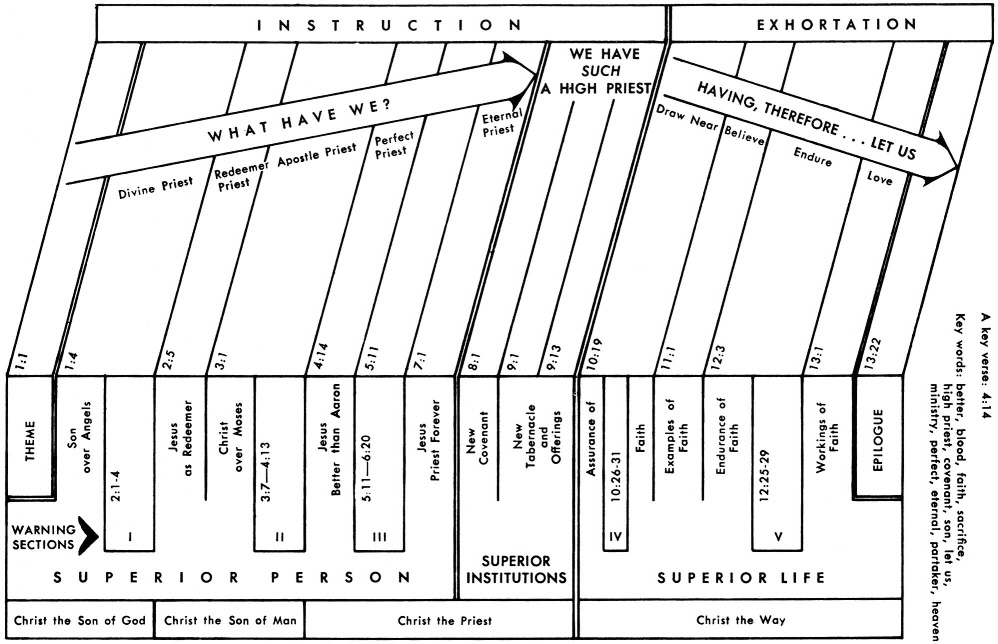
CONSIDER JESUS OUR GREAT HIGH PRIEST
Click chart to enlarge
Charts from Jensen's Survey of the NT - used by permission
Swindoll's Chart, Interesting Pictorial Chart of Hebrews, Another Chart
|
The Epistle |
||||
| INSTRUCTION Hebrews 1-10:18 |
EXHORTATION Hebrews 10:19-13:25 |
|||
| Superior Person of Christ Hebrews 1:1-4:13 |
Superior Priest in Christ Hebrews 4:14-10:18 |
Superior Life In Christ Hebrews 10:19-13:25 |
||
| BETTER THAN PERSON Hebrews 1:1-4:13 |
BETTER PRIESTHOOD Heb 4:14-7:28 |
BETTER COVENANT Heb 8:1-13 |
BETTER SACRIFICE Heb 9:1-10:18 |
BETTER LIFE |
| MAJESTY OF CHRIST |
MINISTRY OF CHRIST |
MINISTERS FOR CHRIST |
||
|
DOCTRINE |
DUTY |
|||
|
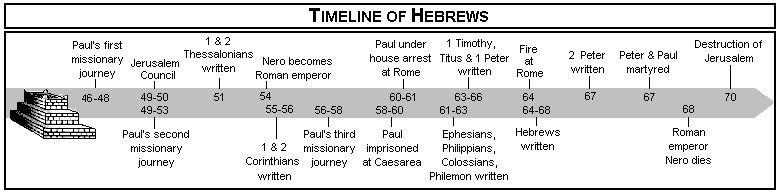
DATE WRITTEN: |
||||

See ESV Study Bible "Introduction to Hebrews"
(See also MacArthur's Introduction to Hebrews)
Borrow Ryrie Study Bible
Hebrews 11:29 By faith they passed through the Red Sea as though they were passing through dry land; and the Egyptians, when they attempted * it, were drowned. (NASB: Lockman)
Greek: Pistei diebesan (3SAAI) ten Eruthran THalassan os dia ceras ges, es peiran labontes (AAPMPN) oi Aiguptioi katepothesan. (3PAPI)
Amplified: [Urged on] by faith the people crossed the Red Sea as [though] on dry land, but when the Egyptians tried to do the same thing they were swallowed up [by the sea]. (Amplified Bible - Lockman)
KJV: By faith they passed through the Red sea as by dry land: which the Egyptians assaying to do were drowned.
NLT: It was by faith that the people of Israel went right through the Red Sea as though they were on dry ground. But when the Egyptians followed, they were all drowned. (NLT - Tyndale House)
Phillips: By faith the people walked through the Red Sea as though it were dry land, and the Egyptians who tried to do the same thing were drowned. (Phillips: Touchstone)
Wuest: By faith they passed through the Red Sea as through dry land, which the Egyptians having attempted, were drowned.
Young's Literal: By faith they did pass through the Red Sea as through dry land, which the Egyptians having received a trial of, were swallowed up;
BY FAITH THEY PASSED THROUGH THE RED SEA AS THOUGH THEY WERE PASSING THROUGH DRY LAND; AND THE EGYPTIANS, WHEN THEY ATTEMPTED IT, WERE DROWNED: Pistei diebesan (3SAAI) ten Eruthran THalassan os dia ceras ges, es peiran labontes (AAPMPN) oi Aiguptioi katepothesan. (3PAPI):
- Exodus 14:13-31; 15:1-21; Joshua 2:10; Nehemiah 9:11; Ps 66:6; 78:13; 106:9-11; Ps 114:1, 2, 3, 4, 5; 136:13, 14, 15; Isaiah 11:15,16; 51:9,10; 63:11, 12, 13, 14, 15, 16; Habakkuk 3:8, 9, 10
- Hebrews 11 Resources - Multiple Sermons and Commentaries
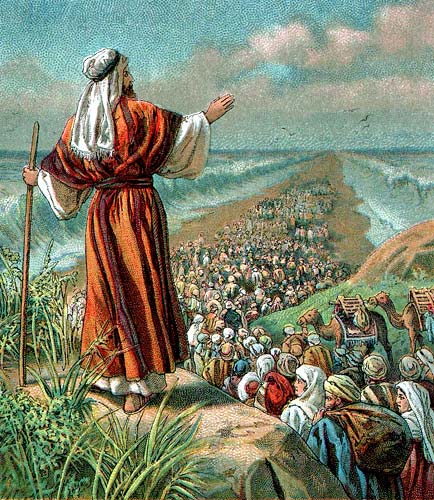
Ex 14:10, 13, 14,
Ex 14:21, 22, 23, 24, 25, 26, 27, 28, 29, 30
FAITH AND FORGING
THE SEA
Faith (4102)(pistis) is synonymous with trust or belief and is the conviction of the truth of anything, but in Scripture speaks of belief respecting man's relationship to God and divine things, generally with the included idea of trust and holy fervor born of faith and joined with it. As pistis relates to God, it is the conviction that God exists and is the Creator and Ruler of all things well as the Provider and Bestower of eternal salvation through Christ. As faith relates to Christ it represents a strong and welcome conviction or belief that Jesus is the Messiah, through Whom we obtain eternal salvation and entrance into the Kingdom of Heaven. Stated another way, eternal salvation comes only through belief in Jesus Christ and no other way.
For more discussion on the meaning of faith see commentary on Hebrews 11:1-2.
Faith is believing that God will keep His promises, despite circumstances that seem to be to the contrary! True faith that saves one's soul includes at least three main elements - (1) firm persuasion or firm conviction, (2) a surrender to that truth and (3) a conduct emanating from that surrender. In sum, faith shows itself genuine by a changed life. (Click for W E Vine's definition of faith) Click for Dr Wayne Grudem's online outline of Conversion and/or Listen to the Mp3 of Conversion which addresses the question "What is saving faith?" in an easy to understand manner.
John MacArthur reminds us that "Faith is trusting completely in God’s Word. It is unconditional confidence in what He says, strictly on the basis that He has said it. The fact is that we either trust what God says or we are left to trust our own intellect, instincts, and attitudes. These are our only two options. Our own way is the way of unbelief; God’s way is the way of faith. The faith illustrated in Hebrews 11 is that which takes the bare word of God and acts on it, risking all. It is faith that does not question or ask for signs or miraculous direction. Looking for signs and wonders and explanations that we can understand or glory in is not faith. It is doubt looking around for proofs. Anything that demands more than God’s Word is doubt, not faith. God sometimes gives explanations and reasons for His Word, but He is not obligated to give them, and faith does not require them. As Jesus said to Thomas, "Blessed are they who did not see, and yet believed" (John 20:29). Faith is therefore opposite from human nature, opposite from the world system. It often requires accepting from God that for which we can see no logic or reason. (MacArthur, John: Hebrews. Moody Press)
They - Who is "they"? Obviously this refers to the nation of Israel.
They passed through the Red Sea - Their action was a response to their faith in God's Word. They believed God and acted upon His promise.
Faith, mighty faith, the promise sees
And looks to God alone.
Laughs at impossibilities,
And cries, “It shall be done.”
Guzik - The difference between the Israelites crossing the Red Sea and the Egyptians who followed them was not courage, but faith. The Egyptians had as much (or more) courage than the Israelites, but not the same faith - and they each had different fates. The Israelites passed through, and the Egyptians were drowned. (Hebrews 11 Commentary)
Spurgeon - There you have the difference between faith and presumption: faith goes through the sea, presumption is drowned in the sea. There are two redemptions: redemption by price and redemption by power. Redemption by price was typified in the paschal lamb and the Passover. Redemption by power was typified in the passage of the Red Sea, when the children of Israel went through it dry-shod and the Egyptians were drowned.
Passing through dry land - This fact is repeated three times in the Exodus account to emphasize the miraculous nature of Jehovah's way of salvation.
Here is the original text...
Exodus 14:13 But Moses said to the people, "Do not fear! Stand by and see the salvation of the LORD which He will accomplish for you today; for the Egyptians whom you have seen today, you will never see them again forever. 14 "The LORD will fight for you while you keep silent."
15 Then the LORD said to Moses, "Why are you crying out to Me? Tell the sons of Israel to go forward. 16 "As for you, lift up your staff and stretch out your hand over the sea and divide it, and the sons of Israel shall go through the midst of the sea on dry land. 17 "As for Me, behold, I will harden the hearts of the Egyptians so that they will go in after them; and I will be honored through Pharaoh and all his army, through his chariots and his horsemen. 18 "Then the Egyptians will know that I am the LORD, when I am honored through Pharaoh, through his chariots and his horsemen."
God's promise of the humanly "impossible" was safe travel through the impassable Red Sea, although at this point He does not state exactly what He will do to the Egyptians. Biblical faith is trust in God's Word (including His promises) and as in the present case that faith is manifest by appropriate response (cp obedience) by walking through the obstacle via the way God had promised.
19 The angel of God (cp Angel of the LORD ), who had been going before the camp of Israel, moved and went behind them; and the pillar of cloud moved from before them and stood behind them. 20 So it came between the camp of Egypt and the camp of Israel; and there was the cloud along with the darkness, yet it gave light at night. Thus the one did not come near the other all night.
21 Then Moses stretched out his hand over the sea; and the LORD swept the sea back by a strong east wind all night and turned the sea into dry land, so the waters were divided. 22 The sons of Israel went through the midst of the sea on the dry land, and the waters were like a wall to them on their right hand and on their left.
23 Then the Egyptians took up the pursuit, and all Pharaoh's horses, his chariots and his horsemen went in after them into the midst of the sea. 24 At the morning watch, the LORD looked down on the army of the Egyptians through the pillar of fire and cloud and brought the army of the Egyptians into confusion. 25 He caused their chariot wheels to swerve, and He made them drive with difficulty; so the Egyptians said, "Let us flee from Israel, for the LORD is fighting for them against the Egyptians."
26 Then the LORD said to Moses, "Stretch out your hand over the sea so that the waters may come back over the Egyptians, over their chariots and their horsemen."
27 So Moses stretched out his hand over the sea, and the sea returned to its normal state at daybreak, while the Egyptians were fleeing right into it; then the LORD overthrew the Egyptians in the midst of the sea. 28 The waters returned and covered the chariots and the horsemen, even Pharaoh's entire army that had gone into the sea after them; not even one of them remained. 29 But the sons of Israel walked on dry land through the midst of the sea, and the waters were like a wall to them on their right hand and on their left.
30 Thus the LORD saved Israel that day from the hand of the Egyptians, and Israel saw the Egyptians dead on the seashore.
31 When Israel saw the great power which the LORD had used against the Egyptians, the people feared the LORD, and they believed in the LORD and in His servant Moses.
Passed through (1223)(diabaino from dia = through + baino = to step) means to step across, to pass through or over as for example, a body of water, a chasm, a valley, etc. (cf uses in Lxx - Ge 31:21; 1 Sa 13:7). BDAG - "to proceed from one side to another over a geographical area."
Gilbrant on diabaino - is used extensively in classical Greek and appears over 120 times in the Septuagint to translate different forms of the Hebrew term ‛āvar, meaning “pass over, through, by.” (Complete Biblical Library Greek-English Dictionary)
Liddell-Scott on diabaino - I. to make a stride, walk or stand with the legs apart, of a man planting himself firmly for fighting, Il. With accusative - to step across, passive - over a ditch or river, Ib. 2. absol. to cross over, Lat. trajicere, Hdt., etc.
Diabaino - 3 uses in the NT - Lk. 16:26; Acts 16:9; Heb. 11:29
Lk. 16:26+ - ‘And besides all this, between us (LAZARUS IN "ABRAHAM'S BOSOM") and you (THE RICH MAN) there is a great chasm fixed, so that those who wish to come over from here to you will not be able, and that none may cross over from there to us.’
Acts 16:9+ A vision appeared to Paul in the night: a man of Macedonia was standing and appealing to him, and saying, “Come over to Macedonia and help us.”
Steven Cole in his sermon on Overcoming Faith (Hebrews 11:27-29 writes...
Faith trusts God for deliverance from overwhelming problems (He 11:29).
This verse shifts from Moses’ faith to the faith of Israel. I do not know why the shift did not take place in He 11:28, since all Israel had to believe in the Passover sacrifice. Either way, there is a difficulty, in that as the author of Hebrews has already told us, the generation that came out of Egypt was evil and unbelieving (He 3:8, 9-note, He 3:10, 11-note, He 3:12-note).
The apostle Paul explained that although all Israel was baptized into Moses, so to speak, when they passed through the sea, “with most of them God was not well-pleased; for they were laid low in the wilderness” (1Co 10:2, 5). But here the author indicates that they passed through the Red Sea by faith.
Probably the solution is that the faith of the believing believing remnant (note) is generalized to cover the entire nation (John Owen, An Exposition of Hebrews [The National Foundation for Christian Education], 7:170; Calvin, p. 299 adopts a similar solution). There is a similar situation in the New Testament when everyone on the ship with Paul was saved because of Paul’s faith, even though they did not believe God. In both cases, it was temporal deliverance only for the unbelievers. But the exodus pictures spiritually how genuine faith delivers us from overwhelming problems, beginning with the salvation of our souls. Briefly, note two things:
A. Faith does not exempt us from overwhelming problems, but rather it often leads us into such problems.
If Israel had stayed in Egypt, they wouldn’t be in the mess they were in at the Red Sea. Some of the unbelievers sarcastically said to Moses (Ex 14:11),
Is it because there were no graves in Egypt that you have taken us away to die in the wilderness?
But the fact is, Moses had not led them to the dire situation that they were in; God had led them there and He had hardened Pharaoh’s heart so that he would chase after them (Ex 14:1, 2, 3, 4, 5, 6, 7, 8, 9)!
So by God’s direct actions, this defenseless bunch of slaves had the Red Sea in front of them and Pharaoh’s army charging at them from behind. They were doomed unless God intervened, which He planned to do. But they had to learn that salvation is completely from Him. There was no place for human ingenuity or some scheme to escape. God led them into this desperate situation to teach them to trust Him as their only option.
That’s how God grows our faith. We know in our heads that we must trust Him totally, but we don’t believe it in practice until He throws us into situations where there is no way out if He does not act. We need to learn in experience that “salvation belongs to the Lord” (Ps 3:8-Spurgeon's note).
B. God delights to turn our overwhelming problems into exhibitions of His mighty power when we trust Him.
The situation that the enemy thought would bring them an easy victory led to their defeat. God miraculously piled the water up as a wall on both sides for Israel to walk through on dry ground (Ex 14:21, 22). He moved the pillar of cloud behind them until they all passed through. Then He let the Egyptians pursue them in blind fury. They should have looked to both sides and seen the trap. But as John Owen observes (pp. 173-174),
There is no such blinding, hardening lust in the minds or hearts of men, as hatred of the people of God and desire for their ruin.
The Egyptians abandoned reason and common sense and rushed into the sea to their own destruction. And so a helpless, defenseless, unorganized band of two million slaves were delivered from a powerful, well-equipped army. Nothing is too difficult for the Lord (Jer 32:17)! Overcoming Faith (Hebrews 11:27-29
Hebrews 11:30 By faith the walls of Jericho fell down after they had been encircled for seven days. (NASB: Lockman)
Greek: Pistei ta teiche Iericho epesan (3PAAI) kuklothenta (APPNPN) epi epta emeras
Amplified: Because of faith the walls of Jericho fell down after they had been encompassed for seven days [by the Israelites]. (Amplified Bible - Lockman)
KJV: By faith the walls of Jericho fell down, after they were compassed about seven days.
NLT: It was by faith that the people of Israel marched around Jericho seven days, and the walls came crashing down. (NLT - Tyndale House)
Phillips: It was by faith that the walls of Jericho collapsed, for the people had obeyed God's command to encircle them for seven days. (Phillips: Touchstone)
Wuest: By faith the walls of Jericho fell, having been encircled seven days.
Young's Literal: by faith the walls of Jericho did fall, having been surrounded for seven days;
BY FAITH THE WALLS OF JERICHO FELL DOWN, AFTER THEY HAD BEEN ENCIRCLED FOR SEVEN DAYS: Pistei ta teiche Iericho epesan (3PAAI) kuklothenta (APPNPN) epi hepta hemeras:
- Joshua 6:3-20; 2 Corinthians 10:4,5
- Hebrews 11 Resources - Multiple Sermons and Commentaries
- See Commentary on Joshua 6:3-20
FAITH AND FALLING
WALLS
Arnold sets the context reminding us of the 40 wasted years of Israel in the desert - Between Hebrews 11:29 and Hebrews 11:30, there is a period of forty years. Israel, forty years before, saw God work a great victory for them at the Red Sea. Yet, after that, they spent forty years in the wilderness because of their unbelief. They wasted forty years in the wilderness griping, complaining and murmuring because they refused to exercise faith in their supernatural working God, and God judged them for their unbelief. (Sermon)
THOUGHT- Let us draw a lesson from the fact that these 40 years are not mentioned in this account of men and women who lived victorious lives by faith. Let us not walk waste our lives by walking in the desert when we could be entering the promised land by faith which is shown to be dynamic by obedience in turn enabled by the indwelling Spirit. In the OT Israel was looking for a promised land, while in the NT we are looking for a promised life, a life Jesus promised in John 10:10 that was not just eternal life, but abundant life, even here and now. God had promised Israel a land of milk and honey, but to we who are now in Christ by grace through faith, He has promised us "every spiritual blessing in the heavenly places in Christ." (Eph 1:3). So let me ask again are you in the desert of disobedience or are you in the heavenly promises by faith living obedient, Spirit enabled abundant lives in Christ?
W E Vine on Israel's conquest of Jericho - The ordinary way would be by direct attack. God's ways are not man's ways. The people were taught their complete dependence upon the Lord. (The Collected Writings of W. E. Vine)
By faith - Faith in Jehovah's unusual command was manifest by obedience to His charge. Once again we see that faith that pleases God is faith that obeys God and believes it will be rewarded by God for Spirit enabled obedience (cf read and memorize and meditate on Heb 11:6+). To say one believes and yet to fail to obey is not true faith. It is easy to say "I believe in Jesus." It is another thing to show that belief is genuine but obedience. And remember we are no talking about perfection (perfect, sinless obedience) but direction (the general direction of your life - heavenward, not hell-ward!). And such faith is reasonable, because it is based on the Word of God, not some figment of our imagination. The natural man bases his conclusions on that which seems rational to him. The believer rests his convictions on that which has been revealed to him. The believer goes beyond the natural to the supernatural, to God. God had given Joshua clear instructions and upon God's immutable Word Joshua wholly leaned his weight (so to speak) -- that's a picture of wholly believing God's holy Word. And so this is another reason we should all be diligent to daily go to the "well" and drink from God's Word (cf Ro 10:17+), for it is there what our faith will find a firm foundation, will be revived and will be strengthened for the tests and temptations that we will undoubtedly face that day. Under grace let me ask you "How is your quiet time?" Is it too quiet. Quiet time can become a legalistic burden, but that is not what I am advocating. It should be a time we look forward to meeting with the King, not out of legalism, but out of love. And if we miss a day or two, we should not feel guilty or condemned. We should keep pressing on. BUT BE ALERT (1 Pe 5:8+) - Your adversary the Devil has manifold schemes to hinder spiritual our progress (2 Co 2:11, Eph 6:11+). For example, Satan is a master at sending discouragement and he will send fiery missiles into your mind if you miss a morning meeting with God saying things like "You're not a good Christian!" "You might as well give up this morning meeting stuff!" etc, etc. Take up the shield of faith and deflect his lies and discouraging words! (Eph 6:16+)
THOUGHT - What are the towering walls that seem an insurmountable obstacle? Faith enables us to march around those walls, so that they melt like snow before the noonday sun.
By faith (4102)(pistis) by trust, by placing one's confidence in what God says in His Word. And such faith proves itself real or genuine, by obeying God's precepts and commands. For more discussion on the meaning of faith see commentary on Hebrews 11:1-2.
Spurgeon - Believing and obeying always run side by side...Faith and obedience are bound up in the same bundle. He that obeys God, trusts God; and he that trusts God, obeys God...(In short) Obedience is the hallmark of faith.
Jack Arnold - Do you want to be a victorious Christian with a triumphant faith? You say, “Of course I do; every Christian wants that for his life.” Well, then if you want a triumphant faith, you must exercise real faith. It is not enough to talk about faith, but you must actually believe God if you are ever going to see Him supernaturally work for you. Faith is the key to a life of progressive victory in Christ. The Christian’s life, from beginning to end, must be a life of faith in a supernatural working God. Without faith, a Christian cannot progress in his spiritual life, no victories can be won, and no fruit can be manifested for God’s glory. In the children of Israel and Joshua, their leader, we have the example of a triumphant faith as God brought down the walls of Jericho. However, this triumphant faith did not just happen automatically, but there were certain promises, precepts and principles that Israel had to obey before the walls came tumbling down. (Sermon)
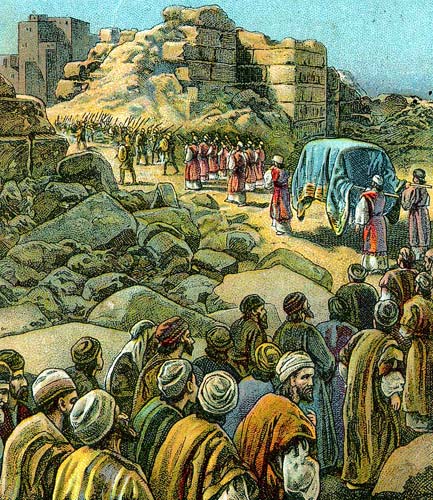
Joshua 6:20
Jericho - Jericho like the Red Sea presented an obstacle to Israel. We need to remember that obstacles to us are "opportunities" for God to show Himself great and mighty in our life. By all human standards, Jericho was impregnable. This seemed to be a humanly impossible situation. Israel, by this time, had only a limited trained army. They had no machines of war, no artillery to batter down the walls, and no equipment to scale the walls. God did not tell Joshua and the sons of Israel to attack the city with carnal weapons of war, but to obey the commands of a supernatural working God.
Arnold - We all have our Jerichos in life that seem impregnable to us, but faith laughs at such impossibilities, knowing that God is sovereign and only has to speak a word and these seemingly invulnerable circumstances come tumbling down....Why is it that there is so little soul-winning power among people who call themselves Christian? Is it because God’s arm is shortened and He cannot save? God forbid! Is it because the Bible is obsolete and no longer meets the needs of people in the twentieth century? Perish the thought! Is it because God in His sovereignty does not wish to save people? Nо, never! What then is the problem? I believe that the Holy Spirit has been grieved by true Christians and consequently God withholds His power. Why is the Spirit grieved? Christians refuse to obey the Bible. They do not evangelize and live holy lives as the Bible tells them to do. We will never experience New Testament Christianity until we live by New Testament principles and use New Testament methods. We must cast ourselves upon God who works supernaturally and trust Him to work for us. “…‘Not by might nor by power, but by My Spirit,’ says the LORD of hosts” (Zech. 4:6). We must learn to do God’s work in God’s prescribed way, and then we shall receive God’s blessing from heaven....Faith is believing God and going forward. It is better to go forward and make mistakes than to never go forward at all.....The children of Israel had to carry out all the detailed instruction to the letter or God would not bring down the walls of Jericho. The people had to keep quiet for seven days. They could not utter a sound. Why? These Israelites had been notorious complainers and gripers for forty years in the wilderness and always murmured in times of crisis. God wanted these people to learn that God works apart from all human wisdom and scheming. Furthermore, when two million people keep silent, this had to have a psychological impact upon the people of Jericho.....The Israelites continued to discipline themselves and do what God had commanded them. They walked around the city once a day for six days. Can you imagine that scene? There were hundreds of Canaanites standing on the wall and watching from towers, jeering, mocking and ridiculing the Israelites. They thought the Israelites to be childish, crazy and surely stupid. On the seventh day, Israel went around the wall seven times. Mind you, there was not so much as even a peep from the people of Israel. Then, in a moment of time, Joshua gave an order and the trumpets blew and people shouted and the walls came tumbling down. Many of the things that we do as Christians seem foolish to the world because it understands nothing about a supernatural working God....If Israel had not explicitly obeyed God’s commands, there never would have been a miracle. Without faith, the walls of Jericho would never have fallen. While God rewarded Israel’s faith, it was not until they had gone around Jericho thirteen times that the power of God was displayed. Their patience of faith was rewarded. Suppose on the third or fourth day they would have quit. The whole thing would have failed. But they knew that God had a plan and would achieve the impossible, so they waited patiently on God. “Rest in the LORD and wait patiently for Him …” (Psalm 37:7). (Sermon)
John Phillips sets the scene - Jericho barred the way into Canaan. It was a massive fortress standing squarely astride the entrance into the Promised Land and blocking any advance. It was Satan's device for keeping the children of Israel from entering into their possession. It was a formidable obstacle and would have been so to a well-equipped, highly trained, and well-seasoned army of Roman legionnaires, let alone to the Hebrews who were barely more than novices in the art of war. To them, Jericho was insurmountable, but that is exactly where faith triumphs. Human wisdom would have advocated the purchase of slings and catapults and the amassing of huge stockpiles of stones for ammunition. Human wisdom would have suggested digging trenches to enable sappers to creep up to the walls and undermine them. Human wisdom would have called for starving the people of Jericho into submission. But faith had a better way. Faith does not oppose Satan's devices with human devices. "For the weapons of our warfare are not carnal, but mighty through God to the pulling down of strong holds" (2 Cor. 10:4). Note also when faith triumphs. Faith triumphed after the walls of Jericho "were compassed about seven days" (Heb 11:30). Only complete obedience to the Word of God could deal with Jericho. (Exploring Hebrews: An Expository Commentary)
COMMENT - Notice the little word "AFTER" - "walls of Jericho fell down after." What is the point? What would have happened had they shouted after walking around one time? Six times? Absolutely nothing because PARTIAL OBEDIENCE is always DISOBEDIENCE! God is not playing games with us. He wants total, whole-hearted commitment! Perhaps you are not experiencing the "abundant life" Jesus promised in John 10:10. Could it be that you've only walked around your impregnable "Jericho" only 6 times, that you have given partial obedience, but hesitated to root out that cherished pet sin, etc? Jesus wants ALL of our hearts, not 99%! Read Mark 12:30-31 for a refresher!
Here is the account of this great God glorifying event from Joshua 6...
1 Now Jericho was tightly shut because of the sons of Israel; no one went out and no one came in.
2 The LORD said to Joshua, "See, I have given Jericho into your hand, with its king and the valiant warriors. 3 "You shall march around the city, all the men of war circling the city once. You shall do so for six days. 4 "Also seven priests shall carry seven trumpets of rams' horns before the ark; then on the seventh day you shall march around the city seven times, and the priests shall blow the trumpets. 5 "It shall be that when they make a long blast with the ram's horn, and when you hear the sound of the trumpet, all the people shall shout with a great shout; and the wall of the city will fall down flat, and the people will go up every man straight ahead."
6 So Joshua the son of Nun called the priests and said to them, "Take up the ark of the covenant, and let seven priests carry seven trumpets of rams' horns before the ark of the LORD." 7 Then he said to the people, "Go forward, and march around the city, and let the armed men go on before the ark of the LORD."
Faith believes the promise of God and acts on that promise, regardless of how unusual that promise might be. If God says it, that settles it. Our choice will always be to believe it or not. Belief is not manifest by halting hesitation but by immediate obedience, an obedience which is complete and without "caveats" or "disclaimers"! It is trusting in Jehovah with all our heart and not leaning on our own understanding. Joshua exhibited such a great faith. Notice that he does not interrogate or hesitate but instead he motivates his priests and people to obey implicitly.
8 And it was so, that when Joshua had spoken to the people, the seven priests carrying the seven trumpets of rams' horns before the LORD went forward and blew the trumpets; and the ark of the covenant of the LORD followed them. 9 The armed men went before the priests who blew the trumpets, and the rear guard came after the ark, while they continued to blow the trumpets. 10 But Joshua commanded the people, saying, "You shall not shout nor let your voice be heard nor let a word proceed out of your mouth, until the day I tell you, 'Shout!' Then you shall shout!" 11 So he had the ark of the LORD taken around the city, circling it once; then they came into the camp and spent the night in the camp.
12 Now Joshua rose early in the morning, and the priests took up the ark of the LORD. 13 The seven priests carrying the seven trumpets of rams' horns before the ark of the LORD went on continually, and blew the trumpets; and the armed men went before them and the rear guard came after the ark of the LORD, while they continued to blow the trumpets. 14 Thus the second day they marched around the city once and returned to the camp; they did so for six days. 15 Then on the seventh day they rose early at the dawning of the day and marched around the city in the same manner seven times; only on that day they marched around the city seven times.
16 At the seventh time, when the priests blew the trumpets, Joshua said to the people, "Shout! For the LORD has given you the city. 17 "The city shall be under the ban, it and all that is in it belongs to the LORD; only Rahab the harlot and all who are with her in the house shall live, because she hid the messengers whom we sent. 18 "But as for you, only keep yourselves from the things under the ban, so that you do not covet them and take some of the things under the ban, and make the camp of Israel accursed and bring trouble on it. 19 "But all the silver and gold and articles of bronze and iron are holy to the LORD; they shall go into the treasury of the LORD." 20 So the people shouted, and priests blew the trumpets; and when the people heard the sound of the trumpet, the people shouted with a great shout and the wall fell down flat, so that the people went up into the city, every man straight ahead, and they took the city.
The walls of Jericho fell down - Liberal scholars try to explain away this supernatural intervention, but faith sees it as a clear indicator of God's mighty power at work on the part of His people.
THOUGHT - Beloved, we need to remember that He is the same mighty God in each of our lives. What are the insurmountable walls in our life?
Spurgeon - On they went with steady tramp, and though they saw no corpses blocking up their pathway, though their arms were not red with blood, though they heard no shriek of those that fly, and could utter no shout of victory, yet they were as confident as they were when actually the walls began to rock, and the dust and smoke went up to heaven, and the shrieks of the slain made glad the foeman’s ear. We must encompass this city in full faith. You could not see faith at work on those solid walls. Those huge ramparts and battlements seemed to stand fast and firm, yet they “fell down, after they had been marched around seven days.” No battering rams played upon them, but faith can do better work than battering rams or dynamite.
John Phillips - To them, Jericho was insurmountable, but that is exactly where faith triumphs. "By faith the walls of Jericho fell" (Heb 11:30). Human wisdom would have advocated the purchase of slings and catapults and the amassing of huge stockpiles of stones for ammunition. Human wisdom would have suggested digging trenches to enable sappers to creep up to the walls and undermine them. Human wisdom would have called for starving the people of Jericho into submission. But faith had a better way. Faith does not oppose Satan's devices with human devices. "For the weapons of our warfare are not carnal, but mighty through God to the pulling down of strong holds" (2Co 10:4-note). (Exploring Hebrews: An Expository Commentary)
William MacDonald - Reason would claim that such an impregnable fortress could be taken only by superior forces. But faith’s methods are different. God uses strategies that appear foolish to men in order to accomplish His purposes...Military experts would write off the method as ludicrous. But it worked! The weapons of the spiritual warfare are not worldly but have divine power to destroy strongholds (2Co 10:4-note). (MacDonald, W & Farstad, A. Believer's Bible Commentary: Thomas Nelson)
Summary lessons gleaned from Israel's march around Jericho (see Steven Cole's full exposition below)
1) God’s way of victory over these enemies accentuates His power and our weakness.
2) Faith must obey God implicitly.
3) Faith must wait upon God.
4) Faith must wait on God expectantly.
Chrysostom - The soundings of trumpets, though one were to sound for ten thousand years, cannot throw down walls, but faith can do all things (quoted by Jamieson)
Murray - The strength of the enemy, in which he trusted, in view of the impotence of God's people, availed nothing before the power of faith. When shall we learn, in quiet patience and perseverance, to wait upon God our seven days too, the circle of a completed time, until He gives the possession of the promised rest. Let our faith claim it; we are the children of a God who does impossibilities; we are called to a life of faith that expects and receives them. Let our life be—faith in God. (Hebrews 11:32 Faith and Its Power of Achievement -p 465)
William Barclay - The writer to the Hebrews has been citing as examples of faith the great figures of the time before Israel entered into the Promised Land. Now he takes two figures from the period of struggle when the children of Israel were winning a place for themselves within Palestine. The first is the story of the fall of Jericho. That strange old story is told in Joshua 6:1-20. Jericho was a strong city, barred and fortified. To take it seemed impossible. It was God's commandment that once a day for six days and in silence the people should march round it, led by seven priests marching in front of the ark and bearing trumpets of rams' horn. On the seventh day the priests were to blow upon the trumpets, after the city had been encircled seven times, and the people were to shout with all their might, "and the wall of the city will fall down flat." As the old story tells it, so it happened.
That story left an indelible mark upon the memory of Israel. Centuries after this Judas Maccabaeus and his men were facing the city of Caspis, so secure in its strength that its defenders laughed in their safety. "Wherefore Judas with his company, calling upon the great Lord of the world, who without any rams or engines of war did cast down Jericho in the time of Joshua, gave it fierce assault against the walls and took the city by the will of God" (2 Maccabees 12:13-16). The people never forgot what great things God had done for them and, when some great effort was called for, they nerved themselves for it by remembering them.
Here is the very point the writer to the Hebrews wishes to make. The taking of Jericho was the result of an act of faith. It was taken by men who thought not of what they could do but of what God could do for them. They were prepared to believe that God could make their obvious weakness able for an incredible task. After the smashing of the Spanish Armada, there was erected on Plymouth Hoe a monument with the inscription: "God sent his wind and they were scattered." When the people of England saw how the storm and the gale had shattered the Spanish Armada, they said: "God did it." When we are faced with any great and demanding task, God is the ally we must never leave out of the reckoning. That which to us alone is impossible is always possible with him. (Daily Study Bible - Hebrews)
THOUGHT - WHAT IS YOUR JERICHO? IS IT AN UNBELIEVING CHILD, RELATIVE OR FRIEND WHO HAS PUT UP MASSIVE "WALLS OF RESISTANCE" TO THE GOSPEL OF JESUS CHRIST? ARE YOU IN COVENANT WITH AN UNBELIEVER WHO HAS SO FAR RESISTED THE GOSPEL?
THE THREE TENSES OF SALVATION
Rahab had a remarkable faith. Although it seemed incredible that Joshua’s unequipped army would be able to break down or scale the walls of Jericho, she remembered what God had done for the Israelites in the past. So she put her trust in Israel’s God by protecting the spies, and by staking her future on the hope that God would do what seemed impossible. Her trust in God involved the past, the present, and the future.
I (Herbert Vander Lugt) have ministered to suffering and dying believers who have handled their pain with serenity and who faced death with hope. Some may consider such people naive or gullible, but they do so because they don’t know the three tenses of trust.
- Concerning the past, we know that God has proven His love and power, especially in giving His Son to die for our salvation (Rom. 5:8) and in bringing Him back to life (Rom. 1:4).
- In the present, He speaks to us through His Word (Heb. 1:1-4), hears our prayers (Mt. 7:7-11), and provides grace in our trials (2 Cor. 1:3-4).
- For the future, He promises that we will live with Him forever (1 Th. 4:17).
Remember, trust involves three tenses. Reflect on God’s faithfulness in the past and present. You’ll have good reason to trust Him for the future. What a wonderful God!
In the past the Lord has helped us,
Guiding, loving all the way;
Let us therefore trust His promise:
Grace sufficient for each day!
—Anon.
Feeling tense about the future? Remember that God is always present.
HERE IS A HEADLINE FROM THE NEW YORK TIMES (YOUR FAVORITE, TRUSTWORTHY PAPER I AM SURE!) - IT IS FROM Feb 22, 1990. The headline reads
"Believers Score in Battle Over the Battle of Jericho"
by John Noble Wilford
(The article reads...)
After years of doubt among archeologists, a new analysis of excavations has yielded a wide range of evidence supporting the biblical account about the fall of Jericho. It may well be true that, in the words of the old spiritual, ''Joshua fit the battle of Jericho, and the walls come tumbling down.'' (Play Mahalia-Jackson's version)
A study of ceramic remnants, royal scarabs, carbon-14 dating, seismic activity in the region and even some ruins of tumbled walls produced what is being called impressive evidence that the fortified city was destroyed in the Late Bronze Age, about 1400 B.C.
The prevailing view among scholars has been that the city was destroyed some 150 years earlier and thus did not exist at the time of the Israelite invasion, which is believed to have occurred no earlier than 1400 B.C. (ED COMMENT - GUESS WHEN ISRAEL ENTERED THE PROMISE LAND - ABOUT 1406 BC!)
''When we compare the archeological evidence at Jericho with the biblical narrative describing the Israelite destruction of Jericho, we find a quite remarkable agreement,'' Dr. Bryant G. Wood, an archeologist at the University of Toronto, wrote in the March-April issue of Biblical Archeology Review. (Full digitalized article)
Few stories in the Bible are better known than the story of Joshua and the battle for Jericho. We know it so well that when someone starts to tell the story, we subconsciously start singing the famous African-American spiritual:
Joshua fit the battle of Jericho
Jericho Jericho
Joshua fit the battle of Jericho
And the walls come tumbling down.
And then comes this verse:
You may talk about your men of Gideon
You may brag about your men of Saul
There’s none like good old Joshua
At the battle of Jericho.
(Play Mahalia-Jackson's version)
The Walls of Jericho - Archaeology Confirms: They Really Did Come A-tumblin’ Down
Fascinating recent discoveries reveal something unusual happened to the ancient city of Jericho.
Heavily fortified, with a virtually impregnable double wall, what caused her sudden destruction? And find out why it is significant that even her inhabitants” foodstores could still be seen in our time, where they were left …
The name “Jericho” brings to mind Israelites marching, trumpets sounding and walls falling down. It is a wonderful story of faith and victory, but did it really happen? The skeptic would say no, it is merely a folk tale to explain the ruins at Jericho. The main reason for this negative outlook is the excavations at the site carried out in the 1950s under the direction of British archaeologist Kathleen Kenyon. She concluded,
“It is a sad fact that of the town walls of the Late Bronze Age, within which period the attack by the Israelites must fall by any dating, not a trace remains …. The excavation of Jericho, therefore, has thrown no light on the walls of Jericho of which the destruction is so vividly described in the Book of Joshua.”1 (Note: For Bibliography click here and go to bottom of page)
Thomas A. Holland, who was editor and co-author of Kenyon’s excavation reports, summarized the apparent results as follows:
“Kenyon concluded, with reference to the military conquest theory and the LB [Late Bronze Age] walls, that there was no archaeological data to support the thesis that the town had been surrounded by a wall at the end of LB I [ca. 1400 B.C.].”2
However, a careful examination of the archaeological evidence collected throughout this century leads to quite another conclusion.
Fortifications of Jericho - Before the Israelites entered the promised land, Moses told them that they were now about to cross the Jordan river, to dispossess nations which were greater and stronger than themselves, with large cities having walls that reached, as it were, to the sky (Deuteronomy 9:1). The meticulous work of Kenyon showed that Jericho was indeed heavily fortified and that it had been burned by fire. Unfortunately, she misdated her finds, resulting in what seemed to be a discrepancy between the discoveries of archaeology and the Bible. She concluded that the Bronze Age city of Jericho was destroyed about 1550 B.C. by the Egyptians. An in-depth analysis of the evidence, however, reveals that the destruction took place around 1400 B.C. (end of the Late Bronze I period), exactly when the Bible says the conquest occurred.3
The mound, or “tell” of Jericho was surrounded by a great earthen rampart, or embankment, with a stone retaining wall at its base. The retaining wall was some four to five meters (12–15 feet) high. On top of that was a mudbrick wall two meters (six feet) thick and about six to eight meters (20–26 feet) high.4 At the crest of the embankment was a similar mudbrick wall whose base was roughly 14 meters (46 feet) above the ground level outside the retaining wall (see diagram). This is what loomed high above the Israelites as they marched around the city each day for seven days. Humanly speaking, it was impossible for the Israelites to penetrate the impregnable bastion of Jericho.
Within the upper wall was an area of approximately six acres, while the total area of the upper city and fortification system was 50% larger, or about nine acres. Based on the archaeologist’s rule of thumb of 200 persons per acre, the population of the upper city would have been about 1,200. However, from excavations carried out by a German team in the first decade of this century, we know that people were also living on the embankment between the upper and lower city walls. In addition, those Canaanites living in surrounding villages would have fled to Jericho for safety. Thus, we can assume that there were several thousand people inside the walls when the Israelites came against the city.
The fallen walls
The citizens of Jericho were well prepared for a siege. A copious spring which provided water for ancient, as well as modern, Jericho lay inside the city walls. At the time of the attack, the harvest had just been taken in (Joshua 3:15), so the citizens had an abundant supply of food. This has been borne out by many large jars full of grain found in the Canaanite homes by John Garstang in his excavation in the 1930s and also by Kenyon. With a plentiful food supply and ample water, the inhabitants of Jericho could have held out for perhaps several years.
After the seventh trip around the city on the seventh day, Scripture tells us that the wall “fell down flat” (Joshua 6:20). The Hebrew here carries the suggestion that it “fell beneath itself.”5 Is there evidence for such an event at Jericho? It turns out that there is ample evidence that the mudbrick city wall collapsed and was deposited at the base of the stone retaining wall at the time the city met its end.
Kenyon’s work was the most detailed. On the west side of the tell, at the base of the retaining, or revetment, wall, she found,
“fallen red bricks piling nearly to the top of the revetment. These probably came from the wall on the summit of the bank [and/or] … the brickwork above the revetment.”6
In other words, she found a heap of bricks from the fallen city walls! An Italian team excavating at the southern end of the mound in 1997 found exactly the same thing.
Artist's reconstruction of the north side of ancient Jericho, based on the German excavations of 1907-1909. Note the houses built against the mud brick city wall, which rests on top of the stone retaining wall. The Bible says that Rahab's house was built against the city wall (Joshua 2:15).
According to the Bible, Rahab’s house was incorporated into the fortification system (Joshua 2:15). If the walls fell, how was her house spared? As you recall, the spies had instructed Rahab to bring her family into her house and they would be rescued. When the Israelites stormed the city, Rahab and her family were saved as promised (Joshua 2:12–21, 6:17, 22–23). At the north end of the tell of Jericho, archaeologists made some astounding discoveries that seem to relate to Rahab.
The German excavation of 1907–1909 found that on the north a short stretch of the lower city wall did not fall as everywhere else. A portion of that mudbrick wall was still standing to a height of over two meters (eight feet).7 What is more, there were houses built against the wall! It is quite possible that this is where Rahab’s house was.8 Since the city wall formed the back wall of the houses, the spies could have readily escaped. From this location on the north side of the city it was only a short distance to the hills of the Judean wilderness where the spies hid for three days (Joshua 2:16, 22). Real estate values must have been low here, since the houses were positioned on the embankment between the upper and lower city walls. Not the best place to live in time of war! This area was no doubt the overflow from the upper city and the poor part of town, perhaps even a slum district.
After the city walls fell, how did the Israelites surmount the four to five meter (12–15 foot) high retaining wall at the base of the tell? Excavations have shown that the bricks from the collapsed walls formed a ramp against the retaining wall so that the Israelites could merely climb up over the top. The Bible is very precise in its description of how the Israelites entered the city: “the people went up into the city, every man straight before him [i.e., straight up and over],” (Joshua 6:20). The Israelites had to go up, and that is what archaeology has revealed. They had to go from ground level at the base of the tell to the top of the rampart in order to enter the city.
Destruction by fire
The Israelites burned the city and everything in it (Joshua 6:24). Once again, the discoveries of archaeology have verified the truth of this record. A portion of the city destroyed by the Israelites was excavated on the east side of the tell. Wherever the archaeologists reached this level they found a layer of burned ash and debris about one meter (three feet) thick. Kenyon described the massive devastation as follows.
“The destruction was complete. Walls and floors were blackened or reddened by fire, and every room was filled with fallen bricks, timbers, and household utensils; in most rooms the fallen debris was heavily burnt, but the collapse of the walls of the eastern rooms seems to have taken place before they were affected by the fire.”9
Both Garstang and Kenyon found many storage jars full of grain that had been caught in the fiery destruction. This is a unique find in the annals of archaeology. Grain was valuable, not only as a source of food, but also as a commodity which could be bartered. Under normal circumstances, valuables such as grain would have been plundered by the conquerors. Why was the grain left at Jericho? The Bible provides the answer. Joshua commanded the Israelites that the city and all that is in it were to be dedicated to the Lord (Joshua 6:17, lit. Heb.).
Dr Wood stands at the base of the stone retaining wall uncovered by Italian archaeologists at the southern end of Jericho in 1997. The Israelites marched around this wall when they attacked the city as described in Joshua 6.
The grain left at Jericho and found by archaeologists in modern times gives graphic testimony to the obedience of the Israelites nearly three-and-a-half millennia ago. Only Achan disobeyed, leading to the debacle at Ai described in Joshua 7.
Such a large quantity of grain left untouched gives silent testimony to the truth of yet another aspect of the biblical account. A heavily fortified city with an abundant supply of food and water would normally take many months, even years, to subdue. The Bible says that Jericho fell after only seven days. The jars found in the ruins of Jericho were full, showing that the siege was short since the people inside the walls consumed very little of the grain.
Lessons of Jericho
Jericho was once thought to be a “Bible problem” because of the seeming disagreement between archaeology and the Bible. When the archaeology is correctly interpreted, however, just the opposite is the case. The archaeological evidence supports the historical accuracy of the biblical account in every detail. Every aspect of the story that could possibly be verified by the findings of archaeology is, in fact, verified.
There are many ideas as to how the walls of Jericho came down. Both Garstang and Kenyon found evidence of earthquake activity at the time the city met its end. If God did use an earthquake to accomplish His purposes that day, it was still a miracle since it happened at precisely the right moment, and was manifested in such a way as to protect Rahab’s house. No matter what agency God used, it was ultimately He who, through the faith of the Israelites, brought the walls down. After the people had marched around them for seven days, it was “by faith the walls of Jericho fell down” (Hebrews 11:30).
As well as showing us how vital it is not to discount the Bible because of some apparent conflict with secular scholarship, Jericho is a wonderful spiritual lesson for God’s people yet today. There are times when we find ourselves facing enormous “walls” that are impossible to break down by human strength. If we put our faith in God and follow His commandments, He will perform “great and mighty things” (Jeremiah 33:3) and give us the victory. (Answers in Genesis)
DEVOTIONAL - THE BIBLE STANDS - Unbelievers have long scoffed at the biblical story of the fall of the ancient city of Jericho. That's why I was delighted to see this headline on the front page of the newspaper: NEW STUDY BACKS BIBLICAL VERSION OF JERICHO'S DEMISE
The Associated Press article began,
"The walls of Jericho did come tumbling down as recounted in the Bible, according to an archaeological study." Archaeologist Bryant G. Wood of the University of Toronto said, "When we compare the archaeological evidence at Jericho with the biblical narrative describing the Israelite destruction of Jericho, we find remarkable agreement." Wood noted that the Bible places the event after spring harvest and indicates that the Israelites burned the city—both facts confirmed by the archaeological remains. Once again, archaeology bears testimony to the truthfulness of Scripture.
Our belief in the authenticity of the Bible does not depend on scientific research but on its claim to be God's Word. As 2 Timothy 3:16 tells us, "All Scripture is given by inspiration of God." We can therefore have complete confidence in what it says.
It's a fact—the walls of Jericho did indeed fall. The Bible stands!— Richard De Haan
The Bible stands like a mountain towering
Far above the works of men;
Its truth by none ever was refuted,
And destroy it they never can. —Lillenas
©1917, 1945 Hope Publishing Co.
To the wise, God's Word is sufficient.
By Pastor Steven Cole
John Gardner wrote [source unknown], “We are faced with a series of great opportunities-brilliantly disguised as insoluble problems.” What disguised opportunities do you face today?
Some have trusted Christ as Savior, but have the disguised opportunity of some besetting sin that keeps bringing them down. They promise God that they won’t do it again, only to repeatedly fail. Some are engulfed by problems in their marriages, or with their kids. They don’t see any viable solutions. Some struggle daily with serious health problems or personal problems. Some face problems at work. Others wish they had work to have problems with! They struggle to make ends meet. Some have drifted into worldliness and spiritual apathy, but they don’t even realize that they have a problem. Churches have problems, too, which are a conglomerate of all of the problems of their members.
As a leader in Israel after Moses’ death, Joshua had a pile of disguised opportunities. He had to lead this fledgling nation of refugee slaves out of 40 years in the wilderness, across the Jordan River, and into the promised land that happened to be filled with evil, violent giants. The first disguised opportunity was to conquer the fortified city of Jericho. God gave Joshua the plan for victory. By faith, the walls of that fortress crumbled.
Meanwhile, inside the city, a prostitute had a huge disguised opportunity. She had heard of how God had miraculously delivered this people from Egypt 40 years before. She heard how they had defeated two powerful kings across the river. She knew that her city was next and that she and all of her family would perish, unless somehow the God of the Jews-the God of heaven and earth- intervened on their behalf. Then the impossible happened-two spies from that feared people came to lodge with her. She hid them from the authorities and they promised to spare her family and her, if she followed their directions. By faith, she and her family did not perish when her city was destroyed. These two stories that took place during the conquest of Jericho illustrate how…
God conquers our powerful enemies by faith and converts hopeless sinners by faith.
1. God conquers our powerful enemies by faith (He 11:30).
Faith is not some magical force. Rather, faith links us with the unseen God, who spoke the universe into existence. Faith is the channel through which God’s blessings flow to us.
Jericho was the first obstacle of many that Joshua and the army of Israel faced in conquering Canaan, which God had promised to their forefather, Abraham. As he was pondering how to take this walled city, the Lord appeared to Joshua in human form as the captain of the Lord’s army and revealed to him the plan for victory (Josh 5:13, 14, 15, 6:1, 2, 3, 4, 5). The Israelites were to march silently around the city once a day for six days with the tabernacle, while seven priests blew on rams’ horns. On the seventh day, they were to circle the city seven times. When Joshua gave the signal, the priests were to blow the rams’ horns and the people were to shout. The walls of the city would crumble and the Israeli soldiers would march straight into the city and take it.
There are many lessons in that story, but I focus on five:
A. Salvation brings us into conflict with powerful enemies.
We saw this with Israel and Pharaoh’s army at the Red Sea. But it bears repeating. Salvation does not insulate you from huge problems. Rather, it often brings you into conflict with problems that didn’t even bother you before you were saved. Before you were saved, selfishness, pride, greed, lust, and many other sins didn’t trouble you. You may even have thought that some of them were virtues! But then you get saved and realize that there are many fortified cities that must be conquered, and many of them are en-trenched in your heart!
Not only do you face these enemies within, but now you face enemies from without that previously caused you no problems. Family members don’t like your newfound faith, because it threatens their favorite sins. Bosses don’t like the fact that you won’t help them cheat to make a profit. Former friends malign you be-cause you won’t join them at their corrupt parties (1Pe 4:3, 4).
B. God’s way of victory over these enemies accentuates His power and our weakness.
Marching your army around a walled city for seven days while blowing trumpets is not a sensible plan for victory! It must have seemed silly to many in Israel and to everyone inside Jericho. If Joshua had held meetings with his top commanders, none of them would have suggested this plan. One might have argued for a direct assault, with siege ramps and battering rams to overpower the city. Another may have suggested waiting it out until the city was starved into submission. But no one would have suggested doing what God commanded Joshua to do.
Why did God choose this strange approach? I think that He wanted to teach Israel a major lesson at the outset of their conquest of Canaan: Victory over powerful enemies comes when we do not trust in our-selves, but trust totally in the Lord. The repeated trips around Jericho served to drive home the lesson, “You cannot conquer this city in your strength. You must trust in My power.”
Often our problem is not that we are too weak, but that we think that we are strong in ourselves. Because we’re so prone to pride, if God granted us victory, we would take at least some of the credit for ourselves. So God’s plan for victory humbles our pride by accentuating His power and our weakness.
You see this in the story of Gideon and his army trying to conquer the hordes of Midianites (Judges 6-7). He rallied an army of 32,000 men against 135,000 enemy troops, but God told Gideon that he had too many soldiers, not too few. If they won, they would boast in their victory (Judges 7:2). So, Gideon sent home 22,000 warriors who were afraid. But God said, “You’ve still got too many.” So Gideon weeded them out until he was left with 300 soldiers. Finally, being weak enough, God could grant them victory and they would give Him the glory!
Paul entreated the Lord to take away his thorn in the flesh, but the Lord told him that His power is perfected in weakness. Paul testified, “when I am weak, then I am strong” (2Cor. 12:10). Hudson Taylor said that when God wanted to open inland China to the gospel, He looked around for a man weak enough for the task.
So God’s means for victory always involves faith, because faith acknowledges our inability and God’s total ability (see 2Chr 20:1-12). Faith humbles our pride and exalts God’s glory.
C. Faith must obey God implicitly.
Faith and obedience are inseparable, just as unbelief and disobedience go together. Genuine faith always obeys God. Israel could have said, “That’s an interesting plan, Joshua, and we believe that God could do it that way. But we’re going to try a more sensible approach.” That would have been faithless and disobedient.
To obey God, they had to march silently around the city once a day for six days. The seventh day, when Joshua told them to march around it seven times, there may have been some groans. Each time around the city took between 30 minutes to an hour (depending on whom you read), so the seven times took at least three and a half hours. By the seventh day, some could have been grumbling under their breath, “This is dumb. Nothing has happened yet.” But if any said that, it is not recorded. They obeyed what God had commanded. When they shouted, the walls miraculously came crashing down.
There are two factors involved in such obedience:
(1) To obey God, we must know what His Word says about our situation.
God had appeared visibly and spoken audibly to Joshua. While I often wish that He would do that today (I’d settle for the audible voice!), such direct communication from God is very rare. How does God speak to us? He “has spoken to us in His Son” (Heb. 1:2), and the sum of His word to us is recorded in the Bible. While sometimes it is difficult to know how the Bible applies to our specific problem, it is obvious that we cannot obey His Word unless we know what it says and how it applies. Yet I’ve often seen Christians who are disobeying the clear commands of God’s Word, but they wonder why God isn’t blessing their lives!
(2) Knowledge of God’s Word must be followed by obedience, no matter how much it goes against conventional wisdom.
God’s thoughts are not our thoughts, nor are our ways His ways (Isa. 55:8). Moses’ leading two million refugee slaves down to the Red Sea, with no way of escape from Pharaoh’s army, was not in line with conventional wisdom. But he did it in direct obedience to God. Taking the same group out into the barren wilderness seemed like a sure formula for major disaster, but God had commanded him, and Moses obeyed.
Conventional wisdom says, “You can’t get ahead in your business unless you cheat your customers and lie to the IRS.” Faith obeys God, even if it leads to financial loss. Conventional wisdom says, “Everyone sleeps together before marriage. How else will you know if you’re compatible? Besides, God will forgive.” Faith says, “I’m going to obey God. I won’t compromise, even if other Christians are doing it.” Faith obeys God.
D. Faith must wait upon God.
Why didn’t God say, “March around Jericho once, blow the trumpet and shout! The walls will fall down”? Every night they marched back to camp thinking, “We didn’t accomplish anything today!” Each day tested their faith, and each day that victory was delayed, the test increased in intensity. Perhaps they heard jeers from those on the wall who were watching this futile daily parade. The jeers tempted them to take action to silence these scoffers. But they had to wait for God’s timing. Finally,
E. Faith must wait on God expectantly.
They believed that God was going to act when they obeyed. There is no record that Joshua told them in advance what was going to happen. They just knew that he knew what God had commanded, and they obeyed. But when he told them to shout, they shouted expectantly, and God caused these impenetrable walls to crumble. Even though faith waits, faith waits expectantly, knowing that God will act in His power in His time.
But while Israel was marching around Jericho that week, another drama was taking place inside one house in the city. A prostitute named Rahab was crowded into her house with her extended family, waiting anxiously to see what would happen. Her story, condensed into one verse, shows us that. (Lesson 42: Faith to Conquer and Convert (Hebrews 11:30-31)
By faith the walls of Jericho fell, after the people had marched around them for seven days” (Hebrews 11:30).
Few stories in the Bible are better known than the story of Joshua and the battle for Jericho. We know it so well that when someone starts to tell the story, we subconsciously start singing the famous African-American spiritual:
Joshua fit the battle of Jericho
Jericho Jericho
Joshua fit the battle of Jericho
And the walls come tumbling down.
And then comes this verse:
You may talk about your men of Gideon
You may brag about your men of Saul
There’s none like good old Joshua
At the battle of Jericho.
The singular nature of this event stands out because it is a story of God’s people emerging victorious when facing an impossible situation. Although God had promised to give them the Promised Land, the mighty walled city stood in their way. Unless they found a way to bring down those walls, the city could not be taken, and if the city was not taken, the Promised Land would never be theirs.
We only need to know one important fact: It was totally impossible to bring down those walls.
Totally, absolutely, completely and utterly impossible.
Jericho stood between them and all that God had promised.
A smart man would say, “No way,” and walk away.
Sometimes you gotta “know when to hold ’em, know when to fold ’em.”
Yet God’s people won a great victory that day. How did it happen? Hebrews 11:30 answers with two words. “By faith.” That’s all it says. “By faith.” But the story seems so incredible that we need to investigate further. What sort of faith was it that caused the walls to come down? Let me suggest five answers to that question.
In the first place, the walls came down because of . . .
I. Faith In Spite of Long Odds.
If you ever visit the Holy Land, you will no doubt visit the remains of the ancient city of Jericho. To get there you either travel down through the mountains from Jerusalem or you take the River Road coming south from the Sea of Galilee, running parallel to the Jordan River. The city itself is located not far from the river, an important point to keep in mind when you read the story of Joshua’s amazing conquest. The Canaanites built Jericho as a kind of “gateway fortress” to their land. Any invading enemy would have to deal with the great walled city of Jericho. You could not simply bypass it. Jericho was too large and too strong to be ignored.
What was Jericho to Joshua and the people of God?
A city of pagan unbelief.
A city of strategic importance.
A city of human impossibility.
All three are crucial. Pagan unbelief must be confronted head on. The corrupt Canaanite religion with its emphasis on idolatry and immorality could never coexist with the true worship of God. It must be confronted and defeated. Thus the city had a spiritual importance and a military importance. And because the walls were so high that they seemed to reach to the sky (Deuteronomy 9:1), the city must be completely defeated or the Jews would never be safe.
In the last 140 years archaeologists have done an enormous amount of research on the ruins of ancient Jericho. We now know that the city Joshua saw actually had two walls, an inner wall and an outer wall, both built on a slope, making it virtually impregnable to any attacking army. Because Jericho is one of the oldest cities in the world, it was built, destroyed and rebuilt many times over the centuries. Once the city was destroyed, those who were left simply rebuilt on the ruins of the old city. The constant construction, destruction and reconstruction eventually created a kind of hill of ruins called a tell. As researchers dug through the various layers, they discovered that Jericho had indeed been heavily fortified and had been destroyed by fire in approximately 1400 B.C. Archaeologist Bryant Wood describes the famous walls of Jericho:
The mound, or “tell,” of Jericho was surrounded by a great earthen rampart, or embankment, with a stone retaining wall at its base. The retaining wall was some 12-15 ft high. On top of that was a mudbrick wall 6 ft thick and about 20-26 ft high (Sellin and Watzinger 1973: 58). At the crest of the embankment was a similar mudbrick wall whose base was roughly 46 ft above the ground level outside the retaining wall. This is what loomed high above the Israelites as they marched around the city each day for seven days. Humanly speaking, it was impossible for the Israelites to penetrate the impregnable bastion of Jericho. (The Walls of Jericho, Bible and Spade, Spring 1999).
Wood goes on to mention that there were probably several thousand people inside the city when Joshua arrived on the scene. He also notes that the city was well prepared for a siege, with a spring inside the city walls and the harvest having just been taken in (Joshua 3:15). With plenty of food and water, Jericho could have held out for several years.
In a real sense, the battle was over before it was started.
What could the Jews do in the face of this seeming impossibility? A frontal attack simply would not succeed. They had no way to tear down the walls and enter the city. If they could not skip Jericho, and if they could not breach the walls themselves, what could they do?
But the Jews faced an even greater obstacle. The walls fell because of . . .
II. Faith That Followed a Very Strange Plan.
In Joshua 6 God instructed the Jews to do a number of unusual things, none of which had any military value.
March around the town once a day for six days (v. 3).
March with the Ark of the Covenant (v . 4).
Put seven priests in front of the Ark (v. 4).
On the seventh day march around Jericho seven times (v. 5).
Have the priests blow rams’ horns as they marched (v. 5).
On the seventh time around on the seventh day, have the people shout (v. 5).
When the people shout, the walls will come down (v. 5).
When the walls come down, enter the city and conquer it (v. 5).
Joshua added a few refining details to the plan:
God told them that the walls would fall down, but they still had to do the marching.
1) He instructed the people to be perfectly silent as they marched around the city.
2) He put soldiers in front of the priests and behind the ark.
3) He had the priest blow the rams’ horn (the shofar) continually.
For six days they marched around the city once and then returned to their camp. On the seventh day, at the end of the seventh time around the city, the priests sounded a long blast and the people shouted as loud as they could.
Let’s stop the story right here.
What are the chances that this particular strategy would cause the mighty walls of Jericho to come tumbling down?
Marching.
Blowing horns.
Shouting.
Sounds like something you’d see at a football game.
I guarantee you that you won’t find a military expert anywhere who would recommend the Joshua Plan as the best way to conquer a walled city. This is no small point. Let’s lay it out in a simple equation:
Marching + horns + shouting = ??????
What’s you’ve got so far is a whole lot of noise. Suppose you go to the Great Wall of China (I’ve been there. It’s an amazing sight.) that snakes its way through northern China for hundreds of miles. What would bring down a wall like that? Well, you could come up with many things, but marching and horns and shouting would probably not be on the list.
Those high walls were no match for the Almighty.
So far what we’ve got would seem to fall into the category of “Greatest Military Blunders” that you might see on a History Channel special.
But at this point we encounter something new and vital. The walls fell because of . . .
III. Faith That God Would Somehow Give Them Victory.
We get two hints of this in the story.
1) God said he was going to give them the city.
This is what God said to Joshua before he gave him the plan: “See, I have delivered Jericho into your hands, along with its king and its fighting men” (Joshua 6:2). Note the past tense: “I have delivered.” Not “I will deliver.” God speaks of Jericho as having already been defeated. That’s a key point. God is saying, “It’s a done deal. Those walls are coming down. It’s just a matter of time.” Now that shouldn’t surprise anyone who believes in God. He can do things like that. He speaks and it is done.
In a real sense, the battle was over before it was started. God promised to deliver the city, and in due course he made good on his promise.
2) God put himself in the middle of the battle plan.
You might miss this on a casual reading of the text. God put himself in the middle of the battle plan by having the priests carry the Ark of the Covenant as they marched around Jericho (v. 4). Remember that the Ark contained the Ten Commandments, the golden pot of manna, and Aaron’s rod that budded. The lid of the Ark was the golden Mercy Seat where the high priest would offer a sacrifice in the Holy of Holies, once a year, on the Day of Atonement (Leviticus 16). The ark was not just another piece of religious furniture, like a table or a lampstand. The ark represented the very presence of God with his people. Putting the ark out front was like God saying, “I’m going to lead this parade.”
All normal military options are now off the table. It’s the people plus God, or if you prefer, God plus the people. Spears and armor don’t matter at a time like this.
There is yet another aspect to consider. What exactly were the people of Jericho thinking during that long week when the Jews marched around the city once a day, in total silence except for the sound of those blaring rams’ horns? The Bible tells us only that they shut the gates for fear of the people (Joshua 6:1). This happened before the marching ever began. I think the cumulative effect would have created a sense of mounting dread inside the city. They knew the Jews could never breach the walls on their own, but on the other hand they were trapped inside and dared not go out. Plus they had heard how the Jews had crossed the Red Sea as if it were dry land and they had heard how the Jews had defeated the two Amorite kings, Sihon and Og (Joshua 2:8-10). Plus they had that strange marching to contend with each day. One imagines that it was a kind of divine psychological warfare at work here.
Although the people of Jericho did not know it, they were defeated before the walls ever fell. They lost the battle when God got involved. Let’s redo that that equation one more time:
Marching + horns + shouting + God = “The walls came tumbling down”
It’s God who made all the difference at Jericho. Those high walls were no match for the Almighty. The God who created those stones could easily blow them over. We don’t know exactly how he did it, only that he did it, and the city was then taken by Joshua and his people.
God has so ordered the moral universe that he responds to our faith when it is actually put to work.
There was a day when Robert Morrison was a passenger on a ship to China. History records that he was the first Protestant missionary to China. One day the captain of the ship asked a rather disparaging question. “What do you think you’re going to do? Convert China?” “No,” came the quiet reply. “I don’t think I’ll ever convert China. I think God will.” That is the same faith that brought down the walls of Jericho.
We come to a fourth characteristic of this “Jericho faith.” The walls fell because of . . .
IV. Faith That Expressed Itself in Persevering Obedience.
If God is the real hero of this story-and he is-then we face another question. Why did God have the people march around the city for six days, and then seven times on the seventh day? It’s not as if their marching somehow destabilized the stones in the wall. It is, I think, a lesson about the power of God on one hand and the need for perseverance on our part. God has so ordered the moral universe that he responds to our faith when it is actually put to work. It’s not passive faith that he honors, but active faith, living faith, faith with shoe leather, faith that actually does something.
If you read the rest of Joshua 6, you discover that God’s promises do not equal inactivity. Read it all and you will discover . . .
Diligent preparation (vv. 6-7).
Careful discipline (v. 10).
Patient repetition (v. 14).
Audacious exultation (v. 20).
Complete obedience (v. 21).
Intentional compassion (vv. 23-25)
Think about this for a moment. God could have said, “Sit tight. Don’t do anything. I’ll knock over the walls and destroy the city myself.” Is there any problem with that? No, not really. God is fully able to work with or without human means. But his normal plan is to use people to accomplish his purposes. So even though God caused the walls to fall down, the people still had to march, they still had to shout, and when the falls fell down, they still had to take the city, fighting door to door.
And this is the precise point the writer of Hebrews wants us to understand. “By faith” the walls fell down. How do we know it was “by faith"? Because the people of God put their faith into practice by marching around the city day after day after day.
And so we can sum up the lessons of this story in one final statement. The walls fell because of . . .
V. Faith That Acted in Spite of Any Doubts.
Let me give you the best definition of faith I’ve ever heard. Faith is belief plus unbelief and acting on the belief part. We all know that belief is involved in faith. You have to believe something before you can have faith. If you go to a doctor, you must believe he can help you. If you don’t believe, you’ll never go in the first place. Before you step into an elevator, you’ve got to believe it will hold you up. If you don’t believe, you’ll end up taking the stairs. So belief is always the first part of faith. It is the conviction that certain things are true.
Unfortunately, some people stop their definition of faith right there. They think faith is belief plus nothing else. Faith to them is pure belief without any mixture of doubt. That’s okay as long as you stay in your house, in your bed, and under the covers. But in this world, it’s hard to arrive at 100% certainty. You hope the doctor can help you, but you could get worse and not better. You hope the elevator will hold you up, but maybe the cable has gone bad.
In this world, it’s hard to arrive at 100% certainty.
People who truly believe that faith means 100% certainty are paralyzed. They are waiting for something that will never happen. In truth, there is always unbelief mixed in with our belief. You see it best in the big decisions of life. You get a good job offer in another part of the country. It’s a great opportunity, but you don’t want to move. You are stuck in your present job, but the kids are happy in school. Your wife doesn’t want to move, but you’ve found twice the house for half the money. You think you should, but some of your friends aren’t sure. Late at night you lie awake tossing and turning, first going one way and then going another.
That’s reality. You don’t have 100% certainty and you don’t know of any way to get 100% certainty. You think so, you hope so, you pray for guidance, you seek counsel, you write it all down, you wait for a lightning bolt from heaven but it never comes.
You think it didn’t take faith to march around Jericho for six days, and then seven times on the seventh day? God told them that the walls would fall down, but they still had to do the marching. That’s “acting on the belief part.”
Stalling by Faith
What is faith? In the big decisions of life, faith is not waiting for 100% certainty. Faith is wavering between belief and unbelief, doubt and assurance, hope and despair, and finally, hesitantly, with your heart in your hands, acting on the belief part.
Let me put this very clearly. Many people think “living by faith” means staying over in the “Belief” column until you get certainty. But that almost never happens. That’s not “living by faith;” That’s “stalling by faith."
Living by faith means acting on the belief part. It means taking a step of faith, however small, however halting, however unsure of yourself you may be. And in that light we can understand this story even more clearly.
The Hebrews marched around the walls once a day for seven days. Can you imagine the scene? Thousands of Jews line up the first day to march around the city. In front are the priests with the Ark of the Covenant. They march around blowing their rams’ horns. Inside the pagans are scared to death.
Nothing happens. The next day the Jews march around again. And nothing happens. On the third day they march around again. And nothing happens. Only this time the people inside are starting to relax. It’s some kind of crazy joke. These Jews must be nuts! And outside, some of the people are complaining. “Hey, Joshua! What’s going on, man? This is a waste of time. Let’s attack ’em and get it over with."
On the fourth day they march around again. And nothing happens. This time some garbage flies over the wall. The people of Jericho are shouting insults at the people of God. On the fifth day the same thing. On the sixth day the same thing.
But on the seventh day, on the seventh trip around the city, the horns start to blow and the people let out a shout. And in one miraculous moment, “the walls came a tumblin’ down."
That’s it. That’s how faith works. Don’t you think there were some doubters? Don’t you think there were some critics? Don’t you think there was some grousing in the ranks? Probably. Complaining seems to be part of human nature. These are real people who are tramping around in the hot sand day after day. It’s hot and nasty and extremely frustrating.
But they did it. That’s “acting on the belief part.” And when they took the step of faith, God honored it and the walls of Jericho fell to the ground.
Impossible, Difficult, Done
Years ago I ran across a quote from J. Hudson Taylor, a man of dynamic faith whose missionary efforts helped open China to the gospel. Time and again he saw God do amazing things in the face of hopeless circumstances. Reflecting on his experiences, he remarked that “there are three stages in most great tasks undertaken for God: Impossible . . . Difficult . . . Done.” Here’s one thing you learn whenever you start to do anything for the Lord. It won’t be as easy as you think. The fact that you are doing it for the Lord seems to make no difference at all.
But often God lets us struggle and sweat so that we learn to trust in him at a deeper level than ever before.
It’s not hard to see why we think that way. After all, when we work for God, our motives are lifted to a higher plane. We search the Scriptures, we seek godly counsel, we pray for guidance, and we believe that God is pleased with our efforts.
And still things move slowly. What we thought would take weeks takes months. And sometimes months turn into years. Enthusiasm lags, we feel stuck in the mud, the curious become skeptical and critical, and doubt takes dead aim at our faith.
Why should it be so? Couldn’t the Lord set it up another way? The answer that he could—and sometimes he does. But often God lets us struggle and sweat so that we learn to trust in him at a deeper level than ever before.
Most of us spend most of our days looking at a wall of impossibility. The bad news is that it really is impossible. The good new is that God loves to start with impossibility.
When God wants to do something big, he starts with something very small.
When he wants to do the miraculous, he starts with the impossible.
The real battle of Jericho was not with the Canaanites. The real battle was in the hearts of the people of God.
After all, when he sent his Son to the world, he didn’t send him to New York or Chicago or even to Rome. He sent him to a little village called Bethlehem. God loves to start small because then he can show his power in a mighty way. He also is the only one who gets the credit because most of us don’t want the credit for small beginnings. We’d rather start big and go from there.
Not so with our Heavenly Father. He starts with the impossible and then turns it into reality.
Joshua and Jesus
And that brings me to my final point. The real battle of Jericho was not with the Canaanites. The real battle was in the hearts of the people of God. Would they believe what God had said? Would they risk public humiliation if the walls didn’t come down? Would they do what seemed absurd (from a human point of view) in order to see God do the impossible?
I love the little chorus that goes like this:
Faith, mighty faith
The promise sees
And looks to God alone,
Laughs at impossibilities
And cries, “It shall be done.”
As I come to the end of this sermon, I am reminded that we live in difficult times. In just a few days America will decide a hotly-contested election. And within a week one man will have won and the other will have lost. I heard someone say on TV that fear is driving voters. I am sure that is true because the world feels shaky around us. Some people have lost half their savings in the last six weeks. Others have lost their jobs. And beyond the noise and clamor that attends every election, and beyond the economic crisis, we remain “frail children of dust, and feeble as frail.” I can glad that the Almighty remembers that we are but dust (Psalm 103:14). We are like the grass of the field—here today and gone tomorrow.
The name Joshua means “God saves” in Hebrew. In Greek it was shortened to “Jesus” or “Savior.”
Our text tells us that it was “by faith” the mighty walls of Jericho fell to the ground. But how will we face and conquer our own walls of impossibility? Where do we find the faith? If we move on to Hebrews 12, we find the answer very clearly. “Looking to Jesus, the founder and perfecter of our faith” (v. 2). He is the author and finisher of our faith. He starts it and he finishes it. He’s the Captain of our salvation. Just keep your eyes on him.
And do you know the Old Testament name for Jesus? It’s Joshua! That’s right. The name Joshua means “God saves” in Hebrew. In Greek it was shortened to “Jesus” or “Savior.” The Old Testament Joshua points us to the Lord Jesus Christ who leads his people to victory.
Keep your eyes on him!
Look to Jesus!
Follow him wherever he leads!
When Jesus leads the way, the walls must come tumbling down. This is the word of the Lord. Amen.
Hebrews 11:31 By faith Rahab the harlot did not perish along with those who were disobedient, after she had welcomed the spies in peace (NASB: Lockman)
Greek: Pistei Raab e porne ou sunapoleto (3SAMI) tois apeithesasin, (AAPMPD) dexamene (AMPFSN) tous kataskopous met' eirenes.
Amplified: [Prompted] by faith Rahab the prostitute was not destroyed along with those who refused to believe and obey, because she had received the spies in peace [without enmity]. (Amplified Bible - Lockman)
KJV:By faith the harlot Rahab perished not with them that believed not, when she had received the spies with peace.
NLT: It was by faith that Rahab the prostitute did not die with all the others in her city who refused to obey God. For she had given a friendly welcome to the spies. (NLT - Tyndale House)
Phillips: It was because of her faith that Rahab the prostitute did not share the fate of the disobedient, for she showed her faith in the true God when she welcomed the Israelites sent out to reconnoitre. (Phillips: Touchstone)
Wuest: By faith Rahab the harlot did not perish with those who were disobedient, having received the spies with peace.
Young's Literal: by faith Rahab the harlot did not perish with those who disbelieved, having received the spies with peace.
BY FAITH RAHAB THE HARLOT DID NOT PERISH ALONG WITH THOSE WHO WERE DISOBEDIENT, AFTER SHE HAD WELCOMED THE SPIES IN PEACE: Pistei Raab e porne ou sunapoleto (3SAMI) tois apeithesasin, (AAPMPD) dexamene (AMPFSN) tous kataskopous met' eirenes:
- By Faith Rahab the Harlot - Joshua 2:1-22; 6:22, 23, 24, 25; Mt 1:1,5; Jas 2:25
- Those who were disobedient - Heb 3:18; 1 Peter 2:8; 3:20
- She had welcomed - Joshua 1:1; 2:4-24
- Hebrews 11 Resources - Multiple Sermons and Commentaries
FAITH AND FRIENDLY
RECEPTION
By faith - God is here shown to be the God of both Jews and Gentiles and that both approach Him in the same way -- by faith (cp Heb 11:6).
W E Vine on Rahab - hers was a simple faith and very elementary, but it was real. She knew what God had determined, and acted accordingly. She grasped the unseen, and put her belief into action. Hence her life was lifted out from the influences of her Canaanitish condition, and her faith brought her from her alienated state into the fellowship of God's people. It is significant that, in the Epistle of James, Abraham and Rahab are the two singled out as examples of faith justified by works. (Collected writings of W. E. Vine.)
Faith (4102)(pistis) - For more discussion on the meaning of faith see commentary on Hebrews 11:1-2. Click for Dr Grudem's online outline of Conversion and/or Listen to the Mp3 of Conversion which addresses the question "What is saving faith?" in an easy to understand manner.
Rahab the harlot - Scripture is brutally honest. Yes, she became Rahab the believer, but the Scripture reminds us of how God is able to take us from the "guttermost" and lift us to the "uttermost", from eternal death to eternal life, independent of how evil we were before we entered into His great salvation by faith. In summary, Rahab was saved by God's grace and by her personal faith which was shown to be genuine by her good works of preserving the life of the spies.
Spurgeon - All the other persons mentioned here were doubtless saved by faith. But I do not find it especially remarked concerning any of them that they did not perish through their faith, while it is particularly said of this woman that she was delivered amidst the general destruction of Jericho purely and only through her faith. And, without doubt, her salvation was not merely of a temporal nature, not merely a deliverance of her body from the sword, but redemption of her soul from hell. That she was really saved in a gospel sense, as well as temporally, seems to me to be proved from her reception of the spies. This was an emblem of the entrance of the word into the heart, and her hanging out of the scarlet thread was an evidence of faith, not inaptly picturing faith in the blood of Jesus the Redeemer.
DELIVERANCE BY A RED ROPE, A CRIMSON CORD! The scarlet cord to her was what the blood of the lamb was to those Egyptians. And, that blood of the lamb to those Israelis and that blood of the lamb pointed toward the Lamb of God that taketh away the sin of the world. For the Bible tells us in the book of Corinthians "... Christ our passover is sacrificed for us" (1 Corinthians 5:7). Some people don't like the idea of preaching about the blood because it is so gory. No, no, it is not a gory story but a glory story even as Paul writes "may it never be that I would boast, except in the cross of our Lord Jesus Christ" (Galatians 6:14). There is power, power, wonder-working power in the precious blood of the Lamb.
Alan Carr has an interesting note on the walls of Jericho - Oh, by the way, the whole wall did not fall down! An even greater miracle than the walls of Jericho falling down is the fact that part of the wall was still standing. That part of the wall just happened to be where Rahab lived. It just happened to be the part of the wall that had a scarlet thread hanging down it. That part of the wall did not fall, and everyone who was in Rahab's house; everyone who had come under the protection of the promises behind that scarlet thread, were saved, Josh. 6:22-25+. That scarlet thread delivered salvation, protection and security to Rahab and to all those who believed its promises. Lest you misunderstand, neither Rahab nor anyone in her home was actually saved by the scarlet thread. After all, it was just a length of rope. No, placing their faith in what that cord represented saved them. That cord represented the saving grace of God. That cord represented the promises of God to save those who believe in Him. When those promises were accepted by faith, salvation was the result! Rahab's was saved, and so was her family. Rahab's life changed, and so did the lives of her family. God grace, appropriated by faith in the scarlet thread, brought salvation, life, and hope to the house of Rahab, and to all who came under her roof. The scarlet thread that weaves its way through the Bible is still sufficient to save the soul. Come to Jesus! Come and be saved. Come and worship Him!
- The Scarlet Thread Demanded Faith - It took faith to tie that cord in the window and to believe the promises of the spies, Josh 2:14. To be saved from sin, a lost sinner must believe the promises God has made concerning the blood of Jesus Christ.
- That Scarlet Thread Demanded Urgency - The spies told Rahab to tie the cord in the window when they came into the land, Josh 2:18. If you will notice Josh 2:21, she did not wait. (cf Mk 8:36, 37, 2 Cor 6:2, Isa 55:6, Ge 6:3)
- That Scarlet Thread Demanded Commitment - It took an astounding commitment on the part of Rahab. When she tied that cord in her window, she was making a statement. She was saying, “I choose the God of Israel, over the gods of my people."
David Jeremiah - The late, great preacher Dr. W. A. Criswell once delivered a series of messages on a similar theme: the “scarlet thread” that runs through the Bible. The scarlet thread refers to the blood-bought redemption that secures the fate of the redeemed from Genesis to Revelation —first, the blood of animal sacrifices in the Old Testament, then the shed blood of Jesus Christ on Calvary’s cross in the New Testament. Regardless of when a person is saved —past, present, or future —“without shedding of blood there is no remission” of sin (Hebrews 9:22). If you are a Christian, someday you will join all who are linked together by the scarlet thread of redemption. All it takes to grasp that thread today is the hand of faith, reaching out and holding on. "Life is not worth living apart from redemption." - OSWALD CHAMBERS
Mattoon on THE SCARLET THREAD (Joshua 2:18) - Judgment would pass over them because of the rope of red. What a beautiful picture of the shelter we have from God's judgment because of the blood of Christ. In Egypt, the Death Angel passed over the homes with the blood on the door posts. In the sacrifice of the red heifer, the scarlet thread was wrapped around hyssop and thrown into flames when the heifer was burnt. The ashes were mixed together and used in ceremonial cleansing. The blood of Christ cleanses us of our sin (1 John 1:7). On the Day of Atonement, a scarlet thread was attached to the gate of the Tabernacle. Jewish historians state that it was white linen that had been dyed red. If the sin of the people was atoned for, the thread would turn back to white (ED: THIS IS LEGEND OF COURSE, NOT THE WORD OF GOD!). After the crucifixion to the destruction of the Temple, the rope remained red because the sacrifice of Christ had been rejected. The purpose of the thread was identification, a mark of obedience, and separation from wickedness. Christians are to be identified with Christ by obedience to the Lord and separation from the wicked lifestyle of this world.
ILLUSTRATION - The story is told of a man passing through a village in Basutoland. To his surprise he noticed some chickens with little red ribbons fastened to their backs between their wings. He asked the owner of the chickens what was the purpose of those red ribbons. He answered and told the traveler that the red ribbons protected his chickens from hawks that would normally attack them. During his fifteen years in the village, no chicken was taken by a hawk if it had that red ribbon on his back. Yet, many chickens that did not have the ribbon were carried off by the hawks. Blue, green, and other colors did not work except the red. What a lesson for us. The scarlet ribbon of Christ's blood protects us from the wrath and doom that awaits the unbelieving sinner and keeps us from the onslaughts of Satan who desires to take us captive at his will. Thank God for the blood of Christ!
THOUGHT - HAVE YOU HUNG THE SCARLET THREAD OUT? ARE YOU WASHED IN THE BLOOD OF THE LAMB? HAVE YOU SINS WHICH WERE LIKE SCARLET BEEN MADE AS WHITE AS SNOW BY THE BLOOD OF THE LAMB (Isaiah 1:18) HYMN - WHAT WILL WASH AWAY MY SINS? NOTHING BUT THE BLOOD OF JESUS!
John Phillips - Like Rahab, the early Christians had confessed themselves hopeless sinners and had reached out to Christ. Had Rahab drawn back by refusing to bind the scarlet line in the window of her home she would have perished, for her failure to follow through would have proved her faith unreal. The Hebrews must not draw back. They must follow through with their faith just as Rahab did. (Exploring Hebrews: An Expository Commentary)
Stedman - Along with the story of Jericho’s overthrow, we read the remarkable account of Rahab the harlot (v. 31). She had heard of Israel’s conquests at the Red Sea and in the wilderness and expected them to assault Jericho many years before. She knew that their victories came from their faith in God, and she “received the spies with peace” (literally) when Joshua sent them to spy out the city. Her motive was not merely to save her life and that of her family; she was convinced, as she said, that “the LORD your God is God in heaven above and on the earth below.” That faith was honored when the walls of the city collapsed and all within were killed except Rahab and her family. That her faith was genuine is confirmed by Matthew when he lists her as one of the ancestors of Jesus. She went on to marry Salmon and became the mother of Boaz, and thus the great-grandmother of David. Faith overcame a sinful life, delivered her from a pagan religion. She was granted a place of honor among the heroes and heroines of faith. The incident also illustrates the fact that “in Christ there is neither male nor female.” Rahab was a woman in a man’s world, but faith accepts no such distinctions.
Steven Cole summarizes the truths gleaned from the story of Rahab (see below for full exposition)...
(1) Rahab was an unlikely candidate for salvation.
(2) Rahab’s faith saved her from perishing.
(3) Rahab’s faith separated her from her disobedient contemporaries.
(4) Rahab’s faith was an obedient faith.
(5) Rahab’s faith resulted in the salvation of her pagan family.
(6) Rahab’s faith brought her into covenant with God and His people.
Here is Rahab's first encounter with the Israeli spies and her exercise of faith...
Joshua 2:1 (see commentary) Then Joshua the son of Nun sent two men as spies secretly from Shittim, saying, "Go, view the land, especially Jericho." So they went and came into the house of a harlot whose name was Rahab, and lodged there.
2 It was told the king of Jericho, saying, "Behold, men from the sons of Israel have come here tonight to search out the land." 3 And the king of Jericho sent word to Rahab, saying, "Bring out the men who have come to you, who have entered your house, for they have come to search out all the land." 4 But the woman had taken the two men and hidden them, and she said, "Yes, the men came to me, but I did not know where they were from. 5 "It came about when it was time to shut the gate at dark, that the men went out; I do not know where the men went. Pursue them quickly, for you will overtake them." 6 But she had brought them up to the roof and hidden them in the stalks of flax which she had laid in order on the roof. 7 So the men pursued them on the road to the Jordan to the fords; and as soon as those who were pursuing them had gone out, they shut the gate.
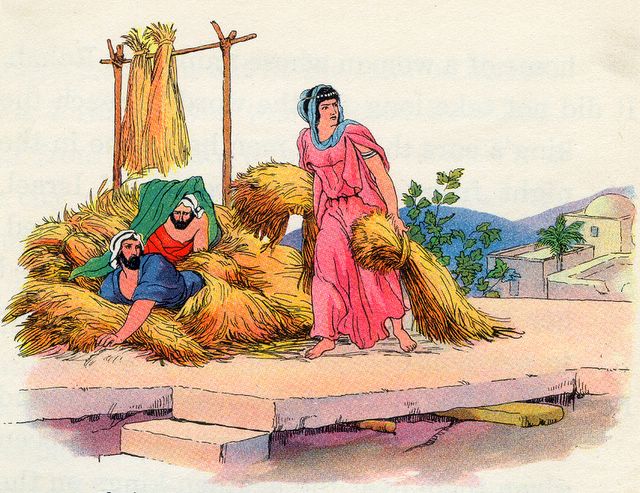
8 Now before they lay down, she came up to them on the roof, 9 and said to the men, "I know that the LORD has given you the land, and that the terror of you has fallen on us, and that all the inhabitants of the land have melted away before you. 10 "For we have heard (Implying that the other inhabitants had heard the truth about Jehovah!) how the LORD dried up the water of the Red Sea before you when you came out of Egypt (Note that this was 40 year old news about Jehovah!), and what you did to the two kings of the Amorites who were beyond the Jordan, to Sihon and Og, whom you utterly destroyed. 11 "When we heard it, our hearts melted and no courage remained in any man any longer because of you; for the LORD your God, He is God in heaven above and on earth beneath (A great confession and good theology for a Canaanite harlot!). 12 "Now therefore, please swear to me by the LORD, since I have dealt kindly with you, that you also will deal kindly with my father's household, and give me a pledge of truth, 13 and spare my father and my mother and my brothers and my sisters, with all who belong to them, and deliver our lives from death."
14 So the men said to her, "Our life for yours if you do not tell this business of ours; and it shall come about when the LORD gives us the land that we will deal kindly and faithfully with you."
Joshua 2:16, 17, 18
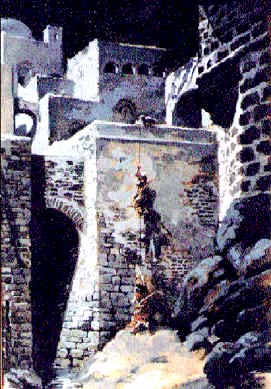
15 Then she let them down by a rope through the window, for her house was on the city wall, so that she was living on the wall. 16 She said to them, "Go to the hill country, so that the pursuers will not happen upon you, and hide yourselves there for three days until the pursuers return. Then afterward you may go on your way."
17 The men said to her, "We shall be free from this oath to you which you have made us swear, 18 unless, when we come into the land, you tie this cord of scarlet thread in the window through which you let us down, and gather to yourself into the house your father and your mother and your brothers and all your father's household. 19 "It shall come about that anyone who goes out of the doors of your house into the street, his blood shall be on his own head, and we shall be free; but anyone who is with you in the house, his blood shall be on our head if a hand is laid on him. 20 "But if you tell this business of ours, then we shall be free from the oath which you have made us swear."
21 She said, "According to your words, so be it." So she sent them away, and they departed; and she tied the scarlet cord in the window. 22 They departed and came to the hill country, and remained there for three days until the pursuers returned. Now the pursuers had sought them all along the road, but had not found them.
23 Then the two men returned and came down from the hill country and crossed over and came to Joshua the son of Nun, and they related to him all that had happened to them. 24 They said to Joshua, "Surely the LORD has given all the land into our hands; moreover, all the inhabitants of the land have melted away before us."
Then in Joshua 6 (commentary) we read the conclusion of the account of Rahab...
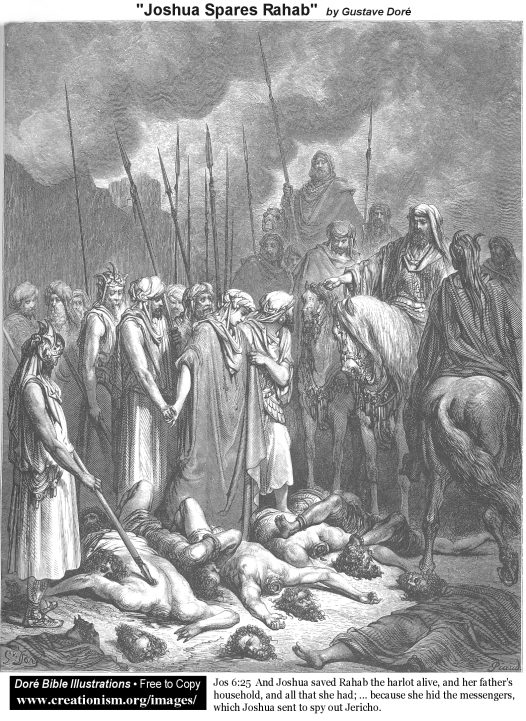
22 Joshua said to the two men who had spied out the land, "Go into the harlot's house and bring the woman and all she has out of there, as you have sworn to her." 23 So the young men who were spies went in and brought out Rahab and her father and her mother and her brothers and all she had; they also brought out all her relatives and placed them outside the camp of Israel. 24 They burned the city with fire, and all that was in it. Only the silver and gold, and articles of bronze and iron, they put into the treasury of the house of the LORD. 25 However, Rahab the harlot and her father's household and all she had, Joshua spared; and she has lived in the midst of Israel to this day, for she hid the messengers whom Joshua sent to spy out Jericho.
William Barclay - The second story the writer to the Hebrews takes is that of Rahab as told in Joshua 2:1-21 and finds its sequel in Joshua 6:25. When Joshua sent out spies to spy out the situation in Jericho, they found a lodging in the house of Rahab, a harlot. She protected them and enabled them to make their escape; and in return, when Jericho was taken she and her family were saved from the general slaughter. It is extraordinary how Rahab became imprinted on the memory of Israel. James (James 2:25+) quotes her as a great example of the good works which demonstrate faith (ED: WHERE JUSTIFIED IN THIS CONTEXT MEANS TO SHOW TO BE RIGHTEOUS - cf Mt 11:19, Lk 7:35 and especially Ro 3:4+ which speaks of God "You may be justified!") The Rabbis were proud to trace their descent to her. And, amazingly, she is one of the names which appear in the genealogy of Jesus (Matthew 1:5). Clement of Rome quotes her as an outstanding example of one who was saved "by faith and hospitality." When the writer to the Hebrews cites her, the point he desires to make is this--Rahab in face of all the facts believed in the God of Israel. She said to the spies whom she welcomed and hid: "I know that the Lord has given you the land.... For the Lord your God, is he who is God in heaven above, and on earth beneath" (Joshua 2:9-11). At the moment when she was speaking, there seemed not one chance in a million that the children of Israel could capture Jericho. These nomads from the desert had no artillery and no siege-engines. Yet Rahab believed and staked her whole future on the belief--that God would make the impossible possible. When common sense pronounced the situation hopeless, she had the uncommon sense to see beyond the situation. The real faith and the real courage are those which can take God's side when it seems doomed to defeat.
Sir Robert Anderson comments on the phrase Rahab the harlot - Rahab the harlot! Those who seek for proofs of the divine authorship of Scripture may find one here. Was there ever an Israelite who would have thought of preferring that woman's name to the names of David and Samuel and the prophets, and of coupling it with the name of the great apostle and prophet of the Jewish faith, "whom the Lord knew face to face," and to whom He spoke "as a man speaketh unto his friend"! And what Jew would have dared to give expression to such a thought? But God's thoughts are not our thoughts. And He who immortalized the devotion of the widow who threw her last two mites into the Temple treasury has decreed that the faith of Rahab who, like Moses, took sides with the people of God, shall never be forgotten.
Murray comments - By faith. Let this be the motto of our life. In every need and perplexity, with every desire and prayer, with every work and trial, with every thought of ourselves and of God, let this be the one thing we seek—ever to breathe a living faith in a living God. Once again I say: As absolute and universal and undisputed as is the supremacy of God, is to be the supremacy of faith in our heart and life. We can only have as much of God in our heart as we have of faith. And because God is All, and must be All to us, faith in us must be all too. (Ibid)
The exercise of faith by Rahab the harlot brought her not only salvation but into the line of the Messiah for she was the mother of godly Boaz, a man who in many ways pictured the "Greater Boaz" Christ Jesus...
The record of the genealogy of Jesus the Messiah, the son of David, the son of Abraham...Salmon (Jewish husband) was the father of Boaz by Rahab (Gentile saved proselyte), Boaz was the father of Obed by Ruth, and Obed the father of Jesse. (Mt 1:1, 1:5)
James includes her in the "same breath" as the venerable patriarch Abraham as a prime example of genuine, saving faith writing...
In the same way (cp Jas 2:21, 22, 23-note), was not Rahab the harlot also justified (in this context, the verb means "shown to be righteous") by works when she received the messengers and sent them out by another way? (Jas 2:25-note)
Warren Wiersbe quips - Imagine a pagan harlot becoming a part of the ancestry of Jesus Christ! That is what faith can do! Rahab is certainly a rebuke to unsaved people who give excuses for not trusting Christ. “I don’t know very much about the Bible” is an excuse I often hear. Rahab knew very little spiritual truth, but she acted on what she did know. “I am too bad to be saved!” is another excuse. But Rahab was a condemned heathen harlot! Another excuse is, “What will my family think?” Rahab’s first concern was saving her family, not opposing them. She stands as one of the great women of faith in the Bible.
Spurgeon - It is right to conclude that if there had been other believers there, either the city would have been spared for the sake of ten righteous, or else there would have been means found for their preservation; but she was the only one there. If we could have taken a bird’s eye view of the city of Jericho, and had been informed that there was one believer there, I warrant you we should not have looked to Rahab’s house. She would have been about the last person that we should have supposed had been a possessor of faith in the true God. God has a people where we little dream of it, and He has chosen ones among a sort of people whom we dare not hope for. Who would think that grace could grow in the heart of one who was a harlot by name, as though her sin was openly known to all? Yet it did grow there.
Did not perish along with (544) (sunapollumi from sun/syn = with, speaks of an intimate association + apollumi = from apo = away from or wholly + olethros = state of utter ruin <> ollumi = to destroy <> root of apollyon [Re 9:11] = destroyer) means to destroy together. The destruction in this context is one of losing their lives but not to causing them to cease to exist. Apollumi as it relates to men, speaks not of the loss of being per se, but is more descriptive of the loss of well-being. Apollumi then has the basic meaning of describing that which is ruined and is no longer usable for its intended purpose. The failure of the rest of the inhabitants of Jericho to possess eternal life by faith resulted in utter ruin in this life and the life to come, a life of eternal uselessness. Apollumi in no way speaks of cessation of existence (cp, annihilation) as some "scholars" falsely teach! See Eternal Punishment.
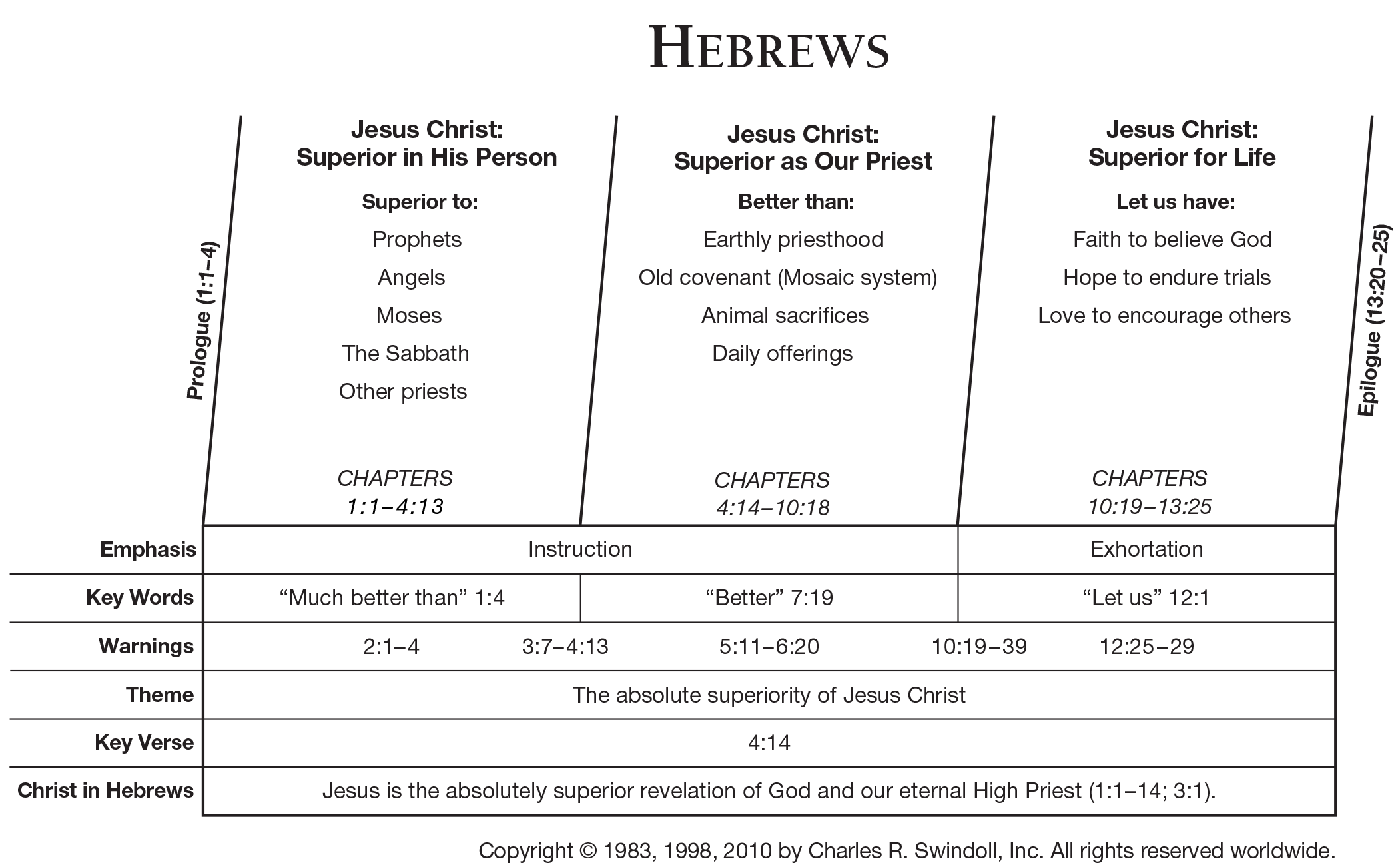
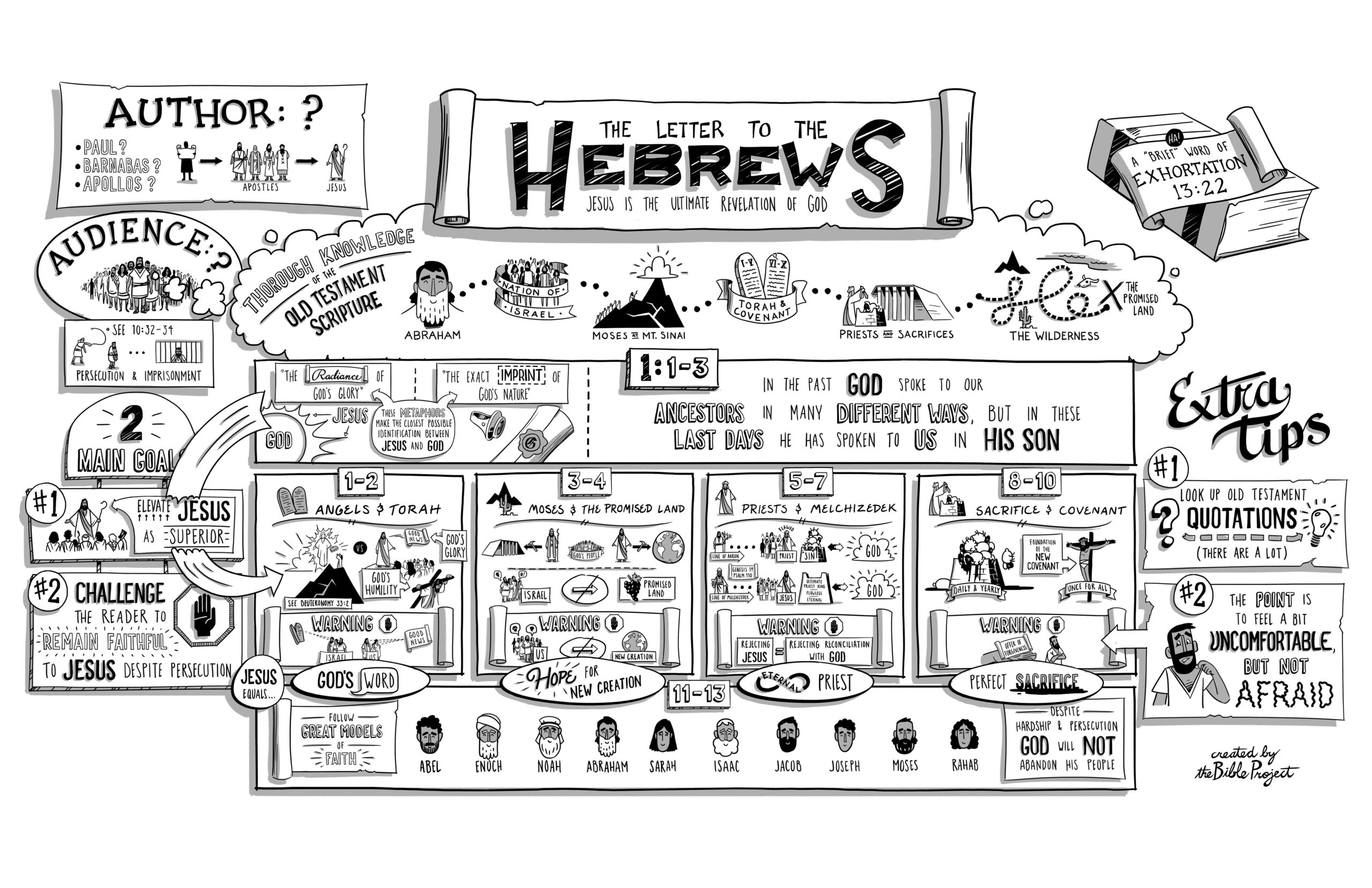
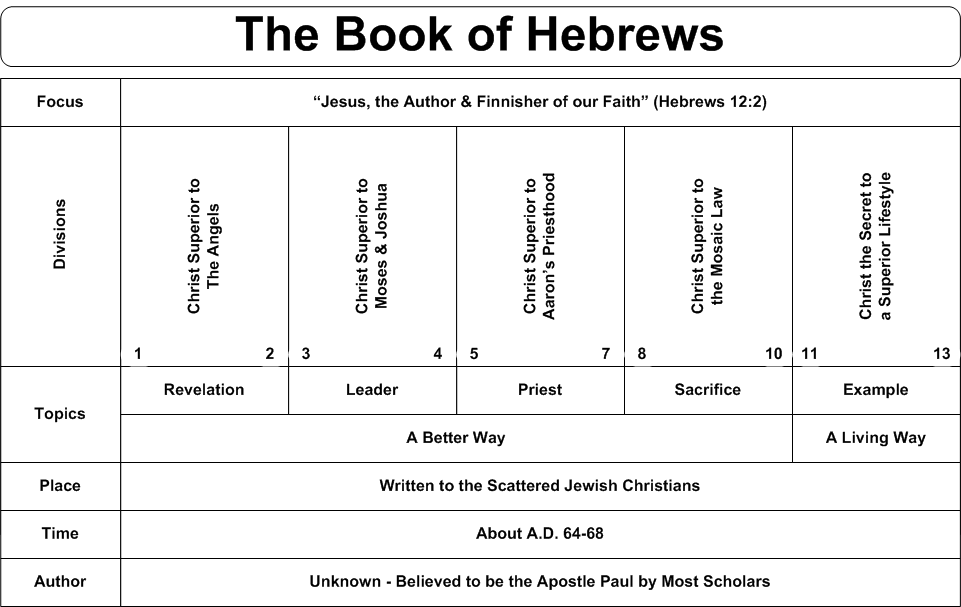
Sunapollumi is used 11x in 11v most in the non-apocryphal Septuagint (LXX) - Ge 18:23; 19:15; Nu 16:26; Dt 29:19; Ps 26:9; 28:3; Da 2:13; Heb 11:31.
Lest one is tempted to accuse God of being too harsh in destroying the entire population of Jericho, John MacArthur makes the point that "The destruction of the Canaanites was as great a social as it was a spiritual gain to the welfare of humanity. They were a debauched, idolatrous, and wicked people. They were noted for their grossly immoral and perverted sexual practices as well as for their general cruelty. Among other things, they frequently put live babies in jars and built them into their city walls as foundation sacrifices. They were begging for judgment. (MacArthur, John: Hebrews. Moody Press)
Disobedient (544)(apeitheo from a = without + peítho = persuade) literally describes one who refuses to be persuaded and who disbelieves willfully and perversely. Apeitheo means not to allow oneself to be persuaded, not to comply with and thus to refuse to believe (eg, in the truth, in Christ, in the Gospel). Apeitheo describes the inhabitants of Jericho who in spite of reports of the greatness of Jehovah (reports which Rahab appears to have believed), continued to manifest a stubborn, stiff-necked attitude of disbelief and disobedience, in this case manifest by a refusal to be persuaded by the truth about Jehovah (see Jn 3:36, cp the phrase "obey the gospel" in 2Th 1:8, 1Pe 4:17). Disobedience is opposite of pisteuo, which is the verb translated "believe" or "trust", precisely what Rahab did.
In studying apeitheo it is important to understand that "the stem peith- (pith-, poith-) has the basic meaning of trust (cf. Latin fido, fides). Trust can refer to a statement, so that it has the meaning to put faith in, to let oneself be convinced, or to a demand, so that it gets the meaning of obey, be persuaded. The active meaning of the verb stem peith- then is to convince and persuade and is especially characteristic of Greek thought. In secular Greek it interesting to note that "Peitho" (art of persuading) was even regarded as a goddess! (see Brown, Colin, Editor. New International Dictionary of NT Theology. 1986. Zondervan)
Welcomed (1209) (dechomai = middle voice of a primary verb) means to to receive something offered or transmitted by another (Luke 2:28+) and so to be receptive toward someone (as in Heb 11:31, cp "receive" in Lk 10:8, 10). Dechomai means to accept with a deliberate and ready reception of what is offered, to receive kindly and so to take to oneself what is presented or brought by another (e.g., reception of the Word of truth, Jas 1:21-note). In the present context dechomai means that Rahab welcomed the spies into her house even as one would welcome a friend or a guest! Rahab in a word accepted the Israeli spies with an open arm, mind, and heart, going beyond normally expected gracious hospitality (especially hiding them so they would not be discovered).
Spurgeon - This woman said, “If I must die for these men, I will; I am prepared, bad name as I have, to have a worse name still. I am prepared to be handed down to infamy as a traitor to my country, if it is necessary, for taking in these spies. For I know it is God’s will it should be done, and I will do it at all costs.” Do not trust your faith unless it has self-denial with it. Faith and self-denial, like Siamese twins, are born together, and must live together, and the food that nourishes one must nourish both. But this woman, poor sinner as she was, would deny herself. She brought her life, even as that other woman who was a sinner brought the alabaster box of precious ointment, and broke it on the head of Christ.
Spies (2685) (kataskopos from kata = down + skopeo = to take aim at or look toward an object and so to spy out) means to spy or scout, the verb form kataskopeo being used to describe the false brethren who snuck in among the believers in order to bring them from a state of freedom in Christ to a state of bondage under the law (legalism) (Gal 2:4).
Peace (1515)(eirene from verb eiro = to join or bind together that which has been separated) literally pictures the binding or joining together again of that which had been separated or divided and thus setting at one again, a meaning convey by the common expression of one “having it all together”. It follows that peace is the opposite of division or dissension. Peace is a state of concord and harmony and is the opposite of war which is how all the rest of the inhabitants of Jericho felt toward Israel. This lack of enmity further describes Rahab's welcoming attitude toward the spies.
William Newell - Note the following seven points about Rahab:
1. Rahab was a common sinner, even a harlot. God says as to all of us. “There is no difference; for all have sinned.”
2. Rehab's faith (Josh. 2:8–11) was confessed by her in the words, “I know that Jehovah hath given you the land, and that the fear of you is fallen upon us, and that all the inhabitants of the land melt away before you.”
3. This belief meant complete turning against her own people, just as a believer now comes out from, and is no longer of, the world.
4. It included belief that Jericho would be destroyed (Josh 2:13); and it brought concern for her own kin.
5. It brought about the beautiful typical picture of the scarlet cord, tied up in her window, by which the spies also escaped (Josh 2:15–21). How that cord reminds us of the shed blood of Christ!
6. By her faith she, her father, her mother, her brethren, and all her kindred—“Whosoever shall be with thee in the house”—(Josh 2:19), were preserved (Josh 6:22–23, 25).
7. She became the mother of Boaz (Matt. 1:5), great-grandfather of David the king! (Ruth 4:21–2).
Now let us go back and run over the names—familiar, blessed, sweet names they—of the “witnesses” of Heb 11:4-31, who “had witness borne to them.” BY FAITH— ABEL learned—and offered a blood sacrifice; ENOCH was told—and believed; NOAH was warned—and took warning; ABRAHAM was called—and obeyed; was tried, and offered up Isaac. ISAAC saw things to come; JACOB blessed each of the sons of JOSEPH and worshiped; JOSEPH (though exalted) clung at his end to Israel and their departure from Egypt; MOSES was hid … by his parents,* refused royalty, chose ill-treatment, rejected sin’s pleasures and Egypt’s treasures, looking unto the recompense of the reward: forsook Egypt, endured, kept the Passover. (Hebrews 11 Commentary)
Here are the concluding expository remarks from Steven Cole on Rahab the Harlot...
God converts hopeless sinners by faith (He 11:31). Rahab’s story is a wonderful exhibit of God’s grace! It contains seven lessons that I can only touch on briefly:
A. Rahab was an unlikely candidate for salvation.
From a Jewish perspective, Rahab had three strikes against her: she was a woman; she was a Canaanite; and, she was a prostitute. Except for Abraham’s wife, Sarah, Rahab is the only woman mentioned by name in Hebrews 11. Jewish men would sanctimoniously pray, “Lord, I thank You that You didn’t make me a Gentile or a woman!” But God saw fit to save this Gentile woman.
But not only was Rahab a Gentile woman, she was also a prostitute. From early times, many commentators have tried to dodge this, saying that she was only an innkeeper. But the Hebrew and Greek words are clear: she was a prostitute. (There is a different Hebrew word for temple prostitutes.) I’ve wondered why these spies would go to a prostitute’s house. Thomas Aquinas (cited by Philip Hughes, A Commentary on the Epistle to the Hebrews [Eerdmans], p. 503) explained that they did not go there to sin, but be-cause it was a good hiding place. Such houses are open, especially at night, when the men arrived (Josh. 2:2). Harlots receive their guests without discrimination or asking many questions. The king of Jericho seemed to accept as normal that these men would visit her in the night and leave almost as quickly as they had come.
But behind all of the spies’ reasons for going to Rahab’s house was God’s providence. Even though Rahab was an unlikely candidate for salvation, God’s grace had reached down to her. The fact that she is called “Rahab, the harlot,” even after her conversion, underscores God’s abundant grace toward sinners. The spies did not know when they went there that God had a mission for them besides spying, but He did. Sometimes we go somewhere on some errand, but God has another purpose, to use us to lead to salvation someone whom we would call an unlikely candidate.
I once met a man who had been a full-blown hippie, living with his girl friend and doing drugs. One morning he was driving in a remote canyon in Southern California when his muffler fell off his car. It happened in front of the house of a pastor, who had prayed with his wife that morning, “Lord, give us an opportunity to share the gospel with some lost soul today.” That unlikely candidate for salvation met Christ that day because God caused his muffler to fall off right at that place in the road!'
B. Rahab’s faith saved her from perishing.
God commanded Israel to kill everyone in Jericho. Modern critics, who must be wiser than God, think that God was cruel (or Joshua was mistaken) to order the extermination of everyone in Canaan. But God had given the Canaanites 400 years to fill up the measure of their sin (Ge 15:13, 14, 15, 16). For 40 years, they had heard how God delivered Israel from Egypt through the Red Sea (Ed: Which was in fact instrumental in Rahab's conversion - see Josh 2:8, 9, 10, 11). For several years, they had heard how God had defeated the Amorite kings, Sihon and Og, on the other side of the Jordan. For seven days, they had watched Israel march around their city. But did they repent of their sins? Only Rahab did, and perhaps her family.
Rahab could have complained that God was unfair to judge her city. She no doubt lost many friends in the conquest. But instead, she knew that she deserved death for her evil lifestyle. She knew that the LORD, God of Israel, is “God in heaven above and on earth beneath” (Josh. 2:11). Although the entire city trembled with fear of the impending attack (Josh 2:11), their fear did not lead to repentance and faith (Ed: cp Jesus' acknowledgment of the role of repentance in salvation = Mk 1:15, cp Acts 26:20). Rahab’s fear led her to turn from her sin and to believe in God (Ed: Cp the pagan response to the gospel in Thessalonica 1Th 1:9-note). By faith, she “did not perish along with those who were disobedient” (He 11:31).
Many think, probably correctly, that Rahab had come to faith in God before the spies arrived at her house. When God providentially brought the spies to her house, she saw it as the means of deliverance for herself and for her family. Although she did not understand much theology, she had enough faith in the one true God to save her. Her past life of sin did not disqualify her from salvation. God delights to save notorious sinners for His glory!
C. Rahab’s faith separated her from her disobedient contemporaries.
Those who perished are called disobedient (Heb 11:31). They were not “basically good people.” They had heard of God’s power, but they refused to submit to Him (cp Ro 1:18, 19-note, Ro 1:20-note). They erroneously thought that their walled city would protect them. To be saved, Rahab had to break away from her people, her culture, and her source of income. Although that is never easy and she must have wrestled with her decision, by faith she made the break.
We are not told whether she warned her fellow citizens of the coming judgment, or whether they mocked her for holing up in her house while Israel’s armies strangely marched around the town. But it is still true today: saving faith means making a distinct break from this evil world, so that we often stand out as weird in their eyes. (Ed: cp 1Pe 4:1, 2, 3, 4, 5-note)
D. Rahab’s faith was an obedient faith.
James 2:25 (note) lists Rahab next to Abraham as one who was justified by works. James is not denying justification by faith alone, but rather is making the point that genuine faith always results in good works (cp Jas 2:17-note). Her faith led her to hide the spies and send them away secretly, even though it put her life at great risk (cp Mk 8:35, 36, 37). She had to obey the explicit instructions that the spies gave her, to put the scarlet rope in her window and to have all of her family inside the house with her, in order for them to be saved. It may have seemed silly to them to watch Israel marching silently around the city for 13 times. They may have been tempted to join others on the wall shouting insults to the troops below. But they obeyed and they were saved.
Granted, Rahab’s faith was not perfect in obedience. She was a pagan woman from a pagan culture, and it was a difficult situation when the king’s messengers came to her house looking for the two spies, so she lied. Lying is sin, even when it is for a good cause. But God was gracious to take Rahab’s obedient faith as seen in her welcoming the spies, and overlook her lie. If you will come to Christ in faith, just as you are, He saves you and then begins to work His holiness into your life.
E. Rahab’s faith resulted in the salvation of her pagan family.
We do not know for certain that her family was saved spiritually, although I think it is probable. But we do know that they were saved physically from destruction at Jericho, and they became a part of the people of God. Presumably they not only learned about the true God of Israel, but also came to believe in Him personally. God can use the salvation of an unlikely person, like Rahab, to reach an entire family through her faith.
F. Rahab’s faith brought her into covenant with God and His people.
James Boice (Joshua: We Will Serve the Lord [Revell], p. 45) points out that Rahab actually became more Jewish than many of the Jews by birth, in that she believed God, whereas they did not.
Matthew Henry (Matthew Henry's Commentary [Revell] VI:950) comments, "A true believer is desirous, not only to be in covenant with God, but in communion with the people of God, and is willing to cast in his lot with them, and to fare as they fare."
Matthew’s genealogy of Jesus Christ (Mt 1:5,6) includes the surprising fact that Rahab married a Jewish man, Salmon, and they had a son, Boaz, who married Ruth. Their son, Obed, was the father of Jesse, the father of David. So Rahab, the harlot, became an ancestor of Jesus Christ! What a great testimony of God’s abundant grace!
G. Rahab’s faith changed her life from futility to fruitfulness.
Prostitution is never glamorous. It is ugly. Men pay to use a woman’s body, with no regard for her as a person. Prostitutes are never respected for what they do. When their bodies become too old to be attractive, they are out of work, lonely, and unloved.
But God reclaims the lives of the worst of sinners who turn to Him in repentance and faith. Rahab married and became a mother and grandmother (Ed: Mother to Boaz, grandmother to Obed see Ru 2:1-note, Ru 4:17-note). She became a partaker of all of Israel’s spiritual privileges, and even became linked to Christ Himself! Any life outside of Christ is futile (cp 1Pe 1:18-note) and headed for eternal destruction. Any life that God saves by His grace through faith becomes fruitful and headed for eternal glory.
Conclusion
Jericho is a picture of this evil world, opposed to God. Either you are by faith on God’s side, with some “Jericho’s” in your life that you need to conquer. Or, you are comfortably living in Jericho, thinking that you are safe. But you’re headed for destruction, whether you know it or not.
Whichever describes your situation, the key to victory is faith. Faith in the Lord Jesus Christ and His death on the cross in your place will deliver you from the coming destruction. If you’re in God’s camp, faith in His mighty power will give you victory over the intimidating enemies that threaten to destroy you. What great opportunities, disguised as insoluble problems, do you face? God has whatever resources you need to overcome them. Trust Him!
Discussion Questions
1. Why doesn’t God grant instant deliverance from our problems? Why do some problems linger on for years?
2. How can we know God’s will in specific problem situations?
3. How can we get faith when we lack faith? Where is the heart of the problem of unbelief?
4. Must sinners clean up their lives before they can be saved? Where does repentance fit into the process? (Bolding and color added for emphasis. Some cross-references added)
“By faith the prostitute Rahab, because she welcomed the spies, was not killed with those who were disobedient” (Hebrews 11:31).
There are certain occupations that we associate with certain biblical characters. To say a particular name immediately brings a certain occupation to mind.
- Abraham was a herdsman.
- David was a shepherd.
- Nehemiah was a cupbearer.
- Isaiah was a prophet.
- Peter was a fisherman.
- Herod was a king.
- Esther was a queen.
- Matthew was a tax collector.
- Caiaphas was a high priest.
- Joseph (NT) was a carpenter.
- Paul was a tentmaker.
- Lydia was a seller of purple cloth.
Perhaps the strangest of all is Rahab. Mention her name and immediately one occupation and only one comes to mind. Rahab was a harlot. She traded sex for money in what has sometimes been called the world’s oldest occupation. Whether or not it is literally the oldest means of making money, prostitution has been with us for thousands of years. I would venture to say that there is no city of any size where there are not women who sell their bodies for money.
The Bible makes no bones about Rahab’s occupation and makes no attempt to cover it up. The first time we meet her in Joshua 2:1, she is called “a prostitute named Rahab.” She is called “Rahab the prostitute” in Joshua 6:17 and again in 6:25. If that isn’t enough, twice in the New Testament her occupation is mentioned:
- “By faith the prostitute Rahab” (Hebrews 11:31).
- “Rahab the prostitute” (James 2:25).
That’s five times in all when one would be enough. It seems that God wants us to think “prostitute” when we think about Rahab. It is not an easy fact for us to face. Consider the English synonyms for prostitute:
- Hooker
- Streetwalker
- Call girl
- Lady of the night
There are many others that might be listed, including some too graphic to be used in a message like this. But they all paint the same sad picture of a woman who for whatever reason has decided to sell her body for money. I wonder if we have lost the sense of how degrading this is. Hollywood has managed to glamorize prostitution so that it doesn’t seem very ugly. Sex in general has become so casual that we aren’t very surprised by anything anymore. So teens experiment and singles sleep around. Girls sleep with their boyfriends. Married men and women have affairs. Although we think nothing of it, sexual sin always leaves a deep scar on the soul. No woman can cheapen herself through sexual sin and escape the deep sense of guilt and shame. Those who say they feel no guilt are simply lying to themselves.
I imagine Rahab had given up any hope of ever turning her life around. But God had other ideas. He can turn shame into glory in one shining moment of redemption.
The biblical record does not give us very many details about Rahab. We know that she lived in Jericho near the city wall. She was evidently well-known to the men of the city because the two spies had no trouble finding her house and the king of Jericho knew who she was and where she lived. But there are many things we don’t know about Rahab.
1) We don’t know how she became a harlot.
2) We don’t know her family background.
3) We don’t know her religion, except that she was not raised to believe in the God of the Bible.
4) We don’t know if she was hungering for a better life when the two spies came to her home.
All of that makes the following fact more startling. The Bible mentions Rahab the harlot as a hero of the faith. She made the Hall of Fame in Hebrews 11. Think of that list . . . Abel . . . Enoch . . . Noah . . . Abraham . . . Sarah . . . Isaac . . . Jacob . . . Joseph . . . Moses . . .
And then suddenly . . . Rahab!
And if you go to the end of the next verse, you find David, Samuel, and the prophets. That means Rahab the harlot is in some pretty good company. She’s up there with the man who built the ark (Noah), the father of faith (Abraham), the man who led the Jews out of Egypt (Moses), the sweet singer of Israel (David), and she’s up there with Isaiah, Jeremiah, Daniel, and all the rest of the great heroes of the Old Testament.
If ancient Israel had a Mount Rushmore, her face would be on it.
It’s just mind-blowing if you think about it. In one fell swoop God reaches down and rearranges all our neat little categories. In our mind we would do it like this:
Noah
Abraham
Isaac
Jacob BIG GAP Rahab
Joseph
Moses
David
If ancient Israel had a Mount Rushmore, her face would be on it.
Can’t let the prostitutes get too close to the men of faith, or so we think. But God’s evaluation is strikingly different. When the Bible tells the story, it makes no attempt to cover up her sordid past. Five times she is called a harlot. She is truly a “scarlet woman” whose reputation will follow her till the day she dies. Choices have consequences, and just as we remember Peter who denied the Lord and Judas who betrayed him, even so we recall that Rahab was a harlot.
Note the past tense. She “was” a harlot. That’s what she was. But through the grace of God she became a woman of faith.
I. A Hopeless Beginning
When Philip Edgecumbe Hughes wrote his commentary on Hebrews, he noted the barriers facing Rahab.
First, she was a woman in a world in which women were often mistreated, devalued and taken for granted. How remarkable, then, that the writer of Hebrews should choose two women and only two to highlight-Sarah the wife of Abraham and Rahab the harlot. By including a woman like this the writer wants us to know that the ground is level at the foot of the cross, and that even in that degraded age a woman could be included on an equal basis with men in the household of faith.
Second, she was a harlot. Some wish to downplay that fact and seek to soften the impact by translating the word as “innkeeper,” but there is no need to do that. The fact that she was a harlot magnifies the grace of God by demonstrating that even the lowest of the low could find a place in God’s family. Grace is for sinners, and only sinners need to be saved, so Rahab stands as a beacon of hope to the broken, hurting, bruised, fallen men and women everywhere who look in the mirror and feel, “There is no hope for me.” If you feel that way, then consider that Rahab was a harlot and at this very moment she is in heaven. If God can save her, he can certainly save you.
Third, she was a Gentile, a foreigner, raised in a pagan religion. As such, she did not belong to the Israelites, and yet by faith she was accepted by God and by his people and when the great attack on Jericho came, she was spared while the city around her was destroyed. Her life illustrates God’s promise made to Abraham (Genesis 12:1-3) that through his descendants all the nations on earth would be blessed.
If God can save Rahab, he can certainly save you.
It was hard for her to believe, and we can imagine many reasons she might not have believed. Certainly she took a great risk when she sheltered the spies and sent them out another way and when she refused to tell her own people where the two spies were and sent the soldiers on a wild goose chase on the road that leads down to the Jordan River. Why would she do it? There are two ways to answer the question, and they both lead to the same conclusion. Joshua 2:9-13 tells us that she and all the people of Jericho had heard stories about how God had delivered his people through the Red Sea and how he had given them victory over the Amorite kings. That fact means that everyone in Jericho had some degree of knowledge. Rumors had spread like wildfire. But only Rahab had the foresight to believe that the Lord himself was at work in all that had happened to the Jews. Where does such foresight come from? I believe the eyes of her heart had been opened by the Holy Spirit so that she took the same information others had and came to a proper conclusion. When it came time to choose sides, she chose to side with God’s people.
She even went so far as to make provision for her own family.
Now then, please swear to me by the LORD that you will show kindness to my family, because I have shown kindness to you. Give me a sure sign that you will spare the lives of my father and mother, my brothers and sisters, and all who belong to them, and that you will save us from death (Joshua 2:12-13).
Here is another sign of true conversion. She now has a concern for the safety of her extended family. She doesn’t want to be saved alone. She wants to make sure her family is saved with her.
II. A Remarkable Deliverance
The spies agreed to spare her family in the coming attack on Jericho if she tied a scarlet cord to her window. Why a scarlet cord? In the chaos of the coming battle, a scarlet cord would be easily seen by the attacking army. But there is a deeper symbolism at work here. The scarlet cord reminds us of the blood of the Passover. The color was no coincidence. It was a scarlet cord that guaranteed her deliverance from otherwise certain death. Note that as soon as the spies left, Rahab tied the scarlet cord in the window so everyone could see it. She had no idea when the attack would come. Maybe in a few days, maybe in several weeks. It didn’t matter. She believed the promise and acted upon it.
Here is the key. Rahab heard the promise and did something about it. What would have happened if Rahab had forgotten about it and never gotten around to tying that scarlet cord outside her window? She would have died like everyone else. It is never enough merely to hear the truth. Hearing the truth must move you to action sooner or later. Rahab the harlot, this sinful woman who sold her body for money, made the Hall of Fame of Faith for one reason. When the chips were down, she believed the promise and did something about it. And that simple scarlet cord saved her life.
Let each person who reads these words take them solemnly to heart. You may be a religious person. You may be very moral in the eyes of others. You are probably not a harlot. You would likely be embarrassed to be classed as a harlot. And yet you may not end up as well off as Rahab. You may hear the gospel over and over and yet do nothing about it. You may believe that the blood of Christ can forgive your sins, you may even be a member of some church somewhere, but until by faith you come to Christ personally, you cannot be saved. Rahab heard the word and personally responded by tying the scarlet cord to her window. You and I must do the same thing. It is not hearing that saves us, but hearing and believing to the point that you reach out and trust Christ as Savior.
Days passed. Then a week and perhaps two weeks. Inside Jericho life proceeded as normal. Meanwhile two things were happening that few people knew about.
1) Rahab spreads the word to her relatives. “When the attack starts, come to my house. Don’t delay. Don’t join the battle. Don’t run and hide. Come to my house and you will be safe.” Rahab became an evangelist to her own family.
2) Joshua led the children of Israel across the Jordan and up toward Jericho. That caused the men of Jericho to close the city gates in the belief that they could withstand any assault and anysiege.
We all know what happens next. It has been immortalized in the word of the old spiritual, “Joshua fit the battle of Jericho.” Archaeologists tell us that the city was already 1000 years old when Joshua prepared to attack it. It had enormous strategic importance because Jericho sat on a hillside guarding the central portion of Palestine. Over the centuries Jericho had been destroyed and rebuilt many times. It was so strong that the people inside felt absolutely safe. Apart from a miracle, there was no way the Jews could take the city.
You know how God instructed Joshua and the people to march around the city for six consecutive days. On the seventh day they marched around the city seven times. God promised that on the seventh day, on the seventh time around the city, when the priests blew their horns and the people shouted, the walls would come tumbling down.
With the walls down, the people of Jericho were defenseless.
That’s exactly what happened.
We all know that part of the story. Here’s the P.S. With the walls down, the people of Jericho were defenseless. The Jews attacked and at God’s express command killed everything in the city. Men and women . . . young and old . . . cattle and donkeys. It was a total slaughter by the children of Israel. Absolute annihilation. Holy war. Nothing left of the city because they burned it to the ground.
Except . . . . except for Rahab. When the soldiers saw the scarlet cord in her window, they spared her and everyone with her. They kept the promise the spies had made. And so Rahab the harlot was spared and her faith caused her to reach out and guarantee the salvation of her own family as well. This is true conversion.
III. A Timeless Message
For 2000 years Christian expositors have seen two major themes in Rahab’s story.
1) Salvation for the worst of sinners.
This story teaches us that no one is beyond the reach of God’s grace. Even in the midst of judgment, God reaches out and saves a harlot who turns to him in faith.
But think of all the men she had slept with.
Think of all that sin.
Think of her stained reputation.
Think of her past.
And God says, “I know all about her past, and it doesn’t matter because she believed in me.” Not that sexual sin doesn’t matter. It matters greatly. After all, she is still called Rahab the harlot. But she is free now, and forgiven, and on the road to heaven.
So what’s your sin? You may be reading this sermon and right now you feel unworthy to go to heaven. If so, I have wonderful news for you. Only unworthy people go to heaven. The people who think they are “worthy” end up in hell. So if you’ve been sleeping around, or messing around, or fooling around, or making one stupid mistake after another, I’ve got good news for you. Your sin makes you an excellent candidate for salvation.
Only unworthy people go to heaven.
Remember . . . If God can save Rahab, he can save anyone. And that includes you.
And just for the record, I would rather be Rahab the harlot on my way to heaven than to be Sally the Sunday School teacher on my way to hell.
2) Salvation through the blood of Jesus.
If Rahab represents a helpless sinner, then the scarlet cord represents the blood of Jesus shed for you. One of our old gospel songs puts it in the form of a question.
What can wash away my sin? Nothing but the blood of Jesus.
What can make me whole again? Nothing but the blood of Jesus.
Oh, precious is the flow that makes me white as snow.
No other fount I know, nothing but the blood of Jesus.
As one early writer said regarding Rahab, “Not only faith but prophecy is found in this woman.”
So this is a message of enormous hope for all of us. And the worse you feel about yourself, the more hope you can find in Rahab. There is no pit so deep that the love of God is not deeper still. There is no sin so terrible that Jesus cannot forgive it. There is no stain on your soul that Jesus cannot wash away.
But what if you don’t know very much? Take heart. Rahab knew very little and yet she was saved. I have often wondered how much you have to know to be saved. We could argue that for hours but since faith is a gift of God, we know that it’s not how much faith you have, it’s where you place your faith. It’s not the amount of faith that matters. It’s the object of faith. Rahab knew enough to know that the God of the Israelites was the one true God. Her faith caused her to welcome the spies and then send them on their way. And her faith caused her to hang the scarlet cord out of her window. In theological terms, she was in spiritual kindergarten. But it didn’t matter.
It’s not the amount of faith that matters. It’s the object of faith.
She made the Book!
“By faith Rahab!”
God delights to save notorious sinners.So let every sinner take heart and come running to Jesus.
One final word and I am done. What happened to Rahab after the fall of Jericho? We know this much. She married a Jewish man named Salmon and together they had a son named Boaz whose name pops up in the book of Ruth. Boaz and Ruth gave birth to Obed the father of Jesse the father of David who became the king of Israel. Get the picture?
Hundreds of years later her name shows up on the first page of the New Testament. When Matthew gives the genealogy of Jesus, he includes this section:
Salmon the father of Boaz, whose mother was Rahab,
Boaz the father of Obed, whose mother was Ruth,
Obed the father of Jesse,
and Jesse the father of King David (Matthew 1:5-6)
Rahab the harlot made the list. She’s part of Jesus’ family tree. If you know Jesus, one day you will meet her in heaven. And there at last she will be no more Rahab the harlot. She will forever be known as Rahab the child of God.
So let me end by calling to mind one sentence from a familiar gospel song called To God Be the Glory. The second verse goes like this:
Oh perfect redemption, the purchase of blood.
To every believer, the promise of God.
The vilest offender who truly believes
That moment from Jesus a pardon receives.
How true it is. Rahab proves it, and you can prove it too by coming to Christ right now. Don’t let your past keep you away. Come to Jesus! Your sins will be forgiven, you will be saved, and your life will never be the same.
When the old-time preachers would give an invitation, they would say, “Won’t you come?” “Won’t you come to Jesus?” Let me make that same invitation to you right now.
Won’t you come?
Won’t you come to Jesus?