Hebrews 11:1
Hebrews 11:2
Hebrews 11:3
Hebrews 11:4
Hebrews 11:5
Hebrews 11:6
Hebrews 11:7
Hebrews 11:8
Hebrews 11:9
Hebrews 11:10
Hebrews 11:11
Hebrews 11:12
Hebrews 11:13
Hebrews 11:14
Hebrews 11:15
Hebrews 11:16
Hebrews 11:17
Hebrews 11:18
Hebrews 11:19
Hebrews 11:20
Hebrews 11:21
Hebrews 11:22
Hebrews 11:23
Hebrews 11:24
Hebrews 11:25
Hebrews 11:26
Hebrews 11:27
Hebrews 11:28
Hebrews 11:29
Hebrews 11:30
Hebrews 11:31
Hebrews 11:32
Hebrews 11:33
Hebrews 11:34
Hebrews 11:35
Hebrews 11:36
Hebrews 11:37
Hebrews 11:38
Hebrews 11:39
Hebrews 11:40
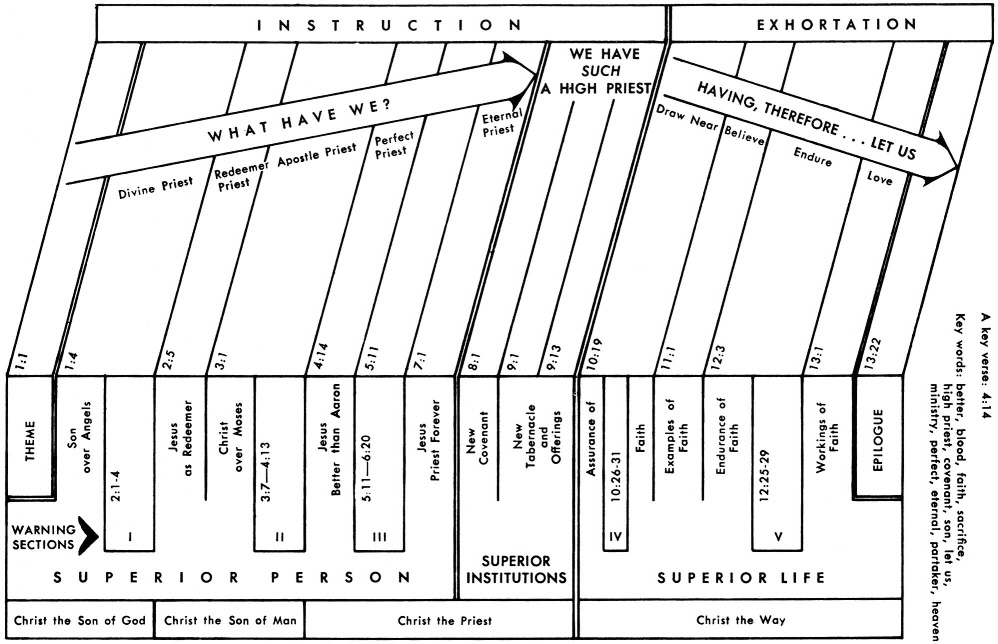
CONSIDER JESUS OUR GREAT HIGH PRIEST
Click chart to enlarge
Charts from Jensen's Survey of the NT - used by permission
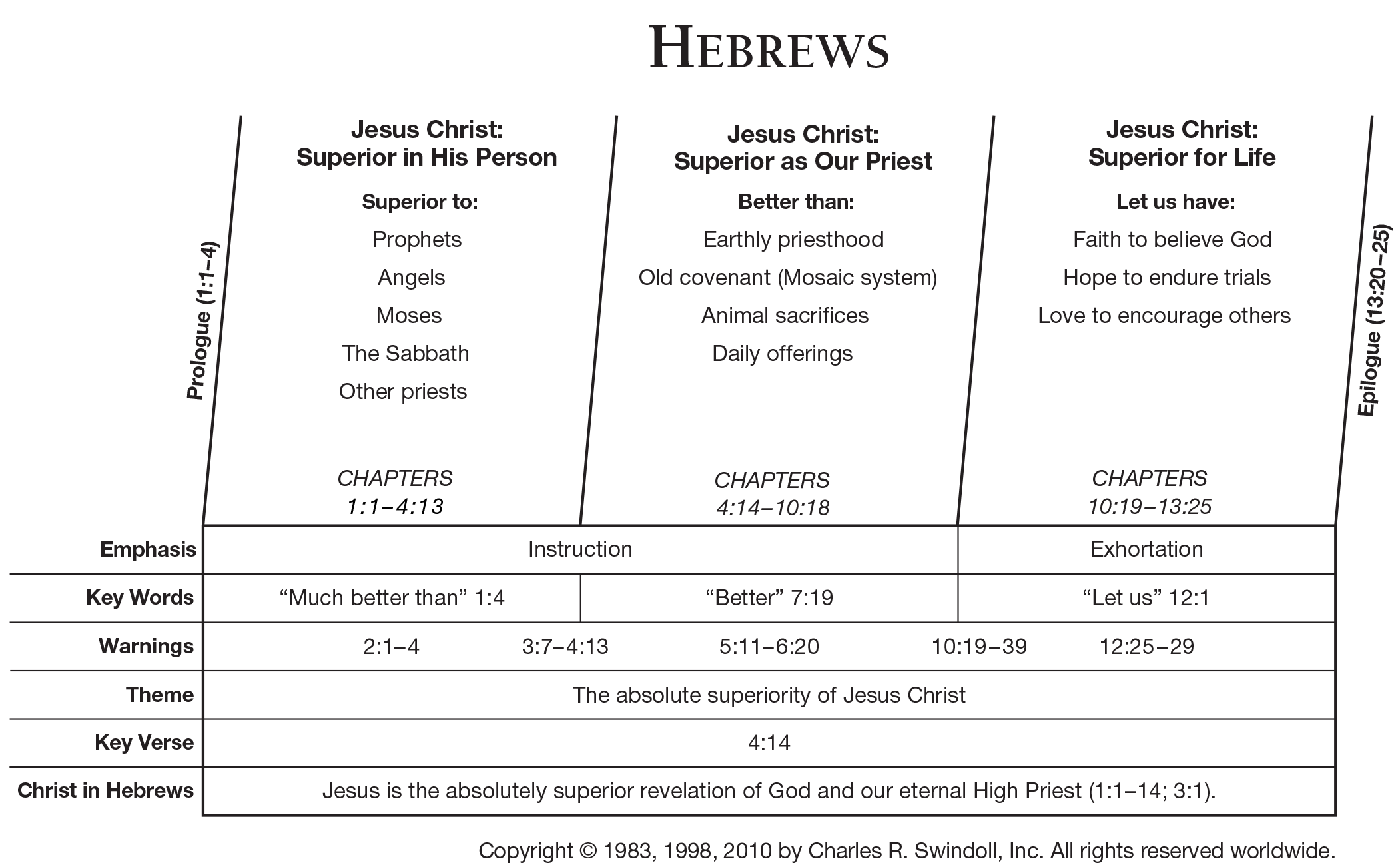
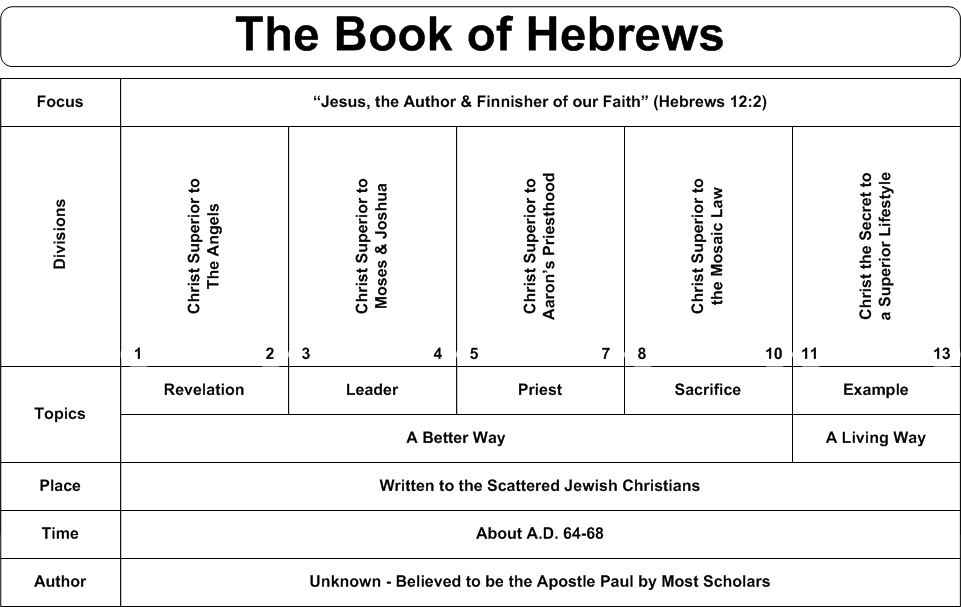
Swindoll's Chart, Interesting Pictorial Chart of Hebrews, Another Chart

|
The Epistle |
||||
| INSTRUCTION Hebrews 1-10:18 |
EXHORTATION Hebrews 10:19-13:25 |
|||
| Superior Person of Christ Hebrews 1:1-4:13 |
Superior Priest in Christ Hebrews 4:14-10:18 |
Superior Life In Christ Hebrews 10:19-13:25 |
||
| BETTER THAN PERSON Hebrews 1:1-4:13 |
BETTER PRIESTHOOD Heb 4:14-7:28 |
BETTER COVENANT Heb 8:1-13 |
BETTER SACRIFICE Heb 9:1-10:18 |
BETTER LIFE |
| MAJESTY OF CHRIST |
MINISTRY OF CHRIST |
MINISTERS FOR CHRIST |
||
|
DOCTRINE |
DUTY |
|||
|
DATE WRITTEN: |
||||

See ESV Study Bible "Introduction to Hebrews"
(See also MacArthur's Introduction to Hebrews)
Borrow Ryrie Study Bible
Hebrews 11:3 By faith we understand that the worlds were prepared by the word of God, so that what is seen was not made out of things which are visible. (NASB: Lockman)
Greek:Pistei nooumen (1PPAI) katertisthai (RPN) tous aionas remati theou, eis to me ek phainomenon (PMPNPG) to blepomenon (PPPNSA) gegonenai. (RAN)
BGT Πίστει νοοῦμεν κατηρτίσθαι τοὺς αἰῶνας ῥήματι θεοῦ, εἰς τὸ μὴ ἐκ φαινομένων τὸ βλεπόμενον γεγονέναι.
Amplified: By faith we understand that the worlds [during the successive ages] were framed (fashioned, put in order, and equipped for their intended purpose) by the word of God, so that what we see was not made out of things which are visible. (Amplified Bible - Lockman)
KJV: Through faith we understand that the worlds were framed by the word of God, so that things which are seen were not made of things which do appear.
NKJ By faith we understand that the worlds were framed by the word of God, so that the things which are seen were not made of things which are visible.
NET By faith we understand that the worlds were set in order at God's command, so that the visible has its origin in the invisible.
CSB By faith we understand that the universe was created by God's command, so that what is seen has been made from things that are not visible.
ESV By faith we understand that the universe was created by the word of God, so that what is seen was not made out of things that are visible.
NIV By faith we understand that the universe was formed at God's command, so that what is seen was not made out of what was visible.
NLT: By faith we understand that the entire universe was formed at God's command, that what we now see did not come from anything that can be seen. (NLT - Tyndale House)
Phillips: And it is after all only by faith that our minds accept as fact that the whole scheme of time and space was created by God's command - that the world which we can see has come into being through principles which are invisible. (Phillips: Touchstone)
Wuest: By means of faith we perceive that the material universe and the God-appointed ages of time were equipped and fitted by God's word for the purpose for which they were intended, and it follows therefore that that which we see did not come into being out of that which is visible.
Young's Literal: by faith we understand the ages to have been prepared by a saying of God, in regard to the things seen not having come out of things appearing;
- By faith - He 1:2; Genesis 1:1-31; 2:1; Ps 33:6; Isaiah 40:26; Jer 10:11,16; Jn 1:3; Acts 14:15; 17:24; Ro 1:19, 20, 21; 4:17; 2Pe 3:5; Rev 4:11
- Hebrews 11 Resources - Multiple Sermons and Commentaries
Related Passages:
Psalm 33:6 (AFFIRMING Heb 11:3) By the word of the LORD the heavens were made, And by the breath of His mouth all their host....33:9 For He spoke, and it was done; He commanded, and it stood fast.
2 Peter 3:5 For when they maintain this, it escapes their notice that by the word of God the heavens existed long ago and the earth was formed out of water and by water,
Job 38:4 “Where were you when I laid the foundation of the earth? Tell Me, if you have understanding,
SEEING CREATION WITH
EYES OF FAITH
By faith (pistis) we understand (noeo - present tense) that the worlds (aion) were prepared (katartizo - perfect tense) by the word (rhema) of God, so that what is seen (blepo) was not made out of things which are visible (phaino). - By faith (pistis, first of 21 "by faith") is instrumental dative which simply describes the means by which we perceive this spiritual truth. Notice the pronoun we so the writer includes himself in the confession that God created the worlds. Since no one was present with the worlds were prepared, the only way to "see" creation is with eyes of faith.
Faith sees creation as evidence of a Creator
unseen but undeniable
The the word (rhema) of God is the omnipotent agent that called the universe into being. The heart of faith hears that Word and acknowledges that the unseen God is the Creator. The word (rhema) of God refers to His divine utterance, as in Ge 1:3+ "Then God said, "Let there be light"; and there was light." (cf Ge 1:6,9,11,14+). Elsewhere the Scripture affirms Christ's pivotal role in the creation of the world:
Hebrews 1:2 in these last days has spoken to us in His Son, whom He appointed heir of all things, through Whom (NOTE INVOLVEMENT OF FATHER AND SON HERE) also He made the world.
John 1:1-3 In the beginning was the Word (Logos), and the Word (Logos) was with God, and the Word (Logos) was God. 2 He was in the beginning with God. 3 All things (NO EXCEPTIONS) came into being (aorist = past completed act, not a process, again arguing against evolution) through Him (CHRIST), and apart from Him nothing came into being that has come into being.
Colossians 1:16-17 For by Him (CHRIST) all things were created, both in the heavens and on earth, visible and invisible, whether thrones or dominions or rulers or authorities–all things have been created through Him and for Him. 17 He is before all things, and in Him all things hold together.
We understand (noeo) denotes the exercise of reflective understanding, a discerning, reasoned perception that goes beyond simple sight or sensory observation. In other words the verb (noeo) speaks of intellectual apprehension, which in context, is produced by faith, not empirical proof. We understand not by the sight of the eye but by the insight of faith. Sight sees that things are made, but faith sees that they were made by the Word of God. This truth flows naturally from Heb 11:1 where faith is the conviction of things not seen. Creation could not be seen for man was not yet created! So creation is the writer's first illustration of the exercise of faith. In short this understanding was not by scientific analysis, but by accepting and believing God’s revelation that His spoken word produced all that exists.
The writer is saying we as believers perceive the truth about creation by virtue of thoughts coming into our consciousness which is distinct from perceiving with one's sight. Yes we see, but more importantly we understand, alluding to the irrefutable witness of God's Infinitely Creative Genius. Paul drives home the importance of creation writing "For since the creation of the world His invisible attributes, His eternal power and divine nature, have been clearly seen, being understood (noeo denotes clear perception, full understanding, and careful consideration) through what has been made (poiema), so that they are without excuse (anapologetos)." (Ro 1:20+) Is it any wonder that men try to debunk creation by God out of nothing? The know better but they willfully choose to suppress the truth in unrighteousness (Ro 1:18b)!
Applying the truth of this verse to his readers some of whom might still be wavering, he is saying that if you believe that everything visible came from the invisible at God’s spoken Word, you can believe that all of His unseen promises will become visible and real in His perfect timing!
The worlds (aion) is more literally “the ages,” but contextually includes the entire created universe in both time and space, that is, all that exists spatially within time and eternity. Phillips paraphrases it “the whole scheme of time and space”.
Were prepared (katartizo) in the perfect tense speaks of past completed action (implying in a moment of time which would argue against evolution) and enduring (non-evolutionary) effect.
SIDENOTE - In this verse the verb form of katartizo is a perfect passive participle, and the sense it conveys is that the universe stands as something that has been perfectly ordered, completed, and sustained by the direct creative act of God. The perfect tense emphasizes a past completed act with continuing results or effect. In other words, God’s creative work was completed in the past and its effects remain evident in the present. This theological nuance strongly affirms the biblical doctrine of creation ex nihilo—creation “out of nothing”—as the verse itself explains, “what is seen was not made out of things that are visible.” It implies that matter and life did not arise from existing material or through random natural processes over time, but were brought into existence by the sovereign Word of God. This position stands in direct contrast to the evolutionary model, which assumes a gradual process of development from preexisting matter over vast ages. The author of Hebrews presents creation as an accomplished act with an ongoing result, not an open-ended process still unfolding through impersonal mechanisms.
By the word (rhema) of God is not logos, which is used of Jesus in Jn 1:1+, but is rhema which emphasizes the spoken word (utterance). Jesus spoke and the universe came into being (Gen 1:3) the moment He spoke, believe it or not!
There are two explanations for the origin of the universe and one is total speculation spoken by men, and the other is full revelation spoken by God. By faith we accept the latter, the revelation that God created everything out of nothing! We were not there when He accomplished this great feat, but He states it clearly and that is sufficient for the man or woman of faith, for God is trustworthy and His Word is true. Our approach should be God said it. That settles it whether I can fully understand it or not!
David Guzik on by the word of God - This text does not say that God created the world with or by faith. Since God sees and knows all things, “faith” in a human sense does not apply to Him. Since we understand faith as the substance of things hoped for, the evidence of things not seen, we know that God sees everything and does not “hope” for anything.
Wuest - This verse...shows that in its (faith's) earliest and most general expression, belief that the visible universe was created by God, is a conviction of something not apprehensible by the senses. (Hebrews Commentary)
Creation provides evidence for the unseen,
but it takes faith to believe in the unseen.
Scott Grant - To help us understand what he means by faith, the writer supplies an illustration in verse 3 that is close to home: the faith that "we" exercise. By faith we understand - by faith we have evidence - that God created the worlds, or the universe, from things which are not visible. By faith we have evidence for the unseen. It's not the only evidence we have, for Paul in Romans 1:20 says that God's attributes "have been clearly seen, being understood through what has been made." Creation provides evidence for the unseen, but it takes faith to believe in the unseen. It takes faith to look at creation and believe that there is a creator. Faith is the spiritual ability to look at what is seen and perceive the unseen. It's to see traces of God and "see" God. The evidence for the unseen is faith. It may sound strange that the evidence for the unseen is something as seemingly nebulous as faith in the unseen. But if faith is some kind of ability to see what can't be seen, then that seeing is evidence for the existence of the unseen. I believe something exists because I see it, and that seeing is all the evidence I need. So it is with faith. The writer now begins illustrating how faith worked in the men of old and how their faith provides evidence for the reality and greatness of what they believed in. (Sermon)
Faith in redemption without faith in creation
is impossible in any meaningful sense.
Henry Morris - The word “faith” occurs twenty-four times in this chapter, with the great theme that true saving faith (Hebrews 10:39) and faith to live by (Hebrews 10:38) will inevitably produce works of faith that demonstrate its reality (see also James 2:14-26). This is demonstrated by a great “cloud of witnesses” (Hebrews 12:1), whose works of faith have been described in the Old Testament, and are outlined here....Note also that the special creation of the universe is the very first object of this living, saving faith. Faith in redemption without faith in creation is impossible in any meaningful sense. (ED: TO SAY IT ANOTHER WAY -- Without acknowledging God as the Creator, one cannot truly grasp the seriousness of sin or the reason redemption is needed. Sin is rebellion against our Creator’s lordship, and salvation through Christ is reconciliation to that same Creator.)
Faith mounts upon the shoulders of reason and sees much farther
than reason with her best telescope will ever be able to see
Spurgeon - The facts about creation must be the subject of faith. It is true that they can be substantiated by the argument from design and in other ways; still, for a wise purpose, as I believe, God has not made even that matter of the creation of the universe perfectly clear to human reason, so there is room for the exercise of faith. Men like to have everything laid down according to the rules of mathematical precision, but God desires them to exercise faith. Therefore, He has not acted according to their wishes. Reason is all very well, but faith mounts upon the shoulders of reason and sees much farther than reason with her best telescope will ever be able to see. It is enough for us who have faith that God has told us how He made the world, and we believe it.
Homer Kent quips "Before beginning his impressive roll call of the faithful, the author reminds his readers that faith is absolutely necessary if we are to understand even the first page of Scripture" (borrow Hebrews Commentary)
Throughout this great "Hall of Faith" we see example after example of the vital maxim that true or genuine saving faith equates with obedience to God (Jas 2:14-26 - see verse by verse commentary and don't believe those teachers who say faith without works is alive and saying - that is a lie from the pit of hell!). Note that obedience does not save. Only faith in Jesus saves, but saved person has a new heart (Ezek 36:26, 27)and is a completely new creation (2Co 5:17) in Christ and this new heart produces a new "direction" in one's life, albeit not a direction of perfection (at least not in this mortal life - but yes, hallelujah, in the glorified life to come, the eternal, everlasting life in the presence of His glory! Maranatha. Amen)
David Guzik - We also know this by reason, because we know the world was created and created by an intelligent Designer. Again, this is faith going beyond but not in contradiction to reason. Even in times when it seems God expects a faith that contradicts reason, closer examination reveals He does not. For example, it might seem contrary to reason for God to expect Abraham to believe that Sarah’s dead womb could bring forth a child. But it is not unreasonable to believe that the God who created life and the womb could do this, and that He would do it according to His promise.
Faith (4102)(pistis) is synonymous with trust or belief and is the conviction of the truth of anything, but in Scripture speaks of belief respecting man's relationship to God and divine things, generally with the included idea of trust and holy fervor born of faith and joined with it. As pistis relates to God, it is the conviction that God exists and is the Creator and Ruler of all things well as the Provider and Bestower of eternal salvation through Christ. As faith relates to Christ it represents a strong and welcome conviction or belief that Jesus is the Messiah, through Whom we obtain eternal salvation and entrance into the Kingdom of Heaven. Stated another way, eternal salvation comes only through belief in Jesus Christ and no other way. Faith is believing that God will keep His promises, despite circumstances that seem to be to the contrary! Faith is confidence in God’s character, not in our circumstances. Faith trusts God’s promises when sight screams impossibility.
True faith is not merely believing in spite of evidence
but is obeying in spite of consequence.
True faith that saves one's soul includes at least three main elements:
(1) Firm persuasion or firm conviction. Saving faith begins with the mind — a firm persuasion of divine truth revealed in Christ and Scripture.
(2) True faith is not mere intellectual assent, but involves the will as manifest by surrender to the truth believed ("volitional trust")
(3) Faith generates a conduct emanating from surrender (fruit of faith). faith not only believes but behaves! Genuine faith always produces a changed life. Faith is the root (firm persuasion), surrender the stem (volitional trust), and conduct the fruit (obedience). Works do not save, but they show that faith is real.
Faith is not belief without proof,
but trust without reservation.
-- Elton TruebloodBY FAITH - All 19 uses of this phrase in Hebrews 11 - Heb. 11:3; Heb. 11:4; Heb. 11:5; Heb. 11:7; Heb. 11:8; Heb. 11:9; Heb. 11:11; Heb. 11:17; Heb. 11:20; Heb. 11:21; Heb. 11:22; Heb. 11:23; Heb. 11:24; Heb. 11:27; Heb. 11:28; Heb. 11:29; Heb. 11:30; Heb. 11:31; Heb. 11:33; The repetition of BY FAITH underscores the chapter’s rhythm — a divine refrain showing that every act of true obedience, from Abel to Rahab, flowed BY FAITH. The point is that each act of obedience as accomplished through the instrumentality of faith. In short, their works were not works of the flesh but works of their faith! To say it grammatically, pistei is a dative of means, which can be translated “by means of faith” or “through faith as the instrument.” In other words, every act described in Hebrews 11 was done not by human strength, reason, or sight, but by faith, faith as the channel through which the Spirit's supernatural power flowed through mortal men and women. Stated another way, faith is the spiritual means through which God’s people acted, obeyed, and endured. Each BY FAITH answers the question, How did they do it? The faithful of Hebrews 11 did not act because circumstances were favorable, but because God’s Word was trustworthy. From creation (“by faith we understand”) to consummation (“these all gained approval”), the chapter portrays the entire scope of redemptive history as lived BY FAITH.
Faith is the link which binds our nothingness
to the all-sufficiency of Christ.ALL OTHER NT USES OF BY FAITH - Heb. 4:2; Heb. 10:38; Acts 15:9; Acts 26:18; Rom. 1:17; Rom. 3:28; Rom. 3:30; Rom. 4:16; Rom. 5:1; Rom. 5:2; Rom. 9:30; Rom. 9:32; 2 Co. 5:7; Gal. 2:16; Gal. 2:20; Gal. 3:8; Gal. 3:11; Gal. 3:22; Gal. 3:24; Gal. 5:5; 1 Tim. 1:4; Jas. 2:24
Faith hears God, heeds God, and
holds fast to God even when sight fails.For more discussion of faith see commentary on Hebrews 11:1-2.
Understand (3539) (noeo from nous = mind, the seat of moral reflection) has the basic meaning of direct one's mind to something and thus means more than just taking a glance. It means to perceive with the mind, to apprehend, to ponder (= weigh in one's mind, think especially quietly, soberly and deeply). It means to consider well, to reflect on with insight, or to think over a matter carefully. The idea is to grasp or comprehend something on the basis of careful thought. Note that the verb noeo (perceive with the mind) discloses that faith is not blind assent but engages man’s intellect and mind.
Wuest - The word understand is the translation of noeo which means “to perceive with the reflective intelligence.” It is distinguished from the mere physical act of seeing. It is the perception of the mind consequent upon seeing. In the New Testament it is never used of mere physical sight. (Hebrews Commentary)
Vincent says noeo in this verse means "the inward perception and apprehension of the visible creation as the work of God, which follows the sight of the phenomena of nature."
Worlds (165)(aion) as implied by the numerous ways it is translated into English (see next paragraph) is somewhat difficult to define. The specific meaning of aion is best determined by the context in which it is used. As a generalization aion usually refers to some aspect of time past, present or future.
Wuest writes that "While the context speaks of created things, yet it does not seem that the meaning of aion should be limited to the material universe alone. It includes that here, but embraces more. It refers to the created universe and the periods of time as administered by God. (Hebrews Commentary)
Henry Alford writes that the expression worlds "includes in it all that exists under the conditions of time and space, together with those conditions of time and space themselves, conditions which do not bind God, and did not exist independently of Him, but are themselves the work of His word."
Prepared (KJV = "framed" like framers of a house) (2675)(katartizo from katá = with + artízō = to adjust, fit, finish, in turn from ártios = fit, complete) means to fit or join together and so to mend or repair. Katartízō conveys the fundamental idea of putting something into its appropriate condition so it will function well. It conveys the idea of making whole by fitting together, to order and arrange properly.
The concept involved in this verb (Heb 13:21) is that of equipping so that something might be made ready to fulfill its purpose.
Wuest adds katartizo means “to fit out or equip, so that person or thing thus equipped or fitted out might subserve the purpose for which it was made.” It speaks of a wise adaptation of part to part and of the whole to its purpose, in this case, of the created universe and the periods of time, by the Word of God. Expositor’s says: “The Word of God is an invisible force which cannot be perceived by sense. The great power which lies at the source of all that is does not itself come into observation; we perceive it only by faith which is (Heb 11:1) ‘the evidence of things not seen.’ ” (Hebrews Commentary)
Word (4487) (rhema from verb rheo = to speak - to say, speak or utter definite words) refers to the spoken word, especially a word as uttered by a living voice. Rhema refers to any sound produced by the voice which has a definite meaning. It focuses upon the content of the communication. For example in Luke we read "And they understood none of these things, and this saying (rhema) was hidden from them, and they did not comprehend the things that were said." (Luke 18:34) Rhema speaks of articulate utterance and is never used as a designation of God the Son as is logos (eg Jn 1:1). In short, the writer of Hebrews is referring to the uttered Word of God not the Son of God. God spoke the "utterance", the word, and the universe came into existence.
RHEMA - 63V - Matt. 4:4; Matt. 12:36; Matt. 18:16; Matt. 26:75; Matt. 27:14; Mk. 9:32; Mk. 14:72; Lk. 1:37; Lk. 1:38; Lk. 1:65; Lk. 2:15; Lk. 2:17; Lk. 2:19; Lk. 2:29; Lk. 2:50; Lk. 2:51; Lk. 3:2; Lk. 5:5; Lk. 7:1; Lk. 9:45; Lk. 18:34; Lk. 20:26; Lk. 24:8; Lk. 24:11; Jn. 3:34; Jn. 5:47; Jn. 6:63; Jn. 6:68; Jn. 8:20; Jn. 8:47; Jn. 10:21; Jn. 12:47; Jn. 12:48; Jn. 14:10; Jn. 15:7; Jn. 17:8; Acts 2:14; Acts 5:20; Acts 5:32; Acts 6:11; Acts 10:22; Acts 10:37; Acts 10:44; Acts 11:14; Acts 11:16; Acts 13:42; Acts 16:38; Acts 26:25; Acts 28:25; Rom. 10:8; Rom. 10:17; Rom. 10:18; 2 Co. 12:4; 2 Co. 13:1; Eph. 5:26; Eph. 6:17; Heb. 1:3; Heb. 6:5; Heb. 11:3; Heb. 12:19; 1 Pet. 1:25; 2 Pet. 3:2; Jude 1:17
Wuest - The word “word” is not the translation of logos as in John 1:1, logos being a designation of the Son of God as the Word of God in the sense that He is in Himself all that deity is, deity expressing itself not in words as parts of speech, but in the revelation of a Person. It is the translation of rhema which speaks of articulate utterance. This word is never used as a designation of God the Son. It is the Word of God to which reference is made here, not the Son of God. God spoke the word, and a universe sprang into existence. Since the universe was framed by the word of God, it follows, the writer argues, that that which is seen was not made out of that which is visible. Expositor’s says: “Had the visible world been formed out of materials which were subject to human observation, there would have been no room for faith. Science could have traced it back to its origin. Evolution only pushes the statement a stage back. There is still an unseen force that does not submit itself to experimental science, and this is the object of faith.” (Hebrews Commentary)
To be sure, ultimately the Word is Jesus, the Creator and Sustainer "For by Him all things were created, both in the heavens and on earth, visible and invisible, whether thrones or dominions or rulers or authorities-- all things have been created by Him and for Him. And He is before all things, and in Him all things hold together. (Col 1:16,17-+).
John writes "And He is clothed with a robe dipped in blood; and His name is called The Word (Logos) of God. (Rev 19:13+)
The phrase “God said” occurs 10 times in Genesis 1 (Ge 1:3 1:6 1:9 1:11 1:14 1:20 1:24 1:26 1:28 1:29)
The Psalmist echoes the truth found in Hebrews 11:3 declaring…
For He spoke, and it was done; He commanded, and it stood fast. (Ps 33:9)
Spurgeon comments: Creation was the fruit of a word. Jehovah said, "Light be," and light was. The Lord's acts are sublime in their ease and instantaneousness. "What a word is this?" This was the wondering enquiry of old, and it may be ours to this day. He commanded, and it stood fast. Out of nothing creation stood forth, and was confirmed in existence. The same power which first uplifted, now makes the universe to abide; although we may not observe it, there is as great a display of sublime power in confirming as in creating. Happy is the man who has learned to lean his all upon the sure word of him who built the skies!
As we say in Latin, Dictum factum, SAID DONE, no delay having interposed. Hugo Grotius.
He spake, and it was done; so that the creatures were not emanations from the divine nature, but effects of the divine will, the fruits of intelligence, and design, and counsel. William Binnie, D.D.
HINTS FOR PASTORS AND LAYPERSONS - The irresistible word of Jehovah in creation, in calling his people, in their comfort and deliverance, in their entrance to glory.
ILLUSTRATION - Many say faith is Irrational leap in dark. Intelligent people don't go in for it. Christian faith is reasonable Lew Wallace was a brilliant Civil War general who saved Washington from capture by the Confederates. The most famous atheist of the time, Robert Ingersol, challenged him to write a book discrediting Christianity. Wallace took him up on it. But by the time he finished his research he had placed his faith in Christ and wrote "Ben Hur" instead.
John MacArthur - Bertrand Russell spent most of his 90 years as a philosopher. His most certain conviction was that Christianity was the greatest enemy of mankind, because it taught of a tyrannical God who stifled man’s rightful freedom. He admitted at the end of his life that philosophy “was a wash-out,” that it held no answers for anything. He had written that “we must conquer the world by intelligence,” and yet all of his own great intellect and all of the other intellects who looked to themselves for answers never found an answer. Russell’s greatest faith was in the idea that there is no God. He rejected the only source of answers, meaning, and hope. Most philosophy is mere doodling with words, as many people do with a pencil. Without revelation, a source of basic truth, the best it can do is make verbal squiggles. Some are more impressive than others, but none can lay claim to the truth or to ultimate meaning. Paul warned the Colossians, “See to it that no one takes you captive through philosophy and empty deception, according to the tradition of men” (Col. 2:8).....Through faith we understand that the worlds were framed by the Word of God, a truth the world’s most brilliant thinkers have not discovered and cannot discover on their own. It is beyond the realm of scientific investigation, but it is not beyond knowing—if we are willing to be taught by the Word of God.
An evangelist of many years ago told the beautiful story of two little boys he once visited in a London hospital.The cots were side-by-side. One boy had a dangerous fever, the other had been struck by a truck and his body was badly mangled. The second one said to the first, “Say, Willie, I was down to the mission Sunday school and they told me about Jesus. I believe that if you ask Jesus, He will help you. They said that if we believe in Him and pray to God, then when we die He’ll come and take us with Him to heaven.” Willie replied, “But what if I’m asleep when He comes and I can’t ask Him?” His friend said, “Just hold up your hand; that’s what we did in Sunday school. I guess Jesus sees it.” Since Willie was too weak to hold up his arm, the other boy propped it up for him with a pillow. During that night, Willie died, but when the nurse found him the next morning, his arm was still propped up. We can be sure that the Lord saw his arm, because the Lord sees faith and the Lord accepts faith. By faith Willie saw the way to heaven. By faith he saw what the learned will never discover on their own. God’s greatest truths are discovered by simple faith. It is not the world’s way to truth, but a thousand years from now—if the Lord tarries that long—the world will still be devising and rejecting its theories. The person of faith knows the truth now. Faith is the only way to God. (See Hebrews Commentary).
Swindoll - FIVE FACTS ABOUT FAITH FROM HEBREWS 11
- Faith builds assurance and conviction (11:1). It drives out doubts about the past, insecurity in the present, and fear of the future.
- Faith faces the future with confidence (11:1). It solidifies hope and stands firm in the midst of the gale-force winds of trials.
- Faith focuses on an invisible reality (11:1, 3). It perceives “things not seen,” which unbelievers will never accept.
- Faith fulfills its purpose in pleasing God (11:2, 6). It can’t be substituted by good works, good feelings, or good intentions.
- Faith fixes our lives fully on God (11:6). It takes seriously God’s promise of reward for faithfulness. (Swindoll's Living Insights New Testament Commentary – Hebrews)
SO THAT WHAT IS SEEN WAS NOT MADE OUT OF THINGS WHICH ARE VISIBLE: eis to me ek phainomenon (PMPNPG) to blepomenon (PPPNSA) gegonenai (RAN):
- Hebrews 11 Resources - Multiple Sermons and Commentaries
CREATION EX NIHILO
FAITH IN GOD OR A BIG BANG
Ex nihilo is a Latin phrase meaning "out of nothing". It often appears in conjunction with the concept of creation, as in creatio ex nihilo, meaning "creation out of nothing", chiefly in philosophical or theological contexts, but it also occurs in other fields. Even atheistic scientists exhibit faith in something. Big bang requires faith
So that (in order that) (term of purpose or result) - Here so that speaks not of purpose but of result. Since the universe was framed by the word of God, it follows, the writer argues, that which is seen was not made out of that which is visible. A spoken word can only be heard not seen! There were no "eyewitness reports" except the Spirit inspired, "indirect" record by Moses in Genesis.
What is seen (blepo in present tense) was not made (perfect tense again - see note above) out of things which are visible (phaino present tense) - What is seen (blepo) refers to the visible, material universe, all that can be perceived by the physical senses, which is in direct contrast with faith which is the conviction of things not seen (Heb 11:1). And note the use of the present tense which emphasizes what continues to be seen, the ongoing visibility of creation that points back to the unseen Creator (Ro 1:20). The point is that the visible creation was not made out of any visible pre-existing substance.
Ray Stedman - faith understands that behind everything visible is the invisible command of God. The statement what is seen was not made out of what was visible constitutes a scientific truth which modern physicists recognize: behind everything visible is invisible energy. Faith in God’s revelation is a way of grasping reality, without necessarily comprehending all the steps that may be involved. (Faith Made Visible)
Leon Morris - Faith gives us convictions about creation. Belief in the existence of the world is not faith, nor is it faith when men hold that the world was made out of some preexisting “stuff.” (In the first century there were people who did not believe in God but who held to some kind of “creation.”) But when we understand that it was the Word of God (“God’s command,” NIV) that produced all things, that is faith. (See The Expositor's Bible Commentary - Abridged Edition: ... - Page 1325)
R Kent Hughes - Faith not only makes the future promises present and unveils the unseen—it also enlightens our understanding of the cosmos. (Click to see Hebrews: An Anchor for the Soul where Hughes has almost 2 pages of discussion related to Hebrews 11:3!)
Warren Wiersbe - The writer of Hebrews makes it clear that faith is a very practical thing (Heb. 11:3), in spite of what unbelievers say. Faith enables us to understand what God does. Faith enables us to see what others cannot see (note Heb. 11:7, 13, 27). As a result, faith enables us to do what others cannot do! People laughed at these great men and women when they stepped out by faith, but God was with them and enabled them to succeed to His glory. Dr. J. Oswald Sanders put it perfectly: “Faith enables the believing soul to treat the future as present and the invisible as seen.”
The best way to grow in faith is to walk with the faithful. The remainder of this chapter is devoted to a summary of the lives and labors of great men and women of faith found in the Old Testament. In each instance, you will find the same elements of faith: (1) God spoke to them through His Word; (2) their inner selves were stirred in different ways; (3) they obeyed God; (4) He bore witness about them. (Bible Exposition Commentary )
John Phillips - When a scientist or university professor presumes to speak on the subject of the ultimate origin of the universe, he is no longer speaking as a scientist but as a philosopher. He is not saying, “This is something I can prove”; he is saying, “This is what I believe.” (Borrow Exploring Hebrews)
Spurgeon - Things that we see were not made out of things that we see. They were brought out of the unseen by the word of God. The word of God is the foundation of everything that has been formed by Him; and, after all, things material—created and seen—are not truly substantial. They are but shadows; the real substance is that which never can be seen, even the ever-blessed God, whose voice—whose word—created the heavens and the earth.
Expositor’s - Had the visible world been formed out of materials which were subject to human observation, there would have been no room for faith. Science could have traced it back to its origin. Evolution only pushes the statement a stage back. There is still an unseen force that does not submit itself to experimental science, and this is the object of faith.
Henry Morris - The physical universe, therefore, was not somehow made out of pre-existing materials of any kind. Thus theistic evolution is an oxymoron. Only special creation of the worlds, accomplished merely by the omnipotent “Let there be!” of God, can account for the things that are seen. His processes of creating and making all things ex nihilo—that is, “out of nothing” but His own omnipotence—were all completed and stopped at the end of the six days of creation week (Genesis 2:1-3). His present works consist of conserving and redeeming what He has created, as confirmed by the two most basic and universal of all known scientific principles, the so-called First and Second Laws of Thermodynamics. The First Law (mass/energy conservation) assures us that the universe did not create itself, as many modern physicists and New Agers imagine. The Second Law (mass/energy deterioration) assures us that the universe must have been created in the beginning and is not of infinite age—otherwise it already would have completely deteriorated into uniform stillness and death. Therefore it could only have been spoken into being by the omnipotent Word of God! Those who believe otherwise are “without excuse” (Romans 1:20). (Note)
Steven Cole in his sermon on Heb 11:1-3 entitled "By Faith" writes…
Faith is the means of understanding the origin of all that is (He 11:3).
“By faith we understand that the ages [lit.] were prepared by the word of God, so that what is seen was not made out of things which are visible.” This is the first of 19 uses of “by faith” in this chapter (Heb 4:2; 10:38; 11:3, 4, 5, 7, 8, 9, 11, 17, 20, 21, 22, 23, 24, 27, 28, 29, 30, 31, 33). All of the others relate to a parade of characters from the Old Testament who trusted in God. But this first one goes back to Genesis 1, to the biblical account of creation. “The word of God” here does not refer to His written word, but to His spoken word. It refers to the repeated phrase, “then God said” (Ge 1:3, 6, 9, 11, 14, 20, 24, 26). As Ps 33:6, 9 affirms, “By the word of the Lord the heavens were made, and by the breath of His mouth all their host…. For He spoke, and it was done; He commanded, and it stood fast.”
“Ages” (“worlds”) is a Hebrew way of referring to the creation from the standpoint of its successive duration. While the term is roughly equivalent to “world,” it allows for what modern science has established, that time is related to matter. The author says that faith gives us understanding of how the material universe (and time) came into being, namely, by God’s spoken word. Matter is not eternal. God, who is Spirit, is eternal. The eternal God brought physical matter and time into being by His powerful word alone!
You can only understand that by faith, because no one was there to observe it. The prevailing current worldview, that matter always existed and that the current universe, including man, happened by sheer chance over billions of years, is based on blind faith, because there is no evidence to support it. The biblical view, that the eternal God spoke it into existence, is based on faith, but not on blind faith. There is abundant evidence that an incredibly intelligent Designer created everything, especially human life. You would think that a discovery such as human DNA, which shows amazing design, would cause all scientists to fall down in worship before God. But as Paul explains (Ro 1:18, 19, 20, 21, 22), sinful men suppress the truth in unrighteousness. They become futile in their speculations, their foolish hearts are darkened, and professing to be wise, they become fools.
The fact that the author puts verse 3 at the start of his list of “by faith” examples, shows that faith in God as Creator is foundational to knowing God. The first verse of the Bible hits us squarely with a vital fact: “In the beginning God created the heavens and the earth.” You cannot begin to understand yourself, other people, world history, or God if you reject the early chapters of Genesis. The first verse of Genesis presents you with a crucial choice: If God created everything that is, then He is the sovereign of the universe. If you do not come to Him in faith as your Savior, you will stand before Him in terror as your Judge! But when you believe in His Word about salvation, you gain understanding about the origins of the ages that makes everything in history fall into place.
Conclusion The author does not want us to have a temporary, flimsy faith that shrinks back to destruction. He wants us to have a faith that endures trials to the preserving of the soul (He 10:39). Such faith takes the future promises of God and makes them real in the present. It proves the reality of the unseen world. It gains God’s approval. It understands the origins of all that is. Such faith, as we will see in the numerous examples of He-brews 11, is down to earth and practical. It has sustained the people of God through thousands of years in every sort of difficulty. It will sustain you in the trials that you face right now! As Jonathan Edwards said as his final words, “Trust in God and you need not fear” (Jonathan Edwards: A New Biography, Iain Murray [Banner of Truth], p. 441).
Discussion Questions
How does a person who struggles with doubts get faith and grow strong in faith?
Since God’s promises are given in specific contexts, how can we know which of them apply to us now?
Why is it important to affirm that faith is not a work that gains God’s merit? How do rewards fit in with faith?
Why is the doctrine of creation by God’s word crucial for knowing Him and for the Christian life? (Index to Pastor Steven Cole's sermons by Bible book - Highly Recommended - They read much like a verse by verse commentary)
Norman Geisler - When Cultist Ask
HEBREWS 11:3—Did God create the universe according to his own faith, as Word-Faith teachers say?
MISINTERPRETATION: Hebrews 11:3 says, “Through faith we understand that the worlds were framed by the word of God, so that things which are seen were not made of things which do appear” (KJV). Faith teachers say this means that God, by means of his own faith, created the world. Hence, God is a faith being (Copeland, “Spirit, Soul, and Body,” 1985, audio tape). And Christians can allegedly have this same God-kind of faith to accomplish miracles today.
CORRECTING THE MISINTERPRETATION: As the context clearly reveals, all Hebrews 11:3 says is that human beings, by faith, understand that God created the world. In other words, it isn’t God who exercised faith in order to create the world. Rather, God created the world by his sovereign power (Gen. 1–2; John 1:3; Col. 1:16)—and our understanding of this fact rests upon faith. Our understanding must rely on faith, because none of us was there to witness this miracle.
Hebrews 11:4 By faith Abel offered to God a better sacrifice than Cain, through which he obtained the testimony that he was righteous, God testifying about his gifts, and through faith, though he is dead, he still speaks. (NASB: Lockman)
Greek: Pistei pleiona thusian Abel para Kain prosenegken (3SAAI) to theo, di' es emarturethe (3SAPI) einai (PAN) dikaios, marturountos (PAPMSG) epi tois dorois autou tou theou, kai di' autes apothanon (AAP) eti lalei. (3SPAI)
BGT Πίστει πλείονα θυσίαν Ἅβελ παρὰ Κάϊν προσήνεγκεν τῷ θεῷ, δι᾽ ἧς ἐμαρτυρήθη εἶναι δίκαιος, μαρτυροῦντος ἐπὶ τοῖς δώροις αὐτοῦ τοῦ θεοῦ, καὶ δι᾽ αὐτῆς ἀποθανὼν ἔτι λαλεῖ.
Amplified: [Prompted, actuated] by faith Abel brought God a better and more acceptable sacrifice than Cain, because of which it was testified of him that he was righteous [that he was upright and in right standing with God], and God bore witness by accepting and acknowledging his gifts. And though he died, yet [through the incident] he is still speaking. (Amplified Bible - Lockman)
KJV: By faith Abel offered unto God a more excellent sacrifice than Cain, by which he obtained witness that he was righteous, God testifying of his gifts: and by it he being dead yet speaketh.
NKJ By faith Abel offered to God a more excellent sacrifice than Cain, through which he obtained witness that he was righteous, God testifying of his gifts; and through it he being dead still speaks.
NET By faith Abel offered God a greater sacrifice than Cain, and through his faith he was commended as righteous, because God commended him for his offerings. And through his faith he still speaks, though he is dead.
CSB By faith Abel offered to God a better sacrifice than Cain did. By faith he was approved as a righteous man, because God approved his gifts, and even though he is dead, he still speaks through his faith.
ESV By faith Abel offered to God a more acceptable sacrifice than Cain, through which he was commended as righteous, God commending him by accepting his gifts. And through his faith, though he died, he still speaks.
NIV By faith Abel offered God a better sacrifice than Cain did. By faith he was commended as a righteous man, when God spoke well of his offerings. And by faith he still speaks, even though he is dead.
NLT: It was by faith that Abel brought a more acceptable offering to God than Cain did. God accepted Abel's offering to show that he was a righteous man. And although Abel is long dead, he still speaks to us because of his faith. (NLT - Tyndale House)
Phillips: It was because of his faith that Abel made a better sacrifice to God than Cain, and he had evidence that God looked upon him as a righteous man, whose gifts he could accept. And though Cain killed him, yet by his faith he still speaks to us today. (Phillips: Touchstone)
Wuest: By faith Abel offered to God a more excellent sacrifice than Cain, through which it was testified that he was righteous, God bearing witness to his gifts, and through it, though he is dead, yet he speaks.
Young's Literal: by faith a better sacrifice did Abel offer to God than Cain, through which he was testified to be righteous, God testifying of his gifts, and through it, he being dead, doth yet speak.
- By faith Abel - Genesis 4:3, 4, 5,15,25; 1Jn 3:11,12)
- A better sacrifice than Cain - He 9:22; Proverbs 15:8; 21:27; Titus 1:16; Jude 1:11
- Hebrews 11 Resources - Multiple Sermons and Commentaries
Related Passages:
Leviticus 17:11+ (ATONEMENT FOR SIN IS BY BLOOD) ‘For the life of the flesh is in the blood, and I have given it to you on the altar to make atonement for your souls; for it is the blood by reason of the life that makes atonement.
Genesis 3:21+ The LORD God made garments of skin for Adam and his wife, and clothed them (IMPLYING BLOOD OF ANIMALS WAS SPILLED)
Genesis 4:1-5+ Now the man had relations with his wife Eve, and she conceived and gave birth to Cain, and she said, “I have gotten a manchild with the help of the LORD. 2 Again, she gave birth to his brother Abel. And Abel was a keeper of flocks, but Cain was a tiller of the ground. 3 So it came about in the course of time that Cain brought an offering to the LORD of the fruit of the ground. 4 Abel, on his part also brought of the firstlings of his flock and of their fat portions. And the LORD had regard for Abel and for his offering (Lxx = doron); 5 but for Cain and for his offering He had no regard. So Cain became very angry and his countenance fell.
John 4:23-24+ (Cain’s worship was the work of religion; Abel’s was the response of faith) “But an hour is coming, and now is, when the true worshipers will worship the Father in spirit and truth; for such people the Father seeks to be His worshipers. 24 “God is spirit, and those who worship Him must worship in spirit and truth.”
Romans 3:22-25+ (THE WAY TO OBTAIN RIGHTEOUSNESS) "even the righteousness of God through faith in Jesus Christ for all those who believe; for there is no distinction; 23 for all have sinned and fall short of the glory of God, 24 being justified as a gift by His grace through the redemption which is in Christ Jesus; 25 whom God displayed publicly as a propitiation in His blood through faith. This was to demonstrate His righteousness, because in the forbearance of God He passed over the sins previously committed (GOD "PASSED OVER" ABEL'S SINS)
Romans 4:20-21+ yet, with respect to the promise of God, he did not waver in unbelief but grew strong in faith, giving glory to God, 21 and being fully assured that what God had promised, He was able also to perform.
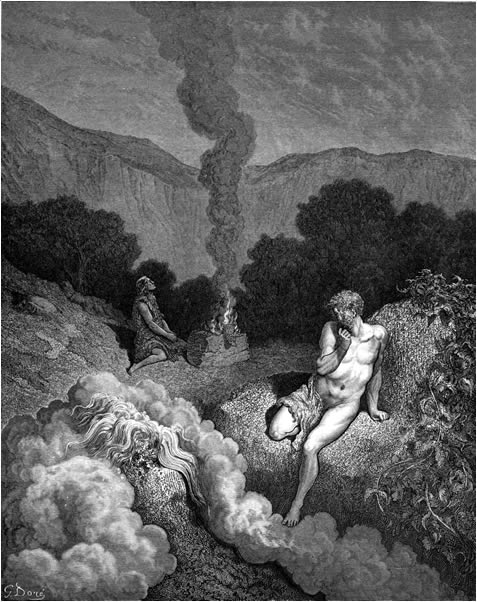
CAIN'S GREATER
GIFT BY FAITH
In this chapter, the Hall of the Faithful, we are presented with men and women who shined brightly for God in their dark world. People who against all odds were able to overcome adversity and trial, people who were able to bear a glowing testimony for the Lord when others floundered in sin.
Note that Adam and Eve are passed over in this portion regarding creation because they had seen God, fellowshipped with Him, and talked with Him. Their children were the first to exercise faith in the unseen God but also the first to commit murder.
I like the way the Amplified Version phrases Abel's "motivation" [Prompted, actuated] by faith Abel brought God a better and more acceptable sacrifice
Ray Stedman makes an interesting point that "Though the writer has, throughout the epistle, held up Abraham as our model of faith and perseverance (ED: AND PAUL ALSO USES ABRAHAM'S EXAMPLE IN Ro 4:1-22+), Heb 11:4–7 indicate that true faith was practiced from the very beginning, even before the Flood." (The Nature of Faith)
By faith (pistis) Abel offered (prosphero) to God a better (polus - a greater) sacrifice (thusia) than Cain, through (dia) which he obtained the testimony (martureo) that he was righteous (dikaios), God testifying (martureo - present tense) about his gifts (doron), and through faith (pistis), though (dia) he is dead (apothnesko), he still speaks (laleo) - By faith (pistis - trust, conviction) indicates Abel was actuated or prompted by his trust in what God had instructed regarding the proper way to offer a sacrifice which He would accept. Abel's offering was motivated by faith, by His trust in God. "To do a thing “by faith,” you must do it in response to and according to a word from God." (R K Hughes) Although not explicitly stated in this text, the clear implication is that Cain's offering lacked faith and "without faith it is impossible to please" God (Heb 11:6). Abel’s lamb was better than Cain’s corn because faith was under it. Faith is the golden weight that gives value to every offering. This passage also teaches us that genuine faith is not just believing abstractly (of course that is necessary) but also includes acting on that belief, in this case obeying God. Abel offered in faith of a Redeemer to come (implying he understood Ge 3:15+), and in dependence upon that vicarious (done in place of or instead of someone else - aka "substitutionary") atonement (although his understanding was not as clear as ours). One might say Cain’s offering was but a compliment while Abel’s was more like a confession. Abel’s worship was God-centered, while Cain’s was self-centered. One approached through substitution, but the other through self-sufficiency. Faith separates acceptable worship from dead religion (cf Jn 4:23-24+)
🙏 THOUGHT - When we bring an offering to God, He looks at the "size" of our heart, not the size of our offering. (1Sa 16:7+) It is not the amount that we give, but the motive from which we give that is the true measure of our offering. Mark it down -- God evaluates the heart attitude, not the portion. The smallest gift given with pure devotion surpasses the largest gift given for self-display. He values the heart, not the heap! The heart behind your gift outweighs the gift in your hand.
Abel’s faith was an expression
of his conscious need for atonement.
-- R Kent Hughes
Beloved, don't let the story of the sacrifices of two brothers confuse you -- There are two elements that are vital - the type of offering and the "type" of offerer (so to speak). The type of offering was important because apparently God had revealed to Adam and his descendants that the only way to approach God was through a blood sacrifice. Here in Hebrews 11:4 we read that Abel offered by faith. In other words he believed the Lord's word regarding what was to be sacrificed and he followed through by giving a blood sacrifice. Faith that is genuine is faith that believes God and obeys God. Cain however did not offer what God had prescribed but came his own way. One was righteous (cp Ro 4:2, 3+) and the other unrighteous (cp Ro 4:4, 5+). The difference? Faith - It makes all the difference in this world (2Co 5:7+) and in the world to come!
Abel was JUSTIFIED BY FAITH for in this verse because God's Word declares him righteous (dikaios) and that righteousness was imputed or credited to his account just as in the NT… on the basis of his FAITH, not on the basis of his offering. His "better offering" was the work of faith, his bringing forth of "fruit" in keeping with repentance. Faith alone saved Abel but his saving faith was not alone but was an obedient faith that resulted in a "better sacrifice".
Faith embraces what God has revealed and responds in trust. Religion substitutes human invention for divine instruction. Faith produces living worship; religion produces lifeless ritual. Anything not rooted in faith is unacceptable to God, no matter how sincere or sacrificial it appears. Faith is the lifeblood of worship. Without it, the altar is but dust and the offering but refuse. With faith, even the least gift is precious in God’s sight.
Kenneth Wuest - It is significant that the writer chooses Abel as the first example of what faith can do for the one who exercises it. In the case of Abel, it was the matter of his personal salvation which was in view, as was also the case with the recipients of the letter to the Hebrews. If Abel’s appropriation of salvation was by means of faith, that would mean that if the first-century Jew wanted to be saved, he would have to exercise faith. By faith Abel offered to God a more excellent sacrifice than Cain. That which made Abel’s sacrifice more excellent than Cain’s, was not its quantity but its quality. Its quality inhered in the fact that it was the offering which God had prescribed, a blood offering. Abel had learned this from his father Adam. The word “which” could refer grammatically either to the sacrifice or the faith. The context decides. God testified of his gifts, namely, the sacrifice. All of which means that it was by means of the blood sacrifice that he obtained witness that he was righteous. Though Abel is dead, yet “by it” (the sacrifice) he yet speaks, telling to all that live after, that salvation is through sacrificial blood. In Heb 12:24, the statement is made that Jesus’ blood speaks better things than the blood of Abel. It is not Abel’s own blood which is in view here, but the blood of the offering Abel presented to God. This is shown by the historical background and analysis of the epistle, the argument of which is that “The New Testament in Jesus’ blood is superior to and takes the place of the First Testament in animal blood.” The blood of Abel’s offering spoke symbolically of a Sacrifice for sin that God would one day offer. But Jesus’ blood is the actual sacrifice, and speaks of the salvation which He procured for us on the Cross. It was the blood offering which Abel presented to God through which he was declared righteous. This is in accord with Pauline doctrine where the great apostle speaks of “being now justified by his blood” (Ro 5:9). Cain followed his reason and ignored revelation. He argued that his own good works as manifested by the produce which he had grown, would please God rather than a blood sacrifice. Abel accepted revelation instead, and had faith in the divine acceptability of the offering prescribed by God. His own reason may have argued otherwise, but his faith in what God had said, won the day. Here was the example which this first-century Jew should follow in his appropriation of the salvation which Messiah procured for him on the Cross, not the way of Cain, which he had been taught by the first-century religious leaders in Israel. (Hebrews Commentary)
What all of us do outside of worship
is what is truly in our heart.
David Jeremiah - from the beginning of time up to this present day there have never been more than two ways to approach God: Cain’s way and Abel’s way....Faith came to Abel, somehow, by hearing the Word of God. We know that faith comes by hearing the Word (Romans 10:17). Somewhere along the way in his life Abel heard and received the Word of God—God’s instruction about how to bring a sacrifice of praise to Him. And Abel determined he would obey that Word. Cain, no doubt, heard the same message. But the difference between the two brothers was this: Abel obeyed that Word and Cain decided to go his own way.....Why would God receive a “disgusting” sacrifice from Abel and reject a more “respectable” sacrifice from Cain? Because of the horrible nature of sin itself. The violence of man against God can only be atoned for by the violence of the shedding of blood....What all of us do outside of worship is what is truly in our heart. As soon as “church” was over that day, the real Cain came to the surface....Cain was, in essence, the founder of human religion. Religion is man’s efforts to reach up to God, whereas Christianity is God’s action in reaching down to man.....Human reason cannot reverse divine revelation. The issue is not what we have done for God; it’s whether we have accepted what God has done for us(BORROW Heroes of the Faith: Hebrews 11 page 22)
Ray Stedman on a better (greater) sacrifice - If Abel’s sacrifice was more important than Cain’s, what made it so? The reason suggested is that it came from a heart made righteous by faith! If Abraham’s faith was “credited to him as righteousness” (Rom 4:9), so also was Abel’s. Bruce comments on this, “Sacrifice is acceptable to God not for its material content, but in so far as it is the outward expression of a devoted and obedient heart” (1964:283). (The Nature of Faith)
Abel (Dictionary Article on Abel - includes pictures) - (Ge 4:2, 4, 8, 9, 25, Mt 23:35, Lk 11:51, He 11:4, He 12:24) His name in Hebrew is said to mean "breath, vapor, meadow", the first two meanings suggesting the shortening of his life (cp Jas 4:14, Ps 37:2, 90:5 92:7, Isa 40:6, 7, 8, 1Pe 1:24)
Jesus Himself designates Abel as "righteous Abel" (Mt 23:35) leaving no doubt that Abel was a man of faith in the Coming Messiah. What Abel understood of the Messiah and the Cross at this time in Genesis is not clear, but it is clear that he believed what God had revealed to him about the Messiah, for there is salvation ("righteous Abel") in no other Name under heaven except Yeshua, Jesus (cp Acts 4:12)
Spurgeon - (Abel) The first of the long line of martyrs triumphed by faith. If you are to be strong to bear witness for God, you must be made strong by the same power that wrought so effectually in Abel. If, like his, your life is to be a speaking life—a life that will speak even out of the grave—its voice must be the voice of faith. Faith works differently in each one of these mighty men. It is the same living principle in all of them; but they are different men, and their faith is seen in very different circumstances. Faith is able to work in all manner of ways; it is good at everything. There is nothing that God calls us to do but faith can enable us to accomplish it. In Abel’s case, we see that faith is grand at worshiping. Faith brings a right sacrifice, brings it in the right way, and speaks even after she is dead, for the blood of Abel cried out of the ground. Oh, that all of us might so live that, even out of our graves, there might come a voice speaking for God! Abel taught the need of approaching the Lord with sacrifice, the need of atonement by blood. He laid the lamb upon the altar and sealed his testimony with his own blood. Atonement is so precious a truth that to die for its defense is a worthy deed, and from the very first it is a doctrine that has secured its martyrs, who being dead yet speak.
Spurgeon in his sermon "Enoch" - Abel taught the need of approaching the Lord with sacrifice, the need of atonement by blood: he laid the lamb upon the altar, and sealed his testimony with his own blood. Atonement is so precious a truth that to die for its defence is a worthy deed, and from the very first it is a doctrine which has secured its martyrs, who being dead yet speak. Then Seth and Enos taught men the necessity of a distinct avowal of their faith in the Lord, and the need of assembling for his worship, for we read concerning the days of Enos and Seth, “Then began men to call upon the name of the Lord.” Those who worshipped through the atoning sacrifice separated themselves from the rest of men, assembled as a church in the name of the Lord, and worshipped, calling upon the name of Jehovah. The heart must first believe in the great sacrifice with Abel, and then the mouth must confess the same with Seth. Then came Enoch whose life went beyond the reception and confession of the atonement, for he set before men the great truth of communion with God; he displayed in his life the relation of the believer to the Most High, and showed how near the living God condescends to be to his own children. May our progress in knowledge be similar to the growth of the patriarchal teaching.
In the Old Testament there were two types of sacrifices, the first offered to deal with sin and the broken fellowship that resulted from the sin. The sacrificial blood was a picture of the bridging of the gap between the giver and God (although OT sacrifices for sin only covered over for a time, whereas Christ's sacrifice effectively and permanently removed all guilt of sin for those who believe in Him). The second type of OT sacrifice was presented to God as an act of worship, the presenter having had his sins covered over by the blood of the sin offering, which resulted in his hearts being full of thanksgiving and praise to God which was reflected in the offering. It is this second type of "sacrifice" for which Paul is commending the Philippians. The writer of Hebrews has a parallel passage writing that…
Through Him (Christ, our Great High Priest) then, let us continually offer up a sacrifice of praise to God, that is, the fruit of lips that give thanks to His Name. And do not neglect doing good and sharing (which is exactly what the saints at Philippi had done!); for with such sacrifices God is pleased. (Hebrews 13:15, 16+)
Note also that in the Old Testament sacrificial system, every sacrifice was to provide a fragrant aroma and be acceptable to God. Only if the individual offered it up with the correct heart attitude would it be pleasing to God. And so we read that after the flood and their arrival on dry land…
Then Noah built an altar to the LORD, and took of every clean animal and of every clean bird and offered burnt offerings on the altar and the LORD smelled the soothing aroma; and the LORD said to Himself, "I will never again curse the ground on account of man, for the intent of man's heart is evil from his youth; and I will never again destroy every living thing, as I have done." (Genesis 8:20-21) (cf Lev 1:9,13,17+).
In Exodus a parallel passage states "And you shall offer up in smoke the whole ram on the altar; it is a burnt offering to the LORD: it is a soothing aroma, an offering by fire to the LORD. (cf Ex 29:18).
Defender's Study Bible - We no longer sacrifice the blood of animals to cover our sins, for Christ has "offered one sacrifice for sins forever" (He 10:12+). Instead, we offer praises, the "calves of our lips" (Ps 50:23; Ho 14:2). These are not to be offered only once each week, in a so-called worship service, or praise service, but continually. "In every thing give thanks" (1Th 5:18+). (Henry Morris)
Many try to read into the Genesis account a hidden reason for God’s acceptance of Abel’s offering and rejection of Cain’s. Various explanations have been offered, but the writer is silent about everything except that God “spoke well” of Abel’s offering because it was “better” (pleiona - the comparative adjective of polus = many, much), “greater” “more important”.
If Abel’s sacrifice was more important than Cain’s, what made it so? The reason suggested is that it was offered up from a heart made righteous by faith. If Abraham’s faith was “credited to him as righteousness” (Ro 4:9), so too was Abel’s. So Abel performed a "righteous" work, an acceptable sacrifice pleasing to God in the manner that pleases God (Heb 11:6) - by faith.
Ge 4:7 indicates that when Cain learned that his offering was not pleasing to God (Heb 11:6) he became angry and rebellious, thus confirming the attitude of His heart toward the sovereign will of God. But even in Ge 4:7 God provided a "way of escape" so to speak. This reflects God's heart that no man perish but that all might come to repentance (cp 2Pe 3:9). Cain’s subsequent murder of his brother showed his hard hearted rejection of the opportunity God gave him to repent.
In short, Cain’s offering was rejected because his heart of pride and attitude of self-sufficiency. This explanation also fits well with the context of Hebrews where the writer repeatedly warns against possessing “an evil heart of unbelief.”
It is interesting to read ancient writer's like Josephus and Philo who suggest that Abel was "religious" while Cain was not, so that the former brought an offering of greater value. From what we have said Abel was not so much "religious" as he was "righteous". As we so commonly hear, religion saves no one for it makes no one acceptable to a God Whose eternal standard is perfection. Only a relationship by faith in the Son makes one acceptable and one's works acceptable to the Father!
K G Kuhn has this note in the TDNT…Matt. 23:35 and Jude 1:11 reflect the Jewish view when they contrast righteous Abel and wicked Cain. Heb. 11:4 finds faith in Abel (as distinct from Cain). Also in Heb. 11:4, on the basis of Ge 4:10, the blood of righteous Abel appeals to God for full redress in the consummated kingdom (cf. Rev 6:9, 10, 11). In Heb 12:24 Abel’s blood serves as a type for that of Jesus — the one demanding expiation, the other making it.
Genesis 4:4-10+ Abel, on his part also brought of the firstlings of his flock and of their fat portions. And the LORD had regard for Abel and for his offering; 5 but for Cain and for his offering He had no regard. So Cain became very angry and his countenance fell. 6 Then the LORD said to Cain, “Why are you angry? And why has your countenance fallen? 7 “If you do well, will not your countenance be lifted up? And if you do not do well, sin is crouching at the door; and its desire is for you, but you must master it.” 8 Cain told Abel his brother. And it came about when they were in the field, that Cain rose up against Abel his brother and killed him. 9 Then the LORD said to Cain, “Where is Abel your brother?” And he said, “I do not know. Am I my brother’s keeper?” 10 He said, “What have you done? The voice of your brother’s blood is crying to Me from the ground.
1 John 3:11-12+ (CAIN WAS NOT A CHILD OF GOD BUT OF THE DEVIL) For this is the message which you have heard from the beginning, that we should love one another; 12 not as Cain, who was of the evil one (CF Jn 8:44+) and slew his brother. And for what reason did he slay him? Because his deeds were evil, and his brother’s were righteous.
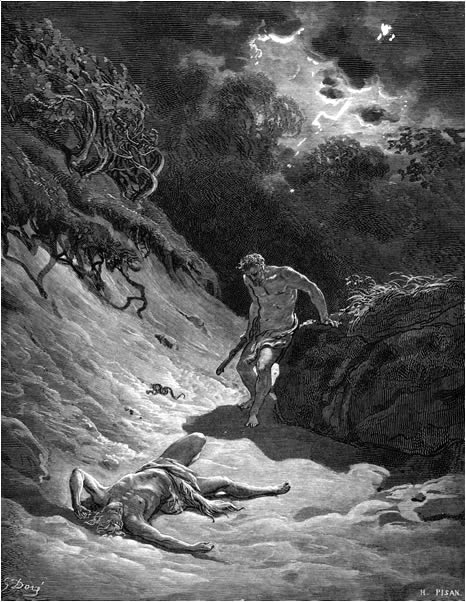
Abel - First Martyr of the Faith
Ray Stedman on Ge 4:10- It is often suggested that the blood of Abel cries out for the final vindication promised to all the saints (2 Thess 1:6–7), but the blood of Jesus speaks of proffered forgiveness. This seems a likely explanation of the continuing testimony of Abel. His faith in God was one of trust and loving acceptance of whatever God sent. He was willing to wait for ultimate vindication of injustice and mistreatment. His faith teaches us that we must often wait for God’s redress of injustice. We do so because we know God cannot ultimately fail to act.(The Nature of Faith)
RAISING CAIN - The phrase raising Cain is an American idiom first recorded in the early to mid-nineteenth century, but its origin traces back to the Bible. To raise Cain means to cause a lot of trouble, to create a great commotion, or to behave in an uncontrolled, disruptive way. The word Cain is capitalized in the expression because it refers to the Old Testament Bible character Cain, the firstborn son of Adam and Eve who killed his brother Abel. (What is the meaning of the phrase raising Cain?)
Thomas Schreiner - It seems that any act of obedience that pleases God (cf. Heb 11:8 below) flows from faith (cf. the discussion on Heb 3:12–4:11 as well). The wellspring of obedience is always an attitude of trust. It follows, then, that the fundamental sin of Cain was unbelief. His offering was not accepted because he didn’t trust in God. (See Commentary on Hebrews - Page 344)
James Burns writes about Gustave Dore's woodcut of Abel's murder by Cain…
The artist Dore has a striking picture dealing with that first revelation in Scripture of the fruits of anger—the story of Cain and Abel.
Abel, who was a keeper of sheep, brought as a sacrifice the firstlings of his flock, while Cain offered the fruit of the ground.
The artist introduces us to a gloomy valley, bounded by a bare stony wall of mountains, sprinkled with rough boulders, and darkened with shaggy wood. In this place the brothers offer their sacrifice. The oblation of the one was accepted, we are told, and that of the other rejected. The picture helps us vividly to imagine the scene.
The brothers have both set fire to the wood on the rough stone altar, but while the smoke from Abel's rises up in a straight column to the sky, the wind, whirling round a boulder, dashes the smoke of Cain's sacrifice downward, and scatters it in all directions. Cain turns toward his brother, who is kneeling devoutly, and lifting up his eyes to God in prayer.
Already murder is entering into his heart. "Cain was very wroth, and his countenance fell" (Genesis 4:5). In another moment wrath will have conquered him, swept him away in a paroxysm of ungovernable fury and wrought ruin and death upon his soul.
In another picture, entitled, "The Death of Abel," we see the offended brother lying dead upon the ground, while his brother gazes upon him with horror stricken and startled eyes. He has awakened from his passion to realize his sin, and as he does so a serpent is seen to wriggle away and to disappear (Ed note: Click the picture above and see if you can identify the "serpent". Interesting! cp the "serpent's character" in Jn 8:44). (From Encyclopedia of 15,000 Illustrations)
Than Cain (19x in 16v - Gen 4:1, 2, 3, 4, 5, 6, 8, 9, 13, 1516, 17, 24, 25; Heb 11:4; 1Jn 3:12; Jude 1:11). See Dictionary Articles on Cain
John writes…
For this is the message which you have heard from the beginning, that we should love one another; not as Cain, who was of the evil one and slew his brother. And for what reason did he slay him? Because his deeds were evil, and his brother's were righteous. (1Jn 3:11, 12)
Proverbs warns of walking the way of Cain noting that…
The sacrifice of the wicked is an abomination to the LORD, but the prayer of the upright is His delight. (Pr 15:8, cp Pr 21:27)
Titus gives an apt description of all who walk in the precarious (eternally speaking) path of Cain…
They profess (present tense = continually = Note carefully "Profession is not synonymous with Possession!"… of the Son… of life = 1Jn 5:12, 13) to know God, but by their deeds they deny Him, being detestable (bdekluktos = literally they emit a foul odor! Woe!) and disobedient (apeithes) = a - without + peitho - persuade = literally one who refuses to be persuaded or is unpersuadable = one who willfully disregards authority) and worthless (adokimos = a - without + dokimos - tested and found acceptable = they are rejected after examination because they fail to meet God's standard of perfect righteousness) for any good deed (study) -. (Titus 1:16+)
Related Resources:
- What is the meaning of the phrase raising Cain?
- Who was Cain in the Bible?
- What was the mark that God put on Cain (Genesis 4:15)?
- Why did God accept Abel's offering but reject Cain's offering? Why did Cain then kill Abel?
- Of whom was Cain afraid after he killed Abel?
- Why wasn't Cain's punishment death (Genesis 4:14)?
- What/where was the land of Nod in the Bible?
Sacrifice (2378) (thusia from thuo = to sacrifice or kill a sacrificial victim) means that which is offered as a sacrifice. Webster's defines it as act of offering to a deity something precious! Here thusia is used metaphorically to describe their volitional offering of their words.
Thusia - 28x in the NT - Matt. 9:13; 12:7; Mk. 12:33; Lk. 2:24; 13:1; Acts 7:41f; Rom. 12:1; 1 Co. 10:18; Eph. 5:2; Phil. 2:17; 4:18; He 5:1; 7:27; 8:3; 9:9, 23, 26; 10:1, 5, 8, 11, 12, 26; 11:4; 13:15, 16; 1Pe 2:5
Sacrifice - 19x in 18v - Heb 5:1, 3; 7:27; 8:3; 9:9, 23, 26; 10:1, 3, 5, 6, 8 (2x), He 10:11, 12, 26; 11:4; 13:15, 16
Thusia was used for both pagan animal sacrifices. Here are some of the uses of thusia in the Septuagint = Ge 4:3, 5; 31:54; 46:1; Ex 10:25; 12:27; 18:12; 24:5; 29:34, 41f; 30:9; 32:6; Lev 1:9, 13, 17; 2:1, 2, 3, 4, 5, 6, 7, 8, 9, 10, 11, 13, 14, 15; 3:1, 3, 6, 9; 4:10, 26, 31, 35; 5:13; 6:14, 15, 20, 21, 23; 7:9-17, 15, 16, 17, 20, 21, 29, 32, 34, 37; 9:4, 17, 18; 10:12, 14; 14:10, 20f, 31; 17:5, 7, 8; 19:5; 21:6, 21; 22:21, 29; 23:13, 16, 18f, 37; 26:31)
J Vernon McGee - Abel had a revelation from God. So did Cain. They were both in the same family. But Cain ignored it, and he brought what he wanted to bring, the fruit of the ground—that which he had produced. In other words, here is the first man who brought his works to God. A lot of people are still coming to God the same way—they come by works. (See Thru the Bible) (ED: I AGREE WITH HIS BASIC BUT THE MAIN REASON THE SACRIFICE WAS UNACCEPTABLE IS BECAUSE IT WAS NOT "BY FAITH"! AND ISN'T THAT WHAT MEN DO WHO DO NOT COME BY FAITH? THEY KNOW THEY HAVE TO GIVE SOMETHING SO THEY GIVE THEIR OWN WORKS.)
R Kent Hughes agrees that Cain "came his own way—“the way of Cain.” By refusing to bring the prescribed offering, and instead presenting his garden produce, he was saying that one’s own good works and character is enough (See Hebrews: An Anchor for the Soul)
THROUGH WHICH HE OBTAINED THE TESTIMONY THAT HE WAS RIGHTEOUS GOD TESTIFYING ABOUT HIS GIFTS AND THROUGH [IT], THOUGH HE IS DEAD, HE STILL SPEAKS: einai (PAN) dikaios marturountos (PAPMSG) epi tois dorois autou tou theou marturountos (PAPMSG) epi tois dorois autou tou theou kai di autes apothanon eti lalei (3SPAI):
- He obtained the testimony - Leviticus 9:24; 1Kings 18:38; Matthew 23:35; Luke 11:51
- And through it - He 12:1,24; Genesis 4:10; Matthew 23:35
- Hebrews 11 Resources - Multiple Sermons and Commentaries
Related Passages:
Genesis 4:4-5+ Abel, on his part also brought of the firstlings of his flock and of their fat portions. And the LORD had regard (cf "GOD TESTIFYING ABOUT HIS GIFTS") for Abel and for his offering (Lxx = doron); 5 but for Cain and for his offering He had no regard. So Cain became very angry and his countenance fell.
Genesis 15:6+ Then he believed in the LORD; and He reckoned it to him as righteousness.
Romans 4:3-8+ For what does the Scripture say? “ABRAHAM BELIEVED GOD, AND IT WAS CREDITED TO HIM AS RIGHTEOUSNESS.” 4 Now to the one who works, his wage is not credited as a favor, but as what is due. 5 But to the one who does not work, but believes in Him who justifies the ungodly, his faith is credited as righteousness, 6 just as David also speaks of the blessing on the man to whom God credits righteousness apart from works: 7 “BLESSED ARE THOSE WHOSE LAWLESS DEEDS HAVE BEEN FORGIVEN, AND WHOSE SINS HAVE BEEN COVERED. 8 “BLESSED IS THE MAN WHOSE SIN THE LORD WILL NOT TAKE INTO ACCOUNT.”
Matthew 23:35+ (GOD GIVING TESTIMONY THAT ABEL WAS RIGHTEOUS) so that upon you may fall the guilt of all the righteous blood shed on earth, from the blood of righteous Abel to the blood of Zechariah, the son of Berechiah, whom you murdered between the temple and the altar.
A RIGHTEOUS DEAD MAN
STILL SPEAKS
Through (dia) which - Through (dia) which could point to either antecedent, faith or what was offered, but in the context of this "faith chapter," most likely points to faith. Even if one takes the pronoun which as referring to the offering, the key element is faith, for the outward sacrifice was evidence of Abel's inward faith. It was not the sacrifice that saved Abel, but the faith that offered it. In sum, faith as the means by which righteousness was witnessed (cf. Ro 3:22). Abel’s sacrifice was the visible fruit, while faith was the invisible root.
Faith built the altar, love laid the sacrifice,
and obedience kindled the flame.
-- Anonymous
He obtained the testimony (martureo) that he (not his offering) was (present tense) righteous (dikaios), God testifying (martureo) about his gifts (doron), and through faith (pistis), though (dia) he is dead (apothnesko), he still speaks (laleo) - Because of Abel's faith, evidenced in obedience to God’s requirement for sacrifice, he was accounted righteous by God in the same way as was Abraham (Ro 4:3-8+). Christ Himself referred to the righteousness of Abel (Mt 23:35+). Cain’s sacrifice on the other hand was evidence that he was just going through the motions of ritual in a disobedient manner, not evidencing an authentic saving faith. Without faith no one can receive imputed righteousness (Ge 15:6+). Righteousness is not what we achieve, but what God declares and then produces in the lives of those who believe. To reiterate, Abel’s offering was accepted because it was presented by faith, which God counted as righteousness. Righteousness comes not from the sacrifice but from the heart in which faith dwells. God first looks at the heart, then at the hand. To say it another way, Abel was not righteous because of his offering, but his offering was righteous because it flowed from faith. God first accepted his person, then his offering. Abel’s righteousness did not come from the offering he brought but from the faith by which he brought it.
John MacArthur - Abel’s faith led to three progressive things: true sacrifice, true righteousness, and true witness. Because he believed, he offered a better sacrifice. Because he offered a better sacrifice, he obtained righteousness. Because he obtained righteousness, he is for all the ages a living voice saying, “Righteousness is by faith.” (See Matthew Commentary)
God testifying (martureo) about his gifts (doron) - This is an amazing passage for it says it was God Himself Who bore testimony to Abel's worship! How did God testify? The text in Genesis 4:4+ does not say, but one reasonable consideration is that fire came down and consumed the offering (cf Lev 9:23-24, 1Ki 18:36-38, Jdg 6:21, Jdg 13:19-20, 1Chr 21:26, 2Ch 7:1) (Josephus 1.2.1 held this view). Yes God testified about his gifts but ultimately the testimony was about Abel’s faith which made his gifts acceptable to God. The offering was accepted because the offererer was "acceptable" (his faith). God is much more interested in the state of the giver than the gift! God’s testimony was His way of saying, "This man is right with Me!" God's testimony was like His "Amen" to Abel's faith.
God’s testimony (martureo) to Abel’s gifts likely occurred in both the visible realm (e.g., fire, a divine sign of acceptance) and the verbal realm (the inspired record we are reading that testifies of His approval). Both affirm that God honors faith, not form.
🙏 THOUGHT - If Abel's gift was indeed consumed by fire, in a sense it foreshadows the Cross where Christ’s sacrifice was spiritually consumed by the “fire” of God’s wrath against sin (Isa 53:10; Heb 9:14). Then 40 days later the fire of Pentecost (Acts 2:3) descended on believers, this time not consuming, but indwelling them, which seems to show that the once-for-all sacrifice had been accepted. Sadly, the fire of God's judgment will fall on all those who reject Christ, for "Our God is a consuming fire." (Heb 12:29)! And my greatest fear is that many who think they have a "fire insurance policy" simply by making a profession that they believe in Jesus, will find out that policy is null and void because they never genuinely believed in Jesus!
R Kent Hughes - When there is authentic faith, which in turn authentically worships (obediently bringing to God what he asks for in joyful attitude), that faith will produce practical, living, authentic righteousness. James says essentially the same thing when he argues that faith and works are inseparable (cf. James 2:17, 18+). True, living faith produces fruit—living action. (See Hebrews: An Anchor for the Soul)
Paul's explanation in Romans 4 is apropos to Cain and Abel…
Now to the one who works (Cain), his (Cain's) wage is not reckoned as a favor, but as what is due. 5 But to the one (Abel) who does not work, but believes in Him who justifies the ungodly, his (Abel's) faith is reckoned as righteousness. (Ro 4:4-5+)
So Cain was saying in essence to God… in my own strength & effort, I can produce a righteousness which will obtain Your approval… WRONG! In our flesh their DWELLETH NO GOOD THING! (Ro 7:18+) We all need to be mindful of this effect of the fall… we must continue to live this Christ life just as we were born into it… BY FAITH!!! (Col 2:6+) Also see Hebrews 12:24+, in which still another reference is made to the nature of Abel's sacrifice, explaining Jesus' blood is better that the blood of Abel. Abel’s blood “spoke” from the ground (Ge 4:10+), crying out for justice and vengeance because of his murder. Jesus’ blood “speaks better," not of vengeance, but of mercy and forgiveness. His blood inaugurates the new covenant and secures reconciliation rather than condemnation. Abel’s blood called for punishment; Christ’s pleads for pardon. In sum, the point is not that Jesus’ blood is “better” in quality of offering alone, but that it speaks a better message, a message of grace instead of judgment, reconciliation instead of retribution.
The "Fruit" of Allegorical Interpretation - Like many if not most early Christian writers (see below), Augustine treats Cain as symbolic of the envious "Jews by whom Christ was slain,” while Christ himself, “the shepherd of the flock of men, [is] prefigured in Abel, the shepherd of the flock of sheep” (De civ. Dei 15.7; cf. 15.18)" For Augustine, this typology (BEWARE OF TYPOLOGY!) ties into his larger theme of the two cities: (1) The city of man (Cain) — founded on pride, envy, and self-love and (2) The city of God (Abel/Christ) — founded on humility, love, and divine grace. That sounds nice but it is pushing the literal reading of the text far beyond what the plain sense clearly states!
🙏 THOUGHT - One takeaway is that every Acts 17:11+ Berean Bible student should assiduously avoid ALLEGORICAL INTERPRETATION, which sadly in rampant in commentaries (both old and new) on the Book of the Revelation!
Tertullian (Adversus Judaeos 10) and Ambrose both treat Abel as a type of Christ and Cain as a type of unbelieving Israel. Chrysostom and Origen saw in Abel’s righteous sacrifice and death a foreshadowing of Christ’s passion and in Cain the spirit of those who “envied righteousness.” These are examples of wrongly dividing the Word of Truth (2Ti 2:15) and it is gibberish such as this which may underlie much of the justification for so-called "replacement" theology wherein the church is tragically and wrongly interpreted as having replaced the literal nation of Israel (and the literal Jewish race) and now stands as the heir of God's OT promises to Israel. (If you hold that view, read God's evaluation of "replacement" theology in Jer 31:35, 36, 37+)
Bishop Hall wrote that "Death did not first strike Adam, the first sinful man; nor Cain, the first murderer: but Abel, the innocent and righteous."
Spurgeon - He spoke by faith when he lived. Faith makes him speak now that he is dead. What wonders faith can work. The first saint who entered heaven entered there, it is certain, by faith. It was faith that enabled him to present an acceptable sacrifice, and it was faith that presented him to heaven. If the first who entered heaven entered there by faith, rest assured that will be true to the last, and none will enter there but those who believe.
John MacArthur - James Moffatt wrote, "Death is never the last word in the life of a righteous man. When a man leaves this world, be he righteous or unrighteous, he leaves something in the world. He may leave something that will grow and spread like a cancer or a poison, or he may leave something like the fragrance of perfume or a blossom of beauty that permeates the atmosphere with blessing." Man leaves this world either a Paul or a Nero. Dead men do tell tales. They are not silent, but still speak to those who will listen. From many thousands of years ago, Abel speaks to twentieth-century man. This man who lived when the earth was new, who was of the second generation of mankind, has something to teach modern, sophisticated, technological man. He lived in a far distant age, in a far different culture, with far less light from God than we have. But what he has to tell us is more relevant than anything we are likely to read in our current newspapers or magazines.(See Matthew Commentary)
Through faith (pistis) though (dia) he is dead (apothnesko), he still speaks (laleo present tense even to our day) - There is a popular show called the "Walking Dead" but it has a spin-off called the "Talking Dead." Abel is a "Talking Dead" man who is eternally alive! In simple terms, Abel’s physical death did not silence the voice of his faith or his testimony. There is a parallel phrase in Ge 4:10+ God declaring to Cain "The voice of your brother’s blood is crying to Me from the ground." Through faith (pistis) indicates that the Abel’s faith is the means or instrument through which his continuing testimony (“he still speaks”) operates. This means that it is not merely Abel’s blood, deeds, or memory that speaks, but it is the faith behind his offering that continues to bear witness. So the idea is “By means of his faith, even though he died, he still speaks.” Faith, in Scripture, is not passive belief, but is an active channel through which God’s approval, testimony, and continuing witness flow. And so in the first part of verse 4 we see Abel’s faith made his offering acceptable and now in the second clause of verse 4 we see that same faith now causes him to “still speak”. Some "voices" of folks who have died endured purely by memory alone, but in Abel's case his voice endures by the enduring agency of faith - Abel's faith still speaks! And what does Abel's "voice" (faith) say? Abel’s faith speaks to all ages that there is no way of coming to God but by faith in a sacrificed Redeemer. His voice of faith will never be silenced (Speaks is in the present tense - continually) and so far has not become faint even after speaking for about 5000 years! O to live a righteous life by faith today, so that our faith lives on and on after we pass on.
Faith is what causes his voice to still be heard;
faith is the means God uses to keep his testimony alive.
Charles Swindoll - This first example demonstrates that faith—taking God at His word—involves not just trusting God but also responding rightly to that belief. It also illustrates the painful truth that faithful obedience will often result in persecution—sometimes death. (See Insights on Hebrews - Page 170)
Cain spoke no word the ear could hear,
Yet his faith still echoes, strong and clear.
His life outlived his fleeting breath—
Faith conquers silence, especially in death.
Grant Osborne - Suffering is seen here as a mechanism by which faith still speaks of righteousness to a lost world. (See Hebrews Verse by Verse - Page cii)
Simon Kistemaker - The author places Abel before the readers as a righteous man who lived by faith (Heb. 10:38). Abel is at the top of the list of the Old Testament heroes of faith. Even after his death, his example encourages people to seek the Lord, because he rewards those who earnestly seek him. Abel, then, is the father of believers of the time before Abraham. His faith in God still speaks as a constant witness. (Borrow Exposition of the Epistle to the Hebrews page 316)
John MacArthur makes a very interesting comment about Cain and about Abel - Cain believed in God, else he would not have brought Him a sacrifice. He acknowledged a supreme being and even that he owed Him some sort of worship. He recognized God, but he did not obey God. He believed in God, but he did not believe God. He thought he could approach God in whatever way he wanted, and expected Him to be impressed and satisfied. In so doing, Cain became the father of all false religion. False religion is trying to come to God by any other way than the way God has prescribed... He (ABEL) still speaks. He says three things: man comes to God by faith, not works; man must accept and obey God’s revelation above his own reason and self-will; and sin is severely punished. This is Abel’s timeless three-point sermon to the world, which he has been preaching for thousands of years to those who will hear. It could be titled, “The Righteous Shall Live by Faith.” (ED: AN ILLUSTRATION OF THE TRUTH OF Heb 10:38+) (See Matthew Commentary)
Cumming - He, being dead, yet speaketh. The sun sets behind the western hills, but the trail of light he leaves behind him guides the pilgrim to his distant home. The tree falls in the forest; but in the lapse of ages it is turned into coal, and our fires burn now the brighter because it grew and fell. The coral insect died, but the reef it raised breaks the surge on the shores of great continents, or has formed an isle in the bosom of the ocean to wave now with harvests for the good of man, and to be a gem hereafter for the diadem of the great Redeemer. We live, and we die; but the good or evil that we do lives after us, and “is not buried with our bones.”
ILLUSTRATION OF ABEL "SPEAKING" - There is great power in example. St. Francis once called to one of his young monks, “Let’s go down to the town to preach.” The novice, delighted at being singled out to be the companion of Francis, quickly obeyed. They passed through the principal streets, turned down many of the byways and alleys, made their way out to some of the suburbs, and at length returned by a winding route to the monastery gate. As they approached it, the younger man reminded Francis of his original intention. “You have forgotten, Father,” he said, “that we went down to the town to preach!” “My son,” Francis replied, “we have preached. We were preaching while we were walking. We have been seen by many; our behaviour has been closely watched; it was thus that we preached our morning sermon. It is of no use, my son, to walk anywhere to preach unless we preach everywhere as we walk!” (BORROW F. W. Boreham's The Crystal Pointers page 19) This could be genuinely said of Abel. Though none of his words have been preserved, he has been eloquently preaching for thousands and thousands of years about authentic faith.
COMMENT - While I like this story, we walk the talk, so that we can talk the walk! That is, our walk should stimulate curiosity in Christ (1Pe 3:14, 15+, Col 4:5,6+) This brings to mind a convicting song by Steve Green which should be every saint's earnest plea to God to "Find Us Faithful."
D L Moody - BUT there is one thing you cannot bury with a good man; his influence still lives. They have not buried Daniel yet; his influence is as great to-day as ever it was. Do you tell me that Joseph is dead? His influence still lives and will continue to live on and on. You may bury the frail tenement of clay that a good man lives in, but you cannot get rid of his influence and example. Paul was never more powerful than he is to-day.
Emerson wrote, "The best effect of fine persons is felt after we have left their presence." What effect has your presence left on the lives of others?
Ian Paisley - Righteous Abel (A Text A Day Keeps the Devil Away)
"By faith Abel offered unto God a more excellent sacrifice than Cain, by which be obtained witness that be was righteous, God testifying of his gifts: and by it he being dead yet speaketh." Hebrews 11:4
One: Abel's Worship
"offered a more excellent sacrifice than Cain"
Cain claimed to bow to the same God as Abel but Cain didn't worship, he blasphemed.
The distinguishing marks of Cain's offering are threefold.
I. Godless
God had no hand in Cain's offering.
II. Graceless
It was the fruit of the accursed ground.
III. Lifeless
The blood is the life. Cain's offering was bloodless therefore it was lifeless.
Two: Abel's Worthiness
"that he was righteous"
Abel was not worthy in and of himself. By faith and by faith alone, in Christ alone, he believed. The text starts with that. By faith. (See Romans 3:22.)
Three: Abel's Witness
"He obtained witness, God testifying of his deeds"
Abel built his altar at the gate of Eden where the road was blocked by the Cherubims with flaming sword.
What happened? When Abel offered his sacrifice God touched the sacrifice with fire and then testified that He had accepted Abel's offering and thus his person. (Compare with Leviticus 9:24 and 1 Kings 18:38.)
So it happens today, when a sinner puts his faith in the Blood of Christ, God's fire, the Holy Ghost, touches the heart.
Allegiant Abel By Dr. Melvin Worthington
SCRIPTURE: Genesis 4:1–8; Hebrews 11:4
INTRODUCTION: Abel serves as a model for us to imitate. He believed God and approached Him in the right manner and with the right motive. We note the following truths regarding Abel:
1. The Family of Abel (Gen. 4:1–2). We learn of his brother, his birth, and his business.
2. The Faith of Abel (Gen. 4:4; Heb. 11:4). Abel’s faith is demonstrated by his offering, his obedience, and his obeisance. He worshiped God’s way.
3. The Favor of Abel (Gen. 4:4; Heb. 11:4). God’s favor was extended to Abel as He respected and received his offering.
4. The Fate of Abel (Gen. 4:5–8; Heb. 11:4). In these passages we read of Abel’s menace, Abel’s murder, Abel’s martyrdom, and Abel’s memorial.
CONCLUSION: Abel is a perpetual reminder that God requires that we approach, address and give adoration to Him in the required way.
Hebrews 11:4; Genesis 4:1-15
By faith Abel offered God a better sacrifice than Cain did . . . God spoke well of his offerings. - Hebrews 11:4
TODAY IN THE WORD
A. W. Tozer describes the impact of the Fall on worship in a poetic and poignant way: “Man was made to worship God. God gave to man a harp and said, 'Here above all the creatures that I have made and created I have given you the largest harp. I put more strings on your instrument and I have given you a wider range than I have given to any other creature. You can worship Me in a manner that no other creature can.’ And when he sinned, man took that instrument and threw it down in the mud and there it was lain for centuries, rusted, broken, unstrung.”
When we consider the purpose for which we are created–to join in the eternal worship of the triune God–Genesis 4 is painful to read. This account can be hard to understand. It seems as if Abel and Cain brought similar offerings to the Lord and that the Lord accepted one offering and rejected the other, for apparently no good reason. In fact, people sometimes look toward this passage to claim that God is capricious. But a closer look at the text reveals the opposite.
First, notice that Genesis 4:3 tells us that Cain brought “some of the fruits of the soil” to the Lord. We have no indication what the quality of this produce was; we certainly have no hint that it was the best of the harvest. Now, notice that verse 4 tells us that Abel brought the “fat portions from some of the firstborn of his flock.” The fat portions were the best pieces of meat. Additionally, the firstborn always indicated something prized. In other words, Abel gave the best he had, and Cain offered whatever he was willing to spare.
TODAY ALONG THE WAY
Notice that the Fall didn’t destroy worship; instead, it was now possible for worship to become horribly misdirected. But God’s favor can never be earned by anything we offer to Him. Instead, true worship helps us cleanse our imaginations and focus our minds on God’s majesty and beauty.
Hebrews 11:4–16
Yesterday we mentioned our legacy from past people of faith who testify in support of our common hope. Today we begin to explore the catalog of witnesses in Hebrews 11, what is commonly referred to as the Hall of Faith. This chapter includes some of the most widely known heroes of the Old Testament, but the author of Hebrews began the list with two comparatively unheralded names from the past.
The first was Abel, whose entire life was chronicled in the span of a mere seven verses (Gen. 4:2–8). The reason God found Abel’s sacrifice to be favorable has been the subject of much speculation, but the core reason is identified beyond doubt in this passage: Abel had faith. He believed in something he could not see in a way that Cain did not. And, as verse 4 alludes, the blood of Abel cried out to God even after it was spilled (Gen. 4:10). He was murdered, but a new home awaited him.
Enoch’s time on earth was also recorded briefly, as he was mentioned only
in the genealogy from Adam to Noah (Gen. 5:18–24). We know even less of Enoch, but the Bible does say that he walked faithfully and that God “took him away” in mystery. It’s interesting that Hebrews, which states that people are destined to die once (9:27), mentions Enoch for whom no record of death is found. It is fitting, since the author of Hebrews wanted to remind his audience that eternal life existed beyond this fallen world.
The faith of Noah, Abraham, and Sarah needs little review. The names alone elicit strong emotions in the hearts of believers who have studied the miracle of Noah’s rescue from both flood waters and cultural ridicule and of Abraham and Sarah’s amazing story of childbirth at an impossible age. Their faith will never be forgotten. What we often fail to remember is that they all relied on faith to the very end of their lives on earth. The phrase stands out like a neon sign: “They did not receive the things promised” (v. 13).
Apply the Word
It’s humbling to realize that the most revered people in the history of our faith felt like strangers on this planet. They looked forward to another home. To follow their examples, we cannot tie up our emotional attachments to the things of earth. Our possessions, our work, our leisure activities, and even our health are all ultimately temporary. God has prepared a city in a heavenly country for us—anchor your heart in the world to come.
Hebrews 11:4-6; Genesis 4:1-5; 5:18-24
Without faith it is impossible to please God. - Hebrews 11:6
TODAY IN THE WORD
When veteran FBI agent Robert Hanssen was arrested earlier this year and charged with spying for Russia, many people who thought they knew Hanssen expressed their surprise. One neighbor said about the accused spy and his family, “They go to church every Sunday--if that means anything--loading all six kids into the van.”
This person’s telling comment reminds us that the way we worship and the way we walk, or live our lives, needs to be consistent with what we say we believe. The author of Hebrews pointed to Abel and Enoch as worthy examples of what it means to worship and to walk by faith.
Most people remember Abel as part of a famous brother pair, and as the first murder victim in history at the hands of his brother Cain. But it was Abel’s act of worship, bringing a sacrifice to the Lord, that earned him God’s favor and a place among the Bible’s faith heroes.
It’s interesting that the Scripture does not say exactly why Abel’s sacrifice pleased God, except that he obviously offered it in the right spirit (Gen. 4:4-5). It could have been more costly than Cain’s offering, since Abel’s required sacrificing some of his sheep.
Whatever the reason, Abel understood that he needed to approach God in humility and faith to secure His approval. Abel’s offering, and the heart attitude it revealed, marked him out as a righteous person. God was so pleased with Abel that He made Eve’s second son an example of faith for every generation by including him in this list of godly examples in Hebrews.
Enoch is the classic illustration of what it means to walk by faith. In the Bible, “walk” is a synonym for our daily life. Enoch’s life was so consumed by his relationship with God that he simply disappeared one day (Gen. 5:24). The Scripture suggests that God enjoyed fellowship with this amazing man so much that He didn’t allow Enoch to experience death, which in the Old Testament always meant separation from God.
TODAY ALONG THE WAY
We can’t study the lives of Abel and Enoch without examining the quality of our own worship and walk.
British-born Bible teacher and pastor G. Campbell Morgan has become a friend this month (see the April 9 and 16 studies). Through his writings and godly influence, Dr. Morgan is one of those saints who still speaks even though he is no longer living (Heb. 11:4). Dr. Morgan's ministry of careful and thorough Bible exposition came at a crucial time in history for the church in Great Britain and America. He ministered to and helped to establish in the faith many of the thousands of new converts who flooded the churches following the work of great revivalists such as Charles Finney, D.L. Moody, Gipsy Smith, and Billy Sunday.
Campbell Morgan is one of those leaders to be remembered and imitated. The Hebrews had been led by such people, and by pointing to them the writer was probably coming at his main point another way: ""Remember the faithfulness of your early leaders, and be like them. Don't waver, give up, or turn away from Christ.""
He Rose Above His Circumstances
George Washington Carver said, "Ninety-nine percent of failures come from people who have the habit of making excuses." Carver was no stranger to adversity and could have easily made excuses for not succeeding. But that wasn't his way. Despite being born into slavery, he rose above his circumstances. He earned a B.S. and then an M.S. in agriculture from Iowa State College, and he dedicated himself to teaching poor African-American farmers. He developed an extension program at Alabama's Tuskegee Institute to take the classroom to the people in the South, teaching agriculture methods and home economics. And his research resulted in the development of hundreds of products made from crops such as peanuts and sweet potatoes. He did all that despite working with limited resources and opportunities because of segregation. Where others might have offered excuses, Carver achieved excellence.
John MacArthur - LEAVING A RIGHTEOUS LEGACY Drawing Near: Daily Readings for a Deeper Faith
“By faith Abel offered to God a better sacrifice than Cain, through which he obtained the testimony that he was righteous, God testifying about his gifts, and through faith, though he is dead, he still speaks” (Heb. 11:4).
✧✧✧
The character of your life will determine
the legacy you leave to others.
Bible scholar James Moffatt wrote:
“Death is never the last word in the life of a … man. When a man leaves this world, be he righteous or unrighteous, he leaves something in the world. He may leave something that will grow and spread like a cancer or a poison, or he may leave something like the fragrance of perfume or a blossom of beauty that permeates the atmosphere with blessing.”
That’s illustrated in the lives of Adam and Eve’s first sons—Cain and Abel. Cain was an unrighteous man who sought to please God by his own efforts. God rejected him (Gen. 4:5). Abel was a righteous man who worshiped God in true faith. God accepted him (v. 4).
In a jealous rage, Cain murdered Abel, becoming the first human being to take the life of another. He forever stands as a testimony to the utter tragedy of attempting to please God apart from true faith. For “without faith,” Hebrews 11:6 says, “it is impossible to please Him.” Cain tried and failed—as have millions who have followed in his footsteps.
Abel, on the other hand, was the first man of faith. Prior to the Fall, Adam and Eve had no need of faith in the same way as their descendants. They lived in the paradise of Eden and had direct contact with God. Their children were the first to have need of faith in its fullest sense.
Cain’s legacy is rebellion, heartache, and judgment. Abel’s is righteousness, justice, and saving faith. His life proclaims the central message of redemption: righteousness is by faith alone.
What legacy will you leave to those who follow? I pray they will see in you a pattern of righteousness and faithfulness that inspires them to follow suit.
✧✧✧
Suggestions for Prayer: Praise God for righteous Abel and all who have followed his example. ✧ Ask Him to guard you from ever rebelling against His Word.
For Further Study: Read Genesis 4:1–16 and 1 John 3:11–12. ✧ What was God’s counsel to Cain after rejecting his offering? ✧ Why did Cain kill Abel? ✧ How did God punish Cain?
John MacArthur - WORSHIPING GOD HIS WAY Drawing Near: Daily Readings for a Deeper Faith - Page 39
“By faith Abel offered to God a better sacrifice than Cain” (Heb. 11:4).
✧✧✧
True worship requires
coming to God on His terms.
At the heart of every false religion is the notion that man can come to God by any means he chooses—by meditating, doing good deeds, and so on. But Scripture says, “There is no other name under heaven that has been given among men, by which we must be saved” (Acts 4:12). That name is Jesus Christ, and we come to Him by confessing and repenting of our sin, trusting in His atoning death on the cross, and affirming His bodily resurrection from the grave (cf. Rom. 10:9–10). There is no other way to God.
Centuries before Christ’s death, God provided a means of worship and sacrifice. Genesis 4:3–5 says, “It came about in the course of time that Cain brought an offering to the Lord of the fruit of the ground. And Abel, on his part also brought of the firstlings of his flock and of their fat portions. And the Lord had regard for Abel and for his offering; but for Cain and for his offering He had no regard.”
Apparently God had designated a special time for sacrificing because “in the course of time” (v. 3) literally means, “at the end of days”—at the end of a certain period of time. Additionally, He initiated a particular pattern for worship and sacrifices. Otherwise Cain and Abel would have known nothing about how it was to be done.
God required a blood offering for sin. Abel came in faith, acknowledged his sin, and made the appropriate sacrifice. His offering was better than Cain’s because Cain neglected the prescribed sacrifice, thereby demonstrating his unwillingness to submit to God and deal with his sin.
There was nothing intrinsically wrong with Cain’s offering. Grain, fruit, or vegetable offerings were included in the Mosaic Covenant. But the sin offering had to come first. Like so many today, Cain wrongly assumed he could approach God on his own terms. In doing so, he became the father of all false religions, and his name became synonymous with rebellion and apostasy (cf. Jude 11).
✧✧✧
Suggestions for Prayer: Thank God for graciously providing salvation through faith in Jesus Christ. ✧ Be careful never to approach Him irreverently or presumptuously.
For Further Study: Read Jude 11. How did Jude describe the false teachers of his day?
DEAD ON THE FIELD - It was a touching memorial to their comrade, the warrior of Breton birth, La Tour d’ Auvergne, the first grenadier of France, as he was called, when, after his death, his comrades insisted that, though dead, his name should not be removed from the rolls. It was still regularly called, and one of the survivors regularly answered for the departed soldier, “Dead on the field.” The eleventh chapter of the Epistle to the Hebrews is such a roll-call of the dead. It is the register of a regiment, which will not allow death to blot names from its page, but records the soldiers who have, in its ranks, won honorable graves and long abiding victories. - W. R. WILLIAMS.
Robert Hawker - By faith Abel offered unto God a more excellent sacrifice than Cain.—Heb. 11:4.
THE Holy Ghost hath here marked down, by his servant the apostle, in the very first offerings which we read of in the Bible, the vast importance of faith; by which it most decidedly proves, that it is faith which gives efficacy to all the offerings of his creatures. Faith in what? Nay—there can be but one view of faith throughout the word of God, namely, faith in the promised Seed, to bruise the serpent’s head. This was the first promise which came in upon the fall. Every offering therefore offered unto God, unless it had an eye to this, became offensive. Cain did not offer the first fruit of the ground with an eye of faith in Christ—hence, he was the first Deist the world ever knew. Abel, by faith, offered the firstlings of his flock with an eye to Jesus—and hence the testimony that God respected his offering. What a striking evidence is here, my soul, of the vast and infinite importance of faith. Cain made an offering to God, and, by doing so, he did, as the Deists now do, acknowledge God to be his Creator; but not looking to him as a Redeemer, and thereby intimating that he needed none, both his person and his offering were rejected. Meditate on this, my soul; and learn, by grace, to mix faith in all that concerns thy soul. Oh! keep an eye on Jesus, convinced that there is no other name under heaven, given among men, whereby we must be saved. And if, through the gracious teachings of the Spirit, in taking of the things of Jesus, and showing unto thee, thou art able daily to apprehend by faith, and bring him, as the bee doth from the flower, his person, his work, his character, his relations, his grace, and righteousness, as the Sent and Sealed, and Anointed of the Father, full of grace and truth; by thus living upon him, and living to him, and making him what he is to all his people, the Alpha and Omega of thy salvation, faith in him will give a sweet leaven to all thy poor prayers, and praises, and offerings, and thou wilt find favour with God, to the praise of the glory of his grace, who maketh thee accepted in the Beloved!
P G Matthew —Genesis 4:6–7
God’s word, not our hunches, regulates authentic, God-pleasing worship. In Genesis 4 we read that Cain was the first to bring an offering to the Lord. He did so from the fruits of the soil, for he was a farmer. Abel also brought an offering to the Lord. It consisted of the fat portions from some of the firstborn of his flock. Abel brought the prescribed offering to God. Cain knew what offering would be pleasing to God, but he followed his own ideas.
Cain failed to bring an acceptable sacrifice because he was an unbeliever. Hebrews 11:4 tells us that Abel by faith brought a more excellent sacrifice than Cain did. Without faith, it is impossible to please God, and such faith comes, not by listening to our hunches, but by hearing the word of God. So we read that God was pleased with Abel and his offering, but he was not pleased with Cain or his offering (Gen. 4:5). If God does not accept our person, he will not accept anything we do.
Yet then God in his great mercy came to Cain to counsel him so that he might repent and worship God in faith and in truth. God asked Cain: “Why are you angry? Why is your face fallen? Why are you depressed?” The cause of depression is guilt, and the cause of guilt is sin, which is transgression of God’s law.
Then God counseled Cain, “Do what is right, and you will be accepted; your face will be lifted up.” In other words, God was saying, “You know what is right. I revealed to you the acceptable way of approaching me—by blood sacrifice.”
Sadly, Cain rejected God’s divine counsel. He went away from God as a depressed man, to live evermore in misery (Gen. 4:13–16). Had he obeyed God, he would have enjoyed God’s presence with a radiant face forever.
How can we avoid repeating Cain’s tragic mistake? God told Cain, “Believe me and approach me with the prescribed sacrifice for a sinner.” Today he says, “Repent and believe on the Lord Jesus Christ, and you will be saved. You will be happy forever; the guilt of sin shall not depress you.” The obedience of faith in Christ is the cure of the sin that causes depression.
GOD’S APPROVAL OF US - Martin Luther
The LORD looked with favor on Abel and his offering, but on Cain and his offering he did not look with favor.
So Cain was very angry, and his face was downcast. Genesis 4:4–5
God’s approval isn’t based on what a person does. Rather, he accepts what a person does because he already approves of the person. The person hasn’t earned God’s approval through the good that he or she does. Because God looked with favor on Abel, he also accepted Abel’s offering. God did not look with favor on Cain, so he didn’t accept his offering. So Abel had God’s approval even before he had done anything.
The author of Hebrews writes, “By faith Abel offered God a better sacrifice than Cain did. By faith he was commended as a righteous man, when God spoke well of his offerings” (Hebrews 11:4). Cain also brought an offering. In fact, he brought his offering before Abel brought his. But he brought his offering with an arrogant and overconfident attitude. He assumed that God would be pleased with his sacrifice for the simple reason that he was the firstborn. Because he lacked faith and didn’t acknowledge his sinfulness, he felt no need to pray and didn’t place his confidence in the mercy of God.
This is exactly how those who rely on their own efforts to be justified still act today. They concentrate on the good that they do, which they hope will please God. They don’t trust in God’s mercy and his grace. They aren’t hoping that God will forgive their sins through Christ. This passage is definite proof that God cannot be influenced by outward appearances or impressed by the good that people do. He looks only at the faith of the individual. Yet God doesn’t reject any acts of human kindness, no matter how insignificant or meaningless they seem to be. Indeed, the only thing God hates and condemns is unbelief.
The Powerful Influence of the Elderly
Frances’s mother lived with us while we were in college. This was during the Depression of the 1930s. We could not afford to buy lunch at school. When we returned home in the afternoon, she had a hot meal waiting. This was a ministry she could do for us.
She had two daughters who married Baptist preachers. Our church work took us away from home a great deal, especially for night meetings. When Frances’s sister gave birth to a son her mother lived with them and helped care for the child. When our son was born, she did the same for us. In fact, she continued to live with us until her death. She was a blessing to all of us. Through the years our son called her “Mama” and his own mother “Mother.” Like Abel (Heb. 11:4), “being dead yet [she] speaketh [continues to speak]” through her children and grandchildren.
Oswald Chambers —Hebrews 11:4
A POINT OF SPECIAL NOTE ABOUT the sacrifice we make to the Lord: We must bind the sacrifice to the horns of the altar; we cannot place it on the altar. God does that. As soon as the sacrifice is presented to the altar and bound with cords of faith, God places the offering on the altar, so to speak. And then His own song begins.
No individual can be placed on the altar of self-sacrifice except he has been divinely born again of the Spirit of God. Yet many people are pleading, praying, and asking God to baptize them with the Holy Spirit and fire, who really need to be born again. The burnt offering—in the Old Testament figure and in the New Testament application—must have no disease about it.
The act of sacrifice simply changes the identity of the offering, from physical to spiritual. And when the burnt offering is reduced to ashes, God gives beauty for ashes!
Faith enables the believing soul to treat the future as present and the invisible as seen. J. OSWALD SANDERS
Frank Ray - A Furious Face
Genesis 4:5 But unto Cain and to his offering he had not respect. And Cain was very wroth, and his countenance fell.
Hebrews 11:4 says that by faith Abel offered unto God a more excellent sacrifice than Cain, by which he obtained witness that he was righteous. God testifying of his gifts and by it he being dead yet speaketh. He said that when Abel gave his gift, it was a testimony of his righteousness. Oh my goodness. In other words Abel was saying, “Look I know who I am. I know I am a sinner and I deserve death and destruction. And so what I’m going to do is give God what he asked for and when I do that, then God will impute his righteousness upon me.”
In 1 John 3:12 the Bible says Not as Cain who was of that wicked one and slew his brother and wherefore slew he him because his own works were evil and his brother’s righteous. When you don’t respond in your giving like God requested it, the Bible calls you evil.
Then Lord asked Cain, Why are you wroth and why is your countenance fallen?” You see when you are reminded of your wrong-ness, it’s hard to keep a straight face. When you’ve been getting away with something or getting by with it and then the word exposes you, it’s not easy anymore. Look Cain, your whole expression has changed. You’re not smiling anymore; you have a semi frown on your face. If thou doeth well, shalt thou not be accepted? In other words, you brought it on yourself by not following instructions. God says, I’m a just God. I’m a righteous God. I know what to do. I know how to do it.” But watch what God says next: “and if thou doeth not well, sin lieth at the door.” In the Hebrew language, the word lieth, means crouch. It is like an animal, a lion, or a tiger sitting right in your front door bending, waiting for you to come out so he can attack you. The text is saying if you’re not doing well, sin is right outside your door waiting to attack you.
Creating a Spiritual Legacy Daily With The King - Page 12
I must remember that God is not only interested in my life, but also in my “afterlife.” I do not mean my life in heaven, but my life’s continuing influence on this earth. The status God wants me to attain is that of Abel, who “being dead yet speaketh” (Hebrews 11:4, KJV).
There are many ways to “live after,” but one of them is through my children and grandchildren. The Bible says it is possible for me to lay up an inheritance for my children and grandchildren (Psalm 103:17–18). That inheritance is spiritual, one that assures them the “mercy” and “righteousness” of the Lord for a long time to come.
The natural man also wants to provide for his children, but he usually does it through financial means. How many rich people leave “mercy” and “righteousness” to their descendants? And which is more important, dollars or mercy and righteousness?
But how do I leave such a spiritual inheritance? That is where I come in. God is willing to establish an estate for me if I fear Him, keep His covenant, and obey His commandments (Psalm 103:17–18). In short, if I live a God-fearing, God-honoring life now, the results of that life will accrue under God’s trusteeship for the benefit of my children and grandchildren. That does not mean they will be unconditionally converted, but it does mean they always will feel the influence of God’s mercy and righteousness.
What better provision can I make for my children? What better way, long after my sun has set, to continue speaking for God? That was the promise to Caleb: “Surely the land on which your foot has trodden shall be an inheritance to you and to your children forever, because you have followed the Lord [your] God fully” (Joshua 14:9).
“A good man leaves an inheritance to his children’s children, and the wealth of the sinner is stored up for the righteous” (Proverbs 13:22).
R E Neighbour - “He being dead yet speaketh.” (Heb. 11:4.)
Lord, help me so to live,
My life to others give,
That I may yet live on
When I am gone.
May I redeem my time,
My life make so sublime,
That I may yet speak on
When life is done.
May naught I say or do,
Cause grief when life is through,
And leave another care,
This is my prayer.
The New Testament tells but one thing relative to Abel’s life, it is this: “By faith Abel offered unto God a more excellent sacrifice than Cain.” One thing—and yet how great was that one thing!
Abel was one of two sons born to our first parents, Adam and Eve. He lived at the very beginning of our racial history. Perhaps we would like to know much of him, but we do not. So far as divine revelation goes, there was just one thing that Abel did: he offered up a better sacrifice than Cain; and he offered it by faith.
Just one thing, and yet that one thing shall never die. He died, for Cain rose up and slew him; but what he did, lives on, and living, speaks of a valiant and unswerving faith in God’s far distanced, but assuredly promised atonement.
There was nothing humanly great, nothing spectacular in Abel’s offering, but it pleased God.
O Lord, I want my life to still speak on
When I am gone:
May something I have done, my days outlive,
Some sacred act of faith, its mem’ry weave,
And unto men a lasting blessing give
When life is done.
O, may some word I’ve said, some deed of love
A comfort prove:
Let something stand a lasting monument
Approved of God, an holy compliment,
That I upon His work was full intent,
Sent from above.
Dead, yet Living
By faith Abel offered unto God a more excellent sacrifice than Cain, by which he obtained witness that he was righteous, God testifying of his gifts; and by it he, being dead, yet speaketh.—Heb. 11:4.
The cedar is most useful when dead. It is the most productive when its place knows it no more. There is no timber like it. Firm in the grain, and capable of the finest polish, the tooth of no insect will touch it, and Time himself can hardly destroy it. Diffusing a perpetual fragrance through the chambers which it ceils, the worm will not corrode the book which it protects, nor the moth corrupt the garment which it guards. All but immortal itself, it transfuses its amaranthine qualities to the objects around it. Every Christian is. useful in his life, but the goodly cedars are the most useful afterward. Luther is dead, but the Reformation lives. Knox, Melville, and Henderson are dead, but Scotland still retains a Sabbath and a Christian peasantry, a Bible in every house, and a school in every parish. Bunyan is dead, but his bright spirit still walks the earth in its Pilgrim’s Progress. Baxter is dead, but souls are still quickened by the Saints’ Rest. Cowper is dead, but the “golden apples” are still as fresh as when newly gathered in the “silver basket” of the Olney Hymns. Eliot is dead, but the missionary enterprise is young. Henry Martyn is dead, but who can count the apostolic spirits who, phoenix-like, have started from his funeral pile? Howard is dead, but modern philanthropy is only commencing its career. Raikes is dead, but the Sabbath schools go on. Wilberforce is dead, but the negro will find for ages a protector in his memory.—Rev. James Hamilton.
David Jeremiah - THE RIVAL BROTHERS Discovering God: 365 Daily Devotions - Page 174
By faith Abel offered to God a more excellent sacrifice. HEBREWS 11:4
Abel, a shepherd, is the first person in Hebrews 11 commended for his faith. Cain, his elder brother, receives no such praise.
Genesis 4 relates how each of the brothers offered a sacrifice to God. Cain, a farmer, presented a portion of his harvested field, and Abel brought a firstborn of his flock. God, however, accepted Abel’s sacrifice but rejected Cain’s.
What was the difference? God saw that Abel was willing and obedient. He did everything in his power to please God with his sacrifice, and he brought to the altar exactly what had been asked, without argument or question. As a result, God was pleased and declared him righteous.
Although Cain presented a sacrifice to God, he became angry and jealous of Abel when God showed His disfavor. Refusing an opportunity to get right with God, Cain chose his own stubborn ways. The result? He killed his brother, refused to repent, and was banished from God’s presence.
The message is simple. Faith pleases; sin separates. By faith, Abel became a hero. Through sin, Cain became an outcast. Choose the way of Abel. Act in faith today.
James Smith - CAIN AND ABEL. Genesis 4:1-16.
Of Cain and Abel it may be said: "Two men went up to worship, the one was a Pharisee, the other was a publican" (Luke 18:10). Although both enjoyed the same privileges and opportunities, they were far from being alike. Christian privileges will not in themselves make a Christian. We have here—
I. Self-will Rejected. "Unto Cain and his offering" God had not respect (v. 5). Cain must be acceptable first himself before his offering can be. His offering was rejected, because he himself was guilty. Christ was without spot when He offered Himself. The way of Cain was his own way (Jude 11). Man's own way is to seek acceptance with God without confessing guilt. There is no road this way; both the offerer and the offering are rejected.
II. Faith Accepted. "The Lord hath respect unto Abel and his offering" (v. 4). "By faith Abel offered up a more acceptable sacrifice than Cain" (Heb. 11:4). The offering and the offerer stand or fall together. When by faith we lay hold upon Christ there is no possibility of rejection, for this offering has been accepted by God, and every believing offerer is accepted in Him. All that believe are justified from all things. Faith in Christ is always acceptable faith.
III. Enmity Manifested. "Cain was wroth" (v. 5). He was religious in appearance, but in heart he was at enmity with God. He had the form of godliness, but he was a stranger to its power. Many there are in these days who have gone the way of Cain, content with the mere ceremony, while the living substance has never been touched or tasted.
IV. Mercy Revealed. "God said, Why art thou wroth? a sin-offering lieth at thy door" (vv. 6, 7). God in mercy points out to Cain that the only way of acceptance as a sinner is through a sin-offering. Christ bore our sins in His own body on the tree. This sin-offering lies at the door of every sinner. What a mercy that the atoning price is so near 1
V. Righteousness Hated. "Cain slew his brother" (v. 8). And wherefore slew he him? (see 1 John 3:12). He hated the righteousness of God as seen in his brother. The carnal mind of man would rather quench the divine light in bloodshed than acknowledge sin. Christ was the Righteousness of God, and men cried, "Away with this Man" (Luke 23:18). They loved darkness rather than the light, because their deeds were evil.
VI. Wickedness Judged. "Now art thou cursed" (v. 11). The counsel of God with regard to the sin-offering was rejected; now the curse comes. What a striking fulfilment of John 3:18. Rejecting Christ as the sin-offering means no escape from the wrath and curse of God. What think ye of Christ?
VII. Justice Vindicated. "Cain said, Mine iniquity is greater than that it may be forgiven" (v. 13, margin). He acknowledges the justice of his condemnation, yet so hardened is he that he begs not for mercy. "There is mercy at the eleventh hour," say many; but what if your heart becomes so hard that you will not even yield to seek mercy. The heart is desperately wicked; don't trust it. False worshippers, remember the doom of Cain.
CAIN'S WILLFUL HEART - In Ge 4:7-8+ (GOD IN GRACE AND MERCY COUNSELED CAIN) “If you do well, will not your countenance be lifted up? And if you do not do well, sin is crouching at the door; and its desire is for you, but you must master it.” 8 Cain told Abel his brother. And it came about when they were in the field, that Cain rose up against Abel his brother and killed him."
Cain flatly refused the all-wise God’s gracious “counseling session” and, like Frank Sinatra, chose to do it “My Way.” (Cain's "theme song!") His attitude toward God was not ignorance but high-handed rebellion—a deliberate act of willful sin.
Despite our faithful God’s clear warning and the gracious way of escape (1 Cor 10:13), Cain hardened his heart. Instead of mastering sin, he allowed sin to master him (cf Ro 6:12-13)—becoming the first murderer in human history (not counting Satan, “the murderer from the beginning,” John 8:44).
God’s warning to Cain was mercy before judgment — a divine appeal to turn from sin’s door before it devoured him. Sin always crouches, never sleeps. It waits for the unguarded heart, whispering, “You can handle this.” (cf "My Way!") But God’s Word exposes the lie: sin mastered is sin resisted; sin indulged is sin enthroned. (cf Ro 6:12)
Cain’s tragedy teaches that God’s counsel precedes man’s collapse. Beloved, you can mark it down as a timeless spiritual principle, every temptation is a crossroads. You have a choice. Either bow before God, or break beneath sin. The same voice that pleaded with Cain still pleads today not to crush us, but to keep us.
The tragic tale of Cain begs a simple yet searching question for us all...
"To whom are you listening today?"OR THIS QUESTION FROM GOD...
If you do well, will not your countenance be lifted?”
Obedience still brightens the face; rebellion still darkens it.
Sin crouched low, but grace stood near,
God’s voice was soft, yet Cain refused to hear.
He chose his WAY, and blood was spilled—
His will unbowed remained unhealed.
Adoniram Judson a famous missionary to Burma is an illustration of a Life that Still Speaks and gives "The sweet aroma of the knowledge of Him (Jesus) in every place." (2Cor 2:14+)
Many years ago when the great missionary Adoniram Judson was home on furlough, he passed through the city of Stonington, Connecticut. A young boy playing about the wharves at the time of Judson’s arrival was struck by the man’s appearance. Never before had he seen such a light on any human face. He ran up the street to a minister to ask if he knew who the stranger was. The minister hurried back with him, but became so absorbed in conversation with Judson that he forgot all about the impatient youngster standing near him. Many years afterward that boy—who could never get away from the influence of that wonderful face—became the famous preacher Henry Clay Trumbull (Read The life story of Henry Clay Trumbull, missionary, army chaplain, editor, author - 1905) (See also his fascinating book The Blood Covenant). In a book of memoirs he penned a chapter entitled: "What a Boy Saw in the Face of Adoniram Judson." That lighted countenance had changed his life. Even as flowers thrive when they bend to the light, so shining, radiant faces come to those who constantly turn toward Christ! (Read the original story in context of H C Trumbull's life story)
Adoniram Judson calls us to a higher life like he lived writing that
"A life once spent is irrevocable. It will remain to be contemplated through eternity… the same may be said of each day. When it is once past, it is gone forever. All the marks which we put upon it, it will exhibit forever… each day will not only be a witness of our conduct, but will affect our everlasting destiny… How shall we then wish to see each day marked with usefulness! It is too late to mend the days that are past. The future is in our power. Let us, then, each morning, (enabled by God's Spirit) resolve to send the day into eternity in such a garb as we shall wish it to wear forever. And at night let us reflect that one more day is irrevocably gone, indelibly (forever) marked."
Obtained the testimony (3140)(martureo from mártus = witness = one who has information or knowledge of something and can bring to light or confirm something. English = martyr) in its most basic sense refers to a legal witness, to bear witness, to give evidence. Thus the verb martureo means to be a witness, to testify, to give testimony, to bear record, to affirm that one has seen or heard or experienced something. It describes someone who speaks from firsthand knowledge—to testify truthfully to what one has seen, heard, or experienced. (1) To testify or bear witness - To confirm something as true or reliable (John 1:7) (2) To commend or approve - To bear witness in favor of someone (divine approval) - (Heb 11:4) (3) To declare or affirm solemnly -- Used of God’s testimony about His Son or His people (Acts 15:8) (4) To speak well of / give reputation - public affirmation or commendation (Acts 6:3)
All uses of martureo in Hebrews - Heb. 2:4; Heb. 7:8; Heb. 7:17; Heb. 10:15; Heb. 11:2; Heb. 11:4; Heb. 11:5; Heb. 11:39;
Hebrews 2:4 God also testifying with them, both by signs and wonders and by various miracles and by gifts of the Holy Spirit according to His own will.
Hebrews 7:8 In this case mortal men receive tithes, but in that case one receives them, of whom it is witnessed that he lives on.
Hebrews 7:17 For it is attested of Him, “YOU ARE A PRIEST FOREVER ACCORDING TO THE ORDER OF MELCHIZEDEK.”
Hebrews 10:15 And the Holy Spirit also testifies to us; for after saying,
Hebrews 11:2 For by it the men of old gained approval.
Hebrews 11:4 By faith Abel offered to God a better sacrifice than Cain, through which he obtained the testimony that he was righteous, God testifying about his gifts, and through faith, though he is dead, he still speaks.
Hebrews 11:5 By faith Enoch was taken up so that he would not see death; AND HE WAS NOT FOUND BECAUSE GOD TOOK HIM UP; for he obtained the witness that before his being taken up he was pleasing to God.
Hebrews 11:39 And all these, having gained approval through their faith, did not receive what was promised,
Righteous (1342)(dikaios from dike = right, just) defines that which is in accordance with high standards of rectitude. The core idea is conformity to a norm, specifically God’s moral and divine standard. Thus, dikaios describes what is as it ought to be. It is that which is in right relation to another and so in reference to persons defines the one who is morally and ethically righteous, upright or just. The meaning of the root word dike is based on the assumption that men expect a certain standard of behavior and if this is not attained judgment may result. It follows that the basic meaning of the adjective dikaios describes that which is proper, right, fitting, fair, righteous, just (acting or being in conformity with what is morally upright or good). From a forensic or legal viewpoint dikaios refers to one who is law-abiding (doing all that law or justice requires), honest and good in behavior and from a religious viewpoint one who is rightly related to God. Those who are truly righteous have God’s verdict in their favor; they are acquitted and pronounced just. In simple terms this trait describes being in accordance with what God requires. It denotes not merely a legal status but a moral condition corresponding to that status, thus the righteous man does what he ought (WE ARE NOT SPEAKING OF PERFECTION BUT DIRECTION!). Righteousness is not moral perfection, but moral direction — a heart pointed toward God. The righteous man is the one who lives by faith, for faith links him to the righteousness of God, which is by Jesus Christ. This righteousness is no garment of his weaving, but the spotless robe of the Savior’s obedience.
Righteousness in the Hellenistic world was often social but in the New Testament, it is relational, specifically speaking of alignment with the will of God.
The righteous person is the one who conforms to the standard, will or character of God. For example, Luke describes Zacharias and Elizabeth (John the Baptist's parents) as "both righteous (dikaios) in the sight of God, walking blamelessly in all the commandments and requirements of the Lord. (Lk 1:6+, see Luke 2:25+ "Simeon… was righteous") They were rightly related to God and because of that right relationship, they walked accordingly. Again we see righteous character is associated with righteous conduct. That's what Paul is calling for in those men who would lead God's church.
Used of God Himself (Rev 16:5). Used of Christ (1 Jn 2:1). Used of believers who are declared righteous through faith (Rom 1:17; Heb 10:38).
DIKAIOS IN HEBREWS Heb. 10:38 = "MY RIGHTEOUS ONE SHALL LIVE BY FAITH"; Heb. 11:4; Heb. 12:23 - "to the spirits of the righteous made perfect"
Gift (offering) (1435) doron is that which is given or granted and stresses the gratuitous character of the gift. Anything given or bestowed. A gift is something voluntarily transferred by one person to another without compensation. Something presented as an act of worship and/or devotion (Mt 2:11). Doron is used of offerings to God except in Eph 2:8 and Rev 11:10. In classical Greek doron referred to a votive (expressing a vow, wish or desire) gift or offering to a god (little g) or a gift from the gods, as well as a present given as a tribute or even as a bribe. Of the 166+ uses of doron in the non-apocryphal Septuagint, most are used in the context of an offering to God (cf Ge 4:4 = "and his offering" = doron; Lev 1:2, 3, 10, 2:1, Nu 5:15, Dt 12:11, 1Chr 16:29, Jer 33:11, etc).
Abel’s faith produced obedience and his obedience issued in a sacrifice (doron). God testified (martureo) to the righteousness of both the worshiper and his worship.
J Vernon McGee -
- Abel is the first, and in him you have the way of faith.
- Then in Enoch we have the walk of faith.
- And in Noah we have the witness of faith. These
Charles Swindoll - He launches his lineup of what we’ll call the “Procession of Faith” not with Father Abraham or Moses the Deliverer, nor with King David or Elijah the Prophet. To illustrate his profound definition of faith with practical lives of faithfulness, the author of Hebrews begins with a shepherd (ABEL), a preacher (ENOCH), and a builder (NOAH)—three common men with uncommon faith. (See Insights on Hebrews - Page 170) (While I like that analysis, in fact Noah was not only a builder but also a PREACHER of righteousness (2Pe 2:5)).
John Phillips on CAIN'S FALSE RELIGION - Cain was the founder of the world’s first false religion, a religion that has been at the heart of all false religions ever since. Essentially, Cain’s religion was one of good works and human merit. According to him, salvation must be earned; he must pay the price. He offered to God the fruit of the earth, the product of his labors, the sweat of his brow, his toil and self-effort. His religion is summed up in Scripture as “the way of Cain” (Jude 11) and is rejected, root and branch, by God. It ignored Calvary and the shedding of blood. Abel, on the other hand, brought a lamb, took his stand as a hopeless sinner needing a Savior and a Substitute, and slew his lamb, shedding its blood to show his willingness to approach God in His way. His offering was accepted as “excellent” (Heb 11:4a) because it portrayed Calvary. Cain tried to approach God on the basis of his own works; Abel approached God on the basis of faith....Cain's religion, too refined to slay a lamb, was not too refined to murder Abel! (BORROW Exploring Hebrews page 152)
The word “imputed” or the doctrine of imputation is a central and essential truth in biblical theology, especially in understanding salvation, sin, and righteousness. It refers to something being legally credited to someone’s account—either guilt or righteousness—not based on their own actions, but based on the actions of another.
1. Definition of Imputation
The word “impute” comes from the Latin imputare, meaning “to reckon, to attribute, or to credit to someone’s account.” In Greek, the key word is logizomai (λογίζομαι), which means “to count, reckon, or consider.”
Preceptaustin explains: “Imputed (Greek ellogeo) was a technical Greek commercial term meaning to charge something to one’s account. In theology, it refers to God crediting or charging something to a person—either sin or righteousness.”
2. Three Great Acts of Imputation in Scripture
a. Adam’s Sin Imputed to All Humanity
“Therefore, just as sin came into the world through one man, and death through sin, and so death spread to all men because all sinned.”— Romans 5:12+
“…by the one man’s disobedience the many were made sinners…”— Romans 5:19+
Adam acted as the representative (federal) head of the human race. When he sinned, his guilt was imputed to all his descendants. This is the doctrine of original sin—we are born guilty and corrupted because of Adam’s fall.
Preceptaustin notes: “God counted Adam’s guilt as belonging to us… God rightly imputed Adam’s guilt to us.”
This explains why death reigned from Adam to Moses, even before the Law was given (Romans 5:13–14+). Sin was present and its penalty—death—was applied, even though there was no written law yet.
b. Our Sin Imputed to Christ
“God made him who knew no sin to be sin for us, so that in him we might become the righteousness of God.”— 2 Corinthians 5:21+
Jesus was sinless (Hebrews 4:15+), but on the cross, our sin was imputed to Him. He bore the penalty of sin as our substitute. This is the heart of the gospel.
Jesus did not become sinful in nature—He was personally pure, yet officially culpable. God credited believers’ sin to Christ’s account.
This is why Jesus cried out: “My God, my God, why have you forsaken me?”— Matthew 27:46+
He was experiencing the judgment we deserved, because our sin was legally placed on Him.
c. Christ’s Righteousness Imputed to Believers
“…so that in him we might become the righteousness of God.”— 2 Corinthians 5:21+
“And to the one who does not work but believes in him who justifies the ungodly, his faith is counted as righteousness.”— Romans 4:5+
Just as our sin was imputed to Christ, His perfect righteousness is imputed to us when we believe. This is called justification—God declares us righteous not because of our works, but because of Christ’s obedience.
“…by the one man’s obedience the many will be made righteous.”— Romans 5:19+
This is the great exchange: our sin to Christ, His righteousness to us.
3. Why Is Imputation So Important?
- It shows that salvation is entirely by grace, not by works (Ephesians 2:8–9+).
- It upholds God’s justice—sin is punished, but in Christ our substitute.
- It gives believers assurance—we are accepted by God not because of our performance, but because of Christ’s righteousness credited to us.
God put our sins on Christ’s account and put Christ’s righteousness on our accounts. Since He was God on Earth, living a perfect human life, Jesus Christ was able to shoulder the blame for all our sins.
If we do not trust God to provide for us even before He has done so,
we will certainly not trust Him under duress.
Ligonier Ministry - The story from Genesis, on which Hebrews 11:4 is based, reinforces this. In Genesis 4:2–4, we read that whereas Abel brought the first fruits of his labor, Cain did not. Abel trusted that God would continue to provide even after he gave up the first evidences of God’s provision. But Cain did not and withheld his first fruits from God. Abel’s faith — the faith that trusts in God’s provision — is the kind of faith that will endure even in the midst of adversity. If we do not trust God to provide for us even before He has done so, we will certainly not trust Him under duress.
Coram Deo - Do you trust that God will provide for you? Do you believe that God will really give you all that you need? Take some time to look at the things you can offer to God — for example, time, money, or relationships. If you have been holding back in any of these areas, seek to give of them in ways that truly reflect trust in His provision.
Since the first couple in human history fell into sin, the most important question for every person to answer is, “How can I, as a sinner, be right before the holy God?” God appointed physical and spiritual death as the penalty for our sin. Hebrews 9:27+ plainly states, “it is appointed for men to die once and after this comes judgment.” Since none will miss that appointment, it is vitally important to answer the question, “How can I be right before God, who is absolutely holy?”
Pr 14:12 states, “There is a way that seems right to a man, but its end is the way of death.”
Those words apply to this matter of spiritual life and death. Since the earliest times, there has been a way that has seemed spiritually right. In various forms, it is the way of all of the world’s major religions. It is even the way of two of the major branches of Christendom. It is the way of self-righteousness and good works. In one form or another, it believes that if a person is sincere and does his best, God will overlook his faults, accept his good works, and let him into heaven. The Bible calls this “the way of Cain” (Jude 1:11). The Bible is clear: “by the works of the Law no flesh will be justified” (Gal 2:16). Salvation by human goodness or works is impossible (Eph 2:8, 9+).
In contrast to the way of Cain is the way that his brother, Abel, approached God. Hebrews 11:4 explains, “By faith Abel offered to God a better sacrifice than Cain, through which he obtained the testimony that he was righteous, God testifying about his gifts.” Although Abel was the first man in human history to die, “though he is dead, he still speaks” to us today. We do not have any of his recorded words, but his story plainly tells us…
By faith in God’s revelation, we obtain His witness that we are righteous, so that our lives count for eternity.
Why did the author of Hebrews begin his list of heroes of the faith with Abel? His concern was that some of his readers might not have a faith that would endure the looming persecution. He was hoping the best, that
“we are not of those who shrink back to destruction, but of those who have faith to the preserving of the soul” (He 10:39+).
But he knew that there could be some in the Hebrew church that would turn away from faith in Jesus Christ and go back to the Jewish faith.
Rightly understood, that Jewish faith pointed to and was fulfilled completely in Christ, as the author argues in the first ten chapters. But to abandon Christ now that He has come and go back to the religion that pointed to Him would be to abandon God’s only way of salvation. The story of Cain and Abel clearly contrasts man’s way of salvation with God’s way, which is by faith alone in Christ alone. Abel’s faith teaches us five vital lessons related to the question of how we can be right with the holy God.
1. Faith is always an obedient response to God’s revelation.
“By faith Abel offered to God a better sacrifice than Cain….”
Scholars have suggested a number of reasons why Abel’s sacrifice was better than Cain’s:
“it was living, whereas Cain’s was lifeless; it was stronger, Cain’s weaker; it grew spontaneously, Cain’s by human ingenuity; it involved blood, Cain’s did not” (Leon Morris, Expositor's Bible Commentary, ed. by Frank Gaebelein [Zondervan], 12:115, summarizing F. F. Bruce).
The Genesis account simply says,
“the Lord had regard for Abel and for his offering; but for Cain and for his offering He had no regard” (Ge 4:4, 5).
The only hint of a reason is when the Lord tells Cain,
“If you do well, will not your countenance be lifted up?” (Ge 4:7).
That question indicates that God had previously made clear to these brothers the type of sacrifice that would please Him. Faith is always an obedient response to God’s revelation.
“Faith comes from hearing, and hearing by the word of Christ” (Ro 10:17+).
Biblical faith never rests on manmade ideas, or on vague speculations. It rests on the revealed word of God. Abel, by faith, had obeyed God’s command. Cain refused to submit to it. Abel’s faith pleased God; Cain’s disobedience displeased God. When the Lord told Cain to “do well,” He meant, “Bring the kind of sacrifice that you know that I commanded.”
We are not reading too much into the story to infer that God had made this plain to Adam and Eve after they sinned. Their sin caused them to be ashamed of their nakedness, and so they sewed together fig leaves to try to cover that shame. But God did not accept their fig leaves. Instead, He clothed them with garments made of animal skin (Ge 3:7, 21). Undoubtedly, at that time He explained to them four things. First, to stand before the holy God, they needed a proper covering. Second, humanly manufactured coverings were not adequate. Third, God would provide the necessary covering apart from their efforts. Fourth, the only acceptable covering for their sin required the death, or shedding of blood, of an acceptable sacrifice (adapted from A. W. Pink, An Exposition of Hebrews p. 658).
Surely, Adam had communicated these facts to his sons. They did not think up on their own the idea of bringing sacrifices to God! No, God had clearly revealed to Adam and Eve the necessary and proper way to approach Him through a blood sacrifice. They had made this way plain to their sons. But Cain disobeyed, while Abel, by faith, obeyed. John MacArthur explains,
In Abel’s sacrifice, the way of the cross was first prefigured. The first sacrifice was Abel’s lamb-one lamb for one person. Later came the Passover-with one lamb for one family. Then came the Day of Atonement-with one lamb for one nation. Finally came Good Friday-one Lamb for the whole world (The MacArthur New Testament Commentary, Hebrews [Moody Press], p. 301).
So Abel’s sacrifice was better than Cain’s because he offered it in obedient faith to what God had clearly revealed. God rejected Cain’s sacrifice because he did not offer it by faith, and “without faith, it is impossible to please God” (Heb 11:6+).
2. Faith in God’s ordained sacrifice is the only way for sinners to approach Him.
We would be greatly mistaken to assume that God accepted Abel’s sacrifice because he was inherently a better man than his brother. Abel brought an animal from the firstlings of his flock because he knew that he was a sinner deserving God’s judgment, but he also knew that God had revealed that He would graciously accept the death of a substitute. Cain proudly ignored God’s revealed requirement and brought an offering of his own devising. At the heart of Abel’s sacrifice was the acknowledgement that he deserved to die for his sin, and that God’s requirement for the shedding of blood was just. At the heart of Cain’s sacrifice was the pride of saying, “I don’t need shed blood to approach God. My way is just as good. In fact, my way is better! This lovely basket of fruit looks nicer than that bloody, dead animal!” Cain’s theme song was, “I did it my way.”
Paul said,
For the word of the cross is foolishness to those who are perishing, but to us who are being saved it is the power of God.” A few verses later, he said, “For indeed Jews ask for signs and Greeks search for wisdom; but we preach Christ crucified, to Jews a stumbling block and to Gentiles foolishness, but to those who are the called, both Jews and Greeks, Christ the power of God and the wisdom of God (1Co 1:18, 22, 23, 24).
People who think that they’re basically good do not need a Savior to die in their place. They may appreciate a good example to follow, but the idea of Jesus shedding His blood for their sin offends them. But those whom God has convicted of their sin and whose eyes He has opened to see His absolute holiness and justice, recognize their need for a sacrifice to pay for their sins. They gladly bow at the foot of the cross, acknowledging Jesus to be the Lamb of God who bore their sins.
Thus, faith is always an obedient response to God’s revelation. God has revealed that Jesus is His ordained sacrifice, the only way for sinners to approach Him.
3. Faith in God’s ordained sacrifice obtains His testimony that the sinner is righteous.
The text says, “through which he obtained the testimony that he was righteous, God testifying about his gifts.” Some say that the antecedent of through which is Abel’s faith, whereas others say that it was his sacrifice. But since he offered his sacrifice by faith, it doesn’t matter. We do not know how God testified that Abel’s sacrifice was acceptable, whereas Cain’s was not. Many reputable scholars down through the ages have believed that God sent fire from heaven to consume Abel’s sacrifice, as He did on subsequent occasions (Lv 9:23, 24; Jdg 6:21; 13:19, 20; 1Ki 18:30-39; 2Chr 7:1; the list is in Philip Hughes, A Commentary on the Epistle to the Hebrews [Eerdmans], pp. 455-456). But all that Genesis states is that God had regard for Abel’s offering, but not for Cain’s. Also, Jesus referred to Abel as, “righteous Abel” (Mt 23:35).
We know (from 1Jn 3:12) that Abel lived righteously, whereas Cain’s life was marked by evil deeds. But it would be a huge mistake to conclude that God accepted Abel’s sacrifice on the basis of his righteous life, or that He rejected Cain’s sacrifice because of his evil life. For one thing, our text indicates that Abel offered his sacrifice by faith, not on the basis of his righteous life.
Also, Scripture teaches that God justifies (= “declares righteous”) sinners by their faith, not by their works. As early as Ge 15:6, Scripture states of Abraham, “Then he believed in the Lord; and He reckoned it to him as righteousness.” Paul cites that text to prove that Abraham was not justified by works, and then explains, “Now to the one who works, his wage is not credited as a favor, but as what is due. But to the one who does not work, but believes in Him who justifies the ungodly, his faith is credited as righteousness” (Ro 4:4, 5+).
This is a judicial action, whereby God acquits the guilty sinner on the basis of Christ’s death, which satisfied the penalty that the sinner deserves. He imputes the penalty of our sin to Christ and the righteousness of Christ to us at the instant we believe in Christ. As Paul declares (2Cor 5:21),
He [God] made Him [Christ] who knew no sin to be sin on our behalf, that we might become the righteousness of God in Him.
(See my sermon, Justification by Faith Alone on Ge 15:6 for a much more detailed explanation of this crucial doctrine.)
Once the sinner has trusted in Jesus Christ as God’s ordained sacrifice for his sins, his life will become progressively righteous in behavior as a result. But such a godly life begins at the point when the sinner trusts in Christ. To reverse this order and say that God declares us righteous on the basis of our good works is to deny the gospel (Gal 1:6, 7, 8, 9+).
Many Christians naïvely think that if they ever incur persecution, it will come from wicked atheists who despise religion. While that sometimes happens, it is much more common for persecution and opposition to come from the religious crowd.
4. Faith in God’s ordained sacrifice incurs the opposition of the self-righteous.
To understand the story of Cain and Abel, we have to remember that Cain was not an atheist. He was a religious man who believed in God. He brought a sacrifice in order to worship God, although in his own way. An irreligious atheist never would have brought a sacrifice at all. Such a person probably would have shrugged off his brother’s sacrifice as a silly, meaningless superstition. But it wouldn’t have offended him. What offended Cain was that he self-righteously thought that his sacrifice was good enough, even though it was not what God had commanded. When God rejected his sacrifice, Cain became angry and depressed. He refused to listen to God’s corrective rebuke, and his anger spilled out on his brother, who had obeyed God by faith.
By bringing his own sacrifice as the way to approach God, Cain became the father of all false religion. False religions reject the cross. It offends them because it confronts their self-righteousness. Those in false religions take pride in their own goodness and their own works. They reject the idea that they are sinners in need of a Savior who shed His blood. Or, if they accept the cross (as the Roman Catholic and Orthodox Churches do), they still want to add their good works to it as a partial means of salvation. But to add human works detracts from the total sufficiency of Christ’s death on the cross and gives sinners grounds for boasting in their works.
It was the religious Pharisees who crucified Jesus. It was the self-righteous Judaizers who went after Paul because he proclaimed that the pagan Gentiles could be justified by faith alone. The cross wipes out any room for boasting in your good works. Those who take pride in the flesh persecute those who boast only in the cross (Gal 4:29; 6:12, 13, 14).
But, the story of Cain and Abel shows that it is far better to gain God’s approval through faith in His ordained sacrifice and lose your life, than to have God reject you and lose your soul. By faith in God’s revelation about Christ, we not only gain His testimony that we are righteous. Also,
5. Faith in God’s ordained sacrifice results in a life that counts for eternity.
When you contrast the first three examples of those who lived by faith, you see that a life of faith results in very different circumstances, depending on God’s sovereign purpose. The first man on the list became the first murder victim! If you are following Jesus for all the benefits that He will give you in this life, you may be in for a rude awakening! Abel isn’t exactly an example of a long, happy life. And yet the second man on the list was one of only two men in all history who never died! Enoch was taken directly into heaven. The third man, Noah, lived for 950 years, and was delivered from the flood. Most of us would sign up for the Enoch or Noah track, but we’re not interested in the Abel track!
But the author of Hebrews wants us to realize that the rewards of faith are not necessarily in this life. He will shortly mention those who “died in faith, without receiving the promises” (Heb 11:13+). He gives a long list of those who won impressive victories by faith (Heb 11:33, 34, 35a+). But right in the middle of verse 35, without skipping a beat, he lists those who were tortured, mocked, scourged, imprisoned, stoned, sawn in two, put to death by the sword, who went about destitute, ill-treated, and homeless because of their faith! If we’re banking on a good life here and now, faith in God may not be the way to go. But, if we have God’s eternal perspective, it’s the only way to live.
The author says that though Abel “is dead, he still speaks.” How does he still speak? In several ways:
First, Abel still speaks to us about the ultimate vindication of God's elect and the judgment of the wicked. In Ge 4:10, God says to Cain, “The voice of your brother’s blood is crying to Me from the ground.” God did not let that cry go unheeded! We see a similar thing in Lk 18:7, 8, where Jesus says, “Now will not God bring about justice for His elect who cry to Him day and night, and will He delay long over them? I tell you that He will bring about justice for them quickly.”
In Rev 6:9, 10, 11+, John sees a vision of the saints in heaven who have been slain because of their testimony. They are crying out to the Lord,
How long, O Lord, holy and true, will You refrain from judging and avenging our blood on those who dwell on the earth?
The Lord gives them each a white robe and tells them to rest a while longer, until the number of martyrs yet to be killed is
completed. Then He will bring judgment. Abel’s blood speaks to us about the fact that although we may be mistreated in this world, God is the righteous judge who will right all wrongs and bring justice on behalf of His elect.
Second, Abel still speaks to us by his life, apart from any words. We have no recorded words that Abel spoke, and yet thousands of years after his death, he still speaks. This shows us the power of a godly life, not only in his lifetime, but also on successive generations. While we should not discount the importance of godly speech, neither should we disregard the power of a godly example, especially in the home. If the fruits of the Spirit-love, joy, peace, patience, kindness, goodness, faithfulness, gentleness, and self-control-are evident in your life, then your words will connect with power. But if your life does not demonstrate these qualities, your words will be in vain.
Finally, Abel still speaks to us about the fact that the measure of a life is not necessarily its impact during the person's lifetime, but over history. Viewed from his lifetime, Abel’s life was wasted. He died young, without accomplishing anything. But countless generations have looked at his faith and learned that even if we suffer and die for the cause of righteousness, it is not in vain. Cain apparently lived a long and relatively prosperous life on earth. He built cities and fathered many children who were successful in worldly terms. But Cain’s life was the wasted one. Abel was the true success.
Luther observed that when Abel was alive, he “could not teach even his only brother by his faith and example,” but “now that he is dead [he] teaches the whole world.” He concluded, “He is more alive than ever! So great a thing is faith! It is life in God” (in Hughes, p. 457).
Conclusion
I can still remember the morning in January, 1956, when I went into the kitchen and my mother was intently listening to the shocking news on the radio. My parents’ friend, Nate Saint, and four other young missionaries, including Jim Elliot, had been brutally murdered by the Auca Indians in the jungle in Ecuador. Nate had taken my parents for a ride in his plane. I had passed up that opportunity so that I could spend the night at my grandmother’s house. (I knew she would buy me a present!)
Although they all died in their twenties and thirties, those five men still speak powerfully. In her account of the martyrdom of her husband and those other men, Elisabeth Elliot wrote (Through Gates of Splendor [Spire Books], pp. 201-202) (See related pictures - scroll up),
Off the coast of Italy, an American naval officer was involved in an accident at sea. As he floated alone on a raft, he recalled Jim Elliot’s words (which he had read in a news report): “When it comes time to die, make sure that all you have to do is die.” He prayed that he might be saved, knowing that he had more to do than die. He was not ready. God answered his prayer, and he was rescued. In Des Moines, Iowa, an eighteen year-old boy prayed for a week in his room, then announced to his parents: “I’m turning my life over completely to the Lord. I want to try to take the place of one of those five.”
She wrote that the prayers of the widows themselves were for the Aucas. “We look forward to the day when these savages will join us in Christian praise” (ibid.).
In March, 2003, I had the privilege of hearing one of the men who murdered Nate Saint speak through the translation of Nate’s son, Steve, whom this murderer turned-worshiper by God’s grace had baptized. I heard him sing a praise song in his native tongue. By faith, those five missionaries obtained God’s testimony that they are righteous, and by faith, their lives still speak, counting for eternity. By faith in God’s sacrifice, you may join their company.
Discussion Questions
It has been said that justification by faith alone is the doctrine by which the church and the individual stands or falls. Why is this so? Why must we defend it at all costs?
Some say that we are saved by faith plus good works. How is this different than saying that saving faith results in good works? Why is it important to affirm that justification is God’s declaring the sinner righteous, not His making the sinner righteous?
Why is it essential to bring in eternity when we present the gospel? (See He 11:35, 36, 37, 38, 39+; 1Co 15:19.) (Index to Pastor Steven Cole's sermons by Bible book - Highly Recommended - They read much like a verse by verse commentary)
Robert J Morgan gives a wonderful illustration of how a saint's life still speaks even though they are dead...
Our Influence Will Last Longer On Earth Than We Do
Here’s the third transferable principle: One of the reasons we give our best from a heart cleansed by Jesus is because we believe and we know our influence will last longer on earth than we do. Our legacy will outlast us. Look at the last sentence of Hebrews 11:4: And by faith Abel still speaks, even though he is dead. This reminds me of what Revelation 14:13 says about the martyrs of the Tribulation period: Their works do follow them.
The one thing that has encouraged me over and over throughout the years is the promise that God will use whatever we do for Him in ways beyond our comprehension; that nothing is lost; nothing is wasted; and there is a domino effect to our work that goes on from the moment we undertake it until the moment of Christ’s return.
Most of us are trying to do whatever we can do for Christ. It might be preaching a sermon, teaching a lesson, serving in the church nursery, driving a golf cart as part of our parking and greeting ministries, teaching our grandchildren Bible verses, giving out a New Testament, visiting a hospital, putting a check in the offering plate, or saying a word of testimony to the person beside us on the airplane. We usually do not see immediate results from our efforts. The impact of each word and deed, however small, is cumulative and can be calculated only in heaven. Even after we’re dead, our influence will live on; and we may accomplish much more for the Lord after we are dead than while we’re alive.
Here is one example. Maybe you’ve heard of David Brainerd. He was born in 1718, in the Colonies, in Connecticut. He had nine siblings, and they were all orphaned when David was fourteen. He lived with an older sister, and then he entered Yale University, where he was converted to faith in Christ. This was during the Great Awakening, and Brainerd was so excited about the Lord that he made a critical comment about one of his tutors who didn’t share his enthusiasm for Christ. As a result, he was thrown out Yale and all his attempts to be reinstated were futile. He was distraught. But he went out into the woods and began sharing Christ with Native Americans in the Northeast. He battled intense loneliness, and terrible depression. He contracted tuberculosis. He became so ill he had to give up his work after only about three years. The great colonial preacher, Jonathan Edwards, took him in and the Edwards family ministered to Brainerd as he died. Brainerd suffered terribly and died an excruciating death at age 29. At first glance, his life looked like a failure. Orphaned. Thrown out of college. Lonely and short ministry to the Indians. Sickly. Tuberculosis. Dead at 29. During all his missionary labors among the Native Americans, he had seen only a small handful of them converted.
But that isn’t the whole story. David Brainerd kept a journal, which was published after his death. And Jonathan Edwards wrote a biography of him, which was also published after Brainerd’s death. These books took the world by storm.
- Brainerd’s biography swept over the Colonies like gasoline and helped spread the fires of the Great Awakening, as people were mesmerized and moved by the devotion of this sickly young man who did what he could for the Lord before his early death.
- Brainerd’s life became the best-selling religious book of the century, and it has never been out of print since the day it was published.
- t became the first American biography to sweep over Europe.
- In England, John Wesley published a special edition for his readers.
- The 1900s are called the Golden Age of Missions, when America and Europe exploded in courageous men and women going to the regions beyond—Hudson Taylor, David Livingstone, Thomas Coke, Francis Asbury, and Henry Martyn. You can hardly read a biography of any of the great missionaries of this era without coming across the way Brainerd’s life had impacted them.
- William Carey, a shoemaker in England, became so moved by its message that it had a lot to do with his going to India to open that land to the Gospel, where today there are nearly 30 million Christians. Carey said that Brainerd’s life was “almost a second Bible” to him.
- Over a hundred years ago, missionary historian Eugene Stock wrote: “Brainerd did less in his lifetime than his biography, by President Edwards, did after he was gone. In its pages is presented the picture of a man of God such as is rarely seen. No book has, directly or indirectly, borne richer fruit.”
- And in the 20th century, Brainerd’s life had a tremendous impact on Jim Elliot, who was one of five missionaries martyred by the Auca Indians in 1956. He had been reading Brainerd in the days just before he was slain, and that reading, he said, had become an almost hourly practice.
- Yale University, which expelled Brainerd for his spiritual zeal, later named a building (a missionary center) in his honor, which is there today.
So my point is that in ways we cannot conceive, envision, or anticipate, the Lord uses us and He uses our legacies and He uses our churches far more after we are gone than even during our lifetimes. It was said of Abel, “He, being dead, yet speaks.” It was said of the Tribulation saints, “Their works do follow them.”
Many of us are interested in tracing our genealogy and figuring out our family tree; and modern technology is helping us with that. But what if we could trace our spiritual genealogy? What if we could trace the links in the chain that led you and me to Christ? I came to the Lord largely because of the preaching and ministry of my childhood pastor, Winford Floyd. What if I knew the name of the person who led him to Christ? And the one who led that one to Christ, and so forth?
When we get to heaven, I believe we’ll be able to visit the vaults and the archives of New Jerusalem and trace our spiritual genealogy all the way back, from person-to-person, from generation-to-generation, all the way back to Pentecost. And then perhaps we can go to each of these souls and thank them. We can say, “You didn’t know it. You couldn’t foresee it. I came along five hundred years or a thousand years after you died; but through the transmission of the ages you were part of the chain of witnesses that resulted in my salvation. I am here because of you, and I want to thank you.” (Hebrews 11:4 Abel to Serve...)
Hebrews 11:5 By faith Enoch was taken up so that he would not see death; AND HE WAS NOT FOUND BECAUSE GOD TOOK HIM UP; for he obtained the witness that before his being taken up he was pleasing to God. (NASB: Lockman)
Greek: Pistei Enoch metetethe (3SAPI) tou me idein (AAN) thanaton, kai ouch eurisketo (3SIPI) dioti metetheken (3SAAI) auton o theos; pro gar tes metatheseos memarturetai (3SRPI) euarestekenai (RAN) to theo,
BGT Πίστει Ἑνὼχ μετετέθη τοῦ μὴ ἰδεῖν θάνατον, καὶ οὐχ ηὑρίσκετο διότι μετέθηκεν αὐτὸν ὁ θεός. πρὸ γὰρ τῆς μεταθέσεως μεμαρτύρηται εὐαρεστηκέναι τῷ θεῷ·
Amplified: Because of faith Enoch was caught up and transferred to heaven, so that he did not have a glimpse of death; and he was not found, because God had translated him. For even before he was taken to heaven, he received testimony [still on record] that he had pleased and been satisfactory to God. (Amplified Bible - Lockman)
KJV: By faith Enoch was translated that he should not see death; and was not found, because God had translated him: for before his translation he had this testimony, that he pleased God.
NLT: It was by faith that Enoch was taken up to heaven without dying—"suddenly he disappeared because God took him." But before he was taken up, he was approved as pleasing to God. (NLT - Tyndale House)
NKJ By faith Enoch was taken away so that he did not see death, "and was not found, because God had taken him"; for before he was taken he had this testimony, that he pleased God.
NET By faith Enoch was taken up so that he did not see death, and he was not to be found because God took him up. For before his removal he had been commended as having pleased God.
CSB By faith Enoch was taken away so he did not experience death, and he was not to be found because God took him away. For prior to his removal he was approved, since he had pleased God.
ESV By faith Enoch was taken up so that he should not see death, and he was not found, because God had taken him. Now before he was taken he was commended as having pleased God.
NIV By faith Enoch was taken from this life, so that he did not experience death; he could not be found, because God had taken him away. For before he was taken, he was commended as one who pleased God.
Phillips: It was because of his faith that Enoch was promoted to the eternal world without experiencing death. He disappeared from this world because God promoted him, and before that happened his reputation was that "he pleased God". (Phillips: Touchstone)
Wuest: By faith Enoch was conveyed to another place, with the result that he did not see death, and he was not found because God had conveyed him to another place. For before his removal he had witness borne, that testimony still being on record, to the effect that he pleased God.
Young's Literal: By faith Enoch was translated--not to see death, and was not found, because God did translate him; for before his translation he had been testified to--that he had pleased God well,
- Enoch - Ge 5:22-24; Luke 3:37; Jude 1:14
- Hebrews 11 Resources - Multiple Sermons and Commentaries
Related Passages:
Genesis 4:17+ Cain had relations with his wife and she conceived, and gave birth to Enoch; and he built a city, and called the name of the city Enoch, after the name of his son. 18 Now to Enoch was born Irad, and Irad became the father of Mehujael, and Mehujael became the father of Methushael, and Methushael became the father of Lamech.
Genesis 5:18-24+ (ENOCH'S WALK) Jared lived one hundred and sixty-two years, and became the father of Enoch. 19 Then Jared lived eight hundred years after he became the father of Enoch, and he had other sons and daughters. 21 Enoch lived sixty-five years, and became the father of Methuselah. 22 Then Enoch walked with God three hundred years after he became the father of Methuselah, and he had other sons and daughters. 23 So all the days of Enoch were three hundred and sixty-five years. 24 Enoch walked with God; and he was not, for God took him.
1 Chronicles 1:3 Enoch, Methuselah, Lamech,
Luke 3:37+ the son of Methuselah, the son of Enoch, the son of Jared, the son of Mahalaleel, the son of Cainan,
Jude 1:14+ It was also about these men that Enoch, in the seventh generation from Adam, prophesied, saying, "Behold, the Lord came with many thousands of His holy ones,
1 Corinthians 15:51+ Behold, I tell you a mystery; we will not all sleep (DIE), but we will all be changed (allasso),
1 Thessalonians 4:17+ Then we who are alive and remain will be caught up together with them in the clouds to meet the Lord in the air, and so we shall always be with the Lord.
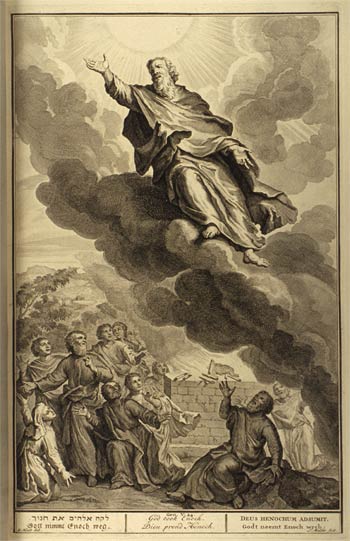
THE TRANSLATION
OF ENOCH
The writer now moves from an illustration of faith that worships (Abel) to a faith that walks (Enoch). Abel teaches us that faith brings the right offering. Enoch teaches us that faith brings right living—a life in step with God (see how this is possible - Gal 5:25NIV+). In a world darkened by sin’s early spread (cf Ge 6:5+), Enoch’s life shone brightly as a miracle of the grace of God (cf Php 2:15+, Mt 5:16+). He did not build cities or altars, nor leave written words or heroic deeds. His greatest testimony was his walk with God. For three centuries, he kept pace with God, until one day, the distance between heaven and earth grew so small that he simply “was not, for God took him.” (Ge 5:24+) Faith in Abel approached God through sacrifice. Faith in Enoch abided with God through fellowship. Abel teaches us the way to God. Enoch teaches us the walk with God. Enoch's life is a powerful lesson for believers of all ages for it reminds us that faith is not static but dynamic, not a single act but a lifelong relationship. True faith not only believes in God’s existence (His reality), but delights in His presence (His proximity) (cf Ps 37:4, Ps 73:28 ~ Enoch's "life verse!" Ps 16:11, Ps 27:4) The life that pleases God is not marked by cold duty but by warm delight—reflecting relationship, not regulation. Duty obeys because it must, while delight obeys because it loves. Beloved, which description best fits your walk with God in the past few weeks? Last year?
By faith (pistis) or as the Amplified says "Because of faith..." consists in receiving and believing what God has revealed. Faith according to Scofield "may be defined as that trust in the God of the Scriptures and in Jesus Christ Whom He has sent, which receives Him as Lord and Savior and impels to loving obedience and good works (John 1:12+; James 2:14-26+).
Enoch was taken (metatithemi) up so that he would not see (experience) death (thanatos) - Enoch didn’t experience death’s sting — God relocated him from earth to heaven. Enoch teaches us that one reward of "faithful" faith is unbroken fellowship of the creature with his/her Creator. So that he would not see death (thanatos) means he did not even glimpse death. Ponder the picture for a moment (because one day it will true for you whether via the rapture or death) because in one moment Enoch was walking with God on earth, but in the next moment he was walking with God in glory. This is your future beloved of God! (2Co 5:8+) If you believe in the Rapture, Enoch's "translation" prefigures the Rapture of believers who “will not all sleep” but will all be “changed...in a moment” (1Co 15:51, 52+; 1Th 4:17+). In a very real sense, Enoch's translation stands forever as a living prophecy of victory over the grave, ensuring faith’s ultimate victory through Jesus Christ over the last enemy, death (cf 1Co 15:54-56, 57, 58+). For every believer, death will not be so much a separation as a relocation — a "change of address" from our temporal earthly residence to our eternal heavenly home. (cf Php 1:23+; 2Co 5:8+)
To see death is a Semitic idiom which means to experience the reality of death. It appears in Luke 2:26+ which speaks of Simeon to whom it had been revealed "by the Holy Spirit that he would not see death before he had seen the Lord’s Christ.” In John 8:51+ Jesus said, “If anyone keeps My word, he shall never see death.” Jesus' use does not mean believers will not physically die, but that they won't see the specter of death as a hopeless end (like all unbelievers), but as a hope-filled future! (cf Jn 11:25,26+) Another idiom is "taste death" and only 2 men in Scripture never "tasted" death, never passing through the valley of the shadow of death, Enoch and Elijah (2Ki 2:11+).
John MacArthur on Enoch's walk with God - Here we see a new concept in the book of Genesis. Abel knew what it was to worship by faith, but he did not really understand the concept of walking with God (ED: THAT IS A BIT SPECULATIVE. IF HE KNEW HOW TO WORSHIP GOD, IT FOLLOWS THAT HE KNEW HOW TO WALK WITH GOD!). Revelation in Scripture is progressive. Abel received some revelation, and Enoch received more. Adam and Eve had walked and talked with God in the Garden, but when they fell and were thrown out of the Garden, they ceased to walk with Him. (ED: AT LEAST IN THE INTIMATE WAY THEY HAD EXPERIENCED WHEN SINLESS) The ultimate destiny of man is reinstituted with Enoch, who stands as an illustration for all men of what it is to be in fellowship with God. In Enoch the true destiny of man is again reached, as he experienced the fellowship with God that Adam and Eve had forfeited. (SEE Hebrews MacArthur New Testament Commentary - Page 306)
C H Spurgeon - Then came Enoch, whose life went beyond the reception and confession of the atonement, for he set before men the great truth of communion with God. He displayed in his life the relation of the believer to the Most High, and showed how near the living God condescends to be to His own children. (Sermon Enoch)
Enoch (Dictionary Article) is an example to the readers of Hebrews of what the writer longed to see happen to them: a steady, daily growth in grace achieved by the inner resources which God supplies to those who take him at his word and act in faith on what he has said. Enoch enjoyed the continuous presence of an unseen Person, and related his life daily to that Person. The result was a fellowship which death could not interrupt.
A W Tozer - Enoch recognized the failure of men and women trying to live their lives apart from God and His will. By faith he walked with God on this earth at a time when sin and corruption were wildly rampant all around him (ED: AND HE DID IT WITHOUT THE INDWELLING SPIRIT WHICH BELIEVERS POSSESS-THIS BEGS THE QUESTION - WHAT'S MY EXCUSE? BUT IT ALSO ENCOURAGES US THAT WE CAN SURVIVE A CULTURE FALLING INTO A MORAL/ETHICAL SEWER!). Enoch's daily walk was a walk of faith, a walk of fellowship with God. What the Scriptures are trying to say to us is this: If Enoch could live and walk with God by faith in the midst of his sinful generation, we likewise should be able to follow his example because the human race is the same and God is the same!… There is only one conclusion to be drawn here. Enoch was translated into the presence of God because of his faith (ED: BUT SEE WUEST BELOW), and thus he escaped death. It is very evident that there was no funeral for Enoch. Those who knew him best surely had to answer many questions. "Where is Enoch?" "What happened to Enoch?" "Why don't we see Enoch around anymore?" Perhaps members of his own family did not fully understand his walk with God, but they could answer with the facts: "He is gone! God has called him home. God has taken him." (See Jesus, Author of Our Faith: 12 Messages from the Book of Hebrews)
There can be no Divinely-acceptable witness or work
unless and until there is a walking with God!
--A W Pink
Richard Phillips has some interesting comments on Enoch - Hebrews 11 presents its heroes of the faith in chronological order as they are found in the Bible, yet several commentators point out that there is probably more at work than a historical progression. Specifically, it appears that there is also a topical progression to the points their stories make about the life of faith. That is especially true of the three men who lived before the great flood—Abel, Enoch, and Noah. Andrew Murray, for example, describes them as Abel, the sacrifice of faith; Enoch, the walk of faith; and Noah, the work of faith. Certainly that is a progression supported by the Bible: first we are brought into a right relationship with God by trusting the sacrifice he has provided in the blood of Christ; second, having been brought into relationship with God, we then walk with him by faith; and third, only then do we perform the works of faith, the practical good deeds that follow as a result of God's grace. Arthur Pink sees these three figures combining to provide "an outline of the life of faith": "Abel is mentioned first not because he was born before Enoch and Noah, but because what is recorded of him in Genesis 4 illustrated and demonstrated where the life of faith begins. In like manner, Enoch is referred to next… because what was found in him… must precede that which was typified by the builder of the ark." Pink's outline traces faith's worship in Abel, faith's walk in Enoch, and faith's witness in Noah. It is hard to say whether the writer of Hebrews had this kind of explicit outline in mind, since he does not put it that way himself. It seems that he is mainly following the biblical order, with each portrait making a particular point about faith. However, it does seem that the Divine Author has placed them together in such a way as to build the progression of which Murray and Pink speak. Pink reminds us of the importance of a biblical ordering of the Christian life: "Witnessing and working ('service') is what are so much emphasized today. Yet dear reader, Heb. 11 does not begin with the example of Noah. No indeed. Noah was preceded by Enoch, and for this reason: There can be no Divinely-acceptable witness or work unless and until there is a walking with God!… And this, in turn, must be preceded by Abel's worship of faith." (Hebrews: Reformed Expositry Commentary)
Kenneth Wuest - Enoch was translated. The word is metatithemi. The verb tithemi means “to place,” the prefixed preposition meta signifying a change, the compound word meaning “to transpose” (two things, one of which is put in place of the other). This word is used in Acts 7:16+ of the transporting of the remains of Jacob and his sons to Shechem, in Gal. 1:6+ of the sudden change of the doctrinal position of the Galatian Christians, and in Heb. 7:12+, of the change of the law of the priesthood, a new regulation being instituted in place of the old. In the case of Enoch, the word speaks of his sudden transference from earth to heaven. It refers to a change of position. It was one thing put in the place of another, heaven for Enoch rather than earth. Now, in the transference of believers from earth to heaven, that operation is effected usually by death. But in the case of Enoch, it was apart from death. He departed this earthly scene without dying. This verse does not teach that Enoch had faith to be translated. God translated him because he lived a life in which He was pleased. It was by faith that he lived that life. The Mosaic commentary on his life is in the words “Enoch walked with God” (Gen. 5:22). Vincent says when commenting on this: “Faith creates a close personal relation.” (Hebrews Commentary online)
Spurgeon - It is faith that muzzles the mouth of death and takes away the power of the sepulcher. If any man, who had not been a believer, had been translated as Enoch was, we should have been able to point to a great feat accomplished apart from faith. It has never been so; for this, which was one of the greatest things that was ever done—to leap from this life into another, and to overleap the grave altogether—was only achieved “by faith.”Now, if there is any man in the world that shall never die, it is he who walks with God. If there is any man to whom death will be as nothing, it is the man who has looked to the second advent of Christ and gloried in it. If there is any man who, though he pass through the iron gates of death, shall never feel the terror of the grim foe, it is the man whose life below has been perpetual communion with God. Do not go about by any other way to escape the pangs of death, but walk with God, and you will be able to say, “Where, O death, is your victory? Where, O death, is your sting?” (1Cor 15:55+) (Exposition of Hebrews)
Alan Carr has an interesting sermon title LOST IN TRANSLATION -
Language is a funny thing. Most of the time we understand what we hear in our own language, but when languages are translated sometimes the results are very humorous. Consider the following examples:
• In an advertisement by a Hong Kong dentist: Teeth extracted by the latest Methodists.
• In a Copenhagen airline ticket office: We take your bags and send them in all directions.
• In a Budapest zoo: Please do not feed the animals. If you have any suitable food, give it to the guard on duty.
• Two signs from a Majorcan shop entrance:
- English well talking.
- Here speeching American.
• On a Malaga freeway: Locals for sale or rent.
• In a Belgrade hotel elevator: To move the cabin, push button for wishing floor. If the cabin should enter more persons, each one should press a number of wishing floor. Driving is then going alphabetically by national order.
Sometimes the true meaning of what is being said is Lost In Translation. Our text speaks of “translation” three times. It refers to the “translation” of a man name Enoch. When Enoch was “translated,” he was also Lost In Translation. He was lost to the world, but he was found in another.
(Carr on Enoch's being taken up) This was the same thing that happened to Elijah. 2 Kings 2:11 says, “And it came to pass, as they still went on, and talked, that, behold, there appeared a chariot of fire, and horses of fire, and parted them both asunder; and Elijah went up by a whirlwind into heaven.” The phrase “went up,” is often used to describe the Old Testament burnt offerings. It refers to the smoke that rises off the altar and goes up into the sky. Just like the smoke off the altar, Elijah ascended up into Heaven. By the way, like Enoch, Elijah was alive when he left this world.
Every child of God lives with the same hope. We live under the promise that one day the Lord Jesus will return to claim His Bride. Before He died on the cross, Jesus left this promise: “In my Father’s house are many mansions: if it were not so, I would have told you. I go to prepare a place for you.And if I go and prepare a place for you, I will come again, and receive you unto myself; that where I am, there ye may be also,” John 14:1–3. He promised to return for HIs people. As time went by, the Lord revealed more about this blessed event through the pen of Paul the great Apostle, 1 Cor.15:51–54; 1 Thes. 4:16–18. Both of those passages describe the same event. It is an event we call the Rapture. As you know, the word Rapture does not appear in the Bible. It comes from the Latin word “rapto.” When the Bible was translated from Greek into Latin, the word “harpazo”, which is translated “caught up,” in 1 Thes. 4:17, was translated into the Latin word “rapto”, which means the same thing. So, the Rapture. Is a time when God’s people will be “caught up.” The phrase “caught up” is a military term. It means to “seize with force, to take for oneself eagerly, to carry off.” When the Lord Jesus comes in the clouds for HIs Bride, He will stop in the air, which is the very domain of Satan, (Eph. 2:2), and He will “eagerly seize His people and carry them off” to glory to be with Himself for ever.
• It needs to be understood that the Rapture of the church will be a SUDDEN event. There will be no previous warning. One moment the people of God will be going about their day to day live, the next moment, they will be “caught up” to be with the Lord. That is why the Bible says, “Therefore be ye also ready: for in such an hour as ye think not the Son of man cometh,” Matt. 24:44.
• It should also be noted that Jesus isn’t coming for everyone. The Rapture will be a SELECTIVE event too. 1 Thes. 4:16 says that He is coming for “the dead in Christ.” Verse 17 says that the ones going with Him are “we which alive and remain.”
• I would also mention that the Rapture of the church is a very SERIOUS event. Where a person stands at the moment of the Rapture will determine where they stand in eternity. If you have heard the Gospel and rejected it, you will be left behind to face the Tribulation and eventually Hell, 2 Thes. 2:11. (ED: IF YOU GO INTO THE TRIBULATION, THERE IS STILL HOPE FOR Rev 7:9,14+ DESCRIBES A HUGE HARVEST OF SOULS OUT OF THIS HORRIBLE 7 YEAR PERIOD). If you have believed the Gospel, you will be “translated” and “carried off” into glory.
The Rapture of the church will be a glorious moment for the people of God. When Jesus comes in the clouds, we will be delivered from the bodies of flesh. We will be delivered from this world of sin. We will fly away to a place that is “far better,” Phil. 1:23. We will see our Blessed Redeemer, and we will join Him in His glory, to worship our Father in the glories of that celestial city. No wonder the Bible calls the rapture “the blessed hope,” Titus 2:13.....
THE MESSAGE OF ENOCH’S TRANSLATION - There are many lessons that arise out of Enoch’s experience. When we study this story, we are reminded that the day in which Enoch lived was:
A Time Of Grace - Enoch was a sinner living in a sin cursed world, but grace was extended to him, and Enoch was saved, Gen. 5:22. The change in his life was so complete that He lived a life that was pleasing to the Lord, Heb. 11:5. According to Jude, Enoch was a prophet, Jude 14-15. The grace of God manifested itself in the life of Enoch. God saved him and changed his life. It was the grace of God that made Enoch a candidate for translation.
Like Enoch, we become candidates for translation when we are made partakers of the grace of God. When the Lord saved you, He made you Rapture ready. It is the grace of God alone that fits us for participating in the Rapture.
A Time Of Death - A quick look at Genesis 5 reveals a world plunged into death because of sin. Ge 5:5, 8, 11,14, 17, 20, 27, 31, all contain the words “and he died.” In the midst of all that death, Enoch “was not; for God took him.” One man made it out of this world alive.
Our world is still a world of death. Every one dies! The only exceptions to that rule will be when the Lord comes for His church. Those who know Jesus will cheat death, and will leave this world in the Rapture. By the way, even those believers whom we say have “died,” aren’t really dead. They are alive in the presence of the Lord, and when He comes, He will bring them with Him, 1Th 4:14.
A Time Of Judgment - Besides the obvious judgment of death, there was also the issue of Enoch’s son, a boy named “Methuselah.” His name means “his death shall bring.” Methuselah lived 969 years, longer than any other human in history. The very year Methuselah died, the flood that destroyed the world came. The year Methuselah died, the judgment of God fell on the world.
Our world is a world slated for judgment. In fact, the judgment of God has already fallen on this world, Ro 1:18-32. There is coming a terrible time of judgment known as the Great Tribulation, when the wrath of God will be poured out on all those who have rejected God, His Son Jesus, and the Gospel of grace. We who are saved will miss that judgment, because we have the promise that we “have shall be saved from wrath through Him,” Ro 5:9. Whether we leave this world through death, or through the Rapture, we will leave before the final wrath of God falls on this world in judgment. Hallelujah! We are going home!
Two primary lessons stand out
Walk with God - “Enoch walked with God” and “it pleased God.” Life is short, and we ought to see to it that every moment is lived with that in view. Every minute of our lives should be lived to the glory of God. That is the only life that will please Him, and that is the only life that is ready to face HIm without shame.
Be ready to leave this world - Enoch didn’t know when he would leave, but he was ready when his time came to go. We need to be ready as well. Life is fleeting. James 4:14 reminds us that it is like the “morning fog.” It is up to us to make every moment count for God and to be ready when He comes.
Conclusion - A English sign in Tokyo, translated from Japanese, warning motorists to watch for pedestrians says: “When a passenger of the foot heave in sight, tootle the horn. Trumpet at him melodiously at first, but if he still obstacles your passage, then tootle him with vigor.” Sometimes, the real meaning of words can be Lost In Translation. But, those who are “translated” by the Lord need never fear being lost by Him.
Dear church, we have a blessed future! God is bringing all things to a sovereignly ordained climax. The world is falling apart around us. Our government too often seems to have lost its bearings. Our economy is in the tank. Our morals are bankrupt (speaking euphemistically). Many churches have abandoned sound doctrine (2Ti 4:3-4). Many marriages and families are in trouble. Things look bleak. But, the redeemed of God have a blessed hope. (Titus 2:13) Our God is still on the throne, and He is returning (soon) for His people to take us to our eternal home. Rejoice and again I say rejoice! Maranatha, Lord. Amen
Was taken up (3346) (Metatithemi from meta = change of place or condition + tithemi = to put or place) literally means to put in another place, as used here in Heb 11:5, the passive voice (divine passive) since meaning to be taken or transferred. We find another literal use in Acts 7:16+ where bodies are transferred to a burial place in Shechem. In the figurative sense metatithemi means to effect a change in state or condition and so to alter something as when "the priesthood is changed" (Heb 7:12+). Another figurative use is found in Jude 1:4 who continually "turn the grace of our God into licentiousness," saying in essence that God's marvelous grace provided a "license" for immoral behavior! In another figurative use Paul confronts Peter declaring "you are so quickly deserting Him" (turning away from) the gospel to follow a different gospel (Gal 1:6+). Josephus (Ant. 12, 387) uses metatithemi to describe the transfer of the office of high priest to another person). In secular Greek metatithemi was used to describe a severe alteration in condition (collapse).
To summarize in Hebrews 11:5 metatithemi beautifully expresses God’s sovereign act of moving His servant from mortality to immortality — from earth to heaven — without death as the vehicle.
Alan Carr - The words “translated” in verse 5 mean “to transfer, to transport, to change sides, to carry over, to remove.” The word “translation” in verse 5 refers to a “transposition.” It carries the idea of “moving something from one place to another.” So, when the Bible says that Enoch was “translated,” it means that he was “transported from one place to another.” He “changed sides.” He was “carried over.” He was “removed from this world and transferred to a new world.” The passage in Genesis 5 lets us know that Enoch was alive when this event took place. According to Gen. 5:24, Enoch “walked with God.” It leaves the impression that Enoch was going about his day to day walk, and God simply showed up and “removed” him from this world and “carried him over.”
BDAG (summarized) - 1. To convey from one place to another = put in another place, transfer (Acts 7:16, Heb 11:5a) 2. To effect a change in state or condition = change, alter (Jude 1:4, Heb 7:12 - when the priesthood is changed passed on to another) 3. To have a change of mind in allegiance = change one’s mind, turn away, desert (middle voice) Gal 1:6. 2Macc 7:24. (Borrow A Greek-English lexicon of the New Testament,)
Friberg - (1) literally, as causing a change from one place to another transfer, bring to, transplant (Heb 11.5b); passive = be taken, be transferred (Heb 11.5a); of a body transferred to another burial place be brought back (Acts 7.16); (2) figuratively; (a) change, alter (Heb 7.12); in a bad sense pervert (Jude 1:4); (b) middle, as changing one's loyalty as a follower turn from, desert, become apostate (Gal 1.6) (BORROW Analytical Lexicon of the Greek New Testament)
Liddell- Scott - to place among, then he would not have caused so much noise among us, Od. II. to place differently, 1. in local sense, to transpose, Plat. 2. to change, alter, of a treaty, Thuc., Xen.; to change their names and call them after swine, Hdt; to put one thing in place of another, substitute, Dem. 3. Med. to change what is one's own or for oneself, Xen.; to adopt a new opinion, Hdt.; so, absol., Plat. b. to get rid of, transfer one's fear, Dem. c. c. dupl. acc., to alter their evil designs into gain for him, Soph. 4. Pass. to be changed, to alter, Eur.
Gilbrant - In classical, secular Greek this verb (derived from meta, “with, after,” and tithēmi, “to put, place”) means “to bring to, set in another place,” either literally or metaphorically. It is used to refer to the changing or altering of an agreement, a name, an opinion, as well as the changing of the office of high priest. Some additional meanings of the word are to change or transfer from one school of philosophy to another, to give oneself over to the Roman party, or to desert the army (see Liddell-Scott). In the Septuagint metatithēmi is used 17 times to translate 6 different Hebrew words. It translates the Hebrew s̱ûgh meaning to “move” a boundary marker or boundary stone over a few feet and thus steal a strip of the neighbor’s property (Deuteronomy 27:17). God “translated” (Hebrew laqach, “took”) Enoch from earth to heaven (Genesis 5:24). Other uses include “warding off” an attack (3 Maccabees 1:16), “transplanting” people (Isaiah 29:14, where the Septuagint has a reading that differs from the Hebrew), and “turning away” (in the sense of apostasy) from the fathers (2 Maccabees 7:24). The New Testament uses the verb six times. Stephen used it of transferring the bodies of some of the patriarchs from Egypt to Shechem (Acts 7:16). Paul used it to show surprise that the Galatians so soon deserted Him (God) who called them into the grace of Christ and turned away to “another gospel” (Galatians 1:6, where the Greek implies that their apostasy was not complete but was in progress; thus there was still opportunity for them to change their ways). Hebrews uses it once in 7:12 of a change in the priesthood (in the sense of passing it on from one person to another) and thus calling for a change in the Law. Then Hebrews uses it twice in 11:5 of the translation of Enoch to heaven without dying. This follows the Septuagint’s usage of metatithēmi as “changing the position of, conveying to another place” (Genesis 5:24). Finally, Jude uses it nonliterally of “turning” (“perverting”) the grace of God into lasciviousness or dissoluteness (Jude 4). (Complete Biblical Library Greek-English Dictionary)
Metatithemi - 6x in 5v - Acts 7:16; Gal 1:6; Heb 7:12; 11:5; Jude 1:4. NAS = changed(1), deserting*(1), removed(1), taken(1), took(1), turn(1).
Acts 7:16+ "From there they were removed to Shechem and laid in the tomb which Abraham had purchased for a sum of money from the sons of Hamor in Shechem.
Galatians 1:6+ I am amazed that you are so quickly deserting Him who called you by the grace of Christ, for a different gospel;
Hebrews 7:12+ For when the priesthood is changed, of necessity there takes place a change (metathesis) of law also.
Hebrews 11:5+ By faith Enoch was taken up so that he would not see death; AND HE WAS NOT FOUND BECAUSE GOD TOOK HIM UP; for he obtained the witness that before his being taken up he was pleasing to God.
Jude 1:4+ For certain persons have crept in unnoticed, those who were long beforehand marked out for this condemnation, ungodly persons who turn the grace of our God into licentiousness and deny our only Master and Lord, Jesus Christ.
Metatithemi - 9x in the non-apocryphal Septuagint (LXX) -Ge 5:24; Dt 27:17; 1Ki 21:25; Est 4:17; Ps 46:2; Pr 23:10; Isa 29:14, 17; Hos 5:10. Here are some uses…
Deuteronomy 27:17 'Cursed is he who moves his neighbor's boundary mark.' And all the people shall say, 'Amen.'
Psalm 46:2 Therefore we will not fear, though the earth should change And though the mountains slip (removed) into the heart of the sea;
Proverbs 23:10 Do not move the ancient boundary Or go into the fields of the fatherless,
Isaiah 29:17 Is it not yet just a little while Before Lebanon will be turned into a fertile field, And the fertile field will be considered as a forest?
Hosea 5:10 The princes of Judah have become like those who move a boundary; On them I will pour out My wrath like water.
We see the same verb is used by the Septuagint translators to describe Enoch’s translation in Ge 5:24+. "Enoch walked with God; and he was not, for God took him."
Enoch was the 7th from Adam in the line of Seth. Just as lawlessness had climaxed in Lamech, the 7th from Adam in the line of Cain, so godliness climaxed in Enoch. It is interesting to note that Enoch was a contemporary of Adam for a little over 300 years and that he lived alongside the other patriarchs listed in Genesis 5 all his life. He was "raptured" (Not the same word as NT "rapture" = harpazo) about seventy years before Noah was born.
AND HE WAS NOT FOUND BECAUSE GOD TOOK HIM UP FOR HE OBTAINED THE WITNESS THAT BEFORE HIS BEING TAKEN UP HE WAS PLEASING TO GOD: kai ouch heurisketo (3SIPI) dioti metetheken (3SAAI) auton o theos kai ouch heurisketo (3SIPI) dioti metetheken (3SAAI) auton o theos. pro gar tes metatheseos memarturetai (3SRPI) euarestekenai (RAN) to theo:
- And was not found - 2 Ki 2:16-17 (= like Elijah was not found); Jer 36:26; Rev 11:9-12 (= The two witnesses slain and then taken up in the Tribulation)
- Before his translation he had this testimony - Heb 11:6; Ge 5:22; Ro 8:8,9; 1Th 2:4; 1 Jn 3:22
- Hebrews 11 Resources - Multiple Sermons and Commentaries
Related Passages:
2 Kings 2:16-17+ They said to him, “Behold now, there are with your servants fifty strong men, please let them go and search for your master; perhaps the Spirit of the LORD has taken him up and cast him on some mountain or into some valley.” And he said, “You shall not send.” 17 But when they urged him until he was ashamed, he said, “Send.” They sent therefore fifty men; and they searched three days but did not find him.
Hebrews 13:20-21+ (PRAY THIS FOR YOURSELF AND OTHERS FREQUENTLY! NOTICE IT IS A PRAYER FOR AN "ENOCH-LIKE" WORK/WALK "PLEASING TO GOD"!) Now the God of peace, who brought up from the dead the great Shepherd of the sheep through the blood of the eternal covenant, even Jesus our Lord, 21 equip you in every good thing to do His will, working in us that which is PLEASING (euarestos root of euaresteo) in His sight, through Jesus Christ, to whom be the glory forever and ever. Amen.
Romans 12:1-2+ (BELOVED, CONSIDER THIS PRESENTATION EACH MORNING TO BEGIN YOUR DAY!) Therefore I urge you, brethren, by the mercies of God, to present your bodies a living and holy sacrifice, acceptable (euarestos root of euaresteo) to God, which is your spiritual service of worship. 2 And do not be conformed (present imperative with a negative see our need to depend on the Holy Spirit to obey) to this world, but be transformed (present imperative see our need to depend on the Holy Spirit to obey) by the renewing of your mind, so that you may prove what the will of God is, that which is good and acceptable (euarestos root of euaresteo) and perfect.
Genesis 5:22+ Then Enoch walked with (Hebrew = halak; Lxx = euaresteo "well-pleasing to") God 300 years after he became the father of Methuselah, and he had other sons and daughters.
Genesis 5:24+ Enoch walked (Lxx - euaresteo) with God; and he was not, for God took him.
ENOCH'S TESTIMONY
BEFORE TRANSLATION
Two important things mark the character of Enoch’s faith: (1) he pleased God by turning away from the godlessness of the world in which he lived and (2) he maintained a daily walk with God which grew so intimate that he was taken to heaven without experiencing death.
The Genesis account (Ge 5:21-24+) suggests that for the first 65 years of his life, Enoch did not walk with God. Presumably he went along with the deteriorating morality of his times, which Genesis 6:5+ describes (although that is a bit speculative). Ge 5:21+ suggests the event which may have changed Enoch’s outlook was the birth of a son, whom he named Methuselah. Some scholars derive the meaning of Methuselah from the Hebrew root muth, which means “death,” and translate the name “His death shall bring (it).” The Genesis account states that from the birth of Methuselah throughout the following 300 years, Enoch “walked with God.” This walk was a result of faith, and since faith always requires a word from God to rest upon (cp Ro 10:17+), it suggests that Enoch was given a revelation of Christ (we cannot speculate further, cf Ge 3:15+), and possibly a revelation of coming judgment, which changed his life (cp name Methuselah).
AND HE WAS NOT FOUND (heurisko) BECAUSE GOD TOOK HIM UP (metatithemi) - NLT = "he disappeared, because God took him." HE WAS NOT FOUND (heurisko) implies that those who knew him looked for him but could not find him. The Septuagint (LXX) uses heurisko in similar contexts of searching in vain for the prophet Elijah (e.g., 2Ki 2:17+, when Elijah was taken up and the sons of the prophets “searched three days but did not find [LXX = heurisko] him”).
The ultimate destiny of man is reinstituted with Enoch,
who stands as an illustration for all men
of what it is to be in fellowship with God.
For (gar) he obtained the witness (martureo -perfect tense divine passive) that before his being taken up (metathesis) he was pleasing (euaresteo - perfect tense) to God - NET = "For before his removal he had been commended as having pleased God." He obtained the witness (martureo) is in the perfect tense indicating a past completed act with ongoing result, in this context indicating that God’s testimony (divine passive) about Enoch still stands (in Scripture). In other words, Heaven’s record, still on file, reads “This man pleased God.” In that sense, like the life of Abel, Enoch's life still "speaks!" The ultimate witness by God of course was the actual translation of Enoch. Before his being taken up (metathesis) indicates God's testimony of Enoch's life had occurred prior to his translation to Heaven. Enoch’s daily faith-walk, not his translation, was the occasion of God’s approval. This time phrase (before) suggests that God gave His "seal of approval" regarding Enoch’s faith and walk, either personally or in some way publicly, but while he was still living.
He was pleasing (euaresteo - perfect tense) to God - In the OT we read that that Enoch walked with God (Ge 5:22, 24) and as discussed below the Septuagint (Lxx) translates walked using the Greek verb euaresteo, to be pleasing! The perfect tense speaks of past completed action with ongoing result. Thus Enoch's walk was a walk that was well pleasing to God! Interesting! In each of the Scriptures listed above the Hebrew verb for "walk" (halak) is rendered by the Greek verb euaresteo, "be pleasing"! Compare the walks of these OT saints with the ambition of Paul to be pleasing to the Lord (2Cor 5:9-commentary note).
For the believer, death is
not separation but relocation
Spurgeon - Mark that this holiest of men, whose walk with God was so close and unbroken that he was permitted to escape the pangs of death, nevertheless did not attain to this high position by his own works, but by faith. (He was not found is) A very remarkable expression. Perhaps He did it in some visible manner. I should not wonder. Perhaps the whole of the patriarchs saw him depart, even as the apostles were present when our Lord was taken up (Acts 1:9+). However that may be, there was some special rapture, some distinct taking up of this choice one to the throne of the Most High.
Spurgeon - The way to please God, then, is to believe in Him—and if there is any possibility of entering heaven without seeing death, faith alone can point the way. You cannot be Enochs unless you please God, and you cannot please God unless you have faith in Him. If we cannot get a translation as Enoch did, let us not be content without getting God’s good pleasure as he did. Oh, that it may be said of us that we pleased God! Then we shall, one way or another, conquer death; for if we do, we shall triumph over the grave. And if Christ shall come before we die, we shall triumph in the coming of Christ. Anyhow, faith shall be more than a match for the last enemy.
The closer you walk with God,
the less room for anything to come between.
Genesis 5:24 Enoch walked with (Hebrew = halak; Lxx = euaresteo "Enoch was well-pleasing to") God and he was not for God took him.
Comment: The Septuagint (Lxx) translates both uses of the Hebrew verb halak "walked" with the Greek verb euaresteo = well pleasing. Brenton's English translation of the Lxx is "And Enoch was well-pleasing to God…". Halak conveys the basic sense of movement, and can describe one's literal, physical walk but in each of the uses discussed in this section is used metaphorically to describe one's general conduct or behavior.
🙏 THOUGHT - Enoch's pleasing walk with God walk was a walk of steady communion, daily fellowship, and quiet obedience. What an example Enoch gives for believers of every age to imitate, enabled by the Spirit (cf Gal 5:16+). Beloved, Enoch did not have the indwelling Spirit, but every believer possesses the indwelling Spirit to empower an "Enoch like" walk! We in the New Covenant do not have any excuses not to walk as he walked!
NET Bible has an additional interesting insight on this Hebrew verb halak noting that "The rare expression “walked with” (the Hitpael form of the verb הָלָךְ, halakh, “to walk” collocated with the preposition אֶת, ’et, “with”) is used in 1Sa 25:15 to describe how David’s men maintained a cordial and cooperative relationship with Nabal’s men as they worked and lived side by side in the fields. In Gen 5:22 the phrase suggests that Enoch and God “got along.” This may imply that Enoch lived in close fellowship with God, leading a life of devotion and piety. An early Jewish tradition, preserved in 1Enoch 1:9 and alluded to in Jude 1:14, says that Enoch preached about the coming judgment.
You are headed in the right direction
when you walk with God!
His being taken up (3331) (metathesis from metatíthemi = transfer from meta = implying change + tithemi = put) is literally, the act of transferring from one place to another and so the removal or taking up or away. And so it can describe a transfer from one place to another, as for example the translation of a person to heaven as in this verse. Transliterated it gives us the English word metathesis which is defined as the transposition of a letter of a word.
Hebrews 12:27 uses metathesis with the idea of removal. "And this expression, "Yet once more," denotes the removing of those things which can be shaken, as of created things, in order that those things which cannot be shaken may remain."
Figuratively, metathesis means to transpose or put one thing in the place of another. It can mean a change of things instituted or established, such as a changeover from the Levitical priesthood = "For when the priesthood is changed, of necessity there takes place a change of law also." (Hebrews 7:12)
Vincent comments on the meaning of metathesis in He 7:12+ writing that it refers to "A change. A transfer to a new basis. Only in Hebrews. See He 11:5-+; He 12:27-+. The inferiority of the Levitical priesthood is inferred from the fact that another priesthood was promised. If perfection was possible at all under the Mosaic economy, it must come through the Levitical priesthood, since that priesthood was, in a sense, the basis of the law. The whole legal system centered in it. The fundamental idea of the law was that of a people united with God. Sin, the obstacle to this ideal union, was dealt with through the priesthood. If the law failed to effect complete fellowship with God, the priesthood was shown to be a failure, and must be abolished; and the change of the priesthood involved the abolition of the entire legal system."
Pleasing (2100) (euaresteo from eu = good, well + arestos = pleasing, desirable, proper, fit, agreeable from aresko = to please or be pleasing/acceptable to) means to please, to behave in a manner that is pleasing to another. To take pleasure in. To cause someone to be well-disposed toward another. See study of related word euarestos.
Euaresteo is used only 3 times in the NT - all in Hebrews 11:5, 6, 13:16
Hebrews 11:6+ And without faith it is impossible (Note: He does not say it will be "difficult" but impossible!) to please Him, for he who comes to God must believe that He is and that He is a rewarder of those who seek Him.
Hebrews 13:16+ And do not neglect (present imperative with a negative = a command to stop neglecting implying some were already neglecting it) doing good and sharing, for with such sacrifices God is pleased.
Euaresteo - 12x in the non-apocryphal Septuagint (Lxx) - All the uses except Ge 39:4 and Ex 21:8 refer to Old Testament saints who were pleasing to God. Gen 5:22, 24; 6:9; 17:1; 24:40; 39:4; 48:15; Ex 21:8; Ps 26:3; 35:14; 56:13; 116:9.
For comparison, the related adjective euarestos is used 9 times in the NT - acceptable = 3x, pleasing =3x, well-pleasing =3x. Ro 12:1, 2; 14:18; 2Co 5:9; Eph 5:10; Php 4:18; Col 3:20; Titus 2:9; Heb 13:21 = "working in us that which is pleasing in His sight".
Below are the other OT (Lxx) passages where euaresteo is used to translate the Hebrew verb halak. It is notable that in all these OT uses of euaresteo we find depictions of men like Noah, Abraham, Isaac, and David, whose lives were characterized not by perfection but by direction. That is to say that their lives manifested a general tendency toward godliness and toward their future promised home in heaven. As a corollary, if you believe you are headed for heaven in the future, your life should reflect it on earth in the present! If it does not, you might be deceiving yourself (study 2Cor 13:5+) and your life might not be pleasing to God now or then (cp Mt 7:21+, Mt 7:22, 23+).
Genesis 6:9+ These are the records of the generations of Noah. Noah was a righteous man, blameless in his time; Noah walked with God (Hebrew = halak; Lxx = euaresteo "Noah was well-pleasing to God").
NET Bible note on Ge 6:9: The construction translated "walked with" is used in Ge 5:22, 24 and in 1Sa 25:15, where it refers to David's and Nabal's men "rubbing shoulders" in the fields. Based on the use in 1Sa 25:15, the expression ("walked with") seems to mean "live in close proximity to," which may, by metonymy, mean "maintain cordial relations with."
Genesis 17:1+ Now when Abram was ninety-nine years old, the LORD appeared to Abram and said to him, "I am God Almighty (EL Shaddai - God Almighty); Walk (Hebrew = halak ; Lxx = euaresteo command to continually be "well-pleasing to") before Me, and be blameless.
Genesis 24:40 "And he said to me (Isaac speaking), 'The LORD, before whom I have walked (Hebrew = halak ; Lxx = "well-pleasing to"), will send His angel with you to make your journey successful, and you will take a wife for my son from my relatives, and from my father's house;
Genesis 48:15 And he (Israel or Jacob is speaking - Ge 48:14) blessed Joseph, and said, "The God before whom my fathers Abraham and Isaac walked (Hebrew = halak ; Lxx = euaresteo "well-pleasing to"), the God who has been my shepherd all my life to this day,
Psalm 26:3 (David writes) For Thy lovingkindness (hesed - steadfast love) is before my eyes, And I have walked (Hebrew = halak; Lxx = euaresteo "well-pleasing to") in Thy truth.
COMMENT - Note that here we see two ways to walk "pleasing to" God: (1) Walk in "wonder" (pondering) the covenant relationship in which we daily receive His lovingkindness. When was the last time you really thought about the steadfast love of God? David did not shut his eyes to the mercies of God, for they were ever in his sight. He could not forget them, and they influenced all his thoughts, words and deeds! (2) And secondly we please Him when we walk in His truth!
Psalm 56:13 (David writes) For Thou hast delivered my soul from death, Indeed my feet from stumbling, So that I may walk (Hebrew = halak; Lxx = euaresteo "well-pleasing to") before God In the light of the living.
Psalm 116:9 (Author not stated) I shall walk (Hebrew = halak; Lxx = euaresteo "well-pleasing") before the LORD In the land of the living.
Spurgeon comments: This is the Psalmist's second resolution, to live as in the sight of God in the midst of the sons of men. By a man's walk is understood his way of life: some men live only as in the sight of their fellow men, having regard to human judgment and opinion; but the truly gracious man considers the presence of God, and acts under the influence of His all observing eye. "Thou God sees me" is a far better influence than "My master sees me." The life of faith, hope, holy fear, and true holiness is produced by a sense of living and walking before the Lord, and he who has been favored with divine deliverances in answer to prayer finds his own experience the best reason for a holy life, and the best assistance to his endeavors. We know that God in a special manner is nigh unto His people: what manner of persons ought we to be in all holy conversation and godliness? (2Pe 3:11+)
Spurgeon - “Enoch walked with God.” - He walked with God 300 years. This implies perseverance. (ED: He is an example of one for the readers of Hebrews to imitate to "hold fast" Heb 3:6, 14) You have received Christ; persevere in receiving Him. You have come to trust Him; keep on trusting him. You hang about His neck as a poor, helpless sinner; remain hanging there. Abide in Him.
Spurgeon - GENESIS 5:21–24 OUR reading leads us to think upon that eminent saint of the antediluvian church, Enoch, the seventh from Adam. "21, 22, 23, 24 And Enoch lived sixty and five years, and begat Methuselah: And Enoch walked with God after he begat Methuselah three hundred years, and begat sons and daughters: And all the days of Enoch were three hundred sixty and five years: And Enoch walked with God: and he was not; for God took him." Here it is worthy of notice that the sacred writer says once that Enoch “lived;” but he changes the word and writes Enoch “walked with God;” thus teaching us that communion with God was Enoch’s life, and truly so it ought to be ours. He was not a mere talker about God, but a walker with God. This holy patriarch lived in unbroken intercourse with the Lord for three hundred years, not now and then visiting with God, but habitually walking with him. This is a point of great difficulty. To draw near to God is comparatively easy; but to remain in undivided fellowship, “this is the work, this is the labour.” Yet the Holy Spirit can enable us to accomplish even this. Continued communion is what we should aim at, and we should not be content with anything short of it. Some excuse themselves from seeking after unbroken fellowship with God because of their calling, their circumstances, and their numerous engagements. Enoch had the cares of a family upon him, and he was also a public preacher, and yet he kept up his walk with God: no business or household cares should make us forget our God. Society with God is the safety of saints, it is their solace and delight, it is their honour and crown. More to be desired is it than gold, yea, than much fine gold. Happy was Enoch to enjoy it so sweetly, and so continuously. The long intercourse of this good man with his God ended in his being borne away from earth without death to that place where faith is lost in sight. He did not live like others, and therefore he did not die like others. Paul tells us a little more concerning this holy man, and we will gather up the fragments of his history which remain on record, that nothing may be lost. HEBREWS 11:5, 6 - Faith was the spring from which his communion was derived. Works do not make us walk with God; but faith brings us into his presence, and keeps us there. It is very likely that Enoch’s pious conversation did not please men, but that little mattered since it pleased God.
Spurgeon - MEDITATION—to be Practised - THOSE who would be in health do not sit still in their houses to breathe such air as may come to them, but they walk abroad and seek out rural and elevated spots that they may inhale the invigorating breezes; and thus those godly souls who would be in a vigorous spiritual state, do not merely think upon such holy doctrines as may come into their minds in the ordinary course of thought, but they give time to meditation, they walk abroad in the fields of truth, and endeavour to climb the heights of gospel promises. It is said that Enoch walked with God: here is not an idle but an active communion. The road to bodily health is said to be a footpath, and the way to spiritual health is to exercise one’s self in holy contemplation. (Feathers for arrows)
G Campbell Morgan gave the following illustration of walking with God - A little child gave a most exquisite explanation of walking with God. She went home from Sunday School, and the mother said, "Tell me what you learned at school." And she said: "Don't you know, Mother, one day they went for an extra long walk, and they walked on and on, until God said to Enoch, 'You are a long way from home; you had better just come in and stay.' And he went." (Ge 5:24) (Current Anecdotes— Encyclopedia of 15,000 Illustrations)
David Olford has an interesting introduction to his famous father Stephen Olford's devotional notes According to Your Word - Just after the Second World War, sensing a deep spiritual hunger, my father was refreshed and revived during a time of personal retreat with the Lord. Shortly thereafter, he met Billy Graham (1946). Due to young Billy Graham's similar spiritual hunger, the two arranged to meet in Wales for a time of retreat together. It is my understanding that one of the subjects discussed during this time together was the devotional life or the “quiet time.” According to Your Word reveals that the “quiet time” was already a discipline in my father's life before this important meeting in 1946. These devotionals are evidence of a thoughtful and prayerful reading of the Word of God that was (and would be) a regular feature of my father's life. My father practiced the quiet time until his death at age eighty-six. His sudden departure reminds me of the Scriptural account of Enoch who “walked with God; and he was not, for God took him” (Ge 5:24). We miss Dad greatly, but we know that his walk with God continues above. (According to Your Word)
Simon Kistemaker - What does the phrase walk with God mean? It means that a person lives a spiritual life in which he tells God everything (see Gen. 6:9). Enoch lived a normal life of rearing sons and daughters, but his entire life was characterized by his love for God. For this reason God took him to heaven.
Warren Wiersbe - Enoch had been walking with God for so many years that his transfer to heaven was not even an interruption. Enoch had been practicing Colossians [chapter] three centuries before Paul wrote the words: “… keep seeking the things above.… Set your mind on the things above, not on the things that are on earth” (Col 3:1, 2). (Run with the Winners)
R Kent Hughes on Walking - But the metaphor of walking more exactly reveals how Enoch pleased God. Walking with another person suggests a mutual agreement of soul, as the prophet Amos understood when he asked, “Do two walk together unless they have agreed to do so?” (Amos 3:3). It is impossible to walk together unless there are several mutual agreements. To begin with, you must agree on the destination. Husbands and wives know that the paths to Bloomingdale’s and Eddie Bauer are not the same! You cannot walk together and go to separate destinations. Enoch was heading in God’s direction.
Of course, it is quite possible to be headed to the same destination but by separate paths. But again, two cannot walk together unless they have the same destination and follow the same path. This Enoch did with God!
There is one other requirement in walking together. Two must not only be traveling to the same place on the same path, but they must also go at the same pace. Enoch was in step with God. We too must “keep in step with the Spirit” (Galatians 5:25). Enoch’s great walk produced two wonderful things—fellowship and righteousness. When two walk toward the same place on the same path at the same pace for 300 years, they are in fellowship! And this is the primary meaning of walk: fellowship, sacred communion.
Enoch walked by faith. Paul charges believers today to "Walk by faith not sight." (2 Cor 5:7+)
ENOCH WALKED
WITH GOD!
Would it be that God Almighty would be able to write on our epitaphs the words He wrote on Enoch's epitaph -- He walked with God.
The NT frequently uses the metaphor of one's walk to describe faithful behavior…
Therefore we have been buried with Him through baptism into death, in order that as Christ was raised from the dead through the glory of the Father, so we too might walk in newness of life. (Ro 6:4+) (See the following verse to help understand how to walk in newness of life, cp Ro 8:2+)
But I say, walk (present imperative = command to make this your lifestyle) by the Spirit, and you will not carry out the desire of the flesh. (Gal 5:16+)
Walk (present imperative = command to make this your lifestyle - Gal 5:16 tells us how such a supernatural walk is even possible - it is naturally impossible, but enabled by the Spirit of Christ is Him-possible!) in love, just as Christ also loved you, and gave Himself up for us, an offering and a sacrifice to God as a fragrant aroma. (Eph 5:2+)
But you have a few people in Sardis who have not soiled their garments; and they will walk with Me in white; for they are worthy. (Rev 3:4+)
BELIEVERS SHALL WALK
WITH GOD…
FOREVER!
How interesting that Moses records God's walk in the garden of Eden (Genesis 3:8+) suggesting that God Himself walked with Adam and Eve in perfect fellowship and unbroken communion! And how wonderful and complete is Christ's work of redemption, which restores us to fellowship and communion so that when we get to heaven, we will walk with Him forever and ever. What the first Adam lost, the second Adam restores. Hallelujah! Thank You Jesus! Maranatha. Amen.
Here is the memorial written for the great missionary to Burma, Adoniram Judson (read this short summary if you are not familiar with this great saint. You will be challenged in your walk!)
In Memoriam
Rev. Adoniram Judson
Born August 9, 1788
Died April 12, 1850
Malden, His Birthplace
The Ocean His Sepulchre;
Converted Burmans and the Burman Bible
His Monument
His Record Is On High
— Encyclopedia of 15,000 Illustrations
Enoch "Walked With God"
He "walked with God!" Could grander words be written?
Not much of what he thought or said is told;
Not where or what he wrought is even mentioned;
He "walked with God"—brief words of fadeless gold!How many souls were succored on his journey—
Helped by his words, or prayers, we may not know;
Still, this we read—words of excelling grandeur—
He "walked with God," while yet he walked below.And, after years, long years, of such blest walking,
One day he walked, then was not, God said "Come!
Come from the scene of weary sin-stained sadness!
Come to the fuller fellowship of home!"Such be the tribute of thy pilgrim journey
When life's last mile thy feet hath bravely trod—
When thou hast gone to all that there awaits thee,
This simple epitaph—"He walked with God!" (Ge 5:24)
—Poems for Sunshine and Shadow
(Encyclopedia of 15,000 Illustrations)
JUST A CLOSER WALK WITH THEE
I am weak but Thou art strong
Jesus keep me from all wrong
I'll be satisfied as long
As I walk, let me walk close to Thee
Just a closer walk with Thee
Grant it, Jesus, is my plea
Daily walking close to Thee
Let it be, dear Lord, let it be
When my feeble life is o'er
Time for me will be no more
Guide me gently, safely o'er
To Thy kingdom's shore, to Thy shore
Just a closer walk with Thee
Grant it, Jesus, is my plea
Daily walking close to Thee
Let it be, dear Lord, let it be
Robert Neighbour-Sermons and Bible Studies - By faith Enoch walked with God. He walked with God in the midst of an age that was fast corrupting itself and turning away from Jehovah; he walked with God in the midst of his own home, where he begat sons and daughters. Surely we then may walk by faith in this our day. To be sure sin is much the same as it was in Enoch's day; but we have added light and increased blessings — should we not have a greater faith?
Closer, Lord, to Thee I come,
Light of life Divine;
Through the ever Blessed Son,
Joy and peace are mine;
Let me in Thy love abide,
Keep me ever near Thy side,
In the "Rock of Ages" hide, —
Closer, Lord, to Thee.
LIKE SUBMARINES - Believers are to be like boats in the water. That is our design - to be in the world but not of the world! But when water (world) gets in the boat, that is disaster! This truth is illustrated by a submarine which is fully functional in water but is ruined if water comes within. A submarine on the ground (out of the water) is useless and is not accomplishing its mission. When it is in the water it must be insulated (not isolated) from the water. If the water ever gets into the submarine then there is cause to sound the alarm. Believers are to be insulated from the world (like Enoch in the midst a world where "the wickedness of man was great on the earth, and that every intent of the thoughts of his heart was only evil continually." -- Genesis 6:5) but not isolated from the world. Are you in a holy huddle or are you actively pursuing your calling to be salt and light in the world among those who are dead in its trespasses and sins and need to be thrown the life preserver of the soul saving Gospel, which they may grab hold of or sadly refuse and drown forever in the eternal abyss. We cannot save them but we can throw them a life preserver! How's your boat doing dear believer? Are you taking in water? Are are you insulated, even while not being isolated?
DON'T BE A "SPIRITUAL VAGRANT" - And Enoch walked with God, and he was not; for God took him. Genesis 5:24 - Efficient leaders of organizations and responsible individuals set specific goals for which they constantly strive. A vagrant, on the other hand, is an extreme example of one who has no such purposes in view. He does not hold a steady job, does not obligate himself for the purchase and maintenance of a home, and often has no loved ones for whose future he is concerned. The utter aimlessness of such a life was strikingly demonstrated by the tramp who declined a ride someone offered him, saying, "No, thank you! I am not going any place, so I am just as well off here as I would be 10 miles farther on." All who do not believe in God are in a sense "spiritual vagrants" — living without an ultimate aim or goal. The Christian, however, knows where he is going. He also perceives his purpose — "To glorify God, and to enjoy Him forever." Moreover, Hebrews 11:1 says that a believer's faith gives him absolute assurance that he will certainly enjoy the "things hoped for," and that "the things not seen" are definite realities. For this reason he seeks to please the Lord by worshiping in an acceptable manner like Abel, by walking in fellowship like Enoch, and by working faithfully like Noah. These men believed in God and directed their efforts in doing His will. They did not wander aimlessly through life without purpose or goal. Neither should you.
Dear reader, what is your highest ambition? Are you truly seeking to glorify God and do His will, or are you a "spiritual vagrant"? When you pass from this earthly scene may it be said of you as it was of Enoch, he "walked with God."
Such be the tribute of thy pilgrim journey
When life's last mile thy feet have bravely trod—
When thou hast gone to all that there awaits thee,
This simple epitaph—"He walked with God!"
—Anon.
Our lives constantly manifest
what we truly think about God!
A Commitment To Walk - One thing that impresses me about my wife is her commitment to walk two to four times a week for at least an hour. Come rain, snow, sleet, or shine, my wife layers up or down (depending on the weather), puts on her headphones, and off she goes walking through our community.
My wife’s commitment to walking reminds me of a man named Enoch. Genesis 5:18-24 is a short paragraph about his life, and it shines like a diamond amid the earthly record of deaths. In a storyline where the funeral bells tolled out their mournful drone (“and he died” is repeated eight times in the chapter), there is a ray of hope—Enoch walked with God.
What did it mean for Enoch to walk with God? It describes Enoch’s close communion with God—as if literally walking by His side. Also, it refers to Enoch’s unswerving obedience to God in a corrupt culture. God rewarded Enoch’s faithfulness by taking him to heaven while he was still alive. Death would not have the final word in God’s creation.
Enoch’s walk with God reminds us that it is possible for all of us to enjoy intimate communion with the Lord. Let’s commit ourselves to walking faithfully with Him every day. — Marvin Williams (Our Daily Bread, Copyright RBC Ministries, Grand Rapids, MI. Reprinted by permission. All rights reserved)
He walks with me, and He talks with me,
And He tells me I am His own;
And the joy we share as we tarry there
None other has ever known. —Miles
© Renewal 1940 The Rodeheaver Co.
Vance Havner - Pleasing God
I do always those things that please him. John 8:29.
We live to please someone, ourselves, other people or God. Jesus "pleased not himself" (Rom. 15:3). We are not to live to please men. "Do I seek to please men?" (Gal. 1:10). "Not as pleasing men but God" (I Thess. 2:4). We are to please our neighbor for his good to edification (Rom. 15:2). Paul said he pleased all men, seeking, not his profit, but theirs, that they might be saved (I Cor. 10:33).
We are to please God, as our Lord said in our text. God was pleased in His Son (Mt. 3:17). He was not pleased with the Israelites in the wilderness (I Cor. 10:5). We had better take warning from them, for "these things happened unto us for ensamples." Enoch pleased God (Heb. 11:5). We cannot please God in the flesh (Rom. 8:8). It is impossible without faith (Heb. 11:6). But as we submit to God He works in us to will and to do of His good pleasure (Phil. 2:13). Then we are to live so as to please Him who hath chosen us to be soldiers (II Tim. 2:3, 4). And if we please Him we get answers to our prayers (I Jn. 3:22).
Whom are you living to please?
God’s Pleasure in Us Daily with the King - Page 154
The other aspect of God’s testimony of us concerns our manner of life. Enoch is our example. “Before his translation [into heaven] he had this testimony, that he pleased God” (Hebrews 11:5, KJV). What kind of a life did Enoch live that made God testify on his behalf? Twice the Bible records the statement, “Enoch walked with God” (Genesis 5:22, 24). This walking with God by faith is a behavior that so pleases God that He testifies to it, makes public acknowledgment of it, and affirms it as a fact before men.
It is one thing to receive God’s testimony of my salvation, and it is an easy thing to obtain. But to receive God’s testimony of my life is only earned by walking in obedience to His Word. No one can walk carelessly, selfishly, or indulgently and expect God to say, “I am pleased with you.” God does not own a diploma mill. He does not hand out plaudits carelessly. Remember, God’s testimony is the affirmation of a fact.
God’s pleasure in us is a reflexive thing. When God is pleased with us, it is because He testifies to something in us to which He responds, something with which He agrees, something that arouses His interest. I think God is pleased when He sees His own image and likeness reflected in us. It is like a father who sees himself in his son, or a teacher who sees himself in his pupil. When I walk with God by faith I am really affirming that God is the greatest Being in the universe, and God is pleased because I have chosen the highest goal any human can choose—God Himself.
Is God pleased with me or does He still find in me the speckles of doubt and unbelief? How I long for the testimony, “He pleased God!” My great destiny is to be “conformed to the image of His Son” (Romans 8:29), and my great privilege is that here and now that process can begin.
“That you may walk in a manner worthy of the Lord, to please Him in all respects, bearing fruit in every good work and increasing in the knowledge of God” (Colossians 1:10).
R C Sproul - Faith That Pleases God
By faith Enoch was taken from this life, so that he did not experience death; he could not be found, because God had taken him away. For before he was taken, he was commended as one who pleased God. [Heb. 11:5]
Enoch is a contrast with Abel. Abel’s act of faithfulness to God led to his murder, while Enoch’s life of faithfulness resulted in escape from death altogether. The author hints at a connection he will make forcefully toward the end of Hebrews 11. In faith some “escaped the edge of the sword” (v. 34). In faith others “were put to death by the sword” (v. 37). Either living or dying can be a witness of faith that God is taking care of us.
Perhaps this message was needed by the Jewish Christians. Those who had experienced persecution may have begun to question the faith of those who had escaped persecution. Perhaps the idea was circulating, as it did among the Donatists in North Africa not long afterward, that only martyrs really pleased God.
Today we see the opposite evil. Some on the fringes of Christendom proclaim a vicious “health and wealth” gospel in which suffering shows that you lack faith. Real believers escape suffering like Enoch; they don’t become martyrs like Abel.
Both ideas are wrong. The Bible does not say that God spared Enoch death because he pleased God. It simply says that Enoch pleased God. Abel also pleased God.
What does it mean to please God? Watch a child. When a small child does something cute and adults laugh, the child will do it again and watch to see if everyone laughs again. This is how we should relate to God. Rather than try to gain the approval of other people, our goal should be to hear him say, “Well done, good and faithful servant.”
Without faith we cannot please God, says Hebrews 11:6. Faith means believing that God exists and thus is present with us, watching everything we do coram Deo (before the face of God). Faith also means believing that he will reward everything we do. We must cultivate an awareness of his presence, so that like a child we do things to win his smile of approval. This not only satisfies us; it glorifies him.
Coram Deo Do you find yourself feeling even slightly superior to others because you suffer more or because you have been blessed with material comforts and peace? Neither suffering nor prosperity mean you are spiritual, but you can live in faith before God’s face in either condition. Ask God to replace any superiority you sense with humility and any bitterness with patience.
For further study: Genesis 5:18–24; Psalm 73:21–28; Jeremiah 9:23–26
A LIGHT IN THE DARK - Greg Laurie
Enoch lived 365 years in all. He enjoyed a close relationship with God throughout his life. Then suddenly, he disappeared because God took him. (Genesis 5:23–24 NLT)
Enoch lived at a unique time in history, prior to God’s judgment by the Flood. People of Enoch’s day were really wicked. So wicked, in fact, that God was sorry He ever created them. Scripture tells us of that time that all their thoughts were “consistently and totally evil” (Genesis 6:5 NLT). Yet in the midst of this dark environment was an individual who walked with God. Enoch shows us that it is possible to live a godly life in an ungodly world.
We also read in Hebrews 11:5 that Enoch was pleasing to God. We, too, can live our lives in a way that pleases God. How? We can start by finding out what God specifically says is pleasing to Him. Here are a few from the pages of Scripture:
1. God is pleased when, in spite of the fact that we are in the right, we patiently endure when misunderstood (1 Peter 2:19).
2. God is pleased when children obey their parents (Colossians 3:20).
3. God is pleased when we worship Him and help others (Hebrews 13:15).
4. God is pleased when we give to the work of the kingdom (Philippians 4:17).
Of course, as you read and study God’s Word, you’ll discover other things that please Him. Some people have the mistaken notion that God is very difficult to please. He is not. He loves you. He knows all about you. Your failures do not come as a surprise to Him. He wants the very best for you. His resources are at your disposal. He is patient with you.
Enoch had this testimony: he pleased God. How is your testimony today?
J Vernon McGee - Enoch was translated out of one sphere of life and translated into another. The best way I know to describe it is the way it was told by a little girl who came home from Sunday school, and her mother asked, “What did your teacher tell you about today?”
The little girl said, “She told us all about this man Enoch.” You can see that this was a good Bible teaching Sunday school.
And the mother said, “Well, what about Enoch?”
So the little girl told her mama this story: “Enoch lived a long time ago, and God would come by every afternoon and say to him, ‘Enoch, would you like to take a walk with Me?’ Enoch would say, ‘Yes, I’d like to take a walk with You, God.’ And so every day God would come by Enoch’s house, and Enoch would go walking with God. One day God came by and said, ‘Enoch, let’s take a long walk today. I want to talk to you.’ So they started out. Enoch got his coat—even took his lunch, and they started walking. They walked and they walked and they walked, and finally it got late. Enoch said, ‘My, it’s getting late, and I am a long way from home. Maybe we’d better start back.’ But God said, ‘Enoch, you are closer to My home than you are to your home, so you come on and go home with Me.’ And so Enoch went home with God.”
I don’t know how to tell the story any better than that. And that is what will happen one day with the church. The church, that is, the body of true, believers, walking with God like Enoch was, will one day go home with Him. The Lord Jesus is coming: “For the Lord himself shall descend from heaven with a shout, with the voice of the archangel, and with the trump of God: and the dead in Christ shall rise first: Then we which are alive and remain shall be caught up together with them in the clouds, to meet the Lord in the air: and so shall we ever be with the Lord” (1 Thess. 4:16–17).
Enoch’s Exit By Dr. Melvin Worthington
SCRIPTURE: Hebrews 11:5; Genesis 5:21–24.
INTRODUCTION: Enoch was a man who pleased God. The brief record of his life is summed up in a few short words:
1. Enoch’s Walk—His Private Life (Gen. 5:24). Enoch not only walked after God he also walked with God. The word walk denotes a devout life, lived in close communion with God. He did this for a period of 365 years.
2. Enoch’s Work—His Public Life (Jude 14). Enoch’s work includes his method, his message, and his manner.
3. Enoch’s Witness—His Pleasing Life (Heb. 11:5, 6; John 8:29). Enoch’s witness includes his believing, his behaving, and his blessings.
4. Enoch’s Welcome—His Preserved Life (Heb. 11:5; Gen. 5:24). Enoch’s welcome includes the disappearance, the departure, and the declaration.
CONCLUSION: Each of us should seek to emulate Enoch’s walk, work, witness, and welcome.
WALKING BY FAITH - John MacArthur Drawing Near: Daily Readings for a Deeper Faith - Page 39
“By faith Enoch was taken up so that he should not see death; and he was not found because God took him up; for he obtained the witness that before his being taken up he was pleasing to God” (Heb. 11:5).
✧✧✧
When you walk by faith,
you enjoy intimacy with God.
Our second hero of faith is Enoch. Genesis 5:21–24 records that “Enoch lived sixty-five years, and became the father of Methuselah. Then Enoch walked with God three hundred years after he became the father of Methuselah, and he had other sons and daughters. So all the days of Enoch were three hundred and sixty-five years. And Enoch walked with God; and he was not, for God took him.”
What a wonderful epitaph: “Enoch walked with God.” His life exemplifies the walk of faith. Adam and Eve had walked with God in the Garden of Eden, but their sin separated them from such intimacy. Enoch experienced the fellowship with God they had forfeited.
Enoch’s faithful walk pleased God greatly. And after more than three hundred years on earth, Enoch was translated to Heaven without ever experiencing death. It’s as if God simply said, “Enoch, I enjoy your company so much, I want you to join Me up here right now.”
Like Enoch, there is coming a generation of Christians who will never see death. Someday—perhaps soon—Jesus will return for His church, and “then we who are alive and remain shall be caught up … in the clouds to meet the Lord in the air, and thus we shall always be with the Lord” (1 Thess. 4:17). Enoch is a beautiful picture of that great future event, which we call the Rapture of the church.
As you walk with God, He delights in you. You’re His child, and your praises and fellowship bring Him joy. Psalm 116:15 says, “Precious in the sight of the Lord is the death of His godly ones.” Death simply ushers you into His presence for all eternity.
Let the joy of intimacy with God, and the anticipation of seeing Christ face to face—either by Rapture or by death—motivate you to please Him more and more each day of your life.
✧✧✧
Suggestions for Prayer: Thank God for the promise of Christ’s return.
For Further Study: Read 1 Thessalonians 4:13–18. ✧ What events surround the Rapture of the church? ✧ How were the Thessalonians to respond to Paul’s teaching about the Rapture? ✧ How should you respond?
ENOCH, THE SEVENTH FROM ADAM - Ivan Steeds
Although he belonged to the line of Seth (some of whom called on the name of the Lord), Enoch experienced a nearness to God unknown to others of his generation. He belonged to a large family, and he himself had a number of children. However, it seems that he especially walked with God after the birth of his son Methuselah. This is interesting, since it was after the birth of Enos that ‘people began to call on the name of Jehovah’, Gen. 4:26 JND. As Methuselah apparently means ‘when he is dead it shall come’, Enoch must have had a divine communication at that time concerning the coming flood, and this changed his life forever.
Three hundred years later ‘he was not; for God took him’, 5:24; so as far as the world was concerned, he had disappeared! What discussion there must have been about his disappearance! He, and to some extent Methuselah, are types of the church which is going to be preserved from the ‘great tribulation’, as opposed to Noah and his family who are types of the remnant who will be preserved through the tribulation.
The world was fast descending into a moral abyss from which there was no return, with the almost complete elimination of all living as the only answer. For three hundred years in this kind of world, Enoch walked with God by faith. At the same time he must have found himself walking with fewer and fewer godly people who called upon the name of the Lord, with whom he could have fellowship, as they died. However, no one could rob him of his testimony, ‘that he pleased God’, Heb. 11:5 (note the Septuagint version of the Old Testament gives this divinely attested interpretation of ‘walked with God’).
God translated him so that ‘he should not see death’. In that, as we have seen, he is a particular prefigurement of those of the church, who at some point in its history ‘shall not … sleep’, 1 Cor. 15:51. As well as walking with God, he had the privilege of speaking for God, and his is the first recorded prophecy about the second coming of the Lord Jesus Christ with His saints, Jude 14.
Title: A Man Who Pleased God - Zondervan 2013 Pastor's Annual
Text: “By faith Enoch was translated that he should not see death; and was not found, because God had translated him: for before his translation he had this testimony, that he pleased God” (Heb. 11:5).
Scripture Reading: Genesis 5:21–31
Introduction Towering above the men of his generation and impressing multitudes in the centuries that followed, is Enoch, that remarkable man whose eloquent, fascinating, and impressive biography is contained in Genesis 5:21–24; Hebrews 11:5; and Jude 14–15.
Enoch did not become great because of his profound scholarship, successful statesmanship, military renown, or philanthropic achievements, but because he “walked with God” and thereby “pleased God.” That is the highest praise that can be bestowed on any person. A life that pleases God is a higher type than is exemplified by many Christians today. If, for three hundred years, Enoch could walk with God in a sinful world, it should not be considered impossible for us to walk with him today.
I. Requisites for walking with God
A. Genuine reconciliation with God. Walking with God presupposes a personal faith in him. Having been reconciled to God through Christ, our walking with him implies trust; friendship; congeniality; fellowship; companionship; and unity of thought, will, and affection.
B. Complete yieldedness to God. Enoch yielded his mind and will to God. He knew that it was God’s prerogative to choose the path, so he cheerfully went God’s way instead of his own. Likewise, if we are wise, we as God’s children will yield ourselves to him and walk with him in the path he chooses. Enoch also knew that it was the privilege of God to set the pace for their walk, so he neither ran ahead of God nor lagged behind.
C. Supreme love for God. Enoch loved God supremely. His love for God restrained him from indulging in the popular sins of his day and constrained him to walk closely with God.
D. Unbroken fellowship with God. Aware of God’s abiding presence with him and of his own dependence on God, Enoch daily walked with him. In that fellowship, there was an intimacy that became increasingly delightful, beautiful, and alluring. When we as God’s children walk with him, the Father directs our steps, protects us from danger, and comforts us in our sorrows.
II. Reasons for walking with God
A. It is proper. Walking with God is a part of his plan for us. “What doth the LORD require of thee, but to do justly, and to love mercy, and to walk humbly with thy God?” (Mic. 6:8). Only when we walk with God can we perform our duties to him, to others, and to ourselves. Only thus can we render our best service.
B. It is pleasant. Enoch rejoiced in his relationship with God even though his walking with God alienated him from multitudes who were participating in the popular sins of those dark days. Unlike most people in his day, Enoch walked with God, worshiped him, worked for him, and derived great joy from so doing.
C. It is profitable. Enoch found it quite profitable to walk with God. As he walked with God, Enoch grew more like him. Walking with God was profitable to Enoch’s family also.
As we walk with God in the path of Christian obedience and service, we shall be the recipients of his peace, purity, protection, power, and provision. What more can we ask than the guarantee of these invaluable blessings? To each of his obedient children who walks with him, God says, “Fear thou not; for I am with thee: be not dismayed; for I am thy God: I will strengthen thee; yea, I will help thee; yea, I will uphold thee with the right hand of my righteousness” (Isa. 41:10).
D. It is pleasing to God. I cannot think of any higher tribute being paid to a person than the one received by Enoch in Hebrews 11:5: “Before his translation he had this testimony, that he pleased God.” By trusting him fully, walking with him faithfully, and serving him obediently, Enoch pleased God.
Isn’t it thrilling to know that you, too, can please God and cause him to rejoice? To please him is the greatest purpose you can have. There is no satisfaction or joy in life comparable to the knowledge that you have been able to please God.
III. Results of walking with God
A. A blessed companionship. A life of intimate fellowship with God is the sweetest and best that one can live. God always takes care of those who walk with him. Walking with God involves a realization of his abiding presence and a complete dependence on him. It produces an increasing likeness to him.
B. An intense satisfaction. There is no satisfaction in life comparable to that of knowing, as Enoch did, that one has been able to please God. What a joy to know we can do that! I am thrilled in knowing that it is possible to please and to glorify God by heartily praising him, by implicitly believing his Word, by daily walking with him, by faithfully working for him, and by persistently witnessing for him.
C. A future blessedness. After Enoch had walked in compliance with God’s will and had found great delight in God’s way, God removed him from this world of sin, sickness, suffering, and sorrow and took him to live with him in heaven. Enoch was missed greatly by those who had known him and appreciated his wholesome influence.
Conclusion Any true child of God can do just what Enoch did—walk with God and please him. Let us walk with him, cost what it may, for there is no greater satisfaction than knowing we have pleased God.
GOD’S STANDARD - DUNCAN CAMPBELL
Enoch. . .had this testimony, that he pleased God. HEBREWS 11:5
I BELIEVE THE GREATEST CONTRIBUTION we can make to the cause of Christ is in the impact of our unconscious influence. Today we are inclined to think a great deal of cleverness, and even of smartness, but the day is coming when there will be startling reversal. Goodness will be first and greatness last. Here I would recall the testimony of one Christian worker concerning another: "She is all she professes to be and much more." The writer of the following verses puts this very aptly:
"I'd rather see a sermon than hear one any day,
I'd rather one would walk with me than merely show the way;
The eye’s a better pupil, more unlling than the ear,
Fine counsel is confusing, but example's always clear;
The best of all the preachers are the men who live their creeds,
For to see good put in action is what everybody needs;
I soon can learn to do it if you'll let me see it done,
I can watch your hands in action, but your tongue too fast may run;
The lectures you deliver may be very wise and true,
But I’d rather get my lessons by observing what you do;
I may not understand the high advice that you may give,
But there's no misunderstanding how you act and how you live."
The late Dr Stuart Holden, speaking of the early disciples, said: "Here were men who were with Him long enough to capture His spirit, and so were made competent to go forth to reproduce Him in the world." The success or failure of our work as a church or mission depends, in the last resort, largely, not in the number of preachers we put into the field, nor on the size of our congregations, but rather on the character of Christianity we and our work produce.
A Life of Faith
By faith Enoch was translated, that he should not see death; and was not found, because God had translated him; for before his translation he had this testimony, that he pleased God.—Heb. 11:5.
A life of religion is a life of faith, and faith is that strange faculty by which man feels the presence of the invisible, exactly as some animals have the power of seeing in the dark. That is the difference between the Christian and the world. Most men know nothing beyond what they see; their lovely world is all in all to them—its outer beauty, not its hidden loveliness. Prosperity, adversity, sadness, it is all the same; they struggle through it all alone, and when old age comes, and the companions of early life are gone, they feel that they are solitary. In all this deep, strange world, they never meet, but for a moment, the spirit of it all, who stands at their very side. And it is exactly the opposite of this that makes a Christian. Move where he will, there is a thought and a presence which he can not put aside; he is “haunted forever by the eternal mind.” God looks out upon him from the clear sky and through the thick darkness, is present in the rain-drop that trickles through the branches, and in the tempest that crashes down the forest. A living Redeemer stands beside him, goes with him, talks with him as a man with his friend. The emphatic description of a life of spirituality is, “Enoch walked with God.”
Enoch Escaped Death Mornings with Tozer: Daily Devotional Readings - Page 27
By faith Enoch was translated that he should not see death … he had this testimony, that he pleased God. (Hebrews 11:5)
The Genesis record concerning Enoch should speak to us of our own troubled times—for that is the purpose of the Word of God. It should be our concern that we hear and that we obey!
The faith and deportment of the man Enoch compose a vivid picture—a powerful object lesson—to encourage every believer in his or her faith. There is only one conclusion to be drawn—Enoch was translated into the presence of God because of his faith, and thus he escaped death!
It is my strong conviction that Enoch’s experience of translation is a type, or preview, of the coming rapture of the Church, the Bride of Christ, described in the Scriptures.
It is evident that there was no funeral for Enoch. Perhaps members of his family did not fully understand his walk with God, but they could answer with the facts! “He is gone! We thought he was extreme in his beliefs but now he is gone, and we are still here in a troubled world!”
D L Moody - A GREAT deal is being said about holiness. Every true child of God desires to be holy, as His Father in heaven is holy. And holiness is walking with God. Enoch had only one object. How simple life becomes when we have only one object to seek, one purpose to fulfill—to walk with God, to please God! It has been said that the utmost many Christians get to is that they are pardoned criminals. How short they fall of the joy and blessedness of walking with God!
ENOCH - HEBREWS 11:5, 6 - James Smith
This is a short but most inspiring biography. “Enoch” means dedicated.
1. He pleased God. This proves that he had faith in God (v. 6).
2. He knew that he pleased God. “He had this testimony.” This must have been to him a great source of comfort and courage.
3. How he pleased God. “He walked with God” (Gen. 5:24).
4. The result of pleasing God. “He was translated.” Death had no power over him. It is so with the life that is hid with Christ in God. “By faith he was translated.”
David Jeremiah - THE POSSIBILITIES OF FAITH Discovering God: 365 Daily Devotions - Page 176
By faith Enoch was taken away so that he did not see death, “and was not found, because God had taken him.” HEBREWS 11:5
While it may seem like a bit of a dark thought, have you ever wondered what people might say about you at your funeral or memorial service? What do you want them to say?
In Hebrews 11:5, we read that Enoch “pleased God.” Most Christians would be elated to have those words spoken about them. Enoch had this testimony because he was a man of faith who walked in obedience to God and compliance with His laws for more than three hundred years.
Enoch didn’t die. One moment he was here on earth living life. The next moment, poof! He was gone. To his family and friends who searched high and low, Enoch had literally disappeared off the face of the earth. So closely was he linked to the heavenly Father that he simply transferred his presence from this life to God’s presence in a heartbeat. No wonder the Scriptures say, “He pleased God”!
What will people say about you after you are gone? Walk with God today.
I fear no foe, with Thee at hand to bless; ills have no weight, and tears no bitterness. Where is death’s sting? Where, grave, thy victory? I triumph still, if Thou abide with me. HENRY FRANCIS LYTE
James Smith - PLEASING GOD.
"Ye ought to please God" (1 Thess. 4:1).
I. Those who are not pleasing God.
1. They that live ONLY FOR THEMSELVES are not pleasing God. "We ought not to please ourselves, for even Christ pleased not Himself" (Rom. 15:1-3). Self is all the god that many worship.
2. They that only seek to PLEASE MEN are not pleasing God. "Do I seek to please men? If I yet pleased men, I should not be the servant of Christ" (Gal. 1:10).
3. They that are IN THE FLESH cannot please God. "But ye are not in the flesh, but in the Spirit" (Rom. 8:8, 9).
4. They that have NO FAITH cannot please God. "Without faith it is impossible to please Him" (Heb. 11:6). A man might have faith in the minister, in the Church, and Bible, and yet have no faith in God.
II. Those who are pleasing God.
1. Those who ASK RIGHT THINGS from God. "David asked for an understanding heart to discern between good and bad, and the speech pleased the Lord" (1 Kings 3:9, 10).
2. Those who are SEPARATED FOR GOD. "No man that warreth entangleth himself, that he may please Him who hath chosen him" (2 Tim. 2:4). How numerous are the entanglements!
3. Those who are WHOLLY YIELDED TO GOD. Now God "working in you that which is well-pleasing in His sight" (Heb. 13:20, 21).
4. Those who WALK WITH GOD. "Enoch walked with God" (Gen. 5:24), "and he pleased God" (Heb. 11:5).
5. Those who PRAISE GOD. "I will praise the Name of God. This also shall please the Lord" (Psa. 69:30, 31). All singing is not praising. God judgeth the heart.
III. Promises to those who please God.
1. "Their ENEMIES shall be at peace with them" (Prov. 16:7). This is a different thing from being at peace with our enemies. They surrender.
2. Their PRAYERS shall be answered (1 John 3:22). If we are always doing what pleases Him we may always expect what we ask.
3. Their NAME shall be everlasting (Isa. 56:4, 5). "Choose the things that please Me, and I will give an everlasting name." "They shall be called by His Name, and His Name endureth for ever."
Oswald Chambers - Getting into God’s Stride
“Enoch walked with God …” (Genesis 5:24).
The true test of a person’s spiritual life and character is not what he does in the extraordinary moments of life, but what he does during the ordinary times when there is nothing tremendous or exciting happening. A person’s worth is revealed in his attitude toward the ordinary things of life when he is not under the spotlight (see John 1:35–37 and 3:30). It is painful work to get in step with God and to keep pace with Him—it means getting your second wind spiritually. In learning to walk with God, there is always the difficulty of getting into His stride, but once we have done so, the only characteristic that exhibits itself is the very life of God Himself. The individual person is merged into a personal oneness with God, and God’s stride and His power alone are exhibited.
It is difficult to get into stride with God, because as soon as we start walking with Him we find that His pace has surpassed us before we have even taken three steps. He has different ways of doing things, and we have to be trained and disciplined in His ways. It was said of Jesus—“He will not fail nor be discouraged …” (Isaiah 42:4) because He never worked from His own individual standpoint, but always worked from the standpoint of His Father. And we must learn to do the same. Spiritual truth is learned through the atmosphere that surrounds us, not through intellectual reasoning. It is God’s Spirit that changes the atmosphere of our way of looking at things, and then things begin to be possible which before were impossible. Getting into God’s stride means nothing less than oneness with Him. It takes a long time to get there, but keep at it. Don’t give up because the pain is intense right now—get on with it, and before long you will find that you have a new vision and a new purpose.
Charlie’s Walk On The Moon
February 6, 2010 — by Dennis Fisher
Enoch walked with God; and he was not, for God took him. —Genesis 5:24
The documentary In the Shadow of the Moon includes the story of Charlie Duke, one of the Apollo 16 astronauts launched to the moon in 1972. While the command ship orbited the moon, Duke and another astronaut landed the lunar module Orion on the moon’s surface. After 3 days of running experiments and collecting lunar rocks, the Apollo 16 crew safely returned to earth.
Later, Charlie had a spiritual transformation. He said it began when his friend invited him to a Bible study. After the meeting, Charlie prayed to Christ, “I give You my life, and if You’re real come into my life.” He then experienced an indescribable peace. It was so profound that he began to share his story with others. Charlie told them, “My walk on the moon lasted 3 days and it was a great adventure, but my walk with God lasts forever.”
The Bible tells us of another man who walked with God. “Enoch walked with God; and he was not, for God took him” (Gen. 5:24). His spiritual walk with God was so close that God took him directly into eternity (see Heb. 11:5).
We can learn a lesson from Charlie and Enoch. For believers, no matter where our journey leads, our walk with God will last for eternity! (Reprinted by permission from Our Daily Bread Ministries. Please do not repost the full devotional without their permission.)
Let me walk with You, dear Savior,
Side by side and hand in hand;
Keep me clean and pure and faithful
Till I reach the heavenly land.
—Hess
Keep eternity’s goal in sight by walking daily in God’s light.
Genesis 5:24 Hebrews 11:1-6 Walking With Him
December 13, 1999 — by David C. McCasland
Enoch walked with God; and he was not, for God took him. —Genesis 5:24
One hot summer day my daughter and I were enjoying the slides and tube runs at a waterpark. While waiting in line for one of the rides, I overheard a man ask, “Does anyone know where this line is going?” The person next to him said, “I don’t have a clue.” I chuckled at their apparent ignorance, but then I realized that I didn’t know where the line was going either.
It didn’t make any difference, though. It was a dad-and-daughter day and we were having a good time. It wasn’t important where we were going; it was being together that mattered most.
That experience caused me to ponder my attitude toward what we often call “walking with the Lord.” Are we so worried about where we’re headed in life that we fail to enjoy being with Him each day? Isn’t our life of faith more a matter of companionship than getting somewhere?
Enoch, the Old Testament saint, “walked with God three hundred years” (Gen 5:22). And then he just walked off the earth into God’s presence without even experiencing death (Heb. 11:5).
We may not know where life’s road will take us, but we can enjoy the journey if we are walking with our Lord. (Reprinted by permission from Our Daily Bread Ministries. Please do not repost the full devotional without their permission.)
Thank You, Lord, for walking with us
As our guardian, friend, and guide;
Help us sense Your loving presence
Every day, close by our side.
—Sper
You're headed in the right direction if you're walking with Christ.
As we read through the Bible, Genesis 5 sounds like the records kept down at the county courthouse. Name, age at death, survivors. But in this terse list, we are suddenly confronted with a man who stands out from everyone else. "Enoch walked with God; and he was not, for God took him" (v.24).
We don't know much else about Enoch. He probably took care of the herds, worked the land, cared for his family. Whatever his duties were, we know that he had an ongoing conversation with God. Enoch expressed his joys, his hurts, his confusions, and the responsibility he felt for his children. He walked with God.
Enoch came to love what God loves and hate what God hates. More interesting, though, the Lord was pleased with Enoch (Heb. 11:5). One day He must have said something like: "Enoch, we've come a long way together. Why don't you just come on home and stay with Me." The ancient writer simply reports, "And he was not, for God took him" (v.24).
The Lord still looks for those who will walk with Him. What a privilege for us! The One who is the Creator of the cosmos, the Ruler of heaven, and the Redeemer of mankind seeks our friendship. Are we seeking His? — Haddon W. Robinson (Our Daily Bread, Copyright RBC Ministries, Grand Rapids, MI. Reprinted by permission. All rights reserved)
Savior, let me walk beside Thee,
Let me feel my hand in Thine;
Let me know the joy of walking
In Thy strength and not in mine.
--Sidebotham
Keeping Clean - A writer who visited a coal mine noticed a perfectly white plant growing by the side of the entrance. The author and the other visitors with him were astonished that there, where coal dust continually blew and settled, this little plant would be so pure and white.
As the people watched, a miner took some black coal dust and threw it on the plant, but not a particle stuck. The visitors repeated the experiment, but the dust would not cling. Nothing could stain the plant's snowy whiteness.
This illustrates what every Christian life should be like. We live in an evil world, surrounded by ungodly influences. It is our mission to be pure amid all this dirt and remain unspotted from the world. How is this possible?
Enoch lived in the days before the flood, a time when "the Lord saw that the wickedness of man was great in the earth, and that every intent of the thoughts of his heart was only evil continually" (Gen. 6:5). Yet the Bible tells us that "Enoch walked with God three hundred years" (Ge 5:22).
If the Lord can keep a plant white as snow amid clouds of black dust, can He not by His grace keep your heart pure in this world of sin? — M. R. De Haan (Our Daily Bread, Copyright RBC Ministries, Grand Rapids, MI. Reprinted by permission. All rights reserved)
Let me walk with You, dear Savior,
Side by side and hand in hand;
Keep me clean and pure and faithful
Till I reach the heavenly land. --Hess
We live in the world, but the world must not live in us.
Every Step Counts - People who want to feel better, reduce stress, and shed unwanted pounds are discovering that walking may be the best exercise of all. A fitness philosophy of 10,000 steps a day, which first took hold in Japan, is gaining popularity in other countries. Experts advise starting slowly and working toward a higher goal, realizing each day that every step counts.
It's even more important to stay spiritually fit by "walking with God," which the Bible describes as an intimate, growing relationship with the Lord. "Enoch walked with God three hundred years" (Genesis 5:22). "Noah was a just man, perfect in his generations. Noah walked with God" (Ge 6:9). Both men are mentioned in Hebrews 11, where they are commended for their faith. "Enoch … had this testimony, that he pleased God" (v.5). "Noah … became heir of the righteousness which is according to faith" (v.7).
To walk with God, we need to keep in step without running ahead or lagging behind. Along the way, we talk with the Lord, listen to Him, and enjoy His presence. We trust His guidance when we cannot see what lies ahead. It is not just the destination that's important, but the journey we take together.
There's no better time than now to begin walking with God, because each day every step counts (ED: SEE ADVICE OF ADONIRAM JUDSON). — David C. McCasland (Our Daily Bread, Copyright RBC Ministries, Grand Rapids, MI. Reprinted by permission. All rights reserved)
Knowing God will take a lifetime,
Walking with Him day by day,
Learning all we can about Him,
Loving Him in every way.
—Sper
You are headed in the right direction when you walk with God.
Steady or Erratic - How would you describe your spiritual life? Is it marked by steady growth as you walk in fellowship with Jesus and learn from Him each day? Or is it an up-and-down kind of roller-coaster ride with times of intensity followed by seasons of indifference?
Too many people are "religious only by fits and starts," remarked the noted American pastor Jonathan Edwards. Used by God to spearhead a powerful revival in colonial New England, Edwards said churchgoers are "like the waters in the time of a shower of rain, which during the shower, and a little after, run like a brook and flow abundantly, but they are presently quite dry, and when another shower comes, then they will flow again. Whereas a true saint is like a stream from a living spring which, though it may be greatly increased by a shower of rain and diminished in time of drought, yet constantly runs."
If someone were to monitor our lives, would our discipleship be characterized as "fits and starts" or like "a stream from a living spring"? Could we say that we, like Enoch, "walked with God"? (Gen. 5:22).
If our discipleship has been like a roller coaster, let's prayerfully begin a steady walk with our Lord. — Vernon C. Grounds (Our Daily Bread, Copyright RBC Ministries, Grand Rapids, MI. Reprinted by permission. All rights reserved)
Dear Jesus, take my heart and hand,
And grant me this, I pray,
That I through Your sweet love may grow
More like You day by day.
--Garrison
Discipleship demands discipline
ENOCH WALKED WITH GOD
The life and translation of Enoch
I. Consider THE LIFE OF ENOCH. He “walked with God.” These words seem to imply that Enoch possessed a remarkable resemblance to God in moral excellence; that he realized God’s presence, and enjoyed His communion in an extraordinary measure, and that he publicly avowed himself to be on God’s side, and stood almost alone in doing so. We notice especially the quietness and unconsciousness of his walk with God. The life of David or of Job resembled a stormy spring day, made up of sweeping tempest, angry glooms, and sudden bursts of windy sunshine; that of Enoch is a soft grey autumn noon, with one mild haze of brightness covering earth and heaven.
II. Notice ENOCH’S PUBLIC WORK OF PROTEST AND PROPHECY. The Epistle of Jude supplies us with new information about Enoch’s public work. He not only characterized and by implication condemned his age, but predicted the coming of the last great judgment of God. He announced it
(1) as a glorious and overpowering event;
(2) as one of conclusive judgment and convincing demonstration.
III. Look now at ENOCH’S TRANSLATION. How striking in its simplicity is the phrase, “He was not, for God took him!” The circumstances of his translation are advisedly concealed: “translated that he should not see death.” Many a hero has gathered fame because he stood “face to face with death,” and has outfaced the old enemy; but death never so much as dared to “look into Enoch’s eye as it kindled into immortality.” The reasons why this honour was conferred on him were probably--
(1) to show his transcendent excellence;
(2) to abash an infidel world;
(3) to prove that there was another state of being, and to give a pledge of this to all future ages. (G. Gilfillan.)
Enoch’s life
Few words are needed to describe the salient features of the majority of human lives. It is not needful to write a volume to tell whether a man has spent a noble or a wasted life. One stroke of the pen, one solitary word, may be enough.
I. HERE IS A LIFE SUDDENLY AND PREMATURELY CUT SHORT; for, although Enoch lived 365 years, it Was not half the usual age of the men of his day.
II. A LIFE SPENT AMID SURROUNDING WICKEDNESS.
III. A LIFE SPENT IN FELLOWSHIP WITH GOD. In the expression “walked with God,” there is the idea of--
(1) strong persistence and determination;
(2) progress.
IV. A LIFE OF NOBLE TESTIMONY. “V. A LIFE CROWNED BY TRANSLATION. His translation was--
(1) A reminder to the men of his day that there was another state above and beyond the present;
(2) an intimation of the final reward of the saints. (J. W. Atkinson.)
Enoch, one of the world’s great teachers
Three strange things in connection with Enoch’s history:
(1) That so little is said about him;
(2) the comparative shortness of his stay on earth;
(3) the manifest singularity of the life he lived.
I. HE TAUGHT THE WORLD BY HIS LIFE.
1. “He walked with God.”
2. “He had the testimony that he pleased God.”
II. HE TAUGHT THE WORLD BY HIS TRANSLATION.
1. That death is not a necessity of human nature.
2. That there is a sphere of human existence beyond this.
3. That there is a God in the universe who approves of goodness.
4. That the mastering of sin is the way to a grand destiny.
III. HE TAUGHT THE WORLD BY HIS PREACHING (Jude 1:14-15).
(1) The advent of the Judge.
(2) The gathering of the saints.
(3) The conversion of sinners. (Homilist.)
The heavenly walk
I. THAT IT MAY BE PURSUED NOTWITHSTANDING THE PREVALENCY OF SIN AROUND.
II. THAT IT MAY BE PURSUED IN THE VERY PRIME OF BUSY MANHOOD.
III. THAT IT MAY BE PURSUED IN THE VERY MIDST OF DOMESTIC ANXIETY AND CARE. Many people have lost their religion through the increase of domestic cares. But a godly soul can walk with God in family life, and take all its offspring in the same holy path. Enoch would instruct his children in the right way. He would pray for them. He would commend them to his Divine friend. Happy the home where such a godly parent is at its head.
IV. THAT IT MAY BE PURSUED INTO THE VERY PORTALS OF HEAVEN AND ETERNAL BLISS. Enoch walked with God, and one day walked right into heaven with Him. Heaven is but the continuation of the holy walk of earth. (J. S.Exell, M. A.)
Enoch: accounting for men’s disappearance from the earth
“God took him.”
I. WE SHOULD TAKE AN INTEREST IN THE DESTINY OF MEN.
II. WE SHOULD RECOGNIZE THE HAND OF GOD IN THE REMOVAL OF MEN.
III. WE SHOULD BELIEVE IN THE PARTICULARITY OF GOD’S OVERSIGHT OF MEN. When God takes a good man--
(1) He takes that man to a higher blessing,
(2) He will fill that man’s place as a Christian worker upon earth.
(3) He trains survivors towards self-reliance and emulous work. Or thus:
1. God took him the assertion of a sovereign right.
2. God took him--an illustration of Divine regard.
3. God took him--an assurance of eternal blessedness.
4. God took him--a pledge that all like him will be associated. (J. Parker, D. D.)
Enoch
I. ENOCH AS TO HIS AGE.
1. It Was an age of longevity.
2. It was an ungodly age.
II. ENOCH AS TO HIS RELIGION.
1. He was independent.
2. Practical.
III. ENOCH AS TO HIS DEPARTURE.
1. His departure implies a future state.
(1) Analogy says so.
(2) The state of the world shows that there is a hereafter to square the accounts.
(3) Revelation proves it.
2. His departure shows that there is a reward to the faithful.
(1) Present satisfaction.
(2) Future felicity. Heb 4:9. (W. Griffiths.)
Enoch
I. WHAT IS MEANT BY ENOCH’S WALKING WITH GOD?
1. That he was well-pleasing to God (Heb 11:5). Amity, friendship, intimacy, love.
2. That he realized the Divine presence (Heb 11:6). God was to him a living Friend, in whom he confided, and by whom he was loved.
3. That he had very familiar intercourse with the Most High.
4. That his intercourse with God was continuous. He did not take a turn or two with God and then leave His company, but walked with God for hundreds of years. He did not commune with God by fits and starts, but abode in the conscious love of God.
5. That his life was progressive. At the end of two hundred years he was not where he began; he was not in the same company, but he had gone forward in the right way.
II. WHAT CIRCUMSTANCES WERE CONNECTED WITH ENOCH’S WALKING WITH GOD?
1. The details of his life are very few. Quite enough for us to know that he walked with God.
2. It is a mistake to suppose that he was placed in very advantageous circumstances for piety.
(1) A public man.
(2) A family man.
(3) Living in a very evil age. Still he bore his witness for God.
III. WHAT WAS THE CLOSE OF ENOCH’S WALK?
1. He finished his work early.
2. He was missed. “Not found” (Heb 11:5).
3. His departure was a testimony. (C. H. Spurgeon.)
Enoch’s walk with God
In “Kitto’s Daily Bible Readings” there is an exceedingly pleasing piece, illustrating what it must be to walk with God by the figure of a father’s taking his little son by the hand and walking forth with him upon the breezy Dills. He says, “As that child walks with thee, so do thou walk with God. That child loves thee now. The world--the cold cruel world--has not yet come between his heart and thine. His love now is the purest and most beautiful he will ever feel, or thou wilt ever receive. Cherish it well, and as that child walks lovingly with thee, so do thou walk lovingly with God.” It is a delight to such children to be with their father. The roughness of the way or of the weather is nothing to them: it is joy enough to go for a walk with father. There is a warm, tender, affectionate grip of the hand and a beaming smile of the eye as they look up to father while he conducts them over hill and dale. Such a walk is humble too, for the child looks upon its father as the greatest and wisest man that ever lived. He considers him to be the incarnation of everything that is strong and wise, and all that his father says or does he admires. As he walks along he feels for his father the utmost affection, but his reverence is equally strong: he is very near his father, but yet he is only a child, and looks up to his father as his king. Moreover, such a walk is one of perfect confidence. The boy is not afraid of missing his way, he trusts implicitly his father’s guidance. His father’s arm will screen him from all danger, and therefore he does not so much as give it a thought--why should he? If care is needed as to the road, it is his father’s business to see to it, and the child, therefore, never dreams of anxiety--why should he? If any difficult place is to be passed, the father will have to lift the boy ever it, or help him through it; the child meanwhile is merry as a bird--why should he not be? Thus should the believer walk with God, resting on eternal tenderness and rejoicing in undoubted lave. What an instructive walk a child has with a wise, communicative parent! How many of his little puzzles are explained to him, how everything about him is illuminated by the father’s wisdom. The boy, every step he takes, becomes the wiser for such companionship. Oh, happy children of God, who have been taught of their Father while they have walked with Him! Enoch must have been a man of profound knowledge and great wisdom as to Divine things. He must have dived into the deep things of God beyond most men. His life must also have been a holy life, because he walked with God, and God never walks out of the way of holiness. If we walk with God, we must walk according to truth, justice, and love. The Lord has no company with the unjust and rebellious, and therefore we know that he who walked with God must have been an upright and holy man. Enoch’s life must, moreover, have been a happy one. Who could be unhappy with such a companion! With God himself to be with us the way can never be dreary. Did Enoch walk with God? Then his pilgrimage must have been safe. Nothing can harm the man who is walking with the Lord God at his right hand. And oh, what an honourable thing it is to walk with the Eternal! Many a man would give thousands to walk with a king. (C. H. Spurgeon.)
High ground
I. WHAT IS IT TO WALK WITH GOD?
1. Reconciliation with God.
2. Spiritual life (Gal 5:25).
3. None walk with God closely but those who love Him supremely.
4. Those with whom we walk, and whom we love, we are desirous to please and oblige. And those who walk with God delight to do His will.
5. Communion with God.
6. Similarity of disposition and feeling.
II. THE ADVANTAGES ARISING FROM SUCH A WALK.
1. It gives a real enjoyment, for which we are not at all dependent on external things, and of which nothing in this world can deprive us.
2. It sweetens all earthly pleasures and pains.
3. The man who walks with God learns much of the will of God.
4. Such a walk is a preparation for the enjoyment of God in heaven. (Benson Bailey.)
Enoch
I. ENOCH’S PIETY.
1. Walking with God includes--
(1) A true knowledge of God--of His character and laws; of His will concerning us, etc.
(2) Reconciliation to God (Am 3:3). In Jesus alone can this be effected.
(3) Cheerful obedience to the commands of God (1Jn 2:3).
(4) Devotional intercourse with God. Meditation. Prayer. Praise.
(5) Assimilation to the holy image of God (2Co 3:18).
(6) Advancement in all the things of God.
2. Walking with God is associated with--
(1) True dignity.
(2) Real pleasure.
(3) Permanent security. And
(4) eternal advantages.
II. HiS DISTINGUISHED REMOVAL.
1. “He was not.” No more among men.
(1) He was not allowed to remain in a troublesome and ungodly world.
(2) He was not subjected to the, otherwise, universal stroke of mortality. Exempted from disease, death, and corruption.
2. “God took him.”
(1) In a peculiar way. Body and soul unseparated.
(2) God took him to Himself--to His own immediate presence, “where is fulness of joy,” etc.
(3) God took him; and thus signalized and honoured distinguished piety.
Application: Learn--
1. The nature of true piety. To walk with God.
2. The reward of true piety. Interested in God’s gracious care; and ultimately raised to His own Divine presence.
3. Removal of Enoch teaches immortality of soul. (J. Burns, D. D.)
Enoch’s walk with God
I. EXPLAIN THE VIEW GIVEN OF ENOCH’S LIFE AND CHARACTER.
II. THE SINGULAR CLOSE OF HIS PIOUS COURSE.
1. It was a sudden change.
2. It was a miraculous change.
3. It was a happy change. (The Evangelical Preacher.)
Walking with God
I. HIS GENERAL CHARACTER. He walked with God.
1. What walking with God supposes.
2. Some advantages which result from walking with God.
(1) Guidance in difficulties (Pro 3:6). “He shall direct.” Psa 32:8).
(2) Preservation from falling (Psa 16:8).
(3) Assistance in weakness (Isa 41:10).
(4) Comfort in afflictions (Psa 46:1; Psa 94:19).
(5) Improvement in piety (Pro 4:18).
II. SOME PECULIAR CIRCUMSTANCES CONNECTED WITH IT. Particularly--
1. The period of its commencement, and the time of its continuance. It commenced in what may be considered his early youth; when he had not lived the twelfth part of the then usual age of man. This shows us that early piety is acceptable to God (Pro 8:17). Seek it (Ecc 12:1); for early habits are most easily formed, and most lasting Lam 3:27). It continued at least three hundred years. This teaches us that the pleasures of religion never cloy (Psa 63:3-4); and that God’s grace is sufficient for the longest pilgrimage (2Co 12:9).
2. The relations under which it was sustained.
(1) The relation of a family governor. Hence, we see the falsehood of three common suppositions. First, “That solitude is necessary to piety.” This is an error of superstition; as Christians we are called to sociability Mat 5:14-16). Secondly, “That religion is injurious to social duties and comforts.” This is an error of prejudice, which is confuted by many living characters (Pro 12:26). Thirdly, “That we serve God only when we engage in acts of devotion.” This is an error of ignorance; for we also serve God acceptably when we serve mankind in obedience to Act 13:36; Gal 5:14; Gal 6:2; Gal 6:10).
(2) This character was also sustained by Enoch, under the relation of a public teacher. From this example we learn that teachers of others should be careful to walk with God themselves; in domestic life, that they may engage their families in God’s service (Jos 24:15); in public life, that their labours may be blessed by God (Psa 51:12-13; Mal 2:6).
3. The scenes amidst which it was preserved. These were examples of prevailing ungodliness, when piety was generally reproached. Thus, when iniquity is general, it is our duty to be singular (Ex 23:2); for we are called by God to be a peculiar people (Tit 2:14; Rom 12:2). A resolute confession of God in the face of an opposing world, is highly pleasing to Him (Heb 11:5). “He pleased God” Num 14:24). Those who honour God are honoured by Him (1Sa 2:30).
4. The glorious event which succeeded this holy walk: “God took him.” He was translated body and soul to heaven, without seeing death.
(1) This removal was gainful to him; it perfected his felicity. So the death of all true believers is followed by the eternal consummation of all their happiness (Php 1:21; Php 1:23; Luk 23:43).
(2) It was honourable to God. To His wisdom in discriminating characters; to His goodness, in rewarding the faithful; and to His truth, in fulfilling His promises. So is the death of all His saints (Psa 116:15; Psa 58:11).
(3) It was beneficial to mankind. It teaches mankind in all ages--
(a) That there is another and better world reserved for the righteous, as the ascension of Elijah and our Lord did afterwards (Heb 1Pe 1:3-5);
(b) that piety is extensively profitable, being evidently conducive to our eternal, as well as to our present welfare (1Ti 4:8);
(c) that the redemption of our bodies as well as our souls is certain. For we see God able and faithful to fulfil His engagements (Ho Php 3:21);
(d) that an early removal is no loss to the righteous. For what is taken from time is added to a blissful eternity (Rev 7:14-17);
(e) that a sudden removal, when God appoints it, is no cause of terror to those who die in Him, for to all such characters sudden death becomes sudden glory. (Sketches of Sermons.)
Walking with God
I. WHAT IS IMPLIED IN THE TERM.
II. I SHALL PRESCRIBE SOME MEANS, IN THE LAWFUL USE OF WHICH BELIEVERS ARE ENABLED TO KEEP UP THEIR WALK WITH GOD.
1. By studying the Scriptures.
2. By constant and earnest prayer.
3. By watching the dealings of God without.
4. The motions of God within.
5. Walking in ordinances.
6. Walking in providences.
7. In the communion of saints.
8. And by meditation.
III. I SHALL OFFER SOME MOTIVES TO STIR US UP TO THIS HOLY PRACTICE. It is most honourable: most pleasing: and abundantly beneficial to the souls of men.
1. This walking is by faith in Christ (2Co 5:7).
2. Looking to the promises of God (1Ti 4:8).
3. Trusting to the wisdom of God (Rom 8:28). (T. B. Baker.)
Enoch
I. ENOCH’S CHARACTER. “He walked with God.”
II. ENOCH’S END. “He was not” any longer subject to pain, sickness, infirmity, sorrow; all of which are still the portion even of those who walk with God in this vale of tears. “He was not” any longer tempted by Satan, by the world, by his own fallen nature, to sin against his kind Friend and Saviour; and thus his heaviest burden is removed. “He was not” any more “vexed with the filthy conversation of the wicked,” with the dishonour cast on his God, with the “triumphing of the wicked.” “He was not” spared to see their ungodliness proceeding to that gigantic pitch, which at length brought upon them the flood of waters to destroy all the earth. (J. Jowett, M. A.)
Enoch; or, the earthly walk and heavenly home
I. HE “WALKED WITH GOD”--A BRIEF AND SIMPLE STATEMENT OF A MOMENTOUS FACT. Of course the meaning is, that he was a good man, that he lived religiously. True religion is, walking “with God.” We are meant to walk with someone. We are social as well as active. Solitary journeying is sorrowful journeying. Company gives safety as well as cheer, beguiles the long hours and goads the flagging spirits. Most men have fellowships in their journey through life--companions of their moral ways, “walking with the wise,” or “going with the evil.” But the highest of all fellowships is with God: and “if we all walk in the light as He is in the light, we have fellowship one with another.” We “walk with God.” What does it include? Unquestionably realization. God is with us wherever we are, but we are with Him only as we recognize and feel Him to be present. God is “invisible,” and only faith can realize; and “by faith Enoch was translated.” In the dark night, a stranger perhaps might place himself by our side, or just behind us, for a time, but we should not walk with him. In the dark night of sin, “God is not far from every one of us,” but only one here and there are with Him. To see God, to be aware of His solemn nearness, to act as if this thought were ever in our mind, “Thou, God, seest me,” doing His will as that of a present Master, rejoicing in His favour as that of a present Friend, and trusting in His succour as that of a present Protector--to go on thus divinely right, and brave, and happy, is to “walk with God.” It includes intercourse. “But truly our fellowship is with the Father, and with His Son Jesus Christ.”
II. Enoch walked with God, AFTER THE BIRTH OF METHUSELAH. It was then, so far as appears, that he began to do so. It is not said that he did so before. Until then it is said that “he lived,” as it is said of the rest. Does it not imply that he had not walked with God for sixty-five years? Or, supposing the expression, in his case, refers to eminence in religion, does it not imply that at that time his religion received a new start?
III. Be this as it may, the fact is clear that Enoch did walk with God after the birth of Methuselah and the births of other children. One of the two men who have had the honours of translation in this world for “pleasing God” was a man who LIVED IN THE MIDST OF SOCIETY, and was surrounded with children; he was not a recluse or a celibate. He lived in that condition in which there are natural and necessary distractions and temptations. It would be saying very little for religion if such a case were impossible. It would be queer theology which taught that man must denude himself of a portion of himself, ignore some of his capabilities and propensities, in order to know and possess much, or most, of God. When it is said that Enoch walked with God, it is meant that he attained to special religious excellence. His religion did not merely come into contact with his secular life; his spiritual humanity did not merely touch his social humanity, but, like the prophet upon the dead child, “stretched itself upon” it, mouth on mouth, eyes on eyes, hands on hands, and made it live. His religion was life, an active life. He “walked with God.”
IV. We see Enoch’s eminent godliness attaining A STRANGE AND SIGNAL HONOUR. “He was not, for God took him.” Paul says of Enoch, he did not “see death.” Christ says of every disciple that “he does not taste death.” I know not how it strikes you, but I always feel when reading this passage as if there was a beautiful fitness in this exit, a fitness of course and end. God took him who had walked with Him, bore him away to another sphere. The very silence of the historian aids the impression: there is no breach between the earthly and the heavenly life, no defined horizon--clouds, and sky, fields, hills, and wood, meet together, and this world’s beauty and the glory of the world above melt into each other, and one unbroken scene fills and satisfies the eye. He was with God here, he is with God there. He became more and more Divine in the lower and harder conditions of life, and now he has reached a state where nothing exists to check or disappoint his Godward aspirations. There is no translation now for the righteous, but there is better, transformation, the being “changed from glory to glory now,” and “the bearing of the image of the heavenly” hereafter. (A. J. Morris.)
Enoch’s character and translation
Observe, Be the times never so bad, it is men’s own fault they are bad too. Eminent holiness, and intimate communion with God, may be attained in the worst of times. The reasons are--
1. Because, however men grow worse and worse, heaven is still as good and bountiful as ever (Isa 59:1-2).
2. Because those that mind for heaven must row against the stream always; and if they do not, they will be called down the stream in the best of times; for, says our Lord (Mat 11:12).
3. The badness of the times affords matter to excite God’s people the more to their duty and close walking with God. The profaneness and formality of those they live among, and the dishonour done to God thereby, should be like oil to the flame of their holy love and zeal, as it was to David Psa 119:126-127).
4. Because, as the Lord shows Himself most concerned for the welfare of those who are most concerned for His honour, so the worse the times are, they that cleave to Him closely may expect to fare the better.
I. Let us consider Enoch’s holy life in this world; “Enoch walked with God.” The Spirit of God puts a special remark on this. It is Enoch’s honour, that he did not walk as others did, after their lusts. Observe,
1. God takes special notice of those who are best when others are worst Gen 6:9).
(1) To be thus argues an ingenuous spirit, a love to the Lord for Himself, and a love to His way for its likeness to Himself; that the soul is carried thus to it against the stream of the corruption of the age.
(2) It argues not only grace, but the strength of grace. It must be strong faith, love, etc., that so much bear out against the strong temptation to apostasy, arising from the combination of a generation against God and His way. To be holy when the helps to a holy life are least in the world, argues the vigour of grace in the heart. Labour ye then to be best while others are worst, to confront the impiety of the generation wherein ye live. Do they indulge themselves in licentiousness? be ye the more strict and holy in your walk. Do they take up with mere externals in religion? strive ye the rather to get into the inner court, to taste and see, and here to have communion with God. Observe,
2. It is the honour of a professor of religion to outgo others in the matter of close walking with God. In the first part of the words we have--
(1) The person characterized; and that is Enoch. There was another of this name descended from Cain, who had a city called after his name Gen 4:17). Immortality is desired of all; and because men cannot stave off death, they follow after a shadow of immortality, that at least their name may live when they are gone. Therefore that has been an ancient custom, for men to call their lands after their own names (Psa 49:11). How much better was it with this Enoch, that took that course to get on him the name of the city of God, which Christ promises to write on all his people (Rev 3:12)? The city called by the name of the other Enoch was destroyed by the deluge, and is now unknown; but the city of God lasts still, and will last forever. Observe, True piety is the best way to honour, even to true honour. For “the righteous shall be in everlasting remembrance,” when “the memory of the wicked shall rot.” Observe, They that live near God are most likely to be put upon His secrets, and to know most of His mind (Psa 25:14).
II. His character; he “walked with God.” He lived like a man of another world; a life of close communion with God. It imports--
(1) That he was really religious; not only religious before men, but before God. Religion lies inwardly. We are that really which we are before the Lord; “He is a Jew which is one inwardly.” See, here, what he was: a spiritual traveller through the world; he “walked.” “He walked with God.” He looked on himself as a pilgrim and stranger in this present world Heb 11:13). (T. Boston, D. D.)
Of walking with God
I. First, I am to consider walking with God in the foundation thereof, with respect to our state.
II. Secondly, I shall consider walking with God in the matter of it, in respect of our frame and conversation. And, indeed, this duty goes as broad as the whole law. If we would have the life of religion in our walk, we must not walk at random.
1. We must walk with God in the way of habitual eyeing of Him in all things.
2. We must walk with God in the way of the heart’s going along with Him in all things, as the shadow goes with the body. Walking with God is no bodily motion, but a spiritual motion, a moving of the heart and affections; and so it must import necessarily the heart’s going along with Him.
3. We must walk with God in ordinances (Luk 1:6). The ordinances are the banqueting house of Christ wherein He feasts His people (Song 2:4), the galleries wherein the king is held by those that walk with him there (Song 7:5).
4. We must walk with God in the stations and relations wherein He hath placed us. These are the sphere that God hath given us to move in, in the world. There are two pieces of work which a Christian has to do.
(1) One for himself, and that is his salvation work (Php 2:12). This lies in his personal walk.
(2) One for God, and that is his generation work (Act 13:36). This lies in his relative walk.
5. We must walk with God in all our actions, whether natural, civil, or religious. “Whether therefore ye eat or drink, or whatsoever ye do, do all to the glory of God” (1Co 10:31).
III. Thirdly, I shall consider walking with God in the properties thereof. Walking with God is religion; and it is--
1. Practical religion, religion in deed, not in word only; and there is no other sort of religion that will bring us to heaven; hence says our Lord Joh 13:17).
2. It is inward and heart religion (1Pe 3:4). They that have no religion but what is visible to the world, have no true religion; for God is the invisible God, and walking with Him must be so too (Rom 2:28-29).
3. It is heavenly religion (Php 3:20). According to men’s state and their nature, so will their actions be; for as is the tree, so will the fruit be. The heart of man, according as grace or corruption reigns in it, will tincture everything that comes through it.
4. It is lively and active religion, being a walking with the living God, wherein there is not only grace, but grace in exercise (Song 1:12).
5. It is regular religion, and uniform; for he that walks with God must needs walk by a constant rule, eyeing Him not in some things only, but in Gal 6:16; Psa 16:8). He gives one rule of walking, extending to man’s whole conversation; and so he that walks with Him, walks regularly, aiming at a holy niceness, preciseness, and exactness, in conformity to that rule in all things (Eph 5:15).
6. It is laborious and painful religion; for it is no easy life they have whose trade it is to walk on their feet (Heb 6:10). And it is no easy religion to walk with God. Religion is not a business of saying, but doing; not of doing carelessly, but carefully, painfully, and diligently.
7. It is a self-denied religion (Mat 16:24).
8. It is a humble religion (Mic 6:8).
9. It is constant religion. Walking is not a rising up and sitting down again, but a continued action, like that of a traveller going on till he come to his journey’s end. Enoch walked on through the world, till he was not.
10. It is progressive religion; religion that is going forward (Pro 4:18). (T. Boston, D. D.)
Walking with God
I. First and chiefest, because it will secure the rest, walk CONFIDENTLY with God. Rest upon His faithfulness. Entertain no suspicions of His love.
II. Walk OBEDIENTLY with God; i.e., be diligent in keeping His commandments. And let your obedience be an unreserved, warm-hearted, zealous, faithful obedience, an obedience of love which is ready at all times, as love is ready. Walk, then, unreservedly, in the love of the Lord with all its glorious consequences. And walk obediently with God in the second commandment as well as the first. Oh! then, let your walk with God be obedient; unreserved, without fear of excess; universal, without exception or partiality; and persevering, without yielding to monotony.
III. Walk HUMBLY with your God. He is a Father, and we are children. What does that relationship call for? Reverence--filial reverence, it is true, but still reverence, or honour--the honour of the father and the mother. “If I be a Father,” He says, “where is My honour? and if I be a Master, where is My fear?” Further, He is the Creator, and we are the creatures of His hands; and this relationship calls for real subjection and prostration.
IV. Walk PATIENTLY with God. For however confiding your walk may be; however obedient with all the great characteristics of obedience; however humble, still you will suffer, and must be prepared for endurance. “The Lord chastens every son whom He receiveth”; and you must not expect to walk through this world exempt from trouble. “Think it not strange concerning the fiery trial which is to try you as though some strange thing happened unto you.” It is not a strange thing, it is the common case of the Lord’s children. (H. McNeile, D. D.)
Enoch’s walk and translation
I. THE CHARACTER OF ENOCH, WITH HIS DECIDED RELIGIOUS WORTH.
II. ENOCH’S GLORIOUS TRANSLATION FROM EARTH TO HEAVEN.
1. A sign of God’s love.
2. It is remarkable that three eminent translations distinguished three dispensations of God’s mercy to men--the last the most glorious.
(1) Enoch’s translation in the patriarchal age.
(2) Elijah’s translation in the prophetic age.
(3) Our Lord Jesus Christ ascended, was translated to heaven, in the Christian dispensation, when, after His triumphant resurrection and sojourn on earth for forty days, He ascended on a cloud of glory before His own disciples. Now, these three most memorable instances of translation to heaven clearly prove a separate state--a glorified humanity and an immortal life.
III. A FEW PRACTICAL REFLECTIONS MAY PROFITABLY CONCLUDE THIS SERMON: especially when a solemn event fills the minds of so many with deep thoughts.
1. We may all copy the living sermon of a holy life dedicated to Christ.
2. How sweet and blessed is the death of the Christian! His soul is taken away to the Saviour whom he loved; and his body rests in hopes of resurrection glory. His soul is gone; he is not on earth; God has taken him to heaven! No more shall sin or sorrow cloud the soul; no more shall trial, suffering, or death affect the body; no more shall the gloom of life intercept or darken the eye of faith, or the streaming light of heaven. (J. G.Angley, M. A.)
The piety and translation of Enoch
I. ENOCH WALKED WITH GOD.
II. THE TRANSLATION OF ENOCH.
1. As a work of omnipotence.
(1) A suspension of the order of nature in this particular case, arresting the arm of death.
(2) There was also a miraculous removal of the body of Enoch.
2. As a work of mercy. The wings of heavenly mercy overshadowed him, to protect him from the penalties of a violated law.
3. The translation of Enoch eminently displays the glory and honour of God. His love of the righteous was strikingly shown. His moral government was manifested, and His entire command over the present and the future so fully exemplified, that we cannot contemplate it without profound adoration of the Most High.
4. It was calculated to be beneficial to mankind, and to serve in that early stage of society the interests of truth and piety. (Essex Remembrancer.)
The character and translation of Enoch
I. HISTORY OF ENOCH.
II. CHARACTER OF ENOCH.
III. CONDUCT OF ENOCH. The conduct of this antediluvian saint was the piety of intelligence; he understood God’s claim and his own obligations, and it was not a mere custom. It was the piety of deliberate design and choice; he was not, so to speak, thrown accidentally into God’s company, but chose to go to Him, and with fixed, determinate purpose, sought His friendship. It was the piety also of a minister of religion; and what is any minister of religion, without personal godliness, but an actor in the most dreadful tragedy ever performed on the stage of this world, since it ends not in the feigned, but the real, death and destruction of the performer? It was the piety of one who had few of those helps and advantages of divine revelation and ordinances which we enjoy, and therefore shows how God can, and will, help those in the Divine life, who are, by Providence, deprived of the assistance which others possess. It was piety, maintained during a long period of severe trial, a profession consistently upheld amidst all conceivable opposition for nearly four centuries, thus exhibiting a sublime instance of endurance, perseverance, and victorious faith.
IV. TRANSLATION OF ENOCH. Enoch’s translation was a testimony to that generation of which he was a member, and to the whole world from that time to this, of God’s approval of his conduct. (J. A. James.)
Walking with God
I. WHAT IS IMPLIED IN WALKING WITH GOD.
II. THAT GOD WILL MANIFEST SOME PECULIAR TOKENS OF HIS FAVOUR TO THOSE WHO WALK WITH HIM.
1. God will guard them against the favours of the world.
2. God graciously guards his friends while they walk with Him, from their invisible as well as visible enemies.
3. God will give those who walk with Him peculiar evidence of their interest in His special grace. He loves those who walk with Him, and will manifest His love to them. He expressly called Abraham His friend when he offered up his son upon the altar. He sent a messenger from heaven to declare that Daniel was greatly beloved. And He manifested His special love to David by lifting the light of His countenance upon him.
4. God will manifest His peculiar favour to those who walk with Him, by giving them not only inward light, and joy, and peace, and the full assurance of hope, but by granting them outward prosperity.
5. Those who walk with God have ground to hope for another great and peculiar favour; that is, His gracious and comforting presence when they leave the world.
IMPROVEMENT.
1. We may learn from the nature and effects of walking with God how all true believers may attain to the full assurance of hope. If saints would prevent or remove darkness, doubts, and distress from their minds, let them walk closely with God, who will give them peculiar tokens of their displeasing Him, and standing high in His favour.
2. If God manifests peculiar tokens of His favour to those who walk with Him, then they have more to gain than to lose by walking with Him.
3. If God be highly pleased with His friends while they walk with Him, then He must be highly displeased when they depart from Him.
4. It appears from the nature of walking with God, that those who walk with Him in a day of degeneracy do peculiar service and honour to religion.
5. This subject calls upon all who have professed to walk with God to inquire whether they have walked worthy of the vocation wherewith they are called.
6. This subject exhorts all who have not hitherto walked with God to walk with Him. (N. Emmons, D. D.)
Walking with God
Other notable men existed in that ancient time, to whom we are apparently more indebted than we are to Enoch; men who were the fathers of arts and sciences, and the founders of political institutions--pioneers in the onward march of civilization. But what are Jabal, and Jubal, and Tubal-Cain to us but so many cyphers associated in our minds with certain objects? We know something of these men’s work; of themselves we know absolutely nothing. Here, on the contrary, nothing is told us of any outward work that the man did; we only have the brief and summarized story of an inner life. But more than this. Enoch was the first saint, in the full sense of the word, of whom we hear anything in human history, as Abel was the first “righteous for justified] man.” He stands, perhaps, historically speaking, at the head of the great master roll of heaven’s nobility; and it is the brotherhood of saints that makes the ages one. We are more indebted to the first pioneer upon the highway of holiness than to the earliest discoverers in science and in art. Holiness is, above everything else, the reproduction of the Divine. As I said a moment ago, very little has been told us about Enoch, where our curiosity would fain have heard a great deal; but the little that has been told us is suggestive, and every point seems to carry its own lesson. To begin with his name. Enoch has the double meaning of consecration and initiation, suggesting first the thought that he who bore that name was to be one of God’s consecrated ones, “a priest unto God,” and next that, as a priest, he was to be introduced into the spiritual temple, to be allowed to see and know what the outer world knows nothing of, and to be initiated into the deeper mysteries of the spiritual life. And in this name we have the clue not only to his career, but to that of every other saint who, like him, walks with God. The life of fellowship must needs be the product of a state of consecration. God consecrates us His spiritual priests that our whole manhood may be set apart and our whole lives dedicated to His service. We may be occupied, as Enoch was, in the ordinary duties of life; our hands and our heads may be busy, yet may we find God’s temple everywhere, and His service in everything. For there is nothing secular, all is a sanctity, where all is given to God. Further, our attention is specially called by a New Testament writer to the fact that Enoch was the seventh from Adam. His was the Sabbath life in that genealogical record. As the Sabbath days to the other days of the week, so must his life have seemed as compared with the lives of others in those troublous and tumultuous days. And there is a rest even here for the people of God. We need not defer the Sabbath keeping of the soul to that glorious future which awaits God’s faithful ones yonder. It may seem, perhaps, fanciful to call attention to another fact mentioned in this brief notice, but I cannot bring myself to pass it over. We read that “all the days of Enoch were three hundred sixty and five years.” That is to say, he lived a perfect year of years; as many days as there are in the year, so many years there were in his life; he fulfilled his year. Perhaps when we reach the other side we shall make some strange discoveries with respect to the term of our existence here in the house of our discipline. Perhaps we may find that some lives have been lengthened out to extreme old age, just because life’s lessons were being learned indeed, but learned wondrous slowly by very dull scholars; and that some lives were cut short just because Divine Omniscience saw no probability of these lessons ever being learned at all by scholars who positively refused to learn. But to every man is appointed his own proper year; and blessed are they who so live that the year completes the life in every sense of the word! Blessed are they who so walk with God that when their appointed life period draws to a close their life lesson may be learnt, and they themselves be ready for the call to higher knowledge and more perfect service, while it is said of them, “He was not; for God took him.” Enoch’s life was not a long one as lives went in those days; he was only in what would be then regarded as early middle life when his call came, but had fulfilled his year. His life was complete in God’s sight, his day’s work done, and there was no necessity that he should tarry in the house of discipline through the long ages which measured the life of a Methuselah. But it is time that we looked more closely at this pregnant phrase, which tells us all that we historically know of the religious life of this ancient servant of God, “Enoch walked with God.” What is it, let us ask, to walk with God? More than a single idea would seem to be suggested by this familiar expression. As the words stand in the original they suggest primarily the idea of walking with reference to God. It is the idea that the Psalmist expresses when he says, “I foresaw God always before mine eyes.” In the practical issues of life, and in all its complete details, everything turns upon our choice of our centre of reference. He whose central idea in life is, How shall I please myself? can never walk with God, because God is not his centre of reference. Or again, this life of reference to God stands contrasted with the life of reference to the world, that conventional life which so many people condescend to lead. With such the question is, What is expected of me? or, What is the correct thing? or, What do others do? or, Will people like it? What will people say if I adopt this course, or do not adopt the other? Do not aim at singularity, but, on the other hand, do not shrink from it. You needs must be singular if you serve God in a world that serves Him not; you needs must be singular if you put the good before the fashionable in a world that puts the fashionable before the good; you needs must be singular if you put duty before worldly expediency, and the love of God and man before both in a selfish, shallow world, where all men seek their own. But there is nothing to be ashamed at in such singularity, and he who plays the poltroon, and is afraid to face reproach, would indeed be very singular in heaven if he were ever to get there. Better surely to be singular in this perishing world than hopelessly out of harmony with the spirit and genius of heaven. But this leads us to consider another thought suggested by the words of our text, closely connected with what we have just been considering, and yet distinct from it. To walk with God is not only to walk with reference to God, but to move, so to speak, on the same moral plane as belongs to God--seeing things from His point of view, entering into His designs, and drinking ever more and more deeply of His Spirit. There is a unity of heart and mind, of thought and feeling, that is usually a feature of close association amongst ourselves; and something of this kind would seem to be implied by the words, “Enoch walked with God,” Listen to the words quoted by St. Jude, “Behold, the Lord cometh with ten thousands of His saints, to execute judgment upon all, and to convince all that are ungodly among them of all their ungodly deeds which they have ungodly committed, and of all their hard speeches which ungodly sinners have spoken against Him.” The man that uttered those words was clearly looking at things from the Divine standpoint. With him sinners are regarded specially as ungodly, and sins are ungodly deeds; the habit of life that induces them is an ungodly habit of life, and the very words that such sinners are wont to speak are ungodly words. And the reason of this way of viewing things is that the man is walking with God. He takes measure of evil and of good, according as it affects that Divine Being with whom his life is hid. His standpoint is no longer merely ethical; he is conversant rather with She very heart of God than with moral principles. He is jealous for God’s glory with a godly jealousy, and is fired with a holy indignation at all that militates against this. And oh, with what a heart full of yearning love does he who thus walks with God gaze upon a God-dishonouring world! God loved the world, and loves it, and he who is in fellowship with the mind of God must needs love it too. The more He hates sin, the more does He long for the salvation of the sinner. But let us take the words of our text in the meaning which they most naturally bear, and which suggests perhaps the most important lesson of all. “Enoch walked with God”; that is to say, he lived in the society of God. In all his life an invisible but ever-present Friend was his Companion. He lived in His society, he consulted Him about everything, he was in communion with Him everywhere. So he lived out his allotted life, his year of years, until he passed from the triumphs of the walk of faith to the glories of the Land of Vision; for there is no death for such. The presence of God makes earth heaven, and brings heaven down to earth. The presence of God turns the shadow of death into the morning, and invests him who enjoys it with immortality. “I am the resurrection, and the life,” saith the Lord: “he that believeth in Me, though he were dead, yet shall he live: and he that liveth and believeth on Me shall never die.” By-and-by, when the last of the three hundred and sixty five days of his year had arrived and was reaching its close, the call came, “Friend, come up higher”: and “he was not; for God took him.” For as to walk with God is the secret of perfection here on earth, so to walk with God will be the crowning glory of that higher world. (W. Hay Aitken, M. A.)
Enoch, the model walker
I. A SAFE WALK. During a sudden freshet, a labouring man and his child, living in a cottage that stood by itself, were obliged to walk at midnight for more than a mile through water reaching to the little boy’s waist before they could reach a place of safety. After they had changed their clothes, and were feeling comfortable, the friend in whose cottage they had found shelter said to the little boy, “And wasn’t you afraid, Jack, while walking through the water?” “No, not at all,” said the little fellow, who was but seven years old: “I was walking along with father, you know. And I knew he wouldn’t let the water drown me.” This was very sweet. And if, like Enoch, we are walking with God, let us remember that we are walking with our heavenly Father. And He promises us expressly, “When thou passest through the waters, they shall not overflow thee” (Isa 43:2). One morning a teacher found many empty seats in her schoolroom. Two little scholars lay dead at their homes, and others were sick. The few children present gathered around her, and said, “Oh! what shall we do? Do you think we shall be sick, and die too?” The teacher gently touched the bell, and said, “Children, you are all afraid of this disease. You grieve for the death of your little friends, and you fear that you also may be taken. I only know of one thing for us to do, and that is to hide. Listen whale I read to you about a hiding place. Then she read the 91st Psalm, which begins thus: “He that dwelleth in the secret place of the Most High, shall abide under the shadow of the Almighty.” They were all hushed by the sweet words, and then the morning lesson went on as usual. At recess, a dear little girl came up to the desk, and said, “Teacher, aren’t you afraid of the diphtheria?” “No, my child,” she answered. “Well, wouldn’t you be if you thought you would be sick, and die?” “No, dear, I trust not.” The child gazed wonderingly at her for a moment; and then her face lightened up as she said, “Oh! I know! You are hidden under God’s wings. What a nice safe place that is to hide in!”
II. WALKING WITH GOD IS A USEFUL WALK. Suppose that you and I were taking a walk through the wards of a hospital. It is full of people who are suffering from accidents, and diseases of different kinds. There are some people there with broken limbs. Some are blind, others are deaf; and some are sick with various fevers, and consumption. And suppose that, like our blessed Lord, we had the power, as we went from one bed to another, to heal the sick and suffering people in that hospital. Here is a lame man. We make his limbs straight and strong, so that he can walk. Here is a blind man. We touch his eyes with our fingers; they open, and he can see. We speak to those who are suffering from diseases of different kinds, and make them well. Then we might well say that our walk through that hospital was a useful walk. But we have no such power as this to cure the diseases from which the bodies of men are suffering. Yet this may afford us a good illustration of what we can do for the souls that are suffering around us, when we become Christians, and walk with God. Some years ago a gentleman from England brought a letter of introduction to a merchant in this country. The stranger was an intelligent man with very pleasant manners, but he was an infidel. The gentleman to whom he brought the letter of introduction, and his wife, were earnest Christian people. They invited the stranger to make their house his home during his stay, and treated him with the greatest possible kindness. On the evening of his arrival, before the hour of retiring, the gentleman of the house, knowing what the views of his guest were on the subject of religion, told him they were in the habit of having family worship every evening; that they would be happy to have him join with them; or, if he preferred, he could retire to his room. He said it would give him pleasure to remain. Then a chapter of the Bible was read, and the family knelt in prayer, the stranger with them. After spending a few days in that pleasant Christian home, the stranger embarked on board a ship, and sailed to a foreign land. In the course of three or four years he returned, and stayed with the same family. But what a change there was in him! His infidelity was all gone. He was now an humble, earnest Christian. In speaking to his friend of this change, he said: “Sir, I owe it all to you. When I knelt down with you at family prayers on my former visit, it was the first time for years that I had ever bowed my knees before God. It brought back to me the memory of my pious mother, now in heaven, and all the teaching she had given me when a boy. I was so occupied with these thoughts that I did not hear a word of your prayer. But this led me to give up my infidelity, and seek the blessing of my mother’s God. And now I am as happy as the day is long in His service.” Here again we see how true it is that walking with God is a useful walk.
III. A PLEASANT WALK. When we are taking a walk there are several things that will help to make up the pleasure to be found in that walk. If we have a guide to show us the road; if we have a pleasant companion to talk with as we go on our way; if we have plenty of refreshments--nice things to eat and drink; if there are bright and cheerful prospects around and before us; and especially, if we are sure of a nice comfortable home to rest in when our walk is ended, these will help to make it pleasant. But when we walk with God, as Enoch did, we have all these things, and more too.
And these are sure to make it a pleasant walk. Solomon is speaking of this walk when he says: “Its ways are ways of pleasantness, and all its paths are peace.” “I visited a poor old woman belonging to my congregation,” said a minister. “She was entirely dependent on the church for her support. Her home was a very small cottage. The moment I entered it I saw how neat and clean everything was. She had just been gathering some sticks from the lane with which to cook her evening meal. Her face was one of the sweetest I ever saw. It was surrounded by the strings of her snow-white cap. On the table lay a well-worn copy of the Word of God. I looked around for a daughter or friend to be her companion and caretaker, but saw none. I said: ‘Mother Ansel, you don’t live here alone, do you?’ ‘Live alone! Live alone!’ she exclaimed in surprise, and then, as a sweet smile lighted up her face, she added, ‘No, sir, the blessed Lord lives with me, and that makes it pleasant living!’” Certainly she found walking with God a pleasant walk. A Christian lady was visiting among the poor one day. She called, among others, on a little sick girl. Her home was a dreary looking one. The room she occupied was on the north side of the house. There was nothing bright or pleasant about it. Everything looked dark and cheerless. “I am sorry you have no sun on this side of the house,” said the lady. “Not a ray of sunshine gets in here. This is a misfortune, for sunshine is everything.” “Oh, ma’am! you are mistaken,” said the sick girl, as a sweet smile lighted up her pale face. “My sun pours in at every window, and through all the cracks.” “But how can the sun get round on this side of the house?” asked the visitor. “It is Jesus, ‘the Sun of Righteousness,’ that shines in here,” was the reply, “and He makes the best sunshine.” That sick girl found walking with God a pleasant walk.
IV. A PROFITABLE WALK. We see a good deal of walking done without much profit. But sometimes we hear of people who are able to make their walking pay. There was a walking match in New York not long ago. A number of persons were engaged in it, and the man who won the prize secured twenty-five thousand dollars. That was profitable walking, so far as money was concerned; but walking with God is more profitable than this. Suppose there was a savings bank half a mile from your house, and you were told that if you walked to that bank every week, and put a penny in the treasury, for every penny you put in you would get a dollar at the end of the year. A penny a week would make fifty-two pennies by the end of the year, and if for these fifty-two pennies you were to receive fifty-two dollars, that would make your walk to the bank profitable walking. “It would be getting what we call a hundredfold for the money invested there.
There is no such savings bank as this. But, when we learn to walk with God, we find that serving Him is just like putting money in such a bank. Jesus says that if we give a cup of cold water to one of His disciples, or if we suffer for Him, or do any work for Him, we “shall receive a manifold more in this present time, and in the world to come life everlasting.” And if such rewards are given to those who walk with Him, then we may well say that that is profitable walking. An infidel was one day laughing at a plain farmer because he believed the Bible. The farmer surprised him by saying, “Well, you see, we plain country people like to have two strings to our bow.” “And pray what do you mean by that?” asked the infidel. “Only this,” was the farmer’s answer, “that believing the Bible, and acting up to it, is like having two strings to one’s bow; for, if the Bible is not true, still I shall be a better and happier man for living according to its teachings, and so it will be profitable for me in this life; this is one string to my bow, and a good one, too. And, if the Bible should prove true, as I know it will, it will be profitable for me in the next world, and that is another string, and a pretty strong one, too. But, sir, if you do not believe the Bible, and do not live as it requires, you have no string to your bow in this world. And, oh, sir! if the tremendous threatenings of the Bible prove true--as they surely will--you will have no string to your bow for the next world, and what will become of you then?” This shows us that walking with God is profitable walking. (R. Newton, D. D.)
Known by his walk
“That man’s been in the army,” said a gentleman to his friend the other day, as a stranger passed them in the street; “I know a soldier by his walk.” Men ought to know Christ’s soldiers by their walk.
The biography of Enoch; or, a glorious life and a glorious end
Enoch is one of the few excellent men mentioned in the Bible, of whom nothing bad is recorded. Abraham is described as the father of the faithful; and yet there are instances on record in which his mighty faith gave way. Who ever thinks of the flaws on the face of beauty? Who ever thinks of the spots which deface the sun? They exist, you may find them by minute observation; but they do not make a deep impression upon your mind. Thus the character of Enoch, in the midst of a wicked and perverse generation, seemed to be one mass of light, in which there was no darkness at all. Enoch is one of these men who owe their immortality to the brightness of their characters. Let us then consider the text as--
I. A SIMPLE RECORD OF A GLORIOUS LIFE. What does a glorious life consist in? The poet thinks it a glorious thing to produce burning thoughts, to master the powers of language, to command brilliant imagery; to revel in imagination through the ethereal regions of the lovely, the grand, the eternal; and then descend from those lofty heights to the lowly regions of real life, to enlighten its gloom, to soothe its sorrows, to strengthen its hopes. The orator thinks it a glorious thing to rivet the attention of assembled multitudes. The warrior thinks it a glorious thing to be entrusted with the command of a powerful army. Here is a simple record of a glorious life; let us now endeavour to analyse it. The words point to--
1. A life of absolute devotedness. It is not a selfish existence, but an existence linked to another existence, subordinate to another existence, devoted to another existence. “With God.”
2. A life of steady progress. This is clearly suggested by the term walking. Man is never more dignified than when he walks with a regular, firm, steady step; it is then that he looks every inch the lord of creation; you wonder not that other creatures should submit to his sway. But let him loiter about as if he had nothing to do, or let him run as if he were pursued, and he falls at once in your estimation. There is a touch of manliness about the very act of walking, which indicates a definite purpose, a reasonable aim, a complete mastery over one’s self. You have only to conceive of a man walking and a man running, and compare these two conceptions together, in order to be impressed with the superiority of the one over the other. But the expression employed here has a wider meaning than this. “Enoch walked with God.” This indicates progress. It is progress in knowledge, progress in holiness, progress in good works. It is an upward struggle, a heavenward course, a climbing up to the mount of God.
3. A life of blessed companionship. “With God.” Now, the blessed companionship of Enoch with God, which was a type of all true companionship, implied faith in God. Enoch’s companionship implied also a certain degree of familiarity with God. Just think of it. God’s friend must become a God-like character. The moon which is bathed in the transforming light of the sun, becomes itself a luminous body, and lightens up the sombre blackness of the night with its pale, beautiful, silvery rays. And so the man who walks in the light of God’s countenance must necessarily catch some of the glory and reflect it upon the world around him. Besides this, God’s friend needs fear no enemy.
II. A SIMPLE RECORD OF A GLORIOUS END. “And he was not, for God took him.” A good man is never lost; long after his body has mouldered in the dust, the influence of his holy example will remain, will remain as a mighty power; a power which will not diminish, but grow with the flight of ages. (D. Rowlands, B. A.)
Enoch’s walking with God
I. As the first acceptable worshipper of God was Abel, so the first acceptable walker with God was Enoch, in Scripture record. Here are two remarks upon Enoch recorded in Scripture. The first is, his appearance in the world. The second is, his disappearance from the world.
1. His appearance is attended with sundry considerable circumstances. As
(1) his name.
(2) His time.
(3) His Age.
(4) His office or employ. Concerning his name Enoch, which has a double signification.
Enoch signifies “dedicated”; his father Jared (which signifies “meek”) being a lowly and a holy man, did dedicate this son to God, as soon as he had received him from God.
II. Enoch signifies “catechized” or “instructed”; well knowing, also, that the care of the means was committed to the father, though he had committed the care of the end to the Lord. The paternal instruction must promote the dedication. As Jared had marred him by propagation (begetting a son in his own, the fallen image), so he must mend him by instruction. God is so exact in Scripture record, stating him the seventh patriarch, not only to declare the genealogy of Christ in a more distinct chronology of succession than can be found in any of the best human histories, but also to show both His great care of His Church and His great delight in His Church.
1. His great care of it in upholding it by seven descents of holy patriarchs.
2. His great delight in His Church above all other His concerns in the world, being only, all of them, in order to His Church.
3. The age of life that Enoch lived. The years that he lived in this lower world were exactly answerable to the days of a year, to wit, 365. What he wanted in the silver of a life natural, he had well paid him in the gold of a life eternal; so that not only the shortness of the father’s life was made up in the long life of his son, but also, God took him from a worse place to plant him into a better. His translation was but transplantation, as it were, out of God’s kitchen garden into His heavenly paradise. Thus we see here on earth, those northern plants which are transplanted out of their cold climate into a warmer southern soil, find no detriment, but advantage thereby, and thrive the better. How much more was it no loss, but gain, to Enoch to be translated out of the vale of tears into God’s garden of celestial pleasures! There are many talkers and but few walkers; many talkers of God, few walkers with God. Their lives give the lie to their lips or tongues, as not running relatively in parallel lines together with the heart. A man’s conversation is the most conspicuous comment upon all that the heart believeth and the mouth expresseth (Rom 10:9-10).
I. WHAT IS THIS WALKING WITH GOD?
1. Negatively. It is not as if a man should desert the society of mankind, and run into a desert or cloister; or as if a man should depart out of the world, and fly up into heaven. Neither does this phrase import only Enoch’s public capacity, as if it were proper solely to such as serve God in some high office. There are three Scripture phrases--
(1) Walking with God, as here.
(2) Walking before God (Gen 17:1).
(3) Walking after God (Deut 13:4).
2. Showing what it is to walk with God positively; that is, he did serve God in his generation according to his will, as is said of David (Act 13:3; Act 13:6).
II. HOW THIS WALKING WITH GOD IS MAN’S DUTY. Upon a threefold respect.
1. It is the principal end why God created man, that man should walk with God his Creator.
2. It is the creature’s homage and fealty to his creator, God, to walk with Him, not with Satan, or with sin and sinners.
3. This walking with God is the very badge and character whereby saints are distinguished from sinners, believers from unbelievers, and the children of God from the children of the World.
III. HOW THIS WALKING WITH GOD IS MAN’S DIGNITY AS WELL AS DUTY. It is not only man’s homage, but it is also his honour to walk with God. It is accounted honourable to be but a follower of a mortal king. Inferences hence are--
1. It is our duty to walk with God, though the whole world walk contrary to God. The worse that times are, the better should we be, that the times may not be worse, but better by us. We should all strive to be the most holy persons, even in the most unholy times.
2. Therefore we should all strive to walk with God, upon these three following motives; besides the reasons of the duty, as also of the dignity.
(1) Safety.
(2) Solace.
(3) Satiety.
Having done with Enoch’s first grand concern, to wit, concerning his appearance in the world--all which he managed in a constant walking with God--I come now to discourse upon his second grand concern, concerning his DISAPPEARANCE FROM THE WORLD; to wit, his translation from earth to heaven. (C. Ness.)
The memorial of Enoch
Could we but hope that, even in a limited sense, these words might be inscribed as the motto on our tomb, then we need not envy either the mausoleums of the Pharaohs, the tomb of Alexander or Napoleon, or the sepulchres of the Caesars! Our “record would be on high,” and our memorial would live when the scroll of fame should be scattered by the winds of heaven, and perish forever in the conflagration of the world; for they who walk with God on earth shall reign with Christ in heaven.
I. CONTEMPLATE THE CHARACTER HERE GIVEN OF ENOCH--“HE WALKED WITH GOD.” Let none suppose that, whatever this may imply, it was the exclusive privilege of Enoch, and, therefore, is not to be sought after by others; for of Noah it is written--he “found grace in the eyes of the Lord; for he was a just man, and perfect in his generation.” And “Noah walked with God.” To Abraham, also, it was commanded--“Walk before Me”; and this the father of the faithful actually described himself as doing, when he said, “The Lord, before whom I walk, will send His angel with thee, and prosper thy way.”
1. It must imply the true knowledge of each other; for familiar intercourse is founded on knowledge. On the part of God, the knowledge is perfect and infinite. Well, then, might the Psalmist exclaim--“O Lord, Thou hast searched me and known me. Thou knowest my down-sitting and mine up-rising; thou understandest my thought afar off. Thou compasseth my path and my lying down, and art acquainted with all my ways. For there is not a word in my tongue, but lo! O Lord, Thou knowest it altogether.” But man is naturally ignorant of God. He knows Him not, nor desires to know Him; for “God is not in all his thoughts.” How, then, shall he understand His being and perfections, His works and His ways? “Such knowledge is too wonderful” for him; “it is high,” he “cannot attain unto it.” “For who by searching can find out God? who can find out the Almighty to perfection?” But He has graciously revealed Himself to us by His Spirit, in His Holy Word.
2. The most sincere friendship.
3. The strongest proofs of devoted attachment. Without these, friendship itself is only a name; but with them, the very balm of life.
4. But, in one word, to walk with God includes a community of interests. Their aim is one. Now, as God necessarily exists for His own glory, and delights in its manifestation in the happiness of His creatures; so man, regenerated and sanctified, supremely seeks the glory of God in all things.
II. CONTEMPLATE HIS SPECIAL PRIVILEGE. He was removed to heaven, without tasting the bitterness of death. It might be sooner than he expected; for he had not attained to half the years of the life of his father--but he rejoiced to depart, and to be with “God, his exceeding joy,” forever and ever! And was not this the richest boon he could possibly receive? Classic story has told us of two lovely youths that were found dead in their bed, soon after the prayer had been offered for them, that they might possess the best blessing heaven could bestow. And the Christian well knows, that “to depart, and to be with Christ, is far better” than anything here. Such was the privilege of Enoch--but as to the mode of his translation we know nothing. Yet, it must have been eminently gracious. Whatever was the manner of his translation, it was evidently supernatural--the doing of the Lord, and marvellous in the eyes of all. No rude stormof chaos, no fortuitous blast of atoms hurled him on high. But the Lord did it, in His own most gracious way. He had frequently conferred on him many distinguished favours--but then, to crown all, he took him as a special friend to Himself, to be forever with Him in heaven, in joys unutterable and full of glory. But do not expect the same kind of dismissal as Enoch. Only Elijah and he ever entered the eternal kingdom, without passing through the gate of death. (J. Clunie, LL. D.)
Enoch’s holiness and its reward
His mind was pure; his spirit rose above the turmoil of worldliness; he delighted in calm communion with God; once more the familiar intercourse between God and man, which had existed in the time of paradise, was restored; the path commenced by Seth was continued by Enoch; the former addressed God by the medium of the word; the latter approached Him by the still more spiritual medium of thought: the highest form of religious life was gained. But, unfortunately, Enoch alone “walked with God”; his contemporaries were sunk in iniquity and depravation; but the measure of their wickedness was not yet complete; three generations more were required to mature their destruction; and God, in order to rescue Enoch, took him to Himself, delivering him from the contamination of his time at a comparatively early period of his life. Was this early death a punishment? But the piety of Enoch is repeatedly stated. Was it a misfortune? It was this as little as the full length of Noah’s life; both cases were analogous; in the one, the pious man left the wicked generation; in the other, he was by a catastrophe freed from it; and in both instances, the deliverance was miraculous and supernatural, by the immediate agency of God. If this is the clear internal meaning of Enoch’s history, who can doubt that he was called away from the earth, not to cease his life abruptly, but to continue it in a better sphere, and in still more perfect virtue? We are convinced that the “taking away” of Enoch is one of the strongest proofs of the belief in a future state prevailing among the Hebrews; without this belief, the history of Enoch is a perfect mystery, a hieroglyph without a clue, a commencement without an end. If, then, pious men could hope to continue a brighter existence after their transitory sojourn upon earth, the books of the Old Testament are not enveloped in the gloomy clouds of despair; they radiate in the beams of hope; and, if a long life on earth was also gratefully accepted as a high, though not the highest, boon, this may have sprung from the just feeling, that man is born to enjoy and to work, to receive much and to give more; and that he does not deserve the blessing of eternal rest before he has toiled to extend the empire of truth and piety (comp. Gen 4:7-10.) God “took” Enoch as He “took” Elijah (2Ki 2:9), or “he was translated by faith, that he should not see death, and was not found, because God had translated him” (Heb 11:5). The notion seems to be, that Enoch passed from earth to heaven without the intermediate state of decrepitude and dissolution; he suffered no bodily infirmity; “his eye grew not dim, nor did his natural strength abate,” as it is stated with regard to Moses, who also disappeared, so that no mortal knew his grave. For the pious Enoch, death lost its pang and its sting; though the descendant of a sinful race, he was delivered from the real punishment which sin inflicted upon the human family; his existence was uninterrupted; he was undying, as man was originally intended to be; for he passed from this life into a future state both without fear and without struggle. God took him as a loving father to His eternal home. The history of Enoch has ever been regarded as embodying profound truths; and, we think, there are few so strongly affecting the very root of religious life as those which we have just briefly indicated. And, as the virtuous are thus translated into heaven, the wicked are devoured alive in the gulf of the earth (Num 16:1-50). It is known that the classical writers also mention such translations into heaven; they assign this distinction among others to Hercules, to Ganymede, and to Romulus. But it was awarded to them either for their valour, or for mere physical beauty, which advantages, though valued among the Hebrews, were not considered by them as sublime or godlike; a pious and religious life alone deserved and obtained the crown of immortal glory. In no single feature can the Scriptures conceal their high spiritual character. However, the idea of a translation to heaven is not limited to the old world; it was familiar to the tribes of Central America; the chronicles of Guatemala record four progenitors of mankind who were suddenly raised to heaven; and the documents add that those first men came to Guatemala from the other side of the sea, from the east. This is, then, apparently, a rather remarkable connection of the primitive traditions of the most different nations. (M. M. Kalisch, Ph. D.)
My ministry
On the 22nd of February 1880 Dr. Raleigh preached for the last time. His text was, “And Enoch walked with God: and he was not; for God took him.” Had he known that he would never preach again, he could not have chosen a more appropriate text, or have spoken with more impressiveness and pathos. One of the members of the congregation said, on returning home, “I have heard today what I never expect to hear again in this world.” Dr. Raleigh was compelled to rest; weeks passed away, but there was no amendment in his health, and at length he had to be told that there was an hope of his recovery. When he received the intelligence he said, “Then my ministry is ended.” There was a pause, and then he added, “My ministry!--It is dearer than my life.” On the Tuesday before his death, he was visited by the Rev. Joshua Harrison, to whom he freely expressed his confidence in the glorious work of the Saviour, and said, “in any case I may well be content and thankful. I am not an old man, yet I have lived long and worked hard. I have had, on the whole, a most happy, and I think I may say successful, ministry. God has blessed my work, and has always given me true friends. If I have finished my work, I am ready to go. Indeed, I should have no regrets but for these dear ones” (his wife and children). When reminded of the prayers which were being offered on his behalf, he replied, “Yes, my people’s prayers make me sometimes think I may have a little more work to do, but it not, I shall calmly march up to the gates.” Still trusting in Christ, he went “through the gate,” April 1880. In the presence of a sorrowing multitude, his coffin was lowered into a grave in Abney Park Cemetery. (Old Testament Anecdotes.)
Gathering flowers to compose him in the hour of death
We know it to be a Scripture fact that men have “walked with God” in closest intimacy, and that God hath held converse with them, “even as a man converseth with his friend.” Such was the case with Enoch, Abraham, Moses, and all that luminous cloud of witnesses so brightly and clearly revealed in the Bible. The Church of God, even down to our own time, furnishes innumerable witnesses to this truth, which we will establish by the mouth of two of them. John Holland was an old Puritan minister, who died two hundred and fifty years ago. Little is known of him, except what relates to his deathbed. Perceiving that he was near his end, he said, “Come, oh, come; death approaches. Let us gather some flowers to comfort this hour.” He requested that the eighth chapter of Romans might be read to him. But at every verse he stopped the reading, while he expounded it to the comfort of his soul, and to the joy and wonder of his friends. Having thus continued his meditations above two hours, he suddenly cried out, “Oh, stay your reading. What brightness is this I see? Have you lighted any candles?” They told him “No; it is the sunshine.” “Sunshine?” said he; “nay, my Saviour’s shine! Now farewell, world--welcome, heaven. The day star from on high hath visited my heart. Oh! speak when I am gone, and preach it at my funeral, ‘God dealeth familiarly with man.’” In such transports his soul soared towards heaven. His last words, after repeating the declaration that “God doth and will deal familiarly with man,” were these: “And now, thou fiery chariot, that camest down to fetch up Elijah, carry me to my happy home. And, all ye blessed angels, who attended the soul of Lazarus to bring it to heaven, bear me, oh! bear me to the bosom of my best beloved. Amen; even so come, Lord Jesus, come quickly!” One other present witness is Gilbert Tennent, who was a main instrument, with Whitefield and Edwards, of the great revival in New England one hundred years ago. In one of his letters to his brother, the holy William Tennent, he says, “Brother, shall I tell you an astonishing instance of the glorious grace of the Lord Jesus Christ? It is this, that one of the meanest of His servants has had His presence every day, in some degree, for above eleven weeks, Nor is the great, good Master yet gone. Oh, brother, it is heaven upon earth to live near to God! Verily, our comfort does not depend so much upon our outward situation as is generally supposed. No, a Saviour’s love is all in all. Oh, this will make any situation sweet, and turn the thickest darkness into day!” (Old Testament Anecdotes.)
Preparation for death necessary
I have read of a gentleman who died very suddenly, and his jester ran to the other servants, and having told them that their master was dead, he, with much gravity, said, “And where is he gone?” The servants replied, “Why, to heaven, to be sure!” “No,” said the jester, “he is not gone to heaven, I am certain.” The servants with much warmth asked him how he knew that his master was not gone to heaven? The jester then replied, “Because heaven is a great way off, and I never knew my master take a long journey in his life but he always talked of it some time beforehand, and also made preparations for it; but I never heard him talk about heaven, nor ever saw him making preparations for death, and therefore I am sure he is not gone to heaven.” (H. G. Salter.)
Enoch’s translation
This moment Enoch is surrounded by antediluvian sinners, transformed by evil passions into demons; the next, he is in the society of angels, of the general assembly of the firstborn, of God Himself: this moment he is in a humble tent; the next, he is in the city and palace of the King: this moment he is in imminent danger; the next, his is quietness and assurance forever: this moment he is in earth--an earth reeling with wickedness, and ripening fast for ruin; the next, he “summers high in bliss upon the hills of God”: this moment he is almost a solitary protester against evil; the next, he has outsoared the shadow of sin, and is one of a holy company that no man can number, standing before the throne: this moment his body is frail and corrupt, a body of death, even as others; the next, his body has become a glorious body, winged, radiant, immortal: this moment he is like all men, subject to, and in danger of, death; the next, he has evaded the grim king of terrors, escaped not only the feeling, but the sight, of death. (G. Gilfillan.)
A singular saint is a precious saint
As the morning star in the midst of the clouds, and as the moon when it is at full; as the flower of the roses in the spring of the year, and as the lilies by the springs of waters; as the branches of the frankincense in the time of summer, and as a vessel of massy gold, set with all manner of precious stones, and as the fat that is taken from the peace offering;--so is one Enoch, that walketh with God when others walk from Him; one Rahab, in Jericho; one Elias, that boweth not his knee to Baal; one David, in Mesech; one Esther, in Shushan; one Judith, in Bethulia; one Joseph, in the Sanhedrim of the Jews; one Gamaliel, in the council of the Pharisees; one innocent and righteous man, in the midst of a crooked and froward generation. (J. Spencer.)