Hebrews 11:1
Hebrews 11:2
Hebrews 11:3
Hebrews 11:4
Hebrews 11:5
Hebrews 11:6
Hebrews 11:7
Hebrews 11:8
Hebrews 11:9
Hebrews 11:10
Hebrews 11:11
Hebrews 11:12
Hebrews 11:13
Hebrews 11:14
Hebrews 11:15
Hebrews 11:16
Hebrews 11:17
Hebrews 11:18
Hebrews 11:19
Hebrews 11:20
Hebrews 11:21
Hebrews 11:22
Hebrews 11:23
Hebrews 11:24
Hebrews 11:25
Hebrews 11:26
Hebrews 11:27
Hebrews 11:28
Hebrews 11:29
Hebrews 11:30
Hebrews 11:31
Hebrews 11:32
Hebrews 11:33
Hebrews 11:34
Hebrews 11:35
Hebrews 11:36
Hebrews 11:37
Hebrews 11:38
Hebrews 11:39
Hebrews 11:40
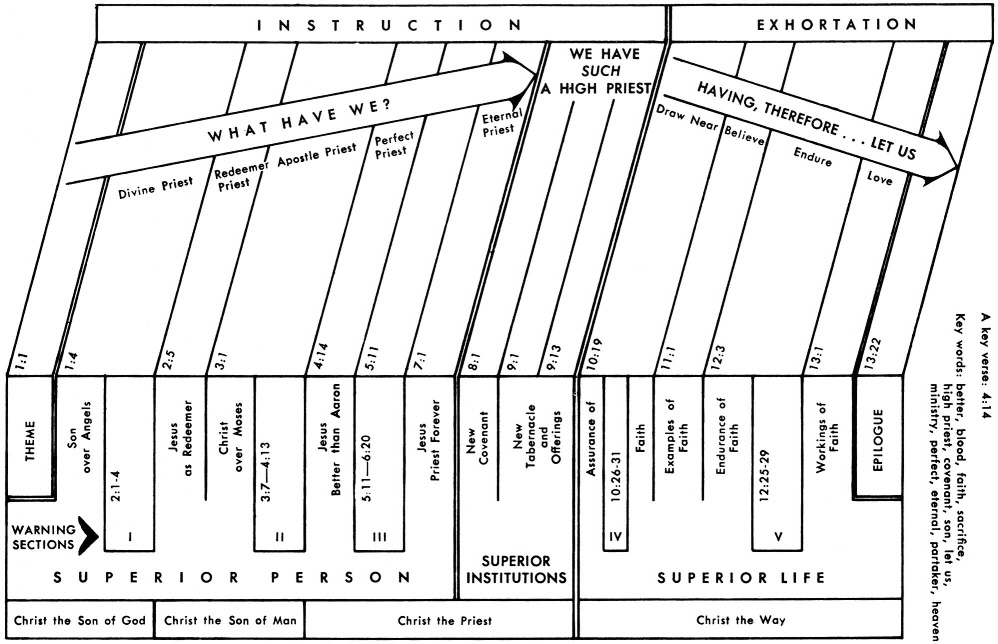
CONSIDER JESUS OUR GREAT HIGH PRIEST
Click chart to enlarge
Charts from Jensen's Survey of the NT - used by permission
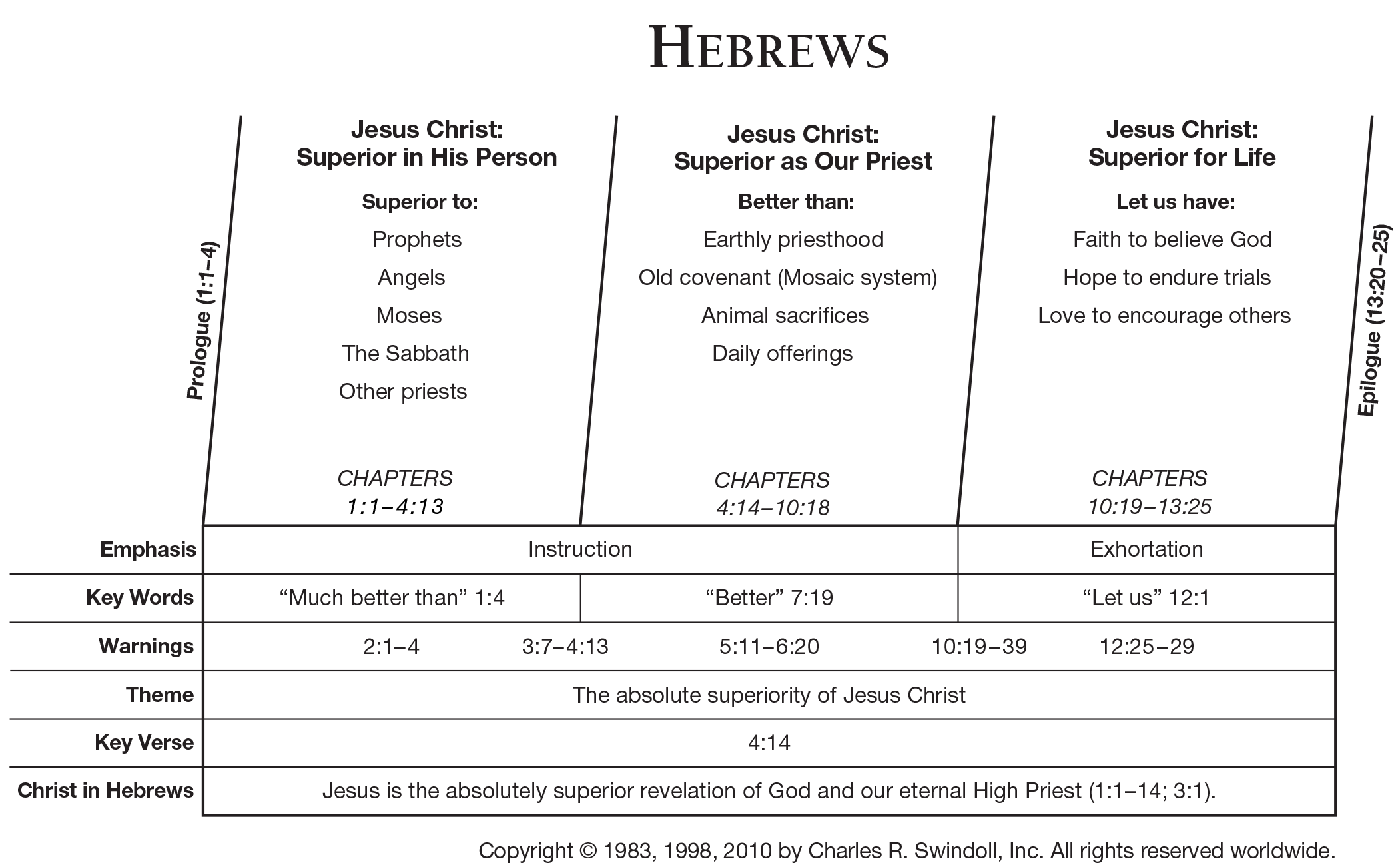
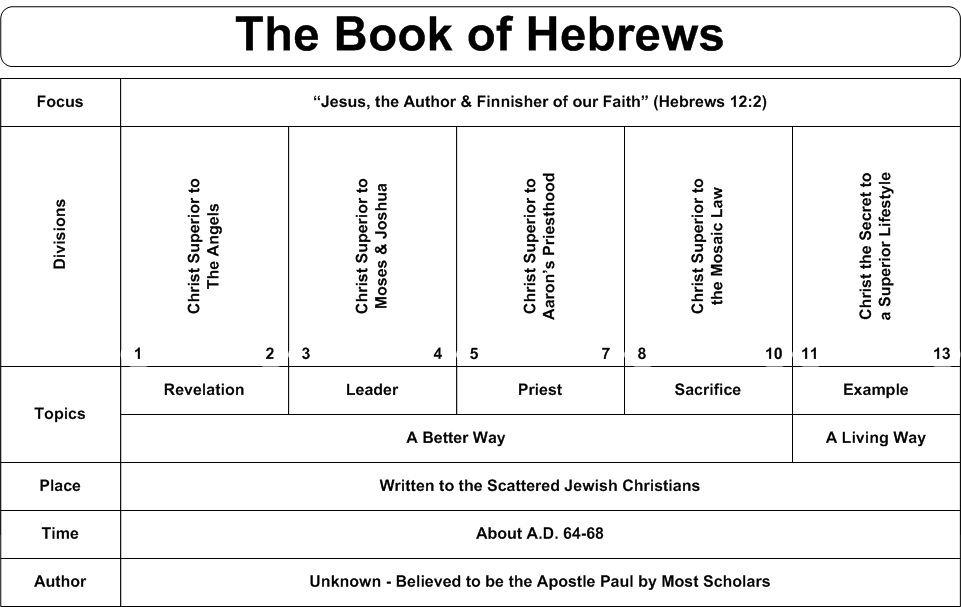
Swindoll's Chart, Interesting Pictorial Chart of Hebrews, Another Chart

|
The Epistle |
||||
| INSTRUCTION Hebrews 1-10:18 |
EXHORTATION Hebrews 10:19-13:25 |
|||
| Superior Person of Christ Hebrews 1:1-4:13 |
Superior Priest in Christ Hebrews 4:14-10:18 |
Superior Life In Christ Hebrews 10:19-13:25 |
||
| BETTER THAN PERSON Hebrews 1:1-4:13 |
BETTER PRIESTHOOD Heb 4:14-7:28 |
BETTER COVENANT Heb 8:1-13 |
BETTER SACRIFICE Heb 9:1-10:18 |
BETTER LIFE |
| MAJESTY OF CHRIST |
MINISTRY OF CHRIST |
MINISTERS FOR CHRIST |
||
|
DOCTRINE |
DUTY |
|||
|
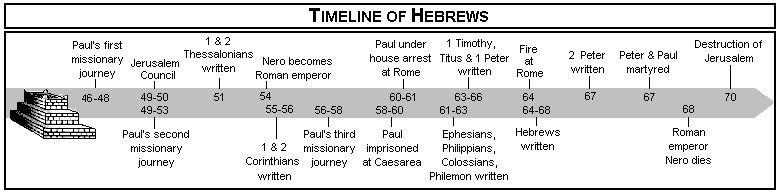
DATE WRITTEN: |
||||

See ESV Study Bible "Introduction to Hebrews"
(See also MacArthur's Introduction to Hebrews)
Borrow Ryrie Study Bible
Hebrews 11:39 And all these, having gained approval through their faith, did not receive what was promised, (NASB: Lockman)
Greek: Kai outoi pantes marturethentes (APPMPN) dia tes pisteos ouk ekomisanto (3PAMI) ten epaggelian,
Amplified: And all of these, though they won divine approval by [means of] their faith, did not receive the fulfillment of what was promised, . (Amplified Bible - Lockman)
KJV: And these all, having obtained a good report through faith, received not the promise:
NLT: All of these people we have mentioned received God's approval because of their faith, yet none of them received all that God had promised. (NLT - Tyndale House)
Phillips: All these won a glowing testimony to their faith, but they did not then and there receive the fulfilment of the promise. (Phillips: Touchstone)
Wuest: And these all, although they had witness borne to them through their faith, did not receive the promise.
Young's Literal: and these all, having been testified to through the faith, did not receive the promise,
AND ALL THESE, HAVING GAINED APPROVAL THROUGH THEIR FAITH: Kai houtoi pantes marturethentes (APPMPN):
- Heb 11:2,13; Luke 10:23,24; 1Peter 1:12
And all of these - All those mentioned and those unmentioned (as implied by "And what more shall I say? For time will fail me..." He 11:32a) in the "Hebrews Hall of Faith".
Gained approval - Their faith bore witness. "Now faith is the assurance of things hoped for, the conviction of things not seen. 2 For by it the men of old gained approval." (Hebrews 11:1-2)
Henry Morris on all...gained approval - This summarizes “the good report” obtained by the “elders” of our faith (Hebrews 11:2). (Defender's Study Bible)
Hughes explains that they were "well attested by their faith in that their faith, so far from being extinguished, was constant and prevailed in the face of the severest testing and opposition and thus declared the genuineness of their profession (A Commentary On The Epistle To The Hebrews)
Having gained approval (3140) (martureo from mártus = witness, one who has information or knowledge of something & hence can bring to light or confirm something; English ~ martyr) ) means to be a witness, to testify, to give evidence, to give testimony, to affirm that one has seen or heard or experienced something. To be well reported. It means to provide information about a person or an event concerning which the speaker has direct knowledge. Martureo in some context is used in the sense of making an important and solemn declaration. It can be used in the sense of confirmation or approval and so to affirm n a supportive manner. All
Martureo is another key word in Hebrews, with 7/81 (almost 10% of the NT uses)
Hebrews 7:8 (note) - In this case mortal men receive tithes, but in that case one receives them, of whom it is witnessed that he lives on.
Hebrews 7:17 (note) - For it is attested of Him, "YOU AREA PRIEST FOREVER ACCORDING TO THE ORDER OF MELCHIZEDEK ."
Hebrews 10:15 (note) - And the Holy Spirit also testifies to us; for after saying,
Hebrews 11:2 (note) - For by it the men of old gained approval.
Hebrews 11:4 (note) - By faith Abel offered to God a better sacrifice than Cain, through which he obtained the testimony that he was righteous, God testifying about his gifts, and through faith, though he is dead, he still speaks.
Hebrews 11:5 (note) - By faith Enoch was taken up so that he would not see death; AND HE WAS NOT FOUND BECAUSE GOD TOOK HIM UP; for he obtained the witness that before his being taken up he was pleasing to God.
Hebrews 11:39 (note) - And all these, having gained approval through their faith, did not receive what was promised
THROUGH THEIR FAITH, Now, what was the result for those who were faithful in persecution, deprivation, and death? Beautifully, it was and is the same as for those who experienced great public triumphs in their lives (the Noahs and Moseses and Gideons).
First, they “were all commended for their faith” (v39a). This is the way the chapter began—“Now faith is being sure of what we hope for and certain of what we do not see. This is what the ancients were commended for” (v1, v2)—and this is how it ends. All the faithful (the known and unknown, the famously triumphant and those who anonymously persevered in suffering) were “commended for their faith.” God forgets no one who loves and serves him! It is his great pleasure to commend faith!
The second result is that “none”—that is, none of the great triumphant members of the Hall of Faith or those who persevered without earthly triumphs—“none of them received what had been promised” (v39b). Although many promises had been given and fulfilled in their lifetimes, they did not receive the great promise—namely, the coming of the Messiah and salvation in Him. Every one of the faithful in Old Testament times died before Jesus appeared. They entered Heaven with the promise unfulfilled.
Why is this? The answer is given in our final verse: “God had planned something better for us so that only together with us would they be made perfect” (v40). No one was “made perfect” under the Old Covenant, because Christ had not yet died. They were saved, but not until Jesus’ work on the cross was complete could salvation be perfect. Their salvation looked ahead to what Christ would do. Ours looks back to what he has done—and ours is "more" perfect now but someday in glory totally perfect. Amen.
Faith (4102)(pistis) is synonymous with trust or belief and is the conviction of the truth of anything, but in Scripture speaks of belief respecting man's relationship to God and divine things, generally with the included idea of trust and holy fervor born of faith and joined with it. As pistis relates to God, it is the conviction that God exists and is the Creator and Ruler of all things well as the Provider and Bestower of eternal salvation through Christ. As faith relates to Christ it represents a strong and welcome conviction or belief that Jesus is the Messiah, through Whom we obtain eternal salvation and entrance into the Kingdom of Heaven. Stated another way, eternal salvation comes only through belief in Jesus Christ and no other way.
For more discussion on the meaning of faith see commentary on Hebrews 11:1-2.
Faith is believing that God will keep His promises, despite circumstances that seem to be to the contrary! True faith that saves one's soul includes at least three main elements - (1) firm persuasion or firm conviction, (2) a surrender to that truth and (3) a conduct emanating from that surrender. In sum, faith shows itself genuine by a changed life. (Click for W E Vine's definition of faith) Click for Dr Grudem's online outline of Conversion and/or Listen to the Mp3 of Conversion) which addresses the question "What is saving faith?" in an easy to understand manner.
Wuest - Expositor’s has a good note on these Heb 11:39-40: “ ‘And these all,’ that is, those who have been named in this chapter, ‘although they had witness borne to them through their faith,’ as has been recorded (vv. 2–38), ‘did not receive the promise,’ that is, as already said in verse 13, they only foresaw that it would be fulfilled and died in that faith. But this failure to obtain the fulfilment of the promise was not due to any slackness on the part of God nor to any defect in their faith; there was a good reason for it, and that reason was that ‘God had in view some better thing for us, that without us they should not be perfected.’ The ‘better thing’ is that which this Epistle has made it its business to expound, the perfecting of God’s people by full communion with Him mediated by the perfect revelation (Heb 1:1) of the Son and His perfect covenant (Heb 8:7–13), and His better sacrifice (Heb 9:23). And the perfecting of the people of God under the Old Testament is said to have been impossible, not as might have been expected ‘apart from the Son,’ but ‘without us,’ because the writer has in view the history of the Church, the relation of the people of God in former times to the same people in Messianic times.” Alford adds: “The Advent and work of Christ has changed the estate of the Old Testament fathers and saints into greater and perfect bliss; an inference which is forced on us by many other places in Scripture. So that their perfection was dependent on our perfection: their and our perfection was all brought in at the same time, when Christ ‘by one offering perfected forever those who are sanctified.’ So that the result with regard to them is, that their spirits, from the time when Christ descended into Hades and ascended up into heaven, enjoy heavenly blessedness, and are waiting with all who have followed their glorified High Priest within the veil, for the resurrection of their bodies, the Regeneration, the renovation of all things.” (Hebrews Commentary)
DID NOT RECEIVE WHAT WAS PROMISED: ouk ekomisanto (3PAMI) ten epaggelian:
Did not receive - "Not" is absolute - they absolutely did not receive what was promised!
Receive (2865)(komizo from komeo = tend, take care of) means to bring bear or carry (used this way only in Lk 7:37) and in the middle voice (as here in Hebrews 11:39) to receive back (in sense of requital, recompense or reward) or to get what is promised (as in 1Peter 5:4 [note], Hebrews 10:36 [note]) or to get back something that is one's own or is owed to one (as in Mt 25:27)
Promised (1860)(epaggelia/epangelia) in the Bible refer primarily to God's pronouncements that provide assurance of what He intends to do.
Promise is a key word (See importance of observing and querying "key words") in Hebrews 11, the great chapter on great faith and this association (faith and promise) is not surprising, for the way to lay hold of the blessed promises of God is only by faith! (Promise is used 5x - Heb 11:9, Heb 11:13, Heb 11:17, Heb 11:33, Heb 11:39)
Webster's 1828 Dictionary definition of promise - In a general sense, a declaration, written or verbal made by one person to another, which binds the person who makes it, either in honor, conscience or law, to do or forbear a certain act specified; a declaration which gives to the person to whom it is made, a right to expect or to claim the performance or forbearance of the act. The promise of a visit to my neighbor, gives him a right to expect it, and I am bound in honor and civility to perform the promise. Of such a promise human laws have no cognizance; but the fulfillment of it is one of the minor moralities, which civility kindness and Strict integrity require to be observed. A binding declaration of something to be done or given for another’s benefit. A promise (especially to the Heroes of the Hall of Faith in Hebrews 11) is that which affords expectation of future distinction! In Scripture, the promise of God is the declaration or assurance which God has given in His word of bestowing blessings on His people. Such assurance resting on the perfect justice, power, benevolence and immutable veracity of God, cannot fail of performance. (Read and be encouraged by 1Kings 8:56, Joshua 21:45, Joshua 23:15, Lk 21:33 - including His promises! Praise the Lord! Amen)
Spurgeon - It lay in the future to them far more than it does to us, for Christ has now come, and we look hack to that glorious appearing of our Lord and Savior, but they had altogether to look forward. They did not live to see Christ come. They expected Him; but, before the time when (the writer of Hebrews) was writing,— before the actual coming of Christ, they had all passed away: “These all, having obtained s good report through faith, received not the promise:” Christ did not come in their day; the hour for the fulfillment of the great promise had not then struck.
True faith has the courage to count on salvation. These faithful saints had to live in hope. They knew very little about the nature or the time or the means of God’s salvation. But they knew it was coming, and this was the basis of their trust. They had abiding confidence that one day God would do the necessary thing to redeem them and reward them. What happened to them before that time was not consequential. They did not receive what was promised but they had gained approval through their faith. Their faith was not in some immediate fulfillment, but in the ultimate fulfillment of the promises. Here is where faith is most tested and where it most matters.
The ultimate promise was of a redeemer, the Messiah, and of His covenant that would bring righteousness before God. “As to this salvation, the prophets who prophesied of the grace that would come to you made careful search and inquiry, seeking to know what person or time the Spirit of Christ within them was indicating as He predicted the sufferings of Christ and the glories to follow” (1Pet. 1:10-11-note). All these, from Enoch through the prophets, had that courageous faith which counts, without reservation, on final salvation.
Many of them never received the land. Sometimes they had earthly victory; sometimes they did not. Sometimes their faith saved them from death; sometimes it brought them death. No matter. They knew that God had provided something better.
Life Application Study Bible - Hebrews 11 has been called faith's hall of fame. No doubt the author surprised his readers by this conclusion: These mighty Jewish heroes did not receive all that God had promised because they died before Christ came. In God's plan, they and the Christian believers (who were also enduring much testing) would be rewarded together. Once again Hebrews shows that Christianity offers a better way than Judaism.
William Newell - Heb 11:39: Having had witness borne to them--This precious word "witness" accompanies this "so great cloud of witnesses" from Hebrews 11:2 to Hebrews 12. God spoke to them, and they knew it; their hearts were filled with an expectancy--of what? Paul's great general definition of the saints in Romans 2:7 will give the answer: "Them that by patience in well-doing seek for glory" (that is, connected with the presence of God) "and honor" (the opposite of the guilt, disgrace, and uncleanness of sin) "and incorruption" (that is, a state of bodily deliverance).
Through their faith--Their faith brought the witness and the expectation, but not yet the realization. Received not the promise--As Joseph said down in Egypt as he lay dying, "God will surely visit you"; and he asked that his bones be carried up to Canaan, the land of promise, for burial. There they lie yet--waiting.
We beg you, go through the Word of God studying the word "wait," as toward God. It is one of the great words of Scripture.
- Jacob said, "I have waited for Thy salvation, O Jehovah."
- "They that wait for Jehovah shall renew their strength" (Isa 40:31).
- "They that wait for Me shall not be put to shame" (Isa 49:23).
- "For from of old men have not heard, nor perceived by the ear, neither hath the eye seen a God besides Thee, Who worketh for him that waiteth for Him" (Isa 64:4).
- "Jehovah is good unto them that wait for Him, to the soul that seeketh Him. It is good that a man should hope and quietly wait for the salvation of Jehovah." (Lam. 3:25-26).
- David: "I waited patiently for Jehovah, And He inclined unto me and heard my cry" (Ps. 40:1).
- David: "Rest in Jehovah and wait patiently for Him" (Ps. 37:7).
In waiting, the saints give God His place. Blessed is the man who finds himself taken by sovereign grace into His plans of infinite wisdom. God says to the Hebrew believers and to us, "Ye have need of patience, that, having done the will of God, ye may receive the promise" (Hebrews 10:36-37).
W E Vine - And these all, having had witness borne to them through their faith, received not the promise,-that is, all from Abel to the last believer referred to in Old Testament times had God’s witness given to them in Holy Scripture, by means of (not because of) their faith, but they did not receive the fulfillment of the promise, not merely of future earthly blessing, but of that which they will receive in resurrection life and glory.
This is not contradictory to the statement in 6:15, concerning Abraham, that he “obtained the promise,” for that refers to the fact that God did make good His word to him in his earthly circumstances.
These were all commended for their faith, yet none of them received what had been promised. - Hebrews 11:39
TODAY IN THE WORD
One basic principle of Bible study is that Scripture is often the best commentary on itself. Isaac’s inclusion in Hebrews 11 is a good example of how one part of the Bible helps us understand another part. Hebrews 11:20 shows how God used Isaac to accomplish His purposes even in the middle of all the deception and anger that surrounded Isaac’s blessing of Jacob and Esau.
This faith perspective is important because it’s hard to see from Genesis 27 how anyone in Isaac’s family was acting in faith. Isaac was famous mostly because of his famous family. He lived longer than either Abraham or Jacob, but there’s not much space given to him in Genesis. His most clearly recorded act of faith was to pray that he and his wife Rebekah would have children (Gen. 25:21).
When it came time to pass on his blessing, Isaac turned to Esau, probably ignoring God’s prophecy that Esau would be subservient to Jacob (Gen. 25:23). Isaac’s decision was motivated more by his appetite than anything, because he liked what Esau hunted and cooked.
Esau had already shown his contempt for spiritual things when he sold his birthright to satisfy his own hunger. The Bible says that Esau “despised” his birthright (Gen. 25:34).
Jacob wanted the blessing that God wanted him to have, but he and Rebekah used deception to get it instead of acting faithfully. Jacob seems to have been more worried about getting caught than he was about the rightness of the plan.
All four family members had their own agenda, but God overruled this biblical “soap opera” and Jacob became the next in line to inherit the promises God first made to Abraham.
TODAY ALONG THE WAY
God still overrules and uses human sin and weakness to work out His plan for our good and His glory.
These were all commended for their faith. - Hebrews 11:39
TODAY IN THE WORD
Faith and spirituality seem to be on the rise in the United States. If fact, a March 19, 2004 survey by the Barna Group found that nearly nine out of ten adults (87%) claim that their religious faith is very important in their daily life. Given the accompanying statistics on divorce rates, pornography addiction, and materialism, we might well ask about the nature of that faith, and whether it does in fact have any power to affect our lives.
Hebrews 11 is known as the “Hall of Faith” in Scripture. Yet interestingly, we don’t see a list of items to believe in. Instead, we see a list of people who demonstrated their faith through their obedience to God. This passage reveals that faith is not just a matter of mentally agreeing to certain propositions. Faith is the willingness to stake our entire lives on God’s promises. Faith means living a certain way–as if what God has said is true.
Note that these Old Testament saints lived in faith, and yet still didn’t receive the fullness of the promise in their lifetimes (v. 39). What was this promise that we have but they didn’t? We now have the Holy Spirit. We have His work in us to produce the fruit of faithfulness, so that our lives can reflect what we say that we believe.
After giving us a dramatic presentation of biblical heroes who exhibited faith, the author of Hebrews urges us to continue to press forward in our Christian lives. We are called to “run with perseverance,” and are encouraged not “to grow weary and lose heart” (12:1, 3). This implies that our Christian race will not always be easy. Living in faith will require us to make sacrifices and face challenges. To further encourage us, though, the author presents the greatest model of faith: Jesus Himself. He has endured more than we will ever face, and He accomplished His work (v. 2).
TODAY ALONG THE WAY
We are called as Christians to share our faith with others. This includes both being able to describe our belief in Jesus and living in a way that demonstrates that what we believe is true.
These were all commended for their faith. - Hebrews 11:39
TODAY IN THE WORD
Dan Southern, president of the American Tract Society, tells of a friend in a small town whose house was on the route of a local parade. Because few people came out to watch, this woman stood outside her home waving at the marchers and greeting them. As the parade went on, she became more excited and began responding with great enthusiasm. Suddenly, a VIP in the parade came over to Dan's friend and gave her a hug. It was the state's governor who had noticed her enthusiasm and wanted to say thanks.
We can almost imagine the readers of Hebrews, watching the parade of the VIPs of God passing by. But the writer did not simply want his readers to watch the parade of the faithful. He was calling them to fall into step and join it.
Remember, Hebrews 11 was not written just to praise the Old Testament spiritual giants. The Hebrews were being given an armload of reasons for not shrinking back from Christ, but for persevering and gaining ""what He has promised"" (Heb. 10:36).
Verses 32-35a speak of triumph, escape, and displays of power. It's no surprise, then, to find David, Gideon, and Daniel in this list, although Daniel is not mentioned by name (v. 33).
But beginning with second half of verse 35, the picture changes from conquest to weakness and suffering. About a dozen kinds of persecution are cataloged here, and it's possible that the Hebrew believers had experienced some of them.
No one can accuse the author of sugarcoating the suffering that might await those who are committed to Christ. The Bible never denies that believers will suffer. Jesus assured us we could expect trouble (John 16:33). So the issue is not whether we will suffer, but how we will suffer.
Moses was a model of godly suffering for the Hebrews--and for us. Only someone looking to the things of eternity would choose affliction with the people of God over the short-lived pleasures of sin (Heb. 11:25-26).
This powerful chapter closes with an amazing statement. All of these great saints of the past still lacked the ""something better"" which believers on this side of the Cross enjoy: the coming of Christ and His perfect sacrifice for sin. In that sense, only together with us are they made perfect.
TODAY ALONG THE WAY
We have a great advantage over the Old Testament saints. We can see the fulfillment of God's promises, we know the reality of the Cross, and we hold God's complete revelation in our hands.
It follows, then, that our commitment to live by faith should be as great as theirs, if not greater. Is that true of us today? Each of us needs to answer that question before the Lord. Maybe it's time for a spring weekend walk as you talk with the Lord and allow Him to examine your heart.
Charles Stanley- Trust God for Tomorrow
SCRIPTURE READING: Hebrews 6:13–20
KEY VERSE: Hebrews 11:39
All these, having obtained a good testimony through faith, did not receive the promise.
Hope miraculously comes as you let go of your anxieties and expectations and trust God for your tomorrows.
In Hebrews 11 we are given a list of people who lived their lives in the light of hope. They trusted God through valleys so dark that they could not see the path before them. Yet the darkness could not blind them to God’s promises.
How did they live without the material evidence we so enjoy of God’s completed work? Hope is the answer. Planted deep within them was a sense of undeniable hope that God would accomplish what He had promised.
The writer of Hebrews tells us that “all these, … gained approval through their faith” (Heb. 11:39 NASB). Imagine the strength that hope provided when they faced the end of their lives! Hope taught them to believe that they would soon be in the presence of God.
Today the Spirit of God, who resides within each believer, offers this same hope to each of us. His presence in our lives is the connecting point that keeps us clad in hope.
As you embrace the hope of God through faith, you are given the ability to endure the storms of life. Hope is an anchor to the soul and a gateway to peace and rest through a living God who holds your life within His loving grasp.
Thank You, Lord, for hope. I praise You that You hold my life within Your loving grasp.
Charles Stanley - Deliverance Is Near
SCRIPTURE READING: Hebrews 12:1–4
KEY VERSE: Hebrews 11:39
All these, having obtained a good testimony through faith, did not receive the promise.
It’s hard to read Hebrews 11:39 without feeling pain of sorrow. In chapter 11, the writer of Hebrews recounted the faithfulness of the Old Testament saints. He told of the faith exhibited by Sarah and Abraham, of Jacob and Joseph, of King David, and many in between. There’s a passage about Enoch and Abel—two names we rarely mention in our day-to-day conversations.
Each had one thought in mind, and that was to receive God’s promise. Their eyes were turned to the future with the expectation that their generation might witness Messiah’s arrival. However, the writer of Hebrews told us that each died without seeing or physically touching His hand. But in Hebrews 12:1, our dismay is turned into great joy: “Therefore we also, since we are surrounded by so great a cloud of witnesses, let us lay aside every weight, and … let us run with endurance the race that is set before us.”
Were these Old Testament saints disappointed because they missed Jesus’ arrival? Not in the least. Their prayers were answered the moment they entered the presence of God. The burden you bear, the tears you shed, the sorrow you carry—God knows it all, and He has assembled a great and mighty host of experienced witnesses to cheer you on to victory.
Therefore, you can praise Him today and wait for Him in peace and joy, for His deliverance is near.
I praise You, Lord, because my deliverance is near. You know my burdens, tears, and sorrows. I humbly bow before You and worship.
Robert Neighbour - Many Saints, or the Faith That Sees the Things God has Provided
"And these all, having obtained a good report through faith, received not the promise: "God having provided some better thing for us, that they without us should not be made perfect" (Heb. 11:39, 40).
It is wonderful the large group that the Spirit brings before us as proofs of the vitality of a faith that is the substance of things hoped for and the evidence of things not seen.
The faith of each of these worthies accomplished distinctive victories for God. The conquests of their faith ran all the way from subduing kingdoms to being destitute, afflicted, tormented. However, in each of these recorded instances it was a faith made potent by a vision of the future things God held in store — good things which they never attained during their earth life and which they have not yet attained.
"And these all having had witness borne to them through their faith, received not the promise, God having provided some better thing concerning us, that apart from us they should not be made perfect" (vss. 39, 40, A. S. V.).
So it is, there lies ahead of us all a fullness of blessing which is laid aside and which shall simultaneously be given to those who have fought the good fight and kept the faith and finished their course.
Let us never again jest about those who believe the blessed hope of the Lord's return. Practically every conviction of faith set forth in the 11th of Hebrews has to do with some phase of the Lord's return.
Scoffers have arisen who say, "Where is the promise of His coming?" Unbelief is casting slurs at every vestige of the prophetic Scriptures which accepts at their face value the promise of the Lord's literal, corporeal, visible, personal, sudden coming to receive His own and to reign upon David's throne.
If we would please God, we must believe all that the prophets have spoken and we must have confidence in things hoped for and conviction in facts not seen.
The faith of many saints looked down
Through many ages, saw their crown;
They knew that Christ would come again,
That they with Him, would live and reign;
In faith they lived, in faith they died,
The promises, not verified
Disturbed them not, because faith knew
The Word was sure, and God was true.
The faith of all the saints who live
To-day upon the earth, should give
To God, a faith as strong, as true
As saints of old were used to do.
God's galaxy of heroes still
Is open unto all who will,
By deeds of faith write in their name
And thus attain a lasting fame.
Steven Cole - The last two verses of the chapter show us that…
3. God will bless all who trust Him with eternal rewards (He 11:39, 40).
“All these” refers to both groups. They all gained approval (or “a testimony”) through their faith, yet none received “the promise” (literal translation). Abraham received the promise of Isaac (He 11:17-note). Others “obtained promises” by faith (He 11:33). But none received the promise, which refers to Christ. They saw Him from afar in types and shadows, but we see Him clearly revealed in the New Testament. Most of them were under the old covenant, but God “provided something better for us, so that apart from us they would not be made perfect.” That something better is the new covenant in Christ’s blood. The old covenant with its sacrifices could not make the worshipers perfect (He 10:1-note). But the new covenant has sanctified us “through the offering of the body of Jesus Christ once for all” (He 10:10-note). The Old Testament saints were saved, but their salvation was not complete until the cross. Ours is complete because Jesus is the perfect sacrifice.
The author’s point is that if the Old Testament saints were faithful through all of these trials, even though they didn’t receive the promise of Christ in the flesh, how much more should we be faithful, since we have Christ! John Calvin (Calvin's Commentaries [Baker], p. 308) put it, “A small spark of light led them to heaven; when the Sun of righteousness shines over us (Mal 4:2-note), with what pretence can we excuse ourselves if we still cleave to the earth?”
Any yet, although we have the promise of Christ, we do not yet have the full experience of the glory that is to be revealed with Him in heaven. And so we must, like the Old Testament saints, live by faith in God’s promise as we await the final consummation when Jesus returns. We must endure whatever trials come, even persecution, by fixing our eyes on Jesus (He 12:1-3-note).
Conclusion
Let me sum up this section with four applications. I cannot expand on these, but I encourage you to think about how they apply more extensively to your life:
(1) Faith is ready to sacrifice present comfort for future reward with Christ. Faith recognizes that this life is very short in comparison with eternity. With Paul, faith recognizes that “momentary, light affliction is producing for us an eternal weight of glory far beyond all comparison” (2Co 4:17). In Paul’s case, this “light affliction” included beatings, imprisonments, being stoned, shipwrecked, and often being in danger of death (2Co 11:23, 24, 25, 26, 27)! When you experience “light affliction,” do you grumble or do you joyfully trust God?
(2) Faith lives with a God-ward focus, not with a focus on people or things. The saints mentioned in our text could endure mockings, scourgings, imprisonments, and death because their focus was on God, not on other people or things. They were looking to eternity, not to this vapor of life here. Calvin put it this way, “we ought to live only so as to live to God: as soon as we are not permitted to live to God, we ought willingly and not reluctantly to meet death” (ibid., p. 306).
(3) Faith trusts and obeys God, leaving the results to His sovereignty. Some trust and obey God and He grants spectacular results. Others trust and obey the same mighty God and He enables them to endure horrific trials in His strength. The difference is not in the people or in their faith, but in God’s sovereign purpose in each situation. We know the same God that these Old Testament saints knew, and we have even more, in that we know Christ personally. So we should trust Him as they did, whether He chooses to put us to death, as He did with the apostle James, or to deliver us from death for a while, as He did with Peter.
(4) Faithfulness to Jesus Christ counts more than anything else, even than life itself. As Martin Luther put it (“A Mighty Fortress”),
Let goods and kindred go,
this mortal life also;
the body they may kill:
God’s truth abideth still;
His kingdom is forever.
Trust God in whatever difficult situations you face. One day soon you will hear, “Well done, good and faithful slave…. Enter into the joy of your master” (Mt 24:21)
Discussion Questions
- Where is the balance between accepting our shortcomings and yet striving by faith to overcome them?
- Why is faith not opposed to preparation, planning, and hard work? How can we know whether the power is from God or from our planning and effort?
- Why is it wrong to judge whether we have God’s blessing by the visible results? How can we know if we have His blessing?
- What are some reasons that God does not always deliver those who trust in Him? (Faith's Reward)
Hebrews 11:40 because God had provided something better for us, so that apart from us they would not be made perfect (NASB: Lockman)
Greek: tou theou peri emon kreitton ti problepsamenou, (AMPMSG) ina me choris emon teleiothosin. (3PAPS)
Amplified: Because God had us in mind and had something better and greater in view for us, so that they [these heroes and heroines of faith] should not come to perfection apart from us [before we could join them]. (Amplified Bible - Lockman)
KJV: God having provided some better thing for us, that they without us should not be made perfect.
NET: For God had provided something better for us, so that they would be made perfect together with us.
NLT: For God had far better things in mind for us that would also benefit them, for they can't receive the prize at the end of the race until we finish the race. (NLT - Tyndale House)
Phillips: God had something better planned for our day, and it was not his plan that they should reach perfection without us. (Phillips: Touchstone)
Wuest: God having provided some better thing for us, in order that they without us should not be brought to completeness.
Young's Literal: God for us something better having provided, that apart from us they might not be made perfect.
BECAUSE GOD HAD PROVIDED SOMETHING BETTER FOR US: tou theou peri hemon kreitton ti problepsamenou:
- He 7:19,22; 8:6; 9:23; 12:24
THE BEST IS
YET TO COME!
Because - Always pause to prayerfully ponder this term of explanation. In this context the writer explains that the reception of the promise on earth was not the end of the story! The trustworthy, faithful God had something far better for His faithful servants.
Has provided (NIV = "planned"; RSV = "foreseen") (4265)(problepo from pró = before + blépo = see) means literally to see before, to look out beforehand, to foresee, to plan and then to furnish in advance ("preaarangement") or to provide (implying the need is seen in advance). In the NT problepo is found only in the middle voice (problépomai) and only in this passage (Heb11:40).The Amplified rendering picks up the sense of problepo - "Because God had us in mind." (NLT = "Had something better in mind.") This verb speaks of God's omniscience, omnipotence, providence and sovereignty.The only other use of problepo is in Ps 37:13, David writing that "The Lord laughs at him; For He sees (Lxx = problepo ~ "foresees") his day is coming (NET Note - from context - Ps 37:15, 17, 19-20 "his day" refers to the time when God will destroy evildoers)." In other words, the Lord laughs at the wicked, for He "plans or forsees" what their future holds - while the future holds great blessings for the godly, there will be great wrath and punishment for all who oppose God (cp Jn 5:28-29, Rev 20:11-15)
This refers to God's providential foreknowledge. In context, the point is that God was able to make such provisions as described here because He saw all history from beginning to end even before creation.
Provide in Webster's 1828 English dictionary is from Latin provideo (pro = before + video = to thus = to see before) means to To procure beforehand; to get, collect or make ready for future use; to prepare. (2) To furnish; to supply (with).
Better (2909)(kreitton/kreisson) is a comparative of kratus (strong) and the comparative degree of agathos which means “good”. Better refers to having good qualities in a greater degree than another. Something more advantageous, more acceptable, more effective, more commendable, more attractive, more safe.
Something better for us - This denotes the reality we as NT believers have found in Christ, which the men and women of faith in the OT would attain only after their earthly life ended. We are already recipients of the blessings of the new covenant in His blood (See Covenant: Why the New is Better). They would not fully know these blessings until the resurrection of Christ, the firstfruits Who at apparently at the time between His death on the Cross and His resurrection set free a host of captives of OT saints from Abraham's bosom so that they are now present with Him in heaven, awaiting the establishment of His kingdom for His 1000 year reign at the beginning of which they will receive their resurrected bodies (as best I can tell...not much Scripture on this so be careful not to be too dogmatic).
How great is our advantage! Right now, we live in the so much better New Covenant. We now have a high priest who has offered a perfect sacrifice for our sins once and for all. Our Savior/Priest sits at the right hand of the Father and prays for us. We have a better hope!
The hope of being made perfect includes the hope of physical resurrection, as many Scriptures declare. In the future “first resurrection” (see the concept of The Two Resurrections - "First" and "Second" - on a timeline) believers of both old and new covenants will participate and in this way together with us they will be made perfect.
Calvin caught the thrust of this chapter: “If those on whom the great light of grace had not yet shone showed such surpassing constancy in bearing their ills, what effect ought the full glory of the gospel to have on us? A tiny spark of light led them to heaven, but now that the Sun of righteousness shines on us what excuse shall we offer if we still cling to the earth?”
Our motivation and inspiration is fuller than theirs, for we have Jesus himself to sustain us. It is to that powerful support that the author now turns his reader’s attention.
Vine explains this passage as follows = firstly, the Hebrew believers whom the writer was addressing, whilst they had to walk by faith as Old Testament believers had, yet had greater privileges than they. God had reserved some better thing for the times of the rejected Messiah. Heavenly things have become the possession of believers now through their union with Christ and access into the Holiest by His blood. Our citizenship is in heaven. That was not the case with saints of old. But, secondly, whilst none are yet “made perfect,” they and we are to be glorified together in resurrection power and conformity to Christ’s body of glory, and thus we shall all be perfected, as the Lord prayed in John 17:23. Christ has Himself been made perfect in this day (Heb. 5:9-note and He 7:28-note. r.v., “perfected for evermore”).
Ray Stedman - They (OT saints described in Heb 11) looked for more than their own personal satisfaction, but still longed to see God’s purposes fulfilled on earth. The something better for us denotes the reality we have found already in Christ, which the men and women of faith in the Old Testament would attain only after their earthly life ended. We are already recipients of the blessings of the new covenant. They would not fully know them till the resurrection. The New Jerusalem, come down from heaven to earth, in which God will dwell among us and by which all the supernal vision of the prophets will be fulfilled, blends the two peoples of God together. The hope of being made perfect includes the hope of physical resurrection, as many Scriptures declare. In that “first resurrection” (Rev 20:6–7) believers of both old and new covenants will join. This is the way that together with us would they be made perfect. This is the mystery of God’s will which Paul describes in Ephesians 1:9–10 “to be put into effect when the times will have reached their fulfillment—to bring all things in heaven and on earth together under one head, even Christ.”....Calvin caught the thrust of this chapter and said, “If those on whom the great light of grace had not yet shone showed such surpassing constancy in bearing their ills, what effect ought the full glory of the gospel to have on us? A tiny spark of light led them to heaven, but now that the Sun of righteousness shines on us what excuse shall we offer if we still cling to the earth?” Our motivation and inspiration is fuller than theirs, for we have Jesus himself to sustain us. It is to that powerful support that the author now turns his reader’s attention. (Hebrews Commentary Part II)
William Newell - Heb 11:40: God having provided some better thing for us, that apart from us they should not be made perfect: First, here, who are the "us"? They are Hebrew believers spoken to and of, as "partakers of a heavenly calling." (This the Israelites, the "these all" of verse 39, never were and never will be, "Us" discriminates between them and all believers on an exalted, heavenly Christ.) What is the "better thing"? We believe that our heavenly calling, our membership in the Body of Christ, is that "better thing." Oh, let us cherish it! Since the lives of these great believers in Hebrews 11, Christ the Son of God has come, has died and been raised; and we died with Him, and were raised with Him into "heavenly places" and "seated" there with Him.
* "This better thing" than the O.T. saints had, is not explicitly described in Hebrews, for the great message of Hebrews is to a religious nation to whom Jehovah had spoken, and given a "religion." But now that God had "Spoken in His Son," former things--temple, sacrifices, days, seasons--were done away. The constant temptation of these Jews was to go back to this Judaism. But the only Priest God now recognized, having been offered for sin on earth--yea, "outside the gate" of Jerusalem itself, was at God's right hand in Heaven.
Infinite love had given Christ to die for sin. But, as today, and ever with wretched man, there was a turning to "religion," from which GOD had turned away! Man said, "I am a Jew"--just as today they say "I am a Presbyterian," "I am a Methodist," "I am a Baptist"--and so on. (And this despite specific forbidding in 1 Cor. 1:12-13.) But Christ died for sinners! Whether Jewish, Protestant, Catholic, infidel or atheist, or idolater, Christ died only for the LOST!
And He is the Great High Priest in Heaven of sinners, who as sinners, helpless, lost, and undone, have come to faith in a God Who "so loved" sinners, and in a Saviour to Whom alone at God's right hand is given the blessed work of maintaining believers on the way and bringing them where He is, in Glory!
They of the Old Testament were continually conscious of the great veil that hung between them and the ark of God's presence. How infinitely "better" it is to be invited "by a new and living way," by the blood of Christ and with Christ, to enter into the presence of God, by the Spirit! They of the Old Testament had a legal yoke which Peter said neither their fathers nor they "were able to bear"--the "ten thousand things" of God's Law. We have fellowship in the Spirit, He dwelling in each believer and, in a peculiar way, in the Assembly of believers. We have the Lord's Supper by which to keep in vivid memory that He has finished, Himself, the work He did at the Cross; and by which we show His death "till He come." And we have the blessed hope of our blessed Lord's return, looking for Him "so much the more, as we see the day drawing nigh" (Heb 10:25).
That apart from us they should not be made perfect: Here indeed is a glorious unity of all God's people: Israel with the earthly calling, and the saints now with the heavenly calling, looking forward to that day when shall be consummated in them and for them all their desire, yea, "exceeding abundantly above all they have asked or thought." Concerning the patriarchs our Lord Jesus told the Pharisees: "Ye shall see Abraham, and Isaac, and Jacob, and all the prophets, in the kingdom of God, and yourselves cast forth without" (Lk. 13:28). And as to the antediluvian saints, Enoch, for example, has been in Heaven between three and four thousand years. What it will be for Enoch to be "made perfect" must, we believe, concern bodily things; for we read in Hebrews 12:23, "Ye are come unto the spirits of just men made perfect." The spirits of these saints, now in heaven, had already been made perfect." The "perfecting" of Heb 11:40 looks forward to that salvation" consummated at the coming of Christ (Heb 9:28), which includes the redemption of the body. Compare Romans 13:11.
The same Greek word is used in Hebrews 6, where the exhortation is to "press on unto full growth." This "full growth," "no longer babes," is seen in Philippians 3:15, and 1Corinthians 2:6. That such an adult spiritual condition is attainable in this life is manifest. It corresponds to "him that is spiritual" of 1 Corinthians 2:15: that is, controlled by and walking in the Spirit. May it be the condition of all of us!
W E Vine - God having provided some better thing concerning us, that apart from us they should not be made perfect.-firstly, the Hebrew believers whom the writer was addressing, whilst they had to walk by faith as Old Testament believers had, yet had greater privileges than they. God had reserved some better thing for the times of the rejected Messiah. Heavenly things have become the possession of believers now through their union with Christ and access into the Holiest by His blood. Our citizenship is in heaven. That was not the case with saints of old. But, secondly, whilst none are yet “made perfect,” they and we are to be glorified together in resurrection power and conformity to Christ’s body of glory, and thus we shall all be perfected, as the Lord prayed in John 17:23. Christ has Himself been made perfect in this day (Heb. 5:9 and 7:28. R.V., “perfected for evermore”).
The subject of the church and its special position and glory is not in view in this epistle. Hence the full unfolding of the “better thing” is not here given.
The verb rendered “provided” is in the middle voice, indicating the special interest God has taken in doing this.
TOPLADY. The Church of Christ, which is partly militant and partly triumphant, resembles a city built on both sides of a river. There is but the stream of death between grace and glory.
L. Cowman - God having provided some better thing for us. (Heb. 11:40)
Our heavenly Father never takes any earthly thing from His children, unless He means to give them something better instead. GEORGE MULLER
An easy thing, O Power Divine,
To thank Thee for these gifts of Thine!
For summer’s sunshine, winter’s snow,
For hearts that kindle, thoughts that glow;
But when shall I attain to this:
To thank Thee for the things I miss?
For all young fancy’s early gleams,
The dreamed-of joys that still are dreams,
Hope unfulfilled, and pleasures known
Through others’ fortunes, not my own,
And blessings seen that are not given,
And ne’er will be—this side of heaven.
Had I, too, shared the joys I see,
Would there have been a heaven for me?
Could I have felt Thy presence near
Had I possessed what I held dear?
My deepest fortune, highest bliss,
Have grown, perchance, from things I miss.
Sometimes there comes an hour of calm;
Grief turns to blessing, pain to balm;
A Power that works above my will
Still leads me onward, upward still;
And then my heart attains to this:
To thank Thee for the things I miss.
THOMAS WENTWORTH HIGGINSON
Instead of the dry land, springs of water!
Instead of heaviness, the garment of praise!
Instead of the thorn, the fir tree!
Instead of the brier, the myrtle tree!
Instead of ashes, beauty!
ISAIAH 41:18; 55:13; 61:3
What God Has Provided for Us Who Love Him - W A Criswell
Hebrews 11:40 "God having provided some better thing for us...."
1. Death was not intended when God created the man and the woman and placed them in the Garden of Eden. God created them immortal, perfect, in the image of God to have fellowship with him. Sin and the judgment of death broke that holy and beautiful relationship. Death is an interloper, and intrusion, a horrible irruptive.
But the story is not done and the book is not finished with the judgment of death. God has provided some better thing for us. The grave is not our final resting place and corruption is not the ultimate consummation of our lives. There is another chapter to be written before the book is finally closed. That concluding chapter is one of victory and triumph in Christ Jesus.
2. Chapter 11 of the letter to the Hebrews recounts the heroes of faith. They are presented one after another. Their story is one of sorrow, tears, persecution, suffering, and death. Look at the verses that recount their suffering. From the shed blood of righteous Abel to the saints whose heavy and terrible trials described in Hebrews 11:33-38, the story is one of tragedy. But God provides some better thing for them. There is far more to life than the suffering we witness and personally endure here in this earth. God has provided heaven as an inheritance for his people.
3. Paul in 1 Corinthians 2:9 speaks of those wonderful and better things God has provided for them who love him. He avows that eye has never seen nor ear has ever heard nor heart has ever imagined the precious, heavenly things in store for the children of the Lord. But in verse 10 the apostle says that "God has revealed them unto us by his Spirit." What we cannot see or hear or feel by our natural senses we can know for truth, for fact, for reality, and for comfort through the Spirit of Jesus in our hearts. O heavenly truth! that the riches of all the promises we possess in Christ Jesus are ours now to behold, to be assured of, to be comforted by, and thus patiently to wait for their complete realization. This we achieve in our translation from this weary world to the heavenly world to come.
Precious is the hymn of Ellen H. Gates:
I will sing you a song of that beautiful land,
The far away home of the soul,
Where no storms ever beat on the glittering strand,
Where the years of eternity roll.
Oh, how sweet it will be in that beautiful land,
So free from all sorrow and pain,
With songs on our lips and with hope in our hands,
To meet one another again.
Something Better - Vance Havner
"God having provided some better thing for us...." Heb. 11:40
Not only has he provided for us something better than the saints of the Old Testament had; he has also provided something better than we who believe are receiving and enjoying.
Are you living spiritually on crackers and cheese when you have a standing invitation daily to the banquets of his grace? The devil will lead you to get along with the good when you might have the best. "The Lord is rich unto all that call upon him" (Rom. 10:12). "They which receive abundance of grace and of the gift of righteousness shall reign in life by one Jesus Christ" (5:17). If you do not reign it is because you do not take abundance of grace, you take just enough to get by!
Why ride third class when Christ has bought and paid for a first-class ticket? If your friend bought for you a Pullman ticket and meals in the diner and you sat in the baggage car and munched apples, would he not feel rejected? Christ has provided something better; make his provision your possession!
The spies brought back a sample from Canaan. Some Christians are living off samples from the land. After tasting and seeing that the Lord is good... eat! The figs and pomegranates, the milk and honey, the grapes of Eschol, are for you!
Scale the utmost height and catch the gleam of glory bright! There is something better for you!
John Phillips - So the great appeal merges into the great application. "God having provided some better thing for us, that they without us should not be made perfect" (Heb. 11:40). The Old Testament saints had only the shadows; we have the substance. They had good things; we have better things. Their sphere and horizon was earthly; ours is heavenly. Thus the writer of Hebrews applies the lessons from all the lives he has been considering, applies them with great leverage and tremendous pressure, to the lives of the Hebrew Christians to whom he wrote. "Go on," he says. "Go on. Never go back. Go on."
Andrew Fuller -
“Who through faith—obtained promises.”—Heb. 11:33.
“And these all—received not the promise.”—Heb. 11:39.
THE promises which were obtained by faith refer to those which were fulfilled during the Old Testament dispensation. It was promised to Abraham that he should have a son; to Israel, that they should possess the land of Canaan for an inheritance; to David, that they should return from the Babylonish captivity, &c; and by faith each of them in due time obtained the promise.
But there was one promise which was of greater importance than all the rest; namely, the coming of the Messiah. In the faith of this the fathers lived and died; but they saw not its accomplishment. To see this was reserved for another generation. Hence the words of our Saviour to his disciples:—“Blessed are your eyes, for they see; and your ears, for they hear. For verily I say unto you, that many prophets and righteous men have desired to see those things which ye see, and have not seen them; and to hear those things which ye hear, and have not heard them.”
It is thus that God has wisely balanced the advantages of different ages. The fathers obtained much, but not all. In respect of the blessings of Messiah’s kingdom, they sowed, and we reap; they laboured, and we enter into their labours. Thus it is ordered, that “they without us should not be made perfect.” The fulfilments of our times must come in to answer the faith and complete the hopes of those who have gone before us.
You Can Make It
Through acts of faith they toppled kingdoms, made justice work, and took the promises for themselves.
(Hebrew 11:40, TM)
Courage is all you can do—miracles are God doing the rest! What have you done about your situation? Have you persevered in prayer? On what Scriptures are you standing? Who have you talked to? You can have comfort or you can have conflict—but you can’t have both! Life isn’t easy, and it’s not fair. Mary Tyler Moore said. “Pain nourishes courage; you can’t be brave if you have only wonderful things happen to you.” She’s right!
In the worst storm of his life, Paul said to the captain, “Keep your courage—for I have faith in God that it will happen just as He told me” (Acts 27:25, NIV). Paul made it to his destination, and by God’s grace, you will, too. When Jehoshaphat was outnumbered a hundred to one by the enemy—he changed his focus. “We know not what to do, but our eyes are upon Thee” (2 Chronicles 20:12). There’s your key today. Stop looking at what’s against you, and start looking at what you have going for you. Listen: “Be strong and courageous. Do not be afraid or discouraged because of the King of Assyria and the vast army with him, for there is greater power with us than with him. With him is only the arm of flesh, but with us is the Lord our God to help us to fight our battles” (2 Chronicles 32:7–8, NIV).
YOU MAY TAKE A FEW HITS AND SUSTAIN A WOUND OR TWO, BUT GOD SAYS YOU ARE COMING OUT OF THIS STRONGER THAN YOU WERE WHEN YOU WENT IN! (Bob Gass)
SO THAT APART FROM US THEY SHOULD NOT BE MADE PERFECT: hina me choris hemon teleiothosin (Teleioo: 3PAPS):
- He 9:8, 9, 10, 11, 12, 13, 14, 15; 10:11, 12, 13, 14; Ro 3:25, 26) (He 5:9; 12:23; Revelation 6:11)
So that - Be alert to this important term of purpose or result.
Apart from us - And so in some way, the writer says that his believing readers and himself (and by implication we who live some 2000 years later) are part of the completion of this chapter on the "Hall of Faith".
They - Who are they? All of the great heroes of Hebrews 11. This is amazing statement regarding amazing grace that we should be accounted in their number as we exercise faith!
Spurgeon comments that...
They are waiting up yonder for us; the choirs of heaven cannot be completed without you -and me. Heaven’s full complement, the perfect number of the divine family of love, can never be made up till we who have believed go up yonder to join all those who have had like precious faith. By God’s grace, we shall all be there that they with us may be made perfect.
There is a something for us, whose lot is cast in these latter days, to bring, which shall complete the circle and choir of the Church of Christ, for they without us could not be made perfect. The Lord grant us grace to be ready for our share in that glorious consummation, for Christ’s sake. Amen.
The new dispensation is necessary to complete the old, the New Testament is the complement of the Old Testament, and New Testament saints join hands with Old Testament elders. Let us all be worthy of our high pedigree; and may God grant that, if the saints of these latter days are to perfect the history of the Church of Christ, the end may not be less heroic than the beginning was! A true poem should gather force as it grows, and its waves of thought should roll in with greater power as it nears its climax; so should the mighty poem of faith’s glorious history increase in depth and power as it gets nearer to its grand consummation, that God may be glorified yet more and more, through all his believing children. So may it be! Amen.
Is it not wonderful that we, who bring up the rear of the army of faith, are necessary to its completeness? It cannot be perfect without us. Ay, heaven itself will not be complete without us who are on the road to it. There would be empty seats in the holy orchestra, gaps in the sacred circle; so we who believe must all come there to make them perfect. God help us to hasten on our road, for our Lord Jesus Christ’s sake! Amen.
Made perfect (5048) (teleioo related to teleios from telos = an end, a purpose, an aim, a goal, consummate soundness, idea of being whole) means to accomplish or bring to an end or to the intended goal (telos). It means to be complete, mature, fully developed, full grown, brought to its end, finished, wanting nothing necessary to completeness or in good working order. It does not mean simply to terminate something but to carry it out to the full finish which is picked up in the translation "perfected". Teleioo signifies the attainment of consummate soundness and includes the idea of being made whole. Interestingly the Gnostics used teleios of one fully initiated into their mysteries and that may have been why Paul used teleios in this epistle.
In Hebrews 12:2+ Jesus is designated as "the author and perfecter of faith" where perfecter is teleiotes, the Completer, the One Who reached the goal so as to win the prize so to speak.
Wuest has this note on the NT word group (telos, teleioo, teleios, teleiosis, teleiotes) - Teleios the adjective, and teleioo the verb. The adjective is used in the papyri, of heirs being of age, of women who have attained maturity, of full-grown cocks, of acacia trees in good condition, of a complete lampstand, of something in good working order or condition. To summarize; the meaning of the adjective includes the ideas of full-growth, maturity, workability, soundness, and completeness. The verb refers to the act of bringing the person or thing to any one of the aforementioned conditions. When applied to a Christian, the word refers to one that is spiritually mature, complete, well-rounded in his Christian character. (Hebrews Commentary)
Richards commenting on the word group (telos, teleioo, teleios, teleiosis, teleiotes) writes that "These words emphasize wholeness and completeness. In the biological sense they mean "mature," or "full grown": the person, animal, or plant achieved the potential inherent in its nature. The perfect is the thing or person that is complete, in which nothing that belongs to its essence has been left out. It is perfect because every potential it possesses has been realized. (Richards, L O: Expository Dictionary of Bible Words: Regency)
Telioo is used 19 times of 24 total NT uses in Hebrews, often in the sense of to make perfect or fully cleanse from sin in contrast to ceremonial (Levitical) cleansing. The writer is emphasizing the importance of perfection... (which should cause any Jew who is contemplating the worth of Christ and the New Covenant to realize his utter hopelessness to every attain perfection under the Old Covenant).
Hebrews 2:10 (note) For it was fitting for Him, for Whom are all things, and through Whom are all things, in bringing many sons to glory, to perfect the author of their salvation through sufferings (What sufferings? Certainly one would consider His temptation by Satan in the barren wilderness [see Mt 4:1-11, Lu 4:1ff, Mk 1:12, 13] and Gethsemane [Mt 26:36,44, Lu 22:39,44][in agony He was praying very fervently]). (Comment: This does not imply any moral imperfection in the Lord Jesus, but speaks of the consummation of the human experience of suffering the death of the Cross, through which He must pass if He is to become the Author or Captain of our salvation.)
Hebrews 5:9 (note) And having been made perfect, He became to all those who obey Him the source of eternal salvation,
Hebrews 7:19 (note) (for the Law made nothing perfect), and on the other hand there is a bringing in of a better hope, through which we draw near to God. (Comment: This means to carry through completely, to make complete, to finish, bring to an end. The old covenant could bring nothing to conclusion. The Mosaic economy could reveal sin but it could never remove sin, and so it had to be removed. It gave no security. It gave no peace. A man never had a clean conscience.)
Hebrews 7:28 (note) For the Law appoints men as high priests who are weak, but the word of the oath, which came after the Law, appoints a Son, made perfect forever.
Hebrews 9:9 (note) which is a symbol for the present time. Accordingly both gifts and sacrifices are offered which cannot make the worshiper perfect in conscience,
Hebrews 10:1 (note) For the Law, since it has only a shadow of the good things to come and not the very form of things, can never by the same sacrifices year by year, which they offer continually, make perfect those who draw near. (Contrast with Jesus in Hebrews 5:9 above. The idea in Hebrews 10:1 is that the ceremonial law could not actually save the believer. Its work was always short of completeness.)
Hebrews 10:14 (note) For by one offering He has perfected for all time those who are sanctified. (Comment: Wuest writes "Here, the completeness of the state of salvation of the believer is in view. Everything essential to the salvation of the individual is included in the gift of salvation which the sinner receives by faith in Messiah’s sacrifice. The words “for ever” here are to be construed with “perfected.” It is a permanent state of completeness in salvation to which reference is made. The words “them that are sanctified” are descriptive of the believer. He is one set apart for God) (ibid)
Hebrews 11:40 (note) because God had provided something better for us, so that apart from us they should not be made perfect.
Hebrews 12:23 (note) (But you have come...) 23 to the general assembly and church of the first-born who are enrolled in heaven, and to God, the Judge of all, and to the spirits of righteous men made perfect,
In sum the fundamental idea of telioo is the bringing of a person or thing to the goal fixed by God.
It is interesting and doubtless no mere coincidence that in the Septuagint (LXX) teleioo is translated numerous times as consecrated or consecration, especially speaking of consecration of the priests (cf Jesus our "great High Priest") (Ex 29:9, 29, 33, 35 Lv 4:5; 8:33; 16:32; 21:10; Nu 3:3). The LXX translators gave the verb teleioo a special sense of consecration to priestly service and this official concept stands behind the writer's use in this passage in Hebrews 5:9 (note). It signifies that Jesus has been fully equipped to come before God in priestly action.
God has provided this something better for us, that is for those under the New Covenant, which is why apart from us they should not be made perfect. That is, not until our time, the time of Christianity, could their salvation be completed, made perfect. Until Jesus’ atoning work on the cross was accomplished, no salvation was complete, no matter how great the faith a believer may have had. Their salvation was based on what Christ would do; ours is based on what Christ has done. Their faith looked forward to promise; ours looks back to historical fact.
Yet, though their salvation was not completed in their lifetimes, these were not second-rate believers. They were believers of the highest order. They courageously struggled, suffered, and counted on salvation. They believed all of God’s Word that they had, which is what counts with Him. How much less faith do we often have, in spite of our much greater light. “Blessed are they who did not see, and yet believed” (John 20:29).
This is survival truth! We must not succumb to the delusion that gentle rain and sunshine will continue to fall on the church in America as the culture sinks further into neo-paganism.
Constable notes that " Their perfection refers to their entering into their final rest (inheritance) and rests, as ours does, on the sacrificial death of Christ (cf. He 9:15).
Jerry Bridges - Make perfect (see Heb. 7:11, 19; 9:9; 10:1, 14; 11:40; 12:23). The use of this term is distinctive of the epistle to the Hebrews in the same way the term righteousness of God is distinctive to the epistle to the Romans. While the term righteousness of God relates to the legal aspects of the atonement, make perfect relates to the priestly aspects of the atonement. The author of Hebrews frequently uses the phrase make perfect to expose the inadequacy of Levitical priesthood and sacrifices:
For since the law has but a shadow of the good things to come instead of the true form of these realities, it can never, by the same sacrifices that are continually offered every year, make perfect those who draw near. (Heb. 10:1)
By contrast, Christ, “by a single offering . . . has perfected for all time those who are being sanctified” (Heb. 10:14). By the single offering of himself, Christ “has perfected” the ones he has set apart for himself. Notice the use of past tense here—has perfected—indicating that those united to Christ in the atonement are already considered perfectly holy in Christ. In other words, as believers draw near to their holy God, they are accepted by him based on the superior priesthood and sacrifice of Christ. While they remain experientially imperfect, they are positionally perfect because of their union with their representative, their Great High Priest, who himself was “made perfect through suffering” (Heb. 2:10).
To make perfect literally means “to complete a work,” which is displayed by the immortal three words of our dying Savior, “It is finished” (John 19:30). Those who embrace a right understanding of the atonement will tend to declare these three words to be the most excellent three words in all of language.
F B Meyer...
THIS chapter proves that the saints of all ages are essentially one. There is a link which unites them; a thrill which passes from hand to hand around the circle. One theme for many voices; one attitude for many faces; one inspiration for many hearts. The saints that lived before the Advent and those that have lived since are one in their faith in the living God, making the unseen visible, the distant near, and seeing the eternal through the transient and ephemeral.
And now heaven waits. Its joys are not complete; its rapture not full. The blessed are blessed; but there is yet a margin between what they are and what they will be--between what they enjoy, and what they may enjoy. The choir is not full, and the anthem cannot be fully rendered till our voices blend in it. There is a pause, a halt, an expectancy, an incompleteness, till we come. Your dear ones want you to be there. They have not gone far into the heart of God's bliss, but are lingering near the gate till you have joined them.
From Switzerland your friends write you to say it is perfectly beautiful, but "it will be better when you join us; we are reserving the best excursions till you arrive; we are incomplete without you; make haste." It is thus that the blessed await us. The spirit of Heaven is well represented by the courtesy of the old prophet, who would not sit down to meat with Jesse and his sons, till David, the youngest, had come thither also. And when the whole family is gathered, there will be a perfecting indeed, from which no element shall be wanting.
Oh rapture of eternal joy! We stretch out our hands in yearning desire, and doing so touch other hands reached toward ours! (F. B. Meyer. Our Daily Homily)