Hebrews 11:1
Hebrews 11:2
Hebrews 11:3
Hebrews 11:4
Hebrews 11:5
Hebrews 11:6
Hebrews 11:7
Hebrews 11:8
Hebrews 11:9
Hebrews 11:10
Hebrews 11:11
Hebrews 11:12
Hebrews 11:13
Hebrews 11:14
Hebrews 11:15
Hebrews 11:16
Hebrews 11:17
Hebrews 11:18
Hebrews 11:19
Hebrews 11:20
Hebrews 11:21
Hebrews 11:22
Hebrews 11:23
Hebrews 11:24
Hebrews 11:25
Hebrews 11:26
Hebrews 11:27
Hebrews 11:28
Hebrews 11:29
Hebrews 11:30
Hebrews 11:31
Hebrews 11:32
Hebrews 11:33
Hebrews 11:34
Hebrews 11:35
Hebrews 11:36
Hebrews 11:37
Hebrews 11:38
Hebrews 11:39
Hebrews 11:40
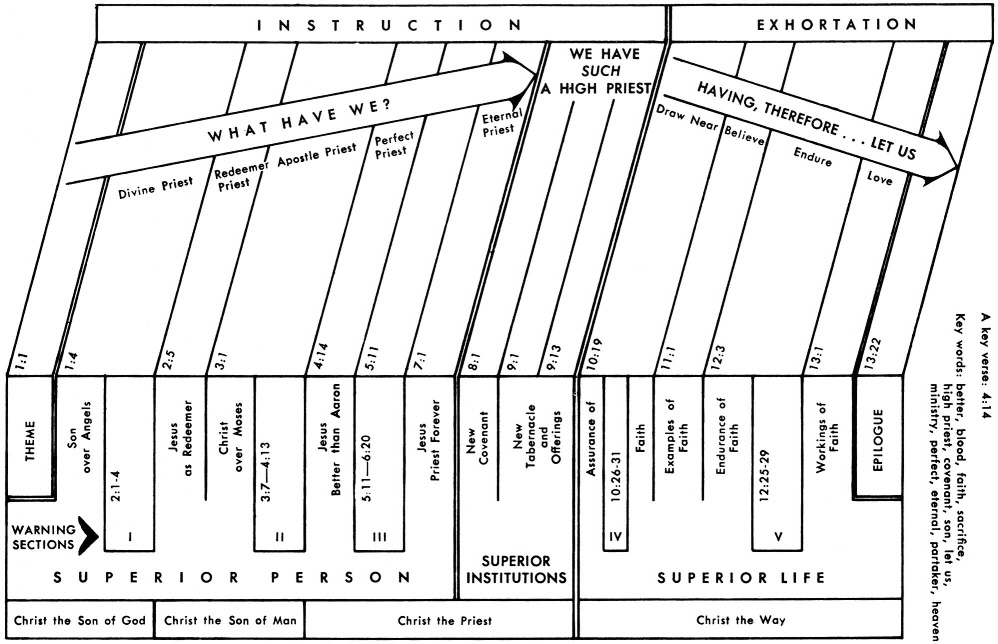
CONSIDER JESUS OUR GREAT HIGH PRIEST
Click chart to enlarge
Charts from Jensen's Survey of the NT - used by permission
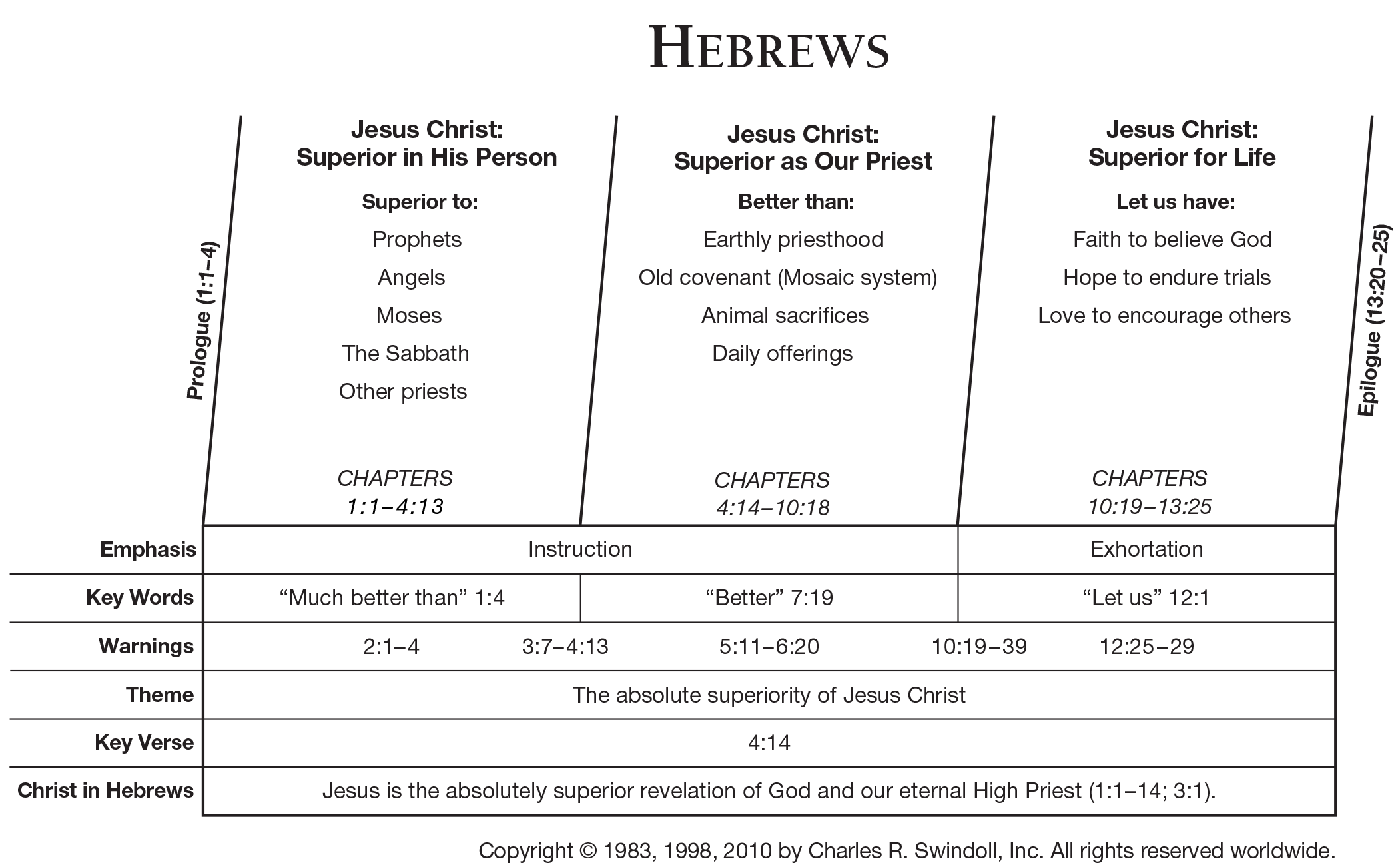
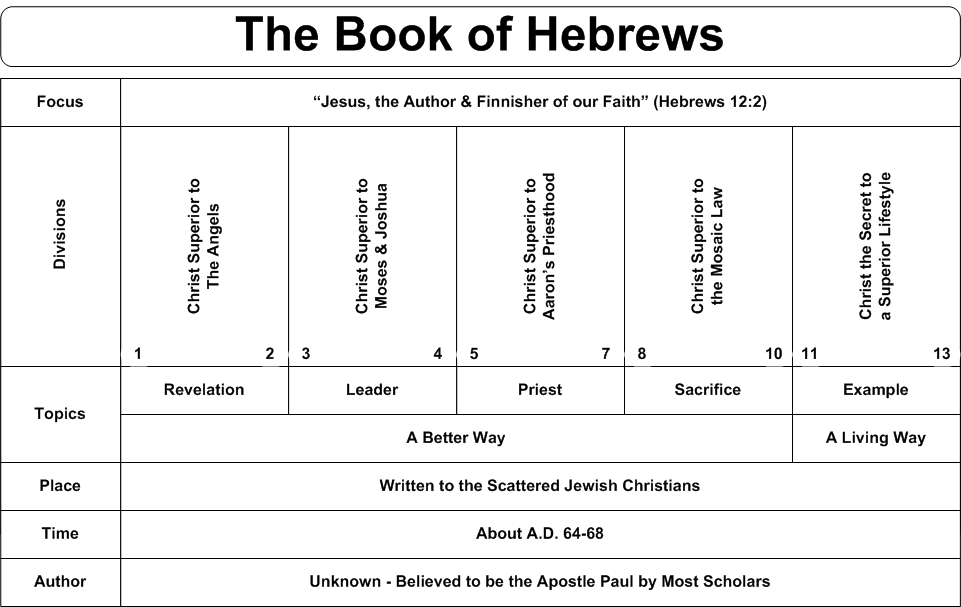
Swindoll's Chart, Interesting Pictorial Chart of Hebrews, Another Chart

|
The Epistle |
||||
| INSTRUCTION Hebrews 1-10:18 |
EXHORTATION Hebrews 10:19-13:25 |
|||
| Superior Person of Christ Hebrews 1:1-4:13 |
Superior Priest in Christ Hebrews 4:14-10:18 |
Superior Life In Christ Hebrews 10:19-13:25 |
||
| BETTER THAN PERSON Hebrews 1:1-4:13 |
BETTER PRIESTHOOD Heb 4:14-7:28 |
BETTER COVENANT Heb 8:1-13 |
BETTER SACRIFICE Heb 9:1-10:18 |
BETTER LIFE |
| MAJESTY OF CHRIST |
MINISTRY OF CHRIST |
MINISTERS FOR CHRIST |
||
|
DOCTRINE |
DUTY |
|||
|
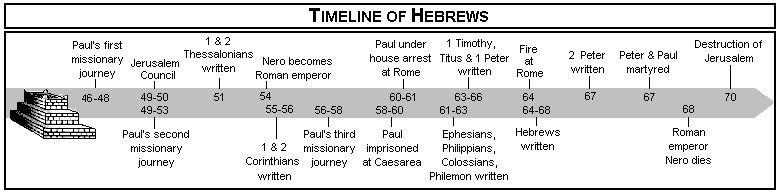
DATE WRITTEN: |
||||

See ESV Study Bible "Introduction to Hebrews"
(See also MacArthur's Introduction to Hebrews)
Borrow Ryrie Study Bible
Hebrews 11:6 And without faith it is impossible to please Him, for he who comes to God must believe that He is and that He is a rewarder of those who seek Him. (NASB: Lockman)
Greek: choris de pisteos adunaton euarestesai, (AAN) pisteusai (AAN) gar dei (3SPAI) ton proserchomenon (PMPMSA) to theo oti estin (3SPAI) kai tois ekzetousin (PAPMPD) auton misthapodotes ginetai. (3SPMI)
BGT χωρὶς δὲ πίστεως ἀδύνατον εὐαρεστῆσαι· πιστεῦσαι γὰρ δεῖ τὸν προσερχόμενον τῷ θεῷ ὅτι ἔστιν καὶ τοῖς ἐκζητοῦσιν αὐτὸν μισθαποδότης γίνεται.
Amplified: But without faith it is impossible to please and be satisfactory to Him. For whoever would come near to God must [necessarily] believe that God exists and that He is the rewarder of those who earnestly and diligently seek Him [out]. (Amplified Bible - Lockman)
KJV: But without faith it is impossible to please him: for he that cometh to God must believe that he is, and that he is a rewarder of them that diligently seek him.
NKJ But without faith it is impossible to please Him, for he who comes to God must believe that He is, and that He is a rewarder of those who diligently seek Him.
NET Now without faith it is impossible to please him, for the one who approaches God must believe that he exists and that he rewards those who seek him.
CSB Now without faith it is impossible to please God, for the one who draws near to Him must believe that He exists and rewards those who seek Him.
ESV And without faith it is impossible to please him, for whoever would draw near to God must believe that he exists and that he rewards those who seek him.
NIV And without faith it is impossible to please God, because anyone who comes to him must believe that he exists and that he rewards those who earnestly seek him.
NLT: So, you see, it is impossible to please God without faith. Anyone who wants to come to him must believe that there is a God and that he rewards those who sincerely seek him. (NLT - Tyndale House)
Phillips: And without faith it is impossible to please him. The man who approaches God must have faith in two things, first that God exists and secondly that it is worth a man's while to try to find God. (Phillips: Touchstone)
Wuest: Now, without faith it is impossible to please Him at all. For he who comes to God must of the necessity in the nature of the case believe that He exists, that He also becomes a rewarder of those who diligently seek Him out. (Eerdmans)
Young's Literal: and apart from faith it is impossible to please well, for it behoveth him who is coming to God to believe that He is, and to those seeking Him He becometh a rewarder.
- Without faith - He 3:12,18,19; Heb 4:2,6; Nu 14:11; 20:12; Ps 106:21,22,24; Isaiah 7:9; Mark 16:17; Jn 3:18,19; 8:24; Gal 5:6; Rev 21:8
- Hebrews 11 Resources - Multiple Sermons and Commentaries
Related Passages:
Hebrews 3:12 Take care, brethren, that there not be in any one of you an evil, unbelieving heart that falls away from the living God.
Hebrews 3:18 And to whom did He swear that they would not enter His rest, but to those who were disobedient?
Hebrews 3:19 So we see that they were not able to enter because of unbelief.
Hebrews 4:2 For indeed we have had good news preached to us, just as they also; but the word they heard did not profit them, because it was not united by faith in those who heard.
Hebrews 4:6 Therefore, since it remains for some to enter it, and those who formerly had good news preached to them failed to enter because of disobedience,
Galatians 2:20+ (REAL LIFE IS BY FAITH) “I have been crucified with Christ; and it is no longer I who live (ACKNOWLEDGE THIS TRUTH EVERY MORNING BELOVED!), but Christ lives in me; and the life which I now live in the flesh I LIVE BY FAITH in the Son of God, Who loved me and gave Himself up for (huper = my Substitute!) me.
Psalm 147:11 The LORD favors those who fear Him, Those who wait for His lovingkindness.
NO FAITH
NO DIVINE PLEASURE
After describing Enoch’s walk of faith, the writer pauses to draw a timeless principle: without faith it is impossible to please God. The emphasis shifts from one man’s example to every believer’s necessity. What Enoch experienced personally, we must all embrace spiritually—faith as the indispensable condition of divine approval. Faith is not a supplement to righteousness; it is its source and substance. God is not pleased by outward acts detached from inward trust.
Without faith, prayer is a speech, praise is noise,
sacrifice is mockery, and religious profession is hypocrisy.
Faith gives life and worth to every act of worship.
And without (choris - apart from, separate from, independent of) faith (pistis) it is impossible (adunatos - utter inability) to please (euaresteo) Him, for (gar - term of explanation) he who comes (proserchomai) to God must (dei - no exceptions) believe (pisteuo) that He is (exists) and that He is a rewarder (misthapodotes) of those who seek (ekzeteo) Him - In context this verse flows directly from Enoch’s example in Hebrews 11:5 which demonstrated that faith was the means by which Enoch’s life pleased God. Without (choris) faith (pistis) leads to a life that is displeasing to God, the antithesis of Enoch’s walk. Without (choris) draws a bold line in the sand, so that all activity apart from dependence on God’s truth and trust in His promise is spiritually powerless, and eternally without value! Think of John 15:5+ where Jesus makes it declares that "Apart (choris) from Me you can do (ABSOLUTELY) NOTHING" of eternal, God glorifying, God pleasing value! All of us in ministry (and that is ALL of us!) need to constantly ask ourselves, are we doing what we are doing initiated and energized by God's Spirit or are we doing it to please men? A sobering question! Faith is the key that unlocks the door of effective God pleasing ministry! Faith is the only currency heaven recognizes. Every other offering, no matter how costly, carries no value apart from trust in the Giver!
Faith is the only way to please God because
it affirms His existence and His trustworthiness.
It is impossible (adunatos - powerless, without ability) to please (euaresteo) means that pleasing God is utterly unachievable apart from divine enablement. To be blunt, without faith, pleasing God is not just difficult but impossible. Faith (pistis) is the indispensable condition of divine approval and without it, every act, however religious or moral, lacks the element that delights God. There are no "exception clauses" for this verse which stands as an absolute statement, allowing for no exceptions, no alternatives. Faith is the primary prerequisite for pleasing God, because it alone honors Who He is and how He works. Religion, morality, or service without faith (works without an "o" knocked out are your works!) may impress men but cannot satisfy God.
To reiterate, not only can we not walk with God, we can do absolutely nothing that pleases God when we do it apart (choris) from faith. Many people get caught in the trap of doing rather than being, mistaking religious activity for right relationship. But without faith such "doing" is not pleasing to God. Others think that they can please God because they are born into a Christian family or go to a Bible believing church or have been baptized in water, but none of these things please God if they are apart from faith.
Wuest - Now the writer lays down an axiomatic truth. He uses the aorist tense in the infinitive “to please.” The statement is universal in its application and timeless. The idea is, “Without faith it is impossible to please Him at all.” (Hebrews Commentary)
🙏 THOUGHT- Without faith, religion becomes routine, worship becomes performance, and obedience becomes self-effort. Faith turns duty into delight, because it rests in the One Who is pleased by trust, not toil. Are you toiling or trusting? And we are not speaking of "let go, let God," which is passivity, but "let God, let's go" which is Spirit energized activity. (100/100)
Simon Kistemaker asks "How do we please God? By walking with Him in faith! (ED: IN THE GARDEN ADAM AND EVE WALKED BY SIGHT, BUT WE ARE TO WALK BY FAITH - 2Co 5:7+) We must fully trust God and confide in Him as our closest Friend (ED: Pr 18:24, Jn 15:14,15+). “Without faith it is impossible to please God.” The word impossible is a reminder of Hebrews 6:4+. It conveys the idea that faith is the indispensable ingredient for pleasing God. (BORROW Exposition of the Epistle to the Hebrews PAGE 316)
Charles Swindoll explains that "A life of faith presupposes an attitude of humble dependence, which works itself out in three ways. (1) First, by faith we come to God (Heb 11:6). This suggests an acknowledgment that He is the great Source of everything there is … and of everything we need. We come to Him, as it were, with open hands and an open heart. He isn’t dodging us or hiding himself from us. He’s always there. We simply go to Him through faith. (2) Second, by faith we believe that He is (Heb 11:6). This suggests that we set aside the need to see with human eyes or touch with human hands. We replace the “show me” and “prove it” attitudes of skepticism with the Christian attitudes of openness and trust. (3) Third, by faith we trust Him to keep His word (Heb 11:6). He has promised to reward those who seek Him by believing in Him and coming to Him in faith. By faith we know that, because of the nature of God (all-powerful and all-knowing) and because of His character (faithful and true), He is therefore trustworthy. We can depend on Him completely. The person of faith, then, believes what God says without questioning and therefore does what God says without quarrelling. (See Insights on Hebrews - Page 169)
The writer had earlier warned his readers regarding the danger of no faith instructing them to…
Take care (present imperative = command to continually maintain this attitude - implying a continual need!), brethren, that there not be in any one of you an evil, unbelieving heart that falls away from the living God (cp "believe that He is" in He 11:6). (He 3:12+)
Thomas Watson comments that: Unbelief is the root of apostasy. 'an evil heart of unbelief in departing from the living God' (Hebrews 3:12). What is the reason those who seemed once zealous—now despise God, and leave off prayer in their families? Is it not their unbelief? They believed not that God is, and that He is a rewarder of those who diligently seek him (Hebrews 11:6). Infidelity is the cause of apostasy. In the Greek, 'apistia' (unbelief) leads to 'apostasia' (apostasy). And if unbelief is the breeder and fomenter of so much sin, then the unbelieving heart must needs be an impure heart.
And in Hebrews 3, the writer again tackles the subject of faith/belief, explaining the relationship between faith and obedience writing
And to whom did He swear that they would not enter His rest, but to those who were disobedient (apeitheo = refuse to be persuaded and deliberately disobey, cp Jn 3:36 where apeitheo = "does not obey")? So we see that they were not able to enter because of unbelief (apistia = literally not believing, cp Nu 14:11). (He 3:18, 19+)
Israel's unbelief was reflected in her disobedience, and so one can see that faith is clearly related to obedience, a relationship which is discussed at greater length below.
The psalms repeatedly address Israel's disobedient, unbelieving heart writing that …
Because (see Ps 78:21 for what he is explaining) they (Israel) did not believe in God and did not trust in His salvation. (Ps 78:22)
Spurgeon comments: Because they believed not in God, and trusted not in his salvation. This is the master sin, the crying sin (Ed: One can see why without faith one cannot please God!). Like Jeroboam, the son of Nebat, it sins and makes Israel to sin (cp 1Ki 14:16); it is in itself evil and the parent of evils. It was this sin which shut Israel out of Canaan, and it shuts myriads out of heaven. God is ready to save, combining power with willingness, but rebellious man will not trust his Saviour, and therefore is condemned already (Jn 3:18KJV). In the text it appears as if all Israel's other sins were as nothing compared with this; this is the peculiar spot which the Lord points at, the special provocation which angered Him. From this let every unbeliever learn to tremble more at his unbelief than at anything else. If he be no fornicator, or thief, or liar, let him reflect that it is quite enough to condemn him that he trusts not in God's salvation. (Ed: And because of this "master sin" it led them to inward sin Ps 78:18+ and outward sin Ps 78:19+)
In spite of all this (All what? judgement! Ps 78:31) they (Israel) still sinned and did not believe in His wonderful works. (Ps 78:32)
Spurgeon comments: For all this they sinned still. Judgments moved them no more than mercies. They defied the wrath of God. Though death was in the cup of their iniquity, yet they would not put it away, but continued to quaff it as if it were a healthful potion. How truly might these words be applied to ungodly men who have been often afflicted, laid upon a sick bed, broken in spirit, and impoverished in estate, and yet have persevered in their evil ways, unmoved by terrors, unswayed by threatenings.
Their unbelief was chronic and incurable. Miracles both of mercy and judgment were unavailing. They might be made to wonder, but they could not be taught to believe. Continuance in sin and in unbelief go together. Had they believed they would not have sinned, had they not have been blinded by sin they would have believed. There is a reflex action between faith and character. How can the lover of sin believe? How, on the other hand, can the unbeliever cease from sin? God's ways with us in providence are in themselves both convincing and converting, but unrenewed nature refuses to be either convicted or converted by them.
They forgot God their Savior, Who had done great things in Egypt, wonders in the land of Ham, and awesome things by the Red Sea. Therefore He said that He would destroy them, had not Moses His chosen one stood in the breach before Him, to turn away His wrath from destroying them. Then they despised the pleasant land. They did not believe in His word but grumbled in their tents; They did not listen to the voice of the LORD. (Ps 106:21, 22, 23, 24, 25)
Spurgeon comments: (On Ps 106:21) They forgot God their Saviour. Remembering the calf (Ex 32:4) involved forgetting God. He had commanded them to make no image (Ex 20:4)), and in daring to disobey they forgot His commands. Moreover, it is clear that they must altogether have forgotten the nature and character of Jehovah, or they could never have likened Him to a grass eating animal. Some men hope to keep their sins and their God too -- the fact being that he who sins is already so far departed from the Lord that he has actually forgotten him.
Which had done great things in Egypt. God in Egypt had overcome all the idols, and yet they so far forgot Him as to liken Him to them. Could an ox work miracles? Could a golden calf cast plagues upon Israel's enemies? They were brutish to set up such a wretched mockery of deity, after having seen what the true God could really achieve. "Wondrous works in the land of Ham, and terrible things by the Red sea". (Ps 106:22KJV) They saw several ranges of miracles, the Lord did not stint them as to the evidences of His eternal power and godhead, and yet they could not rest content with worshipping Him in His own appointed way, but must needs have a Directory of their own invention, an elaborate ritual after the old Egyptian fashion, and a manifest object of worship to assist them in adoring Jehovah. This was enough to provoke the Lord, and it did so; how much He is angered every day in our own land no tongue can tell.
(On Ps 106:24) Yea, they despised the pleasant land. They spoke lightly of it, though it was the joy of all lands: they did not think it worth the trouble of seeking and conquering; they even spoke of Egypt, the land of their iron bondage, as though they preferred it to Canaan, the land which floweth with milk and honey. It is an ill sign with a Christian when he begins to think lightly of heaven and heavenly things; it indicates a perverted mind, and it is, moreover, a high offence to the Lord to despise that which he esteems so highly that he in infinite love reserves it for his own chosen. To prefer earthly things to heavenly blessings is to prefer Egypt to Canaan, the house of bondage to the land of promise.
They believed not His word. This is the root sin. If we do not believe the Lord's word, we shall think lightly of his promised gifts. "They could not enter in because of unbelief" (He 3:19) -- this was the key which turned the lock against them. When pilgrims to the Celestial City begin to doubt the Lord of the way, they soon come to think little of the rest at the journey's end, and this is the surest way to make them bad travelers. Israel's unbelief demanded spies to see the land; the report of those spies was of a mingled character, and so a fresh crop of unbelief sprang up, with consequences most deplorable.
Albert Barnes comments that Without faith signifies "Without confidence in God--in His fidelity, His truth, His wisdom, His promises. And this is as true in other things as in religion. It is impossible for a child to please his father unless he has confidence in him. It is impossible for a wife to please her husband, or a husband a wife, unless they have confidence in each other. If there is distrust and jealousy on either part, there is discord and misery. We cannot be pleased with a professed friend unless he has such confidence in us as to believe our declarations and promises. The same thing is true of God. He cannot be pleased with the man who has no confidence in Him; who doubts the truth of His declarations and promises; who does not believe that His ways are right, or that He is qualified for universal empire. The requirement of faith or confidence in God is not arbitrary; it is just what we require of our children, and partners in life, and friends, as the indispensable condition of our being pleased with them. (Barnes NT Commentary)
Another point regarding without faith is that we cannot perform enough good works to please God. Stated another way, our works no matter how abundant, can never "compensate" for a lack of faith. WOE!
Thomas Vincent - As faith is a hand to lay hold of Christ's righteousness, so it is a hand to receive supplies of grace from Christ to quicken us unto newness of life. Yes, I may say, there can be no real, inherent righteousness without a saving interest by faith in Christ's imputed righteousness. There may be a righteousness of some kind like it—but not of the right kind, not a righteousness which springs from the true principle of faith, and therefore it cannot be a righteousness that is pleasing to God; for "without faith it is impossible to please God" (Hebrews 11:6). (from The Only Deliverer from the Wrath to Come!)
The godly writer C. H. Mackintosh commenting on the supremacy of faith wrote that "It glorifies God exceedingly, because it proves that we have more confidence in His eyesight that in our own."
Here is Mackintosh's full quote from his devotional comments on Exodus in which he writes that…"The Egyptians could not move in such a path as this. They moved on because they saw the way open before them: with them it was sight, and not faith—"Which the Egyptians assaying (Gk = peira = test, trial, experiment, an effort to accomplish something) to do were drowned." (Heb 11:29KJV) When people assay (try) to do what faith alone can accomplish, they only encounter defeat and confusion. The path along which God calls His people to walk is one which nature can never tread—"Flesh and blood cannot inherit the kingdom of God." (1Co 15:50) Neither can it walk in the ways of God. Faith is the great characteristic principle of God's kingdom, and faith alone can enable us to walk in God's ways. "Without faith it is impossible to please God." (He 11:6) It glorifies God exceedingly when we move on with Him, as it were, blindfolded (cp 2Co 5:7). It proves that we have more confidence in His eyesight than in our own. If I know that God is looking out for me, I may well close my eyes, and move on in holy calmness and stability. In human affairs we know that when there is a sentinel or watchman at his post, others can sleep quietly (cp Php 4:7+). How much more may we rest in perfect security, when we know that He who neither slumbers nor sleeps has His eye upon us (Ps 121:3, 4+), and His everlasting arms around us (cp Dt 33:27, Pr 10:25)!
Adrian Rogers on faith - What is faith? Now, it’s not as mysterious as a lot of people think. There’s not really a lot of mystery or hocus pocus about it. You live by faith every day. I mean, faith is a common, ordinary substance. When you cross a bridge, that’s faith in the bridge. You mail a letter; that’s faith in the post office. When you drive in Memphis, that’s a lot of faith. Whatever you do, every day you exercise faith. It is common, ordinary stuff. You’re exercising faith in the seat that you’re sitting in. Now, what is the difference in the Christian’s faith? There’s not much difference in the Christian’s faith so as to the quality of that faith. It is the object of the Christian’s faith that makes him different. Rather than putting his faith in bridges, and automobiles, and post offices, and this sort of a thing, he puts his faith in the promises of the great, eternal, unseen God. He doesn’t live by the five senses of sight, taste, touch, hearing, and smell, and so forth, but he lives by the sixth sense of faith. And, sometimes that’s mighty hard to do. (from How to Please God see page 399)
Adrian Rogers - You see, by faith, man gives God pleasure. Our faith pleases God and through faith God gives man treasure. According to your faith, be it unto you. Faith is the medium of exchange in the kingdom of heaven, just like money is the medium of exchange. If you want to go to the grocery store, you buy something, it takes money. You come to heaven to receive from God, "Without faith it's impossible to please him, for he that comes to God must believe that he is and that he is a rewarder of them that diligently seek him. According to your faith be it unto you."...When God looks at you and God gives His estimate of you, God doesn’t say, “According to your fame be it unto you,” and God doesn’t say, “According to your fate be it unto you,” and God doesn’t say, “According to your feeling be it unto you,” nor does God say, “According to your fortune be it unto you,” but God says, “According to your faith be it unto you.” (Matthew 9:29)...Great churches are built on great faith in a great God. “Without faith it is impossible to please him.” (Hebrews 11:6) These are the days for an earthshaking, mountain-moving, devil-defying faith in Almighty God. And, as to the degree that we trust this great God, God is pleased and God will bless us. (from sermon The Wings of Faith page 288) (Outline to this sermon - Introduction I. The Definition of Faith A. Faith Is Substance B. Faith Is Evidence II. The Dynamic of Faith A. Faith Is Necessary for Spiritual Wisdom B. Faith is Necessary for Spiritual Worship C. Faith is Necessary to Spiritual Wealth III. The Development of Faith A. You Must Be Saturated with Scripture B. You Must Be Separated from Sin C. You Must Be Dedicated to the Savior D. You Must Be Activated by the Spirit Conclusion)
You can mark this down in red ink -
If you please God, it doesn’t really matter whom you displease.
And, if you displease God, it really doesn’t matter whom you please.
-- Adrian Rogers
Thomas Watson - Duties of religion are not accepted without the new creature, because there is that lacking, which makes them a sweet savor to God. The holy oil for the tabernacle was to be made of several spices and ingredients, Exodus 30:23. Now, if any of these spices had been left out, it would not have been pleasing to God. The unregenerate man leaves out the chief spice in his duties, and that is faith. Hebrews 11:6, "Without faith it is impossible to please God." Faith lays hold on Christ—and so is accepted. (from The New Creature)
Albert Barnes - And this is as true in other things as in religion. It is impossible for a child to please his father unless he has confidence in him. It is impossible for a wife to please her husband, or a husband a wife, unless they have confidence in each other. If there is distrust and jealousy on either part, there is discord and misery. We cannot be pleased with a professed friend unless he has such confidence in us as to believe our declarations and promises. The same thing is true of God. He cannot be pleased with the man who has no confidence in him; who doubts the truth of his declarations and promises; who does not believe that his ways are right, or that he is qualified for universal empire. The requirement of faith or confidence in God is not arbitrary; it is just what we require of our children, and partners in life, and friends, as the indispensable condition of our being pleased with them. (Barnes NT Commentary)
Spurgeon writes that…
Some of the Indian tribes use little strips of cloth instead of money. I would not find fault with them if I lived there, but when I come to England, strips of cloth will not suffice. So honesty, sobriety, and such things may be very good among men, and the more you have of them the better. But all these things put together, without faith, do not please God. Virtues without faith are white-washed sins.
The way to please God, then, is to believe in him, and if there be any possibility of entering heaven without seeing death, faith alone can point the way. You cannot be Enochs unless you please God, and you cannot please God unless you have faith in him.
He cannot come to a God who to his own mind is non-existent; he must believe that he is.
See this reward then; it pleases God, and that is reward enough far anyone of us. Next see faith’s safety.
See, here, how faith has learnt the secret art of pleasing God. God is the thrice-holy One; he is a jealous God, and a very little sin greatly provokes him; but faith knows how to please him. I do not wonder that Enoch did not die; it was s less thing to be translated to heaven than it was to please God. To live for three hundred years, in constant communion with God, as he did, to be ever pleasing God, was a mighty triumph for faith. Nay God grant that, during all the years that we live, whether they are few or many, we may so live as always to please him! “But without faith it is impossible to please him.”
Mark that this holiest of men, whose walk with God was so close and unbroken that he was permitted to escape the pangs of death, nevertheless did not attain to this high position by his own works, but by faith.
These are the things with which faith always deals; — not with the things that are seen or are apprehensible by the senses or the feelings. (Spurgeon's Exposition on Hebrews)
A W Pink writes…
"But without faith it is impossible to please Him." Most solemnly do these words attest the total depravity of man. So corrupt is the fallen creature, both in soul and body, in every power and part thereof, and so polluted is everything that issues from him, that he cannot of and by himself do anything that is acceptable to the Holy One. "So then they that are in the flesh cannot please God" (Ro 8:8+): "they that are in the flesh" means, they that are still in their natural or unregenerate state. A bitter fountain cannot send forth sweet waters. But faith looks out of self to Christ, applies unto His righteousness, pleads His worth and worthiness, and does all things God-ward in the name and through the mediation of the Lord Jesus. Thus, by faith we may please God.
"But without faith it is impossible to please Him." Yet in all ages there have been many who attempted to please God without faith. Cain began it, but failed woefully. All in their Divine worship profess a desire to please God, and hope that they do so; why otherwise should they make the attempt? But, as the apostle declares in another place, many seek unto God "but not by faith, but as it were by the works of the law" (Ro 9:32+).
But where faith be lacking, let men desire, design, and do what they will, they can never attain unto Divine acceptance. "But to Him that worketh not, but believeth on Him that justifieth the ungodly, his faith is counted for ("unto") righteousness" (Ro 4:5+). Whatever be the necessity of other graces, faith is that which alone obtains acceptance with God.
In order to please God four things must concur, all of which are accomplished by faith.
First, the person of him that pleaseth God must be accepted of Him (Ge. 4:4).
Second, the thing done that pleaseth God must be in accord with His will (He 13:21+).
Third, the manner of doing it must be pleasing to God: it must be performed in humility (1Co 15:10), in sincerity (Is 38:3), in cheerfulness (2Co 8:12; 9:7).
Fourth, the end in view must be God’s glory (1Co 10:31). Now faith is the only means whereby these four requirements are met.
By faith in Christ the person is accepted of God. Faith makes us submit ourselves to God’s will. Faith causes us to examine the manner of what we do Godward. Faith aims at God’s glory: of Abraham it is recorded that he "was strong in faith, giving glory to God" (Ro 4:20+).
How essential it is then that each of us examine himself diligently and make sure that he has faith. It is by faith the convicted and repentant sinner is saved (Acts 16:31). It is by faith that Christ dwells in the heart (Ep 3:17+). It is by faith that we live (Ga 2:20+). It is by faith that we stand (Ro 11:20+; 2Co 1:24). It is by faith we walk (2Cor. 5:7). It is by faith the Devil is successfully resisted (1Pe 5:8, 9+). It is by faith we are experimentally sanctified (Acts 26:18). It is by faith we have access to God (Ep 3:12+, He 10:22+). It is by faith that we fight the good fight (1Ti 6:12). It is by faith that the world is overcome (1Jn 5:4). Reader, are you certain that you have the "faith of God’s elect" (Titus 1:1+)? If not, it is high time you make sure, for "without faith it is impossible to please God."(The Faith of Enoch. Hebrews 11:5, 6)
(Full sermon How to Please God see page 399)
How are we going to have this kind of faith—this faith that can do whatever God can do? I want to give you five steps this morning to having earthshaking, mountain-moving faith in God. They are very simple steps. I didn’t think them up; they are in the Word of God. I want to give you five things that will help you to have the kind of faith that will please God, and that’s the most important thing you had to do this morning—is to please God. And, “without faith it is impossible to please him.” (Hebrews 11:6)
1. Make a Full Surrender to God
Number one—and this is the hardest place, so I’ll start—number one: You must make a full surrender to God. First John 3, verse 21 says this: “Beloved, if our heart condemn us not, then have we confidence toward God.” (1 John 3:21) Now, faith and sin are mutually opposing elements. Many people cannot pray in faith because their hearts condemn them. Have you ever had an argument with your wife and then tried to pray without making it right? I have. I felt so stupid trying to pray without first of all going to Joyce and saying, “All right, Joyce, I’m wrong. It was me. Forgive me.” Then the ways open to God, you see? But, when our heart condemns us—when we know we’re wrong—we can’t pray with faith. Faith and sin just don’t exist in the same heart. Make a full surrender to God.
You know, God has put certain orders in the Bible. For example, have you ever noticed that the Bible always says, “Grace and peace be multiplied unto you”? (2 Peter 1:2) It never says, “peace and grace.” Why? Because grace always comes before peace, right? Have you ever noticed that the Bible always uses the term, “Believe and be baptized”? (Mark 16:16; Acts 8:12, 13; 18:8) That’s why I’m a Baptist. It doesn’t say, “Be baptized and believe.” The Bible teaches believer’s baptism: believe first, and then baptism—that is God’s order. Let me give you another one: it is repentance and faith. That is God’s unbreakable order. If you’re having trouble with faith, try repentance. So often it is sin that is the enemy in our lives that keeps us from having the faith in God that we ought to have. And so, first of all, make this full surrender to God.
2. Saturate Your Soul with the Word of God
Secondly, get into your Bible. Start to saturate your soul with the Word of God. The Bible says in the book of Romans, chapter 10, verse 17: “faith cometh by hearing, and hearing by the word of God.” (Romans 10:17) Friend, listen, there’s something about this book that produces faith in your heart when you read it. You know, one of these days, somebody’s gonna pick up this book and read it and believe it, and the rest of us are going to be ashamed of ourselves. It’s not first and foremost a book to be explained; the Bible is first and foremost a book to be believed. Read the Bible. See the great and mighty promises of God. He says in this same book of Hebrews, “[He hath said] that we may boldly say.” (Hebrews 13:6) When God says something in His Word, I can boldly say it because God has first said it.
You know, so many times we read the Bible like the Bible is a museum piece. We say, “Oh, isn’t that marvelous. Oh, look at that promise. Oh, there’s a delightful promise.” But, we don’t really assimilate it; we really don’t take it.
It’s like a woman window shopping. One man asked his wife, “Why do you call it ‘shopping’? You never buy anything.” She said, “Why do you call it ‘fishing’? You never catch anything.” And, this is the way that some people go through the Bible: they just kind of look at it like an antique chair—beautiful, but not meant to be sat upon.
Oh, no, friend. Read and believe. These are your promises. Get in the book. “Faith [comes] by hearing, and hearing by the word of God.” (Romans 10:17) And, you’ll be rich in faith when you’re rich in the Word, and when you saturate your soul with God’s blessed book that I believe to be the inherent, infallible Word of God, without any error, as God gave it in the original.
3. Pray
Now, I want to say something else: pray. I told you these were not earthshaking things; they’re just simple, down-to-earth things. If faith is a gift—and it is—then pray and ask God for it. You know what the disciples prayed? They prayed, “Lord, Increase our faith.” (Luke 17:5) Faith is mentioned as one of the gifts of the Spirit. Well, if it’s a gift, ask God for it. Say, “Lord, increase my faith.” Be like that man who prayed, “Lord, I believe; help thou mine unbelief.” (Mark 9:24) And, if you pray that sincerely, God will start with you where you are and take you where you want to go to.
4. Use the Faith That You Already Have
Now, the next step, if you would have this kind of a faith, is use the faith that you already have. You have some or you wouldn’t be here this morning. Do you know what Jesus Christ said that faith is like? Jesus said faith is like a grain of mustard seed. (Matthew 7:20; Luke 17:6) Now, no man can manufacture a mustard seed. A laboratory cannot build one that will grow. You see, a mustard seed is supernatural because it has a germ of life in it. It comes from God. Now, you cannot manufacture it, but you can plant it. God is saying, “I put a little faith in your hand”—just a little; that grain of mustard seed is about like the speck of pepper that you put on your eggs this morning before you came—“take it and plant it, because in one mustard seed are thousands of mustard seeds.” And, God is not putting a premium on little faith. When He says, “Faith like a grain of mustard seed can remove a mountain,” (Matthew 17:20) He’s saying the least amount of faith is greater than the greatest amount of difficulty. That’s what He’s saying. And, He’s saying faith is not something to hold in your hand; it’s not something to put in your pocket. It’s something to invest; it’s something to plant. Take the faith that you have—whatever it is. Start now with little faith. Use it; exercise it, and your faith will grow.
5. Keep Your Eyes upon Christ
I must close, but let me say there is one other step to faith, and that’s to keep your eyes upon Jesus Christ. Fall in love with Jesus. Look to Jesus. I’m talking about those of you who are already saved. The Bible says in the same book of Hebrews in the next chapter, chapter 12, verse 2 that we who are God’s children are to be “looking unto Jesus the author and finisher of our faith.” (Hebrews 12:2) You see, it’s not really so much great faith in God that you need but faith in a great God. And, isn’t He a great God? Isn’t He a wonderful Savior? Put your eyes on Jesus. You don’t have to make yourself believe. Look at Christ.
Suppose I wanted to cross the Mississippi River Bridge and I’m afraid it won’t hold me up; and so, I sit there, and I try to work up my confidence. I say, “Oh, I’m going to trust the bridge. Oh, I must do it,” and I try to resolve. And suddenly, I just quit doing that because I look and here goes a semi-truck and here goes an automobile and all these things. And, I say, “What a marvelous bridge! It’s built out of steel and concrete and all of these things. Look what it can do.”
Friend, He’s a marvelous Savior. You put your eyes on Him. You see what He is doing, what He will do, and I’ll tell you that that faith will be the byproduct of “looking unto Jesus the author and finisher of our faith.” (Hebrews 12:2) (From How to Please God see page 399)
FOR HE WHO COMES TO GOD MUST BELIEVE THAT HE IS: pisteusai (AAN) gar dei (3SPAI) ton proserchomenon (PMPMSA) to theo hoti estin (3SPAI):
- For He who comes to God - He 7:25; Job 21:14; Psalms 73:28; Isaiah 55:3; Jeremiah 2:31; John 14:6
- Must believe that He is - Romans 10:14
- Hebrews 11 Resources - Multiple Sermons and Commentaries
DRAWING NEAR TO GOD BEGINS
BEGINS WITH BELIEVING HE EXISTS
For (gar) explains why it is impossible to please God. (See term of explanation)
He who comes (proserchomai - present tense) to God must (dei - no exceptions - present tense - continually) believe (pisteuo - aorist tense, active voice) that He is (estin - present tense - exists) - He who comes (proserchomai) in the present tense describes not "one and done," but a continual drawing near to the Throne of Grace where the God of all grace (1Pe 5:10+) sits as Ruler over all (Heb 4:16+). The little verb must (dei) expresses divine necessity and allows for no exceptions, the present tense emphasizing that faith is continually indispensable for all who draw near to God. Believe (pisteuo) in the aorist tense calls for a decisive act and in the active voice indicates it is a personal choice, not a coerced choice. He is (estin - present tense) indicates that not only does God exist, but that He is the transcendent, omnipotent, and omnipresent Living God Who acts in history, because "history" is "HIS story!"
Kenneth Wuest - The one who comes to God, must believe two things, first that He exists, and second, that He rewards those who diligently seek Him. The first verb “is” is the translation of estin which speaks of existence. The second verb “is” is the translation of ginomai. The idea is not merely that God exists as a rewarder, but that He will prove Himself to be a rewarder of that person who diligently seeks Him. As Vincent puts it: “He who approaches God has, through faith, the assurance that his seeking God will result in good to himself.” (Hebrews Commentary)
A W Pink writes that…
There is a threefold "coming to God": an initial, a continuous, and a final. The first takes place at conversion, the second is repeated throughout the Christian’s life, the third occurs at death or the second coming of Christ. To come to God signifies to seek and have fellowship with Him. It denotes a desire to enter into His favor and become a partaker of His blessings in this life and of His salvation in the life to come. It is the heart’s approach unto Him in and through Christ: John 14:6, He 7:25. But before there is a conscious access to Him, God has to be diligently sought.
None come to God, none truly seek Him, until they are made conscious of their lost condition. The Spirit must first work in the soul a realization that sin has alienated us "from the life of God" (Ep 4:18). We have to be made to feel that we are away from God, out of His favor, under His righteous condemnation, before we shall really do as the prodigal did, and say "I will arise and go to My Father, and will say unto Him, Father, I have sinned against heaven, and before Thee" (Lk 15:18). The same principle holds good in connection with the repeated "coming" of the Christian (1Pe 2:4); it is a sense of need which causes us to seek Him who is the Giver of every good and every perfect gift. There is also a maintained communion with God in the performance of holy duties: in all the exercises of godliness we renew our access to God in Christ: in reading of or hearing His Word, we come to Him as Teacher, in prayer we come to Him as Benefactor. (The Faith of Noah)
Our present day privilege - In OT the ones chosen to draw near to the Holiness of God were the PRIESTS. (Dt 21:5 "Then the priests, the sons of Levi, shall come near") Believers today are PRIESTS (Rev 1:6;5:10, 1Pe 2:10, etc)
BELIEVE THAT HE IS
He is - What does this mean? In simple terms one must first believe that God exists. He is the great I Am, the self existent God, Yahweh, Jehovah (see study). Obviously we cannot (and will not) come to Him unless first we believe that He exists, that He is the living and true God. We cannot see Him except through eyes of faith (2Co 5:7+, He 11:1+, 1Pe 1:8+).
One must believe that He is the God of the Bible is the only true (Jn 17:3, 1Th 1:9, 1Jn 5:20, 21), that He is the living God (Dt 5:26 Jos 3:10 1Sa 17:26, 17:36 2Ki 19:4, 19:16 Ps 42:2, 84:2, Isa 37:4,17 Je 10:10, 23:36 Da 6:20, 26, Ho1:10, Mt 16:16, 26:63, Ac 14:15 Ro 9:26 2Co 3:3, 6:16, 1Ti 3:15, 4:10, Heb 3:12, 9:14, 10:31, 12:22, Rev7:2), that there is "no other God", (Isa 45:14, 5, 6, 18, 21, 22, 44:6, 7, 8, 43:11) and that "there is no one like" Him (Isa 46:9).
John MacArthur writes that "In his book, Your God is Too Small (borrow), J. B. Phillips describes some of the common gods that people manufacture. One is the grand old man god, the grandfatherly, white-haired, indulgent god who smiles down on men and winks at their adultery, stealing, cheating, and lying. Then there are the resident policeman god, whose primary job is to make life difficult and unenjoyable, and the god in a box, the private and exclusive sectarian god. The managing director god is the god of the deists, the god who designed and created the universe, started it spinning, and now stands by far away watching it run down. God is not pleased with belief in any of these idolatrous substitutes." (See Hebrews MacArthur New Testament Commentary - Page 307)
As Robertson says of the importance of faith (trust) that this is even true "in business also (banks, for instance)". Witness the "run" on banks when one's "faith" in their integrity becomes shaken. He goes on to add that "The very existence of God is a matter of intelligent faith."
Vincent says of this faith that He is is "An essential obligation. In the nature of the case… Faith in God involves belief in His existence although he is unseen.
MacArthur comments that "Genuine faith does not simply believe that a divine being exists (Jas 2:19+), but that the God of Scripture is the only real and true God Who exists. Not believing that God exists is equivalent to calling Him a liar (1Jn 5:10) (See The MacArthur Bible Commentary- Page 1869)
Spurgeon writes that "You must believe that God hears prayer. You must believe that he will punish the guilty, and that he will reward the righteous. Without this sure faith, you cannot come to him. No one can come to God if he does not believe that there is a God, and that he justly dispenses rewards and punishments."
A W Pink writes that…
to seek God aright, He has to be sought in faith, for "without faith it is impossible to please Him," therefore, "he that cometh to God must believe that He is, and that He is a rewarder of them that diligently seek Him." There has to be first a firm persuasion of His being, and second of His bounty. To believe that "He is" means much more than assenting to the fact of a "First Cause" or to allow that there is a "Supreme Being"; it means to believe in the character of God as He has revealed Himself in His works, in His Word, and in Christ. He must be conceived of aright, or otherwise we are only pursuing a phantom of our own imagination. Thus, to believe that "God is" is to exercise faith upon Him as such a Being as His Word declares Him to be: supreme sovereign, ineffably holy, almighty, inflexibly just, yet abounding in mercy and grace toward poor sinners through Christ.
Not only is the heart to go out unto God as His being and character is revealed in Scripture, but particularly, faith is to lay hold of His graciousness: that He is "a Rewarder" etc. The acting of faith toward God as a "Rewarder" is the heart’s apprehension and anticipation of the fact that He is ready and willing to conduct Himself to needy sinners in a way of bounty, that He will act in all things toward them in a manner suitable unto the proposal of which He makes of Himself through the Gospel. It was the realization of this (in addition to his felt need) which stirred the prodigal to act (cp Lk 15:15, 16, 17, 18, 19, 20). Just as it would be useless to pray unless there were an hope that God hears and that He will answer prayer, so no sinner will really seek unto God until there is born in his heart an expectation of mercy from Him, that He will receive him graciously. This is a laying hold of His promise.
In Scripture, privileges are propounded with their necessary limitations, and we disjoint the whole system of Truth if we separate the recompense from the duty. There is something to be done on our part: God is a "Rewarder," but of whom? Of those who "diligently seek Him." "The wicked shall be turned into Hell, all the nations that forget God" (Ps 9:17): not only "deny," but "forget" Him; as they cast God out of their thoughts and affections, so He will cast them out of His presence. (The Faith of Noah)
AND THAT HE IS A REWARDER OF THOSE WHO SEEK HIM: auton misthapodotes ginetai (3SPMI) kai tois ekzetousin (PAPMPD):
- He is a rewarder - He 11:26; Ge 15:1; Ru 2:12+; Ps 58:11; Pr 11:18; Mt 5:12; 6:1,2,5,16; Mt 10:41,42; Luke 6:35
- Seek - 1 Chr 28:9; Ps 105:3,4; 119:10; Pr 8:17; Song 3:1, 2, 3, 4; Jer 29:13,14; Mt 6:33; Luke 12:31; 2 Pe 1:5,10; 3:14
- Hebrews 11 Resources - Multiple Sermons and Commentaries
THE REWARD IS
THE REWARDER HIMSELF!
And that He is (present tense) a Rewarder (misthapodotes) - Note that it is not enough to believe that God exists. There is one other aspect of God we must believe. He is a rewarder is more literally God "becomes a rewarder." The greatest reward is knowing Christ. Possessing this is to possess all things – because all good things are contained in God. Faith not only believes God exists but trusts Him to be a rewarder of those who seek Him. He is (present tense) a Rewarder (misthapodotes) depicts God not as stingy, but as the generous Payer (apodidomi) Who faithfully fulfills His promise, the best reward of course being Himself (the Trinity) in rich communion and intimate fellowship. His ultimate reward is the fullness of joy in His presence and pleasures at His right hand forever (Ps 16:11). God is a Rewarder, not a task-master driving His servants, but a Generous Giver rewarding us as His sons, as a Father delighting in our simple trust, and giving to us the full reward (far more than we can imagine - Eph 3:20+) for every work of grace wrought through us for His glory. In a word God is the Faithful Paymaster of Faith, not because faith earns His favor, but because faith honors His character ("He is") and takes Him at His Word.
Jamieson comments that on "reward" that this is what "God proved to be to Enoch. The reward is God Himself diligently "sought" and "walked with" in partial communion here, and to be fully enjoyed hereafter. Compare Ge15:1, "I am thy exceeding great reward."
Vincent comments on the difference in the simple verb "Is", noting that it does not mean "simply exists, but comes to pass as; proves to be, habitually, so that he who approaches God has, through faith, the assurance that his seeking God will result in good to himself."
Wuest - "The one who comes to God, must believe two things, first that He exists, and second, that He rewards those who diligently seek Him. The first verb “is” is the translation of estin which speaks of existence. The second verb “is” is the translation of ginomai. The idea is not merely that God exists as a rewarder, but that He will prove Himself to be a rewarder of that person who diligently seeks Him."
Augustine (about ad 425),"For it is no small thing what God is going to give to those who thus yearn; but no half-efforts will get them to that goal. What God is going to give them is not something He has made; He is going to give them Himself, Who made all things. Toil then to lay hold of God; yearn long for what you are going to possess forever" (In Ps. 83 Enarr., I, 3). "The sole purpose of life in time is to gain merit for life in eternity" (Augustine: Letter 130, to Proba on prayer, 5th century ad).
SEEKING THE ONE
WHO FIRST SOUGHT US
Of of those who seek (ekzeteo - present tense - as their lifestyle) Him - Literally "unto them that seek him out". Those who seek Him out are continuously (present tense) diligently seeking Him. The present tense speaks of one's lifestyle -- to do this habitually necessitates that we rely on the Spirit to enable this supernatural work of grace. And yet we each individually must make the daily choice of our will (as indicated by the active voice) to seek His face, earnestly, diligently with a whole heart (1Ch 16:11+)! This duality of the Spirit's enablement and our responsibility is another example of the Paradoxical Principle of 100% Dependent and 100% Responsible.
C H Spurgeon on seek - The Greek word means not only seek Him, but “seek Him out” (ED: "EK" in "ekzeteo" means "out")—that is, seek Him until they find Him, and seek Him above all others. It is a very strong word; we hardly know how to transfer its meaning into English, for though it does not say “diligently,” it implies it. We must seek, and seek out, that is, seek until we really find. Those who with their hearts follow after God shall not be losers if they believe that He will reward them. You have to believe God so as to seek His glory. We seek Him, first, when we begin by prayer, by trusting to Jesus, and by calling upon the sacred name, to seek salvation. “Everyone who calls on the name of the Lord shall be saved” (Joel 2:32). That is a grand promise, and it teaches how we come to God: by calling upon His name. Afterward, we seek God by aiming at His glory—by making Him the great object for which we live. Although we deserve nothing at His hands but wrath, yet we perceive from the gospel that if we seek Him through His Son, we shall be so well-pleasing to Him as to get a reward from His hands. This must be of grace—free, sovereign grace! And what a reward it is! Free pardon, graciously bestowed; a change of heart, graciously wrought; perseverance graciously maintained, comfort graciously poured in, and privilege graciously awarded. (See Faith Essential to Pleasing God)
A good parallel passage to motivate intense seeking of God -
1 Corinthians 2:9+ but just as it is written, “THINGS WHICH EYE HAS NOT SEEN AND EAR HAS NOT HEARD, AND which HAVE NOT ENTERED THE HEART OF MAN, ALL THAT GOD HAS PREPARED FOR THOSE WHO LOVE HIM.”
The amazing thing is now in the New Covenant with the promised Holy Spirit we are inwardly impelled by the Spirit to seek God (cp Eze 36:27, Heb 13:21) because under the Law there were none who continually seek for God Whose fellowship we lost in the Garden of Eden. None seek diligently or earnestly after God, (even when He gives a clear & logical motive of why to seek Him: Rewarder of those who seek Him Heb 11:6) with a sincere and earnest desire to obtain His favor .To seek out, search diligently for anything lost (Eze 34:10, 11, 12). This verse from Ezek in fact says God Himself "will search for My sheep and seek them out." First, the Jews, then to the Greeks. What an awesome God, Who has not left us to our own vain imaginations of how to come into His Holy presence.
A W Pink asks…
What is meant by "diligently seek Him"? To "seek" God is to forsake, deny, go out of self, and take Him alone for our Ruler and satisfying Portion. To seek Him "diligently" is to seek Him early (Pr 8:17), whole-heartedly (Ps 119:10), earnestly (Ps. 27:4), unweariedly (Luke 11:8). How does a thirsty man seek water? The promise is, "And ye shall seek Me and find Me, when ye shall search for Me with all your heart" (Je 29:13 and cf. 2Chr 15:15).
And how does God "reward" the diligent seeker?
By offering Himself graciously to be found of them who penitently, earnestly, trustfully approach Him through the appointed Mediator. By granting them access into His favor: this He did not unto Cain, who sought Him in a wrong manner.
By actually bestowing His favor upon them, as He did upon the prodigal. By forgiving their sins and blotting out their iniquities (Is 55:7).
By writing His laws in their hearts, so that they now desire and determine to forsake all idols and serve Him only.
By giving them assurance of their acceptance in the Beloved, and granting them sweet foretastes of the rest and bliss which awaits them on High.
By ministering to their every need, both spiritual and temporal.
Finally, by taking them to heaven, where they shall spend eternity in the unclouded enjoyment of the wondrous riches of His grace.
But does this word "Rewarder" have a legalistic ring to it? Not if it be understood rightly. Does it signify that our "diligent seeking" is a meritorious performance which is entitled to recognition? Of course it does not. What, then, is meant?
First, let us quote from the helpful comments of John Owen: "That which these words of the apostle hath respect to, and which is the ground of the faith here required, is contained in the revelation that God made of Himself unto Abraham, ‘Fear not: Abram: I am thy shield, and they exceeding great reward’ (Ge 15:1). God is so a rewarder unto them that seek Him, as that He is Himself their reward, which eternally excludes all thoughts of merit in them that are so rewarded. Who can merit God to be his reward? Rewarding in God, especially where He Himself is the reward, is an act of infinite grace and bounty. And this gives us full direction unto the object of faith here intended, namely, God in Christ, as revealed in the promise of Him, giving Himself unto believers as a reward, (to be their God) in a way of infinite goodness and bounty. The proposal hereof, is that alone which gives encouragement to come unto Him, which the apostle designs to declare." (The Faith of Noah. Hebrews 11:6, 7)
Jack Arnold....
“And without faith it is impossible to please Him ...” -- Apart from faith in God it is impossible to please Him in any way. God is not impressed with our education, our financial worth, our status in society, but is looking for our faith in Him. Faith believes in God and puts the commands of God to work. Faith is the key that unlocks the mysteries of the spiritual kingdom.
“... for he who comes to God must believe that He is ...”-- Faith acknowledges that God is real and does exist. Faith believes that the God of heaven and earth is in control of history and working out His plan in time. Faith is more than assenting to the fact that God is the “First Cause” or to believe that there is a “Supreme Being”. Faith is to believe in the character of God as He has revealed Himself in His works, in His Word, and in Christ. Faith is to believe that God is sovereign, holy, almighty, just, merciful, wrath and loving and that He rules and reigns in accordance with these characteristics.
“... and that He is a rewarder of those who seek Him.” -- God rewards those who seek Him with wonderful spiritual blessings, and the single most important reward is God Himself. God becomes the intimate companion of all who walk by faith. (Sermon)
Ray Stedman - Our author views Enoch’s faith as so outstanding that it constitutes a general example for all time of how to come to God and to live pleasing to him. Without faith it is impossible to please God, he proclaims in verse 6. This brings to mind Paul’s similar assertion, “the world through its wisdom did not know him” (1 Cor 1:21). It is impossible through human reasoning or scientific searching to find God: faith in God’s self-revelation is essential! But that revelation is not confined to Scripture; it begins with nature as Paul forcefully states in Romans 1:19–20 and the psalmist declares in Psalms 8 and 19.
Hebrews 11:6 is a helpful answer to the persistent question: “What about the primitive peoples of the world who never hear the gospel?” This verse says: anyone who comes to him [God] must believe that he exists and that he rewards those who earnestly seek him. Nature presents overwhelming evidence of the existence of God. Elizabeth Barrett Browning has put its witness well:
Earth’s crammed with heaven,
And every common bush aflame with God.
But only those who see take off their shoes,
The rest sit round it and pluck blackberries!
Only a deliberately resistant mind can set aside nature’s testimony to the wisdom and power of an Intelligent Being beyond us. If the witness of nature leads an individual to an honest search for the Creator, God promises to help and reward those who earnestly seek him. More and more knowledge will be granted which, if followed, will lead to Jesus. (The Qualities of Faith)
Without (5565) (choris) is used both as a preposition and an adverb, this latter use signifying separately or by itself (John 20:7). More often choris is used (as in the current verse) as a preposition meaning apart from (John 1:3), without (without sin He 4:15-note) or separate from (separate from Christ Ep 2:12-note). Webster says that without (as a preposition) is used as a function word to indicate the absence or lack of something or someone.
CHORIS IN HEBREWS - 41x/38v AND 13X IN HEBREWS
Hebrews 4:15 For we do not have a high priest who cannot sympathize with our weaknesses, but One who has been tempted in all things as we are, yet without sin.
Hebrews 7:7 But without any dispute the lesser is blessed by the greater.
Hebrews 7:20 And inasmuch as it was not without an oath
Hebrews 7:21 (for they indeed became priests without an oath, but He with an oath through the One who said to Him, “THE LORD HAS SWORN AND WILL NOT CHANGE HIS MIND, ‘YOU ARE A PRIEST FOREVER’”);
Hebrews 9:7 but into the second, only the high priest enters once a year, not without taking blood, which he offers for himself and for the sins of the people committed in ignorance.
Hebrews 9:18 Therefore even the first covenant was not inaugurated without blood.
Hebrews 9:22 And according to the Law, one may almost say, all things are cleansed with blood, and without shedding of blood there is no forgiveness.
Hebrews 9:28 so Christ also, having been offered once to bear the sins of many, will appear a second time for salvation without reference to sin, to those who eagerly await Him.
Hebrews 10:28 Anyone who has set aside the Law of Moses dies without mercy on the testimony of two or three witnesses.
Hebrews 11:6 And without faith it is impossible to please Him, for he who comes to God must believe that He is and that He is a rewarder of those who seek Him.
Hebrews 11:40 because God had provided something better for us, so that apart from us they would not be made perfect.
Hebrews 12:8 But if you are without discipline, of which all have become partakers, then you are illegitimate children and not sons.
Hebrews 12:14 Pursue peace with all men, and the sanctification without which no one will see the Lord.
Faith (4102)(pistis) is synonymous with trust or belief and is the conviction of the truth of anything, but in Scripture speaks of belief respecting man's relationship to God and divine things, generally with the included idea of trust and holy fervor born of faith and joined with it. As pistis relates to God, it is the conviction that God exists and is the Creator and Ruler of all things well as the Provider and Bestower of eternal salvation through Christ. As faith relates to Christ it represents a strong and welcome conviction or belief that Jesus is the Messiah, through Whom we obtain eternal salvation and entrance into the Kingdom of Heaven. Stated another way, eternal salvation comes only through belief in Jesus Christ and no other way. Subjectively faith is firm persuasion, conviction, belief in the truth, veracity, reality or faithfulness (though rare). Objectively faith is that which is believed (usually designated as "the faith"), doctrine, the received articles of faith. Click separate study of "the faith (pistis)".
True faith that saves one's soul includes at least three main elements = (1) firm persuasion or firm conviction, (2) a surrender to that truth and (3) a conduct emanating from that surrender. In sum, faith shows itself genuine by a changed life.
For more discussion of faith see commentary on Hebrews 11:1-2.
PISTIS IN HEBREWS - Heb. 4:2; Heb. 6:1; Heb. 6:12; Heb. 10:22; Heb. 10:38; Heb. 10:39; Heb. 11:1; Heb. 11:3; Heb. 11:4; Heb. 11:5; Heb. 11:6; Heb. 11:7; Heb. 11:8; Heb. 11:9; Heb. 11:11; Heb. 11:13; Heb. 11:17; Heb. 11:20; Heb. 11:21; Heb. 11:22; Heb. 11:23; Heb. 11:24; Heb. 11:27; Heb. 11:28; Heb. 11:29; Heb. 11:30; Heb. 11:31; Heb. 11:33; Heb. 11:39; Heb. 12:2; Heb. 13:7
Faith is believing that God will keep His promises, despite circumstances that seem to be to the contrary! True faith that saves one's soul includes at least three main elements - (1) firm persuasion or firm conviction, (2) a surrender to that truth and (3) a conduct emanating from that surrender. In sum, faith shows itself genuine by a changed life. (Click for W E Vine's definition of faith)
As MacDonald says "There is nothing about God that makes it impossible for men to believe. The difficulty is with the human will."
Thomas Watson - A sinner's best works are 'opera mortua'—dead works! And those works which are dead, cannot please God. A dead flower has no sweetness. Hebrews 11:6.
Louis Berkhof defines genuine faith in essentially the same way noting that it includes an intellectual element (notitia), which is "a positive recognition of the truth”; an emotional element (assensus), which includes “a deep conviction of the truth”; and a volitional element (fiducia), which involves “a personal trust in Christ as Savior and Lord, including a surrender … to Christ.” (Systematic Theology)
Faith is relying on what God has done rather than on one’s own efforts. In the Old Testament, faith is rarely mentioned. The word trust is used frequently, and verbs like believe and rely are used to express the right attitude to God. The classic example is Abraham, whose faith was reckoned as righteousness (Ge 15:6). At the heart of the Christian message is the story of the cross: Christ’s dying to bring salvation. Faith is an attitude of trust in which a believer receives God’s good gift of salvation (Acts 16:30,31) and lives in that awareness thereafter (Gal 2:20; cf. Heb 11:1).
J. B. Lightfoot discusses the concept of faith in his commentary on Galatians. He notes that in Hebrew, Greek, and Latin, the definition of the word for faith "hovers between two meanings: trustfulness, the frame of mind which relies on another; and trustworthiness, the frame of mind which can be relied upon… the senses will at times be so blended together that they can only be separated by some arbitrary distinction. The loss in grammatical precision is often more than compensated by the gain in theological depth… They who have faith in God are steadfast and immovable in the path of duty.
Faith, like grace, is not static. Saving faith is more than just understanding the facts and mentally acquiescing. It is inseparable from repentance, surrender, and a supernatural longing to obey. None of those responses can be classified exclusively as a human work, any more than believing itself is solely a human effort.
Faith is manifest by not believing in spite of evidence but obeying in spite of consequence. John uses the related verb pisteuo to demonstrate the relationship between genuine faith and obedience writing "He who believes (present tense = continuous) in the Son has eternal life; but he who does not obey the Son shall not see life, but the wrath of God abides on him. (John 3:36)
Charles Swindoll commenting on faith and obedience in John 3:36 concludes that "In 3:36 the one who “believes in the Son has eternal life” as a present possession. But the one who “does not obey the Son shall not see life.” To disbelieve Christ is to disobey Him. And logically, to believe in Christ is to obey Him. As I have noted elsewhere, “This verse clearly indicates that belief is not a matter of passive opinion, but decisive and obedient action.” (quoting J. Carl Laney)… Tragically many people are convinced that it doesn’t really matter what you believe, so long as you are sincere. This reminds me of a Peanuts cartoon in which Charlie Brown is returning from a disastrous baseball game. The caption read, “174 to nothing! How could we lose when we were so sincere?” The reality is, Charlie Brown, that it takes more than sincerity to win the game of life. Many people are sincere about their beliefs, but they are sincerely wrong!" (Understanding Christian Theology)
Related Resources: the faith obedience of faith pistos
Impossible (102) (adunatos from a = without + dunatós = possible, able, or powerful from dunamai = to be able or have power by virtue of inherent ability and resources. The stem duna- or dyna- = ability or capability) means not possible, without the possibility of happening, incapable of being or of occurring, incapable of being done.
Adunatos is used twice to convey the idea of impotence of one who has no strength or who lacks capability in functioning adequately, once in a literal sense of lacking physical strength (Acts 14:8) and once in a spiritual sense (Ro 15:1+ = of whose faith is weak).
Adunatos - 10x in 10v in the NAS - Mt 19:26; Mk 10:27; Lk 18:27; Acts 14:8; Ro 8:3; 15:1; He 6:4, 18; 10:4; 11:6 and is rendered in the NAS as impossible(6), things impossible(1), what it could not without strength(2).
One will note the obvious concentration of "impossibilities" in the book of Hebrews in these 5 uses of adunatos…
He 6:4ESV+ For it is impossible to restore again to repentance those who have once been enlightened, who have tasted the heavenly gift, and have shared in the Holy Spirit, (Note: the NASB places "impossible" in He 6:6+. Note also that commentators and some translators take adunatos to mean difficult but clearly from the other NT uses and specifically the uses in Hebrews this is inappropriate and could lead to an incorrect interpretation of this stern warning passage.)
He 6:18+ in order that by two unchangeable things, in which it is impossible for God to lie, we may have strong encouragement, we who have fled for refuge in laying hold of the hope set before us.
He 10:4+ For it is impossible for the blood of bulls and goats to take away sins.
He 11:6 And without faith it is impossible to please Him, for he who comes to God must believe that He is, and that He is a Rewarder of those who seek Him.
Please (2100) (euaresteo related adjective euarestos from eu = well + aresko = to please) means to behave in a manner that causes another to be pleased. It means to to give pleasure or satisfaction. The idea is to excite agreeable emotions in another. For example in Hebrew 13:16, praise that pleases God is the fruit of our lips, not just our thoughts, and is spoken out unto the Lord, either in prose or in song. Note that this verb for "please" is euaresteo which was used in Ge 5:24 to translate the phrase "walked with" (in "walked with God"). Euarestéō implies a relationship of joyful approval — living in such harmony with God’s character that one’s life gives Him pleasure.
Euaresteo - Only 3x in the NT - Heb. 11:5, Hebrews 11:6; Hebrews 13:16
Hebrews 11:5 By faith Enoch was taken up so that he would not see death; AND HE WAS NOT FOUND BECAUSE GOD TOOK HIM UP; for he obtained the witness that before his being taken up he was pleasing to God.
Hebrews 13:16 And do not neglect doing good and sharing, for with such sacrifices God is pleased.
Comes (4334) (proserchomai from prós = facing + érchomai = come) means literally to come facing toward and so to approach or come near. To come to visit or associate with. It describes the approach to or entry into a deity’s presence. In the Septuagint (LXX) proserchomai was the verb used to describe the approach of the priests to Jehovah for worship and to perform of their priestly (Levitical) functions. But here in Hebrews, under the New covenant, all seven uses of proserchomai refer to believers possessing the privilege of access to God the Father through Christ the Great High Priest. Proserchomai describes disciples approaching Jesus after He spoke parable of soils to multitude (Mt 13:10). Heb 12:18,22 4:16 7:25 10:1,22 11:6 12:18,22
PROSERCHOMAI - 86V - 7X IN HEBREWS Heb. 4:16; Heb. 7:25; Heb. 10:1; Heb. 10:22; Heb. 11:6; Heb. 12:18; Heb. 12:22;
Hebrews 4:16+ Let us therefore draw near with confidence to the throne of grace, that we may receive mercy and may find grace to help in time of need.
Comment: "Let us… " emphasizes that this privilege is always available to those under the New Covenant. Do we really comprehend and avail ourselves of the profundity of this privilege?
Hebrews 7:25+ Hence, also, He is able to save forever those who draw near (present tense = emphasizes continual activity) to God through Him, since He always lives to make intercession for them.
Hebrews 10:1+ For the Law, since it has only a shadow of the good things to come and not the very form of things, can never by the same sacrifices year by year, which they offer continually, make perfect those who draw near.
Hebrews 10:22+ let us draw near with a sincere heart in full assurance of faith, having our hearts sprinkled clean from an evil conscience and our bodies washed with pure water.
Hebrews 11:6+ And without faith it is impossible to please Him, for he who comes (drawn near) to God must believe that He is, and that He is a rewarder of those who seek Him.
Hebrews 12:18+ For you have not come (drawn near) to a mountain that may be touched and to a blazing fire, and to darkness and gloom and whirlwind,
Hebrews 12:22+ But you have come (drawn near) to Mount Zion and to the city of the living God, the heavenly Jerusalem, and to myriads of angels
Rewarder (3406) (misthapodotes from misthos = reward + apodídomi = render, cp misthapodosia) is the only NT example of this word which means "recompenser." It means properly, someone "paying what is due; a rewarder" (Abbott-Smith); a paymaster (A. T. Robertson), giving rewards in keeping with his own values. Note the prefix (apo) emphasizing what the Lord personally values and hence the basis of determining rewards. It refers to God compensating believers for living in faith (pístis). This happens to the extent they hear His voice and do what they hear (which is the essence of faith, cf. Hab 2:1-4).
Seek (1567) (ekzeteo from ek = out or to intensify the meaning + zeteo = to seek) means to seek out, to look for, to search diligently for anything lost. This verb implies that the seeker exerts considerable effort and care in learning something. The idea is properly to seek out, emphasizing the personal intent of the seeker, i.e. the outcome which is intensely and personally desired by the seeker. Does that describe you (me) dear reader?
Vincent comments that "God's beneficent will and attitude toward the seeker are not always apparent at the first approach. In such cases there is occasion for faith, in the face of delay, that diligent seeking will find its reward."
Ekzeteo - 7x/7v - charged (2), made careful search*(1), seek(2), seeks for(1), sought for(1). Lk. 11:50; Lk. 11:51; Acts 15:17; Rom. 3:11; Heb. 11:6; Heb. 12:17; 1 Pet. 1:10
Hebrews 12:17 For you know that even afterwards, when he desired to inherit the blessing, he was rejected, for he found no place for repentance, though he sought for it with tears.
The "Linguistic Key to the Greek New Testament" (Rienecker) notes that the preposition "ek" in this compound "always seems to denote that the seeker finds, or at least exhausts his powers of seeking." The writer could have used the root verb zeteo but instead he chose ekzeteo which speaks of making diligent investigation or determined search for something. The idea is to exert effort to find out something. For example, Peter uses ekzeteo to describe the efforts of the OT prophets writing that "As to this salvation, the prophets who prophesied of the grace that would come to you made careful search (ekzeteo) and inquiry seeking to know what person or time the Spirit of Christ within them was indicating as He predicted the sufferings of Christ and the glories to follow." (1Pe 1:10, 11+) In other words, the OT prophets studied their own writings in order to know more about the promised salvation. Though they believed and were personally saved from their sin by that faith (through the sacrifice God would provide in Christ), they could not fully understand what was involved in the life and death of Jesus Christ. So as taught in Hebrews 11:6, God here gives mankind a very clear, logical motive to seek diligently for Him (reward), men still do not seek Him! Esau in some ways typifies men's seeking for God, Hebrews recording that "that even afterwards, when he desired to inherit the blessing, he was rejected, for he found no place for repentance, though he sought (ekzeteo) for it with tears." (He 12:17+) In other words Esau desired God’s blessings, but he did not want God! He regretted what he had done, but he did not repent.
Ekzeteo, in contrast to the rare use in the NT, is used 105 times in the Septuagint. For example, the psalmist writes "With all my heart I have sought (ekzeteo) Thee. Do not let me wander from Thy commandments… And I will walk at liberty, for I seek (ekzeteo) Thy precepts… I am Thine, save me; for I have sought (ekzeteo) Thy precepts." (Ps 119:10, 45, 94) In a use that parallels Paul's use in Romans, the psalmist writes that "Salvation is far from the wicked, for they do not seek (ekzeteo) Thy statutes." (Ps 119:155) And yet even in the OT God was pleading with faithless Israel to "Learn to do good; Seek (ekzeteo) justice, Reprove the ruthless; Defend the orphan, Plead for the widow." (Isa 1:17) In Jeremiah God spoke to Israel saying "and you will seek (Lxx = ekzeteo) Me and find Me, when you search for Me with all your heart." (Jer 29:13) And in Amos God says "to the house of Israel, "Seek (Lxx = ekzeteo) Me that you may live." (Amos 5:4) Zechariah prophesies that the day will come (in context a reference to the Millennium) when Gentiles from one of the world's cities "will go to another saying, "Let us go at once to entreat the favor of the LORD, and to seek (ekzeteo) the LORD of hosts; I will also go. So many peoples and mighty nations (the Gentiles) will come to seek (ekzeteo) the LORD of hosts in Jerusalem and to entreat the favor of the LORD." (Zech 8:21, 22) Zechariah's use of ekzeteo parallels James' quotation of Amos 9:11, 12 in arguing his case for the fact that Gentiles could be saved without becoming Jewish converts, declaring "In order that the rest of mankind may seek (ekzeteo) the Lord and all the Gentiles who are called by My name." (Acts 15:17).
Unrelated to the upcoming election, I was searching my files for an illustration of trying to please everyone. I came across this story about Senator John Kerry, from 1991, during the first Gulf War. A man named Walter Carter wrote to Mr. Kerry urging him to support the ejection of Iraq from Kuwait. He received two separate replies. The first letter agreed, stating the Senator’s strong support for [then] President Bush’s response to the crisis. The second letter, mailed by mistake, thanked Mr. Carter for opposing the war and pointed out that Senator Kerry had voted against the war resolution! (“Traditional Values Report,” June/July, 1991.)
Newsweek (5/19/94) opened with an article recounting President Bill Clinton’s legendary ability to lead people “to believe that he agrees with them entirely… without ever quite committing himself to their position… a gift given only to the best politicians.” To be fair, many examples could be found of Republican politicians being people-pleasers!
But unfortunately, many pastors try to ride the fence in an attempt to please everyone. There is a proper sense, of course, in which we should seek to please people, not being needlessly offensive (1Cor 10:32, 33). We should be gracious, kind, and not quarrelsome, even when we must correct those in error (2Ti 2:24, 25, 26+). We should seek to please others in order to build them up in Christ (Ro 15:2+). But having said all of that, there is a much more important aim than pleasing people, namely, to please God, who examines our hearts (1Th 2:4+). Sometimes pleasing God inevitably means displeasing people that are opposed to God.
If we please everyone else, but God is ultimately displeased with our lives, woe to us! On the other hand, if we offend others, but God is finally pleased, we will enter into His eternal joy. The author of Hebrews directs us to the life of Enoch, a man who pleased God. He lived in the seventh generation from Adam. It was an evil time on earth, just before the judgment of the flood. Jude 1:14, 15 reports that Enoch prophesied to his evil generation,
“Behold, the Lord came with many thousands of His holy ones, to execute judgment upon all, and to convict all the ungodly of all their ungodly deeds which they have done in an ungodly way, and of all the harsh things which ungodly sinners have spoken against Him.” That could not have been a popular message! And yet Enoch pleased God so much that God took him straight to heaven so that he did not see death. His story teaches a vital lesson, that…
A life of faith pleases God.
We should learn three things from these verses:
1. Our number one aim in life should be to please God.
If you love someone, you aim to please him or her. The foremost commandment is that we should love God with all of our heart, soul, mind, and strength (Mark 12:30). It is impossible to obey that commandment without seeking to please God. Note two things in this regard:
A. Pleasing God begins on the heart (or thought) level.
We can fake out people by being nice on the surface, while in our hearts we don’t care about them. But God knows our every thought, and so we can’t fake Him out! Even if we fulfill a list of religious duties or live outwardly moral lives, God judges the thoughts and intentions of our hearts (Heb 4:12, 13+). So if you want to please God, you must judge all sin on the thought level and take every thought captive to the obedience of Christ (Mark 7:20, 21, 22, 23; 2Co 10:5). God condemns those who honor Him with their lips, while their hearts are far from Him (Mark 7:6). This is essential: Aim to please God with your thought life and your emotional life!
B. Pleasing God requires consistently drawing near to Him and seeking Him.
Verse 6 mentions the one “who comes to God.” Comes to translates the same word that is translated draw near in He 4:16+, where we are exhorted to “draw near to the throne of grace.” In He 7:25+, the author says that Jesus “is able to save forever those who draw near to God through Him.” In He 10:1, he states that the Old Testament sacrifices could never “make perfect those who draw near.” In He 10:22+, he exhorts us to “draw near with a sincere heart in full assurance of faith, having our hearts sprinkled clean from an evil conscience.” So in He 11:6, it should be translated, “he who draws near to God.” It means drawing near to God in worship and prayer.
Hebrews 11:6 also mentions “those who seek Him.” The KJV translates it, “diligently seek,” (He 11:6KJV) but scholars are divided about whether it has this intensive sense. It is parallel here to drawing near to God. The Hebrew word that is often translated seek originally meant to beat a path under foot. The idea was that if you sought your neighbor often, you would beat a path through the grass to his door.
We should seek God so often that we beat a path to Him!
Drawing near to God and seeking Him are deliberate, intentional activities. You do not accidentally draw near to the Holy One. No one ever seeks God apart from God’s first choosing and calling that person (Ro 3:11+; 1Cor. 1:26, 27, 28, 29, 30, 31). But once God has called you to salvation and you have responded in faith to His call, you must exert deliberate effort and intention to seek the Lord. Make it your priority and aim in life!
Note also that we are to seek God Himself, not just the rewards that He can give us. Knowing the living God is our reward. The Lord promised Abraham,
Do not fear, Abram, I am a shield to you; your very great reward (Ge 15:1, NASB, margin).
In the context of explaining that the priests would not have any inheritance in the land, God promised Aaron,
I am your portion and your inheritance among the sons of Israel (Nu 18:20).
The psalmist proclaimed (Ps 73:25, 26),
Whom have I in heaven, but You? And besides You, I desire nothing on earth. My flesh and my heart may fail, but God is the strength of my heart and my portion forever.
F. B. Meyer wrote,
To have God is to have all, though bereft of everything. To be destitute of God is to be bereft of everything, though having all (Abraham [Christian Literature Crusade], p. 63).
Donald Barnhouse observed,
God’s method of supplying our need is to give us fresh knowledge of Himself, for every need can be met by seeing Him (Genesis [Zondervan], 1:105).
So our number one aim in life should be to please God from the heart. To do so, we must consistently draw near to Him and seek Him. But our text mentions an essential for pleasing God:
2. Faith is essential to please God.
Two words underscore this in He 11:6: impossible and must. Faith is not just something nice, if you care to practice it. It is impossible to please God without faith. You must believe that God is and the He is a rewarder of those who seek Him.
We know this on a human level. If someone does not believe you or questions your integrity, you are not pleased with that person. In effect, they’re calling you a liar. If you have spoken the truth, to have someone call you a liar is not pleasing.
How much more does it displease the God of truth, Who cannot lie (Titus 1:2+), when we call Him a liar by doubting His word! What could be more insulting? What could be more arrogant than to imply that we know more than God does? When we do not trust Him, we are in effect saying, “God, You’re wrong and I’m right!” How impudent! So, if we want to please God, we must learn what faith means, and live by faith on a daily basis. The author mentions two aspects of God-pleasing faith:
A. Faith must believe that God is.
Why does the author start with believing in God’s existence with Jews, who obviously believed that? In fact, even the pagan poet, Cicero, observed,
There is… no nation so barbarous, no people so savage, that they have not a deep-seated conviction that there is a God” (cited by John Calvin, The Institutes of the Christian Religion [Westminster Press], 1:44).
So why does the author start with this basic matter?
For one thing, his readers were under the imminent threat of persecution. When you have done what is right and get persecuted for it, the devil comes to you with doubts about God. He whispers in your ear, “You repented of your sins and trusted in God, but look what has happened to you now! If there were a God in heaven, would He let you be treated in this way?”
Although Jesus did not yield to the temptation, Satan threw this at Him while He hung upon the cross. The chief priests, scribes, and elders mocked Him, saying,
“He trusts in God; let God rescue Him now, if He delights in Him” (Matt. 27:43).
The enemy was trying to get Jesus to doubt God’s love, His power, or even His very existence, because a God who is unloving and weak is not really God at all!
When the author says that we must believe that “God is,” he means, “We must believe that God is exactly who His Word reveals Him to be.” Sinful people cannot know the living and true God apart from His revealing Himself to them. To believe in God “as you conceive Him to be” is to believe in an idol, a god of your own making and imagination. We must believe in the God who is not only the God of love, but also of judgment, because that is how He has revealed Himself. He is not only a God of mercy and kindness, but also of holiness and wrath. So when the author says that we must believe that God is, he is saying, “Believe in the God who reveals Himself in His Word.”
Why would he say that? Because when we are under persecution or severe trials, it is easy to invent a friendlier “god” who treats us more nicely! It is not so easy to bow before the God of the Bible, who is sovereign over every trial. When God permits your ten children to be killed in a common accident and strips you of your wealth and health, it is not easy to join Job in proclaiming,
“The Lord gave and the Lord has taken away. Blessed be the name of the Lord” (Job 1:21).
Yet at just such times, we must believe, God is!
Perhaps you’re wondering, “How do you hang on to faith in God at such difficult times?” I always ask, “What’s the alternative?” In John 6, Jesus taught some difficult doctrines that caused many of His disciples to turn away from following Him. Rather than softening the teaching, He turned to the twelve and asked, “You do not want to go away also, do you?” Peter gave a classic answer,
Lord, to whom shall we go? You have words of eternal life. We have believed and have come to know that You are the Holy One of God (John 6:67, 68).
You may not like the trials or the teaching, but where else are you going to go? The world certainly offers no satisfying answers! If you turn your back on God in times of trials, you have just robbed yourself of the only source of hope and comfort! Faith holds on, believing that God is!
B. Faith must believe that God is a rewarder of those who seek Him.
This has to do with God’s goodness or justice, as well as His power. In times of trial, if Satan can’t get you to doubt God’s existence, he will try to get you to doubt God’s goodness, His fairness, or His power. “If God loves you and cares about you, why is this terrible trial happening to you? Maybe God cares, but He can’t do anything about it.” Faith takes a stand against this temptation, believing, “God will reward me because I have sought Him. God does love me and care for me, even though I’m suffering. God is able to deliver me, if that is His purpose.”
How do we do this? Do we just say it over and over until we convince ourselves, against all of our circumstances, that it is true? Rehearsing it in your mind may help. But, there is more to be said:
(1) Make sure that you’re trusting in Christ for salvation.
Saving faith is not just mentally assenting to the promise that if you believe in Jesus Christ, you have eternal life. You must agree with God’s promise, but faith is more than agreeing. It is also relying personally on Christ as your only hope of heaven. You turn from relying on your own good works as the basis of your standing with God. You do not trust in any religious rituals, ceremonies, vows, or disciplines to gain acceptance with God. You do not believe that God will grade on the curve, and since you’re better than average, you will pass the course. You trust solely on the shed blood of Christ as the only satisfaction for your sins. You believe God’s promise that the one who trusts in Jesus will have eternal life. If you do not have this foundation, you will not be able to believe God in times of severe trials.
(2) Understand that faith is not in any way meritorious; rather, it is God’s ordained means of obtaining His blessings.
In other words, your faith does not earn or merit eternal life or any other blessing. That would be to turn faith into a work that makes God your debtor! Rather, Christ Himself merits our salvation and all spiritual blessings. We deserve nothing from God but judgment, but in His grace, He offers mercy and full pardon to the one who trusts in the merits of Christ.
John Owen explains,
Faith alone is the gracious power which takes us off from all confidence in ourselves, and directs us to look for all in another; that is, in God himself (An Exposition of the Epistle to the Hebrews [The National Foundation for Christian Education], 7:41).
Salvation and everything that we have is from God as a gift by His grace. The Reformer, Martin Bucer, explains, “when God rewards our good works he is rewarding his works and gifts in us, rather than our own works.” Since God works in us, “both to will and to work for His good pleasure” (Phil 2:13+), Bucer says, “all the good that God does to us and the eternal life that he gives us still remain the results of his grace alone, so that no one should boast of himself, but only of the Lord” (cited by Philip Hughes, A Commentary on the Epistle to the Hebrews [Eerdmans], p. 461).
So, make sure that you’re trusting in Christ alone for salvation. Understand that you do not in any way merit salvation by your faith, but that faith is simply the channel through which God’s blessings flow.
(3) Remember that the rewards of faith are in eternity, not necessarily in this life.
We saw this last week with Abel, who didn’t live a long and happy life on earth. But his life was blessed and Cain’s life was cursed, even though Cain lived many years and had many earthly successes. The same thing is true of Moses. He chose to give up his comfortable situation as the son of Pharaoh’s daughter and to endure ill-treatment with God’s people, “for he was looking to the reward” (He 11:24, 25, 26+).
This is also illustrated in the case of Enoch (He 11:5+). Even though he lived 365 years, which is very long by today’s standards, in the context of Genesis 5, he has by far the shortest life of all of the pre-flood patriarchs. His father, Jared, lived 962 years. His son, Methuselah, set the record at 969 years. Yet Enoch, who is noted for his godliness, only lived about a third as long as they did! This shows us that faith’s reward is not necessarily a long life on earth, but eternal life with God in heaven.
Enoch’s translation into heaven is also an illustration of what God will do for those who are alive when Jesus returns. We will be caught up in the clouds “to meet the Lord in the air, and so we shall always be with the Lord” (1Th 4:17+). Even for believers who die physically, there is a sense in which they will not see death. As Jesus told Martha at Lazarus’ tomb, “I am the resurrection and the life; he who believes in Me will live even if he dies, and everyone who lives and believes in Me will never die.” Then He pointedly asked her, “Do you believe this?” (John 11:25, 26). Faith looks to God for the reward of eternal life in heaven, not for the good life here and now.
We’ve seen that our number one aim in life should be to please God, and that faith is essential to please Him. Finally,
3. Faith is a daily walk that extends over a lifetime.
Enoch’s life also illustrates this point. Genesis 5 does not mention faith in connection with Enoch, but it does say twice that he walked with God. The LXX translators, seeking to make the language less anthropomorphic (F. F. Bruce, Commentary on the Epistle to the Hebrews [Eerdmans], p. 287), render that phrase, “Enoch was well-pleasing to God.”
Since it is impossible to please God without faith, it follows that Enoch walked by faith. His 300-year walk of faith obtained God’s testimony that he was pleasing to Him. We must walk by faith with God on earth if we expect to dwell with Him forever in heaven.
Let’s briefly explore the word picture of a walk with God. First, consider that a walk is not spectacular or impressive. If we were writing the biography of a man who was taken up into heaven bodily without dying, I’m sure that we would not title it, “The Man Who Walked With God.” We’d call it, “The Man Who Flew With God.” We’re attracted to the sensational, but God calls our attention to a man who walked with Him. To fly with God sounds impossible, but to walk with God is doable. Walking is not the flashiest or quickest way to get someplace, but it’s a frequent description of the Christian life. John Bunyan’s Pilgrim's Progress is a wonderful expanded description of the Christian walk.
To walk with God means that our lives are in step with God, yielded in obedience to Him, headed in the direction He chooses. Walking also implies intimacy and fellowship. Walking with a friend is a time to talk, to get to know one another, and to share the things that are happening in your lives. Walking with God is a daily process of growing more intimate with Him as you share everything in your life with Him and learn more of His ways.
Of course, you have to do your own walking. Someone else can’t do it for you. Just as a physical exercise program requires discipline, so spiritual walking requires discipline (1Ti 4:7+). You have to take the initiative, the time, and the effort that is required to walk with God. If you don’t make frequent appointments to get alone with Him, it won’t happen. If you don’t make an effort to read His Word and apply it to your life, you’re not walking with Him. If you are not memorizing His promises and applying them to the various situations you face, you’re not walking by faith. If you have trusted in Christ as Savior, but you have grown lazy and aren’t walking with Him, then get up and get back on the path. Faith is a daily dependence on God, step by step, that continues over a lifetime.
Conclusion
There is a familiar story about a little girl who went to Sunday School and heard the story of Enoch. She went home and told her mother, “You know, Mother, he used to go for walks with God.” The mother replied, “That’s wonderful, dear. How did it end?” “Well, Mother, one day they walked on and on, and got so far that God said to Enoch, ‘You’re a long ways from home. You had better come in and stay with Me!’”
If you walk with God by faith, your life is pleasing to Him. Even if you go through horrible trials, you can trust that He is with you. One day, He will say to you, “You’re a long ways from home. You had better come in and stay with Me!”
Discussion Questions
Why is it essential to recognize that pleasing God begins on the heart (or, thought) level? What errors does this avoid?
How would you deal with a person who is struggling to believe in the existence of God? Are “proofs” of His existence useful or should we take a different approach?
Why is it crucial to affirm that faith is not meritorious? What are some errors that the meritorious view of faith leads to?
Should the believer be motivated by rewards in heaven? Why/ why not? Is God Himself the totality of our reward? (Index to Pastor Steven Cole's sermons by Bible book - Highly Recommended - They read much like a verse by verse commentary)
Adrian Rogers sermons
Faith to Walk with God on Hebrews 11:5-6 in on page 363 - Outline: Introduction I. The Meaning of the Walk with God II. The Motivation for the Walk with God A. Family B. Fear C. Faith III. The Maintenance of the Walk with God IV. The Mystery of the Walk Conclusion (Note that in the Pdf, his ILLUSTRATIONS are usually in GREEN FONT).
Learning to Walk With God - Hebrews 11:6 is on page 377 - Outline Introduction I. A Life of Faith II. A Life of Fellowship III. A Life of Faithfulness IV. A Life of Fruitfulness Conclusion
How to Please God - Hebrews 11:6 is on page 399 - Outline Introduction I. What Is Faith? II. Why Does God Use Faith? III. How Are We Going To Get This Kind of Faith? A. Make a Full Surrender to God B. Get Into Your Bible C. Use the Faith You Already Have D. Keep Your Eyes upon Jesus Christ Conclusion
Spurgeon - from Sermon "Faith" -
“Without faith it is impossible to please God.” Hebrews 11:6
I may know a thing, and yet not believe it. Therefore assent must go with faith: that is to say, what we know we must also agree with, as being most certainly the will of God. Now, with faith, it is necessary that I should not only read the Scriptures and understand them, but that I should receive them in my soul as being the very truth of the living God, and should devoutly, with my whole heart, receive the whole of Scripture as being inspired of the most High, and the whole of the doctrine which he requires me to believe for my salvation. You are not allowed to divide the Scriptures, and to believe what you please; you are not allowed to believe the Scriptures with a half-heartedness, for if you do this wilfully, you have not the faith which looks alone to Christ. True faith gives its full assent to the Scriptures; it takes a page and says, “No matter what is in the page, I believe it;” it turns over the next chapter and says, “Here are some things hard to be understood, which they that are unlearned and unstable do ignore, as they do also the other Scriptures, to their destruction; but hard though it be, I believe it.” It sees the Trinity; it cannot understand the Trinity in Unity, but it believes it. It sees an atoning sacrifice; there is something difficult in the thought, but it believes it; and whatever it be which it sees in revelation, it devoutly puts its lips to the book, and says, “I love it all; I give my full, free and hearty assent to every word of it, whether it be the threatening or the promise, the proverb, the precept, or the blessing. I believe that since it is all the word of God it is all most assuredly true.”
When a man hath liberty to go into the treasure-house of a king, to enrich himself, he will first seek the keys wherewith to open the doors; so, if we desire to be enriched with God’s grace, we must first labor to have faith, which is the only key of God’s treasure-house, and secures us all graces needful both for body and soul. CAWDRAY
Henry Blackaby - Hebrews 11:6 The Experience - Page 66
One thing that keeps many people from coming to know Christ is—are you ready for this?—they’re too nice. They live moral lives. They give to charity. They treat others well. They may even go to church and read the Bible on occasion. This gives them false security. They assume that God must be pleased with them because they are good people. They really only lack one thing, but it’s the one thing they need to please God—faith.
The Bible says you can live the cleanest life possible; you can do all sorts of good deeds; you can even memorize the Bible from cover to cover, but without faith you will not please God. The Pharisees did all of these things, yet Jesus was anything but pleased with them! What does it mean to have faith? According to the last part of the verse, faith means you not only believe God exists, but you also earnestly seek after him. It’s not enough to be a good person or even to acknowledge that God exists. The Bible indicates that the demons know God exists, but that is not enough (James 2:19). They don’t put their trust in him.
The good news is this: God promises to reward those who earnestly seek him. If you trust God, he’ll provide for your needs. If you seek his will, he’ll guide you into his perfect will. If you seek his love, he’ll pour out love unlike anything you’ve ever experienced. You hold the key that unlocks everything God has for you. It’s your faith.
Streams in the Desert -
“But without faith it is impossible to please him: for he that cometh to God must believe that he is, and that he is a rewarder of them that diligently seek him.” (Heb. 11:6)
THE faith for desperate days.
The Bible is full of such days. Its record is made up of them, its songs are inspired by them, its prophecy is concerned with them, and its revelation has come through them.
The desperate days are the stepping-stones in the path of light. They seem to have been God’s opportunity and man’s school of wisdom.
There is a story of an Old Testament love feast in Psalm 107, and in every story of deliverance the point of desperation gave God His chance. The “wit’s end” of desperation was the beginning of God’s power. Recall the promise of seed as the stars of heaven, and as the sands of the sea, to a couple as good as dead. Read again the story of the Red Sea and its deliverance, and of Jordan with its ark standing mid-stream. Study once more the prayers of Asa, Jehoshaphat, and Hezekiah, when they were sore pressed and knew not what to do. Go over the history of Nehemiah, Daniel, Hosea, and Habakkuk. Stand with awe in the darkness of Gethsemane, and linger by the grave in Joseph’s garden through those terrible days. Call the witnesses of the early Church, and ask the apostles the story of their desperate days.
Desperation is better than despair.
Faith did not make our desperate days. Its work is to sustain and solve them. The only alternative to a desperate faith is despair, and faith holds on and prevails.
There is no more heroic example of desperate faith than that of the three Hebrew children. The situation was desperate, but they answered bravely, “Our God whom we serve is able to deliver us from the burning, fiery furnace; and he will deliver us out of thine hand, O king. But if not, be it known unto thee, O king, that we will not serve thy gods, nor worship the golden image which thou hast set up.” I like that, “but if not!”
I have only space to mention Gethsemane. Ponder deeply its “Nevertheless.” “If it is possible … nevertheless!” Deep darkness had settled upon the soul of our Lord. Trust meant anguish unto blood and darkness to the descent of hell—Nevertheless! Nevertheless!!
Now get your hymn book and sing your favorite hymn of desperate faith.—Rev. S. Chadwick.
“When obstacles and trials seem,
Like prison walls to be,
I do the little I can do
And leave the rest to Thee.
“And when there seems no chance, no change,
From grief can set me free,
Hope finds its strength in helplessness,
And calmly waits for Thee.”
James Smith - COME TO THE REWARDER
“He that cometh to God must believe that He is, and that He is a rewarder of them that diligently seek Him” (Heb. 11:6).
I. To Whom. “To God.” (1) To God in Christ (2 Cor. 5:19). (2) To God Almighty. (3) To God as a Father.
II. How to Come. “Must believe.” Must believe (1) That He is—His existence. (2) That He is a rewarder—His grace. (3) That He rewards them that seek Him—His faithfulness.
III. What are His Rewards? He rewards (1) The seeking sinner with salvation. (2) The fighting saint with ammunition. (3) The suffering servant with glorification (Rom. 8:17, 18).
A W Tozer - SALVATION'S PRICE Mornings with Tozer: Daily Devotional Readings - Page 19
But without faith it is impossible to please him. Hebrews 11:6
Too many Christian leaders, acting like enthusiastic promoters, are teaching that the essence of faith is this: “Come to Jesus—it will cost you nothing!”
The price has all been paid—“it will cost you nothing!”
Brethren, that is a dangerous half-truth. There is always a price connected with salvation and with discipleship.
God’s grace is free, no doubt about that. No one in the wide world can make any human payment toward the plan of salvation or the forgiveness of sins.
I take issue on Bible grounds with the statement that “everyone in the world has faith—all you have to do is turn your faith loose.”
That is truly a misconception of what the Bible teaches about men and God and faith. Actually, faith is a rare and wonderful plant that lives and grows only in the penitent soul.
The teaching that everyone has faith is simply a form of humanism in the guise of Christianity. I warn you that any faith that belongs to everybody is not the faith that saves. It is not that faith which is a gift of God to the broken and contrite heart!
Jon Courson - Hebrews 11:6 Jon Courson's Application Commentary
Here are two keys to faith, the first being to believe that God is.
‘Who do I say You are?’ Moses asked God. ‘I AM THAT I AM,’ God answered (Exodus 3:14).
In other words, ‘I am whatever you need.’ Are you lonely tonight? God is the Friend who’s closer than a brother. Are you confused about what to do? He is the Door. Are you feeling like you’re walking in a haze? He’s the Good Shepherd. Faith hopes for the unseen because it believes God Is.
Secondly, faith believes God is the One who will meet the needs deep within my heart. There are those who believe God is—but they don’t really seek Him. Why must we diligently seek God? Why isn’t it enough just to believe He is whatever we have need of? Because God knows if we diligently seek Him, the very things we were seeking Him about will fade in importance as we realize it’s Him we sought all along.
I believe most of us have no problem with the first of these two keys to faith. We believe God is. But because we don’t believe He rewards those who seek Him, we seek Him haphazardly or half-heartedly, if at all.
‘I don’t have time,’ you might be saying. Not true. We have time to golf; time to see the Blazers play; time to water-ski, fix the plumbing, and go to the dentist. Every single one of us has time. No exceptions. We do what we want and make time for what is of value to us.
Throughout history, the common denominator in the lives of those who have been blessed is they have all been those who realize God enjoys our company. And when we seek Him, we’re rewarded not because we’re going through some legal system, trying to earn brownie points—but just because hanging out with the Lord opens the door to fabulous blessing from Him.
Oswald Chambers - Faith
Without faith it is impossible to please Him. Hebrews 11:6.
Faith in antagonism to common sense is fanaticism, and common sense in antagonism to faith is rationalism. The life of faith brings the two into a right relation. Common sense is not faith, and faith is not common sense; they stand in the relation of the natural and the spiritual; of impulse and inspiration. Nothing Jesus Christ ever said is common sense, it is revelation sense, and it reaches the shores where common sense fails. Faith must be tried before the reality of faith is actual. “We know that all things work together for good,” then no matter what happens, the alchemy of God’s providence transfigures the ideal faith into actual reality. Faith always works on the personal line, the whole purpose of God being to see that the ideal faith is made real in His children. For every detail of the commonsense life, there is a revelation fact of God whereby we can prove in practical experience what we believe God to be. Faith is a tremendously active principle which always puts Jesus Christ first—‘Lord, Thou hast said so and so’ (e.g., Matthew 6:33), ‘it looks mad, but I am going to venture on Thy word.’ To turn head faith into a personal possession is a fight always, not sometimes. God brings us into circumstances in order to educate our faith, because the nature of faith is to make its object real. Until we know Jesus, God is a mere abstraction, we cannot have faith in Him; but immediately we hear Jesus say—“He that hath seen Me hath seen the Father,” we have something that is real, and faith is boundless. Faith is the whole man rightly related to God by the power of the Spirit of Jesus Christ.
Spurgeon from sermon Faith essential to pleasing God
‘But without faith it is impossible to please him: for he that cometh to God must believe that he is, and that he is a rewarder of them that diligently seek him.’ Hebrews 11:6
The Lord ‘is a rewarder of them that diligently seek him.’ That is not quite an exact translation: the Greek word means not only seek him, but ‘seek him out’, that is, seek him till they find him and seek him above all others. It is a very strong word; we hardly know how to transfer its meaning into English, for though it does not say ‘diligently,’ it implies it. We must seek and seek out, that is, seek till we really find. Those who with their hearts follow after God shall not be losers, if they believe that he will reward them. You have to believe God so as to seek his glory. Even when you do not obtain any present reward for it, you are to say, ‘I shall have a reward ultimately, even if I am for a while a loser through his service. If I lose money, respect, friendship or even life from following God, yet still he will be a rewarder and I shall be repaid ten thousand-fold, not of debt, but according to his grace.’ He that would please God, must first ‘believe that he is,’ and then, dedicating himself to God, must be firmly assured that this is the right, wise and prudent thing to do. Be certain that to serve God is in itself gain: it is wealth to be holy; it is happiness to be pleasing to God. It is life to live to God, to know him, to adore him, to commune with him, to become like him. It is glory to make him glorious among the sons of men. For us ‘to live is Christ’. This, we are persuaded, is the best pursuit for us; in fact, it is the only one which can satisfy our hearts. God is our shield and our ‘exceeding great reward’; in the teeth of everything that happens we hold to this, that to serve God is gain. If God helps us to trust him and therefore to live unto him and seek to be well-pleasing in his sight, we shall succeed in pleasing him.
Who Do You Believe?
Dr. Thomas M. Carter, an ex-convict, tells a thrilling story of his mother who constantly followed him with her prayers. On one occasion while he was in prison, she received a telegram stating that he was dead and asking what she wanted done with his body. Stunned by the news, she opened her Bible and laid the message beside it. "Oh, God," she said, "I have steadfastly believed that You are a rewarder of them who diligently seek You. I felt sure that I would live to see Tom saved and preaching the Gospel; and now this wire says he is dead. Lord, which is true, this telegram or Your promises to me?" When she rose from her knees, having won the victory, she sent this note to the prison: "You must be wrong. My boy is not dead!" And there had been a mistake—Tom Carter was alive! He was later converted and lived to preach!
Vance Havner - Pleasing God
I do always those things that please him. John 8:29.
We live to please someone, ourselves, other people or God. Jesus "pleased not himself" (Rom. 15:3). We are not to live to please men. "Do I seek to please men?" (Gal. 1:10). "Not as pleasing men but God" (I Thess. 2:4). We are to please our neighbor for his good to edification (Rom. 15:2). Paul said he pleased all men, seeking, not his profit, but theirs, that they might be saved (I Cor. 10:33).
We are to please God, as our Lord said in our text. God was pleased in His Son (Mt. 3:17). He was not pleased with the Israelites in the wilderness (I Cor. 10:5). We had better take warning from them, for "these things happened unto us for ensamples." Enoch pleased God (Heb. 11:5). We cannot please God in the flesh (Rom. 8:8). It is impossible without faith (Heb. 11:6). But as we submit to God He works in us to will and to do of His good pleasure (Phil. 2:13). Then we are to live so as to please Him who hath chosen us to be soldiers (II Tim. 2:3, 4). And if we please Him we get answers to our prayers (I Jn. 3:22).
Whom are you living to please?
Warren Wiersbe - FAITH LOOKS FORWARD
Faith looks to the future, for that is where the greatest rewards are found. The people named in this chapter (and those unnamed) did not receive "the things promised" (v. 13), but they had God's witness to their faith that one day they would be rewarded. God's purpose involves Old Testament saints as well as New Testament saints! One day all of us shall share that heavenly city that true saints look for by faith.
We today should give thanks for these saints of old, for they were faithful during difficult times, and yet we are the ones who have received the better blessing. They saw some of these blessings afar off, but we enjoy them today through Jesus Christ. If the saints of old had not trusted God and obeyed His will, Israel would have perished and the Messiah would not have been born.
Without faith it is impossible to please God. But this faith grows as we listen to His Word and fellowship in worship and prayer. Faith is possible to all kinds of believers in all kinds of situations. It is not a luxury for a few "elite saints." It is a necessity for all of God's people.
Lord, increase our faith! (Bible Exposition Commentary )
Vance Havner - Driving Away the Fowls
"And when the fowls came down upon the carcasses, Abram drove them away." Gen. 15:11
After these things the word of the Lord came unto Abram..." (Gen. 15:1). After what things? After Abram had obeyed God and moved to Canaan (Gen. 12). After he had obeyed God and separated from worldly Lot (Gen. 13). After he had obeyed God and refused to let the world reward him (Gen. 14). The word of the Lord always comes to such men after such things.
"I am thy shield." The shield is faith (Eph. 6:16) but since faith is merely that by which we lay hold on God, God himself is our shield.
"I am thy exceeding great reward." God is not only our Rewarder (Heb. 11:6) but he himself is also our Reward, our portion forever.
God ordered a sacrifice and Abram prepared it. But notice that after all is on the altar, instead of visions there come vultures, buzzards instead of blessings! Did you expect something wonderful when you surrendered and instead you felt worse and the fowls of doubt and depression tried to steal away your offering?
Drive them off, stay by the altar, though it drains the blood from your lips and it seems useless. There may even come horror of great darkness but God will not overstrain you. He will send the vindication of his Word and give you the land he promised you. Fear not, only believe!
James Smith - THE WAY TO THE FATHER.
1. The Way Blocked by Sin (Gen. 3:24). Like rebellious Absalom we need reconciliation (2 Sam. 14:14).
2. The Way Blocked by the Law (Exod. 19:12, 13; Rom. 3:20).
3. The New Way in Prospect (Heb. 9:7, 8).
4. The Opening of the Way (Heb. 10:19, 20). The dividing veil was rent from top to bottom (Mark 15:38).
5. The End of this Way (Eph. 2:18; John 14:6; Heb. 4:14-16).
6. The Conditions of Entrance (Eph. 3:12). Faith. "He that cometh to God must believe" (Heb. 11:6).
7. The Privileges of those who Enter. 1. Accepted in the Beloved (Eph. 1:6). 2. Fellowship (1 John 1:3). 3. Partakers (Heb. 12:9, 10).
How To Know There’s a God
Read: Hebrews 11:1-7
He who comes to God must believe that He is, and that He is a rewarder of those who diligently seek Him. —Hebrews 11:6
An atheist said to a Quaker, “Have you ever seen God? Have you ever felt God? Have you ever smelled God? And you say you have a God!”
After a long pause, the Quaker replied, “Hast thou ever seen thy brains? Hast thou ever felt thy brains? Hast thou ever smelled thy brains? And thou sayest thou hast brains!”
There probably are very few atheists—those who have seriously thought about life and concluded that there is no God. There are more agnostics—thinking people who say, “I don’t know.” The vast majority of individuals, however, affirm—at least intellectually—that God exists.
Hebrews 11:6 tells us that recognizing God’s existence is the first step to knowing Him personally. Then we must seek Him and believe that He will reward our quest to know Him.
Our search will ultimately lead us to consider Jesus. He declared, “I and My Father are one” (John 10:30). He also said that the person who desires to obey God will recognize that He, Jesus, spoke the truth (John 7:17).
You or someone you know may be at step one: recognizing that God exists. Remember, the Lord rewards those who earnestly seek to know Him. And a personal relationship with Him comes only through faith in Christ. - Dennis DeHaan (Our Daily Bread, Copyright RBC Ministries, Grand Rapids, MI. — Reprinted by permission. All rights reserved)
I searched with all my heart to know
If God was really there;
He graciously revealed Himself—
His mercy, love, and care.
—Bierema
Do you want to know God? Obey what you know of His Word.
James Smith - THE "MUSTS" OF THE SCRIPTURES.
1. The Must concerning the sinner and the putting away of sin (Ezra 10:12 and Acts 9:6).
2. The Must concerning Regeneration and all (John 3:7; Acts 16:30-31).
3. The Must concerning Propitiation for sin (John 3:7; and Acts 4:12).
4. The Must concerning Worship (John 4:24).
5. The Must concerning Faith (Hebrews 11:6).
6. The Must concerning Receiving and Confessing Christ (Luke 19:5).
COME TO THE REWARDER.
"He that cometh to God must believe that He is, and that He is a rewarder of them that diligently seek Him" (Heb. 11:6).
I. To Whom. "To God." (1) To God in Christ (1 Cor. 5:19). (2) To God Almighty. (3) To God as a Father.
II. How to Come. "Must believe." Must believe (1) That He is—His existence. (2) That He is a rewarder— His grace. (3) That He rewards them that seek Him—His faithfulness.
III. What are His Rewards? He rewards (1) The seeking sinner with salvation. (2) The fighting saint with ammunition. (3) The suffering servant with glorification (Rom. 8:17, 18).
Begin with Faith - Vance Havner, a Baptist evangelist, related the story of an elderly lady who was greatly disturbed by her many troubles both real and imaginary. Finally she was told in a kindly way by her family, "Grandma, we've done all we can do for you. You'll just have to trust God for the rest." A look of utter despair spread over her face as she replied, "Oh, dear, has it come to that?" Havner commented, "It always comes to that, so we might as well begin with that!"
James Smith - REWARDS
What manner of love is this? that God should so love us as to give up His Son to die for us, and then reward us for every little thing done for Him.
Oh, the grace of God—it is grace upon grace. Look at—
I. THE REWARDER.—Rewards are usually given according to the dignity of the rewarder.
1. THINK OF HIS GREATNESS (Col. 3:24). The Lord Himself is the rewarder. The world was made by Him and for Him. He inhabiteth eternity. He speaks and it is done.
2. THINK OF HIS RICHES (Gen. 15:1). Is it earthly blessing? The earth is the Lord's and the fulness thereof. Is it spiritual gifts? The fulness of the Godhead dwelleth in Him. He who was rich became poor, that we, through His poverty, might be made rich.
3. THINK OF HIS GOODNESS (Matt. 6:4). How sweet are these words: "Thy Father Himself." The Father who gave His Son, how will He not, with Him, freely give us all things. O how great is Thy goodness!
4. THINK OF HIS FAITHFULNESS (Phil 2:8-10). The One who, for God, became a worm and no man, is exalted by God with a name above every name. We see Him enduring the cross, and we see Him crowned with glory and honour (Heb. 2:9). Having been faithful to His only Son, He will be faithful to His every son.
II. THE REWARDED.—Not every one will have their works rewarded. The wood, hay, and stubble will be burned. If any man's work abide, he shall receive a reward (1 Cor. 3:12-15). Rewards are given to—
1. THE EARNEST SEEKER (Heb. 11:6). Not those who seek rewards merely, but Him—"My soul thirsteth for the living God."
2. THE CAREFUL WORKER (1 Cor. 3:13-14). Take heed how and what ye build. Remember the testing fire. Be diligent in this business; be fervent in spirit—red hot.
3. THE CHEERFUL GIVER (Matt. 10:42). The Lord loveth a cheerful giver. Whatsoever ye do, do it heartily. The least thing done in Christ's Name will be rewarded.
4. THE RIGHTEOUS SOWER (Prov. 11, 18). Jesus Christ was the righteous Sower. What a reward He has received! (Heb. 2:9). Let us follow His example (Ps. 126:6).
5. THE UPRIGHT DEALER (2 Sam. 22:21). The Christian ought to do his business as in the sight of God, with an equal balance and with clean hands.
6. THE HUMBLE WALKER (Prov. 22:4). The reward of humility is riches and honour. Christ humbled Himself, wherefore God highly exalted Him (v. 29).
7. THE STEADFAST BELIEVER (Heb. 10:25). Whatever hinders your confidence in God is robbing you of a great recompense of reward. Listen not to the tempting devil. This is the victory—even our faith.
8. THE GODLY SUFFERER (Matt. 5:11-12). Jesus Himself, as our Captain, was consecrated through suffering. We suffer with Him that we may be also glorified together.
9. THE FAITHFUL WARRIOR (2 Tim. 4:8). On God's side the battle is the Lord's; on our side it is the fight of faith. Be faithful unto death and gain the crown of life.
III. THE REWARDS —
1. THEY ARE GREAT (Gen. 15:1). Will be according to the greatness of the Giver. To have Himself is to have an exceeding great reward. "If He is mine, then all is mine."
2. THEY ARE SURE (Col. 3:24). Because they are of the Lord. He is faithful that hath promised.
3. THEY ARE VARIED. Every man shall receive according to his own labour (1 Cor. 3:8). In this case it will not be "every man his penny." The penitent thief cannot expect the reward of the laborious Paul.
4. THEY ARE SUFFICIENT (Matt. 25:21). Doubtless everyone will be abundantly satisfied with their own reward. His "well done" will be enough for this. But what is meant by "the joy of the Lord?"
5. THEY ARE ETERNAL (2 Cor. 4:17). These are laurels which never wither; blessings which perish not with the using. Who can count the value of "an eternal weight of glory?"
6. THEY ARE TO BE COVETED (2 John 8). Men will beguile us of our reward if they succeed in beguiling us away from lovingly serving the Lord. Press on toward the mark for the prize.
IV. THE REWARDING.—
1. WILL BE ACCORDING TO OUR WORKS (1 Cor. 3:13). He shall reward every man according to his works (Matt. 16:27), not according to his profession.
2. WILL BE OPENLY (Matt. 6:4). Secret acts for Christ are not to be only secretly rewarded, although the faithful worker gets many a secret reward.
3. WILL BE IN THIS PRESENT TIME (Luke 18:29-30). The rewards are not all reserved for us in heaven. Daniel's self-denial was rewarded with heavenly wisdom (chap. 1).
4. WILL BE IN THE LIFE TO COME (Rev. 22:12). When clothed upon with our house which is from heaven, we will be the more able to receive and enjoy heavenly blessings.
5. WILL BE WHEN HE COMES (Matt. 16:27) The great rewards are bestowed when the Rewarder Himself appears. When He comes for His saints they shall receive the new body—the eternal fitness. When He comes with His saints they shall be rewarded with honours.
6. WILL BE DURING HIS REIGN (Rev. 20:4). Know ye not that the saints shall judge the world?
7. WILL BE THROUGH ALL ETERNITY (2 Cor. 4:17). Where I am there shall ye be also—" For ever with the Lord." Hallelujah
TODAY IN THE WORD
Without faith it is impossible to please God. - Hebrews 11:6
After listening to a sermon one Sunday, Queen Victoria wondered if she could be absolutely sure that she was saved. Unfortunately, her chaplain couldn't give her such assurance. This became known to a commoner named John Townsend. After much prayer and consideration, Townsend wrote a letter in which he urged the Queen to read John 3:16 and Romans 10:9-10. A few weeks later, he received a reply from Her Majesty confirming the assurance that she'd received from God's Word.
Centuries before, the Lord also used another humble servant to bring salvation to another high-ranking official. Yesterday we saw how the gospel breaks down ethnic barriers; today we see how social and economic barriers are similarly eroded. We also see God's care for both entire cities as well as one individual.
Directed by an angel, Philip traveled from northern Samaria to the southern area of Gaza. We have no idea what Philip thought about this, but his obedience was immediate. Out in the desert, Philip met a very important official, the Ethiopian Secretary of the Treasury. Ethiopia at this time included modern southern Egypt and northern Sudan and was considered the ends of the earth (see Acts 1:8 ).
A eunuch at that time could refer to a castrated male or a high court official under a female ruler. If this official were a Jewish proselyte, then the latter is likely; otherwise, he would have been prohibited from entering the temple (see Deut. 23:1). He was also educated because he was able to read. (It was customary to read out loud at that time.) And he was well-off; only wealthy people could afford a chariot.
Most importantly, however, he was teachable. When queried by Philip, he welcomed the opportunity for instruction. Using Isaiah 53 as a springboard, Philip shared the gospel with this man. The eunuch's immediate desire to be baptized is heartening. Clearly, here's someone who had been supernaturally prepared for the gospel!
TODAY ALONG THE WAY
Today's passage offers helpful guidelines for evangelism. First, Philip's bold witness to the eunuch followed his obedience to the Spirit's prompting. In other words, we shouldn't wait for boldness before witnessing—it comes when we're obedient. Second, Philip began with a question that opened a door. He allowed the eunuch to express a need and to invite discussion. Questions can be powerful tools of evangelism. Finally, he used Scripture to explain the Good News. At some point, we need to get people into the Bible
Faith Pleases God Experiencing God Day by Day: Daily Devotional - Page 66
Now without faith it is impossible to please God, for the one who draws near to Him must believe that He exists and rewards those who seek Him.—Hebrews 11:6
Your relationship with God is largely determined by your faith. When you come to Him, you must believe that He exists and that He is exactly who He has revealed Himself to be in Scriptures. You must also believe that He will respond to you when you earnestly seek Him. Without this kind of faith, you cannot please God. Regardless of the morality of your life, the good works you perform, the words you speak, or the sacrifices you make for His sake, if you do not have faith, you will not please Him. It can be tempting to substitute religious activity for faith in God. Christians may claim they are being “good stewards” of their resources when, in fact, they are wanting to walk by sight rather than by faith (Heb. 11:1). They may refuse to do what God tells them unless they can see all the resources in place first.
You may say, “I love God, but I just have difficulty trusting Him.” Then you are not pleasing to Him. You cannot struggle at the core of your relationship with God and still enjoy a vibrant fellowship with Him! Faith does not eliminate problems. Faith keeps you in a trusting relationship with God in the midst of your problems. Faith has to do with your relationship with God, not your circumstances. Some may say, “I'm not much of a person of faith. I am more of a practical person!” Yet you will never do anything more practical than to place your trust in the Lord! Nothing is more secure or certain than that which you entrust to God.
Charles Stanley - The Great All On Holy Ground: A Daily Devotional - Page 239
SCRIPTURE READING: John 14:21–23
KEY VERSE: Hebrews 11:6 Without faith it is impossible to please Him, for he who comes to God must believe that He is, and that He is a rewarder of those who diligently seek Him.
AW. Tozer underscored the vital necessity of reckoning with the unseen reality of God and His power:
The spiritual is real … We must shift our interest from the seen to the unseen. For the great unseen reality is God. “He that cometh to God must believe that he is, and that he is a rewarder of them that diligently seek him” (Hebrews 11:6). This is basic in the life of faith.
Every man must choose his world … As we begin to focus on God, the things of the Spirit will take shape before our inner eyes.
Obedience to the Word of Christ will bring an inward revelation of the Godhead (John 14:21–23).
A new God-consciousness will seize upon us, and we shall begin to taste and hear and inwardly feel the God Who is our life and our all.
More and more, as our faculties grow sharper and more sure, God will become to us the great All and His Presence the glory and wonder of our lives.
Tozer concluded with this prayer. Lift it as your own today:
Dear Lord, open my eyes that I may see; give me acute spiritual perception; enable me to taste Thee and know that Thou art good. Make heaven more real to me than any earthly thing has ever been.
Withouts
Without
• Without shedding of blood, no remission Heb. 9:22
• Without faith no pleasing God Heb. 11:6
• Without holiness, no heaven Heb. 12:14
• Without chastisement, no sonship Heb. 12:8
From the Book of 750 Bible and Gospel Studies, 1909, George W. Noble
David Jeremiah - FAITH OVER REASON David Jeremiah Morning and Evening Devotions: Holy Moments
But without faith it is impossible to please Him, for he who comes to God must believe that He is, and that He is a rewarder of those who diligently seek Him.HEBREWS 11:6
Author Marshall Shelley suffered the deaths of two of his children—and grew in faith. As a child reading novels, he learned not to be confused by the introduction of many different characters, events, and subplots in early chapters. He learned that, if the author was skilled, all the disparate parts would come together by the end of the book. Thus, he said about his life, “I choose to trust that before the book closes, the Author will make things clear.”
Who can understand the death of one child, much less two? How far can human reasoning go in explaining the facts, much less in healing the hurting heart? Because we possess strong minds, as those created in the image of God, our natural tendency is to seek solutions first in reason. But reason is not all the mind is good for. The spiritually minded have “the mind of Christ,” which is first and foremost a mind of faith (1 Corinthians 2:16). Our challenge in the spiritual life is to be faithful first and reasonable second.
The Author of the story of your life has a plot in progress that will leave no question unanswered.
David Jeremiah - THE SHIELD OF FAITH
Take up the shield of faith, with which you can extinguish all the flaming arrows of the evil one. EPHESIANS 6:16, NIV
Ancient and medieval soldiers went into battle with shields the size and shape of small doors, large enough to hide behind. A phalanx of soldiers could interlock their shields in front of them or over their heads to form a wall of protection against incoming missiles.
The “shield of faith” is a Christian’s most important defensive weapon for this reason: if faith is defined as confidence in God and His Word, then it is faith that will deflect Satan’s twisting, counterfeiting, and denying who God is and what God has said. If a lie of Satan is like a fiery arrow coming directly at the Christian, then faith is like the shield that keeps the arrow from finding its mark. Faith is how we walk daily (2 Corinthians 5:7). Faith is how we please God (Hebrews 11:6). And faith in Jesus Christ is the basis for “the life [we] now live in the flesh” (Galatians 2:20). But faith is more than belief —it is belief put into practice.
When thoughts of doubt or despair come, raise your shield of faith —faith in God and the promises of His Word.
I do not seek to understand in order that I may believe, but I believe in order to understand. ANSELM
THE COST OF UNBELIEF TGIF: Today God Is First: Daily Workplace Inspiration
And without faith it is impossible to please God, because anyone who comes to him must believe that he exists and that he rewards those who earnestly seek him. HEBREWS 11:6
How is your faith quotient? On a scale of 1 to 10, where would you rank yourself? Every day, I marvel at the faith most of us exercise without even thinking about it.
We drive our cars at 60 to 70 miles per hour with only a white line separating us from oncoming traffic and have faith that every car going in the opposite direction will not cross into our lane. We fly on airplanes that take us over oceans, trusting the pilots with our very lives. We ride on thrilling amusement rides that travel 50 to 70 miles per hour down long and winding slopes, trusting that the operators will bring us back safely. There is a great irony in the fact that we can place our faith in such things but cannot place our faith in the hands of our Creator.
God became angry with one of His priests, named Zechariah, when he questioned God's angelic messenger about his wife becoming pregnant with John the Baptist:
Zechariah asked the angel, “How can I be sure of this? I am an old man and my wife is well along in years.” The angel answered, “I am Gabriel. I stand in the presence of God, and I have been sent to speak to you and to tell you this good news. And now you will be silent and not able to speak until the day this happens, because you did not believe my words, which will come true at their proper time” (Luke 1:18-20).
Zechariah was struck mute because of his unbelief for nine months, until the birth of John the Baptist.
What consequence have you suffered from a lack of faith? Is there an area in your life in which you have not been able to trust God? Why not repent of your unbelief and place your faith totally in His hands today.
Spurgeon - Without faith we are without God, for God is only apprehended by faith. Without faith we are without hope, for a true hope can only spring out of a true faith. Without faith we are without Christ and, consequently, without a Savior. It would be infinitely better to be without eyes, without hearing, without wealth, without bread, without garments, without a home rather than to be without the faith that brings everything the soul requires. Without faith we are spiritually naked, poor, miserable, lost, condemned—and without a hope of escape.
Vance Havner - Now Thee Alone
God is the Rewarder of them that diligently seek Him (see Hebrews 11:6). But He said to Abraham, "I am thy shield and thy exceeding great reward" (Genesis 15:1). Most of us think of God only as our Rewarder. We make a Santa Glaus of the Almighty, seeking His gifts but not Himself. Someone has said that the difference between Patrick Henry and the average American is that he said, "Give me liberty or give me death" and today we say, "Gimme...."
Our Lord emphasized the fact that following Him must take precedence over loved ones, lands, and life itself. Tone it down as you will, He would have us really mean it when we sing, "Jesus Is All the World to Me." Paul says that we must be as though we had no wives, as though we rejoiced or wept not, as though we bought not nor used this world. Sometimes dear ones are taken, health fails us, possessions are lost, and all to drive us to God Himself. Christ must fill the picture and all else must be "in the Lord," a phrase used much in the New Testament. The average Christian shuts the Lord up in one room of his heart and brings Him out only on Sunday or in a crisis. He worships at another shrine. But our God is a jealous God and will not share His throne with another.
However, we do not really lose everything, for when we belong to Christ all things are ours—life, death, the world, things present and to come. Like Paul we have nothing and possess all things. But we no longer have the "gimmes." We can sing:
Once earthly joy I craved,
Sought peace and rest;
Now Thee alone I seek,
Give what is best.
ELIZABETH PRENTISS
Then, anything He sends will be all right. We have Him and "...by him all things consist" (Colossians 1:17); "And ye are complete in him..." (2:10). That is fulfillment and it cannot be found anywhere else.
Our lives should follow the pattern of the Lord's Prayer. We begin with His name, His Kingdom, and His will. Then we get around to "Give us this day our daily bread" and all our other needs. When He Himself is our Reward we leave the lesser rewards to Him.
I have read of a business executive who was besieged in his office all day by people seeking favors. Near the close of that long day his little son came to the office. "And what is it that you want?" the father asked good-naturedly.
The youngster replied, "I don't want anything, I just came to be with you."
I believe our Heavenly Father would appreciate it if, for a change, we came to Him in prayer, not asking for favors, but seeking only His fellowship.
When we seek Him alone we end up with all else we need, for if we seek first the Kingdom of God and His righteousness, then all these things shall be added unto us.
TODAY IN THE WORD
Without faith it is impossible to please God. - Hebrews 11:6
When veteran FBI agent Robert Hanssen was arrested earlier this year and charged with spying for Russia, many people who thought they knew Hanssen expressed their surprise. One neighbor said about the accused spy and his family, “They go to church every Sunday--if that means anything--loading all six kids into the van.”
This person’s telling comment reminds us that the way we worship and the way we walk, or live our lives, needs to be consistent with what we say we believe. The author of Hebrews pointed to Abel and Enoch as worthy examples of what it means to worship and to walk by faith.
Most people remember Abel as part of a famous brother pair, and as the first murder victim in history at the hands of his brother Cain. But it was Abel’s act of worship, bringing a sacrifice to the Lord, that earned him God’s favor and a place among the Bible’s faith heroes.
It’s interesting that the Scripture does not say exactly why Abel’s sacrifice pleased God, except that he obviously offered it in the right spirit (Gen. 4:4-5). It could have been more costly than Cain’s offering, since Abel’s required sacrificing some of his sheep.
Whatever the reason, Abel understood that he needed to approach God in humility and faith to secure His approval. Abel’s offering, and the heart attitude it revealed, marked him out as a righteous person. God was so pleased with Abel that He made Eve’s second son an example of faith for every generation by including him in this list of godly examples in Hebrews.
Enoch is the classic illustration of what it means to walk by faith. In the Bible, “walk” is a synonym for our daily life. Enoch’s life was so consumed by his relationship with God that he simply disappeared one day (Gen. 5:24). The Scripture suggests that God enjoyed fellowship with this amazing man so much that He didn’t allow Enoch to experience death, which in the Old Testament always meant separation from God.
TODAY ALONG THE WAY
We can’t study the lives of Abel and Enoch without examining the quality of our own worship and walk.
The Search For God
Read: Job 23:1-17
[God] is a rewarder of those who diligently seek Him. —Hebrews 11:6
Job must have felt as if he were on a roller coaster. One day he seemed to have everything, then suddenly everything was taken away. He lost his family, his possessions, his health, and he even became alienated from his wife and friends.
When Job’s thoughts sank into the dark depths of doubt, he felt as if God had become an inaccessible stranger. He cried out, “Oh, that I knew where I might find Him!” (Job 23:3).
Many people would say that Job was foolish to think that he could ever find God. In fact, one present-day atheist has called the quest for God “the biggest wild-goose chase in history.”
But if you once felt close to God and now feel distant, or if you’ve never known the reality of a relationship with Him, don’t believe for a split-second that you’re on a wild-goose chase.
Remember, He loves you so much that He sent His Son to die for you (Jn. 3:16). While you are groping for Him in the darkness, a nail-pierced hand is being lovingly extended toward you. Grasp it in faith! You will discover that the quest for God is not a wild-goose chase, but the way to find forgiveness of sin and the fulfillment of your deepest desire: a personal relationship with the God of the universe. By Vernon Grounds (Our Daily Bread, Copyright RBC Ministries, Grand Rapids, MI. — Reprinted by permission. All rights reserved)
Found by God! Found by God!
Lost in sin, but now I am set free;
It was not I who found, O Shepherd true,
No, I was found by Thee. —Anon.
God sometimes puts us in the dark so that we may see the light.
Hebrews 11:6 Finding God...
Tourists rarely take great photographs. They seldom make the effort to be at the right spot at the right time to get the right angle of light in the right weather conditions. To capture beautiful outdoor pictures, professional photographers are careful to view the scene from different angles, during different seasons, and at different times of day.
This makes me wonder if the reason some people don't have a clear picture of the beauty and glory of God is that they make snap judgments. They come to wrong conclusions about God based on a bad church experience, or an encounter with someone who claims to be a Christian but isn't living like one. They misjudge what the Lord is like and turn away from Him, feeling disillusioned.
The pursuit of God involves more than casual observation. King David told his son Solomon, "If you seek Him, He will be found by you" (1Chronicles 28:9). The psalmist said, "Blessed are those who . . . seek Him with the whole heart!" (Psalm 119:2). And the author of Hebrews wrote that God rewards "those who diligently seek Him" (Hebrews 11:6).
To see and know God in all His fullness and glory, we can't approach Him like tourists. We need to seek Him at all times, with all our heart.— Julie Ackerman Link (Reprinted by permission from Our Daily Bread Ministries. Please do not repost the full devotional without their permission.)
Lord, I am seeking You with all my heart,
With all my soul and all my mind;
For wondrous blessings You alone impart—
In seeking I will surely find.
—Hess
To find God, we must be willing to seek Him.
What God Do We Believe In?
Read: Psalm 115:1-11
Without faith it is impossible to please Him, for he who comes to God must believe that He is. —Hebrews 11:6
For more than 50 years, the Gallup organization has been surveying the religious beliefs of the American people. Here are some of their findings: In 1947, 93% professed faith in God, 73% expected an afterlife, 90% affirmed that they pray, and 41% attended some kind of church service frequently. In 1997, the survey findings were virtually the same, except that professed faith in God went up to 96%.
What most concerned one analyst, however, was the content of the faith of the 96% who said they believed in God. He wondered if many of them believed in “a celestial Santa Claus” or a “disengaged clockmaker” who set the world in motion but now couldn’t be bothered by human needs.
If we take the Bible as our guide, we worship the one true God. He is the holy, eternal, almighty, infinitely wise, and gracious Creator, who abhors sin and yet forgives on the basis of the sacrifice of His Son on Calvary. This one true and living God is the God who can assure us of life forever in heaven’s glory.
Even though it’s unlikely that 96% of Americans believe in the God of the Bible, this is the God in whom we all must believe.By Vernon Grounds (Our Daily Bread, Copyright RBC Ministries, Grand Rapids, MI. — Reprinted by permission. All rights reserved)
Immortal, invisible, God only wise,
In light inaccessible hid from our eyes,
Most blessed, most glorious, the Ancient of Days,
Almighty, victorious—Thy great name we praise.
—Smith
Faith is misplaced if it is not in the God of the Bible.
Hebrews 11:7 By faith Noah, being warned by God about things not yet seen, in reverence prepared an ark for the salvation of his household, by which he condemned the world, and became an heir of the righteousness which is according to faith. (NASB: Lockman)
Greek: Pistei chrematistheis (AAPMSN) Noe peri ton medepo blepomenon (PPPNPG) eulabetheis (AAPMSN) kateskeuasen (3SAAI) kiboton eis soterian tou oikou autou, di' es katekrinen (3SAAI) ton kosmon, kai tes kata pistin dikaiosunes egeneto (3SAMI) kleronomos.
BGT Πίστει χρηματισθεὶς Νῶε περὶ τῶν μηδέπω βλεπομένων, εὐλαβηθεὶς κατεσκεύασεν κιβωτὸν εἰς σωτηρίαν τοῦ οἴκου αὐτοῦ δι᾽ ἧς κατέκρινεν τὸν κόσμον, καὶ τῆς κατὰ πίστιν δικαιοσύνης ἐγένετο κληρονόμος.
Amplified: [Prompted] by faith Noah, being forewarned by God concerning events of which as yet there was no visible sign, took heed and diligently and reverently constructed and prepared an ark for the deliverance of his own family. By this [his faith which relied on God] he passed judgment and sentence on the world’s unbelief and became an heir and possessor of righteousness (that relation of being right into which God puts the person who has faith). (Amplified Bible - Lockman)
KJV: By faith Noah, being warned of God of things not seen as yet, moved with fear, prepared an ark to the saving of his house; by the which he condemned the world, and became heir of the righteousness which is by faith.
NKJ Hebrews 11:7 By faith Noah, being divinely warned of things not yet seen, moved with godly fear, prepared an ark for the saving of his household, by which he condemned the world and became heir of the righteousness which is according to faith.
NET By faith Noah, when he was warned about things not yet seen, with reverent regard constructed an ark for the deliverance of his family. Through faith he condemned the world and became an heir of the righteousness that comes by faith.
CSB By faith Noah, after he was warned about what was not yet seen and motivated by godly fear, built an ark to deliver his family. By faith he condemned the world and became an heir of the righteousness that comes by faith.
ESV By faith Noah, being warned by God concerning events as yet unseen, in reverent fear constructed an ark for the saving of his household. By this he condemned the world and became an heir of the righteousness that comes by faith.
NIV By faith Noah, when warned about things not yet seen, in holy fear built an ark to save his family. By his faith he condemned the world and became heir of the righteousness that comes by faith.
NLT: It was by faith that Noah built an ark to save his family from the flood. He obeyed God, who warned him about something that had never happened before. By his faith he condemned the rest of the world and was made right in God's sight. (NLT - Tyndale House)
Phillips: It was through faith that Noah, on receiving God's warning of impending disaster, reverently constructed an ark to save his household. This action of faith condemned the unbelief of the rest of the world, and won for Noah the righteousness before God which follows such a faith. (Phillips: Touchstone)
Wuest: By faith Noah, having been divinely warned concerning the things not seen, with reverential care prepared an ark for the preservation of his household; by means of which he condemned the world, and became an heir of the righteousness which is according to faith.
Young's Literal: By faith Noah, having been divinely warned concerning the things not yet seen, having feared, did prepare an ark to the salvation of his house, through which he did condemn the world, and of the righteousness according to faith he became heir.
- By faith Noah - Ge 6:13,22; 7:1,5; Mt 24:38; Luke 17:26
- Being warned by God - 2Pe 2:5 Ge 6:13; 19:14; Ex 9:18-21; Pr 22:3; 27:12; Ezek 3:17-19; Mt 3:7; 24:15,25; 2 Pe 3:6
- Hebrews 11 Resources - Multiple Sermons and Commentaries
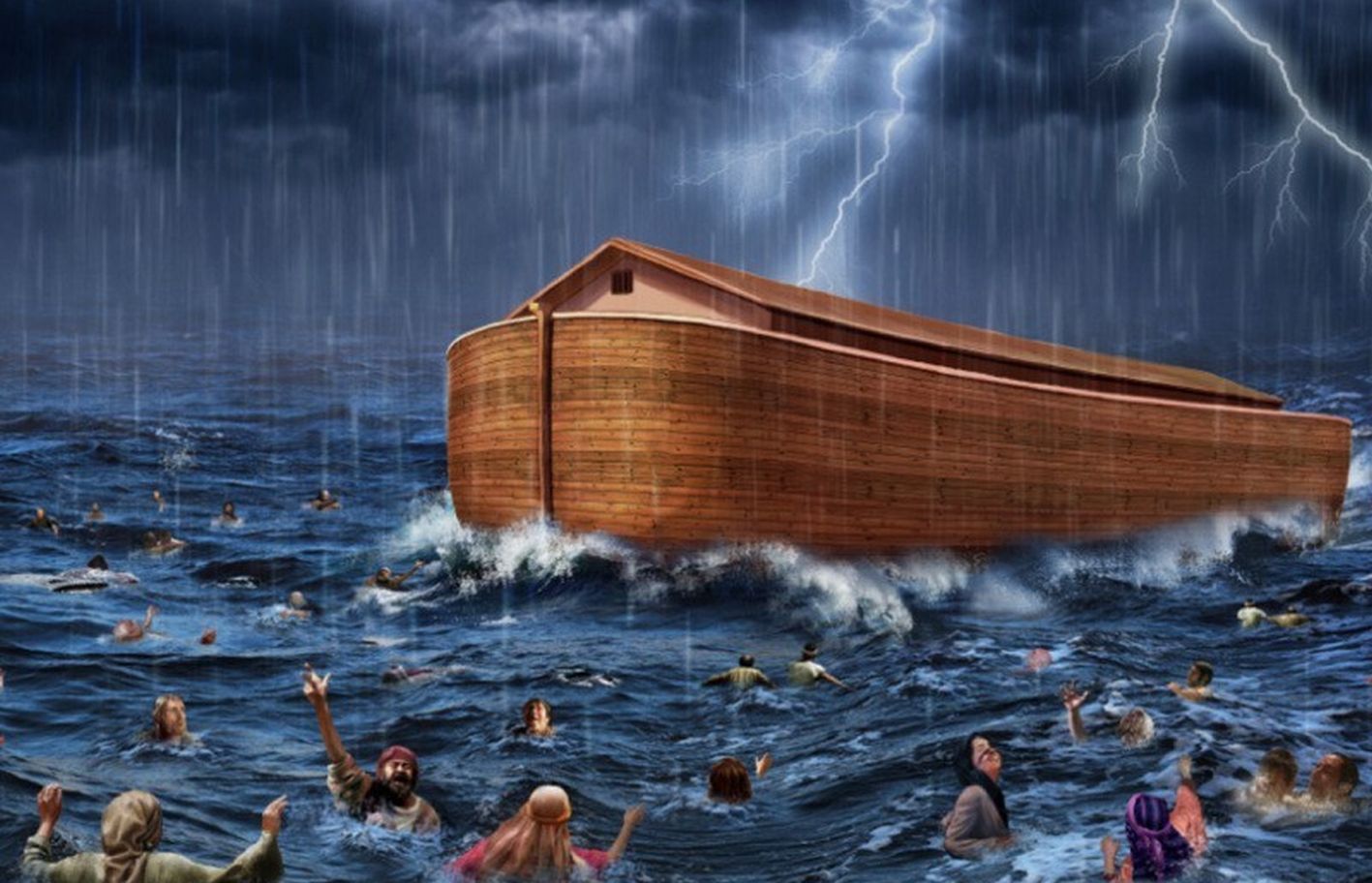
CAPTAIN NOAH AND HIS
UNSINKABLE FAITH
It is interesting that Genesis has 6 chapters describing Noah's faith while our writer artfully distills the essence of Noah's faith into a single verse! As an aside, if you have ever felt alone in your environment because you are completely surrounded by godless pagans, then you want to take time to meditate on the life of Noah, who believed God when every visible sign seemed to contradict the warning and the world around him was spinning out of control!
By faith (pistis) means "by means of faith" or grammatically is a dative of means, a formula used 19x in Hebrews 11. Stated another way, faith is in this context is the channel through which divine revelation (the rain is coming!) produces an obedient response (the hammers began to pound). True belief inevitably transforms behavior, and if it does not, then one should question whether it is genuine belief or mere intellectual assent! (cf 1Jn 2:3-4+) More succinctly stated belief that does not behave is unbelief in disguise! WOE! Noah dramatically illustrates that faith that saves is faith that acts. As A W Tozer said "The Bible recognizes no faith that does not lead to obedience, nor does it recognize any obedience that does not spring from faith. The two are at opposite sides of the same coin." Faith alone saves! But the faith that saves is not "alone"! A man is justified by faith alone, not by works, but a faith that "works" is not alone! Noah's faith is an important illustration of true faith, one which is not just intellectual assent and is not passive but a faith that is demonstrated by active obedience, a faith that built when others mocked. Notice that God gives His people eyes to see what the lost world is too spiritually blind to see and in Noah's case, where the pagan world perceived no divine danger, Noah saw God's judgment on the horizon. And so while the world pursued pleasure (sounds like our world 2025!), Noah prepared an ark.
To believe in God amid fellow believers is relatively easy.
But to have no one to lean on except God is the true test of faith
Simon Kistemaker observes that "Noah stood alone in the midst of a hostile world. Apart from the immediate members of his family, he could not find any support. To believe in God amid fellow believers is relatively easy. But to have no one to lean on except God is the true test of faith....No prophet ever preached such a message of doom as Noah did for such an extended time—120 years. Moreover, Noah preached to the entire world of that day. (BORROW Exposition of the Epistle to the Hebrews)
Noah, being warned (chrematizo) by God about things not yet seen (blepo) - Noah's faith looked beyond his senses to the certainty of God’s spoken Word, a good practice for all saints to imitate! (2Co 5:7+, cf Ro 8:24+) Being warned (chrematizo) is aorist (past completed action), passive (warning from outside source - divine passive) was a solemn word of warning, not a suggestion! Keeping in mind Ro 10:17+ the truth that "faith comes by hearing and hearing by the Word of Christ," we see that Noah's faith rested not on human reasoning but on divine revelation. God’s Word became the solid ground beneath his feet, nurturing trust where sight offered none. Oh, how we too need to to be in the Book to grow our faith like Noah!
Warren Wiersbe - Noah’s faith involved the whole person: his mind was warned of God; his heart was moved with fear; and his will acted on what God told him. (Bible Exposition Commentary)
Things not yet seen (blepo) uses the same verb as Heb 11:1 "faith...is the conviction of things not seen (blepo)." blepo refers to things not yet visible to the physical eye, specifically rain, which would bring a global flood, which had never been seen before (cf. Ge 2:5–6+). Faith accepts God’s word as fact and acts upon it, regardless of what the senses say. Noah believed what had never been seen before, and prepared for what had never happened before. Noah "saw" rain by faith. Think about this for a moment. How long did Noah walk by faith and not by sight? Genesis 6:3+ suggest this period was 120 years. Talk about an example of perseverance of a saint! Amazing grace!
It is a great thing to have faith in the presence of a terrible trial,
but the first essential is to have faith for ordinary everyday consumption.
C H Spurgeon - “Enoch walked with God, and he was no more for God took him” (Ge 5:24), and we read that Noah also “walked with God” (Gen 6:9). These two spent their lives in such constant communion with the Most High that they could be fully described as walking with God. Noah is the picture of one who is the Lord’s witness during evil days and lives through them faithfully, enduring unto the end. It was his to be delivered from death by death. The ark was, so to speak, a coffin to him: he entered it and became a dead man to the old world; within its enclosure, he was floated into a new world to become the founder and father of a new race. As in the figure of baptism we see life by burial, so it was with this chosen patriarch; he passed by burial in the ark into a new life. In Enoch we see a type of God’s people who will go home peacefully before the last closing struggle. Before the first clash of swords at Armageddon, such Enochs will be taken from the evil to come (NOTE: SPURGEON SEEMS TO BE ALLUDING TO A RAPTURE). But in Noah we see those who will engage in the conflict and bear themselves bravely amid backsliding and apostasy until they shall see the powers of evil trodden under their feet as straw is trodden for the dunghill. Noah believed in God in his ordinary life. Before the great test came, before he heard the oracle from the secret place, Noah believed in God. We know that he did, for we read that he walked with God, and in his common conduct he is described as being “a righteous man, without defect in his generations” (Gen 6:9). To be righteous in the sight of God is never possible apart from faith, for “the righteous shall live by his faithfulness” (Hab 2:4). It is a great thing to have faith in the presence of a terrible trial, but the first essential is to have faith for ordinary everyday consumption. (Sermon Noah's Faith, Fear, Obedience, and Salvation)
In Genesis we read a description of Noah -
Ge 6:9+ These are the records of the generations of Noah. Noah was a righteous man, blameless in his time; Noah walked with God (Lxx - euaresteo = was pleasing to God - see comment).
Comment - Note in the Septuagint that walked with is euaresteo which is used in Hebrews 11:6 ("impossible to please" - euaresteo) and was also used in the Septuagint of Ge 5:24 to translate the phrase "walked with". To walk with God means that our lives are in step with God (Gal 5:25NIV+), yielded in obedience to Him, headed in the direction He chooses. Walking also implies intimacy and fellowship. Walking with a friend is a time to talk, to get to know one another, and to share the things that are happening in your lives. Walking with God is a daily process of growing more intimate with Him as you share everything in your life with Him and learn more of His ways.
Noah illustrates that faith hears and receives God's Word of warning
Then God said to Noah, “The end of all flesh has come before Me; for the earth is filled with violence because of them; and behold, I am about to destroy them with the earth. Make (a command) for yourself an ark of gopher wood; you shall make the ark with rooms, and shall cover (Heb verb = kaphar = literally as in this passage means to cover and in other contexts means to make an atonement [And thus = "Yom Kippur" = Day of Atonement]! E.g., Da 9:24+ speaking of the Messiah) it inside and out with pitch (Hebrew = kopher = means pitch. Most OT uses in KJV mean a ransom, price demanded to redeem a person.). (Ge 6:13, 14+)
And then Noah demonstrates that true saving faith "works"
Thus Noah did; according to all that God had commanded him, so he did. (Ge 6:22+)
Comment: For a more in depth discussion of this vitally (eternally) important relationship between saving faith and works, see notes on James 2:14, 15, 16, 17ff (Notes)
Spurgeon - (Noah) had listened to the terrible threat that God would destroy all living things with a flood; his faith believed both the warning and the promise. If he had not believed the threat, he would not have prepared an ark, and so would not have received the promise. Men do not prepare an ark to escape from a flood unless they believe that there will be a flood.
Our Lord Jesus Christ also warned His disciples (Lk 17:22+) (and by way of application all mankind regarding these last days [cp 2Ti 3:1+])…
And just as it happened in the days of Noah, so it will be also in the days of the Son of Man (in the days preceding the return of Christ - see Second Coming): 27 they were eating, they were drinking, they were marrying, they were being given in marriage, until the day that Noah entered the ark, and the flood came and destroyed them all. (Lk 17:26, 27+)
Recall the description of faith in Hebrews 11:1 "Now faith is the assurance of things hoped for, the conviction of things not seen." Noah had conviction, so much so that he set about to build an ark even though it had never rained! Talk about faith! The point is that Noah took God at His Word. That is what faith does! He trusted what God said was true even though it had not yet happened.
Related Resources - faith and obedience:
- Relationship of faith and obedience - Covenant
- Obedience of faith - Ro 1:5, 16:25
- James 2:14-26 Comments on Faith and Works
- See Commentary on Genesis 12:4
HUMOR - What was Noah's wife's name? Dr. R. G. Lee asked that question one day while he was visiting New Orleans Baptist Theological Seminary. He said that her name was “Grace,” because Genesis 6:8 says that “Noah found Grace.” What kind of lights did the Ark have in it? Flood lights!
Oswald Chambers - The life of faith is not a life of mounting up with wings, but a life of walking and not fainting…. Faith never knows where it is being led, but it loves and knows the One who is leading.
FAITH THAT WORKS PRODUCES GOOD WORKS...
Moral virtue may wash the outside, but faith washes the inside. - Thomas Adams
Faith and works are like the light and heat of a candle; they cannot be separated.
Faith does not set aside natural duties, but perfects and strengthens them. - J. A. Bengel
Idle faith is as useless as idle words. - John Blanchard
Only he who believes is obedient; only he who is obedient believes. - Dietrich Bonhoeffer
The saints of God are sealed inwardly with faith, but outwardly with good works. - John Boys
Till men have faith in Christ, their best services are but glorious sins. - Thomas Brooks
Faith and love must be inseparable companions. There is a necessary connection between them. Faith without love is no living grace, and love without faith is no saving faith. - Francis Burkitt
It is faith alone that justifies, but the faith that justifies is not alone. - John Calvin
Faith is the starting-post of obedience. - Thomas Chalmers
Faith justifies the person and works justify his faith. - Elisha Coles
Practice is the incarnation of faith. - John Donne
He does not believe that does not live according to his belief. - Thomas Fuller
The only saving faith is following faith. - Richard Glover
Faith that saves has one distinguishing quality; saving faith is a faith that produces obedience, it is a faith that brings about a way of life. - Billy Graham
We must come to good works by faith, and not to faith by good works. - William Gurnall
Man fell by a desire to be independent of God, and now man wishes to be equally independent of God in returning to him. - T. C. Hammond
Works without faith are like a suit of clothes without a body, empty. Faith without works is a body without clothes; no warmth. - John P. K. Henshaw
Faith must have adequate evidence, else it is mere superstition. - A. A. Hodge
Let your practice praise your creed, and your lives do honour to your heads. - William Jay
Faith is a living, restless thing. It cannot be inoperative. - Martin Luther
Good works do not make a good man, but a good man makes the works to be good. - Martin Luther
The true, living faith, which the Holy Spirit instils into the heart, simply cannot be idle. - Martin Luther
Faith is not an idle grace. - Thomas Manton
Wherever there is genuine faith it must blossom into works. - Joseph B. Mayor
A life of faith involves hard work, courage and discipline. - Philip Nunn
To live by faith is to live a reasonable life based on God's Word, a life which reflects God's values and priorities. - Philip Nunn
What saves is faith alone, but the faith that saves is never alone. - J. I. Packer
To assume that a holy God winks at sin and grants eternal life on the basis of our performance is the greatest deception plaguing mankind. - R. C. Sproul
Believing and obeying always run side by side. - C. H. Spurgeon
Faith and obedience are bound up in the same bundle. He that obeys God, trusts God; and he that trusts God, obeys God. - C. H. Spurgeon
Obedience is the hallmark of faith. - C. H. Spurgeon
There is never a doubt in our heart about the experience of faith while it is in action. - C. H. Spurgeon
If God gives you St Paul's faith, you will soon have St James's works - Augustus M. Toplady
Faith believes as if it did not work, and it works as if it did not believe. - Thomas Watson
You may as well separate weight from lead or heat from fire as works from faith. - Thomas Watson
No more, my God, I boast no more Of all the duties I have done: I quit the hopes I held before, To trust the merits of thy Son. - Isaac Watts
Faith can neither be stationary nor complete. - Brooke Foss Westcott
Works? Works? A man get to heaven by works? I would as soon think of climbing to the moon on a rope of sand. - George Whitefield
All right believing in God is visibly reflected in right behaviour towards men. Geoffrey B. Wilson
IN REVERENCE PREPARED AN ARK FOR THE SALVATION OF HIS HOUSEHOLD BY WHICH HE CONDEMNED THE WORLD: eulabetheis (AAPMSN) kateskeuasen (3SAAI) kiboton eis soterian tou oikou autou di es katekrinen (3SAAI) ton kosmo:
- In reverence prepared an ark - Ge 6:18; 7:1,23; 8:16; Ezek 14:14,20; 1Pe 3:20
- By which he condemned - Matthew 12:41,42; Lk 11:31,3
- Hebrews 11 Resources - Multiple Sermons and Commentaries
Related Passages:
Genesis 6:13-18+ Then God said to Noah, “The end of all flesh has come before Me; for the earth is filled with violence because of them; and behold, I am about to destroy them with the earth. 14 “Make for yourself an ark of gopher wood; you shall make the ark with rooms, and shall cover it inside and out with pitch. 15 “This is how you shall make it: the length of the ark three hundred cubits, its breadth fifty cubits, and its height thirty cubits. 16 “You shall make a window for the ark, and finish it to a cubit from the top; and set the door of the ark in the side of it; you shall make it with lower, second, and third decks. 17 “Behold, I, even I am bringing the flood of water upon the earth, to destroy all flesh in which is the breath of life, from under heaven; everything that is on the earth shall perish. 18 “But I will establish My covenant with you; and you shall enter the ark–you and your sons and your wife, and your sons’ wives with you.
2 Corinthians 2:14-16+ (BELIEVERS ARE TO BE "NOAH'S" IN OUR GENERATION) But thanks be to God, who always leads us in triumph in Christ, and manifests through us the sweet aroma of the knowledge of Him in every place. 15 For we are a fragrance of Christ to God among those who are being saved and among those who are perishing; 16 to the one an aroma from death to death (NOAH'S "AROMA" TO THE LOST WORLD), to the other an aroma from life to life. And who is adequate for these things?
FAITH THAT OBEYS,
BUILDS, SAVES AND CONDEMNS
In reverence (eulabeomai = reverent regard, godly fear - see faith/fear) prepared (kataskeuazo - thoroughly built) an ark (kibotos) for the salvation (soteria) of his household (oikos) , by which he condemned (katakrino - made a judgment against) the world (kosmos) - Noah's faith drove him to fear and to build. In reverence (eulabeomai = reverent regard) expresses Noah's righteous, godly fear, his reverential awe that led to obedience. Prepared (kataskeuazo) an ark (kibotos) reflects Noah's firm confidence in God's Word, his faith in action, not delaying or waiting for drops of rain to respond God's command and clear instructions. Note how his act of faith underscores the definition of faith "the conviction of things not seen." (Heb 11:1). Faith takes God at His Word even when reason cannot verify the warning. Noah believed the unseen Word more than the visible world. Noah’s faith itself was his testimony — a silent (except for the sound of hammers pounding!) yet powerful witness that exposed and condemned the unbelief of his generation. His obedient trust in God stood diametrically opposed to the world’s defiance of God.
For his faith Abel paid the price of his life.
Because of his faith Enoch was taken from this life.
By faith Noah saved his own family’s life.
-- Simon Kistemaker
Grant Osborne on reverence (eulabeomai) - It is with “holy fear” (eulabētheis) that he did so, translated “reverent submission” when describing Christ in 5:7. All of these ideas are part of the meaning of the term—reverence, submission, and obedience to God. This becomes a term that should depict all of us as we grow in Christ and learn both reverence and submission, the hallmarks of the victorious Christian life. True faith produces godly fear, and this results in radical surrender and obedience. (See Hebrews Verse by Verse - Page ciii)
John MacArthur adds "Abel illustrates the worship of faith, and Enoch the walk of faith. Noah, perhaps more than any other person in history, illustrates the work of faith—obedience." (See Hebrews MacArthur New Testament Commentary - Page 317)
KJV says "in fear" but as Kenneth Wuest says "the word “fear,” gives one the erroneous impression that Noah acted under the influence of fright. The Greek word is eulabeomai, which means “to act cautiously, circumspectly, to reverence, stand in awe of” in this context. Noah acted with “pious care, a reverent circumspection with regard to things enjoined by God, and as yet unseen, yet confidently expected on the strength of God’s word” (Vincent). The things not seen (Heb 11:1) were the contents of God’s revelation to Noah regarding the flood (Gen. 6:13–22)." (Hebrews Commentary)
Spiros Zodhiates adds that "Noah's action was not out of cowering, servile fear. Rather, he took what God uniquely revealed to him as if it were an oracle that He was going to flood the earth and that he should build an ark. Noah took God at His word, that what He was telling him was eu, good, right, and he received (élaben) it as such. He did not build the ark out of fear but from having received God's oracle as truth to be believed. (BORROW The Complete Word Study Dictionary: New Testament page 676)
Noah threw into bold relief by his faith,
the unbelief of the human race.
Kenneth Wuest on by which - The word “which” goes back to “faith” for its antecedent. Noah condemned the world by his faith. There are two interpretations of this statement, depending upon which meaning one takes for the word “world” (kosmos). If kosmos refers to the physical earth, then the sentence is to be interpreted as follows: Noah by acting in faith when building the ark, announced the condemnation of the earth to destruction. (ED: BUT IT WAS THE PHYSICAL EARTH THAT SINNED!) If we take kosmos as referring to the fallen, human race (ED: WHICH I BELIEVE IN CONTEXT OF GENESIS 6 IS THE TRUE SENSE), the meaning is that Noah condemned the conduct of his contemporaries by the contrast which his own faith presented. We have examples of the same thing in Matt. 12:41, Ro 2:27. However, Weiss objects to this interpretation and says that in this epistle kosmos is not used to denote the world of men. But the question arises as to what God judged in the flood, the physical earth or the sinful race? It seems, therefore, that the first interpretation is the correct one. Noah threw into bold relief by his faith, the unbelief of the human race. (Hebrews Commentary)
Thomas Watson (1681) on Noah's reverence wrote that "When the soul looks either to God's holiness, or its own sinfulness—it fears. But it is a fear mixed with faith in Christ's merits; the soul trembles—yet trusts. Like a ship which lies at anchor, though it shakes with the wind, yet it is fixed at anchor. God in great wisdom couples these two graces of faith and fear. Fear preserves seriousness, faith preserves cheerfulness. Fear is as lead to the net—to keep a Christian from floating in presumption; and faith is as cork to the net—to keep him from sinking in despair." (What is the Fear of the Lord?)
The very means of salvation
became the means of destruction.
Philip E Hughes points out the paradox - What was a means of salvation was also a means of destruction: the water which overwhelmed the scornful also supported the ark and those who were in it. In the hour of judgment there is security for those whose life is hid with Christ in God (Col. 3:3+). Thus the eight persons in the ark were “saved through water” (1 Pet. 3:20+). (See A Commentary on the Epistle to the Hebrews - Page 465)
Obedience always carries a cost. For Noah, it was ridicule.
For Abraham, separation. For Moses, reproach.
For Christ, the cross.
C H Spurgeon - Noah obeyed at all costs (ED: Obedience always has a cost — but disobedience costs far more!) . To build the huge vessel must have cost Noah a great deal of money and labor. He could not get everybody to work at the absurd task of building a vessel on dry land. As they would be laughed at, his workmen would be sure to demand extra pay. Possibly he had to pay double wages to everyone employed on the ark. The patriarch was content to sink all his capital and all his income in this singular venture. It was a poor speculation—so everybody told him—and yet he was quite willing to put all his eggs into that one basket. God had bidden him build, and build he would, feeling that the divine command insured him against risk. Can we do the same? Noah went on obeying under daily scorn. The men of that generation mocked him. He went out and preached to them, but many would not hear him, for they thought him mad. Those who did listen to him said to each other, “He is building a vessel upon dry land—is he sane? We are scientific, and therefore we know how absurd his preaching is; no one ever heard of the world being drowned by a flood.” I cannot reproduce the letters that were written about the sturdy patriarch, nor can I recount the spiteful things that were said by the gossips, but I have no doubt they were very clever, and very sarcastic. Those productions of genius are all forgotten now, but Noah is remembered still. For all the scorning of many he went on obeying his God: he stuck to the lines on which God had placed him, and he could not be turned to the right hand or to the left, because he had a real faith in God. (Sermon Noah's Faith, Fear, Obedience, and Salvation)
For the salvation (soteria) of his household (oikos) - This passage suggests that Noah's faith was like leaven, influencing his entire family. In the context of the global flood the salvation (soteria) of his household (oikos) salvation was temporal (from the flood waters), yet illustrative of eternal salvation, for as the ark bore Noah and his family safely through God's judgment. While the faith of one man brought salvation to his family, this was not automatic spiritual salvation for the other members, for the the spiritual condition of his family is not directly stated. This is one of those questions we will have to wait until heaven to get a clear answer. What the Bible does tell us in Genesis 9:18–27 is that not all in his household walked in righteousness afterward. Ham’s sin (Ge 9:22) and the resulting curse on Canaan reveal moral corruption. While we cannot be dogmatic Ham's behavior does suggest at least some of Noah's children who were "saved" physically but not necessarily saved (transformed) spiritually. In summary, while it is possible that some of Noah's family came to faith as a result of his witness, the text does not affirm it. All were saved from water, but only those who, like their father, believed were saved from sin.
By which he condemned (katakrino - pronounced judgment against, declared guilty, passed sentence on) the world (kosmos) - Noah's "judicial verdict" on the world was "GUILTY!" Condemned in aorist tense describes this verdict as a completed act. Noah’s faith and obedience once for all rendered the world’s unbelief inexcusable.
🙏 THOUGHT - Beloved, you can mark it down as a truism in your life (so you will not be surprised at their reaction) - When in faith you act on divine warning, it inevitably "pronounces judgment" on unbelief. The very fact that you obey (and don't steal pencils from the office, etc, cf Titus 2:10+) Are you surprised at the negative reaction to your godly behavior? You shouldn't be, because that's the same reaction our Lord received (cf 1Pe 2:21+, 2Ti 2:3+, Php 1:29+, 2Ti 3:12+, Acts 5:41+) Faith condemns unbelief. Obedience exposes disobedience. Holiness reveals sinfulness. It is like a light shining suddenly in a dark barn causing all the rats to scurry for cover!
Spurgeon comments (some duplication as these are compiled from a number of separate expository comments by Spurgeon)…
There is an unholy fear which is cast out by perfect love (1Jn 4:18), but there is a holy fear, a filial fear (filial = of, relating to, or befitting a son or daughter), which dwells most happily with faith, so was it with Noah, who, “by faith,… moved with fear, prepared an ark to the saving of his house.”
You see, faith and fear can live in the same heart; and they can work together to build the same ark. Faith and fear are very sweet companions, when the fear is filial fear, a holy dread of disobeying, God. When we are moved with that fear, our faith becomes practical.
Fear and faith may sometimes dwell together. There is a holy, humble fear that perfect love never casts out (Ed: In other words, this is a "fear" God's children should possess and should seek to cultivate, cp 1Pe 1:17+, 2Co 7:1+ for this filial fear motivates obedient, holy conduct), but entertains and cherishes; and this is the kind of fear that Noah possessed: “Being warned of God of things not seen as yet, moved with fear, he prepared an ark.” Noah was a practical life-saver,— an ark-builder; and so he became the second father of the human race,— a sort of new Adam,— and that simply by his faith. Oh! what is there that is impossible to the man who believes in God? “All things are possible to him that believeth.” (Mk 9:23)
See how faith within a man masters all his emotions. Noah, in preparing the ark, was “moved with fear;” but that fear, instead of hampering him, was yoked with his faith, and so was turned to practical account. Oh, for an overcoming faith, (cp 1Jn 5:4, 5) which shall hold our entire nature in check, or which shall employ every part of our being for its own high and noble purposes! (Ed: Amen!)
Noah was the second great father of men as Adam was the first. In the flood, all died except Noah and his family. Faith made him build the great ship on dry land, into which he went, with his wife and family and all manner of living creatures; and when the rest of mankind were destroyed, they outlived the flood.
Faith can outlive a deluge which drowns the whole world. She (faith) hath an Ark even when God’s wrath sweeps all the rest away. Next we learn the obedience of faith (referring to He 11:8+). (Exposition of Hebrews)
🙏 THOUGHT - As an aside, godly, reverential fear goes hand in hand with love. Love is the positive side, fear the negative — filial in nature, like a child’s loving respect for their father. Love moves us to do what pleases God; fear restrains us from doing what displeases Him. Jesus said "If you love Me, you will keep My commandments." (Jn 14:15+). Do you just say you love Jesus or do you show you love Jesus? Our actions speak louder than our words!
Peter (in the background of an otherwise interpretatively difficult section of his letter) alludes to this salvation event because of the intractable evil of mankind (Ge 6:5, 13)…
when the patience of God kept waiting in the days of Noah, during the construction of the ark, in which a few, that is, eight persons, were brought safely through the water. (1Pe 3:20+)
Mankind has continually looked for salvation of one kind or another (Eccl 3:11+ is true but so is Ro 3:11+). Greek philosophers (who did not understand spiritual truth, cp 1Co 2:14+) had turned inward and begun to focus on changing man’s inner life through moral reform and self-discipline. The Greek Stoic philosopher Epictetus called his lecture room “the hospital for sick souls.” Epicurus (in a state of self deception/delusion) called his teaching “the medicine of salvation.” Seneca taught that all men were looking ad salutem (“toward salvation”) and that men are overwhelmingly conscious of their weakness and insufficiency in necessary things and that we therefore need “a hand let down to lift us up”. Seneca was not far from the truth as Scripture testifies…
(Jehovah speaking) Is My hand so short that it cannot ransom? Or have I no power to deliver?… Behold, the LORD'S hand is not so short that it cannot save… (Jeremiah speaking) 'Ah Lord GOD! Behold, Thou hast made the heavens and the earth by Thy great power and by Thine outstretched arm! Nothing is too difficult for Thee" (Isa 50:2… Is 59:1… Je 32:17)
Spurgeon - I do not read that Noah ever entered into any dispute with the men of his times. He never argued, much less did he wish them ill; he simply believed and told them the truth. He kept his own faith intact and went on building his ark, thus practicing what he believed. In this way he condemned those who criticized him. So you see that faith has a condemning power towards an ungodly world. You do not need to be constantly telling worldlings that they are doing wrong; let them see clearly the evidence of your faith (cp Mt 5:16+, Php 2:14, 15+, 1Pe 2:12+, 1Pe 3:16+), for that will bear the strongest conceivable witness against their unbelief and sin, even as Noah, by his faith, “condemned the world, and became heir of the righteousness which is by faith.” (Sermon Noah's Faith, Fear, Obedience, and Salvation)
Warned (5537) (chrematizo from chrema = an affair, business, sum of money, Ac 4:37, 8:18, 24:26, property Mt 19:22) in the NT means to impart a divine message (an injunction or warning) which is the primary meaning in Hebrews 11:7. Chrematizo indicates communication from God with practical intent — revelation demanding response. Chrematizo in this sense speaks of a divine oracle or declaration (Lk 2:26 = "it had been revealed to him by the Holy Spirit"), as well as a divine warning (He 12:25, 8:5, Mt 2:12, 22 = "warned by God in a dream"). In the Greek papyri chrematizo was also used of official pronouncements by magistrates and of a royal reply to a petition as well as an answer of an oracle or as describing a revelation from a deity. Josephus uses chrematizo in the sense of to receive a response from God.
CHREMATIZO - Matt. 2:12; Matt. 2:22; Lk. 2:26; Acts 10:22; Acts 11:26; Rom. 7:3; Heb. 8:5; Heb. 11:7; Heb. 12:25
Hebrews 8:5 who serve a copy and shadow of the heavenly things, just as Moses was warned by God when he was about to erect the tabernacle; for, “SEE,” He says, “THAT YOU MAKE all things ACCORDING TO THE PATTERN WHICH WAS SHOWN YOU ON THE MOUNTAIN.”
Hebrews 11:7 By faith Noah, being warned by God about things not yet seen, in reverence prepared an ark for the salvation of his household, by which he condemned the world, and became an heir of the righteousness which is according to faith.
Hebrews 12:25 See to it that you do not refuse Him who is speaking. For if those did not escape when they refused him who warned them on earth, much less will we escape who turn away from Him who warns from heaven.
Seen (991) (blepo) can denote simple voluntary observation and so mean to look at, behold. Many NT uses convey the sense of becoming aware of or taking notice of something, of perceiving or discerning or understanding. Blepo means to discern mentally, observe, consider, contemplate, look to in the sense of taking care, take heed. It means perceive with your eyes. Have your eye on so as to beware of.
BLEPO IN HEBREWS (116V IN NT) - Heb. 2:9; Heb. 3:12; Heb. 3:19; Heb. 10:25; Heb. 11:1; Heb. 11:3; Heb. 11:7; Heb. 12:25
Hebrews 2:9 But we do see Him who was made for a little while lower than the angels, namely, Jesus, because of the suffering of death crowned with glory and honor, so that by the grace of God He might taste death for everyone.
Hebrews 3:12 Take care, brethren, that there not be in any one of you an evil, unbelieving heart that falls away from the living God.
Hebrews 3:19 So we see that they were not able to enter because of unbelief.
Hebrews 10:25 not forsaking our own assembling together, as is the habit of some, but encouraging one another; and all the more as you see the day drawing near.
Hebrews 11:1 Now faith is the assurance of things hoped for, the conviction of things not seen.
Hebrews 11:3 By faith we understand that the worlds were prepared by the word of God, so that what is seen was not made out of things which are visible.
Hebrews 11:7 By faith Noah, being warned by God about things not yet seen, in reverence prepared an ark for the salvation of his household, by which he condemned the world, and became an heir of the righteousness which is according to faith.
Hebrews 12:25 See to it that you do not refuse Him who is speaking. For if those did not escape when they refused him who warned them on earth, much less will we escape who turn away from Him who warns from heaven.
Reverence (2125) (eulabeomai from eu = well + lambano = take hold - literally "taking hold well" or "one who receives well" and thus reverently - see related noun eulabeia - reverence - which is used in Heb 5:7) means to be concerned,to be cautious, to be thoughtful, to be circumspect, to give careful heed or to be moved with reverent regard/respect for something or someone, in this case Noah's sense of reverence regarding God and His warning. In Noah's case we observe that a reverential attitude led to a reasonable action (built an ark!). In other words Noah's holy awe led to obedience, which is the essence of “faith in action.”
Faith and fear are related because the more a man believes the more he fears to disobey. On the other hand the more he fears, the more he obeys. Witness Job "There was a man in the land of Uz whose name was Job; and that man was blameless, upright, fearing God and turning away from evil." (Job 1:1) Why did Job turn away from evil? He had godly fear. Because Job believed God was holy and just, he feared to offend Him and therefore turned away from evil. Faith believes God is holy and true, while fear reveres Him as awesome and righteous. The more deeply one trusts God, the more carefully one walks before Him, not wanting to grieve or dishonor Him. Thus, true faith produces holy fear, and holy fear deepens faithful obedience. We see a similar pattern in Proverbs 8:13 (“The fear of the Lord is to hate evil”), Proverbs 16:6 (“By the fear of the Lord one keeps away from evil.”) and Psalm 25:14 “The secret (intimacy) of the LORD is for those who fear Him." Noah was intimate with the Lord ("walked with God" Ge 6:9+) because he feared the Lord! Noah’s reverent fear kept his faith vibrant and his obedience immediate. The same holds true for us — when reverence weakens, so does responsiveness.
🙏 THOUGHT - How is your walk with the Lord—close or distant? If you feel out of step with the Spirit (cf Gal 5:25NIV+), pause and check your “fear factor." A healthy reverence draws us nearer, while a shallow view of God widens the gap.
When our fear of God fades,
our fellowship with God falters.
See more detailed study of this seldom preached on topic of The Fear of the Lord. (More resources on fear)
This is the only NT use of eulabeomai (Note - The Textus Receptus has one use in Acts 23:10) but there are 21 uses in the Septuagint (LXX) -Ex 3:6; Deut. 2:4; 1Sa 18:15, 29; Job 13:25; 19:29; Pr. 2:8; 30:5; Isa. 51:12; 57:11; Je 4:1; 5:22; 15:17; 22:25; Dan. 4:5; Nah. 1:7; Hab. 2:20; Zeph. 1:7; 3:12; Zec 2:13; Mal. 3:16
Habakkuk 2:20 "But the LORD is in His holy temple. Let all the earth be silent (Heb = has = hush! Keep silence!; LXX = eulabeomai) before Him."
Prepared (2680) (kataskeuazo from katá = intensifies the meaning of + skeuazo = prepare <> from skeuos = implement, vessel) is a verb which means to to equip, make ready, construct, or to cause to be thoroughly prepared. It includes the supply of all necessary furniture and equipment. It's the idea of adorning and equipping with all things necessary. Kataskeuazo was the word used to describe the preparing of a way before oriental monarch (Mt 11:10; Mk 1:2; Lk 7:27 from Malachi 3:1).
KATASKEUAZO - 10V - Matt. 11:10; Mk. 1:2; Lk. 1:17; Lk. 7:27; Heb. 3:3; Heb. 3:4; Heb. 9:2; Heb. 9:6; Heb. 11:7; 1 Pet. 3:20
Hebrews 3:3 For He has been counted worthy of more glory than Moses, by just so much as the builder of the house has more honor than the house.
Hebrews 3:4 For every house is built by someone, but the builder of all things is God.
Hebrews 9:2 For there was a tabernacle prepared, the outer one, in which were the lampstand and the table and the sacred bread; this is called the holy place.
Hebrews 9:6 Now when these things have been so prepared, the priests are continually entering the outer tabernacle performing the divine worship,
Hebrews 11:7 By faith Noah, being warned by God about things not yet seen, in reverence prepared an ark for the salvation of his household, by which he condemned the world, and became an heir of the righteousness which is according to faith.
Ark (2787) (kibotos) describes a wooden box or chest and here refers to the sea faring vessel God had Noah build to save himself and his family from the world-wide flood. In other contexts kibotos refers to the Ark of the Covenant (He 9:4, Heb 11:19)
KIBOTOS - 6V - Matt. 24:38; Lk. 17:27; Heb. 9:4; Heb. 11:7; 1 Pet. 3:20; Rev. 11:19
Hebrews 9:4 having a golden altar of incense and the ark of the covenant covered on all sides with gold, in which was a golden jar holding the manna, and Aaron’s rod which budded, and the tables of the covenant;
Salvation (4991)(soteria from soter = Savior in turn from sozo = save, rescue, deliver) describes the rescue or deliverance from danger, destruction and peril. (1) A physical deliverance - rescue from danger deliverance, preservation, safety. (Heb 11:7) (2) A religious technical term describing safety of the soul and so in a spiritual sense referring to salvation (Lk 1:77, Lk 19:9, Acts 4:12, Ro 1:16) (3) A Messianic deliverance at the end of this present age. (Heb 9:28, Ro 13:11, 1Pe 1:5).
The idea of salvation is that the power of God rescues people from the penalty of sin, which is spiritual death which is followed by eternal separation from the presence of His Glory. Salvation delivers the believer from the power of sin (see discussion on Romans 6-8 beginning at Romans 6:1-3)
Salvation carried tremendous meaning in Paul’s day, the most basic being “deliverance,” and it was applied to personal and national deliverance. The emperor was looked on as a "savior" as was the physician who healed you of illness.
William Barclay - In classical Greek soteria means 'deliverance' or 'preservation'. It can be used for a man's safe return to his own home or his own country after an absence and a journey. It can mean a 'guarantee of safety' or a 'security against danger'. In the papyri by far the commonest meaning of soteria is 'bodily health'. For instance, a member of the family writes home, 'Write me a letter about your soteria,' or, as we would say, 'Let me know how you are.' (BORROW New Testament Words)
SOTERIA IN HEBREWS - (44V IN INT) Heb. 1:14; Heb. 2:3; Heb. 2:10; Heb. 5:9; Heb. 6:9; Heb. 9:28; Heb. 11:7
Hebrews 1:14 Are they not all ministering spirits, sent out to render service for the sake of those who will inherit salvation?
Hebrews 2:3 how will we escape if we neglect so great a salvation? After it was at the first spoken through the Lord, it was confirmed to us by those who heard,
Comment - In short, this "so great a salvation" is not just escape from the penalty of sin but includes the ideas of safety, deliverance from slavery and preservation from danger or destruction. In addition, this "so great a salvation" includes the idea of what is often referred to as the Three Tenses of Salvation (justification = past tense salvation = deliverance from sin's penalty, sanctification = present tense salvation = deliverance from sin's power and glorification = future tense salvation = deliverance from sin's presence). It follows that the discerning student will check the context to determine which of the three "tenses" a given use of soteria is referring to.
Hebrews 2:10 For it was fitting for Him, for whom are all things, and through whom are all things, in bringing many sons to glory, to perfect the author of their salvation through sufferings.
Hebrews 5:9 And having been made perfect, He became to all those who obey Him the source of eternal salvation,
Hebrews 6:9 But, beloved, we are convinced of better things concerning you, and things that accompany salvation, though we are speaking in this way.
Hebrews 9:28 so Christ also, having been offered once to bear the sins of many, will appear a second time for salvation without reference to sin, to those who eagerly await Him.
Hebrews 11:7 By faith Noah, being warned by God about things not yet seen, in reverence prepared an ark for the salvation of his household, by which he condemned the world, and became an heir of the righteousness which is according to faith.
Household (3624) (oikos) refers to a dwelling and by implication a family (more or less related), a home, a household.
OIKOS IN HEBREWS - Heb. 3:2; Heb. 3:3; Heb. 3:4; Heb. 3:5; Heb. 3:6; Heb. 8:8; Heb. 8:10; Heb. 10:21; Heb. 11:7
Hebrews 3:2 He was faithful to Him who appointed Him, as Moses also was in all His house.
Hebrews 3:3 For He has been counted worthy of more glory than Moses, by just so much as the builder of the house has more honor than the house.
Hebrews 3:4 For every house is built by someone, but the builder of all things is God.
Hebrews 3:5 Now Moses was faithful in all His house as a servant, for a testimony of those things which were to be spoken later;
Hebrews 3:6 but Christ was faithful as a Son over His house–whose house we are, if we hold fast our confidence and the boast of our hope firm until the end.
Hebrews 8:8 For finding fault with them, He says, “BEHOLD, DAYS ARE COMING, SAYS THE LORD, WHEN I WILL EFFECT A NEW COVENANT WITH THE HOUSE OF ISRAEL AND WITH THE HOUSE OF JUDAH;
Hebrews 8:10 “FOR THIS IS THE COVENANT THAT I WILL MAKE WITH THE HOUSE OF ISRAEL AFTER THOSE DAYS, SAYS THE LORD: I WILL PUT MY LAWS INTO THEIR MINDS, AND I WILL WRITE THEM ON THEIR HEARTS. AND I WILL BE THEIR GOD, AND THEY SHALL BE MY PEOPLE.
Hebrews 10:21 and since we have a great priest over the house of God,
Hebrews 11:7 By faith Noah, being warned by God about things not yet seen, in reverence prepared an ark for the salvation of his household, by which he condemned the world, and became an heir of the righteousness which is according to faith.
Condemned (2632) (katakrino from kata = down, against + krino = to assess, then to separate or distinguish, then to give an opinion upon, judge, then to decide or determine and finally to judge (to judge one down [kata = down]), pronounce judgment or to condemn) means to give judgment against, pass sentence upon, pass judgment against and hence to condemn, this latter action implying there has been a crime. It means to pronounce sentence against or to adjudge guilty and always denotes an adverse sentence (to sentence to punishment).
By Noah's faithful obedience in building the ark, even in face of ridicule, delay, and no visible evidence of rain, these very actions became a moral judgment on those who refused to believe God’s warning. Every hammer blow testified “God’s word is true; judgment is coming.” Lest we think Noah just "spoke" with his actions, Peter would suggest he used words, calling him "a preacher (kerux = a herald, proclaimer) of righteousness." (2Pe 2:5) In Greek a kerux was one who delivered a message from a king or authority, not his own words, but the ruler’s decree. His role was to proclaim it clearly, accurately, and with authority. In the New Testament, the term is used of one who proclaims the gospel message of Christ with divine authority (e.g., Paul in 1Ti 2:7, 2Ti 1:11). The herald’s task was not to debate, modify, or embellish the message, but to proclaim it exactly as given.
KATAKRINO - 18V - Matt. 12:41; Matt. 12:42; Matt. 20:18; Matt. 27:3; Mk. 10:33; Mk. 14:64; Mk. 16:16; Lk. 11:31; Lk. 11:32; Jn. 8:10; Jn. 8:11; Rom. 2:1; Rom. 8:3; Rom. 8:34; Rom. 14:23; 1 Co. 11:32; Heb. 11:7; 2 Pet. 2:6
Condemn = Old French condemner, from Latin condemnāre from con- (expressing intensive force) + damnare = to condemn, to inflict loss upon from damnum = loss, damage.
Katakrino in secular Greek was a legal technical term for pronouncing a sentence after reaching a verdict or decision against someone. To declare an evildoer guilty.
In our modern parlance, the word condemn is often used with a "lighter" meaning such as to censure, to express strong disapproval, to denounce, etc. Most Biblical uses of katakrino are not "light" as evidenced by repeated use of this verb to describe Jesus being condemned to death. Similarly all who disbelieve will be condemned, which is not simply censured, etc, but sentenced to eternal separation from God (but see Ro 14:23+ which describes condemnation by one's own conscience, not eternal condemnation or condemnation to death).
The Wycliffe Bible Encyclopedia writes that katakrino "is to be distinguished from… (krino) in that it refers either to the sentence or to the punishment following the sentence rather than to the simple act of deciding in judgment. Only the context can determine the precise nature of the sentence. (Wycliffe Bible Encyclopedia)
Nelson's New Illustrated Bible Dictionary writes that "Condemn and condemnation are judicial terms, the opposite of Justify and Justification (Mt 12:37; Ro 5:16, 18). God alone is the Judge of people; in His demand for righteousness, sin leads invariably to condemnation and death. (BORROW Nelson's New Illustrated Bible Dictionary)
The Evangelical Dictionary of Biblical Theology adds that "From the standpoint of semantics, condemnation is part of legal terminology. When it is discovered that a crime has been committed, that the law has been broken, the process of investigation may lead to formal charges being levied against a defendant. The process of litigation leads to the outcome, a verdict of acquittal or guilt. The verdict indicates that the defendant is either free from or accountable to the law’s penalty for that crime. Thus the result is either vindication or condemnation. Condemnation can refer either to the legal status of liability to punishment or to the actual infliction of that punishment. At times the word is also used in a broader context to refer to negative evaluations of a person by peers or by one’s own conscience. This legal process is to some extent the background for biblical language about judgment and condemnation. (Click for full article that goes into much greater detail)
World (2889) (kosmos) can mean the world with its primary meaning being order, regular disposition and arrangement (God's creation of the heavens and earth) but in this case is used figuratively (and morally/ethically) to refer to the whole of mankind who is alienated from God, unredeemed and hostile to Him. For example, John speaking of the incarnation of Jesus said that "He was in the world (kosmos - here refers to the earth with all its inhabitants) and the world (kosmos - primarily refers to the creation) was made through Him and the world (kosmos - primarily has a moral/ethical meaning describing those hostile to Him) did not know Him." (Jn 1:10). In the context of the flood "the world" included all of mankind other than those safe in the Ark, all the world of humanity organized in rebellion against God, not creation itself (cf. Jn 15:18–19). The kosmos in this sense is the system of human life apart from God’s rule. I would call it "practical atheism."
KOSMOS IN HEBREWS (151V IN NT) Heb. 4:3; Heb. 9:26; Heb. 10:5; Heb. 11:7; Heb. 11:38;
Hebrews 4:3 For we who have believed enter that rest, just as He has said, “AS I SWORE IN MY WRATH, THEY SHALL NOT ENTER MY REST,” although His works were finished from the foundation of the world.
Hebrews 9:26 Otherwise, He would have needed to suffer often since the foundation of the world; but now once at the consummation of the ages He has been manifested to put away sin by the sacrifice of Himself.
Hebrews 10:5 Therefore, when He comes into the world, He says, “SACRIFICE AND OFFERING YOU HAVE NOT DESIRED, BUT A BODY YOU HAVE PREPARED FOR ME;
Hebrews 11:7 By faith Noah, being warned by God about things not yet seen, in reverence prepared an ark for the salvation of his household, by which he condemned the world, and became an heir of the righteousness which is according to faith.
Hebrews 11:38 (men of whom the world was not worthy), wandering in deserts and mountains and caves and holes in the ground.
AND BECAME AN HEIR OF THE RIGHTEOUSNESS WHICH IS ACCORDING TO FAITH: kai tes kata pistin dikaiosunes egeneto (3SAMI) kleronomos:
- Became an heir of the righteousness - Ro 1:17; Ro 3:22; Ro 4:11,13; 9:30; 10:6; Gal 5:5; Phil 3:9; 2Pe 1:1
- Hebrews 11 Resources - Multiple Sermons and Commentaries
MOSES BECAME
AN HEIR
And became an heir (kleronomos) of the righteousness (dikaiosune) which is according to faith (pistis) - Noah was the first man in the Bible called righteous (Ge 6:9+; Ge 7:1+), Became (ginomai) means to come into existence. Noah became something he was not before; by faith he entered into a new standing before God. Ginomai in some contexts means to be born and in a sense Noah and his family who were born dead in their trespasses and sins (Ep 2:1+, Ro 5:12+), were "born again" and came into existence into a new life characterized by God's imputation (crediting to Noah's account) of perfect righteousness (cp Abram, Ge 15:6+ who heard "the gospel" = Gal 3:8+ and believed, the Hebrew verb aman). In other words they were saved by grace (Ge 6:8KJV) through faith (Ep 2:8, 9+), just as every person every saved. The fact that he was an heir (kleronomos) emphasizes that Noah's inheritance (righteousness of Christ, cf 1Co 1:30+) was not earned, but was bestowed as a gift of grace by virtue of his new relationship with God by means of his faith. Noah was saved by faith, not by works. His faith was demonstrated to be genuine by his works, but his works did not save him.
Leon Morris on righteousness - Here in v. 7 we have the author’s one use of the term “righteousness” in the Pauline sense of the righteousness that is ours by faith. In the Bible Noah was the first man to be called righteous (Gen 6:9). He was right with God because he took God at his word; he believed what God said and acted on it. (See The Expositor's Bible Commentary - Abridged Edition)
Charles Spurgeon interprets Noah's righteousness as equivalent of justification (being born again) writing "God declared him righteous—not righteous by his works, although his works, following upon his faith, proved him to be righteous. He was righteous by his faith. He believed God, and found grace in the eyes of the Lord. He received the righteousness that God gives through Jesus Christ to all who believe. Wrapped in this, he stood before the Lord, justified and approved. By faith he was adopted and became a son, an heir. For him the promise of the woman’s seed, though it was all the Bible that he had, was quite enough. The woman’s seed, and the Lamb’s sacrifice, which Abel had seen, these were almost all the revelation he had known. He had no Pentateuch, no Psalms, no Gospels, no Epistles, but he so believed that little Bible of his that he expected that Christ in him would bruise the serpent in the world. God honored his faith, and he condemned the world. He lived when the rest perished; he was secure in his ark when the myriads were sinking in the deluge. He became “heir of the righteousness that comes by faith” when others were condemned. (Sermon Noah's Faith, Fear, Obedience, and Salvation)
Kenneth Wuest has a different interpretation of righteousness (WHICH I THINK IS LESS LIKELY) - Not only did he condemn the human race by his faith, but he became heir of the righteousness which is by faith. The words “became heir” in the Greek text here mean merely “became owner” or “became partaker,” although there is underneath the word the idea familiar to the Jewish mind, that spiritual blessings are a heritage bestowed by God. We must be careful to note here that this righteousness is not justifying righteousness, but experimental righteousness, righteousness in conduct. In Genesis the warning of God was given Noah because he was righteous. (ED: IN OTHER WORDS, NOAH WAS "JUSTIFIED" PRIOR TO MANIFESTING THIS RIGHTEOUSNESS. SEE Ge 6:8+) (Hebrews Commentary)
John MacArthur - All who believe in God (JESUS) are righteous, not always in practice but always in position. Christ’s righteousness is imputed to us by faith (Ro 3:22). The Father sees us as He sees the Son, holy and righteous, because by faith we are in the Son. If we put on colored glasses, everything we look at will appear that color. God looks at believers through the lens of His Son, and He sees us as He sees the Son. (See Hebrews MacArthur New Testament Commentary - Page 324)
Moses records Jehovah's testimony to Noah's righteousness -
Then the Lord said to Noah, “Enter (a command) the ark, you and all your household, for you alone I have seen to be righteous before Me in this time… Noah did according to all that the Lord had commanded him. (Ge 7:1, 5+)
Comment: Again observe the association between faith and obedience (Command = enter; Obedience = Noah did). However, be careful not to distort this truth. Noah's obedience did not save him, but it did demonstrate that his faith was genuine. Don't tell me you believe in Jesus, because I cannot see your heart (only God can). Show me you believe in Jesus by your obedience, then I have a "window" as it were into your heart.
Heir of righteousness - Noah was both an heir and a proclaimer of God's righteousness, Peter recording that
God "did not spare the ancient world, but preserved (phulasso - guard a person that he might remain safe) Noah, a preacher (kerux = a herald or messenger vested with public authority, who conveyed the official messages of kings, magistrates, princes, military commanders) of righteousness, with seven others, when He brought a flood upon the world of the ungodly (2Pe 2:5+)
Comment: Ponder the picture in this passage! Imagine the roaring seas, spreading out over the land as the rains came falling down. Picture men and women and children crying out for help as the waters rose. And then ponder the essence of the meaning of this verb phulasso. O, how great is this salvation to which we have been called and by which Jesus rescues us from the horrible (albeit righteous and just) wrath to come (1Th 1:10+)
Ezekiel mentions Noah's righteousness
"Even though these three men, Noah, Daniel and Job were in its midst, by their own righteousness they could only deliver themselves,” declares the Lord God. (Ezekiel 14:14, 20+)
Comment: God is speaking to faithless Judah who is soon to be taken in the third and final stage of Jerusalem's sacking by Babylon. These righteous men, including one who must have been living at the time [this would really be pouring the proverbial "salt in the wound"!], could convey no righteous credit to the sinful, unrepentant, faithless nation [except for a small remnant]. By way of application, righteous parents, membership in a righteous, godly church, performance of acts such as water baptism, etc, cannot confer righteousness which is only by grace through faith ( Ro 3:24+, Ro 3:28+).
Heir (2818)(kleronomos from kleros = a lot - lots were cast or drawn to divide property or select a winner or an heir + nemomai = to possess, to distribute among themselves) literally refers to one who obtains a lot or portion. It is one who receives something as a possession or a beneficiary (the person named as in an insurance policy to receive proceeds or benefits). It signifies more than one who inherits and it includes the idea of taking into possession. The New Testament usage of kleronomos applies primarily to the realm of spiritual inheritance.
KLERONOMOS - 15V - Neh. 7:11; Matt. 21:38; Mk. 12:7; Lk. 20:14; Rom. 4:13; Rom. 4:14; Rom. 8:17; Gal. 3:29; Gal. 4:1; Gal. 4:7; Tit. 3:7; Heb. 1:2; Heb. 6:17; Heb. 11:7; Jas. 2:5
Hebrews 1:2 in these last days has spoken to us in His Son, whom He appointed heir of all things, through whom also He made the world.
Hebrews 6:17 In the same way God, desiring even more to show to the heirs of the promise the unchangeableness of His purpose, interposed with an oath,
Wayne Detzler records a different origin stating that kleronomos "is a combination of two words: kleros (a lot or inheritance) and nomos (law). Thus the word kleronomos indicates the legal distribution of possessions or lots to heirs… In the original Greek culture, possessions were passed on to any person named in one's will. In fact, Greeks often built their fortunes for the purpose of passing them on to favored relatives. The Romans widened the concept to enable the distribution of possessions or wealth among close friends or loyal servants. To the Jews, however, an inheritance was usually reserved for one's children. In fact this was preserved in the Law as the principle to be followed. The Greek Old Testament also used kleros to refer to casting of the lot, as was seen in the use of the Urim and Thummim (Ex. 28:30; Lev 8:8). (Borrow New Testament Words in Today's Language - he has 2 pages including illustrations)
In the Greco-Roman world the word kleronomos was a legal term and was found on ancient inscriptions of Asia Minor to refer to a son after he was succeeded to the inheritance as representative of his father, undertaking all the duties and obligations of his father.
A heir is one who receives or is entitled to receive some endowment or quality from a parent or predecessor.
Larry Richards writes that kleronomos is "one who takes possession of or inherits. The emphasis is on the heir's right to possess. (BORROW Expository Dictionary of Bible Words)
W E Vine commenting on the use of kleronomos in He 1:2+ writes that "kleronomos, “heir,” signifies more than one who inherits, or obtains a portion, it means (like the corresponding Hebrew word, yaresh = 03423 = take something from someone else and possess it for yourself) to take into possession. The word, while being virtually a title, also conveys the significance of dominion and authority… that property in real estate which in ordinary course passes from father to son on the death of the former (Vine's Expository Dictionary)
Righteousness (1343) (dikaiosune from dikaios = theologically describes what is right in the sense of being in accordance with what God requires) comes from a root word that means “straightness” and conveys the idea of conforming to a standard or norm. In Biblical terms righteousness is that which is acceptable to God and in keeping with what God is in His holy character. God is totally righteous because He is totally as He should be. The righteousness of God is that which is all that God is, all that He commands, all that He demands, all that He approves, all that He provides (through Christ). In practical terms God's righteousness conferred (imputed) to Noah works its way out in right behavior before God and right behavior before men.
Where is God's righteousness by faith revealed? (see Ro 1:16,17+, Ro 3:22+, Ro 4:11+, Ro 4:13+, Ro 9:30+, Ro 10:6+, Ga 5:5 Php 3:9+) So what was "preached" to Noah? It had to be a form of the "gospel". Noah's actions --"in reverence prepared" -- demonstrated that he had taken God at His word (i.e., Noah had believed -- so "by faith" Noah obtained salvation.) And how was Noah described by Peter? (2Pe 2:5+)
Faith (4102)(pistis) is synonymous with trust or belief and is the conviction of the truth of anything, and in Scripture usually speaks of belief respecting man's relationship to God and divine things.
ILLUSTRATION - My father (John MacArthur's father) used to tell the story of a man who walked up and down the sidewalks wearing a sandwich board with “I am a fool for Christ” painted on the front. On the back was “Whose fool are you?” In a sense, every person is a fool for something in the eyes of someone. Many political activists and cultists are perfectly willing to look like fools for the sake of their causes. How much more should a Christian be willing to look like a fool for Christ’s cause.
Adrian Rogers sermons
Captain Noah and His Unsinkable Faith - Hebrews 11:7 is on page 410 - Outline Introduction I. The Warning That His Faith Believed II. The Work That His Faith Achieved III. The Wickedness That His Faith Perceived IV. The Wealth That His Faith Received Conclusion (Note that in the Pdf, his ILLUSTRATIONS are usually in GREEN FONT).
Family Faith, Part 2 - Hebrews 11:7 is on page 422 - Outline Introduction A. The Titanic 1. The Confidence 2. The Carefree Spirit 3. The Calamity I. The Faith of Noah A. A Working Faith B. A Waiting Faith C. A Faith that was Willing to Stand Alone D. A Faith that Did Not Depend Upon Appearances II. The Fear of Noah III. The Foresight of Noah A. The Three Marks of Noah’s Day 1. Indifference 2. Immorality 3. Ignorance IV. The Family of Noah V. The Fortune of Noah Conclusion
Noah’s Ark and the Titanic - Hebrews 11:7 page 432 - Outline Introduction I. Noah and His Faith II. Noah and His Fear III. Noah and His Foresight IV. Noah and His Fortune A. Substance of the Ship B. Shape of the Ship C. Safety of the Shop D. Size of the Ship Conclusion
The Ark of Safety - Hebrews 11:7 page 442 - Outline Introduction I. The Prerequisite of Noah’s Faith II. The Patience of Noah’s Faith III. The Prompting of Noah’s Faith IV. The Preparation of Noah’s Faith V. The Power of Noah’s Faith VI. The Proclamation of Noah’s Faith VII. The Provision of Noah’s Faith Conclusion
"I want to tell you, friend, “It pays to serve Jesus, it pays every day.” But the greatest thing that he had was not his material gain. He became heir of righteousness. There are only two kinds of righteousness in the world: self-righteousness and God-given righteousness; earned righteousness and inherited righteousness. Earned righteousness is as filthy rags in the sight of God. (Isaiah 64:6) It will never do. Inherited righteousness comes by faith, and it’s the only kind of righteousness that God will accept. And I want to tell you today—listen to me now—Jesus is the ark of safety. Open your heart, receive Him as your Lord and Savior, and “though your sins be as scarlet, they shall be as white as snow.” (Isaiah 1:18)"
The Captain and His Kids - Hebrews 11:7 page 456 - Outline Introduction A. Days of Apostasy B. Days of Anarchy C. Days of Apathy I. The Symbolism of the Ship A. Substance B. Safety C. Sufficiency D. Schedule II. The Salvation of the Ship III. The Security of the Ship Conclusion
Unsinkable Faith- Hebrews 11:7 - Hebrews 11:7 page 467 - Outline Introduction A. The Titanic Was Marked by Confidence B. The Titanic Was Marked by Carelessness C. The Titanic Was Marked by Calamity I. Noah and His Faith A. Noah’s Faith Was a Working Faith B. Noah’s Faith Was Based on Divine Revelation C. Noah’s Faith Waited on God D. Noah’s Faith Did Not Depend upon Appearances II. Noah and His Fear III. Noah and His Foresight A. Indifference B. Immorality C. Ignorance IV. Noah and His Family V. Noah and His Forecast VI. Noah and His Fortune Conclusion
"Conclusion What was Noah’s fortune? He became an heir of righteousness. That means that his sins were forgiven. That means that God gave him a new heart. And, he wasn’t just merely saved from a flood. That was an illustration of the fact that he was saved for all eternity. And, one day, we’ll meet Noah in Heaven. Have you received the Lord Jesus Christ? Have you trusted Him? Have you come into the ark of safety? Are you saved? If not, by faith and being moved with fear, you ought to make preparation, so you can save yourself, get your family saved, and become the heir of righteousness."
C.H. Spurgeon said, “He who does not believe God will punish sin will not believe that he will pardon it through atoning blood.
David Jeremiah - Heroes of the Faith - Hebrews 11 (borrow) - Note this is a short excerpt as the article about 6 pages...borrow book for full article
We turn in this lesson to one of the most well-known figures of history, Noah. While Noah is best known for being the builder and captain of the ark, and the guardian of a pair of all earth’s creatures, he is included in God’s Hall of Faith for a different reason. It was not so much that he built the ark and gathered in the animals, it was how he did it. Hebrews 11:7 says he did it by faith. From Noah we can learn how to overcome incredible obstacles and obey God in spite of our circumstances—and do it all by faith.
An old preacher by the name of William Pettingill once said, “The preacher who is true to the book and refuses to compromise will find himself very lonely sometimes.” If that is true (and it is), I wonder what it must have been like for Noah? Noah was the only individual, the only husband, the only father, the only head of a family who believed the judgment of God was coming. Against a dark backdrop of sin and corruption in the world Noah stood alone as the only one who believed God.
Genesis 6:8 says that Noah “found grace in the eyes of the LORD.” The first verses in that chapter talk about what dire straits the world was in, how God was sorry He had made man and was grieved in His heart. Then, verse 8 jumps out: “Noah found grace in the eyes of the LORD.” God always has a remnant—even a remnant of one—whose faithfulness He can depend on. After Noah came Moses, Daniel, and others. Then in the New Testament came John the Baptist, Paul, Peter, James, and John. But when the world was about to self-destruct, Noah was the man who found favor in God’s eyes.
A reasonable question to ask is, “Why Noah?” In discovering the answer to Noah’s selection we will also discover the answer to our own. We too live in a world of great wickedness, and God is looking for those who will stand by faith and obey Him just as Noah did. Noah was chosen by God and spared from judgment because he was a man of faith. Discovering the evidences of faith in Noah’s life will encourage us to stand as people of faith as well.
Crooked And Straight
By faith Noah...prepared an ark for the saving of his household. —Hebrews 11:7
Hebrews 11:1-7
Charles Haddon Spurgeon, the great London preacher, found in Noah’s life the principle that “every act of faith condemns the world.” “By faith Noah . . . moved with godly fear, prepared an ark for the saving of his household, by which he condemned the world and became heir of the righteousness which is according to faith” (Hebrews 11:7).
Commenting on that verse, Spurgeon said: “Live a holy life...I have heard it said that if there is a crooked stick, and you want to show how crooked it is, you need not waste words in description. Place a straight one by the side of it, and the thing is done directly. Noah condemned the world, and became heir of the righteousness which is by faith.”
The New Testament calls Noah “a preacher of righteousness” (2 Peter 2:5), even though none of his “sermons” are recorded in the Bible. Perhaps it was Noah’s obedience to God in building the ark that stands as his greatest witness to a self-centered and violent generation. “According to all that God commanded him, so he did” (Genesis 6:22).
How easy it is to be critical of the sins of others. But how much more powerful to demonstrate the grace and righteousness of our God by living for Him. By David C. McCasland (Our Daily Bread, Copyright RBC Ministries, Grand Rapids, MI. — Reprinted by permission. All rights reserved)
Reflect & Pray
So let our lips and lives express
The holy gospel we profess;
So let our works and virtues shine
To prove the doctrine all divine.
—Watts
The Christian’s life is the world’s Bible.
INSIGHT- Mark it down that the life of a Christian is often the only “Bible” the world reads. Our conduct, character, and compassion either affirm or contradict the message of Christ. Every word, every reaction, every quiet act of compassion composes the "new living translation" of God’s Word. We are either a sweet aroma of Christ or the putrid stench of self (2Co 2:14-16+) Beloved of God, the world is reading our theology not so much in our words, but in our ways, not in our creeds, but in our conduct. Just as ink reveals words on a page, the Spirit writes Christ’s likeness upon our actions, responses, and relationships (2Co 3:18+). When Paul called believers “letters of Christ,” (2Co 3:1+) he meant that the gospel is legible through transformed lives. Cross-References: Matthew 5:16 Philippians 2:15-16 1 Peter 2:12. As someone once said “Out of 100 men, one will read the Bible; the other 99 will read the Christian.” Indeed, every believer's life should be a living commentary on the Gospel of Jesus Christ. Let us apply these truths and let our life be a translation that the world cannot misread. And may our words echo what our walk proclaims.
The Living Bible
The world observes, though unaware,
What truth your life imparts;
They see the Gospel written there—
In conduct, words, and hearts.
Though ink may fade, love stands the test,
A truth the world may see;
Lord, write Your Word upon my breast,
That all may read of Thee.
A parting thought to convict you as it did me! A young man of Athens told Socrates, “I hate you, because every time I meet you, you show me what I am.”
Billy Graham - The Ark of Salvation Hope for Each Day Deluxe: Words of Wisdom and Faith- Page 314
By faith Noah . . . became an heir of the righteousness which comes by faith. HEBREWS 11:7 RSV
God warned the people of Noah’s day, “My Spirit shall not strive with man forever” (Genesis 6:3). They laughed at Noah, mocked his words, and went about their usual business and pleasures without ever dreaming he might be right. God was speaking—but they ignored Him. Eventually, God’s patience gave out—and by then it was too late.
Outside the Ark, men and women struggled for their lives, clutching pieces of driftwood until the pitiless hand of death reached up and drew them down beneath those cruel waves. All were lost. Every soul outside the ark perished. They had had their chance, but they had tossed it away.
You cannot come to Christ unless the Spirit of God brings you. But what if you ignore His warnings? Then you are in the gravest danger, for someday God will no longer be calling to you. Then it will be too late. Come to Christ while there is still time. Christ, God’s greater Ark, stands ready to welcome you to safety today.
Are you in the Ark?
David Jeremiah - GOD’S OPEN-DOOR POLICY Discovering God: 365 Daily Devotions - Page 181
By faith Noah . . . condemned the world and became heir to the righteousness which is according to faith. HEBREWS 11:7
One of the most welcoming signs is an open door. At home, an open door says, “You’re welcome inside.” At work, it means, “I have time for you.” We also see an open door in Genesis 7:1 when God extends an invitation to Noah and his family: “Come into the ark, you and all your household.” It’s God’s open-door policy.
Throughout Scripture and down through history, God never sends judgment without providing a way of salvation. Yes, God flooded the earth to rid the world of a sinful generation, but He also provided a lifesaving ark to all who would enter the open door.
Everyone in Noah’s time heard the message of judgment and was given the opportunity to be saved. Yet only eight people accepted God’s provision of safety from the rising waters —Noah, his wife, his three sons, and their wives.
We have the same mission as Noah. Saved by faith in Christ, we are to relay God’s open-door invitation to the world: “Come to Jesus, for He is the way, the truth, and the life. He is the door.”
Man is capable of nothing, it is God who gives everything, who gives man faith. SØREN KIERKEGAARD
John MacArthur - OBEYING IN FAITH Drawing Near: Daily Readings for a Deeper Faith - Page 13
“By faith Noah, being warned by God about things not yet seen, in reverence prepared an ark for the salvation of his household, by which he condemned the world, and became an heir of the righteousness which is according to faith” (Heb. 11:7).
✧✧✧
True faith works.
When James said, “Faith without works is dead” (James 2:26), he stated a principle that’s consistent throughout Scripture: True faith always produces righteous works.
The people described in Hebrews 11 made their genuine faith known in the things they did. The same applies to us today. Paul said, “The grace of God has appeared, bringing salvation to all men, instructing us to deny ungodliness and worldly desires and to live sensibly, righteously and godly in the present age” (Titus 2:11–12).
Perhaps better than anyone else in history, Noah illustrates the obedience of faith. Scripture characterizes him as “a righteous man, blameless in his time … [who] walked with God” (Gen. 6:9).
I remember a sportscaster interviewing a professional football player and asking him what he thought of his team’s chances of winning the Super Bowl. The player replied, “We believe that if we just do what the coach says, we’ll win.” The team had absolute confidence in their coach, but they realized they had to do their part as well.
That illustrates the quality of faith Noah had in God, whom he trusted absolutely as he pursued a task that seemed utterly foolish and useless from a human perspective. Imagine instantly surrendering all your time and effort to devote 120 years to building something you’d never seen (a vessel the size of an ocean liner or battleship) to protect you from something you’d never experienced (rain and flooding). Yet Noah did it without question.
Noah’s faith is unique in the sheer magnitude and time span of the task God gave him to do. He didn’t argue with God or deviate from his assignment. Is that true of you? Are you pursuing your ministry as faithfully and persistently as Noah did his? Is your faith a faith that works?
✧✧✧
Suggestions for Prayer: Thank God for the ministry to which He has called you. If you sense there’s more you could be doing, ask Him for guidance. ✧ Pray for added faithfulness and tenacity in serving Him.
For Further Study: Read the account of Noah in Genesis 6:1–9:17.
Noah’s Faith - John Butler
“By faith Noah, being warned of God of things not seen as yet, moved with fear, prepared an ark to the saving of his house; by the which he condemned the world, and became heir of the righteousness which is by faith.” (Hebrews 11:7)
NOAH had great faith in God. His life of faith is summarized concisely in this one verse in the great faith chapter of Hebrews 11. From this verse we note the protection of faith, the proof of faith, and the purity of faith.
Protection of faith. “By faith Noah, being warned of God.” Faith is the best protection you can have. Had Noah not had faith in God, he would have perished in the flood. We hear much about insurance today and how we all need to be protected by insurance in every area of our lives. However we hear little about faith which will protect us where we need it the most and where no earthly insurance can protect us. The world belittles faith in God, but that does not change the fact that it is the best protection you can have for your life.
Proof of faith. “Moved with fear, prepared an ark.” Some tell us they have great faith, but their lives do not evidence it. Noah gave great evidence of his faith by his actions of building an ark. We give evidence of our faith by our conduct, by how we behave. The world was fully aware of Noah’s faith, for they saw him building the ark. Does your faith show in your walk, or is it nothing but talk?
Purity of faith. “By the which he condemned the world, and became heir of the righteousness which is by faith.” One of the great products of faith is purity. The last part of this verse is all about purity. Purity will condemn this world because the world is wicked. If you have faith, you will not go along with the evil of this world. Furthermore, the fact that faith produces purity is seen in the last few words of our verse which say, “Righteousness is by faith.” The reason our world is so wicked is because it is deficient in faith in God. The reason so many church members are carnal is because their faith is deficient. A strong vibrant faith produces virtue not vice. Unbelief does not produce holiness. Unbelief produces evil which destroys societies.
John MacArthur - REBUKING THE WORLD Drawing Near: Daily Readings for a Deeper Faith - Page 15
“By faith Noah … condemned the world, and became an heir of the righteousness which is according to faith” (Heb. 11:7).
✧✧✧
Your actions and words should rebuke our godless society.
Genesis 6:5 says, “The Lord saw that the wickedness of man was great on the earth, and that every intent of the thoughts of his heart was only evil continually.” Before moving in judgment against the most evil and corrupt society in history, God appointed Noah to build an ark, which became a symbol of life and salvation to all who believed God. For those who disbelieved, it represented impending death and judgment.
Concurrent with constructing the ark, Noah preached about coming judgment. Peter called him “a preacher of righteousness” (2 Peter 2:5), and every board he cut and every nail he drove in was a living illustration of the urgency of his message.
God’s warning was stern and His message horrifying, but His patience and mercy prevailed for 120 years. As Peter said, “The patience of God kept waiting in the days of Noah, during the construction of the ark” (1 Peter 3:20). The people had ample warning of judgment, but they chose to disregard Noah’s message.
As sad as the account of Noah’s day is, perhaps the greatest tragedy is that man’s attitude toward God hasn’t changed since then. Jesus said, “The coming of the Son of Man will be just like the days of Noah. For as in those days which were before the flood they were eating and drinking, they were marrying and giving in marriage, until the day that Noah entered the ark, and they did not understand until the flood came and took them all away, so shall the coming of the Son of Man be” (Matt. 24:37–39).
Like Noah, you are to proclaim righteousness to an evil and perverse generation by your works and by your life. Be faithful to do so even if people don’t want to listen. After 120 years of diligent work and faithful preaching by Noah, only eight people entered the ark. But God’s purposes were accomplished, and the human race was preserved.
✧✧✧
Suggestions for Prayer: Sometimes you’ll encounter people who scoff at God’s judgment and mock your testimony. Don’t be discouraged. Pray for them, and be available to minister to them whenever possible.
A Silent Sermon
Let virtue speak where voices fade,
A sermon lived, not merely made;
When truth takes flesh in what we do,
The world sees Christ—and trembles too.
Our lips may falter, hearts grow weak,
But holy lives are what must speak;
In deeds that shine where sin runs free,
Rebuke the dark—let light decree.
Billy Graham - THE ARK OF SAFETY Unto the Hills: A Daily Devotional - Page 53
By faith Noah, being warned by God concerning events as yet unseen, took heed and constructed an ark for the saving of his household; by this he condemned the world and became an heir of the righteousness which comes by faith. HEBREWS 11:7 RSV
The Bible warned the people of Noah’s day, “My spirit shall not always strive with man” (Genesis 6:3). You cannot come to Jesus Christ unless the Spirit of God brings you and unless you yield to the prompting and urging of the Holy Spirit. I beg of you to come to Christ while there is yet time.
Outside the ark men and women were struggling for their lives, clutching at pieces of driftwood, until the pitiless hand of death reached up and drew them down beneath those cruel and relentless waves. All were lost. Every soul outside the ark perished. They had had their chance but tossed it away. There were hundreds that day who were close to the ark, and yet lost.
This fearful scene from the Bible is a type and shadow of that Day of Judgment that lies before our world. The Bible says, “It is appointed unto men once to die, but after this the judgment” (Hebrews 9:27).
The ark is a type of Jesus Christ. In this day when the clouds of judgment are beginning to gather, Christ is the refuge. Each of us must cross the threshold and pass into the ark.
Are you in? You may be close, but are you inside? The universal and terrible storm is coming. The days of Noah may be soon upon us. Are you ready for the Day of Judgment?
Even if the world does not end in your lifetime in a cataclysmic judgment, the moment you die will be the end of the world for you. The world that you live in will die with you. Are you ready for death? Are you ready for the judgment that is to come the moment you step out into eternity?
History repeats itself. What happened thousands of years ago will happen again. There is a possibility it could happen in this century or even in this decade. However, while there is life, there is hope. The Spirit of God is knocking faithfully at the door. If we repent, mend our ways, throw off our sins, we can yet be used of God to bring healing and help to a dying civilization.
Our Father and our God, You are the righteous Judge, and I know that on the Day of Judgment You will honor each person’s choice of lifestyle, whether good or evil. Please judge me with mercy, grace, and unmerited forgiveness in the name of Christ. Otherwise, I will surely perish. In Jesus, in whom I find salvation, I pray. Amen.
Chris Tiegreen - It was by faith that . . . Hebrews 11:7 The One Year Experiencing God's Presence Devotional
Hebrews 11 is a landmark chapter in Scripture—the Hall of Fame of faith, as many call it. It describes the experiences of those who heard God, believed Him, and followed Him into His purposes. Verses 4, 5, 7, 8, and 11 begin with “it was by faith that . . .” and are followed by the heroic exploits of those who believed. Repeatedly, this chapter and Scripture as a whole affirm that we aren’t just called to believe in God’s existence and seek to know Him, we are invited into a working partnership with Him. We become, as Paul called it, His co-workers (2 Corinthians 6:1, NIV). We join Him in His mission.
This was true even in the Garden, where God told Adam and Eve that they were to subdue the earth He had created. We see it in Isaiah, where God looked around for people to intercede (59:16) and where He urged His watchmen to pray ceaselessly for Him to do what He already said He wanted to do (62:6). God created human beings to know Him and love Him, but the relationship includes quite a few joint efforts. We are bound to Him not only for salvation but also for working with Him and, ultimately, reigning with Him.
God’s goal for your faith is not just salvation. It’s a deep and lasting partnership in which He accomplishes His purposes through you. He is powerful enough to do anything He wants without anyone’s help, but power isn’t the issue. This God of relationship doesn’t often work in this world independently. He wants to work with you and through you. It’s His way of ensuring that His Presence is known and experienced by those He loves. And it’s a vital way in which you come to know Him.
Father, I realize that if I don’t partner with You by faith to accomplish Your purposes, I can’t experience You as fully as You want. Please lead me by faith into great exploits for Your Kingdom.
Horatius Bonar - NOAH’S FAITH AND THE WORLD’S CONDEMNATION
By faith Noah, being warned of God of things not seen as yet, moved with fear, prepared an ark to the saving of his house; by the which he condemned the world, and became heir of the righteousness which is by faith.’—HEB. 11:7.
HERE are six things in the life of Noah: (1) The warning; (2) The fear; (3) The ark; (4) The salvation; (5) The condemnation; (6) The righteousness.
I. The warning.—The word is the same as that used regarding Joseph and the young child (Matt. 2:12, 22); regarding Simeon (Luke 2:26); regarding Cornelius (Acts 10:22). The warning to Noah was a divine one; how given we know not, whether by voice, or vision, or dream, or angel. As the sons of God before the flood worshipped in front of Paradise, where the Shekinah rested, it might be from the glory that ‘the God of glory’ spoke to Noah, as afterwards to Abraham in Ur. The warning was explicit and unconditional, regarding coming doom. God announced that He meant to bring a flood upon the earth, for total destruction, whereby the world was to perish. There has been a warning sounding through the ages, ‘Behold, the Lord cometh;’ it is the warning of a more terrible deluge than that of Noah, a fiery deluge, in the day of ‘the vengeance of our God.’
II. The fear.—The word does not mean dread or terror, but pious, reverential awe, at the prospect of divine judgment. God’s words,—‘The end of all flesh is come before me;’ ‘I, even I, do bring a flood of waters upon the earth,’—had sunk deep into his soul. He was not alarmed, but he was solemnized. He had heard God’s verdict on the earth and on man; he knew how God hated sin; he saw the wickedness around; he knew that God would fulfil His word; he knew also that he and his family were safe, for God had said it; he thought of the calamity that was coming, and solemn awe took possession of him. Let us be of those who ‘tremble at His word!’ Let the prospect of the great day of the Lord,—of the world’s destruction and of our own salvation in that day,—make us solemn men. Noah’s ‘fear’ is the contrast of the world’s want of fear. He feared, they feared not; they went on in their feasting and revelling without fear, till the flood came. Let us have reverence and godly fear; fear that solemnizes; fear that separates from the unfearing world; fear that leads to forethought, and making ready for what is coming on the earth.
III. The ask.—This was God’s means of salvation in the evil day. It was His way of preserving Noah when He destroyed the rest. It was a thing of difficulty, cost, labour, ridicule. It was to some a stumbling-block, and to others foolishness; but to the saved ones it was the power of God. It was the first intimation of deliverance in the midst of danger; as Enoch’s translation was of removal from danger. It was a vessel of God’s planning and man’s making, like the tabernacle; type of Him who was made of a woman. It was a vessel of earthly materials, as was the tabernacle, and as He was who was made flesh. There was nothing supernatural or miraculous about it, yet it was meant to protect against the supernatural and miraculous,—viz. the deluge.
IV. The salvation.—Its object was salvation,—salvation from the flood,—to Noah and his house. It did not help to save; it saved. It was effectual. Noah built it for this end. He knew what he was doing; for he acted in obedience to God. He was persuaded that it would come because God had said so. He believed in a coming destruction, and he believed in a coming salvation. Both of these might seem dreams to the millions round him, but to his faith they were realities. The ark might seem a piece of folly to the world; to him it was salvation. It was God’s ark, not Noah’s ark. It was salvation not only to himself, but to his family, for his sake. God saved them because he had found favour in His sight. He is the second specimen of God’s representative dealings with man: Adam the first, then Noah, and then Abraham.
V. The condemnation.—It was the world that he con demned; the seed of the serpent; they who are elsewhere called ‘men’ and ‘sons of men,’ whom Christ calls ‘the world,’—the chosen of the evil one. That world Noah condemned. He did so,
(1.) By his faith.—His faith was the condemnation of their unbelief. His walk of faith was the condemnation of their walk of unbelief. So is it that we, by faith, condemn the world. There is nothing so condemning to the world as the faith of believing men,—that faith which is the substance of things hoped for, the evidence of things not seen.
(2.) By his building the ask.—That ark meant both salvation and destruction. It was Noah’s warning to the world, and it was God’s warning. For many a year he persisted in his work of building it; and every plank laid, every nail driven in, every stroke of the hammer, was the condemnation of the world. We have no ark to build, but we have to enter one already built,—Christ Jesus Himself; and in doing so, in reckoning ourselves safe simply because of our connection with it, we condemn the world.
(3.) By his preaching.—He was a preacher of righteousness. Like Paul, he reasoned of righteousness, temperance, and judgment to come. In him, and through him, Jesus Himself went and preached unto those who were disobedient in the day of God’s long-suffering. Noah condemned their unbelief, their violence, their licentiousness, their luxury, their worldliness. Let our words so condemn the world.
(4.) By his life.—He lived what he preached. He kept himself unspotted from the world. His life was a protest against the lives of all around. So let our lives be. Thus let us follow Noah,—let us follow Christ,—being holy, harmless, undefiled, separate from the world; for the friendship of the world is enmity with God.
VI. The righteousness.—He became heir, or served himself heir, to the righteousness which is by faith. Not that now he first became a justified man,—he was so before. But now his faith came out conspicuously, and exhibited him as one of the great company to whom belongs the righteousness which is by faith. To him it might be said, ‘Thy faith hath saved thee.’ His life and actings proved him to be an heir of the righteousness. He acted out what he believed. He lived and spoke in faith. God testified of him that he had found favour in His sight; that he was a justified man.
Are we of this blessed company,—the company of the justified? Do we believe, and, in believing, find favour with God? Do we stand by Noah’s side as justified men, condemners of the world, witnesses for God in a godless world?
TROUBLE BREWING Moments With You: Daily Connections for Couples
By faith Noah, being warned by God about things not yet seen, in reverence prepared an ark for the salvation of his household. HEBREWS 11:7
His name was Harry Truman.
No, not “The buck stops here” Harry Truman. Not the “Dewey Defeats Truman” Harry Truman.
No, this Harry Truman lived in a rustic log cabin near pristine Spirit Lake in the crisp, cool timberland of Washington. But at some point in the early part of 1980, geologists and government officials came to his home and said he needed to leave his homestead. Pressure was brewing in a nearby volcano, and Harry’s life was in danger.
I recall watching him one night on television as he told the news media how all the learned authorities didn’t know what they were talking about. Even more vividly, I recall a helicopter ride I took one afternoon a year later over the gray-streaked remains of Mount St. Helens. Somewhere down below, under hundreds of feet of molten ash, lay the bones of one Harry Truman—and the dusty, empty hole that used to be Spirit Lake.
I often think of Harry when I see marriages and families teetering on the brink of destruction, while the husband or wife—or both—are ignoring all the warning signs. Meanwhile, the pressure keeps mounting. The alarmed spouse is trying to get the other’s attention. People who care about them are doing everything they can to advise and intervene. The volcano is set to blow, yet they foolishly want to wait it out, doing nothing.
If that’s where you find yourself right now, I urge you to realize that looming destruction can’t be avoided by wishing it away. It requires prayer, counsel, adjustments and repentance.
Remember Harry Truman and don’t just sit there. Get some help.
DISCUSS Identify any pressure points you’re seeing in your home today. Address the most critical pressure by establishing a plan of action.
PRAY Pray to God, “Father, make us aware of reality, and give us courage to address those pressures that would destroy our marriage, family and legacy.”
The Invisible Majority At the Master's Feet: A Daily Devotional - Page 30
By faith Noah, when warned about things not yet seen, in holy fear built an ark to save his family. By his faith he condemned the world and became heir of the righteousness that comes by faith. HEBREWS 11:7
Noah was a very different man from the rest of those who lived in his time. They forgot God, and he feared him; they lived for things seen and temporal, and he lived in sight of the invisible. When he was building his ark, he was in a miserable minority, and even after one hundred and twenty years’ ministry, when his ark was built and his family entered it, they were eight against many millions, an insignificant few, as men would say; a pitiful sect among mankind. Who could imagine that the eight would be right and all the millions wrong? Where God is, there is the majority. But very clearly there was a very marked distinction between Noah and his household, and all the rest of mankind.
Brethren, the church of God stands at the present moment in the world very much in the same conditions as Noah and his family. These make up with us the chosen family of God who shall be safe when the world is deluged with the last devouring fire. But the time comes—it comes to each man in death, and it will come to the whole company of the ungodly in the day when the Lord Jesus shall descend from heaven with a shout—when the door shall be shut, and it shall be said, “Between us and you there is a great gulf fixed: so that they which would pass from hence to you cannot; neither can they pass to us, that would come from thence” (Luke 16:26 KJV). Character will become unchangeable; he who is unjust will be unjust still, and he who is filthy will be filthy still.
George Matheson Heb. 11:7
What a humble, what a modest sphere for the exercise of faith! One would have said that the purpose was quite disproportionate to the work. The ark was a great undertaking, but what was it undertaken for? To save his own family. Is so narrow a sphere worthy to be the object of faith? Is so commonplace a scene as the life of the family circle fit to be a temple for the service of God?… My soul, when thou hast finished thy prayers and ended thy meditations, do not say that thou hast left the house of God. God’s house shall to thee be everywhere, and thine own house shall be a part of it. Thou shalt feel that all the duties of this place are consecrated; that it is none other than the house of God and one of the gates to Heaven. Thou shalt feel that every one of its duties is an act of high communion. Therefore be it thine to make thy house His house. Be it thine to consecrate each word and look and deed in the social life of home. Be it thine to build thine ark or refuge for the wants of common days; verily, thy labor of love shall be called an act of faith.
Charles Stanley - Faith to Cling To Your Path to Purpose, Passion, and Peace: 90 Days of ... - Page 24
SCRIPTURE READING: Genesis 7
KEY VERSE: Hebrews 11:7 By faith Noah, being divinely warned of things not yet seen, moved with godly fear, prepared an ark for the saving of his household, by which he condemned the world and became heir of the righteousness which is according to faith.
It is an old saying that people are “creatures of habit.” Of course, we love occasional variation in the routine, but we strive for stability as much as possible.
If you ever feel stressed when dealing with the unknown, then you have a small idea of how Noah felt when God told him to build an ark. An ark? He probably didn’t have a clear idea of what it even looked like until God’s blueprint began to take shape.
In a single encounter, Noah’s concept of daily life took a violent twist. Though he was surrounded by a self-serving, sensual society with no interest in God, he knew where he and his family stood. But suddenly his vision of the future changed forever. No more neighbors, no towns, no noise of crowds, no marketplace—what would the world be like?
Hebrews 11:7 (NASB) notes that in spite of the questions: “By faith Noah, being warned by God about things not yet seen, in reverence prepared an ark for the salvation of his household … and became an heir of the righteousness which is according to faith.”
Faith was all he could cling to; God was literally his only port in the storm. When your circumstances turn upside down, when you don’t have the answers, trust the Lord. His plan is perfect.
Almighty God, You are my port in every storm of life. When my circumstances are confusing, when I don’t have all the answers, help me trust You. Your plan is always perfect.
F B Meyer - THE DAYS OF NOAH
"By faith Noah, being warned of God of things not seen as yet, prepared an ark to the saving of his house; by the which he condemned the world, and became heir of the righteousness which is by faith."-- Heb 11:7.
WE DO well to give heed to the description given of the "days of Noah, for our Lord said, that as it was in those days, so shall it be in the days that close the present age (Mat 24:37-39). The world of that time had made great progress in the arts and civilization of life. But, as it has happened repeatedly all through human history, great luxury produced infamous immorality, cruelty, and widespread indifference to the claims of God. Things took place in those olden times which have their counterpart in the great cities of our time. In its feverish atmosphere sin of every kind abounded, and in mercy to the race, there was no alternative than to bring that wicked generation to an end. "They ate, they drank; they married, and were given in marriage, and knew not, till the flood came and carried them all away."
Amidst all this, Noah lived an unblemished and righteous life. He walked in daily converse with God (Gen 6:8-9). His Almighty Friend was able to reveal to him His intentions. "The secret of the Lord is with them that fear Him, and He will show them His covenant."
Keep near to God, that you may hear the accents of His still small voice. Our happiest experience is when we walk with Him in unbroken fellowship, and He takes us into covenant with Himself. Through any one individual, whose heart is perfect toward Him, God will save others. We too shall cross the Flood of Death and enter the new life of Resurrection, but we must be quick to detect His voice, and our hands deft to fulfil the revelations of our Divine Teacher and Friend.
PRAYER
Lead me, O Lord, in a straight way unto Thyself, and keep me in Thy grace unto the end. AMEN.
Robert Morgan - My All in All My All in All: Daily Assurance of God's Grace - Page 7
Thus Noah did; according to all that God commanded him, so he did. Genesis 6:22 (NKJV)
Total trust results in total obedience. Hebrews 11:7 says, "By faith Noah, after being warned about what was not yet seen, in reverence built an ark."
By faith Noah obeyed.
Some scholars believe no rain had fallen to earth prior to that time. Genesis 1:7 speaks of the waters above the expanse of the sky, perhaps indicating that a vast thermal shield of vapor encased Earth and maintained a greenhouse effect. This blanket of moisture filtered the sun's destructive rays and may have contributed to the long life spans listed in Genesis. When the vapor canopy collapsed, torrential rains lasted forty days and nights. So in an age in which people knew nothing of rain, God told Noah to build an enormous ship, and Noah obeyed completely, down to the last nail.
To measure your faith, pull out the dipstick of obedience. Does God tell us to build up others with our words? To be kind to one another, tenderhearted, forgiving one another? To do the work of an evangelist? To avoid sexual immorality? To keep our eyes from vanity? To meditate on Scripture?
Scottish novelist George MacDonald said, "You can begin at once to be a disciple of the Living One—by obeying Him in the first thing you can think of in which you are not obeying Him. We must learn to obey Him in everything, and so must begin somewhere. Let it be at once, and in the very next thing that lies at the door of our conscience."
TODAY IN THE WORD Hebrews 11:7
In New York City in the early summer of 2011, an eight-year-old boy walked seven blocks home alone from his day camp. His neighborhood of strictly observant Jews is known to be insular and safe. He knew the route well, but this particular day, got disoriented. Tragically, the stranger he stopped to ask for directions had a psychotic history. The boy never made it home.
Our world is a terrifying place. Children disappear, and terrorists board planes. While we might think that the horrors of today are worse than any other time in history, we see that the violence and treachery of Noah’s generation had reached epic proportions. Brutal crimes were commonplace, and fear was everyone’s constant companion.
Noah, however, was a righteous man who walked with God. God confided in Noah His intentions to judge his generation and literally wipe out everyone, with the exception of Noah and his family, from the earth. To imagine the devastation and destruction to come must have left Noah breathless, both because of the magnitude of the death sentence and the acquittal he and his family had been issued. Perhaps he had to stare down fears of his own. There was certainly no guarantee that Noah would even be allowed to work freely on this boat of colossal proportions.
The writer of Hebrews explains that Noah’s faith gave him courage in the midst of fear. Faith compelled him to take God at His word. Faith also moved him into action. Rather than focus on enemies and obstacles, Noah acknowledged that God was powerful and also good. He knew that he owed God obedience.
The fear of the Lord prompts us to take seriously every word He speaks. Sometimes we have to do something as radical as building a boat; some days it’s just getting out of bed and trusting Him for the strength we need.
APPLY THE WORD
Noah’s example teaches us that disarming our fear requires us to listen. God is actively speaking to each of us, especially right in the midst of our fear. Maybe He’s speaking words of strength and courage to steady your quaking knees. Perhaps He is speaking words of comfort that His presence is still with you. Maybe He’s got specific instructions for you as He did for Noah. His voice quiets fear’s whispering. Get still enough to listen.
These are rough notes and duplicate some of the material in the notes above.
They are provided in an "as is" condition.
Note that Adam and Eve are passed over in this portion regarding creation because they had seen God, fellowshipped with Him, and talked with Him. Their children were the first to exercise faith in the unseen God but also the first to commit murder.
Hebrews 11:4-7
- Abel, the sacrifice of faith; (Faith's Worship) ABEL ILLUSTRATES WORSHIPING FAITH
- Enoch, the walk of faith; (Faith's Walk) ENOCH ILLUSTRATES WALKING FAITH
- Noah, the work of faith (Faith's Witness) NOACH ILLUSTRATES WITNESSING FAITH
Note the progression -
- first we are brought into a right relationship with God by trusting the sacrifice he has provided in the blood of Christ;
- second, having been brought into relationship with God, we then walk with him by faith;
- third, only then do we perform the works of faith, the practical good deeds that follow as a result of God's grace.
A W Pink - Pink reminds us of the importance of a biblical ordering of the Christian life:
"Witnessing and working ('service') is what are so much emphasized today. Yet dear reader, Heb. 11 does not begin with the example of Noah. No indeed. Noah was preceded by Enoch, and for this reason: There can be no Divinely-acceptable witness or work unless and until there is a walking with God!… And this, in turn, must be preceded by Abel's worship of faith."
Recall Jesus said not "DO witnessing" but "BE My witnesses" (Acts 1:8) --
In this chapter, the Hall of the Faithful, we are presented with men and women who shined brightly for God in their dark world. People who against all odds were able to overcome adversity and trial, people who were able to bear a glowing testimony for the Lord when others floundered in sin.
A good passage to introduce these three patriarchs Abel, Enoch and Noah would be the exhortation in Hebrews 6:11
And we desire that each one of you show the same diligence so as to realize the full assurance of hope until the end, 12 so that (NOTE THE TWO PURPOSES - FIRST NEGATIVE, THEN POSITIVE) you will not be sluggish (PERHAPS THIS DESCRIBES YOUR CHRISTIAN LIFE), but imitators of those who through faith and patience inherit the promises."
- We can only "MIMIC" these men if we know about them, how they were wired so to speak and how they interacted with God.
- But note the "prize" for not being sluggish but imitators - we inherit the promises. What are they? cf "things hoped for" and "things not seen" (glorified bodies, free from sin's power and sin's pleasure, no pain, no sorrow, reunions with our loved ones, and best of all WE WILL BEHOLD JESUS IN HIS GLORY)!
Hebrews 11:4 - By faith Abel offered to God a better sacrifice than Cain, through which he obtained the testimony that he was righteous, God testifying about his gifts, and through faith, though he is dead, he still speaks.
OT Background - Ge 4:3-8 So it came about in the course of time that Cain brought an offering to the LORD of the fruit of the ground. 4Abel, on his part also brought of the firstlings of his flock and of their fat portions. And the LORD had regard for Abel and for his offering; 5but for Cain and for his offering He had no regard. So Cain became very angry and his countenance fell. 6Then the LORD said to Cain, “Why are you angry? And why has your countenance fallen? 7“If you do well, will not your countenance be lifted up? And if you do not do well, sin is crouching at the door; and its desire is for you, but you must master it.” 8Cain told Abel his brother. And it came about when they were in the field, that Cain rose up against Abel his brother and killed him.
Swindoll - In Heb 11:4, he introduces a shepherd named Abel. With the mention of this name we enter into the midst of the most primitive era with the very first family on earth. Genesis 4 tells us Abel was a shepherd while his brother Cain was a farmer (Gen. 4:2). Though it’s not mentioned in the text, it’s implied that God had made known His requirement for the kind of offering expected in authentic worship—an offering of blood (Gen. 4:3-7). Abel “did well” (Gen. 4:7) and obeyed by offering an animal sacrifice as God demanded. But Cain chose to do things his own way by offering the fruit of his labors. God approved of Abel’s sacrifice offered in faith, but disapproved of Cain’s (Gen. 4:3-5). In a fit of jealousy, Cain killed his brother for doing what was right in the eyes of God. This first example demonstrates that faith—taking God at His word—involves not just trusting God but also responding rightly to that belief. It also illustrates the painful truth that faithful obedience will often result in persecution—sometimes death.
John MacArthur - Adam and Eve could not have been persons of faith in the same way as their descendants. They had seen God face-to-face, fellowshipped with Him, talked with Him, and had lived in the garden of paradise. Until they sinned, they had no need for faith, because they lived in God's very light. Even after they sinned, they had the memory and knowledge of this unique and beautiful relationship with their Creator. Their children were the first to have need of faith in its fullest sense. Abel was the first man of faith, and it is important to understand that his faith had to do with his personal salvation. Abel's faith led to three progressive things: true sacrifice, true righteousness, and true witness. Because he believed, he offered a better sacrifice. Because he offered a better sacrifice, he obtained righteousness. Because he obtained righteousness, he is for all the ages a living voice saying, "righteousness is by faith."
Steven Cole - Faith is always an obedient response to God’s revelation. “By faith Abel offered to God a better sacrifice than Cain….”Scholars have suggested a number of reasons why Abel’s sacrifice was better than Cain’s: “it was living, whereas Cain’s was lifeless; it was stronger, Cain’s weaker; it grew spontaneously, Cain’s by human ingenuity; it involved blood, Cain’s did not” (Leon Morris). The Genesis account simply says, “the Lord had regard for Abel and for his offering; but for Cain and for his offering He had no regard” (Ge 4:4, 5). The only hint of a reason is when the Lord tells Cain, “If you do well, will not your countenance be lifted up?” (Ge 4:7). That question indicates that God had previously made clear to these brothers the type of sacrifice that would please Him. Faith is always an obedient response to God’s revelation. “Faith comes from hearing, and hearing by the word of Christ” (Ro 10:17). Biblical faith never rests on manmade ideas, or on vague speculations. It rests on the revealed word of God.Abel, by faith, had obeyed God’s command. Cain refused to submit to it. Abel’s faith pleased God; Cain’s disobedience displeased God. When the Lord told Cain to “do well,” He meant, “Bring the kind of sacrifice that you know that I commanded.”
MacArthur on why it was a better sacrifice - Abel offered to God a better sacrifice than Cain because God had prescribed a blood sacrifice. Somehow Abel, and Cain as well, knew what God wanted. (see below - HOW CAIN AND ABEL KNEW GOD'S REQUIREMENT FOR SACRIFICE ) The difference between the two was that Abel gave what God wanted, whereas Cain gave what he himself wanted. Abel was obedient and Cain was disobedient. Abel acknowledged his sin. Cain did not.
Cole comments - So Abel’s sacrifice was better than Cain’s because he offered it in obedient faith to what God had clearly revealed. God rejected Cain’s sacrifice because he did not offer it by faith, and “without faith, it is impossible to please God” (Heb 11:6). People who think that they’re basically good do not need a Savior to die in their place. They may appreciate a good example to follow, but the idea of Jesus shedding His blood for their sin offends them. But those whom God has convicted of their sin and whose eyes He has opened to see His absolute holiness and justice, recognize their need for a sacrifice to pay for their sins. They gladly bow at the foot of the cross, acknowledging Jesus to be the Lamb of God who bore their sins.
We do not know how God testified that Abel’s sacrifice was acceptable, whereas Cain’s was not. THIS IS A GOOD THOUGHT BUT STILL SLIGHTLY SPECULATIVE - Many reputable scholars down through the ages have believed that God sent fire from heaven to consume Abel’s sacrifice, as He did on subsequent occasions (Lv 9:23, 24; Jdg 6:21; 13:19, 20; )
So Abel’s sacrifice was better than Cain’s because he offered it in obedient faith to what God had clearly revealed. God rejected Cain’s sacrifice because he did not offer it by faith, and “without faith, it is impossible to please God” (Heb 11:6).
HOW CAIN AND ABEL KNEW GOD'S REQUIREMENT FOR SACRIFICE - We are not reading too much into the story to infer that God had made this plain to Adam and Eve after they sinned. Their sin caused them to be ashamed of their nakedness, and so they sewed together fig leaves to try to cover that shame. But God did not accept their fig leaves. Instead, He clothed them with garments made of animal skin (Ge 3:7, 21) (WHICH WOULD HAVE REQUIRED THE SHEDDING OF BLOOD). Undoubtedly, at that time He explained to them four things. First, to stand before the holy God, they needed a proper covering. Second, humanly manufactured coverings were not adequate. Third, God would provide the necessary covering apart from their efforts. Fourth, the only acceptable covering for their sin required the death, or shedding of blood, of an acceptable sacrifice
MacArthur - In Abel’s sacrifice, the way of the cross was first prefigured.
- The first sacrifice was Abel’s lamb-one lamb for one person.
- Later came the Passover-with one lamb for one family.
- Then came the Day of Atonement-with one lamb for one nation.
- Finally came Good Friday-one Lamb for the whole world
MacArthur makes a good point about how Cain was the "father" of false religion - Cain thought he could approach God in whatever way he wanted, and expected Him to be impressed and satisfied. In so doing, Cain became the father of all false religion. False religion is trying to come to God by any other way than the way God has prescribed. (EVERY CULT LIKE CAIN DEVISES THEIR OWN SYSTEM OF WORKS TO TRY TO GET TO GOD. ONLY CHRISTIANITY SAYS "THE WORK IS DONE" WHEN CHRIST CRIED FROM THE CROSS "IT IS FINISHED". God's Word says, "There is no other name under heaven that has been given among men, by which we must be saved" (Acts 4:12). False religion says that there is another name, another way. False religion is any way to God that God Himself has not ordained. Proverbs 14:12 marks this truth: "There is a way which seems right to a man, but its end is the way of death." Cain is an example of the religious natural man, who believes in God and even in religion but after his own will and who rejects redemption by blood. God has never sought man's religious works but desires a relationship with him, one that can only be entered by grace through faith.
Scripture teaches that God justifies (= “declares righteous”) sinners by their faith, not by their works. As early as Ge 15:6, Scripture states of Abraham, “Then he believed in the Lord; and He reckoned it to him as righteousness.” Paul cites that text to prove that Abraham was not justified by works, and then explains, “Now to the one who works, his wage is not credited as a favor, but as what is due. But to the one who does not work, but believes in Him who justifies the ungodly, his faith is credited as righteousness” (Ro 4:4, 5).
Paul's explanation in Romans 4 is apropos to Cain and Abel…
Now to the one who works (Cain), his (Cain's) wage is not reckoned as a favor, but as what is due.5 But to the one (Abel) who does not work, but believes in Him who justifies the ungodly, his (Abel's) faith is reckoned as righteousness. (Ro 4:4)
Cain and Abel shows that it is far better to gain God’s approval through faith in His ordained sacrifice and lose your life, than to have God reject you and lose your soul.
Obtained the testimony - "martureo" is used 4x in Hebrew 11 (He 11:2, 4, 5, 39)
Still speaks - Faith in God’s ordained sacrifice results in a life that counts for eternity.
Though Abel is dead, yet “by it” (the sacrifice) he yet speaks, telling to all that live after, that salvation is through sacrificial blood.
James Moffatt wrote, "Death is never the last word in the life of a righteous man. When a man leaves this world, be he righteous or unrighteous, he leaves something in the world. He may leave something that will grow and spread like a cancer or a poison, or he may leave something like the fragrance of perfume or a blossom of beauty that permeates the atmosphere with blessing."
How does he still speak? In several ways:
(1) Abel still speaks to us about the ultimate vindication of God's elect and the judgment of the wicked. In Ge 4:10, God says to Cain, “The voice of your brother’s blood is crying to Me from the ground.” God did not let that cry go unheeded!
(2) GREAT POINT - Second, Abel still speaks to us by his life, apart from any words. We have no recorded words that Abel spoke, and yet thousands of years after his death, he still speaks!!! This shows us the power of a godly life, not only in his lifetime, but also on successive generations. While we should not discount the importance of godly speech, neither should we disregard the power of a godly example, especially in the home. If the fruits of the Spirit-love, joy, peace, patience, kindness, goodness, faithfulness, gentleness, and self-control-are evident in your life, then your words will connect with power. But if your life does not demonstrate these qualities, your words will be in vain.
(3) Abel still speaks to us about the fact that the measure of a life is not necessarily its impact during the person's lifetime, but over history. Viewed from his lifetime, Abel’s life was wasted. He died young, without accomplishing anything. But countless generations have looked at his faith and learned that even if we suffer and die for the cause of righteousness, it is not in vain. Cain apparently lived a long and relatively prosperous life on earth. He built cities and fathered many children who were successful in worldly terms. But Cain’s life was the wasted one. Abel was the true success.
Luther observed that when Abel was alive, he “could not teach even his only brother by his faith and example,” but “now that he is dead [he] teaches the whole world.” He concluded, “He is more alive than ever! So great a thing is faith! It is life in God”
RAISING CAIN - The phrase raising Cain is an American idiom first recorded in the early to mid-nineteenth century, but its origin traces back to the Bible. To raise Cain means to cause a lot of trouble, to create a great commotion, or to behave in an uncontrolled, disruptive way. The word Cain is capitalized in the expression because it refers to the Old Testament Bible character Cain, the firstborn son of Adam and Eve who killed his brother Abel
ILLUSTRATION OF A LIFE THAT STILL SPEAKS - I (Pastor Steven Cole) can still remember the morning in January, 1956, when I went into the kitchen and my mother was intently listening to the shocking news on the radio. My parents’ friend, Nate Saint, and four other young missionaries, including Jim Elliot, had been brutally murdered by the Auca Indians in the jungle in Ecuador. Nate had taken my parents for a ride in his plane. I had passed up that opportunity so that I could spend the night at my grandmother’s house. (I knew she would buy me a present!) Although they all died in their twenties and thirties, those five men still speak powerfully. In her account of the martyrdom of her husband and those other men, Elisabeth Elliot wrote in here book Through Gates of Splendor...
Off the coast of Italy, an American naval officer was involved in an accident at sea. As he floated alone on a raft, he recalled Jim Elliot’s words (which he had read in a news report): “When it comes time to die, make sure that all you have to do is die.” He prayed that he might be saved, knowing that he had more to do than die. He was not ready. God answered his prayer, and he was rescued. In Des Moines, Iowa, an eighteen year-old boy prayed for a week in his room, then announced to his parents: “I’m turning my life over completely to the Lord. I want to try to take the place of one of those five.” She wrote that the prayers of the widows themselves were for the Aucas. “We look forward to the day when these savages will join us in Christian praise”
In March, 2003, Pastor Steven Cole had the privilege of hearing one of the men who murdered Nate Saint speak through the translation of Nate’s son, Steve, whom this murderer turned-worshiper by God’s grace had baptized. He heard him sing a praise song in his native tongue. By faith, those five missionaries obtained God’s testimony that they are righteous, and by faith, their lives still speak, counting for eternity. By faith in God’s sacrifice, you may join their company.
Hebrews 11:5 - By faith Enoch was taken up so that he would not see death; AND HE WAS NOT FOUND BECAUSE GOD TOOK HIM UP; for he obtained the witness that before his being taken up he was pleasing to God.
THE KJV MAY BE WORTH READING IF YOU USE ANY OF ALAN CARR'S INTRODUCTION BELOW (SEE BELOW = "LOST IN TRANSLATION") -
By faith Enoch was translated that he should not see death; and was not found, because God had translated him: for before his translation he had this testimony, that he pleased God.
HOW DO WE KNOW ENOCH HAD NOT DIED AND WAS TAKEN TO HEAVEN AFTER DEATH? The passage in Genesis 5 lets us know that Enoch was alive when this event took place. According to Gen. 5:24, Enoch “walked with God.” It leaves the impression that Enoch was going about his day to day walk, and God simply showed up and “removed” him from this world and “carried him over.”
MacArthur on Enoch's walk with God - Here we see a new concept in the book of Genesis. Abel knew what it was to worship by faith, but he did not really understand the concept of walking with God. Revelation in Scripture is progressive. Abel received some revelation, and Enoch received more.Adam and Eve had walked and talked with God in the Garden, but when they fell and were thrown out of the Garden, they ceased to walk with Him. The ultimate destiny of man is reinstituted with Enoch, who stands as an illustration for all men of what it is to be in fellowship with God. In Enoch the true destiny of man is again reached, as he experienced the fellowship with God that Adam and Eve had forfeited. (MacArthur New Testament Commentary – Hebrews)
Pleasing to God - This same Greek verb (euaresteo) is used in the Greek of Gen 5:24 to translate "walked with" God. It is next used in the description of Noah in Ge 6:9 "These are the records of the generations of Noah. Noah was a righteous man, blameless in his time; Noah walked with (Lxx - euaresteo) God."
SOME APPLICATION of ENOCH'S WALKING WITH GOD-
if Enoch could walk with God in midst of rampant sin (SET THE CONTEXT = "the wickedness of man was great on the earth, and that every intent of the thoughts of his heart was only evil continually." Genesis 6:5) Enoch did it without the indwelling Spirit, so what is our excuse for becoming friendly with the world - James warns against it - James 4:4 "You adulteresses, do you not know that friendship with the world is hostility toward God? Therefore whoever wishes to be a friend of the world makes himself an enemy of God."
If Enoch would walk with God then let us take hope, take courage - we can survive the moral sewer we are living in! In fact we can be lights in the midst of a crooked and perverse generation (Phil 2:15)
Ge 5:21-24 - Enoch lived sixty-five years, and became the father of Methuselah. 22Then Enoch walked with God three hundred years after he became the father of Methuselah, and he had other sons and daughters. 23 So all the days of Enoch were three hundred and sixty-five years. 24 Enoch walked with God; and he was not, for God took him.
How did Enoch do it? How did succeed in walking with God in a world gone wild? Hebrews 11:1 gives us the answer "faith is the assurance of things hoped for, the conviction of things not seen." What did Enoch hope for with a hope sure? A better country Heb 11:16 - But as it is, they desire a better country, that is, a heavenly one. Therefore God is not ashamed to be called their God; for He has prepared a city for them." APPLICATION - Do you ever think about your "better country"? Do you ever set your mind on the things above (Col 3:1)? Do you understand the spiritual dynamic and obey the command of Col 3:2 Set your mind on the things above, not on the things that are on earth. LET'S GET PRACTICAL INSTEAD OF PUTTING YOU UNDER A GUILT TRIP -- We know that FAITH comes from hearing and hearing by the word of Christ (Ro 10:17) -- You say, yes I agree with that but so what? What's your point? It is this -- Take some time this week and ask the Spirit of Jesus to open your mind and heart to understand the things John writes in Revelation 19-22. You will encounter truths like (1) you will return with Jesus when He comes to defeat all his enemies, (Rev 19), (2) you will rule with Jesus for 1000 years when He sets up His millennial kingdom on earth (Rev 20) (3) You will spend eternity in Heaven with Jesus and all your saved loved ones (Rev 21-22). See if that does not increase your faith to walk with God like Enoch walked with God and who knows we too may soon be translated to Heaven should Jesus return and we are raptured. Make sure you are in His family so that you will not be left behind!
Enoch walked by faith. Paul charges believers today to "Walk by faith not sight." (2 Cor 5:7)
Alan Carr has an interesting illustration to introduce his sermon on Enoch LOST IN TRANSLATION - Language is a funny thing. Most of the time we understand what we hear in our own language, but when languages are translated sometimes the results are very humorous. Consider the following examples:
• In an advertisement by a Hong Kong dentist: Teeth extracted by the latest Methodists.
• In a Copenhagen airline ticket office: We take your bags and send them in all directions.
• In a Budapest zoo: Please do not feed the animals. If you have any suitable food, give it to the guard on duty.
• Two signs from a Majorcan shop entrance:
English well talking.
Here speeching American.
• In a Belgrade hotel elevator: To move the cabin, push button for wishing floor. If the cabin should enter more persons, each one should press a number of wishing floor. Driving is then going alphabetically by national order.
Sometimes the true meaning of what is being said is Lost In Translation. Our text speaks of “translation” three times. It refers to the “translation” of a man name Enoch. When Enoch was “translated,” he was also Lost In Translation. He was lost to the world, but he was found in another.
Two primary lessons stand out here.
• Walk with God - “Enoch walked with God” and “it pleased God.” Life is short, and we ought to see to it that every moment is lived with that in view. Every minute of our lives should be lived to the glory of God. That is the only life that will please Him, and that is the only life that is ready to face HIm without shame.
• Be ready to leave this world - Enoch didn’t know when he would leave, but he was ready when his time came to go. We need to be ready as well. Life is fleeting. James 4:14 reminds us that it is like the “morning fog.” It is up to us to make every moment count for God and to be ready when He comes.
Conc: A English sign in Tokyo, translated from Japanese, warning motorists to watch for pedestrians says: “When a passenger of the foot heave in sight, tootle the horn. Trumpet at him melodiously at first, but if he still obstacles your passage, then tootle him with vigor.”
Sometimes, the real meaning of words can be Lost In Translation. But, those who are “translated” by the Lord need never fear being lost by Him.
illustration LIKE SUBMARINES - Believers are to be like boats in the water. That is our design - to be in the world but not of the world! But when water (world) gets in the boat, that is disaster! This truth is illustrated by a submarine which is fully functional in water but is ruined if water comes within. A submarine on the ground (out of the water) is useless and is not accomplishing its mission. When it is in the water it must be insulated (not isolated) from the water. If the water ever gets into the submarine then there is cause to sound the alarm. Believers are to be insulated from the world (like Enoch in the midst a world where "the wickedness of man was great on the earth, and that every intent of the thoughts of his heart was only evil continually." -- Genesis 6:5) but not isolated from the world. Are you in a holy huddle or are you actively pursuing your calling to be salt and light in the world among those who are dead in its trespasses and sins and need to be thrown the life preserver of the soul saving Gospel, which they may grab hold of or sadly refuse and drown forever in the eternal abyss. We cannot save them but we can throw them a life preserver! How's your boat doing dear believer? Are you taking in water? Are are you insulated, even while not being isolated?
illustration of walking with God - A little child gave a most exquisite explanation of walking with God. She went home from Sunday School, and the mother said, "Tell me what you learned at school." And she said: "Don't you know, Mother, one day they went for an extra long walk, and they walked on and on, until God said to Enoch, 'You are a long way from home; you had better just come in and stay.' And he went." (Ge 5:24) (Current Anecdotes— Encyclopedia of 15,000 Illustrations)
The closer you walk with God,
the less room for anything to come between.
You are headed in the right direction
when you walk with God!
illustration Pure As Snow - A writer who visited a coal mine noticed a perfectly white plant growing by the side of the entrance. He was astonished that there, where coal dust continually blew and settled, this little plant would be so pure and white. As the author watched, a miner took some black coal dust and threw it on the plant, but not a particle stuck. Nothing could stain the plant's snowy whiteness. Enoch lived in the days before the flood, a time when "the LORD saw that the wickedness of man was great in the earth, and that every intent of the thoughts of his heart was only evil continually" (Genesis 6:5). Yet the Bible tells us that "Enoch walked with God three hundred years"(Genesis 5:22) It is our mission to be pure and unspotted from the ungodly influences in the world. How is this possible? If the Lord can keep a plant white as snow amid clouds of black dust, can He not by His grace keep your heart pure in this world of sin? We live in the world, but the world must not live in us.
He walks with me, and He talks with me,
And He tells me I am His own;
And the joy we share as we tarry there
None other has ever known.
How interesting that Moses records God's walk in the garden of Eden (Genesis 3:8) suggesting that God Himself walked with Adam and Eve in perfect fellowship and unbroken communion! And how wonderful and complete is Christ's work of redemption, which restores us to fellowship and communion so that when we get to heaven, we will walk with Him forever and ever. What the first Adam lost, the second Adam restores. Hallelujah! Thank You Jesus! Maranatha. Amen.
You might consider a slide of the lyrics of the great old song (aka "ENOCH'S THEME SONG") - JUST A CLOSER WALK WITH THEE
I am weak but Thou art strong
Jesus keep me from all wrong
I'll be satisfied as long
As I walk, let me walk close to Thee
Just a closer walk with Thee
Grant it, Jesus, is my plea
Daily walking close to Thee
Let it be, dear Lord, let it be
When my feeble life is o'er
Time for me will be no more
Guide me gently, safely o'er
To Thy kingdom's shore, to Thy shore
Hebrews 11:6 And without faith it is impossible to please Him, for he who comes to God must believe that He is and that He is a rewarder of those who seek Him.
The reward is the Rewarder Himself!
The greatest reward is knowing Christ. Possessing this is to possess all things – because all good things are contained in God.
You can mark this down in red ink -
If you please God, it doesn’t really matter whom you displease. And, if you displease God, it really doesn’t matter whom you please.
Adrian Rogers on faith - What is faith? Now, it’s not as mysterious as a lot of people think. There’s not really a lot of mystery or hocus pocus about it. You live by faith every day. I mean, faith is a common, ordinary substance. When you cross a bridge, that’s faith in the bridge. You mail a letter; that’s faith in the post office. When you drive in Memphis, that’s a lot of faith. Whatever you do, every day you exercise faith. It is common, ordinary stuff. You’re exercising faith in the seat that you’re sitting in. Now, what is the difference in the Christian’s faith? There’s not much difference in the Christian’s faith so as to the quality of that faith. It is the object of the Christian’s faith that makes him different. Rather than putting his faith in bridges, and automobiles, and post offices, and this sort of a thing, he puts his faith in the promises of the great, eternal, unseen God. He doesn’t live by the five senses of sight, taste, touch, hearing, and smell, and so forth, but he lives by the sixth sense of faith. And, sometimes that’s mighty hard to do.
We meet one another in the hallways, and we say, “How are you feeling?” Perhaps we ought to be saying, “How are you faithing?” May I ask you that question today? How is your faith? What is the state of your faith?
Wuest - "The one who comes to God, must believe two things, first that He exists, and second, that He rewards those who diligently seek Him. The first verb “is” is the translation of estin which speaks of existence. The second verb “is” is the translation of ginomai. The idea is not merely that God exists as a rewarder, but that He will prove Himself to be a rewarder of that person who diligently seeks Him."
Note that the verb "please" is euaresteo which was used in Ge 5:24 to translate the phrase "walked with" (in "walked with God") Enoch’s life illustrates this point. Genesis 5 does not mention faith in connection with Enoch, but it does say twice that he walked with God. The LXX renders that phrase, “Enoch was well-pleasing to God.” Here is the logic -- Since it is impossible to please God without faith, it follows that Enoch walked by faith. His 300-year walk of faith obtained God’s testimony that he was pleasing to Him. We must walk by faith with God on earth if we expect to dwell with Him forever in heaven. To walk with God means that our lives are in step with God, yielded in obedience to Him, headed in the direction He chooses. Walking also implies intimacy and fellowship. Walking with a friend is a time to talk, to get to know one another, and to share the things that are happening in your lives. Walking with God is a daily process of growing more intimate with Him as you share everything in your life with Him and learn more of His ways.
If you love someone, you aim to please him or her. The foremost commandment is that we should love God with all of our heart, soul, mind, and strength (Mark 12:30). It is impossible to obey that commandment without seeking to please God.
Adrian Rogers - You see, by faith, man gives God pleasure. Our faith pleases God and through faith God gives man treasure. According to your faith, be it unto you. Faith is the medium of exchange in the kingdom of heaven, just like money is the medium of exchange. If you want to go to the grocery store, you buy something, it takes money. You come to heaven to receive from God, "Without faith it's impossible to please him, for he that comes to God must believe that he is and that he is a rewarder of them that diligently seek him. According to your faith be it unto you."
Charles Swindoll commenting on faith and obedience in John 3:36 concludes that "In 3:36 the one who “believes in the Son has eternal life” as a present possession. But the one who “does not obey the Son shall not see life.” To disbelieve Christ is to disobey Him. And logically, to believe in Christ is to obey Him. As I have noted elsewhere, “This verse clearly indicates that belief is not a matter of passive opinion, but decisive and obedient action.” (quoting J. Carl Laney)… Tragically many people are convinced that it doesn’t really matter what you believe, so long as you are sincere. This reminds me of a Peanuts cartoon in which Charlie Brown is returning from a disastrous baseball game. The caption read, “174 to nothing! How could we lose when we were so sincere?” The reality is, Charlie Brown, that it takes more than sincerity to win the game of life. Many people are sincere about their beliefs, but they are sincerely wrong!"
When the author says that we must believe that “that He is,” he means, “We must believe that God is exactly who His Word reveals Him to be.” Note that To believe in God “as you conceive Him to be” is to believe in an idol, a god of your own making and imagination.
Jack Arnold....
“And without faith it is impossible to please Him ...” -- Apart from faith in God it is impossible to please Him in any way. God is not impressed with our education, our financial worth, our status in society, but is looking for our faith in Him. Faith believes in God and puts the commands of God to work. Faith is the key that unlocks the mysteries of the spiritual kingdom.
“... for he who comes to God must believe that He is ...”-- Faith acknowledges that God is real and does exist. Faith believes that the God of heaven and earth is in control of history and working out His plan in time. Faith is more than assenting to the fact that God is the “First Cause” or to believe that there is a “Supreme Being”. Faith is to believe in the character of God as He has revealed Himself in His works, in His Word, and in Christ. Faith is to believe that God is sovereign, holy, almighty, just, merciful, wrath and loving and that He rules and reigns in accordance with these characteristics.
“... and that He is a rewarder of those who seek Him.” -- God rewards those who seek Him with wonderful spiritual blessings, and the single most important reward is God Himself. God becomes the intimate companion of all who walk by faith.
A rewarder of those who seek Him - Salvation and everything that we have is from God as a gift by His grace. The Reformer, Martin Bucer, explains, “when God rewards our good works he is rewarding his works and gifts in us, rather than our own works.” Since God works in us, “both to will and to work for His good pleasure” (Phil 2:13), Bucer says, “all the good that God does to us and the eternal life that he gives us still remain the results of his grace alone, so that no one should boast of himself, but only of the Lord” And Remember that the rewards of faith are in eternity, not necessarily in this life.
The reward is God Himself diligently "sought" and "walked with" in partial communion here, and to be fully enjoyed hereafter.
A good parallel passage to motivate intense seeking of God -
1 Corinthians 2:9 but just as it is written, “THINGS WHICH EYE HAS NOT SEEN AND EAR HAS NOT HEARD, AND which HAVE NOT ENTERED THE HEART OF MAN, ALL THAT GOD HAS PREPARED FOR THOSE WHO LOVE HIM.”
Hebrews 11:7 By faith Noah, being warned by God about things not yet seen, in reverence prepared an ark for the salvation of his household, by which he condemned the world, and became an heir of the righteousness which is according to faith.
Captain Noah and His Unsinkable Faith
I hope you believe, that the story of Noah and the ark is not myth. It is true history.
Notice first - The warning Noah's faith believed - What had Noah not yet seen? Rain, flood
(cf Ge 2:5-6 5Now no shrub of the field was yet in the earth, and no plant of the field had yet sprouted, for the LORD God had not sent rain upon the earth, and there was no man to cultivate the ground. 6But a mist used to rise from the earth and water the whole surface of the ground.)
Where did Noah's faith come from? “Faith comes by hearing, and hearing by the Word of God.” (Ro 10:17) Faith is a gift from God but His Spirit uses the Word of God and for Noah it was some manner of special revelation -- and Noah believed what God said.
Now watch the next phrase - in reverence prepared an ark -- So it was not only the warning that Noah's faith believed, but it was the work that his faith achieved.
Here is the point, having heard from God, Noah got busy. He is a perfect illustration of James teaching that faith without works is dead. obeyed. The word “believed” comes from an old English word “by live.” What we really believe we live by. Don’t tell me that you have faith, if you do not obey. And you have to obey, even when you don’t understand. Noah had not seen a flood, but he had a Word. And he obeyed the Word he had. Warren Wiersbe, said, “Faith is obeying God in spite of circumstances or consequences.” And this would certainly apply to Noah who was surely ridiculed mercilessly for building an ark when there had never been rain or flood!
Now, if you work without faith, that is presumption. If you have faith without work, that is pretense. Faith and work is power. Faith without works is dead. True faith is more than intellectual belief. It is belief with legs on it. It’s not what you eat; it’s what you digest, that makes you strong. It’s not what you gain; it’s what you save, that makes you rich. It’s not what you read, but what you remember, that makes you learned. It’s not what you preach, but what you practice, that makes you a true believer in the Lord Jesus Christ. Noah was a man of faith, and, therefore, he prepared an ark. And he prepared an ark to the saving of his family.
For the salvation of his household - Some of you are going to lose your children, because your faith is a mere intellectual faith, a mere doctrinal faith. It is not a practical living faith that is obeying God, and your children see the difference.
Adrian Rogers tells this story - Joyce and I make it a practice, as we did this morning to pray, O God, bless our children. We call them by name, morning and night, and say, O God, bless them. One time I prayed, and I said, some years ago, God, if any of my children are not saved—they’re all professing Christians—but if any of them are not saved, O God, I want them saved. I had no reason to believe outwardly that any of them were not saved, but I didn’t want them to have just second-hand religion. I prayed that week. That Sunday, when I preached, my darling daughter Gayle came down the aisle, and said, “Papa, Daddy, I’m not sure I’m saved. I want to be saved.” Friend, I want all of my children in the ark. “Noah, moved with fear, prepared an ark to the saving of his household.” Now, friend, listen to me. The religion that does not begin at home does not begin. Have you heard anybody say, “Well, you know, my loved ones are the hardest ones to witness to.” You’re not telling on them. You’re telling on you. You know why they are the hardest ones to witness to? Because they know you. They know you. Many of us need to go and say, “Will you forgive me for the life that I have lived in front of you?” And then, don’t even witness to them. Just say, “Will you forgive me? Just forgive me. I’m a Christian, but I have been a poor example.” They’ll be watching you for a while. They say, “Yeah, sure, I forgive you.” Then, later on, you come back and say, “Would you forgive me for something else?” Well now, what do you want me to forgive you for? “I haven’t shared with you the most important thing on earth to me. Would you forgive me for not sharing Jesus with you?” And just give you an open door to share the Lord Jesus Christ with your loved one. Noah had faith, and that faith was there for the saving of his household.
By which he condemned the world - Look at the wickedness his faith perceived. Here was a man that lived in a wicked society. Now, don’t tell me that you cannot have faith today because of the societal problems that we have today. Think of the ungodly world that Noah lived in. (Read Ge 6:5-6 Then the LORD saw that the wickedness of man was great on the earth, and that every intent of the thoughts of his heart was only evil continually. 6The LORD was sorry that He had made man on the earth, and He was grieved in His heart.) Now, people didn’t listen to him. But he preached. You don’t measure preaching success by numbers. “And Noah, when he preached, condemned them.” One of these days they’re going to have to give an account for that. Our generation also has been warned.
became an heir of the righteousness which is according to faith. - Lastly look at the wealth that his faith received. What was the wealth that his faith received? It was righteousness. He was made righteous in the sight of the Lord by faith. Remember chapter ten—Hebrews chapter ten: “The just shall live by faith.” We receive spiritual life when we receive Christ. How was Noah saved? Not by works, but by grace. Genesis 6:8KJV: “But Noah found grace in the eyes of the Lord.” That’s the first time grace is used in the Bible. Think of all of the heartache, and the pain, and the difficulty Noah went through. Think of what it cost Noah to build that ark. I don’t know where he got his resources. But I have an idea that he put everything into the ark. Maybe when Noah put that last nail in the ark, that was all he had. And he went into the ark a pauper. When he came out, he owned the earth. Remember what Jesus said: “Blessed are the meek, for they shall inherit the earth.” When Noah went into the ark, he went in a minority. When he came out, he was the majority. Friend, we’re on the winning side. But you have to see this by faith.
You see, the ark is also an illustration of salvation. It’s a picture of the Lord Jesus Christ, a gigantic object lesson, Peter tells us in the New Testament. The ark is finished. Storm clouds begin to roil. The earth trembles. Great fissures open, water belches out. Rain comes down. But, just before that, God says, “Noah …”—Genesis 7:1—“Noah, come thou into the ark.” God didn’t say, “Noah, go into the ark.” He said, “come into the ark.” That means God was in there. And then, the Bible says that God shut the door. There was a window on top, a door on the side. Noah was in charge of the window, God in charge of the door. You see, I daily can look into the face of God, but I have been shut in to the Lord Jesus Christ. The ark was sealed on the inside and outside with a gluey substance called pitch. It’s the same word translated atonement in the Old Testament. God put atonement on the outside, and God put atonement on the inside. And not one drop of water could come through. Noah, come into the ark. It’s a picture, dear friend, of what will happen when you come into Jesus. When you come into Jesus, God shuts the door. You’re sealed with the Holy Spirit of promise. Not one drop of judgment can come to the child of God who is saved in Jesus.
The things not seen (cf Heb 11:1) were the contents of God’s revelation to Noah regarding the flood (Gen. 6:13–22).
In Genesis we read a description of Noah -
Ge 6:9 These are the records of the generations of Noah. Noah was a righteous man, blameless in his time; Noah walked with God (was pleasing to God - see comment).
Comment - Note in the Septuagint that walked with is euaresteo which is used in Hebrews 11:6 ("impossible to please") and was used in the Septuagint of Ge 5:24 to translate the phrase "walked with", To walk with God means that our lives are in step with God, yielded in obedience to Him, headed in the direction He chooses. Walking also implies intimacy and fellowship. Walking with a friend is a time to talk, to get to know one another, and to share the things that are happening in your lives. Walking with God is a daily process of growing more intimate with Him as you share everything in your life with Him and learn more of His ways.
Spurgeon God declared him righteous—not righteous by his works, although his works, following upon his faith, proved him to be righteous. He was righteous by his faith. He believed God, and found grace in the eyes of the Lord. He received the righteousness that God gives through Jesus Christ to all who believe. Wrapped in this, he stood before the Lord, justified and approved. By faith he was adopted and became a son, an heir. For him the promise of the woman’s seed, though it was all the Bible that he had, was quite enough. The woman’s seed, and the Lamb’s sacrifice, which Abel had seen, these were almost all the revelation he had known. He had no Pentateuch, no Psalms, no Gospels, no Epistles, but he so believed that little Bible of his that he expected that Christ in him would bruise the serpent in the world. God honored his faith, and he condemned the world. He lived when the rest perished; he was secure in his ark when the myriads were sinking in the deluge. He became “heir of the righteousness that comes by faith” when others were condemned.
ILLUSTRATION - Charles Haddon Spurgeon, the great London preacher, found in Noah’s life the principle that “every act of faith condemns the world.” “By faith Noah . . . moved with godly fear, prepared an ark for the saving of his household, by which he condemned the world and became heir of the righteousness which is according to faith” (Hebrews 11:7).
Commenting on that verse, Spurgeon said: “Live a holy life...I have heard it said that if there is a crooked stick, and you want to show how crooked it is, you need not waste words in description. Place a straight one by the side of it, and the thing is done directly. Noah condemned the world, and became heir of the righteousness which is by faith.”
The New Testament calls Noah “a preacher of righteousness” (2 Peter 2:5), even though none of his “sermons” are recorded in the Bible. Perhaps it was Noah’s obedience to God in building the ark that stands as his greatest witness to a self-centered and violent generation. “According to all that God commanded him, so he did” (Genesis 6:22).
How easy it is to be critical of the sins of others. But how much more powerful to demonstrate the grace and righteousness of our God by living for Him.
The Christian’s life is the world’s Bible.