Hebrews 11:1
Hebrews 11:2
Hebrews 11:3
Hebrews 11:4
Hebrews 11:5
Hebrews 11:6
Hebrews 11:7
Hebrews 11:8
Hebrews 11:9
Hebrews 11:10
Hebrews 11:11
Hebrews 11:12
Hebrews 11:13
Hebrews 11:14
Hebrews 11:15
Hebrews 11:16
Hebrews 11:17
Hebrews 11:18
Hebrews 11:19
Hebrews 11:20
Hebrews 11:21
Hebrews 11:22
Hebrews 11:23
Hebrews 11:24
Hebrews 11:25
Hebrews 11:26
Hebrews 11:27
Hebrews 11:28
Hebrews 11:29
Hebrews 11:30
Hebrews 11:31
Hebrews 11:32
Hebrews 11:33
Hebrews 11:34
Hebrews 11:35
Hebrews 11:36
Hebrews 11:37
Hebrews 11:38
Hebrews 11:39
Hebrews 11:40
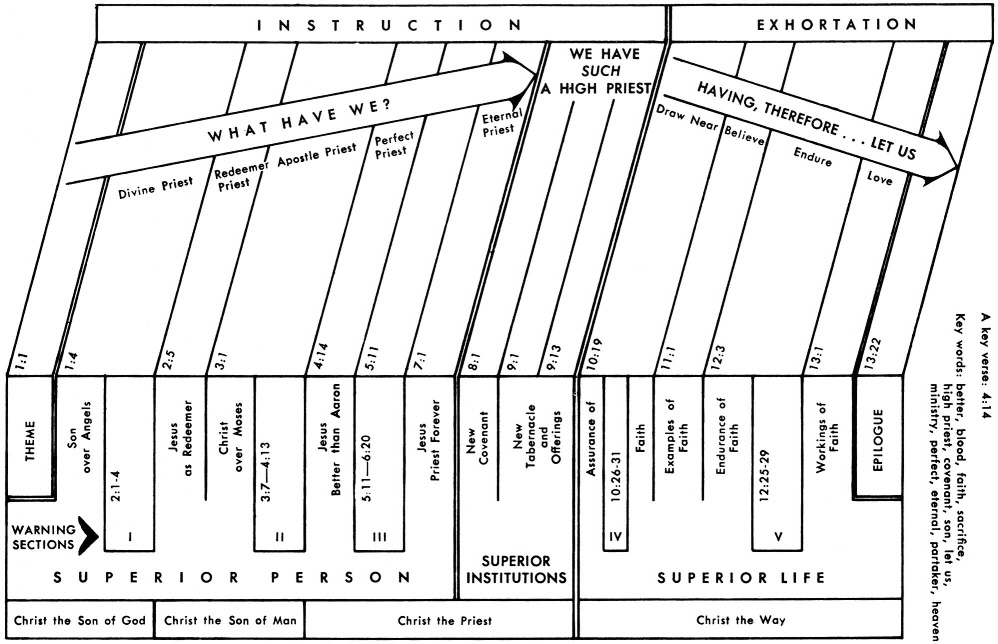
CONSIDER JESUS OUR GREAT HIGH PRIEST
Click chart to enlarge
Charts from Jensen's Survey of the NT - used by permission
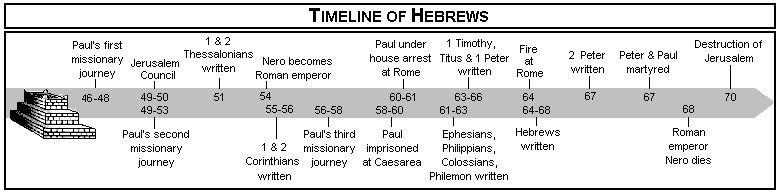
Swindoll's Chart, Interesting Pictorial Chart of Hebrews, Another Chart
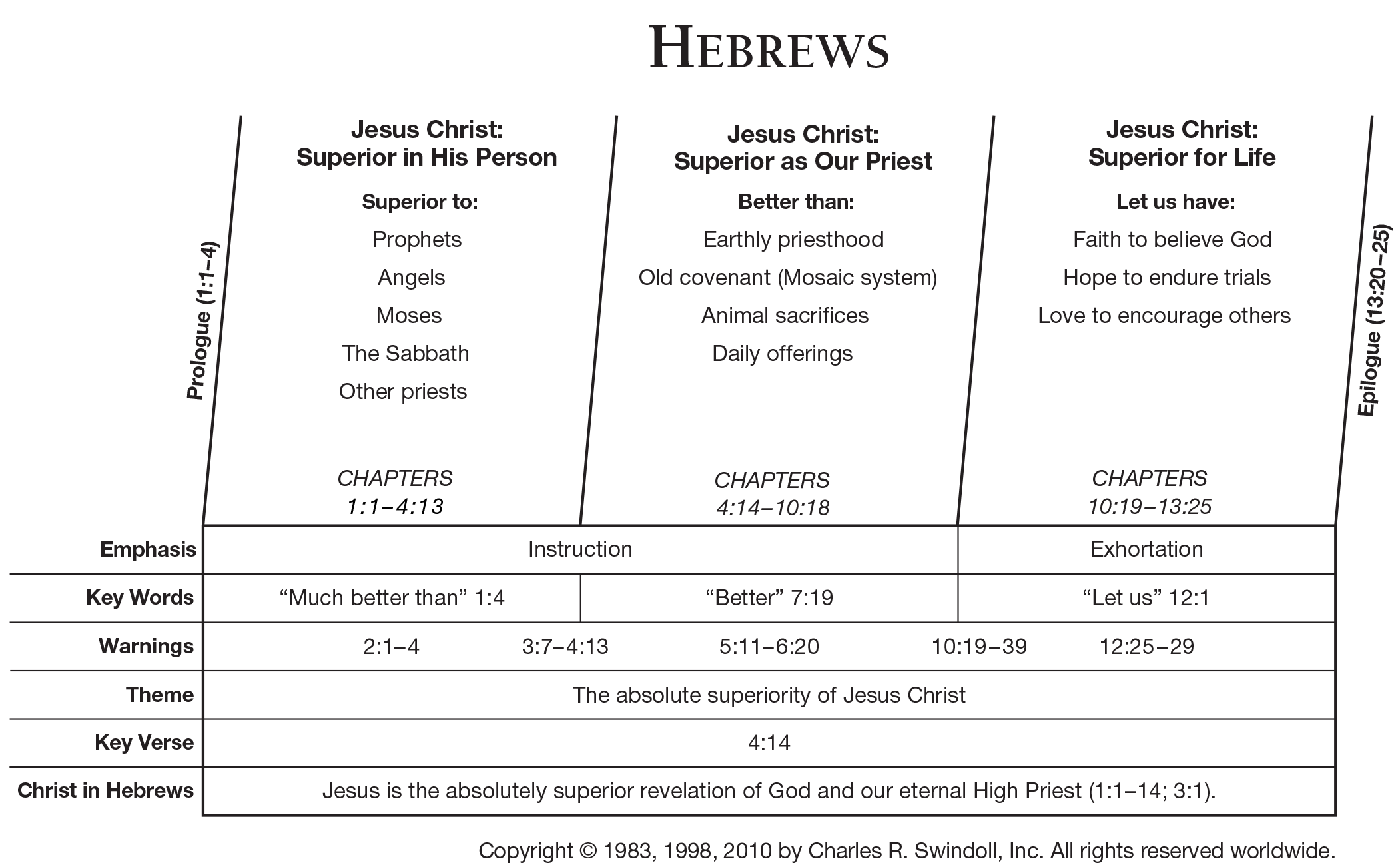

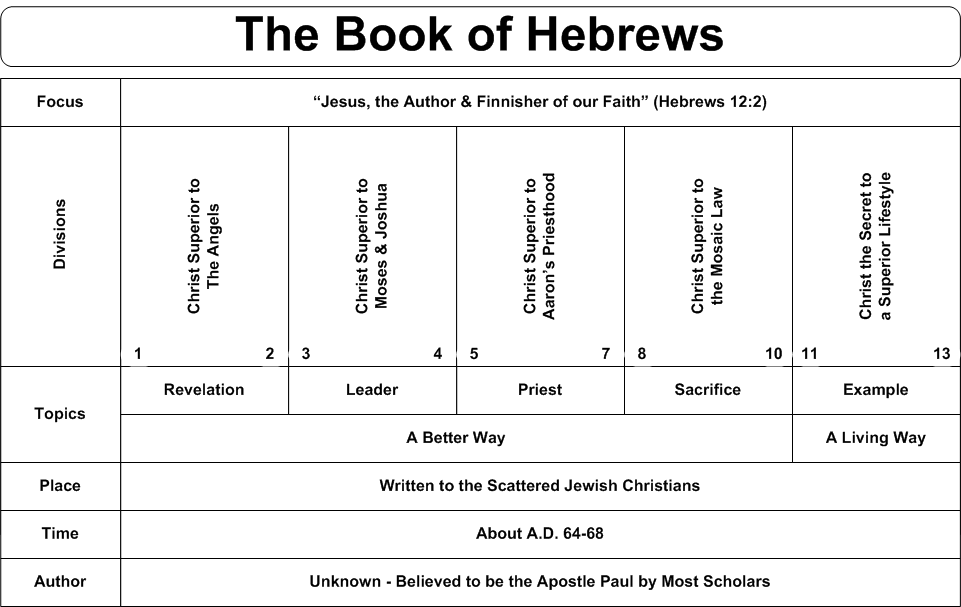
|
The Epistle |
||||
| INSTRUCTION Hebrews 1-10:18 |
EXHORTATION Hebrews 10:19-13:25 |
|||
| Superior Person of Christ Hebrews 1:1-4:13 |
Superior Priest in Christ Hebrews 4:14-10:18 |
Superior Life In Christ Hebrews 10:19-13:25 |
||
| BETTER THAN PERSON Hebrews 1:1-4:13 |
BETTER PRIESTHOOD Heb 4:14-7:28 |
BETTER COVENANT Heb 8:1-13 |
BETTER SACRIFICE Heb 9:1-10:18 |
BETTER LIFE |
| MAJESTY OF CHRIST |
MINISTRY OF CHRIST |
MINISTERS FOR CHRIST |
||
|
DOCTRINE |
DUTY |
|||
|
DATE WRITTEN: |
||||

See ESV Study Bible "Introduction to Hebrews"
(See also MacArthur's Introduction to Hebrews)
Borrow Ryrie Study Bible
Hebrews 11:8 By faith Abraham, when he was called, obeyed by going out to a place which he was to receive for an inheritance; and he went out, not knowing where he was going. (NASB: Lockman)
Greek: Pistei kaloumenos (PPPMSN) Abraam upekousen (3SAAI) exelthein eis topon on emellen (AAN) lambanein (PAN) eis kleronomian, kai exelthen (3SAAI) me epistamenos (PPPMSN) pou erchetai. (3SPMI)
BGT Πίστει καλούμενος Ἀβραὰμ ὑπήκουσεν ἐξελθεῖν εἰς τόπον ὃν ἤμελλεν λαμβάνειν εἰς κληρονομίαν, καὶ ἐξῆλθεν μὴ ἐπιστάμενος ποῦ ἔρχεται.
Amplified: [Urged on] by faith Abraham, when he was called, obeyed and went forth to a place which he was destined to receive as an inheritance; and he went, although he did not know or trouble his mind about where he was to go. (Amplified Bible - Lockman)
KJV: By faith Abraham, when he was called to go out into a place which he should after receive for an inheritance, obeyed; and he went out, not knowing whither he went.
NKJ By faith Abraham obeyed when he was called to go out to the place which he would receive as an inheritance. And he went out, not knowing where he was going.
NET By faith Abraham obeyed when he was called to go out to a place he would later receive as an inheritance, and he went out without understanding where he was going.
CSB By faith Abraham, when he was called, obeyed and went out to a place he was going to receive as an inheritance. He went out, not knowing where he was going.
ESV By faith Abraham obeyed when he was called to go out to a place that he was to receive as an inheritance. And he went out, not knowing where he was going.
NIV By faith Abraham, when called to go to a place he would later receive as his inheritance, obeyed and went, even though he did not know where he was going.
NLT: It was by faith that Abraham obeyed when God called him to leave home and go to another land that God would give him as his inheritance. He went without knowing where he was going. (NLT - Tyndale House)
Phillips: It was by faith that Abraham obeyed the summons to go out to a place which he would eventually possess, and he set out in complete ignorance of his destination. (Phillips: Touchstone)
Wuest: By faith Abraham, while he was being called, obeyed to go out into a place which he was about to be receiving as an inheritance, and he went out, not troubling his mind as to where he was going.
Young's Literal: By faith Abraham, being called, did obey, to go forth to the place that he was about to receive for an inheritance, and he went forth, not knowing whither he doth go;
- Abraham - Ge 11:31; 12:1, 2, 3, 4; Josh 24:3; Neh 9:7,8; Isa 41:2; 51:2; Acts 7:2, 3, 4
- Which he was to receive - Ge 12:7; 13:15, 16, 17; 15:7,8; 17:8; 26:3; Dt 9:5; Ps 105:9, 10, 11; Ezek 36:24
- Obeyed by going out - He 11:33; 5:9; Ge 22:18; 15:5; Mt 7:24,25; Ro 1:5; 6:17; 10:16; 2Cor 10:5; Jas 2:14, 15, 16; 1Pe 1:22; 3:1; 4:17
- See IN DEPTH VERSE BY VERSE COMMENTS Moses' record of Abraham's Call and Response - Genesis 12 Commentary
Related Passages:
Genesis 11:31+ Terah took Abram his son, and Lot the son of Haran, his grandson, and Sarai his daughter-in-law, his son Abram’s wife; and they went out together from Ur of the Chaldeans in order to enter the land of Canaan; and they went as far as Haran, and settled there.
Genesis 12:1-4+ Now the LORD said to Abram, “Go forth (Lxx = exerchomai in aorist imperative see Abram's need to depend on the Holy Spirit to obey) from your country, And from your relatives And from your father’s house, To the land which I will show you; 2 And I will make you a great nation, And I will bless you, And make your name great; And so you shall be a blessing; 3 And I will bless those who bless you, And the one who curses you I will curse. And in you all the families of the earth will be blessed.” 4 So Abram went forth as the LORD had spoken to him; and Lot went with him. Now Abram was seventy-five years old when he departed from Haran.
Nehemiah 9:7-8 “You are the LORD God, Who chose Abram And brought him out from Ur of the Chaldees, And gave him the name Abraham. 8 “You found his heart faithful before You, And made a covenant with him To give him the land of the Canaanite, Of the Hittite and the Amorite, Of the Perizzite, the Jebusite and the Girgashite– To give it to his descendants. And You have fulfilled Your promise, For You are righteous.
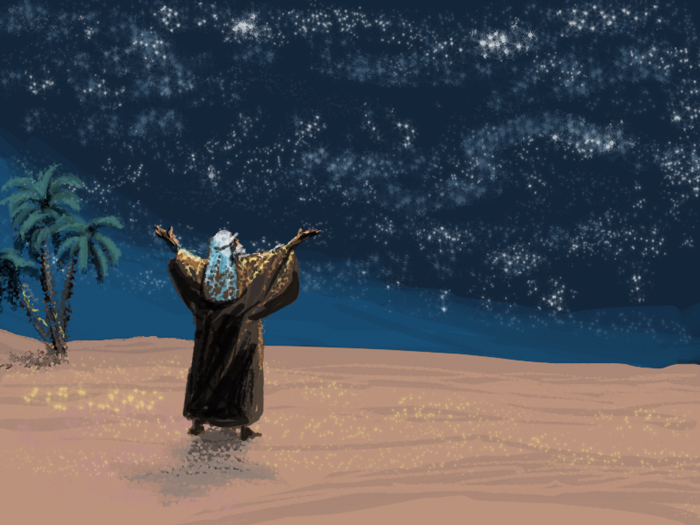
HAVING FAITH WHEN
YOU DON'T KNOW WHERE
Hebrews 11:8 turns our focus from Noah’s obedient faith to Abraham’s pioneering faith—the faith that obeys even when the destination is unknown. While Noah’s faith built an ark in response to divine revelation about an unseen flood, Abraham’s faith began a journey into an unseen land. Both responded to God’s Word with unquestioning obedience, yet Abraham’s faith is set forth as the classic example of trusting God’s promises without visible assurance.
By faith (pistis) means "by means of faith" or grammatically is a dative of means, a formula used 21x in Hebrews 11 (Heb. 4:2; Heb. 10:38; Heb. 11:3; Heb. 11:4; Heb. 11:5; Heb. 11:7; Heb. 11:8; Heb. 11:9; Heb. 11:11; Heb. 11:17; Heb. 11:20; Heb. 11:21; Heb. 11:22; Heb. 11:23; Heb. 11:24; Heb. 11:27; Heb. 11:28; Heb. 11:29; Heb. 11:30; Heb. 11:31; Heb. 11:33). Stated another way, faith is in this context is the channel through which divine command (go forth!) produces an obedient response (he went forth). Abraham's faith (pistis) was expressed in his obedience to the call and so once again we see the clear link between faith (Ge 15:6+) and obedience (Heb 3:18, 19+, cf Ro 1:5NIV+, Ro 16:26+). Abraham was saved by faith alone but the faith that saved him showed itself to be genuine by his obedience. Our obedience does not save us but it does demonstrate that our faith is saving faith. This is an important truth to understand in a day in which some evangelicals are saying you can "believe" but you do not have to demonstrate any change in your life (See "free grace teachings")! That strange teaching directly counters Paul's statement that "if anyone is in Christ, he is a new (kainos) creature; the old things passed away; behold, new (kainos - brand new, never seen in one's life before!) things have come." (2Co 5:17+, cf Jas 2:14, 17+, John the Baptist in Mt 3:8+) New things includes new behavior, directly contradicting that potentially dangerous teaching.
Amplified version has "(Urged on) by faith" sounds reasonable but is not the "whole story." The faith Abraham exercised was a gift he had received from God! So the faith that "urged" him on was somehow related to the work of the Holy Spirit (see below). Faith is not the result of human effort but of God’s work in us enabling us to believe. In Philippians 1:29+ Paul writes "For to you it has been granted (charizomai - divine passive - derived from charis = grace, thus it is a gift of grace) for Christ’s sake, not only to believe in Him, but also to suffer for His sake." So here Paul teaches that belief (to believe in Him) is explicitly said to be something granted or freely bestowed by God.
Abraham, when he was called (kaleo - summoned, "invited" - present tense), obeyed (hupakouo) by going out (exerchomai) to a place (topos) which he was to receive (lambano) for an inheritance (kleronomia); and he went out (exerchomai), not knowing (epistamai) where he was going (erchomai) - Was called (kaleo) is in the passive voice, which in context is a divine passive for God is the One calling. While Abraham did not begin this journey with full understanding, he does seem to begin with full surrender. Note the juxtaposition of called (kaleo) and obeyed (hupakouo) indicating that the moment God called was the moment Abraham’s faith "kicked into action." Faith is the root while obedience is the fruit. The verb obeyed (hupakouo) is in the active voice indicating that Abraham was not a puppet, but made a choice of his will to respond to God's call. He left the familiar for the unknown, his departure being based on nothing but the Word which he had received from God. It is also notable that when God called him, he did not debate, delay, or demand details, but he simply obeyed. Abraham is a perfect illustration of faith in motion, manifesting unhesitating obedience to God's Word. Genuine faith listens to the Word of God and follows where that Word leads.
🙏 THOUGHT - The Holy Spirit was clearly active in the Old Testament (cf Ge 1:2+). We see this affirmed, in part, through Stephen’s rebuke in Acts 7:51+, where he confronted the hostile Jews, declaring "You men who are stiff-necked and uncircumcised in heart and ears are always resisting the Holy Spirit; you are doing just as your fathers did." For the "fathers" to have resisted "the Holy Spirit" clearly indicates that the Spirit was active in men in the OT. And while neither Ge 12:1-3+ or Hebrews 11:8ff mention the Holy Spirit explicitly, Abram’s faith-response is consistent with divine enablement (cf Jn 6:44+). God's commandments always come "pre-packaged" with His enablements! To put it another way, when God calls a man, He gives him feet to run! Yes, that man can make a choice of his will and refuse to run (cf "resisting" in Acts 7:51+), but on the other hand, he absolutely cannot run, "spiritually speaking," without divine enablement! The upshot is that the grace of God that called out Abram also enabled him to go out. Abram did not resist the Spirit but willingly surrendered to His call. In short, Abram’s obedience was the visible expression of the supernatural work of the Spirit of grace. Abraham could never have been persuaded by human reason to leave his homeland. It was the Holy Spirit Who gave him both the desire and the power, energizing his heart to obey the call in a manner pleasing to God (See this principle in Php 2:13NLT+). Yet it must also be emphasized that Abraham made a deliberate choice of his will to follow God. Thus we see the mysterious yet undeniable interplay between God's sovereignty and man's responsibility (See the Paradoxical Principle of 100% Dependent and 100% Responsible) In summary, the same Spirit Who hovered over creation and now indwells believers was the unseen Power Who moved Abram to believe and obey the divine call.
Abraham’s obedience was thus
an outward evidence of his inward faith
--R Kent HughesSpurgeon - Is His Holy Spirit greatly reverenced by you, so that, the moment you hear Him call, you wait to hear what God the Lord will speak to you, knowing that “He will speak peace unto His people, and to His saints”?
Spurgeon - When God has blessed any man, He makes that man to be a blessing to others (cf Ge 12:2). The Lord fills him that he may overflow with blessing for those around him. The Holy Spirit puts into the man the life of God that that life may flow out of him to others.
Spurgeon - ABRAHAM’S life, taken literally, is full of instruction; but we shall be wise to take the spirit of it, and endeavour to make it our own. We cannot live just as Abraham did; but we can carry out the great principles which lay at the root of Abraham’s life; and, if the Holy Spirit will work in us alike degree of faith to that of the holy patriarch, we may glorify God by our lives, even as he did.
John MacArthur - The life of faith begins with the willingness to leave one’s Ur, one’s own place of sin and unbelief—to leave the system of the world....Giving up the old life is one of the greatest obstacles to coming to Christ, and is also one of the greatest obstacles to faithful living once we are in Christ. (See Hebrews Commentary - Page 328)
See summary chart of Abraham's life and excellent map of his migration from Ur - borrow Holman Charts page 108
To a place (topos) which he was to (mello - was going to, would later) receive (lambano - present tense) for an inheritance (kleronomia) - Abraham set out toward a real, yet undisclosed land, the land of Canaan, but more deeply, he stepped out toward the divinely prepared dwelling of God’s promise (cf. Heb 11:10, 16). Abraham's action shows us that true faith obeys when the place (topos) is still unseen, which parallels Hebrews 11:1+ especially "the conviction of things not seen." The land he would later receive (lambano - present tense) for an inheritance (kleronomia - allotted portion) refers to the permanent possession assigned to Abraham by God’s sovereign decree (choice). Note the subtle interplay of God's sovereignty (divine grace to give) and Abraham's responsibility (response to accept by faith even willing to await the ultimate fulfillment). In short, Abraham left his country and kindred because he had heard the call of God, and though he knew not where he went, he believed that wherever God called him to go would be his inheritance. The promise of an inheritance refers first to the land of Canaan but finds its ultimate fulfillment in the eternal inheritance that belongs to all who are of the faith of Abraham.
The pilgrim’s path begins with the promise
and ends with the possession.
Abraham is extolled in Scripture as “the father of all who believe” (Ro 4:11+) and is revered by over one-half the world’s population, being held in high esteem by Jews, Muslims and Christians. In ancient times the Jews considered Abraham to be almost worthy of their worship. In the Bible, Abraham is presented to us as a great example of a man who lived his life by faith. James 2:23+ records the fact that Abraham was called the “Friend of God.” Even the first verse in the NT begins by mentioning Abraham's name (Mt 1:1+). But remember that before he was a Friend of God" Abraham was a pagan—an absolute pagan, an idolater! Faith took him from worshipping idols (Josh 24:2+) to worshipping the one true and living God!
Abraham's obedience did not earn
righteousness but exhibited it.
To learn about faith, it makes sense to go to Abraham. He is extolled in Scripture as “the father of all who believe” (Ro 4:11+). Genesis 12-25 chronicles his story. The apostle Paul uses Abraham as his prime example of justification by faith alone, apart from works (Romans 4; Gal. 3:6-18+). He makes the startling assertion that it is not Jews by physical birth that are Abraham’s descendants. Rather, those who believe are the true children of Abraham. He says, “Therefore, be sure that it is those who are of faith who are sons of Abraham…. And if you belong to Christ, then you are Abraham’s descendants, heirs according to promise” (Gal. 3:7, 29+). It is not surprising that in the great faith chapter, Hebrews 11, Abraham receives more verses than any other person. His life illustrates Heb 11:1+, “Now faith is the substance of things hoped for, the proof of things not seen.” Our text reveals three essentials of faith: Faith obeys God’s call, lives as an alien in this world, and overcomes insurmountable problems by God’s power. Faith does not always know where it is being led, but it loves and knows the One Who is leading.
Abraham went out not knowing WHERE,
but he did know with WHOM he went!
Adrian Rogers - I cannot—look at me—I cannot emphasize enough the importance of faith. We’re not talking about something that is incidental. Remember that Hebrews 11:6 says, “Without faith, it is impossible to please God.” Without faith, it is impossible to please Him. Now, you want to please God, don’t you? I’ve told you before, if you please God, it doesn’t matter whom you displease; and, if you displease God, it doesn’t matter whom you please. And there is no way to please God without faith. We’re not talking to you about things that are incidental. Faith is the mark of a Christian. Christians were called believers before they were called Christians. (See full sermon Six Principles to Fortify Faith page 481).
C H Spurgeon - What a mighty sway faith has over a man, and how greatly it strengthens him. Faith was to the patriarch his authority for starting upon his strange journey, an authority that enabled him to defy alike the worldly wisdom that advises and the worldly folly that scoffs. Perhaps they said to him, “Why will you leave your relatives, Abraham?” but he replied, “God bids me.” That was a sufficient warrant for him; he needed no further argument. This also became to him the guide of his steps. If any said, “But, strange old man, how can you journey when you do not know the way?” He replied, “I go where the Lord bids me.” Faith found in God chart, compass, and polestar, all in one. (Sermon Abraham's Prompt Obedience to the Call of God)
Thomas Watson - Abraham was a great self-denier. He left his kindred and country and was willing to travel to any place where God would have him. Whence was this? It was from his faith. Hebrews 11:8, "By faith Abraham obeyed and went out, not knowing where he went." He who believes that Christ and heaven are his—what will he not relinquish for Christ's sake? The stronger a Christian's faith is, the more eminent will his self-denial be. (See his full article on the believer's Duty of Self Denial)
This is where true faith rests—
on the clear revelation of God
Charles Swindoll - Note that Abraham’s faith-walk began “when he was called” (Heb 11:8). His faith wasn’t founded on a subjective feeling about God’s will, a billowy cloud formation pointing like an arrow, or a vague message from a fortune-teller staring into a crystal ball. The Bible says “the Lord had spoken to him” (Gen. 12:4), and “the Lord appeared to Abram” (Gen. 12:7). This is where true faith rests—on the clear revelation of God (Ro 10:17+). God’s calling to Abram was audible, objective, and specific. He responded with faithful obedience. (See Insights on Hebrews - Page 175)
Abraham’s faith stands out all the more remarkable when we remember the circumstances in which it first arose. There was no prophet to instruct him, no Scripture to guide him, no fellow believer to encourage him. Surrounded by idolatry in Ur of the Chaldees, Abraham heard the divine call and obeyed (Gen 12:1-4). His faith was born in spiritual isolation, nurtured only by the voice and promise of God. (cf Ro 10:17+). Abraham believed against the stream of his times, without precedent, proof, or peer. His trust was rooted not in heritage, tradition, or sight—but in the self-revealing word of God (Rom 4:3, 20-21).
John MacArthur - There are only two ways to live. One way, by far the most common, is to live by sight, to base everything on what you can see. This is the empirical way. The other way, far less common, is to live by faith, to base your life primarily and ultimately on what you cannot see. The Christian way, of course, is the faith way. We have never seen God, or Jesus Christ, or heaven, or hell, or the Holy Spirit. We have never seen any of the people who wrote the Bible or an original manuscript of the Bible. Though we see the results of them, we have never seen any of the virtues that God commands or any of the graces that He gives. Yet we live in the conviction of all these things by faith. We bank our earthly lives and our eternal destiny on things which we have never seen. That is the way the people of God have always lived....The rabbis had long taught that Abraham pleased God because of his works. They believed that God looked around the earth and finally found an outstandingly righteous man, Abraham, who because of his goodness was selected to be the father of God's chosen people. That false teaching needed to be corrected. It was necessary to show, from the Old Testament itself, that Abraham was not righteous in himself but was counted righteous by God because of his faith. (See Genesis 15:6+) For a Jew to accept the truth that salvation is by faith, he would have to be shown that this truth applied to Abraham. The Jews were right in looking to Abraham as a great example. The problem was that they looked at him in the wrong way. They knew that he pleased God, but they had to be shown that God was pleased with him not because of any good works he did, but because he trusted Him.The New Testament makes it clear that Abraham was the first true man of faith. Since his time, everyone who trusts in God, Jew or Gentile, is spiritually a child of Abraham. "Therefore, be sure that it is those who are of faith who are sons of Abraham" (Gal. 3:7; cf. v. 29). Those who trusted God before the Flood—such as Abel, Enoch, and Noah—were only partial examples of faith. Abraham was the first established man of faith, and he is the pattern, the prototype, of faith for men of all ages. (See Hebrews MacArthur New Testament Commentary - Page 326)
FAITH LEADS TO
OBEDIENCE
Wuest - The words “When he was called” are the translation of a present participle which speaks of action going on at the same time as that of the leading verb, which is “obeyed.” The translation is “Abraham, while he was being called, obeyed.” It indicates Abraham’s immediate obedience to God’s call. The words “to go out” are to be construed, not with “called” but “obeyed.” They specify that in which his obedience was shown. The idea is, “when he was called, obeyed to go out” (Hebrews Commentary)
John MacArthur on he was called - In the Greek, he was called (kaleo) is a present tense participle, and the translation could be, "when he was being (ED: "divine passive") called." In other words, as soon as he understood what God was saying, he started packing. It was instant obedience.(Ibid)
Jerry Bridges - Faith is not only necessary to salvation, it is also necessary to live a life pleasing to God (ED: aka progressive sanctification). Faith enables us to claim the promises of God—but it also enables us to obey the commands of God. Faith enables us to obey when obedience is costly or seems unreasonable to the natural mind. (Borrow The Pursuit of Holiness - recommended)
Spurgeon - When men emigrate, they wish to know the nature of the country in which they are to live. If it is a richer country than their own, although it is with some reluctance, they spread the sail and speed across the waters. It may be, after they have settled there a little while, their mother country is almost forgotten, and they find a settled dwelling place in their adopted land. But Abraham knew nothing of the country to which he was about to move; he had simply God’s promise that it should be his inheritance. Prudent consideration of consequences is superabundant, but the spirit that obeys, and dares all things for Christ’s sake—where is it? The Abrahams of today will not go out from their kindred; they will put up with anything sooner than risk their livelihoods. If they do go out, they must know where they are going, and how much is to be picked up in the new country. (Full sermon The Call of Abraham)
Brian Bell - James said faith without works is dead? or, Faith w/o deeds is useless(NIV). James 2:20 meaning, if there is true faith, there will be consequent actions. Inward faith always leads to outward evidence. Faith assumes, presumes, supposes, & presupposes obedience. Let’s look at the next section of Faith’s Role Models...It wasn’t perfect faith. With each of these characters & examples, they all lacked faith at other times. So don’t be disheartened. (Faith’s Role Models)
C H Spurgeon - ABRAHAM'S FAITH was of the most eminent order, for he is called the Father of the Faithful. Let us rest assured that nothing but repeated and fiery trials could have trained his faith to so great a strength as that which it exhibited in his preparation to slay his son at the command of God. This true Jerusalem blade was long annealed before it gained its marvelous edge and matchless temper. Men come not to their perfect stature except by years of growth. Stars cannot reach the zenith of the heavens by one sudden flash, nay even the sun himself must climb to his meridian. Trials are the winds which root the tree of our faith. They are the trainers, drilling God's young soldiers, and teaching their hands to war and their fingers to fight. Foremost among Abraham's trials was that of being called away to a land which he had never been; as this may be our trial also, I pray that my words may be adapted to our present condition. (Full sermon The Call of Abraham)
F B Hole - Abraham's faith was so exceptional that the Apostle Paul speaks of him as "the father of all them that believe" (Ro 4:11+); so it is not surprising that in this chapter more is said as to him than of any other individual. What is said seems to fall under three heads. First, the faith that led him to respond to the call of God at the outset. He started forth from a city of civilization and culture without knowing where he was going. When he did know it proved to be a land of less culture than the one he had left. Yet all this mattered not. Canaan was the inheritance God had chosen for him, and he moved at the call of God. GOD was before his soul. That is faith! (Hebrews)
Abraham - 10v - Heb. 2:16; Heb. 6:13; Heb. 7:1; Heb. 7:2; Heb. 7:4; Heb. 7:5; Heb. 7:6; Heb. 7:9; Heb. 11:8; Heb. 11:17
- Multiple Bible Dictionary entries on Abraham
- Who was Abraham in the Bible? | GotQuestions.org
- Abrahamic Covenant versus Mosaic
Hebrews 2:16 For assuredly He does not give help to angels, but He gives help to the descendant of Abraham.
Hebrews 6:13 For when God made the promise to Abraham, since He could swear by no one greater, He swore by Himself,
Hebrews 7:1 For this Melchizedek, king of Salem, priest of the Most High God, who met Abraham as he was returning from the slaughter of the kings and blessed him,
Hebrews 7:2 to whom also Abraham apportioned a tenth part of all the spoils, was first of all, by the translation of his name, king of righteousness, and then also king of Salem, which is king of peace.
Hebrews 7:4 Now observe how great this man was to whom Abraham, the patriarch, gave a tenth of the choicest spoils.
Hebrews 7:5 And those indeed of the sons of Levi who receive the priest’s office have commandment in the Law to collect a tenth from the people, that is, from their brethren, although these are descended from Abraham.
Hebrews 7:6 But the one whose genealogy is not traced from them collected a tenth from Abraham and blessed the one who had the promises.
Hebrews 7:9 And, so to speak, through Abraham even Levi, who received tithes, paid tithes,
Hebrews 11:8 By faith Abraham, when he was called, obeyed by going out to a place which he was to receive for an inheritance; and he went out, not knowing where he was going.
Hebrews 11:17 By faith Abraham, when he was tested, offered up Isaac, and he who had received the promises was offering up his only begotten son;
Called (2564) (kaleo from root kal-, whence English “call” and “clamour”) literally means to speak to another in order to attract their attention or to them bring nearer, either physically or in a personal relationship. Kaleo is a major verb in the NT and its specific meaning depends on the the context in which it is used. See also an effectual calling/call.
The basic meanings of kaleo include
(1) To call by name - (a) As when one addresses someone. There is some overlap in this meaning with the meaning #3. Kaleo can mean to call aloud, to utter in a loud voice (eg Mk 1:20) Note: Three different Greek words in the NT may properly be translated "cry out"—kaleo, boao [word study], krazo. Kaleo signifies crying out for a purpose, involving intelligence particularly. Krazo suggests a harsh cry, perhaps inarticulate. But boao refers to crying out as a manifestation of feeling, and so relates primarily to the sensibilities. (b) As when one calls a person or thing (Mt 21:13) by a name or title - either to give a name or to provide identification by the name it (or he/she) is called (eg Acts 7:58, 14:12, etc)
(2) To issue an invitation or request one's presence at a gathering - Mt 22:3, 4, 8, 9, Lk 7:39, 14:7, 8, 9, 10, 12, 13, 16, 17, 14:24 Jn 2:2
(3) To summon - (a) Call together - Mt 20:8 (b) Summon someone - He 11:8+ (c) Summon before court (frequent use in Classic Greek) - Acts 4:18, 24:2
(4) To call in the sense of to choose so that one might receive some special benefit or experience. This refers to God's call of sinners ("Divine call" of God to participation in salvation). Of the Divine call to partake of the blessings of redemption. Kaleo in this usage is figurative for it is not a literal call (like "Come over here and be saved"). (a) Call to discipleship - Mt 4:21 (b) Call to Salvation - Mt 9:13+, Mk 2:17+, Lk 5:32+
Faith (4102)(pistis) is synonymous with trust or belief and is the conviction of the truth of anything, but in Scripture speaks of belief respecting man's relationship to God and divine things, generally with the included idea of trust and holy fervor born of faith and joined with it. As pistis relates to God, it is the conviction that God exists and is the Creator and Ruler of all things well as the Provider and Bestower of eternal salvation through Christ. As faith relates to Christ it represents a strong and welcome conviction or belief that Jesus is the Messiah, through Whom we obtain eternal salvation and entrance into the Kingdom of Heaven. Stated another way, eternal salvation comes only through belief in Jesus Christ and no other way.
For more discussion on the meaning of faith see commentary on Hebrews 11:1-2.
Faith is believing that God will keep His promises, despite circumstances that seem to be to the contrary! True faith that saves one's soul includes at least three main elements - (1) firm persuasion or firm conviction, (2) a surrender to that truth and (3) a conduct emanating from that surrender. In sum, faith shows itself genuine by a changed life.
Key Words in Hebrews:
Faith - 33x in 31v - Heb 4:2; 6:1, 12; 10:22, 38, 39; 11:1, 3, 4 (2x), He 11:5, 6, 7 (2x), He 11:8, 9, 11, 13, 17, 20, 21, 22, 23, 24, 27, 28, 29, 30, 31, 33, 39; 12:2; 13:7
Faithful - 6x in 6v - Heb 2:17; 3:2, 5, 6; 10:23; 11:11
Faith is reason at rest in God. It is not blind, for it sees more than reason ever could. It sees the invisible, and grasps the eternal.
Faith always acts. It’s not passive belief but an active surrender to the will of God.
Related Resources:
Obeyed (5219) (hupakouo from hupó = agency or means, under + akoúo physical hearing and apprehension of something with the mind - akouo gives us our English acoustics - the science of design which helps one hear) (Click study on noun hupakoe) literally means to listen or hear under with attentiveness and by implication to respond positively to what is heard. Hupakoo means literally acting under the authority of the one speaking and implies really listening with a readiness to be fully compliant, to execute (obey) what is requested or ordered. The sense is that one understands and responds accordingly.
HUPAKOUO - 21V - Matt. 8:27; Mk. 1:27; Mk. 4:41; Lk. 8:25; Lk. 17:6; Acts 6:7; Acts 12:13; Rom. 6:12; Rom. 6:16; Rom. 6:17; Rom. 10:16; Eph. 6:1; Eph. 6:5; Phil. 2:12; Col. 3:20; Col. 3:22; 2 Thess. 1:8; 2 Thess. 3:14; Heb. 5:9; Heb. 11:8; 1 Pet. 3:6
Hebrews 5:9 And having been made perfect, He became to all those who obey Him the Source of eternal salvation,
Note that hupakouo implies an inward attitude of respect and honor, as well as external acts of obedience. Obedience on the part of children consists in listening to the advice given by parents. In Genesis 22 Isaac's willingness to be offered as a sacrifice is a model of such submission while Abraham's obedience was evidence of the genuineness of his faith (see Ge 22:1,2 3 - note his unhesitating obedience to God's command).
James uses Abraham's example to teach this same principle in a passage that many unfortunately misinterpret as at odds with the Pauline doctrine of justification by faith alone...
Was not Abraham our father justified by works, when he offered up Isaac his son on the altar? You see that faith was working with his works, and as a result of the works, faith was perfected; and the Scripture was fulfilled which says, "AND ABRAHAM BELIEVED GOD, AND IT WAS RECKONED TO HIM AS RIGHTEOUSNESS," (Ge 15:6) and he was called the friend of God. You see that a man is justified by works, and not by faith alone. (Jas 2:21, 22, 23+, Jas 2:24+)
The idea of HEARING is a key idea in Hebrews. That makes sense, because it is difficult to OBEY what you have never heard, all the more reason we need to daily be in the Word to hear what the Spirit says to us. Of course, the problem is that then we are RESPONSIBLE to obey!
Hebrews 2:1+ For this reason we must pay much closer attention to what we have heard (akouo), lest we drift away from it.
Hebrews 3:7+ Therefore, just as the Holy Spirit says, "TODAY IF YOU HEAR (akouo) HIS VOICE, 8 DO NOT HARDEN YOUR HEARTS AS WHEN THEY PROVOKED ME, AS IN THE DAY OF TRIAL IN THE WILDERNESS
Hebrews 3:15-16+ while it is said, "TODAY IF YOU HEAR (akouo) HIS VOICE, DO NOT HARDEN YOUR HEARTS, AS WHEN THEY PROVOKED ME." 16 For who provoked Him when they had heard (akouo)? Indeed, did not all those who came out of Egypt led by Moses?
Hebrews 4:7+ He again fixes a certain day, "Today," saying through David after so long a time just as has been said before, "TODAY IF YOU HEAR (akouo) HIS VOICE, DO NOT HARDEN YOUR HEARTS."
Hebrews 5:9+ And having been made perfect, He became to all those who obey (literally "hear under", listen attentively hupakouo = hupo + akouo) Him the source of eternal salvation,
Hebrews 5:11+ Concerning him we have much to say, and it is hard to explain, since you have become dull of hearing (akoe).
Hebrews 11:8+ By faith Abraham, when he was called, obeyed (literally "hear under", listen attentively hupakouo = hupo + akouo) by going out to a place which he was to receive for an inheritance; and he went out, not knowing where he was going.
Inheritance (2817)(kleronomia from kleros = lot + némo = give or distribute) is literally that which is distributed by lot and so refers to a portion which one receives by lot in a general distribution and then, in a more general sense means to possess oneself of, to receive as one's own, to obtain. In other words it can refer to a property already received as well as one that is expected. Although kleronomia is an inheritance which one receives by lot, in the NT the idea of chance associated with the lot is not found.
Colossians 3:24+ "knowing that from the Lord you will receive the reward of the inheritance." 1Pe 1:4+ "to obtain an inheritance which is imperishable and undefiled and will not fade away, reserved in heaven for you."
Klēronomia in Hebrews 11:8 signifies a graciously bestowed inheritance, something received, not achieved. It implies a relationship with the giver. In biblical thought, inheritance is not merely property but a promised possession secured by covenant. In the Old Testament, it referred to the land of promise given to Abraham and thus to Israel (cf. Ge 12:7; Dt 4:21). In the New Testament, it expands to include spiritual blessings and the eternal inheritance believers receive through Christ (Eph 1:3,11; 1 Pet 1:4; Heb 9:15).
The related noun Kleronomos was just used in Heb 11:7 to describe Noah as "an heir of the righteousness."
KLERONOMIA - 14V - Matt. 21:38; Mk. 12:7; Lk. 12:13; Lk. 20:14; Acts 7:5; Acts 20:32; Gal. 3:18; Eph. 1:14; Eph. 1:18; Eph. 5:5; Col. 3:24; Heb. 9:15; Heb. 11:8; 1 Pet. 1:4
Hebrews 9:15 For this reason He is the mediator of a new covenant, so that, since a death has taken place for the redemption of the transgressions that were committed under the first covenant, those who have been called may receive the promise of the eternal inheritance.
Hebrews 11:8 By faith Abraham, when he was called, obeyed by going out to a place which he was to receive for an inheritance; and he went out, not knowing where he was going.
AND HE WENT OUT NOT KNOWING WHERE HE WAS GOING: kai exelthen (3SAAI) me epistamenos (PPPMSN) pou erchetai (3SPMI):
- See IN DEPTH VERSE BY VERSE COMMENTS Moses' record of Abraham's Call and Response - Genesis 12 Commentary
Related Passages:
Genesis 12:4+ So Abram went forth (Lxx - poreuo) as the LORD had spoken to him; and Lot went with him. Now Abram was seventy-five years old when he departed from Haran.
Acts 7:2-4+ And he said, “Hear me, brethren and fathers! The God of glory appeared to our father Abraham when he was in Mesopotamia, before he lived in Haran, 3 and said to him, ‘LEAVE (aorist imperative see Abraham's need to depend on the Holy Spirit to obey) YOUR COUNTRY AND YOUR RELATIVES, AND COME INTO THE LAND THAT I WILL SHOW YOU.’ 4 “Then (ED: NO DELAY. NO HESITATION. NO ARGUMENTS.) he left the land of the Chaldeans and settled in Haran. From there, after his father died, God had him move to this country in which you are now living.
Psalm 37:23 The steps of a man are established by the LORD, And He delights in his way.
Romans 8:14+ For all who are being led by the Spirit of God (WHO CLEARLY LED ABRAHAM), these are sons of God.
Isaiah 42:16 “I will lead the blind by a way they do not know, In paths they do not know I will guide them. I will make darkness into light before them And rugged places into plains. These are the things I will do, And I will not leave them undone.
Proverbs 3:5-6+ (THIS COULD HAVE BEEN ABRAHAM'S "LIFE VERSE") Trust in the LORD with all your heart And do not lean on your own understanding. 6 In all your ways acknowledge Him, And He will make your paths straight.
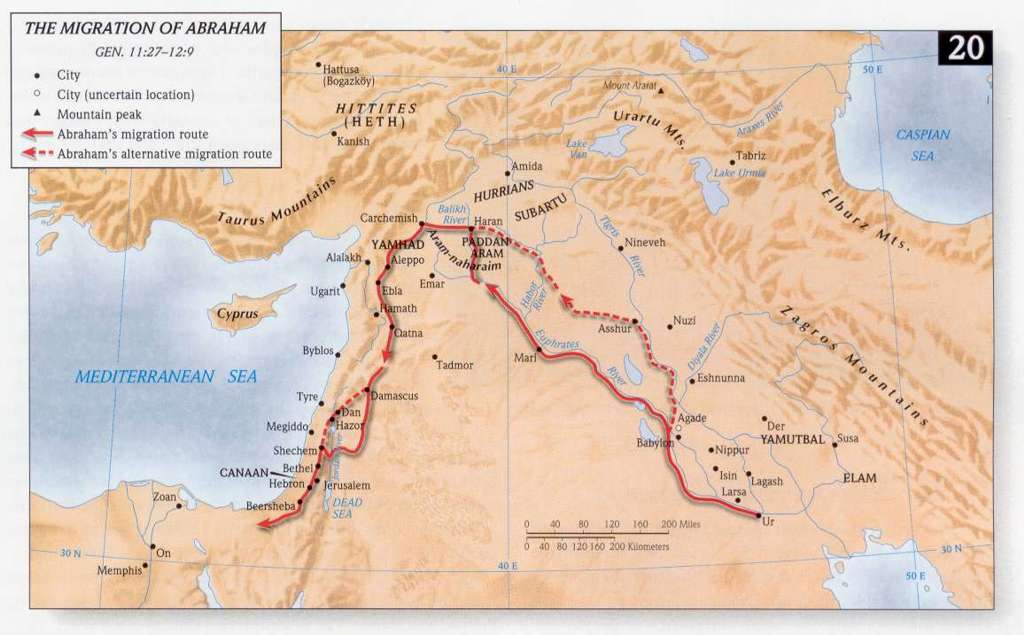
Click to enlarge - from Holman Bible Atlas (digital book; Hardcover)
Copyright © 1998 B&H Publishing Group, used by permission, all rights reserved.
One of the best resources for Bible maps. Please do not reproduce this map.
ABRAHAM CALLED TO BE
GOING BUT NOT KNOWING
And he went out (exerchomai), not knowing (epistamai) where he was going (erchomai) - He went out (exerchomai) indicates Abraham's faith (active voice = a choice of his will to follow) was coupled with obedience and led to action. It meant separation from the idolatry with which he was familiar (Joshua 24:2+). One takeaway is that unhesitating obedience is manifest by action. True faith does not just agree with God, but it acts upon what He has said. As a corollary, hesitating (cf Zacharias Lk 1:19,20+) or partial obedience is effectively disobedience. Abraham like all men and women of faith saw the eternal even while living in the temporal (2Co 4:18+) and thus he possessed the firm assurance of things that he hoped for and the conviction a promised land he not yet literally seen (Heb 11:1+).
Abraham did not possess any information about the place God had called him to...no Maps, no guides to the best bed & breakfasts, the best tours to take, etc...this was not a vacation but an evacuation so to speak. Abraham is a convicting, clear example of faith that obeys God and is not dependent on sight for follow through! (2Co 5:7+).
Faith spawns reflexive steps of obedience. It steps out.
We must not imagine that we have faith if we do not obey.
-- John Phillips
Not knowing (epistamai) means Abraham had no familiarity with his destination (Heb 11:1+). He did not even know where the land was that he was going to receive "as an inheritance" but He did know Who had called him out of Ur of the Chaldees. The present tense of not knowing (mē epistamenos) emphasizes the ongoing nature of Abraham’s uncertainty, i.e., he was continually in the DARK as to where he was going. Yet, though he did not know the destination, he trusted the One who called him, choosing to walk in the LIGHT of God’s promises rather than the LIGHT of human reason. Abraham’s obedience shows that faith is not the absence of darkness, but the refusal to let darkness determine direction. He did not walk by the clarity of sight but by the certainty of God’s Word (cf. 2Co 5:7+; Ps 119:105+).
The light of God’s promise was enough
to overcome the darkness of the unknown.
The point is that Abraham was not merely ignorant of his destination, but more significantly, he lacked sight-based certainty—requiring him to place complete trust in divine guidance. Remember the principle: obedience precedes understanding (cf Jn 7:17+) God rarely shows us the whole path but more often leads us step by step as beautifully vocalized in Rich Mullins' song "Step by Step"! "He told Abraham to take the first step; the rest of the steps were revealed as time went on." (Phillips)
Faith does not demand full explanation,
but is content with divine direction.
Abraham did not know where he was going, but he knew and trusted the Word of the One Who was leading him. Genuine faith in God's Word leads a man or woman to go forward when their reason would bid them to halt. This is trusting God with "the conviction of things not seen." (Heb 11:1+).
Abraham knew not where,
but he knew Whom.
Where he was going (erchomai) is in the present tense (picturing Abraham's "faith" as always moving) and signifies not a random wandering but Abraham's movement in response to revelation. Faith is not a leap (or step) in the dark. Abraham’s steps were guided by God’s promise, not by his own understanding (Pr 3:5–6). The point is that while Abraham did not know where he went, he knew with Whom he went and that was sufficient for him. One takeaway from this is that faith does not demand details, but it rests and relies on divine direction. To wit, Abraham did not follow not a map, but his Master.
Abraham wholly committed himself to the power, faithfulness, goodness, and guidance of God—without the least human assurance or visible encouragement concerning the place to which he was going.”
John MacArthur points out that "Giving up the old life is one of the greatest obstacles to coming to Christ, and is also one of the greatest obstacles to faithful living once we are in Christ. From the perspective of the old life and the old nature the new life in Christ can appear dull and unexciting. When we think this way we fail to understand that, once we become a Christian, we are given a new set of values, interests, and desires—which we cannot experience in advance. We cannot "see" the blessings and satisfaction of life in Christ before we trust Him as Lord and Savior. We believe and then we experience. We must first be willing to "go out to Him outside the camp, bearing His reproach. For here we do not have a lasting city, but we are seeking the city which is to come" (Heb. 13:13). Often the reproach is all we are able to see at first. We look forward to the "city which is to come" by faith. (See Hebrews MacArthur New Testament Commentary - Page 328)
Thomas Schreiner - Faith, the author instructs the readers, does not see the end at the beginning. Faith always trusts in the promises of God, even when it looks as if they won’t be fulfilled. (See Commentary on Hebrews - Page 350)
Martin Luther on the cost for Abraham leaving his homeland - It was hard to leave his native land, which it is natural for us to love. Indeed, love for the fatherland is numbered among the greatest virtues of the heathen. Furthermore, it is hard to leave friends and their companionship, but most of all to leave relatives.… And then it is clear that with his obedience of faith Abraham gave a supreme example of an evangelical life, because he left everything and followed the Lord (ED: cf first disciples Mt 4:19-20+). Preferring the Word of God to everything and loving it above everything.
Brian Bell illustrates Abraham's going without knowing - Get this picture in your mind of tactical military information that begins with the Joint Chiefs of Staff and goes down to the tactical level...under sealed orders. Whoever represents the “boots on the ground” may receive their orders only when they need them, or in route, as they go. So, they open their orders, and they are told where to go next. And that's the way Abraham lived. Can you trust when you can’t trace? (Faith’s Role Models)
Spurgeon on not knowing - That is, surely, the very masterpiece of faith. God bade Abraham go forth from his native land; he believed that God knew where he was to go, though he did not himself know. He left the direction of his wanderings entirely in the Lord’s hands, and obeyed, and “went out, not knowing where he was going.” We are not to ask for full knowledge before we will be obedient to the will of the Lord; but we are to obey God in the dark, even as Abraham did. He was self-exiled from his home—a wanderer upon the face of the earth. Yet, when called of God, it mattered not to him where he was bidden to go. He seemed to say, “Appoint my way, great God. It is for me not to ask the reason why, but to obey your command.” (Full sermon The Call of Abraham)
F B Meyer - By faith Abraham … went out, not knowing whither he went. Whither he went, he knew not; it was enough for him to know that he went with God. He leaned not so much upon the promise as upon the Promiser: he looked not on the difficulties of his lot—but on the King eternal, immortal, invisible, the only wise God; Who had deigned to appoint his course, and would certainly vindicate Himself.… Ah, glorious faith! this is thy work, these are thy possibilities! contentment to sail with sealed orders, because of unwavering confidence in the love and wisdom of the Lord High Admiral: willinghood to arise up, leave all, and follow Christ, because of the glad assurance that earth’s best cannot bear comparison with heaven’s best.
C H Spurgeon -ONE is struck with the practical character of this verse. Abraham was called, and he obeyed. There is no hint of hesitation, parleying, or delay; when he was called to go out, he went out. Would to God that- such conduct were usual, yea, universal; for with many of our fellow-men, and I fear with some now present, the call alone is not enough to produce obedience. "Many are called, but few are chosen." The Lord's complaint is "I called and ye refused." Such calls come again and again to many, but they turn a deaf ear to them; they are hearers only, and not doers of the word: and, worse still, some are of the same generation as that which Zechariah spake of when he said, "They pulled away the shoulder, and stopped their ears that they should not hear." Even among the most attentive hearers how many there are to whom the word comes with small practical result in actual obedience. Here we are in midsummer again, and yet Felix has not found his convenient season. It was about midwinter when he said he should find one, but the chosen day has not arrived. The mother of Sisera thought him long in coming, but what shall we say of this laggard season? We can see that the procrastinator halts, but it were hard to guess how long he will do so. Like the countryman who waited to cross the river when all the water had gone by, he waits till all difficulties are removed, and he is not one whit nearer that imaginary period than he was years ago. Meanwhile, the delayer's case waxes worse and worse, and, if there were difficulties before, they are now far more numerous and severe. The man who waits until he shall find it more easy to bear the yoke of obedience, is like the woodman who found his faggot too heavy for his idle shoulder, and, placing, it upon the ground, gathered more wood and added to the bundle, then tried it, but finding it still an unpleasant load, repeated the experiment of heaping on more, in the vain hope that by-and-by it might be of a shape more suitable for his shoulder. How foolish to go on adding, sin to sin, increasing the hardness of the heart, increasing the distance between the soul and Christ, and all the while fondly dreaming of some enchanted hour in which it will be more easy to yield to the divine call, and part with sin. Is it always going to be so? There are a few weeks and then cometh harvest, will another harvest leave you where you are, and will you again have to say, "The harvest is passed, the summer is ended, and we are not saved"? Shall God's longsuffering mercy only afford you opportunities for multiplying transgressions. Will ye always resist his Spirit? Always put him off with promises to be redeemed to-morrow? For ever and for ever shall the tenderness and mercy of God be thus despised? Our prayer is that God of his grace may give you to imitate the example of Abraham, who, when he was called, obeyed at once.
The sad point about the refusals to obey the call of the gospel is that men are losing a golden opportunity, an opportunity for being numbered amongst the choice spirits of the world, amongst those who shall be blessed among men and women. Abraham had an opportunity, and he had grace to grasp it, and at this day there is not on the beadroll of our race a nobler name than that of "the father of the faithful." He obtained a supreme grandeur of rank among the truly great and good: far higher is he in the esteem of the right-minded than the conqueror blood-red from battle, or the emperor robed in purple. He was an imperial man, head and shoulders above his fellows. His heart was in heaven, the light of God bathed his forehead, and his soul was filled with divine influences, so that he saw the day of the Lord Jesus and was glad. He was blessed of the Lord that made heaven and earth, and was made a blessing to all nations. Some of you will never gain such honor, you will live and die ignoble, because you trifle with Supreme calls, and yet, did you believe in God, did you but live by faith, there would be before you also a course of immortal honor, which -would lead you to eternal glory. Instead thereof, however, choosing the way of unbelief, and neglect, and delay, you will, I fear, one day awake to shame and to everlasting contempt, and know, to your eternal confusion, how bright a crown you have lost. I am in hopes that there are some among you who would not be losers of the crown of life; who desire, in fact, above all things, to obtain the prize of the high calling of God in Christ Jesus, and to them I shall speak, and while I spear; may the Holy Spirit cause every word to fall with power. (Full sermon Abraham's Prompt Obedience to the Call of God)
Knowing (understand)(1987) (epistamai from epí = over + hístemi = to stand) means literally to stand upon something and figuratively means to have firm knowledge, to be acquainted with, to understand clearly. It means to possess information about something with the implication of understanding of the significance of such information. The present tense indicates that Abraham was in the dark in that he did not know where, but he was willing to walk in the light of God's promises.
EPISTAMAI - 14v - Mk. 14:68; Acts 10:28; Acts 15:7; Acts 18:25; Acts 19:15; Acts 19:25; Acts 20:18; Acts 22:19; Acts 24:10; Acts 26:26; 1 Tim. 6:4; Heb. 11:8; Jas. 4:14; Jude 1:10
Epistamai literally means standing upon, referring to gaining knowledge by prolonged acquaintance. For the believer, this careful observation builds on the fact Scripture is the Word of God. In short, we stand (so to speak) on the promises of God. Abraham the promise but not the place promised. But God's promises was enough for him to go out of his homeland.
Wuest - The word “knowing” is the translation, not of ginosko or oida, the usual words for knowing, but of epistamai which means “to put one’s attention on, to fix one’s thoughts on, to know.” Abraham’s faith was so great, that he was not particularly concerned as to what the nature of the country was. His faith displaced all worry as to his future in that country. He did not trouble to think upon the matter. Expositor’s says: “The faith of Abraham appeared in his promptly abandoning his own country on God’s promise of another, and the strength of this faith was illustrated by the circumstance that he had no knowledge where or what that country was.… It was, therefore, no attractive account of Canaan which induced him to forsake Mesopotamia, no ordinary emigrant’s motive which moved him, but mere faith in God’s promise. ‘Even still the life of faith must be entered on in ignorance of the way to the inheritance, or even what the inheritance and rest in each one’s particular case will be, and of the experiences that the way will bring. This is true even of ordinary life’ (Davidson).” (Hebrews Commentary)
FAITH AND WORKS
Faith which does not obey the commands of Christ is a mere pretense and will never save the soul. The faith which saved Abraham moved his feet and his hands as well as his heart.
Abraham was not saved by faith + works but by a faith that works.
Abraham’s obedience was the visible demonstration of invisible faith. What he believed inwardly, he proved outwardly.
Obedience is the inevitable result of genuine faith. Faith and works are two sides of the same coin. Abraham’s willingness to sacrifice Isaac was the outward evidence of his inward trust in God.
Faith that does not result in good works is a dead faith.
Faith and works are bound up in the same bundle; he that obeys God trusts God, and he that trusts God obeys God.
It is faith alone that justifies, but faith that justifies can never be alone.
Faith without works is like a bird without wings; though it may hop with its companions on earth, it will never soar to heaven.
Faith is not belief without proof, but trust without reservation. D. Elton Trueblood
Faith is not a mere nod of the head; it is the movement of the heart that leads to the motion of the hands and feet.
Obedience is faith in action.
Faith is the fountain, obedience the stream.
Where there is no obedience, there is no true faith. Faith is known by its fruits.
Faith and obedience are inseparable: faith produces obedience, and obedience confirms faith.
The proof of faith is in perseverance and obedience, not profession.
Faith is not merely believing in spite of evidence—it is obeying in spite of consequence.
Vance Havner - "Not Knowing Whither... I Know Whom"
"By faith Abraham, when he was called to go out into a place which he should after receive for an inheritance, obeyed; and he went out, not knowing whither he went." Heb. 11:8KJV
Abraham went out, not knowing where he was going. When God calls us to the adventure of faith, he does not furnish a road-map in advance. We have a sinking feeling of having stepped out on nothing, but then God is always doing wonderful things with nothing: He hangs the earth on nothing (Job 26:7), and calls those things which are not as though they were (Rom. 4:17).
Neither does faith know why. Habakkuk wondered: "O Lord... why?" (Hab 1:2, 3). So did Job. God did not give them explanation but revelation, and when they saw God they did not need explanation. When we see whom, the why does not matter.
Faith does not know what. Peter was concerned about John: "What shall this man do?" Our Lord never explains the whats: "What I do thou knowest not now; but thou shalt know hereafter" (John 13:7).
But one thing faith does know: "I know whom I have believed." He knows the wheres, whys, and whats: "He knoweth the way that I take" (Job 23:10). Sight rests on some thing, some where; faith rests upon someone, anywhere!
Someone said, "If God built a bridge a yard ahead, it could not be a bridge of faith." It's the first step into the unseen that proves we have faith. Abraham, for example, "went out, not knowing where he was going" (Heb. 11:8). He obeyed God and relied on Him to clear the path. Note very carefully we are not saying faith is a leap into the dark, because the opposite is truth -- faith is a leap into the light! Faith is not blind—it simply sees God more clearly than the circumstances. Abraham's faith walked before he fully understood, because he fully trusted in the Word of the One Who led him. Abraham's faith took the step that his sight could not justify. His faith was not reckless, but reflected reliance on the One Who cannot lie. His faith did not ask for explanation, but rested fully on God's revelation. Abraham trusted God's promise more than he feared the unseen. His confidence was not in the plan, but in the Planner. Abraham's faith did not ask, “Where is the land?” but “Lead on, LORD.” Abraham’s heart rested on what God had spoken, not on what his reason could trace. In summary, Abraham's faith did not pause for proof, but proceeded on the promise. Abraham didn’t know where, but he knew Who, and that was enough.
Faith leaps not into night’s unknown,
But into the light that God has shown.
C H Spurgeon - The call of Abraham
“By faith Abraham when he was called to go out into a place which he should after receive for an inheritance, obeyed; and he went out, not knowing whither he went.” Hebrews 11:8
Follow the guide of divine providence and precept, lead it wherever it may. Let us follow the Shepherd, with a ready mind, because he has a perfect right to lead us wherever he pleases. We are not our own, we are bought with a price. If we were our own, we might be discontented with our circumstances, but since we are not, let this be our cry, “Do what thou wilt, O Lord, and though thou slay me, yet will I trust in thee;” we are not true to our profession of being Christians, if we pick and choose for ourselves. Picking and choosing are great enemies to submission. In fact, they are not at all consistent with it. If we are really Christ’s Christians, let us say, “It is the Lord, let him do what seemeth him good.” And then in the next place we ought to submit because wherever he may lead us, if we do not know where we go, we do know one thing, we know with whom we go; we do not know the road, but we do know the guide. We may feel that the journey is long, but we are quite sure that the everlasting arms that carry us are strong enough, even if the journey is very long. We do not know what may be the inhabitants of the land into which we may come, Canaanites or not; but we do know that the Lord our God is with us, and he shall surely deliver them into our hands. Another reason why we should follow with simplicity and faith all the commands of God, is this, because we may be quite sure they shall all end well. They may not be well apparently while they are going on, but they will end well at last.
Charles Swindoll - BEYOND YOUR COMFORT ZONE Faith for the Journey: Daily Meditations on Courageous Trust
If we’re growing, we’re always going
to be out of our comfort zone.
JOHN MAXWELL
It was by faith that Abraham obeyed when God called him to leave home and go to another land that God would give him as his inheritance.
HEBREWS 11:8
HEBREWS 11 has been called “the hall of faith” —and for good reason. Beginning with one of the first people on earth, the author traces the essential quality of faith through Hebrew history, highlighting ten great men and women. Abraham receives extended treatment as the writer follows his spiritual journey through its heights, down into its depths, and back up again. In a short space, Abraham is measured and found worthy of imitation.
The author begins his assessment of Abraham’s high points with these words: “It was by faith that Abraham . . .” The words “by faith” are the most important part of Abraham’s story. He responded based on belief —not because he could see what was ahead, not because he had a printout of what the future held, not because he could calculate a return on his investment for this venture. “By faith” means he willingly exchanged the known for the unknown —all because he trusted in God.
Great rewards await if you obey without knowing all the details. It’s a principle God wants each of His followers to experience. Learning to trust Him is like making a journey step after step. Faith builds upon faith. When we trust, we receive unexpected blessings. This strengthens our confidence and inspires us to trust God again as we take another step.
God wants us to grow in faith, not only because we need Him, but also because it’s good for us. It stretches us beyond our comfort zone. Way beyond. We need to know the experience of embarking on an endeavor we’ve never tried before. We need to know that, with His help, we can safely tackle any challenge and take the risk of getting in over our heads. We need to know that when God calls us to a task, He will give us what we need to succeed.
REFLECT When has God called you to do something out of your comfort zone? What rewards and blessings came as a result?
Abraham waited patiently, and he received what God had promised. HEBREWS 6:15
C H Spurgeon - The obedience of faith
‘By faith Abraham, when he was called to go out into a place which he should after receive for an inheritance, obeyed; and he went out, not knowing whither he went.’ Hebrews 11:8
Oh that we were most of all earnest to render personal obedience! It is very easy to offer unto God a sort of ‘other people’s obedience’, to fancy that we are serving God, when we are finding fault with our neighbours and lamenting that they are not so godly as they ought to be. Truly, we cannot help seeing their shortcomings, but we should do well to be less observant of them than we are. Let us turn our magnifying glasses upon ourselves. It is not so much our business to be weeding other people’s gardens as to keep our own vineyard. To the Lord each one should cry, ‘Lord, what wilt thou have me to do?’ We, who are his chosen, ‘redeemed from among men,’ called out from the rest of mankind, ought to feel that if no other ears hear the divine call, our ears must hear it, and if no other heart obeys, our soul rejoices to do so. We are bound with cords to ‘the horns of the altar’. The strongest ties of gratitude hold us to the service of Jesus: we must be obedient in life to him who, for our sakes, was ‘obedient unto death’. Our service to our Lord is freedom: we will to yield to his will. To delight him is our delight. It is a blessed thing when the inmost nature yearns to obey God, when obedience grows into a habit and becomes the very element in which the spirit breathes. Surely it should be so with every one of the blood-washed children of the Most High and their lives will prove that it is so. Others are bound to obey, but we should attend most to our own personal obligation and set our own houses in order. Our obedience should begin at home and it will find its hands full enough there.
C H Spurgeon - Abraham’s prompt obedience to the call of God
‘By faith Abraham, when he was called to go out into a place which he should after receive for an inheritance, obeyed; and he went out, not knowing whither he went.’ Hebrews 11:8
Abraham probably heard a voice from heaven speaking audibly to him, ‘Get thee out of thy country, and from thy kindred, and from thy father’s house.’ We have had many calls, but perhaps we have said, ‘If I heard a voice speaking from the sky, I would obey it’; but the form in which your call has come has been better than that, for Peter in his second epistle tells us that he himself heard a voice ‘from the excellent glory’ when he was with our Lord ‘in the holy mount’, but adds, ‘We have also a more sure word of prophecy’, as if the testimony which is written, the ‘light that shineth in a dark place’, which beams forth from the word of God, was even more sure than the voice which he heard from heaven. I will show you that it is so, for, if I should hear a voice, how am I to know that it is divine? Even if it were, might it not be suggested to me that I was mistaken, that it was most unlikely that God should speak to a man at all, and more unlikely still that he should speak to me. Might not a hundred difficulties and doubts be suggested to lead me to question whether God had spoken to me at all? But most of you believe the Bible to be inspired by the Spirit of God and to be the voice of God. In it you have the call, ‘Come out from among them, and be ye separate … and touch not the unclean thing; and I will receive you, and will be a Father unto you, and ye shall be my sons and daughters.’ Do not say that you would accept that call if it were spoken with a voice rather than written; you know that it is not so in daily life. If a man receives a letter from his father or a friend, dos he attach less importance to it than he would have done to a spoken communication? By no means!
ILLUSTRATION - Keep the Gate Shut
By faith Abraham, when he was called to go out into a place which he should after receive for an inheritance, obeyed; and he went out, not knowing whither he went.—Heb. 11:8.
An English farmer was one day at work in his fields, when he saw a party of huntsmen riding about his farm. He had one field that he was specially anxious they should not ride over, as the crop was in a condition to be badly injured by the tramp of horses. So he dispatched one of his workmen to this field, telling him to shut the gate, and then keep watch over it, and on no account to suffer it to be opened. The boy went as he was bidden, but was scarcely at his post before the huntsmen came up, peremptorily ordering the gate to be opened. This the boy declined to do, stating the orders he had received, and his determination not to disobey them. Threats and bribes were offered alike in vain; one after another came forward as spokesman, but all with the same result; the boy remained immovable in his determination not to open the gate. After a while, one of noble presence advanced, and said, in commanding tones,—
“My boy, you do not know me. I am the Duke of Wellington, one not accustomed to be disobeyed; and I command you to open that gate, that I and my friends may pass through.”
The boy lifted his cap, and stood uncovered before the man whom all England delighted to honor, then answered, firmly,—“I am sure the Duke of Wellington would not wish me to disobey orders. I must keep this gate shut, nor suffer any one to pass but with my master’s express permission.”
Greatly pleased, the sturdy old warrior lifted his own hat and said,—“I honor the man, or boy, who can be neither bribed nor frightened into doing wrong. With an army of such soldiers I could conquer not only the French, but the world.” And, handing the boy a glittering sovereign, the old duke put spurs to his horse and galloped away, while the boy ran off to his work, shouting at the top of his voice,—“Hurrah, hurrah! I’ve done what Napoleon couldn’t do—I’ve kept out the Duke of Wellington.”
Every boy is a gate-keeper, and his Master’s command is, “Be thou faithful unto death.” Are you tempted to drink, to smoke or chew tobacco? Keep the gate of your mouth fast closed, and allow no evil company to enter. When evil companions would counsel you to break the Sabbath, to lie, to deal falsely, to disobey your parents, keep the gate of your ears fast shut against such enticements; and when the bold blasphemer would instill doubts of the great truths of revelation, then keep the door of your heart locked and barred against his infamous suggestions, remembering that it is only the fool who “hath said in his heart, There is no God.”
Daily Light on the Daily Path - By faith Abraham obeyed when he was called to go out to a place that he was to receive as an inheritance.
He chose our heritage for us.—“He encircled him, he cared for him, he kept him as the apple of his eye. Like an eagle that stirs up its nest, that flutters over its young, spreading out its wings, catching them, bearing them on its pinions, the Lord alone guided him, no foreign god was with him.”
“I am the Lord your God, who teaches you to profit, who leads you in the way you should go.”—“Who is a teacher like him?”
We walk by faith, not by sight.—Here we have no lasting city, but we seek the city that is to come.—Beloved, I urge you as sojourners and exiles to abstain from the passions of the flesh, which wage war against your soul.—“Arise and go, for this is no place to rest, because of uncleanness that destroys with a grievous destruction.”
Heb. 11:8; Ps. 47:4; Deut. 32:10–12; Isa. 48:17; Job 36:22; 2 Cor. 5:7; Heb. 13:14; 1 Pet. 2:11; Mic. 2:10
John MacArthur - STEPPING OUT IN FAITH Drawing Near: Daily Readings for a Deeper Faith - Page 16
“By faith Abraham, when he was called, obeyed by going out to a place which he was to receive for an inheritance; and he went out, not knowing where he was going” (Heb. 11:8).
✧✧✧
The life of faith begins with a willingness
to forsake everything that displeases God.
Abraham is the classic example of the life of faith. As the father of the Jewish nation, he was the most strategic example of faith available to the writer of the book of Hebrews. But the people to whom Hebrews was written needed to understand that Abraham was more than the father of their race; he also was, by example, the father of everyone who lives by faith in God (Rom. 4:11).
Contrary to popular first-century Jewish thought, God didn’t choose Abraham because he was righteous in himself. When called by God, Abraham was a sinful man living in an idolatrous society. His home was in the Chaldean city of Ur, which was located in ancient Mesopotamia between the Tigris and Euphrates Rivers.
God’s call to Abraham is recorded in Genesis 12:1–3: “Go forth from your country, and from your relatives and from your father’s house, to the land which I will show you; and I will make you a great nation, and I will bless you, and make your name great; and so you shall be a blessing; and I will bless those who bless you, and the one who curses you I will curse. And in you all the families of the earth shall be blessed.”
Note Abraham’s response: “So Abram went forth as the Lord had spoken to him” (v. 4). He listened, trusted, and obeyed. His pilgrimage of faith began when he separated himself from the pleasures of a pagan land to pursue God’s plan for his life.
So it is with you if you’re a man or woman of true faith. You’ve forsaken sinful pleasures to follow Christ. And as your love for Christ increases, there’s a corresponding decrease in worldly desires.
I pray that your focus will continually be on fulfilling God’s will for your life and that you’ll always know the joy and assurance that come from following Him.
✧✧✧
Suggestions for Prayer: Ask God for the grace and spiritual fortitude to walk by faith today.
For Further Study: Memorize 1 John 2:15 as a reminder to remain separate from the world.
James Smith - OPEN DOORS INTO THE DEEPER SPIRITUAL LIFE.
(ED: ALTHOUGH ONLY #VII MENTIONS ABRAHAM, HE COULD EASILY HAVE BEEN LISTED AS AN EXAMPLE OF EVERY ONE OF THESE POINTS SMITH MAKES).
If we are not filled up out of all the fullness of God it is not because He hath covered the well of His grace or barred the door of entrance into the unsearchable riches of Christ. "Behold I set before you an open door." The Holy Spirit is continually beckoning us on to a deeper experience and fuller enjoyment of "the things that are freely given us of God" (1 Cor. 2:12, 13). It is His good pleasure to give you the kingdom. The whole land of the purchase of the blood of Christ is before you. Go in and possess it. There are several doors into this blessed life, and they are each open for all.
I. The Door of Promise. "I will give unto him that is athirst of the fountain of the water of life freely" (Rev. 21:6). To be brought into contact with the unfailing and eternal fountain of refreshing is surely the guarantee of perpetual freshness and satisfaction. "I will pour water upon him that is athirst" (see John 4:14). "My God shall supply all your need" (Phil. 4:19).
II. The Door of Prayer. "He that cometh to God must believe that He is... a Rewarder" (Heb. 11:6). Prayer is worthless when it is only a speculation or experiment. If we would be rewarded by our coming to God we "must believe." Only those who search for God with all their hearts find Him (Jer. 29:13). To find our all in God is the reward of our diligently seeking Him. The secret seeker shall be openly rewarded with increased power and fruitfulness. "Seek and ye shall find" not only salvation, but a supply for the deep needs of our daily life (2 Cor. 9:8; Psa. 84:11).
III. The Door of Faith. "According to your faith be it unto you" (Matt. 9:29). Here is another avenue into this large place of fullness of blessing. "Whatsoever ye desire when ye pray, believe that ye receive, and ye shall have" (Matt. 11:24). The waverer receives nothing (James 1:6, 7). God cannot honour distrust, for distrust dishonours God. The Israelites had to claim the land with their feet (Josh. 1:3). Believe, and thou shalt see. Trust, and thou shalt triumph.
IV. The Door of Communion. "If ye abide in Me, and My words abide in you, ye shall ask what ye will, and it shall be done unto you" (John 15:7). We cannot but ask things according to His will when His Word is abiding in us. In fellowship with Him the soul grows up into His likeness, and so becomes more and more fit to receive and rejoice in the "fullness of Him that filleth all in all" (Eph. 1:23). Therefore, "let the Word of God dwell in you richly" (Col. 3:16; Psa. 119:11).
V. The Door of Self-denial. "There is no man that hath left house, or parents, etc., who shall not receive manifold more in this present time" (Luke 18:29, 30). Self-denial for the kingdom of God's sake leads into the sphere of increased possessions, both spiritual and temporal, both in time and eternity. Love of the world and selfish ease hinders many of God's children from the enjoyment of "the fullness of the blessing of the Gospel of Christ" (Matt. 6:22). Why should we be afraid to prove the profitableness of godliness (1 Tim. 4:8).
VI. The Door of Invitation. "If any man thirst let him come unto Me and drink" (John 7:37). This includes thirsty saints as well as thirsty sinners. The thirsty saints are the most numerous. As the day of His appearing draws nigh the desire on the part of God's hidden ones for a holier and more useful life is being intensified. This cry of Jesus on the last day of the feast is specially suited for these last days, "Come to Me, and believe on Me, and out of you shall flow rivers of living water." Satisfied and running over (Psa. 23:5; Prov. 18:4).
VII. The Door of Obedience. "Abraham, when he was called to go out into a place which he should after receive for an inheritance, obeyed" (Heb. 11:8). If ye are "willing and obedient ye shall eat the good of the land" (Isa. 1:19). The obedient soul has always a good appetite and plenty to eat. "Good success have all they that do His commandments" (Psa. 111:10, margin). The whole land of infinite grace is before thee, enter in and possess it. In obeying the truth ye shall purify your soul (1 Peter 1:22), and so be fitted to drink of the pure rivers of life and be abundantly satisfied (see John 10:10, r. v. ).
John Henry Jowett - THE UNKNOWN JOURNEY
“He went out not knowing whither he went”—Hebrews 11: 6-10.
ABRAM began his journey without any knowledge of his ultimate destination. He obeyed a noble impulse without any discernment of its consequences. He took “one step,” and he did not “ask to see the distant scene.” And that is faith, to do God’s will here and now, quietly leaving the results to Him.
Faith is not concerned with the entire chain; its devoted attention is fixed upon the immediate link.
Faith is not knowledge of a moral process; it is fidelity in a moral act.
Faith leaves something to the Lord; it obeys His immediate commandment and leaves to Him direction and destiny.
And so faith is accompanied by serenity.
“He that believeth shall not make haste” (Isa 28:16KJV)—or, more literally, “shall not get into a fuss.” He shall not get into a panic, neither fetching fears from his yesterdays nor from his to-morrows. Concerning his yesterdays faith says, “Thou hast beset me behind.” Concerning his to-morrows faith says, “Thou hast beset me before.” (Ps 139:5) Concerning his to-day faith says, “Thou hast laid Thine hand upon me.” (Ps 139:5+) That is enough, just to feel the pressure of the guiding hand. (Daily Meditation)
F B Meyer - Whither he went, he knew not; it was enough for him to know that he went with God. He leaned not so much upon the promises as upon the Promiser. He looked not on the difficulties of his lot, but on the King, eternal, immortal, invisible, the only wise God, who had deigned to appoint his course, and would certainly vindicate Himself. O glorious faith! This is thy work, these are thy possibilities: contentment to sail with sealed orders, because of unwavering confidence in the love and wisdom of the Lord High Admiral: willinghood to rise up, leave all, and follow Christ, because of the glad assurance that earth’s best cannot bear comparison with Heaven’s least.
Oswald Chambers - The Concession of Abraham’s Faith (Genesis 12:4)
We must remember that faith in God always demands a concession from us personally. “So Abram departed,” that is, he went on with God as God had commanded him, “not knowing whither he went.” Watch the debates that go on in our minds when God speaks, whether it is in a big or a little matter, we won’t launch out on God’s word, we will hug the shore line. “But it is so unwise to trust God in this matter”—that implies that God has no wisdom at all. If we are going to obey God there must be a concession made on our part; we have deliberately to trust the character of God as it has been revealed to us in the face of all obstacles. “If God would only come down and explain everything to me, I would have faith in Him,” we say; and yet how little trust we are inclined to have in God, even when we have had an experience of His grace and a revelation of Himself. We sink back to the experience instead of being confident in the God Who gave us the experience. Experience is never the ground of our trust, it is the gateway to the One Whom we trust. The work of faith is not an explanation to our minds, but a determination on our part to obey God and to make a concession of our faith in His character; immediately we do what God says, we discern what He means. Naturally, man is made to have dominion†, therefore he insists on explanations, because everything we can explain we can command. In the spiritual domain nothing is explained until we obey, and then it is not so much an explanation as an instant discernment. “If any man will do . . . he shall know. . . .” If we say “I want to know why I should do this,” it means we have no faith in God, but only sordid confidence in our own wits. “If God would only give me supernatural touches, I would trust Him.” No, we would idolise ourselves. “I do not mind being a saint if I can remain natural and be a saint entirely on my own initiative. If I can instruct God about my upbringing and my particular temperament and affinities, and construct my own scenery, then I would like to be a saint.” All along it is the hesitation of the natural refusing to be transformed into the spiritual. In Abraham there was no hesitation, although there were misinterpretations. In the life of Our Lord there was no hesitation and no misinterpretations; He combined the great vision of faith with the actual details. The Apostle Paul always applies the great eternal truths to actual details, because that is where faith has to work. The characteristic of Abraham’s faith was that he did not select his affinities, he made a concession of his faith to God, and “went out, not knowing whither he went.” (Borrow book for article On With God)
Butterflies Guided by God
It is not uncommon to witness in late summer the migration of the monarch butterfly. The careful observer may see hundreds of them clinging to tree limbs and other shrubbery as the flock rests up on their journey to a remote mountain site in central Mexico. Scientists have recently found 16 of these sites, ranging from 1 to 10 acres each, within a 100-mile radius where millions upon millions of butterflies from North America spend the winter. No one knows how butterflies find their way to these tiny plots of land. Each new generation that migrates has never been there before. Something programmed into their tiny bodies directs them to a place they have never seen, but which they somehow know they must find.
These butterflies are one more example of God’s creatures being drawn along by the mind of their Creator. They are also illustrative of the children of God referred to in Hebrews 11. These heroes of faith walked roads they had not consciously mapped out, following an inner leading to a land they’d never seen—a land prepared for them by God.
See:Hebrews 11:8, 13–16
MARKING OUR COURSE by A. B. Simpson
“He went out, not knowing whither he went.” HEBREWS 11:8
In crossing the Atlantic by ship, I observed this very principle of faith. We could see no path upon the water or sign of the shore. And yet day by day the helmsman was in a path as exactly as if he had been following a great chalk line upon the sea. And when we came within 20 miles of land he knew where we were as surely as if he had seen it all 3,000 miles ahead.
How had we measured and marked our course? Day by day our captain had taken his instruments and, looking up to the sky, had fixed his course by the sun. He was sailing by the heavenly lights, not the earthly lights. So faith looks up and sails on, by God’s great Sun, not seeing one shoreline or earthly lighthouse or path upon the way. Often our steps seem to lead into utter uncertainty or even darkness and disaster. But He opens the way, making our midnight hours the very gates of day.
Let us go forth this day, not knowing, yet trusting.
David Jeremiah - GOD’S MAP OF OBEDIENCE
By faith Abraham obeyed when he was called. . . . And he went out, not knowing where he was going. HEBREWS 11:8
How often do you leave home not knowing where you’re headed? When Abraham received God’s call to leave Haran in Genesis 12, he responded to God’s directive with obedience.
Abraham promptly packed up his family and left Haran without knowing where they were headed. The only thing Abraham knew was that God had asked him to go.
From then on, two things characterized Abraham’s journey of faith. The first was his tent —evidence of his earthly pilgrimage and a symbol of his heavenly citizenship. He knew that the promises of God were far greater than building a permanent home in a new homeland.
The second symbol was the altars Abraham built —physical structures showing his spiritual dependency upon God. Day after day, as Abraham walked with God, His purposes were revealed.
Wherever God leads you in life, remember that you are always “at home” with Him.
Guide me, O Thou great Jehovah, pilgrim through this barren land. I am weak, but Thou art mighty; hold me with Thy powerful hand.
WILLIAM WILLIAMS
James Smith - Faith shall be Triumphant. Faith lays hold of the mightiest of all weapons, when it grips the Word of God, which is the Sword of the Spirit. The victories mentioned in Hebrews 11 were all achieved by the weapon of faith. The world's truly mighty ones have all been men of faith. The hands of Christ were omnipotent, because they were the hands of faith. This is the victory that overcometh the world even our faith (1 John 5:4). By faith we overcome the world—
1. Like ENOCH, by being translated out of it into the Kingdom of God's dear Son (Heb. 11:4).
2. Like NOAH, by accepting God's warning, and entering the ark of God's salvation (Heb. 11:7).
3. Like ABRAHAM, by obeying God's call, and stepping out into the unknown (Heb. 11:8).
4. Like MOSES, by refusing to be called the son of the world; choosing rather to suffer affliction with the people of God (Heb. 11:24-27).
5. Like JOSHUA, by marching round the walls, and expecting their downfall (Heb. 11:30).
6. Like GIDEON and DAVID, by subduing kingdoms... and obtaining promises (Heb. 11:32, 33). These all obtained a good report through faith. "Said I not unto thee, that if thou wouldest believe, thou shouldest see the glory of God."
Going and Not Knowing - David Roper
God of the coming years, through paths unknown we follow Thee.—Hugh T. Kerr 89
Abraham was seventy-five years of age when he was taken from his home in Ur of the Chaldees. His entire life from that time on became nomadic as he moved from one place to another—from Ur to Haran, to Shechem, to Bethel, to Egypt, to the Negev, to Hebron . . . “By faith Abraham . . . obeyed and went, even though he did not know where he was going.”90 Rootless, homeless, going and not knowing—that was the story of his life.
In thinking about Abraham’s changing environment, it occurred to me that aging itself is a journey away from settled and secure places to endless change, uncertainty, and adjustment. It is transition from a familiar past to an uncertain future. It is movement from a family home, to a smaller place, to a daughter’s home, to a retirement community, to a nursing home—the “last resort,” as a friend of mine says. Sociologist Paul Tournier describes the experience as always being “in between,” like a trapeze artist suspended in mid-air.
So, like Abraham, as we grow older we pass “through paths unknown,” making our way from one place to another, always traveling, going and not knowing, “just lookin’ for a home.”91 Yet we can be at home in every place we dwell, for our safekeeping lies not in the place, but in God himself. He is our home and our habitation. We dwell in the shelter of the Most High. We rest in the shadow of the Almighty.92
It is noteworthy that Abraham raised a rough-hewn altar in every place he lived. There, we’re told, he “called on the name of the Lord”—he bowed his heart in worship.
Worship is the way we get our minds off our circumstances and ourselves and give our full attention to God. There, in His presence, under His wings, we find refuge. The eternal God becomes our dwelling place.93
Peter was told, “When you are old you will stretch out your hands, and someone else will dress you and lead you where you do not want to go.” Nevertheless, Jesus called to him, “Follow me!”94
Though it may seem that others are choosing our habitation, it is our sovereign Lord who actually makes these choices, leading us from one place to another. He will turn each dreary dwelling place into a house of grace in which we can shed the light of God’s lovingkindness on other travelers. And He will be our companion and friend until our traveling days are over and we reach our heart’s true Home.
God of the coming years, through paths unknown we follow Thee.
89 “God of Our Life through All the Circling Years”
90 Hebrews 11:8
91 “Boll Weevil,” American folksong
92 Psalm 91:1, 9
93 Psalm 90:1
94 John 21:18–19
ILLUSTRATION - William Carey spent thirty-five years in India and saw only a handful of converts. Yet every Christian missionary who has gone to India since that time owes a debt to Carey. He planted so that they could harvest. He translated the Word of God into Indian dialects, so that virtually all missionary effort in India has been based to some extent on his pioneer work. Most of the fruits of his labor he saw only by faith. He had faith’s patience and did not “grow weary in well-doing.” (See Hebrews Commentary - Page 330)
David Jeremiah - BLIND HOPE Morning and Evening Devotions: Holy Moments
By faith Abraham obeyed when he was called to go out to the place which he would receive as an inheritance. And he went out, not knowing where he was going. HEBREWS 11:8
Hope is necessary in our lives today because often the way is unknown. God came to Abraham and said, “I want you to go to a place that I have charted out for you. I want you to leave your home and your family and go there.” He didn’t give Abraham a map. He just said, “Go,” and Abraham pulled up everything and he left.
God came to Abraham and said, “I am going to bless you with a son, and out of that son is going to be a nation. In fact, you are going to have so many descendants that they will be like the sands of the sea and the stars of the sky because you won’t be able to number them. I’m going to bless you, and I’m going to bless your son, and I’m going to bless the whole nation that comes from this promise.”
What a wonderful promise—except that when Abraham got those words he was already in his nineties and didn’t have a son. It was the hope that Abraham had in his heart that helped him get through the way he didn’t know. Abraham woke up every morning not knowing what God was up to, but his hope helped him hold on to what God had told him.
Going Places A Fresh Word for Today: 365 Insights for Daily Living - Page 89
By faith Abraham … went out, not knowing where he was going. (Hebrews 11:8, NASB)
When you make a radical commitment to follow God, you’ll go where you’ve never been before! If you’re still looking at the same ground ten years later, you’re going in circles. God said to the Israelites, “You have compassed this mountain long enough; turn you northward” (Deuteronomy 2:3). Today, God’s saying to you, “Take the car out of park, put it in gear, and let’s go!” Learn from your crisis, glean from the experience—but let’s get going! Abraham didn’t have to know where he was going—God did. All Abraham had to do was focus on his relationship with God, and everything else fell into place.
Helen Keller was asked, “Is anything worse than being blind?” She replied, “Yes, to have sight but no vision.” Steven Covey, author of The Seven Secrets of Highly Successful People, said, “The risk of riskless living is the greatest risk of all.” Don’t end your life wishing you’d stepped out and followed God—go ahead and do it! You won’t be rewarded for “well said”—you’ll be rewarded for “well done” (see Matthew 25:21). Your dream will always be tested; its value is in how much you’re willing to pay for it. Abraham was willing to give up everything and go where he’d never been. How about you? (Bob Gass)
ARE YOU WILLING? IF YOU ARE, IT CAN ALL BEGIN TODAY!
Vance Havner comments that...
Abraham went out, not knowing where he was going. When God calls us to the adventure of faith, He does not furnish a road-map in advance. We have a sinking feeling of having stepped out on nothing, but then God is always doing wonderful things with nothing: He hangs the earth on nothing (Job 26:7), and calls those things which are not as though they were (Ro 4:17+).
Neither does faith know why. Habakkuk wondered: "O Lord... why?" (Hab 1:2, 3). So did Job. God did not give them explanation but revelation, and when they saw God they did not need explanation. When we see whom, the why does not matter.
Faith does not know what. Peter was concerned about John: "What shall this man do?" Our Lord never explains the whats: "What I do thou knowest not now; but thou shalt know hereafter" (John 13:7).
But one thing faith does know: "I know whom I have believed." (2Ti 1:12+) He knows the wheres, whys, and whats: "He knoweth the way that I take" (Job 23:10+). Sight rests on some thing, some where; faith rests upon someone, anywhere! (2Cor 5:7) (Consider Jesus)
R Kent Hughes - The word for Abraham’s existence was dissonance—he never fit in. His religion was different and far above that of the land. He was a monotheist, and his neighbors were polytheistic pagans. His standards of morality were rooted in the character of God, while theirs came from the gods they themselves had created. His worldview invited repeated collisions with that of the inhabitants. He was always living in conscious dissonance. What a lesson for us! The life of faith demands that we live in dissonance with the unbelieving world. A life of faith is not anti-cultural, but countercultural. Thus, a vibrant faith is always matched with a sense of dis-ease, a pervasive in-betweenness, a sense of being a camper. This does not mean, of course, that Abraham was separate from culture. To the contrary, the Genesis records reveals he was deeply involved in the politics of the land. But there was always that dissonance. He was never at home! The parallels between Abraham’s experience and that of the Christian are easy to see, because the Christian has the promise of an ultimate land. In fact, every believer is called to step out in faithful obedience and to follow Christ as he leads on to that land. All of us are, by faith, to obey and go as God directs, though we do not know where the path will take us. All of us are, by faith, to become willing sojourners, living in constant dissonance with the world as we await our final inheritance. It is a dangerous thing when a Christian begins to feel permanently settled in this world. Have we stepped out in obedience to our individual call? Are we living in such a way in this world that there is the discomfort of dissonance? (Hebrews: An Anchor for the Soul)
Oswald Chambers writes "Will you go out without knowing? - Have you been ‘out’ in this way? If so, there is no logical statement possible when anyone asks you what you are doing. One of the difficulties in Christian work is this question—‘What do you expect to do?’ You do not know what you are going to do; the only thing you know is that God knows what He is doing. Continually revise your attitude towards God and see if it is a going out of everything, trusting in God entirely. It is this attitude that keeps you in perpetual wonder—you do not know what God is going to do next. Each morning you wake it is to be a ‘going out,’ building in confidence on God. “Take no thought for your life, . . . nor yet for your body” (Mt 6:25+ Lk 12:22) —take no thought for the things for which you did take thought before you ‘went out.’ Have you been asking God what He is going to do? He will never tell you. [Ed Note: I would argue this statement -- maybe I misunderstand what OC means to imply but this statement might be debated scripturally - e.g., Amos 3:7, Ge 12:1, 15:9 etc) God does not tell you what He is going to do; He reveals to you Who He is. (He does this also Heb 11:27+ Jn 14:21) Do you believe in a miracle-working God, and will you go out in surrender to him until you are not surprised an atom at anything He does? Suppose God is the God you know Him to be when you are nearest to Him, what an impertinence worry is! Let the attitude of the life be a continual ‘going out’ in dependence upon God, and your life will have an ineffable charm about it which is a satisfaction to Jesus. You have to learn to go out of convictions, out of creeds, out of experiences, until, so far as your faith is concerned, there is nothing between yourself and God." [And one might add as shown in this verse of Abraham, Faith equates with Obedience to God]. My Utmost for His Highest: Classic Language Edition
Robert Neighbour - “By faith … he went out, not knowing whither he went.” (Heb. 11:8.)
Shut up to faith, without a ray of light;
No special leadings, and no path in sight;
Just God’s command to move, and that is all,
A desert pathway, and a heavenly call;
A stepping forth, not knowing where we go,
Yet knowing God; ‘tis all we need to know;
Until our faith God’s perfect goal doth sight,
And all our path is bathed in heav’nly light.
How loud is the call to follow on where He leadeth. Our part is not to choose the way, but to walk with our Guide.
Sometimes God leads us into paths fraught with dangers. Sometimes He shrouds our way with darksome clouds. Sometimes our life lies deep in mystery. Shall we draw back and wait for these conditions to pass away? It is better by far to hasten on.
Israel was not told to wait until the Jordan opened wide and the dry land appeared. Into the waters’ brink the feet of the leaders were confidently placed, and lo, the waters went back from before their onward tread.
David did not tarry until the host had taken flight. He did not linger until the wall was gone. Had he done thus he had never been able to pen those wonderful words, “By my God have I leaped over a wall, and by my God have I run through an host.”
When God has spoken, act,
Do not delay,
But hasten on, His will
Do thou obey;
If thou dost tarry, then
All may be lost;
How deep the sorrow, and
How great the cost!
When God has spoken, act,
He is for thee
If thou wilt be for Him.
Dost thou not see
The path to victory?
Don’t count the cost,
Just follow on unto
The uttermost.
Oswald Chambers - The way of Abraham in faith - He went out, not knowing whither he went. Hebrews 11:8. In the Old Testament, personal relationship with God showed itself in separation, and this is symbolized in the life of Abraham by his separation from his country and from his kith and kin. To-day the separation is more of a mental and moral separation from the way that those who are dearest to us look at things, that is, if they have not a personal relationship with God. Jesus Christ emphasized this (see Luke 14:26). Faith never knows where it is being led, but it loves and knows the One Who is leading. It is a life of faith, not of intellect and reason, but a life of knowing Who makes us ‘go’. The root of faith is the knowledge of a Person, and one of the biggest snares is the idea that God is sure to lead us to success. The final stage in the life of faith is attainment of character. There are many passing transfigurations of character; when we pray we feel the blessing of God enwrapping us and for the time being we are changed, then we get back to the ordinary days and ways and the glory vanishes. The life of faith is not a life of mounting up with wings, but a life of walking and not fainting. It is not a question of sanctification; but of something infinitely further on than sanctification, of faith that has been tried and proved and has stood the test. Abraham is not a type of sanctification, but a type of the life of faith, a tried faith built on a real God. “Abraham believed God.” My Utmost for His Highest
Building A City - For 41 years, New York’s Empire State Building enjoyed the distinction of being the world’s tallest building at 1,250 feet. Since then, others have passed it, including the 1,483-foot Petronas Twin Towers in Kuala Lumpur, Malaysia, and the 1,670-foot Taipei 101 building. The 2,657-foot Burj in Dubai to be completed in late 2008 will surpass those by far.
From ancient times, man has tried to distinguish himself through monuments of all kinds. It is still the dream of many today.
The writer to the Hebrews presents a better way to achieve significance. He noted that heroes of the faith never lost sight of the fact that they “were strangers and pilgrims on the earth” (Heb. 11:13). As a result, “God is not ashamed to be called their God, for He has prepared a city for them” (He 11:16).
It is a fact of life that every monumental work will likely be surpassed. Even man’s biggest “successes” are fleeting. Our best efforts can bring only temporary honor, which all too soon will be eclipsed by the new and greater achievements of others. But those who invest their efforts in living to please God have a lasting city and an everlasting honor to look forward to. God is even now preparing these for them.
Who is building your life? You or God? — C. P. Hia (Our Daily Bread, Copyright RBC Ministries, Grand Rapids, MI. Reprinted by permission. All rights reserved)
True greatness does not lie with those
Who strive for worldly fame;
It lies instead with those who choose
To serve in Jesus’ name. —D. De HaanA solid foundation gives strength to a building and a life.
Spiritual Barrenness - Abraham had the faith to leave his homeland and settle in an unfamiliar land (Heb 11:8, 9). But even though God had given him a promise that He would make of him "a great nation" by giving him offspring as numerous as the sand on the seashore (Gen. 12:1, 2), his wife Sarah remained barren for many years (Ge 16:1).
Because of this, Abraham took Sarah's suggestion to have a child with her servant Hagar (Ge 16:2, 3, 4). But God reaffirmed His promise that He would give Abraham and Sarah a son of their own (Ge 17:15, 16, 17, 18, 19, 20, 21, 22). They had to learn to wait by faith for God to fulfill His promise (Ge 21:1, 2, 3; Heb 11:11).
Believers in Christ face a similar test of faith. We know that God wants to produce spiritual offspring through us, but we may be spiritually barren--sometimes after years of knowing the Lord as Savior and trying to witness for Christ. It's as if we say, "I am barren. I cannot have children." We may become discouraged and have such little faith that we won't even witness to others.
Speaking out for Christ is ultimately a matter of faith. The same God who promised Abraham he would have a child has told us to proclaim the gospel (Mt. 28:19, 20; Acts 1:8). As we do that, we can trust Him for the results. — David C. Egner (Our Daily Bread, Copyright RBC Ministries, Grand Rapids, MI. Reprinted by permission. All rights reserved)
Will you be bold in your witness
By giving lost sinners God's Word?
Jesus will honor your service,
And sinners will surely be stirred.
--Bosch
We sow the seed, but God gives the harvest.
Our Home Is Ahead - Now that I'm getting closer to the end of life's journey, I'm thinking more like a transient. I suppose it's natural. Abraham first described himself as "a foreigner and a visitor" when he was buying a burial plot for Sarah (Genesis 23:4). Time and death make you think about such things.
Most elderly believers say the same thing: There's no home for us this side of heaven. Like Pilgrim in Bunyan's The Pilgrim's Progress, once we've caught sight of the Celestial City we can never be content with anything less. Like Abraham, we look for a city whose builder is God (Hebrews 11:10).
In Tolkien's The Lord Of The Rings, as Frodo and the other hobbits set out on their great adventure, they sing, "Home is behind, the world ahead." But for Christians, it's the other way around: The world is behind; our home is ahead.
There are no valleys of weeping there, for "God will wipe away every tear from [our] eyes; there shall be no more death, nor sorrow, nor crying. There shall be no more pain, for the former things have passed away" (Revelation 21:4+). That promise makes the present journey easier to endure.
Put another way, it's the hope of going home that keeps me going. I can hardly wait to get there! — David H. Roper (Our Daily Bread, Copyright RBC Ministries, Grand Rapids, MI. Reprinted by permission. All rights reserved)
I have a home in heaven above,
From sin and sorrow free,
A mansion which eternal love
Designed and formed for me. —Bennett
The more you look forward to heaven,
the less you'll desire of earth
The Leap - During a baseball game in the summer of 2006, Boston Red Sox centerfielder Coco Crisp made a spectacular play. David Wright of the New York Mets hit a ball toward left centerfield. The ball was moving away from Crisp as he raced after it. Just as it began to fall to the ground, Crisp dove headlong toward it. With his body flying through the air, he stretched his gloved hand as far as possible—and caught the ball. Some called it the best catch they had ever seen.
What were his thoughts as the ball sliced through the air? Crisp said, “I didn’t think I could get there. I decided to go for it. I took a leap of faith.”
In Hebrews 11, we read of what Abraham discovered “by faith.” God called him to leave his country and family and go “to a land that I will show you” (Ge. 12:1). By faith, Abraham obeyed.
Is God calling you to do something difficult? Perhaps to take a missions trip to help people in need. Or to witness to someone throwing her life away with bad decisions. Or to show kindness and love in a relationship that needs encouragement. If you aren’t sure you can do it, ask God to help you. Then, trusting your loving heavenly Father, dive toward that goal. It could be the best play of your life. — Dave Branon (Our Daily Bread, Copyright RBC Ministries, Grand Rapids, MI. Reprinted by permission. All rights reserved)
We who love Jesus are walking by faith,
Not seeing one step that’s ahead;
Not doubting one moment what our lot may be,
But looking to Jesus instead.
—Fields
When God presents you with a challenge,
take a leap of faith.
INSIGHT - When God presents you with a challenge, take a leap of faith—but remember, faith’s leap is never into the dark. For faith rests not on ignorance, but on revelation—not on chance, but on promise. Faith is a leap into the light of God’s Word, trusting the unseen hand that guides. The God Who calls you is the God Who equips you and guides you every step of the way.
The skeptic calls faith “a leap in the dark.”
Scripture calls it “a step in the light.”
A Lifelong Journey (READ: Hebrews 11:8, 9, 10, 11, 12, 13, 14, 15, 16) - The trip from Magadan, Siberia, to Grand Rapids, Michigan, seemed to take forever. In actuality it took 30 hours, four stops, three different airplanes, and one border entry.
After a while, I was tired of the journey. The seat became uncomfortable. The drone of the engines was distracting. The airports all started to look alike. What helped me to endure it was focusing on the end of the trip--my arrival home.
Yet my journey across nine time zones was nothing compared with travel in the 1800s. Back then, it took several days to go from New York to Philadelphia. The voyage from England to the Far East took many weeks.
The journey to spiritual maturity is also a long one, but it's no faster today than it was in the first century. No new technology can shorten the trip. It's easy to grow impatient. When the way is difficult and dangerous, we tire. It seems as if there is no rest for our weary souls.
That's why we must be like Abraham, who focused on the promised destination (Heb. 11:8, 8, 10). We need to keep our spiritual eyes on the "heavenly country" that awaits us (He 11:16), and our Lord who has gone before us (Heb 12:2). When we remember where we are going and that Christ awaits us, we can endure anything along the way. — David C. Egner (Our Daily Bread, Copyright RBC Ministries, Grand Rapids, MI. Reprinted by permission. All rights reserved)
Let us then be true and faithful,
Trusting, serving every day;
Just one glimpse of Him in glory
Will the toils of life repay. --Hewitt
Keep your eyes on the prize.
Shenandoah (Read Ge 12:1-9) - My grandfather grew up on the North American frontier and raised his family on a dairy farm. To pass the time, he often sang songs while he worked. “Shenandoah” was one of his favorites:
O Shenandoah, I long to hear you,
Away, you rolling river,
O Shenandoah, I long to hear you,
Away, I’m bound away,
’Cross the wide Missouri.
That song reflects the love the pioneer songwriter had for the Shenandoah River. Yet he felt compelled to leave its beauty and go west. His love for the familiar rooted him, but the pull of something better won his heart.
When Abraham was called out of Ur to follow God to the Promised Land, he had to leave everything that was familiar to him (Ge 12:1). Despite the idolatry of that pagan city (cf Josh 24:2), Abraham had probably grown attached to the comfort of his home, the variety of the food, and the fellowship of his friends. But Abraham left the familiar to follow God’s leading: “By faith Abraham obeyed when he was called to go” (Heb. 11:8).
When we experience God’s call to another place, it may mean leaving behind the people and the things we love. But when we’re obedient to God, He will provide something even more fulfilling at our new destination. — Dennis Fisher (Our Daily Bread, Copyright RBC Ministries, Grand Rapids, MI. Reprinted by permission. All rights reserved)
Fulfillment on life’s journey comes
When we in faith obey
The leading of our loving God—
He’ll not lead us astray. —Sper
You don’t need to see the way
if you follow the One who is the Way.
Plodders For God - In the Bible, the life of faith is often described as a walk (Ge 17:1; Ps. 84:11; Mic. 6:8; Ro 8:1+; Gal. 5:25). For most of us, our Christian pilgrimage involves plodding, a pace that sometimes feels unspiritual and unproductive. My dictionary defines plodding as "making one's way slowly and perseveringly."
Two of God's earliest plodders, Abraham and Sarah, trusted God's promises even though they had to wait many years for those promises to be fulfilled (Heb. 11:8, 9, 10, 11, 12).
Another example of productive plodding is William Carey. A shoemaker by trade, Carey became a scholar, a linguist, and the father of modern missions. He lived by this motto: "Expect great things from God; attempt great things for God." In old age, he made one thing clear, however: "If, after my removal, anyone should think it worth his while to write my life, I will give you a criterion by which you may judge of its correctness. If he gives me credit for being a plodder, he will describe me justly. Anything beyond this will be too much." Then he added, "I can plod. . . . To this I owe everything."
Are you fulfilling your God-given responsibilities patiently by faith, or do you feel like giving up? God wants you to be a purposeful plodder. — Joanie Yoder (Our Daily Bread, Copyright RBC Ministries, Grand Rapids, MI. Reprinted by permission. All rights reserved)
Day by day perform your mission,
With Christ's help keep at your tasks;
Be encouraged by His presence—
Faithfulness is all He asks. —Bosch
The world crowns quick success;
God crowns long-term faithfulness.
Into The Unknown - One of the greatest obstacles we face in following Christ is fear of the unknown. We yearn to know in advance the outcome of our obedience and where He is taking us, yet we are given only the assurance that He is with us and that He is in charge. And with that, we venture into the unknown with Him.
Abraham modeled the response of a person who is willing to walk with God into an uncertain future. "By faith Abraham obeyed when he was called to go out to the place which he would receive as an inheritance. And he went out, not knowing where he was going" (Hebrews 11:8).
Abraham knew that God had called him and had given him a promise-and that was enough. He was willing to entrust his future to the Lord.
We may do the same by trusting our Lord for the future and stepping out in faith. As we stand on the threshold of a new year, may this prayer of faith and anticipation be ours:— David C. McCasland (Our Daily Bread, Copyright RBC Ministries, Grand Rapids, MI. Reprinted by permission. All rights reserved)
O Lord God, who has called us, Your servants,
To ventures of which we cannot see the ending,
By paths as yet untrodden,
And through perils unknown,
Give us faith to go out with good courage,
Not knowing where we go
But only that Your hand is leading us
And Your love is supporting us. Amen.
Venture into the unknown with faith in God.
Serving With Limitations (READ: Hebrews 11:8-19) - When he was not yet 4 years old, Itzhak Perlman was stricken by polio, making him unable to use his legs. But he compensated for that loss by devoting himself to his violin. In the years that followed, he delighted multitudes of people with his music. He lost the use of his legs but his music gave him wings. What an inspiring example of devotion!
Some of God's servants have shown a similar devotion to their Lord. They have suffered the loss of certain abilities but have been inspired to develop other capacities for service. For example, when William Booth, the founder of the Salvation Army, discovered that he was going blind, he did not surrender to despair. With a positive outlook, he told his colleagues that he had served Christ while he could see, and he would do his utmost to serve Him even when blind.
What motivates Christians to keep on serving and following Jesus to the best of their ability despite loss or hardship? Like Abraham, we live by faith. We look beyond this life and wait "for the city . . . whose builder and maker is God" (Hebrews 11:10). It's "a better . . . heavenly country" (He 11:16).
May the Holy Spirit empower us to glorify Christ—no matter what our limitations.— Vernon C. Grounds (Our Daily Bread, Copyright RBC Ministries, Grand Rapids, MI. Reprinted by permission. All rights reserved)
Give me, Savior, a purpose deep,
In joy or sorrow Thy trust to keep;
And so through trouble, care, and strife,
Glorify Thee in my daily life. —Bell
Circumstances that imprison us
cannot limit God's work through us.
INSIGHT - Circumstances may confine us, but they cannot confine God. The prison may close around the saint, but not around the Spirit. This truth resonates with Paul’s imprisonment (Philippians 1:12-14; 2 Timothy 2:9) and Joseph’s confinement (Genesis 39–41), both vivid proofs that God’s purposes are never chained. Mark it down that when you are in the will of God, the circumstances around you do not imprison you, but they merely put you where God can use you most effectively. Think of Paul's prison epistles - Ephesians, Philippians, Colossians, and Philemon. God often does His greatest work in the most restrictive places—when His servants yield wholly to His purpose, for then He alone can receive the glory!
Our Dwelling Place - When Abraham was 75 years old, God called him to leave the land of his father. And so, advanced in years, he departed for the land of Canaan. He was rootless, homeless, "not knowing where he was going" (Heb 11:8). That was the story of Abraham’s life.
Age brings change and uncertainty. It means transition from a familiar past to an uncertain future. It can mean movement from a family home to a smaller place, to a daughter’s home, to a retirement village, to a nursing home—the "final resort." Like Abraham, some of us make our way from one location to another, always traveling and not knowing where we’re going.
Yet we can be at home in any dwelling, for our safekeeping lies not in the place where we live but in God Himself. We can dwell "in the secret place of the Most High" and "abide under the shadow of the Almighty" (Ps. 91:1). There, in His presence, under His wings, we find refuge (Ps 91:4). The eternal God becomes our dwelling place (Ps 91:9).
Though our dwelling place here on earth may be uncertain, God will be our companion and friend until our traveling days are over and we reach our heart’s true home—heaven. Until that day, let’s shed the light of God’s lovingkindness on other travelers. — David H. Roper (Our Daily Bread, Copyright RBC Ministries, Grand Rapids, MI. Reprinted by permission. All rights reserved)
Someday my earthly house will fall—
I cannot tell how soon ’twill be;
But this I know—my All in All
Has now a place in heaven for me. —Crosby
For the Christian, heaven is spelled H-O-M-E.
To Be Continued - Do you like continued stories? Let's say you're reading a magazine article or watching a television program for half an hour, and you come to the place where the hero plunges into the water to rescue his drowning sweetheart. Then you're left hanging in the air with the words: "To be continued." How disappointing! I have quite a different response to the inscription on the tombstone of a follower of Christ. It reads:
"To Be Continued Above."
Yes, this life is but the first chapter of the book of life. Whether that chapter is long or short—it is not the end, but it is to be continued. For the believer, it will be continued in heaven with our Lord. There is no break between the chapters; you don't have to wait till next month's installment or tune in next week to hear the concluding episode. Chapter two follows chapter one without interruption. It is continued immediately, for "to be absent from the body [is] to be present with the Lord" (2Co 5:8).
What will the next chapter be for you? It will be written sooner or later, either in heaven or in hell. Remember, when your time comes to die, that is not the end. Your story is "to be continued"—but where? — M. R. De Haan (Our Daily Bread, Copyright RBC Ministries, Grand Rapids, MI. Reprinted by permission. All rights reserved)
Life's fleeting days will soon be o'er
When death ends all that's gone before;
Yet life in Christ continues still,
For all who lived to do His will. —DJD
Death is the last chapter of time,
but the first chapter of eternity.
Octavius Winslow (Evening Thoughts) - OCTOBER 16. "By faith Abraham, when he was called to go out into a place which he should after receive for an inheritance, obeyed; and he went out, not knowing where he went." Hebrews 11:8
The entire spiritual life of a child of God is a life of faith—God has so ordained it; and to bring him into the full and blessed experience of it, is the end of all His parental dealings with him. If we desire to see our way every step of our homeward path, we must abandon the more difficult though more blessed ascent of faith; it is impossible to walk by sight and by faith at the same time—the two paths run in opposite directions. If the Lord were to reveal the why and the why of all His dealings—if we were only to advance as we saw the spot on which we were to place our foot, or only to go out as we knew the place where we were going—it then were no longer a life of faith that we lived, but of sight. We shall have exchanged the life which glorifies, for the life which dishonors God. When God, about to deliver the Israelites from the power of Pharaoh, commanded them to advance, it was before He revealed the way by which He was about to rescue them. The Red Sea rolled its deep and frowning waves at their feet; they saw not a spot of dry ground on which they could tread; and yet this was the command to Moses— "Speak unto the children of Israel that they go forward." They were to "walk by faith, not by sight." It had been no exercise of faith in God, no confidence in His promise, no resting in His faithfulness, and no "magnifying of His word above all His name," had they waited until the waters cleaved asunder, and a dry passage opened to their view. But, like the patriarchs, they "staggered not at the promise of God through unbelief; but were strong in faith, giving glory to God." Have little to do with sense, if you would have much to do with faith. Expect not always to see the way. God may call you to go out into a place, not making known to you where you go; but it is your duty, like Abraham, to obey. All that you have to do is to go forward, leaving all consequences and results to God: it is enough for you that the Lord by this providence says, "Go forward!" This is all you may hear; it is your duty instantly to respond, "Lord, I go at Your bidding; bid me come to You, though it be upon the stormy water."
"Having begun in the Spirit," the believer is not to be "made perfect in the flesh;" having commenced his divine life in faith, in faith he is to walk every step of his journey homewards. The moment a poor sinner has touched the hem of Christ's garment, feeble though this act of faith be, it is yet the commencement of this high and holy life of faith; even from that moment the believing soul professes to have done with a life of sense—with second causes—and to have entered upon a glorious life of faith in Christ. It is no forced application to him of the apostle's declaration: "I am crucified with Christ; nevertheless I live, yet not I, but Christ lives in me; and the life which I now live in the flesh, I live by the faith of the Son of God." (EVENING THOUGHTS or DAILY WALKING WITH GOD)
Charles Stanley - Journey of Faith On Holy Ground: A Daily Devotional - Page 1
REPRESENTING: Trusting God
KEY VERSE: Hebrews 11:8 By faith Abraham obeyed when he was called to go out to the place which he would receive as an inheritance. And he went out, not knowing where he was going.
Abraham’s roots were firmly entrenched in the city of Ur. It was a civilized culture. His business was thriving. His family lived there. Yet God spoke to him at age seventy–five to leave all that was familiar and travel to an unknown territory. God promised to bless Abraham if he started down the road by faith.
Like Abraham, we enter this year unsure of the paths we will walk, but we can make our journey in faith and confidence that God will be with us each step of the way. He has given us His Word and the Holy Spirit to guide us: “That you may know the way by which you must go, for you have not passed this way before” (Josh. 3:4).
Perhaps God has been speaking to you about leaving familiar territory, making new steps of faith, or moving on to a new job, a different ministry, new relationships, a new geographical location, or a new spiritual commitment. If so, pack your bags. Our journey of faith is beginning.
Streams in the Desert...WHITHER he went, he knew not; it was enough for him to know that he went with God. He leant not so much upon the promises as upon the Promiser. He looked not on the difficulties of his lot, but on the King, eternal, immortal, invisible, the only wise God, who had deigned to appoint his course, and would certainly vindicate Himself. O glorious faith! This is thy work, these are thy possibilities; contentment to sail with sealed orders, because of unwavering confidence in the wisdom of the Lord High Admiral; willinghood to rise up, leave all, and follow Christ, because of the glad assurance that earth’s best cannot bear comparison with Heaven’s least.—F. B. Meyer
It is by no means enough to set out cheerfully with your God on any venture of faith. Tear into smallest pieces any itinerary for the journey which your imagination may have drawn up.
Nothing will fall out as you expect.
Your guide will keep to no beaten path. He will lead you by a way such as you never dreamed your eyes would look upon. He knows no fear, and He expects you to fear nothing while He is with you.
The day had gone; alone and weak
I groped my way within a bleak
And sunless land.
The path that led into the light
I could not find! In that dark night
God took my hand.
He led me that I might not stray,
And brought me by a new, safe way
I had not known.
By waters still, through pastures green
I followed Him—the path was clean
Of briar and stone.
The heavy darkness lost its strength,
My waiting eyes beheld at length
The streaking dawn.
On, safely on, through sunrise glow
I walked, my hand in His, and lo,
The night had gore.—Annie Porter Johnson
“He went out, not knowing whither he went.” (Heb. 11:8KJV)
IT is faith without sight. When we can see, it is not faith, but reasoning. In crossing the Atlantic we observed this very principle of faith. We saw no path upon the sea, nor sign of the shore. And yet day by day we were marking our path upon the chart as exactly as if there had followed us a great chalk line upon the sea. And when we came within twenty miles of land, we knew where we were as exactly as if we had seen it all three thousand miles ahead.
How had we measured and marked our course? Day by day our captain had taken his instruments and, looking up to the sky, had fixed his course by the sun. He was sailing by the heavenly, not the earthly lights.
So faith looks up and sails on, by God’s great Sun, not seeing one shore line or earthly lighthouse or path upon the way. Often its steps seem to lead into utter uncertainty, and even darkness and disaster; but He opens the way, and often makes such midnight hours the very gates of day. Let us go forth this day, not knowing, but trusting.—Days of Heaven upon Earth.
“Too many of us want to see our way through before starting new enterprises. If we could and did, from whence would come the development of our Christian graces? Faith, hope and love cannot be plucked from trees, like ripe apples. After the words ‘In the beginning’ comes the word ‘God.’ The first step turns the key into God’s power-house, and it is not only true that God helps those who help themselves, but He also helps those who cannot help themselves. You can depend upon Him every time.”
“Waiting on God brings us to our journey’s end quicker than our feet.”
The opportunity is often lost by deliberation.
(Cowman, L. B. Streams in the Desert (118). Los Angeles, CA: The Oriental Missionary Society. 1925)
F B Meyer THE PILGRIM OF THE UNSEEN...
"The Lord had said unto Abram, Get thee out of thy country, and from thy father's house, unto a land that I will show thee .... And I will bless thee, and make thy name great." Gen. 12:1-2.
THE CLUE to the beginning of this chapter is given in various parts of the Bible. From Acts 7:2, 3, 4, 5, we learn that the Call to Abram to go forth, which originally came in Ur of the Chaldees, was repeated in Haran, after his father's death. Probably Terah delayed his son's obedience. Let us help our children to realize God's call, even though we be left lonely on the other side of the river.
In Hebrews 11:8, we realize that this Pilgrim of the Eternal stepped out on the wide expanse of the desert, only learning his course day by day; he was like a Columbus, sailing month after month through unknown seas, never knowing at what moment the dim outline of the shore might appear.
In Rom. 4. we are told that these promises were vouchsafed to him while still a Gentile. Thirty years passed before he became the founder of the Hebrew nation. The Apostle therefore argues that these promises are guaranteed to all his children, not only to those under the Law, but also to us who have his faith (Gen. 12:16). Turn back, my reader, to that ancient page, and realize that it includes thee in its amplitude of blessing! Gal. 3:8, 9, 14, assures us that all these blessings are included in the one gift of the Holy Spirit. The blessing of Abraham is for all of us who are in Christ Jesus, as we walk in the steps of this great Pilgrimage.
A vast gulf of Time lies between us and the far-away days of Abraham's life; but recent discoveries have shown that Ur of the Chaldees enjoyed a high State of civilization a thousand years before his exodus. His experiences and ours meet across the gulf of ages!
PRAYER - O God, may the great cloud of witnesses, who have trodden the Pilgrim Way before us, be to us an example of a godly life, so that we may run with patience the race that is set before us, looking unto Jesus. AMEN. (F. B. Meyer. Our Daily Walk)
Steven Cole - Hebrews 11:8-12 The Nitty-gritty of Faith
Webster defines nitty-gritty as “what is essential and basic: specific practical details” (Webster's Ninth New Collegiate Dictionary [Merriam Webster], p. 800). If it is impossible to please God without faith (He 11:6+), then we need to be clear on the essentials or basics regarding faith. Our text reveals some of the nitty-gritty of faith.
To learn about faith, it makes sense to go to Abraham. He is extolled in Scripture as “the father of all who believe” (Ro 4:11+). Genesis 12-25 chronicles his story. The apostle Paul uses Abraham as his prime example of justification by faith alone, apart from works (Romans 4; Gal. 3:6-18). He makes the startling assertion that it is not Jews by physical birth that are Abraham’s descendants. Rather, those who believe are the true children of Abraham. He says, “Therefore, be sure that it is those who are of faith who are sons of Abraham…. And if you belong to Christ, then you are Abraham’s descendants, heirs according to promise” (Gal. 3:7, 29).
It is not surprising that in the great faith chapter, Hebrews 11, Abraham receives more verses than any other person. His life illustrates Heb 11:1+, “Now faith is the substance of things hoped for, the proof of things not seen.” Our text reveals three essentials of faith:
Faith obeys God’s call, lives as an alien in this world, and overcomes insurmountable problems by God’s power.
1. Faith obeys God’s call (He 11:8).
“By faith, Abraham, when he was called, obeyed….”
In Genesis 12:1, 2, 3, God called Abram to leave his country, his relatives, and his father’s house, and to go to the land that God would show him. Genesis 12:4 records Abram’s response: “So Abram went forth as the Lord had spoken to him.” God called; Abraham obeyed.
A. God’s call initiates our obedience.
Before God called Abram, he lived in Ur of the Chaldees, in what today is Iraq. He was a pagan in a pagan city, descended from a line of idolaters (Josh. 24:2). He was about 70 when God called him. While people lived longer then than they do today, he was not a young man. We are not sure exactly how God called Abraham, but Stephen (Acts 7:2) states, “The God of glory appeared to our father Abraham when he was in Mesopotamia, before he lived in Haran.” Apparently, Abraham obeyed God by leaving Ur, but he settled in Haran for a few years until his father died. Then God issued the call of Genesis 12, and Abraham again obeyed by moving on to Canaan.
But the point is, Abraham did not concoct on his own the idea of moving to Canaan. He was not following his own dream. He was following God•s cal. God’s call was primary; Abraham’s obedience was a response. This teaches us that we should not act on our own, apart from God’s word. Faith must rest on His revelation in Scripture. Christianity is not a faith based on the religious speculations or philosophies of men, but rather on God’s revelation, recorded in Scripture (2Pet. 1:20, 21+).
The word call or calling is used often in Scripture with regard to salvation, in two different ways. Sometimes it refers to God’s general call to everyone to repent and believe the gospel. In this sense, Jesus said, “For many are called, but few are chosen” (Mt 22:14).
But also it is used in a more specific sense to refer to what theologians label, “effectual calling.” Paul uses it this way in Romans 8:30+, “and these whom He predestined, He also called; and these whom He called, He also justified; and these whom He justified, He also glorified.” In a similar manner, he wrote that God “has saved us and called us with a holy calling, not according to our works, but according to His own purpose and grace which was granted us in Christ Jesus from all eternity” (2Ti 1:9+; see also, Gal. 1:15; 2Th 2:13, 14; He 9:15+; 1Pet. 2:9+; 2Pet. 1:3+). When God calls His elect effectually, He works through His Spirit to draw them to faith in Christ (John 6:44).
It was in this effectual sense that God called Abraham to follow Him. He did not issue the call to the entire city of Ur, and not even to Abraham’s father or brother. He called Abraham specifically, and responding to this effectual call, Abraham obeyed.
B. Obedience is the response of faith.
“By faith Abraham … obeyed.”
Genuine faith always obeys God. We are saved by faith alone, but saving faith is never alone. By its very nature, it results in obedience. If someone professes, “I believe,” but does not obey, his faith is superficial and worthless. For example, if you say, “I believe that seat belts save lives,” but do not buckle up and you’re involved in a crash, your “belief” was worthless. If you really believe that seat belts save lives, you will buckle up. Buckling up demonstrates the reality of your faith.
Genuine saving faith is obedient faith. Paul refers to it as “the obedience of faith” (Ro. 1:5+; Ro 16:26+; see John 3:36, NASB). Jesus warned, “Not everyone who says to Me, ‘Lord, Lord,’ will enter the kingdom of heaven, but he who does the will of My Father who is in heaven will enter” (Mt. 7:21+). He told the Jews who claimed Abraham as their father, but sought to kill Him, “If you are Abraham’s children, do the deeds of Abraham” (John 8:39). Obedience proves that faith is genuine.
Abraham’s obedient faith caused him to go “out to a place which he was to receive for an inheritance; and he went out, not knowing where he was going” (Heb. 11:8). God didn’t tell him until later that the destination was Canaan. He didn’t send color brochures picturing the bountiful harvest of the land or describing the pleasant climate. There was no home awaiting him when he arrived from the long journey. He had to leave his culture, his familiar way of life in Ur and later in Haran, his friends, his family, and his earthly inheritance. It was a long and dangerous trip, made without U-Haul or Interstate highways. But Abraham obeyed, risking everything on God’s word of promise.
Obedient faith abandons all to follow Jesus Christ. When Jesus called Levi, the tax collector, to follow Him, Levi “left every-thing behind, and got up and began to follow Him” (Luke 5:28). The call to follow Jesus is identical with the call to salvation: “If anyone wishes to come after Me, he must deny himself, and take up his cross daily and follow Me” (Luke 9:23). In the context, Jesus is talking about gaining or losing one’s soul for eternity.
Sometimes a person must make a break with family, as painful as that is. Jesus said, “If anyone comes to Me, and does not hate his own father and mother and wife and children and brothers and sisters, yes, and even his own life, he cannot be My disciple” (Luke 14:26). He did not mean that we should despise or needlessly alien-ate our families. The Bible commands us to honor our parents and to love our families. New Christians especially need to be sensitive and show respect to family members who oppose the faith. But Jesus did mean that if our closest loved ones stand between us and Him, our choice is clear: We must follow Him.
Sometimes, even those from Christian homes face subtle or even direct pressure not to follow Christ fully. Sometimes parents want their children to get high-paying jobs (which excludes most Christian service). Some parents don’t want their children to go to the mission field, because they want them and the grandchildren nearby. But the Lord makes it clear: If it comes to love for Him versus love for family, we must follow Him.
God’s call often entails other difficulties. Remember, by God’s call, I’m not referring to some special call for service that comes only to some. I’m referring to God’s call to salvation. It may result in rejection or persecution. It will involve bringing all your possessions and money under His lordship (Luke 14:33). It requires obeying God’s Word when it’s inconvenient and difficult. It means seeking God’s will rather than your will in every decision.
Have you done that? You may be thinking, “That’s risky!” But actually it’s riskier to run your own life than it is to obey God’s call by faith. God knows everything about you. He is committed to work all things together for good for those who love Him and are “called according to His purpose” (Ro 8:28+; note, called). If you’re calling the shots, you don’t know what is best in every situation, and you have no ability to control the outcome of things. But God always knows what is best and He has the power to work it out for your ultimate good. Imitate Abraham, who by faith obeyed God’s call.
2. Faith lives as an alien in this world (He 11:9, 10).
A. The life of faith is a pilgrim life (He 11:9).
“By faith he lived as an alien in the land of promise, as in a foreign land, dwelling in tents with Isaac and Jacob, fellow heirs of the same promise.” This is the only verse in the Bible that refers to Canaan as the promised land. The irony is, Abraham, the heir to the promised land, never owned a foot of ground in it (Acts 7:5), except for the Cave of Machpelah, which he had to buy at full cost to bury his wife. (See Abraham's Possession).
Kent Hughes pictures it as if God promised you and your descendants the land of Guatemala. In obedience, you traveled there, but then you had to live the rest of your life in your camper! Not only you, but also your sons’ families lived in their campers, moving from place to place (Hebrews: An Anchor for the Soul [Crossway], 2:97).
John Calvin asks, “Where was the inheritance which he had expected? It might have indeed occurred instantly to his mind, that he had been deceived by God” (Calvin's Commentaries [Baker], He-brews, p. 279).
He goes on to point out that just after Abraham arrived in the land of promise, there was a famine that drove him from the land. But he returned and lived in the land by faith alone. The application is that as people of faith, we often must live in this world with conditions that seemingly contradict God’s promises (see He 11:35, 36, 37, 38, 39). The “health and wealth gospel” does not square with Scripture. Sometimes God’s people face tribulation, distress, persecution, famine, nakedness, peril, and even death (Ro 8:35+; see also 2Co 6:4, 5; 11:23, 24, 25, 26, 27, 28). Paul described himself “as having nothing, yet possessing all things” (2Cor. 6:10).
Abraham, the alien in a foreign land, dwelling in tents, stands in contrast with his nephew Lot, who moved to Sodom and lived in a house. Although Lot was a believer, he became tainted by the godless values of Sodom. Abraham, the alien, was involved with his neighbors in Canaan, but he always remained distinct. As pilgrims, we need to adopt the mindset of pilgrims. When you travel in a foreign country, you stand out as different. They can spot you! They know that you are not one of them. You may temporarily adopt some of their local customs, so as not to be offensive, but on most things you think and live differently, according to the customs of your homeland. As God’s people, our homeland is heaven. We’re just passing through this earth. Our mindset toward success, possessions, and purpose in life should be radically different than the mindset of the natives. The natives’ hopes center in this life only, and so they try to accumulate all of the things and engage in all of the activities that they think will bring them happiness in this life. But pilgrims’ hopes center in Jesus Christ and their eternal inheritance in Him. So they hold the things of this life loosely. They enjoy all that God provides, but their real treasures are in heaven (1Ti 6:17, 18, 19).
(ED THOUGHT: This life is as bad as it will get for believers, but is as good as it will get from non-believers. This is their "heaven" on earth! We have to wait for our Heaven, but it is sure, because God promised it and He is faithful to keep His promises as we learn in the story of Abraham and Sarah receiving the promised son Isaac, not in their timing but in God's perfect timing!)
B. The life of faith focuses on eternity (He 11:10).
Abraham “was looking for the city which has the foundations, whose Architect and Builder is God.” (The Greek has the definite article before “foundations.”) The city with the foundations stands in contrast with life in a tent, which has no foundation. Since God is both the Architect and Builder of this city, the foundations are solid and secure. It refers to the city above, the heavenly Jerusalem (Heb 12:22), the eternal dwelling place of all of God’s saints (Rev 21:1ff).
The author of Hebrews is saying that when Abraham went out from his father’s country to Canaan, he was not just counting on God’s promise for that piece of real estate. He was looking beyond it to the promise of heaven. God promised the land of Canaan to Abraham’s descendants (Ge. 17:8) and He later gave them that land (Josh. 23:13, 14). But the land was never the final or full realization of the promise. It was only an earthly picture of the full promise, which is the eternal city that God has prepared for His people (He 11:16). Abraham viewed himself as a stranger and sojourner in the land of Canaan (Ge 23:4). His focus was on heaven, and so should ours be.
Abraham’s life shows us that faith obeys God’s call; faith lives as an alien in this world. Finally,
3. Faith overcomes insurmountable problems by God’s power (He 11:11, 12).
Abraham and Sarah were unable to conceive children. God promised them not only a son, but also nations of descendants. To underscore the promise, God changed his name from Abram (“exalted father”) to Abraham (“father of a multitude”). Then God promised, “I will make you exceedingly fruitful, and I will make nations of you, and kings will come forth from you” (Ge 17:5, 6). But the problem was, not only were Abraham and Sarah unable to conceive children; also, they were both past the time in life when anyone normally could conceive.
There is a difficult interpretive issue in our text, reflected in the difference between the NASB, which makes Sarah the subject of the sentence, and the NIV, which makes Abraham the subject. The problem with making Sarah the subject is that the phrase “received the ability to conceive” is literally “power for the laying down of seed” (NASB, margin), an exclusively male function. Without getting too technical, probably the sense of the NIV is correct, even though Abraham is not named in the verse (in Greek). There is a textual variant that describes Sarah as “barren.” If it is original, the sense would be, “By faith, even though Sarah was barren, he [Abraham] received power to beget …” (A Textual Commentary of the Greek New Testament, Bruce Metzger [United Bible Societies], 4th ed., p. 602). The final phrase would read, “since he considered Him faithful who had promised.”
This view also alleviates another problem, namely, that in the account in Genesis 18, Sarah is rebuked for her unbelief rather than commended for her faith. When the Lord confronts her, she denies, rather than confesses, her unbelief. Probably, in spite of her initial doubt, she eventually came to believe God’s promise as Abraham did. But if Abraham is the subject of He 11:11, then the emphasis is on his faith, not on Sarah’s faith. There are two lessons in these two verses:
A. Rather than focusing on human impotence, faith focuses on God’s power and faithfulness (He 11:11).
In Genesis 18:14, the Lord rebukes Sarah’s unbelief with the rhetorical question, “Is anything too difficult for the Lord?” He goes on to restate the promise, that at the appointed time the next year, Sarah would have a son. She and Abraham rested on God’s faithful character. Since He promised, He would do it.
We need to be careful in applying this. It is easy to misapply promises in the Bible out of their context, and then become disappointed when God doesn’t do what we think He promised. The problem does not lie with God, of course, but with our misunderstanding of how to apply His promises.
For example, many Christians claim that if we have faith in God, He has promised to heal us from all our diseases. I have heard of these mistaken saints going to the bedside of a terminally ill Christian and accusing him of not having enough faith to be healed! That is cruel! God has not promised healing from every disease to those who believe. If He had, people of faith would live forever. I’ve never known of a faith healer that lived past 100! In fact, several prominent ones died relatively young!
At the same time, we would be wrong not to trust God to do far beyond our human abilities. Nothing is impossible with God (Luke 1:37). He is “able to do far more abundantly beyond all that we ask or think” (Eph. 3:20+). Our faith is not in ourselves or in our faith, but in God who is faithful.
B. Rather than focusing on answers in this life, faith trusts God to keep His word in His time (He 11:12).
What did Abraham get in this life for his life of faith? He was uprooted from family and friends, never to see them again. If he had a house in Ur or Haran, it was his last. He lived the rest of his life in tents, moving from place to place. He lived to see Isaac, the son of the promise, born. He lived 15 years after the birth of Jacob, but he didn’t see any of Jacob’s sons. He did not live long enough to get even a hint of the fulfillment of God’s promise to multiply his descendants as the stars or the sand. The only piece of Canaan that he owned was a burial plot. As He 11:13 states, he “died in faith, without receiving the promises.” As we’ve already seen, Abraham’s faith was focused on eternity, not on this life only.
One of the most important lessons in the school of faith is to learn that God’s time is not our time. From Abraham’s time frame, even though he lived for 175 years, God’s promises failed. He died with one son and two grandsons, hardly an innumerable nation! But from God’s time frame, the true children of Abraham, those who believe in Abraham’s seed (Christ) number in the billions! From our limited time frame, certain events don’t fit with God’s promises. But from His time frame, He who promised is faithful.
Conclusion
George Muller of Bristol exemplified the nitty-gritty of a life of faith. After being a wild youth, he was converted in his early twenties. He obeyed God’s call by living a life of faith and obedience. He lived in a manner that the world could not fathom. He and his wife sold all of their earthly possessions, founded an orphanage, and lived by faith alone, making their needs and those of the orphans known only to God in prayer. They often faced insurmountable problems that were overcome by faith in God’s power.
In 1877, Muller was on board a ship that was stalled off the coast of Newfoundland in dense fog. The captain had been on the bridge for 24 hours when Muller came to see him. Muller told him that he had to be in Quebec by Saturday afternoon. The captain replied, “It is impossible.”
“Very well,” said Muller, “if your ship cannot take me, God will find some other way-I have never broken an engagement for 52 years. Let’s go down to the chart room and pray.” The captain wondered what lunatic asylum Muller had escaped from.
“Mr. Muller,” he said, “do you know how dense this fog is?”
“No, my eye is not on the density of the fog, but on the living God, Who controls every circumstance of my life.”
Muller knelt down and prayed simply. When he had finished, the captain was about to pray, but Muller put his hand on his shoulder, and told him not to: “First, you do not believe He will; and second, I believe He has, and there is no need whatever for you to pray about it.” The captain looked at Muller in amazement.
“Captain,” he continued, “I have known my Lord for 52 years, and there has never been a single day that I have failed to get an audience with the King. Get up, captain, and open the door, and you will find the fog is gone.” The captain walked across to the door and opened it. The fog had lifted. (From, Roger Steer, George Muller: Delighted in God [Harold Shaw Publishers], p. 243.)
I wish I could tell you stories like that from my own experience, but I cannot. But George Muller and Abraham should challenge us to grow in the life of faith in the God who is faithful. Obey God’s call to salvation by faith. Live as an alien in this world by faith. Ask God by His power to overcome the insurmountable problems you face by faith.
Discussion Questions
- Is the call to discipleship (following Christ) different than the call to salvation? What difference does it make?
- Why is saving faith necessarily obedient faith? How would you answer the charge that this confuses faith and works?
- What are some practical implications of living as a pilgrim?
- How can we know if specific promises in the Bible apply directly to us today?
- Index to Pastor Steven Cole's sermons by Bible book - Highly Recommended - They read much like a verse by verse commentary
Ray Pritchard - Living by Faith in an Uncertain World
Living by faith means accepting God’s call
without knowing where it will lead.
There is only one way to describe Ur of the Chaldees. It was a world-class city. Archaeologists tell us that in Abraham’s day perhaps 250,000 people lived there. It was a center of mathematics, astronomy, commerce and philosophy. People from outlying areas moved to Ur because they wanted to be part of that great city. No doubt many of Abraham’s friends thought he was crazy. Why would anyone want to leave Ur? Obeying God’s call meant giving up his friends, his career, his traditions, his home, his position, his influence, and his country. More than that, it meant risking his health and his future on a vague promise from an unseen God to lead him to “a land that I will show you” (Genesis 12:1). When Abraham left Ur, he burned his bridges behind him. For him there could be no turning back. Once he left the walls of Ur, he was on his own, following God’s call into the unknown.....If you truly want to do God’s will, sometimes you will find yourself exactly where Abraham was—setting out on a new journey that doesn’t seem to make sense from the world’s point of view. How would he ever explain his decision to leave the comfort of Ur for the uncertainty of a long trek across the desert? The only certainty he had was that God had called him and he must obey. The rest was shrouded in mystery. That fact makes his obedience all the more impressive. The NIV version of Hebrews 11:8 says he“obeyed and went.” There was no greater miracle in his life than that. Everything else that happened flowed from this basic decision. God called; he obeyed. That truth was the secret of his life. He stepped out in faith even though there were no guarantees about his own personal future....
Living by faith means stepping out for God and leaving the results to him. It’s no guarantee of long life and good success. You may have those blessings. But you may not.
Hebrews 11:9 By faith he lived as an alien in the land of promise, as in a foreign land, dwelling in tents with Isaac and Jacob, fellow heirs of the same promise; (NASB: Lockman)
Greek: Pistei parokesen (3SAAI) eis gen tes epaggelias os allotrian, en skenais katoikesas (AAPMSN) meta Isaak kai Iakob ton sugkleronomon tes epaggelias tes autes;
BGT Πίστει παρῴκησεν εἰς γῆν τῆς ἐπαγγελίας ὡς ἀλλοτρίαν ἐν σκηναῖς κατοικήσας μετὰ Ἰσαὰκ καὶ Ἰακὼβ τῶν συγκληρονόμων τῆς ἐπαγγελίας τῆς αὐτῆς·
Amplified: [Prompted] by faith he dwelt as a temporary resident in the land which was designated in the promise [of God, though he was like a stranger] in a strange country, living in tents with Isaac and Jacob, fellow heirs with him of the same promise. (Amplified Bible - Lockman)
KJV: By faith he sojourned in the land of promise, as in a strange country, dwelling in tabernacles with Isaac and Jacob, the heirs with him of the same promise:
NKJ By faith he dwelt in the land of promise as in a foreign country, dwelling in tents with Isaac and Jacob, the heirs with him of the same promise;
NET By faith he lived as a foreigner in the promised land as though it were a foreign country, living in tents with Isaac and Jacob, who were fellow heirs of the same promise.
CSB By faith he stayed as a foreigner in the land of promise, living in tents with Isaac and Jacob, co-heirs of the same promise.
ESV By faith he went to live in the land of promise, as in a foreign land, living in tents with Isaac and Jacob, heirs with him of the same promise.
NIV By faith he made his home in the promised land like a stranger in a foreign country; he lived in tents, as did Isaac and Jacob, who were heirs with him of the same promise.
NLT: And even when he reached the land God promised him, he lived there by faith—for he was like a foreigner, living in a tent. And so did Isaac and Jacob, to whom God gave the same promise. (NLT - Tyndale House)
Phillips: It was faith that kept him journeying like a foreigner through the land of promise, with no more home than the tents which he shared with Isaac and Jacob, co-heirs with him of the promise. (Phillips: Touchstone)
Wuest: By faith he lived as a foreigner without rights of citizenship in the land of the promise as in a land not his own, having settled down to live in tents with Isaac and Jacob, joint-heirs with him of the promise, the same one
Young's Literal: by faith he did sojourn in the land of the promise as a strange country, in tabernacles having dwelt with Isaac and Jacob, fellow-heirs of the same promise,
- By faith he lived as an alien - Genesis 17:8+; Ge 23:4; Ge 26:3; Ge 35:27; Acts 7:5-6
- See IN DEPTH VERSE BY VERSE COMMENTS Moses' record of Abraham's Call and Response - Genesis 12 Commentary
Related Passages:
Genesis 12:10 "Now there was a famine in the land; so Abram went down to Egypt to sojourn (Lxx = paroikeo) there, for the famine was severe in the land."
1 Peter 2:11+ Beloved, I urge you as aliens and strangers to abstain from fleshly lusts which wage war against the soul.
Psalm 123:1-2 A Song of Ascents. To You I lift up my eyes, O You who are enthroned in the heavens! 2 Behold, as the eyes of servants look to the hand of their master, As the eyes of a maid to the hand of her mistress, So our eyes look to the LORD our God, Until He is gracious to us.
Acts 7:5-6+ “But He (ABRAHAM) gave him no inheritance in it, not even a foot of ground, and yet, even when he had no child, He promised that HE WOULD GIVE IT TO HIM AS A POSSESSION, AND TO HIS DESCENDANTS AFTER HIM. 6 “But God spoke to this effect, that his DESCENDANTS WOULD BE ALIENS IN A FOREIGN LAND, AND THAT THEY WOULD BE ENSLAVED AND MISTREATED FOR FOUR HUNDRED YEARS.
ABRAHAM SOJOURNS
IN THE LAND
Sojourn means to make a temporary stay or to reside temporarily. It is a period of time when you stay in a place as a traveler or guest. As Cole says "The life of faith is a
By faith (see note) emphasizes trust, reliance, and confident dependence upon God’s Word rather than human reasoning or visible evidence. By faith is the key that unlocks the door to the land of promise. Faith acts on what God has said even when the senses find no confirmation. Abraham obeyed not because he understood, but because he believed the One who spoke (cf. Heb 11:8). His faith was active, not passive—demonstrated by obedience, perseverance, and contentment in a land that was his by promise but not yet his by possession. Don’t miss this truth—it took faith for Abraham to live as an alien in the very land God had promised him. Likewise, we too must live by faith in God’s promises as “aliens and strangers” in this world (1 Peter 2:11+). Abraham’s life exemplified walking by faith, not by sight (2 Corinthians 5:7+). So too, believers are called to live as pilgrims whose home is not here but with Christ, “for our citizenship is in heaven” (Philippians 3:20+).
He lived as an alien (paroikeo) in the land (ge) of promise (epaggelia), as in a foreign (allotrios) land - He lived as an alien (paroikeo) means that Abraham settled down alongside the inhabitants (geographically), but not among them (spiritually or socially), living as a neighbor, but not a native. You might say Abraham shared their soil but not their soul, for he was NEAR them, but not one OF them!
In His great prayer in John 17 Jesus said the same thing of believers, describing them as "IN the world" (Jn 17:11+ ) but "not OF the word." (Jn 17:14+). As believers we are to engage the lost without embracing their losing values (cf Ro 12:2+). We are to live close enough to witness ("distinct but not distant", Jn 17:18+, Mt 5:16+, Php 2:15+), yet distant enough to remain holy (cf 2Co 6:7+, Jas 1:27+, 1Jn 2:15-17+, Jas 4:4+). Finally, we should keep our “tent stakes” loose, because our Redeemer is coming soon and could come at any moment (Rev 22:12+)!
We are not to be isolated but insulated,
moving in the midst of evil but untouched by it.
--Vance Havner
🙏 THOUGHT - We do well to remember that Abraham himself had once been an idol worshiper in Ur (Josh. 24:2+). Yet by God’s grace (and I believe the power of His Spirit of grace - see note above), Abraham was able to live in a land saturated with idolatry and not fall prey to its seductive snares. What a testimony to the transforming power of his faith! As a believer in the twenty-first century, I am deeply convicted—for the snares of idolatry abound and surround on all sides. Do my feet sometimes get entangled in the net (cf Ps 25:15, cf Ps 119:10b)? Sadly, yes. But because of Abraham's example, I take heart that genuine faith can sustain a soul even in the midst of moral corruption and spiritual compromise that is growing daily in America (and other places in the world). Faith that once turned an idolater into a pilgrim can still uphold a pilgrim in an alien land today. The faith that turned an idolater into a pilgrim can still sustain wanderers of faith (and keep us from wandering into snares!) What sustained Abraham can sustain us, for we worship the same God, Who gives the same grace by His Spirit. The faith that turned an idol-worshiper from Ur into a pilgrim of promise is the same faith that upholds believers who walk by sightless trust today. Hallelujah! Amen.
As in a foreign land - In other words Abraham lived like a foreigner, which is how all believers should live their short time on earth -- as "aliens and foreigners" (1Pe 2:11+).
🙏 THOUGHT - Are you "tethered" to this world which is passing away (1Jn 2:17+)? If so consider Abraham's example. Remember he was able to live in the temporal the way he lived because he was looking for the eternal while in the temporal. We too are "short timers!" We need to consciously, continually seek the things above and set our mind on the things above dear short timer saint! (cp Col 3:1+, Col 3:2+). Where are the eyes of your heart focused? Are they fixed on the temporal shifting sands of this passing away world, or on the solid foundations of the city whose builder is God (Heb 11:10)? On earthly 'tents' that perish, or on eternal towers that endure forever? If your vision of the future is a bit out of focus, so to speak, ask God by His Spirit to enlighten the eyes of your heart (spiritual understanding) to focus on the hope and riches that await you in Heaven (see prayer in Eph 1:17-19+, cf Ps 123:1+) (See also Vertical Vision, aka "Future Tense Living" - This is the real movie "Back to the Future!")
Faith looks up, even when sight looks around.
Faith is the eye of the soul which
looks beyond the veil of sense and beholds the invisible.
Wuest on in the land - The preposition “in” is the translation of eis a preposition of motion. Here we have, therefore, a verb of rest used with a preposition which signifies motion. This combination speaks of the fact that Abraham went into the land and dwelt there. (Hebrews Commentary)
Spurgeon - It is one thing to walk up and down among idolaters, and quite another thing to be in the same family with them. Abraham was safe enough from idolatry when he moved about among the Canaanites and saw their obscene worship. He was not safe from it in a decent, respectable household like that of his father, where the teraphim were slyly adored and the worship of false gods was carried on without the disgusting abominations that were common in Canaan. I think, also, that Abraham was sent to Canaan as a stranger to be a witness for God. These people were soon to be destroyed, but their iniquity was not yet full. They had another chance in the living of a man of God, a prophet of God, among them. You, my Christian friend, are a stranger here, and you are living here for the good of those around you. It may be that you may snatch some brand from the burning. Be content to stay if such is the case. (See full sermon Abraham, a Pattern to Believers)
Dwight Pentecost - Our faith is often tested most when our present circumstances seem completely contrary to what God has revealed to us through His Word. That is precisely the situation Abraham faced, and yet he did not succumb to “doubting in the dark what God told him in the light.” Instead, he lived his life in accordance with what God had said. This essentially is the lesson of Hebrews 11. (See Faith That Endures: A Practical Commentary on the Book of Hebrews)
Lived as an alien (3939) (paroikeo from pará = near or at + oikéo = to dwell) (See study of related word paroikos in 1Pe 2:11+) means to dwell near, reside as a foreigner, be a stranger, be a stranger. Paroikeo describes living in a place without holding citizenship be an alien, live as a stranger, dwell temporarily. In short it means to dwell at a place only for a short time. Paroikeo speaks of a foreigner dwelling in a state without rights of citizenship.
In the first use in the Septuagint, we read in Genesis 12:10 - "Now there was a famine in the land; so Abram went down to Egypt to sojourn (Lxx = paroikeo) there, for the famine was severe in the land."
In Genesis 17:8 we read God's promise to Abraham “I will give to you and to your descendants after you, the land (Hebrew - Eretz) of your sojournings (Lxx = paroikeo), all the land of Canaan, for an everlasting possession; and I will be their God.”
Vincent - "to dwell as a stranger, is used in later Greek of strangers who have no rights of citizenship, and no settled home."
Robertson - "The verb paroikeō means to dwell beside one, then as a stranger like paroikoi (Eph. 2:19)."
The only other NT use of paroikeo is by Luke who records the conversation between Cleopas and the resurrected Lord Jesus "And one of them, named Cleopas, answered and said to Him, "Are You the only one visiting (paroikeo) Jerusalem and unaware of the things which have happened here in these days?" (Lk 24:18+)
Gilbrant on paroikeo - In classical Greek the primary meaning is “sojourn” or “live in close proximity.” The Septuagint uses paroikeō almost exclusively to translate the Hebrew term gûr, although in a few passages it translates yāshav meaning “dwell” or “settle down” (Ge 24:37; Ex 12:40; Jdg 17:11; Ps 56:6). The basic idea of the former word throughout the Old Testament is to live among a people who were not blood relatives or of the same religious faith. This especially relates to Israel in Canaan or to the Israelites who were temporarily living outside the land; for example, Abraham (Ge 12:10) and Israel (Genesis 47:4) in Egypt. (Complete Biblical Library Greek-English Dictionary)
Paroikeo in the Septuagint - Ge 12:10; Ge 17:8; Gen. 19:9; Gen. 20:1; Gen. 21:23; Gen. 21:34; Gen. 24:37; Gen. 26:3; Gen. 32:4; Gen. 35:27; Gen. 37:1; Gen. 47:4; Gen. 47:9; Exod. 6:4; Exod. 20:10; Num. 20:15; Deut. 5:14; Deut. 18:6; Deut. 26:5; Jdg. 5:17; Jdg. 17:7; Jdg. 17:8; Jdg. 17:9; Jdg. 17:11; Jdg. 19:1; Jdg. 19:16; Ruth 1:1; 2 Sam. 4:3; 2 Ki. 8:1; 2 Ki. 8:2; 1 Chr. 16:19; 1 Chr. 29:15; 2 Chr. 15:9; Ezr. 1:4; Ps. 5:4; Ps. 15:1; Ps. 31:13; Ps. 56:6; Ps. 61:4; Ps. 94:17; Ps. 105:23; Ps. 120:6; Prov. 3:29; Isa. 16:4; Isa. 52:4; Jer. 6:25; Jer. 44:14; Jer. 50:40; Lam. 4:15; Ezek. 21:12; Ezek. 47:22; Hos. 10:5;
ILLUSTRATION OF "NOT ISOLATED" BUT "INSULATED" - LIKE SUBMARINES - Believers are to be like boats in the water. That is our design - to be in the world but not of the world! But when water (world) gets in the boat, that is disaster! This truth is illustrated by a submarine which is fully functional in water but is ruined if water comes within. A submarine on the ground (out of the water) is useless and is not accomplishing its mission. When it is in the water it must be insulated (not isolated) from the water. If the water ever gets into the submarine then there is cause to sound the alarm. Believers are to be insulated from the world (like Enoch in the midst a world where "the wickedness of man was great on the earth, and that every intent of the thoughts of his heart was only evil continually." -- Genesis 6:5) but not isolated from the world. Are you in a holy huddle or are you actively pursuing your calling to be salt and light in the world among those who are dead in its trespasses and sins and need to be thrown the life preserver of the soul saving Gospel, which they may grab hold of or sadly refuse and drown forever in the eternal abyss. We cannot save them but we can throw them a life preserver! How's your boat doing dear believer? Are you taking in water? Are are you insulated, even while not being isolated? Holiness is separation from sin, but not from sinners. The church’s greatest weakness is when it hides its light; its greatest danger is when the light grows dim through compromise.
Christians are not to be isolated but insulated—
contact with the world must not lead to contamination by the world.
DWELLING IN TENTS WITH ISAAC AND JACOB FELLOW HEIRS OF THE SAME PROMISE: en skenais katoikesas (AAPMSN) meta Isaak kai Iakob ton sugkleronomon tes epaggelias tes autes:
- Dwelling in tents - Ge 12:8 "he proceeded from there to the mountain on the east of Bethel and pitched his tent"; Ge 13:3,18; Ge 18:1,2,6,9; Ge 25:27
- Fellow heirs of the same promise - He 6:17; Ge 26:3,4; Ge 28:4,13,14; Ge 48:3,4
Related Passages:
Romans 8:17+ (BELIEVERS ARE FELLOW HEIRS!) and if children, heirs also, heirs of God and fellow heirs (sugkleronomos) with Christ, if indeed we suffer with Him so that we may also be glorified with Him.
Hebrews 11:13 All these died in faith, without receiving the promises, but having seen them and having welcomed them from a distance, and having confessed that they were strangers and exiles on the earth.
Acts 7:5 “But He gave him no inheritance in it, not even a foot of ground, and yet, even when he had no child, He promised that HE WOULD GIVE IT TO HIM AS A POSSESSION, AND TO HIS DESCENDANTS AFTER HIM.
DWELLING IN TENTS
Dwelling (katoikeo) in tents (skene) with Isaac and Jacob - The verb dwelling (katoikeo) normally speaks of permanent residence, but here is used paradoxically to describe Abraham dwelling permanently as a pilgrim! Even the fact that they dwelt in tents (skene) reflects their trust in the promise of their future inheritance, in lieu of a present possession. Tents also symbolized Abraham's understanding of the transitory character of this world (Play this old classic This World is Not My Home). The phrase with Isaac and Jacob highlights their unified and generational faith of three patriarchs sharing one promise, one life, and one God. This also reminds us that faith is not meant to die with one generation but to be passed on, linking hearts in devotion to one God and one promise in Christ. Abraham’s tent became their tent; his God became their God; and the promise that sustained him sustained them.
Abraham's Possession - Abraham’s only tangible “possession” in Canaan was a burial plot, Sarah’s tomb, a cave in a field in Machpelah (modern Al-Khalil) near Hebron, which he bought from Ephron the Hittite (Genesis 23:17-20). And yet he died fully persuaded that God would fulfill His promise of inheritance. This same cave became the resting place of Abraham, Sarah, Isaac, Rebekah, Jacob, and Leah (Ge 49:29-32) and in effect stood as a token of their faith, a pledge of the promise still to come. God’s promise was unconditional and everlasting (Gen 15:18-21; 17:7-8), but because Abraham never fully possessed it, the promise must yet be fulfilled which requires his resurrection. And we know that Abraham believed in a literal resurrection (cf. Heb 11:19) and so it looked forward to a literal inheritance — the land promised to him and his seed. Jesus Himself confirmed Abraham’s future resurrection. In Matthew 22:31–32, Christ declared, “But regarding the resurrection of the dead, have you not read what was spoken to you by God: ‘I am the God of Abraham, and the God of Isaac, and the God of Jacob’? He is not the God of the dead but of the living.” Jesus was affirming that Abraham, Isaac, and Jacob are alive to God and will one day be resurrected bodily to inherit what God promised. This promise, tied to the Abrahamic and Palestinian Covenants, includes not merely spiritual blessings but also physical land that they will enjoy in the millennial kingdom under Christ’s reign.
John MacArthur - Dwelling in tents was the way of travelers and nomads. Even in Abraham's time, tents were not considered permanent residences. Not only Abraham but also his son and grandson, Isaac and Jacob, lived out their lives in tents. They were in the land God had promised, but they did not settle down in it. Those great patriarchs, in fact, would never possess the land, except by faith. The land was in sight but not in hand. Near as it was, the land was still only a promise. Abraham did not build any houses or cities. (See Hebrews Commentary - Page 330)
Spurgeon - God had given (the land) to Abraham and to his seed by a covenant of salt, and yet he possessed not a foot of it except what he bought from the sons of Heth for a burying place. That is all he had. So today, in this world, perhaps all that some of you will ever have is about six feet of earth for a burying place; and yet it is all yours. You are living in the land of promise. “The meek shall inherit the earth.” Those who fear the Lord are the true possessors of the world; the day shall come when even this poor world itself, brought into subjection to the Christ of God, shall be ours. Indeed, it is ours already.
Jack Arnold - Abraham endured patiently in faith, knowing that God would fulfill His promise that he and his seed would possess the land forever. Abraham was 175 when he died and did not possess the land (Ge 25:7 - ED: His age testified to enduring faith that waited without wavering on the unchanging word of God. ). Was God unfaithful to his promise? No, a thousand times no. God will one day raise Abraham from the dead to possess this land in the yet future millennial kingdom. Abraham died in faith without receiving the promise, but one day he will receive it because God is faithful. (Sermon)Spurgeon - Here is Abraham, who lives in a tent, and has the happiness of finding his best company in his own family. I suppose that he lived with Isaac about seventy-five years. If you calculate, you will find that that is about the time. Did he live with Jacob? Yes, he must have lived at the same time as Jacob for about fifteen years. He saw his dear son Isaac married, and twin children born, and he marked their life long enough to see that Jacob was of that kind that would make a plain man dwelling in tents; and Abraham found the sweetest company with his own dear family.
HEIRS OF THE
PROMISE
Fellow heirs (sugkleronomos) of the same promise (epaggelia) - Fellow heirs refers to the patriarchs, Abraham, Isaac and Jacob. They lived as pilgrims because they trusted the same promise. The patriarchs had the title to the land but not the possession, for the deed was theirs by promise, not by sight. They all lived as pilgrims, all received the same promise, and all died without its earthly fulfillment, because they were looking for a greater inheritance in heaven. The same promise (epaggelia) points to the passage of the covenant promises between the patriarchs (to Isaac in Ge 26:2–5, 24; to Jacob/Israel in Ge 28:13-15, 35:10-12). The covenant blessings were transmitted from Abraham to Isaac to Jacob, not by human will but divine selection. Each received the same promise, showing the unity and perpetuity of God’s covenant. In summary, the promise of land, seed, and blessing was passed on to Isaac and Jacob, who, though heirs, lived as pilgrims just as Abraham did (Ge 12:1-3, 7, Ge 13:14-17, Ge 15:18-21, Ge 17:7-8, cf Ex 2:24, Ex 6:4-8, Dt 9:5, Ps 105:8-11). The ultimate fulfillment of the land promise awaits the resurrection of Abraham and the establishment of Christ’s millennial kingdom on earth. The covenant with Abraham was handed down by divine reaffirmation, unchanged from sire to son, a golden chain unbroken by time or sin. God remembered it, and He still remembers it.”
Dwelling (2730)(katoikeo from kata which intensifies the meaning of the verb oikeo = dwell, reside in, inhabit as one's abode from oikos = a house) means literally to settle down (be at home, dwell) in a place so to take up permanent abode or residence.
Barth writes that katoikeo denotes permanent habitation as opposed to sojourning or an occasional visit. And thus katoikeo means to dwell in a more permanent sense than paroikeo which means to dwell in a temporary sense (synonymous with sojourn = to stay as a temporary resident - used of strangers who have no rights of citizenship and no settled home - e.g., Abraham by faith "lived {paroikeo} as an alien in the land of promise as in a foreign land, dwelling {katoikeo} in tents" see note Hebrews 11:9-note).
KATOIKEO - 40V - Matt. 2:23; Matt. 4:13; Matt. 12:45; Matt. 23:21; Lk. 11:26; Lk. 13:4; Acts 1:19; Acts 1:20; Acts 2:5; Acts 2:9; Acts 2:14; Acts 4:16; Acts 7:2; Acts 7:4; Acts 7:48; Acts 9:22; Acts 9:32; Acts 9:35; Acts 11:29; Acts 13:27; Acts 17:24; Acts 17:26; Acts 19:10; Acts 19:17; Acts 22:12; Eph. 3:17; Col. 1:19; Col. 2:9; Heb. 11:9; 2 Pet. 3:13; Rev. 2:13; Rev. 3:10; Rev. 6:10; Rev. 8:13; Rev. 11:10; Rev. 13:8; Rev. 13:12; Rev. 13:14; Rev. 17:2; Rev. 17:8
Tents (4633)(skene) is a tent, booth, hut, tabernacle, any covered or shaded place. The first use is of skene is in the transfiguration where Peter sought to build "three tabernacles here, one for (Jesus), and one for Moses, and one for Elijah.” (Mt 17:4).
Vincent on Abraham, Isaac and Jacob - The three, Abraham, Isaac, and Jacob are mentioned because they cover the entire period of the sojourn in Canaan. Faith inspired these to endure patiently their unsettled life, since it assured them of a permanent home in the future.
Fellow heirs (4789) (sugkleronomos from sun = with, together, implying a closer relationship, intimacy or union + kleronomos = heir, sharer by lot, a possessor) is a joint heir, one who participates in the same lot. Sugkleronomos speaks of receiving possessions along with another OR inheriting together with. Heirs as used to describe one who obtains something assigned to himself with others and the focus upon receiving an unearned gift. In the biblical sense ‘heirs of God’ are those who receive the blessings that God has for His people. Kleronomos signifies more than one who inherits, or obtains a portion, but also conveys the idea of to take into possession.
Sugkleronomos - 4x in NT - Ro 8:17; Eph. 3:6; Heb. 11:9; 1 Pet. 3:7
Sugkleronomos is used of a husband and wife who are also united in Christ and are "fellow heir of the grace of life." (1Pe 3:7+);
In Ephesians 3:6+ Gentiles who believe are described as "fellow heirs" with Jews who believe.
Sugkleronomos is used all believers who will share in the inheritance with Christ in His glory, as recompense for their participation in His sufferings, Paul writing "And if (SINCE WE ARE GOD'S) children, (WE ARE) heirs also, heirs of God and fellow heirs with Christ, if indeed we suffer with Him so that we may also be glorified with Him." (Ro 8:17+)
Same promise (Literally "the promise the same") - The definitive article in front of promise marks this as referring to a particular promise, specifically God's promise in Ge 12:7 and Ge 13:15 where He granted Abraham the land the boundaries of which God defined in (Ge 15:18) "On that day the LORD made a covenant with Abram, saying, “To your descendants I have given this land, From the river of Egypt as far as the great river, the river Euphrates." This unconditional covenant God cut with Abraham was passed on to his "fellow heirs," his son Isaac and in turn to Isaac's son Jacob which explains why it is often identified as "His covenant with Abraham, Isaac, and Jacob" (Ex 2:24, cp Ex 6:8, 33:1,Dt 6:10, 9:5, 29:13, 30:20, 34:4, 2Ki 13:23)
Related Resource:
- See review of the Abrahamic Covenant passed to Isaac, then Jacob
Promise (1860)(epaggelia/epangelia from epí = intensifies verbal meaning + aggéllo = to tell, declare) literally means to "tell at or upon" and originally referred to an announcement or declaration (especially of a favorable message) (see Acts 23:21+). In other words the first sense of epaggelia is that of a declaration to do something which came to be associated with the implication of obligation to carry out what is stated and thus the meaning of a promise, pledge or offer. In Scripture, epaggelia refers primarily to God's pronouncements that provide assurance of what He intends to do.
PROMISE in Hebrews - Heb. 4:1; Heb. 6:12; Heb. 6:15; Heb. 6:17; Heb. 7:6; Heb. 8:6; Heb. 9:15; Heb. 10:36; Heb. 11:9; Heb. 11:13; Heb. 11:17; Heb. 11:33; Heb. 11:39;
Hebrews 4:1 Therefore, let us fear if, while a promise remains of entering His rest, any one of you may seem to have come short of it.
Hebrews 6:12 so that you will not be sluggish, but imitators of those who through faith and patience inherit the promises.
Hebrews 6:15 And so, having patiently waited, he obtained the promise.
Hebrews 6:17 In the same way God, desiring even more to show to the heirs of the promise the unchangeableness of His purpose, interposed with an oath,
Hebrews 7:6 But the one whose genealogy is not traced from them collected a tenth from Abraham and blessed the one who had the promises.
Hebrews 8:6 But now He has obtained a more excellent ministry, by as much as He is also the mediator of a better covenant, which has been enacted on better promises.
Hebrews 9:15 For this reason He is the mediator of a new covenant, so that, since a death has taken place for the redemption of the transgressions that were committed under the first covenant, those who have been called may receive the promise of the eternal inheritance.
Hebrews 10:36 For you have need of endurance, so that when you have done the will of God, you may receive what was promised.
Hebrews 11:9 By faith he lived as an alien in the land of promise, as in a foreign land, dwelling in tents with Isaac and Jacob, fellow heirs of the same promise;
Hebrews 11:13 All these died in faith, without receiving the promises, but having seen them and having welcomed them from a distance, and having confessed that they were strangers and exiles on the earth.
Hebrews 11:17 By faith Abraham, when he was tested, offered up Isaac, and he who had received the promises was offering up his only begotten son;
Hebrews 11:33 who by faith conquered kingdoms, performed acts of righteousness, obtained promises, shut the mouths of lions,
Hebrews 11:39 And all these, having gained approval through their faith, did not receive what was promised,
IF ABRAHAM DID NOT INHERIT THE PROMISES (Hebrews 11:13), HOW DO YOU EXPLAIN Heb 6:15?
Hebrews 6:15 says, “And so, having patiently waited, he obtained the promise.” At first glance, that might appear to contradict passages such as Acts 7:5, where Stephen declares that God “gave him no inheritance in it, not even a foot of ground.” But when we read Hebrews 6 carefully in context, this apparent conflict resolves beautifully—the author is teaching that Abraham received the confirmation of God’s promise, not yet the full realization of it.
The following verses in Hebrews 6 help us understand this. Hebrews 6:13–17 recall the moment in Genesis 22 when God swore an oath to Abraham after his willingness to offer Isaac, saying, “By Myself I have sworn…indeed I will greatly bless you and I will greatly multiply your seed” (Genesis 22:16–17). That is the only time in the patriarchal stories where God “swears by Himself,” showing the absolute certainty and unchangeable nature of the promise. When Hebrews 6:15 says Abraham “obtained the promise,” it refers to that stage of covenant confirmation—the point at which God’s word became legally and spiritually sealed by divine oath. Abraham had waited in faith and was rewarded by God’s irrevocable guarantee.
But this confirmation did not yet mean Abraham physically possessed the land or the countless earthly descendants. Hebrews 11:13 balances this by saying, “All these died in faith, without receiving the promises, but having seen them and welcomed them from a distance.” Thus, the “obtaining” of Hebrews 6:15 is relational and covenantal, not yet geographic. Abraham saw the beginning of God’s fulfillment—long-awaited Isaac was born, proving God’s faithfulness—but the final fulfillment of the entire covenant, including the land grant (Genesis 15:18–21), still awaits the resurrection and the coming kingdom of Christ (Luke 13:28–29+). Abraham obtained the promise in its spiritual realization, not in its material possession. To say it another way the land promise was Abraham's as a title-deed, though he had not yet entered into possession of the inheritance promised to him. Faith can take possession while yet it waits for the fulfillment in God's perfect timing!
In essence, Hebrews 6:15 praises Abraham’s faith and perseverance that took hold of God’s oath as if the inheritance were already his. God’s promise was not a vague hope; it was a binding guarantee anchored in His unchanging nature—“so that by two unchangeable things in which it is impossible for God to lie, we who have taken refuge would have strong encouragement” (Hebrews 6:18). Abraham’s trust was not disappointed; he obtained the certainty of the promise because God had sworn by Himself, and God cannot fail to do what He has sworn.
In summary, Abraham “obtained the promise” in faith and covenantal assurance, but he will finally possess it in full measure when he is resurrected to share in the physical inheritance of the land under the reign of Jesus Christ. The promise is as sure as the character of the One who made it—unbreakable, eternal, and rooted in the truth that “God is not a man, that He should lie” (Numbers 23:19).
Ray Pritchard - Living by Faith in an Uncertain World
Living by faith means waiting on God to keep his promises.....Our text tells us that he lived in tents. I know lots of people who like to camp on vacation, but I don’t know anyone who voluntarily lives in a tent as a permanent residence. Tents speak of impermanence, of the possibility of moving on at any moment, of the fact that you live on land you do not personally own. That’s Abraham. He didn’t own anything in the Promised Land. God had promised to give him the land; yet he lived like a stranger in a foreign country. If you don’t own the land, you can’t build a permanent dwelling there. In many ways this is even more remarkable than leaving Ur in the first place. As long as he was traveling across the desert, he could dream about the future. But when he got to Canaan, all illusions disappeared. Think of what he didn’t find:
• No “Welcome, Abraham” sign.
• No discount coupons from the merchants.
• No housewarming party.
• No visit from the Welcome Wagon.
• No mayor with the key to the city.
• No band playing “Happy Days Are Here Again.”
• No ticker-tape parade.
Nobody expected him. Nobody cared that he had come. Nobody gave him anything. God had promised him the land . . . but he had to scratch out an existence in tents.
FAITH CHANGES PEOPLE - Martin Luther
By faith he made his home in the promised land like a stranger in a foreign country; he lived in tents, as did Isaac and Jacob, who were heirs with him of the same promise.Hebrews 11:9
Faith changes people. It makes them see everything in a new light. Their ears hear, their eyes see, and their hearts feel something completely different from what everyone else perceives.
Faith is living and powerful. It’s not a simpleminded idea. It doesn’t float around in the heart like a goose on the water. Rather, it’s like water that’s been heated. After heating, the water is different. It’s still water, but it’s warm. The same thing happens when the Holy Spirit gives us faith. Faith transforms the mind and attitudes. It creates an entirely new person.
Faith is active, profound, and powerful. If people were to describe faith correctly, they would say it’s a process, not a result. In other words, faith changes the heart and mind.
Reason tends to concentrate on what is present—the here and now. Faith concerns itself with things that are intangible and, contrary to reason, regards them as actually being present. That is why faith isn’t as common among people as the five senses are. Considering the number of people in the world, there are relatively few believers. Most people concern themselves with what they can see, touch, and handle rather than listening to God’s Word.
Emily Divine Wilson (1865–1942) wrote these lines as a young woman:
While we walk this pilgrim pathway,
Clouds will overspread the sky;
But when trav’ling days are over,
Not a shadow, not a sigh.
William MacDonald -
Dearly beloved, I beseech you as strangers and pilgrims, abstain from fleshly lusts, which war against the soul.” (1 Pet. 2:11)
Peter reminds his readers that they are strangers and pilgrims, a reminder that was never more needed than today. Pilgrims are people who are travelling from one country to another. The country they are passing through is not their own; they are aliens in it. It is the country to which they are going that is their homeland.
The hallmark of a pilgrim is a tent. Thus, when we read that Abraham dwelt in tents with Isaac and Jacob, we are to understand that he considered Canaan an alien land (even though it had been promised to him). He lived in a temporary dwelling because he “looked for the city which hath the foundations, whose builder and maker is God” (Heb. 11:10 RV). So the pilgrim is not a settler. He is a man on the move.
Because he is going on a long journey, he travels light. He does not allow himself to be weighed down with a lot of material possessions. He cannot afford to be burdened with unnecessary baggage. He must jettison anything that hinders his mobility.
Another feature of the pilgrim is that he is different from the people around him who are at home. He does not conform to their lifestyle, their habits, or even their form of worship. In the case of the Christian pilgrim, this means that he heeds Peter’s admonition to abstain from “fleshly lusts, which war against the soul.” He does not allow his character to be molded by his environment. He is in the world but not of it. He passes through an alien country without adopting its mores and value-judgments.
If the pilgrim is passing through hostile territory, he is careful not to fraternize with the enemy. That would constitute disloyalty to his leader. He would be a traitor to the cause.
The Christian pilgrim is passing through enemy territory. This world gave our Leader nothing but a cross and a grave. To befriend such a world is to betray the Lord Jesus. The cross of Christ has severed any ties which ever bound us to the world. We do not covet the world’s praise or fear its condemnation.
The pilgrim is sustained on his journey by the knowledge that every day’s march brings him that much closer to home. He knows that once he reaches his destination, he will quickly forget all the hardships and dangers of the way.
C H Spurgeon
ABRAHAM'S life, taken literally, is full of instruction; but we shall be wise to take the spirit of it, and endeavor to make it our own. We cannot live just as Abraham did; but we can carry out the great principles which lay at the root of Abraham's life; and, if the Holy Spirit will work in us a like degree of faith to that of the holy patriarch, we may glorify God by our lives, even as he did.
The first point in which we must follow him is that our life must be a life of faith. We cannot be children of believing Abraham unless we live by believing. If you follow your senses, you go by what you see. Now, by what this poor flesh would teach you to desire, you will know nothing of the life of Abraham. He was a man who saw what eyes can never see; he heard what ears can never hear; and he was moved, guided, actuated by motives which men of the world can never feel. He was a great man, a very prince among men; first, chief, and father of all believing men; but he owed the pre-eminence of his character to the greatness of his faith. We must have his faith, and we must live by it, as he lived by it; and then God will be able to make something of even such poor, feeble creatures as we are. Let me remind you of what we read in Heb 11:6, "Without faith it is impossible to please him: for he that cometh to God must believe that he is, and that he is a rewarder of them that diligently seek him." If we would be like "faithful Abraham", we must begin by being believers.
Abraham is in three things a pattern to us who believe; and those three things will be the divisions of our subject to-night. He is a pattern to us, first, in the mode of his living: "He sojourned in the land of promise, as in a strange country, dwelling in tents." Secondly, Abraham is a pattern to believers in the company he kept: "With Isaac and Jacob, the heirs with him of the same promise." And, thirdly, Abraham is a pattern to believers in the home he looked for: "For he looked for a city which hath foundations, whose builder and maker is God." (Hebrews 11:9, 10 Abraham, A Pattern to Believers)
Hebrews 11:10 for he was looking for the city which has foundations, whose architect and builder is God. (NASB: Lockman)
Greek: ecedecheto (3SIMI) gar ten tous themelious echousan (PAPFSA) polin, es technites kai demiourgos o theos.
BGT ἐξεδέχετο γὰρ τὴν τοὺς θεμελίους ἔχουσαν πόλιν ἧς τεχνίτης καὶ δημιουργὸς ὁ θεός.
Amplified: For he was [waiting expectantly and confidently] looking forward to the city which has fixed and firm foundations, whose Architect and Builder is God. (Amplified Bible - Lockman)
KJV: For he looked for a city which hath foundations, whose builder and maker is God.
NKJ for he waited for the city which has foundations, whose builder and maker is God.
NET For he was looking forward to the city with firm foundations, whose architect and builder is God.
CSB For he was looking forward to the city that has foundations, whose architect and builder is God.
ESV For he was looking forward to the city that has foundations, whose designer and builder is God.
NIV For he was looking forward to the city with foundations, whose architect and builder is God.
NLT: Abraham did this because he was confidently looking forward to a city with eternal foundations, a city designed and built by God. (Phillips: Touchstone)
Wuest: for he was constantly waiting for and expecting the city having the foundations, the architect and builder of which is God.
Young's Literal: for he was looking for the city having the foundations, whose artificer and constructor is God.
- He was looking for the city - Heb 12:22,28; 13:14; Jn 14:2; Php 3:20; Rev 21:2,10-27
- Whose Architect and Builder is God - He 3:4; Is 14:32; 2 Co 5:1
Related Passages:
John 8:56+ “Your father Abraham rejoiced to see My day, and he saw it and was glad.”
Hebrews 11:16+ But as it is, they desire a better country, that is, a heavenly one. Therefore God is not ashamed to be called their God; for He has prepared a city for them.
Hebrews 12:22+ But you have come to Mount Zion and to the city of the living God, the heavenly Jerusalem, 23 and to myriads of angels, to the general assembly and church of the firstborn who are enrolled in heaven, and to God, the Judge of all, and to the spirits of the righteous made perfect,
Hebrews 13:14+ For here we do not have a lasting city, but we are seeking the city which is to come. (Are you? cf Col 3:2+)
Revelation 21:2+ And I saw the holy city, new Jerusalem, coming down out of heaven from God (THE ARCHITECT AND BUILDER), made ready as a bride adorned for her husband.
Hebrews 3:4+ For every house is built by someone, but the builder of all things is God.
2 Corinthians 5:1+ For we know that if the earthly tent which is our house is torn down, we have a building from God, a house not made with hands, eternal in the heavens.
Psalm 127:1 A Song of Ascents, of Solomon. Unless the LORD builds the house, They labor in vain who build it; Unless the LORD guards the city, The watchman keeps awake in vain.
Colossians 1:5+ because of the hope ("HOPE SURE, NOT HOPE SO") laid up for you in heaven, of which you previously heard in the word of truth, the gospel
LOOKING WITH
EYES OF FAITH
For (gar - term of explanation) explains why Abraham was committed to living like a foreigner, living in a tent. As Steven Cole says "The life of faith focuses on eternity." Augustine called this Civitas Dei, the “City of God,” contrasting it with the earthly city of man.
He was looking (ekdechomai - imperfect tense) for the city (polis) - Abraham's faith was demonstrated by waiting with a sense of expectancy. He was looking (ekdechomai) which means not simply "looking" but "expectantly waiting" in sense of to welcome and middle voice speaks of his personal interest, focusing on the end-product of what is earnestly expected. He was looking beyond the temporal which enabled him to see the eternal! And it was his belief in the eternal, and the fact that it gripped his heart, which enabled him to navigate circumstances in his life that were not always the most pleasant. His expectant looking (ekdechomai) fortified his sure hope, anchoring him to the God Who both plans and completes His redemptive purpose (Heb 6:19+, cf Phil 1:6+). The city Abraham awaited was no mirage but a manifestation of God’s eternal purpose. His hope was “sure” because it rested not on geography but on the promise of the God Who “cannot lie” (Titus 1:2+, cf Nu 23:19+).
🙏 THOUGHT - Note how Abraham's expectant looking fortified his hope filled living (waiting), making him absolutely confident that God would fulfill His word of promise in the future (cf Heb 11:1+). Genuine faith is full of expectation and can hear the footsteps of the divine promises. This man of faith, the friend of God, lived daily with Vertical Vision, which transformed his horizontal hope. Hope, when fixed on Jesus and heaven (Heb 12:2+), steadies the heart amid earthly storms. May all of us, as Abraham's descendants (Gal 3:29+), live with a similar future focus, so that the words of Paul are our "daily bread" (Mt 4:4+) - "Therefore we do not lose heart, but though our outer man is decaying, yet our inner man is being renewed day by day. For momentary, light affliction is producing for us an eternal weight of glory far beyond all comparison, while we look not at the things which are seen, but at the things which are not seen; for the things which are seen are temporal, but the things which are not seen are eternal." (2 Cor 4:16-18+)
Who we fix our eyes upon,
determines the strength of our hope.
--Hebrews 12:2+
As an aside the only thing Abraham owned was a little cave in Machpelah in Hebron where he buried his wife (See Abraham's Possession).
How firm a foundation, ye saints of the Lord,
is laid for your faith in God's excellent Word!
What more can be said than to you God hath said,
to you who for refuge to Jesus have fled?
Fear not, I am with thee, O be not dismayed,
for I am thy God, and will still give thee aid;
I'll strengthen thee, help thee, and cause thee to stand,
upheld by my righteous, omnipotent hand.
"When through the deep waters I call thee to go,
the rivers of sorrow shall not overflow;
for I will be near thee, thy troubles to bless,
and sanctify to thee thy deepest distress.
"When through fiery trials thy pathway shall lie,
my grace, all sufficient, shall be thy supply;
the flame shall not hurt thee; I only design
thy dross to consume, and thy gold to refine.
"The soul that on Jesus hath leaned for repose,
I will not, I will not desert to its foes;
that soul, though all hell should endeavor to shake,
I'll never, no, never, no, never forsake."
John Phillips - The word for looking (ekdechomai) means that he “expected eagerly.” Abraham’s horizons were not dominated by the land of Canaan or by earthly things. He thoroughly understood that God was calling him to a heavenly country and to the coming age when the material promises would all have their ultimate fulfillment in heaven’s spiritual realities. What a challenge to the Hebrew readers of this letter who were being urged to see beyond the earthly Temple and the Levitical priesthood, so dominated by the sights and sounds of a visible ritual, to the eternal, heavenly realities in Christ! (Borrow Exploring Hebrews page 156)
Abraham, believing that what God had said would take place,
looked across forty centuries of time and beyond
Ray Stedman rightly remarks "It is amazing how far Abraham saw by faith. He lived two thousand years before Christ, and we live two thousand years after him. Yet Abraham, believing that what God had said would take place, looked across forty centuries of time and beyond to the day when God would bring to earth a city with eternal foundations. Abraham saw what John saw in Revelation: a city coming down from heaven onto earth (Rev 21:1-3). That is what Abraham longed for; an earth run after God’s order, where people would dwell together in peace, harmony, blessing, beauty and liberty. Because of that hope he was content to dwell his whole life in tents, looking for God’s fulfillment. Abraham shows us that faith seizes upon a revealed event and lives in anticipation of it. Faith gives purpose and destination to life. The hope of achieving a utopian city of peace and universal blessing is what we hold out for even today; “Thy kingdom come, thy will be done on earth as it is in heaven.” (Mt 6:10)
Which has foundations (themelios), whose Architect (technites - Designer, Planner) and Builder (demiourgos) is God (theos) - Has foundations (themelios) which were laid by God. God both conceived (technites) and completed (demiourgos) the city. He is simultaneously the designer and the builder, emphasizing it is all His initiative --He planned it and will complete it (cf His work in you beloved! = Php 1:6+). What He begins in grace, He brings to glory. Our confidence rests not in human effort but in God's faithfulness (Heb 10:23+). To say it another way, this city owes nothing to any inferior being, but is wholly orchestrated by God's creative power. Unlike earthly cities which decay and are built by sinful hands, the heavenly city is eternal, holy, and indestructible (cf our inheritance in 1Pe 1:4+)
🙏 THOUGHT - We cannot even begin to imagine a city in which our infinitely omniscience, omnipotent God is the sole Designer! Think of the most beautiful scenes in the present creation (one even marred by sin, cf Ro 8:22+) any multiply them by infinity! Let this thought motivate your worship, love and obedience of our Great God! Remember that faith’s upward look keeps the pilgrim steady amid life’s stormy seas and shifting sands.
Abraham's theme song may have been "This World is Not My Home" sung by Ricky Skaggs (you'll be tapping your feet to this one!)
This world is not my home I'm just a passing through
My treasures are laid up somewhere beyond the blue
The angels beckon me from heaven's open door
And I can't feel at home in this world anymore
Oh lord you know I have no friend like You
If heaven's not my home then lord what will I do
The angels beckon me from heaven's open door
And I can't feel at home in this world anymore
Like Abraham, we are looking or a home prepared for us by the Lord Himself. This was His promise, and faith expects Him to keep it. Faith will not be disappointed!
“Do not let your heart be troubled; believe in God, believe also in Me. (NOTE FAITH COUNTERS A TROUBLED HEART - BUT FAITH HAS A PROMISED HOME IN THE FUTURE) 2 “In My Father’s house are many dwelling places; if it were not so, I would have told you; for I go to prepare a place for you. 3 “If I go and prepare a place for you, I will come again and receive you to Myself, that where I am, there you may be also. (John 14:1-3+)
Alan Carr adds that...
- Faith Looks For A Prepared Home – “builder and maker” – We look for a home prepared for us by the Lord Himself. This was His promise, John 14:1-3, and faith expects Him to keep it. Faith will not be disappointed!
- Faith Looks For A Perfect Home – “God” – This home will be built by God and God does not make junk! The home He is preparing for His people is a perfect land designed for a perfected people. In that land, none of the things that blemish this land will ever be found there, Rev. 21:4; Rev. 21:27. It is glorious beyond description and faith longs to be there!
- Faith Looks For A Permanent Home – “foundations” – This home is not a temporary home like the tents Abraham dwelt in, or the homes we live in. That heavenly home is a permanent home, a place that will never fade away, fall away, rust away or rot away, 1 Pet. 1:4; Matt. 6:19-20. It is a permanent home, and faith longs to settle down over there!
Abraham understood what the Apostle John saw in the Book of Revelation.
“And I saw a new heaven and a new earth; for the first heaven and the first earth passed away, and there is no longer any sea. And I saw the holy city, New Jerusalem, coming down out of heaven from God, made ready as a bride adorned for her husband. And I heard a loud voice from the throne, saying, ‘Behold, the tabernacle of God is among men, and He shall dwell among them, and they shall be His people, and God Himself shall be among them, and He shall wipe away every tear from their eyes; and there shall no longer be any death; there shall no longer be any mourning, or crying, or pain: the first things have passed away’” (Rev. 21:1-4+).
Spurgeon - Here you have the expectation of faith. Faith does not live on things seen; she lives on something yet to come. That which is to come she regards as eternal, not like a mere tent in which she dwells here, but a city that hath foundations, fixed and firm. Next we see the strength of faith, that strength seen in the deadness of nature. He was only a sojourner in the land of promise; he knew that even the promised land was only a tenting-ground for him and his descendants. He also knew that he was on his way to a divinely planned and divinely built city—not like the temporary cities of earth, which shall all perish and pass away, but a city with everlasting foundations—a city that will last as long as God Himself exists. And he was content to be a pilgrim and wanderer until he should reach that city; he was quite willing to dispense with all present comfort for the sake of that glorious future that God set before the eyes of his faith. Children of God have an eye to the world to come. They do not live “like dumb, driven cattle,” but they think of the changeless state into which death, or Christ’s coming, may speedily plunge them, and they live with an eye to that state. (See Spurgeon's Expositional Commentary)
What was Abraham according to Php 3:20+? Note that the mindset (eagerly await - related verb = apekdechomai) described in Philippians 3:20 is the same root verb (dechomai) used in Heb 11:10 for "looking". This describes not a passive, apathetic looking as if one were browsing through a clothing store. Instead it describes a tarrying for, an expectant waiting, the expectation generated by the anticipation of actually encountering the object being waited for, in this case the city of God (which equates ultimately a face to face encounter with God Himself).
How was Abraham able to live as an alien in the very land God had promised him? He did not look at the present but was expectantly waiting the promise of God that was future. Abraham could see that city by faith, and we can see it even more clearly, for John has described it for us (Rev 21,22). Like the patriarchs, we also should confess that we are "strangers and pilgrims on the earth" (Heb 11:13, cp Heb 11:16), not allowing ourselves to grow deep roots here on earth.
Spurgeon on the city which has foundations - Abraham used to pull up the tent pins, and his men would take down the big tent pole, and roll up the canvas, and they were soon away, always moving about that country with their flocks and herds. The tents had no foundations, but Abraham was looking for a city that had foundations. There is nothing on earth that really has a foundation. Even those buildings that seem most firm will be dissolved, and burned up in the last general fire. All things here pass away. I cannot tell you the strange joy I felt after the earthquake at Menton, France. I had been to see many of the houses that had been shaken down, and the two churches that were greatly injured, and I was full of the earthquake. I had quite realized its terrors and its power, and when I went up the stairs of my hotel, I thought, “Well, at any moment this may all come down with a run. When I go to bed, it may all slip away.” I felt a great delight in thinking that I actually realized, not in a dream, but as a matter of fact, the shakiness of this poor earthquaky world. Everything in it is without foundation, but is just a mere tent that might come down at any moment; a gust of wind might blow it over. When we are most comfortable in it, we may hear a voice saying, “Up and away: pack up your tent, and journey somewhere else.” Sit loose by this world, I pray you.
Thomas Watson on why "the kingdom of heaven excels other kingdoms" - It excels in the FOUNDER and MAKER. Other kingdoms have men for their builders—but this kingdom has God for its builder! (Hebrews 11:10). Heaven is said to be 'made without hands' (2 Corinthians 5:1), to show the excellency of it. Neither man nor angel could ever lay stone in this building. God erects this kingdom. Its 'builder and maker is God'.
Was looking (1551) (ekdechomai from ek = from + dechomai = receive kindly, accept deliberately and readily, put the "welcome mat" out for) (see related verb prosdechomai) means literally to receive or accept from some source. In regard to of future events it means to wait for them expecting them to happen. is in the picturesque progressive imperfect, his steady and patient waiting in spite of disappointment. Ekdechomai emphasizes Abraham's was deeply (personally) engaged, welcoming the anticipated end-conclusion, ready to warmly welcome the fulfillment of the divine promise.
Robertson on the use of looking in the imperfect tense - "picturesque progressive imperfect, his steady and patient waiting in spite of disappointment."
Ekdechomai in the NT - Jn. 5:3; Acts 17:16; 1 Co. 11:33; 1 Co. 16:11; Heb. 10:13; Heb. 11:10; Jas. 5:7.
James 5:7-8+ uses ekdechomai in an exhortation (actually a command) to believers to be patient as they expectant wait the return of the Lord - "Therefore be patient (makrothumeo in the aorist imperative see our need to depend on the Holy Spirit to be patient!) brethren, until the coming of the Lord. The farmer waits (ekdechomai in the present tense) for the precious produce of the soil, being patient (makrothumeo) about it, until it gets the early and late rains. 8 You too be patient (makrothumeo in the aorist imperative see our need to depend on the Holy Spirit to obey); strengthen (sterizo in aorist imperative see our need to depend on the Holy Spirit to obey) your hearts, for the coming of the Lord is near."
City (4172)(polis) literally, as an enclosed and usually fortified town, a city, city-state Mt 8:33; Lk 10:8, 10; Jn 4:8, 28, 30. A population center in contrast to a relatively uninhabited or rural area.Capital city, main city Acts 8:5; Lk 8:27. The heavenly city, the New Jerusalem Heb 11:10, 16; Rev 21:2, 10, 14–16, 18f.—Fig., city for its inhabitants Mt 8:34; Mk 1:33; Lk 4:43; Acts 14:21; 21:30. (Dictionary Definitions)
To the cultured men of the first century, the polis—the city—was the crown of civilization, representing the height of human order, culture, and progress. Nothing served so well as the pattern of the ideal community. Against this backdrop, the writer of Hebrews elevates the vision of a divine city, not built by man but by God Himself (Heb 11:10; 12:22; 13:14).
Gilbrant - This term is used primarily of a town enclosed by a wall, as opposed to kōmē, “village.” The etymology of the word is uncertain, though there is speculation that its root may be plē, indicating fullness. In classical Greek polis (Homer, ptolis) also refers to the political or economic center of a district, i.e., the chief city and even a city-state. However, such political overtones are not found in Jewish cities of either the Old or New Testaments.
Most of the nearly 1,600 occurrences of polis in the Septuagint translate the Hebrew ‛îr which designates a walled city. Whether the city was walled or unwalled, often there was a central area of commerce surrounded by a farming suburb (Numbers 35:2; Joshua 14:4; 1 Chronicles 5:16; 6:55, etc.). In times of danger the walled city served as a place of refuge for the entire population. Non-Jewish cities were heavily fortified (Joshua 6:1; 1 Samuel 6:17,18), and it took a long while for the Israelites to conquer the cities of Canaan. Jerusalem was not overcome till David’s time (2 Samuel 5:6).
The dominant use of the word in the New Testament is the literal sense of an enclosed settlement. Size, either of acreage or of the population, apparently was not a factor in determining city status. Polis is used about 160 times in the New Testament. Several times the word is used in a metonymic sense to designate the inhabitants of a city (Matthew 8:34; 12:25; 21:10; Mark 1:33; Luke 4:43; Acts 13:44; 14:21; 16:20; 21:30). Such usage is common in both classical and non-biblical Koine Greek. In Hebrews an emphasis is placed on the heavenly Jerusalem as the goal that motivated the Old Testament saints (11:10,16) and as the dwelling place of the redeemed (12:22; 13:14). The same figure is found in Revelation where the New Jerusalem descends from heaven to become the visible capital of the eternal kingdom (3:12; 21:2,10-27; 22:1-5). No discussion is complete without mentioning Jerusalem—the city of cities in Biblical literature. In the Old Testament it was the seat of the house of David, the center of national religious life. It was restored by Nehemiah after its destruction by the Babylonians. In the New Testament Jerusalem was a center of Christian influence till A.D. 70. It was the city Jesus loved and yet its inhabitants rejected God and His messengers. The New Jerusalem is the culmination of God’s eschatological promises (Revelation 21:10ff.). (See the word study at Hierousalēm [2395].) (Complete Biblical Library)
POLIS - 153 - Matt. 2:23; Matt. 4:5; Matt. 5:14; Matt. 5:35; Matt. 8:33; Matt. 8:34; Matt. 9:1; Matt. 9:35; Matt. 10:5; Matt. 10:11; Matt. 10:14; Matt. 10:15; Matt. 10:23; Matt. 11:1; Matt. 11:20; Matt. 12:25; Matt. 14:13; Matt. 21:10; Matt. 21:17; Matt. 21:18; Matt. 22:7; Matt. 23:34; Matt. 26:18; Matt. 27:53; Matt. 28:11; Mk. 1:33; Mk. 1:45; Mk. 5:14; Mk. 6:33; Mk. 6:56; Mk. 11:19; Mk. 14:13; Mk. 14:16; Lk. 1:26; Lk. 1:39; Lk. 2:3; Lk. 2:4; Lk. 2:11; Lk. 2:39; Lk. 4:29; Lk. 4:31; Lk. 4:43; Lk. 5:12; Lk. 7:11; Lk. 7:12; Lk. 7:37; Lk. 8:1; Lk. 8:4; Lk. 8:27; Lk. 8:34; Lk. 8:39; Lk. 9:5; Lk. 9:10; Lk. 10:1; Lk. 10:8; Lk. 10:10; Lk. 10:11; Lk. 10:12; Lk. 13:22; Lk. 14:21; Lk. 18:2; Lk. 18:3; Lk. 19:17; Lk. 19:19; Lk. 19:41; Lk. 22:10; Lk. 23:19; Lk. 23:51; Lk. 24:49; Jn. 1:44; Jn. 4:5; Jn. 4:8; Jn. 4:28; Jn. 4:30; Jn. 4:39; Jn. 11:54; Jn. 19:20; Acts 4:27; Acts 5:16; Acts 7:58; Acts 8:5; Acts 8:8; Acts 8:9; Acts 8:40; Acts 9:6; Acts 10:9; Acts 11:5; Acts 12:10; Acts 13:44; Acts 13:50; Acts 14:4; Acts 14:6; Acts 14:13; Acts 14:19; Acts 14:20; Acts 14:21; Acts 15:21; Acts 15:36; Acts 16:4; Acts 16:12; Acts 16:14; Acts 16:20; Acts 16:39; Acts 17:5; Acts 17:16; Acts 18:10; Acts 19:29; Acts 19:35; Acts 20:23; Acts 21:5; Acts 21:29; Acts 21:30; Acts 21:39; Acts 22:3; Acts 24:12; Acts 25:23; Acts 26:11; Acts 27:8; Rom. 16:23; 2 Co. 11:26; 2 Co. 11:32; Tit. 1:5; Heb. 11:10; Heb. 11:16; Heb. 12:22; Heb. 13:14; Jas. 4:13; 2 Pet. 2:6; Jude 1:7; Rev. 3:12; Rev. 11:2; Rev. 11:8; Rev. 11:13; Rev. 14:20; Rev. 16:19; Rev. 17:18; Rev. 18:10; Rev. 18:16; Rev. 18:18; Rev. 18:19; Rev. 18:21; Rev. 20:9; Rev. 21:2; Rev. 21:10; Rev. 21:14; Rev. 21:15; Rev. 21:16; Rev. 21:18; Rev. 21:19; Rev. 21:21; Rev. 21:23; Rev. 22:14; Rev. 22:19
Hebrews 11:10 for he was looking for the city which has foundations, whose architect and builder is God.
Hebrews 11:16 But as it is, they desire a better country, that is, a heavenly one. Therefore God is not ashamed to be called their God; for He has prepared a city for them.
Hebrews 12:22 But you have come to Mount Zion and to the city of the living God, the heavenly Jerusalem, and to myriads of angels,
Hebrews 13:14 For here we do not have a lasting city, but we are seeking the city which is to come.
POLIS IN SEPTUAGINT - Gen. 4:17; Gen. 10:11; Gen. 10:12; Gen. 11:4; Gen. 11:5; Gen. 11:8; Gen. 13:12; Gen. 14:5; Gen. 18:24; Gen. 18:26; Gen. 18:28; Gen. 19:4; Gen. 19:12; Gen. 19:14; Gen. 19:15; Gen. 19:20; Gen. 19:21; Gen. 19:22; Gen. 19:25; Gen. 19:29; Gen. 20:2; Gen. 22:17; Gen. 23:2; Gen. 23:10; Gen. 23:18; Gen. 24:10; Gen. 24:11; Gen. 24:13; Gen. 24:43; Gen. 24:60; Gen. 26:33; Gen. 28:19; Gen. 33:18; Gen. 34:20; Gen. 34:24; Gen. 34:25; Gen. 34:27; Gen. 34:28; Gen. 34:29; Gen. 35:5; Gen. 35:27; Gen. 36:32; Gen. 36:35; Gen. 36:39; Gen. 41:35; Gen. 41:45; Gen. 41:48; Gen. 41:50; Gen. 44:4; Gen. 44:13; Gen. 46:20; Gen. 46:28; Gen. 46:29; Exod. 1:11; Exod. 9:29; Exod. 9:33; Lev. 14:40; Lev. 14:41; Lev. 14:45; Lev. 14:53; Lev. 25:29; Lev. 25:30; Lev. 25:32; Lev. 25:33; Lev. 25:34; Lev. 26:25; Lev. 26:31; Lev. 26:33; Num. 13:19; Num. 13:28; Num. 20:16; Num. 21:2; Num. 21:3; Num. 21:25; Num. 21:26; Num. 21:27; Num. 21:28; Num. 21:31; Num. 22:36; Num. 22:39; Num. 24:19; Num. 31:10; Num. 32:16; Num. 32:17; Num. 32:24; Num. 32:26; Num. 32:33; Num. 32:36; Num. 32:38; Num. 35:2; Num. 35:3; Num. 35:4; Num. 35:5; Num. 35:6; Num. 35:7; Num. 35:8; Num. 35:11; Num. 35:12; Num. 35:13; Num. 35:14; Num. 35:15; Num. 35:25; Num. 35:26; Num. 35:27; Num. 35:28; Num. 35:32; Deut. 1:22; Deut. 1:28; Deut. 2:34; Deut. 2:35; Deut. 2:36; Deut. 2:37; Deut. 3:4; Deut. 3:5; Deut. 3:6; Deut. 3:7; Deut. 3:10; Deut. 3:12; Deut. 3:19; Deut. 4:41; Deut. 4:42; Deut. 6:10; Deut. 9:1; Deut. 12:15; Deut. 12:17; Deut. 12:18; Deut. 12:21; Deut. 13:12; Deut. 13:13; Deut. 13:15; Deut. 13:16; Deut. 14:21; Deut. 14:27; Deut. 14:28; Deut. 14:29; Deut. 15:7; Deut. 15:22; Deut. 16:5; Deut. 16:11; Deut. 16:14; Deut. 16:18; Deut. 17:2; Deut. 17:8; Deut. 18:6; Deut. 19:1; Deut. 19:2; Deut. 19:5; Deut. 19:7; Deut. 19:9; Deut. 19:11; Deut. 19:12; Deut. 20:10; Deut. 20:14; Deut. 20:15; Deut. 20:16; Deut. 20:19; Deut. 20:20; Deut. 21:2; Deut. 21:3; Deut. 21:4; Deut. 21:6; Deut. 21:19; Deut. 21:20; Deut. 21:21; Deut. 22:17; Deut. 22:18; Deut. 22:21; Deut. 22:23; Deut. 22:24; Deut. 24:14; Deut. 25:8; Deut. 26:12; Deut. 28:3; Deut. 28:16; Deut. 28:52; Deut. 28:55; Deut. 28:57; Deut. 31:12; Deut. 34:3; Jos. 2:14; Jos. 2:18; Jos. 4:13; Jos. 6:5; Jos. 6:7; Jos. 6:11; Jos. 6:13; Jos. 6:15; Jos. 6:16; Jos. 6:17; Jos. 6:20; Jos. 6:21; Jos. 6:23; Jos. 6:24; Jos. 6:26; Jos. 7:3; Jos. 8:2; Jos. 8:4; Jos. 8:5; Jos. 8:6; Jos. 8:7; Jos. 8:11; Jos. 8:12; Jos. 8:14; Jos. 8:16; Jos. 8:17; Jos. 8:18; Jos. 8:19; Jos. 8:20; Jos. 8:21; Jos. 8:22; Jos. 8:27; Jos. 8:28; Jos. 9:17; Jos. 10:2; Jos. 10:19; Jos. 10:20; Jos. 11:12; Jos. 11:13; Jos. 11:19; Jos. 11:21; Jos. 13:9; Jos. 13:10; Jos. 13:16; Jos. 13:17; Jos. 13:21; Jos. 13:23; Jos. 13:25; Jos. 13:28; Jos. 13:30; Jos. 13:31; Jos. 14:4; Jos. 14:12; Jos. 14:15; Jos. 15:9; Jos. 15:10; Jos. 15:13; Jos. 15:15; Jos. 15:16; Jos. 15:21; Jos. 15:25; Jos. 15:32; Jos. 15:36; Jos. 15:41; Jos. 15:44; Jos. 15:49; Jos. 15:51; Jos. 15:54; Jos. 15:57; Jos. 15:59; Jos. 15:60; Jos. 15:62; Jos. 16:9; Jos. 17:9; Jos. 17:12; Jos. 18:9; Jos. 18:14; Jos. 18:21; Jos. 18:24; Jos. 18:28; Jos. 19:6; Jos. 19:7; Jos. 19:8; Jos. 19:13; Jos. 19:16; Jos. 19:23; Jos. 19:31; Jos. 19:35; Jos. 19:41; Jos. 19:47; Jos. 19:50; Jos. 20:2; Jos. 20:3; Jos. 20:7; Jos. 20:9; Jos. 21:2; Jos. 21:3; Jos. 21:4; Jos. 21:5; Jos. 21:6; Jos. 21:7; Jos. 21:8; Jos. 21:9; Jos. 21:12; Jos. 21:13; Jos. 21:16; Jos. 21:18; Jos. 21:19; Jos. 21:20; Jos. 21:21; Jos. 21:22; Jos. 21:24; Jos. 21:25; Jos. 21:26; Jos. 21:27; Jos. 21:29; Jos. 21:31; Jos. 21:32; Jos. 21:33; Jos. 21:35; Jos. 21:36; Jos. 21:37; Jos. 21:38; Jos. 21:39; Jos. 21:40; Jos. 21:41; Jos. 21:42; Jos. 24:13; Jos. 24:33; Jdg. 1:8; Jdg. 1:11; Jdg. 1:12; Jdg. 1:16; Jdg. 1:17; Jdg. 1:20; Jdg. 1:23; Jdg. 1:24; Jdg. 1:25; Jdg. 1:26; Jdg. 1:27; Jdg. 3:13; Jdg. 5:8; Jdg. 5:10; Jdg. 6:27; Jdg. 6:28; Jdg. 6:30; Jdg. 8:16; Jdg. 8:17; Jdg. 8:27; Jdg. 8:32; Jdg. 9:30; Jdg. 9:31; Jdg. 9:33; Jdg. 9:35; Jdg. 9:43; Jdg. 9:44; Jdg. 9:45; Jdg. 9:51; Jdg. 10:4; Jdg. 11:26; Jdg. 11:33; Jdg. 12:7; Jdg. 14:18; Jdg. 16:2; Jdg. 16:3; Jdg. 17:8; Jdg. 18:27; Jdg. 18:28; Jdg. 18:29; Jdg. 19:11; Jdg. 19:12; Jdg. 19:15; Jdg. 19:17; Jdg. 19:22; Jdg. 20:11; Jdg. 20:14; Jdg. 20:15; Jdg. 20:31; Jdg. 20:32; Jdg. 20:37; Jdg. 20:38; Jdg. 20:40; Jdg. 20:42; Jdg. 20:48; Jdg. 21:23; Ruth 1:19; Ruth 2:18; Ruth 3:15; Ruth 4:2; 1 Sam. 1:3; 1 Sam. 4:13; 1 Sam. 5:6; 1 Sam. 5:9; 1 Sam. 5:11; 1 Sam. 5:12; 1 Sam. 6:18; 1 Sam. 7:14; 1 Sam. 8:22; 1 Sam. 9:6; 1 Sam. 9:10; 1 Sam. 9:11; 1 Sam. 9:12; 1 Sam. 9:13; 1 Sam. 9:14; 1 Sam. 9:18; 1 Sam. 9:25; 1 Sam. 9:27; 1 Sam. 10:5; 1 Sam. 11:9; 1 Sam. 14:23; 1 Sam. 15:5; 1 Sam. 16:4; 1 Sam. 18:6; 1 Sam. 20:6; 1 Sam. 20:9; 1 Sam. 20:28; 1 Sam. 20:29; 1 Sam. 20:40; 1 Sam. 20:42; 1 Sam. 21:13; 1 Sam. 22:5; 1 Sam. 22:19; 1 Sam. 23:7; 1 Sam. 23:10; 1 Sam. 27:5; 1 Sam. 28:3; 1 Sam. 30:3; 1 Sam. 30:29; 1 Sam. 31:7; 2 Sam. 2:1; 2 Sam. 2:3; 2 Sam. 5:7; 2 Sam. 5:9; 2 Sam. 6:10; 2 Sam. 6:12; 2 Sam. 6:16; 2 Sam. 8:8; 2 Sam. 8:11; 2 Sam. 10:3; 2 Sam. 10:12; 2 Sam. 10:14; 2 Sam. 11:16; 2 Sam. 11:17; 2 Sam. 11:20; 2 Sam. 11:22; 2 Sam. 11:25; 2 Sam. 12:1; 2 Sam. 12:26; 2 Sam. 12:27; 2 Sam. 12:28; 2 Sam. 12:30; 2 Sam. 12:31; 2 Sam. 15:2; 2 Sam. 15:12; 2 Sam. 15:14; 2 Sam. 15:24; 2 Sam. 15:25; 2 Sam. 15:27; 2 Sam. 15:34; 2 Sam. 15:37; 2 Sam. 17:13; 2 Sam. 17:17; 2 Sam. 17:23; 2 Sam. 18:3; 2 Sam. 19:3; 2 Sam. 19:37; 2 Sam. 20:6; 2 Sam. 20:15; 2 Sam. 20:19; 2 Sam. 20:21; 2 Sam. 20:22; 2 Sam. 24:5; 2 Sam. 24:7; 1 Ki. 1:41; 1 Ki. 1:45; 1 Ki. 2:10; 1 Ki. 2:35; 1 Ki. 3:1; 1 Ki. 4:13; 1 Ki. 4:21; 1 Ki. 8:1; 1 Ki. 8:16; 1 Ki. 8:37; 1 Ki. 8:44; 1 Ki. 8:48; 1 Ki. 9:9; 1 Ki. 9:11; 1 Ki. 9:12; 1 Ki. 9:13; 1 Ki. 9:15; 1 Ki. 11:13; 1 Ki. 11:18; 1 Ki. 11:27; 1 Ki. 11:32; 1 Ki. 11:36; 1 Ki. 11:43; 1 Ki. 12:24; 1 Ki. 13:25; 1 Ki. 13:29; 1 Ki. 14:21; 1 Ki. 14:31; 1 Ki. 15:8; 1 Ki. 15:20; 1 Ki. 15:24; 1 Ki. 16:4; 1 Ki. 16:18; 1 Ki. 16:28; 1 Ki. 17:10; 1 Ki. 20:2; 1 Ki. 20:12; 1 Ki. 20:19; 1 Ki. 20:30; 1 Ki. 20:34; 1 Ki. 21:11; 1 Ki. 21:13; 1 Ki. 21:24; 1 Ki. 22:26; 1 Ki. 22:36; 1 Ki. 22:39; 1 Ki. 22:50; 2 Ki. 2:19; 2 Ki. 2:23; 2 Ki. 3:19; 2 Ki. 3:25; 2 Ki. 6:14; 2 Ki. 6:15; 2 Ki. 6:19; 2 Ki. 7:3; 2 Ki. 7:4; 2 Ki. 7:10; 2 Ki. 7:12; 2 Ki. 8:3; 2 Ki. 8:24; 2 Ki. 9:15; 2 Ki. 9:28; 2 Ki. 9:31; 2 Ki. 10:2; 2 Ki. 10:5; 2 Ki. 10:6; 2 Ki. 10:9; 2 Ki. 10:25; 2 Ki. 11:20; 2 Ki. 12:21; 2 Ki. 13:25; 2 Ki. 14:20; 2 Ki. 15:7; 2 Ki. 15:38; 2 Ki. 16:20; 2 Ki. 17:9; 2 Ki. 17:24; 2 Ki. 17:26; 2 Ki. 17:29; 2 Ki. 17:32; 2 Ki. 18:8; 2 Ki. 18:13; 2 Ki. 18:30; 2 Ki. 19:25; 2 Ki. 19:32; 2 Ki. 19:33; 2 Ki. 19:34; 2 Ki. 20:6; 2 Ki. 20:20; 2 Ki. 20:21; 2 Ki. 23:5; 2 Ki. 23:8; 2 Ki. 23:16; 2 Ki. 23:17; 2 Ki. 23:19; 2 Ki. 23:27; 2 Ki. 23:30; 2 Ki. 24:10; 2 Ki. 24:11; 2 Ki. 25:2; 2 Ki. 25:3; 2 Ki. 25:4; 2 Ki. 25:11; 2 Ki. 25:19; 1 Chr. 1:43; 1 Chr. 1:46; 1 Chr. 1:50; 1 Chr. 2:22; 1 Chr. 2:23; 1 Chr. 2:53; 1 Chr. 4:12; 1 Chr. 4:31; 1 Chr. 4:32; 1 Chr. 4:33; 1 Chr. 6:56; 1 Chr. 6:57; 1 Chr. 6:60; 1 Chr. 6:61; 1 Chr. 6:62; 1 Chr. 6:63; 1 Chr. 6:64; 1 Chr. 6:65; 1 Chr. 6:66; 1 Chr. 6:67; 1 Chr. 9:2; 1 Chr. 10:7; 1 Chr. 11:5; 1 Chr. 11:7; 1 Chr. 11:8; 1 Chr. 13:2; 1 Chr. 13:5; 1 Chr. 13:6; 1 Chr. 13:13; 1 Chr. 15:1; 1 Chr. 15:29; 1 Chr. 18:8; 1 Chr. 19:3; 1 Chr. 19:7; 1 Chr. 19:9; 1 Chr. 19:13; 1 Chr. 19:15; 1 Chr. 20:2; 2 Chr. 1:4; 2 Chr. 1:14; 2 Chr. 5:2; 2 Chr. 6:5; 2 Chr. 6:28; 2 Chr. 6:34; 2 Chr. 6:38; 2 Chr. 8:2; 2 Chr. 8:4; 2 Chr. 8:5; 2 Chr. 8:6; 2 Chr. 8:11; 2 Chr. 9:25; 2 Chr. 9:31; 2 Chr. 10:17; 2 Chr. 11:5; 2 Chr. 11:10; 2 Chr. 11:12; 2 Chr. 11:23; 2 Chr. 12:4; 2 Chr. 12:13; 2 Chr. 12:16; 2 Chr. 13:19; 2 Chr. 14:1; 2 Chr. 14:5; 2 Chr. 14:6; 2 Chr. 14:7; 2 Chr. 14:14; 2 Chr. 15:6; 2 Chr. 15:8; 2 Chr. 16:4; 2 Chr. 16:14; 2 Chr. 17:2; 2 Chr. 17:7; 2 Chr. 17:9; 2 Chr. 17:12; 2 Chr. 17:19; 2 Chr. 18:25; 2 Chr. 19:5; 2 Chr. 19:10; 2 Chr. 20:4; 2 Chr. 21:1; 2 Chr. 21:3; 2 Chr. 21:11; 2 Chr. 21:20; 2 Chr. 23:2; 2 Chr. 23:21; 2 Chr. 24:5; 2 Chr. 24:16; 2 Chr. 24:25; 2 Chr. 25:13; 2 Chr. 25:28; 2 Chr. 26:6; 2 Chr. 27:4; 2 Chr. 27:9; 2 Chr. 28:15; 2 Chr. 28:18; 2 Chr. 28:25; 2 Chr. 28:27; 2 Chr. 29:20; 2 Chr. 30:10; 2 Chr. 31:1; 2 Chr. 31:6; 2 Chr. 31:19; 2 Chr. 32:1; 2 Chr. 32:3; 2 Chr. 32:4; 2 Chr. 32:5; 2 Chr. 32:18; 2 Chr. 32:28; 2 Chr. 32:29; 2 Chr. 32:30; 2 Chr. 33:14; 2 Chr. 33:15; 2 Chr. 34:6; 2 Chr. 34:8; 2 Chr. 35:19; Ezr. 2:1; Ezr. 2:70; Ezr. 3:1; Ezr. 4:10; Ezr. 4:12; Ezr. 4:13; Ezr. 4:15; Ezr. 4:16; Ezr. 4:19; Ezr. 4:21; Ezr. 5:4; Ezr. 6:2; Ezr. 10:14; Neh. 2:3; Neh. 2:5; Neh. 2:8; Neh. 3:15; Neh. 4:2; Neh. 7:4; Neh. 7:6; Neh. 7:73; Neh. 8:15; Neh. 8:16; Neh. 9:25; Neh. 10:37; Neh. 11:1; Neh. 11:3; Neh. 11:9; Neh. 12:37; Neh. 12:44; Neh. 13:18; Est. 1:1; Est. 1:2; Est. 1:5; Est. 2:3; Est. 2:5; Est. 2:8; Est. 3:15; Est. 4:1; Est. 6:9; Est. 6:11; Est. 8:11; Est. 8:12; Est. 8:17; Est. 9:6; Est. 9:12; Est. 9:14; Est. 9:18; Est. 9:27; Job 2:8; Job 6:10; Job 6:20; Job 15:28; Job 24:12; Job 29:7; Job 39:7; Job 42:17; Ps. 9:6; Ps. 31:21; Ps. 46:4; Ps. 48:1; Ps. 48:2; Ps. 48:8; Ps. 55:9; Ps. 59:6; Ps. 59:14; Ps. 60:9; Ps. 69:35; Ps. 72:16; Ps. 73:20; Ps. 87:3; Ps. 101:8; Ps. 107:4; Ps. 107:7; Ps. 107:36; Ps. 108:10; Ps. 122:3; Ps. 127:1; Ps. 139:20; Prov. 1:21; Prov. 6:14; Prov. 10:15; Prov. 11:10; Prov. 16:32; Prov. 18:11; Prov. 18:19; Prov. 21:22; Prov. 25:28; Prov. 29:8; Eccl. 7:19; Eccl. 8:10; Eccl. 9:14; Eccl. 9:15; Eccl. 10:15; Eccl. 10:16; Cant. 3:2; Cant. 3:3; Cant. 5:7; Isa. 1:7; Isa. 1:8; Isa. 1:21; Isa. 1:26; Isa. 6:11; Isa. 10:6; Isa. 10:13; Isa. 10:28; Isa. 10:29; Isa. 14:17; Isa. 14:21; Isa. 14:31; Isa. 17:1; Isa. 17:9; Isa. 18:4; Isa. 19:2; Isa. 19:18; Isa. 22:2; Isa. 22:8; Isa. 22:9; Isa. 22:10; Isa. 23:16; Isa. 24:10; Isa. 24:12; Isa. 25:2; Isa. 25:3; Isa. 25:4; Isa. 26:1; Isa. 26:5; Isa. 27:3; Isa. 29:1; Isa. 30:13; Isa. 32:13; Isa. 32:14; Isa. 32:18; Isa. 33:20; Isa. 34:13; Isa. 36:1; Isa. 36:15; Isa. 36:19; Isa. 37:13; Isa. 37:26; Isa. 37:33; Isa. 37:35; Isa. 38:6; Isa. 40:9; Isa. 44:26; Isa. 45:1; Isa. 45:13; Isa. 48:2; Isa. 52:1; Isa. 54:3; Isa. 60:14; Isa. 61:4; Isa. 62:12; Isa. 64:10; Isa. 66:6; Isa. 66:20; Jer. 1:15; Jer. 1:18; Jer. 2:15; Jer. 2:28; Jer. 3:14; Jer. 4:5; Jer. 4:7; Jer. 4:16; Jer. 4:26; Jer. 4:29; Jer. 5:6; Jer. 5:17; Jer. 6:6; Jer. 7:17; Jer. 7:34; Jer. 8:14; Jer. 8:16; Jer. 9:11; Jer. 10:22; Jer. 11:6; Jer. 11:12; Jer. 11:13; Jer. 13:19; Jer. 14:18; Jer. 17:24; Jer. 17:25; Jer. 17:26; Jer. 19:8; Jer. 19:11; Jer. 19:12; Jer. 19:15; Jer. 20:5; Jer. 20:16; Jer. 21:4; Jer. 21:6; Jer. 21:7; Jer. 21:9; Jer. 21:10; Jer. 22:6; Jer. 22:8; Jer. 23:39; Jer. 25:18; Jer. 25:29; Jer. 26:6; Jer. 26:9; Jer. 26:11; Jer. 26:12; Jer. 26:15; Jer. 30:18; Jer. 31:21; Jer. 31:23; Jer. 31:24; Jer. 31:38; Jer. 32:3; Jer. 32:24; Jer. 32:25; Jer. 32:28; Jer. 32:29; Jer. 32:31; Jer. 32:36; Jer. 32:44; Jer. 33:4; Jer. 33:10; Jer. 33:12; Jer. 33:13; Jer. 34:1; Jer. 34:2; Jer. 34:7; Jer. 34:22; Jer. 36:6; Jer. 37:4; Jer. 37:8; Jer. 37:10; Jer. 37:21; Jer. 38:2; Jer. 38:3; Jer. 38:4; Jer. 38:9; Jer. 38:17; Jer. 38:18; Jer. 38:23; Jer. 39:2; Jer. 39:16; Jer. 40:10; Jer. 41:7; Jer. 43:13; Jer. 44:2; Jer. 44:6; Jer. 44:17; Jer. 44:21; Jer. 47:2; Jer. 48:8; Jer. 48:9; Jer. 48:15; Jer. 48:24; Jer. 48:28; Jer. 48:34; Jer. 49:1; Jer. 49:13; Jer. 49:25; Jer. 51:31; Jer. 51:43; Jer. 52:5; Jer. 52:6; Jer. 52:7; Jer. 52:13; Jer. 52:25; Lam. 1:1; Lam. 1:19; Lam. 2:11; Lam. 2:12; Lam. 2:15; Lam. 3:51; Lam. 5:11; Ezek. 4:1; Ezek. 4:3; Ezek. 5:2; Ezek. 6:6; Ezek. 7:15; Ezek. 7:23; Ezek. 9:1; Ezek. 9:5; Ezek. 9:9; Ezek. 10:2; Ezek. 11:2; Ezek. 11:6; Ezek. 11:23; Ezek. 12:20; Ezek. 16:7; Ezek. 17:4; Ezek. 19:7; Ezek. 21:19; Ezek. 22:2; Ezek. 22:3; Ezek. 24:6; Ezek. 25:5; Ezek. 25:9; Ezek. 26:10; Ezek. 26:17; Ezek. 26:19; Ezek. 29:12; Ezek. 30:7; Ezek. 30:17; Ezek. 33:21; Ezek. 35:4; Ezek. 35:9; Ezek. 36:4; Ezek. 36:10; Ezek. 36:33; Ezek. 36:35; Ezek. 36:38; Ezek. 39:9; Ezek. 39:16; Ezek. 40:1; Ezek. 40:2; Ezek. 43:3; Ezek. 45:5; Ezek. 45:6; Ezek. 45:7; Ezek. 48:15; Ezek. 48:17; Ezek. 48:18; Ezek. 48:19; Ezek. 48:20; Ezek. 48:21; Ezek. 48:22; Ezek. 48:30; Ezek. 48:31; Ezek. 48:35; Dan. 3:1; Dan. 4:29; Dan. 8:2; Dan. 9:16; Dan. 9:18; Dan. 9:19; Dan. 9:24; Dan. 9:25; Dan. 9:26; Dan. 11:13; Dan. 11:15; Dan. 11:24; Dan. 11:34; Dan. 11:39; Hos. 6:8; Hos. 8:14; Hos. 11:6; Hos. 11:9; Hos. 13:10; Joel 2:9; Joel 3:17; Amos 2:2; Amos 3:6; Amos 4:6; Amos 4:7; Amos 4:8; Amos 5:3; Amos 6:8; Amos 7:17; Amos 9:14; Obad. 1:20; Jon. 1:2; Jon. 3:2; Jon. 3:3; Jon. 3:4; Jon. 4:5; Jon. 4:11; Mic. 1:11; Mic. 4:10; Mic. 5:11; Mic. 5:14; Mic. 6:9; Mic. 7:12; Nah. 3:1; Hab. 2:8; Hab. 2:12; Hab. 2:17; Zeph. 1:16; Zeph. 2:15; Zeph. 3:1; Zeph. 3:6; Zech. 1:12; Zech. 1:17; Zech. 7:7; Zech. 8:3; Zech. 8:5; Zech. 8:20; Zech. 8:21; Zech. 14:2
Foundations (2310) themelios from théma = that which is laid down in turn from títhemi = to place [see study of related word themelioo]) means something laid or put down, the supporting base for a structure, that on which a structure is built or a stone used in the construction of a foundation. It was used literally of buildings foundation (foundation stone Rev 21:14). Of the structural base for a building (Lk 6:49). Figuratively, it referred to the basis for something taking place or coming into being, the elementary beginnings of a community foundation (Ro 15.20); as elementary or basic teachings basis (Heb 6.1). It referred to the indispensable prerequisites for something to come into being, as what is necessary for belief or practice (1Co 3.11, 2Ti 2:19). A foundation provides stability, therefore treasure, reserve as in 1Ti 6:19.
THEMELIOS - 15V - Lk. 6:48; Lk. 6:49; Lk. 14:29; Acts 16:26; Rom. 15:20; 1 Co. 3:10; 1 Co. 3:11; 1 Co. 3:12; Eph. 2:20; 1 Tim. 6:19; 2 Tim. 2:19; Heb. 6:1; Heb. 11:10; Rev. 21:14; Rev. 21:19
Hebrews 6:1 Therefore leaving the elementary teaching about the Christ, let us press on to maturity, not laying again a foundation of repentance from dead works and of faith toward God,
TDNT - abridged online - Found from Homer, the adjectival noun ho themeÃlios means “basic stone” or “foundation” (masculine in 1 Cor. 3:12; 2 Tim. 2:19; Heb. 11:10; Rev. 21:19, neuter in Acts 16:26). The use may be literal for the foundation of a house, tower, or city (cf. Lk. 6:48-49; Heb. 11:10; Rev. 21:14, 19), or it may be figurative for the foundation of churches (Rom. 15:20) or teachings (Heb. 6:1; cf. 1 Tim. 6:19). Christ is the foundation in Rom. 15:20; 1 Cor. 3:11, while the apostles and prophets are the foundation and Christ the cornerstone in Eph. 2:20 (cf. also 2 Tim. 2:19). Behind this use is the concept of edification. The church is a house that is built by God or Christ, or in God or Christ by its leaders and members. Christ is the foundation, but the apostles are associated with him (cf. Mt. 16:18). The house is the house of God; there are OT roots for this concept and for the related idea of the themeÃlios (cf. Is. 28:16 and Rev. 21:14, 19).
Gilbrant - In classical Greek themelios literally refers to the “foundation” of a house, a town, etc., and in a figurative sense themelios may denote the “ground” (basis) of legal decision or the “foundations” of a philosophical system (cf. Moulton-Milligan). Themelios is equivalent to many Hebrew words in the Septuagint; for example ’armôn, “fortress,” or yās̱adh, “to lay a foundation.” Usually themelios is employed in a concrete sense of a house’s foundation or that of a city. Or, in a figurative sense, themelios may be used of the “foundations” of the earth or heaven. Moreover, righteousness is the foundation of the throne of God (Hebrew mākōm; Psalm 97:2). “If the foundations (Hebrew shath) be destroyed, what can the righteous do?” (Psalm 11:3). The foundations of the earth are laid by the Lord (Proverbs 8:29), and He has the power to shake the earth (Job 9:6; Psalm 18:7). Thus a concept that there is a foundational, self-sufficient philosophical understanding of reality to which God is obligated is totally alien to Biblical revelation. The devout Israelite reminded himself that the Lord was his rock and fortress (Genesis 49:24; Deuteronomy 32:4; Psalm 18:31,32; Isaiah 26:4 [themelios not used here]). Messianic texts foreshadowed the arrival of the stone (i.e., Messiah) which would be rejected by the builders, despite the fact that this stone is the chief cornerstone (Psalm 118:22). In Zion the Lord has laid a chief stone, a solid cornerstone; the one believing in this precious stone will be assured of salvation (cf. Isaiah 28:16). (Complete Biblical Library)
Architect (5079) technites from techne = art, trade, craft) refers to an artisan, designer, craftsman, one who customarily engages in a particular craft or occupation. In Hebrews 11:10 the writer uses technites figuratively of God in describing "the city which has foundations, whose architect and builder is God.
TECHNITES - 4x - architect(1), craftsman(1), craftsmen(2). - Acts 19:24; Acts 19:38; Heb. 11:10; Rev. 18:22
Vine - It is found elsewhere in Heb. 11:10 "builder;" but this is practically the same as "maker" (dēmiourgos). Trench, Syn. cv., suggests that technitēs brings out the artistic side of creation, viewing God as "moulding and fashioning … the materials which He called into existence." This agrees with the usage of the word in the Sept.
Gilbrant - Throughout classical Greek technitēs was a term used to describe a variety of skilled craftsmen such as engravers, wood-carvers, stonemasons, and potters (cf. Liddell-Scott). In general, technitēs referred to any number of skilled individuals— artists, musicians, designers, etc. A second-or third-century document (Dio Cassius 63.29) supposedly records the words of Nero just prior to his suicide (a fatal stab wound into the throat): “Hoios technitēs parapollumai”; that is, “O what a great artist I am wasting (destroying)” (cf. Latin = “qualis artifex pereo”; ibid.). Although a rare figurative use translates the word as “trickster” (one skilled in trickery), the most common meaning is a “craftsman.” The Septuagint translates three Hebrew terms as technitēs: chātsav (a hewer of stones—2 Kings 12:12 [LXX 4 Kings 12:12]), ’ommān (a master workman, an artist—Song of Solomon 7:1,2), chārāsh (an engraver, a woodworker—Jeremiah 10:9, 24:1). The common classical meaning is evident in each Septuagintal occurrence. (Complete Biblical Library)
Builder (1217) demiourgos from demos = a country, people assembled + ergon = work) is literally one who works for the people in public affairs, builder, architect, artisan; figuratively, of the divine activity maker, builder (Heb 11.10). In classical Greek it referred to an artisan or craftsman, often one who worked publicly for the community. Not found in the Septuagint.
Gilbrant - Dēmiourgos in Homer, et al., is used to mean “one who builds, fashions, or forms,” i.e., the “craftsman” (e.g., potter, sculptor, builder, etc.). Of significance here is the adaptation of this word in Greek religion and philosophy to a technical status denoting the power which created the world. This power (e.g., Zeus), however, forms the world out of already existing materials (ataxia, “chaos”).....why is dēmiourgos found at all in Hebrew 11:10? Given the Hellenistic flavor to this epistle and its literary Alexandrian Greek style, it is not surprising to find in it the adaptation of secular concepts. Indeed, here the writer has retained a common phrase (technitēs kai dēmiourgos: “architect and builder,” NASB) carrying none of the feared connotations. Besides, the writer is speaking about building a city which would not have to be created out of nothing. (Complete Biblical Library)
Ray Pritchard - Living by Faith in an Uncertain World
Truth #3: Living by faith means never taking your eyes off heaven....Abraham looked for a city with foundations—that is, for a “city,” not a lonely spot in the desert. He wanted to live in a place filled with other people. He also looked for a city with “foundations,” a place with security and permanence that could not be found in a tent. That meant he was looking for a city designed and built by God. Why? Because all earthly cities eventually crumble to dust.....If this moment is golden for you, enjoy it but don’t grasp it too tightly because it won’t last forever.
That’s the way it is with all earthly cities. Nothing built by man lasts forever. No wonder Abraham was looking for a city built and designed by God. Revelation 21 describes that city as “the new Jerusalem, coming down out of heaven from God” (v. 2). In his vision John saw a city of breathtaking beauty, shining with the glory of God, “its radiance like a most rare jewel, like a jasper, clear as crystal” (v. 11). Christians have always looked to the New Jerusalem as the final abode for the people of God, the place where we will spend eternity together in the presence of the Lord. But note this. Heaven is a city. It’s a real place filled with real people. That’s the city Abraham was looking for when he left Ur of the Chaldees.....
Following God’s will doesn’t guarantee worldly success. He had his heart set on heaven, and that explains why he could:
• Leave the beautiful city of Ur.
• Walk away from his career.
• Leave his friends far behind.
• Live in tents until the end of his life.
• Start all over again in a new land.
• Die without seeing all that God had promised.
Abraham knew he was going to heaven, and that changed his whole perspective on life. He knew not just that he was going to die, but that after death he was going to enter a city God had designed and made.
ILLUSTRATION - HAVE YOU EVER BEGUN TO FEEL A BIT NAUSEATED WHEN A BOAT YOU ARE ON BEGINS TO MOVE OUT ON THE OPEN WATER? DO YOU KNOW WHAT SAILOR'S SAY - "JUST STARE AT THE HORIZON." THEY SAY THIS HELP REGAIN A SENSE OF PERSPECTIVE. The Maker of the horizon (Job 26:10) knows that sometimes in life we may become fearful and restless. We can regain perspective by focusing on the distant but steady point of our future destiny in Heaven. The writer of Hebrews understood this fear, and sensed discouragement in his readers. Persecution had driven many of them from their homes. So he reminded them that other people of faith had endured extreme trials and had been left homeless, but they were enabled by the Spirit to endure it all because they anticipated something better. As exiles, the readers and you and I can look forward to the city whose Architect is God, the heavenly country, the city God prepared for all those who believe in Jesus (Hebrews 11:10, 14, 16). So even in his final exhortations in the last chapter, the writer asked his readers to focus on God’s promises. “For here we do not have an enduring city, but we are looking for the city that is to come” (Hebrews 13:14). Present troubles are real but they are also temporary. We are sojourners, aliens (Hebrews 11:9, cf "aliens" in 1 Peter 1:1, "aliens and strangers" in 1 Peter 2:11), who need to make it hour frequent practice to gaze at the horizon of God’s promises which will provides the point of reference we need to weather the storm.
🙏 THOUGHT - Beloved, if you are experiencing some stormy seas in your life and beginning to feel a little queasy (sickly), take a moment to focus on God and His promises which are yea and amen in Christ (2Co 1:20KJV+) and the Spirit can use this to renew your mind and calm your heart. You could pray a prayer like this - Father in the midst of the storms in my life, enable me by Your Spirit and Your Word to focus on Your promises all fulfilled in Jesus Christ. Amen
ILLUSTRATION - In January 1915 the ship Endurance was trapped and crushed in the ice off the coast of Antarctica. The group of polar explorers, led by Ernest Shackleton, survived and managed to reach Elephant Island in three small lifeboats. Trapped on this empty island, far from normal shipping lanes, they had one hope. On 24 April 1916, 22 men watched as Shackleton and five others set out in a tiny lifeboat for South Georgia, an island 800 miles away. The odds seemed impossible, and if they failed, they would all certainly die. Amazingly, more than four months later, a boat appeared on the horizon with Shackleton on its bow shouting, “Are you all well?” And the call came back, “All safe! All well!” What held those men together and kept them alive over those months? Faith and hope placed in the promise of one man. They believed that Shackleton would find a way to save them. As we look at our own problems, we don’t need to give up. We can have hope in the certainty and promises of One Man—Jesus, our God and Saviour.
Brian Bell (sermon) - There are many parallels with Abraham’s experience and that of Christians. So let's do a personal inventory:
- Do we feel at home here?
- Or do we feel like missionaries, like expatriates (those who live outside their native country)?
- Would you describe yourself as:
-- A pilgrim, a sojourner, a camper, or an alien? Or,
-- A citizen, a permanent resident, an occupant, one who’s perfectly at home here?
Beloved, many God enable us to live, as Martin Luther once put it "with one foot in the air."
Paul said it well
For our citizenship is in heaven, from which also we eagerly wait (apekdechomai very similar to ekdechomai in Heb 11:10) for a Savior, the Lord Jesus Christ; Who will transform the body of our humble state into conformity with the body of His glory, by the exertion of the power that He has even to subject all things to Himself. (Php 3:20-21)
John MacArthur devotional on Hebrews 11....
Focusing on Heaven is the best way to endure difficulties on earth. - Following God’s call isn’t always easy. He expects us to trust Him explicitly, and yet He doesn’t ask our advice on decisions that may impact us dramatically. He doesn’t tell us His specific plans at any given point in our lives. He doesn’t always shelter us from adversity. He tests our faith to produce endurance and spiritual maturity—tests that are sometimes painful. He makes some promises that we’ll never see fulfilled in this life.
If following God’s call is a challenge for us, imagine how it was for Abraham, who had no Bible, no pastor, no sermons, no commentaries, and no Christian encouragement or accountability. But what he did have was the promise of a nation, a land, and a blessing (Gen. 12:1–3). That was good enough for him.
Abraham never settled in the land of promise. Neither did his son Isaac or his grandson Jacob. They were aliens, dwelling in tents like nomads. Abraham never built houses or cities. The only way he would possess the land was by faith. Yet Abraham patiently waited for God’s promises to be fulfilled.
As important as the earthly land was to him, Abraham was patient because his sight was on his heavenly home, “the city … whose architect and builder is God” (Heb. 11:10). He knew beyond any doubt that he would inherit that city, whether or not he ever saw his earthly home in his lifetime.
Similarly, being heavenly minded gives you the patience to continue working for the Lord when things get tough. It’s the best cure I know for discouragement or spiritual fatigue. That’s why Paul says to “set your mind on the things above, not on the things that are on earth” (Col. 3:2). If your mind is set on Heaven, you can endure whatever happens here. (Drawing Near)
Jack Arnold - Christian, what motivates you? Have you fallen into Satan’s trap so as to believe that money, power, and prestige can fulfill your innermost desires. Are you genuinely motivated by spiritual realities, namely your great desire to be a part of the New Jerusalem, the Heavenly City? Are you, as Abraham, a pilgrim and a stranger on this earth? God has promised you an eternal inheritance in the New Jerusalem. This is your possession but you do not actually possess it yet, but one day you will. Therefore, you must operate by faith, as did Abraham and patiently endure through life as a sojourner in the world until you enter the New Jerusalem, your Heavenly City.
But what about you, non-Christian? If you were to die tonight where would you go - to heaven or to hell? The eternal city is for all who place their faith and trust in Jesus Christ and for no one else. Have you heard the call of God to salvation? Are you convicted by God about your sins, and do you feel a struggle in your soul - something telling you to yield and receive Christ and something telling you to resist and run from Christ? God is calling. Do not reject this call, but obey God and by faith trust Christ and then you will know that God has sovereignly called you to salvation. Just as God called Abraham thousands of years ago, He may be calling you now. Do not put off this decision, for your eternal destiny hangs on what you do with Christ in this life.
Vance Havner - Good News From A Far Country
WE believers are pilgrims in a strange land. We look for a city, we seek a country, we desire a better country, that is, an heavenly (Heb. 11:10, 14, 16). Our citizenship is in heaven (Phil. 3:20). Throughout our earthly sojourn we are privileged to hear from our eternal home, and "as cold waters to a thirsty soul, so is good news from a far country" (Prov. 25:25).
It may come in the hour of prayer, in the calm of meditation, through a good sermon, a spiritual book, conversation with a friend. Many are the messengers that bring us tidings from afar. Sometimes they come gay and radiant, and sometimes they wear black. But every bearer should be welcomed, even through tears, if he bears good news from God's country.
I have a book of letters from the far country. Over half of it is filled with messages made known through angels and men of God. Then a heavenly host announces, "Fear not: for, behold, I bring you good tidings of great joy, which shall be to all people. For unto you is born this day in the city of David a Saviour, which is Christ the Lord." That is the Gospel which means simply Good News. Then there came One Who announced Himself as the fulfilment of all prophecy before Him and Who brought the message of the kingdom of God. When they killed Him He arose to bring good news of victory over death. And finally He returned to an old disciple on lonely Patmos to show Himself glorified and triumphant.
Through this good Book I learn that God loves me; that Jesus died for me; that whosoever believes on Him shall not perish, but have everlasting life. I learn that if I believe in Him He pleads my cause before the Father; that He indwells me; that through Him I can reign in life. I find that death is not the end; that He is coming to earth again; that I shall live forever with Him in glory. As cold waters to a thirsty soul, so is such good news from a far country.
This good news, this Gospel, is for every one. It reaches in every direction like the very word "news," N for north, E for east, W for west, and S for south. It is the power of God unto salvation to every one that believeth.
You and I can bear this good news, for there is a "Gospel According to You and Me." We are epistles of Christ (2 Cor. 3:3). The world reads us more closely than it does the Bible. Do we relay good news from God? If so, we, too, shall be as cold water to thirsty souls. "The water that I shall give him shall be in him a well of water springing up into everlasting life" (Jn 4:14).
Men like to read news and the printing-presses grind out tons of it each morning. But not much of it is good news, and far less is good news from the Far Country. Is it not strange that, while in each home lies a Bible with news from heaven, men let dust gather upon it from week to week while they peruse the county paper!
Good news from a far country! Brother, do you read it? Do you heed it? Do you speed it to others?
Home Before Dark
When I started out as a boy preaching, Father went along. Then when I got old enough to go by myself, he'd meet me at the little railroad station in Newton, North Carolina. I can see him standing there by that old Ford roadster, in that old blue serge suit that hadn't been pressed since the day he bought it. When I'd go up to him, the first thing he'd ask me would be, "How did you get along?"
It's been a long time, and when my train rounds into Grand Central Station in glory, I think he'll be there—not in the old blue serge suit, but in the robes of glory. I wouldn't be surprised if the first thing he'd say would be, "How did you get along?"
I think I'll say, "Pretty well, and I owe a lot to you for it." Then I think I'd say, "You remember back in the country when I was a little boy, no matter where I was in the afternoon I was supposed to be back by sundown. It's been a long trip Dad, but here I am by the grace of God, home before dark." —Vance Havner, from The Vance Havner Quote Book/On This Rock I Stand. Christianity Today, Vol. 30, no. 16.
See: John 14:2; Acts 7:55-56; 2 Corinthians 5:1; Hebrews 11:10.
Hebrews 11:8-10 Our Home is Ahead
Now that I'm getting closer to the end of life's journey, I'm thinking more like a transient. I suppose it's natural. Abraham first described himself as "a foreigner and a visitor" when he was buying a burial plot for Sarah (Genesis 23:4). Time and death make you think about such things.
Most elderly believers say the same thing: There's no home for us this side of heaven. Like Pilgrim in Bunyan's The Pilgrim's Progress, once we've caught sight of the Celestial City we can never be content with anything less. Like Abraham, we look for a city whose builder is God (Hebrews 11:10).
In Tolkien's The Lord Of The Rings, as Frodo and the other hobbits set out on their great adventure, they sing, "Home is behind, the world ahead." But for Christians, it's the other way around: The world is behind; our home is ahead.
There are no valleys of weeping there, for "God will wipe away every tear from [our] eyes; there shall be no more death, nor sorrow, nor crying. There shall be no more pain, for the former things have passed away" (Revelation 21:4). That promise makes the present journey easier to endure.
Put another way, it's the hope of going home that keeps me going. I can hardly wait to get there! — David H. Roper (Reprinted by permission from Our Daily Bread Ministries. Please do not repost the full devotional without their permission.)
I have a home in heaven above,
From sin and sorrow free,
A mansion which eternal love
Designed and formed for me.
—Bennett
The more you look forward to heaven,
the less you'll desire of earth.
TODAY IN THE WORD Hebrews 11:10
Bible commentator Allen P. Ross does a good job of helping us appreciate the faith that Abraham (or Abram at this point) displayed when he responded to God’s call. Dr. Ross writes, “This passage [Gen. 12] points up the faith of Abram. . . . Abram was middle-aged, prosperous, settled, and thoroughly pagan. The word of the Lord came to him--though it is not known exactly how--and he responded by faith and obediently left everything to follow God’s plan.”
Abraham’s faith is amazing not only because he left behind a settled, comfortable life in highly-cultured Ur, and later in Haran, to obey God. Abraham traded the house and good life in Ur for the existence of a nomadic tent-dweller in Canaan.
In fact, the “father of the faithful” never really owned any land again, except for the cave he bought for family burials (Gen. 23:1-20). Abraham did not live to possess the land of Canaan, the land God promised to him. But Abraham still believed God, and by faith he saw the day when his descendants would receive the land as an inheritance.
The writer of Hebrews stressed that Abraham did not even know where he was going when he first started out for Canaan. After telling Abraham to leave Haran, God did not reveal Himself to the patriarch again until Abraham had arrived in Canaan (Gen. 12:7)--and again, Abraham’s response is worth noting. He built an altar and worshiped the Lord, and then did the same thing again a little later.
Given the fact that Canaan was filled with pagan tribes at that time, Abraham’s actions were a remarkable witness to the true God. It’s even possible that “the great tree of Moreh” (v. 6) where Abraham built his first altar was the site of a Canaanite worship shrine. Talk about “marketplace” witnessing!
Imagine Abraham pounding the “For Sale” sign in his front yard in Ur. When the neighbors ask where he’s going and what he will do, he replies, “I’m not sure.”
“Then why are you giving up all of this?” the neighbors exclaim.
“Because the true God commanded me to go, and I must obey.”
TODAY ALONG THE WAY
Hebrews 11:10 tells us that by faith, Abraham saw a lot more than just the land of Canaan as his future inheritance. The great faith hero’s ultimate hope was heaven.
Abraham’s hope of heaven determined his actions on earth. That’s what our hope is supposed to do for us. John said that the hope of being with Jesus should cause us to purify our lives
Spurgeon - Is, then, your calling a high calling? Has it ennobled your heart and set it upon heavenly things? Has it elevated your hopes, your tastes, your desires? If man alone calls you, you are uncalled. Is your calling of God? Is it a call to heaven as well as from heaven? Unless you are a stranger here, and heaven your home, you have not been called with a heavenly calling, for those who have been so called declare that they look “for a city which hath foundations, whose builder and maker is God” (Heb. 11:10). Is your calling thus holy, high, heavenly? Then, beloved, you have been called of God, for such is the calling wherewith God does call His people.
“WE LOOK FOR A CITY”
Travelling on the plain (which, notwithstanding, hath its risings and fallings), I discovered Salisbury steeple many miles off. Coming to a declivity I lost the steeple thereof; but climbing up the next hill, the steeple grew out of the ground again. Yea, I often found it, and lost it, till at last I came safely to it, and took my lodging near it. It fareth thus with us, whilst we are wayfaring to Heaven; mounted on the Pisgah-top of some good meditation, we get a glimpse of our celestial Canaan; but when either on the flat of an ordinary temper, or in the fall of some extraordinary temptation, we lose the view thereof. Thus in the sight of our soul Heaven is discovered, covered, and recovered; till, though late, at last, though slowly, surely, we arrive at the haven of our happiness (Heb. 11:10).—Thomas Fuller.
CHRISTIAN LIFE—glimpses of what shall be
Genesis 15:6; Hebrews 11:10
A Glimpse of the Coming Life
In the 1800s, three facts about Mexican and Indian life fascinated crewman Richard Henry Dana when his hide ship docked in Monterey, California. First, the Mexican women paid an inordinate amount of attention to their wardrobe, wearing satin shoes, silk gowns, and gold earrings and necklaces. Second, they all shared a common refinement in the use of the Spanish language—even bull drivers and serfs spoke elegantly. Third, while the complexion of the inhabitants varied from fair Castilians to dark Indians, any drop of Spanish blood, no matter how dark the skin, entitled these persons to wear a suit and all its finery, to call themselves Espanól, and to hold property. Even if they were deprived of all physical possessions, they retained their pride, their manners, and their language.
Christians can identify with those Spanish descendants in Monterey. We too feel the loss of a glory once possessed; we seek to regain that pristine joy. Even now God’s mark remains in our soul as a reminder of what once was. But being in Christ elevates and inspires us. It opens our lives to the imposing, sublime presence of God. Despite our imperfections, we, like the residents of Monterey, have his blood on us, which foreshadows our repossession of a forfeited stateliness, a departed nobility, and a faded splendor.
WHAT HEAVEN IS REGINALD WALLIS
A city which hath foundations, whose builder and maker is God. HEBREWS 11:10
THE WORD TEACHES THAT HEAVEN is:
1. A Kingdom. It is a region where the unrivalled supremacy of the King of kings is acknowledged. It is, therefore, perfect in its constitution, just and merciful in its laws, and immaculate in its administrations. What a contrast to the corruption of earthly politics!
2. An Abiding city. It is unshakable in its foundations, and never hoary with the years. It is glorious in its architecture and its construction. It is the City of the Loving God. Its glories having "Jesus for its King, angels for its guards, and saints for its citizens." Its walls are Salvation and its gates Praise.
3. A Reserved Inheritance. As such it is retained inviolate for all who are "meet to be partakers." Unlike an earthly heritage, it can never be forfeited or withdrawn.
4. The Believer's Home. What tender, beautiful memories cluster around the word "home." It cannot be described in terms of material things. The word "house" and "mansion" leave the heart cold, but the mention of home quickens the pulse and warms the spirit. Heaven is a glorious climax, a goal of desire, the consummate joy and rest of the pilgrim.
The Fullness of Heaven is Jesus Himself.
The Duration of Heaven is the Eternity of Jesus.
The Light of Heaven is the Face of Jesus.
The Joy of Heaven is the Presence of Jesus.
The Melody of Heaven is the Name of Jesus.
The Harmony of Heaven is the Praise of Jesus.
The Theme of Heaven is the Work of Jesus.
The Employment of Heaven is the Service of Jesus.
Charles Swindoll - BELIEVING GOD’S PROMISES Faith for the Journey: Daily Meditations on Courageous Trust
Belief means having a firm conviction . . . not hoping it’s true. MAX LUCADO
Even when [Abraham] reached the land God promised him, he lived there by faith —for he was like a foreigner, living in tents. HEBREWS 11:9
IN THE BOOK of Hebrews, Abraham is praised for believing God’s promises.
God called Abraham to move to a place where he didn’t know a soul. He had no permanent place to live, no community to rely upon for support, and no one to call in times of trouble. When he left Ur, he left the security of a permanent place of residence. He was able to live apart from established and secure human communities only because he “was confidently looking forward to a city with eternal foundations” (Hebrews 11:10).
He was also sustained by God’s promise of a son. Many years after Abraham, Paul commented on Abraham’s ability to endure difficult circumstances and to remain obedient through years of waiting: “Abraham’s faith did not weaken, even though, at about 100 years of age, he figured his body was as good as dead —and so was Sarah’s womb” (Romans 4:19).
Whether living in a tent on foreign land or defying the odds of having a child, Abraham believed the promise. He took the Lord at His word.
Do you believe God? If He says something in His Book, do you look for ways to dodge the issue and rationalize your way around it, or do you see His commands as a personal opportunity to live by faith? Guard against letting the difficulty of a choice keep you from accepting the challenge of doing what He asks. Don’t let the odds of any situation keep you from trusting God. The odds will often be stacked against you, or truth be told, you might find yourself blindsided by overwhelming odds. People who live by faith don’t focus on actuaries and statistics. When God says, “Go!” people of faith don’t waste time calculating the odds. They obey God’s instructions and refuse to live on the edge of fear.
REFLECT How do you respond when God says, “Go!”? What promises of God do you need to cling to today?
Abraham never wavered in believing God’s promise. . . . He was fully convinced that God is able to do whatever he promises. ROMANS 4:20-21
THE HEAVENLY CITY - J.H. JOWETT
He looked for a city which hath foundations, whose builder and maker is God. HEBREWS 11:10
A MAN CAN BE IN the land of promise, and yet not feel at home. "He sojourned in the land of promise as in a strange country." But why these feelings of the vagrant? Why this sense of homelessness in the promised land? In the verse which precedes the text we are told that in the land of promise Abraham dwelt in tents; and the shifting tenure made the country appear perpetually strange. Tent-life gave him the consciousness of a changing and uncertain possession. He pitched his tent here today, and for a few short hours he tasted the delights of possession. But on the morrow the tents had to be moved again, and there rushed back into the patriarch's soul all the restless uncertainties of a vagrant. His inheritance was shifting, movable, and transient. He was possessor only by spasms. There was no rich, unbroken, continuous life, to create in his soul the settledness of home.
And yet, what was the voice which Abraham had heard? "To thee will I give the land." That was the promise, and Abraham knew that the promises of the Lord God are not honeycombed with uncertainties. He knew that the promised lands and possessions of the Lord God are not to be held on precarious tenure. If tent-life gave him only a shifting possession, then he knew that the promise was not yet fully matured, and "he looked for a city," a city "which hath foundations, whose builder and maker is God."
We must emphasize the contrast between the city and the tent. The patriarch lived in the tent: he looked for the city. The tent has no foundations. Its holdfasts are only for transient usage. They are made to be easily changed. The city has foundations. It is stable, fixed, and permanent. The tent is the symbol of vagrancy: the city is the symbol of home. The tent is associated with the evanescent and changing: the city is associated with the continuous and the abiding. Abraham dwelt in the land of promise in tents, but "he looked for a city." He longed for settledness. He yearned for the abiding.
David Jeremiah - Your Daily Journey with God: 365 Daily Devotions - Page 35
He carried me away in the Spirit to a great and high mountain, and showed me the great city, the holy Jerusalem, descending out of heaven from God. REVELATION 21:10
It happens, but rarely —a college freshman showing up for the fall semester, suitcases in hand, seeing the campus for the first time. Or a family moving to a new city without several prior visits to check out schools, houses, stores, and churches. In other words, we have a built-in desire to know about the places in which we are going to spend extended time. And logic suggests that the longer we are going to be in a future place, the more effort we will expend to learn about it.
But that logic often breaks down when it comes to the place we are going to live for eternity. Think of it —Jesus Christ, at this very moment, is preparing a place for us to dwell forever (John 14:2-3). Doesn’t it behoove us to learn and know everything we can about that place? We ought to be like Abraham, who lived his whole life in anticipation of “the city which has foundations, whose builder and maker is God” (Hebrews 11:10).
If you’re not sure where to start, use Revelation 21 as a guide to your heavenly home, the new Jerusalem.
Those who have the new Jerusalem in their eye
must have the ways that lead to it in their heart.
MATTHEW HENRY
SEEKING A CITY - Vance Havner
He looked for a city which hath foundations, whose builder and maker is God.... They seek a country.... God... hath prepared for them a city. Hebrews 11:10, 14, 16.
Abraham looked for a city and all who follow in his train seek a country. They are self-confessed strangers, pilgrims on the earth. Their quest is not in vain for God has prepared for them a city. Abraham's tent knew no secure foundations, only pegs driven in the desert sand. The gates of God's city are open to those who do His commandments (Revelation 22:14).
We read that the voyagers with Paul deemed that they drew near to some country (Acts 27:27). We are nearing that City and that Country!
Robert Morgan - What, then, is faith? Faith is the confidence and the assurance that these unseen realities are just as real and just as great and far more important and far more enduring than the visible circumstances we face. This is a fantastic thing to understand. Yes, we have problems. We have challenges. We have a society descending into atheism and moral chaos. We have a reversal of values. We have Christianity attacked by anti-faith forces, and we have problems of every kind. We have terrible personal problems. We have financial problems. We have family problems. We have physical problems. We never know what a day may bring. We’re hit by bad news, sometimes devastating news, and we’re in danger of shrinking back and losing heart. But we do not lose heart because we live by unseen realities. "Therefore we do not lose heart. Though outwardly we are wasting away, yet inwardly we are being renewed day-by-day. For our light and momentary troubles are achieving for us an eternal glory that far outweighs them all. So we fix our eyes not on what is seen, but on what is unseen, since what is seen is temporary but what is unseen is eternal." (2 Cor 4:16-18) We see God the Father. We see God the Son. We see God the Holy Spirit. We see Heaven. We see the angels that populate the heavens and surround the earth. We see the promises of God and their unseen but unstoppable fulfillment. And these unseen realities are just as real and far more impacting than the negative realities that surround us day by day. (Hebrews 11 - The Faith Chapter)
Humor: Many Mansions
One Sunday morning the pastor read John 14:2 to the congregation using a modern translation. His version read, “In my Father’s house there are many dwelling places.” Immediately an elderly lady stood up and said sternly, “Young man, I want you to read that Scripture again—from my Bible. I’ve lived in old, run-down houses all my life and I am looking forward to that mansion!” —Carol Reddekop, Wawota, Sask. Christian Reader, “Lite Fare.” See: Matthew 6:20; Luke 10:20; John 14:2; Hebrews 11:10.
Nearing the Shepherd’s Fold
Shepherds say that sheep that have spent the summer in the high country and are on their way back to the shepherd’s fold anticipate their homecoming. Even though they have to go through difficult terrain and sudden storms that make them cold and wet, you can sense in the flock an excitement and enthusiasm as they come nearer and nearer to the shepherd’s fold.
The same goes for Christians who know that we will dwell forever in the house of the Lord.
—Leith Anderson “Next Life in the House of the Lord,” Preaching Today, Tape No. 157. See: Matthew 6:20; John 14:2; Hebrews 11:10.
James Smith - FAITH HEBREWS 11
Faith’s:
1. Description, Substance and Evidence (Hebrews 11:1).
2. Report, Elders (Hebrews 11:2).
3. Credence, Creation (Hebrews 11:3).
4. Worship, Abel (Hebrews 11:4).
5. Witness, Enoch (Hebrews 11:5, 6).
6. Work, Noah (Hebrews 11:7).
7. Walk, Abraham (Hebrews 11:8).
8. Patience, Abraham (Hebrews 11:9, 10).
9. Willingness, Sarah (Hebrews 11:11, 12).
10. Welcome, Unknown Heroes (Hebrews 11:13–16).
11. Sacrifice, Abraham (Hebrews 11:17–19).
12. Triumph, Isaac (Hebrews 11:20–22).
13. Preservation, Parents of Moses (Hebrews 11:23).
14. Renunciation, Moses (Hebrews 11:24–26).
15. Flight, Moses (Hebrews 11:27).
16. Contagion, “He” then “Them” (Hebrews 11:28, 29).
17. Exploit, Israel (Hebrews 11:30).
18. Salvation, Rahab (Hebrews 11:31).
19. Manifold Activities, Many saints Heb 11:32-40
David Holwick - Abraham and movable tents.
a) He didn't get the full picture in this life.
1> His possessions never came up to God's promise.
2> His descendants numbered one, not like stars.
b) But he kept the faith and went where God said.
1> I think we won't have all our questions answered.
2> Meaning of suffering, etc.
3> We can know enough to walk in the right direction.
Long ago, God made his home among us.
A. Like Abraham, he "tabernacled." John 1:14
1) A temporary, unsettled condition.
2) Jesus wasn't that impressive.
a) Baby - "No room in the inn."
b) Adult - "No place to lay his head"
3) His own family didn't know what to do with him. Mark 3:21
B. His accommodations were temporary, but his salvation is eternal.
1) He invites us to be part of his heavenly family.
2) His family is those who hear God's word and put it into practice.
3) He offers peace and acceptance to each of us.
Occupied with Heaven - We've all heard of people who are so heavenly-minded that they are no earthly good. We've also heard about preachers who promise their flock great reward in heaven, but ignore life's difficulties. Some people accuse them of being "pie-in-the-sky prophets" who have forgotten that we must still live in the world. But according to the writer of Hebrews, there is a proper heavenly-mindedness. It's the virtue that enabled Abraham, Isaac, and Jacob to live by faith as tent-dwelling nomads in Canaan (Heb 11:8, 9, 10).
In his book Mere Christianity, C. S. Lewis wrote, "If you read history you will find that the Christians who did the most for the present world were just those who thought most of the next. The apostles themselves, . . . the great men who built up the Middle Ages, the English evangelicals who abolished the slave trade, all left their mark on earth, precisely because their minds were occupied with heaven. It is since Christians have largely ceased to think of the other world that they have become so ineffective in this. Aim at heaven and you will get earth 'thrown in.'" (ED: See related discussion of
If our minds are properly occupied with heaven, we can't help but do earthly good. — Herbert Vander Lugt (Our Daily Bread, Copyright RBC Ministries, Grand Rapids, MI. Reprinted by permission. All rights reserved)
Go up to the mountain of blessing
Alone with the Master in prayer;
Then down to the work in the valley below,
Your face with the love-light of Jesus aglow.
--Anon.
As you mind your earthly duties, keep heaven in mind.
Abraham was a patriarch. He was not only the father of the Jewish nation but the father of the faithful. He was the progenitor of all who walk by faith and not by sight. He was a priest setting up an altar wherever he went. Every Christian is a priest, not offering a sacrifice for sins—since that has been done once and for all—but offering his person, praise, and possessions.
Abraham was a pilgrim. When I titled this The First Pilgrim Father, I thought I had something original, only to discover that F. B. Meyer used the term years ago! (Which reminds me of an old evangelist who said, "When I started out preaching, I said I'd be original or nothing—and soon found out I was both!")
Abraham is the first and an outstanding example of the believer who, as an exile and alien in this world, is called a stranger and sojourner. God's people are not citizens of earth trying to get to heaven but citizens of heaven trying to get through this world. Trying to get this across to the average Sunday-morning congregation of American church members is almost hopeless for no generation has ever driven down its tent pegs in this world as we have done. This wonderland of plastics and gadgets, of deep freezers and giveaway shows, of ranch houses in suburbia and push-button living seems good enough for most of the saints today. Bunyan's immortal Christian had no use for Vanity Fair, his clothes, conversation, and conduct were out of place. Nowadays, he cannot be distinguished from the worldlings.
Dr. J. B. Phillips says of the early Christians:
... To these men this world was only a part, and because of the cumulative result of human sin a highly infected and infectious part, of God's vast created universe, seen and unseen. They trained themselves therefore and attempted to train others, not to be "taken in" by this world, nor to give their hearts to it, nor to conform to its values, but to remember constantly that they were only temporary residents, and that their rights of citizenship were in the unseen world of Reality.... as we read what they have to say we may perhaps find ourselves saying a little wistfully, "perhaps these men were right".
Preface, Letters to Young Churches
Read that paragraph to the average American Christian, and you will get only a vacant stare. When have you heard a congregation sing "In the Sweet By and By"? Settled as comfortably as we are with credit cards and Social Security, who is interested in being bound for the Promised Land? We have exchanged pie in the sky for retirement benefits and have feathered our nests so well that we have no desire to fly.
Then, too, the church has gone into social reform with a vengeance, and Vanity Fair is being done over in a vast urban-renewal project of glorified socialism under religious auspices. All this plays havoc with New Testament Pilgrim Christianity.
We once believed, with Matthew Henry, that this world is our passage and not our portion. We used to feel like traveling on; now we feel like settling down. The Scriptures warn us against the love of money, the cares of this life, and the pride of it. We are bidden to love not the world but to lay up treasure in heaven (see Matthew 6:20). The Bible reminds us that a man's life consists not in the abundance of his possessions (see Luke 12:15), and admonishes us to be content with the food, raiment, and things such as we have. Of course God's people have a right to the common comforts of life. There is no holiness in a hair shirt, but the new fad of equating Christianity with earthly prosperity is hard put to it to find New Testament texts to justify its position. Our Saviour had nowhere to lay His head. He was not at home down here. The early saints bear little resemblance to the new variety who are out not to overcome the world but to enjoy it. The heroes of faith in Hebrews 11 do not remind us of modern, successful Christians. And what shall we say of the apostles who were virtually the world's rubbish, the scum of the earth? The inspiration of most Christians today is not the cross-bearing disciple but the popular big shot. Something happened when Constantine paganized Christianity while trying to Christianize paganism. We lost our pilgrim character and the marks of our heavenly citizenship. We settled like Lot in Sodom, and the church became another gigantic super corporation. It was a dark day when we forgot that we have no home down here.
It is possible to have a big bank account and be poor in spirit, but the combination is rare. Smyrnan piety is not often mixed with Laodicean prosperity. When we are rich and increased with goods, we usually have need of nothing. We Christians are transients in this world, not residents. We are spiritual children of Abraham, not sons of Lot.
God said first to Abraham, get out. "Now the Lord had said unto [Abraham], Get thee out of thy country, and from thy kindred, and from thy father's house, unto a land that I will shew thee" (Genesis 12:1). Terah, Abraham's father, had started toward Canaan but got only as far as Haran and died there. That is about as far as many would-be pilgrims get. Our Lord spoke of hating father, mother, wife, children, brethren, and sisters, of letting the dead bury their dead, and of forsaking all to follow Him (see Luke 14:26). It is not enough to sing "The Way of the Cross Leads Home" if we are not ready to include the last verse:
Then I bid farewell to the way of the world,
To walk in it nevermore.
Pilgrim Christians must renounce this world setup, which is no friend of the grace that helps us on to God. When prospects show up for church membership these days, nothing is said about telling the world good-bye. It is said that they will grow out of all that, as we instruct them, but most of them do not; so we have a flock of worldlings, who are not about to give up their idols. Abraham did not argue or debate the issue. I read, "So Abraham departed, as the Lord had spoken unto him..." (Genesis 12:4). "By faith Abraham... obeyed..." (Hebrews 11:8). He got out.
God's pilgrim must not only get out, he must go on. We read that Abraham departed, went forth, passed through, removed. He went out, not knowing whither he went. A preacher friend told me that his grandfather used to take him on short trips when he was a little boy. One day when Grandfather asked him to go along, the boy asked, "Where are you going?" Grandfather went on without him and when the boy asked later, "Why did you not take me?" he was told, "Because you asked, 'Where are you going?' If you had really wanted to go with me, it wouldn't have mattered where I was going." The pilgrim does not ask God, "Where are you taking me?"
Anywhere with Jesus I can safely go,
Anywhere He leads me in this world below.
JESSIE B. POUNDS
God does not furnish us with a detailed road map. A traveler in Africa complained to his guide, "There is no road, no path, in this jungle. We have lost our way." The guide replied, "There is no way; I am the way." Our Lord is the Way; when we are with Him, we may not know whither but we know whom.
Our pilgrimage is not a vacation but a vocation. It is not a pleasure trip. There are joys on the way, but there are solemn and serious responsibilities. Abraham found that to be true with regard to Ishmael and Isaac. Ishmael, born outside the will of God, born of the flesh, was the worst thing in Abraham's life. God took Ishmael away, and he never came back. Isaac, born in the will of God, born of faith, was the best thing in Abraham's life. God took Isaac, but gave him back. God wants both the Ishmaels and Isaacs in our lives, and we must lay the dearest on His altar. Abraham also had to separate from Lot. When we begin our pilgrimage, we are not only called upon to get out of the world, but we may have to separate from some Christians on our pilgrimage. On the other hand, Abraham rescued Lot when he was taken captive. It is the separated man who can help weaker Christians, in time of trouble.
Abraham made mistakes, of course. He told a half-truth about Sarai when he detoured to Egypt during a famine. In emergencies, we often forget God and fall back on our own wits, but a half-truth is also a half-lie. Anything told with intent to deceive is always a costly mistake and a sin in the sight of God.
The general tenor of Abraham's life was faith and faithfulness. We read that "He staggered not at the promise of God through unbelief; but was strong in faith, giving glory to God" (Romans 4:20). Some are saved from sin, but not from staggering! James tells us to pray in faith, nothing wavering. If we are to get on in our journey, we must walk without wobbling.
Finally, as pilgrims, we are concerned not only with getting out and getting on but getting home. Abraham was not sure of his earthly destination, but he was interested most in his heavenly destination. "For he looked for a city which hath foundations, whose builder and maker is God" (Hebrews 11:10). We read in Hebrews 11 that all these pilgrims died in faith, strangers and pilgrims in the earth, seeking a country, desiring a heavenly country. God is not ashamed to be called their God, for He hath prepared for them a city. I do not hear many sermons on heaven these days. The average church member has a very nebulous idea of that pearly white city if indeed he has any at all. Heaven and hell have become bywords. In the hour of death or bereavement, there may be a fleeting interest in the hereafter. Strangely enough, there is demonic deception aplenty on the subject, and multitudes are going after witches and sorcerers and fortune-tellers and ESP and seances and hallucinations and every form of hocus-pocus under the sun relating to a life beyond. I hear little about the old-fashioned homesickness for heaven that made the saints sing "When I Can Read My Title Clear to Mansions in the Skies" or:
My latest sun is sinking fast,
My race is nearly run...
Come, come, Angel Band
Come, and around me stand,
Bear me away on your snowy wings
To my eternal home.
Of course every child of God is going home, but there ought to be a zest and a thrill about it. We ought to make that last lap to home base the best run of the game. When I was a boy on a farm, our old horse, after the day's work was done, climbed the hill up to our house at a clip that belied how tired he was. He was going home! If an old farm horse can end the day like that, we saints of God ought to sing with fervor, "One sweetly solemn thought comes to me o'er and o'er, I'm nearer to my heavenly home than I have been before." Today, worldliness has become mere secularism. The social gospelers are so obsessed with this-worldliness that unworldliness and other-worldliness are laughed at, and next-worldliness is rated low. It is as though it were sinful to talk about going to heaven, when our present business is to build heaven on earth. There are two cities in Revelation: Babylon and the New Jerusalem. Too many dear souls are mixed up and so busy building Babylon, readying the world church-world state for Antichrist, that they have no civic pride in the city that is to come down from God out of heaven.
Thank God, there is still a band of us pilgrims who have gotten out, who are going on, and who are happy to be getting home. We are the children of Abraham, the first of the pilgrim fathers, but we do not have to wait to get home to begin our celestial enjoyment.
The hill of Zion yields
A thousand sacred sweets
Before we reach the heavenly fields
Or walk the golden streets.
ISAAC WATTS
The trees of that fair land bend over the wall, and we sample some of the fruit in advance. Our blessed assurance is a foretaste of glory divine. The Spirit within us is the earnest of our inheritance. The sample has whetted our appetite and we quicken our pace, for:
Then we shall be where we would be;
Then we shall be what we should be;
Things that are not now, nor could be,
Soon shall be our own.
"For he looked for a city which has foundations whose builder and maker is God." Hebrews 11:10
This was the habit by which the patriarch Abraham sustained himself under the ills of life, while wandering a stranger and a pilgrim on the earth. It was reasonable in him so to do. When men are about to remove into another country, they are eager to catch the reports of those who have visited it, and if possible they visit beforehand to explore it. We hope by and by to go away to dwell in the heavens for the rest of our existence, and it is interesting to collect all the information we can respecting that country. It is interesting to see where our Christian friends have gone who have disappeared from our sight. If the Bible is not a fable and all the hopes of man not a dream, they are yet alive, in another and a better state. Why should unbelief put them out of existence? Cannot God uphold them in a state of pure spirits like his own? Could his benevolence be gratified by placing them here to groan and weep for a few days and then to be no more? If their present existence differs from our experience what then? Have we seen all the varieties of things even in this little world? To a mind that in thought has visited India and China and the islands of the southern sea, is it incredible that a state of things should exist widely different from our experience? And if our beloved friends are still alive and in that blessed state, how interesting to visit them there and see the home they have found.
There is no need that the inhabitants of earth should remain so little acquainted with heaven. There is a ladder, such as Jacob saw, by which they may ascend and descend every hour. We ought daily in our thoughts to visit that delightful land and to make excursions through its glorious regions. The more we accustom ourselves to these flights the easier they will become. Why is it that we feel so little the impression of eternal glory, but because our thoughts are no more conversant with heaven? It is of the first importance that we should become more familiar with that blessed country. It would tend to wean us from this poor world, to support us under the trials of life and the delay of our hopes, to illumine us with the light of that land of vision, to transform us into the likeness of its blessed inhabitants, and to reconcile us to the self-denials and labors which we have here to endure for Christ. It would tend to settle the great question of our qualifications for heaven. If we could gain distinct ideas of that blessed world, we might easily decide this point by ascertaining whether we could relish its sacred enjoyments, and whether this is the heaven we desire.
One reason that heaven makes so little impression upon us is that we contemplate it in generals, and of course confusedly. We must take it in detail. We must go through its golden streets, and traverse its flowery fields, and examine its objects one by one. Let us spend a few moments in attempting this, and for a season imagine ourselves there.
The reflection of least importance respecting that world is that it is a PLEASANT country. In whatever part of the universe it is situated, there is a local heaven, where the body of Jesus is, where the bodies of Enoch, and Elijah, and those who arose with Christ are, and where the bodies of all the saints will be after the resurrection. Those bodies will be material, and of course will occupy space, and must have a local residence, as real as the bodies which are now on the earth. That country is already prepared, (it was "prepared from the foundation of the world,") and is unquestionably material. The idea that the saints will have no place to dwell in but the air has no support in the word of God. Their city, in more senses than one, "has foundations." It is a real country; and my first remark is that it is a pleasant country. He that could make the scenes which we behold, can unite the most beautiful of them into one and surpass them all. And there can be no doubt the place which he has chosen for the metropolis of his empire, and which Christ selected from all worlds for his residence and the residence of his Church must be the most beautiful of all the worlds that he has made. It is set forth in Scripture under images drawn from the most enchanting objects of sense. I know that these are intended to illustrate its spiritual glory, but can you prove that this is all? Why are spiritual things set forth by sensible objects? You say, because men are in the body. And pray, will they not eternally be in the body after the resurrection? And will not an exhibition to the senses of the riches of the divine nature be as useful an auxiliary to other revelations then as now? Nor can we doubt that disembodied spirits are capable of beholding and enjoying the material works of God. Otherwise the material universe would be a blank to the angels, and to human spirits before the resurrection.
We may then reasonably conclude that heaven is a world of more resplendent and varied beauty than mortal eye has ever seen.
The next circumstance to be mentioned respecting that world is that it contains THE MOST DELIGHTFUL SOCIETY. The saints are forever delivered from the interruptions of the wicked, from the pollution of their society and the disgusting coarseness of their conversation; and are admitted to the most intimate friendship with the holy angels, and with patriarchs, prophets, apostles, martyrs, and the whole assembly that have been collecting since the death of Abel, including, in many instances, the most beloved friends they knew on earth. Parents will there meet their children, and husbands their wives, after a long and painful separation. Brothers and sisters will rush into each other's arms and exclaim, "Have I found you at last? This is far unlike the parting hour when I closed your eyes, and far unlike the solitary evenings in which I have visited your grave and wept over your dust." Those blessed spirits will enjoy the most perfect friendship, with every distrust and rival interest banished; each loving the other as his own soul, and not a thought nor a joy but what is common. Their conversation will be high and satisfying, turning on the history of God's love and the wonders of his works; and the expressions of love to each other in their looks, deportment, and words, will be most tender and convincing.
The EMPLOYMENT of heaven is delightful. The saints are delivered from all the cares and toils of this life, and have nothing to do but to serve and praise God, to go on his errands to different worlds, to study into the mysteries of his nature and the wonders of his works, and to converse with their brethren on these high and exhaustless themes. Every faculty has attained its full employment– the understanding in grasping the great truths of God and declaring the glories of his nature; the memory in going over his past dispensations and collecting materials for an everlasting monument of praise; the heart in loving and thanking him; the will in choosing him and his service; the eyes in beholding his glory; the hands and feet in doing his will; the tongue in high conversation and bursting songs.
In that world they have ATTAINED TO THE PERFECTION OF ALL THEIR POWERS; not to that perfection which excludes progress, but to that which fits them for the highest action and enjoyment that their capacities admit. They are delivered from every hindrance to meditation, devotion, or service, arising from a weak or disordered body; from all the passions and prejudices which warped their judgement here; from all those indiscretions by which they feared they should injure the sacred cause they loved; and have attained to unerring wisdom. Their memories are strengthened to recall the leading actions of their lives and the principal dealings of God with them. They are freed from all languor and wanderings in duty, and can hold their attention perpetually fixed without weariness or satiety.
They have attained to the perfection of KNOWLEDGE; not that perfection, I say again, which excludes progress, but that which prevents error. They have advanced greatly in the positive knowledge of all those things which a sanctified spirit desires to know. The feeblest infant that has gone to heaven probably knows more of God than all the divines on earth. They see as they are seen and they know as they are known. Besides the light directly shed upon them, in the excursions which they make through the universe they have a glorious opportunity to study God in his works and dispensations.
They have ESCAPED FROM ALL THE SUFFERINGS OF THE PRESENT LIFE; from sickness and pain and the mortification of being laid aside as useless; from poverty and the fear of poverty; and have attained to the perfect gratification of every taste and desire—to the possession of all things. "They shall hunger no more, neither thirst any more, neither shall the sun light on them nor any heat; for the Lamb which is in the midst of the throne shall feed them, and shall lead them unto living fountains of waters, and God shall wipe away all tears from their eyes." As heirs of God and joint heirs with Christ, they own the sun, moon, and stars; they possess the eternal God.
They have escaped from all the DEGRADATION AND SCORN and slander which their poverty or their religion drew upon them here, and have reached the highest honors of the sons of God. They have been crowned and have sat down with Christ on his throne, and with their golden harps and robes of light forever sing and forever shine.
They have escaped from all the "VANITY" that was found in the creature, which left them unsatisfied, uneasy, and vexatiously disappointed; the vanity too which consisted in the transient nature of earthly things, and disturbed the short-lived enjoyment with the reflection that it would soon expire. From all this "vanity and vexation of spirit" they have escaped, and have found a good which fully satisfies and brings no sorrow with it, and no apprehension that it will ever end.
They are perfectly delivered from SIN, that body of death under which they groaned all their lives long. O how they used to look forward and pant after this deliverance. But now they have found it. Not a worry that will ever offend their God again. And they have attained to perfect positive holiness. They love and thank and delight in God as much as they desire. They could not wish, with their present powers, to be more tender or grateful towards him. They could not wish to be more free from selfishness or anger or envy, nor, with their present powers, to be more benevolent or affectionate towards every creature of God.
They are forever delivered from the buffetings of SATAN. The enemy that annoyed them so long is shut up in prison and can never approach them again. No longer can those temptations vex those who made them weary of life and pursued them into the grave.
Every wall of separation between them and God is taken down, every cloud which hid his face is dispersed, every frown smoothed into smiles.- They are admitted to the perfect vision and sweet enjoyment of God and the Lamb. They see that God does not reproach them for the past, that he has not one less tender feeling towards them for all their sins, and that he loves them with an affection infinitely surpassing that of the tenderest earthly parent.- They are conscious of an interchange of thoughts and feelings with him most affectionate,-of a communion no less real than that which subsists between earthly friends. They possess greatly enlarged views of his perfections, particularly of his unbounded love, and enjoy him to a degree of which we have here no conception. Their souls swell and expand with the mighty blessedness, and rise into raptures of wonder, love, and praise.
The principal medium through which they see and commune with God is the Mediator. It is from his face that the strongest emanations of Godhead shine. He is the sun which illumines the heavenly city. "The city," as John saw it, "had no need of the sun neither of the moon to shine in it; for the glory of God did lighten it, and the Lamb" was "the light thereof." It is through him chiefly that God speaks to the inhabitants of heaven, and through him as the representative of the Father they send up their thanks. They put them into his hands as the Deity expressed, much in the same way as they did in the days of his flesh. The incarnate God is constantly displayed in heaven on a resplendent throne, with much the same personal appearance, perhaps, that he had on Tabor and in Patmos. Though arrayed in glory that would overpower mortal vision, it is Jesus of Nazareth still—the same body, the same features, the same scars in his hands and feet and side. O how do they feel as they behold him. When they look back to Calvary, and then down to hell, and then abroad over the heavenly plains, and down the slope of ages, and see from what he delivered them, and to what he raised them, and at what expense, with what unutterable gratitude do they cast their crowns at his feet, and say, "Worthy is the Lamb that was slain." And then they take their harps and fill all the arches of heaven with the song, "Unto him that loved us and washed us from our sins in his own blood, and has made us kings and priests unto God and his Father, to him be glory and dominion forever and ever."
All this glory and happiness will be ETERNAL. On earth their enjoyment was damped by the thought that it would soon expire. Their dearest friends, their health, their life, were held by a very uncertain tenure. But now they have no fear of change. When they first opened their eyes in that world and found themselves entered on a blessedness which was sure and eternal, with what transport did they contemplate that single fact after all their doubts and fears. The thought that they are forever safe, that no changes can cast them down, has in it a weight and sublimity of blessedness which no imagination can conceive. They have leisure to ponder over these glorious thoughts. They may look forward to twenty, thirty, or forty years without thinking that age is coming on to cramp their powers and terminate their enjoyments. They may breathe the airs of paradise and inhale the delights of heaven for a thousand years, without losing the freshness of their youth or approaching any nearer to an end. They may measure over a million of ages of varied delights, and have as much before them as at the first. They may pass as many more millions of ages as there were dusts in the earth, and still they are as young as ever. From that distant period of eternity, when they look back to the few moments that they sojourned on earth, how diminutive will this little space appear; how trifling its joys and sorrows; and how amazing will it seem that they could be so interested in them.
They will ETERNALLY GROW IN CAPACITY, KNOWLEDGE, HOLINESS, AND HAPPINESS. This seems to be the natural progress of mind until it is checked by bodily decay. But when no such restraint hangs upon the spirit, it will hold on in its course of advancement without end. As it grew in the vigor of its faculties from infancy to manhood, so it will expand in the regions of life to eternity: insomuch that the least soul will far outstrip the present dimensions of Gabriel; and holding on its way, will be to what the highest angel now is, as a giant to an infant; and still it has an endless progression before it– rising higher and higher in intellectual sublimity, and forever approximating towards the infinite dimensions of God.
Its knowledge too will forever increase. Perpetually pondering on the wonders of God, studying him in his works, drawing lessons from all worlds among which it makes excursions, and diving deeper and deeper into the unfathomable wonders of redemption, it cannot fail to advance in knowledge without end. The time then must come when the least soul in heaven will know more than all the creation of God now do; and still it has just entered the heavenly school. Imagination cannot keep pace with its flight through the sublime heights of intellectual ascension. What amazing views of God and the Lamb, what amazing views of the mysteries of redemption, what amazing views of the wonders of creation, of the purposes to be answered by the sufferings of the damned, of the boundless reach of mercy, of the whole history of God's administration in all worlds: and still to pursue the high and glorious study without end.
And in proportion to its advance in capacity and knowledge must be its holiness. The more God is seen the more he will be loved and delighted in.- What new and unspeakable fervors of affection will be enkindled by those accessions of knowledge which will be hourly coming in. What a flame of love and gratitude will be acquired in the eternal progress of capacity and knowledge. The time will come when the least soul in heaven will contain more love and gratitude than the whole consistory of angels now do: and still to advance to higher and still higher fervors without end.
And in proportion to its advance in capacity, knowledge, and holiness, will be its happiness. If to know and love God in one degree makes a heaven, to know and love him in ten degrees will make a tenfold happiness. What unimagined bliss then must the holy soul find in rising up to views and fervors increasing as the ages of eternity go round. The time must come when the feeblest saint in heaven will enjoy more in one hour than all the creation of God have enjoyed to this day; and still he has just begun his eternal progress in blessedness. From those sublime heights of ecstacy he will ascend to heights still more sublime, reaching upwards continually and approximating forever towards the infinite happiness of the Eternal Mind.
And now behold that creature!-the feeblest that ever entered heaven; behold him at some imagined point in eternity, with all this increase of capacity, knowledge, holiness, and happiness; and how awfully great and glorious does he appear. As much above the heathen gods as the sun exceeds a glow worm. Could that creature appear on earth he would be worshiped by half the nations. He would pour upon their sight a sublimity and glory a million times greater than they ever ascribed to God himself. And still that creature has just begun his eternal progress. What then will he become? The imagination of Gabriel falters and turns back from the amazing pursuit.
Child of God, bow before your own majesty. Debase not yourself by sordid actions. Do not forget the glories of your nature, nor sell your infinite birthright for such a contemptible mess of pottage as earth can yield. Child of God, cheer up under the trials of life. Let nothing cast you down who are standing on the verge of immortal glory. It is the only opportunity you will ever have to suffer for Christ. Eternity will be long enough for enjoyment. Your toils and self-denials will all be recompensed a thousand fold by that "far more exceeding and eternal weight of glory." Child of God, why are you cast down? I wonder you are not constantly transported. Our Savior said to his disciples, "Rejoice not that the spirits are subject unto you, but rejoice rather because your names are written in heaven." So say I to you. Rejoice not that your wealth is increased, that your honors flow in upon every gale, that the laurels of science encircle your brow, that you have the sweetest and most affectionate friends; but rejoice rather that an immortality of glory is before you. Child of God, why are you sluggish and sleeping out life in ungrateful inaction? What is the world to you who are so soon to be transported to the heaven of heavens? How will the world appear to you when it is melting down in the general conflagration? How will the world appear to you a million ages after the judgment, while you are lost among the glories of heaven? And why this ungrateful sloth? Have you nothing to do for him who irrevocably conferred this immortality upon you? Have you nothing to do for him who redeemed you from hell by his own blood, and has gone to prepare a place for you? Have you nothing to do for him on earth at whose feet you will presently lie in such unutterable transports of wonder and gratitude? Have you nothing to do for him on the very ground which was stained by his blood, and while breathing the air that was agitated by his sighs? Have you forgotten that he left on earth a beloved Church, and that he has said, "Inasmuch as you have done it unto one of the least of these my brethren, you have done it unto me?" Have you nothing to do for that Church on which his heart is so tenderly fixed? Have you nothing to do for his honor among men, who came out to seek you when you were wandering from the fold of God,-who separated you from your former companions and put a title to heaven in your hands? Ah Sirs, how will this listlessness appear when you are enveloped in the glories of heaven and are filling the celestial arches with your bursting praise?
Up, every redeemed soul, and do what you can for your God and Savior. Take your harps from the willows and begin the raptured song. Let all the country around be charmed and won by your sacred melody. Go on your way enchanting the ear of a Christless age with your harp and your song; and when you come to the last enemy, enchant the ear of death itself with the same celestial notes; and let your praises die away from mortal ears, only to burst in new and louder tones on the ear of heaven. Amen and Amen.
- Hebrews 11"9-19 “By faith Abraham, when he was called, obeyed” -
- Hebrews 11:8 “By faith he became a sojourner in the land of promise” Heb. xi. g 0 “By faith, Abraham, being tried, offered up Isaac”
- Hebrews 11:17 the greatness of Abraham there can be no question.
NOTE: THERE ARE GAPS IN THIS TEXT (marked by "....") AS IT WAS NOT ACCURATELY COPIED FROM THE ORIGINAL - IT IS PROVIDED WITH THAT CAVEAT.
OF the greatness of Abraham there can be no question. He is claimed by Mohammedanism, by Judaism, and by Christianity; and is held in profound reverence in each case. Someone has taken the trouble to go through the Koran, and has found that Abraham is mentioned therein no less than 188 times. He stands out in human history as one of the greatest personalities. It was ham that James said, “he was called the friend of God.” In the Old Testament there are two occasions upon which he is so described: once by Jehoshaphat, when in an hour of danger he was praying out of a full heart, and out of the sense of a deep necessity, he spoke of Abraham, the founder of the race, and said: “Abraham, Thy friend for ever.” The other occasion is found in the prophecy of Isaiah; when the prophet was declaring the message of God, and repeating the words of Jehovah, he said, “Abraham, my friend.” Of no other man is it ever recorded in that way. Or Moses it is said that he talked with God as a friend; but here this is said of this one man, “the friend of God.” I would not be misunderstood, for God has had His friends in all ages; but this is the one outstanding occasion when the declaration is made, and cited in the New Testament, thus corroborating the statement of the Old, that Abraham was a friend of God.
In this classic passage on faith, the writer has more to record about him than of any other. Beginning at Heb 11:8, the story continues, with some parenthetical interpretations to verse nineteen. This, of course, is a condensed story, and any consideration of the faith of Abraham must necessarily be a condensed consideration. the story there are three great movements referred to, and they are indicated in the texts. They reveal a widening experience, or rather, a deepening experience in the life of Abraham. First, faith obeying “By faith, Abraham, when he was called, obeyed.” Faith, onlooking, sojourning in the land of promise, “by faith he became a sojourner in the land of Faith offering: “By faith, Abraham, being tried, offered up Isaac.” We may thus gather the whole story and consider the revelation of the force of faith in the life of this man Abraham.
Faith obeying. What is the background of the story?....Even in the Old Testament record the references are slight, although very definite. It has been emphatically stated that this man Abraham never lived; that he was an eponymous hero, that he was an imaginary figure. By the same people it has been said that Moses could not possibly have written the Pentateuch, because writing was not known in his time. That is all past now, and the world has grown through that stage, for to-day we know that Abraham is a figure in the actual history, springing from Ur of the Chaldees. Archaeological excavation has revealed to us Ur of the Chaldees, and has shown a remarkable condition of high material and mental civilization existing there in Small facts illustrate. Some time ago, in the midst of the excavations, they dug up the remains of a house in which was a clay tablet which had been left unfinished, and on that tablet, whoever had been using it, was the working out of a problem in trigonometry, which problem they are still working out at Oxford and Cambridge. So it was not a barbaric condition on which Abraham turned his back when he left Ur of the Chaldees, but a high form of civilization on the material and mental levels; without any evidence of anything in the nature of high spiritual or moral standards. That is Abraham’s background, and it was there he heard the call. “Now Jehovah said unto Abram, Get thee out of thy country, and from thy kindred, and from thy father’s house, unto the land that I will show thee: and I will make of thee a great nation, and I will bless thee, and make thy name great; and be thou a blessing; and I will bless them that bless thee, and him that thee will I curse; and in thee shall all the families of the earth be blessed” (Ge 12:3). That was the call Abraham heard, a call to leave kith and kin and country, and all the conditions there, that ultimately by going from those conditions he might be a blessing to all the world.
Now obedience to that call was only possible to faith, and in the surrender to that call faith was operating. We may ask, How did he know it was God’s voice speaking to him, as if he heard the voice of a friend, and not the voice of any... I do not know, and I am not caring to know, or to find out. What I do know is that Abraham was convinced that the call had come to him to turn his back upon Ur, and that it was God’s call. Of that he was perfectly sure. What processes of mind and thought in Abraham may have preceded this we can only infer. We can infer that he had come to an hour of disillusionment, of bitter dissatisfaction with....as it was being lived; and the order of life which is contrary to the high, and the noble and true. Somehow he had come to a consciousness of God, had come to know God; and there, in the midst of.....that obtained in Ur, he had known that it was God speaking to him. That one thing is certain, that a man knew God had spoken. When we see that, the wonder of his action fades away. It is the kind of action one would expect; yet it was only possible to faith.
In that twelfth chapter of Genesis, the next sentence we read is: “So Abram went out, as Jehovah had spoken unto him.” In the Hebrews’ reference, the writer says not only that he went out, but he did not know where he was going; but he is equally careful to say that though he did not know where he was going, he knew what he was going for, and why he was going. “He looked for the city which hath the foundations, whose Architect and Framer is God.” But Ur had foundations No, Ur had nothing but that which was material; and so evanescent was it that it was buried for long centuries in an accumulation of dust and rubbish. He sought a city that had foundations, whose order of life, Whose Architect and Builder was God Himself; and he went because God told him to go, and by faith he obeyed.
So we see faith obeying, a man going out to become a pilgrim and a stranger; going out to undertake a march without a map, on a progress without a programme, but going with God.....is the first element of faith in the man, and wonderful in itself. Application is hardly necessary. Can we get the vision this gives us, a man hearing God, hearing God’s command to do a thing that seemed absurd? Yet that thought did not daunt him. He set up
his standard of.....shook dust of Ur from his feet, and went out on the march. Never mind where, but go. No wonder he has been the father of the faithful! That was a marvellous act of obedience.
We are apt to read the second text, and fail to notice that there is another element here. By faith he was able to obey, and by faith “he became a sojourner in the land of promise.” Not a landowner, but dwelling in tents with Isaac and Jacob. We shall return to that reference to Isaac and Jacob later. Let us see Abraham, without a city, now become a sojourner. The idea of the word sojourner is arresting and suggestive. It is that of being a lodger, and not one owning the place. The word sojourner is a beautiful.....which we do not want to lose; but it means he was simply a lodger; a sojourner not in active possession.
How long did that .....By faith he became a sojourner, and he remained a sojourner. How long? Just about one hundred years. He was heir of the promise. His title was the word of God to him; but when he died, after being a lodger for a hundred years, how much did he possess of the Machpelah, the place of Sarah (See Abraham's Possession). That was all, but he had faith, and he was content to wait. By faith he was a sojourner, and when the ,end came to his life on the earthly plane, all that he owned in that land was a cave in a field. That was all. Read that story, and see that he declined to take it as a gift from aliens. He bought it, and insisted upon paying for it; and the transaction was legally done, and he became the owner of a burying-ground. That is all that Abraham himself ever owned in the country; but by faith he was a sojourner.
I thank God that all these stories tell us the truth about these men, of failure as well as success. His was wonderful faith, but there were some sad deflections from faith in the early part. Abraham went down into Egypt, and we know of his trouble there, and.....the created. If the pagan Egyptian king had not had some sense of honour, there would have been a terrible catastrophe. He could not trust God wholly with his future. Yet follow the story through, and in those hundred years he obeyed, waiting, trusting. By faith he became a sojourner. He had turned his back upon a great city, a great civilization. He had gone out seeking a city whose Builder and Maker is God. He was seeking a country, a heavenly, when he was pitching his tent, and dwelling, a sojourner, under the oaks of Mamre. Cities there were full of material property and wealth; but Abraham was not lured by them. Lot was, and that was where Lot broke down. He was a good man, but he allowed himself to be seduced by the promise of a way by which wealth might be quickly accumulated. But Abraham sat under the oaks, unaffected by the lure of the cities. He accepted the unsettled life. He was a stranger and a pilgrim in the midst of things so contrary to vision that had come to him, and to the call he had heard. He was a pilgrim, all the while. He city of his heart, the passion of his life. Faith manifested itself in the fact that he was a sojourner for a hundred years. Whatever the he never went back to Ur.
“Nightly pitched his moving tent, A day’s march nearer home,”
So finally we come to that which is the climax and central fact. “By faith Abraham, being tried, offered up Isaac.” That does not necessarily refer to sacrifice by death. The word “offered” simply means he presented him, he yielded him to God. When Gdd asked him to offer his son, he consented by faith, apparently sacrificing all his hopes. That is what this means. Apparently. That is how it looked. But Abraham did not measure things by the apparent way. He had waited long for Isaac, for a son; and the son had been given supernaturally. Isaac was born out of due season. He had seen this son grow up, at any rate at this time some thirty or forty years old; and he had to consent to the action of his father, which undoubtedly he did. When God said to Abraham, Give Me thy son, he yielded Isaac to Him in the only way he saw, and that, was by putting him to death. So Abraham journeyed with him-and what a journey it was When they neared the place of sacrifice, Abraham said to the men: “Abide ye here and I and the lad will go yonder; and we will worship, and come again to you.” He was going to offer Isaac, to the uttermost limit, even to death. Yet there was a confident assertion that that was not going to be the end. He was coming back and the lad was coming back with him. The father of the
What is the meaning of this? “By faith Abraham, being tried, offered up Isaac,” though in him were vested all his hopes. He followed what seemed to him the only course, the only way in which he could present that lad to God, in answer to the Divine call. But he was “accounting,” reckoning, reasoning that God was able to raise him up, even from the dead. That is what he meant when he said: “I and the lad will go yonder; and we will worship, and come again to you.” He was willing to go to all lengths, and to slay him; and when the hour came he made the offering, reckoning that if he put Isaac to death, God would raise him up from the dead. The writer says: “From whence he did also in a parable receive him back.” That is the central, most precious thing he did: yielding, accounting.
Faith is not blind unbelief. Faith is not superstition. Faith works by reason. It does the thing that seems contrary to tion, but it does it, reckoning on God by faith, being sure of God; being sure that after Abraham had done his utmost, and his sun blotted out of his heaven, God was able to raise Isaac up. By faith Abraham offered up his son. That was the supreme activity. Faith is conviction of God, and that He is the Rewarder of them that diligently seek Him. This is wrought out all through the story of Abraham. As we watch.....in him we see it honoured by God, in spite of faltering, and in spite of failure. We see God overruling the failure in man, and bringing everything to consummation. We do not wonder that Abraham is called the father of the faithful. The phrase is not found in Scripture but the teaching of the New Testament warrants it.
In the days of His flesh His enemies said to Jesus, in answer to His word that “the truth shall make you free,” “We be Abraham’s seed, and have never yet been in bondage to any man; how sayest Thou, Ye shall be made.....Our Lord said this startling thing: “I know that ye are Abraham’s seed,” but you are not his children. Mark that carefully. Only those who live by faith are the children of Abraham. Paul said of Abraham, “who is the father of us all.” He was writing to Christian people. So everyone today who believes, who lives by faith, and obeys when the call comes, waits, is content to make the offering God demands at whatever cost: such are the children of Abraham. Such are the souls who by their faith in God, become God’s instruments through whom He hastens the day of faith’s victory.