Hebrews 12:1
Hebrews 12:2
Hebrews 12:3
Hebrews 12:4
Hebrews 12:5
Hebrews 12:6
Hebrews 12:7
Hebrews 12:8
Hebrews 12:9
Hebrews 12:10
Hebrews 12:11
Hebrews 12:12
Hebrews 12:13
Hebrews 12:14
Hebrews 12:15
Hebrews 12:16
Hebrews 12:17
Hebrews 12:18
Hebrews 12:19
Hebrews 12:20
Hebrews 12:21
Hebrews 12:22
Hebrews 12:23
Hebrews 12:24
Hebrews 12:25
Hebrews 12:26
Hebrews 12:27
Hebrews 12:28
Hebrews 12:29
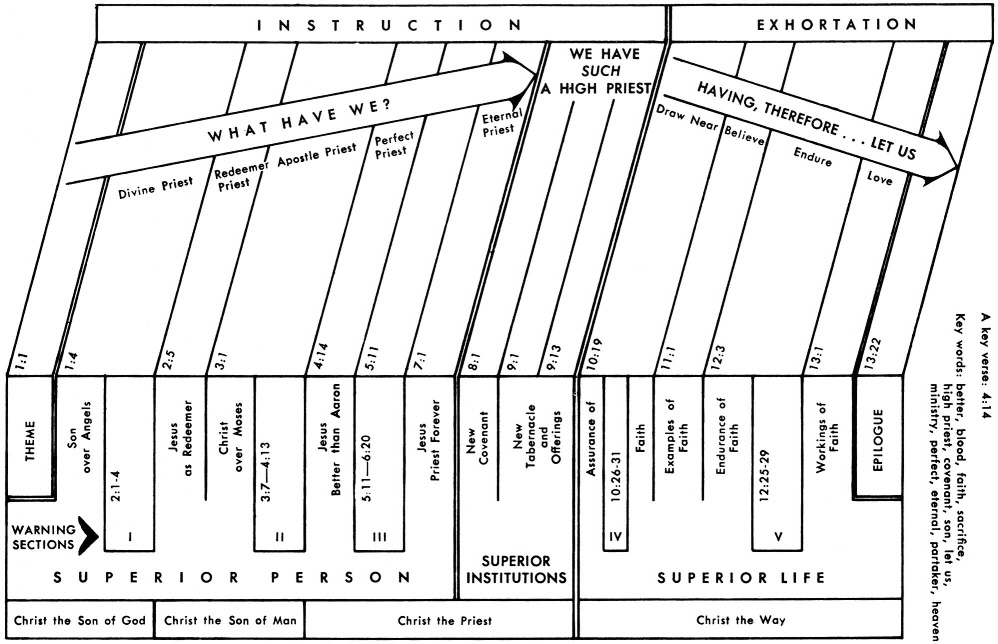
CONSIDER JESUS OUR GREAT HIGH PRIEST
Click chart to enlarge
Charts from Jensen's Survey of the NT - used by permission
Swindoll's Chart, Interesting Pictorial Chart of Hebrews, Another Chart
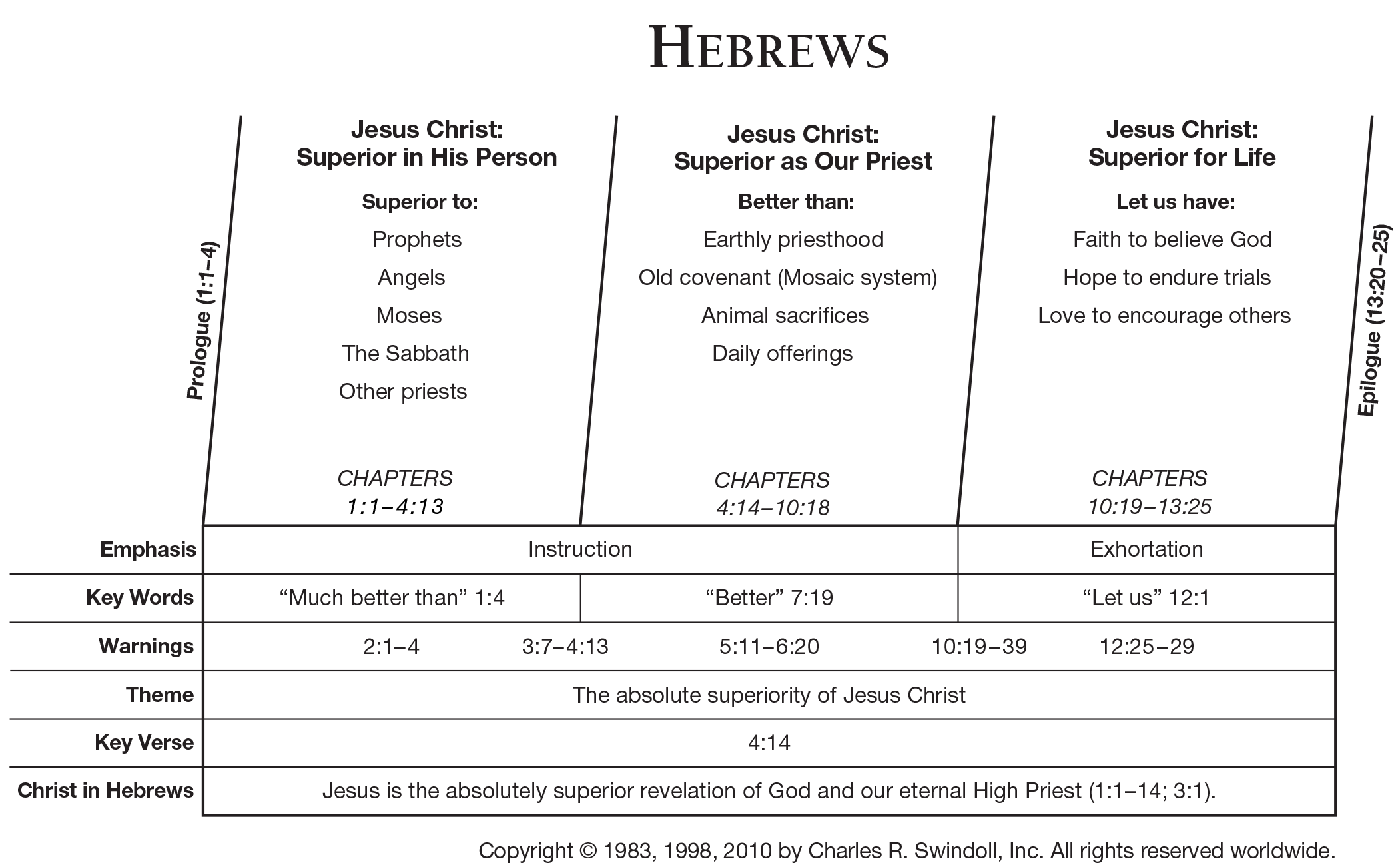

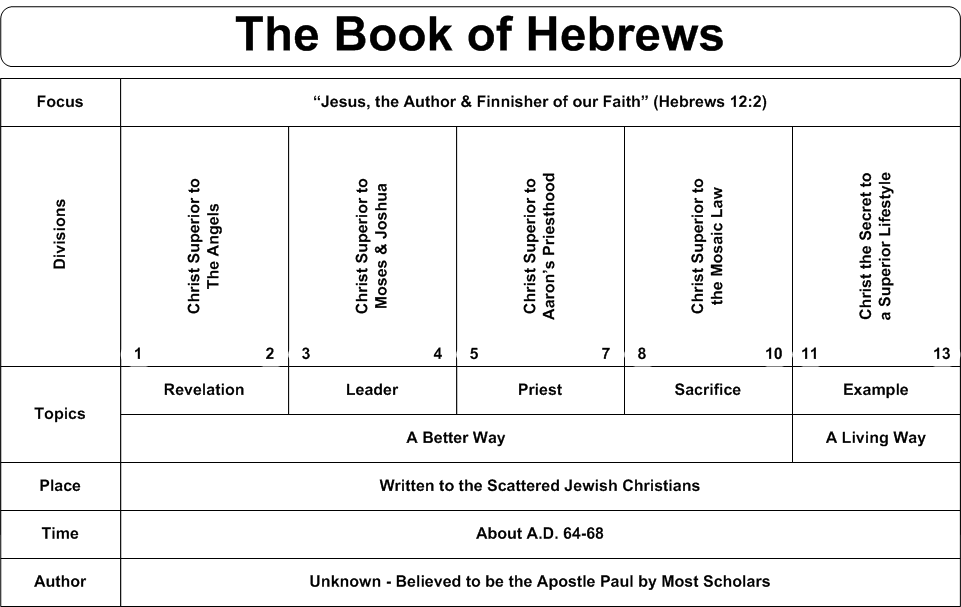
|
The Epistle |
||||
| INSTRUCTION Hebrews 1-10:18 |
EXHORTATION Hebrews 10:19-13:25 |
|||
| Superior Person of Christ Hebrews 1:1-4:13 |
Superior Priest in Christ Hebrews 4:14-10:18 |
Superior Life In Christ Hebrews 10:19-13:25 |
||
| BETTER THAN PERSON Hebrews 1:1-4:13 |
BETTER PRIESTHOOD Heb 4:14-7:28 |
BETTER COVENANT Heb 8:1-13 |
BETTER SACRIFICE Heb 9:1-10:18 |
BETTER LIFE |
| MAJESTY OF CHRIST |
MINISTRY OF CHRIST |
MINISTERS FOR CHRIST |
||
|
DOCTRINE |
DUTY |
|||
|
DATE WRITTEN: |
||||

See ESV Study Bible "Introduction to Hebrews"
(See also MacArthur's Introduction to Hebrews)
Borrow Ryrie Study Bible
Hebrews 12:11 All discipline for the moment seems not to be joyful, but sorrowful; yet to those who have been trained by it, afterwards it yields the peaceful fruit of righteousness. (NASB: Lockman)
Greek: pasa de paideia pros men to paron (PAPNSA) ou dokei (5719) charas einai (PAN) alla lupes, usteron de karpon eirenikon tois di' autes gegumnasmenois (RPPMPD) apodidosin (3SPAI) dikaiosunes
Amplified: For the time being no discipline brings joy, but seems grievous and painful; but afterwards it yields a peaceable fruit of righteousness to those who have been trained by it [a harvest of fruit which consists in righteousness—in conformity to God’s will in purpose, thought, and action, resulting in right living and right standing with God]. (Amplified Bible - Lockman)
NLT: No discipline is enjoyable while it is happening--it is painful! But afterward there will be a quiet harvest of right living for those who are trained in this way. (NLT - Tyndale House)
Phillips: Yet when it is all over we can see that is has quietly produced the fruit of real goodness in the characters of those who have accepted it in the right spirit. (Phillips: Touchstone)
Wuest: In fact, all discipline, correction, and guidance for the time being does not seem to be joyous but grievous; yet afterward it yields a return of the peaceable fruit of righteousness to those who have been exercised by it.
Young's Literal: and all chastening for the present, indeed, doth not seem to be of joy, but of sorrow, yet afterward the peaceable fruit of righteousness to those exercised through it -- it doth yield.
ALL DISCIPLINE FOR THE MOMENT SEEMS NOT TO BE JOYFUL, BUT SORROWFUL: pasa de paideia pros men to paron ou dokei charas einai alla lupes
- All discipline - Ps 89:32 Ps 118:18 Pr 15:10 Pr 19:18
- Hebrews 12 Resources - Multiple Sermons and Commentaries
All (pas) - No exceptions! Beloved, let's be honest, when the Almighty, Omnipotent God disciplines us it is ALWAYS not fun!
Wuest adds that "The emphasis is upon the fact that every kind of chastening, whether human or divine, does not seem joyous."
Spurgeon - Carnal reason judges in the present light, which happens to be the very worst light in which to form a correct estimate. Suppose that I am under a great tribulation today—let it be a bodily affliction—the head is aching, the heart is palpitating, the mind is agitated and distracted. Am I in a fit state to judge the quality of affliction with a distracted and addled brain? With the scales of the judgment lifted from their proper place, how can I sit and form a just idea of the wisdom of God in his dispensations? All that flesh and blood can discover of the quality of affliction is but its outward superficial appearance. We are not able by the eye of reason to discover the real virtue of sanctified tribulation; this discernment is the privilege of faith.
Stedman says: One definition of a Christian is: one who is completely fearless, continually cheerful, and constantly in trouble. This is exactly what this passage describes.
Discipline (3809) (paideia from país = child; verb paideuo) means to provide instruction, with the intent of forming proper habits of behavior, of providing guidance for responsible living, of rearing and guiding a child toward maturity. Paideia is a broad term, signifying whatever parents and teachers do to train, correct, cultivate, and educate children in order to help them develop and mature as they ought.
John MacArthur has a helpful note on paideia writing that it refers to "the systematic training of children. It includes the idea of correction for wrongdoing, as seen in the well–known proverb, “He who spares his rod hates his son, but he who loves him disciplines him diligently” (Pr. 13:24). In the several uses of the term in Hebrews 12:5-11, the translators of the Authorized Version rendered it “chastening,” which is clearly the emphasis of that context. Paul’s meaning here is expressed even more fully, however, in the proverb “Train up a child in the way he should go, even when he is old he will not depart from it” (Pr 22:6). Discipline has to do with the overall training of children, including punishment. Susannah Wesley, the mother of John and Charles Wesley, raised seventeen children and had these words to say about raising children: “The parent who studies to subdue [self–will] in his child works together with God in the renewing and saving a soul. The parent who indulges it does the devil’s work, makes religion impracticable, salvation unattainable, and does all that in him lies to damn his child, soul and body forever” (cited in The Journal of John Wesley [Chicago: Moody, n.d.], p. 106).
Someone has written - And so what do I say? I say let the rains of disappointment come, if they water the plants of spiritual grace. Let the winds of adversity blow, if they serve to root more securely the trees that God has planted. I say, let the sun of prosperity be eclipsed, if that brings me closer to the true light of life. Welcome, sweet discipline, discipline designed for my joy, discipline designed to make me what God wants me to be.
For the moment (3918) (pareimi from pará = near, with + eimi = to be) means to be near at hand and so to to be present at a particular time and place, here referring to the time of divine discipline.
GOD'S DISCIPLINE ALWAYS
HAS ETERNITY IN VIEW.
Seems (1380)(dokeo) means primarily to be of opinion, think, imagine, suppose. To hold an opinion based upon appearances which may be significantly different from reality. It also signifies "to seem, be accounted, reputed." (Vine) Dokeo is a verb with the general meaning "to think" in a variety of contexts. The underlying sense is that of "making a rational assessment," or "giving consideration to." Dokeo reflects the subjective mental estimate or opinion about some matter, in this passage in Galatians 6 in regard to one's state of personal "religiosity". It means to regard something as presumably true, without particular certainty. When used with a reflexive pronoun it means to seem to oneself - to be of opinion, suppose (Acts 26:9).
In the present passage, the verb seems hints that there is a kind of residual joy of hope that hangs on beneath the cloud, but the tears and the sighs and the groans are so many that it looks like sorrow has the upper hand - at least for a season. As it does when a child cries after a spanking.
Steven Cole - As an old man looking back on his life, the late Malcolm Muggeridge observed, Contrary to what might be expected, I look back on experiences that at the time seemed especially desolating and painful with particular satisfaction. Indeed, everything I have learned, everything that has truly enhanced and enlightened my existence, has been through affliction and not through happiness. If it ever were to be possible to eliminate affliction from our earthly existence, the result would not be to make life delectable, but to make it too banal and trivial to be en-durable (A Twentieth Century Testimony [Thomas Nelson], in Reader's Digest [1/91], p. 158) By way of contrast, many have allowed difficult trials to turn them away from God. For example, I have read that media mogul, Ted Turner, grew up in a church-going home. But when his sister died, Turner’s father grew bitter and turned away from God. Ted Turner followed his father’s example. Trials are a fact of life, but how we respond to them is our choice. I do not know if Muggeridge was truly converted (Ed: As I have read some of Muggeridge's writings one wonders - aren't we glad Jesus is the final Judge!), but he seems to have grown better through his trials. Turner, however, grew bitter. I grant that it is difficult to understand how God can be both good and omnipotent, and yet allow the horrible suffering that we see in the world. But to cease to believe in God on account of suffering does not make God cease to exist, and it does not resolve the problem. To “run with endurance the race that is set before us” (Heb 12:1), we need to know how God wants us to respond to His loving discipline. (Hebrews 12:7-11 Responding to God's Discipline)
Spurgeon asks "If affliction seemed to be joyous, would it be a chastisement at all? I ask you, would it not be a most ridiculous thing if a father should so chasten a child that the child came away laughing, and smiling, and rejoicing? Joyful? Instead of being at all serviceable, would it not be utterly useless? What good could a chastisement have done if it was not felt? It is the blows of the wound, says Solomon, that will cleanse evil (Pr 20:30); and so if the chastisement do not come home to the bone and flesh, what good end can it have served? It might even work the other way and be hurtful, for if those very gentle blows were enough, with one or two soft chiding words, to express parental hatred of sin, the child would surely think that the parent only played with it and that disobedience was a trifle. If only the mockery of discipline were given, the child would be hardened in sin, and even despise the authority that it ought to respect. If God sent us trials such as we would wish for, they would be no trials."
Joyful (5479) (chara from chairo = to rejoice) refers to cheerfulness, gladness, joy. It is that feeling of inner gladness, delight or rejoicing. Secular dictionaries define joy as the emotion evoked by well-being, success, or good fortune or the emotion evoked by the prospect of possessing what one desires. The world's definition of joy is therefore virtually synonymous with the definition of happiness, for both "emotions" are dependent on what "happens".
Chara in Hebrews - Heb 10:34; Heb 12:2, 11; Heb 13:17
Certainly there is joy in human life, such as joy when one experiences a victory (" We will sing for joy over your victory, and in the name of our God we will set up our banners. May the LORD fulfill all your petitions." Psalm 20:5 Spurgeon's comment) or reaps a bountiful harvest (see Isa 9:3), but more often the Bible speaks of joy in a spiritual sense. For example, Nehemiah declared to the down in the mouth (not very filled with joy) Jews that "The joy of the Lord is your strength." (Neh 8:10).
Similarly, David pleaded with God to "restore to me the joy of Thy salvation." (Psalm 51:12 - Spurgeon's Comment).
It is not surprising that joy and rejoicing are found most frequently in the Psalms (about 80 references) and the Gospels (Joy = 38x in Psalms -
Ps 5:11; 16:11; 20:5; 27:6; 30:5; 32:11; 33:1, 3; 35:27; 42:4; 43:4; 45:7; 47:1; 48:2; 51:8, 12; 63:7; 65:8, 13; 67:4; 71:23; 81:1; 84:2; 87:7; 89:12; 90:14; 92:4; 95:1; 96:12; 98:4, 8; 105:43; 119:111; 126:6; 132:9, 16; 137:6; 149:5; Rejoice, rejoicing, etc - 43x in Psalms - Ps 2:11; 9:14; 13:4f; 14:7; 16:9; 19:5, 8; 21:1; 30:1; 31:7; 32:11; 33:21; 34:2; 35:9, 15, 19, 24, 26f; 38:16; 40:16; 45:15; 48:11; 51:8; 53:6; 58:10; 63:11; 65:12; 66:6; 68:3; 70:4; 85:6; 89:16, 42; 96:11; 97:1, 8; 106:5; 118:24; 119:14, 162; 149:2).
C. S. Lewis got a bit closer to the Biblical meaning when he called joy an “unsatisfied desire which is itself more desirable than any other satisfaction.” That statement is a bit obtuse but Lewis then goes on to add that joy "must be sharply distinguished both from happiness and from pleasure". Ultimately Lewis' experienced joy when he discovered that Jesus was the wellspring of all joy.
A W Tozer said "It is doubtful if God can bless a man greatly without hurting him deeply."
His purposes will ripen fast,
Unfolding every hour:
The bud may have a bitter taste,
But sweet will be the flower.
Joy then is the deep-down sense of well-being that abides in the heart of the person who knows all is well between himself and the Lord. It is not an experience that comes from favorable circumstances but even occurs when those circumstances are the most painful and severe as Jesus taught His disciples declaring "Truly, truly, I say to you, that you will weep and lament, but the world will rejoice; you will be sorrowful, but your sorrow will be turned to joy. Whenever a woman is in travail she has sorrow, because her hour has come; but when she gives birth to the child, she remembers the anguish no more, for joy that a child has been born into the world. Therefore you too now have sorrow; but I will see you again, and your heart will rejoice, and no one takes your joy away from you. (John 16:20, 21, 22)
Believers have the Resident Source of joy within for as as Paul teaches "the fruit of the Spirit is love, joy, peace, patience, kindness, goodness, faithfulness (Gal 5:22)
Comment: Remember that like any "garden", fruit needs to be diligently, carefully cultivated. Fertilize with nutrients (Take in the pure Word like a new born babe - 1Pe 2:2, Mt 4:4). Water regularly (with the Word - cp Ep 5:26, cp Jn 13:10). Pull the "corrupting" weeds (of sin, which stunts our desire for the Word, 1Pe 2:1). How are you tending your garden?
Emotional fluctuations cannot disturb this Source of joy. Note Paul’s statement of this confidence (Php 3:20).
C. S. Lewis - God whispers to us in our pleasures, speaks in our conscience, but shouts in our pains: it is His megaphone to arouse a deaf world.
Sorrowful (3077)(lupe - see related verb lupeo) refers to sadness, grief, grievous, heaviness, sorrow. In context lupe speaks of pain, which could be of body but especially of one's mind as one experiences severe mental or emotional distress associated with the discipline of the LORD.
Murray comments on sorrowful - To the flesh which judges by what is present and by sense, it is distinctly, often terribly, grievous, Faith which lives in the future and unseen, rejoices in the assurance not only of deliverance, but of the heavenly blessing it brings. (The Holiest of All - Yet Afterward)
Jamieson - The objection that chastening is grievous is here anticipated and answered. It only seems so to those being chastened, whose judgments are confused by the present pain. Its ultimate fruit amply compensates for any temporary pain. The real object of the fathers in chastening is not that they find pleasure in the children's pain. Gratified wishes, our Father knows, would often be our real curses.
McGee - This is like the boy whose father said to him before he whipped him, "Son, this is going to hurt me more than it hurts you." The boy said, "Yes, Dad, but not in the same place." God chastens His children. He does not get any particular joy out of it, but He does it because you and I need it. Not only does chastening not seem to be joyous, it isn't joyous, but grievous -- that is our experience. Although no chastening at the time is fun, "afterward it yields the peaceable fruit of righteousness unto them which are exercised thereby." God does not discipline you without purpose.
Adam Clarke - Neither correction, wholesome restraint, domestic regulations, nor gymnastic discipline, are pleasant to them that are thus exercised; but it is by these means that obedient children, scholars, and great men are made. And it is by God's discipline that Christians are made. He who does not bear the yoke of Christ is good for nothing to others, and never gains rest to his own soul.
Barnes - does not impart pleasure, nor is this its design. All chastisement is intended to produce pain, and the Christian is as sensitive to pain as others. His religion does not blunt his sensibilities, and make him a stoic, but it rather increases his susceptibility to suffering… the Christian feels the loss of a child, or bodily suffering, as keenly as any one. But while religion does not render him insensible to suffering, it does two things—(1.) it enables him to bear the pain without murmuring, and (2.) it turns the affliction into a blessing on his soul.
G. Campbell Morgan once wrote that "We cry too often to be delivered from the punishment, instead of the sin that lies behind it. We are anxious to escape from the things that cause us pain rather than from the things that cause God pain."
God promises a safe landing,
not smooth sailing.
Related Resources:
- Related commentary and quotes on suffering and trials - 1 Peter 1:6; 1 Peter 1:7
- Discussion of suffering as a Divine Gift!
- Exposition related to suffering - Romans 8:18
- Exposition related to tribulations - Romans 5:3
- Exposition on how the Savior Succors Suffering Saints - Hebrews 2:18
- Discussion of what the God of All Grace Promises when we suffer- 1Peter 5:10
- Exposition on how God uses suffering in the life of a saint - 2 Cor 12:9; 2 Co 12:10
- Exposition on Trials - James 1:2
- Exposition on present pain versus future joy - Matthew 5:10, 11, 12- notes
- Don't forget to do a Site Search - E.g., this link retrieve over 4000 hits on the word SUFFERING on Preceptaustin
- How should Christians discipline their children? What does the Bible say?
- When, why, and how does the Lord God discipline us when we sin?
- Does God punish us when we sin?
YET TO THOSE WHO HAVE BEEN TRAINED BY IT: de karpon eirenikon tois di autes gegumnasmenois (RPPMPD) apodidosin (3SPAI) dikaiosunes:
- yet - Heb 12:5, 6, 10
- Hebrews 12 Resources - Multiple Sermons and Commentaries
TRAINED BY
DISCIPLINE
Yet (de) - Another strategic (and in this case merciful and grace filled) term of contrast!
Present… yet… afterwards - Andrew Murray observes that "These two expressions contain the great contrast between time and eternity, of the visible and the invisible, of sorrow and of joy, of sense and of faith, of backsliding and of progress to perfection… Yet… afterwards: to throw eternity into the balance, and judge everything by that: this is what even the patriarchs did; this is what Christ taught us, when, for the joy set before Him, He endured the cross; this is what faith can teach us in every trial. (The Holiest of All - Yet Afterward)
Thomas comments on those who have been trained by it writing that "everything depends on the attitude which we take towards suffering. We are not to forget, not to despise, not to faint (Heb 12:5), but we are to endure (Heb 12:7), and to be in subjection (Heb 12:9). When this attitude is realized, then we understand the direct and blessed connection between "discipleship" and "discipline."
Trained (1128)(gumnazo or gymnazo from from gumnos = naked or minimally clothed and descriptive of the common practice of males in the Greco Roman gymnasia source of English gymnasium, gymnastics) literally meant to exercise naked in the palaestra (a school in ancient Greece or Rome for sports - see a picture of the palaestra). Vine says it means to “to strive with the body stripped” i.e., strenuously.
Gumnazo - 4x in 4v - 1Ti 4:7; Heb 5:14; He 12:11; 2Pe 2:14. NAS = discipline(1), trained(3).
Gumnazo means to exercise bodily and described an athlete exercising in the gym. Figuratively gumnazo means to exercise so as to discipline oneself (in the moral or ethical "gym") or to exercise vigorously, in any way, either the body or the mind. It describes the rigorous, strenuous, self-sacrificing training an athlete undergoes.
Trained is in the perfect tense indicating a past completed action with ongoing effect and thus speaks of the permanence of their state of training. Note also that trained is in the passive voice which signifies that the subject (believers) receives the action of the verb (train). Believers not only receive the training itself but also the benefits of the training! This is amazing grace, God training us and then God blessing us. Amazing grace indeed!
The Jewish historian Josephus uses gymnazo in his description of the Roman soldier writing that "their military exercises differ not at all from the real use of their arms, but every soldier is every day exercised (gymnazo), and that with great diligence, as if it were in time of war which is the reason why they bear the fatigue of battles so easily." (Josephus, F. The Works of Josephus. Wars 3.73)
Paul uses gymnazo in his first epistle to Timothy drawing on the athletic metaphor to exhort his young disciple to…
"have nothing to do with (continually refuse, shun, reject) worldly (profane in contrast to sacred, void of piety, opposite of holy that which is set apart to God) fables (myths) fit only for old women. On the other hand, discipline (gymnazo = present tense calls for rigorous, strenuous, self-sacrificing training like an athlete) yourself for the purpose of godliness (NIV = "train yourself to be godly") for bodily discipline is only of little profit, but godliness is profitable for all things, since it holds promise for the present life and also for the life to come." (see notes 1Timothy 4:7; 1Timothy 4:8)
Wiersbe in his little book Run With the Winners says "Athletes must discipline (TRAIN) themselves if they ever hope to be winners. They must obey the training rules and submit to the plans of their coaches and trainers. But the results are worth it! "All discipline for the moment seems not to be joyful, but sorrowful; yet to those who have been trained by it, afterwards it yields the peaceful fruit of righteousness" (Hebrews 12:11). Afterwards! That means faith--waiting for God to accomplish His purposes!"
Consider the following testimony by C. H. Spurgeon: I am afraid that all the grace I have got out of my comfortable and easy times and happy hours might almost lie on a penny. But the good that I have received from my sorrows and pains and griefs is altogether incalculable. What do I not owe to the hammer and the anvil, the fire and the file? Affliction is the best bit of furniture in my house.
J C Ryle…
Affliction is one of God's medicines!
By it He often teaches lessons which would be learned in no other way.
By it He often draws souls away from sin and the world, which would otherwise have perished everlastingly.
Health is a great blessing—but sanctified disease is a greater.
Prosperity and worldly comfort, are what all naturally desire—but losses and crosses are far better for us—if they lead us to Christ.
Let us beware of murmuring in the time of trouble.
Let us settle it firmly in our minds, that there is a meaning, a 'needs be', and a message from God—in every sorrow that falls upon us.
There are no lessons so useful as those learned in the school of affliction.
There is no commentary that opens up the Bible so much as sickness and sorrow.
The resurrection morning will prove, that many of the losses of God's people were in reality, eternal gains.
Thomas Watson…
"God disciplines us for our profit." Hebrews 12:10 What profit is in affliction? Afflictions are disciplinary. Afflictions teach us—they are the school of the cross.
Affliction shows us more of our own hearts. Water in a glass looks clear—but set it on the fire, and the scum boils up. Just so, when God sets us upon the fire—corruption boils up which we did not discern before. Sharp afflictions are to the soul, as a soaking rain to the house; we do not know that there are holes in the roof until the shower comes—but then we see it drop down here and there. Just so, we do not know what unmortified lusts are in the soul, until the storm of affliction comes—then the hidden evils of the heart come dropping down in many places. Affliction is a sacred eye-salve, it clears our eye-sight. Thus the rod gives wisdom.
Affliction quickens the spirit of prayer. Jonah was asleep in the ship—but at prayer in the whale's belly. Perhaps in a time of health and prosperity we prayed in a cold and formal manner, we put no coals to the incense. Then God sends some affliction or other—to stir us up to take hold of Him. "They poured out a prayer—when Your chastening was upon them." Isaiah 26:16. In times of trouble we pray feelingly and fervently.
Affliction is a means to purge out our sins. Affliction cures the pestilence of pride—and the fever of lust. Affliction is God's file—to scrub off our rust. Affliction is God's flail—to thresh off our husks. The water of affliction is not to drown us—but to wash off our spots.
Affliction is a means to wean us the world. The world often proves, not only a spider's web—but a cockatrice egg. Corrupting worldly things, are great enchantments. They hinder us in our passage to heaven. Affliction sounds a retreat, to call us off the immoderate pursuit of earthly things. When two things are frozen together—the best way to separate them is by fire; so, when the heart and the world are together—God has no better way to separate them than by the fire of affliction.
Affliction is a means to purify us. It works us up to further degrees of sanctity. "God disciplines us for our profit—that we may share in His holiness." Hebrews 12:10.The vessels of mercy are the brighter for scouring. As you pour water on your linen when you would whiten it—so God pours the waters of affliction upon us to whiten our souls.
Afflictions are in themselves bitter—but they bring forth the sweet fruits of righteousness. Hebrews 12:11.
AFTERWARDS IT YIELDS THE PEACEFUL FRUIT OF RIGHTEOUSNESS: de karpon eirenikon tois di autes gegumnasmenois (RPPMPD) apodidosin (3SPAI) dikaiosunes:
- Ps 119:165; Isaiah 32:17; Romans 5:3, 4, 5; 14:17; 2Cor 4:17; Gal 5:22,23; Jas 3:17,18
- Hebrews 12 Resources - Multiple Sermons and Commentaries
BLESSED PAYBACK
AFTERWARDS!
De Haan says "The important key word in this verse is afterwards. It points to the future, after we have finished the race, and looking back, find the answer to all God's mysterious dealings in sending upon us the trials, testings, tribulations and chastenings which today seem so unexplainable and meaningless. Then we shall fully comprehend the wisdom of God in dealing with us so severely, and rejoice in the great fact of Romans 8:28, "that all things work together for good." All our questions will be answered and the reason for all our trials be made plain. (Studies in Hebrews)
THOUGHT - Are you willing to wait patiently for the "awards ceremony," the time of recompense for having endured discipline without wavering or complaining because you have kept one eye on eternity and relied on His enabling inner strengthening to keep on fighting this good fight of faith?
Spurgeon - A man takes a mass of metal. It appears to you very pure, and very beautiful to look at. It is alloyed. He puts it into his refining pot, he heats the coals, and he begins to stir it. You say to him, “What are you doing? You are spoiling that precious metal. See how foul the surface is! What a scum floats up.” The natural effect of the fire is to make the scum show itself. A skillful hand is needed, for the fire cannot do the refiner’s work. He himself must skim the base metal off the top. Affliction only makes the sin rise to the surface. It makes the devil in us come up; it makes us, while we are boiling in affliction, worse than we were before. It is the supernatural work of the Holy Spirit, and of our blessed Lord and Master, when He sees it on the top, then to skim it off. The affliction does not do us any good in itself; the natural fruit of affliction is rebellion. If God chastens me, can I love Him for that? Not naturally. If He strikes me, can I yield Him homage for that? No, naturally I rebel against Him, and I say, “Who are you that you should smite me this way, and what have I done that I should be tormented by you?” To kiss the hand that smites is something more than nature; it is grace.
Afterwards (5305)(husteron from husteros = later) means more lately or eventually. Afterward means happening at a time subsequent to a reference time, in this case the reference time being the time of testing by the disciplining hand of God.
Husteron - 12x in 12v - Matt 4:2; 21:29, 32, 37; 22:27; 25:11; 26:60; Mark 16:14; Luke 20:32; John 13:36; 1 Tim 4:1; Heb 12:11. NAS =- afterward(4), afterwards(1), last(1), later(3).
Barnes - The effect (of discipline) is seen in a pure life, and in a more entire devotedness to God. We are not to look for the proper fruits of affliction while we are suffering, but afterwards.
Yields the peaceful fruit of righteousness - The verb yields in the present tense signifying that divine discipline accepted and received, continually pays back the dividend of the peaceful fruit of righteousness. And as Murray interprets it this "pay back," is not just in time but throughout eternity future. That interpretation seems very reasonable when compared with another passage that speaks of "spiritual training" (using same verb gumnazo as Heb 12:11). Paul writes to Timothy...
But have nothing to do with (present imperative - continually reject) worldly fables ("reject those myths" = NET) fit only for old women. On the other hand, discipline (gumnazo in the present imperative - continually train = calls for continual reliance on the Holy Spirit to obey) yourself for the purpose of godliness; for bodily discipline is only of little profit, but godliness is profitable for all things, since it holds promise for the present life and also for the life to come. (1 Ti 4:7-8)
Notice that the "pay back" for disciplining one's self for godliness is not only in this present life but also in the life to come.
Yields (591)(apodidomi from apó = from + didomi = give) means to pay or give back. It refers to fulfilling an obligation or expectation. In the present verse it means to return, render or yield. It was used to refer to land yielding fruit 200 fold. Used 3 times in Hebrews - Heb 12:11, 16; 13:17.
James speaks of the fruit of righteousness that comes from times of testing writing…
Consider (aorist imperative - Do this now. Don't vacillate. Understanding it's great value esteem) it all joy, my brethren, when you encounter various trials, knowing that the testing of your faith produces endurance. And let endurance have its perfect result, that you may be perfect and complete, lacking in nothing. (Jas 1:2, 3, 4)
Peter describes this yield of fruit encouraging his tested readers that - In this you greatly rejoice, even though now for a little while (HOW LONG?), if necessary (WHY? - see Heb 12:5-11), you have been distressed by various ("multi-colored" - but same word is used of grace in 1Pe 4:10-note! - just the right "color" of grace for the "color" of trial you are experiencing!) trials, that the proof of your faith, being more precious than gold which is perishable, even though tested by fire, may be found to result in praise and glory and honor at the revelation of Jesus Christ (1Pe 1:6,7)
Paul voices a similar thought in Romans 5 - And not only this, but we also exult in our tribulations, knowing that tribulation brings about perseverance and perseverance, proven character; and proven character, hope and hope does not disappoint, because the love of God has been poured out within our hearts through the Holy Spirit who was given to us. (Ro 5:3, Ro 5:4)
A W Pink observes: It is called the "peaceable fruit" because it issues in the taming of our wild spirits, the quieting of our restless hearts, the more firm anchoring of our souls. But this only comes when we truly realize that it is the Father's love which has afflicted us. May the Spirit of God grant us all "exercised" hearts, so that we shall daily search ourselves, examine our ways, and be stripped of all that is displeasing to Him.
Kistemaker says: The message of Hebrews is the same. The suffering you encounter is painful, says the writer, but when the period of distress has ended, you will be able to see results: "a harvest of righteousness and peace." Your reward will be a right relationship with God and man in which peace reigns supreme. You are the peacemakers. Says James, "Peacemakers who sow in peace raise a harvest of righteousness" (James 3:18).
Steven Cole on the peaceful fruit of righteousness - If we keep in mind what God is doing in light of eternity, then we can endure with inner joy and peace, while at the same time admitting the pain and sorrow. As Paul wrote (2 Cor. 6:10), though we are sorrowful, we are yet always rejoicing, knowing that God is for us and that He is working all our trials together for our good (Rom. 8:28-36)....“Righteousness” (Heb 12:11) is synonymous with “holiness” (Heb 12:10). Both terms mean godliness or conformity to Jesus Christ, who is the embodiment of godliness (Rom. 8:29). He shows us what it means to be a righteous person in thought, word, and deed. True holiness or righteousness is not just external, but begins at the heart or thought level. A truly righteous person has godly motives. He seeks to glorify God in everything. Righteousness and peace always go together. You cannot have true righteousness without peace, or true peace without righteousness. (See Cole's list of Seven ways in which God's discipline produces the peaceful fruit of righteousness.)
Peaceful (1516) (eirenikos from eirene = peace) pertains to being conducive to a harmonious relationship - peaceable. Louw-Nida says it conveys the thought of "freedom from anxiety and inner turmoil." The idea is free from worry.
Discipline in the believer's life brings freedom from worry, especially in regard to one's relationship with God.
Murray comments that regarding peaceful fruit of righteousness "the light of eternity and its reward shines on the least as on the greatest of our trials, and makes each one the seed of an everlasting harvest, of which we pluck the fruits even here. And so light arises upon the command, Count it all joy when ye fall into manifold temptations. (Jas 1:2) We read it in the light of what Paul said of himself, As sorrowful, yet always rejoicing. (2Co 6:10) When the hurricane is sweeping the ocean into mountain-high waves, down in the deep waters all is serene and quiet—the disturbance is only on the surface. And even so the joy of eternity can keep a soul in perfect peace amid abounding afflictions. For the present is swallowed up in the yet… afterwards of a living faith. (The Holiest of All - Yet Afterward)
The fruit (WORK) of righteousness will be peace; the effect of righteousness will be quietness and confidence forever. (Isa 32:17NIV)
Fruit (2590) (karpos) is used in its literal sense to refer to fruit, produce or offspring, which describes that which is produced by the inherent energy of a living organism. Karpos is what something naturally produces. Figuratively, karpos is used of the consequence of physical, mental, or spiritual action. In the NT the figurative (metaphorical) uses metaphorical uses predominate and this is particularly true in the Gospels, where human actions and words are viewed as fruit growing out of a person's essential being or character.
Righteous (right) conduct is the soil out of which grows the calming fruit of peace, especially the peace with God, because of a clear conscience and a sense of oneness, communion and unbroken/unhindered fellowship of the creature with his or her Creator.
Bruce says: The person who accepts discipline at the hand of God as something designed by his heavenly Father for his good will cease to feel resentful and rebellious; he has "calmed and quieted" his soul, which thus provides fertile soil for the cultivation of a righteous life, responsive to the will of God (NICNT-Galatians)
Spurgeon - Affliction really does to the Christian, when the time comes, bring forth fruit. This is the object of Christ in sending it. In His sweet prayer for the elect, He prayed that His people might bring forth fruit. He said, “My Father is glorified by this: that you bear much fruit, and prove to be my disciples” (John 15:8). He assured them that every branch of the true vine that brought forth fruit would be purged, that it might bring forth more fruit. So far as this world is concerned, God gets His glory out of us, not by our being Christians, but by our being fruitful Christians.
THE PEACEFUL FRUIT OF RIGHTEOUSNESS" is that righteousness which is produced out of the right relationship with our Heavenly Father. It is the fruit that is born in: John 15:5 through the relationship of the VINE TO THE BRANCH. Galatians 5:22, 23
Righteousness (1343) (dikaiosune from dikaios = just, righteous = root idea of conforming to a standard or norm) is derived from a root word that means straightness. It refers to a state that conforms to an authoritative standard or norm and so is in keeping with what God is in His holy character.
Discipline in the believer's life brings a desire to do what is right before the Father, to please Him by walking in the Spirit (Gal 5:16). Right living (toward God first, then toward man) is the "fruit" which chastening yields to the yielded saint, the one who is "trainable!" And so we see that this peace comes through yielding to God's hand of discipline and enduring whatever His love sends/allows ini our lives. As the Phillips' paraphrase says when the discipline "is all over we can see that is has quietly produced the fruit of real goodness in the characters of those who have accepted it in the right spirit."
THOUGHT - This begs the question - what is your "spirit" when divine discipline comes? Do you chafe at the bit (so to speak) like a horse who does not want to accept the bit and bridle? Or do willingly submit to God's loving chastisement, knowing that it may be painful, but the payback makes it worth the wait? If you fight against the discipline, you can be assured that that will not make it disappear. If we refuse to learn the lesson God desires to teach us, it is almost certain that He will send another round of discipline until we finally acquiesce. So submit sooner rather than later, and you will safe yourself a considerable amount of suffering!
Tertullian - Oh, happy the servant for whose improvement his Lord is earnest, with whom he deigns to be angry, whom He does not deceive by dissembling admonition" (withholding admonition, and so leading the man to think he needs it not)! (Patience, 11).
Barnes writes that discipline "is a tree that bears good fruit and we do not expect the fruit to form and ripen at once. It may be long maturing, but it will be rich and mellow when it is ripe. It frequently requires a long time before all the results of affliction appear-as it requires months to form and ripen fruit. Like fruit it may appear at first sour, crabbed, and unpalatable; but it will be at last like the ruddy peach or the golden orange. When those fruits are ripened they are (1.) fruits "of righteousness." They make us more holy, more dead to sin and the world, and more alive to God. And they are (2.) "peaceable." They produce peace, calmness, submission in the soul. They make the heart more tranquil in its confidence in God, and more disposed to promote the religion of peace. The apostle speaks of this as if it were a universal truth in regard to Christians who are afflicted. And it is so, There is no Christian who is not ultimately benefited by trials, and who is not able at some period subsequently to say, "It was good for me that I was afflicted. Before I was afflicted I went astray; but now have I kept thy word." When a Christian comes to die, he does not feel that he has had one trial too many, or one which he did not deserve. He can then look back and see the effect of some early trial, so severe that he once thought he could hardly endure it, spreading a hallowed influence over his future years, and scattering its golden fruit all along the pathway of life. I have never known a Christian who was not benefited by afflictions; I have seen none who was not able to say that his trials produced some happy effect on his religious character, and on his real happiness in life. If this be so, then no matter how severe our trials, we should submit to them without a murmur. The more severe they are, the more we shall yet be blessed-on earth or in heaven.
What does discipline do? Hardships will do one of two things to us. They will distract our focus from Christ, forcing us into a spiritual lapse so that we are slowed down, or even drop out of the race (which is why he addresses this issue in He 12:12, 13) Or they will intensify our focus on Christ,
In sum we are called to not regard God's hand of discipline lightly and neither to faint but to accept it because
• Discipline proves that God is our Father and we are his children!
• Discipline makes us live life that is life indeed (cp zoe)!
• Discipline makes us like God—holy!
• Though there is pain now, later it produces a harvest of righteousness and peace!
This is why we must keep our eyes on Jesus (Heb 12:2, Heb 12:3) and keep running (Heb 12:1)!
Spurgeon - Let me ask those who are afflicted and have no religion where they get their comfort from. The Christian derives it from the fact that he is a son of God, and he knows that the affliction is for his good. Where do you get comfort from? It has often puzzled me how poor tried worldly people get on. I can somewhat guess how they can be happy when the glass is full, when hearts are glad and joyous, when hilarity and mirth sparkle in their eyes, when the board is covered and the family is well. But what does the worldly man do when he loses his wife, when his children are taken away, when his health departs and he himself is near death? I leave him to answer. All I can say is, I wonder every day that there are not more suicides, considering the troubles of this life, and how few there are who have the comforts of religion. Poor sinner, even if there were no heaven and hell, I would recommend to you this religion. For even if in this life only we had hope, we should be of all men most happy, really, in our spirits, although we might seem to be “of all people most pitiable” (1Cor 15:19). I tell you, if we were to die like dogs, if there were no second world, so happy does the Christian religion make the heart that it would be worthwhile having it for this life alone. The secularist who thinks of this world only is a fool for not thinking of Christianity, for it confers a benefit in this world as well as in that which is to come. It makes us bear our troubles. What would break your backs are only feathers to us; what would destroy your spirits are to us “momentary light afflictions” (2Cor 4:17). We find light enough in our hearts in the depth of darkness. Where you find darkness, we have light, and where you have light, we have the brilliance of the sun. May God put you in the number of His saved family, and then if He chastens you, I ask whether you will not think His rod light when compared with the sword that you deserve to have smitten you dead. God grant you, if you are chastened now, that you may be chastened and not killed, that you may be chastened with the righteous and not condemned with the wicked.
A leader's own salvation and spiritual progress are protected by humbling adversity. —Bonaventure
Sometimes your medicine bottle has on it, "Shake well before using." That is what God has to do with some of His people. He has to shake them well before they are ever useable. Paul wrote to Timothy, "Stir up the gift of God, which is in thee." —Vance Havner
The Purpose of Discipline - Discipline... is to strengthen and restore, not condemn or destroy. —Donald L. Bubna
There is a subject for song even in the judgments of God towards us... Faith sees that in her worst sorrow there is nothing penal; there is not a drop of God's wrath in it; it is all sent in love. Faith discerns love gleaming like a jewel on the breast of an angry God. Faith says of her grief, "This is a badge of honour, for the child must feel the rod"; and then she sings of the sweet result of her sorrows, because they work her spiritual good. —Charles H. Spurgeon
Let the Winds Blow - We cannot be established except by suffering. It is of no use our hoping that we shall be well-rooted if no March winds have passed over us. The young oak cannot be expected to strike its roots so deep as the old one. Those old gnarlings on the roots, and those strange twistings of the branches, all tell of many storms that have swept over the aged tree. But they are also indicators of the depths into which the roots have dived. —Charles Haddon Spurgeon
A ship was wrecked, and the only survivor washed up on a small uninhabited island. He was exhausted. He cried out to God to save him. Every day he scanned the horizon, searching for help. Finally, he managed to build a rough hut and put his few articles in that hut.
One day, coming home from hunting for food, he was stung with grief to see his little hut in flames and a cloud of smoke. The worst had happened. But early the next day, a ship drew in and rescued him.
He asked the crew, "How did you know I was here?"
They replied, "We saw your smoke signal."
Maybe the difficulty you have now is a smoke signal that will lead to great blessing. —John Yates
Job 5:17 God’s Chastening
Woodrow Kroll
Lou Holtz, former head football coach of the Fighting Irish of Notre Dame, is legendary in his adherence to discipline. In an interview with The Saturday Evening Post in 1989, he was quoted as saying, "When it comes to discipline here, we ask three questions: Will it make him a better man? A better student? A better athlete? If the answer is yes, we make him do it. The next step is up to him. An individual has a choice when you discipline him: either to become bitter or better." Judging by his squad’s record, both on and off the field, Lou Holtz’s charges for the most part became better men.
Job’s friends failed to understand God in many ways, but Eliphaz the Temanite was right in this respect. God’s discipline is never meant to destroy but ultimately to bring joy. The word in this verse for "happy" (also translated "blessed") literally means "to walk straight." God’s correction is given to keep His people from wandering away from the straight path and getting into situations that bring pain and heartache. Those who submit to His guidance will avoid many of the experiences that bring unhappiness to others.
God’s discipline doesn’t always feel good, especially if we fight against it. The writer of Hebrews confesses, "Now no chastening seems to be joyful for the present, but grievous" (12:11). Yet the writer continues, "Nevertheless, afterward it yields the peaceable fruit of righteousness to those who have been trained by it." A right relationship with God ultimately leads to a happiness that makes everything else seem insignificant.
Are you undergoing the chastening of God right now? If so, look ahead to the fruit He will bring out of this difficulty. Remember that God is seeking to correct your course so you can avoid future pitfalls that will bring you even greater pain. Let Him have His way in your life even if, at the moment, it’s hard to bear. You’ll be glad you did!
Pain now means gain later.
A young pastor friend has... been through the trial of his life. When I saw him recently, he asked me, "What do you do when God doesn't say yes—doesn't give it, doesn't make it happen?" Then he answered his own question: "Through agony I've gotten to know God better; I love him more..."
He showed me a piece of paper he keeps in his wallet. It says, "Look to his face, not to his hand." —Anne Ortlund
God created man something on the order of a rubber band. A rubber band is made to stretch. When it is not being stretched, it is small and relaxed, but as long as it remains in that shape, it is not doing what it was made to do. When it stretches, it is enlarged; it becomes tense and dynamic, and it does what it was made to do. God created you to stretch. —Charles Paul Conn
Pain can serve a definite purpose in our lives. Dr. Paul Brand of Carville, Louisiana, one of the world's foremost experts on leprosy, describes how "leprosy patients lose their fingers and toes, not because the disease can cause decay, but precisely because they lack pain sensations. Nothing warns them when water is too hot or a hammer handle is splintered. Accidental self-abuse destroys their bodies."
That hardship can actually be a blessing—or "a severe mercy," to recall Sheldon Vanauken's book of that title—is a profoundly Christian insight seldom heard these days, even from the clergy, who so often seem preoccupied with being "pastoral" or superficially popular.
Perhaps to be able to explain suffering is the clearest indication of never having suffered. Sin, suffering, and sanctification are not problems of the mind, but facts of life—mysteries that awaken all other mysteries until the heart rests in God. —Oswald Chambers
Nourishing Tears - The same tears that break our hearts may also nourish us in ways that matter most to God. —Philip Yancey
Afflictions are sweet preservatives to keep the saints from sin. —Thomas Brooks
Suffering Is a Certainty - We must be made perfect by sufferings. If we do not meet them in our younger days, we shall certainly have them in the decline of life. —George Whitefield
ILLUSTRATION - No professional football team that plays its home games in a domed stadium with artificial turf has ever won the Super Bowl. (ED: THIS IS AN OLD ILLUSTRATION AND THIS MAY NO LONGER BE COMPLETELY TRUE) While a climate-controlled stadium protects players (and fans) from the misery of sleet, snow, mud, heat, and wind, players who brave the elements on a regular basis are disciplined to handle hardship wherever it's found. The Green Bay Packers were the 1996 Super Bowl champions, in part, because of the discipline gained from regularly playing in some of the worst weather in the country.
Pastor Steven Cole makes the point that We should submit to the Father’s discipline because although it is difficult for the present, it yields the peaceful fruit of righteousness to all that are trained by it (Hebrews 12:11).The author makes three points in Heb 12:11:
A. All discipline seems difficult for the present.
Discipline seems-to our limited, time-bound perspective-not to be joyful, but sorrowful. I am glad that the Bible acknowledges that fact! God’s discipline is not easy or pleasant. It is not wrong to cry out loudly to God or to weep when you’re going through a difficult trial, because Jesus did that very thing (Heb. 5:7). The psalms show us that it is okay to bare our sorrows and grief to the Lord, as long as we do it with a submissive spirit. God gave us tear ducts for a reason!
I’ve shared with you before that on my 36th birthday, I had to conduct a funeral for a 39-year-old man who died of cancer, leaving a widow and two children. Two years later, I conducted the funeral for his wife, who also died of cancer. But after his funeral, as I was consoling his wife, her former bounded up with a silly grin on his face and said, “Praise the Lord, Scott’s in glory now!” I felt like punching him! I thought, “Let her weep!”
But, how does weeping fit with the Bible’s command, “Rejoice always” (1Th 5:16)? That command does not mean that we always go around with a smile on our face, saying, “Praise the Lord,” even when we’re hurting. It does not mean saying that you feel great when you don’t, which is hypocrisy. Even Jesus admitted, “My soul is deeply grieved to the point of death” (Mark 14:34). It’s not a contradiction that the shortest verse in the Greek New Testament is, “Rejoice always,” whereas the shortest verse in the English New Testament is, “Jesus wept” (John 11:35)!
The key is, in the midst of the trials and the tears, to focus on the goal: the peaceful fruit of righteousness. If we keep in mind what God is doing in light of eternity, then we can endure with inner joy and peace, while at the same time admitting the pain and sorrow. As Paul wrote (2Cor 6:10), though we are sorrowful, we are yet always rejoicing, knowing that God is for us and that He is working all our trials together for our good (Ro 8:28, Ro 8:29, 30, Ro 8:31, 32, 33, Ro 8:34, 35, 36).
B. All discipline is designed to produce the peaceful fruit of righteousness.
The phrase means, “the peaceful fruit that consists in righteousness.” “Righteousness” (Heb 12:11) is synonymous with “holiness” (Heb 12:10). Both terms mean godliness or conformity to Jesus Christ, who is the embodiment of godliness (Ro 8:29). He shows us what it means to be a righteous person in thought, word, and deed. True holiness or righteousness is not just external, but begins at the heart or thought level. A truly righteous person has godly motives. He seeks to glorify God in everything.
Righteousness and peace always go together. You cannot have true righteousness without peace, or true peace without righteousness. I emphasize true because sometimes people mistake relief from trials as God’s peace, even though they disobeyed God to gain that relief. A Christian brother once told me, with a peaceful smile on his face, that God had told him to divorce his wife, and that he felt such a peace in his heart since he made that decision! It took me several hours to convince him that he was not feeling God’s peace, because his decision was not righteous. He was only feeling relief at the thought of getting away from a woman who, I admit, was not pleasant to live with!
God’s discipline produces the peaceful fruit of righteousness in many ways. Here are seven:
(1) God’s discipline produces the peaceful fruit of righteousness by teaching us the terrible devastation caused by sin.
When David sinned with Bathsheba and murdered her husband, the Lord forgave his sin, but He also took the life of the son that they conceived. Also, the Lord raised up evil against David from within his own household (2Sa 12:11). His son Amnon raped his half-sister, Tamar. Tamar’s brother, Absalom, murdered Amnon and later led a rebellion against David. By letting us suffer such painful consequences for our sin, God teaches us that sin causes devastation and death, so that we will flee from it when we are tempted.
(2) God’s discipline produces the peaceful fruit of righteousness by stripping us of self-righteousness, self-sufficiency, and pride.
By nature, we all have the tendency to think, “Others may commit terrible sins, but I could never do such a thing!” Peter thought that the other apostles might deny Jesus, but not trust-worthy old Peter (Mark 14:29, 30)! The Lord had to show Peter that his heart was just as prone to sin as everyone else’s heart
The Lord burdened Paul excessively, beyond his strength, so that he despaired even of life. The reason, Paul said, was “so that we would not trust in ourselves, but in God who raises the dead” (2Co 1:8, 9).
We’re all prone to trust in ourselves, rather than in the Lord. It is wise to have a prudent savings plan, but if we trust in our savings, God has ways of wiping out our accounts. It is wise to eat well and to exercise regularly, but if we’re trusting in those things to preserve our lives, God has ways of bringing sickness or injury to teach us that we depend on Him for our next breath and for every day’s supply of food and water.
(3) God’s discipline produces the peaceful fruit of righteousness by helping us shift our focus from this life to eternity.
By nature, we’re all too focused on this life, in spite of the fact that life is a vapor (Jas 4:14). Paul says that the obvious fact (which we all try to ignore!) that our bodies are wearing out should make us shift our focus to eternity. He wrote, “though our outer man is decaying, yet our inner man is being renewed day by day.” He goes on to say that we look at the unseen, eternal things, not at the things we see on this earth (2Co 4:16, 17, 18).
(4) God’s discipline produces the peaceful fruit of righteousness by uncovering hidden sins and blind spots.
Sometimes we are unaware of our sins or shortcomings until God brings some trial that exposes them. The psalmist testified,
“Before I was afflicted I went astray, but now I keep Your word” (Ps 119:67).
There is no indication that he was openly rebellious before he was afflicted. Rather, the affliction made him aware of hidden sins that he had not seen before.
Paul had an amazing vision of heaven. Although he was a humble man, the danger was that this vision would puff him up with pride. So the Lord sent a messenger of Satan, a thorn in the flesh, to keep Paul from exalting himself (2Cor 12:7). Whatever that thorn was (some think a physical ailment; others think that it was the Judaizers, who plagued his ministry), it kept Paul from falling into the sin of pride over his heavenly vision.
(5) God’s discipline produces the peaceful fruit of righteousness by strengthening our faith and driving us closer to Christ.
Through his thorn in the flesh, Paul learned to trust Christ in ways that he had not done before. He learned the sufficiency of God’s grace and strength in the face of his painful weaknesses (2Co 12:9; , 2Co 12:10). Adversity has a way of causing us to lean on the Lord in ways that we don’t need to when times are trouble-free.
(6) God’s discipline produces the peaceful fruit of righteousness by developing compassion and humility.
Sometimes we look down on others who are suffering. We arrogantly think, “If they would just get it together [like me!], they would avoid all these problems!” Then God sends affliction to us. Suddenly, we have more compassion for those who suffer. We lose our proud judgmental spirit and grow in sympathy.
(7) God’s discipline produces the peaceful fruit of righteousness by developing the fruit of the Spirit in us and thus making us more usable in His service.
Fruit grows best on vines that are pruned (Jn 15:2). The fruit of the Spirit grows in hearts that have submitted to the pruning of God’s discipline. The fact that righteousness is a fruit shows that it takes time to grow. We have instant coffee and instant photocopies and instant just about anything. But so far, no one has come up with instant fruit! It grows slowly but surely in our lives as we submit to God’s discipline.
Thus, all discipline seems difficult for the moment, but it is designed to produce the peaceful fruit of righteousness. Finally,
C. For discipline to be effective, we must submit to the training process.
To benefit by God’s discipline, we must be “trained” by it. The Greek word (gymnazo; we get gymnasium from it) indicates physical training or exercise. It meant, literally, to strip naked. There were two images behind the word. First, as we have seen (Heb 12:1), an athlete has to strip himself of all needless weights or en-cumbrances that would hinder him from running well.
Also, the ancient Greeks, like modern Americans, were enamored by the perfect body. An athlete would strip before his trainer, who would determine which muscles the athlete needed to develop. The trainer would develop a regimen for the athlete to build up the muscles that were lacking, to perfect his physique. But, of course, the athlete then had to submit to the training regimen to benefit from it.
God is the perfect spiritual trainer. He knows where each of us is lacking and what we need to develop the spiritual muscle to run well. But we have to submit to the program that He prescribes for us. If we dodge the training, we will pay later by being defeated by temptation and sin.
Conclusion
Maybe you’re wondering, “If all trials are God’s discipline, de-signed to make us holy, is it wrong to seek to get out from under them? Is it wrong to go to the doctor when we’re ill? Is it wrong to try to get a better job? Is it wrong to try to resolve problems that irritate us? Why not just submit to them, if they are designed for our good?”
The answer is, it depends on our attitude toward the Lord in the trial. Is my heart in submission to the heavenly Father? Am I relating each trial to His providential love for me, trying to learn the lessons that He intends? Am I willing to accept His will if it does not coincide with my will?
As you know, Jesus in the Garden, prayed, “Father, if You are willing, remove this cup from Me; yet not My will, but Yours be done” (Lk 22:42). Three times Paul asked God to remove his thorn in the flesh, but when God told Paul that His grace was sufficient, Paul was content to live with the distress (2Co 12:8, 9, 2Co 12:10).
David was wrong to go into battle against Israel with the Philistine king. God allowed the Amalekites to raid the city where the families of David and his men lived, to burn it to the ground, and to take all of their wives and children captive. Even David’s men threatened to stone him. “But David strengthened himself in the Lord his God.” We see his submission to God’s discipline in that he did not assume that he should go after the enemy and re-cover his family and possessions. Rather, he asked God whether he should pursue them. Only after the Lord granted permission did David go after them and recover everything (see 1Sa 30:1, 2, 3, 4, 5, 6, 7, 8).
So in every trial, whether major or minor, stop and examine your heart.
Are you truly in submission to God?
Are you seeking to learn and grow in holiness through the trial?
If so, it is not wrong to ask the Father to remove it, if it’s His will, and to take steps to resolve the problem. Often, In His grace and love, He will remove it. But, sometimes, He says, “My grace is sufficient for you.” (2Co 12:9). When He does, we have to trust that He is our loving Father who has our good in view. If we submit to Him, He will produce the peaceful fruit of righteousness in us. (Hebrews 12:7-11 Responding to God's Discipline)
STORIES OF MEN AND WOMEN WHO CAME TO BE PARTAKERS OF THE HOLINESS OF GOD & THE PEACEFUL FRUIT OF RIGHTEOUSNESS: Bertha Stanley was born in Kansas in 1889. At college, Bertha became involved in the Student Volunteer Movement for Foreign Missions. There she met Roy Byram. After graduating and getting married, they both entered medical school in Houston, Texas.
Then in 1921, the Byrams went as missionaries to North Korea where Roy started a hospital. Each year country women would come to the Bible school in North Korea where Bertha Byram taught a two month course on the Christian life. In 1935, the Byrams moved to Manchuria, which was under Japanese rule. They started a new work under the Bible Presbyterian Mission Board, opening a clinic in an area devoid of any hospital or church.
Then the Japanese arrested the Byrams, and threw them into prison.Their cells were ice cold, and they were fed pig food. But prison became a school for the Byrams. With not even a Bible, they learned to pray as never before.
Dr. and Mrs. Roy Byram and the Rev. Bruce Hunt stood as prisoners in the civil court. All day long they were questioned."What does the Bible teach about the coming King who you say will rule the whole earth?
Where will Japan be in the set-up?" They were curious to know what the Bible said. The judge acquitted them for lack of evidence. The Byrams were repatriated in a trade of Japanese prisoners for American prisoners. Thereafter, Bertha Byram spent a week each year in prayer and fasting, living on "prison fare." Prison had schooled her well for she became a woman of prayer. She said that in the years after returning to the U.S. she accomplished more missionary work by prayer than she had on the mission field. Plead with God for unreached peoples.
ANOTHER PLACE, ANOTHER TIME, THE SAME GOD - Etty Hillesum was a young Jewish woman living in Amsterdam in 1942. During that time, the Nazis were arresting Jews and herding them off to concentration camps. As she awaited inevitable arrest, and with a fear of the unknown, she began to read the Bible--and met Jesus. She simply put her hand in God's hand and found rare courage and confidence.
Etty wrote in her diary:
"From all sides our destruction creeps up on us and soon the ring will be closed and no one at all will be able to come to our aid. But I don't feel that I am in anybody's clutches. I feel safe in God's arms. And whether I am sitting at my beloved old desk in the Jewish district or in a labor camp under SS guards, I shall feel safe in God's arms. For once you have begun to walk with God, you need only keep on walking with Him, and all of life becomes one long stroll."
Etty was a living, courageous picture of the psalmist's declaration:
When I am afraid, I will put my trust in Thee.
In God, whose word I praise,
In God I have put my trust;
I shall not be afraid.
What can mere man do to me? (Ps 56:3, 4).
What a challenge for anyone plagued by fear!
As we sense the strength of God's everlasting arms beneath us (Dt 33:27), we can stroll through life with confidence, holding the hand of our unseen Companion.
Tough Love - In our city's largest public school district, any student who gets caught with a weapon or drugs on campus faces mandatory expulsion. The director of discipline can expel a student immediately. But he also frequently takes the offender through an intense 90-minute session designed to force the student to come to grips with his destructive behavior. Many young adults, looking back, have said that without the director's confrontation they would have ended up in jail.
Discipline! No one likes it, but we all need it. And because God loves us as His children, He never skimps on our spiritual training. Instead of a quick slap on the wrist, our correction may include the agonizing experience of being confronted with who we are and why we behave the way we do. Hebrews 12 summarizes the process with refreshing honesty: "No chastening seems to be joyful for the present, but painful; nevertheless, afterward it yields the peaceable fruit of righteousness to those who have been trained by it" (He 12:11).
We are told not to despise the Lord's chastening and not to be discouraged when He rebukes us, because it all flows from His love (He 12:5, 6). Without God's tough love, where would we be today? —David C. McCasland (Our Daily Bread, Copyright RBC Ministries, Grand Rapids, MI. Reprinted by permission. All rights reserved)
Because our Father's heart is grieved
Each time we go astray,
He lifts His chastening hand in love
To help us choose His way. —D. De Haan
God is never cruel in His correction.
No Pain, No Gain - Christian educator and author Howard Hendricks cautions parents not to bribe or threaten their children to get them to obey. What they need is firm, loving, and at times painful discipline.
Hendricks recalls being in a home where a bright-eyed grade-schooler sat across the table from him.
"Sally, eat your potatoes," said her mother in a proper parental tone.
"Sally, if you don't eat your potatoes, you won't get any dessert!"
Sally winked at Hendricks. Sure enough, mother removed the potatoes and brought Sally some ice cream. He saw this as a case of parents obeying their children rather than "Children, obey your parents" (Eph 6:1).
Many parents are afraid to do what they know is best for their youngsters. They're afraid their children will turn against them and think they don't love them. Hendricks says, "Your primary concern is not what they think of you now, but what they will think 20 years from now."
Even our loving heavenly Father's correction is painful, yet afterward (perhaps years later) "it yields the peaceable fruit of righteousness in those who have been trained by it" (Hebrews 12:11). As loving parents, dare we have less long-term vision than our heavenly Father has? —Joanie Yoder (Ibid)
As parents we must have this goal:
To teach our children self-control;
For firm and loving discipline
Can keep them from the ways of sin. —D. De Haan
The surest way to make life hard for your children is to make it soft for them.
Pain And Gain - Years ago I was an extremely anxious Christian. When I began spiraling downward emotionally, God didn't intervene, for He knew I needed to reach the end of myself. When I finally hit rock bottom, the "rock" on which I fell was Jesus Christ.
The Lord immediately began rebuilding me, applying truths from His Word to teach me trust and faith. Gradually He changed me into the joyful, God-dependent person He intended me to be. Through this painful but profitable experience, I learned that when God disciplines us, our greatest gain isn't what we get but what we become.
In Hebrews 12, we read that our heavenly Father loves us too dearly to let us remain immature. Like any loving father, He disciplines, corrects, and trains us—often through difficult situations. God uses our times of struggle to help us grow and make us more holy (He 12:10, 11).
Many people are motivated to live for health, wealth, and ease, and they try to avoid pain at all costs. But the abundant life that God intends for His people isn't trouble-free. Growth and change are often unsettling, but the gain is worth the pain.—Joanie Yoder (Ibid)
We shrink from the purging and pruning,
Forgetting the Gardener who knows:
The deeper the cutting and paring
The richer the cluster that grows. —Anon.
God uses setbacks to move us forward.
The Making Of Us - When my husband was a child, his mother sometimes scolded and disciplined him for disobeying her. During one such scolding he said to her imploringly, "You must be nice to your little boy!" His words touched her tender heart. But because she loved him, she continued his discipline and training. Years later as a missionary, Bill was grateful for her tough love, for it was the making of him.
God also disciplines and trains His erring sons and daughters. He may do so directly (1 Corinthians 11:29-32), or He may allow life's hardships to melt us, mold us, and make us more like Jesus. In Hebrews 12:6, we're assured that "whom the Lord loves He chastens." Yet God's chastening doesn't feel very loving. Sometimes we even think it's ruining us. But God's discipline is the very thing that will save us from the ruin of our selfish, stubborn ways.
Although we're unlikely to enjoy God's discipline, we're told that it trains us for right and holy living (vv.7-11). Rather than resisting God's correction, we can yield to Him, confident that His goal is our spiritual growth. Whatever our circumstances, God knows the seriousness of our difficulties and is working powerfully behind the scenes for our good.
His tough love is the making of us.— Joanie Yoder (Ibid)
God's loving hand of discipline
May give us little rest;
His only purpose is our good —
He wants for us what's best. —D. De Haan
God's discipline is designed to make us like His Son.
Blue-ribbon Christians - While visiting New England, I was presented with a tin of pure Vermont maple syrup. It was given to me by a man who consistently had won blue ribbons for his product.
Producing syrup of that quality is no easy task. Its richness, flavor, and color depend on many factors: the tree from which the sap is drawn, the time it is collected, the existing weather conditions, and the skill of the one who controls the boiling and filtering process. A blue-ribbon award is the result of a carefully controlled procedure from start to finish.
This reminds me of the way the Lord refines the lives of His children. Even now, He is working on us. The fires of affliction and trial may be painful for a time, but afterward they will result in great blessing and reward (He 12:11).
I remember well when my brother and I collected some sap from our maple trees in the back yard. We put it in a big tub on a burner in the basement, and then promptly forgot all about it. Many hours later Mother almost fainted when she opened the basement door and was greeted by billowing clouds of smoke. How thankful we can be that God never forgets us in that way. He knows just the right amount of heat necessary to make us blue-ribbon Christians! —R W De Haan (Ibid)
All God's testings have a purpose—
Someday you will see the light;
All He asks is that you trust Him,
Walk by faith and not by sight. —Zoller
God sends trials not to impair us but to improve us.
Roughed Up To Grow Up - Many Christians have to be lovingly roughed up before they will grow up. Although the heavenly Father never allows His children to suffer needlessly, sometimes He lets them experience hard knocks so they'll become mature believers.
The need for "bad weather" to stimulate growth can be seen in nature. Scientists say that the seeds of some desert bushes must be damaged by a storm before they will germinate. They are covered with hard shells that keep out water. This allows them to lie dormant on the sand for several seasons until conditions are right for growth.
When heavy rains finally come, the little seeds are carried away in a flash flood. They are banged against sand, gravel, and rocks as they rush down the slopes. Eventually they settle in a depression where the soil has become damp to a depth of several feet. Only then do they begin to grow, for moisture is absorbed through the nicks and scratches they picked up on their downhill plunge.
Similarly, difficulties may be needed to wake up a sleeping saint. This may hurt for a while, but if we yield to the Lord we will find that life's bruises can mark the beginning of spiritual advances. We may prefer to remain "seeds," but He wants us to become "fruitful trees." — Mart De Haan (Ibid)
Should Thy mercy send me sorrow, toil, and woe,
Or should pain attend me on my path below,
Grant that I may never fail Thy hand to see,
Grant that I may ever cast my care on Thee. —Montgomery
There are no gains without pains.
Bad Weather - Scientists tell us that the seeds of certain types of desert bushes must be damaged by a storm before they will germinate. Covered by hard shells that keep out water, these seeds can lie dormant on the sand for several seasons until conditions are right for growth. When heavy rains finally bring flash floods, the little seeds are banged against sand, gravel, and rocks as they rush down the slopes. Eventually they settle in a depression where the soil is damp several feet deep. Able to absorb water through the nicks and scratches they acquired on their downhill plunge, they finally begin to grow.
Sometimes Christians are like those seeds. We need bad weather to stimulate our spiritual development. We do not take life seriously until something drastic happens. Although the heavenly Father never allows His children to suffer needlessly, sometimes He lets us experience nicks and scratches that let the water of His Word seep in and soften our hearts.
An unexpected stay in the hospital, stacks of unpaid bills, or family disruption can quickly awaken a sleeping saint. Such difficulties hurt for a while, but if we yield to the Lord we will find that life's bruises can mark the beginning of spiritual advances. Occasionally God will let us be roughed up to grow up. We may prefer to remain seeds, but He wants us to become fruitful trees. —M. R. De Haan II(Ibid)
DIVINE RESCUE - ALL DISCIPLINE FOR THE MOMENT SEEMS NOT TO BE JOYFUL, BUT SORROWFUL; YET . . . AFTERWARDS IT YIELDS THE PEACEFUL FRUIT OF RIGHTEOUSNESS.—Hebrews 12:11 NASB
In a quiet subdivision in Lake in the Hills, Illinois, a rare blue heron stumbled into a steel trap designed to catch invading muskrats. Nancy Monica, a nearby neighbor, came to the heron’s rescue, holding the bird still while a rescue worker freed its broken leg from the jaws of the trap.
What Nancy did not realize was that herons are very unpredictable in nature and, when cornered, will attack whatever is nearest. The injured bird began to peck at its rescuers with its razor-sharp beak. Thanks to the efforts of Nancy and the rescue worker, the bird was free to recover from its injured leg. Nancy Monica, however, sported a black eye.
Like that frightened bird, we sometimes do not recognize the One who has come to set us free. Scripture teaches us that God is busy seeking to relieve us from the entanglements of sin. He uses the reproofs of life and the consequences of sin to catch our attention. Like a loving father, He disciplines us to turn our hearts back to Him and His ways. To the church at Laodicea, Jesus said, “Those whom I love, I reprove and discipline; therefore be zealous and repent” (Revelation 3:19 NASB). Yet we tend to resist the reproofs and despise the discipline. It is easier to blame others for the consequences of our sin than it is to admit that God is trying to reach us and free us from our faults. It’s not until we submit to the reproofs and surrender to the discipline that we will begin the process of yielded repentance that leads to freedom and purity.
Don’t think that His gracious pursuit of you will go away. He is determined to finish the work that He began in our lives (Philippians 1:6). He was battered and bruised by our sin at the cross, and if He didn’t give up there He is not going to now. He wants to feel us ceasing to struggle and to repentantly yield to His loving work. Can you think of a reproof in your life? Think carefully—and surrender and repent. (Joseph Stowell)
The Making Of You - Scottish author George MacDonald told this story of a woman who had experienced a great tragedy in her life: "The heartache was so crushing and her sorrow so bitter that the one in distress exclaimed, 'I wish I'd never been made.' With spiritual discernment, her friend answered, 'My dear, you are not fully made yet; you're only being made, and this is the Maker's process!'"
MacDonald wisely concluded,
"We can let God take our troubles and make out of them a garment of Christian fortitude which will not only warm our souls but also serve to inspire others."
This is true for all of our trials-- even when we are being corrected by God for our sin. The author of Hebrews wrote,
"No chastening seems to be joyful for the present, but painful; nevertheless, afterward it yields the peaceable fruit of righteousness to those who have been trained by it" (He 12:11).
Does it seem as though everything in life is going against you? As you face disillusionment, take heart! If you're a child of God, all things are working together for good, and He is conforming you "to the image of His Son" (Ro 8:28, 29). God's lessons through trials can be the making of you! --R W De Haan (Ibid)
For all the heartaches and the tears,
For gloomy days and fruitless years
I do give thanks, for now I know
These were the things that helped me grow. --Anon.
God may have to break us in order to make us.
Pain Is Not Pointless - During times of hardship, I often feel like whining, "Who needs this pain? I certainly don't!" But Isaiah 28 and my own experience tell me this is a shortsighted reaction. Not that we need hardship just for its own sake, but we do need to be changed and to mature. In God's hand, hardship can be an effective tool to bring about our much-needed growth.
In Isa 28:23, 24, 25, 26, 27, 28, we read the prophet's "poetic parable," written to help the people of Israel understand how God works and what He intended to accomplish in their lives through tough times. A farmer is portrayed skillfully plowing the ground, planting his crops, and threshing the harvest. If the soil could talk, it might have whined, "Who needs this painful plowing?" But the pain is not pointless. Isaiah said that the farmer is taught by God to work in measured and well-timed ways, handling delicate crops with care and others more vigorously, but always with a sure harvest in view.
Our reassurance during tough times is that the farmer's God is our God, "who is wonderful in counsel and excellent in guidance" (Isa 28:29). His dealings with us are always thoughtful and purposeful, producing in us "the peaceable fruit of righteousness" (He 12:11).—Joanie Yoder (Ibid)
God has a purpose in our heartaches—
The Savior always knows what's best;
We learn so many precious lessons
In every sorrow, trial, and test. |
—Jarvis
When you trust in God,
pain is an opportunity for progress.
Trials and Discipline Prepare Us for a Better Country - In England I was told of a lady who had been bedridden for years. She was one of those saints whom God polishes up for the kingdom; for I believe there are many saints in this world whom we never hear about; we never see their names heralded through the press; they live very near the Master; they live very near heaven; and I think it takes a great deal more grace to suffer God's will than it does to do it; and if a person lies on a bed of sickness, and suffers cheerfully, it is just as acceptable to God as if they went out and worked in His vineyard.
Now this lady was of those saints. She said that for a long time she used to have a great deal of pleasure in watching a bird that came to make its nest near her window. One year it came to make its nest, and it began to build so low down she was afraid something would happen to the young; and every day that she saw that bird busy at work making its nest, she kept saying, "O bird, build higher!"
She could see that the bird was likely to come to grief and disappointment. At last the bird got its nest done, and laid its eggs and hatched its young; and every morning the lady looked out to see if the nest was there, and she saw the old bird bringing food for the little ones, and she took a great deal of pleasure looking at it. But one morning she awoke, looked out, and she saw nothing but feathers scattered all around, and she said: "Ah, the cat has got the old bird and all her young." It would have been a kindness to have torn that nest down. That is what God does for us very often--just snatches things away before it is too late. Now, I think that is what we want to say to professing Christians--if you build for time you will be disappointed. God says: Build up yonder. It is a good deal better to have life with Christ in God than anywhere else. I would rather have my life hid with Christ in God than be in Eden as Adam was. Adam might have remained in Paradise for 16,000 years, and then fallen, but if our life is hid in Christ, how safe! - D L Moody - Heaven ( a wonderful little book to encourage your soul)
Morning and evening : Daily readings (May 18 PM) - How happy are tried Christians, afterwards. No calm more deep than that which succeeds a storm. Who has not rejoiced in clear shinings after rain? Victorious banquets are for well-exercised soldiers. After killing the lion we eat the honey; after climbing the Hill Difficulty, we sit down in the arbour to rest; after traversing the Valley of Humiliation, after fighting with Apollyon, the shining one appears, with the healing branch from the tree of life. Our sorrows, like the passing keels of the vessels upon the sea, leave a silver line of holy light behind them “afterwards.” It is peace, sweet, deep peace, which follows the horrible turmoil which once reigned in our tormented, guilty souls. See, then, the happy estate of a Christian! He has his best things last, and he therefore in this world receives his worst things first. But even his worst things are “afterward” good things, harsh ploughings yielding joyful harvests. Even now he grows rich by his losses, he rises by his falls, he lives by dying, and becomes full by being emptied; if, then, his grievous afflictions yield him so much peaceable fruit in this life, what shall be the full vintage of joy “afterwards” in heaven? If his dark nights are as bright as the world’s days, what shall his days be? If even his starlight is more splendid than the sun, what must his sunlight be? If he can sing in a dungeon, how sweetly will he sing in heaven! If he can praise the Lord in the fires, how will he extol him before the eternal throne! If evil be good to him now, what will the overflowing goodness of God be to him then? Oh, blessed “afterward!” Who would not be a Christian? Who would not bear the present cross for the crown which cometh afterwards? But herein is work for patience, for the rest is not for to-day, nor the triumph for the present, but “afterward.” Wait, O soul, and let patience have her perfect work. (Spurgeon, C. H.)
J C Philpot - Devotional - July 22 -- "Now no chastening for the present seems to be joyous, but grievous--nevertheless afterward it yields the peaceable fruit of righteousness unto those who are exercised thereby." Hebrews 12:11
It may be said of spiritual exercises as the Apostle speaks of chastening generally, of which indeed they form a component part, that "for the present they are not joyous, but grievous; but afterward they yield the peaceable fruit of righteousness unto those who are exercised thereby." Why the Lord allows so many of his people to be so long and so deeply tried about their saving interest in Christ, why he does not more speedily and fully manifest his pardoning love to their souls, is a mystery which we cannot fathom. But I have observed that, where the first work was not attended with deep and powerful convictions of sin, it is usually the case, as if what was lacking in depth has to be made up in length, and a slow, continuous work compensates, as it were, for a shorter and more intense one.
I consider it, however, a great mercy where there are these exercises, for I am well convinced that exercise is as much needed for the health of the soul as of the body. Without movement the air becomes pestilential, and water putrescent. Motion is the life of the natural, and equally so of the supernatural, creation; and what are exercises, doubts, and fears, accompanied as they always are by desires and prayers, but means by which the soul is kept alive and healthy? As Hezekiah said, "O Lord, by these things men live, and in all these things is the life of my spirit."
But if you cannot see what good exercises have done you, can you not see what evil they have kept you from? They mainly kept you from being entangled in a worldly system; they have preserved you from resting in the form without the power, and kept you from that notional dead-letter faith which has ruined so many thousands. (This extract was taken from a letter to a friend.) Without exercises you could do without a revealed Christ, without manifested pardon of sin, without the love of God being shed abroad in your heart by the Holy Spirit.
And here most are, who are not exercised--resting in "a name to live," and in the doctrine without the experience. But, being sick, you need a physician; being guilty, you need mercy; and being a sinner, you need salvation; and all this, not in word and name, but in reality, and divine revelation and application. Your exercises give you errands to the throne of mercy, and make you see in Christ and his precious gospel what otherwise would neither be seen nor cared for.
At the same time, it would be wrong to rest in exercises as marks and evidences of grace. Thirst is good as preparatory for water; hunger is good as antecedent to food; but who can rest in thirst or hunger? Without them, water and food are not desired; so, without exercises, Christ, the Water and Bread of life, is not desired nor longed for. But these exercises are meant to quicken longing desires after Christ, and eventually make him very precious.
Octavius Winslow - Devotional - AUGUST 30. -- "Now no chastening for the present seems to be joyous, but grievous." Hebrews 12:11
There is often a severity, a grievousness in the chastisements of our covenant God, which it is important and essential for the end for which they were sent, not to overlook. He who sent the chastisement appointed its character– He intended that it should be felt. There is as much danger in underrating as in overrating the chastisements of God. It is not uncommon to hear some of God's saints remark, in the very midst of His dealings with them, "I feel it to be no cross at all; I do not feel it an affliction; I am not conscious of any peculiar burden."
Is it not painful to hear such expressions from the lips of a dear child of God? It betrays a lack, so to speak, of spiritual sensitiveness; a deficiency of that tender, acute feeling which ought ever to belong to him who professes to have reposed on Jesus' bosom. Now we solemnly believe that it is the Lord's holy will that His child should feel the chastisement to be grievous; that the smartings of the rod should be felt. Moses, Jacob, Job, David, Paul, all were made to exclaim, "The Lord has sorely chastened me."
When it is remembered that our chastisements often grow out of our sin; that to subdue some strong indwelling corruption, or to correct for some outward departure, the rod is sent; this should ever humble the soul; this should ever cause the rebuke to be rightly viewed; that were it not for some strong indwelling corruption, or some step taken in departure from God, the affliction would have been withheld; oh how should every stroke of the rod lay the soul in the dust before God! "If God had not seen sin in my heart, and sin in my outward conduct, He would not have dealt thus heavily with me." And where the grievousness of the chastisement is not felt, is there not reason to suspect that the cause of the chastisement has not been discovered and mourned over?
There is the consideration, too, that the stroke comes from the Father who loves us; loves us so well, that if the chastisement were not needed, there would not be a feather's weight laid on the heart of his child. Dear to Him as the apple of His eye, would He inflict those strokes, if there were not an absolute necessity for them? "What! Is it the Father who loves me that now afflicts me? Does this stroke come from His heart? What! Does my Father see all this necessity for this grievous chastening? Does He discover in me so much evil, so much perverseness, so much that He hates and that grieves Him, that this severe discipline is sent?" Oh how does this thought, that the chastisement proceeds from the Father who loves him, impart a keenness to the stroke!
And then there is often something in the very nature of the chastisement itself that causes its grievousness to be felt. The wound may be in the tenderest part; the rebuke may come through some idol of the heart; God may convert some of our choicest blessings into sources of the keenest sorrow. How often does He, in the wisdom and sovereignty of His dealings, adopt this method! Abraham's most valued blessing became the cause of his acutest sorrow. The chastisement may come through the beloved Isaac. The very mercy we clasp to our warm hearts so fondly may be God's voice to us, speaking in the tone of severe yet tender rebuke. Samuel, dear to the heart of Eli, was God's solemn voice to His erring yet beloved servant.
Let no afflicted believer, then, think lightly of his chastisements– it is the Lord's will that he should feel them. They were sent for this purpose. If I did not feel the cross, if I was not conscious of the burden, if the wound were not painful, I should never take it to the mercy-seat, there to seek all needed grace, support, and strength. The burden must first be felt, before it is cast upon the Lord; the chastisement must be felt to be grievous, before the tenderness and sympathy of Jesus will be sought.
There is equal danger of overrating our afflictions. When they are allowed too deeply to absorb us in grief; when they unfit us for duty; keep us from walking in the path God has marked out for us; hold us back from prayer and from the means of grace; when they lead us to think harshly and speak severely of God; then we overrate God's chastisements, and prevent the good they were so kindly sent to convey.
Out Of The Thorns - The gorse bush is a shrub that was imported from Europe and now grows wild in the Pacific Northwest. It has dense, dark green shoots, and in springtime it provides a dazzling display of fragrant, vibrant yellow flowers. But it's best known by hikers and fishermen for its vicious spines.
Remarkably, the flowers grow right out of the thorns.
Missionary and artist Lilias Trotter wrote, "The whole year round the thorn has been hardening and sharpening. Spring comes—the thorn does not drop off, it does not soften. There it is as uncompromising as ever, but half-way up appear two brown fuzzy balls, mere specks at first, that break at last—straight out of last year's thorn—into a blaze of golden glory."
So it is with the suffering that accompanies God's chastening. Just when our situation seems hopeless and hardest to bear, tiny signs of life appear that will soon burst into bloom. Take the toughest issue, the most difficult place. There, God in His grace can cause His beauty to be seen in you.
No chastening seems pleasant at the time, "Yet when it is all over we can see that it has quietly produced the fruit of real goodness in the characters of those who have accepted it in the right spirit" (He 12:11 Phillips).—David H. Roper (Ibid)
For all the heartaches and the tears,
For gloomy days and fruitless years
I do give thanks, for now I know
These were the things that helped me grow! —Crandlemire
God's hand of discipline is a hand of love
When John Henry Jowett was pastor at Newcastle-on-Tyne, England, he began a series of children's meetings. At the very first meeting, four boys with penny whistles upset the meeting by playing tunes while Jowett was speaking. An usher rounded up the boys and took them to the vestry where they faced Jowett. "Can't you fellows play tin whistles any better than that?" Jowett asked. "If you can't, I shall have to get Mrs. Jowett to give you some lessons." A few weeks later, the four boys gave a concert with Mrs Jowett accompanying them on the piano. W. Wiersbe, The Wycliffe Handbook of Preaching & Preachers, p. 189.
We must face the fact that many today are notoriously careless in their living. This attitude finds its way into the church. We have liberty, we have money, we live in comparative luxury. As a result, discipline practically has disappeared. What would a violin solo sound like if the strings on the musician's instrument were all hanging loose, not stretched tight, not "disciplined"? A. W. Tozer, Men Who Met God.
Coleridge is the supreme example of tragedy of indiscipline. Never did so great a mind produce so little. He left Cambridge University to join the army; he left the army because he could not rub down a horse; he returned to Oxford and left without a degree. He began a paper called "The Watchman" which lived for ten numbers and then died. It has been said of him, "he lost himself in visions of work to be done, that always remained to be done. Coleridge had every poetic gift but one--the gift of sustained and concentrated effort." In his head and in his mind he had all kinds of books, as he said, "completed save for transcription." But the books were never composed outside of Coleridge's mind, because he would not face the discipline of sitting down to write them out. No one ever reached any eminence, and no one having reached it ever maintained it, without discipline. Wm. Barclay, The Gospel of Matthew, p. 280.
Spurgeon on yet afterward - See where the believer’s hope mainly lies; it does not lie in the seeming. He may seem to be rich, or seem to be poor, seem to be sick, or seem to be in health; he looks upon all that as the seeming. He notices that the thing seen is the thing that seems, but the thing believed is the thing that is. He knows that what his eye catches is only the surface, what his finger touches is only the exterior, but what his heart believes is the depth, the substance, the reality. So he finds all his joy in the “but later” (Heb 12:11). The Christian often learns his best lessons about heaven by contrast. If a man should give me a black book printed in the old black letter, and should say, “You want to know about happiness? That book is written about misery; learn from the opposite,” I would thank him just as much for that as if the book were on happiness. So the believer takes his daily trials and reads them the opposite way. Trial comes to him and says, “Your hope is dry.” “My hope is not dry,” he says. “While I have a trial I have a ground of hope.” “Your God has forsaken you,” says tribulation. “My God has not forsaken me,” he says, “for He says that in the world you shall have tribulation, and I have it. I have a letter from God in a black envelope, but as long as it came from Him I do not mind what kind of envelope it comes in. He has not forgotten me—has not given me up—He is still gracious to me.” And so the Christian begins to think about heaven, “For,” says he, “this is the place of work, that is the place of rest; this is the place of sorrow, that is the place of joy; here is defeat, there is triumph; here is shame, there glory; here it is being despised, there it is being honored; here it is the hiding of my Father’s face, there it is the glory of his presence; here it is absence in the body, there it is presence with the Lord; here weeping, and groaning, and sighing, there the song of triumph; here death—death to my friends and death to myself—there the happy union of immortal spirits in immortality.” So he learns to sing not of the seeming but of the “but later,” with sweet hope, as his harp of many golden strings.
Andrew Murray
He chastens us for our profit, that we may be partakers of His holiness.
That word was the summing up of all that there was to say of affliction. Suffering was to be God's messenger to lead us into, not a place or a position, but a life and an experience, into fitness for and inner union with the Holiest of All, and the Most Holy One who dwells there. Higher honour have none of God's servants than this one, unwelcome and rejected though it so often be. By all that is sacred and worthy of desire, the word would have us know and believe that affliction is a blessing. And yet it does not ignore the fact that the chastisement causes pain. As an old believer said, when speaking of one of the promises, Yes, it is blessedly true; but still it hurts. Therefore, our writer continues, An chastening for the present seemeth to be grievous: yet afterward it yieldeth peaceable fruit unto them that have been exercised thereby, even the fruit of righteousness. To the flesh which judges by what is present and by sense, it is distinctly, often terribly, grievous. Faith which lives in the future and unseen, rejoices in the assurance not only of deliverance, but of the heavenly blessing it brings.
For the present--yet afterward.
These two expressions contain the great contrast between time and eternity, of the visible and the invisible, of sorrow and of joy, of sense and of faith, of backsliding and of progress to perfection. For the present: to be guided by it, and sacrifice all for its gratification, is the sin and the folly and death in which we live by nature. Yet afterward: to throw eternity into the balance, and judge everything by that: this is what even the patriarchs did; this is what Christ taught us, when, for the joy set before Him, He endured the cross; this is what faith can teach us in every trial. With that yet afterward of the peaceable fruit of righteousness, the light of eternity and its reward shines on the least as on the greatest of our trials, and makes each one the seed of an everlasting harvest, of which we pluck the fruits even here. And so light arises upon the command, Count it all joy when ye fall into manifold temptations. We read it in the light of what Paul said of himself, As sorrowful, yet always rejoicing'. When the hurricane is sweeping the ocean into mountain-high waves, down in the deep waters all is serene and quiet--the disturbance is only on the surface. And even so the joy of eternity can keep a soul in perfect peace amid abounding afflictions. For the present is swallowed up in the yet afterward of a living faith.
Now there follows, on the strength of what has been said of God's love and His blessing, the call to the Hebrews to rise up out of their dejection and despair, and gird themselves for the race in the way in which Jesus leads us to God. Wherefore lift up the hands that hang down, and the palsied knees; and make straight paths for your feet. Take courage, he says, and gird yourselves for the race--without it the prize can never be won. Lift up hands and knees, choose the straight path for your feet, rouse your whole being, and with your eye once more on Jesus, and in the faith He inspires, follow Him in the path of endurance. See the mistake you made when you thought your trials were an excuse for despondency; accept God's message, that they are the very proof of His love, the very means of His grace, the very mark of His own Son. Accept them as a part of your Christian manhood and perfection. Rise up and stand forth as men ready for the race.
That which is lame be not put out of joint, but rather be healed. That which is lame would, if they continued in their desponding state, go from worse to worse and be put entirely out of joint,--far rather let it be healed. As they lifted up the hands and knees, and roused themselves to enter the straight path, the lame would be healed, the courage of faith would give new strength, faith in Jesus would give perfect soundness. Yes, to faith in Jesus the blessing still comes as to the man of old: Immediately his feet and his ankle bones received strength. And he, leaping up, stood, and began to walk; and he entered into the temple, walking, and leaping, and praising God.
Bat rather be healed. Is there anyone among my readers who feels that his life is not what it should be, whom the cares and troubles of this life have hindered, and who feels half hopeless as to the possibility of running the race as Jesus the Leader would have--let him learn from this word what he needs. Let him take courage and rouse himself. Lift up the feeble hands and knees, and make straight paths; turn at once boldly to the course, the way Jesus has marked. Yield, surrender, consecrate yourself to be His wholly and for ever. This is the first step. And then, as in the name of Jesus, in the faith of all God has spoken in His Son in this blessed Epistle of a complete salvation and a perfect Saviour, you rise and step on to the course, you too will know what healing is. Leaping and praising God, you too can enter into the temple, the Holiest of All, to praise your God, and abide with Him, your mighty Keeper. Desponding Christian! there is healing--choose it, take it. Looking to Jesus, rise, and run the race.
1. Yet afterward. The great word that hope is ever using, as it points to what is still hidden, but surely coming. The section of Patience of Hope began with patience, and ends here with this note of abounding hopefulness--Yet afterward.
2. The state of absolute resignation to the will of God, and of a naked faith in His infinite love, is the highest perfection of which the soul is capable. Seek for this with the simplicity of a. little child, judging everything by the heavenly standard of value, as it helps to bring us nearer to God.
3. Be healed. Let all who complain of hands that hang down and palsied knees, of limbs that are lame or out of joint, hear the voice of Jesus: I say unto thee, Arise, and walk. (Andrew Murray. The Holiest of All).
"No discipline seems pleasant at the time, but painful. Afterwards, however, it produces a harvest of righteousness and peace for those who have been trained by it." Hebrews 12:11
Believers sometimes distress themselves because they cannot take pleasure in pain. They read of those who have rejoiced in Gethsemane; who, like Paul, have "gloried in tribulation." It is consolatory that the very exhortation to filial resignation in Hebrews 12 recognizes the fact that "no chastening for the present seems to be joyous, but grievous."
"Chastening" means child-training. There would be no training in repentance, patience, faith, if the rod caused no pain. Divine trust does not ignore human nature. Peter, sharing Paul's magnanimity, writes to the "elect" as those who were "in heaviness through manifold trials." They are "chosen of God," "sanctified by the Spirit unto obedience," on their way to "an inheritance incorruptible," "kept by the power of God," "greatly rejoicing"—and yet "in heaviness!" (1Pe 1:2, 3, 4, 5, 6, 7.)
"This the apostle blames not, but aims at the moderating of it; seeks not altogether to dry up the stream, but to bound it and keep it within its banks. Grace does not destroy the life of nature, but adds to it a life more excellent; yes, does not only permit, but requires some feeling of afflictions." (Leighton.)
Weep then, sorrowing one; tell your trouble to sympathizing friends; above all, to your fellow-Sufferer in Gethsemane; but let your sorrow be soothed by the "afterwards." The corn-field, ploughed, harrowed, weeded, storm-swept, snow-covered, shall bear golden sheaves, not only after, but by reason of, such culture. The husbandman "has patience." The vinedresser with kind care uses the knife, yet sometimes with a seeming severity which makes an ignorant observer think he will kill the tree. But he knows that the abundant pruning will produce abundant fruitage afterwards.
Christ said, "I am the Vine, you are the branches." Insincere professors are no real part of the tree, but as branches tied on; not to be pruned, but cut off, unless they repent. "But every branch that bears fruit He prunes it, that it may bring forth more fruit." Does not the "more fruit" repay the more pruning? Should not the process, though painful, be prized for the result? Is our highest end to display mere leafage, or to glorify God? "Herein is my Father glorified, that you bear much fruit; so shall you be my disciples." Ought we to be satisfied to bear only so much as to secure us from being altogether cut away? Should not every Christian desire to be as fruitful as possible, so as best to prove his discipleship and glorify God?
These results are described as "the peaceable fruits of righteousness." Submission to pruning and desire for righteousness are evidences of being children of God, fruits of the Spirit, the pledge of the fuller harvest, "the Spirit witnessing with our spirit that we are the children of God." They prove that we have faith; by faith we are justified; and, being justified, "we have peace with God, through Jesus Christ." Reconciliation is peace. Contention has given place to harmony, restless searching to contented finding, painful doubting to glad assurance, "the peace of God which passes all understanding."
Affliction, patiently endured, strengthens the habit of confidence in our Father's care, and so we are at peace. Whatever the wildness of the storm, we have proved the safety of our Refuge. Perplexing doubts about the mysteries of Providence are lost in the calm trustfulness of love. But this does not come at once. Like other works of God, the process is gradual. Life is given at once, but the full maturity "afterwards." Suffering a while helps to make us "perfect, to establish, strengthen, settle us."
The early apple is sour, the early peach flavorless; but how sweet, fragrant, beautiful, "afterwards!"
When the pain is very acute, the bereavement very fresh, the sufferer may say, with Job, "My grief is heavier than the sand of the sea;" or with David, "Has God shut up his tender mercies?" or with Elijah, "It is enough; now, O Lord, take away my life." But as with those eminent saints, the fruit will gradually become ripe, will ripen afterwards. Trial is not a dead pebble but a living seed, planted and nurtured by God. "The fruit of righteousness is sown in peace." "And the work of righteousness shall be peace; and the effect of righteousness, quietness and assurance forever" (Jas 3:18, Is 32:17).
After a long war, how joyful the proclamation of peace! After the tempestuous storm, how delightful the clear sky, the calm waters! Still more delightful when we can look back at the warfare and the storm, not as injuries but as blessings; when, however fierce the battle and wild the storm, we can bless God for it all, and testify
That care and trial seem at last,
Through memory's sunset air,
Like mountain-ranges overpast
In purple distance fair.
"That all the jarring notes of life
Seem blended in a psalm,
And all the billows of its strife
Slow sinking into calm.
"And so the shadows fall apart,
And so the west winds play
And all the windows of my heart
I open to the day." (Whittier)
There are Christians whose piety is strong but not tender, sublime but not lovely, who need sorrow to soften and to make them more like their Lord, more useful to others. A Devonshire wall, when first built up of undressed stones, though strong, is rough and unsightly; but when winds and storms have carried to it the seeds of ferns and flowers, which sunshine has developed into Nature's unrivalled tapestries, how lovely becomes the lane thus bounded by walls no less strong than before, but how soft and beautiful!
I have watched the Matterhorn in its stern sublimity, with jagged precipices and black frowning peak overhanging the valley, until I have turned away oppressed with its threatening strength. And then has rolled up a dark cloud, from which the forked lightning has gleamed, while the pealing thunder has made the ground to tremble. But presently the cloud has dispersed, and the sun has shone on a transfigured scene. Those rugged precipices, those pointed rocks, that threatening peak, are now invested with a soft and stainless robe; sublimity is arrayed in beauty; and awe has been forgotten in delight.
This chastening is said to yield these fruits "unto those who are exercised (trained) thereby." The word is from gumnazo, from which comes our gymnastics. As the athlete willingly undergoes discipline in hope of the prize; and as "afterward," when mature in strength and skill, he does not regret the training, even so the followers of the "Captain of Salvation" should not regret being "exercised," gymnastisized. We were not born as molluscs or sloths, to live merely for ease and enjoyment, but for growth in all true manliness and womanliness, for virtue and usefulness, for God and eternity.
The marble block, could it speak, would not resent the chisel that cut away what imprisoned the angel to be revealed afterwards. The rough, dull diamond would not quarrel with the grinder's tool that enabled it to flash back all the glory of the solar ray, and be a fit ornament for a kingly crown. The swelling Nile, which seems to devastate the land, leaves the fertilizing deposit that afterwards enriches it with plenty. The soul may not complain of the plough and the harrow that yield in autumn the "peaceable fruit of righteousness."
How much more in eternity will be understood the meaning of "afterwards"! In this life we may have to wrestle long in the gymnasium. During some night of polar duration, from the depths of some dark valley, from the vortex of the cyclone, from the inner recesses of some Gethsemane of grief, the cry may be continuous—"Not joyous, but grievous!" But how rapturous and never-ending the Hallelujah song "Afterwards!"
"Now the sowing and the weeping—
Working hard and waiting long;
Afterward the golden reaping,
Harvest-home and grateful song!
"Now the pruning-sharp, unsparing,
Scattered bloom and bleeding shoot:
Afterward the plenteous bearing
Of the Master's pleasant fruit.
"Now the tuning and the tension,
Wailing minors, discord strong;
Afterwards the grand ascension
Of the Hallelujah song.
"Now the training, strange and lowly,
Unexplained and tedious now
Afterward the service holy,
And the Master's 'Enter thou.'"
(F. Havergal)