Hebrews 12:1
Hebrews 12:2
Hebrews 12:3
Hebrews 12:4
Hebrews 12:5
Hebrews 12:6
Hebrews 12:7
Hebrews 12:8
Hebrews 12:9
Hebrews 12:10
Hebrews 12:11
Hebrews 12:12
Hebrews 12:13
Hebrews 12:14
Hebrews 12:15
Hebrews 12:16
Hebrews 12:17
Hebrews 12:18
Hebrews 12:19
Hebrews 12:20
Hebrews 12:21
Hebrews 12:22
Hebrews 12:23
Hebrews 12:24
Hebrews 12:25
Hebrews 12:26
Hebrews 12:27
Hebrews 12:28
Hebrews 12:29
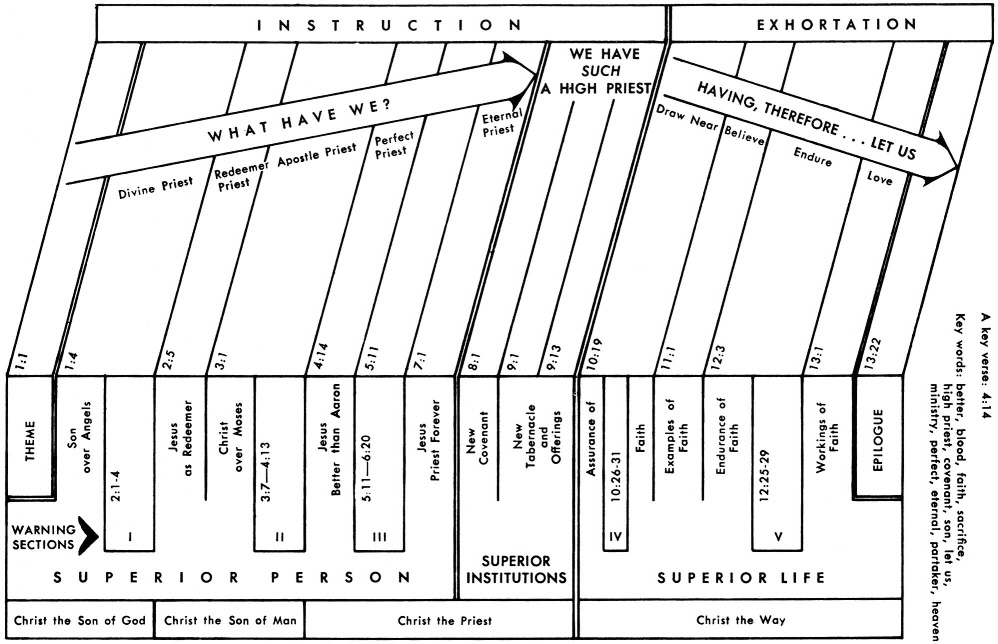
CONSIDER JESUS OUR GREAT HIGH PRIEST
Click chart to enlarge
Charts from Jensen's Survey of the NT - used by permission
Swindoll's Chart, Interesting Pictorial Chart of Hebrews, Another Chart
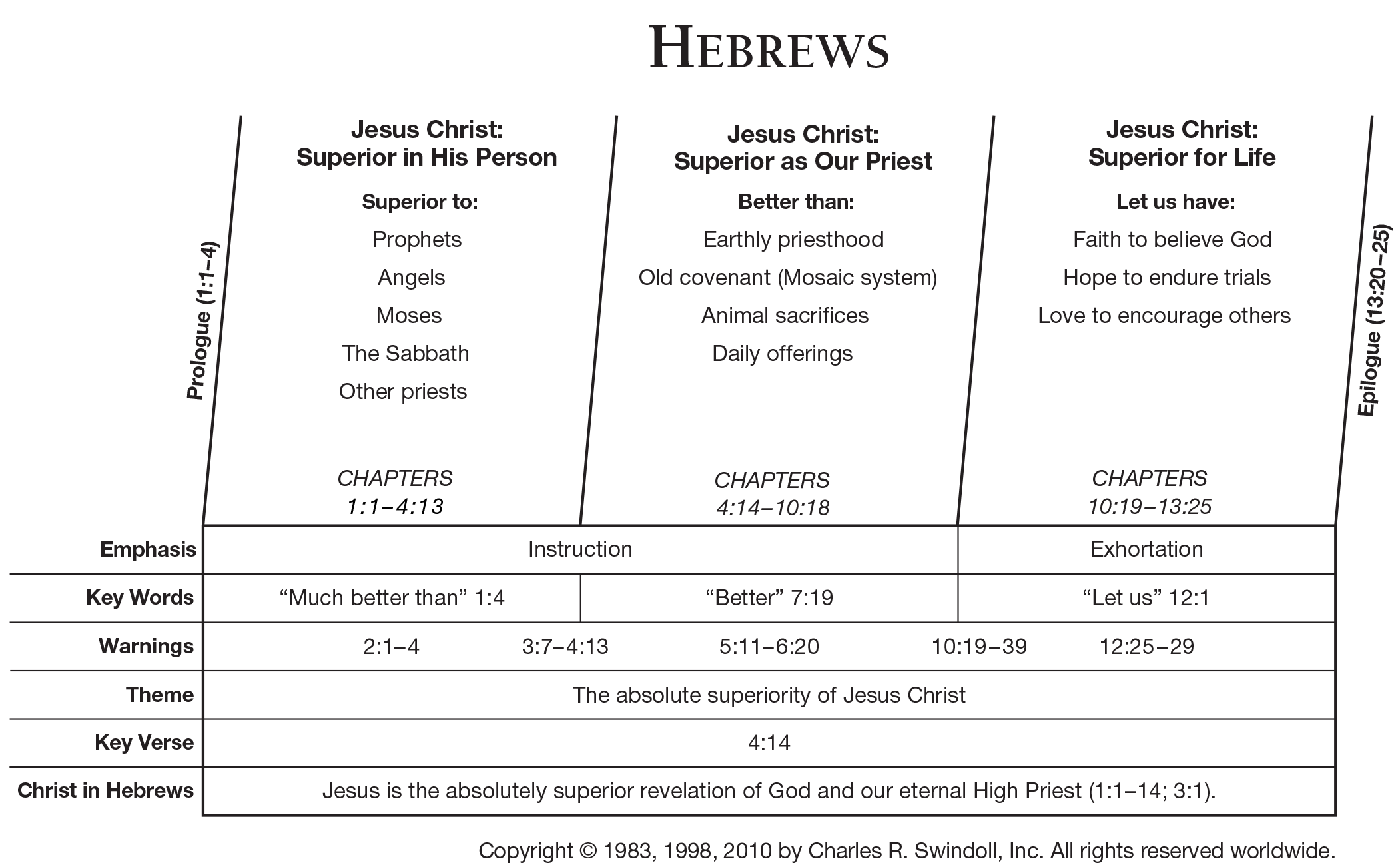
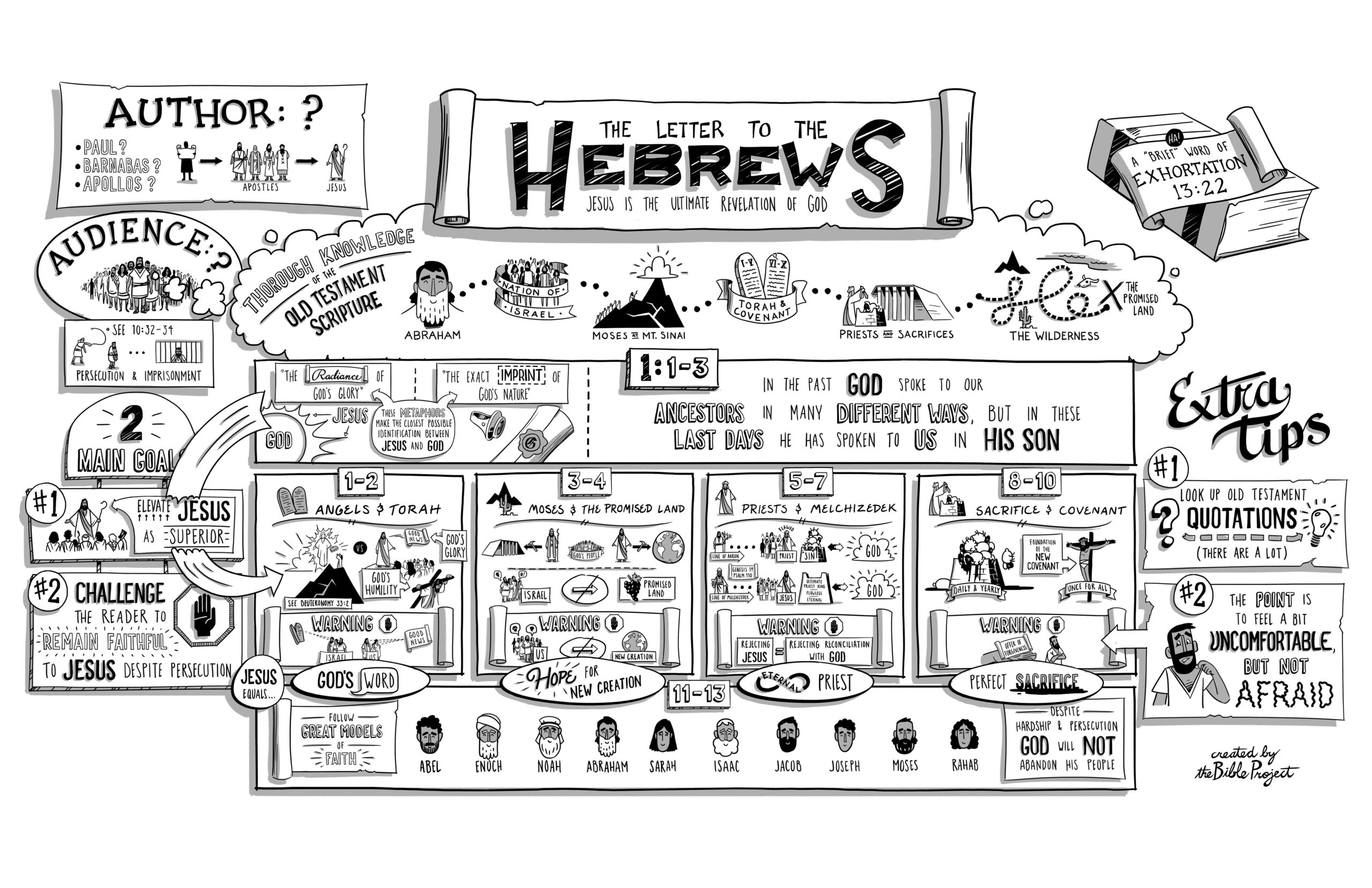
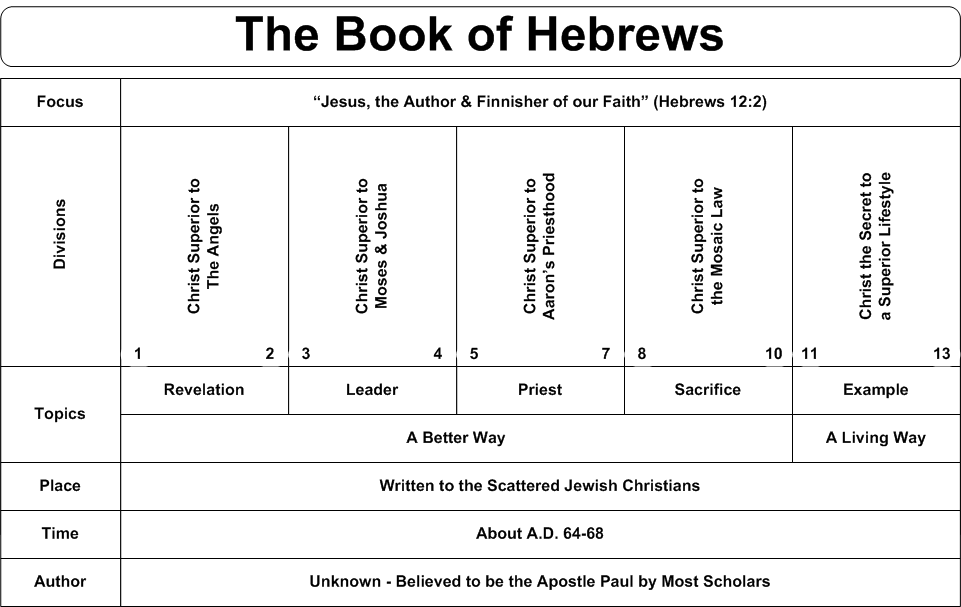
|
The Epistle |
||||
| INSTRUCTION Hebrews 1-10:18 |
EXHORTATION Hebrews 10:19-13:25 |
|||
| Superior Person of Christ Hebrews 1:1-4:13 |
Superior Priest in Christ Hebrews 4:14-10:18 |
Superior Life In Christ Hebrews 10:19-13:25 |
||
| BETTER THAN PERSON Hebrews 1:1-4:13 |
BETTER PRIESTHOOD Heb 4:14-7:28 |
BETTER COVENANT Heb 8:1-13 |
BETTER SACRIFICE Heb 9:1-10:18 |
BETTER LIFE |
| MAJESTY OF CHRIST |
MINISTRY OF CHRIST |
MINISTERS FOR CHRIST |
||
|
DOCTRINE |
DUTY |
|||
|
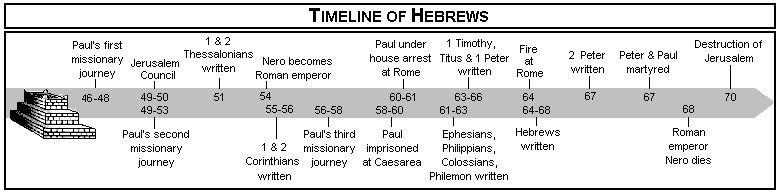
DATE WRITTEN: |
||||

See ESV Study Bible "Introduction to Hebrews"
(See also MacArthur's Introduction to Hebrews)
Borrow Ryrie Study Bible
Hebrews 12:12 Therefore, strengthen the hands that are weak and the knees that are feeble (NASB: Lockman)
Greek: Dio tas pareimenas (RPPFPA) cheiras kai ta paralelumena (RPPNPA) gonata anorthosate, (2PAMM)
Amplified: So then, brace up and reinvigorate and set right your slackened and weakened and drooping hands and strengthen your feeble and palsied and tottering knees, (Amplified Bible - Lockman)
NLT: So take a new grip with your tired hands and stand firm on your shaky legs. (NLT - Tyndale House)
Young's Literal: Wherefore, the hanging-down hands and the loosened knees set ye up;
THEREFORE STRENGTHEN THE HANDS THAT ARE WEAK AND THE KNEES THAT ARE FEEBLE: Dio tas pareimenas (RPPFPA) cheiras kai ta paralelumena kai ta paralelumena (RPPNPA) gonata anorthosate (2PAMM):
- He 12:3,5 Job 4:3,4 Isa 35:3 Eze 7:17 21:7 Da 5:6 Na 2:10 1Th 5:14
- Hebrew 12 Resources - Multiple Sermons and Commentaries
- Hebrews 12:12-14 Perseverance, Peace, and Purity - Steven Cole
- Hebrews 12:12-17 Falling Short of the Grace of God - John MacArthur
Notice that there is a subtle but important difference in the way modern versions render this passage. Most of the versions have "strengthen YOUR...." The NAS, KJV and NKJV (Young's Literal is similar) do not have "YOUR" but simply exhort "strengthen THE hands..." On the other hand the ESV, NIV, NLT all insert "YOUR." You are probably asking "So what?" Well, the "so what" is that the NAS, KJV, NKJV, YLT all indicate that this is a general exhortation to the readers to strengthen anyone's hands that are weak or knees that are feeble and this fits much better with the thought in Isaiah 35:3-4 where the exhortation is to the reader to encourage those who are exhausted and strengthen those who are feeble. John MacArthur gives more explanation in the note below.
John MacArthur explains the background for why the writer of Hebrews quotes from this encouraging OT passage - The writer of Hebrews got his metaphor from Isaiah. The faithful in Israel had been through a lot. They had many evil kings, some false prophets, generally disobedient and stubborn fellow Israelites, powerful enemies who threatened them, and seemingly no prospect of ever living in their own land in peace. They were discouraged and despondent, ready to give up. So the prophet reminds them of the coming kingdom, when "the wilderness and the desert will be glad" and "they will see the glory of the Lord, the majesty of our God" (Isa. 35:1-2). Then he counsels them to counsel each other: "Encourage the exhausted, and strengthen the feeble. Say to those with anxious heart, "Take courage, fear not. Behold, your God will come with vengeance; the recompense of God will come, but He will save you'" (Isa 35:3-4). In other words, "Don't give up now. A better day is coming. Look to that and you will have the encouragement and strength you need. Victory is ahead!" The emphasis of Hebrews 12:12 is the same as that of Isaiah 35:3-4. We are not told to strengthen our hands or our weak and feeble knees, but the hands and the knees, regardless of whose they are. In other words, we are not to concentrate on our own weaknesses but to help strengthen other Christians in theirs. One of the surest ways to be encouraged ourselves is to give encouragement to someone else, "encouraging one another; and all the more, as you see the day drawing near" (Heb. 10:25). One of the best ways to keep continuing is to encourage others to continue. (MacArthur New Testament Commentary – Hebrews)
Therefore (1352) (dio) is a relatively emphatic marker of a result, usually denoting that the inference is self-evident. Synonyms - So then. Consequently. For that reason. On which account. See the value of disciplining yourself to pause and ponder terms of conclusion.
Strengthen (461) (anorthoo from ana = again or up + orthoo = erect from orthos = right, upright, erect) means to make straight or upright again. To restore to straightness or erectness. To reinvigorate. Medical writers used it of the act of setting dislocated parts of the body. The aorist imperative calls for this to be done now. Don't delay. The sense is, “make upright or straight”—or in modern coaching terms, “Straighten up! Get those hands and feet up! Suck it in!”
Weak (3935) (pariemi from pará = aside + híemi = send) (only used in Lk 11:42, Heb 12:12) means to let by, to relax, to hang down, to pass by or over. Figuratively pariemi means to loosen. In the passive as in this verse it means enfeebled and describes hands hanging down from weariness or despondency.
The idea is, “Because chastening is thus necessary, and serves for a wholesome discipline, and issues in holiness” therefore… you are in the race of life… maybe you are growing faint and losing heart because of the variegated trials, conflicts and afflictions that you are experiencing… but now… now that you know the nature of your conflict is discipline and that this discipline is to be received and endured because it emanates from the heart of love of our heavenly Father, Who is treating us as His sons… and that the results of subjecting ourselves to His discipline include life, holiness, peaceful fruit of righteousness… therefore… knowing all of this truth… exert effort… lift up those hands and feet… start pumping… you're in a race with eternal rewards… expect agony, expect conflict, expect discipline but realize the goal of it all is an eternal weight of glory far beyond all comparison (2Cor 4:17-note)… and so also expect VICTORY, expect REWARD, expect that a tried & approved faith will receive great glory at the revelation of our Lord (1Pe 1:7-note).
Spurgeon - Come, children of God, do not be despondent because of your tribulations. You are in a race, so run; even while you are smarting from your chastisements, still run, and keep on running until you win the prize. Look at chastisement then in the divine light, and be comforted, be strengthened, be healed of the infirmity of your weakness; be strong in the Lord and in the might of His strength (Eph 6:10).
Also because they are in need of endurance (Hebrews 10:36-note)… they are in need of this exhortation. It's like a coach on the sidelines calling out the lap times, saying "Hold that pace… you're on a pace to finish the course… there's only a few laps to go and you can enter His Rest!" Amen! (Hebrews 4:3-note)
The experience of “hitting the wall” in a Marathon is a picture of weak hands, feeble knees. The exhortation implies that the readers are acting as though spiritually paralyzed.
This means to restore to straightness or erectness, to reinvigorate. The command to “strengthen” comes from the word from which we derive our English word orthopedic.
Weak hands and feeble knees was a common description of weakening and slackness (cf. Isa 13:7; 35:3; Jer 47:3; 50:43; Ezek 7:17; 21:7; Zeph 3:16, Job 4:3,4)
Stedman explains this verse noting that the writer is calling for his readers to "deal first with yourselves. Get your own hearts right toward your troubles. He has already pointed out the way to do so: by each coming boldly to the throne of grace “so that we may receive mercy and find grace to help us in our time of need” (Heb 4:16-note). He has said the same in Heb 12:2-note: “Let us fix our eyes on Jesus, the author and perfecter of our faith.” It is only as we know his help ourselves that we are able to aid anyone else in finding it. The plural imperative (strengthen, Gk “lift up”) implies a joint effort by many. We can help each other draw upon the resources of Christ by offering encouraging words and mutual prayers, sharing our experiences and sometimes simply being with someone who is under going trial.
Spurgeon - Cheer the heart when the limbs are weak. Tell the doubting that God is faithful. Tell those that feel the burden of sin that it was for sinners Christ died. Tell the backsliders that God never does cast away His people. Tell the desponding that the Lord delights in mercy. Tell the distracted that the Lord does devise means to bring back His banished. Covet the character of Barnabas. He was a son of encouragement. Study the sacred art of speaking a word in season. Apprentice yourself to the Comforter. Acquaint yourself with the sacred art of comforting the sad. Let your own troubles and trials qualify you to sympathize and relieve. You will be of great value in the Church of God if you acquire the art of compassion, and are able to help those that are bowed down.
Feeble (3886) (paraluo from pará = from + lúo = to loose) means to loosen beside, to relax, to weaken, to disable, to undo, to cause to be feeble, to be paralyzed. It is used in NT only in the passive voice (action from without or outside of the recipient). Here paraluo is in the perfect tense which pictures a permanent state and thus the idea of paralyzed, enfeebled or taken with palsy.
In the Septuagint paraluo can mean to be loosed (of garments) in Lev 13:45, to be weakened or enfeebled (speaking of one's limbs) in Jer 6:24, to be exhausted in Ge 19:11, to pay (a penalty) in Ge 4:15), to bring down (the proud) in Isa 23:9
Thayer says paraluo means "to loose on one side from the side; to loose or part things placed side by side; to loosen; to dissolve, hence to weaken, enfeeble."
Friberg says that in Hebrews 12:12 paraluo is used "idiomatically (ta paralelumena gonata anorthoun) literally strengthen paralyzed knees, i.e. become encouraged again, renew courage, make a new effort."
Paraluo - 5x in 5v
Luke 5:18 And some men were carrying on a bed a man who was paralyzed; and they were trying to bring him in and to set him down in front of Him.
24 "But, so that you may know that the Son of Man has authority on earth to forgive sins,"-- He said to the paralytic-- "I say to you, get up, and pick up your stretcher and go home."
Acts 8:7 For in the case of many who had unclean spirits, they were coming out of them shouting with a loud voice; and many who had been paralyzed and lame were healed.
Acts 9:33 There he found a man named Aeneas, who had been bedridden eight years, for he was paralyzed.
Hebrews 12:12 Therefore, strengthen the hands that are weak and the knees that are feeble,
Paraluo - 16v in the Septuagint - Ge 4:15; 19:11; Lev 13:45; Deut 32:36; 2 Sam 8:4; 1 Chr 18:4; Isa 23:9; 35:3; Jer 6:24; 46:15; 50:15, 36, 43; Ezek 7:27; 21:7; 25:9;
Genesis 19:11 They struck the men who were at the doorway of the house with blindness, both small and great, so that they wearied (Heb - laah = to be weary; Lxx = paraluo) themselves trying to find the doorway.
Deuteronomy 32:36 "For the LORD will vindicate His people, And will have compassion on His servants, When He sees that their strength is gone (Lxx = paraluo), And there is none remaining, bond or free.
Isaiah 35:3 Encourage the exhausted, and strengthen the feeble (Heb = kashal = to stumble, stagger, totter; Lxx = paraluo).
Jeremiah 6:24 We have heard the report of it; Our hands are limp (Heb = raphah = sink, relax ; Lxx = paraluo). Anguish has seized us, Pain as of a woman in childbirth.
Jeremiah 50:43 "The king of Babylon has heard the report about them, And his hands hang limp (Heb = raphah = sink, relax ; Lxx = paraluo); Distress has gripped him, Agony like a woman in childbirth. (Ezek 21:7 is similar with same Hebrew word)
Of course, the important thing is how God’s child responds to chastening. He can despise it or faint under it (Heb 12:5), both of which are wrong. He should show reverence to the Father by submitting to His will (Heb 12:9), using the experience to exercise himself spiritually (Heb 12:11; 1 Ti 4:7-8). Hebrews 12:12–13 sound like a coach’s orders to his team! Lift up your hands! Strengthen those knees! (Isa 35:3) Get those lazy feet on the track! (Pr 4:26) On your mark, get set, GO!
The example of God’s Son, and the assurance of God’s love, certainly should encourage us to endure in the difficult Christian race.
Happy is he who knows how to sustain with words him that is weary (Isa 50:4). Happy is he who accepts exhortation (Heb 13:22). And thrice happy is he whose faith is simple and strong so that he finds no occasion of stumbling in the Lord when His discipline is severe
Hebrews 12:13 and make straight paths for your feet, so that the limb which is lame may not be put out of joint, but rather be healed. (NASB: Lockman)
Greek: kai trochias orthas poieite (2PPAM) tois posin umon, ina me to cholon ektrape, (3SAPS) iathe (3SAPS) de mallon.
Amplified: And cut through and make firm and plain and smooth, straight paths for your feet [yes, make them safe and upright and happy paths that go in the right direction], so that the lame and halting [limbs] may not be put out of joint, but rather may be cured. (Amplified Bible - Lockman)
KJV: And make straight paths for your feet, lest that which is lame be turned out of the way; but let it rather be healed.
NLT: Mark out a straight path for your feet. Then those who follow you, though they are weak and lame, will not stumble and fall but will become strong. (NLT - Tyndale House)
NKJ and make straight paths for your feet, so that what is lame may not be dislocated, but rather be healed.
NET and make straight paths for your feet, so that what is lame may not be put out of joint but be healed.
BGT καὶ τροχιὰς ὀρθὰς ποιεῖτε τοῖς ποσὶν ὑμῶν, ἵνα μὴ τὸ χωλὸν ἐκτραπῇ, ἰαθῇ δὲ μᾶλλον.
CSB and make straight paths for your feet, so that what is lame may not be dislocated but healed instead.
ESV and make straight paths for your feet, so that what is lame may not be put out of joint but rather be healed.
NIV "Make level paths for your feet," so that the lame may not be disabled, but rather healed.
Wuest: And be making smooth paths for your feet, in order that that which is limping may not be wrenched out of joint, but rather that it be healed.
Young's Literal: and straight paths make for your feet, that that which is lame may not be turned aside, but rather be healed;
- and make: Pr 4:26,27 Isa 35:3,8-10 40:3,4 42:16 58:12 Jer 18:15 Lu 3:5
- straight paths for your feet: or, even
- so that the limb which is lame may not be put out of joint: Isa 35:6 Jer 31:8,9
- but rather be healed: Ga 6:1 Jude 1:22,23
- Hebrew 12 Resources - Multiple Sermons and Commentaries
- Hebrews 12:12-14 Perseverance, Peace, and Purity - Steven Cole
- Hebrews 12:12-17 Falling Short of the Grace of God - John MacArthur
and make straight paths for your feet, so that the limb which is lame may not be put out of joint, but rather be healed
The writer is quoting from Pr 4:26,27, cp Jer 18:15 cp highway of holiness Isa 35:8
Pr 4:26 Watch the path of your feet, And all your ways will be established. 27 Do not turn to the right nor to the left; Turn your foot from evil.
Jer 18:15 ‘For My people have forgotten Me, They burn incense to worthless gods And they have stumbled from their ways, From the ancient paths, To walk in bypaths, Not on a highway,
Isa 35:8 And a highway will be there, a roadway, And it will be called the Highway of Holiness. The unclean will not travel on it, But it [will] be for him who walks [that] way, And fools will not wander [on it].
MacArthur says the idea of the command to make straight paths is "staying in your own lane in the race. When you get out of your lane, you not only disqualify yourself but often interfere with other runners. A runner never intentionally gets out of his lane; he only does so when he is distracted or careless, when he loses his concentration on the goal, or when fatigue robs him of the will to win."Let your eyes look directly ahead, and let your gaze he fixed straight in front of you. Watch the path of your feet, and all your ways will be established. Do not turn to the right nor to the left; turn your foot from evil," we are told in Proverbs 4:25-27. When we set out in the race of faith, nothing should distract us or cause us to waver or change course. If we do, we will not only stumble ourselves but cause others to stumble as well. (MacArthur New Testament Commentary – Hebrews)
Make (4160) (poieo) means to do expressing action either as completed or continued. This is a command (present imperative) which calls for this to be their continual practice (something that ultimately can only be obeyed as one leans on the enabling power of the Holy Spirit!)
In short, this command speaks of our responsibility in the race of life so that we are enabled to run with endurance. While it is our responsibility, it is a responsibility we can only carry out by dependence on God's provision (His Spirit!) (compare our responsibility to work out in Php 2:12-note what God has worked in [God's Spirit indwelling and energizing both the desire and the power] Php 2:13-note).
MacArthur expands the meaning of make straight paths explaining that "When we run, we leave a track behind us, which will either lead or mislead others. We should take great care that the tracks we leave are straight. The only way we will leave a straight track is to live right and run a straight course." (MacArthur New Testament Commentary – Hebrews)Spurgeon - We are to make straight paths because of lame people. You cannot heal the man’s bad foot, but you can pick all the stones out of the path that he has to pass over. You cannot give him a new leg, but you can make the road as smooth as possible. Let there be no unnecessary stumbling blocks to cause him pain. The Lord Jesus Christ, the great Shepherd of the sheep, evidently cares for the lame ones. The charge he gives is a proof of the concern He feels. He bids us to be considerate of them, because He Himself takes a warm interest in their welfare. In Pilgrim’s Progress, when Mr. Greatheart went with Miss Much-afraid and Mr. Feeble-mind on the road to the Celestial City, he had his hands full. He says of poor Mr. Feeble-mind that, when he came to the lions, he said, “Oh, the lions will have me!” And he was afraid of the giants, and afraid of everything on the road. It caused Greatheart much trouble to get him on the road. It is so with you. You must know that you are very troublesome and hard to manage. But then our Lord Jesus is very patient; He does not mind taking trouble. He has laid down His life for you, and He is prepared to exercise all His divine power and wisdom to bring you home to His Father’s house. (Spurgeon's Sermons - Lame Sheep.
Wuest comments: "The exhortation is to the born-again Jews who had left the temple, to live such consistent saintly lives, and to cling so tenaciously to their new-found faith, that the unsaved Jews who had also left the temple and had outwardly embraced the NT truth, would be encouraged to go on to faith in Messiah as High Priest, instead of returning to the abrogated sacrifices of the Levitical system. These truly born-again Jews are warned that a limping Christian life would cause these unsaved Jews to be turned out of the way. These latter had made a start towards salvation by leaving the temple and making a profession of Messiah. But they needed the encouraging example and testimony of the saved Jews. The words “turned out of the way” are the translation of another medical term, ektrepo “to turn or twist out.”
Spurgeon - There are some believers with strong and vigorous faith. Soaring high, they can mount up with wings as eagles. Fleet of foot, they can run, and not be weary; or, with steady progress, they can walk, and not faint. But all are not so highly privileged. I suppose there is seldom a family that has no sickly member. However hale and hearty most of the sons and daughters may be, there is likely to be some weak one amongst them. So it certainly is in the spiritual household. Some Christian people seem to be so inconsiderate and unsympathizing that they treat all the lame of the flock with harshness. You may be strong and vigorous in your physical constitution, strangers to nervousness and depression of spirits. Be thankful, then, but do not be presumptuous. Do not despise those who suffer from infirmities that have never come upon you. Your turn may come before long. The good that will come out of their trouble will abundantly recompense them. They are not to expect to see that good at once. It will come later—not yet. No reasonable man expects the harvest (cp "peaceful fruit of righteousness" in Heb 12:11-note) at the same time that he sows. You must wait a while. Bear with patience; have confidence in God, and all your trials will end well.
Straight (3717) (3717)(orthos - "orthopedics) means "(1) of direction; literally straight, in a straight line; figuratively, of persevering on a correct course of life toward a goal straight, right (Heb 12.13); (2) literally, of a standing position upright, erect (Acts 14.10)." (Friberg) Robertson adds that "In this sense Galen and Hippocrates frequently use orthos (erect, straight)."
Gilbrant on orthos in this passage - Figuratively, in Hebrews 12:13 the writer exhorted, “...make straight paths.” The context of verses 12 and 13 is best understood by comparing Isaiah 35:3 (God’s promise to heal and save) and Proverbs 4:26 (an exhortation to evaluate whether a person’s life goals and directions are based on the Word of God). The description in verse 13 stresses that those who do not advance in their faith may soon become completely disabled and abandon their faith in Christ (cf. verse 15). Those who are not moving towards the Kingdom risk “falling back” from it." (Complete Biblical Library Greek-English Dictionary)The picture is of turning aside in a race or could be a medical figure of putting a limb out of joint. The exhortation is “exert yourselves to make the course clear for yourselves and your fellow-Christians, so that there be no stumbling & becoming lame & unable to finish the race and enter "Rest”
Paths (5163)(trochia from trochos = wheel) is a feminine noun used here in the NT and literally refers to the track of a wheel and thus a "rut" left by a cart or chariot. Other travelers would follow this "rut" or path. In this passage trochia is used figuratively of one's way of life and/or conduct.The Septuagint uses trochos 6 times all in the book of Proverbs which is not surprising in view of the fact this wisdom book has a lot to say about "paths" which one chooses to take. Comparing Hebrews 12:13 to these uses in Proverbs it is clear that the writer of Hebrews is following closely the exhortation in Proverbs 4:26.
Proverbs 2:15 Whose paths are crooked, And who are devious in their ways;
Proverbs 4:11 I have directed you in the way of wisdom; I have led you in upright paths.
Proverbs 4:26 Watch the path of your feet And all your ways will be established.
Proverbs 4:27 Do not turn to the right nor to the left; Turn your foot from evil.
Proverbs 5:6 She does not ponder the path of life; Her ways are unstable, she does not know it.
Proverbs 5:21 For the ways of a man are before the eyes of the LORD, And He watches all his paths.
Lame (5560) (cholos from chalao = to slacken, loosen) is an adjective describes that which is lame. Here in Hebrews 12:13 cholos speaks of "lame" in a spiritual sense. In context, it refers especially to those among the recipients (some of which were professors and not yet genuine believers) who were most seriously affected by the persecutions, and who were on the verge of going back to the temple sacrifices. Lame thus refers to weak believers who can be easily tripped up or misled.
The related verb cholaino (to be or go lame) is used in 1 Ki 18:21 "Elijah came near to all the people and said, “How long will you hesitate (Heb = pasach = to limp; Lxx = cholaino - NET has "paralyzed by indecision") between two opinions? If the LORD is God, follow Him; but if Baal, follow him.” But the people did not answer him a word."
Gilbrant on cholos - The adjective chōlos describes a physical “disability that involves the imperfect function of the lower limbs” (Louw and Nida, Greek-English Lexicon, 1:273) that might range in severity from causing a limp to an inability to walk. It can also describe impaired functioning of the hands. Though most often used in a literal sense of actual physical handicap, chōlos is also used metaphorically to describe other kinds of defects (cf. Hebrews 12:13). This adjective is used in both the Septuagint and the New Testament to designate the group of people who suffer such afflictions, usually grouped together with “the blind” and other handicapped groups. Since the Law forbade the full cultic participation of people who were physically impaired, the healing of such people and their consequent reintegration into society was symbolic of the glories of the coming kingdom of God in both the Old and New Testaments (cf. Matthew 11:4-6 and Isaiah 35:5,6 which is alluded to there). (Complete Biblical Library Greek-English Dictionary)
MacArthur notes that "The Septuagint (Greek Old Testament) uses the same word (chōlos, "lame, hesitate") in 1 Kings 18:21 (ED: THIS IS NOT EXACTLY CORRECT - THE VERB FORM CHOLAINO IS USED AND IT MEANS TO WALK LAMELY AND FIGURATIVELY TO VACILLATE) that the writer uses in Hebrews 12:13. Elijah was confronting lame, vacillating Israelites and trying to persuade them to take a side. The writer of Hebrews was warning believers about the danger of misleading lame, uncommitted unbelievers and of causing them to apostatize back into Judaism. Under the pressure of persecution, these professing but unbelieving Jews were beginning to doubt the gospel and to weaken in commitment. Inconsistent Christians leaving wandering paths would be no help. Sadly, Christians sometimes are the greatest stumbling blocks to Christianity. A bad example by a true believer can tilt a person away from full commitment to Christ, and therefore from salvation. A poor testimony can cause irreparable harm, many times without our knowing it. It can cause an already limping unbeliever to be put out of joint, completely dislocated spiritually. (Ibid)
Cholos - 14x in 14v - lame (14) Matt. 11:5; Matt. 15:30; Matt. 15:31; Matt. 18:8; Matt. 21:14; Mk. 9:45; Lk. 7:22; Lk. 14:13; Lk. 14:21; Jn. 5:3; Acts 3:2; Acts 8:7; Acts 14:8; Heb. 12:13
Cholos - 12x in 11v in the Septuagint Lev. 21:18; Deut. 15:21; 2 Sam. 5:6; 2 Sam. 5:8; 2 Sam. 9:13; 2 Sam. 19:26; Job 29:15; Isa. 33:23; Isa. 35:6; Mal. 1:8; Mal. 1:13
Put out of joint (1624) (ektrepo from ek = from + trépo = turn) means to deflect, turn away, avoid, turn aside or out of the way. Ektrepo sometimes was used medically to refer to a dislocated joint conveying the thought of having something thrown out of joint, as in a sprain or twist. The minds and hearts of those who reject God’s Word become spiritually dislocated, knocked out of joint. Paul used the same verb in his last epistle explaining to Timothy that "and will turn away (apostrepho) their ears from the truth, and will turn aside (ektrepo) to myths (2Ti 4:4-note)
Healed (2390)(iaomai) is used literally of deliverance from physical diseases and afflictions and so to make whole, restore to bodily health or heal. To cause someone to achieve health after having been sick, usually not used in the sense of a normal process, sometimes related to evil supernatural powers, a sudden event as a sign. In the passive it means to be healed or cured. Although iaomai usually refers to physical healing it can also refer to spiritual healing ( "for by His wounds you were healed" - 1Pe 2:24-note)
R Kent Hughes gives a vivid description of this verse - FINISHING WELL—WHAT TO DO (VV. 12–14) Run Tough - The telltale signs of flagging energy are drooping arms, flopping hands, and wobbling knees that reduce the runner’s stride to a mincing gait. These signs were proverbial in Biblical culture for mental and spiritual slowdown. Isaiah encouraged his despairing, stumbling people by saying, “Strengthen the feeble hands, steady the knees that give way; say to those with fearful hearts, ‘Be strong, do not fear; your God will come’ ” (Isa 35:3, 4). Job was heartened by Eliphaz, the Temanite who reminded him, “Think how… you have strengthened feeble hands. Your words have supported those who stumbled; you have strengthened faltering knees” (Job 4:3, 4).
So here the preacher, like an attentive coach, employs the proverbial exhortation, “Therefore, strengthen your feeble arms and weak knees” (Heb 12:12). The command to “strengthen” comes from the word from which we derive our English word orthopedic. The sense is, “make upright or straight”—or in modern coaching terms, “Straighten up! Get those hands and feet up! Suck it in!”
Of course, he is not promoting a do-it-yourself, bootstrap Christian life. But Christians must will to tough it out by God’s grace. Life for the believer is full of repeated hardships that come as divine discipline. In fact, these disciplines are substantive signs that we are authentic sons and daughters (cf. Heb 12:7, 8). But they still require grit every bit analogous to the determined marathoners. Muscular Christianity is a must! Run tough!
Run Tough Together - Toughing it out is essential, but there is still more to the idea because this toughness is not meant to be a solo venture. In the next verse the writer alludes to Proverbs 4:25–27 as he calls his people to corporate toughness in helping one another to run well: “ ‘Make level paths for your feet,’ so that the lame may not be disabled, but rather healed” (v. 13). Here the NIV translates orthas, which normally means “straight,” as “level,” 2 but the idea remains clear—to put the paths in better order so as to make the race easier for the lame—“so that the lame may not be disabled” (literally, “put out of joint”).3
Note "3" - F. F. Bruce, The Epistle to the Hebrews (Grand Rapids, MI: Eerdmans, 1964), pp. 364, 365 explains: The verb translated “be… turned out of the way” should rather be rendered “be put out of joint” (ARV margin, RSV, NEB); it is dislocation and not deviation that is suggested by the following words, “but rather be healed.” Sprains and similar injuries must be bound up, so that the whole community may complete the course without loss.
The point is, every consideration should be made to help everyone finish the race. The bloodied, blistered Boston Marathoners teaming up to help each other, limping along arm-in-arm, are a vivid metaphor of this idea. But the church should include not only the weak assisting the weak, but also the strong teaming up with the weak in what Bishop Westcott called “the duty of mutual help.” 4
Hebrews is full of this idea of helping each other make it: “But encourage one another daily, as long as it is called Today, so that none of you may be hardened by sin’s deceitfulness” (Heb 3:13). “Therefore, since the promise of entering his rest still stands, let us be careful that none of you be found to have fallen short of it” (Heb 4:1). “Let us, therefore, make every effort to enter that rest, so that no one will fall by following their example of disobedience” (Heb 4:11). “We want each of you to show this same diligence to the very end, in order to make your hope sure” (Heb 6:11). “Let us not give up meeting together, as some are in the habit of doing, but let us encourage one another” (Heb 10:25). (See Hebrews: An Anchor for the Soul)
Our Daily Bread - Road Builders - The cover of a recent Our Daily Bread pictures a leaf-strewn road through the mountains of Vermont. Those who use the road can enjoy a smooth and beautiful ride over difficult terrain. To make this possible, others had to work hard to chart the route, clear the trees, and level the rough spots.
In a way, all Christians are road builders. We are paving the way of faith for the next generation. The faithfulness of our lives may determine how difficult their journey will be. Will they have to repair the damage we have done to the road? Will they be able to build new roads for others to find the way to God?
To be good road builders, we must heed the advice found in God's Word. The author of Hebrews instructed us to live in peace and be holy (12:14), to make sure no one misses the grace of God, and not to permit a root of bitterness to grow and cause trouble (v.15).
Those of us who have come to Jesus owe gratitude to those who have made "straight paths" for our walk of faith (v.13). In turn, we must remember those who will follow us and make straight paths for them. Let's practice our faith in a way that makes it easy for others to come to Jesus and to follow Him. What kind of road builder are you?—Julie Ackerman Link (Our Daily Bread, Copyright RBC Ministries, Grand Rapids, MI. Reprinted by permission. All rights reserved)
Oh, may all who come behind us find us faithful;
May the fire of our devotion light their way;
May the footprints that we leave lead them to believe,
And the lives we live inspire them to obey.
—Mohr © 1987 Jonathan Mark Music and Birdwing Music
A life lived for God leaves a lasting legacy.