Hebrews 12:1
Hebrews 12:2
Hebrews 12:3
Hebrews 12:4
Hebrews 12:5
Hebrews 12:6
Hebrews 12:7
Hebrews 12:8
Hebrews 12:9
Hebrews 12:10
Hebrews 12:11
Hebrews 12:12
Hebrews 12:13
Hebrews 12:14
Hebrews 12:15
Hebrews 12:16
Hebrews 12:17
Hebrews 12:18
Hebrews 12:19
Hebrews 12:20
Hebrews 12:21
Hebrews 12:22
Hebrews 12:23
Hebrews 12:24
Hebrews 12:25
Hebrews 12:26
Hebrews 12:27
Hebrews 12:28
Hebrews 12:29
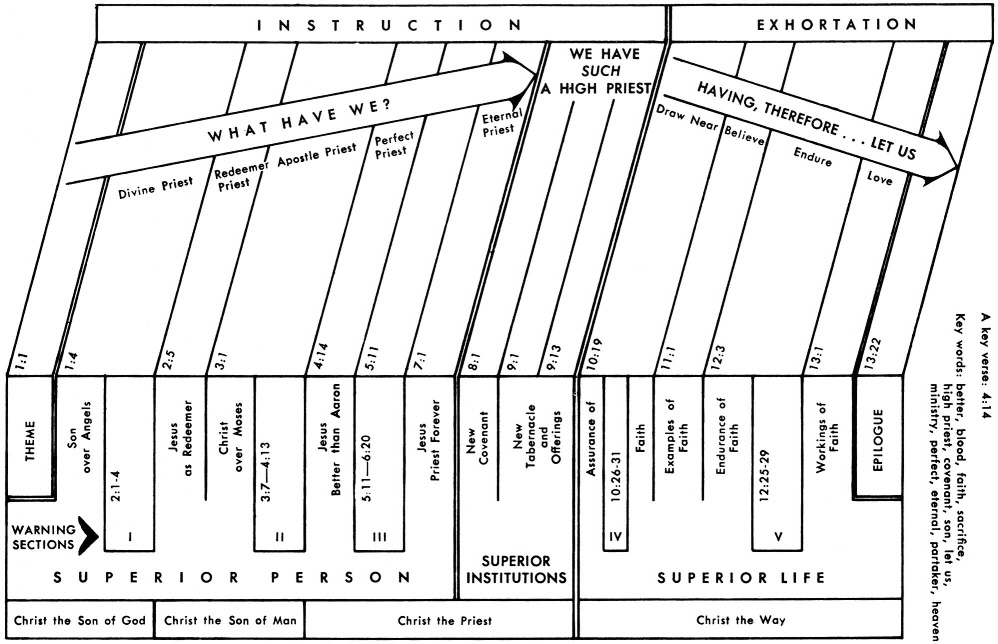
CONSIDER JESUS OUR GREAT HIGH PRIEST
Click chart to enlarge
Charts from Jensen's Survey of the NT - used by permission
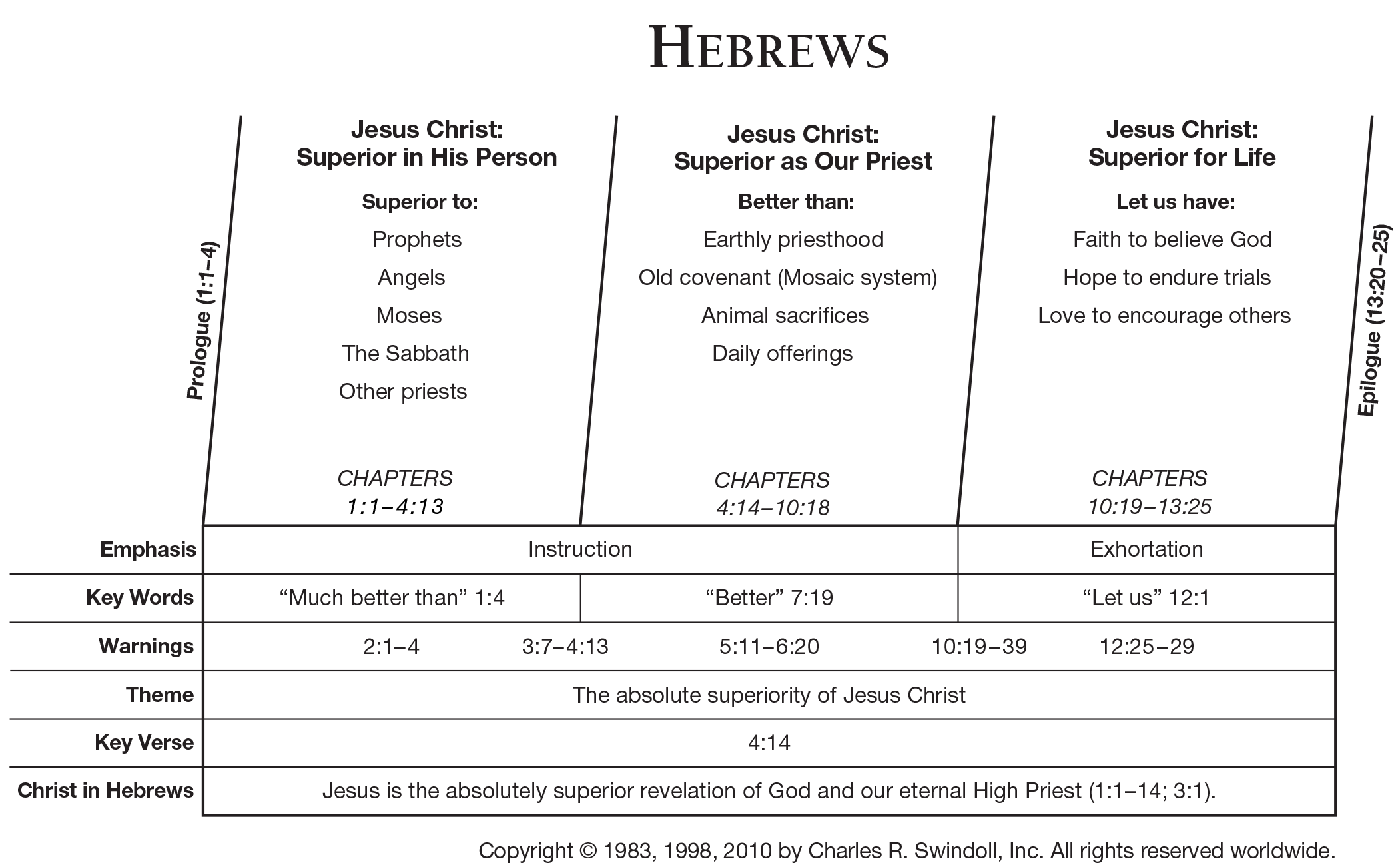
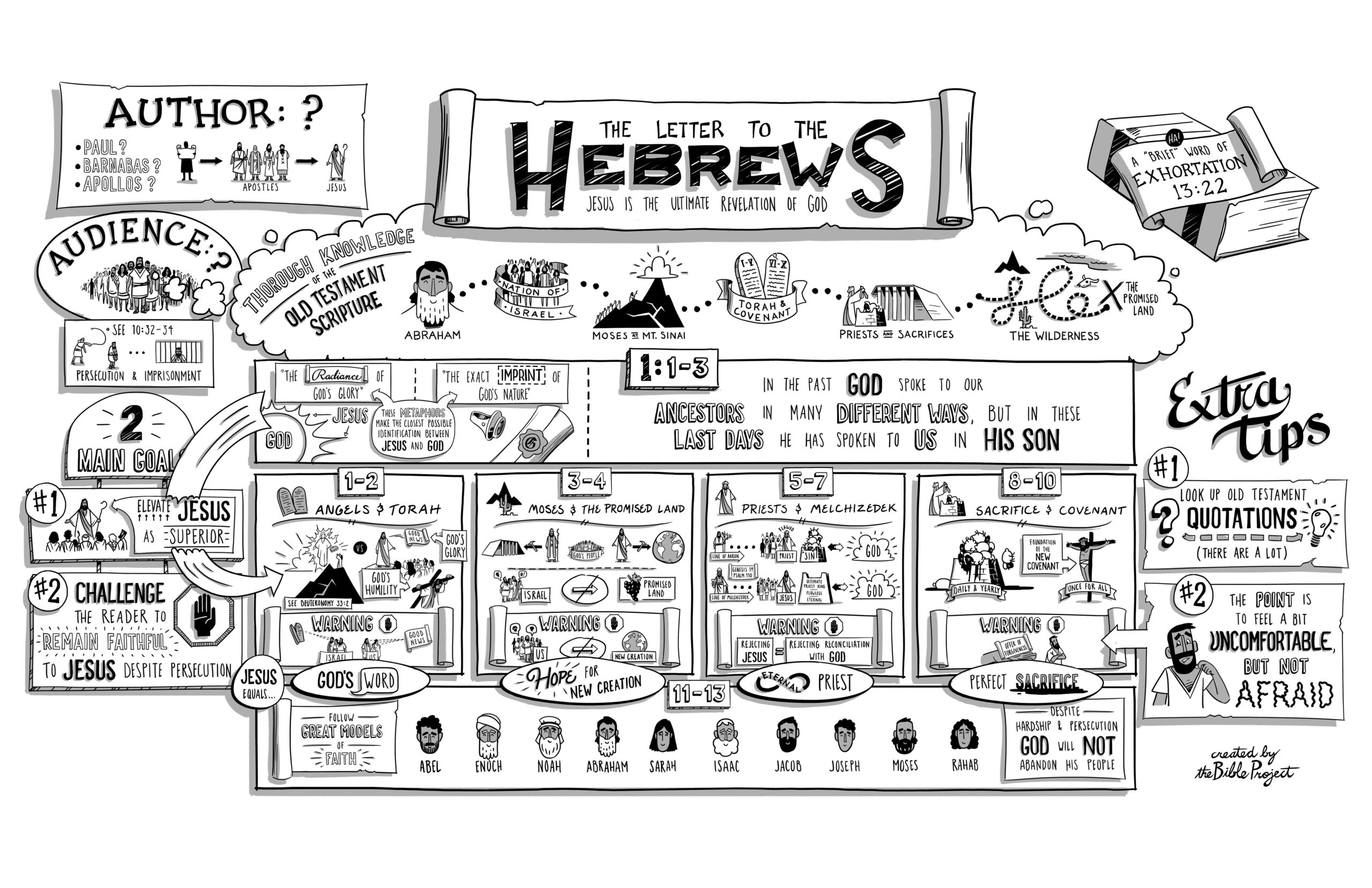
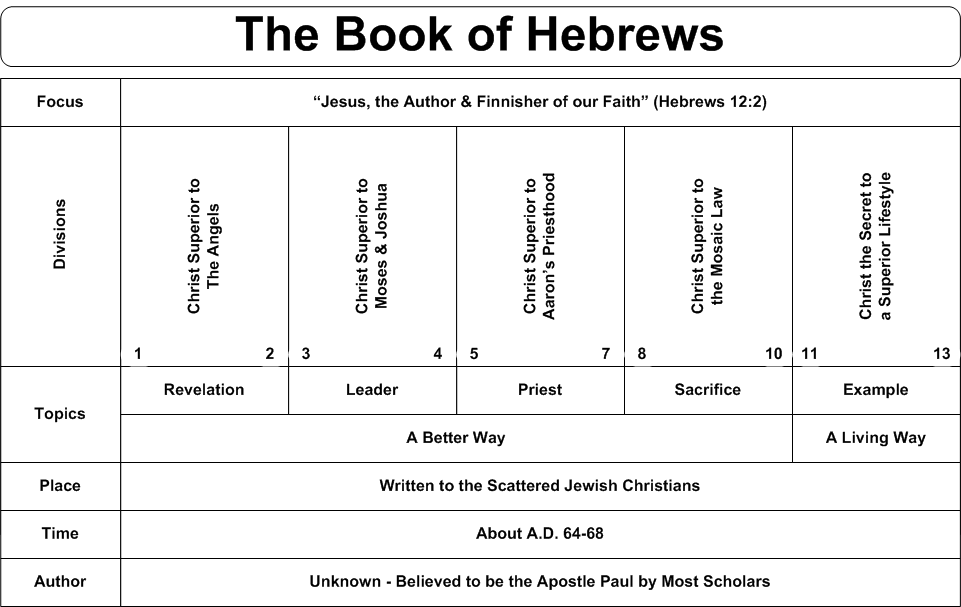
Swindoll's Chart, Interesting Pictorial Chart of Hebrews, Another Chart
|
The Epistle |
||||
| INSTRUCTION Hebrews 1-10:18 |
EXHORTATION Hebrews 10:19-13:25 |
|||
| Superior Person of Christ Hebrews 1:1-4:13 |
Superior Priest in Christ Hebrews 4:14-10:18 |
Superior Life In Christ Hebrews 10:19-13:25 |
||
| BETTER THAN PERSON Hebrews 1:1-4:13 |
BETTER PRIESTHOOD Heb 4:14-7:28 |
BETTER COVENANT Heb 8:1-13 |
BETTER SACRIFICE Heb 9:1-10:18 |
BETTER LIFE |
| MAJESTY OF CHRIST |
MINISTRY OF CHRIST |
MINISTERS FOR CHRIST |
||
|
DOCTRINE |
DUTY |
|||
|
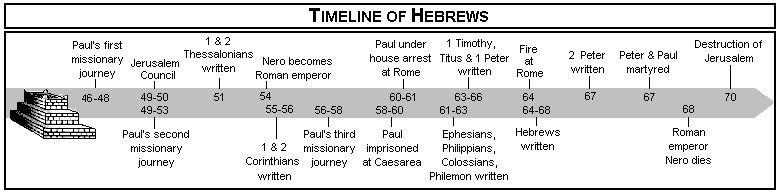
DATE WRITTEN: |
||||

See ESV Study Bible "Introduction to Hebrews"
(See also MacArthur's Introduction to Hebrews)
Borrow Ryrie Study Bible
Hebrews 12:25 See to it that you do not refuse Him who is speaking. For if those did not escape when they refused him who warned them on earth, much less will we escape who turn away from Him who warns from heaven. (NASB: Lockman)
Greek: Blepete (2PPAM) me paraitesesthe (2PAMS) ton lalounta; (PAPMSA) ei gar ekeinoi ouk ecephugon (2PAAI) epi ges paraitesamenoi (AMPMPN) ton chrematizonta, (PAPMSA) polu mallon emeis oi ton ap' ouranon apostrephomenoi; (PMPMPN)
BGT Βλέπετε μὴ παραιτήσησθε τὸν λαλοῦντα· εἰ γὰρ ἐκεῖνοι οὐκ ἐξέφυγον ἐπὶ γῆς παραιτησάμενοι τὸν χρηματίζοντα, πολὺ μᾶλλον ἡμεῖς οἱ τὸν ἀπ᾽ οὐρανῶν ἀποστρεφόμενοι,
Amplified: So see to it that you do not reject Him or refuse to listen to and heed Him Who is speaking [to you now]. For if they [the Israelites] did not escape when they refused to listen and heed Him Who warned and divinely instructed them [here] on earth [revealing with heavenly warnings His will], how much less shall we escape if we reject and turn our backs on Him Who cautions and admonishes [us] from heaven? (Amplified Bible - Lockman)
KJV See that ye refuse not him that speaketh. For if they escaped not who refused him that spake on earth, much more shall not we escape, if we turn away from him that speaketh from heaven:
NKJ See that you do not refuse Him who speaks. For if they did not escape who refused Him who spoke on earth, much more shall we not escape if we turn away from Him who speaks from heaven,
NET Take care not to refuse the one who is speaking! For if they did not escape when they refused the one who warned them on earth, how much less shall we, if we reject the one who warns from heaven?
CSB Make sure that you do not reject the One who speaks. For if they did not escape when they rejected Him who warned them on earth, even less will we if we turn away from Him who warns us from heaven.
ESV See that you do not refuse him who is speaking. For if they did not escape when they refused him who warned them on earth, much less will we escape if we reject him who warns from heaven.
NIV See to it that you do not refuse him who speaks. If they did not escape when they refused him who warned them on earth, how much less will we, if we turn away from him who warns us from heaven?
NLT: See to it that you obey God, the one who is speaking to you. For if the people of Israel did not escape when they refused to listen to Moses, the earthly messenger, how terrible our danger if we reject the One who speaks to us from heaven! (NLT - Tyndale House)
Wuest: Constantly be seeing to it that ye do not disavow Him who is speaking. For if, as is the case, those did not escape who disavowed Him that warned (them) upon earth, much rather shall not we escape who are turning away from the One who is speaking from heaven.
Young's Literal: See, may ye not refuse him who is speaking, for if those did not escape who refused him who upon earth was divinely speaking -- much less we who do turn away from him who speaketh from heaven,
- See to it - He 8:5 Ex 16:29 1Ki 12:16 Isa 48:6 64:9 Mt 8:4 1Th 5:15 1Pe 1:22 Rev 19:10 22:9
- refuse: Pr 1:24, 8:33, 13:18, 15:32 Jer 11:10 Eze 5:6 Zec 7:11 Mt 17:5 Ac 7:35
- Hebrew 12 Resources - Multiple Sermons and Commentaries
- Hebrews 12:18-29 Mount Sinai or Mount Zion? - John MacArthur
Related Passages:
Hebrews 1:1-2+ God, after He spoke long ago to the fathers in the prophets in many portions and in many ways, 2 in these last days has spoken to us in His Son, whom He appointed heir of all things, through whom also He made the world.
Hebrews 2:1-3+ For this reason we must pay much closer attention to what we have heard, so that we do not drift away from it. 2 For if the word spoken through angels (BUT ULTIMATELY FROM GOD) proved unalterable, and every transgression and disobedience received a just penalty, 3 how will we escape if we neglect so great a salvation? After it was at the first spoken through the Lord, it was confirmed to us by those who heard,
Hebrews 3:7-8+ Therefore, just as the Holy Spirit says, “TODAY IF YOU HEAR HIS VOICE, 8 (WARNING) DO NOT HARDEN YOUR HEARTS AS WHEN THEY PROVOKED ME, AS IN THE DAY OF TRIAL IN THE WILDERNESS,
Deuteronomy 18:19+ ‘It shall come about that whoever will not listen to My words which he (IN CONTEXT MESSIAH) shall speak in My name, I Myself will require it of him.
Matthew 17:5+ While he was still speaking, a bright cloud overshadowed them, and behold, a voice out of the cloud said, “This is My beloved Son, with whom I am well-pleased; listen (COMMAND present imperative see our need to depend on the Holy Spirit to obey) to Him!”
Acts 3:22-23+ “Moses said, ‘THE LORD GOD WILL RAISE UP FOR YOU A PROPHET (MESSIAH) LIKE ME FROM YOUR BRETHREN; TO HIM YOU SHALL GIVE HEED to everything He says to you. 23 ‘And it will be that every soul that does not heed that prophet shall be utterly destroyed from among the people.’
Deuteronomy 5:23-24+ And it came about, when you heard the voice from the midst of the darkness, while the mountain was burning with fire, that you came near to me, all the heads of your tribes and your elders. And you said, 'Behold, the LORD our God has shown us His glory and His greatness, and we have heard His voice from the midst of the fire; we have seen today that God speaks with man, yet he lives.
Proverbs 1:24 “Because I called, and you refused; I stretched out my hand, and no one paid attention;
Proverbs 8:33 “Heed instruction and be wise, And do not neglect [it.]
Proverbs 13:18 Poverty and shame [will come] to him who neglects discipline, But he who regards reproof will be honored.
Proverbs 15:32 He who neglects discipline despises himself, But he who listens to reproof acquires understanding.
Ezekiel 5:6 But she has rebelled against My ordinances more wickedly than the nations and against My statutes more than the lands which surround her; for they have rejected My ordinances and have not walked in My statutes.’
Zechariah 7:11 “But they refused to pay attention, and turned a stubborn shoulder and stopped their ears from hearing.
Hebrews 12:15 (FIRST "SEE" IN HEBREWS 12) See to it (episkopeo) that no one comes short of the grace of God; that no root of bitterness springing up causes trouble, and by it many be defiled;
Hebrews 3:12+ (SAME VERB AS Heb 12:25) TAKE CARE (blepo present imperative see our need to depend on the Holy Spirit to obey), brethren, that there not be in any one of you an evil, unbelieving heart that falls away from the living God.
WARNING NOT TO REFUSE
GOD SPEAKING FROM HEAVEN
Having painted the awe-inspiring contrast between Mount Sinai and Mount Zion, the writer now moves from privilege to responsibility, from access to accountability. The God who once thundered from Sinai still speaks — but now He speaks graciously through His Son (Heb 1:2+). Yet the danger remains the same: to refuse His voice.
Ray Stedman - Since believers in Christ now possess such enormous resources for living as those just described, it is of the utmost importance to act in accordance with them. Truth simply understood is never acceptable in and of itself; it is truth done that counts! So, for the fifth time in this epistle, the author warns against turning back from the truth they have learned as professing Christians to a more comfortable and less demanding life in Judaism or to an accommodation to the unbelieving lifestyles around them. (Faith Trained and Tested)
See to it (blepo) is a command in the present imperative calling for continual close attention and for continual dependence on the Holy Spirit to obey. When God speaks the readers (and us) must pay attention! They must constantly guard against dullness of hearing (Heb 5:11) or spiritual drift (Heb 2:1). This solemn command forms the climactic warning of the epistle — the fifth and final warning passage (cf. Heb 2:1-4; Heb 3:7–4:11; Heb 5:11–6:8; Heb 10:26-31). Each previous warning has built in intensity, but now the writer contrasts those who refused God’s voice on earth (Sinai) and suffered temporal judgment with those who might now refuse His voice from heaven, leaving them in an infinitely greater peril (Heb 12:25-27).
Spurgeon writes "see to it" means they are to “be very circumspect that by no means, accidental or otherwise, you refuse the Christ of God, who now in the gospel speaks to you. Be watchful, be earnest, lest even through inadvertence you should refuse the prophet of the gospel dispensation—Jesus Christ, the Son of God, who speaks in the gospel from heaven to the sons of men.” It means, “Give earnest heed and careful attention that by no means and in no way you refuse Him who speaks.” (God's Word Not to Be Refused)
That you do not refuse (paraiteomai) Him Who is (present tense - continually) speaking (laleo) - Note the two "not's" in this verse, which will end up tying the refuser into an "eternal knot" so to speak! The writer is directly addressing his Hebrew readers, some of whom may still be wavering and considering returning to Judaism. Given the striking contrast between negatives of Mt Sinai (Heb 12:18-21 and the strong positives of Mt Zion (Heb 12:22-24), it is hard to believe that anyone Jewish reader would not want to enter Mt Zion. But apparently the writer (inspired by the Spirit) sees that this is still a possibility and thus sounds this clear warning! The verb refuse (paraiteomai) is in the middle voice which speaks of the person initiating the action (to refuse) and participating in the effect or result. To say it another way, the middle voice carries a reflexive nuance. This means the action turns back on the subject. Thus the sense is not merely “do not refuse,” but more precisely, “you yourselves do not refuse,” emphasizing the personal responsibility and active involvement of the hearers in guarding themselves from this danger. In short it This intensifies the warning -- they must take care personally, deliberately, and continually not to turn away from the One who is speaking. It is interesting that this verb refuse (paraiteomai) was used of those who beg off from an invitation (Lk 14:18–19+). In the present context the "refuser" would be begging off God's invitation to eternal life!
Every word from God demands a response
—silence is still a response.
The phrase Him Who is speaking (laleo) uses the present tense, highlighting that God is continually speaking. This is not a one-time word but an ongoing divine address. The Speaker is God Himself, who now speaks from heaven and, as Hebrews 1:2+ affirms, speaks in His Son—the final and full revelation (cf. John 1:18+). The writer is drawing a sharp contrast. At Sinai, God’s voice thundered from an earthly mountain through Moses and also with His own voice (cf Ex 20:1+, Dt 5:4+, Dt 4:11, 12+). In the New Covenant, God’s voice comes from heaven (from "Mt Zion") through the Son, the Mediator Whose word carries even greater authority and urgency. It was the audible speaking that terrified Israel and caused them to beg that no further word be spoken to them and they requested Moses to be their mediator (Heb 12:19+, cp Ex 20:18–19+, Dt 5:24,25+).
Jesus is speaking (see Heb 1:2+, Heb 2:1-2+ ; Heb 2:3+, cp Heb 3:7+, Heb 3:16+). Those who disobeyed the voice of God as it was heard in the law at Mt Sinai were punished accordingly (Heb 2:2+). When privilege is greater, responsibility is also greater. Those who reject His voice as it now speaks from heaven in the gospel are more responsible than those who broke the law. Escape is impossible.
Wuest on Him Who is speaking - The phrase “Him that speaketh” refers back to Jesus, the Mediator of the New Testament whose blood speaks of better things than the sacrificial blood which Abel shed. It is Messiah speaking to these first-century Jews by means of His blood." (Hebrews)
Revelation received but not obeyed
becomes condemnation.
The writer has already insisted that it was God’s voice that Israel chose to disregard in the wilderness (see Heb 3:7-9+; Heb 3:10-11+ ; Heb 3:16-17+; Heb 3:18+). And what was the result? Their condemnation and destruction!
Jeremiah 11:10 alludes to the first generation (out of Egypt) refusing God's Word -
"They (those of Judah in Jeremiah's day) have turned back to the iniquities of their ancestors who refused to hear My words, and they have gone after other gods to serve them; the house of Israel and the house of Judah have broken My covenant which I made with their fathers.” (Comment: Notice the inevitable downhill spiritual spiral - Refuse God, turn to sin, seek idols, serve idols and break covenant!)
The voice of God is either welcomed or resisted.
It is never merely heard.
Steven Cole on refuse - When the Jews heard God’s voice thunder at Sinai, they were so terrified that they “begged that no further word be spoken to them” (12:19). The same Greek word used in that verse (“begged”) is used in verse 25 (“refuse”). The author sees the Jews’ request at Sinai as a parable of their hardness of heart toward God that led to their ingratitude and disobedience in the wilderness (Philip Hughes, A Commentary on the Epistle to the Hebrews [Eerdmans], p. 556). They begged not to hear any more of God’s voice, and look what happened to them. But now, God has spoken in a greater way, through His Son, and even more through the blood of His Son. “See to it that you do not refuse Him who is speaking” now! The word translated “refuse” is used in Luke 14:18, 19+, in the parable of the slighted dinner invitation. The man made great preparation and sent out invitations to come to his dinner party, but he received lame excuses in response: “I have bought a piece of land and I need to go out and look at it; please consider me excused.” “I have bought five yoke of oxen, and I am going to try them out; please consider me excused.” God’s invitation in the gospel, to forgive all your sins and to give you eternal life, if you will respond, is the greatest invitation in the world! What more could He do than to send His own Son and shed His innocent blood as the penalty for every sinner who will believe in Him? Since the gospel is the greatest privilege imaginable, to refuse it is the greatest sin imaginable! We who have received God’s gift in the gospel should count it as our greatest possession, far above anything this world has to offer! (Great Privileges, Great God, Great Responsibilities)
Spurgeon - That which Jesus speaks concerns your soul, concerns your everlasting destiny. It is God’s wisdom; God’s way of mercy; God’s plan by which you may be saved. If this were a secondary matter, you need not be so earnest about receiving it, but of all things under heaven, nothing so concerns you as the Gospel. See, then, that you do not refuse this precious Word, more precious than gold or rubies—which alone can save your souls. If you drank poison and did not know it, I could pity you. If you made all your veins to swell with agony, and caused your death…But when we stand up and say, “It is poison! See others drop and die; do not touch it!” When we give you something a thousand times better, and ask you to take it, but you will not take it, but will have the poison—then if you will, you must. If, then, you would destroy your soul, it must be so. But we would plead with you: “Watch out that you do not refuse the one who is speaking.” (God's Word Not to be Refused Hebrews 12:25)
Are you refusing God?
Has he been speaking to you, but you have been ignoring his word?
What folly! His word is effectual, and it is final.
Spurgeon on he who is speaking - There is not a word of that which He speaks except what is love to your souls. Jesus Christ, the Son of God, did not come armed with terrors to work wrath among the sons of men. All was mercy, all was grace, and to those who listen to Him He has nothing to speak but tenderness and lovingkindness: your sins shall be forgiven; God will wink at the time of your ignorance; your transgressions shall be cast into the depths of the sea; for you there shall be happiness on earth, and glory hereafter. Who would not listen when there is good news to be heard? Who would not listen when the best tidings that God Himself ever sent forth from the excellent glory is proclaimed by the noblest Ambassador who ever spoke to men, namely, God’s own Son, Jesus, the once crucified, but now exalted Savior? (God's Word Not to Be Refused)
Spiritual neutrality is a myth; the heart is always moving
—toward Him or away from Him.
See to it (991)(blepo) in Greek writings from Aeschylus down means to see or discern. In contrast to being blind it means to be able to see. Figuratively it speaks of spiritual perception. It means to to take in the sight of something and so to look at or observe. To process information by giving thought or directing one’s attention to something.
BLEPO - key word in Hebrews - Heb 2:9+, Heb 3:12+, Heb 3:19+, Heb 10:25+, Heb 11:1+, Heb 11:7+, Heb 12:25
Hebrews 2:9 But we do see Him who was made for a little while lower than the angels, namely, Jesus, because of the suffering of death crowned with glory and honor, so that by the grace of God He might taste death for everyone.
Hebrews 3:12 Take care (present imperative see our need to depend on the Holy Spirit to obey), brethren, that there not be in any one of you an evil, unbelieving heart that falls away from the living God.
Hebrews 3:19 So we see that they were not able to enter because of unbelief.
Hebrews 10:25 not forsaking our own assembling together, as is the habit of some, but encouraging one another; and all the more as you see the day drawing near.
Hebrews 11:1 Now faith is the assurance of things hoped for, the conviction of things not seen.
Hebrews 11:7 By faith Noah, being warned by God about things not yet seen, in reverence prepared an ark for the salvation of his household, by which he condemned the world, and became an heir of the righteousness which is according to faith.
Hebrews 12:25 See to it that you do not refuse Him who is speaking. For if those did not escape when they refused him who warned them on earth, much less will we escape who turn away from Him who warns from heaven.
Refuse (3868) (paraiteomai from pará = aside and in this word gives a nuance of aversion or repudiation + aitéo = ask, beg) is literally to ask along side. Wuest writes paraiteomai means "to deprecate, to prevent the consequences of an act by protesting against and disavowing it, to decline, refuse, avoid." To seek to turn aside by asking. As in Mark 15:6, this verb can mean to beg or request (a prisoner to be freed on the occasion of the Passover). In Luke 14:18, it conveys the sense of to beg off or of wanting to be excused from a positive response, in this verse one excusing himself for not accepting a wedding invitation. Finally, in the pastoral epistles (1,2 Timothy, Titus - see below), the meaning is to decline, refuse, to refuse to pay attention to, to shun, to avoid, to reject. In secular Greek a wrestler was declared the victor when his opponents declined to engage him upon seeing his unclothed physique.
PARAITEOMAI - 10V - Mk. 15:6; Lk. 14:18; Lk. 14:19; Acts 25:11; 1 Tim. 4:7; 1 Tim. 5:11; 2 Tim. 2:23; Tit. 3:10; Heb. 12:19; Heb. 12:25
Hebrews 12:19 (and to the blast of a trumpet and the sound of words which sound was such that those who heard begged that no further word be spoken to them.
FOR IF THOSE DID NOT ESCAPE WHEN THEY REFUSED HIM WHO WARNED THEM ON EARTH MUCH LESS SHALL WE ESCAPE WHO TURN AWAY FROM HIM WHO WARNS FROM HEAVEN: ei gar ekeinoi ouk exephugon (3PAAI) epi ges paraitesamenoi (AMPMPN) ton chrematizonta (PAPMSA) polu mallon hemeis oi ton ap ouranon apostrephomenoi: (PMPMPN) polu mallon hemeis oi ton ap ouranon apostrephomenoi: (PMPMPN):
- If those - Heb 2:1-3, 3:17, 10:28,29
- Turn away - Nu 32:15 Dt 30:17 Jos 22:16 2Ch 7:19 Pr 1:32 2Ti 4:4
- Hebrew 12 Resources - Multiple Sermons and Commentaries
- Hebrews 12:25-29 Great Privileges, Great God, Great Responsibilities - Steven Cole
- Hebrews 12:18-29 Mount Sinai or Mount Zion? - John MacArthur
Related Passages:
Hebrews 2:3+ how will we escape if we neglect so great a salvation? After it was at the first spoken through the Lord, it was confirmed to us by those who heard,
Acts 7:51, 57+ “You men who are stiff-necked and uncircumcised in heart and ears are always resisting (present tense) the Holy Spirit; you are doing just as your fathers did....57 But they cried out with a loud voice, and covered their ears and rushed at him with one impulse.
2 Timothy 4:4+ (IN THE LAST DAYS MEN IN CHURCHES) will turn away their ears from the truth and will turn aside to myths.
A SOLEMN COMPARISON
AND TERRIFYING CONCLUSION
For (gar) again is a strategic term of explanation which we do well to pause and wonder, asking at least "What is the writer explaining?" For (gar) connects the warning here to the previous verses (especially Heb 12:18–24), where the clear contrast is made between Mount Sinai (Old Covenant) and Mount Zion (New Covenant). It introduces a reason or explanation why they must not refuse God’s voice.
Truth never leaves us neutral;
it always draws us or hardens us.
If those did not escape (ekpheugo) when they refused (paraiteomai) him who warned (chrematizo) them on earth - If is a first class conditional sentence which assumes it is true that they who previously refused God's warning did not escape. Those of course refers to the first generation of Jews out of Egypt. This generation did not escape (ekpheugo) when they disobeyed God’s commands and it was the entire generation "who sinned, whose bodies fell in the wilderness." (Heb 3:17+). Him who warned (chrematizo) them on earth refers to God Himself speaking at Mt Sinai (Ex 20:1+, Dt 5:4+, Dt 4:11, 12+) and through His mediator Moses.
Every warning of God is a fork in the road
—never a rest stop.
Spurgeon on refused Him Who warned - I believe that the Holy Ghost often, by what we call the common operations that He exercises upon the hearts of men, deals with men’s consciences so far as to arouse and warn them, but they quench the Spirit (1Th 5:19+). The Jews as Stephen says, resist the Spirit just as their fathers did (Acts 7:51+). It is a sin that may be committed; and where it is committed often, and long, at last, the Holy Dove departs never to return, and such a soul is given up. (Kicking Against the Pricks)
God’s warnings are invitations wrapped in mercy;
ignoring them is judgment in seed form.
George H. Guthrie rightly says, "The Word must be received or rejected.... For those who reject the Word, there exists no escape from God's judgment. At the end a person either resides as a citizen of God's unshakable kingdom or perishes with the rest of the universe." (see NIVAC General Epistles, Revelation - Page 232)
John MacArthur- The unbelieving Israelites who ignored God at Sinai did not enter the earthly Promised Land, and unbelievers today, Jew or Gentile, who ignore God when He speaks through His Son from Mount Zion will not enter the heavenly promised land. Whether God speaks from Sinai or from Zion, no man who refuses Him will escape judgment. (see Hebrews Commentary - Page 417)
THE A FORTIORI
ARGUMENT
Much less will we escape who turn away (apostrepho) from Him who warns from heaven (ouranos) - NET phrases it as a question "how much less shall we, if we reject the one who warns from heaven?" The phrase "will we escape" is not in Greek but clearly implied. In short refusal of a greater message will yield a "no escape" result! This is the writer’s classic “lesser-to-greater” (a fortiori) argument, arguing from the law to the gospel. If the lesser case was true of ancient Israel, (which it was) the greater case is inevitable for the current hearers. If men were held accountable for heeding God when He warned them on earth at Mount Sinai, how much more will they be held accountable now that He warns from heaven? The answer of course is obvious -- MUCH MORE! Refusing God at Sinai brought physical judgment. Refusing God at Zion brings far greater judgment, the Lake of fire, from which there is no escape (Rev 20:11-12+)! Turn away (apostrepho) is in the present tense picturing persistent refusal to listen. This is not a one-time lapse, but a pattern of turning away—a lifestyle of rejection, reflecting deliberate, continuous rebellion signifying persisten unbelief! The middle voice often implies reflexive action—the subject is acting upon himself. The idea is they turn themselves away emphasizes personal choice to actively, willfully turn away from God's gracious warning! This pattern reminds me of the Jewish men who "covered their ears" and rushed to stone Stephen! (Acts 7:57+)
Grant Osborne on turn away - This is defined in strong terms as “turning away,” not simply a gradual withdrawal from awareness of God but a studied and deliberate rejection (compare 2Ti 4:4; Titus 1:14). (Hebrews Verse by Verse)
If they did not escape with lesser light,
we will not escape with greater light if we walk away.
Spurgeon - It seems to me that if it be so, that God Himself has taken upon Himself human form, and has come here to effect our redemption from our sin and misery, there cannot be any reason that will stand a moment’s looking at for refusing Him who speaks. It must be my duty and my privilege to hear what it is that God has got to say to me. It must be my duty to lend Him all my heart to try and understand what it is that He says, and then to give Him all my will to do, or to be whatever He would have me to do or to be.
Spurgeon - If they did not escape who refused him that spoke on earth, much more shall we not escape if we turn away from Him who speaks from heaven. If Pharaoh did not escape when he refused him who spoke on earth, dreadful shall be that day when the Christ who this day speaks to you, and whom you reject, shall lift up the rods of His anger. If I speak severely, even for a moment, it is in love. I dare not play with you, sinner; I dare not tell you sin is a trifle. I dare not tell you that the world to come is a matter of no great account. I dare not come and tell you that you need not be in earnest. I shall have to answer for it to my Master. I have these words ringing in my ears, “And as for the watchman, if he sees the sword coming and he does not blow the horn, and the people are not waned, and the sword comes and it takes their lives, he will be taken through his guilt, his blood from the hand of the watchman I will seek” (Ezek 33:6). Refuse what I say as much as you will. Cast anything that is mine to the dogs—have nothing to do with it. But wherein I have spoken to you Christ’s Word, and I have told you His gospel—“Believe and live” (John 11:26), “The one who believes in him is not judged” (John 3:18) “The one who believes and is baptized will be saved” (Mark 16:16)—wherein it is Christ’s gospel, it is Christ that speaks. I again say to you, for your soul’s sake, “Watch out that you do not refuse the one who is speaking” (Heb 12:25). May His Spirit sweetly incline you to listen to Christ’s Word.
Escape (1628)(ekpheugo) means to move quickly from a point or area in order to avoid presumed danger or difficulty. To flee out or away, to run or move hastily from danger because of fear.
EKPHEUGO - 8V - Lk. 21:36; Acts 16:27; Acts 19:16; Rom. 2:3; 2 Co. 11:33; 1 Thess. 5:3; Heb. 2:3; Heb. 12:25
Warned (5537) (chrematizo [also in Heb 8:5+, Heb 11:7+] from chrema = an affair, business) means first to transact business, esp. to manage public affairs and in this context to impart a divine message or make known a divine warning by giving a message. To utter an oracle; to be divinely instructed or warned; to receive a response or command from God.” Examples - divine warning to Magi (Mt 2:12) and Joseph (Mt 2:22). Divine instruction of coming judgment (Heb 11:7). In every use, the subject is God and the recipient is man—and the communication carries divine authority and moral obligation to obey.
Wuest on chrematizo - This word was used in the classics of the response given those who consulted an oracle. In the Bible it is used of the act of giving a divine command or admonition, or of the act of teaching from heaven. It refers here to the act of God in admonishing and warning the people.
CHREMATIZO - 9V - Matt. 2:12; Matt. 2:22; Lk. 2:26; Acts 10:22; Acts 11:26; Rom. 7:3; Heb. 8:5; Heb. 11:7; Heb. 12:25
Hebrews 8:5 who serve a copy and shadow of the heavenly things, just as Moses was warned by God when he was about to erect the tabernacle; for, “SEE,” He says, “THAT YOU MAKE all things ACCORDING TO THE PATTERN WHICH WAS SHOWN YOU ON THE MOUNTAIN.”
Hebrews 11:7 By faith Noah, being warned by God about things not yet seen, in reverence prepared an ark for the salvation of his household, by which he condemned the world, and became an heir of the righteousness which is according to faith.
Turn away (654)(apostrepho from apo = away from, a marker of dissociation, implying a rupture from a former association and indicates separation, departure, cessation, reversal + strepho = turn quite around, twist, reverse, turn oneself about) in the active sense means cause one to change one's belief, to mislead from proper belief or to cause someone to turn away from a previous belief. To cause to turn away (apo). To turn away from allegiance. As used in this verse the reflexive middle voice means to turn oneself away from and the present tense pictures this as their lifestyle, their continual practice (not a one time event).
APOSTREPHO - 9V- Matt. 5:42; Matt. 26:52; Lk. 23:14; Acts 3:26; Rom. 11:26; 2 Tim. 1:15; 2 Tim. 4:4; Tit. 1:14; Heb. 12:25
Paul used apostrepho in this way earlier to remind Timothy "You are aware of the fact that all who are in Asia turned away from (apostrepho) me, among whom are Phygelus and Hermogenes." (2Ti 1:15+)
And in some of his last written words to Timothy, Paul warned that many would choose teachers who tickled their ears and "and will turn away (apostrepho = they make a volitional choice to turn away from truth!) their ears from the truth and will turn aside (passive voice = they will be turned aside!) to myths. (2Ti 4:4+).
Paul instructs Titus to warn the saints on Crete not to be "paying attention to Jewish myths and commandments of men (false teachers) who turn away from (apostrepho) the truth. (Titus 1:14+) Comment: These false teachers in the Cretan churches clearly had been exposed to the truth otherwise they could not have turned away from it, and later rejected the truth in favor of man made myths, precepts, and traditions.
Turning away is a frequent "theme" in the OT…
Numbers 32:15 “For if you turn away from following Him, He will once more abandon them in the wilderness; and you will destroy all these people.”
Deuteronomy 30:17 "But if your heart turns away and you will not obey, but are drawn away and worship other gods and serve them, (Note the progression when one's heart grows "cold"!)
Joshua 22:16 “Thus says the whole congregation of the LORD, ‘What is this unfaithful act which you (For context and who is being addressed see Josh 22:13-15) have committed against the God of Israel, turning away from following the LORD this day, by building yourselves an altar, to rebel against the LORD this day?
2 Chronicles 7:19 (THE CONDITION) “But if you turn away and forsake My statutes and My commandments which I have set before you and shall go and serve other gods and worship them, (THE PROMISED CONSEQUENCE -2Chr 7:20) "then I will uproot you from My land which I have given you, and this house which I have consecrated for My name I will cast out of My sight, and I will make it a proverb and a byword among all peoples."
Proverbs 1:32 “For the waywardness (Heb = meshubah = turning back, apostasy from "shub" = to turn back) of the naive shall kill them, And the complacency of fools shall destroy them.
Open the Love Letter
The Bible is actually a beautiful "love letter" from God, and the writer of Psalm 119 admonishes us to delight in its message and to meditate upon its contents. How sad that many Christians neglect it!! Sadder still that countless lost souls have never opened the Book at all.
When Elizabeth Barrett became the wife of Robert Browning, her parents disowned her because they disapproved of the marriage. The daughter, however, wrote almost every week, telling them that she loved them and longed for a reconciliation. After 10 years she received a huge box in the mail that contained all the notes she had sent. Not one had been opened! Although these "love letters" have become an invaluable part of classical English literature, it's really pathetic to think that they were never read by Elizabeth Barrett's parents. Had they looked at just one, the broken relationship with their daughter might have been healed.
All of us are alienated from God because of sin. But He has provided a way of reconciliation. In the Bible He tells about it, and also expresses His earnest longing for fellowship with us.
If you are a born-again child of God, how precious His love message from Heaven ought to be to you! Are you reading it often? If you are not a believer and pay no attention to the Bible, you're no different from Elizabeth Barrett's parents. You're cheating yourself, and someday you'll stand before God condemned and lost forever. Then you'll wish you had opened and read His "love letter" to you. Why not do it right now?
See: Jeremiah 31:3; John 20:30-31; Hebrews 12:25
Two Life Jackets
Two friends went for a boat ride. The boat upset. The river was swift and deep. The man to whom the boat belonged had taken two life jackets along. He said "I put one on, but my friend laid his down beside him. When we were thrown into the river, my life jacket soon brought me to the top, but my friend never came up again." Christ's death, like the life jacket, will not save you unless, by faith in Him, you put it on.
Never Turn-off God's Saving Message
A former park ranger at Yellowstone National Park tells the story of a ranger leading a group of hikers to a fire lookout. The ranger was so intent on telling the hikers about the flowers and animals that he considered the messages on his two-way radio distracting, so he switched it off. Nearing the tower, the ranger was met by a nearly breathless lookout, who asked why he hadn't responded to the messages on his radio. A grizzly bear had been seen stalking the group, and the authorities were trying to warn them of the danger.
Any time we tune out the messages God has sent us, we put at peril not only ourselves, but also those around us. How important it is that we never turn off God's saving communication!
Not Unless You Take It!
Walter L. Wilson used an illustration he tells about in his book The Romance of a Doctor’s Visits. One time while he was preaching, Wilson took a vase in his hand, held it up, and said, “Let’s imagine that this is a bottle of medicine, proven unmistakably to be a sure cure for coughing. I therefore could give you my word that it is able to rid you of your cough.” Dr. Wilson then asked his audience, “What do you think? Could that medicine do you any good?” He paused, waiting for an answer. Several moments passed. The silence at last was broken by the voice of a little boy who cried out, “Not unless you take it!” He was right. As effective as the cough medicine might be, its benefits would never be enjoyed unless you took it.
The same is true of salvation—being forgiven and going to heaven. Although Jesus has provided it for us through His death on the cross, what He accomplished there will do us no good unless we take Him.
A Greater Than Governor Nash Offers a Pardon
A story is told of Governor Nash of the State of Ohio in years gone by. A young man had murdered his sweetheart because she would not marry him. After much pleading by the young man’s mother, the governor promised her that he would call on her son who had been sentenced to death. Finally the governor stood before the convicted man, dressed in a Prince Albert coat causing the man to think that he was a preacher.
The governor, calling him by name, said, “I have come to talk with you.” The prisoner replied, “I do not feel like talking,” and then turned his back.
The governor replied, “I am sure you would talk if you knew who I am and why I have come.”
The young man said, “Please go out, for I do not feel like talking.”
The governor turned and went out. The warden entered and said, “How did you make out with the governor?”
He said, “Governor—what governor?”
“Why Governor Nash, that was the governor, himself.”
“Oh,” said the man, “if I had only known with whom I was talking!”
A greater than Governor Nash is here talking to you. He wants to give you life—eternal life. The Bible says in Hebrews 12:25:
“See that ye refuse not him that speaketh. For if they escaped not who refused him that spake on earth, so much more shall not we escape, if we turn away from him that speaketh from heaven.”
Governor Nash was the only person who had power to pardon the condemned prisoner. What a pity that he rejected him!
Jesus is the only one to pardon sinners. Peter tells us in Acts 4:12:
“Neither is there salvation in any other: for there is none other name under heaven given among men, whereby we must be saved.”
—Author Unknown
He Forgot God
He wore his rubbers when it rained.
He brushed his teeth TWICE a day—with a nationally advertised toothpaste. The doctors examined him twice a year.
He slept with the windows open.
He stuck to a diet with plenty of fresh vegetables.
He relinquished his tonsils and traded in several wornout glands.
He golfed—but never more than 18 holes at a time.
He got at least eight hours' sleep every night.
He never smoked, drank or lost his temper.
He did his "daily dozen" daily. He was all set to live to be a hundred.
The funeral will be held Wednesday. He's survived by eight specialists, three health institutions, two gymnasiums and numerous manufacturers of health foods and antiseptics. He forgot God.
What Was Thomas Edison's Biggest Blunder?
A General Electric ad raises the question: "What was Thomas Edison's biggest blunder?"
The ad reveals that Edison opposed the theory of alternating current developed by Charles Steinmetz.
The ad concludes by stating that Steinmetz was almost refused admission at Ellis Island as an unfit immigrant. "One of the men most responsible for the electrification of America was almost turned away at its gate."
That would indeed have been a tragedy.
A greater tragedy, however, takes place all the time. People turn Christ away on the doorstep of their lives because they do not want Him to reign over their lives.
And just think of the light that He brings for our darkness!
Hebrews 12:25-13:6 Frozen Snowball
Baseball pitcher Tug McGraw had a wonderful philosophy of pitching. He called it his“frozen snowball” theory.“If I come in to pitch with the bases loaded,”Tug explained,“and heavy hitter Willie Stargell is at bat, there’s no reason I want to throw the ball. But eventually I have to pitch. So I remind myself that in a few billion years the earth will become a frozen snowball hurtling through space, and nobody’s going to care what Willie Stargell did with the bases loaded!”
The Bible tells us the earth will someday“melt with fervent heat; both the earth and the works that are in it will be burned up”(2 Peter 3:10). Yet McGraw’s point is valid: We need to keep life in perspective. Most of the things we worry about have no eternal significance.
The writer of Hebrews was concerned about our perspective. Throughout the book, he keeps our eyes focused on heaven and away from earth. Unless our minds are on heaven, we will have little eternal influence on earth.
There will come a time when the earth will be shaken, and things that once seemed permanent will be gone (Hebrews 12:27). What you fear most today will be forgotten like yesterday’s headlines. What really matters is what you do today that has a touch of eternity about it.— Haddon W. Robinson (Reprinted by permission from Our Daily Bread Ministries. Please do not repost the full devotional without their permission.)
O for a heart that is willing to serve,
Laboring while it is day!
Nothing is lost that is done for the Lord,
He will reward and repay.
—Anon.
The one who lives for this life only will have eternity to regret it.
Hebrews 12:25-29: He Is A Fire
On December 5, 2002, the headline announced: Ring Of Fire Encircles Sydney
A firestorm was raging outside the Australian city. Many people feared that this bushfire would prove to be Sydney's worst in decades. Fanned by strong winds, high temperatures, and low humidity, the fire jumped across roads and rivers, consuming everything in its path.
When we think about the destructive power of that kind of inferno, we gain a better understanding of the startling words of Hebrews 12:29, "Our God is a consuming fire."
Why did the author of Hebrews use such graphic imagery to describe the Lord? In his letter he was dealing with spiritual life-and-death issues—what his readers believed and the reality of their faith. Their response would reveal whether they were investing their lives in the kingdom that will last forever, or in the one destined for destruction.
We too need to remember that this world and all we possess are only temporary. If our faith and hope are in Jesus Christ, we are part of a kingdom that cannot be destroyed (v.28). Knowing that our days on earth are numbered and that "our God is a consuming fire," let us serve Him and invest in things that are imperishable.— Albert Lee (Reprinted by permission from Our Daily Bread Ministries. Please do not repost the full devotional without their permission.)
Our God is a consuming fire
And will destroy earth's temporal things;
He seeks to purify our lives
For service to the King of kings.
—D. De Haan
Hold tightly to what is eternal and loosely to what is temporal.
Hebrews 12:25,29: Revelation & Response...
Read: Romans 1:18-32
See that you do not refuse Him who speaks. . . . For our God is a consuming fire. --Hebrews 12:25,29
I tried to tell Felix about my faith. He was polite, but he said he would rather not discuss religion. His goal in life was to be a decent person and to find as much enjoyment as he could. He had concluded that death ends everything. He said he was happy with his beliefs.
Apparently Felix refused to think seriously about God's revelation of Himself in nature (Job 38; Ps. 19:1-6; Ro 1:20) and within his own conscience (Ro 1:18-21; 2:14-16).
God has revealed Himself in the created world, in our inner nature, and in the Bible. All people are responsible for what they do with God's self-disclosure. We can rationalize away His revelation in the created world. We can refuse the inner witness of our conscience. We can reject the Bible. But those responses lead to hell.
The best and most appropriate response to God's revelation is awe, acknowledgment of sin, and confession. This leads to forgiveness, inner peace, and everlasting life.
If you've rejected God's revelation of Himself, repent and turn to Him before it's too late. If you've decided to open your heart to Jesus Christ, you can be sure you'll be welcomed into His presence for all eternity. --H V Lugt (Reprinted by permission from Our Daily Bread Ministries. Please do not repost the full devotional without their permission.)
The Lord reveals Himself to you
In many different ways;
So don't reject and turn away;
Instead, give Him your praise.
-Sper
Sooner or later you'll have to face God.
C H Spurgeon Sermon Notes on Hebrews 12:25 - Jesus still speaks to us in the gospel. What a privilege to hear such a voice, with such a message!
What cruel sin to refuse Jesus a hearing! Here is a most urgent exhortation to yield him reverent attention.
I. THERE IS NEED OF THIS EXHORTATION FROM MANY CONSIDERATIONS.
1. The excellence of the word. It claims obedient attention.
2. The readiness of Satan to prevent our receiving the divine word.
3. Our own indisposition to receive the holy, heavenly message.
4. We have rejected too long already. It is to be feared that we may continue to do so; but our right course is to hearken at once.
5. The word comes in love to our souls; let us therefore heed it, and render love for love.
II. THERE ARE MANY WAYS OF REFUSING HIM THAT SPEAKETH.
1. Not hearing. Absence from public worship, neglect of Bible-reading. “Turn away from him.”
2. Hearing listlessly, as if half asleep, and unconcerned.
3. Refusing to believe. Intellectually believing, but not with the heart.
4. Raising quibbles. Hunting up difficulties, favouring unbelief.
5. Being offended. Angry with the gospel, indignant at plain speech, opposing honest personal rebuke.
6. Perverting his words. Twisting and wresting Scripture.
7. Bidding him depart. Steeling the conscience, trifling with conviction, resorting to frivolous company for relief.
8. Reviling him. Denying his Deity, hating his gospel, and his holy way.
9. Persecuting him. Turning upon his people as a whole, or assailing them as individuals.
III. THERE ARE MANY CAUSES OF THIS REFUSING.
1. Stolid indifference, which causes a contempt of all good things.
2. Self-righteousness, which makes self an idol, and therefore rejects the living Saviour.
3. Self-reliant wisdom, which is too proud to hear the voice of God.
4. Hatred of holiness, which prefers the wilful to the obedient, the lustful to the pure, the selfish to the divine.
5. Fear of the world, which listens to threats, or bribes, or flatteries, and dares not act aright.
6. Procrastination, which cries “to-morrow,” but means “never.”
7. Despair and unbelief, which declare the gospel to be powerless to save, and unavailable as a consolation.
IV. REFUSING TO HEAR CHRIST, THE HIGHEST AUTHORITY IS DESPISED. “Him that speaketh from heaven.”
1. He is of heavenly nature, and reveals to us what he has known of God and heaven.
2. He came from heaven, armed with heavenly authority.
3. He speaks from heaven at this moment by his eternal Spirit in Holy Scripture, the ordinances and the preaching of the gospel.
4. He will speak from heaven at the judgment.
He is himself God, and therefore all that he saith hath divinity within it.
V. THE DOOM TO BE FEARED IF WE REFUSE CHRIST.
Those to whom Moses spake on earth, who refused him, escaped not.
1. Let us think of their doom, and learn that equally sure destruction will happen to all who refuse Christ.
Pharaoh and the Egyptians.
The murmurers dying in the wilderness.
Korah, Dathan, and Abiram.
2. Let us see how some have perished in the church.
Judas, Ananias and Sapphira, etc.
3. Let us see how others perish who remain in the world, and refuse to quit it for the fold of Christ.
They shall not escape by Annihilation, nor by Purgatory, nor by Universal Restitutions.
They shall not escape by infidelity, hardness of heart, cunning, or hypocrisy. They have refused the only way of escape, and therefore they must perish for ever.
Instead of refusing, listen, learn, obey.
Instead of the curse, you shall gain a blessing.
WARNING WORDS
Our blessed Lord is represented as “now speaking from heaven” to Christians generally; and even if we were, contrary to all just reason, to confine the reference to the persons to whom the Epistle was immediately written, he is said to speak to multitudes who never saw or heard him in the days of his flesh. This could be only by the agency of inspired men, whose commission to teach and command “in the name of Christ” was proved by miracles. Those miracles they attributed to him, as is plain from many passages in the Acts and the Epistles. Thus Christ stands in the very position of power, authority, and action, continually ascribed to Jehovah in the Old Testament, speaking by his prophets. “This,” observes Michaelis, “is saying of Christ the greatest thing that can be said.”—Dr. J. Pye Smith.
We seem to have done with the Word as it has passed through our ears; but the Word, be it remembered, will never have done with us, till it has judged us at the last day.—Judge Hale.
A nobleman, skilled in music, who had often observed the Hon. and Rev. Mr. Cadogan’s inattention to his performance, said to him one day, ‘Come, I am determined to make you feel the force of music; pay particular attention to this piece.” It was accordingly played. “Well, what do you say now?” “Why, just what I said before.” “What! can you hear this and not be charmed? Well, I am quite surprised at your insensibility. Where are your ears?” “Bear with me, my lord,” replied Mr. Cadogan, “since I, too, have had my surprise. I have often, from the pulpit, set before you the most striking and affecting truths; I have sounded notes that might have raised the dead; I have said, ‘Surely he will feel now,’ but you never seemed to be charmed with my music, though infinitely more interesting than yours. I, too, have been ready to say, with astonishment, ‘Where are his ears?’ ”
One of the modern thinkers had been upholding the doctrine of universal salvation at a certain house with much zeal. A child who had listened to his pestilent talk was heard to say to his companion, “We can now steal, and lie, and do wicked things, for there is no hell when we die.” If such preachers gain much power in this country we shall not need to raise the question of a hell hereafter, for we shall have one here.—C. H. S.
Hebrews 12:26 And His voice shook the earth then, but now He has promised, saying, "YET ONCE MORE I WILL SHAKE NOT ONLY THE EARTH, BUT ALSO THE HEAVEN." (NASB: Lockman)
Greek: ou e phone ten gen esaleusen (3SAAI) tote, nun de epeggeltai (3SRMI) legon, (PAPMSN) Eti hapax ego seiso (1SFAI) ou monon ten gen alla kai ton ouranon.
BGT οὗ ἡ φωνὴ τὴν γῆν ἐσάλευσεν τότε, νῦν δὲ ἐπήγγελται λέγων· ἔτι ἅπαξ ἐγὼ σείσω οὐ μόνον τὴν γῆν ἀλλὰ καὶ τὸν οὐρανόν.
Amplified: Then [at Mount Sinai] His voice shook the earth, but now He has given a promise: Yet once more I will shake and make tremble not only the earth but also the [starry] heavens. (Amplified Bible - Lockman)
KJV Whose voice then shook the earth: but now he hath promised, saying, Yet once more I shake not the earth only, but also heaven.
NKJ whose voice then shook the earth; but now He has promised, saying, "Yet once more I shake not only the earth, but also heaven."
NET Then his voice shook the earth, but now he has promised, "I will once more shake not only the earth but heaven too."
CSB His voice shook the earth at that time, but now He has promised, Yet once more I will shake not only the earth but also heaven.
ESV At that time his voice shook the earth, but now he has promised, "Yet once more I will shake not only the earth but also the heavens."
NIV At that time his voice shook the earth, but now he has promised, "Once more I will shake not only the earth but also the heavens."
NLT: When God spoke from Mount Sinai his voice shook the earth, but now he makes another promise: "Once again I will shake not only the earth but the heavens also."(NLT - Tyndale House)
Wuest: Whose voice then shook the earth: But now He has promised, this promise being on record, saying, Yet once (more) I will shake not only the earth but also the heaven.
Young's Literal: whose voice the earth shook then, and now hath he promised, saying, 'Yet once -- I shake not only the earth, but also the heaven;'
- voice: Ex 19:18 Ps 114:6,7 Hab 3:10)
- Hebrew 12 Resources - Multiple Sermons and Commentaries
- Hebrews 12:25-29 Great Privileges, Great God, Great Responsibilities - Steven Cole
- Hebrews 12:18-29 Mount Sinai or Mount Zion? - John MacArthur
Related Passages:
Psalm 68:8 The earth quaked; The heavens also dropped rain at the presence of God; Sinai itself quaked at the presence of God, the God of Israel.
Judges 5:5 “The mountains quaked at the presence of the LORD, This Sinai, at the presence of the LORD, the God of Israel.
Habakkuk 3:10+ "The mountains saw Thee and quaked; The downpour of waters swept by. The deep uttered forth its voice, It lifted high its hands."
And His voice (phone) shook (saleuo) the earth (ge) then (tote) - Note the 4 "time words in this verse (then, once more, now, once more). I mention this to remind you to discipline yourself to not just fly over a passage, but to observe it carefully (and then interrogate with the 5W/H questions). You may be surprised at what you discover. His voice clearly refers to God's voice. Then refers to a past shaking of the earth. Where? In context at Mt Sinai at the giving of the Law, as recorded in Exodus 19 when God descended on the mountain to speak to Israel, "and the whole mountain quaked violently.” (Ex 19:18) This was a literal, physical shaking of the earth, possibly caused by the audible voice of God (have you ever sat in a room with a deep bass and watch things shake? Deep bass frequencies typically 20–60 Hz produce long sound waves that carry a lot of physical energy.). That shaking warned them of the danger of refusing His word. Clearly, this got a response from the people who became so terrified that they begged Moses “Speak to us yourself and we will listen; but let not God speak to us, or we will die.” (Ex 20:18–19+, cf Ps 68:8).
Wuest says His voice "refers to God whose voice at Sinai at that time shook the earth, but who since Calvary, is speaking, not through angels but through His Son. But a future time will come when God will not only shake the earth but the heavens. The writer quotes the prophecy of Haggai (Hag 2:6). This will be fulfilled during the Great Tribulation period at which time the movements and functions of the heavenly bodies will be disorganized (Rev 6:12-17+, Rev 8:12+), and an earthquake will shake the entire earth, occurring at the moment the Messiah’s feet touch the Mount of Olives at the close of the Great Tribulation (Zech. 14:4, 5; Rev. 6:12+, Rev 11:13+, Rev 16:18+, Rev 18:18+).
The writer again uses Sinai as a lesser-to-greater (a fortiori) argument: If they trembled at the earthly revelation, how much more we must heed the heavenly one.
Moses records "Now Mount Sinai was all in smoke because the LORD descended upon it in fire; and its smoke ascended like the smoke of a furnace, and the whole mountain quaked violently. (Exodus 19:18)
🙏 THOUGHT- The initial historical event where God’s voice shook the earth was at Mt Sinai when He spelled out the Ten Commandments with a thunderous voice. Now use your "sanctified imagination" imagining how terrifying it was to have the ground under one’s feet tremble in response to God’s word. Perhaps that would be a good thing for many of us to have happen when we read His Word today! It would certainly get our focused attention and might motivate unhesitating obedience! To be sure, there were no sleepers in the "First Church of Mt Sinai"! A little holy trembling at His Word is a good thing as God says speaking through Isaiah "But to this one I will look, To him who is humble and contrite of spirit, and who trembles at My word." (Isa 66:2, 5). Note the association of humility, contrite spirit, and trembling (heart) (cf Jas 1:21+)! Does that describe you when you read His holy Word?
BUT NOW HE HAS PROMISED SAYING, "YET ONCE MORE I WILL SHAKE NOT ONLY THE EARTH, BUT ALSO THE HEAVEN: nun de epeggeltai (3SRMI) legon: eti apax ego seiso (1SFAI) ou monon ten gen alla kai ton ouranon:
- Yet once more: He 12:27 Isa 2:19 13:13 Joe 3:16 Hag 2:6,7,22
- Hebrew 12 Resources - Multiple Sermons and Commentaries
- Hebrews 12:18-29 Mount Sinai or Mount Zion? - John MacArthur
Related Passages:
Revelation 6:12-17+ I looked when He broke the sixth seal, and there was a great earthquake; and the sun became black as sackcloth made of hair, and the whole moon became like blood; 13 and the stars of the sky fell to the earth, as a fig tree casts its unripe figs when shaken by a great wind. 14 The sky was split apart like a scroll when it is rolled up, and every mountain and island were moved out of their places. 15 Then the kings of the earth and the great men and the commanders and the rich and the strong and every slave and free man hid themselves in the caves and among the rocks of the mountains; 16 and they *said to the mountains and to the rocks, “Fall on us and hide us from the presence of Him who sits on the throne, and from the wrath of the Lamb; 17 for the great day of their wrath has come, and who is able to stand?”
Matthew 24:29+ (COSMIC SHAKING) “But immediately after the tribulation of those days THE SUN WILL BE DARKENED, AND THE MOON WILL NOT GIVE ITS LIGHT, AND THE STARS WILL FALL from the sky, and the powers of the heavens will be shaken.
Isaiah 24:18-21 Then it will be that he who flees the report of disaster will fall into the pit, And he who climbs out of the pit will be caught in the snare; For the windows above are opened, and the foundations of the earth shake. 19 The earth is broken asunder, The earth is split through, The earth is shaken violently. 20 The earth reels to and fro like a drunkard And it totters like a shack, For its transgression is heavy upon it, And it will fall, never to rise again. 21 So it will happen in that day (Day of the Lord), That the LORD will punish the host of heaven on high, And the kings of the earth on earth.
Revelation 16:17-19+ (THE GREAT SHAKING AT END OF THE GREAT TRIBULATION) Then the seventh angel poured out his bowl upon the air, and a loud voice came out of the temple from the throne, saying, “It is done.” 18 And there were flashes of lightning and sounds and peals of thunder; and there was a great earthquake, such as there had not been since man came to be upon the earth, so great an earthquake was it, and so mighty. 19 The great city was split into three parts, and the cities of the nations fell. Babylon the great was remembered before God, to give her the cup of the wine of His fierce wrath.

A SURE PROMISE:
YET ONCE MORE!
But now - Another one of those divine "reversals!" (compare other uses of this phrase in Hebrews - Heb 2:8, Heb 8:6, Heb 9:26)
But now He has promised (epaggello) - But now marks both contrast and transition, signaling a decisive shift in time and in God’s redemptive dealings. This brief phrase functions like a hinge between past revelation and future fulfillment. The author points back to God’s voice at Mount Sinai, which once shook the earth, and then contrasts it with what God has now promised—a far greater, climactic shaking still to come.
In other words, the “now” introduces a new phase in redemptive history. God has issued a fresh promise that does not merely recall Sinai but looks beyond it to the final, cosmic shaking preceding the establishment of His unshakable, eternal kingdom. What was experienced at Sinai was real, awesome, and terrifying—but it was only a preliminary shaking, a foreshadowing. The greater shaking belongs to the consummation of all things.
He has promised comes from the God who cannot lie (Titus 1:2). The verb is in the perfect tense, emphasizing a completed action in the past whose effect and validity continue into the present. In other words, God made this promise once for all, and it still stands, binding, active, authoritative, and awaiting its full fulfillment. In this context, the specific promise is the one declared in Haggai 2:6, as the writer immediately goes on to cite. This assures us that God is not finished with His redemptive plan. His voice continues to speak—not from a quaking mountain, but from heaven, through His Son, the final and greater revelation (cf. Heb 1:1–2).
Saying, "YET ONCE MORE I WILL SHAKE (seio) NOT ONLY THE EARTH (ge) , BUT ALSO THE HEAVEN (ouranos) - Saying now introduces the specific divine promise. The context is if God’s voice at Sinai brought fear and judgment, how much more serious is His voice now, speaking from heaven through Christ? YET ONCE MORE describes one final, climactic shaking and indicates finality.
Steven Cole on when this shaking will occur - Some argue that this refers exclusively to the spiritual events during the first coming of Christ, in which the Jewish rituals and outward religion were shaken and the spiritual kingdom of the church was established. While there may be an initial fulfillment of the prophecy in Christ’s first coming, I agree with those who understand the final fulfillment of this prophecy to relate to Christ’s second coming, when all of the kingdoms of this world will be shaken into oblivion (ED: cf the coming Stone, the Messiah, in Da 2:34-35+, Da 2:44-45+). After reporting his vision of a great earthquake (Rev. 11:13+ ED: Occurs essentially at midpoint of Daniel's 70th Week), John goes on to say, “The kingdom of the world has become (ED: see Already-Not Yet) the kingdom of our Lord and of His Christ; and He will reign forever and ever” (Rev. 11:15+). (Great Privileges, Great God, Great Responsibilities)
I WILL SHAKE (seio) NOT ONLY THE EARTH (ge) BUT ALSO THE HEAVEN (ouranos) Sinai involved only the earth. The future shaking is greater in scope. The shaking at Sinai was terrifying, but it was limited—only the mountain and the earth trembled. The future shaking will be universal—heaven and earth will be shaken, pointing to the end of the present world order and the coming of God’s eternal kingdom.
This is a call to listen to God’s voice now, through Jesus Christ, and to receive the kingdom that cannot be shaken: The shaking at Sinai was a preview of "coming attractions!" The final shaking will be a consuming judgment for the world, but for those in Christ, it will usher in the eternal, unshakable kingdom of God.
Charles Spurgeon - This world is as certainly a mere revolving ball as to human life as it is astronomically; and hopes founded on it will as surely come to nothing as will card houses in a storm. Here we have no abiding city, and it is in vain to attempt to build one. This world is not the rock beneath our feet that it seems to be. It is no better than those green, but treacherous, soft, and bottomless bogs, which swallow up unwary travelers. We talk of terra firma as if there could be such a thing as solid earth; never was an adjective more thoroughly misused, for the world and its fashion passes away.
Compare the prophecy in this verse to the writer's earlier declaration…
And, "THOU, LORD, IN THE BEGINNING DIDST LAY THE FOUNDATION OF THE EARTH, AND THE HEAVENS ARE THE WORKS OF THY HANDS; 11 THEY WILL PERISH, BUT THOU REMAINEST; AND THEY ALL WILL BECOME OLD AS A GARMENT, 12 AND AS A MANTLE THOU WILT ROLL THEM UP; AS A GARMENT THEY WILL ALSO BE CHANGED. BUT THOU ART THE SAME, AND THY YEARS WILL NOT COME TO AN END." (Heb 1:10-12+)
How firm a foundation, ye saints of the Lord,
is laid for your faith in His excellent Word!
What more can He say than to you He hath said,
who unto the Savior for refuge have fled?
The soul that on Jesus hath leaned for repose
I will not, I will not desert to his foes;
that soul, though all hell should endeavor to shake,
I'll never, no never, no never forsake!"
Flee for refuge to the Rock of Refuge Christ Jesus!
To those who are obedient this is good news. And the writer means it to be a powerful encouragement to the beleaguered little church to which he writes, in which some feel as though their lives are being shaken to pieces. It is as if the writer is saying "Stand firm amidst the tremors, because the ultimate shaking is coming when the entire present evil order will fall into oblivion by the power of God. And you, as part of the new covenant people, will survive. So hangeth thou in there! Take heart!” On the other hand, to those who are ignoring God’s word and drifting further away, this was (or should have been) a disquieting revelation and a challenge to obey what they had heard.
The Lord reveals Himself to you
In many different ways;
So don't reject and turn away;
Instead, give Him your praise.
--Sper
Sooner or later you'll have to face God.
Shook (4531) saleuo from salos = wave) means to cause to move to and fro, cause to waver or totter, make to rock. To shake or agitate as by winds or storms. It refers to unexpected and disastrous shaking, of what would be thought to be stable, e.g. earth or sky shake. In Acts 4:31 the prayer meeting was literally shaken by the power of God! In Acts 16, saleuo is used literally of an earthquake (Acts 16:26). Saleuo described a ship at anchor slipping its mooring in the midst of a heavy wind. In an ancient letter we read "you sent me letters which would have shaken (saleuo) a stone, so much did your words move me". Figuratively, as in Acts 17:13, saleuo means stirring up a crowd which is incited or agitated. In another figurative use saleuo describes an agitated state of mind (great anxiety) as if the source of agitation "dislodges" or drives the mind away from more sober senses (2Th 2:2). Their confidence is shaken!
Matt 11:7 — “shaken by the wind” (reed) Luke 6:38 — “shaken together” Luke 21:26 — “powers of the heavens will be shaken” (eschatological) Acts 4:31 — building “shaken” after prayer Heb 12:26–27 — cosmic shaking in judgment
SALEUO - 14V - Matt. 11:7; Matt. 24:29; Mk. 13:25; Lk. 6:38; Lk. 6:48; Lk. 7:24; Lk. 21:26; Acts 2:25; Acts 4:31; Acts 16:26; Acts 17:13; 2 Thess. 2:2; Heb. 12:26; Heb. 12:27
Friberg (summary) Saleuo - (1) literally, as the unexpected and disastrous shaking of what would be thought to be stable, e.g. earth or sky shake, cause to move to and fro, cause to waver or totter, make to rock (Acts 16.26); (2) figuratively; (a) of stirring up a crowd incite, move, agitate (Acts 17.13); (b) mentally, of an individual agitate; passive be distressed, be upset, be shaken (2Thes 2.2) (Borrow Analytical Lexicon of the Greek New Testament)
He has promised (1861) (epaggello from epí = intensifies meaning + aggéllo = tell, declare) means to He has announced with certainty as to what He will do. In Classic Greek the verb was used of announcing a summons or issuing a command. The perfect tense indicates God's promise stands!
Shake (4579) (seio, English seismic) means to rock or vibrate sideways or to and fro, to agitate (in any direction) to cause to tremble, to shake, to move back and forth especially in a violent manner. In classical Greek seiō is used in a literal as well as figurative sense. Homer, Sophocles, and others used the word to denote the literal shaking of a spear, a door, the reins, a mane, a head, or the earth itself in the form of an earthquake or a similar cosmic disturbance. Figuratively seiō denoted the emotional disturbance of the heart through fear and the upsetting of governmental affairs.
Gilbrant notes that "the usage of seiō in the Septuagint is plentiful, for it is found in the historical, poetical, and prophetic books. It is commonly used to denote the trembling or shaking of the earth at the judgments or the wrath of God (cf. Judges 5:4; 2 Samuel 22:8]; Job 9:6; Isa 13:13; Ezekiel 38:20; Joel 2:10; Haggai 2:6). It seems to be a theme of the Old Testament to show a connection between the appearance of God on the scene and the shaking of the heavens and the earth (cf. Ex 19:18; 1 Ki 19:11; Ps 68:8) (The Complete Biblical Library Greek-English Dictionary)
Seio - 5x in 5v - here are the uses translated shake(1), shaken(1), shook(2), stirred(1).
Matthew 21:10 When He had entered Jerusalem, all the city was stirred, saying, “Who is this?”
Matthew 27:51 And behold, the veil of the temple was torn in two from top to bottom; and the earth shook and the rocks were split.
Matthew 28:4 The guards shook for fear of him and became like dead men.
Hebrews 12:26 And His voice shook the earth then, but now He has promised, saying, “YET ONCE MORE I WILL SHAKE NOT ONLY THE EARTH, BUT ALSO THE HEAVEN.”
Revelation 6:13 and the stars of the sky fell to the earth, as a fig tree casts its unripe figs when shaken by a great wind.
Seio - 36x in 36v in the Septuagint -
Jdg. 5:4; 2 Sam. 22:8; Job 9:6; Job 9:28; Ps. 68:8; Prov. 30:21; Isa. 10:13; Isa. 13:13; Isa. 14:16; Isa. 17:4; Isa. 19:1; Isa. 24:18; Isa. 24:20; Isa. 28:7; Isa. 33:20; Jer. 8:16; Jer. 49:21; Jer. 50:46; Jer. 51:29; Ezek. 26:10; Ezek. 26:15; Ezek. 31:16; Ezek. 38:20; Dan. 2:40; Joel 2:10; Joel 3:16; Amos 1:14; Amos 9:1; Nah. 1:5; Hab. 2:16; Hab. 3:14; Hag. 2:6; Hag. 2:21;
OT prophets allude to this divine (judicial) shaking…
For thus says the LORD of hosts, 'Once more in a little while, I am going to shake (Lxx = seio) the heavens and the earth, the sea also and the dry land. (Hag 2:6)
Comment: The scope of these words points to a yet future fulfillment at the time of the second coming of Christ. Note that At Mt. Sinai God’s voice caused an earthquake, but when He speaks in the future His voice will also produce a "heaven-quake"! )
And the LORD roars from Zion And utters His voice from Jerusalem, And the heavens and the earth tremble (Lxx = seio). But the LORD is a refuge for His people And a stronghold to the sons of Israel (Joel 3:16+)
Comment: The Lord is "the Lion of the tribe of Judah" [Rev 5:5+], and His powerful coming will be to the nations like the triumphant roar of a mighty lion, shaking the very heavens.)
Sinai Shaking vs. Final Shaking
Comparison
| Theme | Sinai (Past) | Future (Final) |
|---|---|---|
|
Source |
God speaking at Sinai (earthly) |
God fulfilling His promise in Haggai (heavenly) |
|
Extent |
Earth only |
Earth + heavens (cosmic) |
|
Nature |
Temporal, localized |
Universal, eschatological |
|
Reason |
To give the Law |
To remove the created order |
|
Result |
Terror; people begged for silence |
Renewal; inauguration of the unshakable kingdom |
|
Associated Events |
Thunder, fire, smoke, trumpet, trembling |
Earthquakes, darkened sun, falling stars, heavens rolled back |
|
Hebrews’ argument |
Lesser |
Greater |
The gods, or God?
Two little Japanese girls of Tokyo were comparing experiences after the earthquake. One had gone with her parents to the Buddhist temple where immense throngs, silent and hopeless, had passed before the idols. "Our parents just looked at the gods and scowled," said the child. The other little girl had attended a service held by a Christian missionary. "Our people looked up to God and sang," she replied. The missionary had read Hebrews 12:26, 27: "Whose voice then shook the earth." Then the people joined with him in singing:
How firm a foundation, ye saints of the Lord,
Is laid for your faith in his excellent Word.
Then with good courage the people turned to the task of rebuilding their homes, and thereby put new hope into all with whom they came in contact.
—Youth's Companion
Warren Wiersbe - God is speaking to us today through His Word and His providential workings in the world. We had better listen! If God shook things at Sinai and those who refused to hear were judged, how much more responsible are we today who have experienced the blessings of the New Covenant! God today is shaking things. (Have you read the newspapers lately?) He wants to tear down the “scaffolding” and reveal the unshakable realities that are eternal. Alas, too many people (including Christians) are building their lives on things that can shake.
Steven Cole - So when a huge earthquake off the coast of Sumatra causes a tsunami that kills 150,000 people all around southern Asia, we who were spared should view it as a birth pang of coming events. When a woman goes into labor, it tells her that the culmination of her pregnancy is near. Get ready, the baby is coming soon! In a similar manner, the birth pangs of devastating earthquakes tell the inhabitants of this world, “Get ready, the big event is about to happen! Some day soon, God will speak and the earth and all heaven will shake as they have never shaken before.” All that will remain is the kingdom of God and of His Christ. Make sure that you are in submission to the King of the universe before He speaks that terrible word of judgment! (Great Privileges, Great God, Great Responsibilities)
The Storm That Gets Your Attention
A Texas thunderstorm rolled in quickly. Lightning flashed, thunder cracked so close it rattled the windows, and the family dog scrambled for safety.
One bolt hit so near the house that everyone ran to the hallway. In that moment, fear did what nothing else had done all day—it got their full attention.
So it is when God shakes the earth. His shaking isn’t random; it’s purposeful. It gets our attention. It calls us to listen.
Hebrews 12:26 reminds us that God is not silent, and His “shaking” is mercy in motion—awakening sleepy souls.
The Voice Over the PA System
At a busy airport, announcements sound constantly—but most people tune them out. Then a firm voice booms over the speakers:
“ALL PASSENGERS MUST EVACUATE THE TERMINAL IMMEDIATELY.”
Suddenly no one is distracted. Every head lifts. Every ear listens. Every step becomes purposeful.
That’s what God’s shaking does. His voice breaks through the noise, the busyness, the distractions—and commands attention. Hebrews 12:26 calls us to hear that voice before the final shaking arrives.
The Gardener’s Final Pruning
A master gardener shakes a vine vigorously every winter. At first it looks harsh, but he explains:
“I shake it to loosen what is dead… so life can grow.”
God’s shaking removes dead things—dead habits, dead idols, dead self-reliance—so true spiritual life can flourish.
Hebrews 12:26 is not meant to terrify, but to purify.
Martyn Lloyd-Jones - GOD IS JUDGE HEBREWS 12:26
What does the writer to the Hebrews mean when he says, “Whose voice then shook the earth: but now he hath promised, saying, Yet once more I shake not the earth only, but also heaven. And this word, Yet once more, signifieth the removing of those things that are shaken, as of things that are made, that those things which cannot be shaken may remain” (Hebrews 12:26-27)? Well, he is here contrasting the old dispensation with the new. He is writing to Hebrew Christians, and he is reminding them how the law was given to them by God through Moses on that great and famous occasion on Mount Sinai. He says, “Look back at that, consider that,” and he gives them this tremendous description of it.
He says, “For ye are not come unto the mount that might be touched, and that burned with fire, nor unto blackness, and darkness, and tempest, And the sound of a trumpet, and the voice of words; which voice they that heard entreated that the word should not be spoken to them any more: (For they could not endure that which was commanded, and if so much as a beast touch the mountain, it shall be stoned, or thrust through with a dart: And so terrible was the sight, that Moses said, I exceedingly fear and quake:).” But you have not come to that, he says; “But ye are come unto mount Sion, and unto the city of the living God, the heavenly Jerusalem, and to an innumerable company of angels, to the general assembly and church of the firstborn, which are written in heaven”—and notice!— “and to God the Judge of all” (Hebrews 12:18-23).
Here is the great basic theme of the whole of the Bible. I must listen to it because I am moving every day I live nearer and nearer to a final judgment. “God the Judge of all”!
Every day I move nearer and nearer to a final judgment.
The Pan of Gold
When a gold miner pans for gold, he shakes the pan repeatedly. Dirt, gravel, and debris fall away. Only the heavy, real gold remains at the bottom.
God’s shaking works the same way. Hebrews 12:26 is the shaking pan. Temporary things fall away. Eternal treasure remains.
The Ship in Dry Dock
When a ship is lifted into dry dock, it shakes and groans as the water drains away. It’s uncomfortable, but necessary. Only when the hull is exposed can the builders see damage, remove corrosion, and strengthen the structure.
God’s shaking exposes what we would rather keep hidden— not to shame us, but to heal us. Hebrews 12:26 is the spiritual dry dock of our souls.
The Settling Dust of Renovation
During home renovations, everything seems chaotic—walls come down, dust fills the air, nothing looks right. But when the shaking, banging, and tearing are done, the new structure is beautiful and strong.
God’s shaking is renovation, not ruin. He tears down what cannot remain so He can build what will last forever.
Hebrews 12:26 reminds us: The shaking is not the end…It is preparation for the kingdom that cannot be shaken (Heb 12:28).
The Earthquake-Proof Building Test
Engineers tested a new high-rise by putting it on massive hydraulic platforms that mimic earthquake conditions. The building was violently shaken. Cracks formed in the concrete. Windows rattled. Yet the core steel structure held firm.
When the test ended, an engineer said: “We shake it to reveal what’s weak… and to prove what’s strong.”
That is Hebrews 12:26. God shakes the world to reveal what cannot stand— and to display what cannot fall: His kingdom, His promises, His Christ, His people.
H A Ironside - “Yet once more I shake not the earth only, but also heaven—Heb. 12:26.
Are we so walking with God that we can go on in trustful confidence even though we know this world and its Christless religion will soon pass away? Everything that men generally look upon as stable and secure is destined to be shaken to pieces and utterly destroyed. He whose hopes are centered only in earthly things is destined to a terrible awakening when he shall behold all for which he has lived and labored, slipping from his grasp, and he himself going down with it unto eternal ruin. But he who knows Christ and sets his affection on things above will have that which will abide “in the wreck of matter and the crash of worlds.” The believing heart is fixed upon God Himself and upon those things which cannot be shaken but shall abide forever.
How short-sighted is the man who in his eagerness to accumulate wealth puts all his money in bags that have holes, and builds his house upon the shifting sands of time! He only is wise whose treasure is in heaven and who builds upon Christ the Rock of Ages.
“While created things are wasting,
Still our God abides the same;
All His words are everlasting,
All His works His love proclaim.
Blood-bought children,
Sing we praises to His name!
Theodore Epp - Joshua 6:15-27 A Shout of Faith
According to Hebrews 11:30 (note), the walls of Jericho fell down by faith. Some people want to attribute the collapse of the walls to an earthquake.
It makes no difference to us what means God used. Whatever He did was timed so that after Israel had passed around the city the 13th time, and when the trumpets blew and the shout was made, then the walls fell. It took place just when God said it would.
God will speak again, and this time to the whole world. Just as the shout of the Israelites preceded the judgment on Jericho, so the Lord Jesus will come for His saints, descending from heaven with a shout and with the voice of the archangel and the trump of God, and the dead in Christ shall rise first (see note 1Thessalonians 4:16).
Then will follow the Great Tribulation, the time of awful judgment for the earth. Hebrews 12:26 prophesies of this when it says of God, "Whose voice then shook the earth: but now he hath promised, saying, Yet once more I shake not the earth only, but also heaven."
Peter described it in 2 Peter 3 in these words: "But the day of the Lord will come as a thief in the night; in the which the heavens shall pass away with a great noise, and the elements shall melt with fervent heat, the earth also and the works that are therein shall be burned up" (see note 2 Peter 3:10).
"In a moment, in the twinkling of an eye, at the last trump: for the trumpet shall sound, and the dead shall be raised incorruptible, and we shall be changed" (1 Cor. 15:52).
Earthquake Power - Have you ever been through an earthquake? Several years ago a mild quake awoke me with the swaying and trembling of the house. It was not severe and did not greatly disturb me. I am told that a really severe earthquake is a fearful experience. Much of the fear, however, may depend on the view one takes of the phenomenon.
During an earthquake that occurred many years ago, the inhabitants of a village were extremely alarmed. Yet they were also surprised at the calmness exhibited by an old woman whom they all knew. Eventually one of them asked the woman, "Aren't you afraid?" "No," she answered. "I rejoice to know that I have a God who can shake the world!" She had no fear because of her confidence in her God, who could rattle the world in His hand.
There is a future "shaking," a final universal earthquake coming. In Hebrews 12:26 we read, "Yet once more I shake not only the earth, but also heaven". So great will this cataclysm be that Isaiah tells us "the earth will move out of her place" (Isa. 13:13). In that day we'll be safe with our Lord, and we'll be glad that He who shakes the universe is our God and our Savior. —M. R. De Haan
Great God of wonders! All Thy ways
Are matchless, Godlike, and divine;
But the fair glories of Thy grace
More Godlike and unrivaled shine. --Davies
Nothing can shake those who are secure in God's hands.