Hebrews 12:1
Hebrews 12:2
Hebrews 12:3
Hebrews 12:4
Hebrews 12:5
Hebrews 12:6
Hebrews 12:7
Hebrews 12:8
Hebrews 12:9
Hebrews 12:10
Hebrews 12:11
Hebrews 12:12
Hebrews 12:13
Hebrews 12:14
Hebrews 12:15
Hebrews 12:16
Hebrews 12:17
Hebrews 12:18
Hebrews 12:19
Hebrews 12:20
Hebrews 12:21
Hebrews 12:22
Hebrews 12:23
Hebrews 12:24
Hebrews 12:25
Hebrews 12:26
Hebrews 12:27
Hebrews 12:28
Hebrews 12:29
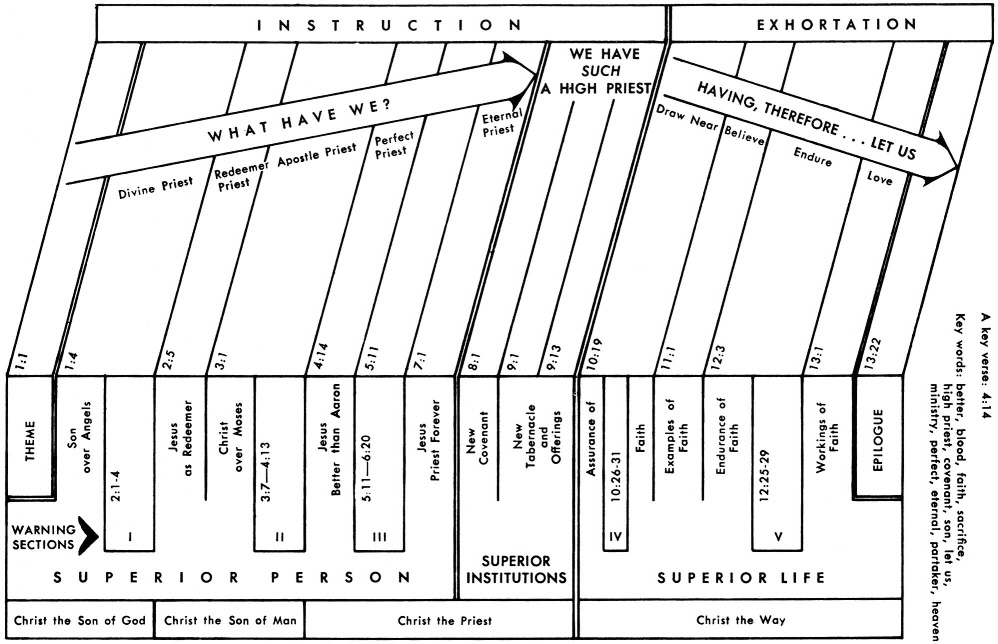
CONSIDER JESUS OUR GREAT HIGH PRIEST
Click chart to enlarge
Charts from Jensen's Survey of the NT - used by permission
Swindoll's Chart, Interesting Pictorial Chart of Hebrews, Another Chart
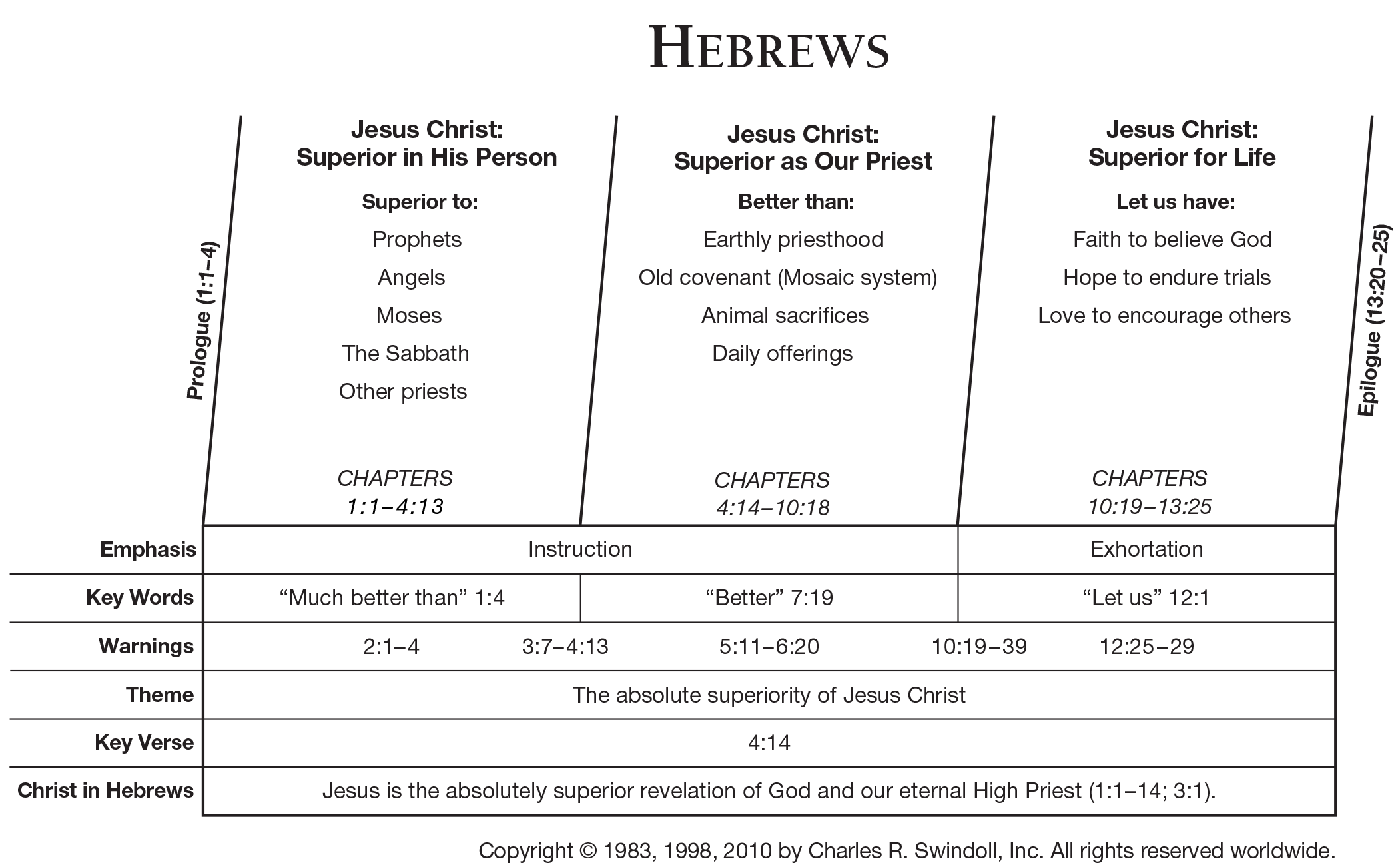

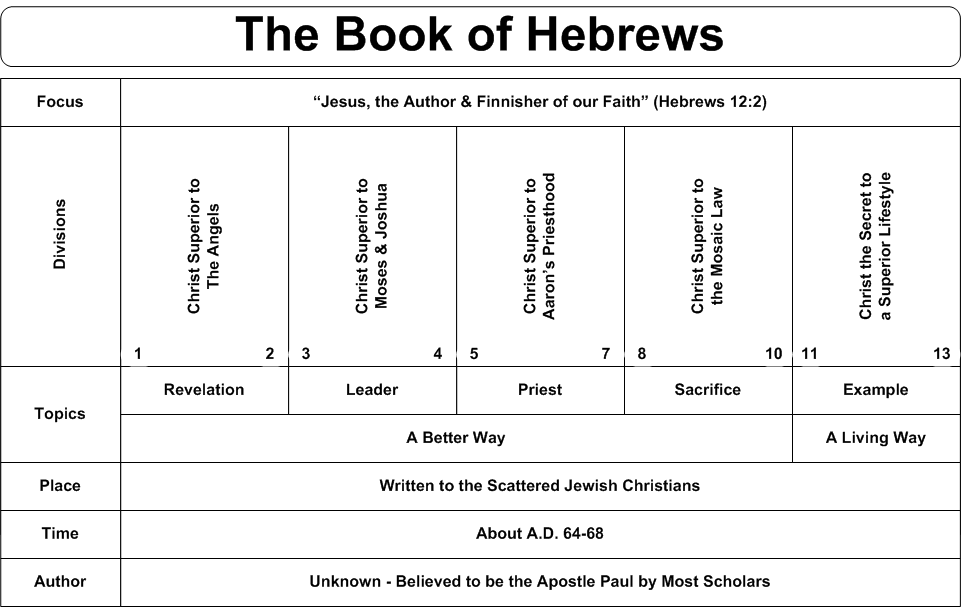
|
The Epistle |
||||
| INSTRUCTION Hebrews 1-10:18 |
EXHORTATION Hebrews 10:19-13:25 |
|||
| Superior Person of Christ Hebrews 1:1-4:13 |
Superior Priest in Christ Hebrews 4:14-10:18 |
Superior Life In Christ Hebrews 10:19-13:25 |
||
| BETTER THAN PERSON Hebrews 1:1-4:13 |
BETTER PRIESTHOOD Heb 4:14-7:28 |
BETTER COVENANT Heb 8:1-13 |
BETTER SACRIFICE Heb 9:1-10:18 |
BETTER LIFE |
| MAJESTY OF CHRIST |
MINISTRY OF CHRIST |
MINISTERS FOR CHRIST |
||
|
DOCTRINE |
DUTY |
|||
|
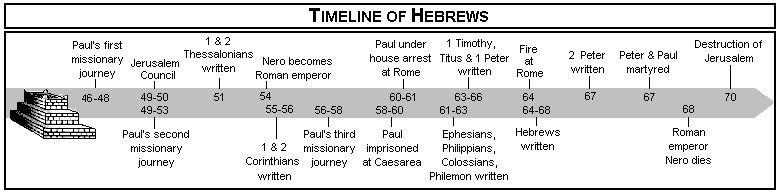
DATE WRITTEN: |
||||

See ESV Study Bible "Introduction to Hebrews"
(See also MacArthur's Introduction to Hebrews)
Borrow Ryrie Study Bible
Hebrews 12:27 This expression, "Yet once more," denotes the removing of those things which can be shaken, as of created things, so that those things which cannot be shaken may remain. (NASB: Lockman)
Greek: to de, Eti hapax deloi (3SPAI) [ten] ton saleuomenon (PPPNPG) metathesin os pepoiemenon, (RPPNPG) ina meine (3SAAS) ta me saleuomena. (PPPNPN)
BGT τὸ δὲ ἔτι ἅπαξ δηλοῖ [τὴν] τῶν σαλευομένων μετάθεσιν ὡς πεποιημένων, ἵνα μείνῃ τὰ μὴ σαλευόμενα.
Amplified: Now this expression, Yet once more, indicates the final removal and transformation of all [that can be] shaken—that is, of that which has been created—in order that what cannot be shaken may remain and continue. (Amplified Bible - Lockman)
My Amplified Paraphrase: This expression, “Yet once more,” signifies and clearly reveals the removing—the complete shaking away and final dissolution—of those things which can be shaken, that is, created things, the entire temporary created order; so that—for the purpose that—the things which cannot be shaken (the eternal, heavenly, unchangeable realities of God’s kingdom) may remain, standing firm forever.
NLT: This means that the things on earth will be shaken, so that only eternal things will be left. (NLT - Tyndale House)
KJV And this word, Yet once more, signifieth the removing of those things that are shaken, as of things that are made, that those things which cannot be shaken may remain.
NKJ Now this, "Yet once more," indicates the removal of those things that are being shaken, as of things that are made, that the things which cannot be shaken may remain.
NET Now this phrase "once more" indicates the removal of what is shaken, that is, of created things, so that what is unshaken may remain.
CSB This expression, "Yet once more," indicates the removal of what can be shaken-- that is, created things-- so that what is not shaken might remain.
ESV This phrase, "Yet once more," indicates the removal of things that are shaken-- that is, things that have been made-- in order that the things that cannot be shaken may remain.
NIV The words "once more" indicate the removing of what can be shaken--that is, created things--so that what cannot be shaken may remain.
Wuest: And this word, Yet once more, makes evident the transferring to a new basis the things that are shaken as of things made, in order that the things that are not shaken might remain [the present universe under the curse of sin changed to the perfect universe of the eternal conditions]. (Hebrews)
Young's Literal: and this -- 'Yet once' -- doth make evident the removal of the things shaken, as of things having been made, that the things not shaken may remain;
- Ps 102:26,27; Ezekiel 21:27; Matthew 24:35; 2Pe 3:10,11; Rev 11:15; 21:1
Related Passages:
Isaiah 13:13 (WARNING OF FUTURE SHAKING = Day of the Lord) "Therefore I shall make the heavens tremble, and the earth will be shaken from its place at the fury of the LORD of hosts in the day of His burning anger.
1 John 2:17 (SHAKABLE THINGS) The world is passing away, and also its lusts; but the one who does the will of God lives forever.
Psalm 45:6 (AN UNSHAKABLE KINGDOM) Your throne, O God, is forever and ever; A scepter of uprightness is the scepter of Your kingdom.
THE SIGNIFICANCE AND FINALITY
OF YET ONCE MORE
This expression, "Yet once more," The author of Hebrews comments directly on the meaning of the quoted phrase from Haggai 2:6. One might paraphrase it as "Let me explain the significance of that phrase." Yet once more implies a final, decisive action—not something that will be repeated again and again. In context, it also marks a turning point from the temporary to the eternal.
Denotes (deloo) the removing (metathesis) of those things which can be shaken (saleuo) as of created (poieo) things - Those things refers to the entire created order, the old heaven and earth, everything temporary, earthly, or unstable and everything not belonging to God’s eternal kingdom. The shaking is not arbitrary but it is surgical as well as purifying.
God’s final, cosmic intervention. It refers to a future event when God will shake all created things, removing what is temporary and revealing what is eternal—His kingdom, His truth, and His redeemed people.
Let go of what is passing. Cling to what is eternal
This truth calls us to live for what lasts, to worship with reverence, and to stand firm in the midst of a world that is passing away.
So that (hina) introduces a purpose clause. The clause answers the question “WHY is God going to shake the heavens and the earth?” The purpose of is the final shaking of the heavens and the earth is two fold: (1) to remove what is temporary and unstable, and (2) to reveal and preserve what is eternal and unshakable. In other words, God shakes the created order so that He may strip away the temporal and reveal the eternal. The shaking is purposeful and its goal is permanence.
Those things which cannot be shaken (saleuo) may remain (meno) - This describe the endurance of that which is unshakable including God’s eternal kingdom (Heb 12:28), the New Heavens and New Earth, God’s righteous rule, the redeemed people of God and all eternal, permanent, heavenly realities.
God shakes the universe not simply to destroy, but: to separate the eternal from the temporary, to expose what is truly lasting, to establish the permanence of His kingdom and to clear the old creation to make way for the new
The shaking is a form of divine judgment, but its purpose is redemptive—to clear away what is corrupt and perishable, and to establish what is holy and eternal.
It is not destruction for its own sake, but a purifying act to remove the temporary and reveal the eternal. It points us to the unshakable kingdom of God, which is received by grace through faith in Jesus Christ.
The “things which can be shaken” refer to created things—the physical universe, human institutions, and all that is not rooted in God.
The “things which cannot be shaken” refer to God’s kingdom, His promises, and the eternal life secured through Christ.This purpose clause gives hope and assurance to believers. Though the world around us may be shaken—politically, morally, or even cosmically—God’s kingdom remains unshaken.
It is this greater shaking from which there is no escape. That shaking will culminate in the great judgments described in Daniel and Revelation. The earth and heaven will flee away and be replaced by the new heavens and the new earth.
Revelation 20:11 Then I saw a great white throne and Him who sat upon it, from whose presence earth and heaven fled away, and no place was found for them.
Comment - Note two descriptions of the shaking of the earth and the heaven - (1) from whose presence earth and heaven fled away and (2) no place was found for them where the Greek word for "no" is ouch signifying ABSOLUTE NEGATION. The point is that when Jesus prepares to Judge (Jesus is Judge of all - Jn 5:22) the unredeemed at the Great White Throne, this is a unique time in the history of eternity. Apparently the only place that exists at this time is the Great White Throne. 2 Peter 3:10 has apparently taken place dissolving this present world and heavens into oblivion! Yes, I know this is strange and mysterious, but it is what the Spirit teaches. The truth is that if the Bible did not reveal even these details, we would have no clue as to what is coming in the future. In summary, the removal of created things has taken place (Heb 12:27) leaving only those things that cannot be shaking remaining. And if you read the rest of the description in Rev 20:11-15, it is clear that one of the things that God has not removed is every human being ever born. They are immortal and belong to the things that remain. Sadly, Jesus will pass judgment on many (note adjective "many" in Mt 7:13, 14 and Mt 7:20-21), will be cast into the Lake of Fire, the Second Death where they will be punished for all eternity.
The things that remain will include all mankind, tragically many in the Lake of Fire and the remainder forever living in "Mt Zion" which is described in Revelation 21-22.
Revelation 21:1-4ff Then I saw a NEW (kainos - brand new, never existed before!) heaven and a NEW (kainos) earth; for the first heaven and the first earth passed away (See 2Pe 3:10, Rev 20:11), and there is no longer any sea. 2 And I saw the holy city, new Jerusalem, coming down out of heaven from God, made ready as a bride adorned for her husband. 3 And I heard a loud voice from the throne, saying, “Behold, the tabernacle of God is among men, and He will dwell among them, and they shall be His people, and God Himself will be among them, 4 and He will wipe away every tear from their eyes; and there will no longer be any death; there will no longer be any mourning, or crying, or pain; the first things have passed away.”
COMMENT: Note that God is not just repairing the old world—He is creating something entirely new!
Isaiah 65:17 For behold, I create NEW heavens and a NEW earth; and the former things shall not be remembered or come to mind.
🙏 THOUGHT - Dear saint, are you suffering? Have you been wrongfully treated? And I could go on with similar questions, for all of our lives are filled with varying degrees of brokenness. But read God's promise above again of NEW things! And just as encouraging His promise that "the former things shall not be remembered or come to mind." When God brings about the NEW heavens and NEW earth, these painful and broken aspects of the old world will no longer be part of our thoughts or memories. This verse does not mean that we will have no recollection of our earthly lives at all, but that the sorrow, pain, and sin of this life will no longer have any hold over us. The previous verse, Isaiah 65:16, clarifies that “the former troubles are forgotten and are hidden from my eyes,” which suggests that it is the suffering and sorrow of the past that will be erased from our emotional experience. Our memories will be redeemed, healed, and free from the corruption of sin’s effects. Can I heart a "Praise the Lord"?
The pain of this life is temporary,
but the joy of eternity is permanent.
-- See Psalm 16:11
Isaiah 66:22 (God is addressing this to Israel) "For just as the new heavens and the new earth Which I make will endure before Me," declares the LORD, "So your offspring and your name will endure.
COMMENT: For those who think God is finished with Israel, this verse creates a huge problem. In fact God promises that like the eternal new heavens and new earth, Israel will endure forever!
2 Peter 3:10 But the Day of the Lord will come like a thief, in which the heavens will pass away with a roar and the elements will be destroyed with intense heat, and the earth and its works will be burned up.
2 Peter 3:13 But according to His promise we are looking for new heavens and a new earth, in which righteousness dwells.
Vincent comments that "Attention is called to this phrase (yet once more) as specially significant, because it indicates that the shaking prophesied by Haggai is to be final. It is to precede the new heaven and the new earth.
This cataclysmic event will explode the myth that what we can see and touch and handle is real and that unseen things are unreal. When God ends the sifting and shaking process, only that which is real will remain. Those who were occupied with the tangible, visible ritualism of Judaism were clinging to things that could and would be shaken.
Spurgeon - Material forces are not available in our warfare, for we do not wrestle with flesh and blood. The tyrant may burn our martyrs and cast our confessors into prison, but the pure truth of Jesus is neither consumed by fire nor bound with chains; it has within itself essential immortality and liberty. The doctrine that Christ Jesus came into the world to save sinners is no more to be wounded by the sword of persecution than is the ocean to be scarred by the keels of navies. When winds may be manacled, when waves be fettered, and when clouds may be shut up in dungeons, then—no not even then—may the Word of God be bound.
Wuest explains the removing as used in Hebrews 12:27 - It refers to the act of God transferring to a new basis, this present universe which is under the curse of Adam’s sin, that new basis being a new and perfect universe. John speaks of this in the words “I saw a new heaven and a new earth: for the first heaven and the first earth were passed away” Rev 21:1 (note). The universe was created by God, but will be made to pass away, and to be substituted by a new universe which will exist forever. Thus, transitory, perishable things must pass away, in order that the eternal things may appear in their abiding value. The writer is pointing out that the passing away of perishable things only emphasizes the eternal. One of these is mentioned in the next verse, an eternal kingdom, the kingdom of God’s rule over the saved of the human race on a new earth all through eternity. The old earth will pass away and a new earth will be made so that the saints might have a fit place of habitation throughout the eternal ages. (Hebrews Commentary)
Spurgeon - All that is eternal must, of course, endure forever. The everlasting covenant, “the glorious gospel of the blessed God” (1Ti 1:11), the purchase of the Savior’s blood, the work of the Holy Spirit—all these shall stand fast forever; they can never be shaken. The immutable Word spoken by the mouth of the unchanging God lives and abides forever! (cp 1Pe 1:23-25) I stood this week by the side of a church that once was a considerable distance inland, but now it stands by the ocean side. Almost every year a great mass of the clay cliff falls into the sea, and in a year or two this parish church must fall. It stands now in quiet and peace, but on a certain day it will all be swallowed up into the sea, as certainly as the elements still work according to their ordinary laws. I could not help thinking that the edifice was a type of certain ecclesiastical bodies, which stand upon the clay cliff of statecraft or superstition. The tide of public enlightenment, and above all the ocean tide of God’s Spirit, is advancing and wearing away their foundation until at last down the whole fabric must go. What then? Will you hold up your hands and cry, “The church of God is gone”? Stop the foolish utterance; God’s church is safe enough. Look, there stands the church of God upon a stormy promontory, where the sea always dashes and perpetually rages on all sides. She fears no undermining, because she is built on no clay cliff, but on a rock against which the waves of hell shall not prevail.
Once (530) hapax means literally once or one time. It is used to describe a simple numerical occurrence of once (2Cor 11:25). It can also be used to convey the sense of something done uniquely and thus means once for all. It is that which is so done as to be of perpetual validity, and never needs repetition (see note Hebrews 9:28).
HAPAX - 14V - CLEARLY A KEY WORD IN HEBREWS - 2 Co. 11:25; Phil. 4:16; 1 Thess. 2:18; Heb. 6:4; Heb. 9:7; Heb. 9:26; Heb. 9:27; Heb. 9:28; Heb. 10:2; Heb. 12:26; Heb. 12:27; 1 Pet. 3:18; Jude 1:3; Jude 1:5
Hebrews 6:4 (note) For in the case of those who have once been enlightened and have tasted of the heavenly gift and have been made partakers of the Holy Spirit,
Hebrews 9:7 (note) but into the second only the high priest enters, once a year, not without taking blood, which he offers for himself and for the sins of the people committed in ignorance.
Hebrews 9:26 (note) Otherwise, He would have needed to suffer often since the foundation of the world; but now once at the consummation of the ages He has been manifested to put away sin by the sacrifice of Himself.
Hebrews 27 (note) And inasmuch as it is appointed for men to die once and after this comes judgment,
Hebrews 28 (note) so Christ also, having been offered once to bear the sins of many, shall appear a second time for salvation without reference to sin, to those who eagerly await Him.
Hebrews 10:2 (note) Otherwise, would they not have ceased to be offered, because the worshipers, having once been cleansed, would no longer have had consciousness of sins?
Hebrews 12:26 (note) And His voice shook the earth then, but now He has promised, saying, "Yet once more I will shake not only the earth, but also the heaven."
Hebrews 27 (note) And this expression, "Yet once more," denotes the removing of those things which can be shaken, as of created things, in order that those things which cannot be shaken may remain.
Friberg - adverb; once; (1) as a strictly numerical concept in the sense of one time once (2Co 11.25); once a year (Heb 9.7); (2) of something done uniquely only once, once for all (Heb 9.28); (3) idiomatically a[. kai. di,j literally once and twice, i.e. more than once, several times (Php 4.16) (BORROW Analytical Lexicon of the Greek New Testament)
Denotes (1213) (deloo from delos = manifest, evident) means to make plain by words and thus to declare. To make manifest to the mind. Deloo is used of indications which lead the mind to conclusions about the origin or character of things. It means to make some matter known that was unknown or not communicated previously. It means to show clearly, to signify, to make manifest, visible, clear, or plain and to make known. When spoken of things past it means to tell, relate or impart information (as in 1Cor 1:11; Colossians 1:18 [note]). Although deloo is used most often in reference to declarations through articulate language, it is also used often (as in the present verse) of any kind of indirect communication.
When spoken of things future or hidden, deloo means to reveal, show or bring to light.
Deloo is used 28 times in the Septuagint (LXX) (Exod. 6:3; 33:12; Deut. 33:10; Jos. 4:7; 1 Sam. 3:21; 1 Ki. 8:36; 2Chr. 6:27; Est. 2:22; Ps. 25:14; 51:6; 147:20; Isa. 42:9; Jer. 16:21; Dan. 2:5f, 9, 11, 16, 23ff, 28ff, 47; 4:18; 7:16). Here are some uses in the Septuagint (LXX)
Exodus 6:3 and I appeared to Abraham, Isaac, and Jacob, as God Almighty, but by My name, LORD, I did not make Myself known (deloo) to them.
Exodus 33:12 Then Moses said to the LORD, "See, Thou dost say to me, 'Bring up this people!' But Thou Thyself hast not let me know (deloo) whom Thou wilt send with me. Moreover, Thou hast said, 'I have known you by name, and you have also found favor in My sight.'
Esther 2:22 But the plot became known (deloo) to Mordecai, and he told Queen Esther, and Esther informed the king in Mordecai's name.
Psalm 25:14 The secret of the LORD is for those who fear Him, And He will make them know (deloo) His covenant.
Psalm 51:6 Behold, Thou dost desire truth in the innermost being, And in the hidden part Thou wilt make me know (deloo) wisdom.
Psalm 147:20 He has not dealt thus with any nation and as for His ordinances, they have not known (deloo) them. Praise the LORD!
Isaiah 42:9 "Behold, the former things have come to pass, Now I declare new things; Before they spring forth I proclaim (Lxx = deloo = make them known) them to you."
Daniel 2:25 Then Arioch hurriedly brought Daniel into the king's presence and spoke to him as follows: "I have found a man among the exiles from Judah who can make the interpretation known (deloo) to the king!"
Deloo is used 7 times in the NT…
1 Corinthians 1:11 For I have been informed concerning you, my brethren, by Chloe's people, that there are quarrels among you.
1 Corinthians 3:13 each man's work will become evident; for the day will show it, because it is to be revealed with fire; and the fire itself will test the quality of each man's work.
Colossians 1:8 (note) and he also informed us of your love in the Spirit.
Hebrews 9:8 (note) The Holy Spirit is signifying this, that the way into the holy place has not yet been disclosed, while the outer tabernacle is still standing,
Hebrews 12:27 (note) And this expression, "Yet once more," denotes the removing of those things which can be shaken, as of created things, in order that those things which cannot be shaken may remain.
1 Peter 1:11 (note) seeking to know what person or time the Spirit of Christ within them was indicating as He predicted the sufferings of Christ and the glories to follow.
2 Peter 1:14 (note) knowing that the laying aside of my earthly dwelling is imminent, as also our Lord Jesus Christ has made clear (of something divinely communicated) to me.
Removing (3331) (metathesis from metatíthemi = transfer from meta = implying change + tithemi = put) is literally, the act of transferring from one place to another and so the removal or taking up or away. Transliterated it gives us the English word metathesis which is defined as the transposition of a letter of a word. There are only 3 NT uses - Heb 7:12, 11:5, 12:27 and none in the Septuagint.
In addition the Greek noun metathesis can describe a transfer from one place to another, as for example the translation of a person to heaven
By faith Enoch was taken up (verb metatíthemi) so that (always query this term of purpose) he should not see death; and he was not found because God took him up; for he obtained the witness that before his being taken up he was pleasing to God." (Heb 11:5).
Metahesis can mean a change of things instituted or established, such as a changeover from the Levitical priesthood
"For when the priesthood is changed, of necessity there takes place a change of law also. (Heb 7:12)
Wuest - "The priesthood after the order of Melchizedek was put in the place of the priesthood after the order of Aaron. The blood of animals could not pay for sin, but the blood of Messiah could. Thus, the New Covenant was substituted for the Old Covenant, Jesus’ blood, the reality, for animal blood, the type. But that could only be done by changing the law governing the priesthood. Thus, if a transfer to a new and different order of priesthood was to be effected, it must be by reason of a transfer to a new basis. The law governing the priesthood as found in the Mosaic economy must be abrogated in favor of another which would provide for an order of priesthood that would function successfully in the very thing in which the Aaronic priesthood failed. (Hebrews Commentary)
Vincent comments on the meaning of metathesis in Heb 7:12-note writing that there it refers to "A change. A transfer to a new basis. Only in Hebrews. See Heb 11:5-note. The inferiority of the Levitical priesthood is inferred from the fact that another priesthood was promised. If perfection was possible at all under the Mosaic economy, it must come through the Levitical priesthood, since that priesthood was, in a sense, the basis of the law. The whole legal system centered in it. The fundamental idea of the law was that of a people united with God. Sin, the obstacle to this ideal union, was dealt with through the priesthood. If the law failed to effect complete fellowship with God, the priesthood was shown to be a failure, and must be abolished; and the change of the priesthood involved the abolition of the entire legal system.
Heb 12:27 uses metathesis with the idea of removal. Figuratively, metathesis means to transpose or put one thing in the place of another.
Shaken (4531) saleuo from salos = wave) means to cause to move to and fro, cause to waver or totter, make to rock. To shake or agitate as by winds or storms. It refers to unexpected and disastrous shaking, of what would be thought to be stable, e.g. earth or sky shake. In Acts 4:31 the prayer meeting was literally shaken by the power of God! In Acts 16, saleuo is used literally of an earthquake (Acts 16:26). Saleuo described a ship at anchor slipping its mooring in the midst of a heavy wind. In an ancient letter we read "you sent me letters which would have shaken (saleuo) a stone, so much did your words move me". Figuratively, as in Acts 17:13, saleuo means stirring up a crowd which is incited or agitated. In another figurative use saleuo describes an agitated state of mind (great anxiety) as if the source of agitation "dislodges" or drives the mind away from more sober senses (2Th 2:2). Their confidence is shaken!
Matt 11:7 — “shaken by the wind” (reed) Luke 6:38 — “shaken together” Luke 21:26 — “powers of the heavens will be shaken” (eschatological) Acts 4:31 — building “shaken” after prayer Heb 12:26–27 — cosmic shaking in judgment
SALEUO - 14V - Matt. 11:7; Matt. 24:29; Mk. 13:25; Lk. 6:38; Lk. 6:48; Lk. 7:24; Lk. 21:26; Acts 2:25; Acts 4:31; Acts 16:26; Acts 17:13; 2 Thess. 2:2; Heb. 12:26; Heb. 12:27
Friberg (summary) Saleuo - (1) literally, as the unexpected and disastrous shaking of what would be thought to be stable, e.g. earth or sky shake, cause to move to and fro, cause to waver or totter, make to rock (Acts 16.26); (2) figuratively; (a) of stirring up a crowd incite, move, agitate (Acts 17.13); (b) mentally, of an individual agitate; passive be distressed, be upset, be shaken (2Thes 2.2) (Borrow Analytical Lexicon of the Greek New Testament)
C H Spurgeon - Morning and evening : Daily readings (June 22 PM) - We have many things in our possession at the present moment which can be shaken, and it ill becomes a Christian man to set much store by them, for there is nothing stable beneath these rolling skies; change is written upon all things. Yet, we have certain “things which cannot be shaken,” and I invite you this evening to think of them, that if the things which can be shaken should all be taken away, you may derive real comfort from the things that cannot be shaken, which will remain. Whatever your losses have been, or may be, you enjoy present salvation. You are standing at the foot of his cross, trusting alone in the merit of Jesus’ precious blood, and no rise or fall of the markets can interfere with your salvation in him; no breaking of banks, no failures and bankruptcies can touch that. Then you are a child of God this evening. God is your Father. No change of circumstances can ever rob you of that. Although by losses brought to poverty, and stripped bare, you can say, “He is my Father still. In my Father’s house are many mansions; therefore will I not be troubled.” You have another permanent blessing, namely, the love of Jesus Christ. He who is God and Man loves you with all the strength of his affectionate nature—nothing can affect that. The fig tree may not blossom, and the flocks may cease from the field, it matters not to the man who can sing, “My Beloved is mine, and I am his.” Our best portion and richest heritage we cannot lose. Whatever troubles come, let us play the man; let us show that we are not such little children as to be cast down by what may happen in this poor fleeting state of time. Our country is Immanuel’s land, our hope is above the sky, and therefore, calm as the summer’s ocean; we will see the wreck of everything earthborn, and yet rejoice in the God of our salvation.
The Earthquake-Proof House - A man built his dream home on a scenic hillside. He cut corners on the foundation, thinking the view was more important. When the ground began to shake one night, the house collapsed. Next door, another home stood firm—built on solid rock with deep foundations. Likewise, God’s “shaking” of this world will test what we’ve built our lives upon. Only what is founded on Christ—the unshakable rock—will endure. What parts of your life are built on fleeting things? Are you building for eternity?
The Refining Furnace - Gold is refined through fire. The flame doesn’t destroy the gold—it removes the impurities. When the metal comes out of the furnace, it shines with greater purity and value. In the same way, God’s shaking is not meant to destroy His people but to purify what is eternal. He burns away our idols, affections, and misplaced dependencies. What impurities might God be shaking loose in your life right now?
Steven Cole - ILLUSTRATION OF WARNINGS - Thanks to the profusion of frivolous lawsuits, we now may enjoy the lunacy of ridiculous warnings on various products. A hair dryer warning label wisely advised, “Do not use while sleeping.” A portable stroller warned, “Caution: Remove infant before folding for storage.” A package of fireplace logs intoned, “Caution: Risk of fire!” A dessert box pointed out, “Product will be particularly hot after heating.” A snow sled label stated, “Beware: Sled may develop high speed under certain snow conditions.” We used to have a fold-up windshield screen to block the sun while our van was parked. It wisely advised, “Do not drive with screen in windshield.”
We can thank the litigation-happy lawyers for injecting these bits of humor into our daily lives! But the downside of such ludicrous warnings is, they may make us ignore legitimate warnings. And there are some warnings that we ignore to our peril!
God’s warning of eternal judgment for those who reject the gospel is the most perilous warning in the world. The author of Hebrews was concerned that some of his readers, who had professed faith in Christ, were in danger of abandoning Christ under threat of persecution for the more comfortable old Jewish rituals. And so he issues a repeated, final warning to urge them to persevere in their professed faith in Christ. His message is really a repeat of what he said in Hebrews 2:1–3:
For this reason we must pay much closer attention to what we have heard, so that we do not drift away from it. For if the word spoken through angels proved unalterable, and every transgression and disobedience received a just penalty, how will we escape if we neglect so great a salvation?
He argued in a similar manner in 10:28–29:
Anyone who has set aside the Law of Moses dies without mercy on the testimony of two or three witnesses. How much severer punishment do you think he will deserve who has trampled under foot the Son of God, and has regarded as unclean the blood of the covenant by which he was sanctified, and has insulted the Spirit of grace?
These are arguments from the lesser to the greater, and that is the force of our text. If those under the old, inferior covenant incurred God’s judgment for their disobedience, how much more will we be judged if we neglect God’s provision in Christ? If the signs of God’s presence were frightening when He shook Mount Sinai, how much more frightening will it be when He shakes the entire creation? But “since we receive a kingdom which cannot be shaken,” and since “our God is a consuming fire,” the only proper response is to persevere in faithful, reverent service to Him. (Great Privileges, Great God, Great Responsibilities)
Hebrews 12:28 Therefore, since we receive a kingdom which cannot be shaken, let us show gratitude, by which we may offer to God an acceptable service with reverence and awe (NASB: Lockman)
Greek: Dio basileian asaleuton paralambanontes (PAPMPN) echomen (1PPAS) charin, di' es latreuomen (1PPAS) euarestos to theo meta eulabeias kai deous;
BGT Διὸ βασιλείαν ἀσάλευτον παραλαμβάνοντες ἔχωμεν χάριν, δι᾽ ἧς λατρεύωμεν εὐαρέστως τῷ θεῷ μετὰ εὐλαβείας καὶ δέους·
Amplified: Let us therefore, receiving a kingdom that is firm and stable and cannot be shaken, offer to God pleasing service and acceptable worship, with modesty and pious care and godly fear and awe (Amplified Bible - Lockman)
My Amplified Paraphrase: Therefore, since we are receiving—continually being granted, by God’s grace—a kingdom which cannot be shaken, a kingdom unbreakable, unchangeable, everlasting, let us show gratitude—let us hold a posture of thankful worship—and let us offer to God acceptable service, worship that is well-pleasing to Him, with reverence (holy awe, deep respect) and with godly fear (a humble, trembling awareness of His majesty and holiness).
KJV Wherefore we receiving a kingdom which cannot be moved, let us have grace, whereby we may serve God acceptably with reverence and godly fear:
NKJ Therefore, since we are receiving a kingdom which cannot be shaken, let us have grace, by which we may serve God acceptably with reverence and godly fear.
NET So since we are receiving an unshakable kingdom, let us give thanks, and through this let us offer worship pleasing to God in devotion and awe.
CSB Therefore, since we are receiving a kingdom that cannot be shaken, let us hold on to grace. By it, we may serve God acceptably, with reverence and awe,
ESV Therefore let us be grateful for receiving a kingdom that cannot be shaken, and thus let us offer to God acceptable worship, with reverence and awe,
NIV Therefore, since we are receiving a kingdom that cannot be shaken, let us be thankful, and so worship God acceptably with reverence and awe,
NLT: Since we are receiving a kingdom that cannot be destroyed, let us be thankful and please God by worshiping him with holy fear and awe. (NLT - Tyndale House)
Wuest: Wherefore, receiving a kingdom which cannot be shaken, let us be having grace, by means of which we might be serving God, well pleasing to Him, doing this with pious care and fear (Hebrews)
Young's Literal: wherefore, a kingdom that cannot be shaken receiving, may we have grace, through which we may serve God well-pleasingly, with reverence and religious fear;
- Kingdom - Isa 9:7; Da 2:44; Da 7:14,27; Mt 25:34; Lk 1:33; Lk 17:20-21; 1Pe 1:4-5; Rev 1:6; Rev 5:10
- we may offer to God an acceptable service - Ps 19:14; Isa 56:7; Ro 12:1,2; Eph 1:6; 5:10; Php 4:18; 1Pe 2:5,20
- let us exhortations in Hebrews - Heb. 4:1; Heb. 4:11; Heb. 4:14; Heb. 4:16; Heb. 6:1; Heb. 10:22; Heb. 10:23; Heb. 10:24; Heb. 12:1; Heb. 12:28; Heb. 13:13; Heb. 13:15
- reverence and awe - Heb 4:16; 5:7; 10:19,22; Lev 10:3; Ps 2:11; Ps 89:7; Pr 28:24; Ro 11:20; 1Pe 1:17; Rev 15:4
Related Passages:
Luke 1:33 and He (MESSIAH) will reign over the house of Jacob forever, and His KINGDOM will have no end.
Revelation 1:6 and He has made us to be a kingdom, priests to His God and Father–to Him be the glory and the dominion forever and ever. Amen.
Revelation 5:10 “You have made them to be a kingdom and priests to our God; and they will reign upon the earth.”
Daniel 2:44 “In the days of those kings the God of heaven will set up a KINGDOM which will never be destroyed, and that KINGDOM will not be left for another people; it will crush and put an end to all these kingdoms, but it will itself endure forever.
Daniel 7:14 “And to Him (MESSIAH) was given dominion, Glory and a kingdom, That all the peoples, nations and men of every language Might serve Him. His dominion is an everlasting dominion Which will not pass away; And His KINGDOM is one Which will not be destroyed.
Daniel 7:27 ‘Then the sovereignty, the dominion and the greatness of all the kingdoms under the whole heaven will be given to the people of the saints of the Highest One; His KINGDOM will be an everlasting KINGDOM, and all the dominions will serve and obey Him (cf Heb 12:29b).’
Matthew 25:34 “Then the King will say to those on His right, ‘Come, you who are blessed of My Father, inherit the KINGDOM prepared for you from the foundation of the world.
2 Timothy 2:12 If we endure, we will also reign with Him (IMPLIES WE RECEIVE A KINGDOM); If we deny Him, He also will deny us;
Luke 17:20-21 Now having been questioned by the Pharisees as to when the kingdom of God was coming, He answered them and said, “The kingdom of God is not coming with signs to be observed; 21 nor will they say, ‘Look, here it is!’ or, ‘There it is!’ For behold, the kingdom of God is in your midst.”
Psalms 125:1 A Song of Ascents. Those who trust in the LORD Are as Mount Zion, which cannot be moved but abides forever.
1 Peter 1:17 If you address as Father the One who impartially judges according to each one’s work, conduct (aorist imperative see our need to depend on the Holy Spirit to obey) yourselves in fear during the time of your stay on earth;
2 Corinthians 7:1 Therefore, having these promises (READ THE COMMAND AND PROMISES IN 2Co 6:14-18), beloved, let us cleanse ourselves from all defilement of flesh and spirit, perfecting holiness in the fear of God.
Philippians 2:12 So then, my beloved, just as you have always obeyed, not as in my presence only, but now much more in my absence, work out (present imperative see our need to depend on the Holy Spirit to obey) your salvation (AKA PROGRESSIVE SANCTIFICATION) with fear and trembling; (Read Php 2:13NLT to see how it is possible to obey this command grounded in "fear and trembling")
Acts 9:31 (DO YOU WANT TO BE A CHURCH LIKE ACTS? DOES THIS DESCRIBE YOUR CHURCH?) So the church throughout all Judea and Galilee and Samaria enjoyed peace, being built up; and going on ("WALKING IN" - present tense - a lifestyle of reverential fear of the Lord!!!) in the fear of the Lord and in the comfort of the Holy Spirit, it continued to increase.
Ephesians 5:21 and be subject to one another in the fear of Christ.
Luke 1:50 “AND HIS MERCY IS UPON GENERATION AFTER GENERATION TOWARD THOSE WHO FEAR HIM.
Psalm 2:11 Worship the LORD with reverence And rejoice with trembling.
Revelation 15:4 “Who will not fear, O Lord, and glorify Your name? For You alone are holy; For ALL THE NATIONS WILL COME AND WORSHIP BEFORE YOU, FOR YOUR RIGHTEOUS ACTS HAVE BEEN REVEALED.”
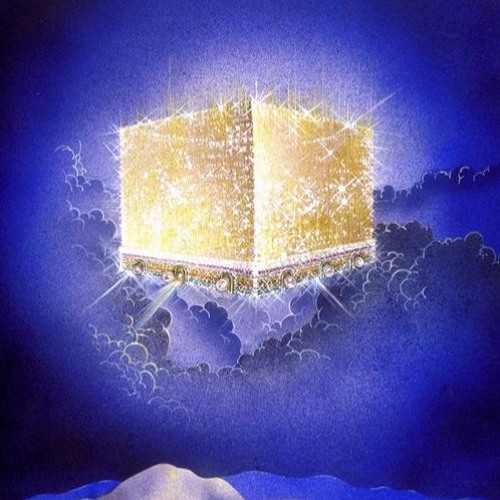
An Unshakable Kingdom
INHERITANCE OF EVERY SAINT
THE UNSHAKABLE KINGDOM
Therefore - (term of conclusion) In this case it refers to the truth that follows. This truth should give us a motivation and should inspire worshipful service out of a heart filled with thanksgiving at the truth that what we have in Christ can never be moved or shaken no matter what we might be experiencing in the temporal by and by. We today like the original Jewish readers of this letter have a Solid Rock, Who was also a merciful and faithful High Priest, seated forever as our Advocate at the right hand of God.
Since we receive (paralambano) a kingdom (basileia) which cannot be shaken (asaleutos - immovable, not subject to disturbance) - Here in Hebrews 12:28 the idea of receive (paralambano) is to receive in the sense of an inheritance (as an unmerited gift) a kingdom which cannot be shaken! Note we don't achieve the kingdom but receive it! Note also that the thought is it is present possession with future consummation (Already-Not Yet). As Peter says we have "an inheritance which is imperishable and undefiled and will not fade away, reserved in heaven for" us (1Pe 1:4). Notice that the verb receive (paralambano) is present tense which signifies an ongoing process, that is, that believers are in the process of receiving this kingdom. While the word kingdom (basileia) is rare in Hebrews, the description in Hebrews 12:22-23 clearly refers to this eternal kingdom. Hebrews 12:22 also emphasizes that we have received the kingdom as indicated by the verb "have come (perfect tense - past completed action, abiding effect) to Mount Zion". We have already come to the kingdom, to Mount Zion, the city of the living God, and the heavenly Jerusalem, and yet in another sense, we have not come to this city in its final form. That awaits the second coming of the King. This is an example of the tension between "Already-Not Yet."
Kenneth Wuest on Hebrews 12:28-29 - The writer exhorts his readers to appropriate the enabling grace of God (Heb 4:16, 12:15) so that they may serve Him so as to be well-pleasing (acceptable) in His sight. (Hebrews Commentary)
Let the unshakable Kingdom
steady your shaking heart.
A kingdom (basileia) which cannot be shaken (asaleutos) - What a striking contrast with everything in creation being shakable! In context remember he has described the shaking of Mt Sinai and now the unshakable Mt Zion. The Kingdom of God will never be shaken. It is eternal, never-to-be-overthrown, invisible, immovable, secure, indestructible and so firmly established (forever). What remains after the divine shaking is what belongs to the eternal kingdom of God. An unshakable King gives an unshakable Kingdom. The upshot is hold the things of this passing world loosely and cling closely to Christ, living for the unshakable, not the shakable!
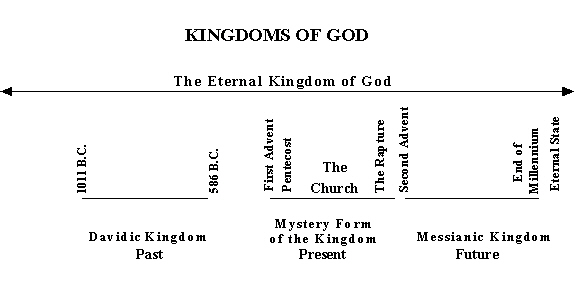
KINGDOM OF GOD PAST, PRESENT, FUTURE
FROM BIBLE.ORG
Steven Cole on kingdom (basileia) which cannot be shaken (asaleutos) - This means that it will outlast all earthly kingdoms. Because it is God’s kingdom, it will remain “forever and ever” (Heb 1:8). Every earthly kingdom that has been established has eventually fallen to other, more powerful, kingdoms. The history of the world is that of the rise and fall of earthly kingdoms. Men such as Alexander the Great have devoted their lives to establishing these kingdoms, only to die and have their kingdoms broken up. The only kingdom that will endure is the kingdom of God. We are privileged to be members of this kingdom by His grace. Even if we are persecuted to death, God’s eternal kingdom cannot be shaken, and we are heirs of it through faith in Christ. (Great Privileges, Great God, Great Responsibilities)
Note the first words in the Greek - Therefore a kingdom unshakeable!
🙏THOUGHT - How is your world today? If it's like mine, I'm sure you're experiencing various "minor" and a few "major" tremors emotionally, for all saints experience varying degrees of tribulation (cf 1Pe 1:6-7, Heb 12:5-11). But beloved, these words in Hebrews should be tattooed across our forehead (figuratively speaking of course) as a constant reminder - therefore a kingdom unshakable! Through many tribulations we must enter the kingdom of heaven (Acts 14:22b), but enter we will, and we will be forever unshakable for we have taken refuge in the Rock of our salvation (Ps 62:2)! Thanks be to God. Praise the Name of Jesus our Great High Priest (Heb 4:14) Who brings us into His unshakeable kingdom. Amen
Spurgeon - Is it not wonderful that it should be written, “We are receiving a kingdom”? What a gift to receive! This is a divine gift; we have received, not a pauper’s pension, but a kingdom that cannot be moved. The old dispensation or kingdom has passed away; its ceremonial laws are abrogated, and its very spirit is superseded by a higher spirit. We have entered upon another kingdom, in which the ruling principle is not law, but love. We are not under the yoke of Moses, but we are the subjects of King Jesus, whose yoke is easy and whose burden is light. The kingdom of Jesus will never end while time shall last, for He is the King Eternal, and immortal; neither will His laws be changed, nor shall His subjects die. Other kingdoms go to pieces sooner or later. You and I who are in middle life can remember kingdoms that have been blown down by the wind, or toppled over at the blow of one brave man’s sword. Empires that have rivaled Caesar’s in apparent strength have been swept down like cobwebs. As houses made of a pack of cards, so have dynasties fallen never to rise again. There were two brothers, one of whom had been diligently attentive to his worldly business, to the neglect of true religion. He succeeded in accumulating considerable wealth. The other brother was diligent in the service of the Master, and had learned both to distribute to the poor and for conscience’s sake to forego many an opportunity of gain, so that when he lay sick and dying he was in straitened circumstances. His brother somewhat upbraided him, remarking that if it had not been for his religion he would not have been dependent upon others. With great calmness the saintly man replied, “Quiet, quiet! I have a kingdom not begun upon, and an inheritance I have not yet seen.” Speak of laying up for a rainy day: we have infinite goodness laid up for those who fear the Lord, and none can rob us of it.
AN ATTITUDE
OF GRATITUDE
Let us show (echo - have - present tense - ongoing possession of) gratitude (charis), by which we may offer (latreuo) to God an acceptable service (euarestos) with reverence (eulabeia) and awe (deos) - NKJV = "let us have grace" ESV = let us be grateful; NET = let us give thanks." I like the HCSB which is more literal and is practical as it shows us how we may serve God acceptably (it is BY GRACE) - "let us hold on to grace. This kingdom must be received as an undeserved benefit." Let us is a hortatory subjunctive which is used 13 times in Hebrews.
By it (BY GRACE), we may serve God acceptably." Notice that let us have is present tense which could be paraphrased "let us have a lifestyle of grace." It carries the sense of keeping gratitude close, like something you refuse to let go of. It is a life lived continually in the indwelling Spirit's transforming power. It conveys the idea of holding an attitude of thankfulness or responding with gratitude. Since we are unspeakably blessed in receiving an unshakable kingdom, our response should be one of deep gratitude, not just in words, but in how we live and worship. Gratitude (charis) carries the idea of “thankfulness in response to grace. In other words, we are motivated to show gratitude because we have received a kingdom that cannot be shaken.
🙏 THOUGHT- Does an attitude of gratitude describe your life, beloved? It can—and it will—when grace becomes your daily portion, dispensed by the Spirit of grace (Heb 10:29b). The writer of Hebrews gently invites us to step with him into this great, grace-filled life that God freely offers. Grace is the only power that makes our service “acceptable” before a holy God, for anything done in our own strength is but “filthy rags” (Isaiah 64:6). Grace is what keeps our love for the brethren fresh and warm (Heb 13:1), and grace alone opens our hearts to welcome strangers with Christlike kindness (Heb 13:2). Oh, how desperately we need grace, not just to begin the grace race (Heb 12:1), but to run it well and finish it strong. May the Lord pour out His Spirit of grace upon you daily for your good and His glory all possible through our Great High Priest. Amen.
By which we may offer (latreuo - present tense) to God - NET "let us worship pleasing to God in devotion and awe." This should be a continual "offering" as this Greek word latreuo does not mean general human activity but describes God-directed worship like a priest (which we are - 1Pe 2:9) ministering before the Lord. In the NT, latreuo is often translated “to worship,” not merely “to serve.”
HOLD FAST TO GRACE
FOR ACCEPTABLE SERVICE
An acceptable service (euarestos) with reverence (eulabeia) and awe (deos) - An acceptable service (euarestos) is not merely acceptable, but service/worship which God smiles upon. Note the context calls for an attitude of grace (charis), which enables grace (Heb 12:29) empowered service. It is service that is dependent on grace reliance, not self effort (see Spurgeon's note). One might phrase it this way that the worship and service God accepts is that which He by His Spirit enables. Ultimately this is service that our Lord calls “well done.” The implication is that not all service is acceptable to God. It must be rooted in gratitude (grace), offered with reverence and awe and in line with God’s revealed will (Ro 12:2) This echoes the Old Testament principle that God desires obedience over ritual (1 Samuel 15:22). Another point is that because Jesus is the Mediator of the New Covenant (Heb 12:24), our worship/service is acceptable to the Father only through His Son. As Hebrews 13:15 says “Through Him then, let’s continually offer up a sacrifice of praise to God."
Under a sense of your immeasurable indebtedness
go forth and serve your God with joyful thankfulness
Charles Spurgeon - We have the kingdom within us: it is not meat and drink, but righteousness and peace, and joy in the Holy Ghost (Ro 14:17). The Spirit of God within a man is the earnest of heaven (Eph 1:14), and an earnest is of the same nature as that which it guarantees. We who are born unto God have the firstfruits of the kingdom of God in possessing the indwelling Spirit, and in the firstfruits we see the entire harvest. Rise to this, and under a sense of your immeasurable indebtedness go forth and serve your God with joyful thankfulness. This is the spirit in which to worship the Lord who has given us the kingdom.
Our first dealing with the most High must not be our bringing anything to Him,
but our accepting of everything from Him.
Spurgeon - Whatever service we may render to God, we must begin by being receivers. Our first dealing with the most High must not be our bringing anything to Him, but our accepting of everything from Him. We receive; that is our first stage. And I trust it is our last, for if ever we are able to serve the Lord by our gifts, we shall have to confess, “From your hand we have given to you” (1Chr 29:14). When we are privileged to cast our crowns before Immanuel’s throne, they will be crowns that He Himself bestowed upon us of His own sovereign grace. One of the early Saxon kings was rowed down the river Dee by Kenneth of Scotland, and seven other vassal kings, who each one tugged an oar while their lord reclined in state. The King of kings this day is served by kings. Each man, each woman among us is made royal by the very fact of holy service. Let us labor for God not as slaves, but as kings! I confess that sometimes I have not served the Lord as a king. I have put on the ragged robes of my unbelief, and I have come to church mourning and groaning when I ought to have arrayed myself in royal apparel and served my Lord with joy and gladness. I know sometimes you say, and say truly, “What a poor creature I am, how can I serve God? I do not have this or that gift.” Do not attempt to serve Him in the power of gift. Ask for grace, and then worship Him in the power of grace. It is wonderful how grace can make use of very slender gifts and turn them to abundant account. It is great grace that greatly honors God, and great grace is always to be had by the least among us. You may never be an orator, but you may have great grace. You may never be an organizer and take the lead among your fellow Christians, but you may have much grace. You may never attain to ample wealth so as to be able to distribute largely of your substance to the poor, but you may have great grace. Therefore, let us have grace that we may serve God acceptably. (Full sermon Acceptable Service)
How can our service be "acceptable" to God? To help understand meaning see root aresko in Romans 8 where Paul writes that "and those who are in the flesh cannot please (aresko) God. (Ro 8:8) The implication is we need to continually depend on the Spirit of grace for worship and service which pleases our Father.
🙏 THOUGHT - Let me make a practical suggestion as to how you and your family and church can be pleasing to God in your worship and service to Him. One answer is to ask God "that you may be filled with the knowledge of His will in all spiritual wisdom and understanding, so that you (and those you intercede for) will walk in a manner worthy of the Lord (see The Holy Spirit-Walking Like Jesus Walked!), to please (areskeia from aresko) Him in all respects, bearing fruit in every good work and increasing in the knowledge of God." (Col 1:9-10)
I would challenge you to consider praying this prayer for others in your sphere of influence for one month and watch for how God will answer it. He will answer it. We may not always see the answer but we know He will answer it based on His promise in 1Jn 5:14-15. As a pastor would you consider such a challenge (under grace not law) to your sheep? I would suggest you might see a "Malachi-like" blessing, recalling Jehovah's words in Mal 3:10 to "test Me now in this," says the LORD of hosts, "if I will not open for you the windows of heaven, and pour out for you a blessing until it overflows." Yes, Lord, "open the windows of heaven" for all who might be bold enough to continually (not vain repetition) approach Your throne of grace with this prayer for themselves and other saints. In Jesus' Name. Amen.
The fact that we receive an unshakable kingdom not only gives us assured hope
—it also calls us to reverential, awe-filled service.
S Lewis Johnson writes that Ro 8:8 "is one of the clearest texts teaching that an unbelieving man cannot please God until a work of the Spirit has been performed on his inner man. In fact, it is a verse that plainly teaches that regeneration must precede faith. The reason is clear. Faith pleases God (He 11:6), but they that are in the flesh, the unsaved individuals, cannot please God. Thus, they cannot exercise faith as long as they are in the flesh. They exercise faith only after the Holy Spirit in efficacious grace takes them out of the flesh and puts them, in the Spirit by giving them new life. The first activity of the new life is to believe (cf. 1 John 5:1). The man dead in sins is given new life, which manifests itself in saving trust through the gospel. Could anything be plainer? To affirm that the unsaved man can believe is to deny the biblical teaching on total depravity and human inability; it is to lapse into Arminian error. (Romans 8:5-17)
In the service of God everything
must be the fruit of grace.
Spurgeon on what makes a Christian's service acceptable to God - Acceptable service must be rendered to God IN THE POWER OF DIVINE GRACE. What says the apostle? “Let us have grace, whereby we may serve God acceptably.” Note then that acceptable service to God is not offered in the power of nature, not even of nature at its best, when we call it good nature and philanthropy, but in the service of God everything must be the fruit of grace. You are to serve the Lord, not in the strength of your own wit or experience, or talent, but in the energy of the new life which God has given you, and in the power of the grace which is continually bestowed upon you moment by moment as you seek it of the Lord. “Let us have grace,” says the apostle. I know sometimes you say, and say truly, “What a poor creature I am. How can I serve God? I have not this and that gift.” Just so, do not attempt to serve Him in the power of gifts. Ask for grace, and then worship Him in the power of grace. It is wonderful how grace can make use of very slender gifts, and turns them to abundant account. It is great grace that greatly honors God, and great grace is always to be had by the least among us. You may never be an orator but you may have great grace. You may never be an organizer and take the lead among your fellow Christians, but you may have much grace. You may never attain to ample wealth so as to be able to distribute largely of your substance to the poor, but you may have great grace. Therefore, let us have grace that we may serve God acceptably. I should like to take these words out of their context, and hang them up for our motto as a church— “LET US HAVE GRACE.” Be this our prayer—whatever else we do not have, Lord, let us have grace. If this or that means of usefulness shall be denied us, yet let us have grace, grace in our hearts, grace in our speech, grace in our lives, and grace in our every breath. A true Christian should be like Aaron who had the holy oil not only on his head, but upon the skirts of his garments. Even in our little things, in our kitchen life, in our parlor life, something of the holy oil should be upon us. Abundance of grace is our need. Now, dear friends, have you been trying to serve God in the power of grace, or in the power of nature? Look well to it. Only grace can God accept, can He accept your labor? In the margin of our Testaments—I mean those of the authorized version, which will never be parted with for the so-called revised version—in the margin of the authorized version we read, “Let us hold fast grace.” That is another motto I would like to give to this church, “LET US HOLD FAST GRACE.” To find grace is an act, to have grace is a state; to hold it fast is to make the act perpetual and the state continual. “Let us hold fast grace.” (Full sermon Acceptable Service)
REVERENCE AND
AWE
With reverence (eulabeia) and awe (deos) - To be sure believers are to approach God's throne with boldness (Heb 4:16), but also with reverence and awe. In other words, we eschew saying things like the "Big Guy in the Sky!" That is hardly showing reverence!!! True reverence and awe are the fruit of grace (dispensed by the Spirit of grace - Heb 10:29b) that we are continually holding or possessing. Reverence and awe is similar to the repeated Old Testament teaching of “the fear of the Lord". And because of the constant danger of falling short (cf 1Co 10:12), grace enabled reverence and awe should give rise to a holy heed and godly fear, lest we slip into temptation's snare. The breaking up of the verse between Heb 12:28 and Heb 12:29 loses the writer's explanation of why we should worship/serve God with reverence and awe. Do you see the relationship? He explains we manifest this attitude of reverence and awe because we have a very real understanding of the truth that God is a consuming fire.
🙏 THOUGHT - What difference might this transcendent truth make in our worship next Sunday (or in our morning quiet time) if we entered His presence with a Spirit enabled vision that OUR God is truly a consuming fire? And note that because of the face that He is "OURS" (a possessive pronoun), we can boldly enter into His majestic presence. Amazing grace indeed!
Lord, when we worship or serve you, by Your Spirit will You bring to our minds the truth that the One we are permitted and privileged to to worship and serve is a consuming fire and let that truth fill the sails of our vessels with a holy desire and fire to worship You in Spirit and in truth. All possible through our Great High Priest. Amen.
To fear the Lord means giving Him
Our reverence, trust, and awe,
Acknowledging His sovereignty,
Submitting to His law.
—Hess
TECHNICAL NOTE - The Textus Receptus (source of KJV) does not have eulabeia but aidos, which KJV also translates reverence.
Our future is unshakable;
our worship should be in unceasing reverence and holy awe.
Ken Heer - Reverence is at the heart of worship: “Worship God acceptably with reverence and awe, for our ‘God is a consuming fire’ ” (Heb 12:28–29). Worship grows out of recognizing who God is, and when that realization dawns upon the human spirit, there is an immediate response of reverence and awe. As Isaiah experienced, you cannot enter into the presence of God without becoming aware of His holiness and your own lack of holiness (Isaiah 6:1-8) (Ancient Fire: The Power of Christian Rituals in Contemporary Worship)
John Piper - In other words, instead of being like Esau who spurned the offer of grace for the sake of short-term pleasure, be thankful for God’s grace and worship Him with reverence and awe. And then comes the final basis in verse 29, “For our God is a consuming fire.”....Be thankful for God’s promise of an unshakable kingdom and in that grateful hope worship God—serve God—with reverence and awe. Because—and this is the last small but explosive valley of motivation, verse 29—because our God is a consuming fire. So everything written in this chapter is aimed at changing your life. The whole book is built this way—weighty, lengthy sections of doctrine (right-knowing), all aimed at motivating the peaks of exhortation: strip off weights and sins and run the straight way; pursue peace and holiness; don’t fail to obtain the grace of God as Esau did, who traded it for a single meal; don’t refuse the voice of the one who speaks from heaven; but be thankful for the stunning promises of God for an unshakable kingdom, and worship in reverence and awe. (You Have Come to Mount Zion)
A T Robertson adds on reverence - The image in the word eulabeia is that of a cautious taking hold and careful and respectful handling: hence piety of a devout and circumspect character, as that of Christ, who in his prayer took account of all things, not only his own desire, but his Father’s will… God was able to save him from death altogether. He did not do this. He was able to sustain him under the anguish of death, and to give him strength to suffer the Father’s will: he was also able to deliver him from death by resurrection: both these he did. It is not impossible that both these may be combined in the statement he was heard.
Let us not dream that God, who is a consuming fire on the top of Sinai,
is less terrible under the gospel than under the law,
Spurgeon - Let us not think that we are not to be reverent because we gather at the gospel’s call. Let us not dream that God, who is a consuming fire on the top of Sinai, is less terrible under the gospel than under the law, for it is not so. The God who gave the law on Sinai has never changed: the God of Abraham, of Isaac, and of Jacob, the God of Moses, who overthrew Pharaoh and his hosts in the Red Sea, and slew Korah, Dathan, and Abiram, and the multitudes of murmurers, idolaters, and fornicators in the wilderness—“this is God our God forever and ever. He will guide us until death” (Ps 48:14).
As Ray Stedman (reference) says "there are some things which cannot be shaken and which will remain forever. That which is shaken and removed is so done in order that what cannot be shaken may stand revealed. Such an unshakable thing is the kingdom of God into which those who trust in Jesus have entered. It is present wherever the King is honored, loved and obeyed. The present active participle (“are receiving”) indicates a continuing process. We enter the kingdom at conversion, but we abide in it daily as we reckon upon the resources which come to us from our invisible but present King. Such unbroken supply should arouse a continuing sense of gratitude within us and lead to acceptable worship of God. What renders such worship acceptable is the sense of God as incredibly powerful and majestic in person, and yet loving and compassionate of heart. An old hymn puts it well:
Immortal, invisible, God only wise,
In light inaccessible, hid from our eyes.
How blessed, how glorious, the Ancient of Days
Almighty, Victorious, thy great name we praise!
Charles Simeon - True, indeed, we are not now to “fear and quake before him,” as the Israelites, and Moses himself, then did: for “he has not given us the spirit of bondage again to fear, but a Spirit of adoption, whereby we may cry, Abba, Father [Note: Romans 8:15.]:” but still we must “stand in awe of him [Note: Psalms 2:11; Psalms 4:4.],” and fear to offend him, knowing that “he is of purer eyes than to behold iniquity without the utmost abhorrence of it [Note: Habakkuk 1:13.].” (GOD TO BE SERVED WITH REVERENTIAL FEAR)
Reformation Study Bible - Gratitude derives from knowing that our names are written in heaven (Luke 10:20) and from our experience of God’s “inexpressible gift”—Jesus Christ (2 Cor. 9:15). Reverence and awe come from an appreciation of who God is (Heb 12:29). Acceptable worship combines these motives.
Receive (3880)(paralambano from para = beside + lambano = appropriate, receive) means to receive from another, to receive alongside or to take to oneself (into close association), to accept, to take into one's possession, to receive what was offered, to receive with favor. To take something by choice or appointment. Frequently used of receiving something transmitted — teaching, traditions, a message, or an inheritance. Two basic ideas are to take or to receive. Only use in Hebrews (Used in 50v in NT). This verb frequently involves personal appropriation, of taking something that is given and making it one’s own.
Representative uses of paralambano - Receiving a Person (Mt 1:24, Jn 14:3) Receiving Teaching/Tradition (Col 2:6 1Th 4:1) Receiving an Inheritance or Gift as in Hebrews 12:28. Receiving the Gospel (1 Cor 15:1)
In Hebrews 12:28 Paralambanō emphasizes grace for God gives it, we receive it, our inheritance, that the kingdom belongs to us in Christ, our security, for the kingdom is “unshakable” and in a sense our identity for now (though the world does not understand this or see us this way) we are citizens of the kingdom even now (cf Phil 3:20). Paralambanō means far more than simply “getting something.” It means taking into your very possession what God freely gives, embracing it, owning it, living in it.
Kingdom (932)(basileia from basileus = a sovereign, king, monarch) denotes sovereignty, royal power, dominion. Basileia can also refer to the territory or people over whom a king rules. There are three basic meanings: (1) The power exercised by a king, the act of ruling (2) Basileia can sometimes refer to the land, the realm or the territory over which a king rules. (3) Basileia can refer to the spiritual rule of God in the hearts of people now.
BASILEIA - IN HEBREWS - Heb. 1:8; Heb. 11:33; Heb. 12:28;
Cannot be shaken (761)(asaleutos from a = negates + saleuo = to agitate, shake, cast down, cause to waver or totter, unsettle, drive away) is an adjective which describes that which is unshaken, unshakable (of a boat - Acts 27:41), immovable and probably used metaphorically in Heb 12:28 meaning a kingdom which is firm and enduring (unchangeable, a fixed state).
Hillyer writes that asaleutos is used in Heb 12:28 "where the divine kingdom is described as unshakable and therefore eternal, in contrast to the fate of the material creation, however solid that has appeared in the past (Heb. 12:26, quoting Hag. 2:6). (TDNT)
BDAG - 1. lit., not being subject to movement, of part of a ship that has run aground 2. not subject to alteration of essential nature or being, unshakable, enduring, fig. ext.of 1
The only other use of asaleutos is by Luke in Acts 27:41 - "But striking a reef where two seas met, they ran the vessel aground; and the prow stuck fast and remained immovable, but the stern began to be broken up by the force of the waves."
Liddell-Scott - not agitated, tranquil, of the sea:-metaphorically of the mind, Eur.
Asaleutos - 3x in the Septuagint - all three refer to phylacteries which translated the phrase "phylacteries (or frontals) on your forehead" which in the Greek is "asaleuton pro ophthalumo sou" which literally is "fixed, immovable before your eyes." (Dt 11:18, Ex 13:16, Dt 6:8). Interesting!
Kingdom which cannot be shaken - This emphasis on stability permeates Hebrews, the writer using a variety of Greek words that speak of stability…
Hebrews 2:2 For if the word spoken through angels proved unalterable, and every transgression and disobedience received a just recompense,
Hebrews 3:6 but Christ was faithful as a Son over His house whose house we are, if we hold fast our confidence and the boast of our hope firm until the end.
Hebrews 3:14 For we have become partakers of Christ, if we hold fast the beginning of our assurance firm until the end;
Hebrews 6:19 This hope we have as an anchor of the soul, a hope both sure and steadfast and one which enters within the veil,
Hebrews 9:17 For a covenant is valid (steadfast) only when men are dead, for it is never in force while the one who made it lives.
Hebrews 10:23 Let us hold fast the confession of our hope without wavering, for He who promised is faithful;
Hortatory Subjunctive - a first-person plural subjunctive verb used to urge a group to do something. (Let us go…” “Let us draw near…” “Let us hold fast…” “Let us consider…”) These are not suggestions; they are strong, urgent exhortations. The hortatory subjunctive expresses: exhortation (strong urging), encouragement, group inclusion (“we together”), an invitation with authority, a call to decisive action. It has the force of:“We must…” “Let us now…” “We should immediately…” It is authoritative yet pastoral.
Why Greek uses the Hortatory Subjunctive - Greek has no first-person imperative (“we, do this!”), so the hortatory subjunctive serves this function. It is the strongest way to urge a group to action.
Summary - This is a statement urging others to join in some action (commanding oneself and one’s associates). (It is roughly the same as first person imperative, which does not exist in Greek.) It is easily identified because it will always be the first person plural form of the subjunctive mood. This verb form will often come near the beginning of the sentence.It is usually translated "let us…." (Thus, as a mnemonic device, it can be referred to as the ‘Salad Subjunctive’. cf "let us" with "lettuce" - a bad joke!)
"LET US" IN HEBREWS - 13x/12v - Heb. 4:1; Heb. 4:11; Heb. 4:14; Heb. 4:16; Heb. 6:1; Heb. 10:22; Heb. 10:23; Heb. 10:24; Heb. 12:1; Heb. 12:28; Heb. 13:13; Heb. 13:15
Gratitude (5485) (charis) is God's unmerited favor and supernatural enablement and empowerment for salvation and for daily sanctification. Grace is everything for nothing to those who don't deserve anything. J. H. Jowett defined grace as holy love on the move -- in context of this passage, charis manifests itself as gratitude!
CHARIS IN HEBREWS - Heb 2:9, Heb 4:16, Heb 10:29, Heb 12:15, Heb 12:28, Heb 13:9, Heb 13:25.
Offer… service (3000)(latreuo from latris = one hired or latron = reward, wages) was used in secular Greek to describe working for wages, then for serving without wages. Originally used predominantly of physical work, but then used more generally. At later stage it had cultic use, honoring of the gods or worship. In the NT the idea is to render service to God, to worship, to perform sacred services or to minister to God in a spirit of worship. Latreuo is a key word in Hebrews - 6 of 21 uses are in this book -
LATREUO IN HEBREWS - Heb. 8:5; Heb. 9:9; Heb. 9:14; Heb. 10:2; Heb. 12:28; Heb. 13:10; Rev. 7:15; Rev. 22:3
Hebrews 8:5 who serve a copy and shadow of the heavenly things, just as Moses was warned by God when he was about to erect the tabernacle; for, “SEE,” He says, “THAT YOU MAKE all things ACCORDING TO THE PATTERN WHICH WAS SHOWN YOU ON THE MOUNTAIN.”
Hebrews 9:9 which is a symbol for the present time. Accordingly both gifts and sacrifices are offered which cannot make the worshiper perfect in conscience,
Hebrews 9:14 how much more will the blood of Christ, who through the eternal Spirit offered Himself without blemish to God, cleanse your conscience from dead works to serve the living God?
Hebrews 10:2 Otherwise, would they not have ceased to be offered, because the worshipers, having once been cleansed, would no longer have had consciousness of sins?
Hebrews 12:28 Therefore, since we receive a kingdom which cannot be shaken, let us show gratitude, by which we may offer to God an acceptable service with reverence and awe;
Hebrews 13:10 We have an altar from which those who serve the tabernacle have no right to eat.
Acceptable (2102) (euarestos from euarestos = pleasing, well–pleasing from eu = well + aresko = please) pertains to that which causes someone to be pleased. Pleasingly, acceptably. In an acceptable way, a manner well-pleasing to another. That which causes pleasure or approval; that which is pleasing to the one receiving it. Only used here in the NT. The idea is not merely “acceptable,” but “deeply pleasing,” “fully agreeable,” that which God smiles upon, that which His holy nature approves.
Reverence (piety) (2124)(eulabeia from eulabes = careful as to the realization of the presence and claims of God, reverencing God, pious, devout from eu = good, well, right + lambano = take hold ~ taking hold well) in the original Greek usage meant caution, circumspection, discretion and then reverence or veneration. Eulabeia is not dread but rather reverence in the sense of pious caution. It speaks of proper and rightful estimation of something. Eulabeia signifies holy caution, careful respect toward God—fear in the sense not of dread, but of the scrupulous recognition of God's holiness. The Lxx usage in Joshua (Josh 22:24 - "concern") conveys the idea of fear, anxiety or dread. The NT uses convey the idea of godly fear, reverence, reverent regard, reverent submission or reverent awe in the presence of God. Only 2 uses - Heb 5:7, Heb 12:28.
Wuest - The verb of the same root means “to act cautiously, to beware, to fear.” The picture in the word is that of a cautious taking hold of and a careful and respectful handling. Hence, it speaks of a pious, devout, and circumspect character, who in his prayer, takes into account all things, not only his own desire, but the will of the Father. (Hebrews Commentary)
Vine writes that eulabeia "signifies, first, “caution”; then, “reverence, godly fear,” Heb. 5:7; 12:28… in general, “apprehension, but especially holy fear,” “that mingled fear and love which, combined, constitute the piety of man toward God; the OT places its emphasis on the fear, the NT… on the love, though there was love in the fear of God’s saints then, as there must be fear in their love now” (Trench, Synonyms)
Gilbrant - Classical Greek In early classical Greek the noun eulabeia denotes “caution, discretion, circumspection.” Three other uses are also seen. In a negative way caution developed into fear in the sense of “anxiety, dread.” In a positive way caution became fear in the religious sense of “reverence, piety, veneration, awe.” In addition, eulabeia took on the meaning of “timidity,” implying that caution can easily be viewed as over caution. It is interesting to note that the Stoics saw eulabeia as a positive characteristic of the age. Septuagint Usage In the Septuagint the noun eulabeia occurs only three times, although the verb is fairly common (e.g., Exodus 3:6; Jeremiah 5:22). In Proverbs 28:14 it refers to “religious fear” or “awe,” while in Joshua 22:24 and Wisdom 17:8 it denotes fear in the sense of “concern” or “anxiety.” New Testament Usage In the New Testament the use of eulabeia is restricted to two occurrences in Hebrews. Some commentators have argued that both Hebrews 5:7 and 12:28 refer to fear in the sense of “anxiety” or even “dread.” Most interpreters, however, conclude that at least one or even both of these passages refer to fear in terms of “religious reverence” or “awe,” in other words, to a “godly fear.” Thus, in New Testament usage eulabeia as fear of God is not a dishonorable fear. It is not a fear that paralyzes man in the presence of grave danger, but rather a prudent fear or attitude of circumspection and caution as man stands in reverent awe before his God. (Complete Biblical Library)
Awe (127) (deos) from Homer down refers to fear or awe and then reverence. It is like an apprehension of danger as when alone in a deep, dark forest. Apprehension due to God's glory and majesty. It is that sense of profound respect and reverence for deity, in this case the living God, His majesty and holy presence. Deos speaks of that fear which arises from the contemplation of a higher power, a sense of the sublime that humbles the soul. Not the terror of judgment, but the heart-deep awe that springs from knowing the majesty of God and our unworthiness. Only use in Bible.
Wuest - The words “godly fear” are the translation of deos, the fundamental idea of which is “timid apprehension of danger,” as over against phobos which speaks of the terror which seizes one when danger appears. Here deos speaks, not of a slavish, cringing apprehension, but of a wholesome regard for a holy God and His standards and requirements, which if a person violates, he must suffer the consequences. (Hebrews Commentary)
When the voice and tread of a wild beast are distinctly heard close at hand the deos becomes phobos.
Terry L. Johnson on reverence and awe in worship - The light, superficial, frivolous atmosphere of many churches today creates quite the opposite impression, does it not? Whatever they are doing, the unbeliever might conclude, they are not dealing with Almighty God! They are enjoying themselves. The man up front is charming. The musicians are entertaining. But meeting with God? Is the unbeliever discerning, “God is certainly among you”? Rarely, if ever, we fear. But surely this is the way things ought to be. After all, we are commanded to worship “with reverence and awe” (Heb. 12:28). We take this to mean that reverence and awe are mandatory. Both the devotion of the congregation and the proclamation of the minister ought to be convicting of divine realities. For this to happen, the minister is the key. Therefore we recommend he do the following. (THE PASTOR’S PUBLIC MINISTRY: PART ONE: Westminster Theological Journal Volume: WTJ 60:1 Spring 1998)
The Unshakeable Kingdom -- A missionary once visited a small village devastated by an earthquake. Homes lay in ruins, and the ground still trembled with aftershocks. Yet he found a group of believers gathered together, praying and singing. When asked how they could worship in such circumstances, their leader smiled and replied, “The earth shakes, but our King and His kingdom do not.” When we realize that God’s kingdom cannot be shaken, our service becomes an act of steadfast gratitude, rooted in hope—not circumstances.
A similar illustration of shaking which led to Wesley being spiritually shaken - John Wesley’s encounter with the Moravians during a storm at sea is a pivotal moment in his spiritual journey. This event took place in 1736, while Wesley was en route to the American colonies. During a fierce storm, Wesley noticed that while he and the English passengers were terrified, a group of Moravian Christians aboard the ship calmly prayed and sang hymns. Their serene confidence deeply impressed him.
Wesley later wrote in his journal about this experience, highlighting his own lack of faith and contrasting it with the Moravians’ peace:
“In the midst of the psalm wherewith their service began, the sea broke over, split the mainsail in pieces, covered the ship, and poured in between the decks... A terrible screaming began among the English... The Germans (Moravians) calmly sung on. I asked one of them afterward, ‘Was you not afraid?’ He answered, ‘I thank God, no.’”
Wesley was struck by their unwavering trust in God and noted: “I then asked, ‘But were not your women and children afraid?’ He replied mildly, ‘No; our women and children are not afraid to die.’”
This encounter greatly troubled Wesley, who realized that while he preached faith, he did not possess saving faith and their assurance and peace. It contributed to his later "heart-warming" experience at Aldersgate and his deeper understanding of salvation by grace through faith.
The Fire and the Furnace - A blacksmith once explained to an observer why he tempered metal in fire. “I use fire to strengthen and purify it. But if I leave it too long, it will be destroyed. I must be close, constantly watching.” God’s refining work in us (Heb 12:5-11) produces reverence and awe—not terror. It is the awe of knowing that the One who shapes us is both consuming fire and compassionate Father—worthy of our grateful, careful obedience.
The Medal and the Master - At an Olympic ceremony, medalists bowed to receive their honors—not out of fear, but deep respect and gratitude for the privilege. As believers, we bow in reverence—not because we fear losing God’s love, but because His grace has given us a kingdom and a calling far beyond what we deserve.
The Priceless Book -- A collector once traded hundreds of rare items to acquire an ancient hand-written Bible. When asked why, he said, “Every time I hold it, I’m reminded of the sacrifices made to preserve God’s Word—and I treasure it all the more.” When we grasp the eternal treasure we’ve been given (God’s unshakeable kingdom), our response naturally becomes reverent service, not casual indifference.
Steven Cole's comment on Exodus 19:1-25 - The word “awesome” gets tossed around a lot, but Moses’ experience with God on the mountain was truly awesome! Ex 19:16 says, “there were thunder and lightning flashes and a thick cloud upon the mountain and a very loud trumpet sound, so that all the people who were in the camp trembled.” The people were so afraid that they begged that no further word be spoken unto them and even Moses trembled with fear (Heb. 12:19, 21). The Lord descended on Mount Sinai in fire; smoke like the smoke of a furnace ascended, while the whole mountain quaked violently (Exod. 19:18). The trumpet blasts grew louder and louder. Moses spoke and God answered him with thunder (Ex 19:19). The people were in dread that if they even touched the mountain, they would die.
After referring to this incident, Hebrews 12:28-29 concludes, “Therefore, since we receive a kingdom which cannot be shaken, let us show gratitude, by which we may offer to God an acceptable service with reverence and awe; for our God is a consuming fire.”
man never achieves a clear knowledge of himself
unless he has first looked upon God’s face,
John Calvin begins his classic Institutes of the Christian Religion (ed. by John McNeill [Westminster Press], 1:1:1) by emphasizing that “we cannot seriously aspire to [God] before we begin to become displeased with ourselves.” As long as we’re ignorant of our sinful condition before God, we’ll be content with ourselves. Then he adds (1:2:1), “Again, it is certain that man never achieves a clear knowledge of himself unless he has first looked upon God’s face (ED: ULTIMATELY NOW ONLY IN SCRIPTURE AND LOOKING BY FAITH), and then descends from contemplating Him to scrutinize himself.” He points out (1:3:1) how with “dread and wonder” the saints were “stricken and overcome whenever they felt the presence of God.”
I think that we would benefit from a greater vision of what Calvin often refers to as God’s majesty. Yes, through faith in Christ, He is our loving Father (1Jn 3:1). Yes, we are invited to come confidently to His throne of grace (Heb 4:16). But, we need also to come “with reverence and awe; for our God is a consuming fire.” Remember, one characteristic of unbelievers is (Rom. 3:18), “There is no fear of God before their eyes.” Those who truly know God fear Him!
James Girdwood - God’s grace to us should be enough to motivate us to holiness, but if it is not we should at least recall the Israelite experience. Those who reject God’s call will still encounter God, but only as “a consuming fire” (Hebrews 12:29). God promises to give us a kingdom that cannot be shaken (12:28), but if we reject it we will be shaken to our very souls.
God calls us to a “mountaintop experience,” to a spiritual height on which we can rest secure. God calls us to his heavenly mountain where we can enjoy the company of not only saints and angels but also God himself.
Still, we must not forget that God’s heavenly mountain is also his holy mountain. In order to achieve the heights to which God has called us, we must be sure that we neither ignore nor reject his high calling. Only the holy will see God, so let us scale the heights God has set before us by trusting in Jesus’ sacrifice for our sins and then responding to his finished work through holy living.
The Burning Bush: Holy Ground
Moses approached the burning bush with curiosity, but God stopped him with a warning: “Take off your sandals, for the place where you are standing is holy ground.” The bush burned but was not consumed, signifying God’s holy presence.
God’s fiery presence is not tame or casual. Whether in the wilderness or in worship, His holiness demands reverence. We dare not approach Him lightly, saying things like "the Big Guy upstairs," etc!
The Forest Fire That Saves
In a wildfire, one survival tactic is to set a smaller fire to burn away surrounding brush—creating a safe zone where the main fire cannot burn. This is a picture of judgment endured in advance.
Real life illustration - Wag Dodge entered the charred center of the escape fire he had built and survived the intensely burning main fire.[11]
At the cross, God’s consuming fire of wrath burned—but it fell on Jesus. Now, those who take refuge in Him stand in the safe zone, saved through the fire of judgment already poured out on Christ.
The Purifying Heat of the Sun
A magnifying glass can focus the sun’s rays into a burning point strong enough to ignite wood. That same sunlight nurtures life daily, yet when concentrated, it consumes.
God’s holiness is both life-giving and dangerous. His love gives grace and warmth—but His holiness, when rejected, brings judgment. How we receive Him determines whether His fire purifies or destroys.
The Refining Furnace
A goldsmith once held a piece of unrefined gold in the fire. As impurities floated to the surface and were skimmed away, someone asked how he knew when the gold was pure. He replied, “When I see my face reflected in it.”
God uses the fires of testing not to destroy us but to purify us until He sees His image in us. His consuming fire is not just judgment—it’s refinement and transformation.
Consuming Fire.—A traveller writes, “I saw a flaming globe of fire, magnificent indeed, but too terrible for the eye to rest upon, if its beams had been naked and exposed; but it was suspended in a vase of crystal, so transparent, that while it softened the intensity of its rays, it shrouded nothing of its beauty. On the contrary, that which before would have been a mass of undistinguishable light, now emitted through the vase many beautiful and various coloured rays, which riveted the beholder with wonder and astonishment.” Such is God manifested in Christ and out of Christ, He meets the affrighted sinner’s eye as “a consuming fire.” Like fiery flames breaking forth to consume the adversary, He is too terrible for the apprehension. But now He reveals Himself in Christ; His terrible majesty no longer affrights us. His consuming fire, seen in Christ, is like the mild rays of the morning sun in spring, going forth to bless the earth with its cheerful and invigorating beams.—H. G. Salter.
Jon Courson - OUR GOD: A CONSUMING FIRE A Topical Study of ISAIAH 33:14–16 Jon Courson's Application Commentary
Throughout the Book of Isaiah, we see the Assyrians moving toward Jerusalem. History tells us that if they saw the Assyrians coming, entire populations of many cities chose to commit suicide rather than fight because they knew of the brutality and cruelty of the Assyrian soldiers. The Assyrians terrorized the entire region. And now they had come to Jerusalem. With tens of thousands of soldiers, they had besieged the city. With his troops stationed around the walls of the city, a man named Rabshakeh began to speak to the men of Jerusalem who had gathered on top of the wall.
“Who will deliver you from Sennacherib and his soldiers? Are you trusting in Egypt? They’re a broken reed. When you lean upon them, they’ll crumble under you,” he cried. “Are you trusting in Jehovah? Jehovah told us we will have victory over you,” he lied (Isaiah 36).
The people panicked, but Hezekiah, Judah’s king, went with Isaiah into the house of the Lord. There, these two godly men rent their clothes and spread Sennacherib’s threatening letters before the Lord. There, they sought the Lord with intensity and great sincerity.
The Lord answered them, saying, “The Assyrians shall not fire a single arrow into the city. I will wipe them out completely.” Isaiah and Hezekiah would embrace the Word of the Lord and believe it. That night, an angel of the Lord would go through the camp of the Assyrians and single-handedly obliterate 185,000 Assyrian soldiers. When the people of Jerusalem awoke the next morning and saw what had happened, no doubt they felt a great deal of excitement. “Look what God has done!” they must have shouted gladly. But, accompanying their excitement and gratitude, there also must have been apprehension and fear, for how could they be sure God’s mighty hand of judgment wouldn’t fall on them?
Whenever someone has a vision or understanding of the Lord, it’s always exciting and exhilarating. But it can also cause fear and apprehension…
• I think of Peter. When he first realized Jesus was God, he fell down and said, “Depart from me for I am a sinful man” (Luke 5:8).
• I think of John who, when he saw the Lord, fell down as though he were dead (Revelation 1:17).
• I think of Isaiah himself who, having seen the Lord, cried out, “Woe is me. I’m undone” (Isaiah 6:5).
Whenever you see the working of God—the devouring, consuming fire of God—it’s exciting. But, in a sense, it’s also terrorizing. “Lord, we desire to see You work,” we pray. But when He works, we see that He is indeed a consuming fire (Hebrews 12:29).
Throughout the Word, fire is employed to describe God’s character and His work…
• It was in a fiery bush that the Lord spoke to Moses (Exodus 3:2).
• When Isaiah saw the Lord, an angel took a coal of fire from off the altar and purged his lips (Isaiah 6:6, 7).
• We are told that the eyes of Jesus are like flames of fire and his feet like burning brass (Revelation 1:14, 15).
Who is the one who can stand in the presence of a consuming devouring fire? Only the one who is becoming fire himself. You see, only fire can survive fire. If I put a flame of fire into a larger fire, it feels right at home. But if I lay wood, hay, or stubble in the fire, those materials are consumed immediately. God is a consuming fire. What does His fire consume? Anything and everything in us that is not like Him: the wood, hay, and stubble Paul talked about in 1 Corinthians 3. Why? Because He knows that anything unlike Him in our lives will pollute us presently and destroy us ultimately.
Consequently, the fires burn and blaze in our lives. “This isn’t fair!” we cry. “I thought You loved me, Lord.” But it is the fire of His love that removes from us everything that is not like Him.
If your whole life is wood, hay, and stubble—if it’s only material and carnal—you’re in big trouble because when the fire of God goes through your life, nothing will be left and you will be consumed eternally. If you’re not interested in being more like God, if you’re not walking with God, if you don’t care about God, His consuming, devouring fire will destroy you. But if you love the Lord, if you’ve given your heart to Him, His fire will only destroy whatever is not like Him.
This means I must welcome the fires that come my way rather than seek to put them out. You see, fiery trials are not sent to petrify me but to purify me. Therefore, I am not to extinguish them but to embrace them, saying, “Lord, You’re working in my life. Have Your way.”
When your boss “fires” you or your girlfriend breaks up with you, when your car breaks down, your friends give up, your money gives out, or your roof caves in, you have a wonderful opportunity to recognize it as the devouring, consuming fire of God purifying your life. Life is a joy when you see the big picture of what God is doing—seasons of fire sweeping through your life, burning away the wood, hay, and stubble—followed by seasons of fresh vision and renewed growth.
Maturity in the Christian life is all about saying,
“Lord, You know what I need more than I do.
Therefore, be the consuming devouring fire within me
so that all that is left is just like You.”
Good Turned to Evil
"For the LORD thy God is a consuming fire"—Deut. 4:24
A glass inkstand was placed on the table so that the sun's rays fell upon it. Brightly and cheerily, no doubt, they played upon its facets and angles; but that inkstand affected these beautiful sunbeams in such a way as to extract from them heat in sufficient force to set the table upon which it stood on fire, reducing it, and all it came in contact with, into ashes. What is there more beautiful than the sunbeams? How they cheer and cherish and inspire nature all around! yet there are some objects which can convert this thing of beauty and health and life into a consuming fire. So there are moral characters which extract death out of life; transform the loving, life-giving gospel into an instrument of destruction; in short, cause the God of love to become to them a consuming fire.
Wayne Grudem (p888) - A Physical Setting Conducive to Worship. The physical setting of worship services does matter, for there are indications that Jesus thought that the atmosphere of worship was very important. He “entered the temple and drove out all who sold and bought in the temple, and he overturned the tables of the money-changers and the seats of those who sold pigeons.” In explanation of this action, Jesus insisted that the temple was to be a house of prayer, for he said, “It is written, ‘My house shall be called a house of prayer,’ but you make it a den of robbers” (Matt. 21:12–13). He also told believers, “When you pray, go into your room and shut the door and pray to your Father who is in secret” (Matt. 6:6), not only because in our rooms we will not be seen by others and will not pray so as to receive glory from others but also because the knowledge that others are watching us in our prayers so easily distracts our attention so that then we pray in part to be heard by others or at least so as not to offend them. This does not mean that corporate worship and prayer are forbidden (for both are very evident in both the Old Testament and New Testament), but it is to say that we should choose a setting for prayer or for worship that avoids distractions as much as possible. This is consistent with the fact that worship is to be done in an orderly way, for “God is not a God of confusion but of peace” (1 Cor. 14:33; cf. v. 40). The atmosphere and mood of worship are important because we are to “offer to God acceptable worship, with reverence and awe” (Heb. 12:28). This means that it is appropriate to come together as a church in a setting that is conducive to worship, one that is ordinarily private and free from distractions, giving opportunity to focus attention on the Lord.13 Systematic Theology - An Introduction to Bible Doctrine (first edition)- Wayne Grudem
Martin Manser - An unshakable kingdom
Therefore, since we are receiving a kingdom that cannot be shaken, let us be thankful … (Hebrews 12:28)
Ask any football supporters whether they prefer their team to win or lose, and the answer is obvious. We all love to be winners, and there’s tremendous satisfaction in knowing that ‘our team won’. And that’s exactly how it is for us as Christians; we can get excited because our ‘team’ is unstoppable; our team is assured of winning!
The team in question is not us, and it’s not even the church; it’s the kingdom of God. Jesus that this kingdom would be all-growing; nothing would be able to stop it as it moved towards ultimate, total triumph, as the parables in Matthew 13 (the sower, the weeds, the mustard seed and the yeast) all make plain. Second, he said that this kingdom would be all-embracing, that there would be nothing and no one it couldn’t reach. Every aspect of life would be touched and transformed by it and people ‘from every tribe and language and people and nation’ (Revelation 5:9) would be part of it. Third, he said that this kingdom would be all-pervading. Like sand at the seaside, the kingdom gets absolutely everywhere! There is nothing powerful enough to resist it or keep it out. Like yeast, it pervades everything it touches. Like a multi-national corporation it is not confined by governments or borders. Limited to no one place or nation, yet having an all-pervading influence in and beyond them all, there is nothing and nowhere it cannot reach. Fourth, he said that this kingdom would be all-victorious. Human kingdoms may rise and fall, but God’s kingdom cannot fail to be victorious. It is, like Daniel saw in his vision, a rock that ‘became a huge mountain and filled the whole earth’ (Daniel 2:35). Truly this is a kingdom that cannot be shaken!
In the light of all this, what confidence we should have today! No matter what circumstances or pressures you or your church might be facing, you are on the winning side! As long as we ‘seek first his kingdom and his righteousness’ (Matthew 6:33), we cannot fail, for his kingdom cannot fail!
‘The kingdom of the world has become the kingdom of our Lord and of his Christ, and he will reign for ever and ever.’ (Revelation 11:15)
J C Philpot - HEB 12:28
Grace is the very foundation of the kingdom which cannot be moved. It is all of grace, from first to last. By grace we are saved; by grace we are called; by grace we are what we are. In order, therefore, to maintain our interest clear in the kingdom which cannot be shaken, we must hold grace fast; for directly we cease to do this, we lose our comfortable prospects of this kingdom, and of our own participation in it and its heavenly blessings. It is a kingdom of present grace and of future glory, therefore built wholly upon grace and not upon merit; wholly upon the favour of God and not upon the works of the creature. As long, then, as we hold fast grace, we hold the kingdom; for the kingdom stands in grace.
But why should this exhortation be needed? Is it not very easy to hold fast grace? Yes, very, when there is nothing to try it; and that is the way that most hold it—in the head, not in the heart. But the real partakers of the life of God are tempted on every hand to renounce their hold of grace, through the power of the world, the strength of sin, the subtlety of their unwearied adversary, the unbelief, infidelity, and despondency of their wretched heart. Thus sometimes we are tempted to look away from the kingdom that cannot be shaken, and descend to lower things; to stand either upon that earth which has been shaken under our feet, or that heaven, that Pharisee’s heaven which has been shaken over our heads, and thus get lost and bewildered among the wreck and ruin of those things which have been shaken and are removed. The Apostle therefore exhorts us to hold fast that grace whereby in the first instance we came to have an interest in the kingdom not to be shaken; whereby we were introduced into an experimental knowledge and possession of it; and whereby alone we can maintain a firm hold of it to the end. Whatever you do, then, however low you may sink and fall, never relinquish your firm hold of grace. It will never be more precious than when clasped by a dying hand, and clung to with expiring breath.
MIRACLE IN THE STORM
Job 25:2; Habakkuk 3:2; Matthew 8:23–27; 9:8; 11:25; Mark 4:35–41; Luke 5:26; 7:16; 8:22–25; 10:21; Hebrews 12:28
A group of Laotian refugees who had been attending the church I pastored in Sacramento, California, approached me after the service one Sunday and asked to become members. Our church had sponsored the newcomers, and they had been attending the church only a few months.
They had only a rudimentary understanding of the Christian faith, so I suggested we study the gospel of Mark together for a few weeks to make sure they knew what a commitment to Christ and his church involved. They happily agreed.
Despite the Laotians’ lack of Christian knowledge—or maybe because of it—the Bible studies were some of the most interesting I’ve ever led. After reading the passage in which Jesus calms the storm, I asked about the storms in their lives. There was a puzzled look among my Laotian friends, so I explained that we all have storms—problems, worries, troubles, crises—and this story teaches that Jesus can give us peace in the midst of those storms. “So what are your storms?” I asked.
Again, more puzzled silence. Finally, one of the men asked, “Do you mean that Jesus actually calmed the wind and sea in the middle of a storm?”
I didn’t want to get distracted with the problem of miracles, so I replied, “We should not get hung up on the details of the miracle. We should remember that Jesus can calm the storms in our lives.”
Another stretch of awkward silence ensued until someone said, “Well, if Jesus calmed the wind and the waves, he must be a powerful man!” At this, they all nodded vigorously and chattered excitedly to one another in Lao. Except for me, the room was full of wonder. I suddenly realized that they grasped the story better than I did.—Mark Galli, Jesus Mean and Wild
Johnny Hunt - Have you noticed how many earthquakes are in the news? According to the U.S. Geological Society,8 earthquakes occur every day somewhere in the world, but most of them are so weak that only sensitive instruments can perceive the seismic activity. However, at least seven hundred quakes each year will cause damage, injury, and death. Our Lord told us that this is one of the signs of the end: “There will be famines, pestilences, and earthquakes in various places. All these are the beginning of sorrows” (Matthew 24:7, 8).
When Jesus said sorrows, He used the word for “birth pangs.” Mothers understand about birth pangs and the law of contractions; the closer one gets to delivery, the more intense the pangs are and the more frequent they become. Every earthquake is a reminder that we are nearer and nearer to our time of delivery! Jesus said, “When you see all these things, know that it is near—at the doors!” (Matthew 24:33).
Jesus tells the story of two men who built houses and then faced severe storms (Matthew 7:24–27). At the end, the house that stood was the one that was built on the rock. When you not only hear His Word but also obey it and apply it to your life, then you are building your life on the Rock—an unshakable kingdom.
EVENING
God, thank You for giving me stability in such a shaky world today. I know You are always in control, and I bless You for that. I rest in Your grace, Your power, and Your care. I put all my trust in You. Amen.
Steven Cole - We have great responsibilities: to be careful to serve Him with obedient, grateful, and reverent hearts.
There are four responsibilities here:
A. We must be careful not to refuse Him who is speaking.
“See to it,” means, “Watch out! Be careful!” The author used the same command in Heb 3:12, “Take care, brethren, that there not be in any one of you an evil, unbelieving heart that falls away from the living God.” It means, “Pay attention, because if you don’t, you could fall into the same sins that engulfed Israel in the wilderness.”
Do you take care about your spiritual life? Are you on guard about spiritual dangers that could dilute your devotion to God? Do you live in light of the coming judgment? Jesus used this same Greek word when He warned (Mark 13:33), “Take heed, keep on the alert; for you do not know when the appointed time [of judgment] will come.” He goes on to warn that perhaps He may come suddenly and find us asleep. Then He concludes, “What I say to you I say to all, ‘Be on the alert!’” (Mark 13:37).
B. We must serve God with obedient hearts.
“Do not refuse Him who is speaking.” He is alluding to Israel’s disobedience in the wilderness. They faced some hardships, but rather than thanking God for delivering them from slavery in Egypt, they grumbled and threatened to go back to Egypt. They should have joyfully endured any trials, trusting that the God who had delivered them would now sustain them. The Hebrews were facing persecution. Would they entrust themselves to the faithful God who had delivered them from bondage to sin, or would they grumble and turn back to Judaism?
How is your attitude when God sends trials into your life? Do you grumble and turn back to the world? Or, do you obediently persevere in serving Him, knowing that He cares for you?
C. We must serve God with grateful hearts.
“Let us show gratitude.” The KJV translates the phrase literally, “Let us have grace.” It may mean that, in the sense of not abandoning God’s grace in Christ for the legalistic old covenant. But the phrase is an idiom that means, “be thankful” (Luke 17:9; 1 Tim. 1:12; 2 Tim. 1:3). There is a connection between the two concepts. If we have experienced God’s grace, we should be thankful. Our service to God is never an attempt to “pay Him back” for His grace, which is impossible. Rather, it is the overflow of a heart that gives thanks “for His indescribable gift” (2 Cor. 9:15).
D. We must serve God with reverent hearts.
“We offer to God an acceptable service with reverence and awe.” F. F. Bruce (Commentary on the Epistle to the Hebrews [Eerdmans], p. 385) comments, “Reverence and awe before His holiness are not incompatible with grateful trust and love in response to His mercy.” God is our loving Father to whom we are invited to draw near (Heb. 4:16), but He is also “a consuming fire” (Heb 12:29). Probably most Christians in our day err on the side of being too chummy and casual with God, not on the side of reverence and awe. We should hold these truths in balance.
The word translated service (latreuo) means worshipful service. It always refers to that which is done for God. Paul uses the noun in Romans 12:1, when he exhorts us, “by the mercies of God, to present your bodies a living and holy sacrifice, acceptable to God, which is your spiritual service of worship.” The idea is to offer to God, out of reverence for who He is, every aspect of our lives. Does reverence for God motivate all that you do for Him? It should! (Great Privileges, Great God, Great Responsibilities)
Richard Phillips - With Reverence and Awe
So far we have been exhorted to see to our faith because of the consequence of rejecting the gospel and because of the fleeting nature of every worldly kingdom and treasure. Verses 28 and 29 conclude our passage with a third argument and an accompanying exhortation: "Therefore let us be grateful for receiving a kingdom that cannot be shaken, and thus let us offer to God acceptable worship, with reverence and awe, for our God is a consuming fire."
While the gospel gives us a better revelation than that received at Mount Sinai, a salvation through God's grace in Jesus Christ, it is not a different God who speaks in this age. God is unchanging. He is now as he always has been, and that means that he is still holy and exalted, awesome in his glory. He is still "a consuming fire."
The gospel invites us to draw near to God, to live upon his mountain in the city he has prepared. Yet it is also true that God's holiness places an eternal distinction between the Creator and the creature. Verse 29 reminds us of Exodus 3, where Moses saw the fire burning within the bush. God called Moses to come near, but then said to him, "Do not come near; take your sandals off your feet, for the place on which you are standing is holy ground" (Ex. 3:5). The imagery of God as a raging fire speaks of his holiness and the reverent fear with which we must always treat him. God can never be taken lightly. Even when the threat of his wrath has been removed by the cross of Christ, he himself is not a tame God; he is always dangerous.
This truth is famously depicted by C. S. Lewis in his Narnia series of children's fantasies. Lewis uses the figure of Aslan, the giant and majestic lion, to depict the Lord. At one point, one of his heroines, the adventurous girl Jill, comes upon a stream of water. She has been lost and is dying of thirst. But as she comes forward, she spies the lion sitting calmly before the water. Terrified, she stops in her tracks. The lion invites her, "If you are thirsty, come and drink." Dying of thirst, and drawn by the rippling gurgle of the stream, the girl steps a bit forward. "Will you promise not to—do anything to me, if I do come?" she meekly asks. "I make no promise," said the lion. Drawn closer by the refreshing sounds of water, she wonders aloud, "Do you eat girls?" "I have swallowed up girls and boys, women and men, kings and emperors, cities and realms," he replies. Jill recoils at this, concluding, "I daren't come and drink." "Then you will die of thirst," said the lion. "O dear!" cries Jill, drawn yet a step closer by her need of refreshment, "I suppose I must go and look for another stream, then." But the lion responds, "There is no other stream."
If you are going to have the thirst of your soul filled by the waters of eternal life, then you are going to have to deal with this kind of God. He will not move out of the way for you. He will not become a more palatable, a chummier kind of God. He will never be safe. But he is the Savior, the God of majesty and grace, the God who shakes the heavens and earth but gives to his own a kingdom that cannot be shaken.
Hebrews 12:29 recalls the fires of Mount Sinai, citing a statement made by Moses in Deuteronomy 4:24. Moses was warning the tribes about apostasy and idolatry, a betrayal of the true God for the false gods of this world. "Take care " he said, "lest you forget the covenant of the LORD your God, which he made with you, and make a carved image, the form of anything that the LORD your God has forbidden you. For the LORD your God is a consuming fire, a jealous God" (Deut. 4:23-24). Never think that allegiance to God is a light matter, for he is jealous of the affections of his people. He is a consuming fire, who purifies all with whom he comes into contact.
God being the kind of God he is, the two essential ingredients to true spirituality are those found in verse 28, namely, gratitude and awe. "Therefore let us be grateful for receiving a kingdom that cannot be shaken, and thus let us offer to God acceptable worship, with reverence and awe." As creatures before the Creator, we must tremble with fear, we must reckon on his holiness with a godly awe that produces reverence in all our dealings with him. But to awe we must add thanksgiving. We are sinners redeemed by the hand of mercy, enemies who are reconciled by love, rebels who are made children and heirs of God's eternal kingdom. Realizing this must surely draw forth gratitude from our hearts for the gifts we have not deserved. These two attitudes are given in the Bible as the yardsticks by which we may assess all our worship, all our works, all our lives as they are offered up to him. "Let us be grateful," not wishing for the world and stirring his jealous anger; "let us offer to God acceptable worship, with reverence and awe," not forgetting that this is the holy God of heaven, "a consuming fire." (Hebrews: Reformed Expository Commentary)
OUR MAJESTIC GOD BY WOODROW KROLL
In Early in the Morning
And it came to pass on the third day in the morning that there were thunders and lightnings, and a thick cloud upon the mount, and the voice of the trumpet exceeding loud; so that all the people that was in the camp trembled.
The waning years of the 20th century will undoubtedly be remembered both as an era of mushrooming technology and vanishing virtue. As the world's scientific achievements increase, its moral discernment declines. Institutions once sacred are now scorned. Beliefs that our less sophisticated forefathers revered and respected are now relinquished and ridiculed. The last third of this century has spawned a noticeable decrease in reverence, and this tendency is nowhere more evident than in religion. Even the church has a grossly inadequate appreciation of who God is and how He should be revered.
In the third month after the exodus Israel entered the desert of Sinai and encamped at the foot of the great mountain. As God's representative, Moses was summoned to Mount Sinai. Here God revealed that He would make Israel a "peculiar treasure" unto Himself above all other people. They would be a kingdom of priests and a holy nation if they would but obey God's voice and keep His covenant. Moses returned to the people with this proposition and they all agreed.
In three days the covenant would be established, but the holiness of Almighty God is so awesome that much preparation would have to be made before the Israelites could enjoy His presence. Only the pure in heart can "see" God (Mt 5:8, Heb 12:14, Heb 11:6). Moses was to sanctify the people for two days. They were to wash their clothes, an outward sign of the fact that they were inwardly clean. This cleansing within must stem from a heartfelt repentance, deep contrition, and a sincere desire to live righteously before God. Such preparation each man had to make for himself. In addition, fences or barriers were to be set up in public preparation to meet God. To impress Israel with the awesome majesty of God and the reverence with which they should meet Him, the mountain was itself declared holy - off limits to everyone but Moses and Aaron. None could touch it or even approach it beyond the fences.
With the preparations made and the people standing by in silent awe, "It came to pass on the third day in the morning, that there were thunders and lightnings, and a thick cloud upon the mount, and the voice of the trumpet exceeding loud; so that all the people that was in the camp trembled" (Exodus 19:16). The reverence for God that this event was designed to instill in Israel renders vain any attempt to describe adequately the scene.
The Holy One of Israel appeared in a thick cloud because His presence was awesome, too tremendous to be seen physically. Accompanying the clapping of thunder was the voice of the trumpet, exceedingly loud. So terrifying was the trumpet that the people in the camp below were dumbfounded. They stood in mute reverence to the holiness of Almighty God. The whole mountain quaked greatly, shaking from top to bottom, as the people stood in amazement.
The awfulness and terror of this event is even more remarkable when we consider that God was not descending to Mount Sinai as Israel's Judge. He was not about to pronounce a sentence of doom on them, but in love He was drawing them unto Himself through the Sinai covenant. The smoke, fire, cloud, trumpet, lightning, and thunder were all to bring Israel to revere Him, for He is holy and almighty. He is of incredible majesty.
Although it is the duty of the Christian to praise God,
it is our first duty to revere and fear Him.
Although it is the duty of the Christian to praise God, it is our first duty to revere and fear Him. He alone is worthy of all reverence. "Wherefore receiving a kingdom which cannot be moved, let us have grace, by which we may serve God acceptably with reverence and godly fear; For our God is a consuming fire" (Hebrews 12:28-29). Let's revere the Lord today and spend some time praising Him for who He is.
MORNING HYMN
Praise ye the Lord, the Almighty,
The King of creation!
O my soul praise Him,
For He is thy health and salvation!
All ye who hear,
Now to His temple draw near;
Join me in glad adoration!
Spurgeon - Architecture, no help to Devotion
Architecture, with its arched roofs, and noble pillars, and dim religious light, is supposed to impart a reverence and awe which befit the solemn engagements of the Sabbath, and draw the mind towards the invisible God. Well, if combinations of stone can sanctify the spirit of man, it is a pity that the gospel did not prescribe architecture as the remedy for the ruin of the fall; if gorgeous buildings make men love God, and long-drawn aisles renovate men's spiritual nature, build, all ye builders, both day and night. If bricks and mortar can lead us to heaven, alas for the confusion which stopped the works at Babel. If there be such a connection between spires and spiritual things as to make human hearts beat in unison with the will of God, then build high and loftily, and lavish your gold and silver; but if all that you produce is sensuous, and nothing more, then turn ye to living stones, and seek to build up a spiritual house with spiritual means.
David Jeremiah - ALACK AND ALAS! Discovering God: 365 Daily Devotions - Page 209
Is not your reverence your confidence? JOB 4:6
Funny how some words go out of style. If you could go back in time and eavesdrop on your grandparents, you might hear them say words like hark, hither, alack, fain, twain, betwixt, mayhap, nigh, and yon. Few people miss those words now; they’ve been replaced by others. But another set of nearly forgotten terms isn’t so expendable: holy, reverence, God-fearing, devout, and piety. How did we manage to lose those words?
The loss of reverence is particularly disturbing. We’re to serve God with reverence and godly fear (Hebrews 12:28).
The Lord told the Israelites, “You shall keep My Sabbaths and reverence My sanctuary” (Leviticus 19:30).
The psalmist says, “God is . . . to be held in reverence by all those around Him” (Psalm 89:7).
Proverbs 28:14 says, “Happy is the man who is always reverent.”
In Malachi’s day, the Lord demanded, “If I am a Master, where is My reverence?” (Malachi 1:6).
In a world that has forgotten the meaning of the term, let’s “lead a quiet and peaceable life in all godliness and reverence” (1 Timothy 2:2).
There is a communion with God, in which the soul feels the presence of the unseen One, in the profound depths of its being, with a vivid distinctness and a holy reverence, such as no words can describe. SAMUEL D. ROBBINS
The fear of the LORD is the beginning of knowledge. PROVERBS 1:7, 1Pe 1:17, Heb 12:28
Several years ago, Jack Eckerd, founder of the Eckerd drugstore chain, committed his life to Christ. Shortly afterward as he walked through one of his stores, he noticed the magazine racks with their glossy copies of Playboy and Penthouse. Although Eckerd was retired from active management, he called the president of the company and urged him to get rid of those pornographic magazines. The president protested because substantial profits were gained from their sales. Being the largest stockholder, Eckerd himself stood to lose a lot of money by such a decision. But he remained firm in his objection, and he prevailed. The offensive magazines were removed from all 1,700 drugstores. When he was asked what motivated him to take this action, Eckerd replied, "God wouldn't let me off the hook!"
Living under the lordship of Jesus Christ must make a difference in the everyday decisions of life. We must be willing to pay the price of discipleship. Unless Jesus makes a difference in how we live, we have no right to call Him Lord. Remember, if Christ isn't Lord of all, He is not Lord at all. —D. J. D.
THERE IS ONLY ONE WAY TO LIVE FOR CHRIST AND THAT IS DAY BY DAY.
Charles Naylor - Acceptable Service
It must be a reverent service. The Psalmist says, "Stand in awe, and sin not" (Psalm 4:4). Hebrews 12:28 says, "Let us have grace, whereby we may serve God acceptably with reverence and godly fear."
When our souls sense the greatness of God—we are then filled with a feeling of reverence toward Him; and it is only when we have this feeling of reverence, that our service comes to have the quality of acceptable service. We cannot treat the service of God with careless indifference—and have this reverence for Him. We must feel this before we can truly worship Him—before our worship will have that quality of genuine adoration that makes it acceptable to God. If His fear is upon our hearts—then we shall be very careful about our conduct (Pr 3:7, Pr 8:13, Pr 16:6, Pr 1:29 = it is a choice!). The question will be, not "Does this please me?" but "Will it please God?"
Thomas Boston - If Christ has really begun to save you, you will have the saved man's thoughts of sin, and of the wrath of God. If a drowning man were pulled alive out of a water, or a filthy stinking puddle; and standing at the side of it, looking to it after that gliff; what would be his thoughts of that water, that puddle, where he was once over head and ears, and almost gone? Such will be your thoughts of sin, and of the wrath of God. You will have awful and reverend thoughts of the wrath of God above all awful things: Hebrews 12:28. 29. "Wherefore we receiving a kingdom which cannot be moved, let us have grace, whereby we may serve God acceptably, with reverence and godly fear." For our God is a consuming fire."
The Unshakable Kingdom From Generation to Generation: Devotional Thoughts
"Therefore, since we are receiving a kingdom that cannot be shaken, let us be thankful and so worship God acceptably with reverence and awe."—Hebrews 12:28
Dave Dravecky was a pitcher for the San Francisco Giants when it was discovered that he had a cancerous tumor in his pitching arm. He underwent surgery to remove the tumor and half of the surrounding muscle. His remarkable return to the major leagues ended when he broke his arm in the middle of a pitch. Dravecky described what went through his mind immediately after his arm snapped, "As odd as it sounds, I wasn't discouraged as I lay there, because with the excruciating pain came a strange sense of exhilaration, a sense that God wasn't finished with the story He was trying to tell with my life. It was weird. There I was gritting my teeth, biting back, and I was thinking, 'Okay, God, what's the next chapter gonna be?' Then suddenly I became overwhelmed at what God was doing in my life, and I realized what He was doing was much bigger than baseball."
Are you overwhelmed by physical pain or heartache? Is it a struggle to get through the day? Pain is inevitable in this world and it is sometimes easy to forget that God is good and that we can trust Him completely. Today give thanks that Christ's kingdom is unshakable. He does not always prevent pain or heartache from entering our lives. But He is faithful to bring us closer to Him and His unshakable kingdom.
"Thank God that faith does not depend on any joy that we manufacture. But with humility let's also thank God that here and there he lets us feel again some of the wonder of his grace, which descends to lift up a desolate people."—Cornelius Plantinga, Jr.
Since we are receiving a kingdom that cannot be shaken, let us be thankful. - Hebrews 12:28
TODAY IN THE WORD
An amazing thing happened at the Leverenz Shoe Company in southeastern Wisconsin. Some would even say it was downright foolish. When another shoe factory across the street from the Leverenz plant burned to the ground, Bob Leverenz invited his corporate neighbor and competitor to come and use his plant until his factory could be rebuilt. For months the two companies used the same machines day after day to keep their operations going. When network news agencies learned of the unusual arrangement, company president Bob Leverenz was asked why he would do such a thing. He answered that true faith in God shows itself by helping those in need.
Whether he realized it or not, Bob Leverenz demonstrated for us what brotherly kindness is all about. And according to the virtues listed in 2 Peter 1, brotherly kindness is one of the qualities that every Christian should be adding to one’s personal faith. It’s not the love that is sometimes expressed in romantic music or Hollywood love stories. It is a response born out of saving faith to minister to the needs of others.
The exhortations expressed in Hebrews 13 are not simple moral platitudes. Instead, the writer calls for the kind of action that grows out of a confidence in what God is doing. The recipients of the Epistle to the Hebrews were having second thoughts about the Christian faith. Some assumed it would be better to return to the religious practices of Judaism. But the writer reminds them that through their faith in Christ believers are part of a kingdom that cannot be destroyed--God’s kingdom.
TODAY ALONG THE WAY
One of the ways you can begin to practice brotherly kindness is to put verse 2 into practice as soon as possible. Sunday is just three days away. You might want to consider inviting someone, particularly a family or an individual that you really don’t know that well, over for lunch after the morning worship service. Through the sharing of faith stories, you’ll no doubt encourage each other. The sharing of life together can be an initial first step in practicing brotherly kindness.
Puritan Daily Readings - Worship and Service
Wherefore we receiving a kingdom which cannot be moved, let us have grace, whereby we may serve God acceptably with reverence and godly fear.
Hebrews 12:28
This shows you the dreadful state of those that lightly, vainly, lyingly, and profanely, make use of the name, this fearful name of God; either by their blasphemous cursing and oaths, or by their fraudulent dealing with their neighbor; but how these men will escape, when they shall be judged, devouring fire and everlasting burnings, for their profaning and blaspheming of the name of the Lord, it becomes them to consider. As the presence and name of God are dreadful and fearful in the church, so are His worship and service. I say, His worship, or the works of service to which we are by Him enjoined while we are in this world, are dreadful and fearful things. This David says, “But as for me, I will come into thy house in the multitude of thy mercy: and in thy fear will I worship toward thy holy temple” (Ps. 5:7). And again, “Serve the Lord with fear” (Ps. 2:11). To praise God is a part of His worship. But, said Moses, “Who is like unto thee, O Lord, among the gods? who is like thee, glorious in holiness, fearful in praises, doing wonders” (Exod. 15:11). To rejoice before Him is a part of His worship; but David bids us “rejoice with trembling” (Ps. 2:11). Yea, the whole of our service to God, and every part thereof, ought to be done by us with reverence and godly fear. And, therefore, let us, as Paul says, “Cleanse ourselves from all filthiness of the flesh and spirit, perfecting holiness in the fear of God” (2 Cor. 7:1).
The Christian's Taste Berry
It is said that in Africa there is a fruit called the "taste berry", because it changes a person's taste so that everything eaten tastes sweet and pleasant. Sour fruit, even if eaten several hours after the "taste berry," becomes sweet and delicious. Gratitude is the "taste berry" of Christianity, and when our hearts are filled with gratitude, nothing that God sends us seems unpleasant to us. Sorrowing heart, sweeten your grief with gratitude. Burdened soul, lighten your burden by singing God's praises. Disappointed one, dispel your loneliness by making others grateful.
Sick one, grow strong in soul, thanking God that He loves you enough to chasten you. Keep the "taste berry" of gratitude in your hearts, and it will do for you what the "taste berry" of Africa does for the African.
See: Colossians 2:6-7; 1 Timothy 4:4-5; Hebrews 12:28
In 1722 Ole Lorenson experienced a storm at sea. He vowed that if he lived he would make a significant contribution to the church. He did survive and his contribution can be seen in the Folk Museum in Oslo, Norway. It's a lovely carved wooden altar piece depicting scenes of the crucifixion and resurrection. One panel shows the scene in the upper room. One shows the Garden of Gethsemane and the trial of Jesus. At the very top Jesus is seen coming forth from the tomb. The resurrection scene dominates this lovely and costly expression of gratitude.
SEE: PSALMS 116:17; COLOSSIANS 3:15-16; HEBREWS 12:28
John Greenleaf Whittier wrote:
"No longer forward nor behind,
I look in hope and fear;
But grateful, take the good I find,
the best of now and here."
SEE: COLOSSIANS 3:15-16; HEBREWS 12:28
When Australian aborigines wished to thank the earth for its gifts, they would open a vein and let their own blood spatter to the ground. When we want to thank our God, we open our mouths in song and prayer and praise.
SEE: COLOSSIANS 3:15-16; HEBREWS 12:28
Temporary Or Eternal - The Seven Wonders of the Ancient World were wonderful indeed! These impressive creations of human genius include the Tomb of Mausolos, built in 350 bc; the Temple of Artemis at Ephesus; the Hanging Gardens of Babylon; King Ptolemy's lighthouse near Alexandria; the 100-foot statue of Apollo called the Colossus of Rhodes; the 40-foot statue of Zeus in the city of Olympia; and the great pyramids of Egypt.
Six of these remarkable achievements have been destroyed--Ptolemy's lighthouse by an earthquake, and the other five demolished by plunderers. Only the pyramids remain to fill us with awe.
We may marvel over these Seven Wonders, but we must never forget that everything in our world is temporary. I remember looking at the skyline of New York City from the stern of a ferryboat and recalling the lines of a hymn: "These all shall perish, stone on stone; but not Thy kingdom nor Thy throne."
The writer of Hebrews said, "Since we are receiving a kingdom which cannot be shaken, let us … serve God acceptably with reverence and godly fear" (Heb 12:28). These words and the words of Psalm 102 help us to keep the temporary and the eternal in perspective. —Vernon C Grounds (Our Daily Bread, Copyright RBC Ministries, Grand Rapids, MI. Reprinted by permission. All rights reserved)
Swift to its close ebbs out life's little day,
Earth's joys grow dim, its glories pass away;
Change and decay in all around I see--
O Thou who changest not, abide with me!
-Lyte
Hold tightly to what is eternal
and loosely to what is temporal.
Motivation (Hebrews 12:28)
What is your motivation for attending church today? You say, “Well, it’s the Sabbath and we’re supposed to keep it holy.” Actually, it’s not the Sabbath. Today (SUNDAY) is the first day of the week. It is the day the early Christians chose instead of the Sabbath to worship Jesus Christ. “You’re right, the day has changed,” you interject, “but it’s still one of the Ten Commandments.” Did you know that because of Jesus Christ’s death and resurrection, “he forgave us all our sins, having canceled the written code, with its regulations”? The Living Bible adds, “So don’t let anyone criticize you … for not celebrating … Sabbaths. For those were only temporary rules that ended when Christ came. He brought a new order.” We worship God on Sunday because over the past twenty centuries it has become customary. But there is a higher reason—“Christ’s love compels us” to worship God in unity. The writer of Hebrews probably said it best when he wrote: “Since we are receiving a kingdom that cannot be shaken, let us be thankful, and so worship God acceptably with reverence and awe (Heb. 12:28).” (Illustrations of Bible Truths)
Adrian Rogers - God’s kingdom can’t be shaken. God’s Word cannot be shaken. And God’s grace cannot be shaken. Look in verse 28. He says, “[Therefore] let us have grace.” (Hebrews 12:28) Let us have grace—infinite grace, never shaken....
God’s kingdom—that cannot be shaken. Look in verse 28: “a kingdom which cannot be moved.” (Hebrews 12:28) I’m telling you, there’s a kingdom that cannot be shaken. I had a meal one time with Corrie ten Boom. I decided to talk very little and to listen. One thing she said I’ll never forget. She said, “There’s no panic in heaven, only plans.” There’s a kingdom that cannot be shaken.
I’ve read of some sailors who were in shipwreck in a stormy sea. They didn’t know which direction land was. It was nighttime. And then, the clouds opened, and one sailor looked through and saw the North Star. When he saw that North Star, he said, “Now I know the direction to the shore,” and they manned the oars and began to pull in the direction of the shore. And then, one sailor said, “Keep your eye on that star, for if we lose sight of it, we’re gone.” Well, friend, I tell you there is a star in the heavens. It is God Himself, and it cannot fall.
Devotion Is a Life Given to God Ephesians 1:4; Hebrews 12:28
Devotion signifies a life given, or devoted, to God. He, therefore, is the devout man, who lives no longer to his own will, or the way and spirit of the world, but to the sole will of God, who considers God in everything, who serves God in everything, who makes all the parts of his common life parts of piety, by doing everything in the Name of God, and under such rules as are conformable to His glory. WILLIAM LAW
Privileges
O Lord God,
Teach me to know that grace precedes,
accompanies, and follows my salvation,
that it sustains the redeemed soul,
that not one link of its chain can ever break.
From Calvary’s cross wave upon wave of grace
reaches me,
deals with my sin,
washes me clean,
renews my heart,
strengthens my will,
draws out my affection,
kindles a flame in my soul,
rules throughout my inner man,
consecrates my every thought, word, work,
teaches me thy immeasurable love.
How great are my privileges in Christ Jesus!
Without Him I stand far off, a stranger, an outcast;
in Him I draw near and touch His kingly sceptre.
Without Him I dare not lift up my guilty eyes;
in him I gaze upon my Father-God and Friend.
Without Him I hide my lips in trembling shame;
in Him I open my mouth in petition and praise.
Without Him all is wrath and consuming fire;
in Him is all love, and the repose of my soul.
Without Him is gaping hell below me, and eternal anguish;
in Him its gates are barred to me by his precious blood.
Without Him darkness spreads its horrors in front;
in him an eternity of glory is my boundless horizon.
Without Him all within me is terror and dismay,
in him every accusation is charmed into joy and peace.
Without Him all things external call for my condemnation;
in Him they minister to my comfort,
and are to be enjoyed with thanksgiving.
Praise be to thee for grace,
and for the unspeakable gift of Jesus.
O that I could be a flame of fire in thy service,
always burning out in one continual blaze.
Billy Graham - Things That Cannot Be Shaken Hope for Each Day Deluxe: Words of Wisdom and Faith - Page 266
We are receiving a kingdom which cannot be shaken. HEBREWS 12:28
The date of September 11 will be engraved on the memories of people everywhere for generations to come. On that terrible day when terrorists commandeered several passenger planes and killed thousands of innocent people in New York and Washington, we saw the true depths of evil in the human heart, as well as the uncertainty and fragility of life itself.
What lessons would God teach us from such an appalling tragedy? I confess I don’t know the full answer. But I do know that many people faced the shallowness and emptiness of their lives for the first time, and they turned to God as a result. Millions came together to pray.
Another lesson God would teach us all is that our only lasting hope is in Him. Life has always been uncertain; September 11 only made that uncertainty more obvious. Where will you turn for your security? Put your life in Christ’s hands, for only He offers us “a kingdom which cannot be shaken.”
H A Ironside -
You shall not take the name of the Lord your God in vain, for the Lord will not hold him guiltless who takes His name in vain. Exodus 20:7
God has said “By those who come near Me I must be regarded as holy” (Leviticus 10:3). “Holy and awesome is His name” (Psalm 111:9). As we approach Him we should do so in reverence and godly fear (Hebrews 12:28). The name of God tells of what and who He is. It speaks of the divine character. Believers take His name upon them when they are identified with Him by profession of their faith in Him. The careless use of divine names and titles betrays a grossly irreverent state of mind, and is itself a grave sin against Him who is Creator of all men and Father of all who believe. We are called to “walk worthy of God” (1 Thessalonians 2:12) because He is our Father and we are His children. Irreverence on the part of those who profess this high and holy calling is most deplorable and is, in effect, to take the name of the Lord our God in vain.
Profanity is an abhorrent vice of which all decent people are ashamed, hence very few men are low enough to curse and swear in the presence of ladies or of persons of superior position and culture. But it is possible to profane the name of the Lord even though foul language is never used. To profess to love God and yet to dishonor Him by a godless and worldly life is to take that holy name in vain just as much as to be guilty of the irreverent use of holy expressions. In all our ways we are called upon to sanctify the Lord and thus to honor His holy name.
Holy, holy, holy, Lord God Almighty!
Early in the morning our songs shall rise to Thee!
Holy, holy, holy, merciful and mighty—
God in three Persons, blessed Trinity.
—R. Heber
William Wilberforce - ‘A holy awe and reverence’
‘My heart standeth in awe of thy word.’ Psalm 119:161
SUGGESTED FURTHER READING: Hebrews 12:28—‘Wherefore we receiving a kingdom which cannot be moved, let us have grace, whereby we may serve God acceptably with reverence and godly fear.’
There is, in Jonathan Edwards on the Religious Affections, a book from which you will, I think, gain much useful matter, a very striking passage, in which he condemns with great severity, but not at all too great, me judice, (Latin for ‘in my opinion’, literally ‘I being judge’.) that familiarity with the Supreme King which was affected by some of the religionists of his day. Edwards remarks very truly that Moses and Elijah, and Abraham the friend of God (and all of them honoured by such especial marks of the Divine condescension), always manifested a holy awe and reverence when in the Divine presence
A W Tozer - A Great Need Among Us: More Reverence Evenings with Tozer: Daily Devotional Readings - Page 49
… Let us have grace, whereby we may serve God acceptably with reverence and godly fear. Hebrews 12:28
The theory held in some churches seems to be that if the service is unplanned the Holy Spirit will work freely.
Now that would be true if all the worshipers were reverent and Spirit-filled. But mostly there is neither order nor Spirit, just a routine prayer that is, except for minor variations, the same week after week, and a few songs that were never much to start with and have long ago lost all significance by meaningless repetition!
We of the nonliturgical churches tend to look with some disdain upon those churches that follow a carefully prescribed form of service, and certainly there must be a good deal in such services that has little or no meaning for the average participant—this not because it is carefully prescribed but because the average participant is what he is.
The liturgical service is at least beautiful, carefully worked out through the centuries to preserve a spirit of reverence among the worshipers. In many of our meetings there is scarcely a trace of reverent thought, no recognition of the unity of the body, little sense of the divine Presence, no moment of stillness, no solemnity, no wonder, no holy fear!
The whole Christian family stands desperately in need of a restoration of penitence, humility and tears. May God send them soon!
Warren Wiersbe - A Sober Reverence
Read 1 Peter 1:17 Since you call on a Father who judges each man’s work impartially, live your lives as strangers here in reverent fear.
God will give us many gifts and privileges as we grow in the Christian life, but He will never give us the privilege to disobey and sin. He never pampers His children or indulges them. But when His child obeys and serves Him in love, He notes that obedience and service and prepares the proper reward.
Peter reminds us that we are only sojourners on earth. Life is too short to waste in disobedience and sin (1 Peter 4:1–6). It was when Lot stopped being a sojourner and became a resident in Sodom that he lost his consecration and his testimony (Gen. 13).
In view of the fact that the Father lovingly disciplines His children today, and will judge their works in the future, we ought to cultivate an attitude of “godly fear” (Heb. 12:28 KJV). This is not the cringing fear of a slave before a master, but the loving reverence of a child before his father. It is not fear of His judgment, but a fear of disappointing Him or sinning against His love. It is a sober reverence for the Father.
Something to Ponder - Think about a sinful behavior or attitude you’ve given up but sometimes wish you could indulge in again. How does reverence for God help you overcome that temptation?
The Secret of Wealth
Topics: GRATITUDE, THANKFULNESS
Bible Verses: Luke 17:16; Hebrews 12:28
John Marks Templeton graduated from Yale University with a degree in economics in 1934 as a top scholar in his class. He was a Rhodes Scholar and holds a Masters Degree in law from the University of Oxford. In 1954, he established the Templeton Growth, Ltd. Investment Fund. Through astute investments, Templeton’s fund became one of the leading mutual funds in the world and Templeton became a billionaire.
In 2007, Templeton was named one of Time Magazine’s 100 Most Influential People under the category of “Power Givers.” Templeton was given this honor because of the establishment of the Templeton Foundation.
The Templeton Foundation encourages research into “big questions” by awarding philanthropic aide to institutions and people who pursue the answers to such questions through “explorations into the laws of nature and the universe to questions on the nature of love, gratitude, forgiveness, and creativity.”
Templeton, a Christian, was once asked “what is the secret of wealth?” Without hesitation Templeton said, “Gratitude. If you’re not grateful, you’re not rich—no matter how much you have.”
Everyone can be rich if we are grateful to the Lord for what we have been given.
Morning Dedication
Almighty God, as I cross the threshold of this day I commit myself, soul, body, affairs, friends, to Thy care. Watch over, keep, guide, direct, sanctify, bless me. Incline my heart to thy ways. Mould me wholly into the image of Jesus, as a potter forms clay. May my lips be a well-tuned harp to sound Thy praise. Let those around see me living by Thy Spirit, trampling the world underfoot, unconformed to lying vanities, transformed by a renewed mind, clad in the entire armour of God, shining as a never-dimmed light, showing holiness in all my doings. Let no evil this day soil my thoughts, words, hands. May I travel miry paths with a life pure from spot or stain. In needful transactions let my affection be in heaven, and my love soar upwards in flames of fire, my gaze fixed on unseen things, my eyes open to the emptiness, fragility, mockery of earth and its vanities. May I view all things in the mirror of eternity, waiting for the coming of my Lord, listening for the last trumpet call, hastening unto the new heaven and earth. Order this day all my communications according to Thy wisdom, and to the gain of mutual good. Forbid that I should not be profited or made profitable. May I speak each word as if my last word, and walk each step as my final one. If my life should end today, let this be my best day.
C H Spurgeon - LET US HAVE GRACE. Hebrews 12:28 - Beside Still Waters: Words of Comfort for the Soul
If you are called to endure great affliction, sharp pain, and frequent sickness, if business goes amiss, if riches take wings and fly away, if friends forsake you, if foes surround you, be of good courage, for God will never forsake you. Accept your Father’s will. Rejoice that you have such a Father’s will to bear.
If grace cannot enable you to endure all that nature can heap on you, what is grace worth? “Let us have grace, by which we may serve God acceptably with reverence and godly fear” (Heb. 12:28). Dear believer, the time to see if your faith is real is in the floods of adversity; mere sunshine faith is not worth having. We want a faith that will outlive the most terrible storm that ever clouded heaven.
Even though heart and flesh fail, even though eyes grow dim and the light of day is shut out, even though hearing fails and the music is silent, even though the doors of the senses close, even though the body totters and the keeper of the house trembles, trust in the Lord,. Yes, even though death itself removes this feeble body, there is no cause to fear. Be of good courage. Exclaim with the dying Jacob, “I have waited for your salvation, O LORD” (Gen. 49:18).
“Peace I leave with you, My peace I give to you; not as the world gives do I give to you. Let not your heart be troubled, neither let it be afraid” (John 14:27). Wait on the Lord and your courage will be revived. God will not forsake you.
How to Serve
- Serve in sincerity and truth Joshua 24:14
- Sincerity of purpose Col. 3:24
- Perfectness of walk Thess. 1:9
- Unblemished life Acts 26:7
- Thoroughness Rom. 12:1
- Uprightness of heart Rom. 12:2
- Undefiled conduct Luke 1:17
- Soundness of motive Rom. 7:6
- Wholeness of being Heb. 12:28
From the Book of 750 Bible and Gospel Studies, 1909, George W. Noble, Chicago
Frozen Snowball - Baseball pitcher Tug McGraw had a wonderful philosophy of pitching. He called it his “frozen snowball” theory.“ If I come in to pitch with the bases loaded, ”Tug explained,“ and heavy hitter Willie Stargell is at bat, there’s no reason I want to throw the ball. But eventually I have to pitch. So I remind myself that in a few billion years the earth will become a frozen snowball hurtling through space, and nobody’s going to care what Willie Stargell did with the bases loaded!”
The Bible tells us the earth will someday “melt with fervent heat; both the earth and the works that are in it will be burned up”(2Peter 3:10). Yet McGraw’s point is valid: We need to keep life in perspective. Most of the things we worry about have no eternal significance.
The writer of Hebrews was concerned about our perspective. Throughout the book, he keeps our eyes focused on heaven and away from earth. Unless our minds are on heaven, we will have little eternal influence on earth.
There will come a time when the earth will be shaken, and things that once seemed permanent will be gone (Hebrews 12:27). What you fear most today will be forgotten like yesterday’s headlines. What really matters is what you do today that has a touch of eternity about it.—Haddon W. Robinson (Ibid)
O for a heart that is willing to serve,
Laboring while it is day!
Nothing is lost that is done for the Lord,
He will reward and repay.
—Anon.
The one who lives for this life only
will have eternity to regret it
Hebrews 12:29 for our God is a consuming fire (NASB: Lockman)
Greek: kai gar o theos emon pur katanaliskon. (PAPNSN)
BGT καὶ γὰρ ὁ θεὸς ἡμῶν πῦρ καταναλίσκον.
Amplified: For our God [is indeed] a consuming fire. [Dt. 4:24.] (Amplified Bible - Lockman)
KJV For our God is a consuming fire.
NKJ For our God is a consuming fire.
NET For our God is indeed a devouring fire.
CSB for our God is a consuming fire.
ESV for our God is a consuming fire.
NIV for our "God is a consuming fire."
NLT For our God is a devouring fire.
NLT: For our God is a consuming fire. (NLT - Tyndale House)
Wuest: for our God is a consuming fire. (Hebrews)
Young's Literal: for also our God is a consuming fire.
- Heb 10:27; Ex 24:17; Nu 11:1; 16:35; Deut 4:24; 9:3; Ps 50:3; 97:3; Isaiah 66:15; Daniel 7:9; 2Th 1:8
Exodus 24:17 And to the eyes of the sons of Israel the appearance of the glory of the LORD was like a consuming fire on the mountain top.
Deuteronomy 5:25 (ISRAEL'S FEAR OF THE FIRE) ‘Now then why should we die? For this great fire will consume us; (SADLY HE DID CENTURIES LATER TAKING THEM INTO EXILE) if we hear the voice of the LORD our God any longer, then we will die.
Deuteronomy 9:3 (A POWERFUL TRUTH - "Paradoxical Principle of 100% Dependent and 100% Responsible") “Know therefore today that it is the LORD your God who is crossing over before you as a consuming fire. He will destroy them and He will subdue them before you, so that you may drive them out and destroy them quickly, just as the LORD has spoken to you.
COMMENT - Note the power of OUR Consuming Fire -- He promised to destroy and subdue the enemies. That is His provision to His children. Our responsibility is to drive them out and destroy them quickly (100/100)! If this truth applied to Israel's physical enemies in the OT, it surely applies to our spiritual enemies in the NT (the world, the flesh and the devil), for "Jesus Christ is the same yesterday and today and forever." (Heb 13:8).
May God by His Word and His Spirit enable each of us to drive out and destroy the sin which so easily entangles us, so that we might run with endurance the race God has set before each of us (Heb 12:1), fixing our eyes on Jesus Who overcame all our enemies (Heb 12:2). For the glory of the Lamb. Amen.
Numbers 11:1 Now the people became like those who complain of adversity in the hearing of the LORD; and when the LORD heard it, His anger was kindled, and the fire of the LORD burned among them and consumed some of the outskirts of the camp.
Numbers 16:35 Fire also came forth from the LORD and consumed the two hundred and fifty men who were offering the incense.
Psalm 50:3 May our God come and not keep silence; Fire devours before Him, And it is very tempestuous around Him.
Psalm 97:3 Fire goes before Him And burns up His adversaries round about.
2 Thessalonians 1:7-8 and to give relief to you who are afflicted and to us as well when the Lord Jesus will be revealed from heaven with His mighty angels in flaming fire, 8 dealing out retribution to those who do not know God and to those who do not obey the gospel of our Lord Jesus.
Zephaniah 3:8 “Therefore wait for Me,” declares the LORD, “For the day when I rise up as a witness. Indeed, My decision is to gather nations, To assemble kingdoms, To pour out on them My indignation, All My burning anger; For all the earth will be devoured By the fire of My zeal.
Hebrews 10:26-27 For if we go on sinning willfully after receiving the knowledge of the truth, there no longer remains a sacrifice for sins, 27 but a terrifying expectation of judgment and THE FURY OF A FIRE WHICH WILL CONSUME THE ADVERSARIES.
Hebrews 10:31 It is a terrifying thing to fall into the hands of the living God.
Jeremiah 23:29 “Is not My word like fire?” declares the LORD, “and like a hammer which shatters a rock?
THE REASON WE WORSHIP
WITH REVERENCE AND AWE
BACKGROUND ON THE QUOTATION FROM DEUTERONOMY - It is interesting that even in the original passage in Deuteronomy this truth about God was declared so that it might stir the hearts of the hearers to obedience. The writer quotes from Deuteronomy 4
So watch (command) yourselves, that you do not forget the covenant of the LORD your God which He made with you, and make for yourselves a graven image in the form of anything against which the LORD your God has commanded you. “For (MOSES EXPLAINS WHY ISRAEL NEEDS TO BE WATCHFUL OF IDOLATRY!) the LORD your God is a consuming fire, a jealous God." (Deut 4:23,24)
Notice also that Moses explains why our God is a consuming fire. What is it? It is because He is He is jealous for His people’s exclusive worship and covenant loyalty. The phrase “consuming fire” (אֵשׁ אֹכְלָה, ’ēsh ’okhelah) is a metaphor for God’s holy, purifying, and destructive power against sin—especially idolatry. In the immediate context of Deuteronomy 4, Moses is warning Israel not to corrupt themselves by making idols or worshiping other gods: "“So watch yourselves carefully, since you did not see any form on the day the LORD spoke to you at Horeb from the midst of the fire, 16 so that you do not act corruptly and make a graven image for yourselves in the form of any figure, the likeness of male or female" (Dt 4:15-16) God’s holiness cannot tolerate rivals. His consuming fire is not arbitrary wrath—it is righteous judgment against anything that violates His covenant.
The Hebrew word for jealous is קַנָּא (qanah’), which refers to zealous protection of a relationship, like a faithful husband for his wife (cf. Ex 34:14). God’s jealousy is not petty envy—it is holy intolerance of spiritual adultery. Israel was in a covenant relationship with God (see Israel the Wife of Jehovah), much like a marriage (cf. Jeremiah 31:32). Idolatry was not just disobedience; it was betrayal. “You shall not worship them or serve them; for I, the LORD your God, am a jealous God…” (Ex 20:5, cf Dt 5:9, Dt 6:15) Deuteronomy 4 is a passionate plea from Moses for Israel to remember God’s covenant and not turn to idols once they enter the Promised Land. Dt 4:23–26 give the full warning. If Israel breaks the covenant, God will consume them in judgment, just as fire consumes wood. This is not just poetic—it’s prophetic. Later in Israel’s history, idolatry did lead to exile and destruction (cf. 2 Ki 17:7–18). Interestingly, God’s consuming fire is not only destructive—it is also protective and purifying. For example in Deuteronomy 9:3, God is a consuming fire who goes before Israel to destroy their enemies. In Exodus 24:17, His glory appears as a consuming fire on Mount Sinai. So, the fire of God is good news or bad news, depending on your relationship with Him. For the faithful, it is protection. For the rebellious, it is judgment.
To summarize Deuteronomy 4:24 shows that God’s consuming fire flows from His jealous love, a love that will not share His people with idols. His fire is not random rage, but the righteous response of a holy God who has bound Himself in covenant. This fire ultimately points us to Christ, who bore the fire of God’s wrath on the cross so that we could be purified and reconciled to Him (see 1Pe 2:24)
For (gar) is a term of explanation and in this context explains why we should have reverence and awe! And the author uses this Old Testament truth to conclude a solemn exhortation about worshiping God with reverence and awe. God’s fiery judgment against unbelief was already revealed at Sinai (Heb. 12:18; cf. Heb. 10:31). With such great grace and blessings, and such severe judgment, how can we or the original readers ever hesitate to show God reverence and awe?
Our God is a consuming (katanalisko) fire (pur) - First note He is "our" God, which speaks of personal possession. Because we are in the New Covenant, we can truly say that God is OUR GOD. Unbelievers can only say God is a consuming fire, which is what He will be to them for they do not know Him in Christ. Consuming (katanalisko) is present tense indicates continuous action. God is (not was) a consuming fire. His holiness and justice are not temporary traits but are eternal aspects of His nature. Fire often represents God's holiness, judgment, and purifying presence (Ex 3:2; Isa 6:6–7; 1Co 3:13). This description of God concludes the fifth and final warning not to reject God's voice under the New Covenant. (Heb 12:25) This verse is both a warning and a comfort. It reminds us that God is unchanging in His holiness, righteous in His judgment, and worthy of reverent worship. For the believer, this fire is not destructive wrath but refining grace—because Jesus bore the fire of judgment on our behalf.
🙏 THOUGHT - This phrase "Our God is a consuming fire," should stir our hearts to deep reverence and awe as we ponder that Jesus has saved us from the wrath of God's consuming fire. As I have been meditating on this phrase, the Spirit has energized a holy fear of sinning against such an awesome God. And several times when I have been tempted to sin, I quickly recalled this description of God. The result of God as MY consuming fire had the effect to "consume" (extinguish) the tempting thoughts which I was having. Is that Scripturally sound (See additional note on Dt 9:3 above -- if you have thoughts please send me an email. See James Smith's note below)? While I am not 100% sure, I do know that this picture of God as Our Consuming Fire did experientially have the an expulsive effect on the temptation. On one hand, I grasped the depth of the Father’s wrath that Jesus endured for me personally; on the other, I experienced a renewed reverence and awe for a God Who would willingly do such a thing on my behalf. The expulsive power (See Expulsive Fire of a New Affection) of the truth that Our God is a Consuming Fire brought to mind an old song that speaks to this truth in a believer's life. His fire is not to consume us but to refine us...
REFINER'S FIRE
Purify my heart, let me be as gold
And precious silver
Purify my heart, let me be as gold
Pure goldRefiner's fire, my heart's one desire
Is to be holy
Set apart for you Lord
I choose to be holy
Set apart for You my Master
Ready to do Your willPurify my heart, cleanse me from within
And make me holy
Purify my heart, cleanse me from my sin
Deep withinReady to worship
Ready to follow
Ready to do Your will
Ray Stedman sums up this fifth and final warning writing that "The proper attitude of Christians must be one of awe that a Being of such majesty and glory could find a way to dwell eternally with such sin controlled and sin-injured creatures as us. Since our “God is a consuming fire,” we must cry with Isaiah, “Who of us can dwell with the consuming fire? Who of us can dwell with everlasting burning?” (Isaiah 33:14). God’s love is just such a fire, it destroys what it cannot purify, but purifies what it cannot destroy. In Jesus we have a relationship that cannot be destroyed (Ro 8:38, 39). Our great king is leading us through trials and difficulties in order that we may at last cry with Job, “He knows the way that I take; when he has tried me, I shall come forth as gold” (Job 23:10KJV). (Hebrews 12:25-29 Fifth and Final Warning )
Wuest - Expositor’s says: “The fire and smoke which manifested His presence at Sinai (Heb 12:18) were but symbols of that consuming holiness that destroys all persistent inexcusable evil. It is God Himself Who is the fire with which you have to do, not a mere physical, material, quenchable fire.” The historical background of this last statement here is that of the apostate Jew who having left the temple sacrifices, and having made a profession of faith in Messiah as High Priest, now renounces that professed faith and returns to the Levitical system. To that person, God is a consuming fire. (Hebrews Commentary)
Spurgeon - The Lord God who is to be served by us, even as our covenant God, is a “consuming fire.” In love He is severely holy, sternly just. We hear people say, “God out of Christ is a consuming fire,” but that is an unwarrantable alteration of the text. The text is “Our God”—that is, God in Christ—“is a consuming fire.” “Our God” means God in covenant with us; it means our Father God, our God to whom we are reconciled. He, even our God, is still a “consuming fire.” Under the New Testament, God is not an atom less severe than under the old; and under the covenant of grace the Lord is not a particle less righteous than under the law. We are so saved by mercy that no sin goes unpunished: the law is as much honored under the gospel as under the law. The substitution of Jesus as much displays the wrath of God against sin as even the flames of hell would do. While the Lord is merciful, infinitely so, and His name is love, yet still our God is a consuming fire, and sin shall not live in His sight.
GOD "IS," NOT "WAS,"
A CONSUMING FIRE
As noted above that katanalisko is in the present tense which speaks of continuous action. In other words the text says that “our ‘God IS [not was!] a consuming fire.’ The God of Zion is the same God as the God of Sinai. God has not changed (Heb 13:8).
Consuming fire is one of the more awesome pictures of the perfect holiness of God: See Ex 24:17, Dt 4:24, 9:3 (cp Isa 66:15, Da 7:9, Rev 1:14). See on Isaiah 10:17ff+ which describes God acting as a consuming fire in His destruction of the Assyrian Empire.
God is a consuming fire as shown by His actions against sin- see the related passages above.
🙏 THOUGHT - Christians ought to laugh and enjoy life but they must also know and understand that God remains a “Consuming fire” and that acceptable worship takes place when there is authentic “reverence and awe.” This is God’s Word! And so when we come to worship (and truthfully every morning should begin our day with worship), we must keep both mountains in view, the approachable Mt Zion with its consuming love, and the unapproachable Mt Sinai with its consuming fire and then come in reverent boldness (Heb 4:16). The next time we consider making provision to sin (Ro 13:14), it would be wise to rehearse these verses before we carry out some willful sin. I am looking in the mirror as I write this advice!
One's interpretation of "consuming fire" depends on how one views God. If one sees Him with spiritual eyes of a blood bought, heaven bound believer this truth will motivate in him awe and reverence (Heb 12:28) and there will be times when he (or she) is overwhelmed with God's majesty as our souls are engaged by the supremacy of God. If you are not a believer, do not be deceived because you too WILL SEE God, not with spiritual eyes, but with physical eyes (cp Rev 1:7, Rev 20:11-15) and secondly you will be forever consumed by His righteous wrath in the Lake of Fire. That does not mean you will be annihilated (see note), which is wishful thinking by godless sinners! Paul gives us a preview of "coming attractions"
For after all it is only just for God to repay with affliction those who afflict you, 7 and to give relief to you who are afflicted and to us as well when the Lord Jesus will be revealed from heaven with His mighty angels in flaming fire (cf CONSUMING FIRE), 8 dealing out retribution to those who do not know God and to those who do not obey the gospel of our Lord Jesus. 9 These will pay the penalty of eternal destruction, away from the presence of the Lord and from the glory of His power, (2 Thes 1:6-9)
Comment: The just, righteous and holy Consuming Fire will consign unbelievers away from His presence and in Lake of fire where they will be tormented forever and ever but never actually consumed. This is a horrible thought to me, one I even have trouble writing, but it is the truth of every unbeliever who ever lived. This immutable truth should serve to stir our hearts with a Spirit enabled power so that we desire to speak the Gospel boldly as we ought (cp Eph 6:19-20) with our lost relatives, neighbors, friends and co-workers...while today is still called today!
It is so easy to succumb to focusing on one mountain (Sinai or Zion) at the expense of the other. O blessed tension of the truths taught on these two mounts - consuming fire on one and consuming love on the other. Glory! Theological balance is the key. Keep the paradox in view that our God is both unapproachable and approachable! The twin peaks of our spiritual life demand two things as we march toward Zion. The demand our obedience and our worship. Let us obey his Word implicitly, for it is effectual, never failing and ever final for it will one day (soon) shake the whole universe. Let us worship Him with reverence and awe and thanksgiving!
Is… consuming (2654) (katanalisko from katá intensifies meaning of + analísko = consume) means to consume wholly or utterly as by fire and figuratively means to destroy completely.
This is the only NT use but there are 14 uses in the non-apocryphal Septuagint - Lev 6:10; Dt 4:24; 7:22; 9:3; 1Chr 21:26; Esther 8:12; Isa 59:14; Jer 3:24; 50:7; Da 11:26; Zeph 1:18; 3:8; Zech 9:4, 15
Adrian Rogers - Well, you know that, in the Bible, fire pictures the consuming wrath of God. The Bible says that, “God is a consuming fire” (Deuteronomy 4:24; Hebrews 12:29), that He’s “angry with the wicked every day” (Psalm 7:11). And when that fire fell upon that altar, it symbolized the wrath of God, as it burns against sin. That ought to frighten every one of us.
I tell you, there are several reasons I don’t sin any more than I do. I do sin, but there are several things that keep me wanting and striving and praying to live like I ought. One of them is the fear of the Lord. You say, “Well, that’s not a worthy motive.” Well, I don’t know. The Bible says Noah was moved with fear when he built an ark (Hebrews 11:7). You know, the Bible says, “The fear of the LORD is the beginning of wisdom” (Psalm 111:10; Proverbs 9:10). You know, if you’ve got good sense, you’d be afraid of that fire. Now I tell you, I serve the Lord because I love Him. Fear is not my only motive. But any time I get an idea I don’t want to love Him, there’s another one hanging back there too: fear of the Lord. You know, “Our God is a consuming fire.” And God’s wrath burns against sin.
The Consuming Fire - Selwyn Hughes
Our God is a consuming fire.—HEBREWS 12:29
George MacDonald writes:
“Nothing is inexorable but love, for love loves unto purity. Love has ever in view the absolute loveliness of that which it beholds. Where loveliness is incomplete, and love cannot love its fill of loving, it spends itself to make more lovely, that it may love more; it strives for perfection even that itself may be perfected—not in itself but in the object. Therefore all that is not beautiful in the beloved, all that comes between and is not of love’s kind, must be destroyed. Our God is a consuming fire.”
Powerful words.
The nature of God is so terribly pure that it destroys everything that is not as pure as fire. God desires us to worship Him in “the splendor of His holiness” (Ps 29:2). This means that He wants the purity in us to match the purity in Him. We cannot arrive at this purity by self-effort, of course, but the more we draw nigh to Him, the more the fire of His purity will burn out the dross within us.
“It is not the fire that will burn us up if we do not worship,” said George MacDonald, “but the fire will burn us up until we worship.”
And the fire will go on burning within us after everything that is foreign to it has been consumed, no longer with pain and a sense of something unwanted being consumed, but as the highest consciousness of life.
God is a consuming fire. He always was, and always will be—world without end.
Prayer
O God, I long with all my heart that my worship might be all You want it to be. May Your consuming fire burn out all the dross within me until everything that is foreign to Your nature is part of me no more. In Jesus’ name I ask it. Amen.
Further Study
Ps 97:1–5; Is 66:15; 1 Co 3:12–14
What does the psalmist say about fire?
What will the fire do?
Rick Renner - Our God is indeed a consuming fire (see Hebrews 12:29)! The refining fires of testing actually clear away debris within us so the fire of the Holy Spirit can perform a deep and lasting work of transformation from the inside out. Then He sets us ablaze with His glory so we can obey what He asks us to do and reveal His nature and power to others through our lives!
So as you move forward in your spiritual walk, realize that Jesus’ fires will continue to test you. But I want to encourage you to decide today that you’re going to be receptive to His purifying process. Let Him expose and remove your defects. Allow Him to teach you what aspects of your life need to change. As you do, those refining fires will make you spiritually richer, stronger, and more qualified to be used by the Lord for His glory!
I'm Afraid Of God - Many times I have talked to people about our need to fear God. I've heard them respond something like this: "You're not really afraid of God, are you? I'd never believe in that kind of God."
Yes, I am afraid of God, and I'm not afraid to admit it. I also fear water. That doesn't mean I don't love to fish and swim. But I never want to forget the life-taking power of a river, a lake, or an ocean.
In a more personal way, I remember as a boy fearing my dad. I loved him and knew he loved me and was concerned for my good. But I respected his authority as my father, and I was afraid of the corrective measures he would take if I did wrong.
The same is true in my relationship with God. I stand in awe of Him and His holiness. And because I do, I love Him and want to be close to Him. I desire to love what He loves and hate what He hates. I want to live with the awareness that He is to be feared more than anyone. Satan and people may destroy the body, but God is "a consuming fire" who can "destroy both soul and body in hell" (Mt. 10:28).
Only as we fear God do we truly love Him. And only as that love grows will it guarantee that our fear of God is the right kind of fear. —Mart De Haan (Our Daily Bread, Copyright RBC Ministries, Grand Rapids, MI. Reprinted by permission. All rights reserved)
To fear the Lord means giving Him
Our reverence, trust, and awe,
Acknowledging His sovereignty,
Submitting to His law. --Hess
Fear God and you will have nothing else to fear.
Hebrews 12:25-13:6 Frozen Snowball
Baseball pitcher Tug McGraw had a wonderful philosophy of pitching. He called it his“frozen snowball” theory.“If I come in to pitch with the bases loaded,”Tug explained,“and heavy hitter Willie Stargell is at bat, there’s no reason I want to throw the ball. But eventually I have to pitch. So I remind myself that in a few billion years the earth will become a frozen snowball hurtling through space, and nobody’s going to care what Willie Stargell did with the bases loaded!”
The Bible tells us the earth will someday“melt with fervent heat; both the earth and the works that are in it will be burned up”(2Peter 3:10). Yet McGraw’s point is valid: We need to keep life in perspective. Most of the things we worry about have no eternal significance.
The writer of Hebrews was concerned about our perspective. Throughout the book, he keeps our eyes focused on heaven and away from earth. Unless our minds are on heaven, we will have little eternal influence on earth.
There will come a time when the earth will be shaken, and things that once seemed permanent will be gone (Hebrews 12:27). What you fear most today will be forgotten like yesterday’s headlines. What really matters is what you do today that has a touch of eternity about it.— Haddon W. Robinson
O for a heart that is willing to serve,
Laboring while it is day!
Nothing is lost that is done for the Lord,
He will reward and repay.
—Anon.
The one who lives for this life only will have eternity to regret it.
Hebrews 12:25,29: Revelation & Response…
Read: Romans 1:18-32
See that you do not refuse Him who speaks… For our God is a consuming fire. --Hebrews 12:25,29
I tried to tell Felix about my faith. He was polite, but he said he would rather not discuss religion. His goal in life was to be a decent person and to find as much enjoyment as he could. He had concluded that death ends everything. He said he was happy with his beliefs.
Apparently Felix refused to think seriously about God's revelation of Himself in nature (Job 38; Ps. 19:1-6; Ro 1:20) and within his own conscience (Ro 1:18-21; 2:14-16).
God has revealed Himself in the created world, in our inner nature, and in the Bible. All people are responsible for what they do with God's self-disclosure. We can rationalize away His revelation in the created world. We can refuse the inner witness of our conscience. We can reject the Bible. But those responses lead to hell.
The best and most appropriate response to God's revelation is awe, acknowledgment of sin, and confession. This leads to forgiveness, inner peace, and everlasting life.
If you've rejected God's revelation of Himself, repent and turn to Him before it's too late. If you've decided to open your heart to Jesus Christ, you can be sure you'll be welcomed into His presence for all eternity. --H V Lugt (Reprinted by permission from Our Daily Bread Ministries. Please do not repost the full devotional without their permission.)
The Lord reveals Himself to you
In many different ways;
So don't reject and turn away;
Instead, give Him your praise.
--Sper
Sooner or later you'll have to face God.
He Is A Fire - On December 5, 2002, the headline announced: Ring Of Fire Encircles Sydney - A firestorm was raging outside the Australian city. Many people feared that this bushfire would prove to be Sydney's worst in decades. Fanned by strong winds, high temperatures, and low humidity, the fire jumped across roads and rivers, consuming everything in its path. When we think about the destructive power of that kind of inferno, we gain a better understanding of the startling words of Hebrews 12:29, "Our God is a consuming fire." Why did the author of Hebrews use such graphic imagery to describe the Lord? In his letter he was dealing with spiritual life-and-death issues—what his readers believed and the reality of their faith. Their response would reveal whether they were investing their lives in the kingdom that will last forever, or in the one destined for destruction. We too need to remember that this world and all we possess are only temporary. If our faith and hope are in Jesus Christ, we are part of a kingdom that cannot be destroyed (v.28). Knowing that our days on earth are numbered and that "our God is a consuming fire," let us serve Him and invest in things that are imperishable.—Albert Lee (Reprinted by permission from Our Daily Bread Ministries. Please do not repost the full devotional without their permission.)
Our God is a consuming fire
And will destroy earth's temporal things;
He seeks to purify our lives
For service to the King of kings.
—D. De Haan
Hold tightly to what is eternal and loosely to what is temporal.
- Live for what lasts, not for what fades. (1Jn 2:17)
- Anchor your soul in eternity, not in the shifting sands of time. (Heb 6:19, Col 3:2)
- Invest in heaven’s treasures, not earth’s trinkets. (Mt 6:19-21, 1Ti 6:18-19)
- Let the eternal rule your priorities, not the urgent. (Mt 6:33, Lk 10:41,42)
- Cling to God’s promises, not the world’s illusions. (Heb 10:23)
- Focus on the unseen, for it’s more real than what you can see. (Heb 11:1, 2Cor 4:18)
- Live today with eternity in view. (Ps 90:12, Jas 4:14)
- Value what God values—eternity over vanity. (Eccl 1:2, Lk 12:15)
- Don’t trade eternal joy for temporary pleasure. (Heb 11:25,26, Mark 8:36)
- Earth is a temporary home—live like you're passing through. (1Pe 2:11, Heb 13:14)
- Hold tightly to God's Word, loosely to this world’s comforts. (Ps 119:11, 1Co 7:31)
- Measure your days by eternal impact, not earthly success. (Eph 5:15, 16, 2Ti 4:7,8)
James Smith - OUR GOD A CONSUMING FIRE
Hebrews 12:29
Here are a few striking words used in Scripture to describe the essential character of God. (1) God is Spirit (R.V.., margin). Herein is seen His indivisibility and greatness. (2) God is Love. This reveals His unfathomable and unchangeable goodness. What a privilege to dwell in such an abode (1 John 4:16). (3) God is Light. And this, because He is Love. In Him is no darkness at all. No uncertainty. No unrighteousness. (4) God is Fire. Not in figure, but in reality—a consuming fire. This solemn, dreadful, aspect of God's nature is frequently overlooked. Herein is the death of sin and self; herein is the life of holiness. This is the God with which we as Christians have to do. It was as fire God first appeared to His servant Moses; this made the place holy ground, and although the bush was not consumed, we may be assured that everything unclean within the bush would be burned up. We carry about with us daily the mystery of the burning bush "Know ye not that God dwelleth in you?" Yet the frail bush of our bodies is not consumed. We have this treasure in earthen vessels "that the excellency of the power may be of God.
I. As a Fire our God Consumes.
On the altar, the fire, as a symbol of God's presence, was ever burning. On the altar of our heart, as on the throne of our being, there still dwells the Spirit of burning. This holy fire cannot suffer the approach of that which is unclean. The Nadabs and Abihus of pride and self-conceit are instantly devoured (Num. 10). It was a self-crucifying revelation Paul received, when it pleased God to reveal His Son in him (Gal. 1:15, 16; 2. 20). The Holy of Holies was such, because the pillar of fire abode there. Hence there was no way of entrance without blood. May the Blood of Jesus so guard the way of access into our inmost soul, where the Holy Spirit dwells, and may this holy fire consume all that would approach without the blood.
II. As a Fire our God Purifies.
The presence of God was the purifying and the sanctifying of the Temple. It is true now, that when the Lord the Spirit suddenly comes into the temple of our body He is like a refiner's fire. "Who shall stand when He appeareth?" (Mal. 1:3). There must be no other authority when He appeareth; every power of our being must become subject to Him, and in the submitting they are purified. As every vessel of the Tabernacle was given to God, and claimed and used by Him, so the members of our body are to be yielded to Him as instruments of righteousness (Rom. 6:13).
III. As a Fire our, God Empowers.
The indwelling fire is the remedy for all formality
and coldness in the Lord's service.What a real power fire is. Think of the fire-driven engines that push the mighty ironclads like ploughshares through the deep. Wherever fire is, its power is felt. "Our God is a consuming fire." Can He be in us without a Divine power being seen and felt? When the disciples were baptised with the Holy Ghost and with fire it could not be hid. "These men," they said, "are full of new wine." When the live coal touched the lips of the prophet, how quickly the power was seen in him. "Here am I, send me" (Isa. 6). The indwelling fire is the remedy for all formality and coldness in the Lord's service. It is the eternal enemy of the chilly, freezing breath of unbelief. "He shall baptise you with fire." Are you willing to be baptised with this baptism?
Thomas Manton: Satan only gives half of the truth about God—yes, he is a consuming fire, but also a God of mercy
Leon Morris on Our Consuming Fire - God is not to be trifled with. It is easy to be so taken up with the love and compassion of God that we overlook his implacable opposition to all evil. The wrath of God is not a popular subject today but it looms large in biblical teaching. The writer is stressing that his readers overlook this wrath at their peril. (Borrow Expositor's Bible Commentary)
Bob Utley on Our Consuming Fire - This may be a reference to Mt. Sinai (cf. Deut. 4:24). We dare not forget to Whom it is we are responding (cf. Heb. 10:31). Fire can cleanse and purify or totally destroy. YHWH will be our heavenly Father or He will be our Judge from heaven. What we do and continue to do with Jesus is the determiner.
Homer Kent on Our Consuming Fire - God’s fiery holiness was demonstrated to Israel at Sinai, was reiterated in New Testament times (Luke 3:16, 17), and must not be forgotten by Christians. Believers need not be filled with terror at God’s coming judgment, but its prospect should instill in them a healthy respect for His absolute holiness. Surely any temptation to refuse God’s final revelation in Christ should be most soberly weighed in the light of this warning. (Borrow The Epistle to the Hebrews : a commentary)
Thomas Hewitt on Our Consuming Fire - constant expression is given throughout the Epistle to the writer’s belief that the God of the old covenant is also the God of the new. A further and deeper reason why this aspect of God’s character, so frequently found in the Old Testament (cf. Ex. xxiv. 17; Dt. v.4; Is. xxxiii. 14), is stressed is to warn the readers against a false acceptance of the Christian faith. At the second advent of Jesus Christ, just as the material and transitory will disappear and the eternal and permanent will remain, so what is false and vile will be revealed in the fire of God’s holiness and those whose characters are such will be consumed by the fire of His judgment. (The Epistle to the Hebrews: An Introduction and Commentary)
John Gill - We commonly say, that God out of Christ is a consuming fire; meaning, that God, as an absolute God, is full of wrath and vengeance; and it is a truth, but not the truth of this text; for here it is our God, our covenant God, our God in Christ; not that he is so to the saints, or to them that are in Christ: he is indeed as a wall of fire in his providences, to protect and defend them, and as fire in his word to enlighten and warm them, to guide and direct them, but not a consuming fire to them; this he is to their enemies, who are as thorns, and briers, and stubble before him: and so the Jews interpret Deut. 4:24 of a fire consuming lire; and observe, that Moses says, thy God, and not our God; but the apostle here uses the latter phrase.
The consuming fire:—
1. Fire is the most powerful agent in the world. It supplies heat, which is the source of life and existence in all nature. It destroys all vegetable substances, and resolves them into their original elements. It purifies all corruption, and removes all impurities.
2. But fire cannot destroy or injure the valuables of the mineral kingdom. Gold and silver are purified by its influence, their impurities are destroyed, but they themselves are uninjured. The excrescences are removed, but the substance remains.
3. This image is introduced to represent the influence of God’s Spirit. What does it consume? Not the precious gold or the valued stones, but the more worthless substances—hay, straw, stubble, &c.
I. All men must pass through the fires. That is, they must be subject to the scrutiny of God’s righteous judgment. This is as a refiner’s furnace.
II. The righteous, being as pure gold, shall come out of this fire beautiful and uninjured. The dross of their characters shall be removed, their corruption shall be destroyed, and their hopes, confidence, and prospects enlarged.
III. The wicked, being like the chaff, shall be consumed in the furnace. Their hopes—being as a spider’s web—shall be carried away.
IV. Our God is a consuming fire.
1. To His people this is a welcome thought; for He shall consume all that is hateful and repulsive to them. (ED: AND I WOULD ADD "IN" THEM)
2. To the sinful it is a thought of terror; for He shall destroy all that upon which they trust, and leave them helpless, desolate, lost. (Homilist.)
Dennis Kinlaw - This Day with the Master: 365 Daily Meditations
Since we are receiving a kingdom that cannot be shaken, let us be thankful, and so worship God acceptably with reverence and awe, for our “God is a consuming fire.” Hebrews 12:28 – 29
What does the consuming fire symbolize?
As we saw in yesterday’s meditation, it can represent cleansing. Fire also symbolizes judgment. Remember Sodom and Gomorrah. When those cities turned their backs on God and lived in lasciviousness and sin of every type, fire came down from heaven to consume them. In Revelation we read that the end of those who reject God is a lake of fire that burns forever. So fire can be seen in opposing ways by different people.
- To one it means death; to another it means life and purpose.
- To one it means separation from God; to another it means fellowship with God.
- To one it means eternal judgment; to another it means eternal bliss.
What is this fire?
- It is God himself who is the consuming fire. If we are wedded to impurity, when we come face-to-face with him, he will consume us along with the corruption.
- But if we allow him to purify us, then when we meet him, we will experience incredibly sweet fellowship with him.
His very fieriness is what gives us the promise of cleansing and freedom from sin.
- To one, his presence destroys; to another, it cleanses.
- To both, it is an awesome and a fearful thing.
- God is the Holy One, and when we meet him, our sin must go.
If it is more important to us to keep our sin than to let God purge us, the result is judgment. If we are willing to be purged, the end is redemptive.
“The nature of God is so terribly pure that it destroys everything that is not as pure as fire. God desires us to worship Him in the splendor of His holiness. This means that He wants the purity in us to match the purity in Him.”
GOD IS A CONSUMING FIRE
| Aspect | Description | Scripture |
|---|---|---|
| Holiness | God’s nature is utterly pure and cannot tolerate sin | Deuteronomy 4:24 |
| Judgment | God will judge sin with righteous wrath | Hebrews 12:29 |
| Purification | God refines His people like gold in fire | Malachi 3:2-3 |
| Covenant Jealousy | God demands exclusive worship and loyalty | Exodus 34:14 |
| Transforming Presence | God’s fire changes us to be more like Him | 1 Peter 1:7 |
QUESTION - What does it mean that God is a consuming fire? GotQuestions.org
ANSWER - God is first identified as a “consuming fire” in Deuteronomy 4:24 and 9:3. The writer to the Hebrews reiterates, warning the Hebrews to worship God with reverence and awe “for our God is a consuming fire.” There is nothing mysterious about the Hebrew and Greek words translated “consuming fire.” They mean exactly that—a fire that utterly consumes or destroys. How, then, can a loving and merciful God also be a consuming fire that utterly destroys?
In both Deuteronomy passages in which God is called a consuming fire, Moses is speaking first to warn the Israelites against idolatry (Deuteronomy 4:23-25) because God is a “jealous God” and will not share His glory with worthless idols. Idolatry provokes Him to a righteous anger which is justified when His holiness is disrespected. In Deuteronomy 9:3, Moses again refers to God as a consuming (or devouring) fire who would go ahead of the Israelites into the Promised Land, destroying and subduing their enemies before them. Here again we see God’s wrath against those who oppose Him depicted as fire that utterly consumes and destroys anything in His path.
There are several incidents in which God’s wrath, judgment, holiness or power are displayed by fire from heaven. Aaron’s sons Abihu and Nadab were destroyed by fire when they offered a profane sacrifice, “strange fire,” in the tabernacle, a sign of their disregard for the utter holiness of God and the need to honor Him in solemn and holy fear. The confrontation between Elijah and the prophets of Baal on Mount Carmel is another example of consuming fire from God. The prophets of Baal called upon their god all day long to rain fire from heaven to no avail. Then Elijah built an altar of stones, dug a ditch around it, put the sacrifice on the top of wood and called for water to be poured over his sacrifice three times. Elijah called upon God, and God sent fire down from heaven, completely consuming the sacrifice, the wood, and the stones and licked up the water in the ditch. Then His anger turned against the false prophets, and they were all killed. When prophesying the destruction of the Assyrians, who resisted the true and living God and warred against His people, Isaiah refers to the tongue of the Lord as a consuming fire and His “arm coming down with raging anger and consuming fire” (Isaiah 30:27-30).
God’s holiness is the reason for His being a consuming fire, and it burns up anything unholy. The holiness of God is that part of His nature that most separates Him from sinful man. The godless, Isaiah writes, tremble before Him: “Who of us can dwell with the consuming fire? Who of us can dwell with everlasting burning?" Isaiah answers this by saying that only the righteous can withstand the consuming fire of God’s wrath against sin, because sin is an offense to God’s holiness. But Isaiah also assures us that no amount of our own righteousness is sufficient (Isaiah 64:6).
Fortunately, God has provided the righteousness we need by sending Jesus Christ to die on the cross for the sins of all who would ever believe in Him. In that one act, Christ mitigates God’s wrath, exchanging His perfect righteousness for our sin. “God made him who had no sin to be sin for us, so that in him we might become the righteousness of God” (2 Corinthians 5:21). All the wrath of God was poured out on Jesus, so that those who belong to Him would not have to suffer the same fate as the Assyrians. “It is a fearful thing to fall into the hands of the living God” (Hebrews 10:31), but we need not fear the consuming fire of God’s wrath if we are covered by the purifying blood of Christ.
Living In The Fire - Just before darkness settled, the Israelites who stood on the walls of Jerusalem saw with dismay the mighty Assyrian army surrounding the city. But at dawn the enemy camp was deserted, and thousands of dead soldiers lay scattered on the ground. What awe and gratitude must have filled the hearts of godly Israelites—but the wicked were terrified!
The prophet Isaiah portrays trembling sinners asking how they can live with "the devouring fire" and "everlasting burnings" (Isaiah 33:14). These phrases do not refer to hell, but to our holy God. Those hypocrites were really asking, "Who can live with Him?" Isaiah's answer was simple: "He who walks righteously and speaks uprightly" (v.15). It wasn't enough just to participate in religious ritual; Isaiah was reminding them that to live in the presence of the consuming fire they had to obey God.
Hebrews 12:29 reminds us that "our God is a consuming fire." How is it possible, then, to have a close relationship with Him? Jesus said, "If anyone loves Me, he will keep My word; and My Father will love him, and We will come to him and make Our home with him" (John 14:23).
If we trust Jesus as our Savior and seek to please Him, we need not fear living in the fire of His holiness. —Herbert Vander Lugt (Reprinted by permission from Our Daily Bread Ministries. Please do not repost the full devotional without their permission.)
No sinner can endure God's fire,
His holiness consumes all sin;
But Jesus took our punishment—
Now we can have His peace within. —D. De Haan
God's holiness reveals what is good by consuming what is evil.
Excerpt from Warning About Refusing to Hear God By Jerry N. Watts
Let’s join two parts of this passage to properly illustrate this. “God is a consuming fire and He will remove that which can be shaken.” Let me suggest that a valid interpretation of this text is that God will remove those who are a part of the Kingdom below, the shakable Kingdom. Ultimately, God will remove and punish those who have refused to hear His call of salvation. When we hear, listen, and adhere to His voice, we miss the judgment of the lost. According to Peter, God desires that no one perishes, but for the one who refuses to hear, perishing is what waits. Once I heard a message about the “location of hell.” While my thinking was only geographical in nature, the preacher had a deeper truth to convey. The location of hell is simply at the end of a life that rejects Jesus and refuses to hear God’s voice.
But what about the believer (if there could be one) who refuses to hear God’s voice. First, misery will come. Next, discipline will follow. And if that believer continues to refuse to hear and listen to the voice of God, premature physical death may come. When we listen, we miss hurts.
I'm Afraid Of God
Our God is a consuming fire. — Hebrews 12:29
Today's Scripture : Hebrews 12:25-29
Many times I have talked to people about our need to fear God. I’ve heard them respond something like this: “You’re not really afraid of God, are you? I’d never believe in that kind of God.”
Yes, I am afraid of God, and I’m not afraid to admit it. I also fear water. That doesn’t mean I don’t love to fish and swim. But I never want to forget the life-taking power of a river, a lake, or an ocean.
In a more personal way, I remember as a boy fearing my dad. I loved him and knew he loved me and was concerned for my good. But I respected his authority as my father, and I was afraid of the corrective measures he would take if I did wrong.
The same is true in my relationship with God. I stand in awe of Him and His holiness. And because I do, I love Him and want to be close to Him. I desire to love what He loves and hate what He hates. I want to live with the awareness that He is to be feared more than anyone. Satan and people may destroy the body, but God is “a consuming fire” who can “destroy both soul and body in hell” (Mt. 10:28).
Only as we fear God do we truly love Him. And only as that love grows will it guarantee that our fear of God is the right kind of fear. By: Mart DeHaan (Reprinted by permission from Our Daily Bread Ministries. Please do not repost the full devotional without their permission.)
To fear the Lord means giving Him
Our reverence, trust, and awe,
Acknowledging His sovereignty,
Submitting to His law.
—Hess
Fear God and you will have nothing else to fear.
Harry Ironside's illustration - One of the first gospel illustrations that ever made a real impression upon my young heart was a simple story which I heard a preacher tell when I was less than nine years old.
It was of pioneers who were making their way across one of the central states to a distant place that had been opened up for homesteading. They traveled in covered wagons drawn by oxen, and progress was necessarily slow. One day they were horrified to note a long line of smoke in the west, stretching for miles across the prairie, and soon it was evident that the dried grass was burning fiercely and coming toward them rapidly. They had crossed a river the day before but it would be impossible to go back to that before the flames would be upon them. One man only seemed to have understanding as to what could be done. He gave the command to set fire to the grass behind them. Then when a space was burned over, the whole company moved back upon it.
As the flames roared on toward them from the west, a little girl cried out in terror, "Are you sure we shall not all be burned up?" The leader replied, "My child, the flames cannot reach us here, for we are standing where the fire has been!"
What a picture of the believer, who is safe in Christ!
On Him Almighty vengeance fell,
Which would have sunk a world to hell.
He bore it for a chosen race,
And thus becomes our Hiding Place.
The fires of God's judgment burned themselves out on Him, and all who are in Christ are safe forever, for they are now standing where the fire has been. (H. A. Ironside, Illustrations of Bible Truth, Moody Press, 1945, pp. 34-35)
Ray Stedman - 1 John 4:8 “God is love.” It means that at the root all God does is love. No matter how difficult it may appear to us, the fountain from which all God's activity stems is this kind of self-giving love. Even His judgments, His condemnations, arrive from love. Judgment is not something separate from love. If you convince me that a holy, loving God cannot judge a sinful person, then you will also convince me that He cannot love a sinful person. Inherent in the quality of love is an antagonism toward anything that opposes the object of love. Also, inherent in it is the quality of judgment. God is a purifying fire, consuming and burning away the dross in order that He might preserve the gold. That, incidentally, is how the book of Hebrews describes Him. “Our God is a consuming fire” (Hebrews 12:29). Love is not always easy to live with because of that very quality, yet it is the most wonderful thing in the world because of its warmth and its all-embracing inclusiveness that takes in all kinds and all conditions, without looking for merit on the part of the object loved. That is the love of God.
Our God is a consuming fire. - Hebrews 12:29
TODAY IN THE WORD
In the beloved classic books, The Chronicles of Narnia, one of C. S. Lewis’s characters, Mr. Beaver, offers a profoundly insightful picture of Christ, portrayed in the books as Aslan the Lion. Mr. Beaver says, “One day you’ll see him [Aslan] and another you won’t. He doesn’t like being tied down--and of course he has other countries to attend to. It’s quite all right. He’ll drop in. Only you mustn’t press him. He’s wild, you know. Not like a tame lion.”
Not like a tame lion. That’s what Job must now learn. God doesn’t govern His universe as Job, or anyone, else thinks He should, but according to His unsearchable wisdom. God isn’t “tame”--He speaks to Job out of the storm--but He is perfectly good and completely loving.
So, when Job finally gets the audience with the Lord that he requested, he’s not the one asking the questions! Instead, like a prosecuting attorney, the Lord fires off the questions and informs Job, “You will answer me” (38:3). God challenges Job’s insinuation that He wasn’t administering justice fairly. This interrogation covers Job 38 and 39, but it could be paraphrased in this one penetrating question: “Were you present at creation?” (38:4). Of course, Job wasn’t. Therefore, Job isn’t in a position to accuse the Lord of being unjust or unloving.
To be fair, Job has had a few moments of brilliance in understanding God’s wisdom and perfection (see Job 28). But he’s also slipped into pride because he’d judged the Lord solely based on what he could see. He had failed to consider that there was more to the picture than what met his own eyes or came from his own understanding.
TODAY ALONG THE WAY
As we come to the end of our study, it’s a good idea to review some key points. Job is rebuked by the Lord, not because of some rebellious sin, but rather because he was unwilling to let God govern the universe as God sees fit. This is something that all of us must learn. Like Job, sincere followers of the Lord may encounter pain and suffering for no apparent reason. But like Job, we must realize that a trusting submission to God’s greater purpose is required.
A W Tozer - I Fell on My Face Tozer on the Almighty God: A 365-Day Devotional - Page 17
For our God is a consuming fire. —Hebrews 12:29
Just because God cannot tell us what He is He very often tells us what He is like. By these “like” figures He leads our faltering minds as close as they can come to that “light which no man can approach unto” (1 Timothy 6:16). Through the more cumbersome medium of the intellect the soul is prepared for the moment when it can, through the operation of the Holy Spirit, know God as He is in Himself. God has used a number of these similitudes to hint at His incomprehensible being, and judging from the Scriptures one would gather that His favorite similitude is fire. In one place the Spirit speaks expressly, “For our God is a consuming fire” (Hebrews 12:29). This accords with His revelation of Himself as recorded throughout the Bible. As a fire He spoke to Moses from the burning bush; in the fire He dwelt above the camp of Israel through all the wilderness journey; as fire He dwelt between the wings of the cherubim in the Holy of Holies; to Ezekiel He revealed Himself as a strange brightness of “a fire infolding itself” (Ezekiel 1:4).…
This was the appearance of the likeness of the glory of the LORD. And when I saw it, I fell upon my face, and I heard a voice of one that spake. (Ezek 1:28)
Adrian Rogers - The Holy Spirit Is the Consuming Fire of God
And the Holy Spirit is the consuming fire of God. Not only does fire illumine, but fire consumes. Put this scripture down—Hebrews chapter 12 and verse 29: “For our God is a consuming fire.” (Hebrews 12:29) And it is the Holy Spirit of God that burns away the dross of sin.
This week when I was studying, I came across an interesting passage. It’s in Isaiah chapter 4 and verse 4—don’t turn to it, but listen to it. He is talking about the time when God is going to come in mighty power on the nation Israel, but here’s what it says: “When the Lord shall have washed away the filth of the daughters of Zion, and shall have purged the blood of Jerusalem from the midst thereof by the spirit of judgment, and by the spirit of burning.” (Isaiah 4:4) God is going to purge away sin from Israel with the spirit of burning. That is the Holy Spirit of God.
Now when I was a younger preacher, I so desired to be filled with the Holy Spirit of God, and I had an erroneous idea. I thought if I could be pure enough; if I could be holy enough; if I could be clean enough, then God the Holy Spirit would fill me. If I could only live victoriously, then I might be filled with the Holy Spirit. I had it 180 degrees backward. I could never be clean and be pure until I was filled with the Holy Spirit of God. You know, sometimes we have the idea that being filled with the Holy Spirit is an attainment. It is not. It is receiving a gift from God: very much just like you were saved. You know how the bankers are: if you can go to the banker and prove that you don’t need any money, he just may loan you some. Sometimes I had the idea, “Dear God, if I can just prove to you that I am supernatural enough, pure enough, holy enough, good enough, then maybe you’ll fill me with the Holy Spirit.” No, dear friend, I need to be filled with the Holy Spirit of God because I don’t have what it takes. Now that doesn’t mean that I can cling to my sin and expect God to fill me; but it does mean that the only way that I will ever be victorious over sin is to be filled with the Holy Spirit of God.
GOD IS A CONSUMING FIRE by George MacDonald
“For our God is a consuming fire.” HEBREWS 12:29
All that is not beautiful in the beloved, all that comes between and is not of love’s kind, must be destroyed. God is a consuming fire. If this be hard to understand, it is as the simple, absolute truth is hard to understand. It may be centuries of ages before a man comes to see a truth—ages of strife, of effort, of aspiration. But when once he does see it, it is so plain that he wonders how he could have lived without seeing it. That he did not understand it sooner was simply and only that he did not see it. To see a truth, to know what it is, to understand it, and to love it, are all one.
Let us look at the utterance of the apostle which is crowned with this lovely terror: “Our God is a consuming fire.”
“Therefore, let us be grateful for receiving a kingdom that cannot be shaken, and thus let us offer to God acceptable worship, with reverence and awe; for our God is a consuming fire.” We have received a kingdom that cannot be moved—whose nature is immovable. Let us have grace to serve the Consuming Fire, our God, with divine fear; not with the fear that cringes and craves, but with the bowing down of all thoughts, all delights, all loves before Him who is the life of them all, and will have them all pure. The kingdom He has given us cannot be moved, because it has nothing weak in it. It is of the eternal world, the world of being, of truth. We, therefore, must worship Him with a fear pure as the kingdom is unshakable. He will shake heaven and earth, that only the unshakable may remain (v. 27).
He is a consuming fire, that only that which cannot be consumed may stand forth eternal. It is the nature of God, so terribly pure that it destroys all that is not pure as fire, which demands like purity in our worship.
John Bennett - A CONSUMING FIRE
Deuteronomy 9:1–6; Hebrews 12:29
The passages before us remind us of an attribute of our God that is often forgotten in our day—that our God is ‘a consuming fire’, Deut. 9:3. There are several different ways in which this aspect of the character of God is revealed in scripture:
A Purging Fire
God assures His people that the defeat of the enemy, and possession of their inheritance, will not be by their own righteousness, but that, ‘the Lord thy God is he which goeth before thee; as a consuming fire he shall destroy them’, Deut. 9:3. So it is in our day, the Lord goes before us and when we achieve the victory, it is only through His strength and power and not that of ourselves.
A Protecting Fire
The children of Israel were in dire straights with the Egyptians behind them, bent on their destruction, and an impassable sea before them. Then, we read ‘the Lord looked … through the pillar of fire and of the cloud, and troubled the host of the Egyptians’, Exod. 14:24. The Lord intervened to protect His people from the Egyptians by showing His power and His glory in the pillar of fire.
A Purifying Fire
The apostle Peter reminds us, ‘That the trial of your faith, being much more precious than of gold that perisheth, though it be tried with fire, might be found unto praise and honour and glory’, 1 Pet. 1:7. The goldsmith places the gold into the crucible with the intent of removing all dross, until he can see his image reflected. So it is in our experience. God may allow the fire to touch our lives, with the intent that the dross may be removed so that we might better reflect His glory.
A Penetrating Fire
The apostle Paul, anticipating the Judgement Seat of Christ, wrote, ‘The fire shall try every man’s work of what sort it is’, 1 Cor. 3:13. The wood, hay and stubble will be consumed, and only the gold, silver and precious stones will remain. What are we building for God in light of eternity?
‘Our God is a consuming fire’.
Fire Mal. 3:3; Heb. 12:29; James 4:6–10; 1 Peter 4:17
On the prairies of the Midwest, a grass fire can be a good thing.
“To ask whether a prairie needs fire is to wonder whether it needs water,” says writer Cindy Schreuder. “Burns stimulate the growth of grasses and forbs, return nutrients to the soil, expose seed beds to the sun and suppress invading trees and shrubs.”
During the 1960s, as people in the prairie restoration movement saw the benefits of a regular prairie fire, the practice of intentionally setting such fires became widespread. Schreuder describes one such fire:
Pushed forward by the wind, the flames raced across the prairie. Thick, dead grass stalks wavered for just a moment before buckling and falling into flames.…
Nineteenth-century settlers spoke of the violence of the burns, their noise, heat, power and attraction. They are reactions modern-day scientists share. “A prairie burning is something like a great thunderstorm—you experience the raw power of nature,” said [Stephen Packard, science director for the Nature Conservancy, Illinois]. “After you’ve burned it off, nothing is left. It’s so pure. Every leaf that emerges is new and shiny and wet. Every flower petal is perfect. It reminds you of being young.”
In the same way, God’s consuming fire brings new life when we willingly let him burn the fields of our hearts.
John Bennett - Hebrews 12:18–29 FOR OUR GOD IS A CONSUMING FIRE
The epistle to the Hebrews has several warnings to those who had come to the very threshold of faith and yet, having heard the gospel, were in danger of turning back from the revelation they had received, cf. Heb 2:3; 6:6; 10:29. The writer exhorts them now, ‘Wherefore we receiving a kingdom which cannot be moved, let us have grace, whereby we may serve God acceptably with reverence and godly fear’, Heb 12:28.
The exhortation is to ‘have grace’ for as His heart has overflowed towards us, so ours should toward Him. Godly fear or ‘Godly piety’ means to fear grieving Him and to handle the things of God with extreme care or ‘delicately’. We will need to ask God for help to take sides with Him against our sins. He gives now a solemn warning, ‘For our God is a consuming fire’, Heb 12:29. He has already given a similar warning in the epistle for, ‘It is a fearful thing to fall into the hands of the living God’, Heb 10:31. In the Old Testament there are examples of those who approached and handled the things of God carelessly. Nadab and Abihu the sons of Aaron offered strange fire, possibly, that is, fire other than that of the brazen altar and therefore they tried to approach God in a way other than through the atoning sacrifice. They were immediately judged for their irreverence for ‘fire went out from the Lord and they died’, Lev. 10:1–2. This sad episode shows that God is to be approached with due reverence and awe. How could we approach Him or stand in His holy presence without the atoning work of Christ?
After the millennial reign of Christ, in the final rebellion of man instigated by the deception of Satan, the battle will be joined around Jerusalem. The camp of the saints then dwelling on the earth will be surrounded by what will seem to them as an enemy of overwhelming superiority; myriads of men from all the corners of the earth. But God will deal with them in an instant, for fire will come down from heaven and they will be destroyed, Rev. 20:7–9.
God is a consuming fire to all who refuse to listen to Him. But even those who are His by faith should remember that He must be approached with deepest respect and reverence.
Spurgeon - He who prays without fervency does not pray at all. We cannot commune with God, who is a consuming fire (Heb. 12:29), if there is no fire in our prayers
John Calvin - Rightly Fearing God
And David was afraid of the LORD that day, and said, How shall the ark of the LORD come to me? 2 Samuel 6:9
In fearing God, we must maintain perspective in knowing where this fear should lead us. Well, where should it lead us?
We will never answer this unless we first see a specific illustration of it. Many who truly fear God are unnecessarily agitated with despair when they hear certain sentences from Scripture, such as: “God is a consuming fire” (Deut. 4:24; Heb. 12:29), and he consumes all before him (Joel 2:3). Or they hear such statements as: The day of the Lord is terrible, and, “Who can dwell with a devouring fire?” (Isa. 33:14). These verses can make them draw back from the service of God, saying, “Alas, what will happen to a poor creature like me? Since God is so severe and strict, how shall I approach him?”
For this reason, Paul advises us not to be overwhelmed by our disappointments (2 Cor. 2:7). When we only think about our sins, that may serve to abase and confound us, but let us also remember how to find in the goodness of God the remedy to sweeten our grief. Let us not let unbelief plunge us into the depths of an abyss.
When we come to God, let us fear, let us be stunned by his majesty, and let us above all realize that we are full of nothing but rottenness and infection. However, let us also not fail to taste the goodness of God, indeed, to drink in the infinite number of good benefits that we receive from him.
So, let us realize that, however innumerable our needs may be, God will always continue to be generous toward us and answer our requests. This is the kind of fear we ought to have of God.
Chris Tiegreen - DANIEL 7:1-14 A Consuming Fire The One Year Heaven on Earth Devotional: 365 Daily ... - Page 347
A river of fire was pouring out, flowing from his presence. Daniel 7:10
IN WORD
Scripture doesn’t allow us to see God’s throne in isolation. Clouds and thick darkness surround Him (Psalm 97:2). Flashes of lightning and peals of thunder echo over a sea of glass amid an encircling rainbow (Revelation 4:3-6). He has been envisioned among creatures with fantastically bizarre characteristics, mysterious wheels within wheels, and chariots supported by powerfully fast angels. Every writer seems to be stretched for words to describe the environment of God, and their descriptions make one thing clear: He’s essentially indescribable.
But the effect of His presence is not. He is both an empowering fire and a consuming fire; He can blaze without damaging a bush (Exodus 3:2) and burn without leaving a trace of sin (Deuteronomy 4:24; Hebrews 12:29). No opposition can stand in His way. A river of fire flows from His throne, purifying His people and rendering His enemies powerless. The terrifying rulers of earth look pitiful in His presence.
Everything is small and powerless compared to God. Whether you are troubled by rogue kingdoms or an oppressive to-do list, you are still allied with a power that dwarfs all others. Sometimes we forget that; our minds know God’s greatness while our hearts are filled with fear. In the overwhelming situations of life, we wonder if the gap between His power and our circumstances will be bridged. He’s big, but our problems seem bigger. Only when we resolutely focus on His grandeur, His fiery judgments against all that is wrong, and His willingness to act on our behalf do our problems begin to be consumed. The more we magnify Him in our hearts, the smaller our troubles become.
IN DEED
Worship the God whose throne flows with fire. Let Him become bigger than any other issue in your life, not only mentally but at a deep, heartfelt level. Envision His fire consuming the terrorists in your world. And know that the Ancient of Days is on His throne to decree your welfare.
John Knox - Superstition
Deuteronomy 4:24; Hebrews 12:29
O dreadful and most mighty God, who from the beginning has declared yourself a consuming fire against the condemners of your most holy precepts, and yet to the penitent you have shown yourself a favorable Father and a God full of mercy; we, the workmanship of your own hands, confess ourselves most unworthy to open our eyes unto heaven, for our conscience accuses us, and our manifest iniquity bears witness that we have declined from you. We have been polluted with idolatry and superstition; we have given your glory to creatures, and have sought support where it was not to be found. The manifest corruption of our lives evidently proves how far we have offended against you and against your just and most holy commandments.
We most humbly ask you, O Father of mercies, for Christ Jesus your Son’s sake, to remove the remembrance of our past iniquities, and by the power of your Holy Spirit so to govern us in all times to come that all the actions of our life may tend to the advancement of your glory, and to the comfort of your troubled flock.
The Holy Spirit as a Fire - T T Crabtree The Zondervan Pastor's Annual 2008: An Idea and Resource Book
Offertory Prayer: Our Father, may thanksgiving be more of a mark of our character than it is a mark on our calendars. Let it be a daily habit and not just an annual holiday. With grateful hearts, we bring these tithes and offerings, remembering that they are yours. Let them reach around our world as channels of your grace, through Jesus Christ our Lord. Amen.
Introduction
Many of us love an open fireplace. There is a therapy in the flickering light, the crackle of fire, the smell of burning wood, the direct heat of a cheerful flame. Most of us do not have such fireplaces. But God has always had his fireplaces. The burning bush, the brazen altar of the tabernacle, Mount Carmel, and his Pentecost people—these are just a few of God’s fireplaces. The only fireplaces he has today in all the world are the hearts of his people. The Holy Spirit appeared “like as of fire.” Hebrews 12:29 declares, “Our God is a consuming fire.” Isaiah spoke of “the spirit of burning” (Isa. 4:4). We are to be filled with the Spirit. The fire of the Holy Spirit is to burn in the fireplaces of our own hearts. He is all that fire is, and he does all that fire does.
I. Fire consumes
The bonfire of Ephesus consumed the bad books (Acts 19:19). Fire consumed Sodom. Moses said to Israel, “Understand therefore this day, that the LORD thy God is he which goeth before thee; as a consuming fire he shall destroy them, and he shall bring them down before thy face” (Deut. 9:3). When the sin of Achan was discovered, the people stoned him and burned him with fire (Josh. 7:25). If we would but let the Fire fill us, all that is undesirable in us would be consumed. You see, one does not have to worry much about what to do with what has already been burned up.
II. Fire purifies
Do you recall Isaiah’s testimony? The house was filled with smoke, and where there was smoke there was fire (Isa. 6:4). After his confession, one of the seraphim came to him, “having a live coal in his hand, which he had taken with the tongs from off the altar: and he laid it upon [his] mouth, and said, Lo, this hath touched thy lips; and thine iniquity is taken away, and thy sin purged” (vv. 6–7).
The presence of so much that is impure about us is surely the result of the fact that the Fire does not burn within us. The way to get cleaned up is to get burned out. And the Holy Spirit is the divine conflagration without which we shall remain cluttered and polluted.
III. Fire prepares
Following the resurrection, our Lord appeared to his disciples by the Sea of Galilee. One of the verses from the story states that “as soon then as they were come to land, they saw a fire of coals there, and fish laid thereon, and bread” (John 21:9). The food was made ready with fire. We push back a good many spiritual groceries and label them as inedible simply because we do not allow the Holy Spirit’s fire to make them savory. The intolerable becomes delightful following the fire.
Could it be that we ourselves are raw and repulsive because we have not been made ready with the Fire?
IV. Fire cheers
To see the burning lamp in the window brings cheer. To see the campfire in the night brings cheer. To come from the winter cold to an open fire brings cheer.
Without the Spirit we are caught in the cold grip of despair. With the Spirit, we are cheered on to victory.
In one of the unique word pictures of Jesus, there is a stroke that declares, “His eyes were as a flame of fire” (Rev. 1:14). The flame brought terror to the enemies, but it brought cheer to the friends.
The Holy Flame cheers us!
V. Fire softens
The psalmist declared that “as wax melteth before the fire, so let the wicked perish at the presence of God” (Ps. 68:2). Isaiah prophesied, “As when the melting fire burneth … the nations may tremble at thy presence” (Isa. 64:2).
The Holy Spirit softens the heart of the sinner. He makes people responsive. He prepares them to be remolded, remade, regenerated.
The people of God could spare themselves a lot of fatigue and failure by depending on and responding to the softening of the Spirit.
VI. Fire unites
When the two disciples were on their way to Emmaus, a unity came to them after their hearts burned within them (Luke 24:32). The unity of metals comes only through applied fire. Much of the unity of ingredients in our food comes because of heat or fire. The unity of God’s people comes only by the unifying power of God’s fire. Fellowship is dependent on the Flame.
VII. Fire empowers
We fail to get up much steam in many of our endeavors because we do not have enough fire under the boilers. In our do-it-yourself determinism, we insist on our spiritual programs of flameless cooking.
We are powerless because we are flameless. Our half-baked ideas come from our half-heated ovens.
Let us be reminded often of our Lord’s clear words, “Ye shall receive power, after that the Holy Ghost is come upon you” (Acts 1:8).
Conclusion
A. The fire for God’s fireplaces is the Holy Spirit.
B. The consuming, purifying, preparing, cheering, softening, uniting, and empowering of the Holy Fire can be ours.
C. Let us prayerfully yield and say, “Set my soul afire, Lord; set my soul afire.”
Adrian Rogers - The Bible says, “Our God is a consuming fire” (Hebrews 12:29). This fire that fell consumed the sacrifice. It consumed the wood. It consumed the stones. It consumed the water. It licked up the water that was puddled in the trench round about it. Now, let me tell you, “our God is a consuming fire” (Hebrews 12:29), and what we need to understand is this: the fire, ultimately, will fall; and if the fire doesn’t fall on the sacrifice, it will fall on us. But, the fire will fall. The fire is a consuming fire. And, either that fire will fall on the sacrifice, the Lord Jesus, on our behalf and on America’s behalf, or it will fall on us. We’re going to face fire, whether it be judgment fire or the fire of cleansing, but there is fire. The very first thing this fire does—it consumes.
Warren Wiersbe - What did that remarkable burning bush signify to Moses, and what does it signify to us? For one thing, it revealed the holiness of God; because throughout Scripture, fire is associated with the dynamic holy character of the Lord. Isaiah called God “the consuming fire” and the “everlasting burning” (Isa. 33:14; see also Heb. 12:29). Note that Moses saw this burning bush on Mount Horeb, which is Mount Sinai (Ex. 3:1; Acts 7:30–34); and when God gave Moses the law on Sinai, the mountain burned with fire (Ex. 24:15–18). How should we respond to the holy character of God? By humbling ourselves and obeying what He commands. (See Isa. 6.) Theodore Epp wrote, “Moses was soon to discover that the essential qualifications for serving God are unshod feet and a hidden face.”
James Smith (in Handfuls of Purpose) - OUR GOD A CONSUMING FIRE Hebrews 12:29
Here are a few striking words used in Scripture to describe the essential character of God.
(1) God is Spirit (R.V.., margin). Herein is seen His indivisibility and greatness.
(2) God is Love. This reveals His unfathomable and unchangeable goodness. What a privilege to dwell in such an abode (1 John 4:16).
(3) God is Light. And this, because He is Love. In Him is no darkness at all. No uncertainty. No unrighteousness.
(4) God is Fire. Not in figure, but in reality—a consuming fire.
This solemn, dreadful, aspect of God's nature is frequently overlooked. Herein is the death of sin and self; herein is the life of holiness. This is the God with which we as Christians have to do. It was as fire God first appeared to His servant Moses; this made the place holy ground, and although the bush was not consumed, we may be assured that everything unclean within the bush would be burned up. We carry about with us daily the mystery of the burning bush "Know ye not that God dwelleth in you?" Yet the frail bush of our bodies is not consumed. We have this treasure in earthen vessels "that the excellency of the power may be of God.
I. As a Fire our God Consumes.
On the altar, the fire, as a symbol of God's presence, was ever burning. On the altar of our heart, as on the throne of our being, there still dwells the Spirit of burning. This holy fire cannot suffer the approach of that which is unclean. The Nadabs and Abihus of pride and self-conceit are instantly devoured (Num. 10). It was a self-crucifying revelation Paul received, when it pleased God to reveal His Son in him (Gal. 1:15, 16; 2:20). The Holy of Holies was such, because the pillar of fire abode there. Hence there was no way of entrance without blood. May the Blood of Jesus so guard the way of access into our inmost soul, where the Holy Spirit dwells, and may this holy fire consume all that would approach without the blood.
II. As a Fire our God Purifies.
The presence of God was the purifying and the sanctifying of the Temple. It is true now, that when the Lord the Spirit suddenly comes into the temple of our body He is like a refiner's fire. "Who shall stand when He appeareth?" (Mal. 1:3). There must be no other authority when He appeareth; every power of our being must become subject to Him, and in the submitting they are purified. As every vessel of the Tabernacle was given to God, and claimed and used by Him, so the members of our body are to be yielded to Him as instruments of righteousness (Rom. 6:13).
III. As a Fire our, God Empowers.
What a real power fire is. Think of the fire-driven engines that push the mighty ironclads like ploughshares through the deep. Wherever fire is, its power is felt. "Our God is a consuming fire." Can He be in us without a Divine power being seen and felt? When the disciples were baptised with the Holy Ghost and with fire it could not be hid. "These men," they said, "are full of new wine." When the live coal touched the lips of the prophet, how quickly the power was seen in him. "Here am I, send me" (Isa. 6). The indwelling fire is the remedy for all formality and coldness in the Lord's service. It is the eternal enemy of the chilly, freezing breath of unbelief. "He shall baptise you with fire." Are you willing to be baptised with this baptism?