Hebrews 12:1
Hebrews 12:2
Hebrews 12:3
Hebrews 12:4
Hebrews 12:5
Hebrews 12:6
Hebrews 12:7
Hebrews 12:8
Hebrews 12:9
Hebrews 12:10
Hebrews 12:11
Hebrews 12:12
Hebrews 12:13
Hebrews 12:14
Hebrews 12:15
Hebrews 12:16
Hebrews 12:17
Hebrews 12:18
Hebrews 12:19
Hebrews 12:20
Hebrews 12:21
Hebrews 12:22
Hebrews 12:23
Hebrews 12:24
Hebrews 12:25
Hebrews 12:26
Hebrews 12:27
Hebrews 12:28
Hebrews 12:29
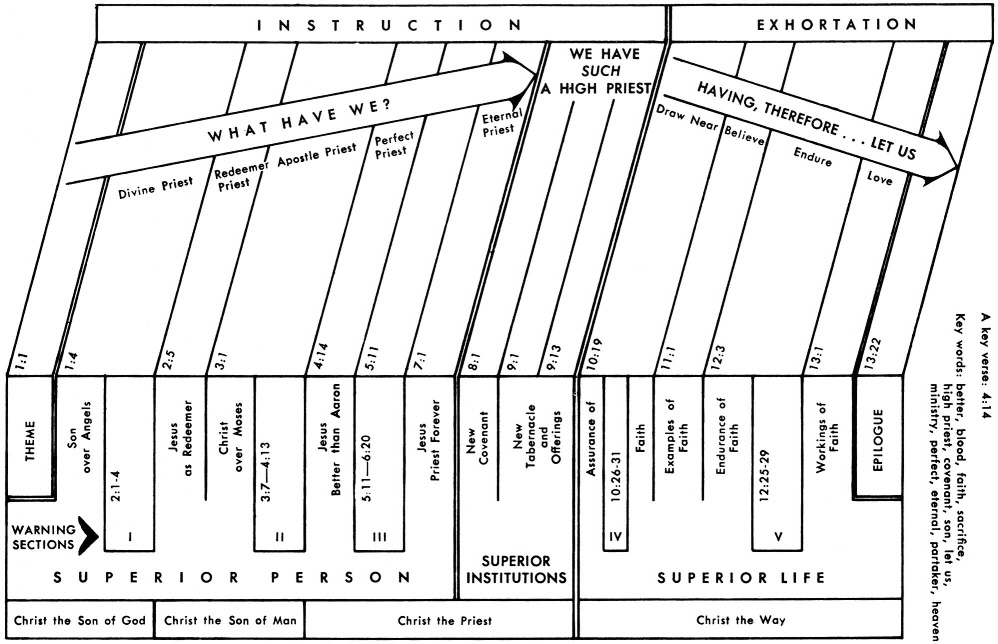
CONSIDER JESUS OUR GREAT HIGH PRIEST
Click chart to enlarge
Charts from Jensen's Survey of the NT - used by permission
Swindoll's Chart, Interesting Pictorial Chart of Hebrews, Another Chart
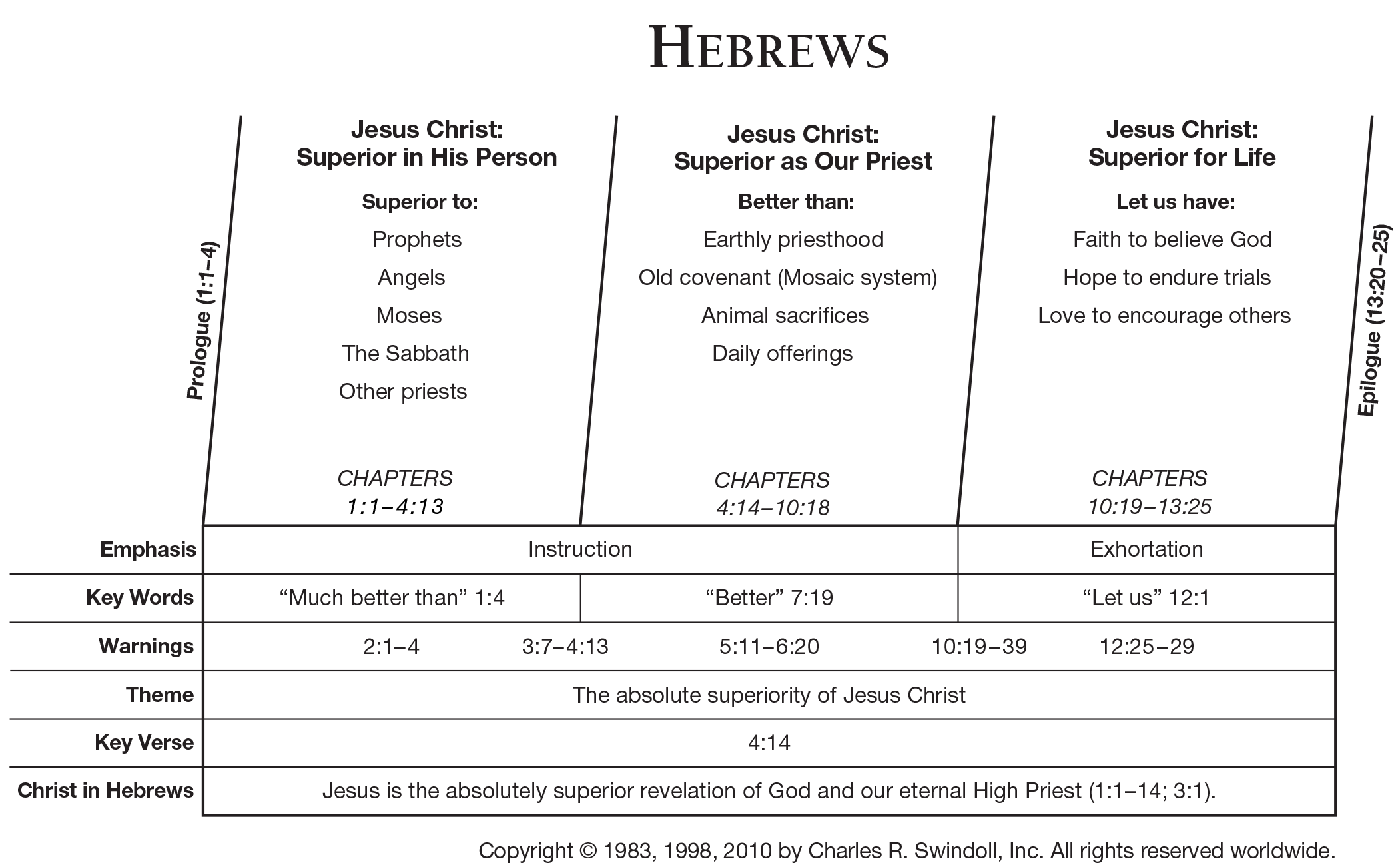
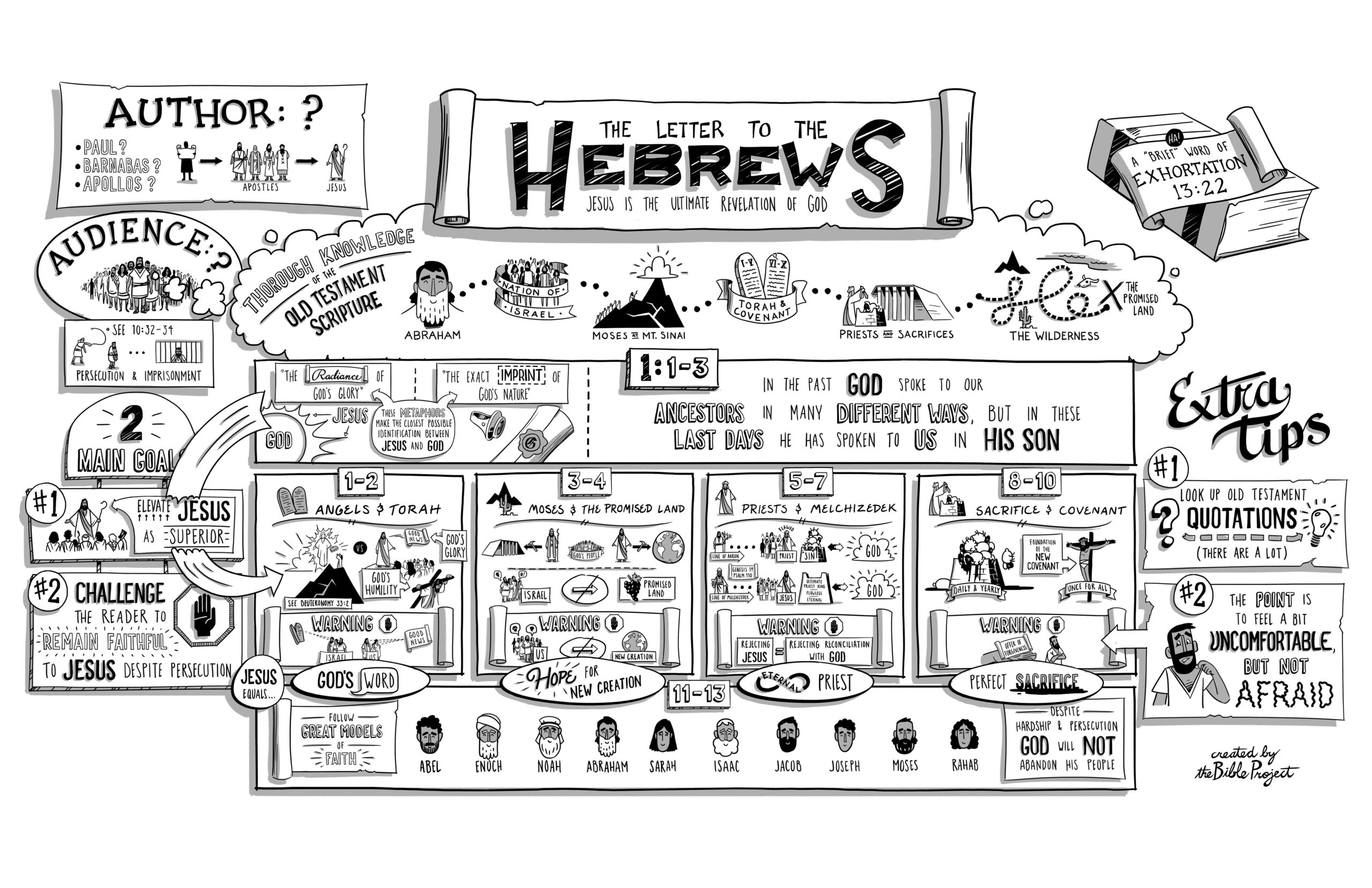
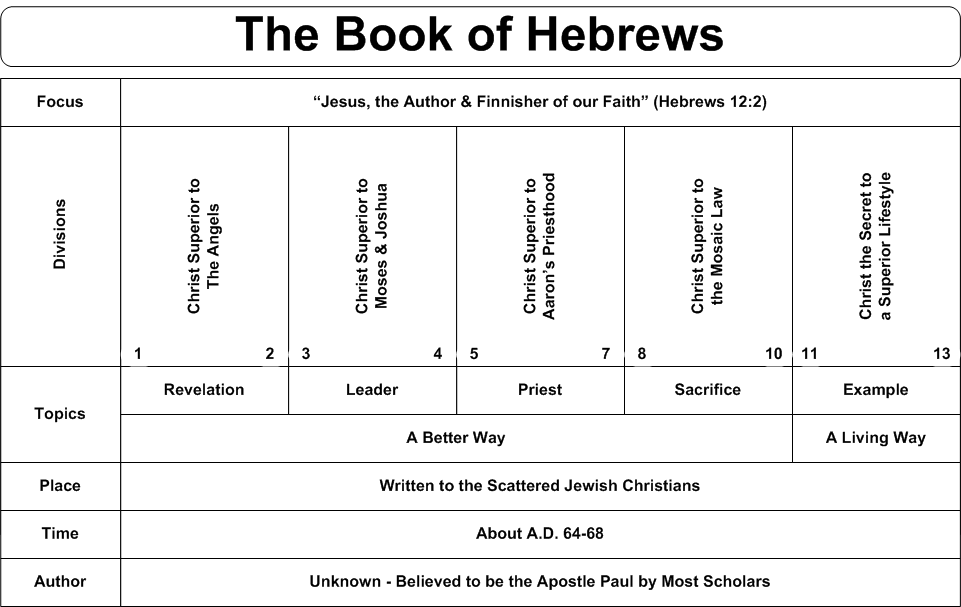
|
The Epistle |
||||
| INSTRUCTION Hebrews 1-10:18 |
EXHORTATION Hebrews 10:19-13:25 |
|||
| Superior Person of Christ Hebrews 1:1-4:13 |
Superior Priest in Christ Hebrews 4:14-10:18 |
Superior Life In Christ Hebrews 10:19-13:25 |
||
| BETTER THAN PERSON Hebrews 1:1-4:13 |
BETTER PRIESTHOOD Heb 4:14-7:28 |
BETTER COVENANT Heb 8:1-13 |
BETTER SACRIFICE Heb 9:1-10:18 |
BETTER LIFE |
| MAJESTY OF CHRIST |
MINISTRY OF CHRIST |
MINISTERS FOR CHRIST |
||
|
DOCTRINE |
DUTY |
|||
|
DATE WRITTEN: |
||||

See ESV Study Bible "Introduction to Hebrews"
(See also MacArthur's Introduction to Hebrews)
Borrow Ryrie Study Bible
Hebrews 12:3 For consider Him who has endured such hostility by sinners against Himself, so that you will not grow weary and lose heart. (NASB: Lockman)
Greek: analogisasthe (2PAMM) gar ton toiauten upomemenekota (RAPMSA) upo ton amartolon eis eauton antilogian, ina me kamete (2PAAS) tais psuchais humon ekluomenoi. (PPPMPN
BGT ἀναλογίσασθε γὰρ τὸν τοιαύτην ὑπομεμενηκότα ὑπὸ τῶν ἁμαρτωλῶν εἰς ἑαυτὸν ἀντιλογίαν, ἵνα μὴ κάμητε ταῖς ψυχαῖς ὑμῶν ἐκλυόμενοι.
Amplified: Just think of Him Who endured from sinners such grievous opposition and bitter hostility against Himself [reckon up and consider it all in comparison with your trials], so that you may not grow weary or exhausted, losing heart and relaxing and fainting in your minds. (Amplified Bible - Lockman)
My Amplified Paraphrase: For consider Him—think deeply about, meditate carefully on, continually ponder—Who endured such hostility (intense opposition, contradiction, and bitter antagonism) from sinners against Himself, so that you will not grow weary—not become exhausted, fainthearted, discouraged—and lose heart, collapsing inwardly under pressure or letting your soul give up.
NLT: Think about all he endured when sinful people did such terrible things to him, so that you don't become weary and give up. (NLT - Tyndale House)
KJV For consider him that endured such contradiction of sinners against himself, lest ye be wearied and faint in your minds.
NKJ For consider Him who endured such hostility from sinners against Himself, lest you become weary and discouraged in your souls.
NET Think of him who endured such opposition against himself by sinners, so that you may not grow weary in your souls and give up.
CSB For consider Him who endured such hostility from sinners against Himself, so that you won't grow weary and lose heart.
ESV Consider him who endured from sinners such hostility against himself, so that you may not grow weary or fainthearted.
NIV Consider him who endured such opposition from sinful men, so that you will not grow weary and lose heart.
Phillips: Think constantly of him enduring all that sinful men could say against him and you will not lose your purpose or your courage. (Phillips: Touchstone)
TLB: If you want to keep from becoming fainthearted and weary, think about his patience as sinful men did such terrible things to him.
Weymouth: Therefore, if you would escape becoming weary and faint-hearted, compare your own sufferings with those of Him who endured such hostility directed against Him by sinners.
Wuest: For consider by way of comparison the One who has endured opposition by sinners against himself, in order that you do not become weary, fainting in your souls.
Young's Literal: for consider again him who endured such gainsaying from the sinners to himself, that ye may not be wearied in your souls -- being faint.
- consider - Heb 12:2; 3:1; 1Samuel 12:24; 2Timothy 2:7,8
- Hebrews 12 Resources - Multiple Sermons and Commentaries
CONSIDER
JESUS
For (gar) introduces the reason for the exhortation to look unto Jesus and to keep looking to Him. Look unto him, for a comparison with Him will show you how much more He had to endure than you have had to endure. This principle is just as valid today as it was in the first century.
Westcott comments - The example of the triumph of Christ through suffering leads to a further consideration of the work of suffering for the Christian. Suffering is essentially a divine discipline. Under this aspect the author shews that the contemplation of Christ's victory through suffering brings sovereign support in affliction...Be patient, the writer says, look to Christ; for I charge you to consider His sufferings. If the eyes are steadfastly turned to Him (aphorao) the believer cannot fail to ponder the vision and to estimate the power of His work in relation to Life. That is sufficient in order that Christians may support their afflictions. If the leader bears the brunt of the battle the soldier can follow....Two thoughts are suggested by the consideration of Christ's sufferings (Heb 12:3). The sufferings of the Hebrews were relatively slight (Heb 12:4); and all sufferings which come from God are the wise discipline of a Father (Heb 12:5, 6). (The Epistle to the Hebrews)
Peter in a parallel passage explains why we are to consider Jesus (see Ann Ortlund's 44 meditations re Fix Your Eyes on Jesus) - For you have been called for this purpose, since Christ also suffered for you, leaving you an example for you to follow in His steps (1Pe 2:21)
Spurgeon - What sort of a Savior is Jesus Christ, a little Savior or a great one? Is He not the Son of God, and Himself God? What need is there of a divine person to be a propitiation for limited sin? It was the infinity of sin that required the Godhead itself to become incarnate, in order that human guilt might be put away.
Consider (357) (analogizomai from aná = again - idea of repetition + logizomai [see study] = reckon, think) means to think, reckon, count up or reason with thoroughness and completeness and so to think out carefully, reason thoroughly and with careful deliberation, consider accurately and distinctly or again and again. The verb can also include the idea of meditation (see Meditate). This word was used in calculations. Consider by way of comparison. This verb can also include the idea of meditation.
The aorist imperative is a command calling for the reader to give this his or her utmost attention. Do this now! Don't delay. It calls for the reader to carry out a specific act (consider Jesus) with a note of urgency. See discussion of the Need for the Holy Spirit to obey NT commands or "How to Keep All 1642 Commandments in the New Testament!"
Westcott adds that analogizomai "does not occur elsewhere in the LXX or NT. It is common in classical Greek, and expresses in particular the careful estimate of one object with regard to another. Plat. Theaet. p. 186 A; Resp. 10.618 C. The use here in respect of a person and not of a thing is remarkable. The writer seems to say ‘Consider Christ, reckoning up His sufferings point by point, going over them again and again, not the sufferings on the Cross only, but all that led up to it.’ This is to be done once for all (aorist imperative). (The Epistle to the Hebrews)
Wuest - Now, the writer, having called attention to the fact that Messiah is the preeminent example of the life of faith, exhorts his readers to consider Him. The word is analogizomai, “to reckon up, to consider by way of comparison.” The word “for” (see importance of this term of explanation) introduces the reason for the exhortation to look off and away to Jesus. When considering Him, the readers will see how much more He had to endure than they. Their sufferings, the result of the persecutions which they are enduring, would seem but insignificant compared to His. (Hebrews Commentary)
Compare to the similar idea of remember again - But remember (present imperative = keep on remembering again and again = anamimnesko from ana = again + mimnesko = remember) the former days, when, after being enlightened, you endured a great conflict of sufferings, (see note Hebrews 10:32).
Consider His incarnation and why it had to occur - Therefore, He had to be made like His brethren in all things, so that He might become a merciful and faithful high priest in things pertaining to God, to make propitiation for the sins of the people (see note Hebrews 2:17).
Yet, because He endured, Jesus sat down at the right hand of God. His example is proof to the readers will also be rewarded if they likewise endure - Therefore, do not throw away your confidence, which has a great reward (see note Hebrews 10:35).
Moses considered Him for he considered "considering the reproach of Christ greater riches than the treasures of Egypt; for he was looking to the reward (see note Hebrews 11:26)
No one can miss the wisdom of this passage for the writer is calling for his readers (including us today) to be totally absorbed with Jesus. This requires a turning away from those things that distract us and then a consciously focusing and meditating on Jesus. Ideally if we are focusing on Jesus first, then we will be motivated and empowered to turn away from distractions. This is why we must read and re-read the Gospel accounts for they emphasize the life of our Lord.
Vance Havner has a devotional thought writing that...
The eleventh chapter of Hebrews is an impressive roll-call of faith's heroes but the list is complete only when Christ is considered. It is ever thus. No life is great that does not point to Christ. These great names from Abel through the prophets are but sign-posts that lead at last to Him.
It is so with Scripture. In these pages many verses are called to mind. Start from any of them and the path leads to him. "They are they which testify of Him."
So, no matter what the theme or text, we are really considering Him, for by Him all Scripture consists. Satan will go to any lengths to keep you from considering the Lord. If he can put you to riding the hobby (horse) of a favorite doctrine; if he can get you to look back at yesterday's failures (Php 3:13), or ahead to tomorrow's dreads (Php 4:6, Mt 6:25, Mt 6:34), or around at the array of circumstances or within at your own weakness and poverty (cp 2Cor 12:9, 2Cor 12:10)—anywhere but looking unto Jesus (Isa 45:22KJV)—then he is satisfied. And remember that he has many masks and will come so like an angel of light (2Co 11:13, 14, 15) that you are scarcely aware at first that you are not considering Christ.
These pages (Ed: referring to his devotional) are written that from many diverse points along the "T and O Trail," the Trust and Obey (hymn), we might pause a moment and take a fresh look at him "lest we be wearied and faint in our minds." (Consider Jesus: and Other Brief Devotionals. Out of Print)
Related Resource:
- Fix Your Eyes On Jesus - 44 excellent meditations by Anne Ortlund)
WHO HAS ENDURED SUCH HOSTILITY BY SINNERS AGAINST HIMSELF: hupomemenekota (RAPMSA) hupo ton hamartolon eis heauton antilogian :
- Matthew 10:24,25; 11:19; 12:24; 15:2; 21:15,16,23,46; 22:15; Luke 2:34; Luke 4:28,29; 5:21; 11:15,16,53,54; 13:13,14; 14:1; 15:2; 16:14; 19:39; Luke 19:40; John 5:16; 7:12; 8:13,48,49,52,59; 9:40; 10:20,31, 32, 33, 34, 35, 36, 37, 38, 39; 12:9; Jn 12:10; 15:18, 19, 20, 21, 22, 23, 24; 18:22
- Hebrews 12 Resources - Multiple Sermons and Commentaries
Endured (5278) (hupomeno [word study] from hupó = under + meno = remain) ( See also word study on related word hupomone) literally means to abide under. The root idea of is that of remaining under some discipline, subjecting one’s self to something which demands the acquiescence of the will to something against which one naturally would rebel. It portrays a picture of steadfastly and unflinchingly bearing up under a heavy load and describes that quality of character which does not allow one to surrender to circumstances or succumb under trial. The picture is that of steadfastness, constancy and endurance.
Hupomeno -17x in 16v -NAS = endure(3), endure...with patience(1), endured(5), endures(3), patiently endure(1), perseveres(1), persevering(1), remained(1), stayed behind(1).
Matt 10:22; 24:13; Mark 13:13; Luke 2:43; Acts 17:14; Rom 12:12; 1 Cor 13:7; 2 Tim 2:10, 12; Heb 10:32; 12:2f, 7; Jas 1:12; 5:11; 1 Pet 2:20.
Hupomeno has in it a forward look, the ability to focus on what is beyond the current pressures as we saw in the previous verse in which Jesus
Who for the joy set before Him endured (hupomeno) the Cross despising the shame (see note Hebrews 12:2).
Endured is in the perfect tense which emphasizes the abiding effect of Christ's redemptive suffering. Westcott adds that...
For the use of the perfect in connexion with the abiding results of Christ's work the following passages should be carefully studied:
Hebrews 12:2 (note) (has sat down - kekathiken):
Hebrews 1:4 (note) (He has inherited - kekleronomeken);
Hebrews 2:9 (note) (was made lower - lattomenon...crowned with - stephanomenon)
Hebrews 2:18 (was tempted - peponthen);
Hebrews 4:14 (note) (has passed through - dieleluthota);
Hebrews 4:15 (note) (has been tempted - pepeirasmenon);
Hebrews 7:26 (note) (separated - kechorismenos);
Hebrews 7:28 (note) (made perfect - teteleiomenon);
Hebrews 9:26 (note) (manifested - pephanerotai).
Remember that even Jesus was perfected through His sufferings (He 2:10).
Hupomeno does not describe a grim resignation or a passive "grin and bear" attitude but a triumphant facing of difficult circumstances knowing that even out of evil God guarantees good. It is courageous gallantry which accepts suffering and hardship and turns them into grace and glory. It is the ability to endure when circumstances are difficult and is not a passive sitting down and bearing things but bearing up in a way that honors and glorifies our heavenly Father.
The difficulties in our lives,
The obstacles we face,
Give God the opportunity
To show His power and grace.
Morris writes that hupomeno represents the exercise of "the attitude of the soldier who in the thick of battle is not dismayed but fights on stoutly whatever the difficulties.
Amy Carmichael in Candles in the Dark writes that "The best training is to learn to accept everything as it comes, as from Him whom our soul loves. The tests are always unexpected things, not great things that can be written up, but the common little rubs of life, silly little nothings, things you are ashamed of minding (at all). Yet they can knock a strong man over and lay him very low.
Endured such hostility - The hostility describes the opposition the Messiah endured from sinful men, even (and especially) religious (Jews who should have known better) men in both word and act. In the present context, the Jewish readers who had been born again (or were strongly considering the claims of the Messiah) were persecuted and mistreated by their Jewish brethren (not spiritual brethren but physical for both were from the lineage of Jacob) who were still clinging to the order of the Old Covenant of Law, including things like the temple sacrifices. The writer calls to their mind the example of the Author and Perfecter of their faith to encourage his readers to "hang on" despite the opposition which they were meeting with that endured by Messiah, and to do this in order that they would not be weary, fainting in their souls.
THOUGHT - Believers today need the same encouragement, especially in our culture which is sliding further and further from Biblical standards and into the abyss of paganism, debauchery and false spirituality, all of which are hostile toward Christianity.
Westcott adds that "such opposition as shewed itself in the infliction of the most cruel shame and death, in comparison with which your sufferings are insignificant. (Ibid)
Simeon prophesied of this hostility - And Simeon blessed them, and said to Mary His mother, "Behold, this Child is appointed for the fall and rise of many in Israel, and for a sign to be opposed (antilego)" (Luke 2:24)
Spurgeon - Luther says, “When I think of what Christ suffered, I am ashamed to call anything that I have endured suffering for his sake.” He carried His heavy cross, but we only carry a sliver or two of it; He drank His cup to the dregs, and we o sip a drop or two at the very most. Consider how He suffered far more than you can ever suffer, and how He is now crowned with glory and honor. And as you are to be like Him, descend like Him into the depths of agony, that with Him you may rise to the heights of glory. The believer under persecution should remember that he is suffering no strange thing, but is only enduring that which fell upon his Master before him. Should the disciple expect to be above his Lord? “If they have called the master of the house Beelzebul, how much more the members of his household” (Matt 10:25)? If they had received Christ they would have received us, but since they reject both Christ and His sayings, the followers of Christ must expect that both their persons and their doctrines will be lightly esteemed. We are sometimes apt to think that a charge that is unfounded is very cruel to us. I have heard people say sometimes, and I have laughed when I have heard them say it, “Mr. So-and-so has charged me with such-and-such a thing, but I am quite innocent. I should not have minded if I had been guilty.” I have thought, “Then you ought to have minded it, but being innocent you have no cause to mind it at all.” But is it not so that the more unfounded a charge is, the more deeply it seems to cut us from the very wantonness of its cruelty? Well, then, you know how innocent the Savior was. The next time you feel innocent when you are thus accused “consider the one who endured such hostility by sinners against himself” (Heb 12:3), and who had to suffer both gross charges and unfounded ones.
Hostility (485) (antilogia from antilego = contradict in turn from anti = against + lego speak) literally a word spoken against or speaking against and so talking back, face to face, in opposition against (a dispute involving opposite opinions). Our English word dispute describes a disagreement, a quarrel, an argument or a verbal controversy.
Antilogia can also mean defiance against authority (with special emphasis on verbal defiance -- see examples below of this use in the Septuagint) or rebellion as by Korah in Jude 1:11.
Antilogia describes contradiction or controversy with the added sense that strife is involved. Strife means bitter sometimes violent conflict or dissension. The English word hostility pictures enmity (deep-seated dislike or ill will or a manifestation of such feeling) or antagonism.
Vincent writes that antilogia describes "the practice of gainsaying" where "Gainsay is a literal translation, being compounded of the Anglo-Saxon gegn, which reappears in the German gegen, against, and say." In our English dictionaries gainsay means to deny, contradict or speak against.
Wuest on antilogia - “to speak against, gainsaying.” It sometimes refers to opposition in act. The word “contradiction” here refers, therefore, to the opposition Messiah endured from the human race in word and act. These persecuted Jews, mistreated by their brethren after the flesh who were still clinging to the temple sacrifices, are exhorted to thus contrast this opposition which they were meeting, with that endured by Messiah, and to do this in order that they would not be weary, fainting in their souls. (Hebrews Commentary)
Paul explaining how it he ended up in Rome in prison declared that "(just as the Romans were willing to release Paul) the Jews objected (antilego - root verb of antilogia) (and) I was forced to appeal to Caesar; not that I had any accusation against my nation. (Acts 28:19)
Antilogia is used 4 times in the NT..
Hebrews 6:16 (note) For men swear by one greater than themselves, and with them an oath given as confirmation is an end of every dispute.
Hebrews 7:7 (note) But without any dispute the lesser is blessed by the greater. (Comment: Here the sense of antilogia is that of beyond all doubt or denial or controversy. And so the writer is asserting a principle which no one thinks of questioning [or disputing] -- it is the less who is blessed, and the greater who blesses)
Hebrews 12:3 For consider Him who has endured such hostility by sinners against Himself, so that you may not grow weary and lose heart.
Jude 1:11 Woe to them! For they have gone the way of Cain, and for pay they have rushed headlong into the error of Balaam, and perished in the rebellion of Korah.
There are 19 uses of antilogia in the Septuagint (LXX) (Ex. 18:16; Num. 20:13; 27:14; Deut. 1:12; 17:8; 19:17; 21:5; 25:1; 32:51; 33:8; 2 Sam. 15:4; Ps. 18:43; 31:20; 55:9; 80:6; 81:7; 106:32; Prov. 17:11; 18:18; Heb. 6:16; 7:7; 12:3; Jude 1:11) and here is a representative use...
Numbers 20:13 Those were the waters of Meribah (Hebrew means place of strife or contention; LXX = antilogia = dispute), because the sons of Israel contended with the LORD, and He proved Himself holy among them.
Deuteronomy 1:12 'How can I alone bear the load and burden of you and your strife (Hebrew = rib = strife, controversy, quarrel; LXX = antilogia)?
Psalm 31:20 (Spurgeon's note) Thou dost hide them in the secret place of Thy presence from the conspiracies of man; Thou dost keep them secretly in a shelter from the strife (Hebrew = rib = strife, controversy, quarrel; LXX = antilogia) of tongues.
Psalm 80:6 (Spurgeon's note) Thou dost make us an object of contention (Hebrew = madown = strife, contention; LXX = antilogia) to our neighbors; And our enemies laugh among themselves.
Sinners (268)(hamartolos) describes those devoted to sin and thus whose behavior does not measure up to standard moral expectations. They are those who miss the mark set by God's holiness.
Spurgeon - No personal animosity ever ruffled the serenity of our great Master’s spirit. Moreover, He was never moved to take the slightest revenge upon His foes; even for those who nailed Him to the wood, He had no return but the prayer, “Father, forgive them, for they do not know what they are doing” (Luke 23:34). And, as He had no vengeance against them, so they exerted no evil influence upon Him. He persevered in His life work just as much as if He had never been opposed. Like the sun that goes on in its strength whether clouds hide it or whether it shines out of the blue serene, Christ continued in His heavenward way. We ought to admire the patient serenity with which He so beautifully held His peace, but ought we not also to admire the way in which He unswervingly kept His course? Many a man would have turned either to the right hand or to the left, but the heroic Savior keeps right on. There was a crest and motto that some of the old Reformers used to use, and that I commend to any of you who are under trial. It was an anvil with a number of hammers, all broken, lying around; and this was the motto when translated, “The anvil breaks many hammers.” And how does it do this? Not by striking: oh, no! The anvil simply endures the blows, keeps its place, and lets the hammers fall, fall, fall until they are broken upon their handles. This is exactly what the Savior did. They, the accusers, were the hammers; He was the anvil. Who shall say that the anvil did not break the hammers into pieces, that the silence of the Savior was not far more eloquent than all the clamor of the evil multitude? “He was silent” (Matt 26:63), it is said of Him. May it also be said of you and of me. When we have to suffer similar trials, may we bear them, like the Savior, in silence.
Here is a powerful illustration of the call to endure...
Sir Winston Churchill was invited back to his alma mater, Harrow, to address the students near the end of his storied life of public service, which included guiding Britain through her darkest and finest hours. When the five-foot, five-inch bulldog of a man took the platform, everyone waited breathlessly upon his words—and they would never forget what they heard:
“Young gentlemen, never give up.
Never give up.
Never give up!
Never! Never! Never!”
With that Churchill sat down. That's what the writer of Hebrews is calling for an endurance from his readers such as Jesus manifested. They are to diligently live out their faith. Are you about to give up beloved? Don't do it! Never give up! Never! Never! Never! Consider Jesus and remember that He Who promised is faithful to fulfill His promise that He would never, ever, no never leave you nor forsake you (see note Hebrews 13:5). The Christian life is not a sprint, but a marathon. Over the years we have been repeatedly saddened by acquaintances who did not persevere and who dropped by the wayside of this world.
SO THAT YOU MAY NOT GROW WEARY AND LOSE HEART: hina me kamete (2PAAS) tais psuchais humon ekluomenoi (PPPMPN):
- Heb 12:5; Dt 20:3; Pr 24:10; Isa 40:30,31; 50:4; 1Cor 15:58; 2Cor 4:1,16; Gal 6:9; 2Thes 3:13
- Hebrews 12 Resources - Multiple Sermons and Commentaries
The truth in this passage is vitally important to "assimilate" for as John Stott reminds us "The Christian's chief occupational hazards are depression and discouragement."
Spurgeon - Think how He wrestled; think how He ran. And let your consideration of Him nerve you for your struggle, and brace up every muscle of your spirit, so that you will be determined that, as He won, so will you by the divine help of Him who is “the originator and perfecter of our faith” (Heb 12:2).
Remember too as someone once said that our disappointments are God's appointments and that the obstacles in our path may well be unrecognized opportunities. The difficulties we encounter for the sake of Christ have the potential to make us either better or bitter.
The truth similar to that which the writer is emphasizing here in Heb 12:3,4 is found in the OT, in a very interesting context, the giving of God's "laws regarding warfare"(!) (Do we not grow weary when the spiritual warfare seems to never dissipate in regard to time and/or intensity? I do!)...
He shall say to them, ‘Hear, O Israel, you are approaching the battle against your enemies today. Do not be fainthearted. Do not be afraid, or panic, or tremble before them (Dt 20:3) (Why should they or we not grow faint of heart when we see the enemy coming at us, time and time again? Read the next verse -- May God's Spirit allow our head and heart to lay hold of the truth in this passage for our good and His glory! Amen) for the LORD (Jehovah) your God is the one who goes with you, to fight for you against your enemies, to save you.' (Dt 20:4)
Writing to Israel but applicable in principle to the saints of all ages Isaiah declares...
Though youths grow weary and tired, and vigorous young men stumble badly, yet those who wait for the LORD (Jehovah) will gain new strength. They will mount up with wings like eagles. They will run and not get tired. They will walk and not become weary. (Isaiah 40:30, 31-see in depth exposition)
As John Calvin once said "Distrust is cured by meditating upon the promises of God." And as Puritan writier Thomas Watson reminds us "The promises are not made to strong faith but to true."
Writing to the saints at Corinth Paul has records a great truth which can sustain and undergird our "weak" hearts when we are in the throes of "spiritual weariness"...
Therefore we do not lose heart, (Why not? What truth can counter and even reverse the temptation when we feel like "throwing in the proverbial towel"?) but though our outer man is decaying, yet our inner man is being renewed day by day. For momentary, light affliction is producing for us an eternal weight of glory far beyond all comparison, while we look not at the things which are seen, but at the things which are not seen; for the things which are seen are temporal, but the things which are not seen are eternal. (2Cor 4:16, 17,18)
And in Galatians Paul gives us present motivation in light of the sure hope of future rewards exhorting us to...
...not lose heart in doing good, for in due time we will reap if we do not grow weary. (Gal 6:9, cf similar exhortation in 2Th 3:13)
So that (2443) (hina) introduces a purpose clause, the purpose of the encouragement to think about Jesus' suffering. See importance of pausing to ponder this term of purpose or result.
Spurgeon - It has not come to that yet with any of you who are now here; you have not shed your blood for Christ yet, for these are not martyr days, so can you be wearied and faint? If you run with the footmen, and they weary you how will you contend with horses? We ought to be ashamed of ourselves if we grow weary in a race that is so easy compared with that of the men and women who laid down their lives for Christ’s sake. Think how he wrestled, think how he ran; and let your consideration of him nerve you for your struggle, and brace up every muscle of your spirit so that you will be determined that, as he won, so Will you by the divine help of him who is “the Author and Finisher of our faith.”
Westcott - At this point the image is changed. The thought is no longer of effort but of endurance; of the assault of a powerful adversary which must be met, and not of a struggle voluntarily sought. (Ibid)
Grow weary (2577) (kamno) means to grow fatigued or weary in soul, and thus to become discouraged. Vine writes that kamno means primarily, “to work,” hence, from the effect of constant work, “to be weary”.
In James kamno is translated "sick" but as discussed in the note below, speaks not so much of physical as of spiritual sickness (weariness of soul).
In the context of one ancient writing kamno conveyed the idea of being tired or weary of the continued succession of the wars.
Grow weary and lose heart were sometimes used for the exhaustion a runner could face. (The call to endurance in Hebrews 12:1 reflects the language of long-distance races.)
The phrase grow weary and lose heart was used in the ancient world to describe a runner’s exhausted collapse. The suffering in view is mainly persecution (for being a Christian) in various forms, but short of martyrdom.
Kamno is used 2 times in the NT (or 3 in the Textus Receptus - see Rev 2:3), in the current verse and in...
James 5:15 and the prayer (euche - not the usual word for prayer in the NT but a word signifying a fervent wish or strong petition) offered in faith (faith of the elders, not of the person who is sick - i.e., they believe in the power of God to accomplish what they are asking) will restore (sozo - make whole) the one who is sick (kamno - in context most likely refers to that down mental state induced by the guilt of sin), and the Lord will raise him up, and if (since) he has committed sins, they will be forgiven him. (Comment: Vincent writes that kamno "originally means to work. Hence, “him that is laboring under disease.”" Macarthur adds that "The idea here is that the elders’ prayers will deliver weak, defeated believers from their spiritual weakness and restore them to spiritual wholeness")
Rev 2:3-note (Jesus to the church at Ephesus) And hast borne, and hast patience, and for My name's sake hast laboured, and hast not fainted. (Note: The Nestle Aland and other modern manuscripts have kopiao here instead of kamno which is found in the Textus Receptus, the manuscript used to translate the KJV/NKJV).
Lose heart (1590) (ekluo from ek = out or intensifier + luo = to loose) means literally to loosen out and to to untie, to dissolve, to release. To be unstrung. To relax effort. Figuratively ekluo means to give up. To be without strength (Mt 15:32, Mark 8:3). Ekluo was used to describe reapers who had been overcome by heat and toil.
Since ekluo means to unloose, the opposite idea is to gird up (Greek anazonnumi) as used figuratively in first Peter...
Therefore, gird (gird up - anazonnumi) your minds for action, keep sober in spirit, fix your hope (aorist imperative - command to do this now) completely on the grace to be brought to you at the revelation of Jesus Christ. (1Pe 1:13)
In the passive voice ekluo means to to become slack or so tired and weary as to give out and possibly even to faint from exhaustion. To be exhausted as a result of giving in to evil. To be physically or morally weak.
To become disheartened or discouraged, losing the motivation to accomplish a valid goal (as in Gal 6:9).
In the Gospels ekluo speaks of those who become physically weak and faint from lack of food.
Ekluo was used in a number of contexts such as to spill water; to be physically weak (described as having limp, soft, or lifeless hands), to have a weak heart; or to be morally lax. Here in Hebrews, the writer uses ekluo to encourage his readers to “not slacken” when they undergo trials. We all need to remember that whatever trials we are going trough, God allows (or sometimes sends) and thus we are ultimately in our Father's hands. Such providential training through correction or discipline (which is expounded on in the following passages - see note Hebrews 12:5) and is always Divinely designed for our good.
They are the words which Aristotle uses of an athlete who collapses on the ground after he has surged past the finish line. So the writer of Hebrews is in effect saying "Don't give up too soon. Don't collapse until you break the finish line."
Ekluo is found 5 times in the NT...
Matthew 15:32 And Jesus called His disciples to Him, and said, "I feel compassion for the multitude, because they have remained with Me now three days and have nothing to eat; and I do not wish to send them away hungry, lest they faint on the way."
Mark 8:3 and if I send them away hungry to their home, they will faint (be exhausted) on the way; and some of them have come from a distance."
Galatians 6:9 And let us not lose heart in doing good, for in due time we shall reap if we do not grow weary.
Hebrews 12:3 For consider Him who has endured such hostility by sinners against Himself, so that you may not grow weary and lose heart.
Hebrews 12:5 (note) and you have forgotten the exhortation which is addressed to you as sons, "My son, do not regard lightly the discipline of the Lord, Nor faint when you are reproved by Him
Ekluo is used 45 times in the Septuagint (LXX) (Ge 27:40; 49:24; Deut 20:3; Jos 10:6; 18:3; 1 Sa 14:28; 30:21; 2 Sa 4:1; 16:2, 14; 17:2, 29; 21:11, 15; 1 Ki 20:43; 2 Chr. 15:7; Ezra 4:4; Neh. 6:9; Job 19:25; Pr 3:11; 6:3; Isa 13:7; 29:9; 46:2; 51:20; Jer 4:31; 12:5; 38:4; 49:24; Lam 2:12, 19; Ezek 7:17; 31:15; Da 8:27)
Deuteronomy 20:3 "And he shall say to them, 'Hear, O Israel, you are approaching the battle against your enemies today. Do not be fainthearted (Hebrew = rakak = to be tender, weak, soft. Lxx = ekluo). Do not be afraid, or panic, or tremble before them,
2 Samuel 21:15 Now when the Philistines were at war again with Israel, David went down and his servants with him; and as they fought against the Philistines, David became weary (Hebrew = iph = to be faint; Lxx = ekluo)
2 Chronicles 15:7 "But you (the Spirit of God came upon Azariah who said to Asa) , be strong and do not lose courage (Hebrew is literally "let not your hands be weak"; Lxx = ekluo), for there is reward for your work."
Ezra 4:4 Then the people of the land discouraged (KJV is more literal = "weakened the hands"; Lxx = ekluo) the people of Judah, and frightened them from building,
Nehemiah 6:9 For all of them were trying to frighten us, thinking, "They will become discouraged (Hebrew = raphah = sink, relax + yad = hand - literally "relax the hand"; Lxx = ekluo) with the work and it will not be done." But now, O God, strengthen my hands
THOUGHT: A good prayer for all of us who may letting our hands "relax" and be becoming weary in the Lord's work! It is His work you are doing isn't it? Remember, He initiates and enables all His ministry through us. There is much being done today in the church ostensibly in His Name, but is initiated and empowered by the fallen flesh, which is especially deceptive and subtle when it puts on an external cloak of religious garb and speech!
Proverbs 3:11 (KJV) My son, despise not the chastening of the LORD; neither be weary (Hebrew = quwts = to be grieved, loathe, abhor; Lxx = ekluo) of his correction:
Isaiah 13:7 Therefore all hands will fall limp (Hebrew = raphah = sink, relax ; Lxx = ekluo) and every man's heart will melt. (Comment: When will this occur? The context explains that this will come about in the Day of the Lord)
Jeremiah 12:5 "If you have run with footmen and they have tired you out (Hebrew = laah = to become weary or tired; Lxx = ekluo), Then how can you compete with horses? If you fall down in a land of peace, How will you do in the thicket of the Jordan?
Ezekiel 7:17 '(Context is the destruction of Jerusalem) All hands will hang limp (Hebrew = raphah = sink, relax ; Lxx = ekluo), and all knees will become like water.
It is normal for Christians to have experiences of stress and suffering that threaten their faith and press too hard or last too long and feel almost intolerable - we've all experienced this sense of despair. Losing heart is always a great spiritual danger. And the readers were in that danger, as are many believers today in our society which is adrift morally and ethically. Contemplation of Christ, His sufferings and His reward, is the great preventative of such weariness and loss of heart.
Our Daily Bread - A Hole in the Head. - Hebrews 12:3 - Private Raymond Cote was in Germany with the 12th Infantry after World War II. During maneuvers, he was put on sentry duty to guard some pontoons on the banks of the Rhine. Because of an oversight, he was not relieved for 6 days. He knew the general order that states: "To quit my post only when properly relieved." So he stayed on duty day and night even when it rained heavily. Sympathetic farmers gave him food and milk. When he finally was relieved and got back to his outfit, his commanding officer praised his "strong sense of duty." But some of his buddies wisecracked that Cote had "a hole in his head."
Followers of the Savior also need a strong determination to carry out faithfully whatever duty the Commanding Officer may assign. It may involve much discomfort, perhaps causing people to regard us as having a hole in the head. But our faithful Commander, whose head was lacerated by a crown of thorns, also had holes in His hands, feet, and side because He did His Father's will.
What will strengthen us to remain faithful when tempted to quit some God-assigned post before our Lord properly relieves us? It is the thought of "Him who endures such hostility from sinners against Himself" (Heb. 12:3). - V C Grounds (Our Daily Bread, Copyright RBC Ministries, Grand Rapids, MI. Reprinted by permission. All rights reserved)
I would be true, for there are those who trust me;
I would be pure, for there are those who care.
I would be strong, for there is much to suffer;
I would be brave, for there is much to dare.
--Walter
To remain faithful where God has placed you,
give God first place in your heart.
Our Daily Bread - A Sacrifice Remembered - A white wall in the Veterans Memorial Museum in Branson, Missouri, bears the names of 406,000 US soldiers who died in World War II. Each name points beyond itself to the larger cause for which they died.
Nearly every nation has monuments to its fallen soldiers and a day to remember those who died fighting for their country. Whether or not we agree with their ideals, we do well to ponder their courage and sacrifice.
Hebrews 11 lists a number of heroes who lived and died courageously "by faith." Near the end of the chapter, the list changes from the names of individuals to groups of believers whose experiences ranged from miraculous deliverance to torture and death because they refused to compromise their faith in God.
Individually and collectively, they remind us that the spiritual battle is not over. One paraphrase of Hebrews 12:1 says, "Do you see what this means—all these pioneers who blazed the way, all these veterans cheering us on? It means we'd better get on with it" (The Message by Eugene Peterson).
As we recall every sacrifice made on our behalf and every example of spiritual courage, let's determine to keep our eyes on Jesus and to join the parade of faithful veterans of the faith. —David C. McCasland
As we remember those who've gone before
And think about the sacrifice they made,
We cannot help but think about our Lord,
Who gave His life—our ransom fully paid.
—Hess
Let's never forget that others have died so that we might live.
Our Daily Bread - Roughed Up To Grow Up - Many Christians have to be lovingly roughed up before they will grow up. Although the heavenly Father never allows His children to suffer needlessly, sometimes He lets them experience hard knocks so they'll become mature believers.
The need for "bad weather" to stimulate growth can be seen in nature. Scientists say that the seeds of some desert bushes must be damaged by a storm before they will germinate. They are covered with hard shells that keep out water. This allows them to lie dormant on the sand for several seasons until conditions are right for growth.
When heavy rains finally come, the little seeds are carried away in a flash flood. They are banged against sand, gravel, and rocks as they rush down the slopes. Eventually they settle in a depression where the soil has become damp to a depth of several feet. Only then do they begin to grow, for moisture is absorbed through the nicks and scratches they picked up on their downhill plunge.
Similarly, difficulties may be needed to wake up a sleeping saint. This may hurt for a while, but if we yield to the Lord we will find that life's bruises can mark the beginning of spiritual advances. We may prefer to remain "seeds," but He wants us to become "fruitful trees." —Mart De Haan
Should Thy mercy send me sorrow, toil, and woe,
Or should pain attend me on my path below,
Grant that I may never fail Thy hand to see,
Grant that I may ever cast my care on Thee.
—Montgomery
There are no gains without pains
Our Daily Bread - Are You Struggling? - I was in my second year of widowhood and I was struggling. Morning after morning my prayer-life consisted of one daily sigh: "Lord, I shouldn't be struggling like this!" "And why not?" His still, small voice asked me from within one morning.
Then the answer came—unrecognized pride! Somehow I had thought that a person of my spiritual maturity should be beyond such struggle. What a ridiculous thought! I had never been a widow before and needed the freedom to be a true learner—even a struggling learner.
At the same time, I was reminded of the story of a man who took home a cocoon so he could watch the emperor moth emerge. As the moth struggled to get through the tiny opening, the man enlarged it with a snip of his scissors. The moth emerged easily—but its wings were shriveled. The struggle through the narrow opening is God's way to force fluid from its body into its wings. The "merciful" snip, in reality, was cruel.
Hebrews 12 describes the Christian life as a race that involves endurance, discipline, and correction. We never get beyond the need of a holy striving against self and sin. Sometimes the struggle is exactly what we need to become what God intends us to be.—Joanie Yoder
When God allows His chastening hand
To give us little rest,
His only purpose is our good—
He wants for us His best.
—D. De Haan
We experience God's strength in the strain of our struggle
Our Daily Bread - Remembrance Day - I was in London’s Heathrow Airport waiting for a connecting flight to the US. An announcement came over the public address system stating that it was “Remembrance Day” in the UK, the day on which people honored those who had died for their country in times of war. The announcement further said that at 11:00 a.m. there would be 2 minutes of silence and that it would be appreciated if everyone kept that in mind. Thousands of people from all over the world stood in silence as a tribute to the fallen soldiers, sailors, marines, and airmen of the UK.
The desire to remember those who gave their lives for their country is noble. Yet, as meaningful as that is, it cannot compare to the privilege that belongs to us when we approach the Lord’s Table. As we celebrate Communion, we are obeying Christ’s command that we remember His death (Luke 22:19) and to do it “till He comes” (1 Cor. 11:26). When He sacrificed His life for us, He provided the forgiveness of sins that sets us free and secures for us an eternal home in heaven.
Rather than letting the Lord’s Supper become routine, make every opportunity at the Table a true “Remembrance Day” by honoring Him till He comes. —Bill Crowder
Thank You, Lord, for dying for me
On the cross of Calvary;
Help me always to remember
What You did to set me free.
—Sper
Remembering Christ’s death for us
should cause us to live for Him
Hebrews 12:4 You have not yet resisted to the point of shedding blood in your striving against sin; (NASB: Lockman)
Greek: Houpo mechris haimatos antikatestete (2PAAI) pros ten hamartian antagonizomenoi, (PMPMPN)
BGT Οὔπω μέχρις αἵματος ἀντικατέστητε πρὸς τὴν ἁμαρτίαν ἀνταγωνιζόμενοι.
Amplified: You have not yet struggled and fought agonizingly against sin, nor have you yet resisted and withstood to the point of pouring out your [own] blood. (Amplified Bible - Lockman)
My Amplified Paraphrase: You have not yet resisted—you have not yet struggled, stood firm, or fought to the point of final extremity—to the point of shedding blood, in your battle against sin, whether the sin that tempts you inwardly or the sin that opposes you outwardly through persecutors.
NLT: After all, you have not yet given your lives in your struggle against sin. (NLT - Tyndale House)
NKJ You have not yet resisted to bloodshed, striving against sin.
NET You have not yet resisted to the point of bloodshed in your struggle against sin.
CSB In struggling against sin, you have not yet resisted to the point of shedding your blood.
ESV In your struggle against sin you have not yet resisted to the point of shedding your blood.
NIV In your struggle against sin, you have not yet resisted to the point of shedding your blood.
Phillips: After all, your fight against sin has not yet meant the shedding of blood, (Phillips: Touchstone)
TLB: After all, you have never yet struggled against sin and temptation until you sweat great drops of blood.
Weymouth: In your struggle against sin you have not yet resisted so as to endanger your lives;
Wuest: Not yet have you withstood to the extent of blood, struggling against sin.
Young's Literal: Not yet unto blood did ye resist -- with the sin striving;
YOU HAVE NOT YET RESISTED TO THE POINT OF SHEDDING BLOOD: Oupo mechris haimatos antikatestete (2PAAI):
- Heb 12:2; 10:32, 33, 34; Mt 24:9; 1Cor 10:13; 2Ti 4:6,7; Rev 2:13; 6:9, 10, 11; 12:11; Rev 17:6; 18:24
- Hebrews 12 Resources - Multiple Sermons and Commentaries
Paul records a parallel truth in his first letter to the saints at Corinth declaring that "No temptation has overtaken you but such as is common to man; and God is faithful, who will not allow you to be tempted beyond what you are able, but with the temptation will provide the way of escape also, so that you will be able to endure it. (1Co 10:13-see in depth discussion)
Spurgeon - Jesus is here delightfully called “ the author and finisher of our faith.” In most of the arts, there is a division of labor, one man begins, and another completes; there is scarcely anything that is completed by one man; but the stupendous work of our salvation was not only commenced but it was also completed by the Lord Jesus Christ alone. Let us look unto him then. This will help us to persevere unto the end because he persevered to the end. Think how he wrestled, think how he ran; and let your consideration of him nerve you for your struggle, and brace up every muscle of your spirit so that you will be determined that, as he won, so Will you by the divine help of him who is “the Author and Finisher of our faith.” It has not come to that yet with any of you who are now here; you have not shed your blood for Christ yet, for these are not martyr days, so can you be wearied and faint? If you run with the footmen, and they weary you how will you contend with horses? We ought to be ashamed of ourselves if we grow weary in a race that is so easy compared with that of the men and women who laid down their lives for Christ’s sake It has never come to a bloody sweat with you as with him, nor to death upon a cross, as in his case. Shall the disciple be above his master or the servant above his lord? Our trials are little compared with those of the martyrs of the olden times. Courage, brethren, these are small matters to faint about! Moreover, our chastenings are love tokens from God, let us not be alarmed at them.
Not yet - What does this contrasting time phrase imply? While their intense struggle had not yet resulted in death, the implication is that they must be prepared for a deadly encounter. We know from Heb 10:34 (note) that some had been imprisoned and some had been plundered.
We must never forget the axiom that while there certainly is a restful side to the Christian life (Mt 11:28, Php 4:6, 7-see notes Php 4:6; 4:7), on the other hand there is also a wrestling side to the Christian life. This latter is a struggling, striving, fighting of the good fight (cp Paul's testimony - 2Ti 4:7note)
John Piper explains that "These two sides are not related in such a way that you rest one day and wrestle the next. They are interwoven in two ways. 1) First, the main aim of our wrestling is to rest—in God and not in money or position or looks or achievement; the aim of our wrestling is to rest in the promises of God and not the promises of sin. 2) Second, all our wrestling and fighting and running are done with a deep restfulness of spirit that Christ Himself has already won the decisive victory for us and is sovereignly working in us and will bring us to glory. (Read the full sermon The Painful Discipline of our Heavenly Father)
Wuest - The readers are reminded of the fact that the persecutions they were enduring, had not yet entailed the shedding of their blood, as was the case of Messiah, who became obedient to God the Father to the extent of death, yes, to such a death as that upon a cross. Their striving against sin was their battle against the temptation of renouncing their professed faith in Messiah in order that they might be relieved of the persecution which they were enduring. His striving against sin was His submitting to the death of the Cross, with all that that involved, His becoming sin for us, the breaking for the time of the fellowship between the Father and the Son, and all the intense and awful physical agony of crucifixion. (Hebrews Commentary)
Resisted (478) (antikathistemi from antí = against + kata = opposition against + histemi = place, stand) literally pictures one standing (histemi) face to face (anti) against (kata). Speaking of the disposition of troops, antikathistemi meant to stand in opposition against in a line of battle. In secular writings it has the meaning in of passive “holding out” rather than that of active aggression.
Your strife against sin has not entailed the shedding of your blood, as did that of many of the OT saints (heroes of faith in Heb 11:1ff, 11:35, 37) and of Jesus himself. Of Jesus Php 2:8, Heb 10:32ff. Heb 13:13 None of the readers of this book had yet been martyred (if they had been, they would not be reading the epistle!)
The point here is that things are bad, but not as bad as they could be. There is hostility and trouble and stress and suffering, but evidently no martyrs yet. We know from Heb 10:34 that some had been imprisoned and some had been plundered. But it is not yet martyrdom, though that could come. The stress level here is huge. How do you sleep at night when being a Christian may result in mob violence?
Jesus, the ultimate hero of their faith, had shed His blood (12:2,3; cf. Heb 9:12) and His followers have to be prepared to do the same. The ultimate test of Greek athletic contests (Heb 12:1-3) was boxing, which often drew blood; but the language here indicates the ultimate test is martyrdom which Jesus portrayed as an expected part of Christian discipleship (Mk 8:34, 35, 36, 37, 38).
When the writer to the Hebrews says that his people have not yet resisted to the point of blood, as Moffatt puts it, "he is not blaming them, he is shaming them. When they think of what the heroes of the past went through to make their faith possible, surely they cannot drift into lethargy or flinch from conflict.
The point of shedding blood - The secular Roman author Seneca wrote that "The athlete who hath seen his own blood, and who, though cast down by his opponent, does not let his spirits be cast down, who as often as he hath fallen hath risen the more determined, goes down to the encounter with great hope
Spurgeon - Your battles have been nothing yet; you think yourselves martyrs. What have you done? What have you suffered? What have you endured, compared with your Lord, compared with the saints of old?
IN YOUR STRIVING AGAINST SIN: pros ten hamartian antagonizomenoi (PMPMPN):
- Hebrews 12 Resources - Multiple Sermons and Commentaries
SPIRITUAL WARFARE
AGAINST SIN
Dear believer we are in an intense spiritual war (during our time of progressive sanctification) until the day we see Jesus face to face (glorification).
Striving against (only use in Bible-hapax legomenon)(464) (antagonizomai from anti = against, face to face is the idea in this context + agonizomai [Eng = antagonist] = to fight, labor fervently, strive - picture of an intense contest for victory as in Olympic games) means to contend with an adversary or to engage in an intense struggle against something or someone, in this case sin. The picture of this verb is of one who fights agonizingly against an adversary and thus speaks of a terrific fight. Do not be deceived beloved! This is an all out war! We are to take no prisoners, but kill sin without reservation or hesitation. Notice that this Greek word suggests our English word "antagonist" a person who actively opposes or is hostile to someone or something and thus an adversary.The point is simple -- let me put in the form of a rhyme...
Don't make a "truce" with sin,
For it is never your friend!
As a soldier of Christ, you are never off duty. You never get a furlough. You are invariably on the front lines! The moment you forget these truths, is the moment you are most vulnerable to Sin's surprise attack (cf 1Cor 10:12)!
The metaphor depicted by antagonizomai is still that of an athletic contest, but now the writer shifts from the race track to the boxing ring (and botrh sports were part of the Greek games). In the following passages he will shift to that of a family setting (every son whom He disciplines).
Note the present tense indicates a continual struggle and the middle voice signifies their personal involvement (reflexive - "you yourselves" is the idea). Obedience to this exhortation is only possible as we depend on the Holy Spirit to obey. Never let your sense of desperate need and dire dependence on the Spirit be very far from your mind, so that He can come to your rescue in the nick of time!
A T Robertson astutely reminds us that this "antagonism" needs to be an "in your face" encounter, writing that we are "Face to face with Sin as in Heb 12:1." Have you ever thought of your spiritual struggles as a face to face encounter? In a sense we experience this every morning when we arise and take a look at our own worst enemy in the mirror! This picture reminds me of the famous saying by Walt Kelly in the words of his cartoon character Pogo who said...
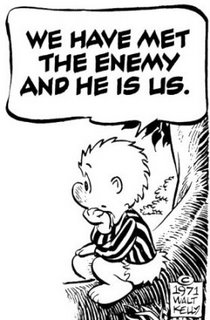
Note that we are to be in conflict against the Sin (rather than the hostility of sinners as in Hebrews 12:3) where Sin is personified. "The Sin" emphasizes it's essential character, and of course even believers are still sinners. We are just saved sinners. We are not "sinless" but we should "sin less!". What was "the sin" (cf Heb 12:1)? Was it the sin of falling away, willfully sinning, shrinking back, etc?
Jamieson agrees writing that here "Sin is personified as an adversary; sin, whether within you, leading you to spare your blood, or in our adversaries, leading them to shed it, if they cannot through your faithfulness even unto blood, induce you to apostatize.
Related Resource:
- Sin -- the Sin principle or propensity inherited from Adam
Westcott - Christians had to contend primarily with open enemies whose assaults seem to be contemplated here... At the same time there is an inward struggle which cannot be wholly overlooked, though this did not involve literally ‘a resistance to blood.’ (Ibid)
Gundry writes "Though already persecuted (Hebrews 10:32–34), the audience—unlike Jesus, who shed his blood (Heb 9:12, 14; 10:19, 29; 12:24; 13:12, 20)—“haven’t yet resisted [their persecutors’ attempts to make them apostatize] to the point of [shedding their own] blood.” But they might have to in the future (“haven’t yet …”). Since “struggling” is the verbal equivalent of the noun “race” in Heb 12:1, “while struggling against sin” refers to running the Christian race with endurance so as not to commit the sin of apostasy—or other sins, which would hamper the running and tend toward apostasy." (Commentary on the New Testament - this is a verse by verse commentary of the entire NT! A magnum opus!)
Blood (129) haima is literally the red fluid that circulates in the heart, arteries, capillaries, and veins of a vertebrate animal carrying nourishment and oxygen to and bringing away waste products from all parts of the body and thus is essential for the preservation of life. Haima gives us English words like hemorrhage (Gk - haimorragia from haimo- + rragia from regnuo - to burst) English derivatives inclue hematology (study of blood) and "leukemia" which is from leuco (white) plus haima (blood), which is fitting as leukemia is a disease that affects the white blood cells. Derivatives of haima are : haimatekchusía (130), shedding of blood; haimorroéō (131), to hemorrhage. Haima was used to describe “descent” or “family” in ancient times. “To shed blood” is to destroy life.
Zodhiates adds that "haima is used to denote life given up or offered as an atonement since, in the ritual of sacrifice, special emphasis is laid upon it as the material basis of the individual life. The life of the animal offered for propitiation appears in the blood separated from the flesh which the Jews were forbidden to eat (Ge. 9:4; Lev. 3:17; 17:10-14; Deut. 12:23; Heb. 9:7-13, 18-25; 11:28; 13:11). This life is, on the one hand, in the blood, presented to God; on the other hand by sprinkling, appropriated to man (Heb. 9:7, 19, 20). This blood thus becomes the blood of the covenant or testament (see diathekē) which God commanded to us (Heb. 9:20). (Complete Word Study Dictionary- New Testament)
HAIMA IS A KEYWORD IN HEBREWS - 22X OUT OF 97X IN NT - Heb. 2:14; Heb. 9:7; Heb. 9:12; Heb. 9:13; Heb. 9:14; Heb. 9:18; Heb. 9:19; Heb. 9:20; Heb. 9:21; Heb. 9:22; Heb. 9:25; Heb. 10:4; Heb. 10:19; Heb. 10:29; Heb. 11:28; Heb. 12:4; Heb. 12:24; Heb. 13:11; Heb. 13:12; Heb. 13:20
Hebrews 2:14 Therefore, since the children share in flesh and blood,
Hebrews 9:7 only the high priest enters once a year, not without taking blood,
Hebrews 9:12 and not through the blood of goats and calves, but through His own blood
Hebrews 9:13 For if the blood of goats and bulls
Hebrews 9:14 how much more will the blood of Christ, who through the eternal Spirit offered Himself
Hebrews 9:18 even the first covenant was not inaugurated without blood.
Hebrews 9:19 he took the blood of the calves and the goats
Hebrews 9:20 saying, “THIS IS THE BLOOD OF THE COVENANT WHICH GOD COMMANDED YOU
Hebrews 9:21 he sprinkled both the tabernacle and all the vessels of the ministry with the blood
Hebrews 9:22 almost say, all things are cleansed with blood,
Hebrews 9:22 and without shedding of blood there is no forgiveness.
Hebrews 9:25 high priest enters the holy place year by year with blood that is not his own.
Hebrews 10:4 For it is impossible for the blood of bulls and goats to take away sins.
Hebrews 10:19 confidence to enter the holy place by the blood of Jesus,
Hebrews 10:29 has regarded as unclean the blood of the covenant by which he was sanctified
Hebrews 11:28 By faith he kept the Passover and the sprinkling of the blood
Hebrews 12:4 have not yet resisted to the point of shedding blood
Hebrews 12:24 Jesus, the mediator of a new covenant, and to the sprinkled blood
Hebrews 12:24 which speaks better than the blood of Abel.
Hebrews 13:11 For the bodies of those animals whose blood is brought into the holy place
Hebrews 13:12 He might sanctify the people through His own blood
Hebrews 13:20 the great Shepherd of the sheep through the blood of the eternal covenant
Spurgeon has the following sermons related to blood…
- Exodus 12:13 The Blood
- Hebrews 12:24-25 The Blood Of Sprinkling
- Hebrews 12:24-25 The Blood Of Sprinkling
- Hebrews 13:20 The Blood Of The Everlasting Covenant
- Hebrews 9:19-20 The Blood Of The Testament
- Hebrews 9:22 Blood-Shedding
Steven Cole explains striving against sin this way...
The author personifies sin as our opponent. It opposes us in two ways:
A. Sometimes the enemy is the evil in the world, opposed to the people of God.
The author has just chronicled some of the terrible things that happened to God’s Old Testament saints: mockings, scourgings, chains, imprisonment, being stoned, sawn in two, and put to death with the sword (Heb 11:35, 36, 37). All of these things happened because evil men hated those who lived and proclaimed God’s righteousness.
As John (John 3:20) explained, "For everyone who does (present tense = continually) evil hates the Light (ED: THIS IS A DESCRIPTION OF AN UNBELIEVER!), and does not come to the Light, for fear that his deeds will be exposed.
If you live in obedience to God, your life reflects the light of Christ onto others’ sinful lives. You will not be Mr. or Ms. Popular! Jesus plainly warned (John 15:19) "If you were of the world, the world would love its own; but because you are not of the world, but I chose you out of the world, because of this the world hates you."
B. Sometimes the enemy is the evil in me, opposed to the holiness of God.
Paul explained (Gal 5:17) "For the flesh (present tense = continually) sets its desire against the Spirit, and the Spirit against the flesh; for these are in opposition to one another, so that you may not do the things that you please.”
Peter exhorts us,"Beloved, I urge you as aliens and strangers to abstain (while not a command but a call to continual action see our need to depend on the Holy Spirit to obey) from fleshly lusts which wage war (strateuomai in present tense = continually) against the soul” (1Pe 2:11)
(ED: ONE CAVEAT -- YOU MAY FEEL AT PEACE IN YOUR SOUL AS YOU READ THIS BUT BE FULLY AWARE THAT YOU ARE NOT AT PEACE WITH THE FALLEN FLESH WHICH EXERTS AN ALL OUT STRATEGIC AND CONTINUAL ASSAULT ON YOUR HEART AND MIND!)
Even though we become a new creation through faith in Christ (2 Cor. 5:17), the powerful sinful desires of the flesh are not eradicated. The Hebrews were especially in danger of the sin of turning away from faith in Christ in the face of persecution. We all face that temptation, along with other sinful desires. But the point is, the Christian life is not a Sunday School picnic! It is an intense conflict with the forces of evil, both without and within.
C. My responsibility is to resist and strive against any source of evil, even if it means shedding my blood. (ED: WHILE I AGREE, I WOULD ADD THE CAVEAT THAT WE ARE NOT TO RESIST IN OUR OWN STRENGTH, BUT IN THE STRENGTH OF THE SPIRIT -SEE our need to depend on the Holy Spirit to obey)
Jesus plainly stated that the call to salvation is a call to lose your life: "If anyone wishes to come after Me, he must deny himself, and take up his cross and follow Me. For whoever wishes to save his life will lose it, but whoever loses his life for My sake and the gospel’s will save it” (Mark 8:34,35).
Remember, taking up your cross did not mean wearing a piece of jewelry. The man who took up his cross was on the way to execution. So Jesus was warning us up front that the call to follow Him was a call to engage in combat that at the very least meant putting to death our sinful flesh. It could also entail suffering even unto a martyr’s death. The idea of resisting and striving against sin to the point of shedding blood clearly refutes the teaching that “if you’re striving, you’re not trusting.” This teaching says that any effort on your part is your flesh. Life in the Spirit is a matter of passively letting go and letting God. Obviously we must trust God and do battle in His strength, but at the same time it is we who must resist and strive (Titus 2:12). There is no room for laziness or passivity in the conflict. Israel had to trust God, but also they had to go into battle and fight against the enemy. So we must trust God but also resist and strive against sin. You can’t strive passively!
D. To endure the struggle against evil, put your trial in perspective.
The author is saying, “In light of those who were stoned, sawn in two, and put to death with the sword, along with the Lord Jesus, who was crucified, your situation could be much worse than it is! It may come to shedding your blood, but at this point, you’re not there. If you abandon faith in Christ under your present trials, what will you do when the blood starts flowing?”
There is a practical lesson for us in this. Unless you are being horribly tortured and are facing execution for your faith, you can always find those who have it much more difficult than you do. If they endured in worse circumstances, then you can endure in your circumstances.
E. The motivation for striving to the point of shedding blood is to consider the Savior who died for me.
The author has just said, "Consider Him who has endured such hostility by sinners against Himself, so that you will not grow weary and lose heart” (Heb 12:3).
Jesus did not deserve any suffering, much less death, in that He had no sin. By way of contrast, all of us deserve far more suffering than we actually receive, were God to repay us for every sin that we commit. So rather than complaining or shaking your fist at God for what you’re suffering, consider Jesus, who suffered innocently on your behalf. Consider what you deserve, if God were to give you perfect justice. (Read full message God's Loving Discipline)