Hebrews 12:1
Hebrews 12:2
Hebrews 12:3
Hebrews 12:4
Hebrews 12:5
Hebrews 12:6
Hebrews 12:7
Hebrews 12:8
Hebrews 12:9
Hebrews 12:10
Hebrews 12:11
Hebrews 12:12
Hebrews 12:13
Hebrews 12:14
Hebrews 12:15
Hebrews 12:16
Hebrews 12:17
Hebrews 12:18
Hebrews 12:19
Hebrews 12:20
Hebrews 12:21
Hebrews 12:22
Hebrews 12:23
Hebrews 12:24
Hebrews 12:25
Hebrews 12:26
Hebrews 12:27
Hebrews 12:28
Hebrews 12:29
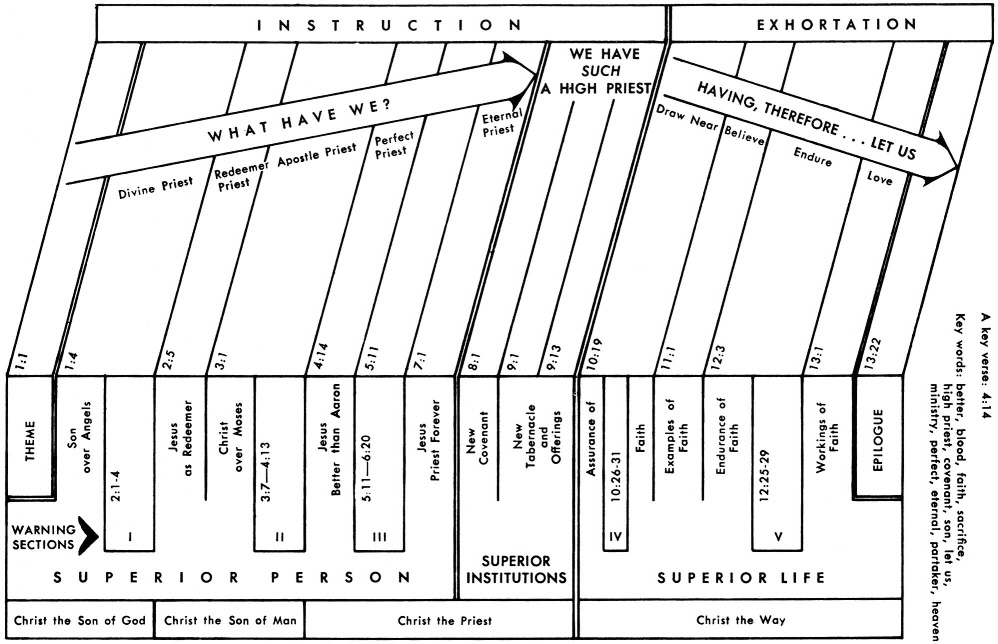
CONSIDER JESUS OUR GREAT HIGH PRIEST
Click chart to enlarge
Charts from Jensen's Survey of the NT - used by permission
Swindoll's Chart, Interesting Pictorial Chart of Hebrews, Another Chart
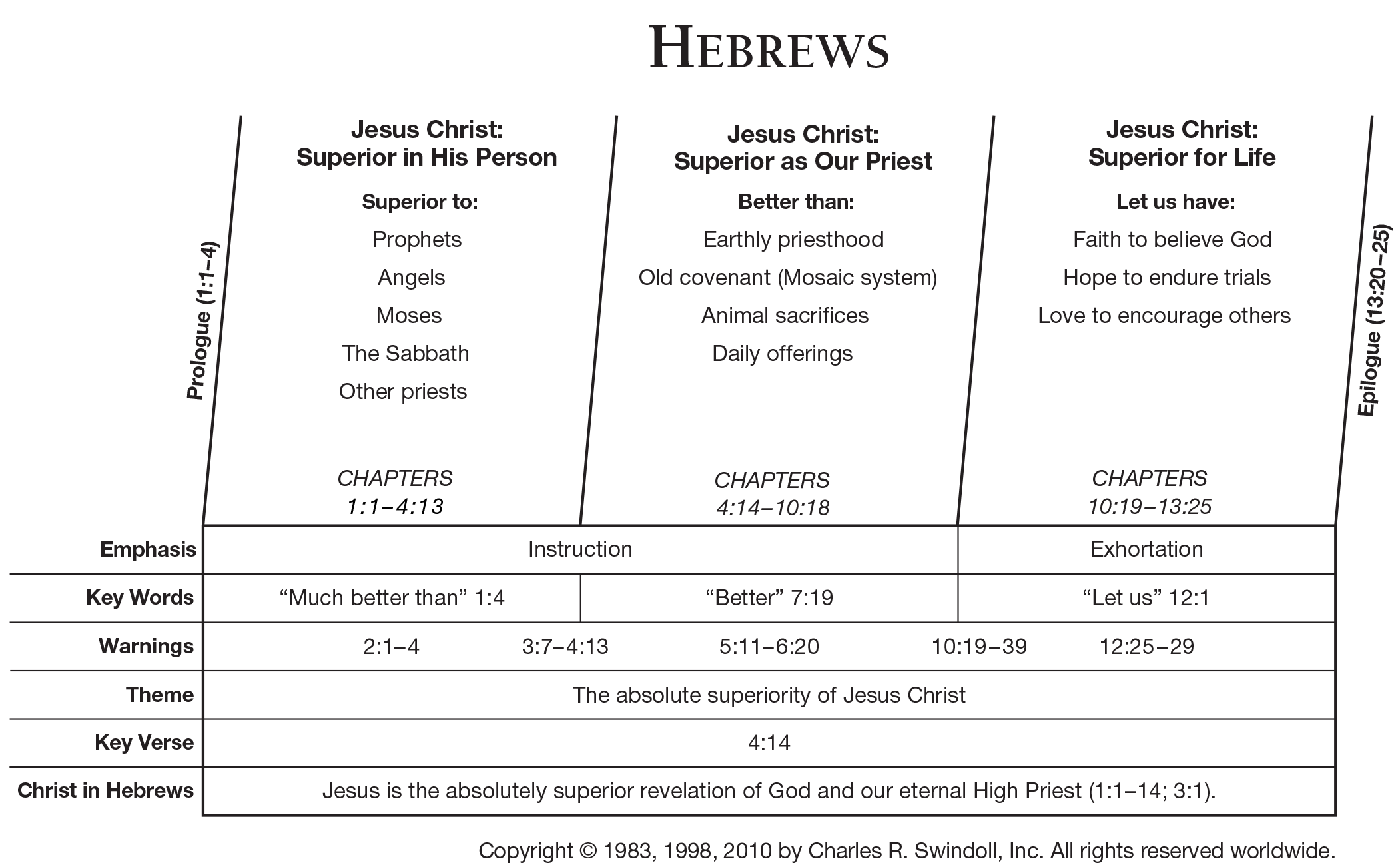

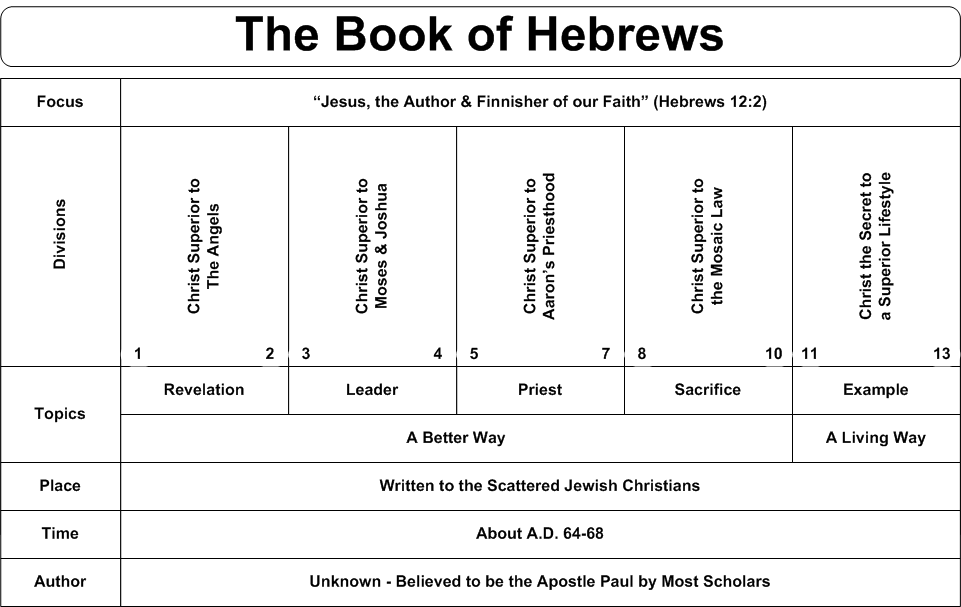
|
The Epistle |
||||
| INSTRUCTION Hebrews 1-10:18 |
EXHORTATION Hebrews 10:19-13:25 |
|||
| Superior Person of Christ Hebrews 1:1-4:13 |
Superior Priest in Christ Hebrews 4:14-10:18 |
Superior Life In Christ Hebrews 10:19-13:25 |
||
| BETTER THAN PERSON Hebrews 1:1-4:13 |
BETTER PRIESTHOOD Heb 4:14-7:28 |
BETTER COVENANT Heb 8:1-13 |
BETTER SACRIFICE Heb 9:1-10:18 |
BETTER LIFE |
| MAJESTY OF CHRIST |
MINISTRY OF CHRIST |
MINISTERS FOR CHRIST |
||
|
DOCTRINE |
DUTY |
|||
|
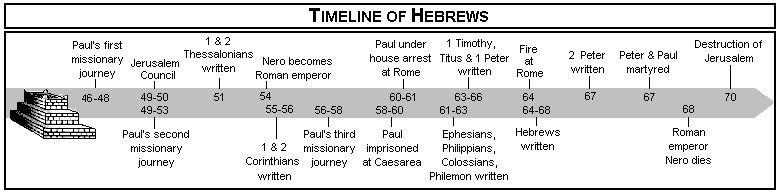
DATE WRITTEN: |
||||

See ESV Study Bible "Introduction to Hebrews"
(See also MacArthur's Introduction to Hebrews)
Borrow Ryrie Study Bible
Hebrews 12:7 It is for discipline that you endure; God deals with you as with sons; for what son is there whom his father does not discipline? (NASB: Lockman)
Greek: is paideian hupomenete; (2PPAI) os huiois humin prospheretai (3SPPI) o theos; tis gar huios on ou paideuei (3SPAI) pater?
Amplified: You must submit to and endure [correction] for discipline; God is dealing with you as with sons. For what son is there whom his father does not [thus] train and correct and discipline? (Amplified Bible - Lockman)
KJV: If ye endure chastening, God dealeth with you as with sons; for what son is he whom the father chasteneth not?
NLT: As you endure this divine discipline, remember that God is treating you as his own children. Whoever heard of a child who was never disciplined? (NLT - Tyndale House)
Phillips: Bear what you have to bear as "chastening" - as God's dealing with you as sons. No true son ever grows up uncorrected by his father. (Phillips: Touchstone)
Wuest: It is for the purpose of discipline, correction, and guidance that you are enduring. As those who by nature are sons is God dealing with you. For what son is there whom the Father does not discipline, correct, and guide? (Eerdmans Publishing - used by permission)
Young's Literal: if chastening ye endure, as to sons God beareth Himself to you, for who is a son whom a father doth not chasten?
IT IS FOR DISCIPLINE THAT YOU ENDURE: eis paideian hupomenete (2PPAI):
- Job 34:31,32; Proverbs 19:18; 22:15; 23:13,14; 29:15,17; Acts 14:22
- Hebrews 12 Resources - Multiple Sermons and Commentaries
BENEFITS OF
DIVINE DISCIPLINE
Divine Discipline is not delightful but is necessary and also comes with five significant benefits to believers which are discussed in Hebrews 12:5-11. It would be good to see those three benefits at the outset...
- God's discipline is evidence of His love for us (Hebrews 12:6)
- God's discipline assures us that we are His spiritual children, genuine members of His family (Hebrews 12:7-8)
- God's discipline enhances our spiritual life (Hebrews 12:9)
- God's discipline enables us to share His holiness (Hebrews 12:10)
- God's discipline yields the peaceful fruit of righteousness (Hebrews 12:11).
So there it is - the benefits of divine discipline. May God's Spirit enable us all to keep these benefits on the "radar screen" of our mind, especially when we are in the trenches of often painful divine discipline. In Jesus' Name. Amen
The recipients of this letter are exhorted to remain under (endure = bear under) the chastening hand and training rod of God, for the grand purpose of the conflicts and afflictions is worth it. Don't grow faint, don't lose heart, don't take your eyes off Jesus, don't forget that you have endured a great conflict of sufferings, don't stop pursuing holiness because you're accused of being too radical, don't forget to strengthen your arms that are feeble and legs that are weak… you're marching on to Zion, you're looking of a city which has foundations and cannot be shaken, you're goal is almost here because He Who is coming is coming soon and He will not delay. So hold fast your confession and assurance firm until the end. Your endurance of this momentary, light child rearing by the Father will yield not only temporal but eternal benefits. Glory to God.
It is for (eis) discipline that you endure (suffering) - The KJV (Greek Textus Receptus) reads "If ye endure chastening" is not accurate when compared to the more modern translations which do not have the Greek conjunction for "if" (ei) but instead have the Greek preposition differing by only one letter (eis).
Discipline (3809) (paideia from país = child) is used 4 times in this section - Hebrews 12:5, Hebrews 12:7, Hebrews 12:8, Hebrews 12:11. Therefore a detailed description will not be given with each of the repeated uses. For the complete discussion of paideia click here to read the comments on the first use (Heb 12:5). The idea of paideia refers to the "act of providing guidance for responsible living." (BDAG) Paideia was used of rearing and guiding children toward maturity and in the case of believers refers to God's fatherly "child rearing" of us, His spiritual sons and daughters.
Wuest on why we endure - The recipients of this letter are exhorted to remain under the chastening hand of God, for the purpose of this chastening is disciplinary. (Eerdmans Publishing - used by permission) (See Hebrews Commentary)
The writer is not saying "grin and bear" it as if we can endure in our own strength. The last thing our old man, the fallen flesh, wants to do is endure divine discipline. We can endure only as we choose to rely on the Spirit of God "Who gives perseverance ( hupomone the noun form of hupomeno) and encouragement" (Ro 15:5+). The point is that the things that God demands of us He gives us the supernatural power to carry out. Perseverance is hupomone which describes the ability to abide under or bear up under a "load" with a courageous attitude in the face of the real suffering experienced. Morris says: "It is the attitude of the soldier who in the thick of battle is not dismayed but fights on stoutly whatever the difficulties." This is clearly not NATURAL but a SUPERNATURAL work of God's Spirit (Ro15:13+). If something happens in your life that is hard and painful and frustrating and disappointing, and, by grace, your faith looks to God's Word and to Christ and to His power and His sufficiency and His fellowship and His wisdom and His love, and you don't give in to bitterness and resentment and complaining, then you endure. As someone has well said it is better to go through the storm with Christ than to have smooth sailing without Him.
Endure (5278) (hupomeno from hupo = under + meno = abide) means to persevere, endure. To remain under not simply with resignation, but with vibrant hope. It means to continue in activity despite resistance and opposition and so to hold one's ground, not be moved (as in Jas 1:12-note). Hupomeno was a military term used of an army’s holding a vital position at all costs. Every hardship and every suffering is to be endured in order to hold fast. It speaks of enduring patiently and triumphantly. Notice that the writer uses hupomeno 4x in this letter and 3 of the uses are in chapter 12. Clearly the writer is showing us how we can accomplish this endurance by placing before us the example of Jesus
Fixing (aphorao) our eyes on Jesus, the Author and Perfecter of faith, Who for the joy set before Him endured the Cross, despising the shame, and has sat down at the right hand of the throne of God. For consider (analogizomai in the aorist imperative. Do this now! In reliance on the Holy Spirit to obey the command) Him who has endured such hostility by sinners against Himself, so that (PURPOSE OF LOOKING TO EXAMPLE OF JESUS) you will not grow weary and lose heart. (Heb 12:2-3+)
The writer uses the present tense which speaks of continuously enduring under trials and suffering.
Hupomeno - 17x in 16v - NAS = endure(3), endure… with patience(1), endured(5), endures(3), patiently endure(1), perseveres(1), persevering(1), remained(1), stayed behind(1).
Mt 10:22; 24:13; Mark 13:13; Luke 2:43; Acts 17:14; Rom 12:12; 1 Cor 13:7; 2 Tim 2:10, 12; Heb 10:32; Heb 12:2-3, 7; Jas 1:12; 5:11; 1 Pet 2:20.
To endure or to exhibit patience is a critical Christian virtue. Unless we have patience, we can never learn many of the truths that God wants us to learn, truths that will lead us into a deeper life and a more fruitful ministry. Children are usually impatient; they cannot sit still long enough to get the things done that need to be done. “How long do we have to wait?” is the stock question of the child. Impatience is a mark of immaturity. Impatience is also a mark of unbelief. Isa 28:16 “He who believes will not be in a hurry”. When you find yourself restless and nervous, anxious to “do something,” you can be sure you are not trusting God to work. By enduring or remaining under the disciplining hand of God, we permit Him to mold us into the image of His Son. If we try to short-circuit His dealings with us, He may have to teach us over a longer period of time, using more instructive, and consequently, more difficult methods. (HAVE YOU EVER EXPERIENCED THAT?) There are grades in the school of God (SO TO SPEAK), and promotion comes only when we have learned our lessons. So while there are "grades" or differences in maturity, all of us are in God's classroom called "DISCIPLINE" and it is a required course, not an elective. Only when we reach glory, do we "graduate" from this school!
- Related commentary and quotes on suffering and trials - 1 Peter 1:6-note; 1 Peter 1:7- note
- Discussion of suffering as a Divine Gift!
- Exposition related to suffering - Romans 8:18
- Exposition related to tribulations - Romans 5:3
- Exposition on how the Savior Succors Suffering Saints - Hebrews 2:18
- Discussion of what the God of All Grace Promises when we suffer- 1Peter 5:10
- Exposition on how God uses suffering in the life of a saint - 2 Cor 12:9-note; 2 Co 12:10-note
- Exposition on Trials - James 1:2
- Exposition on present pain versus future joy - Matthew 5:10, 11, 12- notes
- Don't forget to do a Site Search - E.g., this link retrieve over 4000 hits on the word SUFFERING on Preceptaustin
- How should Christians discipline their children? What does the Bible say?
- When, why, and how does the Lord God discipline us when we sin?
- Does God punish us when we sin?
GOD DEALS WITH YOU AS WITH SONS: os huiois humin prospheretai (3SPPI) o theos:
- 1 Samuel 2:29,34; 3:13; 1 Kings 1:6; 2:24,25; Proverbs 13:24; 29:15
- Hebrews 12 Resources - Multiple Sermons and Commentaries
OUR FATHER TREATS US
AS HIS SONS
Spurgeon - What a bright light this sheds upon all affliction: that it is for our profit, that it is thereby we are made partakers of the holiness of God. While you feel the weight of God’s hand upon you, never forget that it is your Father’s hand. Whatever form your trial may take—whether it is the loss of a child or of a parent, or the withdrawal of temporal prosperity, or the smiting of the body with aches and pains—the rod is never in any hand but the paternal one, and even while the Father smites He loves. Let this be your comfort, that it is not the hand of an enemy that is upon you. You are not suffering from a crushing blow from the foe’s mailed hand, but the stroke, whether it is heavy or light, is wholly caused by your loving Father’s hand.
Deals (4374) (prosphero from prós = to, toward + phéro = bring) refers primarily to an an offering, whether of gifts, prayers, or sacrifices. It conveys the idea of carrying or bringing something into the presence of someone usually implying a transfer of something to that person.
In this verse in Hebrews prosphero is in the passive voice and conveys the meaning of “to behave toward, to deal with.” Wuest explains "That is, the afflictive dealing of God with the recipients is an evidence that they are sons of God. We must keep in mind that this letter is written to the professing Christian Church made up of saved and unsaved. Both classes were the recipients of the persecution, because both classes had left the temple sacrifices and had identified themselves with the visible church. But only those who would remain under the chastening hand of God would prove themselves to be true sons of God. Those who would renounce their profession of Messiah as High Priest and return to the sacrifices in order to escape the persecution, would show by that, that they had never been saved." (Eerdmans Publishing - used by permission) (See Hebrews Commentary)
An incident from the Old Testament illustrates this. David was rebuked by the Lord for numbering Israel and was given the choice of three punishments. He wisely let the Lord decide, and undoubtedly experienced the least hurtful of the three, but in the plague God sent, 70,000 Israelites died! (2Samuel 24).
FOR WHAT SON IS THERE WHOM [HIS] FATHER DOES NOT DISCIPLINE?: tis gar huios on ou paideuei (3SPAI) pater:
- Hebrews 12 Resources - Multiple Sermons and Commentaries
COMPARISON WITH DISCIPLINE
FROM EARTHLY FATHERS
For (gar) is a term of explanation, in this context explaining God's fatherly discipline of us.
What son is there whom his father does not discipline - This is a rhetorical question of course -- the answer (at least the ideal one, realizing that many sons in America have no father or only an "absentee" father) is "None".
Discipline (present tense)(3811) (paideuo from país = child) refers primarily to the training or discipline of children (whether in the schools of men - Acts 7:22+, Acts 22:3+ or in the school of God, Titus 2:12+, et al), at one end of the spectrum training by teaching, instructing, educating or nurturing and at the other end of the spectrum utilizing correction and punishment if necessary (which it usually is for children) as a part of the training or child rearing process bringing them to maturity (this end of the spectrum conveyed by English words like chastise or chasten - see below - as morally disciplining an adult, correcting them and giving them guidance). In that regard we will briefly look at some of the most common English words used to translate paideuo and will attempt to draw out the sometimes subtle differences in meaning. From this introduction, you can see that the meaning of paideuo is dependent on the context.
It should be emphasized that the verb discipline is not synonymous with to punish, but is more accurately thought of as meaning to chastise or chasten. In popular speech chastise and punish are often confounded. Chasten is from the Latin , “pure,” “chaste ;” and to chasten is, properly, to purify! This meaning underlies even the use of the word by Pilate, who was not likely to be nice in his choice of words. Instead of punishing the Messiah with death, he sought to chastise Jesus, in order to teach Him! (Lk 23:16). As emphasized in this section of Hebrews dealing with discipline, the verb paideuo includes the ideas of instruction, correction, and warning and all God's chastenings are designed to cultivate Christ-likeness and purify us from the evil tendencies that emanate from our intractably evil flesh nature. In the context of the book of Hebrews, the discipline referred to in this section is not punishment for wrongdoing, but training through persecution.
Coach Tom Landry of the Dallas Cowboys is reputed to have said,"The job of a coach is to make men do what they don’t want to do, in order to be what they’ve always wanted to be!"
Our author would have welcomed that as an accurate statement of what God does with those he calls to be his children. They (and we) should “hang tough” because their trials are proof that they (and we) "are the called, beloved in God the Father, and kept for Jesus Christ." (Jude 1:1)
David Jeremiah - The Purpose of the Disruptive Moment “God deals with you as sons” (Heb 12:7).
Can you remember facing a disruptive moment as a child? Perhaps you fell from your bicycle and skinned your knee. What was your first impulse? To call for help, of course. And perhaps when you did that, your mother or father called out, “Stay right where you are—I’m coming to help you!” That’s precisely what God says to us: Stay where you are. I’ll be there with you. When life wounds us and we’re in deep pain, we instinctively cry out to God. And it is then that we hear Him and feel His presence so clearly. In the midst of tragic circumstances, we can have the richest fellowship with Christ afforded to us. That’s when our faith becomes fully real, and we experience the assurance of things we’ve hoped for. We have confirmation in our hearts for what we’ve always believed with our minds. We may have talked for a lifetime about being a child of the Father, but now, as helpless creatures who have stumbled and been wounded, it becomes true for us: I am a child; He is my Father. He is your Father. You’ll find it out at the bend in the road. At the point of your own disruptive event, remember this truth. Engrave it on your mind, and hold fast to it: He is there for His children. He has always been there, and He always will be there. Can there be any doubt He will be there in this place, and in this moment, for you? The purpose of the disruptive moment is to demonstrate that we are truly the children of God. There is no training and learning without pain in the process. As we take our first steps as children, we stumble and fall. And every child that the Father loves will experience His training methods. No discipline, no growth—it’s as simple as that. “Whom the LORD loves,” He disciplines, chastens, and trains.
The Pain of the Disruptive Moment “He chastens, and scourges …” (Heb 12:6).
Let’s be clear: God’s Word never claims that times of pain and suffering should be eagerly anticipated. These are not times we have chosen. At the point of suffering, we don’t feel joy; we feel genuine human pain. But that’s not the end of the story.
The Provision of the Disruptive Moment “For whom the LORD loves He chastens” (Heb 12:6).
We find comfort in knowing the Father is watching over us. He sees us walk through the bend in the road, and though we don’t anticipate the disruptive moment, He does. He is attentive, but He does more than watch us; He walks with us. And never does He walk closer to His children than those times when we’re experiencing deep pain and misery.
The Product of the Disruptive Moment - “He [disciplines us] for our profit, that we may be partakers of His holiness” (Heb 12:10).
God’s discipline is “for our profit,” although it seems anything but profitable at the time. Just as earthly parents discipline their children so they will grow up to be well-adjusted and successful, our heavenly Father disciplines us so that we will “grow up” to “be partakers of His holiness.”
The Perspective of the Disruptive Moment - The writer of Hebrews offers three possible choices we can make in response to the disruptive moments we face.
1. We can despise the moment and rail against it (v. 5).”Why did this happen to me? Why am I going through this? Why would God allow me to have this experience?” How quickly we’re prone to strike out against God when we come to a bend in the road. Those who choose this course of action, of course, are shortsighted. They have probably forgotten all about God on those occasions when there were nice surprises around the bend. But now, disaster strikes. They don’t know what else to do, so they curse God. The writer of Hebrews tells us not to do that. He says, “Do not despise the chastening of the LORD.”
2.We can become discouraged by the event, lose heart, and give up (v. 5). The writer of Hebrews instructs us not to be discouraged when we are rebuked. That’s far too easy a response. Discouragement makes us want to give up, to throw in the towel and surrender to despair. That’s not the spirit God wants in us. His goal is our perseverance, for it leads to growth and maturity, as we shall see.
3.We can endure it and be trained by it (vv. 7, 11). Finally—the right response. The Scriptures show us so clearly that nothing in life is wasted if we love and serve God. No matter how sharp the bend in the road, no matter how disruptive the moment, everything that happens to us is for the eternal purposes of God. He is training us through the process. Like any worthy parent, He wants to teach us what we cannot learn in any other way.British journalist Malcolm Muggeridge wisely explained this concept to William F. Buckley: “As an old man, Bill, looking back on one’s life, it’s one of the things that strikes you most forcibly—that the only thing that’s taught one anything is suffering. Not success, not happiness, not anything like that. The only thing that really teaches one what life’s about—the joy of understanding, the joy of coming in contact with what life really signifies—is suffering, affliction.”
The only road that leads to the destination God desires for us has its sharp bends. All attempted shortcuts lead into wilderness.
Where are you, traveler? Perhaps you’re facing a disruptive moment in your life, one you could never have anticipated. Perhaps your road has led to a divorce, a death, a financial disaster, a physical or mental sickness, or the heartbreak of seeing a fellow traveler wander away from the path. Maybe the bend in your road is something so disappointing and devastating that you can hardly bear to acknowledge it. You could be standing by the side of your path, so overcome by pain that you believe you can’t move on.
Please remember this: Your crisis is important to God. Could it be that you’re looking at it from your own perspective? That’s not the way our Father behaves toward us. Whatever struggle or setback you face is intended to empower and purify you. Your situation is important to Him, because He is using it to make you a more valuable servant in His kingdom. Having lived through some very disruptive moments of my own, I want to give you five principles to remember. They’ve helped me, and I trust they’ll be just as valuable in your own travels down that long and winding road. (A Bend in the Road)
Good Dads - Columnist Leonard Pitts Jr. grew up with a father he describes as physically present but emotionally absent. In his first book on parenting, Pitts openly chronicles his struggle to come to terms with his alcoholic father and the climate of fear he had created in their home. Pitts challenges all men to resolve the resentment toward their absent or abusive fathers instead of passing it on to the next generation.
There's a passage in Hebrews 12 that applies to all Christians, but it has special relevance to dads. It reads: "Pursue peace with all people, and holiness, without which no one will see the Lord: looking carefully lest anyone fall short of the grace of God; lest any root of bitterness springing up cause trouble, and by this many become defiled" (He 12:14,15).
Think of what could happen in our families if we emptied our hearts of bitterness and made peaceful relationships our goal! If we have been blessed with a wise and loving father, we should be grateful and follow his example. But if our father has failed us, we must rely on God's grace, resolve our anger toward him, and strive to be the kind of dad we never had. It won't be easy, but with our heavenly Father as a perfect example, we can learn to be good dads. —David C. McCasland (Our Daily Bread, Copyright RBC Ministries, Grand Rapids, MI. Reprinted by permission. All rights reserved)
A faithful father leads by love
With tender firmness from above,
For he himself has learned from God
The lessons of His chastening rod. --DJD
A good father reflects the love of the heavenly Father.
WE live in a world full of suffering. A great part of the daily life of many is made up of little trials and vexations. A sharp word; an unkind judgment; neglect or ingratitude from some one from whom we did not expect it; the carelessness of a servant; the temper of a husband or wife; the loss accruing through the neglect or unfaithfulness of others; the disappointment of our wishes; the accidents that vex us-all these things in daily life often come to us with far greater temptation and danger than times of persecution for the faith brought to the martyrs. By their littleness and their frequency and their suddenness, they surprise and conquer us ere we know. If Christianity is to be a success, if Christ is to save completely, there must be a provision, sufficient and efficacious, to prevent suffering from causing discouragement or defeat, to transform it into blessing and help.
If it can enable us to rejoice in tribulation (cp Ro 5:3-note), to glory in infirmities, and to pass unharmed through trial (Ed: Or certainly more like Christ), it will indeed be the religion man needs in a world of suffering. He that has this secret (cp Php 4:11, 12-note), whereby what have been hindrances become helps (cp 2Co 12:10-note), and his very enemies are made to serve him, is on the way to be the Christian God would have him be.
God has made such a provision. First of all, He gives His own Son, as the chief of sufferers, to show us how close the relation is between suffering and His love, suffering and the victory over sin, suffering and perfection of character, suffering and glory. Yea more, to provide us with One, who can sympathise, who can teach us how to suffer, and who, as the Conqueror of sin through suffering, can breathe His own life and strength into us. And thus He comes as our Father, to shed His heavenly light on our afflictions, and to teach us the lessons our portion contains. They are these. Chastening is a part of a father's training, and one of the marks of sonship Submission to chastening forms and proves the truly childlike character. God's chastening makes us partakers of God's holiness. See how these three thoughts are brought out here.
Chastening is a needful part of a father's training. It is for chastening that ye endure; all suffering is a divine chastening. God dealeth with you as with sons; for what son is there whom his father chasteneth not? Our own childhood and fatherhood teach it us; discipline, chastening, and reproof, in whatever form, is an indispensable part of education; where a child needs it a father may not withhold it. In the will of God, and in the very nature of things, sin and suffering go together, and even love can cause suffering for the greater good of casting out the sin. Let the child of God learn the lesson, suffering is chastening, the chastening of love. We ought to spare no pains to learn this lesson well; we ought to repeat and repeat it, until we can say, Now, I know it perfectly: every trial, small or great, I will look upon at once as a messenger of God's love. If you thus meet it, whether it comes through men or yourself or more directly from above, as God's appointment, you are in the right attitude for bearing and being blessed by it.
Submission to chastening forms and proves the truly childlike spirit. Furthermore, we had the fathers of our flesh to chasten us, and we gave them reverence: shall we not much rather be in subjection unto the Father of spirits, and live? When the Lamb of God came to this earth to suffer God's will, it was that He might teach us what the place is that becomes the creature, and the child--absolute subjection to the perfect will of love. He came to show that the thing that makes life worth having is to have it to give up to God, and to prove that humility and resignation are the sacrifices God delights in, and the sure, the only path to God. No religion or worship of God can be acceptable to Him but as Me sees in it con-fortuity to the life and spirit of His Son. We can only please Him as we are like-minded to Christ. Learn, O child of God! the unspeakable privilege in suffering, of giving up thy will to God, even as Jesus did, of adoring His wisdom and goodness, and entering deeper into the child's spirit and the child's place --to reverence and submit. Chastening is one of the marks of sonship. If ye are without chastening, then are ye bastards and not sons. Suffering is not in itself a sign of sonship. An enemy or a criminal may be scourged; even a slave chastened as well as a son. But to him who is a son, chastening reminds him of his place, and calls him to meet this part of a son's heritage in the spirit and with the hope of a son--with the assurance that it will draw him nearer and lock him closet to the Father.
Chastening makes us partakers of God's holiness. He chasteneth us for our profit, that we may be partakers of His holiness. What a new light on suffering and chastening! He that maketh holy and they that are made holy, are all of one. We have entrance into the Holiest of All. In the which will we have been made holy. He hath made the people holy by His blood. And now comes suffering--shall we not welcome it when He sends it with such a message--to break open our inner being, and waken up our desire, and make us partakers in our inmost life of that holiness Jesus gives, of that holiness into which we enter in God's presence. Yes, welcome suffering, if it leads us, through subjection to God's will and love, into His holiness as our portion.
1. What can teach us to welcome suffering? A heart set upon holiness, Suffering is meant by God to make us holy. No one can welcome suffering except as he welcomes the holiness it brings.
2. "That state is best, which exercises the highest faith in and fullest resignation to God."
3. "Receive every inward and outward trouble with both thy hands, as a true opportunity of dying to self and entering into fellowship with thy self-denying Saviour." (Andrew Murray. The Holiest of All)
By Pastor Steven Cole - this sermon is an excellent exposition of Hebrews 12:7-11…
As an old man looking back on his life, the late Malcolm Muggeridge observed, "Contrary to what might be expected, I look back on experiences that at the time seemed especially desolating and painful with particular satisfaction. Indeed, everything I have learned, everything that has truly enhanced and enlightened my existence, has been through affliction and not through happiness. If it ever were to be possible to eliminate affliction from our earthly existence, the result would not be to make life delectable, but to make it too banal and trivial to be en-durable." (A Twentieth Century Testimony [Thomas Nelson], in Reader's Digest [1/91], p. 158)
By way of contrast, many have allowed difficult trials to turn them away from God. For example, I have read that media mogul, Ted Turner, grew up in a church-going home. But when his sister died, Turner’s father grew bitter and turned away from God. Ted Turner followed his father’s example.
Trials are a fact of life, but how we respond to them is our choice. I do not know if Muggeridge was truly converted (Ed: As I have read some of his statements one wonders - aren't we glad Jesus is the final Judge!), but he seems to have grown better through his trials. Turner, however, grew bitter. I grant that it is difficult to understand how God can be both good and omnipotent, and yet allow the horrible suffering that we see in the world. But to cease to believe in God on account of suffering does not make God cease to exist, and it does not resolve the problem. To “run with endurance the race that is set before us” (Heb 12:1), we need to know how God wants us to respond to His loving discipline.
To respond properly to the Father’s discipline, submit to it and grow in holiness through it.
That word, submit, grates on many souls. I have read Christian psychologists who say that those who grew up in “dysfunctional” homes have a problem with authority figures. They urge such persons to “find an authority figure and disagree with him” in order to assert their own authority! I would not recommend that approach! A “Frank & Ernest” cartoon expressed it well. The two bunglers are standing at the Pearly Gates. St. Peter has a scowl on his face. Frank whispers to Ernie, “If I were you, I’d change my shirt, Ernie.” Ernie’s shirt reads, “Question Authority.”
God is the Ultimate Authority! Whether you like His program for your life or not, it is not wise to rebel against it. As Heb 12:9 tells us, if we submit to the Father of our spirits, we will live. Bishop Westcott (The Epistle to the Hebrews [Eerdmans], p. 402) puts it,
“True life comes from complete self-surrender.”
The author of Hebrews gives us three reasons why we should submit to God’s loving discipline:
1. We should submit to the Father’s discipline because it is an essential aspect of the father-son relationship (Hebrews 12:7, 8).
The opening phrase of Heb 12:7 may be translated as either an indicative (NASB, “It is for discipline that you endure”) or an imperative (NIV, “Endure hardship as discipline”). Either way, the point of these verses is that discipline is a mark of genuine sonship. As I said last week, I never disciplined other people’s disobedient children. But I did discipline my children, because I love them and I wanted them to grow up to respect proper authority.
The author states that if you lack discipline, you are not a true child of God, but rather illegitimate. In that day, illegitimate children had no inheritance. To be an heir of the promise of eternal life, make sure that you are a genuine child of God through faith in Christ (Gal. 3:26). If you are His child, then trials are an evidence of His love, not of His neglect or opposition (Heb 12:6).
But, since both believers and unbelievers alike go through trials, what does the author mean when he says that some are “with-out discipline”? How can we know if the trials that we go through are an evidence of our being God’s true children?
The primary answer, as I just said, is, “Have I truly repented of my sins and trusted in Christ alone to save me?” If so, the further answer lies in how we respond to the trials that come our way. A true child of God submits to Him in the trial and seeks to grow in holiness. An illegitimate child shrugs it off as bad luck or, worse, turns against God and grows bitter. Also, if a true child of God sins, he will be troubled about it. David was miserable after he sinned (see Psalms 38 & Ps 51). An illegitimate child will gloat that he got away with it or shrug off his sin as no big deal. But a true child of God submits to the Father’s discipline, because such discipline is an essential part of the father-son relationship.
2. We should submit to the Father’s discipline because He perfectly administers it for our eternal good, that we may share His holiness (Hebrews 12:9, 10).
The author makes two points in these verses:
A. If the imperfect discipline of our earthly fathers was beneficial, how much more beneficial is our heavenly Father’s perfect discipline.
Hebrews 12:9 contrasts “the fathers of our flesh” (earthly fathers) with “the Father of [our] spirits” (our heavenly Father). The expression, fathers of our flesh, focuses on their imperfection. Every earthly father falls short in his knowledge of his children and in wisdom as to how to train and discipline them. But our heavenly Father knows each of us thoroughly and perfectly, including all of our thoughts and motives. He deals with us in perfect wisdom.
While good fathers always try to act in love, they often fail. But God always acts in love, seeking our highest good. Earthly fathers can be mean or angry, but God is never temperamental. Earthly fathers have jurisdiction over us during childhood. But God’s authority and discipline extends over our lifetimes. Good earthly fathers seek to prepare us for life on earth. But God is pre-paring us for eternity.
The author’s point is that the discipline of our earthly fathers was beneficial, even though it was flawed by human shortcomings. We respected them for it because we can see how we benefited from it. But God’s discipline is absolutely perfect.
B. Therefore, we should subject ourselves to the heavenly Father’s discipline and live.
The important thing with regard to God’s discipline is the spirit in which we respond. If we resist and harden our hearts, we will miss the purpose of the discipline. If we are truly God’s children, this will result in more discipline. God’s intention is that we respectfully submit to it (Hebrews 12:9). It’s possible to submit like the defiant little boy whose mother told him to sit in a chair until he calmed down. He clenched his teeth and said, “I’m sitting on the outside, but I’m standing on the inside!” That’s not true submission! The psalmist reflected true submission when he proclaimed, “I know, O Lord, that Your judgments are righteous, and that in faithfulness You have afflicted me” (Ps. 119:75).
We should submit to God because He has the sovereign right to do with us as He pleases. That is the point of the Book of Job. Even though Job was the most godly man on earth, God had a perfect right to take away everything Job treasured. No man has a claim against Almighty God. One of the most stunning instances of this was when God told the prophet Ezekiel that He was about to take the desire of his eyes (his wife) with a blow. But, God told the prophet not to mourn or weep, as a spiritual object lesson to Israel. So, the next day Ezekiel’s wife died and he did as God had commanded (Ezek. 24:15-24). Wow!
The prophet had learned a basic lesson that we all need to learn: God is God and I am not God. If the Sovereign of the universe wants to take my wife, my children, my possessions, my health, or my life, that is His prerogative. Faith eventually arrives at saying, as A. W. Pink put it (An Exposition of Hebrews [Ephesians 4 Group software], p. 977), “The trial was not as severe as it could have been. It was not as severe as I deserve. And, my Savior suffered far worse for me.” And so faith submits to the Father’s discipline, trusting that He administers it perfectly for His eternal purpose and for my eternal good.
3. We should submit to the Father’s discipline because although it is difficult for the present, it yields the peaceful fruit of righteousness to all that are trained by it (Heb 12:11).
The author makes three points in Heb 12:11:
A. All discipline seems difficult for the present.
Discipline seems-to our limited, time-bound perspective-not to be joyful, but sorrowful. I am glad that the Bible acknowledges that fact! God’s discipline is not easy or pleasant. It is not wrong to cry out loudly to God or to weep when you’re going through a difficult trial, because Jesus did that very thing (Heb. 5:7-note). The psalms show us that it is okay to bare our sorrows and grief to the Lord, as long as we do it with a submissive spirit. God gave us tear ducts for a reason!
I’ve shared with you before that on my 36th birthday, I had to conduct a funeral for a 39-year-old man who died of cancer, leaving a widow and two children. Two years later, I conducted the funeral for his wife, who also died of cancer. But after his funeral, as I was consoling his wife, her former bounded up with a silly grin on his face and said, “Praise the Lord, Scott’s in glory now!” I felt like punching him! I thought, “Let her weep!”
But, how does weeping fit with the Bible’s command, “Rejoice always” (1Th 5:16-note)? That command does not mean that we always go around with a smile on our face, saying, “Praise the Lord,” even when we’re hurting. It does not mean saying that you feel great when you don’t, which is hypocrisy. Even Jesus admitted, “My soul is deeply grieved to the point of death” (Mark 14:34). It’s not a contradiction that the shortest verse in the Greek New Testament is, “Rejoice always,” whereas the shortest verse in the English New Testament is, “Jesus wept” (John 11:35)!!
The key is, in the midst of the trials and the tears, to focus on the goal: the peaceful fruit of righteousness. If we keep in mind what God is doing in light of eternity, then we can endure with inner joy and peace, while at the same time admitting the pain and sorrow. As Paul wrote (2Cor 6:10), though we are sorrowful, we are yet always rejoicing, knowing that God is for us and that He is working all our trials together for our good (Ro 8:28-note, Ro 8:29, 30-note, Ro 8:31, 32, 33-note, Ro 8:34, 35, 36-note).
B. All discipline is designed to produce the peaceful fruit of righteousness.
The phrase means, “the peaceful fruit that consists in righteousness.” “Righteousness” (Heb 12:11) is synonymous with “holiness” (Heb 12:10). Both terms mean godliness or conformity to Jesus Christ, who is the embodiment of godliness (Ro 8:29). He shows us what it means to be a righteous person in thought, word, and deed. True holiness or righteousness is not just external, but begins at the heart or thought level. A truly righteous person has godly motives. He seeks to glorify God in everything.
Righteousness and peace always go together. You cannot have true righteousness without peace, or true peace without righteousness. I emphasize true because sometimes people mistake relief from trials as God’s peace, even though they disobeyed God to gain that relief. A Christian brother once told me, with a peaceful smile on his face, that God had told him to divorce his wife, and that he felt such a peace in his heart since he made that decision! It took me several hours to convince him that he was not feeling God’s peace, because his decision was not righteous. He was only feeling relief at the thought of getting away from a woman who, I admit, was not pleasant to live with!
God’s discipline produces the peaceful fruit of righteousness in many ways. Here are seven:
(1) God’s discipline produces the peaceful fruit of righteousness by teaching us the terrible devastation caused by sin.
When David sinned with Bathsheba and murdered her husband, the Lord forgave his sin, but He also took the life of the son that they conceived. Also, the Lord raised up evil against David from within his own household (2Sa 12:11). His son Amnon raped his half-sister, Tamar. Tamar’s brother, Absalom, murdered Amnon and later led a rebellion against David. By letting us suffer such painful consequences for our sin, God teaches us that sin causes devastation and death, so that we will flee from it when we are tempted.
(2) God’s discipline produces the peaceful fruit of righteousness by stripping us of self-righteousness, self-sufficiency, and pride.
By nature, we all have the tendency to think, “Others may commit terrible sins, but I could never do such a thing!” Peter thought that the other apostles might deny Jesus, but not trust-worthy old Peter (Mark 14:29, 30)! The Lord had to show Peter that his heart was just as prone to sin as everyone else’s heart
The Lord burdened Paul excessively, beyond his strength, so that he despaired even of life. The reason, Paul said, was “so that we would not trust in ourselves, but in God who raises the dead” (2Co 1:8, 9).
We’re all prone to trust in ourselves, rather than in the Lord. It is wise to have a prudent savings plan, but if we trust in our savings, God has ways of wiping out our accounts. It is wise to eat well and to exercise regularly, but if we’re trusting in those things to preserve our lives, God has ways of bringing sickness or injury to teach us that we depend on Him for our next breath and for every day’s supply of food and water.
(3) God’s discipline produces the peaceful fruit of righteousness by helping us shift our focus from this life to eternity.
By nature, we’re all too focused on this life, in spite of the fact that life is a vapor (Jas 4:14). Paul says that the obvious fact (which we all try to ignore!) that our bodies are wearing out should make us shift our focus to eternity. He wrote, “though our outer man is decaying, yet our inner man is being renewed day by day.” He goes on to say that we look at the unseen, eternal things, not at the things we see on this earth (2Cor. 4:16, 17, 18).
(4) God’s discipline produces the peaceful fruit of righteousness by uncovering hidden sins and blind spots.
Sometimes we are unaware of our sins or shortcomings until God brings some trial that exposes them. The psalmist testified, “Before I was afflicted I went astray, but now I keep Your word” (Ps 119:67). There is no indication that he was openly rebellious before he was afflicted. Rather, the affliction made him aware of hidden sins that he had not seen before.
Paul had an amazing vision of heaven. Although he was a humble man, the danger was that this vision would puff him up with pride. So the Lord sent a messenger of Satan, a thorn in the flesh, to keep Paul from exalting himself (2Cor 12:7). Whatever that thorn was (some think a physical ailment; others think that it was the Judaizers, who plagued his ministry), it kept Paul from falling into the sin of pride over his heavenly vision.
(5) God’s discipline produces the peaceful fruit of righteousness by strengthening our faith and driving us closer to Christ.
Through his thorn in the flesh, Paul learned to trust Christ in ways that he had not done before. He learned the sufficiency of God’s grace and strength in the face of his painful weaknesses (2 Cor. 12:9-10). Adversity has a way of causing us to lean on the Lord in ways that we don’t need to when times are trouble-free.
(6) God’s discipline produces the peaceful fruit of righteousness by developing compassion and humility.
Sometimes we look down on others who are suffering. We arrogantly think, “If they would just get it together [like me!], they would avoid all these problems!” Then God sends affliction to us. Suddenly, we have more compassion for those who suffer. We lose our proud judgmental spirit and grow in sympathy.
(7) God’s discipline produces the peaceful fruit of righteousness by developing the fruit of the Spirit in us and thus making us more usable in His service.
Fruit grows best on vines that are pruned (Jn 15:2). The fruit of the Spirit grows in hearts that have submitted to the pruning of God’s discipline. The fact that righteousness is a fruit shows that it takes time to grow. We have instant coffee and instant photocopies and instant just about anything. But so far, no one has come up with instant fruit! It grows slowly but surely in our lives as we submit to God’s discipline.
Thus, all discipline seems difficult for the moment, but it is designed to produce the peaceful fruit of righteousness. Finally,
C. For discipline to be effective, we must submit to the training process.
To benefit by God’s discipline, we must be “trained” by it. The Greek word (gymnazo; we get gymnasium from it) indicates physical training or exercise. It meant, literally, to strip naked. There were two images behind the word. First, as we have seen (Heb 12:1), an athlete has to strip himself of all needless weights or en-cumbrances that would hinder him from running well.
Also, the ancient Greeks, like modern Americans, were enamored by the perfect body. An athlete would strip before his trainer, who would determine which muscles the athlete needed to develop. The trainer would develop a regimen for the athlete to build up the muscles that were lacking, to perfect his physique. But, of course, the athlete then had to submit to the training regimen to benefit from it.
God is the perfect spiritual trainer. He knows where each of us is lacking and what we need to develop the spiritual muscle to run well. But we have to submit to the program that He prescribes for us. If we dodge the training, we will pay later by being defeated by temptation and sin.
Conclusion
Maybe you’re wondering, “If all trials are God’s discipline, de-signed to make us holy, is it wrong to seek to get out from under them? Is it wrong to go to the doctor when we’re ill? Is it wrong to try to get a better job? Is it wrong to try to resolve problems that irritate us? Why not just submit to them, if they are designed for our good?”
The answer is, it depends on our attitude toward the Lord in the trial. Is my heart in submission to the heavenly Father? Am I relating each trial to His providential love for me, trying to learn the lessons that He intends? Am I willing to accept His will if it does not coincide with my will?
As you know, Jesus in the Garden, prayed, “Father, if You are willing, remove this cup from Me; yet not My will, but Yours be done” (Lk 22:42). Three times Paul asked God to remove his thorn in the flesh, but when God told Paul that His grace was sufficient, Paul was content to live with the distress (2Co 12:8, 9-note; , 2Co 12:10-note).
David was wrong to go into battle against Israel with the Philistine king. God allowed the Amalekites to raid the city where the families of David and his men lived, to burn it to the ground, and to take all of their wives and children captive. Even David’s men threatened to stone him. “But David strengthened himself in the Lord his God.” We see his submission to God’s discipline in that he did not assume that he should go after the enemy and re-cover his family and possessions. Rather, he asked God whether he should pursue them. Only after the Lord granted permission did David go after them and recover everything (see 1Sa 30:1, 2, 3, 4, 5, 6, 7, 8).
So in every trial, whether major or minor, stop and examine your heart. Are you truly in submission to God? Are you seeking to learn and grow in holiness through the trial? If so, it is not wrong to ask the Father to remove it, if it’s His will, and to take steps to resolve the problem. Often, In His grace and love, He will remove it. But, sometimes, He says, “My grace is sufficient for you.” When He does, we have to trust that He is our loving Father who has our good in view. If we submit to Him, He will produce the peaceful fruit of righteousness in us.
Discussion Questions
- How can we know whether it is God’s will for us to endure a trial or if it is okay to seek to get out from under the trial?
- Clearly, it is wrong to grumble (Phil. 2:14), but is there a proper way to express our complaints to the Lord? How?
- How can a person who had an abusive father learn to respect God’s fatherly discipline, especially when it is severe?
- How can a believer who struggles with a bad attitude develop a heart of cheerful submission to God?
- (Hebrews 12:7-11 Responding to God's Discipline) (Steven Cole's sermon manuscripts are highly recommended - Click for Pastor Cole's Sermons)
Hebrews 12:8 But if you are without discipline, of which all have become partakers, then you are illegitimate children and not sons. (NASB: Lockman)
Greek: ei de choris este (2PPAI) paideias es metochoi gegonasin (3PRAI) pantes, ara nothoi kai ouch uioi este. (2PPAI)
Amplified: Now if you are exempt from correction and left without discipline in which all [of God’s children] share, then you are illegitimate offspring and not true sons [at all]. (Amplified Bible - Lockman)
KJV: But if ye be without chastisement, whereof all are partakers, then are ye bastards, and not sons.
NLT: If God doesn't discipline you as he does all of his children, it means that you are illegitimate and are not really his children after all (NLT - Tyndale House)
never disciplined? (NLT - Tyndale House)
Phillips: For if you had no experience of the correction which all sons have to bear you might well doubt the legitimacy of your sonship. (Phillips: Touchstone)
Wuest: But if you are without discipline, correction, and guidance, of which all [sons] have been made partakers, it follows therefore that you are bastards and not sons. (Eerdmans Publishing - used by permission)
Young's Literal: and if ye are apart from chastening, of which all have become partakers, then bastards are ye, and not sons.
BUT IF YOU ARE WITHOUT DISCIPLINE OF WHICH ALL HAVE BECOME PARTAKERS: ei de choris este (2PPAI) paideias es metochoi gegonasin (3PRAI) pantes
- He 12:6; Ps 73:1,14,15; 1Pe 5:9,10
- Hebrews 12 Resources - Multiple Sermons and Commentaries
A WARNING
CONTRAST
But (de) introduces a dramatic, strong contrast. The contrast is between those who are disciplined by God and those who are not. If you are without divine discipline, then you have a serious problem as this verse explains. The Amplified version is very clear - "Now if you are exempt from correction and left without discipline in which all [of God’s children] share, then you are illegitimate offspring and not true sons [at all]." Here is the NLT paraphrase - " If God doesn't discipline you as he does all of his children, it means that you are illegitimate and are not really his children at all."
If = first class conditional statement which is regarded as a fulfilled condition. In short, God does not own those whom He does not chasten and they not His children. It is not true as many falsely assume that God is the Father of all mankind. There are only 2 spiritual families on earth since sin entered the garden of Eden, one family being God's family (Jn 1:12, 13+, Ro 8:14, 15, 16+) and the other being Satan's family (cp Jn 8:44, 1Jn 3:7-9+ and especially 1Jn 3:10+)
Without (5565) (choris from chora = land in turn from choros = field) is used here as a preposition which marks dissociation and indicates a distinct separation from discipline. In other words - no ("separate from") discipline equates with one who is not a believer, not a true son or daughter of god
In the OT God's discipline of Israel often came in the form of drought, famine or enemy attack, and was regarded in a negative light and thus as a sign of His displeasure with His people because of sin. It follows that these first-century Jewish believers could easily view persecution in the same light. The writer assures his Hebrew readers that God's chastenings are proof of their genuine sonship, for all sons are partakers of chastening. Those among them who were not chastened were as it were "born out of wedlock" and therefore were not true believers in Jesus Christ.
Discipline (3809) (paideia from país = child) means to provide instruction, with the intent of forming proper habits of behavior, of providing guidance for responsible living, of rearing and guiding a child toward maturity. Paideia is a broad term, signifying whatever parents and teachers do to train, correct, cultivate, and educate children in order to help them develop and mature as they ought. (See notes on Hebrews 12:7 for additional discussion related to paideia).
Guzik - God’s correction is never to punish us or make us pay for our sins. That was done once and for all at the cross. His correction is motivated only by His love, not by His justice; He chastens us without anger. (Enduring Word Bible Commentary – Hebrews)
Spurgeon - “While he shall never be arraigned before God’s bar as a criminal, and punished for his guilt, yet he now stands in a new relationship-that of a child to his parent: and as a son he may be chastised on account of sin.” (Chastisement)
Of which all have become partakers - That is all legitimate children of God (picks up the "every son" in Heb 12:6) are sharers in divine discipline. Become is in the perfect tense emphasizing permanence. Westcott interprets the perfect tense as showing that "the chastisement was personally accepted and permanent in its effect."
Wuest: It is for the purpose of discipline, correction, and guidance that you are enduring. As those who by nature are sons is God dealing with you. For what son is there whom the Father does not discipline, correct, and guide? (Eerdmans Publishing - used by permission) (See Hebrews Commentary)
Have become (1096) (ginomai) means to come into existence. In other words, all who have come into existence (by grace through faith, Eph 2:8, 9-note) into the family of God (believers) have also become partakers or sharers in the Father's discipline. Given this clear Scriptural teaching, it is sad and surprising that so many believers resist and even sometimes resent clear teaching on the necessity for and significance of divine discipline in the life of every true child of God!
Partakers (3353) (metochos from metecho = have with, describing participation with another in common blessings) describes one who shares with someone else as an associate in an enterprise or undertaking. It speaks of those who are participators in something. Business partner, companion. Participating in. Accomplice in. Comrade.
Metochos is used 5/6 times in the book of Hebrews - Lk. 5:7; Heb. 1:9; Heb. 3:1; Heb. 3:14; Heb. 6:4; Heb. 12:8
To be participants in chastisement is a clear sign that one is a true child of God, for the Lord disciplines those whom He loves. God is like a gardener, for the gardener does not prune thistles, but does prune grapevines to make them more productive. Similarly God's discipline is not intended to destroy us but to develop us. In other words, our Father takes us into His darkroom to develop our character not demolish it.
MacArthur - When the Lord disciplines us, we should say, "Thank you, Lord. You have just proved again that You love me and that I am Your child." (MacArthur New Testament Commentary – Hebrews)
Don Anderson - The writer is saying here that those who escape the rod need to ASK themselves again: Am I truly born again? Have I been born by the spirit of God into His family, and have become His son? Because to become His son places us in the position of experiencing, without exception, the disciplining hand of our Heavenly Father, exercised in love for our good.
A good verse that all these who think they are believers and yet have never experienced divine discipline is the following...
Test yourselves to see if you are in the faith; examine yourselves! Or do you not recognize this about yourselves, that Jesus Christ is in you–unless indeed you fail the test? (2 Cor 13:5+)
BEWARE!
Beware of the questionable interpretation of men like Zane Hodges who authored the commentary section on Hebrews in the respected Bible Knowledge Commentary. Listen to how he interprets Hebrews 12:7-8 stating that with the phrase "illegitimate children, he was probably thinking of Christians whose disloyalty to the faith resulted in their loss of inheritance (i.e., reward) which is acquired by the many sons and daughters." The writer says nothing about rewards in this section! What he clearly states is that these individual are not sons and daughters of God!
Now compare Warren Wiersbe's interpretation (which I think is clearly what the text is saying) - God's chastening is proof that we are indeed His children! I have met in my ministry people who professed to be saved, but for some reason they NEVER EXPERIENCED ANY CHASTENING. If they DISOBEYED, they seemed to get away with it. If I resisted God's will and did not experience His loving chastening, I would be afraid that I was not saved! All true children of God receive His chastening. All others who claim to be saved, but who escape chastening, are nothing but counterfeits-illegitimate children. (BEC - bold added)
Leon Morris - It is the universal experience of children that life means discipline. If anyone does not receive discipline, then, the author says, he is "illegitimate." The word nothos is used of one born of a slave or a concubine, or of the illegitimate in general (see LSJ, s.v.). The point is that they are not heirs, not members of the family. For them the father feels no responsibility. Their freedom from discipline is not evidence of a privileged position. Rather the reverse is true. They are bastards—"not-sons" (ouch huioi). (Expositor's Bible Commentary – Hebrews through Revelation)
Don Anderson comments - The writer is saying here that those who escape the rod need to ASK themselves again: Am I truly born again? Have I been born by the spirit of God into His family, and have become His son? Because to become His son places us in the position of experiencing, without exception, the disciplining hand of our Heavenly Father, exercised in love for our good. (Notes)
THEN YOU ARE ILLEGITIMATE CHILDREN AND NOT SONS: ara nothoi kai ouch huioi este (2PPAI):
- Hebrews 12 Resources - Multiple Sermons and Commentaries
NO DIVINE DISCIPLINE
EQUATES WITH ILLEGITIMACY
Illegitimate children (only here in NT)(3541) (nothos) is one who is unable to register a valid claim to ancestry and thus is a spurious or illegitimate son. In the present context nothos then describes one who is unable to make an accredited claim to sonship (referring to a legitimate son or daughter) of God.
Vincent comments "They might think that they would not suffer if they were really God’s sons; whereas the reverse is the case. If they did not suffer, they would not be God’s sons."
In ancient times when one described someone as an illegitimate child it was a grievous insult. In fact, if one was illegitimate, it had a significant negative impact on social status as well as one’s right of inheritance. And thus under Roman law, the illegitimate child had no inheritance rights. In addition, in that culture, the fathers obviously were more invested with their legitimate heirs and usually invested little time in illegitimate sons.
Spurgeon - None of us would wish to have that terrible name truthfully applied to us. I should greatly prefer to come into the condition of the apostle when he said, “Therefore rather I will boast in my weaknesses, in order that the power of Christ may reside in me” (2Cor 12:9+).(The Cause and Cure of a Wounded Spirit)
Not sons - The Greek for "not" is ou which conveys the sense of absolute negation. You are absolutely in no way sons of God if you do not nor have ever experienced His hand of loving disciplien!
THOUGHT - This principle begs the question - Have you experienced the good hand of the Lord in discipline at some time (or times) in your life? If you have, then you are a legitimate child of God (Jn 1:11-13+, 1Jn 3:1+). If you have not, then flee to Jesus Who Alone is able to rescue you "from the wrath to come." (1 Th 1:10+)
Spurgeon adds that even though this is true "no one should pray for troubles, or be anxious because he is without them: they will come fast enough and thickly enough before long, and when they do, a blessing will be in them.
Guzik has an interesting comment that "God shows His wrath when He ignores our sin, allowing it to pass without correction. His inactivity is never due to ignorance or a lack of initiative, as may be true with a human father." (Enduring Word Bible Commentary – Hebrews)
Half-Baked Christians - The prophet Hosea used the tribe of Ephraim as a poetic representation of the northern kingdom of Israel. In a colorful admonition, he wrote that Ephraim had become "a cake unturned" (Hosea 7:8).
In today's terminology, the prophet might have said that Ephraim was "half-baked." The people were like a pancake burned on one side but raw on the other. Although they took advantage of the Lord's goodness, they did not seek Him with their heart. When they needed help, they turned to other sources (Hos 7:10, 11,14, 15, 16). They had become tasteless and useless to God, so He was forced to judge them.
Jesus echoed the words of the prophet. Although He had gentle words for penitent sinners, He gave a scathing rebuke to the haughty and self-righteous who wanted to live as they pleased. He was furious at two-faced religious leaders who talked a good talk but turned around and exploited their followers (Matthew 23:13-30).
God is never soft on sin. He sent His only Son to redeem us from sin's penalty (John 3:16). Let's not be half-baked Christians, claiming God's forgiveness but still living as we please. The only fitting response to God's mercy and grace is to serve Him in humility and love.—Haddon W. Robinson (Ibid)
Thinking It Through
What is the basis of our salvation? (Ephesians 2:8, 9).
How are we to respond to God's grace? (Eph 2:10).
How does God correct His children? (Hebrews 12:5-11).
God's grace is not license to live as we please—it's liberty to please God.
Hebrews 12:9 Furthermore, we had earthly fathers to discipline us, and we respected them; shall we not much rather be subject to the Father of spirits, and live? (NASB: Lockman)
Greek: eita tous men tes sarkos emon pateras eichomen (1PIPI) paideutas kai enetrepometha; (1PIPI) ou polu [de] mallon upotagesometha (1PFPI) to patri ton pneumaton kai zesomen? (1PFAI)
Amplified: Moreover, we have had earthly fathers who disciplined us and we yielded [to them] and respected [them for training us]. Shall we not much more cheerfully submit to the Father of spirits and so [truly] live? (Amplified Bible - Lockman)
KJV: Furthermore we have had fathers of our flesh which corrected us, and we gave them reverence: shall we not much rather be in subjection unto the Father of spirits, and live?
NLT: Since we respect our earthly fathers who disciplined us, should we not all the more cheerfully submit to the discipline of our heavenly Father and live forever? (NLT - Tyndale House)
Phillips: After all, when we were children we had fathers who corrected us, and we respected them for it. Can we not much more readily submit to a heavenly Father's discipline, and learn how to live? (Phillips: Touchstone)
Wuest: Furthermore, we have been having indeed fathers of our flesh as those who disciplined, corrected, and guided us, and we have been in the habit of giving them reverence. Shall we not much rather put ourselves in subjection to the Father of spirits and live? (Eerdmans Publishing - used by permission)
Young's Literal: Then, indeed, fathers of our flesh we have had, chastising us, and we were reverencing them; shall we not much rather be subject to the Father of the spirits, and live?
FURTHERMORE WE HAD EARTHLY FATHERS TO DISCIPLINE US AND WE RESPECTED THEM: eita tous men tes sarkos hemon pateras eichomen (1P IAI) paideutas kai enetrepometha (1PIPI):
- John 3:6; Acts 2:30; Ro 1:3; 9:3,5
- Respected - Ex 20:12; Lev 19:3; Dt 21:18, 19, 20, 21; 27:16; Pr 30:17; Ezek 22:7; Eph 6:1, 2, 3, 4
- Hebrews 12 Resources - Multiple Sermons and Commentaries
DISCIPLINE BY
EARTHLY FATHERS
Furthermore (eita) is an adverb the writer uses to introduce a new phase of the topic of discipline. Robertson describes furthermore as "the next step in the argument." Up to this point the sufferings of Christians have been explained by God’s family or fatherly relation to them. Now the point is that their fathers, with whom God is compared, were only earthly parents or as we might put it "were only human"!
Vincent on furthermore - Everywhere else in N.T. this particle marks a succession of time or incident. See Mark 4:17; 8:25; Luke 8:12; 1 Corinthians 15:5, 7. Here it introduces a new phase of the subject under discussion.
We had (imperfect tense = "we used to have") earthly fathers to discipline us - More literally "we had our earthly fathers as discipliners." (NET Note) or as "chasteners." (Robertson)
Earthly fathers - (tes sarkos hemon pateras) is literally the fathers of our flesh. We see similar expressions in Ro 4:1, Ro 9:3; Gal 4:29; Heb 2:14. NET Note adds that "In Hebrews, "flesh" is a characteristic way of speaking about outward, physical, earthly life (cf. Heb 5:7; Heb 9:10, 13), as opposed to the inward or spiritual dimensions of life."
Vincent on earthly fathers - Up to this point the suffering of Christians has been explained by God's fatherly relation to them. Now the emphatic point is that their fathers, with whom God is compared, were only earthly, human parents.
Discipline (3810) (paideutes from paideuo = instruct, correct, chastise from país = child) refers to one who disciplines and corrects by punishment or provides instruction for the purpose of proper behavior. The idea is that of an instructor, trainer, corrector, discipliner, preceptor. This word group related to paideuo (word study) denotes the upbringing and handling of the child which is growing up to maturity and which thus needs direction, teaching, instruction and a certain measure of compulsion in the form of discipline or even chastisement. Paideutes is found only here and Ro 2:20+ (and in the Septuagint in Hosea 5:2+)
Wuest adds that paideutes is "The word was used by the Greeks of a slave who had charge of a young child, taking him to school and bringing him home again. He had the moral and ethical supervision of the child also. Our word, “pedagogue” comes from this word. The word is used here of a corrector or chastizer as in Hebrews 12:9. (Eerdmans Publishing - used by permission) (See Hebrews Commentary)
We respected ("we gave them reverence" - imperfect tense)(1788) (entrepo from en = in, upon + trepo = turn) is literally to turn back or about. In an active sense it means to put to shame or make one ashamed (1Co 4:14, 2Th 3:14, Titus 2:8). In the passive sense (AS HERE IN Heb 12:9) entrepo pictures one who turns himself toward someone which gives us the concept of showing respect, reverence or regard for that person (Mt 21:37, Mk 12:6, Lk 20:13). Robertson adds this note on entrepo - "Here "we turned ourselves to" as in Matthew 21:37, habitual attitude of reverence."
SHALL WE NOT MUCH RATHER BE SUBJECT TO THE FATHER OF SPIRITS AND LIVE: ou polu de mallon hupotagesometha (1PFPI) to patri ton pneumaton kai zesomen (1PFAI):
- Malachi 1:6; James 4:7,10; 1 Peter 5:6
- Hebrews 12 Resources - Multiple Sermons and Commentaries
RESPECT TO FALLIBLE FATHERS
SHOULD LEAD TO SUBJECT TO THE PERFECT FATHER
Shall we not much rather - This question expects a affirmative answer - "Yes, indeed!" The writer's argument is a Hebraic “how much more” type argument. In other words, if we respected earthly fathers (which we do), how much more should we respect our Father in heaven, specifically when He disciplines us?
Vincent - The comparison is between the respect paid to a fallible, human parent, which may grow out of the natural relation, or may be due to fear, and the complete subjection to the divine Father.
Notice how the writer switches verbs from "respect" (entrepo) we give to earthly fathers, to "be subject" (hupotasso) to our Heavenly Father. One writer suggests this is an "intensification" which seeks to "contrast a limited subordination (respect) with a total one (subjection)."
Be subject (5293) (hupotasso from hupó = under + tasso = arrange in orderly manner) means literally to place under in an orderly fashion. In the active voice hupotasso means to subject, bring under firm control, subordinate as used in (Ro 8:20+) Hupotásso means to submit to yield to governance or authority. In this passage hupotasso is in the passive voice with a middle sense which signifies the voluntary subjection of oneself to the will of our Father.
Hupotásso was a military term meaning to draw up in order of battle, to form, array, marshal, both troops or ships. Hupotásso meant that troop divisions were to be arranged in a military fashion under the command of the leader. In this state of subordination they were now subject to the orders of their commander. Thus, it speaks of the subjection of one individual under or to another. In non-military use, hupotasso described a voluntary attitude of giving in, cooperating, assuming responsibility, or carrying a burden.
THOUGHT Hebrews 12:9 poses several concluding application questions --
- Will we "be subject to the Father of spirits, and live?"
- Or thinking lightly of His discipline, will be rebel against the father of spirits, and die?
- Will we trust Him, taking Him at His Word?
If we submit to this sovereign, loving, fatherly care, we will not "grow weary and lose heart," but we will keep the faith, fight the good fight, and finish our course, and die well, and glorify our Father in heaven.
Spurgeon on our subjection to the Father of spirits - Should we not give Him reverence when we are chastened, instead of murmuring and complaining against Him, thus calling Him to account at our judgment seat (2Cor 5:10-note)? Let us be in willing subjection to Him; and the more willingly subject we are, the less painful will the chastisement be. Our bitterest sorrow will be found at the root of our self-will; and when our self-will is gone, the bitterness of our sorrow will be past. There is a kind of fear toward God from which we must not wish to be free. There is that lawful, necessary, admirable, excellent fear, which is always due from the creature to the Creator, from the subject to the king, and from the child toward the parent. That holy, filial fear of God, which makes us dread sin and constrains us to be obedient to His command, is to be cultivated. This is the fear of the Lord which is “the start of wisdom” (Pr 9:10). To have a holy awe of our most holy, just, righteous, and tender Parent is a privilege, not a bondage.
Leon Morris on Father of spirits - The Father of spirits" (there is no "our" in the Gr.) is a most unusual expression found only here in Scripture though a similar expression occurs in Numbers 16:22; 27:16. The spirits might be those of "righteous men made perfect" (v. 23), but there seems no reason for limiting it in this way. But likewise there is no reason why we should press the expression to mean a universal fatherhood. A number of translations render this phrase "our spiritual Father" (TEV, NEB, JB), and something like this seems meant. (Expositor's Bible Commentary – Volume 12: Hebrews through Revelation)
J Ramsey Michaels on Father of spirits – That is, our spiritual Father, in contrast to "our earthly fathers" (see Num 16:22; 27:16; "God of the spirits of all mankind," NIV). (Cornerstone Biblical Commentary – Hebrews)
LIFE WITH FATHER
MacArthur comments on shall live - I believe the teaching here may include the idea that when we are subject to the Father of spirits, we will have a richer, more abundant life. You do not know what victory is until you have fought a battle. You do not know the meaning of freedom until you have been imprisoned. You do not know the joy of relief until you have suffered, or of healing until you have been sick. You do not know what living is all about until you have experienced some problems and hardships. I once asked a missionary to Indochina how he liked living there. The gist of his reply was, "I don't think I could ever come back to the boring existence of the United States. We have seen God work so many wonderful miracles over there. Why would we want to come back here to this humdrum routine?" He had been through war, famine, disease, political and military upheavals, and countless other experiences that most of us would do almost anything to avoid. Yet he knew he was really living in the fullness of God's presence."Those who love Thy law have great peace, and nothing causes them to stumble" (Ps. 119:165). No one lives so well as the believer who loves God's law and will, who receives everything from his Father's hand willingly and joyously. (MacArthur New Testament Commentary – Hebrews) (Bold added)
Vincent on shall live - Have true life; not limited to the future life. Comp. John 5:26; 6:57; 1 John 5:11; Revelation 11:11; Acts 16:28; Romans 6:11; 14:8; 1 John 4:9.
Peter T. O'Brien on shall live - Life is an attribute of God (Heb. 3:12; Heb 9:14; Heb 10:31; Heb 12:22) and what comes from him, such as his word (Heb 4:12) and the new and living way (Heb 10:20). Life is also the mark of the righteous person who walks by faith (Heb 10:38; citing Hab. 2:4). Here in Hebrews 12 the discipline of God that brings endurance in the contest culminates in final salvation—life with him. (Pillar New Testament Commentary – The Letter to the Hebrews)
J Ramsey Michaels has an interesting thought on shall live - The reference is to the fifth commandment of the Decalogue, with its accompanying promise that "you will live a long, full life in the land the Lord your God is giving you" (Ex 20:12). When God is our Father, the promise is not just a long life but eternal life....The argument is from the lesser to the greater. Building on the biblical command to "honor your father and mother" so as to "live a long, full life" (Exod 20:12), the author asks, "Shouldn't we submit even more to the discipline of the Father of our spirits, and live forever?" (Cornerstone Biblical Commentary – Hebrews)
There is also another way to look at the writer's promise that we shall live - A child who does not learn subjection to authority will never become a useful, mature adult. Any of God’s children who are unwilling to submit their will to His perfect will but instead rebel against His authority are in danger of death! “Shall we not much rather be in subjection unto the Father of spirits, and live?” (Heb 12:9) The suggestion is that, if we do not submit, we might not live. “There is a sin unto death” (1Jn 5:16+) (See John Piper article on this subject). But even if he does not allude to physical death, all life apart from fellowship with God is in essence "death" or "death like" existence and filled with vanity like chasing after the wind. Those who live life to the fullest are those who do not refuse/resist God’s discipline but instead gratefully receive it.
THOUGHT - If your spiritual life is static and unfulfilling, it may be because you are consciously or unconsciously resisting God’s discipline. If so, God’s Word to you is, submit to Him and begin to truly live (Jn 10:10b)! There is also "life" because where there is obedience there is peace (cf Heb 12:11), and where there is peace there is life.
Live (2198)(zao from zoe) means to live and can refer to natural physical life (1Co 15:45, Acts 22:22, Ro 7:1, 2, 3, 1Co 7:39) as opposed to death. In the present context however it seems the writer is emphasizing living life to the full as God intended it to be lived. As Wuest says "The words “and live,” are not limited in their application to the future life, but refer to this present existence. The idea is, “have true life.” (cp Jn 10:10)
BDAG writes that the verb zao means "to live in a transcendent sense (Gal 2:20, Titus 2:12, 2Ti 3:12, Ro 6:2, etc)… of the sanctified life of a child of God (zao in the sense of a higher type of life than the animal… Cass. Dio 69, 19: after years of public service, Similis retires and prepares this epitaph = Here lies Similis, existing for so many years, but alive for only seven.
Wuest (in comments on 2Pe 1:3-note) writes that zoe… speaks of life in the sense of one who is possessed of vitality and animation. It is used of the absolute fulness of life, both essential and ethical, which belongs to God. It is used to designate the life which God gives to the believing sinner, a vital, animating, spiritual, ethical dynamic which transforms his inner being and as a result, his behavior. (In comments on 1Jn 1:2 Wuest adds) here used as Thayer indicates, as “the absolute fulness of life, both essential and ethical, which belongs to God.” Thus, this life that God is, is not to be defined as merely animation, but as definitely ethical in its content. God is not the mere reason for the universe, as the Greeks thought, but a Person with the characteristics and qualities of a divine Person. The ethical and spiritual qualities of this life which God is, are communicated to the sinner when the latter places his faith in the Lord Jesus as Saviour, and this becomes the new, animating, energizing, motivating principle which transforms the experience of that individual, and the saint thus lives a Christian life. The message of John is that since the believer is a partaker of this life, it is an absolute necessity that he show the ethical and spiritual qualities that are part of the essential nature of God, in his own life. If these are entirely absent, John says, that person is devoid of the life of God, and is unsaved. The ethical and spiritual qualities of this life were exhibited to the human race in the earthly life of the Lord Jesus. His life thus becomes the pattern of what our lives should be in holiness, self-sacrifice, humility, and love. (Eerdmans Publishing - used by permission) (See Hebrews Commentary)
In Proverbs Solomon emphasizes the vital relation between discipline and life in its ethical/moral sense writing…
For the commandment is a lamp, and the teaching is light; and reproofs for discipline are the way of life (Lxx = zoe) (Pr 6:23+)
The psalmist writes…
Blessed is the man whom Thou dost chasten, O LORD, and dost teach out of Thy law; (Ps 94:12)
Spurgeon comments: Blessed is the man whom thou chastens, O LORD. The psalmist's mind is growing quiet. He no longer complains to God or argues with men, but tunes his harp to softer melodies, for his faith perceives that with the most afflicted believer all is well. Though he may not feel blessed while smarting under the rod of chastisement, yet blessed he is; he is precious in God's sight, or the Lord would not take the trouble to correct him, and right happy will the results of his correction be. The psalmist calls the chastened one a "man" in the best sense, using the Hebrew word which implies strength. He is a man, indeed, who is under the teaching and training of the Lord
Outline of a Sermon by John Farmer, 1744. Blessed is the man, etc.
I shall show the various benefits of affliction, when it is sanctified by the Spirit of God to those persons who are exercised by it.
The Great God has made affliction the occasion of converting sinners, and bringing them into a spiritual acquaintance with Christ his Son. See Isaiah 48:10.
God not only makes affliction the occasion of converting sinners at first, but after conversion he sanctifies an afflicted state to the saints, to weaken the remains of indwelling sin in them, and make them afraid of sinning against him in future time.
God, in afflicting the saints, increases that good work of grace, which his Spirit has implanted in them. God causes his saints to grow in grace, when he corrects them with the rod of sorrow; God assimilates and makes the saints like unto himself, in a greater degree, by temporal troubles and distresses. Hebrews 12:10, 11.
God afflicts the saints for the improvement of their knowledge in divine things. The Psalmist says, in the words of the text, Blessed is the man whom thou chastenest, O LORD, and teachest him out of thy law. See also Ps 119:71.
The great God, by afflicting the saints, brings them unto him with greater nearness and frequency, by prayer and supplication.
God afflicts the saints, to make them better acquainted with the perfections of his nature.
To make them more conformed to Christ his Son.
To subdue the pride of their hearts, and make them more humble.
God oftentimes discovers to the saints, in the season of their affliction, in a clearer manner, that grace which he has implanted in them, and refreshes their souls with the consolations of his Spirit.
God afflicts the saints, to divide their hearts more from the love of the world, and to make them more meet for heaven. Outline of a Sermon by John Farmer, 1744.
Daniel Dyke, in "The Schoole of Affliction," 1633. Here observe generally, what it is which afflictions, or God by afflictions, teacheth his children; even the self same thing which he teacheth in his word; as the schoolmaster teacheth his scholars the same thing by the rod, which he teacheth by words. The word, then, is the storehouse of all instruction. Look not for any new diverse doctrine to be taught thee by affliction, which is not in the word. For, in truth, herein stands our teaching by affliction, that it fits and prepares us for the word, by breaking and subdividing the stubbornness of our hearts, and making them pliable, and capable of the impression of the word. Wherefore, as the Apostle saith, that the law is our schoolmaster to Christ, Ga 3:24. Because the law, by showing unto us our disease, forces us to the physician. So likewise it may be said that afflictions are schoolmasters to the law. For whilst we are at ease and in prosperity, though the sons of thunder terrify never so much with the fearful cracks of legal menaces, yet are we as deaf men, nothing moved therewith. But when we are humbled and meekened by affliction, then is there way made for the terrors of the law; then do we begin with some reverence of attention to listen and give ear unto them. When therefore God sends us any affliction, we must know that then he sends us to the law and to the testimony. For he teaches us indeed in our affliction, but it is in his law. And therefore if in our affliction we will learn anything, we must take God's book into our hands, and carefully and seriously peruse it. And hereby shall it appear that our afflictions have been our teachers, if by them we have felt ourselves stirred up to greater diligence, zeal, and reverence in reading and hearing the word… After that the prophet had preferred his complaint to the Lord against the adversaries of the church, from the first verse to the eighth, he leaveth God, and in a sudden conversion of speech, turns himself from the party complained unto, to the parties complained of, the cruel oppressors of the church, terrifying them by those just judgments of God, which in fine must overtake them, and so consequently cheering and comforting the distressed church. But because the distress of the church's enemies of itself could be no sufficient matter of comfort unto her, therefore a second argument of further and that far more effectual consolation is added in this twelfth verse, drawn from the happy condition of the church, even while she is thus overborne with those tigerly and tyrannical persecutors. And the argument is propounded by the prophet, not directing his speech to the church, but rather in his own person, bringing in the church suddenly turning her speech from her enemies, with whom she was expostulating, to God himself, and breaking forth into this pathetic expostulation, Blessed is the man whom thou chastenest, O LORD, and teachest him out of thy law. From the coherence of which words with the former, we may observe, that the outward miseries of our enemies is but cold comfort, unless withal we have a persuasion of our own inward happiness… It would do the child little good to see the rod cast into the fire, if he himself should be cast in after it. Therefore the church having in this place meditated of the just judgments of God, which should in due time befall her adversaries, and not finding sufficiency of comfort therein, here in this verse proceedeth to a further meditation of her own case and condition. Wherein she seemeth thus to reason to herself. What though these mine enemies be brought to their deserved ends? what though I know they be reserved for shame and confusion? What ease can this bring to my mind now dejected, and happy thinking itself as miserable as these my foes? Now these doubtful thoughts something disquieting her, further comfort is ministered unto her by the Spirit of God in this verse, whereby she is enabled to answer that objection she made against herself, namely, that she is assured, that as her adversaries' case is wretched, so is her own most happy and blessed. Daniel Dyke, in "The Schoole of Affliction," 1633.
Thomas Brooks. Blessed is the man whom thou chastenest, etc. If by outward afflictions thy soul be brought more under the inward teachings of God, doubtless thy afflictions are in love. All the chastening in the world, without divine teaching, will never make a man blessed; that man that finds correction attended with instruction, and lashing with learning, is a happy man. If God, by the affliction that is upon thee, shall teach thee how to loathe sin more, how to trample upon the world more, and how to walk with God more, thy afflictions are in love. If God shall teach thee by afflictions how to die to sin more, and how to die to thy relations more, and how to die to thy self interest more, thy afflictions are in love. If God shall teach thee by afflictions how to live to Christ more, how to lift up Christ more, and how to long for Christ more, thy afflictions are in love. If God shall teach thee by afflictions to get assurance of a better life, and to be still in a gracious readiness and preparedness for the day of thy death, thy afflictions are in love. If God shall teach thee by afflictions how to mind heaven more, and how to fit for heaven more, thy afflictions are in love. If God by afflictions shall teach thy proud heart how to lie more low, and thy hard heart how to grow more humble, and thy censorious heart how to grow more charitable, and thy carnal heart how to grow more spiritual, and thy froward heart how to grow more quiet, &c., thy afflictions are in love. Pambo, an illiterate dunce, as the historian terms him, was learning that one lesson, "I said I will take heed to my ways, that I sin not with my tongue," nineteen years, and yet had not learned it. Ah! it is to be feared that there are many who have been in this school of affliction above this nineteen years and yet have not learned any saving lesson all this while. Surely their afflictions are not in love, but in wrath. Where God loves, he afflicts in love, and wherever God afflicts in love, there he will first and last teach such souls such lessons as shall do them good to all eternity.
If you enjoy the special presence of God with your spirits in your affliction, then your affliction is in love. Hast thou a special presence of God with thy spirit, strengthening of that, stilling of that, satisfying of that, cheering and comforting of that? "In the multitude of my thoughts," -- that is, of my troubled, intricate, ensnared, intertwined, and perplexed thoughts, as the branches of a tree by some strong wind are twisted one within another, as the Hebrew word properly signifies, -- "Thy comforts delight my soul." Here is a presence of God with the soul, here are comforts and delights that reach the soul, here is a cordial to strengthen the spirit. Thomas Brooks.
Joseph Caryl. If we have nothing but the rod, we profit not by the rod; yea, if we have nothing but the word, we shall never profit by the word. It is the Spirit given with the word, and the Spirit given with the rod, by which we profit under both, or either. Chastening and divine teaching must go together, else there will be no profit by chastening. Joseph Caryl.
H. G. Salter. God sees that the sorrows of life are very good for us; for, as seeds that are deepest covered with snow in winter flourish most in spring; or as the wind by beating down the flame raiseth it higher and hotter; and as when we would have fires flame the more, we sprinkle water upon them; even so, when the Lord would increase our joy and thankfulness, he allays it with the tears of affliction. H. G. Salter.
David Dyke comments: And teachest. Teaching implies both a schoolmaster, a teacher, instructing and lessons taught. In this teaching both these points are here noted out. And for the first, namely, the schoolmaster, it is twofold: The outward affliction and chastisement, "Whom you chastise, teach," that is, whom by chastising you teach. God himself, who is the chief and principal head schoolmaster, the other being but an inferior and subordinate one: "Whom thou teachest." And for the second point, the lessons taught, they are included generally in those words, "in thy law." To begin then with the schoolmasters, and first with the first. The first schoolmaster is affliction. A sharp and severe and swingeing schoolmaster indeed, and so much the fitter for such stout and stubborn scholars as we are; who because we will not be overcome by fair means, must needs therefore be dealt withal by foul. For God doth not willingly afflict us, but being necessarily thereunto enforced, by that strength of corruption in us, which otherwise will not be subdued. So physicians and surgeons are constrained to come to cutting, lancing, and burning, when milder remedies will not prevail. Let us therefore hereby take notice of the hardness of our hearts, the fallow ground whereof cannot be broken up but by this sharp plough of affliction. See what dullards and blockheads we are, how slow to understand spiritual things, not able to conceive of them by the instruction of words, unless they be even beaten and driven into our brains by blows. So thick and brawny is that foreskin which is drawn over our uncircumcised ears and hearts, that no doctrine can enter, unless it be pegged, and hammered, and knocked into us by the fists of this sour and crabbed schoolmaster.
The second schoolmaster is God himself. Afflictions of themselves, though severe schoolmasters, yet can do us no good, unless God come by his Spirit, and teach our hearts inwardly. Let us therefore pray that as in the ministry of God's word, so also of his works and judgments, we may be all taught of God. For it is his Spirit that quickens and animates the outward means, which otherwise are a dead letter. And this is the reason that many men have rather grown worse by their afflictions, than anything better; because God's Spirit hath not gone with the affliction, to put life and spirit into it, as Moses observed in the Israelites, Deuteronomy 29:24. David Dyke.
Lawrence Richards - Two things reassure us when God disciplines. We remember that Jesus suffered first. And we remember that God has graciously explained His motive for discipline. One thing that bothers us is not knowing “why.” We lose our job, and in our fears about the future cry out, “Why?” We lose a loved one, and agonize, “Why him, and why not me?” We suffer from a lingering illness and, try as we may, we can find nothing “good” in it. We begin to doubt Ro 8:28, and again we ask, “Why?” God doesn’t give us reasons for specific hardships. But He does explain, carefully, what He is doing. God is treating us as any good parent treats his own children. God is disciplining us “for our good, that we may share in His holiness.” Don’t expect an economic benefit from the loss of a job, an emotional benefit from the loss of a loved one, or a health benefit from a serious illness. But do expect a spiritual benefit from any hardship. If you and I submit to God (v9), He will work in our lives, and through suffering we will grow in holiness. Even more, we will reap a rich “harvest of righteousness and peace” from the training hardship is intended to provide." (Richards, L: 365 DAY DEVOTIONAL: DEC 4)
REAL LIVING - The book of Hebrews stresses the importance of submitting to God. The consequences of rebelling are disastrous. A biography of the great essayist Ralph Waldo Emerson describes the change that came over him when his first wife died young. He withdrew from the ministry and from Christian faith and became famous for advocating the glory of self. By the time he reached midlife, he had "died" emotionally and spiritually. The fire he sought in his own soul had become a dim flicker on a wet wick. Instead of rebelling when life's adversity rolls over you, regard your problems as God's opportunities to shape your character. Depend on God for relief and deliverance. Trust God for vision to see beyond the bleakness. Believe God to be the loving parent he is. And live. (Life Application Bible Commentary – Hebrews)
Ripples On The Pond - A young boy made a toy boat and then went to sail it on a pond. While he was playing with it along the water's edge, the boat floated out beyond his reach. In his distress he asked an older boy to help him. Without saying a word, the older child picked up some stones and started to throw them toward the boat.
The little boy became upset, for he thought that the one he had turned to for help was being mean. Soon, though, he noticed that instead of hitting the boat, each stone was directed beyond it, making a small ripple that moved the vessel a little nearer to the shore. Every throw of the stone was planned, and at last the treasured toy was brought back to his waiting hands.
Sometimes it seems as if God allows circumstances into our lives that are harming us and are without sense or plan. We may be sure, though, that these waves of trial are intended to bring us nearer to Himself, to encourage us to set our minds "on things above, not on things on the earth" (Colossians 3:2). Because we are prone to drift away from Him, the Lord must discipline us to get us back on the right course (Hebrews 12:9, 10, 11).
How are you responding to life's difficulties? They are God's loving way of drawing you closer to Him. —Henry G. Bosch (Ibid)
Lightly hold earth's joys so transient,
Lightly hold to things of clay,
Grasp perfections everlasting,
Where Christ dwells in heaven's day! —Bosch
God uses the waves of trial to draw us closer to Himself.
Hebrews 12:10 For they disciplined us for a short time as seemed best to them, but He disciplines us for our good, so that we may share His holiness. (NASB: Lockman)
Greek: oi men gar pros oligas emeras kata to dokoun (PAPNSA) autois epaideuon, (2PIAI) o de epi to sumpheron (PAPNSA) eis to metalabein (AAN) tes agiotetos autou
Amplified: For [our earthly fathers] disciplined us for only a short period of time and chastised us as seemed proper and good to them; but He disciplines us for our certain good, that we may become sharers in His own holiness. (Amplified Bible - Lockman)
KJV: For they verily for a few days chastened us after their own pleasure; but he for our profit, that we might be partakers of his holiness.
NLT: For our earthly fathers disciplined us for a few years, doing the best they knew how. But God’s discipline is always good for us, so that we might share in his holiness. (NLT - Tyndale House)
Phillips: For our fathers used to correct us according to their own ideas during the brief days of childhood. But God corrects us all our days for our own benefit, to teach us his holiness (Phillips: Touchstone)
Wuest: For on the one hand, they disciplined, corrected, and guided us for a few days upon the basis of that which seemed good to them, but He disciplines, corrects, and guides us for our profit, to the end that we might partake of His holiness. (Eerdmans Publishing - used by permission)
YLT for they, indeed, for a few days, according to what seemed good to them, were chastening, but He for profit, to be partakers of His separation;
FOR THEY DISCIPLINED US FOR A SHORT TIME AS SEEMED BEST TO THEM: oi men gar pros oligas hemeras kata to dokoun (PAPNSA) autois epaideuon (2PIAI):
- Hebrews 12 Resources - Multiple Sermons and Commentaries
EARTHLY FATHERS DID
THE BEST THEY COULD
While earthly fathers made good attempts to discipline their sons, God gives the best discipline.
For (gar) is a strategic term of explanation which should always prompt a pause to prayerfully ponder what the author is saying in a given section. This pause that refreshes will give your Teacher, the Spirit, an opportunity to speak to your heart (so that what you read is more than just head knowledge), not only illuminating the text (see The Bible and Illumination) but applying the text practically to your personal life (Application). Therefore, energized by the Spirit, let us discipline ourselves for godliness and frequently "P & P" (pause and ponder) the Word -- we are sure to be richly rewarded by our Father in Heaven, for "godliness is profitable for all things, since it holds promise for the present life and also for the life to come!" (1Ti 4:7-8-note, 1Ti 4:9-10-note)
Wuest explains that "A comparison is now drawn between the character and end of the earthly father’s discipline and that of the heavenly Father. There are two things that indicate the imperfection of the discipline of the former, namely, it is during the brief period of youth, and it must cease when manhood is reached, whether or not it has accomplished its end; and then again, the human parents are short-sighted, fallible. They are sometimes moved by passion rather than by sound judgment, with the result that they are often mistaken in their disciplinary methods. The thing that seemed good to them was not always best for us." (Eerdmans Publishing - used by permission) (See Hebrews Commentary)
Barton writes - Earthly fathers are imperfect. Sometimes they discipline when they shouldn't or in the wrong way, and sometimes they fail to discipline when they should. But most of them did the best they knew how for the few years during which they had responsibility for us. Their effort reminds us of the perfection of God's discipline. God always exercises the right discipline, in the right way, at the right time. His discipline is always right and good for us. His discipline is always to our advantage (Life Application Bible Commentary – Hebrews)
The disciplined us for a short time - Literally "for a few days," those days we were "under their roof."
Disciplined (3811) (paideuo from país = child) refers primarily to the training or discipline of children and includes instruction, discipline, correction, and warning. In this passage, the chastening was not punishment for wrongdoing, but training through persecution. It was designed by God to cultivate Christian virtues and drive out evil. In this passage, the chastening was not punishment for wrongdoing, but training through persecution.
Our Teacher is personified as the grace of God in Titus 2 "For the grace of God has appeared, bringing salvation to all men, instructing (Greek verb paideuo) us to deny ungodliness and worldly desires and to live sensibly, righteously and godly in the present age… (Titus 2:11, 12-See notes Titus 2:11; 12 )
As seemed best to them - Human parents are shortsighted, fallible, sometimes moved by passion rather than by sound judgment, and, therefore, often mistaken in their disciplinary methods. What seemed good to them was not always best for us. Earthly fathers discipline according to what they think is right. Sometimes it may not be right. That is not the case with God Whose discipline is perfect in timing and degree (although we may not always think so!)
Westcott observes (regarding parental discipline) that the human "may fail as to the method, and his purpose may be selfish."
Spurgeon - Sometimes Christ may hide Himself in absolute sovereignty, but I am always concerned lest we should charge God foolishly. You are so apt to put too many saddles on that stalking horse. There are such multitudes of Christians who would even excuse their sins upon the plea of a divine sovereignty that exposed them to temptation, that I scarcely like to mention it. I believe that God does not afflict the children of men willingly or arbitrarily. Neither does Christ hide His face from His people for nothing; your sins have separated you and your God. He does not chastises us as silly parents may do, out of mere anger or whim, or to please themselves. (THE SOUL'S DESERTION)
BUT HE DISCIPLINES US FOR OUR GOOD SO THAT WE MAY SHARE HIS HOLINESS: o de epi to sumpheron (PAPNSA) eis to metalabein (AAN) tes hagiotetos autou:
- Lv 11:44,45; 19:2; Ps 17:15; Ezek 36:25, 26, 27; Ep 4:24; 5:26,27; Col 1:22; Titus 2:14; 1Pe 1:15,16; 2:5,9; 2Pe 1:4
- Five Purposes for Suffering - John Piper
- Hebrews 12 Resources - Multiple Sermons and Commentaries
THE PROFIT OF PUNISHMENT:
HOLINESS
But - another strategic term of contrast contrasting imperfect discipline of earthly fathers with the perfect discipline of our Heavenly Father. In contrast to earthly fathers, all God’s disciplinary processes are directed to our good or our benefit/advantage. Stated another way our all wise Father would never introduce corrective discipline into our lives that was not always (at least potentially depending on whether we receive or reject it) meant to bring us benefit.
Raymond Brown - This whole experience of hardship, suffering and discipline is essentially purposive. No matter how painful the experience may be, God will use it. In his sovereignty nothing is wasted or useless. When confronted by trials, believers must think of their immediate benefit (sharing His holiness) (The Bible Speaks Today – The Message of Hebrews: Christ above all)
He disciplines us for our good (see sumphero below) - A better rendering is "for our benefit" (CSB, NET) or that which yields profit for us. God’s discipline is always perfect. His love is infinite and His wisdom is infallible. His chastenings are never the result of whim, but always for our profit. In this case they are given to promote our growth in holiness. In other words divine discipline enables us to grow in grace, to grow in progressive sanctification, ultimately to grow more like our Lord Jesus Christ.
As Barton points out "Only God, the loving Creator and Father, could take the suffering brought upon his children by sinful unbelievers and turn it into a blessing for his children—drawing us ever closer to his holiness." (Life Application Bible Commentary – Hebrews)
Spurgeon says "The heavenly Father’s heart is never angry so as to smite in wrath. It is in pity, and gentleness, and tenderness that He afflicts His sons and daughters. “You in faithfulness have afflicted me.” See what a blessed state this is to be brought into, to be made children of God, and then in our prayers to be praying, not like serfs and servants, but as children who cry, “Abba, Father” (Ro 8:15)." (The Spirit of Bondage and of Adoption)
Good (4851) (sumphero from sún = together + phéro = bring) means literally to bring together (literally - as in Acts 19:19). Then sumphero comes to mean to confer a benefit, to be profitable, advantageous (Mt. 5:29, 30; 18:6; 19:10; John 11:50; 16:7) or useful. The idea is to bring together for the benefit, profit or advantage of another. And so here in Heb 12:10 sumphero describes the dividends of discipline, the profit of punishment!
Paul uses sumphero to describe another advantage of discipline declaring that "when we are judged, we are disciplined by the Lord in order that we may not be condemned along with the world. (1Co 11:32)
Friberg on sumphero - (1) transitively bring together, gather, collect (Acts 19.19); (2) intransitively; (a) be of use, be profitable or advantageous ( 1Cor 6.12); (b) impersonally, with the dative followed by a hina clause or an infinitive it is better, advantageous (Mt 5.29; 19.10); neuter participle as a substantive to. sumpheron profit, advantage (Heb 12.10); proto sumpheron for the common good (1Co 12.7) (Analytical Lexicon)
Gilbrant - Sumpherō refers to the ultimate good and not necessarily the good of the present situation. To pluck out an eye or cut off an arm or jump in the river with a millstone tied around the neck is not good for the present, but it would be good if it was the only way to avoid going to hell (Matthew 5:29,30). (Jesus was not recommending these actions.) Celibacy would not be pleasing to most, but it might bring the “highest good” to some. The crucifixion of Christ was not a pleasant experience, and Peter suggested to the Lord that He should avoid it (Matthew 16:22). One might even say Jesus had to deal with the horror of His approaching death in the Garden, but Calvary was for the “highest good” of all (John 11:50; 16:7).For the apostle Paul the spiritual benefit became the touchstone for all experience (1 Corinthians 6:12; 10:23). Whether it was knowledge, divine discipline, teaching and preaching, or gifts of the Spirit, it was all for the “highest good,” not for temporal powers or favors (Acts 20:20; 1 Corinthians 12:7; 2 Corinthians 8:10; Hebrews 12:10).
Sumphero - 15x in 15v - advantage(2), better(4), brought...together(1), common good(1), expedient(2), good(1), profitable(4).
Matt. 5:29; Matt. 5:30; Matt. 18:6; Matt. 19:10; Jn. 11:50; Jn. 16:7; Jn. 18:14; Acts 19:19; Acts 20:20; 1 Co. 6:12; 1 Co. 10:23; 1 Co. 12:7; 2 Co. 8:10; 2 Co. 12:1; Heb. 12:10
Sumphero in Septuagint - Deut. 23:6; Est. 3:8; Prov. 19:10; Prov. 31:19; Jer. 26:14;
Thomas Watson…
"God disciplines us for our profit." Hebrews 12:10 What profit is in affliction? Afflictions are disciplinary. Afflictions teach us—they are the school of the cross.
Affliction shows us more of our own hearts. Water in a glass looks clear—but set it on the fire, and the scum boils up. Just so, when God sets us upon the fire—corruption boils up which we did not discern before. Sharp afflictions are to the soul, as a soaking rain to the house; we do not know that there are holes in the roof until the shower comes—but then we see it drop down here and there. Just so, we do not know what unmortified lusts are in the soul, until the storm of affliction comes—then the hidden evils of the heart come dropping down in many places. Affliction is a sacred eye-salve, it clears our eye-sight. Thus the rod gives wisdom.
Affliction quickens the spirit of prayer. Jonah was asleep in the ship—but at prayer in the whale's belly. Perhaps in a time of health and prosperity we prayed in a cold and formal manner, we put no coals to the incense. Then God sends some affliction or other—to stir us up to take hold of Him. "They poured out a prayer—when Your chastening was upon them." Isaiah 26:16. In times of trouble we pray feelingly and fervently.
Affliction is a means to purge out our sins. Affliction cures the pestilence of pride—and the fever of lust. Affliction is God's file—to scrub off our rust. Affliction is God's flail—to thresh off our husks. The water of affliction is not to drown us—but to wash off our spots.
Affliction is a means to wean us the world. The world often proves, not only a spider's web—but a cockatrice egg. Corrupting worldly things, are great enchantments. They hinder us in our passage to heaven. Affliction sounds a retreat, to call us off the immoderate pursuit of earthly things. When two things are frozen together—the best way to separate them is by fire; so, when the heart and the world are together—God has no better way to separate them than by the fire of affliction.
Affliction is a means to purify us. It works us up to further degrees of sanctity. "God disciplines us for our profit—that we may share in His holiness." Hebrews 12:10.The vessels of mercy are the brighter for scouring. As you pour water on your linen when you would whiten it—so God pours the waters of affliction upon us to whiten our souls.
Afflictions are in themselves bitter—but they bring forth the sweet fruits of righteousness. Hebrews 12:11.
That we may share His holiness - Young's Literal has "to be partakers of His separation," which is the root idea of "holiness," describing that which is separated from the profane things of this world. That is what God desires for His children. He knows the "bobbles and bangles" of this godless world are attractive to His children (specifically to their fallen flesh), but He also knows those same things will defile us and even destroy us if we persist in pursuing them. So He lovingly allows/sends discipline when we begin to trifle (treat without seriousness or respect) with the world and the seductions of sin, for He knows that the advantage of His discipline is that we will be much more inclined to take our hands off (separate from) the passing pleasures of the world. This is one of discipline's great benefits, to make us practically holy. Do you desire to be holy? Then gratefully accept His hand of discipline knowing that the benefit will be sharing in God's holiness.
In his book Knowing God J I Packer said it this way "In this world, royal children have to undergo extra training and discipline, which other children escape, in order to fit them for their high destiny. It is the same with the children of the King of Kings. The clue to understanding all His dealings with them is to remember that throughout their lives He is training them for what awaits them, and chiseling them into the image of Christ. Sometimes the chiseling process is painful, and the discipline irksome; but then the Scripture reminds us—"Whom the Lord loveth he chasteneth, and scourgeth every son whom he receiveth. If ye endure chastening, God dealeth with you as with sons.... Now no chastening for the present time seemeth to be joyous, but grievous; nevertheless afterward it yieldeth the peaceable fruit of righteousness..." (Heb. 12:6ff.).
Brown on share His holiness - Our closeness to God in sanctification often becomes far more real to us in the grim and difficult episodes of life. Adversity sometimes helps us to enter more fully into our indebtedness to God, our partnership with Christ and our reliance on the Spirit. In this way we can the more fully share his holiness. (The Bible Speaks Today – The Message of Hebrews: Christ above all)
Vincent on share His holiness - Lit. unto the partaking of his holiness. Ἑις marks the final purpose of chastening. Holiness is life. Shall we not be subject to the Father of spirits and live? For, in contrast with the temporary, faultful chastening of the human parent, which, at best, prepares for work and success in time and in worldly things, his chastening results in holiness and eternal life.
Jon Courson on share His holiness - Everything God does in correcting us is not because we are an embarrassment to Him, but because He wants the best for us. And the best for us is that we drink deeply of His holiness, His wholeness. (Jon Courson's Application Commentary New Testament.
Tom Landry once said "The job of a coach is to make men do what they don't want to do, in order to be what they've always wanted to be." Is that not the effect of God's discipline in our lives as He chisels us gradually into the image of His Son, the Holy One of Israel. That is what we were meant to be -- more and more like His Son until that final day in 1 Jn 3:2 "when He appears, we will be like Him, because we will see Him just as He is."
J Vernon McGee wrote "I believe that there is no way you can become a full-grown child of God living in fellowship with Him (that is the main thought behind "holiness") except through the discipline of God."
Spurgeon asks "Is there no way for us to “share in His holiness” but through chastening? It would seem so from the wording of this verse. The Lord, as our loving Father, makes use of the rod so that He may make us to be truly holy." Spurgeon goes on to add that "He who stands in the thickest part of the battle shall have the highest glory at last. The old warriors would not stand and skirmish a little on the outside of the army, but would say, “To the center, men! To the center!” And they cut through thick and thin until they reached the place where the standard was, and the hotter the battle, the more glory the warrior felt. He could glory when he had been where shafts flew the thickest, and where lances were hurled like hail. “I have been near the standard,” he could say; “I have struck the standard-bearer down.”Count it glory to go into the hottest part of the field. Do not fear; your head is covered in the day of battle. The shield of God can easily repel all the darts of the enemy. Be bold for His name’s sake.
J H Jowett explains that "The purpose of God’s chastening is not punitive but creative. He chastens “that we may share His holiness."
Share (also in Heb 6:7)(3335) (metalambano from metá = with, denoting association + lambáno = take, receive) means to receive as one's share in or as one's part of. In this case the believer has the incredible privilege to participate in God's holiness!
Peter T O'Brien - The rare term for 'holiness' (hagiotes) used here points to God's holy character, that holiness which is an essential attribute of God himself (see 2 Cor. 1:12 v.l.). Since it is his intention that believers participate in his holiness through his loving correction, the clear implication is that apart from his disciplinary sufferings it is not possible to share in it at all. (Pillar New Testament Commentary – The Letter to the Hebrews)
John Piper wrote that "“Holiness is the newness of the human heart that no longer finds sin and self more desirable than God and goodness....“Holiness is the condition of heart in which God is our greatest happiness.” (Sermon)
Holiness (41) (hagiotes from hagios = holy) a state holiness, sanctity; as a quality of God's character to be shared by the Christian in his own character. (Ponder that profound thought a moment!) In the only other NT use hagiotes speaks of moral purity (2 Cor 1:12). No uses in Septuagint. Louw-Nida says hagiots is "the quality of holiness as an expression of the divine in contrast with the human."
Zodhiates points out that "Hagiótēs as moral holiness is to be distinguished from hosiotes, sanctity that conforms to religious traditions, which is related to hósios as contrasted with hágios. Hagiótēs, inherent or acquired moral holiness, is also to be distinguished from hagiasmós, sanctification, specifically the act of sanctification as effected by God and passed on to the character of man. (Borrow Complete Word Study Dictionary page 70).
Related Resource:
- God's attribute of Holiness.
The preposition "eis" (unto) marks the final purpose of chastening. Holiness is one goal of our earthly life. Shall we not be subject to the Father of spirits and live? For, in contrast with the temporary, faulty chastening of the human parent, which, at best, prepares for work and success in time and in worldly things, God's chastening results in holiness and real life.
Kistemaker - Whereas human fathers train their children to conduct themselves appropriately, God disciplines us for holiness. That is, he wants us to become like him, perfect and holy (Matt. 5:48; Lev. 11:44-45; 19:2; 20:7; I Peter 1:15-16). God prepares us for life eternal. Therefore, we cheerfully accept God's discipline, for we know that the adversities we experience are for our spiritual welfare. As Paul says to the Corinthian believers, "For our light and momentary troubles are achieving for us an eternal glory that far outweighs them all" (II Cor. 4:17). (BORROW Baker New Testament Commentary – Exposition of Thessalonians, the Pastorals, and Hebrews page 378)
Clearly sharing in God's holiness which has always been Father's heart for His children even in the Old Testament where Moses recording God's words
For I am the LORD your God. Consecrate yourselves therefore, and be holy; for I am holy. And you shall not make yourselves unclean with any of the swarming things that swarm on the earth. For I am the LORD, who brought you up from the land of Egypt, to be your God; thus you shall be holy for I am holy.' (Lev 11:44,45+)
In the NT Paul writes the following regarding holiness of believers…
(Believers are to) put on the new self, which in the likeness of God has been created in righteousness and holiness of the truth. (Ephesians 4:24-note)
Husbands, love your wives, just as Christ also loved the church and gave Himself up for her that He might sanctify (make her holy) her, having cleansed her by the washing of water with the word 27 that He might present to Himself the church in all her glory, having no spot or wrinkle or any such thing; but that she should be holy and blameless. (Ephesians 5:25, 26, 27+)
(Christ) gave Himself for us, that He might redeem us from every lawless deed and purify for Himself a people for His own possession, zealous for good deeds. (Titus 2:14+)
Peter echoes Paul's call for holiness in believers…
As obedient children, do not be conformed to the former lusts which were yours in your ignorance, but like the Holy One who called you, be (aorist imperative - Do it now! It is urgent! We can keep this only by continually relying on Holy Spirit to obey) holy yourselves also in all your behavior because it is written, "YOU SHALL BE HOLY, FOR I AM HOLY." (1Pe 1:14-16+)
You also, as living stones, are being built up as a spiritual house for a holy priesthood, to offer up spiritual sacrifices acceptable to God through Jesus Christ. (1Pe 2:5+)
But you are A CHOSEN RACE, A royal PRIESTHOOD, A HOLY NATION, A PEOPLE FOR God's OWN POSSESSION, that you may proclaim the excellencies of Him who has called you out of darkness into His marvelous light (1Pe 2:9+)
For by these He has granted to us His precious and magnificent promises, in order that by them you might become partakers of the divine nature (SHARING IN HIS HOLINESS), having escaped the corruption that is in the world by lust. (2 Pe 1:4+)
C.S. Lewis spoke of God’s discipline this way: Suppose that what you are up against is a surgeon whose intentions are wholly good. The kinder and more conscientious he is, the more inexorably he will go on cutting. If he yielded to your entreaties, if he stopped before the operation was complete, all the pain up to that point would have been useless. . . . What do people mean when they say, “I am not afraid of God because I know he is good”? Have they never even been to a dentist? (BORROW A Grief Observed page 50)
D. L. Moody told of a wealthy couple whose only child died as a baby. They were brokenhearted and inconsolable, and, trying to fill up the void left in their lives, they took a trip to the Holy Land. There they saw a shepherd trying to coax some sheep across a stream, but the fast-running water frightened the sheep, and they held back. The shepherd stooped down and took a lamb and carried it across the river. The bleating ewe sheep watched her young lamb being taken away, and suddenly she lost all her fright of the stream. Looking where her treasure had gone, she followed, too, and soon the whole flock was on the other side. The incident spoke to the bereaved parents. Suddenly they realized what God was doing in their lives. He was making heaven more real, more significant to them. They had never entertained thoughts of heaven before and had been heedless of God's gentler dealings with them. Seeing in a flash the stern lesson their chastening had been intended to accomplish, they returned home to spend their lives focused on heaven rather than on earth. (Borrow The John Phillips Commentary Series – Exploring Hebrews page 178)
Ken Hemphill - BUT GOD Corrects Us for Our Good Hebrews 12:10
“This hurts me worse than it does you, son!”
“I'm doing this for your good!”
“One day you'll thank me for this!”
I can still hear vividly some of the things my dad used to tell me, right before he would discipline me. I must confess, at the time I found them hard to believe. As time progressed, though, and I accepted the responsibility of being a father, I came to appreciate my dad's discipline.
If you are a believer, you've experienced the discipline of the Lord as he has brought correction and reproof. For that reason it would be worth your time to read all of Hebrews 12. The writer reminded us that God calls us his children and that we should not take that privilege lightly. Only in the context of our sonship can we understand the Lord's discipline as an act of great love for his children.
The writer of Hebrews then compared God's perfect parenting skills to those of earthly, fallible parents. Their discipline is for a brief period, based on what seems best at the time. But every parent would admit that they've made mistakes while disciplining their children. Sometimes we discipline from anger or embarrassment. At other times we act without all the facts.
But the good news is, God disciplines us “for our benefit.” God is perfect in character, and therefore his discipline flows from that perfection. Even when we don't fully understand it, we can rely on the fact that God in his perfect wisdom and love can never impose discipline on us that is not in our best interest. Remember, he created us and knows us better than we know ourselves.
We sometimes misunderstand God's discipline because we lose sight of his ultimate desire for his children — “so that we can share his holiness.” God disciplines us so that we continually become more like him. When we understand this precious truth, we will welcome God's discipline as a gift more precious than gold. (Borrow But God page 82)
Pain's Purpose - Affliction, when we accept it with patience and humility, can lead us to a deeper, fuller life. "Before I was afflicted I went astray," David wrote, "but now I keep Your Word" (Ps 119:67-Spurgeon's note). And again, "It is good for me that I have been afflicted, that I may learn Your statutes" (Ps 119:71-Spurgeon's note).
Pain, far from being an obstacle to our spiritual growth, can actually be the pathway to it. If we allow pain to train us, it can lead us closer to God and into His Word. It is often the means by which our Father graciously shapes us to be like His Son, gradually giving us the courage, compassion, contentment, and tranquility we long and pray for. Without pain, God would not accomplish all that He desires to do in and through us.
Are you one whom God is instructing through suffering and pain? By His grace, you can endure His instruction patiently (2Co 12:9). He can make the trial a blessing and use it to draw you into His heart and into His Word. He can also teach you the lessons He intends for you to learn, and give you His peace in the midst of your difficulties.
The Bible tells us, "Count it all joy when you fall into various trials" (Jas 1:2-note). God is making more out of you than you ever thought possible. —David H. Roper (Ibid)
Through trials we learn to overcome,
Through Christ our victories are won;
Come lay your burdens at His feet
And find this inner peace so sweet. —Halsey
Christ can transform painful trials into glorious triumphs.