Hebrews 13:1
Hebrews 13:2
Hebrews 13:3
Hebrews 13:4
Hebrews 13:5
Hebrews 13:6
Hebrews 13:7
Hebrews 13:8
Hebrews 13:9
Hebrews 13:10
Hebrews 13:11
Hebrews 13:12
Hebrews 13:13
Hebrews 13:14
Hebrews 13:15
Hebrews 13:16
Hebrews 13:17
Hebrews 13:18
Hebrews 13:19
Hebrews 13:20
Hebrews 13:21
Hebrews 13:22
Hebrews 13:23
Hebrews 13:24
Hebrews 13:25

CONSIDER JESUS OUR GREAT HIGH PRIEST
Click chart to enlarge
Charts from Jensen's Survey of the NT - used by permission
Swindoll's Chart, Interesting Pictorial Chart of Hebrews, Another Chart
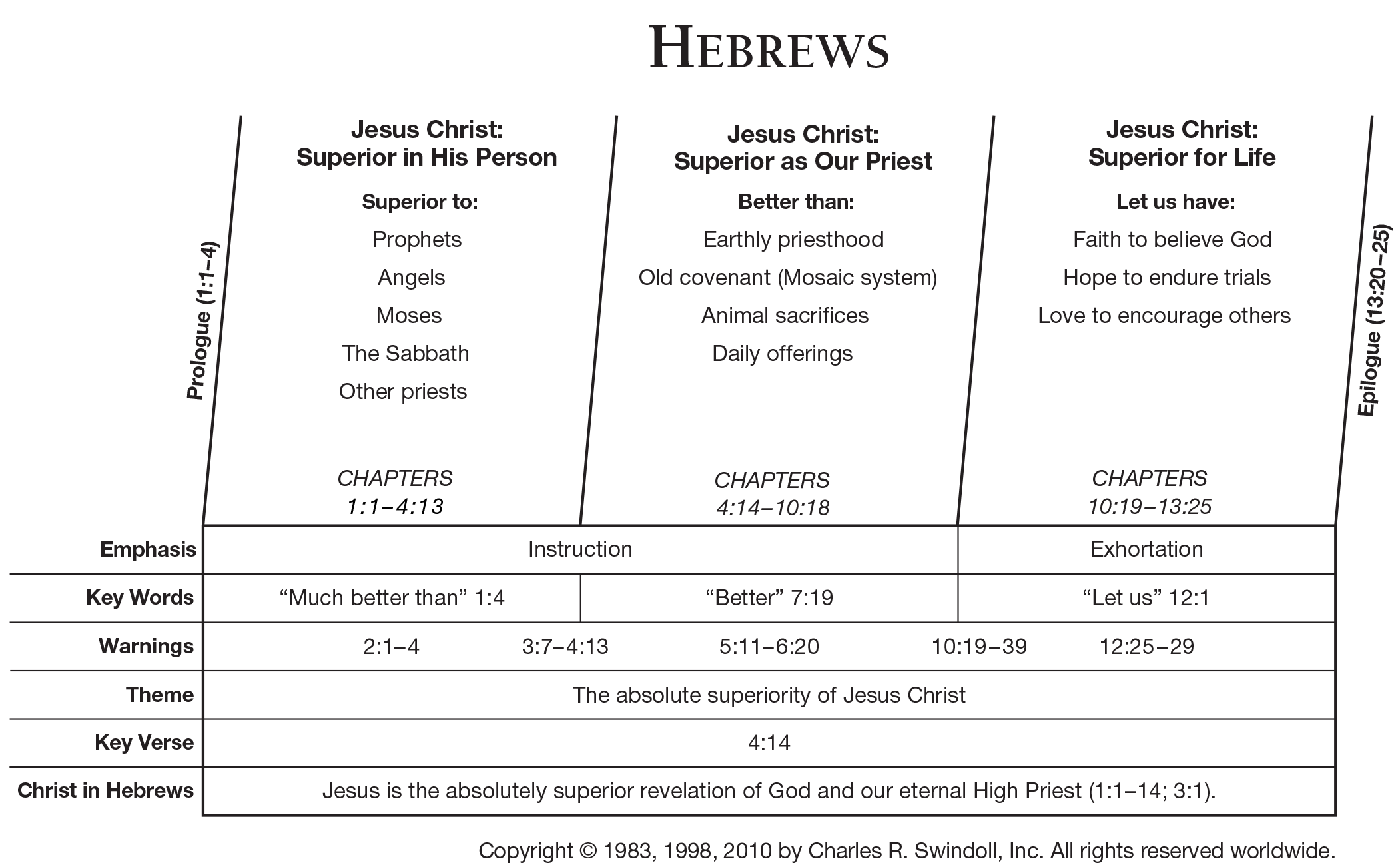


|
The Epistle |
||||
| INSTRUCTION Hebrews 1-10:18 |
EXHORTATION Hebrews 10:19-13:25 |
|||
| Superior Person of Christ Hebrews 1:1-4:13 |
Superior Priest in Christ Hebrews 4:14-10:18 |
Superior Life In Christ Hebrews 10:19-13:25 |
||
| BETTER THAN PERSON Hebrews 1:1-4:13 |
BETTER PRIESTHOOD Heb 4:14-7:28 |
BETTER COVENANT Heb 8:1-13 |
BETTER SACRIFICE Heb 9:1-10:18 |
BETTER LIFE |
| MAJESTY OF CHRIST |
MINISTRY OF CHRIST |
MINISTERS FOR CHRIST |
||
|
DOCTRINE |
DUTY |
|||
|
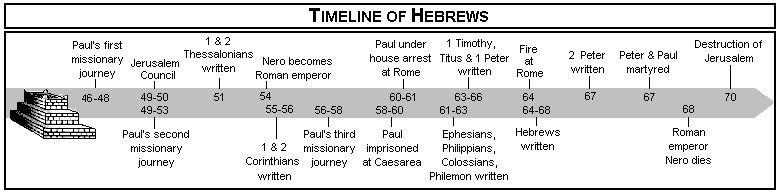
DATE WRITTEN: |
||||

See ESV Study Bible "Introduction to Hebrews"
(See also MacArthur's Introduction to Hebrews)
Borrow Ryrie Study Bible
Hebrews 13:1 Let love of the brethren continue. (NASB: Lockman)
Greek: E philadelphia meneto. (3SPAM)
BGT Ἡ φιλαδελφία μενέτω.
Amplified: LET LOVE for your fellow believers continue and be a fixed practice with you [never let it fail]. (Amplified Bible - Lockman)
My Amplified Paraphrase: Let the love you share as brothers and sisters in Christ—born of the same Savior, adopted by the same Father, and united by the same Spirit—continue constantly and persistently. Do not let it fade, grow cold, or drift into neglect. Instead, keep on showing warm, loyal, sacrificial affection toward one another, treating fellow believers not as acquaintances or optional relationships, but as cherished family. Guard this love, nourish it, and express it in practical care, patient kindness, and steadfast commitment—a love that endures and keeps on enduring.
KJV: Be not forgetful to entertain strangers: for thereby some have entertained angels unawares.
NKJ Let brotherly love continue.
NET Brotherly love must continue.
CSB Let brotherly love continue.
ESV Let brotherly love continue.
NIV: Do not forget to entertain strangers, for by so doing some people have entertained angels without knowing it. (NIV - IBS)
NLT: Continue to love each other with true Christian love. (NLT - Tyndale House)
Phillips: Never let your brotherly love fail (Phillips: Touchstone)
Wuest: Let the brotherly affection continue.
Young's Literal: Let brotherly love remain;
- Heb 6:10-11 Heb 10:24 Jn 13:34,35 15:17 Acts 2:1,44, 45, 46 4:32 Ro 12:9,10 Gal 5:6,13,22 Eph 4:3 5:2 Php 2:1, 2, 3 1Th 4:9,10 2Th 1:3 1Pe 1:22 1Pe 2:17 3:8 4:8 2Pe 1:7 1Jn 2:9,10 3:10-18,23 4:7, 8, 9, 10, 11,20,21 1Jn 5:1 2Jn 1:5,6 Rev 2:4
- Hebrews 13 Resources
- Hebrews 13:1-3 Let Love Continue - Steven Cole
- Hebrews 13:1-4 Love, Sex, and Marriage - John MacArthur
Related Passages:
Hebrews 6:10-11+ (THEY WERE RUNNING WELL AND WERE COMMENDED) For God is not unjust so as to forget your work and the love which you have shown toward His name, in having ministered and in still ministering to the saints. 11 And we desire that each one of you show the same diligence so as to realize the full assurance of hope until the end (LOVE OF BRETHREN IS ONE SIGN OF GENUINE BELIEF),
Hebrews 10:32–34+ (THEY HAD ALREADY DEMONSTRATED BROTHERLY LOVE) But remember the former days, when, after being enlightened, you endured a great conflict of sufferings, 33 partly by being made a public spectacle through reproaches and tribulations, and partly by becoming sharers with those who were so treated. 34 For you showed sympathy to the prisoners and accepted joyfully the seizure of your property, knowing that you have for yourselves a better possession and a lasting one.
Hebrews 10:24+ (EXHORTATION TO BROTHERLY LOVE) and let us consider how to stimulate one another to love and good deeds,
Hebrews 12:29+ (IMMEDIATELY PRECEDES THE COMMAND IN Heb 13:1!) for our God is a consuming fire.
1 Thessalonians 4:9-10+; Now as to the love of the brethren (philadelphia), you have no need for anyone to write to you, for you yourselves are taught by God to love (agapao) one another; 10 for indeed you do practice it toward all the brethren who are in all Macedonia. But we urge you, brethren, to excel still more,
John 13:34-35+ “A new commandment I give to you, that you love (agapao) one another, even as I have loved (agapao) you (CHRIST'S LOVE FOR US IS THE BIBLICAL FOUNDATION FOR OUR LOVE OF OTHERS), that you also love (agapao) one another. 35 “By this all men will know that you are My disciples, if you have love for one another.”
1 John 4:7-8+ Beloved (agapetos), let us love (agapao - present tense - not PERFECTION, BUT DIRECTION) one another, for love (agape) is from God; and everyone who loves (agapao) is born of God and knows (ginosko - present tense) God. 8 The one who does not love (agapao - present tense - not PERFECTION, BUT DIRECTION) does not (ou, ouk, absolutely does not) know (ginosko) God, for God is love (agape). (NOTE: THIS IS A MARK OF A GENUINE BELIEVER!)

Source: J Vernon McGee
CHRISTIAN DOCTRINE CALLS
FOR LOVING PRACTICE
Hebrews 13 marks a transition from deep theological exposition to practical exhortation, from deep doctrine to practical duty. After twelve chapters of rich teaching on the supremacy of Christ—His priesthood, His sacrifice, and the new covenant—chapter 13 turns to how believers should live in light of these truths. In the immediate context of Hebrews 12, after beholding the majesty of Christ, His unshakeable kingdom, and the consuming fire of God’s holiness, we are now called to live out our faith in the ordinary rhythms of life. At the top of the list the writer begins with a simple yet profound command. The brief exhortation (Heb 13:22) to the Hebrews follows the pattern of most NT epistles (see table above). Doctrine is followed by a call to duty, what to believe is followed by how to behave, theology should affect transform one's ethics (see Application).
The first 10 chapters of Hebrews are almost pure doctrine and directed primarily to Jewish readers who had heard the Good News of the Messiah but who were in need of affirmation that the Person and Priesthood of Christ and His the New Covenant in His blood was superior to the angels, to Moses, to the priesthood of Aaron, to the Old Covenant and to the Levitical sacrificial system. The ultimate aim of the writer was to speak these truths about Christ so that their faith would be firmly anchored and unshakeable. And that is why he encourages them with the examples from their own history (Heb 11:1, 2ff+), so that they might run the race of faith with endurance (Heb 12:1+, Heb 12:2+), pursuing peace and the sanctification without which no one will see the Lord (Heb 12:14+). Now in Hebrews 13 the writer is emphasizing that true faith demands true living. And so it is not surprising that this chapter ends with a number of exhortations related to a believer's conduct…
- Brotherly love, Hebrews 13:1+
- Hospitality, Hebrews 13:2+
- Sympathy with those in bonds, Hebrews 13:3+
- Fidelity in the marriage relation, Hebrews 13:4+
- Contentment, Hebrews 13:5, 6+
- Submission to those in authority, Hebrews 13:7, 8+
- Stability in the doctrines of religion, Hebrews 13:9, 10, 11, 12, 13, 14 15+
- Benevolence, Hebrews 13:16+
- Obedience to those entrusted with office, Hebrews 13:17+
- Special prayer for him who wrote this epistle, Hebrews 13:18, 19+
Let love of the brethren (philadelphia) continue (meno) - How do you serve and worship God acceptably with reverence and awe (Heb 12:28 - remember no chapter breaks juxtaposes these two verses and thoughts). Hebrews 13:1 (and following passages) tell us the answer! This verse reminds us that genuine Christian maturity is not measured by knowledge alone, but by persistent, active love for fellow believers. It is both the fruit of divine grace and a reflection of the Savior Who loved us to the uttermost.
We are not to love like brothers,
but we are to love because we are brothers.
-- J Vernon McGee
Let...continue is present imperative, a command signifying that this was to be their supernaturally enabled, Spirit filled, grace strengthened habitual practice! In addition he uses the middle voice which signifies the subject initiates the action and participates in the carrying out of the action or the results of the action. This voice is reflexive and gives the sense "you yourself let it continue." Remember that God's commands always include His enablement, specifically the power of the Holy Spirit to prompt this desire in us and then to enable us to obey in love. The fact that he calls for this love to continue indicates the readers are already manifesting this love. And this makes sense because when they became believers "the love of God has been poured out within (their) hearts through the Holy Spirit who was given" to them (Ro 5:5+). In Hebrews 10 he commends them for "becoming sharers with those who were so treated" (reproaches and tribulations) and also they had shown "sympathy to the prisoners." (Heb 10:33-34+).
Charles Spurgeon agrees that "The word “continue” implies that “brotherly love” exists. There are many things that might put an end to it; so see to it that, as far as you are concerned, it continues. Under all provocations, and under all disappointments, “brotherly love must continue.” Let each esteem others better than himself; let each seek his brother’s good to edification. Let us by no means be divided in heart, for schisms grieve the Holy Spirit, destroy our comfort, weaken our graces, afford occasion for naysayers, and bring a thousand ills upon us. Whereas in these evil days the Church is so much divided into denominations and sections, follow peace with all those who love the Lord Jesus Christ in sincerity. Hold what you believe with firmness, for you are not to trifle with God’s truth; but wherever you see anything of Christ, confess relationship there, and act as a brother toward your brother in Christ."
J Vernon McGee - Now if you are a child of God you are my brother. I get many letters that say, “I am a black person. But I listen to your program and I want you to know that I am a believer and I love you.” I appreciate that so much. What difference does the color of the skin make when we are children of God? When He has given us new hearts and washed us white as snow, we are brothers, we are in the family of God, and we are to love one another. I like to illustrate the Christian life as a triangle (SEE DEPICTION ABOVE): The Christian life is a life of faith and of love toward God and of love toward others (BORROW Thru the Bible)
Puritan David Dickson wrote "Let brotherly love continue. From the first precept (ED: FIRST IN THIS LIST OF EXHORTATIONS IN HEBREWS 13), learn (1) That the first fruit of faith which God requireth is love and constant love among His children. (2) That our mutual love, must be sincere and kindle as if it were grounded on bands of nature." (Hebrews)
Nothing flows away
so easily as love!
John Calvin on why this command is needful for believers - “this precept is generally very needful, for nothing flows away so easily as love; when everyone thinks of himself more than he ought, he will allow to others less than he ought; and then many offences happen daily which cause separations.” “Nothing flows away so easily as love!”
Steven Cole adds "Sometimes we think that love should be spontaneous and effortless. But biblical love is not automatic! If you don’t focus on it and work at it, it easily flows away. Did you give any thought last week as to how to love your mate and children? Did you pray that God would increase your love for that difficult person in your family or at church or at work (see Phil. 1:9)? I recommend that you put 1 Corinthians 13:4–7 on a card and read it over so often that it guides all of your relationships. Don’t let love flow away!" (Let Love Continue)
Henry Alford agrees with Dickson writing "Let it then remain, not die out. And it is put first, as being the first of the fruits of faith. The exhortations in Heb 3:12, 13.; Heb 10:24, 25.; Heb 12:12-14, point the same way). (New Testament for English Readers)
No man can love a saint,
as a saint, but a saint.
- Richard Sibbes
A W Pink sees a link between chapter 12 and 13 (remember chapter breaks were not inspired and occasionally are poorly placed)…"So far from there being a radical break between Heb. 12 and 13 the closing verses of the former and the opening ones of the latter are closely linked together. There the apostle had mentioned the principal duties which believers are to perform Godwards, namely, to “hear” (Heb 12:25+) and to “serve Him acceptably” (Heb 12:28+); here, he tabulates those duties which are to be performed manwards. He begins with what is really the sum and substance of all the rest, brotherly love: first, the loving of God with all our heart, and then our neighbor as ourselves…Matthew Henry well pointed out, “the spirit of Christianity is a spirit of love.” The fruit of the Spirit is love (Gal. 5:22+). Faith works by love (Gal. 5:6). “Everyone that loves Him that begat loves him also that is begotten of Him” (1Jn 5:1). Love to the brethren is both the first indication and fruit of the Christian life (Acts 16:33) and the final aim and result of Divine grace (2Pe 1:7+). (Hebrews 13:1 Brotherly Love)
🙏 THOUGHT - As I was compiling these notes it struck me that the most difficult brethren to love often are those who are closest to us - Husbands and wives, parents and children, in laws (who we often treat like "outlaws"!). Beloved, I am convicted that I need to begin in my "Jerusalem" (Acts 1:8+) and empowered by the Holy Spirit, I am to bear "witness" of the supernatural power of a new heart (2Co 5:17+) to those closest to me by continually letting love of the brethren continue! Too often I think of the brethren who are far removed from my sphere of influence and find it easier to show them love. God is saying to me (and perhaps to you), let love of the brethren continue right where I have you situated, right in the middle of the circumstances I have providentially ordained. That's where I (we) need to obey this command empowered by the Spirit of grace (Heb 10:29) and motivated by a desire (Php 2:13NLT+) and ambition to be pleasing to Him (2Co 5:9+), knowing that one day soon we shall all stand before the Judgment Seat (bema) of Christ and be recompensed for the deeds we have done in the our body, including how we demonstrated love to the brethren. (2Co 5:10+) Husbands (I'm one for some 46 years - as I revise this it is now 56 years) do you hear God's call to show love to your wives? (Eph 5:25+ - Don't try to accomplish this in your own/old strength! You can't! But you can filled with His Spirit! Eph 5:18+) Wives do you hear what the Spirit is saying to the churches? Children, are you listening? May God be greatly glorified by Spirit filled saints who seek to supernaturally love the brethren for the sake of the One Who loved us supremely in Christ (1Jn 3:16+, Ro 5:8+). Amen.
The question for all of us who have already expressed some degree of brotherly love (you will if you are truly born again)? As you have studied the book of Hebrews or the Bible in general, has your love for your brothers and sisters increased or decreased? Remember that "continue" is not a static but a dynamic verb (present imperative) implying progress, advancement, growth, and increase. Bible study was never meant to make us smarter sinners, but to make us more like the Savior. So let me ask it again - Is your love for the brethren growing stronger? Are you as convicted as I am beloved?
Blest be the tie that binds
Our hearts in Christian love;
The fellowship of kindred minds
Is like to that above.
We share our mutual woes,
Our mutual burdens bear,
And often for each other flows
The sympathizing tear.
How can we love one another? Two verses prior in Heb 12:28+ the phrase "have gratitude" is more literally translated as "continually having grace". It is when we are empowered by the Spirit of grace that we can offer to God an acceptable service in reverence and awe. Now as those in the New Covenant of grace, these readers can demonstrate love to the brethren because this grace gives them a new motivation and power (cp Ezekiel 36:26, 27+, Php 2:12+, Php 2:13NLT+). Don't TRY to "love the brethren" IN YOUR OWN POWER (your old natural power), for you can't do it, but God can and He promised to do it in us and through us! Let God and let's go (and love the brethren)!
The use of the verb continue indicates that such love already exists as recorded earlier "For God is not unjust so as to forget your work and the love which you have shown toward His name, in having ministered and in still ministering to the saints. (Heb 6:10+)
Comment: Note that this love to the saints was "toward His Name" and I would add therefore was for His fame! His glory and fame are always to be the aim of our good works initiated and energized by His Spirit.
Love is the binding power which holds
the body of the Christian church together.
-Stephen Olford
W E Vine writes that brotherly love "is a law of the kingdom just mentioned (Heb 12:28). It is an evidence of heavenly citizenship (Phil 3:20). The exhortation suggests that such love had existed and needed maintaining. (ED: IT ALWAYS NEEDS MAINTAINING - THERE IS NO "COASTING" IN THE CHRISTIAN LIFE!)
The measure of our love for others can largely be determined
by the frequency and earnestness of our prayers for them.
- A. W. Pink
A W Pink adds that "let… continue" includes the idea of enduring in the face of difficulties and temptations. That which is enjoined is perseverance in a pure and unselfish affection toward fellow-Christians. Brotherly love is a tender plant which requires much attention: if it be not watched and watered, it quickly wilts. It is an exotic, for it is not a native of the soil of fallen human nature—“hateful and hating one another” (Titus 3:3) is a solemn description of what we were in our unregenerate state. Yes, brotherly love is a very tender plant and quickly affected by the cold air of unkindness, easily nipped by the frost of harsh words. If it is to thrive, it must needs be carefully protected and diligently cultivated…Yes, a most needful exhortation is this: not only because hatred so largely sways the world, but also because of the state of Christendom. Here is a searching question which each of us should honestly face: Is my love for the brethren keeping pace with my growing (intellectual) knowledge of the Truth? “Let brotherly love continue.” What a solemn word is this! Is the reader startled by that adjective?—a needful and humbling one, but scarcely a “solemn.” Ah, have we forgotten the context? Look at the verse which immediately precedes, and remember that when this epistle was first written there were no chapter-breaks: Heb 12:29 and Heb 13:1 read consecutively, without any hiatus—our God is a consuming fire: let brotherly love continue! The fact these two verses are placed in immediate juxtaposition strikes a most solemn note. (Hebrews 13:1 Brotherly Love)
And so, in the New Covenant of grace believing Greeks and Jews, circumcised and uncircumcised, barbarians, Scythians, slaves and freemen, men and women are now all one in their Lord (cp Gal 3:28, Col 3:11+, Eph 4:1, 2, 3+). Such a diverse cultural community would have continual need for emphasis on continuing to love the brethren.
It should also be noted that love of the brethren is not just a passive disposition of fondness but manifests itself in overt acts of kindness toward the brethren, acts which are described in subsequent passages (showing hospitality Heb 13:2, remembering those in prison Heb 13:3, etc).
Phillip Hughes writes that "our author has provided the key to the correct theological understanding of this brotherly relationship in an important passage (Heb 2:11ff.), where it becomes plain that the brotherhood enjoyed among Christians derives from Christ himself, first of all by his incarnation through which he became one with us as a fellow human being, and second by our becoming one with him through our experience of the redemption which he has accomplished for us. Christian brotherhood, therefore, is essentially brotherhood in Christ; for as he is the only Son (Heb 1:2, 5ff., etc.) so, as has already been stressed, it is through union with him that we participate in the grace of his sonship, and in him are accepted as the sons of God and, as sons, brothers and fellow heirs with him who is the heir of all things (Heb 1:2; Ro 8:14-17; Eph 1:5-7, 11-14; Jn 1:13). If our brotherhood derives from Christ, so also does our love as brothers. His infinite love for us is the source and stimulus of our love for each other. Hence the precept given by the Master in the upper room: "This is my commandment, that you love one another as I have loved you" (Jn 13:34; cf. 15:12, 17; 2Jn 5; 1Jn 3:11, 14, 16-18; 4:7-12). (A Commentary on the Epistle to the Hebrews- Philip Edgcumbe Hughes)
Steven Cole makes the point that "Next to faith in the Lord Jesus Christ for salvation, biblical love is the supreme mark of the Christian. It is mandatory for every Christian to grow in love!" (Let Love Continue)
J N Darby discusses the relationship of brotherly love to agape love noting that the latter "in its root, is the nature of God Himself, the source and perfection of every other quality that adorns Christian life. The distinction between agape love and brotherly love is of deep importance; the former is indeed the source whence the latter flows; but as this brotherly love exists in mortal men, it may be mingled in its exercise with sentiments that are merely human, with individual affection, with the effect of personal attractions, or that of habit, of suitability in natural character. Nothing is sweeter than brotherly affections; their maintenance is of the highest importance in the assembly; but they may degenerate, as they may grow cool; and if agape love, if God, does not hold the chief place, they may displace Him—set Him aside—shut Him out. Divine agape love, which is the very nature of God, directs, rules, and gives character to brotherly love; otherwise it is that which pleases us—that is, our own heart—that governs us. If divine agape love governs me, I love all my brethren; I love them because they belong to Christ; there is no partiality. I shall have greater enjoyment in a spiritual brother; but I shall occupy myself about my weak brother with a love that rises above his weakness and has tender consideration for it. I shall concern myself with my brother’s sin, from love to God, in order to restore my brother, rebuking him, if needful; nor, if divine love be in exercise, can brotherly love, or its name, be associated with disobedience. In a word, God will have His place in all my relationships. To exact brotherly love in such a manner as to shut out the requirements of that which God is, and of His claims upon us, is to shut out God in the most plausible way, in order to gratify our own hearts. Divine agape love then, which acts according to the nature, character, and will of God, is that which ought to direct and characterize our whole Christian walk, and have authority over every movement of our hearts. Without this, all that brotherly love can do is to substitute man for God. Divine love is the bond of perfectness, for it is God, who is love, working in us and making Himself the governing object of all that passes in the heart.
S Lewis Johnson - You’ve heard people say, “I love all the saints; but some I love better at a distance.” Well, that’s not Christian love. “I love them all, but there are some I don’t like.” Well, that’s not Christian love either. Those may be facts about our human experience, but they’re not Christian expressions. It certainly is not the ideal. “Let brotherly love continue.” In fact, we all know that the only way in which we can love brethren is by the divine love that is in our hearts by virtue of the work of the Holy Spirit. And so we all need to call upon the Holy Spirit within to enable us to love our Christian brethren and sisters. (Hebrews)
As Darby and Johnson allude to above, the way one loves the brethren now is not by our natural powers but is by the supernatural enablement of and dependence upon the Holy Spirit. Paul taught that "the (agape) love of God has been poured out within our hearts through the Holy Spirit who was given to us" (Ro 5:5+) and "the fruit of the Spirit is (agape) love." (Gal 5:22+)
John emphasizes the importance of love of the brethren as one evidence of genuine new birth by warning his readers that
"If someone says, "I love God," and hates his brother, he is a liar; for the one who does not love (agapao = expression of divine love) his brother whom he has seen, cannot love (agapao) God whom he has not seen. (1Jn 4:20+)
John repeats the truth that the love of the brethren proves that one is truly born again. John reiterates this truth writing…
We know that we have passed out of death into life, because we love the brethren. He who does not love abides in death. (1Jn 3:14+)
Henry Morris comments: Here is another test for knowing whether we are truly saved and have "passed from death unto life" (Jn 5:24; 1Jn 2:3,5; 3:24; 5:2,13). John gives three characteristics of true love for our brethren: doing righteousness (1John 3:10); willingness to die for them (1Jn 3:16); willingness to share our possessions with them" (1Jn 3:17).
Peter echoes John writing
"Since you have in obedience (faith that obeys) to the truth purified your souls for (faith that saves leads to brotherly love) a sincere love of the brethren (philadelphia), fervently love one another from the heart for (Peter explains why we should and how we can love one another declaring that) you have been born again not of seed which is perishable but imperishable, that is, through the living and abiding word of God. (1Pe 1:22,23+)
A W Pink - you may, dear reader, be afraid to affirm that you love God, but do you not love His people? If you do, you must have been born again, and have in you the same spiritual nature which is in them. But do I love them? Well, do you relish their company, admire what you see of Christ in them, wish them well, pray for them, and seek their good? If so, you certainly love them. But not only is the exercise of Christian love a testimony unto the world of our Christian discipleship, and a sure evidence of our own regeneration, but it is also that which delights God Himself. Of course it does! It is the product of His own grace: the immediate fruit of His Spirit. “Behold, how good and how pleasant it is for brethren to dwell together in unity!” (Ps 133:1) is what the Lord Himself declares. (Hebrews 13:1)
Gromacki - At conversion all believers are immediately implanted with a genuine love for God and for His children (1Th 4:9+; 1Jn 3:14; 4:19). That love, however, needs to be increased by the effort of each believer (Heb 10:24+; 1Th 4:9; 2Pe 1:7+). The readers possessed true brotherly love, a sign of their regeneration. The appeal is for its daily maintenance and proper manifestation (Continue = present active imperative). (Stand Bold in Grace An Exposition of Hebrews)
Now that saints have access to God's precious and magnificent promises (2Pe 1:4+) and are called to be partakers of His divine nature (2Pe 1:4), we are to be diligent to grow in Christlikeness, in our faith, increasing in a number of attributes including "brotherly kindness" (philadelphia) (2Pet 1:5+, 2Pe 1:7+)
In view of the fact that believers now have a supernatural source of power to love unconditionally and sacrificially, Paul exhorts the saints in Rome to…
Be devoted (philostorgos from philos = beloved, dear + storge = family love, love of parents and children) to one another in brotherly love (philadelphia); give preference to one another in honor (Ro 12:10+)
Paul commends the saints in Thessalonica for their love…
Now as to the love of the brethren (philadelphia), you have no need for anyone to write to you, for (Paul now explains how philadelphia love is possible) you yourselves are taught by God to love (agapao in the present tense = habitually, as your new way of life) one another (1Th 4:9+) (Study the "one anothers" - most positive, some negative)
Jesus says brotherly love is the badge of a believer declaring
"By this all men will know that you are My disciples, if you have love for one another. (Jn 13:35+).
Brotherly love is (should be) the natural outflow of a follower of Christ. As emphasized above, true brotherly love cannot be self generated (as least in the sense that it brings glory to God, for apart from His initiating and enabling the work, it is our work, the work of a "branch" rather than of the Vine, Christ Jesus, Jn 15:5+). To be sure, His work through us can be "faked" as well as stifled. Our goal should be to nurture this grace of letting love flow by yielding to the Spirit when He gives us opportunities to work it out in fear and trembling. This explanation also helps understand why believers are not told to make it happen but to let it continue. It's like a faucet that is turned on - we are not the source of the water coming through the conduit and the spigot but we can cut off the flow or we can choose to allow it to continue to flow. So let love "flow" through you to the brethren. Because of our having been transferred from darkness to light and into a new kingdom when we are saved, we are naturally (really supernaturally) drawn toward fellowship with other believers who are also in the kingdom of light. And remember, "be nice" to your brethren, because we are going to spend a long, long time with them in eternity future! The deepest fellowship is not based on blood but on whether you are ''under the blood of Jesus'' and have a future and a hope to share.
Remember that many of the readers of this letter had most likely been rejected by their friends and families for having made a commitment to Jesus Christ as their Savior (cp Jesus' clear warning of the cost of discipleship, the cost of following Him - Mt 10:21, 22, 34, 35, 36+, Mk 13:12+, Lk 12:51-53+, Lk 21:16+). But the deepest fellowship is not based on race or family ties (blood is not really "thicker than water" in the spiritual realm) but is based on the life we all share in Christ.
William Barclay proposes two situations that emphasize the need for genuine brotherly love writing that "The very circumstances of the early Church sometimes threatened brotherly love. The very fact that they took their religion as seriously as they did was in one sense a danger. In a Church which is threatened from the outside and desperately in earnest in the inside, there are always two dangers. FIRST, there is the danger of heresy-hunting. The very desire to keep the faith pure tends to make men eager to track down and eliminate the heretic and the man whose faith has gone astray. SECOND, there is the danger of stern and unsympathetic treatment of the man whose nerve and faith have failed. The very necessity of unswerving loyalty in the midst of a heathen and a hostile world tends to add rigorousness to the treatment of the man who in some crisis had not the courage to stand for his faith. It is a great thing to keep the faith clean; but when the desire to do so makes us censorious, harsh and unsympathetic, brotherly love is destroyed and we are left with a situation which may be worse than the one we tried to avoid. Somehow or other we have to combine two things--an earnestness in the faith and a kindness to the man who has strayed from it. (Hebrews 13 Commentary)
Let...continue (3306)(meno)in simple terms means to remain in the same place or position over a period of time. It means to reside, stay, live, lodge, tarry or dwell. Menō describes something that remains where it is, continues in a fixed state, or endures. Meno can mean "to take up permanent residence" or "to make yourself at home." Meno is the root of the Greek noun mone which means mansion or habitation (Jn 14:2, 23). More than one half of the uses of meno are by John in his Gospel and letters. Here is a summary of some of the nuances of meno related specifically to dwelling or abiding in Christ - (1) to dwell in God (or Christ) means that we walk as Christ walked (1Jn 2:6, Php 2:5, Jn 13:15); (2) to dwell in Christ means that we don’t habitually live in sin (1Jn 3:6); (3) to dwell in Christ means that we continue in His Word (Jn 8:31, 1Jn 2:17); (4) to dwell in Christ means that we bear fruit (Jn 15:5, Heb 13:5, Col 1:10, Ro 6:22, Php 4:7, 1Co 16:5, Jn 4:36)
MENO IN HEBREWS - Heb. 7:3; Heb. 7:24; Heb. 10:34; Heb. 12:27; Heb. 13:1; Heb. 13:14
Hebrews 7:3 Without father, without mother, without genealogy, having neither beginning of days nor end of life, but made like the Son of God, he remains a priest perpetually.
Hebrews 7:24 but Jesus, on the other hand, because He continues forever, holds His priesthood permanently.
Hebrews 10:34 For you showed sympathy to the prisoners and accepted joyfully the seizure of your property, knowing that you have for yourselves a better possession and a lasting one.
Hebrews 12:27 This expression, “Yet once more,” denotes the removing of those things which can be shaken, as of created things, so that those things which cannot be shaken may remain.
Hebrews 13:1 Let love of the brethren continue.
Hebrews 13:14 For here we do not have a lasting city, but we are seeking the city which is to come.
Love of the brethren (5360) philadelphia from philos = beloved, dear, friendly + adelphos = brother, from the same womb) means "fraternal love", brotherly love (kindness), love of the brethren. Brotherly love normally referred to the love members of a family held for each other (this was the way it was used in secular Greek) and would not normally be used to describe the love between members of different families.
Philadelphia describes a love which calls for an affection for one another like that one expressed between natural family members. Wuest adds that the related verb phileo "speaks of human affection, fondness, a non-ethical, though perfectly legitimate, form of love."
This new radical relationship between believers is hinted at in the the other root word of philadelphia, adelphos, which describes one from the same womb. As Kenneth Wuest explains, the fact that all believers have their "new birth" from "the same womb" (Jn 3:3), is a truth which forms "the basis of their Christian fondness and affection for each other, the source of their Christian fellowship."
In secular Greek use philadelphia described love of those who were actually related by blood, but here in Hebrews (and elsewhere in the NT) philadelphia describes the kinship among those who are in children of God, members of the same family (John 1:12, 13) "all from one Father" (Heb 2:11+, Mt 23:8, 9, Compare the phrase "God our Father" in Ro 1:7 1Cor 1:3 2Cor 1:2 Gal 1:3 Eph 1:2 Php 1:2 Col 1:2 2Th 1:1 2Th 2:16 Philemon 1:3). As an aside unregenerate Jews never referred to God as their Father (cp Jn 8:39). And so in the NT philadelphia is describes the love that believers possess for one to another, for even though they were members of different natural families, they are united in Christ and were recipients of family love originating from the Father Who had bestowed His great love on His spiritual children (1Jn 3:1+).
PHILADELPHIA - 5V - Rom. 12:10; 1 Thess. 4:9; Heb. 13:1; 1 Pet. 1:22; 2 Pet. 1:7
David Guzik - In the ancient Greek language the New Testament was written in, there were four words at hand that we might translate love. Eros was one word for love. It described, as we might guess from the word itself, erotic love. It refers to sexual love. Storge was a second word for love. It refers to family love, the kind of love there is between a parent and child, or between family members in general. Agape is another word for love. It is the most powerful word for love in the New Testament, and is often used to describe God’s love towards us. It is a love that loves without changing. It is a self-giving love that gives without demanding or expecting re-payment. It is love so great that it can be given to the unlovable or unappealing. It is love that loves even when it is rejected. Agape love gives and loves because it wants to; it does not demand or expect repayment from the love given - it gives because it loves, it does not love in order to receive. Agape love isn’t about feelings, it is about decisions. But the word for love used in Hebrews 13:1 is philadelphia, coming from the root philia. This ancient Greek word speaks of a brotherly friendship and affection. It is the love of deep friendship and partnership. There should always be plenty of this kind of love among Christians, and it should continue.
See multiple articles in Puritan writings that mention "brotherly love" sitewww.gracegems.org brotherly love - Google Search.
The first one by Gardiner Spring on the search list is worth noting as it is entitled The Distinguishing Traits of Christian Character (which discusses 18 attributes indicative of genuine salvation - take a moment to scan the titles). Spring writes of trait number 15 "Brotherly Love"...
"Another evidence of salvation is love to the brethren. The Gospel breathes the spirit of love. Love is the fulfilling of its precepts, the evidence of its power, the pledge of its joys, and the ripe fruit of the Spirit. "A new commandment," says our Lord to His disciples, "give I unto you, that you love one another" (John 13:34). "And this is his commandment, that we should believe on his Son, Jesus Christ, and love one another" (1 John 3:23).
Spring ends with a set of interesting (and perhaps a bit convicting) personal application questions:
- The obvious inquiry is: Do you love the people of God because they are the people of God?
- Because you discover in them the amiableness of that religion which is altogether lovely?
- Do you love them, not merely because they love you or have bestowed favors upon you; not because they are of your party, but because they bear the image of your heavenly Father?
- Do you love them for their love of God, their self-denial, their heavenliness, their usefulness in the world, their reproachless example, their faithfulness and love of duty?
- Do you love them when they reprove you, and when their example condemns you?
- And do you love them in proportion to the measure of these excellencies which they possess?
- Do you feel an interest in them and for them?
- Can you bear and forbear with them?
- Can you forget their infirmities, or do you rejoice to magnify them?
- Can you cast the mantle of charity over their sins and pray for them, and watch over them, and pity, and love them still?
- And can you feel thus and act thus toward the poorest and most despised of the flock and that because he is a Christian?
- If so, here is your encouragement "He who loves is born of God" (1 John 4:7).
Steven Cole - discusses the important topic of the heart hindrances to Biblical love for the brethren...
Biblical love will not continue unless we fight against
the common hindrances to love in our own hearts.
The Hebrews had been doing well in this area, but now the author exhorts them to continue in it. Otherwise, it will easily flow away. There are many hindrances to love, but note these five:
(1). We must fight against self-love and selfishness.
Biblical love may be defined as “a self-sacrificing, caring commitment, which shows itself in seeking the highest good of the one loved.” That is a description of Christ’s love for us on the cross: He sacrificed Himself because He cared for us and was committed to redeem us and bring us to glory. His commitment to us was so strong that He was willing to bear the wrath of the Father in our stead on the cross!
Contrary to the nonsense of “Christian” psychobabble, you do not need to learn to love yourself in order to love God and others! There is no command to love yourself. The two commands are: Love God; love your neighbor. Loving yourself is assumed, because we all love ourselves quite well! If we ever love our neighbor as much as we inherently care about ourselves, we will be obeying the second great commandment.Almost all relational conflicts can be traced back to some degree of selfishness (James 4:1–3). I didn’t get my way, and I want my way! We’re like three-year-olds fighting over a toy! So if you want to let love continue, you’ve got to fight your own love of self that manifests itself in selfishness.
(2). We must fight against pride.
Pride is closely joined to self-love, and is at the root of all other sins. Pride makes me think, “I know better than God does what’s good for me, so I’m going to disregard His Word and do what I think is best!” Pride makes me think, “That person is such a jerk! I would never behave as he is!” But, I don’t know all of the factors that led that person to behave as he is. The fact is, I am just as much a sinner as he is, and if it were not for God’s grace, I’d be caught in some sin. Pride makes me a Pharisee, who sets up my own standards and then judges everyone who doesn’t keep those standards. So if you want to practice biblical love, you must constantly judge your pride.
(3). We must fight against impatience and intolerance of others’ imperfections.
“Love is patient, love is kind…” (1 Cor. 13:4). It is not by accident that Paul put those two qualities first, because they are usually enough to stop me in my tracks when I am acting in unloving ways. Husbands, are you patient and kind towards your wife? Dads, are you patient and kind towards your children? When we grow impatient and intolerant of others’ imperfections, we are judging them by our standards, which stems from our pride. When I get irritated and snap at my wife or kids, I’m being unloving.
(4). We must fight against the love of the world.
“Do not love the world nor the things in the world. If anyone loves the world, the love of the Father is not in him” (1 John 2:15). That verse leaves no room to dodge its implications: If I love the world or the things in the world, God’s love is not in me! And if God’s love is not in me, it will not flow through me to others.
The love of the world includes the love of the world’s praise and acclaim. If I love such acclaim, I am loving myself, and consequently, I am not loving God or others. If I love the world’s things, I will be stingy and unwilling to give up those things for the sake of others. So to love God and others, I must constantly fight the lure that the world dangles in front of me.
(5). We must fight against a sectarian spirit.
For some reason, God determined to save people who do not agree with me on every point of doctrine! If He had checked with me first, I would have told Him to save only those who agree with me! Follow me carefully: Since biblical love means seeking the other person’s highest good, and since holding to sound doctrine is essential for the other person’s highest good, it is right to seek to help my fellow believers grow in adherence to sound doctrine. But, if in my attempt to help the other person understand and embrace sound doctrine, I insensitively alienate him, I have failed to love him biblically. There is a far greater chance that he will come to embrace the truth that I love if he knows that I love him.
I have held to the doctrines that are labeled “Calvinism” since my college days, long before I ever read a page of Calvin’s writings. I came to believe in God’s sovereign election by wrestling with Romans 9 until it pinned me to the mat. I couldn’t escape!
When I was in seminary, there was a group of zealots whom I labeled, “The John Calvin Club.” These guys would surround a victim in the student union and try to convince him of the doctrine of election. I would frequently walk by them and shake my head, thinking, “That’s not the way to bring that guy to the knowledge of the truth.” They were trying to win an argument, but the doctrine of God’s free and sovereign grace is not something that you come to believe because you lost an argument. You believe it when God opens your eyes to see it in Scripture, and you submit your heart to the greatness of God. With Paul, you realize, “For from Him and through Him and to Him are all things. To Him be the glory forever. Amen” (Rom. 11:36).
The great evangelist, George Whitefield, was a committed Calvinist. His friend from his college days, John Wesley, was a committed Arminian. Wesley tried to argue with Whitefield on these issues. Whitefield wrote to Wesley (cited without reference by Kent Hughes, Hebrews [Crossway], 2:207),
My honored friend and brother … hearken to a child who is willing to wash your feet. I beseech you, by the mercies of God in Christ Jesus our Lord, if you would have my love confirmed toward you…. Why should we dispute, when there is no possibility of convincing? Will it not, in the end, destroy brotherly love, and insensibly take from us that cordial union and sweetness of soul, which I pray God may always subsist between us? How glad would the enemies of our Lord be to see us divided.… Honored sir, let us offer salvation freely to all by the blood of Jesus, and whatever light God has communicated to us, let us freely communicate to others.
A sectarian spirit stems from pride and causes division. Biblical love seeks to help others know God as He has revealed Himself in His Word, but it does not divide over non-essential doctrines.
Thus, biblical love requires attention and focus. It is founded on God’s great love for us and that fact that we are brothers and sisters in His family. Biblical love will not continue unless we remove the common hindrances to it. Finally,
Biblical love must be developed.
The entire Bible can be summed up in the two commands, to love God and love others. Read and study it to further those goals. But let me mention three things:
(1). Grow to be like Jesus.
Jesus Christ is our example of what God’s love looks like in human life. If you think that love is always syrupy sweet, read the gospels again! Jesus always acted in love, but He often said some tough things. Jesus loved Peter when He said to him, “Get behind Me, Satan; for you are not setting your mind on God’s interests, but man’s” (Mark 8:33). Jesus loved the scribes and Pharisees when He called them a brood of vipers and warned them about hell (Matt. 23:33). I’m not suggesting that you go around calling people a brood of vipers and then claim to be loving! I am only pointing out that Jesus’ love was not wimpy, and that by studying His life, you get a complete portrait of biblical love.
(2). Seek to serve, not to be served.
“For even the Son of Man did not come to be served, but to serve, and to give His life a ransom for many” (Mark 10:45). This is a basic mindset that you have to develop. Get your focus off of yourself and onto the needs of others. Servants sacrifice their own desires and time to please their masters. Are you a servant in your family, to your wife and kids? Do you come to church to have your needs met or to meet the needs of others?
(3). Develop a genuine interest in others.
Practice the golden rule (Matt. 7:12): “In everything, therefore, treat people the same way you want them to treat you, for this is the Law and the Prophets.” Do you see someone who is new or alone at church? How would you feel if you were in that situation? How would you want to be treated? Treat them like that! Simple, isn’t it? And yet our selfishness blocks us from practicing it. (Let Love Continue)
Stephen Olford - No one can be a true Christian without a love for his brethren; and this, in itself, should be the ultimate motivation for giving hospitality to all the people of God. Martin Luther once said that we need to see ourselves as water fountains: the love of God first flowing into us and then out of us to others.
John Owen - Brotherly Love: Causes, Occasions, and Preservation
I. THE CAUSES OF THE DECAY OF THIS LOVE, whence it doth not continue as it ought, are —
1. Self-love.
2. Love of this present world.
3. Abounding of lusts in the hearts of men.
4. Ignorance of the true nature, both of the grace and the exercise of it, in its proper duties.
5. Principally, the loss of a concernment in the foundation of it, which is an interest in gratuitous adoption, and the participation of the same spirit, the same new nature and life. Where this is not, though conviction of truth and the profession of it may for a season make an appearance of this brotherly love, it will not long continue.
II. THE OCCASIONS OF ITS DECAY AND LOSS ARE —
1. Differences in opinion and practice about things in religion.
2. Unsuitableness of natural tempers and inclinations.
3. Readiness to receive a sense of appearing provocations.
4. Different, and sometimes inconsistent secular interests.
5. An abuse of spiritual gifts, by pride on the one hand, or envy on the other.
6. Attempts for domination, inconsistent in a fraternity; which are all to be watched against.
III. THE MEANS OF ITS CONTINUANCE OR PRESERVATION ARE —
1. An endeavour to grow and thrive in the principle of it, or the power of adopting grace.
2. A due sense of the weight or moment of this duty, from the especial institution and command of Christ.
3. Of the trial which is committed thereunto, of the sincerity of our grace, and the truth of our sanctification. For “by this we know that we are passed from death unto life.”
4. A due consideration of the use, yea, necessity of this duty to the glory of God, and edification of the Church; and —
5. Of that breach of union, loss of peace, disorder and confusion, which must and will ensue on the neglect of it.
6. Constant watchfulness against all those vicious habits of mind, in self-love, or love of the world, which are apt to impair it.
7. Diligent heed that it be not insensibly impaired in its vital acts; such as are patience, forbearance, readiness to forgive, unaptness to believe evil, without which no other duties of it will be long continued.
8. Fervent prayer for supplies of grace enabling us thereunto, with sundry others of a like nature. And if we judge not this duty of such importance as to be constant in the use of these means for the maintenance of it, it will not continue.
Bill Armstrong
It was a quiet December evening on Ward C43, the oncology unit at Georgetown University Hospital. Many of the rooms around the central nurses' station were dark and empty, but in Room 11 a man lay critically ill. The patient was Jack Swigert, the man who had piloted the Apollo 13 lunar mission in 1970 and was now Congressman-elect from Colorado's 6th Congressional District. Cancer, the great leveler, now waged its deadly assault on his body. With the dying man was a tall, quiet visitor, sitting in the spot he had occupied almost every night since Swigert had been admitted. Though Bill Armstrong, U.S. Senator from Colorado and chairman of the Senate subcommittee handling Washington's hottest issue, social security, was one of the busiest and most powerful men in Washington, he was now visiting this room night after night as a powerful politician. He was here as a deeply committed Christian and as Jack Swigert's friend, fulfilling a responsibility he would not delegate or shirk, much as he dislikes hospitals. This night Bill leaned over the bed and spoke quietly to his friend "Jack, you're going to be all right. God loves you. I love you. You are surrounded by friends who are praying for you. You're going to be all right." The only response was Jack's tortured and uneven breathing. Bill pulled his chair closer to the bed and opened his Bible. "Psalm 23," he began to read in a steady voice. "The Lord is my shepherd, I shall not want...." Time passed. "Psalm 150," Bill began, then his skin prickled. Jack's ragged breathing had stopped. He leaned down over the bed, then called for help. As he watched the nurse examining Jack, Bill knew there was nothing more he could do. His friend was dead. Politicians are busy people, especially Senate committee chairmen. Yet, it never occurred to Bill Armstrong that he was too busy to be at the hospital. Nothing dramatic or heroic about his decision -- just a friend doing what he could.
Holiness is obeying God --
loving one another as He loved us.
A Pastor who pastors a large Church was asked the secret of their growth He sited 3 things -- (1) Our people love God! (2) Our people love each other! (3) Our people love the lost God is pleased when we are loving each other as the psalmist writes "Behold, how good and how pleasant it is For brothers to dwell together in unity! "
Friendship is a sheltering tree. —Coleridge, Samuel Taylor
EVERYONE NEEDS TO BE LOVED - In 2013, 85-year-old James Gray couldn’t bear the thought of spending another Christmas alone in his London Flat, so he placed an ad in the Irish Post asking if someone was willing to spend the day with him.
The Newspaper in turn, ran a story on his plea and he was received many offers to fulfill his request.
Family Resemblance
The fruits of the Holy Spirit are, it seems to me, largely fruits of sustained interaction with God. Just as a child picks up traits more or less simply by dwelling in the presence of her parent, so the Christian develops tenderheartedness, compassion, humility, forgiveness, joy, and hope through "the fellowship of the Holy Spirit"—that is, by dwelling in the presence of God the Father and Jesus Christ his Son. And this means, to a very large extent, living in a community of serious believers. —Robert C. Roberts in The Reformed Journal
Kent Hughes has an comment on the command to love the brethren which I am not sure I completely agree with as he makes a number of suppositional statement. It is possible they needed this command to return to the love they felt at the inception of their little church, but another way to view it is to see it as an encouragement to "keep on keeping on." In other words, you've shown love, but keep showing it. This would be especially significant in light of the hostility that continued against them. Hughes sees it differently as explained below. It will be interesting to ask them when we get to Mount Zion! (See Pulpit Commentary note which mentions both scenarios)
The structure of the command here to “Keep on loving each other as brothers” (literally, “Let the brotherly love remain”) suggests that the brotherly and sisterly bonds in the little church were dangerously frayed among some of the members. This was not the way they had begun because initially the fresh experience of salvation in Christ had brought with it the discovery of a shared paternity, the joyous sense of being brothers and sisters with the same Father, and the experience of philadelphia—the word used here, meaning “brotherly love.”
At first, this love had come to those new believers as naturally as one’s first steps, very much like Paul’s allusion to the similar experience of the Thessalonians: “Now about brotherly love [philadelphia] we do not need to write to you, for you yourselves have been taught by God to love each other” (1Th 4:9). For these new Christians, loving other believers was as easy as “falling off a log.” They could not wait to get to church where they could drink in the fellowship of the godly. The fellowship of their new brothers and sisters was delectably mysterious to them, and they rejoiced in plumbing the depth of each other’s souls… But it had been waning in the little house-church with the years of stress and uncertainty. Some of the brethren had grown weary of each other. And a few actually seemed to exchange mutual hatred. What to do? The answer given here is utterly volitional—they were to will to practice brotherly love!
Inwardly, this requires that we will to consider the stupendous implications of our shared generation—that we truly are “brothers” and sisters (the terms are not merely sentimental but are objective fact)—that though we are millions, we share only one Father—that we will still be brothers and sisters when the sun turns to ice—that God is pleased when brothers and sisters dwell together in unity (cf. Psalm 133 and John 17). Outwardly, we must will to say and do only those things that will enhance our philadelphia. To paraphrase Will Rogers, we must so order our lips that we would not be afraid to sell the family parrot to the pastor—or to any other Christian friend. (Hebrews: An Anchor for the Soul. Volume 1. Crossway; Volume 2)
Apology of Aristides The Philosopher (Written circa 125AD when Hadrian visited Athens - the translation below is from the Syriac versio) recorded the following observations concerning the first and second century followers of Christ…
But the Christians, O King, while they went about and made search, have found the truth; and as we learned from their writings, they have come nearer to truth and genuine knowledge than the rest of the nations. For they know and trust in God, the Creator of heaven and of earth, in whom and from whom are all things, to whom there is no other god as companion, from whom they received commandments which they engraved upon their minds and observe in hope and expectation of the world which is to come. Wherefore they do not commit adultery nor fornication, nor bear false witness, nor embezzle what is held in pledge, nor covet what is not theirs. They honour father and mother, and show kindness to those near to them; and whenever they are judges, they judge uprightly. They do not worship idols (made) in the image of man; and whatsoever they would not that others should do unto them, they do not to others; and of the food which is consecrated to idols they do not eat, for they are pure. And their oppressors they appease (lit: comfort) and make them their friends; they do good to their enemies; and their women, O King, are pure as virgins, and their daughters are modest; and their men keep themselves from every unlawful union and from all uncleanness, in the hope of a recompense to come in the other world. Further, if one or other of them have bondmen and bondwomen or children, through love towards them they persuade them to become Christians, and when they have done so, they call them brethren without distinction. They do not worship strange gods, and they go their way in all modesty and cheerfulness. Falsehood is not found among them; and they love one another, and from widows they do not turn away their esteem; and they deliver the orphan from him who treats him harshly. And he, who has, gives to him who has not, without boasting. And when they see a stranger, they take him in to their homes and rejoice over him as a very brother; for they do not call them brethren after the flesh, but brethren after the spirit and in God. And whenever one of their poor passes from the world, each one of them according to his ability gives heed to him and carefully sees to his burial. And if they hear that one of their number is imprisoned or afflicted on account of the name of their Messiah, all of them anxiously minister to his necessity, and if it is possible to redeem him they set him free. And if there is among them any that is poor and needy, and if they have no spare food, they fast two or three days in order to supply to the needy their lack of food. They observe the precepts of their Messiah with much care, living justly and soberly as the Lord their God commanded them. Every morning and every hour they give thanks and praise to God for His loving-kindnesses toward them; and for their food and their drink they offer thanksgiving to Him. And if any righteous man among them passes from the world, they rejoice and offer thanks to God; and they escort his body as if he were setting out from one place to another near. And when a child has been born to one of them, they give thanks to God; and if moreover it happen to die in childhood, they give thanks to God the more, as for one who has passed through the world without sins. And further if they see that any one of them dies in his ungodliness or in his sins, for him they grieve bitterly, and sorrow as for one who goes to meet his doom. (Read the rest of the interesting description of the first century Christians [see Roman Numeral XVI] who gave quite a testimony to the supernatural Spirit filled, Christ life and set a high and holy example for modern believers to imitate - The Apology of Aristides the Philosopher)
Brotherly love among the early Christians: — A striking instance of the brotherly love of the early Christians transpired in the great plague that raged round Alexandria, during the reign of Gallienus. (ED: THE PLAGUE OF CYPRIAN) At the first appearance of the symptoms, the heathen drove the infected man from their sight; they tore themselves from their dearest connections; they threw their friends half-dead into the streets, and left their dead unburied. But, in contrast with this cruel selfishness, “the Christians, in the abundance of their brotherly love,” as their Bishop Dionysius says,
“did not spare themselves, but mutually attending each other, they would visit the sick without fear, and ministering to each other for the sake of Christ, cheerfully gave up their lives with them. Many died after their care had restored others to health. Many, who took the bodies of their Christian brethren into their hands and bosoms, and closed their eyes, and buried them with every mark of attention, soon followed them in death.”
Brian Bell - The Christian’s life seems to be sketched out in its bearing on the believer’s relations with other people. -- Wycliffe Picture a Child's coloring book. With a black & white outline of a person on the page. Each of the topics he’s about to mention are like different crayon colors filling in the picture. As we go through these make a mental note, how filled in your picture is, or what colors are missing?
Here the writer starts his Epilogue (Heb 13:1-17). He moves from general admonitions to specific ones. Then he covers his personal comments & his farewell (Heb 13:18-25). The specific admonitions are broken up into 2 categories: (1) Moral Directions (Heb 13:1-6). Religious Directions (Heb 13:7-17). (2) Duties to God & duties to humanity.
Morals describe what people do;
Ethics describe what people ought to do.
-- R.C.Sproul
How are you & I going to influence a secularized society w/the value & power of Christian truth? Not w/our teachings necessarily…but by our lives. Where does the lackadaisical attitude come from that promotes, “as long as I’m saved” or “belong to a church”…I’m fine? What happened to divine duty? Who said, How we live doesn’t matter?
We’ll start Hebrews 13 from its launch from Hebrews 12:28. How do we serve/worship/lutreo God acceptably? With reverence & godly fear & the reminder that our God is a consuming fire.If we 1st have a proper love for God then we’ll have a proper love for His church & His world. The life of brotherly love constitutes an essential aspect of the worship which Christians must render to God; without brotherly love, there is no authentic worship. This connection is confirmed explicitly in Heb 13:16.
Brotherly Love - Jesus Himself said this would be the mark by which true Christians would be able to be identified…By this all will know that you are My disciples, if you have love for one another. Not a love based on personal liking, but based on shared relationship. All Christians are members of one another because we share the life of Christ. Practically, Christians can check on other members to see if they are in need, & see to it their basic needs of food, shelter & clothing are provided.
Let brotherly love continue.
As the spokes of a carriage-wheel approach their centre, they approach each other: so also, when men are brought to Jesus Christ, the centre of life and hope, they are drawn toward each other in brotherly relationship, and stand side by side journeying to their heavenly home.
J. F. SERJEANT.
John MacArthur - WORTHY EXAMPLES TO THE WORLD Strength for Today: Daily Readings for a Deeper Faith - Page 10
“Let love of the brethren continue.” HEBREWS 13:1
✧✧✧
To be a testimony to the world,
Christians need to live what they profess.
The nineteenth–century preacher Alexander Maclaren once said, “The world takes its notion of God most of all from those who say they belong to God’s family. They read us a great deal more than they read the Bible. They see us; they only hear about Jesus Christ.” Sound biblical doctrine, as important a foundation as it is, is inadequate by itself to influence the world toward Christ’s gospel.
Christians today could learn much from the early Christians, whose lives were such a rebuke to the immoral, pagan societies around them. Unbelievers in those cultures found it extremely difficult to find fault with Christians, because the more they observed them, the more they saw believers living out the high moral standards the church professed.
Christians in those days were obedient to Peter’s instruction: “For such is the will of God that by doing right you may silence the ignorance of foolish men” (1 Peter 2:15). They also heeded Paul’s advice to Titus: “In all things show yourself to be an example of good deeds, with purity in doctrine, dignified, sound in speech which is beyond reproach, in order that the opponent may be put to shame, having nothing bad to say about us” (Titus 2:7–8).
Jesus commanded His original disciples and us, “Let your light shine before men in such a way that they may see your good works, and glorify your Father who is in heaven” (Matt. 5:16). Of course, Jesus had in mind good works that were genuine and that came from a foundation of good teaching.
These verses ought to remind us, therefore, that doctrine and practice must go hand in hand. The author of Hebrews shifts naturally from doctrine and general exhortation to the specific admonitions of chapter 13. Love among believers is his starting point, and it should be ours as we seek to have a credible and worthy walk before the watching world.
✧✧✧
Suggestions for Prayer: Ask God to help you maintain a scriptural balance between doctrine and practice. ✧ Pray that He would correct specific areas in which you have been living out of balance.
For Further Study: Memorize James 1:25. Use a Bible with good cross references, and look up other verses that deal with “the law of liberty.”
John MacArthur - HAVING LOVE FOR ONE ANOTHER Strength for Today: Daily Readings for a Deeper Faith - Page 11
“Let love of the brethren continue.” HEBREWS 13:1
✧✧✧
Christianity’s primary moral standard is love,
especially for fellow believers.
Love of other believers is a natural outflow of the Christian life and should be a normal part of fellowship within the church. You can no doubt remember how after you were first saved it became very natural and exciting to love other Christians and to want to be around them. However, such an attitude is extremely difficult to maintain. This love, which is a gift from God’s Spirit, must be nurtured or it will not grow—it may actually shrivel. That’s why the apostle Peter urges us, “Since you have in obedience to the truth purified your souls for a sincere love of the brethren, fervently love one another from the heart, for you have been born again not of seed which is perishable but imperishable, that is, through the living and abiding word of God” (1 Peter 1:22–23).
Paul teaches us the same concept of nurturing and practicing love for one another when he writes: “Now as to the love of the brethren, you have no need for any one to write to you, for you yourselves are taught by God to love one another; for indeed you do practice it toward all the brethren who are in all Macedonia. But we urge you, brethren, to excel still more” (1 Thess. 4:9–10).
Paul also gives us the basic definition of brotherly love: “Be devoted to one another in brotherly love; give preference to one another in honor” (Rom. 12:10). Simply stated, brotherly love is caring for fellow Christians more than we care for ourselves. And such love presupposes that we will have an attitude of humility (Phil. 2:3–4).
So today’s verse from Hebrews merely supports what Paul and Peter said elsewhere. The writer’s admonition that we should let brotherly love continue tells us that this kind of love already exists. Our challenge today and each day is not to discover love for one another, but to allow it to continue and to increase.
✧✧✧
Suggestions for Prayer: Ask God to help you rekindle the love that used to be strong for a Christian friend, but perhaps isn’t now.
For Further Study: Read 1 Samuel 18–20. What was so special about the love and friendship between David and Jonathan? ✧ What was the end result of that relationship (see especially 20:8–17)?
John MacArthur - THE IMPORTANCE OF BROTHERLY LOVE Strength for Today: Daily Readings for a Deeper Faith - Page 12
“Let love of the brethren continue.” HEBREWS 13:1
✧✧✧
Genuine love among Christians is a testimony
to the world, to ourselves, and to God.
The importance of brotherly love extends well beyond the walls of your local church or fellowship hall. In John 13:35 Jesus says, “By this all men will know that you are My disciples, if you have love for one another.” In effect, God has made love for one another the measuring stick by which the world can determine if our Christian profession is genuine. That’s why it’s so important that we have a selfless attitude and sincerely place the interests of our brothers and sisters in Christ ahead of our own.
If you are a parent, you know what a delight it is when your children love and care for one another. Such harmonious relations make for a close–knit family and fulfill the words of the psalmist: “Behold, how good and how pleasant it is for brothers to dwell together in unity!” (Ps. 133:1). God is both pleased and glorified when Christian brothers and sisters love each other and minister together in harmony.
Neither the author of Hebrews nor the apostle John is equating love with a sentimental, superficial affection. As already suggested, practical commitment marks true brotherly love. If you do not have such commitment, it is fair to question your relationship to God (1 John 3:17). Refusing to help a fellow believer when you can, John reasons, reveals that you don’t really love him. And if you don’t love him, God’s love can’t be in your heart, which proves that you don’t belong to Him. This logic is sobering and persuasive. It should motivate us all the more to see the importance of practicing brotherly love: “Let us not love with word or with tongue, but in deed and truth. We shall know by this that we are of the truth, and shall assure our heart before Him” (1 John 3:18–19).
✧✧✧
Suggestions for Prayer: Ask the Lord’s forgiveness for times when you did not show brotherly love or when you were reluctant to help another Christian in need.
For Further Study: Read Luke 6:31–35 and notice how our duty to love extends even beyond the sphere of fellow believers. What kind of reward results?
Larry Richards - “Keep on loving each other as brothers” Heb. 13:1. BORROW The 365 day devotional commentary page 1088
Nearly every New Testament letter contains an exhortation to love. This is only appropriate, as the night before His crucifixion Jesus emphasized his “new commandment” (John 13:33–34). Christ’s followers are to love one another as Jesus loved them.
This verse, however, has a distinctive emphasis. “Keep on” loving. The emphasis is important. As we come to know others better and better, more and more of their flaws are likely to appear. How many a gal has come home, excited over meeting “the” man, only to become disenchanted a few weeks or months later.
We Christians, however, don’t have the liberty of disenchantment. Or of disengagement. Someone born to my parents is my sister or my brother, not by my choice, but by virtue of shared parentage. We may choose our mates, but we don’t choose brothers and sisters. And somehow, despite everything, in most families siblings learn not only to get along, but to love each other as well.
It’s like this in God’s family. We are family, not by our choice, but by God’s. We have the same Father, and so we all belong. Period. We can become disenchanted. But we can’t withdraw, or reject someone whom God has accepted.
And so Hebrews 13:1 sets a distinctive challenge before us. “Keep on” loving.
How good to know that, as we keep on loving, love will find a way. Through love we will be a blessing, and find blessing.
Illustration - Frightened by the clamor of thunder in the night, a little child cried out. Holding her securely in his arms, her father explained that she needn’t fear. God would take care of her because He loved her greatly. “I know God will take care of me and loves me,” she replied. “But right now, Daddy, I want someone with skin on to love me.” We are to be God’s love, with skin on, ministering to others.
A W Tozer - A CHRISTIAN VIRTUE Mornings with Tozer: Daily Devotional Readings - Page 3
Let brotherly love continue. Hebrews 13:1
I am being very frank about this and I hope I am being helpful: Do not ever say you are not right with God because you like some people better than others!
I believe you can be right with God and still not like the way some people behave. It is easy to love those who are friendly; others rub us the wrong way or perhaps they cut us down.
The writer to the Hebrews has appealed to us as Christian believers to “let brotherly love continue”—in other words, “never stop loving one another in the Lord.”
Here is what I have found: It is possible to love people in the Lord even though you may not like their boorish or distasteful human traits. We still love them for Jesus’ sake!
Yes, I believe you can be right with God and still not like the way some people behave. Our admonition is to love them in a larger and more comprehensive way because we are all one in Christ Jesus. This kind of love is indeed a Christian virtue!
Steven Cole - I enjoy the humorous and often profound insights into human nature in the “Peanuts” cartoon strip. Linus shouts, “I love mankind; it’s people that I can’t stand!” I resemble that remark, and so do you. When we hear messages about “love,” we all tend to think, “Amen, preach it, brother! My wife needs to hear this one! My kids need to hear it, too! Lord, help them to pay attention! But, me? Well, I’m a basically loving person. It’s just part of my nature!” We all over-rate ourselves in the area of love. We love “mankind.” But, do you love your wife and kids? Do you love difficult family members? Do you love those in this church? If so, how did you show it in your words and behavior last week? If they irritated you, did you respond with patience and kindness? “Love is patient, love is kind” (1 Cor. 13:4). Did you get angry? “Love … is not provoked” (1 Cor. 13:5). Go through the list in 1 Corinthians 13 and other biblical passages about love (there are at least 55 New Testament commands to love one another!) and you will see that you have room to grow in loving people (not “mankind”!).
Doctrine without application...leads to spiritual pride...
if you skip the doctrine and focus on application alone,
you will lack the biblical foundation for godly living.
Hebrews 13 contains many practical commands. We need to remember that it rests on the first 12 chapters, which are largely doctrinal in nature. That’s the usual pattern in the New Testament epistles: first, doctrine; then application. If you focus on the doctrine without application, it leads to spiritual pride. “Knowledge puffs up, but love builds up” (1 Cor. 8:1, literal translation). Some of the most difficult Christians that I have been around know theology and Greek. They can argue circles around the average believer. But they have not applied their knowledge personally, and so they are proud and unloving. On the other hand, if you skip the doctrine and focus on application alone, you will lack the biblical foundation for godly living. Rather than springing from God’s love and grace, your obedience will be a matter of duty. You will lack the joy of knowing Christ’s love. Often such hollow duty will fail in times of trial.
The original text of Scripture
did not have chapter breaks.
The original text of Scripture did not have chapter breaks. So the Hebrews would have read (Heb 12:28–13:1),
“Therefore, since we receive a kingdom which cannot be shaken, let us show gratitude, by which we may offer to God an acceptable service with reverence and awe; for our God is a consuming fire. Let love of the brethren continue.”
In effect, these are the two great commandments: Love God; love others. The first is the foundation for the second. If you have experienced God’s love in sacrificing His Son for your sins (Heb. 1–12), then show it by loving others. (Let Love Continue)
M R De Haan has an interesting introduction to chapter 13 writing that "AT the close of a school semester, or upon completion of a prescribed course of study it is customary for the teachers to subject the students to a test or examination to determine how much the pupil has absorbed and retained of that which was taught in the daily class sessions. The results of these finals have an important bearing on the final grade, and may determine whether the individual will pass or not. No matter how brilliant the student may have been in his daily assignments, if he “flunks” his final, it will pull his average down, for the term’s marks are determined largely on the final examination. Some students are like a sieve, knowledge just runs through; others are reservoirs for the storing up of knowledge as a source of refreshing and power for the future. We can apply this method to the study of the Bible. As you read the epistles, you will notice that as a rule several chapters are devoted to the doctrinal teaching of the Word, and then the last chapter or chapters are devoted to a practical application of these truths, to be translated into action. Such is the case in the Book of Hebrews… The test is in the form of a quiz program, where the student is presented with a set of suggested questions and permitted to grade himself. The examination opens with a statement. Let brotherly love continue (Heb. 13:1). (De Haan, M. R. Studies in Hebrews. Kregel Publications)
Steven Cole - The late Ray Stedman (What More Can God Say? [G/L Regal], p. 233), tells of his shock when he visited the home of a Christian woman, who told him of an incident that had happened the night before. Her neighbor had come to her in great distress and asked for help in some temporary crisis in her life. The Christian woman told Pastor Stedman, “I don’t know what I’m going to do. I moved here to get away from this kind of people, and if this woman keeps coming over to my house, I’ll just have to find another home.” Stedman’s heart sank as he thought, “How totally unchristian!” Unfortunately, that woman’s attitude is not uncommon among professing Christians! She missed a great opportunity to bear witness for Christ. We often dodge opportunities to show Christ’s love to others in the family of God. Instead, we must focus on loving fellow believers, on being hospitable, and on helping those who suffer, especially those who suffer for their faith.
PRESERVATION OF BROTHERLY LOVE John Owen writes on the preservation of brotherly love:
Brotherly love is very apt to be impaired if we do not endeavor continually to preserve it. It is a part of the wisdom of faith to consider aright the occasions of the decay of mutual love, and the means of its preservation. Without this we cannot comply with this caution and injunction in a due manner.
I. The CAUSES OF THE DECAY OF THIS LOVE, whence it doth not continue as it ought, are —
1. Self-love.
2. Love of this present world.
3. Abounding of lusts in the hearts of men.
4. Ignorance of the true nature, both of the grace and the exercise of it, in its proper duties.
5. Principally, the loss of a concernment in the foundation of it, which is an interest in gratuitous adoption, and the participation of the same spirit, the same new nature and life. Where this is not, though conviction of truth and the profession of it may for a season make an appearance of this brotherly love, it will not long continue.
II. THE OCCASIONS OF ITS DECAY AND LOSS ARE —
1. Differences in opinion and practice about things in religion.
2. Unsuitableness of natural tempers and inclinations.
3. Readiness to receive a sense of appearing provocations.
4. Different, and sometimes inconsistent secular interests.
5. An abuse of spiritual gifts, by pride on the one hand, or envy on the other.
6. Attempts for domination, inconsistent in a fraternity; which are all to be watched against.
III. THE MEANS OF ITS CONTINUANCE OR PRESERVATION ARE —
1. An endeavour to grow and thrive in the principle of it, or the power of adopting grace.
2. A due sense of the weight or moment of this duty, from the especial institution and command of Christ.
3. Of the trial which is committed thereunto, of the sincerity of our grace, and the truth of our sanctification. For “by this we know that we are passed from death unto life.”
4. A due consideration of the use, yea, necessity of this duty to the glory of God, and edification of the Church; and —
5. Of that breach of union, loss of peace, disorder and confusion, which must and will ensue on the neglect of it.
6. Constant watchfulness against all those vicious habits of mind, in selflove, or love of the world, which are apt to impair it.
7. Diligent heed that it be not insensibly impaired in its vital acts; such as are patience, forbearance, readiness to forgive, unaptness to believe evil, without which no other duties of it will be long continued.
8. Fervent prayer for supplies of grace enabling us thereunto, with sundry others of a like nature. And if we judge not this duty of such importance as to be constant in the use of these means for the maintenance of it, it will not continue. (John Owen, D. D.)
Related Resource:
- A W Pink's discussion of the hindrances to and aids or helps to the furtherance of Brotherly Love
The Pulpit Commentary adds that the writer of Hebrews begins his charge to practice Christian virtues …
by enjoining the maintenance and manifestation of brotherly love.
THE MAINTENANCE OF BROTHERLY LOVE. “Let brotherly love continue.”
1. That this affection existed is implied.
That it had been exercised in former times is clear from Heb 10:32, 33, 34. That it was existent and active at the time when this Epistle was written appears from Heb 6:10.
2. That this affection was imperiled is also implied.
There are several things which may check the growth and extinguish the life of brotherly love.
(1) Diversity of opinion. We are each gifted with individuality; we sometimes look at things from different standpoints; we arrive at different conclusions. This is the case in the interpretation of the sacred Scriptures, and in other matters. Differences of opinion sometimes lead to differences of feeling, to coldness and estrangement.
(2) Diversity of gifts. The great Master gives to one man five talents, to another two, and to another one. There is danger that pride in those of superior gifts, or envy in those who are less gifted, may crush this holy affection.
(3) Misunderstandings may arise amongst Christian brethren and blight their love of each other.
3. That this affection should be maintained.
“Let brotherly love continue.” Let it remain. Guard against those things which endanger its existence. Cherish it. This love of the brethren is not to be limited to those who belong to the same ecclesiastical community, or to those who hold the same views of Christian doctrine; it should embrace all the disciples of the Lord Jesus. “Grace be with all them that love our Lord Jesus Christ in uncorruptness.” The importance of maintaining this affection is manifest from many Divine utterances (Jn 13:34, 35; 15:12, 17; 1 John 3:11, 14–18; 4:7, 8, 11, 20, 21).
THE MANIFESTATION OF BROTHERLY LOVE.
Two forms in which this affection should be expressed are adduced in our text.
1. Hospitality towards strangers…
2. Sympathy towards sufferers.
Brotherly love (Homily)
I. Especially necessary at the present season.
It was a time of trial from outside. Brothers needed to be brotherly, helping one another. We cannot expect anything from strangers, and must be ready even for their hostility. But we must do everything to guard against alienation amongst friends at a time when the closest union will be serviceable.
II. The counsel necessary because self-regard is such a subtle sin.
Carnal views of the kingdom of heaven, such as seem to have been prevalent among these Hebrew Christians, inevitably led to each one of them thinking what in the expected glorious state of things he would get for himself. So it was among the disciples of Jesus. They disputed who should be greatest. There was even intrigue to get a promise of the principal places. Christians need to be ever on their guard lest any feeling get dominion in their hearts hostile to the good of the whole body.
III. We are reminded of abiding things that depend on our own disposition.
The writer has just been referring to things that can be shaken and removed, and things that cannot be shaken. These are things that God deals with by his power. But the continuance of some things depends on whether we will have them continue. Whether brotherliness shall be a deep and abiding thing depends on the state of our hearts.
IV. Continual remembrance of the real relation of every Christian to every other Christian.
By the same Spirit we are all born again, and therefore members of the same Divine family. Each of us, therefore, is under certain obligations; each of us may prefer certain claims. But there can be no proper treatment either of the obligations or the claims unless there be real affection underneath. It is in the spiritual sphere as in the natural; the mere relation may only irritate unless there be the feelings that properly belong to the relation.—Y. (The pulpit commentary - Homily - Brotherly Love)
HOMILETICS Hebrews 13:1–6.—Personal exhortations.
This book “to the Hebrews” begins like a doctrinal treatise; but it ends like a letter.
Hebrews 13 is written quite in the epistolary form; and concludes with some personal notices—the only such that are to be found in the book. The verses before us contain counsels suited to the individual Christian life. Here the apostle says in effect to his readers—
Be not selfish (Heb 13:1, 2, 3);
Be not sensual (Heb 13:4);
Be not sordid (Heb 13:5, 6).
I. An exhortation to brotherly love. (Hebrews 13:1, 2, 3.)
In the New Testament, love of the brethren means love of the spiritual brotherhood of believers. The natural affection which subsists between brothers and sisters, although very sacred and beautiful, is not in itself Christian brotherly love. No more is patriotism, or love of country, a distinctively Christian sentiment. The brotherly love which the gospel inspires forgets all differences merely of kindred and nation. It is a spiritual bond, and unites the saint to all his fellow-believers everywhere. This love is not one of the things “that can be shaken” (Heb12:27); it “never faileth” (1Cor. 13:8, 13). So, the apostle exhorts the Hebrews to make sure that it shall “remain” among themselves, and be as actively exercised in the future as in the past (Heb 6:10). For, the spirit which rejoices to recognize fellow-believers—taking pleasure in their society, laboring to promote their welfare, and throwing the veil of charity over their failings—is one of the richest and ripest fruits of the Christian life. Love of the brethren is the cement of a congregation. And only the man who cherishes it is, in the proper meaning of the word, a gentleman. In Heb 13:2, 3, the apostle specifies two modes by which it is essential that brotherly love should be manifested; those, viz. of hospitality and sympathy. It is to be shown towards:
1. Brethren who are strangers. (Heb 13:2.)
The Christian Hebrews were to account it a sacred duty hospitably to entertain fellow-believers from other lands or districts, who might be travelling either on business, or in the service of the Church, or because driven from home by persecution. And not only a sacred duty, but a blessed privilege. For as Abraham and Lot (Gen. 18, 19) “entertained angels unawares,” so the stranger whom the Christian receives may turn out to be a messenger from God to his soul—one whose presence may fill his house with the atmosphere of heaven. Should the stranger be a man whose mind is stored with the treasures of spiritual truth, and whose affections are devout and pure, his visit may prove a means of direct quickening to the religious life of the household. Samuel Rutherford experienced this privilege, when one Saturday evening he received a stranger into his pleasant manse at Anworth; for after being impressed at the family catechizing with the guest’s answer that the number of the commandments was eleven, the “new commandment” (John 13:34) being cited as proof, he discovered by-and-by that his visitor was Archbishop Usher, the learned and devout primate of the Church of Ireland. But another and a still sweeter thought is not remote from the motive to hospitality contained in this verse, viz. that in entertaining Christ’s servants we are receiving the Master himself: “I was a Stranger, and ye took me in” (Matt. 25:35).
2. Brethren who are sufferers. (Heb 13:3.)
The Hebrews were to “remember” the saints who might be in prison. They were to do so “as bound with them;”–a beautiful expression, breathing the aroma of true Christian sympathy. They were to pray earnestly for them, if possible visit them, minister to their wants, and strive to secure their liberation. Brotherly kindness would lead them to conceive of themselves as occupying the position of the sufferers. It would cause them to realize the “bonds” of their brethren as an affliction personal to themselves, just as the elder Brother’s love does (Acts 9:4). But, since imprisonment is not the only calamity to which believers are exposed, the apostle proceeds to bespeak sympathy for all who in any way “are evil entreated” for Jesus’ sake. We ourselves are liable to the same adversities which our brethren endure. Let us, therefore, identify ourselves with them. It is not enough that we contribute to public charities. Neither do we discharge all our duty when we employ some person as our proxy to care for the sufferers. True Christian sympathy requires that we bring ourselves into personal contact with them. Strength is often received from the glance of a sympathizing eye, or the grasp of a loving hand, or the utterance of a tender word of holy comfort. (The pulpit commentary)
William Gouge sums up the motives that should encourage us to pursue brotherly love…
1. Brotherly love is a grace absolutely necessary. It is the foundation whereon all duties that have relation to the brethren are erected.
2. Brotherly love is one of the fairest and most glorious flowers in the Christian garden. It makes men amiable before God and man. It sends forth a sweet fragrant savor wherever it is.
3. Such is the life and vigor of brotherly love, as it puts on them in whom it is unto all duties. A stronger incitation and enforcement thereunto cannot be given.
4. So violent and irresistible is the power of love, as it will pass through all difficulties, and overthrow all obstacles. It will not be hindered from doing the good it should do.
5. Love is as salt, which infuses a savory and wholesome taste into such things as would otherwise be fresh and flashy. It is therefore joined with sundry other duties for this very purpose, even to season them. The apostle so far commends love in this kind, as he makes all things unsavory and unprofitable without it (1Co 13:1-3). He therefore gives this general advice, “Let-all your things be done in love” (1Co 16:14).
6. Love has a strong operation on others. It is a fire which heats the things that are near it. As apprehension of God’s love to us works love in us to God (1Jn 4:19), so others’ apprehension of our love to them will make them love us. And as love puts us on to all kindness unto them, so their love of us will put them on to do all kindness unto us. David and Jonathan.
7. Love is one of the most comfortable graces that a man can have. It gives evidence to others, and brings assurance to a man’s own soul of the love of God to him, of his right to Jesus Christ, of the Spirit’s abode in him, and of his right to the heavenly inheritance.
8. Love is an especial means of strengthening and establishing the kingdom of Christ. It unites the subjects and members of that kingdom in one, which is a means of great stability.
9. The nearest union that is between any in this world is between professors of the faith, and that in their mutual relation one to another, and in the joint relation that they all have to Christ. Resemblances of the nearest relation that be, are used to set this forth, as of a foundation and edifice (Ep 2:20, 21) of a vine and branches (John 15:5), of a husband and wife (Eph 5:32; 2Co 11:2), of a head and body (Eph 1:22, 23). This near union should stir us up to brotherly love; for therein we love that body which is styled Christ (1Co 12:12).
10. This world s hatred of saints should the more stir us up to love them. Christ enforces this duty upon this ground (Jn 15:17, 18, 19). The world most hates saints, and that, in this very respect, because they are saints. But brotherly love is a sovereign antidote against the poison of the world’s hatred, and a precious cordial to revive and support the saint’s spirits. (W. Gouge.)
Hebrews 13:2 Do not neglect to show hospitality to strangers, for by this some have entertained angels without knowing it. (NASB: Lockman)
Greek: tes philoxenias me epilanthanesthe, (2PPMM) dia tautes gar elathon (3PAAI) tines xenisantes (AAPMPN) aggelous.
BGT τῆς φιλοξενίας μὴ ἐπιλανθάνεσθε, διὰ ταύτης γὰρ ἔλαθόν τινες ξενίσαντες ἀγγέλους.
Amplified: Do not forget or neglect or refuse to extend hospitality to strangers [in the brotherhood—being friendly, cordial, and gracious, sharing the comforts of your home and doing your part generously], for through it some have entertained angels without knowing it. (Amplified Bible - Lockman)
My Amplified Paraphrase: Do not neglect, forget, or grow careless about showing warm, practical, open-handed hospitality to strangers—welcoming those you do not know, meeting their needs, and making room for them in your life—for by doing so, some people, without realizing it at the time, have entertained heavenly messengers, even angels, disguised in ordinary human form.
KJV: Be not forgetful to entertain strangers: for thereby some have entertained angels unawares.
NIV: Do not forget to entertain strangers, for by so doing some people have entertained angels without knowing it.
NLT: Don't forget to show hospitality to strangers, for some who have done this have entertained angels without realizing it!
NKJ Do not forget to entertain strangers, for by so doing some have unwittingly entertained angels.
NET Do not neglect hospitality, because through it some have entertained angels without knowing it.
CSB Don't neglect to show hospitality, for by doing this some have welcomed angels as guests without knowing it.
ESV Do not neglect to show hospitality to strangers, for thereby some have entertained angels unawares.
Phillips: nor refuse to extend your hospitality to strangers - sometimes men have entertained angels unawares. (Phillips: Touchstone)
Wuest: Let the brotherly affection continue. Of hospitality do not continue to be forgetful, for through this [namely, hospitality] some have shown hospitality to angels unawares.
Young's Literal: of the hospitality be not forgetful, for through this unawares certain did entertain messengers;
- Do not neglect: Lev 19:34 De 10:18,19 1Ki 17:10-16 2Ki 4:8 Job 31:19,32 Isa 58:7 Mt 25:35,43 Ac 16:15 Ro 12:13 16:23 1Ti 3:2 5:10 Tit 1:8 1Pe 4:9
- Hebrews 13 Resources
- Hebrews 13:1-3 Let Love Continue - Steven Cole
- Hebrews 13:1-4 Love, Sex, and Marriage - John MacArthur
Related Passages:
1 Peter 4:9 Be hospitable to one another without complaint.
Romans 12:13 contributing to the needs of the saints, practicing hospitality.
Leviticus 19:33-34 When a stranger resides with you in your land, you shall not do him wrong. 34 ‘The stranger who resides with you shall be to you as the native among you, and you shall love him as yourself, for you were aliens in the land of Egypt; I am the LORD your God.
Titus 1:8 but hospitable, loving what is good, sensible, just, devout, self-controlled,
Luke 14:12-14 And He also went on to say to the one who had invited Him, “When you give a luncheon or a dinner, do not invite your friends or your brothers or your relatives or rich neighbors, otherwise they may also invite you in return and that will be your repayment. 13 “But when you give a reception, invite the poor, the crippled, the lame, the blind, 14 and you will be blessed, since they do not have the means to repay you; for you will be repaid at the resurrection of the righteous.”
1 Timothy 3:2 An overseer, then, must be above reproach, the husband of one wife, temperate, prudent, respectable, hospitable, able to teach,
1 Timothy 5:10 having a reputation for good works; and if she has brought up children, if she has shown hospitality to strangers, if she has washed the saints’ feet, if she has assisted those in distress, and if she has devoted herself to every good work.
Acts 28:2 The natives showed us extraordinary kindness; for because of the rain that had set in and because of the cold, they kindled a fire and received us all.
Colossians 3:23-24 Whatever you do, do your work heartily, as for the Lord rather than for men, 24 knowing that from the Lord you will receive the reward of the inheritance. It is the Lord Christ whom you serve.
Mark 9:41 “For whoever gives you a cup of water to drink because of your name as followers of Christ, truly I say to you, he will not lose his reward.
3 John 1:5-8 Beloved, you are acting faithfully in whatever you accomplish for the brethren, and especially when they are strangers; 6 and they have testified to your love before the church. You will do well to send them on their way in a manner worthy of God. 7For they went out for the sake of the Name, accepting nothing from the Gentiles. 8 Therefore we ought to support such men, so that we may be fellow workers with the truth.
Romans 16:2 that you receive her in the Lord in a manner worthy of the saints, and that you help her in whatever matter she may have need of you; for she herself has also been a helper of many, and of myself as well.
Ephesians 6:7 With good will render service, as to the Lord, and not to men,
Isaiah 58:7 “Is it not to divide your bread with the hungry And bring the homeless poor into the house; When you see the naked, to cover him; And not to hide yourself from your own flesh?
Hebrews 13:16 And do not neglect doing good and sharing, for with such sacrifices God is pleased.
Matthew 25:40 “The King will answer and say to them, ‘Truly I say to you, to the extent that you did it to one of these brothers of Mine, even the least of them, you did it to Me.’
Galatians 6:10 So then, while we have opportunity, let us do good to all people, and especially to those who are of the household of the faith.
Matthew 10:40-42 “He who receives you receives Me, and he who receives Me receives Him who sent Me. 41“He who receives a prophet in the name of a prophet shall receive a prophet’s reward; and he who receives a righteous man in the name of a righteous man shall receive a righteous man’s reward. 42“And whoever in the name of a disciple gives to one of these little ones even a cup of cold water to drink, truly I say to you, he shall not lose his reward.”
Luke 10:38 Now as they were traveling along, He entered a village; and a woman named Martha welcomed Him into her home.

WELCOMING STRANGERS
HONORING CHRIST
Do not neglect to show hospitality - Brotherly love opens doors! The Greek reads more literally "of the hospitality be not forgetful". NASB adds "to show" but this is not present in the Greek. NET Bible is more accurate "Do not neglect hospitality." is a present imperative with a negative means to stop an attitude or action in progress (or don't begin to practice it!) He is saying stop (completely) forgetting to show affection to strangers. If they do forget, they are forgetting that this is one of the ways to give to God an "acceptable service in reverence and awe" (Heb 12:28). As with most of the NT commands, we need to enablement of the Holy Spirit in order to obey. In short, hospitality is not optional, but is a reflection of Christlike love and obedience. It also hints at the mystery of divine encounters, as seen in Abraham’s story (Genesis 18), where welcoming strangers turned out to be a meeting with angels, and even the Lord Himself.
Hebrews 13:2 is both a command and a comfort. It commands us to practice hospitality, and it comforts us with the truth that God is present in the unseen. When we welcome others in love, we may be welcoming more than we know—perhaps even angels. Hospitality demonstrates Christian love in action, spiritual attentiveness, and the sacredness of everyday obedience.
Biblical hospitality is not limited to offering a meal or a place to stay—it is a way of living that reflects the gospel. It is rooted in love for God and love for others, grounded in the truth of Scripture, and sustained by gratitude for the grace we ourselves have received. To be “given to hospitality” (Romans 12:13) means to eagerly pursue opportunities to demonstrate God’s kindness, opening our hearts, our homes, and our lives so that others might see and experience the love of Christ.
Open Your Heart Before You Open Your Home
Hospitality begins with a heart posture of love and humility.
SOME PRACTICAL THOUGHTS - Hospitality is not about impressing others but serving them. It flows from a heart that values people as image-bearers of God. Biblical hospitality often focuses on welcoming those who are outside your normal circle—strangers, the marginalized, or those in need. Invite someone new to your church or neighborhood for a meal. Reach out to international students, refugees, or those without family nearby. Offer your home as a place of rest, encouragement, or refuge. Host Bible studies, prayer groups, or fellowship meals. Offer a guest room to someone in transition or crisis. Create a welcoming space where people feel safe and valued. Serve with joy, not obligation—remember, you are serving Christ (Matthew 25:40). Hospitality often involves sacrifice of time, resources, and comfort—but it reflects the sacrificial love of Christ. It may mean rearranging your schedule or budget. It may involve emotional investment in people’s lives. But it brings eternal reward and reflects the gospel. And remember that Jesus Himself was the ultimate host—welcoming sinners, feeding the hungry, and preparing a place for us in His Father’s house (John 14:2). When we show hospitality, we mirror the heart of Christ, who welcomed us when we were strangers to God (Ephesians 2:12–13).
Spurgeon - Abraham did so, and Lot did so; they thought they were entertaining ordinary strangers, and they washed their feet; and prepared their food but it turned out that they had entertained angels. Some people will never entertain angels unawares, for they never entertain anybody. May we be given to hospitality, for that should be part of the character of saints.
Steven Cole - To practice this made Christians vulnerable to being taken advantage of. By the second century, the satirist Lucian poked fun at Christians who subsidized the lavish lifestyle of professional hucksters. This became so common that the early Christian handbook, The Didache (The Apostolic Fathers, trans. by Kirsopp Lake [Harvard University Press], 1:327), stated (11:4–6): "Let every Apostle who comes to you be received as the Lord, but let him not stay more than one day, or if need be a second as well; but if he stay three days, he is a false prophet. And when an Apostle goes forth let him accept nothing but bread till he reach his night’s lodging; but if he ask for money, he is a false prophet." That is not inspired Scripture, of course! But it does show that the command to hospitality must be blended with some common sense about fallen human nature. We should be generous and ready to share, but we should not foster someone’s irresponsible habits! (Let Love Continue)
God addressed hospitality in the Pentateuch (penta = 5 > The Torah = first five books of Bible), Moses recording that…
The stranger who resides with you shall be to you as the native among you, and you shall love him as yourself; for (always be alert for terms of explanation - here "for" explains why Israel was to to love strangers) you were aliens in the land of Egypt (surely their memory as foreigners in a strange land would serve as motivation to show hospitality to strangers): I am the LORD your God. (Lev 19:34+)
He (The LORD your God) executes justice for the orphan and the widow, and shows His love for the alien by giving him food and clothing. So (term of conclusion - interrogate with the 5W/H'S) show your love for the alien, for (term of explanation) you were aliens in the land of Egypt. (Dt 10:18, 19+)
Job was a man who was "blameless, upright, fearing God, and turning away from evil" (Job 1:1) and thus it is not surprising that he gives us his example (to imitate) by practicing hospitality even before hospitality had been commanded by God (most authorities feel that Job pre-dates Moses)…
The alien (Hebrew = ger = someone who did not enjoy rights usually possessed by residents) has not lodged outside, for I have opened my doors to the traveler. (Job 31:32)
When Jesus returns in His glory (Mt 25:31, 32, cp Zech 14:5, Mt 24:30, 31, Mk 13:26, 27, Lk 21:27) as King of kings and Lord of lords (Rev 1:7+, Rev 19:11+, Rev 19:16+) to sit on His throne in Jerusalem (Isa 2:2, 3, 4+) (Millennium or see Millennial Reign of Christ), He will have a time of judgment often referred to as the "judgment of the sheep and the goats" (Judgment of the Gentiles - "nations" in Mt 25:32 = ethnos - often translated "Gentiles" = Gentiles who survive the horrible time of the Great Tribulation). What is fascinating is that the main criteria on which He will judge the Gentiles is whether or not they have exhibited hospitality! Matthew records the somber scene, the King declaring…
'For I was hungry, and you gave Me something to eat; I was thirsty, and you gave Me drink; I was a stranger, and you invited Me in; naked, and you clothed Me; I was sick, and you visited Me; I was in prison, and you came to Me.' "Then the righteous (not by their works which He is judging, but justified or declared righteous at a moment in time when by grace they exercised personal faith in the Messiah - Ro 3:24+, Ro 3:28+) will answer Him, saying, 'Lord, when did we see You hungry, and feed You, or thirsty, and give You drink? 'And when did we see You a stranger, and invite You in, or naked, and clothe You? 'And when did we see You sick, or in prison, and come to You?' "And the King will answer and say to them, 'Truly I say to you, to the extent that you did it to one of these brothers of Mine, even the least of them, you did it to Me.' "Then (expression of time = after He has rewarded the righteous!) He will also say to those on His left, 'Depart (present imperative) from Me (cp Mt 7:23+, Lk 13:24-27+ quoting from Ps 6:8a+), accursed ones, into the eternal fire which has been prepared for the devil and his angels (Note that the Lake of Fire was not originally prepared for men! cp 2Th 1:6-10+) (Mt 25:35-41+)
GOD OPENED HER HEART
SHE OPENED HER HOUSE!
In Acts after Lydia's heart was opened to receive the Word of Truth (The Gospel) implanted which was able to save her soul (Jas 1:21+, Jas 1:18+), one of the first responses from her new heart and new spirit (Ezek 36:26, Ezek 36:27+ - explains "how" one can live supernaturally. Note that one of God's "ordinances" we are to obey is to show hospitality!) was to offer Paul and his companions hospitality!
And a certain woman named Lydia, from the city of Thyatira, a seller of purple fabrics, a worshiper of God, was listening; and the Lord opened (Gk = dianoigo = means to divide, open thoroughly that which had been closed! cp another spiritual use in Lk 24:45+ which we need to keep in mind every time we open the Bible praying Ps 119:18+) of her heart (God's sovereignty) to respond (Human responsibility! Note the juxtaposition of God's sovereignty in salvation and man's responsibility = a divine mystery which should evoke not arguing [as is all too often the case] but praise and adoration to our only wise God Ro 16:27+) to the things spoken by Paul (cp 1Co 1:18, 23+, 1Co 2:2+). And when she and her household had been baptized, she urged us, saying, "If you have judged me to be faithful to the Lord, come into my house and stay (Gk = meno in present imperative = same verb and tense as Heb 13:1 calling for love of the Brethren to continue)." And she prevailed upon (Gk = parabiazomai = originally meant to use force and so figuratively Lydia urged Paul and his associates strongly, constrained them by entreaties, compelled) us. (Acts 16:14, 15+)
Paul uses the related word in his description of qualities desirable in elders (overseers) and godly widows…
An overseer, then, must be above reproach, the husband of one wife, temperate, prudent, respectable, hospitable (philoxenos), able to teach (1Ti 3:2+)
For the overseer must be above reproach as God's steward, not self-willed, not quick-tempered, not addicted to wine, not pugnacious, not fond of sordid gain, but hospitable (philoxenos), loving what is good, sensible, just, devout, self-controlled (Titus 1:7,8+)
Pastor Steven Cole Comments: The Greek word (philoxenos) means, literally, “a lover of strangers.” Again, this is a quality that every Christian must strive for (Ro 12:13; 1Pe 4:9), but it is especially incumbent on elders. If elders are not friendly and warm towards others, the entire church will reflect that indifference and selfishness. Hospitality means taking a genuine interest in others and making them feel welcomed and at ease. It should be begin here when the church gathers. If you’re talking with someone you know and see a visitor all alone, don’t keep talking to each other. Go to the visitor and make him feel welcome! (Ed: Are you as convicted as I am? I never thought of conversation with strangers as a way of showing "hospitality"!) (Let Love Continue)
Let a widow be put on the list only if she is not less than sixty years old, having been the wife of one man, having a reputation for good works; and if she has brought up children, if she has shown hospitality to strangers (All one word in Greek = xenodocheo from xenos = strangers + dechomai = receive favorably > "put out the welcome mat" for strangers!), if she has washed the saints' feet, if she has assisted those in distress, and if she has devoted herself to every good work. (1Ti 5:9, 10+)
Bengel - do not forget although you have been spoiled of your goods (eg Heb 10:34, 35). It is easy to forget such a duty… (Re: Angels) So an unknown guest is often more worthy than he appears, and has angels for his attendants, although they are not seen. Actions are estimated according to what a man does, not merely according to what he thinks he does. Mt 25:40, 45. (Hebrews 13 The Critical English Testament)
Olford comments that do not neglect or do not forget conveys the idea of thoughtfulness - This very idea of thoughtfulness is repeated in the next verse where the writer says, “Remember the prisoners” (Heb 13:3). It takes no mental effort to think of those who are near and dear to us. We have no problem in exercising the spirit of consideration toward those who are our friends and colleagues, but this does not constitute the essence of thoughtfulness. The regulation here commands us to “entertain strangers” and to “remember the prisoners” (Heb 13:2, 3). The test of thoughtfulness has to do with our interest and concern for those who are strangers to us—those suffering adversity. In a world that has lost the dimension of personal involvement in the concerns of others, how refreshing to find individuals who specialize in thoughtfulness toward others. God make us sensitive to the needs of people who require encouragement and love. May our daily prayer be:
Give me a heart sympathetic and tender;
Jesus, like Thine, Jesus, like Thine;
Touched by the needs that are surging around me,
And filled with compassion divine.
Gromacki - Most people are naturally suspicious of strangers, especially those who knock on the front door of a private residence. Many houses are guarded by high fences, strong gates, watch dogs, and security systems. The doors have multiple locks on them. Such apprehension increases in the time of political and religious persecution. The Jewish-Roman tension doubtless created the background for the second command: “Be not forgetful to entertain strangers.” The imperative (Present imperative with a negative) implies that the readers had stopped many acts of social benevolence. The author wanted them to resume and to maintain their hospitality. (Stand Bold in Grace An Exposition of Hebrews)
How does obey this command? Just as one is enabled to obey all God's commands -- A personal choice of our will which is enabled and empowered by grace (Heb 12:28), which is God's supernatural power to transforms naturally selfish individuals into to the supernaturally empowered giving individuals who think more of others than they do of themselves! Such transformed hearts begin to reach out to others who are not necessarily in the "select group." And to motivate this supernatural behavior the writer says you might even encounter an angel See similar OT teaching in Lev 19:34, Dt 10:18,19, Job 31:19,32, Isa 58:7.
David Guzik - The point is that we do this for other Christians who are strangers to us. If you invite your best friends over for lunch, that is wonderful - but it doesn’t fulfill this command. A wonderful way to fulfill this command is to meet and befriend strangers at church, and to entertain them with hospitality. The ancient Greek word for hospitality (used in passages like Romans 12:13) is literally translated, “love for strangers.” Brotherly love means love for all our brothers and sisters in Jesus, not just those who are currently our friends.
Hospitable is from Medieval Latin hospitāre = to receive as a guest which in turn is from Latin hospes = guest.
The hospitable man gives practical help to anyone who is in need, friend or stranger, believer or unbeliever, freely offers his time, his resources, and his encouragement to meet the needs of others.
Jesus spoke on hospitality, saying to "the one who had invited Him, "When you give a luncheon or a dinner, do not invite your friends or your brothers or your relatives or rich neighbors, lest they also invite you in return, and repayment come to you. But when you give a reception, invite the poor, the crippled, the lame, the blind, and you will be blessed, since they do not have the means to repay you; for you will be repaid at the resurrection of the righteous. (Lk 14:12, 13, 14+)
Comment: Jesus warned against showing hospitality only to those who would return the favor.
In Romans Paul wrote that believers should be "contributing to the needs of the saints, (present tense = continually) practicing (literally "pursuing") hospitality. (Ro 12:13+)
Comment: This was a necessary injunction when so many Christians were banished and persecuted. "Pursuing" indicates not only that hospitality is to be furnished when sought, but that Christians were (and are still) to seek opportunities of exercising it!
Peter links loving one another with showing hospitality - "Above all, keep fervent (ektenes = pictures one stretching himself out, straining intensely!) in your love for one another, because love covers a multitude of sins. Be hospitable to one another without complaint (goggusmos = murmuring, grumbling) . (1Pe 4:8, 9+) Amplified translates it "Practice hospitality to one another (those of the household of faith). [Be hospitable, be a lover of strangers, with brotherly affection for the unknown guests, the foreigners, the poor, and all others who come your way who are of Christ’s body.] And [in each instance] do it ungrudgingly (cordially and graciously, without complaining but as representing Him)."
Comment: Be hospitable is not an imperative (as NASB suggests), but an adjectival phrase defining the love just commanded. This "love" that stretches out and that covers is demonstrated in hospitality! Note that the Greek text has no verb (no "be" before hospitable) in verse 9. The prohibition to show no grumbling unfortunately has a sharp twang of realism about it for then, as now, guests could overstay or otherwise abuse their host's welcome. This prohibition emphasizes that the one showing hospitality needs to rely on the transforming "manifold grace of God" (1Pe 4:10+) to carry out what could turn out to be an exasperating chore that might result in grumbling.
Stephen Olford is right to remind us that "it requires no great exercise of love to show ourselves friendly to those we like, but it does call upon all the grace of God within us to go out of our way to show compassion to those who are complete strangers to us. Yet this is the essence of hospitality. Study the New Testament, observing the emphasis that the Holy Spirit puts upon Christian hospitality; then measure how far you have gone in the exercise of this holy duty. Rather disconcerting, isn’t it?… In biblical times this involved washing the feet of guests, anointing their head with oil, giving them a change of clothing, and providing food and sleeping accommodations. Whether or not there was a gratuity for this or it was provided free of charge, all hospitality was judged by the measure in which these services were effectively rendered. (Institutes of Biblical preaching: Volume Seven)
The New Manners and Customs of Bible Times - In New Testament times, refusal to give hospitality amounted to rejection (Mt 10:14), and it was therefore essential for Christians to give hospitality (Gal 6:10; 1Pe 4:9). Although such a practice gave moral protection in view of the character of many inns (see p. 234) and in view of the fact that many Christians had to leave their own homes because of persecution, it was more than this: “hospitality” is philoxenia, a “love for others.” It was particularly important for preachers of the time who had given up their livelihood so that they could preach the gospel (3Jn 1:5, 6, 7, 8). They were to be given hospitality for several days, and then encouraged to move on to another place (e.g. Acts 9:43; 16:15; Ro 16:2). One could not be recognized as a leader in the church unless one was hospitable (1Ti 3:2; Titus 1:8). (Borrow The new manners and customs of Bible times)
Stephen Olford - The idea of hospitality is one that finds its source in the very heart of God. Indeed, heaven is described as the Father’s house with many abiding places. The purpose of God, from eternity past, has been to make the world a place of hospitality and friendliness. The Bible has much to say about hospitality. From the earliest records we have we read of God’s laws concerning hospitality to strangers and the poor (see Lev. 19:33–34; Deut. 15:7). People like Abraham, Lot, Reuel, and Manoah were given to hospitality; and Jesus told the story of the Good Samaritan, who had compassion on an injured traveler, took him to a local inn, and paid for his care (see Luke 10:2-5,37). The Epistles command us to show hospitality; indeed, it is a qualification for leadership (see Ro 12:13; 1Ti 5:10; Titus 1:8; 1Pe 4:9).“Let brotherly love continue” (Heb 13:1). Hospitality that does not find its motivation from the love of God may be commercial, but it is certainly not Christian.
Marcus Dods - In the general decay of their faith tendencies to disown Christian fellowship had become apparent, Hebrews 10:24-25. This might also lead to a failure to recognise the wants of Christians coming from a distance, therefore hospitality is urged; not as a duty they did not already practice, but, gently, as that which they might omit through forgetfulness and as that which might bring them a message from God: “Entertainment of strangers do not neglect; for thus some have entertained angels unawares,” as in Genesis 18-19; Judges 6:11-24; Judges 13:2-23 (The Expositor's Greek Testament)
David Guzik - Hospitality is an important virtue, and often it is commanded of Christians and leaders (Romans 12:10-13; 1 Timothy 3:2; Titus 1:7-8; 1 Peter 4:9). In the ancient world, “motels,” where they did exist, were notorious for immorality. It was important for traveling Christians to find open homes from other Christians. This was simply a practical way to let brotherly love continue. Because of the free offer of hospitality, Christians had to watch out for people just masquerading as Christians so they could leech off the generosity of God’s people. As time went on, Christian leaders taught their people how to recognize these kind of deceivers. The Didache was an early church “ministry manual,” written perhaps somewhere between 90 and 110 A.D. It has this to say about how to tell if a false prophet is abusing the hospitality of those in the church: Let every apostle that comes to you be received as the Lord. But he shall not remain except one day; but if there be need, also the next; but if he remains three days, he is a false prophet. And when the apostle goes away, let him take nothing but bread … but if he asks for money, he is a false prophet. And every prophet that speaks in the Spirit you shall neither try nor judge; for every sin shall be forgiven, but this one sin shall not be forgiven. But not everyone that speaks in the Spirit is a prophet; but only if he holds the ways of the Lord. Therefore from their ways shall the false prophet and the true prophet be known. (From The Ante-Nicean Fathers, Volume 7, page 380). (Enduring Word)
William Barclay explains that "The ancient world loved and honoured hospitality. The Jews had a saying: "There are six things the fruit of which a man eats in this world and by which his horn is raised in the world to come." And the list begins: "Hospitality to the stranger and visiting the sick." The Greeks gave Zeus, as one of his favourite titles, the title Zeus Xenios, which means Zeus, the god of strangers. The wayfaring man and the stranger were under the protection of the king of the gods. Hospitality, as Moffatt says, was an article of ancient religion. Inns were filthy, ruinously expensive, and of low repute. The Greek had always a shrinking from hospitality given for money; inn-keeping seemed to him an unnatural affair. In The Frogs of Aristophanes, Dionysus asks Heracles, when they are discussing finding a lodging, if he knows where there are fewest fleas. Plato in The Laws speaks of the inn-keeper holding travellers to ransom. It is not without significance that Josephus says that Rahab, the harlot who harboured Joshua's scouts in Jericho, kept an inn. When Theophrastus wrote his character sketch of the reckless man, he said that he was fit to keep an inn or run a brothel; he put both occupations on the same level. In the ancient world there was a rather wonderful system of what were called "guest friendships." Throughout the years families, even when they had lost active touch with each other, had an arrangement that at any time needful they would make accommodation available for each other. This hospitality was even more necessary in the circle of the Christians. Slaves had no home of their own to which to go. Wandering preachers and prophets were always on the roads. On the ordinary business of life, Christians had journeys to make. Both their price and their moral atmosphere made the public inns impossible. There must in those days have been many isolated Christians fighting a lonely battle. Christianity was, and still should be, the religion of the open door. The writer to the Hebrews says that those who have given hospitality to strangers have sometimes, all unaware, entertained the angels of God. He is thinking of the time when the angel came to Abraham and Sarah to tell them of the coming of a son (Genesis 18:1 ff.) and of the day when the angel came to Manoah to tell him that he would have a son (Jdg 13:3 ff.). in the ancient world there were always many who were on the move. Inns were notoriously expensive, dirty and immoral; and it was essential that the wayfaring Christian should find an open door within the Christian community. To this day no one needs Christian fellowship more than the stranger in a strange place." Hospitality was essential in NT times because of absence of hotels or motels and the fact that the inns were notoriously evil, often in fact functioning as brothels and as places where travelers were robbed or beaten. (Barclay describes the ancient inn as) notoriously bad. In one of Aristophane’s plays Heracles asks his companion where they will lodge for the night; and the answer is: “Where the fleas are fewest.” Plato speaks of the innkeeper being like a pirate who holds his guests to ransom. Inns tended to be dirty and expensive and, above all, immoral. (Hebrews 13 Commentary)
IN SUMMARY - Hospitality in Scripture is more than entertaining guests—it is a gospel-shaped practice. God welcomed us when we were strangers and enemies (Romans 5:10), and now calls us to extend that same grace to others. It is a way to: Reflect God’s love, Serve the body of Christ, Support gospel ministry, Demonstrate faith in action. As believers, we are called to open our homes and hearts, not just to friends, but to strangers, the needy, and fellow Christians—all for the glory of God.
FOR BY THIS SOME HAVE ENTERTAINED ANGELS WITHOUT KNOWING IT: dia tautes gar elathon (AAI) tines xenisantes (AAPMPN) aggelous:
- some have entertained angels: Ge 18:2-10 19:1-3 Jdg 13:15-25 Mt 25:40
- Hebrews 13 Resources
- Hebrews 13:1-3 Let Love Continue - Steven Cole
- Hebrews 13:1-4 Love, Sex, and Marriage - John MacArthur
Related Passages:
Ephesians 2:12-13+ remember that you were at that time separate from Christ, excluded from the commonwealth of Israel, and strangers to the covenants of promise, having no hope and without God in the world. 13 But now in Christ Jesus you who formerly were far off have been brought near by the blood of Christ.
SUPERNATURAL
HOSPITALITY
For by this (See term of explanation) explains why they should not forget to show hospitality to strangers and also serves as a motivation to do so. This reflects the love of Christ, who welcomed us when we were strangers to God (Eph 2:12–13). Don't misunderstand what he is saying for he is not saying we should be hospitable to strangers on the chance that we might actually meet one who is an angel!
As Steven Cole says " Rather, he is saying that we often do not “know how important or far-reaching a simple act of helpfulness may be” (John MacArthur, Hebrews [Moody Press], p. 426). And, as Jesus said, when we minister to the needy, we are actually ministering to Christ Himself (Matt. 25:35–40)."
Some have entertained (xenizo) angels (aggelos) without knowing (lanthano) it - Entertained (xenizo) often implies opening one’s home, food, and personal space to another (Acts 10:23; 1Pe 4:4, 12). It is interesting that hospitality often assumes inconvenience, so that the stranger is unexpected, but is still received warmly. Angels (aggelos) without knowing (lanthano) it suggests that God sometimes sends His messengers in disguise, and we may be unaware of the spiritual significance of our actions. This echoes Jesus’ teaching in Mt 25:40. Abraham and Sarah (Ge 18:2-15) welcomed three men, one of whom was the Lord, and two were angels. Lot (Ge 19:1-14) took in two strangers who were angels sent to rescue him. Gideon (Jdg 6:11-18) and Manoah(Jdg 13:3-22) hosted angels without initially realizing their identity (Jdg 6; Jdg 13). These OT examples show that hospitality can become a divine encounter.
🙏 THOUGHT - This verse reminds us that acts of kindness and hospitality are never wasted. Even when unnoticed by others, they are seen by God—and may even involve heavenly realities we cannot perceive. It calls us to be generous and open-hearted to strangers, trust that God works through ordinary acts and remember that serving others is serving Christ
Spurgeon - Abraham did so, and Lot did so. They thought they were entertaining ordinary strangers, and they washed their feet, and prepared their food, but it turned out that they had entertained angels. Some people will never entertain angels unaware, for they never entertain anybody. May we be given to hospitality, for that should be part of the character of saints.
In the OT we see that not only might one entertain angels but one might entertain a prophet of God…
Now there came a day when Elisha passed over to Shunem, where there was a prominent woman, and she persuaded him to eat food. And so it was, as often as he passed by, he turned in there to eat food. (2Ki 4:8)
Donald Guthrie on entertain angels - The principle is that it is better to assume that guests are angels and to act accordingly rather than risk treating worthy people unworthily. (BORROW Hebrews Commentary)
The early church met in homes, ministers traveled (3Jn 1:5-8+), persecutions drove many believers from homes (Hebrews 10:34 "accepted joyfully the seizure of your property"), they were poor and could not afford inns. Hospitality was a highly valued Greek and Jewish virtue. It was absolutely necessary for the expansion of the gospel and necessary for the maintenance of the fellowship within the church as well as the image of the church from without.
A person who is hospitable gives practical help to anyone who is in need, friend or stranger, believer or unbeliever. He freely offers his time, his resources, and his encouragement to meet the needs of others. Jesus elevated hospitality in (Lk 14:12,13,14). The Lord was not, of course, saying that we are never to invite friends and relatives over for a meal. He was pointing out that the true test of godly, self-giving hospitality is not what we do for those that we like to be around or who are likely to repay us in some way, but is what we do for others solely out of sincere concern for their welfare.
We may not entertain angels in a literal sense (though it is possible) but any stranger could turn out to be God's messenger for the Greek word “angel” simply means “messenger.” Indeed, most believers have had guests (eg, missionaries on furlough, Bible speakers from out of town) in our home who have turned out to be messengers of unspeakable blessings to our family.
Do not neglect (1950)(epilanthanomai from epí = in or upon - intensifies meaning of following verb + lantháno = lie hidden or concealed) conveys 2 basic nuances in the NT, to forget (not recall information concerning something) or to neglect (give little attention to, to omit by carelessness or design). The epi- preposition intensifies the meaning as noted and thus the idea is not just forgetting but "completely forgetting."
Friberg - (1) literally forget (Mk 8.14); (2) figuratively; (a) neglect, disregard, care nothing for (Heb 13.2); (b) escape notice, be overlooked or forgotten (Lk 12.6) (Borrow Analytical Lexicon of the Greek New Testament)
EPILANTHANOMAI - 8V - Matt. 16:5; Mk. 8:14; Lk. 12:6; Phil. 3:13; Heb. 6:10; Heb. 13:2; Heb. 13:16; Jas. 1:24
Hebrews 6:10 For God is not unjust so as to forget your work and the love which you have shown toward His name, in having ministered and in still ministering to the saints.
Hebrews 13:2 Do not neglect to show hospitality to strangers, for by this some have entertained angels without knowing it.
Hebrews 13:16 And do not neglect doing good and sharing, for with such sacrifices God is pleased.
Hospitality to strangers (5381) (philonexia - see philoxenos) is literally love for strangers or foreigners and thus conveys the meaning of hospitality or kindness to strangers.
TDNT - Strangeness produces mutual tension between natives and foreigners, but hospitality overcomes the tension and makes of the alien a friend. Historically foreigners are primarily enemies or outlaws who should be killed. It is then found, however, that hospitality is a better way to deal with strangers, and they thus become the wards of law and religion.
The related word philoxenos (from philos = love, friend + xenos= stranger, one unknown, alien, guest) literally means "stranger loving" or a friend of strangers, hospitable, showing them care and kindness. Practically philoxenos means fond of guests and so hospitable or given to (lover of) hospitality. It describes one who is given to a generous, welcoming and cordial reception of visitors, guests or strangers. It means to give practical help to anyone who is in need (friend or stranger, believer or unbeliever) Hospitality was a highly valued Greek and Jewish virtue. It was absolutely necessary for the expansion of the gospel and necessary for the maintenance of the fellowship within the church as well as the image of the church from without.
Wuest says that philoxenos describes "one who is fond of offering hospitality. But the hospitality referred to here is not of the kind which says, “Come over for dinner and let us have a good time. Some day you will return the favor and I will enjoy your hospitality.” The hospitality spoken of here found its occasion in the fact that in the days of the great Roman persecutions, Christians were banished and persecuted, and rendered homeless. Or, in the case of traveling preachers and teachers, ministering from church to church, these servants of God were to be received and cared for by the bishop. Or, because in the early centuries, the local churches had no church edifice in which to worship, the church met in the home of an individual. The bishop should be glad to thus open his home for this purpose." (Hebrews Commentary)
Entertained (3579) (xenizo from xenos = a stranger, foreigner) means to receive as a guest, to demonstrate hospitality and so to lodge or to entertain ("play the host" Sirach 29:25). To lodge with or be entertained by (Acts 10:6). When used intransitively, xenizo refers to something strange and so means to astonish (Acts 17:20) or to be surprised by the strangeness and novelty of something (1Pe 4:12, 2Macc 9:6).
Xenizo - 10x in 10v in NAS - Acts 10:6, 18, 23, 32; 17:20; 21:16; 28:7; Heb 13:2; 1Pe 4:4+, 1Pe 4:12+. NAS = entertained (2), gave… lodging (1), lodge (1), staying (3), strange things (1), surprised (2).
Once in non-apocryphal Septuagint - Esther 3:13.
Related Resources:
Angels (32) (aggelos/angelos) is strictly speaking one who brings a message, a messenger. A person who makes an announcement (of a prophet = Hag 1:13, of a priest = Mal 2:7, of John the Baptist = Mt 11:10, Mk 1:2, Lk 7:27). Aggelos is a supernatural entity that attends upon or serves as a messenger of God (Mt 1:20; 2:13, 19; Lk 1:11; 2:9; Ac 5:19; 12:7, 23). In Ex 23:20 in context aggelos is most likely a reference to the Angel of the LORD.
Thayer notes that in regard to the supernatural messenger, in both testaments aggelos speaks of "one of that host of heavenly spirits that, according alike to Jewish and Christian opinion, wait upon the monarch of the universe, and are sent by him to earth, now to execute his purposes (Mt. 4:6, 11; 28:2; Mk. 1:13; Lk. 16:22; 22:43 [L br. WH reject the pass.]; Acts 7:35; 12:23; Gal. 3:19, cf. Heb. 1:14), now to make them known to men (Lk 1:11, 26, 2:9; Acts 10:3; 27:23; Mt. 1:20; 2:13; 28:5; Jn. 20:12); hence the frequent expressions (angel, messenger of Godְ)
Related resources:
- Angel - Multiple dictionaries and International Standard Bible Encyclopedia -
- Angel in Baker's Evangelical Dictionary
- Torrey Topical Textbook Angels
- Questions about Angels & Demons (All) | GotQuestions.org
- Holman Bible Dictionary Angel
Without knowing(2990) lanthano to lie hidden, concealed, to be unknown. To be hidden from someone, to escape his knowledge or notice (Acts 26:26; 2 Pet. 3:5, 8). Zodhiates says "Joined with the participle of another verb, it has the force of an adverb meaning secretly, unawares (Heb. 13:2)." BDAG - "to succeed in avoiding attention or awareness (escape notice, be hidden)."
LANTHANO - 6V - escape...notice(2), escape notice(1), escaped notice(1), escapes...notice(1), without knowing(1). Mk. 7:24; Lk. 8:47; Acts 26:26; Heb. 13:2; 2 Pet. 3:5; 2 Pet. 3:8
Louw-Nida - (1) to cause oneself to not be known, with the implication of concealment and secrecy - 'to escape notice, to remain hidden.' (Mk 7:24) (2) to not recall information and thus to lose sight of its significance - 'to forget, to not remember, to lose sight of, to ignore (2 Pe 3:5, 8) (3) to not have knowledge about or to be unaware of something, with the implication that something can readily escape notice or be hidden - 'to be unaware of, to not know.' (Heb 13:2).
Friberg on lanthano - (1) as causing oneself to remain unknown or unrecognized = escape notice, be hidden (Lk 8.47); (2) as not having knowledge of something, followed by a participle be unaware of, be ignorant of (Heb 13.2); (3) as failing to remain aware of the significance of something, followed by a hoti clause = ignore, forget (2 Pe 3.5, 8)
Brian Bell - Not only a love for the brethren but also a love for strangers. Inns were often times miserable places. Aristophanēs (446-386 BC) a comic playwright of ancient Athens, wrote The Frogs, Dionysus asks Hercules if he can tell him, which Inn has the fewest fleas. Theophrastus puts inn-keeping on the level of running a brothel. (Hughes) Thus inns were not friendly or healthy places for Christians. Thus the need for Christian hospitality....The writer was showing how God prizes hospitality not saying, you might luck out & get an angel. This isn’t our modern practice of repaying entertainment by one’s friends, which isn’t wrong, it just isn’t what this is speaking of.
It’s more like what Jesus said in Lk.14:13,14 But when you give a feast, invite the poor, the maimed, the lame, the blind. And you will be blessed, because they cannot repay you; for you shall be repaid at the resurrection of the just. Personal Application: God places a great premium on opening our homes & lives to others. In someone’s home is where you really get to know them. How they treat their kids; pets; guests; each other. How their siblings get along…or don’t. And, whether Christ is in their home…or what place He is given in their home. If one of your pastors made a drop by visit, what temperature would he feel when he stepped into your home? [Icy? Warm? Hot? Nuclear?]
LONELINESS - Our high tech world leads to low touch with other people, which in turn leads to the rise in a sense of loneliness. If you are lonely then let this passage guide you to look for someone in need of help and you will alleviate the loneliness for both of you!
If you are feeling all alone,
Reach out to someone who's bereaved;
You both will find encouragement
And loneliness will be relieved.
—Sper
Many people are lonely because
they build walls instead of bridges.
Illustration - Gordon M. Ferguson tells of meeting a Filipino Methodist bishop on a European-bound ship. The bishop told of his experience when he came to North America as a student years before. The first Sunday his roommate appeared in the doorway, an umbrella under each arm. He offered to show him the way to his place of worship and then planned to go on to his own church. As they started down the street he thought, “If this man has this kind of faith and interest in my spiritual life, surely I should find out what his faith is like.” He asked his friend to take him to his church and he attended it all four years. As a result he entered Drew Theological Seminary, and years later became a bishop in the Methodist church. (Sermons Illustrated)
Ray Pritchard - Somewhere I read about St. Benedict’s first rule for his followers: hospitality. They must always show kindness to strangers because in so doing they are showing kindness to Christ himself. The story is told about an old Benedictine monk who was about to lock the monastery door at the end of a very exhausting weekend. There had been so many guests and some of them had proved quite difficult to handle. He was secretly glad to see them all go so he could have a bit of rest. Just as he was closing the door, a new group of pilgrims walked up the path and asked for admittance. Under his breath, he said to himself, “Lord Jesus Christ, is it you again?”
These words of Jesus offer a liberating perspective because it is easy to feel overwhelmed or perhaps resentful at the intrusion of others into our well-planned agendas. And sometimes, consciously or not, we can give off an air of condescension, of pride and superiority, of smugness because “We’ve found the truth and you haven’t, you poor, benighted pagans.” And don’t think those “poor, benighted pagans” can’t sense it. They’re not stupid. They know when Christians talk down to them. The words of Jesus help us see things in a new light.
We know that when we go “in his name,” he goes with us. We know that we are going “with him” and “for him.” But now we know that we are also going “to him.” He’s on the receiving end of the mercy transaction. He is there in the face of the Afghan refugee. He stands with the homeless at the Harlem Avenue exit. He is there with the single mother struggling with three young children. He has a cell inside every prison in the world. He walks the halls of the cancer unit at the hospital. He hears the cries of abused children. He is there in the assembly of Sudanese believers. (A Cup of Cold Water)
Church Hospitality
Singer John Charles Thomas, at age sixty-six wrote to syndicated columnist Abigail Van Buren: “I am presently completing the second year of a three-year survey on the hospitality or lack of it in churches. To date, of the 195 churches I have visited, I was spoken to in only one by someone other than an official greeter and that was to ask me to move my feet.” —Cited by “Eutychus and His Kin,” Christianity Today, June 3, 1977.
See: Romans 12:13; 1 Timothy 5:10; Hebrews 13:2.
John Bennett - Hebrews 13:2; 1 Peter 4:8–9 BE NOT FORGETFUL TO ENTERTAIN STRANGERS
Throughout the epistle the readers have been instructed concerning things that are no longer needed. The sacrifices, ceremony and ritual which accompanied the law as a means of acceptance with God have now been superseded by One who is far better. In chapter 13, however, the apostle reminds them of certain things that remain and continue.
In verse 1, the exhortation to love fellow believers is not limited or changed by dispensational boundaries and legal requirements; it continues!
Likewise, examples of the continuing need to respond to others in various circumstances are touched upon in the verses which follow.
In the book of Deuteronomy we learn that we have a God who is interested in the stranger, the fatherless and the widow—those disadvantaged ones who were so often dependent on the kindness of others, Deut. 10:18–19; 24:19–21.
In today’s readings, the believer is expected to recognize the needs of others, and to be prepared to meet those needs in whatever way possible. If hospitality is needed, whether to friends or strangers, then the believer’s home should be available. The exhortation to all believers, Rom. 12:13, and to elders in particular, 1 Tim. 3:2, is that they be ‘given to hospitality’. Peter says that we should ‘use hospitality … without grudging’, 1 Pet. 4:9. The reference to ‘angels’, Heb. 13:2, takes our minds back to Genesis chapter 18, where Abraham made provision for the three ‘men’, who were clearly heavenly visitors yet who readily accepted Abraham’s hospitality. In chapter 19, the backslidden Lot is approached by two angels, but such is his lack of spiritual vision that he sees them only as men. He offers hospitality, which is at first refused, doubtless because heavenly visitors would find no resting place in Sodom!
As believers in the Lord Jesus we do well to follow the example of Martha, Luke 10:38; Lydia, Acts 16:15, and Mnason, Acts 21:16—not forgetting a man in Damascus called Judas, who opened his home for three days to the newly converted Saul of Tarsus, Acts 9:11! Would we do likewise?
Charles Swindoll - WHO CARES? Day by Day with Charles Swindoll: Daily Devotions- Page 31
Hebrews 13:1–3
Who really cared? His was a routine admission to busy Bellevue Hospital. A charity case, one among hundreds. A drunken bum from the Bowery with a slashed throat. The Bowery . . . last stop before the morgue.
The derelict’s name was misspelled on the hospital form, but then what good is a name when the guy’s a bum? The age was also incorrect. He was thirty-eight, not thirty-nine, and looked twice that. Somebody might have remarked, “What a shame for one so young,” but no one did. Because no one cared.
His health was gone and he was starving. He had been found lying in a heap, bleeding from a deep gash in his throat. A doctor used black sewing thread to suture the wound. Then the man was dumped in a paddy wagon and dropped off at Bellevue Hospital, where he languished and died. But nobody really cared.
A friend seeking him was directed to the local morgue. There, among dozens of other nameless corpses, he was identified. When they scraped together his belongings, they found a ragged, dirty coat with thirty-eight cents in one pocket and a scrap of paper in the other. All his earthly goods. Enough coins for another night in the Bowery and five words, “Dear friends and gentle hearts.” Almost like the words of a song, someone may have thought.
Which would have been correct, for once upon a time that man had written the songs that literally made the whole world sing. Songs like “Camptown Races,” “Oh! Susanna,” “Beautiful Dreamer,” “I Dream of Jeanie with the Light Brown Hair,” “Old Folks at Home,” “My Old Kentucky Home,” and two hundred more that have become deeply rooted in our rich American heritage.
Thanks to Stephen Collins Foster.
Today, some of these forgotten souls are in prison. Some in hospitals. Some in nursing homes. And some silently slip into church on Sunday morning, confused and afraid.
Do you care? Enough “to show hospitality to strangers,” as Hebrews 13:2 puts it? It also says that in doing so, we occasionally “entertain angels without knowing it.”
Angels who don’t look anything like angels. Some might even look like bums from the Bowery, but they may have a song dying in their hearts because nobody knows and nobody cares.
Deep within many a forgotten life is a scrap of hope, a lonely melody trying hard to return.
Unrecognized Royalty
One day while walking with some children, Queen Mary was caught in a sudden shower. Quickly taking shelter on the porch of a home, she knocked at the door and asked to borrow an umbrella. “I’ll send it back tomorrow,” she said. The queen had deliberately disguised her appearance by putting on a hat that partly covered her face and by wearing some very plain clothes. The householder, reluctant to give a stranger her best umbrella, offered her a castoff she found in the attic. One rib was broken and there were several holes in it. Apologizing, she turned it over to the monarch, whom she did not recognize. The next day she had another visitor—a man with gold braid on his uniform and an envelope in his hand. “The queen sent me with this letter,” he said, “and also asked me to thank you personally for the loan of your umbrella.” Stunned, the woman burst into tears. “Oh, what an opportunity I missed that I did not give her my very best,” she cried. Many, I fear, will have to make the same confession when they face the Lord at the end of life’s road.
Kindness Rewarded
Years ago in a humble hotel in Philadelphia, an elderly couple approached the night clerk and begged him for a room. A convention was in town, and all hotels were booked full for the night.
“Are there any rooms left anywhere?” the old man inquired.
The clerk thought for a moment and realized his room was available since he was working the desk all night long. He gave his room to the elderly couple. At breakfast the next morning, the old couple invited the desk clerk to join them.
“Young man,” said the elderly gentleman, “you’re too good a hotel man for this place. How would you like for me to build a big hotel for you in New York City?”
The elderly man was John Jacob Astor, who went on to build the famed Waldorf-Astoria hotel. And that obscure and isolated night clerk eventually became one of the greatest hotel men in the world. —Steve Farrar, Point Man (Multnomah, 1990), quoted in Men of Integrity, Vol. 4, no. 3.
See: Matthew 25:34–46; Romans 15:2; Hebrews 13:2
ANGELS UNAWARES - David Jeremiah Discovering God: 365 Daily Devotions - Page 325
Do not forget to entertain strangers, for by so doing some have unwittingly entertained angels. HEBREWS 13:2
“I always have one extra plate at my table,” said a Christian woman long ago. “The command is, ‘Be not forgetful to entertain strangers, for thereby some have entertained angels unawares.’ As I never know when the angels will come, I think it wisest to be always ready and waiting for them.”[57]
For centuries, Hebrews 13:2 has inspired Christian hospitality, and it used to be a common custom to set an extra plate at supper in case someone dropped by.
In Genesis 18, we read that three strangers showed up at Abraham’s tent. They appeared to be human, but they were not. One was the Lord Himself (the pre-incarnate Christ), and the other two were angels on a mission to judge Sodom and Gomorrah. Abraham and Sarah entertained them and set an example for us. Could it be that in helping a stranger, smiling at a visitor, or befriending a newcomer, we are ministering to an angel? The Bible supports that possibility. It’s a good reason to be kind to everyone you meet today.
Messengers from God brought a greater blessing than they received. Whoever entertained a servant of the Lord entertained the Lord himself.
HOLMAN NEW TESTAMENT COMMENTARY ON HEBREWS 13:2
Ray Pritchard - I traveled to Russia not long after the fall of Communism. Upon my return to America, many people wanted to know about the food. I never ate better in my life. It seemed like we had three or four meals every day. Wherever we went, we enjoyed the hospitality of Russian believers. The average Russian family has much less than most Americans have of this world's goods, and yet when you go there, they open the cupboards wide, and they keep bringing it out.
During my visit I was greatly blessed by a particular custom we followed in almost every home. At the beginning of the meal, we all stood and bowed our heads and thanked God for the food. Then we sat down and shared our meal together. At the end of the meal, we stood up again and we prayed, thanking God for what we had just received. That made a powerful impact on my life. That is what Jesus is talking about. That's what it means to say that God has given you daily bread—to be truly thankful and truly content with what he has provided. (Daily Bread Living)
The Gift of Welcome
Do not forget to show hospitality to strangers. Hebrews 13:2
The dinner where we hosted families from five nations remains a wonderful memory. Somehow the conversation didn’t splinter into twos, but we all contributed to a discussion of life in London from the viewpoints of different parts of the world. At the end of the evening, my husband and I reflected that we had received more than we gave, including the warm feelings we experienced in fostering new friendships and learning about different cultures.
The writer of the book of Hebrews concluded his thoughts with some exhortations for community life, including that his readers should continue to welcome strangers. For in doing so, “some people have shown hospitality to angels without knowing it” (13:2). He may have been referring to Abraham and Sarah, who as we see in Genesis 18:1–12 welcomed three strangers, reaching out to them with generosity and treating them to a feast, as was the custom in biblical times. They didn’t know that they were entertaining angels who brought them a message of blessing.
We don’t ask people into our homes in the hope of gaining from them, but often we receive more than we give. May the Lord spread His love through us as we reach out with His welcome. —Amy Boucher Pye (Reprinted by permission from Our Daily Bread Ministries. Please do not repost the full devotional without their permission.)
Lord God, You are the source of all that we have. May we share what we receive, that You may be glorified.
When we practice hospitality,
we share God’s goodness and gifts.
Insight --In Hebrews 13 we are reminded to show “hospitality to strangers” (v. 2). This is about more than inviting friends over for Sunday lunch. In Bible times, travelers and strangers were often invited to stay in people’s homes. The hosts would provide food and a place to sleep along with safety and protection. We can serve others by opening our lives and homes to the people God places in our path. Can you remember a time when others showed hospitality to you? How did that make you feel? In what ways can you show hospitality? Adapted from Welcoming the Stranger. Go to ourdailybread.org/lookingdeeper.
Among Albanians hospitality is very profound, perhaps reflecting the fact that before Communism most Albanians were Moslems. A guest, even if he is a total stranger, is offered some tobacco to smoke and given a seat next to the hearth. The hearth has a certain traditional sacredness. If he has traveled far, the woman of the house will wash his feet. Then he will be served coffee and, after that, invited to the table to eat. Some special food is always kept in reserve for guests. They have a saying that an Albanian’s house belongs to God and to his guests.
In her book Hidden Art, Edith Schaeffer of L'Abri Fellowship tells of feeding the occasional vagrant who would stop at her back door and ask, "May I have a cup of coffee, ma'am, and maybe some bread?" Edith would invite him to sit down, then go in to prepare a tray of food fit for a king: steaming soup and thick sandwiches, cut and arranged artfully on a plate with garnishes. The children would make a tiny bouquet, and if it was dusk, add a candle. In amazement the man would gasp, "For me?" "Yes," Edith would answer, "and coffee will be ready in a minute. This Gospel of John is for you too. Take it with you. It really is very important." How about serving up God's love to someone? J. E. Yoder
FOOD IS GOD'S LOVE MADE EDIBLE.
William MacDonald - “Be not forgetful to entertain strangers: for thereby some have entertained angels unawares.” (Heb. 13:2)
Hospitality is not only a sacred duty (Be not forgetful to entertain strangers); it carries within it the promise of glorious surprises (for thereby some have entertained angels unawares).
It had started out as just another ordinary day for Abraham. Suddenly three men appeared before him as he sat by the door of his tent. The patriarch reacted in the typical middle-eastern manner—he washed their feet, arranged a cool resting place for them under a tree, went out to the herd for a calf, asked Sarah to bake some bread, then served them a sumptuous meal.
Who were these men anyway? Two of them were angels; the third was the angel of the Lord. We believe that the angel of the Lord was the Lord Jesus appearing as a Man (see Genesis 18:13 where the angel is called “the Lord”).
So Abraham entertained not only angels, he entertained the Lord Himself in one of His many preincarnate appearances. And we may have the same privilege, startling as it may seem!
How many Christian families can testify to the blessing received from entertaining godly men and women in their homes. Impressions for God have been made on children that followed them all through their lives. Zeal for the Lord has been rekindled, sorrowing hearts have been comforted, problems have been resolved. How much we owe to these “angels” whose very presence was a benediction in the home!
But it is also our incomparable privilege to have the Lord Jesus as a guest. Whenever we receive one of His people in His Name, it is the same as if we received Him (Mt. 10:40). If we really believe this, we will spend and be spent in the wonderful ministry of hospitality as never before. We will “use hospitality one to another without grudging” (1 Pet. 4:9). We will treat every guest the same as we would treat Christ Himself. And our homes will be like the home of Mary and Martha in Bethany—where Jesus loved to be.
Ray Pritchard in A Tale of Three Men...
Gaius 3Jn 1:1-8 excelled in this gift of hospitality even though these men were strangers to him. That leads me to remark that many of us have underestimated the New Testament command to practice hospitality. The Greek word literally means “love for strangers.” Too many of us think that hospitality means that we buy some chips and hot sauce and invite our friends over to watch Monday Night Football. Now I’m all in favor of watching football with your friends, but that’s not what biblical hospitality is all about. True hospitality involves opening your heart and home to those in need. It means sharing your time and resources with those people whom you may not know very well.
Ray Pritchard's sermon related to hospitality - Confessions of a Xenophiliac
They say that true confession is good for the soul, and in that spirit, I want to begin my sermon with a simple confession. Although I am preaching a series of sermons on spiritual gifts, I am not entirely sure that what I am preaching about this morning actually is a spiritual gift. I think it is, I believe it is, but I’m not totally sure that it is. I know that it’s biblical, but I’m not sure it’s a spiritual gift.
And after you hear this sermon, some of you may wonder why this particular gift wasn’t on the Spiritual Gifts Inventory. Well, it was in one way but it wasn’t in another because we weren’t really sure. It’s biblical—you don’t have to worry about that—but I’m not totally sure it’s a spiritual gift. After you read this sermon, you can make up your own mind.
Is It Or Isn’t It?
With that as a background, let’s take things step by step. We begin by looking at a very special Greek word—philoxenia. The word shows up in one form or another in the New Testament about 10 times. Philoxenia is a compound made up of two other Greek words—philos, which means “kind affection” or “love” and xenos, which means “stranger” or foreigner.” Literally, philoxenia means “one who loves strangers.” It is translated as the English word “hospitality.”
That’s the first step. We’re talking about philoxenia, which is translated “hospitality,” (ED: In NT hospitality is philoxenos) which is the act of showing kindness to strangers. It is clearly biblical (a fact we will get to in a few moments) and is in fact mentioned in many different places in the New Testament. But is it a spiritual gift?
I think the answer is yes, but there is some uncertainty because it is not clearly listed as a spiritual gift in the major passages on the subject—Romans 12, I Corinthians 12 and Ephesians 4. But—and this is the key to the whole sermon—it is mentioned in I Peter 4, the last New Testament passage on spiritual gifts.
Here is how the New International Version translates 1 Peter 4:9-10+:
Offer hospitality (The Greek word is philoxenia - ED: THE WORD IS ACTUALLY philoxenos) to one another without grumbling. Each one should use whatever gift he has received to serve others.
It would appear from this translation that Peter is talking about two different things here—that in verse 9 he is talking about hospitality and then in verse 10 he shifts to spiritual gifts. It appears that there is no connection between these two subjects.
But in the Greek there is a connection which the NIV obscures. Verse 10 actually begins with the word kathos, which means “just as.” It is a connective which joins verse 9 to verse 10. You could very legitimately translate it this way:
Offer hospitality to one another without grumbling just as each one should use whatever gift he has received to serve others.
That is, it appears that Peter is using hospitality as an example of how to use your spiritual gifts to serve others. Verse 9 is the example; verse 10 is the principle. Showing hospitality is one way you can use your spiritual gifts to serve others.
That’s the biblical basis for the spiritual gift of hospitality (as opposed to the general command to hospitality—a command which everyone recognizes). If that seems a slender base on which to build this sermon, I can only mention that such a conservative stalwart as Bill McRae (BORROW Dynamics of Spiritual Gifts, p. 45) agrees that the Apostle Peter probably considered hospitality to be a spiritual gift. Peter Wagner (BORROW Your Spiritual Gifts Can Help Your Church Grow, pp. 69-70) says the same thing as does Kenneth Gangel (BORROW You and your spiritual gifts) (ED: David Hubbard - Unwrap Your Spiritual Gift, p. 100) and Leslie Flynn (BORROW Leslie Flynn, 19 Gifts of the Spirit, pp. 108-115), who devotes an entire chapter to the topic.
Therefore, I feel quite confident in suggesting that we ought to add hospitality to our traditional list of spiritual gifts. It is a specimen gift used by Peter as an example of the ways we can use all our gifts to serve others.
Surveying The Biblical Landscape
What else does the New Testament have to say about hospitality? Let’s answer that question by taking a quick survey of some key passages. The first one is Romans 12:13+. “Share with God’s people who are in need. Practice hospitality.” Some translations say it this way—Pursue hospitality. Not just “practice” hospitality, but diligently “pursue” philoxenia—the love of strangers, which is biblical hospitality.
That is a command of Scripture. It is clearly not talking about spiritual gifts. It is a command given to every man, woman, boy and girl who claims the name of Jesus Christ. If we are Christians, we are to earnestly practice showing love to those who are strangers to us. It is a non-optional command of God.
The second passage is 1 Peter 4:9+. I mention it again because we passed over a crucial phrase earlier: “Offer hospitality to one another without grumbling”. That’s crucial because it is all too easy to open your home only to those who are your close personal friends. Peter isn’t talking about having your pals over for a game night. That’s good and you ought to do it, but Peter isn’t thinking about that. He’s thinking about those times when you show kindness to people you don’t know very well. How easy it is in those cases to mumble and grumble and gripe under your breath. And when you do that, you miss the blessing God wants you to receive.
We’ve all done that. We meet some new people and say, “Drop by anytime.” So one night we’re eating supper and a knock comes at the door. Who can it be? We open the door and it’s those new people—all six of them—standing on the porch with big smiles. So what do we do? We smile right back and say, “Good to see you. Come on in.” But in reality our fingers are crossed when we say it and in our hearts we don’t mean a word of it.
God knows whether we mean it or not. We aren’t fooling him a bit. That’s why he said our hospitality must be done without grumbling.
The third passage offers us a very unusual encouragement to practice hospitality. Hebrews 13:2+ says, “Do not forget to entertain strangers, for by so doing some people have entertained angels without knowing it.” The word translated “angels” simply means “messengers.” It could mean the literal angels of God or it could mean human messengers. In this case, the writer to the Hebrews is thinking about the possibility that the literal angels of God might come to visit us. In the back of his mind is the story in Genesis 18 where Abraham welcomed three strangers who came to visit him. Without knowing their identity, he served them veal and milk and curds and fresh bread. One turned out to be the Lord himself and the other two turned out to be angels.
The writer is suggesting that such a thing might someday happen to us. By definition, philoxenia means showing kindness to people you don’t know very well. Since you don’t know them, you don’t know in advance who they might turn out to be. Some people we help, we will never see again. Others may become good friends. Others may turn out to be greatly-used servants of God. And who knows? Some may turn out to be angels of God. When you show love to those who are not your close friends, sometimes you are going to be blessed in ways you don’t expect. Since you can’t know in advance, make it a practice to show Christian love to as many strangers as possible.
The fourth passage tells us something about the importance of hospitality in the life of the church. 1 Timothy 3:2+ and Titus 1:8+ list hospitality as one of the marks of spiritual maturity required of overseers or elders in the local church. The men who lead the church must be “given to hospitality.” It is not some sideline issue. The ability to show love and affection to strangers is to be a visible mark of those who lead the people of God. Biblical elders know how to welcome new people into their hearts, into their lives, and into their homes. And we are to actively seek out leaders who meet that qualification.
What does this brief biblical survey teach us? It tells us that …
1. Hospitality is a non-optional command of God. Romans 12:13+
2. Hospitality must be performed without grumbling. 1 Peter 4:9+
3. Hospitality often brings us unexpected blessings. Hebrews 13:2+
4. Hospitality is a mark of spiritual maturity required of those who lead the people of God. 1 Timothy 3:2+; Titus 1:8+
Hospitality Across The Centuries
If you read the commentaries, it soon becomes clear why there is such a strong emphasis on hospitality in the New Testament. Back then, they didn’t have Holiday Inns, they didn’t have Red Roof Inns, they didn’t have Executive Suites, they didn’t have Ramada Inns. When Paul came to Corinth, he couldn’t check into the Hilton Inn. It hadn’t been built yet.
They didn’t have all these high-rise fancy hotels and motels that we have today. The few inns they did have were ill-kept and dangerous. F. F. Bruce points out that many of the inns in the Roman Empire were little more than brothels and havens for brigands and robbers.
So as Christians traveled from place to place across the Empire, they didn’t have the option of staying in a motel. The only way the Christian message could spread would be for Christians to open their homes to others. The only way an evangelist from Antioch could make it in Ephesus would be for a family in Ephesus to open their home to him. The only way a teacher from Caesarea could visit Cyprus would be for someone from Cyprus to open his home and say, “My Brother, you are welcome to stay with me.”
Gaius And Diotrephes
The little book of III John offers a clear example of how this worked out in the early church. John addresses his friend Gaius with these words:
Dear friend, you are faithful in what you are doing for the brothers, even though they are strangers to you. (The “strangers” are traveling Bible teachers who have come to town. Gaius has shown them hospitality even though he didn’t know them personally.) They have told the church about your love. You will do well to send them on their way in a manner worthy of God. It was for the sake of the Name they were sent out, receiving no help from the pagans. (When God’s servants go out, they can’t depend on the world to pay their way. The world isn’t going to support God’s people in their missionary activity. God’s people must support God’s ser-vants when they go out to spread the gospel. If we don’t, no one else will.) We ought therefore to show hospitality (philoxenia again) to such men so that we may work together for the truth. (3 John 5-8+)
Please take note of this. In the early church, hospitality was one of the key reasons the gospel spread so rapidly. From a tiny beginning in Jerusalem the message reached to the heart of the Roman Empire in just one generation. It happened in large part because of philoxenia. It happened in Philippi and Athens and Sardis and Miletus and Laodicea and Jerusalem because ordinary believers opened their homes and said to their brothers and sisters, “Come on in. You can stay with us while you are spreading the gospel of Jesus Christ.”
Back to III John. The next few verses give us another look at the importance of hospitality.
I wrote to the church, but Diotrephes, who loves to be first, will have nothing to do with us. So if I come, I will call attention to what he is doing, gossiping maliciously about us. Not satisfied with that, he refuses to welcome the brothers. (The same “brothers” mentioned above. They were Christian workers from other cities who had come to spread the gospel.) He also stops those who want to do so (that is, those who want to welcome these brothers from out-of-town.) and puts them out of the church. (3John 9-10+)
“what is evil” means refusing to show Christian hospitality
“what is good” means offering hospitality to those who need it.
It’s very clear what he is saying. Gaius welcomed the brothers, and that’s good. Diotrephes didn’t, and that’s bad. Notice how he puts the matter in 3Jn 1:11+, “Dear friend, do not imitate what is evil but what is good.” In this context, “what is evil” means refusing to show Christian hospitality and “what is good” means offering hospitality to those who need it.
Here’s the capper at the end of verse 11.
“Anyone who does what is good is from God. Anyone who does what is evil has not seen God.”
That is to say, showing hospitality is a mark that you know God. And refusing to open your home and refusing to share your resources is an evidence that you’ve never seen God at all.
You say, “Pastor, is it really that big a deal?” It’s a lot bigger than I’m making it. It’s all the way through the New Testament. The issue of hospitality is no small thing. Opening your home, your heart and your resources to others is a mark that you know God.
Hospitality In Practice
You support God’s work by supporting God’s workers
as they travel from place to place.
Let’s take a look at one final passage to see how hospitality worked out in the earliest days of the Christian church. Acts 21 tells of Paul’s final trip to Jerusalem before he was arrested and sent to Rome. In the first few verses he is traveling by boat from Ephesus to Caesarea, where he will stay briefly before going on to Jerusalem. Listen as Luke tells the story:
We found a ship crossing over to Phoenicia, went on board and set sail. After sighting Cyprus and passing to the south of it, we sailed on to Syria. We landed at Tyre, where our ship was to unload its cargo. Finding the disciples there, we stayed with them seven days. (That’s the first example.) Acts 21:2-3+
We continued our voyage from Tyre and landed at Ptolemais, where we greeted the brothers and stayed with them for a day. (That’s the second example.) Acts 21:7+
Leaving the next day, we reached Caesarea and stayed at the house of Philip the evangelist … . We (were) there a number of days. (That’s the third example.) Acts 21:8, 10+
We got ready and went up to Jerusalem. Some of the disciples from Caesarea accompanied us and brought us to the home of Mnason, where we were to stay. He was a man from Cyprus and one of the early disciples. (That’s the fourth example.) Acts 21:15-16+
This is the secret of Paul’s great ministry.
He didn’t do it alone.
This is the secret of Paul’s great ministry. He didn’t do it alone. Everywhere he went he relied upon the help of God’s people to open their homes to him. In these sixteen verses it happens four times—in Tyre, in Ptolemais, in Caesarea and in Jerusalem. He stayed seven days, one day, a number of days, and then many days in Jerusalem. Thus did the gospel spread in the first century.
The principle is this: You support God’s work by supporting God’s workers as they travel from place to place.
Your Home, A Hospital For The Weary
Leslie Flynn gives us this helpful background on the meaning of the English word “hospitality.”
The main part of the word hospitality is the word hospital. Ancient travelers, whether pilgrims or businessmen, fared poorly when venturing beyond their own country. Thus religious leaders established international guest houses in the fifth century. These havens were called hospices from hospes, Latin for “guest.” With the coming of the crusades, the importance of the hospice increased greatly. Pilgrims, crusaders and other travelers found hospices, by this time run by religious orders, the only reputable guest houses of the era. Soon after the crusades, most of these institutions began to specialize in the care of the poor, the sick, the aged and the crippled. During the 15th century secular interests took over most entertaining of travelers. So the hospital restricted its function to care and treatment of the sick and handicapped. But originally, hospital meant “a haven for guests.” (BORROW Leslie Flynn, 19 Gifts of the Spirit, p. 109.)
Too many of us have lost that concept today. We’ve taken what was meant to be a “haven for guests” and we have turned it into a “haven from guests.” Too often, our homes are places where we can go to get away from people.
In modern urban America, your home is your final line of defense against the world. At the end of a hard day, you rush through the maddening crowds to get home by nightfall. Once inside your castle, you grab the rope and begin pulling up the drawbridge. You push a button and water fills the moat around your house and out come the piranhas. Then we dare our neighbors to try and get close to us.
We build walls and fences and elaborate electronic security systems. It’s not just to scare off the criminals. It’s also to scare off anyone else who might need a meal or a place to stay. Our homes to us are places to get away from other people.
But it was not so in the beginning. Back then, your home was meant to be a hospital for the weary and a haven for the hurting. Oh, how we need to recapture that emphasis today.
What a difference it would make if we viewed our homes not as refuges from the world, but as tools given by God for ministering to the world. What a difference it would make if out from this church there would go hundreds of families determined not to hide in their homes, but who would say, “Oh God, you have given me this home and now I give it back to you. With your help, I’m going to use it to minister to people in Jesus’ name.”
The Church In Your Home
And let’s be honest and admit that sometimes our beautiful church buildings work against this great principle. After all, we spend so much money building enormous sanctuaries and vast educational facilities that it stops us from doing philoxenia, because we think all the ministry takes place here.
But where was the church in the first century? It was in the home. “The church that is in your house.” We need to get back to that, back to the concept of open heart, open home. And back to the concept of philoxenia as a mark of Christian maturity. Back to the idea that hospitality is something that Christian leaders are to demonstrate. Back to the idea that showing kindness to strangers is a non-optional command of Scripture.
A Taste Of Haiti
Does it still work today? Or has hospitality gone out of style? You could make a good argument that it doesn’t work today. But you would really be arguing that it doesn’t work because we don’t make it work. Hospitality works when we break out of our 20th century fortress mentality.
In just a few weeks our young people will be taking a mission trip to Haiti, the poorest country in the western hemisphere. I am going with them along with Bob Boerman and several other leaders. We’re going to one of the most remote places in Haiti, a village called Pignon. It’s a town of 30,000 people tucked away in the north central region of the country. It’s about as far away from Oak Park as you can get. There is no electricity, no running water, no radio, no TV, no air conditioning. There are no paved roads and no newspapers. The unemployment rate hovers around 90%. The annual per capita income in Pignon is approximately $150.
We’re going to visit a church with 1000 people every Sunday. Their annual budget is around $2000. That’s right. Two thousand dollars. And somehow they run an orphanage and a school and they have built an open-air sanctuary.
They have nothing. The poorest person at Calvary is rich compared to the richest person in the church in Pignon. And they are going to take care of the rich kids from Oak Park for two weeks. And let me tell you, we’ll eat better down there than we do up here. (And we eat just fine up here!)
How do they do it? I don’t know. But I do know this. Hospitality is not just a theory with them; it’s a way of life. And believe it or not, they don’t regard our visit as a burden. To them, it’s a blessing for us to come.
Philoxenia In Leningrad
A few days after we get back from Haiti, another group leaves for Leningrad. They will spend two weeks renovating an evangelical church in the heart of that great Russian city. Our people will be staying in the homes of Russian believers. They will work in the church during the day and stay in homes each night.
Have you seen what’s been happening in Russia lately? How they are running out of food and how they have to wait in long lines to get into the grocery stores? How it’s hard to find staples like milk and sugar and butter?
They don’t have much, but they are going to take us in. We have a lot more than they do but they are going to take us in. We’re coming over to help them and while we are there they will open their homes to us. We don’t know them and they don’t know us. Our people don’t speak Russian, they don’t speak much English. But it doesn’t matter. They are going to take us in. They are going to feed us and give us a place to stay, and on Sun-day, they will share their worship service with us. That’s philoxenia, showing kindness to strangers.
Yad Vashem (from Isaiah 56:5) (Means in essence - "A Memorial and a Name" = "Enduring Remembrance")
To them I will give in My house and within My walls a memorial, And a name better than that of sons and daughters; I will give them an everlasting name which will not be cut off.
If you ever visit Jerusalem, your tour guide will probably take you to a museum called Yad Vashem. It’s a museum dedicated to the Holocaust. Inside are unspeakable reminders of how the Nazis systematically killed six million Jews during World War II. You cannot visit the museum and go away unchanged.
But to get there, you have to walk along a sidewalk that goes from the parking area to the front doors of the museum. It is called the “Avenue of the Righteous of the World.” It looks like a garden because there are olive trees everywhere. At the base of the olive trees are little plaques. On each plaque is the name of a Gentile who at great personal risk gave shelter to the Jews during World War II and spared them from the death camps.
If you search long enough, you will find a plaque with the name Corrie Ten Boom. An olive tree grows by the plaque. You remember her, don’t you? She and her family hid seven Jews for several months in their attic in Holland. The Jews escaped but she and her sister were sent to a concentration camp.
They knew when they did it that they might someday be caught. But they did it anyway. That’s philoxenia, love for strangers, love for those so far away from us.
Back To The Spiritual Gift
There is a spiritual gift of hospitality and I don’t doubt that Corrie Ten Boom and her sister had this gift. Here is how I would define it: It is the special ability God gives to certain members of the body of Christ which enables them to provide an open home and a warm welcome to those in need of food and lodging. (As I mentioned earlier, there is no separate category for “Hospitality” on the Spiritual Gifts Inventory. We did, however, put several questions about hospitality in the section on “Service” so if you scored high on “Service” you probably also have the gift of “Hospitality.")
We have several people at Calvary who clearly have this gift. For instance, this weekend two fellows from Paragon Productions are coming in to set up the “Winners” presentation for our Day in the Village celebration. Ron and Brenda Larkin volunteered to give them a place to stay. In fact, Ron and Brenda told us that when they bought their house, they deliberately bought one with an extra bedroom so they could open their home to others.
When we moved to Oak Park last August, we stayed with Fred and Erlene Hartman (and with Anthony and Danny) in their home in River Forest until our home in Oak Park was ready. Like the Larkins, they deliberately bought a house with an extra bedroom so they could use it to show hospitality to those needing a place to stay. (When Bob and Jean Boerman came to Calvary in 1988, they stayed with the Hartmans just like we did.)
Most of you know Glen and Pam Carley. They opened their home for a whole year to Emi Oh Kubo, a foreign exchange student from Japan. She’s going back to Japan in just a few weeks. And during these months the Carleys have taken her in. While she was here, she accepted Jesus Christ as her personal Savior.
I know someone else who is keeping a Concordia student this summer. The funny thing is, the student just put up a notice on the board and my friend called her and said, “You can stay with me for the summer.” My friend didn’t meet the student until the night she moved in. I am happy to say they are getting along just fine.
I’m thinking of another distinguished family at Calvary. They have a wonderful, elegant home here in Oak Park. I’ve been in it—it’s beautifully decorated. For more than 25 years, this couple has been opening their home to people who need a place to stay. And many of the people have stayed for months and some have stayed for years. I think they are keeping somebody right now. That’s philoxenia—love for strangers.
How To Spot A Xenophiliac
What are the characteristics of a person with this gift? People who practice hospitality come in all shapes and sizes and ages and colors and economic backgrounds. But they usually share a few common traits. If you have this gift …
1. You Enjoy Having People In Your Home. You like the sound of many voices around your table and you enjoy the hustle and bustle of many people coming and going. In fact, you are probably happier when your house is full of people than when it is empty. You would rather be with people than be by yourself.
2. You Look For People You Can Help. When you come to church, your radar naturally homes in on new people who look like they need to be taken under someone’s wing. Sometimes it seems like you just stumble into people who need a place to stay. Actually, it’s not a coincidence at all; it’s your gift manifesting itself wherever you go.
3. You Don’t Feel You Have To Apologize For Messy Rooms. This is one of the clearest evidences of the gift. Not that you put a premium on messiness. But if someone needs a place to stay, you are glad to offer it to them even though some parts of your house may not be in perfect shape. The rest of us who don’t have this gift feel like we have to apologize if things aren’t perfect. But the people gifted in philoxenia open their homes, invite strangers in, and do their cleaning right in front of their guests. (Or they give their guests a broom and invite them to join right in!)
4. You Aren’t Shocked When People Show Up On Your Doorstep At Any Hour Of The Day Or Night. You expect it, it doesn’t bother you, and you don’t feel imposed upon.
5. You Have The Knack For Making People Feel At Home. Let me show you how this works. I found the following quote from the May issue of the Calvary Messenger (p. 9):
There are lonely international students at our local colleges and universities who desire American friends. These are immigrants. You can make a difference in their lives … Those involved with “International Friends” are excited about what God is doing in the lives of inter-national students. Here are a few examples:
Xiaochung—a Chinese student—was befriended by Mark and Brenda Thompson. They invited him to their home and on family outings. With him, they prepared a Chinese dinner. Later, Xiaochung was thrilled to attend a retreat where international Christians presented the gospel. (Lord, help Xiaochung to become a Christian and reach his people.)
Chung and Maojium—Taiwanese students—met Don and Joyce Krumsieg in September and by January transferred to other universities. Yet, during the time they were here, a friendship blossomed as they shared their family times and Thanksgiving together. Now they continue their friendship by phone and through letters. For Mother’s Day, Joyce received two lovely cards from Chung and Maojium. (Lord, continue the good work you have begun in the lives of Chung and Maojium.)
What do you need to begin showing hospitality? You need a home or an apartment or a dorm room or a bed or a mat or a cot. And you need a willingness to share what you have with others. That’s all you need to begin—just a place to stay and an open heart.
Roadblocks To Hospitality
I wouldn’t be fair with you if I made it sound like all this is extremely easy. It isn’t, and there are some road-blocks you will have to overcome in order to begin practicing hospitality. Let me list several of the most obvious ones.
Roadblock # 1: Confusing Hospitality With Entertainment.
The two could not be further apart. Hospitality is at one end of the spectrum and entertainment is at the other end. Unfortunately, we think hospitality is what happens when we get all dressed up and invite our friends over for a party. That’s nice, and it’s good, but it’s not hospitality.
The difference is this. Entertainment is what happens when you invite your friends over to amuse them; hospitality is what happens when you invite people into your home in order to minister to them. When you entertain, your focus is on the setting; when you show hospitality, your focus is on the people.
Please understand. Entertainment is not bad. But hospitality is better. Hospitality is broader and deeper. Entertainment is quickly forgotten; hospitality is remembered for a lifetime.
Roadblock # 2: Hospitality Is Inconvenient Because We Are Too Busy.
This is no doubt the main reason we don’t practice hospitality more than we do. At least it’s my main reason. I confess that I use this excuse all the time. But if you are too busy to show hospitality, then you are too busy. If you are too busy to obey the Bible, then your life (and mine) is out of order.
Roadblock # 3: You Have To Be Rich To Show Hospitality.
Fortunately, this is not true. Some of the most hospitable Christians I know live very modestly. Some are middle-income families and some are lower-income families. In fact, I know plenty of wealthy Christians who don’t seem to practice hospitality much at all.
We say, “If I just had a bigger house.” Hey, I say that one myself. But who are we kidding? That’s like the man who says, “If I ever won a million dollars in the lottery, I would give $100,000 to the church.” But that’s not the issue. It’s not what you would do with what you don’t have, it’s what you are doing with what you do have. The same is true with hospitality. Having a larger house won’t change anything without an open heart to go with it. If you aren’t showing hospitality in the two-room apartment you’ve got today, what makes you think you’re going to show hospitality when you have a three million dollar mansion tomorrow?
L’Abri
Many of you recognize the name L’Abri. It means “shelter” in French. L’Abri was the name Francis and Edith Schaeffer chose for the Christian community they established in Switzerland. During the 1950s and 60s students by the hundreds came to L’Abri from all over the world seeking solid answers to their deepest questions. They came and stayed in the chalets which made up the community. Hundreds of those students found Jesus Christ in the process.
In his excellent book The Church at the End of the 20th Century (BORROW BOOK), Francis Schaeffer describes what it cost to practice hospitality at L’Abri. These words are from the chapter entitled “Revolutionary Christianity” (pp. 107-108):
Don’t start a big program. Don’t suddenly think you can add to your church budget and begin. Start personally and start in your homes. I dare you. I dare you in the name of Jesus Christ. Do what I am going to suggest. Begin by opening your home for community.....
L’Abri is costly. If you think what God has done here is easy, you don’t understand. It’s a costly business to have a sense of community. L’Abri cannot be explained merely by the clear doctrine that is preached; it cannot be explained by the fact that God has here been giving intellectual answers to intellectual questions. I think those two things are important, but L’Abri cannot be explained if you remove the third. And that is there has been some community here. And it has been costly.
In about the first three years of L’Abri all our wedding presents were wiped out. Our sheets were torn. Holes were burned in our rugs. Indeed once a whole curtain almost burned up from somebody smoking in our living room. Everybody came to our table. Blacks came to our table. Orientals came to our table. Everybody came to our table. It couldn’t happen any other way. Drugs came to our place. People vomited in the our rooms, in the rooms of Chalet Les Melezes which was our home, and now in the rest of the chalets at L’Abri.
How many times has this happened to you? You see, you don’t need a big program. You don’t have to convince your session or board. All you have to do is open your home and begin. And there is no place in God’s world where there are no people who will come and share a home as long as it is a real home.
First Steps Toward Philoxenia
Where should we begin? I want to give you some simple steps you can do today. Here are four ways you can begin practicing hospitality right now:
1. Go out of your way to meet five new people today.
Every Sunday we have dozens of visitors to our services. Will you take some time to meet them? But it doesn’t have to be just the visitors. You can say hello to people you’ve seen before but haven’t met. That’s a simple step but it is so important. Hospitality begins by being willing to meet people you haven’t met before.
2. Talk to some of our international students.
We have a lot of them here at Calvary. Some are from Cambodia, some from Japan, some from Africa, some are from Europe. They are in the Chicago area studying for a few months or a few years. Eventually they will be going back to their own countries.
But each Sunday they come to Calvary. What a marvelous opportunity to show biblical hospitality. They are truly “strangers” to us. We don’t know them and they don’t know us. But here they are. We pass each other in the hallways like ships passing at night. Will you care enough to get to know someone from the other side of the world?
3. Invite someone to your home.
They don’t have to come today, but why don’t you issue an invitation for someone to come to your home this week or the week after that. Invite them over for ice cream or for hamburgers. After all, it’s biblical for Christians to eat together.
4. Call someone you haven’t talked to in a long, long time.
It could be an old friend you haven’t called in years. It may be someone who used to be a close friend but somehow you’ve lost touch with each other. It might be someone you need to call in order to clear up some past misunderstandings. It could be a mother, a father, a brother or a sister, a hometown friend, or someone else whose name comes to mind.
The Original Xenophiliac
As you know, I entitled this sermon “Confessions of a Xenophiliac.” I began with a confession and now I end with one. There is no such word as xenophiliac. I just made it up by switching around philoxenia, the actual Greek word for hospitality. But I like xenophiliac because it sounds like it ought to be a word even if it’s not.
Just before the first service this morning the pastoral staff was praying in my office. When Bill Miller’s turn came, he said something like this: “O God, we thank you that you are the original xenophiliac.”
At first it sounded odd. And then in a flash it hit me. It’s true. God is the original “lover of strangers.” For while we were yet sinners, Christ died for us. While we were estranged from God, he sent his Son to the earth. And we who were once strangers and aliens on the earth have now been brought near to God by the blood of Jesus Christ.
We are no longer strangers, no longer aliens, no longer orphans, no longer far away from God. We are now as near to God as his own Son is, for through the blood of Jesus we are brought into his family. Because he loved us when we were strangers, we are strangers no more.
Hospitality Pays Off In The End
That same thing happens today when we show hospitality to others. We are only doing for others what God did for us. And in the end we won’t be disappointed. Consider these words of Jesus:
When the Son of Man comes in his glory, and all the angels with him, he will sit on his throne in heavenly glory… . He will put the sheep on his right and the goats on his left… . Then the King will say to those on his right, “Come, you who are blessed by my Father, take your inheritance, the kingdom prepared for you since the foundation of the world. For I was hungry and you gave me something to eat, I was thirsty and you gave me something to drink, I was a stranger and you took me in.”
The righteous will answer him, “Lord, when did we see you hungry and feed you, or thirsty and give you something to drink? When did we see you a stranger and invite you in?”
The King will reply,
“I tell you the truth, whatever you did for one of the least of these brothers of mine, you did it for me.” (Mt 25:31, 33, 34-35, 37-38, 40+)
That’s the bottom line. When you open your home to strangers, you are opening your home to the Lord Jesus. When you welcome them, you welcome him.
No one will ever be sorry they opened their home. No one will ever be sorry they said, “Come on in and have a meal with us.” No one will ever be sorry they put up with the inconvenience. No one will ever say, “I wish I hadn’t helped those people.”
Hospitality has its rewards, both now and in the world to come.
Who’s that knocking at your door?
It might be Jesus.
ANSWER - The writer of Hebrews urges believers to show hospitality by offering an extraordinary incentive: “Do not forget to entertain strangers, for by so doing some have unwittingly entertained angels” (Hebrews 13:2, NKJV). The encouragement is part of a more extensive teaching on showing brotherly love to fellow Christians.
Demonstrating brotherly love means treating fellow Christians as we would beloved family members. One way believers can do this is by pitching in to care for the needs of Christian ministers and missionaries, showing hospitality and entertaining them in our homes.
First-century accommodations for travelers were often unavailable, especially in smaller towns. If lodgings existed, they were typically expensive, immoral, and unsanitary establishments. It was much more common for travelers to stay in the home of a friend or family member.
In the New Living Translation, Hebrews 13:2 says, “Don’t forget to show hospitality to strangers, for some who have done this have entertained angels without realizing it!” This passage makes direct reference to Genesis 18—19, when Abraham and Lot showed hospitality to mysterious visitors who, in reality, were messengers sent by God. Abraham and Lot literally entertained angels. The author of Hebrews conveys this principle: it is preferable to open our homes to needy guests than run the risk of offending God by treating His messengers inhospitably.
God’s servants who travel about as missionaries and ministers give more blessings than they receive. Therefore, believers should be generous in supporting them and helping them accomplish their work (1 Corinthians 9:11–14; 16:17). The apostle Paul instructed the Galatians, “Those who are taught the word of God should provide for their teachers, sharing all good things with them” (Galatians 6:6, NLT). Paul explained to Timothy that one of the qualities required of a church leader is, “He must enjoy having guests in his home” (1 Timothy 3:2, NLT).
Jesus also upheld the principle of entertaining strangers. He said that whenever we refuse to help a servant of the Lord—the needy, the stranger, the hungry, the thirsty, the sick, and “the least of these my brothers and sisters”—we are refusing to help the Lord Himself (Matthew 25:35–45). When we entertain strangers, we are showing hospitality to Jesus Christ our Lord and demonstrating brotherly love.
True brotherly love is not satisfied with mere words but expresses itself with deeds of compassion. Opening our homes to visitors and being generous with our possessions is how we prove our love for one another and faithfulness to God: “Dear friend, you are being faithful to God when you care for the traveling teachers who pass through, even though they are strangers to you. They have told the church here of your loving friendship. Please continue providing for such teachers in a manner that pleases God. For they are traveling for the Lord, and they accept nothing from people who are not believers. So we ourselves should support them so that we can be their partners as they teach the truth” (3 John 1:5–8, NLT).
Today, we can look for opportunities to “entertain strangers” by accommodating traveling ministers and missionaries, inviting fellow Christians into our homes for a meal, or hosting an informal life group, prayer meeting, or Bible study.
“When God’s people are in need, be ready to help them. Always be eager to practice hospitality,” urged Paul (Romans 12:13, NLT). We may never know if, by welcoming a stranger, we somehow entertained an angel of the Lord. But we can be sure that, by showing warm, generous-hearted hospitality to our brothers and sisters in Christ, we are being faithful and obedient to the Lord’s will.
F B Meyer - LOVE OF HOSPITALITY
"Let brotherly love continue. Be not forgetful to entertain strangers, for thereby some have entertained angels unawares." Heb 13:1-2.
OUR TEXT refers to that memorable scene when Abraham was sitting at the door of his tent, probably inclined to slumber in the heat of noon. Suddenly he saw three men apparently waiting for alms and help. Plenty of travellers had come to his door before, seeking help and hospitality which he had given freely. But though the heat was great, though he may have been disappointed again and again in the recipients of his bounty, he felt it better to be disappointed a hundred times than to miss the chance of showing hospitality and welcome. Therefore he sprang to his feet, called to Sarah for help, and the two of them quickly ministered to the three unknown men. How thankful he must have been that he had not refused to entertain them, for two of them were angels, and the third was the Son of God!
In our crowded lives, where room is scarce, it is less easy for us to care for the people who may be cast as strangers amongst us, but there is a hospitality of the mind that we can all exercise, when we open our hearts to some story of sorrow. None of us are quite aware, except we have suffered in that way, how much it helps some people to be able to pour out their burdens and sorrows. It is much to have a hospitable mind, to have a sympathetic ear, and to make room in our heart for the story of human pain, sorrow, and loneliness, which some, who are comparative strangers, may want to confide in us. We may rebuke ourselves that our hearts do not more nearly represent the hostel or inn into which sad or weary souls may creep for shelter. Although you cannot say much, there may always be the open door of your heart where the lonely and desolate may enter and find in you a fire of sympathy, kindness, and good-will.
Rod Mattoon - Examples of Hospitality in Genesis
1. Abraham invites the angels into his tent. 18:5
2. Lot invites the reluctant angels into his home. 19:2
3. Abimelech invites Abraham to dwell in the land. 20:15
4. Laban receives Abraham’s servant. 24:31–33
5. Laban invites Jacob into his house. 29:13
6. Joseph cares for his brothers in his home. 43:24
7. Pharaoh invites Joseph’s family to live in Egypt. 45:18–20
James Freeman - Borrow Manners & customs of the Bible page 25 and page 26 - FEET WASHING - Where the soil is dry and dusty and sandals or similar footwear is worn, frequent washing of the feet is not only a luxury, but a necessity for comfort and health. It is, also, extremely refreshing, as anyone knows who has bathed their feet in cool water when they’re dusty and hot. Under such circumstances, it’s great hospitality and consideration to see that the feet of guests are washed with cool water. Just as important as feeding them when they’re hungry, or giving them a place to rest when they’re tired. Not to do so would be discourteous and even insulting.
In Genesis 24:32, it tells how Rebekah’s family gave Abraham’s servant and the men who were with him water to wash their feet, “So the man went to the house, and the camels were unloaded. Straw and fodder were brought for the camels, and water for him and his men to wash their feet.” In Genesis 43:24 it tells how Joseph’s servant gave water to Joseph’s brothers, “The steward took the men into Joseph’s house, gave them water to wash their feet and provided fodder for their donkeys.”
It is this courtesy of providing water for washing that Jesus refers to when He mildly reproves Simon the Pharisee, at whose house He was a guest, for not giving Him water to wash his feet: “Then he turned toward the woman and said to Simon, “Do you see this woman? I came into your house. You did not give me any water for my feet, but she wet my feet with her tears and wiped them with her hair” (Luke 7:44).
When the apostle Paul wrote to Timothy about the qualifications necessary for a widow be provided for by the Church, he listed foot washing among them: “… and is well known for her good deeds, such as bringing up children, showing hospitality, washing the feet of the saints, helping those in trouble and devoting herself to all kinds of good deeds” (1 Timothy 5:10). All of these were signs that the person had committed her life to serving others. If she had done this, then it was the responsibility of the Church to provide for her.
These signs of a servant give force to the beautiful symbolic action of our Lord, Who washed the feet of His disciples, so that His disciples might see how they were to act toward each other after He was gone. No one was to be master or lord it over another, each was to be a servant of the other. (John 13:4–15)
Genesis 18:1-19:1+ - Angels Unaware - "Old Bill" was hired to sweep streets in a small town. During the hot days of July and August, Mrs. Brown on the corner got into the habit of taking him a glass of lemonade and a slice of cake. He thanked her shyly and that was all. But one evening there came a knock at the back door of her home. Bill was there with a sack of apples in one hand and a handful of roasting ears in the other. He said, "I brought you these, Ma'am, for your kindness." "Oh, you shouldn't have," exclaimed Mrs. Brown. "It was nothing." "Well, no," the street sweeper agreed, "maybe it wasn't much, but it was more than anyone else did."
Abraham was equally aware of the needs of those around him. When three strangers appeared in front of his tent, he was more than eager to extend hospitality to them. He could have thought, Surely someone who is less busy than I am will have compassion on them. But he didn't. Instead, he ran to meet them and begged for an opportunity to show hospitality to these travelers.
Few people ever traveled when the sun was so hot, so Abraham was immediately both curious and courteous. Hospitality is the first law of the East, and Abraham faithfully obeyed it.
The Bible says that hospitality is to characterize the Christian life. In fact, it's so important that it's listed as one of the qualifications for anyone desiring a position of leadership in the church (1Ti 3:2, Titus 1:8+). The writer of Hebrews said, "Do not forget to entertain strangers, for by so doing some have unwittingly entertained angels" (He 13:2+).
Do yourself a favor: when you have opportunity to open your home to a troubled teenager or to host a foreign student while the dorms are closed, do it! You never know when you might come across an angel.
Some may have the gift of hospitality, but we all have the responsibility. Back to the Bible
THOUGHT - The Lord did not come to Abraham's tent and say, 'I am Yahweh. I'm coming in! Open that tent flap--I'm coming in.' He waited for Abraham to show hospitality and Abraham invited Him in. That's how God works. The Lord works by invitation. He will never force Himself on you. He waits for you to invite Him in. Do you feel far from God today? Guess who moved? Invite Him to come fellowship with you again, returning to that joy and excitement you had when you first fell in love with Him (cf Rev 2:4-5+).
The Restaurant Napkin - A pastor sat alone at a small-town café. A homeless man walked in, cold and hesitant. The pastor invited him to sit, handed him the menu, and bought him lunch.The waitress whispered, “You just changed the atmosphere in this place.” Hospitality isn’t just given to a person—it's given to a watching world, which sees the gospel lived out in real time.
The Good Samaritan Today - A man had a flat tire on a deserted road. Dozens of cars passed. Finally, a stranger stopped, changed the tire, refused payment, and said, “Someone once helped me.” The rescued man said later, “I saw Jesus on the side of the road.” Hospitality often looks like inconvenience embraced for Christ’s sake.
The Elderly Man at the Back Pew - A new widow visited a church on a Sunday morning and said she sat “in the back so I wouldn’t be noticed.”
An older couple saw her, invited her to lunch, and befriended her. She later said, “Your kindness saved my life. I had no one.” Hospitality in the pew is often more powerful than hospitality in the home.
The Storm Refuge - During a winter storm, a woman opened her garage to neighbors whose power was out. She handed out blankets, soup, and Scripture cards. A neighbor later said, “I didn’t step into a garage—I stepped into the love of God.” Hospitality turns ordinary spaces into holy spaces.
The Man at the Airport Gate - A Christian overheard a soldier being told he didn’t have the money to fly home for a funeral. Quietly, he stepped forward and said, “I’ll take care of it.” The soldier whispered, “Why would you do that?” The man replied, “Because Christ has been generous to me.”
Hospitality is generosity guided by grace.
The Coffee Shop Conversation - A believer noticed a college student crying in a corner booth. She felt the Spirit’s nudge and ordered a coffee “for a friend I haven’t met yet.” A conversation followed, opening the way for prayer, comfort, and the gospel. Hospitality begins with availability, not ability.
The Motel Lobby Bible - A traveling businessman saw a frightened woman with two children stranded in a motel lobby, abandoned by a broken promise. He quietly paid for their room. The next morning the woman told him, “My son opened the Bible in the room and read, ‘God is our refuge.’ I think God sent you to prove it.” Hospitality opens the door for Scripture to enter wounded hearts.
The Table with an Empty Chair - One missionary family always kept an empty chair at their table “for whoever the Lord brings.” Over the years, that empty chair hosted widows, students far from home, lonely soldiers, and wandering souls. Many came to know Christ simply because someone had space for them. An empty chair can preach the gospel louder than a sermon.
- Hospitality is love in motion toward someone you’ve never met.
- A warm welcome can thaw a cold world.
- Hospitality is the gospel with hands and feet.
- When you serve a stranger, you serve your Savior. (Mt 10:42)
- Make room at your table—God may be sending an angel to dinner.
- Kindness to strangers is often God’s chosen doorway to dispensing His Gospel of grace.
- A stranger’s need is a believer’s invitation from God.
- Your home may be ordinary, but God can make it a sanctuary for a stranger.
- Hospitality turns interruptions into divine appointments.
- Generosity to a stranger is a sermon without words.
- Love for strangers is love for God in its purest form. (Because we too were once "strangers" to Him!)
- You may be the first kindness someone has experienced in years.
- Open doors can open hearts.
- Hospitality is "grace served warm."
The Pastor Who Missed an Angel
A pastor confessed that one Sunday he brushed past a homeless man sitting near the church door because he was “too busy preparing to preach.”
After the service, the man was gone.
But an usher approached with tears:
“Pastor… I think you missed Jesus today.”
Those words cut through him like a sword.
He vowed that from that day on, he would never again hurry past the hurting.
Hospitality begins when we stop seeing interruptions as obstacles and start seeing them as opportunities from God.
The Refugee Family and the Empty Room
A Christian couple heard about a refugee mother and child with nowhere to go.
They had a guest room but had never used it.
That night, the mother and child slept safely under their roof.
Months later, the mother became a believer and said:
“I saw the love of God before I ever heard the message of God.”
Hospitality often preaches the gospel long before a sermon does.
The Stranger at the Funeral
At a funeral for a young believer, a man no one recognized kept weeping.
Later he explained, “I was her Uber driver. On the way to the doctor she prayed for me, bought me lunch, and gave me the only Bible I own. I came today because she was the kindest stranger I ever met.”
Hospitality has a long reach—often far beyond what we ever see.
The Church That Grew Because of One Meal
A tiny rural church began to decline. One woman suggested hosting meals every Sunday—open to anyone in town.
They fed the lonely, the poor, the widowed, and the drifting.
Within two years, the church doubled—not because of programs, but because of tables.
When asked the secret, the pastor said:
“We opened our doors, and God opened hearts.”
The table is one of God’s most powerful evangelistic tools.
TODAY IN THE WORD - The Gift of the Stranger: Faith, Hospitality, and Foreign Language Learning, by David Smith and Barbara Carvill, proposes hospitality as the foundation for our “encounters with strangers,” that is, for cross-cultural relationships. We should view a short-term missions trip, for instance, as an opportunity to receive hospitality, and getting to know an immigrant neighbor as a chance to offer hospitality. Biblical hospitality includes a pattern of showing humility and respect when interacting with others, and Smith and Carvill apply this pattern to foreign language learning in ways that should encourage and convict both students and teachers.
The virtue of hospitality doesn't get much attention today, yet it is in the list of qualifications for eldership. Neither this list nor the one we'll study tomorrow are exhaustive or definitive. Both were written to pastors at relatively new churches— Titus in Crete and Timothy in Ephesus—so they could organize the local congregations and develop godly leadership teams.
One interesting principle that emerges is that marriage, parenting, and home life are seen as proving grounds for church leadership (v. 6). Elders must be faithful and monogamous (if married), not engaging in any form of sexual immorality. They must have obedient, believing children whose characters have been shaped by their parents' godly training and discipline. And they must practice hospitality, which literally means “loving strangers” (cf. Lev. 19:34). Those who do so might even entertain angels unaware (Heb. 13:2).
Another key principle is the importance of character. Most of the other attributes on this list, whether stated positively or negatively, have to do with moral actions and habits (vv. 7-8). This is instructive, given our culture's emphasis on abilities and achievements. Elders should be upright and self-controlled, not proud, angry, hurtful, dishonest, greedy, or self-pleasing. Spiritually speaking, their faith should be strong and they should be able to teach and defend sound doctrine (v. 9).
APPLY THE WORD - Are you aware of the leadership policies and procedures at your church or in your denomination? If not, try to find out how leaders are chosen. Who is eligible? Is there any kind of leadership development program? How are leaders held accountable or disciplined when necessary? What authority, responsibilities, and privileges do leaders have? What is the history of the leadership structure currently in place? What are its strengths and weaknesses? Finally, commit to pray for the leaders in your church, and for their families.
| WHAT THE BIBLE SAYS ABOUT HOSPITALITY | ||
|---|---|---|
|
Biblical Theme |
Description |
Key Verse |
|
Commanded virtue |
Christians are told to practice hospitality |
Romans 12:13 |
|
Reflects God’s nature |
God welcomes us into His family |
John 14:2 |
|
Supports ministry |
Early church used homes for gospel work |
Acts 16:15 |
|
Required for leaders |
Elders must be hospitable |
Titus 1:8 |
|
Expression of love |
Hospitality is a way to love others |
1 Peter 4:9 |
QUESTION - What does the Bible say about hospitality? Gotquestions.org
ANSWER - Hospitality can be defined as “the quality or disposition of receiving and treating guests and strangers in a warm, friendly, generous way.” In the New Testament, the Greek word translated “hospitality” literally means “love of strangers.” Hospitality is a virtue that is both commanded and commended throughout Scripture. In the Old Testament, it was specifically commanded by God: “When an alien lives with you in your land, do not mistreat him. The alien living with you must be treated as one of your native-born. Love him as yourself, for you were aliens in Egypt” (Leviticus 19:33-34, emphasis added).
During His public ministry, Jesus and His disciples depended entirely on the hospitality of others as they ministered from town to town (Matthew 10:9-10). Likewise, the early Christians also depended on and received hospitality from others (Acts 2:44-45; 28:7). In fact, travelers in ancient times depended heavily on the hospitality of strangers as traveling could be dangerous and there were very few inns, and poor Christians could not afford to stay at them, anyway. This generous provision to strangers also included opening one’s home for church services. Hospitality was indeed a highly regarded virtue in ancient times, especially for Christian leaders (Titus 1:8; 1 Timothy 3:2).
The writer of Hebrews reminds us not to forget to “entertain strangers, for by so doing some people have entertained angels without knowing it” (Hebrews 13:2). Indeed, in the book of Genesis we read of Abraham’s humble and generous display of hospitality to three strangers. Wealthy and aged, Abraham could have called on one of his many servants to tend to the three unannounced visitors. Yet the hospitable and righteous Abraham generously gave them the best he had. And, as it turned out, he had entertained the Lord and two angels (Genesis 18:1-8).
Christians are “God’s workmanship, created in Christ Jesus to do good works” (Ephesians 2:10). As followers of Christ, we emulate His love and compassion when we show hospitality, not only to fellow Christians, but even more so to strangers and the less fortunate. In fact, we honor God when we are kind to the needy (Proverbs 14:31; 19:17). As Jesus said, “When you give a banquet, invite the poor, the crippled, the lame, the blind, and you will be blessed” (Luke 14:13). Christ also taught us the second greatest commandment, to “love your neighbor as yourself” (Matthew 22:39), and the Parable of the Good Samaritan teaches us that “neighbor” has nothing to do with geography, citizenship, or race. Wherever and whenever people need us, there we can be neighbors and, like Christ, show mercy. This is the essence of hospitality.
In the Gospel of Matthew, Jesus discusses the hospitable behavior of those who will inherit the kingdom: “For I was hungry and you gave me something to eat, I was thirsty and you gave me something to drink, I was a stranger and you invited me in, I needed clothes and you clothed me, I was sick and you looked after me, I was in prison and you came to visit me” (Matthew 25:34-36). In these days we often don’t think much about entertaining strangers, but hospitality is still an important part of Christian ministry (Romans 12:13; 1 Peter 4:9). By serving others we serve Christ (Matthew 25:40) and we promote the spread of God’s truth (3 John 5-8).
Related Resources:
- Who were the three men who visited Abraham in Genesis 18? gotquestions.org
QUESTION - What does it mean to be given to hospitality (Romans 12:13)? GOTQUESTIONS.ORG
ANSWER - If 1 Corinthians 13 is the Bible’s “love chapter,” Romans 12 is its twin sister. In Romans 12:9–13, the apostle Paul focuses on our relationships with others, asserting that genuine love ought to permeate all our interactions: “Don’t just pretend to love others. Really love them . . . with genuine affection, and take delight in honoring each other” (Romans 12:9–10, NLT). If we truly love others, we will show kindness and generosity to people in need, and we will be “given to hospitality” (Romans 12:13, NKJV).
Hospitality, in the biblical sense, goes beyond merely entertaining guests. It refers to having a welcoming, gracious, and generous disposition toward others, particularly strangers and those in need. The Greek phrase for “given to hospitality” (NKJV) in Romans 12:13 is alternately translated as “seek to show hospitality” (ESV), “be eager to practice hospitality” (NLT), and “pursue hospitality” (CSB). Paul used the Greek word philoxenian, translated as “hospitality”; it literally means “love to strangers.” This love is not just a feeling but an action—a deliberate effort to make strangers feel welcome, cared for, and valued.
Even if we don’t possess the spiritual gift of giving (see Romans 12:8), all believers have the responsibility to practice hospitality and meet the needs of others. The Bible uses vivid images and parables about hospitality to paint a picture of salvation (Isaiah 25:6; Psalm 23:5–6; Matthew 22:1–14; John 14:2–3; Revelation 3:20). As God’s redeemed children, we show hospitality in gratitude for the salvation we have received from God (see Isaiah 58:6–7; John 13:12–15).
Paul frequently mentions the importance of showing hospitality to Christian ministers (see Romans 16:1–2; Colossians 4:10; 3 John 5–10). He taught that spiritual overseers should be particularly given to hospitality (see Titus 1:8; 1 Timothy 3:2). The apostle Peter urged, “Cheerfully share your home with those who need a meal or a place to stay” (1 Peter 4:9, NLT). In Hebrews, Christians are reminded “to show hospitality to strangers, for some who have done this have entertained angels without realizing it!” (Hebrews 13:2, NLT).
The concept of being given to hospitality is rooted in the Old Testament (see Exodus 22:21; Isaiah 58:6). Abraham, the great patriarch of faith, is a prime example of one who practiced hospitality. In Genesis 18:1–8, he welcomed three strangers into his home, generously offering them food, water, and rest. This act of hospitality was later revealed to be a divine encounter with God. Similarly, the Law of Moses commanded the Israelites to be hospitable: “When a stranger sojourns with you in your land, you shall not do him wrong. You shall treat the stranger who sojourns with you as the native among you, and you shall love him as yourself, for you were strangers in the land of Egypt” (Leviticus 19:33–34, ESV).
Jesus exemplified what it means to be given to hospitality. He dined with tax collectors and sinners (see Luke 19:1–10), welcomed children (see Matthew 19:14), and healed the sick (see Matthew 14:14). His parable of the Good Samaritan (Luke 10:25–37) is perhaps the most striking illustration of hospitality. In this story, a Samaritan helps a wounded man, providing him with care and shelter despite the societal enmity between Jews and Samaritans. The early Christian church continued in this tradition of hospitality, sharing everything they had and partaking of the Lord’s Supper and eating meals together in their homes with joyful and sincere hearts (see Acts 2:44–46).
It involves a lifestyle
of generosity and openness.
Being given to hospitality means more than offering a pat on the back or hosting an occasional dinner party. It involves a lifestyle of generosity and openness. Here are some practical ways to embody this virtue:
• Opening your home to new neighbors, visitors, or those who need a place to stay.
• Meeting needs such as providing a meal, offering transportation, or simply listening to someone’s troubles.
• Fostering a sense of belonging and community through small group gatherings, community events, or regular, intentional acts of kindness.
• Treat everyone with dignity and love, regardless of background or circumstances.
Romans 12 begins with a call to offer our bodies as “a living sacrifice, holy and pleasing to God” (Romans 12:1). Hospitality is a tangible expression of this sacrifice. It is an act of “true and proper worship” (Romans 12:1), a way to honor God by serving others.
Being given to hospitality reflects the heart of God, who welcomes all to His table. In Matthew 25:35–36, Jesus describes the righteousness of those who will inherit the kingdom by pointing to their hospitality: “For I was hungry, and you fed me. I was thirsty, and you gave me a drink. I was a stranger, and you invited me into your home. I was naked, and you gave me clothing. I was sick, and you cared for me” (Matthew 25:35–36, NLT). By practicing hospitality, we honor Christ Himself. We love others as Jesus loved us and live out the gospel in practical ways.
QUESTION - Do angels appear to people today? | GotQuestions.org WATCH VIDEO
ANSWER - In the Bible angels appear to people in unpredictable and various ways. From a casual reading of Scripture, a person might get the idea that angelic appearances were somewhat common, but that is not the case. There is an increasing interest in angels today, and there are many reports of angelic appearances. Angels are part of almost every religion and generally seem to have the same role of messenger. In order to determine whether angels appear today, we must first get a biblical view of their ancient appearances.
The first appearance of angels in the Bible is in Genesis 3:24, when Adam and Eve were expelled from the Garden of Eden. God placed cherubim to block the entrance with a flaming sword. The next angelic appearance is in Genesis 16:7, about 1,900 years later. Hagar, the Egyptian servant who bore Ishmael to Abraham, was instructed by an angel to return and submit to her mistress, Sarai. Abraham was visited by God and two angels in Genesis 18:2, when God informed him of the impending destruction of Sodom and Gomorrah. The same two angels visited Lot and instructed him to escape the city with his family before it was destroyed (Genesis 19:1-11). The angels in this case also displayed supernatural power by blinding the wicked men who were threatening Lot.
When Jacob saw a multitude of angels (Genesis 32:1), he immediately recognized them as the army of God. In Numbers 22:22, an angel confronted the disobedient prophet Balaam, but Balaam did not see the angel at first, although his donkey did. Mary received a visit from an angel who told her that she would be the mother of the Messiah, and Joseph was warned by an angel to take Mary and Jesus to Egypt to protect them from Herod’s edict (Matthew 2:13). When angels appear, those who see them are often struck with fear (Judges 6:22; 1 Chronicles 21:30; Matthew 28:5). Angels deliver messages from God and do His bidding, sometimes by supernatural means. In every case, the angels point people to God and give the glory to Him. Holy angels refuse to be worshiped (Revelation 22:8-9).
According to modern reports, angelic visitations come in a variety of forms. In some cases, a stranger prevents serious injury or death and then mysteriously disappears. In other cases, a winged or white-clothed being is seen momentarily and is then gone. The person who sees the angel is often left with a feeling of peace and assurance of God’s presence. This type of visitation seems to agree with the biblical pattern as seen in Acts 27:23.
Another type of visitation that is sometimes reported today is the “angel choir” type. In Luke 2:13, the shepherds were visited by a heavenly choir as they were told of the birth of Jesus. Some people have reported similar experiences in places of worship. This experience does not fit the model so well, as it typically serves no purpose other than to provide a feeling of spiritual elation. The angel choir in Luke’s Gospel was heralding some very specific news.
A third type of visitation involves only a physical feeling. Elderly people have often reported feeling as though arms or wings were wrapped around them in times of extreme loneliness. God is certainly the God of all comfort, and Scripture speaks of God covering with His wings (Psalm 91:4). Such reports may well be examples of that covering.
God is still as active in the world as He has always been, and His angels are certainly still at work. Just as angels protected God’s people in the past, we can be assured that they are guarding us today. Hebrews 13:2 says, “Be not forgetful to entertain strangers: for thereby some have entertained angels unawares.” As we obey God’s commands, it is quite possible that we may encounter His angels, even if we do not realize it. In special circumstances, God allowed His people to see His unseen angels, so God’s people would be encouraged and continue in His service (2 Kings 6:16-17).
We must also heed the warnings of Scripture concerning angelic beings: there are fallen angels who work for Satan who will do anything to subvert and destroy us. Galatians 1:8 warns us to beware of any “new” gospel, even if it is delivered by an angel. Colossians 2:18 warns against the worship of angels. Every time in the Bible when men bowed down before angels, those beings firmly refused to be worshiped. Any angel who receives worship, or who does not give glory to the Lord Jesus, is an imposter. Second Corinthians 11:14-15 states that Satan and his angels disguise themselves as angels of light in order to deceive and lead astray anyone who will listen to them.
Jesus, who made the angels and receives their worship,
has promised us His own presence in our trials.
We are encouraged by the knowledge that God’s angels are at work. In special circumstances, we might even have one of those rare personal visitations. Greater than that knowledge, however, is the knowledge that Jesus Himself has said, “Surely I am with you always, even to the end of the age” (Matthew 28:20). Jesus, who made the angels and receives their worship, has promised us His own presence in our trials.
Related Resources:
HOSPITALITY REQUIREMENTS In hospitality these things are required:
1. That we do it frequently. One swallow makes not a spring. The receiving of a stranger once makes not a hospitable man. We must make a daily use and occupation of it. It was the continual practice of Lot and Abraham, as may appear by their behaviour.2. It must be willingly. We must not tarry till strangers offer themselves.
We must pull them in, as Abraham and Lot did. We must constrain them, as Lydia did St. Paul and Silas.
3. Cheerfully without grudging (1Peter 4:9), we must not repine at it, speak hardly of them when they be gone.
4. Meekly; not receive them after a stately and lord-like manner; but after a meek manner, as if we were rather beholden to them, than they to us. They be the brethren of Christ, the sons of God; we are not worthy of such guests.
5. Abundantly; according to that ability wherewith God hath blessed us. If we have but a little, let them have a little, as the widow of Sarepta dealt with Elias. If we have a great portion of God’s blessings, let them taste of them.
6. We must do it perseveringly: be not weary of well doing. Hospitality is a good thing, be not weary of it. Let thy house be open to good men all the days of thy life. But alas, this is a hard doctrine, who can abide it; we are too much wedded to the world: yea, they that make a great show of Christianity, are ready to say with Nabal,” Shall I take my bread and my water, and my flesh, and give it unto men whom I know not whence they be? “Oh forget not this duty. Here he means such strangers especially as are compelled to forsake their country for the gospel’s sake; but it is to be extended to all.
It is an excellent duty, and we have many spurs to prick us to it.
1. God requires it (Isaiah 58:7).
2. We have many examples for it.
3. We ourselves may be strangers, therefore do as ye would be done to.
4. The want of it hath been grievously punished, it was the overthrow of the whole tribe (Jdg 20.).
5. In receiving men that are strangers, we may receive angels. Preachers which be God’s angels, nay, Christ Himself (Matthew 25:6).
6. It is gainful for this life, and that which is to come. (W. Jones, D. D.)
Larry Richards - . BORROW Do not forget to entertain strangers” Heb. 13:2–3 The 365 day devotional commentary page 1088
Hospitality was one of the most important of ancient virtues. No hotels or motels dotted the first-century countryside. Tired and hungry people often appeared in town or at one’s door, hoping for a place to stay.
There are distinct aspects to the Christian’s relationships with others. We are to keep on loving Christian brothers. And we are to entertain strangers. Whether the people we meet are in or out of God’s family, we are to show loving concern.
The writer went even further. The believer is to “remember those in prison.” A person in prison isn’t free to come to your church. He’s not free to knock on your door. You have to take the initiative and search out the person in jail.
What’s more, it is uncomfortable to take that initiative. When someone comes to your house, you’re on your own turf. You are relatively secure. When you go beyond the places you normally frequent, you feel uncertain and unsure. There you can’t insulate yourself from others’ suffering. It’s unpleasant at the very least.
But if we remember all that Hebrews tells about what God has done for us in Christ, we understand why we need to relate to brothers, strangers, and prisoners. Christ’s gift of redemption is a love gift offered to every man. Christ’s blood was shed for the stranger and the outcast as well as the brother. We need to go where Christ would go if He were here.
A genius for kindness: — “There is a man,” said his neighbor, speaking of a village carpenter, “who has done more good, I really believe, in this community than any other person who ever lived in it. He cannot talk very well in prayer-meetings, and he doesn’t very often try. He isn’t worth two thousand dollars, and it’s very little that he can put down on subscription papers for any good object. But a new family never moves into the village that he does not find them out, to give them a neighborly welcome and offer any little service he can render. He is usually on the lookout to give strangers a seat in his pew at church. He is always ready to watch with a sick neighbor, and look after his affairs for him; and I’ve sometimes thought he and his wife keep house plants in winter just for the sake of being able to send little bouquets to invalids. He finds time for a pleasant word for every child he meets, and you’ll always see them climbing into his one-horse wagon when he has no other load. He really seems to have a genius for helping folks in all sorts of common ways, and it does me good every day just to meet him on the streets.” (Baxendale’s Anecdotes.)
SPARE BEDS - In 2004, Casey Fenton co-founded a nonprofit service that helps travelers find a “friendlier alternative” to unfriendly hotels. They find homeowners who are willing to offer their spare beds and couches to others.
The group boasts almost a quarter of a million friendships that have been formed from their service. “The more we network,” said Fenton, “the better chance we have of this world being a better place.”
That service sounds a lot like biblical hospitality. In the final pages of his letter to the Hebrews, the writer instructed believers to practice their faith in Jesus Christ through hospitality (Heb 13:2). That was defined by the early Christ-followers as acts of generosity toward strangers.
In the first century, hospitality often included housing a guest. This was hardest to do during a time of persecution. These believers would not know whether the person was a spy or a fellow believer being pursued. But by entertaining strangers, the writer said, they could indeed be inviting a blessing into their homes.
As God’s people, we are called to be hospitable to others as part of our gratitude for the salvation we have received from God.— by Marvin Williams (Our Daily Bread, Copyright RBC Ministries, Grand Rapids, MI. Reprinted by permission. All rights reserved)
Lord, grant me a loving heart,
A will to give and share,
A whispered prayer upon my lips
To show I really care.
—Brandt
People with a heart for God have a heart for people.
THE KINDNESS OF STRANGERS - While I was taking a flight to Surabaya, Indonesia, for a Bible conference, the flight attendants brought meal service. I had just eaten in the Singapore airport, so I declined, asking only for a soft drink. The Indonesian man next to me, a stranger, was visibly concerned.
The man asked if I felt okay, and I assured him I was fine. He then asked if perhaps the meal didn’t appeal to me. I responded that I just wasn’t hungry. He then surprised me by offering his own meal to me, thinking that if I tried it I might actually enjoy it. It was done in such a gentle and genuine way that it was obviously an expression of his concern for my welfare.
In a self-centered world where we are conditioned to look out for our own interests above and beyond all else, such kindness was unexpected. The man’s simple gesture showed a different kind of heart and a different set of values. As followers of Christ, we are called to model a similar counter-cultural attitude toward life (Phil. 2:1-8).
In Hebrews 13:2 we read, “Do not forget to entertain strangers, for by so doing some have unwittingly entertained angels.” What better way to represent Christ than with kindness—even to strangers. — by Bill Crowder (Our Daily Bread, Copyright RBC Ministries, Grand Rapids, MI. Reprinted by permission. All rights reserved)
Try to bring God’s love and kindness
Into someone’s life today;
Even just the gift of caring
Will the Savior’s love display.
—Hess
Kindness is one gift anyone can give.
THE HOSPITALITY MANGER - Victoria’s family refers to her as the “hospitality manager” of their home. She lives in Singapore with her daughter and son-in-law. He is the RBC Ministries international director, and they often have visitors. Victoria stays busy as a volunteer in the RBC office on that island nation, but her primary ministry is the gift of caring and hospitality. She makes their visitors feel welcome, loved, and cared for in their home.
The word hospitality means “love of strangers,” and this is precisely what the apostle Paul was calling us to in Romans 12. In the midst of the practical challenges to believers about our relationship with God and one another, Paul said that we are to be “distributing to the needs of the saints, given to hospitality” (v.13). This may call us outside our comfort zone to show love and care to those the Lord brings across our path. Hebrews 13:2 adds this intriguing thought about hospitality: “Do not forget to entertain strangers, for by so doing some have unwittingly entertained angels.”
Often overlooked and sometimes unappreciated, the ministry of the “hospitality manager” is a great gift, and it brings with it the added possibility of surprising blessings along the way! — by Bill Crowder (Our Daily Bread, Copyright RBC Ministries, Grand Rapids, MI. Reprinted by permission. All rights reserved)
My heart is filled, dear Lord, with love,
So let it show in words and deeds;
And help me share, in all my ways,
The overflow for others’ needs.
—Hess
To stretch your soul, reach out with Jesus’ love.
GOD'S LOVE ON A PLATE - During His life on earth, Jesus chose to identify with poor and destitute people. He lived as one who had no place to call home (Mt. 8:20), and His ministry was marked by compassion for the needy.
In her book Hidden Art, Edith Schaeffer of L’Abri Fellowship tells of feeding the occasional vagrant who would stop at her back door and ask, “May I have a cup of coffee, ma’am, and maybe some bread?”
Edith would invite him to sit down, then go in to prepare a tray of food fit for a king: steaming soup and thick sandwiches, cut and arranged artfully on a plate with garnishes. The children would make a tiny bouquet, and if it was dusk, add a candle.
In amazement the man would gasp, “For me?” “Yes,” Edith would answer, “and coffee will be ready in a minute. This Gospel of John is for you too. Take it with you. It really is very important.”
In my kitchen hangs this saying: “Food is God’s love made edible.” Certainly those vagrants at Edith’s door experienced God’s love through her and her family.
How about serving up God’s love to someone? Through your generosity you will be serving Christ—and perhaps, you may be serving an angel in disguise (Heb. 13:2). - Joanie Yoder (Our Daily Bread, Copyright RBC Ministries, Grand Rapids, MI. Reprinted by permission. All rights reserved)
Love is giving for the world's needs,
Love is sharing as the Spirit leads,
Love is caring when the world cries,
Love is compassion with Christlike eyes.
—Brandt
Food is God's love made edible.
><>><>><>
THE BEST ROOM - During a January research trip to Germany, I was dismayed to learn that we would be staying at a monastery. I pictured an austere place with no heat, cold stone floors, and hard beds. Instead, I found a warm, welcoming, comfortable room. My colleague said, “The monks believe in treating their guests as they would treat Christ.” Though they don’t live in such comfort themselves, they are content.
Robert Herrick, a 17th-century English poet, wrote:
Christ, He requires still, wheresoe’er He comes,
To feed, or lodge, to have the best of rooms:
Give Him the choice; grant Him the nobler part
Of all the house: the best of all’s the heart.
It may seem easier to welcome Christ into our heart than to open our life to others. Whether it’s a room in our home or time in our schedule, too often we treat people as intruders rather than guests.
The apostle Peter wrote: “Above all things have fervent love for one another, for ‘love will cover a multitude of sins.’ Be hospitable to one another without grumbling” (1 Peter 4:8-9).
We honor Christ by giving Him the best room, our hearts, and by offering willing hospitality to others. — by David C. McCasland (Our Daily Bread, Copyright RBC Ministries, Grand Rapids, MI. Reprinted by permission. All rights reserved)
I am Yours, Lord, yet teach me all it means,
All it involves of love and loyalty,
Holy service, full and glad surrender,
And unreserved obedience unto Thee!
—Bennett
To know love, open your heart to Jesus.
To show love, open your heart to others.
><>><>><>
WHO'S ON MY GUEST LIST? - I love hosting festive dinners. Sometimes I’ll say: “Tonia, we haven’t had anyone over for dinner in a while. Who do you think we should invite?” We go through our proposed guest list and suggest friends we have never invited or have not invited in a while. And it seems like this list is normally comprised of people who look and sound and live like we do, and who can reciprocate. But if we were to ask Jesus whom we should have over for dinner, He would give us a totally different guest list.
One day a prominent Pharisee invited Jesus into his home, probably for table fellowship, but possibly to watch Him closely so he could trap Him. While there, Jesus healed a man and taught the host a significant lesson: When making out your guest list for a dinner party, you should not be exclusive—inviting friends, relatives, rich neighbors, and those who can pay you back. Instead, you should be inclusive—inviting the poor, the crippled, the lame, and the blind. Although such people would not be able to pay the host back, Jesus assured him that he would be blessed and that God would reward him (Luke 14:12-14).
Just as Jesus loves the less fortunate, He invites us to love them by opening up our hearts and homes. — by Marvin Williams (Our Daily Bread, Copyright RBC Ministries, Grand Rapids, MI. Reprinted by permission. All rights reserved)
The poor and needy everywhere
Are objects of God’s love and care,
But they will always know despair
Unless His love with them we share.
—D. De Haan
Opening our hearts and homes
blesses both us and others.