Hebrews 13:1
Hebrews 13:2
Hebrews 13:3
Hebrews 13:4
Hebrews 13:5
Hebrews 13:6
Hebrews 13:7
Hebrews 13:8
Hebrews 13:9
Hebrews 13:10
Hebrews 13:11
Hebrews 13:12
Hebrews 13:13
Hebrews 13:14
Hebrews 13:15
Hebrews 13:16
Hebrews 13:17
Hebrews 13:18
Hebrews 13:19
Hebrews 13:20
Hebrews 13:21
Hebrews 13:22
Hebrews 13:23
Hebrews 13:24
Hebrews 13:25
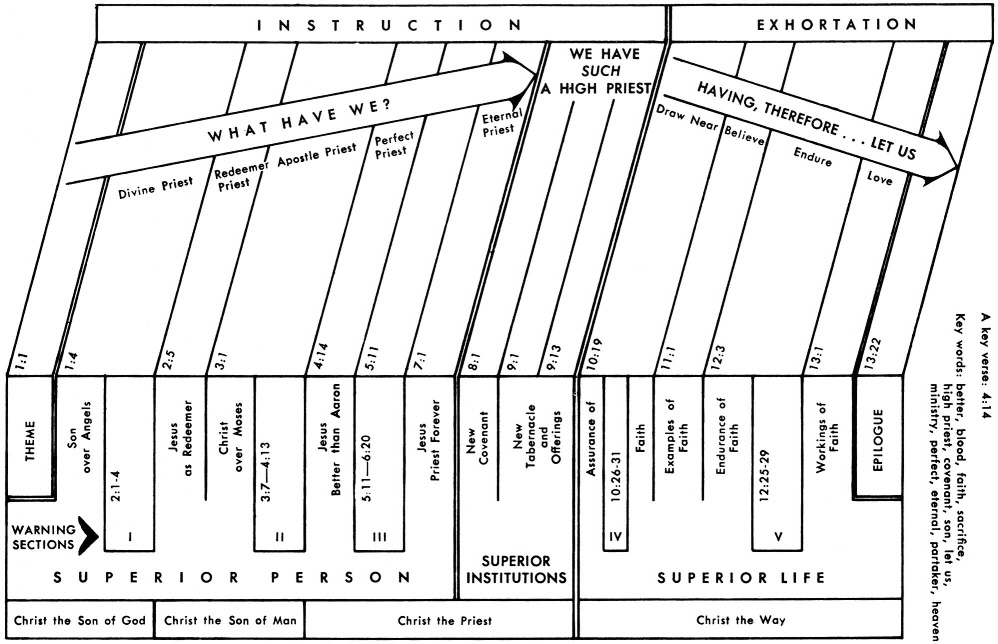
CONSIDER JESUS OUR GREAT HIGH PRIEST
Click chart to enlarge
Charts from Jensen's Survey of the NT - used by permission
Swindoll's Chart, Interesting Pictorial Chart of Hebrews, Another Chart
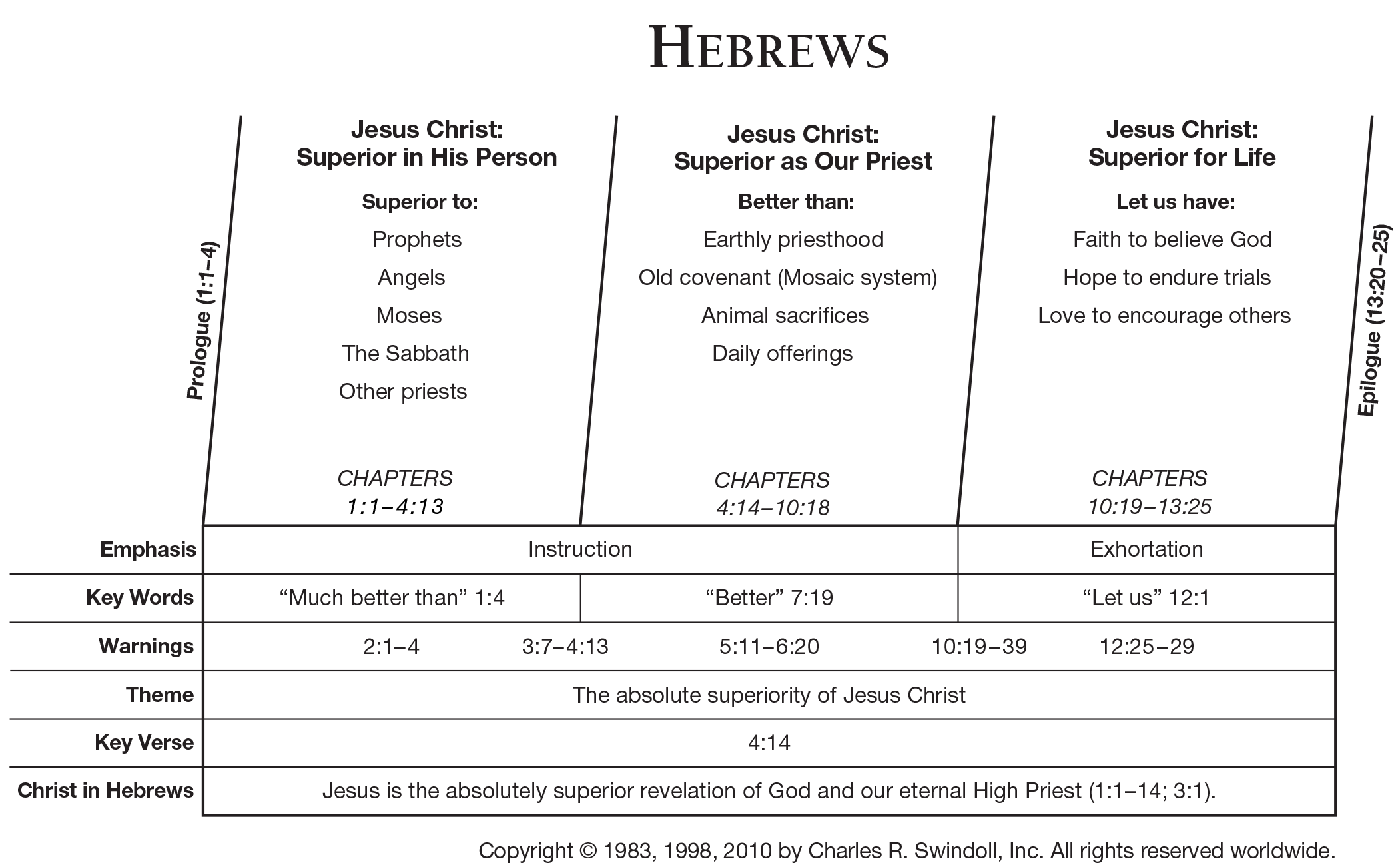

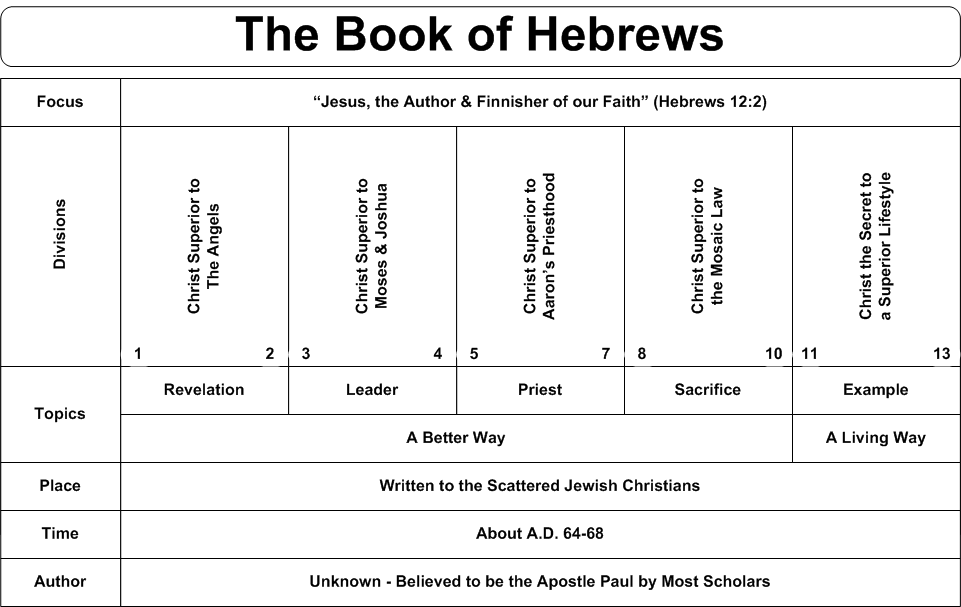
|
The Epistle |
||||
| INSTRUCTION Hebrews 1-10:18 |
EXHORTATION Hebrews 10:19-13:25 |
|||
| Superior Person of Christ Hebrews 1:1-4:13 |
Superior Priest in Christ Hebrews 4:14-10:18 |
Superior Life In Christ Hebrews 10:19-13:25 |
||
| BETTER THAN PERSON Hebrews 1:1-4:13 |
BETTER PRIESTHOOD Heb 4:14-7:28 |
BETTER COVENANT Heb 8:1-13 |
BETTER SACRIFICE Heb 9:1-10:18 |
BETTER LIFE |
| MAJESTY OF CHRIST |
MINISTRY OF CHRIST |
MINISTERS FOR CHRIST |
||
|
DOCTRINE |
DUTY |
|||
|
DATE WRITTEN: |
||||

See ESV Study Bible "Introduction to Hebrews"
(See also MacArthur's Introduction to Hebrews)
Borrow Ryrie Study Bible
Hebrews 13:12 Therefore Jesus also, that He might sanctify the people through His own blood, suffered outside the gate (NASB: Lockman)
Greek: dio kai Iesous, ina agiase (3SAAS) dia tou idiou aimatos ton laon, exo tes pules epathen. (3SAAI)
Amplified: Therefore Jesus also suffered and died outside the [city’s] gate in order that He might purify and consecrate the people through [the shedding of] His own blood and set them apart as holy [for God]. (Amplified Bible - Lockman)
My Amplified Paraphrase: And so Jesus—fulfilling the pattern of the Day of Atonement—also suffered outside the city gate, bearing reproach and rejection, in order that through His own blood He might sanctify, cleanse, and set apart His people as holy to God. Just as the sin offerings were taken outside the camp and burned, Christ was led outside Jerusalem to make His once-for-all atoning sacrifice, so that by His shed blood we might be made God’s own holy possession.
Barclay: That was why Jesus suffered outside the gate, so that he might make men fit for the presence of God by his own blood. (Westminster Press)
ESV: So Jesus also suffered outside the gate in order to sanctify the people through his own blood.
KJV: Wherefore Jesus also, that he might sanctify the people with his own blood, suffered without the gate.
NLT: So also Jesus suffered and died outside the city gates in order to make his people holy by shedding his own blood. (NLT - Tyndale House)
NIV: And so Jesus also suffered outside the city gate to make the people holy through his own blood. (NIV - IBS)
Phillips: That is why Jesus, when he sanctified men by the shedding of his own blood, suffered and died outside the city gates. (Phillips: Touchstone)
Wuest: Wherefore, also Jesus, in order that He might set apart for God and His service the people through His own blood, suffered outside the gate.
Young's Literal: Wherefore, also Jesus -- that he might sanctify through his own blood the people -- without the gate did suffer;
- Heb 2:11 Heb 9:13,14, Heb 9:18-19 Heb 10:29 John 17:19 19:34 1Co 6:11 Eph 5:26 1Jn 5:6-8
- Josh 7:24 Mk 15:20-24 John 19:17,18 Ac 7:58
- Hebrews 13 Resources - Multiple Sermons and Commentaries
- Hebrews 13:7-14 The Antidote for False Teaching - Steven Cole
- Hebrews 13:7-14 Steadfastness, Separation, Sacrifice - John MacArthur
Related Passages:
Hebrews 2:11+ For both He who sanctifies and those who are sanctified are all from one Father; for which reason He is not ashamed to call them brethren,
Hebrews 9:13+ For if the blood of goats and bulls and the ashes of a heifer sprinkling those who have been defiled sanctify for the cleansing of the flesh, 14 how much more will the blood of Christ, who through the eternal Spirit offered Himself without blemish to God, cleanse your conscience from dead works to serve the living God?
Hebrews 10:10+ By this will we have been sanctified through the offering of the body of Jesus Christ once for all.
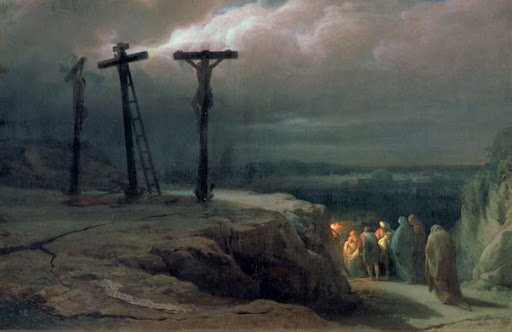
OUR SAVIOR SUFFERED OUTSIDE THE CITY
THAT WE MIGHT BE MADE HOLY
Hebrews 13:12 continues the writer’s powerful comparison between the Day of Atonement sacrifices and the once-for-all sacrifice of Christ. Under the Old Covenant, the sin offerings whose blood was brought into the Holy of Holies were taken outside the camp and completely burned. That “outside” location symbolized rejection, removal of sin, and separation from uncleanness. The author now draws the stunning parallel: Jesus fulfilled that very pattern. He was led outside the gate of Jerusalem, bearing reproach and shame, so that by His own blood He might sanctify His people. In this single verse, the writer gathers the whole weight of the Day of Atonement in Leviticus 16 and places it squarely on Christ, showing that our holiness was secured by His willingness to stand where sinners should have stood.
Therefore Jesus also, Just as the Old Covenant sin offerings were taken outside the camp to be burned, Jesus likewise was taken outside the gate of Jerusalem to suffer and die. The “therefore” connects the Old Testament typology of slain animals burned outside the camp (Heb 13:11) with Jesus' crucifixion outside the camp. From this conclusion, the writer most to the purpose for Jesus' death outside the camp.
That (hina - introduces a purpose statement) gives the purpose for which Jesus was crucified outside the camp (outside the city)
He might sanctify (hagiazo) the people - This is the purpose for Jesus' death outside the camp (the city limits of Jerusalem). The purpose was that He might sanctify (hagiazo) the people referring to setting them aside from the profane and unto God.
Spurgeon on sanctify the people - Christian, in your sanctification, look to Jesus. Remember that the Spirit sanctifies you, but that He sanctifies you through Jesus (1Pe 1:2). He does not sanctify you through the works of the law, but through the atonement of Christ. And therefore remember that, the nearer you live to the Cross of Jesus (ED: THINK "DEATH TO SELF"), the more sanctification, and growth, and increase in all spiritual blessings His Spirit will give to you.
As Wuest explains "Jerusalem was the center of the apostate Judaism that crucified its Messiah and continued the temple sacrifices in defiance of God’s plainly revealed will (Heb 9:8). When the Jew would leave the temple sacrifices in order to place his faith in their fulfilment, the crucified, risen Messiah, he would necessarily be separated, thus, set apart (sanctified) from that Judaism which he had formerly espoused. The word “sanctify” in the Greek means “to set apart for God.” Thus, our Lord by becoming a sacrifice under the jurisdiction of the New Testament and as an outcast from Israel, set apart from the First Testament (the Old Covenant of Law), and Israel, the Jew who placed his faith in Him, and consecrated that person to God. It was with His own blood He did this. (Hebrews - Wuest's word studies from the Greek New Testament)
We owed a debt we could not pay and
Jesus paid a debt He did not owe!
Through His own blood (haima) is of course a description of His death on the Cross and is the means of sinner being set apart and made holy. It was brought about by His willingly giving His life (see "will" in Heb 10:7, 9, 10), dying for our sins, in our place (see substitutionary sacrifice). This verse emphasizes once again for the Hebrew readers that our sanctification (and redemption) was not by ceremonial rituals, temple sacrifices, dietary laws, physical circumcision or meritorious works of righteousness (cf Titus 3:5+) but by means of the "precious blood, as of a lamb (Jn 1:29+) unblemished and spotless, the blood of Christ." (1Pe 1:19+) In sanctifying the people, Jesus removed the guilt of their sin, cleansed their consciences (Heb 9:14+), and qualified them to draw near to God (Hebrews 10:19-22).
Suffered (pascho) outside the gate (pule) - NLT = "outside the city gates" - This description parallels the previous description of the animal carcasses burned outside the camp. (Heb 13:11). Jesus Suffered (pascho) on the Cross at Golgotha which was located outside the city gate (pule).
Summary - The writer sets forth an analogy to emphasize believers’ identification with Christ in His rejection by the Jewish nation. On the Day of Atonement, the bodies of the sacrificial animals were not eaten but were carried away and burned “outside the camp” (Lev 4:21; 16:27). In perfect fulfillment, Jesus—the true and final sin offering—was crucified outside the city gate of Jerusalem (Jn 19:17). This imagery teaches that believers must spiritually go to Him “outside the camp,” separating themselves from the world’s unholy systems, values, and practices (cf. 2Ti 2:4). For the original Jewish audience, this separation also implied a decisive departure from the Levitical system. Any Jews who were still wavering and uncommitted needed to take a courageous step of faith and leaving behind Old Covenant Judaism and identify fully with Jesus Christ, even if it resulted in reproach from other Jews who chose not to leave Judaism.
🙏 THOUGHT - The “cost” of following Jesus for these first-century Jews reminds me of many today in unreached people groups dominated by extremist religious systems. For them, stepping “outside the camp” to come to Christ may cost everything—family ties, livelihood, social standing, and even their very lives. May this truth motivate to begin to pray daily for the unreached people groups on the Joshua Project (click here). On many days when I pray for these groups, I am absolutely "blown away" that there is not a single known believer (in groups with hundreds of thousands or even occasionally millions of souls)! Remember that Revelation 7:9 assures us that there will be some from "every nation and all tribes and peoples and tongues." You have the privilege to pray for them and for all eternity will enjoy fellowship with them, for at least one will be saved from each of those groups!
Outside the gate - Jesus was crucified outside the city gate. We know from the Gospels that he was crucified at Golgotha (Mk 15:22) which must have been outside the gate for we read that Simon of Cyrene, who was forced to bear the cross of Jesus, “a passer-by coming from the country” (Mk 15:21) while “they were coming out” (Mt 27:32) As an aside it should be noted that "the topographical evidence against the identification of its site with that of the modern Church of the Holy Sepulcher is apparently very strong." (Westminster Bible Dictionary)
Spurgeon on outside the camp - Note how remarkably Providence provided for the fulfillment of the type (ED: Referring to the "Sin Offering" on the Day of Atonement). Had our Lord been killed in a tumult, He would most likely have been slain in the city; unless He had been put to death judicially, He would not have been taken to the usual Mount of Doom (ED: Golgotha). And it is remarkable that the Romans should have chosen a hill on the outside of the city to be the common place for crucifixion and for punishments by death. We might have imagined that they would have selected some mount in the center of the city, and that they would have placed their gibbet ("gallows") in a conspicuous spot, that so it might strike the multitude with the greater awe. But, in the providence of God, it was arranged otherwise. Christ must not be slain in a tumult, and He would not die in the city. When He was delivered into the hands of the Romans, they did not have a place of execution within the city, but one outside the camp, that by dying outside the gate, He might be proved to be the Sin Offering for His people.
John Bennett - Day by Day: LET US GO FORTH THEREFORE UNTO HIM WITHOUT THE CAMP
In these verses the apostle makes a final appeal to his readers, again using the imagery of the tabernacle service which has pervaded the whole epistle. His plea is for a final and complete separation, leaving those things which are but types and shadows, to embrace by faith the One who has brought them to fulfilment.
There was no possibility that the Hebrew reader could hold on to his tangible, visible means of acceptance (ED: TEMPLE WITH ITS RITUALS), and at the same time claim to have faith in the Lord Jesus—it must be one or the other!
In order to emphasise his point, the apostle draws on their familiarity with Old Testament ritual and, in particular, the Day of Atonement. In the regular daily sacrifices the priestly family who ‘served the tabernacle’, Heb 13:10, were instructed to feed upon certain parts of the meal offering, the peace offering and the sin offering. However, the bodies of those animals sacrificed on the Day of Atonement were ‘burned without the camp’, Heb 13:11, with no provision of food made for the priest.
It is very evident that the great final sacrifice of Calvary was offered ‘without the gate’, Heb 13:12, in the outside place. Therefore, those who adhered to the Mosaic ritual could not, by their own law, partake of that offering which was Christ. To do so they would need to abandon the Levitical offerings with their laws and prohibitions, turn their backs upon ‘the camp’ of Judaism, and ‘go forth … unto Him’, in the sure knowledge that suffering and reproach would follow.
Perhaps it is difficult for twenty-first century Gentiles to grasp the significance this had to a first-century Jew! However, the ceremony of the law finds it modern counterpart in the altars, the candles and the vestments of Christendom, none of which have any scriptural support as a means of approach to God. The exhortation of Heb 13:13 is entirely relevant today to those believers entangled in man-made systems of religion. As, indeed, is the call of the apostle to the Corinthians, ‘come out from among them, and be ye separate’, 2 Cor. 6:17.
Might sanctify (37) (hagiazo) means to set apart. To make holy. To set apart from the world and for God. To cleanse and consecrate. To make someone acceptable to approach God. By His blood sinners are set apart from sin and unto God as His saints! Glory!
HAGIAZO IN HEBREWS - Heb. 2:11; Heb. 9:13; Heb. 10:10; Heb. 10:14; Heb. 10:29; Heb. 13:12
Hebrews 2:11 For both He who sanctifies and those who are sanctified are all from one Father; for which reason He is not ashamed to call them brethren,
Hebrews 9:13 For if the blood of goats and bulls and the ashes of a heifer sprinkling those who have been defiled sanctify for the cleansing of the flesh,
Hebrews 10:10 By this will we have been sanctified (perfect tense - in past and enduring effect) through the offering of the body of Jesus Christ once for all.
Hebrews 10:14 For by one offering He has perfected for all time those who are sanctified. (present tense - progressive sanctification)
Hebrews 10:29 How much severer punishment do you think he will deserve who has trampled under foot the Son of God, and has regarded as unclean the blood of the covenant by which he was sanctified, and has insulted the Spirit of grace?
Hebrews 13:12 Therefore Jesus also, that He might sanctify the people through His own blood, suffered outside the gate.
Blood (129) haima is literally the red fluid that circulates in the heart, arteries, capillaries, and veins of a vertebrate animal carrying nourishment and oxygen to and bringing away waste products from all parts of the body and thus is essential for the preservation of life. Haima gives us English words like hemorrhage (Gk - haimorragia from haimo- + rragia from regnuo - to burst) English derivatives inclue hematology (study of blood) and "leukemia" which is from leuco (white) plus haima (blood), which is fitting as leukemia is a disease that affects the white blood cells. Derivatives of haima are : haimatekchusía (130), shedding of blood; haimorroéō (131), to hemorrhage. Haima was used to describe “descent” or “family” in ancient times. “To shed blood” is to destroy life.
Zodhiates adds that "haima is used to denote life given up or offered as an atonement since, in the ritual of sacrifice, special emphasis is laid upon it as the material basis of the individual life. The life of the animal offered for propitiation appears in the blood separated from the flesh which the Jews were forbidden to eat (Ge. 9:4; Lev. 3:17; 17:10-14; Deut. 12:23; Heb. 9:7-13, 18-25; 11:28; 13:11). This life is, on the one hand, in the blood, presented to God; on the other hand by sprinkling, appropriated to man (Heb. 9:7, 19, 20). This blood thus becomes the blood of the covenant or testament (see diathekē) which God commanded to us (Heb. 9:20). (Complete Word Study Dictionary- New Testament)
HAIMA IS A KEYWORD IN HEBREWS - 22X OUT OF 97X IN NT - Heb. 2:14; Heb. 9:7; Heb. 9:12; Heb. 9:13; Heb. 9:14; Heb. 9:18; Heb. 9:19; Heb. 9:20; Heb. 9:21; Heb. 9:22; Heb. 9:25; Heb. 10:4; Heb. 10:19; Heb. 10:29; Heb. 11:28; Heb. 12:4; Heb. 12:24; Heb. 13:11; Heb. 13:12; Heb. 13:20
Hebrews 2:14 Therefore, since the children share in flesh and blood,
Hebrews 9:7 only the high priest enters once a year, not without taking blood,
Hebrews 9:12 and not through the blood of goats and calves, but through His own blood
Hebrews 9:13 For if the blood of goats and bulls
Hebrews 9:14 how much more will the blood of Christ, who through the eternal Spirit offered Himself
Hebrews 9:18 even the first covenant was not inaugurated without blood.
Hebrews 9:19 he took the blood of the calves and the goats
Hebrews 9:20 saying, “THIS IS THE BLOOD OF THE COVENANT WHICH GOD COMMANDED YOU
Hebrews 9:21 he sprinkled both the tabernacle and all the vessels of the ministry with the blood
Hebrews 9:22 almost say, all things are cleansed with blood,
Hebrews 9:22 and without shedding of blood there is no forgiveness.
Hebrews 9:25 high priest enters the holy place year by year with blood that is not his own.
Hebrews 10:4 For it is impossible for the blood of bulls and goats to take away sins.
Hebrews 10:19 confidence to enter the holy place by the blood of Jesus,
Hebrews 10:29 has regarded as unclean the blood of the covenant by which he was sanctified
Hebrews 11:28 By faith he kept the Passover and the sprinkling of the blood
Hebrews 12:4 have not yet resisted to the point of shedding blood
Hebrews 12:24 Jesus, the mediator of a new covenant, and to the sprinkled blood
Hebrews 12:24 which speaks better than the blood of Abel.
Hebrews 13:11 For the bodies of those animals whose blood is brought into the holy place
Hebrews 13:12 He might sanctify the people through His own blood
Hebrews 13:20 the great Shepherd of the sheep through the blood of the eternal covenant
Spurgeon has the following sermons related to blood…
- Exodus 12:13 The Blood
- Hebrews 12:24-25 The Blood Of Sprinkling
- Hebrews 12:24-25 The Blood Of Sprinkling
- Hebrews 13:20 The Blood Of The Everlasting Covenant
- Hebrews 9:19-20 The Blood Of The Testament
- Hebrews 9:22 Blood-Shedding
Suffered (3958) pascho means essentially what happens to a person experience. It means to undergo something; to experience a sensation, to experience an impression from an outside source, to undergo an experience (usually difficult) and normally with the implication of physical or psychological suffering. Pascho can refer to experiencing something pleasant, but in the present context (and most NT contexts) it refers to experiencing something trying, distressing or painful.
PASCHO IN HEBREWS - Heb. 2:18; Heb. 5:8; Heb. 9:26; Heb. 13:12
Hebrews 2:18 For since He Himself was tempted in that which He has suffered, He is able to come to the aid of those who are tempted.
Hebrews 5:8 Although He was a Son, He learned obedience from the things which He suffered.
Hebrews 9:26 Otherwise, He would have needed to suffer often since the foundation of the world; but now once at the consummation of the ages He has been manifested to put away sin by the sacrifice of Himself.
Hebrews 13:12 Therefore Jesus also, that He might sanctify the people through His own blood, suffered outside the gate.
SANCTIFICATION. - James Smith
1. THE NATURE OF IT.
1. It is a cleansing from sin, Eph. 5:26
2. It is a separation unto God, Lev. 20:24-26, Psa. 4:3
2. THE MANNER OF IT.
1. By God the Father, Jude 1
2. By God the Son, Heb. 13:12
3. By God the Spirit, 1 Peter 1:2
4. By the Word of Truth, John 17:17-19
5. By the will of the believer, Lev. 20:7
Where the Nail Was
My 5-year-old daughter, Ashley, was tracing her hand on a piece of paper. "Jesus died on the cross," she said, busily at work. "This is his hand."
Then pointing to a dot in the center of the drawing, she added, "And that's where the nail was." as tears welled up in my eyes, I was reminded again that we can't hear enough of the greatest sacrifice ever made for mankind. See: Isaiah 53:5; Hebrews 13:12; 1 Peter 3:18
THE BLOOD OF CHRIST
I. Its God-ward Aspect.
1. Ground of ATONEMENT, Lev. 17:11 A Covering.
2. Ground of REDEMPTION, 1 Pet. 1:18, 19 A Price.
3. Ground of PEACE, Col. 1:20 A Purchase.
II. Its Man-ward Aspect
1. FORGIVENESS, Col. 1:14
2. CONTINUAL CLEANSING, 1 John 1:7
3. NEARNESS, Eph. 3:13
4. BOLDNESS, Heb. 10:19, 20
5. HOLINESS, Heb. 13:12
6. SERVICE, Heb. 9:14
7. VICTORY, Rev. 12:11
Where the Nail Was
My 5-year-old daughter, Ashley, was tracing her hand on a piece of paper. "Jesus died on the cross," she said, busily at work. "This is his hand."
Then pointing to a dot in the center of the drawing, she added, "And that's where the nail was." as tears welled up in my eyes, I was reminded again that we can't hear enough of the greatest sacrifice ever made for mankind. —Roger B. Nash, Christian Reader, Vol. 36, no. 3. See: Isaiah 53:5; Hebrews 13:12; 1 Peter 3:18.
The Power of Blood
I used to think it strange that the Bible keeps talking about the cleansing power of the blood (1 Peter 1:2). It seemed to me that blood was messy stuff. I needed to wash my white lab coats if they became stained with blood.
Today, I love the analogy; it is so true of the body. The blood is constantly cleansing every cell, and washing away all the debris that accumulates all the time. I like Paul's phrase in Hebrews 9:14 KJV, "How much more shall the blood of Christ purge your conscience from dead works?" See: Romans 3:25; Hebrews 13:12; Revelation 1:5
"Wherefore" and "Therefore" - Vance Havner
Wherefore Jesus... suffered without the gate. Let us go forth therefore unto him without the camp. Hebrews 13:12, 13.
Jesus kept his "wherefore" and I must keep my "therefore." He went without the gate to suffer and I must go outside the camp to serve. I am not merely to go from something, I am to go to Him. Where He is I belong. And it is not His popularity but His reproach that I must bear. The world and some churches have devised a popular Christ, but He is not this Christ of the Wherefore. One can stay inside the camp and follow this fictitious Jesus, but not the One who suffered that I might be sanctified with His blood. This present age, like all ages past, despises a bleeding Christ and a gory cross. There is nothing elegant about following a crucified Saviour and seeking a city to come.
I cannot get by with singing about the wondrous cross. Love so amazing, so divine, demands my soul, my life, my all. His "wherefore" demands my "therefore." And that means the sacrifice of person: "Let us... (v. 13), of praise (v. 15), of possessions (v. 16)
"Jesus paid it all" in the Wherefore. "All to Him I owe" in the Therefore.
Leviticus 16 “The Scapegoat”
Israel’s ritual on the great Day of Atonement included the selection of two goats, one for the LORD and one for “azazel.” Four times this strange word occurs in the chapter, and no other place in the Bible. It has been analyzed and interpreted in a number of ways; but the etymology indicates it means “a goat that goes away.” The early English translation of “scapegoat” has caught on, and that word “scapegoat” has been applied to a number of other things in English usage.
But in the ritual of the atonement, the priest was to sacrifice the one goat for a purification offering. Then he was to lay his hands on the other goat, the living goat, and confess over it all the wickedness and all the rebellions of the people. This would go beyond the ordinary sacrifices for atonement, for they were offered for sins of ignorance or inadvertence. This covered all sins. By this rite of transference the sins were placed on the goat’s head. The goat was then to be taken outside the camp into the desert and abandoned to die there.
In the legislation of the later Jewish Mishnah, when the Jews were living in the settled cities of the land, the goat was led away, outside the city to a precipice and thrown over so that it would die. Then the person who led it away would signal the results back so that the priest and the people would know that the intent of leading the goat away was assured.
On this one special day of the year the people would know that all their sins were forgiven because they were symbolically placed on the scapegoat which was taken out of the city to die in a solitary place.
The prophet Isaiah refers to this in His prophecy of the suffering of the Messiah when he writes, “All we like sheep have gone astray, each of us has turned to his own way, and the LORD has laid on Him the iniquity of us all” (Isaiah 53:6).
Hebrews 13:12 makes it clear that Jesus, who took all our sins on Himself and died for us, died outside the city as the fulfillment of the scapegoat. In the old city of Jerusalem the Church of the Holy Sepulcher, the likely spot of the crucifixion, appears to be well within the city. However, when Jesus died that part of the city was outside the walls. The early church keenly noted the spot where He died, and recalled how it fulfilled the type of the scapegoat taking the sins away.
And so Jesus also suffered outside the city gate to make the people holy through his own blood. - Hebrews 13:12
TODAY IN THE WORD
The popularity of Mel Gibson's film The Passion of the Christ astounded the film industry. Many believed that there would be little interest in a movie where the characters spoke only Latin and Aramaic with English subtitles. Some predicted that the project would ruin Gibson's career. Once the film was finally released, the movie's graphic violence became the focus of even more controversy. Some claimed that the film's brutality provided a necessary antidote to the sanitized image most believers have of Christ's suffering. Many who saw The Passion of the Christ said that the film helped them to finally appreciate the full extent of all that Jesus experienced while on the cross.
Yet even Gibson's graphic portrayal could not do justice to the full extent of suffering that Christ experienced on the cross. Certainly, He faced the brutality of Roman crucifixion. This practice was as much a means of torture as it was a form of execution. The Romans reserved crucifixion for slaves and those who were considered to be the lowest criminals. Its victims were suspended by their hands on a cross beam that had been fastened to a stake that was driven into the ground. In most cases the stake was about the height of a man.
The worst suffering that Christ endured was not the physical torment of the cross but the pain of separation from His Heavenly Father. While hanging on the cross, Jesus endured the wrath of God on behalf of sinners. As the apostle Paul explains, “God made him who had no sin to be sin for us, so that in him we might become the righteousness of God” (2 Cor. 5:21).
In other words, during the crucifixion Jesus had to endure a double indignity. Not only did He experience the pain of separation from His Heavenly Father, He also endured the shame of bearing our sins. The religious leaders believed that Jesus was a heretic. The Romans executed Him as though He were a rebel. God the Father knew that He was none of these. Jesus was a sacrifice for sin.
TODAY ALONG THE WAY
Although it is not as common in our evangelical context, Christians have long had a tradition of meditating on the suffering of Christ. This is not intended to promote a morbid fascination with the physical details of Christ's death, but to help us appreciate the significance of the cross.
One way to do this is through music. Try using the classic hymn by Isaac Watts, “When I Survey the Wondrous Cross.” Those who prefer contemporary worship music may wish to use Chris Tomlin's updated version, “The Wonderful Cross.”
R C Sproul - Outside the Gate
And so Jesus also suffered outside the city gate to make the people holy through his own blood. Heb. 13:12
Jesus suffered outside the gate. Part of what that means is that he was rejected by the people. He had been cast out. Bearing our sins, he was driven out of the kingdom God established in Israel. Yet, wherever Jesus is, there is the new kingdom. If we want to be part of the New Jerusalem, we must join him outside the gate of the Old Jerusalem. In the eyes of the world, Jesus bore disgrace in being rejected by his own nation. We must join with him, bearing the disgrace that he bore (v. 13). But gathered around Jesus outside the temporal city, the new, final, and eternal kingdom of God is forming.
Why not leave the old city? The city of this world will not endure. Even as these words were being written, the temporal city of Jerusalem was doomed, soon to be destroyed by the Romans. They were well served by the advice to fix their eyes on the new city (v. 14).
Jesus’ propitiatory sacrifice to take away sin is finished. But there is a second kind of sacrifice, one that expresses a life of giving. That sacrifice is established on the foundation of the sacrifice for sin. We are to offer this second kind of sacrifice.
The author of Hebrews speaks of two kinds of sacrifice we offer. The first is the sacrifice of praise to God (v. 15). “Through Jesus,” that is in union with Christ, we offer praise to the Father. Jesus is offering praise to him, and we join in. Praise is not a matter of saying whatever comes to our minds, but of joining with Jesus in his praise. How do we know what Jesus is saying? The book of Psalms is the key to knowing how Jesus praises the Father and how we should do so in union with him.
The second kind of sacrifice is “to do good and to share with others” (v. 16). Just as God did good to us and shared Jesus with us, so we are to do good to others and share what we have with them. These are good works, offered under the eye of God. They are part of the living sacrifice of which Romans 12:1 speaks. God is pleased with such good works when they are done in faith by people united to his Son.
Coram Deo - We often think of a sacrifice as something involving pain or loss. However, a biblical sacrifice is often simply an offering to God. It may be enjoyable, as praise should be. It may amount simply to doing good and sharing with others. Or it may involve forsaking comfort to follow Jesus. Can you see these areas of sacrifice in your life?
For further study: Mark 8:34–38; John 15:18–27; Hebrews 11:24–26
Adrian Rogers - The Fellowship Factor (see full sermon "Is There Room in the Inn?" page 82)
The first factor is what I want to call the fellowship factor. I want you to turn to Hebrews chapter 13 with me for just a moment and begin to read in verse 12: “Wherefore Jesus also, that he might sanctify the people with his own blood, suffered without the gate.” (Hebrews 13:12) That literally means, when Jesus died in order to save us, He died outside the city walls of Jerusalem. He suffered outside the gate. If you visit the Holy Land, you’ll find Calvary still outside the city walls, standing there by a bus station. In Jesus’ time it was a garbage heap, a place of crucifixion—and that’s where the Lord Jesus died. Don’t get the idea that He died, as the song says, on “a green hill far, far away.” No, no, He died in a place of ignominy and shame.
Now, look at it again. It says, “Wherefore Jesus also, that he might sanctify the people with his own blood, suffered without the gate.” Now here’s the word to you this Christmas; listen to it: “Let us go forth therefore unto him without”—“outside”—“the camp, bearing his reproach.” If there were ever anything that this generation needs, it’s to learn that lesson right there. Now if you don’t mind marking in your Bible, I’d like for you to underscore that: “Let us go [outside] the camp, bearing his reproach. For here have we no continuing city, but we seek one to come.” (Hebrews 13:12–14) Now if you want to find the Lord Jesus today, you’ll never find Him on the inside. He’s not an insider. You’ll always find the Lord Jesus on the outside. If you want to find the Lord Jesus, don’t go to the inn; go to the stable. If you want to find the Lord Jesus, don’t go inside the city; go outside the city. That’s where you’re going to find the Lord Jesus.
H A Ironside - The Efficacy of the Blood of Christ
- Peace made by blood—Colossians 1:20.
- Forgiveness by blood—Ephesians 1:7.
- Redeemed by blood—1 Peter 1:18–19.
- Justified by blood—Romans 5:9.
- Cleansed by blood—1 John 1:7, Heb 9:22
- Sanctified by blood—Hebrews 13:12.
- Overcome by blood—Revelation 12:11.
DAILY LIGHT ON THE DAILY PATH -
“I am the Lord who sanctifies you.”
“I am the Lord your God, who has separated you from the peoples. . . . You shall be holy to me, for I the Lord am holy and have separated you from the peoples, that you should be mine.”
Beloved in God the Father.—“Sanctify them in the truth; your word is truth.”— Now may the God of peace himself sanctify you completely, and may your whole spirit and soul and body be kept blameless at the coming of our Lord Jesus Christ.
So Jesus also suffered outside the gate in order to sanctify the people through his own blood.—Our . . . Savior Jesus Christ . . . gave himself for us to redeem us from all lawlessness and to purify for himself a people for his own possession who are zealous for good works.—For he who sanctifies and those who are sanctified all have one source. That is why he is not ashamed to call them brothers.—“And for their sake I consecrate myself, that they also may be sanctified in truth.”—In the sanctification of the Spirit, for obedience to Jesus Christ and for sprinkling with his blood.
Lev. 20:8; Lev. 20:24, 26; Jude 1; John 17:17; 1 Thess. 5:23; Heb. 13:12; Titus 2:13–14; Heb. 2:11; John 17:19; 1 Pet. 1:2
Wherefore Jesus also, that he might sanctify the people with his own blood.—Hebrews 13:12.
My soul! I would have thee, this evening, take a view of thy Jesus in his own blood, under the special and particular act in which this scripture holds him forth; sanctifying the people by the application of it, as the great object and design for which he suffered. There is somewhat uncommonly interesting in this view, though not so commonly considered. That this is the only laver for sin, is unquestionable; and that it is infinitely meritorious, and of eternal efficacy, is also equally true. But when we consider, farther, the infinite purity of it, flowing, as it did, from a holy heart, in a nature that was altogether holy, harmless, undefiled, separate from sinners, and made higher than the heavens; there is somewhat which, though too deeply founded in mystery to be perfectly apprehended by us, may yet serve to intimate the immense preciousness of it, and its immense importance and value. But we must not stop here. The union of the Godhead with the human nature, giving both dignity and validity to the sacrifice which Jesus once offered, that he might sanctify the people, here angels, as well as men, find their faculties unable to ascertain the extent of the wonderful subject; and, perhaps, through all eternity, none among the creation of God will fully be competent to explain it. But, my soul! though unable to explain, or unable to conceive the infinitely precious nature of thy Jesus’s blood, yet do thou gather this sweet and soul-reviving thought from the contemplation: it must be in itself so incalculable in value, and so infinitely powerful in its pardoning and cleansing properties, that no sin, no, not all the sin of finite creatures taken in the aggregate, can stand before it. O precious, precious Jesus! precious, precious blood of Jesus, which cleanseth from all sin! Oh! let me hear, and feel, and know my personal interest in that sweet promise of my God in Christ, and my happiness is made for ever: “I will sprinkle clean water upon you, and ye shall be clean: from all your filthiness, and from all your idols, will I cleanse you.” Amen! Amen! So be it.
Oswald Chambers -
Wherefore Jesus also, that he might sanctify the people with his own blood, suffered without the gate.—Hebrews 13:12
THERE IS NO USE LOOKING and longing for sanctification as a direct result of “our praying” or “our obedience.” Sanctification is the direct gift of God, which comes by faith in Him and His Word.
Entire sanctification is “Christ in you.” Some testimonies to sanctification seem to put the standard too high for any of us to attain in this life. But sanctification is the wonderful life of His imparted to me. I cannot merit it. I cannot earn it. I cannot pray it down. But, thanks be unto God, I can take it by faith in His blood.
If you have the slightest feeling that you can earn the blessing of sanctification, you will never receive it. But if you seek entire sanctification in a spirit of unworthiness, it will be given through God’s sovereign grace. God will purify your heart and entirely sanctify you.
SURGEON’S BLOOD SAVES PATIENT
References: John 6:53; Ephesians 2:13; Hebrews 9:14; 13:12; 1 Peter 1:18–19; 1 John 1:7
Dr. Samuel Weinstein, chief of pediatric cardiothoracic surgery for Children’s Hospital at Montefiore Medical Center in New York City, went to El Salvador in 2006 with Heart Care International to provide life-saving operations for poor children.
It would take more than expertise and advanced equipment to save the life of Francisco Calderon Anthony Fernandez, eight, however. After twelve hours of surgery, the boy began to bleed out of control. The hospital lacked both the medicines to stop the bleeding and the blood to give the boy transfusions. Francisco’s blood type was B-negative, which—according to the American Red Cross—is present in only 2 percent of the population.
Dr. Weinstein had the same blood type. So he set aside his scalpel, took off his gloves, and began washing his hands and forearm. Then he sat down and had his blood drawn.
When he had given his pint, Dr. Weinstein drank some bottled water and ate a Pop-Tart. Then—twenty minutes after stepping away from the table—he rejoined his colleagues, who watched as Weinstein’s blood began flowing into the boy’s small veins. Weinstein then completed the operation that saved Francisco’s life.—Jim Fitzgerald, "Doc Stops Surgery to Give Own Blood to Patient," LiveScience.com (May 26, 2006)
The Sacrifice of Christ - Hebrews 13:12 - J Oswald Sanders
Like the chosen victim, Christ was without spot or blemish. Through the miracle of the virgin birth and the activity of the Holy Spirit, He escaped the taint of original sin. His purity was essential and inherent. No matter how severe the criticism to which He was subjected during His life on earth, it was demonstrated that “in him is no sin” (1 John 3:5). The yoke of sin never rested on His shoulders, nor was it under a yoke of constraint that He consented to become the sacrifice for our sins. His sacrifice was absolutely voluntary.
Then, too, like the victim, Christ, in order “that he might sanctify the people with his own blood, suffered without the gate” of Jerusalem (Hebrews 13:12 KJV), the defiled place frequented by the lepers. The defilement was viewed as transferred to the victim that must now take the place of the defiled person—outside the camp. In this act of matchless condescension on the part of the Lord of glory, the boundless and forgiving love of God is exhibited. The sprinkling of the blood before the tabernacle did not in itself affect the cleansing of the polluted person, but before there can be purification there must first be atonement.
The burning of the cedar and hyssop bound with scarlet wool signifies that the sinful self-life, the “old man,” whether in attractive or repulsive guise, was cast into the burning or, to use the New Testament terminology, was crucified with Christ, and in Him was done away with (Romans 6:6 RSV). The self-life will always defile and pollute us unless we put it to death (Romans 6:11). We must resolutely disregard its plea to be allowed to come down from the cross.
The ashes, evidence of a completed sacrifice, were regarded as the concentration of the essential properties of the offering. They were incorruptible, and therefore a suitable emblem of the perfection and everlasting efficacy of the sacrifice of Christ. The ashes laid up in a clean place represent the store of merit there is in the Lord Jesus, perpetually preserved for the removal of the daily pollution of sin. The smallest quantity of the concentrated ash would suffice to cleanse. Jewish tradition records that only six heifers were required in all Jewish history. “If . . . the ashes of a heifer . . . how much more will the blood of Christ . . . cleanse”(Hebrews 9:13 NASB)?
Hebrews 13:13 So, let us go out to Him outside the camp, bearing His reproach (NASB: Lockman)
Greek: toinun exerchometha (1PPMS) pros auton exo tes paremboles, ton oneidismon autou pherontes; (PAPMPN)
Amplified: Let us then go forth [from all that would prevent us] to Him outside the camp [at Calvary], bearing the contempt and abuse and shame with Him. [Lev. 16:27.] (Amplified Bible - Lockman)
My Amplified Paraphrase: So then, let us willingly go out to Him—away from the safety, approval, and religious comforts of this world—joining Him “outside the camp,” identifying openly with His reproach. Let us be ready to bear the shame, rejection, and opposition He Himself endured, choosing Christ over all earthly acceptance, and embracing the cost of following Him wherever He leads.
Barclay: So then let us go to him outside the camp, bearing the same reproach as he did, (Westminster Press)
ESV: Therefore let us go to him outside the camp and bear the reproach he endured.
KJV: Let us go forth therefore unto him without the camp, bearing his reproach.
NLT: So let us go out to him outside the camp and bear the disgrace he bore. (NLT - Tyndale House)
NIV: Let us, then, go to him outside the camp, bearing the disgrace he bore. (NIV - IBS)
Phillips: Let us go out to him, then, beyond the boundaries of the camp, proudly bearing his "disgrace".(Phillips: Touchstone)
Wuest: Therefore, let us be going out to Him outside of the camp, bearing His reproach.
Young's Literal: now, then, may we go forth unto him without the camp, his reproach bearing
- His reproach - He 11:26 12:3 Mt 5:11 10:24,25 16:24 27:32,39-44 Lu 6:22 Ac 5:41 1Co 4:10-13 2Co 12:10 1Pe 4:4,14-16 Acts 5:41
- Hebrews 13 Resources - Multiple Sermons and Commentaries
- Hebrews 13:7-14 The Antidote for False Teaching - Steven Cole
- Hebrews 13:7-14 Steadfastness, Separation, Sacrifice - John MacArthur
Related Passages:
Exodus 33:7+ (See interesting note by Fischer) Now Moses used to take the tent and pitch it outside the camp, a good distance from the camp, and he called it the tent of meeting. And everyone who sought the LORD would go out to the tent of meeting which was outside the camp.
Hebrews 11:26 (MOSES) considering the reproach of Christ greater riches than the treasures of Egypt; for he was looking to the reward.
Hebrews 10:33 partly by being made a public spectacle through reproaches and tribulations, and partly by becoming sharers with those who were so treated.
Acts 5:41 So they went on their way from the presence of the Council, rejoicing that they had been considered worthy to suffer shame for His name.
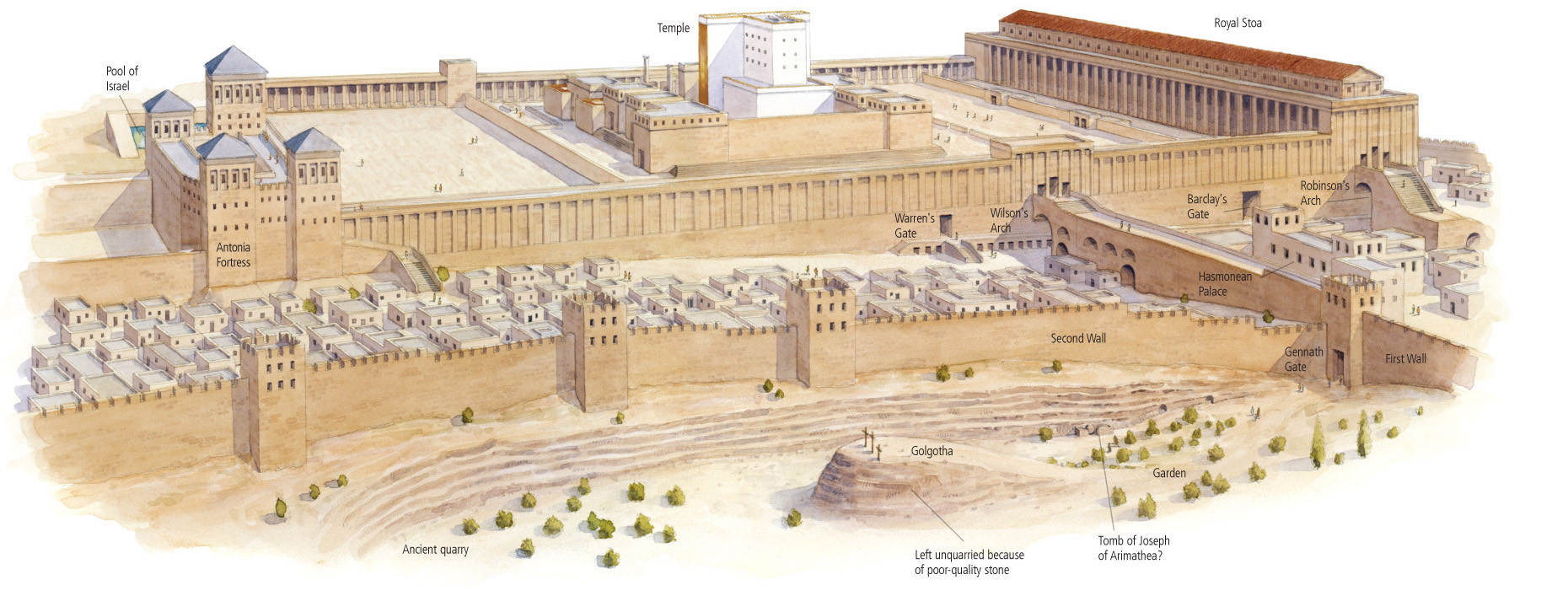
OUTSIDE THE CAMP
BEARING HIS REPROACH
Note the diagram above which has the proposed site of Golgotha outside the city gates, i.e., "outside the camp." (Click to enlarge - from ESV Study Bible)
So This inferential particle draws a conclusion from the preceding (term of conclusion).
The subj. is hortatory "let us go out." The pres. tense expresses vividly the immediate effort. This could be a call for the readers to refuse to go back into Judaism
Let us go out (exerchomai) to Him - Let us go out (exerchomai) is in the present expressing vividly the immediate effort. The Greek construction is a hortatory subjunctive, exhorting others to join the one exhorting to do something in company with him, in this case go out to Jesus. The middle voice is important to note as it expresses personal involvement and personal benefit in the action. The middle voice in exerchomai supports the pastoral thrust of Hebrews: “Do not drift. Draw near. Go on to maturity. Hold fast. Fix your eyes on Jesus. Now—personally, willingly, continually—go out to Him outside the camp.”
Middle Voice Emphasizes - We ourselves choose to do this. We step out deliberately, not accidentally. We see this movement as involving us at a deep level. There is a sense that going out to Jesus is for our own spiritual good. Thus, the middle voice conveys: Intentionality — “Let us intentionally go out.” Volition — “Let us ourselves choose to go out.” Identification — “Let us take our stand with Him.” Personal participation — “Let us be personally involved in this departure.” Personal benefit — “Let us go out because this is where life, grace, and the true altar are found.”
Bob Utley feels that "So, let us go out to Him" "is a key verse in the book. It is a PRESENT MIDDLE (deponent) SUBJUNCTIVE, (SEE HORTATORY SUBJUNCTIVE) which speaks of continuous action and adds an element of contingency (this is the final admonition and warning against "shrinking back"). Believers need to publicly identify with Him and bear His reproach regardless of the consequences (cf. Rom. 8:17; 2 Cor. 1:5,7; Phil. 3:10; 1 Pet. 4:13). This is the clear call for these "sheltered" synagogue believers to move into the full light of Great Commission Christianity (cf. Matt. 28:19-20; Luke 24:46-47; Acts 1:8).
MacArthur explains that "The practical point is that, as Christians, we must be willing to go out from the system, to bear the reproach and the shame that both the sin offering and Christ Himself bore, and to be rejected by men. This is the attitude Moses had toward the world. He considered “the reproach of Christ greater riches than the treasures of Egypt” (Heb. 11:26+)."
Wuest - The writer now exhorts his first-century readers to leave apostate Judaism and the temple sacrifices, and placing their faith in the Messiah as High Priest, bear His reproach, the reproach of exclusion from the Jewish commonwealth. This exhortation was addressed, of course, to those Jews who, while they had outwardly left the temple, yet had not placed their faith in Messiah, and were in danger of going back to the sacrifices. (Hebrews)
Outside the camp (parembole), bearing (present tense - continually) His reproach (oneidismos) - In Heb 13:12 outside the gate referred to outside Jerusalem's city walls (cf Jn 19:17). Outside the camp (parembole) reaches back to Old Testament where sin offerings were burned outside the camp (Lev 4:12, 21; 16:27). Clearly the phrase outside the camp (Heb 13:11, 13) is essentially synonymous with the phrase outside the gate (Heb 13:12).
🙏 THOUGHT - Ponder this a moment - repeatedly defiled things were sent outside the camp and now in the NT the pure, undefiled Jesus is sent outside the camp (see Lev 4:12, 21+; Lev 6:11+.; Lev 8:17+.; Lev 9:11+; Lev 13:46+.; Lev 16:27+ (good note by Richard Phillips). Recall the writer has previously described Jesus as "holy, innocent, undefiled, separated from sinners and exalted above the heavens" (Heb 7:26+) and yet He is in effect treated like the defiled things in the Old Testament by being sent outside the camp.
Paul helps understand why Jesus was sent out, writing that "He (GOD THE FATHER) made Him (JESUS CHRIST) Who knew no sin to be sin on our behalf, so that we might become the righteousness of God in Him." (2Co 5:21+) One might say the "defilement" of our countless sins was placed on Jesus for Peter says "He Himself bore our sins in His body on the cross, so that we might die to sin and live to righteousness; for by His wounds you were healed." (1Pe 2:24+).
Do not misunderstand, Jesus was treated judicially AS IF He were sin, but His perfect holy nature was NEVER sinful or defiled. He bore our defiling sins bodily without personally being defiled. Sin could be placed upon Him legally, but it could not penetrate His nature ontologically (means in a way that relates to the nature of existence, being, and reality), because the holy Son cannot cease to be holy any more than God can cease to be God. Even on the Cross, His holiness was not compromised. He fulfilled the role of the sin offering—not by becoming unclean, but by taking on Himself all that our uncleanness deserved. The Levitical imagery helps: the scapegoat bore the people’s iniquities into the wilderness (Leviticus 16:21–22), but the goat’s nature did not change. So Christ bore sin substitutionally, not intrinsically.
Christ was never defiled in Himself—He remained the spotless Lamb. He was “counted as defiled” judicially, bearing the uncleanness of His people’s guilt. He absorbed sin’s penalty, not sin’s impurity. In that somewhat incomprehensible holy transaction, the undefiled One BORE defilement without becoming defiled. This is the beauty of substitutionary atonement: He who knew no sin was treated as sin, so that we who know sin too well might be treated as righteous.
It is precisely because He remained undefiled that His sacrifice is effective and eternally sufficient (Heb 9:12+, Heb 9:14+). Jesus willingly let sinful men take Him to the place of defilement outside the camp! This is the Amazing Grace of our Great High Priest! Does not this deep, mysterious, and paradoxical truth stir your heart to worship and adore Him even more, and more willing to embrace whatever reproach may come for His sake? Yes, Holy Spirit, do this supernatural work in our hearts for the glory of God and the honor of His Son. Amen
David Guzik If our Savior was rejected and His sacrifice (performed at the cross, our altar) was branded illegitimate, what better do we expect? Identifying with Jesus often means bearing His reproach, the very thing many are quite unwilling to do. Outside the camp: The camp referred to is institutional Judaism, which had rejected Jesus and Christianity. Though these Christians from Jewish backgrounds had been raised to consider everything outside the camp as unclean and evil, they must follow Jesus there.
Spurgeon on reproach - It would be a very pleasant thing if we could please men and please God too, if we could really make the best of both worlds, and have the sweets of this and of the next also. But a warning cry arises from the pages of Holy Scripture, for the Word of God talks very differently from this. It talks about a straight and narrow way, and about few that find it. It speaks of persecution, suffering, reproach, and contending even unto blood, striving against sin; it talks about wrestling and fighting, struggling and witnessing. I hear the Savior say, not “I send you forth as sheep into the midst of green pastures,” but, “like sheep in the midst of wolves” (Matt 10:16).
Jews considered one crucified to be cursed (Dt 21:23; Gal 3:13; 1Cor 1:23). Jesus was crucified as a traitor and a criminal. Through their sufferings, which included insult and persecution (10:33), the readers were bearing his disgrace.
John Phillips "Let us go forth therefore unto him without the camp, bearing his reproach" (Heb 13:13). The Jews had rejected Christ and cast Him "outside the camp." The Temple and all it stood for still remained inside Jerusalem (the "camp" of Israel). Since Christ was outside the whole thing, there could be no communion with Him inside the Judaistic system. The place of the Hebrew believer was with Christ, outside all that Judaism stood for. To go back to Judaism would be tantamount to forsaking Him and giving the right hand of fellowship to the system that had cast Him out. True, to share His place "outside the camp" would be to share His rejection, but nothing else was possible. The very essence of Christianity is that we bear His reproach. (BORROW Exploring Hebrews)
🙏 THOUGHTS - You have to hold to this truth whether you have to suffer for it or not. The corollary thought is we have to hold fast to the truth so that it holds us fast and then we can suffer courageously knowing the joy which is set before us (cf Heb 12:2). When you know that what (Who) you are suffering for is greater and grander than anything this world has to offer, you are much more likely to be willing to be "bearing His reproach!"
As God's "little children, (let us) abide in Him, so that when He appears, we may have confidence and not shrink away from Him in shame at His coming." (1 John 2:28+)
May our Father grant us His Spirit of grace (Heb 10:29+) His power which enables us to "realize the full assurance of hope until the end, so that we will not be sluggish, but imitators of those who through faith and patience inherit the promises" in Christ Jesus in Whom every promise of God is yes and amen (2 Cor 1:20KJV). Amen and amen. (Heb 6:11-12+)
Indeed may we be imitators of those Spirit filled men in Acts who after being flogged (Acts 5:40) "went on their way from the presence of the Council, rejoicing that they had been considered worthy to suffer shame for His name." (Acts 5:41)
Let us bear His reproaches for as Peter wrote "you have been called for this purpose, since Christ also suffered for you, leaving you an example for you to follow in His steps." (1 Peter 2:21+, cf 1 John 2:6+, 1 Cor 11:1+)
Hortatory Subjunctive - a first-person plural subjunctive verb used to urge a group to do something. (Let us go…” “Let us draw near…” “Let us hold fast…” “Let us consider…”) These are not suggestions; they are strong, urgent exhortations. The hortatory subjunctive expresses: exhortation (strong urging), encouragement, group inclusion (“we together”), an invitation with authority, a call to decisive action. It has the force of:“We must…” “Let us now…” “We should immediately…” It is authoritative yet pastoral.
Why Greek uses the Hortatory Subjunctive - Greek has no first-person imperative (“we, do this!”), so the hortatory subjunctive serves this function. It is the strongest way to urge a group to action.
Summary - This is a statement urging others to join in some action (commanding oneself and one’s associates). (It is roughly the same as first person imperative, which does not exist in Greek.) It is easily identified because it will always be the first person plural form of the subjunctive mood. This verb form will often come near the beginning of the sentence.It is usually translated "let us…." (Thus, as a mnemonic device, it can be referred to as the ‘Salad Subjunctive’. cf "let us" with "lettuce" - a bad joke!)
LET US IN HEBREWS - Heb. 4:1; Heb. 4:11; Heb. 4:14; Heb. 4:16; Heb. 6:1; Heb. 10:22; Heb. 10:23; Heb. 10:24; Heb. 12:1; Heb. 12:28; Heb. 13:13; Heb. 13:15
Go out (1831) exerchomai from ex = out + erchomai = to come) In early literature exerchomai refers to going out of a place, of words which go out of a man, of sicknesses which leave a man, and of time which passes. Often with a sense of deliberately stepping away from one sphere into another. It is usually used of living beings. In the Septuagint the word is used of coming forth out of the earth and of the fruit of a man’s body or lips. It especially refers to works that proceed from God. (1) literally go or come out of (Jn 4.30); go forth or away, depart (Mk 1.35), opposite me,nw (remain); from a ship disembark (Mk 6.54); of liquids flow out (Jn 19.34); with an infinitive of purpose go forth or out to do something (Mt 11.7); (2) figuratively, of thoughts and words proceed, go forth, come out (Jas 3.10); (3) of evil spirits that leave a person come or go out (Mk 1.25); (4) euphemistically leave the world, die ( 1Co 5.10); (5) in John's Gospel of Jesus' birth come forth from God (Jn 8.42); (6) figuratively be gone, disappear (Acts 16.19)
PASCHO IN HEBREWS - Heb. 2:18; Heb. 5:8; Heb. 9:26; Heb. 13:12
Hebrews 2:18 For since He Himself was tempted in that which He has suffered, He is able to come to the aid of those who are tempted.
Hebrews 5:8 Although He was a Son, He learned obedience from the things which He suffered.
Hebrews 9:26 Otherwise, He would have needed to suffer often since the foundation of the world; but now once at the consummation of the ages He has been manifested to put away sin by the sacrifice of Himself.
Hebrews 13:12 Therefore Jesus also, that He might sanctify the people through His own blood, suffered outside the gate.
Camp (3925) parembole from from para = from beside, by the side of + emballo = throw) means something thrown beside something else. Primarily it denotes something enclosed, encircled, or fortified. In military contexts it is used of a fortified camp as a technical term expressing a method of drawing up the troops as in preparation for battle (Heb 11:34). The Septuagint translates machăneh with parembolē, where it often refers to the structured camp of Israel during the Exodus and the years in the wilderness (Ex 14:19; Ex 14:20)
Parembole was used repeatedly in the Septuagint in the phrase "outside the camp" used especially of where defiled things were to be sent - several of the following notes discuss this topic (this exact phrase 28x in 27v in NAS) - Ex 29:14; 33:7; Lev 4:12, 21+; Lev 6:11+.; Lev 8:17+.; Lev 9:11; Lev 13:46+.; Lev 16:27+ (good note by Richard Phillips).; Lev 17:3+.; Lev 24:14, 23+.; Nu 5:3-4; 12:14-15; 15:35-36; 19:3, 9; 31:13, 19; Dt 23:10, 12; Josh 6:23; Heb 13:11+ Heb 13:13+. and "outside the gate" in Heb 13:12+.
It came to mean a military encampment and as a standing camp took on the idea of military quarters or barracks. In Acts 21:34 parembole referred to the Antonia Fortress next to the Temple as shown in the picture above. Parembole was also used to refer to the encampments of the Israelites in the desert (Heb. 13:11, 13 [cf. Lev. 4:12, 21; 16:27]; 1Sa 4:5, 6; 2 Ki 7:5, 7).
PAREMBOLE- 10V - Acts 21:34; Acts 21:37; Acts 22:24; Acts 23:10; Acts 23:16; Acts 23:32; Heb. 11:34; Heb. 13:11; Heb. 13:13; Rev. 20:9
Hebrews 11:34 quenched the power of fire, escaped the edge of the sword, from weakness were made strong, became mighty in war, put foreign armies to flight.
Hebrews 13:11 For the bodies of those animals whose blood is brought into the holy place by the high priest as an offering for sin, are burned outside the camp.
Hebrews 13:13 So, let us go out to Him outside the camp, bearing His reproach.
Reproach (3680)(oneidismos from oneidizo = to defame, find fault in a way that demeans another [Mt 5:11] <> from oneidos = disgrace, insult, Lk 1:25) is a noun which means reproach, which is an expression of rebuke or disapproval. It means to insult, abuse, disgrace. The idea in some context (Ro 15:3, He 10:33, 11:26, 13:13) is that the insult or reviling represents unjustifiable verbal abuse inflicted on someone. In other contexts it describes justifiable disgrace or reproach (1Ti 3:7). Look at some of the uses of oneidismos in the Septuagint (see verse list below) to see other saints who suffered reproach (e.g., Neh 1:3, 4:4, etc; see also what suffered reproach in Jer 6:10!). The narrow "way of the Cross" has always been the way of reproach, even before the Cross!
ONEIDISMOS - Rom. 15:3; 1 Tim. 3:7; Heb. 10:33; Heb. 11:26; Heb. 13:13
Hebrews 10:33 partly by being made a public spectacle through reproaches and tribulations, and partly by becoming sharers with those who were so treated.
Hebrews 11:26 considering the reproach of Christ greater riches than the treasures of Egypt; for he was looking to the reward.
Hebrews 13:13 So, let us go out to Him outside the camp, bearing His reproach.
John Fischer - Hebrews 13:10–14 stands as the last major, crucial passage relating to Jewish continuity. Verse 13 expresses the key to the paragraph, “bearing his reproach.” It states the only command in the section, “go to him outside the camp.” “Bearing his reproach” then modifies the command, explaining its meaning. The command emphasizes identifying with Yeshua: “go to him …” So the author stresses not leaving behind, but identifying with Yeshua, even if it means reproach and persecution. The Dead Sea community, and those influenced by it, would have understood reproach because of the stand they had taken in separating themselves. To them, Hebrews says: “Now suffer reproach for a worthier cause, the Messiah himself.” Remember, if Hebrews was written just prior to the revolt against Rome, this would have been a time of real pressure for greater harmony and unanimity, to stick with the system as is, to “not make waves.” Differences could easily have resulted in great “reproach.”
Does the phrase “outside the camp,” then, imply leaving the Jewish system? Westcott makes an interesting observation but does not follow through on the implications.
It is worthy of notice that the first tabernacle which Moses set up was “outside the camp” … The history is obscure, but as it stands it is significant in connection with the language of the Epistle. (Westcott, page 442)
Moses did originally set up the tent or meeting “outside the camp” (Exod. 33:7) and spoke with God there, making it the earliest and “purest” form of established worship—from Essene eyes. The sacrifices originally took place here (cf. Heb. 13:11–12), making it the true center of the religious system, the place of communicating with God. Even later, it was the place for the cleansing ashes of the red heifer (Num. 19:9). The Yom Kippur sacrifice, “a sacrifice from which no one can eat” (cf. Heb. 13:10), was brought here to be consumed (Lev. 16:27). Yeshua died here, “outside the camp,” the original place of worship and communication with God, in fulfillment of the sacrifice system and as the true center of Judaism.
The further reference to “outside the gate” would have struck another responsive chord among the Essenes. It would have coincided with their emphasis on the purity of the tabernacle and the impurity of the Temple—”outside the gate” indicating separateness from the “corrupted” (for the Essenes) Temple practices. So this command does not refer to withdrawing from the Jewish traditions and practices. Rather, it stands as a readily-understood challenge—in terms the Essenes would appreciate—to return to God and identify with true Judaism (“outside the camp and the gate”) centered in Yeshua, apart from whom the whole thing is bereft of its ultimate meaning, life and reality. (Evangelical Review of Theology - Volume 13 - Page 5)
"LET US GO FORTH." Hebrews 13:13. James Smith
1. What From?
- From the Formality of a Powerless Religion.
- From the Pleasures of a Sinful World.
- From the Deceptions of a Self-centred Life.
2. What To? "Unto Him."
- Unto Him as those who believe in Him.
- Unto Him as those who are separated to Him.
- Unto Him as those who are prepared to Suffer with Him.
- Unto Him as those who will Testify for Him.
C H Spurgeon - Morning and Evening -
“Let us go forth therefore unto him without the camp.” —Hebrews 13:13
Jesus, bearing his cross, went forth to suffer without the gate. The Christian’s reason for leaving the camp of the world’s sin and religion is not because he loves to be singular, but because Jesus did so; and the disciple must follow his Master. Christ was “not of the world:” his life and his testimony were a constant protest against conformity with the world. Never was such overflowing affection for men as you find in him; but still he was separate from sinners. In like manner Christ’s people must “go forth unto him.” They must take their position “without the camp,” as witness-bearers for the truth. They must be prepared to tread the straight and narrow path. They must have bold, unflinching, lion-like hearts, loving Christ first, and his truth next, and Christ and his truth beyond all the world. Jesus would have his people “go forth without the camp” for their own sanctification. You cannot grow in grace to any high degree while you are conformed to the world. The life of separation may be a path of sorrow, but it is the highway of safety; and though the separated life may cost you many pangs, and make every day a battle, yet it is a happy life after all. No joy can excel that of the soldier of Christ: Jesus reveals himself so graciously, and gives such sweet refreshment, that the warrior feels more calm and peace in his daily strife than others in their hours of rest. The highway of holiness is the highway of communion. It is thus we shall hope to win the crown if we are enabled by divine grace faithfully to follow Christ “without the camp.” The crown of glory will follow the cross of separation. A moment’s shame will be well recompensed by eternal honour; a little while of witness-bearing will seem nothing when we are “for ever with the Lord.”
A Brief Life of Carey - The Day He Heard a Message on Hebrews 13:13
William Carey was a cobbler who lived, as one historian put it, “in a forgotten village in the dullest period of the dullest of all centuries.” He was born in 1761 in Paulerspury, a rural village of eight hundred inhabitants north of London. His father was a poor weaver, working at a loom in his own cottage.
William was a sickly child, afflicted by numerous allergies and sensitive to the sun. He was also poorly educated. Entering adolescence, William frequently got into trouble, swearing, lying, and running with an undesirable group. At length, he was apprenticed to a shoemaker.
William found himself working alongside a senior apprentice named John Warr, who was a dedicated Christian and who began faithfully to witness to William, but the young man wanted nothing to do with religion.
Those were the days of the American Revolution, and King George III, hoping for divine assistance in his war efforts, proclaimed a day of national prayer for Sunday, February 10, 1779. Warr persuaded his young friend to join him for a church service.
The preacher spoke from Hebrews 13:13, urging his listeners to give their lives to Christ. The text spoke directly to William, seventeen, and from that day, the direction of his life changed. He was baptized and became a member of the local Baptist Church. In time, he began to do some preaching and pastoral work in nearby Baptist churches.
In 1781, William married Dorothy (Dolly) Plackett, and within a year they bore a daughter, Ann. But fever swept through the Carey household. Their little girl died, and William nearly died also. He recovered at last, but the disease left him bald; for many years he wore a wig.
One day William acquired a book that had become a best seller in England—Captain Cook’s Voyages. Reading the accounts of the famous sailor’s travels, William began thinking of overseas evangelism. On the wall of his cobbler’s shop, he hung a homemade world map, jotting down facts and figures beside the countries.
During those days, most Protestants believed the Great Commission had been given only to the original Apostles. Except for the Moravians, there was virtually no thought about missions in the church.
But William Carey began preaching about it. At meetings of Baptist ministers, he continually brought up the subject until they wearied of it. In one famous exchange, Dr. John C. Ryland, the man who had baptized him, said, “Young man, sit down! When God pleases to convert the heathen, he’ll do it without consulting you or me.”
Carey, deeply disturbed, authored a book justifying and explaining the imperative of Gospel evangelism. Published on May 12, 1792 it has become a classic in Christian history: An Enquiry into the Obligations of Christians, to use means for the Conversion of the Heathens in which the Religious State of the Different Nations of the World, the Success of Former Undertakings, and the Practicability of Further Undertakings, are Considered.
William was invited to preach to his fellow ministers on Wednesday, May 31, 1792, at the Baptist Associational Meeting in Nottingham. He spoke on the imperative of world evangelization from Isaiah 54:2–3, and it was in this sermon that he is quoted as having said: Expect great things from God; Attempt great things for God.
The following morning there was a business meeting among the ministers, and William expected a resolution that would lead to establishing a missionary society. When no action was taken, William turned to fellow minister Andrew Fuller, gripping his arm, and asking “Is nothing again going to be done?”
Before the Assembly dispersed at noon, it had been resolved on a proposition from Fuller “that a plan be prepared against the next Minister’s Meeting at Kettering, for forming a Baptist Society for propagating the Gospel among the Heathens.”
On Tuesday, October 2, 1792, fourteen men huddled in the back-parlor of widow Wallis’ house in Kettering. Carey, thirty-one, reviewed the achievements of the Moravians and recounted the Bible’s missionary mandate. By and by, a resolution was worded: Humbly desirous of making an effort for the propagation of the Gospel amongst the Heathen, according to the recommendations of Carey’s Enquiry, we unanimously resolve to act in Society together for this purpose; and as, in the divided state of Christendom, each denomination, by exerting itself separately, seems likeliest to accomplish the great end, we name this the Particular Baptist Society for the Propagation of the Gospel among the Heathen.
Andrew Fuller passed around his snuff box with its picture of Paul’s conversion on the lid, taking up church history’s first collection of pledges for organized, home-supported Protestant missions. And Carey immediately began planning to go to India.
That’s when his problems began.…
But the end of the story is this: William Carey did go to India. He never took a furlough and never returned to England. He stayed for forty-one years, dying there at age seventy-three. When all was said and done, he had translated the complete Bible into six languages, and portions of the Bible into twenty-nine others. He had founded over one hundred rural schools for the people of India. He had founded Serampore College, which is still training ministers to this day.
He introduced the concept of a savings bank to the farmers of India. He published the first Indian newspaper. He wrote dictionaries and grammars in five different languages. He so influenced the nation of India that, largely through his efforts, the practice of sati (the burning of widows) was outlawed.
Most importantly, he launched the modern era of missions and laid the foundations for the modern science of missiology. One biographer, Mary Drewery, wrote: “The number of actual conversions attributed to him is pathetically small; the number indirectly attributable to him must be legion.”
C H Spurgeon - Let us go forth
‘Let us go forth therefore unto him without the camp, bearing his reproach.’ Hebrews 13:13
The Christian is to be separate from the world as to his company. He must buy, and sell, and trade like other men in the world, but yet he is not to find his intimate friends in it. He is not to go out of society and shut himself up in a monastery; he is to be in the world but not of it; and his choice company is not to be among the loose, the immoral, the profane, no, not even among the merely moral—his choice company is to be the saints of God. He is to select for his associates those who shall be his companions in the world to come. As idle boys were accustomed to mock at foreigners in the streets, so do worldlings jeer at Christians; therefore the believer flies away to his own company when he wants good fellowship. The Christian must come out of the world as to his company. I know this rule will break many a fond connection; but ‘be ye not unequally yoked together with unbelievers.’ I know it will snap ties which are almost as dear as life, but it must be done. We must not be overruled even by our own brother when the things of God and conscience are concerned. You must follow Christ, whatever may be the enmity you may excite, remembering that unless you love Christ better than husband, or father, or mother, yes, and your own life also, you cannot be his disciple. If these be hard terms, turn your backs, and perish in your sins! Count the cost; and if you cannot bear such a cost as this, do not undertake to be a follower of Christ.
Horatius Bonar - LET US GO FORTH
‘Let us go forth therefore unto Him without the camp, bearing His reproach’—Hebrews 13:13.
THIS is the sound of a trumpet. It is the voice of one who speaks out, and who speaks with authority; of one who has himself been spoken to by another; who has obeyed and gone forth; who calls on us to follow his example. It is the voice of a leader, like Moses, calling on Israel to follow him, as he puts himself at their head, and bids them quit the land of Egypt and the house of bondage.
LET US GO FORTH! The call is urgent. It must not be slighted. We dare not linger.
Who calls? It is Paul the apostle, the servant of Jesus Christ; he who was once Saul of Tarsus, a persecutor, a blasphemer, a murderer; he who assisted in casting out Stephen,—he now cries aloud, Let us go forth! Nay more. He who, years before, had gone forth, leaving all for Christ, counting all things but loss for the excellency of the knowledge of Christ Jesus,—he now, as if he had never gone forth at all, cries aloud, LET US GO FORTH! This going forth, then, is not a thing done once, when we believed and were forgiven; it is a lifelong thing, like the taking up of the cross ‘daily,’ of which the Master speaks (Luke 9:23). We do not go forth once, and then have done with it, like Abraham quitting Ur of the Chaldees, encountering but once the shame, and the scandal, and the reproach, and the bitterness. Then would our conversion be a swift passage to the kingdom of the holy. But in this case there is a constant going forth, and yet a remaining here; a forsaking all for Christ; a coming out and being separate, and yet continuing here on earth, amid the temptations and uncongenialities of a world where all is evil.
To whom does he call? To the Church of God, the ‘redeemed from among men, the ‘delivered from a present evil world.’ To the Church of all ages he speaks, and as truly to us as to the Hebrew saints whom he was instructing in this epistle. To each of us he speaks; and leading, as well as pointing the way, like a captain at the head of his troops, or a shepherd at the head of his flock, he says, LET US GO FORTH! There is not one of us to whom this appeal is not made,—not one of us who can excuse himself and say, ‘This does not apply to me; my circumstances do not require a going forth at all. I am a Christian man among Christian men, the member of a Christian church, engaged in lawful business, living an irreproachable life. It cannot apply to me.’ It does apply to you. The servant says, and his voice is but an echo of the Master’s, to all His disciples, LET US GO FORTH!
Where are we to go? Without the camp; to the place of shame and reproach, the place where Jesus suffered, that we may be identified with Him, and have fellowship with Him in His endurance, ‘filling up that which is behind of the sufferings of Christ’ (Col. 1:24), and also of His shame. The camp here spoken of is certainly not ‘the camp of the saints’ spoken of in Rev. 20:9. It is of the ‘camp’ of Israel that the apostle speaks; and he is making use of a figure taken from the encampments of that people in the desert. It corresponds to ‘the city,’ outside of whose gates our great Sin-offering went, bearing our sins, and leaving us an example that we should follow His steps. Let us go forth without the camp, and be content to be what He was,—rejected of men; to be what the sin-offering was,—an outcast thing, the offscouring of all things. It is not merely, Let us go forth out of Babylon, or out of Egypt, or out of the world; but it is out of the camp. It was Israel that rejected Christ; it was Jerusalem that cast Him out,—Jerusalem, once the city into which all were to enter and dwell, now out of which all were to flee; it was not the Roman but the Jew that cried, ‘Crucify Him, crucify Him! not this man, but Barabbas.’ It was professedly religious men, such as the Pharisees, that hated and reviled Christ from first to last, and stirred up the people to seek His death. From all such hollow profession, such formal Christianity, such mere churchism, such nominal religion or religiousness, let us go forth. It is around us on every side; it tempts us, or it opposes us, or it reproaches us, or it maligns us as presumptuous, hypocrites, righteous overmuch, morose, self-sufficient, and imagining that both wisdom and religion will die with us. But let us not, because of these taunts or temptations, give ground, and endeavour to meet it half way. Let us resist; let us go forth. We must come daily into contact with it; let us not become assimilated to it, or lower our protest against it. We must be in the midst of it, but let us stand aloof from it. From all this unreal religion, dubious Christianity, time-serving discipleship, LET US GO FORTH! If we are to be Christians at all, let us be so out and out,—in word and deed, in the inner and the outer man, in our nonconformity to the world, and in our protest against the lifeless, powerless ‘form of godliness’ which, in all churches and lands, has shown itself from the beginning, and always shown itself most when religion is in fashion. Out from all this hollowness, this unreality, this heartless formalism, let us go forth, even though in doing so we have to bear the reproach of Christ. The picture, the statue, the mummy,—these are not the living man; and woe be to him who is content with death instead of life, with the shell instead of the kernel, with the dogma instead of the person, with the routine of duty and devotion, instead of the joy and light, the love and liberty, the health and energy of soul, which, under the power of the Holy Ghost, are realized where the gospel is credited, and God’s testimony to His own Son accepted as true and divine! Living religion must expect reproach, specially from those to whom Christianity is only a creed, or a church, or a name. Let us count upon this, and be prepared to bear this reproach as the reproach of Christ.
LET US GO FORTH! And in so doing, let us follow Christ, let us follow Paul, let us follow those saints of whom we read, ‘Ye are washed, ye are sanctified.’ Let us be decided, consistent, bold; let our trumpet give no uncertain sound, nor let any doubtful inscription be engraved upon our banner. If formalism be religion, take it, use it, and see how it will serve you in the great day. If mere membership of a Christian church will do your turn, try it; see if it will stand the fire.
Men and brethren, the time is short, and the issues are infinitely momentous. Let us make sure. Is it sand or is it rock on which our house is built? Will it stand the storm and the flood?
It is good to be called by the name of Christ; but let us remember how it is written, ‘Let him that nameth the name of Christ depart from iniquity.’ We are responsible for acting up to all that God has revealed; we are specially responsible for acting up to all that our profession implies. And how much does that profession imply? How much is expected of us?
LET US GO FORTH! Whatever it may cost us, let us shake off all falsehood and uncertainty in the things of God. Let us deal honestly with ourselves, with our consciences, with our Bibles, with the gospel, with our creed, with Christ, with the Spirit of God. All is sincerity on the part of Him with whom we have to do; let all be sincerity on our part. Let us deal boldly alike with error and with truth, with unbelief and with faith. Let us not be cowards in the things of God, or in the battle of the Cross. Let us not hesitate, and doubt, and halt, as if Christ had never come; as if His gospel contained no good news; as if it mattered little whether we served Him believingly or doubtingly, in the liberty of conscious sonship, or in the bondage, and gloom, and feebleness of men who know not whose they are.
LET US GO FORTH! And let us do so, rejoicing that we are counted worthy to suffer shame for His name. Let us not be afraid of the enemy, nor quail before the sneer, or the taunt, or the worthless jest of the scoffer. Let us not be ashamed of Christ and His gospel, of His cross, and crown, and kingdom. It is but a little, and He that shall come will come, and will not tarry. Let us live as men who believe this. Let the world know our hope; let it see our joy, not once nor twice, but always, day by day, till it become envious of our peace, and never rest till that peace becomes its own. Let our faces shine,—shine with gladness,—the gladness of men who know the Lord. The joy, the love, the patience of the primitive Christians, struck their heathen enemies, and often won them. Let our joy, and love, and patience do the same in these days to all around us.
LET US GO FORTH! What though this make us strangers here? We have before us something better than the tents we leave,—‘the continuing city,’—‘the city which hath foundations, whose builder and maker is God.’ We are citizens of no mean city, though we have not yet reached it. Let us live as men who know their citizenship, and believe in the glory of the city to which they are fighting their way. With such prospects as ours, what is reproach, or hatred, or the loss of all things? The incorruptible inheritance will make up for all, and it will soon be here. Let us be ‘separate from sinners;’ let us ‘keep ourselves unspotted from the world;’ let us, on no pretext, lower our standard, as if we could win souls by being unfaithful to Christ. In business, in recreation, in public life, in the family, in the sanctuary, in the shop, or market, or counting-house, or court of law, let us be Christians,—UNMISTAKEABLE CHRISTIANS,—abstaining from all ‘appearance of evil,’ and shining ever as lights in the world,—lights not growing dimmer, but brighter; lights not fitful, but constant.
LET US GO FORTH! To Him! Yes, to Him! for it is with Him, even with Him who died for us, that we are associated here in labour, and suffering, and shame, as we shall be hereafter in rest, and joy, and glory. The companionship of Christ! This is what we are called to partake of and enjoy. We go forth to Him; He comes in to us. ‘Lo! I am with you always.’ To love Him and to know His love; to lean on Him unceasingly; to taste His boundless grace; to work for Him, counting it no hard service; to speak for Him as He may give us opportunity; to lie down each night under His approving smile; to give as well as to work and speak for Him; to spend and be spent in His service,—this is our calling. Let us not grudge the cost, but count the reproach of Christ greater riches than all the treasures we abandon. He took our reproach; let us gladly take His. Let us rejoice that we are permitted to share His shame. With Him all shame is glory, all sorrow gladness. The wilderness with Him is paradise. And if His companionship can make even the desert bright and green, what will it not make the kingdom?
A W Tozer - WEAK IN DISCIPLESHIP Mornings with Tozer: Daily Devotional Readings - Page 6
Let us go forth therefore unto him without the camp, bearing his reproach. Hebrews 13:13
The absence of the concept of discipleship from present-day Christianity leaves a vacuum which men and women instinctively try to fill with a variety of substitutes.
One is a kind of pietism—an enjoyable feeling of affection for the person of our Lord, which is valued for itself and is wholly unrelated to cross bearing.
Another substitute is literalism—which manifests itself among us by insisting on keeping the letter of the Word while ignoring its spirit. It habitually fails to apprehend the inward meaning of Christ’s words and contents itself with external compliance with the text.
A third substitute surely is zealous religious activity. “Working for Christ” has today been accepted as the ultimate test of godliness among all but a few evangelical Christians. Christ has become a project to be promoted or a cause to be served, instead of a Lord to be obeyed! To avoid the snare of unauthorized substitution, I recommend careful and prayerful study of the lordship of Christ and the discipleship of the believer!
“Let us go forth therefore unto him without the camp, bearing his reproach.” (Heb. 13:13)
We learn first from this verse that Christ is the gathering center for His people. We don’t gather to a denomination, a church, a building or a great preacher but Christ alone. “Unto him shall the gathering of the people be” (Gen. 49:10). “Gather my saints together unto me; those that have made a covenant with me by sacrifice” (Psa. 50:5).
A second lesson is that we must go to Him outside the camp. The camp here has been defined as “the whole earthly religious system adapted to the natural man.” It is the religious sphere in which Christ is dishonored or downgraded. It is the pagan monstrosity that masquerades today as Christianity, “having a form of godliness but denying the power thereof.” Christ is outside, and we must go out to Him.
We also learn that meeting to Christ alone outside the camp involves reproach. It seldom occurs to Christians that there is reproach connected with obedience to the Lord in the matter of church fellowship. More often church associations carry a measure of prestige and status. But the closer we get to the New Testament ideal, the more likely it is that we will have to share His reproach. Are we willing to pay that price?
He called me out, the Man with garments dyed,
I knew His voice—my Lord, the crucified;
He showed Himself, and oh, I could not stay,
I had to follow Him—had to obey.It cast me out—this world when once it found
That I within this rebel heart had crowned
The Man it had rejected, spurned and slain,
Whom God in wondrous power had raised to reign.And so we are without the camp, my Lord and I,
But oh, His presence sweeter is than any earthly tie
Which once I counted greater than His claim;
I’m out, not only from the world, but to His Name.Selected
Hebrews 13:14 For here we do not have a lasting city, but we are seeking the city which is to come (NASB: Lockman)
Greek: ou gar echomen (1PPAI) ode menousan (PAPFSA) polin, alla ten mellousan (PAPFSA) epizetoumen. (1PPAI)
Amplified: For here we have no permanent city, but we are looking for the one which is to come. (Amplified Bible - Lockman)
My Amplified Paraphrase - For here—on this earth, in this present world—we do not possess, nor should we expect to possess, a lasting, permanent, or abiding city. Everything here is temporary, fragile, and passing away. Instead, we are deliberately and earnestly seeking, eagerly longing for, and continually looking toward the city—the one to come—God’s eternal, unshakeable, heavenly city that He Himself has prepared for His redeemed.”
Barclay: for here we have no abiding city but are searching for the city which is to come. (Westminster Press)
ESV: For here we have no lasting city, but we seek the city that is to come.
KJV: For here have we no continuing city, but we seek one to come.
NLT: For this world is not our home; we are looking forward to our city in heaven, which is yet to come. (NLT - Tyndale House)
NIV: For here we do not have an enduring city, but we are looking for the city that is to come. (NIV - IBS)
Phillips: For we have no permanent city here on earth, we are looking for one in the world to come. (Phillips: Touchstone)
Wuest: for we do not have here an abiding city, but we are seeking that one which is to come.
Young's Literal: for we have not here an abiding city, but the coming one we seek;
- Heb 11:10, Heb 12:22, 2 Pe 3:13,14
- Hebrews 13 Resources - Multiple Sermons and Commentaries
- Hebrews 13:7-14 The Antidote for False Teaching - Steven Cole
- Hebrews 13:7-14 Steadfastness, Separation, Sacrifice - John MacArthur
Related Passages:
Hebrews 11:9-10+ By faith he lived as an alien in the land of promise, as in a foreign land, dwelling in tents with Isaac and Jacob, fellow heirs of the same promise; 10 for he was looking for (ekdechomai) the city which has foundations, whose architect and builder is God.
Hebrews 11:16+ But as it is, they desire a better country, that is, a heavenly one. Therefore God is not ashamed to be called their God; for He has prepared a city for them.
Hebrews 11:26+ (MOSES) considering the reproach of Christ greater riches than the treasures of Egypt; for he was looking (apoblepo) to the reward (misthapodosia)
Hebrews 12:22+ But you have come (perfect tense - past "arrival" but future permanent location - "Already-Not Yet") to Mount Zion and to the city of the living God, the heavenly Jerusalem, and to myriads of angels,
1 John 2:17+ The world is passing away (present tense - in process of "devolving"!), and also its lusts; but (term of contrast) the one who does (present tense - not perfection, but direction) the will of God lives (meno - present tense) forever.
Revelation 21:23-27+ And the city has no need of the sun or of the moon to shine on it, for the glory of God has illumined it, and its lamp is the Lamb. 24 The nations will walk by its light, and the kings of the earth will bring their glory into it. 25In the daytime (for there will be no night there) its gates will never be closed; 26 and they will bring the glory and the honor of the nations into it; 27 and nothing unclean, and no one who practices abomination and lying, shall ever come into it, but only those whose names are written in the Lamb’s book of life.

A CHANGE OF DIRECTION!
WE ARE PILGRIMS JUST
PASSING THROUGH
Hebrews 13:14 follows immediately after the call to “bear His reproach,” a command that might stir fear or hesitation. But God does not leave His children exposed; He gives a reason that dissolves fear and strengthens resolve. The reproach we bear is temporary; the city we seek is eternal. The shame we endure fades; the glory that awaits is everlasting. Hebrews 13:14 turns our eyes upward to the kingdom that cannot be shaken (Heb 12:28+) and makes obedience not only possible but joyful. The writer will appeal to eternal realities to fuel their earthly sacrifices.
For (gar) is a term of explanation which should always prompt the question "What is the writer explaining?" He is giving a reason that would motivate his Jewish readers to go outside the camp, in effect to separate from the old religious system of Judaism and to willingly bear the reproach of Jesus. They could come outside the camp because their city is not here. If living for Christ has caused any losses (as it did for some of the readers), their losses here are temporary because their home on earth was temporary. They could bear Christ's reproach because they had the sure hope of a better city and a better country (Heb 11:16+). Any temporary losses would be as nothing compared to their eternal gain.
Here we do not have a lasting (meno - present tense) city - This is a prophetic promise to enable the Jewish believers to hold fast and run with endurance all the way to the end of their race (Heb 3:6+, Heb 3:14+, Heb 4:14+, Heb 10:23+; Heb 12:1+). He is reassuring them that earth is temporary, while the coming city is eternal. Here (even in their beloved city of Jerusalem) refers to their present (short) life in this fallen, godless world. We do not have uses ou (not) which emphasizes absolute negation and that there is no such thing as a Lasting (meno - present tense) city that will endure God's future shaking of not only earth but also heaven (Heb 12:26, 27+, cf "will perish" Heb 1:11+). Jerusalem will fall, as will every temporary kingdom (Da 2:34-35+, Da 2:44-45+) and every earthly refuge will fail (cf breaking of the Sixth Seal - Rev 6:12-16,17+).
In effect the writer is echoing similar truths found elsewhere in the NT, e.g., that we are pilgrims, not settlers (1Pe 2:11+) and our citizenship is in heaven (Phil 3:20+). In summary, in this present world we do not possess any city that endures or continues; nothing here is permanent, nothing here abides. This world offers no lasting home for God’s people.
Nothing here abides—
so don’t anchor here.
But (alla) introduces a strong, emphatic contrast and should stir you to ponder what is the writer contrasting? This term of contrast always depicts a "change of direction" and beloved, what a glorious change we find in this promise! Not this world… but the next. Not an earthly city… but a heavenly one. Not something we possess now… but something we anticipate. This great "hinge word" BUT (See How Understanding One Word Can Change the Way You Read the Bible) is introduced to turns the eyes of these wavering Jewish believers from the temporary to the eternal, from the seen to the unseen (See how Vertical Vision Transforms Horizontal Living). The writer is saying in effect this world holds nothing permanent for you. Your “home” is forward, not backward. Your eternal joy and security lie ahead, not here.
We are seeking (epizeteo - present tense - longing, pursuing relentlessly, "straining forward" toward) the city which is to come (mello - present tense) - We are seeking (epizeteo - present tense) describes continual earnest seeking, search with desire (even "craving") our future home! Beloved, does that describe your heart?
The city which is to come (mello - present tense) is more literally the city that is coming and thus is already on the way, destined to arrive in God's perfect timing. Although this is future, it is certain. And as other passages indicate, we already "possess" this promised city (Heb 12:22+, cf Heb 12:28+), expressing the tension of "Already-Not Yet."
Let the future city fuel
present faithfulness
Kenneth Wuest - Let us go forth outside the (city) gate to Jesus; for the system (Levitical sacrificial system) which has its center in Jerusalem, the Holy City, is no more ours. We are excluded from its religious fellowship by embracing the faith of Him Who suffered outside the gate. The city itself is not abiding. As a holy city, it is the center and representative of a system of shadows and figures (Heb 8:5; 9:9, 23, 24; 10:1), which is to be shaken and removed, even as is the city itself (Heb 12:27); Heb 8:13; 9:10; 10:9, 18.” (Hebrews)
Marvin Vincent rightly argues that the Epistle must have been written before the destruction of Jerusalem else a reference to that event could hardly have been avoided here. (Word Studies)
C H Spurgeon - Then do not look for a continuing city here. Do not build your nest on any one of the trees of earth, for they are all marked for the axe, and they will all have to come down, and your nest too, if you have built upon them. Our holy faith makes us a separated people, because our Lord in whom we trust was separated and covered with reproach for our sakes. Mere going out from society is nothing; going forth to Him is the great matter. With joy do we follow Him into the place of separation, expecting soon to dwell with Him forever.
John Phillips "Best of all, the Christian has the prospect of communion. "For here have we no continuing city, but we seek one to come" (Heb 13:14). All our prospects are heavenward, not earthward; not the earthly Jerusalem but the heavenly; not the Jewish Temple but Christ (for in the New Jerusalem there is no temple). Christ is the sum and center of our communion. So the Spirit urges the believers to go on, to keep things in proper perspective, to look beyond earth's scenes to the glory land. Thus, now with warnings, now with wooings, he keeps pressing home the burden that has been ever before him from the very first word in his letter(BORROW Exploring Hebrews)
Dods says the writer is encouraging his vacillating readers to not hesitate to abandon their "old associations and being branded as outcasts and traitors and robbed of your privileges as Jews. This is the reproach of Christ, in bearing which you come nearer to Him. And the surrender of your privileges need not cost you too much regret, “for we have not here (on earth) an abiding city, but seek for that which is to be,” that which has the foundations, Heb 11:10, the heavenly Jerusalem, Heb 12:22. That which is spiritual and eternal satisfies the ambition and fills the heart. Cf. Phil. 3:20. The want of recognition and settlement on earth may therefore well be borne." (Expositor's Greek Testament)
The lack of need for materially expressed religion is underscored by this statement. Like Abraham of old, believers are aliens and strangers in this present evil age (1Pe 2:11+), looking forward with great anticipation as did the saints of old to the city with foundations, whose architect and builder is God (Heb 11:10+). This heavenly mindset frees the believer from seeking after material benefits, and especially from the passing pleasures of sin. We have already attained to that “city that is to come” in our spirits (Heb 12:22+) and will enter that city in glorified bodies at the resurrection when Jesus returns (Rev 21:24+). We are in no need now of buildings, ceremonies and ritual, for Jesus is our all in all!
Every empire and every city of the earth will one day be crushed by the returning Stone (Christ Jesus) (Da 2:35+). We must flee to Jesus outside the camp, and embrace His "shame." Jesus Christ, Who is “the same yesterday and today and forever,” is our constant sufficiency in this life and that to come and ever supplies grace upon grace.
As Peter says
But according to His promise we are looking for new heavens and a new earth, in which righteousness dwells. Therefore, beloved, since you look for these things, be diligent to be found by Him in peace, spotless and blameless,(2Pe 3:13,14+)
Beloved, I urge you as aliens and strangers to abstain from fleshly lusts which wage war against the soul. (1Pe 2:11+)
This reminds me of Paul's command to
"Set your mind (present imperative - see our need to depend on the Holy Spirit to obey) on the things above, not on the things that are on earth. 3 (WHY?) For (term of explanation = Paul explains why it is wrong to seek things on earth) you have died and your life is hidden with Christ in God." (Col 3:2-3+)
Recall that the writer is primarily addressing Jews of the First Century who were interested in Christ but some of whom were wavering and were being tempted to go back to the Old Covenant Levitical system. Those Jews who chose Jesus and refused to be drawn back to the Old system were subject to reproach, including abusive verbal insults from Jews who held fast to the Levitical system.
🙏THOUGHT - Practically speaking, the principles of this section are applicable to all believers in Christ, for as Paul made clear to young (possibly a bit timid - 2 Ti 1:7+) Timothy, "all who desire to live godly in Christ Jesus WILL BE persecuted." (2 Ti 3:12+). And so if you have taken a stand for Christ (in your family, at your workplace, at school, etc) and for the Good News of the Cross, then there is no doubt that you have suffered (or will suffer) revilings, reproaches, insults, and persecutions for His Name's sake!
But let this section of Hebrews encourage you (even as the writer was encouraging first century Jewish believers) to hold fast to Christ and His Cross, remembering that it is by faith we see an eternal city, a heavenly Mt Zion, an unshakable kingdom, and a heavenly Jerusalem which is our eternal abode with and in Christ (Revelation 21:1-22:21+). Many will call you foolish for believing such a "fairy tale" or "fabrication" (as reasoned in their natural minds - 1 Cor 2:14+, Ro 1:21-23+), but let the Spirit open your eyes to the eternal truth portrayed in the Scriptures (like those in Hebrews 13), for we look not at the things which are seen, but the things which are unseen, for the things seen are temporal, but the things unseen are eternal (2 Cor 4:18+). Maranatha!
The path of separation may be a path of sorrow,
but it is the path of safety.
Spurgeon - The path of separation (Ed: From the world and unto Christ) may be a path of sorrow, but it is the path of safety. And though it may cost you many pangs, and make your life like a long "martyrdom," and every day a battle, yet it is a happy (blessed) life after all. There is no such life as that which the soldier of Christ leads; for though men frown upon him, Christ so sweetly smiles upon him that he cares for no man. Christ reveals Himself as a sweet refreshment to the warrior after the battle, and so blessed is the vision that the warrior feels more calm and peace in the day of strife than in his hours of rest. If the end of all things is at hand, let them end; but our praises of the living God shall abide world without end. Set free from all the hamper of citizenship here below, we will begin the employment of citizens of heaven. It is not ours to arrange a new Socialism or to set up to be dividers of heritages; we belong to a kingdom that is not of this world—a city of God, “eternal in the heavens” (2 Cor 5:1+). It is not ours to pursue the dreams of politicians, but to offer the sacrifices of God-ordained priests. As we are not of this world, it is ours to seek the world to come, and press forward to the place where the saints in Christ shall reign forever and ever.
Seeking (searching) (1934)(epizeteo from epi = intensifies meaning + zeteo = try to learn location of something, searching for) means to search or look for (people [Jesus] Lk 4:42). Epizeteo is the same word used of: Herod “searching carefully” for Jesus (Matt 2:8) The Son of Man “seeking” the lost (Luke 19:10) True worshipers “seeking” God (John 4:23) Believers “earnestly seeking” repentance (Heb 12:17) Epizeteo is intense, not casual.
EPIZETEO - 12V - Matt. 6:32; Matt. 12:39; Matt. 16:4; Lk. 4:42; Lk. 12:30; Acts 12:19; Acts 13:7; Acts 19:39; Rom. 11:7; Phil. 4:17; Heb. 11:14; Heb. 13:14
Hebrews 11:14 For those who say such things make it clear that they are seeking a country of their own.
The New World
"For here have we no continuing city, but we seek one to come" (Heb. 13:14).
The phrase "the new world" as applied to the two American continents is believed to have been coined by the explorer Amerigo Vespucci, who claimed to have been the first to sight the actual mainland. This is believed to be the chief reason why "America" was named after him rather than Christopher Columbus, who had "discovered" some of the islands of the West Indies just a few years before. (Actually, some of the Norsemen and possibly others "discovered" this new world several centuries before either one—not to mention the American "Indians" who reached the continent much earlier than any of them, probably soon after the dispersion at Babel.)
Columbus himself has many memoria named after him too, of course. Think of the many cities named Columbus or Columbia, as well as the great Columbia River and prestigious Columbia University. Even America itself has been called Columbia in a number of songs and poems.
America was not a "new world" to God! It has been here all along, and we here in America are thankful to be a part of it today.
There is a real new world coming, however! The Old Testament prophet received God's promise long ago. "For behold, I create new heavens and a new earth" (Isa. 65:17). The New Testament prophet John actually described it as seen in a wonderful vision. "And I saw a new heaven and a new earth," he said, and then described some of its beauties (see Rev. 21 and 22).
The apostle Peter transmitted the most wonderful news of all about this new world when he wrote that "we, according to his promise, look for new heavens and a new earth, wherein dwelleth righteousness" (2 Pet. 3:13). All of us, who by faith have been made righteous in Christ, shall live there forever!
Daily Light on the Daily Path - Share his sufferings.
“It is enough for the disciple to be like his teacher, and the servant like his master.”
He was despised and rejected by men; a man of sorrows, and acquainted with grief; and as one from whom men hide their faces he was despised, and we esteemed him not.—“In the world you will have tribulation.”—“Because you are not of the world, but I chose you out of the world, therefore the world hates you.”
I looked for pity, but there was none.—At my first defense no one came to stand by me, but all deserted me.
“Foxes have holes, and birds of the air have nests, but the Son of Man has nowhere to lay his head.”—For here we have no lasting city, but we seek the city that is to come.
Let us run with endurance the race that is set before us, looking to Jesus, the founder and perfecter of our faith, who for the joy that was set before him endured the cross, despising the shame, and is seated at the right hand of the throne of God.
Phil. 3:10; Matt. 10:25; Isa. 53:3; John 16:33; John 15:19; Ps. 69:20; 2 Tim. 4:16; Matt. 8:20; Heb. 13:14; Heb. 12:1–2
Daily Light on the Daily Path - We look not to the things that are seen but to the things that are unseen. For the things that are seen are transient, but the things that are unseen are eternal.
For here we have no lasting city.—You knew that you yourselves had a better possession and an abiding one.
“Fear not, little flock, for it is your Father’s good pleasure to give you the Kingdom.”—Now for a little while, if necessary, you have been grieved by various trials.—“There the wicked cease from troubling, and there the weary are at rest.”
For while we are still in this tent, we groan, being burdened.—“He will wipe away every tear from their eyes, and death shall be no more, neither shall there be mourning, nor crying, nor pain anymore, for the former things have passed away.”
The sufferings of this present time are not worth comparing with the glory that is to be revealed to us.—For this light momentary affliction is preparing for us an eternal weight of glory beyond all comparison.
2 Cor. 4:18; Heb. 13:14; Heb. 10:34; Luke 12:32; 1 Pet. 1:6; Job 3:17; 2 Cor. 5:4; Rev. 21:4; Rom. 8:18; 2 Cor. 4:17
Daily Light on the Daily Path - Eternal comfort.
“I will remember my covenant with you in the days of your youth, and I will establish for you an everlasting covenant.”
By a single offering he has perfected for all time those who are being sanctified.— Consequently, he is able to save to the uttermost those who draw near to God through him, since he always lives to make intercession for them.—I know whom I have believed, and I am convinced that he is able to guard until that Day what has been entrusted to me.—The gifts and the calling of God are irrevocable.—Who shall separate us from the love of Christ?—“For the Lamb in the midst of the throne will be their shepherd, and he will guide them to springs of living water, and God will wipe away every tear from their eyes.”—So we will always be with the Lord. Therefore encourage one another with these words.—This is no place to rest.—For here we have no lasting city, but we seek the city that is to come.
2 Thess. 2:16; Ezek. 16:60; Heb. 10:14; Heb. 7:25; 2 Tim. 1:12; Rom. 11:29; Rom. 8:35; Rev. 7:17; 1 Thess. 4:17–18; Mic. 2:10; Heb. 13:14
Daily Light on the Daily Path - “In this manner you shall eat it: with your belt fastened. . . . And you shall eat it in haste. It is the Lord’s Passover.”
Arise and go, for this is no place to rest.—For here we have no lasting city, but we seek the city that is to come.—So then, there remains a Sabbath rest for the people of God.
“Stay dressed for action and keep your lamps burning, and be like men who are waiting for their master to come home from the wedding feast, so that they may open the door to him at once when he comes and knocks. Blessed are those servants whom the master finds awake when he comes.”—Therefore, preparing your minds for action, and being sober-minded, set your hope fully on the grace that will be brought to you at the revelation of Jesus Christ.—But one thing I do: forgetting what lies behind, . . . I press on toward the goal for the prize of the upward call of God in Christ Jesus. Let those of us who are mature think this way.
Ex. 12:11; Mic. 2:10; Heb. 13:14; Heb. 4:9; Luke 12:35–37; 1 Pet. 1:13; Phil. 3:13–15
Daily Light on the Daily Path - By faith Abraham obeyed when he was called to go out to a place that he was to receive as an inheritance.
He chose our heritage for us.—“He encircled him, he cared for him, he kept him as the apple of his eye. Like an eagle that stirs up its nest, that flutters over its young, spreading out its wings, catching them, bearing them on its pinions, the Lord alone guided him, no foreign god was with him.”
“I am the Lord your God, who teaches you to profit, who leads you in the way you should go.”—“Who is a teacher like him?”
We walk by faith, not by sight.—Here we have no lasting city, but we seek the city that is to come.—Beloved, I urge you as sojourners and exiles to abstain from the passions of the flesh, which wage war against your soul.—“Arise and go, for this is no place to rest, because of uncleanness that destroys with a grievous destruction.”
Heb. 11:8; Ps. 47:4; Deut. 32:10–12; Isa. 48:17; Job 36:22; 2 Cor. 5:7; Heb. 13:14; 1 Pet. 2:11; Mic. 2:10
Daily Light on the Daily Path - Vanity of vanities! All is vanity.
For all our days pass away under your wrath; we bring our years to an end like a sigh. The years of our life are seventy, or even by reason of strength eighty; yet their span is but toil and trouble; they are soon gone, and we fly away.
If in Christ we have hope in this life only, we are of all people most to be pitied.—For here we have no lasting city, but we seek the city that is to come.—“I the Lord do not change.”—But our citizenship is in heaven, and from it we await a Savior, the Lord Jesus Christ, who will transform our lowly body to be like his glorious body, by the power that enables him even to subject all things to himself.—For the creation was subjected to futility, not willingly, but because of him who subjected it, in hope.
Jesus Christ is the same yesterday and today and forever.—“Holy, holy, holy, is the Lord God Almighty, who was and is and is to come!”
Eccles. 1:2; Ps. 90:9—10; 1 Cor. 15:19; Heb. 13:14; Mal. 3:6; Phil. 3:20–21; Rom. 8:20; Heb. 13:8; Rev. 4:8
Daily Light on the Daily Path - He has prepared for them a city.
“And if I go and prepare a place for you, I will come again and will take you to myself, that where I am you may be also.”—An inheritance that is imperishable, undefiled, and unfading, kept in heaven for you.—Here we have no lasting city, but we seek the city that is to come.
“This Jesus, who was taken up from you into heaven, will come in the same way as you saw him go into heaven.”—Be patient, therefore, brothers, until the coming of the Lord. See how the farmer waits for the precious fruit of the earth, being patient about it, until it receives the early and the late rains. You also, be patient. Establish your hearts, for the coming of the Lord is at hand.—“Yet a little while, and the coming one will come and will not delay.”
We who are alive, who are left, will be caught up together with them in the clouds to meet the Lord in the air, and so we will always be with the Lord. Therefore encourage one another with these words.
Heb. 11:16; John 14:3; 1 Pet. 1:4; Heb. 13:14; Acts 1:11; James 5:7–8; Heb. 10:37; 1 Thess. 4:17–18
PILGRIM PRISONER The Christian History Devotional: 365 Readings and Prayers ...
Here we do not have an enduring city, but we are looking for the city that is to come. HEBREWS 13:14
1688: The English author, preacher, and convict who died on this date gave the world a book that at one time was found in the home of every English-speaking family, along with the Bible. It was The Pilgrim’s Progress from This World to That Which Is to Come, by John Bunyan, a man with little schooling but immense courage and deep faith. By trade, Bunyan was a tinker, a mender of pots and pans; by divine calling, he was a preacher. He was a Dissenter, meaning not a member of the state Church of England, and like many Dissenters he endured persecution during the turbulent 1600s. His first imprisonment was in 1660, and not a man to waste opportunities, he began writing and penned his spiritual autobiography, Grace Abounding to the Chief of Sinners.
His masterpiece, however, is Pilgrim’s Progress, published in 1678, telling the story of Christian, who flees the City of Destruction and journeys to the Celestial City, on the way encountering characters such as Worldly Wiseman, Hopeful, Ignorance, the Giant Despair, and Evangelist, passing through such locales as the Slough of Despond, the city of Vanity, and the Valley of the Shadow of Death, finally crossing the River of Death to enter heaven. As these names indicate, Bunyan was very familiar with the Bible but also familiar with his own soul and those of the people he preached to, and he had a knack for turning the Christian life, with all its adversities and pleasures, into a fine adventure story.
Bunyan wrote his masterpiece during one of his prison stretches. When he wrote in Progress about the persecutions and obstacles that Christian had to cope with, he was speaking as one who had himself suffered for his faith. Perhaps that is why the deep faith that shines through this classic seems so genuine.
Prayer: Father, when we find ourselves entangled in the cares and snares of this world, keep us mindful of our eternal home. Amen.
GLAD TO GET HOME - In wintertime, a condition known as a "whiteout" sometimes occurs along the Lake Michigan shoreline. The air becomes so filled with powdery snow that you can't see more than a few feet ahead. You feel totally helpless, especially if you're driving, and that's what we were doing on a bitterly cold December day.
Our family had been invited to my sister's house for Christmas dinner. As we headed west toward Lake Michigan, the weather became treacherous, but we made it to our destination. Later, however, as we were driving home after dark, the situation grew even worse. The expressway was covered with ice, traffic slowed to a crawl, and several cars were in the ditch. Then all at once we were enveloped by a brief whiteout. Believe me, it was frightening. After a slow, tedious journey, we finally reached Grand Rapids and pulled into our driveway. I think every member of the family said, "I'm sure glad to get home!"
I wonder if we'll have a similar feeling when we enter heaven. The dangerous "whiteouts" of our earthly journey will be over. The temptations, stresses, and failures will all be in the past. Best of all, we'll be safe with our Savior.
Yes, we'll be so glad to get home!— David C. Egner (Our Daily Bread, Copyright RBC Ministries, Grand Rapids, MI. Reprinted by permission. All rights reserved)
When we all get to heaven,
What a day of rejoicing that will be!
When we all see Jesus,
We'll sing and shout the victory.
—Hewitt
Heaven for the Christian is best spelled H-O-M-E.
DEATH
Therefore, we are always confident, knowing that, while we are at home in the body, we are absent from the Lord (for we walk by faith, not by sight); we are confident, I say, and willing rather to be absent from the body, and to be present with the Lord. 2 Corinthians 5:6-8
in his book The Best Is Yet to Be, Henry Durbanville told of an elderly lady who lived in southwest Scotland. She wanted very much to see the city of Edinburgh, but she was afraid to take the train because it had to go through a long tunnel to get there. Circumstances arose one day that forced her to journey to Scotland's capital. She was filled with fear as the trip began, and her anxiety increased as the train sped along. Before the express reached the tunnel, however, the dear old soul, worn out with worry, fell fast asleep. When she awoke, she discovered that she was already in the city. The author commented, "It is even so with the dying saint. He closes his eyes on earth, passes into what he thinks of as the tunnel of death, and opens them immediately in the celestial land."
For here have we no continuing-city, but we seek one to come. Hebrews 13:14
Shortly before his death, Dr. M. R. De Haan, founder of Radio Bible Class, took great comfort from a little tract written by J. E. Campbell. It spoke of death in this rather unusual way: "Moving day is coming. Just when the van will stop at our home we do not know —but for everyone it is sure, and for those along in years it is soon. As the day approaches, we realize the necessity of leaving our present abode and occupying the new house 'not made with hands, eternal in the heavens.' Death for the believer is a Homegoing and not a dreaded parting. The Owner of the house I have occupied here on earth has served notice that I must soon move out. The foundation is crumbling, the heat¬ing system is failing, and the windows are getting dim."
Mark the perfect man, and behold the upright; for the end of that man is peace. Psalm 37:37
Many years ago the ship known as the Empress of Ireland sank. Among its many passengers were 130 Salvation Army officers. Only 21 of those Christian workers' lives were spared—an unusually small number. Of the 109 who drowned, not one of them had a life preserver! Many of the survivors told how those brave Christians, seeing that there were not enough lifebelts, took off their own and strapped them on to others, saying, "I know Jesus, so I can die better than you can!" Their supreme sacrifice and faithful words set a beautiful example which for many years inspired the Salvation Army to carry on courageously for God. Over the years, millions have come to recognize that born-again individuals can face death fearlessly.
Father, I will that they also, whom Thou hast given Me, be with Me where I am, that they may behold My glory, which Thou hast given Me; for Thou lovedst Me before the foundation of the world. John 17:24
Ida M. Clark was overwhelmed with grief as she went to her church on the Sunday morning after her mother had died. Just before she reached the door, a 7¬year-old boy met her. He stopped, planted his feet solid¬ly on the path in front of her, and with tearful eyes looked up at her. "I prayed for your mother," he said, "but she died." For a moment the sorrowing woman wanted to scoop him up in her arms and cry with him, but she could see he was seriously disturbed because he thought his prayers had not been answered. So she quickly and quietly lifted her heart in a silent petition, "0 Lord, give me the right answer." Solemnly she said to the boy, "You wanted God to do His best for my mother, didn't you?" He nodded slowly. "Son, He answered your prayer. His best for her was to take her home to live with Him." The lad's eyes brightened as he replied, "That's right, He did." Then off he ran to meet his friends, content that God had taken her to heaven. And Ida Clark's own sorrow was comforted.
For His anger endureth but a moment; in His favor is life. Weeping may endure for a night, but joy cometh in the morning. Psalm 30:5
As a young man, Henry Bosch worked during the summer months with his father, who was superintendent of the Garfield Park Cemetery in Grand Rapids. During that time Henry observed many graveside services. But the one that was held for the little daughter of a minister had a lasting effect on him. The pastor and his wife had prayed for a child for many years and finally were blessed with a beautiful baby girl. They were overjoyed with this treasured gift from the Lord. Then, at about the age of 6, a tragic accident took her life. After the funeral in their church, the public was allowed to attend the committal service. A large crowd had gathered, and the coffin was opened once more for the benefit of many friends. Even in death, the child was a picture of loveliness, with her long curls cascading down her shoulders. As the parents stood gazing at her lifeless form, a calm confidence could be seen in their faces. Then the father raised his hand heaven¬ward and with tears rolling down his cheeks said, "Goodnight, darling, we'll meet you in heaven. We loved you so much, but Jesus loved you more. Goodnight." Not a dry eye could be seen! That godly pastor and his wife lived in the hope of the resurrection. They knew that "weeping may endure for a night, but joy cometh in the morning."
0 death, where is thy sting? 0 grave, where is thy victory ? The sting of death is sin; and the strength of sin is the law. 1 Corinthians 15:55,56
Many years ago, Dr. M. R. De Haan was walking in a field with his two young sons when a bee from one of his hives made a beeline for Richard and stung him just above the eye. He quickly brushed it away and threw himself in the grass, kicking and screaming for help. Then the bee went straight for Marvin and began buzzing around his head. The next thing Dr. De Haan knew, Marvin was also lying in the grass, yelling at the top of his lungs. But his dad picked him up and told him to stop crying. "That bee is harmless," Dr. De Haan as-sured him. "It can't hurt you. It has lost its sting." Then he took the frightened lad over to his elder brother, showed him the little black stinger in his brow, and said, "The bee can still scare you, but it is powerless to hurt you. Your brother took the sting away by being stung." Then he explained 1 Corinthians 15:56 by telling them that the sting of death is sin, and that Christ has borne its penalty for us on Calvary's cross.
For Further Study: Psalm 16:9-11; Proverbs 14:32; Luke 16:19-31; Romans 8:18; Ephesians 4: 8-10; Philippians 1:21-23.
Here we do not have an enduring city — but we are looking for the city that is to come!" Hebrews 13:14
This is an enemy's land!
We are only passing through it!
No wonder then, that we meet toils, trials, and troubles!
What We Possess in Hebrews
1. A DELIVERANCE. “Obtained eternal redemption.” Heb 9:12.
2. A RELATIONSHIP. “To call them brethren.” Heb 2:11.
3. A HIGH PRIEST. “Such an high priest.” Heb 8:1.
4. ACCESS. “Liberty to enter in.” Heb 10:19.
5. A HOPE. “Which hope we have.” Heb 6:19
6. A CITY. “We seek one to come.” Heb 13:14
Residence Above”
Over the door of a blacksmith’s shop, which is on the ground floor, the words are written: “Residence above.” We, too, should work below, but live above. “Here we have no continuing city, but we seek one to come” (Hebrews 13:14). —M.R.De Haan
Here have we no continuing city, but we seek one to come. (Heb. 13:14)
Mr. Rothschild was the wealthiest man in the world, but he lived and died in an unfinished mansion. He had power to frighten a nation by calling for gold. Yet, one of the cornices of his house was purposely unfinished, to bear testimony that he was a pilgrim in the land. He was an orthodox Jew, and the house of every Jew, according to the Talmud, must be left unfinished. The unfinished cornice says: “Beautiful as this is, it is not my home; I am looking for a city." (ED: UNLESS HE REPENTED AND BELIEVED IN YESHUA, HE WILL BE LOOKING IN VAIN FOR A CITY THROUGHOUT ETERNITY!)
Beloved, does the unfinished cornice appear in your life? Do you know that you are a stranger as were our fathers?
One place have I in heaven above—
The glory of His throne;
On this dark earth, whence He is gone,
I have one place alone;
And if His rest in heaven I know,
I joy to find His path below.
One lowly path across the waste,
The lowly path of shame;
I would adore Thy wondrous grace
That I should tread the same.
The Stranger and the Alien, Thou—
And I the stranger, alien, now.
G. T. S.
We bless Thee, that life is a pilgrimage; that the earth is not our rest; that every day brings us nearer our home in the city of God, and that Thou art willing to be our Companion in every step of the desert march!
Am I a pilgrim or a tramp? “Build thee more stately mansions, O my soul!”
For here have we no continuing city, but we seek one to come.—Hebrews 13:14.
SURELY it is not wrong for us to think and talk about heaven. I like to locate it, and find out all I can about it. I expect to live there through all eternity. If I were going to dwell in any place in this country, if I were going to make it my home, I would inquire about its climate, about the neighbors I would have, about everything, in fact, that I could learn concerning it. If soon you were going to emigrate, that is the way you would feel. Well, we are all going to emigrate in a very little while. We are going to spend eternity in another world, a grand and glorious world where God reigns. Is it not natural that we should look and listen and try to find out who is already there, and what is the route to take?
A W Tozer - WE CAN AFFORD TO DIE Mornings with Tozer: Daily Devotional Readings - Page 13
For here have we no continuing city, but we seek one to come. Hebrews 13:14
Brethren, it is a fact indeed, that we will never fully realize in our earthly life what it means to be co-heirs with Christ!
The apostles have made it quite plain that all of the eternal implications of our heavenly inheritance will not be known to us until we see Christ face-to-face in a future time.
I have said that only a Christian has the right and can afford to die! But if we believers were as spiritual as we ought to be, we might be looking to our “home going” with a great deal more pleasure and anticipation than we do.
I say also that if we are true believers in the second advent of our Savior, we will be anticipating His return with yearning. Common sense, the perspective of history, the testimony of the saints, reason and the Bible—all agree with one voice that He may come before we die.
The Christian believer whose faith and hope are in Jesus Christ alone knows that he may die before the Lord comes. If he dies, he is better off, for Paul said, “It is far better that I go to be with the Lord” (see Philippians 1:23).
You’ve placed eternity in our hearts, Lord. Therefore, You’ve created us with a built-in desire to live with You in heaven. I pray that all my family members will come to know You before it’s too late.
HAVE FAITH IN GOD!
For here have we no continuing city, but we seek one to come. (Heb. 13:14)
A great world conqueror was leading his victorious army back to Italy—and home. Onward they marched over rivers and plains, and through wooded forests until they reached the foothills of the towering Alps. Here the thinning ranks of the worn and tired soldiers began to falter as they trudged on over the rocky defiles of the mighty mountain passes. As they climbed higher and still higher, the blinding snow and storms well-nigh discouraged the stoutest hearts. Stopping on an eminence where he could overlook all his men and be heard by them, and pointing upward across the mighty barrier, the great general shouted, “Men, beyond those Alps lies Italy!”
Italy! Waving fields, beautiful orchards, sparkling fountains! Mothers and fathers, wives and children, sweethearts! Home! Ah, sweet home!
Fainting hearts revived. Tired muscles found new strength. Onward and upward that brave army pressed against every obstacle—and won! They reached home.
Another scene. All over the world are members of Prince Emmanuel’s army. Many have won decisive battles with the enemy, great victories over sin. They have struggled along life’s rugged highway, and many have become worn and weary in the conflict. Long have they marched, homeward bound. But now they have reached great mountains of difficulties, strifes, wars, threatened dissolution of all social and moral standards—the mighty Alps on the stream of time. To this vast army their Captain shouts, “Christian soldiers, beyond these mountains of difficulty lies Home!”
Heaven! Waving fields of living green, kingly forests with never-fading foliage, sparkling fountains! The Tree of Life, and the River of Life! Longlost friends, mothers and fathers, brothers and sisters, husbands, wives, children, loved ones! Thank God, we are nearing our heavenly home!
I’ve been to the rim of the world, and beyond,
But I’m headin’ home tonight.
E. W. PATTEN
DEALING WITH DEATH - Billy Graham Unto the Hills: A Daily Devotional - Page 126
For here we do not have an enduring city, but we are looking for the city that is to come. HEBREWS 13:14 NIV
Death will ultimately be abolished. The power of death has been broken and death’s fear has been removed. Now we can say with the Psalmist, “Yea, though I walk through the valley of the shadow of death, I will fear no evil: for thou are with me; thy rod and thy staff they comfort me” (Psalm 23:4).
Paul looked forward to death with great anticipation as a result of the resurrection of Christ. He said, “For to me to live is Christ, and to die is gain” (Philippians 1:21). As Velma Barfield, on death row in North Carolina, said: “I love Him so much I can hardly wait to see Him.”
Without the resurrection of Christ there could be no hope for the future. The Bible promises that someday we are going to stand face-to-face with the resurrected Christ, and we are going to have bodies like unto His own body.
Face to face with Christ my Savior,
Face to face, what will it be?
When with rapture I behold Him,
Jesus Christ who died for me?
Face to face I shall behold Him,
Far beyond the starry sky;
Face to face in all His glory
I shall see Him by and by.
CARRIE E. BRECK
Our Father and our God, it’s a terrifying and thrilling thought that I shall see You face-to-face someday. Your glory will be overwhelming and frightening. But Your love will be so thrilling and engulfing. Thank You for salvation and my home in heaven with Jesus, my beautiful Savior. In Him I pray. Amen.
Homesick - Stand Firm Day by Day: Let Nothing Move You - Page 145
We do not have an enduring city here; instead, we seek the one to come. (Heb. 13:14)
Pain Is Inevitable
We are fallen people living in a fallen world, and we bear the emotional and physical scars to prove it. Just look around. Damaged relationships. Cancer diagnoses. Neglected children. Lost jobs. Foreclosed homes. The strong are preyed upon by the weak, and too often justice is not served. If you are not suffering now, it is just a matter of time before something hits. That’s simply the nature of a world caught in the ravages of sin. But God tells us that His redeemed people have been given a new citizenship in heaven. This sin-torn world is not our home anymore. We are visitors. Sojourners. We are passing through this life, making our way to our Father’s house.
The Relief of Heaven
When life hurts, take your eyes off your current problems and look ahead to a glorious, pain-free future in heaven. Whether you have a broken heart, a wounded body, a financial problem, a deep struggle in your faith—this is not the end of your story. There is great hope for you. And this hope grows as you look to your real home, the place Jesus has prepared for you, where God makes His presence especially known. In that place paralyzed limbs will move again, and the blind will see colors never before imagined. Loved ones lost to death will greet you with joy. Just think, you are closer today than you were yesterday.
Bottom Line
No matter how things are going for you now, remember that heaven is your final destination and that you will soon be there.
The Airport Layover
No one decorates an airport terminal like it’s home. You don’t repaint the walls, hang pictures, or buy furniture for a gate-area seat. Why?
Because you’re passing through.
Hebrews 13:14 reminds us that this world is nothing more than a layover.
Home is ahead.
The wise traveler holds lightly to what won’t last and keeps his eyes on the departure board: “City of God — Now Boarding.”
The Tent vs. the House
Campers enjoy a tent — but no one confuses it with a permanent residence.
A tent is temporary, thin, and easily torn.
But it reminds you:
This is not home. Home is sturdier. Home is better.
The writer of Hebrews says believers also live in “tents,” not “lasting cities.”
This world’s comforts are canvas and poles.
The New Jerusalem is concrete and glory, eternal and unshakable.
The Compass in the Desert
Imagine being lost in a desert. The sand shifts under your feet, the wind changes direction, and the sun beats relentlessly.
But then you pull out a compass — and instantly you know where north is.
Hebrews 13:14 is God’s compass.
It points us away from the illusion that earth is home and fixes our direction toward the city to come.
Pilgrims don’t wander when the compass points home.
The Moving Truck
When a moving truck pulls up to a house, it signals that transition is coming. Boxes get packed. Shelves empty. The family is preparing for a better place.
Every act of faithfulness — every prayer, sacrifice, and step outside the camp with Jesus — is another “box packed,” another sign that life here is temporary and heaven is our real address.
One day the moving truck of grace arrives, and the Father says, “Welcome home.”
The Sunset That Doesn’t Stay
Every sunset is beautiful, but it always fades.
You can’t freeze the colors or stop the light from slipping below the horizon.
The world offers many “sunsets” — brief beauties, temporary joys — but none last.
Hebrews 13:14 reminds us to enjoy God’s gifts without trying to make them permanent.
The everlasting sunrise is ahead, not here
The Key That Doesn’t Fit
Try taking the key to your old childhood house and unlocking the door today.
It won’t work.
Why?
Because you don’t live there anymore.
You have a new home.
Many believers try to use “worldly keys” — comfort, reputation, wealth — to unlock joy here.
But they never fit, because we no longer belong here.
Our citizenship is in heaven, and only heavenly keys open heavenly doors.
The Farmer Who Looks Beyond the Field
A farmer plants seed knowing he won’t harvest immediately. His eyes are always on the future — on the crop that’s still unseen.
Hebrews 13:14 calls believers to that same forward-tilted posture:
Eyes on the unseen (2Cor 4:18). Heart anchored in the future city. Faith walking toward what God has promised but not yet revealed.
Beyond the Starry Sky - Billy Graham Hope for Each Day Deluxe: Words of Wisdom and Faith (A ... - Page 205
We are looking for the city that is to come. HEBREWS 13:14 NRSV
Paul looked forward to death with great anticipation. He said, “For to me, to live is Christ and to die is gain” (Philippians 1:21 NIV). Death for him was not an enemy to be feared, but a reality to be welcomed in God’s time. For Paul, death was the joyous gateway to new life—the life of Heaven.
Without the resurrection of Christ, we could have no hope for the future. The Bible promises that someday we are going to stand face-to-face with the resurrected Christ. All our questions will be answered, and all our sorrows and fears will vanish. An old gospel hymn puts it well:
Face to face with Christ, my Savior,
Face to face, what will it be,
When with rapture I behold Him,
Jesus Christ, who died for me?
Face to face I shall behold Him,
Far beyond the starry sky;
Face to face in all His glory
I shall see Him by and by!
—CARRIE E. BRECK
TO BE CONTINUED - Do you like continued stories? Let’s say you’re reading a magazine article or watching a television program for half an hour, and you come to the place where the hero plunges into the water to rescue his drowning sweetheart. Then you’re left hanging in the air with the words: “To be continued.” How disappointing!
I have quite a different response to the inscription on the tombstone of a follower of Christ. It reads: “To Be Continued Above.”
Yes, this life is but the first chapter of the book of life. Whether that chapter is long or short—it is not the end, but it is to be continued. For the believer, it will be continued in heaven with our Lord. There is no break between the chapters; you don’t have to wait till next month’s installment or tune in next week to hear the concluding episode. Chapter two follows chapter one without interruption. It is continued immediately, for “to be absent from the body [is] to be present with the Lord” (2Cor 5:8+).
What will the next chapter be for you? It will be written sooner or later, either in heaven or in hell. Remember, when your time comes to die, that is not the end. Your story is “to be continued”—but where?--by M. R. De Haan (Our Daily Bread, Copyright RBC Ministries, Grand Rapids, MI. Reprinted by permission. All rights reserved)Life's fleeting days will soon be o'er
When death ends all that's gone before;
Yet life in Christ continues still,
For all who lived to do His will.
—DJD
Death is the last chapter of time,
but the first chapter of eternity future.
- This world is the lobby; eternity is the home.
- Earth is the preface of our story; heaven is the final chapter of our story.
- Life here is the shadow while life there is the substance.
- Time is the journey; eternity is the destination.
- Here is the tent; there is the city.
- We walk on shifting sand now, but we will soon stand on eternal Rock of our salvation.
- This world is fading ink; the next world is permanent print.
- We live among ruins now, but we will dwell in glory then.
- This life is the hallway but the next life is the throne room.
- We sojourn in tents now, but we will settle in the Father’s house forever (John 14:3+).
- Earthly cities all crumble but the heavenly city will not crack. (Da 2:44,45+)
- This age is the seedtime; the age to come the fruit harvest (Mt 6:19-21+)
- The path of temporary reproach leads to the city of eternal reward. (2Co 5:10+)
- We endure the night because the city is bright.