Hebrews 13:1
Hebrews 13:2
Hebrews 13:3
Hebrews 13:4
Hebrews 13:5
Hebrews 13:6
Hebrews 13:7
Hebrews 13:8
Hebrews 13:9
Hebrews 13:10
Hebrews 13:11
Hebrews 13:12
Hebrews 13:13
Hebrews 13:14
Hebrews 13:15
Hebrews 13:16
Hebrews 13:17
Hebrews 13:18
Hebrews 13:19
Hebrews 13:20
Hebrews 13:21
Hebrews 13:22
Hebrews 13:23
Hebrews 13:24
Hebrews 13:25
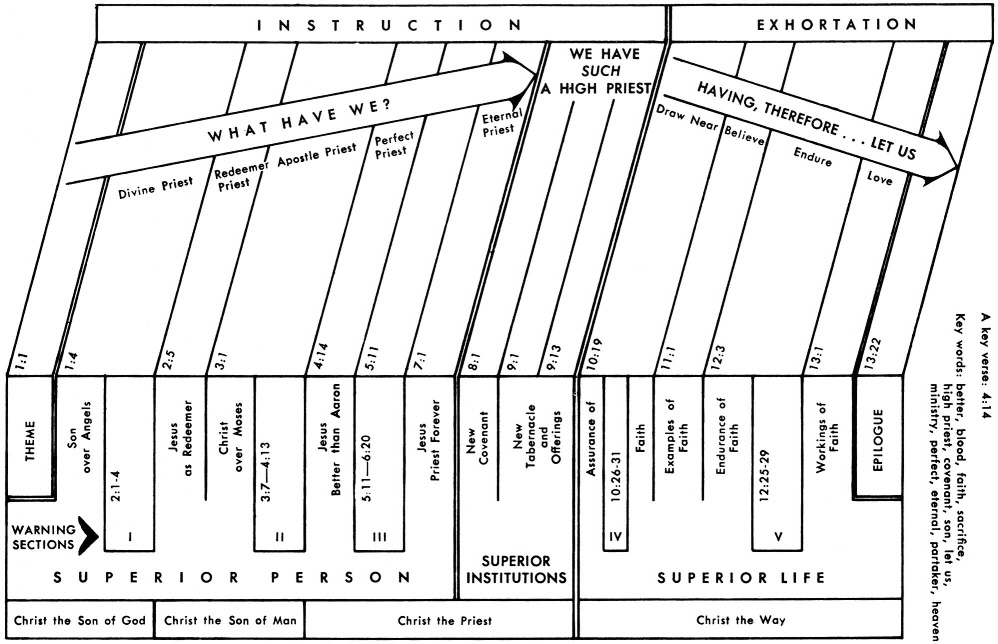
CONSIDER JESUS OUR GREAT HIGH PRIEST
Click chart to enlarge
Charts from Jensen's Survey of the NT - used by permission
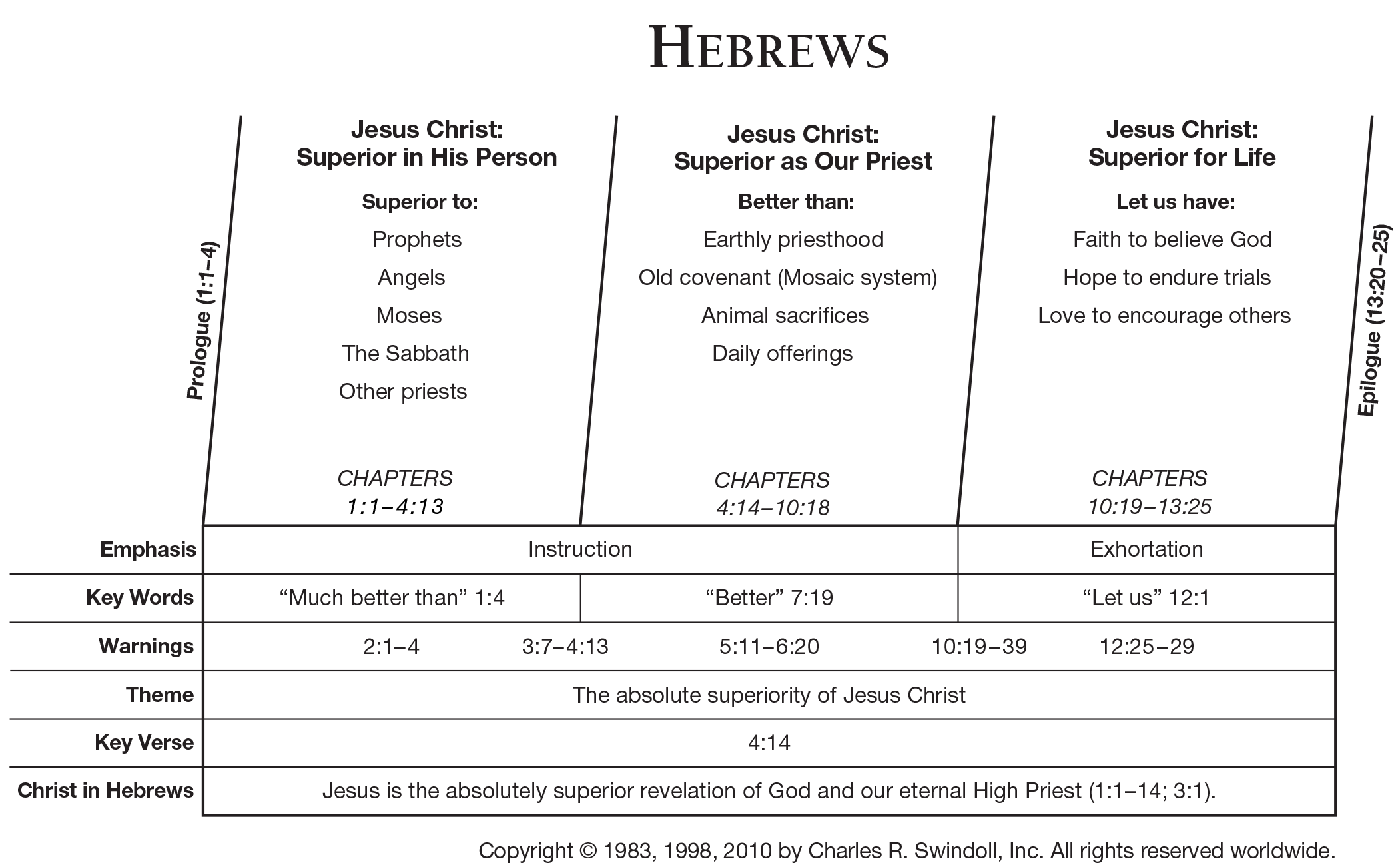
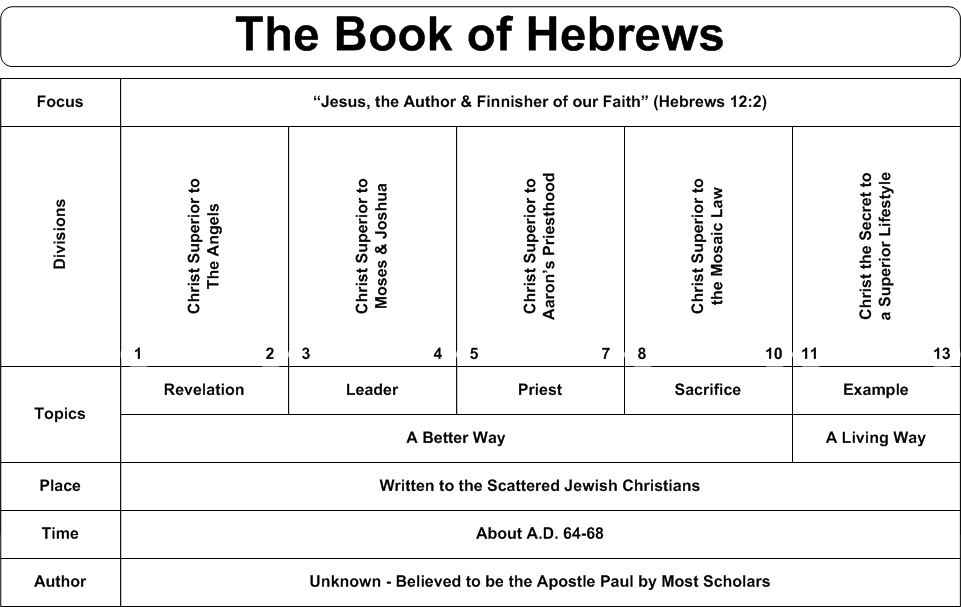
Swindoll's Chart, Interesting Pictorial Chart of Hebrews, Another Chart
|
The Epistle |
||||
| INSTRUCTION Hebrews 1-10:18 |
EXHORTATION Hebrews 10:19-13:25 |
|||
| Superior Person of Christ Hebrews 1:1-4:13 |
Superior Priest in Christ Hebrews 4:14-10:18 |
Superior Life In Christ Hebrews 10:19-13:25 |
||
| BETTER THAN PERSON Hebrews 1:1-4:13 |
BETTER PRIESTHOOD Heb 4:14-7:28 |
BETTER COVENANT Heb 8:1-13 |
BETTER SACRIFICE Heb 9:1-10:18 |
BETTER LIFE |
| MAJESTY OF CHRIST |
MINISTRY OF CHRIST |
MINISTERS FOR CHRIST |
||
|
DOCTRINE |
DUTY |
|||
|
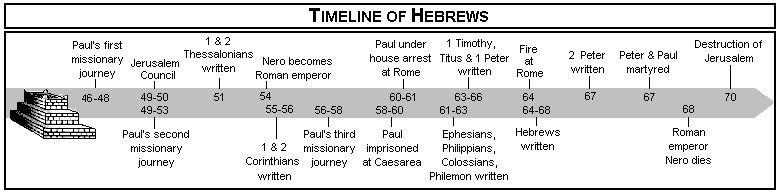
DATE WRITTEN: |
||||

See ESV Study Bible "Introduction to Hebrews"
(See also MacArthur's Introduction to Hebrews)
Borrow Ryrie Study Bible
Hebrews 13:17 Obey your leaders and submit to them, for they keep watch over your souls as those who will give an account. Let them do this with joy and not with grief, for this would be unprofitable for you (NASB: Lockman)
Greek: Peithesthe (2PPPM) tois egoumenois (PMPMPD) umon kai hupeikete, (2PPAM) autoi gar agrupnousin (3SPAI) uper ton psuchon umon os logon apodosontes, (FAPMPN) ina meta charas touto poiosin (3PPAS) kai me stenazontes, (PAPMPN) alusiteles gar umin touto.
BGT Πείθεσθε τοῖς ἡγουμένοις ὑμῶν καὶ ὑπείκετε, αὐτοὶ γὰρ ἀγρυπνοῦσιν ὑπὲρ τῶν ψυχῶν ὑμῶν ὡς λόγον ἀποδώσοντες, ἵνα μετὰ χαρᾶς τοῦτο ποιῶσιν καὶ μὴ στενάζοντες· ἀλυσιτελὲς γὰρ ὑμῖν τοῦτο.
Amplified: Obey your spiritual leaders and submit to them [continually recognizing their authority over you], for they are constantly keeping watch over your souls and guarding your spiritual welfare, as men who will have to render an account [of their trust]. [Do your part to] let them do this with gladness and not with sighing and groaning, for that would not be profitable to you [either]. (Amplified Bible - Lockman)
My Amplified Paraphrase: Obey (peithō—be persuaded by, listen to with a willing heart, respond trustfully to) your leaders—those who teach you the Word and shepherd your souls under Christ’s authority—and submit (hupeikō—yield, give way, be teachable and responsive) to them, for they keep watch (agrupneō—remain sleepless, stay vigilant like sentries guarding a city) over your souls, recognizing that they will one day give an account (logos—a full report to God Himself of their stewardship). Let them do this with joy—with gladness, encouragement, and a lightened heart—and not with grief—stenazo - not sighing, groaning, burdened, or weighed down—for that would be unprofitable (alusiteles—of no benefit, spiritually disadvantageous) for you. In other words, it is for your good that their work be a joy, not a sorrow.
KJV: Obey them that have the rule over you, and submit yourselves: for they watch for your souls, as they that must give account, that they may do it with joy, and not with grief: for that is unprofitable for you.
NET: Obey your leaders and submit to them, for they keep watch over your souls and will give an account for their work. Let them do this with joy and not with complaints, for this would be no advantage for you.
NLT: Obey your spiritual leaders, and do what they say. Their work is to watch over your souls, and they are accountable to God. Give them reason to do this with joy and not with sorrow. That would certainly not be for your benefit. (NLT - Tyndale House)
NIV: Obey your leaders and submit to their authority. They keep watch over you as men who must give an account. Obey them so that their work will be a joy, not a burden, for that would be of no advantage to you.
NKJ Obey those who rule over you, and be submissive, for they watch out for your souls, as those who must give account. Let them do so with joy and not with grief, for that would be unprofitable for you.
CSB Obey your leaders and submit to them, for they keep watch over your souls as those who will give an account, so that they can do this with joy and not with grief, for that would be unprofitable for you.
ESV Obey your leaders and submit to them, for they are keeping watch over your souls, as those who will have to give an account. Let them do this with joy and not with groaning, for that would be of no advantage to you.
Phillips: Obey your rulers and recognise their authority. They are like men standing guard over your spiritual good, and they have great responsibility. Try to make their work a pleasure and not a burden - by so doing you will help not only them but yourselves. (Phillips: Touchstone)
Wuest: Keep constantly obeying your rulers, and constantly be submitting to them; for they themselves are constantly keeping watch over your souls, knowing that they are to give account, that they may do this with joy, not with lamentation, for this would be profitless to you.
Young's Literal: Be obedient to those leading you, and be subject, for these do watch for your souls, as about to give account, that with joy they may do this, and not sighing, for this is unprofitable to you.
- Obey: He 13:7. 1Sa 8:19. 15:19, 20. Pr 5:13. Ph 2:12, 29. 1Th 5:12, 13. 2Th 3:14. 1Ti 5:17
- Leaders: He 13:7, 24. 1Chr 9:29. 2Chr 34:12, 13. Ne 11:16. Da 11:33. 2Co 1:24, 10:8. 1Th 5:12, 13
- submit: Ge 16:9 1Co 16:16 Eph 5:21 Jas 4:7 1Pe 5:5
- watch: Eze 3:17-21 33:2,7-9 Ac 20:24-26,28 1Co 4:1,2 1Pe 5:2,3
- give account: Lu 16:2 Ro 14:12 2Co 5:10,11
- With joy: Php 1:4+ Php 2:16+ Php 4:1+ 1Th 2:19, 20+ 1Th 3:9,10+
- Grief: Ex 32:31 Jer 13:17 Php 3:18+
- Hebrews 13 Resources - Multiple Sermons and Commentaries
OBEDIENCE AND SUBMISSION
TO YOUR LEADERS
The writer now turns our eyes from sacrifices offered to God (Heb 13:15–16) to the shepherds appointed by God. Having called believers to a life of worship expressed in praise and practical love, the writer reminds his readers that walking faithfully with Christ also includes a humble, trusting posture toward the spiritual leaders who watch over their souls. It describes the beautiful harmony of a flock walking in willing cooperation with faithful pastors who labor to guide them safely to the celestial city. In a world filled with voices that mislead, the Lord provides His church with undershepherds who must one day give an account to Him. Hebrews 13:17 therefore calls us to cultivate teachable hearts, receptive spirits, and a willingness to make their work a joy—not a groan—for in doing so we advance our own spiritual well-being and bring glory to the Chief Shepherd Who bought us with His blood.
Obey (peitho) your leaders (hegeomai) and submit (hupeiko) to them - These Hebrew believers had endured persecution, social pressure, and false teaching; such pressures can easily breed suspicion, resistance, or spiritual drift. Thus the Spirit exhorts them to respond rightly to godly oversight—not as a burdensome duty but as a Christ-centered act of obedience that blesses both shepherd and flock. Obey (peitho) your leaders (hegeomai) is not a call for blind allegiance, nor does it grant leaders authoritarian license.
TECHNICAL NOTE: This verse, along with [1Th 5:12] has been widely misunderstood because of the faulty translation of the KJV, ("Obey them that have the rule over you") NIV ("Obey your leaders and submit to their authority") and other versions. The words obey (twice here) and submit and the phrase from [1Th 5:12] “are over you in the Lord” have led to an improper approach to leadership that has turned some pastors into autocrats who rule like monarchs over their congregations treating the flock as if they were their personal "fiefdom".
Henry Alford - Having already in Heb 13:7 spoken of their deceased leaders in the church, and thereby been reminded of their steadfastness in the faith, he has taken occasion in the intervening verses to admonish them respecting the danger of apostasy to Judaism, and to exhort them to come fearlessly out of it to Christ. Now he returns to their duty to their leaders....(commenting on the use of the verb peitho) Obey, in the regular course of your habits, guided by them, persuaded that their rule is right. (The New Testament for English readers)
David Guzik writes "Sadly, many have taken the idea of submission to leaders in the church much too far; the “Shepherding Movement” was a clear example of this kind of abuse (which many seem to welcome, wanting someone else to be responsible for their lives). “A teacher should teach us to submit to God, not to himself.” (Chuck Smith)
Simon Kistemaker - A lack of obedience prevailed among some of the readers. Note, for example, the author’s admonition not to “be carried away by all kinds of strange teachings” (Heb 13:9). The leaders needed help and encouragement. Thus the appeal to obey them and to submit to their authority is timely. Of course, the readers could question whether this authority was self-imposed by the leaders or delegated to them by Christ. If a leader is a dedicated minister of the Word of God, he proves thereby that Christ has given him authority. And if Christ has entrusted him with the task of assuming leadership, the people need not question his authority (Acts 20:28; Eph. 4:11; 1 Peter 5:1–3). (Borrow Hebrews Commentary)
R C H Lenski on obey...submit - “Obey and yield.” One obeys when one agrees with what he is told to do, is persuaded of its correctness and profitableness; one yields, gives up, when he has a contrary opinion. The pertinency of the latter is apparent. Any of the members that are inclined to leave Christ are to give up this notion and thus obey their faithful leaders. Αὐτοί is emphatic: “they are the ones who are watching over your souls” so that these may not be lost or even endangered. The verb recalls Jer. 6:17; Ezek. 3:17, etc.; 33:1, etc. God set the prophets of old as watchmen over Israel. (BORROW Hebrews Commentary)
Jesus condemned such autocratic rule by leaders declaring "You know that those who are supposed to rule over the Gentiles lord it over them, and their great men exercise authority over them. But it shall not be so among you: but whoever would be great among you must be your servant (Mk10:42,43, 45).
Wuest - Expositor’s note on this verse is so illuminating, that we quote it in its entirety. “Having exhorted the Hebrews to keep in mind their former rulers and adhere to their teaching, the writer now admonishes them, probably in view of a certain mutinous and separatist spirit, (Heb 10:25) encouraged by their reception of strange doctrines, to obey their present leaders, and yield themselves trustfully (hupeikete) to their teaching—an admonition which, as Weiss remarks, shows that these teachers held the same views as the writer. The reasonableness of this injunction is confirmed by the responsibility of the rulers and their anxious discharge of it. They watch, like wakeful shepherds (agrupnousin), or those who are nursing a critical case, in the interest of your souls (huper ton psuchon humon) to which they may sometimes seem to sacrifice your other interests. They do this under the constant pressure of a consciousness that they must one day render to the Chief Shepherd (Heb 13:20) an account of the care they have taken of His sheep (hos logon apodosontes). Obey them, then, that they may discharge their responsibility and perform these kindly offices for you (touto) referring not to logon apodosontes…but to agrupnousin) joyfully and not with groaning (stenazontes, the groaning with which one resumes a thankless task, and with which he contemplates unappreciated and even opposed work). And even for your own sakes you should make the work of your rulers easy and joyful, for otherwise it cannot profit you. Your unwillingness to listen to them means that you are out of sympathy with their teaching and that it can do you no good (alusiteles gar humin touto).” (Hebrews - Wuest's word studies from the Greek New Testament)
Submit - The present imperative calls for the readers to continually yield to the authority and admonition of their leaders. As he explains it's a matter of the health and integrity of the body ("souls" is plural which seems to direct this primarily at the whole body).
Steven Cole feels that hupeiko "involves an attitude. You can obey outwardly while seething with anger on the inside, but you aren’t submitting. Submission implies a sweet spirit of cooperation that stems from trust. You trust that the leaders have your best interests at heart, and so you go along with them. (Your Duties Toward Church Leaders)
Steven Cole writes that...
“Obey your leaders and submit to them,” is a difficult text to speak on because of our culture and because we are Baptists. Our culture is anti-authoritarian and postmodern, and both ideas militate against obedience or submission. Anglican preacher, John Stott, wrote (Between Two Worlds [Eerdmans, 1982], p. 51),
“Seldom if ever in its long history has the world witnessed such a self-conscious revolt against authority.”
To prove Stott’s statement, I ask, when you hear the words, authority or submission, what comes to mind? Do you welcome them as pleasant words, or do you bristle and put up your guard? Our nation was founded on a rebellion against authority, and one of our early mottoes was,“Don’t tread on me!”
We have a defiant national spirit that exalts individual rights. The concept of submission to authority seems wimpy to us!
Our culture is also influenced by postmodernism, which holds that there is no absolute truth and that each person is free to make up or interpret “truth” as he sees fit. Thus, your “truth” is fine for you, but I have my own “truth,” and I would never feel obligated to submit to your “truth.” You can believe as you like, but you must also let me believe as I like. Truth is not authoritative. I am the authority over my life, and I use “truth” for my own ends.
Then, add to that the Baptist idea of congregational church government, where each member has an equal vote, and our text becomes especially problematic! Baptist church government is notoriously political. Baptists have divided from other Baptists over relatively minor issues. There is even a joke about the Baptist who was stranded on a desert island. When rescuers finally found him, they saw three buildings on the island. They asked, “What’s that building?” “That’s my house,” the Baptist answered. “Well, what’s that second building?” “That’s my church,” he said. “But, then what’s that third building?” “Oh, that’s where I used to go to church.” If Baptists don’t like a church, they wouldn’t think of submitting. They just start or join a new church!
But against all of these powerful influences, we come to Hebrews 13:17: “Obey your leaders and submit to them….”
As a part of God’s inspired Word, these commands are profitable for us (2Ti 3:16+), and so we must grapple with them. Our verses are directed at church members, but they also implicitly contain some duties for church leaders...
You should obey godly leaders because they keep watch over your souls as those who are accountable to God.
God has constituted various levels of authority under His ultimate authority. The purpose for all authority is to protect and bless those under authority. God establishes the authority of civil governments to protect and bless law-abiding citizens from those that would harm or take advantage of them. When the government does its job, criminals are punished, foreign invaders are kept at bay, and the people can dwell in peace. To the extent that government leaders are corrupt or negligent, the citizens suffer.
In the family, God appoints husbands to have authority under Christ in order to protect and bless their wives and children. The husband is to provide for his family (1Ti 5:8), to protect his family from physical and spiritual danger, and to bless his family by leading them in the ways of God. An ungodly husband who uses authority for his own selfish ends is abusing the authority that God has entrusted to him, and will answer to God for his sins.
In the church, God has appointed elders or pastors (shepherds) to oversee the flock (Acts 20:28; 1Pe 5:1, 2, 3, 4+). They are not to lord it over the church, but rather to be examples to the flock (1Pe 5:3+; 2Co 1:24). On every level, those in authority are never in absolute authority. Every leader will give an account to God!
In our text, leaders is plural. The New Testament is clear that there is to be a plurality of elders over the local church (Acts 14:23; 20:17; Titus 1:5+). Plural leadership is a safeguard against the abuse of authority. When all of the elders in a local church have wrestled through an issue biblically and in prayer, and they all agree, they are not infallible, but there is a fair chance that they are right. There should always be room for biblically-based discussion of issues (Acts 15), but when the elders come to a consensus, the church should follow their leadership, unless it is clearly against Scripture on a major point of doctrine.
The text is clear that the church should submit to godly church leaders. Abusive leaders should be confronted and removed from office (1Ti 5:19, 20, 21). John Calvin (Calvin's Commentaries [Baker], on He 13:17, pp. 352-353) observed,
“the Apostle speaks only of those who faithfully performed their office; for they who have nothing but the title, nay, who use the title of pastors for the purpose of destroying the Church, deserve but little reverence and still less confidence.”
Before we leave the subject of obedience and submission to leaders, let me be more specific on what it does not mean and what it means. First, it does not mean blindly following leaders without question. I doubt if this is a problem for most people, but the Jim Jones mass suicide incident of the 1970’s shows that it can be a problem when an evil leader deceives people. Even in a church that is seeking to follow the Bible, it is not wrong and is right to examine the Scriptures to see if the teaching is sound (as the Bereans did with Paul’s teaching, Acts 17:11+). I welcome interacting with any-one about my sermons, as long as you are seeking to be faithful and submissive to what the Bible teaches. I am not infallible!
When is the church responsible to obey and submit? Obviously, when the leaders teach God’s truth, especially on the essential doctrines and commands of the faith, we all must submit. It is not the elders’ authority, but God’s, that we must submit to. If it is an area where godly Christians may differ, we must give grace to one another to disagree. But submission to godly leadership would require that if you disagree with me on a secondary matter, you would be disobeying God to lead a faction against me. There needs to be a respect shown toward the office of those who teach God’s Word. Paul wrote to Titus 2:15+,
“These things speak and exhort and reprove with all authority [lit., commandment]. Let no one disregard you.”
To disregard Titus would have been to disregard God, whose word Titus preached.
I have seen two specific situations where church members should submit, even though it may be difficult. In one instance in my ministry in California, a very popular author was coming to our small town to speak. The problem was, this man had left his wife for another woman. The church he attended had disciplined him, but he told them that they couldn’t do that, and he kept on with his popular ministry. We told our people that as elders, we did not want them to attend his talk, because to attend it was to give endorsement of his sin. Later I was grieved to hear that several of our members went anyway. I think that they disobeyed Hebrews 13:17.
Another situation involved disciplining a widow in the church who married an unbeliever. She knew that this was sin, and since she had been the leader of our prayer ministry, her sin wrongly could have tempted other single women to follow her example. But when the elders put her out of the fellowship, some of the women in the church continued to fellowship with her, in disobedience to 1 Corinthians 5, and in disobedience to the elders.
Church discipline is a difficult matter, because there are always those in the church who have emotional ties to the one being disciplined. Some always feel sorry for the person and urge others in the church to show grace and mercy, not judgment. But to be effective, discipline has to be uniformly enforced. If some members continue to fellowship with the person under discipline, then the penalty of being put out of the fellowship is undermined. It’s the same thing as when parents do not stand together in disciplining their children. The children quickly recognize that they can do as they please, without any penalty, because dad and mom don’t agree. So obedience to church leadership is especially important if the church has to discipline a sinning member. (Hebrews 13:17-19, 22-25 Your Duties Toward Church Leaders)
Steven Cole quotes...
D. E. Hoste, who was a missionary leader with the China In-land Mission, wrote (cited in D. Martyn Lloyd-Jones, by Iain Murray [Banner of Truth], 2:423),
What is the essential difference between spurious and true Christian leadership? When a man, in virtue of an official position in the church, demands obedience of another, irrespective of the latter’s reason and conscience, this is the spirit of tyranny.
When, on the other hand, by the exercise of tact and sympathy, by prayer, spiritual power and sound wisdom, one Christian worker is able to influence and enlighten another, so that the latter, through the medium of his own reason and conscience, is led to alter one course and adopt another, this is true spiritual leadership.
(Cole continues) Before all of our elders (including me!) resign and run for their lives, and no others ever aspire to the office of elder, I conclude by reminding you of Paul’s words regarding the ministry. After asking, rhetorically,
“Who is adequate for these things?” he stated, “Not that we are adequate in ourselves to consider anything as coming from ourselves, but our adequacy is from God, who made us adequate as servants of a new covenant, not of the letter but of the Spirit; for the letter kills, but the Spirit gives life” (2Co 2:16; 3:5, 6).
The responsibility of church leadership is impossible, but with God’s strength, all things are possible! As leaders, we join the author of Hebrews in asking you, “Pray for us.” (Hebrews 13:7, 17-19, 22-2 The Responsibilities of Church Leaders - Read Entire Sermon for Excellent Summary of What Constitutes Godly Leadership)
Obey (3982)(peitho) means literally to persuade or induce by words to believe and conveys nuances such as confidence and reliance. In short, the writer is saying when your leaders speak on the authority of God's word, they do have a right to expect obedience. The obedience of course is to God and not to men.
Leaders (2233) hegeomai from ago = to lead, carry, bring) has two basic meanings in the NT. One is to lead as one would do in a supervisory capacity as when describing men in any leading position - ruler, leader, governor (Acts 7:10+) and stands opposite of a diakonos or servant in (Lk 22:26+). In the apocryphal writings hegeomai was used of military commanders. It was also used to describe leaders of religious bodies, both pagan and Christian (latter in Heb 13:7, 17, 24, "leading men" in Acts 15:22+, "chief speaker" in Acts 14:12+). In secular Greek hegeomai was used to describe the pagan god Hermes as "the leader of the word." The second meaning of hegeomai means to engage in an intellectual process (2Co 9:5, Php 2:25, Php 3:8, 2Pe 1:13). In this latter sense, hegeomai conveys the picture of leading out (note the root verb of origin = ago = to lead) before the mind, and thus to regard, esteem, count, reckon and is used this way in Heb 10:29, Heb 11:11 and Heb 11:26.
HEGEOMAI IN HEBREWS - Heb. 10:29; Heb. 11:11; Heb. 11:26; Heb. 13:7; Heb. 13:17; Heb. 13:24
Hebrews 10:29 How much severer punishment do you think he will deserve who has trampled under foot the Son of God, and has regarded as unclean the blood of the covenant by which he was sanctified, and has insulted the Spirit of grace?
Hebrews 11:11 By faith even Sarah herself received ability to conceive, even beyond the proper time of life, since she considered Him faithful who had promised.
Hebrews 11:26 considering the reproach of Christ greater riches than the treasures of Egypt; for he was looking to the reward.
Hebrews 13:7 Remember those who led you, who spoke the word of God to you; and considering the result of their conduct, imitate their faith.
Hebrews 13:17 Obey your leaders and submit to them, for they keep watch over your souls as those who will give an account. Let them do this with joy and not with grief, for this would be unprofitable for you.
Hebrews 13:24 Greet all of your leaders and all the saints. Those from Italy greet you.
Submit (5226) (hupeiko - This is the only Biblical use) means to to resist no longer, but to give up or yield as was literally applied to combatants. Figuratively as used in the present context hupeiko means to yield or surrender to authority of the leaders and to any admonition they might (especially as it relates to potential danger to their souls). This verb presents an poignant picture (and raises a pertinent question) - Are you resisting your God appointed leaders? Effective leadership (and "holistic health" of the body) requires effective following.
FOR THEY KEEP WATCH OVER YOUR SOULS AS THOSE WHO WILL GIVE AN ACCOUNT: gar agrupnousin (3SPAI) huper ton psuchon humon os logon apodosontes (FAPMPN):
- Keep watch: Ezek 3:17-21 Ezek 33:2,7-9 Acts 20:24-28 1Co 4:1,2 1Pe 5:2-3
- Give account: Lk 16:2 Ro 14:12 2Co 5:10,11
- Hebrews 13 Resources - Multiple Sermons and Commentaries
Related Passages:
1 Peter 5:2-3+ shepherd (aorist imperative see our need to depend on the Holy Spirit to obey) the flock of God among you, exercising oversight not under compulsion, but voluntarily, according to the will of God; and not for sordid gain, but with eagerness; 3 nor yet as lording it over those allotted to your charge, but proving to be examples to the flock.
Acts 20:26-28+ “Therefore, I testify to you this day that I am innocent of the blood of all men. 27 “For I did not shrink from declaring to you the whole purpose of God. 28 “Be on guard (present imperative see our need to depend on the Holy Spirit to obey) for yourselves and for all the flock, among which the Holy Spirit has made you overseers, to shepherd the church of God which He purchased with His own blood.


SOUL
WATCHING
For (gar) is a term of explanation which should always prompt you to pause and ponder what is being explained. It introduces the reason believers should obey and submit to their leaders and the reason is because the leaders are actively watching, guarding, and caring for their spiritual well-being.
They keep watch (agrupneo - a = without + hupnos = sleep) over your souls (psuche) as those who will give an account (logos) - Keep watch (agrupneo) in the present tense pictures (and calls for) the shepherd's continual watchcare over the sheep (which are prone to wander, cp Is 53:6). The idea of this picturesque verb is to stay awake, to remain sleepless, to be alert and vigilant, to keep one’s eyes open, to stay watchful through the night. This paints the picture of a shepherd who refuses to doze while wolves prowl (Mt 7:15,16+, Mt 10:16+, Acts 20:29,30+), or a watchman on a city wall who scans the darkness for danger (Ezek 3:17-19+, Ezek 33:2, 6, 7). These spiritual leaders are shepherds who refuse to sleep on duty (think of a sentry on duty at his guard post), who constantly scan for danger (when was the last time you as pastor or elder attended a Sunday School class, especially one with a new teacher, to be sure they were teaching sound doctrine - 2Ti 1:13,14+?), who bears the weight of responsibility, who intercedes with tears (Acts 20:19, 20+), and who labors tirelessly (cf kopiao and agonizomai in Col 1:29+) for the flock’s safety.
Leon Morris - There is the imagery of the leaders keeping awake nights in their concern for their people. (See Expositor's Bible Commentary - Abridged Edition)
Simon Kistemaker on keep watch (agrupneo) over quips that "They literally lost sleep over the spiritual welfare of the believers.....The verb describes an absence of sleep due to an alert mind." (Borrow Hebrews Commentary)
R C H Lenski on keep watch - Those who are called to watch are to give the alarm at the approach of danger; they are to give it early enough so that those who are watched over may meet the danger or may escape it. When an appointed watchman proves a dumb dog, calamity results. Woe to the people whose leaders are blind watchers, unable to distinguish foe from friend or to recognize danger before it is too late. Watching means warning at as early a time as possible, and the warned must heed—otherwise why set watchmen? Watching implies keeping oneself and others safe where danger is known to exist or where one fears its existence. Where no danger exists watching is not needed. But where safety is at stake no one but a fool takes chances. All this applies to the church in the highest degree where the safety of souls is to be guarded. Some watchmen in Israel take their accountability lightly, they will find their medicine in Ezek. 33:7, etc. Whoever assumes or is given responsibility over the souls of any others, even of only one other, is fully accountable. (BORROW Hebrews Commentary)
Over your souls (psuche) is far deeper than just their physical life, but includes the inner person, the eternal part of a human being. Pastors are not merely caretakers of physical bodies ("counting nickels and noses"), schedules, or church programs. They are called to watch over souls, that precious, immortal, God-created core of a person that will live forever. In short pastoral work deals with matters of life and death, heaven and hell, spiritual growth or spiritual ruin. The leaders are not guarding buildings, reputations, or organizations but are tasked with guarding eternal beings made in the image of God (Ge 1:27+), whose destiny is everlasting joy (cf Ps 16:11 - "fullness of joy", Jude 1:24+ "great joy") or everlasting loss. The writer is calling his Hebrew congregation to respond with humility, teachability, and cooperation, not only for their pastor’s sake (the pastor's joy), but for the sake of their own souls.
Pastors are to be "sleepless sentinels" standing guard over the most precious treasure Christ has on earth, the souls of His people.
The pastoral implications of agrupneō:
A. Persistent, ongoing vigilance
The present tense indicates continual watchfulness. Shepherds do not relax their guard; spiritual dangers never sleep.
B. Protection from threats
Pastors are awake so the sheep may rest. They carry the burden of discerning false teaching, hidden sin, discouragement, drifting, and spiritual attack.
C. Emotional and spiritual labor
This is not mechanical oversight but heartfelt guardianship. True leaders lose sleep over the spiritual well-being of the flock.
D. Self-sacrificing commitment
They put aside personal comfort, convenience, and ease in order to guard those Christ entrusted to them.
E. Watchfulness grounded in love
Their vigilance is not suspicion but love-driven care of the sheep.
In short, agrupneo portrays leadership that watches, prays, discerns, protects, and labors tirelessly for the safety of Christ’s sheep. (See quote by Richard Baxter from The Reformed Pastor)
As those who will give (apodidomi) an account (logos) - If you are a pastor, this is one of the more sobering descriptions of your responsibility in all of Scripture. Why so? This one is easy to answer. Using "courtroom language," the writer says that one day every shepherd will give an "accounting" before the Bema Seat of Jesus Christ (2Co 5:9, 10+, 1Co 3:7-15+) The writer reminds them that they are leaders who shepherd not as volunteers, not as professionals (Read John Piper's book Brothers, We Are Not Professionals), not as self-appointed overseers, but as men under divine obligation and compulsion who must one day stand before Christ and give a full accounting of the stewardship of their sheep. Every sermon (see Richard Baxter's approach to his sermons), every counseling session, every decision, every oversight, every act of care or neglect will all be reviewed by the Chief Shepherd (1Pe 5:4+). This truth is not meant to be a burden that crushes you, but to give a sober sense of the remarkable influence a shepherd wields over his sheep—so that you do not grow lax, but remain disciplined and diligent in your calling to rightly divide the Word of Truth (2 Timothy 2:15+) and "shepherd the flock of God among you." (1Pe 5:2,3+).
🙏 THOUGHT - This accounting scene calls for a few qualifying statements. So the questions at the Bema Seat won't merely be did the church grow, were the programs successful, did people like the leaders, etc? More importantly, the questions will be did the the leaders shepherd faithfully, did they guard the flock from wolves, did they preach the Word with Holy Spirit power and without compromise, did they watch over souls with vigilance and love, did they model Christ-like lives which the sheep would be encouraged to imitate, and did their leading cause the sheep to continually "grow in the grace and knowledge of our Lord and Savior Jesus Christ. To Him be the glory, both now and to the day of eternity. Amen." (2Pe 3:18+)?
One other point to emphasize is the writer's choice of the verb give (apodidomi) which is one of the most vivid and weighty words for rendering back, paying back, or returning what is due. This is not a casual “giving.” It is an official rendering of a required report to an authority. Apodidomi carries judicial (Ro 2:6+ God "will render"), financial (Mt 20:8+ "pay their wages"), and moral overtones (1Co 7:3+ "fulfill his duty") and strongly implies obligation, responsibility, and answerability (Lk 16:2+). Apodidomi is a word rich with the concepts of justice, faithfulness, and debt‑repayment, whether before God or man. The use of Apodidomi reminds the leader that his leadership is a stewardship for which he must ultimately render an account to God. In summary, to give (apodidomi) an account (logos) means to render back to Christ a full and faithful report of one’s stewardship, a solemn evaluation before the Head of His Church.
R C H Lenski on render account - Not as being self-appointed and accountable only to themselves are the leaders doing this watching with such concern for your souls but “as having to render due account” to God. Ἀπιδίδωμι with λόγον = to render due account. The future participle is very rare and has a temporal meaning here: “shall render account” when their work is done. (BORROW Hebrews Commentary)
C H Spurgeon - The Lord will ever continue to give pastors after His own heart to feed His people, and all attempts made by the flock to dispense with these pastors will lead to leanness and poverty of soul. The outcry against the “one man ministry” does not come from God, but from proud self-conceit, of men who are not content to learn although they have no power to teach. It is the tendency of human nature to exalt itself that has raised up these disturbers of the peace of God’s Israel, for they will not endure to submit themselves to the authorities that God has himself appointed.
Keep watch (69) (agrupneo from a = without + hupnos = sleep; cp agrupnia - 2Co 6:5, 11:27) literally means to abstain completely from sleep, pass sleepless nights, to be sleepless, to lie awake and think about (Liddell Scott) to stay alert, and then figuratively to stay alert, to remain vigilant and fully aware of threatening peril, "to be alertly concerned about" (BDAG). Agrupneo expresses wakefulness and watchfulness, for the latter could hardly transpire without the former. The figurative picture is one who is spiritually alert and wide awake to spiritual intrusions (Mk 13:33, Lk 21:36, Ep 6:18). Wuest adds that agrupneo "is the opposite of listlessness, expressing alertness." (Hebrews) TDNT says to the ancient Greeks agrupneo means “to sleep in the open,” then “to watch.” (TDNT - abridged online)
Vincent offers a slightly different derivation stating of agrupneo, stating that "The word is derived from agreuo, to hunt, and hupnos, sleep. The picture is of one in pursuit of sleep, and therefore wakeful, restless. Wycliffe's rendering of the whole passage is striking: See! wake ye and pray ye!
Why is it so needful to continually keep watch over our souls? The Christian has not just one enemy but three incessant, inveterate foes, the world, the flesh and the devil, each irrevocably, intractably determined to bring harm to our soul. They cannot keep a believer out of heaven, but they can impede the progressive incursion of "heaven" into our souls while we still exist on earth.
Note the associations of agrupneo and prayer (Lk 21:36, Ep 6:18+)
Thayer writes that agrupneo "may be taken to express simply ... absence of sleep, and, pointedly, the absence of it when due to nature, and thence a wakeful frame of mind as opposed to listlessness, while gregoreuo (the offspring of egreiro = to waken, rouse from sleep) represents a waking state as the effect of some arousing effort ... i.e. a more stirring image than the former. The group of synonyms is completed by nepho, which signifies a state untouched by any slumberous or beclouding influences, and thence, one that is guarded against advances of drowsiness or bewilderment. Thus it becomes a term for wariness against spiritual dangers and beguilements."
Vine adds that in Heb 13:17 we find "a description of genuine overseers. Agrupneo signifies to be wakeful, suggestive of the watchful care of shepherds. The overseer must ever carry on his work in view of the Judgment Seat of Christ, where he will give account of his service, its motives and methods. See Ro 14:12+ and 1Pe 4:5+ (See related resource: The Judgment Seat of Christ [2Cor 5:10] - How to live with a "Bema Seat" Mindset).
Agrupneo - 4x/4v Hebrews 13:17 and 3 other verse...
Mark 13:33 "Take heed (blepo = beware, be careful to observe, pay attention) , keep on the alert (agrupneo = present imperative = command to do this continually. Why?); for you do not know when the appointed time will come.
Luke 21:36+ (Context = Lk 21:34, 35 = Return of the Lord = see Table comparing Rapture vs Second Coming) "But keep on the alert (agrupneo = present imperative = command to do this continually. When? Why?) at all times, praying that you may have strength to escape all these things that are about to take place, and to stand before the Son of Man."
Ephesians 6:18+ With all prayer and petition pray at all times in the Spirit, and with this in view, be on the alert (present tense = continually) with all perseverance and petition for all the saints
Comment: Prayer in the time of spiritual war necessitates a continual state of wakefulness, not sleepiness. Prayer is not passive. We need to remain actively engaged for the enemies of our soul are continually strategizing against us to lay traps and render us ineffective for the King and His Kingdom work. Don't get caught asleep at the post. The fort will fall when the sentry falls asleep as happened to the seemingly impregnable city of Sardis. A little carelessness was shown in Sardis, and either a watchman was wanting at the necessary point or a sentinel slept at his post for an hour; and the greatest power on the earth was hurled to destruction.
Agrupneo in this verse refers to being "strategic in prayer to enable one to know what to pray at the right time and not be asleep at the switch. The person praying is to keep this alert vigil “with all perseverance” (Rediscovering Pastoral Ministry)
Steven Cole writes that...Godly church leaders help church members by keeping watch over their souls (Heb 13:17). The Greek word translated “keeping watch” (agrupneo) means “to keep oneself awake,” and thus, “to keep watch, guard, or care for” (A Greek-English Lexicon of the New Testament, Walter Bauer, William Arndt, and F. Wilbur Gingrich [University of Chicago Press], Second Edition, p. 14).
The image was drawn from shepherds keeping watch over their flocks (Thayer's Greek-English Lexicon of the New Testament ([Harper & Brothers], 1887, p. 9). Shepherds had to stay alert in order to guard their flocks from predators. They had to know the sheep and observe them carefully enough to know when a sheep was sick or missing. They had to go after the strays and try to restore them to the flock. They had to lead them to pasture and clean water (see Ezek. 34:1-16).
These tasks require the discernment to know where people are at spiritually and when they are heading toward spiritual danger. Leaders must love God and people enough to have the courage to confront those who are drifting. While you can only lead those who are willing to be led, godly leaders must always make the effort. The task is more difficult in our day when there are many different churches in town. If people get upset at one church, or if the leaders there try to confront some sin in their lives, they just move down the road to another church that welcomes them. Sadly, they usually carry their problems with them.
“Keeping watch over souls” is an overwhelming task, and the responsibility for it does not fall only on church leaders. Every spiritually mature believer is responsible to help restore those who are caught in any trespass and to bear one another’s burdens (Gal. 6:1,2). If you know of someone in the church who is straying from the Lord, but you don’t know what to do, go to one of the elders for counsel. We do our best to keep watch over the flock, but often we are not even aware when someone is in need. We all need to work together to care for one another spiritually. (Hebrews 13:7, 17-19, 22-2 The Responsibilities of Church Leaders)
Agrupneo is used 8x in the non-apocryphal Septuagint (LXX)...
2 Samuel 12:21 Then his servants said to him, "What is this thing that you have done? While the child was alive, you fasted and wept (Lxx adds "and watched" = agrupneo); but when the child died, you arose and ate food."
Ezra 8:29 "Watch (Command in Hebrew and Greek - Heb = shaqad - to watch or stay awake; Lxx = agrupneo in the present imperative = command to do this continually) and keep them until you weigh them before the leading priests, the Levites and the heads of the fathers' households of Israel at Jerusalem, in the chambers of the house of the LORD."
Psalm 102:7+ I lie awake (Lxx = agrupneo), I have become like a lonely bird on a housetop.
Psalm 127:1+ A Song of Ascents, of Solomon. Unless the LORD builds the house, They labor in vain who build it; Unless the LORD guards the city, The watchman (Lxx = agrupneo) keeps awake in vain.
Proverbs 8:32 Now therefore, O sons, listen to me, For blessed are they who keep my ways. 34 "Blessed is the man who listens to me, Watching (Lxx = agrupneo) daily at my gates, Waiting at my doorposts.
Song 5:2 "I was asleep but my heart was awake (Lxx = agrupneo). A voice! My beloved was knocking: 'Open to me, my sister, my darling, My dove, my perfect one! For my head is drenched with dew, My locks with the damp of the night.'
Job 21:32 "While he is carried to the grave, Men will keep watch (Lxx = agrupneo) over his tomb.
Daniel 9:14+ "Therefore the LORD has kept (Heb = shaqad = watched; Lxx = agrupneo) the calamity in store and brought it on us; for the LORD our God is righteous with respect to all His deeds which He has done, but we have not obeyed His voice.
Leaders are to be alert, watchful, trustworthy and are not to use their position in an authoritarian manner. Their office is a function within the church, not over it. The church is under the headship of Christ (Ep 4:15+, Ep 5:23+, cp Ep 1:22, 23+, 1Co 11:3) and is to be controlled only by the Spirit.
The writer pictures leaders as "excubitores" or “watchmen” (Ezek 3:17; 35:7; cf. Isa 21:8; Hab 2:1) over their flock. Dear pastor, are you serving well as a watchman over your flock such that you are assured you will hear "Well done"? You will be held accountable for your guiding and guarding the sheep, as the writer is quick to add.
Leaders should be stirred up to diligence, remembering the gravity of their responsibility (to be good stewards).
Peter offers an excellent parallel to the Hebrews passage...
Therefore, I exhort (parakaleo in present tense) the elders among you, as your fellow elder and witness of the sufferings of Christ, and a partaker also of the glory that is to be revealed, shepherd the flock of God among you, exercising oversight not under compulsion, but voluntarily, according to the will of God; and not for sordid gain, but with eagerness; nor yet as lording it over those allotted to your charge, but proving to be examples to the flock. And when the Chief Shepherd appears, you will receive the unfading crown of glory (cp "give an account" - see Bema Seat - Judgment Seat). (1Pe 5:1-4+)
Paul in his last words of encouragement to the Ephesian elders also gave them a solemn warning which all leaders need to completely hear and carefully heed...
And when they (Ephesian elders) had come to him, he said to them,
"You yourselves know, from the first day that I set foot in Asia, how I was with you the whole time, serving the Lord with all humility and with tears and with trials which came upon me through the plots of the Jews; how I did not shrink from declaring to you anything that was profitable, and teaching you publicly and from house to house, solemnly testifying to both Jews and Greeks of repentance toward God and faith in our Lord Jesus Christ (Where has the teaching of repentance gone in our day? This verse is quite clear about the call to repent and believe. Cp our Lord's two commands in Mk 1:15, see also Acts 26:20, Mt 3:2, Acts 3:19, Acts 5:31 [a gift!], Acts 8:22, 17:30, 2Ti 2:25+). "And now, behold, bound in spirit, I am on my way to Jerusalem, not knowing what will happen to me there, except that the Holy Spirit solemnly testifies to me in every city, saying that bonds and afflictions await me. But I do not consider my life of any account as dear to myself, in order that I may finish my course, and the ministry which I received from the Lord Jesus (The phrase describes every God ordained leader), to testify solemnly of the gospel of the grace of God. And now, behold, I know that all of you, among whom I went about preaching the kingdom, will see my face no more. Therefore I testify to you this day, that I am innocent of the blood of all men. For I did not shrink from declaring to you the whole purpose of God.
Be on guard (present imperative = command to do this continually) for yourselves (Leaders first need to watch their own conduct) and for all the flock, among which the Holy Spirit has made you overseers (Think "Stewardship" see Lk 16:1-13, 1Co 4:1, 2, 1Co 9:17, Ep 3:2+, Col 1:25+, see especially Titus 1:7+, 1Pe 4:10+), to shepherd the church of God which He purchased with His own blood. I know that after my departure savage wolves will come in among you (Where will the false teachers and leaders come from?!), not sparing the flock; and from among your own selves men will arise, speaking perverse things, to draw away the disciples after them. "Therefore be on the alert, remembering that night and day for a period of three years I did not cease to admonish each one with tears.
(How can a leader "survive" and "succeed"? Paul gives the answer)
And now I commend (paratithemi = used in Greek meaning to give someone something in trust and so to "deposit" with another. It conveys the picture of a precious treasure being deposited as a trust into the hands of other persons. Those to be entrusted with the message must be “faithful” persons, reliable and trustworthy men “who will not swerve aside because of fear or favor, who will not compromise with the spirit of the age through which they are passing.”) you (the elders) to God (note the order - #1 To God) and to the Word of His grace (How do leaders preach grace [power to transform] that their sheep might grow it grace - 2Pe 3:18+?), which (+ - Growth comes only from the supernatural living and active Word [1Pe 2:2, 1Th 2:13), not from funny stories, cute illustrations, etc. That's why Paul said "Preach the Word" 2Ti 4:2+) is able (dunamai in the present tense = speaks of continual inherent ability or power of the Word of God) to build you up (edify, equip, produce growth in Christlikeness) and to give you the inheritance among all those who are sanctified. (Acts 20:18-32+)
David Guzik commenting on "give an account" reminds us that "this does not relieve individual responsibility, but it puts an additional accountability and responsibility to leaders."
AGRUPNEO ILLUSTRATED BY EXCUBITORS AND SHRIKES
The word excubitor is referenced in the definition of agrupneo in Liddell-Scott's lexicon and is also part of the taxonomic name of a little bird named the Great Grey Shrike = Lanius excubitor and was also the name of a palace guard corps. Liddell Scott adds that excubitor was a Latin word for a soldier of the imperial guard. Both the shrike and the imperial guard constitute an interesting picture of the meaning of the Greek word agrupneo as discussed below.
The Excubitors (excubitores) were a palace guard corps, organized by the Emperor Leo to counterbalance the influence of Germans in the imperial army. Although the imperial guard is not well understood, the excubitors are significant because it is through them (indirectly) that the important emperor Justinian was able to come to power. Emperor Justin and the Excubitores - Justinian's uncle Justin (and two other Illyrians from Macedonia) migrated to Constantinople where they were enrolled by Justin in the Excubitors. Under the emperor Anastasius, Justin rose through the ranks to become the commander of the Excubitors. When Anastasius died childless, Justin was able to take over as emperor. (About.com)
Shrike System - The ancient sport of falconry used trained hawks or falcons in the pursuit of wild game. When the "educated predator" was allowed to fly, however, it often rose too high for human eyes to see. So a hunter often carried a small caged bird called a shrike. By watching the antics of the little bird, the man could always tell where his hawk was, for the shrike instinctively feared the predator and cocked its head to keep it in view.
All leaders and for that matter every believer desperately needs to remain on "high alert" just as did the tiny shrike ever alert to the presence of their mortal enemy the falcon. Our adversary, Satan, "walks about like a roaring lion, seeking whom he may devour" (1Pe 5:8+). Our responsibility, according to the apostle Peter, is to be sober and vigilant. In other words, we’re to be always on the alert.
It would be nice if God had giant sirens to warn us of an attack by the devil. But He doesn’t operate that way. Instead, we must read the Bible regularly, meditate on its truths, maintain a prayerful attitude throughout the day, and be filled with the Holy Spirit. Only then will we be sensitive to an imminent assault by the evil one, and be armed by grace to meet it. —Mart De Haan. (Our Daily Bread, Copyright RBC Ministries, Grand Rapids, MI. Reprinted by permission. All rights reserved)
LET THEM DO THIS WITH JOY AND NOT WITH GRIEF FOR THIS WOULD BE UNPROFITABLE FOR YOU: hina meta charas touto poiosin (3PPAS) kai me stenazontes (PAPMPN) alusiteles gar humin touto:
- With joy: Php 1:4+ Php 2:16+ Php 4:1+ 1Th 2:19, 20+ 1Th 3:9,10+
- Grief: Ex 32:31 Jer 13:17 Php 3:18+
- Hebrews 13 Resources - Multiple Sermons and Commentaries
HELP LEADERS SHEPHERD
WITH JOY FOR YOUR BENEFIT
Let them (leaders) do (poieo - present tense) this (lead, shepherd) with joy (chara) - NLT says "Give them reason to do this with joy and not with sorrow." Them refers to the spiritual leaders. Do this begs the question "do what?" Let them shepherd you with joy as they. Joy (chara) is not superficial happiness or sentimental cheerfulness. It is deep, Spirit-produced delight rooted in God’s presence, God’s people, and God’s purposes. The idea is to allow their leaders to carry out their shepherding with glad and grateful hearts, delighting in your obedience and growth. Let your spiritual shepherds be able to carry out their oversight with overflowing joy—gladly, willingly, and gratefully—because your obedient, submissive spirit makes their ministry a delight rather than a burden. For the leaders to lead with joy indicates that the sheep are willingly submitting to the leaders.
The joy of our leaders in the Lord
should be a motivation for submission.
John MacArthur on let them do this with joy noting that this "is addressed to the people, not to the leaders. In other words, it is the responsibility of the church to help their leaders rule with joy and satisfaction. One way of doing this is through willing submission to their authority. The joy of our leaders in the Lord should be a motivation for submission. We are not to submit begrudgingly or out of a feeling of compulsion, but willingly, so that our elders and pastors may experience joy in their work with us. (See Hebrews Commentary - Page 446)
Simon Kistemaker adds that "When the members refuse to obey and fail to respect their leaders, the work in the church becomes burdensome. The members ought to realize that neither they nor the leaders own the church. The church belongs to Jesus Christ, to whom the readers are responsible. Should they make the work and life of the leaders difficult, they would be the losers. The leaders can testify before the Lord that they warned the wayward person who chose not to turn from his sin. That person will die in his sin, but the leaders are free from blame (Ezek. 3:19). Ultimately, then, the Lord avenges and judges his people (Heb. 10:30; Deut. 32:35–36; Ps. 135:14). Pastorally and prudently the writer of Hebrews observes that a sad instead of a glad report on the spiritual conduct of the readers will not be advantageous to them. (Borrow Hebrews Commentary)
W E Vine writes "that is, that they may hereafter render their account with joy, and not lamenting (present participle of stenazo), joy because of obedience to their admonitions and the spiritual progress of these whom they have guided." (Collected writings of W. E. Vine)
Steven Cole writes that "Godly church leaders help church members by aiming at their joy and spiritual profit (He 13:17)....This refers first to the leaders’ joy, but it obviously extends to the joy and spiritual profit of all of the members. Those who are walking in obedience to Christ will know His joy (John 15:10,11+). Godly leaders rejoice to see those in the flock walking in the truth (3Jn 1:4+). (Hebrews 13:7, 17-19, 22-2 The Responsibilities of Church Leaders)
Not with grief (stenazo) - Literally “not a (present tense = continually) groaning” describing a deep, inward heart-sick groaning that comes from the burden, sorrow or pain caused to the pastor by his sheep who has a genuine spiritual concern because he cares for the flock. These are groans that arise when the people of God resist the Word of God. All who have been in leadership (if they are honest) would readily acknowledge that being a leader can be a thankless, even grievous task. It is more like an unspoken heaviness that weighs on the heart. It is not a loud cry buy is the kind of sigh that escapes when a person is overwhelmed, discouraged, or carrying a weight too heavy to speak about. The picture is of spiritual leaders who are forced to shephere with a heavy heart. They grieve because they care for the spiritual health of their flock.
In context the shepherds would have grief over sheep that are going astray (disobedience). And so this passage ("with joy and not with grief") speaks to the congregation. They need to be submitting to their leaders, responding to the Word which is being preached (to not do so would be a cause of grief for the leaders) and not continually criticizing, complaining and bickering which would be grievous to the leaders. This does not mean you have to be a body of "yes" men and women but that you still follow their leadership.
A grieving shepherd becomes like Jeremiah who lamented the sin and spiritual decline of Judah “Oh, that my head were waters, And my eyes a fountain of tears, That I might weep day and night For the slain of the daughter of my people!” (Jer 9:1) In a similar way this shepherd's sigh rises from the same heart that Jesus felt when He cried "O Jerusalem, Jerusalem, who kills the prophets and stones those who are sent to her! How often I wanted to gather your children together, the way a hen gathers her chicks under her wings, and you were unwilling." (Mt 23:37+)
Moses surely groaned over the disobedience of his people when after the Exodus he brought them to Rephidim where, being out of water and supplies, they began to rebel (cf. Ex 17:1-7+). But forty years later when the same thing happened at Kadesh so that the people seemed to be lip-syncing their earlier rebellion—“Why did you bring the Lord’s community into this desert, that we and our livestock should die here?” (Nu 20:4+)—his old bones must have really groaned!
You should obey godly leaders because
if you cause them grief, you cause yourself grief.
-- Steven Cole
For (gar) this would be unprofitable (alusiteles) - This refers to behaving in such a way that it results in the leaders shepherding with grief instead of joy, by resisting, complaining (grumbling, murmuring), opposing, or making the leaders’ work burdensome. Sadly, the real the loss falls on the flock, not on the leader. It would bring no spiritual benefit to the flock. Refers to the leader's having to grieve or lament over their congregation (for their disobedience). In sum, the readers are to allow their leaders to shepherd them with joy, not with groaning or frustration, because if they (the sheep) become a source of grief to the leaders, the loss will fall on the sheep as it will have a detrimental effect on their spiritual growth and cut off God’s intended blessing through their pastoral ministry.
Vine feels that "To render an account with grief because of the lack of obedient response to their ministry would mean eternal loss for those who had thus failed to submit to them and follow them. That is the meaning of “unprofitable for you.” (Collected writings of W. E. Vine)
Steven Cole adds that...
You should obey godly leaders because if you cause them grief, you cause yourself grief.
Hebrews 13:17 states that obedience to godly church leaders is for your benefit. Disobedience to them “would be unprofitable for you.” God designed authority to protect and bless. If you disobey godly church leaders who proclaim God’s Word to you, you are really disobeying God, which always has serious consequences (Gal 6:7, 8). Again, it is implicit that these leaders are conscientious men who are walking with God.
Spiritual children, like our natural children, can be the source of immense joy or of immense grief (which, literally, is “groaning”). Every pastor has had frequent occasion both for joy and for groaning over people in the flock. The apostle Paul told the Thessalonians, (1Th 3:9+),
“For what thanks can we render to God for you in return for all the joy with which we rejoice before our God on your account?” (See also, 1Th 2:19, 20+)
The apostle John wrote (3 John 1:4+), “I have no greater joy than this, to hear of my children walking in the truth.”
But Paul agonized over the Galatians’ defection from the truth (Ga 1:6; 4:19). He wrote to the Corinthians “out of much affliction and anguish of heart … with many tears” (2Co 2:4+; see also, Php 4:19+). Paul was not concerned about his own welfare or reputation, but about their welfare and God’s glory. If you cause your pastors to groan, it’s because they know that your disobedience will damage both you and the name of Christ.
Thus, you should obey godly leaders because they keep watch over your souls and because if you cause them grief, you are causing yourself grief. (Hebrews 13:17-19, 22-25 Your Duties Toward Church Leaders)
Grief (4727) (stenazo from stenos = narrow, contracted - figuratively as when one is squeezed or pressed by circumstances) is a poignantly picturesque word which literally describes an internal squeezing and denotes a feeling of sorrow which is internal. Stenazo means to express grief by inarticulate or semi-articulate sounds. The idea is to bemoan or lament over (Lxx of Nah 3:7 for "grieve"). A groan is an audible expression of anguish due to physical, emotional, or spiritual pain (Lxx of Is 21:2 where the prophet "groans" because of the harsh vision God has revealed to him). Stenazo has a slightly different nuance in Jas 5:9 Mounce stating that here it means "to give vent to querulous or censorious feelings."
Stenazo refers to the utterances of a person who is caught in a dreadful situation and has no immediate prospect of deliverance (As a leader this aspect of stenazo may "hit too close to home"!). Stenazo is used by Luke in its noun form, stenagmos, to describe the desperate utterances of the Israelites during their oppressive bondage in Egypt...
'I HAVE CERTAINLY SEEN THE OPPRESSION OF MY PEOPLE IN EGYPT, AND HAVE HEARD THEIR GROANS (stenagmos), AND I HAVE COME DOWN TO DELIVER THEM; COME NOW, AND I WILL SEND YOU TO EGYPT.' (Acts 7:34 cp Ex 2:24, 25) (Note: Stenagmos is also used in Ro 8:26+ of Spirit's prayers expressed to God inarticulately)
Used in Romans 8:23 “We ourselves groan (stenazō) within ourselves…” A longing groan, a deep ache for something better. In 2 Corinthians 5:2, 4 “…we groan, longing to be clothed…” The groaning of someone who feels the weight of mortality. In James 5:9 “Do not complain/groan (stenazō), brethren…” An inward, quiet groaning of frustration or strained patience. In every use, stenazō is the expression of something heavy on the soul.
Stenazo - 19x in the non-apocryphal Septuagint (LXX), mainly in the Major Prophets -Job 9:27; 18:20; 24:12; 30:25; 31:38; Isa. 19:8; 21:2; 24:7; 30:15; 46:8; 59:10; Jer. 31:19; Lam. 1:8, 21; Ezek. 21:6f; 26:15f; Nah. 3:7. Below is an example in which Jerusalem is personified as a woman groaning because of her sinfulness...
Jerusalem sinned greatly, Therefore she has become an unclean thing. All who honored her despise her because they have seen her nakedness. Even she (the city Jerusalem personified) herself groans (Hebrew = 'anach = groan in pain or grief; Lxx = stenazo) and turns away. (Lam 1:8)
Unprofitable (255) (alusiteles from a = without + lusiteles = paying for expenses, profitable) is that which does not pay, that which is unprofitable. Heb 13:17 "that would be of no help to you." It was a a commercial technical term for ‘not covering one’s expenses’. BDAG says alusiteles "can also be used positively, harmful (Polybius) It was used of inferior crops, “unprofitable” by comparison with wheat.
Gilbrant - This term could be used in classical Greek as a technical medical term to describe an “unfavorable” diagnosis (e.g., Hippocrates Prognostikon 14, Liddell-Scott). Alusitelēs does not appear in the Septuagint, although the related words lusiteleia, lusitelēs, and lusiteleō occur in the apocryphal writings (e.g., 2 Maccabees 2:27; Tobit 3:6; Sirach 20:10; 28:21).
The sole occurrence of alusitelēs in the New Testament is attributed to the author of the Book of Hebrews 13:17. He reminded his readers in his closing remarks to obey their leaders. Here he was referring to leaders in the religious community in whose charge his listeners would be. To make their task cumbersome (by disobedience) would be “unprofitable” and “a disadvantage” to his listeners. In practical terms, things would go better with cooperation. Implicit in this advice, however, was that disobedience would be ultimately “disadvantageous” in their standing before God. (Complete Biblical Library)
R C Sproul - LAY DUTIES: OBEDIENCE
HEBREWS 13:17 “Obey your leaders and submit to them, for they are keeping watch over your souls, as those who will have to give an account. Let them do this with joy and not with groaning, for that would be of no advantage to you.”
Ordained church leaders, as we have seen, do not serve as mediators between us and God as the old covenant priests did. That does not mean, however, that there is no distinction between clergy and laity or between leaders and laypeople under the new covenant. As we have seen in passages such as 1 Timothy 3:1–13, there are offices in the church for which men are set apart in order to meet the spiritual and physical needs of God’s people. These officers have particular duties to fulfill, but it must be noted that Scripture also prescribes duties to those who are not ordained to vocational ministry. In other words, the Lord also gives responsibilities to the laity.
Hebrews 13:17 tells us that laypeople are to submit to and obey church leaders. First, let us note that the author is not speaking of unthinking, unquestioning, absolute obedience. Scripture never sets anyone in absolute authority over us besides God Himself. Furthermore, John Calvin notes in his commentary on this verse that the qualifier “they are keeping watch over your souls” shows the kind of obedience in view. We are to submit to church leaders who in the main strive to preach the Word of God, teach what is in accord with sound doctrine, and love God’s people. No leader besides Christ is perfect, of course, but there is a world of difference between a sound leader who is fallible and makes errors for which he is sorry and false teachers who are out to destroy the servants of Christ.
John Calvin writes that Hebrews 13:17 “speaks only of those who faithfully performed their office; for they who have nothing but the title, nay, who use the title of pastors for the purpose of destroying the Church, deserve but little reverence and still less confidence.”
So, when we have leaders who love God and His people and seek to proclaim the truth and lead in accordance with it, our general disposition should be to take their counsel seriously, heed their warnings, and follow their leadership.
But today’s passage does not call the laity to grudging submission, but rather to joyful and willing obedience. Laypeople are to let their leaders direct them “with joy and not with groaning” (Heb. 13:17). That is to say, laypeople are to do what they can to make their leaders glad and eager to shepherd them. This means, among other things,
- not causing division over unnecessary matters,
- not slandering church leadership, and
- not refusing to help our leaders when we are asked and are available.
CORAM DEO Living before the face of God - It is easy to gripe and complain about our church leaders, but it is much harder to submit to them as God calls us to do. But as we see in today’s passage, the Lord calls us to submit to God-honoring leaders in a way that makes them glad to do their jobs. Let us submit to the elders and deacons God has appointed so that we can enjoy the benefits that God gives through them.
FOR FURTHER STUDY Deuteronomy 17:12 2 Thessalonians 3:14 Titus 3:1–2 1 Peter 5:5 (Bolding added)
SHEPHERDING MOVEMENT (Wikipedia) "The movement gained a reputation for controlling and abusive behaviour, with a great deal of emphasis placed upon the importance of obedience to one's own shepherd. In many cases, disobeying one's shepherd was tantamount to disobeying God. A few of these criticisms were exaggerated, but many lives were damaged. One such testimony can be found in the book Damaged Disciples by Ron and Vicki Burks. Noted Baptist evangelist Bailey Smith, for example, in his work "Real Evangelism" mentions having collected a very large number of testimonies of people he had encountered who were damaged by Shepherding teachings. The movement was denounced by many charismatic leaders such as Pat Robertson and Demos Shakarian, and a 1975 meeting (known as "the shoot-out at the Curtis Hotel") to resolve the dispute achieved little. The Fort Lauderdale Five eventually parted company. Derek Prince and Bob Mumford both publicly distanced themselves from the teachings. Derek Prince withdrew in 1983, stating his belief that "we were guilty of the Galatian error: having begun in the Spirit, we quickly degenerated into the flesh."[3] Bob Mumford issued a "Formal Repentance Statement to the Body of Christ" in November 1989 and was quoted as saying, "I repent. I ask forgiveness." He also acknowledged abuses that had occurred because of his teaching on submission. This emphasis resulted in “perverse and unbiblical obedience” to leaders. He also admitted that families had been severely disrupted and lives turned upside down."[4][5][6] (Shepherding Movement - Wikipedia)
Richard Baxter - from Chapter 3. Application of the Reformed Pastor -
I seldom come out of the pulpit, but my conscience smites me that I have been no more serious and fervent in such a case. It accuses me not so much for want of ornaments or elegancy, nor for letting fall an unhandsome word. It asks me, 'How could you speak of life and death with such a heart? How could you preach of heaven and hell in such a careless, sleepy manner? Do you believe what you say? Are you in earnest or in jest? How can you tell people that sin is such a thing, and that so much misery is upon them and before them, and be no more affected with it? Should you not weep over such a people, and should not your tears interrupt your words? Should not you cry aloud, and show them their transgressions, and entreat and beseech them as for life and death?' Truly, this is the peal that conscience does ring in my ears, and yet my drowsy soul will not be awakened.
Modernized version -
“Almost every time I step down from the pulpit, my conscience stings me because I know I haven’t been as serious or as passionate as I should have been. It doesn’t accuse me for lacking eloquence, or for failing to use polished language. It asks far deeper questions: How could you speak about life and death with such a dull heart? How could you preach about heaven and hell in such a casual, sleepy way? Do you really believe what you’re saying? Are you earnest, or are you only pretending? How can you talk about the seriousness of sin—and the misery people are in now and facing in eternity—and feel so little? Shouldn’t you weep over these souls? Shouldn’t your tears interrupt your sermon? Shouldn’t you cry out, show them their sins, and plead with them as if their lives depended on it?
WHEN IT IS PROPER TO DISOBEY LEADERS - Obviously these commands do not call for obedience in situations where the leader is not leading Biblically. We saw this kind of blind obedience to Jim Jones who orchestrated the murder 909 followers by ordering them to commit mass suicide by drinking poisoned Flavor-Aid. Neither does this passage provide any justification for authoritarian churches, like some of the contemporary house-churches whose members submit virtually every decision of their lives to their elders.
Child to his father: "I heard the pastor say that he studies words with a Greek leprechaun!"
A young pastor was making farewell visits to his congregation before moving to another church. Visiting a homebound member, whom he had called on regularly, the pastor carefully explained why he was leaving. The woman sighed deeply and said, "Well, we'll never have another minister as good as you've been."
The young man blushed, scuffing his feet along the floor. "Oh, I'm sure your next pastor will be excellent."
The woman shook her head with determination. "You don't understand," she said. "I've been here through five pastors and each one has been worse than the last."
A Preacher Quit
A preacher quit the ministry after 20 years and became a funeral director. When asked why he changed, he said: "I spent 3 years trying to straighten out John and John's still an alcoholic, then I spent 6 months trying to straighten out Susan's marriage and she filed for divorce, then I spent 2 1/2 years trying to straighten out Bob's drug problem and he's still an addict. Now at the funeral home when I straighten them out—they stay straight!"
Why Cause Grief? By Dave Branon
Obey those who rule over you, . . . for they watch out for your souls. —Hebrews 13:17
Pastors make an easy target for criticism. Every week they are on display, carefully explaining God’s Word, challenging us toward Christlike living. But sometimes we look to find things to criticize. It’s easy to overlook all the good things a pastor does and focus on our personal opinions.
Like all of us, our pastors are not perfect. So I’m not saying that we should follow them blindly and never confront error through the proper channels. But some words from the writer of Hebrews may help us find the right way of thinking about our leaders who are presenting God’s truth and modeling servant leadership. The writer says, “Have confidence in your leaders and submit to their authority, because they keep watch over you as those who must give an account” (13:17 niv).
Think about that. Before God, our pastor is responsible for guiding us spiritually. We should want that burden to be joyous, not grievous. The passage indicates that causing grief for the pastor “would be of no benefit” (v.17 niv).
We honor God and make things better for our church when we give honor to those He has appointed as our leaders.
Our gracious Father, thank You for the person You led to our church as pastor. May we provide encouragement and support, and may You protect
our pastor from error in both word and actions. Pastors who preach God’s Word need a good word from God’s people.
Insight
The relationship between spiritual leaders and followers can sometimes become troubled. Today’s reading reminds us that maintaining a cooperative spirit is necessary in order to benefit from those who provide spiritual direction for us. Our first response should be prayerful submission: “Obey those who rule over you, and be submissive” (Heb. 13:17). But other passages of Scripture also emphasize a heart of servant leadership in those who provide us with direction: “Most assuredly, I say to you, a servant is not greater than his master; nor he who is sent greater than he who sent him” (John 13:16). For both leaders and followers, an attitude of mutual submission should prevail: We are to “[submit] to one another in the fear of God” (Eph. 5:21).
Super Pastor
A pastor needs the tact of a diplomat, the strength of Samson, the patience of Job, the wisdom of Solomon—and a cast-iron stomach.
Humor: Murphy's Laws for Ministers
1. The amount of flak received on any one subject is inversely proportional to that subject's true value.
2. For every action, there is an equal and opposite criticism.
3. If the weather is extremely bad, church attendance will be down.
4. If the weather is extremely good church attendance will be down.
5. If the bulletin covers are in short supply, church attendance will exceed all expectations. —Leo W. Cummings
Always On Duty By Marvin Williams
Obey those who rule over you, and be submissive, for they watch out for your souls, as those who must give account. —Hebrews 13:17
As my kids were discarding their trash at the local mall food court, my oldest son was almost run into by a man who was clearly on a mission. My younger son jokingly remarked, “Maybe he stole something.” Thinking I might be able to use this as a teachable moment, I said, “That’s what the Bible calls judging.” He then asked with a smile: “Why are you always ‘pastoring’ me?” After I finished laughing, I told my sons that I could never take a vacation from shepherding them.
The apostle Paul told the Ephesian elders that they too could never take a vacation from shepherding God’s people (Acts 20). He was convinced that false teachers would try to ravage the church (v.29), and the elders needed to protect the group from them. Caring for God’s people includes feeding them spiritually, leading them gently, and warning them firmly. Leaders in the church are to be motivated by the incalculable price Christ paid on the cross (v.28).
Church leaders have a big responsibility to watch over our souls, for one day they will give an account to the Lord for their work among us. Let’s bring them joy now by responding to their faithful, godly leadership with obedience and submission (Heb. 13:17).
We join our hearts and hands together
Faithful to the Lord’s command:
We hold each other to God’s standards—
All that truth and love demand.
—D. De Haan
After we hear the Word of God, we should then take up the work of God.
Brian Bell - Hebrews 13:17
- Some churches give their pastor too much authority.
- Problem today – abuse of this position.
- He’s God’s anointed – as they are blindly taken advantage of.
- This does not mean unqualified blanket obedience.
- That smacks of Jim Jones & his 900+ followers in 1978 that drank the cyanide laced Kool-Aid in Guyana.
- Or the 1993 siege of the Branch Davidian compound near Waco, Texas As the self proclaimed messiah David Karesh led 80 to their deaths.
- Of course these leaders who take advantage of the sheep ignore Jesus own words, You know that those who are considered rulers over the Gentiles lord it over them, and their great ones exercise authority over them. Yet it shall not be so among you; but whoever desires to become great among you shall be your servant.
- Some churches give their pastor too little authority.
- Problem today – lack of respect for the position.
- The pastor used to be highly esteemed in his town/city. He was known as being an intellectual, faithful, holy.
- Now he has been reduced to a novice shrink; or an untrustworthy huckster just out for your money. Or one who peddles his latest religious wares (like a beautiful gold pendant with his name/ministry plastered all over it)
- Today, do to our ever-present Christian media, via radio & TV, what the average pastor receives after a sermon is, that was pretty good pastor, but when I heard pastor so & so teach it he brought out…
- His pastoral authority gets lost in the fog of the ever popular, ever articulate, & ever popular Radio preacher.5. So what is the proper balance? vs.17
- He is a leader…not a dictator who drives the sheep from behind. He is a shepherd who goes before & leads the way [Nehemiah, A servant who leads & a leader who serves]
- As has also been said, He who thinks he leads, and has no one following him, is only taking a walk.
- 1 Thes.5:12 And we urge you, brethren, to recognize those who labor among you, and are over you in the Lord and admonish you, and to esteem them very highly in love for their work's sake.
- They watch out for your souls [watch = to be w/o sleep] LKGNT
- Like the shepherds in Lk.2:8 who were watching over their flocks by night.
- They loose sleep over you. They are to be caring & conscientious shepherds over you.
- A church leader is to lead wisely & lovingly as those who must give an account. [yet, not to the congregation but to the Lord]
- Our relationship, is serious business for both of us. [so let’s make a deal...] :)
- Let them do so with joy and not with grief/groaning.
- Note…the responsibility for making the operations of a church a joy & not a burden, is placed on the congregation, not on their leaders.
- How can you as a congregation make it a joy?…glad you asked. What he said, simply obeying & submitting to all proper teaching & all biblical counseling you receive.
- Let’s be clear…I’m not suggesting this for our church…No God is demanding it.
- Does your conduct give your leaders reason to report joyfully about you?
Respecting Delegated Authority
Let's say you came to my house for a party and the cars were lined up along the street and you pulled in the empty driveway. A little girl came out and said, "Mr. Russell has asked you not to park in the driveway because a caterer is coming later, and he wants the driveway free. Would you park in the street?"
Even though physically you could overpower that girl, I suspect you would park in the street because of your respect for me. She is a delegated authority.
We show our respect for God by being obedient to his delegated authority. —Robert L. Russell, "God's Design for Marriage,"
Larry Richards - DEVOTIONAL
Let Yourself Be Led (Heb. 13:17)
It’s almost hidden, tucked in with a number of other exhortations that the writer of Hebrews hurried to add as he closed his epistle. Most who do notice it seem to take it wrongly, as if the writer were encouraging a hierarchy of leaders, who had the right to demand obedience.
I don’t believe the first readers had that impression for several reasons. In the Greek the phrase reads peithesthe tois hegoumenois hyman kain hypeikete. The Greek work peithesthe means, “Let yourselves be persuaded, or convinced.” A fair English paraphrase would be, “Open your hearts to the persuasion of your leaders.”
The word translated “leaders” here is used for rulers and princes, but originally meant “to lead or guide.” The idea seems to be that spiritual leaders are to be those who have traveled the road of faith (see v. 7), and thus can serve as guides for others.
The single word hypeikete is rendered by the English phrase, “Submit to their authority.” Originally it was used in classical Greek to describe soft and yielding substances. The root idea is not “give in,” but “be disposed to yielding.”
Putting this together the instruction focuses on the attitude that you and I are to maintain as we travel the Jesus road, led by others who have traveled on farther than we. What the first readers would have understood is this charge: “In your relationship with those who are your leaders and guides to godliness, be sure you maintain a yielding disposition, and remain open to their persuasion.”
It’s an approprirate exhortation here at the close of Hebrews. In Jesus we have a superior revelation, a superior High Priest, a better covenant, and a better faith. And we are called by God to experience, through faith, every blessing provided by the Son of God. How important, as we travel the Jesus road with others, to choose as leaders those who have gone on ahead—and to let ourselves be led.
Hangover from the '60s
Authority and dictatorship are not the same thing, and all of us need authority; we need the authority of law, ... the authority of parents, the authority of teachers. And this doesn't mean blind obedience: it means ... we all need guidance. ... [W]e are children in the eyes of God. It's very important in organised society that we are adults, making free choices, but we should have the humility to recognise that we are in many respects children. ...
[W]e had a great party in the Sixties and thereafter over the destruction of authority, and now we've got the hangover. ... [I]n the Nineties ... we know we've got something wrong. We're pessimistic. The Sixties was very silly in many ways, but it was ... optimistic. Now we know that we have overthrown authority and we wish we hadn't, but we don't quite know how to re-establish it.
Board of Absentees Meeting
We say that God isn't impressed with large numbers and man shouldn't be depressed with small ones. And that's true. But it's a fact that a full sanctuary leaves a positive impact on the people in the pew as well as on the pastor in the pulpit. All of which says that when we are absent without good reason, everyone stands to lose.
An item from a church newsletter makes this point in a unique way. It's entitled, Calling a Meeting of the Board: "The board of absentees will meet each time a service of the church is in session. They will discuss various ways of keeping attendance as low as possible. They will endeavor to see that there is no enthusiasm, and help to decrease the offerings. The board will also seek to weaken the pastor's influence, and plan various ways to hinder any revival efforts and all visitation programs in or by the church. The board of absentees is composed of the following members: Mr. I.M. Unconcerned, Mrs O.U. Hypocrite, Mr. and Mrs. U.R. Lazy, Mrs. C. Others, and Mr. I.M. Disgruntled, chairman."
Hebrews 13:17 OBEY THEM THAT HAVE THE RULE OVER YOU - John Bennett
We considered a similar expression a few days ago in respect of ‘them which have the rule over you’, v. 7. On that occasion it was suggested that reference was being made to godly leaders of a past day who nevertheless had left a fragrant memory and a worthy example to those who followed.
The present injunction has in mind the responsibility of all those associated with a New Testament assembly. Responsibilities are placed upon the shoulders of those whom the Spirit of God has raised up to lead and guide the people of God. Likewise there is a duty on the part of all those in fellowship to recognise such men for the work they are doing, and to realise that they are accountable to the Lord for the measure in which they have fulfilled their responsibilities.
For the Israelite of old, obedience was the very cornerstone of his life and welfare. The law said ‘this do, and thou shalt live’, Luke 10:28. In the event of his disobedience, he must bring a sacrifice time after time.
Now, however, through the obedience of faith in the Lord Jesus, he enjoys the fruits of a sacrifice that never needs repeating. Obedience is no longer in fear of an autocratic law, but out of a heart of love and appreciation, a desire to do that which pleases God. Within the local assembly, therefore, a submissive spirit toward those who with tender heart and careful interest ‘watch for your souls’ brings pleasure to God.
By the same token, ‘rule’ in our verse today is not to be thought of as despotic or high-handed supervision. On the contrary, it should be a calling undertaken with meekness and humility; that of a shepherd with his flock; a nursing mother with her babe; a loving father with his children; a caring teacher with his pupils.
If supervision within the local church is administered in such a manner, then obedience is not an onerous task or even a duty; it is a delight! And in a future day when accounts will be given by all, how blessed if the record reveals a harmonious pathway which brings joy to the faithful overseer, and profit and reward to the obedient saint.
Always on Duty
READ: Acts 20:22-32
Obey those who rule over you, and be submissive, for they watch out for your souls, as those who must give account. -HEBREWS 13:17
As my kids were discarding their trash at the local mall food court, my oldest son was almost run into by a man who was clearly on a mission. My younger son jokingly remarked, "Maybe he stole some¬thing." Thinking I might be able to use this as a teachable moment, I said, "That's what the Bible calls judging." He then asked with a smile: "Why are you always `pastoring' me?" After I finished laughing, I told my sons that I could never take a vacation from shepherding them.
The apostle Paul told the Ephesian elders that they too could never take a vacation from shepherding God's people (Acts 20). He was con-vinced that false teachers would try to ravage the church (v. 29), and the elders needed to protect the group from them. Caring for God's people Includes feeding them spiritually, leading them gently, and warning them firmly. Leaders in the church are to be motivated by the incalcu¬lable price Christ paid on the cross (v. 28).
Church leaders have a big responsibility to watch over our souls, for one day they will give an account to the Lord for their work among us. Let's bring them joy now by responding to their faithful, godly leader-
ship with obedience and submission (Hebrews 13:17). —MW
We join our hearts and hands together
Faithful to the Lord's command:
We hold each other to God's standards—
All that truth and love demand.
—D. DeHaan
After we hear the Word of God,
we should then take up the work of God.
Numbers 12:1-15
Obey your leaders and submit to their authority. - Hebrews 13:17
TODAY IN THE WORD
Senator Strom Thurmond from South Carolina ran for President in 1948 as the candidate for the States Rights Democratic Party on a segregationist platform. In 1957, he launched the longest filibuster by a single Senator in history—clocking in at over 24 hours—in an attempt to defeat the Civil Rights Act. So many were surprised when after Thurmond’s death it was revealed that he had fathered a daughter with a black maid. While neither of them acknowledged the relationship while he was alive, Thurmond had supported his daughter financially for many years, and she had visited him in Washington, D.C.
Our passage contains irony related to skin color. But the ultimate issue was not black or white skin, but whether Aaron and Miriam would demonstrate appropriate respect for God’s appointed leader.
Miriam and Aaron began to complain about Moses’ dark-skinned wife from the land of Cush (v. 1). Whatever their complaint about Moses and his wife, the core issue was that Miriam and Aaron were jealous of Moses’ authority. Each of them had been granted special positions of responsibility, but they weren’t content with those roles (see Ex. 15:20; 28:1). Moses didn’t defend himself, but God did. The three siblings were summoned to appear before the Lord.
God detailed His special relationship with Moses. Unlike prophets, to whom He spoke in visions and dreams, Moses heard from the Lord face to face. He had seen the very form of the Lord (v. 8; see Ex. 33:12-23; 34:29). His face glowed with the radiance of God. How could Miriam and Aaron even conceive of challenging the position and authority of Moses? They were really challenging the authority of the Lord.
Miriam had complained about her dark-skinned sister-in-law, and in judgment God turned her own skin deadly white—with leprosy. Devastated, Aaron begged Moses for forgiveness, and Moses begged God for healing for his sister. The Lord agreed, but Miriam still suffered exile from the camp for seven days.
TODAY ALONG THE WAY During your prayer time today, spend extra time praying for your pastor and leaders in your church. Pray that they would seek the face of the Lord and that God would bless them with wisdom. Pray that they would lead your church to growth in unity and love in Christ. Pray that the church would be strengthened for service through their ministry. Thank the Lord for providing His people to do His work, and thank Him for the gifts that you have been given to support your church (see 1 Corinthians 12).
Henry Morris - Honoring Our Leaders
"Obey them that have the rule over you, and submit yourselves: for they watch for your souls, as they that must give account, that they may do it with joy, and not with grief: for that is unprofitable for you" (Heb. 13:17).
The text above was written primarily in respect to religious leaders in the churches, but the same exhortation could be applied to political leaders, with the responsibility of governing their respective nations. In the case of our own country, it would surely apply to our presidents, all of whom have professed belief in God and many of whom have been Bible-believing Christians.
Regardless of the government system under which they have come to hold this office, we must remember that "there is no power but of God: the powers that be are ordained of God. Whosoever therefore resisteth the power, resisteth the ordinance of God" (Rom. 13:1-2). Therefore, said Paul to church leaders regarding their members, "Put them in mind to be subject to principalities and powers, to obey magistrates, to be ready to every good work" (Titus 3:1).
Peter said, "Submit yourselves to every ordinance of man for the Lord's sake: whether it be to the king, as supreme; Or unto governors, as unto them that are sent by him for the punishment of evildoers, and for the praise of them that do well. For so is the will of God, that with well doing ye may put to silence the ignorance of foolish men.... Fear God. Honor the king" (1 Pet. 2:13-17).
Both Peter and Paul always taught that we should "honor the king," even though both were eventually put to death by him. It is surely appropriate for us today to honor our presidents, especially on this special day. Of course, we must always "obey God rather than men" (Acts 5:29), when such conflicts arise. Remember that they also "must give account" to God some day as they "watch for your souls."
A LESSON IN SHEEP CALLING
Topics: Christ as Shepherd; Hearing God; Influence; Leadership; Listening; Preaching; Responsibility; Spiritual Growth; Teaching
References: Ezekiel 3:16–21; John 10:2–4, 27; Acts 20:28; Hebrews 13:17; James 3:1; 5:19–20
Bill Donahue tells of a lesson he learned while visiting a farm where two of his students lived. When their father, Tom, asked if Bill would help call in the sheep, Bill enthusiastically agreed. Sheep calling was like preaching, he thought, as he watched twenty-five sheep graze.
"Go ahead," Tom dared Bill. "Call them in."
"What do you say?" Bill asked.
"I just say, ‘Hey, sheep! C’mon in!’"
No sweat, Bill thought. A city kid with a bad back and hay fever could do this. He began speaking, but Tom interrupted. "You are seventy-five yards away, downwind, and they have their backs to you. Yell! Use your diaphragm, like they teach you in preaching class."
Bill took a deep breath and put every inch of stomach muscle into a yell that revival preachers around the world would envy: "Hey, sheep!C’mon in!" The blessed creatures didn’t move. Not one even turned an ear.
Tom smiled sarcastically. "Do they teach you the Bible in that seminary? Have you ever read, ‘My sheep hear my voice, and I know them, and they follow me’?" Raising his voice only slightly, he said, "Hey, sheep! C’mon in!" All twenty-five sheep turned and ambled toward Tom.
"Now, don’t you ever forget," Tom said to Bill. "You are the shepherd to my kids."
—Based on Bill Donahue and Russ Robinson,Building a Church of Small Groups (Zondervan, 2001)
Leadership
Therefore, leadership begins with the desire to achieve, the desire to raise the standard, the desire to attain goals.
To achieve, the leader must set goals.
To set goals, he must make decisions.
To reach goals, he must plan.
To plan, he must analyze.
To analyze, he must implement.
To implement, he must organize.
To organize, he must delegate.
To delegate, he must administrate.
To administrate, he must communicate.
To communicate, he must motivate.
To motivate, he must share.
To share, he must care.
To care, he must believe.
To believe, he must set goals that inspire belief and the desire to achieve.
Thus, the "process of leadership" begins and ends with goals!
ROAST PREACHER - People who have “roast preacher” for Sunday dinner need a change of diet. And a pastor who “chews out” his congregation needs to look again at his mission. A caring preacher will build up his church, and a caring church will build up its preacher.
In Hebrews 13:17, church leaders are called to watch over their flock as those who must give account before God. That’s a tall order, but it’s what God appoints them to do. And in the same verse, members of the congregation are reminded of their responsibility to their leaders. They are to be submissive to them and open to their correction. Their leaders will then have joy rather than grief as they seek to be faithful in carrying out their God-appointed duties.
How tragic that many church members have never learned this! All week long they criticize their pastor, and on Sunday they listen negatively as he preaches his heart out. Then they go home and have their favorite Sunday dinner—not fried chicken, but roast preacher.
Whatever our place in the body of Christ, let’s build others up through mutual caring. Then instead of devouring one another, we will find joy in seeing pastors and their people being nourished and fed by one another. —Joanie Yoder (Our Daily Bread, Copyright RBC Ministries, Grand Rapids, MI. Reprinted by permission. All rights reserved)
The faithful pastor leads with love—
He serves the church for God above;
So may our criticism die,
And then his joy will multiply.
—Branon
Pastors who preach God's Word
need a good word from God's people.
GETTING RID OF THE PASTOR - A Christian leader told about some church members who came to him for advice. They wanted to know of a way to get rid of their pastor. Sensing that they were not being fair, he gave them these suggestions:
Look your pastor straight in the eye while he is preaching and say “Amen!” once in a while. He’ll preach himself to death.
Pat him on the back and tell him his good points. He’ll work himself to death.
Rededicate your life to Christ and ask your minister for a job to do. He’ll die of heart failure.
Get the church to pray for him. Soon he’ll become so effective that a larger church will take him off your hands.
If your pastor faithfully preaches God’s Word and tries to live an exemplary life, do all you can to support and encourage him. Of course, no pastor is perfect, and sometimes a loving rebuke may be needed (1Ti 5:20). But a pastor carries a big responsibility (Hebrews 13:17), and a faithful man of God is worthy of respect and generous financial support (1Ti 3:1; 5:17, 18).
By the way, when did you last say to your pastor, “I’m grateful for you and all you’ve done for me”? — by Richard De Haan (Our Daily Bread, Copyright RBC Ministries, Grand Rapids, MI. Reprinted by permission. All rights reserved)
A pastor leads best
when his people get behind him.
Hebrews 13:18 Pray for us, for we are sure that we have a good conscience, desiring to conduct ourselves honorably in all things (NASB: Lockman)
Greek: Proseuchesthe (2PPMM) peri emon, peithometha (1PPPI) gar oti kalen suneidesin echomen, (1PPAI) en pasin kalos thelontes (PAPMPN) anastrephesthai. (PPN)
BGT Προσεύχεσθε περὶ ἡμῶν· πειθόμεθα γὰρ ὅτι καλὴν συνείδησιν ἔχομεν, ἐν πᾶσιν καλῶς θέλοντες ἀναστρέφεσθαι.
Amplified: Keep praying for us, for we are convinced that we have a good (clear) conscience, that we want to walk uprightly and live a noble life, acting honorably and in complete honesty in all things. (Amplified Bible - Lockman)
My Amplified Paraphrase Keep praying earnestly and continually for us, because we are deeply convinced—before God and before men—that our conscience is clean, our motives pure, and our hearts transparent. We have conducted ourselves honorably (we have lived openly before you, we have behaved in a manner consistent with the gospel, we have acted with moral beauty, integrity, sincerity, and faithfulness), desiring in every circumstance to live uprightly, to act with integrity, and to serve without hidden agenda or deceitful intention. Our longing is to behave in a way that is fitting for God’s servants and beneficial (profitable) for your souls.
KJV: Pray for us: for we trust we have a good conscience, in all things willing to live honestly.
NKJ Pray for us; for we are confident that we have a good conscience, in all things desiring to live honorably.
NET Pray for us, for we are sure that we have a clear conscience and desire to conduct ourselves rightly in every respect.
CSB Pray for us; for we are convinced that we have a clear conscience, wanting to conduct ourselves honorably in everything.
ESV Pray for us, for we are sure that we have a clear conscience, desiring to act honorably in all things.
NIV Pray for us. We are sure that we have a clear conscience and desire to live honorably in every way.
NLT Pray for us, for our conscience is clear and we want to live honorably in everything we do.
Phillips: Pray for us. Our conscience is clear before God, and our great desire is to lead a life that is completely honest. (Phillips: Touchstone)
Wuest: Be praying for us, for we are persuaded that we have a good conscience, desiring in all things to be conducting ourselves in a seemly manner. Moreover, I beg of you the more earnestly to do this in order that I may be restored to you more quickly.
Young's Literal: Pray for us, for we trust that we have a good conscience, in all things willing to behave well,
- Pray for us: Ro 15:30 Eph 6:19,20 Col 4:3 1Th 5:25 2Th 3:1
- We have a good conscience: Ac 23:1 24:16 2Co 1:12 1Ti 1:5 1Pe 3:16,21
- In all things: Ro 12:17 13:13 Php 4:8 1Th 4:12 1Pe 2:12
- Hebrews 13 Resources - Multiple Sermons and Commentaries
Related Passages:
Acts 24:16+ “In view of this (Acts 24:15), I also do my best to maintain always a blameless conscience both before God and before men.
1 Timothy 1:5+ But the goal of our instruction is love from a pure heart and a good conscience and a sincere faith.
1 Timothy 1:18-19+ This command I entrust to you, Timothy, my son, in accordance with the prophecies previously made concerning you, that by them you fight the good fight, 19 keeping faith and a good conscience, which some have rejected and suffered shipwreck in regard to their faith.
1 Timothy 3:8-9+ Deacons likewise must be men of dignity, not double-tongued, or addicted to much wine or fond of sordid gain, 9 but holding to the mystery of the faith with a clear conscience.
1 Peter 3:16+ and keep a good conscience so that in the thing in which you are slandered, those who revile your good behavior in Christ will be put to shame.
2 Corinthians 1:12+ For our proud confidence is this: the testimony of our conscience, that in holiness and godly sincerity, not in fleshly wisdom but in the grace of God, we have conducted ourselves in the world, and especially toward you.
2 Corinthians 4:2+ but we have renounced the things hidden because of shame, not walking in craftiness or adulterating the word of God, but by the manifestation of truth commending ourselves to every man’s conscience in the sight of God.
Ephesians 6:19+ and pray on my behalf, that utterance may be given to me in the opening of my mouth, to make known with boldness the mystery of the gospel,
1 Thessalonians 5:25+ Brethren, pray (present imperative see our need to depend on the Holy Spirit to obey) for us.
REQUEST FOR
PRAYER
The writer begins not with instruction but with humility. Even the most seasoned spiritual leaders stand in desperate need of the continual intercession of God’s people.
Charles Swindoll makes an interesting introductory point - In our often overly individualistic approach to the Christian life, when people ask us for prayer, we might assume something must really be wrong with them. In the back of our minds we might think, “Why doesn’t she just pray for herself?” However, as we grow and mature in the faith, we realize that praying for one another is a core purpose of the body of Christ. James 5:16 says, “Pray for one another,” and Paul was not ashamed to say to the Thessalonians, “Pray for us” (1 Thes. 5:25; 2 Thes. 3:1). They knew that abundant Christian living and fruitful Christian ministry were empowered by faithful Christians praying. (See Insights on Hebrews - Page 226)
Pray (proseuchomai) for us, for (gar) we are sure (peitho) that we have a good (kalos) conscience (suneidesis), desiring (thelo) to conduct (anastrepho) ourselves honorably (kalos) in all things - Pray (proseuchomai) is in the present imperative commanding continual intercession (see our need to depend on the Holy Spirit to obey). This request acknowledges that no one outgrows dependence—not apostles, not pastors, not elders, not missionaries. Prayer is not a courtesy, but is the "oxygen" of ministry. It is as if the author were saying, “Lift us up continually, for the work before us exceeds the strength within us.” There is another aspect we often forget (and miss the blessing thereof) about prayer for others. The writer's plea also subtly teaches that intercession is a form of fellowship (sharing). To pray for spiritual leaders is to enter the inner chamber of their labors, to share in the triumphs and burdens of gospel work (cf. 2Co 1:11+, “you also joining [sunupourge in present tense - continually] in helping us through your prayers”). You can mark it down that a praying congregation strengthens a preaching ministry, because prayer is the unseen scaffolding that holds up the visible structure. Have you prayed for your pastors and elders this week? Stop and at least send up an "arrow prayer" now.
The man who comes up to God’s house having prayed for God
to bless the preacher is not likely to go away unprofited.
--C H Spurgeon
Warren Wiersbe - He was unable to visit the readers personally, but he did want their prayer help. (Bible Exposition Commentary)
For (gar) we are sure (peitho) - For (gar) is a term of explanation (discipline yourself to ask "What is being explained?") and is easy to discern in this case. The writer is explaining why the saints should be willing and motivated to answer his plea for prayer for pastors. The explanation is that the writer ("we") says we are sure (peitho) using the perfect tense (past completed action, ongoing effect) expressing their ("we") settled conviction (not their arrogance). "They" are persuaded, fully convinced after self-examination before the Lord (cf peitho in Php 1:14 "trusting in the Lord") He is not expressing self-congratulation but Spirit-wrought assurance, a quiet, reverent confidence that withstands scrutiny, speaking as one who lives Coram Deo, before the face of God. It is interesting to note that their certainty of a good conscience does not eliminate their need for prayer. The takeaway is that even men and women who walk sincerely before God recognize how fragile their integrity is in a fallen world and with their fallen flesh. Thus, they seek prayer not because they doubt their sincerity, but because they know how easily sincerity can be eroded without the enabling, sustaining grace of God (aka "their oxygen supply" so to speak).
TECHNICAL NOTE: Some writers (Grant Osborne) think the writer by saying WE is using the so-called a "authorial plural" (also called editorial plural or plural of authorship) refers to the use of “we” by a single author when writing, even though only one person is actually speaking. On the other hand, Homer Kent asks "Is the us a true plural referring to the author and his associates, or the author and their leaders, or is it a literary plural that refers only to the author? It seems most unlikely that the author would mix the plurals “us” and “we” with the singular “I” in adjacent sentences if he really meant himself alone in all of these references. Thus a true plural is in order. Inasmuch as the leaders of the church being addressed are mentioned in the third person in verse 17, it is not so likely that they are to be understood as included in the first person us in verse 18. It is best, therefore, to regard us as meaning the author and whatever associates were with him." (Borrow Hebrews Commentary) R C H Lenski agrees that WE "is not a literary plural, for no careful writer says “we” and “I” in the same sentence as is done here when he is referring only to himself in both instances. Nor does “we” refer to the writer and the leaders mentioned in v. 17. “We” = the writer and his companions." (BORROW Hebrews Commentary) I will leave it for you to decide which interpretation best fits the context.
Have (present tense - continually have) a good (kalos) conscience (suneidesis) - A good (kalos) conscience (suneidesis) is one that is clean, clear, and calibrated to the will of God. Ultimately it is clean through Christ’s atoning blood (cf. Heb 9:14), clear because it is not harboring hypocrisy or hidden rebellion (2Ti 1:3), and calibrated to God’s Word and Will rather than the shifting (godless) opinions of the fallen world. He is saying that their motives are pure, their intentions holy and their conduct transparent. A good conscience is one of the leader’s most precious possessions. Without a clean conscience, the Spirit is quenched, his voice loses authority of supernatural power. Such a leader can truly "serve (God) with a clear conscience (nothing between the servant and His Lord)" -- No known, unconfessed sin. No secret sin. No hidden hypocrisy. No double-life. Sadly, we have seen some preachers recently that were still preaching without a clean conscience (e.g., Steve Lawson-A Legacy Lost). The author essentially says, “Pray for us, not because our conscience condemns us or is perfect, but because we desire to keep it undefiled as we serve Christ.” A good conscience must be continually guarded, continually washed by the blood of Christ (1Jn 1:7+ continually "cleanses"), continually sensitive to the still small voice of the Spirit.
🙏 THOUGHT - Dear pastor, how's your conscience today? The integrity and power of your pulpit depends on how you answer that question. Remember Pr 28:13+ says "He who conceals his transgressions will not prosper (the sermon may sound good, but there is no supernatural power! cf 2Ti 3:5+), but he who confesses and forsakes them will find compassion (cf 1Jn 1:9+)." Don’t go into the pulpit until you go down on your knees! A sermon prepared in the study may reach the mind, but a sermon prepared on the knees reaches the heart.
Vine remarks that "Requests for prayer can only rightly be made where the conscience of the requester is clear before God. The writer had no doubt of this in his own case."
R Kent Hughes - What a boon a clear conscience is! When the conscience is clear, one can ask wholeheartedly for the prayers of all the saints.
John MacArthur - He was not being egotistical or arrogant, but simply saying that, to the best of his own knowledge, he had ministered to the people faithfully—not perfectly, but faithfully. He not only needed their prayers; he had earned their prayers. He had a right before God to expect them to pray for him. He did not simply imagine or suppose that he had been faithful. He had a good conscience about it. Even the unsaved person has a conscience, a built-in sense of right and wrong, but his is defiled (Titus 1:15). As Christians, our consciences are cleansed, purified (Heb. 9:14). We do not become infallible or omniscient, but, under the Spirit’s direction, we are able to distinguish right from wrong in a way we were never able to do before. A cleansed conscience not only enables us better to tell right from wrong but to be honest about it, with ourselves as well as with others. The writer of Hebrews could honestly say he had served well the people given into his care. He therefore had a right to expect their prayers. (See Hebrews Commentary - Page 448)
Desiring (thelo - present tense - continually) to conduct (anastrepho) ourselves honorably (kalos) in all things - Desiring (thelo - present tense - continually) reflects the inward resolve of their will and is far more than a passing wish. It is a continual intention of their heart, which purposefully, fully leans toward the will that is pleasing to God. He is saying that they genuinely long for godly conduct. This supernatural desire is not forced, not pretended, not outward for show, but ultimately comes from the Holy Spirit (cf Php 2:13NLT+).
Conduct (anastrepho) ourselves is also in the present tense indicating their continual desire is to manifest this daily pattern of life (honorable). This verb anastrepho literally pictures to turn oneself about, and by extension, to behave, to live, to carry oneself, to walk through life in a certain manner. In the present tense it depicts their habitual lifestyle, the consistent pattern of their behavior (aka, their direction not perfection) and ultimately the outward expression of their inward convictions. This is not a momentary act of righteousness but the warp and woof of their life, the continual turning of their steps to be in synch with God’s good, and acceptable and perfect will (Ro 12:2b+). Such conduct manifests itself in how they speak, how they respond, how they serve, how they endure, how (and what) they choose, how they treat others, in essence, all of life’s movements ("turnings") and interactions. The author expresses their continual desire not simply to believe rightly but to behave rightly. They seek to have their orthodoxy synch up with their orthopraxy. This is holiness, not in a clerical cloak for show, but with boots on the ground, prepared for service to the King.
Honorably is kalos which describes moral beauty, ethical excellence, and attractive goodness. It is not just doing the right thing, but doing it in a way that is excellent. Kalos is the same word used to describe the VISIBLE “beautiful” works believers are to display before men so that onlookers (both lost and saved) receive a proper opinion of the INVISIBLE God (Mt 5:16+). Kalos is goodness that draws, not repels; righteousness that shines, not scolds; integrity that smells sweet, not sour. Conduct which is Kalos echoes Paul’s charge to “take pains to do what is right, not only in the sight of the Lord, but also in the sight of men” (2Co 8:21+).
Note the added little phrase of in all things which means all things without exception -- public and private, ministry and household, speech and silence, etc. In all things says in effect there are no “safe corners” for compromise, no secret closets for duplicity to hide. The writer is essentially saying “We want our whole life—not part, not most, but ALL—to be marked by moral beauty.” Father, may this be the warp and woof of our life, supernaturally enabled by Your Spirit and Your Word and for the glory of the Lamb of God. Amen.
Spurgeon - The movements of God’s servants may be controlled by prayer. You cannot tell how much blessing will come to your own souls through the ministry, if you are in the habit of praying about it. The man who comes up to God’s house having prayed for God to bless the preacher is not likely to go away unprofited.
Kenneth Wuest - Expositor’s has an illuminating note on this verse: “Both the next clause and the next verse seem to indicate that by hemon (us) the writer chiefly, if not exclusively, meant himself; the next clause, for he could not vouch for the conscience of any other person; the next verse because one principal object or result of their prayer was his restoration to them. Request for prayer is common in the Epistles, 1Th 5:25; 2Th 3:1; Ro 15:30; Eph 6:18; Col. 4:3. . The reason here annexed is peculiar. ‘The allusion to his purity of conduct, and strong assertion of his consciousness of it, in regard to them and all things, when he is petitioning for their prayers, implies that some suspicions may have attached to him in the minds of some of them. These suspicions would naturally refer to his great freedom in regard to Jewish practices’ (Davidson). But notwithstanding verse 23 it may be that he was under arrest and shortly to be tried and naturally adds to his request for prayer a protestation of his innocence of all civil offence … The writer was conscious of a readiness and purpose to live and conduct himself rightly in all circumstances. This gives him confidence and will lend confidence to their prayers. He is more urgent in this request … because he is desirous to be quickly restored to them; implying that he in some sense belonged to them and that the termination of his present exile from them would be acceptable to them as well as to him.” (Hebrews)
If we desire power in our lives
and in our churches, we must pray.
R Kent Hughes - We are to pray for our leaders. It is recorded that D. L. Moody, founder of Moody Bible Institute, repeatedly appropriated the wisdom of this command. For example, during his great turn-of-the-century evangelistic endeavors he often wired R. A. Torrey at the school asking for prayer, and in response the faculty and students would pray late into the evening and sometimes all night—bringing great power to Moody's faraway ministries. After Moody's death, Torrey himself preached in many countries backed up by an immense chain of prayer. In Australia, 2,100 home prayer groups met for two weeks before he arrived. As a result, there was great power in his preaching and many lives were changed.
Charles Haddon Spurgeon, the peerless Victorian preacher of London, told his vast congregation as he concluded his sermon delivered May 27, 1855:
My people! shall I ever lose your prayers? Will ye ever cease your supplications?... Will ye then ever cease to pray? I fear ye have not uttered so many prayers this morning as ye should have done; I fear there has not been so much earnest devotion as might have been poured forth. For my own part, I have not felt the wondrous power I sometimes experience.
If we desire power in our lives and in our churches, we must pray. Likewise, if we desire our or others' preaching to be more than exegesis and rhetoric, we must pray. How different the modern church would be if the majority of its people prayed for its pastors and lay leadership. There would be supernatural suspensions of business-as-usual worship. There would be times of inexplicable visitations from the Holy Spirit. More laypeople would come to grips with the deeper issues of life. The leadership vacuum would evaporate. There would be more conversions.
Will we commit ourselves to pray for our pastors and their colleagues and their layleaders—especially those who chair the boards and committees and teach children in Sunday school and lead other important ministries? I suggest three headings for your prayers: 1) devotional, 2) domestic, and 3) professional. This single commitment could ensure ongoing vitality for our churches. No doubt about it! (See Hebrews: An Anchor for the Soul)
James Rosscup - Prayer in Hebrews 13:18–19
A Call for Intercession
Among appeals to the recipients to live godly lives comes this summons to “Pray for us.” And in the next verse the writer seems to attach the pleadings at God’s throne to his need to be “restored to you the sooner.” After the appeal for prayer is an assurance of purity, and then apparently the aim through prayer, the restoration.
The Appeal for Prayer
Although the general and comprehensive NT word for “pray” appears here (proseuchomai), the particular focus at the moment is on the aspect of intercessory labor. It is “pray for us.” The desire concerns moving the Christian readers (observe t he plural for “Pray”) to this, and the next verse gives the an urgent request to take to God. This points out the particular concentration when they “pray,” even though it is not meant absolutely to rule out other aspects from having a part in the praying. What things would be relevant to include in the prayer? These could be aspects such as rendering thanks that the ones needing prayer are still alive or that they are faithful as the verse says, or asking God prayer questions about His purpose in delaying them up to now. Besides these, affirmations of factors relating to those prayed for would also be reasonable, as is natural in many prayers. The prayer is to be “concerning (Gr. peri),” not strictly “for” us (hyper). Still, the focus is on the intercessory slant, “Pray for us.”
The Assurance of Purity
Suddenly the appeal for prayer turns to an explanatory clause (gar, “because”). Need for such explanation when asking for prayer can be reasonable in a number of ways. The godly lives can encourage the ones praying, for it lifts the intercessors’ spirits to know those who are praying for are really seeking to honor God. This clears the air and enhances more straight-forward, confident praying. For those who pray alertly know that godliness is important to the Lord who hears the prayers (2 Tim. 2:22; 1 Pet. 3:12).
Second, a testimony of faithfulness could spark the recipients’ desire to be faithful as well, in this case in prayer. This would relate to the several exhortations in Hebrews to be steadfast, and to go forward. Third, mentioning a bright purpose to do God’s will could appeal to the readers’ hearts to pray, knowing that those profiting from the appeals would use blessings responsibly.
The assurance of purity is simple. “We are persuaded that we have a good conscience, desiring to behave honorably in all things.” The present tenses show the continuing good testimony. Paul’s witness to his fidelity in 2 Cor. 2:12 is somewhat similar. (An Exposition of Prayer in the Bible)
Steven Cole writes that...
your duty is to pray for godly church leaders. “Pray for us…” (He 13:18).
It is instructive that the apostle Paul frequently asked for prayer.
In Ro 15:30, 31+, he asked his readers to strive together with him in their prayers for him, that he would be rescued from those who are disobedient, that his ministry would prove acceptable to the saints, and that he could come to visit them in joy by the will of God.
In Ep 6:19+, he asks for prayer so that he could open his mouth and boldly proclaim the gospel. I would not think that he needed prayer for that, but he did!
In Col 4:3, 4+, he asks for prayer that God would open up a door for the word, and that he could make it clear (again, I wouldn’t think that Paul had a problem making the gospel clear!).
In 1Th 5:25+, he simply asks, “Brethren, pray for us!”
In 2Th 3:1, he asks for prayer that the word of God will spread rapidly and be glorified, and that he would be rescued from perverse and evil men.
In Philemon 1:22, he hopes that through Philemon’s prayers, he would be able to visit him soon.
If the apostle Paul was that aware of his need for prayer, how much more the rest of us who attempt to serve the Lord!
As Paul exclaimed, “Who is adequate for these things?” (2Co 2:16). In our text, the author mentions two areas for prayer for leaders:
Pray for leaders in the battle to maintain a good con-science in all things. We have to take an educated guess at what is behind the author’s comment in He 13:18, but it would seem to be something like this: The author has said some difficult things. He has confronted the traditionalists, who wanted to hold onto their Jewish ways, while still trying to follow Christ. He has said,
“You can’t do that! If you go back to Judaism, or try to blend it with faith in Christ, you will face God’s judgment because you have diluted the gospel.”
The traditionalists were arguing with others in the church,
“He’s gone too far! He’s saying that the ways of our fathers since the time of Moses are no longer valid.”
The author is saying in effect, “I understand how difficult my teaching has been, and I ask you to pray for me, because I am sure that my conscience is right before God, and that everything I have said has been to promote God’s truth and your spiritual welfare.”
Every pastor who is faithful to God has to say or do some things from time to time that undoubtedly will offend someone in the church. Often, it is the traditionalists: “We’ve never done it that way before!”
They will say that he has no respect for the past. Sometimes they will accuse him of causing disunity. Sometimes, they try to work out a compromise so that they can hold onto their cherished beliefs or practices, even if they compromise biblical truth. Under such pressure, some pastors capitulate and play politics in the church.
Pray for your leaders, that they will stand firm and maintain a good conscience before God, who knows the heart (1Th 2:3, 4, 5).
Pray for leaders to be delivered from circumstances or difficulties beyond their control.
Conclusion -I hope many of you will take to heart two simple applications. First, prepare your heart for church by taking some time during the week, perhaps on Saturday evenings, to pray for me (or whoever is preaching). Pray that your heart would be open and submissive to God’s Word. Spend a few minutes reading the text in its context and meditating on it. Pray for the effectiveness of the printed and audio sermons and the sermons on the web site.
Second, pray for me to maintain a good conscience before God and to preach His truth without compromise. Pray for me while I’m preaching, that the seed of the Word would find fertile soil in hearts. Pray against distractions that arise. Pray for individuals you know of who are struggling with sin.
On one of his visits to the Continent, Charles Spurgeon met an American minister who said, “I have long wished to see you, Mr. Spurgeon, and to put one or two simple questions to you. In our country there are many opinions as to the secret of your great influence. Would you be good enough to give me your own point of view?” After a moment’s pause, Spurgeon replied, “My people pray for me”(in Iain Murray, BORROW The Forgotten Spurgeon, p. 44). Although I will never have Spurgeon’s gifts or power, I would ask the same, that you pray for me! (Hebrews 13:17-19, 22-25 Your Duties Toward Church Leaders)
Pray (4336) (proseuchomai from pros = toward, facing, before [emphasizing the direct approach of the one who prays in seeking God’s face] + euchomai = originally to speak out, utter aloud, express a wish, then to pray or to vow. Greek technical term for invoking a deity) in the NT is always used of prayer addressed to God (to Him as the object of faith and the One who will answer one’s prayer) and means to speak consciously (with or without vocalization) to Him, with a definite aim (See study of noun proseuche). Proseuchomai encompasses all the aspects of prayer -- submission, confession, petition, supplication (may concern one's own need), intercession (concerned with the needs of others), praise, and thanksgiving. Vine says that proseuchomai carries with it a notion of worship (but see the Greek word for worship = proskuneo) which is not present in the other words for prayer (eg, aiteo, deomai, both of which involve spoken supplication)
Wuest adds that the prefixed preposition pros (see note after Wuest) "gives (proseuchomai) the idea of definiteness and directness in prayer, with the consciousness on the part of the one praying that he is talking face to face with God...(thus proseuchomai) speaks also of the consciousness on the part of the one who prays, of the fact of God’s presence and His listening ear. (Hebrews)
Comment on the preposition "pros" - Expresses direction, predominantly signifying motion toward, on the side of, in the direction of. Pros can serve as a marker of closeness of relation or proximity. It is interesting to note that the word for prostrating oneself before another in adoration and worship begins with the preposition pros (proskuneo). Marvin Vincent (Word Studies in the NT) adds that "The preposition pros, with the accusative case (as in Eph 3:14+), denotes motion towards, or direction and is also often used in the New Testament in the sense of with; and that not merely as being near or beside, but as a living union and communion; implying the active notion of intercourse. (Ed: Think of this latter sense as it might relate to the act of prayer!)"
We are sure (convinced, persuaded) (3982)(peitho means literally to persuade or induce by words to believe (Acts 19:26, Mt 27:20, Ro 14:14) and conveys nuances such as confidence, reliance, and hope. The writer is convinced he has conducted himself in a God honoring way.
Good (2570)(kalos) means intrinsically good, inherently good in quality but with the idea of good which is also profitable, useful, benefiting others, benevolent (marked by or disposed to doing good).
Conscience (4893)(suneidesis [word study] from sun = with + eido = know) literally means a "knowing with", a co-knowledge with oneself or a being of one's own witness in the sense that one's own conscience "takes the stand" as the chief witness, testifying either to one's innocence or guilt. It describes the witness borne to one's conduct by that faculty by which we apprehend the will of God. (Click here for more notes on on this website on conscience)
The conscience is a key word in the epistle to the Hebrews...
Hebrews 9:9+ which (the outer tabernacle) is a symbol for the present time. Accordingly both gifts and sacrifices are offered which cannot make the worshiper perfect in conscience,
Hebrews 9:14+ how much more will the blood of Christ, who through the eternal Spirit offered Himself without blemish to God, cleanse your conscience from dead works to serve the living God?
Hebrews 10:22+ let us draw near with a sincere heart in full assurance of faith, having our hearts sprinkled clean from an evil conscience and our bodies washed with pure water.
Hebrews 13:18+ Pray for us, for we are sure that we have a good conscience, desiring to conduct ourselves honorably in all things.
For the first time in their lives as Jews who worshiped Jehovah the guilt was completely gone, and their conscience could rest easy. This refers to the positional truth because of the cleansing provided by the blood of Christ. But there is also a practical (daily practice or sanctification) aspect to the conscience for Paul writes "I thank God, whom I serve (present tense = continually) with a clear conscience the way my forefathers did, as I constantly remember you in my prayers night and day, (2Ti 1:3+)
Webster defines "conscience" as the sense or consciousness of the moral goodness or blameworthiness of one’s own conduct, intentions, or character together with a feeling of obligation to do right or be good.
The Greek noun suneidesis is the exact counterpart of the Latin con-science, “a knowing with,” a shared or joint knowledge. It is our awareness of ourselves in all the relationships of life, especially ethical relationships. We have ideas of right and wrong; and when we perceive their truth and claims on us, and will not obey, our souls are at war with themselves and with the law of God
Suneidesis is that process of thought which distinguishes what it considers morally good or bad, commending the good, condemning the bad, and so prompting to do the former and avoid the latter.
To have a "clear conscience" does not mean that we have never sinned or do not commit acts of sin. Rather, it means that the underlying direction and motive of life is to obey and please God, so that acts of sin are habitually recognized as such and faced before God (1Jn 1:9)
A "clear conscience" consists in being able to say that there is no one (God or man) whom I have knowingly offended and not tried to make it right (either by asking forgiveness or restoration or both). Paul wanted Timothy to have no doubt that he endured his present physical afflictions, as he had countless others, because of his unswerving faithfulness to the Lord, not as a consequence of unfaithful, ungodly living. So as Paul neared his death, he could testify that his conscience did not accuse or condemn him. His guilt was forgiven, and his devotion was undivided. To continually reject God’s truth causes the conscience to become progressively less sensitive to sin, as if covered with layers of unspiritual scar tissue. Paul’s conscience was clear, sensitive, & responsive to its convicting voice. Click on the books below to study the NT picture of conscience.
Desiring (2309) (thelo) expresses the set of one's will, not merely a wish and thus the writer expresses a firm determination (rather than a wish) to live in the way indicated. The present tense indicates this not a passing fancy but a continual setting of his will.
THELO IN HEBREWS - Heb. 10:5; Heb. 10:8; Heb. 12:17; Heb. 13:18
Conduct (390) (anastrepho from aná = again, back + strepho = turn) literally means to turn down or back, to wheel about and hence, to move about in a place or to sojourn. Another meaning of anastrepho is to turn back or to return to a place (Acts 5:22, 15:16-return here alludes to Second Coming). Anastrepho conveys the idea of "turning" back and forth in a place and so to spend time there (Mt 17:22). In secular Greek anastrophe meant turning back and forth in a place or dawdling around and lingering. Finally, the figurative meaning of anastrepho describes one's whole manner of life, behavior, conduct or deportment (Ep 2:3+ = "lived", 2Cor 1:12, 1Ti 3:15 = "behave" speaking of moral/ethical behavior in the household of God; 2Pe 2:18+). And so anastrepho describes the general ordering of one’s conduct in relation to others. In the present context anastrepho specifically refers to their conduct in the sphere ("atmosphere") of godly fear.
Wuest - In classical Greek, the verb (anastrepho) meant among other things “to turn one’s self about, to turn back, round, or about, to dwell in a place,” the noun, “a turning back or about, occupation in a thing, a mode of life, behaviour.” One can see that the ideas of “a mode of life” and “one’s behaviour” are derived from the fact of one’s activity. (Anastrepho means) to conduct or behave one’s self, to walk,” the latter meaning not referring here to the physical act of walking but to the act of determining our course of conduct and the carrying out of that determined course of action. The noun (anastrophe) means “one’s walk, manner of life, conduct.” In the biblical use of the word, the moral and spiritual aspect of one’s manner of life is in view. (Hebrews)
ANASTREPHO - 9V --Acts 5:22; Acts 15:16; 2 Co. 1:12; Eph. 2:3; 1 Tim. 3:15; Heb. 10:33; Heb. 13:18; 1 Pet. 1:17; 2 Pet. 2:18
Honorably (2570)(kalos) means intrinsically good, inherently good in quality but with the idea of good which is also profitable, useful, benefiting others, benevolent (marked by or disposed to doing good). This is the only use in Hebrews.
NEWSPAPER HONESTY - As a schoolboy, I worked with my father during the summer months. Each morning we stopped to pick up the early edition of the newspaper at a small grocery store.
One morning when we got to work, my father found that by mistake he had taken two newspapers instead of one. He first thought of paying the man the extra price the next morning, but then after a moment’s consideration he said, “I had better go back with this paper. I don’t want the man at the store to think I’m dishonest.” He got in his car, drove back to the store, and returned the paper.
About a week later, someone stole money from the grocery store. When police pinpointed the time it occurred, the grocer remembered only two people being in the store at the time—and one was my father. The grocer immediately dismissed my father as a suspect, saying, “That man is really honest. He came all the way back here just to return a newspaper he took by mistake.” The police then focused their investigation on the other man, who soon made a full confession. My father’s honesty made a big impression on that non-Christian storeowner, and on me.
Does your Christian walk square with your Christian talk? Is your honesty above question?— by Henry G. Bosch (Our Daily Bread, Copyright RBC Ministries, Grand Rapids, MI. Reprinted by permission. All rights reserved)
When others view our lives today,
Our honesty is on display;
Lord, help us point the way to You
By doing what is right and true. —Branon
Your life is like a newspaper;
do people read honesty in you?
Kenneth Osbeck writes that...
The conscience has been described as the “rudder of the soul” or the believer’s “principle within.” One of the prime responsibilities of Christian living is to keep the conscience clear as to the things of God so that we might live worthy lives before our fellowmen. But the conscience must be continually enlightened and developed by an exposure to God’s Word if it is to serve as a reliable guide for our lives. A conscience that is allowed to become hardened and insensitive to sin will ultimately lead to spiritual and moral disaster. We must allow God to develop our consciences and then our consciences are able to develop us. (Osbeck, K. W. Amazing Grace: 366 Inspiring Hymn Stories for Daily Devotions. Kregel Publications)
I Want a Principle Within
by Charles Wesley (Play hymn)
I want a principle within of watchful, Godly fear,
A sensibility of sin, a pain to feel it near.
Help me the first approach to feel of pride or wrong desire,
To catch the wand’ring of my will and quench the Spirit’s fire.
From Thee that I no more may stray, no more Thy goodness grieve,
Grant me the filial awe, I pray, the tender conscience give.
Quick as the apple of an eye, O God, my conscience make!
Awake my soul when sin is nigh and keep it still awake.
Almighty God of truth and love, to me Thy pow’r impart;
The burden from my soul remove, the hardness from my heart.
O may the least omission pain my reawakened soul,
And drive me to that grace again which makes the wounded whole.
Conscience is the judgment which we pronounce on our own conduct by putting ourselves in the place of a bystander. (Adam Smith.)
Conscience is a dainty, delicate creature, a rare piece of workmanship of the Maker. Keep it whole without a crack, for if there be but one hole so that it break, it will with difficulty mend again. (S. Rutherford.)
The Christian can never find a “more faithful adviser, a more active accuser, a severer witness, a more impartial judge, a sweeter comforter, or a more inexorable enemy.” (Bp. Sanderson.)
Conscience in everything: — Trust that man in nothing who has not a conscience in everything. (Sterne.)
Conscience makes cowards of us; but conscience makes saints and heroes too. (J. Lightfoot.)
Conscience is a marvelous gift from God, the window that lets in the light of His truth. If we sin against Him deliberately, that window becomes dirty, and not as much truth can filter through. Eventually, the window becomes so dirty that it no longer lets in the light. The Bible calls this a defiled, seared conscience...Do you keep a clean conscience? It is a part of your inner being that responds to God's truth. When you sin, the window of your conscience becomes dirty and filters out truth. Avoid sin in your life and live with a clean conscience. Every day feed yourself truth from the Word of God. (Wiersbe, W: Prayer, Praise and Promises: Ps 51:3-6)
J. Vernon McGee - It is wonderful to pillow your head at night with a good conscience, a conscience enlightened by the Word of God. A great many people are not walking in the light. "If we say that we have fellowship with him, and walk in darkness, we lie, and do not the truth: But if we walk in the light, as he is in the light, we have fellowship one with another, and the blood of Jesus Christ his Son cleanseth us from all sin" (1Jn 1:6-7).
Hurt not your conscience with any known sin. (S. Rutherford.)
“Conscience is that faculty in me which attaches itself to the highest that I know, and tells me what the highest I know demands that I do."
“When there is any debate, quit. There is no debate possible when conscience speaks.”
Once we assuage our conscience by calling something a “necessary evil,” it begins to look more and more necessary and less and less evil. - Sidney J. Harris
As someone else has said, "She won't listen to her conscience. She doesn't want to take advice from a total stranger." Bob Goddard
The antagonism between life and conscience may be removed in two ways: By a change of life or by a change of conscience. Leo Tolstoy.
The trouble with the advice, "Follow your conscience" is that most people follow it like someone following a wheelbarrow--they direct it wherever they want it to go, and then follow behind.
Did you know that ever since 1811 (when someone who had defrauded the government anonymously sent $5 to Washington D.C.) the U.S. Treasury has operated a Conscience Fund? Since that time almost $3.5 million has been received from guilt-ridden citizens. (Chuck Swindoll, The Quest For Character)
Conscience is God’s spy and man’s overseer. (John Trapp)
A good conscience and a good confidence go together. (Thomas Brooks)
Franklin P. Jones wrote that
"Conscience is a small, still voice that makes minority reports."
Someone added
"Conscience is also what makes a boy tell his mother before his sister does."
H. C. Trumbull wrote that...
Conscience tells us that we ought to do right, but it does not tell us what right is--that we are taught by God's word.
Christopher Morley said about conscience
Pop used to say about the Presbyterians, 'It don't prevent them committing all the sins there are, but it keeps them from getting any fun but of it.'
The late General Omar Bradley was more serious in commenting on conscience
"The world has achieved brilliance without conscience," he conceded. "Ours is a world of nuclear giants and ethical infants."
On the subject of conscience Martin Luther declared before the court of the Roman Empire at Worms in 1521
"My conscience is captive to the Word of God. ... I am more afraid of my own heart than of the pope and all his cardinals. I have within me the great pope, Self."
When a person comes to faith in Christ, his conscience becomes acutely sensitive to sin. No longer as a Christian can he sin with impunity. The story is told about an old Indian chief who was converted. Later a missionary asked him:
"Chief, how are you doing spiritually? Are you experiencing victory over the devil?"
"It's like this," the chief replied. "I have two dogs inside me: a good dog and a bad dog. They are constantly fighting with each other."
"Which dog wins?" asked the puzzled missionary.
"Whichever one I feed the most," retorted the wise old man. His conscience was being shaped by the Scriptures.
Billy Graham set out the importance of a clear conscience
"To have a guilty conscience is a feeling. Psychologists may define it as a guilt complex, and may seek to rationalize away the sense of guilt, but once it has been awakened through the application of the law of God, no explanation will quiet the insistent voice of conscience."
C H Spurgeon spoke frequently about conscience as seen in the following quite pithy quotations...beloved if you are contemplating sinning as you read this or are caught in the web of some sin, may the Holy Spirit of the Living God convict you of sin, righteousness and the judgment to come, not only for your sake of your Christian life but even more so for the sake of His name...
Conscience may tell me that something is wrong, but how wrong it is conscience itself does not know. Did any man's conscience, unenlightened by the Spirit, ever tell him that his sins deserved damnation? Did it ever lead any man to feel an abhorrence of sin as sin? Did conscience ever bring a man to such self-renunciation that he totally abhorred himself and all his works and came to Christ?
A man sees his enemy before him. By the light of his candle, he marks the insidious approach. His enemy is seeking his life. The man puts out the candle and then exclaims, "I am now quite at peace." That is what you do. Conscience is the candle of the Lord. It shows you your enemy. You try to put it out by saying, "Peace, peace! Put the enemy out!" God give you grace to thrust sin out!
Conscience is like a magnetic needle, which, if once turned aside from its pole, will never cease trembling. You can never make it still until it is permitted to return to its proper place.
I recollect the time when I thought that if I had to live on bread and water all my life and be chained in a dungeon, I would cheerfully submit to that if I might but get rid of my sins. When sin haunted and burdened my spirit, I am sure I would have counted the martyr's death preferable to a life under the lash of a guilty conscience
O believe me, guilt upon the conscience is worse than the body on the rack. Even the flames of the stake may be cheerfully endured, but the burnings of a conscience tormented by God are beyond all measure unendurable.
This side of hell, what can be worse than the tortures of an awakened conscience?
He was a fool who killed the watchdog because it alarmed him when thieves were breaking into his house. If conscience upbraids you, feel its upbraiding and heed its rebuke. It is your best friend.
Give me into the power of a roaring lion, but never let me come under the power of an awakened, guilty conscience. Shut me up in a dark dungeon, among all manner of loathsome creatures—snakes and reptiles of all kinds—but, oh, give me not over to my own thoughts when I am consciously guilty before God!
Fire such as martyrs felt at the stake were but a plaything compared with the flames of a burning conscience. Thunderbolts and tornadoes are nothing in force compared with the charges of a guilty conscience.
When a swarm of bees gets about a man, they are above, beneath, around, everywhere stinging, every one stinging, until he seems to be stung in every part of his body. So, when conscience wakes up the whole hive of our sins, we find ourselves compassed about with innumerable evils: sins at the board and sins on the bed, sins at the task and sins in the pew, sins in the street and sins in the shop, sins on the land and sins at sea, sins of body, soul, and spirit, sins of eye, of lip, of hand, of foot, sins everywhere. It is a horrible discovery when it seems to a man as if sin had become as omnipresent with him as God is.
The conscience of man, when he is really quickened and awakened by the Holy Spirit, speaks the truth. It rings the great alarm bell. And if he turns over in his bed, that great alarm bell rings out again and again, "The wrath to come! The wrath to come! The wrath to come! "
Nothing can be more horrible, out of hell, than to have an awakened conscience but not a reconciled God—to see sin, yet not see the Savior—to behold the deadly disease in all its loathsomeness, but not trust the good Physician, and so to have no hope of ever being healed of our malady.
I would bear any affliction rather than be burdened with a guilty conscience.
It is a blessed thing to have a conscience that will shiver when the very ghost of a sin goes by—a conscience that is not like our great steamships at sea that do not yield to every wave, but, like a cork on the water, goes up and down with every ripple, sensitive in a moment to the very approach of sin. May God the Holy Spirit make us so! This sensitiveness the Christian endeavors to have, for he knows that if he has it not, he will never be purified from his sin.
There are thousands of people in this country who would be greatly troubled in their minds if they did not go to church twice on Sundays. And they get comfort in this because their conscience is dead. If their conscience were really awakened, they would understand that there is no connection between conscience and outward forms.
When Sgt. Ray Baarz of the Midvale, Utah, police department opened his wallet, he noticed his driver's license had expired. Embarrassed at having caught himself red-handed, he had no alternative. He calmly and deliberately pulled out his ticket book and wrote himself a citation. Then Baarz took the ticket to the city judge who fined him five dollars. "How could I give a ticket to anyone else for an expired license in the future if I didn't cite myself?" Baarz asked.
Brian Bell on pray for us -
- PRAY (18,19)
- Ask God to make His shepherds faithful & fruitful.
- Pray that we don’t get prideful when we succeed; nor get depressed when we fail.
- (18b) The writers conscience was clear, as was Paul’s when he said, Now this is our boast: Our conscience testifies that we have conducted ourselves in the world, and especially in our relations with you, in the holiness and sincerity that are from God. 2 Cor.1:12
- Opportunities: Pray for us...on Sunday morning (2nd service in room next to front office)
- Or, Men on Tuesday mornings (7-8am) [back door by gym, in worship room]
- How different the modern church would be if the majority of its people prayed for its pastors & lay leadership.
- Is it any wonder that Satan does his utmost to snatch that weapon from the Christian or to hinder him in the use of it? Andrew Murray
- Slide14 Obedience & prayer will be the 2 oars that will steer any church in the rt direction.
- Be respectful, supportive, be a cheerful team player.
Ray Pritchard on pray for us - No one ever outgrows the need for prayer.
Most of us find it hard to say “Pray for me” because that seems like a sign of weakness. And it is! But that’s why we need prayer in the first place. If we were strong, we could do it all ourselves. Here is the real truth about you and me . . .
We aren’t that strong.
We aren’t that smart.
We aren’t that clever.
We aren’t that wise.
We aren’t that brave.
That’s why we need others to pray for us. No one is so strong that he is beyond the need of prayer. No one is so rich in blessings that he does not need someone to pray for him. As the old spiritual says, “It’s me, it’s me, O Lord, standing in the need of prayer.”Sometimes we do not ask for prayer because we are overly concerned about our image. Our pride keeps us silent even in desperate moments. We want to keep up the image that we are in control, that we can handle our problems, that we are self-sufficient. After all, if people hear us asking for prayer, what will they think?
If they love us, they will think we need some prayer, and they will pray for us.
Sometimes we do not ask for prayer because we are overly concerned about our image.
Who is the greatest Christian of all time? I nominate the Apostle Paul. Who knew the gospel better? No one. Who preached it more fearlessly? No one. Yet he wanted the Ephesians to pray for him. Was Paul a failure? Not at all. He wrote a great part of the New Testament and opened Europe to the gospel. Yet he wasn’t afraid to admit his need. It is a mark of the right kind of humility when someone says, “Pray for me.”
2. No one ever outgrows the need to pray for others.
Someone you know needs your prayers right now. In the army of the Lord, every soldier needs help. Someone needs hope, someone needs patience, someone needs courage, someone needs love, someone needs determination, someone needs insight, someone needs strength, and someone needs guidance.
Someone will be wounded unless you pray.
Someone will give up unless you pray.
Someone will be deceived unless you pray.
Someone will yield to temptation unless you pray.
Someone will make a foolish choice unless you pray.
Someone will grow faint unless you pray.
Someone will collapse under the load unless you pray.
Someone will go AWOL unless you pray.
There is always more than enough to pray about if only we would open our eyes and look around.
So let me return to the question I posed earlier. What would happen in our churches if everyone in the congregation was prayed for every day? What would it do for our worship? Our outreach? Our relationships? Our faith? Our vision for the future? Our leadership (Full sermon WHAT IF?)
In a number of languages it would be entirely misleading to speak of `a guilty conscience,' for this would seem to imply that there is something sinful about the conscience itself. In reality, it is the conscience that says that a person is guilty, and therefore it may be necessary to translate Heb10:22 as `with hearts that have been purified from a condition in which their conscience has said that they are guilty.
There is a treasure you can own
That's greater than a crown or throne;
This treasure is a conscience clear
That brings the sweetest peace and cheer. --Isenhour
See 1Pe 3:19 where Peter is encouraging the believers who are suffering (or will soon go thru a fiery trial) with the doctrinal truth that "baptism now saves you" and he equates this "baptism" not with water baptism of Christianity or ritual Jewish baptismal washing for "purification" but with the obtaining of a "good conscience". And in these verses in Hebrews we see the only way one can obtain a clean conscience is by having one's heart sprinkled (with the blood of Jesus) (1Pe1:2) representing the blood of the New Covenant in which the unregenerate person is born from above and receives a new heart (with a new conscience).
Praying For Pastor: A Thousand Strong
Dr. J. Wilbur Chapman in his first pastorate in Philadelphia was visited by a layman who frankly said to him: “You are not a strong preacher. In the usual order of things you will fail here, but a little group of laymen has agreed to gather every Sunday morning and pray for you.” Dr. Chapman added: “I saw that group grow to one thousand men gathered weekly to pray for this preacher.” Of course, he had great success. Almost any pastor would succeed if a group of leaders would thus back him up.—The Presbyterian
D L Moody - Pray for us: for we trust we have a good conscience, in all things willing to live honestly.—Hebrews 13:18.
IS not conscience a safe guide?
No, is not. Some people don’t seem to have any conscience, and don’t know what it means. Their education has a good deal to do with conscience. There are persons who will say that their conscience did not tell them that they had done wrong until after the wrong was done. What we want, is something to tell us a thing is wrong before we do it.
Johnny Hunt - A Visual Reminder
Pray for us; for we are convinced that we have a clear conscience, wanting to conduct ourselves honorably in everything. (Heb. 13:18)
On Veteran’s Day our church presented a slide show of members who had served or were serving in the military. Next our pastor called veterans and military personnel in the congregation to come forward for prayer. Finally he asked anyone who had family members serving oversees to stand. That final group reminded me that every soldier leaves behind a family—a concerned mother and father, a lonely spouse, children, siblings.
Many of my friends were standing: Susan, whose husband has been serving for several years; Diane and Bruce with two sons in the military; Lindy whose brother was about to leave; Teri, who had one son serving and another who had just joined the army. My own son had just turned nineteen. If circumstances were different, I could be standing too. How could I so easily forget to pray for these families? How often had I glossed over the “Pray for Our Military” list in the church newsletter? Why didn’t I ask about their status more often?
Instead of sitting there feeling guilty, I allowed God to use this as a prompt for change. I asked Him to bring these precious families to mind more often, offer wisdom in how to pray for them, and provide ideas for how to offer support and encouragement during this unsettling time. After all, if my son were serving, isn’t that what I would need?
How often do we consider that each man or woman in uniform represents a family? They must trust God in a way that many of us can’t relate to—placing their loved ones in His hands, praying that He will keep them safe, strong, and firm in faith. Consider today how you can remain consistent in prayer and support for these strong but constantly concerned families.
A Clear Conscience - In 1971 he killed a man. Even though he was the prime suspect in the murder, no one could prove it and the case was abandoned. So, he got away with it. Or did he? Nearly three decades later, in failing health and living in a nursing home, he confessed to the crime. A detective who headed the original investigation said, "He was looking over his shoulder for the last 26 years, not only for the law, but for his Maker. I think he wants to clear his conscience before he meets his Maker--or try to at least."
How's your conscience today? Clear or clouded? What would it take to be ready to meet your Maker? How can you be made clean? It may seem strange to speak of blood as a cleansing agent, but that's how the Bible connects the death of Jesus on the cross to our standing before God (Heb. 10:19). Christ shed His blood so that we might be forgiven and made clean inside. Because of what He has done, we can have a clear conscience and "draw near with a true heart in full assurance of faith" (v.22). No matter who you are or what you've done, Jesus Christ can give you a clear conscience. Why not confess your sin and make things right with your Maker today. --D C McCasland
Now in His mercy He waits to impart
Peace to the conscience and joy to the heart,
Waits to be gracious, to pardon and heal
All who their guilt and their sinfulness feel. --Anon.
A clear conscience is a soft pillow.
The 50-Year Desire -- Years ago I was standing by the deathbed of an old minister down in Alabama. The old man had been a preacher for fifty years. I saw his son, who also was a minister, kneel by his father’s bed. “Father, you have preached for fifty years, and have done more good than any man I know.” The old man, with feeble but distinct voice, said: “Don’t tell me about that, son. Tell me about the blood of Jesus. Nothing but the blood of Jesus will do for a dying man.” If a man who had preached for fifty years and who had lived a pure, straight life, in his dying hour had to rely upon the blood of Jesus Christ, don’t you ever think there is any hope for you aside from this atoning blood?
Example of conscience that cannot be cleansed: Albert Speer was once interviewed about his last book on ABC’s “Good Morning, America.” Speer was the Hitler confidant whose technological genius was credited with keeping Nazi factories humming throughout World War II. In another era he might have been one of the world’s industrial giants. He was the only one of twenty-four war criminals tried in Nuremburg who admitted his guilt. Speer spent twenty years in Spandau prison. The interviewer referred to a passage in one of Speer’s earlier writings: “You have said the guilt can never be forgiven, or shouldn’t be. Do you still feel that way?” The look of pathos on Speer’s face was wrenching as he responded, “I served a sentence of twenty years, and I could say, ‘I’m a free man, my conscience has been cleared by serving the whole time as punishment.’ But I can’t do that. I still carry the burden of what happened to millions of people during Hitler’s lifetime, and I can’t get rid of it. This new book is part of my atoning, of clearing my conscience.” The interviewer pressed the point. “You really don’t think you’ll be able to clear it totally?” Speer shook his head. “I don’t think it will be possible.” For thirty-five years Speer had accepted complete responsibility for his crime. His writings were filled with contrition and warnings to others to avoid his moral sin. He desperately sought expiation. All to no avail.
Prayer for Leadership
Tennyson observed, "More things are wrought by prayer than this world dreams of. Wherefore, let thy voice rise like a fountain for me night and day." So why aren't more people praying and fewer posturing? Maybe they believe criticism raises more money for their organizations than prayer. Perhaps, but do they achieve their stated objectives. Bill Clinton's public policies should be critiqued. But... the chances of his doing the right thing are improved when he knows that people are praying for him.
—Cal Thomas in the Tampa Tribune-Times (Jan. 17,1993). Christianity Today, Vol. 37, no. 5.
See: Ephesians 6:18; Hebrews 13:17.
Hebrews 13:19 And I urge you all the more to do this, so that I may be restored to you the sooner (NASB: Lockman)
Greek: perissoteros de parakalo (1SPAI) touto poiesai (AAN) ina tachion apokatastatho (1SAPS) umin.
BGT περισσοτέρως δὲ παρακαλῶ τοῦτο ποιῆσαι, ἵνα τάχιον ἀποκατασταθῶ ὑμῖν.
Amplified: And I beg of you [to pray for us] the more earnestly, in order that I may be restored to you the sooner. (Amplified Bible - Lockman)
My Amplified Paraphrase: But I urge you—yes, I plead with earnest longing—that you would pray diligently and persistently for me, so that through your intercession God might graciously grant my swift restoration to you, enabling me to come back into your fellowship again without delay.
KJV: But I beseech you the rather to do this, that I may be restored to you the sooner.
NKJ But I especially urge you to do this, that I may be restored to you the sooner.
NET I especially ask you to pray that I may be restored to you very soon.
CSB And I especially urge you to pray that I may be restored to you very soon.
ESV I urge you the more earnestly to do this in order that I may be restored to you the sooner.
NIV I particularly urge you to pray so that I may be restored to you soon.
Phillips: Please pray earnestly that I may be restored to you the sooner. (Phillips: Touchstone)
Wuest: Be praying for us, for we are persuaded that we have a good conscience, desiring in all things to be conducting ourselves in a seemly manner. Moreover, I beg of you the more earnestly to do this in order that I may be restored to you more quickly.
Young's Literal: and more abundantly do I call upon you to do this, that more quickly I may be restored to you.
- Ro 1:10, 1, 12 15:31,32 Philemon 1:22
- Hebrews 13 Resources - Multiple Sermons and Commentaries
PLEA FOR PRAYER
FOR RESTORATION
Having urged their prayers and affirmed his desire to live honorably, the writer now offers a plea that reveals his affection for these believers and his longing for renewed fellowship.
And I urge (parakaleo) you all the more (perissos) - I urge (parakaleo) in present tense pictures this urging as continual and suggests the writer's sensitivity to his continual need for the prayers of the saints. May his tribe increase! If you are a leader, do not hesitate to ask for the prayers of those you are leading. You will both benefit therefrom. All the more (perissos) means more abundantly which conveys the idea that he is not merely asking but he is earnestly pleading, with increasing urgency.
To do (poieo - carry out, accomplish) this - To do (poieo) is aorist infinitive which depicts his plea for decisive, concrete action, not vague good intentions. He is not saying "give this some thought," but do it, actually perform the requested action! What is "this"? Context makes it clear that "this" is prayer which he commanded in Heb 13:18. Pray for the writer. In short he is calling on the believers to actually engage in intercessory prayer on his behalf.
The verb poieo is a strong action verb and thus highlights the point that prayer is an action, not an emotion or a sentiment. Prayer is work. Prayer is something to be carried out. Prayer is their (our) responsibility, not a suggestion. By using poieo, the author frames intercession as a task, a duty, a God-assigned work (under grace not law). In other words, the Hebrew believers are not to be passive spectators in the grand drama of redemption but are to participate in God’s purpose through their prayer. As the tense implies prayer is to be done decisively and intentionally. The aorist infinitive points to a deliberate act. Clearly the writer's plea for prayer indicates he firmly believes that prayer is an appointed means by which God accomplishes His purpose, in this case restoration.
Vine adds that "this demonstrates faith in the power of prayer to hasten matters where, humanly speaking, the circumstances may seem to prevent the possibility."
So that (hina) Always pause and ponder this strategic term of purpose or result. Discipline yourself to ask the question "What is the purpose?" In this case it is clear that the purpose of their prayer is to restore him to them sooner. “So that, by God’s gracious intervention, I might be brought back to you swiftly.”
I may be restored (apokathistemi) to you the sooner (tachus) - The fact that the writer wants to be restored indicates that he had once worked among them. Where he is now is not stated and it would not be profitable to engage in speculation (e.g., he is in prison, but there is absolutely no suggestion of that). Be restored is in the passive voice and in context is a divine passive, that is, God is behind the scenes, sovereignly directing the very scenes He is behind. The idea is you pray, but God does the work of restoration. As in many places in Scripture, we see the mysterious interaction of Human agency (prayers of the saints) and God's sovereignty. The sooner (tachus) speaks of promptness, of no unnecessary delay, and ultimately of God’s intervention to shorten the wait. The implication is that God has ordained that some providences move faster when His people pray. Support for this premise would be Paul’s “I know that this will turn out for my deliverance through your prayers” (Phil 1:19) and “You also joining in helping us through your prayers” (2 Cor 1:11) While prayer does not change God’s plan, it can be the appointed means He uses to unfold His plan in time and space.
God’s plan is eternal and unchangeable. Prayer is part of that plan—ordained as a real instrument in its fulfillment. From our perspective, prayer can seem to “change” things, but in reality, it draws us into the unfolding of what God has already purposed. Prayer, then, is less about changing God and more about participating with God in His redemptive and providential work.
In some mysterious way, not fully explained to men,
prayer has an effect upon what happens in life.
John Phillips - Evidently prayer does change things. Prayer and its attending forces are as much a part of the universe as are the forces of gravity and magnetism. In some mysterious way, not fully explained to men, prayer has an effect upon what happens in life. The writer seemed to have no doubt that he would eventually be able to visit his readers. However, their prayers would work upon his circumstances so that it might be “the sooner.” Is there something that needs to be changed in your life’s situation? A loved one who needs to be saved, or something else clearly within God’s will? Pray, and get others to pray! Things will happen sooner that way. (ED: SEE MY CAVEAT REGARDING THIS STATEMENT)...In any case, prayer is one of the forces of the universe, and it is a force we can set in motion if we will. (BORROW Exploring Hebrews)
CAVEAT - This statement “things will happen sooner that way” needs nuance. We should understand this figuratively, not literally or prescriptively. In other words, prayer doesn’t force or hasten God’s timing in an absolute sense, because His plan is perfect and unchanging: “My counsel shall stand, and I will accomplish all my purpose.” (Isaiah 46:10) However, God has ordained that certain outcomes come through prayer. When we and others pray, we are aligning with His chosen means, and from our human perspective, it often seems that God moves more swiftly or clearly. In that sense some “things happen sooner” but not because prayer changes God’s timing, but because prayer activates the means God appointed to bring about His will. In summary, prayer does not change God’s eternal plan. Prayer does change us and is a real means God uses. The phrase “things will happen sooner” should be understood as God’s will unfolding through the means He Himself has ordained—prayer being one of them. Another way to say it is that prayer does not accelerate God’s eternal timeline but participates in it—drawing us into the gracious unfolding of His perfect purposes. That should be enough motivation to pray without ceasing! (1Th 5:17+)
So, is the statement true - “things will happen sooner that way”? Partially true, which means that it is partially not true! So, it is true that prayer is powerful and that involving others in prayer is biblical and can lead to God’s intervention. But it is not accurate to say that more prayer will necessarily make things happen sooner. God is not a vending machine, and prayer is not a formula. Rather, prayer is a means of communion with God, trusting Him to act in His perfect time and way.
Prayer is not about getting our way faster,
but aligning our hearts with God’s willSUMMARY THOUGHTS ON PRAYER - (1) Prayer is Powerful and Effective. The Bible clearly teaches that prayer is a means God uses to accomplish His will. James 5:16 says “The effective prayer of a righteous man can accomplish much.” (James 5:16) This affirms that prayer is not a passive activity—it is a real participation in God's work. God, in His sovereign plan, has ordained that some things will come to pass through the prayers of His people. (2) Corporate Prayer is Encouraged - Scripture also shows that praying together with others is powerful. In Acts 12, when Peter was imprisoned, the church gathered to pray for him: “So Peter was kept in the prison, but prayer for him was being made fervently by the church to God.” (Acts 12:5) God answered their united prayers by miraculously freeing Peter (Acts 12:7–11). This shows that God honors the collective prayers of His people. (3) God’s Timing is Perfect - However, we must be cautious not to treat prayer as a way to manipulate God or to speed up His timing. God is not bound by our schedules. Ecclesiastes 3:1 reminds us“There is an appointed time for everything. And there is a time for every matter under heaven.” (Ecclesiastes 3:1) God answers prayer according to His perfect wisdom and timing—not necessarily sooner because more people are praying. The idea that “things will happen sooner” can be misleading if it implies that we can pressure God into acting faster. That is not Scriptural! (4) Faith and Submission in Prayer - Jesus taught us to pray with faith, but also with submission to God’s will “Your kingdom come. Your will be done, on earth as it is in heaven.” (Matthew 6:10) Even Jesus, in Gethsemane, prayed “Yet not as I will, but as You will.” (Matthew 26:39) This teaches us that prayer is not about getting our way faster, but aligning our hearts with God’s will.
At the bottom of this page there is a discussion by A W Pink on The Sovereignty of God and Prayer.
Philip E Hughes - This appeal can only increase the assurance of the genuineness of his love for those to whom he is writing: not only does he desire their prayers as it were at a distance but he longs to be united in person with them again, no longer separated from them by miles or suspicions. The implications of this brief request are, first, that the writer had previously been associated with those he is addressing, perhaps as one of their leaders, second, that he is now in a different location, presumably in a different country, and, third, that he is for the present prevented from coming to them, though he hopes to be able to do so soon. (A Commentary on the Epistle to the Hebrews)
Charles Swindoll - We don’t know what specific circumstances had kept him away. Perhaps it was simply the busyness of ministry. Perhaps persecutions or hardships had delayed his return visit. Perhaps he was imprisoned. Whatever the case, though, he had absolute confidence in the power of prayer—specifically the power of the church coming together before the throne of God. (See Insights on Hebrews - Page 227)
Spurgeon - We may, indeed, even with tears appeal to you who are our brothers in Christ, and entreat you to be earnest in your supplications to God on our behalf. What can we do without your prayers? They link us with the omnipotence of God. Like the lightning rod, they pierce the clouds and bring down the mighty and mysterious power from on high.
David Guzik makes an interesting point writing that "As far as the writer to the Hebrews is concerned, their prayers will determine if and when he is reunited with them. This shows how seriously he regarded their prayers for him.
Steven Cole writes that "The author asks them to pray all the more, so that he may be restored to them the sooner (He 13:19). We don’t know what the situation was that kept him from visiting them, but it was beyond his control. It could have been a health problem, or something else. Perhaps his critics in the Hebrew church were saying, “If he really cared about you, he would have visited here personally by now!” I find that critics often judge the because he does not have the gift of omnipresence! But the author’s heart was to visit them, and so he asks them to pray. His request shows that God is bigger than any circumstance we face, and that prayer is our means of laying hold of God’s power. Prayer is not just a polite gesture that shows brotherly concern. God has ordained prayer as one of the ways that He pours out His power and blessing on His people. Prayer shows us that we are not competent people who just need a little boost from God now and then. We are totally inadequate, unless He works, and He has chosen to work through our prayers. If more people prayed more regularly for their pastors, maybe there would be fewer church splits and fewer people leaving churches over petty matters. (Hebrews 13:17-19, 22-25 Your Duties Toward Church Leaders)
James Rosscup - The Aim Through Prayer - A clause that emphasizes the end or goal in view seems to give urgency and direction to the intercessory effort. Hebrews 13:19 says, “And I am exhorting you abundantly to do this in order that I might more quickly be restored to you.” The word perisseuo normally refers to what is abundant, great, rich, or overflowing. Here the thought appears to be “I urge you emphatically,” or “I urge you very strongly.” (ED: THE WORD IS NOT PERISSEUO BUT perissos) In order to travel to them, the writer needs to be “restored,” a word used for Elijah restoring all things (Matt. 17:11), Jesus restoring a man’s withered hand (Mt 12:13), and God restoring the kingdom (Acts 1:6). And the word tachion (tachus) is a motivator. By their prayer he can be restored “quickly” or “soon.”
What the writer’s relationship is to the readers, or what he needs restoring from he does not define. If he were in prison, one can wonder why he did not use the word “release” as he does for Timothy in Heb 13:23, but this is far from conclusive. He may have been detained by problems met in Christian service, or by being responsible for other obligations. But as he finishes the treatise, his emphasis is on having to wait for Timothy to reach him, and if he arrives there seems to be no other reason now for delay (Heb 13:23).
Principles of prayer can help believers here. First, it is proper to ask other believers to pray for one’s needs. Second, it can be a real help to intercessors to be frank and honest about living faithfully, for this helps them pray more relevantly. It will even be a boost to them to live more fully for the Lord. Third, it is good to be candid with prayer supporters about how urgent a matter of intercession is. Fourth, though God is able to work things out in His timing, He does show sensitivity to the time frames we plead before Him (SEE MY CAVEAT). He listens to the prayers of people who are “on praying ground,” and uses these as one of His means.
Having just asked for the intercessory support of others, the writer now intercedes for them in Hebrews 13:20-21! (An Exposition of Prayer in the Bible)
Urge (3870) (parakaleo from para = side of, alongside, beside + kaleo [ word study] = call) means literally to call one alongside, to call someone to oneself, to call for, to summon. Parakaleo can include the idea of giving help or aid but the primary sense in the NT is to urge someone to take some action, especially some ethical course of action. Sometimes the word means convey the idea of comfort, sometimes of exhortation but always at the root there is the idea of enabling a person to meet some difficult situation with confidence and with gallantry.
PARAKALEO IN HEBREWS - Heb. 3:13; Heb. 10:25; Heb. 13:19; Heb. 13:22
R Kent Hughes illustrates the root idea of parakaleo "to come alongside and encourage" with the following example - I see this exemplified every time my church has a roller skating party, and the parents put their little ones on skates for the first time. Mom and Dad skate with their child, holding on to his or her hands, sometimes with the child’s feet on the ground and sometimes in the air. But all the time the parents are alongside encouraging....[exhortation] is a wonderful gift, and we are to place it at Christ’s feet and be willing to be worn out in its use. (R. Kent Hughes Hebrews- An Anchor for the Soul, Volume 2)
Because a person can be called alongside for many purposes, parakaleo has a wide range of meanings as determined by the context -- to entreat, to appeal to, to summon, to comfort, to exhort, or to encourage. Despite the fact that parakaleo can convey a wide range of meanings most Bible versions translate this verb with either exhort or urge.
In English exhort (from Latin exhortari from ex- = thoroughly + hortari = to excite, encourage, urge) means to urge or persuade someone earnestly; advise strongly. To give warnings or advice. To make urgent appeals.
In English to urge (from Latin urgere = to press or drive) means to strongly recommend, to entreat earnestly to do something, to encourage someone to continue. To advocate or recommend earnestly and persistently; plead or insist. To press or impel to action, effort, or speed. Synonyms include egg (on), exhort, goad, prick, prod, prompt, propel, sic, spur.
The idea of encourage is also present in the verb parakaleo. Note that the English word "encourage" means “with heart” or to hearten (to spur on, to stimulate). To encourage in a sense is to give them new heart. Shallow sympathy makes people feel worse but true spiritual encouragement brings out the best in people and spurs them onward which is what Paul sought to do in this verse.
In classic Greek parakaleo was used to exhort troops about to go into battle which is apropos as Paul proceeds in the following verses with a call to sexual purity! No one reading this has ever "battled" with this enemy I'm sure! I'm being sarcastic. A Greek historian recorded the struggle of a military regiment which had lost heart and was utterly dejected. The general sent a leader to come alongside these downcast troops in such a way that their courage was reborn and a body of dispirited men became fit for heroic action! So if you have been defeated in the area of sexual purity, don't give up but allow the apostle's timeless words come alongside your spirit and lift you up to fight the good fight of faith.
Encourage one another - Study the "one anothers" - most positive, some negative
All the more (4053) (perissos from peri = around) means first that which encircles a thing and then that which is in excess or over and above. And thus perissos means more than enough, superabundant (in quantity), superior (in quality). It can convey the idea of that which is not ordinarily encountered. The only other use in Hebrews is Heb 6:17 ("even more")
Restored (600)(apokathistemi from apo = from + kathistemi = to set in order, appoint) means literally to restore to an earlier condition. Meanings include to restore, to give or bring back, to reinstate. To return to a former condition, place or position. Apokathistemi in secular Greek was a medical technical term for restoring to health (to cure) (Mt 12:13, Mk 3:5, 8:5, Lk 6:10) In Mt 17:11 and Mk 9:12 Jesus told His disciples that "Elijah is coming and will restore all things." (see comments below).
BDAG - (1). to change to an earlier good state or condition = restore, reestablish. (2) to return someone to a former place or relationship = bring back, give back, restore (Heb 13:19).
TDNT - abridged online- "To restore," then 1. "to return" (e.g., something borrowed), 2. "to restore" a. buildings etc., b. middle "to heal," e.g., lepers in Ex. 4:7, c. "to renew the world," d. "to reconstitute," e.g., a kingdom. The Biblical and Messianic usage derives from 2d (and 2c). The term is used for God's restoring of Israel to its land (Jer. 16:15; Hos. 11:11). This comes to be understood Messianically and eschatologically, but inner restitution is also required (Am. 5:15), (Mal 4:6 is) effected by the returning Elijah (Mal. 4:5). From the Aramaic for effecting a turn, or returning, the Samaritan Messiah derives the name Taheb. The originally political sense of the term may be seen in the disciples' question in Acts 1:6. The answer accepts the expectation but denies its political significance. Elsewhere in the NT the verb relates to the forerunner (the Baptist) rather than the Messiah (cf. Mk. 9:12; 8:28; Mt. 11:10; Jn. 1:21). The "all things" of Mk. 9:12 is to be interpreted in terms of the Baptist's mission.
In Ge 29:3 apokathistemi is used literally to "put the stone ("restore" it) back in its place. Of Nebuchadnezzar's reason being restored (Da 4:36). Of Pharaoh restoring Joseph to his office (Ge 40:13, 41:13). In Ex 4:7 apokathistemi refers to Moses leprous hand "restored like the rest of his flesh." (cf similar sense in Lev 13:16) In Ex 14:26-27 apokathistemi refers to the Red Sea returning (being restored) to its normal state in symphony with Moses outstretched hand. In Nu 35:25 apokathistemi refers to restoration of the manslayer "to his city of refuge to which he fled." David promised Mephibosheth he would "restore to you all the land of your grandfather Saul." (2Sa 9:7) In Job 5:18 it means to restore a man after afflicting him with pain. In Mal 4:6 the phrase "He will restore (apokathistemi) the hearts of the fathers to their children and the hearts of the children to their fathers" conveys the idea that he is encouraging both the younger and older generations of sinful society to repent and return to the LORD.
Apokathistemi is an important word in the Lxx where it functions as a technical term for the restoration of Israel and is used with that meaning by the disciples in Acts 1:6. Constable explains that "In the Septuagint (Lxx), the term "restoration" (Gr. apokathistemi) technically refers to God's political restoration of Israel (Ps 16:5; Jer 15:19; Jer 16:15; Jer 23:8; 24:6, Ezek 16:55; Ezek 17:23; Hosea 11:11). [Note: J. Carroll, Response to the End of History, p. 146, footnote 124.] The Gentiles had taken the Jews' kingdom from them dating from Nebuchadnezzar's conquest in 586 B.C. Clearly the messianic kingdom is in view here. [Note: See Darrell L. Bock, "Evidence from Acts," in A Case for Premillennialism: A New Consensus, pp. 187-88; and Ladd, p. 1125.] "In the book of Acts, both Israel and the church exist simultaneously. The term Israel is used twenty times and ekklesia (church) nineteen times, yet the two groups are always kept distinct." (Acts 1 Commentary)
Apokathistemi - 8x in 8v - NAS Usage: restore(2), restored(5), restoring(1).
Matthew 12:13 Then He said to the man, "Stretch out your hand!" He stretched it out, and it was restored to normal, like the other.
Matthew 17:11 And He answered and said, "Elijah is coming and will restore all things (Context - read Mt 17:12);
Warren Wiersbe: As Jesus and His three disciples came down from the mountaintop, He cautioned them not to reveal what they had seen (Transfiguration), not even to the other nine disciples. But the three men were still perplexed. They had been taught that Elijah would come first to prepare for the establishing of the kingdom. Was the presence of Elijah on the mountain the fulfillment of this prophecy? (Mal. 4:5–6+) Jesus gave a twofold answer to their question. Yes, Elijah would come as Malachi 4:5–6 promised. But spiritually speaking, Elijah already came in the person of John the Baptist (see Mt. 11:10–15; Lk 1:17). The nation permitted John to be killed, and would ask for Jesus to be slain. Yet God’s program would be fulfilled in spite of the deeds of sinful leaders. When will Elijah come to restore all things? Some people believe that Elijah will be one of the “two witnesses” whose ministry is described in Revelation 11:3-note (includes detailed chart analysis) Others believe that the prophecy was fulfilled in the ministry of John the Baptist so that there will be no future coming of Elijah.
Mark 3:5 After looking around at them with anger, grieved at their hardness of heart, He said to the man, "Stretch out your hand." And he stretched it out, and his hand was restored.
Mark 8:25 Then again He laid His hands on his eyes; and he looked intently and was restored, and began to see everything clearly.
Mark 9:12 And He said to them, "Elijah does first come and restore all things. And yet how is it written of the Son of Man that He will suffer many things and be treated with contempt?
Luke 6:10 After looking around at them all, He said to him, "Stretch out your hand!" And he did so; and his hand was restored.
Acts 1:6 So when they had come together, they were asking Him, saying, "Lord, is it at this time You are restoring the kingdom to Israel?"
ESV Study Bible Note: The place of the disciples’ assembly was the Mount of Olives (Acts 1:12), at the foot of which lay Bethany (Luke 24:50). The disciples asked Jesus when he would restore the kingdom to Israel because they concluded from his resurrection and the promise of the Spirit that the Messianic era had dawned and the final salvation of Israel was imminent. However, they were probably still expecting the restoration of a military and political kingdom that would drive out the Roman armies and restore national sovereignty to Israel, as had happened numerous times in the OT. Jesus corrected them, not by rejecting the question, but by telling them (Acts 1:8-+) that they would receive power from the Holy Spirit, not in order to triumph over Roman armies but to spread the good news of the gospel throughout the world. In other words, the return is in God’s timing; in the meantime, there are other key things believers are to do.
Hebrews 13:19 And I urge you all the more to do this, so that I may be restored to you the sooner.
Apokathistemi - 32 verses in Septuagint -
Genesis 23:16 Abraham listened to Ephron; and Abraham weighed out for Ephron the silver which he had named in the hearing of the sons of Heth, four hundred shekels of silver, commercial standard.
Genesis 29:3 When all the flocks were gathered there, they would then roll the stone from the mouth of the well and water the sheep, and put the stone back in its place on the mouth of the well.
Genesis 40:13 within three more days Pharaoh will lift up your head and restore you to your office; and you will put Pharaoh's cup into his hand according to your former custom when you were his cupbearer.
21 He restored the chief cupbearer to his office, and he put the cup into Pharaoh's hand;
Genesis 41:13 "And just as he interpreted for us, so it happened; he restored me in my office, but he hanged him."
Exodus 4:7 Then He said, "Put your hand into your bosom again." So he put his hand into his bosom again, and when he took it out of his bosom, behold, it was restored like the rest of his flesh.
Exodus 14:26 Then the LORD said to Moses, "Stretch out your hand over the sea so that the waters may come back over the Egyptians, over their chariots and their horsemen."
27 So Moses stretched out his hand over the sea, and the sea returned to its normal state at daybreak, while the Egyptians were fleeing right into it; then the LORD overthrew the Egyptians in the midst of the sea.
Leviticus 13:16 "Or if the raw flesh turns again and is changed to white, then he shall come to the priest,
Numbers 35:25 'The congregation shall deliver the manslayer from the hand of the blood avenger, and the congregation shall restore him to his city of refuge to which he fled; and he shall live in it until the death of the high priest who was anointed with the holy oil.
2 Samuel 9:7 David said to him, "Do not fear, for I will surely show kindness to you for the sake of your father Jonathan, and will restore to you all the land of your grandfather Saul; and you shall eat at my table regularly."
Job 5:18 "For He inflicts pain, and gives relief; He wounds, and His hands also heal.
Job 8:6 If you are pure and upright, Surely now He would rouse Himself for you And restore your righteous estate.
Job 22:28 "You will also decree a thing, and it will be established for you; And light will shine on your ways.
Job 33:25 Let his flesh become fresher than in youth, Let him return to the days of his youthful vigor;
Psalm 16:5 The LORD is the portion of my inheritance and my cup; You support my lot (LXE = "thou art he that restores my inheritance to me.").
Psalm 35:17 Lord, how long will You look on? Rescue my soul from their ravages, My only life from the lions.
Isaiah 23:17 It will come about at the end of seventy years that the LORD will visit Tyre. Then she will go back to her harlot's wages and will play the harlot with all the kingdoms on the face of the earth.
Jeremiah 15:19 Therefore, thus says the LORD, "If you return, then I will restore you (Ed: This will happen at the end of the age when Messiah returns all Ro 11:26-27 is fulfilled, where "all Israel" = all that believe!)-- Before Me you will stand; And if you extract the precious from the worthless, You will become My spokesman. They for their part may turn to you, But as for you, you must not turn to them.
Jeremiah 16:15 but, 'As the LORD lives (Ed: Notice that Jehovah bases the sure fulfillment on His eternality!), who brought up the sons of Israel from the land of the north and from all the countries where He had banished them.' For I will restore them to their own land which I gave to their fathers.
Jeremiah 23:8 but, 'As the LORD lives, who brought up and led back the descendants of the household of Israel from the north land and from all the countries where I had driven them.' Then they will live on their own soil (LXE = "and has restored them into their own land.')
Jeremiah 24:6 'For I will set My eyes on them for good, and I will bring them again to this land (LXE = "and I will restore them into this land for good"); and I will build them up and not overthrow them, and I will plant them and not pluck them up.
Jeremiah 47:6 "Ah, sword of the LORD, How long will you not be quiet? Withdraw into your sheath; Be at rest and stay still.
Jeremiah 50:19 'And I will bring Israel back to his pasture (LXE = I will restore Israel to his pasture,) and he will graze on Carmel and Bashan, and his desire will be satisfied in the hill country of Ephraim and Gilead.
Ezekiel 16:55 "Your sisters, Sodom with her daughters and Samaria with her daughters, will return to their former state (LXE: shall be restored as they were at the beginning), and you with your daughters will also return to your former state.
Ezekiel 17:23 "On the high mountain of Israel I will plant it, that it may bring forth boughs and bear fruit and become a stately cedar. And birds of every kind will nest under it; they will nest in the shade of its branches (LXE = its branches shall be restored.).
Daniel 4:1+ Nebuchadnezzar the king to all the peoples, nations, and men of every language that live in all the earth: "May your peace abound!
36 "At that time my reason returned to me. And my majesty and splendor were restored to me for the glory of my kingdom, and my counselors and my nobles began seeking me out; so I was reestablished in my sovereignty, and surpassing greatness was added to me.
Hosea 2:3 Or I will strip her naked And expose her as on the day when she was born (LXE = and make her again as she was at the day of her birth:). I will also make her like a wilderness, Make her like desert land And slay her with thirst.
Hosea 11:11 They will come trembling like birds from Egypt And like doves from the land of Assyria; And I will settle them in their houses, declares the LORD (LXE = I will restore them to their houses, saith the Lord).
Amos 5:15 Hate evil, love good, And establish justice in the gate! Perhaps the LORD God of hosts May be gracious to the remnant of Joseph.
Malachi 4:6+ "He will restore the hearts of the fathers to their children and the hearts of the children to their fathers (Ed: The idea is he encourages both the younger and older generations of sinful society to repent and return to the LORD), so that I will not come and smite the land with a curse."
A W Pink - God's Sovereignty and PRAYER
"If we ask anything according to His will, He hears us." 1 John 5:14
Throughout this book it has been our chief aim to exalt the Creator, and abase the creature. The well-near universal tendency, now, is to magnify man—and dishonor and degrade God. On every hand it will be found that, when spiritual things are under discussion, the human side and element is pressed and stressed, and the Divine side, if not altogether ignored, is relegated to the background.
This holds true of very much of the modern teaching about prayer. In the great majority of the books written and in the sermons preached upon prayer, the human element fills the scene almost entirely: it is the conditions which we must meet, the promises we must "claim", the things we must do, in order to get our requests granted. God's claims, God's rights, God's glory are disregarded.
As a fair sample of what is being given out today, we subjoin a brief editorial which appeared recently in one of the leading religious weeklies entitled, "Prayer, or Fate?"
"God in His sovereignty has ordained that human destinies may be changed and molded by the will of man. This is at the heart of the truth that prayer changes things, meaning that God changes things when men pray. Someone has strikingly expressed it this way: 'There are certain things that will happen in a man's life whether he prays or not. There are other things that will happen if he prays, and will not happen if he does not pray'. A Christian worker was impressed by these sentences as he entered a business office, and he prayed that the Lord would open the way to speak to someone about Christ, reflecting that things would be changed because he prayed. Then his mind turned to other things and the prayer was forgotten. The opportunity came to speak to the business man on whom he was calling—but he did not grasp it, and was on his way out when he remembered his prayer of a half hour before, and God's answer. He promptly returned and had a talk with the business man, who, though a church-member, had never in his life been asked whether he was saved. Let us give ourselves to prayer, and open the way for God to change things. Let us beware lest we become virtual fatalists by failing to exercise our God-given wills in praying."
The above illustrates what is now being taught on the subject of prayer, and the deplorable thing is, that scarcely a voice is lifted in protest. To say that "human destinies may be changed and molded by the will of man" is rank infidelity—that is the only proper term for it. Should anyone challenge this classification, we would ask them whether they can find an infidel anywhere who would dissent from such a statement, and we are confident that such a one could not be found. To say that "God has ordained that human destinies may be changed and molded by the will of man", is absolutely untrue. "Human destiny" is settled not by "the will of man," but by the will of God. That which determines human destiny, is whether or not a man has been born again, for it is written, "Unless a man is born again—he cannot see the kingdom of God".
And as to whose will, whether God's or man's, is responsible for the new birth is settled unequivocally, by John 1:13, "Who were born, not of blood, nor of the will of the flesh, nor of the will of man—but of God." To say that "human destiny" may be changed by the will of man, is to make the creature's will supreme, and that is, virtually, to dethrone God. But what do the Scriptures say? Let the Book answer, "The Lord kills, and makes alive! He brings down to the grave, and brings up. The Lord makes poor, and makes rich. He brings low, and lifts up. He raises up the poor out of the dust, and lifts up the beggar from the dunghill, to set them among princes, and to make them inherit the throne of glory" (1 Samuel 2:6-8).
Turning back to the Editorial here under review, we are next told, "This is at the heart of the truth that prayer changes things, meaning that God changes things when men pray." Almost everywhere we go today one comes across a motto-card bearing the inscription "Prayer Changes Things." As to what these words are designed to signify is evident from the current literature on prayer—we are to persuade God to change His purpose. Concerning this we shall have more to say below.
Again, the Editor tells us, "Someone has strikingly expressed it this way: 'There are certain things that will happen in a man's life whether he prays or not. There are other things that will happen if he prays, and will not happen if he does not pray.'"
That things happen whether a man prays or not is exemplified daily in the lives of the unregenerate, most of whom never pray at all. That 'other things will happen if he prays' is in need of qualification. If a believer prays in faith and asks for those things which are according to God's will, he will most certainly obtain that for which he has asked. Again, that other things will happen if he prays, is also true in respect to the subjective benefits derived from prayer: God will become more real to him and His promises more precious.
That other things 'will not happen if he does not pray' is true so far as his own life is concerned—a prayerless life, means a life lived out of communion with God and all that is involved by this. But to affirm that God will not and cannot bring to pass His eternal purpose unless we pray—is utterly erroneous, for the same God who has decreed the end—has also decreed that His end shall be reached through His appointed means, and one of these is prayer. The God who has determined to grant a blessing, also gives a spirit of supplication which first seeks the blessing.
The example cited in the above Editorial of the Christian worker and the business man is a very unhappy one to say the least, for according to the terms of the illustration, the Christian worker's prayer was not answered by God at all, inasmuch as, apparently, the way was not opened to speak to the business man about his soul. But on leaving the office and recalling his prayer, the Christian worker (perhaps in the energy of the flesh) determined to answer the prayer for himself, and instead of leaving the Lord to "open the way" for him, took matters into his own hand.
We quote next from one of the latest books issued on Prayer. In it the author says, "The possibilities and necessity of prayer, its power and results, are manifested in arresting and changing the purposes of God and in relieving the stroke of His power." Such an assertion as this is a horrible reflection upon the character of the Most High God, "All the peoples of the earth are regarded as nothing. He does as He pleases with the powers of Heaven and the peoples of the earth. No one can hold back His hand or say to him—What have you done?" (Daniel 4:35). There is no need whatever for God to change His designs, or alter His purpose, for the all-sufficient reason that these were framed under the influence of perfect goodness and unerring wisdom. Men may have occasion to alter their purposes, for in their short-sightedness, they are frequently unable to anticipate what may arise after their plans are formed. But not so with God, for He knows the end from the beginning. To affirm that God changes His purpose—is either to impugn His goodness—or to deny His eternal wisdom.
In the same book we are told, "The prayers of God's saints are the capital stock in Heaven by which Christ carries on His great work upon earth. The great throes and mighty convulsions on earth are the results of these prayers. Earth is changed, revolutionized, angels move on more powerful, more rapid wing, and God's policy is shaped as the prayers are more numerous, more efficient". If possible, this is even worse, and we have no hesitation in denominating it as blasphemy!
In the first place, it flatly denies Ephesians 3:11, which speaks of God's having an "eternal purpose". If God's purpose is an eternal one, then His "policy" is not being "shaped" today.
In the second place, it contradicts Ephesians 1:11 which expressly declares that God "works all things after the counsel of His own will," therefore it follows that, "God's policy" is not being "shaped" by man's prayers.
In the third place, such a statement as the above makes the will of the creature supreme, for if our prayers shape God's policy—then is the Most High subordinate to worms of the earth! Well might the Holy Spirit ask through the apostle, "For who has known the mind of the Lord? or who has been His Counselor?" (Romans 11:34).
Such thoughts on prayer as we have been citing are due to low and inadequate conceptions of God Himself. It ought to be apparent, that there could be little or no comfort in praying to a God that was like the chameleon, which changes its color every day. What encouragement is there to lift up our hearts to One who is in one mind yesterday, and another today? What would be the use of petitioning an earthly monarch, if we knew he was so mutable as to grant a petition one day and deny it another? Is it not the very unchangeableness of God which is our greatest encouragement to pray? It is because He is "without variableness or shadow of turning" we are assured that if we ask anything according to His will, we are most certain of being heard. Well did Luther remark, "Prayer is not overcoming God's reluctance—but laying hold of His willingness!"
And this leads us to offer a few remarks concerning the DESIGN of prayer. Why has God appointed that we should pray? The vast majority of people would reply: In order that we may obtain from God the things which we need. While this is one of the purposes of prayer, it is by no means the chief one. Moreover, it considers prayer only from the human side, and prayer sadly needs to be viewed from the Divine side. Let us look, then, at some of the reasons why God has bidden us to pray.
1. First and foremost, prayer has been appointed that the Lord God Himself should be honored.
God requires that we should recognize that He is, indeed, "the high and lofty One who inhabits eternity" (Isaiah 57:17). God requires that we shall own His universal dominion! In petitioning God for rain, Elijah did but confess His control over the elements. In praying to God to deliver a poor sinner from the wrath to come—we acknowledge that "salvation is of the Lord" (Jonah 2:9). In supplicating His blessing on the Gospel unto the uttermost parts of the earth—we declare His rulership over the whole world.
Again, God requires that we shall worship Him, and prayer, real prayer, is an act of worship. Prayer is an act of worship:
inasmuch as it is the prostrating of the soul before Him;
inasmuch as it is a calling upon His great and holy name;
inasmuch as it is the owning of His goodness, His power, His immutability, His grace;
and inasmuch as it is the practical recognition of His sovereignty, manifested by a submission to His will.
It is highly significant to notice in this connection that the Temple was not termed by Christ the House of Sacrifice—but instead, the House of Prayer.
Again, prayer redounds to God's glory, for in prayer we do but acknowledge our dependency upon Him. When we humbly supplicate the Divine Being, we cast ourselves upon His power and mercy. In seeking blessings from God, we own that He is the Author and Fountain of every good and perfect gift. That prayer brings glory to God, is further seen from the fact that prayer calls faith into exercise, and nothing from us is so honoring and pleasing to Him—as the confidence of our hearts.
2. In the second place, prayer is appointed by God for our spiritual blessing, as a means for our growth in grace.
When seeking to learn the design of prayer, this should ever occupy us before we regard prayer as a means for obtaining the supply of our need. Prayer is designed by God for our humbling. Prayer, real prayer, is a coming into the Presence of God; and a sense of His solemn majesty produces a realization of our nothingness and unworthiness.
Again, prayer is designed by God for the exercise of our faith. Faith is begotten in the Word (Romans 10:17)—but it is exercised in prayer; hence, we read of "the prayer of faith".
Again, prayer calls love into action. Concerning the hypocrite the question is asked, "Will he delight himself in the Almighty? Will he always call upon God?" (Job 27:10). But those who love the Lord cannot be long away from Him, for they delight in unburdening themselves to Him. Not only does prayer call love into action—but through the direct answers granted to our prayers, our love to God is increased, "I love the Lord—because He has heard my voice and my supplications" (Psalm 116:1).
Again, prayer is designed by God to teach us the value of the blessings we have sought from Him, and it causes us to rejoice the more when He has bestowed upon us that for which we supplicate Him.
3. Third, prayer is appointed by God for our seeking from Him the things which we are in need of.
But here a difficulty may present itself to those who have read carefully the previous chapters of this book. If God has foreordained, before the foundation of the world, everything which happens in time—then what is the use of prayer? If it is true that "of Him and through Him and to Him are all things" (Romans 11:36), then why pray?
Before replying directly to these queries, it should be pointed out how that there is just as much reason to ask, What is the use of me coming to God and telling Him what He already knows? Wherein is the use of me spreading before Him my need, seeing He is already acquainted with it? as there is to object: What is the use of praying for anything when everything has been ordained beforehand by God?
Prayer is not for the purpose of informing God, as if He were ignorant, (the Savior expressly declared "for your Father knows what things you have need of, before you ask Him," Matthew 6:8)—but it is to acknowledge He does know what we are in need of. Prayer is not appointed for the furnishing of God with the knowledge of what we need—but it is designed as a confession to Him of our sense of the need. In this, as in everything, God's thoughts are not as ours. God requires that His gifts should be sought for. He designs to be honored by our asking, just as He is to be thanked by us after He has bestowed His blessing.
However, the question still returns on us: If God is the Predestinator of everything that comes to pass, and the Regulator of all events—then is not prayer a profitless exercise? A sufficient answer to these questions is, that God bids us to pray, "Pray without ceasing" (1 Thessalonians 5:17). And again, "men ought always to pray" (Luke 18:1). And further, Scripture declares that, "the prayer of faith shall save the sick", and, "the effectual fervent prayer of a righteous man avails much" (James 5:15, 16); while the Lord Jesus Christ—our perfect Example in all things—was pre-eminently a Man of Prayer. Thus, it is evident, that prayer is neither meaningless nor valueless. But still this does not remove the difficulty, nor answer the question with which we started out. What then is the relationship between God's sovereignty and Christian prayer?
First of all, we would say with emphasis, that prayer is not intended to change God's purpose, nor is it to move Him to form fresh purposes. God has decreed that certain events shall come to pass—but He has also decreed that these events shall come to pass through the means He has appointed for their accomplishment. God has elected certain ones to be saved—but He has also decreed that these ones shall be saved through the preaching of the Gospel. The Gospel, then, is one of the appointed means for the working out of the eternal counsel of the Lord; and prayer is another. God has decreed the means as well as the end, and among the means is prayer. Even the prayers of His people are included in His eternal decrees. Therefore, instead of prayers being in vain, they are among the means through which God exercises His decrees.
"If indeed all things happen by a blind chance, or a fatal necessity, prayers in that case could be of no moral efficacy, and of no use; but since they are regulated by the direction of Divine wisdom, prayers have a place in the order of events" (Robert Haldane).
That prayers for the execution of the very things decreed by God are not meaningless, is clearly taught in the Scriptures.
Elijah knew that God was about to give rain—but that did not prevent him from at once betaking himself to prayer, (James 5:17, 18).
Daniel "understood" by the writings of the prophets, that the captivity was to last but seventy years—yet when these seventy years were almost ended, we are told that he "set his face unto the Lord God, to seek by prayer and supplications, with fasting and sackcloth and ashes" (Daniel 9:2, 3).
God told the prophet Jeremiah, "For I know the thoughts that I think toward you, says the Lord, thoughts of peace, and not of evil, to give you an expected end"; but instead of adding, 'there is therefore, no need for you to supplicate Me for these things,' He said, "Then shall you call upon Me, and you shall go and pray unto Me, and I will hearken unto you" (Jeremiah 29:12).
Once more: in Ezekiel 36 we read of the explicit, positive, and unconditional promises which God has made concerning the future restoration of Israel—yet in verse 37 of this same chapter we are told, "Thus says the Lord God: I will yet for this be inquired of by the house of Israel, to do it for them!"
Here then is the design of prayer: not that God's will may be altered—but that it may be accomplished in His own good time and way. It is because God has promised certain things, that we can ask for them with the full assurance of faith. It is God's purpose that His will shall be brought about by His own appointed means, and that He may do His people good upon His own terms, and that is, by the 'means' and 'terms' of entreaty and supplication.
Did not the Son of God know for certain that after His death and resurrection He would be exalted by the Father? Assuredly He did. Yet we find Him asking for this very thing, "O Father, glorify Me with Yourself—with the glory which I had with You before the world was" (John 17:5)! Did not He know that none of His people could perish? Yet He besought the Father to "keep" them (John 17:11)!
Finally; it should be said that God's will is immutable, and cannot be altered by our praying. When the mind of God is not toward a people to do them good, it cannot be turned to them by the most fervent and importunate prayers of those who have the greatest interest in Him, "Then said the Lord unto me: Though Moses and Samuel stood before Me—yet My mind could not be toward this people; cast them out of My sight, and let them go forth" (Jeremiah 15:1). The prayers of Moses to enter the promised land, is a parallel case.
Our views respecting prayer need to be revised and brought into harmony with the teaching of Scripture on the subject. The prevailing idea seems to be, that I come to God and ask Him for something that I want, and that I expect Him to give me that which I have asked. But this is a most dishonoring and degrading conception. This popular belief reduces God to a servant—our servant, doing our bidding, performing our pleasure, granting our desires!
No! True prayer is a coming to God, telling Him my need, committing my way unto Him, and leaving Him to deal with me as seems best to Him. This makes my will subject to His, instead of, as in the former case, seeking to bring His will into subjection to mine.
No prayer is pleasing to God, unless the spirit actuating it is, "Not my will—but may Your will be done".
"When God bestows blessings on a praying people, it is not for the sake of their prayers, as if He was inclined and turned by them; but it is for His own sake, and of His own sovereign will and pleasure. Should it be said, to what purpose then is prayer? It is answered: This is the way and means God has appointed, for the communication of the blessing of His goodness to His people. For though He has purposed, provided, and promised them—yet He will be sought unto, to give them; and it is a duty and privilege to ask. When they are blessed with a spirit of prayer, it forebodes well, and looks as if God intended to bestow the good things asked, which should be asked always with submission to the will of God, saying, Not my will—but may Your will be done" (John Gill).
The distinction just noted above, is of great practical importance for our peace of heart. Perhaps the one thing that exercises Christians as much as anything else—is that of unanswered prayers. They have asked God for something; so far as they are able to judge, they have asked in faith believing they would receive that for which they had supplicated the Lord; and they have asked earnestly and repeatedly—but the answer has not come. The result is that, in many cases, faith in the efficacy of prayer becomes weakened, until hope gives way to despair, and the prayer-closet is altogether neglected. Is it not so?
Now will it surprise our readers, when we say that every real prayer of faith that has ever been offered to God has been answered? Yet we unhesitatingly affirm it. But in saying this, we must refer back to our definition of prayer. Let us repeat it: Prayer is a coming to God, telling Him my needs (or the needs of others), committing my way unto the Lord, and then leaving Him to deal with the case as seems best to Him. This leaves God to answer the prayer in whatever way He sees fit, and often, His answer may be the very opposite of what would be most acceptable to the flesh; yet, if we have really left our need in His hands, it will be His answer, nevertheless. Let us look at two examples.
In John 11 we read of the sickness of Lazarus. The Lord "loved" him, but He was absent from Bethany. The sisters sent a messenger unto the Lord, acquainting Him of their brother's condition. And note particularly how their appeal was worded, "Lord, behold, he whom You love is sick." That was all. They did not ask Him to heal Lazarus. They did not request Him to hasten at once to Bethany. They simply spread their need before Him, committed the case into His hands, and left Him to act as He deemed best!
And what was our Lord's reply? Did He respond to their appeal and answer their mute request? Certainly He did, though not, perhaps, in the way they had hoped. He answered by abiding "two days still in the same place where He was" (John 11:6), and allowing Lazarus to die! But in this instance, that was not all. Later, He journeyed to Bethany and raised Lazarus from the dead. Our purpose in referring here to this case, is to illustrate the proper attitude for the believer to take before God in the hour of need.
The next example will emphasize, rather, God's method of responding to His needy child. Turn to 2 Corinthians 12. The apostle Paul had been granted an unheard-of privilege. He had been transported into Paradise. His ears have listened to, and his eyes have gazed upon—that which no other mortal had heard or seen this side of death. The wondrous revelation was more than the apostle could endure. He was in danger of becoming "puffed up" by his extraordinary experience. Therefore, a thorn in the flesh, the messenger of Satan, was sent to buffet him lest he be exalted above measure. And the apostle spreads his need before the Lord; he thrice beseeches Him that this thorn in the flesh would be removed. Was his prayer answered? Assuredly, though not in the manner he had desired. The "thorn" was not removed—but grace was given to bear it. The burden was not lifted—but strength was granted to carry it.
Does someone object that it is our privilege to do more than spread our need before God? Are we reminded that God has, as it were, given us a blank check and invited us to fill it in? Is it said that the promises of God are all-inclusive, and that we may ask God for what we will? If so, we must call attention to the fact that it is necessary to compare Scripture with Scripture, if we are to learn the full mind of God on any subject, and that as this is done we discover God has qualified the promises given to praying souls by saying, "If we ask anything according to His will, He hears us" (1 John 5:14).
Real prayer is communion with God, so that there will be common thoughts between His mind and ours. What is needed, is for Him to fill our hearts with His thoughts—and then His desires will become our desires flowing back to Him. Here then is the meeting-place between God's sovereignty and Christian prayer: If we ask anything according to His will He hears us, and if we do not so ask, He does not hear us. As says the apostle James, "You ask, and receive not, because you ask amiss, that you might consume it upon your lusts" or desires (James 4:3)
But did not the Lord Jesus tell His disciples, "Truly, truly, I say unto you, Whatever you shall ask the Father in My name, He will give it to you" (John 16:23)? He did, but this promise does not give praying souls carte blanche. These words of our Lord are in perfect accord with those of the apostle John, "If we ask anything according to His will, He hears us." What is it to ask "in the name of Christ"? Surely it is very much more than a prayer formula—the mere concluding of our supplications with the words "in the name of Christ." To apply to God for anything in the name of Christ—it must needs be in keeping with what Christ is! To ask God in the name of Christ—is as though Christ Himself were the suppliant. We can only ask God for what Christ would ask for. To ask in the name of Christ, is therefore, to set aside our own wills, accepting God's!
Let us now amplify our definition of prayer. What is prayer? Prayer is not so much an act, as it is an attitude—an attitude of dependency, dependency upon God. Prayer is a confession of creature weakness—yes, of helplessness. Prayer is the acknowledgment of our need, and the spreading of it before God. We do not say that this is all there is in prayer, it is not—but it is the essential, the primary element in prayer. We freely admit that we are quite unable to give a complete definition of prayer within the compass of a brief sentence, or in any number of words.
Prayer is both an attitude and an act—a human act, and yet there is the Divine element in it too; and it is this which makes an exhaustive analysis impossible, as well as impious to attempt. But admitting this, we do insist again, that prayer is fundamentally an attitude of dependency upon God. Therefore, prayer is the very opposite of dictating to God. Because prayer is an attitude of dependency, the one who really prays is submissive; submissive to the Divine will. And submission to the Divine will means, that we are content for the Lord to supply our need according to the dictates of His own sovereign pleasure. And hence it is that we say, every prayer that is offered to God in this spirit, is sure of meeting with an answer or response from Him.
Here then is the reply to our opening question, and the scriptural solution to the seeming difficulty. Prayer is not the requesting of God to alter His purpose, or for Him to form a new one. Prayer is the taking of an attitude of dependency upon God, the spreading of our need before Him, the asking for those things which are in accordance with His will, and therefore there is nothing whatever inconsistent between Divine sovereignty and Christian prayer.
In closing this chapter we would utter a word of caution to safeguard the reader against drawing a false conclusion from what has been said. We have not here sought to epitomize the whole teaching of Scripture on the subject of prayer, nor have we even attempted to discuss in general, the problem of prayer. Instead, we have confined ourselves, more or less, to a consideration of the relationship between God's Sovereignty and Christian Prayer. What we have written is intended chiefly as a protest against much of the modern teaching, which so stresses the human element in prayer, that the Divine side is almost entirely lost sight of.
In Jeremiah 10:23 we are told "I know, O Lord, that a man's life is not his own; it is not for man to direct his steps." Proverbs 16:9, "In his heart a man plans his course—but the Lord determines his steps." And yet in many of his prayers, man impiously presumes to direct the Lord as to His way, and as to what He ought to do—even implying that if only he had the direction of the affairs of the world and of the Church—he would soon have things very different from what they are! This cannot be denied, for anyone with any spiritual discernment at all could not fail to detect this spirit in many of our modern prayer-meetings where the flesh holds sway. How slow we all are to learn the lesson that the haughty creature needs to be brought down to his knees and humbled into the dust! And this is where the very act of prayer is intended to put us.
But man (in his usual perversity) turns the footstool into a throne, from whence he would gladly direct the Almighty God—as to what He ought to do—giving the onlooker the impression that if God had half the compassion that those who pray(?) have, all would quickly be put right! Such is the arrogance of the old nature, even in a child of God!
Our main purpose in this chapter has been to emphasize the need for submitting, in prayer—our wills to God's. But it must also be added, that prayer is much more than a pious exercise, and far otherwise than a mechanical performance. Prayer is, indeed, a Divinely appointed means whereby we may obtain from God the things we ask, providing we ask for those things which are in accord with His will. These pages will have been penned in vain unless they lead both writer and reader to cry with a deeper earnestness than heretofore, "Lord, teach us to pray!" (Luke 11:1).