Hebrews 13:1
Hebrews 13:2
Hebrews 13:3
Hebrews 13:4
Hebrews 13:5
Hebrews 13:6
Hebrews 13:7
Hebrews 13:8
Hebrews 13:9
Hebrews 13:10
Hebrews 13:11
Hebrews 13:12
Hebrews 13:13
Hebrews 13:14
Hebrews 13:15
Hebrews 13:16
Hebrews 13:17
Hebrews 13:18
Hebrews 13:19
Hebrews 13:20
Hebrews 13:21
Hebrews 13:22
Hebrews 13:23
Hebrews 13:24
Hebrews 13:25
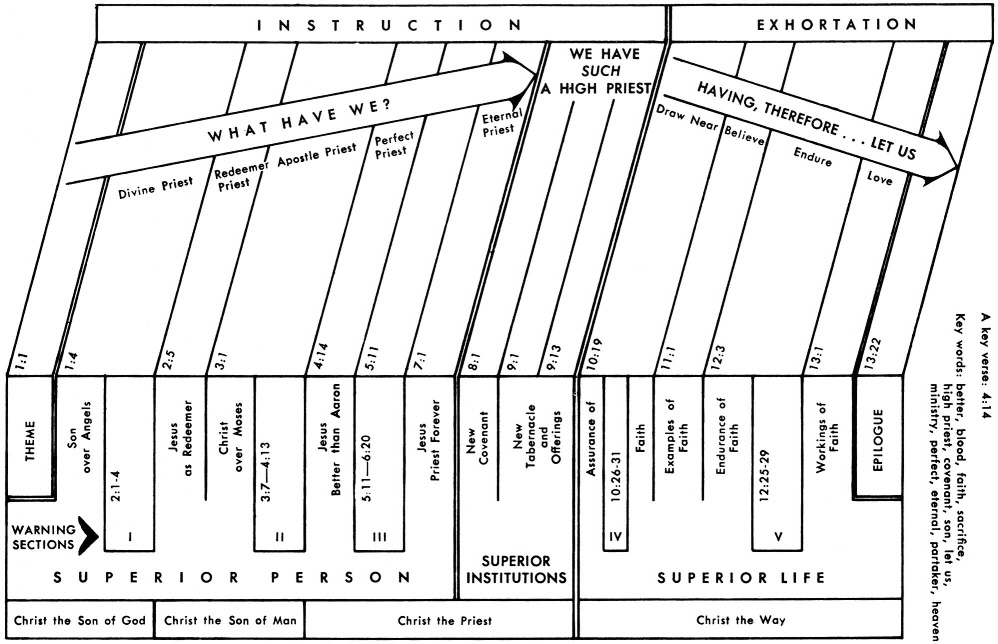
CONSIDER JESUS OUR GREAT HIGH PRIEST
Click chart to enlarge
Charts from Jensen's Survey of the NT - used by permission
Swindoll's Chart, Interesting Pictorial Chart of Hebrews, Another Chart
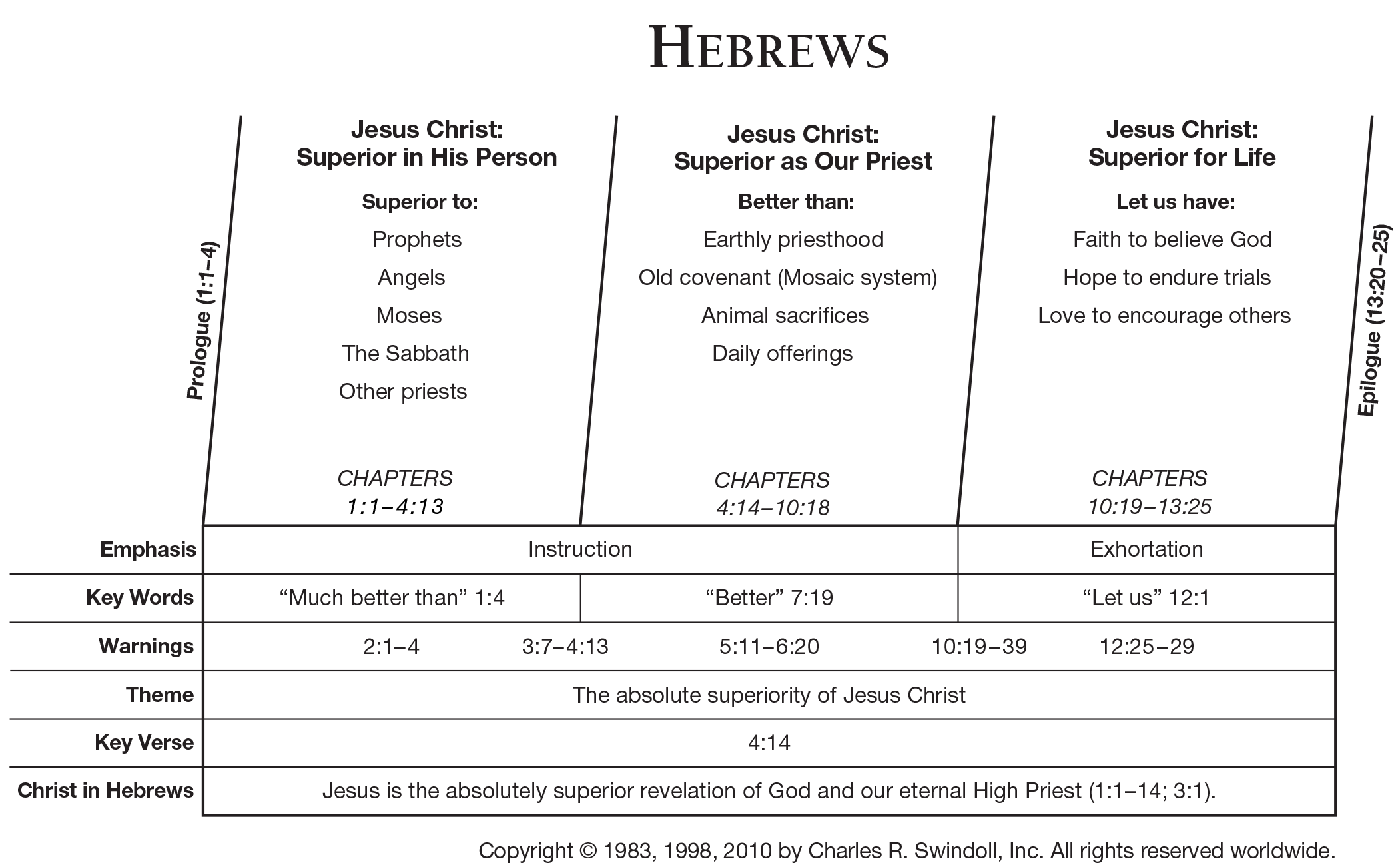

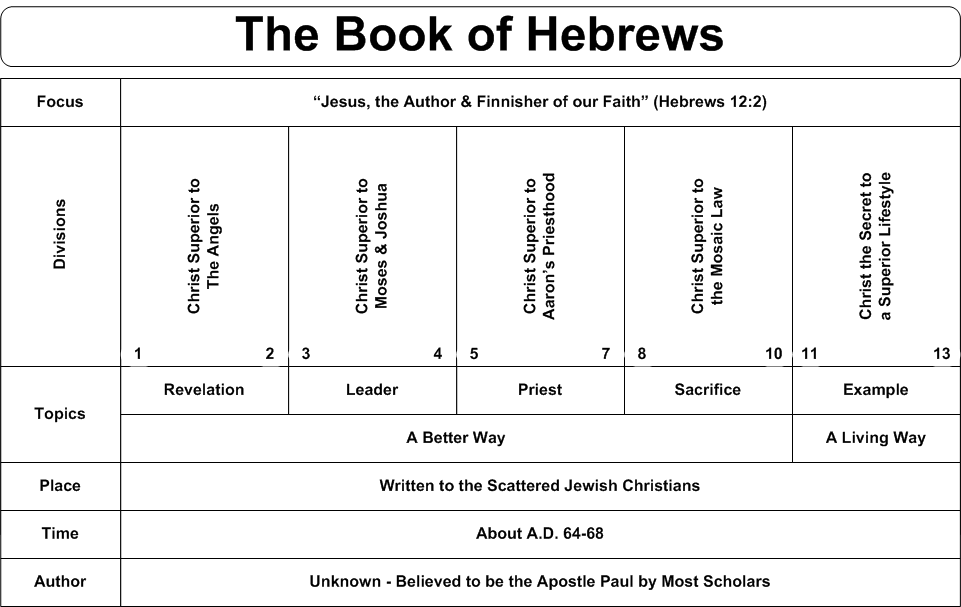
|
The Epistle |
||||
| INSTRUCTION Hebrews 1-10:18 |
EXHORTATION Hebrews 10:19-13:25 |
|||
| Superior Person of Christ Hebrews 1:1-4:13 |
Superior Priest in Christ Hebrews 4:14-10:18 |
Superior Life In Christ Hebrews 10:19-13:25 |
||
| BETTER THAN PERSON Hebrews 1:1-4:13 |
BETTER PRIESTHOOD Heb 4:14-7:28 |
BETTER COVENANT Heb 8:1-13 |
BETTER SACRIFICE Heb 9:1-10:18 |
BETTER LIFE |
| MAJESTY OF CHRIST |
MINISTRY OF CHRIST |
MINISTERS FOR CHRIST |
||
|
DOCTRINE |
DUTY |
|||
|
DATE WRITTEN: |
||||

See ESV Study Bible "Introduction to Hebrews"
(See also MacArthur's Introduction to Hebrews)
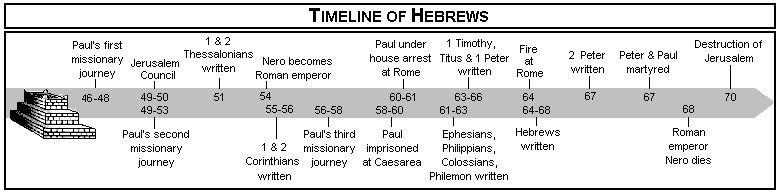
Borrow Ryrie Study Bible
Hebrews 13:22 But I urge you, brethren, bear with this word of exhortation, for I have written to you briefly * (NASB: Lockman)
Greek: Parakalo (1SPAI) de humas, adelphoi, anechesthe (2PPMM) tou logou tes parakleseos, kai gar dia bracheon epesteila (1SAAI) humin.
BGT Παρακαλῶ δὲ ὑμᾶς, ἀδελφοί, ἀνέχεσθε τοῦ λόγου τῆς παρακλήσεως, καὶ γὰρ διὰ βραχέων ἐπέστειλα ὑμῖν.
Amplified: I call on you, brethren, to listen patiently and bear with this message of exhortation and admonition and encouragement, for I have written to you briefly. (Amplified Bible - Lockman)
My Amplified Paraphrase: Now I earnestly urge you, my fellow believers—dear brothers and sisters in Christ—with an open heart to patiently bear with, receive and thoughtfully consider this message of exhortation and encouragement though it may challenge your thinking. Allow this entire letter (both its sharp edges and its gentle assurance)—which is a brief in comparison with the weighty matters it addresses—to take root in your hearts, to strengthen your faith, to comfort your hearts, and remind you of the surpassing greatness of Jesus Christ, our eternal great High Priest.
Barclay: Brothers, I appeal to you to bear with this appeal of mine, for indeed it is but a short letter that I have sent to you. (Westminster John Knox Press)
ESV: I appeal to you, brothers, bear with my word of exhortation, for I have written to you briefly. (ESV)
KJV: And I beseech you, brethren, suffer the word of exhortation: for I have written a letter unto you in few words.
NET: Now I urge you, brothers and sisters, bear with my message of exhortation, for in fact I have written to you briefly. (NET Bible)
NIV: Brothers, I urge you to bear with my word of exhortation, for I have written you only a short letter. (NIV - IBS)
NLT: I urge you, dear brothers and sisters, to pay attention to what I have written in this brief exhortation. (NLT - Tyndale House)
Phillips: All I have said, my brothers, I ask you to accept as though it were an appeal in person, although I have compressed it into a short letter. (Phillips: Touchstone)
Wuest: And I beg of you, please, brethren, patiently be permitting the word of exhortation, for verily I am writing you in few words. (Eerdmans Publishing - used by permission)
Young's Literal: And I entreat you, brethren, suffer the word of the exhortation, for also through few words I have written to you.
- Bear with - Heb 13:1-3,12-16, 2:1, 3:1,12,13 4:1,11, 6:11,12, 10:19-39 Heb 12:1,2,12-16,25-28 2Co 5:20 6:1, 10:1 Philemon 1:8,9
- For - Ga 6:11 1Pe 5:12
Related Passages:
Luke 8:18+ “So take care (be on guard = active, intentional present imperative see our need to depend on the Holy Spirit to obey) how you listen; for whoever has, to him more shall be given; and whoever does not have, even what he thinks he has shall be taken away from him.”
Hebrews 3:13 But encourage (parakaleo - present imperative see our need to depend on the Holy Spirit to obey) one another day after day, as long as it is still called “Today,” so that (hina = term of purpose) none of you will be hardened by the deceitfulness of sin.
Acts 13:15+ After the reading of the Law and the Prophets the synagogue officials sent to them, saying, “Brethren, if you have any word of exhortation for the people, say it.”
AN EXHORTATION ABOUT
THE EXHORTATION!
As the writer nears the end of his letter, almost like a "postscript (P.S.)", he pauses to make one final, heartfelt appeal. After unfolding the grandeur of Christ’s person and work, he now urges his readers—his spiritual family—to receive this entire message with patience and openness. Hebrews is a weighty “word of exhortation,” and he longs for them not merely to hear it but to embrace it for their good and endurance in the faith.
Charles Swindoll summarizes the concluding verses - After his prayer request and benediction of blessing and praise (Heb. 13:18–21), the author wraps up this monumental testimony to the superiority of Christ with three final commands. Here we see the heart of the anonymous writer—his earnest desire for the good of his audience, his concern for his fellow laborers, and his genuine love for the body of Christ. Here, too, we ourselves bid “farewell” to this great unknown author whom, ironically, we have come to know quite well through his inspired and inspiring words. (See Insights on Hebrews - Page 228)
But I urge (parakaleo) you, brethren (adelphos) - The root idea of urge (parakaleo - present tense - continually) is “to call alongside” which pictures a spiritual shepherd stepping beside his readers, speaking not from a distance but from close, personal concern. It is gentle yet firm, a heartfelt entreaty for their spiritual good. The writer is saying "I plead with you…I earnestly encourage you…I come alongside you with this needed exhortation."
Leon Morris - “I urge” (NIV, NASB) may be the right way to translate parakalō; but it seems to mean something more like “I beg you” (TEV, NEB; cf. “I do ask you, brothers, to take these words of advice kindly” [JB]). There is appeal in it, but also encouragement. The letter has had its share of rebukes and stern warnings, and the writer now softens the impact a little with this appeal and with the affectionate address “Brothers.”...So before he finishes, the writer adds this brief section inviting the readers to take it in the right spirit. It would all be much worse if they did not. (Borrow Expositor's Bible Commentary)
The word brethren (adelphos) means brothers and sisters "born of the same womb" reaffirming their kinship as a spiritual family because of their new birth into the family of God (Jn 3:3-7+). Brethren (adelphos) would remind them that he is speaking to them as family to family, which underscores the unity and affection in his exhortation. This mode of a warm, pastoral appeal would have been significant to this group of Hebrews believers, some of whom had been tempted to turn back to Judaism, some of whom were spiritually sluggish (Heb 5:11-12+) and some (or all) who were pressured by persecution. In short, the writer's urging reflects the affection of one who genuinely loves them and aims at nothing other than their spiritual growth and good.
Swindoll adds "These words are not spoken with a scolding finger or a stern scowl. Rather, the author addresses his recipients with the warm embrace of “brothers.” (See Insights on Hebrews - Page 228)
R C H Lenski - “I urge” and this word “of urging” are a paronomasia (a word in different senses or the use of words similar in sound to achieve a specific effect, as humor or a dual meaning;). The writer confesses that he has been urging in his entire letter. (Borrow Hebrews Commentary)
Bear (anechomai) with this word (logos) of exhortation (paraklesis) - Bear (anechomai) is a command present imperative which calls for their need to depend on the Holy Spirit to obey) means to tolerate patiently, to receive without resentment, and to accept even when difficult or weighty, which would have been especially true of the stern warning passages! The readers are to keep on running the race and not be disqualified! (Cf Heb 10:35+, 1Cor 9:27+) The writer is appealing to the Hebrew believers to please be patient to receive and accept what he had written and not push (or brush) the exhortation aside. Word (logos) refers to the content of the entire letter, the whole message of Hebrews, not just the words immediately preceding. Exhortation (paraklesis) is clearly related to urge (parakaleo) which was instruction designed to both warn (some count 6 passages - Heb 2:1–3; Heb 3:7-4:13, Heb 5:11-6:12, Heb 6:4–8; Heb 10:26–31, Heb 12:25-29) and) and encourage, correct and comfort, but always aimed at moving his readers toward faithfulness and perseverance.
Charles Swindoll adds that "The writer’s deep desire is that his fellow brothers and sisters in Christ not merely close the book of Hebrews and check it off their “Read-the-Bible-in-a-Year” list. He wants them to plant its truths deep in their hearts—to “bear with” the teaching. The Greek term for “bear with,” anechomai, is an interesting word choice here. It means to “endure, bear with, put up with,” almost in the sense of tolerating something uncomfortable, frustrating, or irritating (see Mt. 17:17; 2Co 11:1; Col 3:13). The author knows that his letter’s stinging warnings and intricately constructed biblical, theological, and logical arguments don’t make for an easy read. However, he had confidence that his recipients could take it in—not only hearing it but also heeding it, applying what they heard. He even adds a line that indicates he could have written much, much more on the subjects addressed in Hebrews, saying that in this (now) thirteen-chapter treatise he had written only “briefly” (Heb. 13:22). (See Insights on Hebrews - Page 228)
F F Bruce says word of exhortation “a very suitable description for this epistle, which is a homily in written form, with some personal remarks added at the end.” (See The Epistle to the Hebrews - Page 389)
Homer Kent says the "entire epistle which has taken the form of an appeal or exhortation to stand firm in their commitment to Christ, and to sever their ties with Jewish ceremonialism. He wants them to bear with (anechesthe) his message, and not be like those who refused to “bear with” healthful doctrine (2Ti 4:3, same word). Even though an unconvinced reader might think the treatise was long, the author had really written briefly in view of the momentous issues under discussion. (Borrow Hebrews Commentary)
Simon Kistemaker - Actually, he tells the readers to put up with his word of exhortation; or, in less colloquial terms, he is asking them to listen carefully to what he has to say.....Although at first glance his letter may seem to be a doctrinal treatise, the epistle consists of pastoral admonitions that are supported by teachings derived from a sound knowledge of the Old Testament. The conclusion that we draw therefore is that the Epistle to the Hebrews indeed is a word of exhortation written by a dedicated pastor who watches over the spiritual well-being of his people. Besides admonishing them, the pastor also teaches them new truths concerning Jesus Christ. They may have objected to these teachings and perhaps to his exhortations. Therefore he urges them to listen to him as he addresses them in this word of exhortation (compare Acts 13:15). (Borrow Hebrews Commentary)
Philip E Hughes - In insisting on the uniqueness of the Christian gospel and its claims he has spoken plainly of the outmoded character of the levitical system and has sternly warned them of the extreme peril of apostasy from single-minded devotion to Jesus Christ; but his aim all through has been their strengthening and encouragement and his attitude has not been coldly censorious. (See A Commentary on the Epistle to the Hebrews - Page 591)
For (gar) I have written (epistello) to you briefly - For (gar) explains why they should receive his appeal. Please receive this exhortation… because what I have written is only a brief summary, not an unbearable burden (cf Heb 5:11+, Heb 9:5+). Some think the writer is referring just to chapter 13 but that is very unlikely. He is referring to the entire 13 chapters. Written (epistello) refers to an official communication, an earnest admonition or an authoritative instruction.
There was so much more
I could have said!
Grant Osborne - The term translated as “brothers and sisters” (adelphoi) was used in the ancient world to refer to both men and women in religious groups and had come to be a common way of addressing fellow believers in Christian circles. Having used the address sparingly earlier in the book (Heb 3:1, 12; 10:19), the author now closes by exhorting his “brothers and sisters” to “bear with [this] word of exhortation” (Heb 13:22). In referring to Hebrews as a “word of exhortation,” the author gave us one of our best clues on the nature of the book since the same phrase is used in Acts 13:15+, where upon entering a synagogue, the Jewish leaders offer an invitation, saying to Paul and Barnabas, “Brothers, if you have a word of exhortation for the people, please speak” (Acts 13:15+). In response, Paul stood and preached a powerful sermon, in part recounting aspects of Israel’s history, quoting Scripture, and speaking of Jesus as bringing salvation through the forgiveness of sins (Acts 13:16–41+), characteristics also seen in Hebrews. This is one reason many scholars understand Hebrews to be a sermon. Synagogue homilies or sermons often alternated back and forth between exposition and exhortation, as does Hebrews. However, it is clear that the exposition of the book, which wonderfully unpacks a majestic Christology on Jesus’ person and work, serves the purpose at the heart of Hebrews, for the exposition lays the foundation for the exhortation, challenging the hearers to persevere in their commitment to Christ. In urging the hearers to “bear with” the message, which he describes as brief, the author uses common, rhetorical language, a polite way of challenging the listeners to take the message seriously. The claim of brevity, in effect, suggests, “There was so much more I could have said!” (See Hebrews Verse by Verse)
Simon Kistemaker on briefly - A few times in the body of his letter the author shortened his remarks (5:11; 9:5; 11:32) and stated that he lacked time even though he had much to say. The letter itself can easily be read in one sitting; let us say, during a worship service. (Borrow Hebrews Commentary)
Warren Wiersbe on briefly - This seems like a long letter to us, but he felt it was just a “few words.” No doubt some members of the congregation responded negatively to this letter, while others received it and acted on it. Paul (1Th 2:13+) tells us how we should respond to God’s Word. Read the verse carefully—and practice it. (Bible Exposition Commentary)
David Allen on written to you briefly - Louw and Nida (page 595) pointed out the phrase in Greek can be taken in two ways. The first option is to take the phrase literally, “by means of a few words,” and they offer the translation “I have written to you a few words.” A second option is to take the phrase to refer either to the act of sending the letter or the amount of time required to read it. (Louw and Nida page 643) The juxtaposition of “word of exhortation” with “I have written” in this verse indicates that Hebrews is a written sermon. (See Hebrews: An Exegetical and Theological Exposition)
Ray Stedman on briefly quips "all commentaries on Hebrews are much longer than the letter itself!"
Vine - Though the epistle is itself comparatively long, it is short considering the supreme importance of the subject. The writer has indicated, for instance, in He 5:11+ that he had more to say on the subject he was handling. (Collected writings of W. E. Vine)
John MacArthur - Brachus (briefly) means short, or in a few words. The whole letter (under 10,000 words) is shorter than Romans or 1 Corinthians and can be read in less than an hour.
Steven Cole on Your Duties Toward Church Leaders -
You should obey godly leaders by obeying their exhortations from God’s Word. In He 13:22, the author says, “But I urge [lit., exhort“] you, brethren, bear with this word of exhortation, for I have written to you briefly.” Some may think that a 13-chapter letter is not on the brief side, but it can be read aloud in 48 minutes. Given the weighty subject matter, that’s not too bad! Three times the author has indicated that he could say much more, but he restrained himself (He 5:11+; He 9:5+; He 11:32+). (I can identify with that problem!) The word “exhortation” is used of a sermon (Acts 13:15). So even if the sermon runs almost an hour, you should bear with it and seek to obey it!
The word “bear with” is translated “endure” in 2Ti 4:3+. After charging Timothy to “preach the Word,” which includes “re-prove, rebuke, exhort” (2Ti 4:2+), Paul adds,
“For the time will come when they will not endure sound doctrine; but wanting to have their ears tickled, they will accumulate for themselves teachers in accordance to their own desires.”
The reason you must bear with or endure sound doctrine is that it often confronts how you think or live, showing you God’s different way (“reproof,” 2Ti 3:16+; 2Ti 4:2+). Because they want to please people, many pastors shrink from declaring “the whole purpose of God” (Acts 20:27+). They think, “the doctrine of election is too controversial,” so they don’t preach on it, even though it’s in the Bible for our spiritual profit. Or they would dodge our text, which talks about obedience and submission to church leaders, because it might upset too many people. They dodge talking about male leadership in the church and home, because that upsets the feminists. Pretty soon, the Bible becomes a tame book of platitudes that allow everyone to live as they please!
Of course leaders must exhort with patience and gentleness. We must allow people time to wrestle with difficult truth as they grow in Christ. Spiritual maturity, like physical and emotional maturity, takes time. But, on the listening end, if you want to grow in Christ, you must bear with the exhortations of your spiritual leaders. Don’t shrug off things you don’t agree with. Go back to Scripture and see if these things are true. If they are, submit to them as the Word of God, not the word of men (1Th 2:13+).
Fabarez did some research and found
“that most people do not prepare in any significant way for church… In an average church, fewer than half of the worshipers pray for their encounter with the sermon. Less than a third pray for their or his preparation. Even when the passage is clearly announced the previous week, only one in five people will take the time to read it before they come to church” (Michael Fabarez, Preaching that Changes Lives [Thomas Nelson Publishers], p. 153).
If you want to “bear with” the word of exhortation that I bring each week, I would encourage you to pray for your own heart to be receptive to God’s truth. Pray for me as I prepare the message and preach it, that I would be faithful to the text of Scripture. And, spend some time during the week going over the passage itself, meditating on how it applies to your heart.
The effectiveness of my preaching does not just depend
on how well I preach, but also on how well you listen.
Even Jesus, the greatest preacher ever, exhorted His audience, “Take care how you listen” (Luke 8:18+). Your first duty is to obey godly church leaders, and that primarily means obeying the Word of God that they preach. (Your Duties Toward Church Leaders)
Urge (3870) (parakaleo from para = side of, alongside, beside + kaleo = call) means literally to call one alongside, to call someone to oneself, to call for, to summon. Parakaleo can include the idea of giving help or aid but the primary sense in the NT is to urge someone to take some action, especially some ethical course of action. Sometimes the word means convey the idea of comfort, sometimes of exhortation but always at the root there is the idea of enabling a person to meet some difficult situation with confidence and with gallantry. See the following discussion for elaboration on the nuances of this great Greek verb. Parakaleo is seen in other exhortations in Ro 12:1 (exhortation to surrender you whole life to God), Ro 15:30 (exhortation to intercessory partnership), 1Co 1:10 (call to unity), 1Co 4:16 (appeal to follow Paul’s example), 1Co 16:15 (exhortation about honoring spiritual laborers), 2Co 2:8 (plea for restored fellowship), Eph 4:1 (exhortation to live out the Gospel), etc..
PARAKALEO IN HEBREWS - Heb. 3:13; Heb. 10:25; Heb. 13:19; Heb. 13:22
Hebrews 3:13 But encourage one another day after day, as long as it is still called “Today,” so that none of you will be hardened by the deceitfulness of sin.
Hebrews 10:25 not forsaking our own assembling together, as is the habit of some, but encouraging one another; and all the more as you see the day drawing near.
Hebrews 13:19 And I urge you all the more to do this, so that I may be restored to you the sooner.
Hebrews 13:22 But I urge you, brethren, bear with this word of exhortation, for I have written to you briefly.
Urge (Latin urgere = to press, push) which means to press, to push, to drive, to impel, to apply force to, to press the mind or will, to press by motives, arguments, persuasion or importunity.
R. Kent Hughes illustrates the root idea of parakaleo "to come alongside and encourage" with the following example - I see this exemplified every time my church has a roller skating party, and the parents put their little ones on skates for the first time. Mom and Dad skate with their child, holding on to his or her hands, sometimes with the child’s feet on the ground and sometimes in the air. But all the time the parents are alongside encouraging… [exhortation] is a wonderful gift, and we are to place it at Christ’s feet and be willing to be worn out in its use. (Hebrews- An Anchor for the Soul, Volume 2)
Brethren (80) adelphos from adelphós = brother) from a = denotes unity + delphus = a womb) means brother or near kinsman. "Adelphós generally denotes a fellowship of life based on identity of origin, e.g., members of the same family (Mt. 1:2; Lk 3:1, 19; 6:14); members of the same tribe, countrymen, and so forth (Acts 3:22; 7:23; Ro 9:3)." (Zodhiates) Figuratively, adelphos describes members of the Christian community, spiritual brother, fellow Christian, fellow believer (Ro 8.29). Jews used adelphos to describe fellow countrymen (Acts 3:22). One of the same nature, a fellow man was regarded as a brother (Mt. 5:22–24, 47). Adelphós also came to designate a fellowship of love equivalent to or bringing with it a community of life (Matt. 12:50; Mark 3:35; 10:29, 30; Acts 12:17). In this manner Jesus speaks of His brethren (Mt. 25:40; 28:10; John 20:17; Rom. 8:29; Heb. 2:11, 17). The members of the same Christian community are called brothers (Jn 21:23; Acts 9:30; Rom. 16:14; 1 Cor. 7:12).
ADELPHOS IN HEBREWS - Heb. 2:11; Heb. 2:12; Heb. 2:17; Heb. 3:1; Heb. 3:12; Heb. 7:5; Heb. 8:11; Heb. 10:19; Heb. 13:22; Heb. 13:23
Bear (430) (anechomai from aná = in, up + echomai, the middle voice of echo = to have, to hold) means literally to hold one’s self erect, upright and firm against a person or thing. Thus anechomai means to put up with, to bear with (equanimity or evenness of mind especially under stress), to tolerate, to forbear, to be patient with. Examples - Mt. 17:17 (cf Mk 9:19; Lk 9:41) - Jesus asked "How long shall I put up with you?" 2Co 11:1 - Paul wrote "I wish that you would bear with me in a little foolishness" Col 3:13 - Paul instructed the saints to be "bearing with one another, and forgiving each other"
The idea is enduring discomfort or holding out in spite of persecution, threats, injury, indifference, or complaints and not retaliate (esp 1Cor 4:12). It conveys the sense of putting up with others, exercising self-restraint (for believers only possible empowered by the Spirit) and tolerance. In the present context of the entire letter, the readers are called forbear with the implication that there is something in this exhortation that might disturb the recipients!
Anechomai is used in Paul's last known written communication to Timothy in which he charged his young disciple
"Preach (aorist imperative - Do this now! Don't delay! It sometimes even conveys a sense of urgency - same tense and voice for all the following verbs) the word; be ready in season and out of season; reprove, rebuke, exhort, with great patience and instruction. For the time will come when they will not endure (anechomai) sound doctrine; but wanting to have their ears tickled, they will accumulate for themselves teachers in accordance to their own desires 4 and will turn away their ears from the truth and will turn aside to myths. (2Ti 4:2+, 2Ti 4:3-4+)
ANECHOMAI - 14V - Matt. 17:17; Mk. 9:19; Lk. 9:41; Acts 18:14; 1 Co. 4:12; 2 Co. 11:1; 2 Co. 11:4; 2 Co. 11:19; 2 Co. 11:20; Eph. 4:2; Col. 3:13; 2 Thess. 1:4; 2 Tim. 4:3; Heb. 13:22
Exhortation (3874) (paraklesis from pará = side of + kaleo [word study] = call) means literally the calling to one's side and so refers can refer to exhortation, solace, comfort (that which gives strength and hope and which eases the grief or trouble of another) and consolation (that which alleviates grief, sense of loss, or trouble of another). In Acts 13:15 paraklesis ("word of exhortation") is used as the designation for a sermon.
PARAKLESIS IN HEBREWS - Heb. 6:18; Heb. 12:5; Heb. 13:22
Kenneth Wuest notes that paraklesis "has various meanings; “a calling near, a summons, imploration, supplication, entreaty, exhortation, admonition, encouragement, consolation, solace.” The well-rounded all-inclusive idea is that of encouragement, of aid given the needy person, whether it be consolation, exhortation, or supplication. (Hebrews) (Bolding added)
Exhortation is from ex = out + hortari = to urge or incite and means incitement by argument or advice, a strong urging, an urgent appeal, an earnest persuasion, giving strong advisement, animation by arguments to a good deed or laudable conduct or course of action. For a more in depth discussion Click Encouragement
Marvin Vincent on paraklesis - "Consolation (paraklesis). From para, to the side of, and kaleo, to call or summon. Literally, a calling to one’s side to help; and therefore entreaty, passing on into the sense of exhortation, and thence into that of consolatory exhortation; and so coming round to mean that which one is summoned to give to a suppliant — consolation. Thus it embodies the call for help, and the response to the call. Its use corresponds with that of the kindred verb parakaleo, to exhort or console." (Vincent, M. R. Word studies in the New Testament: Vol. 1, Page 3-313)
Written (1989) epistello (epi - upon + stello - arrange, prepare, gather up, hence to restrain) inform or instruct by letter, write. as transmitting a message or direction by letter or messenger Ac 15:20; 21:25; Heb 13:22. Epistolē and epistellōboth have an official and authoritative connotation. They are moulded throughout by the kerygma and Paul’s apostolic office. Hence, they are all public, official letters; they were designed to be read in church services and to be passed on (1 Thess. 5:27). But Philemon is probably an exception to this rule. The few instances of the verb (Ac. 15:20; 21:25; Heb. 13:22) bring out very clearly the authoritative and almost official nature of the primitive Christian epistle.
Gilbrant - In classical Greek this word is used to mean “to send or announce a message, direction, or administrative order.” It can refer to a command given by word of mouth, but usually it refers to something that is written. Thus the noun derivation epistolē (1976), “epistle,” is “that which is transmitted by the messenger,” i.e., the “letter” itself (Rengstorf, “epistellō,” Kittel, 7:593f.). This verb is used in a similar way in the Septuagint and other Jewish writings. Epistellein is the Greek translation of the Hebrew shālah which means “to send” a message orally or in written form (2Ki 5:8; Nehemiah 6:19). Lacquer has demonstrated from the letters of emperors and magistrates of this period that epistellō “always meant write rather than send” (Moulton-Milligan). In the New Testament epistellō means “to send a communication, to inform, or instruct by letter.” The writer of Hebrews said, “For I have written a letter unto you in a few words” (Hebrews 13:22). In another occurrence of this word the resolution of the Jerusalem Council was to write and inform the Gentile Christians of its decision together with its instructions (Acts 15:20). Rengstorf has concluded that “the few instances of the verb (in the New Testament) . . . bring out clearly the authoritative and almost official nature of the primitive Christian epistle” (“epistellō,” Kittel, 7:593) (Complete Biblical Library)
NIDNTT on epistello - send, announce, order through the passing on of a message or commission, generally in writing. Hence, that which is transmitted, originally a military or administrative order, is called epistolē, i.e. normally a letter. With the spread of Hel. culture a whole range of letters was developed, from private letters of an intimate nature, open letters (e.g. the didactic letters of the Epicurean philosophers), to artistic epistles, which were aesthetic treatises in letter form. Travelling philosophers and their pupils were accustomed to carry letters of recommendation (Diog. Laert., 7, 1, 3; 7, 8, 87).
Briefly 1024 brachús means short, little: of distance Ac 27:28; of time Lk 22:58; Ac 5:34; Heb 2:7, 9; of quantity Jn 6:7. dia. b) in a few words Heb 13:22; 1Pe 5:12. Friberg - short, little; (1) of time brief, short (Lk 22.58); neuter singular as an adverb for a short time, briefly (Act 5.34; possibly Heb 2.7); (2) of space little, neuter singular as an adverb short distance (Acts 27.28); (3) of degree or quantity little, few; substantivally small amount (Jn 6.7); neuter singular as an adverb by little (degree), in a small amount (probably Heb 2.7 as Ps8.5 Septuagint) (Borrow Analytical Lexicon of the Greek New Testament)
BRACHUS - 7V - briefly*(1), little(3), little while(2), short time(1). Lk. 22:58; Jn. 6:7; Acts 5:34; Acts 27:28; Heb. 2:7; Heb. 2:9; Heb. 13:22
Gilbrant - The classical meaning of brachus is primarily “short, small, or few.” The classical use shows that brachus was used in reference to five different ideas: namely, space and time (for example, “in a short time”); size (as in “a low wall” or “a small mouth”); quantity or number (“a few words”); value or importance (“petty, trifling, or small”); and short, as a short vowel or syllable (Liddell-Scott). This classical use is similar to the English use of words such as little. For example, in reference to time: “a little while,” or size: “a little boy,” and quantity: “a little bit of sugar.”
The Septuagint uses brachus primarily to translate the Hebrew word mᵉ‛aṯ, “little, short, or few.” Use of the Hebrew word mᵉ‛aṯ is similar to the classical use of brachus in that it is also used in reference to time (Ruth 2:7), distance (2 Samuel 16:1 [LXX 2 Kings 16:1]), quantity (Genesis 24:17; Ecclesiastes 5:2), and value (Exodus 18:22, “every small matter,” that is, a trifling, petty, insignificant matter).
The New Testament definition of brachus is similar to both the classical and the Septuagint, “short, little, few.” Likewise, the New Testament uses brachus in reference to distance (Acts 27:28), quantity (John 6:7; Hebrews 13:22), and time (Luke 22:58; Acts 5:34; Hebrews 2:7,9). (Complete Biblical Library)
Moulton - The intrans. use of this verb, which alone is found in the NT, may be illustrated from P Oxy I. 11837 (late iii/A.D.) ἐπὶ οὖν βραδύνουσι, “since they are delaying,” and OGIS 51553 (A.D. 209–11) καὶ διὰ τοῦτο καὶ ἡ εὐ[πορία ἡ πρὸς τοὺς κυρίους αὐ]τοκράτορας τῶν φόρων βραδύνει. So in a papyrus of the second half of ii/A.D., edited by Comparetti in Mél. Nicole, p. 59 (col. ii.11) ὡς ἂν βραδύνῃς καὶ ὑστερήσῃ ταῦτα τὰ [κτήνη] τῆς πορείας, οὐκ ἀγνοεῖς οὐδʼ αὐτὸς ζημίᾳ σε ὑποπ[είπτειν μέλ]λοντα, “if you delay, and these animals are late for the expedition, you yourself know you will get into trouble.” (The document is given again in P Flor II. p. 258.) In the Christian letter, P Gen I. 5131, ἐβράδυνεν is without clear context, but certainly means “he delayed.” In MGr βραδυάζει or βραδύνει = “it is late,” “evening draws on.”
John MacArthur - BEARING WITH AN EXHORTATION Drawing Near: Daily Readings for a Deeper Faith
“I urge you, brethren, bear with this word of exhortation” (Heb. 13:22).
✧✧✧
Invitations to salvation must provide
both exhortation and warning.
Hell is undoubtedly full of people who did not actively oppose Jesus Christ but simply drifted into damnation by neglecting to respond to the gospel. These are the kinds of people the writer challenges in Hebrews 2:1–4. They were aware of the good news of salvation in Jesus Christ, but they weren’t willing to commit their lives to Him. As a result, they were drifting past the call of God into eternal disaster.
The Word of God always
demands a response.
The Word of God always demands a response. Any effective teacher of it must do more than just dispense facts; he must warn, exhort, and extend an invitation. He may have impressive knowledge of the truth, but if he doesn’t have a passionate concern for how people react to it, he is not a worthy representative of Jesus Christ.
Jesus had that kind of compassion. Despite the rejection of His own people, He ached for their salvation: “O Jerusalem, Jerusalem, who kills the prophets and stones those who are sent to her! How often I wanted to gather your children together, the way a hen gathers her chicks under her wings, and you were unwilling” (Matt. 23:37). You can feel His heart go out to the people.
Paul had similar compassion: “I have great sorrow and unceasing grief in my heart. For I could wish that I myself were accursed, separated from Christ for the sake of My brethren, my kinsmen according to the flesh” (Rom. 9:2–3). A true teacher is interested in more than just academics; he is concerned that people respond rightly to what is taught.
Just as the writer of Hebrews had to warn and exhort his readers, at times it becomes necessary for us to warn those to whom we are witnessing. If you want to see unbelieving friends, relatives, or associates come to Christ, warn them. Let them see the passion in your heart and your love for them. Please don’t allow anyone to slip into eternal destruction without being warned sufficiently.
✧✧✧
Suggestions for Prayer: Ask God to give you wisdom regarding when to warn the people to whom you are witnessing.
For Further Study: Read Hebrews 3:7–4:13, 6:4–8, 10:26–31, and 12:25–29, noting the pattern the writer followed in presenting these other warnings.
Hebrews 13:23 Take notice that our brother Timothy has been released, with whom, if he comes soon, I will see you. (NASB: Lockman)
Greek: Ginoskete (2PPAM) ton adelphon hemon Timotheon apolelumenon, (RPPMSA) meth' ou ean tachion erchetai (3SPMS) opsomai (1SFMI) humas
Amplified: Notice that our brother Timothy has been released [from prison]. If he comes here soon, I will see you along with him. (Amplified Bible - Lockman)
My Amplified Paraphrase: Know this: our beloved brother Timothy has now been set free, and if he is able to come quickly, I fully expect to visit you alongside him.”
Barclay: I would have you know that our brother Timothy is at liberty again. If he comes soon I will see you along with him. (Westminster John Knox Press)
ESV: You should know that our brother Timothy has been released, with whom I shall see you if he comes soon. (ESV)
KJV: Know ye that our brother Timothy is set at liberty; with whom, if he come shortly, I will see you.
NET: You should know that our brother Timothy has been released. If he comes soon, he will be with me when I see you. (NET Bible)
NIV: I want you to know that our brother Timothy has been released. If he arrives soon, I will come with him to see you. (NIV - IBS)
NLT: I want you to know that our brother Timothy has been released from jail. If he comes here soon, I will bring him with me to see you. (NLT - Tyndale House)
Phillips: You will be glad to know that brother Timothy. If he comes here soon, he and I will perhaps visit you together. (Phillips: Touchstone)
Wuest: Know that our brother Timothy has been released, with whom, if he come quickly, I will see you. (Eerdmans Publishing - used by permission)
YLT: Know ye that the brother Timotheus is released, with whom, if he may come more shortly, I will see you.
- brother: Ac 16:1-3 1Th 3:2 Philemon 1:1
- Released - 1Ti 6:12 2Ti 1:8 Rev 7:14
- I shall: Ro 15:25,28 Philemon 1:22
Related Passages:
1 Timothy 1:2+ To Timothy, my true child in the faith: Grace, mercy and peace from God the Father and Christ Jesus our Lord.
Take notice (ginosko - present imperative) generally involves experiential knowledge, not merely the accumulation of known facts and is given in the form of a command. The NEB, “I have news for you,” (Phillips - "You will be glad to know") gives a better sense of what the writer is trying to convey. The writer is however calling the readers’ attention to an important piece of information intended to encourage them. He is saying “Make sure you know this.” “Pay attention to what I’m about to tell you.” “Hold this fact firmly in mind.” This is something worth knowing because it will comfort and steady you. The writer is essentially saying “I want you to be aware of this encouraging news—don’t miss it; take it to heart.”
Leon Morris on mood of verb ginosko- I want you to know” renders the word ginōskete, which could be either indicative, “you know,” or imperative, “Know!” On the whole it seems more likely to be the latter (as implied by “I want you to know”), for the writer is evidently giving some new information, whereas the indicative would mean that he was repeating something they already knew (why would he do so?). (Borrow Expositor's Bible Commentary)
Simon Kistemaker on Timothy - In early Christian literature, only the coworker of Paul bears the name Timothy. A few times Paul calls Timothy “our brother” (2 Cor. 1:1; Col. 1:1; 1 Thess. 3:2; Philem. 1). He invites Timothy, a native of Lystra, to accompany him on his second missionary journey (Acts 16:1–3). Timothy traveled widely, helped Paul in writing letters (for example, II Corinthians), served as Paul’s good will ambassador to Corinth, and was the pastor of the church at Ephesus. In short, Timothy was well known. Timothy had been in Rome during Paul’s first imprisonment (Phil. 1:1; Col. 1:1; Philem. 1). From Rome Paul wrote the so-called prison Epistles (Ephesians, Philemon, Colossians, and Philippians). During Paul’s second imprisonment at Rome, he urged Timothy to come to him quickly (2 Tim. 4:9). (Borrow Hebrews Commentary)
That our brother (adelphos) Timothy has been released (apoluo - perfect tense), with whom, if he comes (erchomai) soon (tachus), I will see (horao) you. - Our describes their shared bond in the family of God and the work of Christ. Brother identifies Timothy (who most agree writers [but not all] is the same as in 1Ti 1:2, etc) as a member of God’s household (Eph 2:19), affirms their shared redemption through Christ’s blood and acknowledges their shared mission, suffering, and service. Timothy had been imprisoned at some point but we do not know why or for how long. The upshot is that "Someone you love, trust, and identify with—someone who has suffered for the gospel just as you are—has been delivered by God. Take comfort in this.”
It is worth noting that Paul had given his young disciple fair warning of the possibility of imprisonment when he commanded Timothy
"Suffer hardship with me (sugkakopatheo - aorist imperative see our need to depend on the Holy Spirit to obey), as a good soldier of Christ Jesus." (2Ti 2:3+, cf Paul's warning in 2Ti 4:15+) And in the same letter Paul said that for the gospel "I suffer hardship (kakopatheo) even to imprisonment as a criminal; but the word of God is not imprisoned." (2Ti 2:9+). And then Paul followed up saying "you (Timothy) followed my teaching...persecutions, and sufferings." (2Ti 3:10-11+)
So clearly Timothy's imprisonment did not come as a surprise to this disciple, for his spiritual father Paul had forewarned him and had himself endured the hardship of prison.
Has been released (apoluo) in the perfect tense signifies Timothy had been released at some point in the past and the effects of his release continue into the present. In short, Timothy remains free and able to travel. Released (apoluo) is also in the passive voice which indicates the action of his release was carried out by an external agent. I would submit there are two agents in this case. Clearly there was a human agent who had effect Timothy's release (unlock his cell, etc) but the New Testament regularly shows God as the One Who opens prisons and removes restraints (Acts 5:19; Acts 12:7–11). In the passages described above Paul mentions the persecutions he endured, then declaring that "out of them all the Lord delivered (rhuomai) me!" (2Ti 3:11+).
The writer obviously had communication with Timothy in prison and with word of his release was making plans to travel with him to visit the Hebrew readers of his letter. And clearly, the news of Timothy's release and their visit would lift the spirits of these saints who also were suffering, some even in prison (Heb 10:34+). Here we see God’s providential care of His children when faced with suffering and imprisonment, which recalls Hebrews 13:5+ that "He Himself has said, “I WILL NEVER DESERT YOU, NOR WILL I EVER FORSAKE YOU." Are you suffering beloved? Do you believe Hebrews 13:5+?
David Guzik - These final words give us a few tantalizing hints of the writer’s identity. But these words only tell us that the writer knew Timothy, and that he planned to visit his readers soon. It also tells us that his readers were based in Italy (Those from Italy greet you), probably in the city of Rome.
Swindoll comments "The implication is that, just as the author had kept tabs on the whereabouts and condition of his friend and fellow worker Timothy, his audience is encouraged to do the same. They should keep up with ministry partners and missionaries, as well as the circumstances and situations even of those outside their own fellowship. This command is meant to draw the attention of the Hebrew believers from the narrow confines of their community and its struggles to a broader awareness of the tragedies and triumphs of Christians in the world around them." (See Insights on Hebrews - Page 229)
Released (630)(apoluo) from apó = marker of dissociation, implying a rupture from a former association, separation + luo = loose) is used often of sending a person or a group away from someone (Mt 14:15, 22, 23, 32, etc). and here of course has the sense of to let loose from or to release from under arrest or from another's custody. This is the only use in Hebrews.
Gilbrant - Classical writers employed apoluō in a variety of ways. It denotes the action of “freeing” or “redeeming” a prisoner or slave. One could be “released” from legal obligations or “acquitted” of a crime. Exemption from military service was also depicted with apoluō, as was the divorce of a spouse. Many of these meanings are duplicated in the New Testament.
The translators of the Septuagint relied upon apoluō to translate four Hebrew terms, but the correspondence is less than precise, since there are only four clear-cut examples of apoluō as an equivalent to the Hebrew (e.g., Genesis 15:2; Exodus 33:11; Numbers 20:29; Psalm 34 [LXX 33], title). The remainder of the instances are either unclear or are in apocryphal material (e.g., 1 Maccabees 3:32).
New Testament usage is for the most part patterned after classical use. The occurrences are restricted to the Gospels and Acts except for one instance in Hebrews (13:23). The word apoluō dominates as a figure for “divorce” (e.g., Matthew 19:3, 7–9; Mark 10:2, 4, 11, 12) and for the “release” of prisoners or slaves (e.g., Mark 15:6, 9, 11, 15; [cf. parallels] John 18:39; 19:10; Acts 3:13; 4:21; 5:40, etc.). It carries the sense of “to dismiss” in a number of cases (e.g., Matthew 14:15, 22; cf. 15:23, 32). The sense of apoluō in Matthew 18:27 in the Parable of the Unmerciful Servant is nothing more than the “release” of a servant and should not be pressed into theological significance, although the “forgiving of the debt” could be applied spiritually.
A sense of “freeing” is contained in the account of the woman with a “sickness caused by a spirit” (Luke 13:11, NASB) who was healed by Jesus. The imagery behind this freeing act may be that the woman signified a captive “released” by Jesus. Although the verbal correspondence is not present, the thought is certainly paralleled by Luke 4:18 (Isaiah 61:1f.): kēruxai aichmalōtois aphesin (“to proclaim release to the captives”). This is a vital description of Jesus’ ministry according to Luke.
Euphemistically apoluō occurs in Simeon’s request in Luke 2:29: “Now Lord, Thou dost let Thy bond-servant depart (apoluō) in peace” (NASB). Behind this image is a reference to Simeon’s contentment to die since he had seen the Lord’s salvation (Lk 2:30). (Complete Biblical Library)
Hebrews 13:24 Greet all of your leaders and all the saints. Those from Italy greet you (NASB: Lockman)
Greek: Aspasasthe (2PAAM) pantas tous egoumenous (PMPMPA) umon kai pantas tous agious. aspazontai (3PPMI) umas oi apo tes Italias
BGT Ἀσπάσασθε πάντας τοὺς ἡγουμένους ὑμῶν καὶ πάντας τοὺς ἁγίους. Ἀσπάζονται ὑμᾶς οἱ ἀπὸ τῆς Ἰταλίας.
Amplified: Give our greetings to all of your spiritual leaders and to all of the saints (God’s consecrated believers). The Italian Christians send you their greetings [also]. (Amplified Bible - Lockman)
My Amplified Paraphrase: Extend warm greetings—expressing genuine affection, respect, and unity—to all your leaders, those who charged by God to faithfully guide and guard your souls, and greet all the saints, your fellow believers, holy ones set apart for God's purpose and calling. The brothers from Italy who are here with me send their greetings to you as well, joining their hearts with mine in expressing love, solidarity, and encouragement in Christ.”
Barclay: Greet all your leaders and all God’s dedicated people. The folk from Italy send you their greetings. (Westminster John Knox Press)
ESV: Greet all your leaders and all the saints. Those who come from Italy send you greetings. (ESV)
KJV: Salute all them that have the rule over you, and all the saints. They of Italy salute you.
NET: Greetings to all your leaders and all the saints. Those from Italy send you greetings. (NET Bible)
NIV: Greet all your leaders and all God's people. Those from Italy send you their greetings. (NIV - IBS)
NLT: Greet all your leaders and all the believers there. The believers from Italy send you their greetings. (NLT - Tyndale House)
Phillips: Greetings to all your leaders and all your church members. The Christians of Italy send their greetings. (Phillips: Touchstone)
Wuest: Greet all those who have the rule over you, and all the saints. There greet you those from Italy. (Eerdmans Publishing - used by permission)
YLT: Salute all those leading you, and all the saints; salute you doth those from Italy
- Greet: Ro 16:1-16
Related Passages:
Hebrews 13:7 Remember those who led you, who spoke the word of God to you; and considering the result of their conduct, imitate their faith.
Hebrews 13:17 Obey your leaders and submit to them, for they keep watch over your souls as those who will give an account. Let them do this with joy and not with grief, for this would be unprofitable for you.
MEET AND GREET
Greet (aspazomai - engage in hospitable recognition of) all (not just your "favorites") of your leaders (hegomai) and all the saints (hagios) - Greet is aorist imperative a command to carry this out effectively. Be sure to greet them! This is the third time in this last chapter the author draws attention to leaders. (Heb 13:7, 17). This is the only writing in the NT which ends with a greeting to the leaders. All of your leaders could be taken as support for a plurality of elders, but that is not definitive, as these could be several leaders in different house churches. "If he had said, “Greet all your leaders and people,” he would have given the impression that the letter was addressed to one particular church." (Kistemaker)
Swindoll - This illustrates the nature of early Christian fellowship. It extended beyond the “nuclear family” of a local church (leaders and saints) to include “extended family” of other congregations spread throughout the world. They embraced each other as brothers and sisters in Christ, encouraged one another, supported one another, and prayed for one another—locally and universally. It’s interesting to remember that the two groups greeting one another weren’t all members of the same organized denomination or under the hierarchy of some global ecclesiastical structure. Those kinds of forced institutional relationships wouldn’t become dominant for a couple of centuries. No, these mutual, intimate greetings between far-flung members of the family of God were genuine, sincere, and more real than any that man-made associations could enforce. (See Insights on Hebrews - Page 230)
Leon Morris makes an interesting observation on leaders - That they are to be greeted by the recipients of the letter makes it clear that the “leaders” were not the recipients and, furthermore, that the letter was not sent to the whole church. That greetings were to be sent shows that the recipients were on good terms with the leaders. (Borrow Expositor's Bible Commentary)
Those from Italy greet (aspazomai) you - Note it is not those "in" Italy but "from" Italy, so this is not evidence he was writing from Italy. These saints could have come to wherever he was writing from. E.g., RSV renders it "those from Italy." The preposition from (apo) would support this for it means "away from" and is a marker of dissociation, implying a rupture from a former association. By deduction then this would support that the author is writing to Hebrews who are in Italy (not in Jerusalem).
S Lewis Johnson - The term “saints” refers to the believer’s standing, rather than to his state, because all believers are saints. It refers to his position, or our position as justified, rather than to our progress as sanctified individuals. Every believer is a saint. Of course, every believer ought to be saintly. Not every believer, at every point of his live, is saintly, but we who are saints, ought to live saintly. Matthew Henry said all Christians must be saints, and if they come not under that character on earth, they will never be saints in glory. Mr. Henry was trying to make a point that if we are true believers in Jesus Christ, it will be manifested down here on earth that we are saints. And if it’s not manifested down here on earth that we are saints, then we cannot expect to become saints when we get to heaven. (Ephesians 1:1-4 The Work of the Father)
David Allen - Making use of Thesaurus Linguae Graecae, Mosser searched all uses of the Greek hoi apo, “those from,” up through the seventh century AD. He discovered, with respect to letters, that “the tendency is for authors who identify themselves as ‘from’ a place to be in that place at the time of composition.”19 This has significant ramifications for Heb 13:24 and the Roman destination theory. (See Hebrews - Page 632)
Greet (782) (aspazomai from a + spao = draw out as a sword, pull, breathe) means to enfold in arms, welcome, embrace. It is spoken of those who meet or separate. This is often one final expression in Paul's epistles (another reason some think he may be the author of Hebrews). Aspazomai is constantly used in the papyri for conveying the greetings at the end of a letter.
Aspazomai - 59x in 47v - acclaim(1), give… your greeting(1), greet(41), greeted(3), greeting(1), greets(5), paid their respects to(1), sends… greetings(4), taken… leave(1), welcomed(1). Matt 5:47; 10:12; Mark 9:15; 15:18; Luke 1:40; 10:4; Acts 18:22; 20:1; 21:7, 19; 25:13; Rom 16:3, 5ff, 21ff; 1 Cor 16:19f; 2 Cor 13:12; Phil 4:21f; Col 4:10, 12, 14f; 1Th 5:26; 2Ti 4:19, 21; Titus 3:15; Phile 1:23; Heb 11:13; 13:24; 1 Pet 5:13f; 2 John 1:13; 3 John 1:15.
Leaders (2233) (hegeomai from ago = to lead, carry, bring) has two basic meanings in the NT. One is to lead as one would do in a supervisory capacity as when describing men in any leading position - ruler, leader, governor (Ac 7:10) and stands opposite of a diakonos or servant in (Lk 22:26). In the apocryphal writings hegeomai was used of military commanders. It was also used to describe leaders of religious bodies, both pagan and Christian (Heb 13:7, 17, 24, "leading men" in Acts 15:22, "chief speaker" in Acts 14:12).
HEGEOMAI IN HEBREWS -Heb. 10:29; Heb. 11:11; Heb. 11:26; Heb. 13:7; Heb. 13:17; Heb. 13:24
Saints (40) (hagios) refers to those set apart for a specific purpose. In ancient Greek use, hagios originally was a cultic concept, describing the quality possessed by things and persons that could approach a divinity. Christians are saints, not in the sense that they are very pious, but because of the new relationship they have been brought into by God. It is not because of their own doing or good works but on account of what Christ has done. They are set apart for Him and His service. In Hebrews there are 17 uses of hagios, but only Heb 6:10 and Heb 13:24 refer to saints. Other uses refer to the Holy Spirit and the holy place in the tabernacle.
HAGIOS IN HEBREWS - Heb. 2:4; Heb. 3:1; Heb. 3:7; Heb. 6:4; Heb. 6:10; Heb. 8:2; Heb. 9:1; Heb. 9:2; Heb. 9:3; Heb. 9:8; Heb. 9:12; Heb. 9:24; Heb. 9:25; Heb. 10:15; Heb. 10:19; Heb. 13:11; Heb. 13:24;
Hebrews 13:25 Grace be with you all (NASB: Lockman)
Greek: e charis meta panton humon
Amplified: Grace (God’s favor and spiritual blessing) be with you all. Amen (so be it). (Amplified Bible - Lockman)
Barclay: Grace be with you all. Amen. (Westminster John Knox Press)
ESV: Grace be with all of you. (ESV)
KJV: Grace be with you all. Amen.
NET: Grace be with you all. (NET Bible)
NIV: Grace be with you all. (NIV - IBS)
NLT: May God's grace be with you all. (NLT - Tyndale House)
Phillips: Grace be with you all (Phillips: Touchstone)
Wuest: Grace be with you all. (Eerdmans Publishing - used by permission)
YLT: the grace is with you all! Amen.
Related Passages:
Titus 3:15+ (IDENTICAL ENDING) All who are with me greet you. Greet those who love us in the faith. Grace be with you all.
2 Timothy 4:22+ The Lord be with your spirit. Grace be with you.
RUN THE RACE
WITH GRACE
Grace (charis) be with you all - What a great way to end our "race of grace" with a grace-full prayer. To God be all the glory. Amen. This grace would be poured out abundantly on them by the Spirit of grace (Hebrews 10:29, cf Titus 3:6). Note that the writer's use of ALL shows he is not showing partiality or playing favorites but bestowing this blessing of grace on all the saints. He surely knows they (and we) ALL need God's amazing grace to persevere to the end of this earthly race!
With you (meta) is literally in your midst, among you, implying accompaniment (Indeed, grace is an excellent [necessary] companion for the Christian wayfarer in this dark and dying world!)
David Guzik notes that grace marks a "fitting end for a book that documents the passing of the Old Covenant and the institution of the New Covenant. Grace be with you all indeed, under what God has given through the superior Savior, Jesus Christ! Amen!
Leon Morris on grace - The NT letters normally end with a prayer for grace for the recipients. Grace is a fitting note on which to end a letter like this one, so full of what God has done for people in Christ. (Borrow Expositor's Bible Commentary)
Homer Kent on grace - The definite article ("the") with grace particularizes the reference as denoting the grace of God given to men in Christ. It was this grace which really covered all that the writer was trying to say. When the readers came to appreciate fully what matchless grace had been provided in Christ, the attractions of types and shadows would fade away. Let us hope that the epistle succeeded with its first readers. And let us make certain that its purpose has been accomplished in us. (Borrow Hebrews Commentary)
David Allen says grace is "that pregnant New Testament word that encapsulates all that God has done for us through Christ in bringing about our salvation. (See Hebrews - Page 632)
Simon Kistemaker reminds us that Paul frequently ends with grace writing " either “the grace of the Lord Jesus [Christ] be with you [all]” (Rom. 16:24; 1 Cor. 16:23; 2 Cor. 13:14; 1 Thess. 5:28; 2 Thess. 3:18) or “the grace of our Lord Jesus Christ be with your spirit” (Gal. 6:18; Phil. 4:23; Philem. 25), or “grace be with you [all]” (Col. 4:18; 1 Tim. 6:21; 2 Tim. 4:22; Titus 3:15)." (Borrow Hebrews Commentary)
Philip E Hughes on grace - Spicq, “is a stream of living water flowing through the desert, a power which enables us to withstand every adversity and to reach the promised land, the place of our rest, the heavenly Jerusalem.” The source of this grace is the throne of grace where divine assistance is ever available to us in the hour of necessity (Heb. 4:16) and strength to enable us to overcome every assault of the enemy and to persevere to the end (Heb. 13:9; cf. 2 Cor. 12:9f.). (A Commentary on the Epistle to the Hebrews)
Vine adds that "grace here is the divine favor manifested in blessing at all times and in all experiences. (Collected writings of W. E. Vine)
Warren Wiersbe closes this great epistle writing "These personal references at the end of the letter raise questions that we cannot answer now. But the total impact of Hebrews answers the important question, “How can I stand firm in a world that is shaking all around me?” (cf Heb 12:28+) The answer: know the superior Person, Jesus Christ; trust His superior priesthood; and live by the superior principle of faith. Build your life on the things of heaven that will never shake. Be confident! Jesus Christ saves to the uttermost! (Heb 7:25KJV+) (Bible Exposition Commentary)
Ray Stedman offers his sage closing summation - This letter was written at a time when the winds of change were blowing strongly throughout the Roman Empire, and most strongly with in Judaism. At such times humans tend to cling to familiar patterns and resist change simply because it is unfamiliar and therefore threatening. But their real need is for recognition of the things which cannot change and receptivity toward the things which must be changed. Bruce well states the case: “Every fresh movement of the Spirit of God tends to become stereotyped in the next generation, and what we have heard with our ears, what our fathers have told us, becomes a tenacious tradition encroaching on the allegiance which ought to be accorded only to the living and active word of God” (1964:416). The epistle to the Hebrews magnificently links the things which cannot be shaken with the fresh sweep of the Spirit in carrying forward the purposes of God as history moves toward its predicted consummation. It is a document greatly needed as the world lurches toward judgment and a new creation, based on the new covenant, gradually emerges from the crashing chaos of human events. Let us be grateful for its wise and careful teaching and obedient to its passionate concern for a constantly maturing faith. (Closing Words)
Grace (5485) (charis from from chairo = to rejoice. English = charity. Beggars need "charity" even as sinners need grace, for we are all spiritual paupers outside of Christ, but "God gives where he finds empty hands"-Augustine [cp Mt 5:3+]) is a word which defies a simple definition but at its core conveys the sense of favor while the specific nuances of charis depend on the context in which it is used.
Someone has written that the word grace is probably the greatest word in the Scriptures, even greater even than “love,” because grace is love in action, and therefore includes it. It is hardly too much to say that God has in no word uttered Himself and all that was in His heart more distinctly than in this word grace (charis)!
The English word grace is from the Latin gratia meaning favor, charm or thanks. Gratia in turn is derived from gratus meaning free, ready, quick, willing, prompt. Webster defines grace as the "unmerited love and favor of God which is the spring and source of all benefits men receive from Him, including especially His assistance given man for his regeneration or sanctification. (Grace is) a virtue from God influencing man, renewing his heart and restraining him from sin. (Compare this more "modern Webster" with Noah Webster's original definition of grace)
John Eadie in his commentary on Ephesians writes that grace (charis) is "that goodwill on God's part which not only provides and applies salvation, but blesses, cheers, and assists believers. As a wish expressed for the Ephesian church, it does not denote mercy in its general aspect, but that many-sided favour that comes in the form of hope to saints in despondency, of joy to them in sorrow, of patience to them in suffering, of victory to them under assault, and of final triumph to them in the hour of death. And so the (writer of Hebrews) calls it grace in order to well-timed assistance. (He 4:16+) (A Commentary on the Greek text - Page 6)
The grace of God is described as…