Hebrews 2:2
Hebrews 2:3
Hebrews
Hebrews 2:5
Hebrews 2:6
Hebrews 2:7
Hebrews 2:8
Hebrews 2:9
Hebrews 2:10
Hebrews 2:11
Hebrews 2:12
Hebrews 2:13
Hebrews 2:14
Hebrews 2:15
Hebrews 2:16
Hebrews 2:17
Hebrews 2:18
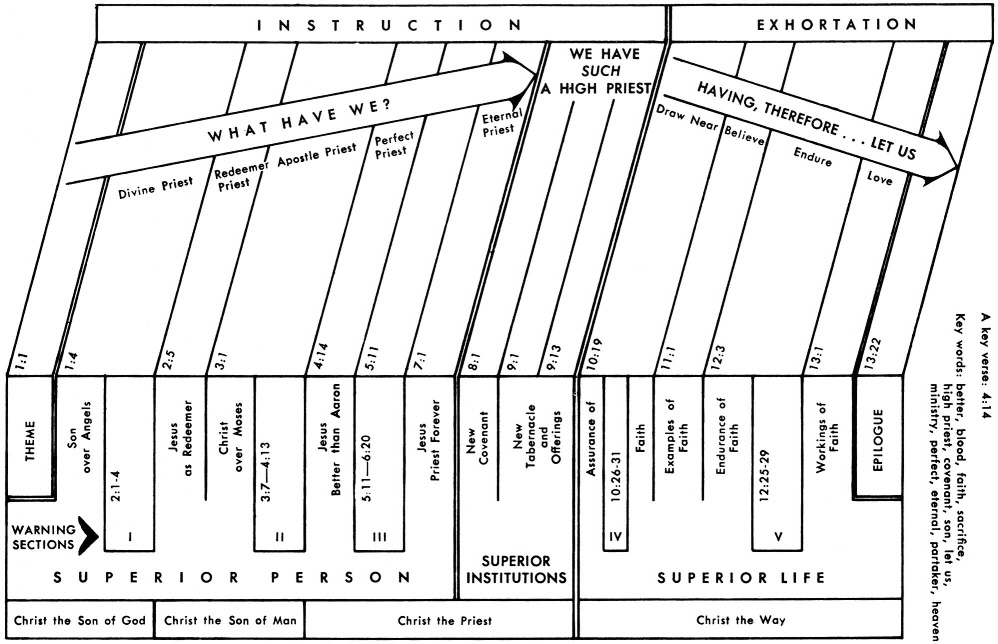
CONSIDER JESUS OUR GREAT HIGH PRIEST
Click chart to enlarge
Charts from Jensen's Survey of the NT - used by permission
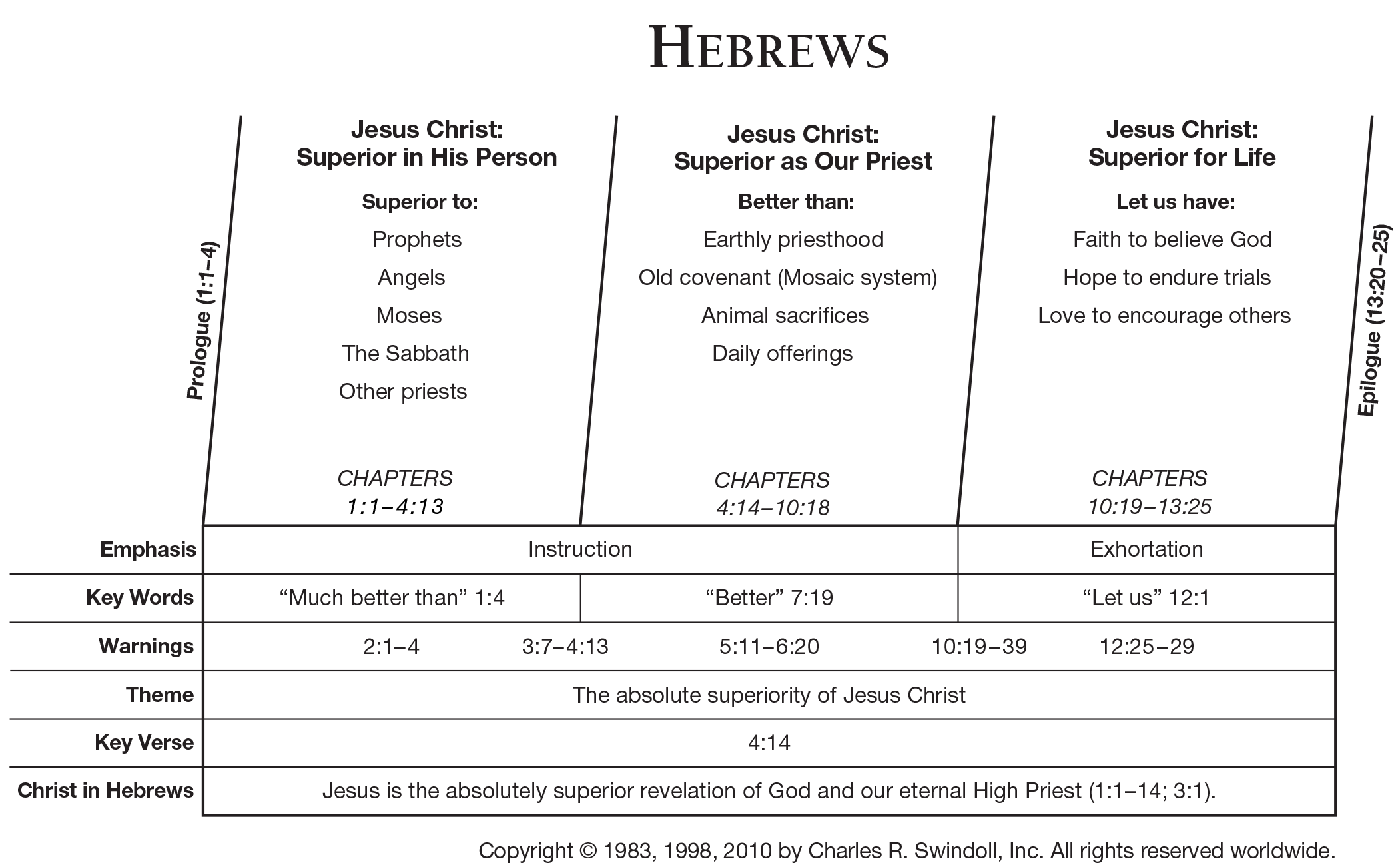
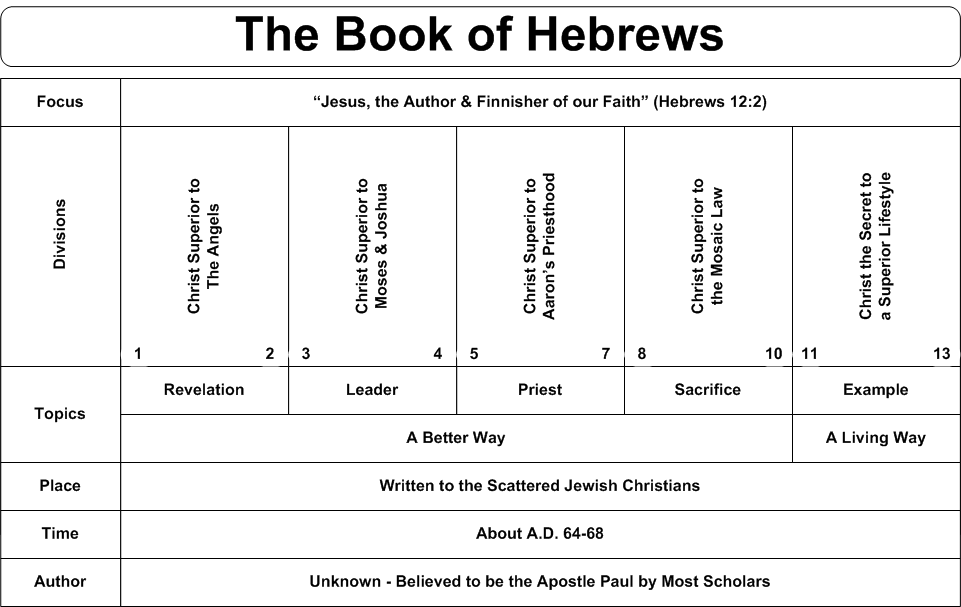
Swindoll's Chart, Another Chart
|
The Epistle |
||||
| INSTRUCTION Hebrews 1-10:18 |
EXHORTATION Hebrews 10:19-13:25 |
|||
| Superior Person of Christ Hebrews 1:1-4:13 |
Superior Priest in Christ Hebrews 4:14-10:18 |
Superior Life In Christ Hebrews 10:19-13:25 |
||
| BETTER THAN PERSON Hebrews 1:1-4:13 |
BETTER PRIESTHOOD Heb 4:14-7:28 |
BETTER COVENANT Heb 8:1-13 |
BETTER SACRIFICE Heb 9:1-10:18 |
BETTER LIFE |
| MAJESTY OF CHRIST |
MINISTRY OF CHRIST |
MINISTERS FOR CHRIST |
||
|
DOCTRINE |
DUTY |
|||
|
DATE WRITTEN: |
||||

See ESV Study Bible "Introduction to Hebrews"
(See also MacArthur's Introduction to Hebrews)
Borrow Ryrie Study Bible
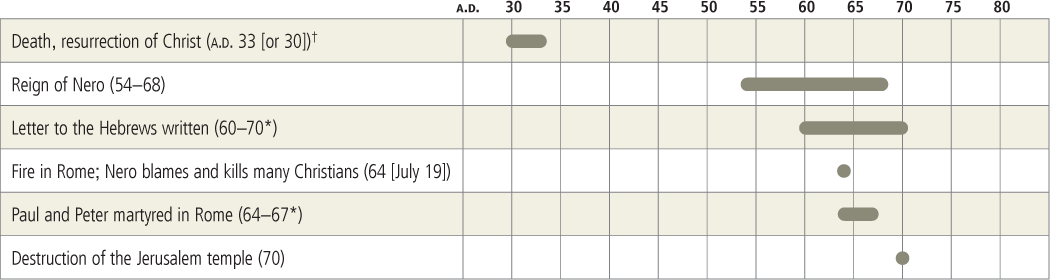
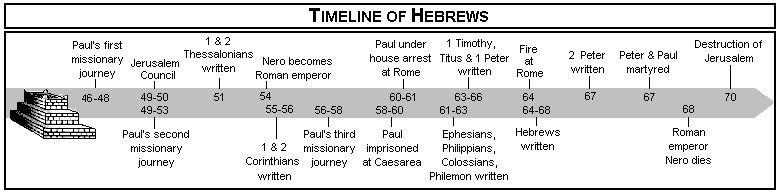
Timeline of Hebrews - ESV Study Bible
Hebrews 2:1 For this reason we must pay much closer attention to what we have heard so that we do not drift away from it. (NASB: Lockman)
Greek: Dia touto dei (3SPAI) perissoteros prosechein (PAN) hemas tois akoustheisin, (APPNPD) mepote pararhuomen. (1PAPS)
BGT Διὰ τοῦτο δεῖ περισσοτέρως προσέχειν ἡμᾶς τοῖς ἀκουσθεῖσιν, μήποτε παραρυῶμεν.
Amplified: Since all this is true, we ought to pay much closer attention than ever to the truths that we have heard, lest in any way we drift past [them] and slip away.
Barclay: We must, therefore, with very special intensity pay attention to the things that we have heard.
NLT: So we must listen very carefully to the truth we have heard, or we may drift away from it. (NLT - Tyndale House)
Phillips: We ought, therefore, to pay the greatest attention to the truth that we have heard and not allow ourselves to drift away from it. (Phillips: Touchstone)
Wuest: On this account it is a necessity in the nature of the case for us to give heed more abundantly to the things which we have heard lest at any time we should drift past them.
Young's Literal: Because of this it behoveth us more abundantly to take heed to the things heard, lest we may glide aside
KJV Therefore we ought to give the more earnest heed to the things which we have heard, lest at any time we should let them slip.
NKJ Therefore we must give the more earnest heed to the things we have heard, lest we drift away.
NET Therefore we must pay closer attention to what we have heard, so that we do not drift away.
CSB We must, therefore, pay even more attention to what we have heard, so that we will not drift away.
ESV Therefore we must pay much closer attention to what we have heard, lest we drift away from it.
NIV We must pay more careful attention, therefore, to what we have heard, so that we do not drift away.
MIT Here is the reason we should pay more attention to what we have heard, lest we drift away.
NJB We ought, then, to turn our minds more attentively than before to what we have been taught, so that we do not drift away.
NRS Therefore we must pay greater attention to what we have heard, so that we do not drift away from it.
RSV Therefore we must pay the closer attention to what we have heard, lest we drift away from it.
NAB Therefore, we must attend all the more to what we have heard, so that we may not be carried away.
GWN For this reason we must pay closer attention to what we have heard. Then we won't drift away from the truth.
BBE For this reason there is the more need for us to give attention to the things which have come to our ears, for fear that by chance we might be slipping away.
ASV Therefore we ought to give the more earnest heed to the things that were heard, lest haply we drift away from them.
- Heb 2:2-4; 1:1,2; Heb 12:25-26
- Hebrews 2 Resources - Multiples Sermons and Commentaries
- Hebrews 2:1-4 The Danger of Drifting Spiritually - Steven Cole
- Hebrews 2:1-4 Tragedy of Neglecting Salvation - John MacArthur
Related Passages:
Hebrews 12:25-26 See (blepo in present imperative see our need to depend on the Holy Spirit to obey - calls for continual attention) to it that you do not refuse Him who is speaking. For if those did not escape when they refused him who warned them on earth, much less will we escape who turn away from Him who warns from heaven. 26 And His voice shook the earth then, but now He has promised, saying, “YET ONCE MORE I WILL SHAKE NOT ONLY THE EARTH, BUT ALSO THE HEAVEN.”
Escaping a Sinking Ship (Great Escapes in History)
by Emily Rose Oachs
RECALLING THE REASON
TO KEEP FROM DRIFTING
For this reason (dia touto) - Amplified = "Since all this is true") If you are learning how to interrogate the text (something you should do to enhance your ability to observe and interpret the text), this one is easy! The simple question is "What reason?" What will that question force you to do? Clearly you will need to examine the context in order to answer the question. This makes an additional point that the context is the key to arriving at accurate interpretation anywhere in the Bible. When you are puzzling over the meaning of a verse, after asking the Spirit to guide you, take time to examine the context. (See more discussion of "for this reason" below).
Hebrews 2:1-4 forms a "parenthesis", interrupting the discussion of Christ’s relationship to angels, which is resumed in Hebrews 2:5+.
Hebrews 2:1-4 is not as easy to interpret as one might think. One of the main questions is who is the writer addressing - believers or non-believers (or both). There are good people like Warren Wiersbe (see below) who say this is addressed to believers, while others like John MacArthur (note), C H Spurgeon (note), Steven Cole (note - see also his note on the critical topic of so-called "carnal Christians"), Stanley Toussaint (note), Kenneth Cooper (note), Kenneth Wuest (note) and Jack Arnold (note) favor this as addressed to non-believers. Ray Stedman seems to favor both believers and non-believers. Ray Stedman's approach is worth considering because there is no doubt that many true Christians (ESPECIALLY TODAY) are drifting in the current of the world's "seductive river" and are missing the victorious Christian life, the abundant life in Christ (Jn 10:10b+). They at least will make it to heaven but likely will receive a paucity of rewards at the Bema seat (2Co 5:10+, 1Cor 3:11-15+, cf Mt 25:21+, each will receive praise = 1Cor 4:5b+). The other group who think they are Christians are in grave danger of perishing eternally! (read Jesus' somber warning Mt 7:21-23+) You will need to prayerfully read the book of Hebrews and let the Spirit of truth guide you into an accurate interpretation.
Hell is undoubtedly full of people who were never actively opposed to Jesus Christ,
but who simply neglected the gospel.
John MacArthur introduces this first warning on Hebrews 2:1-4 writing that "Hell is undoubtedly full of people who were never actively opposed to Jesus Christ, but who simply neglected the gospel. Such people are in view in these four verses. They know the truth and even believe the truth, in the sense that they acknowledge its truthfulness, its rightness. They are well aware of the good news of salvation provided in Jesus Christ, but are not willing to commit their lives to Him. So they drift past the call of God into eternal damnation. This tragedy makes these verses extremely important and urgent." (See context in Hebrews MacArthur New Testament Commentary)
Related Resource:
- Voddie Baucham - Millions of "Christians" Are Headed to Hell… Thinking They're Saved (ED: I put "Christians" in quotes. The title is a bit misleading. In my opinion, more accurately it should read "Millions of Professing Christians" which distinguishes them from "Possessing Christians," that is, those who are born again and possess the indwelling Spirit (Ro 8:9+) and Christ in them the hope of glory and are no longer their own but are possessed by and possessions of the Lord Jesus Christ. So while I have an issue with the title, I do not have an issue with the substance of Baucham's message.) This 30 minute sermon is worth listening to and sharing with friends who say "I'm a Christian" when asked what they believe. They will either be mad, sad or glad that you shared it with them!
We need not be great open sinners in order to perish;
it is merely a matter of neglect.
Here are some of C H Spurgeon's comments on this section - "You see, dear friends, that we need not be great open sinners in order to perish; it is merely a matter of neglect. See how it is put here: "How shall we escape, if we neglect so great salvation?" You need not go to the trouble of despising it, or resisting it, or opposing it; you can be lost readily enough simply by neglecting it. In fact, the great mass of those who perish are those who neglect the great salvation Let that question ring in our ears, How shall we escape? There will be no escape, there can be none if we refuse the Lord Jesus. Do we mean to be lost? Dare we continue to neglect the great salvation? (Spurgeon's Expositional Commentary on Hebrews)
Stanley Toussaint has the following comment on the warning passages in Hebrews - Are they directed to believers, advising that there may be a loss of reward, or do they warn professing believers about the danger of apostasy? Even if the warnings are only hypothetical, the reader ultimately is driven back to these two alternatives. It is quite clear the book is addressed to a specific readership in a particular location with a definite situation in view (cf. Heb 10:32-34; 12:4; 13:3, 23). Because the epistle is so specific it can hardly be said that one warning passage is directed to one group and another warning to a different group. It seems that the writer is addressing all the warnings to the same readership. One great aid in determining the target of the warning passages is the eschatology in these passages. In other words, do the passages threaten loss of reward or the missing of salvation? If the former is correct, the paragraphs in question are addressed to believers; if on the other hand the eschatology deals with eternal damnation or eternal salvation, the passages are aimed at professing believers. It is the thesis of this article that eschatology is a determinative factor in coming to the conclusion that the passages in question are concerned with the danger of apostasy (ED: WHICH HE EQUATES WITH UNBELIEVERS). There were some in the readership who had made a profession of faith in Christ but were seriously considering returning to Judaism. It was not a case of the Galatian heresy where some were attempting to unite Christianity with Judaism; on the contrary, these people were about to abandon Christianity to slip back to the works system of Judaism. (The Eschatology of the Warning Passages in the Book of Hebrews - see full article below for it is a lucid, logical discussion)
Ray Stedman says "it is simply a question. It is addressed both to the Christian and to the non-Christian. To the non-Christian it says, Where are you going to go? How will you get out of God's universe? How can you escape the inevitable? Indeed, why seek to avoid that which is unavoidable: a confrontation with the One Who is behind all things? How can you escape, and why attempt to do so? Especially when His purpose is not to curse but to bless? How can you find deliverance by any other route, by any other path, or by any other channel, if it does not involve the One who is behind all things? To the Christian, the writer is saying it is not enough that we know Jesus Christ: We must use the resources we have in Him. We can lose so much, even knowing Him, unless there is a day-by-day walk with Him. We lose peace and freedom and joy and achievement. We are subjected to temptation, frustration, bewilderment, bafflement and barrenness without Him. And if we do not go on as Christians, if we do not grow, a serious question is raised: Have we ever really begun the Christian life? (ED: THAT IS, ARE WE REALLY BELIEVERS!) (The Great Danger in Ignoring the Son)
Warren Wiersbe feels "The admonition is written to believers, for the writer includes himself when he writes “we.” The danger here is that of neglecting our salvation. Please note that the author did not write “rejecting” but “neglecting.” (ED: THAT SOUNDS GOOD BUT NEGLECTING FOR AN ENTIRE LIFE IS TANTAMOUNT TO REJECTING! SEE DEFINITIONS OF NEGLECT) He is not encouraging sinners to become Christians; rather, he is encouraging Christians to pay attention to the great salvation they have received from the Lord." (See context in Be Confident)
Bob Utley addresses what seems to be Wiersbe's main argument that these are believers, Utley writing "There are three ways of viewing this warning: (1) as referring to those who refused to respond to the gospel (cf. v. 3); (2) as referring to those who had believed (cf. “we must pay much closer attention to what we have heard,”v. 1), but not matured; or (3) as referring to those who had believed and were in danger of not holding on to their original profession/confession of faith in Christ. The first would refer to the unbelieving Jews while the second and third would refer to the believing Jews. The use of the FIRST PERSON PLURAL seems to mean that the author groups himself with those addressed and would imply that they were believers. However, this same grammatical PLURAL appears in a literary, not literal, usage in Heb 10:26 ("if WE go on sinning willfully after receiving the knowledge of the truth"). (Hebrews 2 Commentary)
David Cooper - We are sometimes told that the epistle was written to Hebrew Christians who were on the verge of turning back to Judaism. This hypothesis does not seem to be in keeping with this exhortation. If these people had already accepted Christ and the gospel message, this exhortation would have been inappropriate; for the people thus addressed could have said that they had already accepted the message. We will do well to take the position that these people had heard the message but had not received it. (Hebrews 2:1-4)
Jack Arnold - The author of the book of Hebrews writes with great zeal and passion to persuade these professing Hebrew-Christians not to go back into Judaism, warning them of the grave consequences if they make this move. They may become apostates with no hope of ever being genuinely saved (cf Heb 10:26-31+, Heb 12:25+). (The Danger of Drifting Hebrews 2:1-4)
Kenneth Wuest - In the midst of his argument, “the Son is better than the angels” (Heb 1:4–14, Heb 2:5–18), the writer issues an exhortation and a warning (Heb 2:1–4) to these Hebrews who had outwardly left the temple sacrifices, had made a profession of Messiah as High Priest, and who were in danger of renouncing that profession and of returning to the sacrifices. (Commentary)
For this reason - Hebrews 2:1-4 Is a parenthesis or interjection, presenting the reading with his first exhortation and warning, here a warning against a wasted life, a life of neglect and indifference to the great salvation and the great potential of such a salvation. Beloved, it behooves US ALL to pay close attention to these sobering words, so that we are not slowly "intoxicated" by the fallen world system which is anti-God and anti-Christ. Remember that sin can be very subtle and is always deceitful (Heb 3:13+).
For this reason (rendered "therefore" by many versions - KJV, NKJV, NET, CSB, ESV, et al) - It is a term of conclusion and is used 68x/68v in Scripture - Gen. 2:24; Exod. 9:16; Jdg. 11:8; 1 Sam. 20:29; 2 Sam. 7:22; Neh. 6:13; Isa. 21:3; Dan. 3:8; Dan. 3:22; Matt. 6:25; Matt. 12:27; Matt. 18:23; Matt. 19:5; Matt. 24:44; Matt. 27:8; Mk. 10:7; Lk. 7:7; Lk. 7:47; Lk. 11:49; Lk. 12:22; Jn. 5:16; Jn. 5:18; Jn. 6:65; Jn. 7:22; Jn. 8:47; Jn. 9:23; Jn. 10:17; Jn. 12:18; Jn. 12:39; Jn. 13:11; Jn. 19:11; Acts 26:21; Acts 28:20; Rom. 1:26; Rom. 4:16; Rom. 15:22; 1 Co. 4:17; 1 Co. 11:30; 1 Co. 12:15; 1 Co. 12:16; 2 Co. 7:13; 2 Co. 12:7; 2 Co. 13:10; Eph. 1:15; Eph. 3:1; Eph. 3:14; Eph. 5:14; Eph. 5:31; Phil. 2:9; Col. 1:9; 1 Thess. 2:13; 1 Thess. 3:5; 1 Thess. 3:7; 2 Thess. 2:11; 1 Tim. 1:16; 2 Tim. 1:6; 2 Tim. 1:12; 2 Tim. 2:10; Tit. 1:5; Tit. 1:13; Phlm. 1:15; Heb. 2:1; Heb. 9:15; 1Jn. 3:1; 3 Jn. 1:10; Rev. 7:15; Rev. 12:12; Rev. 18:8
A W Pink adds that "In one sense the first four verses of chapter 2 form a parenthesis, inasmuch as they interrupt the apostle's discussion of Christ's relation to angels, which is resumed in v. 5 and amplified in v. 9. (Christ Superior to Angels)
Whenever you observe a term of conclusion like "for this reason", "therefore", etc, always take a moment and ask the natural question "for what reason?" You will usually be led to read the preceding verses (the immediate context). What attitude/action is the author calling for in his reader's in view of this truth ("this reason")? Because of the message given in Hebrews 1:1-14 of the superiority of Christ to angels, it is necessary to give more earnest heed.
So first, what is this reason (if you have time make your own observations of Hebrews 1 before you read the following notes)? Jesus is superior to prophets and angels and because of this superior Messenger and superior revelation, the reader must make an appropriate response. Mark it down that revelation always calls for a response! As the writer of Hebrews will do throughout this epistle, after presenting a doctrinal truth, he makes a direct application of that truth to the experience of his readers. This passage presents the first of those many applications.
Chapter 2 begins by telling us that
chapter 1 is the reason for this duty
John Piper on for this reason - In summary, chapter 1 says that the Son of God is the heir of all things (verse 2), he made the world (verse 2), he is the radiance of God’s glory and the exact representation of God’s nature (verse 3), he upholds all things by the word of his power (verse 3), he made purification for sins (verse 3), he sat down at the right hand of God’s majesty (verse 3), and he is greater than any angel (verse 4) because angels worship him (verse 6). He is the mighty God (verse 8).....Chapter 2 begins, “For this reason …” (or: some versions have, “therefore”). In other words chapter 2 begins by telling us that chapter 1 is the reason for this duty. Because God has spoken by His Son in these last days, and because He is the Creator and Sustainer and Owner and Ruler and Redeemer of the world—above all angels—therefore (“for this reason“) “we must pay much closer attention to what we have heard.” (Sermon The Danger of Drifting from the Word)
W E Vine says for this reason "looks back to what the preceding chapter has declared of the deity and glory of the Son of God, and to the fact that through Him God has spoken (Heb 1:1). His transcendent majesty demands the greater heed to the messengers through whom He has spoken.
B F Westcott entitles Hebrews 2:1-4 "The peril of neglecting the new revelation through the Son." (Ed: so clearly Westcott agrees with Vine, et al.) After establishing the superior dignity of the Son in comparison with that of angels, the writer of the Epistle pauses for a moment to enforce the practical consequences which follow from the truth before he sets forth the work of the Son for humanity. It is obvious that a revelation given through such a Mediator carries with it more solemn obligations on those who receive it and heavier penalties for neglect than a revelation made through angelic ministry. Similar hortatory passages are introduced in the argument Heb 3:7—19, Heb 5:11-14, Contrast Gal. 1:6—9.
William Newell says for this reason "means, because of all that has been spoken in Chapter 1 of the glorious person of the Son of God; and His infinite height above His creation; especially, as the argument proceeds to declare, that to us God hath spoken through the Lord. This refers evidently to the Four Gospels, and to the Acts; as we saw in Chapter One."
A W Pink adds that…
Therefore, signifies, for this cause: because God has vouchsafed (granted or furnish often in a gracious or condescending manner) so excellent a Teacher (His Son), He must be the more carefully attended unto. The "therefore" looks back to all the varied glories which set forth Christ’s excellency named in the previous chapter.
Because He is God’s "Son," therefore give heed.
Because He is "the Heir of all things," therefore give heed.
Because He "made the worlds," therefore give heed; and so on.
These are so many grounds on which our present exhortation is based. “Therefore is equivalent to, ‘Since Jesus Christ is as much better than the angels, as He both received by inheritance a more excellent name than they—since He is both essentially and officially inconceivably superior to these heavenly messengers, His message has paramount claims on our attention, belief, and obedience’,” (Dr. J. Brown). (Hebrews 2:1-4 Christ Superior to Angels)
It was usual with the prophets to preface their utterances with a “Thus saith the Lord,” and thereby arrest the attention and awe the hearts of their hearers. Here the writer refers to the Person of the Lord Himself as the argument for hearing what He said. In short, the new revelation in Christ is superior to the old. You have received a revelation superior to that given in the old testament, and it has been given to you through One Who is superior to the angels. Now you must respond to this truth!
A T Robertson - Because Jesus is superior to prophets and angels and because the new revelation is superior to the old. The author often pauses in his argument, as here, to drive home a pungent exhortation. The author often pauses in his argument, as here, to drive home a pungent exhortation. The revelation spoken in the Son is the final and complete revelation, given through Christ Who is superior to prophets and angels. (Hebrews 2 Word Pictures)
The author gives a strong exhortation to his readers to respond to what they have just read in Hebrews 1. In a sense we see sound doctrine flow seamlessly into serious invitation. If you are a teacher, remember that to be effective, you must do more than present biblical facts. Using sound doctrine as your foundation, you must also warn, exhort, invite. And so we note that by the time the writer of Hebrews gets to chapter 2 he is impassioned and concerned the salvation of his hearers. Thus he exhorts his readers to respond to what he says. In short, as any good Biblical teacher, he not only seeks for Christ to be seen as superior but also to be accepted as Savior. His invitation includes both exhortation and warning, what to do and what happens if you don't respond.
In the last chapter of Hebrews the writer sums up his message, writing "I urge you, brethren, bear with this word of exhortation, for I have written to you briefly." (Heb 13:22+)
God’s Word demands a response,
and a faithful teacher of the Word teaches for a response.
Matthew Henry explains the writer's method this way: The apostle proceeds in the plain profitable method of doctrine, reason, and use, through this epistle. Here we have the application of the truths before asserted and proved; this is brought in by the illative particle therefore, with which this chapter begins, and which shows its connection with the former, where the apostle having proved Christ to be superior to the angels by whose ministry the law was given, and therefore that the gospel dispensation must be more excellent than the legal, he now comes to apply this doctrine both by way of exhortation and argument.
Failure to hear is due to a carelessness in paying attention to what God had to say.
Back of that carelessness is the desire to have our own will.
Kenneth Wuest - The exhortation is to give more earnest heed to the New Testament message, and the warning, against letting that truth slip away. The nature of the sin of Adam was a careless, indifferent attitude towards the commands of God. The particular word which is translated “disobedience” in Romans 5:19 (parakoe) means literally “to hear alongside,” thus, “a failing to hear, a hearing amiss.” But this failure to hear is due to a carelessness in paying attention to what God had to say. Back of that carelessness is the desire to have our own will. Under pressure of persecution, these Jews were discontinuing their attendance upon the Christian assemblies (Heb 10:25), and giving less and less heed to the New Testament truth. The reason for this failure to attend earnestly upon the truth of the new dispensation was that these Hebrews were desirous of getting out from under the persecution to which they were being subjected from apostate Judaism. Entrenched and apostate ecclesiasticism was trying to take these Jews away from the visible Church and bring them back to the temple. Thus does sin lead us to take the easy road, tempting us to sell our birthright for a mess of pottage (Heb 12:16, 17). (Hebrews - Wuest's word studies from the Greek New Testament)
A warning that to neglect the salvation provided through Him will incur far more serious consequences
than in the case of those who transgressed the word of the law spoken through angels.
W E Vine has an excellent outline of this warning section:
This portion follows in close connection with the subject of the first chapter. Having shown the glories of the Son of God and His superiority over angels, the writer draws therefrom a warning that to neglect the salvation provided through Him will incur far more serious consequences than in the case of those who transgressed the word of the law spoken through angels. For this salvation has been proclaimed by the Son of God Himself and has been confirmed by His followers and by the Holy Spirit.
Analysis
Christ’s Superiority in the Gospel Message, to the Part Taken by Angels in the Giving of the Law
(1) The Salvation and its greatness (Heb 2:1, 2).
(a) The duty to be done (Heb 2:1).
(b) The danger to be averted (Heb 2:1).
(c) The reason-a contrast: (Heb 2:2).
(i) The recompense for transgressing the Law
(ii) The recompense for neglecting the Salvation
(2) The Salvation and its proclamation (Heb 2:3, 4).
(a) Spoken by the Lord (Heb 2:3).
(b) Confirmed by the Apostles (Heb 2:3).
(c) Testified to by God (Heb 2:4).
WE MUST PAY MUCH CLOSER ATTENTION: dei (3SPAI) perissoteros prosechein (PAN):
- Dt 4:9,23; Dt 32:46-47; Josh 23:11-12; 1Chr 22:13; Ps 119:9; Pr 2:1-6; Pr 3:21; 4:1-4,20-22; 7:1,2; Lk 8:15; 9:44
- Hebrews 2 Resources - Multiples Sermons and Commentaries
- Hebrews 2:1-4 The Danger of Drifting Spiritually - Steven Cole
- Hebrews 2:1-4 Tragedy of Neglecting Salvation - John MacArthur
Related Passages:
Deuteronomy 4:9+ “Only give heed (LXX = prosecho, command in present imperative) to yourself and keep your soul diligently, so that you do not forget the things which your eyes have seen and they do not depart from your heart all the days of your life; but make them known to your sons and your grandsons.
Deuteronomy 4:23+ “So watch (LXX = prosecho, command in present imperative) yourselves, that you do not forget the covenant of the LORD your God which He made with you (OLD COVENANT AT MT SINAI), and make for yourselves a graven image in the form of anything against which the LORD your God has commanded you.
Deuteronomy 32:46-47+ he said to them, “Take (LXX = prosecho, command in present imperative) to your heart all the words with which I am warning you today, which you shall command your sons to observe carefully, even all the words of this law. 47 “For it is not an idle word for you; indeed it is your life. And by this word you will prolong your days in the land, which you are about to cross the Jordan to possess.”
Joshua 23:11-12+ “So take diligent heed to yourselves to love the LORD your God. 12 “For if you ever go back and cling to the rest of these nations, these which remain among you, and intermarry with them, so that you associate with them and they with you,
Ephesians 4:14+ As a result (Eph 4:11-13), we are no longer to be children, tossed here and there by waves and carried about by every wind of doctrine, by the trickery of men, by craftiness in deceitful scheming;
1 Timothy 1:19+ Keeping faith and a good conscience, which some have rejected and suffered shipwreck in regard to their faith.
Revelation 2:4+ But I have this against you, that you have left your first love.
HEAR & HEED PLAN A!
THERE IS NO PLAN B!
We must (dei) pay much (perissosteros) closer attention (prosecho) to what we have heard (akouo - past tense) - Barclay = "We must, therefore, with very special intensity pay attention to the things that we have heard." TEV = “hold on all the more firmly to” NJB = “turn our minds more attentively” New English Bible - "Thus we are bound (SPEAKS OF NECESSITY) to pay all the more heed to what we have been told, for fear of drifting from our course." Must is not maybe or might but speaks of an absolute necessity. Piper does a good job at getting across the sense of "must" stating could be read more literally "It is exceedingly necessary that we give heed to what we have heard." The solemn exhortation is a must, not a might or maybe! Don't miss the 5 repetitions of the plural pronoun "we" (and one "us") in this "warning passage"! The writer clearly recognizes the potential propensity of his fallen flesh to drift away (not from salvation but from fellowship and communion with the Lord and usefulness to the Lord)! What had the readers heard? Yes, they had heard the prophets (and the Old Covenant), but in context (as shown by the comparative phrase "much closer") referring to the Gospel, the New Covenant which (by comparison) is superior to, better than the Old Covenant.
The verb must is very strong and emphatic and calls for the reader to take responsibility, giving us an exhortation to perform a specific duty. Why? So we do not drift. The verb must (dei) is in the active voice meaning that we must decide to do it. It is a choice of our will we must make (enabled by the Spirit). To fail to do so can have eternally damning consequences! Must is in present tense signifying that this is continually necessary - we must keep on paying pay close attention. Fallen flesh continually fights against this exhortation to continually pay close attention, and thus demands that we continually depend on the Holy Spirit Who is the only Force in the universe that can counter and conquer our powerful fallen flesh!
Utley on pay much closer attention - This is a strong Greek COMPARATIVE and INFINITIVE which means to give special and complete attention and care to something or someone (cf. Acts 8:6, 10; 16:14). The New Covenant of the Son (the gospel) is both precious and dangerous! God’s truth must be handled appropriately.
🙏 THOUGHT - While this warning may indeed be directed primarily to professing (fake) believers, the principle in this warning has practical application for possessing (genuine) believers. Beloved, we must not think we are immune to drifting (cf "backsliding" or "entangled")! That mindset (a bit prideful or self-assured) may in fact set you up to begin to drift as it expresses reliance on one's self and not necessarily on the LORD. The ONLY way we can counter the continual drift of our fallen flesh (cf 1Pe 2:11+ where "wage war" is present tense!) is by continual dependence upon the Holy Spirit to give us the desire and the power to keep on keeping on! (see Php 2:13NLT+).
William Barclay says "Therefore, we must the more eagerly anchor our lives to the things that we have been taught, lest the ship of life drift past the harbour and be wrecked." There is a vivid picture there--the picture of a ship drifting to destruction because the pilot sleeps while the insidious current sweeps the ship past the harbour until it is wrecked. For most of us the threat of life is not so much that we should plunge into disaster, but that we should drift into sin.
THOUGHT - Dear Lord, enable us by Your Spirit not to get caught in the deceptive, destructive currents of this world which is passing away. Amen. Many Christians are mingling with the world, destroying their witness to the world! This world is passing away and even its lusts! (1Jn 2:17+). Men, don't click that mouse, lest you be ensnared by the "mousetrap!"
When the Son of God speaks to people, every consideration makes it appropriate that we should attend to what is spoken. Truth demands a response: “Now what are you going to do about this?” We can know all the truth there is to know about Jesus Christ and yet go to hell if we never make Him our own by being made His own by His Spirit.
We must eagerly anchor ourselves to the truths we've been taught,
or we're likely to drift away from our moorings, which could lead to “shipwreck” of our souls!"
We must be sure to understand that it is not the gospel that slips, as the King James Version seems to imply (It reads "Therefore we ought to give the more earnest heed to the things which we have heard, lest at any time we should let them slip."). That is not the meaning at all. The Greek and most modern translations make it clear that it is inattentive men and women who slip. The Word will never drift from us but we can subtly and slowly drift from the Word, the anchor of our souls! Pay attention and drift away are both nautical terms, so we could paraphrase the waring "We must eagerly anchor ourselves to the truths we've been taught, or we're likely to drift away from our moorings, which could lead to “shipwreck” of our souls!"
There is a tide in the affairs of men which, taken at its ebb, leads to victory;
neglected, the shores of time are strewn with the wreckage.
-- Shakespeare
Preacher's Commentary says that "Our author’s antidote for “drifting” or slipping away consists of earnest heed, intense concentration, thoughtful clarification. By such means the roots of an idea get deep into our consciousness and consciences." (See context in The Preacher's Commentary)
College Press NIV commentary has an interesting note writing that while "The word “better” could be written across the book of Hebrews; the word "more" should be written across our response. Some things require greater (perissoteros, “far more, to a much greater degree”) diligence." (See context in Hebrews Girdwood, J., & Verkruyse, P.)
A W Pink in quoting Dr Gouge explains prosecho writing that "The duty here intended is a serious, firm, and fixed settling of the mind upon that which we hear; a bowing and bending of the will to yield unto it; an applying of the heart to it, a placing of the affections upon it, and bringing the whole man into conformity thereunto. Thus it comprises knowledge of the Word, faith therein, obedience thereto, and all other due respects that may any way concern it." (Gouge's Commentary)
David Guzik - Give the more earnest heed has not only the idea of hearing carefully, but also in doing what we have heard (cf James 1:22+)- and we must give the more earnest heed. (Hebrews 2 Commentary)
No more revelation is forthcoming
for none is necessary.
William Barclay: We must, therefore, with very special intensity pay attention to the things that we have heard. Why? God has spoken in His Son. We must continually hold to the Words of Truth spoken by the Son Who alone is Truth. There is nothing else to that needs to be said! No more revelation is forthcoming for none is necessary.
William Newell - If the Old Testament prophets should be heard, how much more the Lord of glory Himself! He having come to earth, become Man, and speaking to men!
In these last days, we have a greater obligation to obey
because we have the complete Scriptures and the full revelation of God in Jesus Christ.
Warren Wiersbe says: This is the first of five solemn admonitions to believers to pay attention to what God says in His word. During Old Testament times, God dealt with those who disobeyed His Word. In these last days, we have a greater obligation to obey because we have the complete Scriptures and the full revelation of God in Jesus Christ. Are you serious about what God says to you? (See context in With the Word: The Chapter-by-Chapter Bible Handbook)
It is interesting that the two main verbs in this verse (prosecho and pararrhueo) have nautical uses. Prosecho can mean to moor a ship or bring a ship to land or remain on course, whereas pararrhueo was used to describe a ship that had been carelessly allowed to slip past a harbor or a haven because the mariner has forgotten to allow for the wind or the current or the tide! This verse could be paraphrased "Therefore, we must the more eagerly anchor our lives to the things that we have been taught lest the ship of our soul drift past the harbor of salvation and be wrecked and lost forever." What a picture… the ship slowly drifts to destruction because the pilot is asleep at the wheel! How apropos this picture is in regard to how most unbelievers simply drift along "the way (that) is broad (and) that leads to destruction". (Mt 7:13+) Many are the drifters who eventually plunge into everlasting torment and eternal separation from God (2Th 1:9+). The point is that the majority of those who enter by the "wide gate" do not go headlong, wantonly and intentionally into hell. Most people who populate hell haven't been the most profane God haters and vile rejecters of His Son. Most of those who are deceived and dead in their trespasses and sins (Eph 2:1+) just slowly, almost imperceptibly slip past the harbor of salvation and into the "sea" of eternal destruction.
Once saved, always saved is
valid only if one is truly saved!
The writer's point is that the reader must put his mind to the Son of God's teaching on salvation lest he one day find himself having forever drifted past the "harbor of salvation." Salvation once gained cannot be lost (contra Arminianism). The writer's point is that the reader must be certain that genuine salvation has been gained! Once saved, always saved is valid only if one is truly saved! There are many people who use this neat little saying to justify their bad behavior. "Well, I prayed a prayer and walked the aisle at age 16 and even got baptized the next week." But as the subsequent years demonstrated, this individual was really just a "professor" and not a "possessor" of Jesus. There was never a change in their behavior after their so called "profession." They continued to live in sin (1Jn 3:4,9+), to love the world (1Jn 2:15+, Jas 4:4+), etc. In short such a person manifests no evidence that they were ever truly born again. There was no fruit in keeping with repentance. So all this to warn that the pithy saying "once saved, always saved" is a potentially damning deception to those souls who have never been regenerated by the Spirit. They heed to "see to it" that they do not neglect so great a salvation! (See Is once saved, always saved biblical? | GotQuestions.org and Once saved always saved?)
See J D Grear's discussion of the problem of false professions of belief in Jesus in his book "Stop Asking Jesus Into Your Heart" (See also Is it biblical to ask Jesus into your heart? - GotQuestions.org and listen to Voddie Baucham's Millions of "Christians" Are Headed to Hell… Thinking They're Saved).
Richard A Mohler - Christian faithfulness has no secret formula. God sanctifies us through his Word (John 17:17). We avoid the danger of spiritual drift by reading, hearing, meditating on, and obeying Scripture. As B. B. Warfield said, “When Scripture speaks, God speaks” (Inspiration and Authority of the Bible, 119). We avoid spiritual drift by dropping the anchor of our souls in the deep waters of the Word of God. (See Exalting Jesus in Hebrews - Page 25)
Must (1163) (dei from deo = to bind, tie objects together) means this is necessary (binding) or needful. Dei marks a logical necessity and not a moral obligation: we must rather than we ought. It therefore speaks of an obligation out of intrinsic necessity or inevitability. Used 3x in Hebrews - Heb 2:1, Heb 9:26, Heb 11:6. It is necessary that this happen. The writer of Hebrews uses this strong verb must (dei) again in his explanation of how we can "please" God writing that…
"without faith it is impossible to please Him, for he who comes to God must (dei) believe that He is, and that He is a rewarder of those who seek Him." (He 11:6+)
Dei - 97v - It is interesting that a number of the Gospel uses refer to Jesus and something that is necessary = "I must be about my Father's business" (Luke 2:49). "I must work the works of him that sent me" (John 9:4). "I must preach the kingdom of God" (Luke 4:43). He "must needs go through Samaria" (John 4:4). It is a word that is used in connection with his suffering and death. "“The Son of Man must suffer many things and be rejected by the elders and chief priests and scribes, and be killed and be raised up on the third day.” " (Luke 9:22). "He must rise again from the dead" (John 20:9).
Matt. 16:21; Matt. 17:10; Matt. 18:33; Matt. 23:23; Matt. 24:6; Matt. 25:27; Matt. 26:35; Matt. 26:54; Mk. 8:31; Mk. 9:11; Mk. 13:7; Mk. 13:10; Mk. 13:14; Lk. 2:49; Lk. 4:43; Lk. 9:22; Lk. 11:42; Lk. 12:12; Lk. 13:14; Lk. 13:16; Lk. 13:33; Lk. 15:32; Lk. 17:25; Lk. 18:1; Lk. 19:5; Lk. 21:9; Lk. 22:7; Lk. 22:37; Lk. 24:7; Lk. 24:26; Lk. 24:44; Jn. 3:7; Jn. 3:14; Jn. 3:30; Jn. 4:4; Jn. 4:20; Jn. 4:24; Jn. 9:4; Jn. 10:16; Jn. 12:34; Jn. 20:9; Acts 1:16; Acts 1:21; Acts 3:21; Acts 4:12; Acts 5:29; Acts 9:6; Acts 9:16; Acts 14:22; Acts 15:5; Acts 16:30; Acts 17:3; Acts 19:21; Acts 20:35; Acts 23:11; Acts 24:19; Acts 25:10; Acts 25:24; Acts 26:9; Acts 27:21; Acts 27:24; Acts 27:26; Rom. 1:27; Rom. 8:26; Rom. 12:3; 1 Co. 8:2; 1 Co. 11:19; 1 Co. 15:25; 1 Co. 15:53; 2 Co. 2:3; 2 Co. 5:10; 2 Co. 11:30; 2 Co. 12:1; Eph. 6:20; Col. 4:4; Col. 4:6; 1 Thess. 4:1; 2 Thess. 3:7; 1 Tim. 3:2; 1 Tim. 3:7; 1 Tim. 3:15; 2 Tim. 2:6; 2 Tim. 2:24; Tit. 1:7; Tit. 1:11; Heb. 2:1; Heb. 9:26; Heb. 11:6; 2 Pet. 3:11; Rev. 1:1; Rev. 4:1; Rev. 10:11; Rev. 11:5; Rev. 13:10; Rev. 17:10; Rev. 20:3; Rev. 22:6
Pay… attention (4337) (prosecho from pros = toward + echo = to have, hold) means literally "to hold toward", to hold (the mind) to, to apply one’s self to, to attach one’s self to. The idea is to "take hold" of something and pay attention to it, "putting your mind on it", especially in the sense of being on guard. It means to turn the mind to something and includes the idea of to act upon what one perceives (cf Acts 8:6; 16:14). It is noteworthy that 12 of the 24 NT uses of prosecho are in the present imperative which is a command (see word study) calling for continual attention! In the present passage the verb is in the present tense which also calls for continual attention. Prosecho means to be in a continuous state of readiness to learn of any future danger, need, or error, and to respond appropriately - keep on the lookout for, be alert for, be on one's guard against. Prosecho almost always warns of danger. Prosecho is not a call simply to notice or sense something, but to be on guard against it because it is harmful. To pay… attention is to apply the mind to a particular subject, to attend to it, to consider it and in the present use is opposite of neglect of a so great salvation.
Prosecho was commonly used to describe the bringing of a ship to land. What a striking picture this secular use congers up - Think of our life as a "ship of faith" moving through the fog, avoiding the dangerous reefs by keeping our focus on the Lighthouse on the shore. Clinging with a devotion to the truth about Jesus. Holding the rudder firmly in place towards the safe harbor of the Light of the World.
Peter uses prosecho with a similar thought explaining that "we have the prophetic word made more sure, to which you do well to (present tense - continually) pay attention as to a lamp shining in a dark place, until the day dawns and the morning star arises in your hearts." (2Pe 1:19+)
Prosecho - 24x in 24 v in NAS - addicted(1), beware(8), give attention(1), giving… attention(1), giving attention(2), guard(3), officiated(1), pay attention(2), pay… attention(1), paying attention(2), respond(1), take care(1).
Matthew 6:1 "Beware (present imperative) of practicing your righteousness before men to be noticed by them; otherwise you have no reward with your Father who is in heaven.
Matthew 7:15 "Beware (present imperative) of the false prophets, who come to you in sheep's clothing, but inwardly are ravenous wolves.
Matthew 10:17 "But beware (present imperative) of men, for they will hand you over to the courts and scourge you in their synagogues;
Matthew 16:6 And Jesus said to them, "Watch out and beware (present imperative) of the leaven of the Pharisees and Sadducees."
Matthew 16:11 "How is it that you do not understand that I did not speak to you concerning bread? But beware (present imperative) of the leaven of the Pharisees and Sadducees."12 Then they understood that He did not say to beware of the leaven of bread, but of the teaching of the Pharisees and Sadducees.
Luke 12:1 Under these circumstances, after so many thousands of people had gathered together that they were stepping on one another, He began saying to His disciples first of all, "Beware (present imperative) of the leaven of the Pharisees, which is hypocrisy.
Luke 17:3 "Be on your guard (present imperative)! If your brother sins, rebuke him; and if he repents, forgive him.
Luke 20:46 "Beware (present imperative) of the scribes, who like to walk around in long robes, and love respectful greetings in the market places, and chief seats in the synagogues and places of honor at banquets,
Luke 21:34 "Be on guard (present imperative), so that your hearts will not be weighted down with dissipation and drunkenness and the worries of life, and that day will not come on you suddenly like a trap;
Acts 5:35 And he said to them, "Men of Israel, take care (present imperative) what you propose to do with these men.
Acts 8:6 The crowds with one accord were giving attention to what was said by Philip, as they heard and saw the signs which he was performing… 10 and they all, from smallest to greatest, were giving attention to him, saying, "This man is what is called the Great Power of God."11 And they were giving him attention because he had for a long time astonished them with his magic arts.
Acts 16:14 A woman named Lydia, from the city of Thyatira, a seller of purple fabrics, a worshiper of God, was listening; and the Lord opened her heart to respond to the things spoken by Paul.
Acts 20:28 "Be on guard (present imperative) for yourselves and for all the flock, among which the Holy Spirit has made you overseers, to shepherd the church of God which He purchased with His own blood.
1 Timothy 1:4 nor to pay attention to myths and endless genealogies, which give rise to mere speculation rather than furthering the administration of God which is by faith.
1 Timothy 3:8 Deacons likewise must be men of dignity, not double-tongued, or addicted to much wine or fond of sordid gain,
1 Timothy 4:1 But the Spirit explicitly says that in later times some will fall away from the faith, paying attention to deceitful spirits and doctrines of demons,
1 Timothy 4:13 Until I come, give attention (present imperative) to the public reading of Scripture, to exhortation and teaching.
Titus 1:14 not paying attention to Jewish myths and commandments of men who turn away from the truth.
Hebrews 2:1 For this reason we must pay much closer attention to what we have heard, so that we do not drift away from it.
Hebrews 7:13 For the one concerning whom these things are spoken belongs to another tribe, from which no one has officiated (gave attendance) at the altar.
2 Peter 1:19+ So we have the prophetic word made more sure, to which you do well to pay attention as to a lamp shining in a dark place, until the day dawns and the morning star arises in your hearts.
Much closer (4057) (perissosteros) is a comparative adverb which can be translated "all the more", "even much more", "more earnestly," "more superabundantly". And so one could render it "we must all the more pay close attention". It is used as a comparative to denote that a state or action is beyond what is ordinary or expected. The in Heb 2:1 could have almost an elative sense, “with extreme care”
Gilbrant - A comparative form of the adverb perissōs, this term functions as an adverb and serves to heighten in a quantitative or qualitative sense the action of the corresponding verb. Of its 13 appearances in the New Testament 10 of these are in Pauline literature.
Paul’s use of perissoterōs is divided almost evenly between the comparative and the elative use. As a comparative Paul used it to describe his imprisonments and beatings which were “greater” (quantitative) in comparison to those of his opponents (2 Corinthians 11:23). Paul also used this term in reference to his love for the Corinthians (2 Corinthians 12:15), his “extreme” zeal as a Jew (Galatians 1:14), and the increased boldness of the brethren to proclaim the gospel as a result of his imprisonment (Philippians 1:14).
Paul’s elative use (a grammatical term for the raising of something to its highest degree without another specific object in mind with which comparison is made) of this term is indicative of popular speech rather than classical usage (Turner, Grammar of New Testament Greek, 3:30). He used it to heighten the sense of the personal integrity he and Timothy showed to the Corinthians (2 Corinthians 1:12); to describe the love he had for the Corinthians (2 Corinthians 2:4); to emphasize the swell of heartfelt emotion Titus had in remembering the reception the Corinthians gave him (2 Corinthians 7:15); and of Paul’s, Silvanus’, and Timothy’s great efforts to visit the Thessalonians (1 Thessalonians 2:17). The extensive use of this word in 2 Corinthians is indicative of the emotional tone of the epistle.
In Hebrews perissoterōs describes the greater attention that must be given to the message of Christ (2:1) compared with the Old Testament message given through angels. (Complete Biblical Library)
Perissos - 11v - all the more(3), even more(1), even...more(1), far more(3), furiously(1), more(2), much closer(1). Matt. 27:23; Mk. 10:26; Mk. 15:14; Lk. 12:4; Lk. 12:48; Acts 26:11; 2 Co. 7:13; 2 Co. 11:23; 2 Co. 12:15; Phil. 1:14; Heb. 2:1 NO USES IN SEPTUAGINT.
TO WHAT WE HAVE HEARD: hemas tois akoustheisin (APPNPD):
- Hebrews 2 Resources - Multiples Sermons and Commentaries
- Hebrews 2:1-4 The Danger of Drifting Spiritually - Steven Cole
- Hebrews 2:1-4 Tragedy of Neglecting Salvation - John MacArthur
Related Passages:
James 1:22-25+ But prove (present imperative see our need to depend on the Holy Spirit to obey) yourselves doers of the word, and not merely hearers who delude themselves. 23 For if anyone is a hearer of the word and not a doer, he is like a man who looks at his natural face in a mirror; 24 for once he has looked at himself and gone away, he has immediately forgotten what kind of person he was. 25 But one who looks intently at the perfect law, the law of liberty, and abides by it, not having become a forgetful hearer but an effectual doer, this man will be blessed in what he does.
Matthew 11:15+ “He who has ears to hear, let him hear.
Luke 6:46+ “Why do you call Me, ‘Lord, Lord,’ and do not DO (present tense) what I say?
Luke 8:21+ But He answered and said to them, “My mother and My brothers are these who HEAR (present tense) the word of God and DO (present tense) it.”
Luke 11:28+ But He said, "On the contrary, blessed are those who HEAR (present tense) the word of God, and OBSERVE (present tense) it."
John 13:17+ “If you know these things, you are blessed if you DO (present tense) them.
HEARING CALLS
FOR HEEDING
What we have heard (akouo) means not just to hear sounds per se but implies hearing with attention or hearing with the "ear of one's mind". “To hear” in Scripture often implies “to obey.” This verb is more literally translated in this verse as "to what we have been hearing" He uses this verb akouo in the next verse writing that "it was confirmed to us by those who heard" which implies that they heard effectively or else they could not have passed it on.
A W Pink notes that simply "To “hear” is not sufficient. There must be prayerful meditation, personal appropriation." It is not to be "in one ear and out the other!"
In Hebrews 1 we have just heard the many amazing truths about Jesus, as summarized below
- Creator
- Heir of all
- One with the Father yet distinct in Person
- Upholder of all things by His Word
- Purifier from sin
- Seated at the Right hand of the Majesty on high
- Having a better name than the angels (begotten the Son of God)
- God testifying He is His Father fulfilling the Davidic Covenant
- Firstborn = His preeminence,
- God, Lord, King, Victorious Warrior
- Immutable
- Eternal
- Better than angels who serve Him, worship Him, are created by Him & are sent out to serve believers.
🙏 THOUGHT - Having heard, have you responded? If not, will you respond in faith right now? JESUS is all of the things just noted but most importantly of all He is your Savior, your Redeemer, your Life (Col 3:4), BUT ONLY if you receive Him by grace through faith (Eph 2:8-9)! Or will you be like those the writer records in chapter 4 warning that "indeed we have had good news preached to us, just as they also; but the word they heard (akouo) did not profit them, because (an important term of explanation!) it was not united by faith in those who heard. (Heb 4:2+)
Hearing does not necessarily equate with believing but it may if the belief is genuine, for Jesus declared:
Truly, truly (Amen, Amen = trustworthy, trustworthy), I say to you, he who hears (akouo) My word, and believes Him Who sent Me, has eternal life, and does not come into judgment, but has passed out of death into life. (John 5:24+)
Dear reader don't drift past such a great Savior Who offers a great salvation,
the only salvation from death and eternal destruction!
The idea of hearing is a key truth in Hebrews…
Hebrews 2:1+ For this reason we must pay much closer attention to what we have heard, lest we drift away from it.
Hebrews 3:7+ Therefore, just as the Holy Spirit says, "TODAY IF YOU HEAR HIS VOICE, 8 DO NOT HARDEN YOUR HEARTS AS WHEN THEY PROVOKED ME, AS IN THE DAY OF TRIAL IN THE WILDERNESS
Hebrews 3:15+ while it is said, "TODAY IF YOU HEAR HIS VOICE, DO NOT HARDEN YOUR HEARTS, AS WHEN THEY PROVOKED ME."
Hebrews 4:7+ He again fixes a certain day, "Today," saying through David after so long a time just as has been said before, "TODAY IF YOU HEAR HIS VOICE, DO NOT HARDEN YOUR HEARTS (THE ANTITHESIS OF BELIEVING AND RECEIVING A CIRCUMCISED HEART)."
Hebrews 5:9+ And having been made perfect, He became to all those who obey (literally "hear under", listen attentively hupakouo = hupo + akouo) Him the source of eternal salvation,
Hebrews 5:11+ Concerning him we have much to say, and it is hard to explain, since you have become dull of hearing.
Hebrews 11:8+ By faith Abraham, when he was called, obeyed (literally "hear under", listen attentively hupakouo = hupo + akouo) by going out to a place which he was to receive for an inheritance; and he went out, not knowing where he was going.
The Christian life is first and foremost a life of contemplation—
listening to Jesus, considering Jesus, fixing the eyes of the heart on Jesus.
John Piper - What Hebrews is saying here is that in the Christian life we must go on listening to God’s Word in Jesus. And we must do this with very close attention. We cannot treat this casually. We cannot act as if we already know all we need to know, or that we have nothing to gain from listening to Jesus. There is an urgency here in Hebrews 2:1. Literally it says, “It is exceedingly necessary that we give heed to what we have heard.” It is not just an option that you can do if you are especially spiritual or have a crisis in front of you or if you are at camp or if you need to prepare some lesson. This is a word to all Christians (ED: SO PIPER IS LIKE STEDMAN AND SEES THE EXHORTATION AS INTENDED TO BOTH FALSE BELIEVERS AND GENUINE BELIEVERS): it is “exceedingly necessary to give heed” to Jesus as the Word of God.
This is not an isolated command in the book of Hebrews (ED: TECHNICALLY Hebrews 2:1 IS NOT ACTUALLY A COMMAND BUT IN CONTEXT DOES CONVEY AN IMPERATIVAL SENSE). This concern to get the readers to wake up and listen closely to God is repeated. For example, Hebrews 3:1 says, “Therefore, holy brethren, partakers of a heavenly calling, consider (ED: aorist imperative see our need to depend on the Holy Spirit to obey) Jesus.” Consider Jesus! That’s the point of Hebrews 2:1. Listen to Him. Consider Him. Focus on Him. Stay close to Him and keep Him in your thoughts. Learn more and more from Him every day—what He is like and what He says and the way He sees the world.
Then again in Hebrews 12:1–2 the author says, “Let us run with endurance the race that is set before us, fixing our eyes on Jesus.” There it is again: “Fix your eyes on Jesus.” Consider Jesus! Listen to Jesus!
One of the great burdens of this book is that we the readers will see how serious it is to listen to Jesus, the Word of God, and consider Jesus, and fix our eyes on Jesus. This is the first commandment in the book. It is not a difficult command: Listen! Consider! Look! These are not hard things to do—unless we don’t want to do them. The first command of this book is not “labor for Jesus,” but “listen to Jesus.” He is not commanding us to work for him, but to watch him. All our spiritual life-changes come from that (2 Corinthians 3:18+)....The Christian life is first and foremost a life of contemplation—listening to Jesus, considering Jesus, fixing the eyes of the heart on Jesus. Everything else in the Christian life grows out of this. Without this the Christian life is simply unlivable. (The Danger of Drifting from the Word)
LEST WE DRIFT AWAY: mepote pararhuomen (1PAPS):
- Heb 12:5; Matthew 16:9; Mark 8:18; 2Peter 1:12,13,15; 3:1
- Habakkuk 1:6; 2:16
- Hebrews 2 Resources - Multiples Sermons and Commentaries
- Hebrews 2:1-4 The Danger of Drifting Spiritually - Steven Cole
- Hebrews 2:1-4 Tragedy of Neglecting Salvation - John MacArthur

The Proverbial Apologue of the Frog in the Kettle
DRIFTING - A
DEADLY DECEPTION!
Lest we drift away (pararrhueo) - NET - "So that we do not drift away." BBE - "for fear that by chance we might be slipping away." Lest means "for fear that" or "so as to prevent any possibility of." Drifting is slow and subtle, not rapid and obvious. It is like the Apologue of the Frog in the pot of water that is very slowly heated allowing the frog to "acclimate" to the increased temperature, until one day the temperature has reached such a point that it cooks his goose!
This manifold superiority of Christ is meant to be an anchor to hold them
to their Christian faith amidst the increasingly stormy seas of persecution.
R Kent Hughes quotes writes that "Some in the church were also in danger of being blown away from their moorings and drifting away from the truth of Christ and back into "the Dead Sea of Judaism" (A B Bruce) In an effort to counter this, the writer has held high the supremacy of Christ: his prophetic supremacy as the final word of God (Hebrews 1:1-2), his cosmic supremacy as Creator and Sustainer of all (Hebrews 1:2-3), his Levitical supremacy as the ultimate priest seated in Heaven (Hebrews 1:3), and his angelic supremacy in that he is superior to angels in name, honor, vocation, existence and reign (Hebrews 1:4-14). This manifold superiority of Christ is meant to be an anchor to hold them to their Christian faith amidst the increasingly stormy seas of persecution. Indeed, it is meant to be the universal anchor for all imperiled souls for all time. (See Hebrews: An Anchor for the Soul)
Most authors agree that this first of five major warning passages alerts the readers to the danger of apostasy, a theme that is echoed in all five warning passages.
THE FIVE WARNING PASSAGES
|
|
Hebrews 2:1, 2, 3, 4+ |
|
Hebrews 3:7-4:13+ |
|
Hebrews 5:11-6:12+ |
|
Hebrews 10:19-39+ |
|
Hebrews 12:14-29+ |
"Drifting is the besetting sin of our day!
- R Kent Hughes
R Kent Hughes points out that "Some in the church were also in danger of being blown away from their moorings and drifting away from the truth of Christ and back into "the Dead Sea of Judaism."...adding that the "church's experience 2,000 years ago intersects our lives in this way: drifting is the besetting sin of our day. And as the metaphor suggests, it is not so much intentional as from unconcern. Christians neglect their anchor Christand begin to quietly drift away. There is no friction, no dramatic sense of departure. But when the winds of trouble come, the things of Christ are left far behind, even out of sight. (See context in Hebrews: An Anchor for the Soul)
John Piper on lest we drift away - Consider this word “drifting.” It means float by. It’s what a piece of bark or a leaf or a dead fish does in the river—it floats by the boat that is being rowed up stream. It takes no life and no motion to float by. One need only do nothing, and you will float by. Hebrews says that if we do not vigilantly pay closer attention to the Word of God, we will float by—we will drift away from God’s Word. We all know people that this has happened to. Some are in this room. Some are reading this sermon. There is no urgency. No vigilance. No focused listening or considering or fixing the eyes on Jesus. And the result has not been a standing still, but a drifting away. ....Failing to pay close attention to God’s Word and the drifting away that results is described in verse 3 as “neglecting a great salvation.” And this is said to be extremely dangerous. How dangerous? So dangerous that if we go on in the way of neglecting this great salvation—not listening to Jesus day by day, and not considering Jesus, and not fixing our eyes on Jesus—the result will be that we will not escape. That is, we will not escape the judgment of God (Hebrews 12:25; 1 Thessalonians 5:3). We will be lost. We will not inherit eternal life. We will perish in hell. Drifting is infinitely dangerous. O that I could waken you all to be joyfully vigilant in living the Christian life of looking to Jesus, and considering Jesus, and listening to Jesus. His yoke is easy and his burden is light—as easy as listening and as light as looking. But if we neglect this great salvation, and drift into the love of other things, then we will not escape. We will perish. The mark of the true child of God is that that he does not drift for long. If you are drifting this morning, one of the signs of hope that you are born again is that you feel pricked for this—a rising desire in your heart to turn your eyes on Jesus and consider him and listen to him in the days and months and years to come. And one of the signs that you may not be born again is that you hear what I am saying and feel no desire to guard against drifting. (Full sermon - The Danger of Drifting from the Word)
🙏 THOUGHT - IS YOUR HEART PRICKED BY THE WRITER'S WARNING AGAINST DRIFTING AWAY FROM WHAT YOU HAVE HEARD, THE WORD OF TRUTH?
Distinction Between Drifting and Backsliding - While backsliding is often used interchangeably with drifting, strictly speaking drifting as used in the context of Hebrews 2:1 (the only place pararrheuo is used in the NT) speaks of the danger of missing the "mooring" of Jesus and as a result "drifting" off into a Christ-less eternity. As commonly used a backslider is supposedly a true believer who begins to "drift" from his or her moorings in Jesus. While they too are in "danger" (God will discipline them - Heb 12:5-11), that danger is not the loss of their salvation. All of us in a sense were "drifting" toward eternal disaster prior to the day the Spirit of Jesus and the Gospel of Jesus rescued (rhuomai) us "from the domain of darkness, and transferred us to the kingdom of His beloved Son, in Whom (now safe in Christ) we have redemption, the forgiveness of sins." (Col 1:13, 14+, cp Acts 26:18+). So while I think that drifting in the way described in Hebrews 2 is distinct from the way we commonly use the term backsliding, I am definitely guilty of using the verb drift in my article on Backsliding (where I use drift over 30 times!).
The protection against drifting is to have Christ at once the Anchor and the Rudder of life.
The Anchor will hold us to the truth, while the Rudder will guide us by the truth.
-- W H Griffith-Thomas
Related Resources
- Backsliding
- Backsliding - article
Spurgeon wrote it is as if the writer had said…Seeing Christ is so excellent in His person, and seeing the Gospel has such a glorious Author, let us take great care that we esteem His person, revere His authority, reverence His ministry, and believe His message; and let us take heed that our memories be not like leaking vessels, suffering the word at any time to slip or run from us....We have heard them; do not let us forget them. Let them not be like the driftwood which goes floating down the stream. Let us make a desperate effort to retain them in our memories; and, above all, to ponder them in our hearts. (Spurgeon's Expositional Comments on Hebrews)
“People seldom lose their religion by a blowout …
it is usually a slow leak.”
Drift away (3901) (pararrhueo from pará = by, past, beyond + rhéo = flow) literally means to "flow past" and so to glide, to be washed away, to drift away. Figuratively as in the present verse pararrhueo means to slip or drift away from belief. It is a picture of a gradual, almost unnoticed movement past a certain point. It describes that carelessness of mind which, perhaps occupied by other things, is not aware it is losing ground. It is like a ship drifting without anchorage and so drifting away from its moorings and from a place of safety to one of danger. Pararrhueo was used to describe mooring of ships (to moor a ship means to make it secure with cables, lines, or anchors) and the drift caused by winds and tides if ships are not moored. The word was also used to describe a river that flows by a place or flows aside from its normal channel, flooding or escaping it. It was used of something slipping from one’s memory, of a ring slipping from one’s finger, or of a crumb going down the wrong way. The Greek writer Xenophon used pararrhueo to describe the river flowing by a certain place. It was used to picture the snow slipping off from the soldiers' bodies, of a ring slipping from one's finger or of a thought slipping out of one's memory. This verb thus presents a vivid picture of individuals who let themselves drift away from the haven of the gospel of Christ. One need not be violently opposed to the message to suffer loss but just to "drift" away from it!
Pararrhueo is used only here in the NT and twice in the Septuagint (LXX)…
Proverbs 3:21 My son, let them (in the immediate context, "them" is God's wisdom, understanding and knowledge!) not depart from your sight; Keep sound wisdom and discretion
Isaiah 44:4 And they will spring up among the grass Like poplars by streams (pararrhueo - running or flowing) of water.'
As the storms of opposition rose, some of them were drifting farther and farther away from Christ
toward the shoals of shipwreck in their old world of Judaism
R Kent Hughes on slowly drifting - I have experienced this firsthand while fishing the tidal inlets of the California coast, when winds or surging tides have imperceptibly slipped the anchor from the seabed so that it hung suspended, and I, intent on my fishing, unknowingly moved several hundred yards and almost foundered on the rocks! Such dangerous drifting is not intentional, but comes rather from inattention and carelessness—which was precisely the problem with the pressured little church. They had become careless about their moorings in Christ. At first, in calm waters, that was not noticeable. But as the storms of opposition rose, some of them were drifting farther and farther away from Christ toward the shoals of shipwreck in their old world of Judaism."(See context in Hebrews: An Anchor for the Soul)
A B Bruce on drifting - The figure is a very significant one. It warns the Hebrews to beware lest they be carried away from the salvation preached by Christ, the blessings of the kingdom of God, as a boat is carried past the landing-place by the strong current of a river. The current by which the Hebrews were in danger of being carried headlong was that of established religious custom, which in transition times is specially perilous. By this current they were in danger of being carried away from the gospel and Christ and the eternal hope connected with faith in Him down to the Dead Sea of Judaism, and so of being involved in the calamities which were soon to overwhelm in ruin the unbelieving Jewish nation.
Most of the people who failed in Scriptures
failed in the second-half of their lives.
Brian Bell - (BELL SEEMS TO FAVOR THE WARNING AS TO BELIEVERS AND NON-BELIEVERS) Drifting requires no effort (1) “People seldom lose their religion by a blowout …it is usually a slow leak.” b) It’s an unconscious effort (you might not even know you are drifting / eg. Beach) (1) Drifting is not intentional. It usually comes from inattention & carelessness. (a) It happens quietly, no friction, no dramatic sense of departure. (b) Winds of trouble blow into your life, the things of Christ are left behind…then pretty soon…they are out of sight. c) We never drift upstream or against the tide d) The speed downstream increases (when you hear the noise of the waterfall...it’s too late) e) It is dangerous to others (it’s a hazard to all other vessels at sea) It ends in shipwreck (it will crash on the rocks, or go over the falls) How are your moorings in Christ? (cables/ropes or frayed strings/tiny threads) (1) Some people who never consider walking in darkness sure enjoy a little stroll in the shade. (2) Samson was asleep when he lost his strength. (3) Still water and still religion freeze the quickest. (4) It’s also scary to realize that most of the people who failed in Scriptures failed in the second-half of their lives. (ED: AT 79 THIS TRUTH MAKES ME TREMBLE!!!) (5) How many people have you met that left Christianity (ED: CLEARLY THIS GROUP REFERS TO PROFESSING CHRISTIANS NOT BELIEVERS) because they logically reasoned it through & found it full of holes & faulty. – I think most simply drifted away. Have you drifted away from your early faith? Or from your fidelity to God? Consistent reading? Serious & passionate prayer times? Church attendance? Giving? Fellowship? Communion? Witnessing?
The danger highlighted is that of
a great loss occurring unnoticed.
Ray Stedman - The danger highlighted is that of a great loss occurring unnoticed. The cause is not taking seriously the words spoken to them. Inattention or apathy will rob them of their treasure. With these words, the writer reveals his shepherd’s heart, since he is not content with instructing the mind with intriguing doctrine. He also longs to reach the heart and move the will to action… It is not necessary to openly renounce the gospel. One can remain lost by simply and quietly drifting away from hearing it, or hearing it with no comprehension of the seriousness of its message." (The Great Danger in Ignoring the Son)
To reach the port of heaven we must sail sometimes with the wind and sometimes against it.
But we must sail, not drift or lie at anchor.
-- Oliver Wendell Holmes
B F Westcott explains that "The idea is not that of simple forgetfulness, but of being swept along past the sure anchorage which is within reach. The image is singularly expressive. We are all continuously exposed to the action of currents of opinion, habit, action, which tend to carry us away insensibly from the position which we ought to maintain." (The Epistle to the Hebrews; the Greek text with notes and essays. London: Macmillan)
David Guzik writes that "If we do not give the more earnest heed, we will drift away. Drifting is something that happens quite automatically when we are not anchored to anything solid. If we are not "anchored" in the superiority of Jesus, we will drift with the currents of the world, the flesh, and the devil. One doesn't have to do anything to simply drift away… An ungodly farmer died, and they discovered in his will that he had left his farm to the Devil. In the court, they didn't quite know what to do with it -- how do you give a farm to the Devil? Finally, the judge decided: "The best way to carry out the wishes of the deceased is to allow the farm to grow weeds, the soil to erode, and the house and barn to rot. In our opinion, the best way to leave something to the Devil is to do nothing." We can leave our lives to the Devil the same way - doing nothing, drifting with whatever currents will drive us.
A W Pink writes that drifting (or not drifting) speaks of not persevering (or of persevering) explaining that "Perseverance in the faith, continuance in the Word, is a prime prerequisite of discipleship, see John 8:31+ ("Jesus therefore was saying to those Jews who had believed Him, "If you abide in My word, then you are truly disciples of Mine"); Col 1:23+ ("[You will be presented before Him holy and blameless and beyond reproach] if indeed you continue in the faith firmly established and steadfast, and not moved away from the hope of the gospel that you have heard… ), etc. Many who heard, and once seemed really interested in spiritual things, “concerning the faith have made shipwreck” (1Ti 1:19+).
PREDISPOSITION TO
"SPIRITUAL DRIFTING"
Ponder the following thoughts regarding some issues that predispose one to "drifting" through life:
1). The passing of time. A slow drift, given enough time, will carry you to another continent and its dark uncharted waters. As Paul wrote to the Corinthians
Behold now is the acceptable time. Behold now is the day of salvation. (2Co 6:2+)
2). Familiarity with truths about God and Jesus (a common trap in "Christian" America). We all have a tendency to begin to regard the things we become familiar with as commonplace. The initial venture into the mysteries of Christ may be exhilarating, but repeated exposure to the truth may eventually result in "vaccination" which then even prevents one from getting the real "disease"!
3). Busyness. Busy people can soon be weighed down by all the cares of life (Mk 4:19+). A snowflake is a tiny thing, but when the air is full of them, they can bury us. Even so, the cares of each day can insulate us from the excellency of Christ, and result in our continuing to drift toward destruction. As someone has wrote:
It is strange: but life’s currents drift us
So surely and swiftly on,
That we scarcely notice the changes
And how many things are gone.
Matthew Henry explains the danger and propensity for drifting writing that…the great loss we shall sustain if we do not take this earnest heed to the things which we have heard: We shall let them slip. They will leak, and run out of our heads, lips, and lives, and we shall be great losers by our neglect. Learn, (1.) When we have received gospel truths into our minds, we are in danger of letting them slip. Our minds and memories are like a leaky vessel, they do not without much care retain what is poured into them; this proceeds from the corruption of our natures, the enmity and subtlety of Satan (he steals away the word), from the entanglements and snares of the world, the thorns that choke the good seed. (2.) Those meet with an inconceivable loss who let gospel truths, which they had received, slip out of their minds; they have lost a treasure far better than thousands of gold and silver; the seed is lost, their time and pains in hearing lost, and their hopes of a good harvest lost; all is lost, if the gospel be lost. (3.) This consideration should be a strong motive both to our attention to the gospel and our retention of it; and indeed, if we do not well attend, we shall not long retain the word of God;
Inattentive hearers
will soon be forgetful hearers.
F B Meyer described drifting writing that "Gradually and almost insensibly we lose our watchfulness over our thoughts; our relish for the society of God’s people; our delight in God’s house; our interest in the salvation of others; our sensitiveness of conscience as to the conventionalities of trade or society. We do not realize it; we are not specially concerned; we have no idea that the white ant is eating out the substance of our furniture, and the dry-rot undermining the rafters of our house. Strangers are devouring our strength; grey hairs are indicating our decay—to all eyes but our own. We grow grey almost imperceptibly; the strength of our manhood is very slowly undermined; the degrees of spiritual declension are as the fall of the year through the last days of summer. But it need not be if we would regard ourselves in the mirror of God’s Word. (Meyer, F. B. Our Daily Homily. Vol. 4, Page 190. Pleasant Places Press)
The best defense against slipping away is to flee for refuge and lay hold of the hope (Biblical hope is not "hope so" but a confidence that God will do good to us in the future) set before us a hope which is like "an anchor of the soul… both sure and steadfast". (Hebrews 6:19+) (see topic The Blessed Hope)
Warren Wiersbe - Hebrews is a book of exhortations (Heb 13:22). The word means “encouragement” and is a title for the Holy Spirit, the “Comforter, Helper” (John 14:16, 26). The writer encourages us not to neglect the Word (Heb 2:1–4), harden our hearts to the Word (Heb 3:7–19), become deaf to the Word (Heb 5:11–14), defy the Word (Heb 10:26–39) or disobey the Word deliberately (Heb 12:14–19). God deals in love with His people when they will not listen and obey (Heb 12:3ff.), so it pays to have a heart sensitive to God’s voice.(See context in With the Word: The Chapter-by-Chapter Bible Handbook)
In his commentary Wiersbe writes "More spiritual problems are caused by neglect than perhaps by any other failure on our part. We neglect God's Word, prayer, worship with God's people (see Heb 10:25), and other opportunities for spiritual growth, and as a result, we start to drift. The anchor does not move; we do." (See context in Be Confident - Hebrews)
Vance Havner wrote that "We need a heart warming (ED: I WOULD ADD "HEART WARNING!")… The early Christians did not need a shot in the arm every Sunday to keep them going. They knew Jesus and they upset the world and worried the devil and gave wicked rulers insomnia and started something the jails couldn’t lock up, fire couldn’t burn, water couldn’t drown, swords couldn’t kill…You may belittle experience and speak of the dangers of emotion, but we are suffering today from a species of Christianity as dry as dust, as cold as ice, as pale as a corpse, and as dead as King Tut. We are suffering, not from a lack of correct heads but of consumed hearts!
Someone has wisely written:
"Use well opportunity, drift not with the tide; killing time is not murder, it's suicide!"
Indeed, eternity will magnify that which we have done in time.
Dr Robertson McQuilkin the godly dean of a seminary (who retired at an early age in order to care for his wife who had Alzheimer's) did not want to drift (although it describes a believer who does not finish well, the truth of his poem is applicable to the careless, drifting unbeliever)
I fear the Dark Spectre may come too soon
—or do I mean, too late?
That I should end before I finish or finish, but not well.
That I should stain your honor, shame your name, grieve your loving heart.
Few, they tell me, finish well…
Lord, let me get home before dark.
(See entire poem “Let Me Get Home Before Dark,” 1981)
McQuilkin's phrase that gives me the most fear is...
Few, they tell me, finish well…
Marvin Vincent on drifting - "The idea is in sharp contrast with giving earnest heed. Lapse from truth and goodness is more often the result of inattention than of design. Drifting is a mark of death: giving heed, of life. The log drifts with the tide: the ship breasts the adverse waves, because some one is giving earnest heed."
Adam Clarke comments on "drift away": "Lest at any time we should leak out.” This is a metaphor taken from unstanch vessels; the staves not being close together, the fluid put into them leaks through the chinks and crevices. Superficial hearers lose the benefit of the word preached, as the unseasoned vessel does its fluid; nor can any one hear to the saving of his soul, unless he give most earnest heed, which he will not do unless he consider the dignity of the speaker, the importance of the subject, and the absolute necessity of the salvation of his soul."
F B Meyer explains drifting…
Men ruined by drifting: — Life’s ocean is full of currents, any one of which will sweep us past the harbour mouth even when we seem nearest to it, and carry us far out to sea. It is the drift that ruins men: the drift of the religious world; the drift of old habits and associations; the drift of one’s own evil nature; the drift of the pressure of temptation. The young man coming from a pious home does not distinctly and deliberately say, “I renounce my father’s God.” But he finds himself in a set of business associates who have no care for religion; and, after a brief struggle, he relaxes his efforts and begins to drift, until the coastline of heaven recedes so far into the dim distance that he is doubtful if he ever really saw it. The business man, who now shamelessly follows the lowest maxims of his trade, was once upright and high-minded. But he began by yielding in very trivial points to the strong pressure of competition; and when once he had allowed himself to be caught by the tide, it bore him far beyond his first intention. The professing Christian, who now scarcely pretends to open the Bible or pray, came to so terrible a position, not at a single leap, but by yielding to the pressure of the constant waywardness of the old nature, and thus drifted into an Arctic region, where he is likely to perish, benumbed and frozen, unless rescued, and launched on the warm Gulf Stream of the love of God. It is so easy, and so much pleasanter to drift. Just to lie back, and renounce effort, and let yourself go whither the waters will, as they break musically on the sides of the rocking boat. But, ah, how ineffable the remorse, how disastrous the result! Are you drifting? You can easily tell. Are you conscious of effort, of daily, hourly resistance to the stream around you, and within? Do the things of God and heaven loom more clearly on your vision? Do the waters foam angrily at your prow as you force your way through them? If so, rejoice; but remember that only Divine strength can suffice to maintain the conflict, and keep the boat’s head against the stream. If not, you are drifting. Hail the strong Son of God. Ask Him to come on board, and stay you, and bring you into port.( F. B. Meyer, B. A. in The Biblical Illustrator)
ILLUSTRATION - Mike Yaconelli tells a cow story that illustrates the subtle nature of drifting…
“I live in a small, rural community. There are lots of cattle ranches around here, and, every once in a while, a cow wanders off and gets lost… Ask a rancher how a cow gets lost, and chances are he will reply, ‘Well, the cow starts nibbling on a tuft of green grass, and when it finishes, it looks ahead to the next tuft of green grass and starts nibbling on that one, and then it nibbles on a tuft of grass right next to a hole in the fence. It then sees another tuft of green grass on the other side of the fence, so it nibbles on that one and then goes on to the next tuft. The next thing you know, the cow has nibbled itself into being lost.’ (Morgan, R. J. BORROW Nelson's complete book of stories, illustrations, and quotes. Page 41. -- THERE ARE ALSO SOME GREAT QUOTES ABOUT DRIFTING ON THAT PAGE)
C. S. Lewis - "And as a matter of fact, if you examined a hundred people who had lost their faith in Christianity, I wonder how many of them would turn out to have been reasoned out of it by honest argument? Do not most people simply drift away?"
COMMENT - Lewis' phrase "lost their faith" is a bit misleading. While they may have had a semblance of faith, they did not have saving faith, and thus in fact they lost something they never had.
Robert Morgan - Rivers of Living Water (Source: From this Verse page 266)
In his book, The Life That Wins, journalist Charles Trumbull tells how he discovered the “Victorious Christian Life.” Though a Christian for many years, Trumbull was troubled by great fluctuations in his spiritual experience. One day he would be excited and triumphant; the next, discouraged and defeated by some temptation. He sought to win others to Christ, but saw little success. As the years passed, he became more vexed, especially after hearing a message at the World Missionary Conference in Edinburgh in 1910 on “The Resources of the Christian Life.” (Page 8) The message had a clear and simple thrust: “The resources of the Christian life, my friends, are just—Jesus Christ.” (ED: I MUST ADD AND THE "GIFT" JESUS CHRIST SENT TO EACH BELIEVER - THE SPIRIT OF JESUS CHRIST - Php 1:19+! See The Holy Spirit-Walking Like Jesus Walked!)
Shortly afterward, Trumbull found himself the speaker at a summer missionary conference—a week of daily work for which I was miserably, hopelessly unfit. But on the first night of the conference, Trumbull’s fellow-speaker rose to preach from John 7:37–39+, saying that the Christian’s life should flow continuously, not intermittently.
The next morning, Sunday, alone in my room, I prayed it out with God. And God, in His forgiveness and love, gave me what I asked for. It is hard to put into words, and yet it is, oh, so new, and real, and wonderful. At last I realized that Jesus Christ was actually and literally within me; and even more than that: that He had constituted Himself my very life, taking me into union with Himself—my body, mind, and spirit.
There has been an utterly new kind of victory, victory-by-freedom over certain besetting sins—the old ones that used to throttle and wreck me.
Jesus Christ does not want to be our Helper (ED: A NAME JESUS ASCRIBED TO THE HOLY SPIRIT - BUT ANOTHER NAME FOR THE SPIRIT IS "ENABLER" BECAUSE WE DON'T JUST NEED A TOUCH OF HELP BUT WE NEED 100% OF HIS ENABLING SUPERNATURAL POWER!); He wants to be our Life. (Col 3:4+) He does not want us to work for Him. He wants us to let Him do His work through us (Jn 15:5+), using us as we use a pencil to write with—better still, using us as one of the fingers of His hand.
No Drifting
We must pay the most careful attention . . . so that we do not drift away. Hebrews 2:1
Today's Scripture & Insight: Hebrews 2:1–4
At the end of one school semester, my wife and I picked up our daughter from her school 100 kilometers (60 miles) away. On our way back home we detoured to a nearby beach resort for snacks. While enjoying our time there, we watched the boats at the seashore. Usually they are anchored to prevent them from drifting away, but I noticed one boat drifting unhindered among the others—slowly and steadily making its way out to sea.
As we drove home, I reflected on the timely caution given to believers in the book of Hebrews: “We must pay the most careful attention, therefore, to what we have heard, so that we do not drift away” (Heb. 2:1). We have good reason to stay close. The author of Hebrews says that while the Mosaic law was reliable and needed to be obeyed, the message of the Son of God is far superior. Our salvation is “so great” in Jesus that He shouldn’t be ignored (v. 3).
Drifting in our relationship with God is hardly noticeable at first; it happens gradually. However, spending time talking with Him in prayer and reading His Word, confessing our wrongs to Him, and interacting with other followers of Jesus can help us stay anchored in Him. As we connect with the Lord regularly, He will be faithful to sustain us, and we can avoid drifting away. By: Lawrence Darmani (Our Daily Bread, Copyright RBC Ministries, Grand Rapids, MI. — Reprinted by permission. All rights reserved)
What do you know about Jesus that keeps you wanting to be near Him?
To avoid drifting away from God,
stay anchored to the Rock.
THE SEAMAN'S PSALM --Capt. J. Rogers, taken from NOW magazine, 8/1/53
The Lord is my Pilot; I shall not drift. He lighteth me across the dark waters;
He steereth me in the deep channels; He keepeth my log.
He guideth me by the star of holiness for His name's sake.
Yea, though I sail 'mid the thunders and the tempests of life,
I shall dread no danger; for Thou art near me;
Thy love and Thy care, they shelter me.
Thou preparest a harbor before me in the homeland of eternity;
Thou anointest the waters with oil; my ship rideth calmly;
Surely sunlight and starlight shall favor me on the voyage I take,
and I will rest in the port of my God forever.
ILLUSTRATION - Wiersbe says: The next time you sing "Come, Thou Fount of Every Blessing," recall that the composer, Robert Robinson, was converted under the mighty preaching of George Whitefield, but that later he drifted from the Lord. He had been greatly used as a pastor, but neglect of spiritual things led him astray. In an attempt to find peace, he began to travel. During one of his journeys, he met a young woman who was evidently very spiritually minded. "What do you think of this hymn I have been reading?" she asked Robinson, handing him the book. It was his own hymn! He tried to avoid her question but it was hopeless, for the Lord was speaking to him. Finally, he broke down and confessed who he was and how he had been living away from the Lord. "But these 'streams of mercy' are still flowing," the woman assured him; and through her encouragement, Robinson was restored to fellowship with the Lord.
Come, thou Fount of every blessing,
tune my heart to sing thy grace;
streams of mercy, never ceasing,
call for songs of loudest praise.
Teach me some melodious sonnet,
sung by flaming tongues above.
Praise the mount I'm fixed upon it
mount of God's redeeming love.
Here I find my greatest treasure;
hither by thy help I've come;
and I hope, by thy good pleasure,
safely to arrive at home.
Jesus sought me when a stranger,
wandering from the fold of God;
he, to rescue me from danger,
bought me with his precious blood.
Oh, to grace how great a debtor
daily I'm constrained to be!
Let thy goodness, like a fetter,
bind my wandering heart to thee:
prone to wander, Lord, I feel it,
prone to leave the God I love;
here's my heart, O take and seal it;
seal it for thy courts above.
ILLUSTRATION - The picture is a picture of drifting down the NIAGARA RIVER past a point of no return and plunging over the falls to one's demise.
A gentleman standing by Niagara saw an eagle swoop down upon a frozen lamb encased in a floating piece of ice. The eagle stood upon it as it was “drifting” on toward the rapids. Every now and again the eagle would proudly lift his head into the air to look around him, as much as to say: “I am ‘drifting’ on toward danger, but I know what I am doing; I will fly away and make good my escape before it is too late.”
When he neared the falls he stopped and spread his powerful wings and leaped for his flight; but, alas! alas! while he was feasting on that dead carcass his feet had frozen to its fleece. He leaped and shrieked and beat upon the ice with his wing until the ice, frozen lamb and eagle went over the falls and down into the chasm and darkness below.
This is a real picture of every sinner who has begun to do evil, intending to stop before he goes too far. But he is too busy feasting on the carcass of sin until it is too late to repent and turn to Jesus for salvation. And with a fearful cry “TOO LATE” he falls into hell where he will be tormented forever and ever. Read Revelation 14:11, Revelation 20: 10 and Matthew 25:46.
In Chuck Colson's words, moral relativism means that: In every decision a person stands alone. Because there are no moral absolutes, there are no value-associated reasons to make one decision over another. We may as readily choose to ignore a neighbor rather than help him, to cheat rather than be honest, to kill rather than let live . . . the outcome of our choices carries no moral weight. No longer are we guided by virtue or tradition. Selfish passions breed freely. . . . Gone are any notions of duty to our fellow man and to the Creator. As a result, there is no straight edge of truth by which to measure one's life. Truth is pliable and relative; it can take whatever shape we want.
"THY SERVANT HEARETH" Waiting to be interviewed for a job as a wireless operator, a group of applicants paid little attention to the sound of the dots and dashes which began coming over a loudspeaker. Suddenly one of them rushed into the employer's office. Soon he returned smiling. "I got it!" he exclaimed. "How did you get ahead of us?" they asked. "You might have been considered if you hadn't been so busy talking that you didn't hear the manager's coded message," he replied. "It said, 'The man I need must always be on the alert. The first one who interprets this and comes directly into my private office will be hired.'" The lesson is clear: Too many Christians are not really tuned in, so they do not hear God's directives.
PRECAUTION AND PREVENTION A sign on the highway had been placed there by the American Dental Society and it said, "Ignore your teeth and they will go away." For some people that's a helpful reminder, but for others it's like hitting an exposed nerve with the drill! Much expense and trouble can be avoided by developing good eating habits and practicing dental hygiene. Apparently the American Dental Society thinks we need a strong reminder of the importance of preventive dental care.
SOUL WINNING--A MODERN PARABLE On a dangerous seacoast where shipwrecks often occur there was once a crude little lifesaving station. The building was just a hut, and there was only one boat, but the few devoted members kept a constant watch over the sea, and with no thought for themselves went out day and night tirelessly searching for the lost. Many lives were saved by this wonderful little station, so it became famous. Some of those who were saved, and various others in the surrounding area, wanted to become associated with the station and give of their time and money and effort for the support of its work. New boats were bought and crews trained. The little lifesaving station grew. Some of the members of the lifesaving station were unhappy that the building was so crude and poorly equipped. They felt a more comfortable place should be provided . . . So they replaced the emergency cots and beds and put better furniture in the enlarged building. Now the lifesaving station became a popular gathering place . . . it was used as sort of a club. Fewer members were now interested in going to sea on lifesaving missions so they hired lifeboat crews to do this work. The lifesaving motifs still prevailed in the club's decorations, and there was a liturgical lifeboat in the room where initiations were held. About this time a large ship was wrecked off the coast, and the hired crews brought in loads of cold, wet, half-drowned people. They were dirty and sick and some of them had black skin and some had yellow skin. The beautiful new club was considerably messed up. So the property committee immediately had a shower house built outside the club where the victims of shipwrecks could be cleaned up before coming inside. At the next meeting there was a split in the club membership. Most of the members wanted to stop the club's lifesaving activities as being unpleasant and a hindrance to the normal social life of the club. Some members insisted upon lifesaving as their primary purpose and pointed out they were still called a lifesaving station. But they were finally voted down and told if they wanted to save the lives of various kinds of people who were shipwrecked in those waters, they could begin their own lifesaving station down the coast. They did. As the years went by, the new station experienced the same changes that had occurred in the old. It evolved into a club, and yet another lifesaving station was founded. History continued to repeat itself, and if you visit that coast today, you will find a number of exclusive clubs along the shore. Shipwrecks are frequent in those waters, but most of the people drown. --Author unknown. The Presbyterian Journal
ILLUSTRATION - In the early part of this century, an American ship was wrecked off the Scilly Isles near the coast of England. The sea had been calm and the weather clear, but the vessel was caught in a treacherous current that slowly lured it off its course. Before the captain and the crew realized what had happened, the ship had crashed into the rocks.
The compass of God's Word
will keep you from spiritual shipwreck.
Illustration on the danger of drifting …The danger and deceitfulness of slowly drifting is illustrated by the story of the English explorer, William Edward Parry, who took a crew to the Arctic Ocean. They wanted to go farther north to continue their chartings, so they calculated their location by the stars and started a very difficult and treacherous march north. They walked hour upon hour, and finally, totally exhausted, they stopped. Taking their bearings again from the stars, they discovered that they were farther south than they had been when they started. They had been walking on an ice floe that was moving south faster than they were walking north. How many people think their good deeds, their merits, and their religiousness are taking them step by step to God, when in fact they are moving away from Him faster than they are supposedly walking toward Him. That is the tragedy of drifting from what we have heard. They awake one day to find, like Parry’s crew, that all the time they have been moving in the wrong direction. A person should never be satisfied with religious feelings, with coming to church, with being married to a Christian spouse, or with church activities. He will be drifting into a hell unless he has made a personal commitment to the Lord and Savior, Jesus Christ. The job of the preacher is to comfort the afflicted, and afflict the comfortable.
David Thompson (Sermon on Hebrews 2:1-4) writes
In 1947, William R. Newell said that he saw seven indicators that Christians, who claimed they knew Jesus Christ, were drifting away from God (Hebrews, p. 40).
1) They were not serious about understanding God’s Word or in attending church services that carefully taught it.
2) They were completely absorbed with selfish, earthly interests, not heavenly things.
3) There was an increase in deadness in their hearts toward Jesus Christ and His great sacrifice.
4) There was a total preoccupation with the affairs and the news of this world rather than the world to come and the coming of the Lord Jesus Christ.
5) There was a loss of God-consciousness.
6) There was a dismissal of the thought about a judgment to come from God.
7) There were lifestyles of Christian people that mimicked the lifestyles of those who would perish.
Mr. Newell made these observations in 1947. Just imagine what he would say if he were alive today.
The life of this world is not a lake.
It is a river.
John Piper - Hebrews says that if we do not vigilantly pay closer attention to the Word of God, we will float by—we will drift away from God’s Word. We all know people that this has happened to. Some are in this room. Some are reading this sermon. There is no urgency. No vigilance. No focused listening or considering or fixing the eyes on Jesus. And the result has not been a standing still, but a drifting away.
That is the point here: there is no standing still. The life of this world is not a lake. It is a river. And it is flowing downward to destruction. If you do not listen earnestly to Jesus and consider him daily and fix your eyes on him hourly, then you will not stand still, you will go backward. You will float by.
Drifting is a deadly thing
in the Christian life.
Drifting is a deadly thing in the Christian life (ED: SO CLEARLY PIPER SEES THIS AS A WARNING TO PROFESSORS AND POSSESSORS OF CHRIST A PREMISE WITH WHICH I WOULD AGREE). And the remedy to it, according to Hebrews 2:1, is, “Pay close attention to what you have heard.” That is, consider what God is saying in his Son Jesus. Fix your eyes on what God is saying and doing in the Son of God, Jesus Christ. This is not a hard stroke to learn so that we can swim against the stream of sin and indifference. The only thing that keeps us from swimming like this is our sinful desire to float with other interests. But let us not complain that God has given us a hard job. Listen, consider, fix the eyes—this is not what you would call a hard job description. It is not a job description. It is a solemn invitation to be satisfied in Jesus so that we do not get lured downstream by deceitful desires. ("lusts of deceit" Eph 4:22+) (Full sermon - The Danger of Drifting from the Word)
Page, in his book Bringing Many Sons into Glory, says: The danger of drifting is ever present and the spiritual loss involved is very great. Men do not usually jump off a precipice. They go down a toboggan slide. Suicide may be a slow process as well as a sudden act. The fall of a tree in time of storm is usually preceded by a process of decay covering many years. In spiritual matters indifference, inattention and neglect of scriptures and prayer create a perilous condition. A sudden crisis finds us unprepared and down we go. There is such a thing in legal parlance as criminal negligence. And it entails loss. Loss of liberty, of privilege and of respect. This is also true in the things of the spirit. How shall we escape loss? The loss of spiritual privilege and power, of present blessings and future reward if we neglect so great salvation. How easy it is in life to get off schedule, to have botched-up priorities, to become tired and bored of the mundane sameness of everything. The picture here is a picture of Christians being carried downstream past a landing place, thus missing the goal or destination. It is used in secular literature to mean "slipping away," like a ring slipping off the finger or food going down the wrong pipe. Since the author was obviously familiar with the Old Testament, it is possible that the idea reflected in Proverbs 3:21 might be the concept presented here: My son, don't slip away but keep my counsel and intent.
Lappin - HOW SHALL WE ESCAPE?
INTRODUCTION.—Quote Heb. 1:1, 2 and 2:1–4, and connect the two passages.
I. How? Because it is God’s plan worked out through past ages.
II. How? Because it was presented by God’s own Son.
III. How? Because it was fully confirmed by the Holy Spirit and through competent witnesses.
IV. How? Because the Word spoken of old was stedfast.
James Smith - ATTENTION HEBREWS 2:1
We are called upon here to give heed to—
1. Our Privilege. “Things which we have heard.” Precious things revealed to us by the Gospel.
2. Our Duty. “We ought to give earnest heed.” Hear, and your soul shall live. Strive to enter in.
3. Our Danger. “Lest at any time we should let them run out as leaking vessels” (margin). In at the one ear and out at the other. Hold fast that which thou hast.
STANLEY D. TOUSSAINT
The prophetic portions of the warning passages in the Epistle to the Hebrews contain broad hints as to whom these admonitions are addressed. The notices of judgment and the warnings of failure do not deal with rewards for Christians but with eternal judgment and the missing of millennial blessing.
INTRODUCTION
THE Book of Hebrews fairly bristles with a number of large and perplexing problems. such as authorship, destination, the nature of the work, and the writer's use of the OT. At or near the apex of questions concerned with the interpretation of this work is a consideration of the warning passages. Are they directed to believers, advising that there may be a loss of reward, or do they warn professing believers about the danger of apostasy? Even if the warnings are only hypothetical, the reader ultimately is driven back to these two alternatives. It is quite clear the book is addressed to a specific readership in a particular location with a definite situation in view (cf. Heb 10:32-34; 12:4; 13:3, 23). Because the epistle is so specific it can hardly be said that one warning passage is directed to one group and another warning to a different group. It seems that the writer is addressing all the warnings to the same readership.
One great aid in determining the target of the warning passages is the eschatology in these passages. In other words, do the passages threaten loss of reward or the missing of salvation? If the former is correct, the paragraphs in question are addressed to believers; if on the other hand the eschatology deals with eternal damnation or eternal salvation, the passages are aimed at professing believers.
It is the thesis of this article that eschatology is a determinative factor in coming to the conclusion that the passages in question are concerned with the danger of apostasy. There were some in the readership who had made a profession of faith in Christ but were seriously considering returning to Judaism. It was not a case of the Galatian heresy where some were attempting to unite Christianity with Judaism; on the contrary, these people were about to abandon Christianity to slip back to the works system of Judaism.
HEBREWS 2:1-4
A crucial point in this section is the meaning of "salvation" in Heb 2:3: "how shall we escape if we neglect so great a salvation?" Does it refer to believers' rewards or to ultimate salvation? For several reasons, the word must be understood eschatologically and soteriologically
First, the same noun is used in Heb 1:14, where the writer says angels are rendering service for the heirs of salvation. It is obvious that the noun soteria is used in Heb 1:14 in the ultimate sense.
The salvation here spoken of lies in the future; it is yet to be inherited, even if its blessings can already be enjoyed in anticipation. That is to say, it is that eschatological salvation which, in Paul's words, is now "nearer to us than when we first believed" (Rom. 13:11) or, in Peter's words, is "ready to be revealed in the last time" (I Pet. 1 :5). Our author does not need to explain to his readers what he means by this salvation; the term and its meaning are familiar to them already. What they do need to understand is the fearful danger to which they will be exposed if they treat this salvation lightly.' (F. F. Bruce, Borrow The Epistle to the Hebrews page 26)
However, someone may object that the question is not the meaning of "salvation" in Heb 1:14 but in Heb 2:3. This criticism sounds valid, but it must be noted that the author of Hebrews often uses "hook words," i.e., vocabulary that is employed both at the end of one paragraph and at the beginning of the next to link units of thought together. (Neil R. Lightfoot. Jesus Christ Today: A Commentary on the Book of Hebrews Grand Rapids: Baker, 1976), 48-49) It appears that "salvation" is one of those hook words. (This is confirmed by the use of SUI TOii't:o in 2: I.) The noun aol'tl1pia in 2:3 must then have the same meaning as it does in I: 14, that is, eschatological deliverance. Buchanan agrees with this concept:
"Salvation" in the Old Testament usually refers either to deliverance of a nation from the power of the enemy at war, or to receiving a pardon or verdict of "not guilty" in a court case. For the author of Hebrews it refers to the deliverance that the Son provides when God makes his "enemies a footstool for [his 1 feet" (He 1:13), and the Son utilize "the staff of justice" (Heb 1:8) to rule over his people.' ('George Wesley Buchanan. BORROW To the Hebrews AB: Garden City: Doubleday. 1972. PAGE 24)
There is a second reason why the salvation must be eschatological; Heb 2:5 clearly defines it in such a manner. In that passage the writer refers to "the world to come, concerning which we are speaking." The salvation certainly involves an eschatological age. In discussing the phrase ten oikoumenon ten mellousan, Westcott states:
The phrase is not to be understood simply of 'the future life' or, more generally, of 'heaven'. It describes, in relation to that which we may call its constitution, the state of things which, in relation to its development in time, is called 'the age to come' (ho mellon aion), and, in relation to its supreme Ruler and characteristics, 'the Kingdom of God,' or 'the Kingdom of heaven,' even the order which corresponds with the completed work of Christ.' ('Brooke Foss Westcott. SEE The Epistle to the Hebrews Grand Rapids: Eerdmans. 42.)
Michel in the Theological Dictionary of the New Testament says, “Hb. 2:5 clearly represents the old apocalyptic phrase ערֹלָם הַבָּא.”5(TDNT, S.v. "e oikoumene" by Otto Michel. 5 (1967): 159)
There is a third factor that enters into the understanding of salvation in Heb 2:3. This is found in the clause of the same verse, "After it was at the first spoken through the Lord .... " The Greek text has etis archen labousa laleisthai dia tou kuriou. "This singular mode of expression suggests somewhat more than the simple fact of having first been spoken, and implies that the teaching of the Lord was the true origin of the Gospel." (Westcott The Epistle to the Hebrews page 39) This can hardly be the doctrine of justification by faith. That truth had been in effect since man sinned (Heb 11:4; Gen 15:6; Ps 32:1; Hab 2:4). Nor can it refer to rewards, for this doctrine also is found in the OT (Dan 12:3). The salvation which received a beginning in the preaching of Christ was the kingdom and its nearness. Bruce comments:
It had, of course been proclaimed in advance by the prophets; but not until the coming of Christ, when promise gave place to fulfillment, could it be effectively brought near. The note of fulfilment was heard when Jesus came into Galilee after John the Baptist's imprisonment, "preaching the gospel of God, and saying, The time is fulfilled, and the kingdom of God is at hand; repent ye, and believe in the gospel" (Mark 1:14f.), and when, as in the synagogue at Nazareth, He read the words of Isa. 61:1f. which announce "good tidings to the poor" and "release to the captives", and proclaim "the acceptable year of the Lord ", and followed them with the declaration: "Today hath this scripture been fulfilled in your ears" (Luke 4:18ff). (Bruce, BORROW Hebrews, 29)
The kingdom was based on the death and resurrection of the Messiah, but it is not limited to that. The writer is looking beyond forensic imputation to the age to come so graphically proclaimed by the Lord Jesus. That is the salvation which is in view.
The fourth evidence in favor of seeing the salvation in this passage as being eschatological is the usage of σωτηρία in Hebrews. It is found seven times in the book (1:14 ; 2:3, 10 ; 5:9 ; 6:9 ; 9:28 ; 11:7 ). The occurrences in 1:14 and 2:3 quite clearly are prophetic in nature. The reference in 2:10 is in the context of bringing sons to glory, an obvious reference to the Christian’s future life. In 5:9 , the salvation is described as “eternal.” The meaning in 6:9 is not so clear; it may, however, look at eternal salvation. The author expects the readers to bear fruit in their lives as those who are heirs of salvation. In 9:28 , σωτηρία is the goal of Christ’s second coming. In 11:7 , it is used of Noah’s deliverance in the flood and therefore does not relate to the subject at hand. Quite clearly then, the writer of Hebrews looks at salvation as being eschatological. The occurrence in 11:7 does not pertain to Christians. The only debatable uses are in 2:3 and 6:9 , both of which probably refer to ultimate deliverance.
It should be noted that the salvation in view cannot refer to believer’s rewards. The context has retribution in view in contrast to salvation. The argument is a fortiori. If disobedience to the angelic message brought just recompense, how much more will there be judgment on those who disregard the good news of a salvation that bears fruit in the coming age? At the judgment seat of Christ there will be no remembrance of sin (Heb 8:12; 10:17 ; Jer 31:34; Ps 103:12). The paragraph is looking at eschatological salvation and therefore is a warning to the professing readers of Hebrews not to jettison Christianity in favor of Judaism.
Hebrews 3:7-4:13
The warning here is for readers to fear coming short of the promised rest. The crux interpretum is the meaning of “rest.” The vocabulary used is κατάπαυσις (3:11, 18 ; 4:1, 3 [twice],5, 10, 11 ), καταπαύω (4:4, 8, 10 ) and σαββατισμός (4:9 ). The noun κατάπαυσις was employed in classical Greek to mean “a putting to rest, causing to cease,” but in the LXX and NT it lost its causal sense and simply meant “rest, repose.” (G. Abbott-Smith, A Manual Greek Lexicon of the New Testament) The verb καταπαύω has a transitive meaning in Heb 4:8, where the writer refers to Joshua’s failure to give Israel rest. In Heb 4:4 it takes an intransitive sense, where God is said to have rested from his creative work. The noun σαββατισμός is an NT hapax legomenon and means “Sabbath rest, Sabbath observance.” (BORROW William F. Arndt and F. Wilbur Gingrich, A Greek-English Lexicon of the New Testament and Other Early Christian Literature , 746.)
As one studies the passage he comes to the conclusion the writer of Hebrews is looking at several facets of rest. First, there is the seventh-day rest of God when he ceased from his creative work (Heb 4:4, 10 ). There is a second aspect of rest, the rest which involved Israel’s taking the promised land (Heb 3:11, 18–19 ). That the conquest of the land was viewed as a form of rest is seen in such passages as Deut 3:20; 12:9 ; 25:19 ; Josh 11:23; 21:44 ; 22:4 , and Josh 23:1 . The third facet of rest in Hebrews 3 and 4 is the promised rest. Here is the difficulty. What is being promised?
There are a number who take the promised rest to be eternal bliss, (Representative of this group are Bruce, Hebrews, 77–79; Thomas Hewitt, The Epistle to the Hebrews, 89; Philip Edgcumbe Hughes, A Commentary on the Epistle to the Hebrews, 161–62; Homer A. Kent, The Epistle to the Hebrews: A Commentary, 86–87; Lightfoot, Hebrews, 96–97; Westcott, Hebrews, 98–99.) and several factors support this position. First, the promise of entering the rest (Heb 4:1 ) implies that the blessing is a future one (cf. Heb 4:11 ). Second, the heavenly estate described in Rev 14:13 refers to rest.
Others say that the rest in view is the present Christian experience of peace.(Representative are W. H. Griffith Thomas, Let Us Go On, 45–50; Clarence S. Roddy, The Epistle to the Hebrews, 46–48; Charles Ryrie, The Ryrie Study Bible, 1841; R. B. Thieme, Jr., The Faith-Rest Life, 22–49.) Some who hold this position say that the existing rest for the Christian finds its ultimate completion in eternity. Several lines of evidence are used to support this interpretation. For one, the verb εἰσερχόμεθα in Heb 4:3 is present tense, which implies that this is to be the present experience of believers who walk with God. However, this may well be a futuristic present such as one finds in Matt 17:11; John 14:3; and 1 Cor 16:5. Turner affirms that such occurrences are “…confident assertions intended to arrest attention with a vivid and realistic tone or else with imminent fulfilment in mind….” (Nigel Turner, Syntax, James Hope Moulton, ed., A Grammar of New Testament Greek, Vol. 3, 63) Quite obviously, this kind of use in Heb 4:3 would catch the reader’s attention.
There is a second line of support for taking this to be the peace of God in one’s heart as he walks with God. It may be that the invitation of Christ Jesus in Matt 11:28–30 parallels this passage. Of course, the Lord’s solicitation in Matthew 11 is a call to rest, but does that prove that this is the meaning in Hebrews? The idea of peace in the Christian’s walk is completely biblical, but this by no means confirms that concept here.
The third support for taking this to be the Christian’s present experience is typology. Thus, the Exodus is said to portray redemption, the wilderness wanderings illustrate the pre-rest walk of the believer, and being in the land looks to the faith-rest walk. This line of evidence has its own seeds of destruction in it. The writer of Hebrews specifically notes that neither Joshua nor David, who were in the land, gave the people rest (Heb 4:7–8)! Not only does every support for this view lose its force when fully considered; there are formidable objections to it. For one, the words of Heb 4:12–13 oppose such an interpretation. These verses are not words of assurance but warning. That they explain the preceding verse is obvious from the γάρ with which v 12 is introduced. It is an admonition which predicts judgment for those who do not enter rest. A second objection rests on the instruction of 4:10 . There the writer says that the readers are to cease from works as God did. The clear implication of the faith-rest view is that God’s works were bad! In other words, the viewpoint which takes this passage as referring to the Christian’s intimate walk with God and the peace which results from it enjoins the Christian to cease from his law-works, his striving, his fleshly labors, and simply to trust in God. If the parallel is carried out in 4:10 , then God’s works were also carnal and fleshly strivings.
A third interpretation takes this rest of Heb 3:7–4:13 to anticipate the coming millennial kingdom age.(Representatives of this viewpoint are Buchanan, Hebrews, 64–74; G. H. Lang, The Epistle to the Hebrews, 75–80; Walter C. Kaiser, Jr., “The Promise Theme and the Theology of Rest” BSac 130, 138–50.) A number of factors point to this as the best interpretation.
First, in Heb 4:1, the promise to enter God’s rest remains for those who receive it. The promise implies that it is futuristic in application.
Second, Psalm 95, the basis for the entire warning section and the source of the admonition concerning rest, is an enthronement Psalm.14
Regarding this type of psalm Kaiser says, “Therefore, each of these psalms alike tells the story of a divine kingdom which is yet to be set up on the earth.” (The Promise Theme and the Theology of Rest) In other words, the theme of the enthronement psalms is clearly eschatological and anticipates the rule of the Lord on this planet (cf. Ps 93:1–2; 96:10 ; 97:1 ; 99:1 ). The “rest” of Psalm 95 must therefore anticipate the millennium.
Third, the concept of σαββατισμός (Heb 4:9) was used in Jewish literature to refer to the kingdom age. This has been noted by many. (Westcott, Hebrews, 98–99; cf. Bruce, Hebrews, 75; Buchanan, Hebrews, 73; Hughes, Hebrews, 161.) In the Jewish prayer after Sabbath meals the petition is made, “May the All-merciful let us inherit the day which shall be wholly a Sabbath and rest in the life everlasting.” ( Encyclopaedia of Religion and Ethics, s.v. “Sabbath (Jewish)” by I. Abrahams 10:891.) Buchanan asserts that the Epistle to the Hebrews is so steeped in the OT that the concept of rest cannot be limited to a spiritual interpretation but must include national and earthly concepts; in fact, he feels that any other interpretation is inconsistent. (Borrow)
Andreasen’s view is an illustration of this. (Neils-Erik Andreasen, Rest and Redemption (Berrien Springs, Michigan: Andrews University, 1978), 109–15.) While he acknowledges the OT expectation of a Jewish earthly kingdom in the term “rest,” he goes on to give the word a limited spiritual meaning in Hebrews. Westcott does the same. He says, “The Jewish teachers dwelt much upon the symbolical meaning of the Sabbath as prefiguring ‘the world to come’.”20 But having said this he goes on to take this to be eternity. It certainly is more logical to say that the NT theology of rest is founded on OT doctrine.
A fourth factor supports the idea of a millennial rest as being in the mind of the writer of Hebrews. The OT refers to the kingdom age as being a time of rest (Ps 132:12–14; Isa 11:10; 14:3 ; 32:18 ; 34:15 ).
Fifth, the “rest” spoken of in Psalm 95 clearly involved Israel’s dwelling in the land; therefore, the promised rest can scarcely be divorced from settlement in the land.
Sixth, Heb 4:8 speaks of another prophetic “day.” This clearly is a period of time and is explained in Heb 4:9 as the Sabbath rest.
Seventh, the rest was prepared from the foundation of the world (Heb 4:3–4) just as the kingdom was (Matt 25:34). This explains why Christ was employed in healing on the Jewish Sabbath in John 5. The ultimate Sabbath had not yet come so Christ with his Father was working to bring in that ultimate Sabbath or kingdom age. It should be noted that this idea of a Sabbath day being the millennial age is no recent, innovative interpretation. It dates back at least to the Epistle of Barnabas in the early second century.
By way of conclusion to this section it may be said that there are three “rests” in these paragraphs of Hebrews. First, there is God’s cessation from His creation work. This rest will be manifested in the kingdom age when redeemed mankind enters His inheritance. The second rest was Israel’s conquest and possession of the promised land under Joshua. This is a picture of the kingdom rest. The third rest is the promised rest which actually is God’s rest which comes to man in the millennium.
Here then is the warning. If the readers were mere professors and rejected Christ in order to go back to the works system of Judaism, they would be excluded from the promised kingdom age or God’s rest.
Hebrews 6:4-8
This warning, infamous for its difficulty, has little to say eschatologically. The only prophetic statement is made by illustration and implication in vv 7–8 . There the writer warns, “For ground that drinks the rain which often falls upon it and brings forth vegetation useful to those for whose sake it is also tilled, receives a blessing from God; but if it yields thorns and thistles, it is worthless and close to being cursed, and it ends up being burned.”
Obviously, some kind of judgment is in view here. But is it a judgment to determine believers’ rewards or is it the condemnation of the lost? Those who claim the former position point to the consumption of the Christian’s works by flame in 1 Corinthians 3 as being parallel with v 8 here. Is this, however, the best interpretation?
There is no solid evidence that the picture portrays the damnation of the lost. No comfort can be derived from the clause “close to being cursed” in v 7 . The same vocabulary is employed in 8:13 for a certain and imminent doom. In other words, the worthless ground was destined to be cursed soil, scarcely the kind of vocabulary to be used of a Christian, even if he was carnal! Furthermore, the contrast between the two verses seems to portray the condition of the earth before the fall and after. In its Edenic state it was blessed and productive; after the sin of Adam it was cursed and in need of redemption. (borrow Buchanan) Bruce compares the analogy to the vineyard song of Isaiah 5. ( Bruce, Hebrews, 124–25) In either case the figure graphically portrays Israel. It had received the blessings of promises, covenants, the law, the Scriptures, and the name of Jehovah. If, however, the people failed to respond to the Messiah, the only destiny was eternal perdition. Kent comments, “The whole tenor of the passage demands retribution and destruction as the emphatic point.” (Kent page 115) Also, as Hewitt notes, “The context does not favour the suggestion that the piece of ground should be burnt by man to improve it….”25 The threefold progression in v 8 of worthless, cursed, and burned hardly looks at the life of a believer in Christ. Finally, the contrast with v 9 implies that a distinction is being drawn between the future of the lost and saved. As was noted before, σωτηρία in Hebrews when used of Christians anticipates eschatological salvation.26 This is the destiny of the redeemed; v 8 looks to the future of the damned.
Hebrews 10:26-39
This fourth warning section has a great deal to do with future judgment and some with the promise of future blessing. In this paragraph the writer declares:
For if we go on sinning willfully after receiving the knowledge of the truth, there no longer remains a sacrifice for sins, but a certain terrifying expectation of judgment, and THE FURY OF A FIRE WHICH WILL CONSUME THE ADVERSARIES.
Anyone who has set aside the Law of Moses dies without mercy on the testimony of two or three witnesses.
How much severer punishment do you think he will deserve who has trampled under foot the Son of God, and has regarded as unclean the blood of the covenant by which he was sanctified, and has insulted the Spirit of grace?
For we know Him who said, “VENGEANCE IS MINE, I WILL REPAY.” And again, “THE LORD WILL JUDGE HIS PEOPLE.”
It is a terrifying thing to fall into the hands of the living God.
But remember the former days, when, after being enlightened, you endured a great conflict of sufferings, partly, by being made a public spectacle through reproaches and tribulations, and partly by becoming sharers with those who were so treated.
For you showed sympathy to the prisoners, and accepted joyfully the seizure of your property, knowing that you have for yourselves a better possession and an abiding one.
Therefore, do not throw away your confidence, which has a great reward.
For you have need of endurance, so that when you have done the will of God, you may receive what was promised.
FOR YET IN A VERY LITTLE WHILE, HE WHO IS COMING WILL COME, AND WILL NOT DELAY.
BUT MY RIGHTEOUS ONE SHALL LIVE BY FAITH; AND IF HE SHRINKS BACK, MY SOUL HAS NO PLEASURE IN HIM.
But we are not of those who shrink back to destruction, but of those who have faith to the preserving of the soul.
This paragraph is the most severe of the five warning sections. Perhaps this is due to the degree of sin and the descriptions of the rebellion committed by those who fall into the peril of the warning. They are guilty of willful sin, outright defiance of God (v 26 ; cf. Num 15:30–36). The disannulling of the law of Moses described in v 28 looks back to Deut 17:2–6. The context of that OT passage deals with Israelites who abandoned the worship of Jehovah to go into idolatry or the veneration of other gods. In v 29 the writer of Hebrews describes the sins of those who apostatize as trampling under foot (καταπατέω) the Son of God, of regarding (ἡγέομαι, a sin of the intellect) as unclean the blood of the covenant, and of insulting the Spirit of grace. In this last sin the verb is ἐνυβρίζω, a compounded verb which describes the awesome violence of God’s holy name by insolence. (. The only occurrence of ἐνυβρίζω in the LXX is in Lev 24:11 where it describes blasphemy.) It here parallels the blasphemy of the Holy Spirit (Matt 12:32; Mark 3:29; Luke 12:10).
Sprinkled throughout these descriptions of sin and rebellion are allusions to eschatology, particularly the coming of judgment and the promise of blessing.
In several verses there is the prediction of judgment. The first allusion to this judgment is found in the connective γάρ in v 26 . Quite clearly this particle introduces an explanation of the significance of the approaching day referred to in the preceding verse. That day, while it will be a time of vindication and deliverance for God’s people, will bring condemnation for the lost as is seen in this passage. Westcott succinctly asserts, “The mention of ‘the day’ in v. 25 calls out the sad severity of the warning which follows.” (Westcott, Hebrews, 327)
The judgment is described more fully in Heb 10:27, the verse which follows. The description is very interesting and significant. To explain what the judgment involves the writer of Hebrews quotes from Isa 26:11, a passage which contrasts the righteous with the wicked. Specifically, the lost are referred to as “enemies.” The Greek term ὑπεναντίος describes what is “opposed to, opposite or contrary to.” ( The only other NT occurrence is in Col 2:14) This assize can hardly be a reference to believers’ rewards! The awesomeness of this judgment is emphasized by the vocabulary. “The terror of the expectation is brought out by a more literal rendering of the words, ‘a certain fearful expectation of judgment’ (ASV); the indefinite ‘a certain’ leaves it somewhat open to the reader’s imagination to fill in the gruesome details of that judgment.” (Lightfoot, Hebrews, 194) Certainly, as Wescott puts it, “Such a judgment (c.ix.27) would be, for those whom the Apostle describes, condemnation.” (Westcott, 329.)
This future judgment of the lost is further described in Heb 10:29 where the writer uses an a fortiori argument. The punishment inflicted for highhanded or willful disobedience was death (Deut 17:2–6). If this was true in the OT for defiance of the law, how much worse will be God’s judgment for scorning the Son of God (cf. Heb 2:2 )? What would be worse than physical death but eternal perdition? “The judgment awaiting those who will not trust for their salvation in the sacrifice of Christ must consist of eternal loss in hell. It is pictured as a fire that is almost personified and is possessed of zeal which is about to consume the opponents of Christ.” (Kent, Hebrews, 205)
The quotations in Heb 10:30 taken from the Song of Moses in Deut 32:35–36 first sets forth the principle that God avenges his enemies. This first quotation is not taken directly from the Hebrew or LXX and may be a well-known proverb adapted from Deut 32:35. (. The same saying is found in Rom 12:19.) While the objects of the warning in Deut 32:35 are Israelites, unbelieving Jews are in view. As Hughes asserts, “This God whom they have confessed as the God of grace and mercy is also the God of holiness and justice: faithfulness to his covenant leads to blessing, but rebellion means retribution.” (Hughes, Hebrews, 425) The second quotation from Deut 32:36 predicts God’s vindication of his people, Israel, in a still future day. The two passages together describe the deliverance of believing Israel and the judgment of those who do not trust in Messiah. Bruce comments, “This certainly means that He will execute judgment on their behalf, vindicating their cause against their enemies, but also that, on the same principles of impartial righteousness, He will execute judgment against them when they forsake His covenant.” (Bruce, Hebrews, 262–63.)
Further reference to judgment is found in v 31 of Hebrews 10. While the verse parallels David’s statement, “Let us now fall into the hand of the Lord, for His mercies are great” (2Sa 24:14), the context is pointedly judgmental. For a believer it is a merciful thing to fall into the hands of a loving God, but for apostates it is punitive and terrifying.
Not until Heb 10:37–38 is the next reference to judgment given. It is a quotation from Hab 2:3–4. In an article of this length it is quite impossible to discuss the problems of quotation in this passage. It may be summarized by saying that the writer of Hebrews introduces the Habakkuk quotation by using Isa 26:20, “For yet in a very little while.” The passage from Habakkuk is a free citation of the LXX text. In the use of the quotation, the NT writer refers to the one who draws back. The nature of this failure is not spelled out; however, it is quite clear that it refers to an apostate. In such a one God takes no pleasure.
V 39 portrays the destiny of the one who “shrinks back.” For him the end is ἀπώλειαν. Concerning this noun Kent simply states that it
...means destruction or ruin, and is commonly used in the New Testament of eternal destruction. Such passages as Matthew 7:13; Romans 9:22; Philippians 1:28; 3:19 ; and 1 Timothy 6:9 reveal this aspect of the word. Both Judas and the Antichrist are called ‘the son of perdition’ (John 17:12; 2 Thess 2:3), because of the eternal torment and ruin which their heinous deeds will bring. The usage of apoleia here makes it clear that the judgment described in this context is not just a chastening of God’s people but the final destruction of apostates. (Kent, Hebrews, 215)
This fourth warning section not only contains eschatology anticipating judgment; it also looks ahead to promise. The first reference to this blessing is found in Heb 10:34 where there is mention of a better and abiding possession. As the Lord had promised in Matt 6:20, they had laid up treasure in heaven. Peter also describes the imperishable quality of the Christian’s inheritance (1 Pet 1:4). The Hebrew believer’s eschatology in this time of persecution would be a real source of encouragement to him.
Heb 10:35 refers to the reward that comes from confidence. This is not the same as the rewards given in 1 Corinthians 3 and 2 Corinthians 5. Very interestingly, μισθαποδοσία occurs only in Hebrews (2:2 ; 10:35 ; 11:26 ). In 2:2 it is used of punishment and in the other two references it has the positive idea of blessing. This noun, derived from μισθός and ἀποδίδωμι, looks at a payment of wages. Quite clearly, this is the glory which awaits God’s child (Rom 8:18). Hughes explains, “The relationship of the present pilgrimage to the future reward is the relationship of faith to hope, as the quotation which follows teaches (vv 37 and 38 ) and the next chapter so amply illustrates.” (Hughes, Hebrews, 432.)
What the reward involves is stated more clearly in 10:36 . It consists of receiving “what was promised.” The Greek literally says “the promise.” The verb used in this verse, κομίξω, is used with the promise in 11:13 and 39 . This can hardly be accidental. In both of the occurrences in chap. 11 this vocabulary anticipates the millennium. The promise then looks ahead to life in Christ’s earthly kingdom.
Heb 10:39 explains this as “the preserving of the soul.” Bruce interprets the phrase εἰς περιποίησιν ψυχη̂ς to be “…a variant expression for ζήσεται in the Habakkuk quotation in Heb 10:38 .” (Hebrews 275) “To possess and preserve one’s soul is the essence of salvation.” (Kent, Hebrews, 215.)
In summary of the eschatology of the fourth warning it may be said that the promise of life is made and the warning of eternal perdition is issued for apostates.
Hebrews 12:25-29
This fifth warning section is based on Hag 2:6, a passage which is predictive and eschatological. The argument here is another a fortiori one. The writer is looking back to Mount Sinai where God spoke to Israel through Moses. The voice came from Mount Sinai, so it was “on earth” as v 25 states. Today Christ who is in heaven warns through his earthly messengers. If the voice on earth brought inescapable judgment, how much more the voice from heaven (cf. Heb 2:2–3). From what those who were disobedient did not escape is left unstated. It could be the judgment of death for flagrant disregard of the law or it may be the failure to enter the promised land. Probably it is the latter alternative since that entire generation failed in this regard.
To make the point even more forceful and vivid Hag 2:6 is quoted, “Yet once more I will shake not only earth, but also the the heaven.” That passage looks back to the shaking of Sinai. ( Cf. Exod 19:18; Jdg 5:4–5; Ps 68:8; 77:18) The primary problem here is how literal one is to take the future shaking of earth and heaven. Kent has a good word on this:
Although some interpret the prophecy metaphorically as referring to the upheavals accomplished by Christ’s first coming in its effect upon Jewish worship and politics, the parallelism with the former shaking makes this view unlikely. The first shaking was physical and geographical at Sinai. There is no good reason to take this second shaking of the earth and the heavens above it in any less literal sense. (Kent, Hebrews, 275)
The writer goes on to say that the only things which will remain after this are those things which cannot be shaken. This is not looking at the judgment seat of Christ where the believer’s works and motives are to be tried by fire. The contrast is between the saved and lost.
This fits with the conclusion in Heb 12:28 . It is a kingdom which the Christian will receive, not simply rewards in the kingdom. (The present participle παραλαμβάνοντες is both present and futuristic. The kingdom is received in the present time by faith; its realization is future. Cf. Heb 11:39–40)
Finally, the concept of God as a consuming fire fits the idea of the judgment of condemnation. Hewitt affirms, “At the second advent of Jesus Christ, just as the material and transitory will disappear and the eternal and permanent will remain, so what is false and vile will be revealed in the fire of God’s holiness and those whose characters are such will be consumed by the fire of His judgment.” (Hewitt, Hebrews, 204)
Conclusion
In all five warning passages of Hebrews the thing to be avoided by the original readers of that discourse was not loss of believers’ rewards but loss of salvation. Quite clearly the writer knew of a group in that early congregation who had made professions of faith in Jesus Christ but were in peril of jettisoning their confessions to apostatize and lapse back into Judaism. The prophetic elements in the warnings confirm this interpretation.
A W Tozer - The Lordship of Jesus
We must pay the most careful attention, therefore, to what we have heard, so that we do not drift away. Hebrews 2:1, NIV
We are under constant temptation these days to substitute another Christ for the Christ of the New Testament. The whole drift of modern religion is toward such a substitution. . . .
The mighty, revolutionary message of the early church was that a man named Jesus who had been crucified was now raised from the dead and exalted to the right hand of God. “Therefore let all the house of Israel know assuredly, that God hath made the same Jesus, whom ye have crucified, both Lord and Christ” [Acts 2:36, KJV]. . . .
He is the way to God, the life of the believer, the hope of Israel and the high priest of every true worshiper. He holds the keys of death and hell and stands as advocate and surety for everyone who believes on Him in truth.
With Him rest the noblest hopes and dreams of men. All the longings for immortality that rise and swell in the human breast will be fulfilled in Him or they will never know fulfillment. There is no other way (John 14:6).
Salvation comes by believing on the Lord Jesus Christ, the whole, living, victorious Lord who, as God and man, fought our fight and won it, accepted our debt as His own and paid it, took our sins and died under them and rose again to set us free. This is the true Christ, and nothing less will do.
R C Sproul - So Great a Salvation
HEBREWS 2:1–3a
“… how shall we escape if we neglect such a great salvation?” (Heb. 2:3a)
Our walk through the “I AM” sayings found in the gospel of John reminded us that Jesus Himself teaches that He is God and therefore far superior to anything else in creation. The author of the book of Hebrews also confesses Christ’s superiority. He began in chapter 1 by teaching that Christ is superior to the angels and continues that theme in the following chapters.
Chapter 2 begins with one necessary inference that flows from Christ being superior to angels. We must, he says, pay closer attention to what we have heard lest we drift away from it (2:1). The Gospel must be the message that we have heard. We know this to be the case because Christ is the one through whom God speaks in these last days (1:2), and because the message we hear from Jesus is the Gospel that is spoken by Him through His apostles.
We must pay closer attention to the Gospel because of the person of Christ. The superiority of Jesus is so prevalent in Hebrews 1 that the “therefore” in 2:1 must teach that we have to pay closer attention to the Gospel because of His supremacy. Secondly, we must pay closer attention to the Gospel because of the Gospel message itself. The message previously declared by the angels was reliable and disobedience to it brought punishment (v. 2). This angelic message was none other than the Mosaic law itself. Jewish teaching at the time said that the law at Sinai was mediated through angels to Moses. Scripture confirms this (Ps. 68:17). The author of Hebrews is telling us that since the lesser law from the lesser angels at Sinai brought punishment, how much more punishment will come if we neglect the greater message given not through angels, but directly from the incarnate God Himself. This greater message brings greater responsibility.
Finally, note the strong warnings for disobeying the Gospel given in verses 1 and 3a. At first it might seem that the author is teaching that we can lose salvation. This cannot be the case, however, because we know the elect will be faithful unto the end and will not lose their salvation (John 10:28). Remember that Hebrews is written to Jewish Christians who were thinking of returning to the old covenant. These warnings are given as a means to keep the elect in their faith because the author does not know who is in danger of becoming apostate.
CORAM DEO The great message of salvation revealed in Christ brings with it great responsibility. If we neglect it and fall away, our punishment will be immeasurable. In prayer, thank God for the great salvation He has given us, and confess your need for Him to give you the ability to remain faithful to the Gospel.
The Peril of Drifting By Dr. Melvin Worthington
SCRIPTURE: Hebrews 2:1–4
INTRODUCTION: The writer of Hebrews reminds his readers of the danger of neglecting the Word of God.
1. The Reality: Possibility of Drifting. Lot (Gen. 13; 19), Samson (Judg. 13–16), Jonah (Jon. 1), David (2 Sam. 11), and Solomon (1 Kin. 1; 11) serve as examples of individuals who ignored the Word of God.
2. The Ruin: Penalty for Drifting. Drifting results in losing one’s values (Gen. 19), vision (Judg. 16), virtues (2 Sam. 11) and vitality (1 Kin. 1; 11).
3. The Road: Process of Drifting. The components that contribute to drifting include ingratitude, inattention, indifference, insensitivity, indulgence, inconsistency, and the influence of one’s family, friends, and foes (Matt. 13:1–33).
4. The Remedy—Preventive from Drifting. The remedy includes diligence, discipline, and discernment. We need to heed the Word of God, hold the Word of God, honor the Word of God, and herald the Word of God.
CONCLUSION: Today, you must make a decision to be a hearer or a doer of God’s Word.
James Butler - Sermon Starters - ENTHUSIASM FOR GOD Hebrews 2:1
“Therefore we ought to give the more earnest heed to the things which we have heard, lest at any time we should let them slip” (Hebrews 2:1).
Our text addresses an issue in our churches that needs much attention, namely, our enthusiasm for the things of God. Our churches are filled with those who are deadbeats, that is, they lack spiritual enthusiasm.
FIRST—THE PRECEPT FOR ENTHUSIASM
“Therefore we ought to give the more earnest heed.” This says, ‘Lets get earnest about things of the Lord.’
• The Rebuke in the Precept. “The Hebrew Christians were like many of us Gentile Christians, they did not have much enthusiasm for the things of the Lord and the writer of Hebrews detected that so gives them a precept to be enthusiastic, the precept was a rebuke for their lack of enthusiasm.
• The Reason for the Precept. “Therefore” The reason for the precept was at least twofold. First, the practice of the listener. You could tell these folks some of the greatest truths, e.g. the contents of chapter 1 and they would yawn and pay little attention. Second, the priority of the listener. What is important to the listener? Is business or sports of the home more important? When we lack enthusiasm for the important things of the Lord, we will wane spiritually.
• The Result in the Precept. “Give the more earnest heed.” The precept for enthusiasm was a wise precept, for enthusiasm can vastly improve things. Teddy Roosevelt said, ‘I am only an average man but I work harder at it than the average man.’ Lenin said in the early days of communism that, “We will not accept into membership anyone with any reservations whatsoever.” They had to be genuinely enthused about the program of communism to be a communist party member.
SECOND—THE PLACE OF ENTHUSIASM
“Therefore.” Our text speaks of enthusiasm in the most important area of life which is the spiritual area of life. “Therefore” refers back to what was said in chapter One and it was about Jesus Christ. If you cannot be enthused about Him and the Scriptures, you have some serious spiritual problems. Our churches are filled with people who show very little enthusiasm for the things of the Lord but who can go to a ball game and holler like a Comanche Indian when someone scores a point for their team. Ball games do not count, but Christ and the Bible do. Put your enthusiasm where it belongs and you will have a better and more meaningful life.
THIRD—THE PERIL OF A LACK OF ENTHUSIASM
“Lest at any time we should let them slip.” If we do not get enthused about Christ and His Word they will slip a way. “Let them slip” means to lose something by either allowing it to drift past or allowing it to slip from your grasp. If Christ does not seem close to you, maybe here is the answer.
ILLUSTRATION - When the Powerball Jackpot rose past $200 million, sales went berserk. Finally thirteen people who had joined forces in a ticket pool won the $285 million pot. Even after taxes there was $7 million for each one. One winner said, “No, we weren’t having a pool party. We were just hollering.” Who wouldn’t feel like a little celebration at such a moment? But with stakes so high, one needs to be sure that all the numbers match. God has offered us more than 285 million years in his mansion—with unlimited spending money. So how can our seventy to eighty years of struggling here on earth compare to that jackpot?
Proposition: Our salvation in Christ is so great that we dare not neglect it (James Girdwood)
Hebrews 2:1–10
Any baseball player would be honored to have his career compared to Babe Ruth’s. The same is true for basketball players and Michael Jordan. A filmmaker would rejoice to have a critic mention her film in the same breath as Citizen Kane, as would any painter whose masterpiece was likened to the Mona Lisa. To be compared to those great people and works would be considered high praise in itself.
In our readings so far, the writer of Hebrews proved Jesus was superior to angels and to the prophets—but that is by no means an insult to those esteemed messengers of God. On the contrary, Jesus’ superiority has special significance because the prophets and angels spoke the very Word of God! Theirs is no small message, and ignoring it would be no small mistake.
This is the first of what are often considered five parenthetical warnings in the book of Hebrews; however, in our study this month these warnings are anything but a side note. We’ll view them more like the main points of application as we absorb the truth about Christ. The messages delivered in the past by angels and through prophets had been verified by deliverance or by judgment. So it stands to reason that the message of salvation announced by Jesus would also come to fruition with even more profound and long–lasting results. Hebrews then urges believers to hold true to the faith and enter His rest willfully and boldly instead of lazily or passively.
The author of Hebrews punctuated the message of Christ’s superiority with a mark of irony. Mankind surrendered their position of authority over all creation because of sin (cf. Psalm 8). Jesus reclaimed it for Himself by taking up a place of humility, sacrifice, and death. And so He became the perfect pioneer of our salvation. Not only does that assure us of the salvation waiting for us, it foreshadows the nature of our path into His rest. We shouldn’t be surprised when the road is difficult; we shouldn’t be shocked when pursuing shortsighted, selfish, and temporary goals fails to satisfy us.
Apply the Word
Jesus was crowned with glory and honor by suffering and submitting to the will of the Father. We may not be able to repeat Christ’s level of courage, wisdom, and perfection, but we can model our lives after it. Ask the Holy Spirit to guide you to put His will and others’ needs before your own desires. When service and submission become your focus, notice how rarely you become disappointed or ungrateful. Save the honor, glory, and rest for eternity instead of seeking it now.
Drifting Into Danger Hebrews 2:1. - Burris Butler
Introduction
A. The word drift implies to “let slip.”
B. Drifting is dangerous.
1. Drifting is always downward.
2. Drifter’s end is destruction.
I. Drifting in Individual Life.
A. There is the danger of overconfidence.
1. Apostle Paul: “Let him that standeth take heed lest he fall.”
2. Peter: Drifting into denial, boasting, drawing sword, following afar off, warming hands at wrong fire, wrong crowd, wrong conversation, cursing.
B. Tragedy is not arrived at suddenly.
1. Physical—minor symptoms neglected prove to be tuberculosis or cancer.
2. Financial—small losses add up to bankruptcy.
3. Moral—Judas.
C. There is a danger of drifting in youth.
D. The farther you drift, the harder it is to come back.
(Not only is the distance greater but the resistance is lower.)
II. Drifting in Home Life.
A. There is a serious aspect of broken homes.
1. Laws of God broken.
2. Juvenile delinquency.
B. No home is broken by one big explosion.
1. One little thing leads to another.
2. Problems accumulate.
C. We need to pull upstream.
III. Drifting in Church Life.
A. Church history shows 1900 years of drifting with few attempts to pull the oars.
B. We drift away from the authority of the Word of God and the lordship of Jesus Christ.
C. Local church is strong or weak according to whether members are content to drift or bend to the oars.
IV. Drifting in National Life.
A. Our democracy can be carried upstream by the twin oars of religion and morality.
B. We have neglected the oars.
C. We are drifting in spite of voices from the past—Assyria, Babylonia, Egypt, Greece, Rome.
D. We are drifting in spite of national tragedies within the life time of our own nation.
E. Our ship of state drifts on.
1. There is plenty of food and liquor aboard; there are smooth decks for dancing feet, plush seats and electrical conveniences.
2. Some prophet says, “We are drifting toward destruction!” We answer, “So what! Throw that old fool overboard!”
F. We must rise above complacency and smugness.
Conclusion
A. Nation or church no stronger than individual citizen or member.
B. Are you content to drift?
C. This is an hour of decision, a time of high resolve.
DRIFTING - E F Hallock
TEXT: “Therefore we must pay the closer attention to what we have heard, lest we drift away from it” (Heb. 2:1).
INTRODUCTION: A Christian is either pressing on toward the goal or drifting in many directions, if we drift, we drift away from Him! And we do drift unless we give earnest attention to the direction of our lives. Our text makes us think of a great ship steaming foot by foot to the wharf to be tied up in safety. But no one ties it up. The engines stop running and the great ship is adrift, making it a peril to all other ships and exposing itself to great harm.
I. Discern the drift.
A. Mental laziness. Too lazy:
1. To pray.
2. To read the Bible.
3. To be faithful to the church.
B. Busy-ness.
C. The “love of money.”
D. Sex perversion.
E. Worldliness, as the Bible understands worldliness.
II. Stop the drift.
A. Pray.
1. For eyes to see.
2. For ears to hear.
3. For a heart to respond.
B. Read your Bible.
C. Yield unceasingly to the Holy Spirit.
CONCLUSION: Give earnest heed to what you hear and have heard. “Forgetting the things that are behind,” press on! (Phil. 3:13).
W H Griffith Thomas - THE PERIL OF DRIFTING (Hebrews 2:1–4)
This is the first of the five interjected warnings and appeals which are characteristic of this Epistle. After pointing out in chapter 1 that God has spoken in His Son (vv. 1–4), and that the Son is superior to the angels (vv. 5–14), this message concerning the need of listening to the Son is pressed home before further teaching is given, and He urges them to give heed to what they have heard. Under the figure of a drifting boat, the peril of indifference is indicated and the need of anchorage to the Son’s revelation is pointed out.
1. THE NEED OF THE APPEAL
The readers are urged to give heed to things which they have heard, and to hold them fast with firmness. One of the greatest dangers of the Christian life is losing interest in what is familiar (Heb 8:9; Matt. 22:5). The entire Epistle lays stress on steadfastness at almost every stage, and this is one of the essential marks of the true, growing, deepening Christian life (Heb 3:14; 4:2, 12, 13; 6:1, 19; 10:26; 12:27, 28; 13:8).
2. THE BASIS OF THE APPEAL
In the word “therefore,” reference is clearly made to what has preceded; the Divine Son and His final complete revelation (Heb 1:1, 2). Every application to the individual conscience must necessarily be founded on the importance and definite bearing of God’s revelation.
3. THE URGENCY OF THE APPEAL
Although it is said “we ought,” the original word means “we must,” emphasizing a logical necessity, and giving as it were an irresistible argument, derived from the solemnity of the revelation made by Christ.
4. THE SOLEMNITY OF THE APPEAL
“Lest haply we drift away from them.” This is a better rendering than the familiar words, “Lest at any time we should let them slip.” The thought is of a boat being swept along past its anchorage with no oars and no sails, and at the mercy of currents. This is the seriousness of life, that with familiarity truths tend to lose their influence, and the result is an involuntary, gradual, and almost imperceptible backsliding, than which there is nothing sadder or more perilous in the believer’s life.
5. THE REASON OF THE APPEAL
Once again a contrast is instituted between the two revelations (Heb 1:1, 2). The word spoken through angels in the old days (Acts 7:53; Gal. 3:19; Deut. 33:2) proved so steadfast that every transgression of the divine law received its righteous punishment; and since this was so, the responsibility becomes greater in view of the fact that now God’s Word has come, not through angels, but “through the Lord,” and has been confirmed through His servants who proclaimed it, while God Himself bore witness to this preaching by miraculous powers. The phrase, “so great salvation,” is a striking reminder of what God has provided in Christ. The word “so” is similar to the instance in the familiar passage, “God so loved the world” (John 3:16), and expresses an unfathomable depth. The salvation is “great” because it is at once divine, free, full, sufficient, universal, and everlasting.
6. THE JUSTIFICATION OF THE APPEAL
“If we neglect.” It is significant that there is no suggestion of rejection, but only of the risk of neglect. There are many who reject God’s salvation, but there are very many more who neglect it because they find it so easy to drift. Someone has well put it in this way: “What must I do to be lost? Nothing!”
7. THE CONCLUSION OF THE APPEAL
“How shall we escape?” The obvious answer is that escape is absolutely impossible. As the old Welsh preacher once said, this question, “How shall we escape?” is one that no preacher or hearer, or even the wisest man on earth, can answer; indeed, neither the devil in hell nor God in heaven can answer it. Escape is impossible.
The protection against drifting is to have Christ at once the Anchor and the Rudder of life. The Anchor will hold us to the truth, while the Rudder will guide us by the truth. (See context in Hebrews: A Devotional Commentary or borrow this book)
Bob Smith in Basics of Bible Interpretation uses the warning passages of Hebrews to illustrate the importance of considering the cultural/historical context as a guide to accurate interpretation…
We are prone to interpret everything we read in terms of our twentieth century Western culture, since that's the sphere in which we live. It takes a conscious effort to research and absorb some of the data that will make our thoughts conform to the time and culture of the writer. Much of this can be accomplished through the use of Bible Dictionaries, and books on the history and archaeology of Old and New Testament times. Edersheim's The Life and Times of Jesus the Messiah (1883) is a classic work on the cultural features of biblical times. Old and New Testament introductions also help us get the feel and flavor of life in Bible times. The bibliography in the Appendix will give you further source materials on this subject.
To illustrate the principle we have before us: it is helpful, when studying the Book of Hebrews, to remember that it was written while the temple was still standing in Jerusalem. This makes clear the need for the strong appeal to these early Hebrew Christians to "go forth to him [Jesus] outside the camp, bearing abuse for him. For here we have no lasting city, but we seek the city which is to come" (see notes Hebrews 13:13; 13:14).
And, "We have an altar from which those who serve the tent have no right to eat" (see note Hebrews 13:10).
There was strong temptation for these early Christians to be drawn back into the "shadows" of the temple worship forms and away from the reality of Christian faith.
Observing this, we can better understand the strong warnings in the book. After all, it was written to the Hebrews of the first century. Our interpretation should be based on this historical/cultural setting, with application to our contemporary Western scene flowing out of that interpretation. It then becomes obvious that there are many similar situations where modern men and women halt short of true faith, settling for religious ritual instead. The same strong warnings can then be applied properly to present situations. The following outline illustrates how applicable this truth is, almost twenty centuries after its writing.
DON'T MISS MELCHIZEDEK!
We need to advance from the Aaronic priesthood (the Law) to the Melchizedek priesthood, which portrays the adequacy and resources of Christ as our risen, living Lord. In view of Christ's availability to us as our great High Priest after the order of Melchizedek, to strengthen us for every test and supply our every need, consider these warnings from Hebrews:
1. THE DANGER OF DRIFTING, Hebrews 2:1-3
The Problem: Inattention
The Possibility: Of drifting.
The Test: Are You Listening?
2. THE DANGER OF AN UNBELIEVING HEART, Hebrews 3:12-4:16
The Problem: Hearing, but not Believing
The Possibility: Hardening of the heart.
The Test: How Well Do You Rest?
3. THE DANGER OF PROLONGED IMMATURITY, Hebrews 5:11-6:20
The Problem: Being Long-Time Babies
The Possibility: Missing the value of Melchizedek's priesthood.
The Test: Are You Really Going Anywhere?
4. THE DANGER OF MISSING REALITY--Seeing just the shadow, Hebrews 10:26-31
The Problem: Failing to Respond to Grace
The Possibility: of spurning the Son.
The Test: How Real Is Jesus Christ to You?
5. THE DANGER OF CONTRADICTION, Hebrews 12:15-29
The Problem: The Practical Denial of Christ's Lordship
The Possibility: Of refusing Him the right to give orders.
The Test: How Well Do You Worship through Obedience to Christ?
(From the online text - Bob Smith's Basics of Bible Interpretation)
ILLUSTRATION - Don Anderson on drifting - It is like here is the divine truth, and here you come with the tide in your boat with no motor, and you are just being swept past your opportunities of life. It’s like if you are drifting today, you could drift right past this bible study, and God would want to stop you, and make you make a decision, and make some credible choices, that could be life changing, but if you don’t do something about it, you can just keep on drifting and you’ll just go right on by. It’s a nautical term....
The BIG QUESTION is: ARE YOU DRIFTING? Drifting is dangerous to the SHIP. It is dangerous to the BUSINESSPERSON. It is dangerous to the STUDENT. DRIFTING IS DANGEROUS, DOOM IS PENDING, AND DISASTER IS CERTAIN
Let me share an example.
Captain Joseph Hazelwood was not unlike most sea captains of old in his love of brew. It had cost him his driver's license when he was found guilty of driving while intoxicated. But he still retained his license to command a ship--a big ship. On March 24, 1989, under Capt. Hazelwood's command, the Exxon oil tanker Valdez impaled itself on a reef in Prince William Sound, Alaska, ripping a hole in the ship fifteen feet wide. Ten million gallons of Alaskan crude oil gushed out and covered some 2,500 square miles of the ocean. That infamous oil spill exhausted over a billion dollars and thousands of men and women--scrubbing and swabbing rocks and birds on oil-drenched beaches--in a massive cleanup effort. The environment and wildlife in the area are still recovering. It has been impossible to contain the deadly effects of that man-made disaster
I think one of the most revealing things is going to be, when we get to heaven, and see all the blessings we missed, because we drifted and because we violated principles of life, where God meant blessing, and we lost it, because we were not properly oriented to the life, He had for us.
Riddle: How can a man drift too far and still be saved?
Read the testimony of a man who drifted too far and yet was saved…
Seven-year-old Roger Woodward along with his seventeen-year-old sister was enjoying a boat ride on the Niagara River. They were guests of a man from Niagara Falls, New York, and were boating above the falls. But when the boat developed motor trouble and capsized, all three were thrown into the river. The man went over the falls and was killed. Roger’s sister was plucked from the river about twenty feet from the edge of the falls by two tourists. But Roger went over the falls wearing nothing but his swimming trunks and an orange life preserver.
The “Maid of the Mist” tourist boat was just turning away from the falls when the crew spotted him, floating in the basin. Pulling him from the water, they rushed him to the hospital where he remained three days with a slight concussion and was released.
Thirty years passed and Roger Woodward returned to Niagara Falls to give his testimony at the Glengate Alliance Church. The audience was hushed as he told his miraculous story, the panic he felt as he drifted helpless toward the precipice, the anger he felt because no one on the shoreline could help him, the flashbacks he experienced as he inwardly said goodbye to his parents and his dog and his toys.
He said, “It wasn’t the hand of fate [that saved me]. It wasn’t the hand of luck. It was the Spirit of the Living God that saved my life that day and saved my sister and gave us hope that one day we could come to know Him.” (Morgan, R. J. BORROW Nelson's complete book of stories, illustrations, and quotes. Page 654)
In 1989, Michelle Hamilton, a teacher from Australia, planned a getaway trip for herself and her mother on the small Philippine island of Boracay. The island was a tiny tropical paradise only four miles long and a mile wide. After getting acclimated to her surroundings Michelle rented a small canoe. The little boat, called a bunca, was only about seven feet long (2.13 m.) with outriggers attached to its sides. Michelle, only 22 years old and full vigor and daring, decided to paddle the little canoe to the end of the island. She was having a wonderful day enjoying the lush tropical scenery and listening to her favorite music on headphones.
However, as Michelle began rowing back toward the harbor she realized that she was caught in a very strong ocean current. With a sick feeling in her stomach she began rowing with all her might only to see the harbor and at last the whole island slipping away from her and finally disappearing from sight. Michelle, clad only in a bikini and with almost no provision found herself a captive of the vast Pacific Ocean.
To make bad matters worse, on her first night at sea the bunca was overturned in a terrifying storm and Michelle was left helplessly clinging to the wreckage of her little boat. For three days she drifted some 100 miles (160 km.) as she was battered by the waves, blistered by the sun, parched by thirst and threatened by sharks. At last, through several direct miracles from God, she was rescued by Philippine fishermen. Michelle, who became a believer in Jesus on that harrowing trip, later began a ministry telling others of her Jonah-like experience and of the God who can rescue those who drift away.(F1)
They do not in the least realize how strong are the currents of this present evil age
or how swiftly they are being swept away from safety into certain destruction.
Hebrews seems to be a book for our day when people in droves are drifting away from the harbor of true faith into false prophecy, the worship of angels, idols, numerous other spiritual entities and into just plain old sin. They have forgotten the uniqueness of the Son of God. They do not in the least realize how strong are the currents of this present evil age or how swiftly they are being swept away from safety into certain destruction.
In light of this present danger the author of Hebrews gives us the first of five distinct warnings about the way we live our Christian lives and about our inherent tendency to drift. The warnings are found in Hebrews 2:1-4; 3:7 – 4:13; 5:11 – 6:12; 10:19-39 and in 12:14-29. This first warning, said to be the mildest, is still a stern rebuke for us all.
We are challenged to "pay attention" or "give heed" to the things we have heard lest we drift or slip away. The late New Testament Greek scholar, William Barclay, notes that both words used here have a nautical sense dealing with current and tide. The words "to pay attention" (Gk. prosechein) means "to moor a ship," while "drift away" (Gk. pararrein) speaks of a ship allowed to drift due to wind or current.(F2)
In the case of Michelle Hamilton there were many points along the island where she could have easily returned. There were other points after she realized her dangerous position that she could have swallowed her pride and signaled for help from the islanders. She did neither but tried vainly to save herself after it was already too late. (From Light of Israel)
ARE YOU DRIFTING?
BEWARE OF THE HAZARD!
Drift - In the 1923 silent movie Our Hospitality, comedian and acrobat Buster Keaton performed a daring stunt near a waterfall. A retaining line, called a “holdback” cable, hidden in the water and attached to him, kept him from being carried over the falls.
During filming, the cable broke, and Keaton was swept toward the falls. He managed to grab an overhanging branch, which he clung to until the crew could rescue him. The dramatic scene appears in the finished film.
Drifting into unintended hazards can make for exciting film footage. In real life, however, dangers of this kind are usually marked with warning signs to prevent people from venturing into harm’s way.
Similarly, the Bible has provided us with warning signs about drifting from the safety of God’s Word. “Therefore we must give the more earnest heed to the things we have heard, lest we drift away” (Heb. 2:1).
When we don’t cling to God’s Word through study and reflection, it’s easy to drift. Like a swift stream, the attractions of this fallen world draw us toward sin. But as we meditate on Scripture and seek the Holy Spirit’s guidance, we learn the reality of our spiritual anchor and are kept secure—even in the dangers of the world’s current. --Dennis Fisher (Our Daily Bread, Copyright RBC Ministries, Grand Rapids, MI. Reprinted by permission. All rights reserved)
The Bible stands like a rock undaunted
’Mid the raging storms of time;
Its pages burn with the truth eternal,
And they glow with a light sublime. —Lillenas
© Renewal 1945 Haldor Lillenas.The compass of God’s Word
will keep you from spiritual shipwreck.
Spurgeon has these expository comments on Hebrews 2…
As if our apostle had said,—Seeing Christ is so excellent in His person, and seeing the gospel has such a glorious author, let us take great care that we esteem His person, revere His authority, reverence His ministry, and believe His message; and let us take heed that our memories be not like leaking vessels, suffering the word at any time to slip or run from us.
That is to say, because Jesus is so great, because the truths which he came to reveal are so infinitely important, “therefore we ought to give the more earnest heed to the things which we have heard, lest at any time we should let them slip; “for, sometimes, we seem to let them slip. We grow old; our mind is dull; our heart is occupied with other matters, and we let these heavenly things leak out, or drift by us, as if we were not concerned in them.
We have heard them; do not let us forget them. Let them not be like the driftwood which goes floating down the stream. Let us make a desperate effort to retain them in our memories; and, above all, to ponder them in our hearts.
It is well to give heed to what you are now hearing, but it is also important to give heed to what you have heard. Oh, how much have we heard, but have forgotten! How much have we heard, which we still remember, but do not practice! Let us therefore listen to the words of the apostle here: “We ought to give the more earnest heed to the things which we have heard, lest at any time we should let them slip;”— as it were, slipping through our fingers, and flowing down the stream of time to be carried away into the ocean of oblivion.
Whoever strives to withdraw from obedience withdraws from grace. --Thomas à Kempis
If thou wilt fly from God, the devil will lend thee both spurs and a horse. -Thomas Adams
Withering is a slow process, barely perceptible at first either to one who is being withered or to those who look on. -Donald Grey Barnhouse
It is possible to be diligent in our religion, yet distant in our relationship. -John Blanchard
A declining Christian must needs be a doubting Christian. - William Gurnall
If you find yourself loving any pleasure more than your prayers, any book better than the Bible, any house better than the house of the Lord, any table better than the Lord's table, any persons better than Christ, or any indulgence better than the hope of heaven—be alarmed. - Thomas Guthrie
Taking it easy is often the prelude to backsliding. Comfort precedes collapse. -Vance Havner
Collapse in the Christian life is seldom a blowout. It is usually a slow leak. - Paul E. Little
We are all constantly backsliding but for the grace of God. - Dick Lucas
Backsliding is caused by slack abiding. - Ernest Plant
If we know anything of true, saving religion, let us ever beware of the beginnings of backsliding. - J. C. Ryle
It is a miserable thing to be a backslider. Of all unhappy things that can befall a man, I suppose it is the worst. A stranded ship, an eagle with a broken wing, a garden covered with weeds, a harp without strings, a church in ruins—all these are sad sights, but a backslider is a sadder sight still. - J. C. Ryle
It is dangerous to backslide in any degree, for we know not to what may lead. - C. H. Spurgeon
It may be hard going forward, but it is worse going back. - C. H. Spurgeon
"We ought to give the more earnest heed to the things which we have heard, lest at any time we should let them slip."-Hebrews 2:1.
SALVATION is a great word; and it is one of the keywords of this Epistle. Heirs of salvation (He 1:14-note); so great salvation (He 2:3-note); Captain of salvation (He 2:10-note); eternal salvation (He 5:9-note); things that accompany salvation (He 6:9-note); salvation to the uttermost (He 7:25-note); and his appearance the second time without sin unto salvation (He 9:28-note). Sometimes it is salvation from the penalty of sin that is spoken of. The past tense is then used, of that final and blessed act by which, through faith in the blood of Jesus, we are forever placed beyond fear of judgment and punishment; so that we are to the windward of the storm, which spent itself on the head of our Substitute and representative on Calvary, and can therefore never break on us. "By grace have ye been saved through faith" (Ep 2:8- note.). Sometimes it is salvation from the power of sin. The present tense is then employed, of the long and gradual process by which we are set free from evil, which has worked itself so deeply into our system. "Unto us which are being saved the word of the cross is the power of God" (1 Cor. 1:18, R.V.). Sometimes salvation from all physical and other evils is implied. The future tense is then summoned into requisition, painting its splendid frescoes on the mists that hang so densely before our view, and telling us of resurrection in our Saviour's likeness and presentation in his home, faultless, with exceeding joy. "We know that when he shall appear we shall be like him; for we shall see him as he is" (1Jn 3:2-note). "Now is our salvation nearer than when we believed: the night is far spent; the day is at hand" (Ro 3:11, 12-note). In the above passage the word "salvation" includes the entire process, from its beginning to its end; though perhaps it is especially tinctured with the first thought mentioned above. And if we follow out the figure suggested by the rendering of the first verse of this chapter in the Revised Version, we may compare salvation to a great harbor, past: which we are in danger of drifting through culpable neglect. "We ought to give the more earnest heed to the things that were heard, lest haply we drift away from them." "How shall we escape if we neglect so great salvation!"
I. CONSIDER GOD'S SCHEME OF SALVATION AS A GREAT HARBOR
After a wild night, we have gone down to the harbor, over whose arms the angry waves have been dashing with boom of thunder and in clouds of spray. Outside, the sea has been tossing and churning; the cloud rack driving hurriedly across the sky; the winds howling like the furies of olden fable. But within those glorious walls, the barks which had put in during the night were riding in safety; the sailors resting, or repairing rents in sail and tackle, whilst the waters were unstirred by the storm raging without. Such a refuge or harbor is a fit emblem of salvation, where tempest-driven souls find shelter and peace.
It is great in its sweep. Sufficient to embrace a ruined world. Room in it for whole navies of souls to ride at anchor. Space enough for every ship of Adam's race launched from the shores of time. He is the propitiation for the whole world." "Whosoever will." Already it is becoming filled. There a vessel once manned by seven devils, a pirate ship, but captured by our Emmanuel; and at her stem the name, Mary of Magdala. And here one dismasted, and almost shattered, rescued from the fury of the maelstrom at the last hour; on her stem the words, The Dying Thief And there another, long employed in efforts to sap the very walls of the harbor, and now flying a pennon from the masthead, Chief of Sinners and Least of Saints. And all around a forest of masts, "a multitude which no man can number, of all nations, and kindreds, and peoples, and tongues."
It is great in its foundations. The chief requisite in constructing a sea-wall is to get a foundation which can stand unmoved amid the heaviest seas. The shifting sand must be pierced down to the granite rock. But this harbor has foundations mighty enough to inspire strong consolation in those who have fled to it for refuge; the promise, and as if that were not enough, the oath, of God (Heb. 6:17-18). Hark, how the storm of judgment is rising out there at sea! "If the foundations be destroyed, what shall the righteous do?" Fear not! there is no room for alarm. The waves may wash off some mussel-shells, or tear away the green sea-lichen which has incrusted the moldings on the walls; but it would be easier to dig out the everlasting hills from their base than make one stone in those foundations start.
It was great in its cost. By the tubular bridge over the Menai Straits stands a column, which records the names of those who perished during the construction of that great triumph of engineering skill. Nothing is said of the money spent, only of the lives sacrificed. And so, beside the harbor of our salvation, near to its mouth, so as to be read by every ship entering its enclosure, rises another column, with this as its inscription: "Sacred to the memory of the Son of God, who gave his life a sacrifice for the sin of the world." It seems an easy thing to be saved: "Look unto me, and be ye saved." But we do not always remember how much happened before it became so easy-the agony and bloody sweat; the cross and passion; the precious death and burial.
It has been great in its announcement. The Jews thought much of their Law, because of the majesty of its proclamation. Spoken from the inaccessible cliffs of Sinai, with its beetling crags, its red sandstone peaks bathed in fire; while thunders and lightnings, thick clouds and trumpet-notes, were the sublime accessories of the scene. It was the authorized belief also that the Law was given through angels (Deut. 33:2, Acts 7:53, Gal. 3:19, Heb. 2:2). And the thought that these strong and sinless beings were the medium of the Almighty's will served, in the eyes of all devout Hebrews, to enhance the sanctity and glory of the Law. Compared with this, how simple the accessories of the words of Jesus! Spoken in sweet and gentle tones, falling as the soft showers on the tender grass, and distilling quietly as the dew; not frightening the most sinful, nor startling little babes, they stole as the melody from silver bells, borne on a summer wind into the ears of men. The boat or hill-slope his pulpit; the poor his audience; the common incidents of nature or life his text.
But in reality there was a vast difference. The announcement of the Law was by angels. The announcement of the Gospel was by the Son. If the one were august, what must not the other have been! If the one were made sure by the most tremendous sanctions, what should not be said of the other! Proclaimed by the Lord; confirmed by Apostles and eye-witnesses; testified to by the Almighty himself, in signs and wonders, and gifts of the Holy Ghost how dare we treat it with contumely or neglect? Or, if we do, shall not our penalty be in proportion to the magnitude of our offense? "If the word spoken through angels proved steadfast, and every transgression and disobedience received a just recompense of reward; how shall we escape, if we neglect so great salvation?" "Therefore we ought to give the more earnest heed to the things that were heard, lest haply we drift away from them."
It will be great in its penalties. The tendency of our age is to minimize God's righteous judgment on sin. It seems to be prevalently thought that, because our dispensation is one of love and mercy, therefore there is the less need to dread the results of sin. But the inspired writer here argues in a precisely contrary sense. Just because this age is one of such tender mercy, therefore sins against its King are more deadly, and the penalties heavier. In the old days no transgression, positive, and no disobedience, negative, escaped its just recompense of reward; and in these days there is even less likelihood of their doing so. The word spoken by the Son is even more steadfast (i.e., effective to secure the infliction of the punishment it announces) than the word of angels. My readers, beware! "He that despised Moses' law died without mercy under two or three witnesses; of how much sorer punishment shall he be thought worthy who hath trodden under foot the Son of God!" (see notes Hebrews 10:28; 29)
II. THE DANGER TO WHICH WE ARE MOST EXPOSED
"Lest haply we drift away" -
For every one that definitely turns his back on Christ, there are hundreds who drift from him. Life's ocean is full of currents, any one of which will sweep us past the harbor-mouth even when we seem nearest to it, and carry us far out to sea.
It is the drift that ruins men.
The drift of old habits and associations
It is the drift that ruins men. The drift of the religious world. The drift of old habits and associations; which, in the case of these Hebrew Christians, was setting so strongly toward Judaism, bearing them back to the religious system from which they had come out. The drift of one's own evil nature, always chafing to bear us from God to that which is earthly and sensuous. The drift of the pressure of temptation.
The young man coming from a pious home does not distinctly and deliberately say, "I renounce my father's God." But he finds himself in a set of business associates who have no care for religion; and, after a brief struggle, he relaxes his efforts and begins to drift, until the coastline of heaven recedes so far into the dim distance that he is doubtful if he ever really saw it.
The business man who now shamelessly follows the lowest maxims of his trade was once upright and high-minded. He would have blushed to think it possible for such things to be done by him. But he began by yielding in very trivial points to the strong pressure of competition; and when once he had allowed himself to be caught by the tide, it bore him far beyond his first intention.
The professing Christian who now scarcely pretends to open the Bible or pray came to so terrible a position, not at a single leap, but by yielding to the pressure of the constant waywardness of the old nature, and thus drifted into an arctic region, where he is likely to perish, benumbed and frozen, unless rescued, and launched on the warm gulf-stream of the love of God. It is so easy, and so much pleasanter, to drift. Just to lie back, and renounce effort, and let yourself go whither the waters will, as they break musically on the sides of the rocking boat. But, ah, how ineffable the remorse, how disastrous the result! Are you drifting? You can easily tell. Are you conscious of effort, of daily, hourly resistance to the stream around you, and within? Do the things of God and heaven loom more clearly on your vision? Do the waters foam angrily at your prow as you force your way through them? If so, rejoice! but remember that only divine strength can suffice to maintain the conflict, and keep the boat's head against the stream. If not, you are drifting. Hail the strong Son of God! Ask him to come on board, and stay you, and bring you into port.
"How shall we escape, if we neglect?" - He 2:3-note
The sailor who refuses lifeboat and harbor does not escape. The self-murderer who tears the bandages from his wounds does not escape. The physician who ridicules ordinary precautions against plague does not escape. "How then shall we escape?" Did the Israelite escape who refused to sprinkle the blood upon the doorposts of his house? Did the man who gathered sticks on the Sabbath-day escape, although he might have pleaded that it was the first offense? Did the prince who had taken the Moabitess to wife escape, though he bore a high rank? Did Moses and Aaron escape, though they were the leaders of the people? No! None of these escaped. "Every transgression and disobedience received its just recompense of reward." "How then shall we escape?" Is it likely that we should escape? We have neglected the only Name given under heaven among men by which we can be saved. We have added contumely to neglect in refusing that which it has cost God so much to give. We have flouted his only Son, our Lord; and our disrespect to him cannot be a small crime in the eye of the Infinite Father. "How shall we escape?" No, if you neglect (and notice, that to neglect is to reject), there is no escape. You shall not escape the storms of sorrow, of temptation, or of the righteous judgment of God. You shall not escape the deserved and necessary punishment of your sins. You shall not escape the worm which never dies, nor the fire which is never quenched. Out there, shelterless amid the rage of the sea; or yonder, driven to pieces on the rocks: you shall be wrecked, and go down with all hands on board, never sighted by the heavenly watchers, nor welcomed into the harbor of the saints' everlasting rest.
As Christ emerged from the cross and the grave, where he had purged our sins, it seemed as if words were addressed to him which David had caught ages before: "The LORD said unto my Lord, Sit on my right hand, until I make thine enemies thy footstool" (He 2:13-note; Psalm 110:1). This is the interpretation which the Apostle Peter, in the flush of Pentecostal inspiration, put upon these words (Acts 2:34). And, accordingly, we are told, "He was received up into heaven, and sat on the right hand of God " (Mark 16:19). "He sat down on the right hand of the Majesty on high" (He 2:3-note).
"He sat down." Love is regnant. The Lamb is in the midst of the Throne. Behold his majesty, and worship him with angels and archangels, and all the throng of the redeemed. Prostrate yourself at his feet, consecrating to him all you are and all you have. Comfort yourself also by remembering that he would not sit to rest from his labors in redemption, and in the purging away of sins, unless they were so completely finished that there was nothing more to do. It is all accomplished; and it is all very good. He has ceased from his works, because they are done; and therefore he is entered into his rest. And that word "until" is full of hope. God speaks it, and encourages us to expect the time when he shall have put down all rule and all authority and power; and when death itself, the last enemy, shall be destroyed (1Co 15:24, 25, 26).
W M Taylor on Drifting
The influences against which we are warned by the words of my text are those of currents which are flowing just where we are, and which may operate so insidiously that we may not know of their effect until, perhaps, it is too late to resist their power. Of these currents I will specify three.
I. Take first the age current, or what a recent essayist, borrowing from the German, has called the "time-spirit."
Every epoch has its own special tendency. These vagaries will pass away, even as the fleecy clouds remove from the summit of Mont Blanc; but Christ abides, like the grand old mountain, with its majestic mantle of stainless and eternal white. Hear Him, therefore. Hear Him, and keep fast hold of His sayings; so shall ye partake of His stability.
II. The second current to which I would refer is that of the place in which we dwell.
Every city has its own peculiar influence. I do not hesitate to say that it is a less difficult matter to be an earnest Christian in some cities than it is in others. But the principles of the Gospel are not shifted by the tendencies of any place; and when we measure ourselves by them we may always discover how it is with us. Let us not take it for granted that because we are making some effort in the right direction, therefore we must be going forward. These efforts may not be enough to neutralise the forces of the current, and we may be drifting backward after all.
III. There is, thirdly, the personal drift—the drift in each of us individually.
Let us not be self-confident here, or imagine that there is no fear of us. That imagination is itself the beginning of the personal drift. Distrust yourself, therefore, and trust only and always in the Lord. Anchor on to Christ; that is the sure preventive of all such drifting as I have been seeking to expose. (W. M. Taylor, Christian World)
Hebrews 2:2 For if the word spoken through angels proved unalterable, and every transgression and disobedience received a just penalty, (NASB: Lockman)
Greek: ei gar o di' aggelon laletheis (APPMSN) logos egeneto (3SAMI) bebaios, kai pasa parabasis kai parakoe elaben (3SAAI) endikon misthapodosian,
BGT εἰ γὰρ ὁ δι᾽ ἀγγέλων λαληθεὶς λόγος ἐγένετο βέβαιος καὶ πᾶσα παράβασις καὶ παρακοὴ ἔλαβεν ἔνδικον μισθαποδοσίαν,
Amplified: For if the message given through angels [the Law spoken by them to Moses] was authentic and proved sure, and every violation and disobedience received an appropriate (just and adequate) penalty, (Amplified Bible - Lockman)
Barclay: For, if the word which was spoken through the medium of the angels proved itself to be certified as valid, and if every transgression and disobedience of it received its just recompense, (Westminster Press)
NIV: For if the message spoken by angels was binding, and every violation and disobedience received its just punishment, (NIV - IBS)
NLT: The message God delivered through angels has always proved true, and the people were punished for every violation of the law and every act of disobedience. (NLT - Tyndale House)
Phillips: For if the message given through angels proved authentic, so that defiance of it and disobedience to it received appropriate retribution, how shall we escape if we refuse to pay proper attention to the salvation that is offered us today? (Phillips: Touchstone)
Wuest: On this account it is a necessity in the nature of the case for us to give heed more abundantly to the things which we have heard lest at any time we should drift past them. For in view of the fact that the word spoken by angels was steadfast, and every over-stepping of the line and neglecting to hear received a just recompense of reward
Young's Literal: for if the word being spoken through messengers did become stedfast, and every transgression and disobedience did receive a just recompense,
KJV For if the word spoken by angels was stedfast, and every transgression and disobedience received a just recompence of reward;
NKJ For if the word spoken through angels proved steadfast, and every transgression and disobedience received a just reward,
NET For if the message spoken through angels proved to be so firm that every violation or disobedience received its just penalty,
CSB For if the message spoken through angels was legally binding and every transgression and disobedience received a just punishment,
ESV For since the message declared by angels proved to be reliable, and every transgression or disobedience received a just retribution,
MIT If the message enunciated through angels was confirmed and every aberration and disobedience received righteous retribution,
NJB If a message that was spoken through angels proved to be so reliable that every infringement and disobedience brought its own proper punishment,
NRS For if the message declared through angels was valid, and every transgression or disobedience received a just penalty,
RSV For if the message declared by angels was valid and every transgression or disobedience received a just retribution,
NAB For if the word announced through angels proved firm, and every transgression and disobedience received its just recompense,
GWN After all, the message that the angels brought was reliable, and every violation and act of disobedience was properly punished.
BBE Because if the word which came through the angels was fixed, and in the past every evil act against God's orders was given its full punishment;
ASV For if the word spoken through angels proved stedfast, and every transgression and disobedience received a just recompense of reward;
FOR IF THE WORD WAS SPOKEN THROUGH ANGELS PROVED UNALTERABLE: ei gar o di aggelon laletheis (APPMSN) logos egeneto (3SAMI) bebaios:
- Deuteronomy 33:2; Ps 68:17; Acts 7:53; Galatians 3:19
- Hebrews 2 Resources - Multiples Sermons and Commentaries
- Hebrews 2:1-4 The Danger of Drifting Spiritually - Steven Cole
- Hebrews 2:1-4 Tragedy of Neglecting Salvation - John MacArthur
Related Passages:
Deuteronomy 30:19+ “I call heaven and earth to witness against you today, that I have set before you life and death, the blessing and the curse. So choose life in order that you may live, you and your descendants,
TWO REASONS WE
SHOULD NOT DRIFT
For if ("since") the word (logos) spoken through angels aggelos/angelos) proved unalterable (bebaios), and every (pas = no exceptions) transgression (parabasis) and disobedience (parakoe) received (lambano) a just (endikos) penalty(misthapodosia) - For (gar) is a term of explanation, in this case explaining why they should not drift and gives two reasons in this verse. There is danger ahead for drifters! IF is a condition of first class, which means that what follows is assumed as true or "in view of the fact." The word spoken through angels did in fact did prove unalterable. While angels did give other messages in the OT, in context the word here almost certainly refers to the Law, the Old Covenant (see note). If you broke that law, the law "broke" you. If a person in the Old Testament committed adultery, worshiped false gods, or blasphemed God, he was stoned. The law was inviolable and punishment for breaking it was sure and certain. The law punished every sin. And that punishment was fair. (just recompense).
Light of Israel - Here the author introduces the first of his "a fortiori" arguments (kal va-homer in Hebrew). These are arguments from the least to the greatest. He is saying that if the word spoken by angels was serious, how much more serious is the word spoken by the Lord himself? In the time between the Old Testament and New Testament there was a great deal of emphasis upon angels as we mentioned in the first chapter. It was generally felt that angels were the mediators of the law at Sinai. While we do not have mention of angels in Exodus chapters 19-20, there is a mention of myriads of angels in Deuteronomy 33:1 ff. The ministry of angels regarding the giving of the law is confirmed in other places by the Holy Spirit, like in Acts 7:38, 53, and in Galatians 3:19. Obviously those who transgressed the law that was given by angels received severe punishment. There are many instances of this in the Old Testament. We think particularly of the man who broke the Sabbath by gathering wood. The whole assembly took him outside the camp and stoned him (Numbers 15:32-36). The Gospel was not delivered to us by angels but by the very Son of God incarnate. If people in the Old Testament were punished for disobedience how much more will we be punished if we ignore the words of Jesus himself?....Of course, the cure for such drifting is the "anchor of the soul" mentioned later in Hebrews 6:19. That anchor is a firm and vibrant hope in the living Christ. The pastor and well-known Bible teacher Warren Wiersbe mentions that the primary causes of such drifting today are neglect of God's word and prayer, both privately and publicly.(F6) We will learn later in Hebrews 10:25, that the forsaking of our regular assembly with God's people can also contribute to this loss of our hope and our harbor.
The word spoken through angels is beyond doubt, unalterable (bebaios). Barclay says it "proved itself to be certified as valid." The Word spoken through angels "proved to be reliable" (ESV). God is faithful to His word, both blessings and/or cursings (cf. Dt. 27–28+). The Word of God is far better than Triple AAA bonds in the investment world. And it is important to remember that even though the Word from God to Christ is superior (Heb. 1:2), this truth does not diminish the importance of the Old Covenant, which was “reliable”. And so in this context the Word (the Old Covenant) warns lawbreakers they will suffer a just recompense from God. So don't drift! Don't neglect God's Word spoken thru His Son, for that Word (ultimately the Gospel) surpasses the Word in the OT in importance! Those who neglect the Word of Jesus will not escape. Escape what? The wrath of God, eternal punishment.
John Piper on spoken through angels proved unalterable (bebaios) - In other words, in the Old Testament God did not yet speak directly through his Son on the earth. He spoke through intermediary messengers. Hebrews says angels were involved in the revelation of God’s Word. Nevertheless, the firmness of this mediated Word was so great that every neglect and rejection of it was punishable with a just recompense. (Full sermon - The Danger of Drifting from the Word)
Albert Barnes says that bebaios here means that "It was not vacillating and fluctuating. It determined what crime was, and it was firm in its punishment. It did not yield to circumstances; but if not obeyed in all respects, it denounced punishment. The idea here is not that everything was “fulfilled,” but it is that the Law so given could not be violated with impunity. It was not safe to violate it, but it took notice of the slightest failure to yield perfect obedience to its demands." (Hebrews 2 Commentary)
He who does not give earnest heed to the gospel treats with disdain the Lord Jesus Christ,
and he will have to answer for that sin when the King shall sit upon the throne of judgment.
Spurgeon - They could not trifle with the angels' message without receiving just punishment from God. Much less, then, can we trifle with Christ's gospel. We have not an angelic saviour; but God Himself, in the person of His Son, has deigned to be the Mediator of the new covenant. Therefore, let us see to it that we do not trifle with these things. See, brethren, the punishment for disobeying the word spoken by angels was death; what, then, must be the penalty of neglecting the great salvation wrought by the Divine Redeemer himself? He who does not give earnest heed to the gospel treats with disdain the Lord Jesus Christ, and he will have to answer for that sin when the King shall sit upon the throne of judgment. Trifle not, therefore, with that salvation which cost Christ so much, and which He Himself brings to you with bleeding hands. And, oh! if you have hitherto trifled with it, and let it slip, may you now, be brought to a better mind, lest haply, despising Christ, the “just recompense of reward” should come upon you. And what will that be? I know of no punishment that can be too severe for the man who treats with contempt the Son of God, and tramples on His blood (Heb 10:29); and every individual who hears the gospel, and yet does not receive Christ as his Savior, is committing that atrocious crime. (Spurgeon's Expositional Comments)
Dwight Pentecost explains that "Careful attention to what we have heard is the divinely prescribed antidote to drifting. And the writer wants to drive this point home in an even more forceful way to his wandering friends. So he uses a Hebrew argument style called "Qal wahomer" (literally, “light and heavy”), which employs the reasoning that if something is true in a light or lesser thing, it is true in a heavy or greater thing. So the argument or logic follows that if the word of the Law that was mediated by angels was so binding that every infraction was punished (this is the qal or “light” truth), then how much more accountable are those who have the word of salvation direct from Christ’s lips, plus the confirmation of eyewitnesses, plus the testimony of miracles, signs, wonders and gifts (this is the homer or “heavy” truth). Thus, the writer's weighty question “How shall we escape if we ignore such a great salvation?” Stated another way, since God has spoken in His Son Who is better than angels and the Word spoken through them was worth hearing, how much more is the Word spoken in Jesus worth hearing? Does that make sense to you? Each and every revelation from God carries with it a responsibility. God’s revelation given through angels at Sinai carried with it a penalty for disobedience (Lev. 26:1–46; Deut. 28:15–68). Even this now-inferior revelation had serious consequences if it was neglected. And so the writer asks, “how shall we escape if we [that is, we who have received God’s superior revelation in the Son] neglect so great a salvation?” (See Faith That Endures: A Practical Commentary on the Book of Hebrews - Page 58)
Through (not "from") angels stresses the important truth that the law did not originate from the angels but from God. As shown below both Stephen and Paul indicate that the Law was ordained by angels.
Stephen speaking to a Jewish audience says that it was "you (JEWS) who received the LAW as ordained by angels, and yet did not keep it. (Acts 7:53+) Ordained is diatasso means to arrange thoroughly, institute, prescribe, appoint, set in order or ordain and is a technical word for carrying out laws.
Paul asks "Why the LAW then? It was added because of transgressions, having been ordained (diatasso) through angels by the agency of a mediator, until the seed should come to whom the promise had been made." (Gal 3:19+)
In Deuteronomy we read "He said, "The LORD came from Sinai, And dawned on them from Seir; He shone forth from Mount Paran, And He came from the midst of ten thousand holy ones; At His right hand there was flashing lightning for them: (Deuteronomy 33:2+) The Septuagint adds the phrase "on his right hand were his angels with him." The rabbis also thought of angels as there on that great occasion.
The Psalmist writes "The chariots of God are myriads, thousands upon thousands; The Lord is among them as at Sinai, in holiness." (Ps 68:17+) In this psalm the phrase "chariots of God are myriads, thousands upon thousands; The Lord is among them as at Sinai" is taken by most commentators as indicative of angelic accompaniment. In short, although it is never said explicitly in the OT that the Law was delivered through angels, this was a common conviction in the Jewish community because of the presence of angels at Sinai.
Henry Morris comments: 'The account of the giving of the law through Moses on Mt Sinai (Ex 19:9-25) makes no mention of angels, although it does record the prolonged sounding of a trumpet. Apparently a mighty host of angels was present. [Dt 33:2] mentions "ten thousands of saints" as "the LORD came from Sinai" (Ps 68:17 Acts 7:53).
John MacArthur adds that "The Bible teaches that angels were involved in the giving of the law (Acts 7:53 Heb 2:2), but does not explain the precise role they played." (See context in The MacArthur Bible Commentary)
Josephus, the Jewish historian, wrote that "And for ourselves, we have learned from God the most excellent of our doctrines, and the most holy part of our law, by angels or ambassadors; for this name brings God to the knowledge of mankind, and is sufficient to reconcile enemies one to another. The writer knew his Jewish readers respected the word of angels, and so in essence is saying let us respect more His Word in His Son!
Lest we become too embroiled in a discussion of the relationship of the angels and the Law, remember that the writer's main concern in this section is for those who have heard the gospel and neglect the great salvation it offers. Those who hear the news of this great salvation and show little concern, care or interest in it are in effect already "drifting" and in grave danger of drifting away from into eternal punishment. Practically speaking, we all know individuals who have heard the truth over and over and yet have showed little regard for the Gospel (they've in effect "neglected" so great a salvation!). The souls of these individuals are in grave danger of "shipwreck" and eternal destruction!
Kenneth Wuest - The word spoken by angels is the First Testament (Acts 7:38, 53). The agency of angels shows the limits of the dispensation of law. The setting aside of the First Testament, means the abolition of man’s subordination to angels. Such subordination is inconsistent with man’s ultimate destiny to sovereignty over all creation. The word spoken by angels was steadfast, proved sure, proved inviolable, held good. (Hebrews - Wuest's word studies from the Greek New Testament )
Unalterable (949) (bebaios from baino = fit to tread on = having a firm foundation) means sure, fixed, standing firm on the feet, steadfast, maintaining firmness or solidity. This word connotes validity, in the present context indicates the confirming evidence of the divine word, thus adopting the technical sense that the bebaios had acquired in the secular legal sphere. In classical Greek from the 5th cent. B.C. bebaios acquires the meaning of firm, durable, unshakeable, sure, reliable, certain. Bebaios describes that which is dependable. In practice, though not originally, bebaios is close to pistos (4103) (trustworthy, dependable, reliable, faithful).
Bebaios is used in secular Greek in a technical sense for a legal guarantee, obtained by the buyer from the seller, to be gone back upon should a third party claim the thing! Thus in classic Greek bebaios described a warranty deed somewhat like a guarantee one might have today on an automobile or similar product.
It is worth noting that most used of bebaios are in the epistle to the Hebrews which certainly may relate to the fact that some of the Jewish readers were teetering on going back to Judaism and needed a firm foundation.
Bebaios - 9x in 9v - certain(1), firm(2), firmly grounded(1), guaranteed(1), more sure(1), steadfast(1), unalterable(1), valid(1). Rom. 4:16; 2 Co. 1:7; Heb. 2:2; Heb. 3:6; Heb. 3:14; Heb. 6:19; Heb. 9:17; 2 Pet. 1:10; 2 Pet. 1:19
Bebaios - Summarized
(1) literally, of an anchor, and figuratively denotes that a thing is firm or reliable, because it has a firm foundation. Thus the hope of a believer is firmly secured as by an anchor (), when the object of trust is the word of God, which he has legally confirmed (bebaios) with an oath:
Hebrews 6:16 For men swear by one greater than themselves, and with them an oath given as confirmation (bebaios) is an end of every dispute. 17 In the same way God, desiring even more to show to the heirs of the promise the unchangeableness of His purpose, interposed with an oath, 18 in order that by two unchangeable things, in which it is impossible for God to lie, we may have strong encouragement, we who have fled for refuge in laying hold of the hope set before us. 19 This hope we have as an anchor of the soul, a hope both sure and steadfast (bebaios) and one which enters within the veil"
(2) Figuratively (metaphorically) of something which is stable, steadfast, sure, firm and thus that which can be depended on to be reliable, certain, trustworthy and to not cause disappointment. It describes that which is unshifting, unwavering and persistent (cf an anchor).
It refers to something that has validity over a period of time (e.g., the promise made to Abraham remained valid to NT believers, see note Romans 4:16).
2 Peter 1:19- note Peter describing the Word of God, writes that
"we have the prophetic word [made] (not in Greek. Literally = "word more sure") more sure, to which you do well to pay (close) attention (nautical term that meant to hold a ship in a direction and so to sail towards!) as to a lamp shining in a dark (miry, filthy, murky, dismal, dark) place, until the day dawns (shines through, breaks forth) and the morning star arises in your hearts."
What Peter is saying (although the translations in some versions make this meaning difficult to discern) is not that the eyewitness account of Christ's majesty at the transfiguration confirmed the Scriptures, but that the prophetic word is a more reliable attestation or verification (bebaios) of the teachings about the person, atonement, and second coming of Christ than even the genuine first hand experiences of the apostles themselves.
(3) As a legal technical term;
(a) of law legally enforced, valid (Heb 2.2);
(b) of a contracted agreement or testament valid, in force (Heb 9.17);
(3) comparative - more sure, altogether reliable (see note)
EVERY TRANSGRESSION AND DISOBEDIENCE RECEIVED A JUST PENALTY: pasa parabasis kai parakoe elaben (2SAAI) endikon misthapodosian:
- Every transgression - He 10:28; Ex 32:27-28; Lev 10:1-2; Lev 24:14-16; Nu 11:33; Nu 14:28-37; Nu 15:30-36; 16:31-35,49; 20:11-12; 21:6; 25:9; Dt 4:3,4; 17:2,5,12; Dt 27:26; 1Co 10:5-12; Jude 1:5
- Just recompense - Heb 10:35; 11:6,26
- Hebrews 2 Resources - Multiples Sermons and Commentaries
- Hebrews 2:1-4 The Danger of Drifting Spiritually - Steven Cole
- Hebrews 2:1-4 Tragedy of Neglecting Salvation - John MacArthur
Related Passages:
Galatians 6:7; 8+ Do not be deceived, God is not mocked; for whatever a man sows, this he will also reap. 8 For the one who sows to his own flesh will from the flesh reap corruption, but the one who sows to the Spirit will from the Spirit reap eternal life.
Hosea 8:7 For they sow the wind And they reap the whirlwind. The standing grain has no heads; It yields no grain. Should it yield, strangers would swallow it up.
What does it mean to sow the wind and reap the whirlwind (Hosea 8:7)? | GotQuestions.org
Hosea 10:12 Sow with a view to righteousness, Reap in accordance with kindness; Break up your fallow ground, For it is time to seek the LORD Until He comes to rain righteousness on you.
Deuteronomy 27:26+ ‘Cursed is he who does not confirm the words of this law by doing them.’ And all the people shall say, ‘Amen.’
Jude 1:5+ Now I desire to remind you, though you know all things once for all, that the Lord, after saving a people out of the land of Egypt, subsequently destroyed those who did not believe (AKA they did not obey the Law).
RIGHTEOUS RETRIBUTION
FOR DISOBEDIENCE
And every (pas - no exceptions) transgression (parabasis) and disobedience (parakoe) received (lambano) a just (endikos) penalty (misthapodosia) - This is the second reason the writer gives for not drifting from what they had heard. This is essentially describing the principle of reaping and sowing and is why we must pay closer attention to what we have heard. There will be a "Payday Someday" (famous sermon by R G Lee).
ESV Study note on transgression (parabasis) and disobedience (parakoe) - Two words here express both a refusal to follow (Gk. parabasis) and a refusal to heed (Gk. parakoē) the law. Every act of disobedience merits retribution—all sin merits punishment. (BORROW ESV Study Bible, page 2362)
In Leviticus 20:7-13+ we read of the word spoken through angels that was transgressed and disobeyed...
‘You shall consecrate yourselves therefore and be holy, for I am the LORD your God. 8 ‘You shall keep My statutes and practice them; I am the LORD who sanctifies you. 9 ‘If there is anyone who curses his father or his mother, he shall surely be put to death; he has cursed his father or his mother, his bloodguiltiness is upon him. 10 ‘If there is a man who commits adultery with another man’s wife, one who commits adultery with his friend’s wife, the adulterer and the adulteress shall surely be put to death. 11 ‘If there is a man who lies with his father’s wife, he has uncovered his father’s nakedness; both of them shall surely be put to death, their bloodguiltiness is upon them. 12 ‘If there is a man who lies with his daughter-in-law, both of them shall surely be put to death; they have committed incest, their bloodguiltiness is upon them. 13 ‘If there is a man who lies with a male as those who lie with a woman, both of them have committed a detestable act; they shall surely be put to death. Their bloodguiltiness is upon them.
From that Old Testament passage, what was the "just penalty" that was meted out? DEATH! There was a stiff penalty for disobedience – death for not honoring parents, committing adultery, committing immorality, homosexuality.
Here is the writer's main point of mentioning the law through angels -- If there was a just penalty to put to death (TEMPORAL DEATH) those who transgressed and disobeyed the OT Law, the Jewish reader who heard and professed to believe the Gospel, but drifted away from it, would experience a far more severe punishment – ETERNAL DEATH. In other words, the certainty of this judgment should serve as a powerful motivator to prevent drifting from the Words of Christ (the Gospel)! And as noted below (note), because they heard and neglected, they would receive even more severe punishment in Hell!
B F Westcott observes that "The necessity of heedful care is grounded on the certainty of retribution. This certainty is proportional to the authority of the revelation. (Hebrews 2 Commentary)
John MacArthur - God is often accused of being unjust when His punishment seems to us to be out of proportion to the wrong committed. But God, by His very nature, cannot be unjust. Under the Old Covenant He punished severely those who were determined to live without Him and to defy Him. He removed them from among His people for the sake of those who were pure and holy and wanted to live for Him. His judgment on the people of Israel was severe because they knew better. Remember that punishment is always related to light. (See context in Hebrews Commentary)
The principle is this: the more you know,
the greater the punishment for not abiding by what you know
The more light we have, the more severe our punishment. Jesus made this principle very clear when He reproached Chorazin (about 2.5 miles north of Capernaum), Bethsaida and Capernaum, all cities that had been greatly exposed to the light of His presence, His teaching, His miracles and yet had refused to believe (see Mt 11:20-24, cf Jeremiah's charge in Jer 6:16). Chorazin, Bethsaida and Capernaum had been exposed not only to the light of the Old Testament, but to the very light of the World, the Messiah Himself (Jn 8:12, 9:5, 12:46, Jn 1:4, 9, 10, 11, 12, 13, Jn 3:19, 20, 21, cf Isa 9:2, Mal 4:2, 2Ti 1:10+). The more truth about God that you know, the greater will be the punishment for not obeying what you know. Jesus instructed the disciples to note that "whoever does not receive you, nor heed your words, as you go out of that house or that city, shake off the dust of your feet. Truly I say to you, it will be more tolerable (easier to be borne) for the land of Sodom and Gomorrah in the day of judgment, than for that city. (Mt 10:14,15+)
In short Jesus is teaching that there are degrees of punishment in hell -- the greater the light, the greater the accountability. The writer of Hebrews reiterates this truth with a similar warning in Hebrews 10 "Anyone who has set aside the Law of Moses dies without mercy on the testimony of two or three witnesses. How much severer punishment do you think he will deserve who has trampled under foot the Son of God, and has regarded as unclean the blood of the covenant by which he was sanctified, and has insulted the Spirit of grace? (Heb 10:28,29+).
John MacArthur sums it up - The person who knows and understands and believes (ED: MacArthur is speaking here of "Intellectual" belief, not heart belief which results in a new heart that obeys - Ro 10:9-10+, Ezek 36:26-27+) the Gospel, but drifts away from it, will experience the severest punishment there is. So in this context the writer presents the "seeker unfriendly" message concerning the greater the judgment for hearers who do not become (by grace through faith - Eph 2:8-9+) doers of the word (Jas 1:22+, cf Eph 2:10+), truth which should serve as a powerful motivation for accepting Christ. (See context in The MacArthur New Testament Commentary)
Transgression (3847) (parabasis from para = beside + baino = step) literally describes a going aside, a stepping over the line and is used metaphorically to denote transgression or violation of a divine law. It refers to the crossing of a line which has been clearly drawn and therefore reflects willful breaking of laws. It is an overt sin of commission or of intentionally doing something one knows is wrong. There is a line drawn by knowledge and by conscience, so to speak, and one intentionally steps across this line, thus willfully committing sin. The Law of God does not make men sinners, but their stepping over that "line" does make them transgressors. They are already sinners because they are born "in Adam" and thus inherit their sin nature from their spiritual "father" Adam (Ro 5:12). Jamieson explains that "transgression--by doing evil; literally, overstepping its bounds: a positive violation of it." "disobedience--by neglecting to do good: a negative violation of it"
Parabasis - breaking(1), offense(1), transgression(2), transgressions(2), violation(1). Rom. 2:23; Rom. 4:15; Rom. 5:14; Gal. 3:19; 1 Tim. 2:14; Heb. 2:2; Heb. 9:15
Disobedience (3876) (parakoe from para = beside + akouo = hear) is literally "hearing aside" or "a hearing amiss." It was originally used of flawed hearing, then what might be called half–hearted listening, and finally the attitude of purposefully filtering out what the hearer did not want to hear. It is about closing one’s ears to God’s voice and as such describes an active disobedience which follows this inattentive or careless hearing.
Each of the 3 NT uses speak of a volitional (with deliberate intent) “unwillingness to hear,” which results in disobedience. Paul spoke of the doctrine of original sin when he said, “through the one man's disobedience the many were made sinners” (Ro 5:19). Adam’s failure to listen to God was a conscious (volitional) choice which like a "virus" spread spiritual (and physical) death to all mankind (Ro 5:12). Paul in defending his ministry to the Corinthian accusers spoke of those who will be punished for their “disobedience” (2 Cor 10:6), for choosing to be guided by their own “thought” instead of the “knowledge of God” (2 Cor 10:5).
In Hebrews 2, the reason for the obligation to hear and heed is (1) there is the authority of the Mosaic law, where “every transgression and disobedience (not heeding what has been heard) received a just recompense of reward” (verse 2) and (2) there is no excuse for neglecting “so great salvation” that was confirmed with both “signs and wonders” (Heb 2:3,4).
Parakoe in classic Greek - hearing imperfectly, misunderstanding” and can be found in classical Greek since the Fourth Century B.C. The cause for such “imperfect hearing” could be a physical hearing defect or a volitional unwillingness to hear (cf. Liddell-Scott).
William Barclay explains that parakoe "begins by meaning imperfect hearing, as, for instance, of a deaf man. Then it goes on to mean careless hearing, the kind which through inattention either misunderstands or fails to catch what has been said. It ends by meaning unwillingness to hear, and therefore disobedience to the voice of God. It is the deliberate shutting of the ears to the commands and warnings and invitations of God."
The root word parakouo means to neglect to hear, disregard, be disobedient (Mt 18:17). In the OT disobedience is frequently described as a refusing to hear (Jer 11:10, 35:17, Acts 7:57) Carelessness in attitude is the precursor of a disobedient act. (Ex 15:26; 19:5,8; Ex 23:22 these preceding verses emphasize positive "just recompense" Josh 1:18; Isa 28:12; 30:9; Jer 32:28; 35:16)
Vincent adds that parakoe is found "only in Paul and Hebrews, is a disobedience which results from neglecting to hear; from letting things drift by. It is noticeable how often in OT obedience is described as hearing, and disobedience as refusing to hear
DISOBEDIENCE is a sin of neglect, of omission-doing nothing when we should do something.
TRANSGRESSION is a sin of commission and is active sin,
Disobedience is passive sin, but both are willful and both are serious.
Parakoe - 3x in 3v - disobedience(3).
Romans 5:19 For as through the one man's disobedience the many were made sinners, even so through the obedience of the One the many will be made righteous.
2 Corinthians 10:6 and we are ready to punish all disobedience, whenever your obedience is complete.
Hebrews 2:2 For if the word spoken through angels proved unalterable, and every transgression and disobedience received a just penalty,
Just (1738) (endikos from en = in + dike = judgment, punish, vengeance) means in the right, equitable: just; that which conforms to right. It means strictly based on what is right; hence fair, just, deserved. The only other use of endikos is by Paul in Romans 3…
Romans 3:8+ And why not say (as we are slanderously reported and as some claim that we say), "Let us do evil that good may come"?Their condemnation is just.
Penality (3405) (misthapodosia from misthos = reward, wages, pay + apodidomi = render, give back) describes a recompense or retribution (the dispensing or receiving of reward or punishment). So in context the writer is saying there will be a payment of wages where the "work" here refers to transgression and disobedience (cf Ro 6:23 - wages of sin = death).
The only other uses of misthapodosia are also in Hebrews…
Therefore, do not throw away your confidence, which has a great reward." (Hebrews 10:35+)
(Moses chose to endure ill-treatment with the people of God) "considering the reproach of Christ greater riches than the treasures of Egypt; for he was looking to the reward." (Hebrews 11:26+)
Comment - Notice that these other two uses speak of the work of obedience and thus the wages of faithfulness which are reward in heaven. In sum, it costs to disobey but it pays to obey and both have temporal and eternal consequences.
G. Campbell Morgan writes that "The "therefore" ("for this reason") of these words carries us back to the arguments of the previous chapter, and on to those of this chapter. The Hebrew people maintained, and rightly, that their whole religious and national economy had been ministered by angels. The writer agreed, but proceeded to show the superiority of the Son of God to the angels, and the consequently greater authority of the speech of the Son, to that of the word spoken by angels. That superiority being granted, it follows irresistibly that we should give the more earnest heed to what He has to say. The conclusion is so self-evident that we are almost inclined to wonder that there was any need for so solemn a warning. We shall find an answer to that wonder in the writer's description of the peril, and in the contrast which he makes between the word of angels and the message of the Son. Note this contrast first. The word spoken by angels was steadfast, and disobedience brought a just recompense. The word of angels was the word of law, stern, inflexible. The message of the Son is that which can be summarized in one word, "Salvation." It is the word of grace, compassionate, unfailing. That in itself is one reason why the foolish heart of men may fail to give earnest heed to it. Then again the peril is that of drifting. The figure is that of a boat, which caught by unseen currents, may be carried out of its course. This is so easy a thing to do. But it ought not to be. The message of Salvation, spoken by the Son, should make an even stronger appeal than that of law uttered by angels." (Borrow Life applications from every chapter of the Bible) (Bolding added)
John MacArthur - THE CERTAINTY OF JUDGMENT (Heb. 2:2–3). See Drawing Near: Daily Readings for a Deeper Faith
There is certain judgment for everyone
who does not receive Christ as Savior and Lord.
Today the majority believes that God is a God of love and grace but not of justice. One brief look at Hebrews 2:2–3 ought to convince anyone otherwise. The writer’s point is this: Since the Old Testament makes it clear that transgression and disobedience met with severe and just punishment, how much more so will equal or greater punishment be rendered under the New Testament, which was revealed by the Lord Jesus Christ Himself!
Both the Old and New Testaments confirm that angels were instrumental in bringing the law (Deut. 33:2; Acts 7:38). The law the angels spoke, primarily the Ten Commandments, was steadfast. That meant that if someone broke the law, the law would break the lawbreaker. The law was inviolable; punishment for breaking it was certain.
“Every transgression and disobedience received a just recompense” (v. 2). “Transgression” refers to stepping across a line—a willful, purposeful sin. “Disobedience,” however, refers to imperfect hearing—the sin of shutting one’s ears to the commands, warnings, and invitations of God. It is a sin of neglect or omission—doing nothing when something should be done.
Hebrews 2:2 also puts to rest the notion that God is not fair. The writer says every sin received “a just recompense.” God, by His very nature, is just. Every punishment He meted out to those who defied Him was a deterrent to the sin He wanted to stop.
God severely punished the nation of Israel because they knew better. That leads to the important principle that punishment is always related to how much truth one knows but rejects. The person who knows the gospel, who has intellectually understood it and believed it, yet drifts away will experience the severest punishment of all.
✧✧✧
Suggestions for Prayer: Ask God to give you an even greater appreciation of the punishment He has saved you from in order to motivate you to pursue the lost more vigorously.
For Further Study: Read Matthew 11:20–24, 12:38–42, and Luke 12:47–48 to discover Christ’s attitude toward those who know the truth and yet rebel against it.
Hebrews 2:1-4 The Danger of Drifting Spiritually - Steven Cole
I read recently that the Tour de France bicycle champion, Lance Armstrong, and his wife are divorcing. The article stated that at this point, he does not have another woman in his life. Rather, his many hours spent pursuing his bicycle career have left no time for his marriage. I would predict that 25 years from now, Armstrong will look back at his life and say, “I was a fool to sacrifice my family for my sport!” But at this point, the fame and fortune are blinding him to the more satisfying value of a lasting, loving marriage relationship. (ED: THIS COMMENT WAS WRITTEN BEFORE ARMSTRONG WAS EXPOSED FOR CHEATING AND STRIPPED OF EVERY TOUR DE FRANCE TITLE!)
It’s easy in life to get caught up in matters that seem very important at the time, but in the light of eternity will shrink into oblivion. Because we all have only so many hours in our day, our focus on these seemingly important matters also means that we neglect matters that are huge in light of eternity. When these things nag at our consciences, as invariably they do, we justify our current priorities by saying, “Someday I will attend to these eternally important matters, but right now, I’m too busy.” But such procrastination can be eternally fatal!
The one sure fact of human existence is death. As George Bernard Shaw observed, “The statistics on death are quite impressive: one out of one people die!” Since we all have to face death, you would think that we all would live in view of eternity, but we don’t. Other pressing matters come up to divert our attention: “I’ve got to get through school.” “I’ve got to get established in my career.” “I’ve got to get the kids raised, and then I’ll have some time.” Many of these pressing matters are good and important, but they easily can crowd out the most important thing. As a result, even we who know the truth of the gospel are always in danger of drifting spiritually.
The author of Hebrews has spent the first chapter extolling the supremacy of the Son of God, the Lord Jesus Christ. He has not mentioned a word of application or exhortation to this point.
But now, as a concerned pastor, he pauses in his argument to apply what he has written. Our text is the first of five warning sections in this letter.
These warnings are addressed to professing Christians
who were in the church.
By using the first person plural pronoun, “we,” the author identifies himself with his readers. He faced the same temptations that they faced. He was not in an ivory tower, exempt from these pitfalls. Like every faithful pastor, he was exhorting himself first, even as he exhorted his congregation.
The danger that he was confronting was this: You are either drifting with regard to your salvation because of neglect, or you are growing because of deliberate effort and attention. But nobody grows by accident.
Since we have encountered such a great salvation, we must be careful not to drift away from it.
There are three main points:
1. The salvation Christ offers is indescribably great.
He calls it “so great a salvation” (He 2:3). He gives us four reasons that this salvation is indescribably great.
A. Salvation is great because it is the one thing that every person needs more than anything else.
In church circles we toss around the word “salvation” so often that it loses its true meaning. But verse 3 contains another word to alert us to the significance of the concept: “escape.” “How shall we escape…?” An escape points to a situation of great peril. You don’t need to be saved unless you are in grave danger of perishing. Our soldiers in Iraq rescued Jessica Lynch from hostile enemies. They saved her so that she escaped further torture and perhaps death.
Outside of Jesus Christ, every sinner (that is, every person, since all have sinned) is under God’s just condemnation. Breaking God’s holy law incurs a just penalty (He 2:2), namely, eternal separation from God in hell. “The wages of sin is death” (Ro 6:23). God’s wrath abides on the one who does not obey Jesus Christ (John 3:36). As Jonathan Edwards pictured it in his famous sermon, “Sinners in the Hands of an Angry God,” every sinner is like a spider dangling by a thread over a fire. Only God’s mercy keeps us from falling into the eternal flames.
Salvation does not mean, as one popular TV preacher put it, “to be changed from a negative to a positive self image” (Robert Schuller, Self-Esteem: The New Reformation [Word], p. 68). Salvation does not mean that Jesus helps you fulfill your dreams. Salvation is not about Jesus improving your marriage or giving you peace and joy. God’s salvation isn’t a nice thing to round out your otherwise successful and happy life. Salvation is about Jesus rescuing you from the wrath to come! And since every person is in imminent danger of facing that wrath, salvation is every person’s greatest need!
B. Salvation is great because it comes to us from none other than the Lord Jesus Himself.
“For this reason” (Heb 2:1) points back to chapter 1, where the author has extolled the supremacy of Jesus, God’s eternal Son. He is God’s final word to us, the heir of all things, and the creator of the universe. He is the radiance of God’s glory and the exact representation of His nature. He upholds all things by the word of His power. He made purification for sins and now sits at the right hand of the Majesty on high (He 1:2, 3). He is far superior to the angels, who worship and serve Him (Heb 1:4-14). “For this reason,” because Jesus is the glorious Son of God who went to the cross to secure your purification from sin, your salvation is indescribably great.
As I said, there is not a word of application in chapter 1. Rather, chapter 1 sets forth the doctrine of the exalted Person of Jesus Christ in relation to the Father and to the angels. It is only after the author has set forth this doctrine that he gives this first exhortation. Sound doctrine must always be the foundation for practical application.
And yet we live in a day when many pastors
are minimizing doctrine.
I’ve heard things like, “Doctrine is divisive.” Or, “People don’t need theology or biblical content. They need to know how to get along in their marriages and how to deal with life’s problems.” So pastors are giving sermons (if you could even call them that!) that are devoid of doctrine. Frankly, many such sermons could easily appear in Readers Digest without much modification!
But our author wants us to see the connection between the great doctrines about Christ in chapter 1 and his exhortation here:
“For this reason…” (He 2:1). Our salvation is indescribably great because it comes to us from none other than the eternal Son of God who left the Majesty on high to become the sacrifice for our sins. He announced this good news during His earthly ministry (He 2:3). His teaching shows us the way to be reconciled to God. Having offered Himself for our sins and rising from the dead, He is now back at the right hand of God, awaiting the time when His enemies become His footstool (He 1:13). How can we escape if we neglect so great a salvation!
C. Salvation is great because eyewitnesses confirmed it as true.
Salvation is only great if it is true. If it’s just someone’s fanciful idea, with no factual basis, it may be nice, but it certainly isn’t worth suffering the loss of your property or shedding your blood for (He 10:34; 12:4). This great salvation was not only “at the first spoken through the Lord,” but also “it was confirmed to us by those who heard” (He 2:3). That statement seems to place the author, along with his readers, in the category of those who did not hear the gospel directly from Jesus Christ, which would exclude Paul from being the author. Those who hold to Pauline authorship say that this is just an editorial “us.” But whoever he was, the point is the gospel that Jesus proclaimed comes to us from those who directly witnessed His earthly ministry.
The gospel is not the best ideas of a bunch of religious philosophers speculating about how they think we can be reconciled to God. The gospel is a matter of revelation and historical fact. Jesus really lived. His teaching and miracles are truthfully recorded in the gospels. He died on the cross and was raised physically from the grave before He ascended bodily into heaven. Many eyewitnesses saw these things and recorded them for us. If they were fictional stories, those in that day who read these accounts would have laughed the apostles out of town. But rather, these witnesses held to the truth about Jesus, even when cost them their lives.
D. Salvation is great because God Himself confirmed the message by miracles through the apostles.
God testifies through these witnesses “by signs and wonders and by various miracles and by gifts of the Holy Spirit according to His will” (He 2:4). He is referring to the miracles performed mostly by the apostles as recorded in the Book of Acts. The terms, “signs, wonders, and miracles” are basically synonymous, but have different nuances. Signs point to the fact that miracles have spiritual significance. When a lame man is healed or a dead man is raised, it points to something beyond the bare fact. These are pictures of how God powerfully acts to save souls. Wonders emphasize the human response of awe and amazement when we witness God doing the humanly impossible. Various (= “manifold” or “many-colored”) miracles (= Greek, dunamis) focus on God’s power displayed in numerous ways.
Gifts [lit., distributions] of the Holy Spirit are given “according to His will.” This emphasizes God’s sovereignty in bestowing spiritual gifts as He sees fit for His purposes (1Co 12:11). As Paul ex-plains in 1 Corinthians 12, not everyone has the same gifts, but as in the human body, so in the body of Christ each member has a vital function for the overall health of the body.
Many claim that the church should receive and exercise the miraculous gifts (miracles, healings, speaking in tongues, interpretation of tongues, word of knowledge, and prophecy) to the same extent as the early church did. Others argue that such gifts entirely ceased with the close of the New Testament canon. It seems to me that those who emphasize such gifts overlook God’s purpose for them. He gave these gifts to confirm the gospel. If you study miracles in the Bible, you will find that they are not uniformly distributed. They occur in clusters at critical times in history.
It would seem that these gifts had diminished by the time He-brews was written. Otherwise the author would not have referred to the miracles done by the apostles. Rather he would have called attention to the ongoing phenomena in their midst, which would have strengthened his point. Even in Paul’s ministry, there seems to be a chronological tapering off of such miracles. In Acts 19, even handkerchiefs carried from Paul to those who were sick brought healing. But at the end of his life, he didn’t tell Timothy to claim healing for his stomach problems by faith, or to wait until the handkerchief arrived. He told him to drink a little wine (in modern terms, “take your medicine”; 1Ti 5:23). Paul didn’t heal Trophimus, but left him sick at Miletus (2Ti 4:20).
So it would seem that these miraculous gifts are not God’s normal way of operating in this era. But we should not restrict His ability to perform miracles if it is His sovereign will. With regard to speaking in tongues, Scripture clearly teaches that the genuine gift is miraculously speaking in an unlearned foreign language. It definitely is not jabbering in nonsense syllables! That fact alone eliminates about 99 percent of what goes under the guise of speaking in tongues in our day. Paul gives a number of other guidelines that should govern the practice of this gift, but which most charismatic churches ignore (1Co 14:27-34).
To sum up the first point: because every person desperately needs salvation, because it comes to us from none other than God’s exalted Son, because it was confirmed to us as true from those who were with Jesus, and because God confirmed their testimony through miracles, it is indescribably great.
2. Because God’s salvation is so great, the consequences of neglecting it are terrible.
The author does not specify here what we would face if we neglect this salvation. But all we have to do is read ahead (He 10:27), where he gets more graphic: If we don’t escape, we face “a terrifying expectation of judgment and the fury of a fire which will consume the adversaries” (see also He 12:25-29). Some may be thinking, “How can these frightening warnings apply to Christians? Aren’t believers eternally secure?”
One of the mistaken ideas that the author of Hebrews confronts in this and in every other warning section is what we could call “the myth of the carnal Christian.” This idea was popularized by Lewis Sperry Chafer’s He That is Spiritual [Dunham] and by the Scofield Reference Bible (note on 1Co 2:14) early in the 20th century. It was later picked up by Campus Crusade’s booklet, “How to Be Filled With the Holy Spirit.” The idea is that there are three classes of people: the natural man (unbeliever); the spiritual man (the Spirit-filled believer); and, the carnal man (the believer who is running his own life, not subject to the Holy Spirit). For the sake of time, I cannot go into many of the problems with this classification (see Ernest Reisinger’s booklet, “What Should We Think of 'The Carnal Christian?” See 7 ratings 16 ratings)
(EDITORIAL COMMENT - SEE EXCURSUS ON CARNAL CHRISTIAN IN 1 CORINTHIANS 3 COMMENTS).
But one problem is that it gives false assurance to the person who says, “I believe in Jesus as my Savior, so I am going to heaven. But I am not submitting to Him as my Lord.” (ED: OR TO SAY IT ANOTHER WAY - THIS PERSON BELIEVES THEY BECAME A CHRISTIAN AT A POINT IN TIME IN THE PAST BUT THEREAFTER THEY EXPERIENCE ESSENTIALLY NO CHANGE IN THEIR BEHAVIOR. THEY CONTINUED TO SIN TO THE SAME DEGREE THAT THEY DID BEFORE THEY PROFESSED CHRIST!) For the author of Hebrews, either you are holding fast to your confession of faith in Christ and are striving against sin, or you are drifting spiritually and are in danger of frightening judgment. Those are the only options.
True believers may drift and may get entangled in sin. But when they are confronted with the truth, they will turn from their sin and pursue holiness (cf Heb 12:14). If they do not turn from it, they have no basis for assurance of salvation. The longer they continue in sin, the more reason they have to question whether their profession of faith was genuine. But no one has the option of saying, “I’m just a carnal Christian. I’m living for this world now, but when I die I’ll go to heaven.” That option does not exist.
The author sets forth the consequences of neglecting salvation by contrasting the Law with the gospel.
A. The Law imposed some frightening penalties for disobedience.
“The word spoken by angels” refers to the Law given to Moses on Mount Sinai. The Old Testament does not state directly that angels gave the Law to Moses, but it implies such (Deut. 33:2; Ps. 68:17) and the New Testament confirms it (Acts 7:38, 53; Gal. 3:19). That Law imposed frightening penalties for sin. Any defiant disobedience was punished by stoning to death (Nu 15:30, 32-36; Josh. 7:1-26). Sometimes God sent punishment directly from heaven, such as when the ground opened and swallowed up Korah and his fellow rebels (Num. 16), or when God sent plagues among the people (Nu 16:46-50; 21:6, 7, 8, 9; 25:8,9). In these judgments, God was not being cruel; He was acting in justice (Heb. 2:2).
B. The neglect of the gospel will bring far worse consequences.
The argument is from the lesser to the greater. Greater revelation imposes greater responsibility. If the Jews under the Law were punished for their disobedience, how much more will we come under God’s judgment if we associate with God’s people, but turn our backs on the great salvation that is offered through the death of God’s own Son? That is his argument and appeal.
We err if we think that the demands of the gospel are less ex-acting than those of the Law. We also err if we think that grace means that we can be sloppy about God’s standards of holiness and He just shrugs His shoulders. That is a dangerously wrong way to think! As the author states (He 10:29), “How much severer punishment do you think he will deserve who has trampled under foot the Son of God, and has regarded as unclean the blood of the covenant by which he was sanctified, and has insulted the Spirit of grace?” To drift away from the gospel after you’ve been exposed to it is to turn away from God Himself, who sent His Son so that we could have His gift of salvation. You don’t want to do that!
3. In spite of the greatness of God’s salvation, we all are in danger of drifting away from it.
As I said, the author uses “we” to include himself as vulnerable. The immediate cause of the Hebrews’ drifting was that they were facing trials and the threat of persecution. Whenever we are there, we need to be on guard. We are then most in danger of drifting. But even at other times, drifting is easy because all it re-quires is neglect.
A. The cause of drifting is neglect.
Usually drifting is inadvertent. If you’ve ever steered a boat, you know that if you do not deliberately keep it on course, you will drift with the currents. The stronger the current, the more you have to give constant attention to keep the boat on course. Since we live in the strong current of this evil world, we all are prone to drift with the culture.
It does not take active rebellion or defiance against God to go to hell. Simple neglect of salvation while you attend to other things will do the trick nicely. The Greek word “pay attention” (He 2:1) is used in the parable Jesus told about the king who invited guests to his son’s wedding party: “they paid no attention and went their way, one to his own farm, another to his business” (Matt. 22:5). There’s nothing inherently sinful about farms and businesses-unless they cause you to neglect the king’s invitation! Someone put it this way: “What must I do to be lost? Nothing!” Just drift through life, paying attention to other things.
B. The antidote to drifting is paying attention.
“We must pay much closer attention to what we have heard” (He 2:1). If you attend a church where God’s great salvation is pro-claimed from week to week, pay attention to the message! Don’t tune it out and think about what you’re going to do with your week. Don’t yawn and think, “I wish the would be more interesting.” Pay attention to this great salvation!
Start with the basics: Are you giving deliberate effort to seeking God and His salvation? How much attention have you given to understand the gospel? Do you pore over Scripture as you would read a will if you thought a rich relative had left you an inheritance? Do you read and study God’s Word as His treasure entrusted to your soul? Is spending time alone with God in His Word and prayer a priority in your schedule?
How much effort do you put into such a great salvation? Do you set some spiritual goals to help you grow? Do you look for solid books to read that will help you know God better? Do you listen to sermons from godly men that help you become more godly? Do you cut out of your life anything that would divert you from such a great salvation?
Conclusion
It’s wonderful to fall in love and get married. I highly recommend the experience! But marriage is a relationship and relation-ships take time and effort to maintain. I don’t care how deeply you were in love when you got married, if you neglect your marriage and devote your attention to other things, your marriage will fail. Marriage is a wonderful gift from God and is worth the time and effort it takes to maintain and deepen that relationship.
But salvation is a far greater gift than marriage, because it has to do with our eternal destiny! Don’t let it drift! Don’t neglect it! Don’t get distracted with other things, even with good things! Be-cause our salvation is so great, we must pay closer attention to it, so that we don’t drift away from it. You are either drifting with regard to your salvation because of neglect, or you are growing because of deliberate effort and attention. Which is it for you?
Discussion Questions
- What are some practical ways to keep the greatness of salvation before you at all times?
- Agree/disagree: A professing Christian who is in sin has no basis for assurance of salvation.
- Should we seek the miraculous sign gifts in our day? Give biblical support for your answer.
- Some teach that the Christian life does not involve our effort. Does this view reflect the biblical balance? Why/why not?