Hebrews 2:2
Hebrews 2:3
Hebrews 2:4
Hebrews 2:5
Hebrews 2:6
Hebrews 2:7
Hebrews 2:8
Hebrews 2:9
Hebrews 2:10
Hebrews 2:11
Hebrews 2:12
Hebrews 2:13
Hebrews 2:14
Hebrews 2:15
Hebrews 2:16
Hebrews 2:17
Hebrews 2:18
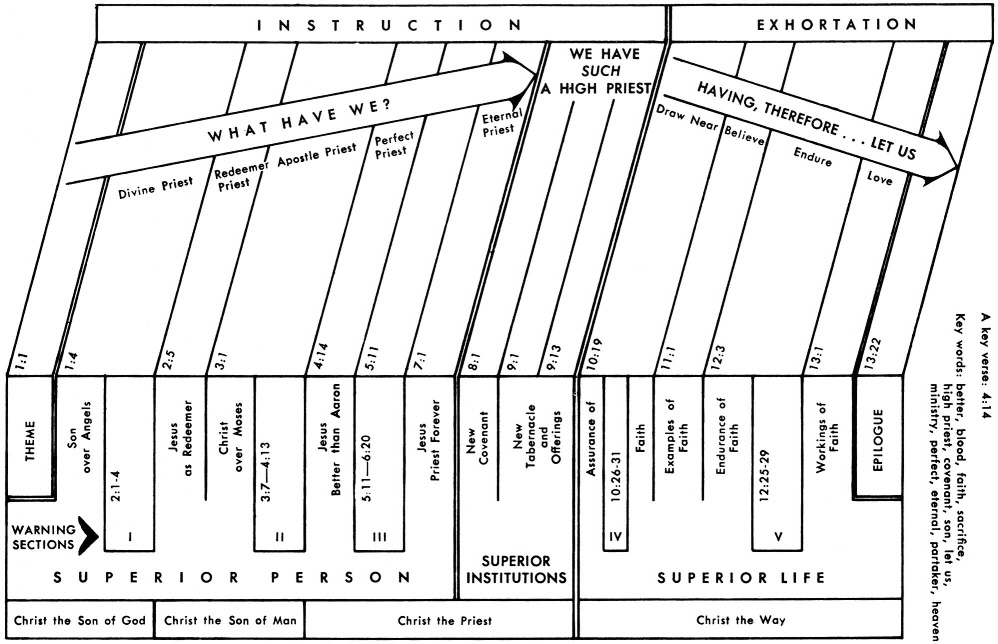
CONSIDER JESUS OUR GREAT HIGH PRIEST
Click chart to enlarge
Charts from Jensen's Survey of the NT - used by permission
Swindoll's Chart, Another Chart
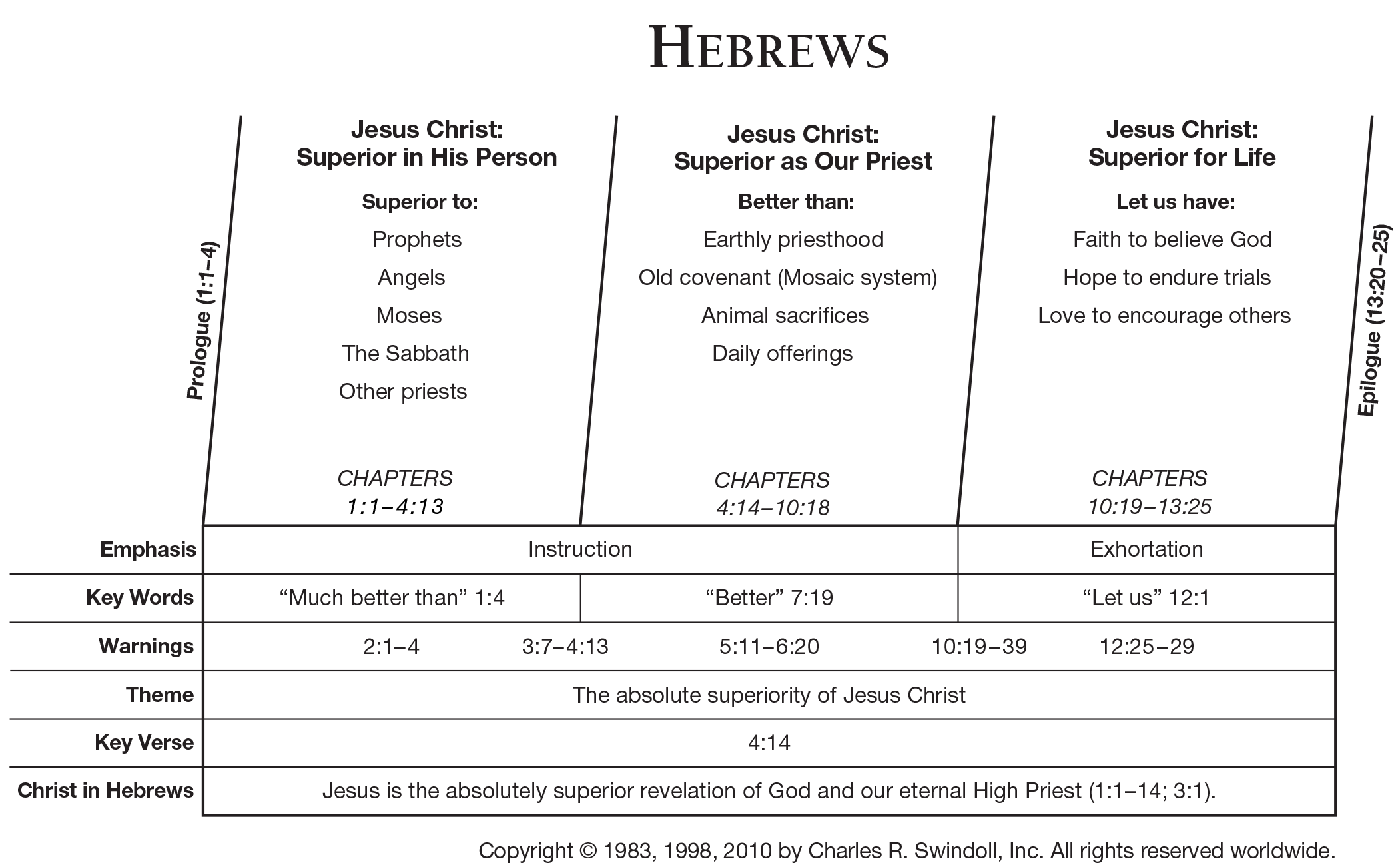
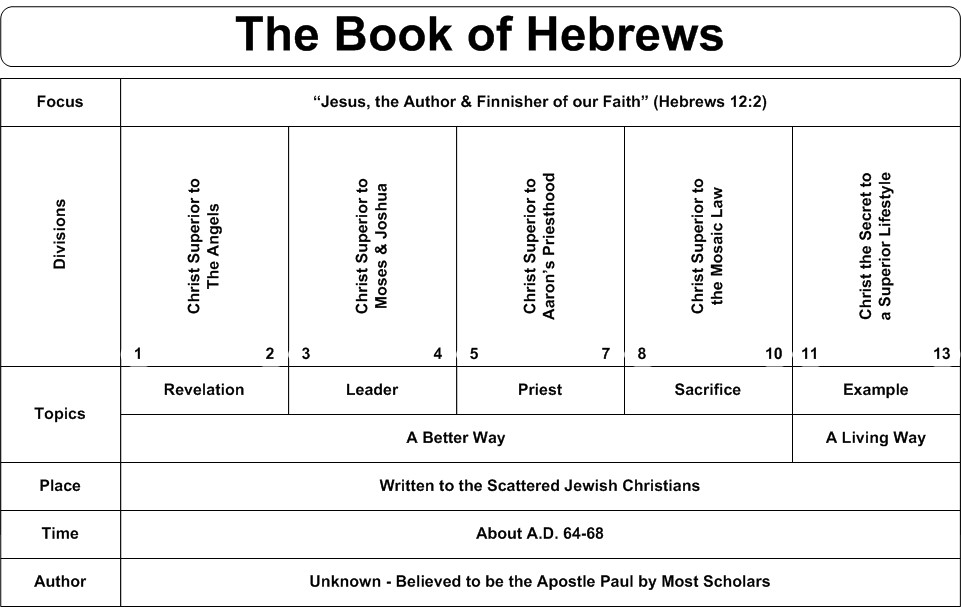
|
The Epistle |
||||
| INSTRUCTION Hebrews 1-10:18 |
EXHORTATION Hebrews 10:19-13:25 |
|||
| Superior Person of Christ Hebrews 1:1-4:13 |
Superior Priest in Christ Hebrews 4:14-10:18 |
Superior Life In Christ Hebrews 10:19-13:25 |
||
| BETTER THAN PERSON Hebrews 1:1-4:13 |
BETTER PRIESTHOOD Heb 4:14-7:28 |
BETTER COVENANT Heb 8:1-13 |
BETTER SACRIFICE Heb 9:1-10:18 |
BETTER LIFE |
| MAJESTY OF CHRIST |
MINISTRY OF CHRIST |
MINISTERS FOR CHRIST |
||
|
DOCTRINE |
DUTY |
|||
|
DATE WRITTEN: |
||||

See ESV Study Bible "Introduction to Hebrews"
(See also MacArthur's Introduction to Hebrews)
Borrow Ryrie Study Bible
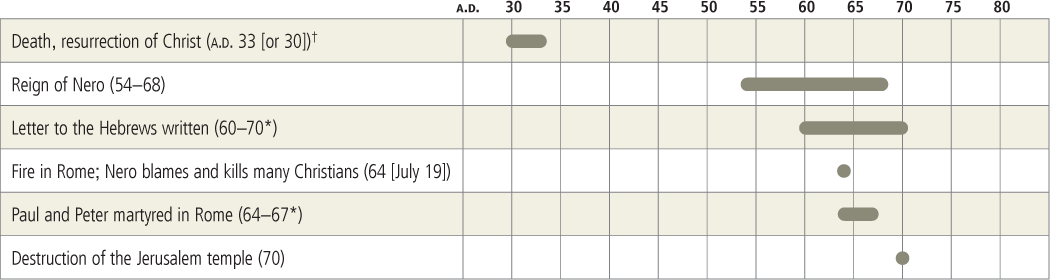
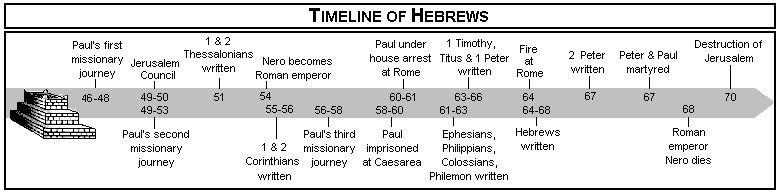
Timeline of Hebrews - ESV Study Bible
Hebrews 2:11 For both He Who sanctifies and those who are sanctified are all from one Father; for which reason He is not ashamed to call them brethren (NASB: Lockman)
Greek: o te gar hagiazon (PAPMSN) kai oi hagiazomenoi (PPPMPN) ex enos pantes; di' en aitian ouk epaischunetai (3SPAI) adelphous autous kalein, (PAN)
BGT ὅ τε γὰρ ἁγιάζων καὶ οἱ ἁγιαζόμενοι ἐξ ἑνὸς πάντες· δι᾽ ἣν αἰτίαν οὐκ ἐπαισχύνεται ἀδελφοὺς αὐτοὺς καλεῖν
Amplified: For both He Who sanctifies [making men holy] and those who are sanctified all have one [Father]. For this reason He is not ashamed to call them brethren; (Amplified Bible - Lockman)
Barclay: For he who sanctifies and they who are sanctified must come of one stock. It is for this reason that he does not hesitate to call them brothers, (Westminster Press)
KJV For both he that sanctifieth and they who are sanctified are all of one: for which cause he is not ashamed to call them brethren,
NET For indeed he who makes holy and those being made holy all have the same origin, and so he is not ashamed to call them brothers and sisters,
BBE For he who makes holy and those who are made holy are all of one family; and for this reason it is no shame for him to give them the name of brothers,
CSB For the One who sanctifies and those who are sanctified all have one Father. That is why Jesus is not ashamed to call them brothers,
ERV For both he that sanctifieth and they that are sanctified are all of one: for which cause he is not ashamed to call them brethren,
ESV For he who sanctifies and those who are sanctified all have one source. That is why he is not ashamed to call them brothers,
NLT: So now Jesus and the ones he makes holy have the same Father. That is why Jesus is not ashamed to call them his brothers and sisters. (NLT - Tyndale House)
Phillips: For the one who makes men holy and the men who are made holy share a common humanity. So that he is not ashamed to call them his brothers, (Phillips: Touchstone)
Wuest: For both He who sanctifies, and those who are sanctified, are all out of one source, for which reason He is not ashamed to call them brethren. (
Young's Literal: for both he who is sanctifying and those sanctified [are] all of one, for which cause he is not ashamed to call them brethren
FOR BOTH HE WHO SANCTIFIES AND THOSE WHO ARE SANCTIFIED ARE ALL FROM ONE FATHER: te gar hagiazon (PAPMSN) kai oi hagiazomenoi (PPPMPN) ex henos pantes:
- He Who sanctifies Heb 10:10,14; 13:12; John 17:19
- Those who are sanctified - He 2:14; John 17:21; Acts 17:26; Galatians 4:4
- Hebrews 2 Resources - Multiple Sermons and Commentaries
Related Passages:
Hebrews 10:10+ By this will we have been sanctified (PAST TENSE SALVATION - JUSTIFICATION) through the offering of the body of Jesus Christ once for all.
Hebrews 10:14+ For by one offering He has perfected for all time those who are (PRESENT TENSE = BEING) sanctified (PRESENT TENSE SALVATION - PROGRESSIVE SANCTIFICATION)
Hebrews 13:12+ Therefore Jesus also, that He might sanctify the people through His own blood, suffered outside the gate.
John 17:19 “For their sakes I sanctify Myself, that they themselves also may be sanctified in truth.
2 Corinthians 7:1 Therefore, having these promises, beloved, let us cleanse ourselves from all defilement of flesh and spirit, perfecting holiness in the fear of God.
1 Peter 4:19 Therefore, those also who suffer according to the will of God shall entrust their souls to a faithful Creator in doing what is right.
1 Peter 1:16 because it is written, “YOU SHALL BE HOLY, FOR I AM HOLY.”
1 John 3:3 And everyone who has this hope fixed on Him purifies himself, just as He is pure.
THE SANCTIFIER AND SANCTIFIED
ARE ETERNALLY IN ONENESS
For (term of explanation) - Steven Cole explains this term of explanation writing that "The word “for” directs us back to 2:10, where he said that God saw fit “to perfect the author of [our] salvation through sufferings.” To save humans, Jesus had to assume full humanity. But, for His suffering and death to have merit before God, Jesus had to be fully God. In the incarnation, He did not lay aside His divinity, although He set aside His glory and He temporarily gave up the use of some of His divine attributes (omniscience, for example, John 11:34; Matt. 24:36). But He did fully assume our human nature."
Griffith Thomas adds that "He was made perfect through sufferings, in order that He might accomplish His work of redemption. This oneness between leader and led is further emphasized in the following verses (Heb 2:11-13). (See context in Hebrews: A Devotional Commentary)
English says "And now we are brought to see some of the results of Christ's sufferings."
Wuest - In order to bring many sons to glory, our Lord becomes to them a brother (ED: WHICH IS IMPLIED BY THE PHRASE ALL FROM ONE...FATHER). (Hebrews)
Don Anderson - Christ's walk through the valley of suffering was so that He might be a perfect leader, He might be One Who can relate to us as we are being made holy when we too walk through the vale of tears.
Both He Who sanctifies (hagiazo) and those who are sanctified (hagiazo) are all from one Father - He Who sanctifies refers to Jesus, and then the writer emphasizes the unity or oneness Jesus has with those who are His by grace through faith in the New Covenant (see study on The Oneness of Covenant and Oneness Notes - note - this is NOT in any way associated with the cultic teaching of so-called Oneness Pentecostal theology or "Jesus only" teaching!) Those who are sanctified refers to the saints (believers). Note that both sanctifies and are sanctified are both in present tense indicating that this speaks of the continuous application of His finished work on the cross. You and I were sanctified by His finished work as are all sinners who become His brothers and sisters. We were sanctified (saved, at a point in time) that we might be progressively sanctified.
For sanctification is glory begun,
and glory is sanctification completed
F. F. Bruce explains “By His death they are consecrated to God for His worship and service and set apart for God as His holy people, destined to enter into His glory. For sanctification is glory begun, and glory is sanctification completed.” (borrow The Epistle to the Hebrews)
Wuest - The words He that sanctifies refer to the Lord Jesus, the One who puts the believer on the path to glory, and then through the ministry of the Holy Spirit leads him on that road through the process of progressive sanctification. (Hebrews)
MacArthur points out: In addition to becoming our Substitute and Author of salvation, He became our Sanctifier, the One who makes us holy. From our own perspective and experience, of course, it is difficult to think of ourselves as holy. Sin is too much with us. In thought and practice we are far from holy. But in the new nature we are perfectly holy. Before God, those who are in His Son are holy. We may not act holy, but we are holy--just as a child who often does not act like his father or please his father is still his father's child. We are holy in the sense that before God the righteousness of Christ has been applied and imputed in our behalf. "We have been sanctified through the offering of the body of Jesus Christ once for all" (Heb. 10:10). We are made holy through His sacrifice, and have become those who are sanctified. (See context in Hebrews Commentary)
Spurgeon- What is meant by the expression, being sanctified? The essential part of sanctification means being set apart for holy uses. That which was meant to be used for God alone was sanctified, set apart, regarded as holy. The vessels of the sanctuary were sanctified when they were used only by the priests in the service of God. Of course; there arose out of this fact, which is the essence of sanctification, the further quality of purity, for that which is dedicated to God must be pure, that which is reserved for his service must not be defiled, it must be clean. We cannot imagine the holy God using unholy vessels in his sanctuary; so that sanctification comes to mean purification, the making of that to be holy which was first of all set apart for holy uses. Holiness of character follows upon holiness of design. First are we set apart for God’s use (ED: POSITIONAL SANCTIFICATION), and then afterwards we are made pure (ED: PRACTICAL/PROGRESSIVE SANCTIFICATION BY THE SPIRIT) that we may be fit for God’s use. No man is truly sanctified unless he is sanctified by Christ. The Holy Spirit is made the Agent of our purification, but it is in Christ that we are first of all set apart unto God, and it is by His most precious blood, applied to us by the Spirit of God, that we are made clean and pure so as to be used in the divine service. Believers are the sanctified, and Jesus Christ is the Sanctifier.
Gotquestions - Once we have been positionally sanctified, the process of progressive sanctification begins. Progressive sanctification is the lifelong process of becoming more Christlike as we cooperate with the Holy Spirit and yield to His control (Romans 8:29; 2 Corinthians 3:18). Once we are positionally sanctified, the Holy Spirit uses the Word of God to progressively sanctify us (John 17:17) so that in the end our practical holiness aligns with our positional holiness when we see Christ face to face in glory (1 John 3:2).
The sanctification made possible by the Lamb of God (Jn 1:29) is emphasized in the epistle to the Hebrews (undoubtedly because of their Jewish background, familiarity with and reliance upon ritual of animal sacrifices, etc)...
For if the blood of goats and bulls and the ashes of a heifer sprinkling those who have been defiled, sanctify for the cleansing of the flesh, 14 how much more will the blood of Christ, who through the eternal Spirit offered Himself without blemish to God, cleanse your conscience from dead works to serve the living God? (He 9:13, 14+)
By this will we have been sanctified (Positional sanctification - made holy before God at a point in time and still holy = the permanence of our position in Christ is emphasized by use of the perfect tense which speaks of the enduring/eternal effect never to be "undone" [this verse among many refutes the false teaching that a genuine believer can lose their salvation]! Hallelujah! Glory!) through the offering of the body of Jesus Christ once for all. (He 10:10+)
For by one offering He has perfected for all time those who are (present tense, passive voice = being [by the Spirit's power, not our power] continually) sanctified (Practical sanctification - the day by day outworking of who we are in Christ positionally - see 1Th 4:3-note. This is a process whereas He 10:10 is our position). (He 10:14-note)
Comment: What this means is that you can know that you stand perfect in the eyes of your heavenly Father if you are moving away from your present imperfection toward more and more holiness by faith in his future grace. Let me say that again, because it is full of encouragement for imperfect sinners like us, and full of motivation for holiness. This verse means that you can have assurance that you stand perfected and completed in the eyes of your heavenly Father not because you are perfect now, but precisely because you are not perfect now but are "being sanctified", "being made holy", that, by faith in God's promises, you are moving away from your lingering imperfection toward more and more holiness. (See Hebrews 10:32, 33, 34, 35; 11:24, 25, 26 etc. for examples of how faith in future grace sanctifies.) (See John Piper's entire message "Perfected for All Time by a Single Offering")
Therefore Jesus also, that He might sanctify the people through His own blood, suffered outside the gate. (He 13:12+)
In His great prayer in John 17 just preceding His arrest, trial and crucifixion, our Lord prayed...
And for their sakes I sanctify Myself, that they themselves also may be sanctified (set apart, made holy) in (the sphere of, in the atmosphere of) truth. (John 17:19) (Cp His earlier words in John 17:17 "Sanctify (aorist imperative) them in the truth; Thy word is truth.")
MacDonald - The next three verses emphasize the perfection of Jesus’ humanity. If He is going to regain the dominion which Adam lost, then it must be demonstrated that He is true Man. (See context in Believer's Bible Commentary)
Spurgeon - He who sets them apart and they who are set apart “are all of one.” They are of one nature, and they have one destiny before them. Does not this bring very sweetly before you the close relationship of Christ to His people? He has espoused their nature, and He owns it by calling them brethren. One family; one by nature with Christ our glorious Head. Oh, this blessed condescension of Christ! We are often ashamed of ourselves; alas! we are sometimes so base as to be ashamed of Him; but He is never ashamed to call us brethren. (Hebrews 2 Exposition)
Those who are sanctified (hagiazo) - "Those who are continuously being sanctified" describes an ongoing process - practical sanctification = progressive sanctification = present tense salvation (see notes on the Three Tenses of Salvation)
And so both occurrences of hagiazo in this verse are in the present tense indicates continuous activity. The first use is in the active voice indicating it is the Lord Jesus' continual work in our life. The second use is in the indicating that believers are continually being acted upon by an external agent to bring about the experience of holiness. Holiness is not just our "position" in Christ, but must be become our experiential possession through Christ. We must seek and strive for this to be our life-style, and such a supernatural state is only made possible by the indwelling Spirit working in the heart of the surrendered saint. Try to be holy on your own and you will fail miserably. Oh, to be sure, you might possibly impress men but you will not be pleasing your Father in heaven Who sees the motives of your heart! Seek not the praises of men but of God Alone! (See also Holiness Quotes; Pursuit of holiness; Jehovah Mekeddeshem - the LORD Who Sanctifies)
Jesus is our Sanctifier...
Hebrews 9:13+ For if the blood of goats and bulls and the ashes of a heifer sprinkling those who have been defiled sanctify for the cleansing of the flesh, 14 (note) how much more will the blood of Christ, who through the eternal Spirit offered Himself without blemish to God, cleanse your conscience from dead works to serve the living God?
Hebrews 13:12+ Therefore Jesus also, that He might sanctify the people through His own blood, suffered outside the gate.
In sum, sanctification is a process in this verse, just as in He 10:14 (note), and is not a single act. In He 10:10 (note) the perfect tense defines a completed state of being set apart or sanctified and thus believers are "positionally" in Christ are complete in Him (Col 2:10-note) but experientially as we as believers grow in the grace and the knowledge of our Lord and Savior Jesus Christ (2Pe 3:18-note) we are being continuously being set apart from the world and to God (practical or progressive sanctification). For this reason Paul prays for the continual setting apart of believers in Thessalonica (1Th 5:23-note). This process of daily being set apart more and more from the profanity of the world and unto God is analogous to Joshua getting ready to enter the Promised Land, God declaring to His choice servant...
Every place on which the sole of your foot treads, I have given it to you, just as I spoke to Moses. (Joshua 1:3+).
In that passage although all the land was Israel's by God's promise, Joshua nevertheless had to lay hold of this possession by faith (obediently going into the land in God's power cp Zech 4:6). For example, the circling of Jericho (Joshua 6:2ff) shows Who has the power to conquer "walled" cities. It is the same in our life -- we are positionally sanctified at the moment of our new birth and are complete in Christ (Col 2:10+). We have been filled (perfect tense - enduring effect) with the fruit of righteousness (Php 1:11+) at the moment of salvation. But now we must be continuously set apart by God, and as we are we lay hold progressively of our "Promised Land" so to speak. On one side our responsibility, like Joshua, is to work out our salvation by walking out in faith (faith equating with obeying) His Word (His Word equating with His will). Balancing our responsibility on the other side is the sovereign hand of God Who is in us both to work and to will to His good pleasure (Php 2:12+, Php 2:13NLT+). And this entire process is bathed in prayer that God would sanctify us entirely (cp 1Th 5:23+). This is quite a mystery and difficult to fully comprehend but it is the Truth of God's Word. Let us walk in it, not be conformed to this world but being transformed by the renewing of our minds (Ro 12:2+) that ultimately the Father would be glorified (Mt 5:16+) in our lives. (cp Paul's desire, delightful duty and dependence - Col 1:28, 29+)
From one Father - Note that Father is in italics in the NAS, which indicates that the translators have chosen (appropriately) to add the word Father (Greek - pater) even though that word is not present in the original Greek text.
Jamieson adds that God is Father but...
not in the sense wherein He is Father of all beings, as angels; for these are excluded by the argument (He 2:16-note); but as He is Father of His spiritual human sons (Ed: See how one gains entrance into this family - John 1:12,13), Christ the Head and elder Brother, and His believing people, the members of the body and family. Thus, this and the following verses are meant to justify his having said, "many sons" (He 2:10-note).
Of one is not "of one father Adam," or "Abraham," as BENGEL and others suppose. For the Saviour's participation in the lowness of our humanity is not mentioned till He 2:14 (note), and then as a consequence of what precedes. Moreover, "Sons of God" is, in Scripture usage, the dignity obtained by our union with Christ; and our brotherhood with Him flows from God being His and our Father. Christ's Sonship (by generation) in relation to God is reflected in the sonship (by adoption) of His brethren.
Ray Stedman - Those who by faith become sons of God are made holy (sanctified) because they share the life of the Son of God. John 1:12 declares, "To all who received him, to those who believed in his name, he gave the right to become children of God," and 1 John 5:11-12 adds, "God has given us eternal life, and this life is in his Son; he who has the Son has life." Because of this shared life the writer of Hebrews can say they are, literally, "all of One" (ek henos pantes), which refers to the Father. (The NIV's of the same family, to my mind, somewhat weakens the force of this declaration.) Jesus, who is of different rank and origin, still is not ashamed to call them brothers. Since he has made them holy by imparting his own life to them, he cannot deny the very holiness he has given. Now the groundwork is laid for believers to learn to live everyday on the basis of the new men and women they have become rather than continuing to live on the old level of humanity they had once been. It is Paul's constant exhortation: "Put off the old man; put on the new." The writer of Hebrews urges the same activity in 12:14. Holiness of nature is the possession of all true Christians; holiness of behavior is to be their goal. But even before that goal is attained to any appreciable degree, it is still true that Jesus is not ashamed to call them brothers. The picture is that of an oldest son affirming to another his pride in his younger siblings, even though they do not always act in ways pleasing to him. Because of this shared life the writer of Hebrews can say they are, literally, "all of One" (ek henos pantes), which refers to the Father. (The NIV's of the same family, to my mind, somewhat weakens the force of this declaration.) Jesus, who is of different rank and origin, still is not ashamed to call them brothers. Since he has made them holy by imparting his own life to them, he cannot deny the very holiness he has given. Now the groundwork is laid for believers to learn to live everyday on the basis of the new men and women they have become rather than continuing to live on the old level of humanity they had once been. It is Paul's constant exhortation: "Put off the old man; put on the new." The writer of Hebrews urges the same activity in 12:14. Holiness of nature is the possession of all true Christians; holiness of behavior is to be their goal. But even before that goal is attained to any appreciable degree, it is still true that Jesus is not ashamed to call them brothers. The picture is that of an oldest son affirming to another his pride in his younger siblings, even though they do not always act in ways pleasing to him. (Hebrews Commentary)
Spurgeon - Consider the remarkable unity between Christ and His people. They are “all from one.” They are, first, “all from one” in the divine design. In the great mind of God, it is not Christ alone, and His people alone, but Christ and His Church who are regarded as “all from one.” They are fitted, constituted, designed for each other; they are the complement of each other. Then, next, they who are sanctified and the Sanctifier Himself are “all from one” in the eternal covenant. When the Lord Jesus Christ became the Surety of the covenant, the Head and Representative of His people, He struck hands with His great Father in a solemn league and covenant. He did that, not for Himself alone, but for us also. That covenant was made for us in Christ with Christ, as He is one with us. And now today the provisions of the covenant are as much for me as for Christ, and as much for Christ as for the very least of His people. But there is something better than this, if there can be anything better, for they are “all from one” as to nature. Do not let us ever permit our hearts to lose the sweetness of the fact that the Lord Jesus Christ is really and truly one with us as to nature. In Him dwells all the fullness of the Godhead bodily, and yet, notwithstanding that, He is man of the substance of His mother. “Therefore, since the children share in blood and flesh, he also in like manner shared in these same things” (Heb 2:14). It is easy to say, but it is hard to realize that Jesus Christ is as truly man as any of us can be. Yet further than that, they who are sanctified and their Sanctifier are “all from one” because of His representative character. Whatever Jesus did in the past, He did for us, for we are “all from one.” He was circumcised, and we are circumcised in Him with the true circumcision not made by hands. When He kept the law, we kept the law in Him, for He stood as our Representative. If He died, we reckon that we died in Him. And henceforth, we recognize that we live because He lives. Now that He has gone into the heavenlies, it is as our Forerunner, and He has raised us up together with Him, and made us sit together with Him in the heavenlies, and in all the glory that is yet to come we shall be partakers. Hence follows this further oneness. So are we “all from one” that, henceforth, we are united in our interests. His concerns and our concerns are one. We have not to speak of what is Christ’s and what is His people’s, but all that is Christ’s belongs to His people, and all that belongs to His people belongs to Him. (see ALL OF ONE)
Spurgeon - "The Christ and the Christian are one,—the Man Christ Jesus and the men whom he redefined are one. He has so become partaker of our nature that now we are one family, and he is not ashamed to call us brothers. Am I addressing any who are ashamed of Christ, or who are ashamed of God's poor people, and who would not like to be known to be members of a poor church? Ah! how you ought to despise yourselves for having any such pride in your hearts, for Christ is not ashamed to call his people brethren! Oh, what wondrous condescension! He has done this many times in the Psalms, where he speaks of his brethren (Spurgeon's Expositional Commentary on Hebrews)
Sanctifies...are sanctified (37) (hagiazo form hagios = set apart ones in turn from a = privative + ge = the earth ~ because everything offered or consecrated to God was separated from all earthly use) means to set apart, to make holy, to consecrate (as of things set apart for sacred purposes). A sanctified person or thing is one set apart from ordinary uses to be for God’s own possession, use, and enjoyment. The opposite of sanctification is profanation. Without going into detail, it should be noted that there are four types of sanctification in the Bible: pre-conversion sanctification, positional sanctification (our initial salvation experience when we were justified by faith in Christ, representing a one time setting apart), practical sanctification (where believers live day by day, thus representing an ongoing event until the next stage of our salvation), and perfect sanctification (or glorification, when we see Jesus we will be like Him, 1John 3:2, 3+). (See also related topic Three Tenses of Salvation). As you read Hebrews sanctification is used several times and the context should help determine which meaning is in view but sometimes only knowing the verb tense will aid this distinction.
HAGIAZO - 25V - Matt. 6:9; Matt. 23:17; Matt. 23:19; Lk. 11:2; Jn. 10:36; Jn. 17:17; Jn. 17:19; Acts 20:32; Acts 26:18; Rom. 15:16; 1 Co. 1:2; 1 Co. 6:11; 1 Co. 7:14; Eph. 5:26; 1 Thess. 5:23; 1 Tim. 4:5; 2 Tim. 2:21; Heb. 2:11; Heb. 9:13; Heb. 10:10; Heb. 10:14; Heb. 10:29; Heb. 13:12; 1 Pet. 3:15; Rev. 22:11
Hagiazo means to render or acknowledge to be venerable or to hallow. It means to separate from things profane and dedicate to God, to consecrate and so render them inviolable. It means to purify or cleanse, either externally as in the Levitical system or to purify by expiation so that one is free from the guilt of sin. n general, Christians are called "holy ones" indicating that they are those who are freed from the impurity of wickedness, having been brought near to God by their faith and sanctity. This latter meaning is seen in Acts were Luke records Jesus' charge to Paul to go to the Gentiles...
to open their eyes so that they may turn from darkness to light and from the dominion of Satan to God, in order that they may receive forgiveness of sins and an inheritance among those who have been sanctified (describes the initial setting apart at the time of salvation = justification) by faith in Me.' (Acts 26:18+)
Objectively, hagiazo speaks of setting apart of Christ and His church acknowledged as being God's own possession which is set apart for a holy purpose. For example Paul writes that...
And such were some of you (he has just described unrighteous deeds and attitudes); but you were washed, but you were sanctified (aorist tense = past, completed action speaking of their initial salvation experience = justification), but you were justified in the name of the Lord Jesus Christ, and in the Spirit of our God. (1Cor 6:11+)
Subjectively, hagiazo speaks of spiritual and moral preparation, of making one holy or purifying them as Paul wrote to the Thessalonians...
Now may the God of peace Himself sanctify (describes the daily setting apart from profane gradually conforming the believer into the image of Christ, the Holy One) you entirely; and may your spirit and soul and body be preserved complete, without blame at the coming of our Lord Jesus Christ. (1Th 5:23+)
Comment: Believers compose the Church, the Body and Bride of Christ, who is to be eagerly expecting the Bridegroom's imminent return to sweep away His beloved, which motivates the Bride to make herself ready, clothing herself with fine linen which speaks of the righteous acts of the saints, the holy ones enable by the Holy Spirit carrying out holy actions and deeds - i.e., being sanctified.
FOR WHICH REASON HE IS NOT ASHAMED TO CALL THEM BRETHREN: di he aitian ouk epaischunetai (3SPAI) adelphous autous kalein (PAN):
- He is not ashamed - He 11:16; Mark 8:38; Luke 9:26
- To call them brethren - Matthew 12:48-50; 25:40; 28:10; John 20:17; Ro 8:29
- Hebrews 2 Resources - Multiple Sermons and Commentaries
Related Passages:
Matthew 12:47-50+ Someone said to Him, “Behold, Your mother and Your brothers are standing outside seeking to speak to You.” 48 But Jesus answered the one who was telling Him and said, “Who is My mother and who are My brothers?” 49 And stretching out His hand toward His disciples, He said, “Behold My mother and My brothers! 50 “For whoever does the will of My Father who is in heaven, he is My brother and sister and mother.”
Mark 3:34+ Looking about at those who were sitting around Him, He *said, “Behold My mother and My brothers! 35 “For whoever does the will of God, he is My brother and sister and mother.”
COMMENT: Doing God's will does not save us but it does demonstrate one is saved because unregenerate men do not seek to do God's will (cf Ro 3:11+) but their own will. The Biblical pattern which assures brotherhood with Jesus is (1) you are saved by grace (Eph 2:8-9+) and (2) you are "doing" (Eph 2:10+) by the Spirit of grace (Heb 10:29+, Gal 3:3+).
JESUS UNASHAMEDLY
CALLS US HIS BRETHREN!
For this reason - What reason (term of conclusion)? What has he just explained? Are believers now not members of God's family (by grace through faith Eph 2:8, 9+, Jn 1:11-13+, Ro 8:16+)?
He is not ashamed (epaischunomai) to call them brethren (adelphos) - The writer uses the negative particle ou/ouk which signifies absolute negation. This is amazing grace - the Holy One of Israel, the Messiah Himself, is absolutely not ashamed to claim us as His brothers! Surely this should be cause for a pause that offers a sacrifice of praise and thanksgiving (and even that made possible by the very One Who forever calls us "brethren"! (cp Heb 13:15+, cp Ro 11:32+, Ro 11:33-36+) Believers now belong to a new group, the fellowship of the unashamed!
🙏 THOUGHT - Are you ashamed of Jesus? Are you afraid to speak up when someone uses His matchless, majestic Name in a profane way? Are you afraid of others finding out that Jesus is your Lord, your King, your Brother? Are you afraid to tell others about His glorious Name and how He has finished the work making possible sanctification of sinners? Let's be honest. We all are a bit reticent to boldly stand for Jesus ALL THE TIME. Some days we do better than others. The truth is that the only way to be consistently unashamed of Jesus is by being continually filled with His Word and His Spirit (these two go together - see Filled with His Spirit/Richly Indwelt with His Word), for then we can be energized by the fruit of the Spirit which is boldness in our speech (cf Acts 4:31+).
DeHaan adds "He endured the Cross and despised the shame. He now calls us "brethren." And can it be that we, lifted from the mire and slime of sin should be ashamed of Him, the Altogether Lovely One? How inconsistent for anyone washed in the blood to be ashamed of His Name! How ungrateful to be anything less than our best for Him! How awful to withhold anything of all we are and have from Him! It seems to me that once we realize what He did for us, we would never be satisfied until everything was on the altar for Him.
Anderson - How fantastic it is to know that Jesus Christ is not ashamed of the relationship which He sustains with us. How precious is that thought
Kenneth Wuest - What condescension on the part of our glorious Lord! Notwithstanding His superior and exalted dignity, He is not ashamed to call us His brethren
A. B. Bruce comments on not ashamed noting that "On the contrary, He calls them brothers with all His heart, with the fervour of love, with the eloquence of earnest conviction. (Epistle to the Hebrews. Minneapolis: Klock & Klock, 1988)
Spurgeon - They are poor, they are despised, they are persecuted; what is worse, they are imperfect and faulty, often sorrowful, cast down, condemning themselves, groaning at the mercy-seat; yet “he is not ashamed to call them brothers.” There is such a unity between the believer, be he in what sorrow he may, and the Christ, be he in what glory he may, that he is never ashamed to own the close relationship between them. (All of One)
Believers are united in Christ as brothers in the family of God. Having been "born again" spiritually, "children of God" (Jn 3:3; 1:12), we are brothers in Christ. Jesus will not blush when He calls you brother or sister. Hallelujah, for the outpouring of God's boundless mercy and amazing grace through our Kinsman-Redeemer, Christ Jesus!
The amazing statement is that the Son of glory is not reluctant or ashamed to call the redeemed his "brethren (and "sistern")"! We, as the set apart ones, the saints of God and spiritual brothers and sisters of the the Lord Jesus Christ have the same God as Father. This is an indescribable condescension on the part of our glorious Lord! Notwithstanding His superior and exalted dignity, He is not ashamed to call us His brethren! John writes these beautiful words "See how great a love the Father has bestowed on us, that we would be called children of God; and such we are. For this reason the world does not know us, because it did not know Him." (1Jn 3:1) Take a few moments and worship Him - let your heart be taken to your future home as you listen to the How Deep the Father's Love for Us. We bless you Father because of what Jesus has done for us. Amen
In a parallel passage in Hebrews 11, the writer testifies concerning those who have fallen asleep in faith declaring that...
they desire a better country, that is a heavenly one (Ed: What they were LOOKING for determined/radically impacted what they were LIVING for? How about you beloved - what are you LOOKING for?). Therefore (why "therefore"? Compare "for that reason" in the present passage - see also terms of conclusion) God is not ashamed to be called their God; for He has prepared a city for them. (He 11:16+)
Wuest sums up this supernatural relationship writing that the "one source is God the Father. The Son in His deity proceeds by eternal generation from God the Father. In His humanity, He finds His source in God. The saints find the source of their sonship in God the Father. (Hebrews)
Hughes looks at this passage in the cultural light (context) of the first century Hebrew readers commenting...Now think for a moment of those in the little house-church who are so transfixed by the fear of death, who feel so alone. The healing message to them is that Jesus, the Pioneer/Captain of their salvation, is proudly affirming His solidarity with them. And this is not "empty religious rhetoric, or pious sentimental exaggeration." (David Gooding. An Unshakeable Kingdom-Grand Rapids, MI: Eerdmans, 1989). He means exactly what he says: they are His brothers and sisters, and He is proud of it! This bold statement of the fact of solidarity, taken to heart, will begin to loosen the paralyzing grip of their fear. (See Context in Hebrews: An Anchor for the Soul)
🙏 THOUGHT - Dearly beloved of God, are you continually fearful of not being accepted (or of being rejected by others)? Contemplate (Meditate on) your Lord's acceptance (the consummate "acceptance") and let this truth of your begin to renew your mind and thereby (with your mind renewed, cp notes Romans 12:2; Philippians 4:8; 4:9) allay your fears concerning the present.
Who will the Lord Jesus be ashamed of? In the gospels Jesus declares that...
For whoever is ashamed (epaischunomai) of Me and My words in this adulterous and sinful generation, the Son of Man will also be ashamed (epaischunomai) of him when He comes (see Second Coming) in the glory of His Father (Mt 24:30, 31+, Mt 25:31, 26:64) with the holy angels. (Mk 8:38+, Lk 9:26+, cp 2Ti 2:12b+; contrast Mt 10:32, 33+)
Compare a parallel passage in Matthew where Jesus explained who his true brothers were when someone told Him that His mother and His brothers were standing outside seeking to speak with him. His answer helps us understand who a true brother is...
Someone said to Him, “Behold, Your mother and Your brothers are standing outside seeking to speak to You.” But Jesus answered the one who was telling Him and said, “Who is My mother and who are My brothers?” And stretching out His hand toward His disciples, He said, “Behold My mother and My brothers! “For whoever DOES THE WILL of My Father Who is in heaven (cf Mt 7:21+ = he who does [present tense - habitually] the will of My Father who is in heaven will enter.", Mt 7:23+ = "And then I will declare to them, ‘I never knew you; DEPART FROM ME, YOU WHO PRACTICE [present tense - habitually] LAWLESSNESS.’), he is My brother and sister and mother.” (Mt 12:47-50+)
🙏 THOUGHT - What is Jesus' description of His true brother in a spiritual sense, one who is truly a child of God and is in the family of God? Jesus clearly states he or she is truly His spiritual relative if they do the will of the Father; i.e., they are doers of the Word and not merely hearers who delude themselves (James 1:21-22+). There is a dangerous teaching in evangelical circles in the so-called "free grace movement" which believes one can become a brother of Jesus by grace through faith (which so far is truth), but then teaches that such an individual does not need to demonstrate any fruit (e.g., doing the will of the Father as Jesus puts it). They teach no fruit will simply result in no rewards! If you have "asked Jesus into your heart" and there has been no demonstrable change in your life (no spiritual fruit, no desire for holiness, no desire for God's Word, no desire to fellowship with God's people, etc), then you can have no assurance that you will go to Heaven when you die! For more discussion of this vital topic see What is free grace? What is Free Grace Theology? | GotQuestions.org
G. Campbell Morgan says: This quotation (Heb 2:11) is taken from the twenty-second Psalm, which begins with the cry which was uttered by our Lord on the Cross: "My God, My God, why hast Thou forsaken Me?" In that Psalm the Messianic sorrows are set forth, but they are revealed as leading to the declaration of victory wherein the suffering One will declare God's name to His brethren, with the result of the song of praise which will ascend to God. Thus God's final speech to man through the Son, Who is higher than the angels, has come to him because He descended on to the human level, and passed through the bitterness of death, the ultimate dereliction; in order that He Himself might ascend to His place higher than the angels, making a way by which man who had fallen from his high estate, might regain everything that he had lost. This is the perpetual message of the New Testament concerning the Son. The music is heard throughout in varying tones, sometimes major and sometimes minor; all merging in the ultimate speech of God, which tells man of His eternal love, and of the way by which man may be redeemed.
Ashamed (1870) (epaischunomai from epi = upon + aischuno = to put to shame) is a consciousness of guilt or of its exposure. It is that which causes (or should cause) one to blush. It represents a fear of embarrassment that one's expectations may prove false, something that Christ does not exhibit because He knows His own sheep and His sheep know Him (cp Jn 10:14).
EPAISCHUNOMAI - 9V - Mk. 8:38; Lk. 9:26; Rom. 1:16; Rom. 6:21; 2 Tim. 1:8; 2 Tim. 1:12; 2 Tim. 1:16; Heb. 2:11; Heb. 11:16
Brethren (80) (adelphos from a = denoting unity + delphús = womb) is literally those born from the same womb and describes those males having the same father and mother. Figuratively adelphos defines a close associate of a group of persons having well-defined membership and as used here and other places in the New Testament speaks of fellow believers in Christ Who as set them apart to be His possession and Who continues to set them apart from the profane world. Adelphós generally denotes a fellowship of life based on identity of origin, e.g., members of the same family.
ADELPHOS IN HEBREWS - Heb. 2:11; Heb. 2:12; Heb. 2:17; Heb. 3:1; Heb. 3:12; Heb. 7:5; Heb. 8:11; Heb. 10:19; Heb. 13:22; Heb. 13:23
The Fellowship of the Unashamed
I am part of the "Fellowship of the Unashamed." The die has been cast. I have stepped over the line. The decision has been made. I am a disciple of Jesus Christ. I won't look back, let up, slow down, back away, or be still. My past is redeemed, my present makes sense, and my future is secure. I am finished and done with low living, sight walking, small planning, smooth knees, colorless dreams, chintzy giving, and dwarfed goals. I no longer need pre-eminence, prosperity, position, promotions, plaudits, or popularity. I now live by presence, lean by faith, love by patience, lift by prayer, and labor by power. My pace is set, my gait is fast, my goal is Heaven, my road is narrow, my way is rough, my companions few, my Guide reliable, my mission clear. I cannot be bought, compromised, deterred, lured away, turned back, diluted, or delayed. I will not flinch in the face of sacrifice, hesitate in the presence of adversity, negotiate at the table of the enemy, ponder at the pool of popularity, or meander in the maze of mediocrity. I am a disciple of Jesus Christ. I must go until Heaven returns, give until I drop, preach until all know, and work until He comes. And when He comes to get His own, He will have no problem recognizing me. My colors will be clear.
James Smith - ALL ONE IN CHRIST HEBREWS 2:11
- In Christ we are Possessed by one Life John 15:5
- In Christ we belong to One Body 1 Cor. 12:12–14
- In Christ we are joined by One Spirit 1 Cor. 6:17
- In Christ we are Secure on One Standing, John 17:21
- In Christ we are Stones of One Building Eph. 2:22
- In Christ we are Members of One Family, Eph. 3:14–15
- In Christ we are Parts of One Temple Eph. 2:21–22
R C Sproul - Unity of the Sanctified HEBREWS 2:11–13
“For he who sanctifies and those who are sanctified all have one origin. That is why he is not ashamed to call them brothers” (Heb. 2:11).
The preceding verses inform us that Christ receives glory because of His suffering and that this suffering sets Him apart as our High Priest. Having established this, the author of Hebrews now goes on to describe the identification of the Great High Priest with His people.
“He who sanctifies and those who are sanctified all have one origin” (2:11). According to the context, the one who sanctifies is Jesus and those who are sanctified are His disciples. The one origin of which the author speaks cannot be referring to a divine origin since Christ is by nature deity and we are not. Rather, the author is referring to something that happened at the Incarnation. In the Incarnation, Christ took on a human nature and now possesses all of our humanity. All that Jesus lacks is sin, but that does not make Him less than human because sin is not an inherent part of human nature as originally created.
In order to prove that Christ shares our common human nature, Hebrews quotes from two Old Testament passages. Verse 12 cites Psalm 22:22. This is the Psalm that Jesus quoted as He suffered on the cross. It is a messianic Psalm, expressing the hope that God would rescue the sufferer. The Psalmist declares that he will praise God among his brothers. By applying this text to Himself, Jesus makes Himself one with the nature and situation of His people. The author of Hebrews rightly cites it to show that Jesus shares our humanity.
The quotations we find in Hebrews 2:13 are taken from Isaiah 8:17–18, another well known messianic passage in New Testament times. Isaiah 8:17 describes the trust that Isaiah had to have in Yahweh because the people of His day ignored his prophetic warnings. John Owen tells us that Christ had this same trust (Heb. 2:13) only because He shares our human nature with all of its “needs and troubles.” Isaiah 8:18 is also quoted in Hebrews 2:13. In the face of national apostasy, Isaiah and his sons, both faithful to God, were signs of judgment to the nation of Israel. Likewise, Jesus and those who follow Him as sons, both faithful to God, are also signs of judgment on a faithless world (1 Cor. 1:21–25).
The Hebrew Scriptures look to a Messiah who is both fully God and fully human. In the coming days, we will see the benefits that come from having a Messiah who shares in our humanity.
CORAM DEO
The Bible tells us that Christ is at the same time both fully God and fully man. Though we cannot explain how this is so, it is unspeakably awesome that the Lord of the Universe did not think it beneath Himself to take on a human nature. In prayer, thank Jesus for sharing in our frailty that we might one day share in His glory.
Hebrews 2:11–18
For a leader of great renown, siblings and family members of ill repute can cause massive political headaches. Be it a wayward member of a royal family or a renegade sibling of a presidential candidate—or even past associates who stir up controversy—public figures often find their image at the mercy of their family tree. Their advisers often do all they can to keep family embarrassments out of the public eye.
But Jesus isn’t ashamed to call believers His family, despite our more than checkered past. The first reason listed here in today’s reading is that He delivers us from our sinful history, atoning for our sins (v. 17) and making us holy (v. 11). And He doesn’t just rescue us from what we have done—He saves us from the punishment we deserve.
Because of His deliverance, we are freed from the fear of death. Jesus (John 8:34) and Paul (Rom. 6:6) both taught that we were slaves to sin. The writer of Hebrews, however, identifies a different nuance of that slavery: being slaves to fear, specifically the fear of death, is a result of sin. Jesus took on that penalty and destroyed it (v. 14). Interestingly, though, He didn’t do it from on high as a distant king eradicating a threat to his lowly subjects. Jesus recorded that victory as one of us.
That is a crucial distinction for those of us who are still living in a world dominated by sin. He didn’t just defeat the power of sin from afar. Jesus suffered the temptations afflicting us. And He died to conquer the power behind them. Here we find the image of Jesus as our high priest who can relate to our weaknesses yet also live up to God’s requirements of righteousness (v. 17). The power of sin that tempts us to betray the Word of God? Jesus has faced and resisted it. The death we deserve for falling short of God’s glory? Jesus took it upon Himself, and He has been raised from it. The fears that would cause us to lose hope? Christ has, by His example, proven them unwarranted.
Apply the Word We are spiritual descendants of Abraham because of our faith in Jesus, who became his physical descendant. He makes us holy, and He makes us His family. Paul wrote that he was not ashamed of the gospel; amazingly, the Author of the gospel is also not ashamed of us. Take that as motivation to honor the family name of Christ in your behavior today. Be His child, publicly and without apology, and let everyone see your faith, hope, and love on full display.
THE WORD translated in this passage "Author" or "Captain" might be rendered File-leader. It was thus used by Peter when he said, "Ye killed the Prince, i.e. the File-leader of life." Our Lord is beheld stepping up from the grave in Joseph's garden, to which, apparently, the hatred of His foes had brought Him; and as He passes forth, He is discovered to be the First, or Leader, of an endless procession, which, in single file, is ever ascending from the grave to stand with Him, and to follow Him through all the subsequent ages.
In the earlier part of that great procession, we can see the glorious company of the Apostles, behind them the goodly fellowship of prophets and the noble army of martyrs. Polycarp and Ignatius are there, Chrysostom and Augustine, Luther and Calvin, Wesley and Spurgeon. Our ancestors follow, and our parents. We are there, and our children will follow. We follow Christ our Captain through Gethsemane to Calvary, through death to life, through the grave to the Ascension mount.
When Isaiah anticipated Christ's advent, he said that God had given Him to be a Leader and Commander to the people (Isa. 55:4). He has the pre-eminence, not only because of His original glory, as Son of God, but since He has won it in His obedience as Man. Never has the will of God been wrought out so perfectly as by our Lord; and in this we are called upon to obey and follow Him. He was made perfect through sufferings, so shall we be; and as He is now crowned with glory and honour, so shall we be.
The only way in which Christ could bring us to share in His glory was to submit to suffering and death. In no other way could He act as the Mediator of the Divine life to us who are His brethren. Similarly, if we would become the mediators of help and blessing to others, we also must be prepared to suffer. We must learn to do despite to our own will and way. The way of the Cross is the only path to the Throne. We can only reach our highest by the constant saying No to self-life. This will involve suffering and pain; but only so can we follow our Captain.
PRAYER - Teach us, O Lord, not only to bear, but to love Thy Cross. As we take and carry it, may we find that it is carrying us. AMEN.
Hebrews 2:12 saying, "I WILL PROCLAIM YOUR NAME TO MY BRETHREN, IN THE MIDST OF THE CONGREGATION I WILL SING YOUR PRAISE." (NASB: Lockman)
Greek: legon, (PAPMSN) Apaggelo (1SFAI) to onoma sou tois adelphois mou, en meso ekklesias humneso (1SFAI) se;
BGT λέγων· ἀπαγγελῶ τὸ ὄνομά σου τοῖς ἀδελφοῖς μου, ἐν μέσῳ ἐκκλησίας ὑμνήσω σε,
Amplified: For He says, I will declare Your [the Father's] name to My brethren; in the midst of the [worshiping] congregation I will sing hymns of praise to You (Amplified Bible - Lockman)
Barclay: as when he says: “I will tell your name to my brothers; I will sing hymns to you in the midst of the gathering of your people.”(Westminster Press)
NLT: For he said to God, "I will declare the wonder of your name to my brothers and sisters. I will praise you among all your people. (NLT - Tyndale House)
Phillips: for he says: 'I will declare your name to my brethren; in the midst of the congregation I will sing praise to you'. (Phillips: Touchstone)
Wuest: Saying, I will declare thy name unto my brethren, in the midst of the church will I sing praise unto thee.
Young's Literal: saying, 'I will declare Thy name to my brethren, in the midst of an assembly I will sing praise to Thee;' and again, 'I will be trusting on Him;'
KJV Saying, I will declare thy name unto my brethren, in the midst of the church will I sing praise unto thee.
NKJ saying: "I will declare Your name to My brethren; In the midst of the assembly I will sing praise to You."
NET saying, "I will proclaim your name to my brothers; in the midst of the assembly I will praise you."
CSB saying: I will proclaim Your name to My brothers; I will sing hymns to You in the congregation.
ESV saying, "I will tell of your name to my brothers; in the midst of the congregation I will sing your praise."
NIV He says, "I will declare your name to my brothers; in the presence of the congregation I will sing your praises."
MIT saying: I shall proclaim your name to my brothers. Within the congregation I shall sing hymns to you.
NJB in the text: I shall proclaim your name to my brothers, praise you in full assembly; or in the text:
NRS saying, "I will proclaim your name to my brothers and sisters, in the midst of the congregation I will praise you."
RSV saying, "I will proclaim thy name to my brethren, in the midst of the congregation I will praise thee."
NAB saying: "I will proclaim your name to my brothers, in the midst of the assembly I will praise you";
GWN He says, "I will tell my people about your name. I will praise you within the congregation."
BBE Saying, I will give the knowledge of your name to my brothers, I will make a song of praise to you before the church.
ASV saying, I will declare thy name unto my brethren, In the midst of the congregation will I sing thy praise.
SAYING "I WILL PROCLAIM YOUR (THY) NAME TO MY BRETHREN" IN THE MIDST OF THE CONGREGATION I WILL SING YOUR PRAISE: legon (PAPMSN) apaggelo (1SFAI) to onoma sou tois adelphois mou en meso ekklesias humneso (1SFAI) se:
- I will proclaim Psalm 22:22,25
- I will sing Psalm 40:10; Ps 111:1; John 18:20
- Hebrews 2 Resources - Multiple Sermons and Commentaries
Related Passages:
Psalm 22:22 (QUOTED HERE IN V12) I will tell of Your name to my brethren; In the midst of the assembly I will praise You.
Comment - The future is a Semitic imperfect expressing confidence. The psalmist is confident that God will deliver him and promises to recount this deliverance before his friends at a banquet.
JESUS ANNOUNCES THE
FATHER TO HIS BRETHREN
R Kent Hughes sets the context noting that the writer now adds "three quotations from famous Messianic passages in the Greek Old Testament. These passages form a subtly nuanced testimony to the profoundly deep identification of Christ with His suffering people. Significantly, all the passages feature persecution as their backdrop. They are Psalm 22:22 and Isaiah 8:17 and Isaiah 8:18 respectively. These passages were, of course, far more readily understood by their hearers because they knew their Old Testaments — which is certainly not the case with modern-day congregations! Therefore, we must follow closely if we wish to catch the richness of meaning here. (See context in Hebrews: An Anchor for the Soul)
Saying, "I (JESUS) WILL PROCLAIM (apaggello) YOUR (FATHER'S) NAME TO MY BRETHREN (adelphos), IN THE MIDST OF THE CONGREGATION (ekklesia) I WILL SING YOUR PRAISE (humneo)." - In Heb 2:12-13 the writer selects 3 OT quotations since he is addressing Hebrew readers who would have been familiar with the OT and therefore his words would have greater convincing power to those Jews who were doubting or drifting. Here he quotes a Messianic psalm, Ps 22:22, to emphasize that Jesus would announce the Father's Name to those who are now His "blood bought" brothers and sisters. Note that "I" is Jesus and "Your" (both uses) clearly refers to God the Father.
🙏 THOUGHT - Ponder this passage for a moment - we as Christ's brethren will be in the congregation and will hear Jesus Christ singing! Will we join Him in praise to God the Father? The text does not say but that is a possibility. On the other hand, we may be so awestruck with the perfect voice of the Perfect One singing that we cannot even open our mouths except in awe and wonder! Beloved, this is our Blessed Hope, not a "hope so" like the world's "hope," but a "hope sure" because of the finished work of the Son! Amazing grace indeed! Hallelujah! Amen! May God's Spirit give all of us eyes "to look not at the things which are seen, but at the things which are not seen; for the things which are seen are temporal, but the things which are not seen are eternal." (2Co 4:18+) (See also Vertical Vision)
John MacArthur makes an interesting observation that "The Lord Jesus never called His people brothers on the other side of the cross. Before Calvary He called them disciples or friends or sheep, but never brothers. Why? Because they could not truly be brothers until after the cross, when their sin was paid for and His righteousness was imputed to them. Only then did they become spiritual brothers of the Lord. As soon as Jesus was risen from the dead, He said to Mary, "Go to My brethren." (Jn 20:17+) For the first time He called His disciples brothers. (See context in Hebrews Commentary)
Steven Cole gives the context for Psalm 22 - Psalm 22 is one of the most obviously messianic psalms in the Bible. It describes in detail a death by crucifixion centuries before that was known as a means of execution. Jesus cited Psalm 22:1 from the cross: “My God, My God, why have You forsaken Me?” The psalm goes on to describe the mocking of those who witnessed the crucifixion, the physical agony of the victim on the cross, and even the gambling for his clothes on the part of the soldiers. This section ends with the cry, “Save me from the lion’s mouth,” and the confident affirmation, “From the horns of the wild oxen You answer me” (Ps. 22:21). Then, the next verse is the one quoted in our text: “I will proclaim Your name to My brethren; in the midst of the congregation I will sing Your praise.” There has been an obvious, radical change between verses 21 and 22, and we know that that change was the resurrection. God’s name refers to His character and attributes, and here, especially, to His grace and mercy as seen in the cross.
Jamieson comments that "Messiah declares the name of the Father, not known fully as Christ's Father, and therefore their Father, till after His crucifixion (John 20:17), among His brethren ("the Church," that is, the congregation), that they in turn may praise Him (Ps 22:23). At Ps 22:22, which begins with Christ's cry, "My God, my God, why hast thou forsaken me?" and details minutely His sorrows, passes from Christ's sufferings to His triumph, prefigured by the same in the experience of David.
Regarding the first Messianic quotation from Psalm 22, F F Bruce (borrow The Epistle to the Hebrews) has noted that virtually this entire psalm was used in the early church as a description of Christ's crucifixion.
Spurgeon - The apostle was writing to Hebrews, and therefore he quoted from the books with which they were familiar. He here quotes the 22nd Psalm as the words of the Messiah. The words in these quotations in our English version may not seem to be exactly the same as in the passages referred to. But we must remember, of course, that we are dealing with translations, and not with the original writings. This is a part of that marvelous psalm which was unquestionably the soliloquy of Christ upon the cross. (Spurgeon's Expositional Commentary on Hebrews)
The writer has just stated the fact that the Lord Jesus is not ashamed to call believers brethren and to prove his point the writer quotes Ps 22:22 when the Messiah is presented as speaking...
Psalm 22:22 I will tell of Thy name to My brethren; In the midst of the assembly I will praise Thee. In the midst of the assembly I will praise Thee.
Comment: While the psalm has its background in David’s own experience, yet the final and full application of the truth of this clearly Messianic psalm is to the Son of God. Note also that once again he quotes not from the Hebrew but from the Greek text, the Septuagint (LXX) (to onoma sou tois adelphois mou en meso ekklesias humneso se)
Spurgeon comments on Psalm 22:22: I will declare Thy name unto My brethren. The delights of Jesus are always with His church, and hence His thoughts, after much distraction, return at the first moment of relief to their usual channel; He forms fresh designs for the benefit of His beloved ones. He is not ashamed to call them brethren, Saying, I will declare thy name unto my brethren, in the midst of the church will I sing praise unto thee. Among His first resurrection words were these, "Go to my brethren." In the verse before us, Jesus anticipates happiness in having communication with His people; He purposes to be their Teacher and Minister, and fixes His mind upon the subject of His discourse. The name, i.e., the character and conduct of God are by Jesus Christ's gospel proclaimed to all the holy brotherhood; they behold the fulness of the Godhead dwelling bodily in Him, and rejoice greatly to see all the infinite perfections manifested in One Who is bone of their bone and flesh of their flesh. What a precious subject is the Name of our God! It is the only one worthy of the only Begotten, whose meat and drink it was to do the Father's will. We may learn from this resolution of our Lord, that one of the most excellent methods of showing our thankfulness for deliverances is to tell to our brethren what the Lord has done for us. We mention our sorrows readily enough. Why are we so slow in declaring our deliverances?
I will declare thy name unto my brethren. Having thus obtained relief from the oppressive darkness, and regained conscious possession of the joy and light of his Father's countenance, the thoughts and desires of the Redeemer flow into their accustomed channel. The glory of God in the salvation of his church. John Stevenson.
My brethren. This give evidence of the low condescension of the Son of God, and also of the high exaltation of sons of men; for the Son of God to be a brother to sons of men is a great degree of humiliation, and for the sons of men to be made brethren with the Son of God is a high degree of exaltation; for Christ's brethren are in that respect sons of God, heirs of heaven, or kings, not earthly, but heavenly; not temporary, but everlasting kings... This respect of Christ to his brethren is a great encouragement and comfort to such as are despised and scorned by men of this world for Christ's professing of them. William Gouge.
I will sing Thy praise (humneo) - This portion of Hebrews 2:12 is from the the latter part of Psalm 22:22 where the Lamb of God, in His dying agony, looked forward to the day when He would lead the ransomed throng in praise to God the Father of glory! What a glorious day that will be beloved of the Lord!
THOUGHT - Are you eagerly anticipating that glorious day? Are you living like you are eagerly anticipating it? Don't be sluggish but be imitators of those who through faith and patience inherit the promises (Heb 6:12+). Redeem the precious time of eternity present, because eternity future will soon be here.
Spurgeon - In the midst of the congregation will I praise thee. Not in a little household gathering merely does our Lord resolve to proclaim His Father's love, but in the great assemblies of His saints, and in the general assembly and church of the firstborn. This the Lord Jesus is always doing by His representatives, who are the heralds of salvation, and labour to praise God. In the great universal church Jesus is the One authoritative Teacher, and all others, so far as they are worthy to be called teachers, are nothing but echoes of His voice. Jesus, in this second sentence, reveals His object in declaring the divine Name, it is that God may be praised; the church continually magnifies Jehovah for manifesting Himself in the Person of Jesus, and Jesus Himself leads the song, and is both Precentor (Ed: a leader of the singing of a choir or congregation) and Preacher in His church. Delightful are the seasons when Jesus communes with our hearts concerning divine truth. Joyful praise is the sure result. (Treasury of David—Psalm 22)
John Calvin adds that "This teaching is the very strongest encouragement to us to bring yet more fervent zeal to the praise of God, when we hear that Christ leads our praise and is the Chief Conductor of our hymns.
Dwight Pentecost lists several reasons for the incarnation of Christ in Hebrews 2:5-18. The following list is extracted from his commentary Faith That Endures: A Practical Commentary on the Book of Hebrews
(1) To fulfill God’s purpose for man Hebrews 2:5-9 - The first reason for the Incarnation is so that God’s purpose for man might be finally realized by the One who would take the title, “The Son of Man.”
(2) To taste death for all Hebrews 2:9 The second reason for the Incarnation is given in the latter part of verse 9. Jesus Christ became incarnate that He “might taste death for everyone.”
(3) To bring many sons to glory Hebrews 2:10-13 The third reason for the Incarnation is stated in verses 10–13. He came that He might bring many sons to glory.
(4) To destroy the devil Hebrews 2:14 The fourth reason for the Incarnation is given in verse 14. Jesus Christ partook of flesh and blood; that is, He took to Himself a true and complete humanity so that on man’s behalf “He might destroy him who had the power of death, that is, the devil.”
(5) To deliver those in bondage Hebrews 2:15 The fifth reason for the Incarnation is found in verse 15. Through the Incarnation, which included the death of Christ, people could be delivered from bondage to the fear of death.
(6) To become a priest for men Hebrews 2:16-17a - The sixth reason for the Incarnation is found in verses 16–17a, namely, that He might become a merciful and faithful High Priest on man’s behalf.
(7) To make propitiation for sins Hebrews 2:17b The seventh reason for the Incarnation is stated at the end of verse 17. The Son became man “to make propitiation for the sins of the people.”
(8) To provide help for those tested Hebrews 2:18 The eighth reason for the Incarnation is given in verse 18. Since God Himself cannot be tempted with evil (James 1:13), nor can He be put to a test (Deut. 6:16; Matt. 4:7), it was necessary for Jesus Christ by incarnation to identify Himself with people to faithfully represent those who are tempted and tested.
Bob Utley has slightly different list writing "Jesus identifies Himself completely with believing mankind. Through His suffering the image of God is restored in them. The next three OT quotes (cf. Heb 12–13) seem somewhat out of context, but they are from Messianic passages using rabbinical word plays. The context of vv. 10–18 identifies Jesus completely with His followers:
1. they both proclaim the Father
2. they both praise the Father
3. they both put their trust in the Father
4. Jesus (cf. the “I” of v. 13b) and His followers (“children” of v. 13b) are linked by God the Father’s gift to the Son
5. both Jesus and His followers share a human nature
6. both Jesus and His followers are tempted
Proclaim (declare, tell, announce) (518) apaggello from apó = from + aggéllo = tell, declare from aggelos = messenger, one who speaks in place of one who has sent him) means to bring a message from any person or place. To bring tidings from a person or thing. To relate, inform, tell what has occurred. In the present context the idea is to announce openly. Apaggello is the carrying of tidings or messages from the authentic source. Only use in Hebrews.
APAGGELLO - 46V - Matt. 2:8; Matt. 8:33; Matt. 11:4; Matt. 12:18; Matt. 14:12; Matt. 28:8; Matt. 28:10; Matt. 28:11; Mk. 5:14; Mk. 5:19; Mk. 6:30; Mk. 16:10; Mk. 16:13; Lk. 7:18; Lk. 7:22; Lk. 8:20; Lk. 8:34; Lk. 8:36; Lk. 8:47; Lk. 9:36; Lk. 13:1; Lk. 14:21; Lk. 18:37; Lk. 24:9; Jn. 16:25; Acts 4:23; Acts 5:22; Acts 5:25; Acts 11:13; Acts 12:14; Acts 12:17; Acts 15:27; Acts 16:36; Acts 16:38; Acts 17:30; Acts 22:26; Acts 23:16; Acts 23:17; Acts 23:19; Acts 26:20; Acts 28:21; 1 Co. 14:25; 1 Thess. 1:9; Heb. 2:12; 1 Jn. 1:2; 1 Jn. 1:3
Congregation (1577) ekklesia from ek = out + klesis = a calling, verb = kaleo = to call) literally means called out and as commonly used in the Greco-Roman vernacular referred to citizens who were called out from their homes to be publicly assembled or gathered to discuss or carry out affairs of state. Wuest writes that "The word assembly is a good one-word translation of ekklesia." It was a common (secular) term for a congregation of the ekklētoí (n.f.), the called people, or those called out or assembled in the public affairs of a free state, the body of free citizens called together by a herald (kerux])
EKKLESIA - 111V - assembly(3), church(74), churches(35), congregation(2). Matt. 16:18; Matt. 18:17; Acts 5:11; Acts 7:38; Acts 8:1; Acts 8:3; Acts 9:31; Acts 11:22; Acts 11:26; Acts 12:1; Acts 12:5; Acts 13:1; Acts 14:23; Acts 14:27; Acts 15:3; Acts 15:4; Acts 15:22; Acts 15:41; Acts 16:5; Acts 18:22; Acts 19:32; Acts 19:39; Acts 19:41; Acts 20:17; Acts 20:28; Rom. 16:1; Rom. 16:4; Rom. 16:5; Rom. 16:16; Rom. 16:23; 1 Co. 1:2; 1 Co. 4:17; 1 Co. 6:4; 1 Co. 7:17; 1 Co. 10:32; 1 Co. 11:16; 1 Co. 11:18; 1 Co. 11:22; 1 Co. 12:28; 1 Co. 14:4; 1 Co. 14:5; 1 Co. 14:12; 1 Co. 14:19; 1 Co. 14:23; 1 Co. 14:28; 1 Co. 14:33; 1 Co. 14:34; 1 Co. 14:35; 1 Co. 15:9; 1 Co. 16:1; 1 Co. 16:19; 2 Co. 1:1; 2 Co. 8:1; 2 Co. 8:18; 2 Co. 8:19; 2 Co. 8:23; 2 Co. 8:24; 2 Co. 11:8; 2 Co. 11:28; 2 Co. 12:13; Gal. 1:2; Gal. 1:13; Gal. 1:22; Eph. 1:22; Eph. 3:10; Eph. 3:21; Eph. 5:23; Eph. 5:24; Eph. 5:25; Eph. 5:27; Eph. 5:29; Eph. 5:32; Phil. 3:6; Phil. 4:15; Col. 1:18; Col. 1:24; Col. 4:15; Col. 4:16; 1 Thess. 1:1; 1 Thess. 2:14; 2 Thess. 1:1; 2 Thess. 1:4; 1 Tim. 3:5; 1 Tim. 3:15; 1 Tim. 5:16; Phlm. 1:2; Heb. 2:12; Heb. 12:23; Jas. 5:14; 3 Jn. 1:6; 3 Jn. 1:9; 3 Jn. 1:10; Rev. 1:4; Rev. 1:11; Rev. 1:20; Rev. 2:1; Rev. 2:7; Rev. 2:8; Rev. 2:11; Rev. 2:12; Rev. 2:17; Rev. 2:18; Rev. 2:23; Rev. 2:29; Rev. 3:1; Rev. 3:6; Rev. 3:7; Rev. 3:13; Rev. 3:14; Rev. 3:22; Rev. 22:16
Sing (5214) humneo from húmnos = hymn; English = hymn) means to celebrate or praise with a hymn, to sing a song of praise. In classical Greek humneō first refers to singing a song or hymn. By extension it means to extol, praise, or affirm solemnly the nature of another. The general use of humneō in classical Greek is to sing a hymn of praise to the false gods (how deceived to think they were singing to a god that could hear!).
HUMNEO - 5X/4V - sing...praise(1), singing a hymn(2), singing hymns(1), singing hymns of praise(1). Matt. 26:30; Mk. 14:26; Acts 16:25; Heb. 2:12
Humor: Favorite Hymns
Favorite hymns of:
Dentists—"Crown Him with Many Crowns"
Meteorologists—"There Shall Be Showers of Blessing"
Golfers—"There is a Green Hill Far Away"
Politicians—"Standing on the Promises"
Optometrists—"Open my Eyes that I May See"
IRS Auditors—"All to Thee"
Electricians—"Send the Light"
Shoppers—"The Sweet Bye and Bye"
See: Psalms 33:1; 42:1; Mark 14:26; Hebrews 2:12
Lawrence Richards - “I will declare Your name to My brothers” Heb. 2:12. Mark is a missionary to inner-city street people. He works with the addicts, the pimps, the prostitutes, the alcoholics, the homeless that inhabit the night. He lives on the streets with the members of his parish, because he is convinced that only by sharing the life they lead will he gain the credibility required to reach them for Jesus. Hudson Taylor, like Mark, adopted this principle of identification. When Taylor ministered in China he put off his Western dress, adopted Chinese garb, and grew his hair so it might be put in a cue. To reach the Chinese, he became Chinese in his ways.
This is what Jesus did for us. He came, became one with us, and called us “My brothers.” By identifying Himself fully with us, He made it possible for us to put our trust in Him.
If you want to reach others, don’t consider how different you are from them. Instead consider all the ways you are one with them.
The more closely you can identify with others, the more clearly they will see the Lord Jesus in your life. BORROW The 365 day devotional commentary
Praising the Lord Through the Pain from Preaching Illustrations by Peter Kennedy
Topics: PAIN, PRAISE, SUFFERING
Bible Verses: Psalm 7:17; Hebrews 2:12
Ed Dobson, former pastor of Calvary Church in Grand Rapids, Michigan, suffers with ALS. The disease, also known as Lou Gehrig’s Disease, forced him to step down from the pulpit he was no longer able to speak. In the early stages of the deadly disease, he wrote the following:
“I have muscle atrophy and nerve damage in my right hand and arm, and I have twitches all over my body. There is a remote possibility the disease could remain localized in my arm, in which case it wouldn’t kill me. So I have three prayers for healing: a small-faith vision, a medium-faith one, and a big-faith prayer.
When my faith is small, I pray, “Lord, I’ll give up my right hand; just let the disease stop there.” If I’m a little stronger in my faith, I pray, “Lord, stop it right where it is; let it get no worse than it is today.” If I’m feeling particularly bold, I pray, “Maybe you could heal me, Lord. Maybe you could reverse this disease.”
One night I asked my friend, the former pastor of First Assembly, to come over and anoint me with oil. He talked to me about people he has anointed who got healed and people he anointed who didn’t. He said, “You need to get lost in the wonder of God. If you’ll get lost in that wonder, who knows what he’ll do for you.”
I understood him to mean that if I get lost in the love of God, the faithfulness of God, the power of God, if I can focus not on healing, but on the Healer, then watch out.
That perspective really changes how I pray.”
Pain is inevitable in this life. It is an encouragement to others when you can praise the Lord even when you are hurting.
Hebrews 2:10-18, Matthew 4:1-11 Tempted Like Us
Many people admire military men of a certain type. Alexander the Great personally led cavalry charges. George Washington put himself at the head of his column at the Battle of Princeton. General James Longstreet said, “You can’t lead from behind.” Great leaders share the burdens of those they command.
Jesus’ leadership of His people exhibits this same principle. Some suppose that because of His deity everything was easier for Him. The fullness of Jesus’ humanity (Heb. 2:14), however, means that He faced everything we face. What’s more, Jesus “leads from the front” and pioneers a way to salvation.
The author of Hebrews has the military analogy in mind in 2:10, for he uses the word “pioneer,” the same word used to describe Joshua in Numbers 13:2–3. He earns this title through suffering, because He cannot lead others if He has not shared in their burdens. Our encouragement should increase when we realize that just as the twelve “captains” represented the people of Israel, so too Jesus represents all His followers (Heb. 2:11).
Once again note Jesus’ temptation in the desert in the context of Israel’s history. After their baptism in the Red Sea (1 Cor. 10:2), Israel’s disobedience led to forty years of desert wandering. After His baptism, Jesus underwent His own wilderness experience, and He stayed faithful. Now, like Joshua, He can lead us to the Promised Land.
Satan’s temptations focused on getting Jesus to question His identity (Matt. 4:3, 6). But he saved perhaps his strongest test for last when he offered Jesus power without suffering. Jesus rejected Satan, and in refusing to abandon suffering He also refuses to abandon His “brothers and sisters” (Heb. 2:11). His union with humanity means more to Him than all the kingdoms that Satan could offer.
Apply the Word
Christians can sometimes confuse temptation with sin. Facing temptation does not mean that one has sinned. Jesus too faced temptation. If you struggle with a particular sin, be encouraged. First, Jesus knows all about temptation. Second, Satan would not tempt you if you posed no threat to him. Rely on the power of the Spirit to remain faithful to God and remember the example of Jesus.
Many years ago, I came to the realization that ideas drive the world. Karl Marx had some ideas about politics and the economy, called Communism, that held millions under its sway for the better part of the 20th century. Over a billion Chinese are still under that ideology. Quite often, the man in the street is unaware of the philosophical underpinnings for his behavior, but he is still very much influenced by certain prevailing philosophies and ideas.
For example, the teenager who dresses in black, mutilates his body, and listens constantly to rock music that exalts death, probably has not read any books on the philosophy of nihilism, but it controls his thought patterns and behavior. Millions of Americans could not articulate the philosophy of post-modernism, but it governs their daily lives. Wrong ideas can have devastating effects.
That is why I am committed to sound doctrine. Our ideas about God, man, sin, and salvation greatly affect the way we think, feel, act, and relate to one another. Sound doctrine produces healthy minds, hearts, and relationships. False doctrine results in wounded minds, hearts, and relationships.
Several years ago, I read a book titled The Cruelty of Heresy [Morehouse Publishing, 1993], by C. Fitzsimons Allison, an Episcopalian bishop. In trying to communicate to his students the importance of the early church councils and creeds, Allison began asking the question, “What happens to someone who follows heretical teachings?” He says (p. 17), “It became quickly and readily apparent how cruel heretical teachings are and how prevalent the heresies are in contemporary times.” Then he makes this astute observation:
We are susceptible to heretical teachings because, in one form or another, they nurture and reflect the way we would have it be rather than the way God has provided, which is infinitely better for us. As they lead us into the blind alleys of self-indulgence and escape from life, heresies pander to the most unworthy tendencies of the human heart. It is astonishing how little attention has been give to these two aspects of heresy: its cruelty and its pandering to sin (ibid., italics his).
The Letter to the Hebrews begins by spelling out the vital doctrine of the person of Jesus Christ. In chapter one, the author makes it clear that the Son of God is distinguished from the Father, and yet is fully God. “He is the radiance of [God’s] glory and the exact representation of His nature, and upholds all things by the word of His power. When He had made purification of sins, He sat down at the right hand of the Majesty on high” (He 1:3). He goes on to show that the Son of God is higher than the angels, whom He created and who worship and serve Him (He 1:4-14).
In chapter 2, after a brief exhortation, the author sets forth the truth that Jesus is also fully human. As the Cappadocians, a group of early church fathers, affirmed, “What he (Christ) did not assume he could not redeem” (Allison, p. 107, citing Gregory of Nyssa, Against the Eunomians, 2.10). To redeem people, Jesus had to assume human nature in its entirety, yet without sin.
In the early centuries of the church, there were several heresies regarding the person of Christ. All heresies contain some truth, but they emphasize those truths to the neglect of other biblical truths. The Docetic (from the Greek, dokeo, “to seem”) heresy affirmed Jesus’ deity, but denied His true humanity. They could not accept that, as God, Jesus really suffered. So they taught that He only appeared to suffer. A modern version of this heresy is Mary Baker Eddy’s Christian Science cult, which teaches that suffering and even death are illusory and only exist because we lack faith (Allison, p. 30).
The Arian heresy denied Jesus’ true deity, and declared that He was an intermediate deity, neither fully God nor fully man. Arius affirmed that Jesus was God’s agent in creation, but he taught that Jesus was the first created being and was therefore subordinate to the Father. The Jehovah’s Witnesses are modern Arians.
Apollinarius joined with Athanasius in fighting the Arians, but he went too far by asserting the unity of Christ’s person as God, but at the expense of His true humanity. He did not go as far as the Docetists, in denying Jesus’ physical existence or His suffering. But he limited Jesus’ humanity to the physical, and taught that His soul and mind were divine only. Jesus had a human body, but His nature was not human, but divine. This is also called the Monophysite (= “one nature”) heresy (Allison, pp. 107).
All of these imbalances were worked out at the Council of Chalcedon in 451, which affirmed that Christ is one person with two natures, the divine and the human, in unchangeable union. It maintained the unity of Christ’s person, while distinguishing between His two natures, which are not confused or abolished be-cause of the union (J. H. Hall, Evangelical Dictionary of Theology, ed. by Walter Elwell [Baker], p. 204).
All of this is background to our text, which affirms the humanity of Jesus. The author is showing that …
As the Captain of our salvation, Jesus became man in order to bring us to God.
The Puritans used to structure their sermons as “Doctrine” and “Use,” which meant, “application.” I think that their approach is helpful with this text, and so I follow it here:
The doctrine: Jesus became man to save us.
There are three points here:
1. As a man, Jesus’ death secured our salvation (He 2:11a).
The word “for” directs us back to 2:10, where he said that God saw fit “to perfect the author of [our] salvation through sufferings.” To save humans, Jesus had to assume full humanity. But, for His suffering and death to have merit before God, Jesus had to be fully God. In the incarnation, He did not lay aside His divinity, although He set aside His glory and He temporarily gave up the use of some of His divine attributes (omniscience, for example, John 11:34; Matt. 24:36). But He did fully assume our human nature.
In He 2:11, Jesus is the one who sanctifies, which requires His being without sin. In Hebrews, the verb, “to sanctify,” refers to the whole of salvation, not just to the aspect of progressive holiness (see He 9:13; 10:10, 14, 29; 13:12). As Hebrews 10:10 puts it, “By this will we have been sanctified through the offering of the body of Jesus Christ once for all.” F. F. Bruce explains (Commentary on the Epistle to the Hebrews [Eerdmans], p. 45), “By His death they are consecrated to God for His worship and service and set apart for God as His holy people, destined to enter into His glory. For sanctification is glory begun, and glory is sanctification completed.” Philip Hughes explains (A Commentary on the Epistle to the Hebrews [Eerdmans], p. 103), “the ‘sanctification’ of which our author speaks is intimately connected with and flows from Christ’s priestly offering of himself on the cross. His consecration of himself is the source of our consecration (cf. Jn. 17:19).” The present tense participles in He 2:11 “mark the continuous, personal application of Christ’s work,” both “in the individual soul and in the whole body of the Church” (B. F. Westcott, The Epistle to the Hebrews [Eerdmans], p. 50).
The author says, “both He who sanctifies and those who are sanctified are all from one” (“Father” has been added by the translators, but it is really an interpretation). Some (as the NASB) interpret this to refer to our common spiritual bond in God, but the context favors viewing it as a reference to our common human nature (see Hughes, pp. 104-105). The difference is that Jesus was holy and thus the sanctifier, whereas we are sinful and thus the object of His sanctification, which He accomplished on the cross. The main point is that Jesus had to assume our human nature fully in order to offer Himself as our substitute on the cross.
Before we leave this point, let me apply it briefly: There is no such thing as salvation apart from sanctification. It’s all one package. When we get saved, we are set apart unto God. The actual working out of that holiness takes a lifetime, which invariably includes set-backs when we yield to sin. But the point is, every true believer is involved in the process of growing in sanctification, or holiness. As we’re commanded in He 12:14, we are to pursue “the sanctification, without which no one will see the Lord.” It is not optional for believers to do battle against the flesh! Holiness is bound up with the very notion of salvation.
2. Jesus’ humanity is so complete that He is not ashamed to call us brethren (He 2:11, 12, 13).
Because Jesus took our humanity on Himself, He is not ashamed to call us brethren. In verse 14, it states that as God’s children, we share in blood and flesh (literal order in Greek; it probably has no special significance; see Hughes, p. 110, note 101).
But Jesus “partook” of the same. Here a different verb and verb tense are used; the meaning is that the children naturally share in humanity (blood and flesh), but Jesus, at a fixed point in time, chose to partake of humanity (Bruce, p. 41, note 55). He existed eternally as God, but in the incarnation, He added a human nature and body to His deity, in order to redeem us. If Jesus were only a man, and not God, neither verse 11 nor 14 would make sense. Why would a man be ashamed to call fellow men “brothers”? Why would a man need to partake of human nature? Jesus’ deity is assumed behind both verses.
The author goes on to support his point about Jesus’ oneness with our humanity by quoting three Old Testament texts (from the Septuagint, the Greek translation), each of which makes a slightly different point.
A. As our brother, Jesus proclaims God’s name to us (He 2:12).
He 2:12 quotes from Psalm 22:22. Psalm 22 is one of the most obviously messianic psalms in the Bible. It describes in detail a death by crucifixion centuries before that was known as a means of execution. Jesus cited Psalm 22:1 from the cross: “My God, My God, why have You forsaken Me?” The psalm goes on to describe the mocking of those who witnessed the crucifixion, the physical agony of the victim on the cross, and even the gambling for his clothes on the part of the soldiers. This section ends with the cry, “Save me from the lion’s mouth,” and the confident affirmation, “From the horns of the wild oxen You answer me” (Ps. 22:21).
Then, the next verse is the one quoted in our text: “I will pro-claim Your name to My brethren; in the midst of the congregation I will sing Your praise.” There has been an obvious, radical change between verses 21 and 22, and we know that that change was the resurrection. God’s name refers to His character and attributes, and here, especially, to His grace and mercy as seen in the cross. The word “brethren” in the first line of this verse is parallel to “congregation” in the second line, which is the Greek ekklesia, usually translated “church” in the New Testament. Jesus’ brothers are the members of His church, those who are redeemed by His blood.
Two unrelated observations before we move on: First, the fact that Jesus calls us His brethren should cause us to marvel and draw near to Him as One who understands our humanity. But, we should refer to Jesus as our brother only in the most reverent and careful manner. While we should draw near in fellowship to Christ, we should never be too casual about our relationship with Him. Yes, we can marvel that He condescends to call us His brothers and sisters, but we must always remember that He is Lord. It would be as if you were a private in the army, and a general told you to call him by his first name. You may do that in certain situations, but on the base, around other soldiers, you should respect his office and always refer to him as the general. It would be arrogant for a private to be too chummy with the general. It would be a mark of humility for the general to call the private his brother.
Second, notice that Jesus sings! I don’t often think of Him in that way, but here He says, “In the midst of the congregation I will sing Your praise.” We know that after the Last Supper, Jesus and the disciples sang a hymn before they went out to the Mount of Olives (Matt. 26:30). If you want to know the words that they sang, you will find them in Psalms 115-118, the last part of the Hallel (they sang the first part, Psalms 113-114 before the Passover meal). We don’t know the tunes! But if Jesus sang God’s praise, and did it right before He went to the cross, as His people we, too, should sing God’s praises, even when we face trials.
B. As our brother, Jesus shows us practically how to trust God in the midst of trials (He 2:13a).
The second quote probably comes from the LXX of Isaiah 8:17 (it could be from 2Sa 22:3), with the third coming from Isaiah 8:18. This is a messianic section of Isaiah. Isaiah 7:14 is the familiar prophecy of the virgin bringing forth a son whose name would be Immanuel. In Isa 8:14, it mentions that the Lord would be-come to Israel “stone to strike and a rock to stumble over” (see Rom. 9:33; 1Pet. 2:8). In Isa 9:6 is the well known prophecy, “For a child will be born to us, a son will be given to us; and the government will rest on His shoulders; and His name will be called Wonderful Counselor, Mighty God, Eternal Father, Prince of Peace.”
The point of this quote, where Messiah says that He puts His trust in God,” is that in His humanity, Jesus depended on the Father for all things (John 5:19; 14:10). We see this supremely in His prayer life, since prayer is an expression of our complete dependence on God. As a man, Jesus demonstrated for us how we are to live, taking everything to God in prayer, trusting God for His sustenance and strength in every situation.
C. As our brother, Jesus is the Son of God and we are the children of God (He 2:13b).
Even though the quotes come from successive verses in Isaiah, the author adds, “And again,” because he is making a different point. This quote may place Jesus in the role of Father (not brother), with the church as His children. Or, if Jesus is still viewed as our brother, then He is speaking as God’s Son, thanking the Father for the spiritual children that the Father has given to Him, who are thus His brothers and sisters. Jesus is uniquely God’s Son by eternal generation. We are God’s children by the new birth, which God bestows on us through Christ (John 1:12). Either way, the point of the quote is that Jesus is identified with those He came to save. In John 6:37, Jesus refers to those who come to Him as those whom the Father gave to Him. Here, He calls us His children, whom God has given Him (John 13:33; 21:5). We can be sure that Jesus will not lose any of the children that the Father gives to Him (John 6:39). We are more precious to Him than any earthly father’s children are to him, because Jesus gave His life so that we could join His family!
The first doctrinal point is that Jesus’ death secured our sanctification. Second, Jesus’ humanity is so complete that He is not ashamed to call us brethren. Finally,
3. Jesus’ humanity and victory over death frees us from the power and fear of death (He 2:14, 15).
This section goes to the end of the chapter, but for sake of time, we must close here. The fact of the incarnation is emphatically stated here, along with its purpose, “that through death, [Jesus] might render powerless him who had the power of death, that is, the devil, and might free those who through fear of death were subject to slavery all their lives.” The bodily resurrection of Jesus is implicit behind these verses. If He had remained in the grave, He could not have rendered the devil powerless, nor could He have freed us from the power and fear of death. Those statements assume His victory over death through His resurrection.
Satan is described as the one who had the power of death. This does not mean that he has the power to kill people at will. The risen Christ holds the keys of death and Hades (Rev. 1:17, 18). God determines the length of each person’s life (Ps. 139:16) and He alone has final authority in this matter (Job 2:6; Luke 12:5). But Satan tempted Adam and Eve to sin, and through sin, death entered this world. Satan was a murderer from the beginning (John 8:44). He delights in seeing people die outside of Christ, because they then join him in hell throughout eternity, which is the second death (Rev. 20:14, 15).
Through His death and resurrection, Jesus paid the penalty of spiritual death that we had incurred through sin. Thus He delivers us from Satan’s domain. Though believers still die physically, spiritually they are delivered from the second death. Thus Satan’s power is broken. In Christ, we do not need to fear death any longer. As Jesus told Martha, “I am the resurrection and the life; he who believes in Me will live even if he dies, and everyone who lives and believes in Me will never die” (John 11:25, 26).
Thus, the main doctrine of our text is that Jesus became man in order to save us. He took our humanity in order to bear the penalty for our sins. But this is only true for those who are His children through the new birth, to those who believe on His name (John 1:12, 13).
The application: The fact that Jesus became man to save us should cause us to draw near to Him in times of trial and to proclaim His name, even in the face of persecution.
Remember, the Book of Hebrews was written to a suffering church that was facing persecution. They were tempted to give up their profession of Christ and retreat to their old, more comfort-able ways. But the author is showing them the excellency and supremacy of Jesus Christ so as to say, “You can’t go back!” If Jesus is eternal God who took on human flesh to die for our salvation, you can’t turn back to any other system of belief. He is God’s final word to us (He 1:2). He entered glory only after suffering; you must be prepared to follow the same path.
The doctrines of Jesus’ deity and humanity are not just nice theological points for intellectual debate. They are precious truths to sustain our souls in the trials of life! Whenever we face trials or are fearful of death, we have a personal refuge in our Brother who is our Savior! Jesus suffered in the flesh and was triumphant through His trust in God. “Since He Himself was tempted in that which He has suffered, He is able to come to the aid of those who are tempted” (He 2:18).
Also, since in spite of our many sins and shortcomings, Jesus is not ashamed to call us brethren, we should not be ashamed to proclaim Him as Savior and Lord in this evil world, even if it results in persecution for us. Even if we die for our faith, we have a sure hope of being with Him throughout eternity.
Coming back to our starting point, I hope you see that sound doctrine matters greatly! As Baptists, I fear that we have gotten away from the great creeds, confessions, and catechisms that were learned verbatim by earlier generations of Christians. I close with the first question and answer of the Heidelberg Catechism (1563):
Question 1: What is thy only comfort in life and death?
Answer: That I, with body and soul, both in life and in death, am not my own, but belong to my faithful Saviour Jesus Christ, who with his precious blood has fully satisfied for all my sins, and re-deemed me from all the power of the devil; and so preserves me that without the will of my Father in heaven not a hair can fall from my head; yea, that all things must work together for my salvation. Wherefore, by his Holy Spirit, he also assures me of eternal life, and makes me heartily willing and ready henceforth to live unto him (in The Creeds of Christendom, ed. by Philip Schaff [Baker], 3:307-308).
Discussion Questions
1. Some say that doctrine just leads to spiritual pride and division; thus it should not be emphasized. How would you reply?
2. Modern evangelicals are prone to believe in God as they want Him to be, not in God as revealed in His Word. What dangers does this expose us to? How can we avoid this propensity?
3. How can a believer who fears death overcome this fear?
4. Where is the proper balance between Jesus as our Brother and Jesus as the Lord to be feared?
(Used by permission of Pastor Steven Cole - his sermons are highly recommended - see Sermons by Book)
Hebrews 2:13 And again, "I WILL PUT MY TRUST IN HIM." And again, "BEHOLD, I AND THE CHILDREN WHOM GOD HAS GIVEN ME." (NASB: Lockman)
Greek: kai palin, Ego esomai (1SFMI) pepoithos (RAPMSN) ep' auto; kai palin, Idou (2SAMM) ego kai ta paidia a moi edoken (3SAAI) o theos.
BGT καὶ πάλιν· ἐγὼ ἔσομαι πεποιθὼς ἐπ᾽ αὐτῷ, καὶ πάλιν· ἰδοὺ ἐγὼ καὶ τὰ παιδία ἅ μοι ἔδωκεν ὁ θεός.
Amplified: And again He says, My trust and assured reliance and confident hope shall be fixed in Him. And yet again, Here I am, I and the children whom God has given Me (Amplified Bible - Lockman)
Barclay: And again: “I will put all my trust in him.” And again: “Behold me and the children whom God gave to me.” (Westminster Press)
NLT: He also said, "I will put my trust in him." And in the same context he said, "Here I am--together with the children God has given me." (NLT - Tyndale House)
Phillips: And again, speaking as a man, he says: 'I will put my trust in him'. And, one more instance, in these words: 'Here am I and the children whom God has given me'. (Phillips: Touchstone)
Wuest: And again, I will put my trust in Him. And again, Behold I and the children which God hath given me.
Young's Literal: and again, 'Behold I and the children that God did give to me.'
KJV And again, I will put my trust in him. And again, Behold I and the children which God hath given me.
NKJ And again: "I will put My trust in Him." And again: "Here am I and the children whom God has given Me."
NET Again he says, "I will be confident in him," and again, "Here I am, with the children God has given me."
CSB Again, I will trust in Him. And again, Here I am with the children God gave Me.
ESV And again, "I will put my trust in him." And again, "Behold, I and the children God has given me."
NIV And again, "I will put my trust in him." And again he says, "Here am I, and the children God has given me."
MIT And again: I shall be (one of those) persuaded by him. And once more: Look at me and the children God gave me.
NJB I shall put my hope in him; followed by Look, I and the children whom God has given me.
NRS And again, "I will put my trust in him." And again, "Here am I and the children whom God has given me."
RSV And again, "I will put my trust in him." And again, "Here am I, and the children God has given me."
NAB and again: "I will put my trust in him"; and again: "Behold, I and the children God has given me."
GWN In addition, Jesus says, "I will trust him." And Jesus says, "I am here with the sons and daughters God has given me."
BBE And again he says, I will put my faith in him. And again, See, I am here, and the children which God has given to me.
ASV And again, I will put my trust in him. And again, Behold, I and the children whom God hath given me.
AND AGAIN I WILL PUT MY TRUST IN HIM: kai palin: ego esomai (1SFMI) pepoithos (RAPMSN) ep auto :
- 2Samuel 22:3; Psalm 16:1; 18:2; 36:7,8; 91:2; Isaiah 12:2; 50:7-9; Matthew 27:43
- Hebrews 2 Resources - Multiple Sermons and Commentaries
TRUSTING THE
FATHER
And again, "I WILL PUT MY TRUST IN HIM." This OT quote is from Isaiah 8:17b (not the Hebrew but the Greek translation, the Septuagint)
And I will wait for (Heb = chakah, Lxx = meno = abide, dwell, remain with) the LORD (Jehovah) Who is hiding His face from the house of Jacob; I will even look eagerly for (Heb = qavah = wait, Lxx = peitho = be confident in, trust in) Him.
Comment: Brenton's translation of the Septuagint of Isa 8:17b reads "and I will trust in him" just as quoted by the writer of Hebrews.
I will put My trust (peitho) in Him - Amplified = "And again He says, My trust and assured reliance and confident hope shall be fixed in Him." This declaration by the Messiah demonstrates that even though He was experiencing persecution in the flesh, Jesus as fully God and fully Man, depended on His Father and placed His trust in Him! And so we get a glimpse into the mind of our Lord Who although clothed in the frailty of human flesh, choose to exercise faith or trust in His Father! How can we as His followers not do likewise? Who are you trusting in today beloved of the Father?
A T Robertson on trust in Him - The author represents the Messiah as putting his trust in God as other men do (cf. Hebrews 12:2). Certainly Jesus did this constantly.
The Son's trust reached a climax on the Cross, when in His final words of dependence and trust He cried out "Father, into your hands I commit my spirit." (Luke 23:46+)
And so we see how Jesus is able to share with and understand the suffering of this little band of Jewish believers (and seekers) (see He 2:18+). They had experienced and were (at the time of the writing) experiencing suffering for the sake of the Name of Yeshua their Messiah. Yes, these Hebrew believers were undergoing suffering, but the writer desires that they recall that so too did the Captain of their (our) salvation! (cp Ac 5:41, Lk 6:22, 23, 2Co 12:10, Php 1:29+)
Jesus Christ is the Captain of our salvation - "the Author and Perfecter of faith Who for the joy set before Him endured the cross, despising the shame, and has sat down at the right hand of the throne of God." (He 12:2+)
AND AGAIN BEHOLD I AND THE CHILDREN WHOM GOD HAS GIVEN ME: kai palin: idou ego kai ta paidia a moi edoken (3SAAI) o theos:
- Behold - Isaiah 8:18; 53:10
- Whom - Genesis 33:5; 48:9; Psalm 127:3; John 10:29; 17:6, 7, 8, 9, 10, 11, 12; 1Corinthians 4:15
- Hebrews 2 Resources - Multiple Sermons and Commentaries
BELIEVERS ARE THE FATHER'S
GIFT TO JESUS
And again, "BEHOLD (idou), I AND THE CHILDREN (paidion) WHOM GOD HAS GIVEN ME The third Messianic quote (remember in the NAS you can quickly identify an OT quote because they are in ALL CAPS in the NT) is from Isaiah 8:18, and this strongly suggests that the first quotation is from Isaiah 8:17, not Isaiah 12:2 or 2Sa 22:3 (which is relevant because all three passages are identical in Septuagint - LXX). This is amazing and incredible for not only are we Jesus' brethren but we are His children.
Wuest remarks that "The writer now quotes Isaiah 8:17, 18 LXX, to show the close unity which exists between the Lord Jesus and those whom He calls His brethren. The context of the quotation from Isaiah concerns the prophet’s invective against trusting in any help but God’s during the Syro-Israelitish war under Ahaz. Isaiah declares his own trust in God, and that his children have been appointed as living symbols of the divine will. The meanings of the names of the prophet’s children are “a remnant shall return,” and “haste-spoil-hurry, prey.” These names will teach Israel that Assyria will spoil Damascus and Samaria, and that in the midst of a foreign invasion, God will still be with Judah. Both the prophet and the children are omens of the nation’s future. The children were babes at the time. Thus, the unity which existed between Isaiah and the children was that which exists between every father and his children. This unity the writer to the Hebrews uses as an illustration of the close unity between the Lord Jesus and believers, whom He calls brethren. (Hebrews - Wuest's word studies from the Greek New Testament)
Hughes says: Taken together, these three Messianic quotations provide huge comfort to the fearful little church because they reveal rich benefits coming from Christ's solidarity with His people. First, Jesus proclaims the character of God to His brothers and sisters alone and to no one else. He even leads them in hymns to the Father. What amazing knowledge and intimacy comes from their solidarity with Christ. Second, as their real human brothers sharing their human frailty He had to put His trust in God. He had to have faith in the midst of suffering just as He calls them to do. Finally, the fact that He is in relationship with them that He can say, "Here am I and the children God has given me," means they can confidently await a great future. (See context in Hebrews: An Anchor for the Soul)
The children - As F F Bruce has observed the writers description of believers as children or sons/daughters of Christ is peculiar to the book of Hebrews among all the other NT epistles. Bruce goes on to add that this truth - "It stresses intimacy and tenderness as well as solidarity." (borrow The Epistle to the Hebrews)
Whom God has given me - the clear teaching of Scripture, albeit one that our pride struggles with, is that no one comes to God except those the Father gives to the Son. We don't like this teaching in our old nature do we? But the Apostle John records the clear words of Jesus...
And this is the will of Him who sent Me, that of all that He has given Me I lose nothing, but raise it up on the last day. For this is the will of My Father, that everyone who beholds the Son and believes in Him, may have eternal life; and I Myself will raise him up on the last day." (John 6:39, 40)
Spurgeon (Daily Help) - When thou shalt make his soul an offering for sin, he shall see his seed.—Isaiah 53:10 Our Lord Jesus has not died in vain. His death was sacrificial; He died as our substitute because death was the penalty of our sins and because His substitution was accepted by God. He has saved those for whom He made His soul a sacrifice. By death He became like the corn of wheat which brings forth much fruit (Jn 12:24). There must be a succession of children to Jesus; He is the Father of the everlasting age. He will say, “Behold I and the children which God hath given me” (Heb. 2:13).
Spurgeon comments that in this section our Lord is seen...
Thus entering into the very faith of His people.
All of which expressions denote nearness of relationship and likeness of nature, kindly recognised by the great head of the household of God.
There are some passages which we should never have thought related to the Messiah if the New Testament had not told us that they do. Hence I have no doubt that we much more often err in not seeing Christ in the Old Testament than in seeing him there, for there may be many other passages besides those which are supposed to speak of Christ which do speak of him.
This is our Lord Jesus Christ putting his trust in the Father, overcoming by faith, even as we do. Oh, what a marvellous oneness there is here between Christ and his people! Well might the apostle say that “both he that sanctifieth and they who are sanctified are all of one.”
Children (3813) paidion diminutive of pais = child) is a little child of either sex, ranging from an infant (Mt 19:13, 14; Mk 10:13-15; Lk 18:16, 17, etc) to children who are older (Mt 11:16; Mt 14:21; 15:38; 18:2-5, etc) Paidion is used repeatedly of the infant Jesus in Matthew (Mt 2:8-9, 11, 13-14, 20-21) Paidion is used as a term of comparison, Jesus making the point that we are to become like a little child (Mk 10:15 Lk 18:17), the implication of course being that this is not an infant but a child old enough to express saving faith in the Messiah!. Paidion stresses the need for moral training and guidance. As a term of address, paidion occurs in the NT only in 1 John 2:14, 18 and John 21:5.
PAIDION - 49V - boy's(1), Child(10), child(21), child's(2), children(17), children's(1). Matt. 2:8; Matt. 2:9; Matt. 2:11; Matt. 2:13; Matt. 2:14; Matt. 2:20; Matt. 2:21; Matt. 11:16; Matt. 14:21; Matt. 15:38; Matt. 18:2; Matt. 18:3; Matt. 18:4; Matt. 18:5; Matt. 19:13; Matt. 19:14; Mk. 5:39; Mk. 5:40; Mk. 5:41; Mk. 7:28; Mk. 7:30; Mk. 9:24; Mk. 9:36; Mk. 9:37; Mk. 10:13; Mk. 10:14; Mk. 10:15; Lk. 1:59; Lk. 1:66; Lk. 1:76; Lk. 1:80; Lk. 2:17; Lk. 2:27; Lk. 2:40; Lk. 7:32; Lk. 9:47; Lk. 9:48; Lk. 11:7; Lk. 18:16; Lk. 18:17; Jn. 4:49; Jn. 16:21; Jn. 21:5; 1 Co. 14:20; Heb. 2:13; Heb. 2:14; Heb. 11:23; 1 Jn. 2:13; 1 Jn. 2:18
William Barclay says that "teknion indicates a child young in age and paidion a child young in experience, and, therefore, in need of training and discipline. (1 John 2 - Daily Study Bible)
Another has said that teknion emphasizes more the relationship, the dependence or weakness of the infant, the community of nature and kinsmanship between parent and child, while paidion stresses the immaturity of the child, the need to be under instruction or direction.
Marvin Vincent compares John's two words translated little children (teknion in 1Jn 2:12, and paidion in 1Jn 2:13) in this section observing that little children (teknion) "emphasizes the idea of kinship, while paidion emphasizes the idea of subordination and consequent discipline. Hence paidion the more appropriate word when spoken from the stand-point of authority rather than of affection." (1 John 2 - Vincent's Word Studies)
“I AND THE CHILDREN” The other day I saw a woman who was carrying a child slip on the pavement. In the act of falling, with a dexterity they could not teach in a gymnasium in twenty years, she held up the child unharmed; and when the people gathered about her, forgetting her own bruises, she gaily boasted, “Never mind, I’ve saved the child.” Whatever be our present struggles and trials, all will quickly be forgotten if we may only boast before the Throne, “Behold, I and the children which God hath given me” (Heb. 2:13).—Dr. W. L. Watkinson.
Everlasting Father.
“Hear, O Israel: The Lord our God, the Lord is one.”
“I and the Father are one. . . . The Father is in me and I am in the Father.”—“If you knew me, you would know my Father also.”—Philip said to him, “Lord, show us the Father, and it is enough for us.” Jesus said to him, “Have I been with you so long, and you still do not know me, Philip? Whoever has seen me has seen the Father.”—“Behold, I and the children God has given me.”—Out of the anguish of his soul he shall see and be satisfied.—“I am the Alpha and the Omega,” says the Lord God, “who is and who was and who is to come, the Almighty.”—“Before Abraham was, I am.”—God said to Moses, “I AM WHO I AM.” And he said, “Say this to the people of Israel, ‘I AM has sent me to you.’”
Of the Son he says, “Your throne, O God, is forever and ever.”—He is before all things, and in him all things hold together.—In him the whole fullness of deity dwells bodily. Isa. 9:6; Deut. 6:4; John 10:30, 38; John 8:19; John 14:8–9; Heb. 2:13; Isa. 53:11; Rev. 1:8; John 8:58; Ex. 3:14; Heb. 1:8; Col. 1:17; Col. 2:9
Charles Swindoll - THE SECRET IS ACCEPTANCE
“I will put my trust in him.” HEBREWS 2:13
Helen Roseveare (SEE HER HOT WATER BOTTLE PRAYER) was a British medical missionary in the Congo years ago during an uprising. Her faith was strong and her trust was confident, yet she was raped and assaulted and treated brutally. Commenting later, she said, “I must ask myself a question as if it came directly from the Lord. ‘Can you thank Me for trusting you with this experience even if I never tell you why?’ ”
What a profound thought. God has trusted each of us with our own set of unfair circumstances and unexplained experiences to deal with. Can we still trust in Him even if He never tells us why?
The secret to responsible trust is acceptance. Acceptance is taking from God’s hand absolutely anything He gives, looking into His face in trust and with thanksgiving, knowing that the confinement of the hedge we’re in is good and for His glory.
Perfect Trust
What experience have you learned to accept by trusting that God’s plan is always good?