Hebrews 2:2
Hebrews 2:3
Hebrews 2:4
Hebrews 2:5
Hebrews 2:6
Hebrews 2:7
Hebrews 2:8
Hebrews 2:9
Hebrews 2:10
Hebrews 2:11
Hebrews 2:12
Hebrews 2:13
Hebrews 2:14
Hebrews 2:15
Hebrews 2:16
Hebrews 2:17
Hebrews 2:18
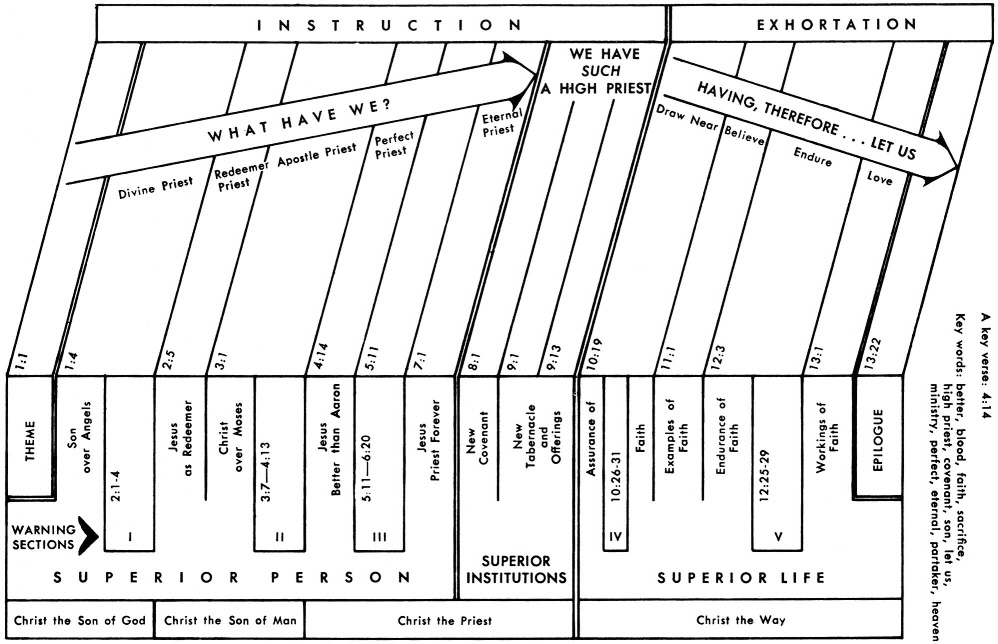
CONSIDER JESUS OUR GREAT HIGH PRIEST
Click chart to enlarge
Charts from Jensen's Survey of the NT - used by permission
Swindoll's Chart, Another Chart
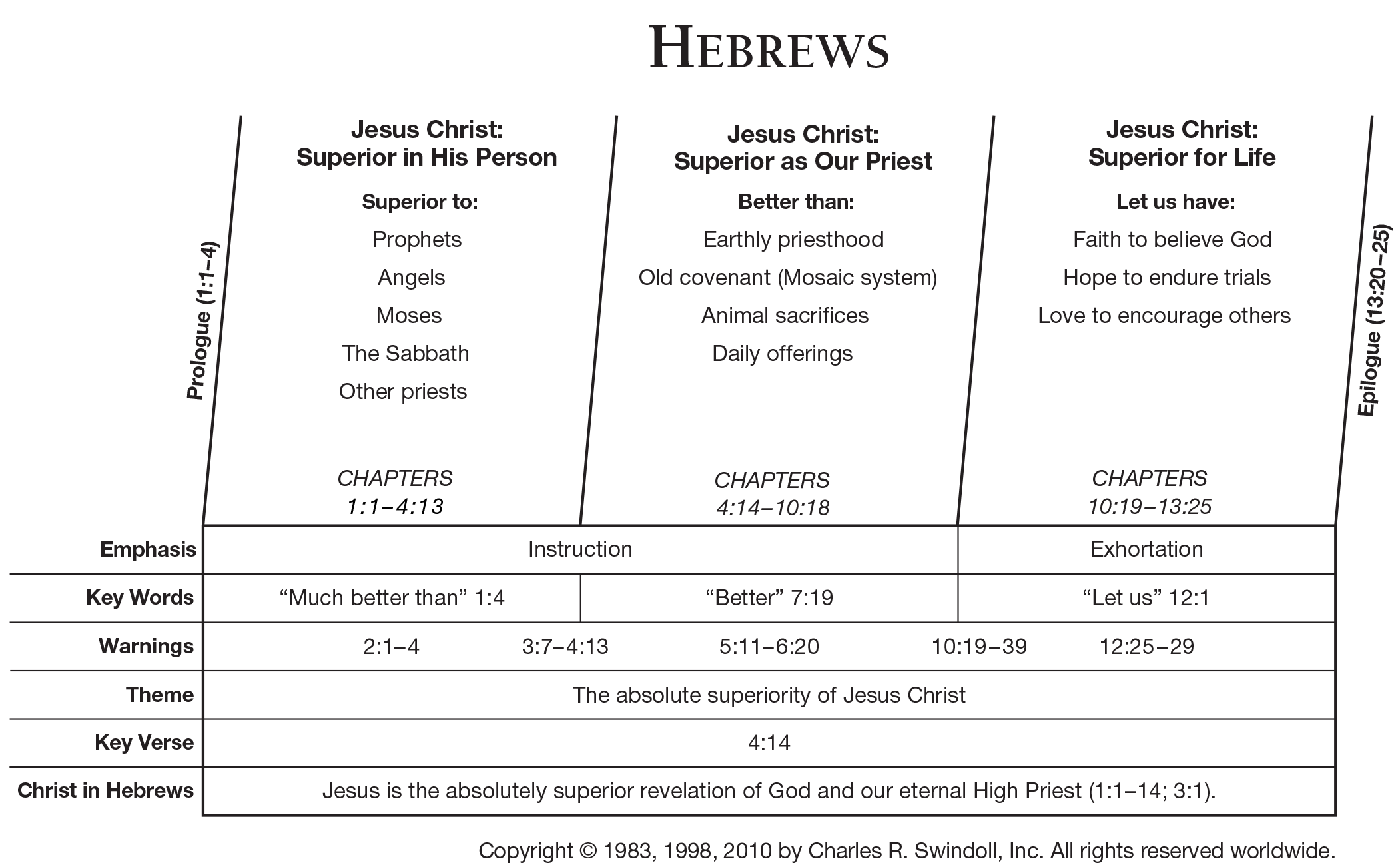
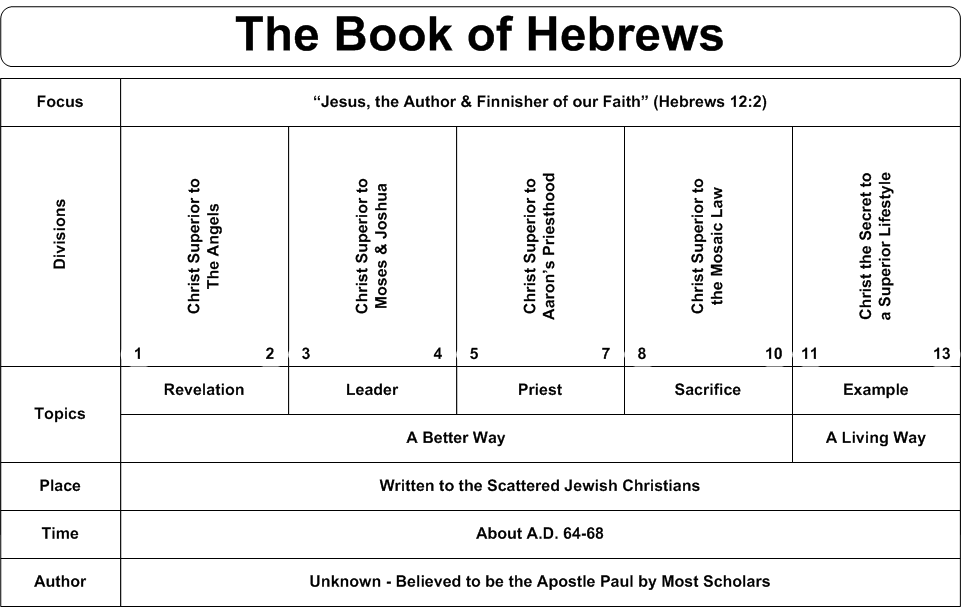
|
The Epistle |
||||
| INSTRUCTION Hebrews 1-10:18 |
EXHORTATION Hebrews 10:19-13:25 |
|||
| Superior Person of Christ Hebrews 1:1-4:13 |
Superior Priest in Christ Hebrews 4:14-10:18 |
Superior Life In Christ Hebrews 10:19-13:25 |
||
| BETTER THAN PERSON Hebrews 1:1-4:13 |
BETTER PRIESTHOOD Heb 4:14-7:28 |
BETTER COVENANT Heb 8:1-13 |
BETTER SACRIFICE Heb 9:1-10:18 |
BETTER LIFE |
| MAJESTY OF CHRIST |
MINISTRY OF CHRIST |
MINISTERS FOR CHRIST |
||
|
DOCTRINE |
DUTY |
|||
|
DATE WRITTEN: |
||||

See ESV Study Bible "Introduction to Hebrews"
(See also MacArthur's Introduction to Hebrews)
Borrow Ryrie Study Bible
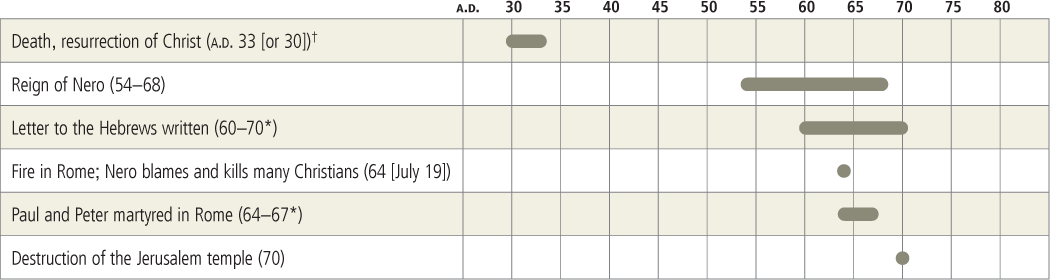
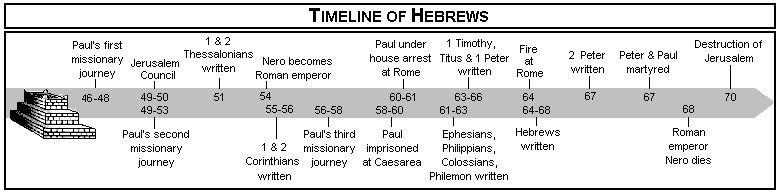
Timeline of Hebrews - ESV Study Bible
Hebrews 2:16 For assuredly He does not give help to angels, but He gives help to the descendant of Abraham. (NASB: Lockman)
Greek: ou gar depou aggelon epilambanetai, (3SPMI) alla spermatos Abraam epilambanetai. (3SPMI)
BGT οὐ γὰρ δήπου ἀγγέλων ἐπιλαμβάνεται ἀλλὰ σπέρματος Ἀβραὰμ ἐπιλαμβάνεται.
Amplified: For, as we all know, He [Christ] did not take hold of angels the fallen angels, to give them a helping and delivering hand], but He did take hold of the fallen] descendants of Abraham [to reach out to them a helping and delivering hand]. (Amplified Bible - Lockman)
Analyzed Literal: For surely He does not take hold of [fig., give aid to] angels, _but_ He takes hold of [fig., gives aid to] [the] seed of Abraham.
Barclay: For I presume that it is not angels that helps; but it is the seed of Abraham that he helps. (Westminster Press)
NLT: We all know that Jesus came to help the descendants of Abraham, not to help the angels (NLT - Tyndale House)
Phillips: It is plain that for this purpose he did not become an angel; he became a man, in actual fact a descendant of Abraham. (Phillips: Touchstone)
Wuest: For, as is well known, He does not take hold of angels for the purpose of helping them, but of the seed of Abraham He takes hold, with a view to succoring them.
Young's Literal: for, doubtless, of messengers it doth not lay hold, but of seed of Abraham it layeth hold,
KJV For verily he took not on him the nature of angels; but he took on him the seed of Abraham.
NKJ For indeed He does not give aid to angels, but He does give aid to the seed of Abraham.
NET For surely his concern is not for angels, but he is concerned for Abraham's descendants.
CSB For it is clear that He does not reach out to help angels, but to help Abraham's offspring.
ESV For surely it is not angels that he helps, but he helps the offspring of Abraham.
NIV For surely it is not angels he helps, but Abraham's descendants.
MIT For surely he is not all taken up with angels, but his concern is for the posterity of Abraham.
NJB For it was not the angels that he took to himself; he took to himself the line of Abraham.
NRS For it is clear that he did not come to help angels, but the descendants of Abraham.
RSV For surely it is not with angels that he is concerned but with the descendants of Abraham.
NAB Surely he did not help angels but rather the descendants of Abraham;
GWN So Jesus helps Abraham's descendants rather than helping angels.
BBE For, truly, he does not take on the life of angels, but that of the seed of Abraham.
ASV For verily not to angels doth he give help, but he giveth help to the seed of Abraham.
FOR ASSUREDLY HE DOES NOT GIVE HELP TO ANGELS BUT HE GIVES HELP TO THE DESCENDANT OF ABRAHAM: ou gar depou aggelon epilambanetai (3SPMI) alla spermatos Abraam epilambanetai (3SPMI):
- Assuredly: He 6:16 12:10 Ro 2:25 1Pe 1:20
- Descendant: Ge 22:18 Mt 1:1-17 Ro 4:16-25 Ga 3:16,29
- Hebrews 2 Resources - Multiples Sermons and Commentaries
- Hebrews 2:16-18 Why Jesus Became a Man - Steven Cole
- Hebrews 2:9-18 Why Was Jesus Born? - John MacArthur
- Hebrews 2:9-18 Why God Became a Man - John MacArthur
- Hebrews 2:9-18 Our Perfect Savior - John MacArthur
JESUS' INCARNATED TO HELP
ABRAHAM'S SEED
For (gar) - This is a term of explanation. Westcott says the for "gives the explanation of the end of the Incarnation which has been stated in Heb 2:14b." Dwight Pentecost writes that this explanation gives "The sixth reason for the Incarnation...in verses 16–17a, namely, that He might become a merciful and faithful High Priest on man’s behalf."(See note below from Faith That Endures:)
Steven Cole adds that "The author is wrapping up his argument that he began in Heb 2:5, that God put man on the earth to rule, and that the role of angels is “to render service for the sake of those who will inherit salvation” (He 1:14). The word “for” (Heb 2:16) relates to the previous two verses, about Jesus freeing us from the power and fear of death."
🙏 THOUGHT - "For"(gar) is a term of explanation, which should prompt a pause to ask what is the Spirit seeking to explain? In fact, stop reading right now and observe the passage and see if you can determine what Paul is explaining. Now you can begin to practice this simple technique every time you encounter a term of explanation. I guarantee it will rejuvenate your "Read Through the Bible in a Year" program! You might even get a small journal and begin to keep notes on what the Spirit illuminates and how this truth can be applied to your daily life. As you practice interrogating the text (the "for's") with the 5W/H questions such as "What the for there for?", what you are beginning to learn how to read the Bible inductively and also how to meditate (cf Primer on Biblical Meditation) on the Scripture, a vanishing discipline in our fast paced world, but one which God gives you His sure promise of untold blessing (cp the promises to richly reward - see Ps 1:1, Ps 1:2-, Ps 1:3, Joshua 1:8), Other passages on meditation - Ps 4:4, 19:14, 27:4, 49:4, 63:6, Ps 77:6, 77:12, Ps 104:34, Ps 119:15, 119:23, 119:27, Ps 119:48, 119:78, Ps 119:97, 119:99, Ps 119:148, 143:5, Ps 145:5 - From these passages which "organ" of our being is most often involved/engaged in meditation? What are the subjects or focus of meditation?). Reading the Bible without meditating on it is like eating without chewing. We must read…
Scripture every day
And meditate on what God said
To fight temptation from the world
And live a life that's Spirit led.
--Sper
For (gar) assuredly He does not give help (epilambanomai) to angels (aggelos/angelos) but (contrast) the seed (sperma) of Abraham - Assuredly (depou) is an adverb used only here and it conveys the idea of doubtless, it is clear, surely, and is used by the writer to remark on something his readers all knew very well. It was a familiar truth. Thus the CSB renders it "if is clear that He does not reach out to help angels." He of course refers to Jesus. It is not angels that Jesus helps but it is the seed of Abraham, specifically believers in Yeshua. Give help is an interesting verb choice for it literally means to take hold of them and in context to take hold with the intention of helping.
🙏 THOUGHT - Dear believer you may be shaking, quaking or wavering from the various trials and persecutions God is allowing in your life, but when He Who upholds all things by the Word of His power (Heb 1:3) takes hold of you, you are safe, sound and secure (forever)!
POSB on give help (epilambanomai) - Jesus Christ did not only take hold of man's nature, He took hold of man's hand. He took us by the hand and delivered us. The picture is that of love and tender care, of His delivering us out of the bondages of the flesh and of human nature. (See context in Preacher's Outline & Sermon Bible)
Spurgeon - “He does not reach out to help angels.” Christ did not die to save angels, though many of them needed salvation. He died to save fallen humanity. People and devils both deserve to be damned for their sins. Yet God, to manifest the sovereignty of his grace, chose humanity. Here was amazing condescension and wisdom.
W E Vine - He passed angels by and He lays hold, not of the seed of Adam, the whole human race, but of the seed of Abraham, that is, of those who believe on Him, sharing Abraham’s faith. He lays hold of them (1) to deliver them, Heb 2:15, (2) to keep them, Heb 2:18.
Who is the seed of Abraham? - In context the writer is speaking of Jesus giving help which indicates the seed refers to believers, not unbelievers. Jesus does not give help to unbelievers who refuse Him. While physical Jews originate from the seed of Abraham, not all Jews are believers like Abraham (see Ro 2:28-29). Thus seed of Abraham could refer to believing Jews, But in Gal 3:29 Paul adds "if you (speaking to Jewish and Gentile believers) belong to Christ, then you are Abraham's offspring (seed), heirs according to promise." Therefore it follows that the seed of Abraham includes believing Jews and believing Gentiles. However, in the context of this letter, the writer is directing this argument to Jewish believers (or Jews leaning that direction), thus they would appear to be the primary audience meant by seed of Abraham.
ADDENDUM ON SEED OF ABRAHAM - Those who are of the seed of Abraham are those who have Abraham's faith, In Genesis 15:6 note that the Hebrew word faith is "aman" which has the basic meaning of certainty or firmness (Think of the derivative word "amen" - so be it!) Aman conveys the idea of "leaning entirely" on God and this is manifest by trust in His immutable, inerrant word of promise. His promise to Abraham was that of the "seed", which as discussed ultimately reflected Abraham's belief in "the Seed", the Messiah (although we cannot now know how much of Messiah's work on the Cross Abraham understood). The point is that Abraham was looking forward to the Cross with eyes of faith, while believers today (his offspring) look back to the almighty, eternal cross. In regard to the Hebrew word "aman" not only does it convey the idea of certainty but as Genesis 22 shows Abraham's faith (aman) included the idea of obedience as he prepared to sacrifice Isaac, fully trusting in the fact that God would resurrect the promised son Isaac if necessary (Heb 11:17-19) In short, the spiritual (in contrast to those who are only physical) descendants of Abraham have believed God's promise, placed their whole weight upon His Word, just as Abraham did and as a result they have entered into the New Covenant, which is the NT amplification of the Abrahamic Covenant. Note also that the writer is not saying here that the church has replaced Israel or that Israel has forfeited the OT promises regarding the land of Israel - such aberrant teaching has led to many tragic errors in interpretation and application (eg, such an errant interpretation has been used for justification of the bloody massacre of many Jewish men, women and children in historical dramas such as "the Medieval Crusades", "the holocaust of Hitler", etc.) (See also The Israel of God)
Spurgeon has some additional thoughts in his sermon Men Chosen--Fallen Angels Rejected
Our Lord and Savior Jesus Christ, when He came from heaven to die, did not take upon Himself the nature of angels. It would have been a stoop, more immense than if a seraph should have changed himself into an emmet, for the Almighty Son of God to have been clothed in the garb of even the archangel Gabriel, but His condescension dictated to Him, that if He did stoop, He would descend to the very lowest degree; that if He did become a creature, He would become, not the noblest creature, but one of the most ignoble of rational beings, that is to say, man; therefore, He did not stoop to the intermediate step of angelship, but He stooped right down and became a man.
If Christ had taken upon himself the nature of angels, He could never have made an atonement for man. Setting aside the thought that if He came to save man it would have seemed improper if He had come in the garb of angels, you must allow, that if He had done so, he could not have seen death. How could angels die? We can suppose that their spirit may become extinct, if God should will it; we can suppose the entire annihilation of that to which God Alone supplies immortality; but since angels have no bodies, we cannot suppose them capable of death, for death is the separation of the body and the soul; therefore, it behooved Christ that He should take upon Himself the form of a man, that He might become obedient to death, even the death of the cross. Had angels been standing by, they would have said, “Oh! mighty Master, take our radiant robes. Oh! take not the poor every-day garb of humanity, take our glittering garments all bedight with pearls.” And Gabriel would have said, “Come, take my wings, thou mighty Maker, and I shall count myself too honored to have lost them for thy sake. There, take this crown and this mantle of azure, wherewith to clothe thyself, thou Son of God, put my silver sandals on thy feet; become not man, but an angel, if thou wilt stoop.” “But, no,” he would have said, “Gabriel, if I were in thy dress I could not fight with death, I could not sleep in the tomb, I could not feel the pangs and agony of dissolution, therefore, I must, I will, become a man.” “He took not on him the nature of angels; but he took on him the seed of Abraham.”
Had our Savior become an angel, we must note, in the next place, that he would never have been a fitting example for us. I cannot imitate an angelic example in all points, it may be very good, so far as I can imitate, but it cannot, in all points, be my pattern. If you would give me something to imitate, give me a man like myself; then I may attempt to follow him. An angel could not have set us the same holy and pious example that our Savior did. Had He descended from on high in the garb of one of those bright spirits, He might have been a fine example for those brilliant cherubs who surround his throne, but we, poor mortal men, condemned to drag the chain of mortality along this earthly existence, would have turned aside and said, “Ah! such a thing is too high for us, we cannot attain unto it;” and we, therefore, should have stopped short. If I am to carve marble, give me a marble statue which I am to copy, and if this mortal clay is to be cut out into the very model of perfection, as it is to be by God’s Spirit, then give me Man for my example, for a man I am, and as a man, I am to be made perfect. Not only could not Christ have been a Redeemer, but He could not have been our Exemplar, if He had taken upon Himself the nature of angels.
Sweetly, also, let us remember that if Christ had been an angel, he could not have sympathised with us. In order to sympathise with our fellow-creatures we must be something like them. Suppose a man made of iron, or of brass; could he sympathise with our wearied lungs, or with our aching bones? Let such a man be told of sickness or of illness: could he understand it? I would not have him for a nurse; I would not care to have such a being for my physician; he could not feel for me; he could not sympathise with me. No, even our own fellow-creatures cannot sympathise with us unless they have suffered as we have done. I have heard of a lady who never knew poverty in all her life, and consequently she could not sympathise with the poor. She heard the complaint that bread was extremely dear, when it was running up to fourteen-pence a loaf. “Oh!” she said, “I have no patience with the poor people, grumbling about the dearness of bread. If bread is so dear, let them live on penny buns; they are always cheap enough.” She had not been in the position of the poor, and, therefore, she could not sympathise with them, and no man can sympathise with another, to any great extent, unless he has been in some measure in the same position, and endured the same trouble. “It behooved Him, therefore, that He should be made in all points like unto his brethren that he might be a faithful high priest;” “for we have not an high priest which cannot be touched with the feeling of our infirmities, for He was tempted in all points like as we are, yet without sin.” But if He had been an angel, what sympathy could He have had for me? Suppose I should tell an angel that I could scarcely resist my corruptions: the angel would look at me, and wonder what I meant. If I should tell him that I find this world a vast howling wilderness: how could he believe me, for he has never heard howlings, his ears have only been saluted by golden harps and sweet choral symphonies of praise. If I should tell him that I found it hard work to hold on my way, and keep close to my Savior, the angel could only say, “I cannot sympathise with you, for I am not tempted as you are; I have no clogging nature to abate my ardent zeal, but day without night, with unflagging wing, I circle His throne rejoicing, nor have I a wish nor will to depart from my great Maker.” There you see the Savior’s wisdom. He would become a Man and not an angel. (Read the full message which includes a well reasoned rational on divine election -- Men Chosen--Fallen Angels Rejected)
Give help (1949) (epilambanomai from epí = upon + lambáno = to take) means take hold of or grasp, with focus upon the goal of motion. To seize for help, injury, attainment or any other purpose. The idea is literally, to help by taking one by the hand or to draw one to one's self to help. The old word "succor" would be a good rendering of epilambanomai for succor means specifically to give help or assistance especially in time of hardship, distress or difficulty. A archaic but still picturesque meaning of succor is reinforcements of troops (ponder this thought as it applies to this passage in Hebrews!) See notes on the related idea of "come to the aid of" in Hebrews 2:18 (and also Hebrews 4:16) on for more on this picture of our Great High Priest coming to our rescue in our time of testing and need. While epilambanomai in this verse does not have the idea of violent grasping which it carries elsewhere, the ideas of help and deliverance are clearly conveyed. One gets the picture of a person drowning in quicksand, ready to go under, but able to hold their hand above the surface. The Deliverer grasps the hand of the one in need and lifts it up. Epilambanomai is used one other time in Hebrews 8:9 ("WHEN I TOOK THEM BY THE HAND")
Wuest adds that epilambanomai is a "a metaphor drawn from laying hold of another to rescue him from peril, the word came to mean “to lay hold of for the purpose of helping or succoring.” It is used in this latter sense here." (Hebrews - Wuest's word studies from the Greek New Testament)
EPLAMBANOMAI - 18V - catch(2), give help(1), gives help(1), seized(2), take hold(2), taking(1), taking hold(1), took(4), took hold(5). Matt. 14:31; Mk. 8:23; Lk. 9:47; Lk. 14:4; Lk. 20:20; Lk. 20:26; Lk. 23:26; Acts 9:27; Acts 16:19; Acts 17:19; Acts 18:17; Acts 21:30; Acts 21:33; Acts 23:19; 1 Tim. 6:12; 1 Tim. 6:19; Heb. 2:16; Heb. 8:9
Angels (32) (aggelos/angelos) means a messenger… who speaks and acts in place of one who has sent him. Angels have considerable authority in this present world (Da 10:13; Mt 18:10), and our present inhabited earth, is ruled by angels (see notes on the prince of the power of the air in Ep 2:2).
AGGELOS IN HEBREWS - Heb. 1:4; Heb. 1:5; Heb. 1:6; Heb. 1:7; Heb. 1:13; Heb. 2:2; Heb. 2:5; Heb. 2:7; Heb. 2:9; Heb. 2:16; Heb. 12:22; Heb. 13:2
Descendant (children)(4690) (sperma) refers to seed sown as containing the germ of new fruit, but here is figurative referring to the posterity.
Friberg - seed; (1) literally; (a) of plants (Mt 13.24); (b) of human or animal semen sperm, seed; by metonymy, as human descendants offspring, posterity, children (MK 12.19); (2) figuratively; (a) as a surviving remnant from which to build a new posterity (Ro 9.29); (b) as a principle of life implanted by the Spirit imparted nature (1Jn3.9) (Borrow Analytical Lexicon of the Greek New Testament)
SPERMA - 43X/40V - children(7), conceive*(1), descendant(4), descendants(16), posterity(1), seed(10), seeds(4). Matt. 13:24; Matt. 13:27; Matt. 13:32; Matt. 13:37; Matt. 13:38; Matt. 22:25; Mk. 4:31; Mk. 12:19; Mk. 12:20; Mk. 12:21; Mk. 12:22; Lk. 1:55; Lk. 20:28; Jn. 7:42; Jn. 8:33; Jn. 8:37; Acts 3:25; Acts 7:5; Acts 7:6; Acts 13:23; Rom. 1:3; Rom. 4:13; Rom. 4:16; Rom. 4:18; Rom. 9:7; Rom. 9:8; Rom. 9:29; Rom. 11:1; 1 Co. 15:38; 2 Co. 9:10; 2 Co. 11:22; Gal. 3:16; Gal. 3:19; Gal. 3:29; 2 Tim. 2:8; Heb. 2:16; Heb. 11:11; Heb. 11:18; 1 Jn. 3:9; Rev. 12:17
Hebrews 2:17 Therefore, He had to be made like His brethren in all things, so that He might become a merciful and faithful high priest in things pertaining to God, to make propitiation for the sins of the people. (NASB: Lockman)
Greek: hothen opheilen (3SIAI) kata panta tois adelphois homoiothenai, (APN) hina eleemon genetai (3SAMS) kai pistos archiereus ta pros ton theon, eis to hilaskesthai (PMN) tas hamartias tou laou;
BGT ὅθεν ὤφειλεν κατὰ πάντα τοῖς ἀδελφοῖς ὁμοιωθῆναι, ἵνα ἐλεήμων γένηται καὶ πιστὸς ἀρχιερεὺς τὰ πρὸς τὸν θεὸν εἰς τὸ ἱλάσκεσθαι τὰς ἁμαρτίας τοῦ λαοῦ.
Amplified: So it is evident that it was essential that He be made like His brethren in every respect, in order that He might become a merciful (sympathetic) and faithful High Priest in the things related to God, to make atonement and propitiation for the people’s sins. (Amplified Bible - Lockman)
Analyzed Literal: Therefore, it was necessary [for] Him to become like His brothers [and sisters] in all [respects], so that He should become a merciful and faithful High Priest [in] the [things pertaining] to God, [in order] to make propitiation [or, an appeasing sacrifice] for the sins of the people
Barclay: So he had in all things to be made like his brothers, so that he might become a merciful and faithful high priest in the things which pertain to God, to win forgiveness for the sins of his people. (Westminster Press)
NLT: Therefore, it was necessary for Jesus to be in every respect like us, his brothers and sisters, so that he could be our merciful and faithful High Priest before God. He then could offer a sacrifice that would take away the sins of the people (NLT - Tyndale House)
Phillips: It was imperative that he should be made like his brothers in nature, if he were to become a High Priest both compassionate and faithful in the things of God, and at the same time able to make atonement for the sins of the people. (Phillips: Touchstone)
Wuest: For this reason it was an obligation in the nature of the case for Him in all things to be made like to His brethren, in order that He might become a compassionate and faithful High Priest in things pertaining to God, with a view to offering that sacrifice for the sins of the people that would perfectly meet the demands of God’s justice.
Young's Literal: wherefore it did behove him in all things to be made like to the brethren, that he might become a kind and stedfast chief-priest in the things with God, to make propitiation for the sins of the people,
KJV Wherefore in all things it behoved him to be made like unto his brethren, that he might be a merciful and faithful high priest in things pertaining to God, to make reconciliation for the sins of the people.
NKJ Therefore, in all things He had to be made like His brethren, that He might be a merciful and faithful High Priest in things pertaining to God, to make propitiation for the sins of the people.
NET Therefore he had to be made like his brothers and sisters in every respect, so that he could become a merciful and faithful high priest in things relating to God, to make atonement for the sins of the people.
CSB Therefore, He had to be like His brothers in every way, so that He could become a merciful and faithful high priest in service to God, to make propitiation for the sins of the people.
ESV Therefore he had to be made like his brothers in every respect, so that he might become a merciful and faithful high priest in the service of God, to make propitiation for the sins of the people.
NIV For this reason he had to be made like his brothers in every way, in order that he might become a merciful and faithful high priest in service to God, and that he might make atonement for the sins of the people.
NLT Therefore, it was necessary for him to be made in every respect like us, his brothers and sisters, so that he could be our merciful and faithful High Priest before God. Then he could offer a sacrifice that would take away the sins of the people.
YLT wherefore it did behove him in all things to be made like to the brethren, that he might become a kind and stedfast chief-priest in the things with God, to make propitiation for the sins of the people,
MIT He was obligated, therefore, to become identified in every way with his brothers that he might be a compassionate and faithful high priest in ministries to God, to make amends for the sins of the people.
NJB It was essential that he should in this way be made completely like his brothers so that he could become a compassionate and trustworthy high priest for their relationship to God, able to expiate the sins of the people.
NRS Therefore he had to become like his brothers and sisters in every respect, so that he might be a merciful and faithful high priest in the service of God, to make a sacrifice of atonement for the sins of the people.
RSV Therefore he had to be made like his brethren in every respect, so that he might become a merciful and faithful high priest in the service of God, to make expiation for the sins of the people.
NAB therefore, he had to become like his brothers in every way, that he might be a merciful and faithful high priest before God to expiate the sins of the people.
GWN Therefore, he had to become like his brothers and sisters so that he could be merciful. He became like them so that he could serve as a faithful chief priest in God's presence and make peace with God for their sins.
BBE Because of this it was necessary for him to be made like his brothers in every way, so that he might be a high priest full of mercy and keeping faith in everything to do with God, making offerings for the sins of the people.
ASV Wherefore it behooved him in all things to be made like unto his brethren, that he might become a merciful and faithful high priest in things pertaining to God, to make propitiation for the sins of the people.
THEREFORE HE HAD TO BE MADE LIKE HIS BRETHREN SO THAT HE MIGHT BECOME A MERCIFUL AND FAITHFUL HIGH PRIEST IN THINGS PERTAINING TO GOD: hothen opheilen (3SIAI) kata panta tois adelphois homoiothenai (APN) hina eleêmôn genetai (3SAMS) kai pistos archiereus ta pros ton theon:
- He had to be made He 2:11,14 Php 2:7,8
- Merciful: He 3:2,5, Heb 4:15,16, Heb 5:1,2 Isa 11:5
- Hebrews 2 Resources - Multiples Sermons and Commentaries
- Hebrews 2:16-18 Why Jesus Became a Man - Steven Cole
- Hebrews 2:9-18 Why Was Jesus Born? - John MacArthur
- Hebrews 2:9-18 Why God Became a Man - John MacArthur
- Hebrews 2:9-18 Our Perfect Savior - John MacArthur
Related Passages:
Philippians 2:6-8 Jesus "Who, although He existed in the form of God, did not regard equality with God a thing to be grasped, 7 but emptied Himself, taking the form of a bond-servant, and being made in the likeness of men.8 And being found in appearance as a man, He humbled Himself by becoming obedient to the point of death, even death on a cross.
2 Timothy 2:13 if we are faithless, He remains faithful (pistos); for He cannot deny Himself.
Hebrews 3:2 He was faithful (pistos) to Him who appointed Him, as Moses also was in all His house.
Hebrews 10:23 Let us hold fast the confession of our hope without wavering, for He who promised is faithful (pistos);
1 John 1:9 If we confess our sins, He is faithful (pistos) and righteous to forgive us our sins and to cleanse us from all unrighteousness.
Revelation 19:11 And I saw heaven opened, and behold, a white horse, and He who sat on it is called Faithful (pistos) and True, and in righteousness He judges and wages war.
Psalm 110:4 (MESSIANIC PROPHECY) The LORD has sworn and will not change His mind, “You (MESSIAH) are a priest forever According to the order of Melchizedek.”
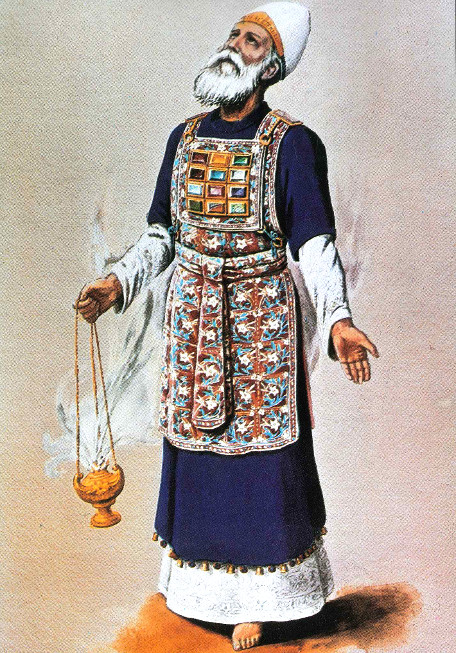
High Priest in OT
JESUS INCARNATED
TO BE A HIGH PRIEST
Therefore (hothen) is a term of conclusion. Use these terms as reminder to slow down and actively engage the text and interact with the "Illuminator," the Holy Spirit, pausing to ponder and ask relevant 5W/H questions. In this case the "therefore" explains how Jesus is going to be able to give help to the seed of Abraham (believers who like Abraham have faith).
Wuest on therefore - The word “therefore” speaks of the necessity of the incarnation in view of the fact that our Lord laid hold of the human race for the purpose of saving those in it who would accept salvation by faith. (Hebrews)
He had (opheilo) to be made like (homoioo) His brethren (adelphos) in all things - He had (opheilo) means "He must," and speaks of moral necessity - He must become a man to become men's priest (He had to become our Kinsman in order to become our Redeemer!). More literally the sentence reads (and see Wuest's note below), “Therefore, He was obligated to be made like His brethren in all things." Why was He obligated? In the following passages the writer gives three reasons (1) to become a high priest, (2) in turn to make propitiation for sins and (3) to be able to come to their aid when tempted (Heb 2:18). To be made like His brethren (see Heb 2:11-12 for brethren) of course means Jesus had to be made flesh and blood, reiterating Heb 2:14 "since the children share in flesh and blood, He Himself likewise also partook of the same." He had to become incarnate, to become a Man. Made like (homoioo) refers to nothing less than complete identification—assimilation, not simulation! The One Who was eternally Fully God, entered the fallen planet as a babe Who was Fully Man.
Wuest says that had is "which speaks of an obligation imposed upon one by reason of a certain consideration. Here the consideration is that of the position our Lord assumed as the One who would come to the aid of lost sinners. The obligation arising out of this position was that in order to provide a salvation for the human race, He had to become like the human race, namely, Man, for a priest must always partake of the nature of the one for whom he officiates. Thus, the incarnation was a necessity in the nature of the case. He became “like unto His brethren.”" (Hebrews)
Utley on made like - Jesus’ intercessory work on mankind’s behalf is related to His complete understanding of our nature (cf. Heb 2:18; 4:15) so He could be our great high priest. (Hebrews 2 Commentary)
J Vernon McGee on made like - The Lord Jesus came down to earth in the likeness of men. In Philippians 2:7 we read, “But made himself of no reputation, and took upon him the form of a servant, and was made in the likeness of men.” It was a real likeness to men. This likeness, Vincent tells us, is “closest where the traces of the curse of sin were more apparent—in poverty, temptation, and violent and unmerited death.” Christ could have been born in the palace of Caesar, but He was born in real poverty, in a stable behind an inn. Why? So that He could know something of the effect of sin on humanity. Where do you see it? You see it in poverty. You see it in temptation. You see it in violent and unmerited death. That is where you see sin manifested. (See context in Thru the Bible)
Warren Wiersbe - Being pure spirits who have never suffered, the angels cannot identify with us in our weaknesses and needs. But Jesus can! While He was here on earth, Jesus was “made like unto His brethren” in that He experienced the sinless infirmities of human nature. He knew what it was to be a helpless baby, a growing child, a maturing adolescent. He knew the experiences of weariness, hunger, and thirst (John 4:6–8). He knew what it was to be despised and rejected, to be lied about and falsely accused. He experienced physical suffering and death. All of this was a part of His “training” for His heavenly ministry as High Priest. (See context in Be Confident or Bible Exposition Commentary)
In all things is significant because it refutes the heresy of Docetism, that falsely teaches Jesus only appeared to human but was not in fact human. Docetism would have a Man on the Cross who "seemed" to be on the Cross, and thus could not truly bear the sins of the world. Belief in Docetism offers "another Jesus" (and thus "another gospel" - Gal 1:7) and will take a person straight to hell (if duped by the deception) where He will judged by the real Jesus, the fully God, fully Man Jesus (Jn 5:22, Rev 20:11-15)! Later our writer emphasizes that "we do not have a high priest who cannot sympathize with our weaknesses, but One who has been tempted in all things as we are, yet without sin." (Heb 4:15) That is Jesus was a real Man Who was tempted like all men! Note that the phrase in all things has one glorious exception -- He did not yield to sin!
Guzik - Neither the Deity nor the Humanity of Jesus is negotiable. If we diminish either, then He is unable to save us. (Hebrews 2 Commentary)
So that (hina) introduces a purpose clause, and in this context, gives us the purpose of His incarnation. What is it in this context?
He might become (ginomai - come into being as) a merciful (eleemon) and faithful (pistos) high priest (archiereus) in things pertaining to God - The writer has previously alluded to Jesus' as a priest in Heb 1:3 writing "When He had made purification of sin," which describes one of the duties of a Levitical priest. That allusion aside, Hebrews 2:17 is the first mention of high priest in Hebrews, which is significant because as we have repeatedly stated, he is speaking primarily to Jews who were believers or who were considering belief in Messiah. And they are undoubtedly being attracted back to the Temple (still standing at this time) and its rituals. It is notable that he does not just say "priest" but specifically high priest, undoubtedly because they were the only one who could enter the Holy of holies with an offering on the Day of Atonement (Lev 16:1-34).
Wuest says" things pertaining to God” is a technical phrase in Jewish liturgical language speaking of the functions of worship. The phrase is to be construed with the words “a faithful high priest,” not with “merciful.” (Hebrews)
For He Himself knows our frame;
He is mindful that we are but dust.
--Ps 103:14)
Merciful (eleemon) means Jesus is actively compassion (His compassionate heart leads to acts of mercy) and fully sympathetic with His brethren, who are still trapped in these sinful bodies. He is a high Priest Who can relieve the suffering and misery of those who are the objects of His compassion. Of course ultimately this merciful attribute was manifest by His willingness to offer His body as the Lamb of God to take away our sins (Jn 1:29). That is the ultimate mercy to sinners in desperate need of mercy (cf 1Pe 1:3, Ro 12:1)! And because He continues to be merciful, we should never shrink back from drawing close to Him to receive mercy when we have sinned (My tendency is to pull away out of shame or fear of retribution/discipline - Heb 12:5-11). David wrote "Just as a father has compassion on his children, So the LORD has compassion on those who fear Him. For He Himself knows our frame; He is mindful that we are but dust. " (Ps 103:13-14)
"Jesus Christ is not only the Son of God mighty to save,
but the Son of man able to feel."
-- J C Ryle
Spurgeon - As a father feels for his children because they are of the same flesh and blood as himself, so does the Lord sympathize with His people, for they are members of His body, of His flesh, and of His bones. No father can be so thoroughly one with his offspring as Jesus is with us.
J Vernon McGee - The Lord Jesus came to earth and took on a human body. He is able to sympathize with you and me. I don’t care who you are or where you are, He knows you and He understands you—not just because He is God, but because He became a man. He knows exactly what you and I are going through today. (See context in Thru the Bible)
John Phillips - The Lord Jesus has been made like His brethren so that He can be to us all that we need. We need Someone to intercede for us compassionately. He is merciful. We need Someone to intercede for us continuously. He is faithful. He can take care of our needs in God's presence. (See context in Exploring Hebrews: An Expository Commentary)
Mercy (eleemon) is not simply a static truth such as feeling compassion but true mercy is dynamic and shows its true character when something is done to alleviate another's distress. This is nicely illustrated in the Old Testament by the mercy seat in the holy of holies. This was the place where the Lord God accepted the propitiatory (satisfactory) sacrifice to atone for the nation’s sins, once each year on the "Day of Atonement" (see Lev 16:2,13, 14, 15). Here at the mercy seat God was moved with pity and compassion for the sinful people, and took action to reconcile them to Himself through accepting the blood of a goat in their stead. (See also notes on God's Attribute of Mercy).
Christ our High Priest
is "mercy full"!
One might say then that Christ our High Priest is "mercy full"! The idea is that He possess a compassionate heart leading Him to carry out acts of mercy, the purpose of which is to relieve the suffering and misery of the spiritual offspring of Abraham, the objects of the Beloved's infinite compassion.
The only other use of eleemon describes believers who will be blessed Jesus declaring "Blessed are the merciful (eleemon), for they shall receive mercy (eleeo)." (Mt 5:7). As Jesus spoke these words in His Sermon on the Mount, his hearers must have stirred because they knew this charge was impossible to accomplish, for He was speaking not merely of the expression of mercy filled (merciful) acts, but of an inner attitude in the new hearts of those who by grace through faith had the indwelling Spirit of Christ.
🙏 THOUGHT - This truth about merciful believers begs the question - are you merciful (actively compassionate) to others just like Jesus has been and daily is merciful to you? Or do you withhold mercy from others for some (sinful) reason? Behold! You are "blunting" (cf grieving - Eph 4:29,30) the Spirit's ability to bless you! Confess your sin (1Jn 1:9) of lack of mercy and make retribution if it is appropriate. Don't miss your divine blessing of mercy (we all need His mercy every day, because we sin every day)! (Play Let Mercy Lead by Rich Mullins)
Cole gives us the historical background for a high priest (archiereus) - The Jews knew that they could not approach God directly. They had to come to Him through the priest, who would offer their sacrifices on their behalf. He represented them in everything pertaining to God. Once a year, on the Day of Atonement, the high priest would represent the entire nation by entering the Holy of Holies and presenting the blood on the mercy seat. If anyone else dared to enter that sacred place, or even if the high priest went in there on any other occasion, it meant instant death (Lev. 16:2). Thus the role of the high priest was essential so that the nation could be cleansed from its sins each year (Lev. 16:30). Have you ever thought about what an expensive hassle it would have been to be required to bring a sacrifice to the priest every time you sinned? It would have been embarrassing, too! All the neighbors stop to look up from what they’re doing as you trudge toward the tabernacle with your sacrifice. “There goes Steve again! You’d think he would learn! I wonder what he did this time?” But, as our author will develop later, Jesus offered His own blood once and for all, so that there is no need for continuing sacrifices (He 7:27; 9:12; 10:11-14). This must have been a huge relief to believing Jews! Jesus is our permanent, final high priest, who offered Himself once and for all for our sins! Thank God!
Jesus is a faithful high priest (archiereus) - He was faithful to His Father in always giving perfect obedience, even willingly going to the agony of the Cross. If He was faithful in this greatest of all acts, we can be assured He is trustworthy toward us and will not disappoint us. In a 2022 world where trust is at a premium, it is good to know we have One Who can always be trusted with complete confidence.
High priest (archiereus) - This is the first specific reference to Christ as our High Priest, a theme which is prominent throughout the rest of Hebrews. Christ's role as the High Priest was only possible by virtue of Him becoming like His brethren in actual human nature. See the shadow in 1Sa 2:35 fulfilled in Christ our High Priest. Jesus can be completely trusted by men to be their means of atonement. All can approach Christ with absolute confidence (for He is faithful) and with assurance that they will find mercy (for He is merciful). Note how these twin concepts are further developed by the writer in Hebrews 3:1-6 and Hebrews 4:14-16.
David Guzik has an interesting note on high priest - The High Priest wore a breastplate with stones engraved with the names of the tribes of Israel on both his chest and his shoulders. The High Priest was therefore in constant sympathy with the people of God, carrying them on his heart and on his shoulders. Jesus did not wear the High Priest’s breastplate. But the wound in His chest and the cross on His shoulders are even more eloquent testimony to His heart for us and work on our behalf
Spurgeon - You see God did not choose angels to be made high priests. However benevolent they might be in their wishes, they could not be sympathetic. They could not understand the peculiar wants and trials of the men with whom they had to deal. Ministers who of God are made to be a flame of fire (Heb 1:7) could scarce commune familiarly with those who confess themselves to be as dust and ashes. But the high priest was one of them. However dignified his office, he was still a man. He was one of whom we read that he could lose his wife, that he could lose his sons. He had to eat and to drink, to be sick and to suffer, just as the rest of the people did. And all this was necessary that he might be able to enter into their feelings and represent those feelings before God, and that he might, when speaking to them for God, not speak as a superior, looking down upon them, but as one who sat by their side, “a brother born for adversity” (Prov 17:17), bone of their bone, and flesh of their flesh. Now this is peculiarly so in the case of our Lord Jesus Christ. He is sympathetic above all. There is none so tender as He. He has learned it by His sufferings, but He proves it by His continual condescension toward His suffering people. (The Suffering Saviour's Sympathy)
Hudson Taylor wrote that - Had our Lord appeared on earth as an angel of light, He would doubtless have inspired far more awe and reverence, and would have collected together even larger multitudes to attend His ministry. But to save man He became Man, not merely like man, but very man. In language, in costume, in everything unsinful, He made Himself one with those He sought to benefit. Had He been born a noble Roman, rather than a Jew, He would, perhaps, if less loved, have commanded more of a certain kind of respect; and He would assuredly thereby have been spared much indignity to which He was subjected. This, however, was not His aim; He emptied Himself. Surely no follower of the meek and lowly Jesus will be likely to conclude that it is "beneath the dignity of a Christian missionary" to seek identification with this poor people, in the hope that he may see them washed, sanctified, and justified in the name of the Lord Jesus, and by the Spirit of our God! Let us rather be followers of Him who "knowing that the Father had given all things into His hands, and that He was come from God, and went to God, He riseth from supper, and laid aside His garments, and took a towel, and girded Himself. After that He poured water into a basin, and began to wash the disciples' feet, and to wipe them with the towel wherewith He was girded."
Bob Utley - Hebrews describes Jesus’ High Priestly work in several ways:
- atonement for sin (cf. Hebrews 2:17; 7:27; 9:14)
- strength for those tempted by sin (cf. Hebrews 2:18)
- grace in time of need (cf. Hebrews 4:15–16)
- brings eternal life (cf. Hebrews 5:9–10)
- intercession on believers’ behalf (cf. Hebrews 7:25)
- confidence to approach a holy God (cf. Hebrews 10:19–21) (Hebrews 2 Commentary)
Don Anderson - There are 4 R'S that spell out the fabulous work of our great High Priest in making a sacrifice of Himself:
- RENDERED powerless Satan
- He RELEASED from the fear of death
- He provided REDEMPTION
- He paid the RANSOM (See Kinsman-Redeemer)
Lawrence Richards - DEVOTIONAL Merciful and Faithful (Heb. 2:14–18) BORROW The 365 day devotional commentary
Nobody likes “have to” very well. Around our house, “You have to practice your music lesson now” meets with almost as many squeals of protest as, “You have to go to bed.”
Actually, I’m not all that wild about “have to” myself. I often find myself saying or thinking, “I have to get my day’s work done first,” when I’d rather go fishing or just take off and play some tennis. But “have to” takes precedence. If the more important goals are to be reached, discipline is required.
That’s what Hebrews 2:14–18 tells us about Jesus. His goals were so important that He did whatever He had to in order to reach them. And what Jesus had to do really hurt.
First, He had to become a real human being, and suffer the pressure of all those temptations that trouble humanity, if He was to be a merciful High Priest. Philo, the first-century Jewish philosopher, held that the high priest must not show his feelings, but “have his feeling of pity under control.” But Jesus endured the human condition just so that He might display the depth of God’s compassion for us. If we were to know for sure that God loves us, we had to be shown a Saviour who was willing to suffer. Because Jesus did what He had to, you and I know that our High Priest is merciful.
But Jesus also had to endure the ultimate suffering of the Cross to “make atonement for the sins of the people.” The Greek word here, hilastekesthai, means to make a propitiation—to satisfy and thus turn aside the wrath of God. He was faithful in this obligation which He as High Priest had to God. If Jesus was to accomplish the purpose for which He was sent, He had to offer up His own life. And, faithful in His commitment to God’s will, He did exactly that.
For Jesus, the goal of satisfying God’s justice and showing mercy to mankind was so important that “have to” was transformed into “want to.” He chose freely to suffer for us. And we can learn from the voluntary suffering of Jesus. Let’s make the goal of doing God’s will so central in our lives that when you or I “have to” suffer in order to obey, we will want to respond, no matter what the cost.
Personal Application
When you truly “want to” please God, the things you “have to” do will become a joy.
Quotable
“I will be Christian. Like a crimson line running through my life, let the covenant bind me to the will and way of Jesus.
“I will be Christian. My body, mind, and spirit Christ-centered, that I may learn His will; that I may walk His way; that I may win my associates; and that ‘in all things He might have the preeminence.’
“I will be Christian. My voice of passion in an age grown cold and cynical because of faltering faith and shrinking deeds; my answer to the Macedonian call of spiritual continents unpossessed and unexplored.
“I will be Christian. In my heart, in my home, in my group, in my country—now, to help save America that America may serve the world.
“I will be Christian. Across all lines of color and class, into every human relationship, without respect for temporal circumstance, in spite of threat and with no thought of reward.
“I will be Christian. That Christianity may become as militant as Fascism; as terrible toward wrong as God’s hatred of sin; as tender with the weak as His love for little children; as powerful as the prayer of the righteous, and as sacrificial as Calvary’s Cross.
“I will be Christian . . . So help me God.”—Daniel A. Poling
He had (3784) (opheilo from ophelos = profit, an increase) means to owe, and conveys the basic meaning of owing a debt and then of having a strong obligation which can be a moral obligation and personal duty. In this verse opheilo indicates a necessity, owing to the nature of the matter under consideration. In other words, Jesus was obligated (as it were) to do this in order that He might become our High Priest! Richards writes that words in the opheilo word group "originally expressed the idea of a legal or personal obligation. The Greeks had both financial and, later, moral obligations in mind when they used this term. (Richards, L O: Expository Dictionary of Bible Words: Regency) The TDNT has a nice summary noting that opheilo although etymologically of uncertain origin "means “to owe someone something,” e.g. loans, debts, sums, or rents. The things owed may be spiritual, and the word is also used with the infinitive for “to be under obligation to,” “to have to.” The word is common in respect of revenge or law. Transgressors are in debt to injured parties. Secular and sacral penalties are owed. God’s goodness also makes people debtors. This gives rise to the idea of moral obligation. (Kittel, G., Friedrich, G., & Bromiley, G. W. Theological Dictionary of the New Testament. Eerdmans)
OPHEILO - 36X/34V - had(1), have(1), indebted(2), must(1), obligated(3), ought(15), owe(4), owed(4), owes(1), responsible(1), should(2). Matt. 18:28; Matt. 18:30; Matt. 18:34; Matt. 23:16; Matt. 23:18; Lk. 7:41; Lk. 11:4; Lk. 16:5; Lk. 16:7; Lk. 17:10; Jn. 13:14; Jn. 19:7; Acts 17:29; Rom. 13:8; Rom. 15:1; Rom. 15:27; 1 Co. 5:10; 1 Co. 7:36; 1 Co. 9:10; 1 Co. 11:7; 1 Co. 11:10; 2 Co. 12:11; 2 Co. 12:14; Eph. 5:28; 2 Thess. 1:3; 2 Thess. 2:13; Phlm. 1:18; Heb. 2:17; Heb. 5:3; Heb. 5:12; 1 Jn. 2:6; 1 Jn. 3:16; 1 Jn. 4:11; 3 Jn. 1:8
To be made like (3666) (homoioo from homoios = similar) means complete identification in conduct, character; condition, circumstances. Christ had to be a true man in all points, from conception to death, apart from innate sin. This required a miraculous, virginal conception, but in every other respect, he partook of true human flesh. Christ, our Elder Brother, resembles us in reality as we shall resemble Him in the end (1Jn 3:2, 1Jn 3:3) Without sin yes, but not without temptation. Jesus knew as no other man knew what temptation was, having fought through to victory when tempted by Satan (cf Mt 4:1ff, Luke 4:1ff).
HOMOIOO - 15V - become like(1), comparable(1), compare(4), compared(4), like(2), made like(1), picture(1), resembled(1). Matt. 6:8; Matt. 7:24; Matt. 7:26; Matt. 11:16; Matt. 13:24; Matt. 18:23; Matt. 22:2; Matt. 25:1; Mk. 4:30; Lk. 7:31; Lk. 13:18; Lk. 13:20; Acts 14:11; Rom. 9:29; Heb. 2:17
So that (2443) (hina - see terms of purpose or result) introduces a purpose clause. Always asks "What for?" Why did He have to be made like His brethren? Note how Thus the smoothly the writer transitions into the great theme he has been approaching with such care, that is the theme which of Christ's priesthood, which dominates this letter.
HINA IN HEBREWS - Heb. 2:14; Heb. 2:17; Heb. 3:13; Heb. 4:11; Heb. 4:16; Heb. 5:1; Heb. 6:12; Heb. 6:18; Heb. 9:25; Heb. 10:9; Heb. 10:36; Heb. 11:28; Heb. 11:35; Heb. 11:40; Heb. 12:3; Heb. 12:13; Heb. 12:27; Heb. 13:12; Heb. 13:17; Heb. 13:19
Merciful (1655) (eleemon from eleos = mercy) refers to one who is actively compassionate or one who is benevolently merciful involving thought and action. It reflects being concerned about people in their need. The basic idea of eleemon is "to give help to the wretched, to relieve the miserable." The essential thought is that mercy gives attention to those in misery which distinguishes mercy from grace. Whereas grace is shown to the undeserving, we find that mercy is compassion poured out on the miserable. The idea is that of a compassionate heart leading one to acts of mercy, the purpose of which is to relieve the suffering and misery of the object of that compassion.
The only other NT use is Mt 5:7 - “Blessed are the merciful, for they shall receive mercy.
Faithful (4103) (pistos from peítho = to persuade) means trustworthy, dependable, reliable. Pistos is something or someone who is worthy of faith or keeps promises and is applied to God, humans, His Word, etc Marvin Vincent adds that pistos used of God describes Him as "True to his own nature and promises; keeping faith with Himself and with man." In the papyri, we find the following illustrations of the use of pistos -- "Whom no one would trust even if they were willing to work" = confidence in the person’s character and motives. "I have trusted no one to take it to her" = confidence in the ability of another to perform a certain task. Moses in turn records the following of God writing "Know therefore that the LORD your God, He is God, the faithful (Lxx = pistos) God, Who keeps His covenant and His lovingkindness to a thousandth generation with those who love Him and keep His commandments. (Dt 7:9)
PISTOS - 64X/63V - believe(2), believer(4), believers(5), believing(1), faithful(44), faithful one(1), faithfully(1), sure(1), trustworthy(7), who believe(1).Matt. 24:45; Matt. 25:21; Matt. 25:23; Lk. 12:42; Lk. 16:10; Lk. 16:11; Lk. 16:12; Lk. 19:17; Jn. 20:27; Acts 10:45; Acts 13:34; Acts 16:1; Acts 16:15; 1 Co. 1:9; 1 Co. 4:2; 1 Co. 4:17; 1 Co. 7:25; 1 Co. 10:13; 2 Co. 1:18; 2 Co. 6:15; Gal. 3:9; Eph. 1:1; Eph. 6:21; Col. 1:2; Col. 1:7; Col. 4:7; Col. 4:9; 1 Thess. 5:24; 2 Thess. 3:3; 1 Tim. 1:12; 1 Tim. 1:15; 1 Tim. 3:1; 1 Tim. 3:11; 1 Tim. 4:3; 1 Tim. 4:9; 1 Tim. 4:10; 1 Tim. 4:12; 1 Tim. 5:16; 1 Tim. 6:2; 2 Tim. 2:2; 2 Tim. 2:11; 2 Tim. 2:13; Tit. 1:6; Tit. 1:9; Tit. 3:8; Heb. 2:17; Heb. 3:2; Heb. 3:5; Heb. 10:23; Heb. 11:11; 1 Pet. 1:21; 1 Pet. 4:19; 1 Pet. 5:12; 1 Jn. 1:9; 3 Jn. 1:5; Rev. 1:5; Rev. 2:10; Rev. 2:13; Rev. 3:14; Rev. 17:14; Rev. 19:11; Rev. 21:5; Rev. 22:6
Vincent gives a nice summary of the meaning of pistos, faithful, writing that it is used (1), of one who shows Himself faithful in the discharge of a duty or the administration of a trust (Mt 24:45). Hence, trustworthy (2Ti 2:2). Of things that can be relied upon (2Ti 2:11). (2), Confiding; trusting; a believer (Gal 3:9; Acts 16:1; 2Cor 6:15; 1Ti 5:16) (Hebrews 2 Word Studies)
Webster says that Faithful means firm in adherence to whatever one owes allegiance and implies unswerving adherence to a person or thing or to the oath or promise by which a tie was contracted.
In this passive sense of trustworthy or faithful, pistos is applied to God as fulfilling His own promises (He 10:23; He 11:11), as fulfilling the purpose for which He called men (1Th 5:24; 1Co 1:9), as responding with guardianship to the trust reposed in Him by men (1Cor 10:13; 1Pe 4:19-. Christ is faithful (2Th 3:3; He 3:2; He 2:17 Re 19:11) Christ as the faithful witness (Re 1:5; Re 3:14). God’s and Christ's faithfulness in these verses speak not only of His essential being (faithful is Who He is), but also of His faithfulness toward us, as shown for example in the famous verse "If we confess our sins, He is faithful and righteous to forgive us our sins and to cleanse us from all unrighteousness." (1Jn 1:9)
Related Resources:
- List of links related to forgiveness/unforgiveness
- Multiple illustrations and quotes related to forgiveness/unforgiveness
- Exposition of "Forgiveness" in Ephesians 4:32
- Exposition of "Forgiveness" in Colossians 3:13
- Exposition of "Forgiveness" in Matthew 6:12 and Matthew 6:14
High priest (749) (archiereus from arche = first in a series, the leader or ruler, idea of rank or degree + hiereus = priest - hieros is that which is determined, filled or consecrated by divine power) refers to the priest that was chief over all the other priests in Israel. This office was established by God through Moses instructions in the Pentateuch. The high priest functioned as the mediator between Jehovah and Israel (cp new order under the New Covenant - 1Ti 2:5) performing sacrifices and rituals like other priests, but in addition acting to expiate the sins of the nation on the annual Day of Atonement (another source) (Read Lev 16:1-34)
In the plural archiereus refers to all the ruling priests, the members of the high-priestly families as a group, the upper echelons of the priestly class, especially those who served on the Sanhedrin, the Jewish high court (Lk 9:22, Mk 8:31). In the singular archiereus refers to the acting high priest (Lk 3:2, Mk 14:47, 53, 54, 60, 61, 63, 66), who by Jesus' day was more of a role obtained by political connections than priestly lineage..
In Luke 3:2 we see reference to two high priests which is unusual because Judaism had only one high priest. Annas, who came to office in 6AD, was deposed in 15AD by Valerius Gratus and eventually succeeded by his son-in-law Caiaphas, who served from 18–37AD. Annas continued to wield influence, and was viewed by many Jews as their high priest. Thus in a sense there were two high priests, one official and one who wielded power behind the scenes. "Within the generally negative assessment of priests in the Gospels, there stands the pregnant statement in John (Jn 11:49–52; cf. Jn 18:14), suggesting that because of his office, even a personally evil high priest such as Caiaphas could, ‘not of himself’, utter prophetic truth." (New dictionary of biblical theology).
The office of high priest in Jesus' day (eg, Mt 26:3) was primarily a political role. As presiding officer of the Sanhedrin, the chief governing body in Israel, the high priest was the principal representative of the Jewish people to the Roman authorities. What the high priest wanted was preservation of the status quo (cf. Jn 11:47-49), which best served his interests and those aligned with him.
Sceva a Jewish high priest (Acts 19:14) is an enigma. Bob Utley notes that "Modern scholars cannot find this name in any other writings. It is problematic for a Jewish high priest (archiereus) to be in Ephesus. There was a local synagogue, but the only Jewish temple was in Jerusalem. (Luke the Historian: The Book of Acts)
Balz notes that - Except for the reference to Abiathar in Mark 2:26 (1Sa 21:7) archiereus occurs in the Gospels and Acts only in connection with the trial of Jesus and the persecution of the early Church (38 times single, 62 plural) and in Hebrews as a Christological title… From the time of Herod (37 b.c.) until the fall of Jerusalem (a.d. 70) the office of high priest, originally conferred for life, hereditary, and reserved for Zadokites (Cp Zadok), was subject to the political tactics of Herod and the corruptibility of the Roman procurators. During this time it was held by 28 illegitimate occupants. John 11:49, 51; 18:13 does not give the impression of an annual change in the office. The Romans appear to have accepted nepotism among the candidates, who, for financial reasons, were confined to four families (Boethus with 8 representatives, Ananus 8, Phiabi 3, and Camithus 3). (Exegetical Dictionary of the New Testament: Eerdmans)
Archiereus was used of pagan idolatrous cults (Zeus, Jupiter, the Emperor cults, etc, cp Acts 14:13 = hiereus). Herodotus uses archiereus of Egyptian high priests of high rank after the king. "Plato used it in connection with his ideal state (Laws 12, 947a); the archiereus was to stand annually at the head of all the officiating priests… From Polybius (3rd–2nd cents. B.C.) on, archiereus was translated by the Latin pontifex. " (NIDNTT)
Wuest - The Roman emperor was Pontifex Maximus, a high priest upon the throne of the Caesars. But our Lord Jesus is a high priest who, now seated upon a throne of grace, will some day as High Priest in the Messianic Kingdom occupy the throne of David in Jerusalem, as Zechariah says, “He shall be a priest upon his throne” (Zech. 6:13).
It is interesting that Josephus informs us completely as to the names of all the high priests who served in the first century, scholars have no difficulty checking the historical record. However, after the destruction of the Temple in 70AD there were no more high priests, because they were replaced by the better priesthood of the Great High Priest, Christ Jesus (The writer applies archiereus to Jesus in Heb 2:17, 3:1, 4:14, 15, Heb 5:5, 5:10, 6:20, 7:26, 7:28, 8:1, 8:3, 9:11, 9:25). Jesus is designated as “great high priest” (a title used of the high priest in the Septuagint (Lxx) of Lev 21:10, Num 35:25) in Heb 4:14 and Heb 10:21. Hebrews refers to Jesus as priest (rather than high priest) in Heb 5:6, 7:3, 11, 15, 17; 21, 8:4.
Mounce comments that on the Day of Atonement, the OT high priest "alone was able to stand in the presence of God. Picking up on this theme, Hebrews describes Jesus as the ultimate and final high priest (Heb 7–8) as well as the ultimate and final sacrifice, who accomplished “eternal redemption” (Heb 9:12) in contrast to the annual redemption of the Day of Atonement. (Mounce's complete expository dictionary of Old & New Testament words)
Related Resources:
- International Standard Bible Encyclopedia - See this article below - Priest, High,
- International Standard Bible Encyclopedia Priest, Christ as
- Baker's Evangelical Dictionary Priest, Priesthood; Christ as Priest
- Easton's Bible Dictionary High Priest
- Fausset Bible Dictionary High Priest
- Holman Bible Dictionary High Priest Breastpiece of the High Priest
- Hastings' Dictionary of the NT High Priest
- Smith Bible Dictionary High Priest
- Torrey's Topical Textbook Christ, the High Priest
- The Jewish Encyclopedia High Priest
The irony is that the high priest Caiaphas was residing over the Sanhedrin during trial of Jesus, the trial which would lead to His death and pave the way for His eternal High Priesthood
Eerdman's Bible Dictionary explains that "The high priest descended from Eleazar, the son of Aaron. The office was normally hereditary and was conferred upon an individual for life (Nu 25:10, 11, 12, 13). The candidate was consecrated in a seven-day ceremony which included investiture with the special clothing of his office as well as anointments and sacrifices (Ex 29:1-37; Lev 8:5-35). The high priest was bound to a higher degree of ritual purity than ordinary Levitical priests. He could have no contact with dead bodies, including those of his parents. Nor could he rend his clothing or allow his hair to grow out as signs of mourning. He could not marry a widow, divorced woman, or harlot, but only an Israelite virgin (Lev 21:10, 11, 12, 13, 14, 15). Any sin committed by the high priest brought guilt upon the entire nation and had to be countered by special sacrifice (Lev 4:1-12). Upon a high priest’s death manslayers were released from the cities of refuge (Nu 35:25, 28, 32). (Eerdman's Bible Dictionary)
Thayer - According to the Mosaic law no one could aspire to the high priesthood unless he were of the tribe of Aaron, and descended moreover from a high priestly family; and he on whom the office was conferred held it till death. But from the time of Antiochus Epiphanes, when the kings of the Seleucidae and afterward the Herodian princes and the Romans arrogated to themselves the power of appointing the high priests, the office neither remained vested in the pontifical family nor was conferred on anyone for life; but it became venal, and could be transferred from one to another according to the will of civil or military rulers. Hence, it came to pass, that during the one hundred and seven years intervening between Herod the Great and the destruction of the holy city, twenty-eight persons held the pontifical dignity
Archiereus occurs only in the Gospels & Acts (122x in 119v - Matt 2:4; 16:21; 20:18; 21:15, 23, 45; 26:3, 14, 47, 51, 57ff, 62f, 65; 27:1, 3, 6, 12, 20, 41, 62; 28:11; Mark 2:26; 8:31; 10:33; 11:18, 27; 14:1, 10, 43, 47, 53ff, 60f, 63, 66; 15:1, 3, 10f, 31; Luke 3:2; 9:22; 19:47; 20:1, 19; 22:2, 4, 50, 52, 54, 66; 23:4, 10, 13; 24:20; John 7:32, 45; 11:47, 49, 51, 57; 12:10; 18:3, 10, 13, 15f, 19, 22, 24, 26, 35; 19:6, 15, 21; Uses in Acts - Acts 4:6, 23; 5:17, 21, 24, 27; 7:1; 9:1, 14, 21; 19:14; 22:5, 30; 23:2, 4f, 14; 24:1; 25:2, 15; 26:10, 12; Heb 2:17; 3:1; 4:14f; 5:1, 5, 10; 6:20; 7:26ff; 8:1, 3; 9:7, 11, 25; 13:11).
In the Septuagint Archiereus is used only in Lev 4:3, Joshua 22:13, 24:33
The references to the high priests in the Gospels and Acts refers primarily to their bitter opposition to Jesus Who the writer of Hebrews identifies as our everlasting High Priest.
Clearly archiereus is a key word in the book of Hebrews, and a review of these 17 verses reveals various characteristics (see underlined sections) of Jesus role as the great High Priest (some of the uses of high priest obviously do not refer to Jesus but to the Jewish high priests).
Hebrews 2:17 (note) Therefore, He had to be made like His brethren in all things, that He might become a merciful and faithful high priest in things pertaining to God, to make propitiation for the sins of the people.
Hebrews 3:1 (note) Therefore, holy brethren, partakers of a heavenly calling, consider Jesus, the Apostle and High Priest of our confession.
Hebrews 4:14 (note) Since then we have a great high priest who has passed through the heavens, Jesus the Son of God, let us hold fast our confession.
Hebrews 4:15 (note) For we do not have a high priest who cannot sympathize with our weaknesses, but One who has been tempted in all things as we are, yet without sin.
Hebrews 5:1 (note) For every high priest taken from among men is appointed on behalf of men in things pertaining to God, in order to offer both gifts and sacrifices for sins;
Hebrews 5:5 (note) So also Christ did not glorify Himself so as to become a high priest, but He who said to Him, "Thou art My Son, Today I have begotten Thee";
Hebrews 5:10 (note) being designated by God as a high priest according to the order of Melchizedek.
Hebrews 6:20 (note) where Jesus has entered as a forerunner for us, having become a high priest forever according to the order of Melchizedek.
Hebrews 7:26 (note) For it was fitting that we should have such a high priest, holy, innocent, undefiled, separated from sinners and exalted above the heavens;
Hebrews 7:27 (note) who does not need daily, like those high priests, to offer up sacrifices, first for His own sins, and then for the sins of the people, because this He did once for all when He offered up Himself.
Hebrews 7:28 (note) For the Law appoints men as high priests who are weak, but the word of the oath, which came after the Law, appoints a Son, made perfect forever.
Hebrews 8:1 (note) Now the main point in what has been said is this: we have such a high priest, who has taken His seat at the right hand of the throne of the Majesty in the heavens,
Hebrews 8:3 (note) For every high priest is appointed to offer both gifts and sacrifices; hence it is necessary that this high priest also have something to offer.
Hebrews 9:7 (note) but into the second only the high priest enters, once a year, not without taking blood, which he offers for himself and for the sins of the people committed in ignorance.
Hebrews 9:11 (note) But when Christ appeared as a high priest of the good things to come, He entered through the greater and more perfect tabernacle, not made with hands, that is to say, not of this creation;
Hebrews 9:25 (note) nor was it that He should offer Himself often, as the high priest enters the holy place year by year with blood not his own.
Hebrews 13:11 (note) For the bodies of those animals whose blood is brought into the holy place by the high priest as an offering for sin, are burned outside the camp.
TO MAKE PROPITIATION FOR THE SINS OF THE PEOPLE: eis to hilaskesthai (PMN) tas hamartias tou laou:
- To make propitiation - Lev 6:30 8:15 2Ch 29:24 Eze 45:15,17,20 Da 9:24 Ro 5:10 2Co 5:18, 19, 21 Eph 2:16 Col 1:21
- Hebrews 2 Resources - Multiple Sermons and Commentaries
- Hebrews 2:16-18 Why Jesus Became a Man - Steven Cole
- Hebrews 2:9-18 Why Was Jesus Born? - John MacArthur
- Hebrews 2:9-18 Why God Became a Man - John MacArthur
- Hebrews 2:9-18 Our Perfect Savior - John MacArthur
Related Passage:
1 John 2:1-2 My little children, I am writing these things to you so that you may not sin. And if anyone sins, we have an Advocate with the Father, Jesus Christ the righteous; 2 and He Himself is the propitiation for our sins; and not for ours only, but also for those of the whole world.
JESUS MAKES
PROPITIATION
To make propitiation (hilaskomai) for the sins (hamartia) of the people - This is another reason Jesus had to become a Man.
Wuest on propitiation - In its Biblical usage, the verb refers to the act of our Lord offering Himself on the Cross to satisfy the righteous demands of God’s justice so that His government might be maintained, and that mercy might be shown on the basis of justice satisfied. (Hebrews)
J Vernon McGee - It is more accurate to say “to make propitiation,” rather than “reconciliation.” Christ made a mercy seat for you and me to come to. And, my friend, what we need is mercy. God has a great deal of it available to us because Jesus made a mercy seat, and you can go there and get all you need. I don’t know about you, but I need a whole lot of it, and after I have used up a great deal of it, there is still plenty of it for you today. Christ made a mercy seat for the sins of the people, and that is the only place you can get God’s mercy. (See context in Thru the Bible)
Cole points out that "The NIV translates it “atonement”; the RSV has “expiation.” Atonement and expiation refer to the cancellation of sin, whereas propitiation refers to the turning away of God’s wrath. John Owen pointed out that there are four elements in propitiation: (1) an offence or crime to be taken away; (2) a person offended, to be pacified or reconciled; (3) a person offending, to be pardoned; and, (4) a sacrifice or other means of making atonement (Hebrews 2 Commentary).
Wuest writes "In its Biblical usage, the verb (hilaskomai) refers to the act of our Lord offering Himself on the Cross to satisfy the righteous demands of God’s justice so that His government might be maintained, and that mercy might be shown on the basis of justice satisfied. The words “reconciliation” and “propitiation” are to be understood in this light. (Wuest Word Studies - Eerdman Publishing Company)
A T Robertson comments that "Purpose clause with eis to and the infinitive (common Greek idiom), here present indirect middle of hilaskomai, to render propitious to oneself (from hilaos, Attic hileōs, gracious). This idea occurs in the LXX (Ps 65:3), but only here in NT, though in Lk 18:13 the passive form (hilasthēti) occurs as in 2Ki 5:18. In 1Jn 2:2 we have hilasmos used of Christ (cf. He 7:25).
Propitiation (2433) (hilaskomai from hileos = speaks of being favorably disposed with implication of overcoming obstacles that are unfavorable to a relationship) means to cause to be favorably inclined toward or favorably disposed toward another (as in Lk 18:13). BDAG says it means "to eliminate impediments that alienate the deity, expiate, wipe out, of Christ as high priest" (He 2:17) Hilaskomai means to be merciful, make reconciliation for, be propitious, gracious, to be favorably inclined. See related word study on hilasterion. See note from Gotquestions.org.
Louw and Nida -to forgive, with the focus upon the instrumentality or the means by which forgiveness is accomplished (He 2:17) (and) to show compassion and concern for someone in difficulty, despite that person’s having committed a moral offense (Lk 18:13) (Louw, J. P., & Nida, E. A. Greek-English Lexicon of the New Testament: Based on Semantic Domains. United Bible societies)
See Dictionary of Biblical Imagery discussion of imagery associated with Atonement.
Griffith Thomas says: The words "merciful and faithful" are important, because both are needed. Christ is at once "merciful" to man and "faithful" to God. The word "propitiation" is very important. It means "that which makes it consistent for God to pardon." It is sometimes said that propitiation in the New Testament is never directed to God, as though it were necessary to "propitiate" Him. But the question at once arises as to the real object of the word. How could man be propitiated? There must be one who propriates and another who is propriated; and when the publican offered his prayer it was: "God be propitious to me a sinner" (Luke 18:13). The true idea seems to be, as Dr. Forsyth has well put it, that God offers to Himself the sacrifice of Christ, so that He is at once the One who propitiates and the One who is propitiated. This sets aside all idea of anything unworthy in God, like anger or offense, and refers to His righteous attitude against sin. His justice could not overlook sin and His love could not be indifferent to the sinner, and so what His righteousness demanded, His love provided (John 3:16), and Christ, God's gift to the world, is "the propitiation for our sins." (See context in Hebrews: A Devotional Commentary)
NIDNTT notes that…(a) The adj. hileos, -on, is the Attic form of hilaos or hileos, kindly, gracious, and a parallel word to hilaros, cheerful (cf. Lat. hilaris). It meant originally cheerful, joyous (Plato, Laws 1, 649a); later, kindly, gracious, benevolent (e.g. Xen., Cyr. 1, 6, 2). hileos is chiefly used of rulers or gods; in connexion with gods the phrase hileo poiein, to make gracious, is found (Plato, Laws 10, 910a).(b) The mid. deponent hilaskomai (Homer onwards), is etymologically connected with hilaos and hileos, friendly, gracious, and hilemi, to be gracious. Like the intensive form exhilaskomai (Hdt. onwards), it has a causative meaning: to make gracious, appease (e.g. Homer, Od. 3, 419; Hdt. 7, 141)…The verb hilaskomai which is used in the NT occurs only 11 times in the OT, always in the middle or passive and always with Yahweh as subject. In general, it means to forgive. But in 6 of these passages there is explicit mention of divine wrath. (See more than 17 pages of discussion on this topic in Brown, Colin, Editor. New International Dictionary of NT Theology)
Bob Utley - “to make propitiation for the sins of the people” The term “propitiation” is used in the Septuagint for the mercy seat over the ark of the covenant in the Holy of Holies. However, its Greek connotation was to placate an angry deity, thereby removing the barriers between “the gods” and mankind. Because of this usage of the term modern translations are nervous about this connotation referring to YHWH (cf. RSV and NJB) and translate it as “expiation.” Jesus brings together YHWH’s justice and mercy (cf. 1 John 2:2; 4:10). However, we must not see this as an angry OT deity and a loving Jesus. The Father sent the Son (cf. John 3:16). This sin represents and mimics the Father.(Hebrews 2 Commentary)
Wayne Detzler…
The word for propitiation in Greek is hilasterion, and the verb, "to make propitiation" is hilaskomai. They both share the common root of hileos, which means "gracious or merciful." Therefore in its Greek form, the word for propitiation means to "conciliate," "expiate," "bring a sin-offering," or "obtain mercy."
In the time of Homer, the word hilaskomai meant to make the pagan gods happy or merciful. Later it took on the idea of a prayer to pagan deities to avoid their wrath. During the Hellenistic period of Greek history this word came to mean bringing an offering to placate angry gods.
When the Old Testament was translated from Hebrew into Greek, this word was used to describe the levitical offering system. For instance, it referred to the sin-offering as seen in Leviticus (Lev. 4; 17:11). It was also the offering brought on the Day of Atonement to provide expiation (or pay the penalty) for the sins of Israel (chap. 16)…
Our Greek words can be viewed from two standpoints. First, they can be seen as man's heart-cry for conciliation with God: "God, be merciful to me, a sinner." Second, they also refer to the sacrifice of the Lord Jesus Christ on our behalf, whereby we can be made right with God.
The Old Testament root of this word plunged deep into the Day of Atonement, in accordance with the Law of God (Lev 16:1-34). On Yom Kippur two goats were brought to the priest. One was slain and its blood was sprinkled on the "mercy seat" as a "propitiation" for the sins of the people. The second goat became a sin-bearer. The priest would place his hands on the head of the second goat, indicating the transferal of sin to the "scapegoat." Afterward the goat would be banished into the desert, never to return. It was the sin-bearer.
A Christian must not content himself with a "scapegoat." Jesus Christ has become our propitiation and sin offering. A. A. Hodge (1823-86), in his popular lectures on theology, said: "The sacrifices of bulls and goats were like token-money, as our paper promises to pay, accepted at their face value until the day of settlement. But the sacrifice of Christ was the gold which absolutely extinguished all debt by its intrinsic value. Hence, when Christ died, the veil that separated man from God was rent from the top to the bottom by supernatural hands."
This unique sacrifice of Christ should never be confused with the ineffective sacrifices of either Judaism or paganism. John F. D. Maurice (1805-72), a Church of England theologian, said:
"The heathen significance of words [such as sacrifice], when applied to Christian use, must not merely be modified, but inverted."
Along those same lines the famous preacher John Henry Jowett (1864-1923) concluded: "The heathen and Jewish sacrifices rather show us what the sacrifice of Christ was not, than what it was."
Animal sacrifices were annual events, but Christ died once for all. Animal sacrifices only covered sin, but Christ's blood blotted sin out. Animal sacrifices depended upon the faithfulness of human priests, but Christ was both the High Priest and the Sacrifice.
The great Australian scholar Leon Morris wrote "The consistent Bible view is that the sin of man has incurred the wrath of God. That wrath is averted only by Christ's atoning offering. From this standpoint His saving work is properly called a propitiation" (Walter A. Elwell, editor, Evangelical Dictionary of Theology [Grand Rapids: Baker Book House, 1984], p. 888).
Lucy Bennett (1850-1927) summarized the significance of this truth in a beautiful hymn:
O teach me what it meaneth,
That cross uplifted high,
With One, the Man of Sorrows,
Condemned to bleed and die.
O teach me what it cost Thee,
To make a sinner whole;
And teach me, Saviour, teach me
The value of a soul.
(Borrow this resource - New Testament words in today's language)
The Greek word hilaskomai means to make a propitiation and in context means to satisfy and thus turn aside the wrath of God. Therefore, propitiation refers to God's wrath being satisfied by the death of Christ, our "Mercy Seat" so to speak. (Ro 3:24, Ro 3:25; 1Jn 2:2, 4:10, cp Lev 16:14 = a shadow of the substance fulfilled in the Messiah). He was faithful in this obligation which He as High Priest had to God. If Jesus was to accomplish the purpose for which He was sent, He had to offer up His own life. And, faithful in His commitment to God’s will, He did exactly that.
Expiation (which emphasizes removal of sin by the sacrifice) is included in the definition of hilaskomai but does not as clearly picture the satisfaction of God's Wrath by the sacrifice and this latter concept is the main emphasis of this Greek word.
In Greek culture, the word group denoting "propitiation" carried with it the idea of acting in some way to avert the terrible, destructive powers of the gods and, if possible, to win the gods over to act favorably. The LXX Translation chose this word group when translating kippur (to cover, make atonement).
Jesus' sacrifice as the God–Man satisfied God’s justice so that, instead of God justifiably demonstrating His wrath toward sinful man (Ro 1:18; Ro 5:8, 9; Ro 5:10), He demonstrated His mercy. Christ is the High Priest Who offered Himself once for all time, becoming at once both the sacrificial offering or victim and the priest, thus satisfying the justice of God and at the same time procuring forgiveness of sins whereby a regenerate and reconciled sinner is offered bold access to and full communion with the holy God. Therefore, the Lord Jesus as the High Priest is said not to appease God in any way, but to make possible the taking away of the sins of the people without violating God’s holiness.
Hilaskomai is used only twice in the NT and 12 times in the Septuagint…
Luke 18:13 "But the tax collector, standing some distance away, was even unwilling to lift up his eyes to heaven, but was beating his breast, saying, 'God, be merciful (hilaskomai - aorist imperative) to me, the sinner!'
Comment: Not "a" sinner but "the" sinner. He openly and willingly acknowledges his personal responsibility for missing God's mark.
Hebrews 2:17 Therefore, He had to be made like His brethren in all things, so that He might become a merciful and faithful high priest in things pertaining to God, to make propitiation for the sins of the people.
Hilaskomai - 12x in the Septuagint - Ex 32:14; Deut 21:8; 2 Kgs 5:18; 24:4; 2 Chr 6:30; Esth 4:17; Ps 25:11; 65:3; 78:38; 79:9; Lam 3:42; Dan 9:19 and here are some of the uses.
Exodus 32:14 So the LORD changed His mind (English of the Lxx = nd the Lord was prevailed upon [propitiated] to preserve his people.) about the harm which He said He would do to His people.
Deuteronomy 21:8 'Forgive (Lxx = hileos - attribute of God = merciful, gracious, favorable) Your people Israel whom You have redeemed, O LORD, and do not place the guilt of innocent blood in the midst of Your people Israel.' And the bloodguiltiness shall be forgiven (Heb = salach = forgive; Lxx = hilaskomai - propitiated) them.
2 Kings 5:18YLT "In this matter may the LORD pardon (Lxx = hilaskomai) your servant: when my master goes into the house of Rimmon to worship there, and he leans on my hand and I bow myself in the house of Rimmon, when I bow myself in the house of Rimmon, the LORD pardon your servant in this matter."
2 Kings 24:4 and also for the innocent blood which he shed, for he filled Jerusalem with innocent blood; and the LORD would not forgive (Heb = salach = forgive; Lxx = hilaskomai - propitiate).
2 Chronicles 6:30 then hear from heaven Your dwelling place, and forgive (Heb = salach = forgive; Lxx = hilaskomai - propitiate), and render to each according to all his ways, whose heart You know for You alone know the hearts of the sons of men,
Psalm 25:11 For Your name's sake, O LORD, Pardon (Heb = salach = forgive; Lxx = hilaskomai - propitiate) my iniquity, for it is great. (Note the basis for the psalmist's appeal for his sin to be forgiven! = for the sake of His great name!)
Psalm 65:3 Iniquities prevail against me; As for our transgressions, You forgive them (NET Note = "make atonement for") (Heb = kaphar = cover over; Lxx = hilaskomai - propitiate).
Psalm 78:38 But He, being compassionate, forgave (Heb = kaphar = cover over; Lxx = hilaskomai - propitiated) their iniquity and did not destroy them; And often He restrained His anger And did not arouse all His wrath.
Psalm 79:9 Help us, O God of our salvation, for the glory of Your name; And deliver us and forgive (Heb = kaphar = cover over; Lxx = hilaskomai - propitiate). our sins for Your name's sake.
Lamentations 3:42 We have transgressed and rebelled, You have not pardoned (Heb = salach = forgive; Lxx = hilaskomai - propitiate).
Marvin Vincent in his comments on hilasterion in Romans 3:25 has a long note on this word group…
Propitiation (hilasterion). This word is most important, since it is the key to the conception of Christ’s atoning work. In the New Testament it occurs only here and Heb 9:5; and must be studied in connection with the following kindred words: Hilaskomai which occurs in the New Testament only Luke 18:13, God be merciful, and Heb. 2:17, to make reconciliation. Hilasmos, twice, 1Jn 2:2; 4:10; in both cases rendered propitiation. The compound exilaskomai, which is not found in the New Testament, but is frequent in the Septuagint and is rendered purge, cleanse, reconcile, make atonement.
Septuagint usage. These words mostly represent the Hebrew verb kaphar to cover or conceal, and its derivatives. With only seven exceptions, out of about sixty or seventy passages in the Old Testament, where the Hebrew is translated by atone or atonement, the Septuagint employs some part or derivative of Hilaskomai or exilaskomai. Hilasmos or exilasmos is the usual Septuagint translation for kippurim covering for sin, AV, atonement. Thus sin-offerings of atonement; day of atonement; ram of the atonement. See Ex 29:36; 30:10; Lv. 23:27; Nu 5:8, etc. They are also used for chattath sin-offering, Ezek 44:27; 45:19; and for selichah forgiveness. Ps 129:4; Da 9:9.
These words are always used absolutely, without anything to mark the offence or the person propitiated.
Hilaskomai which is comparatively rare, occurs as a translation of kipher to cover sin, Ps. 64:3; 77:38; 78:9; AV, purge away, forgive, pardon. Of salach, to bear away as a burden, 2Ki 5:18; Ps 24:11: AV, forgive, pardon. It is used with the accusative (direct objective) case, marking the sin, or with the dative (indirect objective), as be conciliated to our sins.
Exilaskomai mostly represents kipher to cover, and is more common than the simple verb. Thus, purge the altar, Ezek 43:26; cleanse the sanctuary, Ezek 45:20; reconcile the house, Da 9:24. It is found with the accusative case of that which is cleansed; with the preposition peri = concerning, as “for your sin,” Ex 32:30; with the preposition huper = on behalf of, AV, for, Ezek 45:17; absolutely, to make an atonement, Lv 16:17; with the preposition apo = from, as “cleansed from the blood,” Nu 35:33. There are but two instances of the accusative of the person propitiated: appease him, Ge 32:20; pray before (propitiate) the Lord, Zech 7:2.
Hilasterion AV, propitiation, is almost always used in the Old Testament of the mercy-seat or golden cover of the ark, and this is its meaning in Heb. 9:5, the only other passage of the New Testament in which it is found. In Ezek 43:14, 17, 20, it means a ledge round a large altar, and is rendered settle in AV; Rev., ledge, in margin.
This term has been unduly pressed into the sense of expiatory sacrifice. In the case of the kindred verbs, the dominant Old-Testament sense is not propitiation in the sense of some. thing offered to placate or appease anger; but atonement or reconciliation, through the covering, and so getting rid of the sin which stands between God and man. The thrust of the idea is upon the sin or uncleanness, not upon the offended party. Hence the frequent interchange with hagiazo to sanctify, and katharizo = to cleanse. See Ezek 43:26, where exilasontai = shall purge, and kathariousin = shall purify, are used coordinately. See also Ex 30:10, of the altar of incense: “Aaron shall make an atonement (exilasetai) upon the horns of it — with the blood of the sin-offering of atonement” (katharismou = purification). Compare Lv 16:20. The Hebrew terms are also used coordinately.
Our translators frequently render the verb kaphar by reconcile, Lv 6:30; 16:20; Ezek 45:20. In Lv 8:15, Moses put blood upon the horns of the altar and cleansed (ekatharise) the altar, and sanctified (hagiasen) it, to make reconciliation (ton exilasasthai) upon it. Compare Ezek 45:15, 17; Da 9:24.
The verb and its derivatives occur where the ordinary idea of expiation is excluded. As applied to an altar or to the walls of a house (Lv 14:48, 49, 50, 51, 52, 53), this idea could have no force, because these inanimate things, though ceremonially unclean, could have no sin to be expiated. Moses, when he went up to make atonement for the idolatry at Sinai, offered no sacrifice, but only intercession. See also the case of Korah, Num. 16:46; the cleansing of leprosy and of mothers after childbirth, Lev. 14:1-20; 12:7; 15:30; the reformation of Josiah, 2Chr 34; the fasting and confession of Ezra, Ezra 10:1-15; the offering of the Israelite army after the defeat of Midian. They brought bracelets, rings, etc., to make an atonement (exilasasthai) before the Lord; not expiatory, but a memorial, Nu 31:50, 51, 52, 53, 54. The Passover was in no sense expiatory; but Paul says,
“Christ our Passover was sacrificed for us; therefore purge out (ekkatharate) the old leaven. Let us keep the feast with sincerity and truth;” 1Co 5:7, 8.
In the Old Testament the idea of sacrifice as in itself a propitiation continually recedes before that of the personal character lying back of sacrifice, and which alone gives virtue to it. See 1Sa 15:22; Ps 40:6, 7, 8, 9, 10; 50:8, 9, 10, 11, 12, 13, 14, 23; 51:16, 17; Is 1:11-18; Jer 7:21, 22, 23; Amos 5:21, 22, 23, 24; Mic 6:6, 7, 8. This idea does not recede in the Old Testament to be re-emphasized in the New. On the contrary, the New Testament emphasizes the recession, and lays the stress upon the cleansing and life giving effect of the sacrifice of Christ. See John 1:29; Col. 1:20, 21, 22; Heb. 9:14; Heb 10:19, 20, 21; 1Pe 2:24; 1Jn 1:7; 4:10, 11, 12, 13.
The true meaning of the offering of Christ concentrates, therefore, not upon divine justice, but upon human character; not upon the remission of penalty for a consideration, but upon the deliverance from penalty through moral transformation; not upon satisfying divine justice, but upon bringing estranged man into harmony with God. As Canon Westcott remarks:
“The scripture conception of hilaskesthai is not that of appeasing one who is angry with a personal feeling against the offender, but of altering the character of that which, from without, occasions a necessary alienation, and interposes an inevitable obstacle to fellowship” (Commentary on St. John’s Epistles, p. 85).
In the light of this conception we are brought back to that rendering of hilasterion which prevails in the Septuagint, and which it has in the only other New-Testament passage where it occurs (He 9:5) — mercy-seat; a rendering maintained by a large number of the earlier expositors, and by some of the ablest of the moderns. That it is the sole instance of its occurrence in this sense is a fact which has its parallel in the terms Passover, Door, Rock, Amen, Day-spring, and others, applied to Christ. To say that the metaphor is awkward counts for nothing in the light of other metaphors of Paul. To say that the concealment of the ark is inconsistent with set forth is to adduce the strongest argument in favor of this rendering. The contrast with set forth falls in perfectly with the general conception. That mercy-seat which was veiled, and which the Jew could approach only once a year, and then through the medium of the High-Priest, is now brought out where all can draw nigh and experience its reconciling power (He 10:19, 22; compare Heb. 9:8). “The word became flesh and dwelt among us. We beheld His glory. We saw and handled’ (Jn 1:14; 1Jn 1:1, 2, 3). The mercy-seat was the meeting-place of God and man (Ex 25:17, 18, 19, 20, 21, 22; Lv 16:2; Nu 7:89); the place of mediation and manifestation. Through Christ, the antitype of the mercy-seat, the Mediator, man has access to the Father (Ep 2:18). As the golden surface covered the tables of the law, so Christ stands over the law, vindicating it as holy and just and good, and therewith vindicating the divine claim to obedience and holiness. As the blood was annually sprinkled on the golden cover by the High-Priest, so Christ is set forth “in His blood,” not shed to appease God’s wrath, to satisfy God’s justice, nor to compensate for man’s disobedience, but as the highest expression of divine love for man, taking common part with humanity even unto death, that it might reconcile it through faith and self-surrender to God. (Romans 3 - Vincent's Word Studies)
Sins (266) (hamartia) originally had the idea of missing mark as when hunting with a bow and arrow then missing or falling short of any goal, standard, or purpose. Sins interrupt normal relations with God. In the OT, blood covered over (atoned for) the the sins and God passed over them at that time (Ro 3:25), but they were unable to give the worshiper a clean conscience (an important theme in Hebrews) and thus the blood offerings always needed to be repeated, this very repetition being the vehicle God had ordained to lead people to His perfect Sacrifice, the Messiah. See Lev 16:20, 22; which foreshadows the substitutionary aspect of Christ's sacrifice on Calvary.
HAMARTIA IN HEBREWS - Heb. 1:3; Heb. 2:17; Heb. 3:13; Heb. 4:15; Heb. 5:1; Heb. 5:3; Heb. 7:27; Heb. 8:12; Heb. 9:26; Heb. 9:28; Heb. 10:2; Heb. 10:3; Heb. 10:4; Heb. 10:6; Heb. 10:8; Heb. 10:11; Heb. 10:12; Heb. 10:17; Heb. 10:18; Heb. 10:26; Heb. 11:25; Heb. 12:1; Heb. 12:4; Heb. 13:11
Lev 16:20 "When he finishes atoning for the holy place, and the tent of meeting and the altar, he shall offer the live goat. 21 "Then Aaron shall lay both of his hands on the head of the live goat, and confess over it all the iniquities of the sons of Israel, and all their transgressions in regard to all their sins; and he shall lay them on the head of the goat and send it away into the wilderness by the hand of a man who stands in readiness. 22 "And the goat shall bear on itself all their iniquities to a solitary land; and he shall release the goat in the wilderness.
Under the Old Covenant, the Law, the Mosaic System, sins were confessed and symbolically transferred to the sacrificial animal, on which hands were laid
Ex 29:10 "Then you shall bring the bull before the tent of meeting, and Aaron and his sons shall lay their hands on the head of the bull.
Lev 1:4 'And he shall lay his hand on the head of the burnt offering, that it may be accepted for him to make atonement on his behalf… Lev 3:8 and he shall lay his hand on the head of his offering, and slay it before the tent of meeting; and Aaron's sons shall sprinkle its blood around on the altar… Lev 4:4 'And he shall bring the bull to the doorway of the tent of meeting before the LORD, and he shall lay his hand on the head of the bull, and slay the bull before the LORD. (Lev 1:4 3:8; 4:4)
Observe that the sins of the people are the direct object of the verb hilaskomai. Therefore, it is not the nature of God that is changed from one of hatred to one of love toward man, but it is the nature of man that is changed. Paul writes…
Much more then, having now been justified by His blood, we shall be saved from the wrath of God through Him. (Ro 5:9)
In Romans 5:9, man is presented as having been justified by means of the blood (i.e., the sacrificial death) of Christ, and through Him escaping God’s wrath. Man is then proclaimed as not guilty and is portrayed as reconciled to God through the death of His Son.
QUESTION - What does it mean that Jesus is our High Priest?
ANSWER - High Priest is only one of the many titles applied to Jesus: Messiah, Savior, Son of God, Son of Man, Friend of Sinners, etc. Each one focuses on a particular aspect of who He is and what that means for us. In the book of Hebrews, Jesus is called a High Priest (Hebrews 2:17; 4:14). The word “priest” carries a couple of primary meanings. First, it means one who mediates in religious services. It also means one who is holy or set apart to perform those services.
The first place we find the word used in the Bible is in Genesis 14. Abraham, the friend of God, entered into battle to rescue his nephew Lot, who had been captured by the army of Elam. On his return, Abraham was met by Melchizedek, King of Salem and priest of the Most High God. This man, whose name means the “king of righteousness,” blessed Abraham and the Most High God who gave victory to Abraham. In return for this blessing, Abraham gave a tithe (10 percent) of all the spoils of war to Melchizedek. By this act, Abraham acknowledged Melchizedek’s high position as the priest of God.
Years later, Abraham’s great-grandson Levi was singled out by God to be the father of the priestly tribe. When the Law was given on Mount Sinai, the Levites were identified as the servants of the Tabernacle, with the family of Aaron becoming the priests. The priests were responsible for making intercession to God for the people by offering the many sacrifices that the law required. Among the priests, one was selected as the High Priest, and he entered into the Most Holy Place once a year on the Day of Atonement to place the blood of the sacrifice on the Ark of the Covenant (Hebrews 9:7). By these daily and yearly sacrifices, the sins of the people were temporarily covered until the Messiah came to take away their sins.
When Jesus is called our High Priest, it is with reference to both of these previous priesthoods. Like Melchizedek, He is ordained as a priest apart from the Law given on Mount Sinai (Hebrews 5:6). Like the Levitical priests, Jesus offered a sacrifice to satisfy the Law of God when He offered Himself for our sins (Hebrews 7:26-27). Unlike the Levitical priests, who had to continually offer sacrifices, Jesus only had to offer His sacrifice once, gaining eternal redemption for all who come to God through Him (Hebrews 9:12).
One other important point about Jesus’ priesthood—every priest is appointed from among men. Jesus, though God from eternity, became a man in order to suffer death and serve as our High Priest (Hebrews 2:9). As a man, He was subject to all the weaknesses and temptations that we are, so that He could personally relate to us in our struggles (Hebrews 4:15). Jesus is greater than any other priest, so He is called our “Great High Priest” in Hebrews 4:14, and that gives us the boldness to come “unto the throne of grace, that we may obtain mercy, and find grace to help in time of need” (Hebrews 4:16KJV). GotQuestions.org
QUESTION - What is propitiation?
ANSWER - The word propitiation carries the basic idea of appeasement or satisfaction, specifically toward God. Propitiation is a two-part act that involves appeasing the wrath of an offended person and being reconciled to him.
The necessity of appeasing God is something many religions have in common. In ancient pagan religions, as well as in many religions today, the idea is taught that man appeases God by offering various gifts or sacrifices. However, the Bible teaches that God Himself has provided the only means through which His wrath can be appeased and sinful man can be reconciled to Him. In the New Testament, the act of propitiation always refers to the work of God and not the sacrifices or gifts offered by man. The reason for this is that man is totally incapable of satisfying God’s justice except by spending eternity in hell. There is no service, sacrifice, or gift that man can offer that will appease the holy wrath of God or satisfy His perfect justice. The only satisfaction, or propitiation, that could be acceptable to God and that could reconcile man to Him had to be made by God. For this reason God the Son, Jesus Christ, came into the world in human flesh to be the perfect sacrifice for sin and make atonement or “propitiation for the sins of the people” (Hebrews 2:17).
The word propitiation is used in several verses to explain what Jesus accomplished through His death on the cross. For example, in Romans 3:24-25 believers in Christ have been “justified freely by His grace through the redemption that is in Christ Jesus, whom God set forth as a propitiation by His blood, through faith, to demonstrate His righteousness, because in His forbearance God had passed over the sins that were previously committed.” These verses are a key point in Paul’s argument in the book of Romans and are really at the heart of the gospel message.
In the first three chapters of Romans, Paul makes the argument that everyone, Jew and Gentile alike, is under the condemnation of God and deserving of His wrath (Romans 1:18). Everyone has sinned and fallen short of the glory of God (Romans 3:23). All of us deserve His wrath and punishment. God in His infinite grace and mercy has provided a way that His wrath can be appeased and we can be reconciled to Him. That way is through the sacrificial death of His Son, Jesus Christ, as the payment for sins. It is through faith in Jesus Christ as God’s perfect sacrifice that we can be reconciled to God. It is only because of Christ’s death on the cross and His resurrection on the third day that a lost sinner deserving of hell can be reconciled to a holy God. The wonderful truth of the gospel is that Christians are saved from God’s wrath and reconciled to God not because “we loved God, but that He loved us and sent His Son to be the propitiation for our sins” (1 John 4:10).
Jesus said, “I am the way, the truth, and the life. No one comes to the Father except through Me” (John 14:6). The only way for God’s wrath against sinful man to be appeased and for us to be reconciled to God is through Jesus Christ. There is no other way. This truth is also communicated in 1 John 2:2, “And He Himself is the propitiation for our sins, and not for ours only but also for the whole world.” An important part of Christ’s saving work is deliverance from God’s wrath; Jesus’ propitiation on the cross is the only thing that can turn away God’s divine condemnation of sin. Those who reject Christ as their Savior and refuse to believe in Him have no hope of salvation. They can only look forward to facing the wrath of God that they have stored up for the coming day of judgment (Romans 2:5). There is no other propitiation or sacrifice that can be made for their sins.GotQuestions.org
Dwight Pentecost lists several reasons for the incarnation of Christ in Hebrews 2:5-18. The following list is extracted from his commentary Faith That Endures: A Practical Commentary on the Book of Hebrews
(1) To fulfill God’s purpose for man Hebrews 2:5-9 - The first reason for the Incarnation is so that God’s purpose for man might be finally realized by the One who would take the title, “The Son of Man.”
(2) To taste death for all Hebrews 2:9 The second reason for the Incarnation is given in the latter part of verse 9. Jesus Christ became incarnate that He “might taste death for everyone.”
(3) To bring many sons to glory Hebrews 2:10-13 The third reason for the Incarnation is stated in verses 10–13. He came that He might bring many sons to glory.
(4) To destroy the devil Hebrews 2:14 The fourth reason for the Incarnation is given in verse 14. Jesus Christ partook of flesh and blood; that is, He took to Himself a true and complete humanity so that on man’s behalf “He might destroy him who had the power of death, that is, the devil.”
(5) To deliver those in bondage Hebrews 2:15 The fifth reason for the Incarnation is found in verse 15. Through the Incarnation, which included the death of Christ, people could be delivered from bondage to the fear of death.
(6) To become a priest for men Hebrews 2:16-17a - The sixth reason for the Incarnation is found in verses 16–17a, namely, that He might become a merciful and faithful High Priest on man’s behalf.
(7) To make propitiation for sins Hebrews 2:17b The seventh reason for the Incarnation is stated at the end of verse 17. The Son became man “to make propitiation for the sins of the people.”
(8) To provide help for those tested Hebrews 2:18 The eighth reason for the Incarnation is given in verse 18. Since God Himself cannot be tempted with evil (James 1:13), nor can He be put to a test (Deut. 6:16; Matt. 4:7), it was necessary for Jesus Christ by incarnation to identify Himself with people to faithfully represent those who are tempted and tested.
What's The Incarnation? - The incarnation. It's one of those big doctrinal terms that may puzzle us. What does it mean? Let's take a few moments to think about it.
Look at yourself in a mirror. What do you think it would feel like to be a different person? You will never know. You may modify your body by exercise and diet. You may change your mind and your behavior. You may even resort to surgery. But you and I will forever be the unique individuals God created us to be. Regardless of how much we may try, we can't actually experience what it is to be another person.
What was it like, then, for God to take on our human nature and live as a man who was despised and misunderstood on this fallen planet? (Isa. 53). He already knew exactly what sinful people go through. After all, He is all-knowing. Yet He voluntarily came to Bethlehem, entered into our suffering and sorrow, and personally experienced our trials and temptations (He 4:15). He lovingly became one of us to pay the penalty for our sins and to conquer death (see note Hebrews 2:14). Because He suffered, He is able to assist us now (see note Hebrews 4:16).
That's what the incarnation is all about. And if we thank Jesus for all eternity, it still won't be enough. —Vernon C Grounds (Our Daily Bread, Copyright RBC Ministries, Grand Rapids, MI. Reprinted by permission. All rights reserved)
Touched with sympathy within,
He knows our feeble frame;
He knows what sore temptations mean,
For He hath felt the same. --Watts
The Son of God became the Son of Man
to change sons of men into sons of God.
Like Us, for Us Hebrews 2:10–18 Kirsten Holmberg
TODAY'S SCRIPTURE Hebrews 2:10–18
Derek noticed his son didn’t want to take off his shirt to swim and realized it was because he was self-conscious about a birthmark that covers parts of his chest, belly, and left arm. Determined to help his son, Derek underwent a lengthy and painful tattooing process to create an identical mark on his own body.
Derek’s love for his son reflects God’s love for His sons and daughters. Because we, His children, “have flesh and blood” (Hebrews 2:14), Jesus became like us and took on a human form and “shared in [our] humanity” to free us from the power of death (v. 14). “He had to be made like [us], fully human in every way” (v. 17) to make things right with God for us.
Derek wanted to help his son overcome his self-consciousness and so made himself “like” him. Jesus helped us overcome our far greater problem—slavery to death. He overcame it for us by making Himself like us, bearing the consequence of our sin by dying in our place.
Jesus’ willingness to share in our humanity not only secured our right relationship with God but enables us to trust Him in our moments of struggle. When we face temptation and hardship, we can lean on Him for strength and support because “he is able to help” (v. 18). Like a loving father, He understands and cares.
How might Jesus relate to the struggle you’re facing right now? What keeps you from leaning on Him in this moment?
Thank You, Jesus, for taking on a human form to relate to me in my struggles and pay for my wrongdoings. I want to trust You more.
Today's Insights In Hebrews 2, the writer points to the “pioneer” of salvation—Jesus Himself (v. 10). Hebrews 12:2 uses the same word (archēgos) to speak of Him as the pioneer of our faith. Other translations render the term as “author,” “originator,” “founder,” or “captain.” The term connotes one who initiates. In Romans 8:29, the apostle Paul calls Jesus “the firstborn among many brothers and sisters.” Integral to His pioneering work is the fact that “both the one who makes people holy [Christ] and those who are made holy [those who believe in Him] are of the same family. So, Jesus is not ashamed to call them brothers and sisters” (Hebrews 2:11). Not only are we brothers and sisters with each other, but also with Christ Himself. (Our Daily Bread, Copyright RBC Ministries, Grand Rapids, MI. Reprinted by permission. All rights reserved)
Tale Of Two Goats - Two goats without blemish stood before the high priest in the bright Middle Eastern sun. Lots were cast, and the priest slowly led one to the altar to be killed as a sin offering for the people. Its blood was sprinkled on the mercy seat. That goat was a sacrifice.
The other goat, known as the scapegoat, portrays another truth. The priest placed both his hands on its forehead and confessed the sins of Israel. Then the goat was led out into the desert and turned loose. As it wandered away, never to be seen again, it symbolically took Israel's sins along with it. They were gone. The people were reconciled to God. That goat was a substitute.
Both of these goats were pictures of what Christ would do for us. The cross became an upright altar, where the Lamb of God gave His life as a sacrifice for sin. And what the scapegoat symbolically portrayed for Israel—the removal of their sins—Jesus fulfilled in reality. He became our substitute. Because of our identification with Him as believers, our sins have been taken away completely.
Two goats representing two truths: sacrifice and substitution. Both were fulfilled in Christ when He died on the cross and made full atonement for our sins. Praise God! —David C. Egner (Our Daily Bread, Copyright RBC Ministries, Grand Rapids, MI. Reprinted by permission. All rights reserved)
Guilty, vile, and helpless we,
Spotless Lamb of God was He;
Full atonement! Can it be?
Hallelujah, what a Savior! —Bliss
Jesus took our place to give us His peace.
Human Like Us - Have you ever wondered what it would be like to be someone else? Nearly 40 years ago, John Howard Griffin darkened his skin color and experienced life in a predominantly white society. In his fascinating book Black Like Me, Griffin describes his travels in the United States, and he tells about the sad discrimination and prejudice he faced.
The Son of God did far more than change His appearance. He laid aside His glory and took on our humanity. He lived on this earth as a man who was despised and rejected (Isaiah 53; see notes Philippians 2:5; 2:6; 2:7; 2:8). Because of His love for us, He entered into our sorrow, and He came to know by personal experience the feelings we humans have.
The writer to the Hebrews said that because Jesus lived as a man and died for our sins, He is our merciful and faithful High Priest (Hebrews 2:14; 2:17). Because He became one of us and knows what it is like to be tempted, He is able to help us when we are tempted (see note Hebrews 2:18). We can pray in His name with boldness (see notes Hebrews 4:15; 16), telling Him in complete honesty our struggles, fears, defeats, needs--even our questionings and doubts. That's why, as we remember all He endured for us as the Son of God from glory, we love Him and strive to please Him. —Vernon C Grounds (Our Daily Bread, Copyright RBC Ministries, Grand Rapids, MI. Reprinted by permission. All rights reserved)
Once from the realms of infinite glory,
Down to the depths of our ruin and loss,
Jesus came, seeking--oh, love's sweet story--
Came to the manger, the shame, and the cross. --Strickland
The Son of God became one of us
that we might become one with Him.
Hebrews 2:14-18 What's The Incarnation?
He had to be made like His brethren, that He might be a merciful and faithful High Priest. —Hebrews 2:17
Read: Hebrews 2:14-18 | Bible in a Year: Psalms 89-90; Romans 14
The incarnation. It’s one of those big doctrinal terms that may puzzle us. What does it mean? Let’s take a few moments to think about it.
Look at yourself in a mirror. What do you think it would feel like to be a different person? You will never know. You may modify your body by exercise and diet. You may change your mind and your behavior. You may even resort to surgery. But you and I will forever be the unique individuals God created us to be. Regardless of how much we may try, we can’t actually experience what it is to be another person.
What was it like, then, for God to take on our human nature and live as a man who was despised and misunderstood on this fallen planet? (Isa. 53). He already knew exactly what sinful people go through. After all, He is all-knowing. Yet He voluntarily came to Bethlehem, entered into our suffering and sorrow, and personally experienced our trials and temptations (Heb. 4:15). He lovingly became one of us to pay the penalty for our sins and to conquer death (Heb. 2:14). Because He suffered, He is able to assist us now (v.18).
That’s what the incarnation is all about. And if we thank Jesus for all eternity, it still won’t be enough. (Our Daily Bread, Copyright RBC Ministries, Grand Rapids, MI. Reprinted by permission. All rights reserved)
Touched with sympathy within,
He knows our feeble frame;
He knows what sore temptations mean,
For He hath felt the same.
—Watts
The Son of God became the Son of Man to change sons of men into sons of God.
Feeling Our Sorrow - When Christ became a man, He showed His willingness to be tempted, tested, hated, and hurt. During His life on earth, He faced the same struggles we encounter. He had been sympathetic to man's weaknesses before He came, but by taking a human body He identified with us in a dramatic way. His incarnation revealed the extent to which He would go to pay for our sin and to be touched by the trials and infirmities that make life so difficult for us.
On a smaller scale, people try to empathize with the sufferings of others. John Griffin, a white man, darkened his skin in an effort to understand what it meant to be black in a predominantly white society. He told about his experiences in a book titled Black Like Me. More recently, a thirty-year-old woman, an industrial designer, masqueraded as an elderly woman once a week for three years to find out how it feels to be old in America. What she learned is heartbreaking. She was robbed, insulted, and frightened by a world that isn't easy on its elderly.
As touching as these examples are, they are nothing compared with Christ's coming into our world. No one else left so high a position to feel what mortal man feels. Jesus gave up heaven's glory and was tempted in all points as we are, yet He did not sin. He bore our sins on the cross so that He could be merciful to us.
We have One who cares. When we face temptations and trials, we can go to Jesus. He knows the feeling. —M. R. De Haan II (Our Daily Bread, Copyright RBC Ministries, Grand Rapids, MI. Reprinted by permission. All rights reserved)
Earth has no sorrow that heaven cannot feel.
If we were to go out on the streets and ask people at random, “What is your greatest need?” we would probably hear a number of responses. Some would say, “My greatest need right now is to get a decent job. I can’t pay my bills and get out of debt in my current situation.” Others may say, “My greatest need is that I’m lonely. I need a mate or some good friends.” Others might say, “My family is a war zone. My husband is abusive towards the kids and me; the kids are defiant and disrespectful. We need peace in our home.”
If we went to a poor country, like India or Bangladesh, the answers to our question would center more on raw survival: “I am starving. I need food!” “I’m dying of a disease that is treatable, but I can’t get the proper medicine.” “I live on the streets. I need a roof over my head.”
Without denying the legitimacy of any of those needs, according to the Bible, the people giving those answers are blind to their greatest need. Their greatest need is for God to forgive their sins and give them eternal life. They need to learn how to live in accordance with God’s Word, so that their lives bring glory to Him. Without this focus, we could meet all of the perceived needs, but their greatest need would go unmet. If they were to die, they would spend eternity in hell.
I just read K. P. Yohannan’s powerful book, Revolution in World Missions [Gospel for Asia's books]. He grew up in India and didn’t wear shoes before he was 17 (p. 55). He has preached the gospel all across India. He is not oblivious to India’s oppressive poverty. But he strongly contends against getting distracted with meeting physical needs, but ignoring the spiritual needs. He says that India has seen 150 years of schools and hospitals brought to them by British missionaries, but it has not had any noticeable effect on either their churches or society (p. 103, 110).
Yohannan says that it is one of Satan’s lies that people will not listen to the gospel unless we offer them something else first (p.109). He has sat on the streets of Bombay with beggars who are about to die. He has told them that he does not have material goods to give them, but he has come to offer them eternal life, and he has seen many respond. He says (p. 111), There is nothing wrong with charitable acts-but they are not to be confused with preaching the Gospel. Feeding programs can save a man dying from hunger. Medical aid can prolong life and fight disease. Housing projects can make this temporary life more comfortable-but only the Gospel of Jesus Christ can save a soul from a life of sin and an eternity in hell!
Thus our emphasis should always be first and foremost on evangelism and discipleship. Social concern is a result of the gospel. We must not put the cart before the horse (pp. 106, 99).
This relates directly to our text. Many would read these verses and think, “This isn’t relevant to my needs. I’ve got to find a job. I’ve got to solve my personal problems. I’ve got a number of issues pressing in on me right now. These verses don’t relate to me.”
But the greatest need for us all is for a high priest to reconcile us as sinners to the holy God. He 2:17 shows how Jesus is that merciful and faithful high priest. If Jesus is your high priest, then your greatest need is to learn to live in victory over the power of sin, which will destroy your life if left unchecked. Verse 18 shows how Jesus is able to come to your aid when you are tempted.
To review, in chapter 1 the author demonstrated to his readers, who were tempted to leave Christ and go back to Judaism, how Jesus is God’s final word to us. As the Son of God, He is the radiance of God’s glory and the exact representation of His nature. He upholds all things by the word of His power (He 1:3). He is seated at the right hand of the Majesty on high, supreme over all angelic beings (He 1:4-14). After a brief exhortation not to drift (He 2:1, 2, 3, 4), he shows that Jesus is not only the eternal Son of God, He is also fully human. God’s original intent was for man to rule over the earth, but that was hindered by the fall (He 2:5, 6, 7, 8). By His incarnation and death for our sins, Jesus recovered what we lost in the fall (He 2:9,10). As the Captain of our salvation, Jesus became man in order to bring us to God (He 2:11, 12, 13, 14, 15). Our text continues the theme of Jesus’ humanity, showing us why He became a man: Jesus became a man so that as our high priest, He could offer Himself for our sins and come to our aid when we are tempted.
He makes three points:
1. Jesus became a man, not an angel, because He came to save men (He 2:16).
The author is wrapping up his argument that he began in He 2:5, that God put man on the earth to rule, and that the role of angels is “to render service for the sake of those who will inherit salvation” (He 1:14). The word “for” (He 2:16) relates to the previous two verses, about Jesus freeing us from the power and fear of death. There is debate about the meaning of the word translated, “give help.” It literally means, “to take hold of” (NASB, margin). It is used of Jesus taking hold of Peter when he was sinking after walking on the water (Matt 14:31; see also Mark 8:23). It is also used in a spiritual sense of taking hold of or appropriating eternal life (1Ti 6:12, 19). So the debate is, in 2:16 does it refer to Jesus’ taking hold of His people in the sense of helping them? Or, does it refer to His taking hold of human nature, in the sense of He 2:14a?
The early church fathers uniformly interpreted it to refer to Jesus’ taking hold of human nature in the incarnation (Philip Hughes, A Commentary on the Epistle to the Hebrews [Eerdmans], p. 115). In this sense, the verse means, “Jesus did not take to Himself the nature of angels, but rather He took on the seed of Abraham,” that is, He became a Jew in fulfillment of God’s covenant promise to Abraham. About the 17th century, some commentators began to interpret the verse to mean that Jesus does not give help or assistance to angels, but rather to people. In this view, “the seed of Abraham” refers to those who are Abraham’s true children by faith in Jesus Christ (Gal. 3:7).
The difference does not seem that great to me. The first view emphasizes the fact of the incarnation, whereas the second emphasizes its purpose. The extended context discusses both the fact and the purpose of the incarnation. Thus I understand the sense of the verse in context to be: “While the Messiah is God, and thus superior to the angels, He also had to become man so that He could suffer and die for our salvation. He did this in fulfillment of God’s promise to Abraham, that through his seed, He would bless all peoples. So don’t look to any angelic Messiah, and don’t despise the fact that Jesus suffered and died. He had to do this to atone for our sins.”
Before we move on, let me point out that this verse refutes an objection raised by those who deny the doctrine of God’s sovereign election. They argue that if God does not choose everyone, then He is unloving and unjust (C. H. Spurgeon refutes this error in his sermon, “Men Chosen-Fallen Angels Rejected,” New Park Street Pulpit [Baker], 2:293; Dave Hunt promotes this error in What Love is This? [Loyal], pp. 111-112, 114-115). If they are wrong, they are also guilty of blasphemy, because they are accusing the Sovereign God of being unloving and unjust!
They are wrong, for at least two reasons. First, it is plain from Scripture and history that God did not make His salvation equally available to all people in all places. He chose Abraham, but not Abraham’s extended family and not anyone else in any other place on earth. He later chose Abraham’s descendants through Isaac and Jacob, not because they were more deserving than others, but simply because He chose to do it (Dt. 7:6, 7, 8). This meant that God chose to reject Ishmael, Esau, and their descendants (Dt. 7:1, 2, 3, 4, 5). As far as Scripture reveals, all the other peoples in the world in the centuries before Christ only had the general witness of creation, which is not sufficient for salvation. God permitted them to go their own ways, but He didn’t reveal to them the truth about the Savior to come, as He did to the Jews (Acts 14:16, 17).
Second, our text makes it clear that God did not provide for nor offer salvation to fallen angels (2Pe 2:4; Jude 6). He could have devised a way to offer salvation to the angels that joined Satan in his rebellion, but in His sovereign purpose, He chose not to do this. Would we dare say that this negates His love and justice? Can the fallen angels bring a charge against God because He didn’t give them a way out of their condemnation? Of course not! And neither should rebellious people claim that God is unloving or unjust if He chooses some as vessels of mercy, but demonstrates His wrath and power on others as vessels of wrath prepared for destruction. As the Potter, He is free to do with the clay whatever He chooses to do, and we are not free to challenge Him (Ro 9:19, 20, 21, 22, 23, 24). I contend that the main problem with those who reject God’s sovereign election is not just deficient theology. They are not in submission to God’s claim to be the sovereign over His creation.
Anyway, the author’s main point in He 2:16 is that Jesus became a man, not an angel. As the next verse makes clear, He did it to pro-vide salvation to men.
2. Jesus became fully human for a specific purpose, to become a high priest to offer Himself for our sins (He 2:17).
Heb 2:17 makes three points:
A. Jesus became fully human for a specific purpose.
The verse reads, literally, “Therefore, He was obligated to be made like His brethren in all things, …” The obligation relates to the purpose that the rest of the verse delineates, so that He might become a merciful and faithful high priest, to make propitiation for the sins of the people. And, as verse 18 states, as a result of His complete humanity, which included His being tempted, He is able to come to the aid of those who are tempted.
But the significant words in this opening phrase are, “in all things.” This refutes the Docetic heresy, that Jesus only seemed or appeared to be human. No, He adopted a complete human nature, yet without sin (He 4:15). His body had normal human needs (for food, rest, etc.), human emotions (although not sinful emotions), and human limitations (His body was not omnipresent, although in His deity He is omnipresent). A. W. Pink (Commentary on Hebrews [Ephesians Four Group], vol. 1) states firmly that since Jesus was not subject to sin, He was not subject to illness. I’m not sure that this is a necessary inference, since He did live in this fallen world (harmful germs are a result of the fall) and He was subject to death. So I don’t know if Jesus ever had a cold. But clearly God protected Him from any illness that would have hindered His accomplishing His ministry.
B. Jesus is our merciful and faithful high priest in the things pertaining to God.
This is the first mention of Jesus as our high priest in He-brews, which is the only book in the New Testament to mention this truth. It is a vital concept for us to grasp, but we are at a disadvantage in that we did not grow up under the Jewish system. The Jews knew that they could not approach God directly. They had to come to Him through the priest, who would offer their sacrifices on their behalf. He represented them in everything pertaining to God. Once a year, on the Day of Atonement, the high priest would represent the entire nation by entering the Holy of Holies and presenting the blood on the mercy seat. If anyone else dared to enter that sacred place, or even if the high priest went in there on any other occasion, it meant instant death (Lev. 16:2). Thus the role of the high priest was essential so that the nation could be cleansed from its sins each year (Lev. 16:30).
Have you ever thought about what an expensive hassle it would have been to be required to bring a sacrifice to the priest every time you sinned? It would have been embarrassing, too! All the neighbors stop to look up from what they’re doing as you trudge toward the tabernacle with your sacrifice. “There goes Steve again! You’d think he would learn! I wonder what he did this time?” But, as our author will develop later, Jesus offered His own blood once and for all, so that there is no need for continuing sacrifices (He 7:27; 9:12; 10:11, 12, 13, 14). This must have been a huge relief to believing Jews! Jesus is our permanent, final high priest, who offered Himself once and for all for our sins! Thank God!
But He wasn’t just any kind of high priest. He is a merciful high priest. That describes His motive in going to the cross (Hughes, p. 120). He had compassion on us as sinners. This means that we should never hesitate to draw near to our Lord for fear of rejection, or for fear that He will not understand. Although He will discipline us as a loving Father (He 12:5, 6, 7, 8, 9, 10, 11) for our good, He is never harsh or lacking in compassion. As David put it (Ps 103:13, 14), “Just as a father has compassion on his children, so the Lord has compassion on those who fear Him. For He Himself knows our frame; He is mindful that we are but dust.”
John Calvin (Calvin's Commentaries [Baker], on Hebrews, p. 75) explains that a priest needed to be merciful so that he could help the miserable, raise up the fallen, and relieve the oppressed. Jesus, of course, did not need any experience to become merciful, but the trials that He endured assure us that He understands our trials. As Calvin puts it, “it is a rare thing for those who are always happy to sympathize with the sorrows of others.” He adds, “Therefore whenever any evils pass over us, let it ever occur to us, that nothing happens to us but what the Son of God has himself experienced in order that he might sympathize with us; nor let us doubt but that he is at present with us as though he suffered with us” (ibid.).
Jesus was also a faithful high priest. This refers to His faithful obedience to God in all things, culminating in His perfect obedience in going to the cross. He always trusted in and obeyed the Father, even to the point of death on the cross. You can trust in a faithful person completely. He will never let you down. So the character of Jesus as merciful and faithful invites us to draw near to Him in our every need. But that is especially true in the greatest need that every person faces:
C. Jesus’ offering of Himself on the cross satisfied God’s wrath for our sins.
He became fully human “to make propitiation for the sins of the people.” The NIV translates it “atonement”; the RSV has “expiation.” Atonement and expiation refer to the cancellation of sin, whereas propitiation refers to the turning away of God’s wrath. John Owen pointed out that there are four elements in propitiation:
(1) an offence or crime to be taken away;
(2) a person of-fended, to be pacified or reconciled;
(3) a person offending, to be pardoned; and,
(4) a sacrifice or other means of making atonement (An Exposition of Hebrews [The National Foundation for Christian Education], on Heb 2:17, p. 476).
The notion of God’s wrath is not popular. User-friendly churches don’t mention it. Liberals argue that it was borrowed from the pagan idea of appeasing an angry god with a sacrifice. But it occurs no less than 585 times in the Old Testament (Leon Morris, “Propitiation,” in Evangelical Dictionary of Theology, ed. by Walter Elwell [Baker], p. 888), and more than 30 times in the New Testament. Jesus often spoke in frightful terms about the future judgment (Mark 9:48; Luke 16:19-31). The Gospel of John (Jn 3:36) speaks of the wrath of God abiding on the one who does not obey the Son. Paul spoke often of God’s wrath (Ro 1:18, plus nine other times in Romans; 2Th 1:7, 8, 9). The Book of Revelation is filled with horrifying images of the wrath of the Lamb (6:16).
God’s wrath is not an angry outburst, but rather His active, settled hatred and opposition to everything evil, arising out of His holy nature. The Bible states that God not only hates sin; He also hates sinners (Ps. 5:5; 11:5). While as fallen sinners, we are to love even our enemies (Luke 6:27), we also are warned with some to “have mercy with fear, hating even the garment polluted by the flesh” (Jude 1:23). We who love the Lord are commanded to hate evil (Ps 97:10).
The important point is that if we diminish the wrath of God against all sin, we also diminish the love of God for His people. What God’s holy justice required, His love and mercy provided, in that “while we were yet sinners, Christ died for us” (Ro 5:8). As Philip Hughes exclaims (p. 120), “Our hell he made his, that his heaven might be ours. Never was there such mercy, never such faithfulness, as this!” So we must hold firmly to the biblical idea that Jesus became a man to offer Himself as the perfect sacrifice that the wrath of God demands for our sins.
The chapter ends with a practical consequence of Jesus’ be-coming a man:
3. Because Jesus became a man, He is able to come to our aid when we are tempted (He 2:18).
Because Jesus was fully human, He was fully tempted, al-though not in the same sense as those who have a sin nature. He was tempted in the same sense that Adam and Eve were tempted before the fall. We would be wrong to assume that because Jesus never fell into sin, He doesn’t understand the depths of our temptations. As Hughes explains (p. 124), Jesus “knows the full force of temptation in a manner that we who have not withstood it to the end cannot know it. What good would another who has failed be to us? It is precisely because we have been defeated that we need the assistance of him who is the victor.”
The Greek verb translated “come to the aid” means to run to the aid of those who cry out for help. Imagine a parent who hears his or her child cry out, “Help me!” We would drop what we were doing and run to help our child. That is the picture here of our merciful high priest. It also means that we are responsible to cry out to Him when we are tempted, and to flee when necessary.
God’s Word promises, “No temptation has overtaken you but such as is common to man; and God is faithful, who will not allow you to be tempted beyond what you are able, but with the temptation will provide the way of escape also, so that you will be able to endure it” (1Cor. 10:13).
Conclusion
What is your greatest need? I hope that you see that your greatest need is to be reconciled to the holy God. Have you come to Jesus in faith that He is your propitiation, the one who bore the penalty that you deserve? If not, the wrath of God abides on you! Do not rest until your faith is in Jesus as your high priest!
If you do know Him as your high priest, are you crying out to Him for help when you are tempted? Do you know experientially the consistent deliverance from sin that is yours in Christ? He is your merciful and faithful high priest in things pertaining to God. He is able to come to your aid when you are tempted!
Discussion Questions
What is the biblical answer to the charge that God is not fair if He does not choose everyone for salvation?
Why is it essential to affirm Jesus’ full humanity? What are the practical ramifications?
Why is it essential to hold to the doctrine of God’s wrath against all sin? What do we lose if we compromise here?
Where is the balance between God’s responsibility and ours when it comes to overcoming temptation? (Used by permission of Pastor Steven Cole - his sermons are highly recommended - see Sermons by Book)
F B Meyer on A merciful and faithful high priest. - Hebrews 2:17
The priesthood of Jesus stretches like the sky from the horizon of the past to that of the eternal future. It covers all we know of Him.
In the days that preceded His incarnation. - We are told that the priesthood of Melchizedek was made like that of the Son of God (see note Hebrews 7:3), from which it is clear that all the apparatus of priesthood within and without the Jewish system was some faint imagining forth of the priestly mediation and intercession of the Saviour. The eternal temple was reared, the incense of intercession ascended, the sacrifice of the Lamb was slain, before the first thin spiral of smoke rose from Moriah's summit.
In the days of His earthly ministry. - At the Passover, when the High Priest had finished the sacred rites, he came forth to the people, and said, "Now ye are clean." In John 15:3 Jesus addressed His disciples in the same words. His authority to forgive sins; His quick sympathy, and likeness to His brethren; His frequent prayers; His intercessions for sinners, as when He pleaded for His crucifiers 3 His intercessions for the tempted, as when He prayed for Peter; His intercessions for His own, as in the matchless John 17; His reference to the shedding of blood; the whole circumstances of His death-show His priestly attitude, which culminated in His passing within the veil.
In the days of the present dispensation. - The divine apostle tells us that he saw Christ clothed in a vesture to the foot, and employs this specific word for high-priestly dress. He saw Him engaged in priestly ministry; and in a subsequent vision tells us that he saw Him mingle much incense with the prayer of saints, and present them before God. (Our Daily Homily)
J C Philpot has the following devotional thought on Hebrews 2:17…
What heart can conceive or tongue express, the infinite depths of the Redeemer's condescension in thus being made like unto his brethren--that the Son of God should assume a finite nature, subject to the sinless infirmities necessarily connected with a time-state and a dwelling on earth; that he should leave the bosom of his Father in which he had lain before all worlds, and should consent to become a inhabitant of this world of tears; to breathe earthly air; to be an eye-witness of, and himself share in human sorrows; to have before his eyes the daily spectacle of human sins; to be banished so long from his native home; to endure hunger, weariness, and thirst; to be subject to the persecutions of men, the flight of all his disciples, and the treachery of one among them whose hand had been with him on the table; not to hide his face from shame and spitting, but to be mocked, struck, buffeted, and scourged, and at last to die an agonizing death between two malefactors, amid scorn and infamy, and covered, as men thought, with everlasting confusion and disgrace! O what infinite condescension and mercy are displayed in these sufferings and sorrows of an incarnate God! The Lord give us faith to look to him as suffering them for our sake! (from Daily Portions)
><>><>><>
God gave the persons of the elect into the hands of his dear Son, as Jacob committed Benjamin into the hands of Judah; and as Judah accepted Benjamin, so Christ accepted the Church and undertook to bring it unto God, or he himself would bear the blame forever. But how this faithfulness was tried! Men tried it; devils tried it; God tried it; but it came gloriously through all. Yet what loads were laid upon it! How the very knees of Jesus, so to speak, staggered beneath it! How, as Deer says, he had– "Strength enough, and none to spare!"
How he had to sustain the curse of the law and the load of imputed sin! How he had to drink up a very hell of inward torment! How he had to be agonized in body, and more than agonized in soul! What bloody sweat in the garden, what tears, what sore amazement, what heaviness of spirit, what sorrowfulness even unto death; what pangs of body upon the cross, what grief of mind, what distress of soul, did the Holy Lamb endure in being faithful unto God! How he might have prayed, and his Father would have sent him twelve legions of angels! He had but to speak, and he might have soared to heaven and left the cross and all its shame and suffering behind.
But he was faithful to God and to the work which he had undertaken. Six weary hours he hung upon the cross. Six weary hours he endured the wrath of God, and that most cutting stroke of all, reserved to the last as the bitterest drop in the whole cup, the hiding of his Father's countenance, which wrung from his bosom that cry, such as neither earth nor heaven had heard before--"My God, my God, why have you forsaken me?" And yet not until he had finished the work did he give up his spirit. So he was faithful "in all things pertaining to God."
And he is faithful, also, in all things pertaining to man. He could say to the Father, "Of all whom you have given me"– except the son of perdition, Judas; he had no charge to save him from death and hell; but of all the others whom he had received as his Father's gift, he could say, "I have lost none." Thus he was faithful while he was on earth. And how faithful he is now! The high priest under the law had two offices to execute; he had to OFFER SACRIFICE for the people, and to offer prayer and INTERCESSION for them. Upon earth Jesus fulfilled the first; in heaven he fulfils the second, as there making by virtue of his presence continual intercession for us. (J. C. Philpot. Daily Words for Zion's Wayfarers)
><>><>><>
What heart can conceive or tongue express, the infinite depths of the Redeemer's condescension in thus being made like unto His brethren—that the Son of God should assume a finite nature—that He should leave the bosom of His Father in which He had lain before all worlds—and should consent to become an inhabitant of this world of tears—to breathe earthly air—to share in human sorrows—to have before His eyes the daily spectacle of human sins—to be banished so long from His native home—to endure hunger, weariness, and thirst—to be subject to the persecutions of men, and the flight of all His disciples—not to hide His face from shame and spitting—but to be mocked, struck, buffeted, and scourged—and at last to die an agonizing death between two malefactors, amid scorn and infamy, and covered with disgrace! O what infinite condescension and mercy are displayed in these sufferings and sorrows of an incarnate God! The Lord give us faith to look to Him as suffering them for our sake! (J. C. Philpot. RICHES)
In his book The Way Into the Holiest, F B Meyer entitles Chapter 8…
CHRIST'S MERCIFUL AND FAITHFUL HELP
"Merciful and faithful high-priest in things pertaining to God." Hebrews 2:17.
DOST thou wonder that thy Lord was tempted and sorrowful? It is indeed the marvel of eternity; and yet not so marvelous, when we consider the beings whom he elected to succor, help, and save, and of whom each of us is one. Had he chosen to lay hold of fallen angels, with a view of raising them from their lost estate, he would without doubt have taken upon himself their nature, and descended into the pit; identifying himself with their miseries, and paving, by his sufferings, a pathway across the great fixed gulf which intervenes between their lost estate and Paradise. But verily he took not hold of angels, but of the seed of Abraham; and had no alternative therefore but to assimilate himself in all points to the nature of those whom, in infinite mercy and grace, he brothered. There are two things thou needest, reader; and not thou only, but all men, reconciliation, and succor in the hour of temptation. These instinctive cravings of the soul are as mighty and as irrepressible as the craving of the body for sleep or food; and they are as evident amid our luxury and refinement as in primeval forests, or beside the historic rivers of antiquity-the Nile, the Indus, the Euphrates. To meet these two needs, men have constituted one of their number a priest. That word has an ominous sound to our ears, because it has been associated with immoralities and cruelty. The world has never seen more unscrupulous or rapacious tyrants than its priests, whether of Baal or Moloch, of Judaism or the Papacy. All through the ages it has seemed impossible for men to receive power in the spiritual realm without abusing it to the injury of those who sought their help. Study the history of the priesthood, which murdered Christ because he threw too strong a light upon its hypocrisies and villainies, and you have the history of every priestcraft which has darkened the world with crime, and saturated its soil with the blood of the noblest and saintliest of men. And yet the idea of the priest is a natural and a beautiful one. It is natural for men who are conscious of sin barring their access into the presence of a holy God, and demanding sacrifice in order to peace, to say to one of their fellows, "Our hands are stained with blood, and grimed with toil; our garments spotted with pollution and dust; our lives too busy for us to spare time for those rites which alone can fit the sinner to stand before the eye of God: do for us what we cannot do for ourselves; prepare thyself by holy rite and vigil and fasting from sin, so as to be able to stand in the presence-chamber of the All-Holy; and when thou hast acquired the right of audience with him, speak for us, atone for us, make reconciliation for our sins; and then come forth to us, succoring and blessing those who cannot attain to thy position, but must ever struggle as best they may with the strong, rough, bad world in which they are doomed to live." This seems the underlying thought of the vast system which has built temples in every land, reared altars on every soil, and constituted a priesthood amid the most degraded as well as the most civilized races of mankind. And there is great beauty in the work and ministry of a true priest. Not always engaged in the darker work of sacrificing flocks of fleecy sheep, by which alone, in those rude days, the cost of sin could be computed; the true priest would have other, and, perhaps, more congenial work. He would be the shepherd of the timid souls around him; listening to confessions whispered over the heads of the dumb victims; feeling compassion for erring and wayward ones; comforting those who were passing through scenes of sorrow, till faces shadowed with tears began to gleam with holy light; arresting the proud hand of the oppressor, as Ambrose did in lawless days, to rescue the poor from the mailed blow. Never studying self-interest; never at ease or pleasure or gain; never resting while one poor wanderer was away in the snowdrift or on the wild. Yes, and more: he would be the spokesman of souls, praying for those who did not pray for themselves; praying for those who knew not what or how to ask; interceding for the whole race of man. Ah! how often must such a one have been compelled by the pressure of the burden to go apart from the busy crowds to some lone spot, that he might pour out before God the long litany of need and sorrow and temptation which had been poured into his heart. Lovely ideal; ah, how seldom realized! All this is Jesus Christ, and more. Words fail indeed to say all that he is in himself, or all that he can be to those that trust him. And it is because of this that he is able to give such blessed help to all who need it. Let us consider that help.
I. IT IS SOVEREIGN AND UNEXPECTED HELP
Angels fell. Once they were the peers of heaven. They sang its songs, plucked its flowers of amaranth, and drank its tranquil bliss. They loved its King, and served him, like the sunbeam, with unpolluted brightness and unswerving direction. But, alas! they fell from heaven to hell. And for them there is no help, so far as we can learn. "God taketh not hold of angels." But he has set his heart upon us, the poor children of dust, the creatures of the transient moments of time, who had fallen by the same sin of self-will. Here is a theme for meditation! We cannot pierce the mystery, or understand its full import. But we may, with wondering faith and joy, accept the chalice, brimming with unmerited, unexpected, undeserved grace, and drain its draughts of bliss.
II. IT IS HUMAN HELP
" Made like unto his brethren."
The peculiarity of this phrase testifies to Christ's pre-existence and glory, and indicates how great a stoop on his part it involved ere he could be like man. He had to be made like man, i.e., he was not like man in the original constitution of his being. We cannot solve the mystery of the holy incarnation. And yet the thought of it has never been quite foreign to the heart of man. Many a Greek and Hindu myth rested on an instinctive craving for the presence of God in human flesh, which became parent to the belief that such a thing had been, and might be again. Even in the highlands of Galatia, the most ready explanation of the miracles of Paul was that the gods had come down in the likeness of men. But though there be such a profound mystery resting on this subject, yet the union of the Almighty with a human life is at least not more incomprehensible than the union of a spiritual, unmaterial principle, as the soul, with a material organism, as the human body. When the secrets of our own nature have been unraveled, it will be time enough for us to demand of the Almighty that, when he assumes our nature, lie should disrobe himself of all mystery. How exquisite is the arrangement that God's help should come to us through the Son of Man; that our Helper should shed true human tears, and feel true human pity Jew though he was, child of the most exclusive and intolerant of peoples, yet the humanity which is greater than Judaism makes us oblivious to all else than that lie is our Brother.
III. IT IS HIGH-PRIESTLY HELP
The full meaning of this phrase will appear as we proceed. It is sufficient to say here, that all that men have sought to realize in human priesthoods, but in vain, is realized with transcendent beauty in him. Nor is there any way of weaning men from the human priesthoods which deceive, but to present to them the all-glorious, immaculate priesthood of Christ. It is of little use only to denounce the priests that are coming back to Protestant England through a thousand covert channels, or the people who go to them. There is a craving in their heart which impels them. It is of no use to fight against nature. But satisfy it; give it its true nutriment; supply its wants with reality; and it will be content to drop the false for the true, the paste diamond for the Golconda pebbles, the human for the divine. Men must have a priest; and they are going back to the mummeries of Rome, because there has been too scanty a presentation in our pulpits of the priesthood of Jesus.
IV. IT IS MERCIFUL AND FAITHFUL HELP
When we are in need, we want help wedded with mercy. The patient in the infirmary does not like to be treated as a broken watch. Oh that he were at home again, to be nursed by the soft hands of his mother, which ever feel so skillful and gentle and soft! We need merciful help, which does not upbraid, is not in too great a hurry to listen, and gladly takes all extenuating circumstances into account. Such mercy is in the heart of Jesus. And his help is ever faithful, too. This word has a fine tint of meaning, almost lost in our translation, giving the idea of one who runs up at the first cry of distress. He neither slumbers nor sleeps. He watches us with a gaze which is not for a moment diverted from us. He sees us through the storm. He sits beside the molten metal. He will help us right early -i.e., when the day breaks. You may be bereft of all power of consecutive thought, unable to utter a single intelligible sentence, frantic with agony and remorse; but if you can only moan, he will instantly respond. "He will be very gracious unto thee at the voice of thy cry."
V. IT IS HELP BASED ON RECONCILIATION FOR SIN
Sin is one of the greatest facts in our history. It is impossible to ignore it. You cannot explain man unless you take it into account. For this the world has been covered with the apparatus of sacrifice; and the cry has rung in a monotone of despair, "How shall man be just with God?" But Jesus met the demands of conscience, echoing those of a broken law, when on Calvary, as High-Priest, he offered himself as victim, and made an all-sufficient, satisfactory, and complete sacrifice for the sin of the world. Burdened one, groaning under the load of sin, remember that he bare thy sins in his own body on the tree. Approach the holy God, reminding him of that fact, and daring on account of it to stand unabashed and accepted in his sight.
VI. IT IS SYMPATHETIC HELP FOR THE TEMPTED
"Them that are tempted."
Within that circle we all stand. Each is tempted in subtler, if not in grosser, forms; in extraordinary, if not in ordinary, ways. You have been trying, oh, so hard, to be good; but have met with some sudden gust, and been overcome. Tempted to despair! Tempted to yield to Potiphar's wife! Tempted to become a brute! No lawn without the fowler's snare! No day without its sorrow! No night without its noisome pestilence! No rose without its thorn! Do we not need succor? Certainly; and he is able to succor the tempted, because he has suffered the very worst that temptation can do. Not that there was ever one symptom or thought of yielding; yet suffering to the point of extreme anguish, beneath the test. O sufferers, tempted ones, desolate and not comforted, lean your heads against the breast of the God-Man, whose feet have trodden each inch of your thorny path; and whose experiences of the power of evil well qualify him to strengthen you to stand, to lift you up if you have fallen, to speak such words as will heal the ache of the freshly gaping wound. If he were impassive, and had never wept or fought in the Garden shadows, or cried out forsaken on the cross, we had not felt him so near as we can do now in all hours of bitter grief. O matchless Saviour, on whom God our Father has laid our help, we can dispense with human sympathy, with priestly help, with the solace and stay of many a holy service; but thou art indispensable to us, in thy life, and death, and resurrection, and brotherhood, and sympathizing intercession at the throne of God!
The Way Into the Holiest.
International Standard Bible Encyclopedia article…
PRIEST, HIGH - (ha-kohen, ho hiereus; ha-kohen ha-mashiach, ho hiereus ho christos; ha-kohen ha-gadhol, ho hiereus ho megas; kohen ha-ro'sh, ho hiereus hegoumenos; New Testament archiereus):
I. INSTITUTION OF THE HIGH-PRIESTHOOD
1. The Family
2. The Consecration
3. The Dress
4. The Duties of High-Priesthood
5. Special Regulations
6. The Emoluments
7. Importance of the Office
II. HISTORY OF THE HIGH-PRIESTHOOD IN ISRAEL
1. In the Old Testament
2. In the New Testament
I. Institution of the High-Priesthood.
Temples with an elaborate ritual, a priesthood and a high priest were familiar to Moses. For a millennium or two before his time these had flourished in Egypt. Each temple had its priest or priests, the larger temples and centers having a high priest. For centuries the high priest of Amon at Thebes stood next to the king in power and influence. Many other high-priesthoods of less importance existed. Moses' father-in-law was priest of Midian, doubtless the chief or high priest. In founding a nation and establishing an ecclesiastical system, nothing would be more natural and proper for him than to institute a priestly system with a high priest at the head. The records give a fairly full account of the institution of the high-priesthood.
1. The Family:
Aaron, the brother of Moses, was chosen first to fill the office. He was called "the priest" (ha-kohen) (Ex 31:10). As the office was to be hereditary and to be preserved in perpetuity in the family of Aaron (Ex 29:9,29), he is succeeded by his son Eleazar (Nu 20:28; Dt 10:6), and he in turn by his son Phinehas (Nu 25:11). In his time the succession was fixed (Nu 25:12,13). In Lev 4:3,5,16; 6:22 he is called "the anointed priest." Three times in the Pentateuch he is spoken of as "great priest" or "high priest" (Lev 21:10; Nu 35:25,28). The first of these passages identifies him with the anointed priest.
2. The Consecration:
The ceremonies by which he was installed in his office are recorded in Ex 29:29 ff. Seven days of special solemnities were spent. The first consecration was by Moses; it is not said who performed the others. There was special washing and anointing with oil (Ps 133:2). Each new high priest must wear the holy garments, as well as be specially anointed (Lev 21:10). Every day a bullock for a sin offering must be offered for atonement; the altar also must be cleansed, atoned for, and anointed, the high priest offering a sacrifice or minchah for himself (Lev 6:24 ff).
3. The Dress:
Besides the regularly prescribed dress of the priests, the high priest must wear the robe of the ephod, the ephod, the breastplate and the mitre or head-dress (Lev 8:7-9). The robe of the ephod seems to have been a sleeveless tunic, made of blue, fringed with alternate bells and pomegranates (Ex 28:31-35; 39:22-26). The ephod seemed to be a variegated dress of the four colors of the sanctuary, blue, purple, scarlet and fine linen interwoven with gold (Ex 28:6-8; 39:2-5). This distinguishing ephod of the high priest was fastened at the shoulders by two clasps of shoham stone, upon each of which was engraved the names of six tribes of Israel (Ex 28:9-14; 39:6,7). Over the ephod and upon his breast he wore the breastplate, a four-cornered choshen suspended by little chains. Set in this in four rows were twelve precious stones, having engraved upon them the names of the twelve tribes of Israel. This breastplate must have contained a pocket of some kind inside, for in it were deposited the Urim and Thummim, which seemed to be tangible objects of some kind (Ex 28:15-30; 39:8-21). The mitre or head-dress was of fine linen, the plate of the crown of pure gold, and inscribed upon it the words, "Holy to Yahweh" (Ex 28:36-38; 39:30,31). When entering the Holy of Holies he must be dressed wholly in linen, but in his ordinary duties in the dress of the priests; only when acting as high priest he must wear his special robes.
See Priest.
4. The Duties of the High-Priesthood:
In addition to his regular duties as a priest, the high priest was to enter the Holy of Holies on the Day of Atonement (Lev 16:3,15,33,34). He must also officiate at the ceremony of the two goats, when one is sent into the wilderness to Azazel, and the other slain to make atonement for the sanctuary (Ex 30:10; Lev 16:8-10). He alone could make atonement for the sins of the people, the priests and his own house (Lev 4:3 ff; 9:8 ff; 16:6; Nu 15:25). He must offer the regular meal offering (Lev 6:14,15). He must share with the priests in the caring for the lamp that burned continually (Ex 27:21), He must assist in arranging the shewbread (Ex 25:30). When he carried the breastplate with the names of the tribes inscribed thereon he acted as mediator between Israel and God (Ex 28:29). He alone could consult the Urim and Thummim before Yahweh, and according to his decision Israel must obey (Nu 27:21).
5. Special Regulations:
An office so important required certain special regulations. He must be free from every bodily defect (Lev 21:16-23). He must marry only a virgin of Israel, not a widow, nor a divorced woman, nor a profane one (Lev 21:14). He must not observe the external signs of mourning for any person, and not leave the sanctuary when news came of the death of even a father or mother (Lev 21:10-12). He must not defile himself by contact with any dead body, even father or mother (Lev 21:11); and is forbidden to let his hair grow long or rend his clothes as a sign of mourning (Lev 21:10). If he should bring guilt upon the people, he must present a special offering (Lev 4:3 ff). Sins affecting the priesthood in general must be expiated by the other priests as well as himself (Nu 18:1). He must eat nothing that died of itself or was torn by beasts (Lev 22:8). He must wash his feet and hands when he went to the tabernacle of the congregation and when he came near to the altar to minister (Ex 30:19-21). At first Aaron was to burn incense on the golden altar every morning when he dressed the lamps and every evening when he lighted them (Ex 27:21), but in later times the common priests performed this duty. He must abstain from holy things during his uncleanness (Lev 22:1-3), or if he should become leprous (Lev 22:4,7). He was to eat the people's meat offering with the inferior priests in the holy place (Lev 6:16). He must assist in judging the leprosy in the human body and garments (Lev 13:2-59), and in adjudicating legal questions (Dt 17:12). When there was no divinely-inspired leader, the high priest was the chief ruler till the time of David and again after the captivity.
See Priesthood.
6. The Emoluments:
The emoluments were not much greater than those of the priests in general. He received no more inheritance among the tribes than any other Levite, but he and his family were maintained upon certain fees, dues and perquisites which they enjoyed from the common fund. In Nu 18:28 the priests were to receive a tithe of the tithe paid in to the Levites. Josephus says this was a common fund (Ant., IV, iv, 4), but the high priest was probably charged with the duty of distributing it. In general the family of the high priest was well-to-do, and in the later period became very wealthy. The high priest and his family were among the richest people of the land in the time of Christ, making enormous profits out of the sacrifices and temple business.
7. Importance of the Office:
The importance of the high priest's office was manifest from the first. The high priest Eleazar is named in the first rank with Joshua, the prince of the tribes and successor of Moses (Nu 34:17 f; Josh 14:1). He with others officiated in the distribution of the spoils of the Midianites (Nu 31:21,26). His sins were regarded as belonging to the people (Lev 4:3,12). He acted with Moses in important matters (Nu 26:1; 31:29). The whole congregation must go or come according to his word (Nu 27:20 ff). His death was a national event, for then the manslayer was free to leave the City of Refuge (Nu 35:25,28). He had no secular authority, but was regarded generally as the leading religious authority. Later, he became also the leading secular as well as religious authority.
II. History of the High-Priesthood in Israel.
1. In the Old Testament:
In general the present writer accepts the historical records of the Old Testament as true and rejects the critical views of a fictitious or falsified history. Such views have only subjective reasons to support them and are based upon a naturalistic evolutionary view of the development of Israel's religion. As Moses was the founder of the high-priesthood in Israel he anticipated a perpetuation of the office throughout the history (Dt 26:3). The high priest appears frequently. Eleazar officiated with Joshua in the division of the land among the twelve tribes (Josh 14:1). The law of the manslayer shows that he was an important personage in the life of Israel (Josh 20:6). He seemed to have the power to distribute the offices of the priests to those whom he would, and poor priests would appeal to him for positions (1 Sam 2:36). The office seems to have remained in the family of Eleazar until the days of Eli, when, because of the wickedness of his sons, the family was destroyed and the position passed into the family of Ithamar (1 Sam 2:31-36). A descendant of that family officiated at Nob in the times of Saul, whose name was Ahimelech (1 Sam 21:2; 22:11). His son, Abiathar, escaped from the slaughter, and later seems to have succeeded his father and to have been chief priest throughout David's reign (1 Sam 22:20-23; 23:9; 30:7). Zadok seems to have had almost equal privilege (2 Sam 8:17; 1 Ch 18:16; 24:6 almost certainly by copyist's error, transpose Abiathar and Ahimelech; Mk 2:26 may be based on this reading. See ABIATHAR, etc.). Because he joined the party of Adonijah rather than that of Solomon, Abiathar was deposed and banished to Anathoth, where he spent the rest of his days (1 Ki 2:26,27). Zadok was put in his place (1 Ki 2:35). He seems to have been a descendant of Eleazar. Under Jehoshaphat, Amariah was high priest (2 Ch 19:11) and was the leading authority in all religious matters. In the time of Athaliah, during the minority of Joash and almost his entire reign Jehoiada was high priest and chief adviser. He seems to have been the most influential man in the kingdom for more than half a century (2 Ki 11:4 ff; 11:2-16; 2 Ch 24 passim). Azariah officiated in the days of Uzziah and Hezekiah (2 Ch 26:20; 31:10); Urijah in the reign of Ahaz (2 Ki 16:10-16), and the latter priest seems to have been a friend of Isaiah (Isa 8:2). Hilkiah held the office in the days of Josiah when the Book of the Law was discovered (2 Ki 22:4 f; 23:4; 2 Ch 34:9); Zephaniah in the time of Jeremiah (Jer 29:25 f); Seraiah in the days of Zedekiah, who was put to death at Riblah by Nebuchadnezzar (2 Ki 25:18 f; Jer 52:24). At the time, mention is made of a priest of the second rank (2 Ki 23:4; 25:18) and Zephaniah fills that office (Jer 52:24). It is doubtful whether this is the same Zephaniah mentioned in Jer 29:25. This "second priest" was doubtless a deputy, appointed to take the high priest's place in case anything should prevent his performing the duties of the office. Lists of high priests are given in 1 Ch 6:1-15; 6:50-53. The first of these gives the line from Levi to Jehozadak who was carried away in the captivity under Nebuchadnezzar. The second traces the line from Aaron to Ahimaaz, and is identical so far with the first list.
There could have been no place for the functions of the high priest during the captivity, but the family line was preserved and Joshua the son of Jehozadak was among those who first returned (Ezr 3:2). From this time the high priest becomes more prominent. The monarchy is gone, the civil authority is in the hands of the Persians, the Jews are no longer independent, and hence, the chief power tends to center in the high-priesthood. Joshua appears to stand equal with Zerubbabel (Hag 1:1,12,14; 2:2,4; Zec 3:1,8; 4:14; 6:11-13).
He is distinctly known as high priest (ha-kohen ha-gadhol). He takes a leading part in establishing the ecclesiastico-civil system, particularly the building of the temple. In the vision of Zechariah (Zec 3:1-5) Satan accuses the high priest who is here the representative proper of the nation. The consummation of the Messianic age cannot be completed without the cooperation of the high priest who is crowned with Zerubbabel, and sits with him on the throne (Zec 6:13). The prophet also describes Joshua and his friends as "men of the sign," alluding to the coming Messiah under whom the sin of the land was to be taken away in one day (Zec 3:9 f). The promise is made to Joshua that if he will walk in Yahweh's ways and keep His house, he shall judge Yahweh's house, i.e. Israel, keep His court and have a place to walk among those who stand before Yahweh (Zec 3:7). He is anointed equally with the prince of the royal line, for the two sons of oil (Zec 4:14) almost certainly refer to the royal Zerubbabel and priestly Joshua who are to be joint inspirers of Israel in rebuilding the temple.
This exaltation of the high priest is very different from the state of things pictured by Ezekiel (Ezek 40 through 42). In that picture no place is left for a high priest; the prince seemed to be the chief personage in the ecclesiastical system. Ezekiel's vision was ideal, the actual restoration was very different, and the institutions and conditions of the past were carried out rather than the visions of the prophet. In the time of Nehemiah, Eliashib was high priest (Neh 3:1,20). For abusing his office by using a temple chamber in the interests of his family he was reprimanded (Neh 13:4-9). The list of high priests from Jeshua to Jaddua is given in Neh 12:10. According to Josephus (Ant., XI, viii, 5) Jaddua was priest at the time of Alexander the Great (332 BC), but it is practically certain that it was Jaddua's grandson, Simon, who was then priest (see W.J. Beecher, Reasonable Biblical Criticism, chapter xviii). Thus is preserved the unbroken line from Aaron to Jaddua, the office still being hereditary. No essential change can be found since the days of Ezra. The Book of Chronicles, compiled some time during this period, uses the three names, ha-kohen, ha-kohen ha-ro'sh, ha-kohen ha-gadhol. The word naghidh ("prince") is also used, and he is called "the ruler of the house of God" (1 Ch 9:11). This seems to imply considerable power invested in him. Usually the Chronicler in both books of Chronicles and Nehemiah uses the term "the priest."
The line of Eleazar doubtless continued until the time of the Maccabees, when a decided change took place. The Syrian Antiochus deposed Onias III and put his brother Jason in his place (174 BC), who was soon displaced by Menelaus. About 153 BC Jonathan the Hasmonean was appointed by King Alexander, and thus the high-priesthood passed to the priestly family of Joiarib (1 Macc 10:18-21). Whether the family of Joiarib was a branch of the Zadokites or not cannot be determined. After the appointment of Jonathan, the office became hereditary in the Hasmonean line, and continued thus until the time of Herod the Great. The latter set up and deposed high priests at his pleasure. The Romans did the same, and changed so frequently that the position became almost an annual appointment. Though many changes were thus made, the high priest was always chosen from certain priestly families. From this group of deposed priests arose a class known as "chief priests." The anointing prescribed in the law of Moses was not always carried out in later times, and in fact was generally omitted. The Mishna speaks of high priests who were installed in office simply by clothing them with their special robes (Schurer, II, i, p. 217, note 24).
2. In the New Testament:
In New Testament times the high priest was the chief civil and ecclesiastical dignitary among the Jews. He was chairman of the Sanhedrin, and head of the political relations with the Roman government. It is not clear just how far he participated in the ceremonies of the temple. No doubt he alone entered the Holy of Holies once a year on the Day of Atonement, and also offered the daily offerings during that week. What other part he took in the work was according to his pleasure. Josephus says that he officiated at the Sabbath, the New Moon and yearly festivals. The daily minchah (Lev 6:12 ff) which he was required to offer was not always offered by the high priest in person, but he was required to defray the expense of it. This was a duty which, according to Ezekiel's vision, was to be performed by the prince. The Jews had many contentions with the Romans as to who should keep the garments of the high priest. When Jerusalem fell into the hands of the Romans, the robe of state also fell into their hands.
In the time of Christ, Annas and Caiaphas were high priests (Lk 3:2), though, as appears later in the Gospel, Caiaphas alone acted as such. Annas had probably been deposed, yet retained much of his influence among the priestly families. For particulars see ANNAS; CAIAPHAS; JESUS CHRIST. These two were also the chief conspirators against Jesus. As president of the council Caiaphas deliberately advised them to put Jesus to death to save the nation (Jn 11:51). He was also chairman of the council which tried and condemned Jesus (Mt 26:57,58,63,65; Mk 14:53,60,61,63; Lk 22:54; Jn 18:12-14,19,24,28). They were also leaders in the persecution of the apostles and disciples after Pentecost (Acts 4:6; 5:17,21); Saul sought letters from the high priest to Damascus to give him authority to bring any Christians he might find there bound to Jerusalem (Acts 9:2). He presided at the council which tried Paul (Acts 22:5; 23:4).
See Paul, The Apostle, 1.
In the Epistle to the Hebrews the doctrine of the priesthood of Jesus is fully and carefully elaborated. Jesus is here called the great High Priest, as well as priest. The opening words of the Epistle contain the essential thought: "when he had made purification of sins" (Heb 1:3). The title of high priest is first introduced in 2:17, "a merciful and faithful high priest in things pertaining to God"; also in 3:1, "the Apostle and High Priest of our confession." Having thus fairly introduced his great theme, the writer strikes the keynote of his great argument: "Having then a great high priest," etc. (Heb 4:14,15). From 4:14 to 7:28 the argument deals with the high-priestly work of Jesus. His qualifications are not only those which distinguish all priesthood, but they are also unique. He is named after the order of Melchizedek. The general qualifications are: (1) He is appointed by God to His office (Heb 5:1). (2) He is well fitted for the office by His experiences and participation in human temptations (Heb 5:2-6; 2:18). (3) He undergoes a divine preparation (Heb 5:8,9). The special qualifications of His priesthood are: It is after the order of Melchiezedek (Heb 5:10). This is an eternal one (Heb 6:20); royal or kingly (Heb 7:1-3); independent of birth or family (Heb 7:3); it is timeless (Heb 7:8); superior to that of Levi (Heb 7:4-10); new and different from that of Aaron (Heb 7:11,12). It is also indissoluble (Heb 7:16); immutable (Heb 7:21); inviolable (Heb 7:24). Thus, with all these general and special qualifications, He is completely fitted for His work (Heb 7:26). That work consists in offering up Himself as a sacrifice for the sins of the people (Heb 7:27); entering within the veil as a forerunner (Heb 6:20); presenting the sacrificial blood in heaven itself (Heb 8:3; 9:7,24); thus obtaining eternal redemption (Heb 9:12); ratifying the New Covenant (Heb 9:15-22). The result of this high-priestly work is a cleansing from all sin (Heb 9:23); a possibility of full consecration to God and His service (Heb 10:10); an ultimate perfection (Heb 10:14); and full access to the throne of grace (Heb 10:21,22).