
Hebrews 2:2
Hebrews 2:3
Hebrews 2:4
Hebrews 2:5
Hebrews 2:6
Hebrews 2:7
Hebrews 2:8
Hebrews 2:9
Hebrews 2:10
Hebrews 2:11
Hebrews 2:12
Hebrews 2:13
Hebrews 2:14
Hebrews 2:15
Hebrews 2:16
Hebrews 2:17
Hebrews 2:18
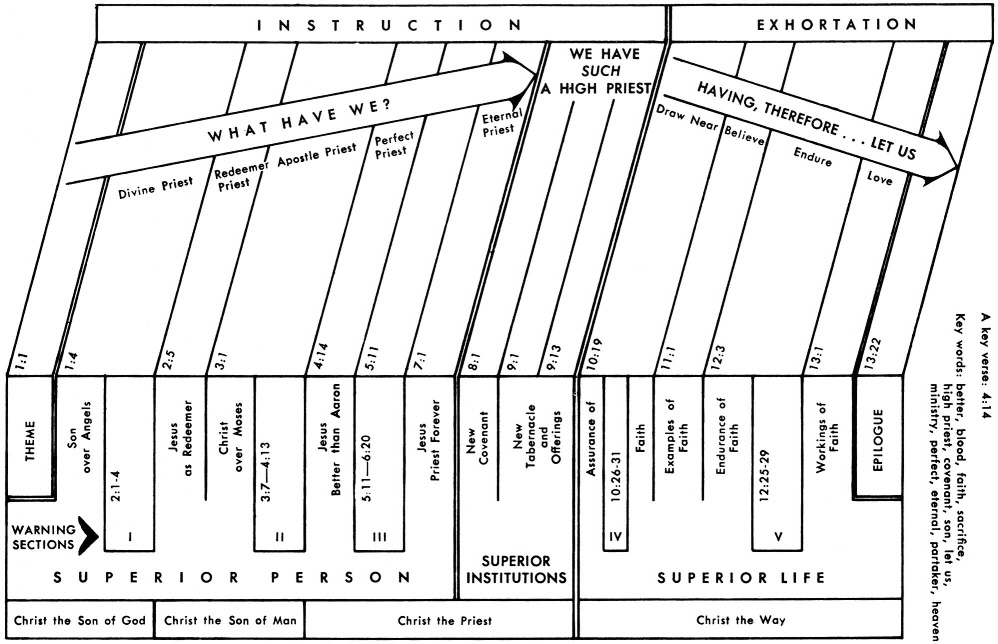
CONSIDER JESUS OUR GREAT HIGH PRIEST
Click chart to enlarge
Charts from Jensen's Survey of the NT - used by permission
Swindoll's Chart, Interesting Pictorial Chart of Hebrews, Another Chart
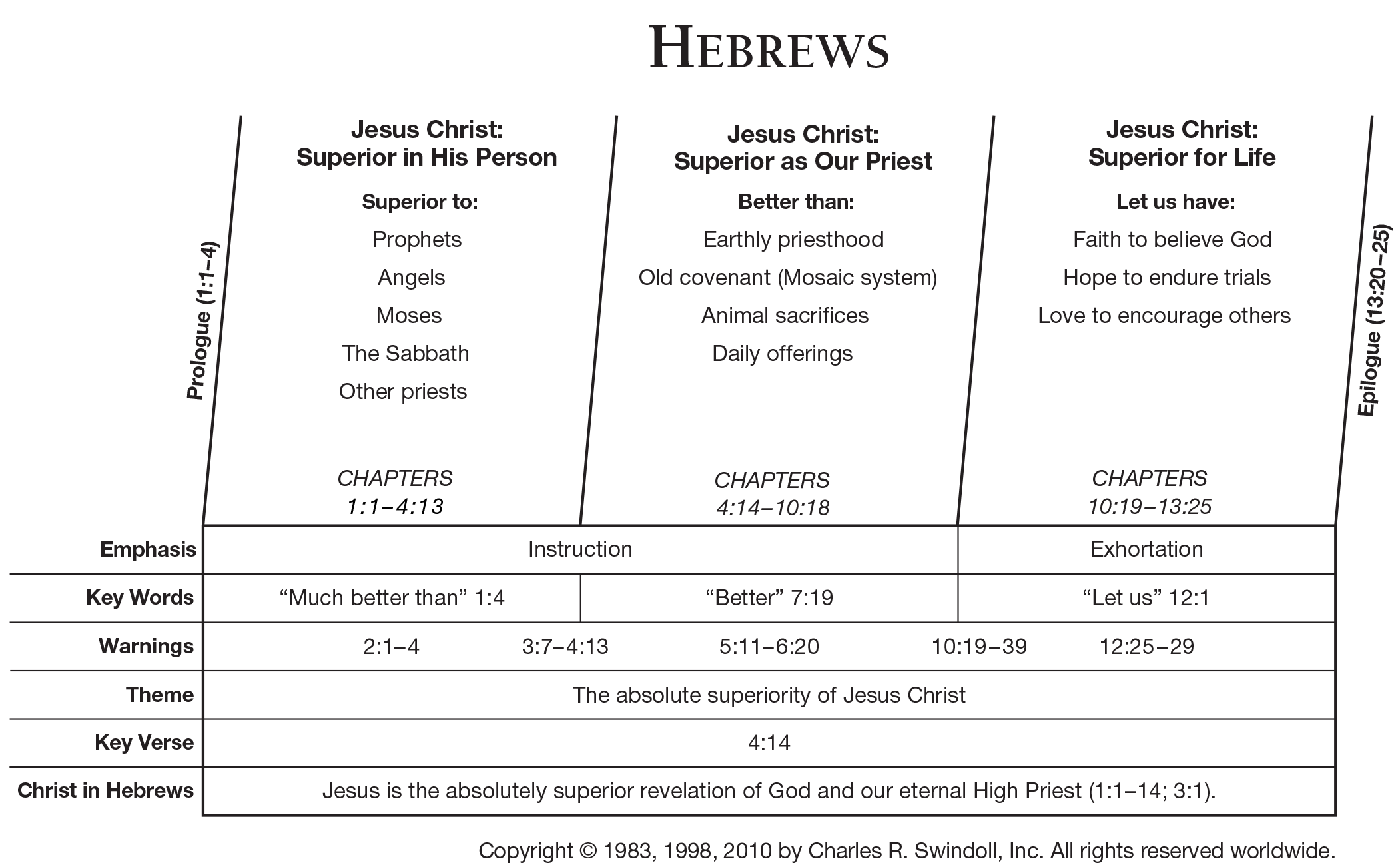

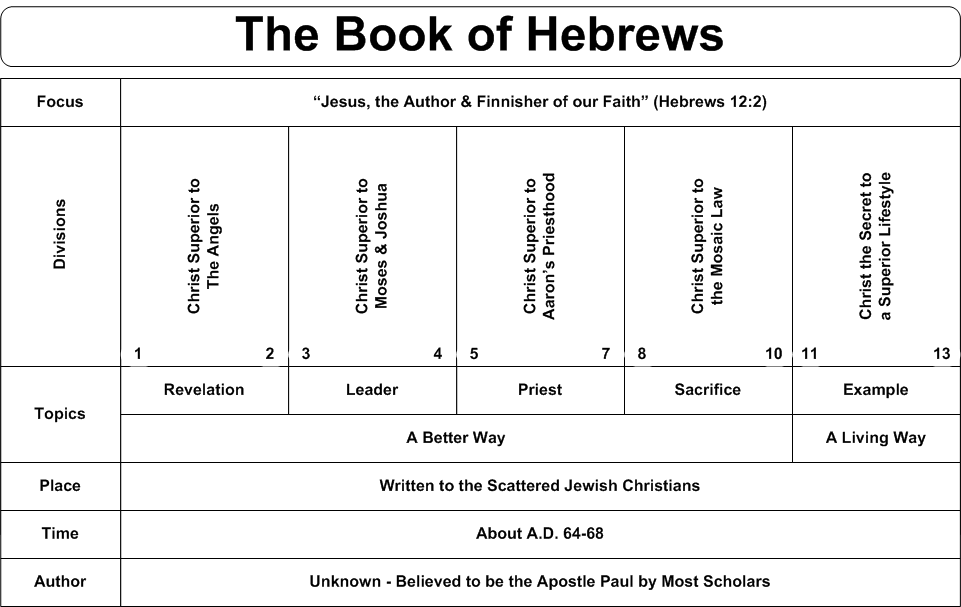
|
The Epistle |
||||
| INSTRUCTION Hebrews 1-10:18 |
EXHORTATION Hebrews 10:19-13:25 |
|||
| Superior Person of Christ Hebrews 1:1-4:13 |
Superior Priest in Christ Hebrews 4:14-10:18 |
Superior Life In Christ Hebrews 10:19-13:25 |
||
| BETTER THAN PERSON Hebrews 1:1-4:13 |
BETTER PRIESTHOOD Heb 4:14-7:28 |
BETTER COVENANT Heb 8:1-13 |
BETTER SACRIFICE Heb 9:1-10:18 |
BETTER LIFE |
| MAJESTY OF CHRIST |
MINISTRY OF CHRIST |
MINISTERS FOR CHRIST |
||
|
DOCTRINE |
DUTY |
|||
|
DATE WRITTEN: |
||||

See ESV Study Bible "Introduction to Hebrews"
(See also MacArthur's Introduction to Hebrews)
Borrow Ryrie Study Bible
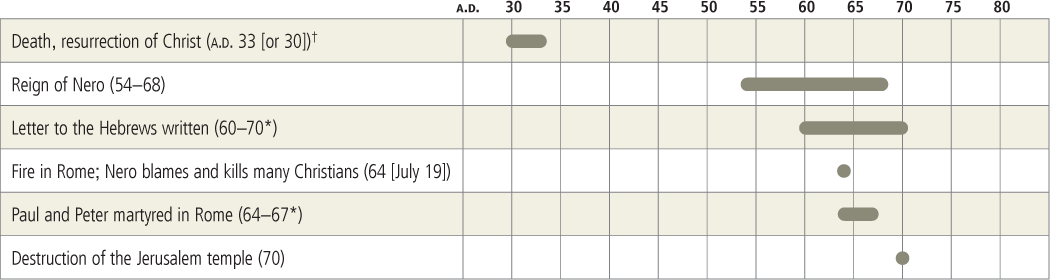
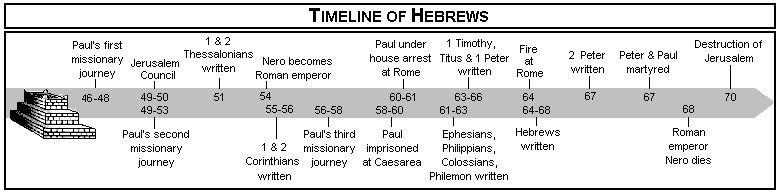
Timeline of Hebrews - ESV Study Bible
Hebrews 2:3 how will we escape if we neglect so great a salvation? After it was at the first spoken through the Lord, it was confirmed to us by those who heard, (NASB: Lockman)
Greek: pos hemeis ekpheuxometha (1PFMI) telikautes amelesantes (AAPMPN) soterias etis archen labousa (AAPFSN) laleisthai (PPN) dia tou kuriou, hupo ton akousanton (AAPMPG) eis hemas ebebaiothe, (2SAPI)
Amplified: How shall we escape [appropriate retribution] if we neglect and refuse to pay attention to such a great salvation [as is now offered to us, letting it drift past us forever]? For it was declared at first by the Lord [Himself], and it was confirmed to us and proved to be real and genuine by those who personally heard [Him speak]. (Amplified Bible - Lockman)
Barclay: how shall we escape if we neglect so great a salvation, a salvation of such a kind that it had its origin in the words of the Lord, and was then guaranteed to us by those who had heard it from his lips, (Westminster Press)
NLT: What makes us think that we can escape if we are indifferent to this great salvation that was announced by the Lord Jesus himself? It was passed on to us by those who heard him speak, (NLT - Tyndale House)
Phillips: how shall we escape if we refuse to pay proper attention to the salvation that is offered us today? (Phillips: Touchstone)
Weymouth: how shall we escape if we are indifferent to a salvation as great as that now offered to us? This, after having first of all been announced by the Lord Himself, had its truth made sure to us by those who heard Him
Wuest: how is it possible for us to escape if we neglect so great a salvation, which salvation is of such a character as to have begun to be spoken at the first by the Lord, and was confirmed to us by those who heard Him, (Commentary)
Young's Literal: how shall we escape, having neglected so great salvation? which a beginning receiving --to be spoken through the Lord--by those having heard was confirmed to us
HOW SHALL WE ESCAPE: pôs hêmeis ekpheuxometha: FMI:
- How will we escape He 4:1+; He 4:11+ He 10:28,29+; He 12:25+; Isaiah 20:6; Ezekiel 17:15,18; Matthew 23:33+, Ro 2:3+; 1Th 5:3+; 1Pe 4:17+; 1Pe 4:18+; Rev 6:16-17+
- Hebrews 2 Resources - Multiples Sermons and Commentaries
- Hebrews 2:1-4 The Danger of Drifting Spiritually - Steven Cole
- Hebrews 2:1-4 Tragedy of Neglecting Salvation - John MacArthur
Related Passages:
Acts 24:25 (Felix) But as he was discussing righteousness, self-control and the judgment to come, Felix became frightened and said, “Go away for the present, and when I find time I will summon you.”
Hebrews 4:1+ Therefore, let us fear if, while a promise remains of entering His rest, any one of you may seem to have come short of it.
Hebrews 4:11+ Therefore let us be diligent to enter that rest, so that no one will fall, through following the same example of disobedience.
Hebrews 10:28; 29+ Anyone who has set aside the Law of Moses dies without mercy on the testimony of two or three witnesses. 10:29 How much severer punishment do you think he will deserve who has trampled under foot the Son of God, and has regarded as unclean the blood of the covenant by which he was sanctified, and has insulted the Spirit of grace?
Hebrews 12:25+ See to it that you do not refuse Him who is speaking. For if those did not escape when they refused him who warned them on earth, much less will we escape who turn away from Him who warns from heaven.
Matthew 23:33+ “You serpents, you brood of vipers, how will you escape the sentence of hell?
Romans 2:3+ But do you suppose this, O man, when you pass judgment on those who practice such things and do the same yourself, that you will escape the judgment of God?
1 Thessalonians 5:3+ While they are saying, “Peace and safety!” then destruction will come upon them suddenly like labor pains upon a woman with child, and they will not escape.
1 Peter 4:17-18+ For it is time for judgment to begin with the household of God; and if it begins with us first, what will be the outcome for those who do not obey the gospel of God? 18 AND IF IT IS WITH DIFFICULTY THAT THE RIGHTEOUS IS SAVED, WHAT WILL BECOME OF THE GODLESS MAN AND THE SINNER?
Escaping a Sinking Ship (Great Escapes in History)
by Emily Rose Oachs
WILL YOU ESCAPE OR NOT ESCAPE?
THAT IS THE QUESTION
How shall we escape (ekpheugo) if we neglect (ameleo) so great a salvation? - Rhetorical! We won't if we miss the "Ark" of His great salvation! How anxious we all become when we are running late to catch a flight! How much more unnerved should those be who are in danger of missing this "flight" into eternal glory and end up in eternal punishment! The writer says there is no escape from the terrible consequences. In fact, if we think the consequences were stern for disregarding the Law, how much more catastrophic will the punishment be for ignoring the glorious Gospel?
The Amplified version accurately phrases this rhetorical question (a question asked merely for effect) as: "How shall we escape [appropriate retribution] if we neglect and refuse to pay attention to such a great salvation [as is now offered to us, letting it drift past us forever]?"
NIV Study note - The argument here is from the lesser to the greater, and assumes that the gospel is greater than the law. Thus, if disregard for the law brought certain punishment, disregard for the gospel will bring even greater punishment. (See context in Zondervan NIV Study Bible)
Vincent commenting on "we" writes that he refers to "We, to whom God has spoken by his Son, and who, therefore, have so much the more reason for giving heed."
John MacArthur - If disobedience to the older covenant of law brought swift judgment, how much more severe will be the judgment of disobedience to the New Covenant gospel of salvation, which was mediated by the Son Who is superior to the angels (cf. Matt. 10:14, 15; 11:20–24)? The Messenger and message of the New Covenant are greater than the messengers and message of the older covenant. The greater the privilege, the greater the punishment for disobedience or neglect (Heb 10:29; cf. Luke 12:47) (See context in Hebrews)
John Piper - “How shall we escape if we neglect so great a salvation?” What’s the answer to that question? The answer is, there is no way we will escape if we neglect such a great salvation. Now this is a sobering word for the world and for the church, because most people do neglect the greatness of salvation. How many people do you know who give serious, sustained attention to the salvation accomplished by Christ—who love it, and think about it, and meditate on it, and marvel at it, and feel continual gratitude for it, and commend it to others as valuable, and weave it into all the lesser things of their lives, and set their hopes on it? Do you live this way? Is it not astonishing how neglectful even professing Christians are of their great salvation? Is there a sense of greatness in your mind about your salvation? When something truly great is happening, there is an appropriate response to greatness. Do you respond to the greatness of your salvation? Or do you neglect it? Do you treat your salvation the way you treat your will or the title to your car or the deed on your house? You signed it once and it is in a file drawer somewhere, but it is not a really great thing. It has no daily effect on you. Basically you neglect it. So this is an astonishing word to the church and the world. To neglect our great salvation is to come into judgment and there will be no escape. Being a Christian is very serious business. Not sour business, but serious, very serious. (Full sermon - Spoken, Confirmed, Witnessed: a Great Salvation)
Richard A Mohler on the writer's argument from lesser to greater (See table listing Qal wahomer [Hebrew] arguments in Scripture or in Latin A fortiori) - He has moved from the lesser (angels/old covenant) to the greater (Jesus/new covenant). If the old covenant that came from God and was delivered by mere angels demanded retribution for sin, how much more will God judge those who have spurned the gospel now delivered to us by his own Son! (See Exalting Jesus in Hebrews - Page 26)
See comments by F B Meyer on this verse from The Way into the Holiest - click
Hark: “How shall we escape, if we neglect so great salvation?”
Not if we resist it, reject it, despise it, oppose it; but if we neglect it.
Spurgeon comments - You see, dear friends, that we need not be great open sinners in order to perish; it is merely a matter of neglect. See how it is put here: "How shall we escape, if we neglect so great salvation?" You need not go to the trouble of despising it, or resisting it, or opposing it; you can be lost readily enough simply by neglecting it. In fact, the great mass of those who perish are those who neglect the great salvation. Let that question ring in our ears, How shall we escape? There will be no escape, there can be none if we refuse the Lord Jesus. Do we mean to be lost? Dare we continue to neglect the great salvation? Hark: “How shall we escape, if we neglect so great salvation?” Not if we resist it, reject it, despise it, oppose it; but if we neglect it. If a man is in business, it is not necessary that he should commit forgery in order to fail; he can fail by simply neglecting his business. If a man is sick, he need not commit suicide by taking poison; he can do it just as surely by neglecting to take proper medicines. So is it in the things of God, neglect is as ruinous as distinct and open opposition: “How shall we escape, if we neglect so great salvation: “ You see, dear friends, that we need not be great open sinners in order to perish; it is merely a matter of neglect. See how it is put here: “How shall we escape, if we neglect so great salvation?” You need not go to the trouble of despising it, or resisting it, or opposing it; you can be lost readily enough simply by neglecting it. In fact, the great mass of those who perish are those who neglect the great salvation, — If we neglect that salvation, is there any other way by which we can be rescued from destruction? Is there any other door of escape if we pass that one by? No, there is none. (Spurgeon's Expositional Commentary on Hebrews)
Kenneth Wuest notes that " “How” is from pos which means “how is it possible?” The rhetorical question expresses a denial. There would be no escape. The word “we” in the Greek text is emphatic. The pronoun refers here to the first-century readers of this letter, its Jewish recipients. It is “we” to whom God spoke in One who in character is His Son, and who therefore have much more reason for giving heed." (Commentary)
Adam Clarke - "If they who had fewer privileges than we have, to whom God spoke in divers manners by angels and prophets, fell under the displeasure of their Maker, and were often punished with a sore destruction; how shall we escape wrath to the uttermost if we neglect the salvation provided for us, and proclaimed to us by the Son of God? Their offense was high; ours, indescribably higher."
Albert Barnes - "How shall we escape the just recompense due to transgressors? What way is there of being saved from punishment, if we suffer the great salvation to be neglected, and do not embrace its offers? The sense is, that there is no other way of salvation, and the neglect of this will be followed by certain destruction."
Spurgeon exhorts us to "Let that question ring in our ears, "How shall we escape?" There will be no escape, there can be none if we refuse the Lord Jesus. Do we mean to be lost? Dare we continue to neglect the great salvation?
Henry Morris so great salvation. Salvation is indeed a great truth! The very name “Jesus” means “salvation.” It embraces many major doctrines of Scripture—including such doctrines as atonement (Leviticus 17:11), substitution (Isaiah 53:5), imputation (Romans 4:6-8), propitiation (I John 2:2), redemption (1 Peter 1:18), remission (Acts 10:43), justification (Romans 3:28), adoption (Ephesians 1:5), reconciliation (Romans 5:10-11), regeneration (Titus 3:5), sanctification (Hebrews 10:9-10, and glorification (Romans 8:30).
Escape (1628) (ekpheugo from ek = out, from + pheugo = move quickly from a point; flee; run) means literally to flee out and so to flee out of a place and to escape. To seek safety in flight (Acts 16:27). To become free from danger by avoiding some peril (1 Thess 5:3)
Below are the 8 NT uses of ekpheugo:
Luke 21:36 (from the preceding context Jesus is referring to His sudden, unexpected second coming) "But keep on the alert at all times, praying in order that you may have strength to escape (ekpheugo) all these things that are about to take place (see Revelation 4-22 for "all these things"), and to stand before the Son of Man."
Acts 16:27 "And when the jailer had been roused out of sleep and had seen the prison doors opened, he drew his sword and was about to kill himself, supposing that the prisoners had escaped."
Acts 19:16 "And the man, in whom was the evil spirit, leaped on them and subdued all of them and overpowered them, so that they fled out of that house naked and wounded."
Romans 2:3+ And do you suppose this, O man, when you pass judgment upon those who practice such things and do the same yourself, that you will escape the judgment of God?"
2 Corinthians 11:33 "and I (Paul describing his escape in Damascus) was let down in a basket through a window in the wall, and so escaped his hands."
1Thessalonians 5:3+ "While they are saying, "Peace and safety!" then destruction will come upon them suddenly like birth pangs upon a woman with child; and they shall not escape."
Hebrews 2:3+ how shall we escape if we neglect so great a salvation? After it was at the first spoken through the Lord, it was confirmed to us by those who heard,
Hebrews 12:25+ See to it that you do not refuse Him who is speaking. For if those did not escape when they refused him who warned them on earth, much less shall we escape who turn away from Him who warns from heaven.
Ekpheugo is used 6 times in the LXX, the use in Proverbs paralleling the truth of Hebrews 2:3…
Proverbs 12:13 An evil man is ensnared by the transgression of his lips, But the righteous will escape from (LXX = ekpheugo) trouble.
IF WE NEGLECT: amelêsantes (AAPMPN):
- Hebrews 2 Resources - Multiples Sermons and Commentaries
- Hebrews 2:1-4 The Danger of Drifting Spiritually - Steven Cole
- Hebrews 2:1-4 Tragedy of Neglecting Salvation - John MacArthur
NEGLECT CAN LEAD
TO DISASTER
How shall we escape if we neglect so great a salvation? - In a word, you cannot! There is only one "ark" and He is Christ. There are no other "lifeboats" available for this world which is like a sinking ship filled with dead men (Eph 2:1). The writer warns his readers against being careless, neglectful or unconcerned about the truths he is explaining.
John MacArthur exhorts every reader "Let it not be said of you that you neglected Jesus Christ. History tells us that failure to shoot a rocket at the precise time of night caused the fall of Antwerp, and Holland’s deliverance was delayed for twenty years. Only three hours neglect cost Napoleon the battle of Waterloo. Neglect of Christ’s salvation will cost you eternal blessing, eternal joy, and will bring you damning judgment and eternal punishment. Do not drift past God’s grace. (See context in Hebrews Commentary)
J Vernon McGee - Neglect in any area of life is tragic, but in the spiritual realm, hearing the gospel message and doing nothing about it is infinitely more tragic. What must I do to be lost? Nothing! The story is told of the man who went to sleep in his boat one night on the Niagara River. Before long his boat drifted down to the rapids and he was caught. It was too late for him to do anything. He went over the falls and was killed. Someone asks the question, “What must I do to be lost?” We are given the answer for “What must I do to be saved?” in Acts 16:31: “…Believe on the Lord Jesus Christ, and thou shalt be saved….” But what is the answer for “What must I do to be lost?” Well, the answer is nothing. You and I belong to a lost human family. We are not on trial. I get a little weary of hearing that God has us on trial. He doesn’t have us on trial; we are lost. Today He is saving some—those who will turn to Christ. The rest are already lost. You don’t do anything to be lost, because that is your natural condition. There is great danger in neglect in every area of life. Many years ago I had a wonderful secretary who developed cancer of the hip. The doctor told her that she must have an operation, but she kept postponing it. Finally the day came when it was too late to do anything. She had been warned, but she just drifted, just neglected taking any action until it was too late. When you move neglect to a higher realm, hearing the gospel message and doing nothing about it is infinitely more tragic. A great many folk hear the gospel and give mental assent to it, but do nothing about it. (See context in Thru the Bible)
Ray Stedman says "it is simply a question. It is addressed both to the Christian and to the non-Christian. To the non-Christian it says, Where are you going to go? How will you get out of God's universe? How can you escape the inevitable? Indeed, why seek to avoid that which is unavoidable: a confrontation with the One Who is behind all things? How can you escape, and why attempt to do so? Especially when His purpose is not to curse but to bless? How can you find deliverance by any other route, by any other path, or by any other channel, if it does not involve the One who is behind all things? To the Christian, the writer is saying it is not enough that we know Jesus Christ: We must use the resources we have in Him. We can lose so much, even knowing Him, unless there is a day-by-day walk with Him. We lose peace and freedom and joy and achievement. We are subjected to temptation, frustration, bewilderment, bafflement and barrenness without Him (ED: "AND HIS SPIRIT" - cf Gal 3:2-3+). And if we do not go on as Christians, if we do not grow (ED: AKA PROGRESSIVE SANCTIFICATION), a serious question is raised: Have we ever really begun the Christian life? (ED: ARE WE REALLY BELIEVERS!) (The Great Danger in Ignoring the Son)
Kenneth Wuest feels that "The words if we neglect have their primary reference to the Jews of the period in which the writer lived, who had outwardly left the temple sacrifices, had made a profession of Messiah as High Priest, and who under stress of persecution from apostate Judaism, were neglecting attendance upon the means of grace (Heb 10:25), were allowing themselves to drift by New Testament truth, were leaning back towards the First Testament (ED: THE LAW), and were in danger of returning to the temple sacrifices, an act that would constitute the sin known as apostasy, from which there would be no recovery. The writer is trying to keep them from committing that sin. (Hebrews - Wuest's word studies from the Greek New Testament) (Commentary)
Bob Utley - This is the major point of the argument that if the Mosaic Covenant had such tremendous consequences for its neglect then how much more severe the consequences for neglecting the new and better Covenant brought by Jesus (the Son). The consequences of knowingly neglecting a message are related to the majesty of the One who brings the message (cf. Matt. 22:2–5). (Hebrews 2 Commentary)
If we neglect - as someone has said "The tragedy of life is not that it ends so soon, but that we wait so long to begin it."
Here is a poem that originally was written by Gloria Pitzer (neglect has been substituted for procrastination)…
Neglect is my sin
It brings me naught but sorrow.
I know that I should stop it
In fact, I will… tomorrow!
Neglect (272) (ameleo from "a" = without + melo = to care for, to show concern, forethought or interest) means literally without care and thus showing no concern. To be careless. To be unconcerned about or to care nothing for something or someone. It is to recognize but to ignore, to know but to fail to do, to admit but not to administer. Ameleo describes the opposite attitude or response to the parallel verb prosecho (used in Hebrews 2:1) which calls for one to be in a continuous state of readiness to learn of a danger, need, error, etc, and to respond appropriately.
One of the two uses of ameleo in the OT Septuagint depicts Jehovah speaking of His promise of the New Covenant, declaring that it is "not according to the covenant (Mosaic) which I made with their fathers in the day when I took hold of their hand to bring them out of the land of Egypt; for they abode not in my covenant, and I disregarded (ameleo) them, saith the Lord." (Jeremiah 31:32) (This is the English translation of the Septuagint and is the translated almost verbatim in Hebrews 8:9 (see below).
Below are the 4 uses of ameleo in NT:
Matthew 22:5 "But they paid no attention and went their way, one to his own farm, another to his business,
1 Timothy 4:14 Do not neglect (present imperative - stop doing this) the spiritual gift within you, which was bestowed upon you through prophetic utterance with the laying on of hands by the presbytery.
Hebrews 2:3 (note) how shall we escape if we neglect so great a salvation? After it was at the first spoken through the Lord, it was confirmed to us by those who heard,
Hebrews 8:9 (note) Not like the covenant which I made with their fathers On the day when I took them by the hand to lead them out of the land of Egypt; for they did not continue in My covenant, and I did not care for them, says the Lord.
Spurgeon -Not if we resist it, reject it, despise it, oppose it; but if we neglect it. If a man is in business, it is not necessary that he should commit forgery in order to fail; he can fail by simply neglecting his business. If a man is sick, he need not commit suicide by taking poison; he can do it just as surely by neglecting to take proper medicines. So is it in the things of God, neglect is as ruinous as distinct and open opposition: How shall we escape, if we neglect so great salvation (Exposition on Hebrews 2-3) (Bolding added)
James Smith - THE GREAT SALVATION Hebrews 2:3
- A Great Certainty, “Salvation.”
- A Great Possibility, “Neglect.”
- A Great Impossibility, “Escape.”
James Smith - GREAT SALVATION Hebrews 2:3
- The Needed Blessing—“Salvation.”
- The Character of It—“So great.”
- The Common Danger—“Neglect.”
- The Unanswerable Question—“How shall we escape if we neglect?”
James Smith - THE GREAT SALVATION
“HOW SHALL WE ESCAPE IF WE NEGLECT SO GREAT SALVATION?” (Heb. 2:3).
I. This Salvation is Great.
Great, when you think of the greatness of HIM who saves. He is the Heir of all things, the Maker of the worlds, the brightness of the Father’s glory, the express image of His Person, who upholdeth all things by the word of His power, and is much better than the angels (Heb. 1:2–4). Great, when you think of the awful condition from which He saves, from the guilt and dominion of sin, and delivers from that death which is the wages of sin, and from the wrath of God which must for ever rest upon sin and sinners. Great, when you think of the happy position into which He saves—brought into the family of God, justified from all things, made sons and daughters and heirs of eternal life, having the promise for the life that now is, as well as the life which is to come. Great, when you think of the unspeakable price He paid for our salvation. Not corruptible things, as silver and gold, but His own precious blood. It took the sacrifice of HIMSELF to purge our sins and He willingly, lovingly, gave His all.
II. This Salvation may be Neglected.
It is neglected every time the opportunity of being saved is let slip. We ought to give the more earnest heed to the things which we have heard, lest at any time we should let them slip. Because to let the chance slip any one time may be letting it slip for the last time. Many neglect salvation by neglecting the Lord’s day. To neglect the Word of God, the Gospel of God, the strivings of the Spirit of God, and the Providence of God, is to neglect salvation. The process of neglecting, like the process of drifting, may be painless and unconscious, but it is the more dangerous on that account. You may neglect it without hating it or denying it. The Osbtinates, who refuse to go forward, and the Pliables who turn back, equally neglect salvation.
III. This Salvation, if Neglected, Leaves no Escape.
This question, “How shall we escape if we neglect?” is one which the wisdom of God cannot answer, although some men in the pride of their own hearts have attempted it. How shall the merchant escape ruin if he neglects his business? How shall we escape hunger if we neglect food? How shall we escape darkness if we neglect the light? How shall we escape the wages of sin if we neglect the Atonement for sin? How shall we escape the wrath of God if we neglect the Gift of God? How shall we escape the doom of the lost if we neglect the Saviour of the lost? How shall we escape the condemnation of Hell if we neglect the salvation of Heaven? “Behold, now is the accepted time.” One of the most melancholy sights of earth is a Christless old age.
S Lewis Johnson - I think, in our day and particularly in companies of people such as evangelical churches, what we ought to have in mind, perhaps, even more than these other types of sin, is those who have heard and are drifting, neglecting the truth that is given to them. They’ve heard it, they assent to it, but they’ve neglected it. They’ve neglected it for years. They’ve heard it often, they come in and out for a month or two, six months, they are interested, then for two years they are not. Then suddenly, they appear in a meeting again, and they are interested for awhile and then they are gone.
Phil Newton - Dr. James P. Boice taught, "The doctrine of the final perseverance of the saints teaches that those who are effectually called of God to the exercise of genuine faith in Christ will certainly persevere unto final salvation." He points out that the reason for this is "not to any excellence or power in the believer" but "due to the purpose and power of God and the grace which he bestows." Having said that, some would consider that a person need only profess faith in Christ then he is able to live his life any way he desires since God will preserve him. But this is an arrogant misunderstanding of this doctrine, for as Dr. Boice explains, the Lord "does not act independently of [the believer's] co-operation, but leads [him] unto salvation through [his] own perseverance in faith and holiness" [Abstract of Systematic Theology, 425-426]. I spoke with a young lady recently about this very subject. Evidently she had professed faith in Christ as a child but had long since moved away from any active practice of Christianity. By her own admission she did not attend church or have an active faith in Christ. Yet she thought that she was a believer on the basis of what she did as a child. She has ignored her spiritual life and neglected any sense of responsibility as a Christian for many years. She has fallen into the very pitfall the writer of Hebrews warns against by drifting away from the gospel of Jesus Christ. For those who drift there is a question mark about the genuineness of their faith in Christ.....
Jeremiah warned us that we do not know our own hearts: "The heart is more deceitful than all else and is desperately sick; who can understand it?" (Jer. 17:9). Our writer tells us, "For this reason we must pay much closer attention to what we have heard, so that we do not drift away from it." There is the possibility within the bosom of any of us to drift away from Jesus Christ. We might make loud professions of faith; we might do honorable service; we might receive the applause of men, yet still drift away. Did Judas Iscariot think in those early years of following Christ that he would drift away from him? Have we not all known those who have professed to be Christians at some point but the ongoing process of their lives reveals them moving farther and farther away from the gospel of Christ? Please understand we are not talking of even the possibility of someone losing his salvation: Judas was never a believer but only appeared to be one (John 6: 70-71; 17:12). But we are speaking of those who claim to know Christ but by neglect of the gospel-a neglect of perseverance-they expose that their lives have never known the saving grace of God....
We must also take action because God himself will take action. The writer does not offer detail at this point. He takes up the matter more later on. But for now he just asks the question: "How will we escape if we neglect so great a salvation?" The picture of drifting away in the first verse shows the scene of a boat that has broken away from its mooring and slowly, unnoticeably drifts into the open sea or heads toward the peril of hidden reefs. Now the question of the third verse arrests our attention. Is there an escape for anyone neglecting salvation in Christ? Especially, is there escape for those who have heard the gospel in its fullness and richness over and over? Can we escape when we are no longer anchored in the truth of the gospel of Jesus Christ? The "we" is emphatic, as Marvin Vincent has described it, "We, to whom God has spoken by his Son, and who therefore, have so much the more reason for giving heed" [Word Studies in the New Testament, IV, 394]. We do not hear the gospel without responsibility to faithfully heed its call. Built into the very fabric of the gospel is a sense of accountability. We impoverish our own souls, yes; we even imperil our own souls, by neglecting the gospel of Jesus Christ. So we are warned that there is no escaping this divine reckoning with the gospel of Christ. Do you take the message of the gospel seriously? Are you paying attention to Christ and the gospel, more attention than to the passing fancies of the world or the religious substitutes bombarding our society?....
Are you paying closer attention to Jesus Christ and the gospel? Maybe you realize that you have been slowly, even without your realizing it, drifting away from the centrality of the gospel in your life. Then I urge you to turn from this; see it as sin and unbelief; look to Jesus Christ with the eyes of faith. Maybe you are thinking that you can put aside the gospel for now, thinking you can return to it later. Our text does not give us such liberty. He warns that to neglect the gospel means no escape. So what are you doing with the gospel of Jesus Christ? Is the gospel the anchor for your soul? (Hebrews 2:1-4 Anchored in the Truth)
ILLUSTRATION - W A Criswell - At the turn of this century, the only connection between the island of Galveston and the mainland of Texas was an iron bridge. On a fateful day in 1900, the United States government sent warning after warning to the citizens of the city that a terrible hurricane was coming their way, and that they should escape for their lives. Over that iron causeway to the mainland went trains and trolleys and vehicles to safety; but the citizens of the city looked at the blue of the sky and the quiet of the sea and, heedless of the terrible warnings, in a false peace went to bed and to sleep. In the dark and terror of that frightful night, the gentle breeze turned into a wind, and the wind turned into a hurricane, and the hurricane turned into a torrential rain, and the torrential rain turned into a tidal wave, and the tidal wave went over the island, destroying the bridge like a match stem. When the one way of hope and escape is spurned, there remains no other avenue of salvation. Nothing remains but judgment and death. (6000 to 12000 died - most say 8000 is most likely number -- See 1900 Galveston hurricane - Wikipedia)
Alan Carr writes - WILLIAM POPE, who died in 1797, is said to have been the leader of a company of infidels who ridiculed everything religious. One of their exercises was to kick the Bible about the floor or tear it up. Friends who were present in his death-chamber spoke of it as a scene of terror as he died crying:
"I have no contrition. I cannot repent. God will damn me. I know the day of grace is past . . . You see one who is damned forever . . Oh, Eternity! Eternity! . Nothing for me but hell. Come, eternal torments . . . I hate everything God has made, only I have no hatred for the devil -- I wish to be with him. I long to be in hell. Do you not see? Do you not see him? He is coming for me?" (1)
VOLTAIRE, the noted French infidel and one of the most fertile and talented writers of his time, used his pen to retard and demolish Christianity. Of Christ, Voltaire said, "Curse the wretch!" He once boasted, "In twenty years Christianity will be no more. My single hand shall destroy the edifice it took twelve apostles to rear." Shortly after his death the very house in which he printed his foul literature became the depot of the Geneva Bible Society. The nurse who attended Voltaire said: "For all the wealth in Europe I would not see another infidel die." The physician, Trochim, waiting up with Voltaire at his death said that he cried out most desperately:
"I am abandoned by God and man! I will give you half of what I am worth if you will give me six months' life. Then I shall go to hell; and you will go with me. O Christ! O Jesus Christ!"(2)
These quotes represent the dying words of two men who did just what the author of Hebrews warns us about. They neglected, or ignored, God's great salvation. Too late these men came to understand the truth that there is an eternity out there and that men are given just a short time to prepare for it. What a shame it would be to live one's whole life separated from God and then die and go to Hell and live for eternity, in the torments of Hell, still separated from God.
Yet, people can leave this world another way! No one has to die lost and undone without God! Look at these dying words of some of God's saints.
"A few hours before entering the 'Homeland' Dwight L. Moody caught a glimpse of the glory awaiting him. Awakening from a sleep, he said. 'Earth recedes. Heaven opens before me. If this is death, it is sweet! There is no valley here. God is calling me, and I must go. His son who was standing by his bedside said. No, no father, you are dreaming.' "'No.' said Mr. Moody. 'I am not dreaming: I have been within the gates: I have seen the children's faces.' A short time elapsed and then, following what seemed to the family to be the death struggle he spoke again: 'This is my triumph; this my coronation day! It is glorious!'"(3)
Matthew Henry--"Sin is bitter. I bless God I have inward supports."
Martin Luther-- "Our God is the God from whom cometh salvation: God is the Lord by whom we escape death."
John Knox --Live in Christ, live in Christ. and the flesh need not fear death.
John Calvin--"Thou Lord bruisest me: but I am abundantly satisfied, since it is from thy hand."
John Wesley-- "The best of all is. God is with us. Farewell! Farewell!"
Charles Wesley-- "I shall be satisfied with thy likeness --satisfied, satisfied!"
Baxter -- "I have pain; but I have peace. I have peace.
Treston-- "Blessed be God! though I change my place. I shall not change my company.
Goodwin--"Ah! is this dying? How have I dreaded as an enemy this smiling friend!"
Everette--"Glory, glory, glory!" (this expression was repeated for 25 minutes and only ceased with life itself).(4)
These were testimonies from people who had not neglected the great salvation spoken of here.
J Vernon McGee - Please explain Hebrews 2:3 and 2 Peter 3:9. Do these verses mean we could lose our salvation—“How shall we escape” and “longsuffering to us-ward”?
Answer - These two verses that you have suggested actually have no reference at all to the security of the believer or to the question of whether you lose your salvation or not.
“How shall we escape, if we neglect so great salvation; which at the first began to be spoken by the Lord, and was confirmed unto us by them that heard him” (Heb. 2:3). This is directed to the unsaved, not to those who are already saved. “How shall we escape, if we neglect…”; that is, if we just let it pass by and do nothing about it, which is the attitude of the average unsaved man or woman today. Many are hearing the gospel, but they just do nothing about it. They are not saved and have never been saved. He is not even discussing the situation of the saved. The saved are those who have eternal life; and if they have eternal life, then they can’t lose it tomorrow. If we could lose it, it wasn’t eternal life that we had to begin with. Or, as I have heard it expressed recently, you can’t lose what you don’t have.
Your second passage of Scripture, again, has no reference at all to the condition of the saved person. “The Lord is not slack concerning his promise, as some men count slackness; but is longsuffering to us-ward, not willing that any should perish, but that all should come to repentance” (2 Peter 3:9).
Peter says to the unsaved person that God is longsuffering toward the lost. He is longsuffering toward the saved, too, but this verse is not talking about that. He is longsuffering, not willing that any should perish—that is, fail to get saved. God desires that all should come to repentance—change their minds and accept Christ. You see, God is not talking about the saved person in either situation.
Hebrews 2:3 A Solemn Question! - James Smith, 1855
This is a most solemn question. It requires our closest attention. It is proposed for our good. It should be immediately and seriously considered. We are by nature, lost sinners. That such sinners might be saved, God became incarnate. "The Word was made flesh, and dwelt among us." In our nature he did and suffered what law and justice required for our salvation. He finished his work. He ascended to glory. He sent his gospel to all nations. He has sent it to us. It is the good news of salvation. It informs us that we may be saved — and how we may be saved. It points out the way of life. Exhorts us to escape from eternal death. Invites us to receive and enjoy this invaluable blessing.
Gospel salvation is represented, as a sovereign remedy for all our moral maladies. It is that which will restore us to spiritual health — and will make us holy, happy, and honorable. It is compared to a splendid feast. It presents all that we can need to revive, refresh, and delight us. It contains . . .
a free, full, and immediate pardon, for all our sins,
a title to everlasting life and happiness,
a complete deliverance from sin, Satan, death, and Hell.
It is a great salvation!
God alone could devise it.
It required that God should become man to procure it.
It is the richest gift that God could confer on sinners.
It is great beyond expression — beyond conception! Consider . . .
1. The price it cost:
the labors,
the sufferings, and
the death of the Son of God!2. The evils it prevents:
banishment from God,
the endless lashings of a guilty conscience,
the torments of eternal despair in Hell.3. The blessings it secures:
the presence of God,
the perfection of our nature, and
the unspeakable glories and joys of Heaven!4. The glory it confers — it makes us . . .
the sons of God,
joint heirs with the Lord Jesus Christ,
temples of the Holy Spirit, and
mirrors in which the glory of God will be reflected forever!5. The extent to which it reaches — the uttermost. No sinner can be too vile to be pardoned through the blood of Jesus. No creature can be too depraved to be sanctified by the Spirit of God. It reaches to the most desperate cases. None are excluded. None should despair. It is salvation to the uttermost! Until . . .
omnipotence can be conquered,
infinite wisdom be baffled, or
the merit of the blood of Jesus fail
— there is hope for the vilest of sinners!6. Its duration is forever! It is everlasting salvation. Jesus is the author of eternal salvation, unto all those who obey him. Once saved by Jesus, we are saved for evermore. Put these things together, and say — Is it not a great salvation? It is the salvation of great sinners, from the greatest evils, to the enjoyment of the greatest blessings.
Must it not then be an inexcusable sin, to neglect such a great salvation? Yet there are thousands who do so. It is constantly preached — yet many never give themselves the trouble to go to hear of it. It is published in the Bible and other good books — yet they seldom if ever carefully read of it. They treat it as if it was a matter of minor importance, or of no consequence at all. How astonishing!
They think they may neglect it in times of health, and quiet their consciences by promising to attend to it in sickness. But they are comparatively few, who having neglected salvation in health, do seek and enjoy it in sickness and death.
And many who do read the bible with tolerable regularity, and who go often to hear the gospel preached — who still neglect this great salvation. They do not give it that sincere and hearty attention which it demands. It does not fill their thoughts, awaken their desires, and engage their powers. They hear the message — but do not cordially embrace it. They listen to the proclamation — but do not exercise faith in it. They have the blessing presented to them as a gift from God — but they do not receive it. They postpone the serious consideration of it. They prefer the pleasures, or follies, or fashions of this life to it: and in effect say with Felix, "Go your way for this time, when I have a convenient season — I will send for you."
But whom do they put off? The great, the glorious, the infinite God.
What do they treat with neglect? The present, future, eternal salvation of their souls.
What do they prefer to this blessing? Vanity, lies, the merest trash!
Why do they neglect this great salvation? Because sin has hardened the heart, blinded the eyes, and perverted all their mental powers.
What will be the consequence if they persevere in this course? They must be condemned by God — and must suffer forever the due punishment of their deeds in eternal Hell!
Reader! how is it with you? Are you enjoying this great salvation? Are you seeking to possess it? Or, are you treating it with neglect? If you have neglected it hitherto, if you are neglecting it now — let me exhort you to attend to the question proposed to you by God himself. How shall you escape, if you neglect such a great salvation?
It is kindness,
it is love to your soul,
it is concern for your everlasting welfare,
it is a desire to see you holy and happy
— which leads us to ask, "How shall you escape — if you neglect such a great salvation?" How will you escape? Death will soon summon you into the presence of God. The judgment will soon commence. You must stand alone at the bar of God. You must give an account of yourself to God. You cannot avoid this. The decree is past. The facts are made known in God's book. Heaven and earth may pass away — but his word which declares these things shall not pass away. How then, will you escape?
Do you imagine that you can flee from God? How can you escape from the grasp of omnipotence? Where can you flee from the eye of the Omniscient? How will you escape?
Do you think that you can bribe God? Can you bribe the most just God? Or, what can you offer when you stand naked before your judge? How will you escape?
Do you imagine that you can escape by deception? In vain will you try your ingenuity! Your folly will be manifest to all! How will you escape?
Do you imagine that you can escape by your strength? "Have you an arm like God?" Can you overcome the Almighty! How will you escape?
Do you imagine that you can escape by concealment? What will conceal you? Then shall be fulfilled that solemn scripture, "They called to the mountains and the rocks: Fall on us and hide us from the face of him who sits on the throne and from the wrath of the Lamb! For the great day of their wrath has come, and who can stand?" Revelation 6:16-17. What a solemn scene! What a dreadful picture! What a solemn scene! What an dreadful picture! And if you neglect this great salvation — such will be your condition!
Now you may escape, then there will be no possibility of escape. Once more we ask the question: How will you escape? Do you ask, "Escape what?" Ruin. Total Ruin. Eternal ruin. The ruin of body and soul. The ruin of your entire person forever. Ruin merited by sin. Ruin secured by your folly. Ruin preferred to the joys of the blessed, and the riches of glory.
My beloved friend, think. Think seriously upon this subject. Let it sink down deep into your heart. You can think of nothing else half so important. I beseech you, do not put it away from you, and so judge or pronounce yourself unworthy of everlasting life. Ask yourself: Am I saved? Salvation is come near unto you. You are not far from the kingdom of God. Will that salvation be received? Will that kingdom be entered by you.
- Beware of trifling!
- Beware of delays!
- Your life hangs upon a thread!
- You may be within one hour of eternity!
Satan will try to induce you to postpone the matter. But do not allow him to deceive you. He has deceived you too often. He is the enemy of your soul. He seeks your destruction. Yield not to him — but at once direct your most serious thoughts to this all-important subject.
- Embrace the message of mercy at once.
- Accept the kind invitation of your God without delay.
- The arms of Jesus are open to embrace you.
- The ears of God are open to listen to your earnest prayers.
- The fountain of Christ's blood is open which will cleanse you from sin.
- The gospel feast is prepared which will satisfy your soul.
- The best robe is ready which will clothe and adorn your person.
- All things are ready, Come!
You have delayed too long — delay no longer. You have neglected too long — but yet there is hope, neglect no longer. Cast yourself at once at the feet of Jesus, seek and obtain mercy of God — and everlasting life is yours. Life in the favor of God. Life in the enjoyment of God. Life, as like the life of God as the life of a creature can be. Life which comprises every blessing, which includes everything that is desirable. Life which has cost the Son of God the labors of his life, and the sufferings of his death to procure. O look to Jesus and live, believe in the Son of God and eternal life is yours!
"And this is the testimony: God has given us eternal life, and this life is in his Son. He who has the Son has life; he who does not have the Son of God does not have life!" 1 John 5:11-12
"Whoever believes in the Son has eternal life, but whoever rejects the Son will not see life, for God's wrath remains on him!" John 3:36
(Another version - He who believes in the Son has eternal life; but he who does not obey the Son will not see life, but the wrath of God abides on him.)
John Piper - IS THE HOLY SPIRIT PHASE THREE OF GOD’S WORD? Preserving the Finality of Phase Two
Meditation on Hebrews 2:3–4RSV
How shall we escape if we neglect such a great salvation? After it was at the first spoken through the Lord, it was confirmed to us by those who heard. God also bearing witness with them, both by signs and wonders and by various miracles and by distributions of the Holy Spirit according to His own will.
The point of Hebrews 1 is to make us realize the enormous value of God’s speaking to us through the Son of God and revealing to us a way of salvation. We know this because the chapter begins with the trumpeting of the superior value of God’s speaking “in these last days by a Son,” and because chapter 2 begins by saying, “For this reason we must pay much closer attention to what we have heard.” In other words, the whole first chapter is to help us pay attention to the Word of God spoken through the Son.
Then again in Hebrews 2:2–3 this great Word of salvation is contrasted with the word of angels: “For if the word spoken through angels proved unalterable, and every transgression and disobedience received a just recompense, how shall we escape if we neglect so great a salvation?” So again the point is the superiority of the Word that God has spoken through Jesus concerning our salvation. Listen! Listen! Take heed! Don’t take it for granted! That is the message.
Then, in Hebrews 2:3, the writer tells us how this Word comes to the generations who were not there to hear it from Jesus himself or to see it with their own eyes when he died and rose again. There are three stages. Look for them in this text: “After it was at the first spoken through the Lord, it was confirmed to us by those who heard.”
The three stages in this verse are: 1) the Lord spoke, once for all, by his life and teaching and death and resurrection, 2) those who heard and saw him (the apostles) testify and confirm the truth of the Lord’s Word, and finally, 3) others hear or read the confirming testimony of the apostles.
But what is the role of the Holy Spirit in this connection? The answer is given in Heb 2:4: “God also bearing witness with them, both by signs and wonders and by various miracles and by distributions of the Holy Spirit according to His own will.” This verse says that God himself testified to the Word in three ways: 1) by signs and wonders, 2) by various miracles, and 3) by distributions of the Holy Spirit.
The function of the “distributions of the Holy Spirit” was to testify to the Word, that is, the “great salvation” which was “at the first spoken through the Lord” (verse 3). In other words, the role of the Holy Spirit is to direct attention and conviction toward the Word of the Son of God which has been spoken “in these last days.” Which means that the work of the Holy Spirit is not a “third phase” of divine communication after phase one (the Old Testament) and phase two (the incarnation of the Son of God). The work of the Holy Spirit is a clarification and application and certification of phase two.
Thus one test of the Spirit’s voice is whether it orients us more and more on the Word of God spoken once for all “in these last days” through the Son of God, Jesus Christ, in his decisive work of redemption. If a claim to spiritual revelation leads us to depend less on the once-for-allness of the historical Word that comes to us by Jesus Christ through the apostles (2:3), then that claim is dubious.
“In these last days God has spoken to us in His Son” (Heb 1:2, emphasis added). The “us” in this verse is a third generation of Christians—the ones to whom the apostles delivered the message in Heb 2:3. This means that, in principle, any of us after the apostles, whether third generation or fiftieth generation, can hear God in the Son. He has spoken to us. This is where we hear God. He is not silent. Nor has any of us exhausted this Word. Oh, let us read and ponder and meditate and memorize and saturate our minds in this great, final Word—which the Holy Spirit serves by all his gifts.
James Butler - Sermon Starters
THE QUESTION
“How shall we escape, if we neglect so great salvation; which at the first began to be spoken by the Lord, and was confirmed unto us by them that heard him” (Hebrews 2:3).
Here is the great question men must face sooner or later. How can you be saved from damnation if you reject Jesus Christ?
FIRST—GREAT PERIL
“How shall we escape, if we neglect so great salvation?” The answer is you cannot escape if you neglect salvation in Christ. The word “neglect” is the means to this great peril. Note two things about “neglect.”
• The matter of neglect. Neglect has such an ominous sound to it. People become so taken up with the things of the world—business, cares of this life, family matters, economy, pleasures, sports, etc. that they have no time to think about their soul’s destiny. So they neglect the most important matter of life.
• The meaning of neglect. Carelessness, and to make light of are in the meaning of this word translated “Neglect.” Carelessness is covered in the “matter” of neglect above. Here we focus on the ‘make light of.’ Many folk mock spiritual concerns, they do not think spiritual concerns are important so they laugh and joke about heaven and hell. The laughing and joking will stop, however, the moment they die, for they will not escape eternal damnation.
SECOND—GREAT PARDON
“Great salvation.” Salvation of the soul is indeed great. It is important and is made great by several factors.
• It involves a great plan. “Which at first began to be spoken by the Lord.” Salvation is the great plan of God for the pardon of man’s sin. Man would not have devised this plan and could not have done it either. God’s plan required a great price (Calvary) and great power (resurrection power).
• It involves a great Person. “Lord.” Christ is the Savior or man from the condemnation of his sin. Apart from Him, there is no salvation. Man cannot save Himself. It takes a greater Person than man, and God provided Him in Jesus Christ (“Lord”).
• It involves a great proof. “Confirmed unto us by them that heard him.” Salvation is not heresy. It is a great message confirmed by those who heard Christ personally. Salvation is not without the greatest of proofs known to man. “He showed himself alive after his passion by many infallible proofs” (Acts 1:3). When you reject Christ as your Savior you are trampling on the greatest proofs ever given man. The many theories of man have no proof, as an example, evolution cannot boast of the great proofs that salvation has. Evolution has no proof.
• It involves a great pardon. “Great salvation.” Salvation is the pardoning of man for his sins. This is the greatest pardon known to man and results in the greatest of blessings, namely, eternity in heaven.
What is the problem if we neglect? Here are a few illustrative (and some very tragic) examples…
The devil and his cohorts were devising plans to get people to reject the Gospel. “Let’s go to them and say there is no God,” proposed one. Silence prevailed. Every devil knew that most people believe in a supreme being. “Let’s tell them there is no hell, no future punishment for the wicked.” offered another. That was turned down, because men obviously have consciences which tell them that sin must be punished. The concave was going to end in failure when there came a voice from the rear: “Tell them there is a God, there is a hell and that the Bible is the Word of God. But tell them there is plenty of time to decide the question. Let them ‘neglect’ the Gospel, until it is too late.” All hell erupted with ghoulish glee, for they knew that if a person procrastinated on Christ, they usually never accept Him. (10000 Sermon Illustrations. Dallas: Biblical Studies Press)
An incident from the American Revolution illustrates what tragedy can result from neglect. Colonel Rahl, commander of the British troops in Trenton, New Jersey, was playing cards when a courier brought an urgent message stating that General George Washington was crossing the Delaware River. Rahl put the letter in his pocket and didn't bother to read it until the game was finished. Then, realizing the seriousness of the situation, he hurriedly tried to rally his men to meet the coming attack, but his neglect was his undoing. He and many of his men were killed and the rest of the regiment were capture. Nolbert Quayle said, "Only a few minutes' delay cost him his life, his honor, and the liberty of his soldiers." Earth's history is strewn with the wrecks of half-finished plans and unexecuted resolutions. 'Tomorrow' is the excuse of the lazy and refuge of the incompetent. (Adapted from Our Daily Bread)
The Cost of Not Putting a Finger in the Dike - For most of the last decade, Chicagoans who worked in the Loop, the booming downtown business district, could easily ignore the city's budget crisis; Washington's cutback of aid to cities didn't seem to hurt business. Last week, they learned one price of neglecting the underpinnings of all that economic growth. A quarter billion gallons of murky Chicago River water gushed into a 60-mile network of turn-of-the-century freight tunnels under the Loop and brought nearly all businesses to a soggy halt. It turned out that a top city official had known about the leak, but, acting for a cash-strapped government, had delayed repairs costing only about $50,000. The final cost of the damage caused by this neglect was estimated to be more than $1 billion. (From U.S. News & World Report, April 27, 1992.)
We often fail to consider the gradual, cumulative effect of sin in our lives. In Saint Louis in 1984, an unemployed cleaning woman noticed a few bees buzzing around the attic of her home. Since there were only a few, she made no effort to deal with them. Over the summer the bees continued to fly in and out the attic vent while the woman remained unconcerned, unaware of the growing city of bees. The whole attic became a hive, and the ceiling of the second- floor bedroom finally caved in under the weight of hundreds of pounds of honey and thousands of angry bees. While the woman escaped serious injury, she was unable to repair the damage of her accumulated neglect. (Robert T Wenz)
A 64-year-old woman, whose decomposed body was found in her dilapidated Houston home recently, was discovered frozen to death for five months. She was forgotten (neglected) all winter and spring by neighbors and family members. Neighbors described her as someone who "didn't have anything to do with anybody, and nobody had anything to do with her." This occurred after her children had grown up and moved away, and then her husband's death. She had two children, one of whom lived about 10 miles from his mother's house.
SO GREAT A SALVATION: têlikautês sôtêrias:
- so great a salvation Heb 5:9; 7:25,26; Isaiah 12:2; 51:5,8; 62:11; Luke 1:69; John 3:16-18; Acts 4:12; 1 Timothy 1:15; Titus 2:11; Revelation 7:10
- Hebrews 2 Resources - Multiples Sermons and Commentaries
- Hebrews 2:1-4 The Danger of Drifting Spiritually - Steven Cole
- Hebrews 2:1-4 Tragedy of Neglecting Salvation - John MacArthur
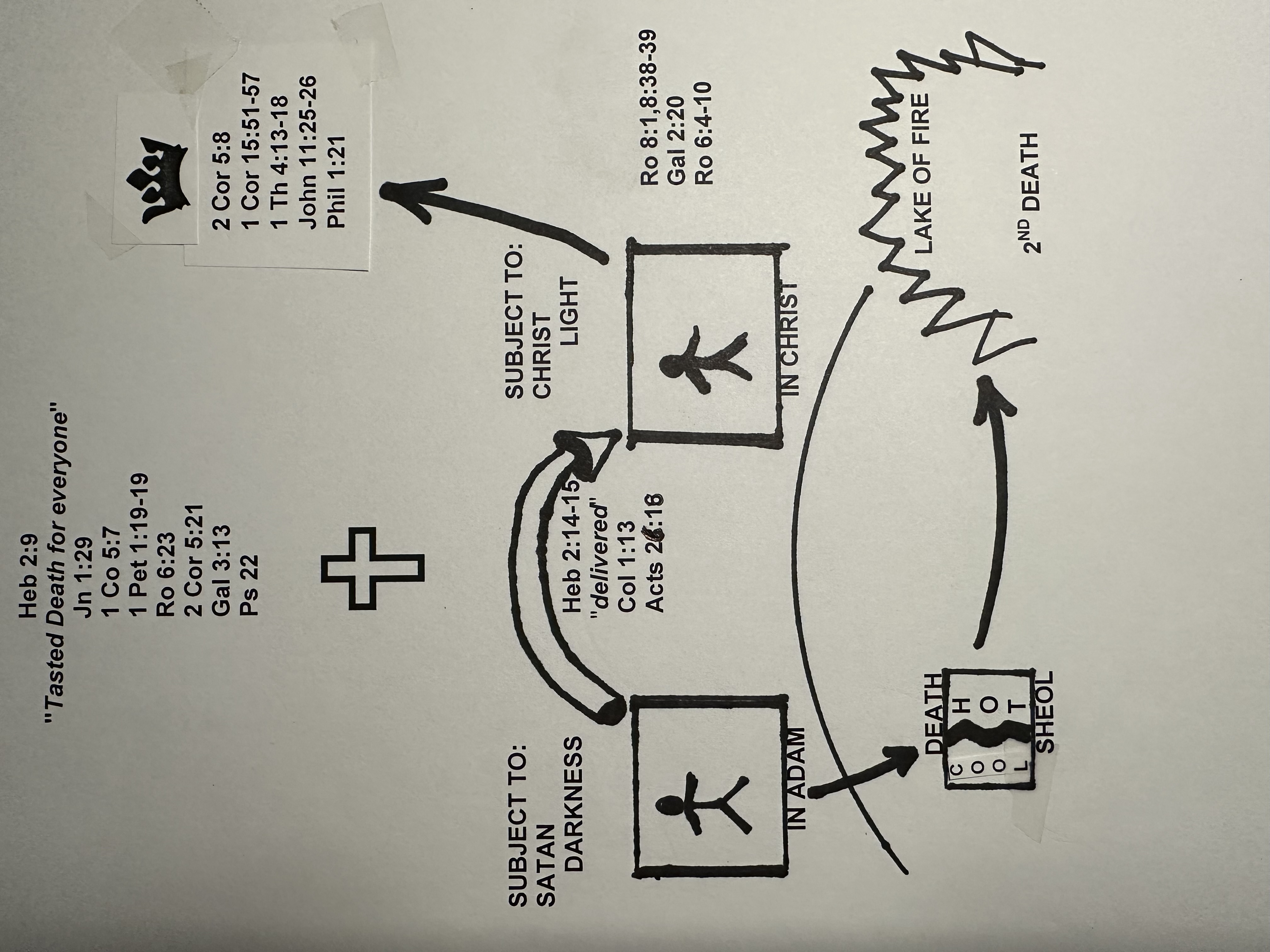
OUR SALVATION
IS GREAT!
How shall we escape if we neglect so great (telikoutos) a salvation (soteria)? - The tragic truth is that Hell is full of people who never actively opposed "the Way, the Truth and the Life", but who simply neglected the good news of salvation by grace through faith in Jesus Christ. The truth is that one may know the truth and even "believe" the truth, in the sense of intellectually acknowledging its truthfulness. They are aware of the good news of salvation provided in Jesus Christ, but are not willing to genuinely place their faith in Christ. Beloved, although some might argue this point, there is a merely intellectual belief that does not lead to salvation (e.g., read about those Jews who believed in Jesus in John 8:30ff but who were ready to stone Him by the end of this chapter, John 8:59! Was their belief unto salvation? Even Charles Ryrie says their belief was "likely only a profession". Their actions hardly demonstrate genuine conversion and Jesus Himself said their "father" was the devil - John 8:44!). So they drift past the call of God into eternal damnation. This tragedy makes these verses extremely important and urgent.
Griffith-Thomas on so great a salvation - The word “so” is similar to the instance in the familiar passage, “God so loved the world” (John 3:16), and expresses an unfathomable depth. The salvation is “great” because it is at once divine, free, full, sufficient, universal, and everlasting. (See Hebrews: A Devotional Commentary)
John Piper - Only what is it really—this great salvation? What he’s really saying is: Don’t neglect being loved by God. Don’t neglect being forgiven and accepted and protected and strengthened and guided by Almighty God. Don’t neglect the sacrifice of Christ’s life on the cross. Don’t neglect the free gift of righteousness imputed by faith. Don’t neglect the removal of God’s wrath and the reconciled smile of God. Don’t neglect the indwelling Holy Spirit and the fellowship and friendship of the living Christ. Don’t neglect the radiance of God’s glory in the face of Jesus. Don’t neglect the free access to the throne of grace. Don’t neglect the inexhaustible treasure of God’s promises. This is a great salvation. Neglecting it is very evil. Don’t neglect so great a salvation. (Full sermon - Spoken, Confirmed, Witnessed: a Great Salvation)
John Calvin - And observe that the word salvation is transferred here metonymically to the doctrine of salvation; for as the Lord would not have men otherwise saved than by the Gospel, so when that is neglected the whole salvation of God is rejected; for it is God’s power unto salvation to those who believe. (Romans 1:16.) Hence he who seeks salvation in any other way, seeks to attain it by another power than that of God; which is an evidence of extreme madness. (Hebrews 2)
Steven Cole - Salvation does not mean, as one popular TV preacher put it, “to be changed from a negative to a positive self image” (Robert Schuller, Self-Esteem: The New Reformation [Word], p. 68). Salvation does not mean that Jesus helps you fulfill your dreams. Salvation is not about Jesus improving your marriage or giving you peace and joy. God’s salvation isn’t a nice thing to round out your otherwise successful and happy life. Salvation is about Jesus rescuing you from the wrath to come! And since every person is in imminent danger of facing that wrath, salvation is every person’s greatest need! (Hebrews 2:1-4 The Danger of Drifting Spiritually)
John MacArthur asks "To whom is the warning directed? It cannot be to Christians. They can never be in danger of neglecting salvation—in the sense of not receiving it—since they already have it. They can neglect growth and discipleship, but they cannot neglect salvation. Nor can the warning be to those who have never heard the gospel, because they cannot neglect what they do not even know exists. The warning must therefore be directed to non-Christians, specifically Jews, who are intellectually convinced of the gospel but who fail to receive it for themselves. But if the warning is to unbelievers, why does the writer speak of "we" and "us"? Does he include himself among the intellectually convinced but uncommitted? Is the author saying that he himself is not a Christian? No. The "us" is the us of nationality or of all those who have heard the truth. The author's willingness to identify himself with his readers does not mean he is in the same spiritual condition as they are. He seems simply to be saying, "All of us who have heard the gospel ought to accept it." We have all met people who say, "Yes, I believe that Christ is the Savior and that I need Him, but I'm not ready to make that commitment yet." Perhaps your husband, your wife, your brother, or a good friend is like that. They come to church and hear and hear and hear the Word of God. They know it is true and they know they need it, but they are not willing to commit themselves and personally accept Jesus Christ. They have all the facts but will not make a commitment. They are like the man who believes a boat will hold him, but who will not get into it. We believe this warning is to those who have heard the gospel, know the facts about Jesus Christ, know that He died for them, that He desires to forgive their sins, that He can give them new life, but are not willing to confess Him as Lord and Savior. This surely is the most tragic category of people in existence. (ILLUSTRATION) I will never forget the lady who came into my office one day, informed me she was a prostitute, and said, "I need help; I'm desperate." After presenting the claims of Christ to her, I said, "Would you like to confess Jesus Christ as your Lord?" "Yes," she replied, "I've had it." She was at the bottom and knew it. So she prayed a prayer and seemingly invited Christ into her life. I said, "Now, I want you to do something. Do you have your little book with you that has the names of all your contacts?" When she replied that she did, I suggested, "Let's take a match and burn it right now." Looking surprised, she responded, "What do you mean?" "Just what I said," I explained. "If you really met Jesus Christ as your Lord, if you really accepted His forgiveness and are going to live for Him, let's burn that book and celebrate your new birth right now and just praise the Lord." "But it's worth a lot of money, a lot of money," she objected. I said, "I am sure it is." Putting the book back in her purse and looking me in the eye, she said, "I don't want to burn my book. I guess I really don't want Jesus, do I?" And she left. When she counted the cost, she realized she was not ready. I do not know what happened to that dear girl. My heart aches for her and I often think about her. I know that she knew the facts of the gospel and believed them; but she was not willing to make the sacrifice—even though what she refused to give up was worth nothing and what she could have had in Jesus Christ was everything. There are many such people. They know the truth, they stand on the edge of the right decision, but they never make it. They just drift. And they are the ones to whom this passage in Hebrews is speaking. The purpose of these four verses is to give such persons a powerful shove toward Jesus Christ. The message, of course, is not restricted to Jewish nonbelievers. It is for anyone who is on the edge of decision for Christ, but who—because of self-will, sin, fear of persecution from his family and friends, or any other reason—says no to Christ and continues to neglect Him. A man is a fool, a fool beyond fools, an eternal tragedy, when he neglects to decide for Jesus Christ. (See context in Hebrews Commentary)
So great (5082) (telikoutos = a strengthened form of telíkos = so great) is a word that makes reference to the size or degree of something and can be translated as "so large" (referring more to size) or as in the current verse "so great" (referring to degree, grade or "rank").
Telikoutos is used only four times in the NT and not in the Septuagint (non-apocryphal):
2 Corinthians 1:10 who delivered us from so great a peril of death, and will deliver us, He on whom we have set our hope. And He will yet deliver us,
Hebrews 2:3 how shall we escape if we neglect so great (referring to degree - there is none higher!) a salvation? After it was at the first spoken through the Lord, it was confirmed to us by those who heard,
James 3:4 Behold, the ships also, though they are so great (referring to size) and are driven by strong winds, are still directed by a very small rudder, wherever the inclination of the pilot desires.
Revelation 16:18 (see note) (Context = the event described in this verse occurs at the sounding of the Seventh Trumpet, the midpoint of Daniel's Seventieth Week and beginning of the last 3.5 years Jesus called the "Great Tribulation") And there were flashes of lightning and sounds and peals of thunder; and there was a great earthquake, such as there had not been since man came to be upon the earth, so great an earthquake was it, and so mighty.
SALVATION: SOTERIA
|
Salvation (4991) (soteria from soter = Savior in turn from sozo = save, rescue, deliver) describes the rescue or deliverance from danger, destruction and peril. Salvation is a broader term in Greek than we often think of in English. Other concepts that are inherent in soteria include restoration to a state of safety, soundness, health and well being as well as preservation from danger of destruction. See more on soteria below
Soteria in Hebrews - Heb. 1:14; Heb. 2:3; Heb. 2:10; Heb. 5:9; Heb. 6:9; Heb. 9:28; Heb. 11:7
(1) A physical deliverance - rescue from danger deliverance, preservation, safety. For example the writer of Hebrews records that…
"By faith Noah, being warned by God about things not yet seen, in reverence prepared an ark for the salvation (soteria) of his household, by which he condemned the world, and became an heir of the righteousness which is according to faith." (see note Hebrews 11:7)
Paul to all those on the ship bound for Rome "Therefore I encourage you to take some food, for this is for your preservation (soteria) for not a hair from the head of any of you shall perish." (Acts 27:34)
Paul to the saints at Philippi "For I know that this shall turn out for my deliverance through your prayers and the provision of the Spirit of Jesus Christ" (see + Philippians 1:19)
(2) A religious technical term describing safety of the soul and so in a spiritual sense referring to salvation
"(The preaching of John the Baptist was) To give to His people the knowledge of salvation (soteria) by the forgiveness of their sins" (Luke 1:77)
"And Jesus said to him (Zacchaeus), "Today salvation (soteria) has come to this house, because he, too, is a son of Abraham." (Luke 19:9)
"And there is salvation (soteria) in no one else (other that Messiah); for there is no other name under heaven that has been given among men, by which we must be saved (sozo)." (Acts 4:12)
"Brethren, sons of Abraham's family, and those among you who fear God, to us the word of this salvation (soteria) ("the gospel") is sent out." (Acts 13:26)
"Following after Paul and us (Luke, et al), she ("a certain slave-girl having a spirit of divination") kept crying out, saying, "These men are bond-servants of the Most High God, who are proclaiming to you the way of salvation." (Acts 16:17)
"For I am not ashamed of the gospel, for it is the power of God for salvation (soteria) to everyone who believes, to the Jew first and also to the Greek." (see note Romans 1:16)
"for with the heart man believes, resulting in righteousness, and with the mouth he confesses, resulting in salvation." (see note Romans 10:10)
"The sorrow that is according to the will of God produces a repentance without regret, leading to salvation (soteria); but the sorrow of the world produces death." (2Corinthians 7:10+)
"So then, my beloved, just as you have always obeyed, not as in my presence only, but now much more in my absence, work out your salvation (soteria) with fear and trembling" (see note Philippians 2:12)
"For this reason I endure all things for the sake of those who are chosen, that they also may obtain the salvation (soteria) which is in Christ Jesus and with it eternal glory." (see note 2 Timothy 2:10)
"from childhood you (Timothy) have known the sacred writings which are able to give you the wisdom that leads to salvation (soteria) through faith which is in Christ Jesus." (see note 2 Timothy 3:15)
"Are they not all ministering spirits, sent out to render service for the sake of those who will inherit salvation (soteria) ?" (see note Hebrews 1:14)
"For it was fitting for Him, for whom are all things, and through whom are all things, in bringing many sons to glory, to perfect the author of their salvation (soteria) through sufferings." (see note Hebrews 2:10)
"And having been made perfect, He became to all those who obey Him the source of eternal salvation (soteria) " (see note Hebrews 5:9)
"But, beloved, we are convinced of better things concerning you, and things that accompany salvation (soteria) , though we are speaking in this way." (see note Hebrews 6:9)
(3) A Messianic deliverance at the end of this present age.
"Christ also, having been offered once to bear the sins of many, shall appear a second time for salvation (soteria) without reference to sin, to those who eagerly await Him." (see note Hebrews 9:28)
"And this do (do what? express agape love which is unconditional), knowing the time, that it is already the hour for you to awaken from sleep; for now salvation (soteria) is nearer to us than when we believed. (see note Romans 13:11) (cf 1Thess. 5:9; Hebrews 9:28; see notes 1 Peter 5:5; 5:10; see note Revelation 12:10)
"But since we are of the day, let us be sober, having put on the breastplate of faith and love, and as a helmet, the hope of salvation (soteria). For God has not destined us for wrath, but for obtaining salvation (soteria) through our Lord Jesus Christ" (1Thess. 5:8-9)
(Those "born again to a living hope") are protected by the power of God through faith for a salvation (soteria) ready to be revealed in the last time." (see note 1 Peter 1:5)
"And I heard a loud voice in heaven, saying, "Now the salvation (soteria) , and the power, and the kingdom of our God and the authority of His Christ have come, for the accuser of our brethren has been thrown down, who accuses them before our God day and night." (see note Revelation 12:10)
"After these things I heard, as it were, a loud voice of a great multitude in heaven, saying, "Hallelujah! Salvation (soteria) and glory and power belong to our God." (see note Revelation 19:1)
The idea of salvation is that the power of God rescues people from the penalty of sin, which is spiritual death which is followed by eternal separation from the presence of His Glory. Salvation delivers the believer from the power of sin (see discussion on Romans 6-8 beginning at Romans 6:1-3)
Salvation carried tremendous meaning in Paul’s day, the most basic being “deliverance,” and it was applied to personal and national deliverance. The emperor was looked on as a "savior" as was the physician who healed you of illness.
It is interesting that Collin's (secular) dictionary defines "salvation" as
"the act of preserving or the state of being preserved from harm… deliverance by redemption from the power of sin and from the penalties ensuing from it."!
In short, this "so great a salvation" is not just escape from the penalty of sin but includes the ideas of safety, deliverance from slavery and preservation from danger or destruction.
In addition, this "so great a salvation" includes the idea of what is often referred to as the Three Tenses of Salvation (justification = past tense salvation = deliverance from sin's penalty, sanctification = present tense salvation = deliverance from sin's power and glorification = future tense salvation = deliverance from sin's presence). It follows that the discerning student will check the context to determine which of the three "tenses" a given use of soteria is referring to.
Mankind has continually looked for salvation of one kind or another. Greek philosophy had turned inward and begun to focus on changing man’s inner life through moral reform and self-discipline. The Greek Stoic philosopher Epictetus called his lecture room “the hospital for sick souls.” Epicurus called his teaching “the medicine of salvation.” Seneca taught that all men were looking ad salutem (“toward salvation”) and that men are overwhelmingly conscious of their weakness and insufficiency in necessary things and that we therefore need “a hand let down to lift us up”. Seneca was not far from the truth as Scripture testifies
"(Jehovah speaking) Is My hand so short that it cannot ransom? Or have I no power to deliver?… Behold, the LORD'S hand is not so short that it cannot save… (Jeremiah speaking) 'Ah Lord GOD! Behold, Thou hast made the heavens and the earth by Thy great power and by Thine outstretched arm! Nothing is too difficult for Thee" (Isa 50:2… Isaiah 59:1… Jeremiah 32:17)
Salvation through Christ is God’s powerful hand extended down to lost souls to lift them up.
In context of Hebrews 1, this great salvation has first of all such a great Savior, Who has completed the purification for our sins (which deserved death) & has furnished us with His ministering angels to help those who will inherit salvation. This salvation was first spoken thru the Lord Jesus (it not so clearly spoken in the OT)
Kittel's Theological Dictionary of the New Testament entry has the following interesting description of the word group ("salvation") as it was used in secular Greek. As you read through these various uses, see if you can identify any spiritual parallels (you will be intrigued I think)…
1. Saving. These terms first refer to salvation (human or divine) from serious peril. Curing from illness is another sense. Horses may save in battle, or night may save an army from destruction, good counsel may save ships, etc. Cities, castles, ships, etc. may be saved as well as people. At times protection may be the meaning, and soteria can have the sense of a “safe return.”
2. Keeping. The meaning at times may be that of keeping alive, e.g., pardoning, protecting, keeping from want, keeping a fire going.
3. Benefiting. The idea of rescuing from peril disappears when the idea is that of keeping in good health, or benefiting, or when the noun means “well-being,” i.e., of a city, country, family, etc.
4. Preserving the Inner Being. A special nuance is when the terms refer to preserving the inner being or nature. In philosophy inner health may be the point or the preservation of one’s humanity.
5. Religious Usage. All the nuances occur in religious usage. Thus the gods rescue from the perils of life. Philosophy discusses the preservation of all things from perishing. A demand arises for the preservation of life beyond death. In the Gnostic sphere gnósis supposedly saves from death as it is imparted by revelation (Paul's epistle to the Colossians refutes this heresy) In the mysteries initiates share in the salvation of a mythical divine being from death and thereby attain to a blissful life in the hereafter (a clear counterfeit!). A special Syrian belief mentioned in Origen Against Celsus 7.9 is that there is salvation from eternal punishment by worship of a divine envoy and faith in him.
BELOW ARE THE INCREDIBLE TRUTHS WE LEARN ABOUT OUR GREAT SALVATION FROM HEBREWS 1-2 – this will give you a great sense of why our salvation is so great!
1). Purification of sins Heb 1:3 (Source of salvation)
2). Served by Ministering angels Heb 1:14
3). Subjected the world to come to man Heb 2:5-8 (What does salvation give to man?)
4). Jesus tasted death for everyone Heb 2:9 (justification)
5). Sons will be brought to glory (Author of salvation thru suffering) Heb 2:10 (glorification)
6). Sons are sanctified (progressively set apart from profane to holy) Heb 2:11 (sanctification)
7). Believers are called Jesus’ brethren Heb 2:11,12
8). Called children of Jesus Heb 2:13 (Might have to guide them to see it refers to Jesus)
might inject this question now -- How did Christ procure this great salvation in Heb 2:14?
9). Jesus partook of flesh & blood so He could die in our place Heb 2:14
10) Thru death Jesus rendered powerless the devil Heb 2:14
11) Jesus delivers us from the fear of death. Heb 2:15
12) Jesus does not give help to angels but the descendant of Abraham (believers) Heb 2:16
14) Jesus became a merciful & faithful HP (Heb 1:3) Heb 2:17
15) Jesus made propitiation (satisfaction of God’s wrath against us) for our sins Heb 2:17
16) Jesus was tempted and is able to come to the aid of tempted Heb 2:18
Summary - so in these first two chapters we see that jesus provides us with so great a salvation by becoming lower than the angels
AFTER IT WAS AT FIRST SPOKEN THROUGH THE LORD IT WAS CONFIRMED TO US: hetis arche labousa (AAPFSN) laleisthai (PPN) dia tou kuriou : hupo ton akousanton eis hemas ebebaiothe (3SAPI):
- After it was at the first spoken through the Lord Heb 1:2; Matthew 4:17; Mark 1:14; Luke 24:19; Acts 2:22
- It was confirmed - Mark 16:15; Luke 1:2; Lk 24:46-47; John 15:27; Acts 1:22; 10:40-42
- Hebrews 2 Resources - Multiples Sermons and Commentaries
- Hebrews 2:1-4 The Danger of Drifting Spiritually - Steven Cole
- Hebrews 2:1-4 Tragedy of Neglecting Salvation - John MacArthur
Related Passage:
Hebrews 1:2+ in these last days has spoken to us in His Son, whom He appointed heir of all things, through whom also He made the world.
Matthew 4:17+ From that time Jesus began to preach and say, “Repent, for the kingdom of heaven is at hand.”
Mark 1:14+ Now after John had been taken into custody, Jesus came into Galilee, preaching the gospel of God,
Luke 24:19+ And He said to them, “What things?” And they said to Him, “The things about Jesus the Nazarene, who was a prophet mighty in deed and word in the sight of God and all the people,
Acts 2:22+ “Men of Israel, listen to these words: Jesus the Nazarene, a man attested to you by God with miracles and wonders and signs which God performed through Him in your midst, just as you yourselves know–
Luke 24:46-47+ and He said to them, “Thus it is written, that the Christ would suffer and rise again from the dead the third day, 47 and that repentance for forgiveness of sins would be proclaimed in His name to all the nations, beginning from Jerusalem.
John 15:27+ and you will testify also, because you have been with Me from the beginning.
Acts 1:22+ beginning with the baptism of John until the day that He was taken up from us–one of these must become a witness with us of His resurrection.”
Ephesians 2:19-20 So then you are no longer strangers and aliens, but you are fellow citizens with the saints, and are of God’s household, 20 having been built on the foundation of the apostles and prophets, Christ Jesus Himself being the corner stone,
GOOD NEWS THROUGH
JESUS AND THEN THE APOSTLES
The message of salvation is great but now the writer adds three reasons as to why it must not to be neglected - the witness of the Lord Jesus, the witness of those who heard Him (eye witnesses) and in Heb 2:4 the supernatural witness from heaven (signs, wonders, miracles, gifts).
After it was at the first spoken through the Lord (kurios) - IT refers to the so great a salvation, which was unfolded in the Gospel proclaimed by the Lord Jesus. What a message is this that has come to us by the witness of men, by the witness of God, and by the witness of a Man Who was God. We must not neglect so great a gospel, the only good news for a perishing people!
Marcus Dods remarks, "The salvation was at first proclaimed not by angels sent out to minister, not by servants or delegates ... but by the Lord Himself, the Supreme. The source then is unquestionably pure ... God testifies to its purity. There is only one link between the Lord and you, they that heard Him delivered the message to you, and God by witnessing with them certifies its truth".
Kenneth Wuest adds that "The word “Lord,” kurios, in the Greek, is the word used in the LXX to translate the august title of God in Israel, Jehovah. To the Jewish readers of this epistle, it meant just that. The First Testament was given by angels; the New Testament, by Jehovah personally. And, being of such a nature as would be expected of Jehovah, these Hebrews were certainly obligated to give more earnest heed to it than to one given by angels." (Commentary)
A T Robertson on through the Lord (kurios) - The Lord Jesus Who is superior to angels. Jesus was God's full revelation and He is the source of this new and superior revelation. (Hebrews 2 Word Pictures)
It was confirmed (bebaioo) to us by those who heard (akouo) - As noted above, IT refers to the so great a salvation, unfolded in the Gospel. Confirmed means the Gospel was made certain, shown to be reliable beyond a doubt. To us indicates the writer was not a first generation Christian but heard the message from the apostles who were eyewitnesses. Those who heard refers to those who were eyewitnesses ("ear" witnesses) to Jesus' ministry, which would include the apostles and others who knew Christ in the flesh.
Marvin Vincent says that this means that "it was confirmed, proved to be real, by the testimony of ear-witnesses." (Hebrews 2 Word Studies)
Steven Cole on confirmed to us - Salvation is only great if it is true. If it’s just someone’s fanciful idea, with no factual basis, it may be nice, but it certainly isn’t worth suffering the loss of your property or shedding your blood for (Heb 10:34; 12:4). This great salvation was not only “at the first spoken through the Lord,” but also “it was confirmed to us by those who heard” (Heb 2:3). That statement seems to place the author, along with his readers, in the category of those who did not hear the gospel directly from Jesus Christ, which would exclude Paul from being the author. Those who hold to Pauline authorship say that this is just an editorial “us.” But whoever he was, the point is the gospel that Jesus proclaimed comes to us from those who directly witnessed His earthly ministry. The gospel is not the best ideas of a bunch of religious philosophers speculating about how they think we can be reconciled to God. The gospel is a matter of revelation and historical fact. Jesus really lived. His teaching and miracles are truthfully recorded in the gospels. He died on the cross and was raised physically from the grave before He ascended bodily into heaven. Many eyewitnesses saw these things and recorded them for us. If they were fictional stories, those in that day who read these accounts would have laughed the apostles out of town. But rather, these witnesses held to the truth about Jesus, even when cost them their lives. (Hebrews 2:1-4 The Danger of Drifting Spiritually)
I would add to Cole's point that confirmed to us weighs against Paul being the author of Hebrews by comparing to Paul's words in Gal 1:12+ where he wrote "I neither (absolute negation) received it (the Gospel - Gal 1:11) from man, nor was I taught it, but I received it through a revelation of Jesus Christ."
Donald Guthrie adds - Most scholars consider these words to be conclusive against Paul being the writer, on the grounds that he would not have admitted receiving his gospel from others. (See context in Hebrews)
Spurgeon - They could not trifle with the angels’ message without receiving just punishment from God. Much less, then, can we trifle with Christ’s gospel. We have not an angelic saviour; but God himself, in the person of His Son, has deigned to be the Mediator of the new covenant. Therefore, let us see to it that we do not trifle with these things. (Spurgeon's Expositional Commentary)
John Calvin writes a pithy note reminding us that "It is not only the rejecting of the Gospel, but even the neglecting of it that deserves the severest penalty in view of the greatness of the grace which is offered in it… God wishes His gifts to be valued by us at their proper worth. The more precious they are, the baser is our ingratitude if they do not have their proper value for us. In accordance with the greatness of Christ, so will be the severity of God’s vengeance on all despisers of the Gospel. (Hebrews 2)
Lord (kurios) Jesus is Lord and He is superior to angels. The Lord Jesus Christ was and is God's full revelation and He is the source of this new and superior revelation.
KURIOS IN HEBREWS - Heb. 1:10; Heb. 2:3; Heb. 7:14; Heb. 7:21; Heb. 8:2; Heb. 8:8; Heb. 8:9; Heb. 8:10; Heb. 8:11; Heb. 10:16; Heb. 10:30; Heb. 12:5; Heb. 12:6; Heb. 12:14; Heb. 13:6; Heb. 13:20;
Confirmed (950) (bebaioo from bébaios = sure, fixed, standing firm on the feet, steadfast, maintaining firmness or solidity. In classical Greek from the 5th cent. B.C. bebaios acquires the meaning of firm, durable, unshakeable, sure, reliable, certain; and in the legal sphere, valid, legal <> bebaios is derived from baino = fit to tread on = having a firm foundation) is a verb which means to make sure or certain, to prove valid or reliable or to verify and (in legal language) to guarantee.
One of the two LXX uses of bebaioo in a prayer by the psalmist parallels the use in Hebrews 2:3:
My soul weeps because of grief. Strengthen (bebaioo) me according to Thy Word." (Psalm 119:28 read Spurgeon's excellent note)
Bebaioo was used in secular Greek as a legal technical term meaning "to designate properly guaranteed security". Its use in a legal sense therefore gives it great force here, indicating that there cannot be the slightest doubt about the salvation offered. The main point then is that this is truth that can be trusted without hesitation or reservation.
The 8 NT uses of bebaioo…
Mark 16:20+ And they went out and preached everywhere, while the Lord worked with them, and confirmed the word by the signs that followed. And they promptly reported all these instructions to Peter and his companions. And after that, Jesus Himself sent out through them from east to west the sacred and imperishable proclamation of eternal salvation.
Romans 15:8+ For I say that Christ has become a servant to the circumcision on behalf of the truth of God to confirm the promises given to the fathers,
1 Corinthians 1:6+ even as the testimony concerning Christ was confirmed in you,
1 Corinthians 1:8+ who shall also confirm you to the end, blameless in the day of our Lord Jesus Christ.
2 Corinthians 1:21+ Now He who establishes us with you in Christ and anointed us is God,
Colossians 2:7+ having been firmly rooted and now being built up in Him and established in your faith, just as you were instructed, and overflowing with gratitude.
Hebrews 2:3+ how shall we escape if we neglect so great a salvation? After it was at the first spoken through the Lord, it was confirmed to us by those who heard,
Hebrews 13:9+ Do not be carried away by varied and strange teachings; for it is good for the heart to be strengthened by grace, not by foods, through which those who were thus occupied were not benefited.
Spurgeon was fully convinced of the truth of God's word writing that "I hold one single sentence out of God's Word to be of more certainty and of more power than all the discoveries of all the learned men of all the ages… The Bible is a harbor where I can drop down my anchor, feeling certain that it will hold. Here is a place where I can find sure footing; and, by the grace of God, from this confidence I shall never be moved."
The writer conveys to his readers the truth that one can stake their eternal destiny on the Word spoken through Jesus.
Have you dear reader received the Word of truth implanted which is able to save your soul from eternal destruction? If not, then please do not be careless and neglect this great salvation another day. It is as true today as when Paul spoke it to the Philippian jailer that if you
"Believe in the Lord Jesus…
you shall be saved."
(Acts 16:31+)
BY THOSE WHO HEARD: hupo tôn akousantôn:
- Hebrews 2 Resources - Multiples Sermons and Commentaries
- Hebrews 2:1-4 The Danger of Drifting Spiritually - Steven Cole
- Hebrews 2:1-4 Tragedy of Neglecting Salvation - John MacArthur
THOSE WHO HEARD JESUS
ESPECIALLY THE APOSTLES
By those who heard (akouo) - This description refers to those who were contemporaries of Jesus and thus heard Him speak. This clearly includes the disciples who became apostles as well as the final apostle Paul.
Heard (akouo) means not just to hear sounds per se but in most NT uses implies hearing with attention or hearing so to speak with the "ear of one's mind". “To hear” also means to hear effectually as to perform ("obey) what was spoken and for the apostles His final command was Mt 28:19-20+ "Go therefore and make disciples (THE SOLE COMMAND - aorist imperative see need to depend on the Holy Spirit to obey) of all the nations, baptizing them in the name of the Father and the Son and the Holy Spirit, 20 teaching them to observe all that I commanded you; and lo, I am with you always, even to the end of the age.” This command they heard and heeded in the power of the Holy Spirit (Acts 1:8+).
In summary, the words of the gospel of salvation (Eph 1:13+) were first spoken by Christ to His apostles and then confirmed in writing by His apostles and thus there was only one generation between Jesus and the writer. Both the proclamations of Christ and of the apostles were substantiated by supernatural witnesses (signs and wonders and by various miracles and by gifts of the Holy Spirit).
Hebrews 2:3-4 can be depicted as follows:
Spoken thru the Lord
|| Signs, Wonders, Various Miracles
V Gifts of Holy Spirit
Those who heard
|| Confirmed = guaranteed
V
To Us
John MacArthur on by those who heard - This phrase reveals the succession of evangelism. That generation of Hebrews would not have heard if the previous generation of witnesses had not passed the message along (cf. 1 Tim. 2:5–7+). (See context in Hebrews)
Paul for example got his message directly from Christ as he recorded in his letter to the Galatians writing that…
"I would have you know, brethren, that the gospel which was preached by me is not according to man. For I neither received it from man, nor was I taught it, but I received it through a revelation of Jesus Christ." (Galatians 1:11-12+)
Hebrews 2:3-4 can be depicted as follows:
Spoken thru the Lord
|| Signs, Wonders, Various Miracles
V Gifts of Holy Spirit
Those who heard
|| Confirmed = guaranteed
V
To Us
The writer perceives that under the pressure some were “going with the flow” and were in danger of drifting away from the safe harbor of the Gospel. They may not have been rejecting Christ outright, but they were ignoring Him by ignoring His Word. Their anchors, so to speak, were up, and they did not even realize they were drifting away on the deceptive tides which would lead to shipwreck of their souls.
Ryrie feels that Hebrews 2:2-4 presents a contrast between law and grace (Hebrews 2:2 referring to the Mosaic Law): "The revelation of grace in contrast to law came through the Lord ("For the Law was given through Moses; grace and truth were realized through Jesus Christ." John 1:17) and was confirmed to the writer and readers of Hebrews by those who heard Him and by God, Who authenticated it by signs and wonders." (The Ryrie Study Bible)
John MacArthur - THE CERTAINTY OF JUDGMENT (Heb. 2:2–3). See Drawing Near: Daily Readings for a Deeper Faith
There is certain judgment for everyone
who does not receive Christ as Savior and Lord.
Today the majority believes that God is a God of love and grace but not of justice. One brief look at Hebrews 2:2–3 ought to convince anyone otherwise. The writer’s point is this: Since the Old Testament makes it clear that transgression and disobedience met with severe and just punishment, how much more so will equal or greater punishment be rendered under the New Testament, which was revealed by the Lord Jesus Christ Himself!
Both the Old and New Testaments confirm that angels were instrumental in bringing the law (Deut. 33:2; Acts 7:38). The law the angels spoke, primarily the Ten Commandments, was steadfast. That meant that if someone broke the law, the law would break the lawbreaker. The law was inviolable; punishment for breaking it was certain.
“Every transgression and disobedience received a just recompense” (v. 2). “Transgression” refers to stepping across a line—a willful, purposeful sin. “Disobedience,” however, refers to imperfect hearing—the sin of shutting one’s ears to the commands, warnings, and invitations of God. It is a sin of neglect or omission—doing nothing when something should be done.
Hebrews 2:2 also puts to rest the notion that God is not fair. The writer says every sin received “a just recompense.” God, by His very nature, is just. Every punishment He meted out to those who defied Him was a deterrent to the sin He wanted to stop.
God severely punished the nation of Israel because they knew better. That leads to the important principle that punishment is always related to how much truth one knows but rejects. The person who knows the gospel, who has intellectually understood it and believed it, yet drifts away will experience the severest punishment of all.
✧✧✧
Suggestions for Prayer: Ask God to give you an even greater appreciation of the punishment He has saved you from in order to motivate you to pursue the lost more vigorously.
For Further Study: Read Matthew 11:20–24, 12:38–42, and Luke 12:47–48 to discover Christ’s attitude toward those who know the truth and yet rebel against it.
How shall we escape if we neglect so great a salvation? — Hebrews 2:3
Today's Scripture: Acts 24:10-26
All of us have an innate sense of God’s existence (Rom. 1:18-21). But some may suppress that deep-down awareness of God and may even convince themselves that He is not real—until a moment of crisis.
Novelist Eric Ambler was making a World War II documentary in Italy, The Battle of San Pietro, when exploding shells knocked him to the ground and he thought he might die. In his autobiography he wrote, “My unconscious mind chose to play a nasty trick on me. I heard myself saying, ‘Into Thy hands I commend my spirit.’” Unhurt, he resolved never to reveal that momentary abandonment of his unbelief.
Such a flash of insight is a gift of grace that can cause the long-suppressed truth to become conscious trust in God. But Ambler refused to let that spark of faith become a steady flame that would illuminate the darkness of his unbelieving soul with redemptive truth.
Felix, the governor of Judea, put off a decision for Christ until “a convenient time” (Acts 24:25). But convenient times have a way of eluding us. We all need to commit ourselves into the hand of God, not just at death but in life. It starts by accepting the gift of salvation by faith in His Son.
If you haven’t trusted Christ as Savior, do it today. By: Vernon Grounds (Our Daily Bread, Copyright RBC Ministries, Grand Rapids, MI. — Reprinted by permission. All rights reserved)
Almost persuaded now to believe;
Almost persuaded Christ to receive:
Seems now some soul to say, “Go, Spirit, go Thy way,
Some more convenient day on Thee I’ll call.”
—Bliss
You can’t repent too soon, because you don’t know how soon it may be too late.
“How shall we escape, if we neglect so great salvation?”
— Hebrews, 2:3.
I have a text to-night which I believe God has given me for this hour, a text that ought to startle every man and woman in this building who has not accepted the Gospel of Christ. You will find it in Hebrews 2:3: “How shall we escape if we neglect so great salvation?” I wish that that text would burn itself into the heart of every man and woman in this house who is out of Christ, “How shall I escape if I neglect so great salvation?” I wish that every man and woman that may go away from this place to-night without definitely having received Christ as their Saviour and Lord and Master would hear it ringing in their ears as they go down the street, “How shall we escape if we neglect so great salvation?” I wish that every one that may lie down to sleep to-night without a definite assurance of sins forgiven through the atoning blood of Jesus Christ and of acceptance before God in Him, would hear it all through the night, “How shall we escape if we neglect so great salvation?” Our text sets forth the folly and guilt of neglecting the salvation that God has sent to us in and through His Son Jesus Christ, and that is my subject to-night. My sermon is all in the text—the folly and guilt of neglecting the salvation that God the Father has sent through His Son and in His Son Jesus Christ.
You notice I say not merely the folly but the guilt. There is many a man who thinks that perhaps it may be a foolish thing not to accept Christ, and admits the folly of it, but he has never realized the guilt of it. But I shall endeavour to show you to-night in the unfolding of this text that it is not merely an egregiously foolish thing, but that it is an appalling wicked thing to neglect this salvation.
I. The Greatness of the Salvation
We see the folly and guilt of neglecting this salvation, in the first place, by a consideration of the greatness of the salvation. “How shall we escape if we neglect so great salvation?”
1. We see the greatness of the salvation first of all in the way in which the salvation was given.
God sent His Son, His only Son, down into the world to proclaim this salvation. As we read in the preceding chapter, “God, who at sundry times and in divers manners, spake in time past unto the fathers by the prophets, hath in these last days spoken unto us by His Son, whom He hath appointed heir of all things, by whom also He made the worlds; who, being the brightness of His glory and the express image of His person, and upholding all things by the word of His power, when He had by Himself purged our sins, sat down on the right hand of the Majesty on high.” Have you ever thought of it in the light of the context, that when God, in infinite condescension, the great and infinitely holy God, sent down His own Son to proclaim pardon to the vilest sinner, if you and I neglect this salvation we are pouring contempt upon the Son of God, and upon the Father that sent Him? If God had spoken this salvation by the lips only of inspired prophets, it would have a right to demand our attention. If God had gone above prophets, and had spoken this salvation by the lips of angels sent down from Heaven, it would have a still greater right to demand our attention. But when God, in His infinite condescension, sent not merely prophets or angels, but sent His own Son, the only begotten one, the express image of His person, God manifest in the flesh, to proclaim this salvation, and you and I do not heed it, we are guilty of the most appalling presumption and defiance of God. “He that despised Moses’ law died without mercy under two or three witnesses,” but how much sorer punishment you and I shall receive if we neglect this greater salvation.
2. In the second place, the greatness of this salvation is seen in the way in which it was purchased.
This is a costly salvation. It was purchased by the shed blood, by the outpoured life of the incarnate Son of God. Ah, friends, when God in wondrous love went to that extent that He sacrificed His very best, when God went to that extent that He gave His own and only Son to die on the cross at Calvary, that He might purchase your salvation and mine, if you and I neglect so great salvation we are pouring contempt on the precious blood of the Son of God. “He that despised Moses’ law died without mercy under two or three witnesses,” but how much greater punishment shall he merit who tramples under foot the Son of God, and counts the blood of the covenant wherewith He was sanctified an unholy thing, and insults the Spirit of Grace (Hebrews 10:28, 29).
3. Again, the greatness of this salvation is seen in the third place by a consideration of what it brings.
It brings pardon for all our sins, it brings deliverance from sin, it brings union with the Son of God in His resurrection life, it brings adoption into the family of God, it brings an inheritance incorruptible and undefiled and that fadeth not away, laid up in store in Heaven for us, who are kept by the power of God, through faith, unto a salvation ready to be revealed in the last time. When you think that God has put at our disposal in Jesus Christ all His wealth, and is ready to make us heirs of God and joint heirs with Jesus Christ, who can measure the guilt of neglecting and of turning a deaf ear to this wonderful salvation? Suppose that on his coronation day King Edward had ridden down to the East End of London, and seeing some wretched little boy on the street, clad in rags, with filthy face and hands, his great heart of love had gone out to that wretched boy, and he had stopped the royal carriage and said, “Bring that boy here,” and they had brought the boy, and he had said, “I want to take you out of your poverty, out of your squalor and rags and wretched home; I am going to take you to the royal palace and adopt you as my son.” Then suppose the boy had turned and said, “Go along, I don’t want to be adopted as your son; I would rather have my wretched crust of bread, I would rather have my rags and filthy home than live in your old palace; I don’t want to go to be your son.”
But when the great King of Glory, the King of Kings and Lord of Lords, the great Eternal Son of God comes to you and me, in our filth and rags and sin, and wants to take us out of our filth and sin and rags of unrighteousness, and says, “I want to adopt you into my family and make you an heir of God and a joint-heir with Me,” there are some of you men and women in this building to-night who, by your actions, are saying, “Go away with your salvation, go away with your adoption into the family of God; I would rather have the crust of the world’s pleasure and the rags of my sin than all the royal apparel of righteousness and glory which you offer me.” Oh, the daring, damning guilt of any man or woman who neglects so great salvation!
II. The Only Salvation
A second thought which the text suggests is that our folly is great in neglecting this great salvation because it is the only salvation that is open to us. As Peter puts it in Acts 4:12: “There is none other name under Heaven given among men whereby we must be saved.” It is salvation in Christ, or it is no salvation at all. A man is in a burning building. If there were one way of escape by a fire-escape, and another by a great broad stairway, he would have a perfect right to neglect the fire-escape for the easier escape by the stairway. But suppose there was no way of escape but the fire-escape, how great would be his folly in neglecting it. Men and women, you are in a burning building, in a doomed world. There is just one way of escape; that is by Christ. In Christ any one can be saved; out of Christ no one shall be saved. By Christ, or not at all. There is a class of men to-day who say, “Give up your Bible, give up your Christ of the Bible,” and we turn to them and say, “What have you got to give us in place of our Bible; what have you got to give us in place of the Christ of our Bible?” Now we know by personal experience that the Bible and Christ bring forgiveness of sins and peace of heart, for they have brought them to us. We know that they bring deliverance from sin’s power, for they have brought it to us. We know that they bring joy unspeakable and full of glory, for they have brought it to us. We know that they bring pardon and a firm assurance of eternal life, for they have brought them to us. We know that Christ makes us sons of God, and if sons, then heirs of God, and joint heirs with Himself. What have you got that will bring us the same, that will bring us pardon and peace and set us free from the power of sin? What have you got that will bring us joy unspeakable and full of glory? What have you got that will bring us the assurance of eternal life? Have you anything? No, you have not. Well, then, please, we are not quite so great fools as to give up a book and a Saviour that bring us all these for nothing. Salvation in Christ, or salvation not at all. Point me to one saved man in London that was not saved by Christ. I have been away round this round earth. I have been in every latitude and almost every longitude, north and south; I have talked with all kinds of people, of all races and all classes, but I have never yet found a saved man, who had a glad assurance of salvation and practical deliverance from sin’s power, that was not saved by Jesus Christ; neither has anybody else.
III. To Miss Salvation All that is Necessary is Merely to Neglect It
In the third place, this text teaches us that to miss this salvation, and to bring upon ourselves the just and awful displeasure of a holy God for our light and contemptuous treatment of a salvation so wonderful, given and purchased at so great a cost, all that is necessary is simply to neglect it. “How shall we escape if we neglect—just neglect, so great salvation?” In order to bring upon your head the awful displeasure of God, and to be lost forever, it is not necessary that you go into any outrageous immoralities; it is not necessary that you should be an arrant and blatant blasphemer; it is not necessary that you should abuse churches and preachers of the Gospel; it is not necessary that you should even positively refuse to accept Jesus Christ; all that is necessary is that you simply neglect. More people are lost in Christian lands by neglecting than in any other way. There are millions in England to-day who are going through life neglecting, drifting into their graves neglecting, drifting into eternity neglecting, drifting into hell neglecting. That is all that is necessary to be lost. Here is a dying man, there stands a table by the dying man’s bedside, within easy reach, and standing on that table there is a tumbler in which there is a medicine that has power to save the dying man’s life. The man has strength enough to put out his hand and take the tumbler and drink the medicine. Now what is all that is necessary for that man to be saved? All that is necessary is simply for him to put out his hand and take the tumbler and drink the medicine. What is all that is necessary for that man to be lost and die? It is not necessary that he should cut his throat or blow out his brains; it is not necessary that he should throw the medicine out of the window; it is not necessary that he should assault or insult the doctor or the nurse; it is not necessary that he should positively refuse to take the medicine; all that is necessary for that man to die is to neglect to take the medicine.
Men and women out of Christ, you are dying. Eternal death is at work in your souls to-night, but on that table, in that Book, in the Christ of that Book, there is a medicine that will save you, and save you to-night if you will take it. The medicine is within the reach of anybody in this building. Christ is nearer to you than the man or woman that sits next to you in that pew. All you have to do to-night to be saved is to put out your hand and take Christ. “To as many as received Him to them gave He power to become the sons of God.” What is all that is necessary to you to perish eternally? Not to commit moral suicide; not to commit to-night some awful act of immorality; not to get up and curse Christ and the Bible; not loudly to proclaim that you are an infidel; not to refuse blatantly to take Christ; all that is necessary for you to be lost is simply to neglect. Here is a boat on the Niagara River, away above the Falls, towards Lake Erie, where there is scarcely any current. A man sits in the boat, being carried on very slowly by the gentle current. There is a good pair of oars in the boat, and the man could take them and pull up the river towards the lake, or to either bank, if he liked; but the man sits there and is carried on, almost imperceptibly at first, and then faster and faster, until, before he knows it, he is in the swift current just upon the rapids, and he is being carried on towards the Falls. The oars are no good to him now, the current is too swift; he could not save himself if he would—but on the shore there are men who have seen his peril; they have run along the bank and have thrown a line good and strong. It falls right into the boat, at the man’s very feet. What is all that the man has to do to be saved? All he has to do is to lay hold of the rope and they will pull him ashore, as has been done more than once on that river. What is all that he has to do to be lost? It is not necessary that he should take up the oars and pull with the current; it is not necessary that he should throw the oars overboard; it is not necessary that he himself should jump into the river; all that is necessary is simply for him to neglect to lay hold of the rope that lies before him, and the swift current of the river will carry him on to absolutely certain death over the cataract.
Men and women, that is a picture of every man and woman in this building out of Christ. You are in a boat in a perilous stream, being carried towards the cataract of eternal perdition. There is no man who has the power to take the oars in his own strength and pull against that awful current; there is no man on earth who can save himself; but God has seen your peril, and, in the Gospel of His Son, has thrown out a rope. It has fallen at your feet to-night; all you have to do is to lay hold, and He will pull you safely on to the glorious shore. But what is all that you have to do to be lost? It is not necessary that you should jump into the current or pull with the stream, or refuse to accept Christ. All that is necessary is that you simply neglect and that awful current that you are already in will sweep you over the cataract to eternal death and ruin.
Some one put a little card into my hand one day, a short, narrow card, and on the one side were these words, “What must I do to be saved?” Underneath was written God’s answer in Acts 16:31: “Believe on the Lord Jesus Christ, and thou shalt be saved.” Then it said “Over,” and I turned it over. On the other side of the card was this question, “What must I do to be lost?” and there was the answer in just one word: “Nothing.” “Nothing!” You don’t have to do anything to be lost. You are lost already; if you do not do something, and do it quickly, you will be lost forever. “How shall we escape if we neglect so great salvation?” To sum it all up, friends, all that is necessary to be lost to-night, all that is necessary to bring upon our heads the awful wrath of God for our light and contemptuous treatment of a Gospel proclaimed by the lips of His own Son and purchased by the atoning death of His own Son, all that is necessary is simply to neglect.
Years ago in Minneapolis, the leading paper was the Minneapolis Tribune, published in a magnificent six or seven-story building, the finest newspaper building at that time in the Northwest. I had occasion very frequently to go into the upper stories of that building to see editorial friends. There was one great defect in that great building which I had never noticed. The defect was this, that the stairway went right round the elevator shaft, so that if a fire broke out in the elevator shaft escape by the stairway was cut off as well. There was, however, a fire-escape outside. That very thing happened. There broke out a fire in the elevator shaft, and it commenced to sweep up the shaft, story by story, cutting off escape by the elevator and cutting off escape by the stairway as well. But they had a brave elevator boy, who went up a number of times until he got a large number of men down from the upper stories, and almost all the rest escaped by the fire-escape outside the building. But away up in the sixth story there was a man, a despatcher for the Associated Press, which is the largest news-gathering agency in the United States. He was urged to escape, but he refused to move. There he sat by his instrument, telegraphing to all parts of the country that the building was on fire. He could have gone out of the building by the fire-escape, and across the road to an instrument there, and could have done just as well; but, like a typical newspaper man, he wanted to do something sensational, and so there he sat telegraphing the news. There had been a similar case above Johnstown in the time of the Johnstown flood, when the dam of the river was breaking. A woman sat in a telegraph office at the bottom of the dam telegraphing down to the people at Johnstown that the dam was breaking and that they had better flee for their lives. But she sat there, because duty required her, until the dam burst, and she was swept down in the flood. This man, however, sat there quite unnecessarily, merely because of his desire for notoriety. “I am in the Tribune building,” he telegraphed, “in the sixth story, and the building is on fire. The fire has now reached the second story; I am in the sixth.” In a little while he sent another message: “The fire has now reached the third story.” Soon he telegraphed: “The fire has reached the fourth story; I am in the sixth.” Soon again the message went over the wires: “The fire has reached the fifth story; I am in the sixth.” Then he thought it was about time to leave; but, in order to do this, he had to cross the hallway to a window to reach the fire-escape. He went to his door and opened it, and, to his dismay, found that the fire had not only reached the fifth story, but the sixth story, and that the hallway was full of smoke and flame, which, the moment he opened the door, swept into the room. He shut the door quickly. What was he to do? The stairway, the elevator and the fire-escape were all cut off; but he was a brave man, and he went to the window and threw it up. Down below stood a great crowd, six stories down. There was no means of catching him if he jumped, and he stood there on the window sill, not knowing what to do. But presently he looked up. Above his head was a long wire guy-rope that passed from the Tribune building to the roof of a building across an opening. Below him was a chasm six stories deep, but he caught hold of the guy-rope and began to go hand-over-hand across that chasm. The people down in the street looked on in breathless suspense. On and on he went, and then he stopped. The people below could hardly breathe. Would he let go? No. On and on he went, and again he stopped, and again the crowd below gasped, but only for a moment. His strength was gone; he was now obliged to let go, and down he came tumbling through those six stories of space, crushed into a shapeless mass below. All through mere unnecessary neglect!
Men and women, you are in a burning building to-night, you are in a doomed world; but, thank God, there is a way of escape, and one way only, in Christ Jesus. No one knows how long that way will be left open. But, I beg of you, do not neglect it, and then when it is too late lay hold on some poor guy-rope of human philosophy, and go a little way, and then let go and plunge, not six stories down, but on and on and on through the awful unfathomable depths of the gulf of eternal despair. Men and women, turn to Christ to-night! “How shall we escape if we neglect so great salvation?”
How shall we escape, if we neglect so great salvation? — Hebrews 2:3
Related Resources
THE FIFTH GREAT QUESTION of the Bible is found in a book written toward the close of the years in which the Holy Spirit guided faithful men in writing down the Word of God. The plan of salvation is finished; the gospel message is complete; atonement has been made for our sins, and the Lord has returned to Heaven. The offer of salvation is now made to all men. There is a way of escape from judgment and from hell. It is after this completion of God's final gospel handiwork that the vital question is asked: "How shall we escape, if we neglect so great salvation?"
All the previous questions have had a sure and certain answer: "Am I my brother's keeper?" — "If a man die, shall he live again?" — "What shall I do then with Jesus which is called Christ?" — "What must I do to be saved?" But this final and fifth question has no answer. I cannot find an answer. It is not answerable. When God has done His best and we spurn it, refuse it, pass it by, there is no other way, no other hope, no other recourse, no other appeal.
THE TERRIBLE ALTERNATIVE OF TURNING AWAY FROM "SO GREAT SALVATION"
This question of Hebrews 2:3 is like the question raised in that awesome and terrible seal described in the sixth chapter of the Revelation of John. "And I beheld when he had opened the sixth seal, and, lo, there was a great earthquake; and the sun became black as sackcloth of hair, and the moon become as blood; and the stars of heaven fell unto the earth, even as a fig tree casteth her untimely figs, when she is shaken of a mighty wind. And the heaven departed as a scroll when it is rolled together; and every mountain and island were moved out of their places. And the kings of the earth, and the great men, and the rich men, and the chief captains, and the mighty men, and every bondman, and every free man, hid themselves in the dens and in the rocks of the mountains; And said to the mountains and rocks, Fall on us, and hide us from the face of him that sitteth on the throne, and from the wrath of the Lamb: For the great day of his wrath is come; and who shall be able to stand?" (Rev. 6:12-17). Having spurned the overtures of grace, having done despite to the blood of the covenant, having refused the proffered mercies of the love of Jesus, where could there be further hope? In the awful hour of judgment and condemnation, who shall be able to stand?
At the turn of this century, the only connection between the island of Galveston and the mainland of Texas was an iron bridge. On a fateful day in 1900, the United States government sent warning after warning to the citizens of the city that a terrible hurricane was coming their way, and that they should escape for their lives. Over that iron causeway to the mainland went trains and trolleys and vehicles to safety; but the citizens of the city looked at the blue of the sky and the quiet of the sea and, heedless of the terrible warnings, in a false peace went to bed and to sleep. In the dark and terror of that frightful night, the gentle breeze turned into a wind, and the wind turned into a hurricane, and the hurricane turned into a torrential rain, and the torrential rain turned into a tidal wave, and the tidal wave went over the island, destroying the bridge like a match stem. When the one way of hope and escape is spurned, there remains no other avenue of salvation. Nothing remains but judgment and death.
The author of Hebrews, who voiced this soul-searching question, has described the terrible alternative of turning away from Christ in the tenth chapter of his book, verses 26 through 31: "If we deliberately keep on sinning after we have received the knowledge of the truth, no sacrifice for sins is left, but only a fearful expectation of judgment and of raging fire that will consume the enemies of God. Anyone who rejected the law of Moses died without mercy on the testimony of two or three witnesses. How much more severely do you think a man deserves to be punished who has trampled the Son of God under foot, who has treated as an unholy thing the blood of the covenant that sanctified him, and who has insulted the Spirit of grace? For we know him who said, "It is mine to avenge; I will repay," and again, "The Lord will judge his people."It is a dreadful thing to fall into the hands of the living God."
American people pride themselves on their realism. They like to "face the facts." In all of the relationships of life, they choose to "put all the cards on the table." They say to the preacher and to the doctor, "Tell it to me straight; no beating around the bush." Let us then look straight and openly into the face of the facts of the brief life we possess in this world. If we lived forever, then there would be an abundance of time to settle this matter of salvation. If we were promised a second chance in the world to come, then it would not greatly matter what choice we made in this life. If, when we could finally repent and turn and be saved, we could undo and recall and remake all we had done in the days of our rebellion and rejection, then we could still have hope of nullifying any wrong decision made in former years. But the eternal fact of time and life and experience is this: when we have sinned away our day of grace, we find no place for repentance though we seek it carefully with tears. "Lest there be . . . any person, as Esau, who for one morsel of meat sold his birthright. For ye know how that afterward, when he would have inherited the blessing, he was rejected: for he found no place of repentance, though he sought it carefully with tears" (Hebrews 12:16-17).
When we sell our birthright for a mess of pottage, there is no possibility that afterward we shall inherit the blessing. No day passed can ever be recalled; no deed done can ever be undone; no life born can ever be unborn; no human power can turn back the shadow on the dial. It is indeed a dark, stark tragedy of which Edward Fitzgerald writes in his translation of the Rubaiyat of Omar Khayyam:
The moving finger writes; and, having writ,
Moves on. Nor all your piety nor wit
Shall lure it back to cancel half a line,
Nor all your tears wash out a word of it.
Our helplessness to change the past is only exceeded by our helplessness to change the future beyond the grave. When death comes, character is forever fixed; eternity is forever settled. As we die, so shall we be forever and ever. "As the tree falls, so shall it lie" (Ecclesiastes 11:3). "It is appointed unto men once to die, but after this the judgment" (Hebrews 9:27).
Men are dying every day with the desperate cry on their lips, "I must live, I must live; I cannot die." To sleep in youth is to sleep in a siege, to sleep in age is to sleep during an attack. The advance of the enemy, death, is inexorable. He assails alike the prince in his palace and the peasant in his cottage, and he comes to you, to me, to us all. Who is able to keep us from the abyss of the grave and the judgment of perdition? Where is such deliverance to be found?
THE ONLY TRUE SAVIOUR
As a youth, reading ancient history, I frequently came across the word, "soter," after the names of the conquering princes. There would be Seleusius "Soter," Philadelphius "Soter," Ptolemy "Soter," Demetrius "Soter." When I began my study in Greek, the meaning of the word became apparent. The word, "soter," is the Greek word for "saviour." These men, each in his turn, presented themselves as "saviours" of the people. Riding war-horses, advancing to battle in iron chariots, commanding legions and armies, they arrogated to themselves the title of "saviour." But their deliverance was always cheap and unrewarding and disappointing. However the war or the battle raged or the government was changed, men still died in their sins, and the awful enemy of death wasted the population without hope, without promise, without light beyond the grave. But this man, Christ Jesus, the God-Man, offers to this world a real and everlasting deliverance. It is called by the author of Hebrews "so great salvation." Christ saves from sin and hell.
The love and adoration and worship we owe to Christ as "Saviour" is the natural response of the human soul to the gospel message of Jesus. England's regard for the Iron Duke Wellington knew no bounds when he saved his people from the ravages of Napoleon. Our regard for Winston Churchill hardly knows any limit. He stood alone against the whole world threatened or conquered by Hitler. Our gratitude to the man who could find a deliverance from dreaded cancer would rise beyond what tongue could tell or song could sing. What shall we say, then, of this Man of God, this Man of sorrows, this Man of the cross, this Man of the resurrection, this Man of coming triumph, who is able to save us from judgment and death?
"Man of Sorrows," what a name
For the Son of God who came
Ruined sinners to reclaim!
Hallelujah! What a Saviour!
Bearing shame and scoffing rude,
In my place condemned He stood,
Sealed my pardon with His blood;
Hallelujah! What a Saviour!
Lifted up was He to die,
"It is finished" was His cry:
Now in heaven, exalted high.
Hallelujah! What a Saviour!
When He comes our glorious king,
All His ransomed home to bring,
Then anew this song we'll sing,
Hallelujah! What a Saviour!
He is able to save to the uttermost them who come unto God by Him. "Wherefore he is able also to save them to the uttermost that come unto God by him, seeing he ever liveth to make intercession for them" (Hebrews 7:25). He has begotten us who were in the bonds of death to a living hope through His own resurrection from the dead. He has brought to us an inheritance, incorruptible and undefiled and that fadeth not away, reserved in heaven for us who are kept by the power of God unto this bountiful and ultimate deliverance. It is truly "so great salvation." It is mediated through the love and mercy of Jesus without money, without price, without merit, without any ableness of our own. We receive it through faith and trust and committal of our lives to Him. The feeblest, the humblest, the poorest may come, as well as the richest and the wisest and the greatest. The cost is nothing to us; it is ours for the asking because it was purchased by the blood of the crucified One, even our Lord and Saviour, Christ Jesus. A youth, who one time was pointed to Christ as the way of salvation, asked the preacher, "Is it that easy?" The preacher replied, "Easy for you, but not for Him."
To create man was a display of the omnipotent power of God. God did it without struggle, without labor, by fiat. But to redeem the man, even the omnipotent arm of the Almighty was impotent without vicarious suffering. God Himself took upon Himself the sins of the man He had made and offered expiation for our guilt on the tree. Our Saviour was the Lamb slain from before the foundation of the world. He is the Lamb upon whom God hath laid the iniquities of us all. He is the suffering Servant, wounded for our transgressions, bruised for our iniquities, by whose stripes we are healed. He is the sacrificial Lamb of God, oppressed, afflicted, brought to the slaughter, taken from prison and from judgment, and cut off out of the land of the living. It pleased the Lord to bruise Him, to put Him to grief, to make His soul an offering for sin.
THE DAY OF THE CROSS — THE DAY OF SALVATION
This is Friday, the day of the Cross. The solemnity and the deep seriousness of this vast throng of people filling this great theater is in itself a deep, unspoken recognition of the price and penalty our Saviour bore to deliver us from so great sin and death through so great salvation. The three crosses on that day of long, long ago were raised on the Hill of a Skull just outside the Damascus gate of the city of Jerusalem. The one hanging on the central cross is God manifest in the flesh. From nine o'clock in the morning until noon, He suffers and prays: "Father, forgive them; for they know not what they do." In the agonies of death He speaks words of salvation to the thief crucified by His side: "Today shalt thou be with me in paradise." He turns to His mother and commends her to the apostle John: "Woman, behold thy son; son, behold thy mother." From twelve o'clock noon until three o'clock in the afternoon, darkness covers the face of the earth. He cries in loneliness: "My God, my God, why hast thou forsaken me?" Burning with fever, He exclaims: "I thirst." He utters the final cry of victory: "It is finished!" He bows His head and dismisses His spirit: "Father, into Thy hands I commend my spirit." Before sundown the soldiers break the legs of the first and the third to hasten their death; but the figure on the middle cross is so certainly dead that they break not his legs, but a soldier takes his spear and thrusts it into his heart. When he draws out the iron head of the long shaft, there follows it the fountain of blood and of water for cleansing, for healing, for saving. "That He might taste death for every man" — this "so great salvation."
Count Zinzendorf, a rich, brilliant, carefree young prince, walking through the Dusseldorf art gallery, came upon an Ecce Homo, a picture of the suffering Christ. Transfixed, he gazed upon the crucified Son of God. The inscription beneath the picture fastened upon the young man's soul like a burning fire of God's Word in the heart of the ancient prophet:
Hoc feci pro te
Quid facis pro me.
This have I done for thee;
What hast thou done for me?
He turned from the gallery a new man, a regenerated man, a saved man, God's man. The young count founded the new missionary endeavor that has swept through the civilization of modern times.
Our one hope lies in the Saviour who died for our sins on the Cross. There is no other way. How shall we escape if we turn aside from God's one provision for our salvation?
There is no other plan; there is no other hope; there is no other Gospel.
What can wash away my sins?
Nothing but the blood of Jesus.
What can make me whole again?
Nothing but the blood of Jesus.
Who can stand by me and deliver me in the awful and ultimate day of the dissolution of this world? Who can be my advocate and deliverer in the great judgment day of God? Who can save me in this life, save me in death, save me in the life that is to come, if I turn away from Jesus? "How shall we escape, if we neglect so great salvation?" It is the unanswerable question. To turn from Christ is to die forever and ever and ever. God help us to lift up our eyes with the look of faith to Him who alone can redeem us from "so great death" through "so great salvation." (source)