Hebrews 2:2
Hebrews 2:3
Hebrews 2:4
Hebrews 2:5
Hebrews 2:6
Hebrews 2:7
Hebrews 2:8
Hebrews 2:9
Hebrews 2:10
Hebrews 2:11
Hebrews 2:12
Hebrews 2:13
Hebrews 2:14
Hebrews 2:15
Hebrews 2:16
Hebrews 2:17
Hebrews 2:18
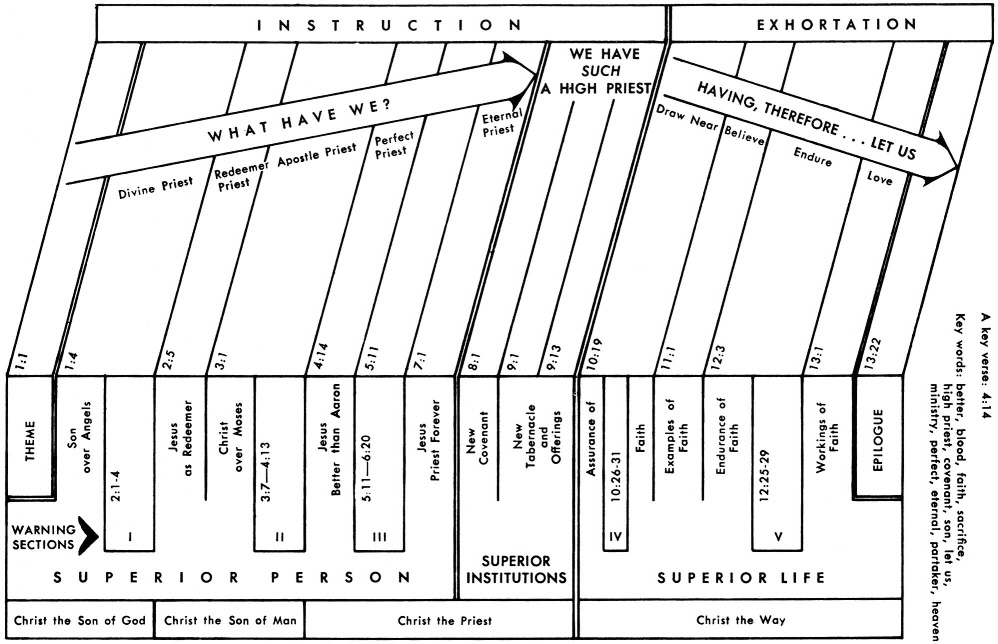
CONSIDER JESUS OUR GREAT HIGH PRIEST
Click chart to enlarge
Charts from Jensen's Survey of the NT - used by permission
Swindoll's Chart, Another Chart
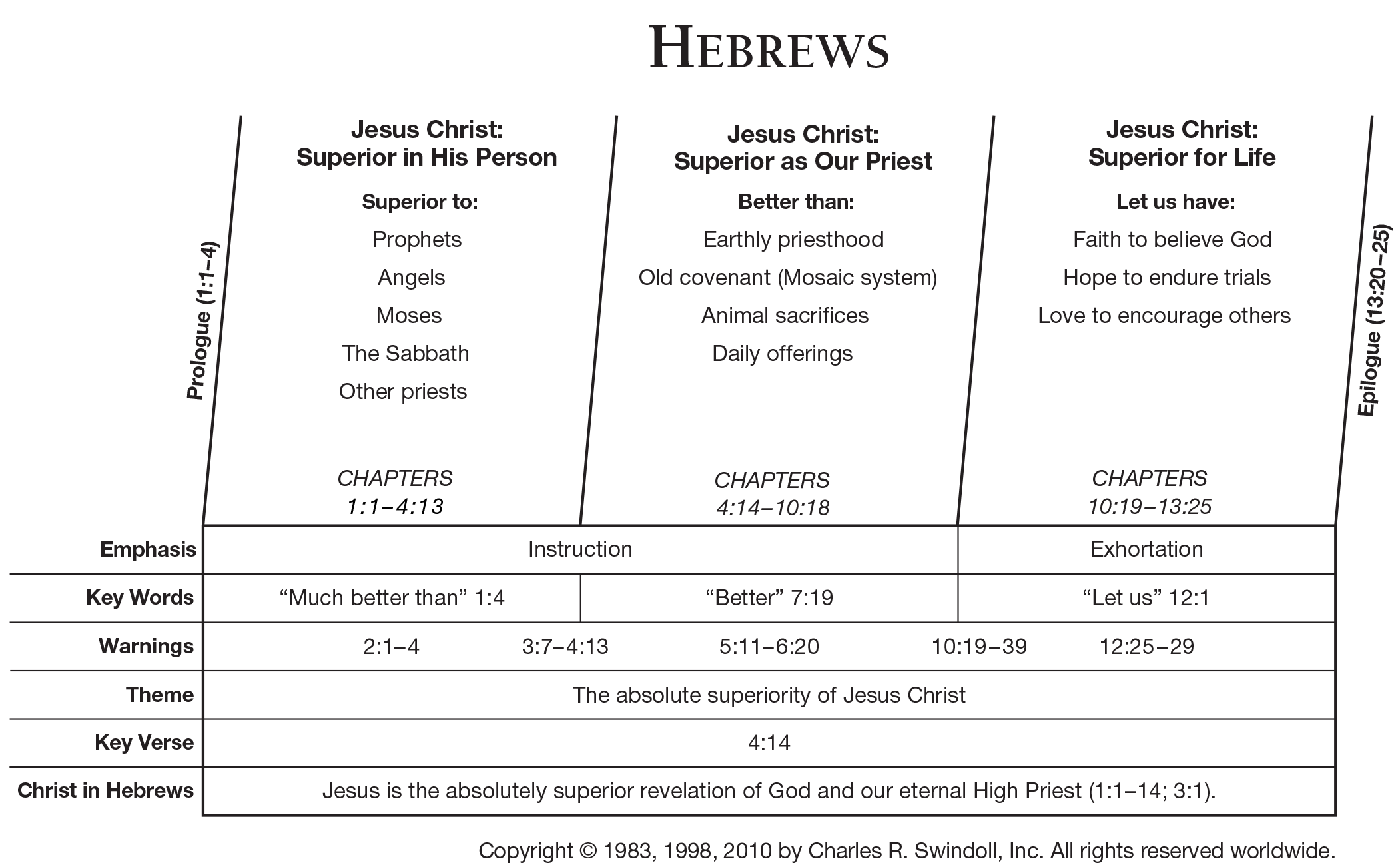
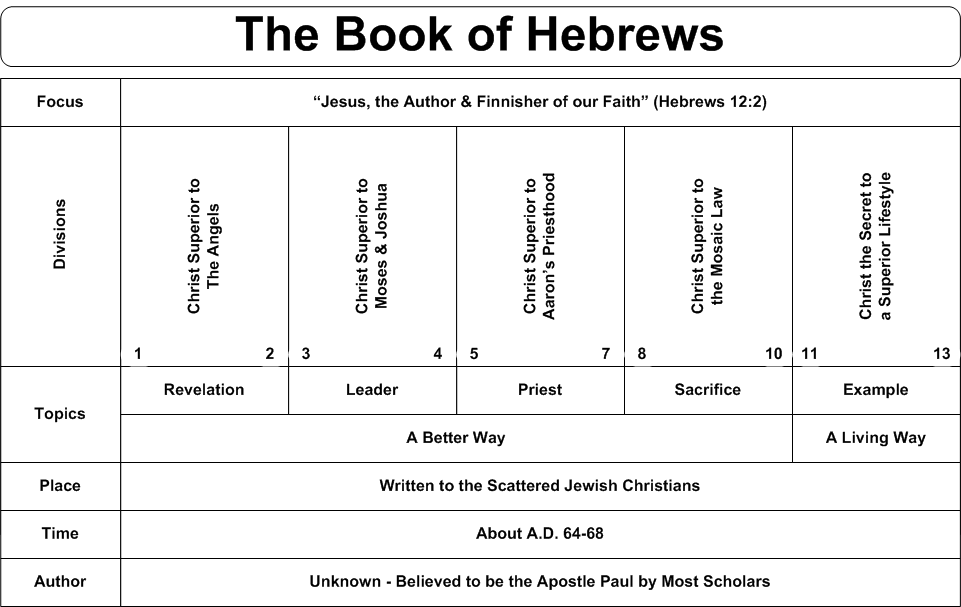
|
The Epistle |
||||
| INSTRUCTION Hebrews 1-10:18 |
EXHORTATION Hebrews 10:19-13:25 |
|||
| Superior Person of Christ Hebrews 1:1-4:13 |
Superior Priest in Christ Hebrews 4:14-10:18 |
Superior Life In Christ Hebrews 10:19-13:25 |
||
| BETTER THAN PERSON Hebrews 1:1-4:13 |
BETTER PRIESTHOOD Heb 4:14-7:28 |
BETTER COVENANT Heb 8:1-13 |
BETTER SACRIFICE Heb 9:1-10:18 |
BETTER LIFE |
| MAJESTY OF CHRIST |
MINISTRY OF CHRIST |
MINISTERS FOR CHRIST |
||
|
DOCTRINE |
DUTY |
|||
|
DATE WRITTEN: |
||||

See ESV Study Bible "Introduction to Hebrews"
(See also MacArthur's Introduction to Hebrews)
Borrow Ryrie Study Bible
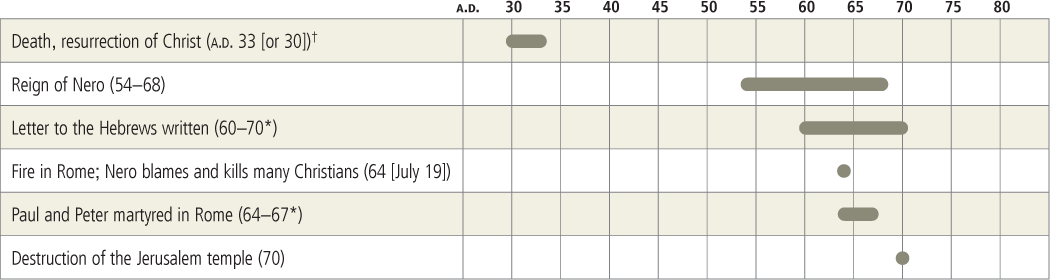
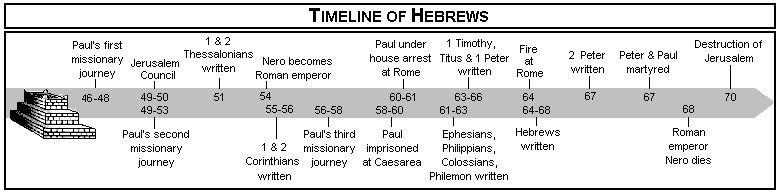
Timeline of Hebrews - ESV Study Bible
Hebrews 2:5 For He did not subject to angels the world to come, concerning which we are speaking (NASB: Lockman)
Greek: Ou gar aggelois hupetaxen (3SAAI) ten oikoumenen ten mellousan, (PAPFSA) peri es laloumen. (1PPAI)
BGT Οὐ γὰρ ἀγγέλοις ὑπέταξεν τὴν οἰκουμένην τὴν μέλλουσαν, περὶ ἧς λαλοῦμεν.
Amplified: For it was not to angels that God subjected the habitable world of the future, of which we are speaking. (Amplified Bible - Lockman)
Barclay: It was not to angels that he subjected the order of things to come of which we are speaking. (Westminster Press)
NLT: And furthermore, the future world we are talking about will not be controlled by angels. (NLT - Tyndale House)
Phillips: For though in past ages God did grant authority to angels, yet he did not put the future world of men under their control, and it is this world that we are now talking about. (Phillips: Touchstone)
Wuest: For He did not give to angels the administration of the inhabited earth to come concerning which we are speaking. (Eerdmans Publishing - used by permission)
Young's Literal: For not to messengers did He subject the coming world, concerning which we speak
KJV For unto the angels hath he not put in subjection the world to come, whereof we speak.
NKJ For He has not put the world to come, of which we speak, in subjection to angels.
NET For he did not put the world to come, about which we are speaking, under the control of angels.
CSB For He has not subjected to angels the world to come that we are talking about.
ESV For it was not to angels that God subjected the world to come, of which we are speaking.
NIV It is not to angels that he has subjected the world to come, about which we are speaking.
MIT For the world at large that was about to emerge, concerning which we speak, he did not subjugate under angels.
NJB It was not under angels that he put the world to come, about which we are speaking.
NRS Now God did not subject the coming world, about which we are speaking, to angels.
RSV For it was not to angels that God subjected the world to come, of which we are speaking.
NAB For it was not to angels that he subjected the world to come, of which we are speaking.
GWN He didn't put the world that will come (about which we are talking) under the angels' control.
BBE For he did not make the angels rulers over the world to come, of which I am writing.
ASV For not unto angels did he subject the world to come, whereof we speak.
- The world to come - He 6:5 2Pe 3:13 Rev 11:15
- Hebrews 2 Resources - Multiple Sermons and Commentaries
- Hebrews 2:5-9 Our Glorious Destiny in Christ - Steven Cole
- Hebrews 2:5-9 Recovery of Man's Lost Destiny - John MacArthur
Related Passage:
Hebrews 1:6+ And when He again brings (REFERS TO SECOND COMING) the firstborn into the world (oikoumene = same word used in Heb 2:5+), He says, “AND LET ALL THE ANGELS OF GOD WORSHIP HIM.”
ANGELS WILL NOT
RULE EARTH IN THE FUTURE
Context - In the first chapter the writer clearly demonstrated Jesus' superiority over angels by explaining that He is God (e.g., Heb 1:2+). Chapter 1 ended with a description of the work of angels as ministers to those who will inherit salvation in Hebrews 1:14 and was followed by the first "warning passage" in Hebrews 2:1-4. Hebrews 2:1-4 was like a parenthesis and Hebrews 2:5 now picks back up with the discussion of the angels. Now the writer addresses the question (which surely some of the Jews would have been asking) of how Jesus could be a Man and yet still be superior to the angels as he has described in chapter 1. Hebrews 2:5-18 also serves another function. The readers were experiencing persecution for abandoning Judaism and beginning to believe in Jesus and His Gospel. There were in need of an encouraging word and this section does just that, explaining how Jesus the God-Man would restore their rulership and dominion of the earth which Adam's sin lost. This truth would serve to undergird their hope and provide an anchor for their souls in the midst of the storms they were experiencing because of their belief in Jesus.
R Kent Hughes offers a good explanation for why the writer would introduce man at this time for he has been focusing on Jesus superiority to the angels. Hughes writes...
There is an ironic little pastoral epigram that is often used to capsulize the task of preaching. It goes like this: The job of the preacher is to comfort the afflicted, and afflict the comfortable. That is pretty good advice, because a preacher should be given to both for a balanced ministry. This certainly summarized the task of the writer of the letter to the Hebrews as he saw it, for his emphasis alternates between extended passages of comfort and brief sections of affliction or disturbing exhortation throughout the entire book. Thus far he has comforted the afflicted in the storm-tossed little church with a ranging summary of the superiority of Christ in chapter 1 that asserts his prophetic, cosmic, Levitical, and angelic supremacy (Heb 1:1–14). This grand vision of Christ was meant to be a firm anchor in the storms of persecution. Correspondingly, in the beginning of chapter 2 he has afflicted the comfortable whose anchors have begun to lift from Christ, issuing a challenge that contains the ringing warning, “How shall we escape if we ignore such a great salvation?” (Heb 2:2–4). Now, in the passage before us (Hebrews 2:5-9), the emphasis returns back to comforting the afflicted. The smallness of the tiny house-church, the immensity of the hostile sea around them, and the mounting breakers of Neronian persecution left them feeling lonely and insignificant—like a forgotten cork in the tide. This seeming insignificance is countered by the writer in verses 5–9 as he shows how Christ, through his superiority, gives them massive significance in his ultimate intention for them. (See Hebrews: An Anchor for the Soul - Page 4)
As J Vernon McGee said "The humanity of Christ needs to be emphasized as well as His deity. You see, He brought deity down to this earth, and He took humanity back to heaven." (See context in Thru the Bible)
For (gar) - term of explanation - Some "terms of explanation" are easier to decipher than others. This one is a more difficult one. For always begs the question "What is the writer explaining?" and in this case it is not easy to answer that question.
What the Bible is All About writes that "The connecting particle "For", with which v. 5 commences, has presented to some a difficulty. Perhaps the most satisfactory explanation for it is to emphasise the parenthetical nature of Heb 2:1-4, in which case there is a natural and easy transition from Heb 1:14 to Heb 2:5. Put brackets around the first four verses of ch. 2 and notice the ready connection between the closing verse of ch. 1 and Heb 2:5.
Steven Cole on for - After his brief exhortation to pay attention so that we do not drift (Heb 2:1-4), he comes back to deal with Jesus’ superiority over the angels. It is difficult to say whether the opening word, “for,” links back to Heb 1:14 or to the entire preceding argument. It is likely that he was thinking of an objection that some of his Jewish readers who were wavering might have had. They may have been thinking, “If the Son of God is greater than the angels, having obtained a more excellent name than they (Heb 1:4), then how does this fit with His becoming a man, since men are lower than the angels? Furthermore, how does this fit with His dying on the cross, since angels never die? How then is Jesus superior to the angels?” (Our Glorious Destiny in Christ)
Donald Guthrie on for - The subject of the sentence is missing from the Greek, but is clearly carried forward from verse 4, as the opening word for (gar) shows, and must therefore be God. (See context in The Letter to the Hebrews: An Introduction and Commentary)
Constable quoting Pentecost writes that "Hebrews 2:5-18 present eight reasons for the incarnation of the Son: to fulfill God's purpose for man (vv. 5-9a), to taste death for all (v. 9b), and to bring many sons to glory (vv. 10-13). He also came to destroy the devil (v. 14), to deliver those in bondage (v. 15), to become a priest for men (vv. 16-17a), to make propitiation for sins (v. 17b), and to provide help for those tested (v. 18). (Hebrews 2 Commentary)
An Exegetical Summary of Hebrews asks the question "What relationship is indicated by gar 'for'? Here are their 6 answers (representing different commentators...
1. It indicates the grounds for the argument of the preceding verses [Expositor's Greek Testament] beginning with Heb 2:2 [Alford].
2. It indicates the second grounds for the exhortation in Heb 2:1 [Neva Miller]: we ought to give heed, for …
3. It indicates the grounds for Heb 1:14 [Thomas Hewitt, R C H Lenski]: the angels are ministering spirits, since it is not to them that the coming world is subjected. It also introduces a new subject [R C H Lenski].
4. It indicates the grounds for the exhortation to dedication to salvation through the Son [Carl Moll in Lange's Commentary].
5. It links the present discussion with the preceding discussion concerning the Son’s supremacy [F F Bruce in New International Commentary; Paul Ellingworth in New International Greek Testament Commentary, Simon Kistemaker in Baker New Testament Commentary, William Lane in Word Biblical Commentary]. It is another reason to emphasize the Son’s superiority [NIC].
6. It opens a new stage in the discussion [James Moffatt in International Critical Commentary, UBS Translators Handbook of H].
He did not subject (hupotasso) to angels (aggelos) the world (oikoumene) to come - He is God indicating that God alone took the initiative, exercising His sovereign right. The first word in the Greek is not (ou) by which the writer is strongly stating that the world to come is absolutely not subject to angels. What is the world to come? Some like Lenski (amillennial) feel this refers to the New Heaven and the New Earth. Others who are of a premillennial persuasion (as I am) favor this is a reference to the coming 1000 year Millennial Kingdom described in Revelation 20 and in many Old Testament passages (See Millennium).
🙏 THOUGHT - Beloved believer, this verse ought to blow your mind! After all He could have just given the future world to those angels who had not rebelled against Him, but instead He chose us! Amazing! Incredible! God's plan for you in the future is for you to rule and reign over the world with His Son (read and ponder with awe these prophetic promises to every believer - Rev 1:6+, Rev 5:10+, Rev 20:6+, Rev 22:5+). You may want to read that again. This is not "pie in the sky" but is guaranteed to happen because God is not a man that He should lie! Why would God do such a thing for us who have prior to salvation, cursed Him, rejected Him, ignored Him, etc? One could probably give a number of reasons for this astounding promise to puny men, but surely the main reason is He loved us (and loves us)! It is part of our "so great a salvation." (Heb 2:3+)! Let this promise of future exaltation sink in and let it motivate you to live for Him and His Son, Who made the realization of this promise our blessed hope (not hope so, but hope sure)! If you are not a believer, I am not trying to "entice" you with future glory as a ruler of the earth, but you should at least give Jesus consideration because the antithesis is inglorious eternal punishment. What a tragic contrast the fate of believers who will have dominion over the world to come, ruling and reigning and serving Christ forever and ever. Amen and amen!
Subject (hupotasso) was used for any system of administration. God will not turn over the administration of the future world to angels. The Messianic Age to come will be the great and glorious world, the world in which the Righteous Ruler reigns. Redeemed men and women will reign with their Kinsman-Redeemer and King (Rev 20:4, 5, 7+, Rev 1:6+, Rev 5:10+), but the angels will not reign. Thus their present superiority over men is temporary. This cements the writer's logical explanation of how it is possible that Jesus a Man could still be seen as superior to the angels as described in Hebrews 1 (there He was superior because He is God, while here He is superior because He is the sinless Man Who received His crown after the cross).
As an aside this present world is temporarily and to a degree ruled by "angels," subjected specifically to one angel, the Devil. We can see this in the following passages.
Luke 4:6+ And the devil said to Him, “I will give You all this domain and its glory; for it has been handed over (perfect tense - paradidomi) to me, and I give it to whomever I wish.
1 John 5:19+ We know that we are of God, and that the whole world lies in [the power of] the evil one.
Note power is added by translators but is clearly implied. John says "we know" which is the verb (oida) expressing absolute certainty beyond a chance. God placed this awareness in our hearts when He transferred us from the kingdom of darkness to the kingdom of His beloved Son. The use of the perfect tense conveys the truth that this knowledge is permanent in believers. The "world" is not oikoumene but kosmos which in this moral or ethically use refers to the world system of evil of which Satan is the head, all unsaved people his servants, together with the pursuits, pleasure, purposes, people, and places where God is not wanted. Kosmos is the hostile world of men who are living alienated, apart from God and irrevocably opposed to Him. John minces no words in this passage emphasizing that there are only two spheres of spiritual existence - one is either in Christ (in His Kingdom - children of God) or in Adam (in the world - children of Satan), the latter "spiritual address" applying to every person who has never been saved by grace through faith in Christ Jesus. In sum, this evil world system is the domain of the evil one, Satan! Because the whole world belongs to Satan, Christians should assiduously avoid its polluting and corrupting influences.)
2 Corinthians 4:4+ in whose case the god of this world (Satan) has blinded the minds of the unbelieving so that they might not see the light of the gospel of the glory of Christ, who is the image of God.
And so Adam forfeited his rule and God allowed an angel, Satan, to temporarily rule in this present world, but his end is in sight (SOON! HALLELUJAH!) (See related discussions on devil = diabolos; Excursus on the prince of the power of the air) In sum, Satan now rules the cursed planet earth, and he is the prince or ruler of the power of the air (Eph 2:2+) who has authority over all unregenerate men and women (cf "domain" in Col 1:13+, "dominion" in Acts 26:18+).
When God created man and woman Moses records
And God blessed them; and God said to them, "Be fruitful and multiply, and fill the earth, and subdue it; and rule over the fish of the sea and over the birds of the sky, and over every living thing that moves on the earth." (Genesis 1:28+)
When Adam sinned in Genesis 3+, in the garden of Eden where he was to rule as the "king", he lost his soul, but he also lost his crown, representing his rule over the earth. He was totally sinful (sinful from head to toe, on the outside and inside = total depravity) and became enslaved to the power and rule of his new masters Sin and Satan (satanas cf Devil). Adam’s sin that brought the curse on creation. Docile creatures became ferocious. The ground began to bring forth thorns and thistles.
Henry Morris - Although angels have considerable authority in this present world (Daniel 10:13; Matthew 18:10), the Lord Jesus Christ Himself will reign over the millennial world (Revelation 20:4+) and the eternal world to come (Revelation 11:15+)
Charles Ryrie on world to come - Lit., the coming inhabited earth (as in Luke 2:1+). A reference to the millennial kingdom on earth, which will not be ruled by angels but by Christ and the redeemed. (Borrow Ryrie Study Bible page 1852)
There is a “world to come,” and how you live today
will help to determine your place in the future kingdom of Christ
-- Wiersbe - see With the Word
J Vernon McGee on world to come - To begin with, let us understand what world the author is talking about. A great many folk think immediately that the “world to come” is heaven. However, the word for “world” in this verse means “inhabited earth” in the Greek. This verse is talking about the people of this earth. It is used in Matthew 24:14+ which says, “And this gospel of the kingdom shall be preached in all the world [inhabited earth] for a witness unto all nations; and then shall the end come.” It is also used in Romans 10:18, “But I say, Have they not heard? Yes verily, their sound went into all the [inhabited] earth, and their words unto the ends of the world.” The word world could not refer to heaven or to eternity. It does not refer to this dispensation of grace in which we live today. It speaks of the messianic kingdom, the kingdom that is coming on the earth. Hebrew believers, schooled in the Old Testament, knew that the theme song of that book was the coming kingdom over which one in David’s line would rule. The messianic kingdom became the theme song of every one of the prophets....Not only have angels not ruled in the past, they will not rule in the future. They have been servants and messengers in the past, and they will continue to be servants in the future. (See context in Thru the Bible)
Philip Edgcumbe Hughes on world to come - The coming age, here called the world to come, is the age of the Messiah in which the messianic promises and prophecies of old find their fulfilment. This age, which was obviously future within the perspective of the prophets who foretold its advent, is still future insofar as its ultimate consummation is yet to be manifested. (See A Commentary on the Epistle to the Hebrews - Page 82)
The Wycliffe Bible Commentary (online) on The world to come (oikoumenēn tēn mellousan). The future world, the inhabited earth of the future; the world future to the generation receiving this epistle and also future to us. This world will not be subject to angels, but it will be subject to Christ in its totality, and also to the redeemed. An entirely new condition will prevail, as Christ, with the saints, will rule in a harmony heretofore unknown.
Leon Morris on world to come - “The world” (tēn oikoumenēn) is a term that normally denotes the inhabited earth. The Greeks often used it of countries occupied by men of their own race as opposed to barbarians. Later it came to be used for the Roman Empire. It is unusual to have it employed of the Messianic Age (BDAG, p. 564, notes this usage only here), “age” (aiōn) being much more common in this sense (e.g., Matt 12:32). (See context in The Expositor's Bible Commentary - Abridged Edition).
The Believer's Study Bible notes "This (Heb 2:5-18) is an important section theologically in that several reasons for the incarnation as a necessity for the atonement are listed.
Note that this phrase "world to come" was used by Rabbis to refer to Messianic age (what we now call the Millennium) when Messiah would rule the world as King from His throne in Jerusalem! Sadly most Jews did not receive Him the first time and do not understand that when He comes in the future, this is His second coming (Rev 19:11, 15+). But praise the Lord some Jews in the end of the Great Tribulation will have their eyes opened (see Zech 12:10+).
ESV Study Bible agrees that the world to come - A common Jewish expression for the future age in which all of God’s purposes in salvation will be fulfilled. (See ESV Study Bible)
Dwight Pentecost on the world to come - When the writer refers to “the world to come,” he is speaking in light of the accepted Old Testament eschatology, which divided God’s program into two ages. The first age was this present age, or the age of expectation, in which the covenanted people were looking forward to the coming of the Messiah who would fulfill all of God’s covenants made with the nation. That present age would then terminate with the appearance of Messiah and the establishment of the Messianic kingdom, and it would be followed by the age to come. This second age, or “world to come,” was the age Messiah would introduce at His advent, the age in which all of Israel’s hopes would be realized. So when the apostle speaks here of “the world (or better, the age) to come,” he is anticipating the millennial glory that belongs to Jesus Christ. (See context in Faith That Endures: A Practical Commentary on the Book of Hebrews)
Steven Cole on world to come (see his sermon below) - There is debate about the meaning of the phrase, “the world to come.” The Greek word for “world” means “the inhabited earth.” Some take the whole phrase to refer to the messianic age inaugurated by Christ at His first coming. Others understand it to refer to the future Millennial Kingdom. In the original creation, God created man in His image to subdue the earth and rule over it (Ge 1:26, 27, 28). Man lost that dominion to Satan in the fall, so that he is now “the ruler of this world” (John 12:31; 14:30; 16:11; also, 2Co 4:4; Eph. 2:2; 6:12; 1Jn 5:19). At the cross, Jesus overcame Satan’s power (John 12:31; 16:11). Christ’s victory will be finalized in His Second Coming and kingdom rule. At the end of that 1,000-year kingdom, Satan will be loosed briefly for one final assault on Christ’s kingdom, only to be defeated and judged forever (Rev. 20:7-10). Thus I understand “the world to come” to refer primarily to the future Millennial Kingdom. But there is currently a heavenly conflict for dominion on earth. We participate in this conflict and reign with Christ as we conquer the strongholds of Satan through spiritual warfare (Ep 6:10-20+; Da 10+). To the extent that we live under Christ’s lordship, we experience a taste of His kingdom rule now. But the full expression of Christ’s kingdom awaits His return, when He will reign over all the earth. Then we will reign with Him and we will judge the angels (1 Cor. 6:3). So our ultimate destiny is higher than that of the angels, since we will rule the world to come with Christ.
Concerning which we are speaking - The author is discussing this new order introduced by Christ which makes obsolete the old dispensation of rites and symbols.
Brian Bell - We (HUMANS) are the greatest of God’s creations, for we are made in the image of God. Why are we so messed up/mixed up today? Modern teaching has lowered man to an animal & rejected the image of God. No wonder why we as humans have no problem discarding hundreds of thousand human babies, yet will spend millions of dollars to free a beached whale! No wonder we have such civil unrest, so much brutality. d) Mankind has dethroned God & debased humanity. 4. Let us never forget our obligation as creatures made in God’s image, and our greater obligation as saints being renewed in this image through Christ.
Subject (5293) (hupotasso from hupó = under + tasso = arrange in orderly manner) means literally to place under in an orderly fashion. In the active voice (as in the present passage) hupotasso means to subject, bring under firm control, subordinate as used in (Ro 8:20+). In secular Greek, hupotasso was a military term meaning to draw up in order of battle, to form, array, marshal, both troops or ships. The idea is that the various troop divisions were arranged in an orderly fashion under the command of their leader. In this state of subordination they were now subject to the orders of their commander (and thus better able to achieve their objective).
As an aside, in the NT in other passages the idea of submission focuses not on personality but position. We need to see the authority over us not acting to fulfill their own will per se, but as instruments in the hand of God to fulfill His will on earth as it is in heaven. If we look at people as acting on their own will, we will likely become bitter, but if we can see them as acting as God sovereignly, providentially allows, we will be far more likely to become holy. A beautiful example of this is found in the life of Joseph. His brothers consistently mistreated him and it would have been very easy for him to become bitter. And yet he maintained a divine perspective on the problems with the result that his school of adversity helped him graduate as a holy man of God, of whom Scripture records not a single rebuke or misstep.
Hupotasso - 38x in 31v - put in subjection(5), subject(16), subjected(7), subjecting(1), subjection(4), submissive(3), submit(2). Luke 2:51; 10:17, 20; Rom 8:7, 20; 10:3; 13:1, 5; 1 Cor 14:32, 34; 15:27f; 16:16; Eph 1:22; 5:21, 24; Phil 3:21; Col 3:18; Titus 2:5, 9; 3:1; Heb 2:5, 8; 12:9; Jas 4:7; 1 Pet 2:13, 18; 3:1, 5, 22; 5:5.
Angels (32) (aggelos/angelos) means a messenger… who speaks and acts in place of one who has sent him. Angels have considerable authority in this present world (Da 10:13; Mt 18:10), and our present inhabited earth, is ruled by angels (see notes on the prince of the power of the air in Ep 2:2+).
The chief fallen angel is Satan, who is now prince of this world. The writer of Hebrews is emphasizing that God intends to subject the world to come to men, not angels. The first Adam lost the right to rule over the earth, but the second Adam, Jesus Christ, acting as our "Goel" or "Kinsman Redeemer" (see discussion of the Goel = Kinsman Redeemer; See another tabular discussion of Kinsman Redeemer) paid the redemption price, Peter writing…
knowing that you were not redeemed with perishable things like silver or gold from your futile way of life inherited from your forefathers, but with precious blood, as of a lamb unblemished and spotless, the blood of Christ. (1Pe 1:18-19+)
Because of what Christ our KInsman-Redeemer has accomplished men will once again be restored to the position of rulership over the earth because of our position in Christ, the One in Whom all things are summed up (Ep 1:10+).
Spurgeon - We are the preachers of it—not the angels. The great Author and Finisher of our faith is the man Christ Jesus—not an angel. We do not now have the ministry of angels, but the ministry of men, by whom the Lord of the angels sends His messages to their fellows.
World (3625) (oikoumene) refers to the inhabited earth, the world. not the general term kosmos, which means “system,” or aion, meaning “the ages.” There will be an inhabited earth to come but it cannot be referring to this earth that is groaning having been corrupted by sin, but it will be a restored earth (Zech. 14:9-11+). Many signs, in fact, seem to indicate that the change is near.
Wuest - The word “world” is the translation of oikoumene (οἰκουμενε), literally, “the inhabited earth,” here the Millennial Kingdom of the Messiah. This kingdom will not be administered by angels.....God placed man upon it, but man handed the sceptre over to Satan, who now is the god of the world-system and whose throne is again on earth (Rev. 2:13).But the Lord Jesus, through the blood of His Cross, has regained for man the dominion over this earth, and will in the Millennial Kingdom dethrone Satan, ruling as King of kings and Lord of lords. The saved of the human race will be associated with Him in this reign (Rev 5:10+). Thus, the angels will not administer the Millennial earth, but man in the Person of the Son of Man and those of the human race saved by His precious blood. (Hebrews - Wuest's word studies from the Greek New Testament)
OIKOUMENE - 15x in 15v - inhabited earth(1), world(14). Matt. 24:14; Lk. 2:1; Lk. 4:5; Lk. 21:26; Acts 11:28; Acts 17:6; Acts 17:31; Acts 19:27; Acts 24:5; Rom. 10:18; Heb. 1:6; Heb. 2:5; Rev. 3:10; Rev. 12:9; Rev. 16:14
To come (3195) (mello) means to occur at a point of time in the future which is subsequent to another event and closely related to it. Here the present participle is used absolutely to denote what is coming future. It means to be about to. The world to come was considered by the rabbis to be the age of Messiah, the time when the Messiah would rule as king from His throne at Jerusalem (Buchanan; SB, 5:799-976; Michel). The term refers to the coming age, when Christ at His return shall establish His rule as the promised Davidic king (Kent).
MELLO IN HEBREWS -Heb. 1:14; Heb. 2:5; Heb. 6:5; Heb. 8:5; Heb. 10:1; Heb. 10:27; Heb. 11:20; Heb. 13:14
Related Resources:
- Does the Bible teach that there would be two comings of the Messiah? | GotQuestions.org
- The Jewish Tradition Of Two Messiahs
Dwight Pentecost lists several reasons for the incarnation of Christ in Hebrews 2:5-18. The following list is from his commentary Faith That Endures: A Practical Commentary on the Book of Hebrews
(1) To fulfill God’s purpose for man Hebrews 2:5-9 - The first reason for the Incarnation is so that God’s purpose for man might be finally realized by the One who would take the title, “The Son of Man.”
(2) To taste death for all Hebrews 2:9 The second reason for the Incarnation is given in the latter part of verse 9. Jesus Christ became incarnate that He “might taste death for everyone.”
(3) To bring many sons to glory Hebrews 2:10-13 The third reason for the Incarnation is stated in verses 10–13. He came that He might bring many sons to glory.
(4) To destroy the devil Hebrews 2:14 The fourth reason for the Incarnation is given in verse 14. Jesus Christ partook of flesh and blood; that is, He took to Himself a true and complete humanity so that on man’s behalf “He might destroy him who had the power of death, that is, the devil.”
(5) To deliver those in bondage Hebrews 2:15 The fifth reason for the Incarnation is found in verse 15. Through the Incarnation, which included the death of Christ, people could be delivered from bondage to the fear of death.
(6) To become a priest for men Hebrews 2:16-17a - The sixth reason for the Incarnation is found in verses 16–17a, namely, that He might become a merciful and faithful High Priest on man’s behalf.
(7) To make propitiation for sins Hebrews 2:17b The seventh reason for the Incarnation is stated at the end of verse 17. The Son became man “to make propitiation for the sins of the people.”
(8) To provide help for those tested Hebrews 2:18 The eighth reason for the Incarnation is given in verse 18. Since God Himself cannot be tempted with evil (James 1:13), nor can He be put to a test (Deut. 6:16; Matt. 4:7), it was necessary for Jesus Christ by incarnation to identify Himself with people to faithfully represent those who are tempted and tested.
"We see Jesus,… crowned with glory and honor." Hebrews 2:5-9.
IN the first great division of this treatise, we have seen the incomparable superiority of the Lord Jesus to angels, and archangels, and all the heavenly host. But now there arises an objection which was very keenly realized by these Hebrew Christians; and which, to a certain extent, presses upon us all; Why did the Son of God become man? How are the sorrows, sufferings, and death of the Man of Nazareth consistent with the sublime glories of the Son of God, the equal and fellow of the Eternal?
These questions are answered during the remainder of the chapter, and may be gathered up into a single sentence: He who was above all angels became lower than the angels for a little time; that He might lift men from their abasement, and set them on his own glorious level in His heavenly Father's kingdom; and that he might be a faithful and merciful High Priest for the sorrowful and tempted and dying. Here is an act worthy of a God Here are reasons which are more than sufficient to answer the old question, for which Anselm prepared so elaborate a reply in his book, "Cur Deus Homo?"
"What is man?" Those three words in Hebrews 2:6 are the fit starting point of the argument. We need not only a true philosophy of God, but a true philosophy of man, in order to right thinking on the Gospel. The idolater thinks man inferior to birds and beasts and creeping things, before which he prostrates himself. The materialist reckons him to be the chance product of natural forces which have evolved him; and before which he is therefore likely to pass away. The pseudo-science of the time makes him of one blood with ape and gorilla, and assigns him a common origin with the beasts. See what gigantic systems of error have developed from mistaken conceptions of the true nature and dignity of man! From all such we turn to that noble ideal of man's essential dignity, given in this sublime paragraph, which corrects our mistaken notions; and, whilst giving us an explanation that harmonizes with all our experience and observation, opens up to us vistas of thought worthy of God.
MAN AS GOD MADE HIM
The description given here of the origin and dignity of man is taken from Psalm 8., which is doubtless a reminiscence of the days when David kept his father's sheep; even if it were not composed on that very spot over which in after-years the heavenly choirs broke upon the astonished shepherds "abiding in the field, keeping watch over their flock by night."
Turn to that Psalm, and see how well it expresses the emotions which must well up in devout hearts to God as we consider the midnight heavens, the tapestry work of his fingers, and the spheres lit by the moon and stars, which he has ordained. How impossible it is for those who are given to devout reflection to come in contact with any of the grander forms of natural beauty, the far-spread expanse of ocean, the outlines of the mountains, the changing pomp of the skies without turning from the handiwork to the great Artisan, with some such expression as the apostrophe with which the Psalm opens and closes: "O LORD, our Lord, how excellent is thy name in all the earth." At first sight, man is utterly unworthy to be compared with those vast and wondrous spectacles revealed to us by the veiling of the sun. His life is but as a breath; as a shadow careering over the mountain-side; as the existence of the aphides on a leaf in the vast forests of being. What can be said of his character, sin-stained and befouled, in contrast with peaks whose virgin snows have never been defiled; with sylvan scenes, whose peace has never been ruffled; with silvery spheres, whose chimes of perfect harmony have never been broken by discord? Four times over is the question asked upon the pages of Scripture, "What is man, that thou art mindful of him?" (Psalm 144:3; Job 7:17-20; Psalm 8:4; Heb. 2:6.) Yet it is an undeniable fact that God is mindful of man, and that he does visit him. "Mindful!" There is not a moment in God's existence in which he is not as mindful of this world of men as the mother of the babe whom she has left for a moment in the next room, but whose slightest cry or moan she is quick to catch. "I am poor and needy; yet the Lord thinketh upon me." "How precious are thy thoughts unto me, O God!" "Visiting!" No cot is so lowly, no heart so wayward, no life so solitary, but God visits it. No one shall read these lines, the path around whose heart-door is not trodden hard by the feet of him who often comes and stands and knocks. We speak as if only our sorrows were divine visitations. Alas for us, if it were only so! Every throb of holy desire, every gentle mercy, every gift of Providence, is a visitation of God. But there must be some great and sufficient reason why the Maker of the universe should take so much interest in man. Evidently bigness is not greatness; a tiny babe is worth more than the tallest mountain; and an empress-mother will linger in the one room where her child is ill, though she forsake the remainder of her almost illimitable domain. What if earth shall turn out to be the nursery of the universe! The true clew, however, to all speculation is to be found in the declaration by the Psalmist of God's original design in making man: "Thou crownedst him… Thou madest him to have dominion… Thou hast put all things under his feet " (Psalm 8:5-6, R.V.). Nor was this lofty ideal first given to the Psalmist's poetic vision. It had an earlier origin. It is a fragment of the great Charta of humanity, which God gave to our first parents in Paradise. Turn to that noble archaic record, Gen. 1:26-28, which transcends the imaginings of modern science as far as it does those legends of creation which make the heathen literature with which they are incorporated incredible. Its simplicity, its sublimity, its fitness, attest its origin and authority to be divine. We are prepared to admit that God's work in creation was symmetrical and orderly, and that he worked out his design according to an ever-unfolding plan. But science has discovered nothing as yet to contradict the express statements of Scripture, that the first man was not at all inferior to ourselves in those intellectual and moral faculties which are the noblest heritage of mankind.
"God created man in his own image" (Gen. 1:27). -There we have the divine likeness. Our mental and moral nature is made on the same plan as God's: the divine in miniature. Truth, love, and purity, like the principles of mathematics, are the same in us as in him. If it were not so, we could not know or understand him. But since it is so, it has been possible for him to take on himself our nature-possible also that we shall be one day transformed to the perfect image of his beauty.
"And God said, Have dominion" (Gen. 1:28). -There you have royal supremacy. Man was intended to be God's vice-regent and representative. King in a palace stored with all to please him: monarch and sovereign of all the lower orders of creation. The sun to labor for him as a very Hercules; the moon to light his nights, or lead the waters round the earth in tides, cleansing his coasts; elements of nature to be his slaves and messengers; flowers to scent his path; fruits to please his taste; birds to sing for him; fish to feed him; beasts to toil for him and carry him. Not a cringing slave, but a king crowned with the glory of rule, and with the honor of universal supremacy. Only a little lower than angels; because they are not, like him, encumbered with flesh and blood. This is man as God made him to be.
We see not yet all things subjected to him (see note Hebrews 2:8).
His crown is rolled in the dust, his honor tarnished and stained. His sovereignty is strongly disputed by the lower orders of creation. If trees nourish him, it is after strenuous care, and they often disappoint. If the earth supplies him with food, it is in tardy response to exhausting toil If the beasts serve him, it is because they have been laboriously tamed and trained; whilst vast numbers roam the forest glades, setting him at defiance. If he catch the fish of the sea, or the bird of the air, he must wait long in cunning concealment. Some traces of the old lordship are still apparent in the terror which the sound of the human voice and the glance of the eye still inspire in the lower creatures, as in the feats of lion-tamer or snake-charmer. But for the most part anarchy and rebellion have laid waste man's fair realm. So degraded has he become, that he has bowed before the objects that he was to command; and has prostrated his royal form in shrines dedicated to birds, and four-footed beasts, and creeping things. It is the fashion nowadays to extol heathen philosophy; but how can we compare it for a moment with the religion of the Bible, when its pyramids are filled with mummies of deified animals, and its temples with the sacred bull! Where is the supremacy of man? Not in the savage cowering before the beasts of the forest; nor in the civilized races that are the slaves of lust and sensuality and swinish indulgence; nor in those who, refusing to recognize the authority of God, fail to exercise any authority themselves. "Sin hath reigned," as the Apostle says most truly (Rom. 5:21). And all who bow their necks beneath its yoke are slaves and menials and cowering subjects, in comparison with what God made and meant them to be. Do not point to the wretched groups surrounding the doors of the gin-palaces in the metropolis of the most Christian people of the world, and regard their condition as a stain on the love or power of God. This is not his work. These are the products of sin. An enemy hath done this. Would you see man as God intended him to be, you must go back to Eden, or forward to the New Jerusalem. Sin defiles, debases, disfigures, and blasts all it touches. And we may shudder to think that its virus is working through our frame, as we discover the results of its ravages upon myriads around.
III. MAN AS CHRIST CAN MAKE HIM
We behold Jesus crowned with glory and honor (see note Hebrews 2:9)
"What help is that?" cries an objector; "of course he is crowned with glory and honor, since he is the Son of God." But notice, the glory and honor mentioned here are altogether different from the glory of Hebrews 1:3. That was the incommunicable glory of his deity. This is the acquired glory of his humanity. In John 17 our Lord himself distinguishes between the two. In Hebrews 2:5, the glory which he had with the Father as his right before all worlds. In Hebrews 2:4, the glory given as the reward for his sufferings, which he could not have had unless he had taken upon himself the form of a servant, and had been made in the fashion of man, humbling himself, and becoming obedient to the death of the cross, "made a little lower than the angels, because of the suffering of death; crowned with glory and honor: that he, by the grace of God, should taste death for every man" (see notes Philippians 2:7; 2:8; Hebrews 2:10). This is the crown wherewith his Father crowned him in the day of the gladness of his heart, when, as man, he came forth victorious from the last wrestle with the Prince of hell. All through his earthly life he fulfilled the ancient ideal of man. He was God's image; and those who saw him saw the Father. He was Sovereign in his commands. Winds and waves did his bidding. Trees withered at his touch. Fish in shoals obeyed his will. Droves of cattle fled before his scourge of small cords. Disease and death and devils owned his sway. But all was more fully realized when he was about to return to his Father, and said, in a noble outburst of conscious supremacy, "All power is given unto me in heaven and in earth."
"We behold him."
Behold Him, Christian reader! The wreaths of empire are on his brow. The keys of death and Hades swing at his girdle. The mysterious living creatures, representatives of redeemed creation, attest that he is worthy. All things in heaven and earth, and under the earth, and in the seas, worship him; so do the bands of angels, beneath whom he stooped for a little season, on our behalf.
And as He is, we too shall be. He is there as the type and specimen and representative of redeemed men. We are linked with Him in indissoluble union. Through Him we shall get back our lost empire. We too shall be crowned with glory and honor. The day is not far distant when we shall sit at His side-joint-heirs in His empire; comrades in His glory, as we have been comrades in His sorrows; beneath our feet all things visible and invisible, thrones and principalities and powers; whilst above us shall be the unclouded empyrean of our Father's love, forever and forever.
Oh, destiny of surpassing bliss!
Oh, rapture of saintly hearts!
Oh, miracle of divine omnipotence!
(F. B. Meyer. The Way Into the Holiest)
Hebrews 2:6 But one has testified somewhere, saying, "WHAT IS MAN, THAT YOU REMEMBER HIM? OR THE SON OF MAN, THAT YOU ARE CONCERNED ABOUT HIM (NASB: Lockman)
Greek: diemarturato (1AMI) de pou tis legon, (PAP) Ti estin (3SPAI) anthropos oti mimneske (2SPPI) autou, e huios anthropou oti episkepte (2SPMI) auton?
Amplified: It has been solemnly and earnestly said in a certain place, What is man that You are mindful of him, or the son of man that You graciously and helpfully care for and visit and look after him? (Amplified Bible - Lockman)
Barclay: Somewhere in scripture someone bears this witness to the fact: “What is man that you remember him? Or the son of man that you visit him? (Westminster Press)
NLT: For somewhere in the Scriptures it says, "What is man that you should think of him, and the son of man that you should care for him? (NLT - Tyndale House)
Phillips: But someone has said: 'What is man that you are mindful of him, or the son of man that you take care of him? (Phillips: Touchstone)
Wuest: But one in a certain place testified, saying, What is man that you are mindful of him, or the son of man that you look upon him in order to come to his aid? (Eerdmans Publishing - used by permission)
Weymouth But, as we know, a writer has solemnly said, "How poor a creature is man, and yet Thou dost remember him, and a son of man, and yet Thou dost come to him!
Young's Literal: and one in a certain place did testify fully, saying, 'What is man, that Thou art mindful of him, or a son of man, that Thou dost look after him?
- One has testified He 4:4 5:6 1Pe 1:11
- What is man - Job 7:17,18 15:14 Ps 8:4-8 144:3 Isa 40:17
- Son of man - Job 25:6 Ps 146:3,4 Isa 51:12
- Concerned - Ge 50:24 Lu 1:68,78 7:16
- Hebrews 2 Resources - Multiple Sermons and Commentaries
- Hebrews 2:5-9 Our Glorious Destiny in Christ - Steven Cole
- Hebrews 2:5-9 Recovery of Man's Lost Destiny - John MacArthur
Related Passage:
Job 7:17-18 “What is man that You magnify him, And that You are concerned about him, 18 That You examine him every morning And try him every moment?
Psalm 144:3 O LORD, what is man, that You take knowledge of him? Or the son of man, that You think of him?
Isaiah 40:17 All the nations are as nothing before Him, They are regarded by Him as less than nothing and meaningless.
Job 25:6 How much less man, that maggot, And the son of man, that worm!”
Luke 1:68 “Blessed be the Lord God of Israel, For He has visited (episkeptomai) us and accomplished redemption for His people,
Luke 1:78 Because of the tender mercy of our God, With which the Sunrise from on high will visit (episkeptomai) us,
Luke 7:16 Fear gripped them all, and they began glorifying God, saying, “A great prophet has arisen among us!” and, “God has visited (episkeptomai) His people!”
WHAT IS MAN?
WHAT IS HIS DESTINY?
Philosophers have tried in vain to answer this question. Only God's Word describes the destiny of man. The writer will answer the question by quoting from Psalm 8:4-6.
But one has testified (diamarturomai - solemnly testified) somewhere, saying, - Why does the writer not say David (who wrote Psalm 8)? His Jewish readers would have been familiar. The point he is making is not that he does not remember who wrote the following but that it was a solemn declaration (testified refers to a solemn declaration). The GWT paraphrases picks up this intent rendering it "someone has declared this somewhere in Scripture." David the writer of Psalm 8 made a serious declaration on basis of his inspired knowledge.
Leon Morris - A quotation from Psalm 8:4–6 is introduced by the unusual verb diamarturomai (“testify”). Only here in the NT does it introduce a quotation from Scripture. More often it is used in a sense like “adjure” or “testify solemnly.” It shows that the words following it are to be taken with full seriousness. The author tells us neither the place where the words are found nor who said them. Consistently he regards all that is in his Bible as coming from God and puts no emphasis on the human author. The psalmist is concerned with both the insignificance and the greatness of man. (See context The Expositor's Bible Commentary - Abridged Edition)
Cleon Rogers on somewhere - It is characteristic of the author that he is not concerned to provide a precise identification of the sources from which he quotes. It is sufficient for him that he is quoting from Holy Scripture, whose inspiration and authority he accepts without question. (Borrow New Linguistic and Exegetical Key page 518).
Donald Guthrie on has testified somewhere - What seems to be clear is the great importance attached to the words of Scripture, irrespective of their human author or historical context. There is no doubt that for the writer the very words of Scripture are authoritative. The use of Psalm 8 is nevertheless interesting, for this passage was never considered to be Messianic. The original context is man, yet not in his ordinary state but in his ideal state, indicated by the use of the title ‘son of man’. (See context in The Letter to the Hebrews: An Introduction and Commentary)
The writer quotes not from the Hebrew (Masoretic Text) but the Septuagint (LXX) or Greek translation of Psalm 8 (The OT Greek reads "ti estin anthropos hoti mimneske autou he huios anthropou hoti episkepte auton" The original Hebrew according to Clarke reads "What is miserable man, that thou rememberest him? and the son of Adam, that thou visitest him?")
Pascal (1623-1662) -- What is man? Oh, the granduer and littleness, the excellence and the corruption, the majesty and meanness of man!
Edward Young (1681-1775) - How poor, how rich, how abject, how august, How complicate, how wonderful is man! How passing wonder HE who made him such! Who centred in our make such strange extremes! From different natures marvelously mix'd, Connexion exquisite of distant worlds! Distinguish'd link in being's endless chain! Midway from nothing to the Deity! A beam ethereal, sullied and absorb'd, Though sullied and dishonour'd, still divine! Dim miniature of greatness absolute! An heir of glory! a frail child of dust! Helpless immortal! insect infinite! A worm! a god! I tremble at myself, And in myself am lost.
"WHAT IS MAN, THAT YOU REMEMBER (mimnesko) HIM? - The insignificance of man on one hand is implied. On the other hand, although each person is insignificant compared to the stupendous work of creation (David had just said "When I consider Thy heavens, the work of Thy fingers, The moon and the stars, which Thou hast ordained" Ps 8:3), God cares for him! This is an amazing, awe-inspiring truth. The reference is to the earthly nature of man as formed out of the dust. The word for “man” here in the Greek text is not aner which refers to a male individual but anthropos which is the generic term signifying mankind in general. So men, the redeemed ladies rule also, for both are in Christ. The verb mimnesko, meaning to remember also has a secondary sense of remembering with affection, treating with kindness as implied in Heb 13:3+. This is nothing short of amazing grace on sinful man!
REMEMBER (mimnesko) is the present tense which indicates the Almighty God continually remembers "puny man!". Middle voice is reflexive - He recalls us to Himself! Amazing!
Leon Morris adds "God is said to be “mindful of” (mimnēskē) and to “care for” (episkeptē) man. The former thought has the sense of remembering with a view to helping. O. Michel warns against misinterpreting the word as used in the Bible “along historicising or intellectualistic lines. It includes total dedication to God, concern for the brethren, and true self-judgment (Heb 13:3). It carries with it the thinking in terms of salvation history and the community which the whole of Scripture demands” (TDNT, 4:678). As used with God as subject much of this must be modified, but the word mimnēskē is clearly one with far-reaching implications." (See Expositor's Bible Commentary - Abridged Edition)
The ultimate answer is that Jesus became a Man, the perfect God Man. He left heaven’s glory, came down to this earth, and He didn’t become an angel. That is what the writer of Hebrews will explain. God made man lower than the angels, the writer's quote from Psalm 8 making this clear,
Vincent - "The Hebrew interrogation, "what, what kind of", implies “how small or insignificant” compared with the array of the heavenly bodies; not “how great is man.”
Someone has sarcastically stated that “Man is a rash on the epidermis of a minor planet.”
Someone else has calculated the worth (in terms of the chemical composition) of a man weighing 150 lbs as $0.98 in the 1930s, $3.50 in the 1960s and $5.60 in the 1970s. Over 60% of the body weight is water, which is "no charge". In short, even considering inflation, man is not worth very much!
OR THE SON OF MAN, THAT YOU ARE CONCERNED ABOUT (episkeptomai) - This is not the same Greek phrase (ho huios tou anthrôpou = "the Son of the man" - here it reads "he huios anthropon" - see note below) Jesus used so often to refer to Himself, but literally here "the son of a man" (translating the Hebrew which literally reads "son of adam"). “Son of man” is often used in the OT to mean mankind. For example, Ezekiel is called “the son of man” more than 90 times, this phrase simply indicating that he was a human being, a part of mankind. In short, the phrase Son of man was simply a Semitic way of saying “human being”. I do not think this is a reference to Jesus and have listed 7 reasons for this belief. Concerned about (episkeptomai), like remember is in the present tense middle voice indicating God is continually looking out for man with concern and with regard to our state so as to render us assistance! (cf Acts 15:14+).
Leon Morris on son of man - There is, of course, no difference in meaning between “man” and “son of man” in this verse. The parallelism of Hebrew poetry requires that the two be taken in much the same sense; and in any case it is quite common in Hebrew idiom for “the son of” to denote quality, as, for example, “the son of strength” means “the strong man.” So “son of man” means one who has the quality of being man. (We should not be led astray by recollecting that in the Gospels Jesus often calls himself “Son of man”; that usage is quite different.) (See context The Expositor's Bible Commentary - Abridged Edition)
MacArthur writes that "Some take the son of man as a reference to Christ, but I think it is simply a parallel to man." (See context in The MacArthur New Testament Commentary) (Comment: See the variation of opinion in commentaries listed below.)
Steven Cole - The question is, does “him” refer to man or to Christ? It probably refers to man in the first place, but also beyond man to Christ as the representative Man (F. F. Bruce, Commentary on the Epistle to the Hebrews [Eerdmans], p. 37). As Bruce explains (ibid.), “The writer confesses that it is not easy to recognize in man the being whom the psalmist describes as ‘crowned with glory and honor’ and enjoying dominion over all the works of the Creator’s hands.” (Note)
Keener - Son of man was simply a Semitic way of saying “human being,” and the writer here does not seem to try to get more out of it than this (IVP Bible Background - NT)
Vincent on son of man writes that son of man is synonymous with the "Hebrew son of Adam, with a reference to his earthly nature as formed out of the dust. Very often in Ezekiel as a form of address to the prophet, LXX, son of man. The direct reference of these words cannot be to the Messiah, yet one is reminded that the Son of man was Christ’s own title for himself. (Hebrews 2: Word Studies)
J Vernon McGee - We are very small in God’s universe. Someone else has said, “When you pick up the minutest piece of creation, the parts of an atom, and then you reach out to the largest, man is probably halfway between.” Man stands about halfway in the physical creation, but the important thing is that the Lord of Glory, the second person of the Godhead, became Jesus, a man.
“What is man, that thou art mindful of him?” The answer to that is, “Jesus became a man. He left heaven’s glory, came down to this earth, and He didn’t become an angel.” That is what the writer of the Epistle to the Hebrews is going to tell us. “What is man, that thou art mindful of him? or the son of man, that thou visitest him?” What is man?
Of himself, man is nothing. Physically, if you break down the elements of his body into chemical components and put them on the market, at one time he would only have been worth about ninety-eight cents. Today due to inflation man’s worth is a little more than that. But it is not of much value, especially when you think of how much a dollar is worth. So, physically, man is not very valuable. Mentally, man thinks he is something, but he knows very little. What does man actually know about this vast universe in which we live? We have spent billions of dollars to send a man to the moon to see if we could find out how it all began. Since our nation doesn’t believe the first chapter of Genesis, we are exploring the moon! Genesis 1:1 certainly sounds a lot better than any of man’s theories. Man today isn’t very much physically or mentally. He can’t lift very much, and he can’t do very much. Man is quite limited. When you take a good look at man, you see that he is a lost sinner. He is in terrible condition. What is man that God was mindful of him?
“Or the son of man, that thou visitest him?” Well, He visited us because He wanted to communicate with us, and He wanted to save us because He saw our lost condition. (See context in Thru the Bible Vol. 51: The Epistle of Hebrews)
Testified (1263) (diamarturomai from diá = an intensifying preposition + martúromai = witness, bear witness; English ~ martyr) means to make a solemn declaration about the truth of something and thus indicates a solemn, testimony or vigorous testimony.
Paul Ellingworth in the New International Greek Testament Commentary on diamarturomai - The language in which the question is introduced is distinctive but not without parallel. Διαμαρτύρομαι, “solemnly testify”, is frequent in the LXX; see especially Dt. 32:46; → 2:4, συνεπιμαρτυρέω. In the NT, the verb is used absolutely, as here, in Acts 2:40; 8:25; 1 Tim. 4:6. In Acts 2:40; 8:25; 10:42; 18:5; 20:21, 24; 28:23, it appears to be virtually synonymous with κηρύσσω as used of primitive Christian preaching. Sometimes it includes a note of warning, as in Lk. 16:28; Acts 20:21; also Acts 2:40, though there linked with παρακαλέω. This note is absent from the present verse, though the choice of διαμαρτύρομαι rather than the simple μαρτυρέω may have been influenced by the warning implicit in Heb 2:1-4. Διαμαρτύρομαι is not used elsewhere to introduce a quotation; this is Hebrews’ regular use of μαρτυρέω. (See The Epistle to the Hebrews - Page 147)
The first use of this verb in the NT is interesting, Luke recording the words of the rich man who had encountered his eternal destiny beginning with Hades (which itself will eventually be thrown into gehenna, the lake of fire), the rich man desperately declaring…
"I have five brothers-- that he may warn them, lest they also come to this place of torment." (Luke 16:28) (Comment: diamarturomai is not used with this meaning here in Hebrews 2:6, but it does give one a sense of the intensity of this verb compared to the simple verb for witness, martúromai)
DIAMARTUROMAI - 15V - Lk. 16:28; Acts 2:40; Acts 8:25; Acts 10:42; Acts 18:5; Acts 20:21; Acts 20:23; Acts 20:24; Acts 23:11; Acts 28:23; 1 Thess. 4:6; 1 Tim. 5:21; 2 Tim. 2:14; 2 Tim. 4:1; Heb. 2:6
Remember (3403) (mimnesko) means to recall to mind or think of again. It means to keep in mind for attention or consideration. Most of the NT uses convey this sense of recalling information from memory. In Acts 10:31+ (Rev 16:19+) the idea of mimnesko is to think of and call attention to someone or something and to make mention of. The dying thief asked Jesus to keep him in mind when He came into His Kingdom (Lk 23:42+).
MIMNESKO Hebrews - Heb. 2:6; Heb. 8:12; Heb. 10:17; Heb. 13:3
Concerned (1980) (episkeptomai from epí =upon + sképtomai = to look) means to examine closely, to inspect, to look upon, to look after, to go to see. It is related to episkopos which describes an overseer of the church in the NT. Episkeptomai meant to go to see with the goal of relieving distress, sickness, or bondage and is used of visiting of the sick in NT or of a visitation for the purpose of showing or doing good to the one visited. Vincent adds that "Here in the sense of graciously and helpfully regarding; caring for."
EPISKEPTOMAI -11V - Matt. 25:36; Matt. 25:43; Lk. 1:68; Lk. 1:78; Lk. 7:16; Acts 6:3; Acts 7:23; Acts 15:14; Acts 15:36; Heb. 2:6; Jas. 1:27
For example in Matthew Jesus will say to the "sheep" on His right (Gentiles who have survived the Great Tribulation and are being prepared for entrance into Messiah's Millennial Kingdom)…
(I Jesus, as represented by the Jews you encountered during their final time of great persecution, was) "naked, and you clothed Me; I was sick, and you visited (episkeptomai) Me; I was in prison, and you came to Me." (Matthew 25:36) (But to the "goats" on His left He will declare) "43 I was a stranger, and you did not invite Me in; naked, and you did not clothe Me; sick, and in prison, and you did not visit (episkeptomai) Me.'" (Matthew 25:43)
Comment: This passage refers to the so-called Judgment of the Sheep and the Goats which will take place at the return of Jesus just prior to His 1000 year reign on earth.
This word is used almost exclusively in the LXX of a visitation for good and has to do with looking toward someone with a view to benefiting him. It is much more than simply a wish or desire for the person’s welfare. It involves active caring. For example see the use by Luke who writes…
"Blessed be the Lord God of Israel, For He has visited (episkeptomai) us and accomplished redemption for His people… 78 Because of the tender mercy of our God, With which the Sunrise (~ the Resurrected Son) from on high shall visit (episkeptomai) us (Luke 1:68, 78)
In the LXX many of the uses of episkeptomai are in the Psalms, so that Jewish readers of this letter would be familiar with episkeptomai a visitation for good. For example in the Psalms we read
Ps 106:4 Remember me, O LORD, in Your favor toward Your people; Visit me (LXX = episkeptomai here actually as an imperative of request) with Your salvation,
Ps 17:3 You have tried my heart; You have visited (LXX = episkeptomai) me by night; You have tested me and You find nothing; I have purposed that my mouth will not transgress.
Ps 65:9 You visit (LXX = episkeptomai) the earth and cause it to overflow; You greatly enrich it; The stream of God is full of water; You prepare their grain, for thus You prepare the earth.
John MacArthur - THE REVELATION OF MAN’S DESTINY ” (Heb. 2:5–8).
Man’s original intended destiny was to be king of the earth.
When we look at the vast, seemingly endless universe and then think about the little dot we call Earth in the middle of it all, we cannot help but wonder, “What is man? What right do we have to be on God’s mind so much?”
David had an answer: “Thou hast made him for a little while lower than the angels; Thou hast crowned him with glory and honor, and … appointed him over the works of Thy hands; Thou hast put all things in subjection under his feet” (Heb. 2:6–8). The writer of Hebrews was quoting one of the Psalms (8:4–6) to show that God made man to be king.
David undoubtedly penned his psalm based on what God said in the beginning: “Let us make man in our image, according to our likeness; and let them rule over the fish of the sea and over the birds of the sky and over the cattle and over all the earth, and over every creeping thing that creeps on the earth” (Gen. 1:26). God’s original design for man in his innocence was to be king over an undefiled earth.
When God made Adam, who was pure and innocent, He gave him honor and glory. God crowned man king of the earth: “Thou hast put all things in subjection under his feet” (Heb. 2:8). One day we again will be given the right to rule the earth, and all God’s creation will be put under our feet.
Suggestions for Prayer: Read Psalm 8, and offer it as your own praise to God.
For Further Study: Read Daniel 7:18, 27, and note the extent of the saints’ ultimate rule. (See context in Drawing Near: Daily Readings for a Deeper Faith)
OF CRABS AND DOGS AND MEN - The well-known evolutionist Stephen Jay Gould wrote, "A crab is not lower or less complex than a human being in any meaningful way." But would Mr. Gould carry out his theory to its logical conclusion? I doubt it. It's likely that he'd think nothing of dining at a fine restaurant and enjoy eating crabmeat. But I'm sure he would be appalled if the same menu offered a dinner of grilled human flesh served with French fries.
Evolutionists can say what they will, but there is a fundamental difference between man and animals. I explained this to a woman once, but she was irritated because I wouldn't assure her that dogs go to heaven when they die. She said they have just as much right to go there as we do. I told her that we deserve it less; we are sinners. Dogs aren't. They don't make bad moral choices as we do. But neither are they capable of making good choices. Furthermore, we think about God, eternity, and right and wrong. No dog has that capacity.
God created us in His image. That's why we are responsible to worship and serve Him. We can do this by admitting that we are sinners, receiving Jesus as our Savior, and growing in Christlikeness. Then we truly show the difference between crabs and men.-- Herbert Vander Lugt (Our Daily Bread, Copyright RBC Ministries, Grand Rapids, MI. Reprinted by permission. All rights reserved)
Man's crowning glory lies in this:
God stamped on him His image rare;
No other creatures have that gift
Nor living things with man compare.
-- Dennis J. De Haan
Just because man has similarities to animals
doesn't make an animal out of a man.
HERE ARE THE REASONS I FAVOR Psalm 2:5-8 AS REFERRING TO MAN, A SON OF ADAM, NOT TO THE SON OF GOD:
(1) In Psalm 8:4 "What is man (Hebrew - enosh) that You take thought of him, And the son of man (Hebrew - Adam; Lxx = he huios anthropou) that You care for him?" Many stake their interpretation of Ps 2:5-8 as referring to Jesus on the fact that in the Gospels He frequently referred to Himself as Son of Man. However in the Hebrew language, the writers often used parallelism, and in Ps 8:4 it is very reasonable to parallel "man" (enosh) with "son of man" ("son of Adam"), and not that the phrase "son of man" is necessarily messianic. The NET Note (see note #10 on Psalm 8) supports this premise writing "Hebrew literally reads "What is man[kind]?" The singular noun ('enosh, "man") is used here in a collective sense and refers to the human race. Hebrew literally is "and the son of man." The phrase "son of man" is used here in a collective sense and refers to human beings. For other uses of the phrase in a collective or representative manner, see Nu 23:19; Ps 146:3KJV ("son of man" - Lxx = he huios anthropou); Isa 51:12."
Leon Morris adds this note on "man" and "son of man" in Psalm 8 and the quote in Hebrews 2:6 - The psalmist is concerned with both the insignificance and the greatness of man. There is, of course, no difference in meaning between “man” and “son of man” in this verse. The parallelism of Hebrew poetry requires that the two be taken in much the same sense; and in any case it is quite common in Hebrew idiom for “the son of” to denote quality, as, for example, “the son of strength” means “the strong man.” So “son of man” means one who has the quality of being man. (We should not be led astray by recollecting that in the Gospels Jesus often calls himself “Son of man”; that usage is quite different.) (See The Expositor's Bible Commentary - Abridged - Page 1273)
(2) Paul Ellingworth in the New International Greek Testament Commentary notes that "there is no firm rabbinic evidence that the psalm was understood messianically." (See The Epistle to the Hebrews - Page 147)
(3) Paul Ellingworth adds that "(iii) Υἱὸς ἀνθρώπου (huios anthropou) in the OT generally is a synonym for man (frequently in Ezekiel; Ps. 80:17), and this usage is reflected in the NT (Mk. 2:27f.; cf. Mk. 10:45 with 1 Tim. 2:5f.). (iv) Τὸν δὲ Ἰησοῦν (ton de Iesous) strongly suggests a contrast with some other figure, namely “man”. The relevant parts of vv. 8-9 may therefore be paraphrased: “Ps. 8 speaks of man’s complete authority over the universe. But we see no sign of this at present. What we do see is Jesus, abased for a time, but now exalted in glory”. (See The Epistle to the Hebrews - Page 147)
(4) The Greek for "son of man" in the Septuagint of Ps 8:5 and in the text in Hebrews 2:6 is "he huios anthropou" a phrase which is found in only one other place in the Bible and this is Ps 144:3. Why is this significant? As A T Robertson says the Greek in Hebrews 2:6 is "Not ho huios tou anthrōpou which Jesus used so often about Himself, but literally here "son of man" like the same words so often in Ezekiel, without Messianic meaning here." Marvin Vincent, another Greek expert, agrees with Robertson writing "Hebrew son of Adam, (ED: He is referring to the Hebrew of Ps 8:6) with a reference to his earthly nature as formed out of the dust. Very often in Ezekiel as a form of address to the prophet, lxx, υἱὲ ἀνθρώπου (huie anthropou) = son of man. The direct reference of these words cannot be to the Messiah, yet one is reminded that the Son of man was Christ's own title for Himself." The specific phrase υἱὲ ἀνθρώπου (huie anthropou) is found 64 times in the Septuagint of Ezekiel and one other time in Da 8:17, where clearly it refers to the man Daniel.
(5) While Daniel 7:13 has the phrase Son of Man and it clearly refers to Christ, it is notable that the text does not say One Son of Man was coming but specifically says "One like a Son of Man." You might ask "So what?" The point is that the Greek uses the comparative particle hos which mean like or as, so the appearance of Jesus was "like" a "Son of Man" and compared with all the other uses of the phrase "son of man" in the Old Testament (where "son of man" is synonymous with "man") is saying that His appearance was "like a man." John uses this same phrase "one like a son of man" which would be a description of the glorified Jesus as having the appearance of a Man.
(6) This note is somewhat similar to point #4 above but gives some more detail. There is a distinct difference in the Greek phrases for "Son of Man" in the Gospels, for 83 of 84 uses have "he huios tou anthropou" and the Greek phrase in Hebrews 2:6 is "he huios antropou." You say "So what?" The point is that the phrase Jesus used to described Himself is more literally "the Son the Man," not the "Son of Man" as in Hebrews 2:6 and the Septuagint of Psalm 8:4 (which is also "he huios anthropou") as with all the uses in Ezekiel and the use in Daniel 8:17.
(7) One other point to consider is the context. The writer had just given his readers a solemn warning. It would not be unreasonable for him to now give them something that would give them hope. So if Hebrews 2:5-8 was directed to these persecuted Hebrew Christians, the incredible truth that they would one day in the future inherit what Adam had lost. This would lead into the next section which explains to the readers how this restoration of rulership over the earth would take place.
(8) Hebrews 2:9 in most translations begins with "BUT" (de) which is a word of contrast. Contrast normally marks a change of direction. In this case assuming the previous text referred to humanity (not Jesus), the direction now shifts to explain how what was lost to humanity in Adam which will be restored in Jesus. To reiterate point #7, this would have been very encouraging truth to these persecuted readers.
THERE ARE THREE WAYS TO INTERPRET Hebrews 2:5-8 - either as referring to man (humans) or to the Son of Man, the Messiah or to a combination of man and Messiah (Or as we often hear "two things can be true at the same time!"). Clearly Hebrews 2:9 refers to Jesus. Hebrews 2:5-8 is one of those texts that it might be best to avoid being too dogmatic! I suggest you read the text, praying to the Spirit to guide you in what He meant the inspired text to mean.
INTERPRETATION SON OF
MAN IS NOT REFERRING TO JESUS
MacArthur Study Bible - These quoted verses from Psalm 8 refer to mankind, not to the Messiah, who is not mentioned in the Hebrews passage until verse 9. In verses 6-8 we see God’s planned destiny for mankind in general. Again the writer beautifully makes his point by using the Old Testament. (See context in Hebrews MacArthur New Testament Commentary)
A T Robertson on son of man - Not ho huios tou anthrōpou which Jesus used so often about himself, but literally here "son of man" (ED: "huios anthropou") like the same words so often in Ezekiel, without Messianic meaning here. (Comment - Here in Hebrews 2:6 the writer does not use the definite article "the" [Gk = ho]. In other words the writer does not say "the Son of Man," which is a title Jesus used often of Himself [e.g., Mt 9:6 = "ho huios tou anthropou"]. In regard to Ezekiel, the designation "son of man" is used 93 times to refer to the prophet in the book of Ezekiel.)
Charles Swindoll sees son of man as referring to humanity, not divinity writing "But let’s not lose sight of where the author of Hebrews is leading us in his argument. He wrote, “But now we do not yet see all things subjected” to humanity (Heb. 2:8). Don’t miss that important three-letter word: YET. Remember that in Heb 2:5, this section began with a view toward the future: “He did not subject to angels the world to come, concerning which we are speaking”—the world to come … not yet …God still has glorious plans for restoring rule over creation to humanity. Enter the Lord Jesus Christ (ED: Heb 2:9), the Image of God." Swindoll goes on to discuss Hebrews 2:9. (See Insights on Hebrews - Page 39)
R C H Lenski - Before we go on we may note that some commentators refer the quotation, Ps. 8:4–6, to Christ. Insert “Christ” in v. 6 and note the sense of the passage; but in the rest of the quotation, in fact, through v. 8 the pronouns refer to “man” and “son of man” without change. The whole ancient Jewish exegetical tradition understood David to refer to “man” and not to the Messiah. It would have been extremely hazardous for a writer to Jewish Christians to insert the Messiah into a passage which does not speak of the Messiah in the original; faith cannot be confirmed by such methods. If we keep to what David said and to what the writer of Hebrews adds, all remains both clear and sure. God subjected all things to man (v. 8); not to angels did he subject the earth that is to come, it, too, is to be subject to man (v. 5); yet we do not see that even this earth is as yet subject to man. How, then, is this to be explained? Answer: But him who has been made a little lower than angels, him we do see, Jesus, because of the suffering of the death (he underwent) crowned with glory and honor in order that by God’s grace he should taste death for everyone. (Borrow Hebrews Commentary) (Bolding added)
(Psalm 8) is not, and has never been accounted by the Jews to be, directly Messianic;
but as expressing the true destiny of man
B F Westcott commenting on Hebrews 2:6-8 sees Hebrews 2:6 as referring to man not the God-Man Jesus - "The promise of universal sovereignty was confirmed to man in a passage of Scripture (Ps. 8:5–7) which fully recognises his infirmity. His weakness is first confessed (v. 6); and then his triple divine endowment of nature, honour, dominion (v. 7, 8 a)." The 8th Psalm is referred to by the Lord Matt. 21:16 (comp. Matt. 11:25; 1 Cor. 1:27), and by St Paul 1 Cor. 15:27. Comp. Eph. 1:22. It is not, and has never been accounted by the Jews to be, directly Messianic; but as expressing the true destiny of man it finds its accomplishment in the Son of Man and only through Him in man. It offers the ideal (Gen. 1:27–30) which was lost by Adam and then regained and realised by Christ....Jesus is not the ‘man’ of the Psalmist, but He through whom the promise to man has been fulfilled and is in fulfilment; while the revelation of the complete fulfilment belongs to ‘the world to come.’
James Girdwood - The very first chapter of Genesis clearly teaches that humans were the highest of God’s creation. God created us to rule his world (Genesis 1:28). Psalm 8:4–6, which is quoted in Hebrews 2:6–8, repeats this claim, adding that God crowned us “with glory and honor” (Psalm 8:5; cf. Hebrews 2:7). Indeed, God still plans on subjecting “the world to come,” not to angels, but to the height of his creation, to a human (Hebrews 2:5, 8). Yet we do not presently see this promised rule, for we sinned (Genesis 3) and thus fell from our noble state into the pits of death and despair. Humanity is currently held in the grip of death and its awful purveyor, who is none other than the devil (Hebrews 2:14). Thus, God’s rescue story begins with his highest creation trapped in a life-threatening situation that they fell into of their own free will. (Book of Hebrews - Blueprints for 30 Messages)
Nelson Study Bible - Since the Son’s humanity might appear to be an obstacle to the claim of His superiority, the author of Hebrews cites Ps. 8, a lyrical reflection on Gen. 1, to prove that God has placed humanity over all created things, which includes the angelic world. (See context in Nelson's New Illustrated Bible Commentary)
Reformation Study Bible on Hebrews 2:5-9 The author uses the contrast between angels and human beings in Heb 2:5 to point to the way that the Son, in assuming a full and complete humanity (Heb 2:14, 17), restores man's dignity and divinely-intended place in creation. Heb 2:6 testified somewhere. Such vagueness in scriptural references is characteristic of the author of Hebrews, who stresses the divine authorship of Scripture rather than the human authors (e.g., Heb 1:5, 7, 8; 2:12; 3:7; 4:3; 5:5, 6). This way of citing a well-known Old Testament proof text about man in creation is evidence for the Jewish background of the recipients. 2:8 we do not yet. Ps. 8 describes the glorious status of man as the head of all creation. But it is obvious that man is far from enjoying any such status and some explanation is required.
C H Spurgeon (commenting on Hebrews 2:6-8) - This was the original status of man. God made him to be his vice-regent on earth; and he would still hold that position were it not that, since he has rebelled against his own Sovereign, even the beasts of the field take liberty to be rebellious against him. Man is not now in his original estate, and therefore he rules not now; and we see many men who are very far from being royal beings, for they are mean and grovelling. Yet the glory of man is not all lost, as we shall see. (Spurgeon's Expositional Commentary on Hebrews)
KJV Bible Commentary - Quoting Psalm 8, the author shows God’s intended ruler: What is man … or the son of man. This Psalm does not speak both of man and Christ; it is not messianic. The son of man is not to be distinguished from man. The phrases are merely an example of the common synonymous parallelism in Hebrew poetry. “Hence this passage was not regarded as a messianic prediction by Jewish teachers, but as a description of what God intended man to be” (Kent, p. 53). (See context in King James Version Bible Commentary)
William MacDonald in Believer's Bible Commentary (borrow) Heb 2:5 In the first chapter we saw that Christ is superior to the angels as the Son of God. Now it will be shown that He is also Superior as the Son of Man. It will help us in following the flow of thought if we remember that, to the Jewish mind, the thought of Christ's incarnation was incredible and the fact of His humiliation was shameful. To the Jews, Jesus was only a man, and therefore He belonged to a lower order than the angels. The following verses show that even as Man, Jesus was better than the angels. First, it is pointed out that God did not decree that the habitable world of the future should be under the control of angels. The world to come here means the golden age of peace and prosperity which the prophets so frequently mentioned. We speak of it as the Millennium. Heb 2:6 Psalm 8:4-6 is quoted to show that the eventual dominion over the earth has been given to man, not to angels. In a sense, man is insignificant, and yet God is mindful of him. In a sense, man is unimportant, yet God does take care of him. Heb 2:7 In the scale of creation, man has been given a lower place than the angels. He is more limited as to knowledge, mobility, and power. And he is subject to death. Yet in the purposes of God, man is destined to be crowned with glory and honor. The limitations of his body and mind will be largely removed, and he will be exalted on the earth. Heb 2:8 Everything will be put under man's authority in that coming day—the angelic hosts, the world of animals, birds, and fishes, the planetary system—in fact, every part of the created universe will be put under his control. This was God's original intention for man. He told him, for instance, to "fill the earth and subdue it; have dominion over the fish of the sea, over the birds of the air, and over every living thing that moves on the earth" (Gen. 1:28). Why then don't we see all things in subjection under him? The answer is that man lost his dominion because of his sin. It was Adam's sin that brought the curse on creation. Docile creatures became ferocious. The ground began to bring forth thorns and thistles. Man's control over nature was challenged and limited. Heb 2:9 However, when the Son of Man returns to reign over the earth, man's dominion will be restored. Jesus, as Man, will restore what Adam lost, and more besides. So while we do not see everything under man's control at the present time, we do see Jesus, and in Him we find the key to man's eventual rule over the earth.
William MacDonald writes that the "Psalm 8:4–6 is quoted to show that the eventual dominion over the earth has been given to man, not to angels. In a sense, man is insignificant, and yet God is mindful of him. In a sense, man is unimportant, yet God does take care of him. In the scale of creation, man has been given a lower place than the angels. He is more limited as to knowledge, mobility, and power. And he is subject to death. Yet in the purposes of God, man is destined to be crowned with glory and honor. The limitations of his body and mind will be largely removed, and he will be exalted on the earth. (Believer's Bible Commentary or borrow a copy of Believer's Bible Commentary)
Cornerstone Biblical Commentary Having issued a first warning, the author resumed his survey of key Scriptures about angels (see 1:5-13). His conclusion so far is that they are "only servants—spirits sent to care for people who will inherit salvation" (1:14). This means that they are not only inferior to the Son but in a certain sense inferior to human beings. He now introduces three more Scriptures, one about angels and human beings, and the other two about human beings in relation to Jesus. Argument from Psalm 8 (2:5-10). The writer's first appeal is to Psalm 8:5-7 (LXX), particularly the last clause: "You gave them [human beings] authority over all things" (2:8). He reads the psalm not as an affirmation of human lordship over the world as God created it but eschatologically as a promise for "the future world" (2:5). This is not surprising, because he has already established that the present created order is destined to "wear out like old clothing" (1:11). "All things" (panta [TG 3956A, ZG 4246]), in order to be truly inclusive, must refer to "the future world" (2:5), because at present not all things are under human authority (2:8). Through sin, humankind lost its dominion over all things. Yet "the future world," we have just been told, belongs to "people" (2:6), not angels, and specifically to "people who will inherit salvation" (1:14). The author's difficulty is that the text he has chosen puts humans "lower," not higher, than the angels. He quotes the text accurately, however, and captures the spirit of both the Hebrew text and its Greek translation. The psalmist's intent was to exalt, not denigrate, humanity. The point was not that humans are "lower than the angels" but that they are "only a little lower" (see note on 2:9). God has "crowned them with glory and honor" and given them "authority over all things."The author of Hebrews sees things the same way but with the stipulation that the one of whom all this is true is humanity's representative, "Jesus," now named for the first time in the book (see note on 2:9). The author splits up the two participles carried over from the psalm quotation (made "a little lower than the angels," and "crowned with glory and honor") and uses them to frame the name "Jesus," which has been withheld as long as possible. A rather literal rendering of the Greek word order would be: "[someone] made a little lower than the angels is what we see—Jesus—for the suffering of death crowned with glory and honor." (Cornerstone Biblical Commentary – Volume 17: 1-2 Timothy, Titus, Hebrews)
Kenneth Wuest is somewhat dogmatic (probably too much so) - "The question as to whether the Messiah or man is spoken of in Hebrews 2:6-8 [Psalm 8], is settled easily and finally by the Greek word translated 'visit.' The Psalmist is exclaiming as to the insignificance of man in the question, What is man, that thou art mindful of him? That is clear. But to whom do the words 'son of man' refer, to the Messiah who is called the Son of man, or to mankind? The Greek word 'visit' is episkeptomai. The word means 'to look upon in order to help or to benefit, to look after, to have a care for.' This clearly indicates that the son of man spoken of here is the human race. God looks upon the human race in order to help or to benefit it. Thus, the picture in Hebrews 2:6-8 is that of the human race in Adam" (Hebrews - Wuest's word studies from the Greek New Testament Wuest Word Studies - Eerdman Publishing Company Volume 1, Volume 2, Volume 3 - used by permission)).
Kent Hughes in Hebrews: An Anchor for the Soul writes that "The author establishes this as the ultimate intention by demonstrating that it is in accord with the original intention of God for humanity. His proof is a quotation from the middle of Psalm 8 that celebrates God’s original intention for man. He introduces and recites it in Ps 8:6, 7, 8a. The Psalmist is completely astonished at God’s intention for man. Of course the intention was not new because it was originally spelled out in Ge 1:26, 27, 28. Think of man’s astonishing honor: “you crowned him with glory and honor.” Adam and Eve were the king and queen of original creation. God set them in a glorious paradise and walked with them. Consider man’s amazing authority: “… and put everything under his feet. This was given to mankind through Adam (Genesis 1:28). Man was given rule over the world. Adam and Eve were God’s viceroys—creature king and creature queen with the responsibility of ordering creation under the Lordship of God. Poetically speaking, Adam was “an august creature with all things put in subjection to him, wearing the very sun as a diadem, treading the very stars like unconsidered dust beneath his feet.” The original intention of God, to say the least, was stupendous. If the intention had been carried out, we descendants of Adam would be living with our primal parents in the same astounding position and honor and authority—a world of kings and queens. The implicit message to the beleaguered church is that we may feel ourselves insignificant, but we are not. We are in God’s image, and He cares for each one of us. Adam sinned, and as a consequence his God-given dominion became twisted. Man’s rule over creation has through the centuries become an ecological disaster. His reign over the animal world is superficial. He achieves it by intimidation: “Obey me, or I’ll eat you or wear you!” And sometimes he himself has been the feast. The problem is, he cannot rule over himself, let alone others. And the dictum, “Power corrupts, and absolute power corrupts absolutely” is lived out before the eyes of every generation—as it was so personally being done before that storm-tossed little church. Chesterton was right: “Whatever is or is not true about men, this one thing is certain—man is not what he was meant to be.” (See context in Hebrews: An Anchor for the Soul)
IVP BACKGROUND COMMENTARY ON NT: The Old Testament and Jewish teaching declared that God’s people would reign with him in the world to come, just as Adam and Eve had been designed to reign for him in the beginning. The writer proceeds to prove this point by appealing to a specific Old Testament text, Ps 8:4–6, in Jewish midrashic style. “One has testified somewhere” (NASB) does not mean that the writer has forgotten what part of Scripture he is quoting; this was a way of expressing confidence that the important issue was that God had inspired the words. Philo used similar phrases in this manner. The writer can introduce Ps 8:4, 5, 6 naturally on the basis of the Jewish interpretive rule, gezerah shavah, the principle by which one was permitted to link key words or phrases. This text speaks of everything subdued under someone’s feet, as had the text he had cited most recently (He 1:13-note). Psalm 8:4-6 declares that although humanity is nothing in itself, God appointed humans as rulers over all his creation, second only to himself (alluding to Gen 1:26-27). The Septuagint interprets this passage as “a little lower than the angels” instead of “a little lower than God” (the Hebrew word used there, elohim, sometimes did mean angels instead of God). That angels were more powerful than people in this age was true, but the writer of Hebrews is going to make a different point. In the verses that follow, he expounds the version of this passage with which his readers are familiar in traditional Jewish interpretive style. (Page 1181 online - IVP Background Commentary New Testament )
The Preacher's outline & sermon Bible (borrow) on Hebrews 2:5-6 - Man: God's plan for the world to come is to subject the world to man. This is an astounding statement that staggers the human mind. To think that the future world is to be subjected to man, that man is to rule and reign over the world is just unbelievable to the natural mind. As Hebrews 2:6 so accurately says: "What is man"—what is man that God should be mindful of him? Why should God exalt such a creature as man... who curses, rebels, ignores, neglects, and rejects God? who is so lowly a creature that he is barely a microscopic speck in a universe of stars and planets, a universe that has billions of bodies and that seems almost unlimited? When we have cursed God and have rejected and rebelled against Him so much, why would He not just go ahead and condemn us to an eternity of hell? Why would He not just go ahead and give the future world to angels and let them rule and reign over it for Him? The answer is the subject of the next two points, of Hebrews 2:6-13. The present point is to declare the astounding fact: God has not subjected the world to come to angels, but to man. We are to rule and reign over the future world—rule and reign with God's very own Son, the Lord Jesus Christ. Note one other fact: ruling and reigning with Christ—having dominion over the future world—is part of the great salvation that Christ has provided for us, and it is a great part. This is what this passage is doing: elaborating and explaining more fully the great salvation Christ has wrought for us. So great a salvation involves a new world, a world that is ruled over by Christ and His followers. We shall rule and reign with Christ. We shall have dominion over the world to come, ruling and reigning and serving Christ forever and ever.....Hebrews 2:6-8 God's creation and plan for man is covered in three clear steps. 1. God created man to be lower than the angels for a little time. Little probably refers to time, not to being or state and position. When God created Adam or man in the Garden of Eden, he was created lower than the heavenly beings, but higher than all earthly creatures. Man was created lower than the angels, but note: man was to be lower than the angels for only a little time. From the very beginning God has planned to exalt man. 2. God created man to crown Him with glory and honor. In his unfallen state, man was a glorious being with... a noble body, an excellent mind, unbelievable ability, unusual power. Man had everything that was necessary to control and rule over the earth, and most of all he could walk and fellowship with God in an unbroken communion and worship. Just as the Scripture says... God set man over creation—over the works of His hands. God put all things in subjection under man's feet or control.God left nothing that was not put under man's control. What does this mean? It means that in the original creation man (Adam) was crowned with glory and honor, and he held the highest of positions upon earth. Man was in control of all things upon earth, exalted ever so highly. There was peace upon earth, affection between man and animals, and all of nature was under control. There was no destruction due to violence between man and animals or due to disruptions of nature such as storms, hurricanes, or earthquakes. The Garden of Eden was a perfect place from which man could rule a perfect earth—if he could only prove faithful and do as God said. Man was the most noble and excellent creature imaginable. Fallen man just cannot come close to imagining what it was like in the Garden of Eden. But this brings us to the terrible tragedy of man.
Kenneth Wuest - The question as to whether the Messiah or man is spoken of in Heb 2:6-8, is settled easily and finally by the Greek word translated “visit.” The Psalmist is exclaiming as to the insignificance of man in the question, What is man, that thou art mindful of him? That is clear. But to whom do the words “son of man” refer, to the Messiah who is called the Son of man, or to mankind? The Greek word “visit” is episkeptomai. The word means “to look upon in order to help or to benefit, to look after, to have a care for.” This clearly indicates that the son of man spoken of here is the human race. God looks upon the human race in order to help or to benefit it. Thus, the picture in Heb 2:6, 7, 8 is that of the human race in Adam. ((Wuest Word Studies - Eerdman Publishing Company Volume 1, Volume 2, Volume 3 - used by permission))
Leon Morris - The psalmist is concerned with both the insignificance and the greatness of man. There is, of course, no difference in meaning between "man" and "son of man" in this verse. The parallelism of Hebrew poetry requires that the two be taken in much the same sense; and in any case it is quite common in Hebrew idiom for "the son of" to denote quality, as, for example, "the son of strength" means "the strong man." So "son of man" means one who has the quality of being man. (We should not be led astray by recollecting that in the Gospels Jesus often calls himself "Son of man"; that usage is quite different.) (See The Expositor's Bible Commentary - Abridged Edition)
College Press NIV Commentary Series - In Heb 2:8 a few commentators see "him" as referring in this place to Christ, to whom alone all things are rightly subjected. But grammatically there is no reason for this. The passage is describing the place of mankind in God's order, and we do not come to Christ's place until v. 9.
Concordia Self Study Bible - Awed by the marvelous order and immensity of God's handiwork in the celestial universe, the psalmist marveled at the high dignity God had bestowed on puny man by entrusting him with dominion over the other creatures.
William Barclay - If we are ever to understand this passage correctly we must understand one thing-the whole reference of Psalm 8 is to man. It sings of the glory that God gave to man. There is no reference to the Messiah. The writer to the Hebrews shows us three things. (i) He shows us the ideal of what man should be-kin to God and master of the universe. (ii) He shows us the actual state of man-the frustration instead of the mastery, the failure instead of the glory. (iii) He shows us how the actual can be changed into the ideal through Christ. The writer to the Hebrews sees in Christ the One, who by his sufferings and his glory can make man what he was meant to be and what, without him, he could never be. (Hebrews 2 - Barclay's Daily Study Bible)
INTERPRETATIONS COMBINING
HUMANS AND JESUS
HCSB Study Bible (borrow) - The author demonstrated that the eternal Son entered creation to become a man and thereby temporarily became lower than the angels. Psalm 8, on one level taken to be a reference to mankind and the dominion conferred on him by God, also applies to the son of man as Jesus Christ. Psalm 8 is a look backward to Genesis as well as a look forward to events disclosed in the book of Revelation, where God subjects all things to humanity by subjecting them to Jesus. Jesus was crowned with glory and honor by God because He suffered death for everyone. Like Paul, the author noted that the coronation of Jesus Christ as King of kings followed His humiliating crucifixion in obedience to the Father (Php 2:8-9).
INTERPRETATIONS FAVORING SON OF
MAN IS REFERRING TO JESUS
Faithlife Study Bible - What is man The citation that begins here is from Ps 8:4–6, which speaks of all of humanity as a collective individual, stating that God placed humanity a little lower than the angels—a place of honor. In the Greek text of Heb 2:8–9, the author applies this psalm to Christ (who represents all of humanity in his life and death), seeing within it references to His incarnation and exaltation (compare Phil 2:5–11).
ESV Study Bible - What is man, that you are mindful of him, or the son of man, that you care for him? This quotation from Ps. 8:4–6 (cf. Heb. 4:4) displays God’s exalted care for the human race generally in his creation, but “son of man” also hints at a special focus on the Messiah as the truest representative of mankind (cf. Heb 2:9; Da 7:13). The author of Hebrews turned to this “son of man” passage with full awareness of Jesus’ frequent application of the “son of man” title to himself (see Matt. 8:20; John 1:51), and now the author is about to show how Ps. 8:4–6 is fulfilled in Jesus.
Thomas Constable - Heb 2:6-8a The writer interpreted this passage (Ps. 8:4-6) as Messianic. "Son of Man" is a Messianic title (Dan. 7:13-14) (ED: NOTE THAT THE DANIEL PASSAGE DOES NOT SAY "THE SON OF MAN" BUT "One LIKE a Son of Man."). As a man Jesus was temporarily lower than the angels during His earthly ministry (ED: WHILE THIS WAS TRUE OF JESUS, IT WAS ALSO TRUE OF HUMANS!). His crowning took place at His ascension as did His receiving authority over all creation. The time when all things now under His authority will bow to that authority awaits His return to earth at His second advent and the judgments that will follow His coming.
Hebrews 2:7 YOU HAVE MADE HIM FOR A LITTLE WHILE LOWER THAN THE ANGELS; YOU HAVE CROWNED HIM WITH GLORY AND HONOR, AND HAVE APPOINTED HIM OVER THE WORKS OF YOUR HANDS (NASB: Lockman)
The writer of Hebrews here quotes verbatim from the OT Greek (Septuagint) rather than the Hebrew. One can see this even by just an examination of the English translation of Psalm 8:5 where we read "a little lower than God" which is the Hebrew word elohim, for which the writers of the Septuagint substituted "aggelos" or angels.
Septuagint (LXX) of Psalm 8:5: elattosas auton brachu ti par aggelous doxe kai time estephanosas auton (Bold text from the Greek translation of the OT is used here in Hebrews 2:7)
Septuagint (LXX) of Psalm 8:6a: kai katestesas auton epi ta erga ton cheiron sou panta hupetaxas hupokato ton podon autou (Bold text from the Greek translation of the OT is used here in Hebrews 2:7)
Barclay - The glory of man, incidentally, is even greater than the Authorized Version would lead us to understand. It has: “Thou hast made him a little lower than the angels” (Psalm 8:5). That is correct translation of the Greek but not of the original Hebrew. In the original Hebrew it is said that man is made a little lower than the Elohim; and Elohim is the regular word for God. What the psalmist wrote about man really was: “Thou hast made him little less than God,” which, in fact, is the translation of the Revised Standard Version. So then this psalm sings of the glory of man, who was made little less than divine and whom God meant to have dominion over everything in the world.
Greek: elattosas (2SAAI) auton brachu ti par' aggelous, doxe kai time estephanosas (2SAAI) auton, kai katestesas (2SAAI) auton epi ta erga ton cheiron sou
Amplified: For some little time You have ranked him lower than and inferior to the angels; You have crowned him with glory and honor and set him over the works of Your hands, [Ps. 8:4-6.] (Amplified Bible - Lockman)
Barclay: For a little time you made him lower than the angels; you crowned him with glory and honour; you set him over the work of your hands; (Westminster Press)
Thou hast made him only a little lower that the angels; With glory and honor hast thou crowned him; And hast set him to govern the works of thy hands; (Montgomery)
NLT: For a little while you made him lower than the angels, and you crowned him with glory and honor. (NLT - Tyndale House)
Phillips: You made him a little lower than the angels; you crowned him with glory and honour, and set him over the works of your hands. (Phillips: Touchstone)
Wuest: Thou madest him for a little time lower than the angels; thou didst crown him with glory and honor (Eerdmans Publishing - used by permission)
Young's Literal: Thou didst make him some little less than messengers, with glory and honour Thou didst crown him, and didst set him over the works of Thy hands,
KJV Thou madest him a little lower than the angels; thou crownedst him with glory and honour, and didst set him over the works of thy hands:
NKJ You have made him a little lower than the angels; You have crowned him with glory and honor, And set him over the works of Your hands.
NET You made him lower than the angels for a little while. You crowned him with glory and honor.
CSB You made him lower than the angels for a short time; You crowned him with glory and honor
ESV You made him for a little while lower than the angels; you have crowned him with glory and honor,
NIV You made him a little lower than the angels; you crowned him with glory and honor
MIT You positioned him to rank a little less than the angels. With glory and honor you crowned him.
NJB For a short while you have made him less than the angels; you have crowned him with glory and honour,
NRS You have made them for a little while lower than the angels; you have crowned them with glory and honor,
RSV Thou didst make him for a little while lower than the angels, thou hast crowned him with glory and honor,
NAB You made him for a little while lower than the angels; you crowned him with glory and honor,
GWN You made him a little lower than the angels. You crowned him with glory and honor.
BBE You made him a little lower than the angels; you gave him a crown of glory and honour, and made him ruler over all the works of your hands:
ASV Thou madest him a little lower than the angels; Thou crownedst him with glory and honor, And didst set him over the works of thy hands:
- Hebrews 2 Resources - Multiple Sermons and Commentaries
- Hebrews 2:5-9 Our Glorious Destiny in Christ - Steven Cole
- Hebrews 2:5-9 Recovery of Man's Lost Destiny - John MacArthur
Related Passages:
Genesis 1:26-28+ Then God said, “Let Us make man in Our image, according to Our likeness; and let them rule over the fish of the sea and over the birds of the sky and over the cattle and over all the earth, and over every creeping thing that creeps on the earth.” 27 God created man in His own image, in the image of God He created him; male and female He created them. 28 God blessed them; and God said to them, “Be fruitful and multiply, and fill the earth, and subdue it; and rule over the fish of the sea and over the birds of the sky and over every living thing that moves on the earth.”
Genesis 2:7+ Then the LORD God formed man of dust from the ground, and breathed into his nostrils the breath of life; and man became a living being.
Job 33:4 “The Spirit of God has made me, And the breath of the Almighty gives me life.
Psalm 100:3 Know that the LORD Himself is God; It is He who has made us, and not we ourselves; We are His people and the sheep of His pasture.
MAN'S POTENTIAL
DESTINY
YOU HAVE MADE HIM FOR A LITTLE WHILE LOWER (elattoo) THAN THE ANGELS (aggelos) - He is referring to God's creation of man out of the dust (Ge 2:7+) and in His image (Ge 1:26-27+). And even though man was the crown jewel of His creation, at the outset man was made lower that the angels. Angels are heavenly creatures, while man is earth-bound. Obviously this is a limiting and major difference, and man is therefore now of a lower rank. But there is a time limit for this inferiority. The present chain of command is temporary. God has a destiny for man that will elevate him to king, when he will be above angels (see Eph 2:6+). Little while in probably refers to time, the short time remaining until our Kinsman-Redeemer returns and elevates us in rank to above the angels. Compared to eternity, all time on earth is just a little while (cf Jas 4:14+)!
Westcott points out that "The human nature which Christ assumed He still retains." (I.e., there is a Man in heaven Who was not there before in the same way. In other words Jesus as the glorified Man in heaven now has eternal scars on His body that He did not have in eternity past! This fact substantiates and secures our ETERNAL redemption! Amazing grace indeed!)
As J Vernon McGee says "God made man lower than the angels at the time of creation. Psalm 8 makes it abundantly clear that man was made lower than the angels. The One who was superior, higher than the angels, was willing to come down below angels. He became not an angel but a man!"....We read in the New Testament that when Christ came to earth He became lower than the angels. Apparently angels are the measuring rod; they are the standard of the bureau of standards. Christ was above the angels, but when He became a man, He became lower than the angels. Why did the Lord do it? He did it so that He could reveal God. Also He is the representative of man before God. He brought God to earth and took man back to heaven. If you and I get to heaven it will be because we are in Christ. (See context in Thru the Bible Vol. 51: The Epistle of Hebrews)
Steven Cole - The phrase, “a little lower than the angels,” is ambiguous. It can mean either “by a small degree” or “for a short time.” The former sense fits the psalm as applied to man, who lacks the supernatural powers of the angels. The latter sense fits the psalm as applied to the Son of Man, who laid aside His glory for a short time to take on human flesh while on this earth (Philip E. Hughes, A Commentary on the Epistle to the Hebrews, p. 85). He retains His humanity forever, but when He ascended, He took back His glory (John 17:5; Rev. 1:12-18). (See sermon)
Cornerstone Bible Commentary - lower than the angels. The Hebrew text of Ps 8:5 has "lower than God" ('elohim). The author of Hebrews instead follows the LXX, which translated 'elohim as plural, "angels," making the text an appropriate one for the discussion of angels. (See 1-2 Timothy, Titus, Hebrews - Page 345)
Donald Guthrie - For a little while lower than the angels is intended in the psalm to be a mark of man’s dignity. It points to the distinctive superiority of man over all other created beings except angels. This dignity does not accord too well with the evolutionary theory of man’s development, for the psalmist sees man’s dignity to be directly due to God’s initiative. There is no suggestion of a gradual process. What the psalmist and indeed the writer to the Hebrews are mainly concerned with is man’s present status. (See context in The Letter to the Hebrews: An Introduction and Commentary)
Leon Morris - Having asked the rhetorical questions that pinpoint man’s insignificance, the psalmist goes on to his greatness. God has given man an outstanding position, one but a little lower than that of the angels. In the psalm the meaning may be as in RSV: “Yet thou hast made him little less than God,” where the final word translates elohim. Some prefer to understand this as “gods,” but LXX renders it “angels” (as does the Targum, according to Buchanan). As he usually does, the author follows the LXX. Man’s dignity, then, is such that he is placed in God’s order of creation only a short way below the angels, and this seems to set him above all else in creation, an impression that the rest of the passage confirms. (See context in The Expositor's Bible Commentary - Abridged Edition).
Brian Bell - We are lower for a time because of our physical body. Thus we are limited because of our body, & have less power; but man is not lower spiritually, or in importance.
John MacArthur on for a little while lower than the angels - When God created man, He made him in one way lower than angels. It is not that he is lower than angels spiritually, or is less loved by God. Nor is he lower than angels in importance to God. Man is lower than angels only in that he is physical and they are spiritual. What does this mean? Just this: angels are heavenly creatures, while man is earthbound. Obviously this is a limiting and major difference, and man is therefore now of a lower rank. But there is a time limit for this inferiority. The present chain of command is temporary. God has a destiny for man that will elevate him to king, when he will be on at least an equal basis with angels. Man is confined to the earth and to relatively nearby space. Angels, on the other hand, are not confined to the spiritual. They are able to come to earth at will, and have supernatural power and strength that even sinless man did not have. Not only that, but man’s only direct communion with God has been that which he had with Jesus while He was on earth. Angels have continual access to the throne of God. Angels are spirit beings; man is made out of the dust of the earth. After Satan rebelled, the faithful angels were secured in holiness forever; after Adam rebelled, all men were cursed with him. In Adam, all died (1 Cor. 15:22). At the time of the creation, angels were perfect; man was only innocent. Even in his innocence, man had the choice to sin. Still more importantly, angels were never subject to death as man was. God’s first words to Adam in the garden of Eden were, “From any tree of the garden you may eat freely; but from the tree of the knowledge of good and evil you shall not eat, for in the day that you eat from it you shall surely die” (Gen. 2:16–17). In the coming new earth, things will be much different. Then “the saints of the Highest One will receive the kingdom and possess the kingdom forever, for all ages to come.… Then the sovereignty, the dominion, and the greatness of all the kingdoms under the whole heaven will be given to the people of the saints of the Highest One; His kingdom will be an everlasting kingdom, and all the dominions will serve and obey Him” (Dan. 7:18, 27). Redeemed men not only will inherit a perfect kingdom but an eternal kingdom, in which they, not angels, will rule. Revelation 3:21 says believers will sit with Christ on His throne and rule with Him. Ephesians 1:20 says He will reign over principalities and powers, that is, angels. Therefore if Christ reigns over angels in the kingdom and we sit on His throne with Him, we, too, will reign over angels. Only for a little while are men lower than the angels. The whole earth will be redeemed and man will be crowned in Christ. That is the promise for the future. (See context in The MacArthur New Testament Commentary)
Charles Ryrie writes that "for a little while" "may mean (1) for a short time, or (2) more likely a little lower in rank. In the order of creation, man is lower than angels, and, in the Incarnation, Christ took this lower place. (Ryrie Study Bible)
As someone has quipped "Man is not, as evolutionists think, "a little higher than the apes," but rather "a little lower than the angels."
Little while (1024) (brachus) means short (of time, place, quantity, or number). In other words, compared to eternity, it man will not long be lower than the angelic hosts! Hallelujah!
GOD'S ORIGINAL
PURPOSE FOR MAN
YOU HAVE CROWNED (stephanoo) HIM WITH GLORY (doxa) AND HONOR (time), AND HAVE APPOINTED (kathistemi) HIM OVER THE WORKS OF YOUR HANDS - Man is the capstone and the crown of God’s creation. The Psalmist refers to God's purpose in creating man with such a destiny as mastery over nature and made such that he was granted the stephanos or crown of honor. When God made Adam pure and innocent, He gave him honor and glory. Someday soon, because of the finished work of Jesus, God will restore it. How great is the salvation of our God!
No doubt both David and the writer of Hebrews were thinking of the first chapter of Genesis 1:26+ - Then God said, "Let Us make man in Our image, according to Our likeness; and let them rule over the fish of the sea and over the birds of the sky and over the cattle and over all the earth, and over every creeping thing that creeps on the earth."
J Vernon McGee - Man is going to do something that angels have never been able to do. Angels do not rule God’s universe. They are God’s messengers. There was an angel who attempted to rebel against God. He tried to set up his own kingdom. He attempted to become a ruler. His name was Lucifer, son of the morning. We know him today by the name of Satan, or the Devil. He was an angel of light, but he rebelled and said in his heart, “…I will exalt my throne above the stars of God…. I will be like the most High” (Isa. 14:13–14). God does not intend him or any angel to rule; but He has created man to rule. Man, however, as we see him today is not capable of ruling. He is demonstrating this in all the capitals of the world—so much so that it makes me bow my head in shame. Man cannot rule, but he thinks he can—he has adopted Satan’s viewpoint. He is attempting to rule without God. God could bless our nation today, as He blessed it in the past when men recognized their dependence upon God. But man in and of himself is not capable of ruling. (See context in Thru the Bible Vol. 51: The Epistle of Hebrews)
John MacArthur - When God made Adam pure and innocent, He gave him honor and glory. Someday, He will restore it. (See context in The MacArthur New Testament Commentary)
Jamieson describes man's future position "as the appointed kingly vicegerent of God over this earth"
Redeemed men and women will reign with Christ and rule over this restored earth, as Adam and Eve had originally ruled before sin entered...
Revelation 1:6+ and He has made us to be a kingdom, priests to His God and Father–to Him be the glory and the dominion forever and ever. Amen.
Revelation 3:21+ ‘He who overcomes, I will grant to him to sit down with Me on My throne, as I also overcame and sat down with My Father on His throne.
Revelation 5:10+ “You have made them to be a kingdom and priests to our God; and they will reign upon the earth.”
Revelation 20:4+ Then I saw thrones, and they sat on them, and judgment was given to them. And I saw the souls of those who had been beheaded because of their testimony of Jesus and because of the word of God, and those who had not worshiped the beast or his image, and had not received the mark on their forehead and on their hand; and they came to life and reigned with Christ for a thousand years. (NOT JUST THE MARTYRED BUT ALL THE REDEEMED).
A T Robertson - The Psalmist refers to God's purpose in creating man with such a destiny as mastery over nature.
C H Spurgeon writes…It is so, in a measure, in the natural world. Man is made to be the master of it, and the ox and the horse, with all their strength, must bow their necks to man; and the lion and the tiger, with all their ferocity, must still be cowed in the presence of their master. Yet this is not a perfect kingdom which we see in the natural world. But, in the spiritual world, man is still to be supreme for the present, and therefore Christ becomes, not an angel, but a man. He takes upon him that nature which God intends to be dominant in this world and in that which is to come. This was the original status of man. God made him to be his vice-regent on earth; and he would still hold that position were it not that, since he has rebelled against his own Sovereign, even the beasts of the field take liberty to be rebellious against him. Man is not now in his original estate, and therefore he rules not now; and we see many men who are very far from being royal beings, for they are mean and grovelling. Yet the glory of man is not all lost, as we shall see. It was so with Adam in his measure. Before he fell, through his disobedience, all the animals which God had made were inferior to him, and owned him as their lord and master. It is infinitely more so in that second Adam Who has restored to humanity its lost dignity, and, in his own person, has elevated man again to the head of creation: “Thou hast put all things in subjection under his feet.” (Expositional Notes)
POSB on crowned him... - God created man to crown Him with glory and honor. In his unfallen state, man was a glorious being with... a noble body, an excellent mind, unbelievable ability, unusual power. Man had everything that was necessary to control and rule over the earth, and most of all he could walk and fellowship with God in an unbroken communion and worship. Just as the Scripture says...God set man over creation—over the works of His hands. God put all things in subjection under man's feet or control. God left nothing that was not put under man's control. What does this mean? It means that in the original creation man (Adam) was crowned with glory and honor, and he held the highest of positions upon earth. Man was in control of all things upon earth, exalted ever so highly. There was peace upon earth, affection between man and animals, and all of nature was under control. There was no destruction due to violence between man and animals or due to disruptions of nature such as storms, hurricanes, or earthquakes. The Garden of Eden was a perfect place from which man could rule a perfect earth—if he could only prove faithful and do as God said. Man was the most noble and excellent creature imaginable. Fallen man just cannot come close to imagining what it was like in the Garden of Eden. But this brings us to the terrible tragedy of man. (See context in Preacher's Outline & Sermon Bible)
Hamlet's oft-quoted tribute to man, "What a piece of work is a man!" This sounds a bit sarcastic to me!
Sophocles' celebration of the greatness of man in his Antigone. He is master of all in this life except death, which alone can conquer him,
Though skill of art may teach him how to flee
From depths of fell disease incurable.
Pascal's word, "By space the universe encompasses and swallows me up like an atom; by thought I comprehend the world."[7
Made lower (1642) (elattoo from from elattôn = less) means to lessen, to decrease in status or rank, to make less. In a comparative way it means to make less, to make lower or to make inferior in position. As used by John it means to become less important and so diminish or become less. There are only three NT uses, the present verse and the following two verses - Hebrews 2:9 and John 3:30 "He must increase, but I must decrease (elattoo) (John 3:30+. John the Baptist gives us the "secret" to a powerful, purposeful life. Observe the order - Jesus first and foremost. Why? When we see Him in this manner, we have but one choice if we are rightly related to Him. The verb decreased here is in the middle voice, indicates the special interest {reflexive = "I myself decreased"} John had in his own decrease, e.g., in authority and popularity.
ELATTOO - 3X - Jn. 3:30; Heb. 2:7; Heb. 2:9
Crowned (4737) (stephanoo from stephanos = crown) literally meant to adorn one with an honorary wreath which served as the "crown" of the victor in the Greek public games. The only three NT uses are here Hebrews 2:9 (note) and in 2 Timothy where Paul uses this verb to challenge his young protégée letter to Timothy instructing him "And also if anyone competes as an athlete, he does not win the prize (stephanoo) unless he competes according to the rules. (2Ti 2:5+)
STEPHANOO - 3X - 2 Tim. 2:5; Heb. 2:7; Heb. 2:9
Glory (1391)(doxa from dokeo = to think) in simple terms means to give a proper opinion or estimate of something and thus the glory of God expresses all that He is in His Being and in His nature, character, power and acts. He is glorified when He is allowed to be seen as He really is. To be where God is will be glory. To be what God intended will be glory. To do what God purposed will be glory.
DOXA IN HEBREWS - Heb. 1:3; Heb. 2:7; Heb. 2:9; Heb. 2:10; Heb. 3:3; Heb. 9:5; Heb. 13:21
Honor (5092) time basically is the worth ascribed to a person or the value ascribed to a thing. Nuances include (1) The amount at which something is valued, the price, value Mt 27:6, 9; Ac 5:2f; 7:16; 19:19. times - for a price 1 Cor 6:20; 7:23. (2) manifestation of esteem, honor, reverence, respect Jn 4:44; Ac 28:10; Ro 2:7,10; 12:10; 13:7; 1 Ti 6:1; 2 Ti 2:20f; 1 Pe 3:7; Rev 4:9; 5:13; 21:26. A right that is specially conferred, a privilege 1Pe 2:7. Respectability 1 Th 4:4. Place of honor, office Heb 5:4. The honor conferred through compensation = Honorarium, compensation may be the sense in 1 Ti 5:17, though honor and respect are also possible.—The expression ouk en time tini Col 2:23 is probably they are of no value in.
TIME IN HEBREWS - Heb. 2:7; Heb. 2:9; Heb. 3:3; Heb. 5:4;
Appointed (put in charge, made) (2525)(kathistemi from katá = down + histemi = to set or stand) means literally “to stand or set down". Most of the NT uses of kathistemi are figurative and refer to "setting someone down in office" or appointing or assigning a person to a position of authority. To put in charge or to appoint one to administer an office. To set in an elevated position. This definition would help understand what is "so great" (Heb 2:3+) about our salvation… it is not just that we are "saved forever" (Hebrews 7:25+) but that we are "heirs of salvation" (Heb 1:14+) appointed over the works of God's hands! (For more on your inheritance in Christ see Eph 1:11+).
It is interesting to note the first NT use of kathistemi is by Jesus who asked (and answered) ""Who then is the faithful and sensible slave whom his master put in charge (kathistemi) of his household to give them their food at the proper time? "Blessed is that slave whom his master finds so doing when he comes." (Mt 24:45-46)
KATHISTEMI - 22X/21V - appoint(1), appointed(4), appoints(1), escorted(1), made(5), makes(1), put...in charge(4), put in charge(3), render(1), set(1). Matt. 24:45; Matt. 24:47; Matt. 25:21; Matt. 25:23; Lk. 12:14; Lk. 12:42; Lk. 12:44; Acts 6:3; Acts 7:10; Acts 7:27; Acts 7:35; Acts 17:15; Rom. 5:19; Tit. 1:5; Heb. 2:7; Heb. 5:1; Heb. 7:28; Heb. 8:3; Jas. 3:6; Jas. 4:4; 2 Pet. 1:8
Steven Cole
What would you do with a 19-year-old Christian young man, who wrote in his diary, “9. Resolved, To think much, on all occasions, of my dying, and of the common circumstances which attend death”? As you read through his 70 resolutions, you encounter things like,
“7. Resolved, Never to do any thing, which I should be afraid to do if it were the last hour of my life.”
“17. Resolved, That I will live so, as I shall wish I had done when I come to die.”
If that young man lived in a modern evangelical home, his parents would probably be looking for a good Christian psychologist to get this kid’s focus off of such morbid subjects. Maybe a prescription for Prozac would help!
That young man was Jonathan Edwards, who went on to become the great revivalist preacher of the First Great Awakening (his resolutions are in The Works of Jonathan Edwards [Banner of Truth], 1:xx-xxi). His writings are still immensely helpful to believers, 300 years later. Lest you think that he was a gloomy, depressive type, I should point out that his first resolution was, in part,
“1. Resolved, That I will do whatsoever I think to be most to the glory of God, and my own good, profit, and pleasure, in the whole of my duration; without any consideration of the time, whether now, or never so many myriads of ages hence.”
Edwards realized, even as a teenager, that to live for God’s glory in light of death and eternity was to live for the greatest personal good, profit, and pleasure.
It seems to me that modern evangelical Christians are far too focused on the here and now. We’ve lost the central focus that Edwards had, even as a teenager, of living each day in view of death and eternity. The modern view is, “Heaven is a nice thought, but I want the good life now. If Jesus can help me succeed in my family, in business, and in my personal emotional life, that's what I want! I’ll think about heaven when I’m in my eighties.”
As a result of our shortsightedness, we don’t handle trials well. It is unknown how we might handle persecution, should such arise against the church, but it probably would free up a few seats on Sunday mornings. I agree with John Piper, who observed (in a tape on Charles Simeon; order from www.desiringgod.org) over a decade ago that evangelical pastors are too emotionally fragile. If we catch strong criticism or personal attacks, we’re quick to bail out of the ministry. One main reason for this weakness is that we are not focused on our glorious eternal destiny in Jesus Christ.
A main practical theme of the Letter to the Hebrews is endurance under trials. The author frequently exhorts his readers, “Hold fast our confidence and the boast of our hope firm until the end” (He 3:6; see also He 3:14; 4:14; 6:11,12). “For you have need of endurance, so that when you have done the will of God, you may receive what was promised” (He 10:36).
In order to give his readers the perspective to endure, the author focuses on their eternal destiny in Christ. In He 1:14, in his argument that Jesus is greater than the angels, he pointed out that the angels serve “those who will inherit salvation.” While we now possess salvation (if we have trusted in Christ), much of it is reserved for eternity as our inheritance. As Paul puts it in Romans 8:17,18, we are now children of God, “and if children, heirs also, heirs of God and fellow-heirs with Christ, if indeed we suffer with Him in order that we may also be glorified with Him. For I consider that the sufferings of this present time are not worthy to be compared with the glory that is to be revealed to us.” To endure our present sufferings, we must focus on the glory ahead in Christ.
That is the train of thought in Hebrews 2:5-9. After his brief exhortation to pay attention so that we do not drift (He 2:1-4), he comes back to deal with Jesus’ superiority over the angels. It is difficult to say whether the opening word, “for,” links back to He 1:14 or to the entire preceding argument. It is likely that he was thinking of an objection that some of his Jewish readers who were wavering might have had. They may have been thinking, “If the Son of God is greater than the angels, having obtained a more excellent name than they (He 1:4), then how does this fit with His becoming a man, since men are lower than the angels? Furthermore, how does this fit with His dying on the cross, since angels never die? How then is Jesus superior to the angels?”
The author responds by showing that God did not subject the world to come to angels, but to man. To support this point, he cites from Psalm 8 (LXX). His introduction of the quote, “one has testified somewhere,” does not mean that he couldn’t remember where the quote was from. He cites it accurately (the original probably omits the last part of He 2:7, “and have appointed him over the works of Your hands”). Rather, the author wants to emphasize that the quote comes from God, rather than to draw attention to David, the human author. Psalm 8 reflects on the high position to which God appointed man, putting him over all creation.
But, the author adds, “we do not yet see all things subjected to him” (He 2:8). The unstated but obvious event that overturned man’s high position was the fall. Then, in He 2:9, he shows that Jesus (the first use of His name in the book, obviously emphasizing His humanity), because of His death on our behalf, was crowned with glory and honor. Thus He recovered what man lost in the fall. In the world to come, redeemed man will reign with Jesus as God intended. So the main idea is that…
Although God’s original high purpose for man was lost in the fall, it will be recovered through Jesus Christ.
Because the train of thought is not easy here, I need to explain the text first. Then I will apply it.
1. God’s original intent for man was that we rule over the earth (He 2:5-8a).
He makes two points here:
A. Man’s destiny is higher than that of the angels (He 2:5).
“For He did not subject to angels the world to come, concerning which we are speaking.”
There is debate about the meaning of the phrase, “the world to come.” The Greek word for “world” means “the inhabited earth.” Some take the whole phrase to refer to the messianic age inaugurated by Christ at His first coming. Others understand it to refer to the future Millennial Kingdom.
In the original creation, God created man in His image to subdue the earth and rule over it (Ge 1:26, 27, 28). Man lost that dominion to Satan in the fall, so that he is now “the ruler of this world” (John 12:31; 14:30; 16:11; also, 2Co 4:4; Eph. 2:2; 6:12; 1Jn 5:19). At the cross, Jesus overcame Satan’s power (John 12:31; 16:11). Christ’s victory will be finalized in His Second Coming and kingdom rule. At the end of that 1,000-year kingdom, Satan will be loosed briefly for one final assault on Christ’s kingdom, only to be defeated and judged forever (Rev. 20:7-10).
Thus I understand “the world to come” to refer primarily to the future Millennial Kingdom. But there is currently a heavenly conflict for dominion on earth. We participate in this conflict and reign with Christ as we conquer the strongholds of Satan through spiritual warfare (Ep 6:10-20-see notes; Da 10-see Daniel 10 Commentary). To the extent that we live under Christ’s lordship, we experience a taste of His kingdom rule now. But the full expression of Christ’s kingdom awaits His return, when He will reign over all the earth. Then we will reign with Him and we will judge the angels (1 Cor. 6:3). So our ultimate destiny is higher than that of the angels, since we will rule the world to come with Christ.
B. God’s original intent for us is described in Psalm 8 (Heb 2:6-8).
David was probably standing out under the night sky, gazing at the impressive array of stars, when he marveled, “O Lord, our Lord, how majestic is Your name in all the earth, who have displayed Your splendor above the heavens!” As he considers his own smallness in light of the immensity of the universe, he marvels, “What is man, that You remember him, or the son of man that You are concerned about him?” David stands amazed as he realizes that, in spite of man’s insignificance compared to the vast universe, God has appointed man below the angels to rule over creation.
The phrase, “a little lower than the angels,” is ambiguous. It can mean either “by a small degree” or “for a short time.” The former sense fits the psalm as applied to man, who lacks the supernatural powers of the angels. The latter sense fits the psalm as applied to the Son of Man, who laid aside His glory for a short time to take on human flesh while on this earth (Philip E. Hughes, A Commentary on the Epistle to the Hebrews [Eerdmans], p. 85). He retains His humanity forever, but when He ascended, He took back His glory (John 17:5; Rev. 1:12-18).
As the Psalm unfolds, God created man as the apex of His creation, giving him great glory and honor. He gave man a position of authority, to rule over all other creatures. Adam and Eve were in a perfect environment, enjoying perfect fellowship with their Creator. Man’s original high position of honor shows how utterly inexcusable the fall was! What more could Adam and Eve have wanted? What did they lack? They had position, prestige, and power over everything on earth! Yet, they wanted more, to be like God Himself.
After citing the line of the Psalm, “You have put all things in subjection to his feet,” the author of Hebrews explains, “For in subjecting all things to him, He left nothing that is not subject to him. But now we do not yet see all things subjected to him” (He 2:8). The question is, does “him” refer to man or to Christ? It probably refers to man in the first place, but also beyond man to Christ as the representative Man (F. F. Bruce, Commentary on the Epistle to the Hebrews [Eerdmans], p. 37). As Bruce explains (ibid.), “The writer confesses that it is not easy to recognize in man the being whom the psalmist describes as ‘crowned with glory and honor’ and enjoying dominion over all the works of the Creator’s hands.” But, as he will explain in verse 9, man’s failed purpose is fulfilled in Christ. The author refers to that failed purpose in He 2:8b:
2. God’s original intent for man was hindered by our fall into sin (He 2:8b).
The fall looms behind the words, “But we do not yet see all things subjected to him.” The author, then, is saying that Psalm 8 had reference to the first Adam, created in God’s image to have dominion over His creation. Everything without exception was to be subject to man. That was God’s original intent, but that is not what we now see. Man fell through sin, thus thwarting the fulfillment of everything in creation being subject to him.
As a result of the fall, God ordained that the earth would be cursed, so that man would have to till it by the sweat of his brow (Gen. 3:17-19). Adam and Eve were put out of the garden, losing their place of dominion. The human race became subject to sickness, injury, and death. The effects of sin infected the entire race, so that Adam and Eve’s first son murdered his brother. Man became subject to what we call “natural disasters,” such as earth quakes, volcanoes, floods, fires, tornadoes, hurricanes, drought, and extremes of heat and cold.
John MacArthur describes it this way (The MacArthur New Testament Commentary, Hebrews [Moody], p. 57):
Man lives in jeopardy every hour. Just at the height of professional achievement, his brain may develop a tumor, and he becomes an imbecile. Just at the brink of athletic fame, he may be injured and become a helpless paralytic. He fights himself, he fights his fellowman, and he fights his earth. Every day we read and hear of the distress of nations, of the impossibility of agreement between statesmen in a world that languishes in political and social conflict-not to mention economic hardship, health hazards, and military threats. We hear the whine of pain from dumb animals and even see the struggle of trees and crops against disease and insects. Our many hospitals, doctors, medicines, pesticides, insurance companies, fire and police departments, funeral homes-all bear testimony to the cursed earth.
Even if we look beyond man as the reference in He 2:8b, to Christ as the representative Man, we do not yet see all things subjected to Him. That idea ties back to He 1:13, where the Father says to the Son, “Sit at My right hand, until I make Your enemies a foot-stool for Your feet.” That has not yet happened. In God’s sovereign plan, He allows wicked men and nations to rage against His Messiah in this present age. But the day is coming when He “shall break them with a rod of iron” and “shatter them like earthenware” (Ps 2:9). This leads to the third link in the author’s thought:
3. God’s original intent for man will be realized through Jesus Christ (He 2:9).
The order of thought here follows Paul’s treatment of Jesus’ humiliation and glory in Philippians 2:5, 6, 7, 8, 9, 10, 11 (notes). There, Jesus who existed in the form of God emptied Himself of His glory, took on the form of a servant, and became obedient to death on a cross. There-fore, God highly exalted Him and bestowed on Him the name that is above every name.
Here, Jesus, the eternal Son of God (Hebrews 1) humbled Himself by taking on human flesh, becoming “a little lower than the angels.” But He didn’t stop there. He submitted to “the suffering of death,” “so that by the grace of God He might taste death for everyone.” As a result, He is now “crowned with glory and honor.” To “taste death” means not to nibble at it but, rather, to experience death to the fullest degree. “Everyone” refers to all that will experience the benefits of Christ’s death through faith, the “many sons” whom He will bring to glory (He 2:10).
The risen Jesus chided the two men on the Emmaus Road for not believing in all that the prophets had spoken. Then He said, “Was it not necessary for the Christ to suffer these things and to enter into His glory?” (Luke 24:26). Peter said that the prophets sought “to know what person or time the Spirit of Christ within them was indicating as He predicted the sufferings of Christ and the glories to follow” (1Pe 1:1 1). In other words, Jesus’ death was not unforeseen. The Old Testament prophets had predicted His death and after it, His glory.
This was God’s ordained means of rescuing the fallen human race from the ravages of sin and restoring us to the place of His original intention. If we are in Christ through faith, then we are seated in the heavenly places in Him. If He is now crowned with glory and honor, then we share that glory and honor, although we do not yet see it (He 2:7; Ps. 8:5). When He comes again to reign in His kingdom, we will reign with Him! That is our glorious des-tiny in Christ!
To recap, Christ’s incarnation and death did not in any way imply His inferiority to angels. This is supported by the fact that God ordained that man will rule angels in the world to come. Psalm 8 shows that this was God’s original intent. That intent was hindered by the fall, but now has been recovered in the second Adam, the Lord Jesus Christ. Through His death, resurrection, exaltation on high, and coming again to reign, we will reign with Him.
Conclusion
Hopefully, you now understand the flow of thought in this text. How should we apply these verses practically?
First, we should not let present trials cause us to neglect our great salvation, because one day we shall reign with Christ. (see Rev 5:10+) A. W. Pink p. 97) said, “The practical bearings of this verse on the Hebrews was: Continue to hold fast your allegiance to Christ, for the time is coming when those who do so shall enter into a glory surpassing that of the angels.” In other words, we need to develop and maintain the eternal perspective of our glorious destiny in Christ so that we can endure joyfully our present trials. If Jesus had to suffer first and then enter His glory, so do we. God used suffering to perfect His Son (He 2:10), and He does so with us. Jonathan Edwards was right: we should focus often on the shortness of life in light of eternity.
Victoria was Queen of England from 1837 to 1901. When she was young, she was shielded from the fact that she would be the next ruling monarch of England, lest this knowledge should spoil her. When her teacher finally let her discover that she would one day be Queen of England, Victoria’s response was, “Then I will be good.” Her life would be controlled by her future destiny.
Our situation should parallel hers. Our future destiny is that we will reign with Jesus Christ, not for a few years, but throughout eternity. Our knowledge of that should enable us to endure present hardships and trials. We should live as set apart unto Christ be-cause we look ahead to our glorious destiny.
Second, by faith we should see Jesus and marvel at what He did for us and that we are now in Him (2:9). He left the splendor of heaven and not only took on human flesh, but also went to the cross on our behalf! “Amazing love, how can it be, that Thou, my God, shouldst die for me?” (Charles Wesley). That is why our Lord ordained Communion, so that we would remember Him and what He did on the cross for us. Paul said, “I have been crucified with Christ; and it is no longer I who live, but Christ lives in me; and the life which I now live in the flesh I live by faith in the Son of God, who loved me, and delivered Himself up for me” (Gal 2:20-note). Paul daily saw Jesus, who endured the cross on his behalf. And, he saw him-self in Christ, so that all the benefits of Christ’s death applied to him. That is how we should live each day.
Third, if you feel weak, despised, or insignificant in this evil world, take courage! In Christ, we are more than conquerors. Although it is difficult to fathom, in the ages to come we will reign with Christ in His kingdom. It doesn’t really matter what the world thinks of you. What matters is what God thinks of you. If you have trusted Christ as the One who bore your sins on the cross, then God has imputed His righteousness to you. You are purified from your sins. You can know that although you are just a speck on planet earth, which is just a speck in this gigantic universe, God cares for you and has a purpose for your life. That purpose transcends the short life we have in this body, and extends through eternity in our glorified bodies that we will receive when Christ returns.
But there is a final truth that may apply to some: If you are not in Christ, you should greatly fear. Though He is now despised and ignored by millions around the world, the day is coming when they will cry out for the rocks to fall on them and hide them from the presence of Him who sits on the throne, and from the wrath of the Lamb (Rev. 6:16-note). He is that chief cornerstone, which the builders rejected. If you build your life on Him, you will find a sure foundation for every storm in life (Matt. 7:24, 25-note). But if that Stone falls on you, it will scatter you like dust (Matt. 21:44). “Do homage to the Son, that He not become angry, and you perish in the way, for His wrath may soon be kindled. How blessed are all who take refuge in Him” (Ps. 2:12).
Discussion Questions
- How, practically, can we keep our focus on our eternal destiny in the midst of life’s problems?
- Sometimes Psalm 8 is used to teach the unbiblical concept of “self-esteem.” Was David’s response to these truths to glorify himself or God? Is it proper to have a sense of significance as those created in God’s image?
- To what extent do the effects of the fall remain in believers? To what extent are these effects removed?
- Is the Christian life just “pie in the sky when you die”?
- To what extent should we experience the abundant life now? What exactly does that mean? (Hebrews 2:5-9 Our Glorious Destiny in Christ )
J M Flanagan (What the Bible Teaches) has a very intriguing comment on Hebrews 2:5-9 and thus is included in its entirety for you to ponder...
Hebrews 2:5 The warning digression being ended, the writer will now return to the subject of Christ and the angels. Not that he has ever completely left that subject for even in the digression we have had a reference to the angels in v. 2. But now, in a fuller way, there is both a resumption and an expansion of the theme and a continuing contrasting such as we had in ch. 1. The writer will continue to prove the supremacy of Messiah over the angels, but he will also proceed to show that Christ, as the second Man, has precedence over the first man. In ch. 1 the Lord was consistently portrayed as the Son of God whereas now He will be presented as the Son of man, in relation to the rule of man over the habitable world to come. In this connection there is now advanced this further instance of the superiority of Christ. If the administration of this present world has been committed, in some respects, to the care of angels, it is not so with respect to the world to come.
The connecting particle "For", with which v. 5 commences, has presented to some a difficulty. Perhaps the most satisfactory explanation for it is to emphasise the parenthetical nature of vv 1-4, in which case there is a natural and easy transition from 1:14 to 2:5. Put brackets around the first four verses of ch. 2 and notice the ready connection between the closing verse of ch. 1 and 2:5. Angels serve. They do not reign, though they do have certain responsibilities of administration in relation to this present world. The earliest reference to this is in the Song of Moses as we have it in the LXX version of Deut 32:8, which reads, "When the Most High divided the nations, when He separated the sons of Adam, He set the bounds of the nations according to the number of the angels of God". This concurs with what we have later, in the book of Daniel, where we read of "the prince of Persia" and "the prince of Greece" (Dan 10:13, 20). These are most obviously angelic rulers or governors of the nations, divinely appointed, though some are now in rebellion with Lucifer.
But in the world to come it will not be so. It has ever been the purpose of God that the administration should be in the hands of man. It was so at the beginning, in Eden, as the chapter will proceed to show, but there has been a hiatus, an interruption. The dominion was threefold. Beasts of the field, birds of the air, and fish of the sea (Gen 1:26; Ps 8:7-8), were but expressive of the vast kingdom originally given to man. The earth, the heavens, and the sea were, to use the word of this verse, in subjection. Then came temptation, seduction, and rebellion in Eden, and man forfeited the dominion. The world, in disorder now, in the interim period has been entrusted in great measure to the angels for administration. They are not kings; they are administrators. But God does not abandon His original purpose and this will be realised in the world to come. This is undoubtedly the same "habitable world" (oikoumenē) of which the writer has spoken in 1:6. It is the millennial world or earth into which God will usher His Son in glory and majesty at the appointed time. In that day the Son will inherit His rights and the purpose of God will be fulfilled in that the creation will be in subjection to a Man. In His purpose He has not put that world in subjection to angels.
Hebrews 2:6 The writer now quotes extensively from Ps 8 (LXX) in support of what he has just stated, but in a strangely interesting way he does not identify the source of his quotation. He says, "One in a certain place testified". Quite literally what he says is, "Someone, somewhere, has testified". It is not, of course, that he did not know, or that he had momentarily forgotten, that the words were from Ps 8. Nor is it that he has any doubt as to the authorship of the Psalm. It is by divine design that he omits the explicit information. To him all the OT writings are equally inspired of God. The human author is not very relevant. What he is quoting is God's Word, no matter who he may have been who was privileged to write it at the time. We know however, and his readers knew, that it is to the eighth Psalm that he wishes to draw our attention. The indefinite manner in which he introduces the quotation is also an oblique way of acknowledging that they knew very well from where he was quoting.
This Psalm is quoted four times in the NT and being a Messianic Psalm, is always quoted in reference to the Lord Jesus (Matt 21:16; 1 Cor 15:27; Eph 1:20-22; Heb 2:6-8). (MY COMMENT - GREAT POINT BUT ACTUALLY Mt 21:16 WHICH QUOTES Ps 8:2 IS NOT STRICTLY SPEAKING A REFERENCE TO THE MESSIAH ALBEIT IT IS CLEARLY QUOTED BY THE MESSIAH - THE CORINTHIANS AND EPHESIANS PASSAGES ARE CRYSTAL CLEAR!) The writer to the Hebrews is particularly interested in vv. 4-6 but the Psalm ranges, in its wide vision, from heaven to earth; from the majesty of God to the simplicity of babes; and from Eden to the millennium. The Psalm begins as it ends, with ascriptions of praise to Jehovah. The first and last words are exactly the same. They are like golden clasps which hold this jewel of a psalm firmly in place while it radiates the glory of the Lord. But in the early part of it, and in the background, there is a reference to the enemy. This is undoubtedly Satan, who intruded into that early scene of glory in Eden and invaded a sphere of worship and communion between God and the man.
The Psalmist looks up into the night time skies. In the Ps 19 he admires the daytime sky and describes the journeys of the sun. Here it is the moon and the stars. Our tiny minds cannot understand it. Stars as the sand of the sea are innumerable. Vast, immense stretches of universe are immeasurable. Planets and galaxies are incomprehensible. The beauty of it all is indescribable. T. E. Wilson, in his book The Messianic Psalms speaks of "the fathomless immensity of the universe", and quotes Carlyle as saying that it is "the silent palace of the Eternal, of which our sun is like the porch lamp!" He goes on to say, "And our earth is like a grain of sand on a mighty seashore". With such glory and majesty in his vision the Psalmist bows in wonder and exclaims, "What is man, that thou art mindful of him?" How gloriously inexplicable that the God and Maker of this universe should take notice of puny man and say, "Let them have dominion" (Gen 1:26). Someone has spoken of "The greatness and the littleness of man!" How true this is in this passage. The repetition of the word "man" (enosh) is man in his feeble frailty; man in his mortality and insignificance. The second, the son of "man" (adam), though still man of the dust, man of the clay, is, nevertheless, man in his conferred dignity, head of the creation. God, in all His greatness, has been pleased to visit man, in a gracious providential visitation of care and of kindness, and, may we say it, with affection.
There is now introduced the designation "son of man". This is the expression with which the Psalm moves from Adam to Christ; from the first Adam to the last Adam; from the first man to the second Man. The primary reference is to Adam in his innocence but there must be a prophetic view which looks on to the second man in whom the purpose of God will eventually be realised. The title Son of man occurs some eighty times in the Gospels. It is almost always used by the Lord Jesus, and of Himself. The only exceptions are in John 12:34, and even these are not true exceptions. Our Lord had predicted His death by speaking of being "lifted up". The multitude replied that they had always been taught that Christ would live forever. "How sayest thou", they asked, "The Son of man must be lifted up? who is this Son of man?" They were but quoting His own words and asking, "What kind of Son of man is this, who is to die?". All the other occurrences of the title in the Gospels are in the ministry of the Lord Himself. Outside of the Gospels and the passage here under consideration, we have it only three times more in the NT, in Acts 7:56, Rev 1:13; 14:14. In the latter two instances "the absence of the article in the original serves to stress what morally characterises Him as such" (W. E. Vine).
The title is a Messianic title and for us it has a triple purpose. It will point us back to the days of His flesh, to His ministry, His sufferings, and His death. It will also point us upward to the risen exalted Man, and then point us forward to His return in power and glory. All the references combined bring us the story of the dignity of the past, the glory of the present, and the authority of the future, all invested in the Son of man. But we anticipate! The first application of the title in Heb 2:6 is to the first man, Adam, and to God's ways with him in Eden.
Hebrews 2:7 There are now advanced three particulars which demonstrate the fact just stated, that God has been mindful of man and has indeed visited him. These were all true of Adam in Eden.
- He was made a little lower than the angels.
- He was crowned with glory and honour.
- He was set over the works of God's hands.
Now it is important to see, and to emphasise, for a subsequent right interpretation of this passage, that all of these things were true of the first man in Eden. It is to him, to the first man, that Ps 8 immediately refers. That Christ is in view is beyond dispute but the psalm has a first application to Adam. It is of the first man Adam that we are presently speaking.
He was made a little lower than the angels in that he was a material being, and consequently finite and mortal. If, in the Hebrew of Ps 8, the word for angels is elohim, Hebrews 2 settles for us the correct interpretation that it is angels who are in mind. Man is not a spirit being. He is therefore, in his corporeal restrictedness, inferior to the angels.
He was crowned with glory and honour. Man was a king. He had a crown and a throne. He ruled with a certain glory. He reigned with that honour divinely bestowed upon him. He had a conferred sovereignty. He was God's vicegerent, exercising delegated power and authority.
He was set over the works of God's hands in that the whole creation was under his feet. His kingdom was vast. His territory was wide. His dominion was over land, sea, and air, as we have earlier noticed in v. 5. He gave names to the cattle, and to the fowl of the heavens, and to every beast of the field. Jehovah brought the creatures to the man, and the man named them, with the apparent acquiescence of his God. This was an early demonstration of his divinely-given authority and of his superiority to the brute creation.
Hebrews 2:8 The continuing quotation from Ps 8 maintains and reinforces the argument for man's greatness in the creation. Jehovah has put all things under his feet. In v. 7 we see man set over the creation. In v. 8, we see the creation put under man. It is a dual way of stating the same truth. Man, in God's purpose, is superior. The creation, in that same purpose, is subject. This was the divine intention, and this is how it was in Eden. It was "all things" too. There was nothing excepted. Now in 1 Cor 15:27, Paul quoting this same Scripture, will add, "it is manifest that he is excepted who did put all things under him". Paul is emphasising the fact that the sovereignty committed to man was a delegated sovereignty. It was over created things, and of necessity did not include the God by whom the sovereignty had been given.
Eden was a fair scene. The man was sovereign and the creation was subject. The man was supreme and the creation was subordinate. The man was responsible and the creation was responsive. There was superiority and submissiveness, and all in perfect harmony. It was indeed a garden of delights, for such is the meaning of the name. It was innocence. It was pleasantness. It was paradise. But it was not to last.
This was altogether too fair a scene for Satan to contemplate. Of all the sad words in our Bible, these must be among the earliest, "So he drove out the man" (Gen 3:24). The man in whom the authority had been vested had sinned. The man in whom the divine purpose was to have been realised had failed. Man, like the tempter himself, had succumbed to pride and its desires. He had rebelled against the sovereignty which had given sovereignty to him. It was the end of a blissful era. And now, "we see not yet all things put under him".
Now notice carefully these words, "not yet". Jehovah does not depart from an original purpose. That purpose may be interrupted by sin and Satan. It may look as though it has been thwarted, but it has not been given up. "Not yet" may be a sad word, but there is a measure of triumph in it. If it is Jehovah's intent that man will rule in the creation, then man will rule. The divine intent will yet be realised and creation accordingly will be subdued. But now, in this present, we do not see it. Creation rebels against the rebel man. The man is humiliated in the very sphere over which he was to govern. A mouse will frighten him! A mosquito may kill him! His own dog will bark at him! He has lost his crown and his throne and his authority. But God has another Man. A second Man will replace the first fallen man, and the purpose of God will be realised in Him who is uniquely, "The Son of man". This second Man now becomes the focus of our attention and the Messianic fulfilment of Ps 8.
Hebrews 2:9 We see Jesus! How blessedly refreshing to turn aside from occupation with the failure and humiliation of the first man to behold the glory of the second Man, the last Adam. We are not now looking at man in general, but at Jesus in particular, and we see Him crowned with glory and honour. There is a well-known difficulty in the interpreting of this "glory and honour" in connection with the Lord Jesus. Are we to see this as a present glory and honour of the risen Man? Is it a glory in the heavens, subsequent to, and consequent upon, His tasting of death? Are we to understand this as that glory of which Peter speaks when he says, "God, that raised him up from the dead, and gave him glory" (1 Pet 1:21)? Or that of which Paul speaks when he writes, "Wherefore God also hath highly exalted him, and given him a name which is above every name" (Phil 2:9)? That this is the most usual and the more popular view of this glory and honour of cannot be disputed, but, as A. B. Bruce remarks, "The traditional view is beset with insuperable difficulties, especially this difficulty, that it is not easy to assign a natural sense to the words in the last clause of v. 9. What clear satisfactory sense can one attach to the statement that Jesus was exalted to heaven in order that He might taste death for everyone?" He goes on to say, "It is pathetic to observe the expedients to which interpreters have recourse to get over the difficulty". He charges such interpreters with subjecting the sentence to violent dislocation so as to bring out their sense. There is another view therefore, which demands consideration and which is not without its strong advocates.
Do the verses not read the more easily if we understand this as a glory and honour which was our Lord's prior to Calvary? Is it not on earth, during His lifetime, that we see Him, as a Man, wearing again the crown which the first man lost? And is it not this that qualifies Him, alone among all men, to go into death on the behalf of others? To many it seems as if the context requires that we should see Jesus, right here in the midst of the dominion that Adam lost, regaining and wearing the insignia of man's authority, crowned with the glory and honour of a unique manhood. This makes for easy reading of this whole passage, which, in an expanded paraphrase with this understanding of it in mind, would now read like this, "As yet, we do not see the realisation of God's purpose, that is, that all things should be put under man. But we do see Jesus, who also has been made a little lower than the angels in order that He might suffer and die; we see Him crowned with glory and honour, that glory and honour of anointed manhood which the first man lost. So fitted and qualified, He is able, by the grace of God, to taste death for every man". "The construction of the sentence", says Marcus Dods, "is much debated. But it must be admitted that any construction which makes the coronation subsequent to the tasting death ... is unnatural". Two things are said of our Lord here, and they are followed by two reasons.
- He was made a little lower than the angels.
- He was crowned with glory and honour.
Why was He made lower than the angels? So that it would be possible for Him to suffer and to die.
Why was He crowned with glory and honour? So that by His death the whole fallen creation might be reached. He tasted death for every "thing". Only by the death of One so crowned with the glory and honour of such a manhood could the dominion be recovered to man.
But, it will be asked, how are we to see Jesus crowned with glory and honour during His lifetime? Were those days of His flesh not rather days of humility and of humiliation? Was He not a Man of sorrows? Have we not read that He made Himself of no reputation, that He humbled Himself? Let us contemplate that, and view Him as wearing the crown of glory and honour even during such days.
- He was with the wild beasts in the wilderness (Mark 1:13)
- He made water wine, and manifested forth His glory (John 2).
- He calmed the elements (Luke 8:24).
- He walked on the sea, putting it beneath His feet (John 6:19).
- He bade a fish bring a coin for Him (Matt 17:27).
- He multiplied fish and bread to feed a multitude (John 6).
- He withered a barren fig tree with a word (Mark 11:13-20).
- He healed leprosy, paralysis, blindness, and deafness.
- He commanded demons and they obeyed Him.
- He raised from the dead, a man, a youth, and a girl.
Is it not abundantly evident that He who was with the wild beasts at the beginning of His ministry, and who rode upon an unbroken colt at the close of His ministry, was in control even during those days of His flesh on earth? When He was born, a star appeared. When He died, the sun disappeared. At His death the earth shuddered and the skies went into mourning. We may well write across the whole story, "We see Jesus, crowned with glory and honour". It is the recognition of His Messiahship, and of His authority, by His Father, by the creation, and by a remnant of the nation. Of course it is true that the world knew Him not (John 1:10), and that His own received Him not (John 1:11), but this in no way detracts from that glory and honour which was His. He wore the crown then; He will yet wear it with universal recognition in that world to come. Meantime He sits in glory, sharing His Father's throne (Rev 3:21). He must reign, and He will, but that is not the immediate point of the passage we are reading just now. It is His glory down here in the days of His flesh. (From What the Bible Teaches)