Hebrews 3:2
Hebrews 3:3
Hebrews 3:4
Hebrews 3:5
Hebrews 3:6
Hebrews 3:7
Hebrews 3:8
Hebrews 3:9
Hebrews 3:10
Hebrews 3:11
Hebrews 3:12
Hebrews 3:13
Hebrews 3:14
Hebrews 3:15
Hebrews 3:16
Hebrews 3:17
Hebrews 3:18
Hebrews 3:19
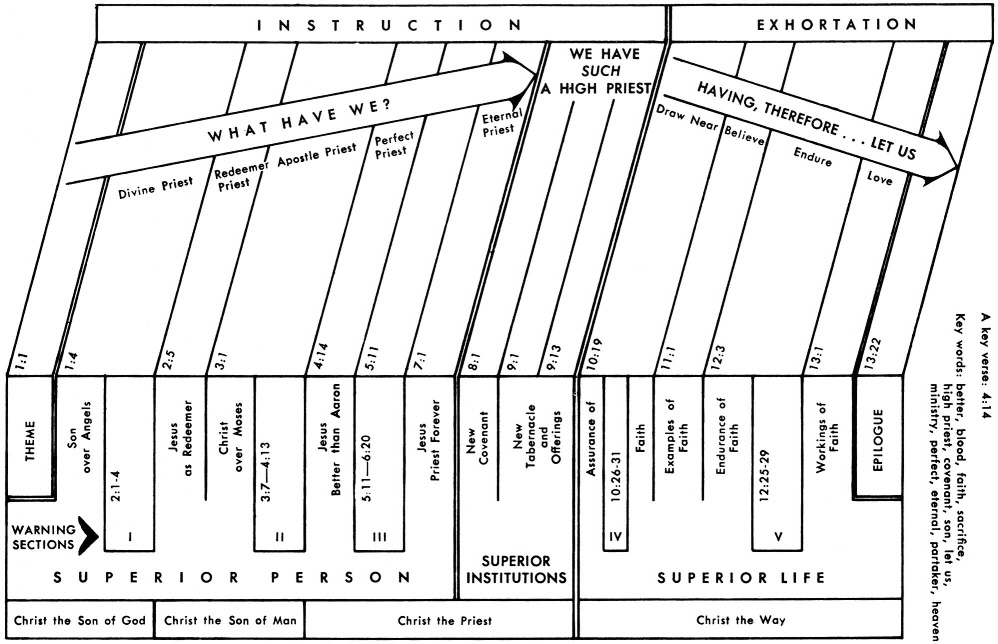
CONSIDER JESUS OUR GREAT HIGH PRIEST
Click chart to enlarge
Charts from Jensen's Survey of the NT - used by permission
Hebrews - Charles Swindoll
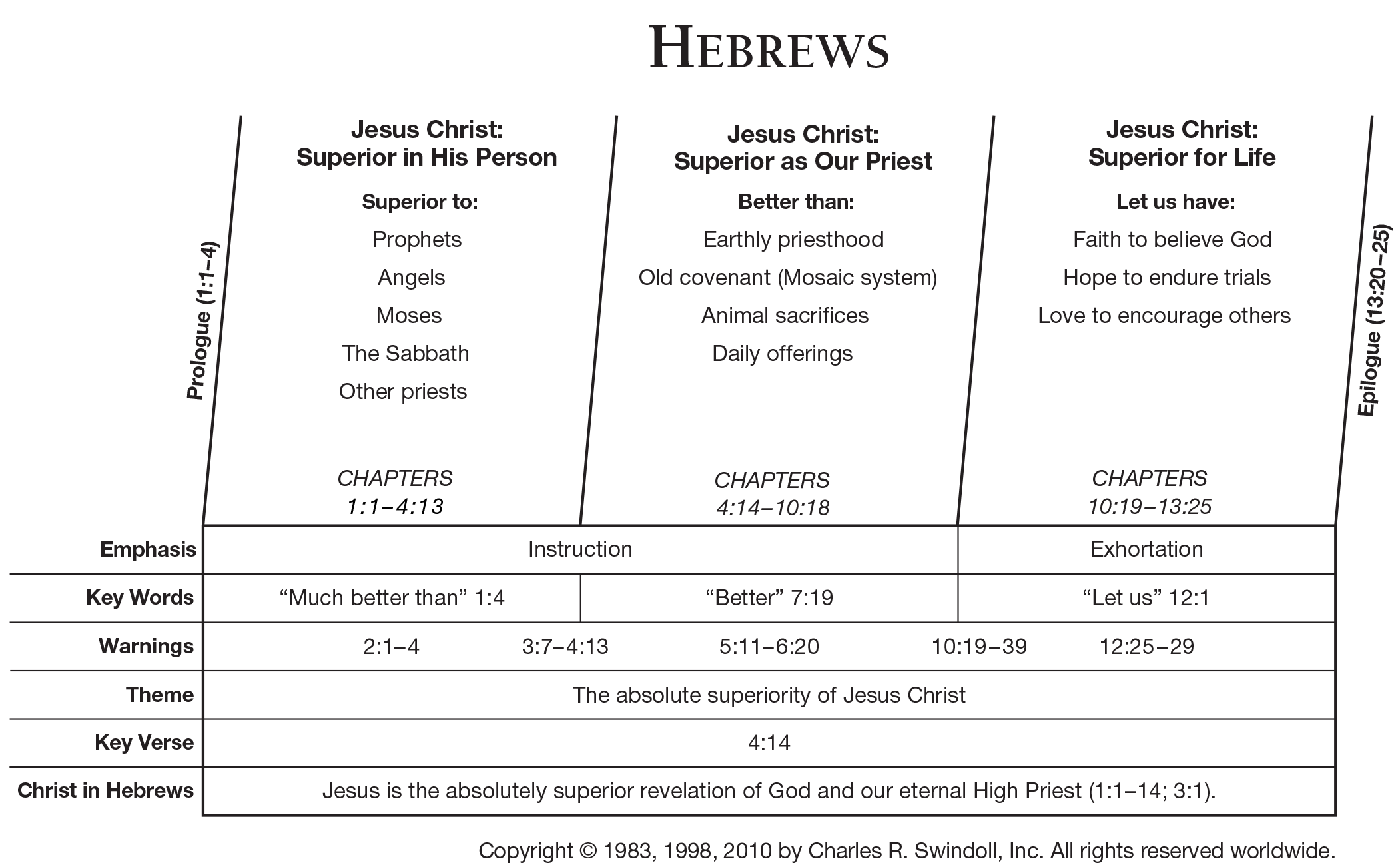
|
The Epistle |
||||
| INSTRUCTION Hebrews 1-10:18 |
EXHORTATION Hebrews 10:19-13:25 |
|||
| Superior Person of Christ Hebrews 1:1-4:13 |
Superior Priest in Christ Hebrews 4:14-10:18 |
Superior Life In Christ Hebrews 10:19-13:25 |
||
| BETTER THAN PERSON Hebrews 1:1-4:13 |
BETTER PRIESTHOOD Heb 4:14-7:28 |
BETTER COVENANT Heb 8:1-13 |
BETTER SACRIFICE Heb 9:1-10:18 |
BETTER LIFE |
| MAJESTY OF CHRIST |
MINISTRY OF CHRIST |
MINISTERS FOR CHRIST |
||
|
DOCTRINE |
DUTY |
|||
|
DATE WRITTEN: |
||||

See ESV Study Bible "Introduction to Hebrews"
(See also MacArthur's Introduction to Hebrews)
Borrow Ryrie Study Bible
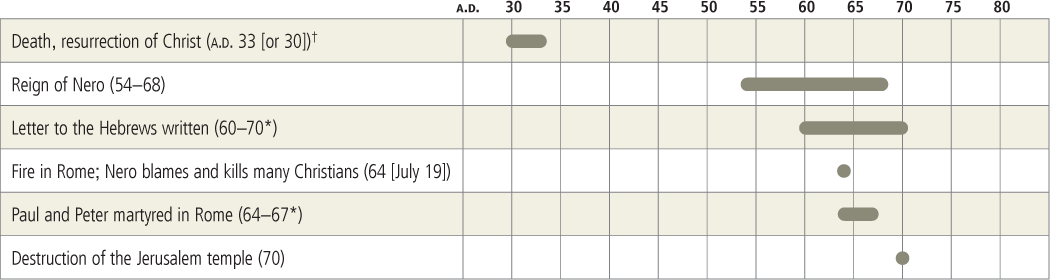
Timeline of Hebrews - ESV Study Bible
Hebrews 3:1 Therefore, holy brethren, partakers of a heavenly calling, consider Jesus, the Apostle and High Priest of our confession (NASB: Lockman)
Greek: Hothen, adelphoi hagioi, kleseos epouraniou metochoi, katanoesate (2PAAM) ton apostolon kai archierea tes homologias hemon Iesoun,
BGT Ὅθεν, ἀδελφοὶ ἅγιοι, κλήσεως ἐπουρανίου μέτοχοι, κατανοήσατε τὸν ἀπόστολον καὶ ἀρχιερέα τῆς ὁμολογίας ἡμῶν Ἰησοῦν,
Amplified: SO THEN, brethren, consecrated and set apart for God, who share in the heavenly calling, [thoughtfully and attentively] consider Jesus, the Apostle and High Priest Whom we confessed [as ours when we embraced the Christian faith]. (Amplified Bible - Lockman)
KJV: Wherefore, holy brethren, partakers of the heavenly calling, consider the Apostle and High Priest of our profession, Christ Jesus;
NKJ Therefore, holy brethren, partakers of the heavenly calling, consider the Apostle and High Priest of our confession, Christ Jesus,
NLT: And so, dear brothers and sisters who belong to God and are bound for heaven, think about this Jesus whom we declare to be God's Messenger and High Priest. (NLT - Tyndale House)
Phillips: So then, my brothers in holiness who share the highest of all callings, I want you to think of the messenger and High Priest of the faith we hold, Christ Jesus. (Phillips: Touchstone)
Weymouth: Therefore, holy brethren, sharers with others in a heavenly invitation, fix your thoughts on Jesus, the Apostle and High Priest whose followers we profess to be.
Wuest: Wherefore, brethren, set-apart ones for God and His service, participants in the summons from heaven, consider attentively and thoughtfully the Ambassador and High Priest of our confession, Jesus, (Hebrews )
Young's Literal: Therefore, holy brethren, partakers of a heavenly calling, consider Jesus, the Apostle and High Priest of our confession.
NET Therefore, holy brothers and sisters, partners in a heavenly calling, take note of Jesus, the apostle and high priest whom we confess,
CSB Therefore, holy brothers and companions in a heavenly calling, consider Jesus, the apostle and high priest of our confession;
ESV Therefore, holy brothers, you who share in a heavenly calling, consider Jesus, the apostle and high priest of our confession,
NIV Therefore, holy brothers, who share in the heavenly calling, fix your thoughts on Jesus, the apostle and high priest whom we confess.
MIT Therefore, holy brothers, partners sharing a call from heaven, consider the envoy and high priest featured in our confession—Jesus.
NJB That is why all you who are holy brothers and share the same heavenly call should turn your minds to Jesus, the apostle and the high priest of our profession of faith.
NRS Therefore, brothers and sisters, holy partners in a heavenly calling, consider that Jesus, the apostle and high priest of our confession,
RSV Therefore, holy brethren, who share in a heavenly call, consider Jesus, the apostle and high priest of our confession.
NAB Therefore, holy "brothers," sharing in a heavenly calling, reflect on Jesus, the apostle and high priest of our confession,
GWN Brothers and sisters, you are holy partners in a heavenly calling. So look carefully at Jesus, the apostle and chief priest about whom we make our declaration of faith.
BBE For this reason, holy brothers, marked out to have a part in heaven, give thought to Jesus the representative and high priest of our faith;
ASV Wherefore, holy brethren, partakers of a heavenly calling, consider the Apostle and High Priest of our confession, even Jesus;
- holy: Col 1:22 3:12 1Th 5:27 2Ti 1:9 1Pe 2:9 3:5 2Pe 1:3-10 Rev 18:20
- partakers: He 3:14 Ro 11:17 Ro 15:27 1Co 9:23 1Co 10:17 2Co 1:7 Eph 3:6 Col 1:12 1Ti 6:2 1Pe 5:1 2Pe 1:4 1Jn 1:3
- heavenly: Ro 1:6,7 8:28-30 9:24 1Co 1:2 Eph 4:1,4 Php 3:14 1Th 2:12 2Th 1:11 2:14 1Ti 6:12 2Ti 1:9 1Pe 5:10 2Pe 1:10 Jude 1:1 Rev 17:14
- Hebrews 3 Resources - Multiple Sermons and Commentaries
Related Passages:
Hebrews 2:11-12, 17 (HOLY BRETHREN) For both He who sanctifies (MAKES HOLY) and those who are sanctified (MADE HOLY) are all from one Father; for which reason He is not ashamed to call them BRETHREN (adelphos), 12 saying, “I WILL PROCLAIM YOUR NAME TO MY BRETHREN (adelphos), IN THE MIDST OF THE CONGREGATION I WILL SING YOUR PRAISE.”....17 Therefore, He had to be made like His BRETHREN (adelphos) in all things, so that He might become a merciful and faithful high priest in things pertaining to God, to make propitiation for the sins of the people.
Hebrews 10:19 Therefore, BRETHREN (adelphos), since we have confidence to enter the holy place by the blood of Jesus,
Colossians 1:22 yet He has now reconciled you in His fleshly body through death, in order to present you before Him HOLY (hagios) vand blameless and beyond reproach–
Colossians 3:12 So, as those who have been chosen (elect) of God, HOLY (hagios) and beloved, put on (aorist imperative see our need to depend on the Holy Spirit to obey) a heart of compassion, kindness, humility, gentleness and patience (cf Ro 13:14 - putting on Christ! This is how you do it - in your behavior like Christ, enabled by the Spirit of Christ!)
1 Peter 1:14-16 As obedient children, do not be conformed to the former lusts which were yours in your ignorance, 15 but like the HOLY (hagios) One who called you, be (aorist imperative see our need to depend on the Holy Spirit to be holy!) holy yourselves also in all your behavior; 16 because it is written, “YOU SHALL BE HOLY, FOR I AM HOLY.”
2 Timothy 1:9 Who has saved us and called us with a HOLY (hagios) calling, not according to our works, but according to His own purpose and grace which was granted us in Christ Jesus from all eternity,
Hebrews 3:14 For we have become partakers of Christ, if we hold fast the beginning of our assurance firm until the end,
2 Peter 1:4 For by these He has granted to us His precious and magnificent promises, so that by them you may become partakers of the divine nature, having escaped the corruption that is in the world by lust.
Philippians 3:14 I press on toward the goal for the prize of the upward call of God in Christ Jesus.
Ephesians 1:3 Blessed be the God and Father of our Lord Jesus Christ, who has blessed us with every spiritual blessing in the heavenly places in Christ,
Ephesians 1:20 which He brought about in Christ, when He raised Him from the dead and seated Him at His right hand in the heavenly places,
Ephesians 2:6 and raised us up with Him, and seated us with Him in the heavenly places in Christ Jesus,
Ephesians 3:10 so that the manifold wisdom of God might now be made known through the church to the rulers and the authorities in the heavenly places.

OUR HEAVENLY CALLING
CONCLUSION BASED ON
JESUS' SUPERIORITY
Therefore (dio - a strong logical connector = "for this reason," "because of what was said.") is a term of conclusion meaning that the following arguments could be deduced from what the writer had just taught in the preceding passages. What had he taught?
|
WHY CONSIDER JESUS? |
|
|
Jesus is Author of our salvation, perfected through suffering |
Heb 2:10 |
|
He calls believers His brothers |
Heb 2:11-12 |
|
He shares in flesh and blood to render powerless devil and death |
Heb 2:14-15 |
|
He became fully human to be our merciful and faithful High Priest |
Heb 2:17 |
|
He suffered and thus is able to help those who are being tempted |
Heb 2:18 |
If we go back farther in the text, we see that the writer has shown that God had spoken His final word in His Son Jesus (thus becoming an "Apostle" of God). He had emphasized that the Jews had a Messiah who surpassed their prophets and had a better name than the angels. He had warned them of the danger of drifting and the eternal danger of neglecting so great a salvation (Heb 2:1-3). Having made these points crystal clear to His Jewish readers, he will now move on to compare Jesus to one of the greatest heroes of the Jews, the man Moses. But in order to do this, he commands them to give full attention and consider Jesus.
Simon Kistemaker - The word therefore links chapter 3 to the immediately preceding discourse on the unity Jesus has with his brothers. Together they belong to the family of God. The brothers are holy because they are made holy by Jesus (Heb. 2:11), and on that account Jesus is not ashamed to call them brothers. In Heb 3:1 these people are, for the first time in Hebrews, specifically addressed as “holy brothers.” The adjective holy reveals that the brothers have been sanctified and may enter the presence of God, for sin has been removed through the suffering and death of Jesus. The term brothers also applies to the author of Hebrews. In fact, he is one of them in the family of God (Heb. 3:12; 10:19; 13:22).
Holy (hagios) brethren (adelphos) - Amplified has those "consecrated and set apart for God." This specific phrase occurs only here in NT. This designation would indicate that the author regards most of his Jewish readers as believers. In Hebrews 2:11 he had said they were "sanctified (hagiazo - MADE HOLY). So the writer appeals to his readers as brothers (adelphos), those who have been separated from the mass of sinful humanity by the new birth and who are thus blood bought, heaven bound and owing an allegiance to the One they had confessed. In short, we are family! John writes "as many as received Him, to them He gave the right to become children of God, even to those who believe in His name." (Jn 1:12) And again "See how great a love the Father has bestowed on us, that we would be called children of God; and such we are." (1Jn 3:1)
Sadly holiness is the forgotten doctrine
of the modern Church.Saints have been supernaturally set apart (sanctified by the Holy Spirit, 1Pe 1:2; 2Th 2:13, Ro 15:16, Acts 20:32, Acts 26:18, 1 Cor 1:30, 1Co 6:11) for a special purpose (cp Ep 2:10 - see God's Masterpiece, Mt 5:16, Php 2:15), set apart from the world (Gal 6:14, cp Jas 4:4, 1 Jn 2:15, 1 Jn 2:16, 1 Jn 2:17), the power of Sin and the fallen flesh (Ro 6:6, Ro 6:11, Ro 6:12, 13, 6:14) and the dominion of the devil (Col 1:13, Acts 26:18, Heb 2:14, 15) and unto the Lord Jesus Christ (Ro 14:7, 8, 9). Before salvation we patterned our life after the world, but as those who are holy ones, we have a new pattern, the Lord Jesus Christ. (See The Holy Spirit-Walking Like Jesus Walked!)
Holy describes every saint's POSITION in Christ. We are set apart from the secular, profane, evil and dedicated to the worship and service of God. The fundamental idea of "holy" is separation from sin, consecration to God, devotion to service of Deity, sharing in God’s purity and abstaining from earth’s defilement. Even among the pagans the idea of hagios was one dedicated to the gods and the worshipper of the pagan god acquired the character of that pagan god and the religious ceremonies connected with its worship. For example, the Greek temple at Corinth housed a large number of harlots who were connected with the "worship" of the Greek god. Of course, the "set-apartness" of the Greek worshipper was licentious and totally depraved.
The believer in the Lord Jesus is set apart for God by the Holy Spirit, out of the First Adam with the latter’s sin and condemnation, into the Last Adam with the latter’s righteousness and life (1Co 15:45). Thus, the worshipper of the God of the Bible partakes of the character of the God for whom he is set apart. This is positional sanctification, an act of God performed at the moment a sinner puts his faith in the Lord Jesus (1Cor 1:2). It occurs at the moment of justification by faith. The sanctifying work of the Holy Spirit in the yielded, believing saint, in which He sets the believer apart for God in his experience, by eliminating sin from his life and producing His fruit, is a process which goes on throughout the believer’s life, is called progressive sanctification (1Th 5:23, cf 2Co 3:18) (Click for discussion of Three Tenses of Salvation). Although every saint lives in the world, the man who is hagios must always in one sense be different from the world and separate from the world (Jn 17:11, 14, 16, 17). His standards are not the world's standards.
Kenneth Wuest - The word “holy” (hagios) here does not have particular reference to a quality of life but to a position in salvation (ED: WHILE I UNDERSTAND WUEST'S POINT IN EMPHASIZING THE FACT THAT "HOLY" REFERS TO POSITION, WE WOULD BE REMISS TO NOT ACKNOWLEDGE THAT HOLY POSITION SHOULD RESULT IN HOLY PRACTICE! OTHERWISE, ONE MUST QUESTION WHETHER SUCH A PERSON IS TRULY SET APART FOR GOD IF HE OR SHE DOES NOT LIVE A GOD HONORING LIFE. OF COURSE WE ARE SPEAKING OF "DIRECTION" OF ONE'S LIFE, NOT "PERFECTION" BECAUSE THAT WILL NOT OCCUR UNTIL WE ARE GLORIFIED!). The Greek word means “set apart for God.” Thus, the basic idea of the word is that of a set-apart, a separated position with reference to God. The term “holy brethren” here refers to the New Testament believers, the saints, set-apart ones. We must remember in this connection that this epistle is addressed to the professing Church, made up of real believers and also of those who gave only an intellectual assent to the Word. The writer, knowing in his heart that some were not saved, yet addresses them upon the basis of their profession, not upon that of his own estimation of their spiritual status. But the words “holy brethren” could be used of the Old Testament saints. Therefore, to distinguish these from the former, the writer adds the words “partakers of the heavenly calling.” (Hebrews Commentary - essentially verse by verse)
C H Spurgeon - What wonderful titles! “Holy brothers,” made brothers in holiness and made holy in our brotherhood—“sharers in a heavenly calling”—called of God from among the worlds. Our occupation and our calling henceforth is to serve the Lord. Heavenly calling means a call from heaven. If man alone call you, you are uncalled. Is your calling of God? Is it a call to heaven as well as from heaven? Unless you are a stranger here (1Pe 1:1, 1Pe 2:11), and heaven is your home, you have not been called with a heavenly calling. For those who have been so called declare that they look for a city which has foundations, whose builder and maker is God, and they themselves are strangers and pilgrims upon the earth.
PARTAKERS OF A
HEAVENLY CALLING
Partakers (metochos) of a heavenly (epouranios) calling (klesis) - Partakers (sharers) implies full involvement in something, not a distant association. As brethren, we share in a heavenly calling. Heavenly calling indicates that the partakers had received the call from heaven, where calling refers to a divine summons to salvation (See Effectual Call below). Not only was the call from heaven, but it it led to heaven. The fact that it was from heaven emphasizes that it was initiated by God. The idea is that partakers (believers) share not only in the invitation invited by God into salvation but also share in the common destiny of heaven. The upshot is that their destiny is heavenly, not earthly (not the earthly temple in Jerusalem but the heavenly throne of God!). One could paraphrase it this way "Since you are brothers and sisters whom God has set apart for Himself, and since you share in a divine calling that originates from heaven and leads to heaven, fix your attention fully on Jesus Who is now in heaven."
In Hebrews 11, the hall of faith chapter, the writer describes those who by faith pleased God and who "desire a better country, that is a heavenly one. Therefore God is not ashamed to be called their God; for He has prepared a city for them." (Hebrews 11:16)
And again the writer explains their "heavenly calling" (epouranios) declaring to his readers that "you have not come to a mountain that may be touched and to a blazing fire, and to darkness and gloom and whirlwind…But you have come to Mount Zion and to the city of the living God, the heavenly Jerusalem, and to myriads of angels, to the general assembly and church of the first-born who are enrolled in heaven, and to God, the Judge of all, and to the spirits of righteous men made perfect, and to Jesus, the mediator of a new covenant, and to the sprinkled blood, which speaks better than the blood of Abel." (Hebrews 12:18-24)
🙏 THOUGHT - In light of the truth that we too have a heavenly calling, we all do well to obey (enabled by the Spirit) Paul's two commands calling for Vertical (heavenly) Vision - "Therefore if (1st class condition = "since") you have been raised up with Christ, keep seeking (present imperative -- see our need to depend on the Holy Spirit to obey) the things above, where Christ is, seated at the right hand of God. 2 Set your mind (present imperative see our need to depend on the Holy Spirit to obey) on the things above, not on the things that are on earth. 3 For you have died and your life is hidden with Christ in God. 4 When Christ, Who is our life, is revealed, then you also will be revealed with Him in glory (GLORIFICATION)." (Colossians 3:1-4) These two commands beg two simple questions - Dear alien and stranger (1Pe 2:11), citizen of heaven (Phil 3:20-21), what are you seeking and where are you setting your mind today (and also this past week and this coming week)? Are you eagerly, anxiously, expectantly looking (prosdechomai - present tense = continually, daily) for your "blessed hope and the appearing of the glory of our great God and Savior, Christ Jesus." (Titus 2:13)? If not, ask the Spirit to renew your mind (Eph 4:23) and supernaturally transform your thinking (Ro 12:2, cf 2Co 3:18). That is a prayer the Spirit will answer!
And one other thought to ponder to encourage your burdened soul, "in heavenly places" is in some manner (which I do not fully comprehend cf 1Co 13:12) true of these Hebrew believers and also true of us, beloved, for Paul writes that believers in Christ have been raised up "with Him, and seated...with Him in the heavenly places (epouranios) in Christ Jesus" (Eph. 2:6) Amazing grace indeed! Hallelujah! Amen!
Hebrews 3 further explains who are genuine holy brethren and partakers of the heavenly calling. In Hebrews 3:6 and Hebrews 3:14 the writer describes perseverance in the faith as proof that one has become a partaker of true salvation. What would be the opposite of persevering? In Hebrews 2:1 the readers were warned of the danger of drifting away from the moorings of the Gospel. In Hebrews 6:6 the writer describes falling away from the faith as lack of evidence of salvation. Stated another way, the one who does not persevere in the faith, shows that they had never become a partaker of the free gift of salvation in Christ Jesus. Why? Because I am not an Arminian but I believe once truly saved, saved forever! It seems clear that the present writer agrees that one cannot be truly in Christ and then out of Christ at a later time (See Can you lose your salvation?).
In the Old Testament everything had to do with a place;
in the New Testament everything has to do with a Person....
For the Hebrew of old it was a matter of being in Canaan;
for us today it is a matter of being in Christ.
I love John Phillips' comment on heavenly calling - The believer in Christ is also given a heavenly calling, in contrast to the calling of the Hebrew people, which was essentially earthly. In the Old Testament everything had to do with a place; in the New Testament everything has to do with a Person. In the Old Testament, to be in the sphere of blessing, the Jew had to be in the land, so much so that any time we see the Jew outside the land, he is in the place of punishment and correction and cut off from the blessing associated with the land. In the New Testament, to be in the sphere of blessing we must be "in the Lord." For the Hebrew of old it was a matter of being in Canaan; for us today it is a matter of being in Christ. Thus Paul reminds us repeatedly that our sphere is "in the heavenlies" in Christ (see Eph. 1:3, Eph 1:20; Eph 2:6; Eph 3:10). (Borrow Exploring Hebrews page 48)
William Barclay on our heavenly calling - The call that comes to Christians has a double direction. It is a calling from heaven and it is a calling to heaven. It is a voice which comes from God and calls us to God. It is a call which demands concentrated attention because of both its origin and its destination. No one can afford merely to glance without interest at an invitation to God from God.
Marcus Dodds on heavenly calling - "In the word 'heavenly' there is struck for the first time, in words at least, an antithesis of great importance in the Epistle, that of this world and heaven, in other words, that of the merely material and transient, and the ideal and abiding. The things of the world are material, unreal, transient: those of heaven are ideal, true, eternal. Heaven is the world of realities, of things themselves (Hebrews 9:23) of which the things here are but 'copies'" (Davidson). (Expositor's Greek NT )
In effect the writer demonstrates the superiority of Christianity to Judaism. Judaism was an earthly calling with an earthly inheritance. Christianity is a spiritual and heavenly calling with a spiritual and heavenly inheritance. It is, therefore, far superior.
Paul alludes to this "heavenly calling" writing to the saints at Philippi “I press on toward the goal for the prize of the upward call of God in Christ Jesus… For our citizenship is in heaven, from which also we eagerly wait for a Savior, the Lord Jesus Christ” (Php 3:14 Php 3:20). Our true home is in heaven and we live spiritually right now in heavenly places (Ep 1:3; Ep 2:6). As true believers we are brothers of Jesus by position and are thereby holy. We are only strangers and pilgrims on earth. Our bodies are in this world but we do not really belong here.
The writer is saying in essence to his Christian Jewish readers some of whom are being tempted to fall back into Judaism, but YOU ARE NOT HOME YET. You are citizens of the heavenlies, so why don’t you let go of the earthly things? Why do you want to hang on to the earthly rituals, the earthly symbols, when you have the heavenly reality?” How liberating is the truth that we as Christians do not need religious ritual because we have spiritual reality. Jesus said that now since He had come anyone who wanted to truly worship the Father truly, must do so in spirit and in truth, not in rituals and ceremonies (John 4:23). There is no place in biblical Christianity for externalism because Christians have continual access to unseen but unchanging spiritual reality.
Philip E Hughes - The heavenly call in which as “holy brethren” they share indicates that the vocation of the Christian has reference to the perfection of heaven, not to the imperfection of earth understood as the environment of man’s fallenness.2 The origin of the call is God, “our Father in heaven” (Mt. 6:9; 7:11); and the church of God, the ecclesia,3 is precisely the company or brotherhood of those whom God has called out for himself from this fallen world.4 The call, moreover, is heavenly in the end to which it leads as well as in the origin from which it springs. It is “the upward call” (Phil. 3:14)5 summoning the Christian to a heavenly homeland (Heb. 11:16)6 and to the heavenly Jerusalem (Heb. 12:22).7 Further, as our author solemnly warns in 12:25ff., to turn a deaf ear to him who speaks from heaven can mean only perdition. (A Commentary on the Epistle to the Hebrews - Page 125)
Richard Phillips - The Book of Hebrews was written to exhort Christians under fire to stand firm in their faith in Jesus Christ. The opening passage of chapter 3 exemplifies that thrust, both beginning and ending with an exhortation to endurance. It begins by encouraging us to fix our thoughts on Jesus Christ and concludes by exhorting us to hold on to our courage and hope. Verse 1 could very well belong to the previous chapter, which concluded by stressing that Jesus, having overcome sin and temptation, is able to help those who are being tempted. "Therefore," the writer concludes, "consider Jesus." Since Jesus is the One who conquered death and the devil and sin, the author reasons, "make him the conscious object of your faith." He calls his readers "holy brothers" and those "who share in a heavenly calling," and identifies them as both the recipients of Christ's work and those who are thus obliged to live for him.
William MacDonald - Their heavenly calling is in contrast to the earthly call of Israel. Old Testament saints were called to material blessings in the land of promise (though they did have a heavenly hope as well). In the Church Age, believers are called to spiritual blessings in the heavenlies now and to a heavenly inheritance in the future. (Borrow Believer's Bible Commentary page 2164)
Heavenly Calling - heavenly calling’ is translated ‘who are bound for heaven’ [NLT]. It means that the calling has a heavenly source [Blm, EGT, Lg, My], it is of a heavenly nature [HNTC, NIC], it comes from God [EBC, Hu, Lns, Wst; CEV, TEV]. Christ from heaven calls Christians to heaven [NIGTC]. It indicates that Christians are called to heaven [HNTC, Hu], into God’s presence [WBC]. It refers to perfection in heaven [Hu]. It is heavenly in origin, in quality, and in its goal [Mil]. (An Exegetical Summary of Hebrews - Page 85)
Let me suggest a great prayer to pray regarding our heavenly calling...
I pray that the eyes of your heart may be enlightened, so that you will know (eido = KNOW BEYOND A SHADOW OF A DOUBT) what is the hope (HOPE SURE, NOT HOPE SO!) of His calling, what are the riches of the glory of His inheritance in the saints, 19 and what is the surpassing greatness of His power toward us who believe. These are in accordance with the working of the strength of His might (Ephesians 1:18-19)
John Owen - Who share in the heavenly calling. The apostle describes them as those who share in the heavenly calling. This is usual with our apostle, who uses similar phrases such as “called to be saints,” and “sanctified in Christ Jesus.” He describes the quality of this calling or vocation. It is a heavenly calling, or “super-celestial”; or, as elsewhere, “the calling that is from above.” It is a heavenly calling because of where it comes from: that is, from God, the Father, who is in heaven. As it is with our election, so our calling is ascribed to the Father in a special way (see Romans 8:28–30; 1 Corinthians 1:9; Galatians 5:8; Philippians 3:14; 1 Thessalonians 2:12; 1 Peter 1:15; 2:9; 5:10). For no one can come to the Son unless the Father draws him. Believers are rightly termed “those who are called to belong to Jesus Christ” (Romans 1:6).
John Piper on heavenly calling - We Need a Word from God and a Way to God - Christians are people who have heard and believed a heavenly calling, and are therefore partakers of it, sharers in it—“holy brethren, partakers of a heavenly calling.” It is a heavenly calling because it comes from heaven—from God. And it is a heavenly calling because it invites us and leads us to heaven—to God.
In other words this “heavenly calling” relates to the two great needs that we have: a word from God and a way to God. It’s a heavenly calling, which means it is a word from heaven, a word from God. And it’s a calling, which means it is meant to show us the way home to God. Christians are people who have been gripped by this calling. The word of God broke through our resistance, and took hold of us with the truth and love of Christ, and reconciled us to God and is now leading us home to heaven. This means that Christians are people of great hope. God has spoken from heaven, and made a way to heaven, and we have believed and our hope and confidence are firm.
And the reason our hope and confidence are firm is not because of ourselves. There are sinners of every kind in this room this morning—sexual sinners, lying sinners, stealing sinners, killing sinners, parent-disobeying sinners. The hope of a heavenly calling does not hang on our righteousness. If it did we would be hopeless. Our hope and confidence hang on Jesus. This is why verse 1 continues: “Therefore, holy brethren, partakers of a heavenly calling, consider Jesus.” This is what we are doing this morning. This is what preaching is about. It is what Sunday School is about. It is what small groups are about. Considering Jesus. (full sermon Jesus: Worthy of More Glory than Moses)
Holy (40) hagios = set apart ones, separated ones, sanctified ones, holy ones) is literally a holy one and properly means different, set apart, distinct, holy. It describes one who is set apart for or by God and can be brought near or into God's holy presence. "Its fundamental idea is separation, consecration, devotion to the service of Deity, sharing in God's purity and abstaining from earth's defilement." (Zodhiates - BORROW The Complete Word Study Dictionary: New Testament) So depending on the context hagios refers to whoever or whatever is set apart (sanctified) for a special purpose. W E Vine says the main thought of hagios as it was used in the secular world was "separated (among the Greeks, dedicated to the gods), and hence, in Scripture in its moral and spiritual significance, separated from sin and therefore consecrated to God, sacred."
Hagios is used throughout the New Testament to speak of anyone or anything that represents God’s holiness: Christ as the Holy One of God, the Holy Spirit, the Holy Father, holy Scriptures, holy angels, holy brethren, and so on. The secular and pagan use pictured a person separated and dedicated to the idolatrous "gods" and carried no idea of moral or spiritual purity. The man made gods were as sinful and degraded as the men who made them and there simply was no need for a word that represented righteousness! The worshipper of the pagan god acquired the character of that pagan god and the religious ceremonies connected with its worship. The Greek temple at Corinth housed a large number of harlots who were connected with the "worship" of the Greek god. Thus, the set-apartness or holiness of the Greek worshipper was in character licentious, totally depraved, and sinful.
HAGIOS IN HEBREWS - Heb. 2:4 = Holy Spirit; Heb. 3:1 = Holy brethren; Heb. 3:7 = Holy Spirit; Heb. 6:4 = Holy Spirit; Heb. 6:10 = Saints; Heb. 8:2 = sanctuary; Heb. 9:1 = sanctuary; Heb. 9:2 = holy place; Heb. 9:3 = Holy of holies; Heb. 9:8 = Holy Spirit; Heb. 9:12 = Holy place; Heb. 9:24 = Holy place; Heb. 9:25 = Holy place; Heb. 10:15 = Holy Spirit; Heb. 10:19 = Holy place; Heb. 13:11 = Holy place; Heb. 13:24 = Saints
Holy ones (Saints) are figuratively spoken of as a holy temple (1Co 3:17 = a local church) a holy priesthood (1Pe 2:5), a holy nation (1Pe 2:9). Saints are now to live in this present evil age (Gal 1:4) in a manner which reflects what we were redeemed and "re-created" to be (1Pe 2:24, 25+; cp 2Cor 7:1) --- holy ones in character (character is what God knows we are; reputation is who other people think we are) and conduct, set apart by God to be exclusively His possession (1 Cor 6:19, 20, Titus 2:14) manifesting holiness of heart.
The fundamental ideas of a saint include…
- One who is separated from sin (cf Ro 6;11, 12, 13, 14)
- One who then has the responsibility to choose to consecrate themselves daily to God as "living sacrifices" (Ro 12:1)
- One who is devoted to His service
- One who is a partaker of the divine nature (2Pe 1:4)
- One who continually chooses (enabled by the Spirit) to abstain from worldly defilement (1Th 4:3 1Th 5:22, 2Ti 2:19, 1Pe 2:11)
Contrary to some religious teachings, the Bible itself never uses the word hagios or saint to refer to a "special class" of believers who are a "notch above" the rest. We are all equal at the foot of His Cross! (cp 2 Cor 3:5,6, saints have "a faith of the same kind" as Peter! - 2Pe 1:1) To reiterate, those who are holy in position (in Christ) now have the responsibility (and the power) to live holy in their experience (Christ like). Positional holiness is tantamount to justification, while experiential holiness represents progressive sanctification (growth in holiness or Christ likeness). (See related topic - Three Tenses of Salvation)
ILLUSTRATION - Dr. Harry Ironside tells the story about sitting with four nuns on a train. Roman Catholics erroneously believe that Christians become saints if they have lived good enough lives but they are not made saints at salvation as the Bible teaches. Dr. Ironside asked them, “Have you ever seen a saint?” “No,” they replied. Would you like to see one?” Ironside asked. “Oh yes,” the nuns replied. Dr. Ironside pointed at himself and said, “You are looking at one.” He then said, “I am a saint; I am Saint Harry!” He took them to verses in the Bible, such as this one, to show that every Christian is a saint.
Steven Cole - As a saint, a person set apart unto God, you are not to withdraw into a monastery, or to withdraw from our culture, as the Amish folks do. You are to live in the culture, but to live distinctly from the culture, as one set apart unto God. Just as it would be odd for a wealthy man to live homeless on the streets, or it would be strange for an adult to spend great amounts of time playing as a child, because such behavior is opposed to their true identity, so it should be odd for a Christian, a saint, to live in the same manner as those who are not set apart unto God. Your attitudes, your values, your speech, your selfless focus, your humility, your love, your commitment to truth, should mark you as a saint in Christ Jesus." (Philippians 1:1-2 The Foundation for Joy)
Friberg summary of hagios -
(1) of things set apart for God's purpose dedicated, sacred, holy (Mt 4.5), opposite koinos (not consecrated, common);
(2) of persons holy, pure, consecrated to God (Lk 1.70);
(3) of supernatural beings, as God (Jn 17.11), Christ (Lk 1.35), the Spirit of God (Mk 12.36), angels (Mk 8.38) holy;
(4) superlative - most holy, very pure or sincere (Jude 1:20);
(5) as a substantive; (a) the Holy One, as a designation for God (1 Jn 2.20) and Christ (Mk 1.24); plural - the holy ones, as a designation for angels (1Th 3.13 ); as human beings belonging to God saints, God's people, believers (Acts 9.13); (b) neuter - what is holy, what is dedicated to God (Mt 7.6); as a place dedicated to God sanctuary, holy place (Heb 9.1); plural - holy place, (outer) sanctuary (Heb 9.2); most sacred place, inner sanctuary, very holy place (Heb 9.3) (BORROW Analytical Lexicon of the Greek New Testament)
Brethren (80) adelphos from a = denoting unity + delphús = womb) is literally those born from same womb and figuratively generally denotes a fellowship of life based on identity of origin, e.g., members of the same family (the same "delphus" or womb so to speak. Figuratively, adelphos describes members of the Christian community, spiritual brother, fellow Christian, fellow believer (Ro 8.29). Jews used adelphos to describe fellow countrymen (Acts 3:22). One of the same nature, a fellow man was regarded as a brother (Mt. 5:22–24, 47).
Jesus uses adelphos to speak of His brethren (Mt. 25:40; 28:10; John 20:17; Rom. 8:29; Heb. 2:11, 17).
The members of the same Christian community are called brothers (Jn 21:23; Acts 9:30; Rom. 16:14; 1 Cor. 7:12).
ADELPHOS IN HEBREWS - Heb. 2:11; Heb. 2:12; Heb. 2:17; Heb. 3:1; Heb. 3:12; Heb. 7:5; Heb. 8:11; Heb. 10:19; Heb. 13:22; Heb. 13:23
Partakers (3353) (metochos from metecho = have with, participation with another in common blessings > from metá = with, denoting association + écho = have) describes one who shares with someone else as an associate in an enterprise or undertaking. It speaks of those who are participators in something. Business partner, companion. Participating in. Accomplice in. Comrade. It means to be one who has a share in the possession of something. Here it describes those who share in a Heavenly calling or have held, or will hold, a regal position in relation to the earthly, Messianic Kingdom. It is notable that although metochos is used to describe believers in Hebrews 3:14 it explains that these are those who hold fast to the end, the point being that one proves he is a true partaker by holding fast to the end!
Wuest says metochos "speaks of one who is associated with others in a common task or condition. Here the word designates the saints as those who are associated with one another in a heavenly calling." (Hebrews Commentary - essentially verse by verse)
METOCHOS 6X - Lk 5:7 = they signaled to their partners in the other boat; Heb 1:9 - "Thy companions;" Heb 3:1 - partakers of a heavenly calling; Heb 3:14 = partakers of Christ; Heb 6:4 = partakers of the Holy Spirit; Heb 12:8 = all have become partakers.
Heavenly (2032) epouranios from epi = upon + ouranos = heaven) means celestial, what pertains to or is in heaven, that is, upon heaven or existing in heaven (RWP), not the heavenly body of human beings or angels
EPOURANIOS - 19V - heaven(1), heavenly(14), heavenly one(1), heavenly things(3). Jn. 3:12; 1 Co. 15:40; 1 Co. 15:48; 1 Co. 15:49; Eph. 1:3; Eph. 1:20; Eph. 2:6; Eph. 3:10; Eph. 6:12; Phil. 2:10; 2 Tim. 4:18; Heb. 3:1; Heb. 6:4; Heb. 8:5; Heb. 9:23; Heb. 11:16; Heb. 12:22. One time in Ps 68:14.
Friberg - (1) as an adjective, with reference to heaven as the dwelling of God and what belongs there heavenly (Heb 12.22), opposite evpi,geioj (earthly); (2) substantivally; (a) hoi` epouranioi - dwellers in heaven, heavenly beings (Phil 2.10); (b) ta epourania - what is derived from God = heavenly things, divine or spiritual things (Jn 3.12); (c) ta epourania = as the dwelling place of God heaven, the heavenly world, the heavenly places ( Eph 3.10); (3) as an adjective, with reference to the sky as the realm of the sun, moon, and stars in the sky, celestial ( 1Co 15.40) (Borrow Analytical Lexicon of the Greek New Testament)
NIDNTT (in depth online resource) - CL ouranos, heaven, possibly related to an Indo-European root meaning water,rain, means that which moistens or fructifies. The related adj. ouranios means what is in heaven, comes from heaven, or appears in the heavens, i.e. heavenly. But it can also mean what is appropriate to a god, i.e. divine, and can even stand for god or the deity. On the other hand, it can mean simply that which belongs to the firmament or sky. epouranios means in heaven, belonging to the divine heaven.
BDAG - 1. pert. to being in the sky or heavens as an astronomical phenomenon, celestial, heavenly somata ev. (opp. ,geia) celestial bodies 1 Cor 15:40 (acc. to vs. 1Co 15:41 the sun, moon, and stars are thought of, and are represented fig., as living beings clothed in light; 2. pert. to being associated with a locale for transcendent things and beings, heavenly, in heaven (Borrow A Greek-English lexicon of the New Testament, and other early Christian literature)
Gilbrant - Classical Greek The adjective epouranios means “heavenly” (from epi , “at,” and ouranios, “heavenly”), or in a substantive usage either “the gods above” (hoi epouranioi) or the “things (i.e., phenomena) of heaven” (neuter, ta epourania). The emphasis of the term is on the location—not in the sense of “sky” but as the dwelling place of the divine. Epouranios is relatively rare in the Septuagint, being found only at Psalm 68:14 (LXX 67:14) in the canonical Scriptures in reference to “the Almighty” (RSV; Hebrew shadday). Theodotion (Codex Alexandrinus) reads epouranios at Daniel 4:26 (4:23 Masoretic Text) instead of ouranios. Second Maccabees writes of God “dwelling in heaven” (RSV; ho tēn katoikian epouranion, 3:39; cf. 3 Maccabees 6:28; 7:6). Epouranios is descriptive of God only in a variant reading in Matthew 18:35. Modern critical versions read ho ouranios. The Gospel of John records the only other Gospel text with epouranios (Jn 3:12). There Jesus contrasted “heavenly things” (ta epourania) with “earthly things” (ta epigeia). A similar contrast occurs in Paul’s writings (1 Corinthians 15:40; cf. 15:48,49; Philippians 2:10). Ephesians has the repeated formula en tois epouraniois, “in the heavenly (places)” (Eph 1:3,20; 2:6; 3:10; 6:12). This should not be considered as solely the residence of God, for in “the heavenlies” (“high places” KJV) there is warfare against “spiritual wickedness,” evil of a supernatural order (Ephesians 6:12). En tois epouraniois is the cosmic level at which the effects of salvation are realized (Ephesians 2:6; cf. 2 Timothy 4:18) and at which the battle is both fought and won (Ephesians 6:12). Hebrews considers “heavenly” as descriptive of the present effects of the sacrifice of Christ (3:1), especially as over against the former “shadow.” Thus the “heavenly,” which is far superior to the former, is realized in the present by faith. Moreover, it will be realized in actuality in the future (Hebrews 8:5; 9:23; 11:26; 12:22). (Complete Biblical Library)
Calling (2821) (klesis) means a call and was used for an invitation to a banquet. In the NT the word is used metaphorically of the call or invitation to come into the kingdom of God with all its privileges. Here "klesis" refers to the divine call by which Christians are introduced into the privileges of the gospel. God’s invitation (klesis) to man to accept the benefits of His salvation is what this calling is all about, particularly in the gospels. It is God’s first act in the application of redemption according to His eternal purpose (Ro 8:28). A distinction is made between God’s calling and men’s acceptance of it (Mt 20:16). For more in discussion see Called = kletos.
KLESIS - 11x in the NT - Rom. 11:29; 1 Co. 1:26; 7:20; Eph. 1:18; 4:1, 4; Phil. 3:14; 2 Thess. 1:11; 2 Tim. 1:9; Heb. 3:1; 2 Pet. 1:10
The called are those who have been summoned by God… called… (the following phrases are meant to be read as one long sentence which gives a Biblical statement regarding calling)… called…
- according to His purpose (Romans 8:28-)
- to salvation (Romans 8:30)
- saints by calling (1Cor 1:2)
- both Jews and Greeks (1Cor 1:24)
- having been called "with a holy" (2 Timothy 1:9)
- heavenly calling (Hebrews 3:1)
- out of darkness into His marvelous light (1 Peter 2:9)
- to walk worthy (Ephesians 4:1- )
- by grace (Gal 1:6)
- not from among Jews only, but also from among Gentiles (Romans 9:24)
- through the "gospel" that we "may gain the glory of our Lord Jesus Christ" (2Th 2:14)
- and be brought "into fellowship with His Son, Jesus Christ our Lord" (1Cor 1:9)
- and return in triumph "with Him" at the end of this age (Revelation 17:14).
God's great doctrine of our calling should cause all the "called of Jesus Christ" to exclaim "Glory!"
CONSIDER JESUS OUR SUPERIOR HIGH PRIEST
I. GOD SPOKE IN JESUS:
A. JESUS: BETTER THAN ANGELS (Heb 1:1-2:18)
B. JESUS: BETTER THAN MOSES (Heb 3:1-6)
C. JESUS: SOURCE OF REST (Heb 3:7-4:13)
D. JESUS: BETTER PRIESTHOOD (Heb 4:14-7:28)
E. JESUS: MEDIATOR OF BETTER COVENANT (Heb 8:1-10:18)
II. DON'T REFUSE JESUS WHO IS SPEAKING:
A. DON'T GO ON SINNING WILLFULLY
B. HOLD FAST AND PERSEVERE
C. LAY ASIDE EVERY ENCUMBRANCE AND THE SIN
D. FIX YOUR EYES ON JESUS
E. ACCEPT DIVINE DISCIPLINE
F. SELECT EXHORTATIONS IN HEBREWS 13
G Campbell Morgan —Hebrews 3.1
Again we have an appeal based upon what has already been written. Having dealt with the humiliation of the Son, and shown that it had not detracted from His superiority to the angels, but rather enhanced it, in that such humiliation was in order to the doing of His saving, priestly work, the writer urged his readers to consider Him. We may link this appeal with the previous one. The sure way in which to "give earnest heed" to the message of the Son, and to be saved from "drifting," is to consider Him. That consideration is to be of Him in two ways, as Apostle and High Priest. Along these lines we are led in what follows. esus is "the Apostle ... of our confession." That marks the Divine authority of His message. He is the Sent of God. His pre-eminence in this matter is shown by comparing Him with Moses and Joshua. Moses was faithful as a servant in the house, but Jesus as a Son over the house. Moses led the people out, but could not lead them in. Jesus leads out of bondage and into the promised possessions. Joshua led the people in, but could not give them rest. Jesus gives rest. Jesus is also "the High Priest of our confession," and that is very fully developed. The whole emphasis of this verse is upon the necessity for considering Him. The idea is that of careful contemplation, attentive thinking. How sadly we often fail here. The holy exercise demands time, method, diligence, and wherever it is practised we are saved from drifting.
J C Philpot - "Therefore brethren, give diligence to make your calling and election sure; for if you do these things, you shall never fall." –2 Peter 1:10
Have you any testimony to your effectual calling? Has grace indeed laid hold of your heart? O that you might know more fully—more powerfully—what a blessed hope of eternal life is laid up in the bosom of this heavenly calling, that it might cheer and encourage you to press on more and more to realize all that is given you in Christ, both for here and hereafter, in present grace and in future glory! In knowing what is the hope of their effectual calling, the saints of God learn that this hope embraces all things which are made theirs in Christ, whether life or death, or things present or things to come, that all are theirs; and for this blessed and all-sufficient reason, that they are Christ's and Christ is God's. It is by making sure our calling that we make sure our election—for the one is the sure evidence of the other; and thus, if doubt and uncertainty hang over our calling, the same doubt and uncertainty must rest upon our election to eternal life. But as these doubts and fears are removed by the spirit of wisdom and revelation in the knowledge of Christ, and we can clearly see and fully believe that the grace of God effectually called us out of darkness into his marvelous light, then we see by faith what is laid up in the bosom of this calling, and what a glorious hope of eternal life is thereby afforded as an anchor of the soul, both sure and steadfast, and thus abound in hope through the power of the Holy Spirit.
C H Spurgeon - A Raging Thirst
In his Lectures To My Students, Charles Spurgeon defines the call of ministry by listing several of its attributes:
1. The first sign of the heavenly calling is an intense, all-absorbing desire for the work. In order to be a true call to the ministry there must be an irresistible, overwhelming craving and raging thirst for telling others what God has done for our own souls.
2. In the second place, combined with the earnest desire to become a pastor, there must be aptness to teach and some measure of the other qualities needful for the office of a public instructor.
3. In order further to prove a man’s call, after a little exercise of his gifts, such as I have already spoken of, he must see a measure of conversion-work going on under his efforts.
4. A step beyond all this is, however, needful in our inquiry. The will of the Lord concerning pastors is made known through the prayerful judgment of His church. It is needful as a proof of your vocation that your preaching should be acceptable to the people of God.*
Warren Wiersbe - Hanging On to Hope - Wiersbe Bible Commentary NT - Page 456
Read Hebrews 10:19–23
Let us hold unswervingly to the hope we profess, for he who promised is faithful. Hebrews 10:23
The readers of this epistle were being tempted to forsake their confession of Jesus Christ by going back to the old covenant worship. The writer did not exhort them to hold on to their salvation, because their security was in Christ and not in themselves. Rather, he invited them to hold fast to “the hope we profess” (v. 23).
We have noted in our study of Hebrews that there is an emphasis on the glorious hope of believers. God is “bringing many sons to glory” (Heb 2:10). Believers “share in the heavenly calling” (Heb 3:1) and therefore can rejoice in hope (Heb 3:6 KJV). Hope is one of the main themes of Hebrews 6. We are looking for Christ to return (Heb 9:28), and we are seeking that city that is yet to come (Heb 13:14).
When we have our hope fixed on Christ, and rely on the faithfulness of God, then we will not waver. Instead of looking back (as the Jews so often did), we should look ahead to the coming of the Lord (Heb 10:23–25).
Something to Ponder - If you knew for sure that Jesus would return two weeks from today, what would you want to do during the next two weeks? Which of these are things you should be doing anyway?
Preacher's Outline and Sermon Bible on heavenly calling - We have been called by Christ to live with God in heaven. We are not to live for this earth; we are to live for heaven. Therefore, our attention is to be fixed upon heaven, especially upon Christ who is our glorious Savior and who has made it possible for us to live in heaven.
Billy Graham - How Do You Define Success? Wisdom for Each Day (Large Text Leathersoft) - Page 340
Therefore, holy brothers, who share in the heavenly calling, fix your thoughts on Jesus. . . . He was faithful to the one who appointed him. HEBREWS 3:1–2 NIV
Recently a friend of mine went on the website of one of the major booksellers and searched for books with the word success in their title. Literally thousands were listed. Our world is obsessed with success.
What is success? The world has its measures: financial success, athletic success, business success, professional success, social success—the list is almost as endless as my friend’s website search. And most people spend their lives pursuing at least one of these.
But how does God define success? His measure is very different from the world’s measure, and it can be summed up in one sentence: in God’s eyes, success is faithfulness to His calling. Paul was a failure in the world’s eyes—but not to God. Even Jesus was a failure as far as most people were concerned, but “he was faithful to the one who appointed him”—and that is all that mattered.
What is your definition of success? Is it the same as God’s? And are you pursuing it?
Matthew Henry - Elijah found Elisha not in the schools of the prophets, not reading or praying, but plowing. Idleness is no man's honor, nor is farming any man's disgrace. An honest calling in the world does not put us out of the way of our heavenly calling.
Daily Light in the Daily Path - “You shall be to me a kingdom of priests and a holy nation.”
“You were slain, and by your blood you ransomed people for God from every tribe and language and people and nation, and you have made them a kingdom and priests to our God.”—But you are a chosen race, a royal priesthood, a holy nation, a people for his own possession, that you may proclaim the excellencies of him who called you out of darkness into his marvelous light.
You shall be called the priests of the Lord; they shall speak of you as the ministers of our God.—Priests of God and of Christ.
Therefore, holy brothers, you who share in a heavenly calling, consider Jesus, the apostle and high priest of our confession.—Through him then let us continually offer up a sacrifice of praise to God, that is, the fruit of lips that acknowledge his name.
For we are his workmanship, created in Christ Jesus for good works, which God prepared beforehand, that we should walk in them.—God’s temple is holy, and you are that temple.
Ex. 19:6; Rev. 5:9–10; 1 Pet. 2:9; Isa. 61:6; Rev. 20:6; Heb. 3:1; Heb. 13:15; Eph. 2:10; 1 Cor. 3:17
Martyn Lloyd-Jones - HEBREWS 3:1
What are the evidences for saying that Christ is God’s appointed High Priest? Well, it is interesting to observe that there is only one book in the Bible that describes Him directly and explicitly as Priest, and that is, of course, the Epistle to the Hebrews. Hebrews describes Him as such in a number of verses: “Wherefore, holy brethren, partakers of the heavenly calling, consider the Apostle and High Priest of our profession, Christ Jesus” (Heb 3:1). “Seeing then that we have a great high priest, that is passed into the heavens, Jesus the Son of God, let us hold fast our profession” (Heb 4:14). “So also Christ glorified not himself to be made an high priest; but he that said unto him, Thou art my Son, to day have I begotten thee” (Heb 5:5). “Whither the forerunner is for us entered, even Jesus, made an high priest for ever after the order of Melchisedec” (Heb 6:20). “For such an high priest became us, who is holy, harmless, undefiled, separate from sinners, and made higher than the heavens” (Heb 7:26). “We have such an high priest, who is set on the right hand of the throne of the Majesty in the heavens” (Heb 8:1).
But, of course, in many other places the teaching is implicit— by implication it is there. For instance, listen to our Lord Himself. He said, “For even the Son of man came not to be ministered unto, but to minister, and to give his life a ransom for many” (Mark 10:45). This is also something that is constantly taught by the apostle Paul. In Romans 3:24-25 he says, “Being justified freely by his grace through the redemption that is in Christ Jesus: Whom God hath set forth to be a propitiation through faith in his blood, to declare his righteousness for the remission of sins that are past, through the forbearance of God.”
There is only one book in the Bible that describes Him directly and explicitly as Priest—the Epistle to the Hebrews.
Called From and To
What we are called from and called to:
I. Called from labor to rest (Matt. 11:28)
II. Called from death to life (1 John 3:14)
III. Called from bondage to liberty (Gal 5:13)
IV. Called out of darkness into light (1 Pet. 2:9)
V. Called from bondage to peace (1 Cor. 7:15
VI. Called to the fellowship of His Son (1 Cor. 1:9)
What we are made by obeying the call:
I. We are made sons of God (John 1:12)
II. We are made the children of God (Gal. 3:26)
III. We are made the servants of God (Matt. 25:21)
IV. We are made God’s saints (Col. 1:1)
V. We are made God’s witnesses (I Thess. 2:10)
VI. We are made workers together with God (2 Cor. 6:1)
VII. We are called to a high calling (Phil. 3:14)
VIII. We are called to a holy calling (2 Tim. 1:9)
IX. We are called to a heavenly calling (Heb. 3:1)
Pulpit Helps, August, 1992, p. 11
PARTAKER “And our hope of you is stedfast, knowing, that as ye are partakers of the sufferings, so shall ye be also of the consolation” (II Cor. 1:7). “Because I have you in my heart; inasmuch as both in my bonds, and in the defence and confirmation of the gospel, ye all are partakers of my grace” (Phil. 1:7b). “Wherefore, holy brethren, partakers of the heavenly calling, consider the Apostle and High Priest of our profession, Christ Jesus” (Heb. 3:1). “For they verily for a few days chastened us after their own pleasure; but he for our profit, that we might be partakers of his holiness” (Heb. 12:10). “I … am also an elder, and a witness of the sufferings of Christ, and also a partaker of the glory that shall be revealed” (I Pet. 5:1).
ILLUSTRATION - NOT HOME YET - (Play song) - Just after the turn of the century, pioneer missionary Henry C. Morrison often told of coming home from one of his many travels, having carried the message of the gospel to foreign lands. He arrived in New York aboard the same ship that brought President Theodore Roosevelt from one of his safaris in Africa. Thousands swarmed the docks to greet the illustrious hunter, but not a person was there to welcome Morrison. "Aha!" said the devil. "See how they greet the men of the world, and you—one of God's preachers—do not even have one person to meet you." He boarded the train for his home in Wilmore, Kentucky, and after several weary and lonely hours arrived at the station. No one from his family met him, for there had been a delay in information concerning his time of arrival. His heart ached as he rode alone in a hired carriage to his house. After all, he had spent four decades in the Lord’s service. Humanly speaking, he had reason to complain; however, the Lord impressed upon him this thought: "Henry, you are not Home yet!" His lord said unto him, "Well done, good and faithful servant; thou hast been faithful over a few things, I will make thee ruler over many things. Enter thou into the joy of thy lord." (Matthew 25:23)
At death you won't leave home.
You will go home!
QUESTION - What is the effectual calling/call? | GotQuestions.org
ANSWER - The term effectual call, as related to salvation, comes from Chapter X of the 1647 Westminster Confession of Faith. The effectual call is understood as God’s sovereign drawing of a sinner to salvation. The effectual call to a sinner so overwhelms his natural inclination to rebel that he willingly places faith in Jesus Christ. The apostle Paul refers to the effectual call when he writes, “It is God who works in you to will and to act in order to fulfill His good purpose” (Philippians 2:13). The necessity of the effectual call is emphasized in Jesus’ words, “No one can come to Me unless the Father Who sent Me draws them” (John 6:44).
Paul further affirms that God must impress His will on the natural state of man when he writes that those who oppose God “must be gently instructed, in the hope that God will grant them repentance leading them to a knowledge of the truth” (2 Timothy 2:25).
The apostle Peter writes that God “called us by his own glory and goodness” (2 Peter 1:3). Peter’s use of the Greek word kaleo, which is translated “called,” expresses the action of God calling sinners. Whenever kaleo is used in the participial form, as it is in this passage, with God as the subject, it refers to the effectual call of God on sinners to salvation. Kaleo carries the idea that a sinner is being drawn to God rather than simply invited to come.
The effectual calling is more commonly known as “irresistible grace,” which is the I in the acronym TULIP. The doctrine of effectual calling is closely related to the doctrine of total depravity, the T in TULIP. Since the unregenerate man is “dead in transgressions and sins” (Ephesians 2:1), he is incapable of reaching out to God or responding to the gospel of Jesus Christ on his own. “There is no one righteous, not even one; there is no one who understands; there is no one who seeks God” (Romans 3:10–11). This state of total depravity makes the effectual calling of God necessary to give anyone the opportunity for salvation.
Jesus distinguishes between the general call that everyone receives by hearing the gospel
and the effectual call that leads to salvation.
Jesus said, “For many are invited, but few are chosen” (Matthew 22:14). In this statement, Jesus distinguishes between the general call that everyone receives by hearing the gospel and the effectual call that leads to salvation. The effectual call is also taught in passages such as Romans 1:6, where Paul greets the believers as those “who are called to belong to Jesus Christ”; and Acts 16:14, where Luke says of Lydia that “the Lord opened her heart to respond to Paul’s message.”
The effectual call, therefore, is God’s action toward the elect (See Doctrine of Election), those whom He chose in Christ “before the creation of the world to be holy and blameless...He predestined [them] for adoption to sonship through Jesus Christ” (Ephesians 1:4–5).
The general call, on the other hand, is for all of humanity, not just the elect. The famous passage, “For God so loved the world that he gave his one and only Son, that whoever believes in Him shall not perish but have eternal life” (John 3:16), portrays God’s general revelation to everyone in the world. The gospel is available to everyone, but, because of humanity’s sinful nature and total depravity, no one will turn to God without God first impressing Himself on them.
F B Meyer writes that "The contrast between the third and fourth chapters of this epistle is very marked. The former is like a drear November day, when all the landscape is drenched by sweeping rain, and the rotting leaves fall in showers to find a grave upon the damp and muddy soil. The latter is like a still clear day in midsummer, when nature revels in reposeful bliss beneath the unstinted caresses of the sun. There is as much difference between them as between the seventh and eighth chapters of the Epistle to the Romans. But each chapter represents an experience of the inner Christian life. Perhaps the majority of Christians live and die in the third chapter, to their infinite loss. Comparatively few pass over into the fourth. Yet why, reader, should you not pass the boundary line today, and leave behind forever the bitter, unsatisfactory experiences which have become the normal rule of your existence? Come up out of the wilderness, in which you have wandered so long. Your sojourn there has been due, not to any desire on the part of God, or to any arbitrary appointment of his, or to any natural disability of your temperament; but to certain grave failures on your part, in the regimen of the inner life. The antipodes of your hitherto dreary experiences is Christ, the unsearchable riches of Christ; to be made a partaker of Christ: for Christ is the Promised Land that flows with milk and honey, in which we eat bread without scarceness, and gather the grapes and pomegranates and olives of rare spiritual blessedness.
CONSIDER JESUS, THE APOSTLE AND HIGH PRIEST OF OUR CONFESSION
- Isaiah 1:3; 5:12; 41:20; Ezekiel 12:3; 18:28; Haggai 1:5; 2:15; John 20:27; 2 Ti 2:7
- Hebrews 3 Resources - Multiple Sermons and Commentaries
Related Passages:
2 Corinthians 9:13 Because of the proof given by this ministry, they will glorify God for your obedience to your confession (homologia) of the gospel of Christ and for the liberality of your contribution to them and to all,
1 Timothy 6:12-13 Fight (present imperative) the good fight of faith; take hold of (aorist imperative) the eternal life to which you were called, and you made the good confession (homologia) in the presence of many witnesses. I charge you in the presence of God, who gives life to all things, and of Christ Jesus, who testified the good confession (homologia) before Pontius Pilate
THE SENT ONE IS
OUR HIGH PRIEST
John Phillips on Hebrews 3:1-4:3 - In the long section of the epistle now before us, the writer delves deeply into Old Testament typology to prove that the era closed was merely one of shadows, whereas substance was in Christ and His cross. He mentions Moses and Joshua, Aaron and Melchizedek. He looks at the sacrifices and the sanctuary and examines the covenant. And again and again he makes his point that Christ is a better Savior and Priest, who provides better security than anything offered under the law. He begins by contrasting Christ with Moses....From a consideration of the believer's titles, the writer turns at once to a consideration of Christ's titles. He is "the Apostle and High Priest of our profession" (3:1b). (Borrow Exploring Hebrews page 48)
Consider (katanoeo) Jesus, the Apostle (apostolos) and High Priest (archiereus) of our confession (homologia) - The heavenly calling is coupled with a command. Consider (katanoeo) gives a good word picture of the writer's intent for his readers, for this verb denotes more than just giving Jesus a passing thought, but means to put the mind down on (literal meaning of katanoeo) Jesus. The writer commands his readers (and us) to give close attention on Jesus. One might paraphrase it “Bring your mind down on this Jesus.” That the writer gives this command at this juncture suggests his readers were in danger of drifting from the main thing, the main One, Christ Jesus!
Consider is a command in the aorist imperative calling for them (and us) to "Do this now! Don't delay! The need is urgent!" Think about this for a moment. Active voice calls for us to make a choice of our will, a volitional choice. Do we in our natural state desire to consider Jesus? I don't think so. The flesh is self-centered, not Savior centered. But praise God we have the indwelling Holy Spirit Whose "job" is to point us to Jesus, to glorify Jesus (Jn 16:14), and He (and HE ALONE) can and will give us the desire and the power (Php 2:13NLT) to consider Jesus! (See discussion of the Need for the Holy Spirit to obey NT commands or "How to Keep All 1642 Commandments in the New Testament!") While every believer is a priest (1Pe 2:5,9), only Jesus is the High Priest!
C H Spurgeon - Luther says, "When I think of what Christ suffered, I am ashamed to call anything that I have endured, suffering for His sake." He carried His heavy cross, but we only carry a sliver or two of it; He drank His cup to the dregs, and we do but sip a drop or two at the very most. “Consider him.” Consider how He suffered far more than you can ever suffer, and how He is now crowned with glory and honor; and so you are to be like Him, descend like Him into the depths of agony, that with Him you may rise to the heights of glory.
Kenneth Wuest on why the writer commands the Jewish readers to consider Jesus - The readers of this letter needed just that exhortation. They were allowing their attention to relax so far as Messiah and the New Testament were concerned, and their gaze was slowly turning back upon the First Testament sacrifices (cf "drift" in Heb 2:1 and "neglect" in Heb 2:3). (Hebrews Commentary - essentially verse by verse)
John MacArthur - Some may wonder why the writer tells Christians to consider Christ, since we already know Him. But we are a long way from understanding all that He is. Even the apostle Paul, the greatest Christian who ever lived, did not know all about Christ that he wanted to (see Phil 3:10). When trials or temptations come into our lives, we need to focus our attention on Jesus and keep it there until all that He is begins to unfold for us (Heb 2:18). Many Christians are spiritually weak and struggle with worry and anxiety because they don't know the depths and the riches of Christ. Jesus promised rest for our souls when we learn of Him (Matt. 11:29). Do you really enjoy your Christian life? Is it so exciting you can hardly stand it? That's how it ought to be. Does the fellowship and presence of Jesus Christ thrill you? If not, perhaps you don't know Him as well as you might. (Ref)
For Christians to hang on to earthly religious trappings not only is unnecessary and pointless but also spiritually harmful. To do so keeps us from experiencing the fullness of our new relationship with God (our "heavenly calling") and from being able to follow Him as faithfully as we ought. These things are barriers, not means, to blessing. Since believers share in the righteous nature of Christ and in His heavenly calling, they should live in light of their heavenly existence. They ought to concentrate on that heavenly existence, not the earthly. It is not just the unsaved who need to consider Jesus. Believers also, no matter how mature, need to consider Him in everything they do. Consider Jesus and keep our eyes of faith fixed on Him. Whenever you are tempted to look at your circumstances or at yourself, look to Jesus by faith and rejoice in His faithfulness. When life gets rough and problems seem to have no solution and everything goes bad and disappointment and depression become “normal” and temptations seem impossible to resist ---put your gaze on Jesus and keep it there intently until He begins to unfold before your very eyes in all His glorious power.
Spurgeon - Oh, that He had more consideration at our hands! Consider Him; you cannot know all His excellence, all His value to you, except He is the subject of your constant meditation. Consider Him; think of His nature, His offices, Hs work, His promises, His relation to you: “Consider the Apostle and High Priest of our profession, Christ Jesus;”
Charles Simeon - You who are unholy, and strangers to the heavenly calling, consider this description of our blessed Lord. Consider it with attention, that you may understand it:
with faith, that you may have a saving interest in it;
with affection, that you may delight in it,
with gratitude, that you may display its influence in your heart.
John Owen on consider Jesus - Fix your thoughts. This is the diligent use of the mind in its considerations, thoughts, meditations, and conceptions about Jesus Christ, so that they may understand and perceive correctly who and what he is, and what follows as a consequence of this. This rational consideration is of singular use to the proposed end. Later, the apostle blames them for being backward in learning the teaching of the Gospel (Heb 5:11–14). Here, he appears to intimate that they had not sufficiently weighed and pondered the nature and quality of the person of Christ and his offices, and so remained entangled in Judaism. (Hebrews 3 Commentary)
Consider Jesus for he constantly considers you
and enters deeply and sympathetically into your needs.
Raymond Brown on the significance of the call to consider Jesus - These believers were urged to turn away for a moment from their persecuting contemporaries to the Lord Jesus himself. In looking to him they are giving their best thoughts and highest love to the one who has himself been through testing, adversity and bitter opposition. Only then can they hope to cope with their own trials and be brought to the place of abiding peace and ultimate conquest. They are urged to look earnestly to Jesus and, as in other contexts in the letter, the author quite deliberately uses the human name of Christ to heighten the appeal of his words: ‘But we see Jesus’, ‘consider Jesus’, ‘we have a great high priest ... Jesus’, ‘In the days of his flesh, Jesus offered up prayers’, ‘the inner shrine ... where Jesus has gone as a forerunner’. He lived amongst us, suffered alongside us, died for us, prays for us, as one who fully and completely understands our needs. Consider Jesus for he constantly considers you and enters deeply and sympathetically into your needs. This is one of the author’s most compelling and attractive themes. (See The Message of Hebrews - Page 58) (Bolding added)
JESUS THE
APOSTLE
Jesus is the Apostle, the "sent one" and now that He has returned to the right hand of His Father, He is the great "High Priest." He was sent to save us (His mission - Jn 17:3-4, see also God sending His Son in John 3:17, 34; 5:36–38; 6:29, 57; 7:29; 8:42; 10:36; 11:42, 1Jn 4:10) and now sits to supplicate for us (His Ministry - Heb 7:25, Ro 8:34)! What an amazing Savior is Jesus our Lord!
Kistemaker - The word apostle has the deeper meaning of ambassador. The apostle is not merely sent: he is empowered with the authority of the one who sends him.1 Furthermore, he can and may speak only the words his superior gives him. He is forbidden to utter his own opinions when they are at variance with those of the one who sends him. Jesus, then, proclaims the very Word of God. He brings the gospel, the good news. Whereas the term apostle relates by comparison to Moses, the designation high priest is reminiscent of Aaron. The separate functions of these two brothers are combined and are fulfilled in the one person of Jesus. And in his work Jesus is greater than both Moses and Aaron.
An apostle represents God to man.
A priest represents man to God.
John Phillips - The word apostle means "sent one." Moses was Israel's "apostle," the one sent by God to play the part of a kinsman-redeemer to the enslaved people. Aaron was Israel's high priest. An apostle represents God to man; a priest represents man to God. The Lord Jesus combines both functions. He was the Apostle, the "sent One"-sent from heaven to be the true Kinsman-Redeemer (GOEL) to a lost and ruined race-and now He is our High Priest, a theme that is developed at length later in this great section of the epistle.
It is interesting that Moses was also a "sent one," sent by God to deliver Israel from bondage (interesting parallel with Jesus delivering believers from bondage) - "Therefore, come now, and I will send (Lxx - apostello) you to Pharaoh, so that you may bring My people, the sons of Israel, out of Egypt.” (Exodus 3:10)
JESUS THE
HIGH PRIEST
Jesus...the High Priest (archiereus) - The writer has previously alluded to Jesus as High Priest in Hebrews 1:3 writing "When He had made purification of sins (ONCE FOR ALL TIME), He sat down at the right hand of the Majesty on high," His making purification being one of the duties the earthly high priests carried out year after year on the Day of Atonement (Lev 16). He also referred to Jesus as "a merciful and faithful high priest" (Heb 2:17) It is ironic that the Jewish high priest Caiaphas was residing over the Sanhedrin during trial of Jesus, the trial which would lead to His death and pave the way for His eternal High Priesthood! As our High Priest, Jesus stands between us and His Father, His role as High Priest overlapping as Mediator (one who stands in the middle between two people and brings them together), our "Go Between," our "Middle Man." (1Ti 2:5, cf Heb 8:6, Heb 9:15, Heb 12:24). This is the priesthood promised in Zechariah 6:13.
William Barclay on High Priest - Jesus is the great high priest. What does that mean? This is an idea to which the writer to the Hebrews returns again and again. For now, we set down only the fundamental basis of what he means. The Latin for a priest is pontifex, which means a bridge-builder. The priest is the person who builds a bridge between men and women and God. To do that, the priest must know both human nature and God, and must be able to speak to God for men and women and in turn to speak to them for God. Jesus is the perfect High Priest because he is perfectly human and perfectly God; He can represent us to God and God to us. He is the one person through whom we come to God and God comes to us.
J Vernon McGee - A high priest is going in the opposite direction from an apostle. An apostle, like a prophet, came from God to man with a message; he spoke for God to man. However, a high priest was going on the other side of the freeway in the opposite direction. He was going from man to God; he represented man before God. Now Jesus is our High Priest. Who is He? He is Jesus -- the emphasis is upon His humanity. Again let me remind you that there is a Man in the glory today, and He represents us up there. My, I'm very happy that He is up there because we are told that He is an Advocate for us; He defends us; He is on our side. (See Thru the Bible Vol. 51: The Epistles Hebrews 1-7)
OUR CONFESSION
Of our confession (homologia) - All true Christians “say the same thing” when it comes to their experience of salvation. These Hebrew Christians had confessed Jesus as their Apostle and High Priest. They do not begin to understand Who Jesus is and means if they are tempted to give Him up. Confession (homologia) denotes a binding expression of obligation and commitment, the response of faith to the action of God
William MacDonald - In confessing Him as Apostle, we mean that He represents God to us. In confessing Him as High Priest, we mean that He represents us before God. (Borrow Believer's Bible Commentary page 2164)
A T Robertson - These Hebrew Christians had confessed Jesus as their Apostle and High Priest. They do not begin to understand what Jesus is and means if they are tempted to give him up. The word runs through Hebrews with an urgent note for fidelity (Hebrews 4:14; Hebrews 10:23).
Guzik - The word “confession” means, “to say the same thing.” When we confess our sin, we “say the same” about it that God does. In regard to salvation, all Christians “say the same thing” about their need for salvation and God’s provision in Jesus.
"Christianity is a confession made
with both the mouth and with the life (Mt 10:32, Ro 10:9).
--David Guzik
Wuest - The idea here is that of the believer agreeing with God as to the report He gives in the Bible of His Son. That is the believer’s confession. The word “profession” while including within itself the idea of bearing testimony to what one believes, does not have in it the idea of agreeing with someone else on something and then testifying to one’s faith in that thing. (Hebrews Commentary)
R C H Lenski on confession - The two designations of Jesus have but one article. The genitive "of our confession" is subjective: we confess Jesus as the Apostle and High Priest who has been provided for our salvation by God; it cannot be objective: the Apostle and High Priest who accepts our confession and brings it to him who has commissioned him. Our whole confession of Jesus is referred to and not some early, fixed formula of confession in which these designations for Jesus were employed. (Borrow The Interpretation of The Epistle to the Hebrews and The Epistle of James page 100)
Greenlee says confession has several interpretations - It refers to the content of the faith we confess [Alf, GNC, HNTC, ICC, My, NCBC, NIGTC, TH, WBC, Wst; NJB, REB, TEV, TNT], to the act of confessing our Christian faith [HNTC, ICC; NJB], to the person whom we confess, Jesus [EGT, NIC, TNTC; NAB, NIV]. An Exegetical Summary of Hebrews - Page 85)
As Henry Morris comments - A mental belief in the facts concerning Christ is not sufficient for salvation. Open confession is an evidence of saving faith. (Bolding added)
Consider (behold) (2657) (katanoeo from kata = down [kata can be used to intensify the meaning] + noéo = to perceive or think) means literally to put the mind down on something and so to observe or consider carefully and attentively. The idea is to think about something very carefully or consider closely which denotes the action of one's mind apprehending certain facts about a thing so as to give one the proper and decisive thought about the thing considered. To consider attentively denotes the action of mind apprehending certain facts about a thing = give proper and decisive thought about something. Vine writes that katanoeo "denotes the action of the mind in apprehending certain facts about a thing."
William Barclay says Katanoeo "He tells his hearers to fix their attention on Jesus. The word he uses (katanoein) is significant and full of meaning. It does not mean simply to look at or to notice a thing. Anyone can look at a thing or even notice it without really seeing it. The word means to fix the attention on something in such a way that its inner meaning, the lesson that it is designed to teach, may be learned. In Luke 12:24, Jesus uses the same word when he says: 'Consider the ravens.' He does not merely mean: 'Look at the ravens.' He means: 'Look at the ravens and understand and learn the lesson that God is seeking to teach you through them.' If we are ever to learn Christian truth, a detached glance is never enough; there must be a concentrated gaze in which we focus the mind in a determined effort to see its meaning for us."
Note Jesus' use of katanoeo in His warning "And why do you look at the speck that is in your brother's eye, but do not notice the log that is in your own eye?" (Mt 7:3)
Some other uses of katanoeo…
- Moses saw the burning thorn bush and approached it "to look more closely" (Acts 7:31,32)
- Carefully consider the ravens (Luke 12:24)… the lilies (Luke 12:27)
- Abraham's careful consideration of his own body and Sarah's "dead" womb, yet accepting by faith God's promise (Ro 4:19)
- Of thoughtfully considering one another to provoke unto love and good deeds (Hebrews 10:24)
- Of the one who looks at his natural face in a mirror (James 1:23, 24)
KATANOEO - 14x in NT - consider(4), contemplated(1), detected(1), look(1), look more closely(1), looked(1), looks(1), notice(2), observe(1), observing(1). Matt. 7:3; Lk. 6:41; 12:24, 27; 20:23; Acts 7:31, 32; 11:6; 27:39; Ro 4:19; Heb. 3:1; 10:24; Jas. 1:23, 24
TDNT writes that katanoeo "is closely related to the simple noeo, whose literal meaning is intensified, “to direct one’s whole mind to an object,” also from a higher standpoint to immerse oneself in it and hence to apprehend it in its whole compass… It can also denote 2. critical observation of an object: “to consider reflectively,” “to study,” “to examine,”… 3. In literary Greek katanoeo… means especially apprehension of a subject by intellectual absorption in it: “to consider,” “to ponder,” “to come to know,” “to grasp,” “to understand”… The emphasis in NT usage lies in the visual sphere. As a verb of seeing… especially in Luke… denotes perception by the eyes (Mt 7:3 = Lk 6:41, here paradoxically impossible; Acts 27:39), attentive scrutiny of an object (James 1:23, 24), the observation or consideration of a fact or process, whether natural or miraculous (Lk. 12:24, 27; Ro 4:19; Acts 7:31, 32; 11:6). (Kittel, G., Friedrich, G., & Bromiley, G. W. Theological Dictionary of the New Testament. Eerdmans)
Apostle (652) (apostolos from apo = from + stello = send forth) (Click apostle) means one sent forth from by another, often with a special commission to represent another and to accomplish his work. It can be a delegate, commissioner, ambassador sent out on a mission or orders or commission and with the authority of the one who sent him. Secular Greek writer Demosthenes gives a picture of the meaning of "apostolos" which he used to describe a cargo ship sent out with a load. He also spoke of a naval fleet as "apostles" sent out to accomplish a mission. A "sent one" conveys the basic idea of mission, one who is sent to do a job and associates authority with assignment. The ‘apostle’ was invested with the complete trust and authority of the person who sent him. He spoke for his master. To receive him was to receive his master, and in the same manner, to abuse or reject the apostle was to insult and reject the master. Testifying to His apostolic authority, "Jesus therefore said to his disciples, "Peace be with you; as the Father has sent (verb = apostello) Me, I also send you." (John 20:21)
Kenneth Wuest - The word “apostle” is the English spelling of the Greek word apostolos which in turn comes from the verb apostello, the latter speaking of the act of sending someone off on a commission to do something, the person sent having been furnished with credentials. This verb is often used in the LXX of God sending Moses on a commission for Him (Septuagint of Ex 3:10, 13, 14, 15), and is used of God sending the Lord Jesus on a commission (Luke 10:16; John 3:17, 5:36, 6:29). (Hebrews Commentary)
William Barclay on apostle - What does he mean when he uses it in this way? The word apostolos literally means one who is sent forth. In Jewish terminology, it was used to describe the envoys of the Sanhedrin, the supreme court of the Jews. The Sanhedrin sent out apostoloi who were clothed with its authority and the bearers of its commands. In the Greek world, it frequently meant ambassador. So, Jesus is the supreme ambassador of God—and ambassadors have two supremely important and relevant characteristics. (1) Ambassadors carry all the authority of the one who sends them. On one occasion, the king of Syria, Antiochus Epiphanes, invaded Egypt. Rome wanted to stop him and sent an envoy called Popillius to tell him to abandon his projected invasion. Popillius caught up with Antiochus on the borders of Egypt, and they talked of this and that, for they had known each other in Rome. Popillius did not have an army with him, not even a guard. Finally, Antiochus asked him why he had come. Quietly, Popillius told him that he had come to tell him that Rome wanted him to abandon the invasion and go home. 'I will consider it,' said Antiochus. Popillius smiled a little grimly; he took his staff and drew a circle in the earth round Antiochus. 'Consider it,' he said, 'and come to your decision before you leave that circle.' Antiochus thought for a few seconds and then said: 'Very well. I will go home.' Popillius himself had not the slightest force available—but behind him was all the power of Rome. So, Jesus came from God, and all God's grace and mercy and love and power were in his apostolos. (2) The voice with which ambassadors speak is the voice of the individual or country that sent them. In a foreign land, the British ambassador's voice is the voice of Britain, and the American ambassador speaks with the voice of the United States. So, Jesus came with the voice of God; in him, God speaks.
Wayne Detzler on apostle - The perfect picture of apostolic mission is Christ. “The Bible is a missionary book,” wrote Harold Lindsell in his introduction to missions. Then he added: “Jesus Christ is the Father’s Missionary to the lost world.” David Livingstone put it even more simply: “God had an only Son, and He was a Missionary and a Physician.” A contemporary of Livingstone was Henry Martyn, a pioneer preacher in India. Martyn laid down an axiom of missions when he wrote: “The Spirit of Christ is the spirit of missions, and the nearer we get to Him the more intensely missionary we must become.” (Borrow New Testament Words in Today's Language)
High priest (749) (archiereus from arche = first in a series, the leader or ruler + hiereus = priest) (Dictionary articles - Easton's; ISBE) refers to the priest that was chief over all the other priests in Israel. This office was established by God through Moses instructions in the Pentateuch. The high priest functioned as the mediator between Jehovah and Israel performing sacrifices and rituals like other priests, but in addition acting to expiate the sins of the nation on the annual Day of Atonement. Archiereus occurs only in the Gospels and Hebrews. The references to the high priests in the Gospels and Acts refers primarily to their bitter opposition to Jesus Who the writer of Hebrews identifies as our everlasting High Priest.
Erdman's Bible Dictionary explains that "The high priest descended from Eleazar, the son of Aaron. The office was normally hereditary and was conferred upon an individual for life (Nu 25:10-13). The candidate was consecrated in a seven-day ceremony which included investiture with the special clothing of his office as well as anointments and sacrifices (Ex 29:1-37; Lev 8:5-35). The high priest was bound to a higher degree of ritual purity than ordinary Levitical priests. He could have no contact with dead bodies, including those of his parents. Nor could he rend his clothing or allow his hair to grow out as signs of mourning. He could not marry a widow, divorced woman, or harlot, but only an Israelite virgin (Lev. 21:10-15). Any sin committed by the high priest brought guilt upon the entire nation and had to be countered by special sacrifice (Lev 4:1-12). Upon a high priest’s death manslayers were released from the cities of refuge (Nu 35:25, 28, 32).
ARCHIEREUS IN HEBREWS - Heb. 2:17; Heb. 3:1; Heb. 4:14; Heb. 4:15; Heb. 5:1; Heb. 5:5; Heb. 5:10; Heb. 6:20; Heb. 7:26; Heb. 7:27; Heb. 7:28; Heb. 8:1; Heb. 8:3; Heb. 9:7; Heb. 9:11; Heb. 9:25; Heb. 13:11
Clearly archiereus is a key word in the book of Hebrews, and a review of these 17 verses reveals various characteristics (see underlined sections) of Jesus role as the great High Priest (some of the uses of high priest obviously do not refer to Jesus but to the Jewish high priests).
Hebrews 2:17 Therefore, He had to be made like His brethren in all things, that He might become a merciful and faithful high priest in things pertaining to God, to make propitiation for the sins of the people.
Hebrews 3:1 Therefore, holy brethren, partakers of a heavenly calling, consider Jesus, the Apostle and High Priest of our confession.
Hebrews 4:14 Since then we have a great high priest who has passed through the heavens, Jesus the Son of God, let us hold fast our confession.
Hebrews 4:15 For we do not have a high priest who cannot sympathize with our weaknesses, but One who has been tempted in all things as we are, yet without sin.
Hebrews 5:1 For every high priest taken from among men is appointed on behalf of men in things pertaining to God, in order to offer both gifts and sacrifices for sins;
Hebrews 5:5 So also Christ did not glorify Himself so as to become a high priest, but He who said to Him, "Thou art My Son, Today I have begotten Thee";
Hebrews 5:10 being designated by God as a high priest according to the order of Melchizedek.
Hebrews 6:20 where Jesus has entered as a forerunner for us, having become a high priest forever according to the order of Melchizedek.
Hebrews 7:26 For it was fitting that we should have such a high priest, holy, innocent, undefiled, separated from sinners and exalted above the heavens;
Hebrews 7:27 who does not need daily, like those high priests, to offer up sacrifices, first for His own sins, and then for the sins of the people, because this He did once for all when He offered up Himself.
Hebrews 7:28 For the Law appoints men as high priests who are weak, but the word of the oath, which came after the Law, appoints a Son, made perfect forever.
Hebrews 8:1 Now the main point in what has been said is this: we have such a high priest, who has taken His seat at the right hand of the throne of the Majesty in the heavens,
Hebrews 8:3 For every high priest is appointed to offer both gifts and sacrifices; hence it is necessary that this high priest also have something to offer.
Hebrews 9:7 but into the second only the high priest enters, once a year, not without taking blood, which he offers for himself and for the sins of the people committed in ignorance.
Hebrews 9:11 But when Christ appeared as a high priest of the good things to come, He entered through the greater and more perfect tabernacle, not made with hands, that is to say, not of this creation;
Hebrews 9:25 nor was it that He should offer Himself often, as the high priest enters the holy place year by year with blood not his own.
Hebrews 13:11 For the bodies of those animals whose blood is brought into the holy place by the high priest as an offering for sin, are burned outside the camp.
Confession (3671)(homologia from homoú = together with + légo = say) means literally to say the same and so to agree in one's statement. The related verb is homologeo which means to declare openly by way of speaking out freely, such confession being the effect of deep conviction of facts ("I will declare to them, 'I never knew you" Mt 7:23 , cf Mt 10:32)
Homologia has strong legal connotations. A person can confess to a charge in court and thus openly acknowledge guilt. Or one may agree with a court order and thus make a legally binding commitment to abide by it. This last sense is implied in passages that call on us to acknowledge Jesus. We are to express our binding commitment to Jesus publicly and thus acknowledge our relationship to him as our Lord.
The apostle John puts the importance of this issue succinctly writing that "No one who denies the Son has the Father; whoever acknowledges the Son has the Father also" (1John 2:23).
Homologia is a key word in Hebrews (see below) with an urgent appeal to HOLD FAST.
Hebrews 3:1 - Therefore, holy brethren, partakers of a heavenly calling, consider Jesus, the Apostle and High Priest of our confession;
Hebrews 4:14 - Therefore, since we have a great high priest who has passed through the heavens, Jesus the Son of God, let us hold fast our confession.
Hebrews 10:23 - Let us hold fast the confession of our hope without wavering, for He who promised is faithful;
Below are a number of illustrations of confession (most using the related verb homologeo to emphasize the importance of confession...
In 2Cor 9:13, Paul says to the Corinthians that "Because of the proof given by this ministry, they will glorify God for your obedience to your confession (homologia) of the gospel of Christ and for the liberality of your contribution to them and to all" (your confession of the gospel of Christ).
Paul uses this same word to encourage his young protégée Timothy to "Fight (present imperative) the good fight of faith; take hold of (aorist imperative) the eternal life to which you were called, and you made the good confession (homologia) in the presence of many witnesses. I charge you in the presence of God, who gives life to all things, and of Christ Jesus, who testified the good confession (homologia) before Pontius Pilate (1Ti 6:12-13)
Jesus declared that "everyone who confesses (homologeo) Me before men, the Son of Man shall confess (homologeo) him also before the angels of God." (Lk 12:8)
Genuine confession is "costly" John recording that the parents of the blind man Jesus healed "were afraid of the Jews; for the Jews had already agreed, that if anyone should confess (homologeo) Him to be Christ, he should be put out of the synagogue. (Jn 9:22)
Similarly John records that "many even of the rulers believed in Him, but because of the Pharisees they were not confessing (homologeo) Him, lest they should be put out of the synagogue;" (Jn 12:42)
Paul affirms this thought reminding the Romans "that if you confess with your mouth Jesus as Lord, and believe in your heart that God raised Him from the dead, you shall be saved for with the heart man believes, resulting in righteousness, and with the mouth he confesses, resulting in salvation." (Ro 10:9-10)
Paul's use in Titus shows that confession must be matched by possession of fruit that is in keeping with repentance, describing men in Crete who continually "profess (homologeo) to know God, but by their deeds they deny (present tense - continually - by their lifestyle) Him, being detestable and disobedient, and worthless for any good deed." (Titus 1:16)
John amplifies the importance of a proper understanding of genuine confession writing that "By this you know the Spirit of God: every spirit that confesses (homologeo) that Jesus Christ has come in the flesh is from God and every spirit that does not confess (homologeo) Jesus is not from God; and this is the spirit of the antichrist, of which you have heard that it is coming, and now it is already in the world." (1Jn 4:2-3)
In his second letter John records that "many deceivers have gone out into the world, those who do not acknowledge (confess) Jesus Christ as coming in the flesh. This is the deceiver and the antichrist." (2 Jn 1:7)
Consider Jesus - "... consider him...." Heb. 12:3 (This is one devotional from Vance Havner's book "Consider Him" which has over 90 devotionals - BORROW BOOK)
The eleventh chapter of Hebrews is an impressive roll-call of faith's heroes but the list is complete only when Christ is considered. It is ever thus. No life is great that does not point to Christ. These great names from Abel through the prophets are but sign-posts that lead at last to him.
It is so with Scripture. In these pages many verses are called to mind. Start from any of them and the path leads to him. "They are they which testify of him."
So, no matter what the theme or text, we are really considering him, for by him all Scripture consists. Satan will go to any lengths to keep you from considering the Lord. If he can put you to riding the hobby of a favorite doctrine; if he can get you to look back at yesterday's failures, or ahead to tomorrow's dreads, or around at the array of circumstances or within at your own weakness and poverty—anywhere but looking unto Jesus—then he is satisfied. And remember that he has many masks and will come so like an angel of light that you are scarcely aware at first that you are not considering Christ.
These pages are written that from many diverse points along the "T and O Trail," the Trust and Obey, we might pause a moment and take a fresh look at him "lest we be wearied and faint in our minds."
CONSIDER JESUS AND REJOICE - NIV, Once-A-Day: Walk with Jesus: 365 Days in the New Testament
Therefore, holy brothers and sisters, who share in the heavenly calling, fix your thoughts on Jesus, whom we acknowledge as our apostle and high priest. HEBREWS 3:1
Take away the heart, and the body ceases to have life. Take away Christ, and whatever you have left is not the Christian life.
Hebrews 3 calls you to “fix your thoughts on Jesus.” F. B. Meyer analyzes the who, why and how of that calling.
WALK WITH F. B. MEYER
“We should emulate the saints of all ages in the gaze at Christ. We must possess the holiness without which none can see the Lord, and we must live in holy love with all those who bear the name of Christ.
“What right have we to fix our thoughts on him? Because we … ‘share in the heavenly calling.’ Those who have turned from the world, from the fascinations of sin and the flesh, who are seeking the heavenly city, the new Jerusalem. Surely such have a right—given them by grace—to live in daily, personal vision of their King!
“In what aspects should they fix their thoughts on him?
“As Apostle, whom God has sent out of his bosom to mankind.
“As Priest, who was in all points tempted as we are, yet without sin, who bears our needs and sins and sorrows on his heart.
“As the Son, compared with whom Moses was but a servant.
“As Creator, by whom all things were made, and without whom not any thing was made.
“As the Head of the household of those who believe.
“As the All-faithful One, who will never resign his charge.
“Consider Jesus in each of these aspects, and rejoice in him.”
WALK CLOSER TO GOD
Spend a few quiet moments reflecting on your apostle, priest, creator, all-faithful One—until his greatness overwhelms you with gratitude that he is your Savior and Lord.
Spurgeon on consider Jesus - This will be the most profitable subject upon, which the mind can fix itself; profitable for instruction, consolation, and example. Our Lord combined in his own person the official characters of Moses and Aaron, and discharged both offices most fully.
When the bird of thought was let go! A.W. Tozer
Therefore, holy brothers, who share in the heavenly calling--fix your thoughts on Jesus!" Hebrews 3:1
"Bringing every thought into captivity to the obedience of Christ." 2 Corinthians 10:5
What we think about when we are free to think about what we will--that is what we are, or will soon become.
Anyone who wishes to check on his true spiritual condition may do so by noting what his voluntary thoughts have been over the last hours or days. What has he thought about, when free to think of what he pleased? Toward what has his inner heart turned, when it was free to turn where it would?
When the bird of thought was let go, did it fly out like the raven to settle upon floating carcasses--or did it like the dove circle and return again to the ark of God? Such a test is easy to run, and if we are honest with ourselves we can discover not only what we are--but what we are going to become. We will soon be the sum of our voluntary thoughts!
Long practice in the art of mental prayer (that is, talking to God inwardly as we work or travel) will help to form the habit of holy thoughts.
"For as he thinks within himself, so he is." Proverbs 23:7
"Oh, Lord, You know the constant struggle which we have with our thought life. You know how often our thoughts settle on rotten carcasses. Take control of my thoughts today, and move me along in the development of the habit of holy thought. Amen."
Partakers
Believers are Partakers
1. Of his promise in Christ, salvation Eph 3:6
2. Of the divine nature, regeneration 2 Peter 2:4
3. Of the inheritance, competency Col 1:12
4. Of the heavenly calling, position Heb 3:1
5. Of Christ’s sufferings, discipleship 1 Peter 4:13
6. Of fatherly chastisement, discipline Heb 12:6
7. Of the glory, prospective 1 Peter 5:1
From the Book of 750 Bible and Gospel Studies, 1909, George W Noble, Chicago
Spurgeon (Daily Help) - IS, then, your calling a high calling? Has it ennobled your heart, and set it upon heavenly things? Has it elevated your hopes, your tastes, your desires? If man alone call thee, thou art uncalled. Is thy calling of God? Is it a call to heaven as well as from heaven? Unless thou art a stranger here, and heaven thy home, thou hast not been called with a heavenly calling; for those who have been so called, declare that they look for a city which hath foundations, whose builder and maker is God. Is thy calling thus holy, high, heavenly? Then, beloved, thou hast been called of God, for such is the calling wherewith God doth call his people.
John Berridge - Old pilgrims, I find, are apt to talk of past attainments, and to nestle in them; by which they soon become dry-skinned, and footsore, and formal. Oh, dear Sir, let us be ambitious of the best things, and daily covet more of the true riches; pursuing our heavenly calling as men pursue a worldly one, with all our might. No labor so sure and so gainful as Christian labor; and no laziness so shameful as Christian laziness. The Lord help us to gird up our loins, and trim our lamps! The Lord make us watchful and prayerful, looking and longing for the coming of the Bridegroom!
Consider Jesus!
"Therefore, holy brothers, you who share in a heavenly calling, consider Jesus, the apostle and high priest of our confession." Heb 3:1.
Jesus was so dead to this world, that He renounced wealth, rank, ease and fame.
Jesus was so holy that He could appeal to the most malignant of his foes for the sinless purity of His conduct.
Jesus was so submissive to the divine will, that He drank the deepest, fullest, bitterest cup of human woe, without a murmur.
Jesus was so meek and lowly, as to bear the greatest injuries and insults with unruffled serenity and placability.
Jesus was so full of benevolence, as to pray for His foes, to die for them, and save them.
Yes, we say to the world, "Look at Jesus of Nazareth in His holy and beneficent career, or in his ignominious and agonizing death—see him whose whole character was a compound of purity and love—there is our model."
We confess that the salvation of immortal souls is the most momentous interest in the universe; and that our time, influence, talents and property—are
at Christ's command.
We profess that we have received Christ as the end of our very existence.
We profess that we have ceased to live for wealth, ease, or reputation, as the supreme object of pursuit.
We profess that we receive Christ as our pattern and example, and that we are determined, as God shall assist us—to conform ourselves to Him in our spirit, temper, and conduct.
John MacArthur - DIVINELY CHOSEN AND CALLED Strength for Today: Daily Readings for a Deeper Faith - Page 8
“I, therefore, the prisoner of the Lord, entreat you to walk in a manner worthy of the calling with which you have been called.” EPHESIANS 4:1
✧✧✧
We didn’t choose God; He chose us.
What is “the calling with which [we] have been called”? It is simply the position we have now as Christians. Paul said the Christians at Corinth were “saints by calling” (1 Cor. 1:2). Peter instructed his readers to make certain about God’s calling and choosing them (2 Peter 1:10). Our calling is a high calling (Phil. 3:14), “a holy calling” (2 Tim. 1:9), and “a heavenly calling” (Heb. 3:1).
Who called us? Jesus has the answer: “No one can come to Me, unless the Father who sent Me draws him” (John 6:44). Jesus also said, “You did not choose Me, but I chose you” (15:16). Those “whom [God] predestined, these He also called; and whom He called, these He also justified; and whom He justified, these He also glorified” (Rom. 8:30). God called out to us, we responded in faith, and He saved us.
Suppose after investigating all the different religions of the world, a person chose Christianity. If Christianity were nothing more than a simple, personal choice to be saved, this person would have a certain level of commitment—that is, “Since I’ve decided to do it, it’s worth doing.” But if I’m a Christian because before the world began, the sovereign God of the universe chose me to spend eternity in His presence, that creates a much greater level of commitment.
If a single woman approached a bachelor, told him he had characteristics she admired, and asked him if he would be interested in marrying her, there would be something missing in that courtship. But suppose he approaches this woman first and says, “I have gone from one end of the world to the other, and your character and beauty surpass all others. Will you marry me?” We know then that nothing is missing.
Magnify that illustration by considering God’s perspective. We didn’t ask God if we could get in on a salvation deal. Out of all the people in the world, He chose us to receive His mercy! That’s a high, holy, heavenly calling. Such a calling demands a response of commitment, doesn’t it?
✧✧✧
Suggestions for Prayer: Thank God for His grace in choosing and calling you.
For Further Study: Read Romans 8:29–39. How did Paul respond to the knowledge of God’s calling for his life? ✧ How should God’s calling affect your attitude?
Sam Storms - Excerpt from Are You the Recipient of a "Heavenly Calling"?
I was recently captivated (and still am!) with something I saw in Hebrews 3:1. It’s one of those statements that we rarely pause to consider, but this time was different. What caught my attention was the way in which the author of this letter describes those who by God’s grace have considered Jesus and put their faith in him. They (we!) are among those “who share in a heavenly calling” (v. 1a).
To be among those who share in a “heavenly calling” has to do with our identity, and there is nothing more central or crucial to our lives as Christians than understanding who we are. I can’t begin to tell you how many times during the course of an average week I hear from people whose primary struggle in life has to do with their mistaken identity. Or perhaps it is a child who simply doesn’t know who he or she is or even why they exist. Or on occasion it is someone whose sense of personal identity has been so warped and damaged by abuse or neglect or some other sin that they’ve simply given up hope of ever finding personal value and purpose in life. They live under the false guise of someone that isn’t them; they’ve been told who they are or what they should be and it has nothing to do with what God created them for.
That is why this opening statement in Hebrews 3:1 is so important. Christian, listen to me. You cannot afford to turn a deaf ear to this question. Do you know what it means to be the recipient of a “heavenly calling”? Do you?
Let me mention three things.
First, you are a man or a woman whose existence and identity cannot be explained merely by pointing to something in this world. In other words, you can’t stop by saying: “Well, I’m a child of my mother and father. You ask who I am, and the answer is: I am what they’ve said I am. I am whoever their sins have shaped me to me.” Or again, you can’t stop by saying: “O.K., I am nothing more than a broken and helpless sinner, a sexually warped and intellectually stunted and physically unattractive blip on the screen of this vast universe.”
No! If you know Jesus Christ as your Savior, if he is Lord over your life, your identity (your value, meaning, purpose) is shaped and determined by the call placed on you from heaven by God. This isn’t a guidance counselor at school who has administered certain personality profiles or skills tests to see what you are best at in life. This isn’t an employer who informs you that you’ve advanced about as far as you’ll ever go in your job, so just settle in for the duration and be content with your title, your position, and your salary.
Listen again to the words of God: you are one who shares in a “heavenly calling”! God, the God of the universe, has summoned you to himself. He has called you, has drawn you, has redeemed you, has placed his stamp of ownership on you, has beckoned you to himself, and has established with you a relationship of love and intimacy and joy that will last forever. This is what it means to be called from heaven.
Second, this “calling” doesn’t simply come from heaven; it leads to heaven as well. In other words, this is as much about your ultimate destiny as it is about your initial origin. He isn’t telling us merely where our hope comes from, namely, from heaven, but where our hope is taking us, namely, to heaven. Your life is far more than what you amass in your few years on this earth. Don’t ever let your identity be shaped or limited merely by what you accomplish or accumulate now. Your identity is as a man or woman who is destined to live eternally in heavenly bliss and glory, which is to say, in the presence and in the enjoyment of God himself.
Let me say one more thing about this facet of being “called” not only from heaven but to heaven. In Ephesians 1:15ff. Paul prays that “the God of our Lord Jesus Christ, the Father of glory, may give you the spirit of wisdom and of revelation in the knowledge of him, having the eyes of your hearts enlightened, that you may know what is the hope to which he has called you” (vv. 17-18a). Did you see that? He’s talking about the “hope” to which we have been “called”. This is our “heavenly calling” and Paul’s prayer is that the Spirit would enable us to spiritually “see” and grasp and find strength in the reality of all that is entailed by it.
You have been called by God to live now, on earth, a heavenly life,
which is to say, a life that reflects the morality and beauty and power and glory of heaven itself.
Third, the word “heavenly” doesn’t merely talk about where our calling originated or where our calling is taking us. It also describes the quality of our existence; the kind of person we are designed to be. Our lives now and forevermore are to be characterized by the values of heaven; energized by the power of heaven; shaped by the beauty of heaven. We are to live now, on earth, heavenly lives. Do you get that? You have been called by God to live now, on earth, a heavenly life, which is to say, a life that reflects the morality and beauty and power and glory of heaven itself.
Why, then, would you listen to anyone who would tell you otherwise? Why, then, would you ever consider giving yourself over to merely earthly pleasures and earthly activities? There lives within you a heavenly power, the Holy Spirit, who is calling you to consider who you are in Christ. And if you do that, nothing will ever be the same. Things you used to love, but all the while knew you shouldn’t, you’ll gradually grow to hate. Things you used to believe as true, but all the while knew were false, you’ll gradually grow to reject. Things you used to do and say because you believed they alone could make life fun and worth living, you’ll gradually come to recognize as empty and delusional and destructive. (For Sam Storms full not see from Are You the Recipient of a "Heavenly Calling"?)
Henry Morris - Heavenly Calling
“As is the earthy, such are they also that are earthy: and as is the heavenly, such are they also that are heavenly.” (1 Corinthians 15:48)
In a wonderful sense, Christians are just passing through this world on their way to the permanent home awaiting them in heaven. “For our conversation [or ‘our citizenship’] is in heaven” (Philippians 3:20). Christ has prepared a “place” for us there (John 14:2), and it is there that we have “an inheritance incorruptible, and undefiled, and that fadeth not away, reserved in heaven for you” (1 Peter 1:4).
In view of such a glorious future, we ought to live not as those who are “earthy” but, as our verse says, as “they also that are heavenly.” We have, indeed, been made “partakers of the heavenly calling,” and so should always, in all we do, “consider the Apostle and High Priest of our profession, Christ Jesus” (Hebrews 3:1), for He represents us even now in the heavenly places. He has gone “into heaven itself, now to appear in the presence of God for us” (Hebrews 9:24), and we have, in effect, already been made to “sit together in heavenly places in Christ Jesus” (Ephesians 2:6).
We may not appear to be very heavenly now, in these poor bodies made of Earth’s dust, but “as we have borne the image of the earthy, we shall also bear the image of the heavenly” (1 Corinthians 15:49). As Paul vividly expresses it, the Lord Jesus Christ “shall change our vile body, that it may be fashioned like unto his glorious body” (Philippians 3:21). “The dead shall be raised incorruptible, and we shall be changed” (1 Corinthians 15:52).
Christians, indeed, constitute a heavenly people with a heavenly calling, even while still on Earth. “Blessed be the God and Father of our Lord Jesus Christ, who hath blessed us with all spiritual blessings in heavenly places in Christ” (Ephesians 1:3).
HEAVENLY CALLING by James Smith - This 44 page book has 62 devotional poems related to Heavenly Calling. (Only the first poem is included below)
James Smith (1802-1862) as a young child fell into a well and was remarkably rescued from death. His passion as a preacher of the gospel was to rescue “many poor ungodly sinners from a far deeper well.” He pastored several Particular Baptist congregations, including the New Park Street Chapel (1842-1850), where years later Charles Spurgeon took the pastorate. His succinct devotional style is fresh and memorable.
1. The Heavenly Calling Partakers of the heavenly calling.—Hebrews 3:1
Beloved, God hath called
His grace and gospel:
into the knowledge of the Lord Jesus Christ;
into the favour of Jesus Christ;
to partake of the Holy Spirit of the living God.He has called us:
to enjoy fellowship with Jesus Christ the Lord;
to wear the image of Jesus Christ;
to possess and enjoy His righteousness, strength, wisdom, unsearchable riches, and eternal glory.This calling is heavenly in its origin, nature, tendency, and consummation.
It is from heaven and to heaven.All believers partake of the same calling.
They are called:
by the same Voice,
to the same cross and throne,
to possess and enjoy the same title, and
to claim and use the same blessings.This calling is the greatest honour
that can be conferred upon a sinner.
It is altogether a favour, the fruit of free and everlasting love.
Its enjoyment calls for gratitude and praise.Are we called with an heavenly calling? Then we should:
come out from the world,
walk with God,
imitate the Savior,
set our affections upon things above, and
prepare for, and hasten to, our blessed home, our glorious inheritanceLet us make our calling and our election sure, and then sing—
Speak to us, Lord, Thyself reveal,
while here o’er earth we rove;
Speak to our hearts, and let us feel
the kindling of Thy love.
Thou callest me to seek Thy face;
’tis all I wish to seek;
To tend the whispers of Thy grace,
and hear Thee inly (inwardly) speak.
Let this my every hour employ,
’till I Thy glory see;
Enter into my Master’s joy,
and find my heaven in Thee.
HEAVENLY CALLING - Topical Bible
The concept of a "Heavenly Calling" is a profound theme within the Christian faith, reflecting the divine invitation extended to believers to partake in the spiritual and eternal purposes of God. This calling is not merely an earthly vocation but a summons to a higher, spiritual life in Christ, characterized by holiness, service, and eternal hope.
Biblical Foundation
The term "Heavenly Calling" is explicitly mentioned in the New Testament, particularly in the book of Hebrews. Hebrews 3:1 states, "Therefore, holy brothers, who share in the heavenly calling, set your focus on Jesus, the apostle and high priest whom we confess." This verse underscores the communal aspect of the calling, addressing believers as "holy brothers" who collectively participate in this divine invitation. The focus on Jesus as the apostle and high priest highlights the centrality of Christ in this calling, emphasizing His role as the mediator and exemplar of the faith.
Nature of the Heavenly Calling
1. Divine Origin: The heavenly calling originates from God Himself, who, in His grace and sovereignty, calls individuals to salvation and sanctification. It is a calling that transcends human merit and is rooted in God's eternal purpose and love.
2. Holiness and Sanctification: The calling is inherently linked to holiness. Believers are called to be set apart, living lives that reflect the character and righteousness of God. This is evident in 1 Peter 1:15-16 , which exhorts, "But just as He who called you is holy, so be holy in all you do, for it is written: 'Be holy, because I am holy.'"
3. Eternal Perspective: The heavenly calling directs believers' focus beyond the temporal concerns of this world to the eternal realities of God's kingdom. Philippians 3:14 captures this forward-looking aspect: "I press on toward the goal to win the prize of God’s heavenly calling in Christ Jesus."
4. Participation in Christ's Mission: Those who respond to the heavenly calling are invited to participate in the mission of Christ, spreading the gospel and serving as His ambassadors on earth. This mission is both a privilege and a responsibility, as believers are called to be the light of the world and the salt of the earth (Matthew 5:13-16).
Response to the Heavenly Calling
The appropriate response to the heavenly calling involves faith, obedience, and perseverance. Believers are encouraged to live worthy of the calling they have received, as stated in Ephesians 4:1 : "As a prisoner for the Lord, then, I urge you to walk in a manner worthy of the calling you have received." This entails a life of humility, gentleness, patience, and love, reflecting the character of Christ.
Assurance and Hope
The heavenly calling provides believers with assurance and hope, rooted in the promises of God. Hebrews 6:18-19 speaks of the hope set before us as "an anchor for the soul, firm and secure." This hope is not wishful thinking but a confident expectation based on the faithfulness of God, who has called us into fellowship with His Son, Jesus Christ.
In summary, the heavenly calling is a divine invitation to a life of holiness, service, and eternal hope, centered on the person and work of Jesus Christ. It is a call to live with an eternal perspective, participating in God's redemptive mission and reflecting His glory in the world.
Brian Harbour - We have a calling, or to be more specific, we have a “heavenly calling.” This does not suggest that we are to be so heavenly minded that we are of no earthly good. It means instead that the validation of our ministry comes from another world, not from this world. In the words of Thomas Long, “What finally counts is not the balance sheet or numerical growth or how many programs take place in the family life center but faithfulness to the will of God.”
The Callings of the New Testament
1. THE GOSPEL CALL Matt. 22:14
2. THE CHRISTIAN CALL 1 Cor. 1:26
3. THE FATHER’S CALL 1 Cor. 1:9
4. THE HEAVENLY CALLING Heb. 3:1
5. THE HOLY CALLING 2 Tim. 1:9
6. THE HIGH CALLING Phil. 3:14
7. THE GLORY CALLING 1 Peter 5:10
The Believer’s Calling
1. A HIGH CALLING Philippians 3:14
2. A HOLY CALLING 2 Timothy 1:9
3. A HEAVENLY CALLING Hebrews 3:1
4. GOD CALLED US 2 Timothy 1:9
5. CALLED TO BE SAINTS Romans 1:7
6. CALLED TO LIBERTY Galatians 5:13
7. CALLED TO BE WITH CHRIST Revelation 17:14
Heavenly People 1 Cor. 15:48
1. BORN WITH A HEAVENLY BIRTH John 1:13
2. SEATED IN HEAVENLY PLACES Eph. 2:6
3. BLESSED WITH HEAVENLY BLESSINGS Eph. 1:3
4. CALLED WITH A HEAVENLY CALLING Heb. 3:1
5. KEPT FOR A HEAVENLY INHERITANCE 1 Peter 1:4
6. BELONGING TO A HEAVENLY CITIZENSHIP Phil. 3:20 (R.V)
7. REPRESENTED BY A HEAVENLY HIGH PRIEST Heb. 9:24
Partakers
1. OF HIS PROMISE IN CHRIST—Salvation Eph. 3:6
2. OF THE DIVINE NATURE—Regeneration 2 Peter 1:4
3. OF THE INHERITANCE—Competency Col. 1:12
4. OF THE HEAVENLY CALLING—Position Heb. 3:1
5. OF CHRIST’S SUFFERINGS—Discipleship 1 Peter 4:13
6. OF FATHERLY CHASTISEMENT—Discipline Heb. 12:8
7. OF THE GLORY—Prospective 1 Peter 5:1
The Partakers
1. OF THAT ONE BREAD 1 Corinthians 10:17
2. OF CHRIST’S SUFFERINGS 1 Peter 4:13
3. OF HIS PROMISES Ephesians 3:6
4. OF THE INHERITANCE Colossians 1:12
5. OF HEAVENLY CALLING Hebrews 3:1
6. OF HIS HOLINESS Hebrews 12:10
7. OF THE GLORY 1 Peter 5:1
We Are Partakers
1. OF A HEAVENLY CALLING Heb. 3:1
2. OF CHRIST Heb. 3:14
3. OF CHASTISEMENT Heb. 12:8
4. OF HIS HOLINESS Heb. 12:10
5. OF HIS SUFFERING 1 Peter 4:13
6. OF HIS DIVINE NATURE 2 Peter 1:4
7. OF AN INHERITANCE Col. 1:12
PARTAKERS OF THE HEAVENLY CALLING
"Partakers of the heavenly calling." Heb. 3:1
How important to the people of God is the recollection of their real condition! "You are not of the world," says their Divine Lord, "I have chosen you out of the world." They are in the world as their scene of duty and trial. But their home is not here. Their real concerns are not here. They are partakers of flesh and blood, as descendants of man; but they are partakers of a divine nature, as the children of God. This constitutes the reality of their being and their true character. The remembrance of this should ever be effectual, as an encouragement to holiness--as an incentive to duty--as a stimulant to hope. They are partakers of a heavenly calling. This is their common, united condition. If God has thus endowed me, I would feel it to be my highest, my only real treasure. I may well despise all other things.
1. It is a heavenly calling in its ORIGIN.
All the blessings which the gospel brings me are gifts, free gifts. I did not make myself a Christian. I could not have done it. I was made so by the sovereign grace and mercy of my God. I did not first choose him, and of myself determine to belong to him. It was his own choice of me that made me so. All this course of meditations has carried me back to that one origin of all my mercies. God was pleased to choose me and to love me, long before I thought of him. Every spiritual blessing I have enjoyed has flowed from that choice. Am I a child of God, a servant of Christ, a vessel of mercy? It was the purpose of God I should be so. A calling arranged and settled in heaven--before it was revealed to me upon the earth. Oh, I would ever lie in the dust, deeply humbled with a sense of my own utter unworthiness; and learn to attribute every good thing in me, and about me, to him who has thus loved me!
2. It is a heavenly calling, in the AGENCY which effected it.
Yes, it was not flesh and blood which led my sinful heart to God. Instruments might have been employed. Ministries and dispensations might have been used. But ah, Paul's planting would have done no good. It was the Holy Spirit of God who awakened, convinced, and renewed my sinful mind. It was He who sought me in my lost condition, arrested my wayward will, and compelled me to come from all my wanderings, and yield myself a living sacrifice to God. I mourn to remember how much I resisted him, and fought against him. But I bless his holy name, for his persevering compassion and his conquering power. It is he that has wrought all my works of obedience in me. And he deserves, and shall receive from me, all the praise for what he has done. Oh that I may ever follow his gracious admonitions, and walk in the comfort and light of his divine teaching! May he who has thus called me, keep me ever, through faith unto salvation.
3. It is a heavenly calling in the LIFE which it requires.
He that has called me is holy, and to a holy life in his own example he desires to bring me. It requires of me a heavenly mind, affections truly set on things which are above. There is my portion and my home. I should think of it, desire it, and prepare for it. What sincerity, ardor, and perseverance in prayer should it produce! What watchful, earnest, and humble efforts to obey divine commands! What constant and determined waiting upon God, and maintenance of his truth! What contentment and cheerfulness in my earthly relationships, under his protection! Let me ever thus walk worthy of my high calling. Let me strive to stand complete in all the will of God; and to appear before him happily and at peace. Thus would I finish my earthly mission, growing constantly in a mind adapted to my heavenly calling.
4. It is a heavenly calling in its RESULTS.
God has chosen us unto salvation--to be the heirs of his kingdom, which he has promised. What glories has he provided for those who love him! Triumphant outcome of all the trials of earth. Perfect peace in the hour of departure. Assured acceptance in the presence of God. Rest and glory with a Divine Savior. Unveiled vision and enjoyment of the Divine perfections. Glorious resurrection of the body from the grave. Partnership with Christ at his appearing and his kingdom. Everlasting fellowship with the triumphant Savior and his redeemed. What wonderful results are these! But these are the promises to God's ransomed flock. These are the glories which the gospel proclaims. These are the recompense of a Savior's work of obedience and suffering for his people. While he has called me to his service here, and enabled me to embrace this gracious calling; to these glorious outcomes he allows me to look forward. He permits me to call them my own. In dependence on his power and faithfulness, I may rejoice in the hope of them all. Why should I not? Has he not encouraged and commanded me to do so? Has he not adopted and renewed me for this very end? Oh let me live in this happy anticipation, and strive to walk daily more accordantly with it in the whole current of my life.
5. How happy and PRECIOUS is this calling! Heavenly in its origin, its agency, its exemplification, and its results!
Surely if this is mine, there is nothing more for me to ask, or to desire. I can never lack, while so enriched. Nor be cast down, while so exalted in the Lord. But it is not from me. It is not for anything that I have done. It is all a gracious gift of God. And every good or useful act or attainment of my life, is a part of this divine and heavenly gift.
Dear Lord, if indeed I am thine,
If you are my sun and my song,
Say why do I languish and pine?
And why are my winters so long!
Oh drive these dark clouds from my sky,
Your soul-cheering presence restore;
Or take me unto you, on high,
Where winter and clouds are no more.
Is your calling thus holy, high, heavenly? Charles Spurgeon
"Those He predestined, He also CALLED." Romans 8:30
In 2 Timothy 1:9 are these words, "He has saved us, and called us with a holy calling." As He who has called you is holy-so must you be holy. If you are living in sin-you are not called by God. But if you are truly Christ's, you can say, "Nothing pains me so much as my sin! I desire to be rid of it! Lord, help me to be holy." Is this the panting of your heart? Is this the tenor of your life towards obeying His divine will?
In Philippians 3:14, we are told of "the high calling of God in Christ Jesus." Is your calling a high calling? Has it ennobled your heart, and set it upon heavenly things? Has it elevated your hopes, your tastes, your desires? Has it upraised the constant tenor of your life, so that you spend it for His glory?
Another test we find in Hebrews 3:1, "Partakers of the heavenly calling." If man alone calls you, then you are uncalled by God. A heavenly calling is both a calling from heaven-as well as to heaven. Unless you are a stranger here on earth, and are purposely journeying towards your heavenly home-then you have not been called with a heavenly calling. For those who have been called by God declare that they are looking for a city which has foundations, whose builder and maker is God, and that they themselves are strangers and pilgrims upon the earth.
Is your calling thus holy, high, heavenly?
Then, beloved, you have been called by God, for such is the calling with which God always calls His redeemed people.
Spurgeon - When you wallow in the mud of worldly pleasures!
"If you saw a man laboring in filthy ditches, and soiling himself as poor men do—would you believe that he was the heir to a crown, called to inherit a kingdom?
Just so, who will believe in your heavenly calling—when you wallow in the mud of worldly pleasures, and are absorbed with carking care for trivial things?"
Princes should behave as princes! Their haunts should be in palaces—and not amid dung-heaps! How, then, is it that some who profess and call themselves Christians, are found rummaging in questionable amusements to discover pleasure; and many others are groping amid sordid avarice to find satisfaction in wealth?
What are they doing—to be thus disgracing the blood royal! How dare they drag the name of the "Blessed and only Potentate" through the mire!
A prince of royal-blood acting as a beggar, would dishonor not only himself but all the royal house. Nobility has obligations!
The eminent nobility of the saints, puts them under heavy bonds to act as the true aristocracy of the universe!
Come, my soul, do you behave royally? I am made a king by Jesus Christ—are my bearing and life-style answerable to the dignity laid upon me?
Lord, you must teach your poor child. I have so long been a vagabond and an outcast, that unless you teach me the majestic life-style of your holy courts—I will dishonor both myself and You!
"Since, then, you have been raised with Christ, set your hearts on things above, where Christ is seated at the right hand of God. Set your minds on things above, not on earthly things. For you died, and your life is now hidden with Christ in God!" Colossians 3:1-3
"Partakers of the heavenly calling." Heb. 3:1 - Octavius Winslow
WHAT are some of the attributes of this calling? It is holy. "Who has saved us, and called us with an holy calling." They who are the subjects of this call desire to be holy. Their direst evil is sin. It is, in their experience, not a silken chain, but a galling fetter, beneath whose weight they mourn, and from whose bondage they sigh to be delivered. It is a high and heavenly calling. "I press toward the mark for the prize of the high calling of God in Christ Jesus." "Partakers of the heavenly calling." How does this calling elevate a man—his principles, his character, his aims, his hopes! It is emphatically a "high vocation." So heavenly is it, too, it brings something of heaven into the soul. It imparts heavenly affections, heavenly joys, and heavenly aspirations. It leads to heaven. Could he look within the veil, each called saint would see a prepared mansion, a vacant throne, a jeweled crown, a robe, and a palm, all ready for the wearing and the waving, awaiting him in glory. Thus it is a call from heaven, and to heaven. It is an irrevocable calling. "The gifts and calling of God are without repentance." God has never for a moment repented that He chose, nor has the Savior repented that He redeemed, nor has the Spirit repented that He called any of His people. Not all their wanderings, nor failures, nor unfruitfulness have ever awakened one regret in the heart of God that He has called them to be saints. "I knew that You would deal very treacherously." "Then will I visit their transgression with the rod, and their iniquity with stripes. Nevertheless my loving-kindness will I not utterly take from him; nor suffer my faithfulness to fail." "Faithful is He that calls you."
Nor must we overlook the Divine sovereignty, which appears so illustrious in this especial calling. All ground of human boasting is removed, and God has secured to Himself, from eternity, the entire glory of His people's salvation. So conspicuously appears the sovereignty of God in this effectual calling, that all foundation of creature-glory is annihilated. And if it be asked by the disputers of this truth, why one is called and another is left?—why Jacob, and not Esau?—why David, and not Saul?—why Cornelius the Gentile, and not Tertullus the Jew?—why the poor beggars in the highway, and not the bidden guests? why the woman who washed with her tears the Savior's feet, and not Simon, in whose house the grateful act was performed?—the answer is, "He will have mercy upon whom He will have mercy." To this acquiescence in the sovereignty of the Divine will our Lord was brought, when He beheld the mysteries of the Gospel veiled from the wise of this world: "I thank You, O Father, Lord of heaven and earth, that You have hid these things from the wise and prudent, and have revealed them unto babes. Even so, Father: for so it seemed good in Your sight." To this precious truth let us bow; and if the efficacious grace of God has reached our hearts, let us ascribe its discriminating choice to the sovereign pleasure of that Divine and supreme will, which rules over the armies of heaven and among the inhabitants of earth, and to which no creature dare say, "What do you?"
Hamilton Smith - Excerpt from Our Heavenly Calling -
Why are we partakers of the heavenly calling?
These incidents very blessedly tell us that grace comes down to us from on high, meets our deepest need, and lifts us to the height from whence grace came, to be with Christ in heaven. But these passages tell us more; they tell us why we are called to heaven. Does God set us before Him in heaven simply to make us happy? Truly we shall be happy, for in His presence there is fulness of joy. But, if He brings us there it is not simply for the joy of our hearts, but for the gratification of His own heart. When the Shepherd picked up the sheep, it is true that he carried it on his shoulders rejoicing; but His joy was not complete until he had brought the sheep into His own home. Then, He says, "Rejoice with Me". So with the Father; His love and compassion were expressed outside the house; but it is not until we pass within the house that we hear of the Father's joy. Then we read, "They began to be merry". This wonderful story tells us that such is the love of the Father's heart that He actually desires our company. That is why He has called us to heaven and made us partakers of the heavenly calling.
The practical effect of the heavenly calling (Hebrews 11:13-16).
What, we may ask, will be the practical effect on our walk and ways of heartily embracing the great truth that we are partakers of the heavenly calling? Do we not see the practice that flows from faith in this great truth livingly set before us in the history of Abraham, Isaac and Jacob, as recorded in Hebrews 11:13-16?
In Abraham we see one who was "called to go out into a place which he should after receive". He had the promise of "a better country, that is, an heavenly". Together with Isaac and Jacob, they saw by faith this heavenly country "afar off", and heartily embraced the promise of this country. The result was:
Firstly, they became "strangers and pilgrims on the earth". They saw the King in His beauty and the land that is very far off. And their links with the heavenly city severed their ties with earth.
Secondly, being strangers and pilgrims they became true witnesses for God in this world, as we read. "They that say such things declare plainly". It was not simply what they said with their lips; it was their lives that spoke to the world around.
Thirdly, declaring "plainly", as true witnesses, they escaped the snares of the enemy who sought to draw them back into the world by giving them opportunities to return.
Fourthly, taking the place of strangers and pilgrims, declaring plainly that they seek a country, and refusing every opportunity to turn back to the world, "God is not ashamed to be called their God".
What a wonderful example we have, then, in these Old Testament worthies! In a far more direct way the heavenly calling has been opened to us since Christ has come to tell us of heavenly things. Christ has died to secure heaven for us and to fit us for heaven. We are called to heaven and made partakers of the heavenly calling. But we may well challenge our hearts by asking ourselves, Have we heartily embraced the heavenly calling? Have we confessed, in our words and ways and walk, that we are "strangers and pilgrims on the earth"? Have we declared plainly as witnesses for God that we seek a country and that our hopes are in another world? Have we refused every opportunity to return to this present world?
As we look at Christendom we cannot but see how the great profession has entirely failed to enter into the heavenly calling of Christianity. But what of the true people of God in the midst of the profession? And in particular, what of ourselves? What is the truth as to each one individually? Have we not each one to challenge our own hearts and ask ourselves: have we so embraced the heavenly calling, and walked in consistency with it, that at last God will be able to say of us, as He said of the patriarchs of old:—"God is not ashamed to be called their God"?
Our Calling - Charles Inglis
I. THE ONE WHO CALLS.
“He called.” Rom. 8:30.
II. THE NATURE OF HIS CALL.
1. General. “Unto you O men, I call.” Prov. 8:4.
2. Effectual. “Called according to his purpose.” Rom. 8:28.
3. Official. “Called to be an apostle.” Rom. 1:1.
4. Holy. “A holy calling.” 2 Tim. 1:9.
5. Heavenly. “The heavenly calling.” Heb. 3:1.
III. FROM WHAT HE CALLS.
1. Darkness. “Called you out of darkness.” 1 Peter 2:9.
2. Bondage. “Called unto liberty.” Gal. 5:13.
IV. HOW HE CALLS.
1. By His Son. Rom. 1:6.
2. By His Spirit. Eph. 4:4.
3. By His Gospel. 2 Thess. 2:14.
4. By His Grace. Gal. 1:15.
Don Fortner - ‘The heavenly calling’
Read Hosea 2:1–23
This heavenly calling, of which all of God’s elect are partakers, is that sovereign and gracious work of the Holy Spirit which brings men to life and faith in Jesus Christ. This is the effectual and irresistible operation of God the Holy Spirit. When we talk about the Holy Spirit’s effectual call, we are not saying that God saves sinners against their will. We simply mean that when the Holy Spirit is sent on an errand of mercy into a man’s heart, he never fails to bring that man to Christ. He so changes the sinner’s nature that he is perfectly willing to receive Christ as Lord and Savior.
1. There is a heavenly calling which is always effectual, bringing men to salvation and life. To be sure there is a true and sincere call which goes forth in the preaching of the gospel which men resist. ‘Many are called, but few are chosen.’ But there is a heavenly calling which always brings salvation. ‘Whom he called, them he also justified.’ ‘Thy people shall be willing in the day of thy power.’ ‘Blessed is the man whom thou choosest, and causest to approach unto thee.’ It is this calling which distinguishes the believer from the unbeliever. To the unbelieving Jew, Christ crucified is a stumbling block. To the unbelieving Greek, he is foolishness. ‘But unto them which are called,’ Christ is ‘the power of God and the wisdom of God’.
2. This heavenly and effectual call is necessary for the salvation of men. It is necessary because of man’s nature. By nature man has neither the will nor the ability to come to Christ for salvation (John 5:40; 6:44). If God the Holy Spirit does not effectually call a man to Christ, he never will nor can come. It is necessary because of the purpose of God. We are ‘called according to his purpose’. God has determined to save his elect. But they cannot be saved without his omnipotent call. It is also necessary because of the purchase of Christ. If the Holy Spirit did not call to life those whom Christ has purchased, the Son of God would be robbed of the satisfaction of his soul; but this will never be for “All that the Father giveth me shall come to me; and him that cometh to me I will in no wise cast out.”
Arthur Pink - "Holy (separated) brethren, partakers of the heavenly calling" (Hebrews 3:1) is one of our many titles, and Heaven is "very far away' from the world! Separation from this world in our interests, our affections, our ways, is the first law of the Christian life. "Love not the world, neither the things which are in the world. If any man love the world the love of the Father is not in him" (1 John 2:15).
Meditations on "Consider Jesus" by Octavius Winslow…
- Preface
- Consider Jesus– in Lowliness of Birth
- Consider Jesus– in the Elevation of Rank
- Consider Jesus– in the Possession of Wealth
- Consider Jesus– in the Straitness of Poverty
- Consider Jesus– in the Exercise of Influence
- Consider Jesus– in Filial Subjection
- Consider Jesus– in Obedience to Divine Law
- Consider Jesus– in Obedience to Human Law
- Consider Jesus– the Object of Popular Favor
- Consider Jesus– the Object of Popular Hate
- Consider Jesus– as Without Deceit
- Consider Jesus– as Tempted by Satan
- Consider Jesus– as Afflicted
- Consider Jesus– Our Paymaster
- Consider Jesus– as Forsaken by Man
- Consider Jesus– as Forsaken by God
- Consider Jesus– in Loneliness
- Consider Jesus– as Not Alone
- Consider Jesus– in Soul-trouble
- Consider Jesus– in Communion with God
- Consider Jesus– in the Forgiveness of Injury
- Consider Jesus– in the Exercise of Praise
- Consider Jesus– in the Avoidance of Offence
- Consider Jesus– in Sickness
- Consider Jesus– in the Anticipation of Death
- Consider Jesus– in Intercessory Prayer
- Consider Jesus– in Bereavement
- Consider Jesus– as Receiving Sinners
- Consider Jesus– in His Atoning Blood
- Consider Jesus– in the Power of His Resurrection
- Consider Jesus– in His Second Appearing
Steven Cole writes that…
Consider means to think about something by taking the time to observe it carefully. Jesus used the word when He told us to consider the ravens and the lilies (Luke 12:24, 27). We see ravens almost every day, but we don’t usually stop to consider them. Jesus pointed out that they do not sow nor reap. They have no store-rooms or barns, and yet God feeds them. He concludes, “How much more valuable you are than the birds!” Why didn’t I think of that? Because I didn’t stop to consider the ravens!
To consider something requires time and effort. It doesn’t happen automatically, especially when you’re busy. But if you take the time to do it, it usually yields rich rewards.
We had some friends in California who visited Yosemite (picture). They had heard us raving about its beauty. They told us later that they spent an hour there, saw it, and left. We were stunned! An hour in Yosemite?
I later read about an old park ranger there who was still working in his late eighties. He had literally spent his life exploring and enjoying the spectacular beauty of Yosemite. One day a citified woman hurriedly approached him and asked, “If you had only one hour to see Yosemite, what would you do?” He slowly repeated her words, “Only one hour to see Yosemite.” After a pause, he said, “Ma’am, if I only had one hour to see Yosemite, I’d go over to that log, sit down, and cry!”
How much time did you spend this past week considering the beauty of Jesus Christ? The Bible has page after page revealing His majestic glory. It is our only source of information, by the way. Some Christians make up a “Jesus” in their minds, but He isn’t the Jesus of the Bible. Their Jesus is nice and never judgmental. When they sin, which is often, their Jesus just hugs them and assures them that we all make mistakes. Their Jesus loves them just as they are, which is how they like it, because they don’t want to confront their sins and discipline themselves for the purpose of godliness. The problem is, their “Jesus” isn’t the Jesus of the Bible!
And so our antidote to drifting and our strength for endurance is to see and savor Jesus Christ from His Word. I implore myself first, because I’m prone to drift, and I implore you: Take time to consider Jesus often! (Hebrews 3:1-6 To Endure, Consider Jesus) (Bolding and color added for emphasis)
If you want to enjoy Jesus you have to stay with Him until you learn to enjoy Him. Stay there until your Christian life is one thrill after another. Until every waking moment of every day is joy upon joy upon joy. Consider Him. Focus your attention on Him.
Alexander Maclaren wrote that considering Jesus is…
an all-important exercise of mind and heart, without which there can be no vigorous Christian life, and which, I fear me, is woefully neglected by the average Christian to-day…
I have said that the word (consider - katanoeo) implies an awakened interest, a fixed and steady gaze; and that is almost the Alpha and the Omega of the Christian life. So to live in the continual contemplation of Jesus our Pattern and our Redeemer is the secret of all Christian vitality and vigour. There must he no languid look (sluggish in character or disposition), as between half-opened eyelids, as men look upon some object in which they have little interest, but there must be the sharpened gaze of interested expectancy, believing that in Him on Whom we look there lie yet undiscovered depths, and yet undreamed-of powers, which may be communicated to us.
There must be not only the sharpened look of contemplation, but there must he a very considerable protraction of the gaze. You will never see Jesus Christ if you look at Him only by snatches for a moment, and then turn away the eye from Him, any more than a man who comes out from some brilliantly lighted and dazzling room into the darkness, as it at first appears, of the midnight heavens, can see their glories.
The focus of the eye must be accommodated to the object of vision, before there can be any real sight of Him. We must sit before Him, and be content to give time to the gaze, if we are to get any good out of it. Nobody sees the beauties of a country who hurries through it in an express train.
These passing glances, which are all that so many of us can spare for the Master, are of little use in revealing Him to us. You do not feel Mont Blanc unless you sit and gaze and let the fair vision soak into your souls, and you cannot understand Jesus Christ, nor see anything in Him, unless you deal with Him in like fashion.
But if there be this steady and protracted contemplation of the Lord, then, amidst all the bustle of our daily life, and the many distractions which we all have to face, there will come sudden flashes of glory and the clouds will lift often, and let us see the whole white range in its majesty and sublimity. They who know what it is to come apart into a solitary place, and rest awhile with Him, will know what it is to bear the vision with them amid all the distractions of duty and the noise of the world.
There is no way by which we can bring an unseen person to have any real influence upon our lives except by the direction of our thoughts to Him.
So if you professing Christian men and women will give your thoughts and your affections and the run of your minds to everything and everybody rather than to your Master, there is no wonder that your religion is of so little use to you, and brings so little blessing or power or nobleness into your lives.
The root of weakness lies in the neglect of that solemn and indispensable duty to consider Jesus, in patient contemplation and steadfast beholding.
Now such thoughts as these, as to the relation between the protracted gaze and a true realisation of the Master’s presence, cast light upon such a question as the observance of the Sunday. I do not care to insist upon anybody keeping this day sacred for devout purposes unless he is a Christian man. I would not talk about the obligation, but about the privilege., And this I say, that unless you have a reservoir you will have empty pipes, and the water supply in your house will fail. And unless you Christian men and women use this blessed breathing time, which is given to us week after week, in order to secure that quiet, continuous contemplation of the Master, which is almost impossible for most of us amidst the rush and hurry of the week day, your religion will always be a poor thing.
I know, of course, that we may be taunted with concentrating and clotting, as it were, devout contemplations into one day in seven, and then leaving all the rest of the week void of Christ, and may be told how much better is worship diffused through all life.
But I am sure that the shortest way to have no religion at all is to have it only as a diffused religion.
If it is to be diffused it must first be concentrated; and no man will carry Jesus Christ with him throughout the distractions of daily life who does not know what it is to be often in the secret place of the Most High, there in the silence of fixed spirit, to ‘consider Jesus Christ.’
Then let me remind you, too, that such a gaze as this is not to be attained without decisive effort.
You have to cut off sidelights; just as a man will twist up a roll of paper and put it to his eye and shut Out everything on either side, if he wants to see the depth of colour in a picture.
So we have to look away from much if we would look unto Christ, and to be contented to be blind to a great deal that is fascinating and dazzling, if we would be clear sighted as to the things that are far off. The eye of nature must be closed if the eye of the Spirit is to be opened.
And if we are to see the things that are, we must resolutely shut out the false glories of the things that only do appear. For these are perishable, and the others are real and eternal.
According to the true reading of the first of them we are to consider Jesus. The first thing that is to rivet our interested and continuous contemplation is the manhood of the Lord. That name Jesus is never used in this epistle, and seldom in any part of the New Testament, without the intention of especially emphasizing the humanity of Christ. It is that fair life, as it is unrolled before us in the pages of the Gospels, to which we are to look for illumination, for inspiration, for pattern and motive of service, and for all companionship in suffering and victory in warfare. ‘Consider Jesus,’ our Brother, the Man that has lived our life and died our death…
The other side of what is needful for communion between God and man is expressed in the other designation, ‘the High Priest.’ Two things go to make complete communion — God’s revelation to us and our approach to God. Christ is the Agent of both. As the subsequent context — where this idea of High Priest is more fully developed — distinctly shows, the main ideas connected with it in the writer’s mind here, are intercession and sympathy. So on the one hand, as Apostle, He brings God to us; and on the other hand, as Priest, He brings us to God; and makes the golden link by which heaven and earth are united, and God tabernacles with man.
It is this Christ — not merely in His manhood, but in that manhood interpreted as being the medium of all revelation possible to the world, and as being, on the other hand, the medium of all the access that sinful men can have to God — it is this Christ whom we are to consider, not merely in the sweetness and gentleness and holiness of His lovely Manhood as recorded in the gospels, but in these mighty offices of which that Manhood was the discharge and the expression, whereby God dwells with man, and sinful men can dwell with God. (Read the full message Consider Jesus)
Consider Him
—Author Unknown
When the storm is raging high,
When the tempest rends the sky,
When my eyes with tears are dim,
Then, my soul, consider Him.
When my plans are in the dust,
When my dearest hopes are crushed,
When is passed each foolish whim,
Then, my soul, consider Him.
When with dearest friends I part,
When deep sorrow fills my heart,
When pain racks each weary limb,
Then, my soul, consider Him.
When I track my weary way,
When fresh trials come each day,
When my faith and hope are dim,
Then, my soul, consider Him.
Clouds or sunshine, dark or bright,
Evening shades or morning light,
When my cup flows o’er the brim,
Then, my soul, consider Him.
So help me God
“I will be Christian. Like a crimson line running through my life, let the covenant bind me to the will and way of Jesus.
“I will be Christian. My body, mind, and spirit Christ-centered, that I may learn His will; that I may walk His way; that I may win my associates; and that ‘in all things He might have the preeminence.’
“I will be Christian. My voice of passion in an age grown cold and cynical because of faltering faith and shrinking deeds; my answer to the Macedonian call of spiritual continents unpossessed and unexplored.
“I will be Christian. In my heart, in my home, in my group, in my country—now, to help save America that America may serve the world.
“I will be Christian. Across all lines of color and class, into every human relationship, without respect for temporal circumstance, in spite of threat and with no thought of reward.
“I will be Christian. That Christianity may become as militant as Fascism; as terrible toward wrong as God’s hatred of sin; as tender with the weak as His love for little children; as powerful as the prayer of the righteous, and as sacrificial as Calvary’s Cross.
“I will be Christian …
So help me God.”—Daniel A. Poling
Spurgeon - He is supremely worthy of our perpetual consideration from all points of view. And the more you consider Him the more you may, for there is a depth and breadth about His wondrous personality, His work, and His offices well worthy of our deepest thought and admiring worship. Holy brothers, sharers in a heavenly calling, we may well consider him. If you think little of your Leader you will live but poor lives. Consider Him, often think of Him, try to copy Him. With such a Leader what manner of people ought we to be?This is the only time Christ is called an Apostle. He had to be an "Apostle" (flesh & blood… tasted death 2:9-10, 14) before He could become our High Priest. He was sent with a message from His Father… in the last days (God) has spoken in His Son! The message is Repent for the kingdom of heaven is at hand.
F B Meyer - Our Daily Homily - Consider … Jesus -
Who are to consider Him? — “Holy brethren.” Because we are the brethren of Jesus, we must consider our Brother. Because we are brethren with all, whom He brothers, we should emulate the saints of all ages in their eager gaze at Christ. We must possess the holiness without which none can see the Lord, and we must live in holy love with all who bear the name of Christ. Do you lack either of these? This is the reason why your eyes are blinded. Step out of the mist into the clear prospect:—
“A step,
A single step, shall free you from the skirts
Of the blind vapour, and open to your view
Glory beyond all glory ever seen
By waking sense or by the dreaming soul.”
What right have they to consider Him? — Because they are “partakers of a heavenly calling.” They have turned from the world, from the fascinations of the sin and the flesh; they are seeking the heavenly city, the New Jerusalem. Surely such have a right, given them of grace, to live in daily personal vision of their King!
In what aspects should they consider Him? — As Apostle, whom God has sent out of his bosom to man, and whom man sends back to God. As Priest, who was in all points tempted like as we are, yet without sin, who bears our needs and sins and sorrows on his heart. As the Son, compared with whom Moses was but a servant. As Creator, by whom all things were made, and without whom was not anything made. As the Head of the household of those who believe. As the All-faithful One, who will never resign his charge. Consider Jesus in each of these aspects, and rejoice in Him. (Meyer, F. B. Our Daily Homily)
CHRIST THE PRIEST HEBREWS 3:1
What are the evidences for saying that Christ is God’s appointed High Priest? Well, it is interesting to observe that there is only one book in the Bible that describes Him directly and explicitly as Priest, and that is, of course, the Epistle to the Hebrews. Hebrews describes Him as such in a number of verses: “Wherefore, holy brethren, partakers of the heavenly calling, consider the Apostle and High Priest of our profession, Christ Jesus” (3:1). “Seeing then that we have a great high priest, that is passed into the heavens, Jesus the Son of God, let us hold fast our profession” (4:14). “So also Christ glorified not himself to be made an high priest; but he that said unto him, Thou art my Son, to day have I begotten thee” (5:5). “Whither the forerunner is for us entered, even Jesus, made an high priest for ever after the order of Melchisedec” (6:20). “For such an high priest became us, who is holy, harmless, undefiled, separate from sinners, and made higher than the heavens” (7:26). “We have such an high priest, who is set on the right hand of the throne of the Majesty in the heavens” (8:1).
But, of course, in many other places the teaching is implicit— by implication it is there. For instance, listen to our Lord Himself. He said, “For even the Son of man came not to be ministered unto, but to minister, and to give his life a ransom for many” (Mark 10:45). This is also something that is constantly taught by the apostle Paul. In Romans 3:24-25 he says, “Being justified freely by his grace through the redemption that is in Christ Jesus: Whom God hath set forth to be a propitiation through faith in his blood, to declare his righteousness for the remission of sins that are past, through the forbearance of God.”
There is only one book in the Bible that describes Him directly and explicitly as Priest—the Epistle to the Hebrews.
Sam Storms on CONSIDER JESUS- Let me also say that this is precisely what the author of Hebrews has in mind when he tells us to “consider” Jesus, the apostle and high priest of our confession. To “consider” isn’t to think about once in a while. It means to devote all your mental and spiritual energy to thinking and meditating and concentrating on who Jesus is and what he has done. Fixate your thoughts on Christ. Rivet your attention on him alone. Be ruthlessly attentive to him. This is what Paul means when he says “seek” the things that are above and “set your mind” on things that are above (Col. 3:1-2).
I know how hard this is to do. Never in the history of mankind have there been at our fingertips so many opportunities and devices to distract us and take our minds off of Christ and off of our heavenly calling. It’s become so bad that many of you can’t sit still and focus on God’s Word for 40 minutes on a Sunday morning without being drawn to check your Facebook page or your email or twitter or instagram. It’s positively painful for you to turn off TV or shut down the computer or set aside your smart phone and think and meditate and study and pray about Jesus Christ and the things above and the hope of your heavenly calling. Some of you, it grieves me to say, have absolutely no idea what I’m talking about. And even those of you who do have no idea how to go about it or how to get started.
And then you wonder why you’re so unhappy and unfulfilled and impatient and easily upset and so prone to boredom and why you give in so quickly to whatever temptation comes your way.
Look again at Colossians 3. The reason we must seek the things above is because that is “where Christ is” (Col 3:1). He is the exalted center and supreme sovereign of the eternal and heavenly realm. Why would we want our lives and thoughts and actions fixed anywhere else? The appeal of heavenly things is the presence of Jesus. It is the glory and beauty and multifaceted personality and power and splendor of the risen Christ to which Paul directs our attention. This is surely what the author of Hebrews had in mind when he exhorts those who “share in a heavenly calling” to “consider Jesus”! (Read the full blog - Are You the Recipient of a "Heavenly Calling"?)
The Duty of Christians to Study Christ - William Nicholson, 1862
"Therefore, holy brothers, partakers of the heavenly calling, fix your thoughts on Jesus, the apostle and high priest whom we confess." Hebrews 3:1
The kindness of a friend, the gifts of a benefactor, or the forgiveness of the offended, are long cherished by the grateful heart. It would be base ingratitude to forget.
Jesus is the great Benefactor of his redeemed people. What he has done for his people, no human mind can fully conceive, no tongue can tell. He "loved the Church, and gave himself for it." Should he then be forgotten? His character, his love, his deeds, ought to be considered constantly. It would be base ingratitude for one ransomed by the shedding of his blood, to forget Christ, his Substitute, his Ransomer. No one on earth, or in Heaven, deserves consideration more than he. Hence our text.
I. The Designation of the People Called upon to Consider Christ.
They are called holy brethren, and partakers of the heavenly calling. Such language implies —
1. That they have become the subjects of regenerating and renovating and adopting grace. Formerly, they were not "brethren," but aliens, outcasts, enemies. Ephesians 2:1-6, 19-22. They have been convinced of their dreadful state of alienation from God, and have been reconciled to God through Christ. Their sins have been pardoned — their souls have been justified and regenerated. Colossians 1:21, 22.
2. They have united with God's people, and are consecrated to his service. "They have given themselves first to the Lord," etc. They are "brethren," by relation and affection. Matthew 23:9; 1 John 3:2, 11, 12, 18; see also ch. 4.
3. They are "holy brethren." This will be the result of the aforementioned change. Holy, not only in profession and title, but in principle and practice — in heart and life. They are consecrated, set apart for the service and enjoyment of God.
4. They are called "partakers of the heavenly calling." Their first call is heavenly. It is the Spirit's voice and power that speaks, and operates upon their hearts. All this comes from God. "It is not by might," etc. John 1:13. Human instrumentality without heavenly aid, would be nothing. "I planted the seed, Apollos watered it, but God made it grow!" 1 Corinthians 3:6. "We have this treasure in jars of clay to show that this all-surpassing power is from God and not from us." 2 Corinthians 4:7
They are called . . .
to heavenly privilege,
to heavenly employments,
to heavenly hopes, and
finally to Heaven itself.
They "die in the Lord." What a heavenly call that will be! "Come, you who are blessed by my Father; take your inheritance, the kingdom prepared for you since the creation of the world!" Matthew 25:34
They are "partakers" of all this. God has graciously remembered them, with a call from Heaven — to Heaven. "Receiving the end of your faith, even the salvation of your souls."
II. The Duty of Christians — to Consider Christ.
OBSERVE: —
1. The OBJECT of consideration. He is called "the apostle and high priest whom we confess."
Among the Jews, the high priest was considered to be also the apostle of God. Paul here exhorts Christians to consider Christ as such; an intimation that the Mosaic economy was at an end, and the priesthood changed. Jesus was the Apostle of the Father, and has given the New Covenant; the whole of Christianity came immediately from him.
Moses was the Apostle under the Old Testament, and Aaron the priest. When Moses was removed, the prophets followed him; and the sons of Aaron were the priests after the death of their father. That system is annulled; and Jesus is the prophet who declares the will of God, and he is the priest who ministers in the things pertaining to God, ch. 2:17. He makes atonement for the sins of his people, and is a Mediator between God and man.
(1.) Consider him in his delegated character, "The Apostle," prophet, or one sent of God. See Hebrews 1:1, 2, and other passages which speak of him as sent into the world.
As a prophet or teacher, he was infinitely wise, tender, benevolent, faithful. He proved the Divinity of his commission by miracles — by perfect holiness of character — and by the revelation of the plan of salvation, He brought life and immortality to light.
(2.) Consider him in his official character. "High Priest."
In the priesthood, he was infinitely superior to Aaron and his successors. As they were Divinely appointed to the office — so was Christ, Hebrews 5:4, 5, 6. Hence,
This Great High Priest is styled "Christ Jesus." Christ is the same as Messiah, and means anointed, John 1:41. Jesus is the same with Joshua, Hebrews 4:8; and Joshua is a contraction for Jah Oshuah, the former of which signifies God, and the latter, Savior, the import of this appellation, "Christ Jesus," the Anointed Divine Savior.
Now, in this character, consider:
The dignity and glory of his character, as represented in this epistle. See Heb 1.
As the great atoning sacrifice. This is frequently stated in the epistle.
As the Conqueror of Death, Heb 2:14, 15.
As the exalted Savior, and prevailing Intercessor, Heb 2:9; 4:14; 7:24, 25; 8:1; etc. He presents the prayers of his people — bears them on his breast-plate, and makes known to them the will of God.
As infinite in compassion, Heb 2:17, 18; 4:14, 15. He himself has submitted to poverty, endured persecution from men, temptation from Satan, desertion from God, bodily infliction, and tasted death, etc.
As the author and finisher of his people's salvation, Heb 9:28; 12:2. Then shall they resemble him, and reign forever with him.
2. The Duty: "Fix your thoughts on Jesus." In every season — with attention, with faith — with affection — with gratitude.
APPLICATION.
1. Christ is not so much thought of as he deserves, and desires to be.
2. Consideration of Christ will be advantageous. It will increase knowledge, faith, love, joy.
3. Consider Christ as presented in the Scriptures, and not from any vain and fanciful conceptions of your own.
Steven Cole sums up this verse with the following conclusion…
The Christian life is not a 100-yeard dash; it’s a marathon. That name comes from the decisive Battle of Marathon, where the Greeks fought the Persians. If the Persians had conquered, the glory that was Greece never would have been known. Against fearful odds, the Greeks won the battle. A Greek soldier ran all the way, day and night, to Athens with the news. He ran straight to the magistrates and gasped, “Rejoice, we have conquered!” Then he dropped dead. He had completed his mission and done his work (William Barclay, The Letters to Timothy, Titus, and Philemon [Westminster Press], pp. 210-211).
It is significant that when Paul wrote his final letter to Timothy, he did not report on how many he had won to Christ, how many churches he had planted, or how many evangelistic campaigns he had conducted. He said simply,
“I have fought the good fight, I have finished the course, I have kept the faith” (see note 2 Timothy 4:7).
He fought and he finished—he endured! If you want to join his ranks, take time often to consider Jesus. (Hebrews 3:1-6 To Endure, Consider Jesus) (Bolding and color added for emphasis)
Hebrews 3:2 He was faithful to Him who appointed Him, as Moses also was in all His house. (NASB: Lockman)
Greek: piston onta (PAPMSA) to poiesanti (AAPMSD) auton os kai Mouses en [holo] to oiko autou.
BGT πιστὸν ὄντα τῷ ποιήσαντι αὐτὸν ὡς καὶ Μωϋσῆς ἐν [ὅλῳ] τῷ οἴκῳ αὐτοῦ.
Amplified: [See how] faithful He was to Him Who appointed Him [Apostle and High Priest], as Moses was also faithful in the whole house [of God]. (Amplified Bible - Lockman)
KJV: Who was faithful to him that appointed him, as also Moses was faithful in all his house.
NLT: For he was faithful to God, who appointed him, just as Moses served faithfully and was entrusted with God's entire house. (NLT - Tyndale House)
Phillips: See him as faithful to the charge God gave him, and compare him with Moses who also faithfully discharged his duty in the household of God. (Phillips: Touchstone)
Weymouth: How faithful He was to Him who appointed Him, just as Moses also was faithful in all God's house!
Wuest: Jesus, who is faithful to the One who appointed Him, as also Moses was in his whole house. (Hebrews)
Young's Literal: He was faithful to Him who appointed Him, as Moses also was in all His house.
NKJ who was faithful to Him who appointed Him, as Moses also was faithful in all His house.
NET who is faithful to the one who appointed him, as Moses was also in God's house.
CSB He was faithful to the One who appointed Him, just as Moses was in all God's household.
ESV who was faithful to him who appointed him, just as Moses also was faithful in all God's house.
NIV He was faithful to the one who appointed him, just as Moses was faithful in all God's house.
MIT He was faithful to the one who assigned him the responsibility, just as Moses also was faithful in God's family.
NJB He was trustworthy to the one who appointed him, just like Moses, who remained trustworthy in all his household;
NRS was faithful to the one who appointed him, just as Moses also "was faithful in all God's house."
RSV He was faithful to him who appointed him, just as Moses also was faithful in God's house.
NAB who was faithful to the one who appointed him, just as Moses was "faithful in (all) his house."
GWN Jesus is faithful to God, who appointed him, in the same way that Moses was faithful when he served in God's house.
BBE Who kept faith with God who gave him his place, even as Moses did in all his house.
ASV who was faithful to him that appointed him, as also was Moses in all his house.
- Faithful He 2:17; John 6:38, 39, 40; 7:18; 8:29; 15:10; 17:4
- Appointed - 1Sa 12:6
- Moses - He 3:5; Nu 12:7; Deut 4:5; 1Ti 1:12
- All his house - He 3:6; Ephesians 2:22; 1Ti 3:15
Related Passages:
Numbers 12:7 “Not so, with My servant Moses, He is faithful in all My household;
Deuteronomy 4:5 (MOSES SPEAKING) “See, I have taught you statutes and judgments just as the LORD my God commanded me, that you should do thus in the land where you are entering to possess it.
Deuteronomy 7:9 Know therefore that the LORD your God, He is God, the faithful (Lxx = pistos) God, Who keeps His covenant and His lovingkindness to a thousandth generation with those who love Him and keep His commandments.
2 Thessalonians 3:3 (CHRIST IS FAITHFUL) But the Lord is faithful (pistos), and He will strengthen and protect you from the evil one.
Hebrews 2:17 (CHRIST IS FAITHFUL) Therefore, He had to be made like His brethren in all things, so that He might become a merciful and faithful (pistos) high priest in things pertaining to God, to make propitiation for the sins of the people.
Revelation 1:5 (CHRIST IS FAITHFUL) and from Jesus Christ, the faithful (pistos) witness, the firstborn of the dead, and the ruler of the kings of the earth. To Him who loves us and released us from our sins by His blood–
Revelation 19:11 (CHRIST IS FAITHFUL) And I saw heaven opened, and behold, a white horse, and He who sat on it is called Faithful (pistos) and True, and in righteousness He judges and wages war.
2 Timothy 2:13 (CHRIST IS FAITHFUL) If we are faithless, He remains faithful (pistos), for He cannot deny Himself.
1 John 1:9 If we confess our sins, He is faithful (pistos) and righteous to forgive us our sins and to cleanse us from all unrighteousness.
- Hebrews 3 Resources - Multiple Sermons and Commentaries
BOTH JESUS AND
MOSES WERE FAITHFUL
By introducing Moses, the writer intends to show that Christ is superior to Moses, just as he has shown He was superior to angels. In so doing, the writer shows Christ's superiority to both the agencies by which the Old Covenant was mediated. These truths will also prepare the groundwork for his later discussion of the better aspect of the New Covenant.
He was faithful (pistos) to Him (His Father) Who appointed (poieo - constituted) Him - Faithful is first word in Greek text for emphasis and one great attribute of Jesus that the readers (and we) are to consider as we think about Jesus. 🙏 How often do you thank and praise Jesus for His faithfulness? Was faithful is not in the past tense (implying Jesus was faithful in past but is not now faithful) but is the Greek verb onta, present active participle of eimi, which signifies that Jesus "IS (continually) faithful.” (or literally "as being faithful"). In effect faithfulness describes Jesus' inherent character.There is also a notable emphasis on God's faithfulness in Hebrews (Heb 2:17, Heb 10:23, Heb 11:11) In this passage we see the writer compares the faithfulness of Jesus to Moses emphasizing both were faithful. Appointed (poieo) could be translated made. In fact,the Arians used this text to support their deadly false teaching that God made ("created") Christ.
R C H Lenski asks "If Jesus had not been faithful, trustworthy, reliable in his great office despite all the suffering this involved (Heb 2:9-18), what would our condition be? Shall we lose all that his faithfulness has bestowed on us by giving up our faithfulness, our heavenly call, our confession of him?....In all three passages it states that Moses was faithful, not merely in a part of Israel, but in his management of the whole of it. Besides all this, some overlook the fact that Moses is an individual "in" the house while in marked difference to him Jesus is "over" the house (Heb 3:6). (Borrow The Interpretation of The Epistle to the Hebrews and The Epistle of James page 102)
C H Spurgeon on appointed Him - See how our Lord Jesus Christ condescended to be appointed of the Father. In coming as a Mediator, taking upon Himself our humanity, He “made Himself of no reputation, and took upon him the form of a servant,” and being found in fashion as a servant, we find that he was faithful; to every jot and tittle, he carried out his charge.
Jamieson notes that "The likeness of Moses to Messiah was foretold by Moses himself (De 18:15 - "The LORD your God will raise up for you a prophet like me from among you, from your countrymen, you shall listen to him."). Other prophets only explained Moses, who was in this respect superior to them; but Christ was like Moses, yet superior.
Albert Barnes has a lengthy note on Jesus' being faithful - A leading object of this epistle was to preserve those whom he addressed from apostatizing from God, amidst the temptations and trials to which they were exposed. In doing this, what could be a more powerful argument than to direct their attention to the unwavering constancy and fidelity of the Lord Jesus? The importance of such a virtue in the Saviour is manifest. It is seen everywhere; and all the great interests of the world depend on it. A husband should maintain inviolate fidelity towards a wife, and a wife towards her husband; a child should be faithful to a parent, a clerk and apprentice to his employer, a lawyer to his client, a physician to his patient, an ambassador to the government that commissions him. No matter what may be the temptations in the way; in all these, and in all other relations, there should be inviolate fidelity. The welfare of the world depended on the faithfulness of the Lord Jesus. Had he failed in that, all would have been lost. His fidelity was worthy of the more attentive consideration, from the numerous temptations which beset his path, and the attempts which were made to turn him aside from his devotedness to God. Amidst all the temptations of the adversary, and all the trials through which he passed, he never for a moment swerved from fidelity to the great trust which had been committed to his hands. What better example to preserve them, from the temptations to apostasy, could the apostle propose to the Christians whom he addressed? What, in these temptations and trials, could be more appropriate than for them to "consider" the example of the great Apostle and High Priest of their profession? What more proper for us now, in the trials and temptations of our lives, than to keep that great and glorious example continually before our eyes? (Hebrews 3 Commentary)
As Moses also was in all His house (oikos) - Moses was "the highest example of human fidelity known to the readers. Jesus was faithful even as Moses was faithful." (Vincent) The writer compares the faithfulness of Jesus with Moses. Just as Moses was faithful to accomplish the work the Father had appointed him in all His house, so too was Jesus. Moses performed faithfully all the roles God had entrusted to him for His house (oikos), which of course is not a literal house but figuratively refers to God's chosen people, Israel. Notice that as the writer had done with the prophets and angels, he is careful to not make deprecatory remarks about Moses. He describes Moses as faithful "in all His house", alluding to the description of Moses in Numbers 12:7 (a passage his readers were likely familiar with) which said "He is faithful in all My household." He is not saying Moses was perfect, for he erred when he struck the rock twice with his rod instead of speaking to it as God had commanded (Nu 20:11-12). As we study the life of Moses we see that he sometimes fell short of God's will. Someone has well said, "The best of men are only men at best." It took God forty years on the backside of a dessert to mold Moses into a man that He could use to deliver His people and even at that Moses failed to enter into the promised land. However, when we look at Christ we see One Who's entire existence is the personification of faithfulness.
Albert Barnes adds the "Fidelity to God was remarkable in Moses. In all the provocations and rebellions of the Jews, he was firm and unwavering." The writer will go on to show that while Moses was as faithful as any servant in a house could have been, Christ was faithful not as a servant in the house, but as the Son.
Kenneth Wuest adds that "The subject of the comparison of Messiah with Moses, was a most delicate one. Moses was the object of deepest veneration to these Jewish readers. The writer displays great tact by showing that both Messiah and Moses were faithful, before showing that while Moses was faithful as a servant, Messiah was faithful as the Son. (Hebrews Commentary)
Many passages testify to faithfulness of Jesus to accomplish His Father's will. In John 4:34 Jesus explained to his disciples "My food is to do the will of Him who sent Me, and to accomplish His work." And then in His high priestly prayer, Jesus testified to His faithfulness to fulfill His mission declaring "I glorified Thee on the earth, having accomplished the work which Thou hast given Me to do. (John 17:4) In John's Gospel Jesus testified "He who sent Me is with Me; He has not left Me alone, for I always do the things that are pleasing to Him." (John 8:29)
Moses was also appointed - Then Samuel said to the people, “It is the LORD who appointed (Lxx = poieo) Moses and Aaron and who brought your fathers up from the land of Egypt." (1Sa 12:6) And in Acts 2:36 we read “Therefore let all the house of Israel know for certain that God has made (poieo) Him both Lord and Christ–this Jesus Whom you crucified.”
William Barclay on Moses - It might at first sight seem that this is an anticlimax. But it was not so for a Jew. For the Jews, Moses held a place which was utterly unique. He was the man with whom God had spoken face to face as with his friend (Ex 33:11, cf Dt 5:4, 34:10). He was the direct recipient of the Ten Commandments, the very law of God. The greatest thing in all the world for the Jews was the law, and Moses and the law were one and the same thing. In the second century, a Jewish teacher called Rabbi Jose ben Chalafta, commenting on this very passage which declared that Moses was faithful in all his house, said: 'God calls Moses faithful in all his house, and thereby he ranked him higher than the ministering angels themselves.' For a Jew, the step that the writer to the Hebrews takes is the logical and inevitable step in the argument. He has proved that Jesus is greater than the angels; now he must prove that he is greater than Moses, who was greater than the angels. In fact, this quotation, which is used to tell of the greatness of Moses, is proof of the unique position which the Jews assigned to him. 'Moses was faithful in all his house.' The quotation is from Numbers 12:7. Now, the point of the argument in Numbers is that Moses differs from all the prophets (Nu 12:6). To them, God makes himself known in a vision; to Moses, he speaks 'mouth to mouth'. To the Jews, it would have been impossible to conceive that anyone ever stood closer to God than Moses did, and yet that is precisely what the writer of the Hebrews sets out to prove.
John Phillips - After much persuasion, Moses finally agreed to execute the task imposed upon him by God. He fulfilled his commission magnificently as a redeemer, as a revealer of divine truth, and as a ruler. He was used of God to overthrow Egypt and to lay it in the dust of ignominious defeat; to put Israel under the blood, bring her through the water, and gather her around the table in the wilderness; to impart the law, inaugurate the sacrificial system, build the Tabernacle, lead the people to the borders of Canaan, and smite her many foes. The Jews boasted, "We are Moses' disciples," in their deadly opposition to the Lord Jesus Christ. But if Moses was faithful, so was Christ faithful-in a greater cause and at immeasurably greater cost. The Hebrews are told here to get their eyes off Moses and to get them on Christ instead. (Borrow Exploring Hebrews page 48)
Raymond Brown - It is of special interest that these terms are used in a section (heavenly call) which is about to expound the work of Christ in relation to that of Moses, for Moses certainly received a heavenly call from God. Clearly and unmistakably the Lord God called to Moses out of the bush. Moreover, Moses was sent by God to the work which had been prepared for him (Ex 3:4, 10, 14) and this passage describes Jesus as the one who has been sent by the Lord God. He is the apostle of our confession. (See The Message of Hebrews - Page 57)
COMPARISON AND CONTRAST BETWEEN MOSES AND MESSIAH
MESSIAH AND MOSES |
||
|
SIMILARITIES |
DIFFERENCES |
|
|
Moses and Messiah |
Moses |
Messiah |
|
Appointed by God (Heb. 3:2) |
Worthy of Some Glory (Heb. 3:3) |
Worthy of Greater Glory (Heb. 3:3) |
|
Faithful to God (Heb. 3:2) |
Member of God’s House (Heb. 3:3) |
Builder of God’s House (Heb. 3:3–4) |
|
Responsible for God’s House (Heb. 3:2) |
Servant of God’s House (Heb. 3:5) |
Son over God’s House (Heb. 3:6a) |
|
Mediators of Revelation (Heb. 3:5) |
Testified to Coming Things (Heb. 3:5) |
Fulfilled the Testimony (Heb. 3:5) |
|
Source: Swindoll - Insights on Hebrews - Page 49 "By juxtaposing Moses and the Messiah, the author isn’t trying to disparage Moses. Rather, he’s demonstrating that Jesus is beyond comparison with even the greatest figure in biblical history. Jesus Christ is superior to all things—and people—in His person and work." |
||
Faithful (4103) (pistos from peitho = to persuade) means trustworthy, dependable, reliable. Pistos is something or someone who is worthy of faith or keeps promises and is applied to God, humans, His Word, etc. Webster says that Faithful means firm in adherence to whatever one owes allegiance and implies unswerving adherence to a person or thing or to the oath or promise by which a tie was contracted. This begs the question - "Are you faithful, trustworthy?"
Vincent summarizes pistos writing that it is used "(1), of one who shows Himself faithful in the discharge of a duty or the administration of a trust (Mt 24:45). Hence, trustworthy (2Ti 2:2). Of things that can be relied upon (2Ti 2:11). (2), Confiding; trusting; a believer (Gal 3:9; Acts 16:1; 2Cor 6:15; 1Ti 5:16)" Vincent adds that pistos of God describes Him as "True to his own nature and promises; keeping faith with Himself and with man."
(1) ACTIVE MEANING = trusting or believing. This is the less frequent usage. This sense speaks of a sinner exercising faith in the Lord Jesus. In the first NT use in this sense, Jesus statement to Thomas "be not unbelieving, but believing (pistos)." (Jn 20:27)
(2) PASSIVE MEANING = trustworthy or faithful. Here the basic idea is that of trustworthiness. In this sense pistos describes God, Christ, servants, His Word as faithful, reliable, worthy of belief or trust, in short, dependable. Marvin Vincent adds that pistos used of God describes Him as "True to his own nature and promises; keeping faith with Himself and with man." Pistos in this passive sense is used of one who shows Himself faithful in the discharge of a duty or the administration of a trust (Mt 24:45) It is used of the Word of God (Titus 1:9) that can be relied upon. "It is a trustworthy statement (1Ti 3:1, 2Ti 2:11). In the passive sense pistos is applied to God as fulfilling His own promises (He 10:23; He 10:23), as fulfilling the purpose for which He called men (1Th 5:24; 1Co 1:9), as responding with guardianship to the trust reposed in Him by men (1Co 10:13; 1Pe 4:19). Christ is faithful (2Th 3:3; He 3:2; He 2:17 Re 19:11) Christ as the faithful witness (Rev 1:5; Re 3:14). God’s and Christ's faithfulness in these verses speak not only of His essential being (faithful is Who He is), but also of His faithfulness toward us.
PISTOS - 63V - Matt. 24:45; Matt. 25:21; Matt. 25:23; Lk. 12:42; Lk. 16:10; Lk. 16:11; Lk. 16:12; Lk. 19:17; Jn. 20:27; Acts 10:45; Acts 13:34; Acts 16:1; Acts 16:15; 1 Co. 1:9; 1 Co. 4:2; 1 Co. 4:17; 1 Co. 7:25; 1 Co. 10:13; 2 Co. 1:18; 2 Co. 6:15; Gal. 3:9; Eph. 1:1; Eph. 6:21; Col. 1:2; Col. 1:7; Col. 4:7; Col. 4:9; 1 Thess. 5:24; 2 Thess. 3:3; 1 Tim. 1:12; 1 Tim. 1:15; 1 Tim. 3:1; 1 Tim. 3:11; 1 Tim. 4:3; 1 Tim. 4:9; 1 Tim. 4:10; 1 Tim. 4:12; 1 Tim. 5:16; 1 Tim. 6:2; 2 Tim. 2:2; 2 Tim. 2:11; 2 Tim. 2:13; Tit. 1:6; Tit. 1:9; Tit. 3:8; Heb. 2:17; Heb. 3:2; Heb. 3:5; Heb. 10:23; Heb. 11:11; 1 Pet. 1:21; 1 Pet. 4:19; 1 Pet. 5:12; 1 Jn. 1:9; 3 Jn. 1:5; Rev. 1:5; Rev. 2:10; Rev. 2:13; Rev. 3:14; Rev. 17:14; Rev. 19:11; Rev. 21:5; Rev. 22:6
House (household, home) (3624) oikos refers to a place of habitation thus a house, a building or a dwelling (Lk 1:40, 4:28), one's home, where one lives at a particular time (Lk 1:23), the Temple (Lev 19:46, see "house of God" below), a city (Lk 13:35 - but some would equate this with the Temple rather than the city of Jerusalem), property (Acts 7:10), and by implication a family (more or less related), a household (Lk 10:5). A king's home is a palace (Mt 11:8). Figuratively, oikos can refer to Christians as the spiritual house or temple of God (1 Pet. 2:5). Of those in whom evil spirits dwell (Mt. 12:44; Lk 11:24). The house of God, refers figuratively to members of God's family, that is believers, the Church or Christians (1Ti 3:15; Heb 3:6; 10:21; 1Pe 4:17)
OIKOS IN HEBREWS - Heb. 3:2; Heb. 3:3; Heb. 3:4; Heb. 3:5; Heb. 3:6; Heb. 8:8; Heb. 8:10; Heb. 10:21; Heb. 11:7; 1 Pet. 2:5; 1 Pet. 4:17
Glen Spencer on faithfulness of Jesus -
Jesus was Faithful In His Demeanor. While in this world He...was in all points tempted as we are, yet without sin. (Hebrews 4:15) He lived the Christian life before men. Who did no sin, neither was guile found in his mouth: Who, when he was reviled, reviled not again; when he suffered, he threatened not; but committed himself to him that judgeth righteously: (1 Peter 2:22-23)
Jesus was Faithful In His Determination. Jesus never once surrendered His convictions. He lived by the word of God. He said, I have kept My Father's commandments. (John 15:10) He is the only One who could ever say, I do always those things that please the Father. (John 8:29)
Jesus was Faithful In His Desires. His total will was in subjection to God. In Gethsemane's garden Jesus prayed,...O my Father, if it be possible, let this cup pass from me: nevertheless not as I will, but as thou wilt. (Matthew 26:39) Our Saviour was always surrendered to the Father's will.
Jesus was Faithful In His Duty. I have glorified thee on the earth: I have finished the work which thou gavest me to do. (John 17:4) We see many who seem to get a good start but never finish the course. They go a distance but fall out somewhere along the way. Jesus was faithful in His duty—He finished the work God gave Him to do.
Jesus was Faithful In His Death. And being found in fashion as a man, he humbled himself, and became obedient unto death, even the death of the cross. (Philippians 2:8) This was no ordinary death; this was the death "of the cross." Christ died because of the cruelest and most painful punishment known to man—crucifixion.
John Butler - FAITHFULNESS Hebrews 3:2 (Sermon Starters)
“Who was faithful to him that appointed him, as also Moses was faithful in all his house” (Hebrews 3:2).
Christ is bering praised in our text for his faithfulness. He is compared to the faithfulness of Moses in his performance
FIRST—THE PERFORMANCE OF FAITHFULNESS
“Who was faithful.” Someone has said the greatest ability is dependability. Faithfulness is a high quality of character. It is lacking in our society for marriages do not last, treaties are made to be broken, you cannot trust a person to keep his word. Honesty (which is simply being faithful to the facts) is considered the best policy, but who buys such a policy today? Faithfulness will hinder many endeavors to get personal gain, so faithfulness is junked in favor of obtaining personal gain. Faithfulness is criticized by the world as impractical and unreal. So we see little faithfulness in society. Scripture, however demands faithfulness. “It is required in stewards that a man be found faithful.” (1 Corinthians 4:2). We prefer to be flashy or famous instead but God is not interested in whether we have been flashy or famous but in whether we have been faithful. Jesus Christ was faithful, in fact, He took faithfulness to a new level. Moses was considered faithful in his performance (“in his house” speaks of his service). You may not have much or be much in the eyes of men but you can be faithful and God is interested in that.
SECOND—THE PERSON FOR FAITHFULNESS
“To him.” Christ was faithful to God. That would be a lot harder than being faithful to men. God is particular. So was Jesus Christ. He was so faithful that he never sinned. “Who knew no sin.” (2 Corinthians 5:21). “Who did no sin, neither was guile found in his mouth” (1 Peter 2:22). Sin is unfaithfulness to God. Faithfulness is the bottom line in your relationship with God. Unfaithfulness is being unfaithful to God. Men seldom take God into consideration but concern themselves with faithfulness to men. But if you are not faithful to God, you will not be faithful to men
THIRD—THE PLAN OF FAITHFULNESS
“That appointed him.” Faithfulness is the key to appointment. It is not skill that merits appointment by God but faithfulness. The reason you may not be in His service may be because you have not qualified by being faithful to God. God’s appointments require faithfulness.
• The power in the appointment. The word translated “appointment” involves in its meaning the idea of being endowed for your calling. God is faithful and never calls you to do something you cannot do, for He enables you for every calling.
• The place in the appointment. God does not appoint you without appointing a place for you to do your calling. The place He sends you may be humbling, and the task may be difficult. But faithfulness will fulfill every appointment.
Hebrews 3:1-6 TODAY IN THE WORD
- [Jesus] was faithful to the one who appointed him. - Hebrews 3:2
Reformer John Calvin said: "Christ was both a sacrifice and a priest. No other satisfaction for sin could be found, and no one else was worthy to offer the only-begotten Son of God. Christ now fills the office of Priest so the Father will look favorably upon us and welcome us into His family.""
The picture of Jesus as the high priest who offered His own blood in sacrifice for sin (Heb. 9:12) reminds us of His uniqueness. No one else could do what He did. Consequently, the fact that Jesus was faithful in every detail of His ministry is a great reason for us to celebrate today.
Remember what it cost Jesus to be faithful to His calling as our high priest. The cross was the price He paid, and paid joyfully (Heb. 12:2), to save us and bring us back to God.
After His resurrection and ascension, Jesus took up His place as high priest in the heavenly temple, where He serves on our behalf today. He is there carrying out the work of a priest--mediating between God and us and offering the sacrifice that will, as Calvin said, cause God to ""look favorably upon us.""
Since there is no other way to God but through Jesus (John 14:6), Jesus' faithfulness in spite of great suffering becomes an even richer source of blessing and encouragement for us. God had no other plan for salvation except the death of His Son, and Jesus' obedience to His appointment was never in doubt. For this, we will be eternally grateful.
The writer of Hebrews told his readers to fix their thoughts on Jesus. One reason for this is because they were slipping from their commitment and needed an anchor. You may not be slipping in your spiritual life right now, but fixing your thoughts and your eyes (Heb. 12:2) on Jesus is wonderful advice.
One benefit we gain because Jesus is our faithful Savior and priest is found in our text today. If we are connected to Christ, we are part of God's house because the Father has appointed Jesus, His faithful Son, as head over His house.
This is a reference to our union with Christ as ""living stones"" in the church, the spiritual house He is building (1 Pet. 2:5). Jesus is not only our Savior, but a high priest we can approach for help, comfort, and strength today (Heb. 4:14-16).
TODAY ALONG THE WAY Hebrews 4:16 says we can approach God with confidence because Jesus is our sympathetic high priest.
Why not take advantage of that access by bringing to the Lord the praises and concerns of your heart? Spend time worshiping Him for His faithfulness, then share the things that burden you. And don't forget to thank the Lord that because He is faithful, you can be assured that He will work in your circumstances for your good and His glory.
Hebrews 3:3 For He has been counted worthy of more glory than Moses, by just so much as the builder of the house has more honor than the house. (NASB: Lockman)
Greek: pleionos gar outos doxes para Mousen exiotai (3SRPI) kath' oson pleiona timen echei (3SPAI) tou oikou o kataskeuasas (AAPMSN) auton.
BGT πλείονος γὰρ οὗτος δόξης παρὰ Μωϋσῆν ἠξίωται, καθ᾽ ὅσον πλείονα τιμὴν ἔχει τοῦ οἴκου ὁ κατασκευάσας αὐτόν·
Amplified: Yet Jesus has been considered worthy of much greater honor and glory than Moses, just as the builder of a house has more honor than the house [itself]. (Amplified Bible - Lockman)
KJV: For this man was counted worthy of more glory than Moses, inasmuch as he who hath builded the house hath more honour than the house.
NLT: But Jesus deserves far more glory than Moses, just as a person who builds a fine house deserves more praise than the house itself. (NLT - Tyndale House)
Phillips: For this man has been considered worthy of greater honour than Moses, just as the founder of a house may be truly said to have more honour than the house itself. (Phillips: Touchstone)
Weymouth: For Jesus has been counted worthy of greater glory than Moses, in so far as he who has built a house has higher honour than the house itself.
Wuest: For this One was counted worthy of more glory than Moses by so much as he who built it has more honor than the house (Hebrews)
Young's Literal: For He has been counted worthy of more glory than Moses, by just so much as the builder of the house has more honor than the house.
NKJ For this One has been counted worthy of more glory than Moses, inasmuch as He who built the house has more honor than the house.
NET For he has come to deserve greater glory than Moses, just as the builder of a house deserves greater honor than the house itself!
CSB For Jesus is considered worthy of more glory than Moses, just as the builder has more honor than the house.
ESV For Jesus has been counted worthy of more glory than Moses-- as much more glory as the builder of a house has more honor than the house itself.
NIV Jesus has been found worthy of greater honor than Moses, just as the builder of a house has greater honor than the house itself.
MIT For Jesus is deemed worthy of more glory than Moses, just as the one who constructs and furnishes a dwelling has more honor than the dwelling.
NJB but he deserves a greater glory than Moses, just as the builder of a house is more honoured than the house itself.
NRS Yet Jesus is worthy of more glory than Moses, just as the builder of a house has more honor than the house itself.
RSV Yet Jesus has been counted worthy of as much more glory than Moses as the builder of a house has more honor than the house.
NAB But he is worthy of more "glory" than Moses, as the founder of a house has more "honor" than the house itself.
GWN Jesus deserves more praise than Moses in the same way that the builder of a house is praised more than the house.
BBE And it was right for this man to have more honour than Moses, even as the builder of a house has more honour than the house.
ASV For he hath been counted worthy of more glory than Moses, by so much as he that built the house hath more honor than the house.
Zechariah 4:9; 6:12,13; Matthew 16:18; 1Corinthians 3:9; 1Peter 2:5, 6, 7)
- Heb 3:6; Heb 1:2, 3, 4; 2:9; Colossians 1:18
- Hebrews 3 Resources - Multiple Sermons and Commentaries
Related Passages:
Hebrews 3:6 but Christ was faithful as a Son over His house (oikos)–whose house (oikos) we are, if we hold fast our confidence and the boast of our hope firm until the end.
Galatians 6:10 So then, while we have opportunity, let us do good to all people, and especially to those who are of the household (oikeios) of the faith.
Ephesians 2:19 So then you are no longer strangers and aliens, but you are fellow citizens with the saints, and are of God’s household (oikeios)
JESUS THE BUILDER
RECEIVES MORE GLORY
For (gar - term of explanation) - The writer is explaining how Jesus is worthy of more glory than Moses in light of the fact that both were considered faithful. Here we have a contrast between Jesus, the Son of God, and Moses, the Servant of God. It is a fact, that no flesh should glory in his presence. (1 Corinthians 1:29) The writer is beginning to explain how Jesus is superior to Moses.
R C H Lenski explains this "for" - The faithfulness of Moses is not less than that of Jesus, nor was Moses faulty in some way, nor did he neglect some part of his house and not attend to the whole of it. No; the relation of Moses to the house was less than the relation of Jesus to that house even as Jesus alone can be termed “the Apostle and High Priest of our confession,” which it is impossible to predicate of Moses. (Borrow Commentary)
He (JESUS) has been counted worthy (axioo) of more glory (doxa) than Moses, by just so much as (a proportionate measurement) the builder (kataskeuazo) of the house (oikos) has more honor (time) than the house (oikos) -- Counted worthy is perfect tense, speaking of the permanent state of Jesus being counted worthy (i.e., His eternal state or condition). Moses was only a part of God’s household of faith, whereas Jesus was the Creator of that household and, therefore, is greater than Moses and equal to God. One could state this simply as the architect is superior to the house. The "house" built by Moses was only "a shadow of the good things to come and not the very form of things." (Heb 10:1 cp Col 2:17)
The writer's use of the phrases more glory (doxa)...more honor (time) indicates he does not disregard the fact that Moses is worthy of some degree of glory and honor, but that his glory and honor pales in comparison to that which Jesus deserves (see God give glory to Moses in Ex 34:29-35 = "the skin of his face shone"). Jesus is counted as worthy of more glory on the basis of the truth that the one who builds a house has more honor than the house. Who built the house? Messiah built the house of Israel and Moses is but a member of that house. Since Jesus has more honor than the house of Israel, it follows that He is worthy of more honor than Moses, for Moses is a member of the house of Israel.
Guzik adds that "The ancient Rabbis considered Moses to be the greatest man ever, greater than the angels. The writer to the Hebrews does nothing to criticize Moses, but he looks at Moses in his proper relation to Jesus."
Marvin Vincent on just so much as - The argument is based on the general principle that the founder of a house is entitled to more honor than the house and its individual servants. There is an apparent confusion in the working out, since both God and Christ appear as builders, and Moses figures both as the house and as a servant in the house. The point of the whole, however, is that Moses was a part of the O.T. system—a servant in the house; while Christ, as one with God who established all things, was the founder and establisher of both the Old and the New Testament economies.
Kenneth Wuest adds that "now, having prepared the ground, the writer comes out boldly with the assertion that Messiah was counted worthy of more glory than Moses, on the basis of and measured by the principle that the one who builds a house has more honor than the house. Messiah built the house of Israel. Moses is a member of that house. Since Messiah has more honor than the house of Israel, it follows that He is worthy of more honor than Moses, for Moses is a member of the house of Israel. Since Messiah is better than Moses, the Testament which He inaugurated must be better than the one Moses was instrumental in bringing in, and for the reason that a superior workman turns out a superior product. (Hebrews Commentary)
William Barclay says that "Jesus is the Creator of the house, and the Creator is bound to stand above the house itself. Moses did not create the Law; he only passed it on to the people. Moses did not create the house; he only served in it. Moses did not speak of himself; all that he ever said was only a pointer to the greater things that Jesus Christ would some day say. In short, Moses was the servant; but Jesus was the Son. Moses knew a little about God; Jesus was God. Therein lies the secret of his superiority."
In fairness P E Hughes points out that "It is true that the Son became a servant in the house he had built when he assumed our humanity, so that both he and Moses served in the same household; but he did not cease to be the eternal Son. He who was both Moses’ God and his Savior transcended him in his person, in his work, and in his glory." (A Commentary on the Epistle to the Hebrews - Page 133)
Charles Spurgeon adds that we "See the superiority of Christ to Moses; Moses is honored by being called the servant of God, but Jesus is the Son of God, and as Son, Master over His own house."
Regarding Jesus as the Builder of the house, the writer may be alluding to the prophecy in Zechariah 6:12-13 "Then say to him, ‘Thus says the LORD of hosts, “Behold, a man whose name is Branch (MESSIAH), for He will branch out from where He is; and He will build the temple of the LORD. 13 “Yes, it is He who will build the temple of the LORD, and He who will bear the honor and sit and rule on His throne. Thus, He will be a priest on His throne, and the counsel of peace will be between the two offices.”’
Albert Barnes gives illustration of the builder having more honor than the house - Michelangelo was worthy of more honor than “St. Peter’s Cathedral” at Rome; and Sir Christopher Wren worthy of more than “St. Paul’s Cathedral” at London. Galileo is worthy of more praise than the telescope, and Fulton more than a steam-engine. All the evidence of skill… that there is in the invention had its origin in the inventor all the beauty of the statue or the temple had its origin in the mind of him that designed it. An author is worthy of more honor than a book; and he that forms a work of art is worthy of more respect than the work itself. This is the idea here.
Moses was but one stone
in the house
C H Spurgeon emphasizes that "Moses was but one stone in the house. Though in a certain sense he was a servant in it, yet in another, and, for him, a happier sense, he was only a stone in the house which the Lord Jesus Christ had built. Let us think of our Lord as the Architect and Builder of His own Church, and let our hearts count Him worthy of more glory than Moses; let us give Him glory in the highest. However highly a Jew may think of Moses—and he ought to think highly of him, and so ought we—yet infinitely higher than Moses must ever rise the incarnate Son of God. (Exposition)
Counted worthy (515) (axioo - see discussion of related adjective axios) means to esteem, to count, to reckon worthy or deserving, to consider something of a comparable merit or worth,
AXIOO - 7V - consider...worthy(1), considered worthy(1), count...worthy(1), counted worthy(1), deserve(1), desire(1), insisting(1). Lk. 7:7; Acts 15:38; Acts 28:22; 2 Thess. 1:11; 1 Tim. 5:17; Heb. 3:3; Heb. 10:29
Glory (1391) doxa from dokeo = to think) in simple terms means to give a proper opinion or estimate of something. Glory is something that is a source of honor, fame, or admiration. It describes renown, a thing that is beautiful, impressive, or worthy of praise. The basic idea in the word doxa is that of manifestation. The glory of God is the manifestation of His Being, His character and His acts. The glory of God expresses all that He is in His Being and in His nature, character, power and acts. He is glorified when He is allowed to be seen as He really is. To be where God is will be glory. To be what God intended will be glory. To do what God purposed will be glory.
Thomas Watson described God's glory - Glory is the sparkling of the Deity… We may see God's glory blazing in the sun and twinkling in the stars (Ps 19:1)… A sight of God's glory humbles. The stars vanish when the sun appears.
DOXA IN HEBREWS - Heb. 1:3; Heb. 2:7; Heb. 2:9; Heb. 2:10; Heb. 3:3; Heb. 9:5; Heb. 13:21
Builder (2680) (kataskeuazo) means to prepare, make ready, put in a state of readiness (Mk 1:2). It is used of persons who are mentally and spiritually prepared - "make ready a people prepared for the Lord." (Lk 1:17). To build, construct, erect, create (Heb 3:3-4, Heb 11:7, 1 Pe 3:20). To furnish or equip (Heb 9:2, 6). This verb expresses more that mere construction of the house. It includes the supply of all necessary furniture and equipment. It's the idea of adorning and equipping with all things necessary.
Friberg (1) prepare, make ready, put in readiness (Mk 1.2); of persons with mental and spiritual readiness prepare; passive be prepared (Lk 1.17); (2) build, construct, erect (Heb 11.7); (3) furnish, equip (Heb 9.2) (Borrow Analytical Lexicon of the Greek New Testament)
KATASKEUAZO - 10V - builder(2), built(1), construction(1), prepare(3), prepared(4). Matt. 11:10; Mk. 1:2; Lk. 1:17; Lk. 7:27; Heb. 3:3; Heb. 3:4; Heb. 9:2 = "was prepared"; Heb. 9:6 = "were ordained"; Heb. 11:7 = "prepared an ark"; 1 Pet. 3:20
Hebrews 3:4 For every house is built by someone, but the builder of all things is God. (NASB: Lockman)
Greek: pas gar oikos kataskeuazetai (3SPPI) hupo tinos, o de panta kataskeuasas (AAPMSN) theos.
BGT πᾶς γὰρ οἶκος κατασκευάζεται ὑπό τινος, ὁ δὲ πάντα κατασκευάσας θεός.
Amplified: For [of course] every house is built and furnished by someone, but the Builder of all things and the Furnisher [of the entire equipment of all things] is God. (Amplified Bible - Lockman)
KJV: For every house is builded by some man; but he that built all things is God.
NLT: For every house has a builder, but God is the one who made everything. (NLT - Tyndale House)
Phillips: Every house is founded by someone, but the founder of everything is God himself. (Phillips: Touchstone)
Weymouth: For every house has had a builder, and the builder of all things is God.
Wuest: for every house is built and completely furnished by someone. But the one who built and completely furnished all things is God. (Hebrews)
Young's Literal: For every house is built by someone, but the builder of all things is God.
NKJ For every house is built by someone, but He who built all things is God.
NET For every house is built by someone, but the builder of all things is God.
CSB Now every house is built by someone, but the One who built everything is God.
ESV (For every house is built by someone, but the builder of all things is God.)
NIV For every house is built by someone, but God is the builder of everything.
MIT For every building has a builder, and God is the one who constructed and furnished everything.
NJB Every house is built by someone, of course; but God built everything that exists.
NRS (For every house is built by someone, but the builder of all things is God.)
RSV (For every house is built by some one, but the builder of all things is God.)
NAB Every house is founded by someone, but the founder of all is God.
GWN After all, every house has a builder, but the builder of everything is God.
BBE For every house has a builder; but the builder of all things is God.
ASV For every house is builded by some one; but he that built all things is God.
- He 3:3; 1:2; Esther 2:10; 3:9
- Hebrews 3 Resources - Multiple Sermons and Commentaries
Related Passages:
Hebrews 3:3 For He (JESUS) has been counted worthy of more glory than Moses, by just so much as the builder (kataskeuazo) of the house (oikos) has more honor than the house (oikos).
John 1:17 (CONTRAST MOSES AND JESUS) For the Law was given through Moses; grace and truth were realized through Jesus Christ.
GOD THE
MASTER BUILDER
For - term of explanation. The writer is explaining why Jesus is more worthy of glory and honor than Moses, even though both were faithful.
Every house (oikos) is built (kataskeuazo) by someone, but (term of contrast) the Builder (kataskeuazo) of all things is God. Is built means completely, fully prepared, put in readiness, including the idea of adorning and equipping with all things necessary. The truth in these verses is a powerful argument for the deity of Jesus Christ. If God built all things, and Jesus Christ built God’s house, then Jesus Christ must be God. Recall that in Hebrews 1:2 the writer stated that through Jesus "also He (GOD) made the world" which is the equivalent of all things! Logically, it follows that Jesus Himself is the Builder of all things and that He is God, and superior to Moses.
Kenneth Wuest - In Hebrews 3:3, Messiah is seen as the Builder of the house of Israel. In this verse, the writer guards that fact against any possible misunderstanding on the part of his readers. Messiah is the Builder of the house of Israel, but not by any independent will or agency of His own. He as the Son built the house, but it was as one with God who built all things, that He built the house of Israel. The special foundership of Messiah does not exclude the general foundership of God. (Hebrews Commentary - essentially verse by verse)
Spurgeon - Christ is God. And He is the Builder of all things in the spiritual realm—yes, and in the natural kingdom, too, for “apart from him not one thing came into being that has come into being” (John 1:3). So He is to have eternal honor and glory as the one great Master-builder.
To hold on to the forms of Judaism or to its greatest leader is
to hold on only to the symbol of reality or to an instrument of reality.
John MacArthur explains that "Before any of us became Christians, and thereby parts of Christ’s house, the church, someone introduced us to the gospel. That person was responsible in a human sense for part of God’s house—just as we are responsible for part of the house when we lead others to Christ. But on the divine side, God Alone creates the house and continues building it as new believers are added (1Pe 2:5). Human witnesses are but the instruments He uses. He is the Builder. The Builder is greater than any of His tools. Moses was part of the house of Israel and an instrument God used in building it. To hold on to the forms of Judaism or to its greatest leader is to hold on only to the symbol of reality or to an instrument of reality. To hold on to Jesus is to hold on to reality itself." (See Hebrews MacArthur New Testament Commentary - Page 81)