Hebrews 3:2
Hebrews 3:3
Hebrews 3:4
Hebrews 3:5
Hebrews 3:6
Hebrews 3:7
Hebrews 3:8
Hebrews 3:9
Hebrews 3:10
Hebrews 3:11
Hebrews 3:12
Hebrews 3:13
Hebrews 3:14
Hebrews 3:15
Hebrews 3:16
Hebrews 3:17
Hebrews 3:18
Hebrews 3:19
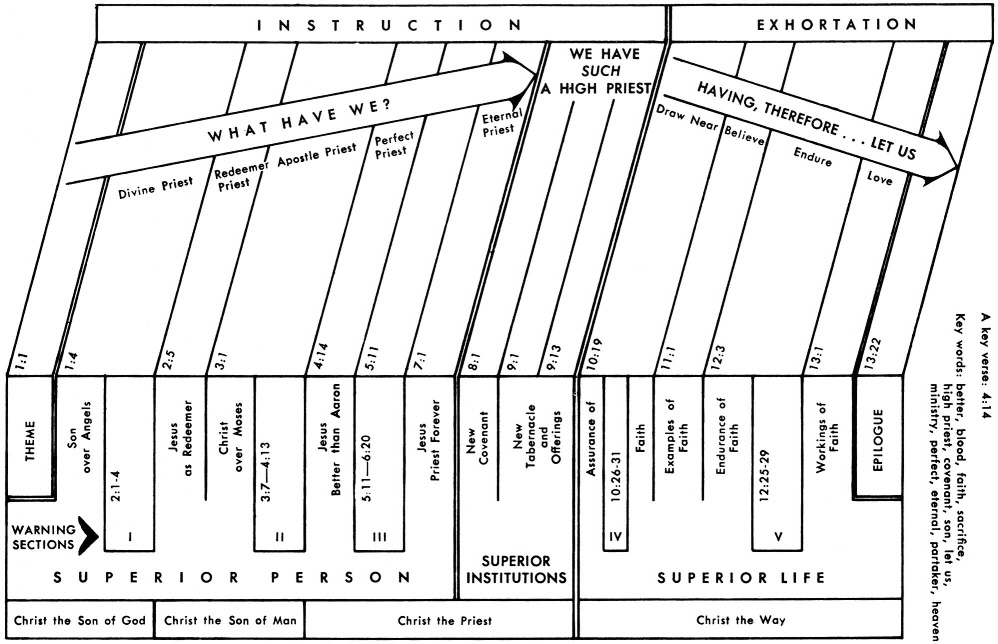
CONSIDER JESUS OUR GREAT HIGH PRIEST
Click chart to enlarge
Charts from Jensen's Survey of the NT - used by permission
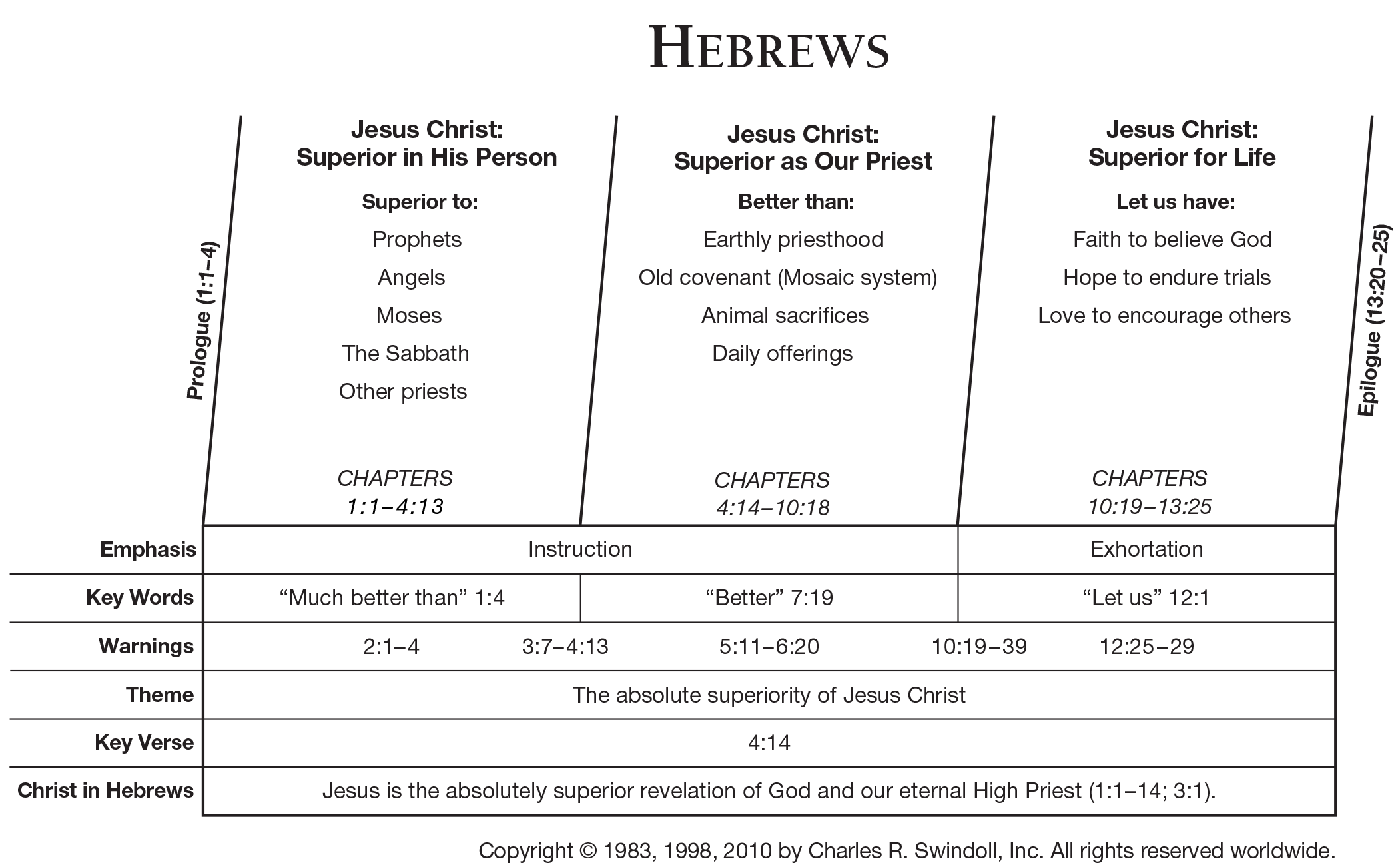
Hebrews - Charles Swindoll
|
The Epistle |
||||
| INSTRUCTION Hebrews 1-10:18 |
EXHORTATION Hebrews 10:19-13:25 |
|||
| Superior Person of Christ Hebrews 1:1-4:13 |
Superior Priest in Christ Hebrews 4:14-10:18 |
Superior Life In Christ Hebrews 10:19-13:25 |
||
| BETTER THAN PERSON Hebrews 1:1-4:13 |
BETTER PRIESTHOOD Heb 4:14-7:28 |
BETTER COVENANT Heb 8:1-13 |
BETTER SACRIFICE Heb 9:1-10:18 |
BETTER LIFE |
| MAJESTY OF CHRIST |
MINISTRY OF CHRIST |
MINISTERS FOR CHRIST |
||
|
DOCTRINE |
DUTY |
|||
|
DATE WRITTEN: |
||||

See ESV Study Bible "Introduction to Hebrews"
(See also MacArthur's Introduction to Hebrews)
Borrow Ryrie Study Bible
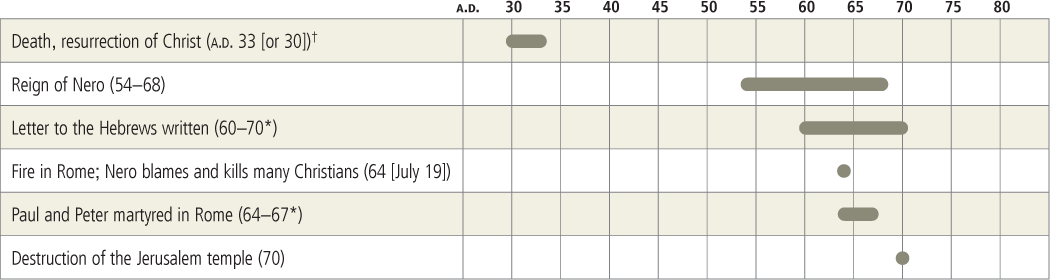
Timeline of Hebrews - ESV Study Bible
Hebrews 3:14 For we have become partakers of Christ, if we hold fast the beginning of our assurance firm until the end (NASB: Lockman)
Greek: metochoi gar tou Christou gegonamen (1PRAI) eanper ten archen tes hupostaseos mechri telous bebaian kataschomen (1PAAS)
BGT μέτοχοι γὰρ τοῦ Χριστοῦ γεγόναμεν, ἐάνπερ τὴν ἀρχὴν τῆς ὑποστάσεως μέχρι τέλους βεβαίαν κατάσχωμεν-
Amplified: For we have become fellows with Christ (the Messiah) and share in all He has for us, if only we hold our first newborn confidence and original assured expectation [in virtue of which we are believers] firm and unshaken to the end. (Amplified Bible - Lockman)
KJV: For we are made partakers of Christ, if we hold the beginning of our confidence stedfast unto the end;
NET: For we have become partners with Christ, if in fact we hold our initial confidence firm until the end. (NET Bible)
NLT: For if we are faithful to the end, trusting God just as firmly as when we first believed, we will share in all that belongs to Christ. (NLT - Tyndale House)
Phillips: For we continue to share in all that Christ has for us so long as we steadily maintain until the end the trust with which we began. (Phillips: Touchstone)
Wuest: for we have become participators of Messiah and as a present result are participators of Him, if we hold the beginning of our assured expectation steadfast to the end. (Eerdmans)
Young's Literal: For we have become partakers of Christ, if we hold fast the beginning of our assurance firm until the end;
NKJ For we have become partakers of Christ if we hold the beginning of our confidence steadfast to the end,
NET For we have become partners with Christ, if in fact we hold our initial confidence firm until the end.
CSB For we have become companions of the Messiah if we hold firmly until the end the reality that we had at the start.
ESV For we have come to share in Christ, if indeed we hold our original confidence firm to the end.
NIV We have come to share in Christ if we hold firmly till the end the confidence we had at first.
MIT For we become partakers of Christ if we hold firm our initial ground of confidence until the end.
NJB because we have been granted a share with Christ only if we keep the grasp of our first confidence firm to the end.
NRS For we have become partners of Christ, if only we hold our first confidence firm to the end.
RSV For we share in Christ, if only we hold our first confidence firm to the end,
NAB We have become partners of Christ if only we hold the beginning of the reality firm until the end,
GWN After all, we will remain Christ's partners only if we continue to hold on to our original confidence until the end.
BBE For if we keep the substance of the faith which we had at the start, even till the end, we have a part with Christ;
ASV for we are become partakers of Christ, if we hold fast the beginning of our confidence firm unto the end:
- partakers of Christ - Heb 3:1; 6:4; 12:10; Ro11:17; 1Co 1:30; 9:23; 10:17; Ephesians 3:6; 1Ti 6:2; 1Pe 4:13; 5:1; 1Jn 1:3
- if we hold fast: He 3:6 Heb 6:11
- Hebrews 3 Resources - Multiple Sermons and Commentaries
- See also comments on Heb 3:6 regarding importance of holding fast (there is some duplication of comments)
Related Passages:
Hebrews 11:1 says "Now faith is the assurance (hupostasis) of things hoped for, the conviction of things not seen."
John 8:31 (WHAT IS THE SIGN OF ONE WHO "HOLDS FAST"?) So Jesus was saying to those Jews who had believed Him, “IF (3rd Class Condition = "IF you abide" or "continue" = possible but not a given) you continue in My word, THEN you are truly disciples of Mine
1 John 2:19 (EXAMPLE OF SOME WHO DID NOT HOLD FAST) They went out from us, but they were not really of us; for if they had been of us, they would have remained with us; but they went out, so that it would be shown that they all are not of us.
THE PRECIOUS PROMISE:
PARTAKERS OF CHRIST!
For (gar) is a strategic term of explanation which should always prompt a pause to prayerfully ponder what the author is saying in a given section. This pause that refreshes will give your Teacher, the Spirit, an opportunity to speak to your heart (so that what you read is more than just head knowledge), not only illuminating the text (see The Bible and Illumination) but applying the text practically to your personal life (Application). Therefore, energized by the Spirit, let us discipline ourselves for godliness and frequently "P & P" (pause and ponder) the Word -- we are sure to be richly rewarded by our Father in Heaven, for "godliness is profitable for all things, since it holds promise for the present life and also for the life to come!" (1Ti 4:7-8, 1Ti 4:9-10)
We have become partakers (metochos) of Christ (christos), if (see 3rd class condition) we hold fast (katecho) the beginning (arche) of our assurance (hupostasis) firm (bebaios) until the end (telos) - Have become is perfect tense signifying a past completed event or actions with ongoing effect. This is not a not a promise, but a statement of a present fact! This is not "will become" but "have become!" The past event in context would be the moment we were born again by the Spirit (Jn 3:3-7). That moment marked the day we became partners of Christ! In other words, assuming they meet the condition to hold fast (discussed below), genuine believers are now and forever partakers, partners, companions, sharers of the King of kings, Christ Jesus, and that relationship that begins in time (in this present life) will last forever and ever. Amen. Hallelujah!
John Piper - Not: we WILL become partakers of Christ, if we hold fast.” But: we HAVE become partakers of Christ if we hold fast. In other words, holding fast to the rope anchored in heaven is an effect and proof of belonging to Christ, not a cause of it. We must hold fast. But we can hold fast only because we are held fast (see Philippians 3:12). We have become partakers of Christ—evidence? We hold fast to our hope (Heb 3:6). Christ’s power in us (ED: VIA HIS SPIRIT) sees to it that it happens. The anchor of our souls is bound to us as well as to heaven. (Having your soul anchored in heaven)
🙏 THOUGHT- Dearly beloved of God, this truth should encourage you and raise your spirits to the heavenlies if you are downcast. We are even now sharers of the One Who not only created everything, holds everything together, but is Himself Heir of everything created. Glory will fully reveal what it means to be a partaker of Christ. That is our our hope. That is our lot in Christ beloved! Rejoice and again I say rejoice!
If (see 3rd class condition) we hold fast (katecho) the beginning (arche) of our assurance (hupostasis) firm (bebaios) until the end (telos) - IF is important because it introduces a third class conditional statement, a situation which might happen but has not yet happened. The third class condition often refers to a future situation and is often used to exhort, warn and/or encourage the recipients regarding their behavior (e.g., see the 3RD CC in John 14:15 - "IF you love Me..."). Kenneth Wuest explains that the IF statement introduces "a test whereby they (THOSE JEWS WHO PROFESS BUT DON'T YET TRULY POSSESS CHRIST) can tell whether they really belong to the house of God or not (ED: In Heb 3:14 whether they are truly "partakers of Christ"), that is, whether they are really saved or not."
What does it mean to hold fast? In simple terms it means that one continues to believe that Jesus is only way to the Father. So it is primarily an issue of faith. The point is one who holds fast is one who has been again (Jn 3:3), saved by grace through faith in Christ Jesus (Eph 2:8-9, Ro 10:9-10). The same faith that saved us initially continues to enable our daily walk (cf progressive sanctification = present tense salvation) until our final breath or the final trumpet signaling the Rapture (1Th 4:16-17), whichever comes first! (Come Lord Jesus! Maranatha!) The next question is how does a believer hold fast? My answer is "he/she can't!" That probably surprises you, but let me clarify. Here is the crucial point. The only way an individual who professes belief in Jesus can hold fast to the end is to be energized by the Spirit of Jesus to run the race with endurance. In other words, holding fast is evidence of God's Spirit working in a person's life. However this is not "Let go, let God," but "Let God, let's go!" His part, our part. We are to be active participants but cannot accomplish the holding fast unless He holds us fast! Try to put your mind around that mystery!
Those who profess Christ but do not truly possess Christ (and His indwelling Spirit) cannot hold fast. They will walk away from the faith they once professed. They are like the soil in Lk 8:13 (Mt 13:20,21, Mk 4:16, 17) and are in stark contrast to the soil in Lk 8:15 (note the words "with perseverance!"). I am sure most of us have seen sad examples of individuals who once seemed vibrant in their faith and later reject the faith and walk away from Christ. A caveat is necessary here for the Berean student (Acts 17:11) must not buy into the false teaching that such a person who walks away (and stays away) is going to heaven just because they once made a profession of Christ. That is a lie from the pit of hell! And remember also that holding fast is NOT a "work" (as some falsely teach). It is NOT a an individual "gritting their teeth" (spiritually speaking) and holding fast in their own (inadequate) fleshly strength. Believers who are once in Christ continue to be in Christ. Faith does not come and go (albeit all believers likely have times when faith is at low ebb). The barometer of faith may dip but ultimately, even in the valley, it stays firmly fixed on Christ.
C H Spurgeon agrees writing "When we begin in the Spirit we do not proceed with a hope to be made perfect in the flesh (cf Gal 3:3). We do not start with justification by faith, and then look for perfection by works. We do not lean upon Christ when we are little children, and then expect to run alone when we are men. But we live by drawing all our stores from Him, while as yet we are naked, and poor, and miserable. When most enriched by His grace, we still have to say, and delight to say it, “All my springs are in Thee.” (Ps 87:7) Faith at the beginning and faith at the close, faith all the way through is the one important matter. A failure in this, as we observed in our reading, shut Israel out of the promised land. “They could not enter in because of unbelief.” Unbelief is always the greatest mischief to the saints, hence they have need earnestly to watch against it. Faith is always the channel of innumerable blessings to them, they ought, therefore, most watchfully to maintain it (cf Ro 10:17). (A Persuasive to Steadfastness)
Perseverance is one of the marks
of being a Christian.
-- Leon Morris
F. F. Bruce writes taht “Nowhere in the New Testament more than here do we find such repeated insistence on the fact that continuance in the Christian life is the test of reality. The doctrine of the final perseverance of the saints has as its corollary the salutary teaching that the saints are the people who persevere to the end. In the parable of the sower the seed sown on rocky ground made a fair showing at first, but could not withstand the heat of the sun “because it had no root”; and in the interpretation of the parable this is said to refer to people “who, when they have heard the word, immediately receive it with joy; and they have no root in themselves, but endure for a while; then, when tribulation or persecution arises on account of the word, immediately they fall away” (Mark 4:5f., 16f.). This is precisely what our author fears may happen with his readers." (BORROW Commentary on the Epistle to the Hebrews page 58)
None are truly Christ’s but those who persevere in grace....
"Temporary Christians" are not really Christians.
-- C H Spurgeon
J Vernon McGee - "If we hold fast....firm unto the end.".....In other words, if we are sons of God and if we are partakers of the heavenly calling, we will be faithful and we will hold fast. This (HOLDING FAST) is the proof that we are of God's house (ED: AND PARTAKERS OF CHRIST). (See Thru the Bible)
Reformation Study Bible - This condition tells the readers how they can know that they belong to God—their faith must prove itself by persevering (Heb 3:14; 6:11; 10:23). The note of warning is a fitting introduction to the quotation from Ps. 95 that follows.
🙏 THOUGHT - As an aside, I have read a number of critics of the doctrine of perseverance of the saints who base their discounting of this doctrine on the fact that it is "Reformed Theology" or "Calvinistic." One journal article by Stephen Lewis that seeks to refute this doctrine did not have ONE SINGLE BIBLICAL REFERENCE! I suggest we must jettison our bias and our systematic theology (of whatever bent) and focus solely on "sola scriptura!" All that should matter is what saith the Lord? In my opinion, if one let's God speak for Himself (see passages above), it becomes clear that faith that is real, saving faith is faith that perseveres. The perseverance of one's faith is not a work of that individual, but is wholly a work of the Holy Spirit's "keeping power!" A genuine believer perseveres because the Spirit enables him or her to persevere. In sum, we entered into the New Covenant by grace and we are kept firm to the end by that same grace and not by work
Bob Utley on the necessity (warning) to hold fast - The rest of this chapter and chapter 4 is one continual warning: (1) for the Jewish believers to move to maturity and public identification with the church (2) for those who have heard the Gospel and seen it powerfully in the lives of their believing Jewish friends to fully accept it themselves. This is my historical assumption based on R. E. Glaze, Jr.'s book, NO EASY SALVATION a Careful Examination of the Question of Apostasy in Hebrews - BORROW. (See PERSEVERANCE)
Hold fast (katecho) gives a beautiful picture from its secular usage where as a nautical term (see nautical terms in Hebrews) because it means to steer toward or land at. Luke uses katecho with this meaning in Acts writing that "casting off the anchors, they left them in the sea while at the same time they were loosening the ropes of the rudders, and hoisting the foresail to the wind, they were heading for (katecho) the beach." (Acts 27:40) They were “holding theirs course toward beach." Wuest picks up this nautical usage writing that "If these Hebrews would hold their course in life steadfastly along the lines of their present profession, that would show that they were saved. If they veered away from that course, that would show that they never had been saved, but that their profession of Messiah had been, not one of the heart but of the head." (Hebrews)
🙏 THOUGHT - Enabled by the Spirit and the grace of God (see Heb 10:29b), we all need to keep our rudders firmly in hand and our faces fixed like flint toward Jerusalem so that our vessels are "headed for the beach," into the harbor of our heavenly calling, God's Eternal Kingdom. Remember we are not home yet! When we fall asleep in Jesus, we won't leave home, but will GO HOME! Hallelujah! Play and ponder the words (be sure and see the lyrics) of Steven Curtis Chapman's great song NOT HOME YET! Great God Almighty by Your Holy Spirit and Your Holy Word, please continually give us seeking, holding fast hearts, for Your glory. In the Name of our Great High Priest. Amen.
Continuance is
the proof of reality
We "prove" we are partakers of Christ IF we do not desert His way, His truth, His life (cf Jn 14:6). We can neither save ourselves nor keep ourselves saved. The meaning is simply that continuance is the proof of reality. We can tell if we are really partakers of Christ because we continue to hold fast. The one who falls away was never a partaker of Christ in the first place.
The sure proof of election is
that one holds out to the end.
-- Jonathan Edwards
Marcus Dods - In Hebrews 3:6 the writer had adduced as the reason of his warning (take care) that participation in the salvation of Christ depended on continuance in the confident expectation that their heavenly calling would be fulfilled; and so impressed is he with the difficulty of thus continuing that he now returns to the same thought, and once again assigns the same reason for his warning: “For we are become partakers of Christ, if we hold the beginning of our confidence firm to the end”. (The Expositor's Greek Testament)
William MacDonald - Verses like this are often misused to teach that a person can be saved and then lost again. However, such an interpretation is impossible because the overwhelming testimony of the Bible is that salvation is freely bestowed by God's grace, purchased by Christ's blood, received by man's faith, and evidenced by his good works. True faith always has the quality of permanence. We don't hold fast in order to retain our salvation, but as proof that we have been genuinely saved. Faith is the root of salvation; endurance is the fruit. Who are Christ's companions? The answer is, "Those who by their steadfastness in the faith prove that they really belong to Him." (Borrow Believer's Bible Commentary)
Continuance in the faith,is the proof of the reality of our faith.
If we continue, we have surely believed.
If we do not continue, then we have not truly believed
-- S Lewis Johnson
(formerly of Dallas Theological Seminary)
Jesus warned His disciples "you will be hated by all on account of My name, but it is the one who has endured to the end who will be saved." (Matthew 10:22)
There are some who teach Jesus was not associating genuine belief with perseverance. For example, one evangelical author, Thomas Constable, commenting on Jesus' warning in Matthew 10:22 writes that "this verse does not say that all genuine believers will inevitably persevere in their faith and good works. Rather it says that those who do during the Tribulation can expect God to deliver them at its end. Jesus was not speaking about eternal salvation but temporal deliverance. Temporal deliverance depended on faithful perseverance." (Ref) (Bolding added)
In a similar manner Constable does not interpret Hebrews 3:6 as a reference to the perseverance of the saints. Constable has some good notes but you must be a Berean (Acts 17:11) as he holds views very similar to Zane Hodges who is alluded to below.
The careful reader needs to be aware that the commentary on Hebrews in the popular commentary set Bible Knowledge Commentary (written by faculty of Dallas Theological Seminary) is authored by Zane Hodges who flatly refutes the doctrine of perseverance of the saints. In his book Absolutely Free he writes "The Calvinist doctrine of the perseverance of the saints is not a biblical teaching. Believers are eternally secure, but they may fail in faith, fall into sin and suffer loss of reward-yet remain saved." Personally I don't pay as much attention to what Calvin said or thought, but I do think we should pay attention to what the writer of Hebrews said in Hebrews 3:6 and Hebrews 3:14. While I agree that faith can waver in one's Christian walk (I have walked 40 years and can attest to this sadly) and even result in backsliding into sin, that backsliding should not characterize one's entire walk. Hodges thinks you can backslide continually and you can still feel confident you are saved. A simple, literal reading of Hebrews 3:6,14 leads to the conclusion that perseverance is something the writer was advocating for his Jewish readers who professed Messiah, warning them that if they failed to persevere it would be difficult to say they were truly partakers of Christ. In my opinion failure to accept perseverance as a marker of genuine belief is a very dangerous teaching from Hodges, Constable, Wilkins and Dillow (other writers that hold this view). To give you a better understanding you might read the article The Troubling Teachings of Zane Hodges, Joseph Dillow, and Robert Wilkin. The reader is strongly advised to be a Berean (Acts 17:11) when reading comments by the preceding authors!
Charles Spurgeon refutes the teaching of Hodges, et al writing "It is not true that one act of faith is all that is required, except you consider that one act to be continuous throughout life. If a man were a believer once, and if it were possible to cease to be so, then, of course, he is ruined. But the doctrine of the final perseverance of the saints does not speak in that manner. It says that he who is a believer shall continue so—that he who is right with God shall abide so even to the end, and unless it be so we are not partakers of Christ at all.
Others such as John MacArthur (with whom I agree) commenting on Matthew 10:22 explains that "Endurance does not produce or protect salvation, which is totally the work of God’s grace. But endurance is evidence of salvation, proof that a person is truly redeemed and a child of God." (See Matthew Commentary - Page 210) (Bolding added)
What does it mean that believers are partakers of Christ? Let's be honest, that any attempts to put into word all that it means to be partakers of Christ will fall woefully short of the reality as we shall discover throughout eternity! And as Cole points out below there is some disagreement as to what partakers of Christ means.
Comment: See Study Questions on partakers of Christ which unpacks the meaning of partakers by examining a number of related cross references including Jn 6:48-51, Jn 14:16-20, Jn 14:23,24, Ro 8:9-11, Eph 5:30-32, 1Jn 2:19 (cf 2Jn 9), Jn 8:31
Steven Cole points out that "We have become partakers of Christ” (see also, Heb 1:9; 3:1; 6:4; 12:8). Scholars are divided over whether this refers to our sharing with Christ in His kingdom work (ED: e.g., F F Bruce below); or to our union with Christ, what Paul frequently calls, being “in Christ.” While both are true, the context seems to refer to our share in Christ Himself. When God saves us, He places us in Christ so that all that is true of Him is true of us. As Paul boldly states, “Therefore there is now no condemnation for those who are in Christ Jesus” (Ro 8:1). (Hebrews 3:12-19 Persevering in Faith)
Greenlee in An Exegetical Summary of Hebrews - Page 113 - QUESTION—How are the two nouns related in the genitive construction μέτοχοι τοῦ Χριστοῦ ‘partakers/partners of Christ’?
1. ‘Christ’ is the object of partaking [Alf, Blm, EBC, Hu, Lns, My, NIGTC, NTC, Wst; KJV, NASB, NIV]: we participate in Christ. We participate in the fullness of Christ’s life [Wuest]. The definite article with ‘Christ’ indicates Christ as the one who was the hope of the fathers [Wuest]. (ED: SPURGEON SEEMS TO FAVOR THIS INTERPRETATION - SEE full sermon A Persuasive to Steadfastness)
2. It means having a personal interest in Christ [ICC].
3. It means that they were participants with Christ [EGT, HNTC, Lg, Mil, NCBC, NIC, TH, TNTC, WBC; NAB, NLT, NRSV, REB, TEV, TNT]; we are partners with Christ. They share in their participation in the heavenly kingdom [NIC-Bruce, TNTC-Guthrie].
David Guzik explains partakers of Christ as "Believers – those who turn from sin and self and put their life’s trust in Jesus – are gloriously called partakers of Christ. Partakers of Christ – this is the whole picture. Partakers of His obedience, partakers of His suffering, partakers of His death, partakers of His resurrection, partakers of His victory, partakers of His plan, partakers of His power, partakers of His ministry of intercession, partakers of His work, partakers of His glory, partakers of His destiny. Saying “Partakers of Christ” says it all."
Through faith in Jesus Christ, believers are
made everything He is and given everything He has
John MacArthur - All Christians, regardless of their status or position before being saved, are now fellow partakers of everything that pertains to Christ through the gospel—which is everything that pertains to Christ. The essence of the gospel is that, through faith in Jesus Christ, believers are made everything He is and given everything He has. The phrase “the mystery of Christ” (Heb 1: 4) is also used in Col. 4:3 as the very essence of Paul’s message. It carries the truth of Colossians 1:27, that Christ is in believing Gentiles as well as believing Jews as “the hope of glory” for both. It also carries the truth of Colossians 2:2, that the mystery is “Christ Himself,” in whom believers have everything (Col 2:3). So the mystery is fully understood to be Jew and Gentile in Christ—Christ in Jew and Gentile, so that there is the intimate shared union of eternal life as they both become immersed in the Lord Jesus Christ (Gal. 2:20). God predestines every believer “to become conformed to the image of His Son” (Ro 8:29). (See Ephesians MacArthur New Testament Commentary - Page 92)
John Owen on partakers of Christ - “How, then, are we partakers of him, partakers of Christ? It is by our having an interest in his nature, by the communication of his Spirit, as he had in ours by the assumption of our flesh. It is, then, our union with Christ that is intended, whereby we are made ‘members of His body, of His flesh, and of His bones’, Eph. 5:30-32. A participation in the benefits of the mediation of Christ is included in these words, but not firstly intended, only as a consequent of our intimate union with him.” (Commentary)
Abraham Kuyper on partakers of Christ - to be partakers of Christ and of all His riches and gifts.
F. F. Bruce “The meaning of the phrase “partners of Christ” is probably not that of participation in Him (as in the Pauline expression “in Christ”), but rather that of participation with Him in his heavenly kingdom—the unshakable kingdom of Heb 12:28.69 To begin well is good, but it is not enough; it is only those who stay the course and finish the race that have any hope of gaining the prize. The Israelites made a good beginning when they crossed the Sea of Reeds and praised God for their deliverance; but the good beginning was not matched by their later behavior." (BORROW Commentary on the Epistle to the Hebrews page 58)
Kenneth Wuest - The word “partakers” is the translation of metochoi which is translated “fellows” in Heb 1:9, its verb form, rendered “took part of” in Heb 2:14. The verb means literally “to hold with,” the noun, “one who holds with another.” Here the word means “participators.” The word is used of those who are participators in something, or of those who are participators with someone....those to whom the inspired author of the book is writing, were co-participators of Messiah. They participated together in their possession of Him. In Heb 3:6, the writer is speaking of the fact that true believers are Messiah’s house, that is, they are His possession. In this verse, he is referring to the fact that Messiah is the possession of believers. (Hebrews)
W. Jones describes partakers of Christ as follows "There is nothing that Christ has, but we have part of it. His wisdom, holiness, His righteousness is ours; yea, His kingdom is ours. We are heirs, yea, co-heirs with Him of His kingdom. As the man at the day of marriage says to his wife, “With all my worldly goods I thee endow,” so the Lord Jesus endows us with all His goods (ED: WHICH MAKES SENSE AS WE ARE HIS BRIDE!); by reason whereof, being poor and worth nothing, we become exceeding rich (2Co 8:9). Christ is our life (Col 3:4), the world is ours. Oh, unspeakable prerogative vouchsafed to dust and ashes! (ED: TO SAY IT ANOTHER WAY -- HOW AMAZING IS THE HONOR THAT MERE SINFUL MORTALS HAVE BEEN MADE TO BE PARTAKERS OF CHRIST) Let us walk worthy of this honour whereunto we are advanced: being Christ’s partners, let us not be the devil’s partners. Let us be holy as He is holy (1Pe 1:15), humble as He is humble; let us contemn this world with all the vain pleasures that be in it as He did. What fellowship is there between Christ and Belial (2Co 6:14-15)? (Biblical Illustrator)
We are partakers of Him, this is a privilege that no tongue
can ever utter, no thought of finite mortal can ever grasp
C H Spurgeon has an interesting discussion of partakers of Christ writing "that the text does not say, “We are made partakers with Christ.” That would be true, a very precious truth too, for we are joint-heirs with Christ, and because all things are His, all things are ours. Christ holds for us the entire heritage of the faithful as our representative, and as we are made partakers with Him in the Father’s favor, and in the world’s hatred, so we shall be partakers with Him in the glory to be revealed, and in the bliss which endures forever and ever. But here we have to do with our being partakers of Christ, rather than our being partakers with Christ. Neither does it say we are made partakers of rich spiritual benefits. That is a fact which we may greet with thorough trust and hearty welcome. But dear brethren, there is more than that here. To be partakers of pardoning mercy, to be partakers of renewing grace, to be partakers of the adoption, to be partakers of sanctification, preservation, and of all the other covenant blessings, is to possess an endowment of unspeakable value. But to be made “partakers of Christ,” is to have all in one. You have all the flowers in one posy, all the gems in one necklace, all the sweet spices in one delicious compound. “We are made partakers of Christ”—of Himself. “It pleased the Father that in him should all fullness dwell,” and we are made partakers with Him of all that He is ordained to be of God unto us—“wisdom, righteousness, sanctification, and redemption.” We are partakers of Him, this is a privilege that no tongue can ever utter, no thought of finite mortal can ever grasp. But ah, it would need more time than we can afford, and far more spiritual teaching than we profess to have attained, to dive into this great and profound utterance, “We are made partakers of Christ.” Still, as we stand spell-bound on the margin, let us venture to sail out just a little upon the surface of this ocean of goodness and of grandeur. (See full sermon A Persuasive to Steadfastness)
Don Fortner - Partakers Of Christ - As Eve derived her life from Adam (Genesis 2:18–25), so we derive our life from Christ. As Eve was made partaker of Adam’s nature, so we are made partakers of Christ’s nature. As Eve’s life was but an extension of Adam’s life, so our life is but an extension of Christ’s life. He is eternal life; and we have eternal life by the gift of God. That eternal life is ‘Christ in you’ (Colossians 1:27). We are partakers of his life. Our spiritual life proceeds from and is sustained by Christ. It is the source of our present spiritual life, and of our eternal life in glory with Christ. Let us never diminish one aspect of our Saviour’s work to make another appear more glorious. All that Christ is made to us and all that he does for us is vital. We cannot be saved without his work for us; and we cannot be saved without his work in us. Both are vital. (Discovering Christ in the Gospels)
Brian Bell - Partakers of Christ – God doesn’t bless us just to make us happy; He blesses us to make us a blessing. (ED: TRUE PARTAKERS REMAIN) Steadfast to the end – Many church members today are content to live lives that are essentially no different than the lives of non-Christians around them. We’ve all seen beautifully done taxidermy. Where the stuffed animal looks so real, even the eye of glass, looks life like. So in the churches of Christ, many professing believers are not living believers, but stuffed Christians. They possess all the externals of religion, and every outward morality that you could desire...yet, their spiritual life is absent. (ED: AND THEIR END IS ETERNAL PUNISHMENT)
James Smith - CHRISTIANS AS PARTAKERS."We are made partakers of Christ" (Heb. 3:14).
1. Of His divine nature, 2 Peter 1:4.
2. Of His Holy Spirit, Heb. 6:4.
3. Of His holiness, Heb. 12:10.
4. Of His sufferings, 1 Peter 4:13.
5. Of His chastisements, Heb. 12:8.
6. Of His consolation, 2 Cor. 1:7.
7. Of His glory, 1 Peter 5:1.
A GOOD BEGINNING NEEDS
A GOOD ENDING!
The beginning (arche) of our assurance (hupostasis) firm (bebaios) until the end (telos) - "if in fact we hold our initial confidence firm until the end" (NET) “our original confidence” (NEB), “the trust with which we began” (Phillips) "if we hold firmly until the end the reality that we had at the start. (CSB) The beginning of our assurance refers to our initial faith in Christ for salvation. Saving faith isn’t just a one-time action. If it is genuine, we go on believing until the time that we see Jesus (“the end”).
A good beginning does not guarantee a good finish. As the king of Israel said, “One who puts on his armor should not boast like one who takes it off” (1Ki 20:11). Recall that the Israelites had no lack of confidence just after the Exodus, but it faded quickly a few days into the wilderness. (cf Marah = bitterness: Nu 15:23)
Leon Morris on assurance (hupostasis) - The word hypostasis means literally “that which stands under” and may be used of essential “being” (as in 1:3). Here it will rather be that which undergirds the Christian’s profession, and “confidence” is a good translation. “The confidence we had at first” is that experienced when the readers first believed. They had no doubts then, nor should they have any now. “Till the end” may point to the end of the age or the end of the believer’s life. (The Expositor's Bible Commentary - Abridged Edition)
R C H Lenski - The idea is that of the true and noble beginning and of an equal end. If the end truly matches the beginning, we shall then be what we are now. Βεβαίαν (bebaios) is predicative to τὴν ἀρχήν: “the beginning … as firm.” The saddest thing in the world is to see a noble beginning made in the Christian faith and then to have this lost before the end arrives. (Borrow Commentary)
Until the end (telos) means the end of your life on earth. It means you in essence cling to Christ until your last breath, no matter the persecution or cost for claiming Him as your Lord. Your persevering does not save you, because none of us could persevere if we depended on our fallen flesh! We are enabled to persevere by the Spirit of God, and thus our perseverance demonstrates that we in fact do have the Spirit of God (and that He has us)!
John Piper asks a very important question - "What then would be the conclusion if we do not hold fast to our assurance? The answer is not that you stop being a partaker of Christ, but that you had never become a partaker of Christ. Read it carefully: "We have become partakers of Christ if we hold fast to our assurance." And so "If we do not hold fast to our confession then we have not become partakers of Christ." (Eternal Security Is a Community Project - Desiring God) (Bolding added)
A T Robertson comments - These faltering believers (some even apostates) began with loud confidence and profession of loyalty. And now?
C H Spurgeon on firm or steadfast - Not otherwise. Again I say they who do not hold on and hold out are not really partakers of Christ, but we are made partakers of Christ if we hold the beginning of our confidence steadfast unto the end. Those that fly to this doctrine and that, unsettled spirits, wandering stars, mere meteors of the night, these are not Christ’s, but we must hold the beginning of our faith steadfast unto the end. You are to hold fast, to hold on, and to hold out to the end; and the grace you need in order to do this is waiting for you if you will but look for it, and daily live under the power of it. (Spurgeon's Expositional Comments)
Matthew Henry - The same spirit with which Christians set out in the ways of God, they should maintain unto the end. Perseverance in faith is the best evidence of the sincerity of our faith. Hearing the word often is a means of salvation, yet, if not hearkened to, it will expose more to the Divine wrath. The happiness of being partakers of Christ and his complete salvation, and the fear of God's wrath and eternal misery, should stir us up to persevere in the life of obedient faith. Let us beware of trusting to outward privileges or professions, and pray to be numbered with the true believers who enter heaven, when all others fail because of unbelief. As our obedience follows according to the power of our faith, so our sins and want of care are according to the prevailing of unbelief in us
Wayne Grudem – The perseverance of the saints means that all those who are truly born again will be kept by God's power and will persevere as Christians until the end of their lives, and that only those who persevere until the end have been truly born again. (One Page Outline - see page 687 for Grudem's in depth 18 page discussion of Systematic Theology - An Introduction to Bible Doctrine (first edition Perseverance of the Saints in his book Systematic Theology)
Charles Swindoll - This warning in Hebrews 3:14 reminds us that we’re not meant to be spectators but rather participants in the arena of the Christian life. If we’re blocked and tackled by painful trials and tests, we need to always keep our orientation toward the end zone and our focus on our Master. This is where the Israelites in the wilderness went wrong. They lost their grip on God’s promises and abandoned His commands. Instead of heading straight for the goal line, they ended up wandering in the wilderness. As a result, they failed to enter into rest—from their wanderings and trials—in the Promised Land, the “good and spacious land . . . flowing with milk and honey” (Exod. 3:8). (See Insights on Hebrews - Page 57)
Partakers (partners) (3353) metochos from metecho = have with, describing participation with another in common blessings> from metá = with, denoting association + écho = have) describes one who shares with someone else as an associate in an enterprise or undertaking. It speaks of those who are participators in something. Business partner, companion. Participating in. Accomplice in. Comrade. It means to be one who has a share in the possession of something. Wuest says metochos "speaks of one who is associated with others in a common task or condition."
METOCHOS 6X - Lk 5:7 = they signaled to their partners in the other boat; Heb 1:9 - "Thy companions;" Heb 3:1 - partakers of a heavenly calling; Heb 3:14 = partakers of Christ; Heb 6:4 = partakers of the Holy Spirit; Heb 12:8 = all have become partakers.
Christ (5547) Christos (See also Messiah - Anointed One) from chrio = to rub or anoint, consecrate to an office) describes one who has been anointed with oil, one who has been consecrated. The majority of the NT uses refer to Jesus (exceptions = "false Christs" - Mt 24:24, Mk 13:22). Christos describes one who has been anointed, symbolizing appointment to a task. It is used here as the title "Anointed One" and is the Greek synonym for "Messiah." Christos is used in the Septuagint describing everyone anointed with the holy oil, especially the priesthood (Lev. 4:5, Lev 4:16) and it is also a name applied to those who were acting as redeemers like Cyrus.
Wuest on Messiah/Christ in his commentary on Hebrews - The reader will notice that the present author uses the name Messiah where the name Christ appears in the translation. The name Christ is the English spelling of the Greek word Christos, and this Greek word is the translation of the Hebrew word which is by transliteration brought over into the English language, Messiah. The name Christ has no meaning except that which the English reader puts upon it. The Greek word means “the anointed,” as does the Hebrew word. But the name Messiah has a definite content of meaning, even though it is but the transliteration of the Hebrew word. It refers to the anointed King of Israel. In that sense it is used here. (Hebrews Commentary)
Hold fast (2722) (katecho from katá = intensifies meaning + écho = have, hold) means to retain whether by avoiding the relinquishing of something.
Friberg - (1) transitively, active; (a) hold fast, keep in possession, possess (2Co 6.10); figuratively hold in memory, keep in mind, continue believing (1Co 15.2); (b) hold back, detain, prevent (Lk 4.42); figuratively restrain, check (2Th 2.6); (c) hold down, suppress; figuratively suppress (Ro 1.18); (d) take (over), occupy (Lk 14.9); (2) transitively, passive; (a) of law be bound by (Ro 7.6); (b) of disease be afflicted with (Jn 5.4); (3) intransitively, as a nautical technical term hold one's course toward, head for, steer for (Acts 27.40) (Borrow Analytical Lexicon of the Greek New Testament )
KATECHO - 18V - afflicted(1), bound(1), heading(1), hold...fast(1), hold fast(5), hold firmly(1), keep(2), occupy(1), possess(1), possessing(1), restrains(2), suppress(1). Lk. 4:42; Lk. 8:15; Lk. 14:9; Jn. 5:4; Acts 27:40; Ro 1:18; Ro 7:6; 1 Co. 7:30; 1 Co. 11:2; 1Co. 15:2; 2Co. 6:10; 1 Thess. 5:21; 2 Thess. 2:6; 2 Thess. 2:7; Philemon 1:13; Heb. 3:6; Heb. 3:14; Heb. 10:23
Assurance (5287) (hupostasis from hupo = under + histemi = stand > refers to a foundation, ground on which something is built) primarily means that on which anything is based. It means “confidence in which one stands fast as well in doing as in bearing, in acting as in suffering,”
Hupostasis is common in the papyri in business documents as the basis or guarantee of transactions. More generally anything that settles is hypostasis (cf. curds, or the slimy bottom of stagnant water, or the deposit of moist air, or any kind of residue).
Wuest on hupostasis - Its primary meaning is “that on which anything is based.” Hence it takes the sense of hope or confidence. It is the ground of hope they have in Messiah. This word is translated “title deed” in Hebrews 11:1 (“substance” A.V.). The word was used, in secular manuscripts, of the documents bearing on the ownership of a person’s property, deposited in the archives, and forming the evidence of ownership. It, therefore, was used of that which formed the basis or evidence of one’s assurance of the ownership of anything. Here, it refers to their faith in Messiah which is their ground of assurance that they are saved. If the faith of these Jews is a heart faith, they will persist in that faith to the end of their lives, despite the persecution which they are enduring. If that faith is a mere intellectual assent, it will not be able to stand up under this persecution, but will be repudiated by that person. The first person is saved, the second, unsaved. The phrase “the beginning of our confidence” refers to the incipient confidence they had which had not yet reached its perfection. The words “the end” could refer either to the end of their lives or to the consummation of the whole life of faith.
Firm (949)(bebaios from baino = to go, walk, step) describes that which is fixed, stable, sure, attested to and certified. It is something which is unwavering and persistent and thus can be relied on or depended on. It can be relied not to cause disappointment for it is reliable and unshifting. It pertains to that which is known with certainty. It refers to something that has validity over a period of time (e.g., the promise made to Abraham remained valid to NT believers, see Ro 4:16). Figuratively bebaios refers to that upon which one may build, rely or trust. In practice, though not originally, bebaios is close to pistos (trustworthy, dependable, reliable, faithful)
Bebaios has a legal sense, signifying a legal guarantee, obtained by the buyer from the seller, to be gone back upon should a third party claim the thing. Thus in classic Greek bebaios described a warranty deed somewhat like a guarantee one might have today on an automobile or similar product. A holy life is like a "guarantee" demonstrating one's calling and election to others as well as to one's self.
BEBAIOS - 9X/9V - certain(1), firm(2), firmly grounded(1), guaranteed(1), more sure(1), steadfast(1), unalterable(1), valid(1). Rom. 4:16; 2 Co. 1:7; Heb. 2:2; Heb. 3:6; Heb. 3:14; Heb. 6:19; Heb. 9:17; 2 Pet. 1:10; 2 Pet. 1:19
TDNT says that bebaios "means “standing firm on the feet,” “steadfast,” “maintaining firmness or solidity,” “steadfast for …” Hence “firm” in the sense of having inner solidity. In respect of abstract things and persons bebaios thus comes to mean “steady,” “sure,” “reliable” “steadfast,” or “certain. " (Theological Dictionary of the New Testament)
End (outcome) (5056)(telos) means an end, term, a termination, a completion. Telos refers to a consummation, a goal achieved, a result attained, or a realization. Can refer to that which is final as well as that which is completed. This term does not refer to annihilation (although indeed this present earth and heavens will be burned with intense heat - see 2Pe 3:12) but is used in Scripture to refer to the end of the age. Jesus Himself used the term in this way (e.g., Matthew 24:6; Mark 13:7; Luke 21:9). The sense of “end” as a point in time appears also as in the present passage. The kingdom of Messiah has no “end” (Luke 1:33). Telos as the “outcome” of something is the idea in Luke 18:5, and in Luke 22:37 it denotes the “fulfillment” of prophecy about Jesus. In this case telos in essence refers to the "outcome" of our faith!
TELOS - 41X/40V - continually*(1), custom(2), customs(1), end(24), ends(2), finished(1), fulfillment(1), goal(1), outcome(6), sum(1), utmost(1). Matt. 10:22; Matt. 17:25; Matt. 24:6; Matt. 24:13; Matt. 24:14; Matt. 26:58; Mk. 3:26; Mk. 13:7; Mk. 13:13; Lk. 1:33; Lk. 18:5; Lk. 21:9; Lk. 22:37; Jn. 13:1; Rom. 6:21; Rom. 6:22; Rom. 10:4; Rom. 13:7; 1 Co. 1:8; 1 Co. 10:11; 1 Co. 15:24; 2 Co. 1:13; 2 Co. 3:13; 2 Co. 11:15; Phil. 3:19; 1 Thess. 2:16; 1 Tim. 1:5; Heb. 3:6; Heb. 3:14; Heb. 6:8; Heb. 6:11; Heb. 7:3; Jas. 5:11; 1 Pet. 1:9; 1 Pet. 3:8; 1 Pet. 4:7; 1 Pet. 4:17; Rev. 2:26; Rev. 21:6; Rev. 22:13
Richards - The Greek word group (teleō [verb], telos [noun]) has two basic emphases. The primary concept of “end” is that of achievement of an intended goal. Particularly in eschatological passages the NT picks up the thought of process implicit in the OT. But the NT draws our attention to the conclusion of the process. That end is an extremity, but it is an extremity infused by purpose. Nothing is random; nothing is purposeless. When the end comes, it will bring the achievement of all of God’s purposes. The end will be marked by the consummation of God’s plans. The other concept implicit in the Greek words indicating “end” draws our attention to persons or to things that have reached an intended goal. In a limited but real sense, achieving a goal means that a thing or person is completed, or perfect. Thus “perfect” in the NT does not suggest sinlessness or flawlessness; rather, it is a mature stage of development in which one’s potentials are achieved. (BORROW Expository Dictionary of Bible Words)
Gilbrant on telos in classical Greek - From the stem tel-, “to turn round,” telos “originally meant the turning point, hinge, the culminating point at which one stage ends and another begins; later goal” (Schippers, “Goal,” Colin Brown, 2:59). Delling reduces the major meanings of telos to five: (1) “achievement”; (2) “completion”; (3) “obligation” (such as taxes); (4) “offering” (religious); (5) “detachment, group” (“telos,” Kittel, 8:49-51). These, of course, are oversimplified; the term is extremely diverse in meaning in classical Greek (see Liddell-Scott). Essentially telos indicates “fulfillment, execution of an act, consummation” or a state, such as “complete, perfect, total.” In philosophy telos was particularly linked to “goal,” such as the goal of an ethical life (Schippers, “Goal,” Colin Brown, 2:60). (Complete Biblical Library)
Spurgeon on Perseverance - 'A poor woman had a supply of coal laid at her door by a charitable neighbour. A very little girl came out with a small fire-shovel, and began to take up a shovelful at a time, and carry it to a sort of bin in the cellar. I said to the child, 'Do you expect to get all that coal in with that little shovel?' She was quite confused at my question, but her answer was very striking, 'Yes, sir, if I work long enough.' Humble worker, make up for your want of ability by abundant continuance in well-doing, and your life-work will not be trivial. The repetition of small efforts will effect more than the occasional use of great talents.
if we are really saved now, we shall continue in the faith;
and if we do not continue, we are not saved now.
Willard Aldrich in Bibliotheca Sacra article entitled Perseverance - The first of three conditional sentences for our special consideration is Hebrews 3:6. It speaks of “Christ as a son over his own house,” and then adds, “whose house are we, if we hold fast the confidence and the rejoicing of the hope firm unto the end.” The careless interpretation would take the present tense of the conclusion, “whose house are we,” and read the future into it to correspond to the future contingency expressed by the condition, “if we hold fast … unto the end.” And then the inference is drawn, “if we do not hold fast, then we will cease to be Christ’s house and be lost.” But that is neither what it says nor implies. It says that if there is not perseverance in the future, we are not Christ’s house now. The implication is clear: if we are really saved now, we shall continue in the faith; and if we do not continue, we are not saved now.
QUESTION - Perseverance of the Saints - is it biblical? - GOTQUESTIONS.ORG
ANSWER - Perseverance of the saints is the name that is used to summarize what the Bible teaches about the eternal security of the believer. It answers the question, “Once a person is saved, can he lose his salvation?” Perseverance of the saints is the P in the acronym TULIP, which is commonly used to enumerate what are known as the five points of Calvinism. Because the term “perseverance of the saints” can cause people to have the wrong idea about what is meant, some people prefer to use terms like “preservation of the saints,” “eternal security,” or “held by God.” Each of these terms reveals some aspect of what the Bible teaches about the security of the believer. However, like any biblical doctrine, what is important is not the name assigned to the doctrine but how accurately it summarizes what the Bible teaches about that subject. No matter which name you use to refer to this important doctrine, a thorough study of the Bible will reveal that, when it is properly understood, it is an accurate description of what the Bible teaches.
The Bible teaches that those who are born again
will continue trusting in Christ forever.
The simplest explanation of this doctrine is the saying: “Once saved, always saved.” The Bible teaches that those who are born again will continue trusting in Christ forever. God, by His own power through the indwelling presence of the Holy Spirit, keeps or preserves the believer forever. This wonderful truth is seen in Ephesians 1:13-14, where we see that believers are “sealed with the Holy Spirit of promise, who is the guarantee of our inheritance until the redemption of the purchase possession, to the praise of His glory.” When we are born again, we receive the promised indwelling presence of the Holy Spirit that is God’s guarantee that He who began a good work in us will complete it (Philippians 1:6). In order for us to lose our salvation after receiving the promised Holy Spirit, God would have to break His promise or renege on His “guarantee,” which He cannot do. Therefore, the believer is eternally secure because God is eternally faithful.
The understanding of this doctrine really comes from understanding the unique and special love that God has for His children. Romans 8:28-39 tells us that 1) no one can bring a charge against God’s elect; 2) nothing can separate the elect from the love of Christ; 3) God makes everything work together for the good of the elect; and 4) all whom God saves will be glorified. God loves His children (the elect) so much that nothing can separate them from Him. Of course this same truth is seen in many other passages of Scripture as well. In John 10:27-30, Jesus says, “My sheep hear My voice, and I know them, and they follow Me; and I give eternal life to them, and they will never perish; and no one will snatch them out of My hand. My Father, who has given them to Me, is greater than all; and no one is able to snatch them out of the Father’s hand. I and the Father are one." Again, in John 6:37-47, we see Jesus stating that everyone who the Father gives to the Son will come to Him and He will raise all of them up at the last day.
Another evidence from Scripture of the eternal security of a believer is found in John 5:24, where Jesus says, “Truly, truly, I say to you, he who hears My word, and believes Him who sent Me, has eternal life, and does not come into judgment, but has passed out of death into life.” Notice that eternal life is not something we get in the future but is something that we have once we believe. By its very nature, eternal life must last forever, or it could not be eternal. This passage says that, if we believe the gospel, we have eternal life and will not come into judgment; therefore, it can be said we are eternally secure.
There is really very little scriptural basis that can be used to argue against the eternal security of the believer. While there are a few verses that, if not considered in their context, might give the impression that one could “fall from grace” or lose his salvation, when these verses are carefully considered in context it is clear that is not the case. Many people know someone who at one time expressed faith in Christ and who might have appeared to be a genuine Christian who later departed from the faith and now wants to have nothing to do with Christ or His church. These people might even deny the very existence of God. For those who do not want to accept what the Bible says about the security of the believer, these types of people are proof that the doctrine of eternal security cannot be right. However, the Bible indicates otherwise, and it teaches that people such as those who profess Christ as Savior at one time only to later walk away and deny Christ were never truly saved in the first place. For example, 1 John 2:19 says, "They went out from us, but they were not of us; for if they had been of us, they would have remained with us; but they went out from us, in order that it might be made manifest that they all are not truly of us." The Bible is also clear that not everyone who professes to be a Christian truly is. Jesus Himself says that not everyone who says, “Lord, Lord,” will enter the kingdom of heaven (Matthew 7:21-22). Rather than proving we can lose our salvation, those people who profess Christ and fall away simply reinforces the importance of testing our salvation to make sure we are in the faith (2 Corinthians 13:5) and making our calling and election sure by continually examining our lives to make sure we are growing in godliness (2 Peter 1:10).
A person who believes he can live any way he wants because
he has professed Christ is not demonstrating true saving faith
One of the misconceptions about the doctrine of the perseverance of the saints is that it will lead to “carnal Christians” who believe that since they are eternally secure they can live whatever licentious lifestyle they wish and still be saved. But that is a misunderstanding of the doctrine and what the Bible teaches. A person who believes he can live any way he wants because he has professed Christ is not demonstrating true saving faith (1 John 2:3-4). Our eternal security rests on the biblical teaching that those whom God justifies, He will also glorify (Romans 8:29-30). Those who are saved will indeed be conformed to the image of Christ through the process of sanctification (1 Corinthians 6:11). When a person is saved, the Holy Spirit breaks the bondage of sin and gives the believer a new heart and a desire to seek holiness. Therefore a true Christian will desire to be obedient to God and will be convicted by the Holy Spirit when he sins. True Christians will never “live any way they want” because such behavior is impossible for someone who has been given a new nature (2 Corinthians 5:17). (ED NOTE: Which is exactly what Zane Hodges, et al, teach. See The Troubling Teachings of Zane Hodges, Joseph Dillow, and Robert Wilkin)
the doctrine of the perseverance of the saints does accurately represent
what the Bible teaches on this important subject.
Clearly, the doctrine of the perseverance of the saints does accurately represent what the Bible teaches on this important subject. If someone is truly saved, he has been made alive by the Holy Spirit and has a new heart with new desires. There is no way that one that has been “born again” can later be “unborn.” Because of His unique love for His children, God will keep all of His children safe from harm, and Jesus has promised that He would lose none of His sheep. The doctrine of the perseverance of the saints recognizes that true Christians will always persevere and are eternally secure because God keeps them that way. It is based on the fact that Jesus, the “author and perfecter of faith” (Hebrews 12:2), is able to completely save those whom the Father has given Him (Hebrews 7:25) and to keep them saved through all eternity.
Related Resources:
- What does the Bible say about perseverance?
- Wayne Grudem - One Page Outline - see page 687 for discussion of Perseverance of the Saints in Systematic Theology Systematic Theology - An Introduction to Bible Doctrine)
- Baker's Evangelical Dictionary of Biblical Theology
- Holman Bible Dictionary
- Charles Buck Theological Dictionary
- Hastings' Dictionary of the New Testament
- International Standard Bible Encyclopedia
- McClintock and Strong's Bible Encyclopedia
- Torrey's Topic - Perseverance
- Nave's Topic - Perseverance
Once saved always saved? (Excerpt) -- To answer the question, "If once saved always saved is true, does that mean we can live our lives any way we want to?", my answer is a qualified "yes." The sacrifice of Jesus Christ is so absolutely perfect and sufficient that it did indeed pay the penalty for all of our sins. Christ's death paid for the sins we committed before we received Him as Savior, and Christ's death equally pays for the sins we commit after we receive Him as Savior.
Once saved always saved
is not a license to sin.
However, I would also say that a person who has truly received Jesus Christ as Savior will not live his/her life any way he/she wants. When you understand the depravity of your sin, the eternal penalty you have earned, and the tremendous price Jesus paid, it is a transformational experience. When you receive salvation, you are a new creation, all things have become new (2 Corinthians 5:17). Once saved always saved is not a license to sin. Rather, it is an understanding that we could not earn salvation on our own merit, and therefore, nothing we can do will cause us to lose the salvation God has purchased with the blood of Christ.
Once saved always saved is the realization that God's plan of salvation is absolutely perfect. A person whom God has chosen for salvation cannot be unsaved, unredeemed, unreconciled, unforgiven, lost, forsaken, abandoned, or cast out. Good works and obedience cannot earn salvation, and neither can a lack thereof result in the loss of salvation. The biblical truth of once saved always saved puts the focus of salvation where it should be—on the holy and omnipotent God Who finishes what He starts (Jude 1:24). - S. Michael Houdmann
Spurgeon asks (A Persuasive to Steadfastness) Are we made partakers of Christ? Many think they are who are not. There is nothing more to be dreaded than a supposed righteousness, a counterfeit justification, a spurious hope. Better, I sometimes think, to have no religion than to have a false religion. I am quite certain that the man is much more likely to be saved who knows that he is ‘wretched, and miserable, and poor, and blind, and naked’, than the man who says, ‘I am rich, and increased with goods’. It is infinitely better to take the road to heaven doubting than to go in another direction presuming. I am far more pleased with the soul that is always questioning, ‘Am I right?’ than with him who has drunk the cup of arrogance till he is intoxicated with self-conceit and says, ‘I know my lot; the lines have fallen to me in pleasant places; there is no need for self-examination in my case.’ Brethren, be assured of this; all are not partakers of Christ: all the baptised are not partakers of Christ: all churchmen are not partakers of Christ: all dissenters are not made partakers of Christ: all members of the church are not made partakers of Christ: all ministers, all elders, all bishops are not made partakers of Christ. All apostles were not made partakers of Christ. One of them, Christ’s familiar friend, who kept the little purse which held all the Master’s earthly store, lifted up his heel against him, betrayed him with a tender treacherous kiss, and became the son of perdition. He was a companion of Christ, but not a partaker of him. Am I made a partaker of Christ? Multiply the question till each individual among you makes it his own.
Wayne Grudem - in Hebrews 3:14 to “share in” Christ means to have a very close participation with him in a saving relationship. Systematic Theology - An Introduction to Bible Doctrine (first edition)
Horatius Bonar - THE BEGINNING OF OUR CONFIDENCE
‘For we are made partakers of Christ, if we hold the beginning of our confidence stedfast unto the end.’—HEB. 3:14.
HERE is—(1.) The privilege. (2.) The way of possession and continuance.
I. The privilege.—‘We are made partakers of Christ.’ ‘We’ means, of course, all saints; not apostles merely. But there may be, as frequently elsewhere, an emphasis on the word, connecting New Testament with Old Testament saints. We, as well as Israel, and the saints of old (4:2); showing the identity of standing and of privilege among the saints of all ages. ‘Are made,’ or ‘become,’ intimating that we were not originally so, but have been made what we are by God; ‘created unto good works.’ Partakers of Christ.’ The expression is a peculiar one, and very striking. (μετοχος and κοινωνος are nearly synonymous. See Luke 5:7, 10.) The word partaker, or partake, is frequently used in this epistle: ‘Took part of the same’ (2:14); ‘Partakers of the heavenly calling’ (3:1); ‘Partakers of the Holy Ghost’ (6:4). It implies that we obtain a part or possession in Christ and of Christ; that we become participators with Christ in all that He is, and has, and gives.
(1.) In what He is.—He makes us partakers of the divine nature; one with Himself; sons of God; joint heirs; kings and priests; lights of the world. He gives Himself to us, as He gave Himself for us.
(2.) In what He has.—The Father’s love (John 16:27); all fulness of grace and blessing; a kingdom, a crown, a throne, an inheritance. ‘All that I have is thine.’
(3.) In what He gives.—These gifts are ‘life’ (‘I give unto them eternal life’), forgiveness, salvation, strength, holiness, consolation.
Thus our possession is Christ Himself; nothing less than this;—Christ, and all His fulness; Christ as the divine and eternal fulness,—a personal Christ; not a mere doctrinal Christ, or a mere theological Christ, or an ecclesiastical Christ, or a ritualistic Christ, or a rationalistic Christ, or a sentimental Christ. But a true and living Christ,—the very Christ of God. This is the Christ we need; of this Christ we are made partakers. He is one with us; we are one with Him,—we in Him, and He in us! We possess Him, and He possesses us! We are His inheritance, and He is ours. As He took our sins to give us His righteousness, as He took our shame to give us His glory; so He took us to give us HIMSELF.
II. The way of possession and maintenance.—‘If we hold the beginning of our confidence stedfast unto the end;’ or, as it is expressed in a previous verse, ‘Whose house are we, if we hold fast the confidence and rejoicing of the hope firm unto the end.’ Let us look at each of these words.
(1.) The confidence.—This means firm, bold, unreserved, childlike confidence in God. It is not the same word as is used elsewhere for ‘boldness.’ ‘In whom we have boldness’ (Eph. 3:12); ‘Let us come boldly’ (Heb. 4:16); ‘Boldness to enter into the holiest’ (10:19); ‘That we may have confidence’ (1 John 2:28); ‘Then have we confidence toward God’ (3:21). But it is even more expressive of certainty, or assuredness, or substance (as Heb. 11:1); it might be rendered, ‘that assured substantiality’—the one word referring more to the actual, or objective certainty (ὑποστασις); the other to the conscious assurance of it subjectively. ‘This is the confidence that we have in Him’ (1 John 5:14). The basis, then, of all true religion and acceptable service is confidence; ‘for without faith it is impossible to please Him.’ A religion of distrust and uncertainty is no religion at all. It lacks that special element which God recognises and delights in. Whether, then, does your religion exhibit the trust, or the distrust; the confidence, or the want of confidence? Do not say that confidence is presumption, and diffidence humility. It is no presumption to take God at His word, and deal with Him in confidence; not supposing that anything in us can furnish ground for distrust, seeing everything invites, nay, demands trust.
(2.) The beginning of our confidence.—That confidence has a beginning; it has certain first principles. We were not born with it. Unbelief, distrust,—these are the native roots of bitterness. The beginner of that confidence is the Holy Spirit. Only He can eradicate the distrust and impart confidence. But in what way does He operate? Through what media does He produce the trust? Through the gospel of the grace of God; for faith cometh by hearing, and hearing by the word of God. The natural heart shows itself in two ways: (1) By misrepresenting the character of God; (2) By hating that which is not misrepresented, i.e. whatever of His true character which it apprehends. The Spirit works in counteraction of both of these. Take the case of Adam. Before he fell, he had confidence; not a shadow of mistrust. The moment that sin entered confidence fled, and distrust came in. In what way did God remove the distrust, and reproduce the lost confidence? Not by any mere command, not by law, not by terror and threat, but by the revelation of His grace. It was the exhibition of God’s true character as the friend of man, and the enemy of man’s enemy, that reproduced Adam’s lost confidence, and drew him back to God. Thus Adam’s confidence was rekindled. Thus ours begins; at the cross; through the right discernment of God’s true character, as exhibited in the gospel of His grace.
(3.) The holding.—We are to hold, or grasp, the beginning of our confidence to the end. In order to the holding, there must be the having. We must begin, before we can go on to the end. It is not merely our confidence that we are to hold, but the beginning of our confidence; and our confidence can only be rightly held by holding the beginning. That which gave us confidence at first (and not something else), is to give us confidence to the last. We do not merely begin at the cross, but we go on as we began. We began without deriving any confidence from our goodness or our graces, but simply from God’s gracious character as exhibited in the cross, and we are to continue in the same way. How easily we forget this lesson, and so lose our confidence altogether! And when we lose it, how foolishly we try to regain it by some different way, or from some different source, than that from which we got it at first! Instead of going back to the blood for fresh peace and fresh confidence, we try to find out or work up graces, or recall evidences, as if out of them we might extract confidence and peace! Alas! they contain no peace; how can they give it to us? In spite of every temptation from within or without, let us hold the beginning of our confidence; and let us hold it not for a day, but for a life time,—to the end! Let us hold it fast, and not let it go.
How much happier should we be in this case! We should be kept in perfect peace. How much holier should we be! We should be strong against sin and the world; for confidence towards God is the great preservation against sin. How much healthier should we be spiritually! for our religious health depends greatly on our confidence towards God. How much more useful should we be! For this confidence is the spring and stimulus of all zeal, and devotedness, and self-denial.
James Smith - "SHARERS IN THE VERY NATURE OF GOD." 2 Peter 1:4.
Introduction.
BOLD. These are indeed bold words. They are staggering. This was the fondest dream of the Ancients. They thought it a possibility only for Emperors and such exalted personages. But now "Ye," the common crowd, the ordinary folk! Only an original phrase for an old truth. Just another way of speaking of regeneration.
SHARERS. Note the W. rendering. "Become sharers in the very nature of God."
MINISTRY OF WEALTH. Connect verse 3 with verse 4. This wealth brings blessing. The ministry of this wealth is to effect—
a. A Deliverance—from corruption. A wonderful escape.
b. A Glorious Adoption into the Family of God.
"EARTHLY CRAVINGS."
1. Is (W.) for "lust."
2. Thus lust means more than animal appetite; it means an earthly ambition.
1. Note how he piles up the adjectives.
2. Promises
a. Size=great. Exceeding great.
b. Quality—precious.
3. Isaac Watts lay dying. He observed, in conversation with a friend, that he remembered an aged minister who used to say that the most learned and knowing Christians, when they came to die, have only the same plain promise of the Gospel for their support as the common and unlearned. "And so," he said, "I find it. It is the plain promises that do not require much labour and pains to understand them, for I can do nothing now but look unto my Bible for some promise to support me, and live upon that."
Peter, now that he was old, emphasised the value of the promises of God.
Oh, it is blessed, if the promises become more precious to us the older we become!
PROFOUND AND ORIGINAL CONCEPTION. What a profound and original conception is this: Vital participation in His own sacred and glorious nature!
I. The Negative Aspect.
1. NO EXCLUSIVENESS IN GOD.
a. In all human society there is an unhappy tendency to exclusiveness and self-absorption.
b. It has been said that "the end of human law is to prevent the dispersion of the benefits which certain groups of men have made their own."
c. The end of Divine Law is to diffuse the wealth of God, even to the being and life of God.
2. NO DIVINE NATURE IN MAN.
a. What do you mean by saying "there is the Divine in all men?" Are you referring to God's image, or God's Life?
b. Oh, the need of care just now.
c. His image remains in us, though marred (1 Cor. 11:7). But not an atom of His Life. We are dead, lifeless, so far as the Life of God is concerned.
3. NO ABSORPTION IN GOD.
a. Partaking does not mean absorption.
b. This is the dream of extravagant mysticism.
c. Absorption, as a drop of water which goes back into the ocean and is lost? That can never be.
d. For there will always be "I" and "Thou"—two separate and distinct personalities.
4. NO SHARING IN ESSENTIAL ATTRIBUTES.
a. Shareholders, not of the essence of God so as to be deified.
b. Shareholders, not of the essential, but the moral attributes of God.
c. Shareholders, but not as Christ. In Him dwelt the fulness of the Godhead bodily.
5. NO ABSOLUTE, BUT A GROWING PARTICIPATION. This participation is a growing thing. Therefore not absolute.
II. The Positive Aspect. We become sharers in the Divine Nature by becoming—
1. PARTAKERS OF THE PROMISES (1:4, with Eph. 3:6). Thus we have the ministry of the Word in regeneration (1 Peter 1:23). How? By becoming—
2. PARTAKERS OF CHRIST (Heb. 3:14).
a. "Companion" (literally) of Christ.
b. Shareholders (literal) in Christ.
c. How?
3. BY PARTAKING OF BREAD (1 Cor. 10:7).
a. That is, by taking Christ, who is the Bread of Life.
b. This is an act of faith.
c. How?
4. BY PARTAKING OF HOLY GHOST (Heb. 6:4).
a. What a wonderful phrase!
b. Surely when the Holy Spirit enters, we become partakers of the Holy Ghost.
III. The Blessed Results.
1. AS TO CHARACTER. Partakers of His holiness (Heb. 12:10).
2. AS TO LIVING. Partakers of His sufferings (1 Pet. 4:13).
3. AS TO CONSOLATION. Partakers of His comfort (2 Cor. 1:7).
4. AS TO SERVICE. Partakers of His hope (1 Cor. 9:10
Look Back
We have become partakers of Christ if we hold the beginning of our confidence steadfast to the end. —Hebrews 3:14
What was wrong with the ancient Israelites? Why did they have such trouble trusting God? In Hebrews 3, we’re reminded that they heard God’s promise yet refused to believe. I think I know why—we have the same problem today.
God provided for the people on their desert march. They would be satisfied and happy for a while, but then a new crisis would arise. They would stare ahead at their wall of trouble, become frightened, and lose faith.
Before Moses went up the mountain to get instructions from God, the Israelites had recently defeated the Amalekites. Things were going fine. But when Moses stayed on the mountain too long, the people panicked.
Instead of looking back and recalling that God could be trusted, they looked ahead and saw nothing but the possibility of a leaderless future. So they sought to create “gods that shall go before us” (Exodus 32:1). Their trust was blocked by a fear of the future when it could’ve been solidified with a simple look back at God’s deliverance.
Likewise, our obstacles appear huge. We need to look back and reassure ourselves by recalling what God has already done on our behalf. That backward look can give us forward confidence. (Reprinted by permission from Our Daily Bread Ministries. Please do not repost the full devotional without their permission.)
I have learned to love my Savior,
And I trust Him more each day;
For no matter what the trial,
He will always be my stay.
—Hess
Fear hinders faith, but trust kindles confidence.
Kay Arthur - Continuance in the faith is the evidence of your salvation. Or, to put it another way, true saints, those who are truly born again, persevere until the end. (Click for full discussion)
Saved, Knowing for Sure
The story is told of a monastery in Portugal, perched high on a 3,000 foot cliff and accessible only by a terrifying ride in a swaying basket. The basket is pulled with a single rope by several strong men, perspiring under the strain of the fully loaded basket. One American tourist who visited the site got nervous halfway up the cliff when he noticed that the rope was old and frayed. Hoping to relieve his fear he asked, “How often do you change the rope?”
The monk in charge replied, “Whenever it breaks!”
Discovering halfway up a cliff that you’re being held by a frayed rope doesn’t make for much security! Unfortunately, many people believe they can have no better security in their relationship with God. They wonder if they can ever really know for sure that they’re saved.
The monastery described in the story is almost certainly referring to the Monastery of Santa Maria da Arrábida (often just called the Arrábida Monastery), located in the Arrábida Mountains, near Setúbal, Portugal. However, it is most often associated with another famous Portuguese site: the Monastery of Santa Maria da Penha/Our Lady of the Rock (Mosteiro de Nossa Senhora da Penha), and more famously, the Monastery of Santa Maria da Penha in Spain. But the story as commonly told actually borrows details from the monasteries at Meteora, Greece—a site with actual cliff-top monasteries accessible by baskets and ropes. In Portugal, there is no documented 3,000-foot high, cliff-perched monastery historically accessed only by basket and rope.
EMBRACED - Jerry Bridges Holiness Day by Day: Transformational Thoughts
We have come to share in Christ. (HEBREWS 3:14)
Christ’s work is not effective for everyone because not everyone is in union with Him. We’re united to Christ by faith—that is, by trusting in Him as our Savior. And the moment we trust in Christ, we become partakers of and beneficiaries of all that He did in both His life and death.
We’re united to Christ both legally and vitally. We can distinguish these two aspects in this way: Our legal union with Christ entitles us to all that Christ did for us as He acted in our place, as our substitute. Our vital union with Christ is the means by which He works in us by His Holy Spirit. The legal union refers to His objective work outside of us that is credited to us through faith. The vital union refers to His subjective work in us, which is also realized through faith as we rely on His Spirit to work in and through us.
Though our union with Christ has both these aspects, it is one union. We cannot have legal union without also having vital union. If through faith we lay hold of what Christ did for us, we’ll also begin to experience His working in us.
The extent to which we truly understand this is the extent to which
we will begin to enjoy those unsearchable riches that are found in Christ.
Have you ever thought about the wonderful truth that Christ lived His perfect life in your place and on your behalf? Has it yet gripped you that when God looks at you today He sees you clothed in the perfect, sinless obedience of His Son? And that when He says, “This is my beloved Son, with whom I am well pleased” (Matthew 3:17; 17:5), He includes you in that warm embrace? The extent to which we truly understand this is the extent to which we will begin to enjoy those unsearchable riches that are found in Christ.
Steadfastness to Principle Rewarded
For we are made partakers of Christ if we hold the beginning of our confidence steadfast unto the end.—Heb. 3:14.
In the great revival of 1857–8, a young man in the State of Maine, having given himself to the Lord, determined always to stand up for Jesus, and never compromise his principles. He soon after went west. When sailing down the Mississippi River in a steamboat, one night, as he was about to go to bed, he found a party of twelve men playing cards around a table in front of his berth. Cursing and swearing, the usual accompaniments of card-playing, were freely indulged.
“What shall I do?” said he to himself. “I will go to the captain and make complaint.” He went as far as the gang-way, when he thought to himself, “I will not complain to the captain, but will go back and do my duty. I will offer up my evening prayer to God.”
He went back and knelt down at first to pray to himself; but soon such a burden rested on him for others, that he began to pray aloud to God to have mercy on those about him. When he arose from prayer, the profane card-players were all gone. He went to bed, believing he had done his duty.
A short time after this, he was walking on one of the streets in Cincinnati, when two men crossed and came up to him, and, taking him by the hand, said,—“Do you not know us?”
The young man replied, “No, I do not.”
“Do you not remember praying on a steamboat one night, when we were playing cards near your berth?”
“Yes, I do.”
“Well, that prayer was the means of our conversion to God, and five more of those twelve are now rejoicing in hope through our Lord Jesus Christ.”
The Spirit of God uses man in saving men.—Old South Prayer Meeting.
Horatius Bonar - SONSHIP AND FELLOWSHIP
The fellowship of his Son Jesus Christ our Lord.”—1 COR. 1:9.
GOD’S faithfulness is our resting-place. His true and unchanging love is our security. From first to last it is with a “faithful” God that we have to do. The eternal God is our refuge, and underneath are the everlasting arms. There is none like the God of Jeshurun,—the Father of lights, with whom is no variableness nor shadow of turning.
It is this faithful God who calls us; saves us; blesses us; keeps us. It is He who begins the good work in us, and will perform it until the day of Jesus Christ. He will keep what we have committed to Him.
This calling of His is often referred to. That which He calls us out of is noted: “Who hath called you out of darkness” (1 Peter 2:9). That to which He calls is also noted: “Called unto liberty” (Gal. 5:13); “called to glory” (2 Peter 1:3); “called you unto his kingdom and glory” (1 Thess. 2:12). That by which He calls us is also noted: “Called by grace” (Gal. 1:15); “called by our gospel” (2 Thess. 2:14). But in the passage before us it is simply said that we are called into the fellowship of His Son. What does this mean?
Fellowship does not merely mean friendship, or converse, or sympathy; it means “partnership,” sharing what belongs to others,—“all that I have is thine.” Thus the word is used, Luke 5:10, “which were partners with Simon.” There is not merely partaking of something as a gift, but sharing, as common property, what another possesses. It is business partnership; family partnership; filial partnership; conjugal partnership; the partnership of adoption or heritage. Our text embraces all these, when it speaks of our being called to the fellowship of His Son Jesus Christ; just as elsewhere it is said that we “are made partakers of Christ” (Heb. 3:14). So that intercourse with Christ is only part of the boundless privilege which fellowship implies.
Let us consider this fellowship or partnership with Christ in the following aspects,—
I. Partnership with Him in what He was. He was crucified, He died, was buried, rose again. In all these we have part. Not that we helped Him to do His work and to bear His cross; not that we were joint sin-bearers, assisting Him to save us. In all this He was alone, suffering the wrath alone. But still we are said to be crucified with Him, to have died with Him, to be buried with Him, to have risen with Him. One cross, one death, one grave, one resurrection. Such is our fellowship with Him, that God looks on us as one with Him in all these things; treats us as having passed through what He did, as if we had actually paid the eternal penalty, and were entitled to the eternal righteousness. In believing we enter on this partnership, and into all the benefits of His death and resurrection. As one with Him, all these are ours.
II. Partnership with Him in what He is. He has not only risen, but He has ascended; He has been seated on the throne of the Majesty in the heavens. We share His present dignity; for we are said to be seated with Him in heavenly places, and are treated by God as such. His ascension is ours; His dignity and glory are ours. We are still no doubt here on earth; but we are called to feel, and act, and live as those who are already at the right hand of God. Simple forgiveness is not all our portion. We are raised higher than this; raised into high favour with God, and made to share in the fulness which belongs to Christ as the risen and ascended and glorified Son of man. Besides all this, we share His name, and are called sons of God. We share the Father’s love,—“that the love wherewith thou hast loved me may be in them.” We share His offices;—we are prophets, priests, and kings; heirs of God and joint-heirs of Christ Jesus.
III. Partnership with Him in what He shall be. Much of His glory is yet in reserve; for now we see not yet all things put under Him. The day of glory and dominion; the day of the crown, and the throne, and the royal robe is coming; and in all these we are to have fellowship with Him; as one with Him; members of His body, sharing the glory of the head; as the bride of Christ, sharing the glory of the Bridegroom; one with Him in all His honour throughout eternity.
Thus, then, there is complete fellowship with Christ. It is to this that we are called by a faithful God; and is it not a high and glorious calling? Fellowship in His cross, His grave, His resurrection, His throne, His glory! All this faith secures to us; and of all this the Holy Spirit bears witness to us. Believing, we are reconciled, saved, accepted, blessed with all spiritual blessings in Christ Jesus.
Let us walk worthy of it; as men who really believe it; happy, holy, unworldly, zealous, generous, loving. Let us carry the consciousness of our calling into every thing,—great or small; into business, daily life, recreations, reading, education, everything; maintaining our true position before men; manifesting our proper character; letting the world know our prospects, and doing nothing inconsistent with what we profess to be now, and with what we shall be when the Lord comes.
Streams in the Desert - “We are made partaker of Christ, if we hold the beginning of our confidence steadfast unto the end.” (Heb. 3:14.)
IT is the last step that wins; and there is no place in the pilgrim’s progress where so many dangers lurk as the region that lies hard by the portals of the Celestial City. It was there that Doubting Castle stood. It was there that the enchanted ground lured the tired traveler to fatal slumber. It is when Heaven’s heights are full in view that hell’s gate is most persistent and full of deadly peril. “Let us not be weary in well doing, for in due season we shall reap, if we faint not.” “So run, that ye may obtain.”
In the bitter waves of woe
Beaten and tossed about
By the sullen winds that blow
From the desolate shores of doubt,
Where the anchors that faith has cast
Are dragging in the gale,
I am quietly holding fast
To the things that cannot fail.
And fierce though the fiends may fight,
And long though the angels hide,
I know that truth and right
Have the universe on their side;
And that somewhere beyond the stars
Is a love that is better than fate.
When the night unlocks her bars
I shall see Him—and I will wait.
—Washington Gladden.
The problem of getting great things from God is being able to hold on for the last half hour.—Selected.
We Are Made - Wade Horton
2 Corinthians 5:21
INTRODUCTION: The psalmist said, "I will praise thee; for I am fearfully and wonderfully made: marvelous are thy works" (Psalm 139:14).
The following statements will disclose some of His blessings to us.
I. WE ARE MADE NIGH BY THE BLOOD OF CHRIST
A. "But now in Christ Jesus ye who sometimes were far off are made nigh by the blood of Christ" (Ephesians 2:13).
B. "And you, that were sometime alienated and enemies in your mind by wicked works, yet now hath he reconciled" (Colossians 1:21).
C. "For if, when we were enemies, we were reconciled to God by the death of his Son, much more, being reconciled, we shall be saved by his life" (Romans 5:10).
II. WE ARE MADE HEIRS ACCORDING TO THE HOPE OF ETERNAL LIFE
A. "That being justified by his grace, we should be made heirs according to the hope of eternal life" (Titus 3:7).
B. "And if children, then heirs; heirs of God, and joint-heirs with Christ" (Romans 8:17).
C. "To an inheritance incorruptible, and undefiled, and that fadeth not away, reserved in heaven for you" (1 Peter 1:4).
III. WE ARE MADE PARTAKERS OF CHRIST
A. "For we are made partakers of Christ, if we hold the beginning of our confidence stedfast unto the end" (Hebrews 3:14).
Notice the if... "if we hold the beginning... stedfast unto the end."
B. "Whereby are given unto us exceeding great and precious promises: that by these ye might be partakers of the divine nature" (2 Peter 1:4).
C. Partakers of divine nature! Partakers of Christ! Incomprehensible! No human can now understand, but someday it will become clear!
IV. WE ARE MADE KINGS AND PRIESTS
A. "Unto him that loved us, and washed us from our sins in his own blood, and hath made us kings and priests unto God" (Revelation 1:5, 6).
B. "Blessed and holy is he that hath part in the first resurrection: on such the second death hath no power, but they shall be priests of God and of Christ" (Revelation 20:6).
C. "And hast made us unto our God kings and priests" (Revelation 5:10).
CONCLUSION: We will no longer be in the "nobody class." If we are faithful to the end, we will be in the "upper class"—the heavenly class! No longer hated and despised but in the royal family of the glory world. Kings and priests! Can you even imagine the elevation? But with God "all things are possible."
C H Spurgeon -PARTAKERS OF CHRIST - The union of believers with Himself was among the last of all the revelations that our blessed Lord made known to His disciples when on earth. With a parable He showed it, and without a parable He declared it plainly.
Every true child of God is one with Christ. This union is set forth in Scripture by several images. We are one with Christ and partakers of Him as the stone is cemented to the foundation. It is built upon it, rests upon it, and, together with the foundation, goes to make up the structure. So we are built into Christ by coherence and adhesion, joined to Him, and made a spiritual house for the habitation of God by the Holy Ghost. We are made partakers with Christ by a union in which we lean and depend upon Him.
This union is further set forth by the vine and the branches. The branches are participators with the stem; the sap of the stem is for the branches. It treasures it up only to distribute it to them. It has no sap for itself alone; all its store of sap is for the branch. In like manner we are vitally one with Christ, and the grace that is in Him is for us. It was given to Him that he might distribute it to all His people.
Furthermore, it is as the union of the husband with the wife; they are participators the one with the other. All that belongs to the husband the wife enjoys and shares with him. Meanwhile, she shares himself—no, he is all her own. Thus it is with Christ. We are married to Him—bethrothed to Him forever in righteousness and in judgment. All that He has is ours, and He himself is ours. All His heart belongs to each one of us.
And then, too, as the members of the body are one with the head, as they derive their guidance, their happiness, their existence from the head, so are we made partakers of Christ. Oh, matchless participation! It is “a great mystery” (Eph 5:32), says the apostle, and, indeed, such a mystery it is as they only know who experience it. Even they cannot understand it fully; far less can they hope to set it forth so that carnal minds shall comprehend its spiritual meaning.
The language of the text reminds us that none of us have any title to this privilege by nature. “We have become partners of Christ.” We all of woman born became partakers of the ruin of the first Adam, of the corruption of humanity, of the condemnation common to the entire race. To be made partakers is a work of grace, of sovereign omnipotent grace—a work that a man cannot sufficiently admire, and for which he can never be sufficiently grateful.
ILLUSTRATION - Run with Perseverance (See Hebrews: An Anchor for the Soul)
The secret is to “run with perseverance.” Here the example of Bill Broadhurst is instructive. In 1981 Bill entered the Pepsi Challenge 10,000-meter race in Omaha, Nebraska. Surgery ten years earlier for an aneurysm in the brain had left him paralyzed on his left side. Now, on that misty July morning, he stands with 1,200 lithe men and women at the starting line.
The gun sounds! The crowd surges forward. Bill throws his stiff left leg forward, pivots on it as his foot hits the ground. His slow plop—plop—plop rhythm seems to mock him as the pack races into the distance. Sweat rolls down his face, pain pierces his ankle, but he keeps going. Some of the runners complete the race in about thirty minutes, but two hours and twenty-nine minutes later Bill reaches the finish line. A man approaches from a small group of remaining bystanders. Though exhausted, Bill recognizes him from pictures in the newspaper. He is Bill Rodgers, the famous marathon runner, who then drapes his newly won medal around Bill’s neck. Bill Broadhurst’s finish was as glorious as that of the world’s greatest—though he finished last. Why? Because he ran with perseverance.
That determination, unhasting and unresting, unhurrying and yet undelaying, which goes steadily on, and which refuses to be deflected. Obstacles will not daunt it; delays will not depress it; discouragements will not take its hope away. It will halt neither for discouragement from within nor for opposition from without. (William Barclay).3
It is quite within the reach of every one of us to manifest positive, conquering patience—putting one heavy foot in front of the other until we reach the glorious end. The race is not for sprinters who flame out after 100 or 200 or 400 meters. It is for faithful plodders like you and me. Fast or slow, strong or weak—all must persevere.
Wayne Grudem - Now the author of Hebrews knows that there are some in the community to which he writes who are in danger of falling away in just this way (see Heb. 2:3; 3:8, 12, 14–15; 4:1, 7, 11; 10:26, 29, 35–36, 38–39; 12:3, 15–17). He wants to warn them that, though they have participated in the fellowship of the church and experienced a number of God’s blessings in their lives, yet if they fall away after all that, there is no salvation for them. This does not imply that he thinks that true Christians could fall away—Hebrews 3:14 implies quite the opposite. But he wants them to gain assurance of salvation through their continuing in faith and thereby implies that if they fall away it would show that they were never Christ’s people in the first place (see Heb. 3:6: “We are his house, if indeed we hold fast our confidence and our boasting in our hope”). Therefore the author wants to give a severe warning to those in danger of slipping away from their Christian profession. He wants to use the strongest language possible to say, “Here is how far a person can come in experiencing temporary blessings and still not really be saved.” He is warning them to watch out because depending on temporary blessings and experiences is not enough. To do this, he talks not of any true change of heart or any good fruit produced but about the temporary blessings and experiences that have come to these persons and have given them some understanding of Christianity. But their lives had produced only thorns and thistles, and no spiritually good fruit. (Systematic Theology - An Introduction to Bible Doctrine See page 699 Systematic Theology)
Steven Cole (graduate of Dallas Theological Seminary) in his sermon Persevering in the Faith gives an excellent summary of the 3 main views of the doctrine of perseverance:
One of the most controversial issues among Christians is, “Can a believer lose his salvation?” Our emotions can get involved, since most of us have loved ones who at one time made a profession of faith in Christ, and perhaps were even involved in some ministry. But today they are far from the Lord. We wonder, “Is this person truly saved?” Our hearts want to say “yes,” but there are scary verses, such as several in our text, that make us hesitate.
Among evangelicals, there are three main camps.
(1) Consistent Arminians would say that this person was saved, but he lost his salvation. These folks view salvation primarily as a human decision. If your decision to believe gets you in, your decision to deny the faith puts you out. I dismiss this view as indefensible in light of many Scriptures that promise security to God’s children (such as Rom. 8:1, 29–36).
(2) Among those who hold that believers cannot lose their salvation, there are two main camps. Some argue that perseverance is not necessary for salvation to be secure. Their motto is, “Once saved, always saved.” They argue that to make salvation require perseverance makes it depend on works. And they argue that if final salvation depends on perseverance, then assurance of salvation is impossible. What if I fall away in the future? And so they say that all that matters is that a person once believed in Christ. This view shares with the Arminian view the idea that faith is a human decision. It is not a gift that God imparts to those He regenerates. Rather, faith is like a lever that we pull. Once we pull it, all the benefits of salvation come pouring out, and we can’t stop the process. We can walk away and say that we don’t want those benefits, but they still belong to us. How we live after we believe has nothing to do with our eternal destiny or security.
Continuance in the faith is the evidence that our faith
is from God, and not from man
(3) The other main view is that of Reformed theology, that saving faith is God’s gift, imparted to us when He saves us. Salvation originates with God and depends totally on His purpose and power. Since He promises to complete what He began (Php 1:6) to the praise of His glorious grace, all of God’s elect will persevere in faith unto eternal life. This view, which I believe is the truth, holds that there is such a thing as false faith. It is possible for some who profess faith in Christ later to fall away from the faith, thus demonstrating that their faith was not genuine. But saving faith, by its very nature, perseveres. Continuance in the faith is the evidence that our faith is from God, and not from man. This is not to say that persevering faith is effortless or automatic. God ordains the means as well as the ends. God’s sovereignty in salvation never negates human responsibility. God elects all whom He saves, but the elect are responsible to repent of their sins and believe in Jesus Christ. Although God promises that His elect will all finally be saved, we are exhorted to persevere in faith. God’s sovereignty and human responsibility are not at odds!
Our text (Heb 3:14) is a strong exhortation to persevere in the faith. Genuine believers will heed the warning and hold fast their faith in times of trial. False believers will grumble against God and fall into sin and unbelief when trials hit, just as many in Israel did in the wilderness.
See Steven Cole's related sermon - Persevering Faith or Temporary Faith? (Numbers 13:1-14:11)
Ray Stedman (graduate of Dallas Theological Seminary) in his sermon Colossians 1 (Col 1:23) has the following that relates to perseverance of the saints...
"The sign that it is happening---don't miss this---is, "if you continue in your faith, established and firm, not moved from the hope held out in the gospel." It is continuing that is the proof of reality. Many people start out the Christian life, filled with joy because they have found a new sensation. But it does not last. Somewhere along the line it fades. Finally, they set it all aside and go back to the way they once were. That is a sign there was never real faith at the beginning. It is continuance that proves reality. Someone has well said, "If your faith fizzles before you finish, it is because it was faulty from the first!" You get an "F" for that performance! That does not mean that faith cannot waver and wobble at times. It does with all of us. Sometimes faith grows dim, but true faith never ceases. We never give up the realization that God has changed us. There is a new attitude, a new life imparted, and that is the sign that we cannot give up being a Christian. I received a phone call from a young man one day who said, "I'm going to quit being a Christian. It's too hard. I don't want to pay the price." I said to him, "I think that is what you ought to do." There was a long silence for a moment, then he said, "You know I can't do that." I knew he could not, and he did not, for it is continuing that is the proof of reality." (The Great Mystery Colossians 1:21-29)
In this third and concluding article of the series on safekeeping, assurance, and perseverance, we shall show that those passages of Scripture which teach or imply that the believer’s continuance in the faith (and endurance) unto the end are both a necessary condition and a practical proof of his salvation, and we shall show that they are not out of harmony with the doctrine that salvation and safekeeping are an undertaking of divine grace.
Rather, it will be seen that the very fact of a divine undertaking with the promise of ultimate perfection as an integral part of it both demands and provides a faith that will continue and a life that is being saved.
The divine undertaking in safekeeping will exhibit itself in human perseverance. The unconditional purpose of God will manifest itself in conditions met and kept by believers.
In general our plan for this treatment of the subject will proceed as follows: (1) we shall review those verses which indicate God’s purpose to save, keep and present faultless before His throne every believer in His Son; (2) we shall consider in general the passages which teach that perseverance in the faith is necessary to salvation, and (3) a careful exegesis will be given of several important passages which prove that unless one perseveres in the faith he has never been saved.
GOD’S SAFEKEEPING OF BELIEVERS
Inasmuch as the article on safekeeping presented a careful exposition of many of the verses which set forth God’s saving and keeping work, we shall review them but briefly at this point.
The Apostle John contributes several important verses. John 5:24 tells us that the believer has everlasting life now and will not come into judgment at the end of life. John 4:13–14 speak of the well of water springing up into everlasting life in the one who takes a drink of the “water” Jesus gives. In John 6:51 is the record of the Savior’s statement: “I am the living bread which came down from heaven: if any man eat of this bread, he shall live forever.” The promise of the Good Shepherd is found in John 10:28; “I give unto them eternal life; and they shall never perish.” And in John 17:24 the glorified Son of God expresses His will concerning His own: “Father, I will that they also, whom thou hast given me, be with me where I am; that they may behold my glory.”
From the Pauline epistles we cite three affirmations of God’s purpose to save, keep, and perfect His own: In 1 Corinthians 1:8 is the statement that God will establish or “confirm you unto the end, that ye may be blameless in the day of our Lord Jesus Christ.” Philippians 1:6 assures us that “he which hath begun a good work in you will perform it until the day of Jesus Christ.” And 1 Thessalonians 5:23–24 records the confidence of the apostle that God will sanctify us wholly and present us without blame at the coming of Christ. This assurance is confirmed by Jude’s ascription of praise “unto him that is able to keep you from falling, and to present you faultless before the presence of his glory with exceeding joy” (v. 24).
PERSEVERANCE IN THE FAITH
Peter bridges the gap between the divine undertaking and the human responsibility in 1 Peter 1:5. We are being kept (or guarded) by the power of God through our faith. He wrote: “Who are kept by the power of God through faith unto salvation ready to be revealed in the last time.”
Keeping in mind that it is God’s purpose to exercise His own power to guard us unto salvation’s consummation and that it is His plan to work through our faith, let us consider some of the passages which teach that perseverance in the faith, or continuance as a disciple, is necessary to salvation.
Let it be noticed first of all that we who believe that the saved are safe have a tendency to shy away from such passages as though they taught the possibility of the saved being lost again for lack of continuing faith. On the contrary, if God indeed has committed Himself to keep and perfect His own through faith then, as both condition and proof of a divine undertaking, human perseverance in faith and obedience should be expected. Where these are lacking, there is reason to believe the person is guilty of making an empty profession.
Such in reality is the teaching of Luke 9:62: “No man, having put his hand to the plough, and looking back, is fit for the kingdom of God.”
The hand of discipleship is laid to the plough, but the backward look proves the profession to be empty and the heart unconverted. The man who puts his hand to the plough and keeps looking back shows he is not fit for the kingdom of God. At the outset it should be borne in mind that one does not make himself fit for the kingdom of God by his own ploughing. Fitting us for heaven is a divine undertaking, but those thus fitted will manifest it, and those not fitted will evidence their unfitness also.
The ploughman who keeps looking back with lingering and longing, like Lot’s wife for Sodom and Gomorrah, proves that his heart has not been changed.
Some years ago a “poet” in the Portland, Oregon traffic department succeeded in posting the city with traffic safety signs exhorting the pedestrian to “Gaze Both Ways” before stepping off the curb. An editorial in the Oregonian pointed out that it was impossible to gaze both ways, at least both at once unless cross-eyed, because to gaze means to look earnestly and steadily. The gaze of the ploughman was back at the old life because his heart was there.
Unlike the Thessalonian believers who “turned to God from idols to serve the living and true God” (1 Thess. 1:9), the ploughman of empty profession had not really turned to God from his idols. In a number of places in the New Testament the Christian life is represented in terms of going on with Christ, and those looking back or turning back are those who have never been truly converted and saved (cf. John 6:66; 2 Pet. 2:21; Phil. 3:13).
Matthew 24:13 succintly states the principle that salvation is co-extensive with perseverance: “He that shall endure unto the end, the same shall be saved.” It clearly implies that the one who fails to endure will not be saved. Proper interpretation of the verse demands that we point out that the salvation spoken of here is not that of the soul primarily but of the life through the tribulation period. (And a great company of redeemed ones will come out of this period who will not have endured unto the “end” spoken of in this context. They are the white-robed martyrs of Revelation 7:9–17.) The “end” to which Christ referred in this context is the end of the age (vv. 3, 6, 14).
But the principle can be applied to the salvation of the believer. If he endures to the end, he shall be saved, and the one who does not endure, shall not be saved.
THE PROBLEM PASSAGES
This leads us to the crux of our discussion. Will the one who has truly been saved endure to the end? And as for the one who does not endure to the end, has he ever been saved?
Our consideration of several similar conditional sentences will answer the question.
The first of these conditional sentences is found in 1 Corinthians 15:2, where both the condition and the conclusion are found in the present tense and express what is true of the present salvation of the believer. In the first verse Paul wrote of their standing in the gospel, and in the second verse refers to this same gospel “through which also you are being saved, if you keep holding fast what I preached to you, except you believed in vain,” (a literal translation giving proper value to the verb tenses of the Greek original).
Here present tense salvation, the deliverance from the power of sin, is properly conditioned upon continuous believing. This “also” or additional salvation is something more than the gospel in which “they have stood and are standing” (perfect tense). They “stood” in the forgiveness and justification which has done away the penalty of sin. But salvation from its power and dominion is an added blessing.
Now it is interesting to note that when the apostle says, “unless you believed in vain,” he does not employ the present tense of the verb believe but the aorist. The significance of what he is saying can be better understood if for the sake of clarity we substitute for the condition, “if you keep on holding fast,” its equivalent in meaning, “if you keep on believing.”
What he is saying, then, is this: “You are being saved, if you keep on believing what I preached unto you, unless you originally believed in vain.”
This means that present deliverance from the power of sin is contingent upon two things: a vital continuing faith based upon and growing from an original committal of faith which was not in vain. Paul does not leave us in doubt as to what he meant by saying, “unless you believed in vain.” He means that our faith was not vain in the event it was attached to a worthy object. He makes this clear in the context. If we committed our soul’s salvation to a Savior who remained in the grave, then our faith was in vain: “If Christ be not raised, your faith is vain; ye are yet in your sins” (1 Cor. 15:17; see also v. 14) It is not the quality, quantity, or the duration of faith which has suggested the possibility of it being in vain. It is clearly a question of whether Christ is a worthy object of faith. And, praise God, He is. He burst the bands of death!
Fred L. Page, in his booklet, Is the New Birth a Guarantee of Final Salvation? gives the common, but erroneous view, that this passage teaches that salvation may be lost, and that in the passage failing to hold fast means the same as having believed in vain. To quote:
“Paul is here speaking to such as had received the Gospel. And he continues by saying: ‘by which also ye are saved IF ye hold fast the word which I preached unto you; ‘R.V. The inference is clear that if we do not ‘hold fast,’ we will not be saved!… Paul concludes by saying that those who had ‘received the Gospel,’ (which was at the time of the new birth,) could ‘have believed in vain!’ ”
By this he means that original saving faith, resulting in the new birth, may peter out, and the child of God for want of holding fast is eternally lost. But Paul in raising the question of the possibility of believing in vain does not have reference to the possible loss of present faith but to the worth of the object of our initial saving faith. We are not saved by faith in faith, but by faith in the risen Savior.
You have not believed in vain, Paul is reasoning, because you received and stand in the gospel concerning the Christ who died for our sins and rose again. And through this gospel you are also being saved if you keep on holding fast what I preached unto you.
The primary thought in the verse has to do with present deliverance from sin, and this is conditioned upon continuous faith in Christ. The verse does not have to do with the ultimate condition of the soul. Present-tense salvation is somewhat of a variable. In this life we never find complete deliverance from the sin nature and its eruptions into the leprous sores of outbroken sin, but deliverance comes in the measure that we trust the Savior.
Nevertheless, while the degree of deliverance of the life from sin may vary, the soul of everyone who has truly trusted in Christ is kept saved because that original committal of faith is not in vain. But for all practical purposes we may say that the life that is not being saved now is neither exercising saving faith now nor has ever exercised it.
Both Matthew 24:13 and 1 Corinthians 15:2 have been erroneously taken to mean that salvation now possessed may be lost at some future time should faith fail. The inference in the Matthew passage applied to salvation of believers would mean that if one does not endure to some future end, then he will not have future salvation. First Corinthians 15:2 teaches that if in the present one does not go on believing, he will not experience deliverance from sin in the present. The former presents a future condition and a future conclusion; the latter a present condition and a present conclusion.
And now the significant part of our study has to do with three conditional sentences, each of which presents a future contingency, but whose conclusion has to do with a present or a past fact. In common they say: “If we continue steadfast in the faith firm unto the end, we have been and are saved.” But they have been commonly interpreted to imply that if we do not continue in the faith, we will be lost although once saved. What they actually teach is that if we do not continue in the faith, we are not now saved nor never have been.
Before taking up the passages individually let it be noticed that both those who teach insecurity and those who teach the security of the believer insist that the saved must continue in the faith. The one who professes to be a Christian and lives in sin is a suspect by both systems of theology, and the one who professes to have believed and then repudiates his faith has no standing in either theological family. The teaching that God will keep the saved safe leaves no room for careless and faithless living, because the saved must persevere in faith. We are to make our calling and election sure in our own experience (2 Pet. 1:3–10)
The first of three conditional sentences for our special consideration is Hebrews 3:6. It speaks of “Christ as a son over his own house,” and then adds, “whose house are we, if we hold fast the confidence and the rejoicing of the hope firm unto the end.”
The careless interpretation would take the present tense of the conclusion, “whose house are we,” and read the future into it to correspond to the future contingency expressed by the condition, “if we hold fast … unto the end.” And then the inference is drawn, “if we do not hold fast, then we will cease to be Christ’s house and be lost.”
But that is neither what it says nor implies. It says that if there is not perseverance in the future, we are not Christ’s house now. The implication is clear: if we are really saved now, we shall continue in the faith; and if we do not continue, we are not saved now.
The second reference is Colossians 1:21–23. This passage has suffered much at the hands of its friends as well as its enemies. Some of the friends of the truth of the security of the believer have sought to get rid of the thought of the need of continuing in the faith as a human responsibility by separating the condition in verse 23 from the statement of reconciliation in verse 21. This has been done by arbitrarily placing a period after the word death in verse 22. But to punctuate in this way is to divide a conditional sentence into two parts, and to leave the condition without a conclusion. By employing capital letters in the verse, we shall indicate the two parts of the conditional sentence. The conclusion is in verse 21 and the condition in verse 23. And they are inseparable in thought and in grammatical construction:
“And YOU, that were sometime alienated and enemies in your mind by wicked works, yet NOW HATH HE RECONCILED in the body of his flesh through death, to present you holy and unblameable and unreproveable in his sight: IF YE CONTINUE IN THE FAITH GROUNDED AND SETTLED, AND BE NOT MOVED AWAY FROM THE HOPE OF THE GOSPEL …”
The conditional sentence, then, is this:
“You hath he reconciled, if ye continue in the faith grounded and settled, and be not moved away from the hope of the gospel.”
Here again the passage is taken by those who believe that we can be saved and lost again and is interpreted to mean that if we do not continue in the faith we shall be lost.
But that is not what it says. The statement is rather: “You have been reconciled, if you continue.” And the punch line of clear inference is that you have not been saved if you do not continue in the faith. A negative in the condition here requires a negative in the conclusion. If we do not continue in the faith, we have not been saved.
The reader may be somewhat surprised at the development of thought in this section of Colossians 1. Paul speaks of God the Father who has made us meet to be partakers of the inheritance of the saints (v. 12); delivered us from the power of darkness (v. 13); redeemed us by blood (v. 14); made peace for us through the blood of His cross (v. 20), and reconciled us to himself (v. 21). Having mentioned all these things as accomplished facts, he suddenly throws in the condition “if”.
The explanation is simple enough. The Apostle Paul through the Spirit has been writing of things which have been accomplished for every true believer. Suddenly he becomes aware of his audience and he turns from his delineation of what is true of believers to the Scriptural test and proof of personal salvation, that is, perseverance in the faith. As Christ said, “If ye continue in my word, then are ye my disciples.”
He has written to the Colossians as believers, assuming all these things to be true of them, but lest any presume to possess these blessings when he did not, he gave the test of perseverance by which to examine themselves whether they be in the faith.
Now it is patent that a future contingency cannot change a past fact. Individual Colossians were either saved or not saved. If saved, the fact of it could not be altered by a future contingency. Consequently, “you hath he reconciled, if you continue in faith,” cannot mean that the past fact of reconciliation is dependent upon future faith. What it must mean is that the past fact will be evidenced by continuing faith. Conversely, failure to continue in faith would simply prove that there had been no salvation in the past. Neither continuance or failure to continue could alter what had occurred in the past; all they could do would be to display either the fruits of salvation or the work of unbelief.
The third passage of Scripture for our discussion is Hebrews 3:14: “For we are made (literally, have become, from the Greek perfect tense) partakers of Christ, if we hold the beginning of our confidence stedfast unto the end.” Here the conclusion, “we have become partakers of Christ,” is expressed in that form of the verb which denotes a past action, the results of which abide: we have become and are partakers of Christ. The condition is future and points to the necessity of holding the beginning of our confidence stedfast unto the end.
Again our friends who believe that eternal life may end interpret this to mean that future failure will mean future loss. But careful exegesis of the future condition, with the conclusion in the past, requires us to negate the conclusion as it is in the past tense if we negate the future, with the resultant meaning: “You have not become partakers of Christ (in the past), if you do not hold the beginning of your confidence stedfast unto the end.”
In summary, then, let us put together our conditions and conclusions:
“He that shall endure to the end, the same shall be saved,” and conversely, he that does not endure, shall not be saved (Matt. 24:13 spoken concerning Jews in future tribulation, but principle applicable to us).
“Whose house are we, if we hold fast the confidence and the rejoicing of the hope firm unto the end,” and conversely, we are not His house now, if we do not hold fast unto the end.
“You he reconciled, if ye continue in the faith,” and conversely, you were not reconciled, if you do not continue in the faith.
“We have become partakers of Christ, if we hold the beginning of our confidence stedfast unto the end” (Heb. 3:14), and conversely, we have not become partakers of Christ unless we hold stedfast unto the end.
These passages do not teach that we can be saved and lost again, but they serve as tests of whether we have ever been saved. They are in harmony with the implications of the statement made by Christ to professing but unsaved Christians who had wrought miracles in His name, “I never knew you: depart from me, ye that work iniquity” (Matt. 7:23). His statement precludes the possibility of their having been saved and lost again. “Not at any time have I known you.”
This is also in keeping with the thought in Hebrews 4:1, which is found in the midst of warning concerning false profession as illustrated by the “mix-up” in the mixed multitude which came out of Egypt. The exhortation is this: “Let us fear therefore, lest haply a promise being left of entering into his rest, any one of you should seem to have come short of it” (A.S.V.). In keeping with a context which presents a mixed multitude, some with believing and some with unbelieving hearts, the warning is to examine our hearts with relation to the promise, “lest we be found to have missed it” (Williams’ translation). The context clearly implies that the difference in hearts existed from the beginning of the exodus. The call is not to fear of future missing of the promise but rather to past failure to lay hold upon it. The warning is against false profession. It is a warning against going along as though a believer, but some day to be discovered as having missed the promise.
Failure to persevere proves
that one has never been saved
We join our Arminian brethren in insisting that perseverance in the faith is necessary to salvation. We differ in that we affirm that failure to persevere proves that one has never been saved and lost again.
“Now unto him that is able to keep you from falling, and to present you faultless before the presence of his glory with exceeding joy, to the only wise God our Savior, be glory and majesty, dominion and power, both now and ever. Amen.” (Jude 24-25) Portland, Oregon
Look Back - What was wrong with the ancient Israelites? Why did they have such trouble trusting God? In Hebrews 3, we’re reminded that they heard God’s promise yet refused to believe. I think I know why—we have the same problem today.
God provided for the people on their desert march. They would be satisfied and happy for a while, but then a new crisis would arise. They would stare ahead at their wall of trouble, become frightened, and lose faith.
Before Moses went up the mountain to get instructions from God, the Israelites had recently defeated the Amalekites. Things were going fine. But when Moses stayed on the mountain too long, the people panicked.
Instead of looking back and recalling that God could be trusted, they looked ahead and saw nothing but the possibility of a leaderless future. So they sought to create “gods that shall go before us” (Exodus 32:1). Their trust was blocked by a fear of the future when it could’ve been solidified with a simple look back at God’s deliverance.
Likewise, our obstacles appear huge. We need to look back and reassure ourselves by recalling what God has already done on our behalf. That backward look can give us forward confidence. —Dave Branon (Our Daily Bread, Copyright RBC Ministries, Grand Rapids, MI. — Reprinted by permission. All rights reserved)
I have learned to love my Savior,
And I trust Him more each day;
For no matter what the trial,
He will always be my stay.
—Hess
Fear hinders faith, but trust kindles confidence.
Hebrews 3:15 while it is said, "TODAY IF YOU HEAR HIS VOICE, DO NOT HARDEN YOUR HEARTS, AS WHEN THEY PROVOKED ME." (NASB: Lockman)
Greek: en to legesthai (PPN) Semeron ean tes phones autou akousete (2PAAS) Me sklerunete (2PAAS) tas kardias humon hos en to parapikrasmo (NMSD)
BGT ἐν τῷ λέγεσθαι· σήμερον ἐὰν τῆς φωνῆς αὐτοῦ ἀκούσητε, μὴ σκληρύνητε τὰς καρδίας ὑμῶν ὡς ἐν τῷ παραπικρασμῷ.
Amplified: Then while it is [still] called Today, if you would hear His voice and when you hear it, do not harden your hearts as in the rebellion [in the desert, when the people provoked and irritated and embittered God against them]. (Amplified Bible - Lockman)
KJV: While it is said, To day if ye will hear his voice, harden not your hearts, as in the provocation.
NET: As it says, "Oh, that today you would listen as he speaks! Do not harden your hearts as in the rebellion (NET Bible)
NLT: Remember what it says: “Today when you hear his voice, don’t harden your hearts as Israel did when they rebelled.” (NLT - Tyndale House)
Phillips: These words are still being said for our ears to hear: 'Today, if you will hear his voice, do not harden your hearts as in the rebellion'. (Phillips: Touchstone)
Wuest: While it is being said, Today, if His voice you will hear, stop hardening your hearts as in the rebellion. For who, having heard, rebelled? (Eerdmans)
Young's Literal: while it is said, "TODAY IF YOU HEAR HIS VOICE, DO NOT HARDEN YOUR HEARTS, AS WHEN THEY PROVOKED ME."
NKJ while it is said: "Today, if you will hear His voice, Do not harden your hearts as in the rebellion."
NET As it says, "Oh, that today you would listen as he speaks! Do not harden your hearts as in the rebellion."
CSB As it is said: Today, if you hear His voice, do not harden your hearts as in the rebellion.
ESV As it is said, "Today, if you hear his voice, do not harden your hearts as in the rebellion."
NIV As has just been said: "Today, if you hear his voice, do not harden your hearts as you did in the rebellion."
MIT This is implicit in the quotation: Today, if you hear his voice, do not make your hearts sclerotic as they were in the rebellion.
NJB In this saying: If only you would listen to him today; do not harden your hearts, as at the Rebellion,
NRS As it is said, "Today, if you hear his voice, do not harden your hearts as in the rebellion."
RSV while it is said, "Today, when you hear his voice, do not harden your hearts as in the rebellion."
NAB for it is said: "Oh, that today you would hear his voice: 'Harden not your hearts as at the rebellion.'"
GWN Scripture says, "If you hear God speak today, don't be stubborn. Don't be stubborn like those who rebelled."
BBE As it is said, Today if you will let his voice come to your ears, be not hard of heart, as when you made him angry.
ASV while it is said, To-day if ye shall hear his voice, Harden not your hearts, as in the provocation.
- Today - Heb 1:5 Heb 3:7 Heb 3:13 Heb 3:15 Heb 4:7 Heb 5:5 Heb 13:8
Related Passages:
Hebrews 3:7-8 Therefore, just as the Holy Spirit says, “TODAY IF YOU HEAR HIS VOICE, 8 DO NOT HARDEN YOUR HEARTS AS WHEN THEY PROVOKED ME, AS IN THE DAY OF TRIAL IN THE WILDERNESS,
Hebrews 4:7 He again fixes a certain day, “Today,” saying through David after so long a time just as has been said before, “TODAY IF YOU HEAR HIS VOICE, DO NOT HARDEN YOUR HEARTS.”
Psalm 95:7-8 For He is our God, And we are the people of His pasture and the sheep of His hand. Today, if you would hear His voice, 8 Do not harden your hearts, as at Meribah, As in the day of Massah in the wilderness,
2 Corinthians 6:2 for He says, “AT THE ACCEPTABLE TIME I LISTENED TO YOU, AND ON THE DAY OF SALVATION I HELPED YOU.” Behold, now is “THE ACCEPTABLE TIME,” behold, now is “THE DAY OF SALVATION”–
THE URGENT WARNING
REITERATED
While it is said, "TODAY (semeron) IF YOU HEAR (akouo) HIS VOICE, DO NOT HARDEN (skleruno) YOUR HEARTS (kardia), AS WHEN THEY PROVOKED (parapikrasmos) ME - All caps signifies OT quote in NASB, from the Septuagint version of Ps 95:7-8. Today indicates the warning recorded by David in Ps 95 is applicable to the readers (then and now to all who read it). The verb HEAR (akouo) in context did not signify "in one ear and out the other," but hear and heed (obey) God's voice promising Israel the land.
And so the writer again warns against hardening their hearts (Heb 3:13). He uses the unbelieving generation in the wilderness as an example, who were situated at the southern border of the promised land but who refused to follow the exhortations of Caleb and Joshua, instead choosing to follow the advice of unbelieving Israelites.
Hardening of the heart is more serious
than hardening of the arteries.
The Greek construction of HARDEN with a negative particle ("me sklerunete") forbids the continuance of an action already going on. In other words, some of the readers were already hardening their hearts just as there forefathers had done (Acts 7:51). The writer draws their attention to this tragic example of the wilderness wanderings which should have cut his readers to the quick. He reminds them of what happened to their ancestors who kept hardening their hearts -- they died in the wilderness, most of them restless not only in this life but in the life to come!
What does a hard heart do according to this verse? It provokes the living God! Woe! THEY refers to the OT Israelites. YOUR refers to the NT Israelites (Hebrews) who were in dire danger of hardening their hearts like their OT ancestors, who also heard but refused to obey. How do you harden your heart and provoke God? You hear His glorious truth and you reject/refuse it! Notice there is hearing and there is hearing! You are thinking that's "double talk." No, one can hear audible sound waves striking against the eardrum, but it is only when those audible sound waves "strike against your heart" and result in obedience that are acceptable and pleasing to God! To hear and not do (obey) is a repeated frequently in the NT (Lk 6:46-48, Lk 8:21, Lk 11:28, Jn 3:36, Acts 6:7, 2Th 1:8-9 Heb 3:18,19 James 1:22 Mt 7:21-25, Mt 12:48-50, Jn 13:17). The failure to hear and heed truth will result in the hardened hearer suffering an even greater degree of eternal punishment in Hell! (cf Mt 11:22-24, Luke 10:10-15)
🙏 THOUGHT - Have you sat in church for months, years, even decades, and repeatedly heard the Gospel of Jesus Christ and yet you remain deluded (remember if you are deceived, by definition you do not even realize you are deceived! cf Jas 1:22), thinking that because you have heard the Truth (and/or are attending church on Sunday), that you will enter into the Kingdom of Heaven when you breathe your final breath on earth? Please do not be deceived or you will regret it forever. And do not be deceived by the false teaching that you can pray a prayer to ask Jesus into your heart which guarantees that you have a "fire insurance policy" and insures you will not enter the eternal flames of Hell. While faith in Jesus alone saves a soul, faith that truly saves is not alone, but shows itself to be genuine by one's subsequent behavior, not perfection but certainly general direction. There is a lie in some evangelical circles that you can "believe" in Jesus at some point in your life and live the remainder of your life in full blown sin and godless behavior and still expect to go to Heaven when you die. You just forfeit your rewards! This is a lie from the pit of Hell!
God save us from ossification of heart, petrifaction of heart,
till we get a heart of love or a heart of stone
C H Spurgeon - Twice over we are warned of this, to avoid hardness of heart. God save us from ossification of heart, petrifaction of heart, till we get a heart of love or a heart of stone—may God save us from this. The hardening of a tender conscience is a gradual process, something like the covering of a pond with ice on a frosty night. At first you can scarcely see that freezing is going on at all. There are certain signs that a thoroughly practiced eye may be able to detect as portents of ice, but most of us would see nothing. By and bye, there is ice, but it would scarcely support a pin. If you should place a needle on it ever so gently, it would fall through. In due time you perceive a thin coating that might sustain a pebble. Soon a child trips merrily over it, and if old winter holds his court long enough, it may be that a loaded wagon may be driven over the frozen lake, or a whole army may march without fear across the stream. There may be no rapid hardening at any one moment, and yet the freezing is complete enough in the end. Apostates and great backsliders do not reach their worst at one bound. The descent to hell is sometimes a precipice, but far more often a smooth and gentle slope.
Spurgeon - The hardening of a tender conscience is a gradual process, something like the covering of a pond with ice on a frosty night. At first you can scarcely see that freezing is going on at all. There are certain signs that a thoroughly practiced eye may be able to detect as portents of ice, but most of us would see nothing. By and bye, there is ice, but it would scarcely support a pin. If you should place a needle on it ever so gently, it would fall through. In due time you perceive a thin coating that might sustain a pebble. Soon a child trips merrily over it, and if old winter holds his court long enough, it may be that a loaded wagon may be driven over the frozen lake, or a whole army may march without fear across the stream. There may be no rapid hardening at any one moment, and yet the freezing is complete enough in the end. (A Warning Against Hardness of Heart)
David Guzik points out that "We often say our hearts become hard because of what others or circumstances do to us. But the fact is that we harden our own hearts in response to what happens to us."
Compare Paul's explanation of how a remnant (note) came to be in (Ro 11:7ff). Israel had seen great miracles few human eyes would ever be privileged to see and they had heard great Spirit filled prophets crying out with words of warning and hope and they had repeatedly turned their back to God's outstretched hand! (Ro 10:21).
Brian Bell - Hard Hearts 1. People with hard hearts know the truth but resist it and refuse to obey it. They almost defy God to act. They think the can sin and get away with it. How does one’s heart become hard? By refusing His words, despising His works, and by ignoring His ways. I believe firmly that true Christians WILL persevere. If we have come to know Christ, we will hold firmly till the end, the confidence we had at the beginning of our life in Christ.
Today (4594) semeron means this (very) day ( Mt 28:15; Ac 20:26; Ro 11:8; 2 Cor 3:14) or what has happened today.
Friberg on semeron - adverb of time; (1) generally designating the present today, this day (Mt 11.23), in contrast to in the past; (2) as an unspecified period of time between past and future periods for the present, at this time (Lk 13.32, 33); (3) as the twenty-four-hour period beginning at sundown today, this very day (Mk 14.30); (4) as designating the same period of time as the day of the discourse today (Mt 21.28); (5) as a religious technical term identifying the limits of the time God has put at man's disposal for some purpose (Heb 3.13) (Borrow Analytical Lexicon of the Greek New Testament)
SEMERON IN HEBREWS - Heb. 1:5; Heb. 3:7; Heb. 3:13; Heb. 3:15; Heb. 4:7; Heb. 5:5; Heb. 13:8
Hear (191) akouo primarily means physical hearing of sounds and the apprehension of the sounds with one's mind. Akouo gives us our English acoustics which is the science of designs that helps one hear (We need "spiritual acoustics" to help us hear spiritual truth!).
Akouo is a very common verb in the NT and the Septuagint (Over 1400 uses total) and has several important nuances - to hear sound (Mt 9:12; 11:5, Mk 10:41; 14:64; Lk 7:3, 9; Jn 3:8; Lxx = Ge 3:8, 10), to hear so as to obey (see below), to hear with understanding (see here), to hear with attention (to listen attentively so as to perceive what is being said), to hear prayer (Jn 9:31; 11:41, 42; 1 Jn 5:15; Lxx = Ps. 10:17), to hear a case at court (Acts 25:22; Jn 7:51), to learn by hearing, to be informed, to know (Mt. 2:3, 22; 4:12; 5:21, 27; 11:2; Mt 20:30, Mk 2:1; 10:47, 5:27; 6:14; Acts 14:14; 15:24, Jn 14:28; Lxx = Ge 41:15; 42:2), hearing related to instruction or doctrine (Jn 8:40; 15:15; Acts 1:4; 4:20; Ro 10:14, 18; Heb 2:1; 1 Jn 2:7, 24).), to hear a report (Mt 28:14; Mk 2:1; Lk 12:3; Acts 11:22; 1 Cor 5:1; Lxx = 2 Chr 26:15). In John 6:60 the phrase "who can listen to it?" has the nuance of who can accept it or who can receive it and believe it. There is often overlap in these various nuances. Clearly, to arrive at the most accurate definition of akouo in a given verse will require careful observation of the use in context.
The idea of hearing is a key idea in Hebrews…
Hebrews 2:1 For this reason we must pay much closer attention to what we have heard, lest we drift away from it.
Hebrews 3:7 Therefore, just as the Holy Spirit says, "TODAY IF YOU HEAR HIS VOICE, 8 DO NOT HARDEN YOUR HEARTS AS WHEN THEY PROVOKED ME, AS IN THE DAY OF TRIAL IN THE WILDERNESS
Hebrews 3:15 while it is said, "TODAY IF YOU HEAR HIS VOICE, DO NOT HARDEN YOUR HEARTS, AS WHEN THEY PROVOKED ME."
Hebrews 4:7 He again fixes a certain day, "Today," saying through David after so long a time just as has been said before, "TODAY IF YOU HEAR HIS VOICE, DO NOT HARDEN YOUR HEARTS."
Hebrews 5:9 And having been made perfect, He became to all those who obey (literally "hear under", listen attentively hupakouo = hupo + akouo) Him the source of eternal salvation,
Hebrews 5:11 Concerning him we have much to say, and it is hard to explain, since you have become dull of hearing.
Hebrews 11:8 By faith Abraham, when he was called, obeyed (literally "hear under", listen attentively hupakouo = hupo + akouo) by going out to a place which he was to receive for an inheritance; and he went out, not knowing where he was going.
Harden (4645) (skleruno from skleros = hard, dried up, stiff) means to make hard or stiff and figuratively to render stubborn.
SKLERUNO - 6V - ecoming hardened(1), harden(3), hardened(1), hardens(1). Acts 19:9; Rom. 9:18; Heb. 3:8; Heb. 3:13; Heb. 3:15; Heb. 4:7
Heart (2588)(kardia) in the NT does not refer to the physical organ that pumps blood but always refers (figuratively) to the seat and center of human life. The heart is the center of one's personality, and as such it controls one's intellect, emotions, and will. If one has a believing heart, such a heart is the wellspring of this person's spiritual life. You do what you do because you believe what you believe in your heart. As Jesus taught "the mouth speaks out of that which fills the heart" (Mt 12:34).
What fills your heart as you read these notes? You can know by what has come out of your mouth over the past few days. Remember that "the good man out of the good treasure of his heart brings forth what is good (agathos)" (Luke 6:45).
The heart is a key word in Hebrews 3-4 - Heb 3:8, 10, 12, 14 Heb 4:7, 12 - Six of the ten uses are in these two chapters! Why would this be the case? Other uses = Heb 8:10, 10:16, 10:22, 13:9.(2588)(kardia)
Provoked (3894) parapikrasmos from parapikraino (from para = close proximity + pikria = bitterness). In other words this reaction is "close to" human bitterness. We view bitterness as an evil pertaining to man. Parapikrasmos then means embitterment, revolt or rebellion. However, as an action of God, it cannot be evil bitterness. It is injured love, misunderstood justice.
PARAPIKRASMOS - Heb. 3:8; Heb. 3:15.
PROVOKING GOD Nu 14:11,23 16:30 Dt 9:7 31:20 Ezra 5:12 Ps 78:40,56 106:7 Isa 3:8 Ezek 8:3 Heb 3:16
SEPTUAGINT - Ps. 95:8 Do not harden your hearts, as at Meribah (Lxx = parapikrasmos), As in the day of Massah in the wilderness,
Parapikrasmos is used in the NT only in Heb 3:8 and Heb 3:15. In the Septuagint it is used in Ps 95:8 "Do not harden your hearts as at Meribah (Hebrew = place of strife/quarreling; Lxx = parapikrasmos)...." So the English could be rendered "Harden not your hearts as in the provocation/embitterment/rebellion."
This word is a translation of the Hebrew "Meribah" (Nu 20:13, 24; 27:14; Ps 81:7) which means conflict, contention, strife or rebellion or quarrel. For the simple verb pikraino , to make bitter, see Col 3:19
Gilbrant -The Greek noun parapikrasmos is a very rare word meaning “provocation” or “rebellion.” It was first used in the Septuagint to translate the Hebrew term Mᵉrîvāh, a name given to the sites at Rephidim and Kadesh where the Israelites complained to God because of their lack of water. The word is not used in classical Greek writings, and other extra-Biblical uses reflect its origin in the Septuagint. Scholars are curious about the Septuagint’s use of parapikrasmos in Psalm 95:8. When the name Mᵉrîvāh was given to the site in Exodus 17:7, the Septuagint uses the Greek term loidoreō, “reproach.” Two other Greek terms, loidoria, “slander,” and antilogia, “strife,” are used elsewhere by the Septuagint to translate this one Hebrew name. When Psalm 95:8 was translated, the scholars passed up three terms already used and apparently coined a new one.
Parapikrasmos is used only twice in the New Testament (Hebrews 3:8,15). Both verses quote the Greek Septuagint version of Psalm 95:8, the only place in the Septuagint that parapikrasmos is used. (Complete Biblical Library)
James Smith - TO-DAY Hebrews 3:15.
1. A Precious Privilege, "Hear His voice."
2. A Possible Danger, "Harden... your hearts."
3. A Present Opportunity, "To-day"
Hebrews 3:15.
1. A Privilege. "Hear ye His voice."
2. A Warning. "Harden not your hearts."
3. An Example. "As in the provocation" (Num. 14:1-11). Unbelief.
4. A Responsibility. "If ye will."
5. An Opportunity. "While it is said, To-day."
Now Is the Time - Vance Havner - Consider Him
"But exhort one another daily, while it is called To day...." Heb. 3:13 (Heb 3:15)
Procrastination is thief both of time and eternity. We live either in memory or anticipation: we were happy yesterday, we shall be happy tomorrow, but we never know what to do with today. God lives in an everlasting now for he is the eternal I AM.
If we are ever going to be or do or say anything for our Lord, now is the time. He wants our bodies as living sacrifices, not corpses; he wants us to buy up the time today; today he must abide at our house. "If only I had lived when Jesus was in the flesh", says one, but he is "Jesus Christ the same yesterday, and to day..." (Heb. 13:8). "But if he would come and make it all plain, it is such a puzzle"; "The word is nigh thee, even in thy mouth" (Rom. 10:8). We say "There are yet four months, and then cometh harvest" (John 4:35). We are going to live this life when we have a deeper experience, or when we understand it, or when we feel better, but today is as good a time as tomorrow ever will be.
Today is the day of condemnation for "he that believeth not is condemned already", not when he dies or at the judgment (John 3:18). You are never more lost than lost without Christ, and you are lost now! But now is also the accepted time, the day of salvation (2 Cor. 6:1). "To day if ye will hear his voice, harden not your hearts" (Heb. 3:15).
Tomorrow's sun may never rise
To bless thy long deluded sight.
Now is the time!
Puritan Daily Readings - Harden Not Your Hearts
While it is said, Today if ye will hear his voice, harden not your hearts, as in the provocation. Hebrews 3:15
You that are yet in the flower of your days, full of health and strength and with all the vigor of your spirits do pursue some one thing or another, consider what are all your beloveds to this Beloved? What have you gotten by them? Let us see the peace, quietness, assurance of everlasting blessedness that they have given you? Their paths are crooked paths, whoever goes in them shall not know peace. Behold here a fit object for your choicest affections, one in whom you may find rest to your souls, one in whom there is nothing will grieve and trouble you to eternity. Behold, He stands at the door of your souls, and knocks: O reject Him not, lest you seek Him and find Him not! Pray study Him a little; you love Him not, because you know Him not. Why does one of you spend his time in idleness and folly, and wasting of precious time, perhaps debauchedly? Why does another associate and assemble himself with them that scoff at religion and the things of God? Merely because you know not our dear Lord Jesus. Oh, when He shall reveal Himself to you, and tell you He is Jesus whom you have slighted and refused, how will it break your hearts, and make you mourn like a dove, that you have neglected Him! and if you never come to know Him, it had been better you had never been. While it is called Today, then, harden not your hearts.
Accepted Time Dwight L. Moody
Dwight L. Moody, by his own admission, made a mistake on the eighth of October 1871—a mistake he determined never to repeat.
He had been preaching in the city of Chicago. That particular night drew his largest audience yet. His message was “What will you do then with Jesus who is called the Christ?”
By the end of the service, he was tired. He concluded his message with a presentation of the gospel and a concluding statement: “Now I give you a week to think that over. And when we come together again, you will have opportunity to respond.”
A soloist began to sing. But before the final note, the music was drowned out by clanging bells and wailing sirens screaming through the streets. The great Chicago Fire was blazing. In the ashen aftermath, hundreds were dead and over a hundred thousand were homeless.
Without a doubt, some who heard Moody’s message had died in the fire. He reflected remorsefully that he would have given his right arm before he would ever give an audience another week to think over the message of the gospel.
Adrian Rogers - Now, tonight, you may not have committed the unpardonable sin, but you still may say no to Jesus. I’m going to tell you what will happen. Your heart will get harder until one day you’ll cross the deadline. Your heart will get harder. “Today, if you hear God’s voice, harden not your heart” (Hebrews 3:15; Hebrews 4:7). Those who are listening through radio, if you’re in an automobile, stop the car, pull over and pray, and ask Jesus Christ to come into your heart and save you. You may be a member of Bellevue tonight and you’re not saved. That doesn’t mean you’re a hypocrite. You may be very sincere in what you believe and do, but you know that you know that you’ve never had that real experience with God through Jesus. Don’t let the pride of being a church member keep you from coming. As a matter of fact, if you’re a church member and you come and give your heart to Christ, you know what will happen? Other church members who need to be saved will fall under conviction. (See page 863)
A W Tozer - The Most Significant Voice Tozer on the Holy Spirit: A 366-Day Devotional - Page 28
To day if ye will hear his voice, harden not your hearts, as in the provocation. —Hebrews 3:15
God is speaking to mankind with more than one voice, but it must be said that the clearest, most distinct and most easily distinguished voice is that of the Holy Spirit. The call and reproof and conviction by the Holy Spirit give grave and serious meaning to all other voices calling men home.
If it were not for the presence of the Holy Spirit speaking through the consciences of men and women, no other voice would have any significance. For the Holy Spirit, the divine Comforter, came to confirm Christ’s words and Christ’s work and Christ’s person.
The Holy Spirit … lived in the human Christ for three and a half years, the Spirit who wept in His tears, suffered in His agonies, spoke in His words of wisdom and love, took the little children in His arms, healed the sick and raised the dead.
The Holy Spirit is God’s purifying messenger to us, bringing the water and the fire that will make us white as snow. Let us trust Him, let us obey Him, let us receive Him.
Charles Stanley - THE VOICE OF HIS SPIRIT Hebrews 3:7–19 Enter His Gates: A Daily Journey into the Master's Presence - Page 232
Hebrews 3:15 It is said: “Today, if you will hear His voice, Do not harden your hearts as in the rebellion.”
When he was five years old, he responded instantly to your voice.
When he was ten years old, he waited until your instructions were repeated at least two or three times.
By the time he was a teenager, he ignored you.
Such is also the danger when you stifle the Holy Spirit’s gentle voice.
He nudges you to avoid gossip and grumbling. You listen, but fail to obey. He brings Scriptures to your mind repeatedly; you are convicted, but gradually lapse into your habit. Over time, your spiritual sensitivity is dulled. The Word of God no longer penetrates your soul, much less brings pangs of conscience.
A hardened heart and numbed conscience are the dangerous consequences of regularly muffling the Holy Spirit’s persistent voice. If you procrastinate or have disobeyed so consistently that God’s Word no longer convicts or delights you, then you are in the perilous process of quenching the Spirit.
Quickly repent. Confess your sin, your habit, your neglect, and thank God for His restored fellowship.
Surrender your rights to His lordship, asking Him to shape you into His image. Listen and respond instantly to the Spirit’s voice.
Soften my heart, Father. Make me immediately responsive to the voice of the Holy Spirit.
Charles Stanley - New Levels of Praise Lift Up My Soul: Devotions to Start Your Day with God - Page 6
EXODUS 3:1– 6
HEBREWS 3:15 Today, if you will hear His voice, Do not harden your hearts as in the rebellion.
A river that runs through one U.S. city is extraordinarily clean and clear. Its pristine quality can be attributed to a large watershed area in which rainfall gradually seeps through a thick layer of forest and rock before trickling into the river’s ecosystem.
This is illustrative of the biblical practice of meditation. It is the absorption and retention of truth that distills the essence of Scripture, making it clear, relevant, and applicable to personal needs.
Meditating—thinking through what God has said, why He said it, and what it means to us today—is the means by which we weave the power and life of God’s Word into our spiritual and emotional fabric. God’s Word is alive, so full of spiritual truth and wisdom that even a single passage can be digested for a lifetime.
God has something to say to you personally, but you must have ears to hear. You can behold wonderful things from God’s Word if you are willing to quietly and thoroughly examine its content through biblical meditation.
Put God’s Word to work in your innermost being—your mind, will, and emotions. Allow it to seep into your spirit, receiving its full richness, and you will be inspired to new levels of praise.
Father, as I meditate on Your Word today, quicken it to my innermost being so that I can receive its richness. Lift me to new levels of praise and worship.
Chris Tiegreen - The One Year Hearing His Voice Devotional: 365 Days of ... - Page 365
Today when you hear his voice, don’t harden your hearts. HEBREWS 3:7-8, 15; 4:7
The people of Israel had hardened their hearts in the wilderness, complaining against God and rebelling against His ways. They had heard His voice, but they didn’t believe it or cling to it for long. This hard-heartedness became a theme for prophetic voices and psalmists centuries later, and the writer of Hebrews brings it up again. God’s people were once again tempted to reject what He was saying because His ways seemed too difficult. They were contending against the direction God was leading.
This is a lesson for all of God’s people throughout all generations. The most important rule —and the one perhaps most neglected —is that those who hear Him must listen with a soft heart. That’s always the right response to God. A soft heart will yield to His words without complaint, without resistance, without suspicion, and without demanding to know why He says what He says. A soft heart will say yes to whatever God wants because it trusts His goodness implicitly. A soft heart complies with God —not one day, not tomorrow, but today.
That’s always the right time to respond to God, just as surely as a soft heart is always the right response. When He speaks —and as we’ve seen, He certainly does when we persevere in listening —there is no reason to delay our acceptance of what He has said. He may give us future direction, but He wants present faith —an immediate embrace of His voice. When you hear His voice, do not harden your heart. Soften it and respond to what He says. Today.
Adrian Rogers - “Today, if you will hear [God’s] voice, harden not your hearts” (Hebrews 3:15; Hebrews 4:7).
Can you feel your heartbeat up there, that little heartbeat—as someone has said, “a muffled drum beating a funeral march to the grave”? That little heartbeat—that’s all there is between you and hell. It starts beating, by the way, in the mother’s womb, that little heartbeat. There is the beautiful baby, there is the cuddly child, there is the tender teen, there is the mighty man. He is looking around. He sees that girl. And then he goes from the tender teens to the tired thirties, feverish forties, frantic fifties, sagging sixties, solemn seventies, aching eighties, nagging nineties. But he may not go that far. He may not go that far.
This week, I conducted a funeral for a little baby. This week, I conducted a funeral for a man approaching his nineties. That heart somewhere will stop beating, and when your heart stops, if you don’t know Jesus, you are going to hell. You say, “That is plain speaking.” I mean to be plain. You’re saying, “Are you trying to frighten me?” I would to God I could. I would rather frighten you into heaven than lull you into hell. (Page 1061)
A HEART FOCUSED ON PLEASING GOD NIV, Once-A-Day: Walk with Jesus: 365 Days in the New Testament
But encourage one another daily, as long as it is called “Today,” so that none of you may be hardened by sin’s deceitfulness. HEBREWS 3:13
Each day has its own challenges, responsibilities, and problems. Each can be faced only one at a time. The author of Hebrews suggests three daily disciplines to help you remain faithful, no matter what day it is:
Today, “hear his [God’s] voice” (Hebrews 3:7).
Today, “encourage one another” (Hebrews 3:13).
Today, “do not harden your hearts” (Hebrews 3:8,15).
Listening to God’s voice, encouraging your brothers and sisters in Christ, and refusing to harden your heart—three essentials for enjoying daily victory in Christ.
Today, Alexander Maclaren challenges you to examine and avoid that which tempts you to be unfaithful to God.
WALK WITH ALEXANDER MACLAREN
“We may get the things which tempt our desires; and there will be no illusion at all about the reality of the pleasure. But another question must be asked.
“You have received the thing you wanted; what then? Are you much the better for it? Are you satisfied with it? Is it as good as it looked when it was not yours?
“Is it as blessed now that you have stretched your hand and made it your own as it seemed when it danced there on the other side?
“Having attained the desire, do we not find that it fails to satisfy us fully?”
WALK CLOSER TO GOD
Father, thank you for your Word, which teaches me how to avoid sin. Help me to listen carefully whenever you speak to me through its pages. Cause me to encourage my brothers and sisters in Christ and to draw strength from their example and fellowship.
Above all, Lord, grant me a soft, pliable, teachable heart, one that beats strongly for you. In the name of the one who wants to keep my heart focused on pleasing you. Amen.
Let Go! - A 14-year-old North Carolina boy refused to stop playing his Nintendo Game Boy during school hours. The principal was called in and he still refused to stop. When the school liaison officer tried to search him, the teen kicked and punched him. The police were summoned, yet the boy adamantly resisted. Only after the officers gave him two shocks from a Taser gun were they able to remove the toy from him. He was uninjured, but one officer was bitten by the boy.
How can someone be so obstinate! Consider Pharaoh's stubborn refusal to let God's people go despite numerous plagues (Exodus 5-9). Only after the seventh plague did Pharaoh begin to relent (9:27-28).
Pharaoh was foolish to harden his heart against God. Yet look at who hardened their hearts in the wilderness. Hebrews 3:15-16 says, "If you will hear His voice, do not harden your hearts as in the rebellion. For who, having heard, rebelled? Indeed, was it not all who came out of Egypt, led by Moses?" Even those who had seen God's deliverance from slavery in Egypt rebelled against Him!
Today, let us ponder whether God is speaking to us. Could it be that we are clinging to some "toy" and refusing to let Him be Lord of our lives? —Albert Lee (Our Daily Bread, Copyright RBC Ministries, Grand Rapids, MI. Reprinted by permission. All rights reserved)
Dear Lord, help us when we don't know what to do.
Help us most of all when we know what to do but don't want to do it.
May it never be said that we cling tightly to what displeases You. Amen.
God must rule our hearts
if our feet are to walk His way.