Hebrews 3:2
Hebrews 3:3
Hebrews 3:4
Hebrews 3:5
Hebrews 3:6
Hebrews 3:7
Hebrews 3:8
Hebrews 3:9
Hebrews 3:10
Hebrews 3:11
Hebrews 3:12
Hebrews 3:13
Hebrews 3:14
Hebrews 3:15
Hebrews 3:16
Hebrews 3:17
Hebrews 3:18
Hebrews 3:19
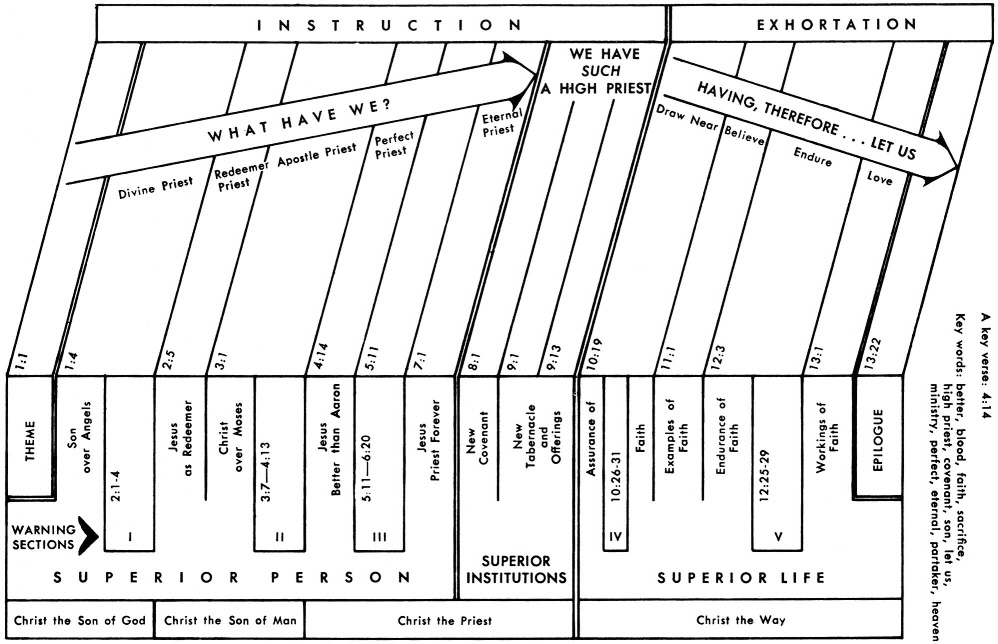
CONSIDER JESUS OUR GREAT HIGH PRIEST
Click chart to enlarge
Charts from Jensen's Survey of the NT - used by permission
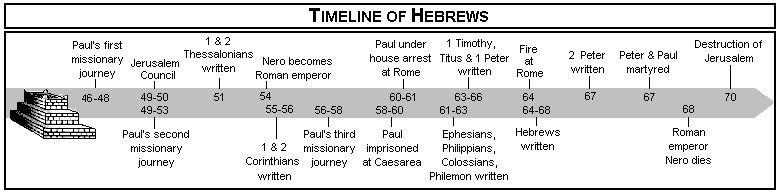
Hebrews - Charles Swindoll
|
The Epistle |
||||
| INSTRUCTION Hebrews 1-10:18 |
EXHORTATION Hebrews 10:19-13:25 |
|||
| Superior Person of Christ Hebrews 1:1-4:13 |
Superior Priest in Christ Hebrews 4:14-10:18 |
Superior Life In Christ Hebrews 10:19-13:25 |
||
| BETTER THAN PERSON Hebrews 1:1-4:13 |
BETTER PRIESTHOOD Heb 4:14-7:28 |
BETTER COVENANT Heb 8:1-13 |
BETTER SACRIFICE Heb 9:1-10:18 |
BETTER LIFE |
| MAJESTY OF CHRIST |
MINISTRY OF CHRIST |
MINISTERS FOR CHRIST |
||
|
DOCTRINE |
DUTY |
|||
|
DATE WRITTEN: |
||||

See ESV Study Bible "Introduction to Hebrews"
(See also MacArthur's Introduction to Hebrews)
Borrow Ryrie Study Bible
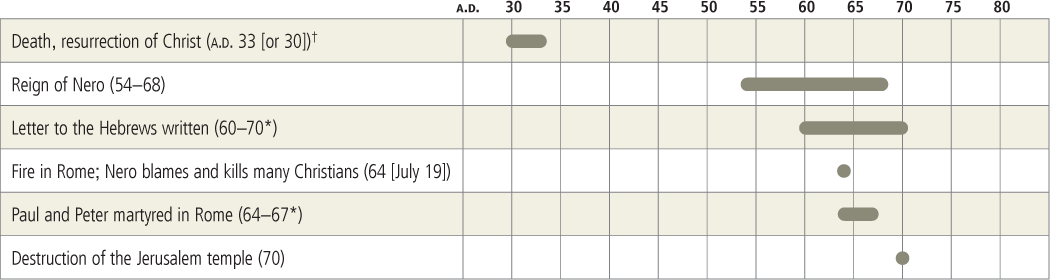
Timeline of Hebrews - ESV Study Bible
Hebrews 3:7 Therefore, just as the Holy Spirit says, "TODAY IF YOU HEAR HIS VOICE, (NASB: Lockman)
Greek: Dio kathos legei (3SPAI) to pneuma to hagion Semeron ean tes phones autou akousete (2PAAS)
BGT Διό, καθὼς λέγει τὸ πνεῦμα τὸ ἅγιον· σήμερον ἐὰν τῆς φωνῆς αὐτοῦ ἀκούσητε,
Amplified: Therefore, as the Holy Spirit says: Today, if you will hear His voice, (Amplified Bible - Lockman)
NAB Therefore, as the holy Spirit says: "Oh, that today you would hear his voice,
GWN As the Holy Spirit says, "If you hear God speak today, don't be stubborn.
NLT: That is why the Holy Spirit says, "Today you must listen to his voice. (NLT - Tyndale House)
NJB That is why, as the Holy Spirit says: If only you would listen to him today!
Phillips: We ought to take note of these words in which the Holy Spirit says: 'Today, if you will hear his voice, (Phillips: Touchstone)
Wuest: Wherefore, as the Holy Spirit says: Today, if His voice you will hear,
Young's Literal: Therefore, just as the Holy Spirit says, "TODAY IF YOU HEAR HIS VOICE,
- Today - He 3:13,15; 4:7; Ps 95:7-11; Pr 27:1; Eccl 9:10; Is 55:6; 2Co 6:1-2; Jas 4:13-15
- Hear His voice - Ps 81:11,13; Is 55:3; Mt 17:5; Jn 5:25; 10:3,16,27; Rev 3:20
Related Passages:
Ecclesiastes 9:10+ Whatever your hand finds to do, do it with all your might; for there is no activity or planning or knowledge or wisdom in Sheol where you are going.
Isaiah 55:6 Seek (command not a suggestion) the LORD while He may be found; Call (command not a suggestion) upon Him while He is near. (NOTE THE TWO CRITICAL TIME SENSITIVE WORDS "WHILE" X2)
2 Corinthians 6:1-2+ And working together with Him, we also urge you not to receive the grace of God in vain– 2for He says, “AT THE ACCEPTABLE TIME I LISTENED TO YOU, AND ON THE DAY OF SALVATION I HELPED YOU.” Behold, now is “THE ACCEPTABLE TIME,” behold, now is “THE DAY OF SALVATION”
James 4:13-15+ Come now, you who say, “Today or tomorrow we will go to such and such a city, and spend a year there and engage in business and make a profit.” 14 Yet you do not know what your life will be like tomorrow. You are just a vapor that appears for a little while and then vanishes away. 15 Instead, you ought to say, “If the Lord wills, we will live and also do this or that.”
Psalms 81:11 “But My people did not listen (Lxx = akouo) to My voice, And Israel did not obey Me. (NOTE LINKAGE OF "LISTEN" AND "OBEY")
Psalm 81:13 “Oh that My people would listen (Lxx = akouo) to Me, That Israel would walk in My ways! (NOTE LINKAGE OF "LISTEN" AND "WALK")
Isaiah 55:3 “Incline (command not a suggestion) your ear and come to Me. Listen (command not a suggestion. Lxx = epakouo in aorist imperative = to pay close attention to what one is told w. implication of being responsive), that you may live; And I will make an everlasting covenant with you, According to the faithful mercies shown to David.
Matthew 17:5+ While he was still speaking, a bright cloud overshadowed them, and behold, a voice out of the cloud said, “This is My beloved Son, with whom I am well-pleased; listen (akouo in present imperative = continually!) to Him!”
John 5:25+ “Truly, truly, I say to you, an hour is coming and now is, when the dead will hear (akouo) the voice of the Son of God, and those who hear (akouo) will live.
John 10:3; 16; 27+ “To him the doorkeeper opens, and the sheep hear (akouo) his voice, and he calls his own sheep by name and leads them out. (10:16) “I have other sheep, which are not of this fold; I must bring them also, and they will hear (akouo) My voice; and they will become one flock with one shepherd. (10:27) “My sheep hear (akouo) My voice, and I know them, and they follow Me;
Revelation 3:20+ ‘Behold, I stand at the door and knock; if anyone hears (akouo) My voice and opens the door, I will come in to him and will dine with him, and he with Me.
|
THE FIVE WARNING PASSAGES |
| Hebrews 2:1-4 + |
| Hebrews 3:7-4:13 + |
| Hebrews 5:11-6:12 + |
| Hebrews 10:19-39 + |
| Hebrews 12:14-29 + |
AND NOW FOR THE
CONCLUSION
Therefore - see value of interrogating terms of conclusion. In short, whenever you encounter a "therefore" (consequently, for this reason, etc), take a deep breath, slow down and ask yourself what is it "there for"? (Pause and Ponder!) As you begin to make this your habitual practice, you will find that it becomes second nature and begins to uncover the writer's train of thought in a way that heretofore you may have overlooked.
Note that there is disagreement on how the THEREFORE is to be interpreted.
One way to interpret this THEREFORE is to relate it to what was previously stated. The preceding section introduced a solemn exhortation ("CONSIDER JESUS" Heb 3:1+) which leads the writer to reinforce the truth with an Old Testament illustration of the danger of not considering Him and not holding fast, as he uses passages all his readers would be very familiar with (see note below). He reminds them of the sad time in Israel's history when they as a nation did not hold fast. He explains that the consequence of their failure to hold fast was that they stirred the anger of God Who caused the unbelieving generation to die in the wilderness and not enter the Promised Land, God's rest. He explains that their "not holding fast" was manifest by their disobedience which was directly related to unbelief (compare Heb 3:18+ and Heb 3:19+), an unbelief which produced hard hearts which led to apostasy (“a defiance of an established system or authority; a rebellion; an abandonment or breach of faith.”). So his point is because Jesus is better, "Therefore" they need to remember the disobedience of their ancestors (cf Acts 7:51+, Ps 95:7-11) so that they do not repeat the same fatal mistake! He will reiterate the important truth that they had a "holy calling" which is proven genuine if they hold fast to the end (Heb 3:6+, Heb 3:14+).
Therefore... is a swinging door that swings back into the past
and swings out into the future
J Vernon McGee on THEREFORE - Notice that we have another wherefore (THEREFORE) which opens this section. We had a wherefore in verse Heb 2:1, a wherefore here in Heb 3:7, and we are going to have wherefore again in Heb 3:10. It is a very important word. As I said, it is a swinging door that swings back into the past and swings out into the future. Also it is a danger signal as you come down the great highway that leads to heaven. In effect, it warns: Look both ways before you pull out -- some crazy driver may be coming down the wrong side of the highway. Wherefore, that is, in view of what has already been said, since the word spoken by the prophets and the word spoken by angels and the word spoken by Moses was so important, what about the importance of the word spoken by Jesus? We need to be very careful about doubting Him. (See Thru the Bible Hebrews 1-7)
Kenneth Wuest explains THEREFORE this way - The word “therefore” reaches back into the epistle to the three preceding arguments. In view of the fact that Messiah is better than (1) the prophets, (2) the angels, and (3) Moses, the warning is, not to harden their hearts in renouncing their professed faith in Messiah and returning to the sacrifices. The construction is; Wherefore (Heb 3:7), take care (Heb 3:12), the contents of Heb 3:7–11 being the parenthetical background and scriptural enforcement of the warning of Heb 3:12. (Hebrews )
Other writers see the THEREFORE as more connected with one of the following commands, either "DO NOT HARDEN" (Heb 3:8) or "Take care" (Heb 3:12). In my opinion both of these commands would logically link up with the preceding arguments for the superiority of Jesus which they had just "considered." In other words, THEREFORE, now because of the superiority of Jesus, and because of the importance of holding fast to the end, the readers should heed BOTH commands - do not harden and take care.
The Pulpit Commentary adds that "The warning is connected by διὸ (THEREFORE) with the conclusion of Heb 3:6. Since our continuing to be God's house is on the condition of our steadfastness, therefore beware of failing, as the Israelites referred to by the psalmist did."
William Lane writes "The particle διό, “so then,” (THEREFORE) carries forward the thought expressed conditionally in Heb 3:6b and relates it to the admonition “do not harden your hearts” in Heb 3:8. An alternative proposal to connect διό with the imperative βλέπετε, “be careful,” (TAKE CARE) in Heb 3:12 and to regard Heb 3:7b–11 as a parenthetical thought (so Kistemaker, Psalm Citations, 85) is to be rejected. The proposal blunts the force of the admonition and obscures the central importance of the quotation to the entire section."
Marcus Dods says THEREFORE "was probably intended to be immediately followed by βλέπετε (TAKE CARE - Hebrews 3:12) "wherefore take heed," but a quotation is introduced from Psalms 95 which powerfully enforces the βλέπετε. Or it may be that διὸ (therefore) connects with μὴ σκληρύνητε, (DO NOT HARDEN)."
Jacob Greenlee summarizes the two ways to interpret THEREFORE - (1) It indicates the consequence of the necessity if holding fast to be Christ’s household [Alf, Blm, EGT, Hu, Lg, Mil, My, NTC, TH, TNTC, WBC, Wst]: we are Christ’s household if we hold fast to our confidence and hope; therefore we should … It is the conclusion to this first part of the epistle [Blm]. It is a new step in the argument [TH]. (2) It indicates the consequence of Christ’s superiority [My(D)]: Christ is greater than Moses, therefore we should …" What is the implied verb of the clause introduced by διό ‘therefore’? (1) It is μὴ σκληρύνητε ‘do not harden’ in Heb 3:8 [Blm, EBC, ICC, NIGTC, WBC]: therefore … don’t harden your hearts. (2) It is βλέπετε ‘take heed’ in Heb 3:12 [Alf, EGT, Hu, Hwt, Lns, Mil, My, NTC, Wst]: therefore … take heed. The quotation in Heb 3:7–11 is parenthetical [NTC]. (An Exegetical Summary of Hebrews - Page 98)
Just as the Holy (hagios) Spirit (pneuma) says (present tense = the Spirit was still speaking and is even now speaking to us!) "TODAY (semeron) IF (ean - see note) YOU HEAR (akouo) HIS VOICE" - The writer now begins to quote from Psalm 95:7-11 and in so doing corroborates the divine inspiration of the Old Testament Scriptures explaining that they were the words of the Holy Spirit Who inspired the human author David (Heb 4:7+). Is there any argument that all Holy Scripture is inspired by God? That is a rhetorical question!
Peter explains the Holy Spirit's role in divine inspiration writing that "no prophecy was ever made by an act of human will, but men moved (present tense = continually; passive voice = Source outside of themselves = the Spirit ~ "divine passive") by the Holy Spirit spoke from God." (2 Pe 1:21+) As the following passages (Heb 3:7-4:13) attest, the children of Israel tested God and challenged His authority by rebelling in the wilderness and because of their rebellion, they failed to enter into the promised rest of Canaan, the land of milk and honey and instead perished in the wilderness.
John MacArthur emphasizes that "The Holy Spirit was involved in the writing of every word of Scripture (ED: 2Ti 3:16-17+). That is why it is sin in the first degree (ED: cf "insulted the Spirit of grace" = Heb 10:29b+), and opens the floodgates to every kind of heresy possible, to deny the absolute verbal inspiration of Scripture. God originated the autographs, the first copies, to the very word (ED: cf Isa 55:11)." (SEE The MacArthur Commentary)
Kenneth Wuest - The writer quotes from Psalm 95:7–11. The psalm was written by David, but the writer attributes it here to the Holy Ghost. The Holy Ghost spoke the words. David, the inspired penman, wrote them down. The Hebrew reads, “O that you would hear his voice.” The Greek has the conditional particle ean introducing a conditional sentence (see note), undetermined but with prospect of determination. The condition which must be met if these Hebrews are to hear the voice of God that they not harden their hearts. In the psalm, the pronoun “he” refers back to God. In the context into which the writer of this epistle has put it, it refers back to Christ. This makes the Jehovah of the O.T., the Messiah of the N.T. It is He who is said to have spoken the words of the New Testament (Heb 2:3+). These Jews were leaning back towards the First Testament. This was a heart-hardening process. They are warned against it. (Hebrews) (Bolding added)
As an aside, it is worth noting that the Holy (hagios) Spirit (pneuma) spoke in many passages in the New Testament
- Hebrews 9:8+ = "The Holy Spirit is signifying this"
- Hebrews 10:15+ = "the Holy Spirit also testifies to us; for after saying"
- Matthew 10:20+ = "but it is the Spirit of your Father who speaks in you"
- Matthew 22:43+ = "Then how does David in the Spirit call Him ‘Lord";
- Mark 12:36+ = "David himself said in the Holy Spirit"
- Acts 1:16+ = "the Holy Spirit foretold by the mouth of David concerning Judas";
- Acts 28:25+ = "The Holy Spirit rightly spoke through Isaiah the prophet to your fathers"
- 1 Timothy 4:1+ = "But the Spirit explicitly says that in later times..."
- Revelation 2:7+ = "let him hear what the Spirit says to the churches"
- Also in Rev 2:11 Rev 2:17 Rev 2:29 Rev 3:6 Rev 3:13 Rev 3:22
- (IN THE OT) 2 Sa 23:2+ = "The Spirit of the LORD spoke by me"
TODAY (semeron) IF YOU HEAR (akouo) HIS VOICE - Today is a key word in this second warning of Hebrews 3:7-4:13 where it is used in Heb 3:7, Heb 3:13+, Heb 3:15+, Heb 4:7+. Today emphasizes urgency. Not yesterday, not tomorrow but today! At this very time, this present moment. Now!
"Too little, too late"....
"not enough and not soon enough to make a difference!"
-- Webster
The point of this section of Hebrews is that if one knows the truth about Jesus and His Gospel, they must not imitate the response of Israel who knew God's truth and saw His miracles and yet failed to surrender to His truth. To harden one's heart is not only very foolish but is also very dangerous, for you do not know how long you will have to decide, how many "todays" are remaining in your life! Benjamin Franklin was correct when he advised never put off until tomorrow what you can do today, especially if it relates to your eternal destiny!
"Today" lasts only as long as there is opportunity to decide—
and as long as the conscience is sensitive to God.
When a person's "today" is over, it is then too late.
-- John MacArthur
I like Friberg's definition of today (semeron) "as a religious technical term identifying the limits of the time God has put at man's disposal for some purpose." And in context the "purpose" here is SALVATION! No one knows if they will have a tomorrow to make the decision which determines their destiny forever (Jas 4:14+, Ps 144:4, Job 7:6-7,9:25-26, 14:1-2, Ps 37:2 Ps 39:5-6, et al). Today signifies the present day of available grace. We can never know how long that time of grace for will continue which is why TODAY is such an urgent message!
The word IF introduces a third class conditional statement expressing potential or uncertain future action. It expresses something that is possible in the future. The third class condition often calls for a response from the hearer. As the Psalmist records and the writer quotes in the following passages, the children of Israel had the opportunity to see and hear (cf. Heb. 3:9) but willfully refused and hardened their hearts.
🙏 THOUGHT - This truth about the word TODAY begs the question dear curious or skeptical reader - are you procrastinating, putting off a decision to follow Christ by grace through faith? If so beware! God may not give you tomorrow!
Spurgeon - Today is the only time we have. Happily for us, the Holy Ghost says, “Today, if you hear his voice.” Never do I find Him saying “tomorrow.” His servants have often been repulsed by men like Felix who have said, “Go your way for this time. When I have a more convenient season I will send for you.” (Acts 24:25KJV+) And never did any apostle say, “Repent tomorrow, or wait for some convenient season to believe.” The constant testimony of the Holy Ghost, with regard to the one single part of time, which I have shown indeed to be all time, is, “Today if you hear his voice, do not harden your hearts.” The text inculcates a special duty. The duty is that we should hear the voice of God. The text bids us hear the voice of the Father saying, “Return to me, you backsliding children. Come now, and let us reason together. Even though your sins are like scarlet, they will be white like snow” (Isa 1:18+). Or it may be the voice of Jesus Christ, for it is of Him that the apostle is here speaking. It is Jesus who calls, “Come to me, all of you who labor and are burdened, and I will give you rest” (Mt 11:28+). In fact, the voice to be heard is that of the Sacred Trinity, for with the Father and the Son, the Spirit also says, “Come.” (John writes in some of the last inspired Words from God "The Spirit and the bride say, “Come.” [present imperative - the mystery is one Needs the Holy Spirit to obey] And let the one who hears say, “Come.” And let the one who is thirsty come; let the one who wishes take the water of life without cost." - Rev 22:17+ - right to the very end God's heart is for men to "Come!")
David Guzik on TODAY - The Holy Spirit tells us today because it is a genuine invitation. We know that the Holy Spirit really wants us to come to Jesus because He says, “TODAY.” If someone asks me to come over their house for dinner but they give no day or time, I know it isn’t a firm invitation yet. But when they say, “Come over on this day at this time,” I know it is a firm invitation, that they want me to come, that they are ready for me to come, and that it will be prepared for my coming. The Holy Spirit gives you a time for His invitation – TODAY.
Charles Spurgeon pointed out one reason why the Holy Spirit is so urgent: “Besides, he waits to execute his favourite office of a Comforter, and he cannot comfort an ungodly soul, he cannot comfort those who harden their hearts. Comfort for unbelievers would be their destruction. As he delights to be the Comforter, and has been sent forth from the Father to act especially in that capacity, that he may comfort the people of God, he watches with longing eyes for broken hearts and contrite spirits, that he may apply the balm of Gilead and heal their wounds....Select the strongest man you know, and suppose that everything in reference to your eternal welfare is to depend upon whether he lives to see the next year. With what anxiety would you hear of his illness, how concerned you would be about his health? Well, sinner, your salvation is risked by you upon your own life, is that any more secure?”
The Enduring Word Bible Commentary - The Enduring Word Bible Commentary – Hebrews.”
There is time for you to know Him today,
but tomorrow may be too late.
If you hear (akouo)- The idea of hearing like "Today" is a key word in Hebrews...
Hebrews 2:1+ For this reason we must pay much closer attention to what we have heard (akouo), lest we drift away from it.
Hebrews 2:3+ how will we escape if we neglect so great a salvation? After it was at the first spoken through the Lord, it was confirmed to us by those who heard (akouo),
Hebrews 3:7+ Therefore, just as the Holy Spirit says, "TODAY IF YOU HEAR (akouo) HIS VOICE, 8 DO NOT HARDEN YOUR HEARTS AS WHEN THEY PROVOKED ME, AS IN THE DAY OF TRIAL IN THE WILDERNESS
Hebrews 3:15+ while it is said, "TODAY IF YOU HEAR (akouo) HIS VOICE, DO NOT HARDEN YOUR HEARTS, AS WHEN THEY PROVOKED ME."
Hebrews 4:2+ For indeed we have had good news preached to us, just as they also; but the word they heard did not profit them, because it was not united by faith in those who heard (akouo).
Hebrews 4:7+ He again fixes a certain day, "Today," saying through David after so long a time just as has been said before, "TODAY IF YOU HEAR (akouo) HIS VOICE, DO NOT HARDEN YOUR HEARTS."
Hebrews 5:9+ And having been made perfect, He became to all those who obey (literally "hear under", listen attentively hupakouo = hupo + akouo) Him the source of eternal salvation,
Hebrews 5:11+ Concerning him we have much to say, and it is hard to explain, since you have become dull of hearing (noun - akoe)
Hebrews 11:8+ By faith Abraham, when he was called, obeyed (literally "hear under", listen attentively hupakouo = hupo + akouo) by going out to a place which he was to receive for an inheritance; and he went out, not knowing where he was going.
Hebrews 12:19+ and to the blast of a trumpet and the sound of words which sound was such that those who heard (akouo) begged that no further word be spoken to them.
The call the HEAR HIS VOICE is a well-known exhortation found in the Talmud: “Rabbi ‘Eli‘ezer said, "Repent one day before you die.’ His talmidim objected, ‘Does one know in advance the day of one’s death?’ He replied, ‘All the more reason to repent today, lest you die tomorrow! In this way, your entire life will be one of repentance.’ ” (Shabbat 153a)
Every Jew knew this Talmudic passage by heart because its opening line served as a call to worship every Sabbath evening in the synagogue with these words: “Today, if you hear his voice, do not harden your hearts” These solemn words were proclaimed week after week, year after year, as a call and a charge to carefully listen to the voice of God. Hebrew ears perked up at their sound or at least they should have! And so should ours, especially if we are reading these solemn passages and have only made a profession of faith but lack evidence (fruit) to validate our profession. Spiritual fruit substantiates a sure spiritual root in Christ.
Hear (akouo) His voice - Listening to God and obeying Him are matters of the will. (See related note on harden below) It is also a choice, a matter of one's will to harden his or her heart toward God, as Israel did. In his letter to Timothy, Paul warned that our hearts, or consciences, can become seared and insensitive, as skin does when it is badly burned (1Ti 4:2+). The scar tissue that replaces the skin in a healed burn has very little feeling. I had a subspecialty in infectious disease and remember how I learned that lepers whose nerves are destroyed by Mycobacterium leprae cannot feel pain sensation as from a fire or a cut and this can be extremely dangerous, even life-threatening. Similarly when the spiritual heart is hardened so that it can no longer sense the piercing by the sword of the Word of God and the Gospel (cf Heb 4:12-13+), the situation is far worse than leprosy, for this person is in grave danger of eternal separation from God and will be tormented by pain forever in the Lake of fire which burns!
What will you say when you meet your Maker?
If you’re unsure, settle it now—for it will be too late then.
It's foolish to say "tomorrow" when God says "today."
Something very much like this happens to a conscience that is repeatedly ignored, as when the Spirit convicts of sin and righteousness and judgment (Jn 16:8+). Today lasts only as long as there is opportunity to decide and as long as the conscience is sensitive to God. When a person’s “today” is over, it is too late. Our heart gets harder every time we say "NO" to the Spirit of Jesus Christ and His truth because the deceitfulness of sin hardens our heart (Heb 3:13+). When the heart is soft, when the conscience is sensitive, when the intellect is convinced about Christ, that is the time to decide, while one's heart and conscience is still pliable and responsive. Otherwise one will eventually become spiritually hard, stubborn, and insensitive. The Gospel will no longer have any appeal or bring any conviction of one's lost state without Christ and that person's eternal fate is forever sealed! (See 5 pages in NIDNTT on CONSCIENCE)
A T Robertson notes "The long quotation in Hebrews 3:7-11 is from Psalm 95:7-11. After the quotation the author has "three movements" (Moffatt) in his discussion of the passage as applied to the Jewish Christians (Hebrews 3:12-19; Hebrews 4:1-10; Hebrews 4:11-13).
Ray Stedman on Psalm 95- The beginning of Psalm 95 describes worship which is acceptable to God but closes with a flashback to the false worship of Israel in the wilderness. (When Israel Failed to Enter Rest)
In Psalm 95 David writes...
7 For He is our God, and we are the people of His pasture, and the sheep of His hand. Today, if you would hear (Lxx = akouo) His voice,
In the psalm, the pronoun “He” refers to God. In the context into which the writer of this epistle has put it, it refers back to Christ. This makes the Jehovah of the OT, the Messiah of the NT (see Jehovah = Jesus).
8 Do not harden your hearts, as at Meribah (Hebrew = meribah; Lxx = parapikrasmos), as in the day of Massah (Hebrew = massah; Lxx = peirasmos) in the wilderness;
9 When your fathers tested Me. They tried Me, though they had seen My work. (ED: TESTED HIM TEN TIMES IN Nu 14:22+)
10 For forty years I loathed that generation, and said they are a people who err in their heart, And they do not know My ways.
11 Therefore I swore in My anger, truly they shall not enter into My rest." (Psalm 95:7-11)
Spurgeon comments on Ps 95:7 Today if you hear His voice - Dreadful "IF." Many would not hear, they put off the claims of love, and provoked their God. "Today," in the hour of grace, in the day of mercy, we are tried as to whether we have an ear for the voice of our Creator. Nothing is said of tomorrow, "he limiteth a certain day," he presses for immediate attention, for our own sakes he asks instantaneous obedience. Shall we yield it? The Holy Ghost saith "Today," will we grieve him by delay?
Barton Bouchier (quoted by Spurgeon) writes "Oh! what an if is here! what a reproach is here to those that hear him not! "My sheep hear my voice, and I know them, and they follow me"; "but ye will not come to me that ye might have life." And yet there is mercy, there is still salvation, if ye will hear that voice. Israel heard it among the thunders of Sinai, "which voice they that heard it entreated that the word should not be spoken to them any more"; so terrible was the sight and sound that even Moses said, "I exceedingly quake and fear": and yet they heard too the Lord's still voice of love in the noiseless manna that fell around their tents, and in the gushing waters of the rock that followed them through every march for forty years. Yet the record of Israel's ingratitude runs side by side with the record of God's mercies -- "My people would not hearken to my voice, and Israel would none of me."
Thomas Cole (quoted by Spurgeon) writes "It will be as difficult, nay, more difficult, to come to Christ tomorrow, than it is today: therefore today hear His voice, and harden not your heart. Break the ice now, and by faith venture upon your present duty, wherever it lies; do what you are now called to. You will never know how easy the yoke of Christ is, till it is bound about your necks, nor how light his burden is, till you have taken it up. While you judge of holiness at a distance, as a thing without you and contrary to you, you will never like it. Come a little nearer to it; do but take it in, actually engage in it, and you will find religion carries meat in its mouth; it is of a reviving, nourishing, strengthening nature. It brings that along with it, that enables the soul cheerfully to go through with it. --Thomas Cole (1627-1697) in the "Morning Exercises."
Failure to grow in knowledge of God's ways is the
very danger our author sees as a possibility for his own readers.Ray Stedman on err in their heart....not know My ways....shall not enter My rest - Note the reasons for his solemn oath: (1) They continually went astray in their hearts. Their inward life was askew. Rather than having a grateful spirit for astounding deliverances and limitless blessings, there was a settled attitude of complaint because everything did not go exactly as they desired each day. They saw themselves as deserving more than they were getting, and they resented it, not with an occasional outburst of displeasure, but with a constant harping that wore down everyone's nerves. (2) They had not learned God's ways. Over forty years, their real knowledge of God had not increased because their grumbling hearts blinded their spiritual eyes. A teachable spirit sustains a grateful heart. Centuries later Jesus would pray: "Now this is eternal life: that they may know you, the only true God, and Jesus Christ, whom you have sent" (Jn 17:23+). This failure to grow in knowledge of God's ways is the very danger our author sees as a possibility for his own readers. He reminds them of this episode in Israel's history so they might heed its warning. Full apostasy is present when God says of anyone, They shall never enter my rest. ( When Israel Failed to Enter Rest)
C H Spurgeon says the writer "is continually quoting from the Old Testament, but he does not often present his quotations in this peculiar fashion. In the very next chapter, when he is speaking of the same passage, he uses the expression, “speaking by David” (Heb 4:7)—mentioning the human author of the psalm. But in this case, to give full emphasis to the truth, he quotes the divine author alone—“As the Holy Spirit says.” These words, it is true, are applicable to every passage of sacred Scripture, for we may say of all the inspired books, “As the Holy Spirit says.” But it is designedly used here that the passage may have the greater weight with us. The Holy Ghost, in fact, not only speaks thus in Psalm 95, but it is His unvarying utterance. The Holy Ghost says, or continues still to say, “Hear His voice today.” How does the Holy Ghost thus speak? He says this first in the Scriptures. Every command of Scripture calls for immediate obedience. The law of God is not given to us to be laid on the shelf to be obeyed at some future period of life, and the gospel of our Lord and Savior Jesus Christ is not so intended for the eleventh hour as to be lightly trifled with during the first ten. Wherever the Holy Ghost exhorts, He speaks in the present tense, and bids us now repent, or now believe, or now seek the Lord. Further, while the Holy Ghost speaks in Scripture, He speaks in the same manner in the hearts of His people. He is a living and active agent; His work is not ended; He speaks and writes still. The pen is still in His hand, not to write with ink upon paper, but upon the fleshy tablets of prepared hearts. The like is also true when the Holy Ghost speaks in the awakened. They are not yet numbered with the people of God, but they are under concern of soul. Everywhere a truly awakened sinner pleads in the present tense, and cries mightily for a present salvation, and it is certain that whenever the Holy Ghost strives with men, He urgently cries, “Today! Today!” Once more, the Holy Ghost speaks thus by His deeds as well as by His words. We have a common proverb that actions speak more loudly than words. Now the acts of the Holy Spirit in the leading of many to the Savior are so many practical invitations, encouragements, and commands to others. The gate of mercy stands open every day in the year, and its very openness is an invitation and a command to enter. Is not the bringing of one sinner to Himself intended to allure others? (Hebrews 3:7 - full sermon The Entreaty of the Holy Ghost)
Today (4594) semeron means this (very) day ( Mt 28:15; Ac 20:26; Ro 11:8; 2 Cor 3:14) or what has happened today.
Friberg on semeron - adverb of time; (1) generally designating the present today, this day (Mt 11.23), in contrast to in the past; (2) as an unspecified period of time between past and future periods for the present, at this time (Lk 13.32, 33); (3) as the twenty-four-hour period beginning at sundown today, this very day (Mk 14.30); (4) as designating the same period of time as the day of the discourse today (Mt 21.28); (5) as a religious technical term identifying the limits of the time God has put at man's disposal for some purpose (Heb 3.13) (Borrow Analytical Lexicon of the Greek New Testament)
SEMERON - 41X/40V - last night(1), this(1), this day(6), this very(2), today(29), today's(1), very(1). Matt. 6:11; Matt. 6:30; Matt. 11:23; Matt. 16:3; Matt. 21:28; Matt. 27:8; Matt. 27:19; Matt. 28:15; Mk. 14:30; Lk. 2:11; Lk. 4:21; Lk. 5:26; Lk. 12:28; Lk. 13:32; Lk. 13:33; Lk. 19:5; Lk. 19:9; Lk. 22:34; Lk. 22:61; Lk. 23:43; Acts 4:9; Acts 13:33; Acts 19:40; Acts 20:26; Acts 22:3; Acts 24:21; Acts 26:2; Acts 26:29; Acts 27:33; Rom. 11:8; 2 Co. 3:14; 2 Co. 3:15; Heb. 1:5; Heb. 3:7; Heb. 3:13; Heb. 3:15; Heb. 4:7; Heb. 5:5; Heb. 13:8; Jas. 4:13
TIME - Time and eternity are two complementary categories for comprehending the historical process. The Gk. language has a wealth of various terms with which to express the experience of time. The most extensive one is aion which is primarily a designation for a long period of time. When such an age refers to the past, it denotes remote antiquity, the dim and distant past; when it is directed to the on-going future aion can take on the meaning of eternity. Eternity is thus not necessarily a timeless concept, but the most comprehensive temporal one which the experience of time has produced. Theologically speaking, lasting time is a property of God the Creator, whereas passing time belongs to man as creature. chronos chiefly denotes the quantitive, linear expanse of time, a space or period of time, and is thus a term of the formal and scientific conception of time. In this connexion there are several terms which comprehend a particular span of time: especially eniautos, year; men, month, hemera, day and hora, hour. By contrast, the characteristic stress of kairos draws attention to the content of time, negatively as crisis and positively as opportunity. Since the adverbs nyn, now, and semeron, today, which relate to the present, and are also fundamentally claimed for the linear conception of time (in this case marking a present point of time) are chiefly used in the NT in a qualificatory sense, they are incorporated in the art. kairos. It is instructive for the whole NT understanding of time that it is not the formal concept of chronos, but that of kairos, qualifying the content of the time of Jesus, which stands in the foreground. For the concepts of day, maranatha and parousia ~ Present (NIDNTT online)
SEMERON IN SEPTUAGINT - Gen. 4:14; Gen. 19:37; Gen. 19:38; Gen. 21:26; Gen. 22:14; Gen. 24:12; Gen. 24:42; Gen. 25:31; Gen. 25:33; Gen. 26:33; Gen. 30:16; Gen. 30:32; Gen. 31:43; Gen. 31:46; Gen. 35:4; Gen. 35:20; Gen. 40:7; Gen. 41:9; Gen. 41:41; Gen. 42:13; Gen. 42:32; Gen. 47:23; Gen. 50:20; Exod. 2:18; Exod. 5:14; Exod. 13:4; Exod. 14:13; Exod. 16:25; Exod. 19:10; Exod. 32:29; Lev. 9:4; Lev. 10:19; Num. 22:30; Deut. 1:10; Deut. 1:39; Deut. 2:18; Deut. 4:1; Deut. 4:2; Deut. 4:4; Deut. 4:8; Deut. 4:26; Deut. 4:38; Deut. 4:39; Deut. 4:40; Deut. 5:3; Deut. 6:2; Deut. 6:6; Deut. 6:24; Deut. 7:11; Deut. 8:1; Deut. 8:11; Deut. 8:18; Deut. 8:19; Deut. 9:1; Deut. 9:3; Deut. 9:6; Deut. 10:13; Deut. 11:2; Deut. 11:4; Deut. 11:7; Deut. 11:8; Deut. 11:13; Deut. 11:22; Deut. 11:26; Deut. 11:27; Deut. 11:28; Deut. 11:32; Deut. 12:8; Deut. 12:11; Deut. 12:14; Deut. 12:32; Deut. 13:18; Deut. 15:5; Deut. 19:9; Deut. 20:3; Deut. 26:3; Deut. 26:17; Deut. 26:18; Deut. 27:1; Deut. 27:4; Deut. 27:10; Deut. 28:1; Deut. 28:13; Deut. 28:14; Deut. 28:15; Deut. 29:10; Deut. 29:12; Deut. 29:15; Deut. 30:2; Deut. 30:8; Deut. 30:11; Deut. 30:15; Deut. 30:16; Deut. 30:18; Deut. 30:19; Deut. 31:2; Deut. 31:21; Deut. 31:27; Deut. 32:46; Jos. 4:9; Jos. 5:9; Jos. 6:25; Jos. 7:19; Jos. 7:25; Jos. 9:27; Jos. 10:27; Jos. 13:13; Jos. 14:10; Jos. 14:11; Jos. 22:3; Jos. 22:16; Jos. 22:18; Jos. 22:29; Jos. 22:31; Jos. 24:15; Jos. 24:27; Jos. 24:30; Jdg. 6:17; Jdg. 9:18; Jdg. 11:27; Jdg. 21:3; Jdg. 21:6; Ruth 2:19; Ruth 3:18; Ruth 4:9; Ruth 4:10; Ruth 4:14; 1 Sam. 4:3; 1 Sam. 4:7; 1 Sam. 4:16; 1 Sam. 9:12; 1 Sam. 9:19; 1 Sam. 9:20; 1 Sam. 9:27; 1 Sam. 10:2; 1 Sam. 10:19; 1 Sam. 11:13; 1 Sam. 12:5; 1 Sam. 12:17; 1 Sam. 14:28; 1 Sam. 14:30; 1 Sam. 14:38; 1 Sam. 14:41; 1 Sam. 14:44; 1 Sam. 14:45; 1 Sam. 15:28; 1 Sam. 16:5; 1 Sam. 17:10; 1 Sam. 17:36; 1 Sam. 17:45; 1 Sam. 17:46; 1 Sam. 20:27; 1 Sam. 21:2; 1 Sam. 21:5; 1 Sam. 22:15; 1 Sam. 24:10; 1 Sam. 24:11; 1 Sam. 24:18; 1 Sam. 24:19; 1 Sam. 25:10; 1 Sam. 25:32; 1 Sam. 25:33; 1 Sam. 25:34; 1 Sam. 26:8; 1 Sam. 26:19; 1 Sam. 26:21; 1 Sam. 26:23; 1 Sam. 26:24; 1 Sam. 27:10; 1 Sam. 29:6; 1 Sam. 30:13; 1 Sam. 30:25; 2 Sam. 3:8; 2 Sam. 3:39; 2 Sam. 6:20; 2 Sam. 11:12; 2 Sam. 14:22; 2 Sam. 15:20; 2 Sam. 16:3; 2 Sam. 18:31; 2 Sam. 19:5; 2 Sam. 19:6; 2 Sam. 19:7; 2 Sam. 19:20; 2 Sam. 19:22; 2 Sam. 19:35; 1 Ki. 1:25; 1 Ki. 1:48; 1 Ki. 1:51; 1 Ki. 2:24; 1 Ki. 2:31; 1 Ki. 5:7; 1 Ki. 8:15; 1 Ki. 8:28; 1 Ki. 8:56; 1 Ki. 18:15; 1 Ki. 18:36; 1 Ki. 20:13; 1 Ki. 22:5; 2 Ki. 2:3; 2 Ki. 2:5; 2 Ki. 4:23; 2 Ki. 6:28; 2 Ki. 6:31; 1 Chr. 29:5; 2 Chr. 6:19; 2 Chr. 10:7; 2 Chr. 18:4; 2 Chr. 35:21; 2 Chr. 35:25; Neh. 1:6; Neh. 1:11; Neh. 5:11; Neh. 9:36; Est. 1:18; Est. 5:4; Ps. 2:7; Ps. 95:7; Prov. 7:14; Isa. 10:32; Isa. 37:3; Isa. 38:19; Isa. 58:4; Jer. 1:10; Jer. 1:18; Jer. 34:15; Ezek. 2:3; Ezek. 20:29; Ezek. 20:31; Ezek. 24:2
Hear (191) akouo primarily means physical hearing of sounds and the apprehension of the sounds with one's mind. Akouo gives us our English acoustics which is the science of designs that helps one hear (We need "spiritual acoustics" to help us hear spiritual truth!). An important nuance of akouo is to hear and obey. E.g., In the Lxx of Ge 27:43 “Now therefore, my son, obey (Lxx = akouo = literally "hear" ~ heed!) my voice, and arise, flee to Haran, to my brother Laban!" This important sense of akouo meaning obey is found in Lk 10:16; 16:29, 31 Jn 5:24; 8:47; 18:37; Acts 3:22, 23; 4:19; 1 Jn 4:5, 6 Lxx = Ge 3:17; Ex. 16:20; Dt. 11:27; 2 Chr 20:14; Isa 48:18 (et al). In summary, akouo is not just to hear the sound of words, but to hear with understanding or to heed. English definitions of the word to heed = to consider someone's advice or warning and do what they suggest; to give careful attention to someone's advice or warning; to regard with care; to take notice of; to attend to. There is obviously overlap with the preceding nuance of hearing and obeying, for hearing with understanding may call for one to obey (cf Mt 11:15).
Obedience involves conscious listening.
If you do not really listen, you cannot really obey.
R Kent Hughes point out that "Obedience involves conscious listening. If you do not really listen, you cannot really obey. That is why parents are always saying, “Listen to me!” The idea is to listen under with the intent to understand and do it...Much of this is a matter of attitude. We are not to be like the little boy who misbehaved and was told by his teacher to sit in the corner, which he did with grudging obedience, all the while saying to himself, “I’m sitting down on the outside, but I’m standing up on the inside!” (See Ephesians: The Mystery of the Body of Christ - Page 197)
Friberg's summary of akouo - hear, listen to; (1) followed by the genitive to indicate sense perception hear (Acts 9.7); (2) followed by the accusative to indicate understanding of what was said hear (Acts 9.4); (3) as a legal technical term give a hearing, grant a court trial (Jn 7.51); (4) of being informed about something learn or hear (of) (Mt 14.13); (5) impersonally avkou,etai it is reported (1Co 5.1); (6) of discipleship listen to, pay attention to, obey (Lk 9.35); (7) of inner comprehension understand, be aware of, listen to (Gal 4.21) (Borrow Analytical Lexicon of the Greek New Testament)
AKOUO IN HEBREWS - Heb. 2:1; Heb. 2:3; Heb. 3:7; Heb. 3:15; Heb. 3:16; Heb. 4:2; Heb. 4:7; Heb. 12:19
Akouo is a very common verb in the NT and the Septuagint (Over 1400 uses total) and has several important nuances - to hear sound (Mt 9:12; 11:5, Mk 10:41; 14:64; Lk 7:3, 9; Jn 3:8; Lxx = Ge 3:8, 10), to hear so as to obey (see note), to hear with understanding (see note), to hear with attention (to listen attentively so as to perceive what is being said), to hear prayer (Jn 9:31; 11:41, 42; 1 Jn 5:15; Lxx = Ps. 10:17), to hear a case at court (Acts 25:22; Jn 7:51), to learn by hearing, to be informed, to know (Mt. 2:3, 22; 4:12; 5:21, 27; 11:2; Mt 20:30, Mk 2:1; 10:47, 5:27; 6:14; Acts 14:14; 15:24, Jn 14:28; Lxx = Ge 41:15; 42:2), hearing related to instruction or doctrine (Jn 8:40; 15:15; Acts 1:4; 4:20; Ro 10:14, 18; Heb 2:1; 1 Jn 2:7, 24).), to hear a report (Mt 28:14; Mk 2:1; Lk 12:3; Acts 11:22; 1 Cor 5:1; Lxx = 2 Chr 26:15). In John 6:60 the phrase "who can listen to it?" has the nuance of who can accept it or who can receive it and believe it. There is often overlap in these various nuances. Clearly, to arrive at the most accurate definition of akouo in a given verse will require careful observation of the use in context.
QUESTION - What is verbal plenary inspiration? Gotquestions.org
ANSWER - The Bible is God’s Word to humanity. It was written by human authors, but God prompted and guided them to write what they did. Every word, word form, and word placement found in the Bible’s original manuscripts was divinely and intentionally written. This is the orthodox view of the church and is known as verbal plenary inspiration.
Inspiration, the quality of being “God-breathed,” refers to the fact that God supernaturally guided the authors of the Bible to write exactly what He wanted to communicate. Everything in Scripture is there because that’s what God desired to say to humanity. The extent of that inspiration is defined by the dual terms verbal and plenary. Verbal means that every word of Scripture is God-breathed. Every single word, not just the ideas behind the words, is in the Bible because God wanted it there. The word plenary means “complete or full”; when used to describe the inspiration of God’s Word, plenary means that all parts of the Bible are equally of divine origin and equally authoritative.
The apostle Paul implicitly taught the verbal plenary inspiration of the Word of God. In Galatians 3:16, he wrote, “The promises were spoken to Abraham and to his seed. Scripture does not say ‘and to seeds,’ meaning many people, but ‘and to your seed,’ meaning one person, who is Christ.” Paul used the number of the noun—the fact that Moses wrote a singular word, not a plural—as the basis for his argument that Christ fulfills the covenant. This supports verbal inspiration. In Romans 15:4 Paul wrote that “everything that was written in the past was written to teach us” and in 2 Timothy 3:16 that “all Scripture is God-breathed.” Everything and all are words that support the doctrine of plenary inspiration.
Second Peter 1:21 says, “For prophecy never had its origin in the human will, but prophets, though human, spoke from God as they were carried along by the Holy Spirit.” This passage reveals how God led human authors to write Scripture. Men wrote as they were “carried along” or “moved” (KJV) by the Holy Spirit. What we read in the Bible is indeed God’s words to us. According to Jesus, even the smallest letter within a word and the slightest pen stroke within a letter are God’s design and will be fulfilled (Matthew 5:18).
The term verbal plenary inspiration should not be taken to mean that the words in the Bible themselves are “holy.” The Greek word halas (“salt” in Matthew 5:13) is not “holy” simply because it’s found in the Bible. Other, non-inspired writings also contain the word halas, and their use of the word does not make them special. What verbal plenary inspiration does mean is that all the words, forms of words, combination of words, and wording in the Bible are God’s divine intention for Scripture. The words, phrases, and clauses work together to give us His message, and each portion of Scripture is purposefully there.
Verbal plenary inspiration applies to the original manuscripts of the books of the Bible. The Bible translations we have today are the works of scholars who have studied copies of the original manuscripts, but the doctrine of inspiration does not extend to translations. Most modern translations are trustworthy, but no one translation is divinely inspired in the way the original manuscripts are.
Also, the doctrine of verbal plenary inspiration does not mean that God condones or encourages all the actions recorded in the Bible. For example, God states that murder is sinful, yet He also inspired historical records of people committing murder. So, the Bible contains true history as well as God’s moral instructions. The Ten Commandments are inspired, and so is the written record of Absalom’s murder of Amnon; both passages are instructive, and both passages are inspired. The interpretation and application of the Ten Commandments differs from that of Absalom’s story and requires sound biblical hermeneutics.
Verbal plenary inspiration is an important concept and tenet of the Christian faith. God’s inspiration of the text of Scripture extends to the very words themselves and to all parts of Scripture and all subject matters of Scripture. The doctrine of verbal plenary inspiration stands in contrast to the belief that only parts of the Bible are inspired or that only the thoughts or concepts that deal with religion are inspired. Verbal plenary inspiration is an essential characteristic of the Word of God, as His words reveal who He is and what He has done for us through Christ (see John 5:39–40; Acts 8:35).
Related Resources:
- Is there proof for the inspiration of the Bible?
- What does it mean that the Bible is inspired?
- Does the inerrancy of the Bible only apply to the original manuscripts? | GotQuestions.org
- What is the dictation theory? | GotQuestions.org
- Who wrote the Bible?
QUESTION - What is the meaning of, “Today if you will hear His voice, do not harden your heart” in Psalm 95:8? GOTQUESTIONS.ORG
ANSWER - In Psalm 95:8 the psalmist exhorts the reader, “Today, if you will hear His voice: ‘Do not harden your hearts’” (NKJV). Here are two commands: first, recognize and respond to God’s voice, and, then, do not let your hearts harden.
Psalm 95 is a call to worship (verses 1–2, 6). In Psalm 95:7–9 we read, “Today, if only you would hear his voice, ‘Do not harden your hearts as you did at Meribah, as you did that day at Massah in the wilderness, where your ancestors tested me.’” The psalmist continues to relate God’s punishment on the ancient Israelites: although they had seen God’s mighty works, they strayed in their hearts, and God, grieved for forty years, forbade them from entering the Promised Land (Psalm 95:9–11).
Meribah, mentioned in Psalm 95:8, also known as Massah, was a place where the Israelites, after their exodus from Egypt, rebelled against God (Exodus 17:2). Because of their extreme thirst, they grumbled and complained to Moses, “Why did you bring us up out of Egypt to make us and our children and livestock die of thirst?” (Exodus 17:2–3). Moses turned to the Lord in prayer, and God responded by having Moses strike the rock so the Israelites would have water and know that the Lord was with them (Exodus 17:4–7). Even after they saw what God did at Meribah—even after God had freed them from bondage in Egypt—the Israelites still hardened their hearts, distrusted God, and grumbled about their temporary circumstances.
The author of Psalm 95 is saying, in essence, don’t be like that. Don’t harden your heart at the work of God on your behalf. He is speaking to you, if you would only listen. He has done great things for you, if you would only remember. Ascribe to God His due worship. “He is our God and we are the people of his pasture” (Psalm 95:7). Israel should follow their Shepherd.
The author of Hebrews quotes the words, “Today, if you hear his voice, do not harden your hearts as you did in the rebellion,” three times, in Hebrews 3:7–8, 15, and 4:7. These quotations from Psalm 95 are meant to exhort people to receive Christ and not have “a sinful, unbelieving heart that turns away from the living God” (Hebrews 3:12). The Israelites rejected their “rest” in the Promised Land, but today Jesus is the “Sabbath-rest for the people of God” (Hebrews 4:9). Do not harden your heart against Him.
God still speaks today, but we must follow Him to recognize His voice. There are so many voices vying for our attention, especially with the increased use of technology and social media. Yet God’s voice must be the voice we heed. Jesus is our Good Shepherd: the shepherd opens the gate for his sheep, “and the sheep listen to his voice. He calls his own sheep by name and leads them out. When he has brought out all his own, he goes on ahead of them, and his sheep follow him because they know his voice. But they will never follow a stranger; in fact, they will run away from him because they do not recognize a stranger’s voice” (John 10:3–5). Our Good Shepherd loves us and calls us today to follow Him alone: “Today, if you will hear His voice, do not harden your heart.”
The psalmist warns, “If you will hear His voice, do not harden your heart,” and the author of Hebrews echoes the warning. God’s words demand a response, and, tragically, some respond by hardening their hearts. Some permanently harden their hearts, but even believers can harden their hearts for a period of time. When people ignore who God is and what He has done, like the Israelites did in the wilderness, their hearts harden. When people hold onto sin, their hearts harden. When people allow circumstances to cloud their thinking and let their feelings dictate their actions, their hearts harden. It is God’s Word that keeps our hearts soft and pure: “For the word of God is alive and active. Sharper than any double-edged sword, it penetrates even to dividing soul and spirit, joints and marrow; it judges the thoughts and attitudes of the heart” (Hebrews 4:12). We must turn to hear and heed God’s voice.
“Today if you will hear His voice, do not harden your heart.” Sometimes, evangelists use these verses after presenting the gospel. Life is but a vapor (James 4:14), so if you hear the gospel message today, you need to accept Christ today. Do not harden your heart as in the rebellion. We are not guaranteed tomorrow. To permanently harden one’s heart against God and reject the gospel message of salvation is to suffer eternal consequences: “The wages of sin is death” (Romans 6:23). To heed God’s voice and place one’s trust in the finished work of Christ on the cross is to be saved and have eternal life (John 3:16).
O, trifle not with the strivings of the Spirit!
A young man, whose soul was passing through the deep waters of conviction (Jn 16:8+), retired to a grove to pray. For God to ease from his heart this heavy burden was all he desired, and so sadly he deliberately asked God to give him quiet by taking the conviction of the Holy Spirit from him. It was a fearful prayer, but it was answered. He arose with all his burden gone. For twenty years he lived on, careless and unconcerned, and when death came to him he related this fact in his history to a friend standing beside him. “I know, that I shall soon be in hell. Nothing can save me. My doom is sealed, and yet I am quite indifferent to the future.”
Many, who do not thus pray to have the Spirit depart, do quite as surely resist Him and grieve Him away (cf Acts 7:51+). It is not by an outspoken word or glaring act of sin, but in some very natural, easy path (cf Drifting Heb 2:1+), the tempter leads them off from the great highway they were about to enter (Pr 4:26-27).
It may be a novel thing, carelessly thrown in their way, that leads them to forget their convictions. A party of pleasure, innocent at another time, may seal their doom. Needful cares and duties are often made the pretext for putting aside or procrastinating for the present the concerns of the soul regarding eternity.
There is but one way of safety for the awakened soul. That is, to lay aside every weight (Heb 12:1), and for the time give all his attention to seeking the Saviour (Isa 55:1, 3, 6), in humble prayer and in reading God’s word. The Spirit will not fail to meet such a seeker with heavenly blessings on his wings. O, trifle not with the strivings of the Spirit!
Spurgeon “Today, if you hear his voice.” - Every command of Christ bears today’s date. If a thing is right, it should be done at once. If it is wrong, stop it immediately. There is an immediateness about the calls of Christ. Whatever he bids us to do, we must not delay to do. Duties that are put off tend to harden the heart.
Dear unbeliever or skeptic, have you been pondering the words of Jesus, thinking that perhaps in a future day you might believe in Him. If so, you need to be very careful, for you may not have a future day! Paul writes "“AT THE ACCEPTABLE TIME I LISTENED TO YOU, AND ON THE DAY OF SALVATION I HELPED YOU.” Behold (AN INTERJECTION WHICH IS IN EFFECT A COMMAND USED TO GRAB YOUR FULL ATTENTION!), now is “THE ACCEPTABLE TIME,” behold, now is “THE DAY OF SALVATION”" (2Cor 6:2+)
TO MORROW
may be
TOO LATE!
IT'S TOO LATE!
The evangelist Alexander Wooten was approached by a young man who asked, “What must I DO to be saved?” Wooten replied “It’s too late!” The young man became alarmed asking “Do you mean that it’s too late for me to be saved? Is there nothing I can DO?” Wooten replied “Too late! It’s already been DONE! (IT IS FINISHED!) The only thing you can DO is BELIEVE.”
J C Ryle - There is a great Bible truth taught here (Jn 7:34+), as elsewhere, which is far too much overlooked by many,—I mean the possibility of men seeking salvation when it is too late, and crying for pardon and heaven when the door is shut forever. Men may find out their folly and be filled with remorse for their sins, and yet feel that they cannot repent. No doubt true repentance is never too late; but late repentance is seldom true. Pharaoh, King Saul, and Judas Iscariot, could all say, “I have sinned.” Hell itself is truth known too late. God is unspeakably merciful, no doubt. But there is a limit even to God’s mercy. He can be angry, and may be provoked to leave men alone. People should often study Prov. 1:24–31; Job 27:9; Isai. 1:15; Jer. 11:11; 14:12; Ezek. 8:18; Hosea 5:6; Micah 3:4; Zech. 7:13; Matt. 25:11, 12. (J C Ryle John 7 Commentary)
Seeking salvation when it is too late....
No doubt true repentance is never too late;
but late repentance is seldom true
Adoniram Judson a famous missionary to Burma had a wise word about TOO LATE...
"A life once spent is irrevocable. It will remain to be contemplated through eternity. The same may be said of each day. When it is once past, it is gone forever. All the marks which we put upon it, it will exhibit forever. Each day will not only be a witness of our conduct, but will IMPACT our ETERNITY. How shall we then wish to see each day marked with usefulness! It is TOO LATE to mend the days that are past. The future is in our power. Let us, then, each morning, (enabled by God's Spirit) resolve to send the day into eternity in such a garb as we shall wish it to wear forever. And at night let us reflect that one more day is irrevocably gone, indelibly marked."
Don Fortner - ‘Today, if ye will hear his voice’
Read Luke 19:1–10
Our Lord said to Zacchaeus, ‘Zacchaeus, make haste, and come down; for today I must abide at thy house’ (Luke 19:5). Every word is important; but I call your attention particularly to these two words of that text: ‘haste’ and ‘today’. God’s call is urgent. It demands an immediate response. Sinners sit under the ministry of the Word year after year, hearing God’s servant faithfully and earnestly preach the gospel, urging them to repent and believe on Christ, but they reply, ‘Tomorrow, perhaps. Tears may run down their cheeks, but they are wiped away. Some good feelings and good desires appear, but like the morning dew they quickly disappear before the still of temptation. The sinner may say, ‘I solemnly vow from this day forth to become a reformed man. After I have once more indulged in my darling sin, I will renounce my lust, and decide for God.’ You see, he has only heard the preacher’s voice. The preacher’s voice can never reach your heart and that is where the problem lies. The sign-post on the road to hell reads’, ‘Tomorrow’.
But God’s call is not for tomorrow. It is written, ‘Today if ye will hear his voice, harden not your hearts: as in the provocation, when your fathers tempted me.’ God’s grace always comes with urgent dispatch. If God draws you, you will run after him. If God calls you, you will come, immediately, without delay. Tomorrow is not written in the almanac of time. Tomorrow is in Satan’s calendar, but nowhere else. Tomorrow is a rock upon which many a man has wrecked his soul. Tomorrow is the fool’s cup which none has which he thinks is at the end of the rainbow, but it is a cup which none have ever found. Tomorrow is a dream. Tomorrow is a delusion. Tomorrow you will lift up your eyes in hell, being tormented in its flame. The ticking of the clock says, ‘Today’. The pulse of your body whispers, ‘Today’. I hear my heart speak as it beats within me and it says, “Today’. Everything cries, ‘Today’. And the Holy Spirit, in union with these things, says, ‘Today if ye will hear his voice, harden not your hearts.’
C H Spurgeon - Now is the accepted time, but ere long the day of grace and of this mortal life will end, and then it will be too late to seek for mercy. (Spurgeon, C. H. The Interpreter: Spurgeon's Devotional Bible)
Are You Listening? - One summer an annoyed senior citizen from Richmond Heights, Missouri, hung up on President Reagan. He did it not just once but half a dozen times. The elderly gentleman didn't knowingly refuse to talk to the Chief Executive; he just didn't believe that the President was calling him. He was sure it was a prank. But the Southwestern Bell operator and a neighbor finally convinced him it was for real. As a result, the man had the privilege of chatting with Mr. Reagan for about fifteen minutes.
Many centuries ago a young Israelite named Samuel also received a call from a surprising source. He didn't realize who was calling, even when it was repeated. It came from one greater than a president. At first Samuel was perplexed, but when Eli told him God was trying to get through to him, he listened.
We Christians sometimes have the same response when God speaks to us. Deep down in our awareness we may have a thought or conviction that we cannot understand. At first, we may not recognize it as God's voice. Then, when we're convinced it's Him, we're surprised that He would want to speak to us. But God is personal. He wants us to know Him. He has spoken through His written Word, the Bible, and through the living Word, Christ. In addition, He indwells us in the person of the Holy Spirit who enables us to "hear His voice."
God is always trying to get through to us. That means we must always be listening. —M. R. De Haan II (Our Daily Bread, Copyright RBC Ministries, Grand Rapids, MI. Reprinted by permission. All rights reserved)
There are two kinds of Christians—
Those who wait on the Lord and those who keep the Lord waiting.
Hebrews 3:7ff - D. L. Moody called it the biggest blunder of his life. It happened on October 8, 1871, during a preaching series in Farwell Hall, Chicago. His text was “What then shall I do with Jesus which is called Christ.” At the conclusion of the sermon Moody said he would give the people one week to make up their minds about Jesus. He then turned to Ira Sankey for a solo, and Sankey sang “Today the Saviour Calls.” But by the third verse Sankey’s voice was drowned out by the noise outside the hall. The great Chicago fire had begun, and the flames were even then sweeping toward the Hall. The clanging of the fire bells and the noise of the engines made it impossible to continue the meeting. In the years that followed, Moody wished that he had called for an immediate decision for Christ. (Wiersbe, Warren: The Wycliffe Handbook of Preaching and Preachers. Moody, 1984) (See also D L Moody, the Soul Winner - see chapter 8 - "Burned Out in the Chicago Fire.")
Here's a slightly different version - In his earlier ministry D.L. Moody often would end his message with, "Go home and think about what I've said." One night in Chicago he told the people to do this and to come back the next night ready to make a decision. That night the Chicago fire broke out, and some who had been in his congregation died. That was the last time he told anyone to think over the claims of Christ and make a decision later. No one knows if he will have a tomorrow in which to decide. Today signifies the present time of grace. Men today, as in the time of Moody and in the time of Hebrews and in the time of David and in the time of Moses, never know how long that time of grace for them will be. (MacArthur)
Steven Cole writes...
If you have been a Christian for very long, you have watched someone make a profession of faith in Christ, followed by dramatic changes in his life. It’s exciting to see his new joy. But then a difficult trial hits. His faith is shaken. He stops coming to church and begins to avoid other Christians. Soon he is back into his old ways (cf Mk 4:17+). And you wonder, “What happened? Was his conversion genuine (See How Can I Detect a False Conversion?)? Can Christians lose their salvation?”
Jesus explained what I just described in the parable of the sower. He said that the seed of the gospel falls on four kinds of soils: the hard road; the thin soil over a hard rocky layer; the soil infested with thorns; and, the good soil. I just described the seed that fell on the rocky soil. In Jesus’ words, “When they hear the word, immediately [they] receive it with joy; and they have no firm root in themselves, but are only temporary; then, when affliction or persecution arises because of the word, immediately they fall away” (Mark 4:16, 17+). Neither they nor the thorny ground persevere to bear fruit unto eternal life.
The author of Hebrews is concerned that his readers may be
the rocky soil that withers under affliction or persecution.
The author of Hebrews is concerned that his readers may be the rocky soil that withers under affliction or persecution. They were in danger of going back to a more comfortable life in their old Jewish religion because of the imminent threat of persecution in their newfound Christian faith. So as he concludes his comparison showing Jesus’ superiority over Moses, he says that we are God’s house, but then adds, “if we hold fast our confidence and the boast of our hope” (He 3:6).
He continues by illustrating his point with a story from Jewish history that all of his readers knew well, the story of Israel in the wilderness. He quotes the latter half of Psalm 95, which in its entirety was the call to worship in the Jewish synagogues. It tells about a people who had been redeemed from Egypt by applying the blood of the Passover lamb to their homes. They had been “baptized” into Moses through the cloud that enveloped them and through the Red Sea (1Co 10:2+). They had eaten the heavenly manna and drank water from the rock. Seemingly, they were a “redeemed” people. Yet, as Paul states, “with most of them God was not well-pleased; for they were laid low in the wilderness” (1Co 10:5+). As he goes on to say, “these things happened as examples,” so that we would not fall into their same sins. (1Co 10:6,11+)
The author of Hebrews uses this story to make the same point. He is warning us against the soul-destroying sin of hardness of heart. He is saying, To avoid hardness of heart, we must submit our hearts to God’s Word and God’s ways, especially in times of trial.
We can divide our text into four lessons:
1. To avoid hardness of heart, we must submit to God’s authority through His inspired Word.
He begins, “Therefore, just as the Holy Spirit says,” and then quotes from Psalm 95. In Heb 4:7, he mentions that David was the human author of the psalm, but here he emphasizes that it was really the Holy Spirit who spoke and who continues to speak to us (“says” is present tense). This means:
A. What the Bible says, God is saying to us now.
Although the author isn’t directly speaking to the issue of the inspiration of Scripture, his attributing Psalm 95 to the Holy Spirit shows his implicit belief that God inspired Scripture. The Holy Spirit used human authors, but He is the divine voice behind all Scripture. As Peter explains, “no prophecy was ever made by an act of human will, but men moved by the Holy Spirit spoke from God” (2 Pet. 1:21). Or, as Paul puts it, “All Scripture is God-breathed” (literally, 2 Tim. 3:16). Charles Hodge (Systematic Theology [Eerdmans], 1:154) wrote,
On this subject the common doctrine of the Church is, and ever has been, that inspiration was an influence of the Holy Spirit on the minds of certain select men, which rendered them the organs of God for the infallible communication of his mind and will. They were in such a sense the organs of God, that what they said God said.
The starting point for avoiding a hardened heart is to recognize and submit to God’s authority through His inspired Word. If we sit in judgment on the Word, criticizing the things we don’t agree with as outdated or in error, our hearts are challenging God. To learn from God, we must submit to His inspired Word.
B. We should learn from the biblical stories how to avoid the sins of those who lived before us.
As Paul says, these things “were written for our instruction” (1Co 10:11). We disobey or ignore them to our own peril. The starting point is that we hear His voice (Heb. 3:7). “To hear” in He-brew often has the nuance of not just hearing sounds, but also of obeying what we hear. In this regard, it is amazing how many Christians never read the Old Testament. They are unfamiliar with the many stories of triumph and tragedy that are recorded there for our instruction in the faith.
The story behind Psalm 95 (Heb. 3:7, 8, 9, 10, 11) is recorded in Exodus 17. Israel had just come out of Egypt through God’s mighty deliverance. They went three days into the wilderness and found no water, except bitter water. Did the people say, “Well, God didn’t go to all the trouble of delivering us from Egypt so that we would thirst to death in this desert”? No, they grumbled at Moses. He cried out to God, who showed him a tree. When he threw it into the water, it became sweet (Exod. 15:22-25). Exodus 16 tells how God provided manna to feed Israel each day.
You would think that after these gracious miracles, the people would have implicitly trusted God. But then you come to Exodus 17, when again they came to a place where there was no water. Rather than asking God to provide, the people quarreled with Moses and put God to the test. God instructed Moses to strike a rock with his staff, and water gushed forth. Moses named that place Massah (= a test) and Meribah (= a quarrel). The Greek translates the Hebrew, “as at Meribah,” into, “as when they provoked Me” (He 3:8a). It translates, “As in the day of Massah,” into, “as in the day of trial” (He 3:8b).
The last part of the Psalm, referring to God’s swearing in wrath that they would not enter His rest, probably refers to Numbers 14, when the people grumbled after the report of the spies. In spite of all that God had done, they were ready to stone Moses and return to Egypt, when God intervened. On that occasion, He swore that all that had grumbled against Him would die in the wilderness, and thus not enter the land of rest. Only Joshua and Caleb, who believed God, were spared. The point is, we should learn from their sins and do differently!
C. God’s Word speaks directly to us today.
Says is in the present tense. “Today, if you hear His voice…” This very day, God speaks to us through His Word! Today lends a sense of urgency to this message. It says, “Don’t put off obedience to a more convenient time. Now is the day of salvation! Now is the time God is speaking to you. Don’t ignore Him! You may not get another opportunity!”
We have to apply Scripture to our lives in line with proper rules of interpretation, or we may misapply it. Before we apply it to ourselves, we need to figure out what it was saying to the original hearers in their historical context. We need to compare Scripture with Scripture, and interpret the text in its context. For example, we are not under the Jewish laws of sacrifice or cleansing. But there are lessons in these things that do apply to us who have seen the fulfillment of them in Christ. To sum up this point: to avoid hardness of heart, we must come to God’s Word with submissive hearts, ready to obey His will.
2. To avoid hardness of heart, we must make sure that our hearts are in proper relationship to God.
Note He 3:8, “Do not harden your hearts,” and, He 3:10, “They al-ways go astray in their hearts.” In the Bible, the heart refers to our total inner being-the mind, the emotions, and the will. As Proverbs 4:23 warns us, “Watch over your heart with all diligence, for from it flow the springs of life.”
A. All sin begins in the heart.
Jesus taught, “For from within, out of the heart of men, proceed the evil thoughts, fornications, thefts, murders, adulteries, deeds of coveting and wickedness, as well as deceit, sensuality, envy, slander, pride and foolishness” (Mark 7:21, 22). We tend to look at the outward man, but God looks on the heart (1Sa 16:7).
For example, we see a man in ministry, who preaches God’s Word. He serves the church selflessly. He seems so kind and caring. Suddenly, he falls into adultery and we are shocked. How could this happen? We didn’t see that in his heart, he was lusting after women and was not judging his sin. He was not walking in holiness before God in his thought life. What came out in his behavior stemmed from his heart. This is one of the most helpful lessons I have learned about the Christian walk: all sin begins in the heart. If you deal with your thought life before God, you stop sin at the root.
B. Our hardness of heart stirs up God’s anger and incurs His severe judgment or discipline.
God says that He was angry with the generation in the wilderness (He 3:8). This word has the nuance of being disgusted with, or loathing someone. He swore in His wrath (He 3:11). Wrath refers to God’s settled, passionate opposition to sin. God is not passive when it comes to sin. If we profess to be His children, but have not truly repented of our sins (as was the case with many who perished in the wilderness), God’s eternal wrath is upon us (John 3:36). If we are truly His children through faith in Christ, then Jesus bore God’s wrath for us on the cross, so that we do not need to fear His eternal punishment. But we should fear His discipline, which is never pleasant (Heb. 12:6, 11). He disciplines His children in love, that we may share His holiness. But He can get pretty rough if He has to! If we judge our own hearts, we will avoid God’s discipline (1Cor. 11:27, 28, 29, 30, 31, 32).
Thus, to avoid hardness of heart, we must submit to the authority of God’s Word and we must do business with God on the heart level.
3. To avoid hardness of heart, we must recognize and submit to God’s ways.
God says of Israel in the wilderness, “They did not know My ways” (He 3:10). He says (Isa. 55:8-9), “‘For My thoughts are not your thoughts, nor are your ways My ways,’ declares the Lord. ‘For as the heavens are higher than the earth, so are My ways higher than your ways, and My thoughts than your thoughts.’” The only way that we can know God’s ways are as He has revealed them to us in the Scriptures.
A. We are responsible to learn and submit to God’s ways.
We can’t plead ignorance. We can’t protest, “But, God, I didn’t know that You were working in that way!” These people in the wilderness should have known God’s ways. But since they didn’t know His ways, they didn’t submit to them. The time to learn God’s ways is before we get into a difficult situation (Prov. 1:20-33). If we neglect wisdom when we have opportunity to learn it, we will be overwhelmed when we get into a crisis without it.
B. God’s ways sometimes reveal His mighty power, but miracles alone will not change a stubborn heart.
Those who went astray had seen some of the greatest miracles that God has ever done. They saw the ten plagues in Egypt. They witnessed the Red Sea part for them and close up again on Pharaoh’s army. They had seen God provide water and manna already in the barren Sinai desert. God emphasizes that for forty years they saw His works (3:9). If miracles alone could soften hard hearts, these people should have been mighty in faith! But they weren’t.
You hear people say, “If I just saw a miracle, I’d believe.” Sometimes God does use miracles to bring people to saving faith. But often, those words are just a smokescreen. The skeptic is just making an excuse so that he can continue in his sin. The rich man in Hades pled with Abraham to send someone to his brothers and warn them, so that they would not come to that place of torment. Abraham replied, “They have Moses and the Prophets; let them hear them.” The rich man replied, “No, father Abraham, but if someone goes to them from the dead, they will repent!” Just let them see a miracle! But Abraham answered, “If they do not listen to Moses and the Prophets, they will not be persuaded even if someone rises from the dead” (Luke 16:27-31).
C. God’s ways often involve situations of extreme trial for His people.
Remember, His ways are not our ways. He often works in an upside down sort of way that seems strange to us. Again, His Word reveals His different ways to us so that we will recognize them when they actually happen to us.
Consider God’s ways in delivering Israel from 400 years of slavery in Egypt. To pull this off, He needs a strong Jewish leader. Pick a man who has been raised in Pharaoh’s household, trained in all of the wisdom of the Egyptians, a man powerful in word and deed (Acts 7:22). So far, so good! Then, have this man fail in a colossal manner and spend the next forty years of his life tending sheep out in the wilderness. Whoa! Then, when God calls him to his task, He will harden Pharaoh’s heart repeatedly, so that he will make the Israelites’ task harder and will refuse to let them go.
Once he lets them go, march Israel to the Red Sea, where they’re helplessly trapped for Pharaoh’s strong army. Once they get through this crisis, lead them out into the barren desert, where there is no water. When they find water, make it bitter water. Rather than lead them directly into the Promised Land, an eleven-day journey (Deut. 1:2), take them on the “scenic route,” a forty-year journey through the barren desert. That was God’s way with His chosen people! He wanted to teach them to trust Him and learn warfare (Exod. 13:17).
Regarding Canaan, God could have sent a plague to wipe out the wicked Canaanites. Israel then could have moved in and lived happily ever after. Instead, God required Israel to fight many difficult battles to get rid of the Canaanites. Later, when Israel needed a prophet, God’s way was to make a woman barren. There were many women with children in Israel, but God’s way was to bring a woman to desperation, where she knew that she could not produce a son. When she cried out to God, He gave her Samuel, who be-came His prophet (1 Samuel 1 & 2). Later, when God wanted a man after His heart to be on Israel’s throne, He didn’t pick the man whom Samuel would have picked. He chose the youngest of Jesse’s sons, a teenage shepherd, named David. Then, rather than putting him on the throne immediately, God had his chosen one run for years, in fear of his life, from the mad King Saul.
I could multiply examples, because they are all through the Bible. God’s ways usually involve bringing His people to the end of themselves, so that they know that their trust must be in Him alone. If we do not know His ways, when we are put in the wilderness with no water, or when we are barren with no strength to produce any-thing for God, we will be prone to grumble, as Israel did. So we must learn to know His ways through His Word.
D. When we are confronted with God’s ways, we have the choice of submitting to Him or grumbling and going back to the world.
Psalm 95:1-3 reads, “O come, let us sing for joy to the Lord, let us shout joyfully to the rock of our salvation. Let us come be-fore His presence with thanksgiving, let us shout joyfully to Him with Ps. For the Lord is a great God, and a great King above all gods.” The warning of our text comes after seven verses of praise. The choice is clear: rejoice in the Lord by faith, or grumble and turn back to the world (Egypt).
The apostle Paul in his letter to the Philippians demonstrates the proper response to God’s ways. He was in prison in Rome on false charges. Fellow Christian leaders in Rome were criticizing him and preaching out of envy. As God’s great apostle to the Gentiles, Paul easily could have complained about his unfair, difficult circumstances. And yet he wrote, “Do all things without grumbling or disputing” (Phil. 2:15). The words “rejoice” or “joy” occur over 15 times in this short letter. It’s not a coincidence that the Greek word for “attitude” also occurs ten times. Our attitude of submission and trust in God will lead us into joy, even in the midst of great trials. An attitude of pride and self-centeredness leads to grumbling, where we resist God’s ways and turn back to the world.
E. To refuse to submit to God’s ways is to put God to the test.
God says, “your fathers tried Me by testing Me” (Je 3:9). At the root of testing God is the sin of unbelief (which we will examine in more detail next week). When God promises something and we face trials that seem to negate His promise, we again are faced with a choice: Is God faithful to His word or not? Granted, we’re in a barren desert with no water. Granted, there are huge giants that live in the land. In ourselves, we are completely unable to deal with these problems. Will we trust in God and His promises, or will we allow the problems to cause us to grumble and not take God at His word? If we do not submit to God’s ways and trust in His word, we put Him to the test, which is normally not a good thing to do! (There are rare exceptions; see Mal. 3:10.)
Thus, to avoid hardness of heart, we must submit to God’s authority through His Word. We must make sure that our hearts are properly submitted to Him. We must recognize and submit to His ways of dealing with us. Finally,
4. When we submit to God’s Word and His ways, we enter into His rest.
We will deal with this more in chapter 4. But for now, note 3:11. God’s oath refers to His settled determination that those who rebelled in the wilderness would not enter the land of Canaan (Num. 14:21-36). When God swears in His wrath, we had better believe that He means business! There is no rest for the soul that is under God’s wrath!
God’s rest had an initial reference to Israel’s settling into the land of promise, but it also has a spiritual fulfillment, as we’ll see in chapter 4. Leon Morris (Expositor's Bible Commentary, ed. by Frank Gaebelein [Zondervan], 12:35) says that God’s rest refers to “a place of blessing where there is no more striving but only relaxation in the presence of God and in the certainty that there is no cause for fear.” God’s spiritual rest comes to the person who “does not work, but believes in Him who justifies the ungodly” (Ro 4:5). “Therefore, having been justified by faith, we have peace with God through our Lord Jesus Christ” (Ro. 5:1).
Conclusion - One of God’s ways that is most unlike our ways is the cross. Jesus, the sinless Son of God died as the sacrifice for ungodly sinners. God justifies the ungodly through faith alone. That runs counter to human pride. Have you trusted in Jesus’ blood alone as your hope for heaven? Is your heart in submission to God’s Word and His ways, especially when those ways involve a trip through the barren wilderness? Your heart is either hardening against God because you are resisting His sovereign ways with you, or it is growing softer toward God because you are submitting to His Word and His ways. Your response to trials reveals your heart. Send down spiritual roots, deep into the fertile, moist soil of God’s Word, so that you can endure when the hot sun of affliction beats down on you!
Discussion Questions
- Since God’s Word does not all apply directly to us, how can we be sure that we are applying it properly?
- Since the sinful heart is deceitful (Jer. 17:9), how can we know when our hearts are properly submissive to God?
- Why do God’s ways often involve trials for His people? Is it wrong to pray for these trials to be lifted? Why/why not?
- Why is grumbling about our circumstances a serious sin? What does it really reflect?
Today’s The Day
Read: Acts 4:1-14
There is no other name under heaven given among men by which we must be saved. —Acts 4:12
During a television interview, a comedian was asked, “What do you intend to say when you meet your Maker?” The comedian, assuming possible rejection by God and reflecting today’s mindset, quipped, “I’ll simply ask for a second opinion!”
There was a time when the opinion of an expert in any field was taken as correct and final. But today we often seek the advice of many professionals until we find the one we think is best. This has given us many valuable benefits. But when we are looking for answers about our eternal destiny, only one opinion matters. God has the final answer.
In Acts 4:12, Peter boldly declared that Jesus is the only name given by God through which we can be saved. We stand condemned before a just and holy God because of our sin. But the good news is that His love has found a way to save us. He sent His Son Jesus Christ to take our place of punishment. We need only to acknowledge our sinfulness, ask for His forgiveness, and trust Him to save us. There’s simply no other way to heaven than through Jesus and His sacrificial death on the cross.
What will you say when you meet your Maker? If you’re unsure, settle it now—for it will be too late then. It's foolish to say "tomorrow" when God says "today." By Joanie Yoder (Our Daily Bread, Copyright RBC Ministries, Grand Rapids, MI. — Reprinted by permission. All rights reserved)
Proverbs 1:24-29+ “Because I called and you refused, I stretched out my hand and no one paid attention; 25 And you neglected all my counsel And did not want my reproof; 26 I will also laugh at your calamity; I will mock when your dread comes, 27 When your dread comes like a storm And your calamity comes like a whirlwind, When distress and anguish come upon you. 28 “Then they will call on me, but I will not answer; They will seek me diligently but they will not find me, 29 Because they hated knowledge And did not choose the fear of the LORD.
OH THE TRAGEDY OF PROCRASTINATION!
TOMORROW MAY BE TOO LATE!
Hebrews 3:8 DO NOT HARDEN YOUR HEARTS AS WHEN THEY PROVOKED ME, AS IN THE DAY OF TRIAL IN THE WILDERNESS, (NASB: Lockman)
Greek: me sklerunete (2PAAS) tas kardias humon hos en to parapikrasmo kata ten hemeran tou peirasmou en te eremo (this is almost a direct quote of Lxx of Ps 95:8)
Amplified: Do not harden your hearts, as [happened] in the rebellion [of Israel] and their provocation and embitterment [of Me] in the day of testing in the wilderness, (Amplified Bible - Lockman)
CSB do not harden your hearts as in the rebellion, on the day of testing in the wilderness,
ESV do not harden your hearts as in the rebellion, on the day of testing in the wilderness,
NLT: Don't harden your hearts against him as Israel did when they rebelled, when they tested God's patience in the wilderness. (NLT - Tyndale House)
Phillips: do not harden your hearts in the rebellion, in the day of trial in the wilderness, (Phillips: Touchstone)
Wuest: do not go on hardening your hearts as in the rebellion, in the day of the putting to the test in the wilderness
Young's Literal: DO NOT HARDEN YOUR HEARTS AS WHEN THEY PROVOKED ME, AS IN THE DAY OF TRIAL IN THE WILDERNESS,
- DO NOT HARDEN - He 3:12,13; Exodus 8:15; 1Sa 6:6; 2 Ki 17:14; 2Chr 30:8; 36:13; Neh 9:16; Job 9:4; Proverbs 28:14; 29:1; Jeremiah 7:26; Ezekiel 3:7, 8, 9; Da 5:20; Zech 7:11,12; Mt 13:15; Acts 19:9; Ro 2:5-6
- AS WHEN THEY PROVOKED Numbers 14:11,22,23; Deuteronomy 9:22, 23, 24; Ps 78:56
- IN THE DAY OF TRIAL IN THE WILDERNESS Exodus 17:7; Deut 6:16; Ps 78:18; Ps 106:14; 1Cor 10:9
- Procrastination; Self-will and Stubbornness
- Hebrews 3 Resources - Multiple Sermons and Commentaries
Related Passages:
Exodus 4:21+ “But I will harden his (PHARAOH'S) heart so that he will not let the people go.” (cf Ex 7:13, 22; 8:15, 32; 9:12; 10:1) (WHY DOES GOD HARDEN HEARTS?)
Exodus 8:15+ But when Pharaoh saw that there was relief, he hardened his heart and did not listen to them, as the LORD had said.
Deuteronomy 2:30+ “But Sihon king of Heshbon was not willing… for the LORD your God hardened his spirit and made his heart obstinate…”
Psalm 95:8 “Do not harden your hearts, as at Meribah, as on the day at Massah in the wilderness.”
Proverbs 28:14 How blessed is the man who fears always, But he who hardens his heart will fall into calamity.
Isaiah 6:10+ “Render the hearts of this people insensitive, Their ears dull, And their eyes dim, Otherwise they might see with their eyes, Hear with their ears, Understand with their hearts, And return and be healed.”
Matthew 19:8+ (cf Mk 10:5+) He *said to them, “Because of your hardness of heart Moses permitted you to divorce your wives; but from the beginning it has not been this way.
Mark 3:5+ “After looking around at them (PHARISEES) with anger, grieved at their hardness of heart…”
Acts 7:51 “You men who are stiff-necked (sklerotrachelos from skleros = hard) and uncircumcised in heart and ears are always resisting the Holy Spirit; you are doing just as your fathers did.
John 12:40+ (QUOTING ISAIAH) “HE HAS BLINDED THEIR EYES AND HE HARDENED THEIR HEART, SO THAT THEY WOULD NOT SEE WITH THEIR EYES AND PERCEIVE WITH THEIR HEART, AND BE CONVERTED AND I HEAL THEM.”
Acts 28:27+ (QUOTING ISAIAH TO JEWS REJECTING THE GOSPEL) FOR THE HEART OF THIS PEOPLE HAS BECOME DULL, AND WITH THEIR EARS THEY SCARCELY HEAR, AND THEY HAVE CLOSED THEIR EYES; OTHERWISE THEY MIGHT SEE WITH THEIR EYES, AND HEAR WITH THEIR EARS, AND UNDERSTAND WITH THEIR HEART AND RETURN, AND I WOULD HEAL THEM.”’
Romans 1:21+ For even though they knew God, they did not honor Him as God or give thanks, but they became futile in their speculations, and their foolish heart was darkened. (Progressive, retributive hardening by God - divine passive - due to suppression of truth)
Romans 9:18+ So then He has mercy on whom He desires, and He hardens whom He desires.
Matthew 13:15+ FOR THE HEART OF THIS PEOPLE HAS BECOME DULL, WITH THEIR EARS THEY SCARCELY HEAR, AND THEY HAVE CLOSED THEIR EYES, OTHERWISE THEY WOULD SEE WITH THEIR EYES, HEAR WITH THEIR EARS, AND UNDERSTAND WITH THEIR HEART AND RETURN, AND I WOULD HEAL THEM.’
Acts 19:9+ But when some (OF THE JEWS) were becoming hardened and disobedient, speaking evil of the Way before the people, he withdrew from them and took away the disciples, reasoning daily in the school of Tyrannus.
Romans 2:5-6+ But because of your stubbornness (sklerotes - related to skleruno) and unrepentant heart you are storing up wrath for yourself in the day of wrath and revelation of the righteous judgment of God, 6 Who WILL RENDER TO EACH PERSON ACCORDING TO HIS DEEDS:
Exodus 17:1-6+ Then all the congregation of the sons of Israel journeyed by stages from the wilderness of Sin, according to the command of the LORD, and camped at Rephidim, and there was no water for the people to drink. 2 Therefore the people quarreled (Hebrew = riyb - contended; Lxx = loidoreo - revile, abuse) with Moses and said, “Give us water that we may drink.” And Moses said to them, “Why do you quarrel (riyb - contend) with me? Why do you test (Hebrew = nacah/nasah - test, tempt; Lxx = peirazo) the LORD?” 3 But the people thirsted there for water; and they grumbled against Moses and said, “Why, now, have you brought us up from Egypt, to kill us and our children and our livestock with thirst?” 4 So Moses cried out to the LORD, saying, “What shall I do to this people? A little more and they will stone me.” 5 Then the LORD said to Moses, “Pass before the people and take with you some of the elders of Israel; and take in your hand your staff with which you struck the Nile, and go. 6 “Behold, I will stand before you there on the rock at Horeb; and you shall strike the rock, and water will come out of it, that the people may drink.” And Moses did so in the sight of the elders of Israel. (Why was Moses Not allowed to enter the Promised Land?)
Exodus 17:7+ He named the place Massah (Hebrew = massah; Lxx = peirasmos) and Meribah (Hebrew = meribah; Lxx = loidoreo - revile, abuse)(NOTE THE NEW NAMES MEANT SOMETHING LIKE "TESTING AND COMPLAINT"!) because of the quarrel of the sons of Israel, and because they tested the LORD, saying, “Is the LORD among us, or not?”
Psalms 106:14 But craved intensely in the wilderness, And tempted God in the desert.
1 Corinthians 10:9+ Nor let us TRY(ekpeirazo = PUT TO THE TEST) the Lord, as some of them did, and were destroyed by the serpents.
Matthew 4:7+ Jesus said to him, “On the other hand, it is written, ‘YOU SHALL NOT PUT THE LORD YOUR GOD TO THE TEST (ekpeirazo).’”
1 Corinthians 10:6; 11+ Now these things happened as examples for us, so that we would not crave evil things as they also craved. (10:11) Now these things happened to them as an example, and they were written for our instruction, upon whom the ends of the ages have come.

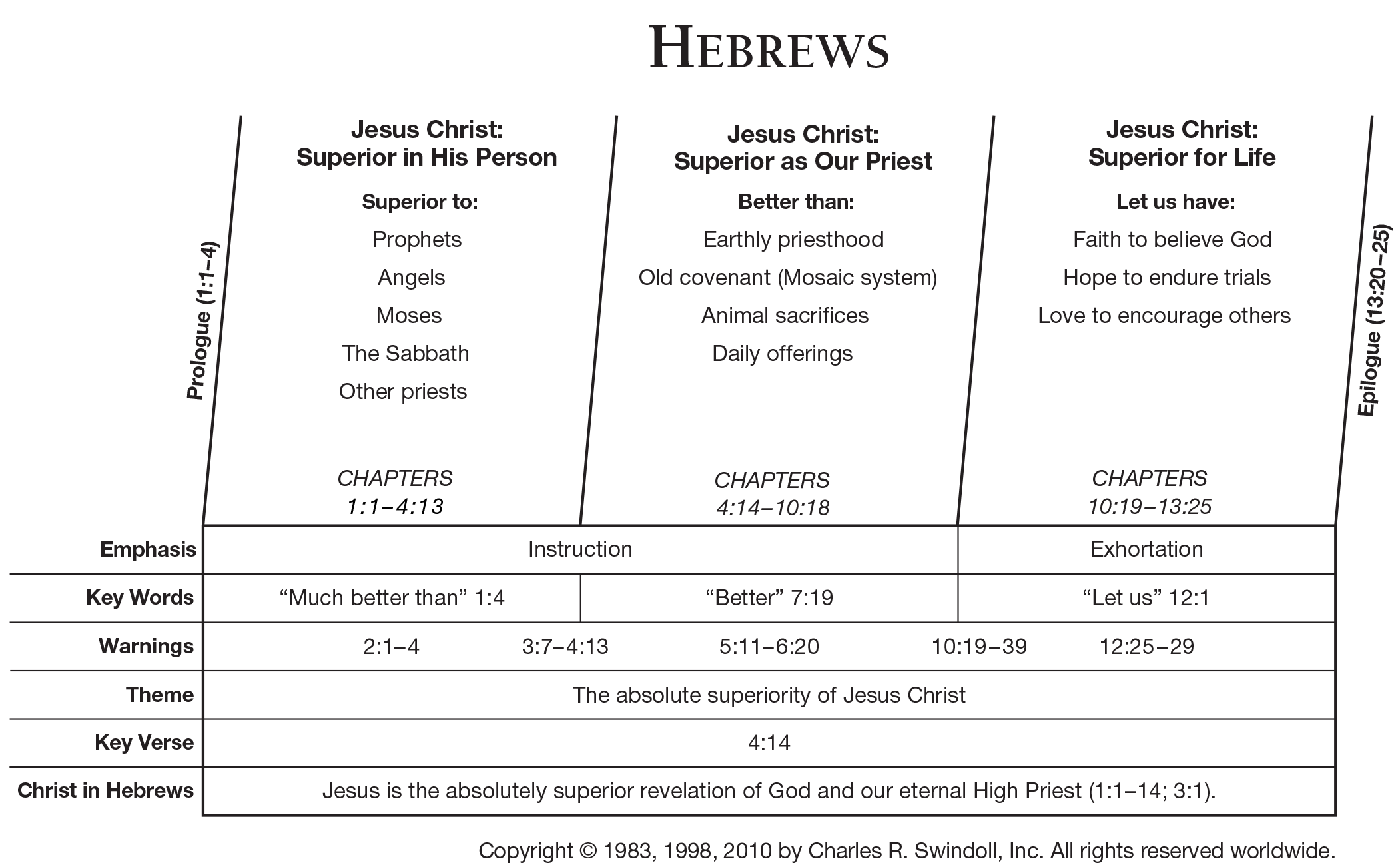
SPIRITUAL
ARTERIOSCLEROSIS!
Heart disease is the number one cause of death in the United States with some 635,260 deaths per year which is 23% of all deaths. Every year about 2.8 million Americans go into eternity, most because of hardening of their arteries. Of that number only God knows how many enter a Christ-less eternity because of spiritual hardening of their hearts but if we use Jesus' assessment in Mt 7:13+ that "the way is broad that leads to destruction (apoleia = not annihilation, not loss of existence but eternal loss of purpose), and there are many who enter through it" then the truth is that many of these 2.8 million enter into eternal punishment! This is a horrible thought to me as a physician, because I have seen patients cured again and again from life-threatening illnesses because they willingly accepted the doctor's recommended medication (I've seen a few refuse it too). And yet hundreds of thousands of that 2.8 million (many of whom accepted the doctor's medicine) refused the only "medicine" of the Gospel of Jesus Christ (see The Romans Road to Salvation) that could have allowed them to live forever! This is tragic! And that is why the writer of Hebrews is so focused on "Today!" Take the "medicine" today before you die physically and spiritually forever and ever! Paul writes
"AT THE ACCEPTABLE TIME I LISTENED TO YOU, AND ON THE DAY OF SALVATION I HELPED YOU"; behold, now is "THE ACCEPTABLE TIME," behold, now is "THE DAY OF SALVATION" (2 Cor 6:2+)
“Hell is nothing
but truth known too late”
-- J C Ryle
The grand and terrible lesson of Israel’s history is that it is possible to begin well and end poorly. In fact, this tragic human tendency dominates much human spiritual experience. It is this concern that haunts the writer of the book of Hebrews, as we have repeatedly seen.
DO NOT HARDEN (skleruno) YOUR HEARTS (kardia) AS WHEN THEY PROVOKED (parapikrasmos) ME, AS IN THE DAY OF TRIAL (peirasmos - see Massah below) IN THE WILDERNESS (eremos) - Amplified = "Do not harden your hearts, as [happened] in the rebellion [of Israel] and their provocation and embitterment [of Me] in the day of testing in the wilderness." Do not harden (skleruno) with the negative particle ("me sklerunete") in effect calls for the readers to cease an action already going on. Note also that harden (skleruno) is in the active voice indicating they were making a choice of their will (a volitional choice) to harden their hearts. They hardened their hearts and disobeyed the voice of God and choose to act in accordance to their own sinful desires. In other words, in the population of Hebrew Christians" some of them were only professors and not truly possessors of Christ. They were already in the process of hardening their hearts like their forefathers had done. The writer compares them ("AS" is a term of comparison - simile) to the tragic example of the majority of the nation of Israel that was delivered from bondage in Egypt. This comparison should have cut his readers to the quick if they were just professing belief in Christ. He reminds them that their ancestors who kept hardening their hearts were killed by God in the wilderness, and would be restless not only in this life but in the life to come! Being hard headed is bad enough, but being hard hearted can cost you your soul!
Once the door is shut, it will be too late.
For individuals, the door shuts at death—
if not before, because of the hardness of one’s heart
Hardness of heart originates from unbelief leading to contempt for God and in turn to distinct behavioral patterns: negativism, grumbling, quarreling, disobedience, bitterness. In Hebrew thought the heart was the center of the whole personality, including the intellect and will. To harden one’s heart means to refuse to listen to or understand what someone is saying. In one ear and out the other so to speak! Do not be stubborn is often rendered idiomatically for example, “do not stop up your ears,” or “do not shout ‘No’ to what is said,” or “do not close the door of your mind.”
Warren Wiersbe on a hard heart - When a person has an erring heart and a disbelieving heart, the result will also be a hard heart. This is a heart that is insensitive to the Word and work of God. So hard was the heart of Israel that the people even wanted to return to Egypt! Imagine wanting to exchange their freedom under God for slavery in Egypt!.... The Bible warns us to avoid a double heart (Ps 12:2), a hard heart (Pr 28:14), a proud heart (Pr 21:4), an unbelieving heart (Heb 3:12), a cold heart (Mt 24:12), and an unclean heart (Ps 51:10). “Search me, O God, and know my heart” (Ps 139:23, 24)(Bible Exposition Commentary)
🙏 THOUGHT - If you are reading this commentary as an intellectual exercise and do not know Christ as Savior, then beware for it can be dangerous to your spiritual health if you read it and steadfastly refuse to heed it! That is what was happening among some of the Jewish hearers of the Gospel of grace. It was like the proverbial saying "like water on a duck's back." Or like the sobering words of James to his readers/hearers to "prove (present imperative - commands this as one's habitual practice which necessitates dependence on the Holy Spirit to obey) yourselves DOERS of the word, and not merely HEARERS (WHY IS THIS ABSOLUTELY NECESSARY?) who delude (paralogizomai in present tense = they are continually self-deceived. A deceived person by definition DOES NOT even know they are deceived!) themselves. (James 1:22+).
Many persons are of that kind. They are shaped for a while
according to the earnest word they hear, but it is all in vain.
Spurgeon warns us today do not harden your hearts - Do not provoke your God by your quibbling, or your murmuring, or your idolatry; act not as those unbelievers did who died in the wilderness. You are His house. Give Him rest; do not provoke Him. If you belong to Him, be holy; do not grieve Him. If you are His house, be not defiled; surely He should dwell in a holy place. A common way of provoking God and hardening the heart is that indicated by the context. “Do not harden your hearts as in the rebellion, in the day of testing in the wilderness.” That is to say, by unbelief, by saying, “God cannot save me. He is not able to forgive me; the blood of Christ cannot cleanse me; I am too black a sinner for God’s mercy to deal with.” That is a copy of what the Israelites said: “God cannot take us into Canaan; He cannot conquer the sons of Anak.” Though you may look upon unbelief as a slight sin, it is the sin of sins. I once preached in a certain city, and I was the guest of a gentleman who treated me with great kindness, but I noticed on the third occasion of my preaching that he suddenly left the room. One of my friends followed him out of the place and said to him, “Why have you left the service?” “Well,” said he, “I believe I should have been converted altogether if I had stopped any longer, for I felt such an influence coming over me. But it would not pay. You know what I am; it would not pay.” Many persons are of that kind. They are shaped for a while according to the earnest word they hear, but it is all in vain. The dog returns to his vomit, and the sow that was washed to her wallowing in the mire (2Pe 2:22+). This is to harden your heart and provoke the Lord.
Oh, choose now the path of salvation
And enter in at the strait gate!
Come now, while the Savior is calling;
Tomorrow may be too late!
--Haines
David Guzik - Do not harden your hearts: If those who followed Moses were responsible to surrender, trust, and persevere in following God’s leader, we are much more responsible to do the same with a greater leader, Jesus. The point is clear. As the Holy Spirit speaks, we must hear His voice and not allow our hearts to become hardened. We hear the Spirit speak in the Scriptures, in the heart of His people, in those He draws to salvation, and by His works. Just as the Spirit speaks in many ways, there are also several ways we can harden our heart. Some harden their hearts by relapsing into their old indifference. Some harden their hearts by unbelief. Some harden their hearts by asking for more signs. Some harden their hearts by presuming upon the mercy of God.
Listening to God and obeying Him are matters of will.
So is hardening the heart to Him, as Israel did.
-- John MacArthur
Sidney J. Harris wrote that "Once we assuage our conscience by calling something a “necessary evil,” it begins to look more and more necessary and less and less evil.
🙏 THOUGHT - What fills your heart as you read these notes? Remember what fills you, controls you (Eph 5:18+) You can know by what has come out of your mouth over the past few days. Remember that "the good man out of the good treasure of his heart brings forth what is good (agathos)" (Luke 6:45+). "The mouth speaks out of that which fills the heart." (Mt 12:34+).
AS (term of comparison - simile) WHEN THEY PROVOKED (parapikrasmos) ME - Most versions have something like "in the rebellion" (NET, ESV) The writer introduces a negative example his readers should avoid. When did Israel rebel against God in the OT? We could list multiple events, but the first one was seen in Ex 17:1-7+. Not long after that there was another major rebellion described in Nu 14:22-23+ where they provoked God and He decreed "Surely all the men who have seen My glory and My signs which I performed in Egypt and in the wilderness, yet have put Me to the test these ten times and have not listened to My voice, shall by no means see the land which I swore to their fathers, nor shall any of those who spurned Me see it." (See Kadesh-Barnea)
And without faith it is impossible to please Him,
for he who comes to God must believe that He is
and that He is a rewarder of those who seek Him.
-- Hebrews 11:6+
J Vernon McGee on Kadesh-Barnea - After they left Sinai, an eleven-day journey could have gotten them into the Promised Land. But no, they had to send spies in to search out the land. It wasn't necessary -- God said He would take care of them, but they didn't believe God. So God yielded to their wishes and let them send in spies (see Twelve Spies). Although the spies did see the wonderful land, they were most impressed by the giants, and they saw themselves as grasshoppers. They didn't see God. They returned to the people with a false report -- except Caleb and Joshua who insisted that God could handle the giants if they trusted Him (Read full account Nu 13:1-14:38+). But the people accepted the majority report (this is my reason for believing that committees are not satisfactory for doing the Lord's work), and they spent forty years on a journey that should have taken a few days. What was the reason? Unbelief. You see, they didn't believe God enough to enter into the land. They believed Him enough to come out of Egypt, but not enough to enter Canaan. God said that that generation of unbelievers would die in the wilderness and He would bring their children into the Land of Promise. And we find later that Joshua did bring the next generation into the land. (See Thru the Bible Vol. 51: Hebrews 1-7)
The lesson here is that it is possible
to begin well & end poorly.Brian Bell - It started on that unforgettable night, where the Jewish homes still smelled of roasted lamb (Passover), but the Egyptian homes now emitted the fragrance of death (10th plague). They were finally asked to leave (after 430 yrs) & were asked to do it quickly. They were even able to plunder the Egyptians before they left. They step out into the wilderness & there was God, eager to meet them in the cloud by day, & pillar of fire by night. Quick hick-up of faith when Pharaoh & his armies show up, but not to worry Moses parts the Red Sea. The Song of Moses is sung, “the horse & rider is thrown into the sea.” Well from Mnt. Sinai it’s only a 11 day journey (Deut.1:2) “So we ought to be in the promised land in no time,” “Oh sweet milk & honey!”…It began so well, but went down hill fast, then ended so poorly. Complaining, rebelling, & quarreling, left only 2 men over the age of 20 of about 600,000 men to enter Canaan. The lesson here is that it is possible to begin well & end poorly. Many of the children of Israel seemed to have an inadequate faith in God...they asked in this context, Is the LORD among us or not? Ex.17:7...God was their fair-weather friend. 1. They had faith until the 1st trial, where it dissolved like a dirt clod in a rain storm....What kicked off the 40 yrs wandering was the 12 spies, 10 of which could only see giant problems rather than a giant God. Slide#29 1. The 10 were like Robert Fulton’s critics. When he tested his steamboat they stood along the shore yelling, “It will never start, never start, never start”! Then when it started they said, “It will never stop, never stop, never stop!” Ray Stedman says this well, “A relapse from Christianity into Judaism would be comparable to the action of the Israelites when they turned back in their hearts unto Egypt. It would not be a mere return to a position previously occupied, but a gesture of outright apostasy, a complete break w/God.”....Many professing Christians today, if you ask them about their faith, will tell you of their wonderful memory of their exodus, but have nothing to say about their present day faith…for their faith is dead.
William MacDonald - Whenever God speaks, we should be swift to hear. To doubt His word is to call Him a liar and to incur His wrath. Yet that was Israel's history in the wilderness. It was a dreary record of complaint, lust, idolatry, unbelief, and rebellion. At Rephidim, for instance, they complained because of lack of water and doubted God's presence in their midst (Ex. 17:1-7). At the wilderness of Paran when the unbelieving spies returned with an evil report of discouragement and doubt (Num. 13:25-29), the people decided that they should go back to Egypt, the land of their slavery (Num. 14:4). (Borrow Believer's Bible Commentary)
Holman New Testament Commentary - God was (ED: "IS") slow to anger, but forty years was too much even for him. Their rebellion developed into a settled habit of mind and led God to pronounce judgment. Hebrews warns against a repetition of rebellion against God. (See Holman New Testament Commentary - Hebrews & James)
John Phillips on Israel's provocation or rebellion against God - The unbelief and complaints of Israel in the wilderness were truly astonishing. They had seen God pour out His plagues upon the land of Egypt, separating, as the judgments proceeded, between the land of Goshen, where the Hebrews dwelt, and the rest of Egypt. They had witnessed the crowning judgment: the slaying of the firstborn in every Egyptian home. The emancipated people had experienced a miraculous deliverance at the Red Sea and had seen the Egyptian army overthrown. But before long they began to criticize and complain, almost driving Moses to distraction. Their rebellion even led to attempts upon Moses' life, and that rebellion was prolonged for some forty years. (Borrow Exploring Hebrews: An Expository Commentary page 52)
THE DAY OF REBELLION
WHEN HEARTS TURNED TO STONE
AS (term of comparison - simile) IN THE DAY OF TRIAL (peirasmos) IN THE WILDERNESS (eremos) - CSB = "on the day of testing". Literally "the trial" where "the" (definite article) identifies this trial as a very specific event, the episode in Exodus 17:7 where Moses records their "testy" query - “Is the LORD among us, or not?” So when God tested the new nation of Israel with a "no water" situation to teach them to trust Him, they rebelled and "tested" Him. Instead of trusting God in the midst of adverse circumstances, they demanded that He show His power in order to demonstrate to them that He was in their midst to help them. The one who tests God today does so for the same reason as did the Israelites in Moses day---to put Him off, because they love their sin, their own way, their own plans too much to give them up for God’s.
Is the Lord among us,
or not?
Kenneth Wuest - The writer recalls to them the provocation Israel caused God by its hardness of heart on account of the lack of water at Rephidim, when the people murmured against Moses (Ex. 17:1–7). The word “temptation” (peirasmos) is preceded here by the definite article, pointing to a particular temptation. The Greek word means in its primary usage, “to put to the test.” Israel put God to the test by asking, “Is the Lord among us, or not?” Instead of trusting God in the midst of adverse circumstances, they demanded that He show His hand in order to demonstrate to them that He was in their midst to help them. (Hebrews )
Spurgeon - All the histories of Scripture are written for our examples (1Cor 10:6,11, Ro 15:4), but especially the story of the Israelites in the wilderness. It is given to us at a length far exceeding the value of the narrative, except it be intended for purposes of spiritual instruction, for it occupies four books of the Old Testament, and those by no means short ones. These things were written that we might see ourselves in the Israelites as in a mirror, and so might be warned of dangers common to us and to them, and be guided to a worthier use of the privileges we enjoy.
The reference in this verse is to Massah and Meribah in (Exodus 17:7+) -"And he named the place Massah (Lxx substitutes peirasmos) and Meribah (Lxx substitutes loidoresis = railing, abuse, reproach) because of the quarrel (Hebrew = riybah = strife, a controversy, a contention. The primary idea = that of a quarrel or dispute) of the sons of Israel, and because they tested (Hebrew = nasah = Testing which shows what someone is really like!; ) the LORD, saying, "Is the LORD among us, or not?"
Harden (4645) (skleruno from skleros = hard, dried up, stiff) means to dry out, to dry up, to make hard or stiff and figuratively to render stubborn. To cause to be or to become unyielding in resisting information. Ro 9:18 illustrated by the case of Pharaoh, who first persistently hardened his heart (Ex7:13,22, 8:19 text of v32 and 9:7), all producing the retributive hardening by God, after His much long-suffering,Ex 9:12 etc
Friberg on skleruno - (1) literally and passive, as a medical technical term harden, become thick; (2) figuratively in the NT; (a) active and metaphorically literally cause one's heart to be hard, i.e. act stubbornly, refuse to change one's attitude (Heb 3.8); of God's judicial action cause someone to be stubborn, make someone refuse to listen (Ro 9.18); (b) passive be or become stubborn, refuse to yield (Heb 3.13) (Borrow Analytical Lexicon of the Greek New Testament )
SKLERUNO - 6V- becoming hardened(1), harden(3), hardened(1), hardens(1). Acts 19:9; Ro 9:18; Heb. 3:8; Heb. 3:13; Heb. 3:15; Heb. 4:7
Heart (2588)(kardia) in the NT does not refer to the physical organ that pumps blood but always refers (figuratively) to the seat and center of human life. The heart is the center of one's personality, and as such it controls one's intellect, emotions, and will. If one has a believing heart, such a heart is the wellspring of this person's spiritual life. You do what you do because you believe what you believe in your heart. As Jesus taught "the mouth speaks out of that which fills the heart" (Mt 12:34).
The heart is a key word in Hebrews 3-4 - Heb 3:8, 10, 12, 14 Heb 4:7, 12 - Six of the ten uses are in these two chapters! Why would this be the case? Clearly the heart of their problem is their heart! Other uses = Heb 8:10, 10:16, 10:22, 13:9.
KARDIA IN HEBREWS - Heb. 3:8; Heb. 3:10; Heb. 3:12; Heb. 3:15; Heb. 4:7; Heb. 4:12; Heb. 8:10; Heb. 10:16; Heb. 10:22; Heb. 13:9;
See 4 page article in Dictionary Of Biblical Imagery article on Heart - kardia
See 5 page article in NT Dictionary Of New Testament Theology on Heart - Kardia
Provoked (3894)(parapikrasmos from para = close proximity + pikria = bitterness. In other words this reaction is "close to" human bitterness. We view bitterness as an evil pertaining to man. Parapikrasmos means embitterment, revolt or rebellion. However, as an action of God, it cannot be evil bitterness. It is injured love, misunderstood justice.
Parapikrasmos is used in the NT only in Heb 3:8 and Heb 3:15. In the Septuagint it is used in Ps 95:8 "Do not harden your hearts as at Meribah (Hebrew = place of strife/quarreling; Lxx = parapikrasmos)...." So the English could be rendered "Harden not your hearts as in the provocation/embitterment/rebellion."
This word is a translation of the Hebrew "Meribah" (Nu 20:13, 24; 27:14; Ps 81:7) which means conflict, contention, strife or rebellion or quarrel. For the simple verb pikraino , to make bitter, see Col 3:19
Trial(3986)(peirasmos) means simply to test or prove, and has no negative connotation. Whether it becomes a proof of righteousness or an inducement to evil depends on our response.
PEIRASMOS - 21X/20V - temptation(12), testing(2), trial(3), trials(4). Matt. 6:13; Matt. 26:41; Mk. 14:38; Lk. 4:13; Lk. 8:13; Lk. 11:4; Lk. 22:28; Lk. 22:40; Lk. 22:46; Acts 20:19; 1 Co. 10:13; Gal. 4:14; 1 Tim. 6:9; Heb. 3:8; Jas. 1:2; Jas. 1:12; 1 Pet. 1:6; 1 Pet. 4:12; 2 Pet. 2:9; Rev. 3:10
HEBREW WORDS
Meribah (04809)(meribah from riyb = to strive, contend) means place of strife or quarreling. This name is used of two places, both sites of Moses' striking a rock, the first being at the beginning of the 40 years of wandering and at the foot of Mount Horeb (Sinai) (Ex 13:7, Nu 20:13, Nu 20:24) and the second place also called Meribah (Meribah of Kadesh or Meribah-Kadesh - see notes on Nu 20:1-13) in the desert of Zin near Kadesh, (map) near the end of the 40 years of wilderness wandering when Moses disobeyed God and instead of speaking to the rock (Nu 20:8), in anger struck the rock twice. Because of Moses' disobedience at Meribah-Kadesh God said he would not enter the promised land (Aaron was also included in this punishment - Nu 20:24). The Septuagint (Lxx) translates the proper name Meribah in Ex 17:7 with the noun loidoreo (not found in NT but related to verb loidoreo) which means railing or abuse.

MERIBAH - 11V - Meribah(8), Meribah-kadesh*(1), Meribath-kadesh*(2). Exod. 17:7; Num. 20:13; Num. 20:24; Num. 27:14; Deut. 32:51; Deut. 33:8; Ps. 81:7; Ps. 95:8; Ps. 106:32; Ezek. 47:19; Ezek. 48:28
Massah (04532)(massah from nasah = to test by trial, to prove) means testing. The Septuagint (Lxx) translates the proper name with the noun peirasmos which BDAG defines as "an attempt to learn the nature or character of something." Sadly, Israel was not sincerely seeking to learn the nature or character of God, but to put His character to their test!
MASSAH - 5V - Exod. 17:7; Deut. 6:16; Deut. 9:22; Deut. 33:8; Ps. 95:8
QUESTION - What is the significance of Meribah in the Bible? | GotQuestions.org
Based on the biblical text,
there are two sites named Meribah
ANSWER - Meribah was a site that the Israelites passed through in their desert wanderings. Being a place of testing for the Israelites, it also had a major impact in the lives of Moses and Aaron. Apparently, based on the biblical text, there are two sites named Meribah (W. A. Elwell and B. J. Beitzel, “Meribah,” Baker Encyclopedia of the Bible, volume 2, Baker, 1988, p. 1,442). One of the sites called Meribah was located near Rephidim in the Desert of Sin (Exodus 17:1). At this location it was also called Massah, which differentiates it from the other Meribah mentioned in Scripture (Deuteronomy 6:16; 9:22; 33:8; Psalm 95:8). The other site named Meribah was located in Kadesh Barnea, and therefore was referred to as Meribah Kadesh (Numbers 27:14; Deuteronomy 32:51; Ezekiel 47:19; 48:28).
Central to both locations is a miracle of water coming from a rock. At Meribah/Massah, the Israelites were extremely thirsty and quarreled with Moses about the lack of water (Exodus 17:2). Because of their thirst, they grumbled against Moses and asked, “Why did you bring us up out of Egypt to make us and our children and livestock die of thirst?” (Exodus 17:3). Moses brought this problem to the Lord, and the Lord enabled Moses to strike the rock so that the Israelites would have water and know that God was with them (Exodus 17:4–7). Because of their grumbling and testing of God, Moses called the place Meribah, which means “quarrelling,” and Massah, which means “testing” (John Hannah, “Exodus,” Bible Knowledge Commentary: Old Testament, John Walvoord and Roy Zuck, ed., Victor, 1983, p. 135). Not only did the Israelites demonstrate doubt in God’s provision, but they also tested Him because of their complaints and distrust.
Toward the end of the Israelites’ forty years of wandering,
a similar situation occurred at Meribah Kadesh.
Toward the end of the Israelites’ forty years of wandering, a similar situation occurred at Meribah Kadesh. Complaining about a lack of water for their livestock and themselves, the “people gathered in opposition to Moses and Aaron. They quarreled with Moses and said, ‘If only we had died when our brothers fell dead before the Lord! Why did you bring the Lord’s community into this wilderness, that we and our livestock should die here? Why did you bring us up out of Egypt to this terrible place? It has no grain or figs, grapevines or pomegranates. And there is no water to drink!’” (Numbers 20:2–5+). Appealing to the Lord at the tent of meeting, Aaron and Moses were told by God to speak to the rock, which would bring forth water (Numbers 20:6–7+). Instead of demonstrating God’s glory and provision in speaking to the rock as the Lord had instructed, Moses struck the rock and claimed he and Aaron would bring forth water for the Israelites (Numbers 20:10–11+). The Lord still kept His promise in providing water but told Aaron and Moses that they would not enter the Promised Land because of their failure to obey Him (Numbers 20:12+). It is clear from the rest of Scripture that God tested the Israelites, including Aaron and Moses, at Meribah Kadesh to gauge their obedience and faithfulness (Psalm 81:7; Ps 106:32).
Another place Meribah is directly mentioned in the Bible is in the book of Ezekiel. In the future allotment of the land of Israel in the millennial kingdom, Meribah Kadesh will serve as a border for the section allotted to the tribe of Gad (Ezekiel 47:19; 48:28). As Meribah served to remind the Israelites following Moses of their lack of trust in the Lord, so also will it in the millennial reign of Christ.
Being a place of strife and testing,
Meribah is worthy of remembrance
Being a place of strife and testing, Meribah is worthy of remembrance. As Psalm 95:8 warns, “Do not harden your hearts as you did at Meribah, as you did that day at Massah in the wilderness” (cf. Hebrews 3:8-9). The Israelites’ disbelief at Kadesh Barnea resulted in their inability to enter the Promised Land for another generation, and Aaron’s and Moses’ disobedience at Meribah Kadesh kept them from entering the Promised Land as well. Disobedience and unbelief have enduring consequences that can affect the rest of one’s life.
QUESTION - What is the significance of Massah in the Bible? | GotQuestions.org
ANSWER - Massah, or Meribah, is a place between the Wilderness of Sin and the Wilderness of Sinai. Massah is one of the places where the Israelites camped during their exodus from Egypt. The location was originally called Rephidim.
As they journeyed to the Promised Land, the Israelites witnessed many wondrous miracles. According to the Bible’s record, after a long history of degradation and slavery, God’s people gained their liberty as God sent a series of horrific plagues that humiliated and ultimately crushed Egypt’s defiant Pharoah. No one could doubt God’s presence among the Israelites.
After the parting of the Red Sea (Exodus 14:21–22), a visually spectacular feat no one could forget, God manifested Himself as a pillar of cloud to guide the Israelites by day and a pillar of fire to comfort them by night (Exodus 13:21–22). Each meal was also a reminder of God’s presence, for food was scarce in the wilderness. God provided manna, “bread from heaven,” that nourished the wanderers until they entered the Promised Land (Exodus 16:15; Joshua 5:12).
But when the Israelites’ water supply ran low at Massah, the people, who had seen miracle after miracle with their own eyes, began questioning the faithfulness of God:
All the congregation of the people of Israel moved on from the wilderness of Sin by stages, according to the commandment of the Lord, and camped at Rephidim, but there was no water for the people to drink. Therefore the people quarreled with Moses and said, “Give us water to drink.” And Moses said to them, “Why do you quarrel with me? Why do you test the Lord?” But the people thirsted there for water, and the people grumbled against Moses and said, “Why did you bring us up out of Egypt, to kill us and our children and our livestock with thirst?” So Moses cried to the Lord, “What shall I do with this people? They are almost ready to stone me.” And the Lord said to Moses, “Pass on before the people, taking with you some of the elders of Israel, and take in your hand the staff with which you struck the Nile, and go. Behold, I will stand before you there on the rock at Horeb, and you shall strike the rock, and water shall come out of it, and the people will drink.” And Moses did so, in the sight of the elders of Israel. And he called the name of place Massah and Meribah, because of the quarreling of the people of Israel, and because they tested the Lord by saying, “Is the Lord among us or not?” (Exodus 17:1–7, ESV)
Let us not be too hasty in condemning the Israelites for their faithlessness,
for if we examine ourselves honestly, we, too, may discover we are of little faith.
Let us not be too hasty in condemning the Israelites for their faithlessness, for if we examine ourselves honestly, we, too, may discover we are of little faith. How often do we doubt the goodness of God in times of difficulty? How often do we question the faithfulness of God when troubles arise? And let us not feel superior to the grumbling Israelites by saying, “If I had seen the parting of a sea or tasted bread from heaven, I could never doubt God.” We have the infallible Scriptures in their entirety to instruct and encourage us, the indwelling of the Holy Spirit to comfort and guide us, and a long history of blessings to remind us that God has, is, and will always be faithful. Yet we still doubt God at times.
When faced with needs, we are to “ask, seek, and knock” (Matthew 7:7). Jesus did not say we are to “grumble, complain, and whine.” It is interesting to note that Massah, the name given to the place where the Israelites provoked God, means “trial” or “temptation,” for the people tested the Lord rather than trusting in Him. Moses also called the place Meribah, which means “strife.” May our steadfast faith in the Lord keep us from pitching our tents in Massah and Meribah.
C H Spurgeon commenting on Ps 95:8 writes "If ye will hear, learn to fear also. The sea and the land obey him, do not prove more obstinate than they! We cannot soften our hearts, but we can harden them, and the consequences will be fatal. Today is too good a day to be profaned by the hardening of our hearts against our own mercies. While mercy reigns let not obduracy rebel. "As in the provocations, and as in the day of temptation in the wilderness" (or, "like Meribah, like the day of Massah in the wilderness"). Be not wilfully, wantonly, repeatedly, obstinately rebellious. Let the example of that unhappy generation serve as a beacon to you; do not repeat the offences which have already more than enough provoked the Lord. God remembers men's sins, and the more memorably so when they are committed by a favoured people, against frequent warnings, in defiance of terrible judgments, and in the midst of superlative mercies; such sins write their record in marble. Reader, this verse is for you, for you even if you can say, "He is our God, and we are the people of his pasture." Do not seek to turn aside the edge of the warning; thou hast good need of it, give good heed to it.
🙏 THOUGHT - How does one harden their heart? It's a process that occurs gradually as we complain about God's work and ignore His Word (and sin step by step, each step taking us further and further from God's goal for His children, our holiness!). The Israelites complained about the way He led them and the way He fed them (grumbling and sinning over and over). They heard God's Word and deliberately disobeyed. This is called testing God. This is what David prayed against - Keep back Thy servant from presumptive sins! Why? Because eventually they will rule over you! (Ps 19:13+, cf Paul's strong warning commands in Ro 6:12-13+ which are possible to obey because of Ro 6:11+ and Ro 8:13+, the enabling power of the Spirit) When you see God at work and you complain instead of rejoice, when you hear His Word and deliberately disobey it--you are testing Him. It's like a little child just daring mom or dad to discipline him (Heb 12:5-11+). The great tragedy is that when you (I) harden your (my) heart, you (I) will miss God's best for your (my) life. You (I) will miss what Jesus came to give us -- life, even abundant (overflowing) life (John 10:10+)!
Are you experiencing abundant life in Christ, the Holy One of God? If not it could be because your heart is subtly, slowly being hardened to the beauty of Christ and His cleansing, life giving Word of Truth (Eph 5:26+). You are believing lies and forgetting that sin only gives passing pleasure (Heb 11:25b+) but can bring lasting pain!
The people of Israel saw the miracles, while you and I have experienced the greatest miracle, the new birth (Jn 3:3+). They heard the messages, even as we have heard the living and active, convicting Word (Heb 4:12-13+), His Word which is our very life (Deut 32:47+)!
They were fed day after day, even as we have fed on His Word (Mt 4:4+, 1Pe 2:2+). But in a period of 40 years, the entire first generation died, except for Joshua and Caleb.
Do not be deceived (stop being deceived) beloved brethren (Jas 1:16+), Sin (Personified Principle) is deceptive (Heb 3:13b+) and will harden your heart.
God is not mocked, for whatever you sow, you will reap and it will be corruption (rotting of your soul) if you (I) feed the rotten fallen flesh (Gal 6:7,8+).
What should we do to prevent a hard heart?
Remember! Remember the way you felt when you first fell in love with Jesus as by His Spirit He wooed you into unbreakable covenant union with Him.
Repent! Ask God to give you the gift of repentance (Ro 2:4+).
Then do the deeds you did at first when Jesus was your first love (Rev 2:4,5+).
Listen to God's Word and respond to it tenderly as the Spirit enables you.
Watch God's work and respond to it thankfully.
Stop complaining and disobeying and wantonly, presumptively sinning!
Worship the Lord in spirit and truth and keep a tender heart before Him.
As an aside when we take God and His provisions for granted, we become less thankful and less responsive to Him. Heed the warning: Keep your heart open to God's Word and obey Him. Or as Solomon wrote and sadly failed to practice
"Watch over (GUARD - command not a suggestion) your heart with all diligence, for from it flow the springs of life." (Proverbs 4:23+).
A guarded heart is a great preventative
against developing a hardened heart!
SAD ILLUSTRATION - An old man, one day taking a child on his knee, entreated him to seek God now -- to pray to him, and to love him; when the child, looking up at him, asked, "But why do not you seek God?" The old man, deeply affected, answered, "I would, child; but my heart is hard -- my heart is hard." -- Arvine's Anecdotes.
William Gouge explains that the heart has several facets...
- It is frequently put for the whole soul, and that for the most part when it is set alone; as where it is said, "Serve the Lord with all your heart", Deuteronomy 10:12KJV.
- For that principal part of the soul which is called the mind or understanding. "I gave my heart to know wisdom", Ecclesiastes 1:17. In this respect darkness and blindness are attributed to the heart, Ephesians 6:18, Romans 1:21.
- For the will: as when heart and soul are joined together, the two essential faculties of the soul are meant, namely, the mind and will: soul put for the mind, heart for the will "Serve the Lord with all your heart and with all your soul", Deuteronomy 10:12KJV.
- For the memory. "I have hid thy word in my heart", saith the prophet, Ps 119:11. The memory is that faculty wherein matters are laid up and hid.
- For the conscience. It is said that "David's heart smote him", that is, his conscience, 1Samuel 24:5 2Samuel 24:10. Thus is heart taken, 1 John 3:20, 21.
- For the affections: as where it is said, "Thou shalt love the Lord thy God with all thy heart, and with all thy soul, and with all thy mind", Matthew 22:37. By the mind is meant the understanding faculty; by the soul, the will; by the heart, the affections. Here in this text the heart is put for the whole soul, even for mind, will, and affections. For blindness of mind, stubbornness of will, and stupidity of affections go together.
Daily Light in the Daily Path - “The day of testing in the wilderness.”
Let no one say when he is tempted, “I am being tempted by God,” for God cannot be tempted with evil, and he himself tempts no one. But each person is tempted when he is lured and enticed by his own desire. Then desire when it has conceived gives birth to sin.
But they had a wanton craving in the wilderness, and put God to the test in the desert.—And Jesus, full of the Holy Spirit . . . was led by the Spirit in the wilderness for forty days, being tempted by the devil. And he ate nothing during those days. And when they were ended, he was hungry. The devil said to him, “If you are the Son of God, command this stone to become bread.”
For because he himself has suffered when tempted, he is able to help those who are being tempted.—“Simon, Simon, . . . Satan demanded to have you, that he might sift you like wheat, but I have prayed for you that your faith may not fail.”
Heb. 3:8; James 1:13–15; Ps. 106:14; Luke 4:1–3; Heb. 2:18; Luke 22:31–32
BEFORE THE FACE OF GOD - Rebellion In the Wilderness
Do not harden your hearts as you did in the rebellion, during the time of testing in the desert. [Heb. 3:8]
Hebrews 3:7–11 quotes Psalm 95:7b–11. Some churches use Psalm 95 as a call to worship. The psalm begins, “Come, let us sing for joy to the Lord,” and continues by extolling the greatness of God as the Creator (Ps. 95:1–5). Verses 6–7 of the psalm call upon us to “bow down and kneel before the LORD our Maker,” because “we are the people of his pasture.”
The psalm warns us that when we hear his voice “today,” we must be careful to have open and receptive hearts. We must not harden our hearts. The psalm reminds us that the people God rescued from Egypt did harden their hearts against the Lord in the wilderness and provoked him by demanding that he do what they wanted. As a result, God did not let them enter his rest.
The goal of worship is to enter more fully into God’s rest on the day of worship, the Sabbath. So in worship we should have open hearts. This is the basic meaning of Psalm 95, especially when it is used as a call to worship.
Psalm 95:8 refers to the incident at Massah/Meribah when the people hardened their hearts against God (Exod. 17:1–7). The words massah and meribah imply testing. The people in their rebellion thought they would test God. In reality, God was testing them. The people had seen the mighty plagues sent by God upon Egypt. They had seen God heal waters and provide manna for them (Exod. 15:22–16:36). Now they had run out of water. Would they exercise dependence, coming to the Lord humbly to ask him for help in faith? Or would they accuse God and Moses of deliberately bringing them out of Egypt to kill them?
They failed the test. In their pain they did not cry out to God, but cried out against him. Yet, God gave them water anyway.
This was not the only time the Israelites tested God. After ten acts of rebellion just like Meribah, God finally swore by himself that “as surely as the glory of the Lord fills the whole earth,” he would not permit any of the people who had been delivered from Egypt to enter the land of promise. They lost the promised rest. Maybe some were saved and went to heaven, but no one except Joshua and Caleb were allowed to enter Canaan.
Coram Deo - Read Psalm 95 carefully. Note how appropriate it is as a call to worship, whether used on Sunday morning or in your own private devotions. Notice how the psalm provides comfort and assurance before issuing its warning. Consider your worship times by yourself and with your brothers and sisters to be a test. With what attitude will you come into the rest God has provided as a taste of the rest to come?
For further study: Exodus 15:22–16:36; Numbers 14:20–24; Psalm 67; Psalm 95;Isaiah 30:1–18
IN THE DAY OF THE TRIAL. Hebrews 3:8 - C H Spurgeon
When you wonder why you are being severely tested, remember that the reason does not lie so much with you but with those to whom God will make you useful. You are being led along a rough road. You are being tested and instructed in order to help those whom you will find in some of the earth’s dark regions.
You are being trained as a hardy mountaineer to climb after the Lord’s sheep who are lost in the wild, craggy places. You are being taught to find your way through the country of depression and despair in order to help lost pilgrims find their way to the celestial city. They frequently fall into the marshy places of fear and doubt, and you will know how to bring them out, set their feet on the rock, and once again establish their goings.
The effect of one life on another can hardly be fully known. Even when we are able to look back on the completed life, we rarely know how much it has been twisted by other lives. Certainly, until this life is complete, we will never know how much our present suffering has to do with our usefulness to others. We will never understand how being prepared here, there, and in a thousand other places has helped a fellow pilgrim.
Wilderness Testings - Robert Neighbour
"Harden not your hearts, as in the provocation, in the day of temptation in the wilderness" (Heb. 3:8).
It is not difficult to discover the hand of the evil one, behind the many temptings in the wilderness journeyings. Satan never has been one to work in the limelight. He covers his real identity; he works stealthily and unseen. However his footprints are plain and easily detected, when one has once become acquainted with his devices.
The 78th Psalm rehearses for us the great sins into which Israel fell as they marched through the wilderness. It seems almost inconceivable that a people delivered from Egypt with so mighty and miraculous a hand would so soon and so grievously have sinned. When, however, one adds to a miraculous deliverance the fact that Israel journeyed under the guiding cloud of God's presence every day, and that the eye which watched over her never slumbered nor slept, it becomes still more incomprehensible why Israel should have forsaken the Rock of her help.
Three things, however, were forever established in these wilderness experiences. First, Satan's mighty power. Second, Israel's unworthiness. Third, God's unspeakable grace toward a rebellious people.
And where is the one who would deny that the so-called Christians of today, with even greater light and larger blessings, are not more thoughtless and less appreciative of the Lord than even backsliding Israel?
Let us recount, as set down in Psalm 78, some of the steps that marked Israel's wilderness experiences.
1. Verses 12-16: "Marvellous things did He in the sight of their fathers. * * He divided the sea, and caused them to pass through; and He made the waters to stand as an heap: * * He led them with a cloud; * * a light of fire. He clave the rocks; * * gave them drink as out of the great depths."
In spite of these blessings, we read in verses 17-19: "They sinned yet more against Him; * * they tempted God in their heart; * * yea, they spake against God; they said, Can God furnish a table in the wilderness?"
2. Verses 23-29: "He commanded the clouds from above, and opened the doors of Heaven; and had rained down manna upon them and had given them the corn of Heaven. Man did eat angels' food. He sent them meat to the full; * * He rained flesh also upon them as dust, and feathered fowls like as the sand of the sea; * * round about their habitations. So they did eat, and were full."
In spite of all of these favors satan won out again for we also read:Verse 22: "They believed not God, and trusted not in His salvation."
Verse 32: "For all this they sinned still, and believed not for His wonderful works."
Verse 37: "Their heart was not right."
Verse 41: "They limited the Holy One of Israel."
Verse 42: "They remembered not His hand."
Verse 56: They "kept not His testimonies."
Verse 57: They "turned back, and dealt unfaithfully."Such is the sad story of Israel's wanderings in the wilderness. Surely satan corrupted Israel, and led her away from her God. He sought by every means to fill her heart with rebellion. So successful was he, that God refused to allow Israel to enter into Canaan until the sinning multitudes of the men who left Egypt under Moses, were overthrown in the wilderness.
Hebrews 3:9 WHERE YOUR FATHERS TRIED Me BY TESTING Me, AND SAW MY WORKS FOR FORTY YEARS. (NASB: Lockman)
Greek: hou epeirasan (3PAAI) oi pateres humon en dokimasia kai eidon (3PAAI) ta erga mou
BGT Hebrews 3:9 οὗ ἐπείρασαν οἱ πατέρες ὑμῶν ἐν δοκιμασίᾳ καὶ εἶδον τὰ ἔργα μου
Amplified: Where your fathers tried [My patience] and tested [My forbearance] and found I stood their test, and they saw My works for forty years. (Amplified Bible - Lockman)
Barclay: where your fathers tried to test Me, and, in consequence, experienced for forty years what I could do. (Westminster Press)
NLT: That is why the Holy Spirit says, "Today you must listen to his voice.There your ancestors tried my patience, even though they saw my miracles for forty years. (NLT - Tyndale House)
Phillips: do not harden your hearts in the rebellion, in the day of trial in the wilderness, where your fathers tested me, proved me, and saw my works for forty years. Therefore I was angry with that generation, and said they always go astray in their heart, and (Phillips: Touchstone)
Wuest: when your fathers put me on trial when they put me to the test for the purpose of approving me should I meet the test, and saw my works forty years. (Eerdmans)
Young's Literal: in which tempt Me did your fathers, they did prove Me, and saw My works forty years; 10 wherefore I was grieved with that generation, and said, Always do they go astray in heart, and these have not known My ways;
KJV When your fathers tempted me, proved me, and saw my works forty years. 10 Wherefore I was grieved with that generation, and said, They do alway err in their heart; and they have not known my ways.
NKJ Where your fathers tested Me, tried Me, And saw My works forty years. 10 Therefore I was angry with that generation, And said,`They always go astray in their heart, And they have not known My ways.'
NET "There your fathers tested me and tried me, and they saw my works for forty years. 10 "Therefore, I became provoked at that generation and said, 'Their hearts are always wandering and they have not known my ways.'
CSB where your fathers tested Me, tried Me, and saw My works 10 for 40 years. Therefore I was provoked with that generation and said, "They always go astray in their hearts, and they have not known My ways."
ESV where your fathers put me to the test and saw my works for forty years. 10 Therefore I was provoked with that generation, and said, 'They always go astray in their heart; they have not known my ways.'
NIV where your fathers tested and tried me and for forty years saw what I did. 10 That is why I was angry with that generation, and I said, 'Their hearts are always going astray, and they have not known my ways.'
NLT There your ancestors tested and tried my patience, even though they saw my miracles for forty years. 10 So I was angry with them, and I said, 'Their hearts always turn away from me. They refuse to do what I tell them.'
MIT There your fathers engaged me in a contest for proof, and they saw my works 10 for 40 years. Therefore, I was indignant with this generation. I said, "Always, their heart strays; they have not known my ways."
- and saw My works: Ex 19:4 20:22 De 4:3,9 11:7 29:2 Jos 23:3 24:7 Lu 7:22
- forty years: Nu 14:33 De 8:2,4 Jos 5:6 Am 2:10 Ac 7:36 13:8
- Hebrews 3 Resources - Multiple Sermons and Commentaries
Related Passages:
Exodus 15:22-25+ (GOD TESTED ISRAEL WHO SAW HIS WORKS AND THEN TURNED THE TABLES AND TESTED HIM BY GRUMBLING) Then Moses led Israel from the Red Sea, and they went out into the wilderness of Shur; and they went three days in the wilderness and found no water. 23 When they came to Marah, they could not drink the waters of Marah, for they were bitter; therefore it was named Marah. 24 So the people grumbled (Lxx - diagogguzo) at Moses, saying, “What shall we drink?” 25 Then he cried out to the LORD, and the LORD showed him a tree; and he threw it into the waters, and the waters became sweet. There He made for them a statute and regulation, and there He tested (Hebrew = nacah/nasah - test, tempt; Lxx = peirazo) them.
Numbers 14:22+ “Surely all the men who have seen My glory and My signs which I performed in Egypt and in the wilderness, yet have put Me to the test these ten times and have not listened to My voice,
Numbers 14:33+ ‘Your sons shall be shepherds for forty years in the wilderness, and they will suffer for your unfaithfulness, until your corpses lie in the wilderness.
Deuteronomy 8:2+ “You shall remember all the way which the LORD your God has led you in the wilderness these forty years, that He might humble you, testing you, to know what was in your heart, whether you would keep His commandments or not.
Joshua 5:6+ (HEARD BUT DID NOT HEED GOD'S WORD) For the sons of Israel walked forty years in the wilderness, until all the nation, that is, the men of war who came out of Egypt, perished because they did not listen to the voice of the LORD, to whom the LORD had sworn that He would not let them see the land which the LORD had sworn to their fathers to give us, a land flowing with milk and honey.
WHERE YOUR FATHERS (pater) TRIED (peirazo) Me BY TESTING (dokimasia) Me, AND SAW MY WORKS (ergon) FOR FORTY (note) YEARS - The word WHERE refers to "the great and terrible wilderness, with its fiery serpents and scorpions and thirsty ground where there was no water" (Dt 8:15+) Fathers in this context refers not to the famous patriarchs (Abraham, Isaac and Jacob) but to children of Israel in Moses' day, the days of wilderness wandering. The FATHERS were not content with God's presence (see Ex 13:21,22+) and His precious and magnificent promises, and His amazing miracles but demanded more proof from Him! Instead of trusting God, they were testing God (see table below)!
Wuest says "The Greek here is “put Me to the test to see what evil or good there is in Me when they put Me to the test for the purpose of approving Me should I meet the test.” What crass unbelief is shown in such a procedure. What an insult it flings into the face of an all-loving, all-powerful God. The first-century readers of this letter are warned not to take that attitude toward God. They were being bitterly persecuted because of their professed faith in Messiah and the New Testament. But they should trust God in the midst of it all and not harden their hearts against Him. (Hebrews )
How does one try or test the Lord? Imagine putting the Lord of the universe on trial and saying something like "Unless you do what I want, I will not trust You!" That is conditional faith from one who feels they are entitled. Thus testing Him like this is a challenge to His goodness, faithfulness, power, etc (His other attributes). To test God is to challenge His character, to demand proof or to rebel against His word, which is not a wise thing to do because it provoked the Lord and brought judgment on Israel! And so in Exodus 17:1-7 the children of Israel doubted God's presence when He gave them a "no water test." And this doubt was even in the face of the miracles that they had seen such as when the Lord had part the Red Sea to deliver them and then drowned their enemy by closing the sea! The table below gives a summary of how one tests God versus how one should trust God.
|
TRUSTING GOD |
TESTING GOD |
|
Believe His promises |
Demand new proof to believe |
|
Obey in faith |
Disobey unless God performs |
|
Remember past faithfulness |
Ignore/forget past deliverances |
|
Wait patiently |
Complain, grumble, challenge |
🙏 THOUGHT - Have you ever had any of the thoughts in the "Testing God" column? This is almost a rhetorical question. My guess is all of us at one time or another in our Christian walk have faltered and fallen into one of the attitudes mentioned in the second column (I certainly have). Surely, you've never grumbled (100% of the time) over you the lot God has given you have you (SEE Php 2:14+ - note the adjective "ALL THINGS"!)?
This quote alluding to the Old Testament undergirds the belief that the writer primarily writing to Jews who should be very familiar with these passages. -
Numbers 14:22+ "Surely all the men who have seen My glory and My signs, which I performed in Egypt and in the wilderness, yet have put Me to the test (Hebrew = nacah/nasah - test, tempt; Lxx = peirazo) these ten times and have not listened to My voice, 23 shall by no means see the land which I swore to their fathers, nor shall any of those who spurned Me see it.
Deuteronomy 6:16+ "You shall not put the LORD your God to the test (Hebrew = nacah/nasah - test, tempt; Lxx = ekpeirazo), as you tested Him at Massah.
Ps 78:18 And in their heart they put God to the test (Hebrew = nacah/nasah - test, tempt; Lxx = ekpeirazo), by asking food according to their desire.
Ps 106:14 (They) craved intensely in the wilderness, and tempted (Hebrew = nacah/nasah - test, tempt; Lxx = peirazo) God in the desert.
The second verb TESTING (dokimasia) is like God saying “They put Me to the test to see what evil or good there is in Me for the purpose of approving Me if I passed their test.” Ponder that thought for a minute! What presumptuous (stupid) unbelief! What an insult to the Omnipotent God. The first-century readers of this letter are warned not to take this attitude toward God for to do so would be to end up missing His rest.
God's way is perfect, and when we would have Him
alter it to please us, we are guilty of tempting Him
C H Spurgeon explains how Israel tried (peirazo) God - .As far as they could do so they tempted God to change His usual way, and to do their sinful bidding, and though He cannot be tempted of evil, and will never yield to wicked requests, yet their intent was the same, and their guilt was nonetheless. God's way is perfect, and when we would have Him alter it to please us, we are guilty of tempting Him; and the fact that we do so in vain, while it magnifies the Lord's holiness, by no means excuses our guilt. We are in most danger of this sin in times of need, for then it is that we are apt to fall into unbelief, and to demand a change in those arrangements of providence which are the transcript of perfect holiness and infinite wisdom. Not to acquiesce in the will of God is virtually to tempt him to alter his plans to suit our imperfect views of how the universe should be governed.
Do not we also peevishly require frequent signs of the
Lord's love other than those which every hour supplies?
Proved me. (BY TESTING [dokimasia] ME) - They put the Lord to needless tests, demanding new miracles, fresh interpositions, and renewed tokens of His presence. Do not we also peevishly require frequent signs of the Lord's love other than those which every hour supplies? Are we not prone to demand specialities, with the alternative secretly offered in our hearts, that if they do not come at our bidding we will disbelieve? True, the Lord is very condescending, and frequently grants us marvellous evidences of His power, but we ought not to require them. Steady faith is due (OWED) to One who is so constantly kind. After so many proofs of His love, we are ungrateful to wish (SEEK) to prove Him again, unless it be in those ways of His own appointing, in which he has said, "Prove me now." (Malachi 3:10KJV+) If we were for ever (CONTINUALLY) testing the love of our wife or husband, and remained unconvinced after years of faithfulness, we should wear out the utmost human patience. Friendship only flourishes in the atmosphere of confidence, suspicion is deadly to it: shall the Lord God, true and immutable, be day after day suspected by His own people? Will not this provoke Him to anger? (RHETORICAL!)
Henry Melville - Though God cannot be tempted with evil He may justly be said to be tempted (TESTED) whenever men, by being dissatisfied with His dealings, virtually ask that He will alter those dealings, and proceed in a way more congenial to their feelings. If you reflect a little, you will hardly fail to perceive, that in a very strict sense, this and the like may be called tempting (TESTING) God. Suppose a man to be discontented with the appointments of providence, suppose him to murmur and to repine at what the Almighty allots him to do or to bear; is he not to be charged with the asking God to change His purposes? And what is this if it is not tempting God, and striving to induce Him to swerve from His plans, though every one of those plans has been settled by Infinite Wisdom?
Unbelief of every kind and every degree
may be said to tempt God.Or again, if any one of us, notwithstanding the multiplied proofs of Divine lovingkindness, doubt or question whether or not God does indeed love him, of what is he guilty, if not of tempting the Lord, seeing that he solicits God to the giving additional evidence, as though there was a deficiency, and challenges Him to a fresh demonstration of what He has already abundantly displayed? This would be called tempting amongst men. If a child were to show by his actions that he doubted or disbelieved the affection of his parents, he would be considered as striving to extract from them new proofs, by asking them to evince their love more, though they may already have done as much as in wisdom and in justice they ought to do. And this is clearly tempting them, and that too in the ordinary sense of the term. In short, unbelief of every kind and every degree may be said to tempt God. For not to believe upon the evidence which He has seen fit to give, is to provoke Him to give more, offering our possible assent if proof were increased as an inducement to Him to go beyond what His wisdom has prescribed. And if in this, and the like sense, God may be tempted, what can be more truly said of the Israelites, than that they tempted God in Massah? ... We are perhaps not accustomed to think of unbelief or murmuring as nothing less than a tempting God, and therefore, we do not attach to what is so common, its just degree of heinousness. It is so natural to us to be discontented whenever God's dealings are not just what we like, to forget what has been done for us as soon as our wishes seem thwarted, to be impatient and fretful under every new cross, that we are scarcely conscious of committing a sin, and much less one more than usually aggravated. Yet we cannot be dissatisfied with God's dealings, and not be virtually guilty of tempting God. It may seem a harsh definition of a slight and scarcely avoidable fault, but nevertheless it is a true definition. You cannot mistrust God, and not accuse Him of want either of power or of goodness. You cannot repine, no, not even in thought, without virtually telling Him that His plans are not the best, nor His dispensations the wisest which He might have appointed in respect of yourselves. So that your fear, or your despondency, or your anxiety, in circumstances of perplexity, or peril, are nothing less than the calling upon God to depart from His fixed course -- a suspicion, or rather an assertion that he might proceed in a manner more worthy of Himself, and therefore, a challenge to Him to alter His dealings if He would prove that He possesses the attributes which He claims. You may not intend thus to accuse or to provoke God whenever you murmur, but your murmuring does all this, and cannot fail to do it. You cannot be dissatisfied without virtually saying that God might order things better; you cannot say that He might order things better without virtually demanding that He change His course of acting, and give other proofs of His Infinite perfections. --Henry Melvill.
John Calvin - Your fathers tempted me. There are two ways of interpreting the words which follow. As tempting God is nothing else than yielding to a diseased and unwarrantable craving after proof of His power, we may consider the verse as connected throughout, and read, They tempted me and proved me, although they had already seen my work. God very justly complains, that they should insist upon new proof, after His power had been already amply testified by undeniable evidences. There is another meaning, however, that may be given to the term "proved", -- according to which, the meaning of the passage would run as follows: -- Your fathers tempted me in asking where God was, notwithstanding all the benefits I had done them; and they proved me, that is, they had actual experience of what I am, inasmuch as I did not cease to give them open proofs of my presence, and consequently they saw my work.
John MacArthur makes the point that "Most people do not need more proof that God is real or that Jesus is His Son and the Savior. They need to hate and repent of their sin and to commit themselves to Him. A God who is continually tested will never be accepted. The one who tests God today does so for the same reason as did the Israelites in Moses day—to put Him off, because they love their sin, their own way, their own plans too much to give them up for God’s." (See Hebrews Commentary - Page 90)
🙏 THOUGHT - Have you ever heard someone say "Well, if I could see Jesus today or see Him perform miracles, I would believe in Him"? That's testing, not trusting. It is also self-deception, for that person would not believe even if his/her conditions were fulfilled! Why? Because true faith that saves a person is the assurance of things hoped for and the conviction of things not seen! (Hebrews 11:1+).
Kenneth Wuest - The Greek words translated “tried” and “testing,” are peirazomai and dokimazo respectively (ED: ACTUALLY THEY ARE peirazo AND dokimasia). They are an interesting contrast. Peirazomai means “to put to the test to see what good or evil may be in a person.” Dokimazo means “to put to the test for the purpose of approving the person if he meets the test.” The Greek here is “put Me to the test to see what evil or good there is in Me when they put Me to the test for the purpose of approving Me should I meet the test.” (Hebrews )
SEEING IS NOT
NECESSARILY BELIEVING!
And saw My works (ergon) for forty years - They saw supernatural works, signs, wonders and miracles! Moses records "Your eyes have seen what the LORD has done in the case of Baal-peor, for all the men who followed Baal-peor, the LORD your God has destroyed them from among you." (Dt 4:3+) Moses reminds the Israelites that for forty years "the LORD was going before them in a pillar of cloud by day to lead them on the way, and in a pillar of fire by night to give them light, that they might travel by day and by night. (THEY SAW HIS SUPERNATURAL WORKS DAY AND NIGHT AND YET STILL REJECTED HIS WORD!!!)(Exodus 13:21+) And they saw manna from heaven (Exodus 16:4-5+) and water from a rock (Exodus 17:6+) Moses records God's words to Israel declaring that 'You yourselves have seen what I did to the Egyptians, and how I bore you on eagles' wings, and brought you to Myself. (Exodus 19:4+)
The old saying is seeing is believing, but that was definitely not the case with Israel (and often not the case in my life!) They perceived and understood and even personally experienced God's works over the 40 years of wilderness wandering! Despite God’s miraculous works and His faithfulness to them, the people still failed to commit themselves to Him in faith. They could have repented at any point during that time, but they did not! The heart of their problem was their heart! As Jeremiah 17:9 says “The heart is more deceitful than all else And is desperately sick; Who can understand it?" Indeed, who? Ultimately, only the omniscient God!
🙏 THOUGHT - Is this verse not dripping with divine grace? Wandering in the wilderness because of their sin of unbelief and yet God still continually demonstrating His power, provision (manna, shoes not wearing out) and glory (guiding them by day and protecting them by night) to them during these 40 years! This is a good remember for all of us because we all sin daily and yet God does not remove His grace from our lives (praise God)! Yes, He might discipline us but even that is a manifestation of His grace that we might share His glory and experience the peaceful fruit of righteousness (Hebrews 12:5-11+). But God's heart tends toward grace. Where sin abounds, grace super-abounds! (Ro 5:20+)
C H Spurgeon comments on saw My works - They tested Him again and again, throughout forty years, though each time His work was conclusive evidence of His faithfulness. Nothing could convince them for long.
"They saw his wonders wrought,
And then his praise they sung;
But soon his works of power forgot,
And murmured with their tongue."
"Now they believe his word,
While rocks with rivers flow;
Now with their lusts provoke the Lord,
And he reduced them low."
Fickleness is bound up in the heart of man, unbelief is our besetting sin; we must forever be seeing, or we waver in our believing. This is no mean offence, and will bring with it no small punishment.
Shortly before his death
"Moses summoned all Israel and said to them,"You have seen all that the LORD did before your eyes in the land of Egypt to Pharaoh and all his servants and all his land; 3 the great trials which your eyes have seen, those great signs and wonders. 4 "Yet to this day the LORD has not given you a heart to know (HERE IS THE MYSTERY OF GOD'S SOVEREIGNTY AND MAN'S FREE WILL - JUST KNOW THAT GOD IS ALWAYS GOOD AND NEVER UNJUST!), nor eyes to see, nor ears to hear. 5 And I have led you forty years in the wilderness; your clothes have not worn out on you, and your sandal has not worn out on your foot." (Deut 29:2-5+)
It may be no coincidence that God gave the nation of Israel roughly 40 years to repent after Christ's crucifixion before He sent the Roman army under Titus (AD70) to destroy Jerusalem.
John Owen comments on forty years noting that... Forty years. To understand this passage we must bear in mind the event referred to. The same year in which the people of Israel came forth from Egypt, they were distressed for water at Rephidim, (Exodus 17:1); and the place had two names given to it, Massah and Meribah, because the people tempted God and chided with Moses. The Lord did not swear then that they should not enter into the land of Canaan; but this was in the following year, after the return of the spies. (Numbers 14:20-38.) And God said then that they had tempted him "ten times"; that is, during the short time since their deliverance from Egypt. It was after ten temptations that God deprived them of the promised land. Bearing in mind these facts, we shall be able to see the full force of the passage. The "provocation" or contention, and "temptation" refer clearly to the latter instance, as recorded in Numbers 14:1-45 because it was then that God swore that the people should not enter into his rest. The people's conduct was alike in both instances.....The meaning of the ninth verse (Psalm 95:9 quoted here in Hebrews 3:9) is, that when the children of Israel tempted God, they proved him, i.e., found out by bitter experience how great his displeasure was, and saw his works or his dealings with them forty years. He retained them in the wilderness during that period until the death of all who disbelieved his word at the return of the spies; he gave them this proof of his displeasure. --John Owen, of Thrussington, 1853.
Bob Utley - forty years" This number is used often in the Bible. It must be a Hebrew idiom for a long, indefinite period of time. Actually, in this context, it refers to 38 years (cf. Num. 14:34). The author of Hebrews has modified both the Hebrew text and Greek text of this Psalm (e.g., Paul's quote of Ps. 68:18 in Eph. 4:8) by connecting the "forty years" with the Israelites seeing YHWH's miracles during the wilderness wandering period. However, the Masoretic Text and Septuagint relate the phrase to YHWH's anger at the people during this period (cf. Ps. 95:10). New Testament authors under inspiration often interpret the OT by rabbinical word plays. This seems to violate our modern commitment to authorial intent as the proper way to interpret the Bible. We must allow the NT authors the right to use the OT in ways that would be inappropriate for modern interpreters. We cannot reproduce the hermeneutical approach of the inspired authors. See Richard Longnecker, Biblical Exegesis in the Apostolic Period. (See also RABBINICAL HERMENEUTICAL TECHNIQUES)
Tried (3985) peirazo from the noun peira = test from peíro = perforate, pierce through to test durability of things) is a morally neutral word simply meaning “to test”. Whether the test is for a good (as it proved to be in Heb 11:17) or evil (Mt 4:1 "Then Jesus was led up by the Spirit into the wilderness to be tempted by the devil") depends on the intent of the one giving the test and also on the response of the one tested. (See study of similar word dokimazo) See also peirasmos
Temptations and trials are two sides of the same coin, for a single Greek word peirasmos conveys both ideas (cp Ja1:2 w Ja1:13) in short, all that goes to furnish a test of character. The trials may come from God or under His permissive will from Satan, or may be the result of our own wrong doing. The solicitations to do evil come from the world, the evil nature, or Satan.
PEIRAZO - 35V - Matt. 4:1; Matt. 4:3; Matt. 16:1; Matt. 19:3; Matt. 22:18; Matt. 22:35; Mk. 1:13; Mk. 8:11; Mk. 10:2; Mk. 12:15; Lk. 4:2; Lk. 11:16; Jn. 6:6; Jn. 8:6; Acts 5:9; Acts 9:26; Acts 15:10; Acts 16:7; Acts 24:6; 1 Co. 7:5; 1 Co. 10:9; 1 Co. 10:13; 2 Co. 13:5; Gal. 6:1; 1 Thess. 3:5; Heb. 2:18; Heb. 3:9; Heb. 4:15; Heb. 11:17; Heb. 11:37; Jas. 1:13; Jas. 1:14; Rev. 2:2; Rev. 2:10; Rev. 3:10
Testing is the noun dokimasia clearly related to the verb dokimazo below. The idea of dokimasia is the same as dokimazo for it describes seeking proof of genuineness by testing or trial. It is an examination for genuineness. It was used in secular Greek of examination of magistrates after election, to see if they fulfil the legal requirements of legitimacy, full citizenship, etc. Dokimasia was used as a test before admission to the rights of manhood. It described a process to determine the right to speak in the law-courts.
Testing (1381)(dokimazo from dokimos = tested, proved or approved, tried as metals by fire and thus purified from dechomai = to accept, receive) means to assay, to test, to prove, to put to the test, to make a trial of, to verify, to discern to approve. Dokimazo involves not only testing but determining the genuineness or value of an event or object. That which has been tested is demonstrated to be genuine and trustworthy.
DOKIMAZO - 21V - Lk. 12:56; Lk. 14:19; Rom. 1:28; Rom. 2:18; Rom. 12:2; Rom. 14:22; 1 Co. 3:13; 1 Co. 11:28; 1 Co. 16:3; 2 Co. 8:8; 2 Co. 8:22; 2 Co. 13:5; Gal. 6:4; Eph. 5:10; Phil. 1:10; 1 Thess. 2:4; 1 Thess. 5:21; 1 Tim. 3:10; Heb. 3:9; 1 Pet. 1:7; 1 Jn. 4:1
Bishop Trench compares the use of the related verbs peirazo and dokimazo - Dokimazo and peirazo often are used together, as in 2 Corinthians 13:5 and Psalm 94:10. Although our Authorized Version translates both words by "prove" (Luke 14:19; John 6:6), "try" ( 1 Corinthians 3:13; Revelation 2:2), and "examine" ( 1 Corinthians 11:28; 2 Corinthians 13:5), they are not perfectly synonymous. Dokimazein is translated by four other words in the Authorized Version: "discern" ( Luke 12:56), "like" ( Romans 2:18), "approve" ( Romans 2:18), and "allow" ( Romans 14:22). Dokimazein always includes the idea of proving whether a thing is worthy to be received and is closely related to dechesthai (1209). In classical Greek dokimazein is the technical word used for putting money to the dokime (1382, proof) by use of the dokimion (1383, test). Whatever passes this test is dokimos (1384), and whatever fails is adokimos (96). These words are not, at least immediately, connected with dokimazein but with dechesthai. Because this proving is through fire ( 1 Corinthians 3:13), dokimazein and pyroun (4448) often are used together ( Psalm 95:9; Jeremiah 9:7). In the New Testament dokimazein almost always implies that the test is victoriously surmounted and the proved is also approved ( 2 Corinthians 8:8; 1 Thessalonians 2:4; 1 Timothy 3:10). Similarly, in English we speak of tried men, meaning not only those who have been tested but those who have stood the test. Sometimes dokimazein implies the further step of choosing the approved, not just approving the proved.
Not only does the dokimasia usually result in victory, but it implies that the trial itself was made in the expectation of such an outcome, or at least without a contrary anticipation. The ore is thrown into the refining pot in the expectation that though it may be mingled with dross, it is not all dross, and some good, purified metal will emerge from the fiery trial ( Hebrews 12:5-11;Hebrews 12 : 2 Maccabees 6:12-16). In the tests that God brings as the refiner of his church, his intention is not to find his saints pure gold but to make them pure by purging out their dross. He is the "God who tests [to dokimazontai] our hearts" ( 1 Thessalonians 2:4; cf. Psalm 17:3; Jeremiah 11:20). Job used an equivalent word: "When he has tested [diekrine] me, I shall come forth as gold" ( Job 23:10). God's people pray to him in words like Abelard's (who expounded the sixth petition of the Lord's Prayer): "Grant that through trial we be approved, not disapproved." This is the point of divergence between dokimazein and peirazein, as we shall now see.
Testing may have a different intention and outcome, especially in the case of the false-hearted and those who only seem to belong to God. Testing will cause its recipients to appear as what they always have been. This is predominantly, though not exclusively, the sense of peirazein. Nothing in the word requires it to refer to a trial given with the intention of entangling the person in sin. Peirazein properly means "to make an experience of," "to pierce or search into," or "to attempt" ( Acts 16:7; Acts 24:6). Later peirazein signified testing whose intention was to discover whether a person or thing was good or evil, or strong or weak ( Matthew 16:1; Matthew 19:3; Matthew 22:18; 1 Kings 10:1); or, if the outcome already was known to the tester, to reveal the same to the one being tested, as when Paul commanded the Corinthians, heautous peirazete,"try" or "examine yourselves" ( 2 Corinthians 13:5). In this way sinners are said to tempt God, to put him to the test by refusing to believe his word until he manifests his power. We must stop at this stage of the word's history when we say that God "tempts" people. God tempts people only in the sense we have just discussed for the purpose of self-knowledge and so that they may (and often do) emerge from testing holier, humbler, and stronger than they were before.
As Augustine wrote: In the statement "God tempts no one" 1:13] God must be understood not as tempting in every manner but in a certain manner of temptation, in order that the statement in Deuteronomy 13:3 may not be false, "Your God is tempting you," and that we may not deny that Christ is God or say that the evangelist is untruthful when we read in John 6:6 that Jesus questioned his disciple testing him. There is a testing which leads to sin, in which respect God tempts no one; there is also a testing which proves faithfulness, in which respect God deigns to test.
Thus James was able to say, "Count it all joy when you fall into various trials [peirasmois]"( James 1:2; cf. James 1:12) and to affirm that God tempts no man ( James 1:13).But peirazein developed another meaning. The sad fact is that people often do break down under temptation, and this gave peirazein the predominant sense of putting to the test with the intention and the desire that the "proved" may not turn out "approved" but "reprobate" and break down under the test. Consequently, peirazein is applied to the solicitations and suggestions of Satan ( Matthew 4:1; 1 Corinthians 7:5;Revelation 2:10) that always are made with a malicious hope. Satan is called the tempter ( Matthew 4:3; 1 Thessalonians 3:5), and he reveals himself as such ( Genesis 3:1; Genesis 3:4-5; 1 Chronicles 21:1).
In conclusion we may say that though peirazein may rarely be used of God, dokimazein could not be used of Satan, since he never proves in order to approve, nor tests that he may accept. (Trench's Synonyms)
- sometimes literal (Exodus and Wilderness Wanderings, e.g. Exod. 16:35); Deut. 2:7; 8:2
- can be literal or symbolic
(1) flood, Gen. 7:4,17; 8:6
(2) Moses on Mt. Sinai, Exod. 24:18; 34:28; Deut. 9:9,11,18,25
(3) divisions of Moses life:
(a) forty years in Egypt
(b) forty years in the desert
(c) forty years leading Israel
(4) Jesus fasted forty days, Matt. 4:2; Mark 1:13; Luke 4:2
QUESTION - Why was Israel cursed with 40 years of wilderness wandering? GOTQUESTIONS WATCH VIDEO
ANSWER - “Wilderness wandering” refers to the plight of the Israelites due to their disobedience and unbelief. Nearly 3,500 years ago, the Lord delivered His people from Egyptian bondage as described in Exodus, chapters 1–12. They were to take possession of the land God had promised their forefathers, a land “flowing with milk and honey” (Exodus 3:8). Prior to entry, however, they became convinced they could not oust the current inhabitants of the land, even though God told them they could. Their lack of belief in God’s word and promises brought forth the wrath of God. He cursed them with forty years of wilderness wandering until the unbelieving generation died off, never stepping foot in the Promised Land.
A seven-year famine was responsible for God’s chosen people ending up in Egypt. Initially, they flourished under the leadership of Joseph, number two in charge of the country after Pharaoh. “Then a new king, who did not know about Joseph, came to power in Egypt” (Exodus 1:8), and soon, “the Egyptians came to dread the Israelites” (Exodus 1:12). For the next several centuries the Israelites were enslaved by the Egyptians who “worked them ruthlessly” (Exodus 1:13). Eventually, God heard their cries (Exodus 2:23-25) and sent Moses and Aaron to rescue them. After enduring the last of the ten plagues—the death of the firstborn males—Pharaoh finally agreed to release the Israelites.
Upon their arrival at Kadesh Barnea, which bordered the Promised Land of Canaan, they sent out twelve spies to survey the land and its people (Numbers 13:18-25). They returned after forty days of exploration. Ten of the spies had a bad report: “We can’t attack those people; they are stronger than we are…All the people we saw were of great size…We seemed like grasshoppers in our own eyes” (Numbers 13:31-33). Only Joshua and Caleb dissented (Numbers 14:6-7). Believing the report of the ten doubters, the people lost heart and rebelled. They “raised their voices and wept aloud,” grumbling against Moses and Aaron, saying, “If only we had died in Egypt! Or in this desert! Why is the LORD bringing us to this land only to let us fall by the sword?” (Numbers 14:1-2, emphasis added).
Then the Lord said to Moses, “How long will they refuse to believe in me, in spite of all the miraculous signs I have performed among them? I will strike them down with a plague and destroy them” (Numbers 14:11). However, Moses once again interceded for his people and turned away the wrath of God (Numbers 14:13-20). Although God did forgive them, He decided that “not one of them will ever see the land I promised on oath to their forefathers. No one who has treated me with contempt will ever see it” (Numbers 14:23). Rather, they would suffer by wandering in the wilderness for forty years, one year for each of the forty days they explored the land (Numbers 14:34). Furthermore, God would give them what they asked for: “I will do the very things I heard you say: In this desert your bodies will fall, every one of you twenty years old or more” (Numbers 14:28-29). Additionally, the ten men who had given the bad report were struck down and died of a plague before the Lord (Numbers 14:37). Only Joshua and Caleb survived, the two faithful spies who believed God’s promise to give the land over to them.God had promised them victory. The land He commanded them to go in and take was already theirs; they simply had to trust and obey, but this they did not do. God will never lead us where His grace cannot provide for us or His power cannot protect us. Indeed, the Israelites had seen the powerful hand of God at work during the plagues and miracles of the Exodus. Yet, like many people, they walked by sight and not by faith, and their unbelief displeased God. “Without faith it is impossible to please God” (Hebrews 11:6). Their failure to believe in God’s word kept them from entering the Promised Land. This truth has never changed.
Never Forget How Good God Has Been to You! Hebrews 3:9 - Rick Renner
What kind of impact do you think it would have on your life if you personally witnessed a continuous stream of nonstop miracles in your life? Would you like to have that kind of experience?
Well, that is exactly what happened to the children of Israel when they left Egypt and wandered in the wilderness for forty years. This is what Hebrews 3:9 is referring to when it says, “When your fathers tempted me, proved me, and saw my works forty years.”
Let’s see what the Bible means when it says the children of Israel “tempted” God. The word “tempted” comes from the Greek word peirazo, an old Greek word that means to put to the test. It means to test an object to see if its quality is as good as others have claimed, boasted, or advertised. For instance, if you hear that a certain product is the finest of its kind in the world, it would be natural for you to want to check out and test the product to verify whether or not it really lives up to its claims. That is exactly the idea of the word peirazo in Hebrews 3:9.
The children of Israel were in a situation that demanded miraculous intervention. If they hadn’t had the divine intervention of God, they would never have survived their flight from Egypt or their years in the wilderness. Their circumstances alone gave rise to a situation that allowed God to be tested—in other words, a situation that allowed God to demonstrate who He is and how faithful He is to His people. God had told the Israelites that He is good, so they “tested” Him, giving Him an opportunity to show that He is everything He declared Himself to be!
You can apply this same principle to your life. For instance, suppose you were in a tight financial jam. Although you didn’t intend to get into that financial mess, you found yourself in a situation where you needed to see the goodness of God! You had heard and believed that God is a supernatural Provider; therefore, in a certain sense, your situation created a moment when God’s goodness and delivering power could be tested. This situation would be the equivalent of you saying, “Lord, You say that You are a great Provider, so I need You to show me who You are! Please provide for me now in this situation!”
The many challenges the Israelites faced put them in a position in which they had to see the deliverance of God—and each situation put God in a position to prove who He was to them. That is why the verse goes on to say that the children of Israel “proved” God. The word “proved” is taken from the Greek word dokimazo, which describes something that has been tested and found to be true and genuine. It can be also translated as something that is authentic, reliable, approved, trustworthy, and real.
Moses had declared the goodness of God to the children of Israel, but each challenge they faced gave God an opportunity to prove that He is exactly as Moses had declared Him to be. In each predicament, they found God to be faithful, true, and steadfast. Never once did God fail them or fail to live up to the reputation of His name. They personally witnessed His goodness and the undeniable fact that He is trustworthy, reliable, and true.
In fact, Hebrews 3:9 says the Israelites “saw” God’s works for forty years. The word “saw” is the Greek word horao, which means to see. But in a broader sense, horao carries the idea of seeing, perceiving, understanding, experiencing, and assimilating into one’s self. This tells us that the children of Israel saw and experienced enough of God’s power to fully understand and assimilate it into their consciousness. Furthermore, the Greek grammar describes a constant, continual, nonstop seeing and experiencing of God’s works during those forty years. They experienced this high-level power on a continuous basis—perhaps like no other generation before or after them.
We could discuss the supernatural provision and protection the Israelites experienced for many pages, but let’s just consider a sample of what they saw and experienced:
1. The manna God provided to them for forty years.
2. The quail that supernaturally came to them in the wilderness.
3. The rock from which flowed enough water to nourish all of them.
Let’s assume that the Israelites numbered about 3,000,000 people, which is what many Bible scholars estimate. In that case, do you know how much manna was needed to feed the children of Israel in the wilderness? One scholar has estimated that they needed 4,500 tons of manna every day! If this is true, and if you take into account that God fed His people every day for 40 years, this means 65,700,000 tons of manna supernaturally appeared on the ground over a period of forty years!
This manna appeared so regularly, so faithfully, so “day in and day out,” that after a while, the children of Israel didn’t even think too much of it anymore. Supernatural provision became so commonplace among them that they forgot how supernatural it was and began to accept it as a normal, regular occurrence. During those forty years, young children were born and grew up thinking it was normal for 4,500 tons of manna to appear each morning out of thin air (see Exodus 16)!
What do you think would happen if your city woke up tomorrow to find 4,500 tons of beautiful, freshly baked, nourishing manna lying on the ground all over the city, free to anyone who wanted to go out, pick it up, and take it home? It would be huge news! Scientists would fly from around the world to see it, study it, and taste it. Journalists would write about it, and major news programs would cover the story. It would be a worldwide sensation. But for the children of Israel, this was an event that occurred every morning!
Do you remember when God sent the quail to feed the children of Israel? How many quail do you think it would take to feed that massive group of Israelites for thirty days a month? Let me tell you how many: It would take at least 90,000,000 quail. That’s right—if each Israelite ate only one quail a day, in one month it would amount to 90,000,000 quail. If they ate two quail a day, the total number needed to feed them all for thirty days would rise to 180,000,000 quail. That’s how many quail it took to feed that crowd of three million Israelites in a thirty-day period. Needless to say, this was an incredible supernatural provision of God!
Remember, the Israelites were in the middle of the wilderness. It was not a natural place for quail to show up! But suddenly, they heard a noise in the distance and looked up. There in the sky overhead they saw millions of quail flying in from out of nowhere and landing in their camp. What would be the odds of such a thing happening in the natural?
Try to imagine what that many millions of quail flying right over your head would look like. The thick clouds of quail must have been dense enough to nearly block the people’s view of the sun! Or try to imagine millions of quail flying right into the camp where you are living for thirty days, landing conveniently at your feet as if to say, “Please eat me!”
Where did all these quail come from? They certainly didn’t fly in from the wilderness. How far did these birds have to travel to reach the children of Israel? From what distance did God supernaturally call in the quail to feed the children of Israel?
This phenomenon simply could not be naturally explained. It was a supernatural provision. It was just as miraculous as the 4,500 tons of manna that miraculously appeared on the ground every morning for forty years.
How about the water that came out of the rock to meet the Israelites’ need for water in the wilderness? Do you have any idea how much water it would take to support three million Israelites in the blistering hot temperatures of the wilderness? You also have to take into account all the animals that needed to be nourished with water.
Keep in mind that God’s people were in a dry, arid wilderness. It was a barren place—a desert! The only available source of water was bitter and undrinkable; there was no natural source of water to nourish that huge crowd of people. And consider the amount of water it would have taken to adequately nourish 3,000,000 people and all the animals in the hot temperatures of the wilderness. It would have required up to 15,000,000 gallons of water every day just to meet their basic needs for existence!
Water was especially crucial in that extremely hot climate. Both people and animals needed much more water than they normally would. Without water, they would have dried up and died in the wilderness. But because there was no natural source of water, it had to be provided for them supernaturally.
So God told Moses to strike the rock (see Exodus 17). When Moses obeyed, water began to supernaturally flow from the midst of that rock. And once water started to flow, it continued to flow and flow and flow, providing all the water needed by the people of God. One week’s supply would equal approximately 100,000,000 gallons of water!
You would think that after living in this kind of supernatural provision day in and day out for more than forty years, the children of Israel would be alive to the things of God. After experiencing this kind of miraculous supply on such a continual basis, they should have trusted the Lord and found it easy to follow Him. Hadn’t He always proven Himself faithful to them? Hadn’t He always supernaturally provided what they needed when there was no natural provision to be found? What a privileged generation they were to see such marvelous acts of God!
But in spite of all the Israelites had seen, experienced, and assimilated about God’s goodness, they became hardhearted. Hebrews 3:8 therefore warns us not to be like them, saying, “Harden not your hearts, as in the provocation, in the day of temptation in the wilderness.”
The word “harden” is the Greek word skleruno, a medical term that described something hard, such as a callus. It could also denote a limb that is so stiff, it is difficult to move. Thus, this word is often translated stiff-necked. It was also used to describe the hardened soil of the desert—soil that was so hardened that water was unable to penetrate it and instead rolled right off. As time progressed, the word skleruno came to depict a person who was thick-skinned, indifferent, or insensitive.
Could it be that after seeing God perform so many wonderful works, the people became numb to and unappreciative of demonstrations of His power? Is it possible that they became calloused to the goodness of God because He had showered them with so much goodness? Did the supernatural demonstrations that were once considered wonders become such common occurrences that such miracles didn’t even make an impression on God’s people anymore?
It seems that the Israelites became like spoiled children, not even acknowledging how gracious God was to them or how miraculous their supply had been. The word “harden” seems to imply they became so calloused that nothing impressed them anymore. They became so stiff that even God couldn’t move them to obedience. No matter how much of God’s Spirit was poured out on them, His Presence just rolled off them, unable to penetrate their hard hearts. They became indifferent, insensitive, and unthankful, constantly complaining and bickering among themselves and with Moses about God’s provision.
You may ask, “How could they become so hardhearted after all that God had done for them?” But take a moment to apply this same question to yourself. Let me tell you, it doesn’t take forty years for any of us to become hardhearted and ungrateful!
If you honestly evaluate your own life, you may find yourself in this same sad condition. Consider how God has blessed you. He changed you, healed you, delivered you, rescued your family, gave you a new job, answered your prayers, and provided for you financially time and time again, showering you with blessing upon blessing over the years. In fact, you have probably lived in God’s constant, nonstop, miraculous provision much of your life.
Hasn’t your life been miraculously marked with the supernatural goodness, mercy, and provision of God? Yet are you still tempted to worry, fret, and doubt His faithfulness? How could it be possible that you would ever doubt God after all He has already proven to you?
Just as the children of Israel faced situations that gave rise to moments when God was put to the test, so do you. And every time, God passed the test! He proved Himself again and again, repeatedly demonstrating that He is reliable, trustworthy, and true. You have seen demonstrations of God’s goodness throughout your entire life. So raise your arms toward Heaven, open your mouth, and begin to acknowledge that it’s true!
Don’t you think it would be good for you to stop what you are doing and recount the blessings of God and express your eternal gratefulness to Him today? As you continually remind yourself of God’s goodness and do whatever else is necessary to maintain a thankful heart, you will avoid falling into the trap of becoming hardhearted and stiff-necked like the children of Israel.
Don’t be classified with those who murmured, complained, and didn’t trust God. Be counted among those who are grateful and thankful, who trust God to be exactly who He has declared Himself to be. God is good to you—and don’t ever let yourself forget it!