Hebrews 4:2
Hebrews 4:3
Hebrews 4:4
Hebrews 4:5
Hebrews 4:6
Hebrews 4:7
Hebrews 4:8
Hebrews 4:9
Hebrews 4:10
Hebrews 4:11
Hebrews 4:12
Hebrews 4:13
Hebrews 4:14
Hebrews 4:15
Hebrews 4:16
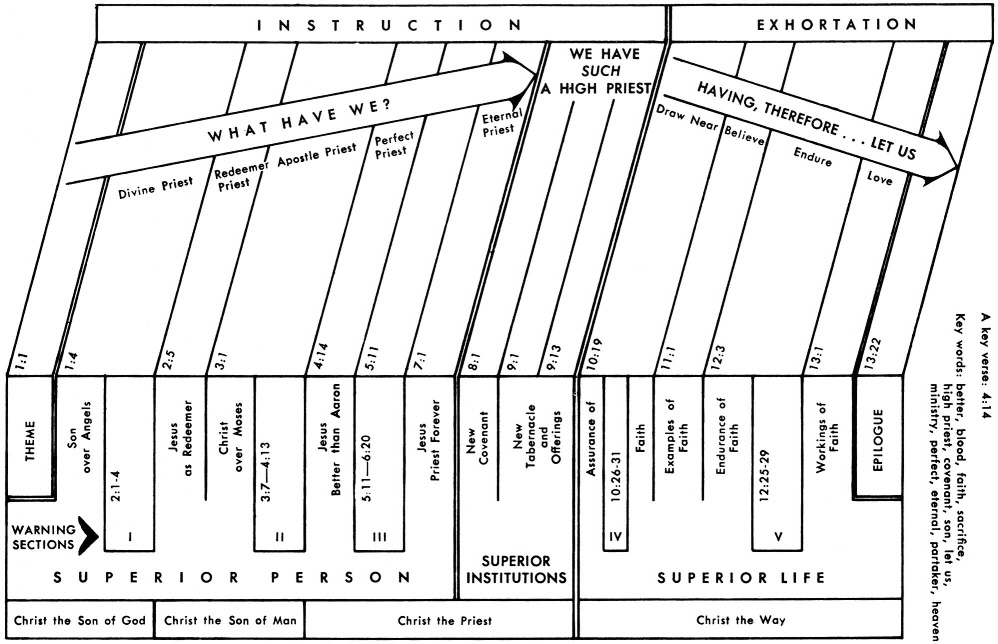
CONSIDER JESUS OUR GREAT HIGH PRIEST
Click chart to enlarge
Charts from Jensen's Survey of the NT - used by permission
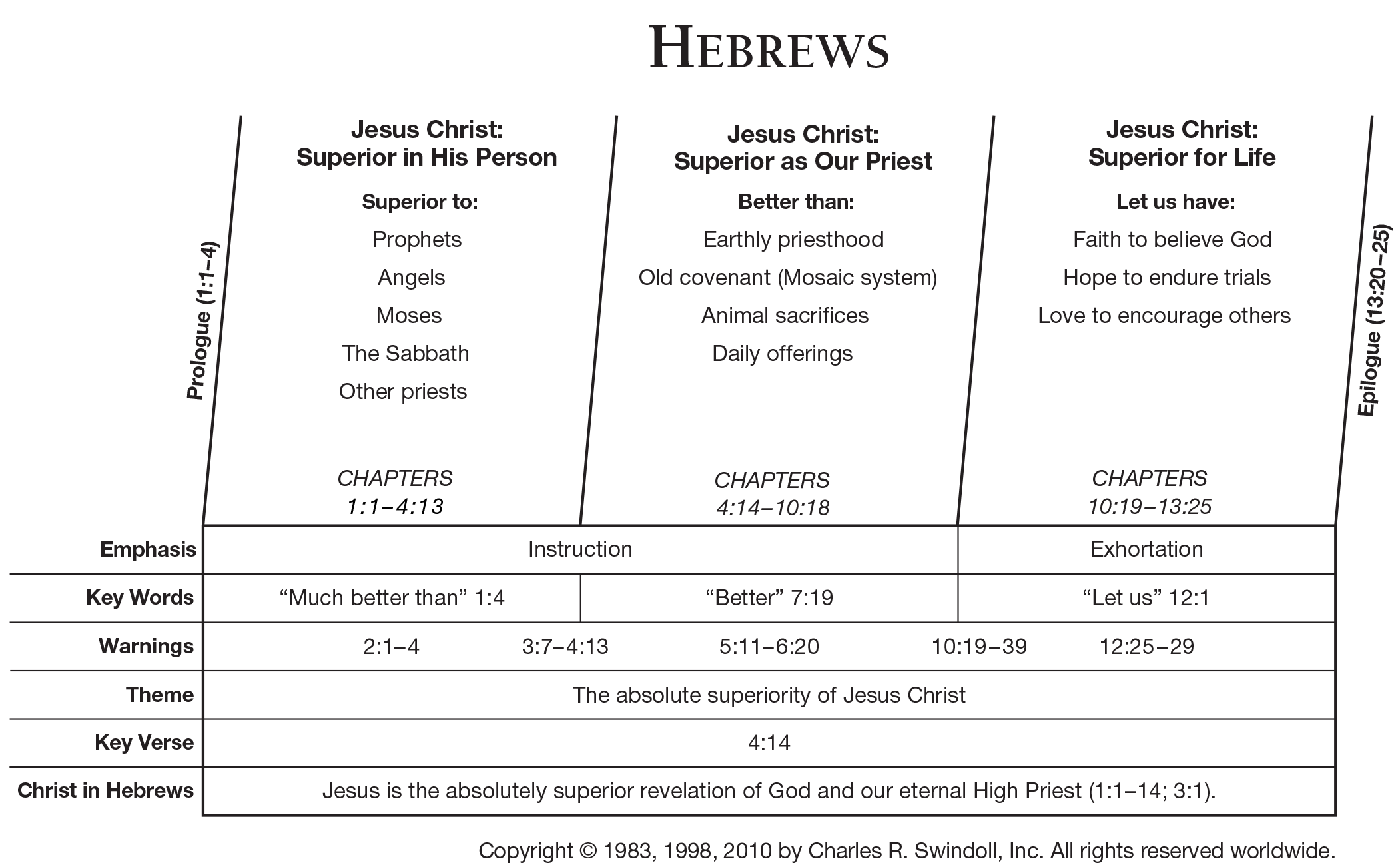
Swindoll's Chart, Interesting Pictorial Chart of Hebrews, Another Chart

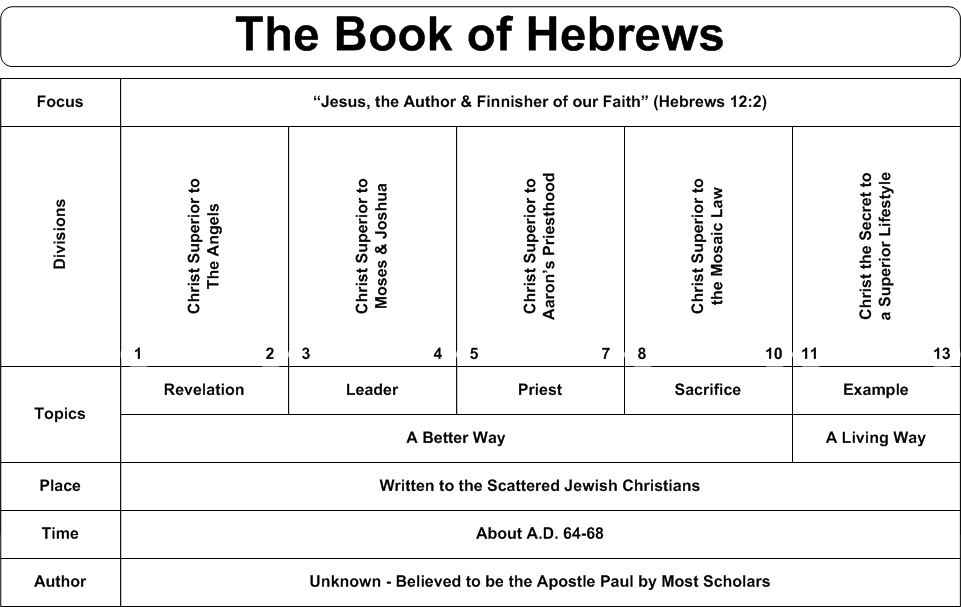
|
The Epistle |
||||
| INSTRUCTION REVELATION PRECEPTS DOCTRINE Hebrews 1-10:18 |
EXHORTATION RESPONSE PRACTICE DUTY Hebrews 10:19-13:25 |
|||
| Superior Person of Christ Hebrews 1:1-4:13 |
Superior Priest in Christ Hebrews 4:14-10:18 |
Superior Life In Christ Hebrews 10:19-13:25 |
||
| BETTER THAN PERSON Hebrews 1:1-4:13 |
BETTER PRIESTHOOD Heb 4:14-7:28 |
BETTER COVENANT Heb 8:1-13 |
BETTER SACRIFICE Heb 9:1-10:18 |
BETTER LIFE |
| MAJESTY OF CHRIST |
MINISTRY OF CHRIST |
MINISTERS FOR CHRIST |
||
|
DOCTRINE |
DUTY |
|||
|
DATE WRITTEN: |
||||

See ESV Study Bible "Introduction to Hebrews"
(See also MacArthur's Introduction to Hebrews)
Borrow Ryrie Study Bible
Hebrews 4:1 Therefore, let us fear if, while a promise remains of entering His rest, any one of you may seem to have come short of it. (NASB: Lockman)
Greek: Phobethomen (1PAPS) oun mepote kataleipomenes (PPPFSG) epaggelias eiselthein (AAN) eis ten katapausin autou doke (3SPAS) tis ex humon husterekenai; (RAN)
BGT φοβηθῶμεν οὖν, μήποτε καταλειπομένης ἐπαγγελίας εἰσελθεῖν εἰς τὴν κατάπαυσιν αὐτοῦ δοκῇ τις ἐξ ὑμῶν ὑστερηκέναι.
Amplified: THEREFORE, WHILE the promise of entering His rest still holds and is offered [today], let us be afraid [to distrust it], lest any of you should think he has come too late and has come short of [reaching] it. (Amplified Bible - Lockman)
My Amplified Paraphrase - Therefore, since the promise of entering God’s true, final rest (katapausis—His provision of spiritual rest, fellowship, and eternal salvation) still remains open before us, let us be fearfully alert, reverently cautious, and spiritually watchful lest any one of you should seem to fall short, lag behind, drift away, or fail to embrace that rest through unbelief. Let the awe of God produce in us a holy vigilance—lest through hardness of heart, carelessness, or apathy we miss what God still graciously offers.
KJV: Let us therefore fear, lest, a promise being left us of entering into his rest, any of you should seem to come short of it.
NKJV: Therefore, since a promise remains of entering His rest, let us fear lest any of you seem to have come short of it.
NLT: God's promise of entering his place of rest still stands, so we ought to tremble with fear that some of you might fail to get there. (NLT - Tyndale House)
Phillips: Now since the same promise of rest is offered to us today, let us be continually on our guard that none of us even looks like failing to attain it. For we too have had a Gospel preached to us, as those men had. Yet the message proclaimed to them did them no good, because they only heard and did not believe as well. It is only as a result of our faith and trust that we experience that rest. For he said: 'So I swore in my wrath, they shall not enter my rest'; not because the rest was not prepared - it had been ready since the work of creation was completed, as he says elsewhere in the scriptures, speaking of the seventh day of creation, 'And God rested on the seventh day from all his works'. (Phillips: Touchstone)
TLB: Although God’s promise still stands—his promise that all may enter his place of rest—we ought to tremble with fear because some of you may be on the verge of failing to get there after all.
Wuest: Let us therefore fear lest, a promise at any time being left behind and still remaining of entering into His rest, anyone of you should think that he has fallen short of it or has come too late.
Young's Literal: Therefore, let us fear lest, while a promise remains of entering His rest, any one of you should seem to have come short of it.
NKJ Therefore, since a promise remains of entering His rest, let us fear lest any of you seem to have come short of it.
NET Therefore we must be wary that, while the promise of entering his rest remains open, none of you may seem to have come short of it.
CSB Therefore, while the promise to enter His rest remains, let us fear that none of you should miss it.
ESV Therefore, while the promise of entering his rest still stands, let us fear lest any of you should seem to have failed to reach it.
NIV Therefore, since the promise of entering his rest still stands, let us be careful that none of you be found to have fallen short of it.
John Piper makes a pithy comment writing "the NIV irresponsibly weakens this [let us fear] by the translation" 'Let us be careful"!" (Be Diligent to Enter God's Rest!)
MIT Let us be apprehensive, therefore, lest any of you, by ignoring a promise of entering into his restful state, apparently come up short of realization.
NJB Let us beware, then: since the promise never lapses, none of you must think that he has come too late for the promise of entering his place of rest.
NRS Therefore, while the promise of entering his rest is still open, let us take care that none of you should seem to have failed to reach it.
RSV Therefore, while the promise of entering his rest remains, let us fear lest any of you be judged to have failed to reach it.
NAB Therefore, let us be on our guard while the promise of entering into his rest remains, that none of you seem to have failed.
GWN God's promise that we may enter his place of rest still stands. We are afraid that some of you think you won't enter his place of rest.
BBE Let us then, though we still have God's word that we may come into his rest, go in fear that some of you may be unable to do so.
ASV Let us fear therefore, lest haply, a promise being left of entering into his rest, any one of you should seem to have come short of it.
- therefore: He 4:11 Heb 2:1-3 12:15,25 Heb 13:7 Pr 14:16 Pr 28:14 Jer 32:40 Ro 11:20 1Co 10:12
- a promise: He 4:9 Nu 14:34 1Sa 2:30 Ro 3:3,4 2Ti 2:13
- His rest: He 4:3-5 Heb 3:11
- any one: Mt 7:21-23,26,27 Mt 24:48-51 25:1-3 Lu 12:45,46 13:25-30 Ro 3:23 1Co 9:26,27
- Hebrews 4 Resources - Multiple Sermons and Commentaries
Related Passages:
1 Peter 1:17+ And if you address as Father the One who impartially judges according to each man's work, conduct yourselves (aorist imperative = do this now! do it effectively!) in fear (phobos - noun form of verb phobeo) during the time of your stay upon earth
Hebrews 4:11 Therefore let us be diligent to enter that rest, so that no one will fall, through following the same example of disobedience.
Romans 11:20 Quite right, they were broken off for their unbelief, but you stand by your faith. Do not be conceited, but fear;
1 Corinthians 10:12 Therefore let him who thinks he stands take heed that he does not fall.
Matthew 10:28 "Do not fear those who kill the body, but are unable to kill the soul; but rather fear Him who is able to destroy both soul and body in hell."
Hebrews 4:6+ Since therefore it remains (apoleipo - present tense) for some to enter it, and those who formerly had good news preached to them failed to enter because of disobedience,
Hebrews 4:9+ There remains (apoleipo - present tense) therefore a Sabbath rest for the people of God.
James 5:20+ let him know that he who turns a sinner from the error of his way will save his soul from death and will cover a multitude of sins.
2 Peter 1:10, 11+ Therefore, brethren, be all the more diligent (aorist imperative = an urgent command to immediately have this attitude, remembering that attitude issues in "congruent" action) to make certain about His calling and choosing (2Pe 1:10KJV = election; Greek = ekloge = God's "picking out" or selection, but not implying the rejection of those not picked) you; for as long as you practice these things (present tense = continually, as our lifestyle = "direction" not "perfection"! Such "actions" will validate our "profession" of Christ as indeed a valid, legitimate "possession" of Christ. A diligent attitude will show forth in definite actions.), you will never stumble (not that you won't commit sins, but that you won't "stumble" and miss heaven); for (term of explanation - Peter now explains why we should be diligent and dutiful - the prospect of a future abundant entrance should be a strong motivation to present diligence and practice! [1Co 3:12-14+] Contrast a "less than abundant" entrance into heaven [1Cor 3:15+]!) in this way the entrance into the eternal kingdom of our Lord and Savior Jesus Christ will be abundantly supplied to you.
Matthew 7:21-23+ (THE FATE OF SELF DECEPTION OF THINKING ONE HAS ENTERED THE SMALL GATE, BUT WHOSE LIFESTYLE PROVES OTHERWISE) Not everyone who says to Me, 'Lord, Lord,' will enter the kingdom of heaven; but he who does (present tense = their lifestyle) the will of My Father who is in heaven. Many will say to Me on that day, 'Lord, Lord, did we not prophesy in Your name, and in Your name cast out demons, and in Your name perform many miracles?' And then I will declare to them, 'I never knew you; DEPART FROM ME, YOU WHO PRACTICE (present tense = their lifestyle) LAWLESSNESS. (AKA "YOU CAME SHORT OF MY REST!"

THE SMALL GATE & NARROW WAY
REMAIN OPEN
Therefore (oun) is a term of conclusion which means consequently and thus introduces a logical result or inference from what precedes, in this case the danger of missing God's rest through unbelief and disobedience. In other words in light of what he has just stated "And to whom did He swear that they should not enter His rest, but to those who were disobedient? And so we see that they were not able to enter because of unbelief. (He 3:18, 19+) Note that disobedience and unbelief are equated. Conversely, genuine saving faith obeys… therefore…! Because of the ''Chosen people's'' historical example and the result of their unbelief we need to have a "healthy" fear (Isa 66:2,5) of God Who keeps His Word, both His Word of grace and mercy and His promised judgment! God is deadly serious about disobedience (pun intended!) It follows that chapter 3 to chapter 4 is not the best chapter division. Just as the Jews perished in the wilderness because of unbelief, the first century Hebrew readers faced a real peril of perishing eternally if they failed to enter the spiritual rest in Christ.
A W Pink adds "The opening words of this chapter (THEREFORE...) bid us seriously take to heart the solemn warning given at the close of 3."
The Wycliffe Bible Commentary (online) - This is the direct application of the warnings against unbelief in the previous statements.
Let us fear (phobeo) if, while a promise (epaggelia) remains (kataleipo) of entering (eiserchomai) His rest (katapausis), any one of you (literally "someone/anyone out of [ex] you") may seem (dokeo) to have come short (hustereo) of it - Let us is a hortatory subjunctive which is used 13 times in Hebrews. The TLB is a good paraphrase writing "Although God’s promise still stands—his promise that all may enter his place of rest—we ought to tremble with fear because some of you may be on the verge of failing to get there after all." Note that the promise (epaggelia) is from the non-lying God (Titus 1:2+), so it is a non-failing Word (Josh 23:14+). Remains (kataleipo) indicates this promise is still available for any one ("any one of you") who has ears to hear what the Spirit is saying. Remains is in the present tense which speaks of continuance ("there being left behind and still remaining”). Yes, one day the door of grace will close on the promise but for now it remains open.
Entering is in the present tense conveying the truth that the opportunity to enter God's rest is currently available to his readers then and to readers in our day. Entering is active voice which speaks of a personal choice, a choice of one's will to enter (a choice I believe is enabled by the Holy Spirit - cf the exhortation in Heb 4:11+). Entering in the present tense could also describe a process. In other words, there is a first time entering His rest by grace through faith (Eph 2:8-9+), the moment we are born again (Jn 3:3-7+). But once we are born again there is a daily (continual) entering into His rest as the Spirit and Word transform us in Christlikeness (2Co 3:18+, cf progressive sanctification. And do not miss the possessive pronoun His! The rest promised is HIS rest, God's very Own rest into which we are entering! Frankly, words fail me to adequately describe HIS divine rest, but clearly HIS rest speaks of supernatural rest, eternal rest and yea, even incomprehensible rest. Next notice the phrase any one of you. You refers to his audience, his readers. The implication is that there is a "subgroup" of the "you" group which he refers to as "any one" not "any of us." So he does not appear to include himself in the "any one" subgroup. What characterizes this "any one" subgroup? He says they may seem (subjunctive mood is mood of possibility) to have come short of it, come short of entering His rest! The writer is clearly concerned that there might be some "any one's" who have not entered God's rest. This could include some who professed intellectual belief in Messiah but who lacked heart belief (cf Ro 10:9-10+). In short, they had come short of entering His rest by grace through faith. The ESV Study Note agrees writing "The author holds out the possibility that some (ED: "ANY ONE OF YOU" SUBGROUP) in his audience lacked acquaintance with this spiritual “rest” since they did not possess true faith." And so the writer trembles in fear that "anyone" would miss entrance into God's rest.
🙏 THOUGHT - We too should tremble in fear that any one in our family or our church who claims to be a Christ follower would in the final analysis be in the "any one of you" group and fail to enter His rest! David Guzik agrees writing "This place of rest is so glorious it should concern us when others seem to come short of it." With reverential fear all of us should examine our own spiritual condition (1Cor 10:12+; 2Cor 13:5+) and then actively press for commitment on the part of others so that we might "save (present imperative) others, snatching them out of the fire; and on some have mercy with fear, hating even the garment polluted by the flesh." (Jude 1:23+).
Bob Utley rightly remarks on let us fear - The warnings of Hebrews (cf. Heb. 2:1-4; 3:7-13; 4:1-13; 5:11-6:12; 10:26-39; 12:14-17) should elicit a sense of dread (cf. Heb. 4:11). These warnings touch ultimate issues of salvation and assurance.
Donald Guthrie gives an added nuance to the exhortation let us fear advising that "It would be salutary for Christians seriously to consider the failure of the Israelites and their incurring the displeasure of God, and to fear lest a similar calamity should befall members of the new community, the spiritual Israel." (Borrow Tyndale New Testament Commentaries – Hebrews page 114) In other words, Guthrie sees the "fear" looking back to the failure of Israel in the OT and by way of application looking forward to what might be the dire state and dread fate of some of the Jews in the congregation.
John Piper on fear - Reverence is the combination of admiration and fear, awe and dread, wonder and terror. It's an emotion that we were made to experience.
Ray Stedman on any one of you may seem to have come short of His rest - "In Hebrews 4:1 we are given the first hint that the promise of rest given to Israel envisaged more than entering the Promised Land. It is, he says, a promise which still stands, that is, was not satisfied by entering Canaan, but still exists at the time of his writing. Furthermore, his readers stand in danger of missing it unless they are careful. The Greek construction of the phrase that none of you be found to have fallen short of it indicates that wrong behavior, such as disobedience or long-continued grumbling, suggests the heart is unchanged and unbelieving. Be found refers to God’s knowledge of the heart and his actions based on that knowledge. (Hebrews 4:1-2 A Promise Requires a Response)
William MacDonald adds that "No one should think that the promise of rest is no longer valid. It has never had a complete and final fulfillment in the past; therefore the offer is still in effect. But all who profess to be believers should make sure that they do not come short of the goal. If their profession is empty, there is always the danger of turning away from Christ and embracing some religious system that is powerless to save. (Borrow Believer's Bible Commentary)
Adam Clarke has an interesting thought on the picture of come short - “It is an allusion, of which there are many in this epistle, to the races in the Grecian games: he that came short was he who was any distance, no matter how small, behind the winner.”
P E Hughes has a similar comment on come short noting that "the metaphor is an athletic one, and the idea is that of finishing the race. Perseverance is an essential element of the Christian life. Indeed, running the race to the end is the hallmark of genuine, saving faith, while falling away is the mark of a spurious faith that does not lead to salvation. (Reformed Expository Commentary)
Leon Morris on promise remains of entering His rest -God's promises mean much to the writer, and indeed the word epaggelia ("promise") occurs more often in Hebrews than in any other NT book (fourteen times; next is Gal with ten). The promise in question "still stands." That is to say, it has not been revoked. But throughout this section it is basic to the argument that even physical entry into Canaan did not constitute the fulfillment of the promise. God had promised "rest" and that meant more than living in Canaan. (Expositor's Bible Commentary)
Wuest feels His rest is a spiritual rest, a rest in a Person, not in a Place, a Life, not a Land! - Having reminded his readers that the generation which came out of Egypt did not enter into the rest of Canaan because of unbelief, the writer now proceeds to warn them of a possible failure on their part of entering into rest in Messiah. (Hebrews)

DEAR READER
DON'T MISS THE BOAT!
Any one of you (literally "someone/anyone out of [ex] you") may seem (dokeo) to have come short (hustereo) of it - Have you ever gone on a cruise ship vacation where they stop at various ports? This happened to my family on an Alaskan cruise. Somehow we lost track of time and realized the ship was about to disembark. We were alerted by the ship's loud whistle! Fortunately we were all in good health and raced back to the gangplank just before the ship departed. That was a potential temporal miscue, but our writer is talking about making an eternal miscue. If you come short of entering this "Ark," there are no other ships coming to port to take you to heaven's shores!
🙏 THOUGHT - Don't miss the boat dear reader! The ship's Gospel whistle is loudly and clearly being sounded by the writer of the epistle of the Hebrews! May God grant you ears to hear (Mt 11:15+). In Messiah's Name. Amen.
Spurgeon on may seem to have come short of it - Not come short of it but even seem to do so. God keep us from the very shadow of sin, from the very appearance of evil. If you avoid the very seeming of it, you will avoid the thing itself. Oh, that we were careful about this—that there was nothing that should give any reasonable fear to those who observed us, or to ourselves when we search our hearts, lest we should not enter into this rest.
Phillip E Hughes reiterates the point I made in the opening exposition above writing "Notice that the subject of the sentence is plural—it is "us" who must be careful—while the object is singular— lest anyone ("any one of you") fall away. This is the attitude we need in the church today, one that says: "Yes, I am my brother's keeper. I have a stake in the spiritual affairs of others here and a responsibility not merely for my own salvation, but for theirs as well." This is not an invitation for destructive meddling but for the mutual building up that is to define life in the church (ED: AND PRACTICE OF Heb 3:13+). So important is this to the life of the church that the apostle James concluded his epistle on this very note: "Whoever brings back a sinner from his wandering will save his soul from death and will cover a multitude of sins" (James 5:20+). Simon Kistemaker is right when he observes, "We ought to take careful note of members who may be drifting from the truth in doctrine or conduct and then pray with them and for them. We are constantly looking for spiritual stragglers." (Reformed Expository Commentary)
Wuest on any one of you - Their professed faith was being sorely tried by the adverse circumstances in which they found themselves. Thus, they were in danger of renouncing their professed faith and of returning to the First Testament sacrifices under the stress of this persecution. The writer proceeds to show that this promise is still open. (Hebrews Commentary) (Comment: Note that the idea of "professed faith" is addressed in Hebrews 3:6 and Hebrews 3:14, where the the readers are told that if they hold fast to the end, they are genuine believers and in fact there professed faith is a "possessed" faith. Those who fell away after making a profession of faith would prove that they had never genuinely believed in the Messiah.)
Isn't it amazing how some individuals can come so close to eternal life and yet end up in eternal death! They are in a good Bible believing church, they know stories and verses in the Bible, they know the message of the gospel, the good news, they are "good" people, etc, etc… but they lack one thing…they've never confessed Jesus as Lord and Savior of their life the importance of which Paul explains…
But what does it say? "THE WORD IS NEAR YOU, IN YOUR MOUTH AND IN YOUR HEART"-- that is, the word of faith which we are preaching, 9 that if you confess with your mouth Jesus as Lord, and believe in your heart that God raised Him from the dead, you shall be saved; 10 for with the heart man believes, resulting in righteousness, and with the mouth he confesses, resulting in salvation. 11 For the Scripture says, "WHOEVER BELIEVES IN HIM WILL NOT BE DISAPPOINTED (means to be caused to be much ashamed, humiliated or disgraced!)." (Ro 10:8+, Ro 10:9-11)
When you come so close yet still come short, you might even presume that you have entered into the rest (like a "vaccination" or being inoculated with the inactive virus to prevent you from getting the real viral disease), and so this is why it is so important to continue to encourage one another daily while there is still time (Heb 3:13+). Coming to Bible study means nothing if Christ is not in your heart. You can know a lot in your head but the real issue is to make certain of your calling and election (2Pe 1:10-11+). Many will say to Jesus in that day "Lord, Lord" but He will say those frightening, fateful words "I never knew you. Depart from Me, you who practice lawlessness." (Mt 7:21-23+)
Among those WHO COME SHORT OF GOD'S REST will be the following classes…
(1) Those who are professors but who have never known anything of true piety.
(2) those who are expecting to be saved by their own works.
(3) those who defer attention to the subject from time to time until it becomes too late. They expect to reach heaven, but they are not ready to give their hearts to God "now," and the subject is deferred from one period to another, until death arrests them unprepared.
(4) those who have been awakened to see their guilt and danger, and who have been almost but not quite ready to give up their hearts to God. Such were Agrippa (Acts 26:28), the young ruler Mk 10:21, and such are all those who are "almost" but not "quite" prepared to give up the world and to devote themselves to the Redeemer.
To all these the promise of rest is made, if they will accept of salvation as it is offered in the gospel; all of them cherish a hope that they will be saved; and all of them are destined alike to be disappointed. With what earnestness, therefore, should we strive that we may not fail of the grace of God!
Let us fear (5399) (phobeo - see study of phobos) means to frighten, terrify, be alarmed and in Classical Greek meant to cause to run away. In some contexts it conveys the sense of to revere, fear exceedingly, give reverence or be in awe of. There is a proper fear of the Lord that should be in every Christian’s heart, a “fear” that manifests the respect of a loving child and not the dread of a frightened slave. Proper fear motivates proper conduct 1828 version of Webster's definition of fear as…
Charles Swindoll - The “fear” mentioned in Hebrews 4:1 seems to refer to a healthy respect for the dire consequences of faithlessness and disobedience to God. (See Insights on Hebrews - Page 62)
A painful emotion or passion excited by an expectation of evil, or the apprehension of impending danger. Fear expresses less apprehension than dread, and dread less than terror and fright. The force of this passion, beginning with the most moderate degree, may be thus expressed, fear, dread, terror, fright. Fear is accompanied with a desire to avoid or ward off the expected evil. Fear is an uneasiness of mind, upon the thought of future evil likely to befall us.
John Owen on fear in Hebrews 4:1 - The fear intended in this verse is a combination of two things. First, it is a reverent understanding of God’s holiness and greatness, and His severity against sin. Second, it is using the means of grace carefully to avoid the evil of unbelief and disobedience. (Hebrews 4 Commentary)
PHOBEO IN HEBREWS - Heb. 4:1; Heb. 11:23; Heb. 11:27; Heb. 13:6
Related Resource - How To Handle Fear (cf worry, etc)
Hortatory Subjunctive - a first-person plural subjunctive verb used to urge a group to do something. (Let us go…” “Let us draw near…” “Let us hold fast…” “Let us consider…”) These are not suggestions; they are strong, urgent exhortations. The hortatory subjunctive expresses: exhortation (strong urging), encouragement, group inclusion (“we together”), an invitation with authority, a call to decisive action. It has the force of:“We must…” “Let us now…” “We should immediately…” It is authoritative yet pastoral.
Why Greek uses the Hortatory Subjunctive - Greek has no first-person imperative (“we, do this!”), so the hortatory subjunctive serves this function. It is the strongest way to urge a group to action.
Summary - This is a statement urging others to join in some action (commanding oneself and one’s associates). (It is roughly the same as first person imperative, which does not exist in Greek.) It is easily identified because it will always be the first person plural form of the subjunctive mood. This verb form will often come near the beginning of the sentence.It is usually translated "let us…." (Thus, as a mnemonic device, it can be referred to as the ‘Salad Subjunctive’. cf "let us" with "lettuce" - a bad joke!)
"LET US" IN HEBREWS - 13x/12v - Heb. 4:1; Heb. 4:11; Heb. 4:14; Heb. 4:16; Heb. 6:1; Heb. 10:22; Heb. 10:23; Heb. 10:24; Heb. 12:1; Heb. 12:28; Heb. 13:13; Heb. 13:15
Promise (1860) (epaggelia/epangelia from epí = intensifies verbal meaning + aggéllo = to tell, declare) originally referred to an announcement or declaration (especially of a favorable message) but in later Greek came to mean a declaration to do something with the implication of obligation to carry out what is stated (thus a promise or pledge). Epaggelia was primarily a legal term denoting summons, a promise to do or give something, but in the NT speaks primarily of the promises of God.
Epaggelia - 52x in 50v - Lk. 24:49; Acts 1:4; Acts 2:33; Acts 2:39; Acts 7:17; Acts 13:23; Acts 13:32; Acts 23:21; Acts 26:6; Rom. 4:13; Rom. 4:14; Rom. 4:16; Rom. 4:20; Rom. 9:4; Rom. 9:8; Rom. 9:9; Rom. 15:8; 2 Co. 1:20; 2 Co. 7:1; Gal. 3:14; Gal. 3:16; Gal. 3:17; Gal. 3:18; Gal. 3:21; Gal. 3:22; Gal. 3:29; Gal. 4:23; Gal. 4:28; Eph. 1:13; Eph. 2:12; Eph. 3:6; Eph. 6:2; 1 Tim. 4:8; 2 Tim. 1:1; Heb. 4:1; Heb. 6:12; Heb. 6:15; Heb. 6:17; Heb. 7:6; Heb. 8:6; Heb. 9:15; Heb. 10:36; Heb. 11:9; Heb. 11:13; Heb. 11:17; Heb. 11:33; Heb. 11:39; 2 Pet. 3:4; 2 Pet. 3:9; 1 Jn. 2:25. Note the 14x in Hebrews in 13 verses (27.4% of all 51 NT uses) - See notes He 4:1, He 6:12, 6:15, 6:17, 7:6, 8:6, 9:15, 10:36, 11:9, 11:13, 11:17, 11:33, 11:39
TDNT summarizes this word group writing that it has the following nuances…a. The first sense is “to indicate,” “declare,” “declaration,” “report.” b. When the state declares something, it becomes an “order.” c. In law we find the senses “accusation” and “delivery of a judgment.” d. We then find the senses “to declare an achievement,” “to show one's mastery,” “to profess a subject.” e. Another sense is “to offer,” “to promise,” “to vow.” As regards promises, tension between word and deed is felt, so that promises are often seen as worthless. f. A special type of promise is the “promise of money,” and in this sense the idea of a “subscription” or “donation” arises (state liturgies, gifts to rulers at their accession, priests promising gifts in support of their candidature). g. In the Hellenistic period we also find a sacral use for the “proclamation” of a festival. Among all the instances, only one example has been found for the promise of a deity. (Theological Dictionary of the New Testament)
Remains (2641) (kataleipo from kata = intensifies or strengthens the meaning of + leipo = to leave behind, forsake, to be wanting or deficient) literally means to leave behind or leave remaining (of a person or place - Mt 4:13, 16:4, 21:17, He 11:27). In the passive sense as used here in Hebrews 4:1 kataleipo means to remain behind for a purpose.
Kataleipo in Hebrews 4:1 is in the present tense passive meaning "continually caused to remain" or "a promise still being left". That is, it was given to believers among Israel of old, and holds good still for all. The passive voice indicates an outside force effects the action of keeping the door of the Ark open, so to speak. When God decides the time is up, it is up! (He 9:28+) Even for those "almost persuaded" such were Agrippa (Acts 26:28), the young ruler Mark 10:21, and all those who are "almost" but not "quite" prepared to give up the world and to surrender themselves to the Redeemer.
KATALEIPO - 24x/24v - forsaking(1), kept(1), leave(4), leaves behind(1), leaving(3), leaving behind(1), left(8), left behind(1), left… behind(1), neglect(1), pulled free(1), remains(1).Matt 4:13; 16:4; 19:5; 21:17; Mark 10:7; 12:19, 21; 14:52; Luke 5:28; 10:40; 15:4; 20:31; John 8:9; Acts 6:2; 18:19; 21:3; 24:27; 25:14; Rom 11:4; Eph 5:31; 1 Thess 3:1; Heb 4:1; 11:27; 2Pet 2:15.
Rest (2663) (katapausis from katá = intensifies or "down" conveying sense of permanency + paúo = make to cease) describes literally a ceasing from one's work or activity. Thayer cites a use in the active sense of a putting to rest as used in the sentence "a calming of the winds". Metaphorically as used in the present verse, katapausis speaks of the spiritual fulfillment God provides for His people.
KATAPAUSIS - 8X - Acts 7:49+,Heb 3:11+,Heb 3:18+, Heb 4:1+, Heb 4:3+, Heb 4:5+, Heb 4:10+, Heb 4:11+,
Katapausis does not refer to just any rest, but in context to the Creator's rest (His rest)! The wilderness wanderings represent those who had heard the truth but who would not believe that truth with the result that they spend their whole life in restless unbelief.
Barclay has the following analysis of katapausis noting that…In a complicated passage like this it is better to try to grasp the broad lines of the thought before we look at any of the details. The writer is really using the word rest (katapausis) in three different senses. (i) He is using it as we would use the peace of God. It is the greatest thing in the world to enter into the peace of God. (ii) He is using it, as he used it in Hebrews 3:12+, to mean The Promised Land. To the children of Israel who had wandered so long in the desert the Promised Land was indeed the rest of God. (iii) He is using it of the rest of God after the sixth day of creation, when all God’s work was completed. This way of using a word in two or three different ways, of teasing at it until the last drop of meaning was extracted from it, was typical of cultured, academic thought in the days when the writer to the Hebrews wrote his letter. (Hebrews 4 Commentary )
Spurgeon - “Rest” is a blessed golden word. It is the one thing, surely, that the world seeks after. It may be true that every man seeks after happiness; I question if it is not equally true that each man seeks after rest. There are some few fiery spirits who wish not to rest, who seem to be like thunderbolts that must speed on in their predestinated pathway, and only an incessant and morbid activity suits them at all; but for the majority of us the expectation of rest is very sweet, and the enjoyment of it now in the poor measure in which we can get it is one of our greatest refreshments.
See excursus on Rest in Hebrews 4.
May seem (1380) (dokeo) means to hold an opinion based upon appearances which may be significantly different from reality. It means to regard something as presumably true, without particular certainty.
To come short (5302) (hustereo from hústeros = last, latter, terminal, hindmost) has the basic meaning of come to late (in time) or to come after (in terms of space) and thus it means to fail in something, come short of, miss, not to reach. Hustereo has the basic meaning of being last or inferior. It means to be left behind in the race and so fail to reach the goal, to fall short of the end, to lack. It means to come late or too tardily. Hustereo means to be excluded (He 12:15+) or as in Hebrews 4:1 as coming too late through one's own fault and so to fail to reach the intended objective or goal. In several of the NT passages hustereo means to be in short supply, to fail, to give out or to lack. Hustereo can mean to experience deficiency in something advantageous or desirable and thus to be lacking, go without or come short of (as in Mt 19:20).
HUSTEREO - 16X - Mt. 19:20; Mk. 10:21; Lk. 15:14; Lk 22:35; Jn. 2:3; Ro 3:23; 1Co. 1:7; 1Co 8:8-the worse; 1Co 12:24; 2Co. 11:5, 9; 2Co 12:11-was I inferior; Phil. 4:12-suffering need; Heb. 4:1; 11:37; 12:15
HUSTEREO IN HEBREWS - Heb 4:1; Heb 11:37+ - being destitute; Hebrews 12:15+
"See to it (present imperative) that no one comes short (hustereo) of the grace of God; that no root of bitterness springing up causes trouble, and by it many be defiled.
The meaning of hustereo is further illustrated in the following verses…
(At the wedding in Cana site of Jesus' first recorded miracle) And when the wine gave out, (hustereo) the mother of Jesus said to Him, "They have no wine." (Jn 2:3+)
Now when he (the prodigal son) had spent everything, a severe famine occurred in that country, and he began to be in need (hustereo). (Lk 15:14+)
The young man said to Him, "All these things I have kept; what am I still lacking (hustereo)?" (Mt 19:20+)
HUSTEREO IN SEPTUAGINT - 14X - Nu. 9:7, 13; Neh. 9:21; Job 36:17; Ps. 23:1; 39:4; Eccl. 6:2; 9:8; 10:3; Song 7:2; Da 4:33; 5:27; Hab. 2:3
Hustereo means to essentially to be found to come short as in Romans 3 where Paul writes that "all have sinned and fall short (hustereo) of the glory of God (Ro 3:23+) When you come short of something, you can miss it an inch or a mile, but you still miss it! So those in Romans 3:23 have missed it a "mile". There are others who have missed it by only an "inch". Life is not a game of horseshoes. Close does not count!
For example, take the man that Mark wrote about "And looking at him (a man who ran up to Jesus and knelt before Him), Jesus felt a love for him, and said to him, "One thing you lack (hustereo): go and sell all you possess, and give to the poor, and you shall have treasure in heaven; and come, follow Me." But at these words his face fell, and he went away grieved, for he was one who owned much property. And Jesus, looking around, said to His disciples, "How hard it will be for those who are wealthy to enter the kingdom of God! (Mk 10:21-23+) COMMENT - Jesus was telling the man (and all who have ears to hear) that "you are coming short in just one thing".
Irving Jensen - The main theme of Hebrews may be stated thus: The knowledge and assurance of how great this High Priest Jesus is should lift the drifting believer from spiritual lethargy to vital Christian maturity. Stated another way: The antidote for backsliding is a growing personal knowledge of Jesus (He 2:1, He 2:3). (See page 2253 in pdf - Jensen's Survey of the New Testament: Search and discover)
OT PASSAGES QUOTED IN HEBREWS 4 - Click for complete list of OT Quotations/Allusions
He 4:3 <> Ps 95:11
He 4:4 <> Ge 2:2
He 4:5 <> Ps 95:11
He 4:7 <> Ps 95:7, 8
KEY WORDS IN HEBREWS 4 - Click for complete list of Key Words in Hebrews
Faith - He 4:2
Let us - He 4:1, 11, 14,16 (Click for all 12 "let us… " exhortations in Hebrews in the NASB)
Bruce Wilkinson reminds us of the purpose of this epistle and the importance of this middle section (He 4:14-He 10:18) to unequivocally establish the greatness of Christ's priesthood…
Many Jewish believers, having stepped out of Judaism into Christianity, wanted to reverse their course in order to escape persecution by their countrymen. The writer of Hebrews exhorts them to “press on” to maturity in Christ (He 6:1). His appeal is based the superiority of Christ over the Judaic system. Christ is better than the angels, for they worship Him. He is better than Moses, for Moses was created by Him. He is better than the Aaronic priesthood, for His sacrifice was once for all time. He is better than the Law, for He mediates a better covenant. In short, there is more to be gained by suffering for Christ than by reverting to Judaism. Pressing on to maturity produces tested faith, self-discipline, and a visible love seen in good works. (Wilkinson, B., & Boa, K. 1983. Talk thru the Bible. Page 453. Nashville: T. Nelson)
I have wrestled with this passage which at first glance I thought was quite straightforward, only to find that there is considerable variation in interpretation in conservative, evangelical sources. Basically the interpretations break down into two groups - (1) Those who feel the writer is addressing believers who have failed to enter into the fullness of the Christian life (failed to enter His rest). (2) Others who feel this is a strong warning against unbelief which will result in the eternal separation of the faithless person from the presence of God and His eternal rest. There are also permutations and combinations of these two interpretations. Although I think the primary warning is to unbelievers, the text can clearly be applied to the lives of genuine believers who are living what Pastor Chuck Smith calls a "yo-yo" type of Christian life -- sometimes up, sometimes down, but not predominantly victorious over sin and the rest that such a life secures in this present age.
Explore the Bible notes has a summary of aspects of "rest" described in Hebrews 3-4…
1) The rest Israel failed to enter when they believed the evil report of the ten unfaithful spies.
2) The Sabbath rest in the aftermath of God’s six days of creative activity: these first two “rests” point to something beyond the mere historical occurrences of creation and conquest. Ultimately, the text describes the saving rest which true believers experience and the glorious rest the saints will enter when they join Christ in heaven.
3) The rest that people experience when they trust Christ as Lord and Savior: Some of the commentators emphasize the future implications of the “rest” of the Lord’s people, but they do so at the expense of the present “rest” that sinners may find, here and now, when they trust the Savior.
4) The future “rest” of the people of God when they enter the glories of heaven: This text does have an eschatological element, and Bible students should not neglect this aspect of the chapter’s teaching. Also, the comments in point three (above) do not negate or diminish the believer’s wonderful expectation of the bliss and rest of heaven. (Be Obedient)
Comment: I basically concur with this classification of rest in Hebrews 3-4, but would add that the future rest might be viewed as having 2 components (if one accepts a literal 1000 years in Revelation 20), with the Millennium preceding the New Heavens and New Earth. For example, Roy Zuck in "A Biblical Theology of the NT" (Borrow) has a note that “promised rest” in Hebrews 4 refers to the believer's earthly, Millennial blessings as well his eternal future in heaven.
It is by believing that we enter into rest (Heb 4:3); it is by obeying God by faith
and surrendering to His will that the rest enters into us.
Without meaning to be dogmatic here is one diagrammatic way to consider REST. Note the "Future Eternal Rest," the Sabbath Rest that remains, could also include REST for the saints in the Millennium (if you accept that doctrine).
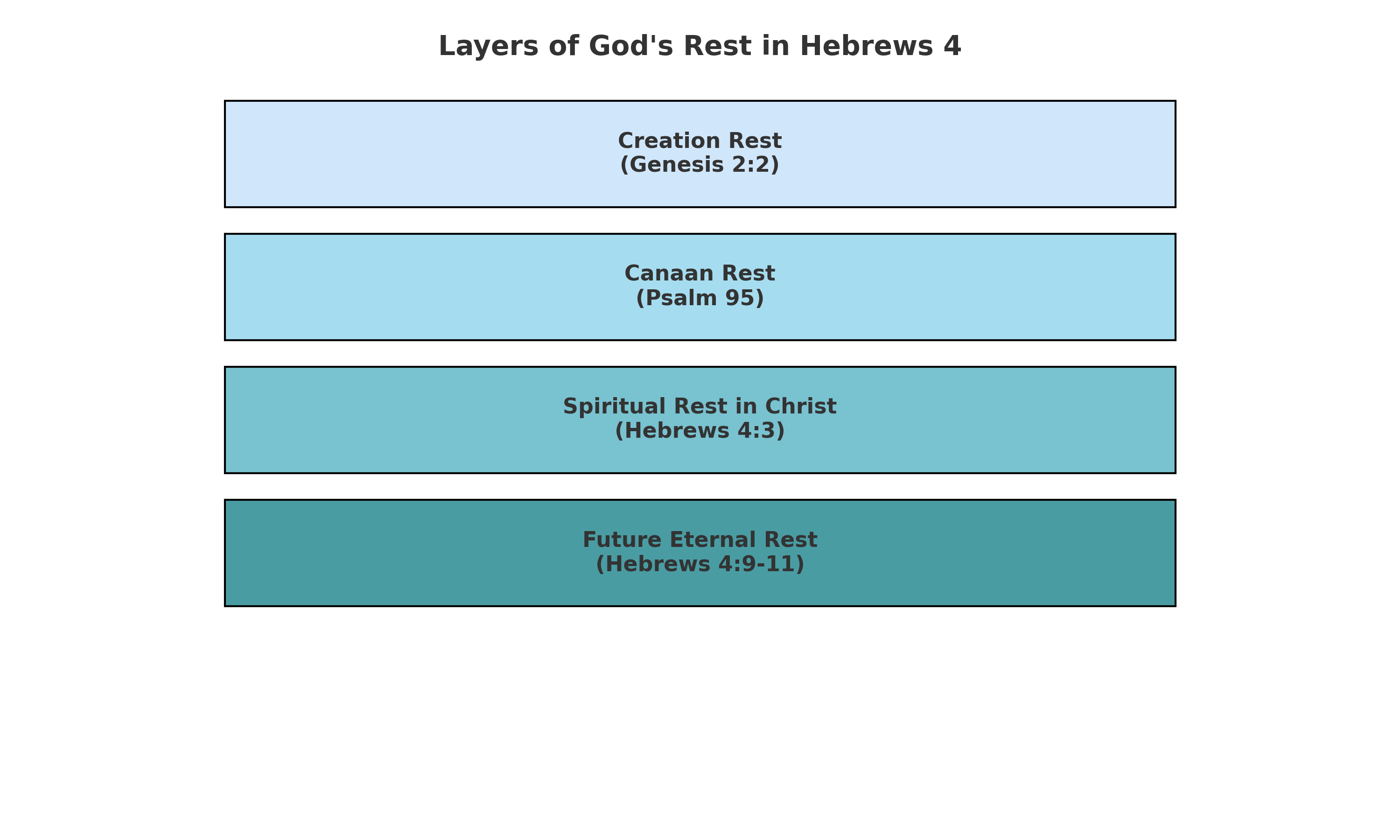
Warren Wiersbe offers the following interpretation of the concept of rest in Hebrews 3-4 - The Canaan rest for Israel is a picture of the spiritual rest we find in Christ when we surrender to Him. When we come to Christ by faith, we find salvation rest (Mt 11:28). When we yield and learn of Him and obey Him by faith, we enjoy submission rest (Mt 11:29, 30) (ED: I THINK THIS WOULD BE AKIN TO PROGRESSIVE SANCTIFICATION OR PRESENT TENSE SALVATION). The first is "peace with God" (Ro 5:1+); the second is the "peace of God" (Php 4:6+, Php 4:7+, Php 4:8+). It is by believing that we enter into rest (Hebrews 4:3); it is by obeying God by faith and surrendering to His will that the rest enters into us. (Bible Exposition Commentary )
W E Vine introduces Hebrews 4 with the following summary - What has been given of Israel’s history in chapter 3 is now applied with emphasis on two facts, (1) that Israel failed to enter into rest through unbelief, (2) that rest was yet assured and that believers who are not seeking rest here but who accept the present world as a wilderness, should enter God’s rest now. God has provided a means of judging unbelief and everything that would hinder a believer from entering into the rest of God and enabling him to give diligence to do so. That means is the Word of God and its power to penetrate the heart; for we all have to do with God, from whom nothing is hidden. This portion also begins to present the main part of the great theme of the book. Here we see Christ not only in the heavens as our Great High Priest, called, qualified and perfected, possessed of the unique order of Melchizedek, but making open for us thereby the sanctuary. All this is set in connection with the new, the better covenant in contrast with the first with its ordinances. There are three subdivisions: (1) Heb 5, 6 and 7, bringing before us the priest himself, (2) Heb 8, speaking of His ministry as the Mediator of the better covenant; (3) Heb 9 and 10, showing us the way into the Holiest and how it has been opened for us. (Vine's Expository Dictionary)
Alternatively, one might also look at rest from the perspective of the Three Tenses of Salvation (Wiersbe addresses only the first two).
|
PAST TENSE |
PRESENT TENSE |
FUTURE TENSE |
|
Rest |
Rest |
Rest |
Some commentators feel that the REST the writer is describing primarily refers to past tense salvation (e.g., see Cole's sermon favoring "past tense salvation") and that his goal is to make certain that any Hebrew readers who are waffling between Judaism and Christianity would make the choice (TODAY) to enter into the spiritual rest and peace with God found in justification by faith (Ro 5:1+, cf Mt 11:28-30+). Clearly without past tense salvation his readers can experience no spiritual rest for their souls, either in this life or the one to come.
Others commentators feel that the writer is addressing both past and present tense salvation, albeit with the emphasis still being on making certain that the Hebrew readers enter the REST of past tense salvation.
Finally, a number of commentators feel that the writer is speaking of the REST that the believer will experience in eternity future when our salvation is consummated in glorification. (See related topic Three Tenses of Salvation) Richard Phillips for example writes that REST "is ultimately heaven (Ed: My "Future tense salvation") that is on the mind of the writer of Hebrews as he urges his readers to enter into the rest of God through faith in Christ (Ed: My "Past tense salvation"). The term "rest" occurs five times in this passage (Heb 4:6-11). (Reformed Expository Commentary) COMMENT: It is interesting that even though Phillips makes this statement regarding the rest of "future tense salvation", he clearly feels the writer is seeking to make certain that his readers enter the rest of initial salvation (see his comments).
At the risk of being repetitive, let me review another way REST has been interpreted...
(1) One interpretation is that the REST refers to a rest which is offered to those who are already true believers. They are saved (past tense salvation) but have not entered the fullness of rest in Christ. One could refer to this rest as that associated with sanctification (present tense salvation), in which a believer is walking in the Spirit (Gal 5:16+). As depicted in the table (above) this would certainly seem to be a component of the REST one experiences as a believer, but, in my opinion, the context and thrust of the writer's arguments do not favor this as the primary interpretation of the REST that is available to the Hebrew readers.
(2) Another interpretation is that the REST to be entered refers to the rest of salvation by grace through faith (past tense salvation). It is a call to those Hebrew readers who profess Christ but not truly possess Christ. The writer's strong exhortation is that they believe the good news they have heard and unite that hearing with personal belief whereby they would enter the spiritual REST of salvation. As stated above, the flow of the writer's argument strongly favors this interpretation. Augustine alludes to this REST in his famous saying "You made us for Yourself, O Lord, and our hearts are restless till they rest in You."
">
William Newell makes " no division between the close of Hebrews 3 and the beginning of Hebrews 4, so that there may be no interruption of our study of the great subject of the "rest" of God. Going back, now, to Hebrews 3.15, let us note in the following verses, that the opposite of holding fast the "beginning of their confidence" (Hebrews 3.6, He 3:14) was "hardening their hearts" (Hebrews 3.8, He 3:15), "provoking" God (He 3.8, He 3:15, 16), and "displeasing" Him (He 3.10, He 3:17); thus coming short of entering His rest (Hebrews 3.11, He 3:18; He 4.1). The solemn fact is that in this book of Hebrews eternal salvation is constantly contrasted with "neglect," "sluggishness," "falling short" of a promise; mere "tasting of the heavenly gift" (eternal life), sinning "willfully after that we have received the knowledge of the truth," and afterward "falling away," "treading under foot the Son of God… counting the blood of the covenant a common thing"! It could not be otherwise, for God in Hebrews is speaking unto us in His Son! (He 1.2).
What God in sovereign grace may do (as in the case of the man in 1Co 5.1-5, and in 1Cor. 11.29, 30, 31, 32, 33), is God's affair. But the book of Hebrews is not the place in which He sets it forth. Hebrews, unlike Romans, does not proclaim the way of Salvation; but places before us the Person of Christ, Son of God, Son of Man; His oneness with His saints, His victory over Satan; His one offering for sin; His blessed heavenly priesthood; His headship as Son over the house of God: and God sets before us all these in view of the holy walk on earth they involve in true saints!
We have seen that Israel lost their promised land (Numbers 14) through simply not believing! Just as they fell short of Canaan, so many professing Christians (Ed: an oxymoron, for only genuine believers are possessing Christians!) today, though a promise is left them of entering into His rest, fail of it: -- of that spiritual "rest" which belongs to all who hear and believe that Christ has borne their sin; that He made peace by the blood of His Cross.
(Newell appends an interesting note stating that… ) Most the nation of Israel in the future will not profit by the voice of the two witnesses of Re 11:3-12, warning them of the fearful results of worshiping the Antichrist and his image… A "remnant" shall be saved (Isa 1:9; 4:2-6, Ro 9:27, 28). (Hebrews Commentary - Verse by Verse Online)
ILLUSTRATION OF "HIS REST" - To catch something of the idea here, imagine yourself invited by Prince Charles to enjoy his “rest.” You are picked up by the Royal limo at Heathrow and whisked into London and through the gates of Windsor Palace where you are shown its glories. Then the two of you motor north in his 1968 Aston Martin to Balmoral Castle where you relax before a fire, scratch the ears of the royal hounds, and don a kilt and explore the royal trout streams. You are sharing what Prince Charles calls “my rest”—his personal rest. The sublime fact that we share God’s personal rest, the rest He enjoys, ought to set our hearts racing!
James Smith - WHOLESOME FEAR.Hebrews 4:1.
1. The Blessing, "His rest."
2. The Offer, "Promise being left us."
3. The Possibility, "To 'Come short of it.' "
4. The Warning, "Let us therefore fear."
Hebrews 4 The War Is Over!
The bitter conflict had finally ended between the North and the South. The soldiers of the US Civil War were free to return to their families. But a number of them remained hidden in the woods, living on berries. They either didn't hear or didn't believe that the war was over, so they continued enduring miserable conditions when they could have been back home.
It's something like that in the spiritual realm too. Christ made peace between God and man by dying in our place. He paid sin's penalty on the cross. Anyone who accepts His sacrifice will be forgiven by a holy God.
Sadly, many people refuse to believe the gospel and continue to live as spiritual fugitives. Sometimes even those who have placed their trust in Christ live on almost the same level. Either out of ignorance or unwillingness, they fail to claim the promises of God's Word. They do not experience the joy and assurance that should accompany salvation. They do not draw from their relationship with God the comfort and peace He intends for His children. They are the objects of His love, care, and provision but live as if they were orphans.
Have you been living apart from the comfort, love, and care of your heavenly Father? Come on home. The war is over!— Richard De Haan (Reprinted by permission from Our Daily Bread Ministries. Please do not repost the full devotional without their permission.)
We fail, O Lord, to realize
The fullness of what You have done,
So help us trust Your saving work
And claim the triumph You have won.
—D. De Haan
Christ's victory over death means peace for His saints.
Too Late
Therefore, since a promise remains of entering His rest, let us fear lest any of you seem to have come short of it. —Hebrews 4:1
Read: Hebrews 4:1-11 | Bible in a Year: 1 Kings 8-9; Luke 21:1-19
It happens nearly every semester. I tell my freshman college writing class often that they need to keep up with the numerous writing assignments in order to pass the class. But nearly every semester some don’t believe me. They’re the ones who send me frantic emails after the last day of class and give me their reasons for not taking care of business. I hate to do it, but I have to tell them, “I’m sorry. It’s too late. You have failed the class.”
That’s bad enough when you’re a college freshman and you realize you’ve just wasted a couple thousand dollars. But there is a far more serious, more permanent finality that comes at the end of life if people haven’t taken care of business with God about their sin. In those cases, if people die without having put their faith in Jesus Christ as Savior, they face an eternity without Him.
What a terrible moment it would be to stand before the Savior Himself and hear Him say, “I never knew you; depart from Me!” (Matt. 7:23). The author of Hebrews warns us to make sure we don’t “come short” (4:1) of the eternal rest offered by God. The good news is that it’s not too late. Today Jesus freely offers to us salvation and forgiveness through Him. (Reprinted by permission from Our Daily Bread Ministries. Please do not repost the full devotional without their permission.)
If you’d like to know the love of God the Father,
Come to Him through Jesus Christ, His loving Son;
He’ll forgive your sins and save your soul forever,
And you’ll love forevermore this faithful One.
—Felten
Calvary reveals the seriousness of our sin and the vastness of God's love.
QUESTION - How can we enter into God’s rest? GOTQUESTIONS.ORG
ANSWER - The concept of entering into God’s rest comes from Hebrews 3—4. What is this “rest” the Hebrew writer is talking about? How do we enter it? And how do we fail to enter it? The writer to the Hebrews begins his discussion of God’s rest in chapter 3, where he references the Israelites wandering in the desert. In giving them the land of Canaan, God had promised them that He would go before them and defeat all their enemies in order that they could live securely (Deuteronomy 12:9–10). All that was required of them was to fully trust in Him and His promises. However, they refused to obey Him. Instead, they murmured against Him, even yearning to go back to their bondage under the Egyptians (Exodus 16:3; 17:1–7; Numbers 20:3–13).
The particular “rest” referred to here was that of the land of Canaan. Into that rest God solemnly said the Israelites who disobeyed Him would never enter (Hebrews 3:11). They had been rebellious. All the means of reclaiming them had failed. God had warned and entreated them; He had caused His mercies to pass before them, and had visited them with judgments in vain; and He now declares that for all their rebellion they should be excluded from the Promised Land (Hebrews 3:16–19). But, eventually, the next generation did place their faith in God and, by following the leadership of Joshua, they, some forty years later, entered into God’s rest, the land of Canaan (Joshua 3:14–17).
Using the Israelites as an example of those who were not resting in God’s promises, the writer of Hebrews goes on in chapter 4 to make the application personal, both to the Hebrew Christians and to us: “Therefore, since the promise of entering his rest still stands, let us be careful that none of you be found to have fallen short of it” (Hebrews 4:1). The promise that still stands is the promise of salvation through God’s provision—Jesus Christ. He alone can provide the eternal rest of salvation through His blood shed on the cross for the remission of sins. God’s rest, then, is in the spiritual realm, the rest of salvation. Faith, the author goes on to assert, is the key to entering God’s rest. The Hebrews had had the gospel preached to them, just as the Israelites knew the truth about God, but the messages were of “no value to them, because those who heard did not combine it with faith” (Hebrews 4:2). Some had heard the good news of Christ, but they rejected it for lack of faith.
Hebrews 4:10–13 explains the nature of this faith. The kind of faith that enables us to enter into God’s rest is a faith that first demands that we rest from relying on our own works. Then the writer seemingly contradicts himself by telling us to make every effort: “For anyone who enters God’s rest also rests from his own work, just as God did from his. Let us, therefore, make every effort to enter that rest, so that no one will fall by following their example of disobedience” (Hebrews 4:10–11). What this apparent paradox means is that such biblical faith involves our submissiveness to God, and our efforts in that area.
Though we desist in our self-efforts to earn salvation and the promised eternal rest, we also “make every effort to enter that rest” by choosing to depend solely on God, to trust Him implicitly, to yield totally to the promises of God through the free grace of His salvation. Why? So “that no one will fall by following their [the Israelites’] example of disobedience” (Hebrews 4:11). We either trust ourselves to save ourselves, or we trust God to do that for us through the sacrifice of Christ on the cross. By failing to trust God fully in His promises, we become disobedient and fail to enter the rest that is eternal life, just as the children of Israel became disobedient when they failed to enter the Promised Land.
So how do we stop trusting ourselves? How do we place our full trust in God and His promises? We enter into God’s rest by first understanding our total inability to enter God’s rest on our own. Next, we enter God’s rest by our total faith in the sacrifice of Christ and complete obedience to God and His will. “And to whom did God swear that they would never enter his rest if not to those who disobeyed? So we see that they were not able to enter, because of their unbelief” (Hebrews 3:18–19). Unlike the Israelites whose unbelief prevented them from entering the Promised Land, we are to enter God’s rest by faith in Him, faith which is a gift from Him by grace (Ephesians 2:8–9).
Joseph Parker observes that let us is the author's "favorite word in this chapter, and in one or two other places that I shall quote presently, is 'Let us'. Here is something for ourselves to do; let us pull ourselves together, and do it; now is your opportunity, seize it. These imperatives are not stern as all imperatives would appear of necessity to be; they are persuasive, gentle, full of hope; they give the very courage which they invite. How much depends upon how a thing is said! I have often taken occasion to say that the word 'woe' as pronounced by Jesus Christ might have a tear in it. We always associate the word 'woe' with some snowstorm, some bolt of fire, some cloudy look that has anger in it. But that might not be so necessarily; Jesus might be simply revealing the results of certain sowings and preparations, and He might say in a gentle whisper, 'Woe is in that act; I warn you of it, do not do it, refrain from repeating it; even you, scribes and Pharisees, hypocrites, actors, may be warned in time; this woe is so pronounced as to invite you to escape it'. I always try to read the New Testament with tears; it is a book whose music only yields itself to gentle entreaty. When Jesus seems the most severe He may be most gentle: take that as a hint, and write it upon your New Testaments, and in your studies, and in the market place and on the highway; read the New Testament in the light of that suggestion." (Source - Expositor's Dictionary of Texts)
Spurgeon on let us fear - Now, the apostle cannot mean that we are to fear lest we should come short of heaven for want of merit. There is not a man living, nor has one ever lived, nor shall one ever live, who will not come short of heaven if he tries that road. Human merit is not the way to heaven. Since the hour in which our first parent broke the law for us, the perfect keeping of the law has been impossible; neither is the keeping of the law set before us in the gospel of our Lord Jesus Christ as the way of acceptance with God. “For by the works of the law no person will be declared righteous before him, for through the law comes knowledge of sin” (Rom 3:20). The just shall live by faith, and it is in the matter of faith that we are cautioned against coming short. The apostle would with indignation have spurned the idea that the gospel race is to be run at the foot of Sinai, and that its prize would be a reward for good works. Over and over again he has plainly declared, “It is not from works, so that no one can boast” (Eph 2:9); but by grace, as the pure gift of the good pleasure and mercy of God. We must not, therefore, twist his words into a legal injunction, for they were never intended to bear such a meaning. The great point that we are to be concerned about is lest we come short of the heavenly rest by failing in the faith that will give us the rest.In a word, we must put our trust in the blood and righteousness of the Lord Jesus Christ; we must give up all other confidences, and cast ourselves entirely upon Him, otherwise we shall certainly never enter into the rest that is reserved for believers.
Rest in Jesus
by Fanny CrosbyCome with all thy sorrow,
Weary wandering soul!
Come to Him who loves thee—
He will make thee whole.Refrain
There is rest in Jesus,
Sweet, sweet rest;
There is rest in Jesus,
Sweet, sweet rest.He, thy strength in weakness,
Will thy refuge be;
Cast on Him thy burden—
He will care for thee.Refrain
Come in faith believing,
To His will resigned;
Ask, and He will give thee;
Seek, and thou shalt find.Refrain
See the door of mercy!
Wouldst thou enter there?
Knock, and He will open;
Lo! the key is prayer.Refrain
Puritan Thomas Watson rightly says that "One may lose other races and not be miserable—but he cannot lose this race in religion without being miserable. In other races, a man only loses his wager; but if he falls short of this spiritual race—he loses his eternal soul. How seasonable, therefore, is that Apostolic caution (Heb 4:1) (The Heavenly Race)
In another writing Watson describes the metaphor of a sheep - A sheep is a TIMOROUS creature. It is very fearful if any danger approaches. It is easily frightened by the wolf. Thus the saints of God, who are Christ's sheep, pass the time of their sojourning here in fear. They are—fearful of provoking God; fearful of wounding their peace; fearful of temptation; fearful they should come short of heaven through sloth, Hebrews 4:1. It is an earmark of Christ's sheep, that they are endued with the fear of God, Genesis 42:28. This is their earmark, "men fearing God". It's true, the righteous are as bold as a lion in a righteous cause—but timorous and fearful of sinful fear. And, let me tell you, happy is he who in this sense fears always. Holy fear is the best antidote against temptation. The way to be safe, is always to fear.
To make some use of this, let us all labor to be found in the number of Christ's sheep (cp Heb 2:1, 2, 3, 6:1, 10:36, 37, 12:25). All the world is divided into two ranks—sheep and goats (Mt 25:31, 32, 33, 34, 41). If you would be glad to be found in the day of judgment as Christ's sheep, and sit at His right hand, be much in prayer. Pray to God that He would change your nature, that He would take away your wolfish nature, your fierceness, your frowardness, and that He would transform you into His own image. Labor to be among Christ's sheep, to get into Christ's fold (Luke 13:24).
There is only one way in which you do not want to be like sheep—for sheep are apt to wander sometimes from their fold (Is 53:6, 1Pe 2:25, Ps 119:176). Take heed that you do not straggle into bypaths of error and heresy (cp Jer 18:15). It is dangerous to wander for fear the devil, the wolf, should catch you. Don't go astray as sheep; but in other things resemble sheep in meekness, in patience, in usefulness, in willingness.
And particularly in this one thing let us labor to resemble sheep, when the shepherd's dog comes near, all the sheep flock together. Persecution should be like the shepherd's dog. It should make all Christ's sheep run together and unite. Do Papists and Formalists agree in persecuting God's people? And shall not the saints of God agree to keep the unity of the Spirit in the bond of peace? Love is the earmark by which Christ's sheep are known. John 13:35, "By this shall all men know you are My disciples, if you love one another." It was the harlot who said, "Let the child be divided." It is the Jesuit who says, "Let the Church of God be divided." It is Satan's great design to set his cloven foot among God's people to make division and contention among the sons of Zion. The devil's best music is discord.
Oh! Let all Christ's people, His sheep, flock together and associate in love. Those who hope to meet together in heaven should not fall out by the way. Unity is the great music in heaven. There is unity in the Trinity—and unity among saints would be a great blessing on earth. For Christians to unite is their interest and wisdom; union is their strength, union is their glory and their ornament. This was the honor of the primitive churches, all of one heart, Acts 2:1. There was but one heart among them. Let the sheep of Christ unite together. When the saints are harmoniously united, then they adorn their blessed Shepherd, the Lord Jesus. So much for the first of these, Christ's sheep. (The Good Shepherd)
Illustration - Few have lived as stressful and frenetic a life as Hudson Taylor, founder of China Inland Mission. Day and night this was his secret, “just to roll the burden on the Lord.” Frequently those who were wakeful in the little house at Chinkiang might hear, at two or three in the morning, the soft refrain of Mr. Taylor’s favorite hymn [“Jesus, I am resting, resting in the joy of what Thou art”]. He had learned that for him, only one life was possible—just that blessed life of resting and rejoicing in the Lord under all circumstances, while He dealt with the difficulties, inward and outward, great and small.
Spurgeon - If you avoid the very seeming of it, you will avoid the thing itself. Oh! that we were careful about this — that there was nothing that should give any reasonable fear to those who observed us, or to ourselves when we search our hearts, lest we should not enter into this rest....Not only dread coming short, but dread the very appearance of it. Oh, that we might now enter into that rest, and so clearly enjoy it that there should not even be a seeming to come short of it.
Lipstick On A Bulldog - "In a lot of organizations, change is like putting lipstick on a bulldog. There's a tremendous amount of effort involved, and most times all you get is some cosmetics—and an angry bulldog." So writes Dave Murphy of the San Francisco Chronicle.
Real change, whether in a business, church, family, or in ourselves, can be difficult and elusive. While we long for a deep and lasting transformation, we often get only a temporary cover-up that solves nothing and satisfies no one.
The word repent is used in the Bible to describe the beginning of genuine spiritual change. Language scholar W. E. Vine says that to repent means "to change one's mind or purpose." In the New Testament it always involves a change for the better as a person turns away from sin while turning toward God. Jesus began His public ministry with the call, "Repent, for the kingdom of heaven is at hand" (Matthew 4:17).
When we feel sorry for doing wrong or for getting caught, it may be nothing more than a spiritual cosmetic. But true repentance occurs deep in our hearts and results in a visible difference in our actions.
When we turn to Christ and yield ourselves to Him, He produces real change—not just a cover-up. —David C. McCasland (Our Daily Bread, Copyright RBC Ministries, Grand Rapids, MI. Reprinted by permission. All rights reserved)
Don't hide your sin and cover up,
Pretending there is nothing wrong;
Instead, confess it and repent,
And God will fill your heart with song. —Sper
Repentance is not just words but actions.
Hebrews 4:2 For indeed we have had good news preached to us, just as they also; but the word they heard did not profit them, because it was not united by faith in those who heard. (NASB: Lockman)
Greek: kai gar esmen (1PPAI) eueggelismenoi (RPPMPN) kathaper kakeinoi, all' ouk ophelesen (3SAAI) o logos tes akoes ekeinous, me sugkekerasmenous (RPPMPA) te pistei tois akousasin. (AAPMPD)
BGT καὶ γάρ ἐσμεν εὐηγγελισμένοι καθάπερ κἀκεῖνοι· ἀλλ᾽ οὐκ ὠφέλησεν ὁ λόγος τῆς ἀκοῆς ἐκείνους μὴ συγκεκερασμένους τῇ πίστει τοῖς ἀκούσασιν.
Amplified: For indeed we have had the glad tidings [Gospel of God] proclaimed to us just as truly as they [the Israelites of old did when the good news of deliverance from bondage came to them]; but the message they heard did not benefit them, because it was not mixed with faith (with the leaning of the entire personality on God in absolute trust and confidence in His power, wisdom, and goodness) by those who heard it; neither were they united in faith with the ones [Joshua and Caleb] who heard (did believe). (Amplified Bible - Lockman)
My Amplified Paraphrase - For indeed, the good news—God’s message of His promised rest, His salvation, and His call to trust Him—was proclaimed to us just as it was to them (the wilderness generation); but the message they heard brought them no benefit, no saving effect, because it was not united with faith in those who heard it. They listened with their ears, but not with believing hearts; the word remained unmixed, uncombined, unblended with true faith—and so it produced no spiritual fruit in them.
KJV: For unto us was the gospel preached, as well as unto them: but the word preached did not profit them, not being mixed with faith in them that heard it.
NLT: For this Good News--that God has prepared a place of rest--has been announced to us just as it was to them. But it did them no good because they didn't believe what God told them. (NLT - Tyndale House)
Phillips: For we too have had a Gospel preached to us, as those men had. Yet the message proclaimed to them did them no good, because they only heard and did not believe as well. (Phillips: Touchstone)
TLB: For this wonderful news—the message that God wants to save us—has been given to us just as it was to those who lived in the time of Moses. But it didn’t do them any good because they didn’t believe it. They didn’t mix it with faith.
Wuest: For, as for us also, to us [first-century Jews] was the good news [of rest in Messiah] thoroughly proclaimed, with the present result that we have it indelibly impressed on our minds, as well as the good news [of rest in Canaan] thoroughly proclaimed to them [the generation which came out of Egypt], good news that was indelibly impressed on their minds.
Young's Literal: For indeed we have had good news preached to us, just as they also; but the word they heard did not profit them, because it was not united by faith in those who heard.
NKJ For indeed the gospel was preached to us as well as to them; but the word which they heard did not profit them, not being mixed with faith in those who heard it.
NET For we had good news proclaimed to us just as they did. But the message they heard did them no good, since they did not join in with those who heard it in faith.
CSB For we also have received the good news just as they did; but the message they heard did not benefit them, since they were not united with those who heard it in faith
ESV For good news came to us just as to them, but the message they heard did not benefit them, because they were not united by faith with those who listened.
NIV For we also have had the gospel preached to us, just as they did; but the message they heard was of no value to them, because those who heard did not combine it with faith.
MIT For just as they were, we, too, have been recipients of good news. But the message heard was of no benefit to them because it was not permeated with the response of faith in those who heard it.
NJB We received the gospel exactly as they did; but hearing the message did them no good because they did not share the faith of those who did listen.
NRS For indeed the good news came to us just as to them; but the message they heard did not benefit them, because they were not united by faith with those who listened.
RSV For good news came to us just as to them; but the message which they heard did not benefit them, because it did not meet with faith in the hearers.
NAB For in fact we have received the good news just as they did. But the word that they heard did not profit them, for they were not united in faith with those who listened.
GWN We have heard the same Good News that your ancestors heard. But the message didn't help those who heard it in the past because they didn't believe.
BBE And, truly, the good news came to us, even as it did to them; but the hearing of the word did them no good, because they were not united in faith with the true hearers.
ASV For indeed we have had good tidings preached unto us, even as also they: but the word of hearing did not profit them, because it was not united by faith with them that heard.
DBY For indeed we have had glad tidings presented to us, even as they also; but the word of the report did not profit *them*, not being mixed with faith in those who heard.
- to us: Ac 3:26 13:46 Ga 3:8 4:13 1Pe 1:12
- preached: Ro 10:16,17
- did not profit: Ro 2:25 1Co 13:3 1Ti 4:8
- because it was not united by faith He 4:6 3:12,18,19 11:6 1Th 1:5 2:13 2Th 2:12,13 Jas 1:21
- Hebrews 4 Resources - Multiple Sermons and Commentaries
Related Passages:
Isaiah 52:7 (GOOD NEWS ANNOUNCES SALVATION AVAILABLE) How lovely on the mountains Are the feet of him who brings good news (euaggelizo), Who announces peace And brings good news (euaggelizo) of happiness, Who announces salvation, And says to Zion, “Your God reigns!”
John 5:24+ (HEARING OF WORD MUST BE ASSOCIATED WITH BELIEVING TO BE EFFICACIOUS) “Truly, truly, I say to you, he who hears My word, and believes Him who sent Me, has eternal life, and does not come into judgment, but has passed out of death into life.
James 1:22+ (OBEDIENCE TO WORD REFLECTS TRUE BELIEF OF THE WORD) But prove (present imperative see our need to depend on the Holy Spirit to obey) yourselves doers of the word, and not merely hearers who delude themselves.
Acts 13:32+ “And we preach to you the good news (euaggelizo) of the promise made to the fathers (ED: THE FATHERS WOULD INCLUDE THE FIRST GENERATION IN THE WILDERNESS - IMPLYING THEY TOO HEARD THE GOSPEL)
Deuteronomy 12:9-11+ for you have not as yet come to the resting place and the inheritance which the LORD your God is giving you. 10 “When you cross the Jordan and live in the land which the LORD your God is giving you to inherit, and He gives you rest from all your enemies around you so that you live in security, 11 then it shall come about that the place in which the LORD your God will choose for His name to dwell, there you shall bring all that I command you: your burnt offerings and your sacrifices, your tithes and the contribution of your hand, and all your choice votive offerings which you will vow to the LORD.
Romans 10:14-16+ How then will they call on Him in whom they have not believed? How will they believe in Him whom they have not heard? And how will they hear without a preacher? 15 How will they preach unless they are sent? Just as it is written, “HOW BEAUTIFUL ARE THE FEET OF THOSE WHO BRING GOOD NEWS OF GOOD THINGS!” 16 However, they did not all heed the good news; for Isaiah says, “LORD, WHO HAS BELIEVED OUR REPORT?”
John 5:46+ (WAS THE GOOD NEWS PREACHED TO ISRAEL IN THE OT?) For if you believed Moses, you would believe Me, for he wrote about Me.
Lk 24:27+ (WAS THE GOOD NEWS PREACHED TO ISRAEL IN THE OT?)Then beginning with Moses and with all the prophets, He explained to them the things concerning Himself in all the Scriptures.
1 Corinthians 10:5+ Nevertheless, with most of them God was not well-pleased; for they were laid low in the wilderness.
THE GOOD NEWS MUST
BE UNITED WITH FAITH
For (gar) indeed - What is he explaining? In context he has just stated that there might be some in the congregation who fail to enter the God's rest, which ultimately speaks of salvation. He will now explain how it is possible that some might miss God's rest and/or how the Israelites in the wilderness missed God's rest. Another way to look at it is that this for explains why we must fear (v.1) because the same gospel promise can be heard yet still missed if not received with faith.
We have had good news preached (euaggelizo) to us, just as they also; but the word (logos) they heard (akoe - that which is heard) did not profit (opheilo) them, because it was not united (sugkerannumi) by faith (pistis) in those who heard (akouo) - "We are those who have been 'gospeled (evangelized).'" WE is the writer and his Hebrew readers. THEY refers to the Israelites in the Old Testament, who came out of Egypt but because of unbelief were forced to wander in the wilderness for 40 years.
A number of commentators feel that the "good news" is not the Gospel (see discussion below), but others (yours truly included) feel that it is a form of the Gospel (the OT Gospel looks forward to the Cross --Gal 3:8+-- while the NT Gospel is more clearly stated and looks back to the Cross).
Good news preached is "a periphrastic perfect participial construction in the Greek text. This speaks not only of a complete work accomplished in the past, but also of the persistence of the finished results in the present." (Wuest) Phillip E Hughes (Hebrews) adds that "have been evangelized just as they were," is the perfect tense of the verb implying, as Spicq observes, the completeness of the evangelization that had taken place, and thus leaving no room for any excuse to the effect that the evangelization had been inadequate or deficient. There is a real equivalence between the promise of the Old Testament and the evangel (gospel) of the New Testament, for their essential content is the same: the former looks ahead to fulfilment in Christ, the latter proclaims the accomplishment in Christ of what was promised. Thus Paul, using a compound of the same verb (proeuaggelizomai), describes the giving of the covenant promise to Abraham (Ge 15:6+) as the preaching of the gospel beforehand to Abraham—his pre-evangelization (Gal 3:8+)."
Just as they did also is emphatic and associates OT Israel with the NT Hebrews being addressed in this epistle. But what truth does that comparative clause convey? Think about this for a moment. The NT WE did not have preaching about the good news of the promised land just as they did also! Logically, it would seem to follow that both the WE and the THEY had the same good news, the good news of the Gospel. I realize that this is a debatable point but one point that is not debatable is that the Gospel was clearly preached beforehand in the Old Testament (looking forward to Christ and not as clear as we have it today looking back to the Cross) (read Galatians 3:8+, cf Ge 3:15+ See Gospel in the Old Testament). How else could any of OT Israel ever have been saved but by belief in the Gospel, the very point the writer is emphasizing in Hebrews 3-4? It follows that the failure of the majority of Israel to unite the clear message of the Gospel with genuine belief would strongly suggest that the majority of the Israelites who died physically in the the 40 years in the wilderness, were also spiritually dead. Caleb and Joshua of course believed and Moses also is called faithful (Heb 3:2) so he believed. But the majority of the nation did not believe (cf 1Co 10:5+).
🙏 THOUGHT - While it disturbs our sense of fairness that most of the 1.6 million (estimate) Israelites who were delivered from bondage in Egypt were spiritually lost, that should not shock us (See rabbinical thoughts). I frequently pray through the Joshua Project for the daily hidden people group and it is not uncommon to encounter a hidden people group of 1-2 million or more in whom there is not a single known Christ follower (all the more reason we should intercede)! So while you may choose to disagree with my interpretation that most of the first generation of Israel was bound for eternal punishment, we should not lose sight of the importance of the Gospel for the first century generation of Hebrews and by extension for both all Jews and Gentiles today. So rather than arguing about the ultimate fate of the first generation of Israel, we should be passionate and urgent to pray and proclaim the good news TODAY to as many around us who are otherwise destined for a Christless eternity!
And remember that hearing the good news while absolutely essential is not sufficient. Why? Because it must also be received (Jn 1:11+) and believed (Jn 8:24+). But even belief when it is solely a mental acceptance (cp the amazing slippery slope of progression of "intellectual belief" by the Jews to overt rejection of Jesus in John 8:31, 44, 58, 59+) of the facts about God and Jesus (cp Jas 2:19+) is not sufficient to bring salvation rest to one's soul. It is not enough to know about Jesus. What is critical is that He know us (as happens when our faith is real) (see Mt 7:21+, Mt 7:22, 23+)
J Vernon McGee on good news preached - Here is the "rest" of salvation, the rest of trusting Christ as Savior. They heard the Gospel but did not believe it. (See Thru the Bible: The Epistles)
Leon Morris has an interesting note on the fate of the wilderness generation -- The idea that the wilderness generation was finally rejected was one the rabbis found hard to accept. In their writings we find statements such as the following: “Into this resting-place they will not enter, but they will enter into another resting-place” (Mid Qoheleth 10.20.1). The rabbis also had a parable of a king who swore in anger that his son would not enter his palace. But when he calmed down, he pulled down his palace and built another, so fulfilling his oath and at the same time retaining his son (ibid.). Thus the rabbis expressed their conviction that somehow those Israelites would be saved. The author, however, has no such reservations about the wilderness generation. They disobeyed God and forfeited their place. (Borrow Expositor's Commentary)
Ray Stedman on good news preached - Even though the gospel of God's deliverance from an evil heart was proclaimed clearly through the (OLD TESTAMENT) sacrifices, the tabernacle ritual and the preaching of Moses, it met with a lack of faith among those who perished. The writer will declare in Hebrews 11:6 that "without faith it is impossible to please God." Without a personal response to the promise of salvation, no one may be saved. (Hebrews 4:1-2 A Promise Requires a Response)
Ray Stedman: “The writer says the same gospel was given to us as to them; we have the same good news, the same possibility of entering into a life of rest. These words must be taken seriously. The Word of God knows nothing of the “easy believism” that is so widely manifest in our own day. We think we can receive Jesus as Savior, raise our hand to accept Christ, and that settles the matter. We will go to heaven and there can never be any doubt about it from then on, though there is no change in our life. But the promise of Christ is that when He comes into the human heart there is a radical change of government, which must inevitably, in the course of its working, result in a revolutionary change in behavior. Unless that takes place there has been no reality to our conversion.” (Sermon Living out of Rest)
Reformation Study Bible on good news preached - The good news of deliverance and God's love that Israel heard at Sinai was not as clear as the salvation spoken now through the Lord (Hebrews 2:3), but it would have been of value to the hearers, ushering them into God's rest, if they had combined it with faith.
John Piper - What was the good news preached to them? Well, among many other things it was God’s word to Israel from Mount Sinai in Exodus 34:6–7: “Then the Lord . . . proclaimed, ‘The Lord, the Lord God, compassionate and gracious, slow to anger, and abounding in lovingkindness and truth; who keeps lovingkindness for thousands, who forgives iniquity, transgression and sin.’” It was good news of love and mercy and forgiveness of every kind of iniquity and transgression and sin. And it was the good news of God’s promise that God would bring them into the land of milk and honey and be with them if they would trust him and not rebel (Numbers 14:8–9). So this writer says that the Israelites had heard the gospel just like his readers had — not the foundation of it in the death and resurrection of Christ, which his readers have heard — but still the promise that God is merciful and forgives sins and promises rest and joy for those who trust him. So there is a very similar situation between Israel and the readers of this letter, and the point is: this good news was not believed by Israel and so they did not enter God’s rest, God’s promised joy. (Be Diligent to Enter God’s Rest)
Jack Arnold on good news preached - The Israelites in the wilderness heard the good news of the gospel as well as the Hebrew-Christians. The Israelites who were Canaan bound heard the gospel. What was that gospel? The gospel is that salvation is by grace through faith in Christ. The Israelites knew in elementary form this message but did not know its full revelation as we know it today. God has spoken to us today “in His Son” who is the fulfillment of all the Old Testament. The Jew in the wilderness knew that salvation was by grace through faith on the basis of a blood atonement. They knew something of Christ through types and shadows. “…and all drank the same spiritual drink, for they were drinking from a spiritual rock which followed them; and the rock was Christ” (1Co 10:4). The blood of calves and goats poured out on the altar in the wilderness was received in divine grace as a covering for sin and this pointed forward as a type or shadow to Messiah who would come and die for sin. The Israelites knew that salvation was by grace through faith, on the basis of blood, in God who would send the Messiah. They knew about God’s promise of redemption and rest but failed to enter in because of unbelief. They had an understanding of salvation but they failed to lay hold of it because of unbelief.
R C H Lenski on good news preached - Gospel tidings are referred to. The verb defines “promise to enter into God’s rest” (v. 1).Note that this verb is to be construed with “we,” Jewish Christians, and with ἐκεῖνοι, the Jews of the Exodus. In their case the promise of God’s rest was by no means only the earthly Canaan but also the heavenly Canaan, of which the land flowing with milk and honey was only the type. They also had the gospel tidings, of course in the Old Testament form (covenant with Abraham -see Ge 15:6+), while the writer and the readers have it in its New Testament form. (Borrow Hebrews Commentary page 127)
Charles Swindoll on good news preached - in Hebrews 4:2–3 we find a very simple equation for entering into the rest God has for us: HEARING + BELIEVING = RESTING. (See Insights on Hebrews - Page 62)
Matthew Henry on good news preached comments that "the same gospel for substance was preached under both Testaments, though not so clearly; not in so comfortable a manner under the Old as under the New. The best privileges the ancient Jews had were their gospel privileges; the sacrifices and ceremonies of the Old Testament were the gospel of that dispensation; and, whatever was excellent in it, was the respect it had to Christ. Now, if this was their highest privilege, we are not inferior to them; for we have the gospel as well as they, and in greater purity and perspicuity than they had. (Matthew Henry's Commentary on the Whole Bible)
C H Spurgeon on good news preached - The message of Moses and the reports of the faithful spies were both typical of the gospel that was brought to us by our Lord and His apostles. Our gospel is more clear than theirs; yet they had the gospel also, in all the essential truths of it. And had they fully believed it, it would have been a saving gospel to them.
Bob Utley on good news preached - The "good news" refers to the gospel about Jesus Christ, who all may accept by faith (cf. Eph. 2:8-9). Before Christ it referred to God's Word, which was given in the OT in different ways (i.e., "do not eat of the tree"; "build an ark"; "follow Me to a land"; "keep the law"; "enter the Promised Land," etc.). Each person or group had to believe God and respond by faith (i.e., act on) His Word to them. In the Exodus the ones believing were Joshua and Caleb. They believed God's promise about the Promised Land; most Israelis did not. They entered "the rest," but all the adults of that generation from 20 years old up, did not. They died in the wilderness.
Ligonier Ministry on good news preached - The Good News that “came to us” must refer to the Gospel message that comes to those under the new covenant. This is the same Good News that came to “them,” the Israelites who left Egypt. Clearly, the author is telling us that both old covenant and new covenant believers receive the same message of salvation, though there are slight differences in the message’s administration. Old covenant believers had to look forward in faith to the Messiah who was yet to come. New covenant believers like us have to look back in faith to the Messiah who died and rose again.
Henry Morris agrees with Ligonier's comment on the good news preached - The "gospel" (Heb 4:2KJV) is not just a New Testament revelation, for it was preached to the children of Israel in the wilderness, in types and prophecies, at least. In fact, it is "the everlasting gospel" (Revelation 14:6,7+), and the first promise of redemption (Genesis 3:15+) is commonly known as the protevangel (first gospel). In its essence, the gospel (good news) is the message that the Creator is also our Redeemer and coming King, and that true faith in Him--faith which produces salvation--will also produce loving obedience to His Word.
Phillip E Hughes - Quite literally, the opening clause of this verse reads, “for we also have been evangelized (euaggelizo) just as they were,” the perfect tense of the verb (euaggelizo) implying, as Spicq observes, the completeness of the evangelization that had taken place, and thus leaving no room for any excuse to the effect that the evangelization had been inadequate or deficient (ED: perfect tense implies that the message was complete and adequate for a proper response. It was not that they did not understand what God had promised. They just would not believe God.). There is a real equivalence between the promise of the Old Testament and the evangel of the New Testament, for their essential content is the same: the former looks ahead to fulfilment in Christ, the latter proclaims the accomplishment in Christ of what was promised. Thus Paul, using a compound of the same verb (proeuaggelizomai), describes the giving of the covenant promise to Abraham (Ge 12:1-3+, Ge 15:6+) as the preaching of the gospel beforehand to Abraham—his pre-evangelization (Gal. 3:8+)....What difference can we plead (good news came to us just as to them) except that, if anything, we are all the more culpable, for they had the promise, whereas we have the fulfilment? (Reformed Expository Commentary)
Thomas D. Lea – Wherever rest appears in He 3:1-4:11, it refers to an experience of salvation we enter by faith in Jesus Christ. The writer of Hebrews makes this interpretation clear when he insists on the necessity of faith in the gospel the readers had received (He 4:2). This faith demands a dependence on God's work instead of on our own works (He 4:10+). Those who have begun the Christian walk by an experience of faith in Jesus Christ demonstrate the reality of their commitment when they continue to enjoy the rest God has promised. Those who cease to share in that rest show by their spiritual failure that their profession of faith was false. Some interpreters explain rest as a lifetime experience of unbroken fellowship with God. They feel that the issue discussed by the writer concerns a loss of fellowship rather than an experience of salvation. This interpretation, as the one in the previous paragraph, rests on valid points. It is difficult to accuse proponents of either viewpoint of being completely in error. Still, the present writer, as shown above, feels that the total evidence supports the interpretation of rest as related to salvation rather than to sanctification. (SEE Holman New Testament Commentary - Hebrews) (Bolding added for emphasis)
Drew Worthen asks "You mean to say that the Jews in the wilderness had the gospel preached to them? You bet. In fact the word used here in our text is the word gospel as it applied to them. In the original Greek the word is euaggelizo and it's where we get our English word evangelize. The Jews in the desert were evangelized. They were the recipients of good news that God would deliver them and bring them into His rest. Later we'll look at what this rest entails, but it included a spiritual rest which can only be received by faith. (Hebrews 4:1-10 Cease From Your Rest & Enter His) (Bolding and italics added for emphasis).
THE FAILURE TO MIX
THE GOSPEL WITH BELIEF
But the word (logos) they heard (akoe - that which is heard) did not (ou = absolutely did not) profit (opheilo) them, because it was not united (sugkerannumi) by faith (pistis) in those who heard (akouo) - But - always pause to prayerfully ponder this term of contrast asking at least "What is being contrasted?" It is not straightforward but the contrast seems to between good news WE heard (and some believed) versus the good news THEY (the Israelites in the OT) heard and did not believe. The (definitive article) word (logos) signifies this was not just any word but a very specific message, in context, the good news or the gospel (Heb 4:2NIV-see note). The fact that the good news was clearly heard left the Israelites with no excuse for the message yielding absolutely no benefit or value. And why was the "prophetic word" (so to speak) a non-profit word? Because (term of explanation) explains that the word (logos) was not "mixed with" faith (pistis) or trust in the message (and the Messenger).
Note the emphasis on hearing the good news - preached (implying a message that was heard)...they heard...those who heard. The upshot is that clearly hearing the good news is not sufficient to enter the rest of salvation.
The point of this contrast with the OT faith failure is to impress on this fledgling Hebrew congregation the vital importance of not just hearing the Gospel but heeding (believing and obeying) the Gospel, not just intellectually acquiescing to the Gospel but truly receiving the Gospel, not just in their head but in their heart (Ro 10:9-10+). While it is not stated in this passage, there is an important principle that hearing the truth about Jesus and failing to respond to that truth increases one's personal responsibility and makes them more accountable in the final judgment. John Wesley said it this way "So far from it (THE WORD PROFITING THEM), that it increased their damnation. It is then only when it is mixed with faith, that it exerts its saving power." Jesus warned about "hotter flames" for those who rejected "greater light." Read His warnings in Mt 12:41, 42+, Mk 12:40+, Lk 11:31, 32+, Lk 20:46, 47+).
Without a personal response to the promise of salvation,
no one may be saved.
Ray Stedman explains that here in Hebrews 4:2 "we are given the reason for the Israelites’ unbelief in the wilderness. Even though the gospel of God’s deliverance from an evil heart (Je 3:17, 7:24, 11:8, 16:12) was proclaimed clearly through the sacrifices, the tabernacle ritual and the preaching of Moses (cp Gal 3:24, 3:8), it met with a lack of faith among those who perished (ED: NOTE THAT STEDMAN IS DESCRIBING THE FATE OF MOST OF THE WILDERNESS GENERATION MORE THAN 20 yo). The writer will declare in Hebrews 11:6+ that “without faith it is impossible to please God.” Without a personal response to the promise of salvation, no one may be saved. Declared many times in Scripture, this fact invalidates completely the teaching of universalism that everyone is already saved by virtue of Christ’s death and that God will reveal that to them at the end, no matter how they lived. This teaching ignores the need for repentance (ED: See the following verses that call for repentance and refute the false teaching in many evangelical circles that repentance is not a vital component of salvation - Jonah 3:8,10 2Ki17:13 2Chr 30:6 Pr 1:23 Je 25:5 Ezek 14:6, 18:30, 31, 32, 33:11, Da 4:27 Hos 14:2 Joel 2:12 Mal 3:7+ Ro 2:4+ 1Th 1:9, 10+, 2Pe 3:9+, Re 2:21+ , Re 2:22+, Mt 3:2+, Mt 4:17+, Mt 11:20+, Mt 12:41+, Mk 1:4,15+, Mk 6:12+ Lk 13:3, 5+, Lk 15:7,10+, Lk 16:30+, Lk 24:47+, Acts 2:38+, Acts 3:19+, Acts 5:31+, Acts 8:22+, Acts 26:20+, Acts 17:30+, Acts 20:21+, 2Co 7:9, 10+, 2Co 12:21+ 2Ti 2:25, 26+): turning from rank rebellion to grateful acceptance of God’s provision. Ro 10:17+ indicates that the gospel (“the word of Christ”) has power to awaken belief in its hearers (cp Ro 1:16+, Col 1:5+, Col 1:6+, 1Th 2:13+); if that belief is acted upon by a willing response (faith), it results in salvation (divine life imparted). (Hebrews Commentary) (Bolding added)
Where there is no faith in the gospel,
no good consequence can possibly come of it.
Spurgeon on did not profit them - Why was it the gospel that they heard did not benefit them? Assuredly, it was not the fault of the gospel that they heard (ED: NOTICE SPURGEON SEES THE GOSPEL IN THE GOOD NEWS TO OT ISRAEL!) In itself it is calculated to profit all who receive it. It promised liberty, and this should have made them gratefully obedient. It promised an inheritance, and added to it a high and holy calling, and this should have aroused their loftiest aspiration. It promised every help to the getting of the promised blessings, and what could they have more? It was not the fault of the preacher; for Moses spoke God’s word with great meekness and gentleness. He set before them the truth with all fidelity (ED: see Jn 5:46+, Lk 24:27+). It was not the fault of a lack of confirming signs from God (ED: Compare sign of the "Passover Lamb" in Ex 12+ and 1Co 5:7+). No default of divine working hindered Israel’s faith. God wrought with His gospel in those days very mightily. The daily manna and the water leaping from the rock, with other signs and wonders, went to prove the word of the Lord. Neither was it for lack of the Holy Spirit that these people made the gospel a failure to them; for we read that the Holy Ghost spoke to them, and they rebelled, and vexed the Holy Spirit (Acts 7:51+). It was the Holy Ghost who spoke to them and said, “Today, if you hear his voice, do not harden your hearts” (Heb 3:15; 4:7). Well, then, what was the cause? We put our finger on it at once: “They were not united with those who heard it in faith.” Where there is no faith in the gospel, no good consequence can possibly come of it.
Beware, Oh professing Christian,
lest you miss His rest!
🙏 THOUGHT - Therefore let us fear that we might hear the promises of God and yet fail to trust in them or else the same thing will happen to us as happened to Israel 4000 years ago. God is the same holy God and entry into His presence has always been via the doorway of faith in His Son (Jn 14:6, Jn 8:24, Acts 4:12, Acts 16:31). And let us be clear that the writer is not saying that one can lose salvation. You cannot lose something you have never possessed! So possess His promised rest by faith, a faith that shows itself real by obedience (albeit imperfect - see Obedience of faith) and a changed (transformed) life ( a manifestation of a new heart God gives when we enter the New Covenant of grace by faith - 2Co 5:17+ cp Jas 2:14-26+). And even true believers need to apply the principle living daily by faith not sight or works (2Co 5:7, Gal 3:1, 2, 3), continually seeking to guard our hearts (Pr 4:23+). We cannot lose what we possess (salvation, Jesus, Christ in us the hope of glory - Col 1:27+) but we can lose the precious sense of intimate communion and fellowship with God our Father and with Jesus our great High Priest and with our Comforter the Holy Spirit (cp Ep 4:30+). We can also lose rewards at the judgment seat of Christ for as the apostle John warned "Watch (present imperative = command to be on the alert continually. Why? For our flesh is ever looking for a "crack" in our spiritual armor [Mt 26:41+, Gal 5:17+, Jas 1:14, 15+], as is our Adversary the Devil - 1Pe 5:8+) yourselves, that you might not lose (apollumi = destroy, ruin, bring to naught, to fail to obtain what one expects or anticipates) what we have accomplished, but that you may receive a full reward. (2Jn 1:8+, cp 1Co 3:14, 15+, 2Cor 5:10+ where "bad" = phaulos)
Phillip E Hughes rightly comments "that the message by itself, as an isolated concept, is of no avail; to be good news it must be proclaimed so that there is a hearing of it (ED: Ro 10:14-16+); but, again, merely to hear it is in itself insufficient (Jas 1:22+), for to hearing the response of faith must be added. The generation in the wilderness discovered to their cost that the same evangelical message which they heard and faithlessly rejected became the source of their condemnation. What possible excuse can there be for us if we follow their example? What difference can we plead (good news came to us just as to them) except that, if anything, we are all the more culpable, for they had the promise, whereas we have the fulfilment? To us he whom the evangelical message proclaims says: "He who rejects me and does not receive my sayings has a judge; the word that I have spoken will be his judge on the last day" (Jn 12:48+) (SEE A Commentary on the Epistle to the Hebrews - Page 156)
Sinners were saved in Old Testament times by pure grace just as they are today,
without any admixture of good works.
Kenneth Wuest on the word they heard did not profit them points out that "There always was the remnant (see study) in Israel, a little group which offered the symbolic sacrifices as an indication of a real living faith in the future substitutionary sacrifice, and there was always the larger group, which, while it went through the ritual of the Levitical sacrifices, yet exercised no heart faith to appropriate a salvation offered in grace on the basis of justice satisfied by the atonement, but depended upon personal merit and good works for salvation. These two groups were in existence in Israel in the first century. An illustration of the first is found in such believers as Zacharias, Elizabeth (Ed: Lk 1:5, 6+, cp Simeon, Anna, Lk 2:25, 36, 37, 38+, Joseph of Arimathea, Lk 23:51+), Mary the virgin (Lk 1:30+, "favor" = charis), the disciples other than Judas. An illustration of the second we find in the priests, Pharisees, Sadducees, and the Herodians, who while observing the sacrificial ritual of the Temple yet ignored its significance and depended for salvation upon personal merit and their own good works (cp Mt 23:2-5+, Lk 16:15+, Lk 16:15NLT, Jn 12:43+)…Sinners were saved in Old Testament times by pure grace just as they are today (Ge 15:6+, Gal 3:8+), without any admixture of good works. (Hebrews Commentary)
Because it was not united (sugkerannumi) by faith (pistis) in those who heard (akouo) - Barclay's paraphrase - "it did not become woven into the very fibre of their being" Mere knowledge of God’s message regarding salvation is not sufficient. This life saving truth must be appropriated by saving faith (pistis). The picture of sugkerannumi is mixing or mingling wine with water (kerannumi) with preposition sun emphasizing intimate, even indissoluble union of these constituents. Once wine is mixed with water it cannot be unmixed. Even so faith that mixes with the Gospel is a "new wine" (Mt 9:17+) so to speak and cannot be "unmade". In other words you cannot lose your salvation (there are many other more Scriptural reasons to substantiate this truth but this Greek verb sugkerannumi in the present context provides at least a picture of the fact.)
Spurgeon - That which is not appropriated can be of no use to you. Look at your food. How is it that it builds up your body? Because you take it into the mouth, and it descends into the stomach, and there it is mixed with certain fluids, and is digested, and ultimately is taken up into the system and becomes a life-sustaining force. Being properly mixed, it is taken up and assimilated. And so it is with heavenly truth: if it is taken into the heart, and then mixed with faith, it is digested, and becomes food to every part of the spiritual nature. Without faith the gospel passes through the soul undigested, and rather feeds disease than promotes life. (See full sermon Profitable Mixture)
The gospel proclamation requires a response.
Neutrality is not a valid response
The Disciple's Study Bible rightly emphasizes that "The gospel proclamation requires a response. Neutrality is not a valid response. The hearer will either receive the message with repentance and faith or will reject it in unbelief. Proclamation confronts the mystery of human free will. God forces no one to be saved. The proclaimer of God's Word is not a coercer of people. Salvation comes when the individual chooses to receive God's offer through Jesus Christ (Jn 1:12+; Rev 22:17+). Salvation is rejected when the individual chooses not to receive God's offer (Acts 24:23-25+; 1Co 1:18+; 2Th 1:8+). (BORROW Disciple's Study Bible PAGE 1574)
Hebrews 4:2 For indeed we have had good news preached to us, just as they also; but the word they heard did not profit them, because it was not united by faith in those who heard.
Leon Morris explains "the specific good news of the gospel; indeed, it becomes the technical term for preaching the gospel (euaggelizo). Here everything turns on whether we think that what was preached to Israel of old was what Christians call “the gospel.” If it was, then Heb 4:2NIV (ED: ALSO Heb 4:2KJV) is correct. If we think otherwise, we will follow the rendering “heard the good news.” The first half of the verse makes it clear that on the score of hearing God’s Good News there was not much to choose between the wilderness generation and the readers: “We also have had the gospel preached to us, just as they did.” (ED: THINK ABOUT THAT STATEMENT -- THE NT JEWS DID NOT HAVE "GOOD NEWS" OF A LAND, BUT GOOD NEWS OF A LIFE!) The stress is on the readers. They have the message. They must act on it in contrast to the men of old who did not."
(1) GOOD NEWS PREACHED - As a general declaration of good news, much as we might say today "I have good news today for you" (e.g., about the stock market).
Zane Hodges typifies this interpretative approach stating dogmatically that what was preached to the Israelites "was, quite clearly, God’s offer of rest. This, of course, was good news for them just as it is for people now, but it is not exactly what is meant today by gospel." (SEE The Unusual Teachings of Zane Hodges - BE A BEREAN WITH HODGES' COMMENTARIES ON HEBREWS AND FIRST JOHN!) Thomas Constable takes a similar approach with an unusual addition asking "What is the "good news" that both the Israelites and the original readers of this epistle had heard preached to them? It was probably the news about their inheritance and the possibility of entering into their rest. This seems clear from the context. This is not a reference to the gospel message." Constable goes on to make the incredible (to me) statement that "We will all receive many blessings even if we apostatize because we are God's children." I cannot let that statement go without responding, so let me quote a conservative, evangelical source Gotquestions.org on what apostasy means -
Apostasy, from the Greek word apostasia, means “a defiance of an established system or authority; a rebellion; an abandonment or breach of faith.” In the first-century world, apostasy was a technical term for political revolt or defection. Just like in the first century, spiritual apostasy threatens the Body of Christ today....As to the forms of apostasy, there are two main types: (1) a falling away from key and true doctrines of the Bible into heretical teachings that claim to be “the real” Christian doctrine, and (2) a complete renunciation of the Christian faith, which results in a full abandonment of Christ....It is critical, now more than ever, that every believer pray for discernment, combat apostasy, and contend earnestly for the faith that was once and for all delivered to the saints. (I SAY "AMEN" TO THAT LAST STATEMENT ESPECIALLY IN LIGHT OF TEACHINGS LIKE THOSE QUOTED ABOVE!).
ADDENDUM NOTE from paper Saved By Grace Alone - "On the other extreme is the “free grace” position which teaches that it is possible for a true believer to follow a consistent pattern of disobedience and rebellion, even to the point of denying the faith, rejecting Christ and becoming a total apostate. The correct Biblical teaching lies somewhere between these." (This is the position of Zane Hodges, Robert Wilkin, Joseph Dillow, The Grace Evangelical Society and others. See booklet) (ED: Compare teaching by Constable)
(2) GOSPEL PREACHED - The good news preached signifies the Gospel that was preached to the readers and just as it was to Israel but sadly for the latter group was was not united with faith (which is allowing the text to "speak for itself").
John MacArthur takes this approach writing that "From the human side, the first requirement for salvation is faith. Hearing the gospel is essential, but it is not enough. The ancient Israelites heard God’s good news of rest, but it did them no good since they did not accept it. They did not trust in the God who gave them the good news. It does no good to hear if we do not believe. That is the point here. Hearing the good news of the rest of God is of no benefit, no profit, to any person at any time unless the hearing is united by faith. It is tragic that hell is going to be populated with people who will say, "Lord, Lord, did we not prophesy in Your name, and in Your name cast out demons, and in Your name perform many miracles?" To which Jesus will reply, “I never knew you; depart (present imperative) from Me, you who practice (present tense = as the habit of your life; they may have made of "profession" of faith but their life has never exhibited a change of direction - emphasize "direction", not perfection, for no Christian achieves the latter in this life, but not person is a true Christian who has not exhibited the former!) lawlessness [cp 1Jn 3:4]” (Mt 7:22, 23+; cf. Lk 13:26, 27). Their knowledge and their work was not united with faith. (See Hebrews Commentary - Page 100) (Bolding added) (
Click for others who interpret good news preached to Israel in wilderness as the Gospel.
Preach the gospel (good news)(2097) (euaggelizo/euangelizo from euaggelos = bringing good news from eu = good, well + aggéllo = proclaim, tell) means to announce good news, to declare or bring glad tidings.
EUAGGELIZO - 52V - Matt. 11:5; Lk. 1:19; Lk. 2:10; Lk. 3:18; Lk. 4:18; Lk. 4:43; Lk. 7:22; Lk. 8:1; Lk. 9:6; Lk. 16:16; Lk. 20:1; Acts 5:42; Acts 8:4; Acts 8:12; Acts 8:25; Acts 8:35; Acts 8:40; Acts 10:36; Acts 11:20; Acts 13:32; Acts 14:7; Acts 14:15; Acts 14:21; Acts 15:35; Acts 16:10; Acts 17:18; Rom. 1:15; Rom. 10:15; Rom. 15:20; 1 Co. 1:17; 1 Co. 9:16; 1 Co. 9:18; 1 Co. 15:1; 1 Co. 15:2; 2 Co. 10:16; 2 Co. 11:7; Gal. 1:8; Gal. 1:9; Gal. 1:11; Gal. 1:16; Gal. 1:23; Gal. 4:13; Eph. 2:17; Eph. 3:8; 1 Thess. 3:6; Heb. 4:2; Heb. 4:6; 1 Pet. 1:12; 1 Pet. 1:25; 1 Pet. 4:6; Rev. 10:7; Rev. 14:6
EUAGGELIZO IN SEPTUAGINT - 1 Sam. 31:9; 2 Sam. 1:20; 2 Sam. 4:10; 2 Sam. 18:19; 2 Sam. 18:20; 2 Sam. 18:26; 2 Sam. 18:31; 1 Ki. 1:42; 1 Chr. 10:9; Ps. 40:9; Ps. 68:11; Ps. 96:2; Isa. 40:9; Isa. 52:7; Isa. 60:6; Isa. 61:1; Jer. 20:15; Joel 2:32; Nah. 1:15;
Isaiah 52:7 - How lovely on the mountains Are the feet of him who brings good news (euaggelizo), Who announces peace And brings good news (euaggelizo) of happiness, Who announces salvation, And says to Zion, “Your God reigns!”
Did not profit (5623) (opheleo from óphelos = increase, profit <> opheleia = benefit profit) means to provide assistance, w emphasis upon resulting benefit. The Greek word for not (ou/ouk) signifies absolute negation (absolutely no way!)
Opheleo - 15x in 15v - Matt 15:5; 16:26; 27:24; Mark 5:26; 7:11; 8:36; Luke 9:25; John 6:63; 12:19; Rom 2:25; 1 Cor 13:3; 14:6; Gal 5:2; Heb 4:2; 13:9. NAS = accomplishing(1), benefit(1), benefited(1), doing… good(1), help(2), helped(1), profit(4), profited(1), profits(2), value(1).
United (4786) (sugkerannumi from sún = together, with + keránnumi = mix) means to mix or blend together and figuratively to join together. The idea is to mingle wine with water or mix spices and by implication, prepare a drink, pour out for drinking, fill one's cup. In regard to the word group of kerannumi, note that a kerameus is a potter; keramos the potter’s clay or pottery; and keramion, an earthenware vessel or pot. From this group of words we get the English word “ceramic.” The observations indicate a very thorough mixing.. Actively it means to mix or mingle together, blend, unite; figuratively, of unifying a group into one body compose, put together, combine; figuratively, of unifying a group into one body compose, put together, combine (as in 1 Cor 12:24+). (2) Figuratively and passive be united with (Heb 4:2)
Barnes - The word "mixed" is supposed by many of the best critics to refer to the process by which "food" is made nutritive, by being properly "mixed" with the saliva and the gastric juice, and thus converted into chyme, and chyle, and then changed into blood. (Barnes NT Commentary)
Liddell and Scott suggest that the word was used in classical circles of forming close friendships.
Moulton and Milligan report a medical receipt which has the instructions appended, “Give to drink with raisin wine and honey and pine-cones mixed."
Gilbrant - The meaning of sunkerannumi is “to mix together with” or “to mingle.” In classical usage the word is used to indicate when two things are mixed or blended together. The word is sometimes applied in connection with relationships between people suggesting close friendship or personal attachment. Xenophon used the word to suggest that one has become deeply involved in a situation (Liddell-Scott). The papyri use the word similarly. One document uses the word in connection with people joining together in a wedding. Another document uses it in the context of the “mixing of souls” in friendship (Moulton-Milligan). In both cases the idea suggests an intimate joining together of people in love or friendship. Sugkerannumi occurs only twice in the Septuagint, once to refer to the mixing of metals in an earthen pot (Daniel 2:43, LXX only), and once in the noncanonical book of 2 Maccabees where there is a reference to the mixing of water and wine (2 Maccabees 15:39). The word is used only twice in the New Testament. The first is in 1Co 12:24+ where Paul developed the metaphor of the Church as the body of Christ. The idea here is that God has “compounded” or “put together” the Body in such a way as to help create peace in the Body. The word pictures God as a craftsman, structuring the Church intentionally and carefully, and mixing the gifts and personalities of the believers like a metallurgist mixes metals to give strength to the final product. The second use of the word is found in Hebrews 4:2. Here sugkerannumi describes the interrelationship between the preaching of the word of the gospel and the reception of the Word in the hearer. In Hebrews 4:2 it suggests that there must be a mixing or a joining of faith (that is, faith-obedience) in the hearer with the preached word. We can translate the phrase in Hebrews 4:2 something like this, “For the word which they heard did not benefit them, because it was not mingled with faith in the ones that heard it” (see also Hagner, Good News Commentary, Hebrews, p.49). (Complete Biblical Library)
Faith (4102) (pistis) is synonymous with trust or belief and is the conviction of the truth of anything, but in Scripture usually speaks of belief respecting man's relationship to God and divine things, generally with the included idea of trust and holy fervor born of faith and joined with it. Subjectively faith is firm persuasion, conviction, belief in the truth, veracity, reality or faithfulness (though rare). Objectively faith is that which is believed (usually designated as "the faith"), doctrine, the received articles of faith. Faith is relying on what God has done rather than on one’s own efforts. In the Old Testament, faith is rarely mentioned. The word trust is used frequently, and verbs like believe and rely are used to express the right attitude to God. The classic example is Abraham, whose faith was reckoned as righteousness (Ge 15:6). At the heart of the Christian message is the story of the cross: Christ’s dying to bring salvation. Faith is an attitude of trust in which a believer receives God’s good gift of salvation (Acts 16:30,31) and lives in that awareness thereafter (Gal 2:20; cf. Heb 11:1).
This is the author's first use of pistis -- from the above list it is notable that only the book of Romans surpasses the book of Hebrews in the number of uses of pistis (Romans = 35, Hebrews = 31, out of 243 NT uses)
The Amplified translation of Hebrews 4:2 explains faith as "with the leaning of the entire personality on God in absolute trust and confidence in His power, wisdom, and goodness."
Related studies on the specific phrases (1) "the faith" and (2) the "obedience of faith". See also study on pistos
To paraphrase W E Vine - True faith that saves one's soul includes at least three main elements (1) firm persuasion or firm conviction, (2) a surrender to that truth and (3) a conduct emanating from that surrender. In sum, faith shows itself genuine by a changed life. (Click for W E Vine's similar definition of faith)
Faith is confident expectation for the future (Heb 6:12; 10:38–39; 11:1). Faith is a quality of response that appropriates the divine promise and recognizes the reliability of God.
Wayne Grudem defines faith that saves one's soul -- Saving faith is trust in Jesus Christ as a living person for forgiveness of sins and for eternal life with God. This definition emphasizes that saving faith is not just a belief in facts but personal trust in Jesus to save me… The definition emphasizes personal trust in Christ, not just belief in facts about Christ. Because saving faith in Scripture involves this personal trust, the word “trust” is a better word to use in contemporary culture than the word “faith” or “belief.” The reason is that we can “believe” something to be true with no personal commitment or dependence involved in it. (See Systematic Theology - Wayne Grudem)(Bolding added)
Faith, like grace, is not static. Saving faith is more than just understanding the facts and mentally acquiescing. It is inseparable from repentance, surrender, and a supernatural longing to obey. None of those responses can be classified exclusively as a human work, any more than believing itself is solely a human effort.
Faith is manifest by not believing in spite of evidence but obeying in spite of consequence. John uses the related verb pisteuo to demonstrate the relationship between genuine faith and obedience writing "He who believes (present tense = continuous) in the Son has eternal life; but he who does not obey the Son shall not see life, but the wrath of God abides on him." (John 3:36+)
Wuest in his study of pistis and the related words in this family, pisteuo and pistos, explains that…When these words refer to the faith which a lost sinner must place in the Lord Jesus in order to be saved, they include the following ideas; the act of considering the Lord Jesus worthy of trust as to His character and motives, the act of placing confidence in His ability to do just what He says He will do, the act of entrusting the salvation of his soul into the hands of the Lord Jesus, the act of committing the work of saving his soul to the care of the Lord. This means a definite taking of one’s self out of one’s own keeping and entrusting one’s self into the keeping of the Lord Jesus. (Hebrews Commentary)
William Barclay notes that "Faith begins with receptivity. It begins when a man is at least willing to listen to the message of the truth. It goes on to mental assent. A man first hears and then agrees that this is true. But mental assent need not issue in action. Many a man knows very well that something is true, but does not change his actions to meet that knowledge. The final stage is when this mental assent becomes total surrender. In full-fledged faith, a man hears the Christian message, agrees that it is true, and then casts himself upon it in a life of total yieldedness. (Hebrews 4 Commentary)
John Owen's book - Gospel Grounds and Evidences of the Faith of God's Elect
PISTIS IN HEBREWS - Study the 31 uses in context - Hebrews 4:2-note; He 6:1-note, He 6:12-note; He 10:22-note, He 10:38-note, He 10:39-note; He 11:1-note, He 11:3-note, He 11:4-note, He 11:5-note, He 11:6-note, He 11:7-note, He 11:8-note, He 11:9-note, He 11:11-note, He 11:13-note, He 11:17-note, He 11:20-note, He 11:21-note, He 11:22-note, He 11:23-note, He 11:24-note, He 11:27-note, He 11:28-note, He 11:29-note, He 11:30-note, He 11:31-note, He 11:33-note, He 11:39-note; He 12:2-note; He 13:7-note
Charles Swindoll explains genuine belief writing "My favorite illustration of what it means to believe is the true story of Ann Seward, a resident of Portland, Oregon. She was asked to costar with high-wire artist Philippe Petit at the opening of the Portland Center for the Performing Arts. Intrigued by the opportunity, she responded, “I’d like to meet this man and see if I trust him.” Her stage would be on an eighty-foot wire between the new theater building and the Arlene Schnitzer Concert Hall. On August 31, 1987, the ninety-one-pound Seward placed her life in the hands of the high-wire artist and was carried on his back while he performed high above the street. (from Chris Myers, “Chance Encounter Led to a Truly High Time,” Oregonian, 3 September 1987) She said that her performance had a lesson for those who witnessed it. “I think that one of the most beautiful things about the performance was that it took a lot of trust—absolute trust—to do that,” she said. “I think in the world that is a very profound issue… Here it is—I’m putting my life in someone else’s hands and trusting the whole crowd not to do anything to distract him.” Many of those who witnessed the performance “believed” that Petit could successfully complete the performance with someone on his back. But their belief was merely intellectual and did not feature the absolute trust and total commitment exhibited by Ann Seward. She expressed her belief by placing her very life in the hands of the artist. This is the kind of “belief” referred to in the words of Paul, “Believe in the Lord Jesus, and you will be saved” (Acts 16:31). This belief is not merely head knowledge; it is the response of a heart to the person of Christ saying, “I trust Your redeeming work to deliver me from sin and carry me safely to heaven.” (Understanding Christian Theology) (Bolding added)
Charles Swindoll commenting on faith and obedience in John 3:36 concludes that "In 3:36 the one who “believes in the Son has eternal life” as a present possession. But the one who “does not obey the Son shall not see life.” To disbelieve Christ is to disobey Him. And logically, to believe in Christ is to obey Him. As I have noted elsewhere, “This verse clearly indicates that belief is not a matter of passive opinion, but decisive and obedient action.” (quoting J. Carl Laney)… Tragically many people are convinced that it doesn’t really matter what you believe, so long as you are sincere. This reminds me of a Peanuts cartoon in which Charlie Brown is returning from a disastrous baseball game. The caption read, “174 to nothing! How could we lose when we were so sincere?” The reality is, Charlie Brown, that it takes more than sincerity to win the game of life. Many people are sincere about their beliefs, but they are sincerely wrong!" (Understanding Christian Theology) (This book is recommended if you are looking for a very readable, non-compromising work on "systematic theology". Wayne Grudem's work noted above is comparable.)
Larry Richards has an excellent discussion on faith writing that…
Originally this word group seems linked with a more formal contract between partners. It stressed faithfulness to the agreement made or trustworthiness in keeping promises. In time the use expanded. In the classical period, writers spoke of trust in the gods as well as trust in people. In the Hellenic era, "faith in God" came to mean theoretical conviction about a particular doctrine, a conviction expressed in one's way of life. As different schools of philosophy and religion developed, the particular emphasis given pistis was shaped by the tradition within which it was used.
The NT retains the range of meanings. But those meanings are refined and reshaped by the dynamic message of the gospel.
The verb (pisteuo) and noun (pistis) are also used with a number of prepositions. "To believe through" (dia) indicates the way by which a person comes to faith (Jn 1:7; 1Pe 1:21+). "Faith en" indicates the realm in which faith operates (Ep 1:15+; Col 1:4+; 2Ti 3:15+). The most important construction is unique to the NT, an invention of the early church that expresses the inmost secret of our faith. That construction links faith with the preposition eis, "to" or "into." This is never done in secular Greek. In the NT it portrays a person committing himself or herself totally to the person of Jesus Christ, for our faith is into Jesus. (ED NOTE: Leon Morris - BORROW The Gospel According to John - PAGE 336 agrees with Richards writing that “Faith, for John, is an activity which takes men right out of themselves and makes them one with Christ” indicating that Morris likewise understands the Greek preposition eis in the phrase pisteuo eis, to be a significant indication that NT faith is not just intellectual assent but includes a “moral element of personal trust.")
One other aspect of the NT's use of faith words is fascinating. Usually the object of faith is Jesus. Only twelve verses have God as the object of faith (Jn 12:44; 14:1; Acts 16:34; Ro 4:3+, Ro 4:5+, Ro 4:17+, Ro 4:24+; Gal 3:6; 1Th 1:8 [note]; Titus 3:8+; He 6:1+; 1Pe 1:21+). Why? The reason is clearly expressed by Jesus himself: "I am the way and the truth and the life. No one comes to the father except through me" (Jn 14:6). God the Father has revealed himself in the Son. The Father has set Jesus before us as the one to whom we must entrust ourselves for salvation. It is Jesus who is the focus of Christian faith. (SEE Expository Dictionary of Bible Words)
When missionary John Paton was translating the Scripture for the South Sea islanders (New Hebrides islands), he was unable to find a word in their vocabulary for the concept of believing, trusting, or having faith. He had no idea how he would convey that to them. One day while he was in his hut translating, a native came running up the stairs into Paton's study and flopped in a chair, exhausted after a long jungle hunting excursion. He said to Paton something like this “It’s so good to stretch myself out and rest my whole weight in this chair.” John Paton had his word: Faith is resting your whole weight on God. That word went into the translation of their New Testament and helped bring that civilization of natives to Christ. Believing is putting your whole weight on God. If God said it, then it’s true, and we’re to believe it. By faith, the weary sinner stretches out to rest on Jesus Christ, upheld by His glorious gospel. Substituting Paton's translation in some familiar passages, they would sound like this…"Stretch yourself out on the Lord Jesus, and you will be saved" (Acts 16:31). "For God so loved the world that he gave his one and only Son, that whoever stretches out on him shall not perish but have eternal life" (John 3:16)
Nothing before, nothing behind,
The steps of faith
Fall on the seeming void, and find
The rock beneath
-- WhittierVine writes that "Faith is the response of the soul to the life-giving word of God, Ro 10:8, 9, 10, 11, 12, 13, 14, 15, 16, 17 ; the work of faith is the initial act of belief on the part of one who hears the voice of the Son of God, Jn 5:24. Faith is contrasted with sight "for we walk by faith, not by sight" (2Cor 5:7)
It will not save me to know that Christ is a Savior; but it will save me to trust him to be my Savior. I shall not be delivered from the wrath to come by believing that his atonement is sufficient; but I shall be saved by making that atonement my trust, my refuge, and my all. The pith, the essence of faith lies in this—a casting oneself on the promise. (C H Spurgeon)
Faith is the foot of the soul by which it can march along the road of the commandments. (C H Spurgeon)
Little faith will bring your soul to heaven; great faith will bring heaven to your soul. (C H Spurgeon)
Never put a question mark where God has put a period. (John R. Rice)
True faith commits us to obedience. (A. W. Tozer)
A faith that hasn’t been tested can’t be trusted. (Adrian Rogers)
Faith is a reasoning trust, a trust which reckons thoughtfully and confidently upon the trustworthiness of God. (John R. W. Stott)
Faith is not anti-intellectual. It is an act of man that reaches beyond the limits of our five senses. (Billy Graham)
Faith sees the invisible, believes the unbelievable, and receives the impossible. (Corrie ten Boom)
Faith, mighty faith, the promise sees,
And looks to that alone;
Laughs at impossibilities,
And cries it shall be done.
Charles WesleyD L Moody - I prayed for faith and thought that some day faith would come down and strike me like lightning. But faith did not seem to come. One day I read in the tenth chapter of Romans, “Faith cometh by hearing, and hearing by the Word of God.” I had up to this time closed my Bible and prayed for faith. I now opened my Bible and began to study, and faith has been growing ever since.
Heard (191) akouo primarily means physical hearing of sounds and the apprehension of the sounds with one's mind. Akouo gives us our English acoustics which is the science of designs that helps one hear (We need "spiritual acoustics" to help us hear spiritual truth!).
AKOUO IN HEBREWS - Heb. 2:1; Heb. 2:3; Heb. 3:7; Heb. 3:15; Heb. 3:16; Heb. 4:2; Heb. 4:7; Heb. 12:19;
Akouo is a very common verb in the NT and the Septuagint (Over 1400 uses total) and has several important nuances - to hear sound (Mt 9:12; 11:5, Mk 10:41; 14:64; Lk 7:3, 9; Jn 3:8; Lxx = Ge 3:8, 10), to hear so as to obey (see note), to hear with understanding (see note), to hear with attention (to listen attentively so as to perceive what is being said), to hear prayer (Jn 9:31; 11:41, 42; 1 Jn 5:15; Lxx = Ps. 10:17), to hear a case at court (Acts 25:22; Jn 7:51), to learn by hearing, to be informed, to know (Mt. 2:3, 22; 4:12; 5:21, 27; 11:2; Mt 20:30, Mk 2:1; 10:47, 5:27; 6:14; Acts 14:14; 15:24, Jn 14:28; Lxx = Ge 41:15; 42:2), hearing related to instruction or doctrine (Jn 8:40; 15:15; Acts 1:4; 4:20; Ro 10:14, 18; Heb 2:1; 1 Jn 2:7, 24).), to hear a report (Mt 28:14; Mk 2:1; Lk 12:3; Acts 11:22; 1 Cor 5:1; Lxx = 2 Chr 26:15). In John 6:60 the phrase "who can listen to it?" has the nuance of who can accept it or who can receive it and believe it. There is often overlap in these various nuances. Clearly, to arrive at the most accurate definition of akouo in a given verse will require careful observation of the use in context.
There are essentially two ways Hebrews 4:2 is interpreted -
(1) As a general declaration of good news, much as we might say today "I have good news today for you" (e.g., about the stock market).
Zane Hodges who was formerly associated with Dallas Theological Seminary and is the primary author in the Bible Knowledge Commentary section on "Hebrews" typifies this interpretative approach stating that what was preached to the Israelites "was, quite clearly, God’s offer of rest. This, of course, was good news for them just as it is for people now, but it is not exactly what is meant today by gospel." (Thomas Constable takes a similar approach)
(2) The good news preached signifies the gospel that was preached to Israel and which was not united with faith (which is allowing the text to "speak for itself").
John MacArthur (and a number of other commentaries - see above) takes this approach writing that "From the human side, the first requirement for salvation is faith. Hearing the gospel is essential, but it is not enough. The ancient Israelites heard God’s good news of rest, but it did them no good since they did not accept it. They did not trust in the God who gave them the good news. It does no good to hear if we do not believe. That is the point here. Hearing the good news of the rest of God is of no benefit, no profit, to any person at any time unless the hearing is united by faith. It is tragic that hell is going to be populated with people who will say, "Lord, Lord, did we not prophesy in Your name, and in Your name cast out demons, and in Your name perform many miracles?" To which Jesus will reply, “I never knew you; depart (present imperative) from Me, you who practice (present tense = as the habit of your life; they may have made of "profession" of faith but their life has never exhibited a change of direction - emphasize "direction", not perfection, for no Christian achieves the latter in this life, but not person is a true Christian who has not exhibited the former!) lawlessness [cp 1Jn 3:4]” (Mt 7:22, 23+; cf. Lk 13:26, 27). Their knowledge and their work was not united with faith. Jews prided themselves on the fact that they had God’s law (Ro 2:17, 18+, Ro 2:23+) and God’s ordinances (cp Ro 1:32+) and God’s rituals (Ro 10:3, 4+). They were especially proud to be descendants of Abraham. But Jesus warned that true children of Abraham believe and act as Abraham did (Jn 8:39). Paul reminded his fellow Jews that “He is a Jew who is one inwardly; and circumcision is that which is of the heart, by the Spirit, not by the letter; and his praise is not from men, but from God” (Ro 2:29+). Spiritually, an unbelieving Jew is a contradiction in terms. (MacArthur, John: Hebrews. Moody Press ) (Bolding added for emphasis)
How Did Moses Preach the Gospel? Moses preached the gospel in the form of shadows, types, and promises:
|
Type/Shadow |
Fulfillment in Christ |
|
The Passover Lamb (Exodus 12) |
Jesus, the Lamb of God (John 1:29) |
|
The Bronze Serpent (Numbers 21:9) |
Jesus lifted up on the cross (John 3:14-15) |
|
The Tabernacle and Sacrifices |
Christ, our High Priest and final sacrifice (Hebrews 9:11-12) |
|
The Law |
A tutor leading us to Christ (Galatians 3:24) |
|
Moses as a prophet (Deut. 18:15) |
Fulfilled in Christ, the ultimate Prophet (Acts 3:22-23) |
ILLUSTRATION - Freud's Exposure to the Truth - Few thinkers in recent times have exerted so pervasive an influence as Sigmund Freud. Although he claimed to be an atheist, he continually speculated about religious issues as if subconsciously haunted by the God whom he denied.
When Freud turned 35, his father sent him a copy of the Hebrew Scriptures he had given to him when he was a boy. Sigmund had read and studied that book, at least for a while. Enclosed in that worn copy of the Scriptures was a note from the elder Freud reminding his son that “the Spirit of the Lord began to move you and spoke within you: ‘Go read in My Book that I’ve written and there will burst open for you the wellsprings of understanding, knowledge, and wisdom.’”
His father expressed the hope that Sigmund might, as a mature man, once again read and obey God’s law. We have no evidence, however, that Freud took to heart his father’s exhortation. How different his life and influence might have been if he had!
What about us? Have we put aside the Bible we once read and studied? It's not too late to find new wisdom in that old Book. Yes, and even more important, it's not too late to start believing and obeying the Word of God. (Our Daily Bread, Copyright RBC Ministries, Grand Rapids, MI. Reprinted by permission. All rights reserved)
Great God, with wonder and with praise
On all Thy works I look!
But still Thy wisdom, power, and grace
Shine brightest in Thy Book.
--Watts
GOD WILL NOT OPEN THE DOOR TO WISDOM TO
THE ONE WHO KEEPS HIS BIBLE SHUT.
Perhaps you have never considered the gospel as an OT teaching but have thought it was restricted to the NT. While clearly the gospel is most fully expounded upon in the NT, Paul makes it very clear that good news was proclaimed in the Old Testament…
And the Scripture, foreseeing that God would justify the Gentiles by faith, preached the gospel beforehand to Abraham, saying, "ALL THE NATIONS SHALL BE BLESSED IN YOU (quoting from God's promise to Abram in Ge 12:3+)." (Galatians 3:8+)
Comment: So how is this the gospel? Simply put, God's promise required the coming of the Messiah to redeem the world for fulfillment of the promise to all nations. Furthermore, this promise was made long before Israel became a nation, and thus took on a more general or universal scope. Abraham thus believed this very early form of the gospel and was justified by faith many years before God gave him the sign of circumcision as a token of the covenant in Genesis 17:9, 10, 11, 12, 13, 14+. Genesis 15:6+ records that Abraham "believed in the LORD; and He reckoned it to him as righteousness." To summarize, God's Word of promise [none of which shall ever fail] as given to Abraham, indicated that all nations would or could be justified by faith. This was a unique revelation in a day when all the world's nations had already drifted away from monotheism and were relying on works to achieve whatever they may have understood as salvation.
if you don't have that faith rest,
you will never have that final rest
Adrian Rogers - Sometimes, when a person dies, we put on their grave marker "Rest in Peace." But, friend, it will take more than a tombstone to bring rest to your soul. And, if you don't have that faith rest, you will never have that final rest. For, the Bible speaks of those who die without the Lord Jesus, and it says: "They have no rest day nor night" (Revelation 14:11). You have to rest in Jesus. But, when you have that faith rest, you'll have that final rest.
Hebrews 4:1-2 - The War Is Over! - The bitter conflict had finally ended between the North and the South. The soldiers of the US Civil War were free to return to their families. But a number of them remained hidden in the woods, living on berries. They either didn't hear or didn't believe that the war was over, so they continued enduring miserable conditions when they could have been back home.
It's something like that in the spiritual realm too. Christ made peace between God and man by dying in our place. He paid sin's penalty on the cross. Anyone who accepts His sacrifice will be forgiven by a holy God.
Sadly, many people refuse to believe the gospel and continue to live as spiritual fugitives. Sometimes even those who have placed their trust in Christ live on almost the same level. Either out of ignorance or unwillingness, they fail to claim the promises of God's Word. They do not experience the joy and assurance that should accompany salvation. They do not draw from their relationship with God the comfort and peace He intends for His children. They are the objects of His love, care, and provision but live as if they were orphans.
Have you been living apart from the comfort, love, and care of your heavenly Father? Come on home. The war is over!—Richard De Haan (Our Daily Bread, Copyright RBC Ministries, Grand Rapids, MI. Reprinted by permission. All rights reserved)
We fail, O Lord, to realize
The fullness of what You have done,
So help us trust Your saving work
And claim the triumph You have won. —D. De Haan
Christ's victory over death means peace for His saints.
Bruce Barton has an interesting analysis of Hebrews 4, first reminding us of Israel's OT experience…
In this chapter, the word "rest" is used in three different ways: (1) the rest Israel had been promised in Canaan; (2) God's rest after creating the world (He 4:4); and (3) the rest experienced by Christians—both now and in the future.
Deuteronomy 12:9-11 describes the "rest" that Israel had been promised in Canaan: the land itself, security and protection because they were God's people, rest from fighting (peace) (and) God's presence through the tabernacle (and later the temple) While the next generation of Israelites did enter and possess the land, this was still only a shadow of the final "rest" that was to come. The Jewish people refused God's plan and rejected their Savior; thus, the promise of entering his rest still stands—God has made this rest available to Christians. Since God had barred the rebellious Israelites from the Promised Land, the promise stands (Ed: "a promise remains" He 4:1) for those who remain obedient to him (Ed: See related topic on the phrase Obedience of faith). The promise has not been fulfilled, but neither has it been revoked. For those who have come to trust in Jesus, He gives rest. They first find rest from trying to fulfill all the requirements of the law (Mt 11:28). Unshackled from this yoke (cp Ga 5:1, 4, 6+, Gal 2:3-5+, Ac 15:1, 24+, Ro 9:31, 32+), they can experience salvation and God's "rest" today. This rest will be fully culminated in heaven. While Christians presently enjoy "rest" with God, at the same time, we look forward to that day when our final rest will be in face-to-face fellowship with the Father. Christians are promised the full extent of God's rest: heaven, security and protection because we are God's people, relief from earthly struggles and sin, God's perfect presence in our lives through the Spirit and eventually face-to-face, Christians must learn from the tragic mistake of the Israelites. The writer of Hebrews warned readers how serious it would be to turn away from Christ by saying let us be careful that none of you be found to have fallen short of it. This is not a mere encouragement, but a warning sign: Danger ahead! Just as God rejected the rebellious Israelites on the basis of their unbelief (He 3:19+), so He will reject those who turn away from Christ, refuse to believe Him, or refuse to follow Him. … The Jewish believers to whom this letter was written were in danger of turning away from their faith, just as their ancestors had turned away from the Promised Land. (SEE Hebrews - Page 47) (Bolding added for emphasis)
D L Moody on Hebrews 4:2 - FAITH is very important. It is the link that binds us to every promise of God—it brings us every blessing. I do not mean a dead faith, but a living faith. There is a great difference between the two. A man may tell me that ten thousand dollars are deposited in a certain bank in my name. I may believe it, but if I don’t act upon it and get the money it does me no good. Unbelief bars the door and keeps back the blessing.
Some one has said there are three elements in faith—knowledge, assent, laying hold. Knowledge! A man may have a good deal of knowledge about Christ, but that does not save him. I suppose Noah’s carpenters knew as much about the ark as Noah did, but they perished miserably nevertheless, because they were not in the ark. Our knowledge about Christ does not help us if we do not act upon it. But knowledge is very important. Many also assent and say—“I believe”; but that does not save them. Knowledge, assent, then laying hold: it is that last element that saves, that brings the soul and Christ together.
Stephen Olford – Hebrews 4:2
The Scriptures teach that “The just shall live by faith” (Rom. 1:17, see also Hab. 2:4). In this present age, the Christian life is a life of faith. It was true as well of Old Testament saints (Heb. 11). God honors faith. Faith touches the invisible. Faith overlooks the concrete and transient, and lays hold of God and His Word. “Faith is the substance of things hoped for, the evidence of things not seen” (Heb. 11:1).
Thus, the apostle points out the failure of the children of Israel, who lost the blessing because they did not accept God's Word with positive faith. God honors faith like Abraham's, for “He did not waver at the promise of God” (Rom. 4:20).
“Lord, I believe; help my unbelief!” – Mark 9:24
Perhaps One Of Our Problems Is That We Know Too Much
INFORMATION OVERLOAD: Exposure to an endless array of tapes, sermons, books, articles, seminars, and Christian radio.
Why is it that with all this information at our fingertips our lives are often out of joint, our marriages strained, and victory over sin remains an illusive ideal?
For one thing, we wrongly assume that knowledge of the truth will change our lives, when in reality it only heightens our awareness, and increases our guilt.
Surprisingly, the Scriptures suggest that exposure to too much knowledge may actually be ruinous:
• “In much wisdom there is much grief, and increasing knowledge results in increasing pain.” (Ecclesiastes 1:18)
• “The writing of many books is endless, and excessive devotion to books is wearing to the body.” (Ecclesiastes 12:12)
• “Always learning and never able to come to the knowledge of the truth.” (2 Timothy 3:7)
So what is missing? Consider Hebrews 4:2:
“For indeed we have had the good news preached to us, just as they also; but the word they heard did not profit them because it was not united by faith in those who heard.”
Exposure to the truth is of no value to us unless that truth is translated into faith as evidenced by obedience. For three years Judas Iscariot lived with the Truth, but ended his life in suicide. Familiarity with the Truth without application spelled personal destruction.
James reminds us to:
“Prove yourselves doers of the word, and not merely hearers who delude themselves.” (James 1:22)
So, our problem lies not in the fact that we need more truth. Rather, we simply need to respond in faith and obedience to the truth we already possess!
Vance Havner - "Not Mixed with Faith" - see Consider Him
"The Word preached did not profit them, not being mixed with faith in them that heard it." Heb. 4:2
It is customary to say that we have only to present God's Word and the Spirit will do the rest, that God's Word will not return void, that his bread cast on the waters will return. All that is very true but from it we are not to conclude that all we have to do is to hear the Word. The preached Word does no good unless it is mixed with faith in them that hear it.
We do well to ponder this in our personal experience of feeding on the Word. Sometimes we read a challenging promise and all the while we are mixing it with our private doubts and unbelief. We read that "all things work together for good" to us and yet our mental fingers are crossed; we accept it with reservations. "My God shall supply all your need" we read, but in our hearts there are "ifs" and "buts" and we denature it down to a pale platitude.
No promise of God is actually ours until faith has staked claims on it. It is one thing to make mottoes of these blessed assurances, fine quotations for hanging on the wall; it is another to put the whole weight upon them by a definite act of faith, to trust them wholly and find them wholly true.
Spurgeon - It must be mixed with faith. There are many drugs that are of no value till they are mixed with something else; and the Word preached becomes of no value to a soul until it is mixed with faith in them that hear it.
Unprofitable Things
1. Deception Does Not Profit
Being deceitful or living your life based on lies is a waste.
Jeremiah 7:8—Behold, ye trust in lying words, that cannot profit.
2. Debating or Arguing Over Trivial, Petty Issues Is Such a Waste
2 Timothy 2:14—Of these things put them in remembrance, charging them before the Lord that they strive not about words to no profit, but to the subverting of the hearers.
3. Disbelief Is Not Profitable
Hebrews 4:2—For unto us was the gospel preached, as well as unto them: but the word preached did not profit them, not being mixed with faith in them that heard it.
So what is profitable? What are some things that will have a true benefit for our lives?
Hebrews 4:2 Recipe For Victory
The word which they heard did not profit them, not being mixed with faith in those who heard it. —Hebrews 4:2
A visitor was taking a tour of a mill where power was generated by a fast-flowing river that ran close by its walls. All the gears inside, however, were inactive. “How do you make things work?” the visitor inquired. She was told to pull a handle that the guide pointed out. Immediately the wheels turned and the place was alive with motion.
In a similar way, the power of God surges into the heart of those who reach out by faith. Our belief or unbelief determines whether we receive or reject those things that the Lord promises.
For example, when the children of Israel were confronted with the problem of advancing against the Canaanites, most of them were terrified by the strength of the enemy. Caleb, however, was not alarmed by the giant opponents and their walled cities. With a courage born of faith he said, “Let us go up at once and take possession, for we are well able to overcome it” (Num. 13:30). The promise of God that Israel was to inherit the land was mixed with faith in his heart, and he did not shrink back from what seemed to be impossible odds. (Reprinted by permission from Our Daily Bread Ministries. Please do not repost the full devotional without their permission.)
What difficulties are you facing today? You too can be victorious by trusting in God’s promises.
Increase our faith, and clear our vision, Lord;
Help us to take Thee at Thy simple Word,
No more with cold distrust to bring Thee grief;
Lord, we believe! Help Thou our unbelief.
—Sherwin
Faith is the link that connects our weakness to God's strengt
Desert Pete
The word which they heard did not profit them, not being mixed with faith. —Hebrews 4:2
In the 1960s, the Kingston Trio released a song called “Desert Pete.” The ballad tells of a thirsty cowboy who is crossing the desert and finds a hand pump. Next to it, Desert Pete has left a note urging the reader not to drink from the jar hidden there but to use its contents to prime the pump.
The cowboy resists the temptation to drink and uses the water as the note instructs. In reward for his obedience, he receives an abundance of cold, satisfying water. Had he not acted in faith, he would have had only a jar of unsatisfying, warm water to drink.
This reminds me of Israel’s journey through the wilderness. When their thirst became overwhelming (Ex. 17:1-7), Moses sought the Lord. He was told to strike the rock of Horeb with his staff. Moses believed and obeyed, and water gushed from the stone.
Sadly, Israel would not consistently follow Moses’ example of faith. Ultimately, “the word which they heard did not profit them, not being mixed with faith” (Heb. 4:2).
Sometimes life can seem like an arid desert. But God can quench our spiritual thirst in the most unlikely circumstances. When by faith we believe the promises of God’s Word, we can experience rivers of living water and grace for our daily needs. By Dennis Fisher (Reprinted by permission from Our Daily Bread Ministries. Please do not repost the full devotional without their permission.)
Drink deep of God’s goodness, His faithfulness too,
Leave no room for doubting and fear;
His Word is the water of life pure and true,
Refreshing and cooling and clear.
—Hess
Only Jesus, the Living Water, can satisfy our thirst for God.
Hebrews 4:2 The Chemistry Of Change
The word which they heard did not profit them. —Hebrews 4:2
The Bible clearly teaches that our lives will remain unproductive unless we begin to practice what we believe. We may combine large amounts of Bible reading, prayer, and churchgoing, but if we lack the essential element of faith, we will not experience any significant spiritual growth.
I thought about this truth while talking with a chemist. He said that if you mix hydrogen and oxygen, the components of water, you get no reaction—and no water. But if you add a small amount of platinum, things happen very rapidly. A chemical change occurs. The hydrogen and oxygen atoms unite to form a new molecule, which we call H2O.
The spiritual parallel is clear. Just as a catalyst such as platinum is needed to produce water, so faith must be present in our hearts if we are to experience progress in our relationship with the Lord. We must rely wholeheartedly on the wisdom and integrity of God’s written Word and be confident that He can and will do what He has promised.
When we exercise our confidence in the Lord, we will begin to see the difference He can make in our lives. Then we will experience the “chemistry” of spiritual change. (Reprinted by permission from Our Daily Bread Ministries. Please do not repost the full devotional without their permission.)
Faith is needed every day—
Faith to toil and faith to pray,
Faith to smile though sad within,
Faith to conquer every sin. |—Anon.
Faith in God is the essential element for spiritual change.
The Neglected Word Of God
The word which they heard did not profit them, not being mixed with faith in those who heard it. —Hebrews 4:2
Today's Scripture : Psalm 119:97-104
Few thinkers in recent times have exerted so pervasive an influence as Sigmund Freud. Although he claimed to be an atheist, he continually speculated about religious issues as if subconsciously haunted by the God whom he denied.
When Freud turned 35, his father sent him the copy of the Hebrew Scriptures he had given to him when he was a boy. Sigmund had read and studied that book, at least for a while.
Enclosed in that worn copy of the Scriptures was a note from the elder Freud reminding his son that “the Spirit of the Lord began to move you and spoke within you: ‘Go read in My Book that I’ve written and there will burst open for you the wellsprings of understanding, knowledge, and wisdom.'”
His father expressed the hope that Sigmund might, as a mature man, once again read and obey God’s law. We have no evidence, however, that Freud took to heart his father’s exhortation. How different his life and influence might have been if he had!
What about us? Have we put aside the Bible we once read and studied? It’s not too late to find new wisdom in that old Book. Yes, and even more important, it’s not too late to start believing and obeying the Word of God. By: Vernon Grounds (Reprinted by permission from Our Daily Bread Ministries. Please do not repost the full devotional without their permission.)
Great God, with wonder and with praise
On all Thy works I look!
But still Thy wisdom, power, and grace
Shine brightest in Thy Book.
—Watts
God will not open the door to wisdom to the one who keeps his Bible shut.
Spurgeon - A man that has no faith in what he hears does not appropriate it. A hungry man passes by where there is entertainment for needy travellers. Believing that there is food for his hunger, he tarries at the door, but if unbelief mutters, ‘There is a bare table within; you might as soon break your neck as break your fast in that place,’ then the traveller hurries on. Unbelief palsies the hand and it appropriates nothing. That which is not appropriated can be of no use to you. Look at your food. How is it that it builds up your body? Because you take it into the mouth and it descends into the stomach, is mixed with certain fluids, digested, ultimately taken up into the system and becomes a life-sustaining force. Being properly mixed, it is taken up and assimilated. So it is with heavenly truth: if it is taken into the heart and mixed with faith, it is digested and becomes food to every part of the spiritual nature. Without faith the gospel passes through the soul undigested and rather feeds disease than promotes life. What a dreadful lack is the lack of faith! These people could not enter in because they had no faith. They could go to the border of the land, but they must die even there. They could send their spies into the country, but they could not see the fertile valleys themselves. Without faith they could not enter Canaan. Shall it be so with us, that, for want of faith, we shall hear the gospel, know something about its power and yet miss its glories and never enter into possession of the life eternal which it reveals? Here is the point: ‘they could not enter in because of unbelief.’ (See full sermon Profitable Mixture)
Jon Courson - What does it mean to mix the Gospel with faith? Jon Courson's Application Commentary
We see the answer in Acts 12...
When Herod put Peter in prison, Scripture records that the Church got together and prayed fervently. God sent an angel to Peter as he slept between two guards.
‘Arise,’ said the angel—and the chains fell off Peter’s wrists and legs. So Peter got up and followed the angel into the city even though Scripture tells us he thought it was nothing more than a vision. Walking through the streets of the city, however, he realized it was no dream.
Now, had Peter not stood up and stepped out, had he not started moving, but instead said, ‘This is a neat thought, an interesting insight,’ had he not mixed the angel’s command with faith—even though the chains were off and the door was opened, he would have remained in jail.
What about us? God gives a promise to us, and we say, ‘It’s a vision. It sheds some esoteric light on theology—but it can’t really mean I can step out. So I’ll just stay in my prison, wait for my execution, and be comforted with this thought.’ No! Get up! Step out! Go for it! And you might discover its reality. Listen folks, the Word being mixed with faith means we stand up and start moving...
You pray for your teenage son, ‘Lord, revive him. Bless him. Help him.’ Get up and expect him to do well. Start treating him like he is doing well, and you’ll find the promise is true. But if you stay in your cell, theorizing and saying, ‘I need to study deeper on this matter,’ you’ll never enter the Land of Promise regarding your situation.
How much faith does it take? Look at the believers in Acts 12...
Knock. Knock. Knock. ‘It’s Peter.’
‘No, it can’t be Peter. Lord, we pray that You would free Peter.’
Knock. Knock. Knock. ‘It’s Peter.’
‘No, it can’t be Peter. Lord, we pray that You would free Peter...’
How much faith did they have? About a mustard seed’s worth. But Jesus said that’s all it takes to move a mountain. I’m convinced that if you have only enough faith to pray, that’s enough to start things happening, to start doors opening. It doesn’t take much. The promises, the blessings, the good things of God happen when you take the Word and mix it with faith.
Hebrews 4:2 - The Choice - You’ve heard the infamous name of John Wilkes Booth. He assassinated President Abraham Lincoln in 1865. But have you heard about Edwin Booth, John’s eldest brother? Edwin, a well-known actor, was waiting at a Jersey City train station when he saw someone slip and fall off the platform. Edwin quickly grabbed the man’s collar and pulled him to safety—rescuing him from serious injury or death. Who was the man he saved? Abraham Lincoln’s son Robert, a soldier in the Civil War.
How ironic that the man who saved Lincoln’s son had a brother who would soon kill the president. One saved a life; one took a life. One chose life; the other chose death.
The Lord gave His people a choice between life and death: They could love Him and obey His commands (Deut. 30:16), or they could worship and serve other gods (Dt 30:17). He told them, “I have set before you life and death, blessing and cursing; therefore choose life” (Dt 30:19).
We too have a choice between life and death. We can receive Jesus as our Savior and live with Him forever, or we can reject Jesus and be in darkness forever without Him. The best choice is clear. Receive God’s gift of His Son Jesus. Choose life! —Anne Cetas (Our Daily Bread, Copyright RBC Ministries, Grand Rapids, MI. Reprinted by permission. All rights reserved)
The choice we make determines our
Eternal destination;
One leads to everlasting life;
The other, condemnation. —Sper
The choice you make today will determine your tomorrow.
Addendum - How Should Hebrews 4:1-11 be interpreted? Pastor Steven Cole has an excellent exposition of this section of Hebrews (and of the entire book, with some 59 total messages! Click here for listing of both audio and written formats). As I have surveyed dozens of evangelical commentaries on Hebrews 4:1-11, I have been surprised to find how many have handled this passage. As alluded to above, many commentators have seen this section as addressed to those who are definitely believers and thus the exhortation is to press on to the fullness of resting in Christ in this present life. While I agree with Cole that this is an valid application of this text, I think the tenor of the the entire letter begs a different interpretation and thus I have included all of the sermon message entitled…
For me, some of the most frightening words in the Bible are Jesus’ words in Matthew 7:21+, Mt 7:22, 23+:
“Not everyone who says to Me, ‘Lord, Lord,’ will enter the kingdom of heaven, but he who does the will of My Father who is in heaven will enter. Many will say to Me on that day, ‘Lord, Lord, did we not prophesy in Your name, and in Your name cast out demons, and in Your name perform many miracles?’ And then I will declare to them, ‘I never knew you; DEPART FROM ME, YOU WHO PRACTICE LAWLESSNESS.’”
Clearly, Jesus is warning us that it is possible not only to claim to follow Him, but also to serve Him in some remarkable ways- prophesying, casting out demons, and performing miracles-and yet be excluded from heaven! Jesus was not talking about pagans, who spent their lives partying and disregarding God. These were men that had spent their lives serving Him, or so they thought. Their cry, “Lord, Lord,” shows that they professed Jesus as their Lord. Clearly, they were shocked at being shut out of heaven. They expected to get in, but when they got there, the door was barred! If Jesus’ words do not strike fear into your heart, they should!
Both Jesus’ words and the words of our text warn us against the danger of cultural Christianity. Cultural Christians go to church. They claim to believe in Jesus as Savior and Lord. Many of them serve in the church. But on that great and terrible day, they will hear Jesus utter the chilling words, “I never knew you; depart from Me, you who practice lawlessness.” I want to explain how to avoid being a cultural Christian and how to be genuinely saved.
Hebrews 4:1-11 is a difficult text to understand. While I think that I am on the right track here, I confess that for many years I could not understand these verses. Many pastors and Bible scholars apply these verses along the lines of how believers can experience God’s peace or rest in the face of trials in our daily walk (Ed: My "present tense salvation" discussed above in Hebrews 4:1 click for chart). I grant that there may be a valid secondary application in that sense. But as I have wrestled with these verses in their context, I think that to apply them primarily as an encouragement to believers to rest in Christ in the midst of trials is to misapply them. Rather, I think that the main message is: All who are associated with the church must beware of the cultural religion that falls short of personally experiencing God’s salvation. In other words, I view them as a warning to professing Christians to make sure that their faith is genuine. I am going to follow the old Puritan approach to sermon structure, first explaining the doctrine and then giving “the use” (applying the text).
DOCTRINE:
THE TEXT EXPLAINED IN ITS CONTEXT:
Two statements will help us understand the text:
1. The author is not talking about an experience of inner calm that some believers may lack; rather, he is talking about experiencing God’s salvation (Context).
“Therefore” (He 4:1) takes us back to chapter 3, especially to He 3:12+ and He 3:19+. He is warning against having an evil, unbelieving heart. His readers were Jewish believers in Christ who were tempted in the face of persecution to go back to Judaism. Twice he exhorts them to “hold fast” their confession or assurance of faith (He 3:6+, He 3:14+). He cited Psalm 95:7, 8, 9, 10, 11+, which recounts how the Israelites in the wilderness provoked God and were thereby excluded from entering His place of rest, the Promised Land. They all had applied the blood of the Passover lamb to their doorposts. They all had passed through the Red Sea and escaped from Pharaoh’s army. But even so, with most of them, God was not well pleased, and He laid them low in the wilderness (1Co 10:5+).
To understand that story correctly, it is important that we not push the typology too far. We would be mistaken to conclude that all of those who came out of Egypt were true believers who were “living in carnality.” I have often heard the story applied in this way. Those in Israel who grumbled in the wilderness are likened to “carnal” Christians. They are saved, but they just haven’t yet moved into Canaan’s land, which is the experience of victory over sin. Sometimes this is phrased that they are still in Romans 7, but they haven’t yet moved into Romans 8. I contend that that is to misapply this story.
“Cultural believers”...were a part of the people of God (Israel),
but their hearts were far from trusting in the Lord.
Rather, I think that those who rebelled in the wilderness and incurred God’s wrath represent what I am calling “cultural believers.” They were a part of the people of God (Israel), but their hearts were far from trusting in the Lord. Their hearts are repeatedly described as hardened (He 3:8, He 3:13, He 3:15; He 4:7). They were under God’s wrath (He 3:10, 11+, He 3:17+, He 3:18+; He 4:3+). Their basic problem is called unbelief (He 3:12+; He 4:2), disobedience, and sin (He 3:17, 18; He 4:6+, He 4:11+).
The author plainly is talking about a person’s response to the gospel, not to an experience of a deeper Christian life. Twice he states that these people, like us, had the good news preached to them (He 4:2, He 4:6+). Even under the Law of Moses, people were not saved by keeping the Law, but by the righteousness of faith (Ge 15:6; Ex. 34:6,7; Ps. 32:1,2; cf. Ro 4:1, 2, 3, 4ff). But the good news did not profit these people, because it was not united with faith (He 4:2).
If we do not believe God’s promises, those very promises
turn into frightening threats of judgment!
Thus when the author exhorts us to fear, lest we may come short of entering God’s rest (4:1), the thing we are to fear is unbelief and its terrible consequences, namely, eternal judgment. We should fear that like these grumbling unbelievers, we may fall through the same example of disobedience (He 4:11+; cf. He 3:17+). Either we have entered God’s rest (His salvation) through faith or we are the objects of His wrath through unbelief and disobedience (He 3:10, 11+, He 3:16, 17, 18; He 4:3+, He 4:5+). If we do not believe God’s promises, those very promises turn into frightening threats of judgment!
So I contend that the context shows us that the author’s pastoral concern was not that some “carnal” Christians in the Hebrew church would miss out on the experience of God’s peace in the midst of their trials. His main concern was that some of them may be like those in Israel in the wilderness. They may be a part of the religious crowd, but not true believers. His concern was for their salvation from God’s wrath through genuine saving faith.
A second statement will help us understand our text:
2. God always has offered His salvation to people, and still offers it, under the imagery of rest (He 4:3-10).
The train of thought in He 4:3-10 is difficult, but I think that the author is explaining from the Old Testament how the imagery of God’s rest has been a picture of salvation in four different time periods.
A. At creation, God’s rest on the seventh day was a picture of the rest that we enjoy in Him (He 4:3, 4).
The author begins by stating, “For we who believe enter that rest.” Then he cites again Psalm 95:11, “As I swore in My wrath, they shall not enter My rest” (see Heb. 3:11+). Then he adds, “although His works were finished from the foundation of the world.” He goes on to cite from Ge 2:2, how “God rested on the seventh day from all His works.” F. F. Bruce (Commentary on the Epistle to the Hebrews [Eerdmans], p. 74) explains the thought connection: “It was not because the ‘rest’ of God was not yet available that the wilderness generation of Israelites failed to enter into it; it had been available ever since creation’s work was ended.”
In other words, the Jewish Sabbath, which was rooted in the creation narrative, was a picture of the rest that God’s people enjoy through His salvation. It was a day to cease from normal labors and to be refreshed through time with God. It was a weekly opportunity for God’s people to stop and reflect on His goodness and care for them. From the beginning, there was a spiritual element to the Sabbath. The soul in harmony with his creator found a sense of satisfaction and rest on that day.
B. At Canaan, the Promised Land was a picture of the rest that God offers through faith in Him (He 4:5, 8).
The author repeats (He 4:3) the last phrase of Psalm 95:11, “They shall not enter My rest,” to refer to the generation that perished in the wilderness. In He 4:8 he shows that even those who entered the Promised Land under Joshua did not experience the fullness of God’s rest, in that David, over 300 years after Joshua, spoke of the need to enter God’s rest. In the Greek text, Joshua is Iesous, “Jesus,” which means, “Yahweh saves.” So the original readers would have seen the play on the names: the original Jesus (Joshua) was only a type of the Jesus to come. Joshua led the people into the Promised Land, but that was only a picture of the rest of God’s salvation that Jesus Christ provides.
C. Canaan was not God’s final rest, since David wrote of a rest available to God’s people in his day (He 4:6, 7).
Since those in the wilderness failed to enter God’s rest, and since David wrote, “Today, if you hear His voice, do not harden your hearts,” there is still a day of opportunity to respond to God’s offer of rest. The emphasis here is on the word “today.” The gist of the argument here is that God’s promises always have a present application to them. Even though Israel in the wilderness failed to appropriate God’s rest, God offered it again through David. Every generation has the opportunity to respond in faith to God’s promises. This leads to the bottom line:
D. God is still appealing to us to enter His rest through faith (He 4:9, 10).
The author here uses a unique word for rest, translated “Sabbath rest.” Some think that he coined the word. It calls attention to the spiritual aspect of God’s rest. It goes beyond observing the seventh day as holy. It goes beyond entering the physical Promised Land. This Sabbath rest is a soul-rest. It is what Jesus promised when He said,
Come to Me, all who are weary and heavy-laden, and I will give you rest. Take My yoke upon you and learn from Me, for I am gentle and humble in heart, and YOU WILL FIND REST FOR YOUR SOULS. For My yoke is easy and My burden is light (Mt 11:28, 29, 30)
The author says that this rest remains for “the people of God” (He 4:9). Then he explains that “the one who has entered His rest has himself also rested from his works, as God did from His” (He 4:10). “The people of God” refers to Israel in the Old Testament, and here to all who are associated with God’s church. Bruce (p. 78) thinks that He 4:9,10 refer to
an experience which they do not enjoy in their present mortal life, although it belongs to them as a heritage, and by faith they may live in the good of it here and now.
He refers to the believers in Hebrews 11, who did not experience the fullness of the promises in their lifetimes, but who were looking for the heavenly city that God prepared for them (He 11:16+).
Leon Morris cites Bruce and then comments,
I should reverse his order and say that they live in it here and now by faith, but what they know here is not the full story. That will be revealed in the hereafter. There is a sense in which to enter Christian salvation means to cease from one’s works and rest securely on what Christ has done. (SEE The Expositor's Bible Commentary OR BORROW Expositor's Bible Commentary PAGE 958)
The author’s point here is that from the beginning God has offered His salvation to people, and still offers it, under this imagery of entering His rest. At the heart of it is that we stop trusting in our works to save us and begin trusting instead in the finished work of Christ to save us. As Paul puts it, “to the one who does not work, but believes in Him who justifies the ungodly, his faith is credited as righteousness” (Ro 4:5+).
To sum up, when the author talks of entering God’s rest, he is not talking about believers learning to trust God in trials so that they experience His inner peace. Rather, he is talking about God’s salvation under this imagery of rest, in line with the Old Testament. He is warning his readers about the danger of being associated with God’s people but missing His salvation because they do not respond in faith to the message.
USE: THE TEXT APPLIED TO US:
I offer seven applications. Some of them are repeated from earlier messages, but since the writer hammers these things home through repetition, so will I.
1. Cultural religion (general belief) will save no one; to be saved, we must have personal faith in Jesus Christ.
The Jews in the wilderness believed in God in a general sense. They knew and believed in the story of creation and the history recorded in Genesis. They believed that the covenant with Abraham applied to them as his descendants. They even believed God enough to apply the blood to their doorposts and to follow Moses through the Red Sea. They had heard God’s good news, but it did not profit them because they did not believe it personally (He 4:2). When they heard about the giants in the land, they complained that it would have been better to die in Egypt or to die in the wilderness than to be killed by the Canaanites (Nu 14:2, 3). So God granted them their wish; they all died in the wilderness!
It is not enough to grow up in the church and have a general belief in God and in Jesus Christ. Perhaps you’ve heard the gospel all your life, and intellectually, you believe in Jesus and that He died for your sins. But intellectual belief is not enough! Saving faith trusts personally in the shed blood of Jesus as the only payment for my sins. Saving faith believes that God will be gracious to me in the judgment because my sins are covered by Jesus’ blood and that His righteousness has been imputed to me according to God’s promise. Make sure that your hope of heaven is not based on your parents’ faith or on the fact that you hang out with Christians in a church building! You must see your need as a sinner before God and come personally to the cross in faith to receive God’s mercy.
2. Beware of the false peace that comes through cultural religion.
I fear that there are many in our churches today, like those Jesus referred to, who will say, “Lord, Lord,” but who will be shut out of heaven. Jeremiah 8:11 warned about false prophets, who healed the brokenness of the daughter of God’s people superficially, saying, “Peace, peace,” but there is no peace. People today are encouraged to “invite Jesus into their hearts” and then are told that they have eternal life and will never lose it. They are not told that they need to repent of their sins. They are not told that God must change their hearts. Polls show that there is virtually no difference today between the way that “evangelicals” think and live and the way the rest of the population thinks and lives!
Just because a person feels inner peace does not mean that he is truly saved. I encourage you to read Jonathan Edwards’ A Treatise on Religious Affections (a modern English, condensed version is called, The Experience that Counts). He analyzes in great detail, with an abundance of Scriptural support, how a person can know which feelings are valid indicators of genuine conversion.
3. Saving faith is a matter of the heart towards God, not of outward religion.
Hebrews 4:7 is the third time the author has repeated the warning about not hardening our hearts (He 3:8+, He 3:15+). God looks on the heart, not on the outward performance of religious duties. Salvation is a matter of God doing “heart surgery,” replacing our hearts of stone with hearts of flesh (Ezek 36:26, 27) that are tender towards Him. If you are truly saved, you know that your heart is different than it was before. It is not that you never sin now, but rather that your attitude towards sin is radically different. Before, you loved it; now, you hate it. Before, you were apathetic towards the things of God. Now, you love God and His Word. The bent of your life is a desire to know Him and love Him more and more.
4. Saving faith is always obedient faith.
As we saw last week, the author uses faith and obedience (or, unbelief and disobedience) interchangeably (He 3:18, 19; He 4:2, He 4:6, He 4:11). It is not that we are saved by works, but rather that true saving faith always results in a life of obedience to God. Again, I’m not talking about sinless perfection. No one lives perfectly this side of heaven. But a true believer strives against sin (He 12:4+). Instead of being a slave of sin, a believer is a slave of righteousness out of obedience from the heart (Ro 6:17, 18+). A person who is not growing in obedience to God’s Word should question whether his faith is genuine saving faith, or just cultural religion.
5. Saving faith rests completely on the work of Jesus Christ.
If we are depending on anything in ourselves to get into heaven, we have not entered God’s rest (He 4:10+). It is possible even to depend wrongly on your faith, thinking that your faith gets you into heaven. To do this is to turn faith into a work! It becomes the thing you are trusting for eternal life. Don’t trust in your faith; trust in Christ. If salvation were based on my faith, then it would be due to something in me, and not according to grace (Ro 11:6+). God saves us by His grace, based on the merit of Jesus Christ. Faith simply looks to Christ and relies on Him alone.
6. Saving faith is effortless in one sense, but requires diligent perseverance in another sense.
Salvation is a gift that we passively receive,
there is also an active responsibility on our part to lay hold of it.
There is a sense of irony in the exhortation (Hebrews 4:11+), “Let us be diligent to enter that rest.” While salvation is a gift that we passively receive, there is also an active responsibility on our part to lay hold of it. We must rest from our works (He 4:10+), but be diligent to enter God’s true rest (He 4:11). As I said last week, you can cruise into hell without any effort. Just go with the flow of the world, the flesh and the devil, and you’ll get there. But getting into heaven requires diligence and watchfulness. Jesus said,
“Strive (present imperative see our need to depend on the Holy Spirit to obey) to enter through the narrow door; for many, I tell you, will seek to enter and will not be able” (Lk 13:24+).
Be diligent in seeking God’s rest through His Word, so that you do not come short of it.
7. Saving faith results in great confidence in God in present trials and great hope in God for future eternal joy.
The rest spoken of here is
both a present reality and a future hope.
The rest spoken of here is both a present reality and a future hope. The present reality is, as Paul said, “having been justified by faith, we have peace with God through our Lord Jesus Christ” (Ro 5:1+). It also includes, as he goes on to say, that “we also exult in our tribulations, knowing that tribulation brings about perseverance; and perseverance, proven character; and proven character, hope; and hope does not disappoint, because the love of God has been poured out within our hearts through the Holy Spirit who was given to us” (Ro 5:3+, Ro 5:4, 5+). The future hope is the promise of being with the Lord forever in glory, when “He will wipe away every tear from [our] eyes; and there will no longer be any mourning, or crying, or pain” (Re 21:4+).
Conclusion
I hope that this message has disturbed the comfortable and comforted the disturbed. If you came in feeling comfortable in your standing before God because you are associated with this church, or because you serve in some way in the church, or because of anything you do, I hope you are now disturbed because you see that your standing with God is on shaky ground. To base your hope for heaven on any outward religion is to have false hope.
On the other hand, if you came in feeling disturbed because you were despairing of your propensity toward sin, and you knew that if salvation depends on your performance, you will never qualify, I hope that you are comforted with the good news that you can enter God’s eternal rest through faith in Christ alone. Fear the unbelief of cultural Christianity! Trust in the Savior who gives true rest to His people!
Discussion Questions
Do you agree with the interpretation offered? Why/why not?
Do doubts mean that our faith is not genuine? How can we know if our faith is genuine?
What are some marks of cultural religion versus true faith?
How can fear (He 4:1) abide with true faith? See Luke 12:5; Ro 11:20+; Phil. 2:13+.
SOURCE - Cultural Religion Versus Saving Faith (Hebrews 4:1-11)