Hebrews 4:2
Hebrews 4:3
Hebrews 4:4
Hebrews 4:5
Hebrews 4:6
Hebrews 4:7
Hebrews 4:8
Hebrews 4:9
Hebrews 4:10
Hebrews 4:11
Hebrews 4:12
Hebrews 4:13
Hebrews 4:14
Hebrews 4:15
Hebrews 4:16
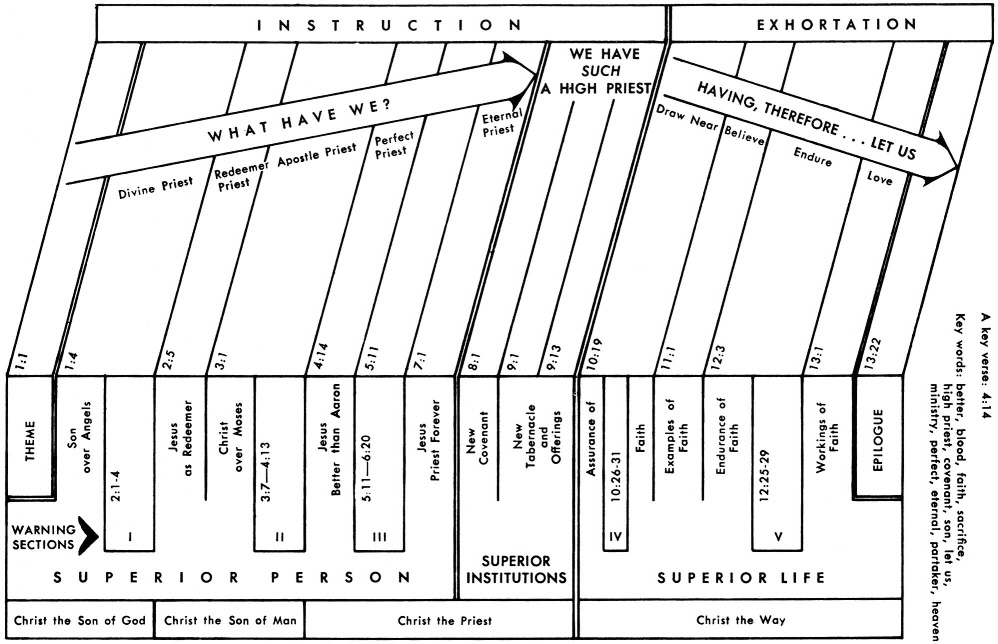
CONSIDER JESUS OUR GREAT HIGH PRIEST
Click chart to enlarge
Charts from Jensen's Survey of the NT - used by permission
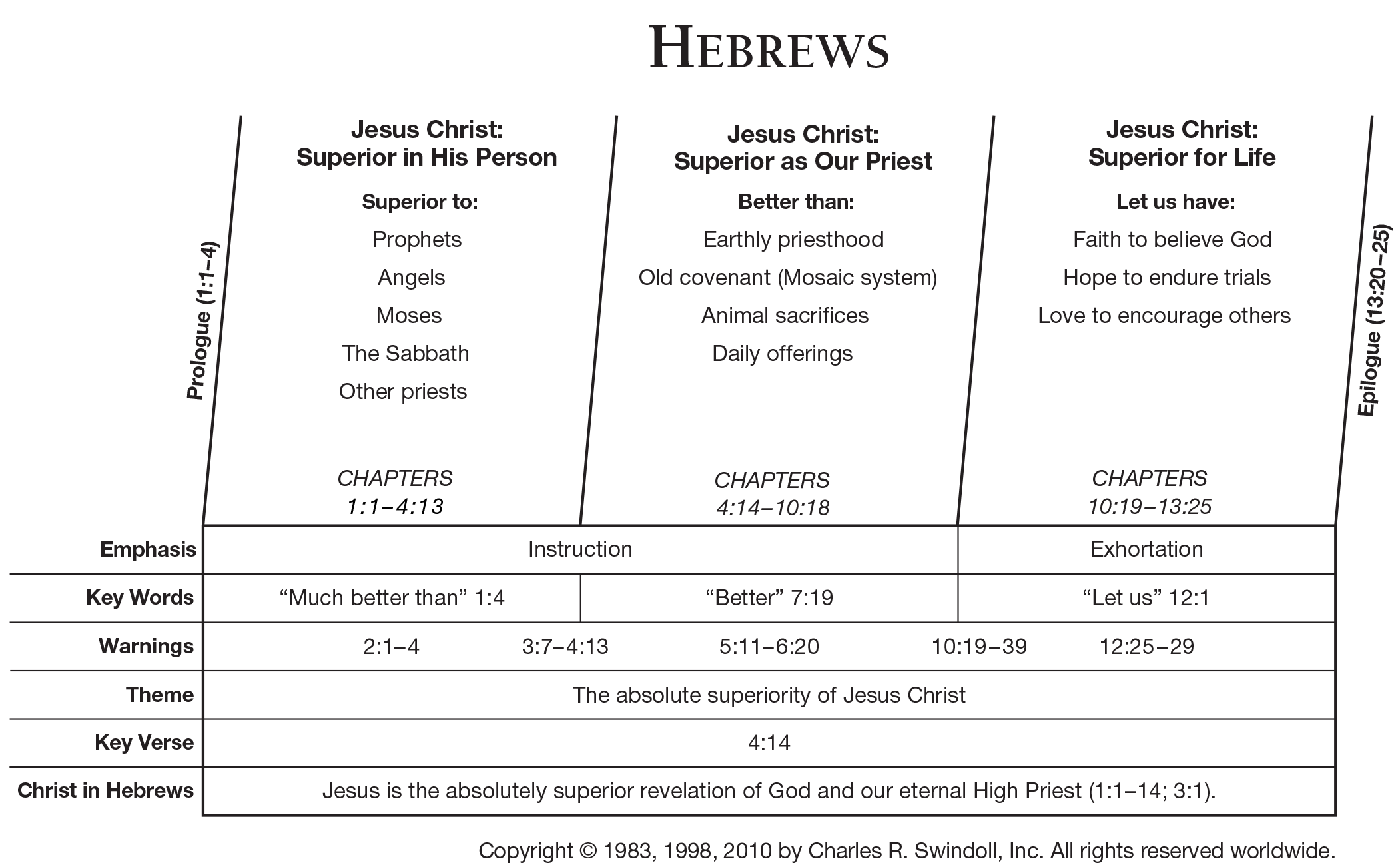
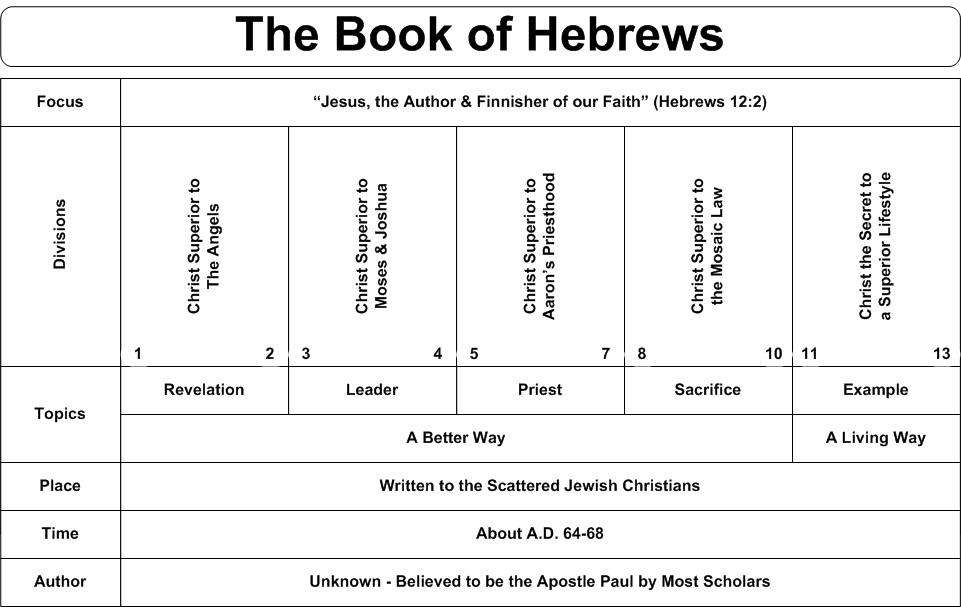
Swindoll's Chart, Interesting Pictorial Chart of Hebrews, Another Chart

|
The Epistle |
||||
| INSTRUCTION Hebrews 1-10:18 |
EXHORTATION Hebrews 10:19-13:25 |
|||
| REVELATION | RESPONSE | |||
| PRECEPTS | PRACTICE | |||
| DOCTRINE | DUTY | |||
| Superior Person of Christ Hebrews 1:1-4:13 |
Superior Priest in Christ Hebrews 4:14-10:18 |
Superior Practice In Christ Hebrews 10:19-13:25 |
||
| BETTER THAN PERSON Hebrews 1:1-4:13 |
BETTER PRIESTHOOD Heb 4:14-7:28 |
BETTER COVENANT Heb 8:1-13 |
BETTER SACRIFICE Heb 9:1-10:18 |
BETTER LIFE |
| MAJESTY OF CHRIST |
MINISTRY OF CHRIST |
MINISTERS FOR CHRIST |
||
|
DOCTRINE |
DUTY |
|||
|
DATE WRITTEN: |
||||

See ESV Study Bible "Introduction to Hebrews"
(See also MacArthur's Introduction to Hebrews)
Borrow Ryrie Study Bible
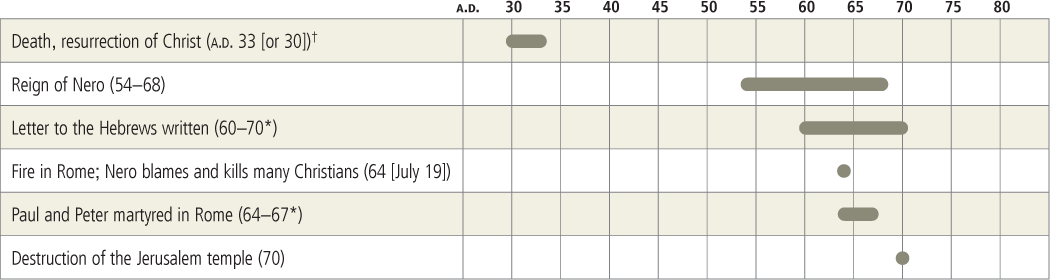
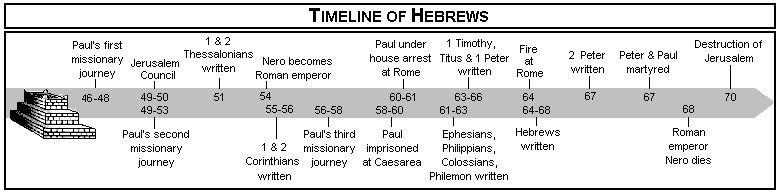
Timeline of Hebrews - ESV Study Bible
Hebrews 4:14 Therefore, since we have a great high priest Who has passed through the heavens, Jesus the Son of God, let us hold fast our confession (NASB: Lockman)
Greek: Echontes (PAPMPN) oun archierea megan dieleluthota (RAPMSA) tous ouranous, Iesoun ton huion tou theou, kratomen (1PPAS) tes homologias;
Amplified: Inasmuch then as we have a great High Priest Who has [already] ascended and passed through the heavens, Jesus the Son of God, let us hold fast our confession [of faith in Him]. (Amplified Bible - Lockman)
My Amplified Paraphrase: Therefore, since we possess a great (supreme, exalted, incomparable) High Priest, Jesus the Son of God, Who has passed through the heavens—moving beyond the earthly realm into the true heavenly sanctuary before the very presence of God—let us hold fast (seize tightly and never let go) our confession of faith. Because our High Priest lives and ministers in heaven for us, let nothing cause us to drift, waver, or renounce the hope we profess.
Barclay: Since, then, we have a high priest, great in his nature, who has passed through the heavens, Jesus, the Son of God, let us hold fast to our creed. (Westminster Press)
KJV: Seeing then that we have a great high priest, that is passed into the heavens, Jesus the Son of God, let us hold fast our profession.
NET Therefore since we have a great high priest who has passed through the heavens, Jesus the Son of God, let us hold fast to our confession.
CSB Therefore, since we have a great high priest who has passed through the heavens-- Jesus the Son of God-- let us hold fast to the confession.
ESV Since then we have a great high priest who has passed through the heavens, Jesus, the Son of God, let us hold fast our confession.
NIV Therefore, since we have a great high priest who has gone through the heavens, Jesus the Son of God, let us hold firmly to the faith we profess.
NLT: That is why we have a great High Priest who has gone to heaven, Jesus the Son of God. Let us cling to him and never stop trusting him. (NLT - Tyndale House)
Phillips: Seeing that we have a great High Priest who has entered the inmost Heaven, Jesus the Son of God, let us hold firmly to our faith. (Phillips: Touchstone)
Wuest: Having therefore a High Priest, a great One, One who has gone through the heavens, Jesus the Son of God, let us be holding fast our confession.
Young's Literal: Having, then, a great chief priest passed through the heavens -- Jesus the Son of God -- may we hold fast the profession,
- Great High Priest - Hebrews 2:17; 3:1; 3:5,6
- Has passed - Heb 1:3; 6:20; 7:25,26; 8:1; 9:12,24; 10:12; 12:2; Mk 16:19; Lk 24:51; Acts 1:11; 3:21; Ro 8:34
- Jesus the Son of God - Hebrews 1:2,8; Mark 1:1
- Let us hold fast - Hebrews 2:1; Heb 3:6,14; Heb 10:23
- Hebrews 5 Resources - Multiple Sermons and Commentaries

THE THREE HEAVENS
Irving Jensen writes that "The main theme of Hebrews may be stated thus: The knowledge and assurance of how great this High Priest Jesus is should lift the drifting believer from spiritual lethargy to vital Christian maturity. Stated another way: The antidote for backsliding is a growing personal knowledge of Jesus (He 2:1, He 2:3). (Jensen's Survey of the NT page 418)
Bruce Wilkinson reminds us of the purpose of this epistle and the importance of this middle section (He 4:14-He 10:18) to unequivocally establish the greatness of Christ's priesthood - "Many Jewish believers, having stepped out of Judaism into Christianity, wanted to reverse their course in order to escape persecution by their countrymen. The writer of Hebrews exhorts them to “press on” to maturity in Christ (He 6:1). His appeal is based on the superiority of Christ over the Judaic system. Christ is better than the angels, for they worship Him. He is better than Moses, for Moses was created by Him. He is better than the Aaronic priesthood, for His sacrifice was once for all time. He is better than the Law, for He mediates a better covenant. In short, there is more to be gained by suffering for Christ than by reverting to Judaism. Pressing on to maturity produces tested faith, self-discipline, and a visible love seen in good works. (Borrow Talk thru the bible . Page 454)
OUR GREAT HIGH PRIEST
JESUS THE SON OF GOD
Observe in the Table above that from Hebrews 4:14 through Hebrews 10:18 the writer now focuses his arguments on The High Priesthood of Jesus and specifically on the superiority of His priesthood to the Aaronic priesthood. One of the main arguments in the Epistle is that the priestly work of Jesus is superior to that of the Levitical priesthood. The writer had briefly alluded to Jesus’ priesthood earlier (Hebrews 1:3; He 2:17; He 2:18; He 3:1), as if preparing his readers for this major argument, but now begins to explain it in earnest.
Andrew Murray introduces this last section of Hebrews 4 "After his digression, in the warning to the Hebrews not like their fathers with Moses, to harden their hearts through unbelief, our writer returns to his argument. He had already twice used the words High Priest (He 2:16, 3:1), and is preparing the way for what is the great object of the Epistle—the exposition of the heavenly priesthood of the Lord Jesus, and the work He has by it accomplished for us (He 7:1-10:18). In this section (He 4:14-5:10) he first gives the general characteristics of that priesthood, as typified by Aaron, and exhibited in our Lord's life here on earth. In chaps, 1 and 2 he had laid the foundation of his structure in the divinity and the humanity of our Saviour: he here first speaks of Him in His greatness as a High Priest passed through the heavens, then in His sympathy and compassion, as having been tempted like as we are. (See The holiest of all)
Thomas Lea points out that Heb 4:13 ends with a solemn thought which should stimulate us to ask…"Who can represent guilty sinners before a God who sees everything?" This leads to this next section on the high-priestly work of Christ (He 4:14, 15, 16, etc) and its provision of mercy and help for wandering sinners. (BORROW Holman New Testament Commentary)
Therefore (3767) (oun) is a term of conclusion, which usually looks back to preceding texts but in this case looks forward. In other words, based on the truth about Jesus' great priesthood, the writer exhorts his readers to hold fast (present tense - continually). Notice his charge does not just say "Hold fast" but gives his readers the soul stabilizing truth of God's Word to edify and equip them that they might be strengthened by grace to hold fast. We need to practice this same principle in our churches today -- we must continually give the saints the solid food of the pure milk of God's Word (1Pe 2:2), in order that their minds might be renewed to think rightly about this present, fleeting life (1Jn 2:17, Jas 4:14). Note that some might see this therefore as looking backward drawing a conclusion from Heb 4:12–13: Because nothing is hidden from God and we are fully exposed before Him, we desperately need a High Priest who can represent us in heaven. Let the Spirit guide your interpretation.
Jesus is their present tense possession because of
His past tense passage (through the heavens)
Since we have a Great High Priest (archiereus) Who has passed through (dierchomai) the heavens (ouranos) Jesus the Son of God - We have (Echontes) means they hold or possess Jesus as their High Priest and in the present tense shows that they continually "possess" Him! Jesus is their present tense possession because of His past tense passage (through the heavens). And not only do we continually "hold Him," He forever holds us, for as the Good Shepherd He declares "My sheep hear My voice, and I know them, and they follow Me; and I give eternal life to them, and they will never (READ THAT WORD AGAIN!) perish; and (ABSOLUTELY) no one will snatch them out of My hand." (Jn 10:27-28) Jesus Himself, the Faithful (Trustworthy) Witness (Rev 1:5), testifies that a genuine believer CAN NEVER lose their salvation! Glory to God in the highest! Jesus the Son of God links his human name with His deity, clinching the argument already made Heb 1:1-4:13 getting the reader ready for the truth in Heb 4:15.
He wants us to grasp the importance of knowing that
“He” is ours, our great high priest.
S Lewis Johnson on we have a Great High Priest - It’s something that “we,” that is we who have made confession of our faith, something that “we have.” So it’s not “Seeing then there is a great high priest who has passed through the heavens,” but “Seeing then that we have it.” Blessings are fully realized and appreciated only if we have them, not if they just simply exist. It’s very important that we have them, that we really have them as a personal possession. And that is what he’s interested in, that we not simply talk about a priest existing, a great priest existing, one who’s at the right hand of the throne of God, but he wants us to grasp the importance of knowing that “He” is ours, our great high priest. And, of course, the throne of grace is our High Priest’s throne of grace.
Great High Priest - Israel had many high priests, but they never had a Great High Priest. We have an absolutely unique Great High Priest. Vincent writes that great emphasizes "Christ’s priestly character to Jewish readers, as superior to that of the Levitical priests. He is holding up the ideal priesthood."
Jesus is not just any High Priest but a Great One, our very own ("we have") High Priest! What an incentive for endurance to those who have believed in the Lord Jesus Christ and entered His rest. Seeing then that we have a great high priest with our name on his breast and shoulders (and our name inscribed on the palm of His hands - see devotional), let us continue to hold fast our confession!
Spurgeon - All that Israel had under the law we still retain; only we have the substance, of which they had only the shadow. “We have an altar from which those who serve in the tabernacle do not have the right to eat” (Heb 13:10). We have a sacrifice, which, being once offered, forever avails; we have one “greater than the temple” (Matt 12:6), and he is to us the mercy seat and the High Priest. Take it for granted that all the blessings of the law remain under the gospel. Christ has restored that which He did not take away; but He has not taken away one single possible blessing of the law. On the contrary, He has secured all to His people. I look to the Old Testament, and I see certain blessings appended to the covenant of works, and I say to myself by faith, “Those blessings are mine, for I have kept the covenant of works in the person of my Covenant Head and Surety. Every blessing that is promised to perfect obedience belongs to me, since I present to God a perfect obedience in the person of my great Representative, the Lord Jesus Christ.” Every real spiritual boon that Israel had, you have as a Christian. Not only do we read that there is a High Priest, but we read, “We have a high priest.” It would be a small matter to us to know that such and such blessings existed; the great point is to know by faith that we personally possess them. What is the great High Priest to me unless He is mine? What is a Savior but a word to tantalize my despairing spirit, until I can say that this Savior is mine? Every blessing of the covenant is prized in proportion as it is had: “We have a High Priest.” (Sermon The Tenderness of Jesus)
Vincent on through the heavens - Through, and up to the throne of God of which he wields the power, and is thus able to fulfill for his followers the divine promise of rest.
🙏 THOUGHT - Our Great High Priest is in the true Throne Room of God, at the right hand of His Father (Heb 1:3), ready and able to minister to all who struggle with the pressures and problems of life on earth (Heb 7:25). Let us go into His presence and lay our burdens at His feet for He is a sympathetic Great High Priest (Heb 4:16).
The imagery of passed through suggests the Old Testament Day of Atonement when the high priest passed through the Holy Place of the Tabernacle, into the Holy of Holies where the Shekinah glory cloud over the Ark of the Covenant and the Mercy Seat symbolized the very presence of the Living God. The Levitical high priest entered with a blood offering (Lev 16:12-16) to make atonement (or a "covering" = kaphar which is related to the Jewish name of this day = "Yom Kippur") for himself and all Israel. The passage of the Jewish high priest was but a pale shadow of the passage of our Great High Priest Who on the basis of His perfect, once for all sacrifice of His own blood passed through the heavens and into the heavenly Holy of holies, the Throne room of God. In summary, Jesus' priestly ministry is much better than that of the Jewish high priests, for only one this one day of the year were they allowed to pass through an earthly veil to enter the Holy of Holies. In contrast, our Great High Priest passed through the heavenly "veil" once for all time and into the Throne Room of God.
Spurgeon - He does not forget us now that He has passed through the lower heavens into the heaven of heavens, where He reigns supreme in His Father’s glory. He is still touched with a feeling of our infirmities. Though He has left behind Him all pain, and suffering, and infirmity, He retains to the full the fellow-feeling that His life of humiliation has developed in Him. Jesus has triumphed, he has entered into the glory on our behalf, the victory on our account rests with him; therefore let us follow him as closely as we can. May he help us, just now, if we are in the least dispirited or cast down, to pluck up courage, and press on our way! Shall we desert Him now that He has gone into heaven to represent us now that He has fought the fight, and won the victory on our behalf, and gone up to heaven as our Representative? God forbid! (Full sermon The Tenderness of Jesus)
Wuest - The word "through" is the clue that opens up the truth here which shows that Messiah is better than Aaron. The latter as high priest in Israel, passed through the court of the tabernacle, through the Holy Place, into the Holy of Holies, which were all figures or types of realities. Messiah as High Priest of the New Testament passed through the heaven of the clouds, the heaven of the stars, into the heaven of heavens, the centralized abode of Deity. Since Messiah passed through the realities of which the tabernacle was only a type, and Aaron passed through the things that were the types, Messiah is better than Aaron. (Hebrews - online source)
David describes the scene in heaven and Spurgeon comments on the impact that this glorious truth had on David's mindset…
Psalm 11:4 The LORD is in His holy temple; the LORD's throne is in heaven; His eyes behold, His eyelids test the sons of men.
Spurgeon comments on the effect of David's awareness of Jehovah in His holy temple writing that…
David here declares the great source of his unflinching courage. He borrows his light from heaven -- from the great central orb of deity. The God of the believer is never far from him; He is not merely the God of the mountain fastnesses, but of the dangerous valleys and battle plains. Jehovah is in His holy temple. The heavens are above our heads in all regions of the earth, and so is the Lord ever near to us in every state and condition. This is a very strong reason why we should not adopt the vile suggestions of distrust. There is One Who pleads His precious blood in our behalf in the temple above (Ed note: Our Great High Priest), and there is One upon the throne Who is never deaf to the intercession of His Son. Why, then, should we fear? What plots can men devise which Jesus will not discover? Satan has doubtless desired to have us, that he may sift us as wheat, but Jesus is in the temple praying for us, and how can our faith fail? What attempts can the wicked make which Jehovah shall not behold? And since He is in His holy temple, delighting in the sacrifice of His Son, will He not defeat every device, and send us a sure deliverance? Jehovah's throne is in the heavens; He reigns supreme. Nothing can be done in heaven, or earth, or hell, which He doth not ordain and overrule. He is the world's great Emperor. Wherefore, then, should we flee? If we trust this King of kings, is not this enough? Cannot He deliver us without our cowardly retreat? Yes, blessed be the Lord our God, we can salute him as Jehovah Nissi; in His Name we set up our banners, and instead of flight, we once more raise the shout of war.
THOUGHT - So strengthened dear saint, let us hold fast our confession amidst a ever deafening hostility and fierce hatred for genuine followers of Jesus.
An anonymous psalmist comforts us with the truth that…
Jehovah looks from heaven. He sees all the sons of men (Psalm 33:13)
Spurgeon writes that…
The Lord is represented as dwelling above and looking down below; seeing all things, but peculiarly observing and caring for those who trust in Him. It is one of our choicest privileges to be always under our Father's eye, to be never out of sight of our best Friend (Ed note: Our Great High Priest Treasury of David).
In a parallel passage we read
Therefore it was necessary for the copies (hupodeigma) of the things in the heavens to be cleansed with these, but the heavenly (epouranios) things themselves with better sacrifices than these (animal sacrifices). For Christ did not enter a holy place made with hands (the Holy of holies in the earthly copy of the heavenly Tabernacle), a mere copy of the true one, but into heaven itself, now to appear in the presence of God for (for = preposition huper = on our behalf, as our Substitute) us; (He 9:23-24)
Heaven is a common theme in the book of Hebrews, which is fitting in view of the great conflict of suffering (see note Hebrews 10:32) they had endured. Hebrews is unique of all the NT epistles in explaining the present priestly work of Jesus in this age of the church. To be ignorant of the book of Hebrews is to be ignorant of His role as our High Priest.
Vincent adds that…The name Jesus applied to the high priest is forcible as recalling the historical, human person, who was tempted like his brethren. We are thus prepared for what is said in ver. 15 concerning his sympathising character.
High priest (749) archiereus from arche = first in a series, the leader or ruler + hiereus = priest) (Dictionary articles - Easton's; ISBE) refers to the priest that was chief over all the other priests in Israel. This office was established by God through Moses instructions in the Pentateuch. The high priest functioned as the mediator between Jehovah and Israel performing sacrifices and rituals like other priests, but in addition acting to expiate the sins of the nation on the annual Day of Atonement.
The irony is that the high priest Caiaphas was residing over the Sanhedrin during trial of Jesus, the trial which would lead to His death and pave the way for His eternal Priesthood of the Great High Priest! God truly causes all things to work together for good! (Ro 8:28)
Eerdman's Bible Dictionary explains that "The high priest descended from Eleazar, the son of Aaron. The office was normally hereditary and was conferred upon an individual for life (Nu 25:10-13). The candidate was consecrated in a seven-day ceremony which included investiture with the special clothing of his office as well as anointments and sacrifices (Ex 29:1-37; Lev 8:5-35). The high priest was bound to a higher degree of ritual purity than ordinary Levitical priests. He could have no contact with dead bodies, including those of his parents. Nor could he rend his clothing or allow his hair to grow out as signs of mourning. He could not marry a widow, divorced woman, or harlot, but only an Israelite virgin (Lev. 21:10-15). Any sin committed by the high priest brought guilt upon the entire nation and had to be countered by special sacrifice (Lev 4:1-12). Upon a high priest’s death manslayers were released from the cities of refuge (Nu 35:25, 28, 32). (BORROW Eerdman's Bible Dictionary PAGE 486)
The references to the high priests in the Gospels and Acts refers primarily to their bitter opposition to Jesus Who the writer of Hebrews identifies as our everlasting High Priest. Clearly archiereus is a key word in the book of Hebrews, and a review of these 17 verses reveals various characteristics of Jesus role as the great High Priest (some of the uses of high priest obviously do not refer to Jesus but to the Jewish high priests).
ARCHIEREUS IN HEBREWS - 119V - Heb. 2:17; Heb. 3:1; Heb. 4:14; Heb. 4:15; Heb. 5:1; Heb. 5:5; Heb. 5:10; Heb. 6:20; Heb. 7:26; Heb. 7:27; Heb. 7:28; Heb. 8:1; Heb. 8:3; Heb. 9:7; Heb. 9:11; Heb. 9:25; Heb. 13:11
Passed through (1330) (dierchomai from dia = through + erchomai = come or go) means to go through, to traverse, to pierce through. The perfect tense describes a past completed action (His passing through the heavens) with present ongoing benefits and effects. The perfect tense thus speaks of permanence of our Lord's passage.
Heavens (3772) (ouranos see longer definition of ouranos - Vine feels is probably akin to ornumi = to lift or heave) is one of 24 NT uses (click all uses of "heavens" - plural - in NT)) of heaven in the plural.
OURANOS IN HEBREWS Heb. 1:10; Heb. 4:14; Heb. 7:26; Heb. 8:1; Heb. 9:23; Heb. 9:24; Heb. 11:12; Heb. 12:23; Heb. 12:25; Heb. 12:26;
Regarding the term heavens there are at least three divisions (there is not a complete consensus on this however) - (1) First heaven (the atmosphere) (In Acts 1:9, 10, 11 Jesus was "lifted up… and a cloud received Him… into the sky… into heaven (and) will come in just the same way as you [disciples] have watched Him go into heaven.") (2) Second heaven (outer space) (3) Third heaven (God’s abode; 2Cor 12:2, 3, 4). (See discussion of Third Heaven) Jesus passed through the first two "heavens" to take His seat at the right hand of His Father in the Third heaven, the dwelling place of God ("Our Father Who art in heaven" - Matthew 6:9) In the Old Testament the high priest of Israel passed through the courts and veils into the Most Holy Place, but Jesus has passed through the heavens into the very presence of God where He is seated at the right hand of His Father (Hebrews 1:3), continually performing His functions as our High Priest (eg, intercession, Hebrews 7:25).
Related Resources:
- What does it mean that Paul went to the third heaven?
- Are there different levels of heaven? Are there three heavens?
- What is the second heaven? | GotQuestions.org
- What is Heaven like? | GotQuestions.org
Take a moment and meditate on the Great High Priest what we possess and Who possesses us! Ponder the words of Isaac Watts' hymn…
With joy we meditate the grace
Of our High Priest above;
His heart is made of tenderness,
His bowels** melt with love.
Touched with a sympathy within,
He knows our feeble frame;
He knows what sore temptations mean,
For He has felt the same.
But spotless, innocent, and pure,
The great Redeemer stood,
While Satan’s fiery darts He bore,
And did resist to blood.
He in the days of feeble flesh
Poured out His cries and tears,
And in His measure feels afresh
What every member bears.
He’ll never quench the smoking flax,
But raise it to a flame;
The bruisèd reed He never breaks,
Nor scorns the meanest name.
Then let our humble faith address
His mercy and His power;
We shall obtain delivering grace
In the distressing hour.
**Bowels = Old KJV term =
center of the feelings, affections, especially compassion
Thomas Kelly's hymn...
The atoning work is done,
The Victim’s blood is shed;
And Jesus now is gone
His people’s cause to plead:
He stands in Heaven their great High Priest,
And bears their names upon His breast.
He sprinkles with His blood (See comment)
The mercy-seat above;
For justice had withstood
The purposes of love:
But justice now objects no more,
And mercy yields her boundless store.
No temple made with hands
His place of service is;
In Heaven itself He stands,
A heavenly priesthood His:
In Him the shadows of the law
Are all fulfilled, and now withdraw.
And though awhile He be
Hid from the eyes of men,
His people look to see
Their great High Priest again:
In brightest glory He will come,
And take His waiting people home.
QUESTION - What does it mean that Jesus is our High Priest?
ANSWER - High Priest is only one of the many titles applied to Jesus: Messiah, Savior, Son of God, Son of Man, Friend of Sinners, etc. Each one focuses on a particular aspect of who He is and what that means for us. In the book of Hebrews, Jesus is called a High Priest (Hebrews 2:17; 4:14). The word “priest” carries a couple of primary meanings. First, it means one who mediates in religious services. It also means one who is holy or set apart to perform those services.
The first place we find the word used in the Bible is in Genesis 14. Abraham, the friend of God, entered into battle to rescue his nephew Lot, who had been captured by the army of Elam. On his return, Abraham was met by Melchizedek, King of Salem and priest of the Most High God. This man, whose name means the “king of righteousness,” blessed Abraham and the Most High God who gave victory to Abraham. In return for this blessing, Abraham gave a tithe (10 percent) of all the spoils of war to Melchizedek. By this act, Abraham acknowledged Melchizedek’s high position as the priest of God.
Years later, Abraham’s great-grandson Levi was singled out by God to be the father of the priestly tribe. When the Law was given on Mount Sinai, the Levites were identified as the servants of the Tabernacle, with the family of Aaron becoming the priests. The priests were responsible for making intercession to God for the people by offering the many sacrifices that the law required. Among the priests, one was selected as the High Priest, and he entered into the Most Holy Place once a year on the Day of Atonement to place the blood of the sacrifice on the Ark of the Covenant (Hebrews 9:7). By these daily and yearly sacrifices, the sins of the people were temporarily covered until the Messiah came to take away their sins.
When Jesus is called our High Priest, it is with reference to both of these previous priesthoods. Like Melchizedek, He is ordained as a priest apart from the Law given on Mount Sinai (Hebrews 5:6). Like the Levitical priests, Jesus offered a sacrifice to satisfy the Law of God when He offered Himself for our sins (Hebrews 7:26-27). Unlike the Levitical priests, who had to continually offer sacrifices, Jesus only had to offer His sacrifice once, gaining eternal redemption for all who come to God through Him (Hebrews 9:12).
One other important point about Jesus’ priesthood—every priest is appointed from among men. Jesus, though God from eternity, became a man in order to suffer death and serve as our High Priest (Hebrews 2:9). As a man, He was subject to all the weaknesses and temptations that we are, so that He could personally relate to us in our struggles (Hebrews 4:15). Jesus is greater than any other priest, so He is called our “Great High Priest” in Hebrews 4:14, and that gives us the boldness to come “unto the throne of grace, that we may obtain mercy, and find grace to help in time of need” (Hebrews 4:16 KJV).GotQuestions.org
ESV Study Bible (borrow) summarizes the superior features of Jesus' priesthood as follows…
(1) Jesus’ ability to sympathize with human need,
(2) His perfect holiness,
(3) His eternal call to the priestly order of Melchizedek (combined with his eternal sonship),
(4) His initiating a new and better covenant,
(5) His ministering in the true heavenly tabernacle, and
(6) His presenting himself as a once-for-all sacrifice for the salvation and perfection of all his followers.
The writer pauses in the middle of this section to warn once more against the danger of apostasy (He 5:11-6:12) and to express confidence in God’s promises (He 6:13-20).
QUESTION - What does it mean that Jesus is our mediator?
ANSWER - A mediator is one who mediates, that is, one who acts as an intermediary to work with opposing sides in order to bring about a settlement. A mediator attempts to influence a disagreement between two parties with the goal of resolving a dispute. There is only one Mediator between mankind and God, and that is Jesus Christ. In this article, we’ll see why God has a dispute with us, why Jesus is our mediator, and why we are doomed if we try to represent ourselves alone before God.
God has a dispute with us because of sin. Sin is described in the Bible as transgression of the law of God (1 John 3:4) and rebellion against God (Deuteronomy 9:7; Joshua 1:18). God hates sin, and sin stands between all of us and Him. “There is no one righteous, not even one” (Romans 3:10). All human beings are sinners by virtue of sin we have inherited from Adam, as well as the sin we commit on a daily basis. The only just penalty for this sin is death (Romans 6:23), not only physical death but eternal death (Revelation 20:11–15). The rightful punishment for sin is an eternity in hell.
Nothing we could do on our own would be sufficient to mediate between ourselves and God. No amount of good works or law-keeping makes us righteous enough to stand before a holy God (Isaiah 64:6; Romans 3:20; Galatians 2:16). Without a mediator, we are destined to spend eternity in hell, for by ourselves salvation from our sin is impossible. Yet there is hope! “For there is one God and one mediator between God and men, the man Christ Jesus” (1 Timothy 2:5). Jesus represents those who have placed their trust in Him before God’s throne of grace. He mediates for us, much as a defense attorney mediates for his client, telling the judge, “Your honor, my client is innocent of all charges against him.” That is true for us also. Some day we will face God, but we will do so as totally forgiven sinners because of Jesus’ death on our behalf. The “Defense Attorney” took the penalty for us!
We see more proof of this comforting truth in Hebrews 9:15: “For this reason Christ is the mediator of a new covenant, that those who are called may receive the promised eternal inheritance—now that He has died as a ransom to set them free from the sins committed under the first covenant.” It is because of the great Mediator that we are able to stand before God clothed in the righteousness of Christ Himself. On the cross Jesus exchanged our sin for His righteousness (2 Corinthians 5:21). His mediation is the only means of salvation. GotQuestions.org
QUESTION - What is the purpose of Jesus interceding for us in Heaven?
ANSWER - Speaking of Jesus, the writer to the Hebrews says, “Therefore He is able also to save forever those who draw near to God through Him, since He always lives to make intercession for them” (Hebrews 7:25). This verse (and others like it) tells us that although Christ’s work to secure the salvation of the elect was completed on the cross, as evidenced by His cry “It is finished!” (John 19:30), His care for His redeemed children will never be finished.
Jesus did not go to heaven after His earthly ministry and “take a break” from His role as eternal Shepherd to His people. “For if while we were enemies we were reconciled to God through the death of His Son, much more, having been reconciled, we shall be saved by His life” (Romans 5:10, emphasis added). If when humble, despised, dying, and dead, He had the power to accomplish so great a work as reconciling us to God, how much more may we expect that He will be able to keep us now that He is a living, exalted, and triumphant Redeemer, raised to life and interceding on our behalf before the throne (Romans 8:34). Clearly, Jesus is still very active on our behalf in heaven.
After Jesus ascended to heaven and was seated at the right hand of God the Father (Acts 1:9; Colossians 3:1), He returned to the glory He had before His incarnation (John 17:5) to carry on His role of King of kings and Lord of lords—His eternal role as the second Person of the triune God. While this old earth continues to be “won” for Christ, Jesus is the Advocate for Christians, meaning He is our great Defender. This is the intercessory role He currently fulfills for those who are His (1 John 2:1). Jesus is always pleading our case before the Father, like a defense lawyer on our behalf.
Jesus is interceding for us while Satan (whose name means “accuser”) is accusing us, pointing out our sins and frailties before God, just as he did with Job (Job 1:6-12). But the accusations fall upon deaf ears in heaven, because Jesus’ work on the cross paid our sin debt in full; therefore, God always sees in His children the perfect righteousness of Jesus. When Jesus died on the cross, His righteousness (perfect holiness) was imputed to us, while our sin was imputed to Him at His death. This is the great exchange Paul talks about in 2 Corinthians 5:21. That took away forever our sinful state before God, so God can accept us as blameless before Him.
Finally, it is important to understand that Jesus is the only human mediator between God and man. No one else—not Mary, not any previous Christian saints—has the power to intercede for us before the throne of the Almighty. No angel has that position. Christ alone is the God-man, and He mediates and intercedes between God and man. “For there is one God, and one mediator also between God and men, the man Christ Jesus” (1 Timothy 2:5).GotQuestions.org
Related Resource:
LET US HOLD FAST OUR CONFESSION: kratomen (1PPAS) tes homologia:
- Hebrews 5 Resources - Multiple Sermons and Commentaries
Related Passages:
Colossians 2:18-19 Let no one keep defrauding you of your prize by delighting in self-abasement and the worship of the angels, taking his stand on visions he has seen, inflated without cause by his fleshly mind, and not holding fast to the head, from whom the entire body, being supplied and held together by the joints and ligaments, grows with a growth which is from God.
2 Thessalonians 2:15 So then, brethren, stand firm (present imperative see our need to depend on the Holy Spirit to obey) and hold (present imperative see our need to depend on the Holy Spirit to obey) to the traditions which you were taught, whether by word of mouth or by letter from us.
Revelation 2:13 ‘I know where you dwell, where Satan’s throne is; and you hold fast (present tense) My name, and did not deny My faith even in the days of Antipas, My witness, My faithful one, who was killed among you, where Satan dwells.
Revelation 2:25 ‘Nevertheless what you have, hold fast (aorist imperative see our need to depend on the Holy Spirit to obey) until (up to the point) I come.
Revelation 3:11 ‘I am coming quickly; hold fast (present imperative see our need to depend on the Holy Spirit to obey) what you have, so that no one will take your crown.
EXHORTATION TO
HOLD ON
Let us hold fast (krateo) our confession (homologia) - Let us is a hortatory subjunctive which is used 12 times in Hebrews.This is an exhortation, not a command. The writer is exhorting his readers (especially those wavering and being tempted to go back into Judaism and not forward to genuine saving faith in Messiah) as a principle of faith to keep on holding on to (present tense = "let us keep on holding fast") their confession regarding the Messiah. This calls for holding fast as one's lifestyle or one's habitual practice. Don't try to accomplish this in your own natural strength (see THOUGHT below). And remember that this exhortation is not for perfection but is about direction. This exhortation calls for an enduring/persevering commitment to active belief in and loyalty to Jesus (cp Col 2:19; 2Th 2:15; Re 2:13, 25; Re 3:11).
🙏 THOUGHT - How is it possible to hold fast when being persecuted? There are two answers. The first is Vertical Vision - keeping our eyes fixed on Jesus and what He has accomplished and what He is currently doing for us (See PRAYING FOR US - Heb 7:25, Ro 8:34). Second, since the present tense calls for us "to keep holding fast," we need to continually jettison self-reliance (the natural power of our flesh) and instead wholly rely on the Holy Spirit Who gives us the (supernatural) desire and the power (Php 2:13NLT) to continually "hold fast." (See Perseverance of the Saints)
Let us hold fast is a repetition of the theme of perseverance seen in earlier passages in Hebrews (He 2:1; He 3:6, He 3:12-14; He 4:11) See Heb 3:1; Heb 10:23.
A T Robertson "Let us keep on holding fast." This keynote runs all through the Epistle, the exhortation to the Jewish Christians to hold on to the confession (Hebrews 3:1) of Christ already made. Before making the five points of Christ's superior priestly work (better priest than Aaron, Hebrews 5:1-7:25; under a better covenant, Hebrews 8:1-13; in a better sanctuary, Hebrews 9:1-12; offering a better sacrifice, Hebrews 9:13-10:18; based on better promises, Hebrews 10:19-12:3), the author gives a double exhortation (Hebrews 4:14-16) like that in Hebrews 2:1-4 to hold fast to the high priest (Hebrews 4:14-15) and to make use of him (Hebrews 4:16). (Hebrews 4 - Robertson's Word Picture)
How important is it to hold fast?
so that by two unchangeable things in which it is impossible for God to lie, we who have taken refuge would have strong encouragement to take hold (krateo) of the hope set before us. (Hebrews 6:18)
So then, brethren, stand firm (present imperative see our need to depend on the Holy Spirit to obey) and hold (present imperative see our need to depend on the Holy Spirit to obey) to the traditions you were taught whether by word of mouth or by letter from us. (2Th 2:15)
Comment: Traditions in this context is not a reference to the traditions of men but of God as handed down to the hearers/recipients via God's messengers, in context the apostle Paul. Paul encouraged the Thessalonians to keep the traditions they had been taught by him, either verbally or in writing, - 2Th 3:6. Remember that for about the first twenty years of the spread of Christianity, each church needed to remember, carefully and accurately, what they had been taught orally by the apostles, for they did not yet have a written Bible as we do today. By the time of the Thessalonians, however, Paul had written down at least some of his teachings, and the NT was beginning to take shape. Eventually, it would all be written and there would be no further need for the disciples to be guided by the oral traditions.
and not holding fast (krateo) to the head, from whom the entire body, being supplied and held together by the joints and ligaments, grows with a growth which is from God. (Colossians 2:19)
Comment: Holding fast in this context will keep you from being taken "captive through philosophy and empty deception, according to the tradition of men, according to the elementary principles of the world, rather than according to Christ." see Colossians 2:8)
🙏 THOUGHT - If you want to get through hard times, hold fast to Jesus “the Apostle” (the "Sent One") (Hebrews 3:1) Who did everything to make possible your salvation. Be ready and willing to confess Him as your High Priest, privately and publicly. Make the confession of Jesus your "lifestyle", so that those you encounter may know Who you know, Who you belong to and that thereby they might be drawn to saving faith by the aroma of Christ in you.
John MacArthur - Our great High Priest did not pass through the Tabernacle or the Temple. He passed through the heavens. When He got there He sat down, and God said, "I'm satisfied. My Son, Jesus Christ, accomplished the atonement for all sins for all time for all those who come to Him by faith and accept what He did for them." The appeal of 4:14, therefore, is for yet uncommitted Jews to accept Jesus Christ as their true High Priest. They should demonstrate that their confession is true possession by holding fast to Him as their Savior. This emphasizes the human side of the believer's security. True believers hold fast, as God holds them fast. (See Hebrews Commentary)
Matthew Poole - Let us hold fast our profession; the entire religion of which Jesus is the author, as opposite to that of the Jews in its principles and practical part of it, Heb 3:1, is powerfully, strongly, and perseveringly to be held by his without relaxation; in which if we follow him, cleave to him, and by him labour to enter, we shall not come short of God's rest, Heb 7:24-25: where the Head is, there shall the body be also, Jn 14:2; 17:24.
Westcott - The writer everywhere insists on the duty of the public confession of the faith. The crisis claimed not simply private conviction but a clear declaration of belief openly in the face of men. (B F Westcott, The Epistle to the Hebrews. Grand Rapids, MI: Eerdmans, 1967, p. 106)
Brian Harbour - The faith has already been professed by those to whom the Preacher is speaking. Now he exhorts them to “hold firmly” to that confession. Why should they do that? They should hold firm because of who Jesus is and because of what Jesus has done. Jesus the Son of God has gone all the way for them—he has “gone through the heavens” for them. Therefore, they should be willing to hold firm for him. (ED: ABSOLUTELY! BUT THIS WILL REQUIRE MORE THAN NATURAL DETERMINATION BUT WILL ALSO REQUIRE DEPENDENCE OF THE SUPERNATURAL PROVISION OF THE HOLY SPIRIT).
Spurgeon on hold fast our confession - Shall we desert Him now that He has gone into heaven to represent us now that He has fought the fight, and won the victory on our behalf, and gone up to heaven as our Representative? God forbid!
S Lewis Johnson writes that in this section the author is exhorting his readers "Do not fall as Israel did. Now, what he is interested in, of course, is a kind of faith, if James, James were by, he would turn to James and say, “James, what I’m talking about is the kind of faith you talked about when you talked about a faith that works.” He’s interested in that kind of faith, a faith that endures. So he talks about holding fast “our confession.” Peter Lombard once described this as “The faith of the heart together with the confession of the mouth, so that faith is present, also, in the mouth.” A very interesting expression. That this kind of faith is the faith of the heart together with the confession of the mouth, so that the faith is present in the mouth. In other words, it’s not simply word, but it’s a word or words that come from a belief of the heart, what Paul talks about in Romans 10:9,10. (Our High Priest's Throne of Grace:)
The confession here in Hebrews 4:14 has reference to the specific statement of faith which had once been accepted and openly acknowledged before others - "Jesus is the Messiah, the Son of God".
Today, in our individualistic world, we often neglect the salutary benefit of public confession of the truth we hold. When we are going through hard times, we need to confess Christ as our “apostle and high priest”—to own His magnificent ministry as our own—to clutch it close! We ought not to limit our confession to congenial company alone. There are times to confess Him in unfriendly surroundings. Such confession may be just what our soul needs. Confess and embrace your High Priest!
Matthew Henry…
Let us hold fast our profession of faith in Him, He 4:14. Let us never deny Him, never be ashamed of Him before men. Let us hold fast the enlightening doctrines of Christianity in our heads, the enlivening principles of it in our hearts, the open profession of it in our lips, and our practical and universal subjection to it in our lives.
Observe the Revelation
1. We ought to be possessed of the doctrines, principles, and practice, of the Christian life.
2. When we are so, we may be in danger of losing our hold, from the corruption of our hearts, the temptations of Satan, and the allurements of this evil world.
3. The excellency of the high priest of our profession would make our apostasy from him most heinous and inexcusable; it would be the greatest folly and the basest ingratitude
4. Christians must not only set out well, but they must hold out: those who endure to the end will be saved, and none but they.
Secondly, We should encourage ourselves, by the excellency of our high priest, to come boldly to the throne of grace
Let us hold fast (2902) (krateo from kratos = strength) means to lay hold of and cling tightly to that which has been taken hold. It has the basic meaning be strong or possess power and thus means to take hold of, grasp, hold fast. Krateo is used most often in the sense of “take hold of forcibly” as when Pharisees wanted to “take hold of” Jesus (Mt 21:46; Mark 12:12). Krateō can also mean “hold fast” with the idea of being loyal to or closely united with someone or something. The Pharisees were admonished for holding the traditions of the elders (Mark 7:3ff.), while Christians are encouraged to hold to the traditions of Christianity (2 Th 2:15) Krateo means to cling to tenaciously with the idea of seizing, retaining (using strength) as in Hebrews 6:18.
Hortatory Subjunctive - a first-person plural subjunctive verb used to urge a group to do something. (Let us go…” “Let us draw near…” “Let us hold fast…” “Let us consider…”) These are not suggestions; they are strong, urgent exhortations. The hortatory subjunctive expresses: exhortation (strong urging), encouragement, group inclusion (“we together”), an invitation with authority, a call to decisive action. It has the force of:“We must…” “Let us now…” “We should immediately…” It is authoritative yet pastoral.
Why Greek uses the Hortatory Subjunctive - Greek has no first-person imperative (“we, do this!”), so the hortatory subjunctive serves this function. It is the strongest way to urge a group to action.
Summary - This is a statement urging others to join in some action (commanding oneself and one’s associates). (It is roughly the same as first person imperative, which does not exist in Greek.) It is easily identified because it will always be the first person plural form of the subjunctive mood. This verb form will often come near the beginning of the sentence.It is usually translated "let us…." (Thus, as a mnemonic device, it can be referred to as the ‘Salad Subjunctive’. cf "let us" with "lettuce" - a bad joke!)
"LET US" IN HEBREWS - Heb. 4:1; Heb. 4:11; Heb. 4:14; Heb. 4:16; Heb. 6:1; Heb. 10:22; Heb. 10:23; Heb. 10:24; Heb. 12:1; Heb. 12:28; Heb. 13:13; Heb. 13:15
Confession (3671) (homologia from homoú = together with + légo = say) means literally the statement of the same thing and thus expresses agreement with another. It represents the open expression of one's allegiance to a proposition or a person. Such a confession is the effect of deep conviction regarding the facts (Truth).
This word group (verb homologeo, noun homologia) has strong legal connotations. And so a person can confess to a charge in court and thus openly acknowledge guilt. Or one may agree with a court order and thus make a legally binding commitment to abide by it. This last sense is implied in passages that call on us to acknowledge Jesus. We are to express our binding commitment to Jesus publicly and thus acknowledge our relationship to Him as our Lord. John puts the importance of this issue succinctly: "No one who denies the Son has the Father; whoever confesses the Son has the Father also" (1Jn 2:23).
Commitment to Jesus brings us
into full relationship with God.
In secular documents from New Testament times the related verb homologeo was commonly used to denote agreements between two parties and thus is very common in our sources in the sense “contract,” “agreement.” In legal formulas it meant to "give consent" to something. Another use of the word was to "acknowledge" or "publicly declare." One papyrus from the first century reads "He acknowledges [having found] the box, but alleges that it was empty." (Moulton and Milligan)
The noun homologia is found only 6 times in Scripture…
2 Co 9:13 - Because of the proof given by this ministry, they will glorify God for your obedience to your confession of the gospel of Christ (your professing of the gospel finds expression in obedient subjection to its requirements) and for the liberality of your contribution to them and to all,
1Ti 6:12 - Fight the good fight of faith; take hold of the eternal life to which you were called, and you made the good confession in the presence of many witnesses.
1Ti 6:13 - I charge you in the presence of God, who gives life to all things, and of Christ Jesus, who testified the good confession before Pontius Pilate,
Hebrews 3:1 - Therefore, holy brethren, partakers of a heavenly calling, consider Jesus, the Apostle and High Priest of our confession;
Hebrews 4:14 - Therefore, since we have a great high priest who has passed through the heavens, Jesus the Son of God, let us hold fast our confession.
Hebrews 10:23 - Let us hold fast the confession of our hope without wavering, for He who promised is faithful;
HOMOLOGIA is used 5 times in the Septuagint (LXX) (Lev. 22:18; Deut. 12:17; Jer. 44:25; Ezek. 46:12; Amos 4:5)
The verb homologeo is utilized by Paul in his famous passage on salvation explaining…
that if you confess (homologeo - this confession involves a wholehearted acknowledgment) with your mouth Jesus as Lord, and believe in your heart that God raised Him from the dead, you shall be saved for with the heart man believes, resulting in righteousness, and with the mouth he confesses, resulting in salvation. (Ro 10:9-10)
Comment: Luther said that such confession is "the principal work of faith." Calvin added that no one can believe with the heart without confessing with the mouth. It is a natural consequence of faith.
Before the throne of God above
Play this great hymn
by Charlotte Bancroft
Before the throne of God above
I have a strong, a perfect plea,
A great High Priest, whose name is Love,
Who ever lives and pleads for me.
My name is graven on His hands
My name is written on His heart
I know that while in Heav'n He stands
No tongue can bid me thence depart
No tongue can bid me thence depart
When Satan tempts me to despair,
And tells me of the guilt within,
Upward I look, and see Him there
Who made an end of all my sin.
Because the sinless Saviour died
My sinful soul is counted free;
For God, the Just, is satisfied
To look on Him and pardon me.
To look on Him and pardon me.
Behold Him there! the risen Lamb!
My perfect, spotless Righteousness,
The great unchangeable I AM,
The King of glory and of grace.
One with Himself, I cannot die;
My soul is purchased by His blood;
My life is hid with Christ on high,
With Christ, my Saviour and my God.
With Christ, my Saviour and my God.
TODAY IN THE WORD Hebrews 4:14
About this time of year, many people start thinking about New Year’s resolutions. There’s conviction and hope that habits will be changed or pounds will be shed. For many, however, these resolutions are broken in January and forgotten by March. Months pass, December arrives, and the cycle repeats itself!
It’s part of our human nature to experience limitations, despite our best intentions. This limitation is part of the argument made in Hebrews. Yesterday, we saw that Jesus the Great High Priest was able to do what the Levitical priests couldn’t do. Today, we’ll see that because Jesus is fully human and fully divine, He is able to offer a better sacrifice (Heb. 9:11–14) and effect a better covenant (vv. 15–22).
Access to the Holy of Holies in the wilderness tabernacle was only possible when human sin was cleansed by sprinkled animal blood. But Jesus is able to enter to the true Holy of Holies, heaven itself, because of His own shed blood. This better sacrifice does more than cleanse us from sin temporarily or externally–it cleans our very consciences.
The covenant mediated through Moses was glorious (2 Cor. 3:7), and with it came the inheritance of the Promised Land. But even so, this covenant is surpassed by the new covenant that Jesus Christ Himself mediates, and which effects the eternal inheritance of life with Him. Just as a human will only becomes effective when the person who wrote it dies, so too the old covenant required the death of animals; the new covenant required the blood of Jesus. The key to this is that forgiveness for sins requires shed blood (v. 22).
TODAY ALONG THE WAY
Hebrews helps us see the true significance of all the symbolism in the tabernacle. The arrangement of the tabernacle, the high priest, and the sacrifices all point to Jesus Christ. Like the tabernacle, He is where the glory of God is found. Like the high priest, He leads the people to God. Like the animals sacrifices, His blood removes sin. But unlike any of these earthly things, Jesus Christ accomplishes perfectly and forever what the earthly tabernacle could only do imperfectly and temporarily.
Charles Stanley - A REINFORCEMENT FOR YOUR FAITH
SCRIPTURE READING: Hebrews 4:11–16
KEY VERSE: Hebrews 4:14 Seeing then that we have a great High Priest who has passed through the heavens, Jesus the Son of God, let us hold fast our confession.
Temptation is universal. It tantalizes young and old, educated and unschooled, monks and mechanics. Its presence and constant pull, however, are not indictments of our spiritual condition. Indeed, when we resist them, God can use our temptations to reinforce our faith.
British author C. S. Lewis revealed in his book Mere Christianity (Mere Christianity - online without restrictions or here) how God can turn the tables on the tempter’s evil desires:
A silly idea is current that good people do not know what temptation means. This is an obvious lie. Only those who try to resist temptation know how strong it is.…
A man who gives in to temptation after five minutes simply does not know what it would have been like an hour later. That is why bad people, in one sense, know very little about badness. They have lived a sheltered life by always giving in.
We never find out the strength of the evil impulse inside us until we try to fight it; and Christ, because He was the only man who never yielded to temptation, is also the only man who knows to the full what temptation means—the only complete realist.
Guilt should never accompany temptation. Turn it away by turning to Christ.
Lord, temptations are strong, but You are stronger! Help me turn away temptations by turning to You. Let me eliminate guilt by fighting every evil impulse. (BORROW Enter His gates : a daily devotional PAGE 154)
Charles Stanley - Trusting God
SCRIPTURE READING: Hebrews 4:11–16
KEY VERSE: Hebrews 4:14 Seeing then that we have a great High Priest who has passed through the heavens, Jesus the Son of God, let us hold fast our confession.
The Hebrew Christians were wavering in their faith, and thoughts of returning to their former ways of worship were both tempting and inviting. Along with that came the enticement to return to Jerusalem to offer sacrifices. There they could see the priest performing the ritual duties of the priesthood, which were the very tangible elements they missed in their new faith.
Those people were facing the same temptation we face each day, and that was to place their trust in what was visible rather than invisible. But faith is not a matter of seeing and then believing. It is a matter of trusting God, regardless of whether or not He shows us something.
The great men and women of the Bible trusted God not because He provided material evidence of His existence, though He did that on many occasions, but because He was faithful and true in His nature. A benefit of faith is watching God work in the circumstances of our lives to bring about the answers to our prayers. He is ever mindful of those who follow Him.
An even greater benefit of trusting God is developing an intimate relationship with the Lord Jesus Christ, who is the foundation of our faith. He is our great High Priest, and because of His death at Calvary, there is no longer a need to travel anywhere other than to Him in prayer.
Lord, help me look beyond the visible to see the invisible. I trust You, O God. Let me realize that faith is not seeing and believing; rather, it is believing when I cannot see. (BORROW On holy ground : a daily devotional PAGE 604)
Fix your thoughts on Jesus, the apostle and high priest whom we confess. Hebrews 3:1
Jesus Christ is not only the Apostle; He is also the High Priest. In fact, Jesus Christ has the title “great high priest” (Heb. 4:14).
As the Apostle, Jesus Christ represented God to people, and as the High Priest, He now represents people to God in heaven. Moses, of course, fulfilled similar ministries; for he taught Israel God’s truth, and he prayed for Israel when he met God on the mount (Ex. 32:30–32). Moses was primarily the prophet of the law, while Jesus Christ is the messenger of God’s grace (John 1:17). Moses helped prepare the way for the coming of the Savior to earth.
However, the writer of Hebrews notes that Moses and Jesus Christ were both faithful in the work God gave them to do. Moses was not sinless, as was Jesus Christ, but he was faithful and obeyed God’s will (Num. 12:7). This would be an encouragement to those first-century Jewish believers to remain faithful to Christ, even in the midst of the tough trials they were experiencing. Instead of going back to Moses, they should imitate Moses and be faithful in their calling.
Something to Ponder - How might your spiritual life improve if you were to imitate the faithfulness of Moses? What opportunity for faithfulness do you have? (BORROW Pause for Power: A Year in the Word PAGE 205)
PRIEST
“And Melchizedek … was the priest of the most high God” (Gen. 14:18). “The Lord hath sworn, and will not repent, Thou art a priest for ever after the order of Melchizedek” (Ps. 110:4). “Wherefore in all things it behoved him to be made like unto his brethren, that he might be a merciful and faithful high priest in things pertaining to God, to make reconciliation for the sins of the people” (Heb. 2:17). “Seeing then that we have a great high priest, that is passed into the heavens, Jesus the Son of God, let us hold fast our profession” (Heb. 4:14). “Now of the things which we have spoken this is the sum: We have such an high priest, who is set on the right hand of the throne of the Majesty in the heavens” (Heb. 8:1).
JESUS
“Thou shalt call his name JESUS: for he shall save his people from their sins” (Matt. 1:21b). “But Jesus said, Suffer little children, and forbid them not, to come unto me” (Matt. 19:14a). “This Jesus hath God raised up” (Acts 2:32a). “Therefore being justified by faith, we have peace with God through our Lord Jesus Christ” (Rom. 5:1). “That at the name of Jesus every knee should bow, of things in heaven, and things in earth, and things under the earth; and that every tongue should confess that Jesus Christ is Lord” (Phil. 2:10–11a). “Seeing then that we have a great high priest, that is passed into the heavens, Jesus the Son of God, let us hold fast our profession” (Heb. 4:14). “He which testifieth these things saith, Surely I come quickly. Amen. Even so, come, Lord Jesus” (Rev. 22:20).
Ken Hemphill - THE GREAT HIGH PRIEST God Is: Devotions Empowered by Biblical Statements of Faith - Page 42
Hebrews 4:14 We have a great high priest who has passed through the heavens— Jesus the Son of God.
Would it help you to know that you have a high priest who can sympathize with your weakness and who desires to plead your case before the Father? Such a truth should give you boldness to approach the throne of grace right now.
The writer to the Hebrews had already referred to Jesus as a “merciful and faithful high priest” in Hebrews 2:17. In Hebrews 4:14, however, the use of the word “great” in relation to Jesus' high priesthood characterizes his supreme dignity. He is seen as being different from and greater than any Levitical high priest.
An earthly priest was allowed to pass through the veil of the temple, but Jesus has passed through the heavens, receiving access to the very throne of God. “The One who descended is the same as the One who ascended far above all the heavens that He might fill all things” (Eph. 4:10).
The linking of Jesus with the phrase “Son of God” may be intended to suggest the two natures of our high priest. Because he is fully human, we can be assured that he can understand and relate to what we're going through. “For we do not have a high priest who is unable to sympathize with our weaknesses, but One who has been tested in every way as we are, yet without sin” (verse 15). Yes, he can sympathize with us in our testing, but he can also give us real help because he is God, because he is genuinely without sin.
Once we understand the greatness of our High Priest, it gives us strength to hold fast to our confession. Do you sometimes feel like you can't hold on in your own strength? That is precisely why we must go to the throne of grace. “Let us approach the throne of grace with boldness, so that we may receive mercy and find grace to help us at the proper time” (verse 16).
Right now is the proper time! You can approach the throne of God with assurance through prayer, knowing that you will be greeted by him with his tender mercy and sufficient grace.
Vance Havner's Primer of Christian Experience…
… Lay hold on eternal life… (1Ti 6:12).
… Hold that fast which thou hast… (Re 3:11).
… Holding forth the word of life… (Php 2:16).
Let go
Let go of your sins, your self, everything, resting in the Lord for salvation and all that goes with it.
Lay hold
Lay hold of eternal life. It is a gift but is not ours until we take it. God's free gift is ours by provision but not ours in possession until we lay hold upon it. The old song puts it, "Faith taking hold of the Word."
Hold fast
Hold fast what has been received. This does not mean a nervous, fearful hanging on for dear life as though we might lose our salvation. Nothing can snatch us from the Father's hand. But, lest we lose our joy, our testimony and our reward, we must hold fast that which is good (1Th 5:21), hold fast the form of sound words (2Ti 1:13), hold fast our confidence and rejoicing (He 3:6), hold fast our profession (He 4:14). We have a charge to keep.
Hold forth
Hold forth the word of life. We are not depositories but dispensers, stewards, and witnesses, not just to enjoy the gospel but to share it. It is not a secret to be hidden, but a story to be heralded.
Today in the Word has the following devotionals…
Monday, June 9, 2003
Read: Hebrews 4:14-16
Let us then approach the throne of grace with confidence, so that we may receive mercy. - Hebrews 4:16
TODAY IN THE WORD - Due to skyrocketing legal fees, more and more corporations–and even individuals–are willing to consider settling their disputes through arbitration rather than court. This process uses a mediator to negotiate a binding settlement on both parties. What makes a good mediator? It should be someone who knows and understands both sides as well as the issue causing the problem.
This is a good bit like our position as we stand before God due to our sin. The situation has reached an impasse. Nothing we can say or do can satisfy God. In fact, because of our sin, we cannot even approach Him. One person, however, can do something about it–our High Priest, Jesus Christ.
In the book of Hebrews, the primary function of the “high priest” is to act as a mediator. That is, the high priest goes between God and humanity. As we have already seen, Jesus is no ordinary high priest. He is the high priest who is both eternal God and fully human. He understands both sides of the issue. Moreover, He has done what no high priest before Him has: “gone through the heavens” into the very presence of God Himself (Heb 4:14).
We may wonder why this is so important. Hebrews 4:15-16 give the reason: Jesus understands what it’s like to face temptation. In the context of this letter, the specific challenge addressed here is the temptation to leave Jesus and the community of those who believe in Him. Some of these Hebrew Christians were tempted to stop persevering in the Christian faith. Hebrews assures us that such a temptation is understood by our Jesus, our mediator. He is able to sympathize with us and will give us mercy and grace in our time of need.
Hebrews gives this exhortation: in time of temptation do not stay away from Jesus, rather run to Him! He will not cast us away–He will help us in our time of need.
TODAY ALONG THE WAY - If you are struggling with a particular temptation today, listen to the good news of this passage–Jesus “has been tempted in every way, just as we are” (v. 15). The one seated at the right hand of the Father (Hebrews 1:4) understands your struggle and will intercede for you. You can approach the eternal throne boldly and with great confidence in your time of need. Go to Him in prayer even now and, thanks be to God, receive His mercy (See Moody Bible Institute's Today in the Word)
TODAY IN THE WORD - Hebrews 4:14
In 1989 a group of Romanian students embarked on a risky trip, smuggling Bibles into neighboring Moldova, part of the former Soviet Union. Being caught with Christian literature in either country could have put them in jail. Yet somehow they made it through border crossings, past local police, into designated apartment buildings, and back home without one encounter with security forces. Only later they learned that a Christian, Vasili, had spent three entire days in intercessory prayer on their behalf.
It is always encouraging for us to learn that others have been praying for us. How much more encouraging is it to realize the Lord Jesus Himself is praying for us! Indeed, Jesus as our Great High Priest “always lives to intercede for [us]” (Heb. 7:25).
A key Old Testament figure was the high priest, chosen from the tribe of Levi. The high priest oversaw the duties of priests (2Chr 19:11) and served as mediator between God and the people. On the annual Day of Atonement, the High Priest--alone--was able to enter the Most Holy Place of the tabernacle, where he sacrificed for his own sins and for those of all the people (Ex. 30:10).
In Hebrews, we see how Jesus is superior to all that has gone before Him, including the Old Testament high priest. In Hebrews 4:14, Jesus is called the Great High Priest, the One who has gone before us through the heavens. Although Jesus is vastly superior to any human high priest, He is still able to understand our human weakness, because He is fully human and fully divine--yet He is without sin (He 4:15).
He 7:27 (note) shows that whereas a human high priest had to make atonement for his own sin, Jesus had no sin of His own to atone for. Moreover, Jesus “sacrificed for their sins once for all when he offered himself” (Hebrews 7:27). Finally, whereas the high priest had to be replaced each time one died, “because Jesus lives forever, He has a permanent priesthood” (He 7:24 ).
TODAY ALONG THE WAY - Since Jesus always lives to intercede for us, we also have the privilege of praying for others. (
Open At The Top - A preacher was delivering a sermon before a large congregation. He pointed out that believers aren't exempt from trouble. In fact, some Christians are surrounded by trouble—trouble to the right, trouble to the left, trouble in front, and trouble behind. At this, a man who had served the Lord for many years, shouted, "Glory to God, it's always open at the top!"
This man's confidence in God is fully supported by Hebrews 4. Because our great High Priest, Jesus the Son of God, has ascended to heaven and is interceding there for us, we have good grounds for trusting Him in the midst of trouble (He 4:14). Jesus is able to sympathize with our weaknesses, for when He lived on earth He was tempted in every way that we are, yet He never sinned (He 4:15). His throne is completely approachable and is called "the throne of grace" (He 4:16).
In Hebrews we're urged to look up from our trials and to approach that throne boldly by faith. Through humble prayer, we will receive mercy for our failures and grace to help us in our time of need (He 4:16).
Are life's trials and temptations hemming you in? Has the tempter told you there's nowhere to go? Take heart. Keep looking up—it's always open at the top!—Joanie Yoder (Our Daily Bread, Copyright RBC Ministries, Grand Rapids, MI. Reprinted by permission. All rights reserved)
When life's afflictions batter you
Like waves upon the sand,
Remember to look up to God
And take His outstretched hand. —Sper
To improve your outlook, try the uplook.
(See Vertical Vision)
All Christians struggle with two crucial areas that will make or break us in the Christian life: perseverance in times of trial; and, prayer. As you know, they are connected. A vital prayer life is essential to endure trials.
Failure to endure trials is the mark of the seed sown on rocky soil. Jesus explained that this seed represents those who, “when they hear the word, immediately receive it with joy; and they have no firm root in themselves, but are only temporary; then, when affliction or persecution arises because of the word, immediately they fall away” (Mk 4:17). Endurance is one mark of genuine saving faith (Heb. 3:6).
Prayer is our supply line to God in the battle. His abundant, sustaining grace flows to us through prayer. Because prayer is so vital, the enemy tries to sever that supply line. When we suffer, the enemy often whispers, “God doesn’t care about you and He isn’t answering. Why waste your time with these worthless prayers?” It’s easy to get discouraged and quit praying, which cuts us off from the very help that we need!
Our text is one of the most encouraging passages in the Bible when it comes to perseverance and prayer. The first readers of this epistle were tempted to abandon their Christian faith and return to Judaism because of persecution. The author has just given an ex-tended exhortation, using the bad example of Israel in the wilderness. They failed to enter God’s rest (a picture of salvation) because of unbelief and disobedience. Therefore, we must be diligent to enter that rest. If we will respond in faith and obedience to God’s Word, it will expose our sin and show us His ways. It is foolish to think that we can hide our sin from God, because everything is naked and laid bare in His sight (He 4:12, 13).
Martin Luther commented on our text,
“After terrifying us, the Apostle now comforts us; after pouring wine into our wound, he now pours in oil” (in Philip Hughes, Commentary on the Epistle to the Hebrews [Eerdmans], p. 169).
Rather than trying to hide because of our sin, the author shows how we should draw near to Jesus, our sympathetic high priest, who gives us access to God’s throne. For those who are in Christ, that throne is not a place of fear but, rather, a throne of grace! Since Jesus is our great yet sympathetic high priest, we must persevere and we must pray.
There are two commands here (ED: IN GREEK THEY ARE NOT TRUE COMMANDS BUT PRESENT MIDDLE SUBJUNCTIVE).
Hold fast our confession (persevere; He 4:14); and,
Draw near with confidence (pray; He 4:16).
They are both based on the truth about who Jesus is: Since Jesus is our great high priest, the Son of God, who has passed through the heavens, we must hold fast our confession (ED: I WOULD ADD BECAUSE OF HIS PASSAGE AND HIS SENDING OF HIS SPIRIT, NOW WE CAN HOLD FAST IN HIS POWER! IT IS HOWEVER NOT "LET GO, LET GOD," BUT "LET GOD, LET'S GO!" HIS PROVISION/OUR RESPONSIBILITY). And, since Jesus is a high priest who sympathizes with our weaknesses, we should draw near to the throne of grace for help in our times of need. Thus His transcendence to the right hand of God’s throne and His humanity are both essential elements of His unique effectiveness as our high priest. If we want to persevere through trials and receive His help through prayer, we must understand who He is.
1. Since Jesus is our great high priest who has passed through the heavens, we must persevere (Hebrews 4:14).
The author tells us who Jesus is and how we should respond.
A. Jesus is our great high priest who has passed through the heavens.
We see Jesus’ greatness in two ways here:
1) Jesus is great in His office as high priest at the right hand of God.
We have difficulty relating to the concept of a high priest, but to the Jews, it was an important office. Moses’ brother Aaron was the first high priest. He was the mediator between the people and God. He and his fellow priests offered the sacrifices on behalf of the people. They had to follow a detailed procedure spelled out by God. Any variance or innovation meant instant death, as Aaron’s two sons, Nadab and Abihu discovered when they offered “strange fire” on the altar (Lev 10:1, 2, 3).
Once a year, on the Day of Atonement, the high priest alone would go into the Holy of Holies to make atonement for all the sins of the nation. If he entered there improperly or at any other time, he would die (Leviticus 16). He would sprinkle the blood on the mercy seat in the very presence of God. When he came out alive, the people heaved a sigh of relief, because it meant that God had accepted the sacrifice for their sins for another year.
Jesus is not just another high priest in the line of Aaron. Rather, He is our great high priest according to the order of Melchizedek (He 5:6). Rather than entering the Holy of Holies in the temple, He has passed through the heavens (in His ascension) into the very presence of God. The Jews thought of the sky as the first heaven. The stars are the second heaven. The presence of God is the third heaven (2Co 12:2). Whether the author has this in mind, or is just using “heavens” in the plural because the Hebrew word is always plural, we cannot say for certain.
But his point is that Jesus, our great high priest, is unlike any merely human high priest. He has entered the very presence of God. The Father has said to Him, “Sit at My right hand until I make Your enemies a footstool for your feet” (Ps 110:1). No earthly priest would dare to sit in the Holy of Holies! They always stood. But Jesus sits at the right hand of God’s throne because once for all He made atonement for our sins (He 10:12). So Jesus is a great high priest, in a class by Himself, because of His office as a priest forever according to the order of Melchizedek (which the author will explain more in the following chapters).
2) Jesus is great in His Person as God in human flesh.
“Jesus” is His human name, calling attention to the full humanity of the Savior (see 2:17). If He had not been fully human, He could not have atoned for our sins. But He is also “the Son of God,” which refers to His deity (John 5:18). As Bishop Moule said, “A Savior not quite God is a bridge broken at the farther end.” Our author has shown in chapter 1 that Jesus is fully God. Thus Jesus is uniquely great in His office as high priest and He is uniquely great in His person as God in human flesh. Therefore…
B. We must persevere.
The words, “hold fast our confession,” imply danger and effort on our part (B. F. Westcott, The Epistle to the Hebrews [Eerdmans], p. 106 - ED: YES, I AGREE "OUR PART" BUT IT WOULD BE IMPOSSIBLE WITHOUT HIS PART, HIS SUPERNATURAL PROVISION!). Picture someone hanging on for dear life as their raft goes down the raging rapids in the Grand Canyon. “Hold fast!” “Confession” implies not only our private belief in the essential doctrines of the faith (especially with regard to Jesus’ deity and humanity), but also our public declaration of this truth in the face of persecution. We make such a public profession of faith in baptism, but that profession is put to the test when persecution arises. Are we only fair-weather believers who deny the Lord when it becomes costly to believe, or will we stand firm even to death be-cause we know whom we have believed?
J. C. Ryle reports, “When John Rogers, the first martyr in Queen Mary’s time, was being led to Smithfield to be burned, the French Ambassador reported that he looked as bright and cheerful as if he were going to his wedding” (Home Truths [Triangle Press], 1:64).
While God must give special grace at such a time, we would not do well in persecution if we grumble and walk away from God when we face lesser trials. Paul says that we’re not only to persevere in trials, but to do so with great joy (Ro. 5:3)! So hold fast your confession of faith in Christ when He takes you through difficult trials. He is none other than your great high priest, God in human flesh, who now sits “at the right hand of the Majesty on high” (Heb. 1:3).
2. Since Jesus is our sympathetic and sinless high priest, we must pray in times of need (He 4:15,16).
A. Jesus is our sympathetic high priest.
The author uses a double negative, “We do not have a high priest who cannot sympathize with our weaknesses….” Probably he was anticipating an objection: “You’ve just said that Jesus is a great high priest who has passed through the heavens. How can someone beyond the heavens relate to me and my problems?” The author responds, “No, Jesus is not unsympathetic. He understands your deepest feelings.”
We all need someone to sympathize with our problems and weaknesses without condemning us. Sometimes that is enough to get us through, just to know that someone else understands what we’re going through. I read about a boy who noticed a sign, “Puppies for sale.”
He asked, “How much do you want for the pups, mister?”
“Twenty-five dollars, son.” The boy’s face dropped. “Well, sir, could I see them anyway?”
The man whistled and the mother dog came around the corner, followed by four cute puppies, wagging their tails and yipping happily. Then lagging behind, another puppy came around the corner, dragging one hind leg.
“What’s the matter with that one, sir?” the boy asked.
“Well, son, that puppy is crippled. The vet took an X-ray and found that it doesn’t have a hip socket. It will never be right.”
The man was surprised when the boy said, “That’s the one I want. Could I pay you a little each week?”
The owner replied, “But, son, you don’t seem to understand. That pup will never be able to run or even walk right. He’s going to be a cripple forever. Why would you want a pup like that?”
The boy reached down and pulled up his pant leg, revealing a brace. “I don’t walk too good, either.” Looking down at the puppy, the boy continued, “That puppy is going to need a lot of love and understanding. It’s not easy being crippled!” The man said, “You can have the puppy for free. I know you’ll take good care of him.”
That is a limited illustration of our Savior’s sympathy for our condition. Since He became a man and suffered all that we experience, He sympathizes with our weaknesses. He demonstrated His compassion many times during His earthly ministry. But His humanity was not diminished in any way when He ascended into heaven. We have a completely sympathetic high priest at the right hand of God!
B. Jesus is our sinless high priest.
He was “tempted in all things as we are, yet without sin.”
At first, we may wrongly think that being sinless would make Jesus unsympathetic and distant from us, since we all have sinned many times. Perhaps a fellow sinner could relate more to my failures. But that is not so. Charles Spurgeon pointed out (“The Tenderness of Jesus” sermon 2148, p. 407, italics his), [D]o not imagine that if the Lord Jesus had sinned he would have been any more tender toward you; for sin is always of a hardening nature. If the Christ of God could have sinned, he would have lost the perfection of his sympathetic nature. It needs perfectness of heart to lay self all aside, and to be touched with a feeling of the infirmities of others. (The Tenderness of Jesus)
Others object that if Jesus never sinned, He must not have been tempted to the degree that we are tempted. But as many have pointed out, that is not so. The one who resists to the very end knows the power of temptation in a greater way than the one who yields to sin sooner.
When it says that Jesus was tempted in all things as we are, it doesn’t mean every conceivable temptation, which would be impossible. Nor was Jesus ever tempted by indwelling sin, as we are. In this, He was like Adam and Eve before the fall. Temptation had to come to Jesus from without, not from within.
But Jesus knew every type of temptation. He knew what it is like to be hungry, thirsty, and tired. He knew the horrible agony of physical torture, which He endured in His trial and crucifixion. He knew what it is like to be mocked, distrusted, maligned, and betrayed by friends. From the start of Jesus’ ministry to the very end, Satan leveled all of his evil power and strategies to try to get Jesus to sin. But he never succeeded. Jesus always obeyed the Father.
He 4:15 raises the question, “Was it possible for Jesus to have sinned?” We need to answer this carefully (I am following Wayne Grudem, Systematic Theology pp. 465). Scripture clearly affirms that Jesus never committed sin (He 7:26; 1Pe 1:19; 2:22). It also affirms that His temptations were real, not just playacting. The Bible also affirms, “God cannot be tempted by evil” (James 1:13). Since Jesus was fully God, how then could He realy be tempted, much less commit a sin? Here we plunge into the mystery of how one man can be both fully God and fully human, as Scripture plainly affirms of Jesus.
Since Jesus is one person with two natures, and since sin involves the whole person, in this sense, Jesus could not have sinned or He would have ceased to be God. But the question remains, “How then could Jesus’ temptations be real?” The answer seems to be that Jesus met every temptation to sin, not by His divine power, but by His human nature relying on the power of the Father and Holy Spirit. As Wayne Grudem Systematic Theology explains,
“The moral strength of his divine nature was there as a sort of ‘backstop’ that would have prevented him from sinning…, but he did not rely on the strength of his divine nature to make it easier for him to face temptations…” (p. 539).
As you know, Scripture sometimes affirms something of Jesus that could only be true of one of His natures, but not both (Mt. 24:36). Jesus’ divine nature could not be tempted or sin, but His human nature could. Don’t stumble over the fact that you cannot fully comprehend this. Rather, accept the testimony of Scripture: Jesus truly was tempted and He never sinned. These facts mean that He understands what we are going through and He is able to come to our aid when we are tempted (He 2:18).
Because Jesus is a sympathetic and sinless high priest…
C. We should draw near in prayer.
“Draw near with confidence to the throne of grace, so that we may receive mercy and find grace to help in time of need.”
“Throne of grace” is an oxymoron. To the ancient world, a throne was a forbidding place of sovereign authority and judgment. If you approached a throne and the king did not hold out his scepter, you were history! You definitely would not draw near to the throne for sympathy, especially with a trivial problem. But the author calls it the throne of grace. He makes it clear that we are welcome at this throne. He answers four questions: (1) Why draw near? (2) When should we draw near? (3) How should we draw near? And, (4) What can we expect when we draw near?
1) Why draw near?
We should draw near to the throne of grace because we are weak and we have there a sympathetic high priest.
We don’t come because we’ve got it pretty much together and we just need a little advice. We come because we are weak (He 4:15). Jesus didn’t say, “Without Me, you can get along pretty well most of the time. Call Me if you need Me.” He said, “Without Me, you can do nothing” (John 15:5). And when we come to the throne of grace, He doesn’t ridicule us or belittle us for our weaknesses. He welcomes us as a father welcomes his children to his side to protect them from some danger.
2) When should we draw near?
We should draw near to the throne of grace whenever we need help.
We should come in a “time of need,” which is at al times! A main reason we do not pray is that we don’t realize how needy we are. We think we can handle things on our own. Just call in the Lord when things get really intense. But the fact is, we depend on Him for every breath we take and for every meal we eat, even if we’ve got a month’s supply of food in the freezer. Praying without ceasing (1 Thess. 5:17) is necessary because we are constantly in over our heads. Prayer is the acknowledgement that our need is not partial; it is total!
3) How should we draw near?
We should draw near to the throne of grace directly, with confidence in our high priest.
The author does not say, “Draw near through your local priest.” He says, “Let us draw near.” Us means every believer. Dr. Dwight Pentecost, one of my professors in seminary, told how he was in Mexico City during a feast for the Immaculate Conception of Mary. There was a long line of thousands waiting for confession, but only one confession booth. As the noon bells rang, an old, stooped over priest came out of the booth, walking with two canes. A woman with several small children fell on her knees before him and grabbed him by the knees. She cried out to him, begging him to relieve her burdens. But he struck her on the side of the head with one of his canes and went off through the crowd. He was an unsympathetic, weak human priest.
Thankfully, we do not have to go through any human priest to draw near to the very throne of God. We could not dare come in our own merit or righteousness. But we can come with confidence because the blood of Jesus, our high priest, has gained us access (Ep 3:12). Our confidence is not in how good we’ve been or in how well we can pray. Spurgeon pointed out that God will over-look our shortcomings and poor prayers just as a loving parent will overlook the mistakes in the sentences of his toddler. Even when we have sinned badly, if we draw near to confess our sins, He will cleanse our wounds and begin the healing process, just as a parent would carefully clean and bandage the wounds of his child. Finally, what can we expect when we draw near? We will receive mercy and find grace to help in our time of need.
What a wonderful promise! We won’t be scolded for having a need. We won’t be told that our need is too trivial for such an important high priest to be troubled with. We will receive mercy and find grace to help. “Help” is a technical nautical term that is used elsewhere only in Acts 27:17 to describe the cables that the sailors wrapped around the hull of Paul’s ship during the storm so that it would not break apart. We encountered the verb in Hebrews 2:18, where it has the nuance of running to the aid of someone crying for help. When your life seems to be coming apart at the seams because of the storm, cry out to our sympathetic high priest at the throne of grace. You will receive mercy and find grace to help.
What is the difference between mercy and grace? They somewhat overlap, but mercy has special reference to God’s tenderness toward us because of the misery caused by our sins, whereas grace refers to His undeserved favor in freely forgiving our sins, which actually deserve His judgment (see R. C. Trench, Synonyms of the New Testament [Eerdmans], pp. 169-170). Together, both words reflect the good news that “God was in Christ reconciling the world to Himself, not counting their trespasses against them” (2 Cor. 5:18). All that trust in Christ and His shed blood as the payment for their sins have free access at the throne of grace to God’s boundless mercy and undeserved favor!
Conclusion
I like John Piper’s analogy that prayer is our walkie-talkie to get the supplies we need in the spiritual war that we are engaged in. It’s not an intercom to call the maid to bring extra beverages to the den. In other words, prayer isn’t to make us comfortable and cozy, oblivious to the advancement of God’s kingdom purposes. Prayer is our walkie-talkie to bring in the needed supplies as we seek first His kingdom and righteousness. If you’re under fire in the battle, persevere-hold fast your confession, because Jesus is our great high priest. If you have needs, pray-draw near to the throne of grace to receive mercy and find grace to help in the battle.
Discussion Questions
1. How does our understanding of the person and work of Christ relate to persevering in trials?
2. Does Jesus’ sympathy for our weaknesses mean that He tolerates our sins? Explain.
3. Some Christians argue that if Jesus could not have sinned, His temptations were not real. Is this so? Why/why not?
4. The term “throne of grace” reflects a fine balance between the reverent fear of God and being accepted by Him. Discuss the implications of this balance.
Jesus—our great High Priest—dying for us on the Cross—living for us now in heaven—this, this is the inspiring motive, made use of by the apostle, in urging to diligence and steadfastness, in our Christian profession—this is the encouragement to "come boldly to the throne of grace."
Without this blessed truth, there could be no hope for the guilty and hell-deserving, no efficacy in prayer, and no encouragement to draw near to God. Efforts at obedience could never avail. God's violated law could never be satisfied, and the penalty of eternal death denounced against every transgressor, could in no other way be removed.
But, seeing that Christ has died for sin, we are to labor to die unto sin. Seeing that He has opened the gates which were barred against us, we are to seek to enter in. Seeing that He has purchased blessings, for time and eternity, which otherwise could never have been ours, we are to pray earnestly for their bestowal upon us. Seeing that He is now exalted to God's right hand, to give repentance and remission of sins, we are to draw near to obtain the pardon of our sins. Seeing that He pleads for us, we are to be fervent in pleading for ourselves.
Christ's death does not leave us inactive—indifferent—as some of the enemies of our religion would maintain. True, our best deeds are still of no value as regards our salvation. We cannot merit eternal life. Jesus has done all. But, for this very reason, we are to "hold fast the profession of our faith without wavering," rejoicing in the belief that He has borne our sins—that He has suffered for them—that He has carried them into the land of forgetfulness—that He has washed us in His own most precious blood, and has clothed us with the robe of His imputed righteousness. Oh! then it is we have a motive powerful and all-constraining, to "live not unto ourselves, but to Him who died for us and rose again," "to follow His footsteps and walk even as He also walked"—to seek to have fellowship with Him in His sufferings, and to be conformed more and more to His image—to be "crucified with Christ, and to die daily unto sin"—to "present our bodies and spirits as living sacrifices unto Him" who "gave Himself for us, that He might redeem us from all iniquity, and purify us unto Himself a peculiar people, zealous of good works."
And, to animate us in thus "holding fast our profession," the apostle declares, that "we have not a High Priest who cannot be touched with the feeling of our infirmities; but one who was in all points tempted like as we are, yet without sin."
The Savior—when He burst the bonds of death and ascended to the right hand of God—neither resigned His priestly office nor laid aside His humanity. He was, and still is, both God and man. He was, and still is, a merciful and faithful High Priest—never weary of his office—never forgetting or abandoning it—never overlooking the wants and necessities of those whom He has loved, and for whom He intercedes. "It is finished," is gloriously inscribed on the Priest's work below; "it never ceases," is as gloriously written on the work above. Christ—as our Intercessor with the Father—is continually presenting the merits of His one, all-sufficient oblation, sprinkling the mercy-seat with blood, and burning incense before the Lord. He appears at the right hand of the Majesty on high, clothed in priestly vesture. The names of the true Israel are on His shoulders—a token that all His strength is theirs to protect them. The names are on His bosom—a token that while His heart beats, it beats for them. The voice of His pleading ever sounds and ever prevails, "Father, forgive them," and they are forgiven; "Father, have mercy on them," and mercies speed on rapid wing. The incense of His intercession ever rise, "Father, bless them," and they are blessed; "Father, smile on them," and it is light around their path. With loving interest He takes their every offering of prayer, and praise, and service. He perfumes all with the rich fragrance of His merits. He makes all worthy in His own worthiness, and thus our nothingness gains great reward.
Oh, precious thought! that we have a Friend above who can sympathize as no other can—that we have an Intercessor who can plead more powerfully than we are even able to conceive—and whose eye of love is on each one of His followers, to support, sustain, and comfort, amid daily trials, vicissitudes, and conflicts.
"He can be touched"—yes, He has learned sympathy by suffering. The incidents and the feelings of His earthly existence have not passed away. They have left impressions and results, which are deeply entwined with His present being. In the midst of His glory, He is still mindful of His anguish. Upon His "spiritual" body, He yet bears the print of the nails; and upon His side, the scar of the wound inflicted by the Roman spear. These memorials of the past—of His earthly pains and sufferings, will never be effaced—no, nor will the crown of universal glory ever obliterate the record of the crown of thorns. "Passed into the heavens," He is still as keenly "touched with the feeling of our infirmities," as when He stood weeping beside the grave of Lazarus; or, as when He hung upon the cross, committing His bereaved mother to the care of His beloved disciple.
And, He is able still to sympathize with all the sorrows and infirmities, to which His people are exposed. "In that He himself has suffered, being tempted, He is able to support those who are tempted." As He was, and is, and always will be, the very and eternal God, so is He, and so will He ever be, "the Man Christ Jesus," very God and very Man. Such is our great High Priest—divine in His ability, human in His sympathy—and, amid earth's painful trials and temptations—amid its changes and vicissitudes—amid dangers and duties, it is such a High Priest that we stand in need of. Who is the man you would desire to visit you in the house of mourning, when your agony was deep, and your perplexity overwhelming? Who is the friend to whom you would betake yourself, when the world frowned upon you, and the dark cloud gathered round you? Who is the guide you would consult, when you had lost your path, and wandered on in the mazes of uncertainty? Surely, one who had traveled the same road—one who had encountered the same perils—one who had drunk the same cup of woe, and endured the same fiery furnace. It is to a heart thus tried and experienced—to one who had thus suffered, that "the bruised reed, the smoking flax," the bent and bowed down spirit, would desire to come—to mourn with it, to raise it, to sustain it.
Such a one would be welcome to you, in the hour of sore anguish. The very look of his furrowed face, worn with grief—the very look of his expressive eye, telling that he could enter deeply into all the peculiarities of your conflict, would be balm to your wounded spirit. There would be something in his voice—in the accents he would employ, revealing to you, that he could be "touched with the feeling of your infirmities," because he had undergone those infirmities himself. And, thus it is, that the humanity of our glorious High Priest—the susceptibility that He has of sympathy with us in all the varieties of our trials and temptations, brings Him down to our hearts—brings Him into our secret sympathies—enables us to feel that He is one with us, and we with Him, and that we may come to God through His gracious interposition, in all our weaknesses and in all our woes, with all our burdens and all our infirmities, for the path is thus made plain and simple—"He was in all points tempted like as we are, yet without sin."
"Let us then," says the apostle—because we have a High Priest above—One who can and does feel for us—One who knows all our cares, and troubles, and trials—One who has Himself deeply suffered, and is therefore able to sympathize with us in all our sorrows, "let us therefore come boldly unto the throne of grace, that we may obtain mercy, and find grace to help in time of need."
Reader! Christ Jesus—the High Priest and Intercessor—the sympathizing Brother—is the only medium of prayer. There is no access to God but through Him. And, if there be not an honoring of Christ—in His person, blood, righteousness, intercession—in prayer; we can expect no answer to prayer. The great encouragement to draw near to God is—Jesus, at the right hand of God. He is our interceding High Priest—He is our Advocate with the Father—our Kinsman-Redeemer within the veil. Coming through Him, the poorest, the vilest, the most abject, may approach the throne of grace with lowly boldness. The all-powerful—all-helpful—all-loving—all-tender Savior and High Priest, is waiting to present the petition, and urge its acceptance, and plead for its answer, on the basis of His own infinite and atoning merits.
Come, then, you poor, you disconsolate—come, you tried and afflicted—come, you wounded—come, you needy—come, and welcome, to the mercy-seat. Ask nothing in your own name, but ask everything in the name of Jesus. "Ask and you shall receive, that your joy maybe full." "Having therefore, brethren, boldness to enter into the holiest by the blood of Jesus, by a new and living way, which He has consecrated for us, through the veil, that is to say, His flesh—and, having a High Priest over the house of God, let us draw near."
Reader! whatever be your need, your weakness, your trial or infirmity, do not brood over it--but bring it to the throne of grace. The longer you bear about with you the burden under which you groan, the more hopeless and wretched you will become. But if you take it to the foot of the Cross, you will assuredly obtain relief. The very act of taking it will inspire hope; and, casting it on the tenderness and sympathy of your compassionate High Priest, you will be able to say, "I cried unto the Lord, and he heard me, and delivered me from all my fears." Plead earnestly as David did, "Have mercy upon me, O God, according to your loving-kindness; according unto the multitude of your tender mercies blot out my transgressions." "Withhold not your tender mercies from me, O Lord; let your loving-kindness and your truth continually preserve me." "Because your mercy is good, deliver me." "Let your tender mercies come unto me, that I may live."
Surely, it is a comforting thought, that you are bringing your wishes, and cares, and anxieties to One, who knows how to pity and support—who longs to show "mercy," and to impart "grace to help in every time of need." The Savior's heart is a human heart—a tender heart—a sinless heart—a heart, once the home of sorrow—once an aching, bleeding, mournful heart. And He is still unchanged. He loves to chase grief from the troubled spirit, and to bind up the broken heart; to stanch the bleeding wound, and to dry the weeping eye; "to comfort all that mourn." Yes, Christian, if you would disclose your sorrow, to One who sorrowed as none ever sorrowed—if you would weep upon the bosom of One, who wept as none ever wept—if you would bare your wound to One, who was wounded as none ever was wounded—then, in your affliction, turn from all creature sympathy and support, to your "merciful and faithful High Priest."
He is prepared to embosom Himself in your deepest grief, and to make your circumstances all His own. He "can be touched with the feeling of your infirmity," and your sorrow. So completely—so truly—is He one with you, that nothing can affect you, that does not instantly touch Him. Your temptations from Satan—your persecutions from man, your struggles with an evil heart—your tribulations and dangers, and fears—all are known to Him, and He feels for you. Tender, to Him, are you, as the apple of His eye. Your happiness, your peace, your necessities, your discouragements—all are to Him, subjects of deepest interest, and of incessant care. If, only, you would but lift the eye of faith, you might discover that He is with you now; and—of His faithfulness that never falters—of His love that never changes—of His tenderness that never lessens—of His patience that never wearies—of His grace that never decays—you may sing—in the storm-night of your grief. It is ever His delight, to prove Himself the strength of your fainting heart, and the support of your sinking soul—to visit you in the hour of sorrow and calamity, breathing music, and diffusing calmness, over your scene of sadness and gloom. Trust in Him, and He will be with you, in life, in death and in eternity; for His word is—"No man shall pluck them out of my hand."
Almighty Savior, in whom all fullness dwells, and who, as our merciful and faithful High Priest, have a fellow-feeling with us in all our infirmities, we humbly beseech You to grant us out of Your fullness, grace sufficient for us. We are weak and helpless. Oh! strengthen our faith, enliven our hope, increase our love, perfect our repentance. Blessed be Your name, You have encouraged us to come boldly to the throne of grace, that we may obtain mercy, and find grace to help in time of need.
Lord of all power and might, we come, trusting in Your almighty strength, Your infinite goodness, and Your gracious promises. We come to ask of You, whatever is lacking in ourselves, and to be enriched by You, with all spiritual blessings. Whatever of sin or of infirmity You see in us, O Lord, forgive it, and help us to overcome it. Whatever of good Your grace may have wrought in us, be pleased to confirm and complete it, and make all that we think, and speak, and do, acceptable in Your sight. Be with us, O Savior, everywhere, and at all times; in health and in sickness, in prosperity and trouble, and in all the events and circumstances of our lives. Let Your presence sanctify and sweeten whatever may befall us. Never leave nor forsake us in our earthly pilgrimage, but abide with us, until You have brought us through all trials and dangers to Your heavenly kingdom, that we may there dwell in Your sight, and enjoy Your love, and inherit Your glory for evermore. Amen.
Savior, I lift my trembling eyes
To that bright seat, where, placed on high,
The great, the atoning Sacrifice,
For me, for all, is ever nigh.
O be my guard on peril's brink;
O be my guide through weal or woe;
And teach me of Your cup to drink,
And make me in Your path to go.
For what is earthly change or loss?
Your promises are still my own;
The feeblest frame may bear Your Cross,
The lowliest spirit share Your throne.
—Anonymous
What is Jesus Doing Right Now?
SCRIPTURE: Hebrews 4:14
INTRODUCTION: If we had a telescope capable of peering into the highest heaven, what would we see Jesus doing right now? What is His present ministry?
1. He Is Ruling from His Heavenly Throne (Eph. 1:20; Mark 16:19; Phil. 2:9, 1 Pet. 3:22).
2. He Is Directing and Empowering His Church (Matt. 16:18; Acts 1:1–2; Rom. 15:18).
3. He Is Interceding for Believers (Rom. 8:42, 1 John 2:1; Heb. 2:17–18, 7:25).
4. He Is Preparing a Place for Us (John 14:1–3).
5. He Is Receiving the Souls of Those Who Die in Christ (Acts 7:54–59).
6. He Is Being Praised by Angels (Rev. 5).
CONCLUSION: If Christ is doing all this for us in heaven, what are we doing for Him on earth?
John Bennett - Hebrews 4:14–16. GREAT HIGH PRIEST
This is the solitary reference to our ‘Great’ High Priest, serving to emphasize the ‘greatness’ of our High Priest as a person, rather than the character of His office.
Verse 14 tells us what He is—‘a great high priest’. He’s greater than Aaron and his successors. None of them were ever called great. They had to don garments ‘for glory and for beauty’, Exod. 28:2. They were, at best, sinners, who had to ceremonially cleanse themselves and offer their own sin offerings before they could act before God on behalf of the people. Not so with our Great High Priest. His personal greatness makes Him unique. His glory and beauty are intrinsic.
It also shows where He is—‘passed through the heavens’, NKJV. The high priest of old passed through the outer court and the holy place to enter the holiest of all but once a year. Our Great High Priest, having accomplished His work on earth, passed through earth’s atmosphere and outer space until He reached the throne of God. And there He sits, unlike earthly high priests under law who were never granted permission to sit because their work was never complete.
It also tells us who He is—‘Jesus, the Son of God’. ‘Jesus’—perfect humanity. Our Great High Priest is Jesus! The Carpenter of Nazareth. The friend of publicans and sinners. The man of Calvary. As Jesus, He fully understands our ‘infirmities’. He’s able to sympathize. But He’s also ‘the Son of God’—absolute deity. Yes, He ‘was in all points tempted like as we are, yet without sin’. Scripture guards the sinless perfection of our Saviour. Although tempted, He could not sin. If He could sin, He is not God! If He could have sinned on earth, He could sin on the throne! Praise God, it is the Son of God who is our Great High Priest, in the presence of God on our behalf. With this in mind, we are encouraged to ‘come boldly’, to come in prayer, without fear, to the throne of grace. From that throne, characterized by grace, we ‘obtain mercy, and find grace to help in time of need’. Help, just when we need it! No appointment necessary! We can pray at any time and in any place and He will meet our need. He’s our Great High Priest, always there for us. (BORROW Day by day divine titles PAGE 316)
THE PRIEST WHO PASSED THROUGH THE HEAVENS
We have a great high priest who has ascended into heaven, Jesus the Son of God. HEBREWS 4:14
The book of Leviticus clearly shows that the priesthood lived with many restrictions—and enjoyed many privileges—that were not true of the nation of Israel as a whole. But priest and people alike shared a common problem: sin.
The writer to the Hebrews pointed to a better solution: a great high priest of heavenly origin. G. Campbell Morgan extols the virtues of this perfect go-between.
WALK WITH G. CAMPBELL MORGAN
“To the Hebrew mind the phrase High Priest expressed the highest form of priestly service; it was the ultimate word. The phrase is still further strengthened by the word great. Jesus is not merely a priest; he is the High Priest, and in that he is great. His priestly work and position are characterized by the utmost finality.
“He has ‘ascended into heaven.’ The statement is far stronger than it would be if it read ‘passed unto the heavens.’ It helps us to think of him as entering into the place of closest nearness to God in his priestly position.
“No lower heaven is the place of his work. He passed through all heavens to the very place and being of God himself. He passed through the heavens to come to mankind, into closest identification; and having accomplished his purposes there, he passed back through the heavens to go to God.”
WALK CLOSER TO GOD
Just think: Your representative before the king of creation is none other than the king’s own Son! The one with whom he is well pleased. The great high priest.
“For we do not have a high priest who is unable to empathize with our weaknesses, but we have one who has been tempted in every way, just as we are—yet he did not sin. Let us then approach God’s throne of grace with confidence, so that we may receive mercy and find grace to help us in our time of need” (Hebrews 4:15–16).
What are you waiting for? Come boldly to God today, for the way has already been spanned.
Hebrews 4:14, 16
He knows:
He walked in the flesh, He tasted our woes;
Was tested and tried in all points as we,
Excepting in sin—from that He was free.
He cares:
He knows and He cares, our burdens He shares;
Our Priest, sympathetic, and tender is He,
He walks at our side, our comfort to be.
He aids:
The weakest of saints He never upbraids;
The scars that He bears for us ever plead,
And prove Him a Friend, and Helper, indeed.
We have not an High Priest which cannot be touched with the feeling of our infirmities.” “We have such an High Priest, who is set at the right hand of the throne of the Majesty in the heavens.” Such an One who ever liveth to make intercession for us. He manages our affairs; He gives us His help in the time of need.
How comforting is the assurance that the Lord knows experimentally the way that we take. He knows what it is to be weary by the way, for He, being tired, sat by the well in Samaria; He knows what it is to be maligned, for they called Him a winebibber, and a glutton.
It is even more comforting to know that He cares. He knows because He came down here to save us; He cares because He lives up there to help us. He is there, and yet, He is here, because He walks beside us in the way.
He’s near me when the storm-clouds lower,
He holds my hand when days are drear;
He never leaves, when shadows deepen,
He strengthens me with words of cheer:
I love to feel His arm around me,
And know that He’s my very own;
No power of men can e’er confound me,
He guides me from His heav’nly throne.
Streams in the Desert (borrow - page 214) - “Seeing then that we have a great high priest … Jesus, the Son of God, let us hold fast our profession. Let us come boldly unto the throne of grace, that we may obtain mercy, and find grace to help in time of need.” (Heb 4:14, 16.)
OUR great Helper in prayer is the Lord Jesus Christ, our Advocate with the Father, our Great High Priest, whose chief ministry for us these centuries has been intercession and prayer. He it is who takes our imperfect petitions from our hands, cleanses them from their defects, corrects their faults, and then claims their answer from His Father on His own account and through His all-atoning merits and righteousness.
Brother, are you fainting in prayer? Look up. Your blessed Advocate has already claimed your answer, and you would grieve and disappoint Him if you were to give up the conflict in the very moment when victory is on its way to meet you. He has gone in for you into the inner chamber, and already holds up your name upon the palms of His hands; and the messenger, which is to bring you your blessing, is now on his way, and the Spirit is only waiting your trust to whisper in your heart the echo of the answer from the throne, “It is done.” —A. B. Simpson.
The Spirit has much to do with acceptable prayer, and His work in prayer is too much neglected. He enlightens the mind to see its wants, softens the heart to feel them, quickens our desires after suitable supplies, gives clear views of God’s power, wisdom, and grace to relieve us, and stirs up that confidence in His truth which excludes all wavering. Prayer is, therefore, a wonderful thing. In every acceptable prayer the whole Trinity is concerned.—J. Angell James.
Arnold Fruchtenbaum - The Superiority of the Son to Aaron and the Levitical Priesthood—Hebrews 4:14–10:18
This is the author’s most extensive comparison, which is done by showing five better things.
A Better Position—Hebrews 4:14–16
The author now encourages his readers to take advantage of the kind of High Priest that they have (Heb 4:14). In contrast to Aaron, who went in and came out of the earthly Holy of Holies, our High Priest has passed through the heavens and remained there. The place of His ministry is in heaven, so He is able to represent His own in the very presence of God, For this reason, the Jewish believers must hold fast to their confession that Jesus is the Messiah. The reason they must hold fast is because the kind of High Priest that they have is One who can be touched with the feelings of their infirmities (Heb 4:15). He was tempted in the same areas of life as they, but He remained sinless. Because He was tempted, He can now be touched. For that reason, these Jewish believers must come boldly to the throne of grace in order to appropriate the grace they need to get them through this trial (Heb 4:16).
The point is: our High Priest has a better position in that He functions in heaven and not on earth. (Israelology)
John Piper - A Well-Timed Help Hebrews 4:14–16
Since then we have a great high priest who has passed through the heavens, Jesus, the Son of God, let us hold fast our confession. For we have not a high priest who is unable to sympathize with our weaknesses, but one who in every respect has been tempted as we are, yet without sinning. Let us then with confidence draw near to the throne of grace, that we may receive mercy and find grace to help in time of need.
Notes:
Literally: “grace for a well-timed help.”
The THRONE of GRACE implies:
1. “help”: because grace helps, and
2. “well-timed”: because one on a universal “throne” has the power and authority to bring help in the perfect time—no flat tires!
DOCTRINE: God’s Help Is Always Well-Timed
For this to be true, God must be the one who sets the times and rules the seasons of our lives and all the times of the world that may affect us. Does he?
1. God fixes all times by his own authority.
Acts 1:7 IT IS NOT FOR YOU TO KNOW TIMES OR SEASONS WHICH THE FATHER HAS FIXED BY HIS OWN AUTHORITY.
2. God’s perspective on time is vastly different than ours.
Psalm 90:4 FOR A THOUSAND YEARS IN THY SIGHT ARE BUT AS YESTERDAY WHEN IT IS PAST, OR AS A WATCH IN THE NIGHT.
2 Peter 3:8 BUT DO NOT IGNORE THIS ONE FACT, BELOVED, THAT WITH THE LORD ONE DAY IS AS A THOUSAND YEARS, AND A THOUSAND YEARS AS ONE DAY.
3. God’s timing will usually appear strange to us.
Acts 1:7 IT IS NOT FOR YOU TO KNOW TIMES OR SEASONS WHICH THE FATHER HAS FIXED BY HIS OWN AUTHORITY.
4. God sets the times for nations to rise and fall.
Acts 17:26 AND HE MADE FROM ONE EVERY NATION OF MEN TO LIVE ON ALL THE FACE OF THE EARTH, HAVING DETERMINED ALLOTTED PERIODS AND THE BOUNDARIES OF THEIR HABITATION.
5. God sets the times of evil powers.
Matthew 8:29 AND WHEN HE CAME TO THE OTHER SIDE, TO THE COUNTRY OF THE GADARENES, TWO DEMONIACS MET HIM, COMING OUT OF THE TOMBS, SO FIERCE THAT NO ONE COULD PASS THAT WAY. AND BEHOLD, THEY CRIED OUT, “WHAT HAVE YOU TO DO WITH US, O SON OF GOD? HAVE YOU COME HERE TO TORMENT US BEFORE THE TIME?”
Luke 22:52–53 THEN JESUS SAID TO THE CHIEF PRIESTS AND CAPTAINS OF THE TEMPLE AND ELDERS, WHO HAD COME OUT AGAINST HIM, “HAVE YOU COME OUT AS AGAINST A ROBBER, WITH SWORDS AND CLUBS? WHEN I WAS WITH YOU DAY AFTER DAY IN THE TEMPLE, YOU DID NOT LAY HANDS ON ME. BUT THIS IS YOUR HOUR, AND THE POWER OF DARKNESS.”
2 Thessalonians 2:3–6 LET NO ONE DECEIVE YOU IN ANY WAY; FOR THAT DAY [THE DAY OF THE LORD] WILL NOT COME, UNLESS THE REBELLION COMES FIRST, AND THE MAN OF LAWLESSNESS IS REVEALED, THE SON OF PERDITION, WHO OPPOSES AND EXALTS HIMSELF AGAINST EVERY SO-CALLED GOD OR OBJECT OF WORSHIP, SO THAT HE TAKES HIS SEAT IN THE TEMPLE OF GOD, PROCLAIMING HIMSELF TO BE GOD. DO YOU NOT REMEMBER THAT WHEN I WAS STILL WITH YOU I TOLD YOU THIS? AND YOU KNOW WHAT IS RESTRAINING HIM NOW SO THAT HE MAY BE REVEALED IN HIS TIME.
6. God sets the time for all the redemptive events of history.
INCARNATION—Galatians 4:4 BUT WHEN THE TIME HAD FULLY COME, GOD SENT FORTH HIS SON, BORN OF WOMAN, BORN UNDER THE LAW, TO REDEEM THOSE WHO WERE UNDER THE LAW, SO THAT WE MIGHT RECEIVE ADOPTION AS SONS.
CRUCIFIXION—Romans 5:6 WHILE WE WERE YET HELPLESS, AT THE RIGHT TIME CHRIST DIED FOR THE UNGODLY
TESTIMONY TO THE WORK OF CHRIST—1 Timothy 2:5–6 FOR THERE IS ONE GOD, AND THERE IS ONE MEDIATOR BETWEEN GOD AND MEN, THE MAN CHRIST JESUS, WHO GAVE HIMSELF AS A RANSOM FOR ALL, THE TESTIMONY TO WHICH WAS BORNE AT THE PROPER TIME.
THE SECOND COMING OF CHRIST—1 Timothy 6:14–15 I CHARGE YOU TO KEEP THE COMMANDMENT UNSTAINED AND FREE FROM REPROACH UNTIL THE APPEARING OF OUR LORD JESUS CHRIST; AND THIS WILL BE MADE MANIFEST AT THE PROPER TIME BY THE BLESSED AND ONLY SOVEREIGN, THE KINGS OF KINGS AND LORD OF LORDS.
(See also Acts 7:17; Mark 1:15; Isaiah 60:22.)
7. God sets the times for success in missions.
Romans 11:25 LEST YOU BE WISE IN YOUR OWN CONCEITS, I WANT YOU TO UNDERSTAND THIS MYSTERY, BRETHREN: A HARDENING HAS COME UPON PART OF ISRAEL, UNTIL THE FULL NUMBER OF THE GENTILES COME IN.
8. My personal times are in God’s hands.
Psalm 31:15 MY TIMES ARE IN THY HAND; DELIVER ME FROM THE HAND OF MY ENEMIES AND PERSECUTORS!
James 4:15 COME NOW, YOU WHO SAY, “TODAY OR TOMORROW WE WILL GO INTO SUCH AND SUCH A TOWN AND SPEND A YEAR THERE AND TRADE AND GET GAIN”; WHEREAS YOU DO NOT KNOW ABOUT TOMORROW. WHAT IS YOUR LIFE? FOR YOU ARE A MIST THAT APPEARS FOR A LITTLE TIME AND THEN VANISHES. INSTEAD YOU OUGHT TO SAY, “IF THE LORD WILLS, WE WILL LIVE AND WE SHALL DO THIS OR THAT.”
1 Peter 5:6 HUMBLE YOURSELVES THEREFORE UNDER THE MIGHTY HAND OF GOD, THAT IN DUE TIME HE MAY EXALT YOU.
(See also Galatians 6:9.)
9. Therefore pray with the confidence that you will find grace for a WELL-TIMED HELP.
Confidence in God By Dr. Robert M. Norris
SCRIPTURE: Hebrews 4:14–5:3
INTRODUCTION: All the inadequacies of the old priesthood point forward to something greater, to someone perfect and complete: to Jesus Christ, the perfect High Priest.
1. Jesus Provides Confidence to His People. “… we have a great High Priest who has passed through the heavens, Jesus the Son of God” (v. 14). God’s people are given a perfect confidence of our acceptance by God because Jesus has secured it for us!
2. Jesus Is Sympathetic to Our Weaknesses. “For we do not have a High Priest who cannot sympathize with our weaknesses, but was in all points tempted as we are, yet without sin” (v. 15). Jesus was tested like we are, and does not roll His eyes at our pain or downplay our struggle with sin.
CONCLUSION: “Let us therefore come boldly to the throne of grace, that we may obtain mercy and find grace to help in time of need” (v. 16). The confession is simply our unshakable hope that God is for us and will work to bring us into His final rest and joy.
Hebrews 4:14 The Ascended Christ
We have a great High Priest who has passed through the heavens, Jesus the Son of God. —Hebrews 4:14
Read: Hebrews 4:9-16 | Bible in a Year: 1 Chronicles 1-3; John 5:25-47
Today is Ascension Day—a day that is often neglected. Coming 40 days after Easter, it marks the occasion when the risen Christ ascended to the Father in glory.
W. H. Griffith Thomas writes in The International Standard Bible Encyclopedia: “The ascension is not only a great fact of the New Testament, but a great factor in the life of Christ and Christians, and no complete view of Jesus Christ is possible unless the ascension and its consequences are included.” (See his full discussion of ascension)
Thomas then summarizes what the ascension means to believers. It speaks of an accomplished redemption (Heb. 8:1), the Savior’s high-priestly work (Heb. 4:14), His lordship over the church (Eph. 1:22), His intercession for us with His heavenly Father (1 Tim. 2:5), the coming of the Holy Spirit at Pentecost (Acts 2:33), the Lord’s presence with us today (Matt. 28:20), and the expectation of His return to this earth (1 Thess. 4:16).
Think of it! Jesus not only died, but He rose from the grave, went back to the Father, and is interceding for us right now. And He is coming again.
May this Ascension Day be a time for special rejoicing and thanksgiving to God. (Reprinted by permission from Our Daily Bread Ministries. Please do not repost the full devotional without their permission.)
One day the grave could conceal Him no longer,
One day the stone rolled away from the door;
Then He arose, over death He had conquered;
Now is ascended, my Lord evermore.
—Chapman
Jesus who died to save us now lives to keep us.
Acts 1:9; Hebrews 4:14-16 TODAY IN THE WORD
Taxes are due in a month and a day! Those who have complicated financial affairs or who find government regulations difficult to understand may hire an accountant or a tax service to calculate their taxes for them.
One benefit of having an expert fill out your tax forms is that in case of an IRS audit, that person or agency will represent you before the auditor or in tax court. He will speak on your behalf, bringing his superior knowledge to bear on your side and in your defense.
That's what Christ, our great high priest, is doing right now for us. With knowledge of our situation and our humanness, He is interceding on our behalf (Heb. 4:14-16).
The truth of the Savior's ascension back into heaven and His present ministry at the Father's right hand is a priceless blessing and comfort to God's people. We began the month with Jesus' promise that He was going back to the ""Father's house"" to prepare a place for us. His ascension was the first step in the fulfillment of that promise.
After the dramatic moment in which Jesus was taken up into heaven while the apostles looked on, His presence and ministry dominate Scripture's references to heaven. For believers, the knowledge of Jesus' ministry in heaven is a source of encouragement and a spur to holy living. For example, as Stephen was being stoned for his witness, he saw heaven open and Jesus standing at God's right hand (Acts 7:55-56)--a profound comfort to a suffering saint.
The writer of Hebrews uses the high priestly work of Jesus in heaven as an encouragement for believers to be faithful. And Paul reminds us that we will appear before Christ in heaven to give an account of our Christian lives and to receive rewards for faithfulness (2 Cor. 5:10).
TODAY ALONG THE WAY
The fact that Jesus is now in heaven at His Father's right hand should make a difference in your life today.
Scripture says Jesus stands ready to intercede for you with God the Father (Rom. 8:34; Heb. 7:24-25). He carries you on His heart the way the Old Testament priests carried the names of Israel's tribes on their garments when they went before God.
Hebrews 4:14 When God Feels Pain
If you love Me, keep My commandments. —John 14:15
Read: Hebrews 4:14-5:3 | Bible in a Year: Ezekiel 16-17; James 3
A men’s group was discussing the reasons for living a morally pure life. One man argued that it was fear that kept him in line. Another insisted it was love. But a third man suggested that it was a love-motivated fear. Yes, he did fear the shame, the disgrace, and the punishment he might endure for wrongdoing, but worst of all was the fear of making his wife suffer. “I’d rather be beaten to death,” he exclaimed, “than to see the hurt in the eyes of the woman I love.”
That sheds some light on our Savior’s statement, “If you love Me, keep My commandments” (Jn. 14:15). If we willfully break those commandments, we will suffer loss. But it should also matter to us how God responds to our disobedience. Hosea 11:8 tells us that God the Father feels loving anguish. Because of Israel’s sin, He said, “My heart churns within Me; My sympathy is stirred.”
Jesus also experiences pain when we disobey. He wept over the city of Jerusalem when it spurned His love (Lk. 13:34). And in Ephesians 4:30-31, Paul exhorted believers not to grieve the Holy Spirit by being hard-hearted.
If we consider how much pain God feels when we are disobedient, we will find ample motivation to shun what is wrong and pursue what is right. (Reprinted by permission from Our Daily Bread Ministries. Please do not repost the full devotional without their permission.)
O help me, Lord, to be afraid
Of disobeying You;
And may I bring You highest praise
In everything I do.
—Sper
The highest motive for serving God is the desire to please Him.
Hebrews 4:14-16 The Empathy Factor
The Word became flesh and dwelt among us. —John 1:14
Read: Hebrews 4:14-16 | Bible in a Year: Isaiah 47-49; 1 Thessalonians 4
In the summer of 2005, I led a group of high school students on a missions trip to Jamaica. Our goal was to build a playground at a school for deaf children in that beautiful island country.
Many of our students had previously visited the school and played with the kids. But one of our teenagers had a special connection to the Jamaican children. Chelsea too grew up in a world of quiet. Deaf since birth, she didn’t hear a sound until she was 11, when she received a cochlear implant. Now able to hear about 30 percent of the sounds around her, Chelsea understood the deaf in ways our other students could not. She had true empathy.
Empathy is a strong emotion. It can drive us to come alongside those who are in similar situations. It can cause us to care in a deeper way for those with whom we share a concern or a difficulty.
The most important example of empathy is the Lord Himself. He became one of us (John 1:14). Because He did, He understands our struggles and weaknesses (Heb. 4:15). Jesus knows what we are going through, for He endured this life Himself. As we receive His grace in our time of need, we are better able to come alongside others. (Reprinted by permission from Our Daily Bread Ministries. Please do not repost the full devotional without their permission.)
God lived as man, as one of us,
And understands our need for grace;
He is not distant nor detached
From all the trials that we face.
—Sper
No one understands like Jesus.
Hebrews 4:14-16 Open At the Top
A preacher was delivering a sermon before a large congregation. He pointed out that believers aren't exempt from trouble. In fact, some Christians are surrounded by trouble—trouble to the right, trouble to the left, trouble in front, and trouble behind. At this, a man who had served the Lord for many years, shouted, "Glory to God, it's always open at the top!"
This man's confidence in God is fully supported by Hebrews 4. Because our great High Priest, Jesus the Son of God, has ascended to heaven and is interceding there for us, we have good grounds for trusting Him in the midst of trouble (v.14). Jesus is able to sympathize with our weaknesses, for when He lived on earth He was tempted in every way that we are, yet He never sinned (v.15). His throne is completely approachable and is called "the throne of grace" (v.16).
In Hebrews we're urged to look up from our trials and to approach that throne boldly by faith. Through humble prayer, we will receive mercy for our failures and grace to help us in our time of need (v.16).
Are life's trials and temptations hemming you in? Has the tempter told you there's nowhere to go? Take heart. Keep looking up—it's always open at the top!— Joanie Yoder (Reprinted by permission from Our Daily Bread Ministries. Please do not repost the full devotional without their permission.)
When life's afflictions batter you
Like waves upon the sand,
Remember to look up to God
And take His outstretched hand.
—Sper
To improve your outlook, try the uplook
J. C. Ryle. The Upper Room
A CAREFUL reader of the Epistle to the Hebrews can hardly fail to observe that the words "let us" are found no less than four times in the fourth chapter. In the first verse you will read, "let us fear,"--in the eleventh verse, "let us labour,"--in the fourteenth verse, "let us hold fast,"--and in the sixteenth verse, "let us come boldly to the throne of grace." We should take note of this.
Now why did the Apostle St. Paul (Ed: The writer of Hebrews is not known and not everyone agrees it was Paul) write in this way? He did it because the Hebrew Christians, to whom he wrote, were a peculiar people, and occupied a peculiar position. They were not like Gentile converts, who had been brought up to worship idols, and had never received any revelation from God. The Jews were a people who had enjoyed the special favour of God for fifteen hundred years. All through that long period they had possessed the law of Moses, and an immense amount of spiritual light, which had not been given to any other nation on earth. These privileges had made them very sensitive and jealous at the idea of any change. They needed to be approached very gently and delicately, and to be addressed in a peculiar style. All this St. Paul, himself born a Jew, remembered well. He puts himself on a level with them, and says, "Let us,--I speak to myself as well as to you, lest I should offend you."
But this is not all. I might add that the Jewish Christians had very peculiar trials to undergo. I suspect they were far more persecuted and ill-used after their conversion than the Gentile Christians were. :No doubt it was a hard thing for a Gentile to turn from idols. But it was a much harder thing for a Jew to profess that he was not content with the ceremonial law of Moses, and that he had found a better priest, and a better sacrifice, even Jesus of Nazareth, and the blood of the cross. This also St. Paul remembered well, and he cheers and encourages them by placing himself by their side, and saying, "Let us fear,"----" let us labour,"--" let us hold fast,"--" let us come boldly,"--" I am as you are, we are all in the same boat."
I shall confine myself in this paper to the text which heads it, and I shall try to answer three questions.
I. What is this profession of which St. Paul speaks?
II. Why does St. Paul say, "Let us hold fast"?
III. What is the grand encouragement which St. Paul gives us to "hold fast"?
Before I go any further, I ask my readers to remember that the things we are about to consider were written by inspiration of the Holy Ghost for the benefit of the whole Church of Christ in every age down to the end of the world. They were meant to be used by all true Christians in England, and by all classes, whether high or low, rich or poor, in London, or Liverpool, or in any part of the earth. The Epistle to the Hebrews is not an old worn-out letter which only suits the Jews of eighteen centuries ago. It is meant for you and me.
We all need to be exhorted to "hold fast our profession."
I. Let us begin by considering what is meant by "our profession."
When St. Paul uses this expression, there can be little doubt about his meaning. He meant that public "profession" of faith in Christ and obedience to Him, which every person made when he became a member of the Christian Church. In the days of the Apostle, when a man or woman left Judaism or heathenism, and received Christ as a Saviour, he declared himself a Christian by certain acts. He did it by being publicly baptized, by joining the company of those who had been baptized already, by publicly promising to give up idolatry and wickedness of all kinds, and by habitually taking part with the followers of Jesus of Nazareth in all their religious assemblies, their ways, and their practices. This is what St. Paul had in view when he wrote the words, "Let us hold fast our profession."
Profession in those days was a very serious matter, and entailed very serious consequences. It often brought on a man persecution, loss of property, imprisonment, and even death. The consequence was that few persons ever made a Christian profession in the early Church unless they were thoroughly in earnest, truly converted, and really believers. No doubt there were some exceptions. People like Ananias and Sapphira, and Simon Magus, and Demas, crept in and joined themselves to the disciples. But these were exceptional cases. As a general rule, it was not worth while for a man to profess Christianity if his heart was not entirely in his profession. It cost much. It brought on a man the risk of a vast amount of trouble, and brought in very little gain. The whole result was, that the proportion of sincere, right-hearted, and converted persons in the Church of the Apostle's days was far greater than it ever has been at any other period in the last eighteen centuries. There was a very deep meaning in St. Paul's words when he said, "Let us hold fast our profession."
In the days in which we live, "profession" is a very different thing. Millions of people profess and call themselves Christians, whom the Apostle would not have called Christians at all. Millions are annually baptized, and added to the rolls and registers of churches, who have little or no religion. Many of them live and die without ever attending a place of worship, and live very ungodly lives. Many more only go to a church or chapel occasionally, or once on Sunday at the most. Many others pass through life without ever becoming communicants, and live and die in the habitual neglect of that Holy Sacrament which the Lord commanded to be received. Most of these people are reckoned Christians while they live, and are buried with Christian burial when they die. But what would St. Paul have said of them? I fear there can be no doubt about the answer. He would have said they did not deserve to be reckoned members of any Church at all! He would not have addressed them as "saints and faithful brethren in Christ Jesus." He would not have called upon them to "hold fast their profession." He would have told them they had no profession to hold fast, and that they were "yet dead in trespasses and sins" (Ep 2:1). All this is sorrowful and painful, but it is only too true. Let those deny it who dare.
Let us, however, thank God that there are not a few to be found in every part of Christendom who really are what they profess to be--true, sincere, earnest-minded, hearty, converted, believing Christians. Some of them, no doubt, belong to churches in which their souls get little help. Some of them have very imperfect knowledge, and hold the truth in solution, with a mixture of many defective views. But they have all certain common marks about them. They see the value of their souls, and really want to be saved. They feel the sinfulness of sin, and hate it, and fight with it, and long to be free from it. They see that Jesus Christ alone can save them, and that they ought to trust only in Him. They see that they ought to live holy and godly lives, and in their poor way they try to do it. They love their Bibles, and they pray, though both their reading and their praying are very defective. Some of them, in short, are in the highest standard of Christ's school, and are strong in knowledge, faith, and love. Others are only in the infants' room, and in everything are weak and poor. But in one point they are all one. Their hearts are right in the sight of God; they love Christ; their faces are set towards heaven, and they want to go there. These are those in the present day to whom I wish in this paper to apply St. Paul's exhortation, "Let us hold fast our profession." Let us cling to it, and not let it go.
Now I cannot forget that we meet thousands of persons in daily life who are always saying, "I make no profession of religion." They not only say it, but rather glory in saying it, as if it was a right, wise, and proper thing to say. They seem even to despise those who make a profession, and to regard them as hypocrites and impostors, or, at any rate, as weak and foolish people. If this paper happens to fall into the hands of any person of this kind, I have somewhat to say to him, and I invite his best attention.
I do not deny that there are many hypocrites in religion. There always were, and there always will be, as long as the world stands. As long as there is good gold and silver coin in the realm, so long there will be forging, coining, and counterfeit money. The very existence of bad coins is an indirect proof that there is something which it is worth while to imitate, and that there is such a thing as good current money in circulation. It is just the same with Christianity! The very fact that there are many false professors in the churches is an indirect proof that there are such persons as true-hearted and sound believers. It is one of Satan's favourite devices, in order to bring discredit on Christianity, to persuade some unhappy people to profess what they do not really believe. He tries to damage the cause of our Lord Jesus Christ in the world by sending out wolves in sheep's clothing, and by raising up men and women who talk the language of Canaan, and wear the coat of God's children, while they are inwardly rotten at heart. But these things do not justify a man in condemning all religious profession.
I tell those who boast that they make no profession, that they are only exhibiting their own sorrowful ignorance of Holy Scripture. The hypocrisy of some unhappy people must never prevent us doing our own duty, without caring what men may say or think of us. We must never be ashamed of showing ourselves boldly on Christ's side, by honouring His word, His day, and His ordinances, by speaking up for Christ's cause on all proper occasions, and by firmly refusing to conform to the sins and the follies of the children of this world. The words of our Lord Jesus Christ ought never to be forgotten: "Whosoever shall be ashamed of Me and of My words, of him shall the Son of man be ashamed when He shall come in His own glory, and in His Father's, and of the holy angels" (Lk 9:26). If we will not confess Christ upon earth, and openly profess that we are His servants, we must not expect that Christ will confess us in heaven at the last day.
In short, the very last thing that a man should be ashamed of is the "profession" of religion. There are many things unhappily of which most people seem not ashamed at all. Ill-temper, selfishness, want of charity, laziness, malice, backbiting, lying, slandering, intemperance, impurity, gambling, Sabbath-breaking,--all these are terribly common things among men, and of most of them people do not seem a bit ashamed, though they ought to be! They that habitually "do such things will not inherit the kingdom of God" (Ga 5:21). But of Bible-reading, praying, holy living, and working for the good of bodies and souls, no one ever need be ashamed. These may be things which many laugh at, dislike, and despise, and have no taste for, but they are the very things with which God is well pleased. Once more, I repeat, whatever men may say, the very last thing of which we ought to be ashamed is our "profession" of faith in Christ, and obedience to Christ.
II. Let us, in the second place, consider, Why St. Paul says, "Let us hold fast our profession."
The answer to this question is threefold, and demands the serious attention of all who hope that they are really sincere in their Christian profession.
(a) For one thing, OUR HEARTS are always weak and foolish, even after conversion.
We may have passed from death to life, and be renewed in the spirit of our minds. We may see the value of our souls, as we once did not. We may have become new creatures; old things may have passed away, and all things may have become new. But believers must never forget that until they die they carry about with them a weak, foolish, and treacherous heart. The roots of all manner of evil are still within us, although cut down to the ground by the grace of the Holy Ghost. Whether we like to acknowledge it or not, there are within us, at our very best, latent dislike of trouble, secret desire to please man and keep in with the world, carelessness about our private Bible-reading and our prayers, envy and jealousy of others, laziness about doing good, selfishness and desire to have our own way, forgetfulness of the wishes of others, and want of watchfulness over our own besetting sins. All these things are often lying hid within us, and below the surface of our hearts. The holiest saint may find to his cost some day that they are all there alive, and ready to show themselves. No wonder that our Lord Jesus said to the three Apostles in the garden, "Watch and pray, lest ye enter into temptation. The spirit truly is ready, but the flesh is weak" (Mk 14:38). I have no doubt that St. Paul had the heart in view, when he wrote those words,
"Hold fast."
"Let us therefore hold fast our profession"
(b) For another thing, the world is a source of immense danger to the Christian soul From the day that we are converted, we are living in a most unhealthy atmosphere for religion.
We live and move and have our being in the midst of a vast multitude of people who are utterly without vital Christianity. In every rank of life we meet with hundreds who, however moral and respectable, seem to care for nothing but such things as these,--What shall I eat? What shall I drink? What can I get? What can I spend? How shall I employ my time? What profit can I make? What amusement can I have? What pleasant company can I enjoy! As for God, and Christ, and the Holy Ghost, and the Bible, and prayer, and repentance, and faith, and holy living, and doing good in the world, and death, and resurrection, and judgment, and heaven and hell, they are subjects which never appear to come across them except in sickness, or at a funeral. Now to live constantly in the midst of such people, as a Christian must do, is sure to be a great trial to him, and requires constant watchfulness to prevent his getting harm. We are incessantly tempted to give way about little things, and to make compromises and concessions. We naturally dislike giving offence to others, and having frictions and collisions with relatives, friends, and neighbours. We do not like to be laughed at and ridiculed by the majority, and to feel that we are always in a minority in every company into which we go. I fear that too many are laughed out of heaven and laughed into hell. It is a true saying of Solomon, "The fear of man bringeth a snare" (Pr 29:25). I once knew a brave sergeant of a cavalry regiment, who, after living to the age of fifty without any religion, became for the last few years of his life a decided Christian. He told me that when he first began to think about his soul, and to pray, some months passed away before he dare tell his wife that he said his prayers; and that he used to creep upstairs without his boots at evening, that his wife might not hear him, and find out what he was doing!
The plain truth is, that "the whole world lies in wickedness" (1Jn 5:19), and it is vain to ignore the danger that the world causes to the believer's soul. The spirit of the world, and the tone of the world, and the tastes of the world, and the air of the world, and the breath of the world, are continually about him every day that he lives, drawing him down and pulling him back. If he does not keep his faith in lively exercise, he is sure to catch infection, and take damage, like the travellers through the Campagna at Rome, who take a fever without being aware of it at the time. The most mischievous and unsanitary gas is that which our bodily senses do not detect. We have reason to pray continually for an increase of that faith of which St. John says, "that it gives us the victory over the world" (1Jn 5:4). Happy, indeed, is that Christian who can be in the world and yet not of the world, who can do his duty in it, and yet not be conformed to it, who can pass through it unmoved by its smiles or its frowns, its flattery or its enmity, its open opposition or its playful ridicule, its sweets or its bitters, its gold or its sword! When I think what the world is, and see what harm it has done and is doing to souls, I do not wonder that St. Paul (Ed: the writer of Hebrews is not known with certainty) says,
"Hold fast."
"Let us hold fast our profession."
(c) For one thing more, the devil is a constant enemy to the Christian's soul.
That great, sleepless, and unwearied foe is always labouring to do us harm. It is his constant object to wound, hurt, vex, injure, or weaken, if he cannot kill and destroy. He is an unseen enemy who is always near us, "about our path, and about our bed," and spying out all our ways, prepared to suit his temptations to the special weak points of every man. He knows us far better than we know ourselves. He has been studying one book for 6000 years, the book of fallen human nature, and he is a spirit of almost boundless subtlety and cunning, and of boundless malice. The best of saints has little idea how many vile suggestions in his heart come from the devil, and what a restless adversary stands at his right hand.
This is he who tempted Eve at the beginning, and persuaded her that she might disobey God, eat the forbidden fruit and not die. m This is he who tempted David to number the people, and to cause the death of 70,000 of his subjects by pestilence in three days.--This is he who tried to tempt our Lord in the wilderness immediately after His baptism, and even quoted Scripture to gain his end. This is he who opposed our Lord all throughout His three years' ministry, sometimes by possessing the bodies of unhappy men and women in a most mysterious manner, and at last by putting it into the heart of one of His Apostles to betray Him.--This is he who constantly opposed the Apostles after our Lord's ascension, and tried to stop the progress of the gospel.--This is he of whom St. Paul testifies that even "Satan is transformed into an angel of light," and that false teachers are his agents (2Co 11:14).
Does any reader of this paper foolishly suppose that the devil is asleep, or dead, or less mischievous now than in old time? Nothing of the kind! He is still " walking about like a roaring lion, seeking whom he may devour." He is still "going to and fro in the earth, and walking up and down in it" (1Pe 5:8; Job 1:7). It is he who goes among heathen nations and persuades them to shed oceans of blood in the worship of idols, or murderous wars. It is he who goes to and fro amongst fallen Churches, persuading them to throw aside the Bible, and satisfy people with formal worship or grovelling superstitions.--It is he who walks up and down in Protestant countries, and stirs up party spirit, and bitter political strife, setting class against class, and subjects against rulers, in order to distract men's minds from better things.--It is he who is continually going to the ears of intellectual and highly educated men, persuading them that the old Bible is not true, and advising them to be content with Atheism, Theism, Agnosticism, Secularism, and a general contempt for the world to come. It is he, above all, who persuades foolish people that there is no such person as a devil, and no future judgment after death, and no hell. In all this fearful list of things I firmly believe that the devil lies at the bottom, and is the true root, reason, and cause. Can we suppose for a moment that he will let true Christians go quietly to heaven, and not tempt them by the way?
Away with the silly thought! We have need to pray against the devil, as well as against the world and the flesh. In the great trinity of enemies which the believer should daily remember, the devil perhaps is the greatest because he is the least seen. Nothing delights him so much (if, indeed, he can be delighted at all) as to injure a true Christian, and make him bring discredit on his religion. When I think of the devil, I do not wonder that St. Paul said, "Hold fast." "Let us hold fast our profession."
Now I suspect that some reader of this paper may be secretly thinking that I am an alarmist, and that there is no need of such watchfulness, carefulness, and "holding fast." I ask such a person to turn with me to the Bible for a few moments, and to consider seriously what that blessed book teaches.
I ask him to remember that Judas Iscariot and Demas both began well, and made a good profession. One was a chosen Apostle of our Lord Jesus Christ, a constant companion of our blessed Saviour for three years. He walked with Him, talked with Him, heard His teaching, saw His miracles, and up to the very night before our Lord was crucified was never thought a worse man than Peter, James, or John. Yet this unhappy man at last let go his profession, betrayed his Master, came to a miserable end, and went to his own place.--The other man whom I named, Demas, was a chosen companion of the Apostle St. Paul, and professed to be of like mind with that eminent man of God. There can be little doubt that for some years he journeyed with him, helped him, and took part in his evangelistic labours. But how did it all end? He gave up his profession, and the last Epistle St. Paul wrote contains this melancholy record: " Demas has forsaken me, having loved this present world" (2Ti 4:10). We never hear of him again.
To every one who thinks I have dwelt too much on the Christian's dangers, I say this day, Remember Demas, remember Judas Iscariot, tighten your grasp, "hold fast your profession," and beware. We may appear to men to be very good Christians for a season, and yet prove at last to be stony-ground hearers, and destitute of a wedding garment.
But this is not all. I ask every believer to remember that if he does not "hold fast," he may pierce himself through with many sorrows, and bring great discredit on his character. We should never forget David's awful fall in the matter of the wife of Uriah, and Peter's thrice-repeated denial of his Master, and Cranmer's temporary cowardice, of which he so bitterly repented at last. Are we greater and stronger than they? "Let us not be high-minded, but fear." There is a godly fear which is of great use to the soul. It was the great Apostle of the Gentiles who wrote these words: "I keep under my body, and bring it into subjection; lest, after I have preached to others, I myself should be a castaway" (1Co 9:27).
Does any Christian reader of these pages desire much happiness in his religion, and much joy and peace in believing? Let him take an old minister's advice this day, and ': hold fast his profession." Let him resolve to be very thorough, very decided, very watchful, very careful about the state of his soul. The more boldly he shows his colours, and the more uncompromising and firm he is, the lighter will he find his heart, and the more sensibly will he feel the sun shining on his face. None are so happy in God's service as decided Christians. When John Rogers, the first martyr in Queen Mary's time, was being led to Smithfield to be burned, the French Ambassador reported that he looked as bright and cheerful as if he were going to his wedding.
Does any Christian reader of these pages desire much usefulness to others in his religion? Let me assure him that none do so much good in the long run of life, and leave such a mark on their generation, as those who "hold fast their profession" most tightly, and are most decided servants of Christ. Few men, perhaps, did more for the cause of the Protestant Reformation, and shook the power of Rome more completely in this country, than the two noble bishops who were burned back to back at one stake in Oxford, and would not let go their faith to save their lives. I need not say that I refer to Ridley and Latimer. The careless, thoughtless, irreligious world takes notice of such men, and is obliged to allow that there is something real and solid in their religion. The more light shines in our lives, the more good shall we do in the world. It is not for nothing that our Lord says, in the Sermon on the Mount, "Let your light so shine before men, that they may see your good works, and glorify your Father which is in heaven" (Mt. 5:16).
Let us gather up all these things in our memories, and never forget them. Let it be a settled principle in our minds, that it is of immeasurable importance to our happiness and usefulness to "hold fast our profession," and to be always on our guard. Let us dismiss from our minds the crude modern idea that a believer has only got to sit still, and "yield himself" to God. Let us rather maintain the language of Scripture, and strive to "mortify the deeds of our body," to "crucify our flesh," to "cleanse ourselves from all filthiness of flesh and spirit," to wrestle, to fight, and live the soldier's life (Ro 8:13; Gal 5:24; 2Co 7:1; Ep 6:12; 1Ti 6:12; 2Ti 2:3). One might think that the account of the armour of God in the Epistle to the Ephesians ought to settle the question of our duty. But the plain truth is, men will persist in confounding two things that differ, that is justification and sanctification. In justification, the word to be addressed to man is, Believe, only believe. In sanctification, the word must be, Watch, pray, and fight. What God has divided, let us not mingle and confuse. I can find no words to express my own deep sense of the immense importance of "holding fast our profession."
III. In the last place, let us consider what encouragement there is to Christians to hold fast their profession.
The Apostle St. Paul was singularly fitted, both by grace and nature, to handle this subject. Of all the inspired writers in the New Testament, none seems to have been so thoroughly taught of God to deal with the conflicts of the human heart as St. Paul. None was better acquainted with the dangers, diseases, and remedies of the soul. The proof of this is to be seen in the seventh chapter of his Epistle to the Romans, and the fifth chapter of his Second Epistle to the Corinthians. Those two chapters ought to be frequently studied by every Christian who wishes to understand his own heart.
Now what is the ground of encouragement which St. Paul proposes? He tells us to "hold fast our profession," and not let it go, because "we have a great High Priest that is passed into the heavens, Jesus the Son of God."
That word "High Priest" would ring with power in the ears of a Jewish reader far more than it would in the ears of Gentile Christians. It would stir up in his mind the remembrance of many typical things in the service of the tabernacle and temple. It would make him recollect that the Jewish high priest was a kind of mediator between God and the people;--that he alone went once every year into the Holy of Holies on the day of atonement, and had access through the veil to the mercy-seat;--that he was a kind of daysman between the twelve tribes and God, to lay his hand on both (Job. 9:33);--that he was the chief minister over the house of God, who was intended "to have compassion on the ignorant and them that were out of the way" (Heb. 5:2). All these things would give the Jews some idea of what St. Paul meant when he said, "Let us hold fast," because we have got a great High Priest in heaven. The plain truth is, that the Christian is meant to understand that we have a mighty, living Friend in heaven, who not only died for us, but rose again, and after rising again took His seat at the right hand of God, to be our Advocate and Intercessor with the Father until He comes again. We are meant to understand that Christ not only died for us, but is alive for us, and actively working on our behalf at this very day. In short, the encouragement that St. Paul holds out to believers is, the living priesthood of Jesus Christ.
Is not this exactly what he meant when he told the Hebrews that Christ is "able to save them to the uttermost who come unto God by Him, because He ever liveth to make intercession for them" (Heb. 7:25)? --Is not this what he meant when he told the Romans, "If, when we were enemies, we were reconciled to God by the death of His Son, much more, being reconciled, we shall be saved by His life" (Ro 5:10)?--Is not this what he meant when he wrote that glorious challenge, "Who is he that condemneth? It is Christ that died, yea, rather, that is risen again, who is even at the right hand of God, who also maketh intercession for us" (Ro 8:34)? Here, in one word, is the believer's fountain of consolation. He is not only to look to a Saviour who died as his Substitute, and shed His blood for him, but to a Saviour who also after His resurrection took His seat at God's right hand, and lives there as his constant Intercessor and Priest.
Let us think for a moment what a wonderful and suitable High Priest is the High Priest of our profession, a million times superior to any high priest of the family of Aaron.
Jesus is a High Priest of almighty power, for He is very God of very God, never slumbering, never sleeping, never dying, and eternal.
The Jewish high priests were "not suffered to continue by reason of death" (He 7:23), but Christ being raised from the dead dieth no more. Our great High Priest never grows old, and never dies (Ro 6:9).
Jesus is a High Priest who is perfect Man as well as perfect God.
He knows what our bodies are, for He had a body Himself, and is acquainted with all its sinless weakness and pains. He knows what hunger, and thirst, and suffering are, for He lived for thirty-three years upon earth, and knows the physical nature of an infant, a child, a boy, a young man, and a man of full age. "He hath suffered Himself, being tempted" (He 2:18).
Jesus is a High Priest of matchless sympathy.
He can be "touched with the feeling of our infirmities" (Heb. 4:15). His heart was always overflowing with love, pity, and compassion while He was on earth. He wept at the grave of Lazarus. He wept over unbelieving Jerusalem. He had an ear ready to hear every cry for help, and was ever going about doing good to the sick and the afflicted. One of His last thoughts on the cross was one of care for His mother, and one of His first messages after His resurrection was one of "peace" to His poor fallen Apostles. And He is not changed. He has carried that wonderful heart up to heaven, and is ever watching the weakest lamb in His flock with merciful tenderness.
Jesus is a High Priest of perfect wisdom.
He knows exactly what each of us is, and what each of us requires. "He will not suffer us to be tempted above that which we are able to bear" (1Co 10:13), nor allow us to remain in the furnace of suffering one moment beyond the time that is required for our refining. He will give us strength according to our day, and grace according to our need. He knows the most secret feelings of our hearts, and understands the meaning of our feeblest prayers. He is not like Aaron, and Eli, and Abiathar, and Annas, and Caiaphas, an erring and imperfect high priest in dealing with those who come to Him, and spread out their petitions before Him. He never makes any mistakes.
I challenge every reader of this paper to tell me, if he can, what greater consolation and encouragement the soul of man can have than the possession of such a High Priest as this? We do not think enough of Him in these days. We talk of His death, and His sacrifice, and His blood, and His atonement, and His finished work on the cross; and no doubt we can never make too much of these glorious subjects. But we err greatly if we stop short here. We ought to look beyond the cross and the grave, to the life, the priesthood, and the constant intercession of Christ our Lord. Unless we do this, we have only a defective view of Christian doctrine. The consequences of neglecting this part of our Lord's offices are very serious, and have done great harm to the Church and the world.
Young men and women in all our churches, and generally speaking, all new believers, are taking immense damage for want of right teaching about the priestly office of Christ. They feel within themselves a daily craving after help, and grace, and strength, and guidance in running the race set before them along the narrow way of life. It does not satisfy them to hear that they ought to be always looking back to the cross and the atonement. There is something within them which whispers that they would like to have a living friend. Then comes the devil, and suggests that they ought to go to earthly priests, and make confession, and receive absolution, and keep up the habit of doing this continually. They axe often fax too ready to believe it, and foolishly try to supply the hunger of their souls by extravagantly frequent reception of the Lord's Supper, and submitting to the spiritual directorship of some clergyman- All this is little better than religious opium-eating and dram-drinking. It soothes the heart for a little season, but does no real good, and often results in bringing souls into a state of morbid superstitious bondage. It is not the medicine which Scripture has provided. The truth which all believers, and especially young men and women in these days, have need to be told is the truth of Christ's life in heaven, and priestly intercession fox us. We need no earthly confessor, and no earthly priest. There is only one Priest to whom we ought to go with our daffy wants, even Jesus the Son of God. It is impossible to find one more mighty, more loving, more wise, more ready to help than He is. It is a wise saying of an old divine, that "the eyes of a believer ought to be fixed on Christ in all his dealings with God. The one eye is to be set on His oblation, and the other on His intercession." Let us never forget this. The true secret of holding fast our profession is to be continually exercising faith in the priestly office of Christ, and making use of it every day.
He that acts on this principle will find it possible to serve God and be a Christian in any position, however hard it may be. He need not suppose for a moment, that he cannot have true religion without retiring from the world, and going into a monastery, or living like a hermit in a cave. A young woman must not suppose that she cannot serve God in her own family, because of unconverted parents, brothers, and sisters, and that she must-go into some "Religious House;' so called, in company with a few like-minded women. All such ideas are senseless and unscriptural; they come from beneath, and not from above. At school or in college, in the army or the navy, in the bank or at the bar, in the merchant's house or on 'Change, it is possible for a man to serve God. As a daughter at home, or a teacher in a high school, or an assistant in a house of business, a woman can serve God, and must never give way to the cowardly thought that it is impossible. But how is it all to be done? Simply by living the life of faith in the Son of God, by continually looking back to Him on the cross, and to the fountain of His blood for daily pardon and peace of conscience, and by daily looking up to Him at the right hand of God interceding for us, and daily drawing from Him supplies of grace in this world of need. This is the sum of the whole matter. We have a great High Priest who is passed into the heavens, and through Him it is possible not only to begin, but to "hold fast" our profession.
I will now conclude this paper by addressing a few words of direct practical exhortation to every reader into whose hands it may happen to fall.
(a) Do you belong to that huge class of so-called Christians who make no profession of religion at all?
Alas! it is a pity this class should be so large; but it is vain to shut our eyes to the fact that it is very large. These of whom I speak are not atheists or infidels; they would not for a moment like to be told they are not Christians. They go to places of worship, they think Christianity a very proper thing for baptisms, weddings, and funerals. They say grace before and after dinner; they like their children to have some religion in their education. But they never seem to get any further; they shrink from making a "profession." It is useless to tell them to "hold fast," because they have nothing to hold.
I ask such persons, in all affection and kindness, to consider how unreasonable and inconsistent their position is. Most of them believe the Apostles' Creed. They believe there is a God, and a world to come after death, and a resurrection, and a judgment, and a life everlasting. But what can be more senseless than to believe all these vast realities, and yet to travel on towards the grave without any preparation for the great future? You will not deny that you will have to meet the Lord Jesus Christ, the Judge of all, when the last trumpet sounds, and you will stand before the great white throne. But where will you be in that awful day, if you have never professed faith, love, and obedience to that Judge during the time of your life upon earth? How can you possibly expect Him to confess and own you in that hour, if you have been afraid or ashamed to confess Him, and to declare yourself boldly upon His side, while you are upon earth?
Think of these things, I beseech you, and change your plan of life. Cast aside vain excuses and petty reasons for delay. Resolve by the grace of God to lay firm hold on Jesus Christ, and to enlist like a man under HIS banners. That blessed Saviour will receive you just as you are, however unworthy you may feel yourself. Wait for nothing, and wait for nobody. Begin to pray this very day, and to pray real, lively, fervent prayers, such as the penitent thief prayed upon the cross. Take down your long-neglected Bible, and begin to read it. Break off every known bad habit. Seek the company and friendship of thoroughgoing Christians. Give up going to places where your soul can get nothing but harm. In one word, begin to make "a profession," fearing neither the laughter nor the scorn of man. The word of the Lord Jesus is for you as well as another: "Him that cometh to Me I will in no wise cast out" (Jn 6:37). I have seen many people on their death-beds, but I never met with one who said he was sorry he had made a "profession" of religion.
(b) In the last place, do you belong to that much smaller class of persons who really profess Christian faith, and Christian obedience, and are trying, however weakly, to follow Christ in the midst of an evil world.
I think I know something of what goes on in your hearts. You sometimes feel that you will never persevere to the end, and will be obliged some day to give up your profession. You are sometimes tempted to write bitter things against yourself, and to fancy you have got no grace at all. I am afraid there are myriads of true Christians in this condition, who go trembling and doubting toward heaven, with Despondency, and Much-Afraid, and Fearing in the Pilgrim's Progress, and fear they will never get to the Celestial City at all. But oddly enough, in spite of all their groans and doubts and fears, they do not turn back to the city from which they came (He 11:15). They press on, though faint, yet pursuing, and, as John Wesley used to say of his people, "they end well."
Now, my advice to all such persons, if any of them are reading this paper, is very simple. Say every morning and evening of your life, "Lord, increase my faith." Cultivate the habit of fixing your eye more simply on Jesus Christ, and try to know more of the fulness there is laid up in Him for every one of His believing people. Do not be always poring down over the imperfections of your own heart, and dissecting your own besetting sins. Look up. Look more to your risen Head in heaven, and try to realize more than you do that the Lord Jesus not only died for you, but that He also rose again, and that He is ever living at God's right hand as your Priest, your Advocate, and your Almighty Friend. When the Apostle Peter "walked upon the waters to go to Jesus," he got on very well as long as his eye was fixed upon his Almighty Master and Saviour. But when he looked away to the winds and waves, and reasoned, and considered his own strength, and the weight of his body, he soon began to sink, and cried, "Lord, save me." No wonder that our gracious Lord, while grasping his hand and delivering him from a watery grave, said, "O thou of little faith, wherefore didst thou doubt?" Alas! many of us are very like Peter,-we look away from Jesus, and then our hearts faint, and we feel sinking (Matt. 14:28, 29, 30, 31).
Think, last of all, how many millions of men and women like yourself have got safe home during the last eighteen hundred years. Like you, they have had their battles and their conflicts, their doubts and their fears. Some of them have had very little "joy and peace in believing," and were almost surprised when they woke up in Paradise. Some of them enjoyed full assurance, and strong consolation, and have entered the haven of eternal life, like a gallant ship in full sail And who are these last that have done so? Those who have not only held their profession between finger and thumb, but have grasped it firmly with both hands, and have been ready to die for Christ, rather than not confess Him before men. Take courage, believer. The bolder and more decided you are, the more comfort you will have in Christ. You cannot have two heavens, one here, and the other hereafter. You are yet in the world, and you have a body, and there is always near you a busy devil. But great faith shall always have great peace. The happiest person in religion will always be that man or woman who can say, with a true heart, like St. Paul, "The life that I live in the flesh, I live by the faith of the Son of God, who loved me, and gave Himself for me." In myself I see nothing, but I keep ever looking to Jesus, and by His grace I hold fast my profession (Gal 2:20).
And now I cannot leave this great and solemn subject without offering to all who read it a parting word of warning about the times in which we live. I will try to explain briefly what I mean.
I believe, then, that for three centuries there has not been an age in which it has been so needful to urge professing Christians to "hold fast" as it is at this time. No doubt there is plenty of religion of a certain sort in these days. There are many more attendants on public worship all over the land than there were thirty years ago. But it may well be doubted whether there is any increase of vital Christianity. I am greatly mistaken if there is not a growing tendency to "hold fast" nothing in religion, and a disposition to hold everything as loosely as possible. ":Nothing fast! Everything loose!" seems the order of the day.
How is it in matters of faith and doctrine? It used to be thought important to hold clear and distinct views about such points as the inspiration of the Scriptures, the atonement, the work of the Spirit, the personality of the devil, the reality of future punishment. It is not thought so now. The old order of things has passed away. You may believe anything or nothing on these subjects, so long as you are earnest and sincere. Holding .fast has given way to holding loose.
How is it in matters of worship and ritual? It used to be thought important to be content with the plain teaching of the Prayer Book. It is not thought so now. You must have the Lord's Table called an altar, and the sacrament called a sacrifice, without the slightest warrant in the Prayer Book, and a ceremonial fitted to these novel views. And then if you complain, you are told that you are very narrow and illiberal, and that a clergyman ought to be allowed to do and say and teach anything, if he is only earnest and sincere. Holding fast has given way to holding loose.
How is it in the matter of holy living? It used to be thought important to "renounce the pomps and vanity of this wicked world," and to keep clear of races, theatre-going, balls, card-playing, and the like. It is not thought so now. You may do anything and go anywhere you please, so long as you keep Lent, and occasionally attend early Communion? You must not be so very strict and particular! Once more I say, holding fast has given way to holding loose.
This state of things, to say the least, is not satisfactory, It is full of peril. It shows a condition of Christianity which, I am certain, would not have satisfied St. Paul or St. John. The world was not turned upside down by such vague, loose doctrine and practice eighteen centuries ago. The souls of men in the present day will never receive much benefit from such loose Christianity either in England or anywhere else. Decision in teaching and living is the only Christianity which God has blessed in the ages that are past, or will continue to bless in our own time. Loose, vague, misty, broad Christianity may avoid offence and please people in health and prosperity, but it will not convert souls, or supply solid comfort in the hour of sorrow or sickness, or on the bed of death.
The plain truth is, that "sincerity and earnestness" are becoming the idol of many English Christians in these latter days. People seem to think it matters little what opinions a man holds in religion, so long as he is "earnest and sincere;" and you are thought uncharitable if you doubt his soundness in the faith! Against this idolatry of mere "earnestness" I enter my solemn protest. I charge every reader of this paper to remember that God's written Word is the only rule of faith, and to believe nothing to be true and soul-saving in religion which cannot be proved by plain texts of Scripture. I entreat him to read the Bible, and make it his only test of truth and error, right and wrong. And for the last time I say, "Hold fast, and not loose,--hold fast your profession."