Hebrews 4:2
Hebrews 4:3
Hebrews 4:4
Hebrews 4:5
Hebrews 4:6
Hebrews 4:7
Hebrews 4:8
Hebrews 4:9
Hebrews 4:10
Hebrews 4:11
Hebrews 4:12
Hebrews 4:13
Hebrews 4:14
Hebrews 4:15
Hebrews 4:16
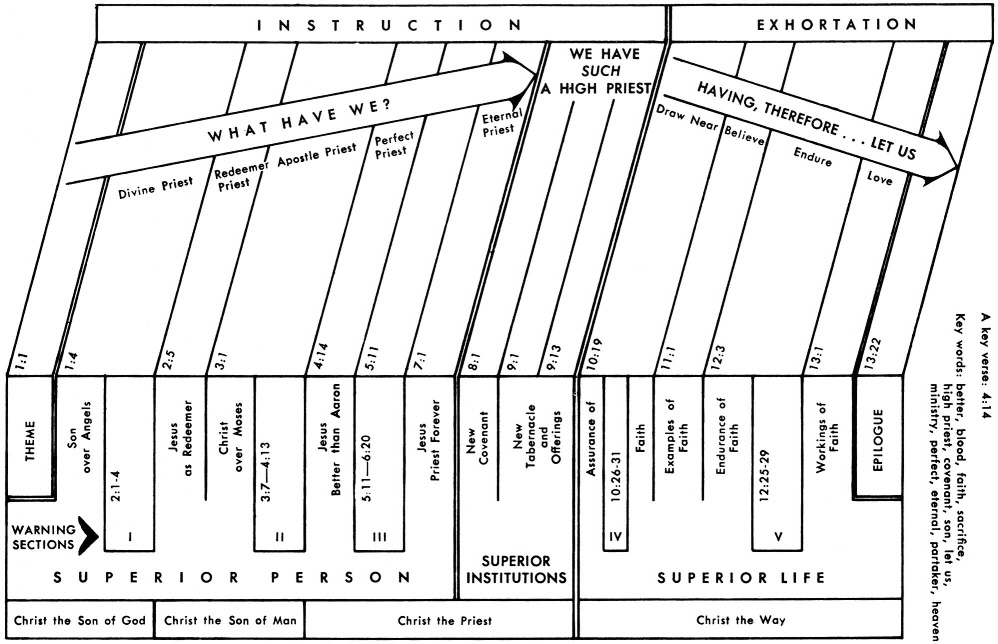
CONSIDER JESUS OUR GREAT HIGH PRIEST
Click chart to enlarge
Charts from Jensen's Survey of the NT - used by permission
Swindoll's Chart, Interesting Pictorial Chart of Hebrews, Another Chart



|
The Epistle |
||||
| INSTRUCTION Hebrews 1-10:18 |
EXHORTATION Hebrews 10:19-13:25 |
|||
| REVELATION | RESPONSE | |||
| PRECEPTS | PRACTICE | |||
| DOCTRINE | DUTY | |||
| Superior Person of Christ Hebrews 1:1-4:13 |
Superior Priest in Christ Hebrews 4:14-10:18 |
Superior Life In Christ Hebrews 10:19-13:25 |
||
| BETTER THAN PROPHETS, ANGELS MOSES Hebrews 1:1-4:13 |
BETTER THAN AARON'S PRIESTHOOD Heb 4:14-7:28 |
BETTER THAN THE OLD COVENANT Heb 8:1-13 |
BETTER THAN ANIMAL SACRIFICES Heb 9:1-10:18 |
BETTER LIFE IN CHRIST THAN IN ADAM! |
| MAJESTY OF CHRIST |
MINISTRY OF CHRIST |
MINISTERS FOR CHRIST |
||
|
DATE WRITTEN: |
||||

See ESV Study Bible "Introduction to Hebrews"
(See also MacArthur's Introduction to Hebrews)
Borrow Ryrie Study Bible
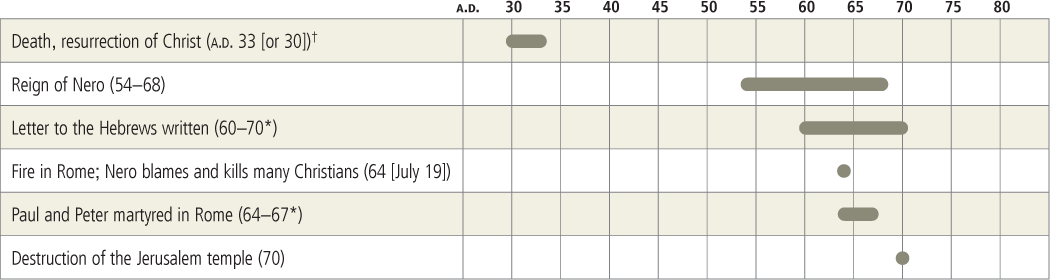
Timeline of Hebrews - ESV Study Bible
Hebrews 4:15 For we do not have a high priest who cannot * sympathize with our weaknesses, but One who has been tempted in all things as we are, yet without sin (NASB: Lockman)
Greek: ou gar echomen (1PPAI) archierea me dunamenon (PPPMSA) sumpathesai (AAN) tais astheneiais emon, pepeirasmenon (RPPMSA) de kata panta kath' omoioteta choris amartias.
BGT οὐ γὰρ ἔχομεν ἀρχιερέα μὴ δυνάμενον συμπαθῆσαι ταῖς ἀσθενείαις ἡμῶν, πεπειρασμένον δὲ κατὰ πάντα καθ᾽ ὁμοιότητα χωρὶς ἁμαρτίας.
Amplified: For we do not have a High Priest Who is unable to understand and sympathize and have a shared feeling with our weaknesses and infirmities and liability to the assaults of temptation, but One Who has been tempted in every respect as we are, yet without sinning (Amplified Bible - Lockman)
Barclay: For we have not a high priest who is such that he cannot feel with us in our weaknesses; but one who has gone through every temptation, just in the same way as we have, and who is without sin. (Westminster Press)
KJV: For we have not an high priest which cannot be touched with the feeling of our infirmities; but was in all points tempted like as we are, yet without sin.
NKJ For we do not have a High Priest who cannot sympathize with our weaknesses, but was in all points tempted as we are, yet without sin.
NLT: This High Priest of ours understands our weaknesses, for he faced all of the same testings we do, yet he did not sin (NLT - Tyndale House)
Phillips: For we have no superhuman High Priest to whom our weaknesses are unintelligible - he himself has shared fully in all our experience of temptation, except that he never sinned. (Phillips: Touchstone)
Wuest: For we do not have a High Priest who is not able to enter experientially into a fellow feeling with our infirmities, but one who has been tempted and tested in all points like as we are, without sin.
Young's Literal: For we do not have a high priest who cannot sympathize with our weaknesses, but One who has been tempted in all things as we are, yet without sin.
NET For we do not have a high priest incapable of sympathizing with our weaknesses, but one who has been tempted in every way just as we are, yet without sin.
CSB For we do not have a high priest who is unable to sympathize with our weaknesses, but One who has been tested in every way as we are, yet without sin.
ESV For we do not have a high priest who is unable to sympathize with our weaknesses, but one who in every respect has been tempted as we are, yet without sin.
NIV For we do not have a high priest who is unable to sympathize with our weaknesses, but we have one who has been tempted in every way, just as we are--yet was without sin.
MIT For we do not have a high priest incapable of empathizing with our weaknesses. He was tested in every respect comparably as we are, yet he remained sinless.
NJB For the high priest we have is not incapable of feeling our weaknesses with us, but has been put to the test in exactly the same way as ourselves, apart from sin.
NRS For we do not have a high priest who is unable to sympathize with our weaknesses, but we have one who in every respect has been tested as we are, yet without sin.
RSV For we have not a high priest who is unable to sympathize with our weaknesses, but one who in every respect has been tempted as we are, yet without sin.
NAB For we do not have a high priest who is unable to sympathize with our weaknesses, but one who has similarly been tested in every way, yet without sin.
GWN We have a chief priest who is able to sympathize with our weaknesses. He was tempted in every way that we are, but he didn't sin.
BBE For we have not a high priest who is not able to be touched by the feelings of our feeble flesh; but we have one who has been tested in all points as we ourselves are tested, but without sin.
ASV For we have not a high priest that cannot be touched with the feeling of our infirmities; but one that hath been in all points tempted like as we are, yet without sin.
DBY For we have not a high priest not able to sympathise with our infirmities, but tempted in all things in like manner, sin apart.
- We do not have - Hebrews 5:2; Exodus 23:9; Isaiah 53:4,5; Hosea 11:8; Matthew 8:16,17; 12:20; Philippians 2:7,8
- Has been tempted - Hebrews 2:17,18; Luke 4:2; 22:28
- Yet without sin - Hebrews 7:26; Isaiah 53:9; John 8:46; 2Co 5:21; 1Pe 2:22; 1Jn 3:5
- Hebrews 4 Resources
Related Passages:
1 Corinthians 10:13+ No temptation (peirasmos) has overtaken you but such as is common to man; and God is faithful, who will not allow you to be tempted (peirazo) beyond what you are able, but with the temptation (peirasmos) will provide the way (NOTE: NOT "A" WAY, BUT THE WAY - KEEP YOUR EYES OPEN FOR IT!) of escape also, so that you will be able to endure it.
Isaiah 53:9 His grave was assigned with wicked men, Yet He was with a rich man in His death, Because He had done no violence, Nor was there any deceit in His mouth.
1 Peter 2:22+ WHO COMMITTED NO SIN, NOR WAS ANY DECEIT FOUND IN HIS MOUTH
John 8:46+ “Which one of you convicts Me of sin? If I speak truth, why do you not believe Me?
2 Corinthians 5:21+ He made Him who knew no sin to be sin on our behalf, so that we might become the righteousness of God in Him.
1 John 3:5+ You know that He appeared in order to take away sins; and in Him there is no sin.

Jesus Superior to Earthly Priests
OUR SYMPATHETIC
GREAT HIGH PRIEST
For (gar) is a term of explanation. He has just exhorted us to hold fast (Heb 4:14+) and now explains why we can and should hold fast to our confession of Jesus as our Messiah and Redeemer.
We do not (ou - absolute negation) have (present tense) a high priest (archiereus) who cannot (me = negates + dunamai - present tense = continually available ability to) sympathize (sumpatheo) with our weaknesses (astheneia) - Literally "For we do not have a high priest not able to sympathize with our weaknesses" Not...cannot (not able) is a double negative. At first glance it sounds clumsy: “We do not have a high priest not able to sympathize.” But the double negative is a rhetorical device in Greek (and in English at times). It strengthens the positive idea and thus highlights Jesus' ability as our Great High Priest. The point the writer wants to emphasize is that Jesus truly can sympathize. The double negative is stronger, more emphatic and eliminates the possibility that Jesus is aloof or unsympathetic. Thus the writer reassures his wavering readers to “Dismiss the thought entirely—our High Priest is absolutely sympathetic.” He is saying in fact that despite His exalted (heavenly) position and despite the fact that we don't see Him (as the reader could see the Jewish high priests in the Temple most likely at the time of this writing) does not negate His ability to function as a priest today on our behalf.
Sympathize (sumpatheo) literally means Jesus is continually able to suffer with us or to share in our experience of suffering. This is stronger than simply saying He is feeling sorry for us. The picture is of Jesus entering into our pain with understanding and compassion. Jesus’ sympathy is experiential: He knows temptation and suffering, not just in theory but through personal experience. His sympathy is compassionate: He responds not with condemnation but with tender mercy toward those who seek Him. His sympathy is practical: It motivates us to “draw near with confidence to the throne of grace” (Hebrews 4:16), assured that He welcomes us (despite our failings and fallings!) Think of a physician who has suffered the same disease you have which makes his treatment not cold and clinical but warm, understanding, and with a sense of urgency born from having been there himself. That is what sumpatheo conveys about Christ. To say it another way Jesus doesn’t merely observe our weaknesses from heaven but deeply enters into them with us, having experienced the full weight of human temptation and suffering Himself — yet remaining sinless.
In classical literature, sumpatheo could apply to objects e.g., the strings of a lyre that vibrate together sympathetically. This picture implies resonance — when one thing is moved, the other resonates in response. What a great picture of the sympathy of our Savior with sinners! Christ "resonates" with our human experience—like a lyre string vibrating in harmony when another is struck. He doesn’t just “feel sorry for us”; He enters into our condition, feels it as His own, and responds with compassion that flows from His having lived the reality of suffering and temptation. Hallelujah! What a Savior! Hallelujah! What a Friend!
Our sympathetic High Priest is a theme begun in chapter 2 where the author states "Therefore, He (Jesus) had to be made like His brethren in all things, that He might become a merciful and faithful high priest in things pertaining to God, to make propitiation for the sins of the people. For (EXPLAINS HOW HE IS MERCIFUL AND FAITHFUL) since He Himself was tempted in that which He has suffered, He is able to come to the aid (boetheo - picture of one in need crying out for help) of those who are tempted (present tense = continually, passive voice = continually being - by outside forces - the world, the flesh and the devil) )." (Hebrews 2:17-18+).
In Hebrews 5 he writes that our High Priest Jesus "can deal gently (metriopatheo from the adverb métrios = moderately, and páthos = passion - literally moderate in one's passions toward another) with the ignorant and misguided, since He Himself also is beset with weakness (Hebrews 5:2+) Jesus is able to experience pain jointly with us. The exalted High Priest suffers together with the weaknesses of the those who are being tested and brings active help!
Phillip E Hughes on our sympathetic High Priest - The Lord you serve, the Savior to whom you look, is not aloof from your trials, but feels them with intimate acquaintance. He is not disinterested or cold to what you are going through; he came to this earth and took up our human nature precisely so that he might now be able to have a fellow feeling with us. Therefore, he is eminently able to represent you before the throne of his heavenly Father, pleading your cause, securing your place, and procuring the spiritual resources you need. (Reformed Expository Commentary)
With our weaknesses (astheneia) - Jesus had "weaknesses" common to our human nature (hunger, thirst, weariness, etc.). In fact, Satan used his strongest weapons against these weaknesses, but utterly failed in every attempt to stumble our Savior. Jesus lived and walked about in a world of sin and yet remained undefiled which enabled Peter to write that we were redeemed "with precious blood, as of a lamb unblemished and spotless, the blood of Christ." (1Pe 1:19+) These grand truths regarding Jesus' sinlessness even though sorely tempted are the grounds of our sure hope and His steadfast sympathy regarding our weaknesses.
Later the author reiterates that Jesus "is able (has the inherent power) to save forever those who draw near to God through (this preposition pictures the entree provided by Jesus as High Priest - cf Ro 5:2+) Him, since He always lives to make intercession for them (what an encouraging truth that He is continually interceding for us - see note on same truth in Romans 8:34+). For it was fitting that we should have such a high priest, holy, innocent, undefiled, separated from sinners and exalted above the heavens. (Hebrews 7:25+; He 7:26+)
Wuest on weaknesses - The infirmities here are not sufferings but weaknesses, moral and physical, that predispose one to sin, the weaknesses which undermine our resistance to temptation and make it difficult for us to keep from sinning. He was tempted "like as we are." On this last, Expositor's has a valuable note: "The writer wishes to preclude the common fancy that there was some peculiarity in Jesus which made His temptation wholly different from ours, that He was a mailed champion exposed to toy arrows. On the contrary, He has felt in His own consciousness, the difficulty of being righteous in this world; has felt pressing upon Himself the reasons and inducements that incline men to choose sin that they may escape suffering and death; in every part of His human constitution has known the pain and conflict with which alone temptation can be overcome; has been so tempted that had He sinned, He would have had a thousandfold better excuse than ever man had. Even though His divinity may have ensured His triumph, His temptation was true and could only be overcome by means that are open to all. The one difference between our temptations and those of Jesus is that His were without sin." (Hebrews Commentary)
While you are entreating the Lord three times to take away
the thorn in the flesh He is sympathizing with you.
Spurgeon on weaknesses - Jesus is touched with the feeling of your infirmities and mine. He is not only touched with the feeling of the heroic endurance of the martyrs, but He sympathizes with those of you who are no heroes, but can only plead, “the spirit is willing, but the flesh is weak” (Matt 26:41+). While you are entreating the Lord three times to take away the thorn in the flesh He is sympathizing with you. Is it not well that it does not say, touched with the feeling of our patience, our self-denial, our valor? But “with our weaknesses”; that is, our littleness, the points in which we are not strong or happy. Our pain, our depression, our trembling, our sensitiveness; He is touched with these, though He does not fall into the sin that too often comes of them.
John MacArthur adds that "Weaknesses does not refer directly to sin, but to feebleness or infirmity. It refers to all the natural limitations of humanity, which, however, include liability to sin. Jesus knew firsthand the drive of human nature toward sin. His humanity was His battleground. It is here that Jesus faced and fought sin. He was victorious, but not without the most intense temptation, grief, and anguish. (See Hebrews Commentary - Page 113)
Scottish Psalter
With sympathetic feelings touched,
He knows our feeble frame;
He knows what sore temptations are,
for He has felt the same.
But though He felt temptation’s pow’r,
unconquered He remained;
Nor, ‘midst the frailty of our frame,
by sin was ever stained.
But (term of contrast) What is he contrasting? He is saying yes Jesus is the perfect High Priest, but He is also the High Priest who is able to understand. This strong contrast emphasizes that instead of being detached, Jesus is deeply involved in the struggles in our lives! Do you believe that is true dearly beloved of God?
One Who has been tempted (peirazo) in all things as we are, yet without (choris) sin (hamartia) - Has been tempted is perfect tense signifying Jesus' temptation has been completed in the past (on earth as a Man), and that His temptation has ongoing results in the present. In short, it really happened and its effects endure. The point is that Jesus in the present at the right hand of the throne of God has full experiential understanding of our human trials and weaknesses. He doesn’t just remember being tempted. To the contrary, tempted in the perfect tense highlights that Jesus continues to be the One Who knows by experience what it is to face temptation. This truth assures believers that Christ’s ability to sympathize is not a remote relic but an ongoing reality! His passing of His past testing gives qualifies Him to be the perfect, permanent High Priest for us before God.
He was fully Man, yet fully God; fully tempted, yet without sin.
In every way like us, yet utterly unlike us in holiness.
Notice the phrase in all things as we are which means in every respect. All things means no exceptions. Every temptation we know, He knows—yet He never fell. That’s why His sympathy is real. As speaks of likeness, emphasizing correspondence but not complete identity. Jesus was indeed fully Man, yet He was also fully God—something believers will never be. He shared in the full reality of human temptation, not in a token way but in genuine likeness to us. He entered the whole range of human trials, weaknesses, and testings, just as we do (cf. Heb 2:17–18+).
Fully Man, yet fully God,
Fully tempted, yet without flaw.
Like us in trials, yet pure within,
Our Priest Who conquered every sin.
Yet without (choris) sin (hamartia) marks a decisive contrast. While Jesus was fully tempted as we are, He was completely free from sin. He had no sinful nature (unlike fallen humanity), no sinful thought, word, or deed and no failure in the face of temptation. His likeness to us is true humanity, but with the crucial difference of sinlessness. Because of this truth He can express sympathy without compromise. Because He faced the full reality of temptation, He can sympathize with our weakness. His sinlessness is preserved and thus because He never sinned, He remains the perfect High Priest Who offered the once for all time spotless sacrifice. In short, Jesus' sinlessness doesn’t distance Him from us, but instead qualifies Him uniquely to help us.
🙏 THOUGHT - Let these truths continually comfort your soul—Jesus’ triumph over temptation is not past history—it is our present help, for He still ever intercedes as our sympathetic, faithful High Priest (Heb 7:25+). Indeed, "God is our refuge and strength, A very present help in trouble." (Ps 46:1+). The Hebrew is literally “a help found exceedingly” which emphasizes immediacy and availability—Jesus is not distant, but near, ready, and fully sufficient when His children are in distress! Thank You Jesus. Amen.
Spurgeon adds "How this ought to draw us to the Savior—that He was made like unto ourselves; that He knows our temptations by a practical experience of them; and though He was without sin, yet the same sins that are put before us by Satan were also set before Him."
Exalted now at God’s right hand,
Our Priest and Savior there does stand;
He intercedes with mercy sure,
And grace abounds forevermore.
Jesus understands temptation as Luke reminds us recording that "for forty days, being tempted by the devil. And He ate nothing during those days; and when they had ended, He became hungry." (Luke 4:2+)
Jesus addressing His disciples who had been with Him for 3 years declaring "And you are those who have stood by Me in My trials (peirasmos - temptations - the word describes a test to learn the nature or character of something) (Luke 22:28+)
Spurgeon on Jesus' temptation - Our Lord could never have fallen the victim of temptation, but through life He was the object of it. He could never have been so tempted as that the sin of a temptation could spot his soul. Far from it. Yet remember that in the wilderness He was tempted to unbelief. The evil one said, “If you are the Son of God” (Luke 4:3+). Most of us know how he can hiss that “if” into our ear. Upon our Lord that “if” fell painfully but harmlessly. Then came the temptation to help Himself and anticipate the providence of God by selfish action: “Order that these stones become bread” (Matt 4:3+). We, too, have had this rash act suggested to us. The tempter has said, “You could get out of your difficulties by doing a wrong thing—do it. It is not a very wrong thing either; indeed, it is questionable whether it might not be justifiable under the circumstances. In vain will you wait for the Lord; put out your own hand and provide for yourself. The way of faith in God is slow, and you are in pressing need.” Our Lord came just there. When no bread in the house is made the background of a great temptation, remember that our Lord has undergone the counterpart of that temptation. Next, the Lord Jesus was tempted to presumption. Set on the pinnacle of the temple, He heard a voice saying, “If you are the Son of God, throw yourself down from here, for it is written, ‘He will command his angels concerning you, to protect you” (Luke 4:9–10+). Are you haunted by a similar suggestion to presume? Is it suggested that you quit your old standing and try the new notions, or that you speculate in business, or that you profess to understand what God has never taught you? Resist earnestly. Ah, dear friends! Your Lord knows all about this, and as He escaped that temptation, you shall do the same. Then the fiend—how often I have wondered at him!—dared to say to Christ, “I will give to you all these things, if you will fall down and worship me” (Matt 4:9+). Picture the Lord of angels, with all the royalty of heaven shining on His brow, and the black fiend daring to say, “Fall down and worship me.” It may be that a like temptation is coming home to you: live for gold, live for fame, live for pleasure: in some form or other, worship the devil and renounce faith in God. But even though the fiend could fulfill his promise, and all the world should be ours, we are bound to resist unto the death, and we are encouraged to do so by the fact that we are upon the old ground where our Redeemer fought and conquered. He can enter into the distress that this temptation is causing you; for He has felt the same. (See the Tenderness of Jesus. And here is the original sermon)
Charles Ryrie on in all things - Not that Christ experienced every temptation man does, but rather that He was tempted in all areas in which man is tempted (the lust of the flesh, the lust of the eyes, and the pride of life, 1Jn 2:16), and with particular temptations specially suited to Him. This testing was possible only because He took the likeness of sinful flesh (Ro. 8:3), for had there not been an incarnation, Jesus could not have been tempted (cf. James 1:13+). Yet our Lord was distinct from all other men in that He was without sin; i.e., He possessed no sin nature as we do. Because He endured and successfully passed His tests, He can now offer us mercy and grace to help in time of need, for He knows what we are going through. (Borrow Ryrie Study Bible)
J B Phillips has an interesting note in his book Ring of Truth: A Translator's Testimony - The record of the behaviour of Jesus on the way to the cross and of the crucifixion itself is almost unbearable, chiefly because it is so intensely human. If, as I believe, this was indeed God focused in a human being, we can see for ourselves that here is no play acting; this is the real thing. There are no supernatural advantages for this man. No celestial rescue party delivered Him from the power of evil men, and His agony was not mitigated by any superhuman anaesthetic. We can only guess what frightful anguish of mind and spirit wrung from him the terrible words 'My God, my God, why hast thou forsaken me?' But the cry 'It is finished!' cannot be one of despair. It does not even mean 'It is all over.' It means 'It has been completed'—and the terrifying task of doing God's will to the bitter end had been fully and finally accomplished." [SEE page 68)
John Calvin said that - Christ was both a Sacrifice and a Priest. No other satisfaction for sin could be found, and no one else was worthy to offer the only-begotten Son of God. Christ now fills the office of Priest so the Father will look favorably upon us and welcome us into His family.
C H Spurgeon - This does not make Christ less tender, but more so. Anything that is sinful hardens, and inasmuch as He was without sin, He was without the hardening influence that sin would bring to bear on a man. Temptation does not necessitate sinning. It did not in the case of our Lord, for He “has been tempted in all things in the same way, without sin.” And that which was possible to Him, in His life on earth, can also be made possible to you by Him with whom all things are possible. A man need not fall into avarice because he is tempted to covetousness. A man need not become unchaste because he is tempted to lewdness. Remember the case of Joseph; he was nonetheless pure because he was so foully tempted. A man need not be false to his convictions because someone tries to bribe him to be so; rather, he may prove the honesty and uprightness of his heart by recoiling from the very touch of the briber. He who is tempted need not therefore sin, for that God who permits the temptation to come will, with the temptation, make a way of escape for him that he may be able to bear it (1Cor 10:13+). A man may walk in the midst of a furnace of temptation, yet not even the smell of fire shall be upon him (Dan 3:27). He may be “protected by the power of God through faith” unto salvation (1Pet 1:5), and kept as well amid the most furious temptations as if he lived in a region that was most helpful to his graces. A child of God may be specially, peculiarly, singularly, emphatically tempted, and yet he may be preserved from sin. (Our Compassionate High Priest)
High priest (749) archiereus from arche = first in a series, the leader or ruler, idea of rank or degree + hiereus = priest - hieros is that which is determined, filled or consecrated by divine power) refers to the priest that was chief over all the other priests in Israel. This office was established by God through Moses instructions in the Pentateuch. The high priest functioned as the mediator between Jehovah and Israel (cp new order under the New Covenant - 1Ti 2:5) performing sacrifices and rituals like other priests, but in addition acting to expiate the sins of the nation on the annual Day of Atonement (another source) (Read Lev 16:1-34)
ARCHIEREUS IN HEBREWS - Heb. 2:17; Heb. 3:1; Heb. 4:14; Heb. 4:15; Heb. 5:1; Heb. 5:5; Heb. 5:10; Heb. 6:20; Heb. 7:26; Heb. 7:27; Heb. 7:28; Heb. 8:1; Heb. 8:3; Heb. 9:7; Heb. 9:11; Heb. 9:25; Heb. 13:11
Archiereus was used of pagan idolatrous cults (Zeus, Jupiter, the Emperor cults, etc, cp Acts 14:13 = hiereus). Herodotus uses archiereus of Egyptian high priests of high rank after the king. "Plato used it in connection with his ideal state (Laws 12, 947a); the archiereus was to stand annually at the head of all the officiating priests… From Polybius (3rd–2nd cents. B.C.) on, archiereus was translated by the Latin pontifex. " (NIDNTT)
Cannot (me = negative + dunamai)(1410) (dunamai) speaks of one who has power by virtue of His inherent ability and resources. Thus He is able. The present tense describes His continually available power and ability! Dunamai speaks of capacity or ability - be able, be capable of, can, have power to. To have power whether by virtue of one’s own ability and resources (Ro15:14) In short, dunamai means to be able to do something (Mk 9:22; Lk 12:26; 2Co 13:8)
DUNAMAI IN HEBREWS - Heb. 2:18; Heb. 3:19; Heb. 4:15; Heb. 5:2; Heb. 5:7; Heb. 7:25; Heb. 9:9; Heb. 10:1; Heb. 10:11;
Sympathize (4834) (sumpatheo from sun = with pictures an intimate connection with + pascho = suffer; English = "sympathy") is the capacity for sharing in the feelings or interests of another—a sense of affinity, association, or relationship in which whatever affects one similarly affects the other, producing unity or harmony in action or effect. It means to experience another’s pain or emotion, to have compassion, to feel for, or to have fellow-feeling. To experience pain or feelings with someone, have compassion, sympathize, feel for, have fellow-feeling. It speaks of tender concern and the ability to enter into another’s joys or sorrows. Liddell-Scott says it means to suffer with, be affected like another. This word group (sumpatheo, sumpathes = compassionate in 1Pe 3:8+) often suggests a tender concern can also imply a power to enter into another’s emotional experience of any sort.
Sympathy means to share in another’s experience—
to feel with them, not just for them.
It expresses the feeling of what others feel so that one can respond with sensitivity to the need. People who have true "sympathy" generally do not say, "I know how you feel." Because since they know how you feel, they also know how unhelpful it is to hear someone say, "I know how you feel." True sympathy is a fairly quiet, time-intensive, presence-intensive way of being.
In Philo of Alexandria (a 1st century Jewish philosopher): sympatheō described the bond of shared feeling among people and even between God and man. In Stoic philosophy, it could mean the interconnectedness of the cosmos — when one part suffers, another “sympathizes.” So the term carried weight in the Greco-Roman world: not detached pity, but deep connection that unites the one who feels with the one who suffers.
The only other NT use of the verb sympatheo is also in Hebrews (no uses in the Septuagint)…
Hebrews 10:34+ For you showed sympathy to the prisoners and accepted joyfully the seizure of your property, knowing that you have for yourselves a better possession and a lasting one.
Meaning of English word Sympathy (As you read the definition ponder Jesus' ability and desire to sympathize with us as His brethren) - Fellow feeling; the quality of being affected by the affection of another, with feelings correspondent in kind, if not in degree. We feel sympathy for another when we see him in distress, or when we are informed of his distresses. This sympathy is a correspondent feeling of pain or regret. In medicine, a correspondence of various parts of the body in similar sensations or affections; or an affection of the whole body or some part of it, in consequence of an injury or disease of another part, or of a local affection. Thus a contusion on the head will produce nausea and vomiting. To sympathize is to have a common feeling. To feel in consequence of what another feels; to be affected by feelings similar to those of another, in consequence of knowing the person to be thus affected. We sympathize with our friends in distress; we feel some pain when we see them pained, or when we are informed of their distresses, even at a distance. (Webster's 1828)
Weaknesses (769) (astheneia from a = without + sthénos = strength, bodily vigor) means without strength and figuratively describes a state of incapacity to do or experience something.
Friberg - as a state of incapacity weakness, impotence; literally, as bodily ailment sickness, disease, infirmity (Lk 5.15); as physical inability weakness (Heb 11.34), opposite du,namij (might, strength); figuratively, as a quality of character weakness, lack of insight (Ro 6.19); timidity, feeling of inadequacy (1Co 2.3) (Borrow Analytical Lexicon of the Greek New Testament )
ASTHENEIA - 29V - Matt. 8:17; Lk. 5:15; Lk. 8:2; Lk. 13:11; Lk. 13:12; Jn. 5:5; Jn. 11:4; Acts 28:9; Rom. 6:19; Rom. 8:26; 1 Co. 2:3; 1 Co. 15:43; 2 Co. 11:30; 2 Co. 12:5; 2 Co. 12:9; 2 Co. 12:10; 2 Co. 13:4; Gal. 4:13; 1 Tim. 5:23; Heb. 4:15; Heb. 5:2; Heb. 7:28; Heb. 11:34
ASTHENEIA IN HEBREWS - Heb. 4:15; Heb. 5:2; Heb. 7:28; Heb. 11:34
Tempted (3985) (peirazo from the noun peira = test from peíro = perforate, pierce through to test durability of things) is a morally neutral word simply meaning “to test”. Whether the test is for a good (as it proved to be in Heb 11:17+) or evil (Mt 4:1 "Then Jesus was led up by the Spirit into the wilderness to be tempted by the devil") depends on the intent of the one giving the test and also on the response of the one tested. (See word study of another word meaning to test or prove = dokimazo) Peirazo can convey both the sense of solicitation to evil and the sense of trials that refine.
The trials may come from God or under His permissive will from Satan, or may be the result of our own wrong doing. The solicitations to do evil come from the world, the evil nature (the "flesh"), or the Devil. When the Scriptural context clearly indicates the testing is an enticement to evil, the word is most frequently translated by a form of the English tempt, which carries that negative connotation and this NEVER refers to a test from God.
Peirazo nuances depending on the context: (1) trials with a beneficial purpose and effect, (2) divinely permitted or sent, (3) with a good or neutral significance, (4) of a varied character, (5) definitely designed to lead to wrong doing, temptation, (6) of men trying or challenging God.
PEIRAZO - 38x in 34v - did(1), put(1), put to the test(2), tempt(2), tempted(13), tempter(2), test(6), tested(2), testing(7), tried(2), trying(2). Matt. 4:1; Matt. 4:3; Matt. 16:1; Matt. 19:3; Matt. 22:18; Matt. 22:35; Mk. 1:13; Mk. 8:11; Mk. 10:2; Mk. 12:15; Lk. 4:2; Lk. 11:16; Lk. 20:23; Jn. 6:6; Jn. 8:6; Acts 5:9; Acts 15:10; Acts 16:7; Acts 24:6; 1 Co. 7:5; 1 Co. 10:9; 1 Co. 10:13; 2 Co. 13:5; Gal. 6:1; 1 Thess. 3:5; Heb. 2:18; Heb. 3:9; Heb. 4:15; Heb. 11:17; Heb. 11:37; Jas. 1:13; Jas. 1:14; Rev. 2:2; Rev. 2:10; Rev. 3:10
PEIRAZO IN HEBREWS - Heb. 2:18; Heb. 3:9; Heb. 4:15; Heb. 11:17; Heb. 11:37
Click for Multiple Quotes Related to Temptation—Avoiding and Resisting, Blessings of, Certainty of, And Satan
Without (apart) (5565) choris related to chora = land from choros = field or place usually where cattle range and feed or chasma = thru idea of empty expanse) as an adverb means apart, separately, by itself (Jn 20:7). Choris as a preposition means (1) separately from, without, which is the main sense in the NT (Mt. 13:34; Mk 4:34; Lk 6:49; Jn 1:3; Ro 3:21, 28; 4:6; 7:8, 9; 10:14; 1Cor 4:8; 11:11; Eph 2:12; Phil. 2:14; 1Ti. 2:8; 5:21; Philemon 1:14; Heb 4:15, 7:7, 20, 21; 9:7, 18, 22, 28; 10:28; 11:6, 40; 12:8, 14; Jas 2:20, 26). (2) Besides, exclusive of (Mt 14:21; 15:38; 2Cor 11:28)
Sin (266) (hamartia) originally conveyed the idea of missing the mark as when hunting with a bow and arrow and then missing or falling short of any goal, standard, or purpose. See literal use of the similar Hebrew word (Jdg 20:16+).
Friberg on hamartia - sin; (1) of an act, a departure from doing what is right, equivalent to sin, wrongdoing (1Jn 5.17); (2) as the moral consequence of having done something wrong - sin, guilt ( Acts 3.19; 1J 1.7); (3) as the nature of wrongdoing viewed as the rejection of God by self-assertive human beings - sin, evil ( Ro 5.12, 13; cf. 1.21); (4) especially in Johannine usage as a moral condition of human beings in revolt against God - sin, being evil, sinfulness (Jn 9.34; 15.24); (5) especially in Pauline usage as an abstract moral principle or force personified as evil in character sin, evil (Ro 6.12); (6) especially in Hebrews as a deceiving power personified as leading human beings to guilt and destruction (Heb 3.13; 12.1)
HAMARTIA IN HEBREWS - Heb. 1:3; Heb. 2:17; Heb. 3:13; Heb. 4:15; Heb. 5:1; Heb. 5:3; Heb. 7:27; Heb. 8:12; Heb. 9:26; Heb. 9:28; Heb. 10:2; Heb. 10:3; Heb. 10:4; Heb. 10:6; Heb. 10:8; Heb. 10:11; Heb. 10:12; Heb. 10:17; Heb. 10:18; Heb. 10:26; Heb. 11:25; Heb. 12:1; Heb. 12:4; Heb. 13:11
Scottish Psalter
Though now ascended up on high,
He bends on earth a brother’s eye;
Partaker of the human name,
He knows the frailty of our frame.
Our fellow-suff’rer yet retains
A fellow-feeling of our pains;
And still remembers in the skies
His tears, his agonies, and cries.
In ev’ry pang that tends the heart,
The Man of sorrows had a part;
He sympathizes with our grief,
And to the suff’rer sends relief.
C H Spurgeon Our Compassionate High Priest (see full sermon) -
Often, when we are trying to do good to others, we get more good ourselves. When I was here one day this week, seeing friends who came to join the church, there came among the rest a very diffident, tenderhearted woman, who said many sweet things to me about her Lord, though she did not think that they were any good, I know. She was afraid that I should not have patience with her and her poor talk; but she said one thing which I specially remember: "I have to-day put four things together, from which I have derived a great deal of comfort," she told me. "And what are they, my sister?" I asked. "Well," she said, "they are those four classes — 'the unthankful and the evil, the ignorant and those that are out of the way.' Jesus 'is kind unto the unthankful and to the evil,' and 'He can have compassion on the ignorant, and on them that are out of the way,' and I think that I can get in through those four descriptions. Though I am a great sinner, I believe that He will be kind to me, and have compassion upon me." I stored that up; for I thought that one of these days I might want it myself; I tell it to you, for if you do not want it now, you may need it one of these days; you may yet have to think that you have been unthankful and evil, ignorant and out of the way, and it will give you comfort to remember that our Lord Jesus is kind to the unthankful and to the evil, and that He "can have compassion on the ignorant, and on them that are out of the way."
I. THE SORT OF SINNERS FOR WHOM OUR HIGH PRIEST IS CONCERNED.
1. The people who claim Christ's aid are generally those who have a very low opinion of themselves. The proud and self-satisfied cannot know His love; but the poor and distressed may ever find in Him comfort and joy, because of His nature, and by means of His intercession.
2. As with the high priest of old, amongst those who come to our High Priest are many whose fear and distress arise from ignorance.
(1) There is a universal ignorance. As compared with the light of God, we are in the dim twilight. He that seeth best only seeth men as trees walking.
(2) But, in addition to the ignorance that is universal, there is also a comparative ignorance on the part of some; and because of this the compassion of Christ flows forth to them. There are, first, the recent converts — young people whose years are few, and who probably think that they know more than they do; but who, if they are wise, will recognise that their senses have not been fully exercised to discern between good and evil. Others there are who are ignorant because of their little opportunity of getting instruction. Upon these our great High Priest has compassion, and often with their slight knowledge they show more of the fruits of the Spirit than some of us produce even with our inure abundant light. There are many that are of a very feeble mind. They could never explain how they were saved; but they are saved.
(3) There is also a sinful ignorance. Now comes another description of the sort of sinners for whom our High Priest is concerned. There are many whose fears arise from being out of the way. The Lord "can have compassion on the ignorant, and on them that are out of the way." I remember that, when I felt myself to be a very great sinner, these words were very, very much blessed to me. I read them, "and on them that are out of the way"; and I knew that I was an out-of-the-way sinner. I was then, and I am afraid that I am now, somewhat like a lot out of the catalogue, an odd person who must go by himself. Very well; our High Priest can have compassion on those that are odd, and on those that are out of the way, on those who do not seem to be in the common run of people, but who must be dealt with individually, and by themselves. He can have compassion upon such.But now let us look at the more exact meaning of the text.
(1) To be out of the way is, in the case of all men, their natural state.
(2) In addition to that, men have gone out of their way by their own personal folly. We had enough original sin; but we have added to that another kind of originality in evil.
(3) Some are out of the way because of their seduction from the way by others. False teachers have taught them, and they have taken up with the error brought before them by a stronger mind than their own. In some cases persons of evil life have had a fascination over them.
(4) Many are out of the way because of their backslidings after grace has come to them.
(5) Others are out of the way because of their consciousness of special sin. Come to this compassionate High Priest, and trust your ease in His hands; they were pierced because of your sin.
II. THE SORT OF HIGH PRIEST WITH WHOM SINNERS HAVE TO DEAL.
1. He is One who can bear with ignorance, forgetfulness, and provocation.
2. He is One who can feel for grief, because He has felt the same.
3. He is One who lays Himself out tenderly to help such as come to Him.
4. He is One who never repelled a single person.
III. Now, I want to speak to those of you who are the people of God.
I want to remind you that there may be a blessing even in your weakness; and that this may be the more clearly seen we will look, in the third place, at the SORT OF INFIRMITY WHICH MAY BE SANCTIFIED AND MADE USEFUL. The high priest of old was compassed with infirmities, and this was part of his qualification. "Yes," says one, "but he was compassed with sinful infirmities; but our Lord Jesus had no sin." That is quite true, but remember that this does not make Christ less tender, but more so. Anything that is sinful hardens; and inasmuch as He was without sin, He was without the hardening influence that sin would bring to bear upon a man. He was all the more tender when compassed with infirmities, because sin was excluded from the list. We will not, then, reckon sin in any form as an infirmity likely to be turned to a great use, even though the grace of God abounds over the sin; but let me speak to some of you who wish to do good, and set forth some of the things which were sore to bear at the time, and yet have been rich in blessing since.
1. First think of our struggles in finding mercy. If you have not had a certain experience, you cannot so well help others who have; but if you were compassed with infirmity at your first coming to Christ, you may use that in helping others to come to Him.
2. Again, our grievous temptations may be infirmities which shall be largely used in our service. You cannot be unto others a helper unless you have been compassed with infirmities. Therefore accept the temptations which trouble you so much, as a part of your education to make you useful to others.
3. Our sickness may turn out to be in the same category.
4. Our trials, too, may thus be sanctified.
5. Our depressions may also tend to our fruitfulness. A heart bowed down with despair is a dreadful thing. "A wounded spirit who can bear?" But if you have never had such an experience you will not be worth a pin as a preacher. You cannot help others who are depressed unless you have been down in the depths yourself.
J C Philpot in Daily Portions (September 30) on Hebrews 4:15, 16
What heart can conceive or tongue recount the daily, hourly triumphs of the Lord Jesus Christ's all-conquering grace? We see scarcely a millionth part of what he, as a King on his throne, is daily doing; and yet we see enough to know that he ever lives at God's right hand, and lives to save and bless.
What a crowd of needy petitioners every moment surrounds his throne! What urgent needs and woes to answer; what cutting griefs and sorrows to assuage; what broken hearts to bind up; what wounded consciences to heal; what countless prayers to hear; what earnest petitions to grant; what stubborn foes to subdue; what guilty fears to quell! What grace, what kindness, what patience, what compassion, what mercy, what love, and yet what power and authority does this Almighty Sovereign display! No circumstance is too trifling; no petitioner too insignificant; no case too hard; no difficulty too great; no seeker too importunate; no beggar too ragged; no bankrupt too penniless; no debtor too insolvent, for him not to notice and not to relieve.
Sitting on his throne of grace, His all-seeing eye views all, His almighty hand grasps all, and His loving heart embraces all whom the Father gave Him by covenant, whom He Himself redeemed by His blood, and Whom the blessed Spirit has quickened into life by His invincible power. The hopeless, the helpless; the outcasts whom no man cares for; the tossed with tempest and not comforted; the ready to perish; the mourners in Zion; the bereaved widow; the wailing orphan; the sick in body, and still more sick in heart; the racked with hourly pain; the fevered consumptive; the wrestler with death's last struggle--O what crowds of pitiable objects surround his throne; and all needing a look from his eye, a word from his lips, a smile from his face, a touch from his hand! O could we but see what his grace is, what his grace has, what his grace does; and could we but feel more what it is doing in and for ourselves, we would have more exalted views of the reign of grace now exercised on high by Zion's enthroned King!
Tempted as we, yet free from sin,
In holiness He walked each day;
Now mercy flows from His Spirit within,
To help us when we lose our way.
What Jesus Didn't Do -1 Peter 2:23 - I once heard a skeptic say that if Jesus really was the Son of God, His sufferings must have been easier to bear. This comment caused me to re-examine the Gospels. While reviewing the incredible things Jesus did and said to accomplish our great salvation, I also noted a number of things Jesus didn't do that are equally vital to our salvation:
Jesus didn't demand His own will (Matthew 26:39). He didn't call down legions of angels to rescue Him (Matthew 26:53). He didn't defend Himself or threaten His accusers (Mt 27:12, 13, 14). He didn't save Himself (Mark 15:31). He didn't come down from the cross (Mark 15:32). He didn't stop loving and saving sinners (Luke 23:43).
The fact that Jesus could have done these things intensified His agony and increased the temptation to use His power for His own advantage. But He didn't. Instead, He used His power for our benefit! This is described in Hebrews 4:15, 16. Jesus suffered temptation the same as we do—except that He didn't sin. So He can "sympathize with our weaknesses" (Hebrews 4:15). Therefore, we can approach His throne of grace boldly and obtain His "help in time of need" (Hebrews 4:16).
Whatever your need is today, Jesus wants you to come and make full use of this privilege. —Joanie Yoder (Our Daily Bread, Copyright RBC Ministries, Grand Rapids, MI. Reprinted by permission. All rights reserved)
Though Christ was tempted in all ways,
He did not sin in word or deed;
So now we can approach His throne
For grace to help in time of need.
—Sper
Every temptation is an occasion to trust God
The New Normal —Hebrews 4:15
A pastor, who was trained in trauma and grief counseling, commented that the greatest challenge for people who are hurting is often not the immediate heartache of the loss. Instead, the biggest problem is adjusting to the different kind of life that follows. What once was normal may never be normal again. So the challenge for those offering help is to assist the sufferers as they establish the “new normal.” It may be a new normal that no longer includes robust health, a treasured relationship, or a satisfying job. Or it may be living without a loved one who has been taken in death. The gravity of such losses forces us to live a different kind of life—no matter how unwelcome it may be.
When our “new normal” comes, it’s easy to think no one understands how we feel. But that isn’t true. Part of the reason Jesus came was to experience life among us, resulting in His present ministry: “For we do not have a High Priest who cannot sympathize with our weaknesses, but was in all points tempted as we are, yet without sin” (Heb. 4:15).
Our Savior lived a perfect life, yet He also knew the pains of a broken world. He endured sorrow; He suffered agony. And He stands ready to encourage us when the dark moments of life force us to embrace a new normal.
Father, thank You that in the darkest seasons of life, You will never abandon us. Guide us with Your never-failing presence through both the welcome and unwelcome changes of life. In Jesus’ name, amen.
In our desert of grief, Jesus can provide an oasis of hope.
TODAY IN THE WORD
But we have [a high priest] who has been tempted in every way, just as we are—yet was without sin. - Hebrews 4:15
A woman invited several guests to dinner. At the table, she asked her daughter to pray. “I don't know what to say,” the child complained. The mother encouraged her, “Just say what you hear Mommy say.” The girl bowed her head and prayed, “Dear Lord, why on earth did I invite all these people to dinner!” Every child looks for models of how to act and speak; unfortunately, not every model is a good one!
Fortunately, Jesus Himself provides the perfect model. Faced both with the excruciating suffering and death on the cross and the weight of providing satisfaction for the world's sin, Jesus declared, “My soul is overwhelmed with sorrow to the point of death” (v. 38; cf. Ps. 42:6). As a man, Jesus knew the fear of death and pain. But look now at His response. On three separate occasions, His words evoked the prayer He taught His disciples. Jesus practiced what He preached.
First, Jesus fell before God and prayed “My Father” (v. 39). He addressed God as Father; in fact, in Mark's version, Jesus uses the intimate word, “Abba” (Mark 14:36). Jesus knew God as Father and approached Him with His request.
Second, look at the request itself. Initially, Jesus asked that He might not have to go to the cross in order for the Father's purposes to be accomplished. But twice, Jesus emphasized obedience: “may your will be done” (vv. 39, 42; cf. Matt. 6:10). Ultimately trusting God as His loving Father, Jesus' human will obediently submitted to the divine will.
Third, upon finding His disciples sleeping rather than praying, He urged them, “watch and pray so that you will not fall into temptation” (v. 41; cf. Matt. 6:13). He knew the power of temptation; yet He also knew the source of resistance: prayer to the Father. Only then, after spending time in prayer with His Father did Jesus rise to face His betrayer and His death (vv. 45-46). What a perfect model of human trust in our heavenly Father.
TODAY ALONG THE WAY
It is one thing to confess trust in our heavenly Father, another to live it day to day. Take this prayer adapted from Ignatius of Loyola and live it out today: “O heavenly Father, when all is darkness and we feel our weakness and helplessness, give us the sense of Your presence, Your love, Your strength. Help us to have perfect trust in Your protecting love and strengthening power . . . for, living close to You, we shall see Your hand, Your purpose, Your will through all things. Amen.”
TODAY IN THE WORD
We have [a high priest] who has been tempted in every way, just as we are--yet was without sin. - Hebrews 4:15
C. S. Lewis made these insightful observations about temptation: ""No man knows how bad he is until he has tried very hard to be good. A silly idea is current that good people do not know what temptation means. That is an obvious lie. Only those who try to resist temptation know how strong it is....Christ, because He was the only Man who never yielded to temptation, is also the only Man who knows to the full what temptation means.""
The perfection of Jesus Christ, our great high priest, in the matter of temptation could be a source of despair and even fear for us, except for the wonderful teaching of Scripture that He sympathizes with us in our struggles. Instead of rejecting us and driving us from His presence because of our failures and imperfections, Jesus offers us His limitless power to defeat temptation.
This is good news for us, because Paul leaves no doubt that temptation is a universal experience. To combat the enemy's attacks, we have an advantage over earlier generations of believers. Twice Paul says the Israelites' failures in the wilderness were recorded for our warning and spiritual education.
Having a clear example put before us in the pages of Scripture is a definite advantage. Along with this is another blessing--the promise of God's faithfulness to us even when we are under assault on every side.
God's faithfulness in temptation takes two distinct forms. First, He limits the intensity of the temptation to keep it well within our ""resistance range."" It may not feel like this is true when Satan is attacking you in an area where you are especially vulnerable, but the promise of God's sovereignty stands nonetheless. God will never allow Satan to defeat you.
Second, God is faithful to install a ""door"" in the temptation so we can have a way out. The reason we don't escape more often is not that we are hopelessly trapped by some evil thought or desire, but that we aren't really looking for a way out. The door of escape is always there.
A faithful and merciful high priest who is ready to help us, a promise that temptation will not overwhelm us, and a door of escape--what more do we need to be victorious over temptation?
TODAY ALONG THE WAY From Timeless Insights magazine comes this helpful formula to help us defeat temptation in the days to come:
""We need hindsight to learn from our past so we don't forget God's faithfulness and repeat the same mistakes. We need insight that comes by saturating our hearts and minds with Scripture. And we need foresight to prepare for tomorrow's battles. This will help us anticipate and avoid situations and people that can lead us into temptation.""
The Tempted One. Jesus, the Son of God. This shows how truly human Jesus was. God cannot be tempted. He was tempted in "all points, like as we are" (Heb. 4:15). But just as highly musical ears feel more keenly painful discords, so much more must He, the pure and undefiled, have felt the force of this trial. The more intense our devotion to God the more intense will we feel the approach of sin.
Max Lucado - Our high priest is able to understand our weaknesses. When he lived on earth, he was tempted in every way that we are, but he did not sin. HEBREWS 4:15
Read how J. B. Phillips translates Hebrews 4:15:
For we have no superhuman High Priest to whom our weaknesses are unintelligible—he himself has shared fully in all our experience of temptation, except that he never sinned.
It’s as if he knows that we will say to God … : “God, it’s easy for you up there. You don’t know how hard it is from down here.” So he boldly proclaims Jesus’ ability to understand. Look at the wording again.
He himself. Not an angel. Not an ambassador. Not an emissary, but Jesus himself.
Shared fully. Not partially. Not nearly. Not to a large degree. Entirely! Jesus shared fully.
In all our experience. Every hurt. Each ache. All the stresses and all the strains. No exceptions. No substitutes. Why? So he could sympathize with our weaknesses.
Christ Knows How to Feel for Us (Hebrews 4:15)
Marjo sat on the upper stair listening. Every time a fresh wail reached her ears she groaned softly in loving sympathy. She had her little scalloped handkerchief squeezed together in one hand, and it was quite damp. “Oh, dear me! I wish he’d been a good boy; then mamma wouldn’t have put him to bed, and he wouldn’t be feeling so dredf’ly,” Marjo murmured. “I wish he had been good. Poor Bobby! It hurts in my heart when he cries so.” New reinforced wails drifted out to the stairway. They were growing more heart-rending all the time. Marjo’s little mouth corners dropped more and more, and the scalloped handkerchief got still damper. “Marjorie! Marjorie! Why don’t you come down and play, dear?” mamma called. “I guess I can’t, mamma; I feel so sorrowful for Bobby!” Marjo called back. “You mustn’t feel too bad, dear. Bobby was naughty, and ought to cry.” “Yes’m, I know it,” the sweet, shaky little voice called down to mamma; “but—but—you see, I have to feel bad. You can’t do it well’s I can, for I’ve been there and know how it feels.” How much it meant that Christ came and tasted our human grief for 33 years, and was tempted in all points like as we are (Heb. 4:15), so that when we carry to Him our sorrows we know that He has a fellow-feeling for us. (AMG Illustrations)
Oswald Chambers - His temptation and ours. Hebrews 4:15.
Until we are born again, the only kind of temptation we understand is that mentioned by St. James—“Every man is tempted, when he is drawn away of his own lust, and enticed.” But by regeneration we are lifted into another realm where there are other temptations to face, viz., the kind of temptations Our Lord faced. The temptations of Jesus do not appeal to us, they have no home at all in our human nature. Our Lord’s temptations and ours move in different spheres until we are born again and become His brethren. The temptations of Jesus are not those of a man, but the temptations of God as Man. By regeneration the Son of God is formed in us, and in our physical life He has the same setting that He had on earth. Satan does not tempt us to do wrong things; he tempts us in order to make us lose what God has put into us by regeneration, viz., the possibility of being of value to God. He does not come on the line of tempting us to sin, but on the line of shifting the point of view, and only the Spirit of God can detect this as a temptation of the devil.
Temptation means the test by an alien power of the possessions held by a personality. This makes the temptation of Our Lord explainable. After Jesus in His baptism had accepted the vocation of bearing away the sin of the world, He was immediately put by God’s Spirit into the testing machine of the devil; but He did not tire. He went through the temptation “without sin,” and retained the possessions of His personality intact.
Daily Light on the Daily Path - Then Jesus was led up by the Spirit into the wilderness to be tempted by the devil.
In the days of his flesh, Jesus offered up prayers and supplications, with loud cries and tears, to him who was able to save him from death, and he was heard because of his reverence. Although he was a son, he learned obedience through what he suffered. And being made perfect, he became the source of eternal salvation to all who obey him.—We do not have a high priest who is unable to sympathize with our weaknesses, but one who in every respect has been tempted as we are, yet without sin.
No temptation has overtaken you that is not common to man. God is faithful, and he will not let you be tempted beyond your ability, but with the temptation he will also provide the way of escape, that you may be able to endure it.—“My grace is sufficient for you, for my power is made perfect in weakness.”
Matt. 4:1; Heb. 5:7–9; Heb. 4:15; 1 Cor. 10:13; 2 Cor. 12:9
Daily Light on the Daily Path - One who in every respect has been tempted as we are, yet without sin.
So when the woman saw that the tree was good for food, and that it was a delight to the eyes, and that the tree was to be desired to make one wise, she took of its fruit and ate, and she also gave some to her husband who was with her, and he ate.
And the tempter came and said to him, “If you are the Son of God, command these stones to become loaves of bread.” But he answered, “It is written, ‘Man shall not live by bread alone, but by every word that comes from the mouth of God.’” . . . Again, the devil . . . showed him all the kingdoms of the world and their glory. And he said to him, “All these I will give you, if you will fall down and worship me.” Then Jesus said to him, “Be gone, Satan!”
For because he himself has suffered when tempted, he is able to help those who are being tempted.
Blessed is the man who remains steadfast under trial.
Heb. 4:15; Gen. 3:6; Matt. 4:3–4, 8–10; Heb. 2:18; James 1:12
John MacArthur - OVERCOMING TEMPTATION HEBREWS 4:15
Jesus Christ provides us with the perfect example
of how to defeat temptation.
Perhaps you’ve heard the joke, “I can resist anything but temptation!” Unfortunately, that is all too often true in our lives. Learning how to successfully resist temptation is vitally important, for we sin only when we yield to temptation.
Christians throughout history have recognized the importance of resisting temptation. One early believer wrote, “Fly from all occasions of temptation, and if still tempted, fly further still. If there is no escape possible, then have done with running and show a bold face and take the two–edged sword of the Spirit.” The desire to escape temptation has led many in the history of the church to attempt heroic but ultimately futile feats of ascetic self–denial. So desperate did one monk become that he threw himself into a thicket of thorn bushes! Unfortunately, that did not bring him the relief from temptation that he so desperately sought.
The way to successfully resist temptation was modeled by our Lord Jesus Christ when He was tempted. We must first understand our enemy’s plan of attack and, secondly, make use of our spiritual resources.
Satan made a three–pronged assault on Jesus—the same three ways he tempts us. First, he tempted Jesus to doubt God’s goodness by commanding the stones to become bread (Matt. 4:3). That implies that God didn’t care enough about Jesus to provide for His physical needs. Second, he tempted Jesus to doubt God’s love, suggesting that He test that love by leaping from the pinnacle of the temple (Matt. 4:5–6). Finally, he tempted Jesus to compromise God’s truth, promising Him the kingdom without the cross if Jesus would worship him (Matt. 4:8–9).
To each of Satan’s temptations, Jesus replied, “It is written” (Matt. 4:4, 7, 10). He thereby showed us the resource for defeating temptation: the Word of God (cf. Eph. 6:17). Do you find yourself overcome by temptation? Then follow our Lord’s example and take up the sword of the Spirit today!
✧✧✧
Suggestions for Prayer: Pray that God would make you alert to Satan’s attacks.
For Further Study: Make a list of specific verses you can use to combat the specific temptations you face.
H A Ironside - Hebrews 4:15
The temptation of Jesus was not to see whether He would fail. It was rather to prove that He would not. The temptation by Satan only made evident the holiness and strength of the Lord in contrast to the weakness and failure of mankind.
In considering the temptation, it is important to remember that Jesus did not cease to be God when He became man. He is God and man in one glorious person. The temptation was designed to make this evident. He could ever say, “The ruler of this world is coming, and he has nothing in Me” (John 14:30). There was no traitor within as there is in us. He was ever the sinless One, as Satan himself proved when he retired defeated from the conflict.
An old Welsh collier who taught a Bible class gave his young men full liberty to discuss all Biblical problems, but often cautioned them with the advice, “Whatever else ye do, lads, keep the character of God clear.” So in considering the holy and mysterious theme of our Lord’s temptation we may well bear his words in mind and refer them to the blessed Savior. Be sure to keep the character of Jesus clear. If He were not the sinless, unblemished Lamb of God, He would have needed a deliverer Himself and could not have saved us (2 Corinthians 5:21).
Christ at God’s right hand unwearied
By our tale of shame and sin,
Day by day, and hour by hour,
Welcoming each wanderer in;
On His heart amidst the glory,
Bearing all our grief and care;
Every burden, ere we feel it,
Weighed and measured in His prayer.
H A Ironside - “We have not an high priest which cannot be touched with the feeling of our infirmities—Heb. 4:15.
There has never appeared on earth another who so thoroughly entered into all human distresses and understood all the perplexities that trouble the minds of men, as the Lord Jesus Christ. None else could fathom the depths of human hearts as He, who was God and Man in one blessed, adorable Person. He did not need to study men. He knew them intuitively. He knew their thoughts and anticipated all their problems. And so today He remains the one unchanging Christ, who can minister to men in every circumstance. He binds up broken hearts, heals sin-sick souls, and meets every demand of the most exacting searcher after ultimate truth. He is Himself “the way, the truth, and the life” (John 14:6). Men speak sometimes of “the problem of Jesus.” He is not a problem. He is the solution to every problem.
“What can it mean? Is it aught to Him
That the days are long, and the nights are dim?
Can He be touched by the griefs I bear,
Which sadden the heart and whiten the hair?
About His throne are eternal calms,
And strong glad music of happy psalms,
And bliss unruffled by any strife—
How can HE care for my little life?
And yet, I want Him to care for me,
While I live in this world where sorrows be.
When the lights die down from the path I take;
When strength is feeble and friends forsake;
And love and music which once did bless,
Have left me to silence and loneliness,
Then my life-song changes to sobbing prayers,
And my heart cries out for a GOD WHO CARES.
—Hugh Miller.
Spurgeon - Many men can be touched by the sorrow of another, but they are not touched with that sorrow. It is one thing to see pain but another thing to be touched with the feeling of it. Our pain, our depression, our trembling, our sensitiveness—Jesus was touched with these though he did not fall into the sin that so often comes of them. We must treasure this view of our Lord’s sympathy, for it may be a great support in the hour of agony and weakness.
The Tempting Cave Bible Verses: 1 Corinthians 10:13; Hebrews 4:15
Cueva de Villa Luz, or Cave of the Lighted House is located in southern Mexico in the state of Tabasco. The 2 km long cave is a veritable paradise of tropical birds and lush rain forest. Underwater the cave is fed by 20 underground springs. The cave river contains many exotic fish.
Up until the 1940s, the local people would only go as far as the entrance to the cave to harvest fish.
The cave itself is home to spectacular rock formations and beautiful ponds. The environment is inviting.
Yet accept the temptation to enter and you’ll soon be dead. You see, the Cueva de Villa Luz is filled with the poisonous gas hydrogen sulfide. The gas has the pungent smell of rotten eggs and is toxic. Entering the cave without appropriate respirator equipment could cost you your life.
Temptation is inviting and attractive, yet it leads to sin and death.
The Sympathetic Savior (Hebrews 4:15)
Some years ago a man living in Wales had the misfortune of being involved in a mining accident which necessitated the amputation of his right leg. After a period in the hospital, he went to a prosthesis maker to be supplied with an artificial leg. When the appendage had been strapped to the stump, which was all that remained of the injured leg, the attendant requested that the patient get up and walk across the floor. Awkwardly, the man struggled to his feet and staggered across the room. Then, dragging himself painfully back to his chair, he slumped into it, utterly exhausted and discouraged. “That’s not how to do it,” said the attendant. “Watch this!” Then he walked gracefully across the floor. “Ah,” exclaimed the patient, “It’s all very easy for you because you don’t have any disability.” “Oh, haven’t I?” replied the attendant. “Look.” Pulling up the legs of his trousers, he disclosed that he was not wearing just one artificial limb, but TWO! Too many times we doubt or we get depressed and discouraged and we are inclined to say, “Jesus, it was easy for you. You were God and could not sin. You never tasted the abundance of daily temptation, toil, and frustration. Yet the writer in Hebrews 4:15 tells us “ … we do not have a high priest who is unable to sympathize with our weaknesses, but we have one who has been tempted in every way, just as we are—yet was without sin.” So the next time you find yourself doubting you can finish the race, look to Jesus, the author and perfector of our faith. The next time you’re depressed about giving up things for God, look to Jesus who gave up even more. Or the next time you’re discouraged, remember the ultimate sacrifice—Jesus bearing the sins of the world on the cross as God turned His back, to say “I LOVE YOU” to us. (AMG Illustrations)
J C Philpot - Hebrews 4:15
Our gracious Lord experienced temptation in every shape and form, for the word of truth declares that "in all points he was tempted like as we are, yet without sin." I wish to speak very cautiously upon this subject, for upon a point so difficult and so mysterious there is great risk of speaking amiss. So long as we keep strictly within the language of the Scripture we are safe, but the moment that we draw inferences from the word without special guidance by the Spirit of truth, we may greatly err. You may think then, sometimes, that your temptations are such as our gracious Lord never could have been tempted by; but that word of the Apostle decides the question, "in all points tempted like as we are, yet without sin."
It is a solemn mystery which I cannot explain, how temptation in every point, shape, and form could assail the holy soul of the immaculate Redeemer. I fully believe it. I see the grace and wisdom of it, and my faith acquiesces in it as most blessed truth. But I cannot understand it. I know also and believe from the testimony of the word and that of my own conscience, that whatever temptations he was assailed with, not one of them could or did sully, stain, or spot his holy humanity. That was absolutely and perfectly a pure, unfallen, immortal nature, able to die by a voluntary act, but having in itself no seeds of sickness, mortality, or death. And yet I read that, though thus possessed of a holy, pure, and spotless humanity, in everlasting union with his own eternal Deity, in all points he was tempted like as we are.
I cannot explain the mystery--I do not wish to do so. I receive it as a mystery, in the same way as I receive that great mystery of godliness, "God manifested in the flesh." But still I bless God that he was tempted in all points like as we are; for it makes him such a sympathizing High Priest with his poor, exercised, tried, tempted family here below. I have sometimes compared the temptations which beat upon the soul of the Lord to the waves of the sea that dash themselves against a pure, white marble rock. The rock may feel the shock of the wave; but it is neither moved by it nor sullied. It still stands unmoved, immovable in all its original firmness; it still shines in all the brightness of the pure, glittering marble when the waves recede and the sun breaks forth on its face. So none of the temptations with which the Lord was assailed moved the Rock of ages, or sullied the purity, holiness, and perfection of the spotless Lamb of God.
Hebrews 4:15 (NKJV) Some buildings are so substantial that we can't receive mobile phone service in them. Radio waves have a hard time penetrating the walls and the electronic fields of the building, so we have to walk outside into the open air to make a call.
Think of it as an illustration. When you're in the center of Christ, it's hard for the devil's radio waves to reach you. They're weakened by His overwhelming power. The more enclosed we are in the Lord, the stronger we'll be over temptation.
Jesus Himself, though tempted in all points like us, was absolutely sinless. He had no trouble resisting temptation in the Gospels, and He has no trouble now. When we say, "Not I, but Christ," reckoning ourselves dead to sin but alive to Him, we find that He Himself resists temptation through us.
Our ability to trounce temptation is in direct proportion to our fellowship with Christ. If we're walking with the Lord each day, having our daily quiet time, memorizing His Word, praying without ceasing, and enjoying unbroken fellowship with Christ—if we are abiding in Him—temptation will lose much of its power.
There's no temptation to which we're immune; but there's no temptation over which Jesus isn't victorious. So when the devil knocks, let Christ open the door.
Tempted in all points as we are,
and yet without sin was He found;
God-man, our frailties He knows,
and His grace doth to sinners abound.
—Leila N. Morris, 1911
Jesus Himself Suffered Being Tempted
Joseph Mallord Turner, English painter, invited Charles Kingsley to his studio to see a picture of a storm at sea. In rapt admiration, Kingsley exclaimed, "It's wonderful! It's so realistic! How did you do it?"
The artist replied, "I went to the coast of Holland and engaged a fisherman to take me out to sea in the next storm. Entering his boat as a storm was brewing, I asked him to bind me to the mast. Then he steered his boat into the teeth of the storm.
"The storm raged with such fury that at times I longed to be in the bottom of the boat where the waves would blow over me. I could not, however. I was bound to the mast. Not only did I see the storm in its raging fury, I felt it! It blew into me, as it were, until I became a part of it. After this terrible ordeal, I returned to my studio and painted the picture."
It is written of the Savior, "For in that He Himself hath suffered being tempted, He is able to succor them that are tempted" (Hebrews 2:18).
No Simple Recipe —Hebrews 4:15
Read: Hebrews 4:11-16
For our grandson’s birthday, my wife baked and decorated a gigantic chocolate chip cookie to serve at his party. She got out her cookbook, gathered the ingredients, and began to follow the simple steps involved in making cookies. She followed a simple recipe and everything turned out well.
Wouldn’t it be nice if life was like that? Just follow a few easy steps and then enjoy a happy life.
But life is not so simple. We live in a fallen world and there is no easy recipe to follow that will ensure a life free of pain, loss, injustice, or suffering.
In the midst of life’s pain, we need the personal care of the Savior who lived in this world and experienced the same struggles we face. Hebrews 4:15 encourages us: “For we do not have a High Priest who cannot sympathize with our weaknesses, but was in all points tempted as we are, yet without sin.” Christ, who died to give us life, is completely sufficient to carry us through our heartaches and dark experiences. He has “borne our griefs and carried our sorrows” (Isa. 53:4).
Jesus knows there is no simple “recipe” to prevent the heartaches of life, so He entered into them with us. Will we trust Him with our tears and grief?
When the trials of this life make you weary
And your troubles seem too much to bear,
There’s a wonderful solace and comfort
In the silent communion of prayer.
—Anon.
The Christ who died to give us life will carry us through its heartaches.
The Empathy Factor - In the summer of 2005, I led a group of high school students on a missions trip to Jamaica. Our goal was to build a playground at a school for deaf children in that beautiful island country.
Many of our students had previously visited the school and played with the kids. But one of our teenagers had a special connection to the Jamaican children. Chelsea too grew up in a world of quiet. Deaf since birth, she didn't hear a sound until she was 11, when she received a cochlear implant. Now able to hear about 30 percent of the sounds around her, Chelsea understood the deaf in ways our other students could not. She had true empathy.
Empathy is a strong emotion. It can drive us to come alongside those who are in similar situations. It can cause us to care in a deeper way for those with whom we share a concern or a difficulty.
The most important example of empathy is the Lord Himself. He became one of us (John 1:14). Because He did, He understands our struggles and weaknesses (Heb. 4:15). Jesus knows what we are going through, for He endured this life Himself. As we receive His grace in our time of need, we are better able to come alongside others. —Dave Branon (Our Daily Bread, Copyright RBC Ministries, Grand Rapids, MI. Reprinted by permission. All rights reserved)
God lived as man, as one of us,
And understands our need for grace;
He is not distant nor detached
From all the trials that we face. —Sper
No one understands like Jesus.
Open At The Top - A preacher was delivering a sermon before a large congregation. He pointed out that believers aren't exempt from trouble. In fact, some Christians are surrounded by trouble—trouble to the right, trouble to the left, trouble in front, and trouble behind. At this, a man who had served the Lord for many years, shouted, "Glory to God, it's always open at the top!"
This man's confidence in God is fully supported by Hebrews 4. Because our great High Priest, Jesus the Son of God, has ascended to heaven and is interceding there for us, we have good grounds for trusting Him in the midst of trouble (v.14). Jesus is able to sympathize with our weaknesses, for when He lived on earth He was tempted in every way that we are, yet He never sinned (v.15). His throne is completely approachable and is called "the throne of grace" (v.16).
In Hebrews we're urged to look up from our trials and to approach that throne boldly by faith. Through humble prayer, we will receive mercy for our failures and grace to help us in our time of need (v.16).
Are life's trials and temptations hemming you in? Has the tempter told you there's nowhere to go? Take heart. Keep looking up—it's always open at the top! —Joanie Yoder (Our Daily Bread, Copyright RBC Ministries, Grand Rapids, MI. Reprinted by permission. All rights reserved)
When life's afflictions batter you
Like waves upon the sand,
Remember to look up to God
And take His outstretched hand. —Sper
To improve your outlook, try the uplook.
The Hypocrite Excuse - I have a neighbor who can't stand hypocrites. In fact, he tells me that he stopped going to church because he saw too many hypocrites there.
He's not alone. That's one of the most popular reasons people give for rejecting Christianity. My neighbor is right—there are too many hypocrites in the church.
The problem of hypocrisy, though, is not the issue to pursue with people who reject the gospel. The key is validity. Does the presence of hypocrites in the church invalidate the gospel message?
In today's Bible reading, Paul accused Peter of hypocrisy (Galatians 2:13). Did that invalidate the gospel Peter preached? Some people may think so, perhaps because they expect Christians to be perfect. What might surprise them, however, is that Jesus Himself warned against and condemned hypocrisy (Matthew 6:1-18; 23:13-33). He hates it more than they do.
That brings us to a key point: The validity of Christianity is not based on imperfect Christians but on the perfect Christ. Therefore, if a person could show that Jesus was a hypocrite, he would have an argument. But that's impossible. Jesus was sinless and without fault (John 8:46; Hebrews 4:15).
Jesus is the answer to the hypocrite excuse. —Dave Branon (Our Daily Bread, Copyright RBC Ministries, Grand Rapids, MI. Reprinted by permission. All rights reserved)
Lord, help me make my witness clear,
And labor faithfully,
So friends and neighbors turn to Christ
Through what they hear from me.
—Anon.
Instead of looking at hypocrites, look at Jesus.
The Humanity Of Jesus - I once overheard this comment about a person who was always critical: "The trouble with him is that he's forgotten what it's like to be human!" How easily we forget our past struggles and become unsympathetic toward those who are struggling today. But there's one who hasn't forgotten what it's like to be human—Jesus.
In Hebrews 2:9-18, we "see" Jesus' humanity more fully. As a man, He was able by God's grace to experience death in our place. And during His earthly life Jesus was made perfect through His sufferings (v.10). But there's more. "Both [Jesus] who sanctifies and [we] who are being sanctified are all of one." Because of this oneness, Jesus is not ashamed to call us brothers and sisters (v.11).
In a body like ours, Jesus lived, worked, and overcame every obstacle, so He knows what it's like to be one of us. Having passed through all these experiences without sinning, He then went to heaven and is now our approachable High Priest at the throne of grace (vv.17-18; 4:14-16).
We all need someone who knows what it's like to be human yet has limitless power to help us overcome our human weaknesses. Jesus is that one. He longs to hear us speak His name and ask for His help.—Joanie Yoder (Our Daily Bread, Copyright RBC Ministries, Grand Rapids, MI. Reprinted by permission. All rights reserved)
God lived as man, as one of us,
And understands our need for grace;
He is not distant nor detached
From all the trials that we face. —Sper
No one understands like Jesus.
The Puppy - A man put up a sign in his yard that read: “Puppies for Sale.” Among those who came to inquire was a young boy. “Please, Mister,” he said, “I’d like to buy one of your puppies if they don’t cost too much.” “Well, son, they’re $25.” The boy looked crushed. “I’ve only got two dollars and five cents. Could I see them anyway?” “Of course. Maybe we can work something out,” said the man. The lad’s eyes danced at the sight of those five little balls of fur. “I heard that one has a bad leg,” he said. “Yes, I’m afraid she’ll be crippled for life.” “Well, that’s the puppy I want. Could I pay for her a little at a time?” The man responded, “But she’ll always have a limp.” Smiling bravely, the boy pulled up one pant leg, revealing a brace. “I don’t walk good either.” Then, looking at the puppy sympathetically, he continued, “I guess she’ll need a lot of love and help. I sure did. It’s not so easy being crippled.” “Here, take her,” said the man. “I know you’ll give her a good home. And just forget the money.” (Same story below - slightly different version)
Illustration of the great truth that our Jesus our Great High Priest is can sympathize with our weaknesses - Bob Weber, past president of Kiwanis International, told this story. He had spoken to a club in a small town and was spending the night with a farmer on the outskirts of the community. He had just relaxed on the front porch when a newsboy delivered the evening paper. The boy noted the sign Puppies for Sale. The boy got off his bike and said to the farmer, "How much do you want for the pups, mister?" "Twenty-five dollars, son." The boy's face dropped. "Well, sir, could I at least see them anyway?" The farmer whistled, and in a moment the mother dog came bounding around the corner of the house tagged by four of the cute puppies, wagging their tails and yipping happily. At last, another pup came straggling around the house, dragging one hind leg. "What's the matter with that puppy, mister?" the boy asked. "Well, Son, that puppy is crippled. We took her to the vet and the doctor took an X ray. The pup doesn't have a hip joint and that leg will never be right." To the amazement of both men, the boy dropped the bike, reached for his collection bag and took out a fifty-cent piece. "Please, mister," the boy pleaded, "I want to buy that pup. I'll pay you fifty cents every week until the twenty-five dollars is paid. Honest I will, mister." The farmer replied, "But, Son, you don't seem to understand. That pup will never, never be able to run or jump. That pup is going to be a cripple forever. Why in the world would you want such a useless pup as that?" The boy paused for a moment, then reached down and pulled up his pant leg, exposing that all too familiar iron brace and leather knee-strap holding a poor twisted leg. The boy answered, "Mister, that pup is going to need someone who understands him to help him in life!" Crippled and disfigured by sin, the risen, living Christ has given us hope. He understands us--our temptations, our discouragements, and even our thoughts concerning death. By His resurrection we have help in this life and hope for the life to come. (Brian Bell, Calvary Chapel, Murrieta)
Jesus Understands - Seven-year-old Andy had to have his left arm amputated, and it wasn't easy to adjust to the loss. When he returned to school, his teacher wanted his classmates to understand how difficult the normal activities of life were for Andy. So one morning she told the other students to keep their left arm behind their back. That meant they all had to do everything with their right hand.
Little things like turning the pages of a book, writing neatly, and keeping the paper from slipping became difficult. Buttoning clothing took extra effort, and tying one's shoes became impossible. Andy's classmates discovered that the only way they could really understand his problem was to experience for themselves the difficulties he faced.
Because the Lord Jesus, God's Son, became a man, He can identify with our trials and temptations. He understands the heartaches, pain, and difficulties we face. Since "He Himself has suffered, being tempted, He is able to aid those who are tempted" (Hebrews 2:18). And because He was without sin (4:15), He was able to die in our place as the perfect sacrifice for our sins (2:14-17).
How thankful we can be that we have a Savior who understands and cares! —Richard De Haan (Our Daily Bread, Copyright RBC Ministries, Grand Rapids, MI. Reprinted by permission. All rights reserved)
God understands your heartache,
He knows the bitter pain;
O trust Him in the darkness,
You cannot trust in vain. —Smith
No one understands like Jesus
Since World War II, the name John W. Peterson has become synonymous with fine gospel music. Over 1,000 gospel songs and hymns, as well as many other musical works such as cantatas, anthems, choral arrangements, and gospel film musicales, have been written by this gifted and dedicated composer. Mr. Peterson gave this account of “No One Understands Like Jesus,” written during the early years of his ministry:
At one time I had a fairly responsible position with a well-known gospel ministry. One day a supervisory position opened up in my department. I was led to believe that I was to be promoted to this position. I was thrilled and challenged by the prospect of a new job. But I was by-passed, and a man from the outside was brought in to fill the position. There followed days of agonizing heart searching. It was all I could do to keep from becoming bitter. One night I had occasion to spend an evening with the man who was brought in for “my” position. For some reason or other, though otherwise a very pleasant fellow, that night he became quite caustic in some of his remarks to me, and I was deeply hurt. Later that evening, after returning home, I was sitting in our living room thinking about the events of the past days and about the bitter experiences of that evening. I began to feel very alone and forsaken. Suddenly, I sensed the presence of the Lord in an unusual way and my mind was diverted from my difficulties to His faithfulness and sufficiency. Soon the thought occurred to me that He fully understood and sympathized with my situation—in fact, no one could ever completely understand or care as did He. Before long, the idea for the song came and I began to write—
NO ONE UNDERSTANDS LIKE JESUS
John W. Peterson
No one understands like Jesus.
He’s a friend beyond compare;
Meet Him at the throne of mercy;
He is waiting for you there.
No one understands like Jesus;
Ev’ry woe He sees and feels;
Tenderly He whispers comfort,
And the broken heart He heals.
No one understands like Jesus
When the foes of life assail;
You should never be discouraged;
Jesus cares and will not fail.
No one understands like Jesus
When you falter on the way;
Tho you fail Him, sadly fail Him,
He will pardon you today.
Refrain:
No one understands like Jesus
When the days are dark and grim;
No one is so near, so dear as Jesus—
Cast your ev’ry care on Him.
Monday, April 9, 2001
Read: Hebrews 4:14-16
[Christ] has been tempted in every way, just as we are–yet was without sin. - Hebrews 4:15
TODAY IN THE WORD - C. S. Lewis had this insight into temtation: “You find out the strength of a wind by trying to walk against it, not by lying down. A man who gives in to temptation after five minutes simply does not know what it would have been like an hour later. That is why bad people, in one sense, know very little about badness. They have lived a sheltered life by always giving in … Christ, because He was the only man who never yielded to temptation, is also the only man who knows to the full what temptation means.”
Jesus “has been tempted in every way, just as we are” (v. 15). Yet unlike us, He remained perfect and never once gave in to any temptation. As a human being, He experienced the full force of temptation, and this makes Him uniquely qualified to sympathize with and intercede for us in our struggle against sin (cf. Heb. 2:18).
Verse 14 contains both a command and the means to fulfill it. We are to hold firmly to our faith. How? The means is Christ. He is our “great high priest” who offered Himself as the sacrifice for sin. He accomplished His mission, and is now back in heaven.
What specifically about Jesus should give us confidence and inspire faith? The fact that He was tempted. From this, we know that He can understand when we’re tempted. And from His sinlessness, we also know that He can help us resist.
Jesus, the Son of Man, has exhaustive, experiential knowledge of what it’s like to be a tempted human being. Every temptation we face has already been defeated by Him!
Because of Christ’s brotherhood with us, we can pray and worship God with total confidence. We’re not asking a distant God for help with troubles He can’t relate to, but rather, we know with certainty that Christ understands and sympathizes with our weaknesses (v. 15).
TODAY ALONG THE WAY - As you struggle daily with various temptations, today’s Scripture verses should be a great encouragement. As a human being, Jesus knew what temptation was, He has already faced every temptation and is ready to help us.
This truth is so essential to spiritual warfare that we’d like you to write out a prayer about it today. Let your prayer be a heartfelt request for Christ to strengthen you to resist temptations specific to your life, based on the fact that He understands through His personal experience what you’re going through.
Somewhere in the history of organized sports, a coaching staff tried out a new theory. These coaches reasoned that taking their teams away the night before a big game and putting the athletes up in a hotel gave them a competitive advantage. They felt that this cloistering would remove the athletes from the distractions of everyday life and allow the team to focus more thoroughly on the game ahead. For decades, this has been a common practice among both college and professional teams.
Jesus knew the value of concentrating on the task at hand, and He prepared for His contest with Satan as no person has ever prepared before or since. Forty days alone in the desert not only removed Jesus from every human contact or since. Forty days alone in the desert not only removed Jesus from every human contact that would demand His attention; by fasting, Jesus even said “no” to normal human needs in order to prepare Himself for the devil’s looming temptations.
The temptation of our Lord allows us a glimpse at a level of spiritual warfare we would otherwise know nothing about. The Bible says that Jesus was tempted in the same ways we are tempted (Heb. 4:15), but we will never experience the intensity of the trial Jesus faced.
Octavius Winslow - Daily Walking With God - January 11 Hebrews 4:15.
See Him bearing our sicknesses and our sorrows; more than this, carrying our iniquities and our sins. Think not that your path is a isolated one. The incarnate God has trodden it before you, and He can give you the clear eye of faith to see His footprint in every step. Jesus can say, and He does say to you, "I know your sorrow; I know what that cross is, for I have carried it. You have not a burden that I did not bear, nor a sorrow that I did not feel, nor a pain that I did not endure, nor a path that I did not tread, nor a tear that did not bedew my eye, nor a cloud that did not shade my spirit, before you, and for you. Is it bodily weakness? I once walked forty miles, to carry the living water to a poor sinner at Samaria. Is it the sorrow of bereavement? I wept at the grave of my friend, although I knew that I was about to recall the loved one back again to life. Is it the frailty and the fickleness of human friendship? I stood by and heard my person denied by lips that once spoke kindly to me; lips now renouncing me with an oath that once vowed affection unto death. Is it straitness of circumstance, the galling sense of dependence? I was no stranger to poverty, and was often nourished and sustained by the charity of others. Is it that you are houseless and friendless? So was I. The foxes have their shelter, and the birds their nests; but I, though Lord of all, had nowhere to lay my head; and often day after day passed away, and no soothing accents of friendship fell upon my ear. Is it the burden of sin? Even that I bore in its accumulated and tremendous weight when I hung accursed upon the tree."
O. Chambers on Hebrews 4:15 - Until we are born again, the only kind of temptation we understand is that mentioned by St. James—“Every man is tempted, when he is drawn away of his own lust, and enticed.” But by regeneration we are lifted into another realm where there are other temptations to face, viz., the kind of temptations Our Lord faced. The temptations of Jesus do not appeal to us, they have no home at all in our human nature. Our Lord’s temptations and ours move in different spheres until we are born again and become His brethren. The temptations of Jesus are not those of a man, but the temptations of God as Man. By regeneration the Son of God is formed in us, and in our physical life He has the same setting that He had on earth. Satan does not tempt us to do wrong things; he tempts us in order to make us lose what God has put into us by regeneration, viz., the possibility of being of value to God. He does not come on the line of tempting us to sin, but on the line of shifting the point of view, and only the Spirit of God can detect this as a temptation of the devil.
Temptation means the test by an alien power of the possessions held by a personality. This makes the temptation of Our Lord explainable. After Jesus in His baptism had accepted the vocation of bearing away the sin of the world, He was immediately put by God’s Spirit into the testing machine of the devil; but He did not tire. He went through the temptation “without sin,” and retained the possessions of His personality intact.
J C Philpot Devotional for May 8 from Daily Words for Zion's Wayfarers - Hebrews 4:15
Our gracious Lord experienced temptation in every shape and form, for the word of truth declares that "in all points he was tempted like as we are, yet without sin." I wish to speak very cautiously upon this subject, for upon a point so difficult and so mysterious there is great risk of speaking amiss. So long as we keep strictly within the language of the Scripture we are safe, but the moment that we draw inferences from the word without special guidance by the Spirit of truth, we may greatly err. You may think then, sometimes, that your temptations are such as our gracious Lord never could have been tempted by; but that word of the Apostle decides the question, "in all points tempted like as we are, yet without sin."
It is a solemn mystery which I cannot explain, how temptation in every point, shape, and form could assail the holy soul of the immaculate Redeemer. I fully believe it. I see the grace and wisdom of it, and my faith acquiesces in it as most blessed truth. But I cannot understand it. I know also and believe from the testimony of the word and that of my own conscience, that whatever temptations he was assailed with, not one of them could or did sully, stain, or spot his holy humanity. That was absolutely and perfectly a pure, unfallen, immortal nature, able to die by a voluntary act, but having in itself no seeds of sickness, mortality, or death. And yet I read that, though thus possessed of a holy, pure, and spotless humanity, in everlasting union with his own eternal Deity, in all points he was tempted like as we are.
I cannot explain the mystery--I do not wish to do so. I receive it as a mystery, in the same way as I receive that great mystery of godliness, "God manifested in the flesh." But still I bless God that he was tempted in all points like as we are; for it makes him such a sympathizing High Priest with his poor, exercised, tried, tempted family here below. I have sometimes compared the temptations which beat upon the soul of the Lord to the waves of the sea that dash themselves against a pure, white marble rock. The rock may feel the shock of the wave; but it is neither moved by it nor sullied. It still stands unmoved, immovable in all its original firmness; it still shines in all the brightness of the pure, glittering marble when the waves recede and the sun breaks forth on its face. So none of the temptations with which the Lord was assailed moved the Rock of ages, or sullied the purity, holiness, and perfection of the spotless Lamb of God. (Daily Words for Zion's Wayfarers)
J C Philpot - Our infirmities - Hebrews 4:15
The child of God, spiritually taught and convinced, is deeply sensible of his infirmities. Yes, that he is encompassed with infirmities—that he is nothing else but infirmities. And therefore the great High Priest to whom he comes as a burdened sinner—to whom he has recourse in the depth of his extremity—and at whose feet he falls overwhelmed with a sense of his helplessness, sin, misery, and guilt—is so suitable to him as one able to sympathize with his infirmities.
We would, if left to our own conceptions, naturally imagine that Jesus is too holy to look down in compassion on a filthy, guilty wretch like ourselves. Surely, surely, He will spurn us from His feet. Surely, surely, His holy eyes cannot look upon us in our blood, guilt, filth, wretchedness, misery and shame. Surely, surely, He cannot bestow one heart's thought—one moment's sympathy—or feel one spark of love towards those who are so unlike Him. Nature, sense, and reason would thus argue, "I must be holy, perfectly holy—for Jesus to love—I must be pure, perfectly pure—spotless and sinless, for Jesus to think of. But that I, a sinful, guilty, defiled wretch—that I, encompassed with infirmities—that I, whose heart is a cage of unclean birds—that I, stained and polluted with a thousand iniquities—that I can have any inheritance in Him—or that He can have any love or compassion towards me—nature, sense, reason, and human religion in all its shapes and forms, revolts from the idea."
It is as though Jesus specially address Himself to the poor, burdened child of God who feels his infirmities, who cannot boast of his own wisdom, strength, righteousness, and consistency—but is all weakness and helplessness. It seems as if He would address Himself to the case of such a helpless wretch—and pour a sweet cordial into his bleeding conscience. We, the children of God—we, who each know our own plague and our own sore—we, who carry about with us day by day a body of sin and death, that makes us lament, sigh, and groan—we, who know painfully what it is to be encompassed with infirmities—we, who come to His feet as being nothing and having nothing but sin and woe—we do not have a High Priest who is unable to sympathize with our infirmities, but One who carries in His bosom that sympathizing, merciful, feeling, tender, and compassionate heart
J C Philpot's Devotional - We need a high priest - Hebrews 4:15, Hebrews 8:1
We need a high priest, not merely one who offered a sacrifice upon the cross—not merely one who died and rose again—but one who now lives at the right hand of God on our behalf—and one with a tender, merciful, and compassionate heart, with whom we can carry on from time to time sacred communion—whom we can view with believing eyes as suitable to our case, and compassionating our wants and woes—in whom we can hope with expecting hearts, as one who will not turn away from us—and whom we can love, not only for His intrinsic beauty and blessedness, but as full of pity towards us.
We need a friend at the right hand of God at the present moment—an omniscient, omnipresent, omnipotent, and yet a compassionate and loving Mediator between God and us—an interceding High Priest, Surety, and Representative in our nature in the courts of heaven, who can show mercy and compassion to us now upon earth—whose heart is touched with tenderness—whose affections melt with love!
Our needs make us feel this. Our sins and sorrows give us perpetual errands to the throne. This valley of tears is ever before our eyes, and thorns and briars are perpetually springing up in it that rip and tear our flesh. We need a real friend. Have you not sometimes tossed to and fro upon your weary couch, and almost cried aloud, "O that I had a friend!" You may have received bitter blows from one whom you regarded as a real friend—and you have been cruelly deceived. You feel now you have no one to take care of you or love you, and whom you can love in return—and your heart sighs for a friend who shall be a friend indeed. The widow, the orphan, the friendless, the deserted one, all keenly and deeply feel this.
But if grace has touched your heart, you feel that though all men forsake you, there is the friend of sinners—a brother born for adversity—a friend who loves at all times—who will never leave or forsake you. And how it cheers the troubled mind and supports the weary spirit to feel that there is a friend to whom we may go—whose eyes are ever open to see—whose ears are ever unclosed to hear—whose heart is ever touched with a feeling of pity and compassion towards us!
But we need this friend to be almighty, for no other can suit our case—he must be a divine friend. For who but God can see us wherever we are? What but a divine eye can read our thoughts? What but a divine ear can hear our petitions? And what but a divine hand can stretch itself forth and deliver? Thus the Deity of Christ is no dry, barren speculation—no mere Bible truth—but an experience wrought powerfully into a believer's inmost soul. Happy soul! happy season! when you can say, "This is my Beloved—and this is my Friend!" Thus the very desires of the soul instinctively teach us that a friend, to be a friend, must be a heavenly friend—that His heart and hand must be divine—or they are not the heart and hand for us. This friend, whose bitterest reproach on earth was that He was the friend of sinners—is the blessed Jesus, our great high priest in the courts above. We find Him at times to be very merciful, full of pity, and very compassionate. And I am sure that we need all the compassion of His loving bosom; for we are continually in states of mind when nothing but His pure mercy can suit, when nothing but His rich and boundless compassion is adapted to our case.
"This happiness Christ gives to all His--that as a Savior He once suffered for them, and that as a Friend He always suffers with them." –South, 1633.
0 Sirs! there is in Jesus something proportionable to all the straits, necessities, and desires of His poor people." –Thomas Brooks, 1635.
"Jesus is the great sympathetic nerve of the Church, over which all the oppressions and sufferings of His people distinctly pass. Surveying this scene of overtoiled labor, and sleepless anxiety, and wasting solicitude, in which mortals are embroiled, the voice of Jesus--the Friend of man--the tender Sympathizer with human woe, is heard rising in tones of the kindest compassion." –Harris.
The Rock Christ--the Rock of Deity--the Rock high above the lower valley--mantled in clouds, as if veiled with cherub's wings; inaccessible to human footstep--its glorious summits the privileged home of angels. What affinity can there be between this Mighty God and puny man--between Omnipotence and weakness--Deity and dust?
Affinity, yes more than affinity there is! That Rock, whose top, like the Patriarch's ladder, reaches to heaven, has its base on the earth. The Great Redeemer, as we have already seen, combines the attributes of Godhead with the attributes and characteristics of a true and veritable humanity. To one of the most beautiful features of that humanity--the divine Sympathy of Jesus--this new Rock-cleft introduces us.
Among the heart's most sacred and hallowed emotions, none is surely more hallowed than Sympathy. In these dependent natures of ours, who, in the season of need has not longed for it--and when it comes, has not welcomed it like the presence of a ministering angel? Others working with us, feeling for us--sharing our toils, helping us to carry our burdens; entering into our hopes, our joys, our sorrows; to see the responsive tear glistening in the eye--all this is a mighty strengthener and sustainer amid the vicissitudes of chequered life.
The lonely fisherman on the stormy sea has his midnight of weariness, and it may be of peril; is charmed, as he glances towards the light gleaming in the hut on the shore, and thinks of the wakeful vigils of the loving hearts within. The soldier in his camp under the starry heavens, thousands of miles intervening between him and his native soil, is cheered by the very tread of the sentinel, or the breathing of the slumbering forms around him--or he remembers the far-off home and those whose sympathetic spirits are with him--and the thought is like cold water to a thirsty soul. The martyr at the stake has been often nerved for endurance by the whisper of "Courage, brother!" from the fellow-victim at his side. How the Great Apostle in his Roman dungeon--when he was "such an one as Paul the aged" was cheered by the visits of congenial friends, such as Timothy and Onesiphorus! How touchingly does the illustrious captive invoke God's richest benedictions on the latter and on his household, for "often refreshing him and not being ashamed of his chain."
If human sympathy be thus gladdening and grateful, what must be the pure--exalted--sinless--unselfish Sympathy emanating from the heart of the Great Brother-Man? It is of this, we shall now speak; and taking the words which head this chapter to lead our thoughts, let us consider these two points embraced in them--The sympathy of Jesus, the Great High Priest of His Church; and the one exceptional characteristic here mentioned, that, "Though in all points tempted as we are"--it was "Yet without sin."
Genuine Sympathy requires that there be an identity, or at all events a similarity of nature, between him who sympathizes and the object of sympathy.
The holy Angel, when he sees the children of fallen humanity in sorrow, may pity; but he cannot sympathize with them. Why? Because he never himself shed a tear; his nature never felt pang of trial, or assault of temptation. We see the worm writhing on the ground--we know it is in agony--suffering pain. We pity it--but we cannot sympathize with it. Why? because it is in a different scale of being.
Even in the case of the human family, in their condolence with one another--the finer elements of sympathy are lacking, unless they have passed through the same school of experience. Look at the BEGGAR on the street--the man or woman in ragged tatters, with half-naked children in their arms, singing for a livelihood from door to door. Who, in the majority of instances, are found most ready to respond to the appeal for support? Observation will prove, that it is not the rich, not even the middle class; most frequently it is the poor themselves. We have often marked such charity willingly doled out by the laborer, returning from his place of toil at meal-hour, in workman's attire--one who perhaps himself had known the bitter blast of adversity--what it is to have closed factory doors and silent shuttles, and at whose blackened fires grim poverty once sat--his sympathy arises out of identity of experience with the sufferers.
The BEREAVED tell the story of their swept and desolated home to a friend--a friend too, it may be, full to overflowing with natural feeling. He may listen with heartfelt emotion to all they have to say--but he has never laid a loved one in the grave--death has never invaded his dwelling--the overwhelming wave of bereavement has never left traces of desolation on his soul. Another comes in. He may not have the same natural strong emotions or sensibilities. But he has consigned treasure after treasure to "the narrow house"--he has himself waded through the deep waters--the woes of others have been traced and chiseled in his own heart of hearts; and consequently the very deeps of his being are stirred. More than one endorsed letter has been sent, in recent years, by our beloved Queen, to those in high places who have been called to exchange crowns and coronets for weeds of mourning. These, under any circumstances, would have been a grateful and prized expression of royal condolence. But how much more touchingly and tenderly such utterances came home to those bleeding hearts, when the writing, within its deep border, was known to be blotted with the tears of kindred widowhood!
The same remark may be made with reference to PREACHING. How often do we hear trial dwelt upon in our pulpits by the lips of youth--young (and nevertheless faithful) servants of their heavenly Master, who expatiate on the deathbed, the grave, the broken heart, the wilderness-world, earth "vanity and vexation of spirit." But yet (say as they will), they have only adopted the phraseology of others--they speak from no experience--they believe it all to be true, but they have never felt it to be true. Their words therefore come home with little power; they may even grate upon the ear, as being, in the lips of the declaimers, unnatural and inappropriate. But bring some aged, venerable man--some old veteran in the school of trial, whose memory and soul are ploughed and furrowed with deep scars; whose friends in the unseen world number as many as in this--Listen to him, as he pours oil and wine into the mourner's bosom! How pulse beats responsive to pulse, and heart to heart. He has been "touched with a fellow-feeling," for he has been in all respects tried even as they. He has been in the furnace himself; the arrow of comfort and sympathy comes feathered from his own bosom; and when sorrow and trial are the theme of his preaching, he speaks feelingly, because he feels deeply.
All this has its loftiest exemplification in the sublime sympathy of the Son of God. He is "touched with the feeling of our infirmities" Why? Because "He has been tempted in every way, just as we are." His is a deep, yearning, real sympathy arising out of His true and real humanity. His was not an angel-life. He was not, as many falsely picture Him, half Angel, half God--looking down on a fallen world from the far distant heights of His heavenly throne. But He descended, and walked in the midst of it, pitching His tent (as we have seen) among its families--"He did not take on Himself the nature of Angels, but He took on Him the seed of Abraham." The Great Physician lived in the world's hospital. He did not write out His cures in His remote dwelling in the skies, refusing to come into personal contact with the patients. He walked its every ward. With His own hand He felt the fevered pulses; His own eyes gazed on the sufferer's tears. He stood not by the fiery furnace as a spectator, but there was one in it "like the Son of God."
To leave us the less doubt as to His capacity for entering into the feelings and sorrows of His people; note His own longing after sympathy. In the Garden of Gethsemane He could not pray the prayer of His agony without it--"Sit here, while I go and pray yonder." How cherished to Him was the family home of Bethany, just because He could there pour out the tale of His own sorrows in the ears of congenial human friends. Even at the last scene of all, how sustained He was by human presence! "Now there stood by the cross of Jesus, His mother, and His mother's sister, Mary, the wife of Cleopas, and Mary Magdalene." Oh blessed thought! He knows our frame; for He had that frame Himself. "Behold the Man!" Every heart-throb you feel evokes a kindred pulsation in the bosom of the Prince of Sufferers; for "He that sanctifies, and those who are sanctified, are all of one (nature)."
But let us advert to one or two special characteristics.
(1.) It is a PRESENT sympathy. He IS touched with a feeling of our infirmities. "I know their sorrows"--not, 'I have known them once, but have now forgotten them in My state of glorification; I once bore this frame of yours, but the human nature is merged in the divine.' No. "I AM He who lives."
"Though now ascended up on high,
He bends on earth a brother's eye;
Partaker of the human name,
He knows the frailty of our frame.
"Our fellow-sufferer yet retains
A fellow-feeling of our pains;
And still remembers in the skies
His tears, His agonies, and cries."
(2.) Another characteristic is that of INTENSITY. Relationship is one of the elements which generates and intensifies sympathy. A man feels for the sufferings of a fellow-man--but if that sufferer be a relative, connected by ties of blood or affection, how much deeper the emotion.
A stranger standing on the pier, seeing a child or youth struggling in the waves, would feel an uncontrollable impulse to rush to its rescue. If a swimmer, he would plunge into the sea, and cleaving his way through the surge, would make every effort to snatch the child from a watery grave. But what would be his feelings in comparison with those of her, who, from the same spot, beheld in that drowning one the child of her bosom? The pity of the former would be coldness itself in comparison with her combined emotions of anguish and tenderness.
The dwellers in the wild valley of Dauphiny, who saw the eagle bearing the infant in its talons to the lofty rock, were moved with horror at the scene, and made several brave efforts to effect a rescue. But it was the mother alone, whose love bore her with fleet foot from crag to crag, until reaching the perilous crag, she was in time to clasp the living captive to her bosom, and say--"This my child was dead and is alive again, it was lost and is found." Such is the intensity and tenderness of the love and sympathy of Jesus, the "living Kinsman"--He who is Parent, Friend, Brother, all in one. "Lord, behold he whom You love is sick"--"Like as a father pities his children, so the Lord pities those who fear Him"--"As one whom his mother comforts, so will I comfort you."
(3.) The sympathy of Christ is a COMPREHENSIVE and PARTICULAR sympathy--embracing not only all His Church but every individual member of it. It takes in the whole range of human infirmities; outward troubles, inward perplexities, unspoken griefs with which a stranger dare not meddle. No trial, no pang, no tear, escapes His eye. With a microscopic power "He knows our frame, He remembers that we are dust," as if we stood alone in the world, and individually engrossed all His solicitudes. A grain of sand, almost imperceptible, affects the tender organ of sight. This is the Bible emblem of the divine-human sympathy--"He that touches you, touches the pupil of His eye."
How varied were the methods by which Jesus, when on earth, expressed His sympathetic love and thoughtful compassion! Not to rehearse familiar instances already given, see how, in order to dispel their misgivings, He joins the two disconsolate followers on the way to Emmaus, how He appoints a special meeting to clear up the doubts of Thomas. His last earthly thought on the cross is providing a home for a mother and a disciple--"Woman, behold your Son!--Son, behold your Mother!"
(4.) The sympathy of the Divine Redeemer was ACTIVE--not a mere emotion evaporating in sentimental feeling; the casket without the jewel. There are those who can be touched by reading the pages of a romance, who shed tears over the columns of a newspaper; yet who, though thus able to indulge in fictitious griefs, stretch out no hand of substantial support to the needy; who, like Priest and Levite in the parable, can see a wounded fellow-being, and leave him half dead.
Not so Christ--He is the world's good Samaritan, binding up the wounds of aching humanity. He was sent to "heal the brokenhearted;" and nobly did He fulfill His commission--"Our friend Lazarus sleeps, but I GO that I may awake him out of sleep." The Divine Consoler never mocked the children of sorrow with a stone when they asked for bread--saying, in the cold heartlessness of the mere sentimentalist, "Depart in peace, be warmed and filled." He "went about doing good."
(5.) His was, moreover, an ABIDING sympathy. The world's sympathy is often short-lived. It cannot penetrate the depths and recesses of the smitten heart. It cannot make allowances for intense grief. It offers its tribute of condolence at the moment; but if the heart-wounds remain unhealed, it has its own harsh verdict on inordinate sorrow. The ripples in the water where some treasured bark has gone down, have closed again; the world's vessels cross and recross the spot, but no vestige, no legend of the catastrophe is left on the unstable element. Sorrowful anniversaries come back, but they are all unnoted, save by the bereft one, who has learned to lock up these sacred griefs and to weep alone. There is ONE, abiding, unchanging Sympathizer--the Immutable Savior! The moss may gather over the tombstone, and almost obliterate the lettering--but no corroding hand of time or of years–
"Can e'er efface us from His heart,
Or make His love decay."
The sympathy of the dearest earthly friend may be evanescent; brother may be estranged from brother, sister from sister--friend from friend. But "there is a Friend that sticks closer than a brother."
We can do little more than notice, in closing, the 'exceptional clause' in the Apostle's statement, that this Great High Priest, touched with the feeling of our infirmities, and tempted in all points even as we are, was "yet without sin."
Does not this one sentence, however, neutralize, or at least render much inappropriate and inapplicable, of what we have already said? If perfectly sinless, how could He be tempted? and if not tempted, how could He feel? If perfectly sinless, how could He enter into the most poignant part of our woes, the assaults of corruption, the wiles of the Great Adversary?
We must be careful to guard with jealousy this precious jewel in the Savior's humanity, His "IMPECCABILITY." He was "holy, harmless, undefiled, separate from sinners." He could utter the unanswerable challenge, "Who of you convinces Me of sin?" There was no affinity in His nature with sin or temptation. Apply the lighted torch to the loaded cannon, it will at once give out its voice of thunder because loaded with the explosive element. But, apply the fuse to that same piece of artillery in which the fulminating ingredients are not; it will remain mute and harmless as the rocks and stones around--and the timid bird can nestle safely in its barrel.
So it was with the sinless nature of Christ. Temptation, in His case, was the lighted torch applied to the uncharged, unloaded cannon. Ignition was impossible; for affinity there was none between the Tempted and the Tempter.
But though incapable of sin, and incapable of temptation in the sense of being overcome by it, He was not incapable of suffering by it. "He SUFFERED, being tempted." The very holiness of His nature--the very recoil of His spotless soul from evil--made the presence of sin, and of temptation, the cause of unutterable anguish. And these same refined sensibilities impart to Him now, a livelier and acuter sympathy for those who are tempted; just as the purer the glass, or the brighter the metal, the more visibly are they sullied if breathed upon.
Though the Prince of this world came and found nothing in Him--though no device could drag Him from His steadfastness--though the sinless One rolled back wave on wave of temptation, and sent the Adversary away, thwarted among his legions of darkness; did He not feel, with a shrinking and sensitiveness all His own, that Tempter's presence and power? Hear the testimony and exclamation of His own lips--"Now is My soul troubled, and what shall I say? Father, save Me from this hour, but for this cause I came unto this hour."
When He was standing in meek, silent majesty in Pilate's Judgment-Hall--the Lamb speechless before His shearers--Incarnate Truth in the midst of error, impiety, and blasphemy--or on the cross, while listening to the cruel taunt and ribald jest of the passers-by--did He feel nothing? Though breathed in silence, here is His prophetic experience–
"My enemies surround Me like a herd of bulls;"
fierce bulls of Bashan have hemmed Me in!
Like roaring lions attacking their prey,
they come at Me with open mouths.
My life is poured out like water,
and all My bones are out of joint.
My heart is like wax,
melting within Me.My strength has dried up like sunbaked clay.
My tongue sticks to the roof of My mouth.
You have laid Me in the dust and left me for dead.
My enemies surround me like a pack of dogs;
an evil gang closes in on Me.
They have pierced My hands and feet.
I can count every bone in My body.
My enemies stare at Me and gloat.
They divide My clothes among themselves
and throw dice for My garments.O Lord, do not stay away!
You are my strength; come quickly to My aid!
Rescue Me from a violent death;
spare My precious life from these dogs.
Snatch Me from the lions' jaws,
and from the horns of these wild oxen."
Psalm 22:12-21
Believe it--it is not a sinful nature, or sinful practice, that makes us feel a deeper sympathy with our fellow-sinners. As it has been well observed, when David was living in scandalous and unrepented of sin--when his conscience was blunted, and prayer restrained before God; then he had no sympathy--no mercy for the cruel author of a hypothetical case of violence and wrong. When Nathan told him the story-parable about the ewe-lamb--"The man that has done this," said David, "shall surely die." Sin hardens the heart; blunts the sensibilities. It is the highest and purest specimens of humanity who are the kindest, best, most tender. What, then, must it be with the Great Ideal of all excellence; the sinless God-man Mediator?
Yes! if I wish a true, perfect sympathizer, I look to Him, who, while He had (and He has at this moment) a real humanity, is, at the same time, "the Holy One of God"--"tempted," "yet without sin;" and exult in the Prophet's words of comfort--all the more because of His infinite purity--"A Man shall be as an hiding-place from the wind, and a covert from the tempest, as rivers of water in a dry place, as the shadow of a great rock in a weary land."
Reader, do you know what it is to take refuge in this glorious Rock-cleft, the Sympathy of Jesus? There are crisis-hours in our lives when more especially we need strong support--when, like Jacob at Bethel, we are all alone in a desolate place--the sun of our earthly happiness set, and our summer friends gone. Or like John, as he wandered in Patmos, the sole survivor of the Apostolic band, old fellow-disciples and companions removed--like a tree left solitary in the forest. These are the times when the Savior delights to come, showing us the ladder which connects the pillow of stones and the weary sleeper with the heights of heaven--or, as in the case of the lonely exile of the Aegean Sea, raising us from our prostrate condition, and whispering in our ears His own gentle accents of reassuring peace! It is when the tempest is fiercest, we know the preciousness of such a Refuge--
"When my heart is overwhelmed,
lead me to THE ROCK THAT IS HIGHER THAN I!"
- He 4:15; He 2:9, 10
WHAT is God doing at this moment? He may be creating new worlds; may be working up into new and beautiful shapes what we should account as waste products; or may be preparing to unveil the new heavens and the new earth. But there is one thing of which we may be sure: He is bringing many sons unto glory! In order to help these to the uttermost, the Son of God was tempted in all points as we are, yet without sin. It was real temptation, for He suffered being tempted; but being perfected through the terrible ordeal, He has become the Author of eternal salvation to all who obey Him. Let us learn His talisman of victory!
This bringing of many sons unto glory is a long and difficult process, for three reasons:
(1) It is necessary that we should be created as free agents, able to say "No" as well as "Yes."
(2) We have to choose between the material world, which is so present and very attractive to our senses, and the eternal, spiritual, and unseen. But the choice is inevitable if we are to really know things. We can only know a thing by contrast with its opposite:
(3) There is a realm of evil spirits constantly regarding us with envious hatred, and bent on seducing us from the paths of goodness and obedience. They are adepts at their art.
If it be asked why we are placed in circumstances so perilous, so trying, the answer, so far as we can formulate it, is that we are being tested with a view to the great ministries awaiting us in the next life. We are to be priests and kings! There are vast spaces in the universe that may have to be evangelized or ruled or influenced for righteousness. It may be that important spheres of ministry are needing those to fill them who have learned the secret of victory over materialism on the one hand, and over the power of Satan on the other. We know that there was war in heaven before Satan and his angels were cast down to earth, and there may be another, and yet another. Therefore earth may be the school, the training-ground, the testing-place for the servants and soldiers of the hereafter. This thought need not be in conflict with, the ideals of rest and worship which we are wont to associate with the future life. Eternity will give opportunities for all I But, if it became Him of whom and through whom are all things to make the Captain of their salvation perfect through the suffering of temptation, it stands to reason that His comrades and soldiers must pass through the same, that they may become more than conquerors, and, having overcome, may sit with Him on His throne, as He overcame and is set down with His Father on His throne.
The first temptation on record is that of our first parents in Eden. It is a masterpiece of psychology
The experience of all after-time has added nothing to this marvellous analysis.
1. Temptation is more formidable when we are alone for Solitude is full of peril, unless it is full of Christ!
2. Some outward object, or some fancy of the mind, attracts our attention. It may be an apple, a face, a gratification, the lure of popularity, or money. The longer we look at it the stronger the fascination grows. Some birds are mesmerized by the fixed gaze of their foe at the foot of the tree. The longer we gaze at something forbidden, the stronger its mesmeric power. While we continue to look, the tempter covers the walls of imagery with more definite and attractive colors, and his ideals imperiously demand realization in act. Our only hope is to tear ourselves away from those basilisk eyes; to hasten from the haunted chamber; to escape, as Joseph did in the house of Potiphar.
3. If we linger, many thoughts will gather to ply us--all of them suggested by the tempter, who speaks through the voice of our own soul. These suggestions will question the love and wisdom which have forbidden. "Perhaps we have placed an exaggerated interpretation on our limitations and prohibitions. Are they not rather arbitrary? Would it not be good to know evil just once, that it might be avoided ever after? Besides, is it not necessary to know evil in order to realize good? Perhaps it would be better to satisfy the inner craving for satisfaction by one single act; then the hungry pack of wolves would at least be silenced! After all, is it not probable that if one were to know the forbidden thing it would be so much easier to warn others?" Such are the reasonings in which the tempted shelter themselves, not realizing that the only certain way of knowing evil is not by committing, but by resisting it.
4. Finally, we take the forbidden step, eat the/or-bidden fruit; the garment of light which veiled our nakedness drops off; the tempter runs laughing down the forest glade; a shadow falls on the sunshine, and a cold blast whistles in the air. Our conscience curses us, and we die, i.e. we cease to correspond to our proper environments, which are God, purity, and obedience. Eve ought to have dropped that apple like a burning coal, and hurried from the spot; but, no; she lingered, ate, and gave to "her husband; so sin entered into the world; and sin opened the door to pain, travail, sorrow, the loss of purity, the loss of God's holy fellowship in the cool of the day, the fad-hag of the garden, and the reign of death and the grave.
The Temptation of our Lord.
1. It came after the descent of the Spirit as a dove. We may always expect deep experience of the tempter to follow close on the highest moments of spiritual exaltation. Where you have mountains you must look for valleys!
2. He was led of the Spirit to be tempted; clearly, then, temptation is not sin. A holy nature might go through hell itself, assailed by clouds of demons, and come out on the farther side untainted. So long as the waves of evil break on the outward bulwarks of the spirit they are innocuous. Jesus was tempted in all points as we are, yet without sin.
3. The sword of the Spirit and the shield, against which the darts of evil fall blunted to the ground, are the words of the ever-blessed God, and the upward glances of a steadfast faith. Remember how Jesus said, "it is written "; "it is written again." He is also the Pioneer and Perfection of faith!
4. Each temptation which He overcame seemed to give Him power in the very sphere in which it had sought His overthrow.
He was tempted to use His power to satisfy His own hunger; but, having refused to use it selfishly, He was able to feed five thousand; and four thousand men, besides women and children.
He was tempted to cast Himself from the wing of the temple to the dizzy depth below, in order to attract attention to Himself; but having refused, He was able to descend into Hades, and then ascend to the Father's throne; to lay down His life and take it again for a world of sinners.
He was tempted to adopt Satan's method of gaining adherents by pandering to their passions; but He refused, and adopted the opposite policy of falling into the ground to die, of treading the winepress alone, of insisting that it is not by yielding to passion, but by self-denial, self-sacrifice, and the Cross that salvation is alone to be obtained. Therefore, a great multitude, which no man can number, have washed their robes and made them white in His blood, and stand before the throne.
Having, therefore, met temptation in the arena, and mastered it in its threefold spheres--the lust of the flesh, the lust of the eyes, and the pride of life--Jesus is able to succor them that are being tempted; and if they should fail He is able to understand, because He has gone every step of the way Himself, and is well acquainted with its perils. He can easily trace the lost sheep on the mountains, because He has The Fiery Ordeal of Temptation marked every pitfall and the lair of every enemy. He has looked over the cliff-brink to the bottom, where those who have missed the track "in the cloudy and dark day" may be lying; and when He has found them He brings them home on His shoulder rejoicing.
Our Own Temptations.
We all have to pass through the wilderness of temptation, the stones of which blister our feet, and the air is like a sirocco breath in our faces.
1. All God's sons are tempted. As we have seen, we only know light by darkness, sweet by bitter, health by disease, good by evil resisted and overcome.
Oh, where is the sea?" the fishes said,
As they swam through the crystal waters blue!
They had never been out of it, and .so were in ignorance of that which had always been their element.
2. The pressure of temptation is strictly limited. When Satan approached God with regard to Job, he was on two occasions restricted to a fixed barrier, beyond which he might not go. In the case of Peter also, when he obtained permission to approach him, he could only go so far as to sift him as wheat; he might rid him of chaff, but not hurt anything essential. Remember also that glorious announcement "There hath no temptation taken you but such as man can bear: but God is faithful, who will not suffer you to be tempted above that ye are able; but will with the temptation also make a way of escape, that ye may be able to endure it" (1 Cor. 10:13).
3. As you live near God the temptation gets deeper down in your nature. You are aware of it in subtler forms and disguises. It attacks motives rather than the outward habits and actions.
One summer afternoon, when I came down to the Auditorium at Northfield, Massachusetts, I found Mr. Moody and his brother on the platform, and between them a young apple tree, just digged up and brought from the neighboring orchard. There were about a thousand people in the audience. When I reached the platform the following dialogue took place:
Mr. Moody to his brother: "What have you here?" "An apple tree," was the reply. "Was it always an apple tree?"
"Oh no, it was a forest sapling, but we have inserted an apple graft."
Mr. Moody to me: "What does that make you think of?"
"You and I were forest saplings," said I, "with no hope of bearing fruit, but the Jesus-nature has been grafted into us by the Holy Spirit."
To his brother: "Does the forest sapling give you trouble?"
"Why, yes," said the gardener. "It is always sending out shoots under the graft, which drain off the sap."
"What do you do with them?"
"We pinch them off with our finger and thumb; but they are always coming out lower down the tree."
Then he turned to me and asked if there was anything like it in the spiritual life, to which I replied: "It is a parable of our experience. The old self-life is always sending out its shoots, and we can have no mercy on them; but if we deal with the more superficial sins on the surface of our life, as we get older we realize their deeper appeals, and to the end of life shall be more and more aware of their sinister power. The quick sensitiveness of age must not be ignored or overlooked. It may be as strong a shoot in the old forest sapling as the manifestations of passion in earlier life. Old men, for instance, may be jealous of young ones, and quick to take offence if there are symptoms of their being put aside."
4. Temptation is not in itself sin, but we cannot say, as our Saviour could, "The prince of this world cometh, and hath nothing in me." We cannot appropriate those last words. We know that all the inner gunpowder magazines are not emptied. Therefore it is just as well, after a severe time of testing, as the demons leave us, to ask ourselves if there has been some subtle response in the depths of our nature it may be forgiven. We must not risk the loss of ship or cargo because the combustion is so slow and so deep in the hold.
5. In the hour of temptation affirm your union with your all-victorious and exalted Saviour! Stand in His victory! You are part of" His mystical Body; take your rightful position! God has set Him at His own right hand in the heavenlies; be sure to come down on your foe from the heights of the throne. It is always easier to fight down from the mountain slope than up from the lowland valleys. You can be more than a conqueror through Him that loved you; but abide in Him.
6. Always ask the Saviour to hold the door on the inside. Satan will burst it open against your feeble strength; but when Jesus stands within all hell will be foiled. Though ten thousand demons are at you, in your patience possess your soul!
7. One other point is of immense importance. Be sure to claim the opposite grace from Christ. The fact that an attack is being made at a certain position in your fortifications proves that you are weakest there. When therefore the tempter advances to the attack, and you are aware of his strategy, take occasion to claim an accession of Christ's counterbalancing strength. When tempted to quick temper, "Thy patience, Lord!" To harsh judgment, "Thy gentleness, Lord!" To impurity, "Thy purity, Lord!"
By all hells hosts withstood,
We all hews hosts o'erthrow;
And conquering ,till by Jesus" blood,
We on to victory go.
Sometimes temptation will come upon us in the hatred and opposition of man, and we shall be strongly tempted to use force against force, strength against strength, and to employ weapons of flesh and blood. This is not the best. The raging foe is best encountered by the quiet faith and courage which enable a man to go boldly forward, not yielding, not daunted, not striking back. Hand the conflict over to the Captain of your salvation. It is for you simply to stand in the evil day, and having done all, to stand.
Love the truth more than all, and go on in the mighty power of God, as good soldiers of Jesus Christ; in nothing daunted by your adversaries, but witnessing a good confession, whether man will bear or forbear. "Greater is he who is in you than he that is in the world."
It may be that this earth on which we find ourselves is the Marathon or the Waterloo of the universe. We are as villagers who were born on the site and are implicated in the issues of the war. We are not merely spectators but soldiers, and whether in single combat or in the advance of the whole line, it is for us to play a noble part. Full often in the history of war the achievements of a single soldier have changed the menace of defeat into the shout of victory. Think of David's conflict with Goliath; of the three that held the bridge in the brave days of old; and of the Guards at Waterloo! From their high seats the overcomers, who in their mortal life fought in the great conflict for the victory of righteousness and truth, are watching us. Are they disappointed at our handling of the matter? Are we worthy to call ourselves of their lineage, or to be named in the same category? Fight worthily of them, whether in private secret combat, or in the line of advance, that you may not be ashamed at the grand review!
Fight first against the wicked spirits that antagonize your own inner life. Repeat the exploits of David's mighties: of Benaiah, who slew a lion in a pit in time of snow; of the three who broke through the Philistines' lines and drew water from Bethlehem's well for their king; of Amasai and his host, the least of whom was equal to a hundred. Every lonely victory gained in your closet and in your most secret sacred hour is hastening the victory of the entire Church. Listen! Are not those the notes of the advancing conquering host? Are not the armies of heaven already thronging around the Victor on His white horse?
It is high time to awake out of sleep I The perfecting of God's purpose is at hand! The return of the Jews to Palestine; the budding of the fig tree; the bankruptcy of politicians and statesmen; the threatened overthrow of European civilization; the rise of Bolshevism; the new grouping of the nations for war, notwithstanding the appeals of the League of Nations; the awful havoc of Spiritism; the waning of love; all these are signs that we stand at the junction of two ages. The one is dying in the sky, tinting it with the sunset; the other is breaking in the East, and the cirrus cloudlets are beginning to burn. Let us then put off the works of darkness and put on the armor of light, now in the time of this mortal life, that when He shall come in His glorious majesty to receive the kingdom of the world, we may rise to the life immortal, through Him who liveth and reigneth with the Father and the Holy Spirit, one God, blessed for evermore!
Fight the good fight with all thy might,
Christ is thy strength, and Christ thy right;
Lay hold on life, and it shall be
Thy joy and crown eternally.
MAY God in His mercy give us a true insight into the glory of what is offered us in these words--even this, that our High Priest, whom we have in heaven, is one who is able to sympathise with us, because He knows, from personal experience, exactly what we feel. Yes, that God might give us courage to draw nigh to Him, He has placed upon the throne of heaven one out of our own midst, of whom we can be certain that, because He Himself lived on earth as man, He understands us perfectly, is prepared to have patience with our weakness, and to give us just the help we need. It was to effect this that God sent His Son to become Man, and as Man perfected Him through suffering. That not one single feeble soul should be afraid to draw nigh to the great God, or in drawing nigh should doubt as to whether God is not too great and holy fully to understand, or to bear with his weakness. Jesus, the tried and tempted One, has been placed upon the throne as our High Priest. God gives us a glimpse into the heart of our compassionate, sympathising High Priest!
For we have not a high priest who is not able to sympathise with our weaknesses. The writer uses the two negatives to indicate how common the thought is which he wishes to combat. A rich king, who lives every day in luxury, can he, even though he hear of it,--can he fully realise what it means for the poor sick man, from year to year, never to know where his daily bread is to come from? Hardly. And God, the glorious and ever-blessed, can He truly feel what a poor sinner experiences in his daily struggle with the weakness and temptations of the flesh? God be praised! Jesus knows, and is able to sympathise, He is one who hath been in all things tempted like as we are, yet without sin.
In all things! The thought of Jesus as a sympathising High Priest, is ordinarily applied to those who are in circumstances of trial and suffering. But the truth has a far deeper meaning and application, It has special reference to the temptation which meets the soul in the desire to live wholly for God. Jesus suffered, being tempted: it was the temptation to refuse the Father's will that caused His deepest suffering. As the believer, who seeks in all things to do the will of God, understands this, the truth of the sympathising High Priest becomes doubly precious.
What is the ordinary experience of those who set themselves with their whole heart to live for God? It happens very often that it is only then they begin to find out how sinful they are. They are continually disappointed in their purpose to obey God's will. They feel deeply ashamed at the thought of how often, even in things that appear little and easy, they fail entirely in keeping a good conscience and in pleasing God. At times it is as if the more they hear of the rest of God and the life of faith, the fainter the hope of attaining it becomes, At times they are ready to give up all in despair: a life in the rest of God is not for them.
What comfort and strength comes at such a time to a soul, when it sees that Jesus is able to sympathise and to succour, because He has Himself been thus tempted. Or did it not become so dark in His soul, that He had to wrestle and to cry, "If it be possible ?" and " Why hast thou forsaken Me ?" He, too, had to trust God in the dark. He, too, in the hour of death had to let go His spirit, and commit it, in the darkness of death, into God's keeping. He knew what it was to walk in darkness and see no light. And when a man feels utterly helpless and in despair, Jesus can sympathise with him; He was tempted in all things like as we are. If we would but rest in the assurance that He understands it all, that He feels for us with a sympathy, in which the infinite love of God and the tenderness of a fellow-sufferer are combined, and is able to succour him, we should soon reach the rest of God. Trusting Jesus would bring us into it.
Holy brethren partakers of a heavenly calling! would you be strong to hold fast your confession, and know in full the power of your Redeemer God to save; listen to-day to the voice of the Holy Spirit: Jesus was in all things tempted just as you are. And why? that He might be able to help you. His being able to sympathise has no other purpose than that He should be able to succour. Let the one word be the food of your faith; the other will be its fruit, your blessed experience. Just think of God giving His Son to come and pass through all the temptations that come to you, that He might be able to sympathise, and then lifting Him up to the throne of omnipotence that He might be able to succour, and say if you have not reason to trust Him fully. And let the faith of the blessed High Priest in His infinite and tender sympathy be the foundation of a friendship and a fellowship in which we are sure to experience that He is able to save completely.
In all things tempted like as we are, yet without sin. How blessed the two truths so wonderfully joined together, the perfect sinlessness and the perfect sympathy of Jesus. They might appear inconsistent, for how can perfect sinlessness have perfect sympathy with the altogether sinful? Praise God! temptation is the link. He was tempted like as we are! He suffered being tempted! Though He conquered and we failed, He knows what temptation is, and is able to sympathise, and to succour, and so to make us conquerors too.
1. Some time ago I asked a young lady who had come from Keswick, and spoke of her having been a happy Christian for year's before, and having found such a wonderful change in her experience, how she would describe the difference between what she had known before and now enjoyed. Her answer was ready at once: "Oh, it is the personal friendship of Jesus!" And here is one of the gates that lead into this blessed friendship; He became a Man just that I might learn to trust His gentle, sympathising kindness.
2. Study well the three ables of this Epistle…
Jesus able to sympathise,
Able to succor,
Able to save completely
And claim all.
3. Tempted like as we are. He was made like to us in temptation, that we might become like Him in victory. This He will accomplish in us. Oh, let us consider Jesus, who suffered being tempted who experienced what temptation is, who resisted and overcame it and brought nought to the tempter, who now lives as High Priest to succour the tempted and give the victory--let us consider Jesus, the ever-present Deliverer: He will lead us in triumph through every foe.
NO. 2148
A SERMON DELIVERED ON LORD’S-DAY MORNING, JUNE 8TH, 1890,
BY C. H. SPURGEON,
AT THE METROPOLITAN TABERNACLE, NEWINGTON.
“We have not an high priest which cannot be touched with the feeling of our infirmities; but was in all points tempted like as we are, yet without sin.” — Hebrews 4:15.
Beloved, we have a High Priest. All that Israel had under the law we still retain; only we have the substance, of which they had only the shadow. “We have an altar, whereof they have no right to eat which serve the tabernacle”: we have a sacrifice, which, being once offered, for ever avails; we have “one greater than the temple,” and he is to us the mercy-seat and the High Priest. Take it for granted that all the blessings of the law remain under the gospel. Christ has restored that which he took not away; but he has not taken away one single possible blessing of the law; on the contrary, he has secured all to his people. I look to the Old Testament, and I see certain blessings appended to the covenant of works, and I say to myself by faith, “Those blessings are mine, for I have kept the covenant of works in the person of my Covenant Head and Surety. Every blessing which is promised to perfect obedience belongs to me, since I present to God a perfect obedience in the person of my great Representative, the Lord Jesus Christ.” Every real spiritual boon which Israel had, you have as a Christian.
Note, next, not only do we read that there is a High Priest, but in the fourteenth verse we read, “We have a high priest.” It would be a small matter to us to know that such and such blessings existed; the great point is to know by faith that we personally possess them. What is the great High Priest to me unless he is mine? What is a. Savior but a word to tantalize my despairing spirit, until I can say that this Savior is mine? Every blessing of the covenant is prized in proportion as it is had: “We have a High Priest.” I pray you, never talk of the blessings and doctrines of grace as matters apart from personal possession, but seek habitually to enjoy and experience them. That was a grand exclamation of Thomas, “My Lord, and my God”; and this is a sweet word for the saints — “We have a High Priest.” Beloved, come boldly to the throne, for you have a High Priest. Grasp firmly by faith the choice favors which your interest in the Lord Jesus secures to you.
It is precious to reflect that Jesus, as High Priest, is still ours, though, according to the text, he “is passed into the heavens.” He does not forget us now that he has passed through the lower heavens into the heaven of heavens, where he reigns supreme in his Father’s glory. He is still touched with a feeling of our infirmities. Though he has left behind him all pain, and suffering, and infirmity, he retains to the full the fellow-feeling which his life of humiliation has developed in him. “The man is near of kin unto us,” and no difference of situation or condition has changed his kinship, or the boundless love which goes with it. Our Joseph, though Lord of all Egypt, is our brother still; and beneath the vestments of a king, there beats the heart of love. Think of our High Priest as not having laid aside that breastplate of his on which our names are enjewelled, nor the “two onyx stones, set in ouches of gold,” which he wore upon his shoulders, inscribed in the self-same manner. On his heart and on his shoulder our exalted High Priest bears all his people: his heart and his arm are both engaged for them: his love and his power are engrossed by them. Our Lord carries in his pierced hands, and feet, and side, the memorials of his redeemed, as it is written, “I have graven thee upon the palms of my hands.” We have in him who has passed into the heavens as truly merciful a High Priest as if he were still on this side the veil, ministering as in the day of his humiliation.
Put those things together, and read them experimentally, each believer for himself. We have a High Priest: we have him now; and while he is beyond the heavens, in the glory of glories, he is still ours, in all tenderness exercising his grace and power towards us.
Observe here that the apostle delights to dwell upon the majesty and glory of our High Priest. What does he say? “Seeing then that we have a great High Priest,” as if Aaron and all his sons were little personages compared with him. In Jesus, the Son of God, we have “a great High Priest.” The long succeeding line of priests called of God to stand before him in the holy place on earth, have all passed away; but we have “a great High Priest,” seeing he never dies. These men were all faulty; but we have a “great High Priest,” who is absolutely perfect. These men did but humbly represent him, as in a dew-drop the sun may be reflected; but he is the true High Priest between God and man, and therefore the epithet “great“ is put before his name as it could not be before any other.
He is “the great High Priest,” for he has passed, not within a material veil into some inner sanctuary encompassed with curtains, but into the heavens, where God dwelleth. His name is Jesus. There is his manhood: he was born of a woman to save his people from their sins. But we read further, “Jesus, the Son of God.” There is his Deity. He is the Only-begotten of the Father: as glorious in his Godhead as he is gracious in his manhood.
Paul delights to dwell upon these points of glory. But when he has done so, it seems to occur to him that when we consider the greatness of our High Priest some poor trembling sinners may be afraid to draw nigh to him; and the apostle ever has a longing eye towards drawing souls to Jesus. Therefore, he falls back upon our Lord’s tenderness. Great as he is, our High Priest is not one who “cannot be touched with the feeling of our infirmities.” He puts a negative on that fear which might naturally arise in trembling bosoms. This morning, being myself more than usually compassed with infirmities, I desire to speak, as a weak and suffering preacher, of that High Priest who is full of compassion: and my longing is that any who are low in spirit, faint, despondent, and even out of the way, may take heart to approach the Lord Jesus. Let no man be afraid of him who is the embodiment of gentleness and compassion. Though conscious of your own infirmities, you may feel free to come to him, who will not break the bruised reed, nor quench the smoking flax. I want to speak so tenderly that even the despairing may look up, and may feel a drawing towards our beloved Master who is so graciously touched with a feeling of our infirmities.
—————
I. So I am going to begin my sermon by saying of our blessed Lord, He Has Assumed A Very Tender Office.
If the office of high priest had been fully carried out, as it ought to have been, it would have been one of the most tenderly helpful that could have been devised. A king may render great aid to the unhappy; but, on the other hand, he is a terror to evil-doers: a high priest is in the highest sense “ordained for men,” and he is the friend and succourer of the most wretched.
It was intended, first, that by the high priest God should commune with men. That needs a person of great tenderness. A mind that is capable of listening to God, and understanding, in a measure, what he teaches, had need be very tender, so as to interpret the lofty sense into the lowly language of humanity. If the man is to come from among the infinites down to the ignorance and narrow capacities of mortal men, he had need be tender as a nurse to her children. Great philosophers have not always been great teachers: their very profundity has prevented their translating their great thoughts into the speech of common minds. There is a possibility of knowing so much that the knowledge becomes crowded up, and there remains no possible gate for the orderly going out of such a multitude of thoughts. Great knowledge needs great patience if it would instruct the ignorant. The great loaves of wisdom must be broken, and crumbed into a basin of milk for the children. How few remember the words, “Let the children first be filled”! Now, the High Priest had to be a man who could commune with God, and hearken to the sacred oracle; and then he was bound to come out to commonplace-men of the wilderness, or men of the farm, and tell them what he had heard in secret from the infinite God. He must mediate, and allow his mouth to be God’s mouth to the people — for “the priest’s lips should keep knowledge.” What he had grasped from the Lord he must so put that the people could grasp it and act upon it. This is what our Lord has done in the tenderest manner. He reveals the Father. The things of God which he knoweth he makes known unto us by his Holy Spirit, as we are able to bear them. We are to learn of him. Some say that they will go from nature up to nature’s God; they will do no such thing — the steps are much too steep for their feeble climbing; they fall into some such abyss of absurdity as evolution, and come not nigh to God. You have not to go from Jesus Christ to God, for he himself is God. “In him dwelleth all the fullness of the Godhead bodily. And ye are complete in him.” Come, then, and learn of the great High Priest. His office itself is a compassionate one, and you may learn all of God from him the more readily because he is meek and lowly of heart, and will count it no drudgery to teach you the very A B C of divine truth.
But a high priest took the other side also: he was to communicate with God from men. Here, also, he needed the tenderest spirit to rule his faculties and to move his affections. He must needs sit down and hear all the trembling petitions of troubled mothers who had come from the utmost end of Israel laden with their domestic burdens; he must listen to all the complaints of the oppressed, the woes of the afflicted, the trials of the poor, the perplexities of the distracted; and then, as a man of God, he was ordained to take all these things in prayer before the Host High, and in fitter language to present the requests of the broken in heart. What a tender office! How few could carry it out! Even some well-meaning ministers do not seem able to enter into the struggles of a seeking sinner, or into the conflicts of a tempted soul. Those who go to them that they may enjoy their intercessions are disappointed. Our High Priest is quite at home with mourners, and enters into their case as a good physician understands the symptoms of his patients. When we tell our Lord the story of our inward grief, he understands it better than we do. He rightly reads our case, and then wisely presents it before the Majesty on high, pleading his sacrifice, that the Lord may deal graciously with us. Beloved, this is what Jesus Christ will do for all who desire to speak with God. He is the “Interpreter, one of a thousand,” by whom our sighs will be reported to heaven. If you wish to communicate your needs to the great Father, who is able to help in time of need, here is the ambassador between earth and heaven who can plead the cause of your soul at that throne from which succor ever comes. Is it not gracious on our Lord’s part to undertake so tender an office for those who need it so greatly, and have no other way of access to the God of grace?
But if I understand the high priest’s office aright, he had many things to do which come under this general description, but which might not suggest themselves, if you did not have the items set before you. The high priest was one who had to deal with sin and judgment for the people. We read in Exodus 28:29, “Aaron shall bear the judgment of the children of Israel upon his heart before the Lord continually.” In consequence, he was called upon to hear confessions of sin, and pleadings for pardon. Many came to him and acknowledged known transgressions, or wished for aid in discovering sins of ignorance. As God’s representative, he judged the errors of those who came to offer sacrifice for their sins, and helped them to deal rightly in the things of God. This is a very tender post to occupy. No mere man is fitted to hear, as a rule, the confessions of all sorts of people, and certainly, he should not seek to do so. Yet the man whom God calls to feed his flock is forced, at times, to enter into the soul-conflicts of his fellow-men, and to hear the mournful story of their wanderings; and he needs great tenderness in so doing. We have a High Priest into whose ear we may pour all the confessions of our penitence without fear. Go and do so. It is a wonderful easement to the mind to tell Jesus all. Men who have consciences that tear them to pieces will find perfect repose follow upon a full pouring out of their soul before the Lord Jesus. Our merciful High Priest will never make a harsh observation, nor ask a rasping question, nor pronounce a crushing sentence. Go to him only, for there is none like him. He will come so near to you, that you shall unburden your soul at his feet.
No doubt the high priest was resorted to, that he might console the sorrowful. It must have been a great relief for those who were of a sorrowful spirit, to go unto the sanctuary of the Lord, and sit at the feet of a man of God, who could remind the stricken one of the promises made to meet such sorrow. Only to tell the story was helpful. Mourners often get more comfort from telling their griefs than they do from the remarks of those to whom they unbosom themselves. Go to Jesus, dear friend, if a sharp grief is now gnawing at your heart. If it be a trouble which you could not tell to your father or your husband, go to Jesus with it. That holy woman, Hannah, when she sat in the court of the Lord’s house, got but little at first from Eli: she was telling her Lord her secret, and the aged priest thought that she was drunken, because her lips were moving, and she spake not aloud. He rebuked her roughly. But when she explained herself, then he bade her go in peace, for her prayer would be granted her; and she went away no more sad. Jesus will make no mistake as to your meaning, dear friend, even though you should be as one drunken with sorrow. Go to your chamber all alone, tell Jesus your trouble, and he will meet it in the fullness of his compassion and wisdom. Through him the Comforter shall come to you, and your sorrow shall be turned into joy. Try it. I cannot preach to you this morning with any power of words; but words are not wanted if you will put everything to the test — which I tell you concerning the tender-hearted Savior. Hasten to lay Rabahakeh’s letter before your Lord. Pour out the wormwood and the gall before him: he knows their bitterness, and he will surely make them to be swallowed up in victory. This is the purpose of his office, and he will not fail therein.
The high priest would hear, also, the desire and wishes of the people. When men in Israel had some great longing, some overwhelming desire, they not only prayed in private, but they would make a journey up to the temple to ask the high priest to present their petitions before the Lord. Hannah only told Eli her heart’s longing after it had been gratified; for she could not have summoned courage to mention so special a desire to a man who had so harshly judged her. She had evidently gone to Shiloh to make petition for a child, since her husband’s other wife had been cruel to her because of her barrenness. She told Eli that the Lord had heard her, and then she consulted him as to the dedication of her son to the Lord. My friend, you may have some very peculiar, delicate desire as to spiritual things that only God and your own soul may know; but fear not to mention it to your tender High Priest, who will know your meaning, and deal graciously with you.
It was the high priest’s business to instruct and to reprove the people. To instruct is delightful; but to reprove is difficult. Only a tender Spirit can wisely utter rebuke. Israel’s high priest needed to be meek as Moses in his rebukes of the erring. Our Lord Jesus Christ tells us our faults in tones of love. His rebukes never break the heart. He never upbraids in bitterness, though he does so in faithfulness. Oh, the tenderness of Christ! I feel my subject deeply, but I cannot speak it as I would. He has been most gracious in correcting me. I know his word is true: “As many as I love, I rebuke and chasten.” We can take anything from Jesus: his hands make the bitter sweet. There are men whom you would shun in the hour of your wounding, even though you believe that they would do their best to help you; for you do not feel that you could reveal your heart to them, nor feel happy to be under obligation to them. Their kindness is hard and cold; their counsel is without the sweetening of fellow-feeling. They are as keen as a sword, and as cutting. It may be, they are so much above us that we cannot reach up to them, nor expect them to reach down to us. But there are other men, blessed among their fellows, who seem to be like havens for ships: you rejoice to cast anchor under their lee. You feel, “I could tell that man anything. I know that he would have patience with me, and pity for me, and that his heart would go out towards me.” Now, beloved, you will often be disappointed if you select a man or woman to be your confidante; but if you will resort to the Lord Jesus, whom God has commissioned to be a High Priest for this very end and purpose, you will find him just the friend you need. He loves the troubled, for “in all their affliction he was afflicted.” He is very careful of the feebleminded, and of the little ones; for is it not written — “He shall gather the lambs with his arm, and carry them in his bosom, and shall gently lead those that are with young”? When circumstances are peculiarly trying, Jesus is peculiarly tender. When we are grieved, he is gentle. Did you ever hear any of his people say of their Lord, that he is overbearing? Did his spouse, in the song, ever say that her Beloved had a rough side to his hand, or a cold place in his heart? He can and does chide, for his love is wise; but he is very pitiful, and his love knows no limit. His heart is made of tenderness, and his soul melteth for love of his chosen. We adore our High Priest, not only for the greatness of his merit, but for the sweetness of his mercy.
I wish I could fitly speak of him. But this much I must and will say — Come to him, and rest in him; for he calls you. He is near at all times, and in all places, and you can come to him while you sit in the pew, or when you walk by the way. Come, ye that labor and are heavy laden, and lay your burdens at his feet. Come, ye whose souls sink down within you under a sense of sin, come to him who, as your great High Priest, has offered a guilt-removing sacrifice. He sits at the door of the house of mercy: he waiteth to be gracious. This is my first head.
—————
II. Now, secondly, as our Lord Jesus has a tender office, so, next, He Has A Tender Feeling.
“We have not an high priest which cannot be touched with the feeling of our infirmities.” Note that it is not said, “touched by,” but touched with. Many a man can be touched by the sorrow of another, but he is not touched with that sorrow. He has feeling, but not fellow-feeling. He pities the sorrowing, but he does not sorrow with them. How many of the rich are sorry for the poor; but they were never poor themselves, so they may be touched by the woe of poverty, but they are not touched with a fellow-feeling for it. Our Lord is touched with a feeling of our infirmities. You are touched, and he is touched, at the same time. A pang shoots through my heart: that pang has been felt by my Lord also. A grief has stirred the waters of my spirit, and the spirit of the great High Priest has moved in harmony therewith. They say, but I know not that it is true, that when the strings of one harp are touched, if there be another harp in the room, it gently responds in unison, though not touched by any hand; assuredly it is so with the believer and his Lord. Touch any one of his members, and you touch the Head of the spiritual body. Your present trouble is upon the heart of the well-beloved.
He, in his mensure, feels afresh
What every member bears.
It is not merely true that he is apprised of our infirmities, since the Lord has said, “I know their sorrows”; but he “is touched with the feeling of our infirmities.” Hold that thought! It is a great matter that our God should note the trials of his people, that his condescending omniscience should concern itself with their every-day distresses; but this word goes further: he feels with his people: is “touched with the feeling of our infirmities.” The sense of feeling is more intense, vivid, and acute than the sense of sight. It is one thing to see pain, but another thing to be touched with the feeling of it. Treasure up this view of your Lord’s sympathy, for it may be a great support in the hour of agony, and a grand restorative in the day of weakness.
Note again, “The feeling of our infirmities.” Whose infirmities? Does not “our” mean yours and mine? Jesus is touched with the feeling of your infirmities and mine. You, my venerable brother, and you, my younger sister; you who have come hither from a new-made grave, and you that will return to a bed shortly to be emptied of your dearest one; you that are slandered, and you that are sick; you that can scarce hold up your head for sadness, and you that are distracted with fear: he is “touched with a feeling of our infirmities.” I do not know how you feel it, but the text draws me very near to all of you who are under infirmities even as I am. We nestle together in that little word, “our.” We meet in the hospital ward of that other word, “infirmities.” The best of all is, that Jesus meets us all there, and is touched with the feeling of the infirmities, not only of renowned divines in their pulpits, and of great saints in their closets, but with “our” infirmities — even ours, who are “less than the least of all saints.”
Note well that word “infirmities” — “touched with the feeling of our infirmities.”
If it had only said sorrows, there would have been a sound of the sublime about it; but he stoops to “infirmities.” He is not only touched with the feeling of the heroic endurance of the martyrs, but he sympathizes with those of you who are no heroes, but can only plead, — “the spirit indeed is willing, but the flesh is weak.” While you are entreating the Lord thrice to take away the thorn in the flesh he is sympathizing with you. Is it not well that it does not say, touched with the feeling of our patience? our self-denial, our valor? but “with a feeling of our infirmities”; that is, our weakness, our littleness, the points in which we are not strong nor happy. Our pain, our depression, our trembling, our sensitiveness; he is touched with these, though he falls not into the sin which too often comes of them. Hold fast this truth, for it may greatly tend to your consolation another day. Jesus is touched, not with a feeling of your strength, but of your infirmity. Down here, poor, feeble nothings affect the heart of their great High Priest on high, who is crowned with glory and honor. As the mother feels with the weakness of her babe, so does Jesus feel with the poorest, saddest, and weakest of his chosen.
How comes this about, brethren? Let us think of it a while! Our Lord has a tender nature. Some people are not sympathetic, and never will be; their spirit is not generous. We are all made of clay; but some clay is stiffer and more gritty than another; and very hard grit it is in some cases. Some men have no more feeling than granite. They will say about the collection to-day, “I shall not give anything to the hospitals. Let the people take care of themselves. If they were more thrifty they would have a little laid by for a rainy day, and would not need to have hospitals provided for them.” This gentleman can supply wagon-loads of the same sort of hard material. I know you, my friend, I have known you, too, a long time. I was going to say, “I would be happy to attend your funeral”; but I will not say so, lest it seem that I am hardening myself under your influence; and besides, there are so many of your order, that one more or less is of no great consequence. You know the people who are always grizzling against charity, and finding a shilling’s-worth of reasons why they should not give a penny. Such people will not willingly put anything into the box: but as it will come round to them, possibly they will do so for fear of being known. Jesus our Lord is tender by nature. Amid the bliss of heaven he foresaw the miseries of earth, and resolved to leave his glory that he might come here to rescue man. His innate tenderness brought him from the throne to the manger, from the manger to the cross.
Our Lord is not only tender of nature, but quick of understanding as to the infirmities of men. Want of sense often prevents men being sensitive and sympathetic. If you have never suffered under disease, you need a little imagination to realize it, so as to be touched with the feeling of it. I noticed a very able address delivered by Mr. Hutchinson before the Lord Mayor last Friday, in which he advises a person who mourns his lack of sympathy to go for a week to his usual city vocation with a black patch over one eye, or wearing a wooden leg. “If this does not effect the business,” he says, “let him choose some leisure day in the country in bright spring, and resolutely for twenty-four hours keep a bandage firmly placed over both eyes. His organization is, I fear, in this direction, well-nigh hopeless, if next morning he does not feel inclined to send a liberal donation to some hospital, that has for its mission the prevention of blindness.” I have no doubt that improvable persons might be all the better for some such attempt to gain fellow-feeling. The same doctor thinks that the wearing of a truss, or a spinal apparatus, for one day might be a help to tenderness. I will not urge these modes of cure; but the principle is good, and it might be tried in other directions. Suppose the squire of the parish, who thinks ten or twelve shillings abundant wages for a week, should say to his lady, “We have always said that our agricultural laborers have quite enough money to live upon; let us try their fare. We will leave this house for a week and take one of the old cottages in the village; and live, all of us, on the wage we pay our men.” What a capital school for social economy! How well would some people know the value of our silver currency, and of the copper coinage also! Only we should like members of parliament to have a longer experience than one week, lest it might be a pleasant change from feasting to fasting. Say six months for the honorable member! This might foster sympathy. Our blessed Lord had real experience; and, beside that, the faculty of being able to put himself into the place of sufferers, and so to be “acquainted with grief.” His quick understanding made him realize, as High Priest, the sorrows of his people.
Too many people are so wrapped up in their own grief that they have no room in their souls for sympathy. Do you not know them? The first thing when they rise in the morning, is the dreadful story of the night they have passed. Ah, dear! and they have not quite eaten a hearty breakfast, before their usual pain is somewhere or other coming over them. They must have the special care and pity of the whole household. All the day long the one great business is to keep everybody aware of how much the great sufferer is enduring. It is this person’s patent right to monopolize all the sympathy which the market can supply, and then there will be none to spare for the rest of the afflicted. If you are greatly taken up with self, there is not enough of you to run over to anybody else. How different this from our Lord, who never cried, “Have pity upon me! Have pity upon me, O my friends!” He is described as “enduring the cross, despising the shame.” So strong was he in love, that, though he saved others, himself he could not save; though he succoured the afflicted, none succoured him.
Men who are wrapped up in their own glories are not sympathetic. Is it not a fine thing to spend life in contemplating one’s own magnificence? Those who are amazed at their own greatness have no thought to spare for the suffering. “No,” says the man, “the masses must obey the laws of supply and demand, and get on as well as they can. Let them do as I have done. I might have been as poor as they are, if I had shown as little push and enterprise as they do.” The gentleman talks on a great scale, and he has no sympathy for the small woes of common life. His sympathy is wanted at home; and his charity begins there, and is so satisfied with its beginning that it never goes any further. Our Lord is at the opposite pole from all this. He never glorified himself: he “made himself of no reputation, and took upon him the form of a servant”; thus displaying the tenderness of his heart.
Let me say, once more, our Lord is tender to us without any effort; not only because of the reasons I have mentioned, but because he has made our cause his own. We are his friends; and does not a friend act tenderly to a friend? We are more than that, we are married to him; and shall not a husband be tender to his spouse? More than that, “we are members of his body, of his flesh, and of his bones”; and shall not the head feel every pain of the members? It must be so. Jesus has so identified himself with his own redeemed, that he must evermore be in living, loving, lasting sympathy with them.
—————
III. I must now notice very briefly, in the third place, that our Lord Had A Tender Training.
Hear what he says of it. He “was in all points tempted like as we are, yet without sin.”
Beloved, our Lord was tried as we are; that is one meaning of the passage. As to all manner of bodily ills, he was subject to them all. Hungry, weary, faint, without a place whereon to lay his head, he was tried in all the points to which poverty exposes its victims. “Himself took our infirmities, and bare our sicknesses.” Even to the deathsweat and the cry, “I thirst!” Jesus has gone along our pathway of pain and grief. No step of it has been spared him.
Our Lord has been tried mentally. There is never an exceeding heaviness, nor a sore amazement, nor a wound of treachery, nor a stab of ingratitude, of which he did not feel the like. The sharpest arrows in the quiver of anguish have been shot at his dear heart. “Oh,” says one, “I do not think anybody has been tried as I have been by cruel unkindness.” Say not so, for Jesus was forsaken of all, and betrayed by the friend in whom he trusted.
As to spiritual distress, our Lord has been there also. Where any sinless foot could go, he has gone. The abyss has heard him cry, “My God, my God, why hast thou forsaken me?” Tried in all points from above and from below, from without and from within, he can sympathize with every form of tribulation.
“Like as we are.” Who are meant by the “we”? That again is like the “our”: it means you and me. Jesus Christ passed through a training similar to ours. The discipline of life for all the children is much the same. The first-born is tried as the rest of the household are tried.
But the text says, “tempted,” and that bears a darker meaning than “tried.” Our Lord could never have fallen the victim of temptation, but through life he was the object of it. He could never have been so tempted as that the sin of a temptation could spot his soul. Far from it. Yet remember that in the wilderness he was tempted to unbelief. The evil one said, “If thou be the Son of God.” Most of us know how he can hiss that “if” into our ear. “If thou be the Son of God.” Upon our Lord that “if” fell painfully but harmlessly. Then came the temptation to help himself and anticipate the providence of God by selfish action: “Command that these stones be made bread.” We, too, have had this rash act suggested to us. The tempter has said, “You could get out of your difficulties by doing a wrong thing — do it. It is not a very wrong thing either; indeed, it is questionable whether it might not be justifiable under the circumstances. In vain will you wait for the Lord; put out your own hand and provide for yourself. The way of faith in God is slow, and you are in pressing need.” Our Lord came just there. When no bread in the house is made the background of a great temptation, remember that our Lord has undergone the counterpart of that temptation.
Next, the Lord Jesus was tempted to presumption. Set on the pinnacle of the temple, he heard a voice saying, “If thou be the Son of God cast thyself down from hence: for it is written, He shall give his angels charge over thee, to keep thee.” Are you haunted by a similar suggestion to presume? Is it suggested that you quit your old standing and try the new notions, or that you speculate in business, or that you profess to understand what God has never taught you? Resist earnestly. Ah, dear friends! your Lord knows all about this, and as he escaped that temptation, you shall do the same.
Then the fiend — how often I have wondered at him! — dared to say to Christ, “All these things will I give thee if thou wilt fall down and worship me.” Picture the Lord of angels, with all the royalty of heaven shining on his brow, and the black fiend daring to say, “Fall down and worship me.” It may be that a like temptation is coming home to you: live for gold, live for fame, live for pleasure: in some form or other, worship the devil and renounce faith in God. “Worship me,” says the prince of evil: “take to the new doctrines, practice the current worldlinesses, leave the Word of God for the wisdom of the philosophers”: in some such form will the temptation come; but even though the fiend could fulfill his promise, and all the world should be ours, we are bound to resist unto the death, and we are encouraged to do so by the fact that we are upon the old ground where our Redeemer fought and conquered. He can enter into the distress which this temptation is causing you; for he has felt the same. How the Lord Jesus must have started back with horror from the suggestions of the devil! He never entertained them for an instant; but the mere passing of those temptations over the drum of his ear, and the apprehension of his mind, must have caused him the sharpest wounding; for he hated sin with immeasurable hate.
Beloved, our Lord has endured so much of temptation that He will be tender towards you this morning, “touched with the feeling of your infirmities,” because tempted at all points as you are. Even though temptation follows you as the serpent which biteth at the horses’ heels, your Lord knows it and will deliver you.
—————
IV. I am happy to come to my last point, through divine aid. Our Lord Has A Tender Perfectness.
As I read the verse — “In all points tempted like as we are, yet without sin,” I thought I heard you say, “But that is just the pinch of the matter. He cannot sympathize with me in sin, and that is my great trouble.” Brother, do you wish that your Lord had become a sinner like yourself? Abhor the idea! It would be blasphemy if understood and indulged. You see at once that you could not wish anything of the kind. But listen to me; do not imagine that if the Lord Jesus had sinned he would have been any more tender toward you; for sin is always of a hardening nature. If the Christ of God could have sinned, he would have lost the perfection of his sympathetic nature. It needs perfectness of heart to lay self all aside, and to be touched with a feeling of the infirmities of others.
Hearken again: do you not think that sympathy in sin would be a poisonous sweet? A child, for instance, has done wrong, and he has been wisely chastened by his father; I have known cases in which a foolish mother has sympathized with the child. This may seem affectionate, but it is wickedly injurious to the child. Such conduct would lead the child to love the evil which it is needful he should hate. Have you not felt yourself that, in unbelieving moments, it would have been a great evil for a Christian brother to have petted you in your unbelief; and that it was far better for you to have heard a bracing word of upbraiding? We ought not to wish for sympathy in wrong. Sympathy in sin is conspiracy in crime. We must show sympathy with sinners, but not with their sins. If, then, you dream that our Lord Jesus would have derived any gracious power to sympathize with us from himself sinning, you greatly err. Such sympathy, had it been possible, would have been to the last degree injurious to us. Inasmuch as he had no sin, we can drink in his words of comfort without fear. His oil and wine will bring no evil to our wounds. His holy experience comforts us, and runs us into no risk. It is a blessed thing for a sinner to have the sympathies of one who never sinned. Rejoice, ye people of God; rejoice in this, that the sinless One has perfect sympathy with you in your infirmities. He sympathizes all the more graciously because he is without sin.
I have done when I have said this — if our Lord was thus sympathetic, let us be tender to our fellow-men. Let us not restrain our tenderer feelings, but encourage them. Love is the brightest of the graces, and most sweetly adorns the gospel. Love to the sorrowing, the suffering, the needy, is a charming flower, which grows in the garden of a renewed heart. Cultivate it! Make your love practical! Love the poor, not in word only, but in actual gifts to them! Love the sick, and help them to a cure! To-day I cannot conceive of you as thinking of the sick poor of London without wishing that you could house them all, relieve them all with medical skill, and then send them for a little into the country, or by the seaside, to gather strength. It is a painful fact that our great hospitals have so many beds unoccupied, while patients are in need of them! As a governor of St. Thomas’s Hospital, I have seen, from time to time, how the endowments have decreased in value through the agricultural depression and the lowering of rents. Surely London is rich enough to make up the deficit of £100,000. To do this the collections must be, at least, doubled. Will you allow the poor to pine in their narrow rooms? Shall they perish for lack of surgical care and medical help? Do you call yourselves followers of the tender Jesus? Do you hope to be saved through his compassion? On this Hospital Sunday I charge rich Christians to delay no longer, but to be touched with the feeling of the sufferings of those who are made of one flesh with them. Let all of us do our best. I will not insult you by pleading with you as though you were unwilling. You are eager to give for his dear sake who sympathizes with you so tenderly, and helps you so graciously. Let the collection be made at once.