Hebrews 4:2
Hebrews 4:3
Hebrews 4:4
Hebrews 4:5
Hebrews 4:6
Hebrews 4:7
Hebrews 4:8
Hebrews 4:9
Hebrews 4:10
Hebrews 4:11
Hebrews 4:12
Hebrews 4:13
Hebrews 4:14
Hebrews 4:15
Hebrews 4:16
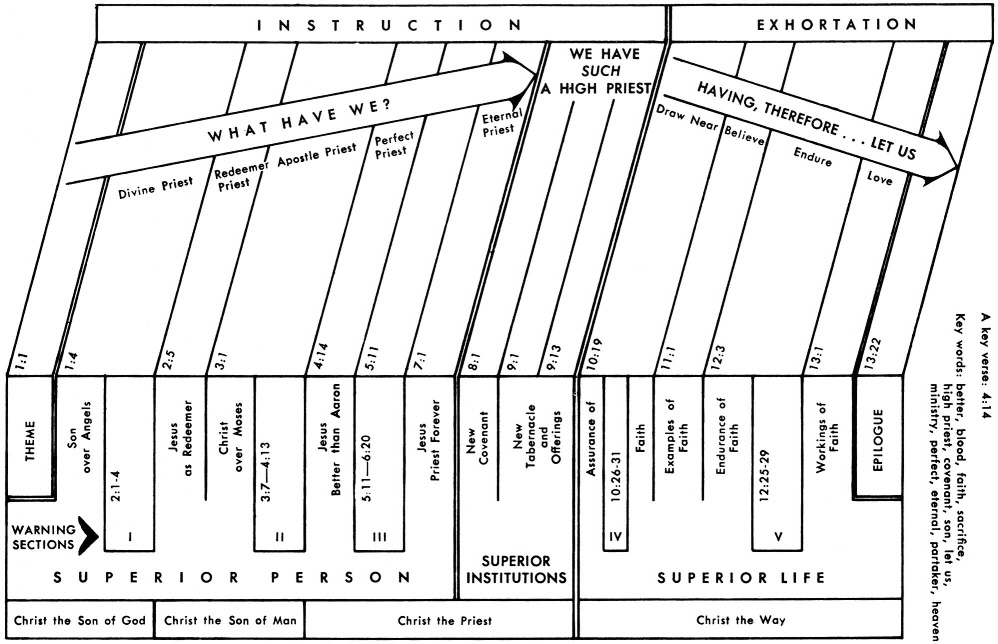
CONSIDER JESUS OUR GREAT HIGH PRIEST
Click chart to enlarge
Charts from Jensen's Survey of the NT - used by permission
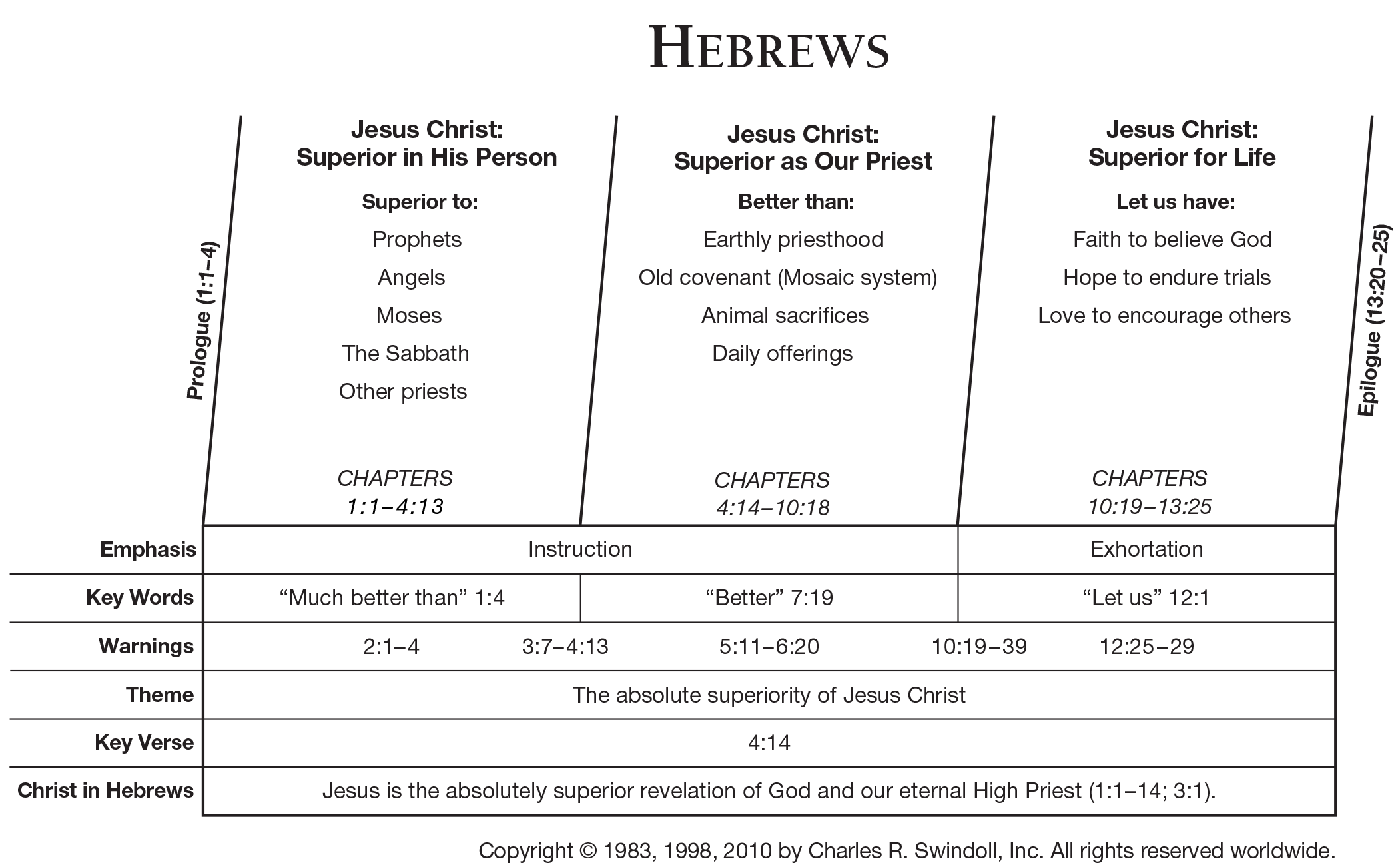
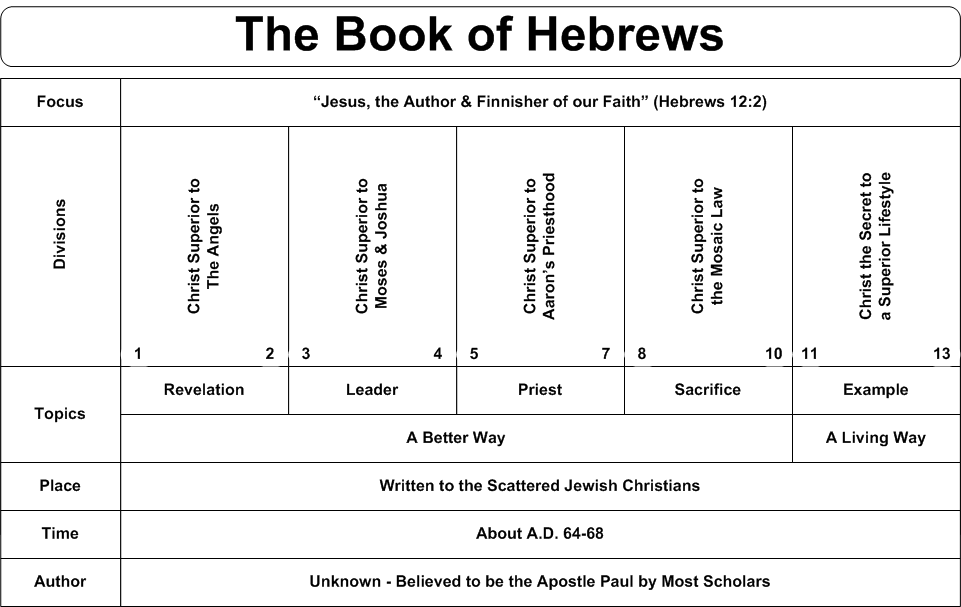
Swindoll's Chart, Interesting Pictorial Chart of Hebrews, Another Chart

|
The Epistle |
||||
| INSTRUCTION Hebrews 1-10:18 |
EXHORTATION Hebrews 10:19-13:25 |
|||
| REVELATION | RESPONSE | |||
| PRECEPTS | PRACTICE | |||
| DOCTRINE | DUTY | |||
| Superior Person of Christ Hebrews 1:1-4:13 |
Superior Priest in Christ Hebrews 4:14-10:18 |
Superior Life In Christ Hebrews 10:19-13:25 |
||
| BETTER THAN PROPHETS, ANGELS MOSES Hebrews 1:1-4:13 |
BETTER THAN AARON'S PRIESTHOOD Heb 4:14-7:28 |
BETTER THAN THE OLD COVENANT Heb 8:1-13 |
BETTER THAN ANIMAL SACRIFICES Heb 9:1-10:18 |
BETTER LIFE IN CHRIST THAN IN ADAM! |
| MAJESTY OF CHRIST |
MINISTRY OF CHRIST |
MINISTERS FOR CHRIST |
||
|
DATE WRITTEN: |
||||

See ESV Study Bible "Introduction to Hebrews"
(See also MacArthur's Introduction to Hebrews)
Borrow Ryrie Study Bible
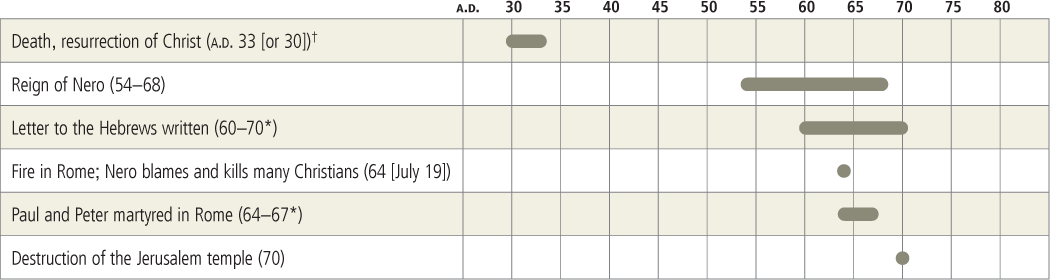
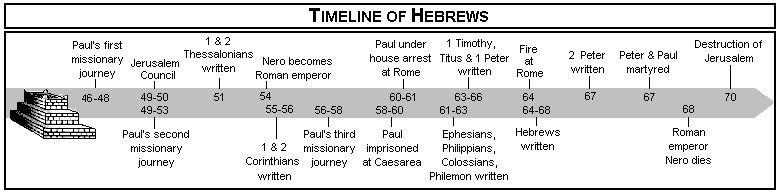
Timeline of Hebrews - ESV Study Bible
Hebrews 4:16 Therefore let us draw near with confidence to the throne of grace, so that we may receive mercy and find grace to help in time of need (NASB: Lockman)
Greek: proserchometha (1PPMS) oun meta parresias to throno tes charitos, ina labomen (1PAAS) eleos kai charin euromen (1PAAS) eis eukairon boetheian.
BGT προσερχώμεθα οὖν μετὰ παρρησίας τῷ θρόνῳ τῆς χάριτος, ἵνα λάβωμεν ἔλεος καὶ χάριν εὕρωμεν εἰς εὔκαιρον βοήθειαν.
Amplified: Let us then fearlessly and confidently and boldly draw near to the throne of grace (the throne of God’s unmerited favor to us sinners), that we may receive mercy [for our failures] and find grace to help in good time for every need [appropriate help and well-timed help, coming just when we need it]. (Amplified Bible - Lockman)
My Amplified Paraphrase: Therefore, because we have such a sympathetic and exalted High Priest, let us draw near—come forward, approach boldly, confidently, freely, yet reverently—to the throne of grace, the place where our King reigns in kindness and dispenses unmerited favor, so that we may receive mercy (His compassionate help for our failures) and find grace (His empowering strength for our needs) to help us in the very moment we need it—in every pressure, temptation, weakness, or trial.
Barclay: Let us then confidently approach his throne of grace, that we may receive mercy and find grace to help as need demands. (Westminster Press)
KJV: Let us therefore come boldly unto the throne of grace, that we may obtain mercy, and find grace to help in time of need.
NKJ Let us therefore come boldly to the throne of grace, that we may obtain mercy and find grace to help in time of need.
NLT: So let us come boldly to the throne of our gracious God. There we will receive his mercy, and we will find grace to help us when we need it. (NLT - Tyndale House)
Phillips: Let us therefore approach the throne of grace with fullest confidence, that we may receive mercy for our failures and grace to help in the hour of need. (Phillips: Touchstone)
Wuest: Let us be coming therefore with boldness to the throne of grace, in order that we may procure mercy and find grace for seasonable help.
Young's Literal: Let us therefore draw near with confidence to the throne of grace, that we may receive mercy and may find grace to help in time of need.
NET Therefore let us confidently approach the throne of grace to receive mercy and find grace whenever we need help.
CSB Therefore let us approach the throne of grace with boldness, so that we may receive mercy and find grace to help us at the proper time.
ESV Let us then with confidence draw near to the throne of grace, that we may receive mercy and find grace to help in time of need.
NIV Let us then approach the throne of grace with confidence, so that we may receive mercy and find grace to help us in our time of need.
MIT Therefore, let us come with courage to the throne of grace in order to receive mercy and find grace at the right time to help us.
NJB Let us, then, have no fear in approaching the throne of grace to receive mercy and to find grace when we are in need of help.
NRS Let us therefore approach the throne of grace with boldness, so that we may receive mercy and find grace to help in time of need.
RSV Let us then with confidence draw near to the throne of grace, that we may receive mercy and find grace to help in time of need.
NAB So let us confidently approach the throne of grace to receive mercy and to find grace for timely help.
GWN So we can go confidently to the throne of God's kindness to receive mercy and find kindness, which will help us at the right time.
BBE Then let us come near to the seat of grace without fear, so that mercy may be given to us, and we may get grace for our help in time of need.
ASV Let us therefore draw near with boldness unto the throne of grace, that we may receive mercy, and may find grace to help us in time of need.
- Draw near - Hebrews 10:19-23; 13:6; Ro 8:15-17; Ephesians 2:18; 3:12
- Throne of grace - Heb 9:5; Ex 25:17, 18, 19, 20, 21, 22; Lev 16:2; 1Ch 28:11
- Receive - Isa 27:11 55:6,7 Mt 7:7-11 2Co 12:8-10 Php 4:6,7 1Pe 2:10
- Hebrews 4 Resources - Multiple Sermons and Commentaries
Related Passages: #rr
Leviticus 9:7 (HOW THE HIGH PRIEST APPROACHED GOD IN THE OLD TESTAMENT) Moses then said to Aaron, “Come near (Command; Lxx - proserchomai) to the altar and offer your sin offering and your burnt offering, that you may make atonement for yourself and for the people; then make the offering for the people, that you may make atonement for them, just as the LORD has commanded.” (NOTE: BELIEVERS CAN NOW AND FOREVER APPROACH GOD BECAUSE OUR HIGH PRIEST HAS FULLY ACCOMPLISHED THE ATONEMENT ONCE FOR ALL TIME.)
Isaiah 6:1-5 (GOD'S THRONE IN THE OLD TESTAMENT VISION OF THE PROPHET ISAIAH) In the year of King Uzziah’s death I saw the Lord sitting on a throne, lofty and exalted, with the train of His robe filling the temple. 2 Seraphim stood above Him, each having six wings: with two he covered his face, and with two he covered his feet, and with two he flew. 3 And one called out to another and said, “Holy, Holy, Holy, is the LORD of hosts, The whole earth is full of His glory.” 4 And the foundations of the thresholds trembled at the voice of him who called out, while the temple was filling with smoke. 5 Then I said, “Woe is me, for I am ruined! Because I am a man of unclean lips, And I live among a people of unclean lips; For my eyes have seen the King, the LORD of hosts.”
Hebrews 10:19-23 Therefore, brethren, since we have confidence to enter the holy place by the blood of Jesus, 20by a new and living way which He inaugurated for us through the veil, that is, His flesh, 21 and since we have a great priest over the house of God, 22let us draw near with a sincere heart in full assurance of faith, having our hearts sprinkled clean from an evil conscience and our bodies washed with pure water. 23 Let us hold fast the confession of our hope without wavering, for He who promised is faithful;
Ephesians 3:11-12 This was in accordance with the eternal purpose which He carried out in Christ Jesus our Lord, 12 in whom we have boldness and confident access through faith in Him.
Romans 5:1-2 Therefore, having been justified by faith (PAST TENSE SALVATION), we have peace with God through our Lord Jesus Christ, 2 through Whom also we have obtained our introduction (prosagoge = access, means of admission into presence of God) by faith into this grace in which we stand (perfect tense - past completed action, enduring effect) (PRESENT TENSE SALVATION); and we exult in hope (ABSOLUTE ASSURANCE OF FUTURE GOOD) of the glory of God (FUTURE TENSE SALVATION). (SEE Three Tenses of Salvation)
Acts 20:32 And now I commend you to God and to the word of His grace, (observe the beneficial effects) which is able to build you up and to give you the inheritance among all those who are sanctified.

Through Christ we Can Come Boldly INTO Heaven's Throne Room TODAY!
THE THRONE OF GRACE:
THE BELIEVER'S REFUGE
Therefore (oun) Because Jesus was the perfect Man who never stumbled, He is now the perfect High Priest through Whom we can enter into the presence of the Most Holy God even though we still daily stumble and fall! Amazing grace indeed! This conclusion flows directly from Heb 4:14–15: Because Jesus understands our weakness (Heb 4:15) we are invited to come confidently, not fearfully.
Spurgeon on therefore - It is clear from the connection of our text that the interposition of the Lord Jesus Christ is essential to acceptable prayer. As prayer will not be truly prayer without the Spirit of God, so it will not be prevailing prayer without the Son of God. He, the Great High Priest, must go within the veil for us; no, through His crucified person the veil must be entirely taken away. For, until then, we are shut out from the living God. This glorious God-man Mediator continually presents before His Father His one great sacrifice for sin. There will never be a repetition of it, and it will never need to be offered again, “for by one offering he has perfected for all time those who are made holy” (Heb 10:14), that is, those who are set apart unto Himself. This one sacrifice He perpetually pleads before the throne, and our prayers therefore ascend to God with the merit of Christ’s atoning blood giving them acceptance with His Father. So they must have power with God, for they come before Him signed, as it were, with the name of His well-beloved Son. He lays His hand upon each petition, and so leaves the print of the nails upon it, and therefore it must prevail with God.
Through Christ alone our prayers ascend,
The Veil removed by wounds that blend;
His nail-scarred hand seals every plea,
And thus they find sure power with Thee..
Let us draw near (proserchomai) with confidence (parrhesia) to the throne (thronos) of grace (charis), so that (hina) we may receive ( lambano) mercy (eleos) and find (heurisko) grace (charis) to help (boetheia) in time of need (eukairos) - Let us is a hortatory subjunctive which is used 12 times in Hebrews. This exhortation to draw near is one of the most incredibly gracious invitations the world has ever received! Draw near is used in priestly contexts for approaching God in worship (Heb 7:25; Heb 10:1, 22). The writer's invitation would not fall on ignorant ears, who would surely recall the OT high priest, and the day of atonement, when he alone could draw near to the Holy of holies with the blood of the sacrificial animal and even then his drawing nigh was with tinkling bells on the hem of his robe (Ex 28:33-34) and some degree of fear and trembling and certainly not with boldness or confidence! (cp Lev 16:2, 3). This exhortation serves to undergird the fact that the New Covenant is far superior to the Old Covenant. The present tense is an exhortation to continually draw near to His throne in prayer, worship, and devotion of heart and life. This is an ongoing divine invitation! Access to God is not a one-time event (as it was on day of atonement and only for the high priest) but is a continual privilege. What an astonishing invitation—we are welcomed to draw near with confidence (parrhesia) and boldness, speaking freely before the throne of the Most High God. In ancient courts, parrhesia described the rare privilege of addressing a king openly, yet in Christ this freedom is granted to every believer as our continual privilege! Glory! Unlike Israel at Mount Sinai who trembled in fear (Ex 19:16), we may continually approach with bold assurance—yet not in arrogance, but in humble trust, because our Great High Priest has opened the way (cf Heb 10:19-22).
🙏 THOUGHT- Are you regularly drawing near to the throne of grace, fully embracing your privilege as a follower of Christ? Drawing near to the throne of grace is a reflection of our faith or trust that at His throne we will obtain all that we need to live for Him and serve Him. I am reminded of a spiritual classic The Practice of the Presence of God, the Best Rule of a Holy Life” by Brother Lawrence (born Nicolas Herman, c. 1614–1691) which teaches how a man transformed his ordinary life into continual communion with God — in short, how he lived in constant nearness to the throne of grace. And remember that when you approach this throne, you don’t need to polish your prayers or hide your weaknesses, for our Father welcomes us as His very own children (1Jn 3:1). And so when you pray, envision yourself entering not into a courtroom of judgment but a into the throne room of your loving Father for His help in your time of need! Father, by Your Spirit of grace make this nearness to Your throne of grace be increasingly the practice of our lives through our Great High Priest. Amen.
What a dramatic contrast the writer's exhortation is here in Hebrews 4:16 with God’s previous warning command at Mount Sinai - "And you shall set bounds for the people all around, saying, 'Beware (Lxx - prosecho [same verb in Heb 2:1] in present imperative) that you do not go up on the mountain or touch the border of it; whoever touches the mountain shall surely be put to death." (Exodus 19:12). The Old Covenant brought death if disobeyed, while the New Covenant brings life and access to the living God through our Great High Priest. Amazing grace indeed! Because of Christ’s finished work on the Cross (Jn 19:30) and His present mediation as our Great High Priest (cf Heb 7:25), believers can boldly approach God’s presence! You may want to read that again and then ponder the incredible privilege believers have under the New Covenant!
Also what a contrast Hebrews 4:16 presents with the Old Testament priests (Nu 16:40, Nu 18:22 Lev 21:17). It is notable that this same verb for draw near (proserchomai) is used in Septuagint (LXX) to describe the approach to God by the Levitical priests in the Old Testament (see Lev 9:7 above for note on 'come near")! While the writer of Hebrews does not disclose to the Jews their new position as priests, we know from Peter that we are now a "royal priesthood" (1Pe 2:9) and from John that one day will reign with our Great High Priest as kings and priests (most likely a reference to the Millennium - Rev 5:10).
When you pray, you’re not whispering into the void;
you are speaking directly before God's Throne of grace in heaven.
And your prayers are not interruptions;
but are welcomed by the King Himself.
To the throne (thronos) of grace (charis) - Grace (charis) does not mean God overlooks our sin. It means that the blood of Christ covers our sin, so the throne becomes a place of pardon and provision instead of a place of wrath and judgment. Earthly thrones often exclude, intimidate, or demand bribery/favor, while God’s throne is accessible, gracious, and welcoming to the weakest and most broken believer. However in the Old Testament His throne was holy and unapproachable as described in Isaiah 6:1–5. Our Great High Priest transforms God's throne into a place of welcome. And so we can now draw near and pour out our hearts to him as described by the psalmist David…
Trust in Him at all times, O people; Pour out your heart before Him; God is a refuge for us. Selah. (Ps 62:8)
Perhaps you feel your sin is to great that surely He would not welcome you to His throne of grace. Of course confess any known sin but then confidently sin this modern version of Charles Wesley's great hymn
Arise, My Soul, Arise
by Charles Wesley
Arise, my soul, arise;
Shake off the guilty fears;
The bleeding Sacrifice
In my behalf appears:
Before the throne my Surety stands,
Before the throne my Surety stands:
My name is written on His hands.
He ever lives above, for me to intercede;
His all redeeming love, His precious blood, to plead:
His blood atoned for all our race,
His blood atoned for all our race,
And sprinkles now the throne of grace.
Five bleeding wounds He bears,
Received on Calvary;
They pour effectual pray'rs,
They strongly plead for me:
"Forgive him, O forgive, " they cry,
"Forgive him, O forgive, " they cry,
"Nor let that ransomed sinner die!"
My God is reconciled;
His pard'ning voice I hear;
He owns me for His child;
I can no longer fear;
With confidence I now draw nigh,
With confidence I now draw nigh,
And, "Father, Abba, Father, " cry.
And now for the effect Wesley's hymn had on one group of hearers/singers! Ira Sankey records in his book, My Life and the Story of the Gospel Hymns, the following account of the amazing power of the gospel as articulated in this song:
"I have a record," said a Wesleyan missionary laboring in the West Indies, "of two hundred persons, young and old, who received the most direct evidence of the forgiveness of their sins while singing 'Arise My Soul.' The conversion of the greater number of these persons took place while I was a missionary abroad." (Hallelujah!)
Warren Wiersbe on God's throne makes the point that "The mercy seat on the ark of the covenant was God's throne in Israel (Ex 25:17, 18, 19, 20, 21, 22), but it could never be called "a throne of grace." Grace does not veil itself from the people. Grace does not hide itself in a tent." (Bible Exposition Commentary)
Philip Edgcumbe Hughes adds that "In the Levitical system that had prevailed up till the time of Christ's advent only the high priest was permitted to approach into the sanctuary of God's presence, and then only once a year, on the Day of Atonement (Lev 16:1-34), when he passed from sight into the holy of holies. The people, however, were excluded from the divine presence because of their sinfulness and prohibited from drawing near. But the atonement effected by Christ's sacrifice of Himself on the cross opened the way that had hitherto been closed. This was dramatically symbolized by the rending of the temple curtain from top to bottom at the time of the crucifixion, indicating that through an act of divine grace access into the holiest place was now available to all the people of God (Mk. 15:38; Mt. 27:51; Heb 10:19-22). The reality corresponding to this symbolic event is pressed home by our author here. Sinners are no longer commanded to keep their distance in fear and trembling, but, on the contrary, are now invited to draw near, and to do so with confidence. (Commentary On The Epistle To The Hebrews)
As prayer will not be truly prayer without the Spirit of God,
so it will not be prevailing prayer without the Son of God.
C H Spurgeon - It is clear from the connection of our text that the interposition of the Lord Jesus Christ is essential to acceptable prayer. As prayer will not be truly prayer without the Spirit of God, so it will not be prevailing prayer without the Son of God. He, the Great High Priest, must go within the veil for us (cf Heb 6:19-20); no, through His crucified person the veil must be entirely taken away (Heb 10:19-22. For, until then, we are shut out from the living God. This glorious God-man Mediator continually presents before His Father His one great sacrifice for sin. There will never be a repetition of it, and it will never need to be offered again, “for by one offering he has perfected (perfect tense - enduring effect) for all time those who are made holy” (Heb 10:14), that is, those who are set apart unto Himself (ED: THIS SPEAKS OF OUR PERMANENT POSITION IN CHRIST). This one sacrifice He perpetually pleads before the throne, and our prayers therefore ascend to God with the merit of Christ’s atoning blood giving them acceptance with His Father. So they must have power with God, for they come before Him signed, as it were, with the Name of His well-beloved Son. He lays His hand upon each petition, and so leaves the print of the nails upon it (Jn 20:25), and therefore it must prevail with God.
Remember that in simple terms, praying is just taking time
to talk with your best friend, in this case your Father.
J Vernon McGee explains our bold access in plain terms - We can speak freely to the Lord Jesus Christ. I can tell Him things that I cannot tell you. He understands me. He knows my weaknesses, and I might just as well tell Him. I have learned to be very frank with Him. I have not attempted to become buddy-buddy with Him -- I despise that approach. He is God, and I come to Him in worship and with reverence. But I am free to speak, because He is also a man. He is God, but He is a man, and I can come to Him with great freedom. I can tell Him what is on my heart. I can open my heart to Him. I suspect, therefore, that all these very pious and flowery prayers we make are not impressive to Him -- especially when we are attempting to cover up what is in our hearts and lives. I wonder if the Lord doesn't tune us out when we do not come to Him with freedom and open our hearts to Him. That is one of the reasons our prayer meetings are not more effective. We come to Him rather restrained, without being open and sincere. (Hebrews 4)
Warren Wiersbe on confidence - When you are free to speak (ED: MEANING OF parrhesia) , then there is no fear and you have confidence. A believer can come with boldness (same word as "confidence") to the throne of grace (He 4:16) with openness and freedom and not be afraid. We have this boldness because of the shed blood of Jesus Christ (He 10:19). Therefore, we should not cast away our confidence, no matter what the circumstances might be. We should not have confidence in ourselves, because we are too prone to fail; but we should have confidence in Jesus Christ who never fails. (Bible Exposition Commentary)
Spurgeon on draw near with confidence - We have a Friend at court; our Bridegroom is on the throne. He who reigns in heaven loves us better than we love ourselves. Come, then, why should we hesitate, why should we delay our approach to His throne of mercy? What is it that we want at this moment? Let us ask for it. If it is a time of need, then we see clearly from this verse that it is a time when we are permitted and encouraged to pray.
We have a Friend at heaven’s throne,
Who claims our hearts as all His own;
In every need, His grace is near—
So let us come, with faith, not fear..
Nikolaus L von Zinzendorf (Moravian Missions) Borrow Count Zinzendorf : firstfruit) picked up the truth of Hebrews 4:16 in his great hymn below. Note the second stanza speaks of us standing boldly before God in that great future day, the incredible truth is that today we can approach our Father boldly through our Great High Priest. We don't have to wait until we are glorified. (Jude 24-25)
Jesus, Thy blood and righteousness
My beauty are, my glorious dress:
’Midst flaming worlds, in these arrayed,|
With joy shall I lift up my head.
Bold shall I stand in Thy great day,
For who aught to my charge shall lay?
Fully absolved through these I am, —
From sin and fear, from guilt and shame.
Now to Him Who is able to keep you from stumbling, and to make you stand in the presence of His glory blameless with great joy, 25 to the only God our Savior, THROUGH Jesus Christ our Lord (A CLEAR ALLUSION TO HIS PRIESTHOOD), be glory, majesty, dominion and authority, before all time and now and forever. Amen. (Jude 24-25)
Charles Spurgeon - We have a Friend at court; our Bridegroom is on the throne. He who reigns in heaven loves us better than we love ourselves. Come, then, why should we hesitate, why should we delay our approach to His throne of mercy? What is it that we want at this moment? Let us ask for it. If it is a time of need, then we see clearly from this verse that it is a time when we are permitted and encouraged to pray. (Spurgeon goes on to add that) In prayer we come, not only to our Father’s feet, but we come also to the throne of the Great Monarch of the universe. The mercy seat is a throne, and we must not forget this. He is the most Holy of all kings. His throne is a great white throne, unspotted, and clear as crystal. “The heavens are not clean in his eyes” (Job 15:15), and “he charges his angels with error” (Job 4:18). And you, a sinful creature, with what lowliness should you draw nigh to Him! Familiarity there may be, but
Behold the Throne of Grace
The promise calls us near,
There Jesus shows a smiling face
And waits to answer prayer.
by John Newton
John writes that “of (Jesus Christ’s) fullness we have all received and grace upon grace.” (Jn 1:16). It is all of…
God’s Riches At Christ’s Expense
Grace is God’s provision (for "Riches" one could also substitute "Righteousness") for our every need when we need it. God in His grace gives us what we do not deserve, and in His mercy He does not give us what we do deserve.
Donald Grey Barnhouse observed "Love that gives upward is worship, love that goes outward is affection; love that stoops is grace
It is possible to grow in Bible knowledge and yet not grow in grace or in one’s personal relationship with God.
It has been well said that "The will of God will never lead you where the grace of God cannot keep you.
The great theologian Jonathan Edwards said that "
Grace is but glory begun, and glory is but grace perfected.
The dying words of one ancient saint were "Grace is the only thing that can make us like God. I might be dragged through heaven, earth, and hell and I would still be the same sinful, polluted wretch unless God Himself should cleanse me by His grace.
Spurgeon - Lest the glow and brilliance of the word “throne” should be too much for mortal vision, our text now presents us with the soft, gentle radiance of that delightful word—“grace.” We are called to the throne of grace, not to the throne of law. It is a throne set up on purpose for the dispensation of grace; a throne from which every utterance is an utterance of grace; the scepter that is stretched out from it is the silver scepter of grace; the decrees proclaimed from it are purposes of grace; the gifts that are scattered down its golden steps are gifts of grace; and He that sits upon the throne is grace itself. It is the throne of grace to which we approach when we pray. That word “grace” is one of the choicest in the whole description of our great resort for prayer. We might well have trembled if we had been bidden to come to a throne of justice; we might have been afraid to come to a throne of power alone; but we need not hesitate to come to the throne of grace, where God sits on purpose to dispense grace. It would be terrible if we had to pray to a just God if He was not also a Savior; if we could only see the awful glare of Sinai without the blessed attractions of the atonement made on Calvary.
Earthly joys cannot compare with all the glory,
When our longing eyes shall see Thy face;
We shall have Thy fellowship forever,
In the splendor of the throne of grace.
The River of Thy Grace
by Paul Rader
MERCY UNDESERVED
BUT GIVEN BY GRACE
In 2Co 12:9 Paul identifies the "time of need" as the time when we are weak! When we are strong (at least when we think we're strong) is when we impede the flow of grace. When we least deserve grace is when God gives it to the maximum.
So that (hina) we may receive (lambano) mercy (eleos) and find (heurisko) grace (charis) to help (boetheia) in time of need (eukairos) - So that (hina) is a marker of purpose. See discussion of importance of examining terms of purpose or result such as so that, in order that, that, as a result. This so that clause reassures the believer: every approach to God in Christ has a guaranteed outcome — mercy received, grace discovered, help given. So that (hina) is the hinge that moves the exhortation (draw near) into the divine promise (receive mercy...). The very reason God invites us to approach Him boldly is so that we may continually receive mercy and grace for our needs. Are you taking advantage of your high and holy privileged dear saint (holy one) of God?
We may receive (lambano) is a verb which conveys the sense of "take, seize, lay hold" and in context suggests we grasp what God makes available at the throne of grace. It is there by grace for our taking. Receive (lambano) is active voice which depicts the subject (we) doing the action of receiving and implies it is a choice of our will (the gift of mercy of course is God's pleasure to give us). The verb lambano is subjunctive mood which expresses potential so that idea is “that we may”—this action is not yet realized but envisioned as possible. As in this verse, the subjunctive mood expresses the intended outcome, but not necessarily a guaranteed one. In sum, receive (lambano) means we ourselves actively take hold of the mercy God offers. God's mercy is not forced upon us. To reiterate, the very form (subjunctive mood) of receive (lambano) implies possibility. Mercy is offered, but it must be received by the one who approaches the throne of grace. God extends grace and mercy, but in context of this letter (Heb 2:3 - neglect, Heb 3:12- evil, unbelieving heart, Heb 4:2 - unbelief, Heb 12:25- refuse Him Who is speaking) some refuse by unbelief, disobedience, or neglect. In sum, notice the juxtaposition of God's sovereignty and Man's responsibility. Mercy is God’s initiative: He makes it available at the throne of grace. Reception is our responsibility: We must come, draw near, and take hold of it (Play Come Just As You Are). Picture a physician offering a life-saving antidote to a dying patient. The antidote is real, effective, and available. But the patient must take it in hand and swallow it. If he refuses—whether from pride, doubt, or delay—the cure does not benefit him. In the same way, God’s mercy is always available at His throne, but the active voice of lambano shows we must embrace it, not ignore or spurn it. Yes, the mercy offered in Hebrews 4:16 can be refused—not because God is unwilling, but because He does not impose it. The active voice highlights that mercy must be personally appropriated by faith. The tragedy is that many neglect or reject it, even while it is freely available.
Receive (lambano) mercy (eleos) means to take hold of compassion which God makes abundantly available for the "abundantly" miserable, all the while withholding divine judgment and in the end relieving the misery. Mercy is in a sense a form of grace, for it addresses our past failures. The upshot is that when (not "if") we fail fall, we should not run from God, but run to Him. Why? Because of Christ's fully atoning sacrifice for our sins, God's throne is the place where guilty sinners are welcomed. Mercy pardons—God does not give us what we deserve (judgment). Mercy pities—God feels for us in our weakness, sin, and frailty (Heb 4:15). Mercy restores—God lifts the fallen, heals the broken, and forgives the guilty. So, to receive mercy at the throne of grace means to have our sins forgiven when confessed (1 Jn 1:9), to be relieved of guilt and shame that weigh us down, to find God’s compassionate care from His Comforter (Jn 14:26KJV) in the middle of our weakness and temptation and to experience God’s tender mercies (Ps 25:6KJV, Ps 40:11KJV) toward His children (like David in Ps 51:1KJV) who come in need. At the throne of grace, mercy pardons my past, comforts me in the present, and prepares me for the future. To receive mercy is to experience God’s tender heart stooping to meet me in my deepest need.
Notice that two things happen at the throne -- we receive mercy which so that past sins so that our failures are dealt with and we find (heurisko) grace (charis) to help (boetheia) in time of need (eukairos) so that present and future strength is given. To say it another way, mercy is for relief from yesterday’s failures and grace is strength for today’s trials. Thank You God that when we approach Your Throne to pray, we don't come to a cold throne of judgement to a benevolent throne of grace! And this is why we can pray boldly “Lord, I come, not because I am worthy, but because Christ has opened the way. Thank You that Your throne is one of grace, not condemnation.”
Illustration - Think of a child who has disobeyed and broken something precious. Afraid, he comes before his father. Instead of scolding, the father kneels, embraces him, forgives the wrong, and helps him fix the broken thing. That is receiving mercy (forgiveness and compassion). That is finding grace (help and strength to go on).
Mercy… grace - Adam Clarke observes that "Mercy refers to the pardon of sin, and being brought into the favor of God. Grace is that by which the soul is supported after it has received this mercy, and by which it is purified from all unrighteousness, and upheld in all trials and difficulties, and enabled to prove faithful unto death."
Out of the deep I call,
To Thee, O Lord, to Thee,
Before Thy throne of grace I fall;
Be merciful to me.
-H W Baker
J Vernon McGee rightly states that "We need a lot of mercy. Mercy is something that is in one sense negative -- it speaks of the past. We are redeemed by the mercy of God. "Not by works of righteousness which we have done, but according to his mercy he saved us … " (Titus 3:5). He has been merciful to me.
See related discussion of mercy in the commentary notes on Blessed are the merciful Matthew 5:7 and the lesson notes on the study from the Sermon on the Mount: Blessed are the Merciful: Matthew 5:7 (Related resources - The Mercy of God by A. W. Pink, notes on God's Attribute of Mercy)
The idea is to show kindness or concern for someone in serious need or to give help to the wretched, to relieve the miserable. Here the essential thought is that mercy gives attention to those in misery.
Mercy includes three elements: (1) ”I see the need”—that’s recognition. (2) “I am moved by the need”—that’s motivation. and (3). “I move to meet the need”—that’s action. Having a feeling of sorrow over someone's bad situation I now want to try to do something about it. Mercy is more than a feeling, but not less than that. Mercy begins with simple recognition that someone is hurting around you. But mere seeing or feeling isn’t mercy. Mercy moves from feeling to action. It is active compassion for those in need or distress.
One needs to distinguish between grace and mercy. Grace is shown to the undeserving, while mercy is compassion to the miserable. Grace is God’s solution to man’s sin. Mercy is God’s solution to man’s misery. Grace covers the sin, while mercy removes the pain. Grace forgives, while mercy restores. Grace gives us what we don’t deserve while mercy withholds what we do deserve. Stated in a similar way…
Grace is getting what we do not deserve.
Justice is getting what we do deserve.
Mercy is not getting what we do deserve.
Find (heurisko) grace (charis) to help (boetheia) in time of need (eukairos) - It is not that grace is lost, but as the Greek verb heurisko (to find as in Mt 7:7) implies, the believer comes upon this grace through a purposeful search. Grace is there for the need but we must avail ourselves of His grace. God allows difficult circumstances and difficult people in our lives to humble us and we can chose to submit and bow and draw near to the throne of grace with bold petitions and requests or we can stiffen our neck (refusing to humble ourselves) and miss His grace (Jas 4:6)
To help (boetheia) presents a striking word picture, almost personifying grace. What do I mean? The word help (boetheia) literally conveys the picture of one running in response to a cry for help. So o the idea is timely grace (like a "runner") comes rushing to our side in response to our desperate cry. We gain a sense of this word in Luke's use in Acts 27:17 where "they used supporting cables (boetheia) in undergirding the ship." It follows that help (boetheia) is a vivid picture of grace providing timely reinforcement in our time of crisis. In other words, God's gracious “help” is not generic but responsive—it is grace that comes precisely when and where needed. It is timely help, “help at the right time,” or just in the nick of time! Imagine a soldier in battle who cries out when wounded. Immediately, medics run to him, bind up his wounds, and carry him to safety. That urgent, effective, right-on-time rescue is the very idea of boetheia.
In time of need (eukairos) does not merely mean “when we need it” in a vague sense, but means God’s grace arrives at the exact strategic moment, neither too soon nor too late. It is seasonable help and perfectly fitted to the occasion. Think of it as “just-in-time grace” or "just in the nick of time grace!" God’s mercy and grace are not generic or "cookie cutter" but personally tailored to arrive in the precise "amount" and at the precise season of our trial. The sense is “grace for timely help, at the critical moment of pressure, temptation, or weakness.” This truth is echoed in 1Co 10:13 where God provides the way of escape “with the temptation.” It also echoes Isaiah 49:8 (in the Septuagint): “In an acceptable (kairos) time I listened to you.” Another parallel is Paul's note in 2 Cor. 6:2: “Now is the acceptable (euprosdektos) time (kairos).”
In summary, God hears the cry of the weak. Mercy covers our failures, and grace provides strength exactly when we call. God's throne of grace is never late. His help is always on time, even if not on our schedule. Grace is not abstract — it is personal intervention. Picture the image of God rushing to the side of His child who is drowning, lifting them up with strong hands. We need mercy for the forgiveness of our sins and grace with which to meet and overcome our trials and He gives us the grace we need to face testing and temptation. The picture is not distant or delayed divine assistance, but immediate, sufficient help of our Great High Priest Who sympathizes with our weakness and comes to our side. Hallelujah, what a Savior (Rescuer)!
God’s grace comes like reinforcements (which is fitting for we are always in spiritual war - see commentary on "wage war against your soul" in 1Pe 2:11) arriving at the exact moment when temptation or trial threatens to overwhelm us. Peter echoes this truth when he speaks of “various (poikilos) trials” (1 Pe 1:6) and later he describes “manifold (poikilos) grace” (1 Pe 4:10). The word poikilos means “multicolored” or “diverse.” So here's the incredible picture — let's say you are facing a “blue trial,” (so to speak). The omniscient God has perfectly matched “blue grace” (so to speak) ready for you—tailored to meet the very need you have at that moment so that you might be enabled by His Spirit to endure victoriously. This calls for another "Hallelujah! Amen!"
Spurgeon on throne of grace - Lest the glow and brilliance of the word “throne” should be too much for mortal vision, our text now presents us with the soft, gentle radiance of that delightful word—“grace.” We are called to the throne of grace, not to the throne of law. It is a throne set up on purpose for the dispensation of grace; a throne from which every utterance is an utterance of grace; the scepter that is stretched out from it is the silver scepter of grace; the decrees proclaimed from it are purposes of grace; the gifts that are scattered down its golden steps are gifts of grace; and He that sits upon the throne is grace itself. It is the throne of grace to which we approach when we pray. That word “grace” is one of the choicest in the whole description of our great resort for prayer. We might well have trembled if we had been bidden to come to a throne of justice; we might have been afraid to come to a throne of power alone; but we need not hesitate to come to the throne of grace, where God sits on purpose to dispense grace. It would be terrible if we had to pray to a just God if He was not also a Savior; if we could only see the awful glare of Sinai without the blessed attractions of the atonement made on Calvary.
Before the throne so pure, so bright,
Shines grace that turns our fear to light;
Each gift bestowed, each prayer made known,
Flows from the Lamb who claims the throne.
John Newton's words in his hymn Come, My Soul, Thy Suit Prepare (listen to this beautiful vocal by Matt Foreman) are apropos…
Thou art coming to a King.
Large petitions with thee bring;
For His grace and pow’r are such
None can ever ask too much.
Jamieson writes that in time of need means "seasonably." Before we are overwhelmed by the temptation; when we most need it, in temptations and persecutions; such as is suitable to the time, persons, and end designed (Ps 104:27). A supply of grace is in store for believers against all exigencies; but they are only supplied with it according as the need arises.
Time of need - When is this time? When does He meet our needs? In one sense, it is all the time because we stand constantly in need of His grace! His grace is "tapped into" when we come in our time of need, and not until. We must not make the mistake of trying to "store up grace" for future emergencies, because God gives us the grace that we need when we need it. No trial is too great, no temptation is too strong, but that Jesus Christ can give us the mercy and grace that we need, when we need it. And He gives it just when we have the need and not a minute before. Sometimes it looks like God waits until the last minute to send help, but that is only from our human point of view. God is never late.
Sailors used eukairos of a favorable wind — the right breeze at the right moment to launch a voyage. Without it, the ship was stuck in harbor, or worse, driven off course. Grace is like that favorable wind — just when the sails must be filled, God provides power to move forward.
Warren Wiersbe makes the point that "When you find yourself in the furnace, go to the throne of grace and receive from the Lord all the grace you need to endure (Heb. 4:14, 15, 16). Remind yourself that the Lord has a gracious purpose in all of this suffering, and that He will work out His purposes in His time and for His glory. You are not a robot caught in the jaws of fate. You are a loving child of God, privileged to be a part of a wonderful plan. There is a difference! (Bible Exposition Commentary)
Draw near (4334) (proserchomai from prós = facing + erchomai = come) means to come facing toward. To approach, come near, visit, figuratively to worship, draw near, go near to. Followed by the dat. of thing, to assent to, embrace (1 Tim. 6:3). Elsewhere in the NT this verb always describes the movement of a body to a place. But in later Greek it came to be used for the assent or consent of the mind.
Friberg - (1) literally come or go to, approach (Mt 4.3); come to visit, associate with (Acts 10.28); (2) figuratively; (a) in a cultic sense, as approaching a deity come before, come to (Heb 10.1); (b) in the sense of being occupied with a matter turn to, devote oneself to; mentally accede to, agree with (1Ti 6.3) (Borrow Analytical Lexicon of the Greek New Testament)
Gilbrant - This compound deponent verb from pros, “to, toward,” and erchomai, “come, go,” means “come to, approach.” In classical Greek it carries this basic meaning as well as variations. It can describe the “inflow” of revenue, or euphemistically it refers to “sexual intercourse” (of a man’s approaching a woman) (Liddell-Scott). The Septuagint use of this term follows the classical range of meanings. It especially is used of “approaching” the altar (e.g., Leviticus 9:7; Numbers 18:3) or God (Exodus 16:9; 1 Samuel 14:36 [LXX 1 Kings 14:36]), “to approach” equals “to inquire,” although it is equally used of “approaching” individuals (Numbers 10:4; Deuteronomy 1:22). Often the approach is made in order to make a request or statement (e.g., 1 Kings 20:22; Judith 7:8; 3 Maccabees 5:14). Euphemistically it can refer to sexual intercourse (Leviticus 18:19), although rarely.
Generally, the literal idea of “approach” prevails in the New Testament, where proserchomai often occurs in Matthew’s Gospel. For example, Jesus approached individuals to minister to them (Mark 1:31; Luke 7:14), and they approached Him for ministry (e.g., Matthew 9:20). The opponents of Christ also are said to “come to Jesus” (Matthew 8:19; Luke 20:27; cf. Matthew 4:3; 15:1). Disciples frequently “come to” Jesus with their questions (Matthew 13:10; 24:1,3; 26:17; Luke 9:12). In the New Testament the general pattern seems to be that the one approaching has a request, question, challenge, or statement. The single exception is at 1 Timothy 6:3 where it has an unusual meaning, “consent to” or “agree with” healthy words.
In Acts there appears to be a use similar to the literal sense seen in the Gospels, but here it may have a special emphasis. It can refer to approaching a person at a moment of great significance. Jews, for example, were not to socialize in any way with Gentiles (Acts 10:28); however, Philip approached the Ethiopian eunuch (Acts 8:29; cf. 9:1; 24:23).
The Old Testament idea of “approaching” God is present especially in the Book of Hebrews which relates so much to the Old Testament. It is with boldness (parrēsia [3816]) that believers can now approach the Throne of Grace. Unlike the high priests of the old covenant, believers have personal access by faith through Jesus Christ to God the Father (Hebrews 4:16; cf. 7:25; 10:22; 11:6; cf. Romans 5:1,2). (Complete Biblical Library)
Proserchomai - 86x in 85v - agree(1), approached(2), approaching(1), came(64), came forward(2), come(2), comes(1), coming(3), draw near(4), go(1), visit(1), went(6). Mt 4:3, 11; 5:1; 8:2, 5, 19, 25; 9:14, 20, 28; 13:10, 27, 36; 14:12, 15; 15:1, 12, 23, 30; 16:1; 17:7, 14, 19, 24; 18:1, 21; 19:3, 16; 20:20; 21:14, 23, 28, 30; 22:23; 24:1, 3; 25:20, 22, 24; 26:7, 17, 49f, 60, 69, 73; 27:58; 28:2, 9, 18; Mk 1:31; 6:35; 10:2; 12:28; 14:45; Lk 7:14; 8:24, 44; 9:12, 42; 10:34; 13:31; 20:27; 23:36, 52; Jn 12:21; Acts 7:31; 8:29; 9:1; 10:28; 12:13; 18:2; 22:26, 27; 23:14; 28:9; 1Ti 6:3; Heb 4:16; 7:25; 10:1, 22; 11:6; 12:18, 22; 1Pe 2:4.
Note that proserchomai is used seven times in Hebrews
Hebrews 4:16 - Therefore let us draw near with confidence to the throne of grace, so that we may receive mercy and find grace to help in time of need.
Hebrews 7:25 - Therefore He is able also to save forever those who draw near to God through Him, since He always lives to make intercession for them.
Hebrews 10:1- For the Law, since it has only a shadow of the good things to come and not the very form of things, can never, by the same sacrifices which they offer continually year by year, make perfect those who draw near.
Hebrews 10:22 - let us draw near with a sincere heart in full assurance of faith, having our hearts sprinkled clean from an evil conscience and our bodies washed with pure water.
Hebrews 11:6 - And without faith it is impossible to please Him, for he who comes to God must believe that He is and that He is a rewarder of those who seek Him.
Hebrews 12:18 - For you have not come to a mountain that can be touched and to a blazing fire, and to darkness and gloom and whirlwind,
Hebrews 12:22 - But you have come to Mount Zion and to the city of the living God, the heavenly Jerusalem, and to myriads of angels
Confidence (3954) (parrhesia/parresia from pás = all + rhesis = speech, act of speaking) is literally all speech or speaking all things and thereby conveys the idea of freedom to say all. The basic idea in the word is freedom of speech, when the word flowed freely. It is that attitude of openness that stems from freedom and lack of fear ("shaking" fear - godly, reverential fear is always appropriate) means in essence the freedom to say all. Greeks used parrhesia of those with the right to speak openly in the assembly. Speaking with plainness, openness and confidence (Acts 2:29). Speaking publicly or in the open (Jn 7:13, 11:54, 18:20) and then something done in public (Jn 7:26, Col 2:15)
Parrhesia originally meant frankness, freedom in speaking or fearless candor but came to denote boldness, confidence or openness in action. Stresses faith in oneself and one’s powers without any suggestion of conceit or arrogance
Parrhesia originally referred to a manner of speaking that neither concealed nor omitted anything, and thus conveyed the meanings of frankness, plainness, or openness. For example in the Gospel of John the disciples told Jesus that instead of speaking in enigmatic figures of speech, He was now speaking plainly (parrhesia) (Jn 16:29) The sense of openness sometimes conveyed the meaning of speaking openly in public or publicly (Jn 7:26, Acts 28:31) referring respectively to the boldness of Jesus and Paul in public or open teaching. Parrhesia in some contexts conveyed the sense of courage, confidence (Acts 4:13, 1Jn 3:21) or boldness (Ep 6:19, "fearlessly" in Ep 6:19NIV). Openness of speech in Christianity evolved to mean confidence before man and before God, in God's case this openness made possible because He graciously accepts those who come to Him through His Son, the Great High Priest.
In classical writings slaves did not have the privilege of bold speech before the master. Or consider the movies you've seen of egocentric, self-consumed tyrants like Henry the VIII of England, where not only did the servants not speak before this king, neither did high officials unless beckoned by him to do so. How different is the speech of believers, who are bondservants of Christ, servants of the Most High God, and yet with all the privileges of a son or daughter of God, so that they can openly speak endearments such as "Abba"! Christianity, far from constraining believers, liberated them and enabled them to speak openly and with complete confidence before God because of their exalted, eternal position in Christ, God's beloved Son (cp 2Co 3:12).
Ultimately this quality of confidence is that which is energized by the indwelling Spirit, emboldening (Spirit filled) believers to openly declare (with great conviction) all that He births within (cp Acts 4:31).
J Vernon McGee - Parrhesia denotes the freedom of speech which the Athenians prized so highly. They were perhaps the first to feel that the average citizen should have freedom to speak.
Boldness - fearlessness in the face of danger, with daring or courage.
Candor - unreserved expression
Confidence - mean a state of mind or a manner marked by easy coolness and freedom from uncertainty, diffidence, or embarrassment. You can always be sure of the mood of a human leader, but you can always be sure of God's loving welcome.
Liddell-Scott record that in secular use parrhesia could refer to "a proverb or statement quoted with resolve."
Bullinger mentions the relationship of eleutheria and parrhesia writing that "eleutheria… (and) eleutherios, (refers to) speaking or acting like a free man, frank. The figure is so called, because the speaker or writer, without intending offence, speaks with perfect freedom and boldness. Eleutheria is therefore the bold reprehension of free speech. It is called parrhesia, free spokenness, openness, boldness, frankness. (Bullinger, E. W. Figures of Speech Used in the Bible)
BDAG…(1) a use of speech that conceals nothing and passes over nothing, outspokenness, frankness, plainness; (2) openness in public (Acts 28:31); (3) a state of boldness and confidence, courage, confidence, boldness, fearlessness, esp. in the presence of persons of high rank… before humans (Acts 4:13, Philemon 1:8, Ep 6:19)… before God (Ep 3:12, 1Ti 3:13, He 10:35, 3:6, 4:16, 10:19, 1Jn 2:28)
TLNT - In Greek literature, the first meaning of parrhesia is political: the right to make one’s thoughts known, to say what one will. It is a citizen’s privilege, the sign of his political liberty, characterizing the democratic regime of the polis (city). The citizen has the right to express his opinions freely in the marketplace. This freedom of speech implies the truth of what is said, so that parrhesia means “ca ss, courage, audacity, confidence.” According to Wis 5:1, righteous person stands boldly (en parrhēsia) before those who have tormented him” This freedom of language, synonymous with candor (Aristotle, Eth. Nic. 4.3) is sometimes contrasted with timidity or self-consciousness, sometimes with flattery (Dio Chrysostom 32.26–27). It is practiced between friends who are not afraid to blame each other as well as toward superiors, even tyrants, with whom one must guard one’s freedom of speech: “Boldness (eutolmia) and freedom of speech (parrhesia) are admirable virtues when they are addressed opportunely to superiors” (Philo… ). Even the servant, if he knows that he has committed no offense, retains this freedom of speech toward his master (Heir 6); “Famous people grant the humble free speech” (Spec. Laws 4.74); “The man who does not allow anyone in his household to speak freely is a petty tyrant” (Spec. Laws 3.138). Parrhēsia does not fear the widest publicity; it proclaims its convictions: “Wisdom raises her voice publicly in the streets” (Prov 1:20); “Let those whose actions benefit all use full freedom of expression; let them go out in public and converse with large crowds” (Philo, Spec. Laws 1.321; Plutarch, De exil. 16). (Spicq, C., & Ernest, J. D. Theological Lexicon of the New Testament 3:57. Peabody, MA.: Hendrickson)
NIDNTT - Since in practice this freedom of speech encountered opposition from time to time, parrhesia acquired the further meaning of fearlessness, frankness. A negative overtone is also perceptible in some instances where freedom of speech has been misused to the point of bluntness and shamelessness. In an extended sense parrhesia can mean confidence and joyfulness. The corresponding verb parrhesiazomai means to speak openly or boldly, and to have confidence. The word group which is first found in Euripides and Aristophanes belonged originally to the sphere of politics. It signifies the democratic right of a full citizen of a Greek city-state (but not that of a slave or foreigner; Foreign): in the public assembly of the people one may speak out freely one’s opinion (cf. Polyb., 2, 38, 6). This right is the characteristic of a democracy, but there is the danger of misuse, as Plato shows (Rep. 8, 557b). Parrhesia played an important role in private affairs, where in the context of teaching on philia (love) it denoted the openness with which one met a friend (cf. Aristot., Eth.Nic. 9, 2). In the course of history a more moral concept evolved out of the originally political one which was of central importance in Cynic philosophy as the correlative to eleutheria, freedom (H. Schlier, TDNT V 874). Here parrhesia is no longer a civil right but the mark of someone who is morally free and who does not shun public attention. parrhesia contains the ideas of “trust in God, certainty of salvation, the conquest of the consciousness of sin, sanction and power to pray, and expectation of the future” (BORROW NIDNTT - PAGE 734 FOR 3 PAGE ARTICLE - THE ABOVE NOTE IS JUST AN EXCERPT)
Parrhesia is confidence that speaks up (so to speak) and thus is outspoken confidence. It is a deep confidence that shows itself in bold, candid speech, by one being "ready and willing" to make their convictions known in public without fear of repercussions (cp Acts 4:13, 29, 31, 9:31, 28:31 - O, for such a Spirit imbued holy boldness in my heart!)
Wuest says parrhesia is "freedom in speaking, unreservedness in speech, free and fearless confidence, cheerful courage, boldness, assurance… free and bold speaking; speaking out every word. Its dominant idea is boldness, confidence, as opposed to fear, ambiguity, or reserve. The idea of publicity is sometimes attached to it, but as secondary. (Hebrews Commentary online)
Smalley - In secular Greek the word group (the noun parrhesia and the verb parrhesiazomai, “I speak freely”) signifies the democratic right of a citizen to express an opinion freely and in public. This idea of “outspokenness” or “frankness” between people includes the more general meaning of “courage” or “boldness.” In the biblical literature the noun parrhesia often acquires this sense of “confidence,” both in relation to men (e.g. Lev 26:13 [where "erect" is translated with parrhesia], LXX; Acts 4:29; 2Cor 7:4) and to God (e.g. Job 27:10, LXX = "confidence before Him"; 1Ti 3:13; Heb 10:19). (Word Biblical Commentary)
Pulpit Commentary writes parrhesia "denotes “the entire freedom with which we unburden, in the presence of an intimate friend, all which can weigh upon our heart.”
Vine " (parrhesia) primarily means liberty of speaking boldly, but has the general meaning of confidence.
Maclaren - The word (parrhesia) literally means speaking everything. You can easily understand how naturally that becomes an expression for the unembarrassed, unrestrained full out-pouring of a heart. You cannot pour out your heart in the fullest confidence to a person you do not respect, but if you get with some one you entirely trust, how swiftly the words flow. and how very easy it is to tell out the whole heart. Just so with this great word of the writer of this Epistle, descriptive of the temper and disposition with which men are to go to God — with confidence, full, cheerful, and unembarrassed, and which expresses itself in full trust, exactly as one of the old Psalms says — ‘Ye people, pour out your heart before Him.’ (Ps 62:8) Yes, let it all flow out, just as you would do to husband or wife, or lover, or friend (Ed: That is what is meant by bold speech!)
Under the Old Covenant when the high priest entered the Holy of holies and the presence of the Ark of the Covenant, he entered with trepidation and fear (including fear of death), lest possibly all the conditions for entrance had not been fulfilled. In the New Covenant, because of the finished work of our better High Priest, all the Jewish saints, were encouraged to come before the Lord at any time, especially the time of need. Only Christianity provides such boldness by sinful men before a holy God, and that boldness is only possible because of our great High Priest, Jesus Christ.
Parrhesia - 31x in 31v - NAS = boldness(4), boldness in… speech(1), confidence(13), confidently(1), openly(2), openness(1), plainly(5), public(1), publicly(3).
Mark 8:32 And He was stating the matter plainly. And Peter took Him aside and began to rebuke Him.
Comment from Expositor's Greek Testament: He (Jesus) spoke the word plainly, unmistakably. This remark was rendered almost necessary by the choice of the word didaskein (didasko = to teach) in Mk 8:31. This word in ordinary Greek usage means frank, unreserved speech, as opposed to partial or total silence. Here, as in Jn 11:14, 16:25, 29, it means plain speech as opposed to hints or veiled allusions, such as Jesus had previously given as in Mk 2:20 (bridegroom taken away).
John 7:4 "For no one does anything in secret when he himself seeks to be known publicly. If You do these things, show Yourself to the world."
Comment: One source says that “Public” was considered anything in the presence of ten Israelites.
John 7:13 Yet no one was speaking openly of Him for fear of the Jews.
John 7:26 "Look, He is speaking publicly, and they are saying nothing to Him. The rulers do not really know that this is the Christ, do they?
John 10:24 The Jews then gathered around Him, and were saying to Him, "How long will You keep us in suspense? If You are the Christ, tell us plainly."
John 11:14 So Jesus then said to them plainly, "Lazarus is dead,
Comment: Here the idea of parrhesia is openly, without figurative language so that it could not be misunderstood.
John 11:54 Therefore Jesus no longer continued to walk publicly among the Jews, but went away from there to the country near the wilderness, into a city called Ephraim; and there He stayed with the disciples.
John 16:25 "These things I have spoken to you in figurative language; an hour is coming when I will no longer speak to you in figurative language, but will tell you plainly of the Father.
John 16:29 His disciples said, "Lo, now You are speaking plainly and are not using a figure of speech.
John 18:20 Jesus answered him, "I have spoken openly to the world; I always taught in synagogues and in the temple, where all the Jews come together; and I spoke nothing in secret.
Acts 2:29 "Brethren, I may confidently say to you regarding the patriarch David that he both died and was buried, and his tomb is with us to this day.
Acts 4:13 Now as they observed the confidence of Peter and John and understood that they were uneducated and untrained men, they were amazed, and began to recognize them as having been with Jesus.
Comment: They spoke with freedom of speech, liberty of language, the courageous and unhindered freedom of speech in proclaiming the word about Jesus. Here of the confidence and forthrightness with which the apostles spoke under the prompting of the Holy Spirit (Bruce).
Acts 4:29 "And now, Lord, take note of their threats, and grant that Your bond-servants may speak Your word with all confidence,
Acts 4:31 And when they had prayed, the place where they had gathered together was shaken, and they were all filled with the Holy Spirit and began to speak the word of God with boldness.
Acts 28:31 preaching the kingdom of God and teaching concerning the Lord Jesus Christ with all openness, unhindered.
2 Corinthians 3:12 Therefore having such a hope, we use great boldness in our speech,
2 Corinthians 7:4 Great is my confidence in you; great is my boasting on your behalf. I am filled with comfort; I am overflowing with joy in all our affliction.
Ephesians 3:12 in whom we have boldness and confident access through faith in Him.
Ephesians 6:19 and pray on my behalf, that utterance may be given to me in the opening of my mouth, to make known with boldness the mystery of the gospel
Expositor's Bible Commentary: Parrhesia is a favorite word of Paul, meaning frankness and uninhibited openness of speech (TDNT, 5:883). No doubt the apostle is thinking especially of his appearance before the imperial authorities—perhaps even the emperor himself—when he would have the opportunity to reveal the secret of the gospel. He had been chosen to carry the name of Jesus "before the Gentiles and their kings" (Acts 9:15) and this was to be the climax of his distinctive ministry. Meanwhile, as he awaited his trial, he wanted to make the most of every occasion that could be capitalized in the interests of the kingdom (cf. Acts 28:31).
Philippians 1:20 according to my earnest expectation and hope, that I will not be put to shame in anything, but that with all boldness, Christ will even now, as always, be exalted in my body, whether by life or by death.
Comment: Parrhesia here is speaking all things, forthrightness of speech; then more broadly, boldness, especially the courage appropriate to the free man, which acts openly even in a hostile atmosphere.
Colossians 2:15 When He had disarmed the rulers and authorities, He made a public display of them, having triumphed over them through Him.
1 Timothy 3:13 For those who have served well as deacons obtain for themselves a high standing and great confidence in the faith that is in Christ Jesus.
Philemon 1:8 Therefore, though I have enough confidence in Christ to order you to do what is proper,
Hebrews 3:6 but Christ was faithful as a Son over His house-- whose house we are, if we hold fast our confidence and the boast of our hope firm until the end.
Comment: Its (parrhesia) dominant idea is one of the boldness and confidence which are exhibited in freedom of speech, the unreserved, unfettered flow of language which is opposed to fear, ambiguity, and reserve. This confidence or boldness would characterize the speech and behavior of the Jew who was actually a possessor of salvation and not merely a professor of the same, but would soon disappear in the case of a mere professor should he turn away from Messiah back to the sacrifices. (Hebrews Commentary online)
Hebrews 4:16 Therefore let us draw near with confidence to the throne of grace, so that we may receive mercy and find grace to help in time of need.
Hebrews 10:19 Therefore, brethren, since we have confidence to enter the holy place by the blood of Jesus,
Hebrews 10:35 Therefore, do not throw away your confidence, which has a great reward.
Comment: The word (parrhesia) means “freedom in speaking, unreservedness in speech, free and fearless confidence, cheerful courage, boldness, assurance.” The writer exhorts the Jewish recipients of this letter not to throw away that cheerful courage, that boldness, that free and fearless confidence which they were displaying while they were enduring this persecution referred to in He 10:32, 33, 34. (Ibid)
1 John 2:28 Now, little children, abide in Him, so that when He appears, we may have confidence and not shrink away from Him in shame at His coming.
Comment: Parrhesia in this context "speaks of the heart attitude of a saint who lives so close to the Lord Jesus that there is nothing between him and his Lord when He comes, nothing of known sin in his life when the Rapture occurs. This is the kind of saint that keeps a daily check-up on himself as to sin in his life. He maintains a constant yieldedness to and dependence upon the Holy Spirit to show him sin in his life and give him the grace to judge it and put it out." (Ibid)
Marvin Vincent's note on parrhesia…It is opposed, as here, to aschunomai to be ashamed, in Pr. 13:5, where the Septuagint reads “a wicked man is ashamed (aischunetai) and shall not have boldness (parrhesian). Also in Phil 1:20. Compare 2Cor 3:12. The idea of free, open speech lies at the bottom of the word: coming before God’s bar with nothing to conceal. The thought is embodied in the general confession of the Book of Common Prayer: “That we should not dissemble nor cloke them before the face of Almighty God our Heavenly Father, but confess them.”
1 John 3:21 Beloved, if our heart does not condemn us, we have confidence before God;
Comment: Note the repetition of the phrase (or similar phrase) have confidence or boldness in 1John (1Jn 2:28, 3:21, 4:17, 5:14)
1 John 4:17 By this, love is perfected with us, so that we may have confidence in the day of judgment; because as He is, so also are we in this world.
Comment: This is not primarily God’s love for us or our love for Him, but the love which God is in His nature, produced in our hearts by the Holy Spirit. The saint who in the future Rapture of the Church will approach the Judgment Seat of Christ with boldness (parresia, freedom of speech) is the saint who in his earthly life has had the love that God is in His nature brought to its full capacity of operation by the Holy Spirit in his life. That fullness of love results in a life devoted entirely to the Lord Jesus. The word speaks of unreservedness of speech, a free and fearless confidence, with nothing to hide or be ashamed of. In that kind of life, the saint has nothing of which to be ashamed at the judgment of his works. That kind of life is a Christ-like life, and that makes the saint as he dwells in the midst of a world of sinful people, like Christ. And the Lord Jesus will not at the Judgment Seat of Christ condemn those who while they lived on earth, were like Him. (Ibid)
1 John 5:14 This is the confidence which we have before Him, that, if we ask anything according to His will, He hears us.
Parrhesia - 6 uses in the Septuagint - Lev 26:13; Esth 8:12; Prov 1:20; 10:10; 13:5; Job 27:10
Proverbs 1:20 (NAS) Wisdom shouts in the street, She lifts her voice in the square;
Proverbs 1:20 (Lxx translation) Wisdom sings aloud in passages, and in the broad places speaks boldly.
Bob Utley - SPECIAL TOPIC: BOLDNESS (parrhēsia)
This Greek term is a compound of "all" (pan) and "speech" (rhēsis). This freedom or boldness in speech often had the connotation of a boldness amidst opposition or rejection (cf. John 7:13; 1 Thess. 2:2).
In John's writings (used 13 times) it often denotes a public proclamation (cf. John 18:20, also in Paul's writings, Col. 2:15). However, sometimes it simply means "plainly" (cf. John 10:24; 11:14; 16:25,29).
In Acts the Apostles speak the message about Jesus in the same manner (with boldness) as Jesus spoke about the Father and His plans and promises (cf. Acts 2:29; 4:13,29,31; 9:27-28; 13:46; 14:3; 18:26; 19:8; 26:26; 28:31). Paul also asked for prayer that he might boldly preach the gospel (cf. Eph. 6:19; 1 Thess. 2:2) and live the gospel (cf. Phil. 1:20).
Paul's eschatological hope in Christ gave him boldness and confidence to preach the gospel in this current evil age (cf. 2 Cor. 3:11-12). He also had confidence that Jesus' followers would act appropriately (cf. 2 Cor. 7:4).
There is one more aspect to this term. The book of Hebrews uses it in a unique sense of the believer' boldness, in Christ, to approach God and speak to Him (cf. Heb. 3:6; 4:16; 10:19,35). Believers are fully accepted and welcomed into intimacy with the Father through the Son (cf. 2 Cor. 5:21)!
It is used in several ways in the NT.
1. a confidence, boldness, or assurance related to
a. men (cf. Acts 2:29; 4:13,31; 2 Cor. 3:12; Eph. 6:19)
b. God (cf. 1 John 2:28; 3:21; 4:12; 5:14; Heb. 3:6; 4:16; 10:19)
2. to speak openly, plainly, or unambiguously (cf. Mark 8:32; John 7:4,13; 10:24; 11:14; 16:25; Acts 28:31)
3. to speak publically (cf. John 7:26; 11:54; 18:20)
4. the related form (parrhēsiazomai) is used to preach boldly amidst difficult circumstances (cf. Acts 18:26; 19:8; Eph. 6:20; 1 Thess. 2:2)
Throne (2362) thronos (See Throne of God) describes a seat of authority as with the throne of God (Heb. 4:16, "the throne of grace," Heb 8:1; Heb 12:2; Rev 1:4; Rev 3:21; Rev. 4:2; Rev. 5:1 Rev. 20:12; Lxx - Ps 47:8, Ps 103:19), the throne of Jesus Christ (Heb. 1:8; Rev. 3:21; Rev. 22:3; in the Millennium = Mt 19:28), by metonymy (or figuratively) used for angelic powers (Col. 1:16), of the apostles (Mt 19:28, Lk 22:30), elders in heaven (Rev 4:4), of the throne of David (Lk 1:32, Acts 2:30), of the throne of Satan (Rev 2:13), of the throne of the beast, the antichrist (Rev 13:2, Rev 16:10).
Throne ( thronos) is a relatively large and elaborate seat upon which ruler sits on official occasions. Figuratively throne speaks of authority and power, while grace in Hebrew 4:16 ("throne of grace") conveys the idea of sympathy and understanding, and our great High Priest Jesus Christ is the perfect embodiment of these traits. Jesus Christ fully God and fully Man, but a Man of infinite power on one hand and a Man with complete and utter sympathy toward mere men! After the resurrection, Jesus encouraged His disciples with the emboldening truth that "All power is given to Me, in heaven and in on earth." (Matthew 28:18)
THRONOS IN HEBREWS - Heb. 1:8; Heb. 4:16; Heb. 8:1; Heb. 12:2
Gilbrant - Thronos originally denoted a chair with a footstool and later a chair with a high back and arms. Initially thronos held no special symbolic value; however, gradually it came to symbolize “authority.” In time it became the “seat of honor” reserved for the master of a household. As a special gesture of respect and honor, certain guests were invited to sit upon the thronos of a household.
Septuagint Usage - The oriental throne as a symbol of ruling authority was adopted by Israel during the kingdom period. Six steps and a footstool of gold led up to Solomon’s throne (2 Chronicles 9:18). It was said that its majesty was without equal in any of the neighboring kingdoms. The throne symbolized power as well as justice; thus, it was simultaneously the seat of a ruler and a judge. Ezekiel saw in his vision that the temple houses God’s throne (Ezekiel 43:7). This is an extension of the thought that the mercy seat was God’s throne on earth (Ex 25:22; Leviticus 16:2; Numbers 7:89). Otherwise the throne of God symbolizes His rule (Psalm 93:2). His throne is established in heaven (Psalms 11:4; 103:19). Isaiah, in his vision in the temple, saw the Lord sitting on a high throne surrounded by the heavenly seraphim (Isaiah 6:1ff.). Righteousness and justice are the foundations of His throne (Psalm 89:15), and it stands firmly for all eternity (Psalm 45:6).
Thronos occurs over 55 times in the New Testament; of these more than 40 appear in the Book of Revelation. The word most generally refers to the “throne” of God or the “throne” of Christ. Jesus declared that the Son of Man would sit on the right hand of power (Matthew 26:64), an allusion to His sharing in the authority of God. He received the throne of His father David, said Luke (1:32); He has established himself on the throne of His Heavenly Father (Revelation 3:21; cf. Psalm 110:1f.; Hebrews 8:1). Those who are conquerors like Him will be granted a place beside Him on His throne (Revelation 3:21; cf. the phrase “reign with him,” 2 Timothy 2:12; cf. also Matthew 19:28; Revelation 4:4). In another sense thronos signifies the angelic powers (Colossians 1:16) or the “throne” (i.e., authority) of the dragon which will be handed over to the beast (Antichrist; cf. Revelation 13:2). But the reign of evil will be short. In the final great scene of the Book of Revelation there is a glimpse of the throne of God, the Lamb, and the river of life which flows from there (Revelation 22:1-3). This testifies that God will ultimately gather everything in heaven and on the earth under His dominion.
Grace (5485) (charis) is God's unmerited favor and is also His supernatural enablement and empowerment for initial salvation and for daily sanctification. Grace can transform any and every trial into triumph and every sorrow into joy.
Grace always precedes and leads to peace. Are you in a position to be a receiver of God's grace? James tells us that position is humility - " “GOD IS OPPOSED TO THE PROUD, BUT GIVES GRACE TO THE HUMBLE.” (James 4:6) Remember that "humble" (tapeinos) in Greek means means low, not high, not rising far from the ground. It speaks of one's condition as lowly or of low degree.
CHARIS IN HEBREWS - Heb. 2:9; Heb. 4:16; Heb. 10:29; Heb. 12:15; Heb. 12:28; Heb. 13:9; Heb. 13:25
Mercy (1656)(eleos) is the outward manifestation of pity, a compassion for one suffering which is so great that it moves the compassionate one to help. Mercy refers to the outward manifestation of pity and assumes need on the part of those who receive it and sufficient resources to meet the need on the part of those who show it.
Hiebert defines mercy as "the self-moved, spontaneous loving kindness of God which causes Him to deal in compassion and tender affection with the miserable and distressed.
Blue Letter Bible writes that "Mercy is when that which is deserved is withheld to the benefit of the object of the mercy. God has demonstrated this attribute in abundance with respect to mankind. We from nearly the beginning of our existence have deserved nothing but wrath; having sinned and fallen short of eternal life in glory, we can do nothing to commend ourselves to or defend ourselves before God. But thankfully, God has been so amazing in His mercy. Over and against merely having the mercy to allow us to live out our miserable lives without destroying us instantly, God has chosen us to greatness and glory by the hand of His Son. The believer finds himself in Christ and enjoys full well the fruits of God's mercy.
ELEOS - 27x in 26v - compassion (2), mercy (25) Matt 9:13; 12:7; 23:23; Luke 1:50, 54, 58, 72, 78; 10:37; Rom 9:23; 11:31; 15:9; Gal 6:16; Eph 2:4; 1Ti 1:2; 2Ti 1:2, 16, 18; Titus 3:5; Heb 4:16; Jas 2:13; 3:17; 1 Pet 1:3; 2 John 1:3; Jude 1:2, 21
Friberg - mercy, compassion, used of attitudes of both God and man; (1) as an attitude and emotion roused by the affliction of another pity, compassion, sympathy (Lk 1.78); (2) especially of gracious action demonstrating God's compassion mercy, lovingkindness, faithfulness (Ro 11.31) (Borrow Analytical Lexicon of the Greek New Testament)
Wuest says eleos is "God’s “kindness and goodwill toward the miserable and afflicted, joined with a desire to relieve them. Grace meets man’s need in respect to his guilt and lost condition; mercy, with reference to his suffering as a result of that sin.
Marvin Vincent adds that eleos "emphasizes the misery with which grace deals; hence, peculiarly the sense of human wretchedness coupled with the impulse to relieve it, which issues in gracious ministry. Bengel remarks, “Grace takes away the fault, mercy the misery.” The pre-Christian definitions of the word eleos include the element of grief experienced on account of the unworthy suffering of another. So Aristotle. The Latin misericordia (miser “wretched,” cor “the heart”) carries the same idea. So Cicero defines it, the sorrow arising from the wretchedness of another suffering wrongfully. Strictly speaking, the word as applied to God, cannot include either of these elements, since grief cannot be ascribed to Him, and suffering is the legitimate result of sin. The sentiment in God assumes the character of pitying love. Mercy is kindness and good-will toward the miserable and afflicted, joined with a desire to relieve them. (Vincent, M. R. Word Studies in the New Testament)
H H Esser - In Classical Greek eleos "is “the emotion roused by contact with an affliction which comes undeservedly on someone else” (R. Bultmann, TDNT II 477), viz. compassion, pity, mercy. These feelings are the reverse of envy at another’s good fortune. There is also an element of fear that one might have to suffer in the same way. Aristotle in his Poetics stated that tragedy aroused pity and terror and these caused katharsis, purging. From Plutarch onwards we find the expressions eleon echo, to find mercy, and kat’ eleon, out of compassion. eleos was used as a technical term for the end of the speech for the defence, in which the accused tried to awaken the compassion of the judges. In Plato’s Apology Socrates refused to conform to the pattern (23 f., 34b—35d). (See online for 4 page discussion of ELEOS IN Brown, Colin, Editor. New International Dictionary of NT Theology. NIDNTT)
Help (996) (boetheia is the noun derived from boetheo (997)] = to help -- from combination of boé = a cry, exclamation + theo = to run) draws an incredible word picture of one who upon hearing a cry for help, runs to give aid to assist or to succor. Boetheia describes the assistance offered to meet a need. In secular Greek, this word was used to describe a medical aid or a cure. Boetheia is only twice in the NT.
The writer of Hebrews encourages saints writing "Let us therefore (term of conclusion) draw near with confidence (fearlessly, boldly) to the throne of grace, that we may (note he does not say so that we "might" but in fact that we will) receive mercy and may find grace to help (boetheia) in time of need." (Heb 4:16)
The Amplified version describes this "help" as "appropriate help and well-timed help, coming just when we need it."
Jehovah runs to our cry for help with His mercy to cover the things we should not have done, and His grace to empower us to do what we should do but do not have the power to do, both arriving in the nick of time.
Luke uses boetheia in his description of the storm tossed ship in (Acts 27:17, click to read the full account), writing that "after they had hoisted (the lifeboat) up, they used supporting cables (boetheia) in undergirding the ship and fearing that they might run aground on the shallows of Syrtis, they let down the sea anchor, and so let themselves be driven along." This procedure of passing ropes under the ship to hold it together is known as frapping, (frap is a nautical term that means to draw tight, to lash down or together). So in the midst of the storm the sailors wrapped cables around the ship’s hull and winched them tight. Thus supported, the ship would be better able to withstand the severe pounding of wind and sea. Beloved, do you see the word picture inherent in the Biblical use of (verb - boethéo, noun - boetheia) in other verses? From time to time all of saints encounter unexpected storm winds and are in need of our great Captain to batten down the hatches, sending His help that we might be able to endure the stormy trial or temptation.
Adam Clarke writes that…The word boetheia [word study] is properly rendered assistance, help, or support; but it is an assistance in consequence of the earnest cry of the person in distress, for the word signifies to run at the cry. So, even at the throne of grace… no help can be expected where there is no cry, and where there is no cry there is no felt necessity; for he that feels he is perishing will cry aloud for help, and to such a cry the compassionate High Priest will run (cp He 2:18); and the time of need is the time in which God will show mercy; nor will he ever delay it when it is necessary. We are not to cry to-day to be helped to-morrow, or at some indefinite time, or at the hour of death. We are to call for mercy and grace when we need them; and we are to expect to receive them when we call. This is a part of our liberty or boldness; we come up to the throne, and we call aloud for mercy, and God hears and dispenses the blessing we need. That this exhortation of the apostle may not be lost on us, let us consider:—
1. That there is a throne of grace, i.e. a propitiatory, the place where God and man are to meet.
2. That this… mercy-seat is sprinkled with the atoning blood of that Lamb of God which takes away the sin of the world.
3. That we must come up, to this throne; and this implies faith in the efficacy of the sacrifice.
4. That we must call aloud on God for his mercy, if we expect him to run to our assistance.
5. That we must feel our spiritual necessities, in order to our calling with fervency and earnestness.
6. That calling thus we shall infallibly get what we want; for in Christ Jesus, as a sacrificial offering, God is ever well pleased; and he is also well pleased with all who take refuge in the atonement which he has made.
7. That thus coming, feeling, and calling, we may have the utmost confidence; for we have boldness, liberty of access, freedom of speech; may plead with our Maker without fear; and expect all that heaven has to bestow; because Jesus, who died, sitteth upon the throne! Hallelujah! the Lord God Omnipotent reigneth.
8. All these are reasons why we should persevere.
In contrast to the infrequent use of boétheia in the NT, the LXX uses this word 40 times so we will look at some of the uses. Note that boétheia is the word used in Ps 121:1,2.
I will lift up my eyes to the mountains; From where shall my help come?
My help comes from the LORD, Who made heaven and earth.
In Psalm 7:10, the Septuagint uses boetheia to translate the Hebrew word "shield", David testifying that
My shield (Lxx = boetheia) is with God, Who saves the upright in heart." Shield is a metaphor picturing the protecting presence of God. Boetheia conveys the idea that upon hearing our cry for help, God runs to give His protection! What an awesome God we serve beloved.
Psalm 20:2 May He send you help (Heb = 'ezer) (LXX = boetheia conveys the idea of Him sending help upon hearing your cry for help) from the sanctuary and support you from Zion!
Out of heaven’s sanctuary came the angel to strengthen our Lord, and from the precious remembrance of God’s doings in his sanctuary our Lord refreshed himself when on the tree. There is no help like that which is of God’s sending, and no deliverance like that which comes out of his sanctuary. The sanctuary to us is the person of our blessed Lord, who was typified by the temple, and is the true sanctuary which God has pitched, and not man: let us fly to the cross for shelter in all times of need and help will be sent to us. People of the world seek help out of the armory, or the treasury, or the pantry, but we turn to the sanctuary." (Spurgeon - Treasury of David)
Psalm 35:2 "Take hold (imperative or command) of buckler and shield, and rise up (imperative or command) for my help (Heb = 'ezra)"
Note how David boldly approaches Jehovah's throne of grace using two verbs in the imperative mood (commands) to cry out for help in his time of need! Spurgeon adds that "The Lord is pictured armed for battle, and interposing Himself between His servant and his enemies. The greater and lesser protections of providence may be here intended by the two defensive weapons, and by the Lord’s standing up is meant His active and zealous preservation of His servant in peril. The psalmist thought of God as a real personage, truly working for His afflicted."
Psalm 38:21 Do not forsake me, O LORD; O my God, do not be far from me! 22 Make haste to help (Heb = 'ezra) (boetheia = run to my aid upon hearing my cry for help) me, O Lord, my salvation!
Spurgeon adds that "Delay would prove destruction. The poor pleader was far gone and ready to expire, only speedy help would serve his turn. See how sorrow quickens the importunity of prayer! Here is one of the sweet results of affliction, it gives new life to our pleading, and drives us with eagerness to our God. Faith tried, faith trembling, faith crying, faith grasping, faith conquering."
Psalm 60:11 O give us help (Heb = 'ezra) against the adversary, for deliverance by man is in vain. 12 Through God we shall do valiantly, and it is He who will tread down our adversaries (LXX = Greek verb thlibo = literally to press together or hem in, which figuratively pictures sufferings that arise from the pressure of circumstances or from the antagonism of persons)
David acknowledged that victory had to come from God. The Israelites could not obtain it without His help. Who do you cry out to for help? On whose strength do you draw, the Lord's or your own? The source of your help and your strength will determine whether you experience victory or defeat. MacDonald adds that "The believer’s enemies are the world, the flesh and the devil. In himself he is powerless to conquer them. And the help of other men is insufficient, no matter how well-meaning they might be. But there is victory through the Lord Jesus Christ. Those who trust in Him for deliverance will never be disappointed." (MacDonald, W & Farstad, A. Believer's Bible Commentary: Thomas Nelson)
Psalm 70:1 "For the choir director. A Psalm of David; for a memorial. O God, hasten (hurry and do this quickly) to deliver me; O LORD, hasten to my help." (Heb = 'ezra)
David is urging the Lord to make haste to deliver him. He is crying out for immediate help. Spurgeon adds that "It is not forbidden us, in hours of dire distress, to ask for speed on God’s part in his coming to rescue us… It is most fitting that we should day by day cry to God for deliverance and help; our frailty and our many dangers render this a perpetual necessity."
Warren Wiersbe asks "Has God ever been slow in your life? He was in David's. This undoubtedly was one of the psalms written when David was being harassed by King Saul. So he cries out, "Lord, why don't You do something? You're being awfully slow." Have you ever pondered the delays of God? He is never in a hurry, but once He starts to work, watch out! He patiently accomplishes His work. David pleads, "Make haste, make haste" (Ps 70:1). He repeats his plea in Ps 70:5: "I am poor and needy; make haste to me, O God! You are my help and my deliverer; O Lord, do not delay." If right now it seems as though God is tarrying instead of working, if it seems as though He is delaying instead of acting, what should you do? Seek Him and wait on Him and love Him. Ps 70:4 says it beautifully: "Let all those who seek You rejoice and be glad in You; and let those who love Your salvation say continually, 'Let God be magnified!"' We've seen that phrase before. David, when he was sinking, said, "I … will magnify Him with thanksgiving" (Ps 69:30)." (Bible Exposition Commentary)
Here's a good lesson for us. When God is not moving as rapidly as we think He should, when our timetables do not coincide, what should we do? Rejoice in Him, love Him and magnify Him. Let Him worry about the timetable. God is always working, and we know that all things are working together for good (Ro 8:28). But He waits for the right time to reveal His victories. Let Him watch the clock.
God's delays are a part of your character-building process. The next time God gives you a delay, encourage yourself by remembering that He never stops working for you, and He knows when and how to help you. Submit to His timetable and His care." (Wiersbe, W: Prayer, Praise and Promises).
In time of need (2121) (eukairos from eu = good, well + kairos = time, opportune time) means seasonable, timely, opportune, favorable, at just the right/favorable time, well timed. Seasonable. Used in classical Greek for a good wind at sea, or a fitting opportunity in politics or warfare. It is that time which is well suited for something. In context it means He gives help when you need it or timely help. The sympathetic Saviour always succors (comes to our aid) when we need it most. The only other NT use is Mk 6:21 = "A strategic day" = a decisive moment.
Picture a lifeguard who doesn’t arrive five minutes after you’ve drowned, nor when you’re still standing on the shore. He leaps in at the critical second you are going under. That’s εὔκαιρος βοήθεια — help at the decisive moment.
The secular uses of eukairos show how this term carried practical imagery of timely precision...
- Plutarch (Lives, Pompey 77.3): Described a man who gave a timely (εὔκαιρος) speech that swayed an assembly. The words delivered at the decisive moment have greater power than the same words spoken too early or late. Like saying the right thing at the right time in a courtroom or debate — timing makes the difference between success and failure.
- Xenophon (Anabasis 1.5.10): Described an army waiting for the opportune (εὔκαιρος) moment to launch an attack. Not any time was suitable — they needed the precise strategic window. Illustration: A general who strikes too soon risks destruction; too late, and the chance is gone. A perfectly timed strike turns the tide of battle. God’s grace is like reinforcements that arrive precisely when temptation or trial threatens to defeat us. We see a similar thought in 1 Peter where he describes "various (poikilos) trials" (1Pe 1:6) and later describes grace as "manifold (poikilos) grace." (1Pe 4:10). Imagine you are going through a "blue"trial". God has "blue grace" available for you to weather that trial victoriously!
- Medical writings: In Greek medical writers, εὔκαιρος was used for applying a treatment or remedy at just the right stage of illness. Example: A drug given too soon may do no good; too late, and it is useless. The healing lies in the timely application.
- Agriculture - Farmers in antiquity used εὔκαιρος to describe the seasonable time to sow or harvest. To sow too early risks frost; too late risks the heat. The harvest must be gathered at the opportune season. God’s grace in Heb 4:16 is like rain that comes not in drought or flood, but in the exact season when the crops need it most.
| Secular Domain | Use of εὔκαιρος (Eukairos) | Illustration | Application to Heb 4:16 |
|---|---|---|---|
| Warfare | A decisive moment to launch an attack; victory depends on striking at the opportune time. | Reinforcements arriving exactly when the battle is about to be lost. | God’s grace is reinforcements that arrive precisely when temptation or trial threatens defeat. |
| Medicine | Applying a treatment/remedy at the precise stage of illness for effectiveness. | A physician administering life-saving medicine at the critical stage. | His help is like a remedy given at the exact moment we cannot endure longer. |
| Agriculture | Sowing or harvesting at the seasonable moment; too early or late ruins the yield. | Rain falling just when crops are ready; the perfect season for growth. | His mercy falls like rain at the season of greatest need in our spiritual growth. |
| Sailing | Waiting for a favorable wind; the right breeze enables the ship to sail safely. | A sudden breeze filling the sails at the right moment to move forward. | His Spirit empowers us like a wind that fills our sails to carry us through trials. |
| Politics/Oratory | Giving a timely speech; words delivered at the strategic moment sway the outcome. | A well-placed word that turns despair into courage, or changes a decision. | His Word and presence strengthen us at the moment we are most vulnerable. |
Key Phrases/Words in Hebrews 4…
Let us - 13x in 12v - Heb 4:1, 11, 14, 16; 6:1; 10:22, 23, 24; 12:1 (2x), He 12:28; 13:13, 15
Draw Near - Heb 4:16; 7:19, 25; 10:1, 22. Related phrase = "come to": He who comes to God - He 11:6. Not come to He 12:18; have come to He 12:22
Come Boldly to the Throne of Grace
Come, ye who from your hearts believe
That Jesus answers prayer,
Come boldly to a throne of grace
And claim His promise there,
That, if His love in us abide
And we in Him are one,
Whatever in His Name we ask
It surely will be done.
Refrain
Come lovingly and trustingly,
Take Jesus at His Word,
For He has said, “the prayer of faith
Was never yet unheard.”
-Fanny Crosby
HYMNS WITH THRONE OF GRACE...
Behold the Throne of Grace! – John Newton (1779) A classic hymn by John Newton that begins:
“Behold the throne of grace!
The promise calls me near:
there Jesus shows a smiling face,
and waits to answer prayer.”
“A throne of grace! then let us go” – Ingram Cobbin (early 19th c.)
“A throne of grace! then let us go
And offer up our prayer;
A gracious God will mercy show
To all that worship there.”“A throne of grace! oh, at that throne
Our knees have often bent,
And God has showered his blessings down
As often as we went.”“A throne of grace! rejoice, ye saints;
That throne is open still;
To God unbosom your complaints,
And then inquire his will.”“The throne of glory then shall glow
With beams from Jesus’ face,
And we no longer want shall know,
Nor need a throne of grace.”
“I come before Thy throne of grace” – Author unspecified, found in many hymn collections
“I come before Thy throne of grace
With hungry heart on Thee to feed,
Thy grace and mercy to receive
To help me in this hour of need.”
Come Boldly to the Throne of Grace” – Daniel Herbert (1751–1833)
“Come boldly to the throne of grace,
Ye wretched sinners come;
And lay your load at Jesus’ feet,
And plead what He has done.”“Come boldly to the throne of grace,
For Jesus fills the throne;
And those He kills He makes alive,
He hears the sigh or groan.”
Illustration of Grace received in the nick of time - The story of the John Hus who was condemned to burn at the stake. The night before in his cell he tested himself with a match and recoiled in pain. Hus is quoted as saying “If I can’t withstand the fire of a candle, how the stake?” But the next day Hus not only bore the flames, he died singing. God's grace was sufficient and he went thru the flames in a manner that glorified His Father.
When to the throne of grace I flee,
I find the promise true,
The mighty arms upholding me
Will bear my burdens too.
Singing I Go
by Eliza Hewitt
A Bold Entrance - One morning, Scott Long and his wife had just awakened and were lying in bed when suddenly a young fellow entered their bedroom. He walked around the bed to Scott’s side.
If the trespasser had been a total stranger, his entrance would’ve been criminal intrusion. If he had been a friend, his entrance would’ve been just plain obnoxious. But it was their toddler son who had entered their bedroom, jumped on the bed, and boldly said, “I want in the middle.” Scott was struck with the beauty of a child’s security in knowing he is wanted.
We are welcome in our heavenly Father’s presence as well. Hebrews 4:16 tells us we can “come boldly to the throne of grace, that we may obtain mercy and find grace to help in time of need.” We can approach Him confidently about anything—our needs and our desires—knowing that He cares for us (1 Peter 5:7).
Writer Phillips Brooks said, “If man is man and God is God, to live without prayer is not merely an awful thing; it is an infinitely foolish thing.”
Let’s not be foolish and ignore the help we can find in prayer to our Father. Instead, let’s approach Him with the boldness of a child who knows he is loved and wanted by his father. —Anne Cetas (Our Daily Bread, Copyright RBC Ministries, Grand Rapids, MI. Reprinted by permission. All rights reserved)
When we approach the Lord in prayer,
We can come boldly to His throne;
His children come expectantly,
For grace and mercy will be shown. —Sper
Pray as a child talks to his father.
Worthy Of Worship - As Moses was tending his father-in-law's sheep in the desert, his attention was drawn to a strange sight. A bush was burning without being consumed. When Moses turned to look more closely, God said to him, "Take your sandals off your feet, for the place where you stand is holy ground" (Exodus 3:5).
Joshua had a similar experience when he approached the captain of the host of the Lord. As Joshua drew nearer, he was given this command: "Take your sandal off your foot, for the place where you stand is holy" (Joshua 5:15).
The experiences of Moses and Joshua teach us that a holy God demands our reverence and respect. True, we are encouraged to "come boldly to the throne of grace" (Hebrews 4:16). We can enter the presence of God with confidence because Jesus has opened the way for us through His death on the cross. But never are we to approach God with disrespect. Never are we to profane His name.
Our heavenly Father is not "the man upstairs." He is God, the One who is high and lifted up. And because of His majesty and holiness, we are to exalt and worship Him. As the one true God, He is worthy of our adoration. Let's give Him our highest praise.—Richard De Haan (Our Daily Bread, Copyright RBC Ministries, Grand Rapids, MI. Reprinted by permission. All rights reserved)
You alone are worthy, Lord,
To be worshiped and adored;
We to You our tribute bring
As our hearts rejoice and sing. —Hess
True worship acknowledges
the true worthship of God
COME BOLDLY IN PRAYER. 77 Irrefutable Truths of Prayer - Page 41 —Hebrews 4:16
Boldly isn’t arrogantly for our approach has nothing to do with our own merit (Eph. 2:8).
Boldly isn’t proudly for our coming isn’t of our own effort but through the shed blood of Jesus the Christ (Heb. 9).
Boldly is shamelessly. Christ hath borne our shame and washed away our sins (Isa. 53, 1 John 1).
Boldly is freely. We come without duty but in thanksgiving with a sacrifice of praise (Heb. 13:15).
Boldly is confidently. We have every confidence in the efficacy of Christ to accomplish more than we can every think or imagine (Eph. 3:20, Heb. 6:9).
Therefore, stop begging, cowering, sniveling, whining, stuttering, and crawling. Start praising, proclaiming, worshipping, celebrating and dancing in joy for what the Lord will accomplish through your coming in prayer into His presence
TEACH ME TO PRAY Words and Music by Albert S. Reitz, 1879–1966 - Borrow Kenneth Osbeck's Amazing Grace
Let us then approach the throne of grace with confidence, so that we may receive mercy and find grace to help us in our time of need. (Hebrews 4:16)
One of the most important emphases during this season of Epiphany is that of prayer, both for our own daily guidance and as the undergirding power needed for the spiritual journey of our local church.
What is prayer? To many, prayer is regarded as a foolish repetition of words, a refuge for weaklings, or a childish petition for material needs. How sadly this reservoir of spiritual power is undervalued when perceived in these terms, just as we would underestimate electricity if we talked of it only in terms of a 40-watt bulb.
For the child of God, prayer is far more than the mere gratification of our human whims. It is the practice of the presence of Almighty God in every activity of our daily lives.
Prayer is so simple. It is like quietly opening a door
and slipping into the very presence of God.
—Unknown
Rev. Albert S. Reitz left this account:
When I was pastor of the Rosehill Baptist Church, we had a heart-warming Day of Prayer under the leadership of the Evangelical Prayer Union of Los Angeles. The next morning in my study the Lord gave the words and the music then followed. As you read these words, may they challenge you to recognize the importance of an earnest prayer life.
Teach me to pray, Lord, teach me to pray; this is my heart cry day unto day; I long to know Thy will and Thy way; teach me to pray, Lord, teach me to pray.
Power in prayer, Lord, power in prayer, here ’mid earth’s sin and sorrow and care; men lost and dying, souls in despair—O give me power, power in prayer!
My weakened will, Lord, Thou canst renew; my sinful nature Thou canst subdue; fill me just now with power anew, power to pray and power to do!
Teach me to pray, Lord, teach me to pray; Thou art my Pattern day unto day; Thou art my surety now and for aye; teach me to pray, Lord, teach me to pray.
Chorus: Living in Thee, Lord, and Thou in me; constant abiding, this is my plea; grant me Thy power boundless and free: Power with men and power with Thee.
For Today: Matthew 5:44; 21:22; Mark 11:25; Luke 18:1.
Practice God’s presence even amidst the noise and clamor of your busy day. Don’t forget to pray for the ongoing ministry of your church. Carry this tuneful message to help—
C H Spurgeon - My Sermon Notes - Heb. 4:16
Prayer occupies a most important place in the life of the Christian.
His vigour, happiness, growth, and usefulness depend thereon.
In Scripture the utmost encouragements are held out to prayer.
This verse is one of the sweetest of invitations to prayer.
I. HERE IS OUR GREAT RESORT DESCRIBED:—“The throne of grace.”
Once it was called “the mercy-seat,” but now “the throne.”
In drawing near to God in prayer, we come—
1. To God as a King, with reverence, confidence, and submission.
2. To one who gives as a King: therefore we ask largely and expectantly. He has riches of grace and power.
3. To one who sits upon a throne “of grace,” on purpose to dispense grace. It is his design, his object in displaying himself as King.
4. To one who in hearing prayer is enthroned and glorified. Grace is at its utmost when believers pray: it is grace on the throne.
5. To one who even in hearing prayer acts as a sovereign, but whose sovereignty is all of grace.
To the throne of the great God poor sinners are invited to come. Oh, the privilege of having audience with the King of Grace!
II. HERE IS A LOVING EXHORTATION:—“Let us come.”
It is the voice of one who goes with us. It is an invitation—
1. From Paul, a man like ourselves, but an experienced believer who had much tried the power of prayer.
2. From the whole church speaking in him.
3. From the Holy Spirit; for the apostle spake by inspiration. The Spirit, making intercession in us, says, “Let us come.”
Let us not be indifferent to this sympathetic call. At once let us draw near to God.
III. HERE IS A QUALIFYING ADVERB:—“Let us come boldly.”
Not proudly, presumptuously, nor with the tone of demand, for it is the throne; yet “boldly,” for it is the throne of grace.
By this adverb, “boldly,” is meant—
1. We may come constantly, at all times.
2. We may come unreservedly, with all sorts of petitions.
3. We may come freely, with simple words.
4. We may come hopefully, with full confidence of being heard.
5. We may come fervently, with importunity of pleading.
IV. HERE IS A REASON GIVEN FOR BOLDNESS:—“Let us therefore come.”
1. “That we may obtain mercy, and find grace:” not that we may utter good words; but may actually obtain blessings.
We may come when we need great mercy, because of our sin.
We may come when we have little grace.
We may come when we are in great need of more grace.
2. There are many other reasons for coming at once, and boldly.
Our character may urge us. We are invited to come for “mercy,” and therefore undeserving sinners may come.
The character of God encourages us to be bold.
Our relation to him as children gives us great freedom.
The Holy Spirit’s guidance draws us near the throne.
The promises invite us by their greatness, freeness, sureness, &c.
Christ is already given to us, and therefore God will deny us nothing.
Our former successes at the throne give us solid confidence.
3. The great reason of all for bold approach is in Jesus.
He once was slain, and the mercy-seat is sprinkled with his blood.
He is risen and has justified us by his righteousness.
He has ascended and taken possession of all covenant blessings on our behalf. Let us ask for that which is our own.
He is sympathetic, tender, and careful for us; we must be heard.
Let us come to the throne, when we are sinful, to find mercy.
Let us come to the throne, when we are weak, to find help.
Let us come to the throne, when we are tempted, to find grace.
EXPOSITIONS
When God enacts laws, he is on a throne of legislation: when he administers these laws he is on a throne of government: when he tries his creatures by these laws, he is on a throne of judgment: but when he receives petitions, and dispenses favours, he is on a throne of grace.
The idea of a throne inspires awe, bordering upon terror. It repels rather than invites. Few of us could approach it without trembling. But what is the throne of the greatest earthly monarch that ever swayed a sceptre? The God we address is the King of kings. In his eye an Alexander is a worm; yea, all nations before him are less than nothing and vanity. How can we approach his infinite majesty? Blessed be his name, he is on a throne of grace; and we are allowed, and even commanded, to come to it boldly.—William Jay.
It is styled a throne of grace, because God’s gracious and free favour doth there accompany his glorious majesty. Majesty and mercy do there meet together. This was, under the law, typified by the ark. At each end thereof was an angel, to set forth God’s glorious majesty. The cover of it is styled a “mercy-seat”: Exodus 25:17, 18. —William Gouge.
A holy boldness, a chastened familiarity, is the true spirit of right prayer. It was said of Luther that, when he prayed, it was with as much reverence as if he were praying to an infinite God, and with as much familiarity as if he were speaking to his nearest friend. —G. S. Bowes.
This word boldly signifies liberty without restraint. You may be free, for you are welcome. You may use freedom of speech. The word is so used, Acts 2:29, and 4:13. You have liberty to speak your minds freely; to speak all your heart, your ails, and wants, and fears, and grievances. As others may not fetter you in speaking to God by prescribing what words you should use; so you need not restrain yourselves, but freely speak all that your condition requires.—David Clarkson.
A petitioner once approached Augustus with so much fear and trembling that the emperor cried, “What, man! do you think you are giving a sop to an elephant?” He did not care to be thought a hard and cruel ruler. When men pray with a slavish bondage upon them, with cold, set phrases, and a crouching solemnity, the free Spirit of the Lord may well rebuke them. Art thou coming to a tyrant? Holy boldness, or at least a childlike hope, is most becoming in a Christian.
Obtaining mercy comes first; then finding grace to help in time of need. You cannot reverse God’s order. You will not find grace to help in time of need till you have sought and found mercy to save. You have no right to reckon on God’s help and protection and guidance, and all the other splendid privileges which he promises to “the children of God by faith in Jesus Christ,” until you have this first blessing, the mercy of God in Christ Jesus; for it is “in” Jesus Christ that all the promises of God are yea and Amen.—F. R. Havergal.
Where a man belongs is up early and alone with God seeking vision and direction for his family.
Living in Relationship
Just as husband and wife live out their lives against the backdrop of being married, so do we live out the entirety of our lives against the backdrop of a constant relationship with God. He is always there, always loving us, always ready to listen to us. As we recognize his unwavering commitment to us, we are able to live in the day to day adventure and challenge of his presence. We enjoy the dialogue. It's as if we say, "Oh, I must talk to him about this!"
Those who come boldly to the Throne of Grace will go boldly to the work of the Lord. - James Smith
So what do you do when you're tempted? You fix your eyes not on the temptation, but on Jesus. Then you'll "find grace to help . . . in [your] time of need" (Hebrews 4:16).
Dear Herman Wobbema! He knew that grace. Herman was a beautiful older man in our Lake Avenue Church, almost stone deaf, with a million-dollar smile.
Once in the middle of an evening service Ray suddenly held a microphone right to Herman's mouth; he was sitting in an aisle seat. Unforewarned, Herman said gently into the mike,
"Through many dangers, toils and snares
I have already come.
'Tis grace hath brought me safe thus far,
And grace will lead me home."
He never heard what followed: the whole congregation's spontaneous applause.
Rejoice in what the work of Christ has accomplished! Where man could rarely set foot, Jesus has a permanent place. Through Him, so do we.
Above everything else be honest with God. Bring to Him your burdens and cares, but also speak to Him about your lack of faith. Hebrews 4:16 exhorts us to "come boldly unto the throne of grace." This means, openly, freely, and truthfully telling Him all that is on your heart. Are you discouraged because you are far from what you wish to be? Try telling Jesus all about it.
Only believe, ne'er doubt His love,
Nor place an "if" before His power;
He can, He will, thy faith reward,
And strengthen thee this very hour.
—G.W.
Reach up as far as you can by faith, and trust God to do the rest!
Remember, when your heart is hurting, you don’t have to cut through a lot of red tape to present your needs to God. Through Christ, we have full and immediate access.
Thank You, Father, that access to Your throne has been secured for us by Jesus Christ. We know that You will not ignore us. Thank You for the confidence we can have that You care. God’s throne is always accessible to His children.
Approach the Throne of Grace—Hebrews 4:16 From Generation to Generation: Devotional Thoughts
Sir Walter Raleigh was an English explorer, writer, and colonizer in the late 1500s and early 1600s. He explored the eastern seaboard of the United States and named it "Virginia' after the "Virgin Queen" Elizabeth I who gave Raleigh the first colonial grant to America in 1584. This allowed him to govern the colony as he saw fit, provided that the laws were not against the "true Christian Faith." Raleigh once came to the queen with a petition. Elizabeth indignantly remarked, "Sir Walter, when will you ever stop to approach me with petitions?" Raleigh replied, "When the queen will stop to grant me my petitions."
Jesus Christ does not become weary from hearing our petitions, as do earthly kings and queens. In fact He wants to hear more from us. Raleigh was confident his petitions would be answered because they were in keeping with the queen's desires. As Christians we can be confident as we approach the throne of grace. We are approaching our God who is ready, willing, and able to address all that we bring before Him. Christ is the eternal King, the merciful King, the loving King. Even if words are difficult to utter, come before Christ and let the groaning of your heart be heard.
"Prayer is a rising up and a drawing near to God in mind, and in heart, and in Spirit."—Alexander Whyte
How it must have startled those early Jewish Christians to read in the letter to the Hebrews, "Let us draw near." Their whole Jewish tradition said just the opposite: "Stand back!" The architecture of their temple said it with an outer court for the Gentiles, an inner court for the women, and an inmost court for the men. After that came the temple proper, which only the priests could enter. The whole message of that architecture was "Stand back!" There were ranks of people to match the temple's architecture—a high priest, and then lesser priests, then the men, then the women, and finally the Gentiles. There were rituals to match the ranks. Burnt offerings were offered at an open-air altar in sight of all. The altar of incense was inside the temple, seen only by the high priests and seen only dimly by them, in a shadowy room lit by seven candles. Shed blood was offered for the sins of the people in the inmost room, shrouded in complete and perpetual darkness. All was calculated to say, "Stand back!" Against this background, the letter to the Hebrews offers us a blessed assurance: "Let us draw near to God, with a sincere heart in full assurance of faith" (Hebrews 10:22).
Wake Him Up! – Joe Stowell
“Let us then approach the throne of grace with confidence, so that we may receive mercy and find grace to help us in our time of need.” Hebrews 4:16
Elouise worked the cash register in the food court at Chicago’s Moody Bible Institute. She was, by far and away, one of my favorite people. I liked a lot of things about Elouise: her happy smile, helpful spirit, and love for everyone. But what I liked best was her down-home, streetwise wisdom that came out in some of the most memorable quips. I could give you a bunch of them, but here’s one that just might be a good word for you.
One morning, as I reached into my pocket to pull out the cash for my breakfast, I asked Elouise how she was doing, to which she replied, “Not all that great.”
“Really?” I asked, “What’s wrong?”
“Well,” she quipped, “I had to wake Him up this morning!”
I wasn’t quite getting where she was going with that, so I asked, “What do you mean? Wake who up?”
“Don’t you know your Bible?” she teasingly said with an obvious sense of joy at stumping the Moody president. To save me any further embarrassment, she went on to say, “When the disciples thought they were going to die in the storm at sea, they had to wake up Jesus so He would help them. I had to wake Him up this morning,” she said, “’cause I needed His help!”
See why she’s one of my favorite people?
What she didn’t say, though, was that it seems like Jesus was the last resort for those panicked disciples. Luke tells us that it wasn’t until the boat was nearly swamped, and it was clear that they were in great danger, that someone had the brilliant idea to wake up Jesus.
If we’re honest with ourselves, we are usually pretty slow as well to wake Him up. Well, actually, we don’t need to wake Him up since the God who watches over us neither slumbers nor sleeps (Psalm 121:3)! In reality, we’re the ones who need to wake up. We need to wake up to the truth that we are not as capable as we think we are to deal with life’s challenges; that our wisdom and instincts are flawed; that trying to manage life by the seat of our pants usually gets us into a heap of trouble.
So, thankfully, the writer to the Hebrews assures us that we can come to Jesus with what the text literally says is “unstaggering confidence”—confidence that He understands our plight and is ready to help us in our time of need. And, in case you’re wondering how He will help you in your time of need, think about His grace that will help you endure, His mercy, His power to overcome, His wisdom to show you the way. And don’t forget His calming presence and His peace that passes understanding in the midst of life’s storms. They are all available for the asking!
So, next time you are overwhelmed with life and don’t know what to do, take a little advice from my friend Elouise: wake Him up! And don’t wait until He is your last resort. You’ll get exhausted and disheartened if you try to bail out your boat all by yourself!
Which reminds me of a wonderful old song that we used to sing in church when I was a boy. It goes, “I need thee, Oh, I need thee! Every hour I need thee! Oh, bless me now my Savior, I come to thee.” You’ll need Him sometime—probably today—so make that the theme song of your life.
YOUR JOURNEY…
Would you say that Jesus is your first option when life gets in your face? Or is He your last resort?
What specific steps can you take toward being aware of God’s presence and desire to step in and help you?
At least once today, plan to intentionally call on God. Ask for His wisdom to know what to do and His grace to do it in a way that would be pleasing to Him. Make it a daily, lifelong habit!
Vance Havner - Take Hold!
"The spider taketh hold with her hands, and is in kings' palaces." Prov. 30:28
The spider is not popular but she is diligent and aggressive and gets things done. If one web is swept away she spins another and doesn't hesitate to take up quarters even in kings' palaces.
So might you and I dwell in the spiritual King's palace if only we took hold by the hand of faith. If we took hold of God's grace and took hold of opportunity and took hold of life with a positive eye to business instead of timidly and gingerly, we should live in the courts of the King instead of in some spiritual attic.
We get mixed up in our ideas of humility. It is never inconsistent with a holy boldness for we take hold in the name of Another. Since he is our High Priest, we may come boldly to the throne of grace and since he has said we may boldly say (Heb. 4:16; 13:6). If you have a spirit of fear you didn't get it from God for he has not given us such torment (2 Tim. 1:7).
Take hold boldly by faith and dare to spin your web in the King's palace! Don't live in an attic!
John Newton had received from the Lord some almost unbelievable answers to his petitions, and so he often engaged in "large asking." In support of this practice he would frequently tell the story of a man who asked Alexander the Great to give him a huge sum of money in exchange for his daughter's hand in marriage. The ruler consented and told him to request of his treasurer whatever he wanted. So he went and asked for an enormous amount. The keeper to the funds was startled and said he couldn't give him that much without a direct order. Going to Alexander, the treasurer argued that even a small fraction of the money requested would more than serve the purpose. "No," replied Alexander, "let him have it all. I like that fellow. He does me honor. He treats me like a king and proves by what he asks that he believes me to be both rich and generous." Newton concluded the story by saying, "In the same way, we should go to the throne of God's grace and present petitions that express honorable views of the love, riches, and bounty of our King!"
I Am Secure in Christ
- Romans 8:1, 2 I am free forever from condemnation.
- Romans 8:28 I am assured that all things work together for good.
- Romans 8:33, 34 I am free from any condemning charges against me.
- Romans 8:35 I cannot be separated from the love of God.
- 2 Corinthians 1:21 I have been established, anointed and sealed by God.
- Colossians 3:3 I am hidden with Christ in God.
- Philippians 1:6 I am confident that the good work God has begun in me will be perfected.
- Philippians 3:20 I am a citizen of heaven.
- 2 Timothy 1:7 have not been given a spirit of fear, but of power, love and a sound mind.
- Hebrews 4:16 I can find grace and mercy in time of need.
- 1 John 5:18 I am born of God and the evil one cannot touch me.
Letters to God
The ease with which we once approached God can be seen in the letters written to Him by children. See if the ones below don't take you back to a time of innocence and openness in your own relationship with Him.
Dear Lord, Thank you for the nice day today. You even fooled the TV weatherman. Hank (age 8)
Dear Lord, Do you ever get mad? My mother gets mad all the time but she is only human. Thank you. David (age 8)
Dear Lord, I need a raise in my allowance. Could you have one of your angels tell my father? Thank you. David (age 7)
Dear God, Can you guess what is the biggest river of all of them? The Amazon. You ought to be able to because you made it. Ha, ha. Guess who.
Statistic: Prolific in Prayer
According to a poll on prayer for Newsweek (3/31/97), the following percentage said:
• They ask for health or success for a child or family member when they pray—82
• They ask for strength to overcome a personal weakness—75
• They never ask for financial or career success—36
• God answers prayers—87
• God doesn't answer prayers—51
• They believe God does not play favorites in answering prayers—82
• God answers prayers for healing someone with an incurable disease—79
• Prayers for help in finding a job are answered—73
• They believe that when God doesn't answer their prayers, it means it wasn't God's will to answer—54
• They don't turn away from God when prayers go unanswered—82
—Princeton Research Associates
The Skill and Grace of Prayer
There is a great difference between the skill and the grace of prayer. The skill consists chiefly in a readiness of thought consistent with the various aspects of prayer, and a facility for expressing those thoughts in speaking to God. The grace consists in the inward workings of the heart and conscience toward God and our life of faith. The skill is but the outside, the shape, the carcass of our responsibility. The grace is the soul and spirit that gives it life, vigor, and efficacy, that renders it acceptable to God and of real advantage to ourselves. —Isaac Watts
Still in School
Our growth in prayer may be to us the test of our growth in all other respects. "Lord, teach us to pray," is a prayer for the young beginner and for the more advanced disciple; it is a suitable petition for us all, for we have none of us yet learned to the full the sacred art of supplication. —Charles H. Spurgeon
Transcendent Boldness
There is a false boldness for Christ that only comes from pride. A man may rashly expose himself to the world's dislike and even deliberately provoke its displeasure, and yet do so out of pride... True boldness for Christ transcends all, it is indifferent to the displeasure of either friends or foes. Boldness enables Christians to forsake all rather than Christ, and to prefer to offend all rather than to offend Him. —Jonathan Edwards
Day to Day as We Need It
A man can no more take in a supply of grace for the future than he can eat enough today to last him for the next 6 months, nor can he inhale sufficient air into his lungs with one breath to sustain life for a week to come. We are permitted to draw upon God's store of grace from day to day as we need it.
James Smith - THE THRONE OF GRACE Hebrews 4:16
1. The Place of Blessing. “The Throne of Grace.”
2. The Manner of Approach. “Come boldly.”
3. The Certainty of Supply. “Obtain mercy and find grace to help.”
GRACE.
1. The Source of Grace, 1 Peter 5:10; John 3:16
2. The Channel of Grace, 1 Cor. 1:4
3. The Administration of Grace, Heb. 10:29
4. The Gospel of Grace Acts 20:24
5. The Application of Grace, Rom. 3:24
6. The Reign of Grace, Heb. 4:16
John Butler - Sermon Starters PRAYER ENCOURAGEMENT Hebrews 4:16
Under the law, man was restricted in coming to God. At Mt. Sinai, where the law was given, there were barriers put up to keep people away. But the Gospel of grace is just the opposite, for it invites men to come near. Jesus said “Come unto me” (Matthew 11:28). Our text certainly illustrates the Gospel of grace, for it invites men to come to God in prayer.
FIRST—THE PRECEPT TO PRAYER
“Let us therefore come boldly unto the throne of grace.” This text is all about praying.
• The mandate for praying. “Let us come.” This is a command, an order. We ned to pray. Prayerlessness is the devil’ program. He certainly has gotten into our churches, for the Wednesday night prayer service is nearly extinct.
• The motivation to pray. “Therefore.” The Lord has just been described in glowing terms as the great High priest. “Therefore” we ought to pray to him. Note there is not a word about coming to Mary or anyone else. But the precept is about coming to the Lord.
SECOND—THE PLAINNESS IN PRAYING
“Let us come boldly.” The word “boldly” means to be plain in your praying, We do not have to be timid or crafty in bringing our requests. Christ does not get tired of hearing us pray. Let him know every need. Yet, how often we belong in the last part of the first stanza of the hymn ‘What a Friend we Have in Jesus,’ which says, ‘Oh what peace we often forfeit, oh what needless pain we bear, all because we do not carry, everything to God in prayer.’ Do not hesitate to come to the Lord in prayer. To hesitate is to disobey.
THIRD—THE PLACE FOR PRAYING
“Throne of grace.” We should never come to the Lord on the basis of our merit but only on the basis of His mercy and grace. We will not get much through merit as we all over estimate our merit but we will get much through his mercy. We are not invited to come to a place of stern justice where our prayers must be sure that every jot and tittle is correct. But we are invited to the “throne of grace.”
FOURTH—THE PRODUCT OF PRAYING
“Obtain mercy, and find grace to help in time of need.” Two things in the product of prayer are noted here.
• The help for praying. “Obtain … help.” We pray because we need help. Prayer is the best source of help known to mankind, for it brings God Almighty to our assistance.
• The hour for praying. “In time of need.” So many things fail us “in the time of need” but not God. “God is our refuge and strength, a very present help in trouble” (Psalm 46:1). When we are in trouble or a crisis that is when God’s help is the best.
J J Knapp - The Throne of Grace Heb. 4:16
This word is well suited to stir us up to a continuous prayer. Fear may beset us if we would only read here of the access to the throne. A throne immediately leads to the thought of majesty and exaltedness, and who would dare to boldly lift up the heart to the throne of the Almighty One, that is the focal point of His glory? However, listen, it is not just the throne of God’s majesty. Neither is it the throne of judgement, the great white throne before which we shall be summoned one day. It is the throne of grace. This we owe to Jesus Christ. What might have frightened us in God has been redeemed and covered by His mediatorial work. Now we may and can come boldly,—with deep and reverend respect, because it is a throne that we approach, but also with a bold trust, because it is a throne of grace.
Let us therefore come boldly! Let us not stay from afar off with our sorrow and need! Let us also not come hesitatingly, but let us put off all suspicion, which is only another name for unbelief, and come without fear in boldness to seek for help.
This should be a coming, not from custom or habit, because, even though from a purely formal prayer a blessing may still arise, yet such praying is not of a pure content. Let it be a coming from a deeply felt need, like we would come, driven by necessity, with a petition in our hand before the throne of an earthly majesty. Let it be a coming with a conscious desire and prayer, that we may obtain mercy, and find grace to be helped in due time.
Mercy and grace,—both these forms of divine love are necessary. With mercy that love is intended, that turns helpfully towards our misery and need, and with grace the love that takes care of our sin and guilt. How well does the Lord know the human heart that He places these two words in this order! Yes, it is like that. In coming to the throne we first put down our needs, our cares, our sorrows before the countenance of the Lord so that the mercy of God may provide in these crying needs, even though we know that the prayer for grace for our sin and guilt should have the preference. The Redeemer does not reject us, however, but where we ask for the lesser, He provides the greater: we seek mercy, and behold, we find grace,—a grace in which mercy also flows towards us, not at our convenience, but when it is most needed, that is in time of need, to be helped.
C H Spurgeon - The Throne of Grace (full sermon)
We do not come in prayer, as it were, only to God’s almonry where he dispenses his favours to the poor, nor do we come to the back-door of the house of mercy to receive the broken scraps, though that is more than we deserve; to eat the crumbs that fall from the Master’s table is more than we could claim; but, when we pray, we are standing in the palace, on the glittering floor of the great King’s own reception room, and thus we are placed upon a vantage ground. In prayer we stand where angels bow with veiled faces; there, even there, the cherubim and seraphim adore, before that selfsame throne to which our prayers ascend. And shall we come there with stunted requests, and narrow and contracted faith? No, it becomes not a King to be giving away pence; he distributes pieces of broad gold; he scatters not scraps of bread and broken meat as poor men must, but he makes ‘a feast … of fat things full of marrow, of wines on the lees well refined.’ When Alexander’s soldier was told to ask what he would, he did not ask stintedly after the nature of his own merits, but he made such a heavy demand that the royal treasurer refused to pay it and put the case to Alexander, who in right kingly manner replied, ‘He knows how great Alexander is, and he has asked as from a king; let him have what he requests.’ Take heed of imagining that God’s thoughts are as your thoughts, and his ways as your ways. Do not bring before God stinted petitions and narrow desires, saying, ‘Lord, do according to these,’ but remember that as high as the heavens are above the earth, so high are his ways above your ways, and his thoughts above your thoughts; ask, therefore, after a godlike manner; ask for great things, for you are before a great throne.
Octavius Winslow…
The throne of grace is for the needy. It is always a time of need with a child of God. "Without me," says Jesus, "you can do nothing." There is not a moment, but, if he knows his real state, he is in need of something. What a blessing, then, is the throne of grace! It is for the needy. It is for those who are in need- upon whom all other doors are closed, with whom all other resources have failed, who have nowhere else to look, nowhere else to fly. To such is the throne of grace always open. Is it a time of trial with you? then it is a time of need. Take your trial, whatever it be, simply to God. Do not brood over it. Do not cherish it. This will not make it sweeter, or more easy to be borne. But taking it to Jesus will. The very act of taking it will lighten it, and casting it upon His tenderness and sympathy will make it sweet. Is it a time of spiritual darkness with you? then it is a time of need. Take your darkness to the throne of grace, and "in His light" who sits upon it you "shall see light." Is it a time of adverse providences? then it is a time of need. And where can you go for guidance, for direction, for counsel, for light upon the intricacies of the way, but to the God of grace? Is it a time of temporal distress with you? then it is a time of need. Take your temporal cares and necessities to the Lord, for He who is the God of grace is also the God of providence. Thank the Lord for every errand that takes you to the throne of grace. Whatever it is that sends you to prayer, count it one of your choice blessings. It may be a heavy cross, a painful trial, a pressing need; it may be a broken cistern, a cold look, an unkind expression; yet, if it leads you to prayer, regard it as a mercy sent from God to your soul. Thank God for an errand to Him. (Daily Walking with God)
Forget not, dear reader, it is the throne of grace, to which you come in prayer. It is a throne, because God is a Sovereign. He will ever have the suppliant recognize this perfection of His nature. He hears and answers as a Sovereign. He hears whom He will, and answers what and when He will. There must be no dictation to God, no refusing to bow to His sovereignty, no rebelling against His will. If the answer be delayed, or God should seem to withhold it altogether, remember that "He gives no account of any of His matters," and that He has a right to answer or not to answer, as seems good in His sight. Glorious perfection of God, beaming from the mercy-seat!
But it is also a throne of grace. And why? Because a God of grace sits upon it, and the scepter of grace is held out from it, and all the favors bestowed there are the blessings of grace. God has many thrones. There is the throne of creation, the throne of providence, the throne of justice, and the throne of redemption; but this is the throne of grace. Just the throne we need. We are the poor, the needy, the helpless, the vile, the sinful, the unworthy; we have nothing to bring but our deep wretchedness and poverty, nothing but our complaints, our miseries, our crosses, our groanings, our sighs, and tears. But it is the throne of grace. For just such is it erected. It is set up in a world of woe- in the midst of the wilderness- in the very land of the enemy- in the valley of tears, because it is the throne of grace. It is a God of grace who sits upon it, and all the blessings He dispenses from it are the bestowments of grace. Pardon, justification, adoption, peace, comfort, light, direction- all, all is of grace. No worth or worthiness in the creature draws it forth- no price he may bring purchases it- no tears, or complainings, or misery moves the heart of God to compassion- all is of grace. God is so full of compassion, and love, and mercy, He does not need to be stimulated to pour it forth. It gushes from His heart as from a full and overflowing fountain, and flows into the bosom of the poor, the lowly, the humble, and the contrite; enriching, comforting, and sanctifying their souls. Then, dear reader, whatever be your case, you may come. If it is a throne of grace, as it is, then why not you? Why stand afar off? If the poor, the penniless, the disconsolate, the guilty are welcome here- if this throne is crowded by such, why make yourself an exception? Why not come too? What is your case, what is your sorrow, what is your burden? Ah! perhaps you can disclose it to no earthly ear. You can tell it only to God. Then take it to Him. Let me tell you for your encouragement, God has His secret audience-chamber, where He will meet you alone, and where no eye shall see you, and no ear shall hear you, but His; where you may open all your heart, and disclose your real case, and pour all your secrets into His ear. Precious encouragement! It comes from those lips into which grace was poured. "You, when you pray, enter into your closet, and when you have shut your door, pray to your Father which is in secret; and your Father which sees in secret shall reward you openly." Then, upon this promise, go to the throne of grace. Whatever be the need, temporal or spiritual, take it there. God loves your secrets. He delights in your confidence, and will honor the soul that thus honors Him. (Octavius Winslow. Daily Walking with God)
J C Philpot's devotional thoughts on Hebrews 4:16…
What heart can conceive or tongue recount the daily, hourly triumphs of the Lord Jesus Christ's all-conquering grace?
We see scarcely a millionth part of what He, as a King on his throne, is daily doing. What a crowd of needy petitioners every moment surrounds His throne! What urgent needs and woes to answer; what cutting griefs and sorrows to assuage; what broken hearts to bind up; what wounded consciences to heal; what countless prayers to hear; what earnest petitions to grant; what stubborn foes to subdue; what guilty fears to quell!
What grace, what kindness, what patience, what compassion, what mercy, what love, what power, what authority,d oes this Almighty Sovereign display!
No circumstance is too trifling; no petitioner too insignificant; no case too hard; no difficulty too great; no seeker too importunate; no beggar too ragged; no bankrupt too penniless; no debtor too insolvent; for Him not to notice and not to relieve.
Sitting on His throne of grace… His all-seeing eye views all, His almighty hand grasps all, and His loving heart embraces all whom the Father chose—whom He himself redeemed by His blood—and whom the blessed Spirit has quickened into life by His invincible power.
The hopeless, the helpless; the outcasts whom no man cares for; the tossed with tempest and not comforted; the ready to perish; the mourners in Zion; the bereaved widow; the wailing orphan; the sick in body; and still more sick in heart; the racked with hourly pain; the fevered consumptive; the wrestler with death's last struggle.
O what crowds of pitiable objects surround His throne—and all needing … a look from His eye, a word from His lips, a smile from His face, a touch from His hand!
O could we but see what His grace is—what His grace has—what His grace does—and could we but feel more what it is doing in and for ourselves, we would have more exalted views of the reign of grace now exercised on high by Zion's enthroned King!
John MacDuff in The Pathway of Promise - Prayer… Hebrews 4:16
To the Christian pilgrim, no promises are more encouraging, than those which assure him of an answer to believing prayer. His times of need are so numerous--his neediness so pressing--his hours of anxiety and fear so frequent, that this thought alone sustains his soul, "I have a prayer-hearing and a prayer-answering God." Is it a time of prosperity? then he has need to pray, "Lord, allow me not to forget You." Is it a time of adversity? then he has need to pray, "Lord, let me not be forgotten by You." Is it a time of health? then he has need to pray, "Lord, give me grace to use it for Your Glory." Is it a time of sickness? then he has need to pray, "Lord, make me patient and submissive to Your will." At all times, indeed--even when no words are uttered--when imploring no special blessing from on high--the Christian ought to cherish the spirit of prayer. That time, assuredly, is the time of severest need, when no need is felt, and no desire is cherished for a yet larger increase of grace and strength.
True, times there often are in the Christian life, when the soul, burdened--distracted--filled with earthly things, cannot enter into sweet and prayerful communion with its God--when the consciousness of sin and of unworthiness causes it, with fear and trembling, to "stand afar off." But blessed be God, there is, for such a "time of need," a gracious promise--"And the Holy Spirit helps us in our distress. For we don't even know what we should pray for, nor how we should pray. But the Holy Spirit prays for us with groanings that cannot be expressed in words."
Yes, in the fullness of His grace and tenderness, He reveals the Savior to the soul, as the all-prevailing Intercessor--the Advocate at God's right hand. He turns the eye away from self and sin, to the Lamb of God whose blood is all-sufficient to cleanse and purify. He inspires the earnest supplication, "Lord, undertake for me." He clothes the weeping penitent in the robe of the Redeemer's righteousness, so that it may appear with acceptance before him who is "of purer eyes than to behold iniquity;" and He draws persuasively to a Throne of Grace--Himself "praying for us with groanings that cannot be expressed in words." Precious encouragement! Jesus at the Father's right hand--the Holy Spirit breathing in us the longing--the desire--the humble petition--Jesus presenting the merits of His perfect sacrifice--the Spirit enabling us to rest by faith on the blood of sprinkling; Jesus with His eye of love on the kneeling suppliant--the Spirit animating the soul with hope, and reinfusing "peace and joy in believing."
Christian! remember the throne to which you are invited is peculiarly the throne of grace. God has His throne of justice--His throne of holiness--His throne of providence, but this is the throne of grace. He occupies it as the God of grace, and He holds out from it the scepter of grace. All the blessings He bestows from it are blessings of grace. They are not to be purchased, but are given "without money and without price." They are not conferred because of any merit or worthiness of ours, but are the free, generous gift of divine grace. Not to the rich and mighty only are they offered, but to the poorest, the humblest--the most abject. Oh, is not this the very throne we need? We are poor and wretched--blind and helpless--sinful and vile. We have no righteousness of our own--no merits of our own--no plea of our own. But, blessed be God, here we may have every need supplied. It was erected for poor and needy suppliants just as we are. And, from age to age, myriads of helpless and heavy-laden souls have gathered round it, and poured forth their desires to "the Hearer and the Answerer of prayer." Toiling painfully through a world of woe, they have here found rest--faint and thirsty in the valley of tears, they have here been refreshed and invigorated--wandering solitary through earth's dreary wilderness, they have here enjoyed holy and heavenly communion with the Father of their spirits--opposed and beset by hostile enemies, they have here found strength, and support, and protection. Yes, the weak have been strengthened--the downcast encouraged--the helpless relieved--the sorrowful comforted--the poor enriched, by drawing near to a throne of grace.
And it is, besides, ever near at hand. Go where the Christian may, he is never distant from a throne of grace. In the quiet of his chamber, or amid the bustle of daily toil--on the bed of sickness, or engaged in the anxieties of business--in the sanctuary, or in the market place--on the Sabbath, or during the week--in his home, or in the street--wherever he may be, he can, at any moment, lift up his heart to the Lord, assured that he shall be heard; and, if good for him, his request shall be granted. "It shall come to pass," says the Lord, "that before they call, I will answer; and while they are yet speaking, I will hear." "The eyes of the Lord are upon the righteous, and His ears are open unto their cry. The righteous cry, and the Lord hears, and delivers them out of all their troubles. The Lord is near unto those who are of a broken heart, and saves such as be of a contrite spirit."
Yes; the humble cottager, when he gathers round him his little flock, and, at the family altar, kneels in his lowly dwelling, is worshiping in heaven--the very scene where ten thousand times ten thousand bright and beautiful beings weave the high chorus of enraptured adoration. The wanderer on the waters, whose voice seems drowned amid the din of the tempest, is speaking audibly within the veil, where is cast that 'anchor of the soul, both sure and steadfast,' by which a universe might hold, and never know shipwreck. The soldier, who, amid the thunders of the battle field, or by his lonely watch-fire, breathes forth a prayer indited by the Holy Spirit, his utterance is heard above, far away from the tented field and the crash of war--where the pilgrim rests from all his labors. On the land and on the sea, at home or abroad, in the publicity of business, or in the privacy of retirement, "the eyes of the Lord are upon the righteous, and His ears are open unto their cry."
Christian! if you would have strength for duty--patience for trial, and deliverance out of trouble--if you would have that inward peace which the world can neither give nor take away--if you would tread the Pathway of Promise cheerfully and hopefully, you must give yourself unto prayer. It is alike your blessed privilege, and your solemn duty. It brings you into the nearest and most intimate communion with your God you can have upon earth. It gives new life to the drooping spirit--it imparts new vigor to faith--new fervor to love--new intensity to zeal. It raises the desires and affections above the things of the present world, and fastens them on the things which are above. It draws down from the heavenly storehouse the richest blessings of the covenant of grace. It secures, in every time of need, the help of Him who is all-mighty--the guidance of Him who cannot err--the protection of Him who rules in heaven and on earth--the love and sympathy of Him, who "spared not His own Son but gave Him up unto death for us all," and who, with Him, will also "freely give us all things."
Oh, then, whatever be your need, come "with boldness" to the Throne of grace--not the boldness which would attempt to dictate to God--not the boldness which would prescribe to Him who "knows what things we have need of before we ask Him"--but the boldness of a loving, trustful child who confides in a Father's tenderness--who is conscious of a Father's love, and who is ready to unburden itself of all its cares, and griefs, and anxieties, assured that He will "withhold no good thing." Come thus to the mercy-seat, and you will not be sent empty away. You will "obtain mercy, and find grace to help in time of need"--reviving, quickening, restraining, sanctifying grace--grace for sunshine and for storm--grace for health and for sickness--grace for joy and for sorrow--grace for the family and for the world--grace for living and for dying. Let nothing keep you at a distance from the throne of grace--not even your sins and shortcomings--your unbelief--your coldness--your ingratitude. Mourn over these; let tears of penitence flow at the remembrance of them--but stay not away--seek the renewal of the "blood of sprinkling"--go to Him who is "a merciful God, full of compassion, long-suffering, and of great pity." Detail your every anxiety in the ear of Divine sympathy--plead for mercy through the merits of Christ's atoning blood, and rely with humble faith on God's promises of pardon. Repair with every difficulty to Divine wisdom, and seek the supply of every want out of the Divine resources.
Remember, the gate of access is ever open, and the winged prayer will, in an instant, bring the Savior near--in all the intensity of His love--in all the fullness of His grace--in all the omnipotence of His strength--in all the sweetness of His sympathy, and assurance of His death-destroying might, into your faint and failing heart. Your experience will be that of David, "I cried unto God with my voice, even unto God with my voice; and He gave ear unto me. You have kept my soul from death, mine eyes from tears, and my feet from falling. Because You have been my help, therefore in the shadow of Your wings will I rejoice."
Let this, then, be the language of your soul–
"O merciful God, who have graciously promised Your Holy Spirit to those who ask You, grant that I may enjoy His blessed influence. May He teach me how to pray, and stir me up to greater earnestness, that, loving You above all things, and relying ever upon Your grace, I may be able to rejoice in the hope of eternal life, through Jesus Christ our Lord. Amen."
"My God! is any hour so sweet,
From blush of morn to evening star,
As that which calls me to Your feet–
The hour of prayer?
"Blessed is the tranquil hour of morn,
And blessed that hour of solemn eve,
When on the wings of prayer upborne,
The world I leave.
"Then is my strength by You renewed,
Then are my sins by You forgiven;
Then do You cheer my solitude
With hope of heaven.
"No words can tell what sweet relief
There for my every need I find;
What strength for warfare, balm for grief–
What peace of mind.
"Hushed is each doubt, gone every fear,
My spirit seems in heaven to stay;
And even the penitential tear
Is wiped away.
"Lord! until I reach that blissful shore,
No privilege so dear shall be
As thus my inmost soul to pour
In prayer to Thee." –Anon.
Confident Access —Hebrews 4:16
Read: Hebrews 4:14-16
Mont Saint-Michel is a tidal island located about a half-mile off the coast of Normandy, France. For centuries it has been the site of an abbey and monastery that has attracted religious pilgrims. Until the construction of a causeway, it was notorious for its dangerous access that resulted in the death of some pilgrims. At low tide it is encompassed by sand banks, and at high tide it is surrounded by water. Accessing the island was a cause for fear.
Access to God for Old Testament Jews was also a cause for fear. When God thundered on Mt. Sinai, the people feared approaching Him (Ex. 19:10-16). And when access to God was granted through the high priest, specific instructions had to be followed (Lev. 16:1-34). Accidentally touching the ark of the covenant, which represented the holy presence of God, would result in death (see 2 Sam. 6:7-8).
But because of Jesus’ death and resurrection, we can now approach God without fear. God’s penalty for sin has been satisfied, and we are invited into God’s presence: “Let us therefore come boldly to the throne of grace, that we may obtain mercy and find grace” (Heb. 4:16). (Reprinted by permission from Our Daily Bread Ministries. Please do not repost the full devotional without their permission.)
Because of Jesus we can come to God through prayer anywhere, anytime.
Then boldly let our faith address
God’s throne of grace and power,
There to obtain delivering grace
In every needy hour.
—Watts
Through prayer, we have instant access to our Father.
Afraid Of The Dentist? - Why are so many people afraid of going to the dentist? It may be the result of a bad experience. One woman said of her childhood dentist, "I started getting upset and crying and he said, 'If you don't shut up, I'm going to slap you.'" She now drives 70 miles to The Dental Fears Clinic in Kansas City.
People who are afraid to go to God have a similar problem. Some may have been mistreated by spiritual leaders. Others may have learned unhealthy fear of God as children. Still others, overwhelmed by their sin, see only God's righteous demand for justice and miss the loving provision of His Son's sacrifice for sin.
The people in today's Bible reading (1Samuel 12:1ff, esp 1Sa 12:17) were afraid (1Sa 12:18, 19) because Samuel exposed their sin. But he also told them that God longed to forgive them.
We need to replace irrational fears with healthy ones. God's Word repeatedly assures us that the pain of going to Him is far less than the pain of avoiding Him. It also assures us that because of Jesus we can "come boldly to the throne of grace, that we may obtain mercy" (Hebrews 4:16).
A dentist fills the holes in your teeth, but God wants to fill the holes in your heart—with Himself. Don't let your unhealthy fear stop Him.—Mart De Haan (Our Daily Bread, Copyright RBC Ministries, Grand Rapids, MI. Reprinted by permission. All rights reserved)
The love of God is my pillow,
Soft and healing and wide;
I rest my soul in its comfort,
And in its calm I abide. —Long
Only God can fill the emptiness of an aching heart.
We are not told that Jesus ever taught His disciples how to preach, but He taught them how to pray. He wanted them to have power with God; then He knew they would have power with man.
Praying With Boldness - Have you ever found it tough to pray? That can happen when we're reluctant to tell God how we're really feeling. We might abruptly stop in mid-sentence, fearful of being disrespectful of our heavenly Father.
A trip through the book of Psalms can help us pray more openly. There we can overhear David's conversations with God and realize that he was not afraid to be completely open and honest with the Lord. David cried out: "O Lord, do not rebuke me in Your anger" (Psalm 6:1). "Have mercy on me, O Lord, for I am weak" (Ps 6:2). "Why do You stand afar off, O Lord?" (Ps 10:1). "Do not be silent to me" (Ps 28:1). "Plead my cause, O Lord" (35:1). "Hear my prayer, O God" (54:2). "I am restless in my complaint, and moan noisily" (Ps 55:2).
Think about David's approach. He was saying to God: "Help me!" "Listen to me!" "Don't be mad at me!" "Where are You?" David boldly went to God and told Him what was on his mind. Yes, God expects us to come to Him with a clean heart, and we need to approach Him with reverence—but we don't have to be afraid to tell God what we're thinking and feeling.
Next time you talk with your heavenly Father—tell it straight. He'll listen, and He'll understand. —Dave Branon (Our Daily Bread, Copyright RBC Ministries, Grand Rapids, MI. Reprinted by permission. All rights reserved)
When you approach the Lord with boldness,
When you pray in Jesus' name,
Just tell Him all the pain you're feeling—
There's no need for fear or shame. —Fitzhugh
Prayer is an open line to heaven.
Help Needed
Let us therefore come boldly to the throne of grace, that we may obtain mercy and find grace to help in time of need. —Hebrews 4:16
Read: Hebrews 4:9-16
During World War II, the British Isles represented the last line of resistance against the sweep of Nazi oppression in Europe. Under relentless attack and in danger of collapse, however, Britain lacked the resources to see the conflict through to victory. For that reason, British Prime Minister Winston Churchill went on BBC radio and appealed to the world: “Give us the tools, and we will finish the job.” He knew that without help from the outside, they could not endure the assault they were facing.
Life is like that. Often, we are inadequate for the troubles life throws at us, and we need help from outside of ourselves. As members of the body of Christ, that help can come at times from our Christian brothers and sisters (Rom. 12:10-13)—and that is a wonderful thing. Ultimately, however, we seek help from our heavenly Father. The good and great news is that our God has invited us to come confidently before Him: “Let us therefore come boldly to the throne of grace, that we may obtain mercy and find grace to help in time of need” (Heb. 4:16).
At such times, our greatest resource is prayer—for it brings us into the very presence of God. There we find, in His mercy and grace, the help we need. (Reprinted by permission from Our Daily Bread Ministries. Please do not repost the full devotional without their permission.)
God has given you His promise,
That He hears and answers prayer,
He will heed your supplication
If you cast on Him your care.
—Bernstecher
Don’t let prayer be your last recourse in time of need; make it your first
Help For The Helpless - I sometimes ask people, "Where does it say in the Bible, 'God helps those who help themselves'?" Most say they're not sure, but the concept is so familiar that they think it must be somewhere in God's Word.
Actually, the Bible doesn't say that at all. It tells us just the opposite: God helps the helpless.
When you read the Gospels, you find that Jesus did not refuse to help the helpless. He did not withhold forgiveness and compassion from those who acknowledged their sin. He did not turn away from those who had no power to change. In fact, the people who distressed Him most were those who thought they didn't need any help at all.
God's thoughts are higher than ours (Isaiah 55:9), and He sees things differently than we do. We see our own ability to deal with problems; He shows us our weaknesses to teach us to rely on His strength. We take pride in our successes and begin to think we don't need God's help; He allows us to fail so He can teach us that true success comes through His grace.
Are you feeling helpless today? God's grace is available for those who recognize that they cannot help themselves. "Come boldly to the throne of grace" to find help in your time of need (Hebrews 4:16). —David H. Roper (Our Daily Bread, Copyright RBC Ministries, Grand Rapids, MI. Reprinted by permission. All rights reserved)
God helps those who know they are helpless
Adrian Rogers Hebrews 4:16 - Our Lord rules His kingdom from a throne, and that throne is a throne of grace. So, how do you get into the kingdom? The grace of God. The door into the kingdom is the new birth. It’s impossible, ridiculous, even ludicrous, to pray that God’s kingdom will come, that His will will be done on earth, if you’ve not invited Him to be King of your heart. First of all, you receive the Lord Jesus Christ into your heart.
We Have Access!
The word “access” is found only 3 times in the N.T. (Rom. 5:1–2; Eph. 2:18, Eph. 3:12). These 3 passages teach us 4 things about access.
1. We have access into grace (Rom. 5:2) God’s throne is the throne of grace (Heb. 4:16).
2. We have access unto the Father (Eph. 2:18). Though He is sovereign, we can still approach Him as a child does a father (Luke 11:11–13, Rom. 8:15).
3. We have access through Jesus Christ (I Tim. 2:5). The blood gives us boldness (Heb. 10:19).
4. We have access by our faith (Rom. 5:2; Eph. 3:12). The essential ingredient is prayer (Heb. 10:22). Walter L. Spratt, Galt, Missouri
Spurgeon - In prayer we come, not only to our Father’s feet, but we come also to the throne of the Great Monarch of the universe. The mercy seat is a throne, and we must not forget this. He is the most Holy of all kings. His throne is a great white throne, unspotted, and clear as crystal. “The heavens are not clean in his eyes” (Job 15:15), and “he charges his angels with error” (Job 4:18). And you, a sinful creature, with what lowliness should you draw nigh to Him! Familiarity there may be, but let it not be unhallowed. Boldness there should be, but let it not be impertinent.
C H Spurgeon - GRACE TO HELP. Hebrews 4:16 (from Comfort in all Your Trouble)
Here are four comforts when you face a severe trial.
1. There is no curse in your cross. It may be as heavy as a ton of sorrow, but there is not a single ounce of curse. “Whom the LORD loves, He chastens, and scourges every son whom He receives. If you endure chastening, God deals with you as with sons; for what son is there whom a father does not chasten?” (Heb. 12:6–7). The God of love, who inflicts our sorrows, is as good when He chastens as when He caresses.
2. Your trials are assigned by divine wisdom and love. He who weighs the mountains in the scales (Is. 40:12) measures your troubles, and you will not have a grain more than His infinite wisdom determines. The devil may be turned loose on you, but remember, he is a defeated enemy. Everything that you suffer is the appointment of wisdom, ruled by love.
3. When you bear the cross, God gives special comforts that He never gives to the healthy. Dark caverns do not keep miners from searching for diamonds. You need never fear suffering if you remember it will richly bless your soul. The nightingale only sings at night, and there are promises that only sing when we are in trouble. It is in the cellar of affliction that the fine wine of the kingdom is stored. You will never see Christ’s face so clearly as when all others turn their back on you. Oh the visits of love that Christ pays to His people when they are in the prison of their trouble!
4. Trials bring you nearer to God. Yet there are times when our faith staggers and we fail to leave our worldly cares with Him. Like Martha, we worry about many things (Luke 10:41). But Jesus says, “Come My child and trust Me. ‘Come boldly to the throne of grace, that we may obtain mercy and find grace to help in time of need’ ” (Heb. 4:16).
No curse abides within this cross I bear,
Each trial shaped by love and wisdom there,
In darkest hour, His tender comforts flow,
Nearer to Him through every weight and woe.
David Jeremiah - OPEN-DOOR POLICY - borrow Your Daily Journey with God page 92
The second president of the United States, John Adams, was the first president to occupy the White House. In Adams’s day, and for many years afterward, it was possible for average citizens to walk into the White House unannounced to attempt to see the president. Try that today! Multiple levels of security shield the president from the average citizen seeking an audience.
If it’s difficult to see the president of the United States, or the leader of any modern country, think how much more difficult it ought to be to have an audience with God. But it’s not difficult at all! Scripture tells us that all who have been made pure by the blood of Christ can come “boldly to the throne of grace” to “obtain mercy and find grace to help in time of need” (Hebrews 4:16).
But how many take advantage of that free access? If we don’t, it’s not because we don’t need mercy or grace; it’s not because we don’t have times of need. It’s more that we just can’t comprehend what it means to have unfettered access to the God of the universe.
Have you entered into God’s presence today? The door is open, waiting for you to walk through, if only you will.
The door is closed to prayer unless it is opened with the key of trust.
JOHN CALVIN
We can enter the presence of God with confidence because Jesus has opened the way for us through His death on the cross. But never are we to approach God with disrespect. Never are we to profane His name.
Our heavenly Father is not “the man upstairs.” He is God, the One who is high and lifted up. And because of His majesty and holiness, we are to exalt and worship Him. As the one true God, He is worthy of our adoration. Let’s give Him our highest praise.
Henry Mahan - Hebrews 4:16
We are coming, not to a throne of law, nor to a throne of strict justice, but to a throne of grace. The words throne, majesty, power, and omnipotence all leave me awed and frightened; but the soft, gentle word grace stirs my spirit and heart to venture nigh in sincerity, humility, and hope!
For,
- though there are a thousand defects in my prayers, it is a throne of grace.
- Though there are many defects in my knowledge, it is a throne of grace.
- Though there are so many weaknesses in my spirit, it is a throne of grace.
- Though my faith is so weak and dishonoring to the King, it is a throne of grace.
Grace loves, grace forgives, grace abounds, grace is sufficient; and his grace is greater than all my sins.
“Marvelous, infinite, matchless grace;
Grace that exceeds our sin and our guilt;
Yonder on Calvary’s mount outpoured,
There where the blood of the Lamb was spilt.”
In one region of Africa, the first converts to Christianity were very diligent about praying. In fact, the believers each had their own special place outside the village where they went to pray in solitude. The villagers reached these "prayer rooms" by using their own private footpaths through the brush. When grass began to grow over one of these trails, it was evident that the person to whom it belonged was not raying very much.
Because these new Christians were concerned for each other's spiritual welfare, a unique custom sprang up. Whenever anyone noticed n overgrown "prayer path," he or she would go to the person and lovingly warn, "Friend, there's grass on your path!"
Have you met with the Lord yet today? Do you regularly come to kthc throne of grace" to "obtain mercy and find grace to help in time of need"? (Heb. 4:16). Is there any "grass on your path"?—R. W D.
NO DAY IS WELL SPENT WITHOUT SPENDING TIME WITH GOD.
Lord, keep my pathway clear to Thee,
Where grace and mercy flow;
Let not the grass of apathy
Upon my footpath grow.
Each day I seek Thy throne of grace,
My heart in prayer I bend;
No day is well, no step is safe,
Without Thy strength, My Friend.
If weeds of sin should rise in me,
Lord, draw me back again;
To walk the path that leads to Thee,
Where grace and help sustain
Refrain
O clear my path, O Lord of light,
And keep my spirit true;
No grass shall hide the way to Christ,
Whose grace each day is new.
The throne of judgment has been changed to a throne of grace because of the person and work of the Lord Jesus Christ. All who repent of their sins and place their faith in Christ are now invited to come with confidence, so that they may find their every need met by our sovereign God.
From Judgment to Grace
The throne of judgment has been transformed into a throne of grace through the person and work of our Lord Jesus Christ. Once a place of fear and condemnation, it has become a place of welcome and mercy because Jesus bore the judgment we deserved. By His death and resurrection, He opened the way for sinners to draw near without dread.
Now, all who repent of their sins and place their faith in Christ are graciously invited to come with confidence. This confidence is not in ourselves but in Him who sits upon the throne—our risen, reigning Savior. At this throne of grace, we find not rejection but welcome; not wrath but mercy; not scarcity but abundance.
Here, our sovereign God meets every need of His children. Whether it is mercy for our failures, strength for our weakness, wisdom for our confusion, or peace for our troubled hearts—everything we lack is supplied in Him. The invitation is clear: “Let us then with confidence draw near to the throne of grace, that we may receive mercy and find grace to help in time of need” (Hebrews 4:16).
Beloved, why hesitate? The throne is open, the way is clear, and the King Himself bids you come.
What need are you carrying today that you can lay before the throne of grace, trusting that Christ will meet you there?
Before the throne once clothed in dread,
Where judgment struck and sinners fled,
Now mercy shines from Jesus’ face,
And bids us near—O throne of grace!
Billy Graham - Answered Prayer HEBREWS 4:16 Borrow Hope for Each Day Words of Wisdom and Faith page 303
Frequently people say to me, “God answered my prayer!” Usually they mean God granted them whatever they had requested, either for themselves or for others.
God always answers the prayers of His children—but His answer isn’t always yes. Sometimes His answer is no, or “Wait”—and they are answers just as much as yes.
Think of Paul, pleading with God to remove his “thorn in the flesh” (probably a painful illness). God’s answer was no (2 Corinthians 12:7–10). God had something better in mind for Paul—a path leading him into deeper dependence on God and His grace. Or think of Jesus, praying as He faced the agony of the cross: “If it is possible, let this cup pass from Me” (Matthew 26:39). Again God’s answer was no—because there was no other way for our salvation to be won.
God knows far better than we do what is best for us. Thank God even when He says no or “Wait.” His answer is always perfect.
God’s Glue HEBREWS 4:16
How can we approach the throne of grace boldly when we feel like the scum of the earth? We can only do it by admitting that we are broken and acknowledging that God’s grace is bigger than our sin. Jesus, before breathing his last on the cross, pleaded, “Father, forgive them, for they do not know what they are doing” (Luke 23:34). He understands our brokenness.
Eugene O’Neil once said, “Man is born broken. He lives by mending. The grace of God is glue.” Embracing my brokenness means not being surprised when I sin. It also means allowing my failures to be seen by others and knowing that it’s okay to be broken because there’s plenty of glue to go around.
Judas couldn’t handle his brokenness and ran to hang himself, but Peter knew he was broken and ran for the empty tomb. How willing are you to accept God’s glue?
REFLECT: What are the obstacles that keep you from drawing near to the throne of grace? -- Carolyn Carney
Henry Blackaby - BE BOLD - Hebrews 4:16
The safest place to go when we have sinned is the throne of grace. (ED: WHILE I AGREE, IT'S THE LAST PLACE I WANT TO GO BECAUSE OF MY SHAME AND SORROW FOR HURTING THE HEART OF GOD!)
In Hebrews 4:15 we read that Jesus Christ can sympathize with our human weaknesses. Sympathize means “to suffer with,” and even though Christ did not sin, He is able to sympathize with our struggles. The pressure to sin is intense and the temptations we face are powerful, and Jesus understands what we are going through. He knows well the spiritual battle we are engaged in.
Therefore—because Jesus knows what the contest against sin is like—we are able to go before Him. Our confident approach is unlike an Old Testament high priest who always feared that his sacrifice might not be acceptable to the Lord. The consequence for that would be His life, taken in judgment.
We have the resurrected Lord as our High Priest. He was the perfect sacrifice for our sin, so we can—and we should—purposefully and boldly approach His throne of grace. The One seated upon that throne has mercy and grace in abundance for the humbled sinner.
Charles Swindoll - DO WHAT IS RIGHT -- Hebrews 4:16
Every day we live, we have a choice to do what is right or what is wrong. When we send our young children off to school, we tell them, “Now, sweetheart, you need to know that Mom and Dad won’t be there to make your decisions. You will find some kids at school who will encourage you to do what is right and you’ll find others who will lead you to disobey and do what is wrong. Make the right choice. Select your friends carefully. Be smart.”
Before Christ, we had no choice. Sin was our one and only route. All of life was marked by unrighteousness. But once we came to the cross and gave the Lord Jesus the right to rule our lives, we were granted a choice we never had before. Grace freed us from the requirement to serve sin, allowing us the opportunity to follow Christ’s directives voluntarily. So as long as we do this, we will not sin! But as soon as you or I compromise with His mastery over us, the old master stands ready to lure us into sin. (Borrow The Grace Awakening page 126)
What good choices can you make today because of Christ’s good work on the cross?
Charles Stanley - A TIME TO SHARE
SCRIPTURE READING: Luke 11:1–4 KEY VERSE: Hebrews 4:16
Let us therefore come boldly to the throne of grace, that we may obtain mercy and find grace to help in time of need.
In The Believer’s Guidebook, Lawrence Richards writes this delightful synopsis on the privilege of coming before our loving Father in personal prayer:
I’ve read many books on prayer. Too many of them approach prayer as if it were an obstacle course … prayer seems to become a tense, threatening chore.
Our technique must be just right. God, the all–seeing Judge, gives points; and when we fail to clear the hurdles, He is quick to withhold the prize.
What bothers me about such interpretations is that they’re hardly honest to God. They distort the vision given in the Bible of a loving, welcoming God.
To understand prayer, we simply need to look up at the character of God. We need to see the loving Father. We need to hear Him invite us to share every need and confess every sin.
Prayer is nothing less than responding to the warm assurance of God’s love and accepting His invitation to come to our Father and to share.
If you have received Christ as Savior, you can move freely into God’s presence. You are His child, and He wants to talk with you and show you His love.
Thank You for the invitation, Lord. I accept! I come into Your presence right now to fellowship with You.
A W Tozer - We All Stand Daily in the Mercy of God Renewed Day by Day Volume 1: Daily Devotional Readings - Page 9
Let us therefore come boldly unto the throne of grace, that we may obtain mercy, and find grace to help in time of need. Hebrews 4:16
Although God wants His people to be holy as He is holy, He does not deal with us according to the degree of our holiness but according to the abundance of His mercy.
Honesty requires us to admit this!
We do believe in justice and we do believe in judgment. We believe the only reason mercy triumphs over judgment is that God, by a divine, omniscient act of redemption, fixed it so man could escape justice and live in the sea of mercy! The justified man, the man who believes in Jesus Christ, born anew and now a redeemed child of God, lives in that mercy always!
The unjust man, however—the unrepentant sinner—lives in it now in a lesser degree, but the time will come when he will face the judgment of God. Though he had been kept by the mercy of God from death, from insanity, from disease, he can violate that mercy, turn his back on it and walk into judgment. Then it is too late!
Let us pray with humility and repentance for we stand in the mercy of God. What an example we have set for us by the life and faith and spirit of the old Puritan saint, Thomas Hooker, as his death approached.
Those around his bedside said, “Brother Hooker, you are going to receive your reward.”
“No, no!” he breathed. “I go to receive mercy!”
James Girdwood - God not only allows us but urges us to approach him in prayer. Because of Jesus’ work on the cross, we can approach God boldly, with confidence that our prayers will be heard. Such confidence is based, not on our own worthiness, but on the promise of God’s Word that we will “receive mercy and find grace to help us in our time of need” (Hebrews 4:16). We as humans are weak and inadequate, but God’s Word and our Lord invite us to tap into God’s power through prayer. We will never be more powerful than when we kneel before our Father in prayer.
Spurgeon - OUR SPIRITUAL PRIVILEGES ARE OF the highest order. "With princes," is the place of select society. Truly our fellowship is with the Father and His Son Jesus Christ (1 John 1:3).
Speaking of select society, there is none like this! "You are a chosen generation, a royal priesthood, a holy nation. His own special people" (1 Peter 2:9). We have come "to the great assembly and church of the first born who are registered in heaven" (Hebrews 12:23).
Saints are admitted to the throne room. Princes enter when common people must stand at a distance. The child of God has free access to the inner courts of heaven. "For through Him we both have access by one Spirit to the Father" (Ephesians 2:18). "Let us therefore come boldly to the throne of grace" (Hebrews 4:16).
Among princes there is abundant wealth. But what is the abundance of princes compared with the riches of believers? "All things are yours, and you are Christ's, and Christ is God's" (1 Corinthians 3:23). "He who did not spare His own Son, but delivered Him up for us all, how shall He not with Him also freely give us all things?" (Romans 8:32).
Princes have distinctive power. Princes of heaven's empire have great influence. They wield a scepter in their domains. They sit on Jesus' throne, for they "shall reign forever and ever" (Revelation 22:5) over the united kingdom of time and eternity.
Princes have special honor. We may look down on all earth-born dignity from the eminence where grace has placed us. What is human grandeur compared to this? He "raised us up together, and made us sit together in the heavenly places in Christ Jesus" (Ephesians 2:6). We share the honor of Christ. Compared to this, earthly splendors are not worth a thought.
Union with the Lord is a coronet of beauty outshining in all the blaze of imperial pomp
A royal priesthood, set apart,
With heaven’s crown upon the heart;
No earthly throne can so compare,
For Christ exalts His own to share..
Adrian Rogers - (Hebrews 4:16). What does that mean? It means because Jesus Christ has died upon the cross, the veil is rent, we have instant access, and we have constant access into the Holy of Holies. Instantly, constantly, the Lord is saying, “Let him ask, let him ask, let him ask."
The veil is torn, the way is clear,
In Christ our Priest we enter near;
With boldness now our hearts may pray—
He bids us ask both night and day.”
Good Reason to Pray At the Master's Feet: A Daily Devotional HEBREWS 4:16
Every true Christian desires to see the church increase; at any rate, I should pity the man who thinks himself a Christian and yet has no such wish. “Let the whole earth be filled with his glory” is the natural aspiration of every child of God, and if any man has persuaded himself into the idea that he is a child of God, and yet does not desire to see the glory of the Lord made manifest by the conversion of multitudes, I pity the condition of his heart and of his understanding. I trust we all feel the missionary spirit; we all long to see the kingdom of the Lord come and to see the converts in Zion multiplied. But God has appended to the granting of our desire that we should pray for it: we must plead and inquire, or else the increase will be withheld.
The Lord knows how beneficial it is to us to be much in prayer, and therefore he makes it easy for us to draw near to him. He affords us a multitude of reasons for approaching the mercy seat and gives us errands that may be used as arguments for frequent petitioning. Now, as the Lord loves to commune with his people, he takes care to give them errands upon which they must come to him. We need never be afraid that we shall be interrogated at the gate of mercy and this stern question put: “What are you doing here?” For we have always some reason for praying; indeed, every promise is turned into a reason for prayer, because the promise is not to be granted to us until we have pleaded it at the mercy seat.
We plead, O Lord, for Zion’s gain,
For hearts redeemed from sin’s domain;
Through prayer Your promises we claim,
Till nations bow before Your name..
H A Ironside - Hebrews 4:16
Abundant provision has been made to meet all our needs, temporal or spiritual. We are invited to come with boldness to the throne to make known our requests, not only (nor even primarily) for ourselves alone, but for others in whom we are interested. We little realize the power of earnest believing prayer. In answer to our supplications, God delights to give many blessings which we shall miss if we neglect to call upon Him. He has chosen to meet our needs in this way because of the sanctifying influence of the hour of prayer upon our own souls, and because of the proofs He can thus give that we have a relationship with a personal God who cares for us and loves to minister to us.
There is a place where thou canst touch the eyes
Of blinded men to instant, perfect sight;
There is a place where thou canst say, “Arise!”
To dying captives, bound in chains of night;
There is a place where thou canst reach the store
Of hoarded gold and free it for the Lord;
There is a place—upon some distant shore—
Where thou canst send the worker or the Word.
There is a place where Heaven’s resistless power
Responsive moves to thine insistent plea;
There is a place—a silent, trusting hour—
Where God Himself descends and fights for thee.
Where is that blessed place—dost thou ask “Where?”
O soul, it is the secret place of prayer.
—Adelaide A. Pollard
Approach God with Confidence HEBREWS 4:16 Beautiful Wisdom Daily Devotions: 365 Encouraging Readings
The dictionary defines confidence as the “faith or belief that one will act in a right, proper, or effective way” or “the quality or state of being certain.” Both definitions fit the admonition written by the author of Hebrews.
In this passage, Jesus’ work on the cross and a description of why He is our great High Priest gives us the means to “approach God’s throne of grace with confidence.” Jesus—100 percent God, 100 percent man—is the only one who fulfills God’s demands for holiness and righteousness in those who approach Him. When we accept Christ’s sacrifice on the cross, we believe that He paid the blood ransom required to remove our sins from us, making a relationship with God a reality. We do not have to adhere to a set of dos and don’ts or jump through a lot of hoops that man requires in order to gain an audience with our Father God. We have confidence in Jesus Christ’s ability to make us able to stand before a holy God.
With that restored relationship, we are also certain that when we approach God’s throne in need of grace and mercy, we will receive it. What a great and precious promise we can cling to as we run the race set before us.
Father, thank You for the confidence that is ours because of the work of Your Son, Jesus Christ, on the cross.
The Right Time Hebrews 4:16
You’re familiar with the scene—a long trip in a cramped car occupied by you, maybe another adult, and at least one child. The trees and buildings speed by, but even though you’re making great time, the inevitable question resonates from the backseat: “Are we there yet?” At first you answer a patient, “No, not yet.” You might even smile at the familiarity of the situation. But by the fourth, ninth, and sixteenth times, you’re dangerously close to pulling the car over and making everyone else walk.
Been there? So has God. Consider the prayers He often hears. Can you fix this problem now, Lord? Where’s the healing I’ve been asking for? I need an answer about the job today, God. Are You even listening? But His ways are not our ways—thankfully! Like you in the car, He knows that “we aren’t there yet.” Instead of frustrated threats to end the journey, He provides kindness and mercy when you approach His throne. Because of your high priest, Jesus, you can be assured that God hears your requests (Hebrews 4:14–15). When His answer is “no” or “not yet,” He wants you to be confident that He will provide the kindness and mercy you need to be sustained. His boundless grace can move you from “Are we there yet?” to “Let’s enjoy the ride together, Lord.” Are you willing to trust His timing?
A W Tozer - COME WITH COURAGE —Hebrews 4:16 Tozer on the Almighty God: A 365-Day Devotional - Page 11
In a world like ours, courage is an indispensable virtue. The coward may snivel in his corner, but the brave man takes the prize. And in the kingdom of God, courage is as necessary as it is in the world.
When entering the prayer chamber, we must come filled with faith and armed with courage. Nowhere else in the whole field of religious thought and activity is courage so necessary as in prayer. The successful prayer must be one without condition. We must believe that God is love and that, being love, He cannot harm us but must ever do us good. Then we must throw ourselves before Him and pray with boldness for whatever we know our good and His glory require, and the cost is no object! Whatever He in His love and wisdom would assess against us, we will accept with delight because it pleases Him. Prayers like that cannot go unanswered. The character and reputation of God guarantee their fulfillment.
We should always keep in mind the infinite lovingkindness of God. No one need fear to put his life in His hands. His yoke is easy; His burden is light.
Adrian Rogers - Have you been there yet today? I have. I have come boldly into the Holy of Holies to meet with my Lord. What a privilege! I tell you, the most sacred privilege that we have, absolutely, totally, beyond the shadow of any doubt or peradventure, is to go into that holy place. And how often we neglect it! We come by the blood of Jesus, come boldly before the throne of grace to find help in time of need. (Hebrews 4:16) Oh, dear friend, how we ought to be going and exercising our privilege as priest!
Have you drawn near the throne today?
The veil is gone, the path a way;
By Jesus’ blood we enter in,
What sacred privilege to commune with Him.
Andrew Murray - OUR PRAYERS ARE TOO FEEBLE HEBREWS 4:16
OUR PRAYERS ARE TOO LITTLE and too feeble to execute the purposes or to claim the promises of God with appropriating power. Marvelous purposes need marvelous praying to execute them. Miracle-making promises need miracle-making praying to realize them. Only divine praying can operate divine promises or carry out divine purposes. How great, how sublime, and how exalted are the promises God makes to His people! How eternal are the purposes of God!
Why are we so impoverished in experience and so low in life when God’s promises are so 'exceeding great and precious'? Why do the eternal purposes of God move so tardily? Why are they so poorly executed? Our failure to appropriate the divine promises and rest our faith on them, and to pray believing is the solution. 'We have not because we ask not.' 'We ask and receive not because we ask amiss.'
Furnish thyself with arguments from the promises,
to enforce thy prayers,
and make them prevalent with God.
The promises are the ground of faith,
and faith, when strengthened, will make thee fervent,
and such fervency ever speeds and returns with victory,
out of the field of prayer.
The mightier any is in the Word,
the more mighty he will be in prayer.
E.M. BOUNDS
Vance Havner - Take Hold! see Consider Him
“The spider taketh hold with her hands, and is in kings’ palaces.” Prov. 30:28
The spider is not popular but she is diligent and aggressive and gets things done. If one web is swept away she spins another and doesn’t hesitate to take up quarters even in kings’ palaces.
So might you and I dwell in the spiritual King’s palace if only we took hold by the hand of faith. If we took hold of God’s grace and took hold of opportunity and took hold of life with a positive eye to business instead of timidly and gingerly, we should live in the courts of the King instead of in some spiritual attic.
We get mixed up in our ideas of humility. It is never inconsistent with a holy boldness for we take hold in the name of Another. Since he is our High Priest, we may come boldly to the throne of grace and since he has said we may boldly say (Heb. 4:16; 13:6). If you have a spirit of fear you didn’t get it from God for he has not given us such torment (2 Tim. 1:7).
Take hold boldly by faith and dare to spin your web in the King’s palace! Don’t live in an attic!
The Certainty of God's Supply
And my God will supply all your needs according to His riches in glory in Christ Jesus.—Philippians 4:19
This verse is one of the most practical we will ever encounter in the Bible. Every one of us faces needs in our lives; at times, they are beyond our own means. Those are not the times to become anxious or to panic. Nor should we give up in defeat. It is at these times that God wants to draw from His unlimited storehouse to meet our need as only He can.
Do you believe God can meet the needs of your finances? Your health? Your children? Your parents? Your church? Scripture says you will never face a need for which God's provision is not more than adequate. This promise appears over and over again in the Scriptures (Ps. 116:6; Heb. 4:16; Matt. 6:8; Ps. 69:33). If you are not experiencing God's bountiful provision, what is the problem? Is the difficulty with God? Or could it be that you do not really believe that God stands ready to meet your every need?
Every resource of God is available to any child of God who will believe Him. No one has ever exhausted God's supply nor suffered a shortfall when trusting Him. Unfortunately, some Christians live as if God's abundant resources were not available to them. They are children of the King, but they live like beggars! Would the people close to you affirm that your life gives evidence of an unwavering belief that God will do what He said?
My God shall meet each need I face,
Through Christ, the fount of endless grace;
His riches none can e’er outspend,
His mercy flows without an end.
When trials press and doubts arise,
I lift my heart, lift up my eyes;
For every burden, great or small,
My Father’s hand provides it all.
Hebrews 4:16 Open Invitation
Let us therefore come boldly to the throne of grace, that we may obtain mercy and find grace to help in time of need. —Hebrews 4:16
Read: Ephesians 2:14-22
Versailles was made the capital of France by King Louis XIV in 1682 and remained the capital (except for a short time) until 1789 when it was moved back to Paris. The beautiful palace of Versailles included an opulent 241-foot-long Hall of Mirrors. When a visitor approached the king, he had to curtsy every five steps as he walked the entire distance to meet the king sitting on his dazzling silver throne!
Foreign emissaries to France submitted to that humiliating ritual to court the French monarch’s favor toward their country. By contrast, our God, the King of kings, invites His people to come to His throne freely. We can come to Him anytime—no advance appointments and no bowing required!
How grateful we should be that our heavenly Father is so much more inviting! “Through [Christ] we . . . have access by one Spirit to the Father” (Eph. 2:18). Because of this, the writer of Hebrews urges us to “come boldly to the throne of grace, that we may obtain mercy and find grace to help in time of need” (Heb. 4:16).
Have you responded to God’s open invitation? Come in awe and gratitude, for the God of this universe is willing to hear your petitions anytime. (Reprinted by permission from Our Daily Bread Ministries. Please do not repost the full devotional without their permission.)
You need to talk with God today,
Your heart’s bowed down with care;
Just speak the words you have to say—
He’ll always hear your prayer.
—Hess
Access to God’s throne is always open
Sunday, May 16, 2004
Read: Hebrews 4:14-16
Let us then approach the throne of grace with confidence, so that we may receive mercy. - Hebrews 4:16a
TODAY IN THE WORD - Haley Mills was an established child star at the time, but her escort to Disneyland one day had even more clout. As she was ushered past thousands of guests waiting in endless lines, one security guard attempted to stop the duo from proceeding. He yelled, “Hey, who do you think you are, Walt Disney?” Imagine his shock and embarrassment as Mills’s escort turned around and said, “As a matter of fact, I am Walt Disney.” Needless to say, the guard let them through.
Special relationships with people in high places garner all sorts of special access. And our relationship with Christ gives us immediate access that even a king would envy. Today’s reading in Hebrews reveals that, with Christ as our high priest, we enjoy benefits even Solomon couldn’t call his own. Our high priest has ascended higher than any Old Testament priest ever could (He 4:14)!
But our access comes not just from Christ’s lofty position in heaven, but also from the common experiences Jesus went through on earth (He 4:15). We have a high priest who can relate to our weaknesses and has overcome all our temptations. Because of that unique relationship, we can “approach the throne of grace with confidence” to receive help whenever we need it–whether it’s grace when we suffer or mercy when we stumble (He 4:16).
This doesn’t negate, however, Ecclesiastes’ warning about the appropriate awe the presence of God should stir within us. It simply adds another dimension to the picture. “Under the sun” thinking puts primary stress on our sin without considering the redemptive power of our heavenly high priest. Our inclination toward faithlessness makes any oaths we might make to God very risky. But Christ’s priesthood is confirmed with an oath straight from God that can never be broken (Heb. 7:20, 21, 22).
TODAY ALONG THE WAY - Is there some temptation in your life you’re afraid to bring to Jesus, some sin you’ve never had the courage to confess? Jesus can sympathize with whatever you’re facing! You can approach His throne with boldness and claim His grace and mercy in your time of need. (See Moody Bible Institute's Today in the Word)
F B Meyer in The Way into the Holiest has the following chapter entitled "Timely and Needed Help" on Hebrews 4:16…
NEED! Time of need! Every hour we live is a time of need; and we are safest and happiest when we feel our needs most keenly. If you say that you are rich, and increased in goods, and have need of nothing, you are in the greatest destitution; but when you know yourself to be wretched, miserable, poor, blind, and naked, then the traveling merchantman is already standing on your doorstep, knocking (Rev 3:17, 18, 19, 20). It is when the supply runs short, that Cana's King makes the vessels brim with wine.
Have you been convinced of your need? If not, it is quite likely that you will live and die without a glimpse of the rich provision which God has made to meet it. Of what use is it to talk of rich provisions and sumptuous viands to those already satiated? But when the soul, by the straits of its necessity, has been brought to the verge of desperation, when we cry with the lepers of old, "If we say we will enter into the city, then the famine is in the city, and we shall die there; and if we sit still here, we die also", then we are on the verge of discovering the rich provision that awaits us (2Ki 7:8): all spiritual blessings in the heavenlies (Eph 1:3); and all things that pertain to life and godliness (2Pe 1:3). There are two causes, therefore, why many Christians are living such impoverished lives: they have never realized their own infinite need; and they have never availed themselves of those infinite resources which hang within their reach, like fruit from the stooping boughs of an orchard in autumn.
Our needs are twofold. We need mercy. This is our fundamental need. Mercy when we are at our worst, yes, and at our best; mercy when the pruning knife cuts deep, yes, and when we are covered with foliage, flower, or fruit; mercy when we are broken and sore vexed, yes, and when we stand on the paved sapphire work upon the mountain summit to talk with God. The greatest saint among us can no more exist without the mercy of God than the ephemeral insects of a summer's noon can live without the sun.
We need grace to help. Help to walk through the valleys; and to walk on the high places, where the chamois can hardly stand. Help to suffer, to be still, to wait, to overcome, to make green one tiny spot of garden ground in God's great tillage. Help to live and to die.
Each Of these is met at the throne. Come, let us go to it. It is not the great white throne of judgment, but the rainbow-girt throne of grace. "No," you cry, "never! I am a man of unclean lips and heart; I dare not face him before whom angels veil their faces; the fire of his awful purity will leap out on me, shriveling and consuming. I exceedingly fear and quake; or, if I muster courage enough to go once, I shall never be able to go as often as I need, or to ask for the common and trivial gifts required in daily living." Hush, soul! thou mayest approach as often and as boldly as thou wilt; for we have a great High Priest, who is passed through the heavens, and not one who cannot be touched with the feeling of our infirmities.
A PRIEST.-Deep down in the heart of men there is a strong and instinctive demand for a priest, to be daysman and mediator, to lay one hand on man and the other on God, and to go between them both. Wit and sarcasm may launch their epithets on this primordial craving; but they might as well try to extinguish by the same methods the craving of the body for food, of the understanding for truth, of the heart for love. And no religion is destined to meet the deepest yearnings of the race, which does not have glowing at the heart the provision of a priest to stand before the throne of grace; as, of old, the priest stood before the mercy seat, which was its literal prefigurement under the dispensation of the Levitical law.
A curious proof of this human craving for a priest is given in the book of Judges. On the ridge of the hills of Ephraim stood the ancestral home of a wealthy family, containing within its precincts a private sanctuary, where though there were teraphim, ephod, and vestments, yet there was no priest. Nothing, however, could compensate for that fatal lack. And Micah said to a Levite, who happened to pass by: "Dwell with me, and be unto me a father and a priest." And when he, nothing loath, consented, Micah comforted himself by saying, "Now know I that the Lord will do me good, seeing I have a Levite to my priest." But the same feelings that actuated him were shared by a portion of the tribe of Dan, on their way to colonize a remote part of the country. They, too, must have a priest; and so, while six hundred armed warriors stood around the gate, five men stole through the court, broke into the little chapel, carried off its images and other apparatus for worship, bribed the priest, by the offer of higher wage, to accompany them; and, long before the theft was discovered, the whole party had resumed their journey, and were far upon their way.
All families of mankind have followed the same general program. Wherever they have built homes for themselves, they have erected the wigwam, the pagoda, the parthenon, the obelisk guarded temple, the Gothic monster fashioned after the model of the forest glade, a leafy oracle petrified to stone; and they have chosen one of themselves, set apart from ordinary work, and sanctified by special rites to minister, treading its floors, and pleading at its altars, interceding for them in times of famine, pestilence, and plague; blessing their arms as they went forth to fight, and receiving their spoils of victory; making propitiation for sin, and assuring of forgiveness.
This craving was most carefully met in that venerable religion in which these Hebrew Christians had been reared. The sons of Aaron were the priests of Israel. They wore a special dress, ate special food, and lived in special towns; whilst every care was taken to accentuate their separation to transact the spiritual concerns of the nation. For sixteen centuries this system had prevailed, relying around it the deepest and most sacred emotions; and, like ivy, entwining itself around the oak of the national life. And, as we have seen, it was no small privation for these new converts to wrench themselves from such a system, and accept a religion in which there was no visible temple, ceremonial, or priest.
But here we learn that Jesus Christ is the perfect answer to these instinctive cravings which blindly pointed to him in all ages of human and Hebrew history. This is the aim of these opening chapters, and by two lines of proof we have been led to the same conclusion. Before us stand two mighty columns: the one is in Hebrews 1 and Hebrews 2; the other is in Hebrews 3 and Hebrews 4. They have a common base from which they spring, the Sonship of Christ.
The first column is called, Christ superior to Angels; and this is the scroll around its capital, that Jesus, as man's representative, has entered into the glories promised in the eighth Psalm.
The second column is called, Christ superior to Moses; with this scroll around its capital, that Jesus, as our representative, has entered into the Rest of God. And each of them helps to support a common chapter, the Priesthood of Christ. The first two chapters end with a description of the merciful and faithful High Priest, who makes reconciliation for the sins of the people (He 2:17, 18).
The next two chapters close with the words on which we are dwelling now, concerning the Great High-Priest (He 4:14). In the mouth of two witnesses every word is established. We need no human priests. Their work is done, their office is superseded, their functions are at an end. To arrogate any priestly functions of sacrifice, of absolution, or of imparting sacramental grace, is to intrude sacrilegiously on ground which is sacred to the Son of God; and, however royal such are in mien or intellect, they must be withstood, as Azariah withstood Uzziah-saying,
"It appertaineth not unto thee to burn incense unto the Lord, but to Jesus, our Great High-Priest; go out of his office, for thou hast trespassed; neither shall it be for thine honor from the Lord God."
A HIGH PRIEST. A Priest of priests, able to sacrifice, not only for the people, but for all the priests of his house; and alone responsible for the rites of the great day of Atonement, when every other priest was banished from the precincts of the Temple, while the high priest, clad in simple white, made an atonement for the sins of himself, his family, and his people.
We have been made priests unto God; but our priestly work consists in the offering of the incense of prayer and praise, and the gifts of surrendered lives. We have nothing to do with atonement for sin; which is urgently required by us, not only for our sins as ordinary members of the congregation, but for those which, consciously or unconsciously, we commit in the exercise of our priestly office. Our penitential tears need to be sprinkled by the blood of Jesus; our holiest hours need to be accepted through his merits; our noblest service would condemn us, save for his atoning sacrifice.
A GREAT HIGH PRIEST. All other high priests were inferior to him. He is as much superior to the high priests as any one of them was to the priests of his time. But this does not exhaust his greatness. He does not belong to their line at all, but to an older, more venerable, and grander one; of which that mysterious personage was the founder, to whom Abraham, the father of Israel, gave tithes and homage.
"Declared of God a High Priest after the order of Melchizedec."
Nay, further, his greatness is that of the Son of God, the fellow and equal of Deity. He is as great as his infinite nature and the divine appointment and his ideal of ministry could make him.
PASSED THROUGH THE HEAVENS. Between the holy place where the priest daily performed the service of the sanctuary, and the inner shrine forbidden to all save to the high priest once each year, there hung a veil of blue. And of what was that blue veil the emblem, save of those heavenly curtains, the work of God's fingers, which hang between our mortal vision and the marvels of his presence chamber? Once a year the high priest carried the blood of propitiation through the blue veil of separation, and sprinkled it upon the mercy seat; and in this significant and solemn act he typified the entrance of our blessed Lord into the immediate presence of God, bearing the marks and emblems of his atoning death, and taking up his position there as our Mediator and Intercessor, in whom we are represented, and for whose sake we are accepted and beloved.
TOUCHED WITH THE FEELING OF OUR INFIRMITIES. He hates the sin, but loves the sinner. His hatred to the one is measured by his cross; his love to the other is infinite as his nature. And his love is not a dreamy ecstasy; but practical, because all the machinery of temptation was brought into Operation against him. It would take too long to enumerate the points at which the great adversary of souls assails us; but there is not a sense, a faculty, a power, which may not be the avenue of his attack. Through eye-gate, ear-gate, and thought-gate his squadrons seek to pour. And, marvelous though it be, yet our High Priest was tempted in all these points, in body, soul, and spirit; though there was no faltering in his holy resolution, no vacillation or shadow of turning, no desire to yield. "The prince of this world cometh, and hath nothing in me."
All his experiences are vividly present to him still; and whenever we go to him, pleading for mercy or help, he instantly knows just how much and where we need it, and immediately his intercessions obtain for us, and his hands bestow, the exact form of either we may require. "He is touched." That sympathetic heart is the metropolis to which each afferent nerve carries an immediate thrill from the meanest and remotest members of his body, bringing at once in return the very help and grace which are required. Oh to live in touch with Christ! always touching him, as of old the women touched his garment's hem; and receiving responses, quick as the lightning flash, and full of the healing, saving virtue of God (Mark 5:25, 26, 27, 28, 29, 30, 31, 32, 33, 34).
Equal Access (READ: Ps 145:14-21) - Pastor Stuart Silvester told me of a conversation he had with an acquaintance who frequently flew his small private plane in and out of Toronto International Airport. He asked the pilot if he ever encountered problems taking off and landing a small craft at an airport that was dominated by so many large jets. His friend responded, “My plane may be small, but I have the same rights, the same privileges, and the same access to that airport as anyone else—even the jumbo jets!”
Pastor Silvester then made this spiritual application: “It’s the same with prayer, with the believer’s approach to the throne of grace. No matter who we are or how small we are in comparison with others or how low our station in life, we take a back seat to no one. No one is given priority treatment.”
In a world that offers preferential treatment to the wealthy, the famous, and the influential, it’s encouraging to know that every child of God has equal access to the Father in heaven. The psalmist said, “The Lord is near to all who call upon Him, to all who call upon Him in truth” (Psalm 145:18).
With that assurance, we can “come boldly to the throne of grace” in prayer, knowing that our loving God will never turn us away. —Richard De Haan (Our Daily Bread, Copyright RBC Ministries, Grand Rapids, MI. Reprinted by permission. All rights reserved)
There never is a night or day
When God can’t hear us as we pray;
There is no time, there is no place
That we’re beyond His love and grace. —D. De Haan
Prayer is an open line to heaven.
Alexander Maclaren
IN the context are three great exhortations which bear a very remarkable and distinct relation to each other:
‘Let us labour to enter into rest’;
‘Let us hold fast our profession’;
Let us come boldly to the throne of grace.:
It is a hard thing to labour to enter into rest. How is it to be done? The second exhortation helps us to answer, ‘Let us hold fast our profession,’ which being translated into other words, is this: our true way of labour is to cling in faith to Him whom we acknowledge; but knowing the weakness of our own hearts, and how they waywardly fluctuate and pass away from the one confidence and happiest trust, it is with profound wisdom that the ultimate injunction is held out for the foundation of all — ‘Let us come to the throne of grace.’ There we get the strength that will enable our slack and benumbed fingers to grasp again the thing we hold. There we shall get that fresh grip of Christ which will quicken us for the labour of entering into rest. And so this portion of exhortation interposed between the doctrinal and theological parts of this letter is addressed to every one in the Christian profession. I ask you, then, to look at this exhortation, which covers the whole ground of Christian duty and strength.
Now, first, here is a very remarkable and beautiful expression — ‘the throne of grace.’ Grace, of course, as I do not need to explain, is the New Testament word for the undeserved favour and loving regard of God to man considered as weak, sinful, and unworthy; it is love which has its own motive, apart from any regard to worthiness in the object upon which it falls. Grace is its own real impulse and motive, and grace is set in Scripture as the opposite of desert; it is of grace, not of works, and so forth. It is set as the antagonist of sin and unrighteousness and all evil, and so runs up to the idea that it expresses the unmerited, self-originated, loving regard of God to us poor miserable creatures, who, if dealt with on the ground of right and retribution, would receive something very different indeed. But my text says the throne of grace is the throne of God. I wonder if it is too picturesque to take that word grace here as a kind of synonym of God? Think of the figure that was in the writer’s mind, as being that grace itself was the occupant of the throne, that there she sits, regal, sovereign, enthroned in the heart of the universe, queen of all things, and giving from her full and generous hand to every creature all that which the creature requires. And then if we take the more prosaic notion — which perhaps is the safer one — and think that the metaphor is not that grace is queen and sovereign, but only that the throne is based and established, as it were, in grace, out of which this undeserved love flows in broad, full streams. Even if we take the metaphor thus, we come to the same thought, that whatever else there may he in the divine nature, the ruling sovereign element in Deity is unmerited love and mercy and kindly regard to us poor, ignorant, sinful creatures, which keeps pouring itself out over all the world. God is King, and the kingly thing in God is infinite grace.
Then we can scarcely but bring into connection with this grand idea the other phases which the Old Testament gives to the same thought. Read such words as these: — ‘Justice and judgment are the habitation of His throne’ — ‘God sitteth on the throne of His holiness’ — ‘The throne of Thy glory.’ Yes, the throne of justice and of judgment. White and sparkling — cold and repellent. The throne of glory — flashing and dazzling, coruscating and blinding, glittering and shimmering — ready to smite the diseased eye. The throne of Thy holiness. Yes, lofty, far up there, towering above us in its pure completeness, and we poor creatures, being ourselves blinded and dazed, and far away from Him, down amidst the lowlands and materialities, and all that majesty in the heavens — the justice and judgment, the holiness and glory — all that is only the envelope and wrappage, the living centre and heart of it is a pure, lambent glow of tenderness, and the throne is truly the throne of grace. The ‘throne’ gives us all ideas of majesty, sovereignty, dominion, infinitude, greatness. The thought that it is ‘the throne of grace’ sheathes all these in the softest, tenderest, most blessed folds of love — unmerited, free, spontaneous — simply because He is God, and not on account of any goodness in us. Bearing in mind this great conception of true love, ruling, dominant, the sovereign element in the divine nature, let us ask, How do we reach it? Are we warranted in believing it? Read the verses that come before: ‘For we have not a High Priest that cannot be touched with the feeling of our infirmities, but was in all points tempted as we are, yet without sin.’ Turn that doctrinal statement into a statement of principle and it just comes to this: that our certitude that God’s throne is a throne of love and grace, is all involved in, dependent upon, and built upon, the work of Christ, the High Priest of our profession. That is to say, not ‘thank God’ that His work makes God’s throne a throne of grace — that is not the teaching of the Scripture — but that He, as High Priest, and, therefore, as the revealer to us of God as He is, shows us in His life and death, in the gentleness of His character, in the tenderness of His compassion, in the depth of His sympathy on earth, in the tenderness that touched the little children in their innocence and the harlots in their filth, and in the death He died upon the Cross for the sake of the world — the very heart of God is cut open, as it were, and the two halves fall apart as when we cut some rich fruit to lay hare the inmost pulp. God is manifested to us, God declares Himself to us, in the sympathy of the humanity, in the life, in the death upon the Cross; and the Priest, in His sacrifice, and by His sacrifice, shows us that between the cherubim throned above the mercy-seat shimmers the Shekinah of power, with its white centre of love and peace. And then, on the other side, that same great thought of the priesthood of Christ influences this conception of the throne of God in another fashion still; for, as it seems to me, there is no understanding of the depth and meaning of the work of Jesus Christ, our Lord, unless we heartily accept this, that His great sacrifice for us, in which mainly He is the Priest of our profession, is the means and channel and medium and condition through which all the love of God expresses itself to the world, and has communicated to sinful man all His goodness and all His pity and His tenderness, supplying all our necessities, and is all things to us through Christ our Lord. Seen through Him the throne is white with tenderness; flowing through Him from the throne proceeds the river of the water of life, and so, in both ways, the throne of grace is such by reason of the priesthood of Christ.
Look for a moment, in the next place, at the temper and disposition with which we come to this throne. ‘Let us come boldly.’ Now boldly is a somewhat incongruous word; it neither conveys the original, nor does it correspond to our sense of propriety. The thought would be far more beautiful and far more naturally represented by a more literal translation —
Let us come with frank confidence’ to the throne of grace.
The word literally means, if we go to the etymology of it, speaking everything. You can easily understand how naturally that becomes an expression for the unembarrassed, unrestrained full out-pouring of a heart. You cannot pour out your heart in the fullest confidence to a person you do not respect, but if you get with some one you entirely trust, how swiftly the words flow. and how very easy it is to tell out the whole heart. Just so with this great word of the writer of this Epistle, descriptive of the temper and disposition with which men are to go to God — with confidence, full, cheerful, and unembarrassed, and which expresses itself in full trust, exactly as one of the old Psalms says — ‘Ye people, pour out your heart before Him.’ Yes, let it all flow out, just as you would do to husband or wife, or lover, or friend, or the chosen companion to whom we can tell everything. Ah, but there is no such person — there is nobody, not a soul, could stand the turning inside out of a man! There is no one able to do it to another, even supposing the other could bear it! But my text says ‘come,’ and is so gentle in its love, so strong in its grace, sweetly wooing us to the freest and frankest outpourings of all our hearts before the throne. Let us then come with confidence, because Jesus’ work as our High Priest is in the writer’s mind. You remember the vision in the Revelation where the seer beholds the angel coming with a censer, and he takes incense from off the golden altar, and he goes on to say, that this much incense was offered in the censer with prayers of saints. That is a picturesque and graphic representation of this same idea; my poor cry, the devotions of my trembling, unfaithful heart, the halting, limping approach of my sluggish spirit, these go along with, and are offered through, that Great High Priest.
‘Let the much incense of Thy prayer On my behalf ascend.’ Truly we have a loving High Priest; let us therefore come boldly to the throne of grace. Let us not use as a mere empty form those words ‘for Christ’s sake,’ but let us remember that these words do hold the very secret of all acceptable approach to God, and that’ no man cometh to the Father but by Me. There is reason enough, God knows, in your heart and mine, and in our poor, miserable, wretched, conventional, formal chatterings called prayers, for diffidence and distrust. Well, then, let us fully look that fact in the face, entertain untremblingly the fullest consciousness of the insufficiency and unworthiness of all we do, and all we are, and all we feel, and all we seek, and then wrenching ourselves away as it were from the contemplation of our own selves, which only land us in diffidence and despair, let us turn to Him, that we may have boldness and confidence in our access to the feet of Him who is our Great High Priest, passed into the heavens, and who now sits on the ‘throne of grace.’
And now, lastly, a word about the issue and result of this confidence of access to the throne of grace, the throne of spontaneous love. ‘That we may obtain mercy,’ says the writer, ‘and find grace to help in time of need.’ It is noteworthy, I think, to consider that the writer here is evidently thinking, not about a communion with God which is not prayer, but a communion with God which, on our side, is the lifting up of an empty hand, and on His side the bestowing a large, full gift. There is no fellowship with God possible on the footing of what people call ‘disinterested communion.’ No, we have always to go to Him to get something from Him. The question is, What do we expect to get? My text tells us, not the temporal blessings, not the answers to foolish desires, not the taking away of thorns in the flesh, but mercy and grace to help — inward and spiritual blessings. But what are these? Well, I don’t know whether it is too nice or too microscopic criticism to say that I seem to see a difference between obtaining mercy and finding grace. I take it grace is used in what I call its secondary sense, not meaning so much the love of God unmerited, but rather signifying the consequences of that love in the gifts bestowed upon us, and you know that is a usage of the word common in the New Testament, thus making the word into a plural, ‘graces’ — the manifold gifts that love bestows upon us. So that, I take it, this word is here used in the secondary sense, and if that be so, we may shape a difference between the two phrases, ‘obtaining mercy’ and ‘finding grace.’
I do not think I can put that better than by using a metaphor. The one expresses the heart of God, the other expresses the hand of God. We may obtain mercy as a suppliant coming boldly, confidently, frankly, with faith in the Great High Priest, to the throne of grace. There we get the full heart of God. I stand before Him in my filth, in my weakness, with conscience gnawing at me in the sense of many infirmities, many a sin and shortcoming and omission, and on the throne, if I may so say, is a shoot of tender love from God’s heart to me, and I get for all my weakness and sin pity and pardon, and find mercy of the Lord in that day. And then in getting the full heart of God, with all its divine abundance and pardoning grace and tender, gracious pity, I get, of course, the full hand of God to obtain mercy, and find grace, the bestowment of the needful blessings, the obtaining of grace in time of need, the right grace No blunders in the equipment with which He supplies us. He does not give me the parcel that was meant for you; there is no error in the delivery. He does not send His soldiers to the North Pole equipped for warfare in Africa. He does not give this man a blessing that the man’s circumstances would not require. No, no; blessed be God, He cannot err. We fall back upon the words that precede my text, ‘And there is no creature concealed from His sight, for all things are naked, and open to the eyes Of Him to whom we must give an account.’ That may be, and is terrible, unless we take it along with the other word, ‘We have not a High Priest who cannot sympathise with our weakness.’ We see a divine omniscience shining upon us through the merits of the great High Priest, full of light and hope, and because all things are naked and open to the eyes of Him who is our High Priest; therefore the right grace will be most surely given to me to help me in time of need, or, as the words may perhaps be more vigorously and correctly translated, find grace for timely aid, grace punctually and precisely at the very nick of time, at the very exact time determined by heaven’s chronometer, not by ours. It will not come as quickly as impatience might think it ought, it will not come so soon as to prevent an agony of prayer, it will not come in time enough for our impatience, for murmuring, for presumptuous desires; but it will come in time to do all that is needed. Ah, and it will come before Peter has gone below the water, though not until Peter has felt the cold waves rise to his knees, and has cried out, ‘Lord, save me, I perish.’ ‘Master, he whom Thou lovest is sick,’ and He abode still two days in the same place where He was, and when He came, ‘Lord, if Thou hadst been here my brother had not died.’ ‘Said I not unto thee, that if thou didst believe thou shouldest see the glory of God.’ ‘God is in the midst of her, she shall not be moved, the Lord shall help her, and that right early.’ You remember the narrative of that great final battle on the plains of Waterloo. For long weary days brave men died by the thousands — the afternoon of the last day was wearing rapidly away, the thin red living line getting thinner and thinner, the squares smaller and smaller at each returning charge — but at last, just before the daylight faded, just before endurance could do no more, there comes old Blucher at last and gives the order, and the whole line bore down upon the enemy and scattered them. Ah, help came at the right time, not so soon but that the courage of our brave soldiers had been tested, but before despair had settled upon the ranks, and in time for a great and perfect victory. Oh, my friends, ‘Let us come boldly to the Throne of Grace, that we may obtain mercy and find grace for every time of need.’
Through waves and clouds and storms
He gently clears thy way;
Wait thou His time — thy darkest night
Shall end in brightest day.’
“The throne of grace.” (Hebrews 4:16)
C H Spurgeon
THESE words are found embedded in that gracious verse, “Let us therefore come boldly unto the throne of grace, that we may obtain mercy, and find grace to help in time of need”; they are a gem in a golden setting. True prayer is an approach of the soul by the Spirit of God to the throne of God. It is not the utterance of words, it is not alone the feeling of desires, but it is the advance of the desires to God, the spiritual approach of our nature towards the Lord our God. True prayer is not a mere mental exercise, nor a vocal performance, but it is deeper far than that—it is spiritual commerce with the Creator of heaven and earth. God is a Spirit unseen of mortal eye, and only to be perceived by the inner man; our spirit within us, begotten by the Holy Ghost at our regeneration, discerns the Great Spirit, communes with him, prefers to him its requests, and receives from him answers of peace. It is a spiritual business from beginning to end; and its aim and object end not with man, but reach to God himself:
Prayer lifts the soul to heaven’s throne,
Where grace and mercy are made known;
The Spirit leads, our hearts ascend,
And peace from God comes down again.
In order to such prayer, the work of the Holy Ghost himself is needed. If prayer were of the lips alone, we should only need breath in our nostrils to pray: if prayer were of the desires alone, many excellent desires are easily felt, even by natural men: but when it is the spiritual desire, and the spiritual fellowship of the human spirit with the Great Spirit, then the Holy Ghost himself must be present all through it, to help infirmity, and give life and power, or else true prayer will never be presented, but the thing offered to God will wear the name and have the form, but the inner life of prayer will be far from it.
Moreover, it is clear from the connection of our text, that the interposition of the Lord Jesus Christ is essential to acceptable prayer. As prayer will not be truly prayer without the Spirit of God, so it will not be prevailing prayer without the Son of God. he, the Great High Priest, must go within the veil for us; nay, through his crucified person the veil must be entirely taken away; for, until then, we are shut out from the living God. The man who, despite the teaching of Scripture, tries to pray without a Saviour insults the Deity; and he who imagines that his own natural desires, coming up before God, unsprinkled with the precious blood, will be an acceptable sacrifice before God, makes a mistake; he has not brought an offering that God can accept, any more than if he had struck off a dog’s neck, or offered an unclean sacrifice. Wrought in us by the Spirit, presented for us by the Christ of God, prayer becomes power before the Most High, but not else.
In order, dear friends, that I may stir you up to prayer this morning, and that your souls may be led to come near to the Throne of Grace, I purpose to take these few words and handle them as God shall give me ability. You have begun to pray; God has begun to answer. This week has been a very memorable one in the history of this church. Larger numbers than ever before at one time have come forward to confess Christ,—as plain an answer to the supplications of God’s people, as though the hand of the Most High had been stretched out of heaven handing down to us the blessings for which we asked. Now, let us continue in prayer, yea, let us gather strength in intercession, and the more we succeed, the more earnest let us be to succeed yet more and more. Let us not be straitened in our own bowels, since we are not straitened in our God. This is a good day, and a time of glad tidings, and seeing that we have the King’s ear, I am most anxious that we should speak to him for thousands of others; that they also, in answer to our pleadings, may be brought nigh unto Christ.
In trying to speak of the text this morning, I shall take it thus: First, here is a throne; then, secondly, here is grace; then we will put the two together, and we shall see grace on a throne; and putting them together in another order, we shall see sovereignty manifesting itself, and resplendent in grace.
I. Our text speaks of A THRONE:—“The Throne of Grace.”
God is to be viewed in prayer as our Father; that is the aspect which is dearest to us; but still we are not to regard him as though he were such as we are; for our Saviour has qualified the expression “Our Father,” with the words “who art in heaven”; and close at the heels of that condescending name, in order to remind us that our Father is still infinitely greater than ourselves, he has bidden us say, “Hallowed be thy name; thy kingdom come”; so that our Father is still to be regarded as a King, and in prayer we come, not only to our Father’s feet, but we come also to the throne of the Great Monarch of the universe. The mercy-seat is a throne, and we must not forget this.
If prayer should always be regarded by us as an entrance into the courts of the royalty of heaven; if we are to behave ourselves as courtiers should in the presence of an illustrious majesty, then we are not at a loss to know the right spirit in which to pray. If in prayer we come to a throne, it is clear that our spirit should, in the first place, be one of lowly reverence. It is expected that the subject in approaching to the king should pay him homage and honour. The pride that will not own the king, the treason which rebels against the sovereign will should, if it be wise, avoid any near approach to the throne. Let pride bite the curb at a distance, let treason lurk in corners, for only lowly reverence may come before the king himself when he sits clothed in his robes of majesty. In our case, the king before whom we come is the highest of all monarchs, the King of kings, the Lord of lords. Emperors are but the shadows of his imperial power. They call themselves kings by right divine, but what divine right have they? Common sense laughs their pretensions to scorn. The Lord alone hath divine right, and to him only doth the kingdom belong. He is the blessed and only potentate. They are but nominal kings, to be set up and put down at the will of men, or the decree of providence, but he is Lord alone, the Prince of the kings of the earth.
“He sits on no precarious throne,
Nor borrows leave to be.”
My heart, be sure that thou prostrate thyself in such a presence. If he be so great, place thy mouth in the dust before him, for he is the most powerful of all kings; his throne hath sway in all worlds; heaven obeys him cheerfully, hell trembles at his frown, and earth is constrained to yield to him homage willingly or unwillingly. His power can make or can destroy. To create or to crush, either is easy enough to him. My soul be thou sure that when thou drawest nigh to the Omnipotent, who is as a consuming fire, thou put thy shoes from off thy feet, and worship him with lowliest humility.
Besides, he is the most Holy of all kings. His throne is a great white throne, unspotted, and clear as crystal. “The heavens are not pure in his sight, and he charged his angels with folly.” And thou, a sinful creature, with what lowliness shouldst thou draw nigh to him. Familiarity there may be, but let it not be unhallowed. Boldness there should be, but let it not be impertinent. Still thou art on earth and he in heaven; still thou art a worm of the dust, a creature crushed before the moth, and he the Everlasting: before the mountains were brought forth, he was God, and if all created things should pass away again, yet still were he the same. My brethren, I am afraid we do not bow as we should before the Eternal Majesty; but, henceforth, let us ask the Spirit of God to put us in a right frame, that every one of our prayers may be a reverential approach to the Infinite Majesty above.
A throne, and therefore, in the second place, to be approached with devout joyfulness. If I find myself favoured by divine grace to stand amongst those favoured ones who frequent his courts, shall I not feel glad? I might have been in his prison, but I am before his throne: I might have been driven from his presence for ever, but I am permitted to come near to him, even into his royal palace, into his secret chamber of gracious audience, shall I not then be thankful? Shall not my thankfulness ascend into joy, and shall I not feel that I am honoured, that I am made the recipient of great favours when I am permitted to pray? Wherefore is thy countenance sad, O suppliant, when thou standest before the throne of grace? If thou wert before the throne of justice to be condemned for thine iniquities, thy hands might well be on thy loins; but now thou art favoured to come before the King in his silken robes of love, let thy face shine with sacred delight. If thy sorrows be heavy, tell them unto him, for he can assuage them; if thy sins be multiplied, confess them, for he can forgive them. O ye courtiers in the halls of such a monarch, be ye exceeding glad, and mingle praises with your prayers.
It is a throne, and therefore, in the third place, whenever it is approached, it should be with complete submission. We do not pray to God to instruct him as to what he ought to do, neither for a moment must we presume to dictate the line of the divine procedure. We are permitted to say unto God, “Thus and thus would we have it,” but we must evermore add, “But, seeing that we are ignorant and may be mistaken—seeing that we are still in the flesh, and, therefore, may be actuated by carnal motives—not as we will, but as thou wilt.” Who shall dictate to the throne? No loyal child of God will for a moment imagine that he is to occupy the place of the King, but he bows before him who has a right to be Lord of all; and though he utters his desire earnestly, vehemently, importunately, and pleads and pleads again, yet it is evermore with this needful reservation: “Thy will be done, my Lord: and, if I ask anything that is not in accordance therewith, my inmost will is that thou wouldst be good enough to deny thy servant; I will take it as a true answer if thou refuse me, if I ask that which seemeth not good in thy sight.” If we constantly remembered this, I think we should be less inclined to push certain suits before the throne, for we should feel, “I am here in seeking my own ease, my own comfort, my own advantage, and peradventure, I may be asking for that which would dishonour God; therefore will I speak with the deepest submission to the divine decrees.”
But, brethren, in the fourth place, if it be a throne, it ought to be approached with enlarged expectations. Well doth our hymn put it:
“Thou art coming to a king:
Large petitions with thee bring.”
We do not come, as it were, in prayer, only to God’s almonry where he dispenses his favours to the poor, nor do we come to the back-door of the house of mercy to receive the broken scraps, though that were more than we deserve; to eat the crumbs that fall from the Master’s table is more than we could claim; but, when we pray, we are standing in the palace, on the glittering floor of the great King’s own reception room, and thus we are placed upon a vantage ground. In prayer we stand where angels bow with veiled faces; there, even there, the cherubim and seraphim adore, before that selfsame throne to which our prayers ascend. And shall we come there with stunted requests, and narrow and contracted faith? Nay, it becomes not a King to be giving away pence and groats, he distributes pieces of broad gold; he scatters not as poor men must, scraps of bread and broken meat, but he makes a feast of fat things, of fat things full of marrow, of wines on the lees well refined. When Alexander’s soldier was told to ask what he would, he did not ask stintedly after the nature of his own merits, but he made such a heavy demand, that the royal treasurer refused to pay it, and put the case to Alexander, and Alexander in right kingly sort replied: “He knows how great Alexander is, and he has asked as from a king; let him have what he requests.” Take heed of imagining that God’s thoughts are as thy thoughts, and his ways as thy ways. Do not bring before God stinted petitions and narrow desires, and say, “Lord, do according to these,” but, remember, as high as the heavens are above the earth, so high are his ways above your ways, and his thoughts above your thoughts, and ask, therefore, after a God-like sort, ask for great things, for you are before the throne of grace, for then he would do for us exceeding abundantly above what we ask or even think.
And, beloved, I may add, in the fifth place, that the right spirit in which to approach the throne of grace, is that of unstaggering confidence. Who shall doubt the King? Who dares impugn the Imperial word? It was well said that if integrity were banished from the hearts of all mankind besides, it ought still to dwell in the hearts of kings. Shame on a king if he can lie. The veriest beggar in the streets is dishonoured by a broken promise, but what shall we say of a king if his word cannot be depended upon? Oh, shame upon us, if we are unbelieving before the throne of the King of heaven and earth. With our God before us in all his glory, sitting on the throne of grace, will our hearts dare to say we mistrust him? Shall we imagine either that he cannot, or will not, keep his promise? Banished be such blasphemous thoughts, and if they must come, let them come upon us when we are somewhere in the outskirts of his dominions, if such a place there be, but not in prayer, when we are in his immediate presence, and behold him in all the glory of his throne of grace. There, surely, is the place for the child to trust its Father, for the loyal subject to trust his monarch; and, therefore, far from it be all wavering or suspicion. Unstaggering faith should be predominant before the mercy-seat.
Only one other remark upon this point, and that is, that if prayer be a coming before the throne of God, it ought always to be conducted with the deepest sincerity, and in the spirit which makes everything real. If you are disloyal enough to despise the King, at least, for your own sake, do not mock him to his face, and when he is upon his throne. If anywhere you dare repeat holy words without heart, let it not be in Jehovah’s palace. If a person should ask for audience with royalty, and then should say, “I scarce know why I have come, I do not know that I have anything very particular to ask; I have no very urgent suit to press;” would he not be guilty both of folly and baseness? As for our great King, when we venture into his presence, let us have an errand there. As I said the other Sabbath, let us beware of playing at praying. It is insolence toward God. If I am called upon to pray in public, I must not dare to use words that are intended to please the ears of my fellow-worshippers, but I must realize that I am speaking to God himself, and that I have business to transact with the great Lord. And, in my private prayer, if, when I rise from my bed in the morning, I bow my knee and repeat certain words, or when I retire to rest at night go through the same regular form, I rather sin than do anything that is good, unless my very soul doth speak unto the Most High. Dost thou think that the King of heaven is delighted to hear thee pronounce words with a frivolous tongue, and a thoughtless mind? Thou knowest him not. He is a Spirit, and they that worship him must worship him in spirit and in truth. If thou hast any empty forms to prate, go and pour them out into the ears of fools like thyself, but not before the Lord of Hosts. If thou hast certain words to utter, to which thou dost attach a superstitious reverence, go and say them in the bedizened courts of the harlot Rome, but not before the glorious Lord of Zion. The spiritual God seeks spiritual worshipers, and such he will accept, and only such; but the sacrifice of the wicked is an abomination unto the Lord, and only a sincere prayer is his delight.
Beloved, the gathering up of all our remarks is just this,—prayer is no trifle. It is an eminent and elevated act. It is a high and wondrous privilege. Under the old Persian Empire a few of the nobility were permitted at any time to come in unto the king, and this was thought to be the highest privilege possessed by mortals. You and I, the people of God, have a permit, a passport to come before the throne of heaven at any time we will, and we are encouraged to come there with great boldness; but still let us not forget that it is no mean thing to be a courtier in the courts of heaven and earth, to worship him who made us and sustains us in being. Truly, when we attempt to pray, we may hear the voice saying out of the excellent glory: “Bow the knee.” From all the spirits that behold the face of our Father who is in heaven, even now, I hear a voice which saith, “Oh, come let us worship and bow down, let us kneel before the Lord our Maker; for he is our God, and we are the people of his pasture and the sheep of his hand. O worship the Lord in the beauty of holiness; fear before him all the earth.”
II. Lest the glow and brilliance of the word “throne” should be too much for mortal vision, our text now presents us with the soft, gentle radiance of that delightful word—“GRACE.”
We are called to the throne of grace, not to the throne of law. Rocky Sinai once was the throne of law, when God came to Paran with ten thousand of his holy ones. Who desired to draw near to that throne? Even Israel might not. Bounds were set about the mount, and if but a beast touched the mount, it was stoned or thrust through with a dart. O ye self-righteous ones who hope that you can obey the law, and think that you can be saved by it, look to the flames that Moses saw, and shrink, and tremble, and despair. To that throne we do not come now, for through Jesus the case is changed. To a conscience purged by the precious blood there is no anger upon the divine throne, though to our troubled minds—
“Once ‘twas a seat of burning wrath,
And shot devouring flame;
Our God appeared consuming fire,
And jealous was his name.”
And, blessed be God, we are not this morning to speak of the throne of ultimate justice. Before that we shall all come, and as many uf us as have believed will find it to be a throne of grace as well as of justice; for, he who sits upon that throne shall pronounce no sentence of condemnation against the man who is justified by faith. But I have not to call you this morning to the place from whence the resurrection-trumpet shall ring out so shrill and clear. Nor yet do we see the angels with their vengeful swords come forth to smite the foes of God; not yet are the great doors of the pit opened to swallow up the enemies who would not have the Son of God to reign over them. We are still on praying ground and pleading terms with God, and the throne to which we are bidden to come, and of which we speak at this time, is the throne of grace. It is a throne set up on purpose for the dispensation of grace; a throne from which every utterance is an utterance of grace; the scepter that is stretched out from it is the silver sceptre of grace; the decrees proclaimed from it are purposes of grace; the gifts that are scattered down its golden steps are gifts of grace; and he that sits upon the throne is grace itself. It is the throne of grace to which we approach when we pray; and let us for a moment or two think this over, by way of consolatory encouragement to those who are beginning to pray; indeed, to all of us who are praying men and women.
If in prayer I come before a throne of grace, then the faults of my prayer will be overlooked. In beginning to pray, dear friends, you feel as if you did not pray. The groanings of your spirit, when you rise from your knees are such that you think there is nothing in them. What a blotted, blurred, smeared prayer it is. Never mind; you are not come to the throne of justice, else when God perceived the fault in the prayer he would spurn it,—your broken words, your gaspings, and stammerings are before a throne of grace. When any one of us has presented his best prayer before God, if he saw it as God sees it, there is no doubt he would make great lamentation over it; for there is enough sin in the best prayer that was ever prayed to secure its being cast away from God. But it is not a throne of justice I say again, and here is the hope for our lame, limping supplications. Our condescending King does not maintain a stately etiquette in his court like that which has been observed by princes among men, where a little mistake or a flaw would secure the petitioner’s being dismissed with disgrace. Oh, no; the faulty cries of his children are not severely criticized by him. The Lord High Chamberlain of the palace above, our Lord Jesus Christ, takes care to alter and amend every prayer before he presents it, and he makes the prayer perfect with his perfection, and prevalent with His own merits. God looks upon the prayer, as presented through Christ, and forgives all its own inherent faultiness. How this ought to encourage any of us who feel ourselves to be feeble, wandering, and unskillful in prayer. If you cannot plead with God as sometimes you did in years gone by, if you feel as if somehow or other you had grown rusty in the work of supplication, never give over, but come still, yea and come oftener, for it is not a throne of severe criticism, it is a throne of grace to which you come.
Then, further, inasmuch as it is a throne of grace, the faults of the petitioner himself shall not prevent the success of his prayer. Oh, what faults there are in us! To come before a throne how unfit we are—we, that are all defiled with sin within and without! Dare any of you think of praying were it not that God’s throne is a throne of grace? If you could, I confess that I could not. An absolute God, infinitely holy and just, could not in consistency with his divine nature answer any prayer from such a sinner as I am, were it not that he has arranged a plan by which my prayer comes up no longer to a throne of absolute justice, but to a throne which is also the mercy-seat, the propitiation, the place where God meets sinners, through Jesus Christ. Ah, I could not say to you, “Pray,” not even to you saints, unless it were a throne of grace, much less could I talk of prayer to you sinners; but now I will say this to every sinner here, though he should think himself to be the worst sinner that ever lived, cry unto the Lord and seek him while he may be found. A throne of grace is a place fitted for you: go to your knees; by simple faith go to your Saviour, for he, he it is who is the throne of grace. It is in him that God is able to dispense grace unto the most guilty of mankind. Blessed be God, neither the faults of the prayer nor yet of the suppliant shall shut out our petitions from the God who delights in broken and contrite hearts.
If it be a throne of grace, then the desires of the pleader will be interpreted. If I cannot find words in which to utter my desires, God in his grace will read my desires without the words. He takes the meaning of his saints, the meaning of their groans. A throne that was not gracious would not trouble itself to make out our petitions; but God, the infinitely gracious One, will dive into the soul of our desires, and he will read there what we cannot speak with the tongue. Have you never seen the parent, when his child is trying to say something to him, and he knows very well what it is the little one has got to say, help him over the words and utter the syllables for him, and if the little one has half-forgotten what he would say, you have seen the father suggest the word: and so the ever-blessed Spirit, from the throne of grace, will help us and teach us words, nay, write in our hearts the desires themselves. We have in Scripture instances where God puts words into sinners’ mouths. “Take with you words,” saith he, “and say unto him, Receive us graciously and love us freely.” He will put the desires, and put the expression of those desires into your spirit by his grace; he will direct your desires to the things which you ought to seek for; he will teach you your wants, though as yet you know them not; he will suggest to you his promises that you may be able to plead them; he will, in fact, be Alpha and Omega to your prayer, just as he is to your salvation; for as salvation is from first to last of grace, so the sinner’s approach to the throne of grace is of grace from first to last. What comfort is this. Will we not, my dear friends, with the greater boldness draw near to this throne, as we suck out the sweet meaning of this precious word, “the throne of grace”?
If it be a throne of grace, then all the wants of those who come to it will be supplied. The King from off such a throne will not say, “Thou must bring to Me gifts, thou must offer to Me sacrifices.” It is not a throne for receiving tribute; it is a throne for dispensing gifts. Come, then, ye who are poor as poverty itself; come ye that have no merits and are destitute of virtues, come ye that are reduced to a beggarly bankruptcy by Adam’s fall and by your own transgressions; this is not the throne of majesty which supports itself by the taxation of its subjects, but a throne which glorifies itself by streaming forth like a fountain with floods of good things. Come ye, now, and receive the wine and milk which are freely given, yea, come buy wine and milk without money and without price. All the petitioner’s wants shall be supplied, because it is a throne of grace.
And so, all the petitioner’s miseries shall be compassionated. Suppose I come to the throne of grace with the burden of my sins; there is one on the throne who felt the burden of sin in ages long gone by, and has not forgotten its weight. Suppose I come loaded with sorrow; there is One there who knows all the sorrows to which humanity can be subjected. Am I depressed and distressed? Do I fear that God himself has forsaken me? There is One upon the throne who said, “My God, my God, why hast thou forsaken me?” It is a throne from which grace delights to look upon the miseries of mankind with tender eye, to consider them and to relieve them. Come, then; come, then; come, then, ye that are not only poor, but wretched, whose miseries make you long for death, and yet dread it. Ye captive ones, come in your chains; ye slaves, come with the irons upon your souls; ye who sit in darkness, come forth all blindfold as you are. The throne of grace will look on you if you cannot look on it, and will give to you, though you have nothing to give in return, and will deliver you, though you cannot raise a finger to deliver yourself.
“The throne of grace.” The word grows as I turn it over in my mind, and to me it is a most delightful reflection that if I come to the throne of God in prayer, I may feel a thousand defects, but yet there is hope. I usually feel more dissatisfied with my prayers than with anything else I do. I do not believe that it is an easy thing to pray in public so as to conduct the devotions of a large congregation aright. We sometimes hear persons commended for preaching well, but if any shall be enabled to pray well, there will be an equal gift and a higher grace in it. But, brethren, suppose in our prayers there should be defects of knowledge: it is a throne of grace, and our Father knoweth that we have need of these things. Suppose there should be defects of faith: he sees our little faith and still doth not reject it, small as it is. He doth not in every case measure out his gifts by the degree of our faith, but by the sincerity and trueness of faith. And if there should be grave defects in our spirit even, and failures in the fervency or in the humility of the prayer, still, though these should not be there and are much to be deplored; grace overlooks all this, forgives all this, and still its merciful hand is stretched out to enrich us according to our needs. Surely this ought to induce many to pray who have not prayed, and should make us who have been long accustomed to use the consecrated art of prayer, to draw near with greater boldness than ever to the throne of grace.
III. But, now regarding our text as a whole, it conveys to us the idea of GRACE ENTHRONED.
It is a throne, and who sits on it? It is grace personified that is here installed in dignity. And, truly, to-day grace is on a throne. In the gospel of Jesus Christ grace is the most predominant attribute of God. How comes it to be so exalted? We reply, well, grace has a throne by conquest. Grace came down to earth in the form of the Well-beloved, and it met with sin. Long and sharp was the struggle, and grace appeared to be trampled under foot of sin; but grace at last seized sin, threw it on its own shoulders, and, though all but crushed beneath the burden, grace carried sin up to the cross and nailed it there, slew it there, put it to death for ever, and triumphed gloriously. For this cause at this hour grace sits on a throne, because it has conquered human sin, has borne the penalty of human guilt, and overthrown all its enemies.
Grace, moreover, sits on the throne because it has established itself there by right. There is no injustice in the grace of God. God is as just when he forgives a believer as when he casts a sinner into hell. I believe in my own soul that there is as much and as pure a justice in the acceptance of a soul that believes in Christ as there will be in the rejection of those souls who die impenitent, and are banished from Jehovah’s presence. The sacrifice of Christ has enabled God to be just, and yet the justifier of him that believeth. He who knows the word “substitution,” and can spell its meaning aright, will see that there is nothing due to punitive justice from any believer, seeing that Jesus Christ has paid all the believer’s debts, and now God would be unjust if he did not save those for whom Christ vicariously suffered, for whom his righteousness was provided, and to whom it is imputed. Grace is on the throne by conquest, and sits there by right.
Grace is enthroned this day, brethren, because Christ has finished his work and gone into the heavens. It is enthroned in power. When we speak of its throne, we mean that it has unlimited might. Grace sits not on the footstool of God; grace stands not in the courts of God, but it sits on the throne; it is the regnant attribute; it is the king to-day. This is the dispensation of grace, the year of grace: grace reigns through righteousness unto eternal life. We live in the era of reigning grace, for seeing he ever liveth to make intercession for the sons of men, Jesus is able also to save them to the uttermost that come unto God by him. Sinner, if you were to meet grace in the by-way, like a traveller on his journey, I would bid you make its acquaintance and ask its influence; if you should meet grace as a merchant on the exchange, with treasure in his hand, I would bid you court its friendship, it will enrich you in the hour of poverty; if you should see grace as one of the peers of heaven, highly exalted, I would bid you seek to get its ear; but, oh, when grace sits on the throne, I beseech you close in with it at once. It can be no higher, it can be no greater, for it is written “God is love,” which is an alias for grace. Oh, come and bow before it; come and adore the infinite mercy and grace of God. Doubt not, halt not, hesitate not. Grace is reigning; grace is God; God is love. Oh that you, seeing grace is thus enthroned, would come and receive it. I say, then, that grace is enthroned by conquest, by right, and by power, and, I will add, it is enthroned in glory, for God glorifies his grace. It is one of his objects now to make his grace illustrious. He delights to pardon penitents, and so to show his pardoning grace; he delights to look upon wanderers and restore them, to show his reclaiming grace; he delights to look upon the broken-hearted and comfort them, that he may show his consoling grace. There is a grace to be had of various kinds, or rather the same grace acting different ways, and God delights to make his grace glorious. There is a rainbow round about the throne like unto an emerald, the emerald of his compassion and his love. O happy souls that can believe this, and believing it can come at once and glorify grace by becoming instances of its power.
IV. Lastly, our text, if rightly read, has in it SOVEREIGNTY RESPLENDENT IN GLORY,—THE GLORY OF GRACE.
The mercy seat is a throne; though grace is there, it is still a throne. Grace does not displace sovereignty. Now, the attribute of sovereignty is very high and terrible; its light is like unto a jasper stone, most precious, and like unto a sapphire stone, or, as Ezekiel calls it, “the terrible crystal.” Thus saith the King, the Lord of hosts: “I will have mercy on whom I will have mercy, and I will have compassion on whom I will have compassion.” “Who art thou, O man, that repliest against God? Shall the thing formed say to him that formed it, Why hast thou made me thus?” “Hath not the potter power over the clay to make of the same lump one vessel unto honour and another unto dishonour?” These are great and terrible words, and are not to be answered. He is a King, and he will do as he wills. None shall stay his hand, or say unto him, What doest thou? But, ah! lest any of you should be downcast by the thought of his sovereignty, I invite you to the text. It is a throne,—there is sovereignty; but to every soul that knows how to pray, to every soul that by faith comes to Jesus, the true mercy seat, divine sovereignty wears no dark and terrible aspect, but is full of love. It is a throne of grace; from which I gather that the sovereignty of God to a believer, to a pleader, to one who comes to God in Christ, is always exercised in pure grace. To you, to you who come to God in prayer, the sovereignty always runs thus: “I will have mercy on that sinner; though he deserves it not, though in him there is no merit, yet because I can do as I will with my own, I will bless him, I will make him my child, I will accept him; he shall be mine in the day when I make up my jewels.” On the mercy seat God never executed sovereignty otherwise than in a way of grace. He reigns, but in this case grace reigns through righteousness unto eternal life by Jesus Christ our Lord.
There are these two or three things to be thought of, and I have done. On the throne of grace sovereignty has placed itself under bonds of love. I must speak with words choice and picked here, and I must hesitate and pause to get the right sentences, lest I err while endeavouring to speak the truth in plainness. God will do as he wills; but, on the mercy seat, he is under bonds—bonds of his own making, for he has entered into covenant with Christ, and so into covenant with his chosen. Though God is and ever must be a sovereign, he never will break his covenant, not alter the word that is gone out of his mouth. He cannot be false to a covenant of his own making. When I come to God in Christ, to God on the mercy seat, I need not imagine that by any act of sovereignty God will set aside his covenant. That cannot be: it is impossible.
Moreover, on the throne of grace, God is again bound to us by his promises. The covenant contains in it many gracious promises, exceeding great and precious. “Ask and it shall be given you; seek and ye shall find; knock and it shall be opened unto you.” Until God had said that word or a word to that effect, it was at his own option to hear prayer or not, but it is not so now; for now, if it be true prayer offered through Jesus Christ, his truth binds him to hear it. A man may be perfectly free, but the moment he makes a promise, he is not free to break it; and the everlasting God wants not to break his promise. He delights to fulfil it. He hath declared that all his promises are yea and amen in Christ Jesus; but, for our consolation when we survey God under the high and terrible aspect of a sovereign, we have this to reflect on, that he is under covenant bonds of promise to be faithful to the souls that seek him. His throne must be a throne of grace to his people.
And, once more, and sweetest thought of all, every covenant promise has been endorsed and sealed with blood, and far be it from the everlasting God to pour scorn upon the blood of his dear Son. When a king has given a charter to a city, he may before have been absolute, and there may have been nothing to check his prerogatives, but when the city has its charter, then it pleads its rights before the king. Even thus God has given to his people a charter of untold blessings, bestowing upon them the sure mercies of David. Very much of the validity of a charter depends upon the signature and the seal, and, my brethren, how sure is the charter of covenant grace. The signature is the hand-writing of God himself, and the seal is the blood of the Only-begotten. The covenant is ratified with blood, the blood of his own dear Son. It is not possible that we can plead in vain with God when we plead the blood-sealed covenant, ordered in all things and sure. Heaven and earth shall pass away, but the power of the blood of Jesus with God can never fail. It speaks when we are silent, and it prevails when we are defeated. Better things than that of Abel doth it ask for, and its cry is heard. Let us come boldly, for we hear the promise in our hearts. When we feel alarmed because of the sovereignty of God, let us cheerfully sing—
The gospel bears my spirit up,
A faithful and unchanging God
Lays the foundation for my hope
In oaths, and promises, and blood.
May God the Holy Spirit help us to use aright from this time forward “the throne of grace.” Amen.
Rome, Dec. 7, 1871.
TO MY BELOVED CHURCH AND FRIENDS IN GENERAL - Beloved in the Lord, having felt it to be my duty to leave England for a short time to prevent a return of my former complaint, I am bound gratefully to acknowledge the good hand of the Lord upon me during my sojourn abroad. I hope to return in a brief season, so strengthened as to continue to labour on for a considerable period without another pause. I take this opportunity of thanking my affectionate church and kind friends, for their innumerable acts of generous sympathy, in aiding our College and Orphanage, and especially for those many prayers which were turned to my comfort and healing in my late illness, and are the means of my upholding in my ever-growing service for the Lord. The Lord return into their bosoms a thousandfold the good which faithful friends have implored for me, and make me more than ever the means of blessing to them by ministry.
Just now I implore a renewal of those prayers with increased earnestness, for a revival of religion is greatly needed; and it would be a sure evidence of its speedy coming, if believers united in prayer for it. Already the flame is kindled at the Tabernacle, but it needs to be fanned into a mighty conflagration. Our country requires a divine visitation, and the promise of it only needs to be pleaded to be fulfilled. Brethren, as one man, cry mightily to the God of our Lord Jesus Christ, the Father of glory, beseeching him to put his hand to the work, and magnify his Son in the eyes of all the people. Standing where Satan’s seat is, in the midst of ten thousand idols, I beseech those who worship God in the spirit to wrestle in prayer for times of refreshing, that all lands may know that Jesus Christ is Lord. How long shall the name of Jesus be blasphemed by the idolatries of Antichrist? It may be that the times of darkness will last till the children of light cry out bitterly, day and night, by reason of soul anguish. Then will God avenge his own elect, and that speedily.
As I have trodden the Appian way I have rejoiced that Jesus, whom Paul preached, is yet alive, and is certain in due season to put down his enemies. Already he has desolated the Colosseum where his faithful martyrs poured forth their blood; the pagan power has fallen, and so also shall the papal, and all other which opposes his kingdom. Let us proclaim a spiritual crusade, and set up our banners by redoubled prayer. It is certain that supplication produces marvellous results in heaven and earth; its power is proven in our own personal experience, and throughout the history of the church. Brethren, LET US PRAY.
Yours, for Jesus’ sake,
C. H. SPURGEON.
Delivered on Lord’s-Day Morning, November 19th, 1871, by
C. H. SPURGEON,
At the Metropolitan Tabernacle, Newington