Hebrews 4:2
Hebrews 4:3
Hebrews 4:4
Hebrews 4:5
Hebrews 4:6
Hebrews 4:7
Hebrews 4:8
Hebrews 4:9
Hebrews 4:10
Hebrews 4:11
Hebrews 4:12
Hebrews 4:13
Hebrews 4:14
Hebrews 4:15
Hebrews 4:16
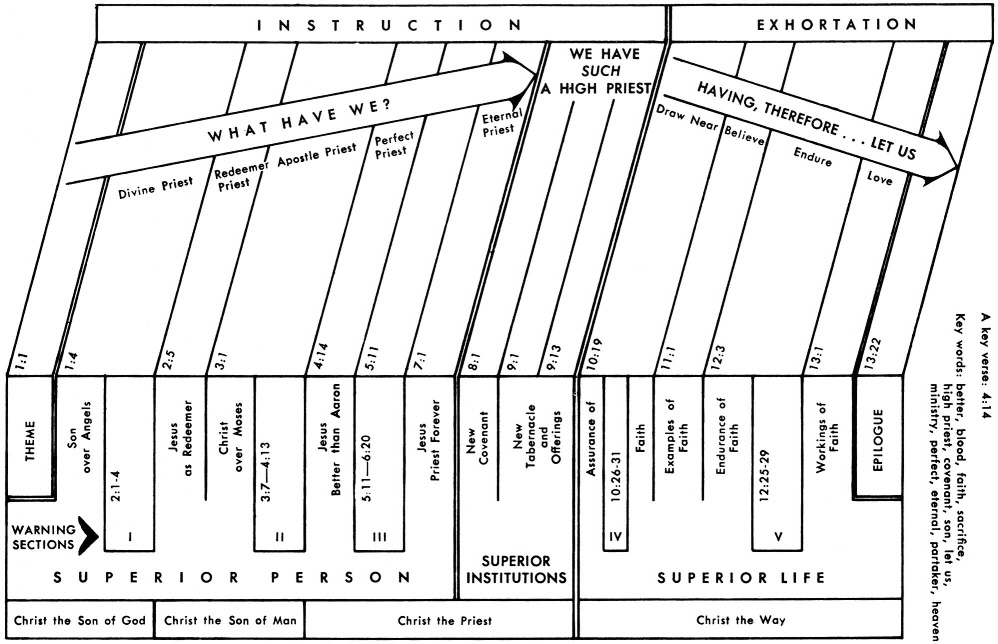
CONSIDER JESUS OUR GREAT HIGH PRIEST
Click chart to enlarge
Charts from Jensen's Survey of the NT - used by permission
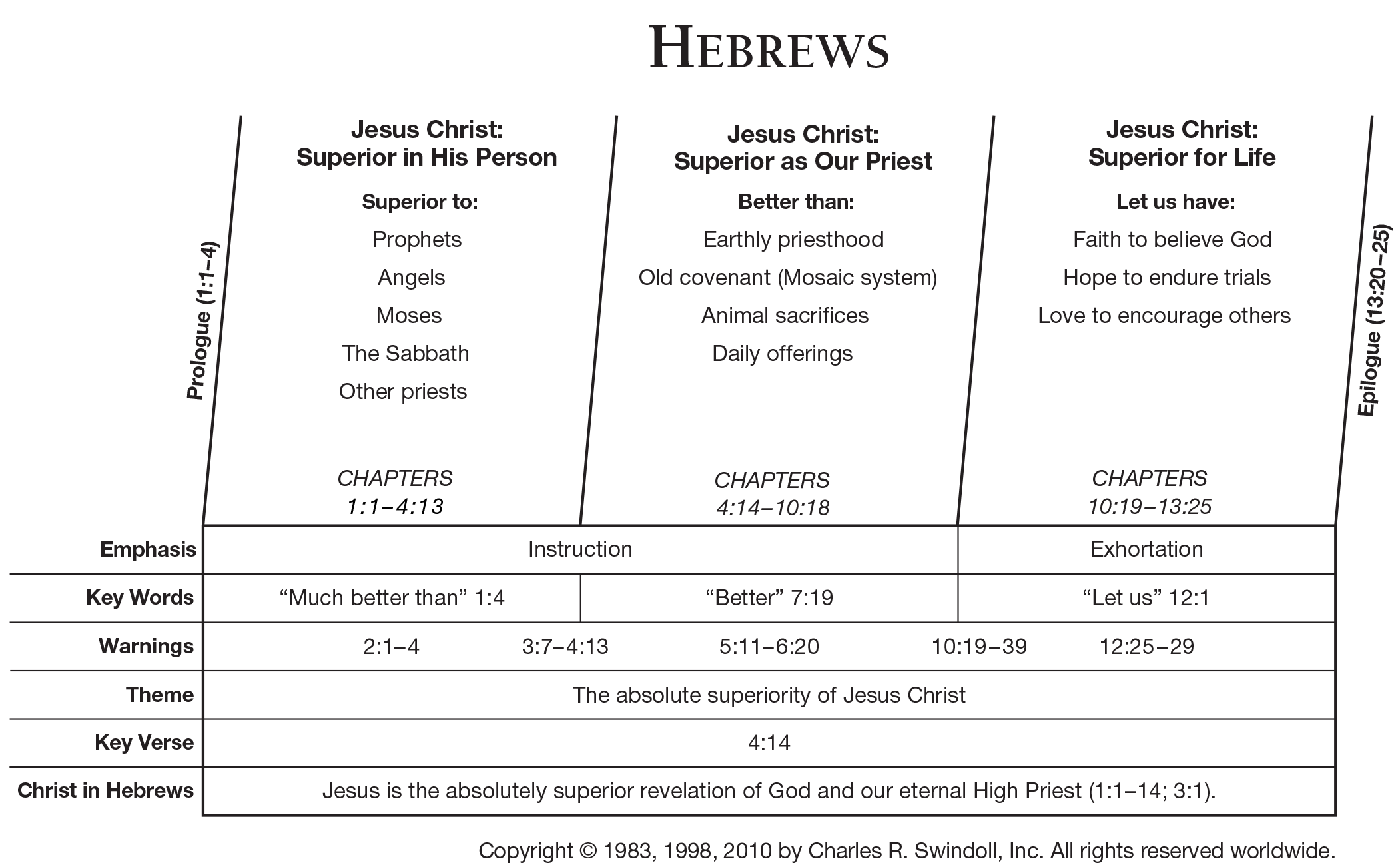
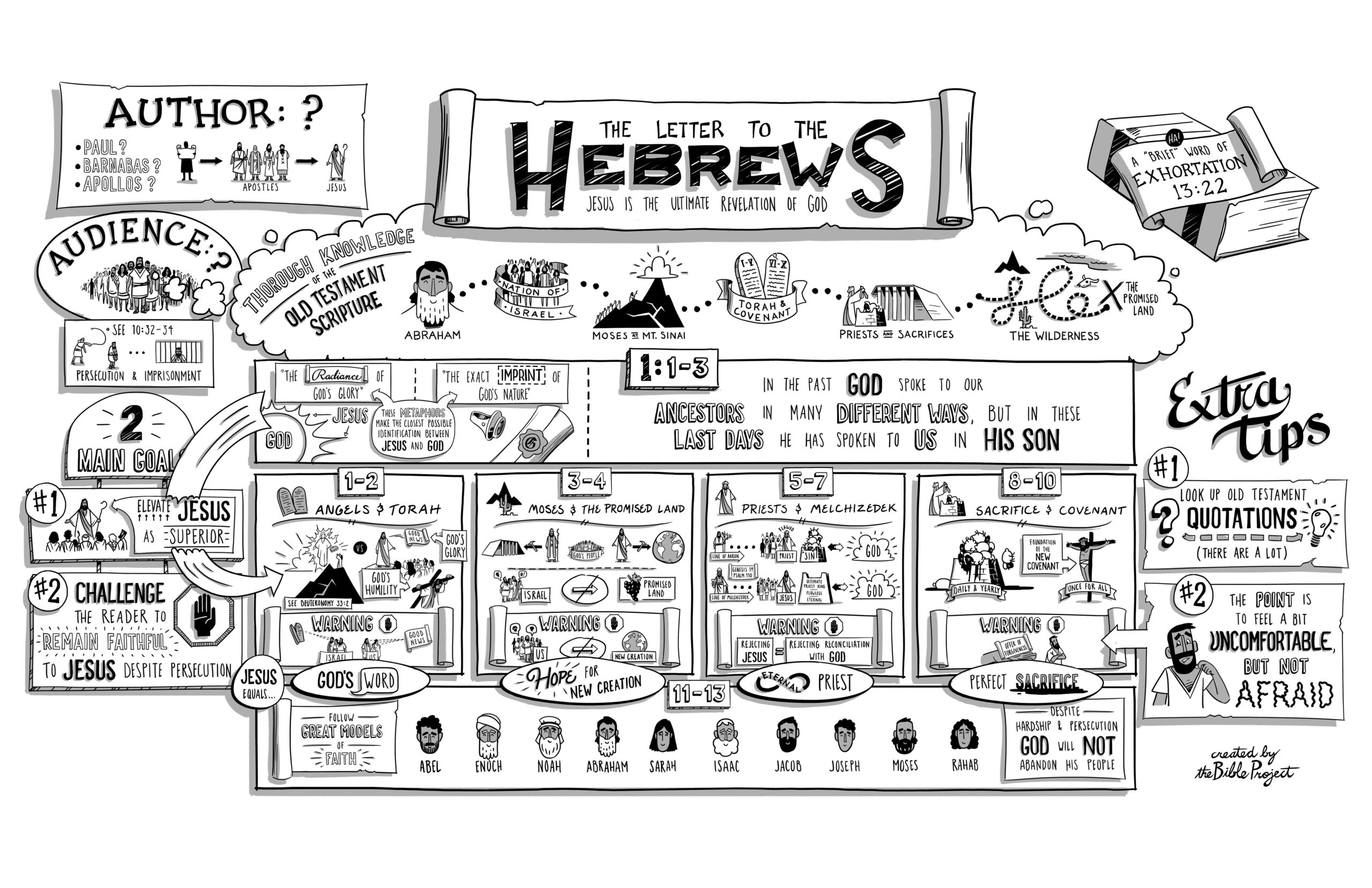
Swindoll's Chart, Interesting Pictorial Chart of Hebrews, Another Chart
|
The Epistle |
||||
| INSTRUCTION Hebrews 1-10:18 |
EXHORTATION Hebrews 10:19-13:25 |
|||
| Superior Person of Christ Hebrews 1:1-4:13 |
Superior Priest in Christ Hebrews 4:14-10:18 |
Superior Life In Christ Hebrews 10:19-13:25 |
||
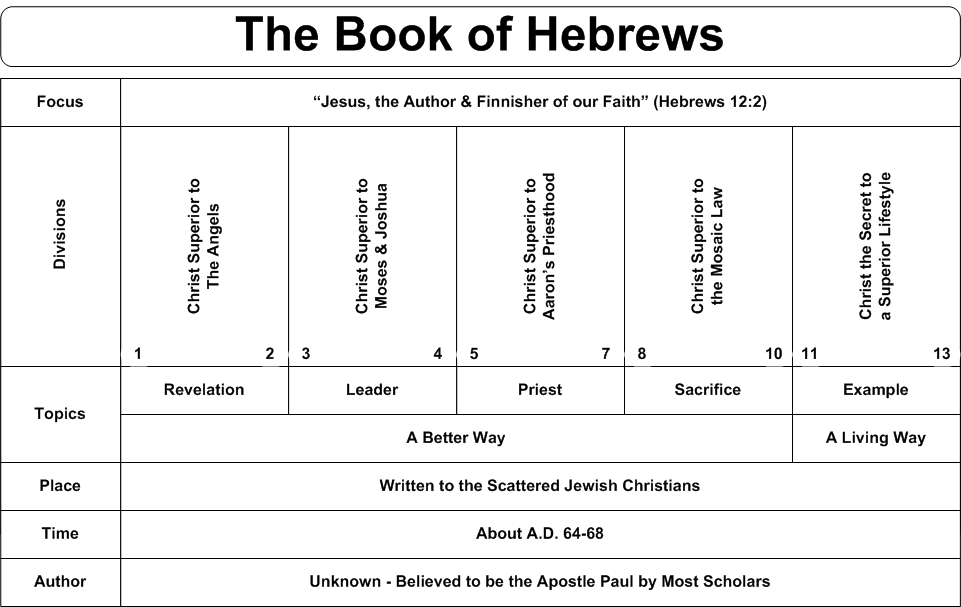
| BETTER THAN PERSON Hebrews 1:1-4:13 |
BETTER PRIESTHOOD Heb 4:14-7:28 |
BETTER COVENANT Heb 8:1-13 |
BETTER SACRIFICE Heb 9:1-10:18 |
BETTER LIFE |
| MAJESTY OF CHRIST |
MINISTRY OF CHRIST |
MINISTERS FOR CHRIST |
||
|
DOCTRINE |
DUTY |
|||
|
DATE WRITTEN: |
||||

See ESV Study Bible "Introduction to Hebrews"
(See also MacArthur's Introduction to Hebrews)
Borrow Ryrie Study Bible
Hebrews 4:3 For we who have believed enter that rest, just as He has said, "AS I SWORE IN MY WRATH, THEY SHALL NOT ENTER MY REST," although His works were finished from the foundation of the world. (NASB: Lockman)
Greek: eiserchometha (1PPMI) gar eis [ten] katapausin oi pisteusantes, (AAPMPN) kathos eireken, (3SRAI) Os omosa en te orge mou, Ei eiseleusontai (3PFMI) eis ten katapausin mou, kaitoi ton ergon apo kataboles kosmou genethenton. (AAPNPG)
BGT Εἰσερχόμεθα γὰρ εἰς [τὴν] κατάπαυσιν οἱ πιστεύσαντες, καθὼς εἴρηκεν· ὡς ὤμοσα ἐν τῇ ὀργῇ μου· εἰ εἰσελεύσονται εἰς τὴν κατάπαυσίν μου, καίτοι τῶν ἔργων ἀπὸ καταβολῆς κόσμου γενηθέντων.
Amplified: For we who have believed (adhered to and trusted in and relied on God) do enter that rest, in accordance with His declaration that those [who did not believe] should not enter when He said, As I swore in My wrath, They shall not enter My rest; and this He said although [His] works had been completed and prepared [and waiting for all who would believe] from the foundation of the world. (Amplified Bible - Lockman)
Barclay: It is we who have made the decision of faith who are entering into the rest, for of them God said: “I swore in my anger, ‘Very certainly they shall not enter into my rest.’” This he said although his works had been finished after the foundation of the world. (Westminster Press)
KJV: For we which have believed do enter into rest, as he said, As I have sworn in my wrath, if they shall enter into my rest: although the works were finished from the foundation of the world.
NKJ For we who have believed do enter that rest, as He has said: "So I swore in My wrath,`They shall not enter My rest,'" although the works were finished from the foundation of the world.
NLT: For only we who believe can enter his place of rest. As for those who didn't believe, God said, "In my anger I made a vow: `They will never enter my place of rest "', even though his place of rest has been ready since he made the world. (NLT - Tyndale House)
Phillips: It is only as a result of our faith and trust that we experience that rest. For he said: 'So I swore in my wrath, they shall not enter my rest'; not because the rest was not prepared - it had been ready since the work of creation was completed, (Phillips: Touchstone)
Wuest: For we enter into this rest, we who believed, as He has said, As I swore in my anger, They shall certainly not enter into my rest, although the works from the foundation of the universe had come into being.
Young's Literal: for we do enter into the rest -- we who did believe, as He said, 'So I sware in My anger, If they shall enter into My rest -- ;' and yet the works were done from the foundation of the world,
TLB For only we who believe God can enter into His place of rest. He has said, "I have sworn in my anger that those who don't believe me will never get in," even though he has been ready and waiting for them since the world began.
NET For we who have believed enter that rest, as he has said, "As I swore in my anger, 'They will never enter my rest!'" And yet God's works were accomplished from the foundation of the world.
CSB (for we who have believed enter the rest), in keeping with what He has said: So I swore in My anger, they will not enter My rest. And yet His works have been finished since the foundation of the world,
ESV For we who have believed enter that rest, as he has said, "As I swore in my wrath, 'They shall not enter my rest,'" although his works were finished from the foundation of the world.
NIV Now we who have believed enter that rest, just as God has said, "So I declared on oath in my anger, 'They shall never enter my rest.' " And yet his work has been finished since the creation of the world.
MIT For we believers enter into tranquillity, just as he has said: As I swore in my wrath, They will never enter my restful state. Although his works were operational at the founding of the cosmos,
NJB We, however, who have faith, are entering a place of rest, as in the text: And then in my anger I swore that they would never enter my place of rest. Now God's work was all finished at the beginning of the world;
NRS For we who have believed enter that rest, just as God has said, "As in my anger I swore, 'They shall not enter my rest,'" though his works were finished at the foundation of the world.
RSV For we who have believed enter that rest, as he has said, "As I swore in my wrath, `They shall never enter my rest,'" although his works were finished from the foundation of the world.
NAB For we who believed enter into (that) rest, just as he has said: "As I swore in my wrath, 'They shall not enter into my rest,'" and yet his works were accomplished at the foundation of the world.
GWN We who believe are entering that place of rest. As God said, "So I angrily took a solemn oath that they would never enter my place of rest." God said this even though he had finished his work when he created the world.
BBE For those of us who have belief come into his rest; even as he has said, As I said in my oath when I was angry, They may not come into my rest: though the works were done from the time of the making of the world.
ASV For we who have believed do enter into that rest; even as he hath said, As I sware in my wrath, They shall not enter into my rest: although the works were finished from the foundation of the world.
- We - Heb 3:14; Isaiah 28:12; Jeremiah 6:16; Matthew 11:28,29; Romans 5:1,2
- As I Swore - Ps 95:11, Heb 3:11, Heb 3:18,19 Nu 14:20-30,35 Nu 32:10-13 Dt 1:34,35 2:14
- His works - Ge 1:31 Ex 20:11
- From the foundation of the world - Heb 9:26 Mt 13:35 Eph 1:4 1Pe 1:20
- Hebrews 4 Resources - Multiple Sermons and Commentaries
Related Passages:
Psalm 95:11 “Therefore I swore in My anger, Truly they shall not enter into My rest.”
Numbers 14:28-30 “Say to them, ‘As I live,’ says the LORD, ‘just as you have spoken in My hearing, so I will surely do to you; 29 your corpses will fall in this wilderness, even all your numbered men, according to your complete number from twenty years old and upward, who have grumbled against Me. 30 ‘Surely you shall not come into the land in which I swore to settle you, except Caleb the son of Jephunneh and Joshua the son of Nun.
REST OR WRATH
BELIEF OR UNBELIEF
For (gar - because) explains or reinforces (see terms of explanation) the truth in Heb 4:2 that faith is the manner in which one possesses the promises of God, be they rest in a land (Promised land of Canaan) or rest in a life (the Messiah). It is notable that in the Greek text, the first words are "for we do enter into the rest" which places emphasis on the entrance into the rest.
We who have believed (pisteuo) enter (eiserchomai) that rest (katapausis) - WE of course is the writer and his readers who had genuinely trusted in Christ. As we have seen, he is not confident that all his readers have truly believed. Have believed (pisteuo) is aorist tense signifying (in context) that at some point in time in the past they had believed in Christ. And the active voice points to their belief as a conscious choice of their will to walk through the door (so to speak) into the rest found only in Christ (cf Jn 10:9+). It is interesting that the verb believed (pisteuo) in secular Greek literature had a basic meaning of intellectual assent, i.e., simply believing that something is true. However belief that gains entrance into the rest of salvation is not mere intellectual assent to divine promises. This assent is insufficient, because it rises no higher than faith of the unsaved, unregenerate demons (Jas 2:19+)! Spurgeon adds that it is "in proportion as faith possesses their souls, in that proportion they enjoy perfect rest (ED: AS PERFECT AS POSSIBLE IN OUR MORTAL BODIES)."
Jesus! I am resting, resting
In the joy of what Thou art;
I am finding out the greatness
Of Thy loving heart.
Enter (eiserchomai) is first word in Greek sentence (indicating it is being emphasized) and is in the present tense which speaks of continuous action or a process ("we are entering"). Enter is not restricted to entrance in the future (as it would be if it were future tense = "we will enter") but expresses a present reality which we begin to experience now (Today)! Think of it this way -- In one sense the moment we believed in Christ, we walked through the door (so to speak - Jn 10:9+ - "find pasture" ~ "rest") and thus we begin entering God's rest, but it does not cease, for we keep on entering daily (present tense) into the spiritual rest Christ provides. How? The same way we entered initially is the way we enter daily, by faith (through grace, by the Spirit). We now continually walk (present tense) by faith not by sight (2Co 5:7+). Col 2:6+ says "Therefore as you have received (aorist tense middle voice - past tense, moment we believed in) Christ Jesus the Lord, so walk (present imperative) in Him." And as we obey this command to walk in Him, enabled to do so by continually relying on the Holy Spirit to obey, we can experience what is found only in Christ, His rest (Mt 11:28-29+). Another way to interpret enter is as an already/not yet reality. The present tense keeps both aspects in view: rest is being experienced now but continues toward its consummation when we are glorified and like Him (1Jn 3:2+). Rest in Christ is both our present possession and our ongoing experience which is daily realized by faith, not works. In other words, already/yet says we now enjoy rest in Christ (freedom from works-righteousness, peace with God, etc), but one day (soon) we will fully enter into His perfect rest and that rest will be our experience throughout eternity! Hallelujah! In other words, full, perfect rest awaits consummation in the age to come when we are glorified (Rev. 14:13+). No wonder we can say we have "so great a salvation!" (Heb 2:3) One might paraphrase this clause as "For we who have believed are even now in the process of entering into His rest."
Joining a church won't bring you rest (in fact most of us who have been in churches for a while would sadly have to testify to quite the opposite experience!) any more than being a member of the 12 tribes of Israel guaranteed entrance into the Promised Land. It is not enough simply to hear the gospel (which sadly is becoming more and more "watered down" in the American evangelicalism!) or even to understand the gospel. The gospel must be received by grace through faith (Eph 2:8-9+) or you will not enter into God's spiritual rest of salvation. In fact, if a person hears the clear announcement of God's good news and refuses to combine the hearing with personal believing, Hebrews 4:12 says the message is "sharper than a two-edged sword" and instead of bringing rest, the message brings (greater) condemnation if rejected! As our writer affirms if one hears but does not believe, regardless of what else they do, the Lord Himself makes the pronouncement they shall not enter My rest (katapausis)!
Rest is not just a future privilege,
but it is a matter of present enjoyment
Leon Morris' note on enter - The verb eiserchomai (“enter”) is in the present tense. Montefiore, for one, regards this as important: “Contrary to some commentators, the Greek means neither that they are certain to enter, nor that they will enter, but that they are already in process of entering” (in loc.). By contrast Bruce complains of translations that “suggest that the entrance is here and now, whereas it lies ahead as something to be attained. The present tense is used in a generalizing sense” (in loc.). Either view is defensible and probably much depends on our idea of the “rest.” If it lies beyond death, then obviously “rest” must be understood in terms of the future. But if it is a present reality, then believers are entering it now. Characteristically, the writer supports his position by an appeal to Scripture. (Bolding added) (Comment - Could this rest be both present and future?)
Westcott on enter - The verb enter (εἰσερχόμεθα) is not to be taken as a future...., but as the expression of a present fact.
The Christian pilgrimage is not an aimless wandering, like that
of the Israelites in the desert. It is a deliberate,
straight course on a well-mapped destination.
Hugh Montefiore on believed and enter - Christians possess this faith which the rejected Israelites lacked; we who have believed are entering that rest, as he has said, ‘So I vowed in my anger, They shall never enter my rest’. At their Christian initiation our author and his readers had made an act of belief and this has now become a permanent attitude of faith. Because the Israelites had lacked that faith they had been rejected; and because our writer and his readers possess that faith they are now entering that rest. Contrary to some commentators, the Greek text means neither that they are certain to enter, nor that they will enter, but that they are already in process of entering. The Christian pilgrimage is not an aimless wandering, like that of the Israelites in the desert. It is a deliberate, straight course on a well-mapped destination....Life is a hard pilgrimage, beset by temptations; but Christians have a Leader (Heb 2:10; He 12:2) Who has already gone before them (Heb 6:20) and finished the course (Heb 12:2), and at the end of the road there is (ED: PERFECT, CONSUMMATED) rest and refreshment in the city of the living God (Heb 12:28). (Borrow Hebrews Commentary page 82)
Just as He has said, "AS I SWORE (omnuo) IN MY WRATH (orge), THEY SHALL NOT ENTER MY REST (katapausis)" although His works were finished from the foundation (katabole) of the world (kosmos) - The sense of the phrase Just as He has said is not immediately clear, but the NLT gives us a good suggestion with the paraphrase "As for the others." This suggests that the writer is in effect contrasting those who refused to believe and therefore did not enter God's rest, which would again serve as a warning to his readers to be sure that they have indeed believed and entered and are not just professing that they have entered. They need to be sure that they are in the "WE" group (who have believed). HE of course is God speaking and in light of Heb 3:7 would support that this is the Holy Spirit speaking.SAID is in the perfect tense (said also in perfect tense in Heb 1:13+ Heb 4:4+, Heb 10:9+; Heb 13:5+, all introducing OT quotes) signifying that God spoke this truth in the past (to David in Ps 95:11) and this truth remains valid. It speaks of the permanence of God's speech in Scripture. The point is that God has spoken so that settles it whether I believe it or not or whether I fully understand it or not! What God said endures forever (Ps 119:89).
🙏 THOUGHT - Who's rest? Don't miss the possessive pronoun! MY REST is the supernatural rest that God Himself experiences eternally and which He offers to His children in Christ! This truth should boggle your mind beloved! As I look at our world engulfed in political turmoil, racial enmity, artificial intelligence and social (often actually "anti-social") media, it is difficult to find rest. To disbelieve and disobey God and fail to enter His precious rest is the height of insanity and stupidity!
I walked life's path with "Worry,"
Disturbed and quite unblessed,
Until I trusted Jesus;
Now "Faith" has given rest.
— G.W.
Thomas Brooks sums up the danger of hearing and yet rejecting the good news - Reader, remember this: if thy knowledge does not now affect thy heart, it will at last, with a witness, afflict thy heart; if it does not now endear Christ to thee, it will at last provoke Christ the more against thee; if it do not make all the things of Christ to be very precious in thy eyes, it will at last make thee the more vile in Christ's eyes.
Spurgeon - It is by believing that we get REST—by no other means, not by scheming and plotting and planning and thinking and criticizing and judging and doubting and questioning, but by believing—the submission of the soul to God’s truth, the yielding of the heart to God’s salvation. This once done, we lie down in green pastures, and are led beside the still waters (Ps 23:1)....(ED: WHAT IS THIS REST?) The believer rests from the guilt of sin because he has seen his sins laid upon Christ, his Scapegoat, and knowing well that nothing can be in two places at one time, he concludes that if sin were laid on Christ, it is not on him; and thus he rejoices in his own deliverance from sin, through its having been imputed to his glorious Substitute. The believer in Christ Jesus sees sin effectually punished in Christ Jesus, and knowing that justice can never demand two penalties for the same crime, or two payments for the same debt, he rests perfectly at peace with regard to his past sins. (ED: THOUGHT - ARE YOU RESTING IN REGARD TO SINS YOU HAVE COMMITTED IN THE PAST?) He has, in the person of his Surety, endured the hell that was due on account of transgressions. Christ, by suffering in his stead, has answered all the demands of justice, and the believer’s heart is perfectly at rest. I do not say that the believer’s life is all peace, for his condition is peculiar in this way. When the children of Israel entered into Canaan, they were a portrait of a saint entering into rest. First, they had to cross the Jordan: the believer has to cross the Jordan of his sin. That is dried up, and he marches through by divine grace. Then there stand, inside the promised land, the walls of Jericho, namely, his own corruptions and his own sinful nature. It takes time to bring them to the ground, but after that, when the walls are leveled, there are Canaanites still in the land. Canaan was not a good type of heaven, for they were always fighting in Canaan, always having to war against the adversary. That is a good type of the rest to which believers come. They do rest. They know that heaven is theirs; that they are saved; that all their troubles work for their good; that they are God’s people. Still they have to fight against sin, and that is no more inconsistent with their being at rest than it was inconsistent with the fact of the holy land belonging to the Israelites, though they had still to go on fighting against the Canaanites. That is God’s rest, the rest of a finished work, and into that rest many never enter. The work by which they might live forever, the finished work by which they might be saved, they refuse, and so they never enter into God’s rest.
I Heard the Voice of Jesus Say
by Horatius Bonar
(Vocal by Michael Card - beautiful!)
I heard the voice of Jesus say,
‘Come unto me and rest,
Lay down, thou weary one, lay down
Thy head upon my breast.’
I came to Jesus as I was -
Weary, and worn, and sad:
I found in Him a resting place,
And He has made me glad!"
"AS I SWORE (omnuo) IN MY WRATH (orge), THEY SHALL NOT ENTER MY REST (katapausis)" - God does not need to swear to substantiate what He says because everything He says is true whether He swears or not. God could have simply stated this but the fact that He swore makes it all the more solemn and severe of a warning. Men swear oaths to each other because we often lie or do not follow through with our promises. But this is not true of God. There is no shadow of deceit in Him (Nu 23:19). He is faithful and always true to His word. When God swears, it’s a form of divine condescension — He stoops to human forms of speech so that His people will feel the full weight of His resolve. God know that men by virtue of our sinful nature are prone to doubt His promises (and warnings), so as an act of grace, He condescends to do what men do to substantiate their statements! God swore for emphasis, not for credulity! The oath in this warning, drives home the point that His threat was absolutely settled and unchangeable!
John Calvin said it this way -- “See how kindly God as a gracious Father accommodates himself to our slowness to believe; as he sees that we rest not on his simple word, that he might more fully impress it on our hearts he adds an oath.”
C H Spurgeon on NOT ENTER HIS REST - There can be no rest to an unbelieving heart. If manna and miracles could not satisfy Israel, neither would they have been content with the land which flowed with milk and honey. Canaan was to be the typical resting place of God, where His ark should abide, and the ordinances of religion should be established; the Lord had for forty years borne with the ill manners of the generation which came out of Egypt, and it was but right that He should resolve to have no more of them. Was it not enough that they had revolted all along that marvellous wilderness march? Should they be allowed to make new Massahs and Meribahs in the Promised Land itself? Jehovah would not have it so. He not only said but swore that into His rest they should not come, and that oath excluded every one of them; their carcasses fell in the wilderness. Solemn warning this to all who leave the way of faith for paths of petulant murmuring and mistrust. (Ed note: Spurgeon is not saying one can "lose salvation" but that their "faith" was not genuine saving faith in the first place.) The rebels of old could not enter in because of unbelief, "let us therefore fear, lest, a promise being left us of entering into his rest, any of us should even seem to come short of it."
John MacArthur - Those who sinned while wandering in the wilderness not only forfeited Canaan. Unless they exercised personal faith in God sometime during the forty years, they also forfeited eternal life-of which Canaan was only a symbol. (See Hebrews Commentary - Page 102)
Other conservative, evangelical writers such as Ray Stedman agree that although individual Israelites like Moses, Aaron and Miriam who died in the wilderness did not enter Canaan, their failure to enter the promised land did not indicate that they died eternally. I would agree especially since Moses was called faithful in Heb 3:2. On the other hand Stedman feels that the majority of Israel who came out of Egypt and physically died in the wilderness, not entering the physical land of Canaan, did perish eternally because they did not believe in the Messiah.
Ray Stedman asks "Did all those who died in the wilderness also perish eternally? Clearly not, since Moses, Aaron and Miriam are included in their number. Some, then, died before Canaan because they were unbelieving in relation to the picture of rest (Canaan) but did not perish eternally. But the majority were not only unbelieving about Canaan but also unbelieving about the redemptive provisions that pointed to Christ, and these we must presume to have been lost eternally." (Hebrews: Commentary Part I)
Although His works (ergon) were finished from the foundation (katabole) of the world (kosmos) - In the context of the next verse Heb 4:4, this fact underscores that His rest was complete, perfect, and available from the very beginning of Creation. Adam and Eve surely experienced that rest to a degree, but their sin ruined their rest (and ours). God’s rest was not a new concept introduced either in Moses’ day or in Joshua’s day but had been established at creation. If God’s rest existed before Israel ever set foot in the wilderness (and it did), His rest cannot be limited to entering the land of Canaan. This truth adds substance to the oath He had just given that they would not enter His rest. The problem in the wilderness generation was not that God’s rest was unavailable but that they refused it. The same rest is still available for the reader. One might say that God’s rest was built into creation as part of His completed, perfect work.
The idea of foundation is a "casting down" as in...
Matthew 25:34+ “Then the King will say to those on His right, ‘Come, you who are blessed of My Father, inherit the kingdom prepared for you from the foundation of the world.
Ephesians 1:4+ just as He chose us in Him before the foundation of the world, that we would be holy and blameless before Him. In love
Matthew Henry elaborates on this temporal distinction (ie, written in the time of David, some 400 years after the Exodus and wilderness wandering and at a time when Israel was now in the physical land of Canaan, "the land of milk and honey") commenting that…
Now this case of Israel may be applied to those of their posterity that lived in David's time, when this psalm was penned; let them hear God's voice, and not harden their hearts as their fathers did, lest, if they were stiff-necked like them, God should be provoked to forbid them the privileges of his temple at Jerusalem, of which he had said, This is my rest. But it must be applied to us Christians, because so the apostle applies it.
There is a spiritual and eternal rest set before us, and promised to us, of which Canaan was a type; we are all (in profession, at least) bound for this rest; yet many that seem to be so, come short and shall never enter into it. And what is it that puts a bar in their door? It is sin; it is unbelief, that sin against the remedy, against our appeal. Those that, like Israel, distrust God, and His power and goodness, and prefer the garlic and onions of Egypt before the milk and honey of Canaan, will justly be shut out from His rest: so shall their doom be; they themselves have decided it. Let us therefore fear, Hebrews 4:1.(see +)
Spurgeon - Do not tell me that there is no rest for us till we get to heaven. We who have believed in Jesus enter into rest even now. Why should we not do so? Our salvation is complete. The robe of righteousness in which we are clad is finished. The atonement for our sins is fully made. We are reconciled to God, beloved of the Father, preserved by his grace, and supplied by his providence with all that we need. We carry all our burdens to him and leave them at his feet. We spend our lives in his service, and we find his ways to be ways of pleasantness, and his paths to be paths of peace. Oh, yes, we have found rest unto our souls! I recollect the first day that I ever rested in Christ, and I did rest that day. And so will all of you who trust in Jesus as I trusted in him.
Does My rest mean that God is now just sitting back and doing nothing but resting? My rest is the rest God Himself enjoys and which He Himself makes available to us by grace through faith. This phrase as applied to believers is not just a relaxation of tensions, but a rest that is qualitatively the same rest the Omnipotent God enjoys and is willing to share with us! This truth should motivate a deep love for Him and a strong desire to walk in a manner which is pleasing to Him. God's rest is a "working rest" for even thought He finished His creation work and rested, this did not a cessation from work, but rather the proper repose that comes from completing a work. Jesus emphasized His Father’s ongoing work. "My Father is working until now, and I Myself am working." (John 5:17) God’s repose is an active rest if you will. Yes, He rests, but in his rest He keeps working.
The spiritual rest which God Himself had since creation, He has made available for us in eternity past when He chose us in Christ and was made effective by His Son on the Cross…
When Jesus therefore had received the sour wine, He said, "It is finished!" And He bowed His head, and gave up His spirit. (Jn 19:30+)
It is God who saved us and chose us to live a holy life. He did this not because we deserved it, but because that was His plan (NASB "His own purpose and grace") long before the world began (NIV "before the beginning of time")--to show his love and kindness to us through Christ Jesus. (2Ti 1:9+)
Comment: All that is left for the believer to do is to enter the rest God prepared for us before time began and which His Son procured for us with His finished work on the Cross.
Believed (4100) (pisteuo) refers not just to head knowledge (the "dead" faith of James 2:17, 26) but a belief that is shown to be genuine saving faith by the fruit of a changed life (not a perfect life but at least some evidence that there is a new life which manifests a new heart). Saving faith is dynamic and holds fast, obeys, endures, brings forth fruit and conversely does not shrink back, drift away or fall away. The only other use in Hebrews is Hebrews 11:6.
PISTEUO applied to men entering God’s rest, this word speaks of no self-effort as far as salvation is concerned. It means the end of trying to please God by feeble, fleshly works. God’s perfect rest is a salvation rest based on free albeit costly grace laid hold of by genuine saving faith.
Pisteuo is derived from pistis; pistos and means to consider something to be true and therefore worthy of one’s trust. It means to accept as true, genuine, or real and so to have a firm conviction as to the goodness, efficacy, or ability of something or someone.
W E Vine defines belief as consisting of…
(1) a firm conviction which produces full acknowledgment of God's revelation of Truth - (2Th 2:11 -"in order that they all may be judged who did not believe [pisteuo] the truth, but took pleasure in wickedness.")
(2) a personal surrender to the Truth (Jn 1:12 "But as many as received Him, to them He gave the right to become children of God, even to those who believe [pisteuo] in His name") and
(3) a conduct inspired by and consistent with that surrender (see notes on the obedience of faith or the relationship of faith and obedience)
Enter (come, came)(1525) eiserchomai (from eis = into + erchomai = to come, go) means to go in (to), enter. Eiserchomai can speak of a thought “coming into” mind (Herodotus), wisdom entering someone (Wisdom of Solomon 1:4), the “entering” of the prophetic spirit (Josephus Antiquities 4.6.5), demonic spirits that “enter” into men (Mk 9:25; Lk 8:30), and Satan “entering” Judas (Lk 22:3). Figuratively eiserchomai can denote the acquiring of something, i.e., “to attain something” (wealth, property, and so on). It is used of the kingdom of God/heaven (Mt 5:20; Mt 7:21; Mt 19:24; Mk 9:47; Mk 10:15; et al); eiserchomai describes attaining eternal life (Mt 18:8f.; Mt 19:17; Mk 9:43,45); or eiserchomai can speak of entering rest (Heb 3:11,18; Heb 4:11).
Friberg - (1) literally, in a local sense go or come into, enter (Mt 2.21); (2) figuratively; (a) of the birth of Jesus come into (the world) ( Heb 10.5); (b) of demons enter in, take possession of (Mk 9.25 ); (c) of persons; (i) in a good sense come into, enter into, begin to enjoy (Mt 5.20); (ii) in a bad sense begin to experience, meet, encounter (Mt 26.41); (d) as the first stage of an activity -- begin, come up (Lk 9.46) (Borrow Analytical Lexicon of the Greek New Testament)
Rest (2663) (katapausis from katá = intensifies the meaning of the following word or signifies "down" which figuratively conveys the sense of permanency + pauo = make to cease) describes literally a ceasing from one's work or activity. Thayer cites a use in the active sense of a putting to rest as used in the sentence "a calming of the winds". Metaphorically as used in the present verse, katapausis speaks of the spiritual fulfillment God provides for His people. Katapausis is a ceasing from one form of activity IN ORDER TO give oneself to a wholly new enterprise, in the context, to believe God's promise. (See excursus on Rest in Hebrews 4)
Gilbrant - In classical Greek katapauō carries the meaning of “to stop” or “to put an end to” in relation to all kinds of actions and conditions. With reference to persons, katapauō can even carry the very negative aspect of “to kill” (cf. Moulton-Milligan). However, the Septuagint uses katapauō in the more positive sense of “giving someone good rest.” The most common Septuagint usage of katapauō is to translate the Hebrew nuach which means “rest, settle down, be quiet.” Katapauō is used in connection with God giving one “rest” from his enemies (Exodus 33:14; Deuteronomy 3:20) and with reference to “rest” in the Promised Land (Joshua 1:13). (Complete Biblical Library Greek-English Dictionary)
Barclay has the following analysis of katapausis in Hebrews 3 noting that "In a complicated passage like this it is better to try to grasp the broad lines of the thought before we look at any of the details. The writer is really using the word rest (katapausis) in three different senses. (i) He is using it as we would use the peace of God. It is the greatest thing in the world to enter into the peace of God. (ii) He is using it, as he used it in He 3:12+, to mean The Promised Land. To the children of Israel who had wandered so long in the desert the Promised Land was indeed the rest of God. (iii) He is using it of the rest of God after the sixth day of creation, when all God’s work was completed. This way of using a word in two or three different ways, of teasing at it until the last drop of meaning was extracted from it, was typical of cultured, academic thought in the days when the writer to the Hebrews wrote his letter. (Daily Study Bible)
As has been alluded to in previous notes on Hebrews 4 it is possible to interpret God's "rest" in several ways…
(1) The rest associated with placing one's faith in Christ (see Mt 11:28-30+). In the context of the entire epistle, this appears to be the primary meaning, that is, of coming to Jesus by faith and entering His salvation rest where self effort is replaced (or at least can and should be replaced) by Spirit initiated and empowered effort (Gal 3:3+).
(2) The rest of those who are believers in Christ, and who are living their Christian life in the power of the Spirit, keeping short accounts, and thus experiencing the "peace of God". This aspect of rest is that which is associated with sanctification, our day to day living out of the Christ life. Ray Stedman speaking of those who have entered this salvation rest by faith explains that tragically many believers experience breakdown in their Christianity (not referring to a loss of salvation but a loss of joy and sense of His presence and power) under the pressures of stress or responsibility because they try to work out their salvation in their power (cp Php 2:12+, Php 2:13+) and have not learned to "operate out of rest". (The Rest Obtained Is New-Creation Rest)
Hebrews 4:3 supports the premise that rest is something we must enter into the the first time (salvation rest by grace through faith) but is also a daily entering (also by grace through faith) into God's rest in the process of sanctification, that growth in grace and knowledge of our Lord and Savior Jesus Christ (2Pe 3:18+). So how does Hebrews 4:3 support this premise? Note that the verb enter is in the present tense, which indicates as believers we are in the process of entering. We are continually entering into His rest, day by day, even moment by moment. Even our experience as believers bears this out, for what believer when he or she has committed sin and fails to confess quickly, does not sense an inner "restlessness" and loss of peace. On the other hand when we can say as Paul said "I thank God, whom I serve with a clear conscience" (2Ti 1:3+), we are surely experiencing some of the fruit of entering into His rest. There is another sense in which we are in the process of entering God's rest, for there is the sure hope of the future rest when we enter into the Millennium (see below) and then finally into the New Heavens and New Earth, where "there will no longer be any death; there will no longer be any mourning, or crying, or pain; the first things have passed away." (Re 21:4+) Surely this describes in part the ultimate rest into which we are entering.
(3). Some who believe in a literal 1000 year kingdom (see Millennium) feel that the rest that is promised to Israel (and applies to all believers) will be partially fulfilled in the reign of Christ on earth ("the Messianic Age"), the "rest" of which Isaiah records…
Then it will come about in that day (when Messiah takes His throne in Jerusalem after the Great Tribulation - see Daniel's Seventieth Week - and the defeat of the Antichrist) that the nations will resort to the root of Jesse (the Messiah), Who will stand as a signal (a banner lifted up to be a rallying point) for the peoples; and His resting place (LXX uses the related word anapausis) will be glorious. (Isaiah 11:10)
(4). The rest associated with the New Heavens and New Earth where righteousness dwells forever. John alludes to this rest writing…
I heard a voice from heaven, saying, "Write, 'Blessed are the dead who die in the Lord from now on!'" "Yes," says the Spirit, "that they may rest from their labors, for their deeds follow with them. (Re 14:13+)
John MacArthur adds this note on rest "The basic idea is that of ceasing from work or from any kind of action. You stop doing what you are doing. Action, labor, or exertion is over. Applied to God’s rest, it means no more self-effort as far as salvation is concerned. It means the end of trying to please God by our feeble, fleshly works. God’s perfect rest is a rest in free grace. Rest also means freedom from whatever worries or disturbs you. Some people cannot rest mentally and emotionally because they are so easily annoyed. Every little nuisance upsets them and they always feel hassled. Rest does not mean freedom from all nuisances and hassles; it means freedom from being so easily bothered by them. It means to be inwardly quiet, composed, peaceful. To enter God’s rest means to be at peace with God, to possess the perfect peace He gives (Php 4:7). It means to be free from guilt and even unnecessary feelings of guilt (Ro 5:1, Ro 8:1). It means freedom from worry about sin, because sin is forgiven. God’s rest is the end of legalistic works and the experience of peace in the total forgiveness of God. Rest can mean to lie down, be settled, fixed, secure. There is no more shifting about in frustration from one thing to another, no more running in circles. In God’s rest we are forever established in Christ. We are freed from running from philosophy to philosophy, from religion to religion, from lifestyle to lifestyle. We are freed from being tossed about by every doctrinal wind, every idea or fad, that blows our way. In Christ, we are established, rooted, grounded, unmoveable (Col 2:7). That is the Christian’s rest. Rest involves remaining confident, keeping trust. In other words, to rest in something or someone means to maintain our confidence in it or him. To enter God’s rest, therefore, means to enjoy the perfect, unshakable confidence of salvation in our Lord. We have no more reason to fear. We have absolute trust and confidence in God’s power and care. Rest also means to lean on. To enter into God’s rest means that for the remainder of our lives and for all eternity we can lean on God. We can be sure that He will never fail to support us. In the new relationship with God, we can depend on Him for everything and in everything—for support, for health, for strength, for all we need. It is a relationship in which we are confident and secure that we have committed our life to God and that He holds it in perfect, eternal love. It is a relationship that involves being settled and fixed. No more floating around. We know whom we have believed and we stand in Him. The rest spoken of in Hebrews 3 and 4 includes all of these meanings. It is full, blessed, sweet, satisfying, peaceful. It is what God offers every person in Christ. It is the rest pictured and illustrated in the Canaan rest that Israel never understood and never entered into because of unbelief. And just as Israel never entered Canaan rest because of unbelief, so soul after soul since that time, and even before, has missed God’s salvation rest because of unbelief. Two other dimensions of spiritual rest will not be found in a dictionary—the Kingdom rest of the Millennium and the eternal rest of heaven. These are the ultimate expressions of the new relationship to God in Christ, the relationship that takes care of us in this life, in the Kingdom, and in heaven forever. (AMEN!) (See Hebrews Commentary - Page 96)
Swore (3660) omnuo means to affirm the truth of a statement by calling on God to execute sanctions against a person if the statement in question is not true. However in the present context it is God Himself takes an oath and by doing this, His divine being is then regarded as validating the statement.
OMNUO - Matt. 5:34; Matt. 5:36; Matt. 23:16; Matt. 23:18; Matt. 23:20; Matt. 23:21; Matt. 23:22; Matt. 26:74; Mk. 6:23; Mk. 14:71; Lk. 1:73; Acts 2:30; Heb. 3:11; Heb. 3:18; Heb. 4:3; Heb. 6:13; Heb. 6:16; Heb. 7:21; Jas. 5:12; Rev. 10:6
Hebrews has six of the 21 NT uses of omnuo as shown in the following verses - Hebrews 3:11+, Hebrews 3:18+, Hebrews 4:3+, Hebrews 6:13+, Hebrews 6:16+, Hebrews 7:21+
Wrath (3709) (orge from orgaô = to teem, to swell) conveys the picture of a swelling which eventually bursts, and thus describes an anger that proceeds from one’s settled nature. Orge does not refer to uncontrollable anger to which men are so prone but to God's settled indignation and controlled passionate hostile feeling toward sin in all its various manifestations. Settled indignation means that God’s holiness cannot and will not coexist with sin in any form whatsoever. Orge is not the momentary, emotional, and often uncontrolled anger (thumos - 2372) to which human beings are prone. Orge is used primarily of God's holy, righteous wrath but occasionally refers to the wrath of men (Ep 4:31+)
Orge refers to to an inner, deep resentment that seethes and smolders. Orge as used of God refers to His constant and controlled indignation toward sin, while thumos (which originally referred to violent movements of air, water, etc., and consequently came to mean “well up” or “boil up”) refers more to a passionate outburst of rage. Thumos type anger represents an agitated, vehement anger that rushes along relentlessly. The root meaning has to do with moving rapidly and was used of a man’s breathing violently while pursuing an enemy in great rage!
Orge is God’s settled opposition to and displeasure with sin. God’s wrath is His holy hatred of all that is unholy. It is His righteous indignation at everything that is unrighteous. It is important to note that orge is not God's uncontrollable rage, vindictive bitterness or a losing of His temper (all of which characterize sinful anger so typical of fallen men), but the wrath of righteous reason and holy law.
ORGE - 34V - Matt. 3:7; Mk. 3:5; Lk. 3:7; Lk. 21:23; Jn. 3:36; Rom. 1:18; Rom. 2:5; Rom. 2:8; Rom. 3:5; Rom. 4:15; Rom. 5:9; Rom. 9:22; Rom. 12:19; Rom. 13:4; Rom. 13:5; Eph. 2:3; Eph. 4:31; Eph. 5:6; Col. 3:6; Col. 3:8; 1 Thess. 1:10; 1 Thess. 2:16; 1 Thess. 5:9; 1 Tim. 2:8; Heb. 3:11; Heb. 4:3; Jas. 1:19; Jas. 1:20; Rev. 6:16; Rev. 6:17; Rev. 11:18; Rev. 14:10; Rev. 16:19; Rev. 19:15
Foundation (2602) (katabole from kataballo = to throw down from kata = down + ballo = throw, cast) is literally a casting down or laying down. The original idea was the laying down of the foundation of a house. Katabole was a technical term for putting seed into the ground, it is also used of the role of the male in impregnating the female and there is one such use in Hebrews 11:11, referring to the casting in or sowing of seed, conveying the idea of begetting. TDNT adds that katabole meant “laying down,” is used for, e.g., the casting of seed, human begetting, the sowing of war, and the establishment of government.
Ten of the 11 NT uses of katabole (there are no uses in the LXX) are in the phrase "foundation of the world".
Matthew 13:35 so that what was spoken through the prophet might be fulfilled, saying, "I will open My mouth in parables; I will utter things hidden since the foundation of the world."
Matthew 25:34 "Then the King will say to those on His right, 'Come, you who are blessed of My Father, inherit the kingdom prepared for you from the foundation of the world.
Luke 11:50 in order that the blood of all the prophets, shed since the foundation of the world, may be charged against this generation,
John 17:24 "Father, I desire that they also, whom Thou hast given Me, be with Me where I am, in order that they may behold My glory, which Thou hast given Me; for Thou didst love Me before the foundation of the world.
Ephesians 1:4 (+ just as He chose us in Him before the foundation of the world, that we should be holy and blameless before Him. In love
Hebrews 4:3 (+ For we who have believed enter that rest, just as He has said, "As I swore in My wrath, They shall not enter My rest," although His works were finished from the foundation of the world.
Hebrews 9:26 + Otherwise, He would have needed to suffer often since the foundation of the world; but now once at the consummation of the ages He has been manifested to put away sin by the sacrifice of Himself.
Hebrews 11:11 + By faith even Sarah herself received ability to conceive, even beyond the proper time of life, since she considered Him faithful who had promised;
1 Peter 1:20 + For He was foreknown before the foundation of the world, but has appeared in these last times for the sake of you
Revelation 13:8 + And all who dwell on the earth will worship him, everyone whose name has not been written from the foundation of the world in the book of life of the Lamb who has been slain.
Revelation 17:8 (+ "The beast that you saw was and is not, and is about to come up out of the abyss and to go to destruction. And those who dwell on the earth will wonder, whose name has not been written in the book of life from the foundation of the world, when they see the beast, that he was and is not and will come.
World (2889) (kosmos) means the world with its primary meaning being order, regular disposition and arrangement, here referring in essence to God's creation of the heavens and earth that we know today.
MacArthur comments that "God has finished His work. God has done it all, and for anyone who wants to enter into His finished work and to share in His rest, it is available by faith. When God had finished the creation, He said (briefly paraphrasing Gen. 2), “It’s done. I’ve made a wonderful world for man and woman. I’ve given them everything earthly they need, including each other, for a complete and beautiful and satisfying life. Even more importantly, they have perfect, unbroken, unmarred fellowship with Me. I can now rest; and they can rest in Me.” (Hebrews. Moody Press )
TECHNICAL NOTE - I had a question on the KJV translation of Hebrews 4:3KJV and must admit that the "IF" in the KJV puzzled me as most of the newer translations have no "IF' but the word is actually present in the Greek ("Ei eiseleusontai eis ton katapausin mou") Regarding KJV the "if" is very confusing as most translations have no "if" -- most read "As I swore in my anger,'They will never enter My rest!" KJV says "As I have sworn in My wrath , if they shall enter into My rest." But the NKJV reads this way (THE NEW KJV DOES NOT HAVE THE "IF") "So I swore in My wrath,`They shall not enter My rest,'" I finally found an explanation from Greek expert Marvin Vincent on the meaning of the IF -- Vincent writes -
They shall not enter into my rest (εἰ ἐλεύσονται εἰς τὴν κατάπαυσιν μου). Literally - if they shall enter, etc. A common Hebraistic formula in oaths. Where God is speaking, as here, the ellipsis is “may I not be Jehovah if they shall enter.”
So the modern versions are aware that most English readers would not understand or be aware of common Hebraistic formula in oaths and so they basically paraphrase the statement. In other words is you read "may I not be Jehovah if they shall enter." Clearly God will NEVER not be Jehovah, so the sense is that they will never enter. Yes, it is a bit confusing but I think that solves the problem, because at first glance when I read " if they shall enter," I think he is saying they might possibly enter, but in fact God is saying just the opposite, that they shall not enter.
Spurgeon - Finding Rest in a Person - How happy are we to find rest in a person! This is warm and substantial comfort. You cannot rest in the words of a doctrine as you can in the bosom of a person. Take a poor child that is lost in the street. Talk to it upon cheering themes. These ought to comfort it; but the little one goes on crying. Sing to it, and reason with it. It is all in vain. Run, fetch its mother! See how it smiles! It nestles in her bosom, and is at rest. A person yields the heart comfort. So it is with our Lord Jesus Christ. In life, in death, it is a delightful thought that our salvation rests in the hands of a living, loving personality; we depend upon a divine and human person, an accessible helper, to whom we may come at all times. Oh, yes, “we who have believed enter into rest” in the person of the Well-beloved!
Spurgeon - The More Faith Grows, the More Rest Grows (OR "HOW TO LOSE YOUR REST")
When our faith begins to forget the Lord, and we commence
to worry and to fret, then our rest goes at once.
Some people are always fretting and fuming; they appear to have been born in stormy weather, and to be perpetually agitated in mind so that they cannot rest. Only the other day, a gardener I knew of was complaining greatly of the heavy rain, which had done some damage to the garden where he was working. A Quaker, who stood by, said to him, “Friend, you ought not to complain of the rain, for if it has not done this garden any good, it has done good to the fields of many of your neighbors. Therefore you ought to be glad on their account, and to thank God”; and then the good man very wisely added, “I do not think that, after all, we should have the weather any better managed by you than it is by God, if it could be put into your hands.”
That is the right way to look at all things; they are far better ordered by God than by any man. Christian, you could not order them better if you had the ordering of them, so be perfectly content, and say, “Not my will, Lord; but yours be done.” The more faith grows, the more rest grows; but when our faith begins to forget the Lord, and we commence to worry and to fret, then our rest goes at once.
REST
"We which have believed do enter into rest."--Heb. 4:4.
"Ich bleib bei Dir! wo koennt ich 's besser haben."
Adolph Moraht transl., Jane Borthwick, 1855I rest with Thee, Lord! whither should I go?
I feel so blest within Thy home of love!
The blessings purchased by Thy pain and woe,
To Thy poor child Thou sendest from above.
Oh! never let Thy grace depart from me:
So shall I still abide, my Lord, with Thee.I rest with Thee! Eternal life the prize
Thou wilt bestow, when faith's good fight is won;
What can earth give but vain regrets and sighs,
To the poor heart whose passing bliss is done?
For lasting joys I fleeting ones resign,
Since Jesus calls me His, and He is mine.I rest with Thee! No other place of rest
Can now attract, no other portion please.
The soul, of heavenly treasure once possest,
All earthly glory with indifference sees.
Poor world, farewell! thy splendors tempt no more--
The power of grace I feel, and thine is o'er,I rest with Thee! with Thee, whose wondrous love
Descends to seek the lost; the fallen raise,
Oh! that my whole of future life might prove
One hallelujah, one glad song of praise!
So shall I sing, as time's last moments flee
Now and for ever, Lord, I rest with Thee!
ACRONYM FOR REST
R – Rely on Christ’s finished work
E – Enter by faith, not by toil
S – Savor His presence and peace
T – Trust His promise to the end
My Faith Has Found a Resting Place
My faith has found a resting place,
Not in device nor creed.
I trust the ever-living One;
His wounds for me shall plead.
Like a River Glorious
Stayed upon Christ Jesus,
Hearts are fully blest;
Finding, as He promised,
Perfect peace and rest.
“Be Still, My Soul”
"Be still, my soul; the Lord is on your side;
bear patiently the cross of grief or pain;
leave to your God to order and provide;
in ev'ry change he faithful will remain."
“Leaning on the Everlasting Arms”
Refrain:
"Leaning, leaning, safe and secure from all alarms;
Leaning, leaning, leaning on the everlasting arms."
This hymn celebrates the peace found in God's protective embrace.
“It Is Well with My Soul”
"When peace like a river, attends my way,
when sorrows like sea billows roll;
it is well, it is well, with my soul."
“There Is a Place of Quiet Rest (Near to the Heart of God)”
"There is a place of quiet rest, near to the heart of God;
a place where sin cannot molest, near to the heart of God."
“The Haven of Rest” (My Soul in Sad Exile / The Haven of Rest)
"My soul in sad exile was out on life's sea…
I've anchored my soul in the haven of rest,
I'll sail the wide seas no more;…
In Jesus I'm safe evermore."
“I Will Give You Rest (Come unto Me, All Ye Who Are Weary)”
"Come unto me, all ye who are weary, heavily laden…
I will give you rest…
Breathe in my ear the tale of your sorrows,
I will give you rest."
“We Rest on Thee, Our Shield and Our Defender”
"We rest on thee, our Shield and our Defender!
… strong in thy strength, safe in thy keeping tender,
we rest on thee, and in thy name we go."
Rest in Six Aspects
- Creation rest, broken by sin Genesis 2:2
- Redemption rest, secured in Christ Zeph. 3:17
- The sinner’s rest, by coming to Christ Matt. 11:28
- The saint’s rest, in communion with Christ Mark 6:30
- Paradise rest, present Rev. 16:13 and 2 Cor. 5:1-8
- Eternal rest, future Heb. 4:9; Rev. 22:5
From the Book of 750 Bible and Gospel Studies, 1909, George W Noble, Chicago (ED: Does not mention Millennial Rest)
Chuck Smith - "GOD'S REST"
I. GOD HAS PROMISED US A REST FROM:
A. Fear.
1. How many people today are tormented by fear?
2. Some fear they are not saved.
a. God does not love them.
b. Theirs is some special case.
3. Fearing an experience is often more painful than the experience itself.
a. Many die a thousand deaths fearing one.
4. "The fear of man brings a snare."
5. The children of Israel feared the giants.
6. God said, "Fear not for I am with thee."
B. Worry.
1. Some I believe are addicted to worry (chronic worriers).
a. They worry because there is nothing to worry about. Things are going too good.
2. Worry is akin to fear and also torments.
a. It can cause loss of sleep.
3. Many of our worries are unfounded if we just knew the whole story.
a. Worried about Canaan being killed.
b. Jacob cried, "All things are against me."
c. Men of Samaria under Syrian siege.
d. Disciples in storm tossed ship.
4. "Fret not thyself."
5. "Take no anxious thought about tomorrow..."
II. THOUGH THE PROMISE IS GIVEN ALL ARE NOT RESTING.
A. Tragic story of history, unfulfilled promises.
1. Forty years of wandering in wilderness when God promised them the land.
B. The problem is not on God's end.
1. His Word is good.
a. "God's hand is not short..."
b. "God is not slack concerning His promises."
2. The eternal folly of man.
a. Something goes right, we want to take the credit.
b. Something goes wrong, we want to blame God.
C. God's work is completed.
1. Jesus cried from the cross, "It is finished."
2. We must enter into that finished work.
3. We must rest where God is resting - in the finished work at the cross.
III. WHY SOME FAIL TO ATTAIN THIS REST.
A. One cause many symptoms, cause unbelief.
1. Not believing God is all He said He is.
2. Not believing God will do all He said He would.
3. The children of Israel came to Kadesh Barnea - the choice was given.
IV. HOW TO ENTER INTO THE REST TODAY.
A. Quit trusting in yourself and begin to trust God.
1. "Trust in the Lord with all thine heart."
B. Look to God rather than at your problem.
1. Peter did well with his eyes on Jesus.
C. Know that if God doesn't do it, it can't be done.
1. "Except the Lord build the house..."
2. You can't do anything about it anyhow.
a. Except perhaps botch it up more.
b. Your fear or worry can only tear you down more.
3. So just kick back and let God do it.
D L Moody - We which have believed do enter into rest.
There is a rest that is given, a rest that is found, and a rest that remaineth to the people of God. The first brings relief to the troubled conscience, the second to the troubled heart, and the third brings to the believer the fullness of joy that is in the presence of the Lord, the pleasures that are at His right hand forevermore. The first is directly connected with the Son as the Saviour of sinners; the second is more immediately related to the Holy Spirit as our abiding Comforter; and the third is associated with the “Father’s house,” in which “are many mansions.”
Henry Mahan - Rest is a sweet word to the weary soul; all seek it but only believers find it. Paul wrote, “We which have believed do enter into rest” (Heb. 4:3). He did not say we shall enter but we do enter into rest. There is a sweet repose, a calm peace, and a sweet rest in Christ. We can trust him to forgive the past, provide for the present, and guarantee the future. If you can believe God, you will find in Christ all you need.
LEAVE IT THERE
Delight thyself also in the Lord; and he shall give thee the desires of thine heart. PSALM 37:4
HOW CAN YOU FIND "REST for your soul"? One way is by faith (ED: I SAY THE ONLY WAY!). "We which have believed do enter into rest" (Heb. 4:3 italics added).
The point there is that faith has two hands. With one hand faith is always handing over, and with the other she is always reaching down - ours is the up and the down life. The angels went up on the ladder carrying Jacob's worries, and they came down the ladder bringing God's help. You have the two directions in your life. Send them up, and let them come down.
Do you know what it is when you are worried to kneel down and say to God: "Father, take this," and by one definite act to hand over the worry to God and leave it there? I heard a lady say that she had been in the habit of kneeling by her bedside and handing things over to God, and then jumping into her bed and by a strong pull pulling in all the things after her. Now that is not the best way. When you really trust God, you put a thing into His hands, and then you do not worry yourself or Him.
If there is one thing that annoys me more than another, it is for a man to say to me: "Will you do this?" And I say, "Certainly," and then he keeps sending postcards or letters to me all the time to work me up. I say, "That man does not trust me." So when I have really handed a thing over to God I leave it there, and I dare not worry for fear it would seem as if I mistrusted Him. But I keep looking up to Him -1 cannot help doing that - and say, "Father, I am trusting."
My dog at home has such trust. He used to worry me very much to be fed at dinner, but he never got any food that way. But lately he has adopted something that always conquers me. He sits under the table and puts one paw on my knee. He never barks, never leaps around, never worries me, but he sits under the table with that one paw on my knee, and that conquers me. I cannot resist the appeal. Although my wife says I must never do it, I keep putting little morsels under the table.
That is the way to live - with your hand on God's knee. Say, "My God, I am not going to worry; I am not going to fret but there is my hand, and I wait until the time comes, and Thou shalt give me the desires of my heart."
F. B. MEYER
Dave Roper - There Is Rest
I’m climbin’ up the mountain, children;
Ain’t got time for to stay.
Ain’t nobody gonna turn me ’round,
Gonna make it to the judgment day.
—Traditional Spiritual
Is it true? Must I keep climbing? Must I “make it” to the judgment day? Is there a rest for my weary efforts? There is, God assures me.
Our Lord entered into rest when He finished the work of creation. He luxuriated in what He had accomplished and “rested.”331 Every other creation day had a beginning and an end, but not the Sabbath. It is timeless, eternal. It “remains.”
The Sabbath, of course, is but a symbol and therefore cannot be our final resting place. Even the rest of Canaan was not the finale, for that was a temporary, earthly rest. But God promised “another” day on which to rest, and so there “remains” a Sabbath for God’s children.332
Where is that place of rest? Is it in heaven? Or earth? Both, I say. There is a final rest for our worn-out bodies and weary souls on ahead, but there is also rest in the here and now. “We who have believed enter [now] that rest.”333 Today is the day of rest. “Come to me,” Jesus said, “and you will find rest for your souls.”334
There is the rest of salvation: “It is finished” was His cry. I have nothing to do but believe that my salvation is complete—nothing more. I can rest assured that God will guard my faith to the end. No one can touch me, for I am held in His hands.
There is the rest of sanctification: the One who began a good work in us will perfect it until the day of Christ. We can rest in His forgiveness and grace and know that He is at work to bring us to completeness in the end. When we see Him, we’ll be just like Him, He assures us.
There is the rest of ministry and service. I am God’s workmanship, created to do good works that He has prepared in advance for me. He knows the way through my world and the hazards I will encounter there. He knows my heartaches and the obstacles that must be surmounted each day. I can cease from anxious scheming and striving and rest in His sufficiency.
This is not passivity or quietism. God rested from His labors on the seventh day but works today through Providence; Jesus rested in His finished work on the cross but lives to intercede for us.
No, this is not inactivity, but restful effort, relying on the work of God’s omniscient, caring Son.
Thus in all things I must make every effort to enter that rest—
In simple faith to rest
that He, who knows and loves, will do the best.335
So, I say, “grow old along with me, the best is yet to be . . .”336
331 Genesis 2:2
332 Hebrews 4:8–9
333 Hebrews 4:3. The verb “enter” is in the present tense and indicates a present reality.
334 See Matthew 11:28–30.
335 J. Danson Smith as quoted in L. B. Cowman, Streams in the Desert.
336 Robert Browning, “Rabbi Ben Ezra”
J C Philpot - We enter into rest by ceasing from our own works, and resting on Christ’s; according to the words, “For he that is entered into his rest, he also ceased from his own works, as God did from his.” Now when you can fully rest upon the finished work of the Son of God, and believe by a living faith that your sins were laid upon His head; that He bore them in His body on the tree; that He washed you in His precious blood, clothed you with His righteousness, and is sanctifying you by His Spirit and grace, then you can rest. There is something here firm and solid for the conscience to rest on. Whilst the law thunders, whilst Satan accuses, whilst consicence condemns there is no rest. But you can rest where God rests. God rests in His love; in the finished work of His dear Son; in the perfection of Christ’s humanity; in His fulfilment of all His covenant engagements; in the glorification of His holy law; in the satisfaction rendered to His justice; in the harmonising of all His attributes; in the revelation of His grace and His glory to the children of men; for He is His beloved Son, in whom He is well pleased. The tabernacle in the wilderness, and afterwards the temple on Mount Zion, was a type of the pure and sacred humanity of the Lord Jesus. There God rested in a visible manner by a cloud upon the mercy seat, called by the Jewish writers the Shekinah. This, therefore, was the place of His rest, as He speaks, “For the Lord hath chosen Zion; he hath desired it for his habitation. This is my rest for ever: here will I dwell; for I have desired it.” -- Ears from Harvested Sheaves.
Spurgeon - See Full sermon Rest - Consider the Christian’s rest. He was led by Moses, the law, out of the Egypt of sin into the wilderness of conviction and seeking after God; and now Jesus, the true Joshua, has led him into perfect acceptance and peace; and since the discomforts of conviction and the troubles of unpardoned sin are over, he sits down under the vine and fig tree of the gracious promise and rejoices in Christ Jesus. Think of Canaan as a type of the peace which God’s people at this present time by faith enjoy. So also is the Sabbath. That is a blessed standing ordinance, reminding believers of their delightful privileges. Work during the six days, for it is your duty—‘Six days shalt thou labour’; but on the Sabbath enjoy perfect rest, both in body and in soul. Yet look to the higher meaning of the Sabbath, and learn to cease from your own works. If you were to be saved by works, you must work without a moment’s pause, for you could never complete the toil, since absolute perfection would be demanded. But when you come to Christ, your works are finished; there is no hewing of wood nor drawing of water; there is no keeping of commandments with a view to merit, no toilsome tugging at ceremonials and ordinances with a view to acceptance. ‘It is finished’ is the silver bell that rings your soul into a marriage of peace and joy in Christ Jesus. Take care, believer, that you live in a perpetual Sabbath of rest in the finished work of your ascended Lord. Remember that your legal righteousness is complete; you have ceased from your own works as God did from his; and let none provoke you to go back to the old bondage of the law, but stand fast in the blessed liberty of grace, rejoicing in the perfect work of your Substitute and Surety. (Full sermon Rest)
Spurgeon - See full sermon A Delicious Experience - What are the excellencies of this rest which comes by believing? I answer, they are very many. It brings us honour. Unto you that believe, he is an honour. It is a glorious thing to rest where God rests. Many people would give their eyes to be invited to stay with the Queen, but, oh, to dwell where God dwells and to rejoice where God rejoices! Every believer has this dignity. This rest is also a wonderful source of strength. When the tree strikes deep root it gets vigour for fruitage. No man has any great power to work successfully while he is worried. The fulcrum must rest, or the lever will not work. Fret creates a great leakage in a man and his force runs away uselessly, but when care is ended and he enters into rest with Christ, then all the force and energy of his being turns to holy service for God and man. Rest in Christ Jesus also gives an incentive to diligence, for we feel that, since we have such sweet rest ourselves, we would wish others to have it. We tell out the news which gladdens us. We cannot hide from the multitudes around us the glad tidings which have charmed away our griefs. This rest also brightens life. When you enter into rest, life is not a dull and dreary round, such as the blind horse finds at the mill. Life is not a chain, which we must drag behind us, but wings on which we soar into the joyous blue and hold converse with the choristers of heaven. I know not how to express my thankfulness that ever I had a being, seeing it is crowned with well-being in Christ Jesus. I could not say, ‘’Tis something better not to be.’ No, life is a favour now that I know my Lord. This rest in Christ is a fair foretaste of heaven.
Spurgeon - THE text does not say that we who have believed shall enter into rest. That is a very great truth, but it is not the truth that is taught here. We “do enter into rest,” even in this present life; all who are believers in the Lord Jesus Christ are already enjoying rest of heart; and in proportion as faith possesses their souls, in that proportion they enjoy perfect rest. It is not a future privilege, it is a matter of present enjoyment; and I do pray my brethren and sisters in Christ not to impoverish themselves by making the text apply to the future, but to seek for the spiritual enrichment which God has given them by accepting the text just as the apostle wrote it, and so realizing that “we which have believed do enter into rest.” (The Believer's Present Rest)
ILLUSTRATION - When missionary John Paton was translating the Scripture for the South Sea islanders (New Hebrides islands), he was unable to find a word in their vocabulary for the concept of believing, trusting, or having faith. He had no idea how he would convey that to them. One day while he was in his hut translating, a native came running up the stairs into Paton's study and flopped in a chair, exhausted after a long jungle hunting excursion. He said to Paton something like this…“It’s so good to stretch myself out and rest my whole weight in this chair.”
John Paton had his word: Faith is resting your whole weight on God. That word went into the translation of their New Testament and helped bring that civilization of natives to Christ. Believing is putting your whole weight on God. If God said it, then it’s true, and we’re to believe it. By faith, the weary sinner stretches out to rest on Jesus Christ, upheld by His glorious gospel. Substituting Paton's translation, the loose paraphrase would sound something like this…"Stretch yourself out" on the Lord Jesus, and you will be saved (Acts 16:31). For God so loved the world that he gave his one and only Son, that whoever "stretches out" on Him shall not perish but have eternal life (John 3:16)
FAITH -RESTING YOUR WHOLE WEIGHT
ON JESUS YOUR REST!
‘We which have believed do enter into rest… ’ — Hebrews 4:3.
‘Do enter’ — but on a hundred gravestones you will read ‘He entered into rest’ on such and such a day, as a synonym for ‘He died.’ It is strange that an expression which the writer of this Epistle takes pains to emphasise as referring to a present experience should, by common consent, in popular use, have been taken to mean a future blessing. If nominal Christians had found more frequently that their faith was strong enough to produce its natural effects, they would not have so often misunderstood our writer. He does not say, ‘We, when we die, shall enter into rest,’ but ‘We who have believed do enter.’
It is a bold statement, and the experience of the average Christian seems to contradict it. But if the fruit of faith is repose; and if we who say we have faith are full of unrest, the best thing we can do is not to doubt the saying, but to look a little more closely whether we have fulfilled its conditions.
‘We which have believed do enter into rest.’
I. So, then, the first thing to be noted here is the present rest of faith.
I say ‘faith’ rather than ‘belief,’ because I wish to emphasise the distinction between the Christian notion of faith, and the common notion of belief. The latter is merely the acceptance of a proposition as true; and that is not enough to bring rest to any soul, though it may bring rest to the understanding. It is a great pity, though one does not quite see how it could have been avoided, that so frequently in the New Testament, to popular apprehension, the depth of the meaning. of that one requirement of faith is obscured because it is represented in our version by the word ‘believe,’ which has come to be appropriated to the mere intellectual act. But if you will notice that the writer of this Epistle uses two other words as interchangeable with ‘belief,’ you will understand the depth of his meaning better. Sometimes he speaks of our ‘confidence’ — by which he means precisely the same thing. Sometimes he speaks of our ‘obedience ‘ — by which he means precisely the same thing. So there is an element of voluntary submission implied, and there is an element of outgoing confidence implied in the word. And when he says, ‘We which have believed do enter into rest,’ he does not mean ‘We which acknowledge that Jesus Christ is the Son of God, and the Saviour of the world, But we who, acknowledging, let our hearts go out to Him in trust, and our wills bow down before Him in obedience and submission. We thereby do enter into rest.’ Carry with you these two thoughts, then — ‘confidence’ and ‘obedience’ — as indispensable elements in the New Testament conception of faith, and then you can understand the great saying of my text.
Trust brings rest, for the trust which grasps Jesus Christ, not only intellectually, but with the reliance of the whole nature upon Him to do for me that which my understanding believes that He will do — that trust brings rest because it sweeps away, as the north wind does the banded clouds on the horizon, all the deepest causes of unrest. These are our perverted relation to God, and the alienation of our hearts from Him. Brother! there is no rest deep as life which does not flow from rejoicing confidence in Christ’s great sacrifice by which the innermost source of conflict and disturbance in our souls has been dealt with. Most of us are contented if there be a superficial appearance of calm, like the sunny vineyard on the slopes of a volcano, whilst-in the heart of it sulphurous fires are bubbling and boiling, and will burst out some day. What is the worth of a tranquillity which only survives on condition of our ignoring the most patent and most operative fact in our lives? It is only when you shuffle God out of your consciousness, and when you wink hard so as not to see the facts of your own moral condition and sinfulness, or when you sophisticate yourself into illogical and unreasonable diminution of the magnitude and gravity of your sins, that some of you know a moment’s rest. If the curtain were once drawn aside, and we were brought face to face with the realities of heaven and the realities of our own characters, all this film of apparent peace would break and burst, and we should be left to face the trouble that comes whenever a man’s relation with God is, consciously to himself, perverted and wrong. But trust brings rest; rest from the gnawing of conscience, rest from the suspicion of evil consequences resulting from contact with the infinite divine righteousness, rest from all the burden of guilt, which is none the less heavy because the man appears to be unconscious of it. It is there all the same. ‘We which have believed do enter into rest,’ because our trust brings about the restoration of the true relation to God and the forgiveness of our sins. Trust brings rest, because it casts all our burdens on another. Every act of reliance, though it does not deliver from responsibility, delivers from anxiety. We see this even when the object of our trust is but a poor creature like ourselves. Husbands and wives who find settled peace in one another; parents and children; patrons and protected, and a whole series of other relationships in life, are witnesses to the fact that the attitude of reliance brings the actuality of repose. A little child goes to sleep beneath its mother’s eye, and is tranquil, not only because it is ignorant but because it is trustful. So if we will only get behind the shelter, the blast will not blow about us, but we shall be in what they call on the opposite side of the Tweed, in a word that is music in the ears of some of us — a ‘lown place,’ where we hear not the loud winds when they call. Trust is rest; even when we lean upon an arm of flesh, though that trust is often disappointed. What is the depth of the repose that comes not from trust that leans against something supposed to be a steadfast oak, that proves to be a broken reed, but against the Rock of Ages? We which have ‘believed do enter into rests’ Trust brings repose, because it effects submission. The true reason for our restlessness in this world is not that we are ‘pelted by the pitiless storm’ of change and sorrow. A grief accepted loses most of its power to sadden, and all its power to perturb. It is not outward calamities, but a rebellious will that troubles us. The bird beats itself against the wires of its cage, and wounds itself, whereas if it sat still in its captivity it might sing. So when we trust we submit; and submission is the mother of peace. There is no other consolation worth naming for our sorrows, except the consolation that comes from submission. When we accept them, lie still, let him strike home and kiss the rod, we shall be at rest.
Trust brings repose, because it leads to satisfied desires. We are restless because each object that we pursue yields but a partial satisfaction, and because all taken together are inadequate to our needs. There is but one Person who can fill the heart, the mind, the will, and satisfy our whole nature. No accumulation of things, be they ever so precious, even if they are the higher or more refined satisfactions of the intellect, can ever satisfy the heart. And no endless series of finite persons is sufficient for the wants of any one of the series, who, finite as he is, yet needs an infinite satisfaction. It must be a person that shall fill all the cavities and clefts of our hearts, and, filling them, gives us rest. ‘My soul thirsteth for God,’ though I misinterpret its thirst, and, like a hot dog upon a road, try to slake my thirst by lapping at any puddle of dirty water that I come across in my path. There is no satisfaction there. It is in God, and in God only, that we can find repose.
Some of us may have seen a weighty acknowledgment from a distinguished biologist lately deceased which strikes me as relevant to this thought. Listen to his confession:
‘I know from experience the intellectual distractions of scientific research, philosophical speculation, and artistic pleasures, but am also well aware that even when all are taken together, and well sweetened to taste, in respect of consequent reputation, means, social position, etc., the whole concoction is but as light confectionery to a starving man … It has been my lot to know not a few of the foremost men of our generation, and I have always observed that this is profoundly true.’
That is the testimony of a man who had tried the highest, least material forms of such a trust. And I know that there is an ‘amen’ to it in every heart, and I lift up opposite to all such experiences the grand summary of Christian experience: ‘We which have believed do enter into rest.’
II. Note, secondly, the energy of work which accompanies the rest of faith.
There is a good deal said in the context — a difficult context, with which we are not concerned at present, about the analogy between a man’s rest in God and God’s own rest. That opens wonderful thoughts which I must not be tempted to pursue, with regard to the analogy between the divine and the human, and the possible assimilation, in some measure, of the experiences of the creature with those of the Creator. Can it be that, between a light kindled and burning itself away while it burns, and fire which burns and is not consumed, there is any kind of correspondence? There is, however dim the analogy may be to us. Let us take the joy and the elevation of that thought, ‘My peace I give unto you.’
But the main point for which I refer to this possible analogy is in order to remind you that the rest of God is dealt with in Scripture as being, not a cessation from work, but the accomplishment of a purpose, and satisfaction in results. ‘My Father worketh hitherto, and I work,’ said Jesus Christ. And modern speculation puts the same thought in a more heathenish fashion when it says ‘preservation is continual creation.’ Just as God rests from His creative work, not as if either needing repose or holding His hand from further operation, but as satisfied with the result; just as He rests in work and works in rest, so Jesus Christ sits at the right hand of God in eternal indisturbance and repose, in token that He has fulfilled His work on earth. But He is likewise represented as standing at the right hand of God in attitude to help His servants, and as evermore working with them in all their toils.
In like manner we shall much misconceive the repose of faith, if we do not carry with us the thought that that repose is full of strenuous toil Faith brings rest. Yes! But the main characteristic of Christian faith is that it is an active principle, which sets all the wheels of holy life in more vigorous motion, and breathes an intenser as well as calmer and more reposeful activity into the whole man. The work of faith is quite as important as the rest of faith. It works by love, and the very repose that it brings ought to make us more strenuous in our toil. We are able to cast ourselves without anxiety about ourselves, and with no distraction of our inner nature, and no weakening of power in consequence of the consciousness of sin, or of unconscious sin — into the tasks which devolve upon us, and so to do them with our might. The river withdrawn from all divided channels is gathered into the one bed that it may flow with power, and scour before it all impurities. So the man who is delivered from restlessness is quickened for work, and even ‘in his very motion there is rest.’ It is possible to blend together in secret, sweet, indissoluble union these two partial antitheses, and in the midst of the most strenuous effort to have a central calm, like the eye of the storm which whirls in its wild circles round a centre-point of perfect repose. It is possible, at one and the same time, to be dwelling in the secret place of the Most High, and feeding our souls with that calm that broods there, and to be up to the ears in business, and with our hands full of pressing duties. The same faith which ushers us into the quiet presence of God in the centre of the soul, pushes us into the forefront of the battle to fight, and into the world’s busy workshop to labour.
So the rest which is Christian is a rest throbbing with activity; and, further, the activity which is based on faith will deepen repose, and not interrupt it. Jesus Christ distinguished between the two stages of the tranquillity which is realised by His true disciples, for He said ‘Come unto Me… and I will give you rest’ — the rest which comes by approach to Him in faith from the beginning of the approach, rest resulting from the taking away of what I have called the deepest cause of unrest. There is a second stage of the disciples’ action and consequent peace; ‘Take My yoke upon you… and ye shall find rear’ — not ‘I will give’ this time — ‘ye shall find’ — in the act of taking the yoke upon your necks — ‘rest to your souls.’ The activity that ensues from faith deepens the rest of faith.
III. Lastly, to consider the future perfecting of the present rest.
In a subsequent verse the writer uses a different word from that of my text to express this idea; and it is rather unfortunate for the understanding of the progress of the thought that our version has kept the same expression in both cases. ‘There remaineth therefore a rest to the people of God’ —which follows a few verses after my text — had better have been rendered, ‘There remaineth the keeping of a Sabbath to the people of God’; although probably the writer is pointing to the same facts there as in my text, yet he introduces a metaphor which conveys more clearly than the text does the idea of an epoch of rest following upon a week of toil.
So I may venture to say that the repose of faith which is experienced here, because the causes of unrest are taken away, and a new ally comes into the field, and our wills submit, and our desires are satisfied, is but the germ of that eternal Sabbath day to which we look forward. I have said that the gift spoken of here is a present thing; but that present thing bears in all its lineaments a prophecy of its own completion. And the repose of a Christian heart in the midst of life’s work and worry is the best anticipation and picture, because it is the beginning, of the rest of heaven.
That future, however it may differ from this present, and how much it differs none know except those who are wrapt in its repose, is in essence the same. Yonder, as here, we become partakers of rest through faith. There, as here, it is trust that brings rest. And no change of bodily environment, no change of the relations between body and spirit, no transference of the man into new conditions and a new world will bring repose, unless there is in him a trust which grasps Jesus Christ. Faith is eternal, and is eternally the minister of rest. Heaven is the perfecting of the highest and purest moments of Christian experience.
So, Christian men and women, the more trust the more rest. And if it be so that going through this weary world you have but little confirmation of the veracity of the great saying of my text, do not fancy that it is a mistake. Look. to your faith and see that it is deepened.
And let us all, dear friends, remember that not death but faith brings present repose and future perfecting. Death is not the porter that opens the gate of the kingdom. It is only the usher that brings us to the gate, and the gate is opened by Him ‘who openeth and no man shutteth; and who shutteth and no man openeth.’ He opens to them who have believed, and they enter in and are saved. ‘Let us labour, therefore, to enter into that rest, lest any man fall after the same example of unbelief.’
Hebrews 4:4 For He has said somewhere concerning the seventh day: "AND GOD RESTED ON THE SEVENTH DAY FROM ALL HIS WORKS" (NASB: Lockman)
Greek: eireken (3SRAI) gar pou peri tes ebdomes outos, Kai katepausen (3SAAI) o theos en te emera te ebdome apo panton ton ergon autou;
BGT εἴρηκεν γάρ που περὶ τῆς ἑβδόμης οὕτως· καὶ κατέπαυσεν ὁ θεὸς ἐν τῇ ἡμέρᾳ τῇ ἑβδόμῃ ἀπὸ πάντων τῶν ἔργων αὐτοῦ,
Amplified: For in a certain place He has said this about the seventh day: And God rested on the seventh day from all His works. (Amplified Bible - Lockman)
Barclay: For somewhere in scripture it speaks thus about the seventh day: “And God rested on the seventh day from all his labours.” (Westminster Press)
KJV: For he spake in a certain place of the seventh day on this wise, And God did rest the seventh day from all his works.
NKJ For He has spoken in a certain place of the seventh day in this way: "And God rested on the seventh day from all His works";
NLT: We know it is ready because the Scriptures mention the seventh day, saying, "On the seventh day God rested from all his work." (NLT - Tyndale House)
Phillips: as he says elsewhere in the scriptures, speaking of the seventh day of creation, 'And God rested on the seventh day from all his works'. (Phillips: Touchstone)
Wuest: For He has spoken in a certain place concerning the seventh day thus, And God rested on the seventh day from all His works.
Young's Literal: For He has thus said somewhere concerning the seventh day, "AND GOD RESTED ON THE SEVENTH DAY FROM ALL HIS WORKS";
NET For he has spoken somewhere about the seventh day in this way: "And God rested on the seventh day from all his works,"
CSB for somewhere He has spoken about the seventh day in this way: And on the seventh day God rested from all His works.
ESV For he has somewhere spoken of the seventh day in this way: "And God rested on the seventh day from all his works."
NIV For somewhere he has spoken about the seventh day in these words: "And on the seventh day God rested from all his work."
MIT he stated somewhere concerning the seventh day: God also ceased on the seventh day from all his works;
NJB as one text says, referring to the seventh day: And God rested on the seventh day after all the work he had been doing.
NRS For in one place it speaks about the seventh day as follows, "And God rested on the seventh day from all his works."
RSV For he has somewhere spoken of the seventh day in this way, "And God rested on the seventh day from all his works."
NAB For he has spoken somewhere about the seventh day in this manner, "And God rested on the seventh day from all his works";
GWN Somewhere in Scripture God has said this about the seventh day: "On the seventh day God rested from all his work."
BBE For in one place he has said of the seventh day, And God had rest from all his works on the seventh day;
ASV For he hath said somewhere of the seventh day on this wise, And God rested on the seventh day from all his works;
- Genesis 2:1-2; Exodus 20:11; Ex 31:17
- Hebrews 4 Resources - Multiple Sermons and Commentaries
Related Passages:
Genesis 2:1-2+ Thus the heavens and the earth were completed, and all their hosts. 2 By the seventh day God completed His work which He had done, and He rested on the seventh day from all His work which He had done.
Exodus 20:8-11+ “Remember the sabbath day, to keep it holy. 9 “Six days you shall labor and do all your work, 10 but the seventh day is a sabbath of the LORD your God; in it you shall not do any work, you or your son or your daughter, your male or your female servant or your cattle or your sojourner who stays with you. 11 “For in six days the LORD made the heavens and the earth, the sea and all that is in them, and rested on the seventh day; therefore the LORD blessed the sabbath day and made it holy.
Exodus 31:17+ “It is a sign between Me and the sons of Israel forever; for in six days the LORD made heaven and earth, but on the seventh day He ceased from labor, and was refreshed.”
GOD'S REST THE PERFECT
PATTERN FOR HIS PEOPLE
For (gar - term of explanation) introduces his explanation of what God did when He finished His works from the foundation of the world (He 4:3). The FOR (gar) links God’s original rest in Genesis to the spiritual rest available to believers.
He has said somewhere concerning the seventh day: "AND GOD RESTED (katapauo) ON THE SEVENTH DAY FROM ALL HIS WORKS" - “The phrase He has said reminds us that Scripture is not merely printed words on a page, but holy communication from God Himself (cf. Isa. 55:11).” Said is perfect tense (action spoken in the past with ongoing effect) signifies the enduring effect of the Word of God (Mt 24:35+)(See note above). The writer is appealing to the witness and authority of God Himself.
Somewhere (cp He 2:6+) may be indefinite because the quotation is found in three places (although it is actually a direct quote of Ge 2:2, cf similar passages - Ex 20:11+, Ex 31:17+) On the other hand, this was a rabbinic or rhetorical way of introducing a well-known Scripture, and the writer's quote from Genesis 2:2 would be obvious to most of his Jewish readers. The focus is on the content of the statement rather than the citation.
Concerning the seventh day - The seventh day symbolizes the ongoing reality of God’s rest because, unlike the other creation days, it does not end with the “evening and morning” formula and thus marks the completion and cessation (“shabat”) of God’s creative work.
Man, too, has been assigned his work,
and may anticipate a future rest.
-- Charles Pfeiffer
AND GOD RESTED (katapauo) ON THE SEVENTH DAY FROM ALL HIS WORKS (ergon)" - God rested (an anthropomorphism) not because of tiredness but is a purposeful stop for the work was fully done, it was “very good,” and nothing more needed to be created. In Scripture, the number seven often signifies fullness or completion. In this passage, it is used twice to emphasize that God's rest was fully completed. Specifically note that God ceased from His works. This is the rest that is realized by a sinner when they place their faith in Christ. Tragically, unbelievers will never have access to the rest God provides, for in rejecting His invitation to enter His rest, they forever forfeit the privilege of entering it and will remain restless throughout eternity! Their fate calls to mind the famous quote...
“You have made us for Yourself, O Lord,
and our heart is restless until it rests in You.”
-- Augustine, Confessions (Book 1, Chapter 1):
Why does the writer quote from the Creation account? This passage demonstrates that the rest God offers sinners in salvation parallels the rest God Himself has enjoyed since the foundation of the world.
C H Spurgeon - God rested on the seventh day Why did God rest on the seventh day? Because He had thought of all that man wanted, and had made all things good for him. Our Lord Jesus never rested till He had finished the work that His Father gave Him to do, which work was all for us: and the great providence of God will never rest till all the chosen of God are brought safely home to heaven. Thus you see how God thinks upon us.
The highest happiness of man
is to be united to his God.
-- John Calvin
Phillip E Hughes discusses the practical import of the seventh day of rest -- We remember from Genesis 1 that God labored for six days, each day adding more to his creation wonder. Then on the seventh day God rested. This rest was not a temporary state, but God's abiding condition. The first day was concluded with these words: "There was evening and there was morning, the first day" (Ge 1:5). That phrase was repeated for each of God's six working days. This pattern, however, does not continue into the seventh day. Unlike the other days, this Sabbath day of rest does not end; it is not brought to completion, but goes on forever. When we say that God rested, we do not mean that he went on vacation or removed his care from our world. The picture is rather that after having made and ordered and subdued the creation according to his desired plan, his control was so absolute, his sovereignty so unquestioned, that God enthroned himself without effective opposition. His reign is one of rest— that is, of absolute supremacy and unassailable sovereignty—so much so that he exerts all his rule from the position of rest. It is the kind of rest possible to a God who could say, "I am God, and there is no other; I am God, and there is none like me, declaring the end from the beginning and from ancient times things not yet done, saying, 'My counsel shall stand'" (Isa. 46:9, 10). So when we think of God's Sabbath rest, we should immediately think of his utter, uncontested sovereign rule. To enter God's eternal Sabbath rest, therefore, means to enter into saving relationship with such a God. When God becomes our Savior, we become part of that kingdom in which he so utterly and sovereignly rules over us and for us. His work in our lives is established, even as the writer of Hebrews says of God's work in creation, "His works were finished from the foundation of the world" (Heb. 4:3). This means that if you have put your faith in this saving God, if you have trusted his gospel in Jesus Christ, you now can rest. You can stop worrying about whether or not you will have a place in heaven. You can stop fretting about whether you will endure as a Christian. You can stop being afraid of what the world will do to you. You can face the prospect of loss in this life, of suffering, and even of death, for ours is the God of the Sabbath, who established his purposes forever from the beginning. Through faith in him you enter into his rest. He is the God who says to us, "For I know the plans I have for you, declares the Lord, plans for wholeness and not for evil, to give you a future and a hope" (Jer 29:11). So you can rest in his saving purpose for you. (Reformed Expository Commentary)
🙏 THOUGHT - WHAT ARE YOU WORRIED ABOUT? God created the world in six days and rested on the seventh, a rest that was not temporary but eternal. Unlike the other days of creation, the seventh day has no ending, symbolizing God’s ongoing, uncontested sovereign rule over all creation. His “rest” is not inactivity but reigning from a position of absolute supremacy, having completed His creative work. To enter God’s Sabbath rest is to enter a saving relationship with Him, trusting in His finished work and unshakable purposes. For us as His children, this means freedom from fear, worry, and insecurity, because God has already secured our future from the foundation of the world. Through faith in Christ, we rest in His sovereign plan, confident that He rules for our good and His glory (Ro 8:28-29).
The Rest That Never Ends
Six days He spoke, and all was done,
The stars were hung, the worlds begun;
Then seventh dawn, no close of light,
A day unending, pure delight.
In Christ we rest, our fears subside,
Our works give way to rest inside;
The Maker of both earth and sea,
Secures our hope eternally.
So rest, my soul, His work is done,
The victory sealed by God's Own Son;
No threat can shake, no foe contend,
With Sabbath rest that knows no end.
Rested (2664) (katapauo from kata = down, here intensifying the meaning of + pauo = make to cease) means to cause to cease some activity (resulting in a period of rest), to make quite, to cause to be at rest, to grant rest. There is one NT use with the nuance of to restrain (Acts 14:18). Mouton and Milligan list a use of katapauo referring to a musical pause.
NIDNTT adds that… katapauo means to stop, put an end to; with reference to persons, to put an end to, hinder, depose, kill (Homer, J//. 16, 618; thus often with an unpleasant undertone); but also, to appease, calm (Homer, Od. 4, 583). In Judaism the term was taken up in the sense of to give someone a good rest (LXX). anapausis in cl. Gk. meant repose, relaxation, recreation, a rest from something. (ONLINE 4 PAGE DISCUSSION ON REST on page 254 New International Dictionary of NT Theology)
Gilbrant - In classical Greek katapauō carries the meaning of “to stop” or “to put an end to” in relation to all kinds of actions and conditions. With reference to persons, katapauō can even carry the very negative aspect of “to kill” (cf. Moulton-Milligan).However, the Septuagint uses katapauō in the more positive sense of “giving someone good rest.” The most common Septuagint usage of katapauō is to translate the Hebrew nuach which means “rest, settle down, be quiet.” Katapauō is used in connection with God giving one “rest” from his enemies (Exodus 33:14; Deuteronomy 3:20) and with reference to “rest” in the Promised Land (Joshua 1:13). The predominant New Testament usage of katapauō is in Hebrews. The two Old Testament pictures of Joshua leading Israel into rest (Hebrews 4:8) and that of God’s resting on the seventh day (Hebrews 4:4) are contrasted. The writer used katapauō to illustrate a spiritual rest available to God’s people of the new covenant through faith in Jesus Christ. The writer urged them to look forward to an ultimate rest yet awaiting fulfillment. (See also Hebrews 3:11,18; 4:1,3-5,8-11.)(The Complete Biblical Library Greek-English Dictionary)
Note that the verb anapauo can mean to rest inwardly, but not necessarily from a cessation of work as is expressed by katapauo.
Katapauo and katapausis appear to differ in meaning from anapauo and anapausis in that the emphasis of katapauo and katapausis is more upon the cessation of activity resulting in rest rather than upon the mere restorative character of rest. (See excursus on Rest in Hebrews 4)
Here are the 4 NT uses of Katapauo…
Acts 14:18+ And even saying these things, they with difficulty restrained the crowds from offering sacrifice to them.
Hebrews 4:4+ For He has thus said somewhere concerning the seventh day, "And God rested on the seventh day from all His works";
Hebrews 4:8+ For if Joshua had given them rest, He would not have spoken of another day after that.
Hebrews 4:10+ For the one who has entered His rest has himself also rested from his works, as God did from His.
Katapauo is used 54 times in the Septuagint (LXX) (Gen. 2:2-3; 8:22; 49:33; Exod. 5:5; 10:14; 16:13; 20:11; 31:17-18; 33:14; 34:21, 33; Num. 25:11; Deut. 3:20; 5:33; 12:10; 25:19; 33:12; Jos. 1:13, 15; 3:13; 10:20; 11:23; 21:44; 22:4; 23:1; Ruth 2:7; 2 Sam. 21:10; 1 Ki. 12:24; 2 Ki. 23:5, 11; 1 Chr. 23:25; 2 Chr. 14:6f; 15:15; 16:5; 20:30; 32:22; Neh. 4:11; 6:3; Job 21:34; 26:12; Ps. 55:6; 85:3; Eccl. 10:4; Lam. 3:11; 5:14; Ezek. 1:24; Dan. 11:18; Hos. 1:4; 11:6). Below are some representative uses in the Septuagint…
Joshua 1:13+ "Remember the word which Moses the servant of the LORD commanded you, saying, 'The LORD your God gives you rest, (Lxx = katapauo) and will give you this land.'
Joshua 11:23+ So Joshua took the whole land, according to all that the LORD had spoken to Moses, and Joshua gave it for an inheritance to Israel according to their divisions by their tribes. Thus the land had rest (Lxx = katapauo) from war.
Joshua 21:44+ And the LORD gave them rest (Lxx = katapauo) on every side, according to all that He had sworn to their fathers, and no one of all their enemies stood before them; the LORD gave all their enemies into their hand.
Psalm 55:6 And I said, "Oh, that I had wings like a dove! I would fly away and be at rest. (Lxx = katapauo)
REST in the Dictionary of Biblical Imagery (online) - A longing for rest after exertion belongs to the universal human condition. It is, in fact, part of the rhythm of daily and weekly life. Paintings that picture the laborer returning home at the end of a working day capture feelings that even an urban dweller experiences, as does the assertion in Psalm 127:2 that God “gives to his beloved sleep” (RSV [RSV RSV. Revised Standard Version] ). Human rest in the Bible combines physical and spiritual meanings. For biblical writers rest is more, though not less, than utilitarian.
Rest was built into the natural rhythms of life by the Creator, who rested on the seventh day of creation (Gen 2:1—3). An important part of the meaning of rest is suggested by the mystery of divine rest: it draws a boundary around work and exertion and takes a legitimate delight in celebrating what has been accomplished, without an urge to keep working. The rest of God even includes an element that is crucial for humans who rest-refreshment. Exodus 31:17 tells us that God not only rested on the seventh day but also “was refreshed” (RSV). Similar pictures of rest as a cessation of work emerge from the life of Jesus. Despite his busyness, Jesus took time for retreats from his active life (Mk 6:45–47; Lk 6:12; 9:28). He prescribed a similar pattern for his disciples, telling them, “Come away by yourselves to a lonely place, and rest a while” (Mk 6:31 RSV).
The most obvious form of human resting in the Bible is the sabbath-one day in seven set aside for freedom from work (Ex 20:8—11; Deut 5:12—15). It was a time of total rest within the household, with neither servants nor animals exerting themselves in work (Ex 23:12). We can see in this weekly rest the satisfaction of both a physical need (the reason Ex 23:12 gives for the prescribed rest is that people and animals “may be refreshed”) and a spiritual requirement to set time aside for the worship of God. Sabbath rest was buttressed by a system of festivals that constituted an important part of Hebrew religious life.
Rest is a form of freedom-from work, from human striving
and acquisitiveness, from worldly preoccupations.
Such rest reorients a person’s values, taking attention off the workaday preoccupation with getting and spending and onto God and spiritual realities. In the Bible willingness to engage in such rest is nothing less than a covenant sign-“a perpetual covenant” and “a sign” between God and his people (Ex 31:16—17RSV). Yet another part of the symbolism of sabbath rest was that it pictured release from the bondage of Israel in Egypt (Deut 5:15). Rest is a form of freedom-from work, from human striving and acquisitiveness, from worldly preoccupations.
If willingness to rest is a sign of commitment to God,
it is elsewhere viewed as a freedom from anxiety.
If willingness to rest is a sign of commitment to God, it is elsewhere viewed as a freedom from anxiety. Moses paints a picture of “the beloved of the Lord” as someone who “rests in safety” and “rests between [God’s] shoulders” (Deut 33:12NRSV). Here is a picture of what rest ultimately involves in the Bible—a relinquishing of human self—assertion and a trust in God. The psalmist enjoins us to “rest in the Lord, and wait patiently for him” (Ps 37:7KJV). Jesus’ discourse against anxiety uses a barrage of persuasive strategies urging people to cease from anxious striving as they trust in God to supply their needs (Mt 6:25—34). Rest is here a form of letting go of human control.
Rest as trust in God’s providence
becomes symbolic of salvation itself.
Taken a step further, rest as trust in God’s providence becomes symbolic of salvation itself. Isaiah quotes God as reprimanding his people for trusting in their own resources instead of accepting God’s invitation: “In returning and rest you shall be saved; in quietness and in trust shall be your strength” (Is 30:15NRSV). Jesus offers more than emotional rest when he utters the invitation “Come to me, all who labor and are heavy laden, and I will give you rest” (Mt 11:28RSV).
The heavenly rest that follows life on earth
is nothing less than the goal of human existence.
The ultimate rest is death-life’s final and lasting cessation from work and action. For Job this final rest is what it is for Homer—a mere cessation, a place where “the wicked cease from troubling, and ...the weary are at rest” (Job 3:17RSV). This hazy OT picture of the afterlife is equally present in the formula of deceased people’s sleeping or resting with their fathers. In the NT, however, the heavenly rest that follows life on earth is nothing less than the goal of human existence. The writer of Hebrews rings the changes on this theme, claiming that “we who have believed enter that rest” (Heb 4:3RSV) and assuring believers that “there remains a sabbath rest for the people of God: for whoever enters God’s rest also ceases from his labors as God did from his. Let us therefore strive to enter that rest” (Heb 4:9-11). And in Revelation we hear the voice from heaven saying, “Blessed are the dead who die in the Lord henceforth .. that they may rest from their labors” (Rev 14:13+).
See also Bondage and Freedom; Death; Leisure; Play; Promised Land; Sabbath; Sleep; Sleepless Night; Weak, Weakness; Work, Worker; Worship.
QUESTION- How can we enter into God’s rest? GOTQUESTIONS.ORG
ANSWER - The concept of entering into God’s rest comes from Hebrews 3-4.
- What is this “rest” the Hebrew writer is talking about?
- How do we enter it?
- And how do we fail to enter it?
The writer to the Hebrews begins his discussion of God’s rest in Hebrews 3:1-19, where he references the Israelites wandering in the desert. In giving them the land of Canaan, God had promised them that He would go before them and defeat all their enemies in order that they could live securely (Deuteronomy 12:9–10). All that was required of them was to fully trust in Him and His promises. However, they refused to obey Him. Instead, they murmured against Him, even yearning to go back to their bondage under the Egyptians (Exodus 16:3; 17:1–7; Numbers 20:3–13).
The particular “rest” referred to here was that of the land of Canaan. Into that rest God solemnly said the Israelites who disobeyed Him would never enter (Hebrews 3:11). They had been rebellious. All the means of reclaiming them had failed. God had warned and entreated them; He had caused His mercies to pass before them, and had visited them with judgments in vain; and He now declares that for all their rebellion they should be excluded from the Promised Land (Hebrews 3:16–19). But, eventually, the next generation did place their faith in God and, by following the leadership of Joshua, they, some forty years later, entered into God’s rest, the land of Canaan (Joshua 3:14–17).
Using the Israelites as an example of those who were not resting in God’s promises, the writer of Hebrews goes on in chapter 4 to make the application personal, both to the Hebrew Christians and to us:
“Therefore, since the promise of entering his rest still stands, let us be careful that none of you be found to have fallen short of it” (Hebrews 4:1).
The promise that still stands is the promise of salvation through God’s provision—Jesus Christ. He alone can provide the eternal rest of salvation through His blood shed on the cross for the remission of sins. God’s rest, then, is in the spiritual realm, the rest of salvation. Faith, the author goes on to assert, is the key to entering God’s rest. The Hebrews had had the gospel preached to them, just as the Israelites knew the truth about God, but the messages were of “no value to them, because those who heard did not combine it with faith” (Hebrews 4:2). Some had heard the good news of Christ, but they rejected it for lack of faith.
Hebrews 4:10–13 explains the nature of this faith. The kind of faith that enables us to enter into God’s rest is a faith that first demands that we rest from relying on our own works. Then the writer seemingly contradicts himself by telling us to make every effort: “For anyone who enters God’s rest also rests from his own work, just as God did from his. Let us, therefore, make every effort to enter that rest, so that no one will fall by following their example of disobedience” (Hebrews 4:10–11). What this apparent paradox means is that such biblical faith involves our submissiveness to God, and our efforts in that area.
Though we desist in our self-efforts to earn salvation and the promised eternal rest, we also “make every effort to enter that rest” by choosing to depend solely on God, to trust Him implicitly, to yield totally to the promises of God through the free grace of His salvation. Why? So “that no one will fall by following their [the Israelites’] example of disobedience” (Hebrews 4:11). We either trust ourselves to save ourselves, or we trust God to do that for us through the sacrifice of Christ on the cross. By failing to trust God fully in His promises, we become disobedient and fail to enter the rest that is eternal life, just as the children of Israel became disobedient when they failed to enter the Promised Land.
So how do we stop trusting ourselves? How do we place our full trust in God and His promises? We enter into God’s rest by first understanding our total inability to enter God’s rest on our own. Next, we enter God’s rest by our total faith in the sacrifice of Christ and complete obedience to God and His will. “And to whom did God swear that they would never enter his rest if not to those who disobeyed? So we see that they were not able to enter, because of their unbelief” (Hebrews 3:18–19). Unlike the Israelites whose unbelief prevented them from entering the Promised Land, we are to enter God’s rest by faith in Him, faith which is a gift from Him by grace (Ephesians 2:8–9).
Related Resource:
- Good News to the wilderness generation - What did they miss...only a "promised land" or also a "promised life"?
Hebrews 4:5 and again in this passage, "THEY SHALL NOT ENTER MY REST." (NASB: Lockman)
Greek: kai en touto palin, Ei eiseleusontai (3PFMI) eis ten katapausin mou.
Amplified: And [they forfeited their part in it, for] in this [passage] He said, They shall not enter My rest. (Amplified Bible - Lockman)
Barclay: And it says in the same place: “Very certainly they shall not enter into my rest.” (Westminster Press)
KJV: And in this place again, If they shall enter into my rest.
NLT: But in the other passage God said, "They will never enter my place of rest. (NLT - Tyndale House)
Phillips: And in the passage above he refers to "my rest" as something already in existence. (Phillips: Touchstone)
Wuest: And in this place again, They shall certainly not enter my rest.
Young's Literal: and in this [place] again, `If they shall enter into My rest'
- Hebrews 4 Resources - Multiple Sermons and Commentaries
THE REPEATED WARNING:
DANGER OF MISSING GOD'S REST
And again - Repetition from Hebrews 4:3. Whenever Scripture repeats words (e.g., "Truly, truly… ", etc), it is not because God is "stuttering" but because He is serious! He wants this truth to penetrate our "thick skulls" and our "hard hearts", so that we might bend our "stiff necks"! Today is the day to respond to His repetitive warning.
Repetition in Scripture is never filler—
it heightens urgency and drives home the point.
In this passage, "THEY SHALL NOT ENTER MY REST - In this passage keeps his readers anchored as the authoritative source, reminding them that the warning comes from God, not man. They shall not enter - Why not? Repeatedly the primary impediment is unbelief or a lack of faith which is manifest by disobedience. The divine decree is irreversible.
William MacDonald comments that "To reinforce the idea that the reference to God’s rest after creation does not mean that it is a closed issue, the writer again quotes with slight change from Psalm 95:11, where the future tense is used, “They shall not enter My rest.” He is saying, in effect, “In your thinking, do not confine God’s rest to what happened back in Genesis 2; remember that God later spoke about His rest as something that was still available. (Believer's Bible Commentary)
They do not understand that dying word of the Lord Jesus,
“It is finished.”
Charles Spurgeon - There are many professing Christians who do not understand what it is to rest because the work of salvation is done; they do not even seem to know that the work is done. They do not understand that dying word of the Lord Jesus, “It is finished.” (Jn 19:30+) They think there is something still to be added to His work to make it effectual; but it is not so.
My rest - God has provided His rest, and this rest is to be entered into by faith. Unbelief blocks one's entrance into God’s rest, while faith opens wide the entrance and thus this rest is available only to those who receive it by grace through faith. When we enter God’s rest, it does not mean ceasing from all works, but rather doing those Ephesians 2:10+ works—not in our own strength, but in His strength! (cf Php 4:13, 1Cor 15:10, 2Co 12:9-10) It means ceasing to rely on our own fleshly strength and striving, and instead depending on His supernatural power, which mightily works within us. (cp Col 1:29+, Php 2:12+; Php 2:13NLT+). God's rest is entered spiritually by faith, or forfeited by unbelief. In Mt 11:28-30 Jesus offers rest from the burden of our sins and rest even in the midst of the troubles of this world. To be sure, we will still experience troubles, but in those troubles we have our rest in Him for He Himself declared…
These things I have spoken to you, so that in Me you may have peace. In the world you have tribulation, but take courage (present imperative = Our Lord's command for us to continually be firm and resolute in the face of danger. Even in the troubles Jesus tells us to be of good cheer and He never commands that which He does not also enable us to obey!); I have overcome (perfect tense = nikao [word study] - experienced victory, prevailed and the tense emphasizes the endurance and permanence of His victory!) the world (kosmos [word study] = not so much the material world but the prevailing anti-god, self-centered attitude and actions which are indomitably opposed to God and His children). (John 16:33)
QUOTING FROM PSALM 95:11
Psalm 95:11 is being quoted by the writer and below is a list of the 9 different quotations from Psalm 95 in Hebrews 3-4…
- He 3:7 <> Ps 95:7
- He 3:8 <> Ps 95:8
- He 3:9 <> Ps 95:9, 10a
- He 3:10 <> Ps 95:10
- He 3:11 <> Ps 95:11
- He 3:15 <> Ps 95:7, 8
- He 4:3 <> Ps 95:11
- He 4:5 <> Ps 95:11
- He 4:7 <> Ps 95:7, 8
It is interesting to note that Psalm 95 is one of a series of Psalm 93 through Psalm 100 which have been referred to by a variety of names - Apocalyptic Psalms, Theocratic Psalms (Delitzsch), Millennial Anthems (Tholuck), Songs of the Millennium (Binnie), Group of Millennial Psalms (Herder), Second Advent Psalms (Rawlinson), Enthronement Psalms (Mowinckel) and Royal Psalms (Perowne). Clearly this group has a strong prophetic flavor and specifically alludes to that time (Millennium) when the Lord Jesus Christ alone will be King reigning over all peoples and lands (Ps 93:1 ; 96:10 ; 97:1 ; 99:1).
As Walter Kaiser says "each of these psalms alike tells the story of a divine kingdom which is yet to be set up on the earth (Ed: The 1000 Year Kingdom = the "Messianic Age"). It anticipates the universal outburst of joy which shall greet this future event… Now the interesting point to be made in connection with our study is that the divine rest is set in the context of these psalms celebrating the second advent of our Lord. Participation in this kingdom of God, this rest of God, is to be made now on the basis of a decision in the present moment before those events connected with the second coming overtake anyone. (Ref)