Hebrews 4:2
Hebrews 4:3
Hebrews 4:4
Hebrews 4:5
Hebrews 4:6
Hebrews 4:7
Hebrews 4:8
Hebrews 4:9
Hebrews 4:10
Hebrews 4:11
Hebrews 4:12
Hebrews 4:13
Hebrews 4:14
Hebrews 4:15
Hebrews 4:16
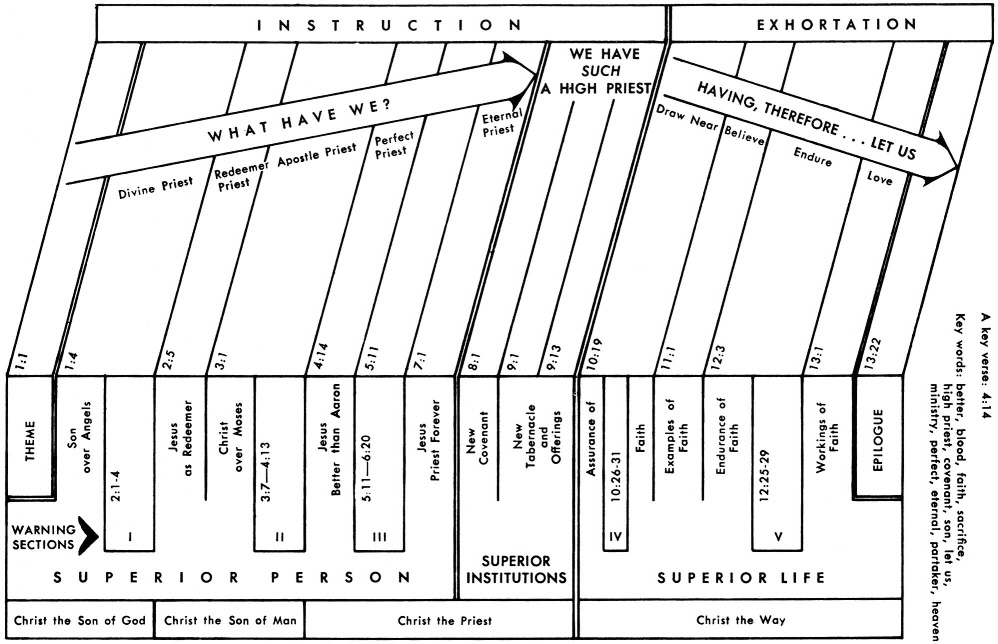
CONSIDER JESUS OUR GREAT HIGH PRIEST
Click chart to enlarge
Charts from Jensen's Survey of the NT - used by permission
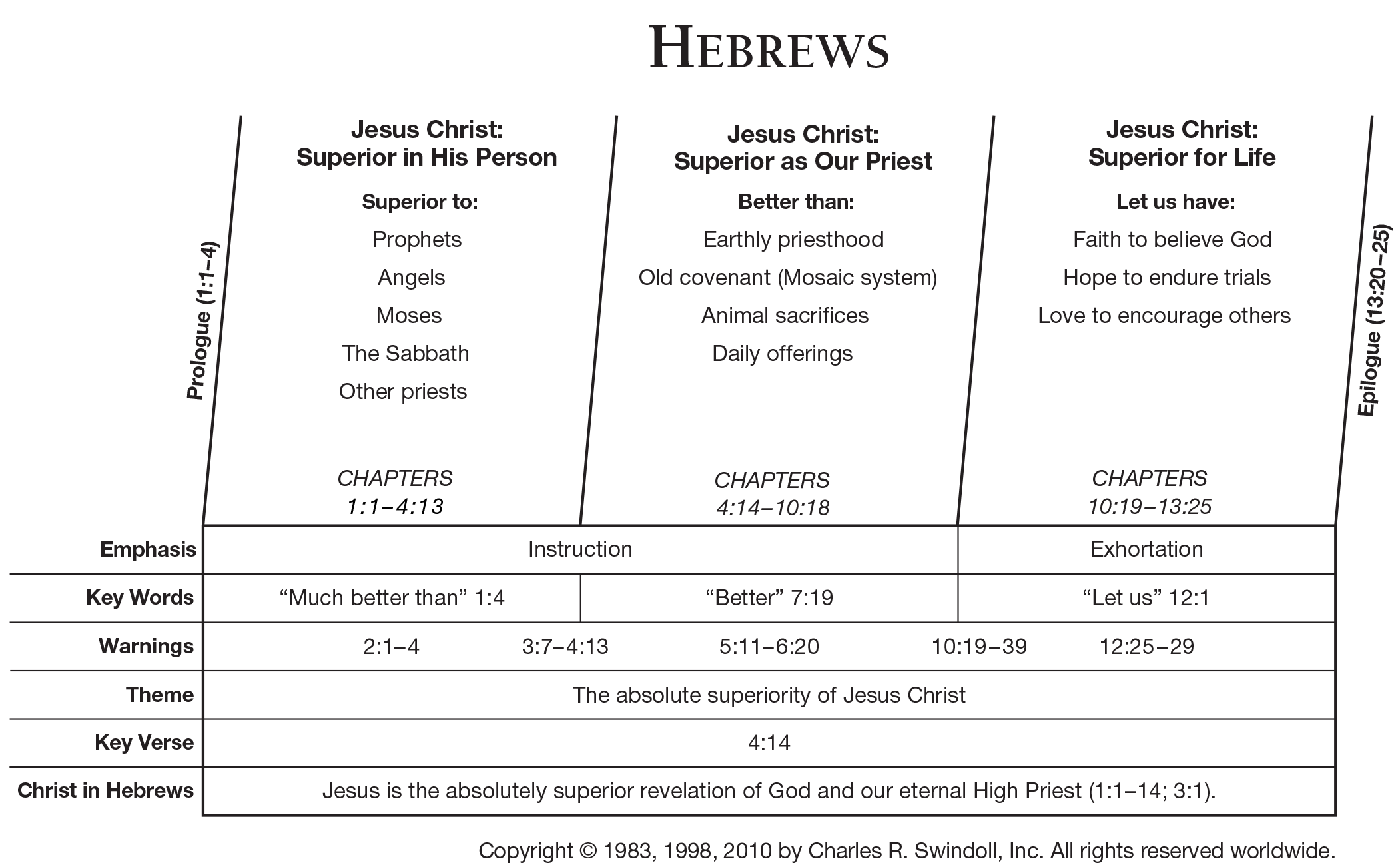
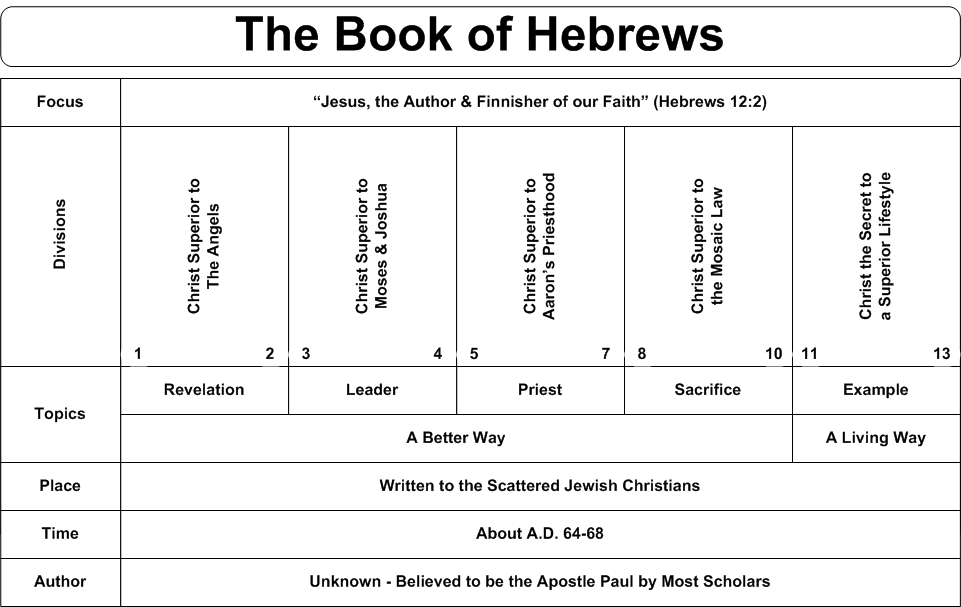
Swindoll's Chart, Interesting Pictorial Chart of Hebrews, Another Chart

|
The Epistle |
||||
| INSTRUCTION Hebrews 1-10:18 |
EXHORTATION Hebrews 10:19-13:25 |
|||
| Superior Person of Christ Hebrews 1:1-4:13 |
Superior Priest in Christ Hebrews 4:14-10:18 |
Superior Life In Christ Hebrews 10:19-13:25 |
||
| BETTER THAN PERSON Hebrews 1:1-4:13 |
BETTER PRIESTHOOD Heb 4:14-7:28 |
BETTER COVENANT Heb 8:1-13 |
BETTER SACRIFICE Heb 9:1-10:18 |
BETTER LIFE |
| MAJESTY OF CHRIST |
MINISTRY OF CHRIST |
MINISTERS FOR CHRIST |
||
|
DOCTRINE |
DUTY |
|||
|
DATE WRITTEN: |
||||

See ESV Study Bible "Introduction to Hebrews"
(See also MacArthur's Introduction to Hebrews)
Borrow Ryrie Study Bible
Hebrews 4:6 Since therefore it remains for some to enter it, and those who formerly had good news preached to them failed to enter because of disobedience, (NASB: Lockman)
Greek: epei oun apoleipetai (3SPPI) tinas eiselthein (AAN) eis auten, kai oi proteron euaggelisthentes (APPMPN) ouk eiselthon (3PAAI) di' apeitheian,
BGT ἐπεὶ οὖν ἀπολείπεται τινὰς εἰσελθεῖν εἰς αὐτήν, καὶ οἱ πρότερον εὐαγγελισθέντες οὐκ εἰσῆλθον δι᾽ ἀπείθειαν,
Amplified: Seeing then that the promise remains over [from past times] for some to enter that rest, and that those who formerly were given the good news about it and the opportunity, failed to appropriate it and did not enter because of disobedience (Amplified Bible - Lockman)
Barclay: Since then it remains that some people must enter into it and since those who in former times had the gospel preached to them did not enter because of their lack of trust (Westminster Press)
KJV: Seeing therefore it remaineth that some must enter therein, and they to whom it was first preached entered not in because of unbelief:
NLT: So God's rest is there for people to enter. But those who formerly heard the Good News failed to enter because they disobeyed God. (NLT - Tyndale House)
Phillips: No, it is clear that some were intended to experience this rest and, since the previous hearers of the message failed to attain to it because they would not believe God, (Phillips: Touchstone)
Wuest: Since, therefore, it remains over that certain must enter into it, and they who were first the subjects of the proclamation of the glad tidings did not enter because of disobedience,
Young's Literal: Since therefore it remains for some to enter it, and those who formerly had good news preached to them failed to enter because of disobedience,
NKJ Since therefore it remains that some must enter it, and those to whom it was first preached did not enter because of disobedience,
NET Therefore it remains for some to enter it, yet those to whom it was previously proclaimed did not enter because of disobedience.
CSB Since it remains for some to enter it, and those who formerly received the good news did not enter because of disobedience,
ESV Since therefore it remains for some to enter it, and those who formerly received the good news failed to enter because of disobedience,
NIV It still remains that some will enter that rest, and those who formerly had the gospel preached to them did not go in, because of their disobedience.
MIT Therefore, because entry into this state of rest is reserved for certain ones, and the first hearers of the good news did not experience it because of their disobedience, it remains an open promise.
NJB It remains the case, then, that there would be some people who would reach it, and since those who first heard the good news were prevented from entering by their refusal to believe,
NRS Since therefore it remains open for some to enter it, and those who formerly received the good news failed to enter because of disobedience,
RSV Since therefore it remains for some to enter it, and those who formerly received the good news failed to enter because of disobedience,
NAB Therefore, since it remains that some will enter into it, and those who formerly received the good news did not enter because of disobedience,
GWN However, some people enter that place of rest. Those who heard the Good News in the past did not enter God's place of rest because they did not obey God.
BBE So that as it is clear that some have to go in, and that the first hearers of the good news were not able to go in because they went against God's orders,
ASV Seeing therefore it remaineth that some should enter thereinto, and they to whom the good tidings were before preached failed to enter in because of disobedience,
- Remains He 4:9; 1Co 7:29
- Some to enter it - Nu 14:12,31; Isaiah 65:15; Mt 21:43; Mt 22:9,10; Lk 14:21-24; Acts 13:46,47; Acts 28:28
- Those who formerly - He 4:2; 3:19; Gal 3:8
- Because of disobedience - Heb 3:18-19
- Hebrews 4 Resources - Multiple Sermons and Commentaries
Related Passages:
1 Corinthians 7:29 But this I say, brethren, the time has been shortened, so that from now on those who have wives should be as though they had none;
Luke 14:23 (THERE REMAINS FOR SOME TO ENTER) The master said to the slave, 'Go out into the highways and along the hedges, and compel them to come in, so that my house may be filled.
Hebrews 4:2 For indeed we have had good news preached (euaggelizo) to us, just as they also; but the word they heard did not profit them, because it was not united by faith in those who heard.
Genesis 3:15 (GOOD NEWS IN THE OT - See protoevangelium) And I will put enmity Between you and the woman, And between your seed and her seed; He shall bruise you on the head, And you shall bruise him on the heel.”
1 Corinthians 10:3-4+ and all ate the same spiritual food (POINTED TO GOD'S PROVISION OF TRUE BREAD - MESSIAH); 4 and all drank the same spiritual drink, for they were drinking from a spiritual rock which followed them; and the rock was Christ (SEE John 4:14).
COMMENT - Paul speaking of the Jewish fathers in 1 Corinthians 10 makes a statement which implies an understanding that the events they experienced, the sacrifices they offered, the ritual they fulfilled, were all designed to teach them truth about Messiah, Who was, to the eyes of faith, their ground of atonement with God, though He had not yet appeared as God incarnate. Of course these same elements could be experienced mechanically (intellectually), without genuine faith, and were thus meaningless as far as personal salvation was concerned.
Galatians 3:8 (THE GOOD NEWS OF THE GOSPEL WAS PREACHED IN THE OLD TESTAMENT) The Scripture, foreseeing that God would justify the Gentiles by faith, preached the gospel beforehand (proeuaggelizomai) to Abraham, saying, “ALL THE NATIONS WILL BE BLESSED IN YOU.”
2 Timothy 3:15 and that from childhood you (Timothy) have known the sacred writings (GOOD NEWS IN THE OT) which are able to give you the wisdom that leads to salvation through faith which is in Christ Jesus.
Acts 10:43 (GOOD NEWS IN THE OT) “Of Him (MESSIAH) all the prophets (GOOD NEWS IN THE OT) bear witness that through His name everyone who believes in Him receives forgiveness of sins.”
Hebrews 3:18-19 And to whom did He swear that they would not enter His rest, but to those who were disobedient (apeitheo)? 19 So we see that they were not able to enter because of unbelief (apistia).
REST STILL REMAINS BUT
NOT FOR DISOBEDIENT
Since (epei) means because and introduces the ground or reason. Therefore (oun = term of conclusion). Together these two conjunctions could be rendered "Because therefore" or "For the reason." The writer is concluding the thought from Hebrews 4:1–5. God’s “rest” is still available. The wilderness generation failed to enter because of disobedience. Therefore, there remains a present opportunity for some to enter God’s rest. In sum the conclusion is since the rest is still available and since others failed to enter, it follows that there is still a chance (but this is also an inherent warning), for the current readers.
It remains (apoleipo) for some to enter (eiserchomai) it, and those who formerly (proteros) had good news preached (euaggelizo) to them failed (ou, ouk - absolutely did not) to enter (eiserchomai) because (term of explanation) of disobedience (apeitheia) It remains - The rest still remains. It is still to be realized and can be realized if the gospel is heard and heeded. God had provided a rest (in Heb 4:3 He calls it "My rest") and it was still available for some to enter (eiserchomai). Oh, how we praise God for these precious words, especially those of us who came to faith in Christ later in life. Amazing grace indeed!
The pronoun SOME (tis) refers to any one who believes the good news, which as is implied in the parable of the man giving a great banquet (Lk 14:16-24). SOME of course also implies that not all who hear will enter (eiserchomai) (cf Mt 7:13-14 = "there are few who find it."). To enter (eiserchomai) refers to entering into experience God's rest that has been available since the foundation of the world (Heb 4:3). This rest is not a land, but a life (not a place but a Person!), a life of salvation in Christ and a life of fellowship with the Father.
Those who formerly (proteros) had good news preached (euaggelizo), of course refers to the first generation of Israel in the wilderness who heard (Heb 3:16, Heb 4:2) the promise of God's rest available in the Gospel but who refused the divine invitation and thus failed to enter (eiserchomai) because of (their) disobedience (apeitheia), their “unpersuadableness,” their refusal to be convinced, resulting in gradual hardening of their hearts (Heb 3:8, Heb 3:15). As we have seen disobedience (apeitheia) is intimately linked with unbelief (apistia) in Hebrews 3:18–19.
What was the good news preached (euaggelizo)? While some think it was just "good news" in general, I think it was more specific and refers to the good news of salvation rest. (See more detailed discussion in comments on Hebrews 4:2) The gospel was clearly preached in the OT (Gal 3:8) and that was Israel's greatest need. Many find it difficult to believe that these references to the good news represent the OT version of the gospel preached today. One first needs to ask "Was the gospel (good news) of the Messiah even proclaimed in the Old Testament?" My experience as a Bible teacher for some 40+ years has been that many Christians, even conservative evangelicals, are not clear on how individuals were saved in the Old Testament, some even believing that salvation was by keeping of the law! However Scripture fortunately never contradicts itself and the clear New Testament teaching that men and women are saved by grace through faith is the same teaching that is taught in the Old Testament. The Old Testament saints were saved by believing in the good news (the gospel) as it was set forth in the promises of God. In Romans we read "Paul, a bond-servant of Christ Jesus, called as an apostle, set apart for the gospel of God, which He promised beforehand through His prophets in the holy Scriptures (Ro 1:1, 2) Notice that the gospel was promised in the OT! Paul makes it clear that the good news he teaches is really old news of the Hebrew Scriptures now fulfilled and completed in Jesus Christ. It follows that OT believers were "looking forward" toward the Cross, and NT believers "look backward" toward the Cross, the latter group obviously having a clearer understanding of the gospel than OT believers.
Grasp the kernel of promise that lies whole and safe
within the shell of the threatening
Charles Spurgeon on remains (apoleipo) for some to enter (eiserchomai) it - While we are taught that some could not enter in because of unbelief; it is implied in it that believers would enter in. Those who have faith in the divine promise shall enter in. If unbelief shuts men out, then faith is the door of entrance to those who have it. I beg you to grasp the kernel of promise that lies whole and safe within the shell of the threatening. God swore of those unbelieving Jews that they should not enter in, but He had declared that some should enter in; therefore a promise is left which will be fulfilled in those who have faith, and so are the true seed of faithful Abraham (Ro 4:16, Gal 3:7). These shall enter in; and certain of them in the text declare that they have done so: “We who have believed enter into rest.”
A T Robertson on remains (apoleipo) for some to enter (eiserchomai) it - This left-over promise is not repealed, though not utilized by the Israelites under Moses
Kenneth Wuest on those who formerly (proteros) had good news preached (euaggelizo) to them failed (ou, ouk - absolutely did not) to enter (eiserchomai) because (term of explanation) of disobedience - The writer now proceeds to show that those under Moses have failed completely of the rest in Canaan through unbelief, that those under Joshua had entered into the temporal, physical, and material rest in Canaan, and that the rest under Joshua was not a complete (Heb 4:8) and final one since God invited Israel into rest during David’s time (ED: ALMOST 400 YEARS AFTER JOSHUA - see chart below). (Hebrews Commentary)
John MacArthur explains that "When man lost God's rest, God immediately began a recovery process. Through His Son, Jesus Christ, some would be brought back in. He created man for fellowship with Himself, and His plan would not be thwarted, either by a rebellious archangel or by disbelieving mankind. By divine decree, therefore, there has always been a remnant of believers, even among mostly disbelieving Israel. "In the same way then, there has also come to be at the present time a remnant according to God's gracious choice" (Ro 11:5). The way of God's rest has always been narrow, and only a few, relative to all of mankind, have ever found it. But some must enter into it, because God's purpose must be fulfilled. By sovereign decree He designed a rest for mankind and some, therefore, are going to enter it. (See Hebrews Commentary - Page 102)
Faith alone saves,
but the faith that saves is not alone.
Because of disobedience - The KJV renders it that they "entered not in because of unbelief" (because disobedience is the active expression of unbelief). Remember (regardless of whether it causes you to grumble) the vital principle that genuine (saving) faith is evidenced by obedience (cf. He 3:18; He 4:6, He 4:11; Lk 6:46, Mt 3:8, Lk 3:8, Acts 26:20). Don't misunderstand - Faith alone saves, but the faith that saves is not alone. The accompanying works that emanate from an obedient faith demonstrate that we have exercised and experienced saving faith and become new creatures in Christ (2Co 5:17), who now have a new "direction" in life, a new penchant (a strong and continued inclination) for obedience (note this speaks of one's general direction and not perfection nor is it a call to legalism. Instead it describes works which are motivated by the indwelling Spirit Who gives us the power and the desire to please our Father in heaven [cp Php 2:13NLT; He 13:21]).
|
EVENT |
APPROXIMATE DATE |
|
|
|
|
|
|
|
|
|
|
Remains (620) (apoleipo from apo = from + leipo = lack, leave, forsake) means literally to leave behind. Paul uses it in the active voice to describe leaving behind of his cloak (2Ti 4:13 cp the two other uses of the active voice - 2 Ti 4:20; Titus 1:5) The passive voice as used in Hebrews 4:6 means to be reserved or to remain, to be left over. Apoleipo in Hebrews 4:6 conveys the idea that the promise of rest remains over from past times. The present tense indicates that it continually remains. In other words, even though the promise of rest had not been appropriated (by faith) by most of Israel in the wilderness, the promise of rest still holds good. It is interesting that Apoleipo is apparently a technical term in wills in ancient Greek writings.
APOLEIPO - 7V - 2 Tim. 4:13; 2 Tim. 4:20; Tit. 1:5; Heb. 4:6; Heb. 4:9; Heb. 10:26; Jude 1:6
APOLEIPO -Septuagint (LXX) Ex 5:19; 12:10; Lev. 22:30; Jdg. 9:9, 11, 13; 2 Ki. 10:21; 2 Chr. 16:5; Job 11:20; Prov. 2:17; 9:6, 12; 19:27; Isa. 55:7
Enter (come into)(1525) eiserchomai (from eis = into + erchomai = to come, go) means to go in (to), enter. Eiserchomai can speak of a thought “coming into” mind (Herodotus), wisdom entering someone (Wisdom of Solomon 1:4), the “entering” of the prophetic spirit (Josephus Antiquities 4.6.5), demonic spirits that “enter” into men (Mk 9:25; Lk 8:30), and Satan “entering” Judas (Lk 22:3). Figuratively eiserchomai can denote the acquiring of something, i.e., “to attain something” (wealth, property, and so on). It is used of the kingdom of God/heaven (Mt 5:20; Mt 7:21; Mt 19:24; Mk 9:47; Mk 10:15; et al); eiserchomai describes attaining eternal life (Mt 18:8f.; Mt 19:17; Mk 9:43,45); or eiserchomai can speak of entering rest (Heb 3:11,18; Heb 4:11).
EISERCHOMAI IN HEBREWS (KEY WORD IN HEBREWS 3-4) - Heb. 3:11; Heb. 3:18; Heb. 3:19; Heb. 4:1; Heb. 4:3; Heb. 4:5; Heb. 4:6; Heb. 4:10; Heb. 4:11; Heb. 6:19; Heb. 6:20; Heb. 9:12; Heb. 9:24; Heb. 9:25; Heb. 10:5
Friberg - (1) literally, in a local sense go or come into, enter (Mt 2.21); (2) figuratively; (a) of the birth of Jesus come into (the world) ( Heb 10.5); (b) of demons enter in, take possession of (Mk 9.25 ); (c) of persons; (i) in a good sense come into, enter into, begin to enjoy (Mt 5.20); (ii) in a bad sense begin to experience, meet, encounter (Mt 26.41); (d) as the first stage of an activity -- begin, come up (Lk 9.46) (Borrow Analytical Lexicon of the Greek New Testament)
Good news preached (2097) (euaggelizo/euangelizo from euággelos = bringing good news from eu = good, well + aggéllo = proclaim, tell) means to announce good news, to declare or bring glad tidings. While it can mean "good news" in general (Lk 1:19), the predominate sense in the NT, is making known God's message of salvation with authority and power (Mt 11.5). Good news could refer to the declaration of any kind of good news, but in the New Testament refers, with rare exception, to the glad tidings of the coming kingdom of God and the salvation which is available by grace through faith in the atoning sacrifice of the Lamb of God. In short, the most frequent NT use of euaggelizo, means to "evangelize" or to preach the gospel. And remember that the Gospel was preached in the OT. Here is an example of the gospel in the OT in Isaiah
Isaiah 52:7 - How lovely on the mountains Are the feet of him who brings good news (euaggelizo), Who announces peace And brings good news (euaggelizo), of happiness, Who announces salvation, And says to Zion, “Your God reigns!”
EUAGGELIZO - 52V - Matt. 11:5; Lk. 1:19; Lk. 2:10; Lk. 3:18; Lk. 4:18; Lk. 4:43; Lk. 7:22; Lk. 8:1; Lk. 9:6; Lk. 16:16; Lk. 20:1; Acts 5:42; Acts 8:4; Acts 8:12; Acts 8:25; Acts 8:35; Acts 8:40; Acts 10:36; Acts 11:20; Acts 13:32; Acts 14:7; Acts 14:15; Acts 14:21; Acts 15:35; Acts 16:10; Acts 17:18; Rom. 1:15; Rom. 10:15; Rom. 15:20; 1 Co. 1:17; 1 Co. 9:16; 1 Co. 9:18; 1 Co. 15:1; 1 Co. 15:2; 2 Co. 10:16; 2 Co. 11:7; Gal. 1:8; Gal. 1:9; Gal. 1:11; Gal. 1:16; Gal. 1:23; Gal. 4:13; Eph. 2:17; Eph. 3:8; 1 Thess. 3:6; Heb. 4:2; Heb. 4:6; 1 Pet. 1:12; 1 Pet. 1:25; 1 Pet. 4:6; Rev. 10:7; Rev. 14:6
Disobedience (543) (apeitheia from a = without + peítho = persuade, the stem peith- = basic meaning of trust) is literally an unwillingness to be persuaded, and thus describes the condition of being unpersuadable. Apeitheia denotes intentional and obstinate refusal to believe, acknowledge, or obey. Disbelief. Obstinate rejection of God’s will. See also Apeithes, Apeitheo.
APEITHEIA - 6V - Ro 11:30; Ro 11:32; Eph. 2:2; Eph. 5:6; ; Heb. 4:6; Heb. 4:11 Apeitheia is not found in the Septuagint (LXX)
In the NT apeitheia always speaks of disobedience to God and is often shown as the result of or with the connotation of unbelief (apistia). In Ephesians 2:2 and in Ep 5:6 unbelievers (unrepentant sinners) are referred to as sons of disobedience or those who are the "offspring" (as it were) of disobedience. The active expression of unbelief is manifested in disobedience (cp "disobedient" [apeitheo] in He 3:18 parallels "unbelief" [apistia] in He 3:19). Apeitheia thus denotes a willful unbelief and obstinate opposition to God's will. Note that apeitheia is not ignorance but obstinance. Apeitheia is the third of the vices personified as virgins in black in Hermas Similitudes 9.15.3.
Apeitheia is pictured in our English words obstinate (which means stubborn, perversely adhering to an opinion, purpose, or course in spite of reason, arguments, or persuasion, fixed and unyielding in opinion, attitude, purpose, course of action, self willed, headstrong, difficult to subdue, stubbornly refusing to change one’s opinion or chosen course of action) and obstinacy, (the quality or state of being difficult to remedy, relieve, or subdue).
Leon Morris - The word apeitheia ("disobedience") is always used in the NT of disobeying God, often with the thought of the gospel in mind; so it comes close to the meaning disbelief (cf. He 4:11; Ro 11:30). Because the first generation had passed the opportunity by, God set another day. The idea that the wilderness generation was finally rejected was one the rabbis found hard to accept. In their writings we find statements such as the following: "Into this resting-place they will not enter, but they will enter into another resting-place" (Mid Qoheleth 10.20.1). The rabbis also had a parable of a king who swore in anger that his son would not enter his palace. But when he calmed down, he pulled down his palace and built another, so fulfilling his oath and at the same time retaining his son (ibid.). Thus the rabbis expressed their conviction that somehow those Israelites would be saved. The author, however, has no such reservations about the wilderness generation. They disobeyed God and forfeited their place (ED: I agree with Leon Morris' assessment that not only were the majority of the wilderness generation unable to enter the "rest" in the promised land but also most failed to enter the "rest" in the promised life of the Messiah. In fact the more one studies the OT, the more one is convinced that most of the so-called "chosen people", chose to rebel instead believe and obey Jehovah, the exception of course being the believing, saved Jewish remnant). (Expositor's Bible Commentary)
F B Meyer notes that…The word “remains” has diverted the thoughts of commentators who have supposed it referred to heaven. There is rest, sweet rest, there. But “remains” means “unexhausted, unrealized, by aught which has taken place.” The rest is for us here and now. “We who have believed do enter into rest.” Where is it? In the bosom of Christ: “Come unto Me, and I will give you rest.” It is in ploughing the furrow of daily duty — “Take my yoke; … and find rest.” This rest is compatible with great activity. — He that enters into the Divine rest is not reduced to quietism. On the seventh day the Creator rested from creation; but He works in providence. Jesus, on the seventh day, rested from Calvary; but He pleads in heaven. Cease from your own works, after a similar fashion; abandon your restless planning and striving; by the grace of the Holy Spirit better service will be produced. (Meyer, F. B. Our Daily Homily)
C H Spurgeon - I remember hearing of a pious minister who was asked to speak one day upon the subject of joy in God. He stood up and said, “I am sorry that I have been requested to speak upon this topic; for the fact is, I am not walking in the light (1Jn 1:6,7), but I am crying, ‘Restore to me the joy of your salvation’ (Ps 51:12). I have grieved my heavenly Father, and I am in the dark.” He sat down and sobbed; and so did all his brothers. This honest confession did far more good than if he had patched up a tale, and told of some stale experience years before. If you have not entered into rest, do not say that you have. Fictitious experience is dangerous to the forger of it. Experience borrowed from other people is like the borrowed axe, sure to fall into the ditch.
Ray Stedman on the effect of delayed obedience (which is really disobedience!) - "Delay hardens the heart, especially when we are fully aware that we have heard the voice of God in the inner soul. Every shrug of the shoulder that puts off acting on God’s urging for change, every toss of the head that says, “I know I should, but I don’t care,” every attempt at outward conformity without inner commitment produces a hardening of the heart that makes repentance harder and harder to do. The witness of the Spirit must not be ignored, for the opportunity to believe does not last forever. Playing games with the living God is not only impertinent, but also dangerous." (The Time for Response Is Today)
There is a line, by us unseen,
That crosses every path.
The hidden boundary between
God’s patience and His wrath.
Charles Spurgeon - There can be no rest to an unbelieving heart (ED: Which is manifest as disobedience). If man and miracles could not satisfy Israel, neither would they have been content with the land which flowed with milk and honey. Solemn warning this to all who leave the way of faith (ED: And the way of the obedience that is a product of that faith) for paths of petulant grumbling and mistrust. The rebels of old could not enter in because of unbelief (ED: cp Unbelief as in He 3:19); "let us therefore fear, lest, a promise being left us of entering into his rest, any of us should even seem to come short of it." (He 4:1) One blessed inference from (Psalm 95) must not be forgotten. It is clear that there is a rest of God, and that some must enter into it. The unbelievers could not enter, but “we which have believed do not enter into rest.” (He 4:3) Let us enjoy it, and praise the Lord for it forever. While we do so, let us “come into his presence with thanksgiving, and make a joyful noise unto him with psalms.” (Ps 95:2)
Today in the Word has the following devotional…
If you saw a notice in the newspaper listing you among potential heirs being sought for a great inheritance, would you make contact with the people placing the ad? Probably so. And if you checked things out and discovered you were a legitimate heir, would you be motivated to show up at the time and place designated to claim your inheritance? You'd be foolish not to go!
That's similar to the situation facing the readers of Hebrews--and us as believers today. God has a promised inheritance for His people called His rest. This rest was offered to the generation that Moses led out of Egypt, but they failed to claim it because they lacked the one prerequisite: faith.
The opening verses of Hebrews 4 continue the writer's train of thought. Having previously described the generation that angered God by its unbelief, he now applies the lessons of that generation to the believers of his day. And, as always, believers in every generation need to learn the same lessons.
The good news of this passage is that God's offer of a rest, a Sabbath rest, still stands. Even though Moses' generation missed it, God's promise remains. His rest has been available since the dawn of creation. God rested from His work (Gen. 2:2) and decided it was such a good idea that He commanded a rest for His creatures.
Notice that God's rest includes the cessation of work (Hebrews 4:10). In God's case, He rested because He was finished with creation--His was a rest of completion and satisfaction.
If we are to enter God's rest today, what work must we cease doing? Part of the answer is that we are to rest from or give up our own efforts to save ourselves, since God's rest includes our salvation. The ""rest"" of salvation is entered only by faith.
The writer urges the Hebrews, ""Make every effort to enter that rest"" (Hebrews 4:11). So the rest must go beyond salvation, since they were already believers. It seems clear that God's rest extends to the entirety of our lives, as we give up our attempts to live the Christian life in our own strength and rest in His promises.
TODAY ALONG THE WAY - The principle of Sabbath rest--one day in seven set aside for rest and worship--stands out in this passage. This is a rest God wants us to enjoy today. For us as Christians this special day is the Lord's day. But sadly, for many of us, this day is as hectic and noisy as the rest of the week. If your day of worship seems like every other day, except for church services, make a commitment to turn off the noise, unplug some of the activities, and spend more time in contemplation of God's goodness.
Old Testament Gospel
by William Cowper
(Olney Hymns)
Israel in ancient days
Not only had a view
Of Sinai in a blaze,
But learn’d the Gospel too;
The types and figures were a glass,
In which they saw a Saviour’s face.
The paschal sacrifice
And blood-besprinkled door,
Seen with enlighten’d eyes,
And once applied with power,
Would teach the need of other blood,
To reconcile an angry God.
The Lamb, the Dove, set forth
His perfect innocence,
Whose blood of matchless worth
Should be the soul’s defense;
For He who can for sin atone,
Must have no failings of His own.
The scape-goat on his head
The people’s trespass bore,
And to the desert led,
Was to be seen no more:
In him our Surety seem’d to say,
“Behold, I bear your sins away.”
Dipt in his fellow’s blood,
The living bird went free;
The type, well understood,
Express’d the sinner’s plea;
Described a guilty soul enlarged,
And by a Saviour’s death discharged.
Jesus, I love to trace,
Throughout the sacred page,
The footsteps of Thy grace,
The same in every age!
Oh grant that I may faithful be
To clearer light vouchsafed to me!
Hebrews 4:7 He again fixes a certain day, "Today," saying through David after so long a time just as has been said before , "TODAY IF YOU HEAR HIS VOICE, DO NOT HARDEN YOUR HEARTS." (NASB: Lockman)
Greek: palin tina orizei (3SPAI) hemeran, Semeron, en Dauid legon (PAPMSN) meta tosouton chronon, kathos proeiretai, (3SRPI) Semeron ean tes phones autou akousete, (2PAAS) me sklerunete (2PAAS) tas kardias humon.
BGT πάλιν τινὰ ὁρίζει ἡμέραν, σήμερον, ἐν Δαυὶδ λέγων μετὰ τοσοῦτον χρόνον, καθὼς προείρηται· σήμερον ἐὰν τῆς φωνῆς αὐτοῦ ἀκούσητε, μὴ σκληρύνητε τὰς καρδίας ὑμῶν.
Amplified: Again He sets a definite day, [a new] Today, [and gives another opportunity of securing that rest] saying through David after so long a time in the words already quoted, Today, if you would hear His voice and when you hear it, do not harden your hearts. (Amplified Bible - Lockman)
Barclay: He again defines a day, when in David, after so long a lapse of time, he says, “Today,” just as he had said before, “Today if you will hear my voice do not harden your hearts.” (Westminster Press)
NLT: So God set another time for entering his place of rest, and that time is today. God announced this through David a long time later in the words already quoted: "Today you must listen to his voice. Don't harden your hearts against him." (NLT - Tyndale House)
Phillips: he proclaims a further opportunity when he says through David, many years later, "today", just as he had said "today" before. 'Today, if you will hear his voice, do not harden your hearts'. (Phillips: Touchstone)
Wuest: again, a certain day He designates, Today, speaking by means of David after such a long time, just as it has been said before and is still on record, Today, if His voice you will hear, stop hardening your hearts.
Young's Literal: He again fixes a certain day, "Today," saying through David after so long a time just as has been said before, "TODAY IF YOU HEAR HIS VOICE, DO NOT HARDEN YOUR HEARTS."
KJV Again, he limiteth a certain day, saying in David, To day, after so long a time; as it is said, To day if ye will hear his voice, harden not your hearts.
NKJ again He designates a certain day, saying in David, "Today," after such a long time, as it has been said: "Today, if you will hear His voice, Do not harden your hearts."
NET So God again ordains a certain day, "Today," speaking through David after so long a time, as in the words quoted before, "O, that today you would listen as he speaks! Do not harden your hearts."
CSB again, He specifies a certain day-- today-- speaking through David after such a long time, as previously stated: Today, if you hear His voice, do not harden your hearts.
ESV again he appoints a certain day, "Today," saying through David so long afterward, in the words already quoted, "Today, if you hear his voice, do not harden your hearts."
NIV Therefore God again set a certain day, calling it Today, when a long time later he spoke through David, as was said before: "Today, if you hear his voice, do not harden your hearts."
MIT Again, a certain day, after so much time, was designated by David as today, replicating what was said before: Today, if you hear his voice, do not make your hearts sclerotic.
NJB God fixed another day, a Today, when he said through David in the text already quoted: If only you would listen to him today; do not harden your hearts.
NRS again he sets a certain day-- "today"-- saying through David much later, in the words already quoted, "Today, if you hear his voice, do not harden your hearts."
RSV again he sets a certain day, "Today," saying through David so long afterward, in the words already quoted, "Today, when you hear his voice, do not harden your hearts."
NAB he once more set a day, "today," when long afterwards he spoke through David, as already quoted: "Oh, that today you would hear his voice: 'Harden not your hearts.'"
GWN So God set another day. That day is today. Many years after your ancestors failed to enter that place of rest God spoke about it through David in the passage already quoted: "If you hear God speak today, don't be stubborn."
BBE After a long time, again naming a certain day, he says in David, Today (as he had said before), Today if you will let his voice come to your ears, be not hard of heart,
ASV he again defineth a certain day, To-day, saying in David so long a time afterward (even as hath been said before), To-day if ye shall hear his voice, Harden not your hearts.
DBY again he determines a certain day, saying, in David, 'To-day,' after so long a time; (according as it has been said before), To-day, if ye will hear his voice, harden not your hearts.
- Saying in David - Heb 3:7,8; 2 Samuel 23:1,2; Matthew 22:43; Mark 12:36; Luke 20:42; Acts 2:29,31; 28:25
- Today: He 3:7,15 Ps 95:7
- After: 1Ki 6:1 Ac 13:20-23
- Hebrews 4 Resources - Multiple Sermons and Commentaries
Related Passages:
2 Corinthians 6:1-2 And working together with Him, we also urge you not to receive the grace of God in vain– 2 for He says, “AT THE ACCEPTABLE TIME I LISTENED TO YOU, AND ON THE DAY OF SALVATION I HELPED YOU.” Behold, now is “THE ACCEPTABLE TIME,” behold, now is “THE DAY OF SALVATION”–
Acts 19:9 But when some were becoming hardened (skleruno) - passive voice) and disobedient, speaking evil of the Way before the multitude, he withdrew from them and took away the disciples, reasoning daily in the school of Tyrannus. (COMMENT: Some of the Jews in Ephesus were “hardened” at Paul’s preaching in the synagogue. Notice that here we see hardening associated with disobedience to the Truth.)
Acts 7:51 “You men (ISRAELITES) who are stiff-necked and uncircumcised in heart and ears are always resisting the Holy Spirit; you are doing just as your fathers did (ED: INCLUDING THOSE IN THE WILDERNESS).
THE URGENCY OF GOD'S INVITATION
DO NOT DELAY - THE DAY IS NOW!
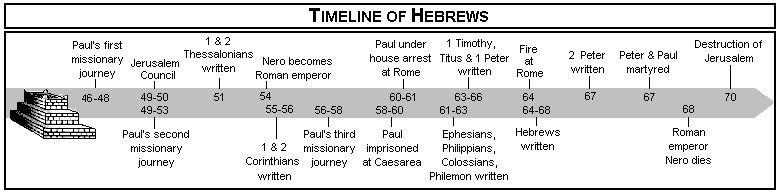
He (God) again (palin - once more = He's done this before!) fixes (horizo) a certain day, "Today," (semeron) saying (present tense - continuously = showing His voice is still living and active through Scripture, in this case) through David (the human instrument) after so long a time just as (~400 years - see Timeline) has been said before (perfect tense - God's warning and invitation stated in past, remain unchanged and thus still relevant) - He again fixes a certain day indicates God had in the past fixed a day for the first generation Israelites to enter His rest but they failed to do so because of disobedience (unbelief). So later (again = repetition) God sovereignly fixed a certain day (for entering His rest - a divinely appointed opportunity) after so long a time (see Timeline) speaking through David who penned Psalm 95. David is not recorded as the author in the original Hebrew, but is so designated in the Greek version, the Septuagint (LXX). Fixes (horizo) means to mark out definitely (to mark out the boundaries of) and so to set a limit (English = horizon). In a sense God places a boundary on the certain day. However fixes (horizo) is in the present tense indicating that His fixation was not one and done but that it was (and is) ongoing and still available reflecting His grace to keep the invitation open.
Has been said before (perfect tense) pictures past completed action with continuing effect or result and thus means “as it has before been said, and is still on record.” In short, God's Word stands forever! (Ps 119:89).
After so long a time speaks of the time between Joshua and David, a lapse of time of about 400 years (See timeline above). Clearly long after the Promised Land was entered, God was still offering rest, which would support the premise that the offer was more than just the physical land! Note that the word Today is mentioned twice for emphasis, the implication that one day Today will end, thus the warning is to not harden your hearts like the children of Israel did and miss the opportunity to enter God's rest. Today meant “now” in the time of his readers and that is what it means by way of application in our time. "Now is the day of salvation!" (2Co 6:2) The writer's tone speaks of a sense of urgency and thus the offer is accompanied by the warning that the people should not harden their hearts.
Leon Morris on after so long a time...TODAY - There is still a day of opportunity, even though the fate of the wilderness generation stands as an impressive witness to the possibility of spiritual disaster
Spurgeon on saying through David - We read of this in Psalm 95, where David was urging those to whom he was writing to hear God’s voice, and not be like the unbelievers in the wilderness, so that the rest still remained to be entered upon by somebody. Joshua had not given them rest, or else David would not have spoken of entering into rest.
"TODAY (semeron - NOT "tomorrow!" NOT "someday!") IF YOU HEAR (akouo) HIS VOICE, DO NOT HARDEN (skleruno) YOUR HEARTS (kardia).- The implication of TODAY is that God's rest is available NOW for those who respond in faith! TODAY emphasizes that the readers/hearers must have a sense of urgency, for the window of opportunity is open now. IF is conditional, indicating the benefit of hearing calls for a right response. HEAR HIS VOICE indicates the transcendent God is speaking through the Scripture and/or by the Spirit's conviction. HEAR (akouo) is more than just hearing a sound but in this context means to hear with attention, to hear effectually, so as to believe the good news of rest available. It implies understanding and readiness to respond. To reiterate, this rest will not be available forever, but is available TODAY.
🙏 THOUGHT - While the opportunity to enter God's rest through believing the good news is available to you today, but the offer will not last forever. For each individual the offer will definitely end at death. For some who repeatedly harden their hearts the offer may end before death. Dear reader, if you have read these notes, you know the good news of salvation in Christ is available to you TODAY, but you must act on it by believing (cf Ro 10:9,10). James 4:14 tells us "Yet you do not know what your life will be like tomorrow. You are just a vapor that appears for a little while and then vanishes away." You are not guaranteed TOMORROW, thus the urgency of responding TODAY! I plead with you not to harden your heart because every time you reject the Spirit's conviction concerning the Gospel, your heart becomes less tender and more hardened to God's offer of salvation in Christ! (cf Heb 3:13). Beware!
Nelson Study Bible adds that "By merely entering the Promised Land, the Israelites had not entered God’s rest, for David (years after Joshua had led the Israelites into the land) had warned his generation to not harden their hearts, so that they could enter God’s rest (see Hebrews 3:7-11). Like David, the author of Hebrews called the present generation to respond to God today (see note Hebrews 3:13), which is the day of repentance. (Online The Nelson Study Bible Page 1951)
DO NOT HARDEN (skleruno) YOUR HEARTS (kardia) - This is a prohibition for the hearers (plural verb) to not willfully make the choice (skleruno in in the active voice = a volitional choice) to not receive God's invitation to enter His rest. This is one of those NT statements inspired by the Spirit of God that makes you say "Woe!"
As previously discussed, hardening of one's heart is associated with not listening to God and not obeying God. Listening to God and obeying Him are matters of the will. So is hardening the heart as indicated by the use of the active voice here and also in Hebrews 3:8, Hebrews 3:13, and Hebrews 3:15. In first Timothy Paul warns that our hearts, or consciences, can become seared and insensitive, as skin does when it is badly burned and scars over. The scar tissue that replaces the skin has very little feeling. Something very much like this happens to a conscience that is repeatedly disregarded. Today lasts only as long as there is opportunity to decide and as long as the conscience is sensitive to God. When a person’s today is over, it is too late. His heart gets harder every time he says "No" to the good news of Jesus. When the heart is soft, the conscience sensitive and the intellect is convinced about Christ, that is the "Today," the time to decide, while the heart is still pliable and responsive. The danger that the writer of Hebrews is warning about is that one will eventually become spiritually hardened, stubborn, and insensitive and the gospel will no longer have any appeal. WOE!
Fixes (3724) horizo from horos = boundary, limit; English "horizon" which is "the apparent line that divides the earth and the sky" which leads to the thought that Jesus is the "line" that divides all time into BC/AD!) means strictly speaking “to limit” and then figuratively “to fix,” “to appoint.” Time as well as space can be limited. Horizo means to mark out, to bound ("horizon") and figuratively to appoint, decree or specify. It means to mark out definitely. The boundary set can be (1) of time (fix, appoint - cf Heb 4:7) or (2) of space (fix, determine - Acts 17:26-27). Horizo referring to persons means to appoint or designate (Acts 17:31). In Lk 22:22 horizo refers to the making of a definite plan (decide, determine, cp Acts 2:23, 10:42, 11:29). BDAG adds that from the basic meaning is ‘to separate entities and so establish a boundary’, derives the sense ‘to define ideas or concepts’: set limits to, define, explain.
HORIZO - 8V - Lk. 22:22; Acts 2:23; Acts 10:42; Acts 11:29; Acts 17:26; Acts 17:31; Rom. 1:4; Heb. 4:7
Today (4594) semeron means this (very) day ( Mt 28:15; Ac 20:26; Ro 11:8; 2 Cor 3:14) or what has happened today.
SEMERON IN HEBREWS - Heb. 1:5; Heb. 3:7; Heb. 3:13; Heb. 3:15; Heb. 4:7; Heb. 5:5; Heb. 13:8
Friberg on semeron - adverb of time; (1) generally designating the present today, this day (Mt 11.23), in contrast to in the past; (2) as an unspecified period of time between past and future periods for the present, at this time (Lk 13.32, 33); (3) as the twenty-four-hour period beginning at sundown today, this very day (Mk 14.30); (4) as designating the same period of time as the day of the discourse today (Mt 21.28); (5) as a religious technical term identifying the limits of the time God has put at man's disposal for some purpose (Heb 3.13) (Borrow Analytical Lexicon of the Greek New Testament)
Hear (191) akouo primarily means physical hearing of sounds and the apprehension of the sounds with one's mind. Akouo gives us our English acoustics which is the science of designs that helps one hear (We need "spiritual acoustics" to help us hear spiritual truth!).
AKOUO IN HEBREWS - Heb. 2:1; Heb. 2:3; Heb. 3:7; Heb. 3:15; Heb. 3:16; Heb. 4:2; Heb. 4:7; Heb. 12:19
Akouo is a very common verb in the NT and the Septuagint (Over 1400 uses total) and has several important nuances - to hear sound (Mt 9:12; 11:5, Mk 10:41; 14:64; Lk 7:3, 9; Jn 3:8; Lxx = Ge 3:8, 10), to hear so as to obey (see below), to hear with understanding (see here), to hear with attention (to listen attentively so as to perceive what is being said), to hear prayer (Jn 9:31; 11:41, 42; 1 Jn 5:15; Lxx = Ps. 10:17), to hear a case at court (Acts 25:22; Jn 7:51), to learn by hearing, to be informed, to know (Mt. 2:3, 22; 4:12; 5:21, 27; 11:2; Mt 20:30, Mk 2:1; 10:47, 5:27; 6:14; Acts 14:14; 15:24, Jn 14:28; Lxx = Ge 41:15; 42:2), hearing related to instruction or doctrine (Jn 8:40; 15:15; Acts 1:4; 4:20; Ro 10:14, 18; Heb 2:1; 1 Jn 2:7, 24).), to hear a report (Mt 28:14; Mk 2:1; Lk 12:3; Acts 11:22; 1 Cor 5:1; Lxx = 2 Chr 26:15). In John 6:60 the phrase "who can listen to it?" has the nuance of who can accept it or who can receive it and believe it. There is often overlap in these various nuances. Clearly, to arrive at the most accurate definition of akouo in a given verse will require careful observation of the use in context.
A related verb hupakouo is also used in Hebrews
Hebrews 5:9 And having been made perfect, He became to all those who obey (literally "hear under", listen attentively hupakouo = hupo + akouo) Him the source of eternal salvation,
Hebrews 11:8 By faith Abraham, when he was called, obeyed (literally "hear under", listen attentively hupakouo = hupo + akouo) by going out to a place which he was to receive for an inheritance; and he went out, not knowing where he was going.
Harden (4645) (skleruno from skleros = dry, hard, rough) means first to make dry, stiff or hard. In the active skleruno means to harden and in the passive sense, to grow hard. The NT uses are only figurative (metaphorical) and mean to cause one to become unyielding, obstinate or stubborn (carried on in an unyielding or persistent manner) Skleruno was a medical technical term (first attested by Hippocrates) in Greek writings describing something becoming hardened or thickened. Our English word "hardening" of the arteries is known as "arteriosclerosis". This is a serious, potentially fatal physical condition, but here in Hebrews the danger is even more ominous, for spiritual hardening can lead to eternal death and damnation of one's soul, not just loss of their physical life! From the uses of skleruno in Exodus, one observes two important aspects of hardening: (1) Man can repeatedly harden his heart, until finally God does the hardening, with the implication that the latter is irrevocable. (2) One effect when one's heart is hardened is not listening to God. In Acts 19:9 skleruno is linked with unbelief and disobedience.
The same sun that melts
the wax hardens the clay.
If your heart is not melted in faith, it will be hardened in unbelief!
Regarding Romans 9:18 note that in Exodus Moses speaks of God’s hardening Pharaoh's heart (see Exodus 4:21; 7:3, 9:12; 10:20, 27; 11:10) and also records that Pharaoh hardened his own heart (see this "self produced" hardening in Exodus 8:15, 32; 9:34), the obstinate ruler confirming God’s act of hardening by his own act of hardening. Such passages point out the humanly irreconcilable tension between God’s sovereignty and man’s free will. A similar tension is found with Esau who was rejected before he was born (and who later chose to reject the inheritance for a pot of stew). Judas Iscariot, in a similar way, before he was born, was appointed to betray Christ (Acts 1:16; John 6:70,71). Both Esau and Judas chose to follow sin and unbelief.
Related Resource: Article on Hard, Harden, Hardness in Dictionary of Biblical Imagery
SKLERUNO - 6V - Acts 19:9; Rom. 9:18; Heb. 3:8; Heb. 3:13; Heb. 3:15; Heb. 4:7
SKLERUNO IN THE Septuagint (LXX) Gen. 49:7; Exod. 4:21; 7:3, 22; 8:19; 9:12, 35; 10:1, 20, 27; 11:10; 13:15; 14:4, 8, 17; Deut. 2:30; 10:16; Jdg. 4:24; 2 Sam. 19:43; 2 Ki. 2:10; 17:14; 2 Chr. 10:4; 30:8; 36:13; Neh. 9:16f, 29; Ps. 90:6; 95:8; Isa. 63:17; Jer. 7:26; 17:23; 19:15 Regarding the numerous uses of skleruno (and skleros) in the LXX, NIDNTT writes that…"Hardening, according to the OT understanding, results from the fact that men persist in shutting themselves to God’s call and command. A state then arises in which a man is no longer able to hear and in which he is irretrievably enslaved. Alternatively, God makes the hardening final, so that the people affected by it cannot escape from it. (Brown, Colin, Editor. New International Dictionary of NT Theology. 1986. Zondervan)
Exodus 7:3 "But I will harden (Lxx = skleruno in the active voice = by a judicial act God will harden it) Pharaoh's heart that I may multiply My signs and My wonders in the land of Egypt.
Exodus 7:22 But the magicians of Egypt did the same with their secret arts; and Pharaoh's heart was hardened (Lxx = skleruno in the passive voice) , and he did not listen to them, as the LORD had said. (Other uses of skleruno are in the passive voice - Ex 8:19).
QUESTION - What are the causes and solutions for a hardened heart? GOTQUESTIONS.ORG WATCH VIDEO
ANSWER - To better understand the causes and solutions for a hardened heart, it’s important to understand the broad biblical meaning of the word “heart.” The Bible considers the heart to be the hub of human personality, producing the things we would ordinarily ascribe to the “mind.” For example, Scripture informs us that grief (John 14:1); desires (Matthew 5:28); joy (Ephesians 5:19); understanding (Isaiah 6:10; Matthew 13:15); thoughts and reasoning (Genesis 6:5; Hebrews 4:12; Mark 2:8); and, most importantly, faith and belief (Hebrews 3:12; Romans 10:10; Mark 11:23) are all products of the heart. Also, Jesus tells us that the heart is a repository for good and evil and that what comes out of our mouth – good or bad – begins in the heart (Luke 6:43–45).
Considering this, it’s easy to see how a hardened heart can dull a person’s ability to perceive and understand. Anyone’s heart can harden, even faithful Christians’. In fact, in Mark 8:17–19 we see Jesus’ own disciples suffering from this malady. The disciples were concerned with their meager bread supply, and it was clear that each of them had forgotten how Jesus had just fed thousands with only a few loaves. Questioning them as to the hardness of their hearts, Christ spells out for us the characteristics of this spiritual heart condition as an inability to see, understand, hear, and remember. Regarding this last criterion, too often we forget how God has blessed us and what He has done for us. Similar to the disciples in this instance or the Israelites wandering in the wilderness, when a new calamity arises in our lives, our hearts often fill with fear and concern. Sadly, this simply reveals to God the little faith we have in His promise to take care of us (Matthew 6:32–33; Philippians 4:19). We need to remember not only the many times God has graciously provided for us in our time of need, but also what He has told us: “Never will I leave you; never will I forsake you” (Deuteronomy 31:6; Hebrews 13:5).
Sin causes hearts to grow hard, especially continual and unrepentant sin. Now we know that “if we confess our sins, [Jesus] is faithful and just and will forgive us our sins” (1 John 1:9). However, if we don’t confess our sins, they have a cumulative and desensitizing effect on the conscience, making it difficult to even distinguish right from wrong. And this sinful and hardened heart is tantamount to the “seared conscience” Paul speaks of in 1 Timothy 4:1–2. Scripture makes it clear that if we relentlessly continue to engage in sin, there will come a time when God will give us over to our “debased mind” and let us have it our way. The apostle Paul writes about God’s wrath of abandonment in his letter to the Romans where we see that godless and wicked “men who suppress the truth” are eventually given over to the sinful desires of their hardened hearts (Romans 1:18–24).
Pride will also cause our hearts to harden. The “pride of your heart has deceived you . . . you who say to yourself, ‘who can bring me down to the ground’ . . . I will bring you down declares the LORD” (Obadiah verses 3-4). Also, the root of Pharaoh’s hard-heartedness was his pride and arrogance. Even in the face of tremendous proofs and witnessing God’s powerful hand at work, Pharaoh’s hardened heart caused him to deny the sovereignty of the one, true God. And when King Nebuchadnezzar’s “heart became arrogant and hardened with pride, he was deposed from his royal throne and stripped of his glory . . . until he acknowledged that the Most High God is sovereign over the kingdoms of men and sets over them anyone He wishes” (Daniel 5:20–21). Accordingly, when we’re inclined to do it our way, thinking we can “go it on our own,” it would be wise to recall what King Solomon taught us in Proverbs 14:12 and 16:25: “There is a way that seems right to a man, but in the end it leads to death.”
So, what then is the antidote for a heart condition such as this? First and foremost, we have to recognize the effect that this spiritual disease has on us. And God will help us to see our heart’s condition when we ask Him: “Search me O God, and know my heart…see if there is any offensive way in me, and lead me in the way everlasting” (Psalm 139:23–24). God can heal any heart once we recognize our disobedience and repent of our sins. But true repentance is more than simply a resolute feeling of steadfast determination. Repentance manifests itself in a changed life.
After repenting of our sins, hard hearts begin to be cured when we study God’s Word. “How can a young man keep his way pure? By living according to your word. I seek you with all my heart. . . . I have hidden your word in my heart that I might not sin against you” (Psalm 119:9–11). The Bible is our manual for living as it is “God-breathed and is useful for teaching, rebuking, correcting, and training in righteousness” (2 Timothy 3:16). If we are to live life to the fullest as God intended, we need to study and obey God’s written Word, which not only keeps a heart soft and pure but allows us to be “blessed” in whatever we do (Joshua 1:8; James 1:25).
Hearts can also become hardened when we suffer setbacks and disappointments in life. No one is immune to trials here on earth. Yet, just as steel is forged by a blacksmith’s hammer, so, too, can our faith be strengthened by the trials we encounter in the valleys of life. As Paul encouraged the Romans: “But we also rejoice in our sufferings because we know that suffering produces perseverance; perseverance, character; and character, hope. And hope does not disappoint us, because God has poured out His love into our hearts by the Holy Spirit, whom He has given us” (Romans 5:3–5).
QUESTION - What is the meaning of, “Today if you will hear His voice, do not harden your heart” in Psalm 95:8? GOTQUESTIONS.ORG
ANSWER - In Psalm 95:8 the psalmist exhorts the reader, “Today, if you will hear His voice: ‘Do not harden your hearts’” (NKJV). Here are two commands: first, recognize and respond to God’s voice, and, then, do not let your hearts harden.
Psalm 95 is a call to worship (verses 1–2, 6). In Psalm 95:7–9 we read, “Today, if only you would hear his voice, ‘Do not harden your hearts as you did at Meribah, as you did that day at Massah in the wilderness, where your ancestors tested me.’” The psalmist continues to relate God’s punishment on the ancient Israelites: although they had seen God’s mighty works, they strayed in their hearts, and God, grieved for forty years, forbade them from entering the Promised Land (Psalm 95:9–11).
Meribah, mentioned in Psalm 95:8, also known as Massah, was a place where the Israelites, after their exodus from Egypt, rebelled against God (Exodus 17:2). Because of their extreme thirst, they grumbled and complained to Moses, “Why did you bring us up out of Egypt to make us and our children and livestock die of thirst?” (Exodus 17:2–3). Moses turned to the Lord in prayer, and God responded by having Moses strike the rock so the Israelites would have water and know that the Lord was with them (Exodus 17:4–7). Even after they saw what God did at Meribah—even after God had freed them from bondage in Egypt—the Israelites still hardened their hearts, distrusted God, and grumbled about their temporary circumstances.
The author of Psalm 95 is saying, in essence, don’t be like that. Don’t harden your heart at the work of God on your behalf. He is speaking to you, if you would only listen. He has done great things for you, if you would only remember. Ascribe to God His due worship. “He is our God and we are the people of his pasture” (Psalm 95:7). Israel should follow their Shepherd.
The author of Hebrews quotes the words, “Today, if you hear his voice, do not harden your hearts as you did in the rebellion,” three times, in Hebrews 3:7–8, 15, and 4:7. These quotations from Psalm 95 are meant to exhort people to receive Christ and not have “a sinful, unbelieving heart that turns away from the living God” (Hebrews 3:12). The Israelites rejected their “rest” in the Promised Land, but today Jesus is the “Sabbath-rest for the people of God” (Hebrews 4:9). Do not harden your heart against Him.
God still speaks today, but we must follow Him to recognize His voice. There are so many voices vying for our attention, especially with the increased use of technology and social media. Yet God’s voice must be the voice we heed. Jesus is our Good Shepherd: the shepherd opens the gate for his sheep, “and the sheep listen to his voice. He calls his own sheep by name and leads them out. When he has brought out all his own, he goes on ahead of them, and his sheep follow him because they know his voice. But they will never follow a stranger; in fact, they will run away from him because they do not recognize a stranger’s voice” (John 10:3–5). Our Good Shepherd loves us and calls us today to follow Him alone: “Today, if you will hear His voice, do not harden your heart.”
The psalmist warns, “If you will hear His voice, do not harden your heart,” and the author of Hebrews echoes the warning. God’s words demand a response, and, tragically, some respond by hardening their hearts. Some permanently harden their hearts, but even believers can harden their hearts for a period of time. When people ignore who God is and what He has done, like the Israelites did in the wilderness, their hearts harden. When people hold onto sin, their hearts harden. When people allow circumstances to cloud their thinking and let their feelings dictate their actions, their hearts harden. It is God’s Word that keeps our hearts soft and pure: “For the word of God is alive and active. Sharper than any double-edged sword, it penetrates even to dividing soul and spirit, joints and marrow; it judges the thoughts and attitudes of the heart” (Hebrews 4:12). We must turn to hear and heed God’s voice.
“Today if you will hear His voice, do not harden your heart.” Sometimes, evangelists use these verses after presenting the gospel. Life is but a vapor (James 4:14), so if you hear the gospel message today, you need to accept Christ today. Do not harden your heart as in the rebellion. We are not guaranteed tomorrow. To permanently harden one’s heart against God and reject the gospel message of salvation is to suffer eternal consequences: “The wages of sin is death” (Romans 6:23). To heed God’s voice and place one’s trust in the finished work of Christ on the cross is to be saved and have eternal life (John 3:16).
Are You Ready?
Today, if you will hear His voice, do not harden your hearts. —Hebrews 4:7
Read: Hebrews 4:1-7
It was a wild night for our family. At 11:30 p.m., I got a call from my son Steve. “Dad, I’m going to Iraq.” “Right now?” I asked in disbelief. “Yes, I’m ready to go.” Earlier that day, our Navy corpsman (medic) son had told me he thought it would be several months before he would go.
We talked a little more until he had to hang up. Then family phone calls followed as we let his sisters know what was happening. They called him to wish him well and pray for him—and that was it.
A couple of restless hours later, Steve sent a text message: “We’re not going. We’re headed back.” A helicopter ride to another state and back was the extent of Steve’s trip that night, but it was still a valuable experience. It tested their readiness. The military had to know that when the call came, the corpsmen would be mentally ready to go.
When it comes to being ready for eternity, we won’t get that kind of practice. No one knows when we will depart this earth through death or be called home at Jesus’ return.
If you were called into eternity today, would you be prepared to meet God face-to-face? Have you opened your heart to Him? (Heb. 4:7). Are your sins forgiven? Are you ready to go? (Reprinted by permission from Our Daily Bread Ministries. Please do not repost the full devotional without their permission.)
Ready to speak, ready to warn,
Ready o’er souls to yearn,
Ready in life, ready in death,
Ready for His return. —Tillman
God’s call may come at any time—
so be ready all the time!
Illustration of the significance of the word "Today"- In his earlier ministry D. L. Moody often would end his message with, “Go home and think about what I’ve said.” One night in Chicago he told the people to do this and to come back the next night ready to make a decision. That night the Chicago fire broke out, and some who had been in his congregation died. That was the last time he told anyone to think over the claims of Christ and make a decision later. No one knows if he will have a tomorrow in which to decide. Today signifies the present time of grace. Men today, as in the time of Moody and in the time of Hebrews and in the time of David and in the time of Moses, never know how long that time of grace for them will be.
Paul's Calendar
I know whom I have believed, and am persuaded that he is able to keep that which I have committed unto him against that day. II Timothy 1:12.
Someone has said that Paul's calendar had only two days, "today" and "that day." The man who is ready for that day is ready for any day. But we need to wear our spiritual bifocals and see both days. Some of the saints are near-sighted. Some are far-sighted. Paul may have had trouble with his physical eyes, but he had no spiritual astigmatism. He had good bifocals; he saw the near and the far.
Do not busy yourself today with "wood, hay, stubble," and fail to build with "gold, silver, precious stones" against that day. For "the day shall declare it," and some lives will go up in smoke!
On the other hand, do not so contemplate eternity that you waste today. Some people think they are Mystics when they are only Mistakes!
"Today if ye will hear his voice"
(Heb. 4.7).
J Vernon McGee on TODAY - He is not saying tomorrow, but today. Today is the day for you and me. Today, right now, wherever you are, look at your watch or clock. What time is it? Well, this is the time of salvation. Now, right now you can trust Christ to save you. "To-day if ye will hear his voice, harden not your hearts."
Spurgeon - Harden not your hearts.” There is no need; they are hard enough already. “Harden not your hearts.” There is no excuse, for why should you resist love? “Harden not your hearts.” There can be no good in it. A man is the less a man in proportion to his loss of tenderness. “Harden not your hearts.” You cannot soften them, but you can harden them. “Harden not your hearts,” for this will be your ruin. It is suicide of soul.
UNLIKELY CONVERSIONS - Gregg Laurie Every Day with Jesus: Forty Years of Favorite Devotions - Page 15
“Today, if you will hear His voice, do not harden your hearts.” (Hebrews 4:7)
An attorney was trying to deliver an important paper to a man who was determined to avoid him. The man reasoned that the attorney had some type of subpoena, so he went out of his way to dodge him. Fourteen years passed, and the man found himself in the hospital, dying of cancer. Through a strange series of events, the attorney was admitted to the hospital and was assigned to the same room as the dying man. The man turned to the attorney and said, “Well, you never got me. I’ve escaped you all this time, and now it doesn’t matter. You can even serve your subpoena. I don’t care.”
The lawyer replied, “Subpoena? I was trying to give you a document that proved you had inherited $45 million dollars!”
Many people go out of their way to avoid Christians and the opportunity to have a relationship with Jesus Christ. All the while, their hearts grow harder, and they risk becoming calloused to the point of no return. We don’t know when that point will come in their lives. Maybe you even know someone who seems as though they have reached it.
We can take heart when we look at the conversion of Saul of Tarsus. It was so radical and unexpected that when it happened, first-century Christians thought he was attempting to infiltrate their ranks and persecute the church even further. They didn’t believe that God could save someone as wicked and hostile toward the church as Saul. But we know that Saul became Paul the Apostle.
If you know someone who seems so far gone and permanently hardened toward the gospel, keep praying. You never know. That person just might be the next Paul.
Adrian Rogers - see full sermon on Rev 20:12-15 on page 1065
“To day, if you will hear [God’s] voice, harden not your hearts” (Hebrews 3:15; Hebrews 4:7).
Can you feel your heartbeat up there, that little heartbeat—as someone has said, “a muffled drum beating a funeral march to the grave”? That little heartbeat—that’s all there is between you and hell. It starts beating, by the way, in the mother’s womb, that little heartbeat. There is the beautiful baby, there is the cuddly child, there is the tender teen, there is the mighty man. He is looking around. He sees that girl. And then he goes from the tender teens to the tired thirties, feverish forties, frantic fifties, sagging sixties, solemn seventies, aching eighties, nagging nineties. But he may not go that far. He may not go that far.
I would rather frighten you into heaven
than lull you into hell.
This week, I conducted a funeral for a little baby. This week, I conducted a funeral for a man approaching his nineties. That heart somewhere will stop beating, and when your heart stops, if you don’t know Jesus, you are going to hell. You say, “That is plain speaking.” I mean to be plain. You’re saying, “Are you trying to frighten me?” I would to God I could. I would rather frighten you into heaven than lull you into hell.
Chris Tiegreen - The One Year Hearing His Voice Devotional - Page 365
Today when you hear his voice, don’t harden your hearts. Heb 3:7-8, 15; 4:7
The people of Israel had hardened their hearts in the wilderness, complaining against God and rebelling against His ways. They had heard His voice, but they didn’t believe it or cling to it for long. This hard-heartedness became a theme for prophetic voices and psalmists centuries later, and the writer of Hebrews brings it up again. God’s people were once again tempted to reject what He was saying because His ways seemed too difficult. They were contending against the direction God was leading.
This is a lesson for all of God’s people throughout all generations. The most important rule —and the one perhaps most neglected —is that those who hear Him must listen with a soft heart. That’s always the right response to God. A soft heart will yield to His words without complaint, without resistance, without suspicion, and without demanding to know why He says what He says. A soft heart will say yes to whatever God wants because it trusts His goodness implicitly. A soft heart complies with God —not one day, not tomorrow, but today.
That’s always the right time to respond to God, just as surely as a soft heart is always the right response. When He speaks —and as we’ve seen, He certainly does when we persevere in listening —there is no reason to delay our acceptance of what He has said. He may give us future direction, but He wants present faith —an immediate embrace of His voice. When you hear His voice, do not harden your heart. Soften it and respond to what He says. Today.
Chris Tiegreen - The One Year Hearing His Voice Devotional - Page 94
Today when you hear his voice, don’t harden your hearts. Heb 4:7
Borrowing a reference from Psalm 95, the writer of Hebrews urges his readers to enter into the place of rest given to us in our salvation. In a time of falling away, when many Jewish believers are facing opposition and losing heart, he appeals to the voice of God. It’s calling us into a Promised Land that makes the original land of Canaan pale in comparison. This new Promised Land is the ultimate destination, and we can enter it only by listening to God and following what we hear.
Not only does salvation come through God’s spoken invitation, so does everything else He has planned for us. Many believers wander aimlessly through life —or walk somewhat mindlessly through open and closed doors without much discretion. But for those who will take a more active role in listening, God speaks, guides, and directs.
That’s when the critical moments of our lives occur. The hinges of God’s doors of opportunity swing open when our hearts are soft and we respond to His whispers. But it’s possible in those moments to harden our hearts too —to quiet an unsettled conscience or stuff an unwanted word of direction, telling ourselves “it’s only my imagination” when really it is the voice of God. When we hear Him, our hearts cannot remain in neutral. Either we respond willingly or we become more hardened. His voice cannot be ignored. By nature, it compels a decision.
Our decisions are sometimes subtle, so subtle that we may not be aware of making them. An impulse to give generously, a conviction to get rid of a habit or start a new one, a prompt to move toward reconciliation —all can be easily ignored. But those who prove themselves sensitive to God’s voice —not just someday but the very day it is heard —will hear it far more frequently.
Oh, Father, increase my sensitivity to Your promptings. May I never be content with an unsettled spirit. May Your slightest whispers sound like a megaphone to me. And may I have the wisdom and the courage to respond.
Now Is the Accepted Time
“today if ye will hear His voice, harden not your hearts.”—Heb. 4:7
Not long since as a clergyman was visiting one of his parishioners, who was a man of business, the following conversation substantially occurred:—” It is true,” said the merchant, “I am not satisfied with my present condition. I am not ‘of a settled mind in religion,’ as you express it. Still I am not entirely hopeless. I may yet enter the vineyard, even at the eleventh hour?” Ah! your allusion is to the Saviour’s parable of the loitering labourers who wrought one hour at the end of the day. But you have overlooked the fact that these men accepted the first offer.” “Is that so?” “Certainly; they said to the lord of the vineyard, ‘No man hath hired us.’ They welcomed his first offer immediately.” “True; I had not thought of that before. But then the thief on the cross even while dying was saved.” “Yes; but is it likely that even he had ever rejected an offer of salvation as preached by Christ and His apostles? Like Barabbas, he had been a robber by profession. In the resorts and haunts to which he had been accustomed, the gospel had never been preached. Is there not some reason to believe that he too accepted the first offer?” “Why, you seem desirous to quench my last spark of hope.” “Why should I not? Such hope is an illusion. You have really no promise of acceptance at some future time. Now is the accepted time. Begin now” “How shall I begin?” “Just as the poor leper did when he met Jesus by the way, and committed his body to the great Physician, in order to be healed. So commit your soul to Him as a present Saviour. Then serve Him from love. The next, even the most common duty of life that you have to perform, do it as service unto Him. Will you accept the first offer? Your eyes are open to see your peril. Beware of delay,—beware.” “You are right. May God help me. I fear I have been living in a kind of dreamy delusion on this subject.”
HARD, HARDEN, HARDNESS - See Dictionary of Biblical Imagery page 1246
The quality of being hard rather than soft, stiff instead of pliable, is hardly mentioned at all in the Bible as a physical property. Instead it is a psychological, moral and spiritual quality that covers a range of attitudes, including refusal to listen, inability to understand, irrationality and rebellious disobedience. The part of the body that most often gets metaphorically hardened is the heart; the image of being “stiff-necked” is a variant. A survey of instances of hardening will reveal the nuances of the image.
The most famous instance of hardening of heart is Pharaoh and the Egyptians. Sometimes God is said to harden the hearts of the Egyptians (ten references); on other occasions Pharaoh does the hardening (nine references). In either case, the image names the act of an evil person’s strengthening of resolve to counter an action that God desires. When God hardens a human heart, as in the statement that “it was the LORD’s doing to harden their hearts so that they would come against Israel in battle, in order that they might be utterly destroyed” (Josh 11:20 RSV), the image names the instrumentality by which God achieves his purpose through the actions of evil people (see also Rom 9:7).
Other instances paint a picture of rebellion against God’s providence. Psalm 95:8 exhorts the Israelites, “Harden not your hearts, as at Meribah” (RSV). The narrative of the event (Ex 17:1–7) shows it to be an occasion when the Israelites complained against Moses because of their lack of water, and a later reference to the event lists it as one of ten times that Israel put God to the test (Num 14:22). From this we can infer an incipient rebelliousness in the image of humans hardening their hearts. This is confirmed when the writer of Hebrews twice links the Israelites’ hardening of their hearts in the testing in the wilderness with *“rebellion” (Heb 3:8, 15).
Elsewhere, hardening of heart is a refusal to listen to God’s invitation, as when Hebrews 4:7 contrasts hardening one’s heart with hearing the voice of God. Ezekiel 3:7 links “a hard forehead” and “a stubborn heart,” in a context of how “the house of Israel will not listen” to the prophet. In other usages this refusal to respond extends itself into a refusal to obey God’s law for living. Thus Isaiah 63:17 links hardness of heart with straying from God’s ways and not fearing God. Similarly, Jesus states that Moses had allowed a certificate of divorce “because of your hardness of heart,” even though it was contrary to God’s intention (Mk 10:5). Hardening of heart in these passages is a determined refusal to obey the known commands of God.
A final cluster of usages treats hardness of heart as a spiritual blindness, an ignorance, even an irrational distortion in one’s mental processes. Jesus is grieved at his adversaries’ “hardness of heart” when they object to his healing the man with the withered hand on the sabbath (Mk 3:5), with the implication that they simply do not understand his redemptive work in the world. When Jesus walks on the sea, the writer comments that the disciples “did not understand,” that “their hearts were hardened” (Mk 6:52; see also Mk 8:17). Jesus equated blinded eyes with a hardened heart (Jn 12:40). Other passages speak of a hardened mind (2 Cor 3:14) and darkened understanding and ignorance “due to their hardness of heart” (Eph 4:8).
In all instances, the motif of hardness is implicitly contrasted with its opposite. Softness or pliability toward God means to be enlightened by God’s truth, obedient to God’s commands and compliant with God’s will.
See also BLIND, BLINDNESS; CLAY; FOREHEAD; HEART; REBELLION; SOFT.
Adrian Rogers - see full sermon on Pr 29:1 on page 235
Now you talk to an unsaved man; he has the same problem with his sins that old Pharaoh had with the frogs. I mean, he’s plagued by doubt, by disappointment, by sickness, by sorrow, by fear, by anguish, by disillusionment, by a lack of purpose, unhappiness, and misery, and all of the things that his sins bring with them. And you say, “Do you need to be saved?” “Yes.” “Do you want to get rid of these things?” “Yes.” “Are you sick of them?” “Yes.” “When do you want to do it?” “Tomorrow.” Why is it? Why is it that people postpone salvation? It is the classic trick of the devil. It is a way of hardening your neck.
Now the Bible puts it in another way: “Today if ye will hear his voice, harden not your hearts.” (Hebrews 3:15; Hebrews 4:7) It’s another way of saying the same thing. The hardened neck, the hardened heart: both of them speak of a stubborn will against God. And procrastination will stiffen your neck and harden your heart against God.
Now, listen. It’s foolish to boast of tomorrow
Delay Dangerous
Today, if ye will hear his voice, harden not your hearts.—Heb. 4:7.
“Today, if ye will hear his voice,” “Now is the accepted time, now is the day of salvation,” are the declarations of Scripture. There is no promise for to-morrow; every delay makes it so much more likely that you will always neglect the offers of grace. This might be expected from the law of habit, which, as every one knows, in a great degree controls our actions. Dr. Spencer says, in one of his sermons, “Make up a congregation of a thousand Christians. Divide them into five classes, according to the age at which they became Christians. Place in the first class all those converted under twenty years of age, and in the fifth class all those converted between fifty and sixty. Of your thousand Christians there were hopefully converted, under twenty years of age, five hundred and forty-eight; between fifty and sixty years of age, three. But, you ask, why stop at sixty? Ah! well, then, if you will have a sixth class—converted between sixty and seventy years of age—one. Just one out of a thousand Christians converted over sixty years old! What a lesson on delay!”
Fix Your Eyes On Jesus coming again
At that electrifying point in time, nobody will have to be told any more; every eye in the universe will be fixed on Jesus. Says Revelation 1:7,
Look, he is coming with the clouds,
and every eye will see him,
even those who pierced him;
and all peoples of the earth will mourn because of him.
What a shock! At that moment millions will be begging, "Wait! Wait, I'm not ready!"
But time will have stopped.
And the Spirit will never again plead, "Today, if you hear his voice, do not harden your hearts" (Hebrews 4:7) --
There'll be no more "today'!
Suddenly every person will be caught in his tracks. Like action on television, in an instant the frame will freeze! And then this verse will come true:
Let him who does wrong continue to do wrong;
Let him who is vile continue to be vile;
Let him who does right continue to do right,
And let him who is holy continue to be holy (Revelation 22:11).
And it will be judgment time.
I was carelessly tootling along in the car the other day doing sixty-five in a fifty-five-mile-an-hour zone, and not even conscience-stricken because all the cars around me were going at least that fast.
But suddenly at the side of the road was a brand new gadget our City of Newport Beach had just installed: It recorded my personal speed -- only mine -- in huge numbers for all the world to see. Newport Beach with all its powers of authority and punishment was scrutinizing me -- at that moment only lil' ol' me. I tell you, I felt as guilty as sin. My heart raced as I slowed down to fifty-five and looked in my mirror for the Long Arm of the Law. There wasn't any. Whew.
But that was nothing compared with the moment when the Lord Jesus as Judge will fix His eye on me.
For we must all appear before the judgment seat of Christ, that each one may receive what is due him for the things done in the body, whether good or bad (2 Corinthians 5:10).
That's why 1 John 2:28 says,
Dear children, continue [or abide] in him, so that when he appears, we may be confident and unashamed before him at his coming.
Just the same, consider these wonderful facts:
1. He loves us! (1 John 3:1).
2. We're going to be like Him! (1 John 3:2).
When at His return He wants to so gloriously transform you -- don't, don't you dare take advantage of that promise and fool around now. You'd be so embarrassed, so full of regrets!
Everyone who has this hope in him purifies himself (1 John 3:3).
See the devotional Fix Your Eyes On Jesus by Ann Ortlund
Two Good Legs Walking for God
Hudson Taylor, the great missionary who carried the Gospel to the interior of China, was approached by a man with one leg. This man said, "I want to go to China as a missionary." Rev. Taylor asked, "Why do you think you can be a missionary when you have only one leg?" The man replied, "Because I don't see any men with two good legs going." This account is a reminder that now is the time for all Gideons to make a self-evaluation. Ask yourself, "Do I have '2 good legs' that are not walking for God?" Now is the time to make a start fulfilling our goals for Jesus!
In Psalm 95 David wrote…
For He is our God, And we are the people of His pasture, and the sheep of His hand. Today, if you would hear His voice, Do not harden your hearts, as at Meribah, As in the day of Massah in the wilderness (Psalm 95:7-8)
Utley observes that "Psalm 95:7-11 has been quoted several times in the context of chapters 3 and 4. Each time a different part of the OT passage is emphasized (like a sermon):
1. Hebrews 3:7-11 emphasizes “do not harden your hearts” of Ps. 95:8;
2. Hebrews 3:15 emphasizes “when they provoked Me” of Ps. 95:9;
3. Hebrews 4:3, 5 emphasizes “they shall not enter My rest” of Ps. 95:11;
4. Hebrews 4:7 emphasizes “today” of Ps. 95:7. (Hebrews Commentary)
Spurgeon commenting on Psalm 95:7b writes…
what is this warning which follows? Alas, it was sorrowfully needed by the Lord's ancient people, and is not one whir the less required by ourselves. The favoured nation grew deaf to their Lord's command, and proved not to be truly His sheep, of whom it is written, "My sheep hear my voice": Will this turn out to be our character also? God forbid.
To day if ye will hear his voice. Dreadful "if." Many would not hear, they put off the claims of love, and provoked their God." Today," in the hour of grace, in the day of mercy, we are tried as to whether we have an ear for the voice of our Creator. Nothing is said of tomorrow, "He limiteth a certain day," He presses for immediate attention, for our own sakes he asks instantaneous obedience. Shall we yield it? The Holy Ghost saith "Today," will we grieve him by delay?
If we put of repentance another day, we have a day more to repent of, and a day less to repent in. --W. Mason
He that hath promised pardon on our repentance hath not promised to preserve our lives till we repent. --Francis Quarles
And yet, as S. Bernard tells us, there is no difficulty at all in hearing it; on the contrary, the difficulty is to stop our ears effectually against it, so clear is it in enunciation, so constant in appeal. Yet there are many who do not hear, from divers causes; because they are far off; because they are deaf; because they sleep; because they turn their heads aside; because they stop their ears; because they hurry away to avoid hearing; because they are dead; all of them topics of various forms and degrees of unbelief. --Bernard and Hugo Cardinalis, in Neale and Littledale.
It will be as difficult, nay, more difficult, to come to Christ tomorrow, than it is today: therefore today hear his voice, and harden not your heart. Break the ice now, and by faith venture upon your present duty, wherever it lies; do what you are now called to. You will never know how easy the yoke of Christ is, till it is bound about your necks, nor how light his burden is, till you have taken it up. While you judge of holiness at a distance, as a thing without you and contrary to you, you will never like it. Come a little nearer to it; do but take it in, actually engage in it, and you will find religion carries meat in its mouth; it is of a reviving, nourishing, strengthening nature. It brings that along with it, that enables the soul cheerfully to go through with it. --Thomas Cole (1627-1697) in the "Morning Exercises
HINTS FOR PASTORS AND LAYPERSONS
Verse 7: The entreaty of the Holy Ghost.
1 The special voice -- "the Holy Ghost saith" --
a). In Scripture.
b). In the hearts of his people.
c). In the awakened.
d). By his deeds of grace.
2 A special duty, "hear his voice", instructing, commanding, inviting, promising, threatening.
3 A special time -- "today." While God speaks, after so long a time, in the day of grace, now, in your present state.
4 The special danger -- "harden not your hearts", by indifference, unbelief, asking for signs, presumption, worldly pleasures, etc.
Verse 7. Sinners entreated to hear God's voice. "Hear his voice", because --
1. Life is short and uncertain;
2. You cannot properly or lawfully promise to give what is not your own;
3. If you defer, though but till tomorrow, you must harden your hearts;
4. There is great reason to fear that, if you defer it today, you will never commence;
5. After a time God ceases to strive with sinners;
6. There is nothing irksome or disagreeable in a religious life, that you should wish to defer its commencement. --Edward Payson.
Verse 7. The Difference of Times with respect to Religion. -- Upon a spiritual account there is great difference of time. To make this out, I will shew you,
1. That sooner and later are not alike, in respect of eternity.
2. That times of ignorance and of knowledge are not alike.
3. That before and after voluntary commission of known iniquity, are not alike.
4. That before and after contracted naughty habits, are not alike.
5. That the time of God's gracious and particular visitation and the time when God withdraws his gracious presence and assistance, are not alike.
6. The flourishing time of our health and strength, and the hour of sickness, weakness, and approach of death, are not alike.
7. Now and hereafter, present and future, this world and the world to come, are not alike. --Benjamin Whichcot.
Verse 7. This supposition, If ye will hear, and the consequence inferred thereupon, harden not your hearts, doth evidently demonstrate that a right hearing will prevent hardness of heart; especially hearing of Christ's voice, that is, the gospel. It is the gospel that maketh and keepeth a soft heart. --William Gouge.
Spurgeon commenting on Psalm 95:8 writes…
Verse 8. Harden not your heart. If ye will hear, learn to fear also. The sea and the land obey him, do not prove more obstinate than they!
"Yield to his love who round you now
The bands of a man would east."
We cannot soften our hearts, but we can harden them, and the consequences will be fatal. Today is too good a day to be profaned by the hardening of our hearts against our own mercies. While mercy reigns let not obduracy rebel. "As in the provocations, and as in the day of temptation in the wilderness" (or, "like Meribah, like the day of Massah in the wilderness"). Be not wilfully, wantonly, repeatedly, obstinately rebellious. Let the example of that unhappy generation serve as a beacon to you; do not repeat the offences which have already more than enough provoked the Lord. God remembers men's sins, and the more memorably so when they are committed by a favoured people, against frequent warnings, in defiance of terrible judgments, and in the midst of superlative mercies; such sins write their record in marble. Reader, this verse is for you, for you even if you can say, "He is our God, and we are the people of his pasture." Do not seek to turn aside the edge of the warning; thou hast good need of it, give good heed to it.
Verse 8. Harden not your hearts. An old man, one day taking a child on his knee, entreated him to seek God now -- to pray to him, and to love him; when the child, looking up at him, asked, "But why do not you seek God?" The old man, deeply affected, answered, "I would, child; but my heart is hard -- my heart is hard." -- Arvine's Anecdotes.
Verse 8. Harden not your heart. -- Heart is ascribed to reasonable creatures, to signify sometimes the whole soul, and sometimes the several faculties appertaining to the soul.
1. It is frequently put for the whole soul, and that for the most part when it is set alone; as where it is said, "Serve the Lord with all your heart", 1 Samuel 7:20.
2. For that principal part of the soul which is called the mind or understanding. "I gave my heart to know wisdom", Ecclesiastes 1:17. In this respect darkness and blindness are attributed to the heart, Ephesians 6:18, Romans 1:21.
3. For the will: as when heart and soul are joined together, the two essential faculties of the soul are meant, namely, the mind and will: soul put for the mind, heart for the will "Serve the Lord with all your heart and with all your soul", Deuteronomy 6:13.
4. For the memory. "I have hid thy word in my heart", saith the prophet, Psalms 119:11. The memory is that faculty wherein matters are laid up and hid.
5. For the conscience. It is said that "David's heart smote him", that is, his conscience, 1 Samuel 24:5 2 Samuel 24:10. Thus is heart taken, 1 John 3:20-21.
6. For the affections: as where it is said, "Thou shalt love the Lord thy God with all thy heart, and with all thy soul, and with all thy mind", Matthew 22:37. By the mind is meant the understanding faculty; by the soul, the will; by the heart, the affections.
Here in this text the heart is put for the whole soul, even for mind, will, and affections. For blindness of mind, stubbornness of will, and stupidity of affections go together. -- William Gouge.
Verse 8. Let us not fail to notice, that while it is the flock who speak in Psalms 95:1-7, it is the Shepherd who takes up their expostulating words, and urges them home himself at Psalms 95:8, to the end, using the argument which by the Holy Ghost is addressed to us also in Hebrews 3:7-19. There is something very powerful in this expostulation, when connected with the circumstances that give rise to it. In themselves, the burst of adoring love, and the full out pouring of affection in Psalms 95:1-7 are irresistibly persuasive; but when (Psalms 95:8) the voice of the Lord himself is heard (such a voice, using terms of vehement entreaty!) we cannot imagine expostulation carried further. Unbelief alone could resist this voice; blind, malignant unbelief alone could repel The flock, and then the Shepherd, inviting men now to enter the fold. --Andrew A. Bonar.