Hebrews 4:2
Hebrews 4:3
Hebrews 4:4
Hebrews 4:5
Hebrews 4:6
Hebrews 4:7
Hebrews 4:8
Hebrews 4:9
Hebrews 4:10
Hebrews 4:11
Hebrews 4:12
Hebrews 4:13
Hebrews 4:14
Hebrews 4:15
Hebrews 4:16
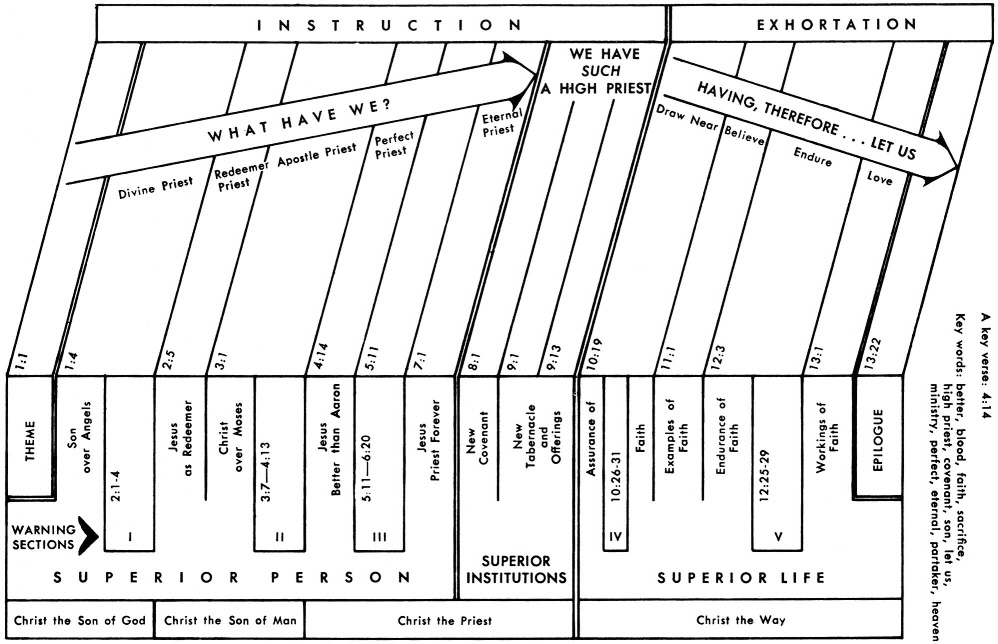
CONSIDER JESUS OUR GREAT HIGH PRIEST
Click chart to enlarge
Charts from Jensen's Survey of the NT - used by permission
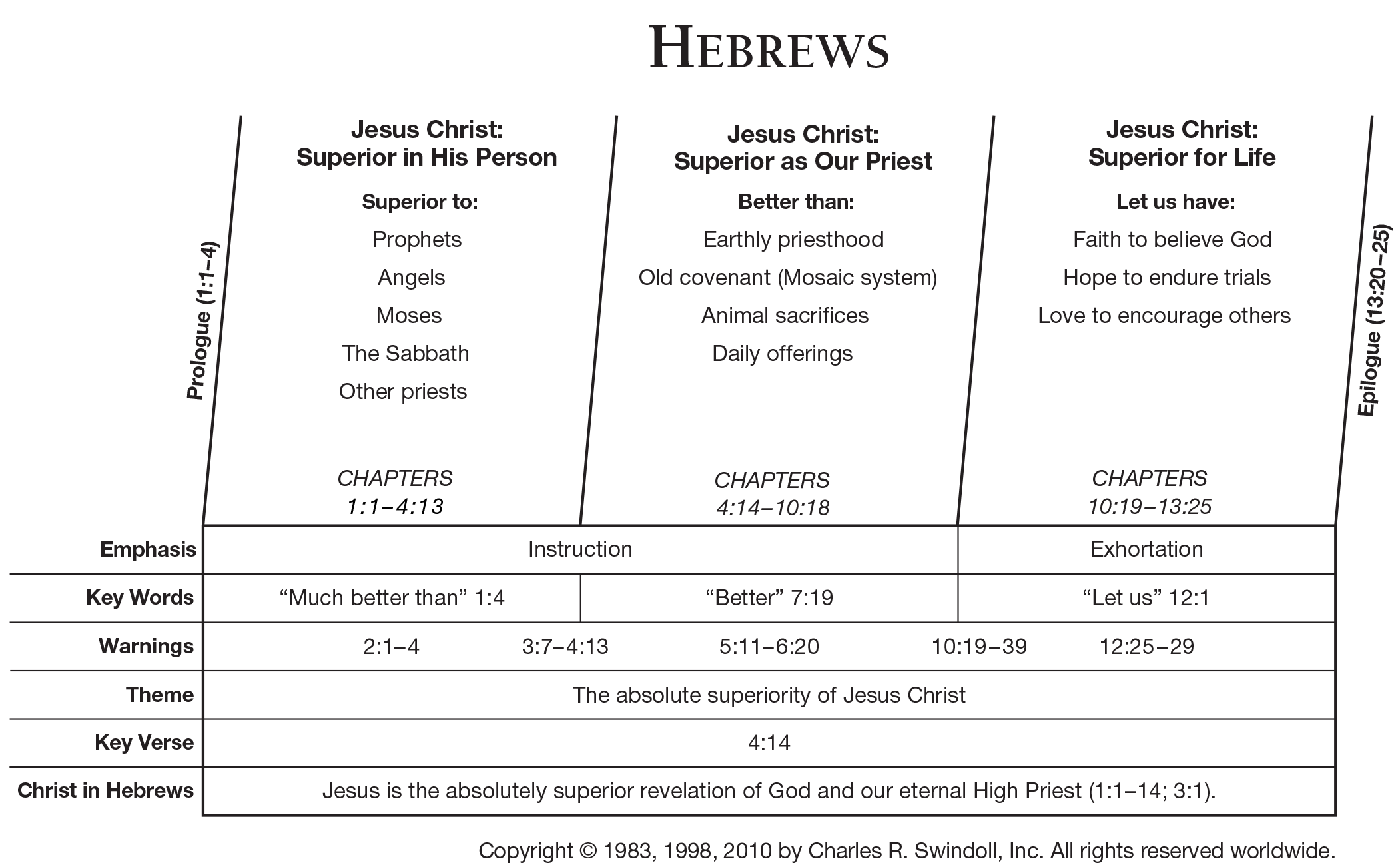
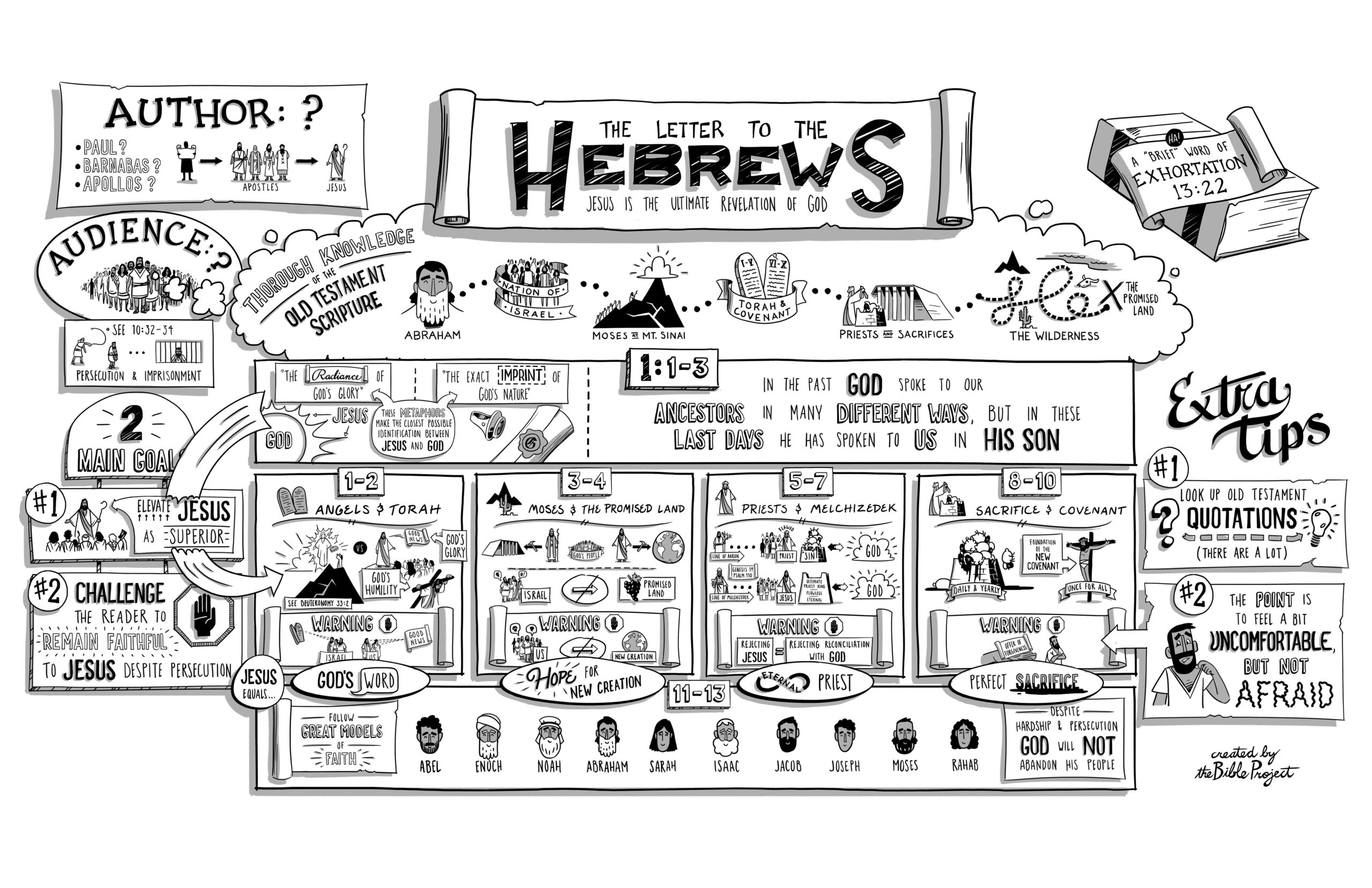
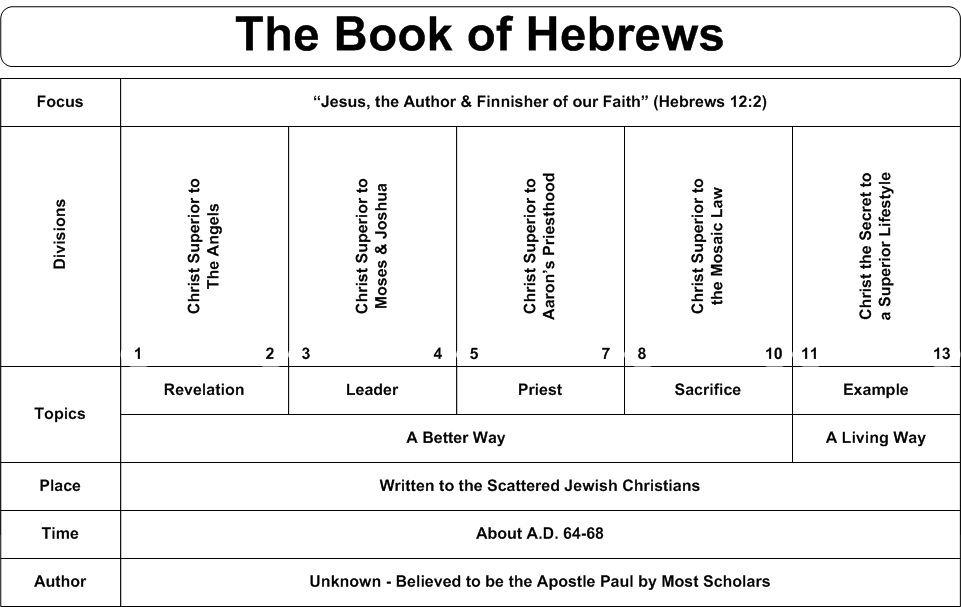
Swindoll's Chart, Interesting Pictorial Chart of Hebrews, Another Chart
|
The Epistle |
||||
| INSTRUCTION Hebrews 1-10:18 |
EXHORTATION Hebrews 10:19-13:25 |
|||
| Superior Person of Christ Hebrews 1:1-4:13 |
Superior Priest in Christ Hebrews 4:14-10:18 |
Superior Life In Christ Hebrews 10:19-13:25 |
||
| BETTER THAN PERSON Hebrews 1:1-4:13 |
BETTER PRIESTHOOD Heb 4:14-7:28 |
BETTER COVENANT Heb 8:1-13 |
BETTER SACRIFICE Heb 9:1-10:18 |
BETTER LIFE |
| MAJESTY OF CHRIST |
MINISTRY OF CHRIST |
MINISTERS FOR CHRIST |
||
|
DOCTRINE |
DUTY |
|||
|
DATE WRITTEN: |
||||

See ESV Study Bible "Introduction to Hebrews"
(See also MacArthur's Introduction to Hebrews)
Borrow Ryrie Study Bible
Hebrews 4:8 For (NASB: Lockman)if Joshua had given them rest, He would not have spoken of another day after that.
Greek: ei gar autous Iesous katepausen, (3SAAI) ouk an peri alles elalei (3SIAI) meta tauta emerasei
BGT εἰ γὰρ αὐτοὺς Ἰησοῦς κατέπαυσεν, οὐκ ἂν περὶ ἄλλης ἐλάλει μετὰ ταῦτα ἡμέρας.
Amplified: [This mention of a rest was not a reference to their entering into Canaan.] For if Joshua had given them rest, He [God] would not speak afterward about another day. (Amplified Bible - Lockman)
Barclay: If Joshua had actually brought them into rest, God would not then after that be speaking about another day. (Westminster Press)
KJV: For if Jesus had given them rest, then would he not afterward have spoken of another day. (JESUS CORRECTED TO "JOSHUA" IN THE NKJV)
NKJ For if Joshua had given them rest, then He would not afterward have spoken of another day.
NLT: This new place of rest was not the land of Canaan, where Joshua led them. If it had been, God would not have spoken later about another day of rest. (NLT - Tyndale House)
Phillips: For if Joshua had given them the rest, we should not find God saying, at a much later date, "today". (Phillips: Touchstone)
Wuest: For if Joshua had given them rest, then would He not have spoken of another day afterward.
Young's Literal: For if Joshua had given them rest, He would not have spoken of another day after that.
NET For if Joshua had given them rest, God would not have spoken afterward about another day.
CSB For if Joshua had given them rest, God would not have spoken later about another day.
ESV For if Joshua had given them rest, God would not have spoken of another day later on.
NIV For if Joshua had given them rest, God would not have spoken later about another day.
MIT For if in the interim Joshua had caused them to enter a state of rest, David would not have alluded to another day after that era.
NJB If Joshua had led them into this place of rest, God would not later have spoken of another day.
NRS For if Joshua had given them rest, God would not speak later about another day.
RSV For if Joshua had given them rest, God would not speak later of another day.
NAB Now if Joshua had given them rest, he would not have spoken afterwards of another day.
GWN If Joshua had given the people rest, God would not have spoken about another day.
BBE For if Joshua had given them rest, he would not have said anything about another day.
ASV For if Joshua had given them rest, he would not have spoken afterward of another day.
- Joshua - Acts 7:45
- had give them rest - Heb 11:13, 14, 15
- Hebrews 4 Resources - Multiple Sermons and Commentaries
Related Passages:
Joshua 1:15+ until the LORD gives your brothers rest, as He gives you, and they also possess the land which the LORD your God is giving them. Then you shall return to your own land, and possess that which Moses the servant of the LORD gave you beyond the Jordan toward the sunrise.”
Joshua 22:4+ “And now the LORD your God has given rest to your brothers, as He spoke to them; therefore turn now and go to your tents, to the land of your possession, which Moses the servant of the LORD gave you beyond the Jordan.
Joshua 23:1+ Now it came about after many days, when the LORD had given rest to Israel from all their enemies on every side, and Joshua was old, advanced in years,
THE REST JOSHUA
COULD NOT GIVE
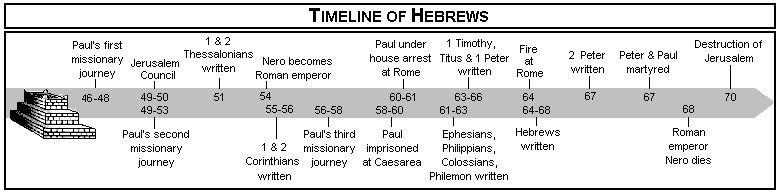
For (gar) is a term of explanation (always take a pause and ask what is being explained) and here the writer explains why he quoted the previous statement from David. The previous verse (Hebrews 4:7) declared that God, through David, spoke of “Today” long after Joshua’s time. David lived centuries after Joshua (see Timeline) so the fact that God still spoke through David of the need for the ancient Hebrews to enter the rest signifies God's rest was still available and could be missed by a hardened heart (Ps 95:7-8). And what else does this truth imply? Clearly, since Israel was already in the Promised Land during Joshua’s time and enjoyed rest from war (Joshua 23:1+). this shows that the “rest” in view was not merely a literal, physical rest, but also a figurative, spiritual rest — the rest of salvation in Christ (see further discussion in comments on Hebrews 4:2).
And what else does this truth imply? Clearly Israel was in the Promised Land in the time of Joshua and had rest from war (Joshua 23:1+), so this implies that this rest was not only a literal (physical) rest but a figurative (spiritual) rest, the rest of salvation in Christ (See more discussion in comments on Hebrews 4:2).
If (ean) Joshua (Iesous) had given them rest (katapauo) - IF introduces a second class conditional sentence which is often referred to as "contrary to fact." It’s like saying: “If Joshua had given them rest (which he did not), then God would not have spoken later of another day (but He did).” The author is reasoning from the negative reality — Joshua’s rest in Canaan was not the ultimate rest.
So in context, even the second generation Israelites who crossed the Jordan did not experience the rest that the writer has been speaking about in Hebrews 3-4. They were in the land, and under Joshua’s leadership they enjoyed rest from war — itself a sovereign gift of God — but this was not the rest God ultimately intended for them. This distinction reinforces the truth that the good news preached to them in Hebrews 4:2+ referred to spiritual rest, not merely physical rest. In this way, the good news proclaimed to them was equivalent to the proclamation of the Gospel. (See discussion).
For (gar) if (ean) Joshua (Iesous) had given them rest (katapauo) He (God speaking through David) would not (ou) have spoken (laleo) of another (allos) day after that (after the events of Joshua's day) - The KJV translation is confusing as it translates Iesous as "Jesus." The NKJV corrected this to read "For if Joshua..." To be sure, it is fair to see Joshua son of Nun (Joshua 1:1) as a shadow (See discussion of Typology) of Jesus, Who makes available the real rest prophesied by David in Psalm 95. This rest was not a land but a life! Jesus is the "Pioneer and Perfector of our faith" (Heb 12:2NET+).
Dost ask Who that may be?
Christ Jesus it is He;
Lord Sabaoth His name,
From age to age the same,
And He must win the battle.
(Martin Luther, 1529)
He (God speaking through David) would not (ou) have spoken (laleo) of another (allos) day after that. - But in fact, the writer affirms that God did speak of another day after Joshua. How did David speak of another day after Joshua? In Psalm 95:7, he says, “Today, if you hear His voice.” This clearly implies that God’s rest is still available “Today.” Put simply, if the rest were no longer available, God would not have said “Today.”
R C H Lenski on another day - God speaks of another day “in the person of David” to both the Israelites of David’s time and to us who now have this other day of grace. It is the day of Jesus and his salvation. David’s generation and the generations that followed were to look forward to this blessed day by faith in the promise of its coming and thus to embrace its salvation by faith. That was the object God wanted to attain by means of David’s psalm. Whether God attained it, and to what extent he attained it during the time between David and Jesus is not discussed. The point is that God still speaks to us in David’s psalm now that that day has come in Jesus so that we may believe and by believing be entering the heavenly rest (v. 3)(Borrow Hebrews Commentary)
A greater “Joshua,” namely “Jesus,”
brings us this rest, and He does that by faith alone.
-- R C H Lenski
Let's summarize - According to Psalm 95, God’s promise of rest was still in effect during the time of David—about 400 years after Israel had entered the Promised Land and long after Joshua 23:1 was written. This implies (1) the rest of God was still available to the Hebrew readers and (2) that the rest was not a "land" but a "life"—a spiritual rest found in a promised Person, not a promised place! This is the rest the writer urged his readers to enter. It is the same rest every sinner must enter to find relief in their souls from the penalty of sin, the wages of which is eternal death.
The rest into which Joshua led Israel was…
Temporal, Physical, and Natural
The rest provided by the greater Joshua (Jesus) is…
Eternal, Spiritual, Supernatural
Spurgeon explains the rest in Canaan is not a picture of heaven - While the children of Israel were in the wilderness, they were constantly moving to and fro, dwelling in tents, and enjoying but little comfort. Notwithstanding all the blessings with which God enriched them in the wilderness, it was a wilderness, and Moses truly called it “a howling, desert wasteland” (Deut 32:10). They had no rest there, and they were always looking forward to the land flowing with milk and honey where they were journeying. Their eager longing was for a land where they could settle down, and build houses, and plant vineyards, and dwell in quiet resting places. Canaan is, therefore, the type of the rest that God intends to give his people here. It is not the type of heaven, except very imperfectly, for in Canaan there were Canaanites to be fought, and to be gradually driven out, and there were some that never were driven out of their fastnesses, but we thank God that there are no Canaanites to trouble the saints in heaven. Canaan is the true pattern and type of the believer’s condition upon the earth. We who have believed in Jesus have crossed the Jordan. He has divided it for us, and we have entered into rest. It is true that the Canaanites are still in the land, but the Lord also is in the land; and, by His grace, we shall surely drive them all out.
A BETTER REST
Joshua led to a rest below—
Temporal fields where rivers flow;
A land of promise, peace, and grain,
Yet marked by toil and war’s refrain.
The Greater Joshua calls today,
To rest that will not fade away;
Eternal, pure, and Spirit-blessed,
Supernatural, perfect rest.
Joshua (Jesus) (2424) Iesous is transliteration of the Greek Iesous, which in turn is the transliteration of the Hebrew name Jehoshua (Yehoshua) or Jeshua (Yeshua) which mean Jehovah is help or Jehovah is salvation. Stated another way the Greek Iesous corresponds to the OT Jehoshua (Yehoshua) which is contracted as Jeshua (Yeshua).
Friberg on IESOUS - (1) Joshua, masculine proper noun meaning Lord (Yahweh) saves, designating Moses' successor (Acts 7.45; Heb 4.8, Lk 1:23 = another Joshua); (2) Joshua or Jesus, a common name among Jews (Col 4.11; Lk 3.29); (3) predominately Jesus, as the name borne by the Messiah, Jesus Christ, and used in relation to his humanity ( PH 2.5), his Davidic ancestry (MT 1.1), and his life in fulfillment of the divine promise of a coming Savior (MT 1.21) (Borrow Analytical Lexicon of the Greek New Testament)
IESOUS AS COMMON NAME AMONG JEWS - The name IESOUS (Greek for Yeshua/Joshua) was a fairly common name among Jews in antiquity, particularly in the 1st century. Archaeological evidence and ancient texts show: Archaeologists have found at least 71 tombs bearing the name Yeshua (the Hebrew form of Jesus/IESOUS) from the period around the life of Jesus. The Jewish historian Josephus, writing in the 1st century CE, referenced at least twelve people named Jesus (IESOUS), including four Jewish high priests with this name. In Greek inscriptions from the era, there are 48 examples of "IESOUS" found, demonstrating its use among Greek-speaking Jews as well. The historian Tal Ilan's "Lexicon of Jewish Names in Late Antiquity" reports a significant presence of the name Yeshua/Joshua/IESOUS in various forms from that period. The name was especially popular because it was the shortened Aramaic form of Yehoshua, a name carried by notable biblical figures like Joshua son of Nun and was revived post-exile.
Had given them rest (2664) (katapauo from katá = intensifies + paúo = make to cease) or caused them to cease from activity and enjoy a period of cessation from work.
Friberg on katapauo - (1) transitively; (a) cause to cease, restrain (Acts 14.18); (b) bring to (a place of) rest; give rest to; metaphorically, of spiritual rest provided for God's people (Heb 4.8); (2) intransitively rest, cease from (work) (Heb 4.4) (Borrow Analytical Lexicon of the Greek New Testament)
NIDNTT adds that… katapauo means to stop, put an end to; with reference to persons, to put an end to, hinder, depose, kill (Homer, J//. 16, 618; thus often with an unpleasant undertone); but also, to appease, calm (Homer, Od. 4, 583). In Judaism the term was taken up in the sense of to give someone a good rest (LXX). anapausis in cl. Gk. meant repose, relaxation, recreation, a rest from something. (SEE ONLINE 4 PAGE DISCUSSION ON REST on page 254 New International Dictionary of NT Theology)
KATAPAUO - 4V - given...rest(1), rested(2), restrained(1). Acts 14:18+ = "restrained the crowds" Heb. 4:4; Heb. 4:8; Heb. 4:10
The Old Testament is filled with shadows which foretell of the coming Messiah, the Substance of all the shadows, types, symbols, pictures, etc (Col 2:16, 17+, cp He 10:1+). The following table is an attempt to summarize the OT shadows of Moses and Joshua as they relate to the substance. The study of typology is rightly regarded by discerning readers with some hesitation because it has been subject to fanciful interpretations by some who in my opinion have failed to rightly divide the Word of Truth (See discussion of Typology - Study of Biblical types)
"God’s true rest comes not through a Moses or a Joshua or a David.
It comes through Jesus Christ."
-- J. MacArthur
JESUS' REST
|
||
| MOSES | JOSHUA | JESUS |
| No Rest Nu 14:33, 34+ |
Rest from War Dt 12:10+, Josh 23:1+ |
Rest for soul Mt 11:28-30+ |
| Wandering Forty Years Nu 32:13+ |
Victory over Physical Enemies Josh 11:23+, Josh 12:1, 2+ |
Victory over Spiritual Enemies Ro 6:17,18+, He 2:14, 15+, Ga 6:14+ |
| Wilderness Death Nu 14:35+ |
Promised Land Josh 5:6NIV+ |
Promised Life Col 3:4+ |
Articles below are available free online
- Walter Kaiser - The Promise Theme and the Theology of Rest - Bib Sac 130:518, 1973
- Paul House - The God Who Gives Rest in the Land: Joshua - SBJT 2:3 (Fall 1998)
- John Laansma - I Will Give You Rest’- The Background And Significance Of The Rest Motif In The New Testament - Tyndale Bulletin 46:2 (NA 1995)
- Randall C. Gleason - The Old Testament Background of Rest in Hebrews 3:7-4:11 - Bib Sac 157:627 (Jul 2000)
- T K Oberholtzer The Warning Passages in Hebrews -Pt 2- The Kingdom Rest in Hebrews 3:1-4:13 - Bib Sac 145:578 (April, 1988)
Not Free
- David A deSilva - Entering God’s Rest: Eschatology And The Socio-Rhetorical Strategy Of Hebrews - TrinJ 21:1 (Spring 2000)
- Robert Owens - A Consideration of Work and Rest from the Perspectives of Justification, Creation, and Eschatology - FM 17:3 (Summer 2000)
REST
"We which have believed do enter into rest."--Heb. 4:4.
"Ich bleib bei Dir! wo koennt ich 's besser haben."
Adolph Moraht
transl., Jane Borthwick, 1855
I rest with Thee, Lord! whither should I go?
I feel so blest within Thy home of love!
The blessings purchased by Thy pain and woe,
To Thy poor child Thou sendest from above.
Oh! never let Thy grace depart from me:
So shall I still abide, my Lord, with Thee.
I rest with Thee! Eternal life the prize
Thou wilt bestow, when faith's good fight is won;
What can earth give but vain regrets and sighs,
To the poor heart whose passing bliss is done?
For lasting joys I fleeting ones resign,
Since Jesus calls me His, and He is mine.
I rest with Thee! No other place of rest
Can now attract, no other portion please.
The soul, of heavenly treasure once possest,
All earthly glory with indifference sees.
Poor world, farewell! thy splendors tempt no more--
The power of grace I feel, and thine is o'er,
I rest with Thee! with Thee, whose wondrous love
Descends to seek the lost; the fallen raise,
Oh! that my whole of future life might prove
One hallelujah, one glad song of praise!
So shall I sing, as time's last moments flee
Now and for ever, Lord, I rest with Thee!
Spurgeon comments on God's warning in Psalm 95:7…
But what is this warning which follows? (referring to Ps 95:7) Alas, it was sorrowfully needed by the Lord's ancient people, and is not one whir the less required by ourselves. The favored nation grew deaf to their Lord's command, and proved not to be truly His sheep, of whom it is written, "My sheep hear my voice": Will this turn out to be our character also? God forbid!
Today if ye will hear his voice. Dreadful "if." Many would not hear, they put off the claims of love (God's love for them), and provoked their God. "Today," in the hour of grace, in the day of mercy, we are tried as to whether we have an ear for the voice of our Creator. Nothing is said of tomorrow, "He limits a certain day," He presses for immediate attention, for our own sakes He asks instantaneous obedience. Shall we yield it? The Holy Ghost says "Today," will we grieve him by delay?
Barton Bouchier - If ye will hear his voice. Oh! what an if is here! what a reproach is here to those that hear him not! "My sheep hear my voice, and I know them, and they follow me"; "but ye will not come to me that ye might have life." And yet there is mercy, there is still salvation, if ye will hear that voice. Israel heard it among the thunders of Sinai, "which voice they that heard it entreated that the word should not be spoken to them any more"; so terrible was the sight and sound that even Moses said, "I exceedingly quake and fear": and yet they heard too the Lord's still voice of love in the noiseless manna that fell around their tents, and in the gushing waters of the rock that followed them through every march for forty years. Yet the record of Israel's ingratitude runs side by side with the record of God's mercies -- "My people would not hearken to my voice, and Israel would none of me."
Bernard and Hugo Cardinalis, in Neale and Littledale - If ye will hear his voice. And yet, as S. Bernard tells us, there is no difficulty at all in hearing it; on the contrary, the difficulty is to stop our ears effectually against it, so clear is it in enunciation, so constant in appeal. Yet there are many who do not hear, from divers causes; because they are far off; because they are deaf; because they sleep; because they turn their heads aside; because they stop their ears; because they hurry away to avoid hearing; because they are dead; all of them topics of various forms and degrees of unbelief.
Thomas Cole (1627-1697) in the "Morning Exercises." - It will be as difficult, nay, more difficult, to come to Christ tomorrow, than it is today: therefore today hear his voice, and harden not your heart. Break the ice now, and by faith venture upon your present duty, wherever it lies; do what you are now called to. You will never know how easy the yoke of Christ is, till it is bound about your necks, nor how light his burden is, till you have taken it up. While you judge of holiness at a distance, as a thing without you and contrary to you, you will never like it. Come a little nearer to it; do but take it in, actually engage in it, and you will find religion carries meat in its mouth; it is of a reviving, nourishing, strengthening nature. It brings that along with it, that enables the soul cheerfully to go through with it.
Hebrews 4:9 (NASB: Lockman)So there remains a Sabbath rest for the people of God.
Greek: ara apoleipetai (3SPPI) sabbatismos to lao tou theou
BGT ἄρα ἀπολείπεται σαββατισμὸς τῷ λαῷ τοῦ θεοῦ.
Amplified: So then, there is still awaiting a full and complete Sabbath-rest reserved for the [true] people of God; (Amplified Bible - Lockman)
Barclay: So a Sabbath rest remains for the people of God. (Westminster Press)
KJV: There remaineth therefore a rest to the people of God.
NKJ There remains therefore a rest for the people of God.
NLT: So there is a special rest still waiting for the people of God. (NLT - Tyndale House)
Phillips: There still exists, therefore, a full and complete rest for the people of God. (Phillips: Touchstone)
Wuest: Therefore there remains over a rest for the people of God,.
Young's Literal: There remains therefore a Sabbath rest for the people of God.
NET Consequently a Sabbath rest remains for the people of God.
CSB Therefore, a Sabbath rest remains for God's people.
ESV So then, there remains a Sabbath rest for the people of God,
NIV There remains, then, a Sabbath-rest for the people of God;
MIT Accordingly, a rest analogous to the sabbath is the heritage of God's people.
NJB There must still be, therefore, a seventh-day rest reserved for God's people,
NRS So then, a sabbath rest still remains for the people of God;
RSV So then, there remains a sabbath rest for the people of God;
NAB Therefore, a sabbath rest still remains for the people of God.
GWN Therefore, a time of rest and worship exists for God's people.
BBE So that there is still a Sabbath-keeping for the people of God.
ASV There remaineth therefore a sabbath rest for the people of God.
- Remains - Heb 4:1,3; Heb 3:11; Isa 11:10; 57:2; Isa 60:19,20; Rev 7:14-17; Rev 21:4
- A Sabbath rest - Heb 11:25; Ps 47:9
- People of God - Mt 1:21 Titus 2:14 1Pe 2:10
- Hebrews 4 Resources - Multiple Sermons and Commentaries
Related Passages:
Genesis 2:2-3+ By the seventh day God completed His work which He had done, and He rested on the seventh day from all His work which He had done. Then God blessed the seventh day and sanctified it, because in it He rested from all His work which God had created and made.
Hebrews 4:4+ For He has said somewhere concerning the seventh day: “AND GOD RESTED ON THE SEVENTH DAY (~"SABBATH") FROM ALL HIS WORKS”;
Titus 2:14+ (PEOPLE OF GOD) (CHRIST) Who gave Himself for us to redeem us from every lawless deed, and to purify for Himself a people for His own possession, zealous for good deeds. (cf 1Co 6:19-20+)
1 Peter 2:10+ (PEOPLE OF GOD) for you once were NOT A PEOPLE, but now you are THE PEOPLE OF GOD; you had NOT RECEIVED MERCY, but now you have RECEIVED MERCY.
Matthew 11:28-30+ “Come (see need to depend on the Holy Spirit to obey) to Me, all who are weary and heavy-laden, and I will give you rest. 29 “Take (aorist imperative = Do it now! Do not delay! See our need to depend on the Holy Spirit to obey) My yoke upon you and learn from Me, for I am gentle and humble in heart, and YOU WILL FIND REST FOR YOUR SOULS. 30 “For (term of explanation) My yoke is easy and My burden is light.”
Colossians 2:16-17+ Therefore no one is to act as your judge in regard to food or drink or in respect to a festival or a new moon or a Sabbath (sabbaton) day– 17 things which are a mere shadow of what is to come; but the substance belongs to Christ.
COMMENT: Jesus fulfilled the Jewish regulations and celebrations by achieving perfectly the intentions they (and related to our present passage, the Sabbath day in the OT) only pointed to. The Sabbath Day was like a "giant finger" pointing to something far better. To go back to the old worn out picture is to miss His available rest. How ironic and how tragic. The very rest some attempt to attain by keeping legalistically the Sabbath they actually lose because they miss God's true rest, which was not a day but a Person, Christ Jesus! It is also relevant to note that the command to observe the Sabbath is the only one of the Ten Commandments not repeated after Pentecost.
A REST RESERVED FOR
GOD'S PEOPLE
So there (ara) means therefore and signals that the writer is drawing a logical conclusion (cf term of conclusion). The “so” points back to both proofs in Hebrews 4:7 in that in verse 7, God, through David, set another day (“Today”) long after Joshua’s time and in verse 8 if Joshua’s rest had been final, God would not have spoken of another day. Because both are true, the unavoidable and wonderful conclusion is that God’s rest is still open today — this rest remains (apoleipo) available and the present tense underscores the fact that is continually available. The people of God can enjoy a rest patterned after God's own rest on the seventh day of Creation. In sum, even though the promise of rest had not been appropriated (by faith) by most of Israel in the wilderness, the promise of rest still holds good to the Hebrews who are reading this epistle.
So there (ara) remains (apoleipo) a Sabbath rest (sabbatismos) for the people of God - The "rest" that remains was not the land Israel was to receive along with rest from wars (Dt 25:19), for Israel had been in their land 400 years when David penned Psalm 95 alluded to a rest yet not entered, implying that there was a component or aspect of rest Israel that had not yet obtained. In fact, the rest that remained was a soul rest (a "life" not a "land"!) offered by Jesus to all who would come to Him and find rest for their souls (Mt 11:28-30+).
A T Robertson quips that "This left-over promise is not repealed, though not utilized by the Israelites under Moses."
Notice that the writer says for the people of God where people is laos that means “a people, a nation, a group united by a common identity.” The phrase of God is a possessive genitive, meaning this people belongs to God by covenant and relationship. The dative case (τῷ) indicates the group to whom the Sabbath rest belongs — it is for them. The point is that he does not restrict this promise to Israel or Jews but to all who by grace through faith enter into the New Covenant. For them there remains a Sabbath rest! We can actually share God's rest. THOUGHT - Are you experiencing His rest?
Donald Guthrie on people of God - This is, in fact, a comprehensive term, suitable for the universal community, which embraces both Jews and Gentiles (cf. a similar use in 1 Pet. 2:10). This possessive aspect of God is remarkable. He delights to call the believers his people. (Borrow Hebrews Commentary page 118)
It is interesting that even the Jewish rabbis (not necessarily believers in Christ) had a similar idea for in their Mishnah we read their "commentary" on Psalm 92 ("A Psalm: A Song for the Sabbath") - A Psalm, a song for the time that is to come, for the day that shall be all Sabbath and rest in the life everlasting (Tamid 7:4).
What is this Sabbath Rest? Clearly the implication of "Sabbath" is not merely a day off, but an allusion to the spiritual fulfillment of God’s rest — ceasing from self-effort and enjoying His completed work.
William MacDonald on Sabbath rest - It refers to the eternal rest which will be enjoyed by all who have been redeemed by the precious blood of Christ. It is a "Sabbath" keeping that will never end. (Borrow Believer's Bible Commentary)
John Piper on Sabbath rest writing that passage forms "the foundation of God's message to you today: There is a rest open to you today. God offers rest. The door is not shut. The time is not past. You have not missed your last opportunity. Hear the words of Heb 4:9: "There remains therefore a Sabbath rest for the people of God." The door is open. The time is now. Ah, but someone says, "Yes, a rest remains for the people of God -- but not for me." But I answer, do not rule yourself out. Look at Hebrews 4:3 -- our last word, "We who have believed enter that rest." There is one door to the safe, peaceful, happy rest of God -- the door of faith. Anyone who puts faith in God's promises bought for us by the blood of Jesus, and is diligent not to throw that faith away, is a part of the people of God. So on behalf of God, I call you this morning, put your trust in the promise of God's rest. (See Be diligent to enter God's rest)
Charles Swindoll on Sabbath Rest - Just as God created everything in six days for us to enjoy during His “Sabbath rest,” He has also done everything necessary for us to experience spiritual peace today. Think of it as a reserved seat at a great banquet. God has purchased and prepared the meal, set the table, and opened the doors. By sending His Son, He accomplished the work of salvation. By sending the Spirit to dwell in us and empower us, He has given us the means of taking Him at His word. In fact, 2 Peter 1:3+ says, “His divine power has granted to us everything pertaining to life and godliness.” (See Insights on Hebrews - Page 64)
Donald Guthrie - There is no doubt that the writer is implying that the believer’s present sabbath rest is as much a reality as God’s rest. It is not some remote hope, but a hope immediately realizable....The glorification of rest (katapausis) does not imply that work is therefore a misfortune. ‘Rest’ here is not to be thought of as inactivity. Indeed this whole passage suggests that after the act of creation, God began his rest, which presumably still continues. There is no suggestion that God withdrew from any further interest in the created order (as the Deists maintained). (Borrow Hebrews Commentary page 118)
Thomas D Lea - God's people will share in God's own rest. Those who enjoy this rest will be believers, those who have approached God through Jesus Christ. Just what kind of rest can believers enjoy? When do they enjoy it—now, at death, or in the resurrection? This rest is...a present experience with Christ in which the Lord provides His presence, peace, and joy to replace the labor and heavy burdens of life (Mt 11:28-30). God's own rest (see Heb 4:4) becomes the pattern of the rest of the believer. God's rest involved the completion of his work and not mere cessation of activity. Believers have become complete in Christ (Col. 2:10), and they can live in the light of a fulfilled relationship to Jesus as their exalted head. (See Holman New Testament Commentary - Hebrews & James)
William Hendriksen - For the believer the Sabbath is not merely a day of rest in the sense that it is a cessation of work. Rather it is a spiritual rest—a cessation of sinning. It entails an awareness of being in the sacred presence of God with his people in worship and praise.
Safely through another week
God has brought us on our way;
Let us now a blessing seek,
Waiting in His courts today;
Day of all the week the best,
Emblem of eternal rest.
Warren Wiersbe - The writer mentioned two different “rests” found in Old Testament history: (1) God’s Sabbath rest, when He ceased from His Creation activities (Ge 2:2; He 4:4); (2) Israel’s rest in Canaan (Dt. 12:9+; Josh 21:43-45+; Heb 3:11). But he saw in these “rests” illustrations of the spiritual experiences of believers today. The Sabbath rest is a picture of our rest in Christ through salvation (He 4:3; see Mt 11:28). The Canaan rest is a picture of our present rest (ED: I AM NOT SURE I AGREE WITH THIS ANALOGY) as we claim our inheritance in Christ (He 4:11-13; note the emphasis on the Word of God). The first is the rest of salvation; the second is the rest of submission. But there is a third rest that enters into the discussion, that future rest that all believers will enjoy with God. “There remains, therefore, a rest to the people of God” (He 4:9)… When the saints enter heaven, it will be like sharing God’s great Sabbath rest, with all labors and battles ended (Re 14:13). (Bible Exposition Commentary.)
ADDENDUM COMMENT ON WIERSBE'S "REST OF SUBMISSION" - Submission rest is descriptive of the "rest" believers experience as they surrender or yield to the control of the Holy Spirit, ceasing to try to live the Christian life in their own strength. This surrender is a moment by moment, day by day, choice. Each trial, each temptation, each test, provides an opportunity for our old flesh to rise up and take control (with loss of the sense of "rest", cp the "peace of God", "a clear conscience") or to choose to allow the Spirit to control us and empower us through the trial, temptation or test (remembering 1Co 10:13+). It is not simply a passive "letting go and letting God", but an active working out of our salvation in fear and trembling (Php 2:12+), fully confident (walking by faith, not sight - 2Co 5:7+) that God's Spirit in us will give us the desire and the power to be "victorious" in the moment of decision (Php 2:13+, cp Jn 6:63+, Ro 7:6+, Ro 8:13+). This description is the essence of the process of sanctification, of learning to walk by the Spirit (Ga 5:16+), filled with (controlled by) the Spirit (Ep 5:18+), keeping in step with the Spirit (Ga 5:25+). As we conduct ourselves in such a worthy manner pleasing to the Lord (even motivated by our sure hope of an even greater future rest), we will experience the reality of God's rest ("Submission Rest") in this present life. May our Father graciously grant each of us both the desire and the power through His grace and His Spirit to continually experience His presence and His rest, for our good and His glory, all possible through the finished work of His "resting" Son, Christ Jesus. Amen.
Charles Ryrie on Sabbath rest - The word in Hebrews 4:9 (rest) indicates that, just as God ceased from His creative activity on the seventh day (Hebrews 4:4), so believers may cease from working for their salvation and self-reliance in sanctification. Or this sabbath-rest may look forward to believers' future rest in heaven. (Borrow Ryrie Study Bible)
C H Spurgeon on Sabbath rest - The Lord Jesus is our true Noah, in whom we find safety and rest. He was both given in birth and given up in death to be the rest of weary souls. This rest, I believe, is partly enjoyed on earth. “We who have believed enter into rest” (Heb 4:3), for we have ceased from our own works, as God did from His. But the full fruition and rich enjoyment of it remains in the future and eternal state of the beatified on the other side of the stream of death. (Full sermon A Delicious Experience)
William Newell - The “rest” itself is here called sabbatismos, a “state-of-rest” (cessation from labor or employment). Not in the sense of a weekly occurrence, but in the sense of that eternal state entered into by those who, already new creatures in Christ, enter that New Creation of Revelation 21–22; to which they already belong, where all things are according to God, where God Himself is at rest: For this is what is meant by God’s rest! (Hebrews Commentary)
Spurgeon on Sabbath rest - God has provided a Sabbath, and some must enter into it. Those to whom it was first preached did not enter in because of unbelief; therefore, that Sabbath remains for the people of God. David sang of it; but he had to touch the minor key, for Israel refused the rest of God. Joshua could not give it, nor Canaan yield it: it remains for believers.
Leon Morris on rested from his works - To enter rest means to cease from one's own work, just as God ceased from His. There are uncertainties here. Some think the reference is to Jesus, Who would certainly fit the description except for the "anyone" (which is a reasonable interpretation of the Greek). But the general reference is there, and we must take it to refer to the believer. The question then arises whether the rest takes place here and now, or after death, as seen in Rev 14:13 (+) FF Bruce thinks it is "an experience which they do not enjoy in their present mortal life, although it belongs to them as a heritage, and by faith they may live in the good of it here and now (in loc.). I should reverse his order and say that they live in it here and now by faith (2Co 5:7), but what they know here is not the full story (cp 1Co 13:12, 13, 2Co 3:18). That will be revealed in the hereafter. There is a sense in which to enter Christian salvation means to cease from one's works and rest securely on what Christ has done (Jn 19:30). And there is a sense in which the works of the believer, works done in Christ, have about them that completeness and sense of fulfillment that may fitly be classed with the rest in question. (BORROW The Expositor's Bible Commentary PAGE 958) (Bolding added)
Grant Osborne on Sabbath rest - As we will see in Hebrews 12:22–24, this new rest entails us entering in the present as well as the future into the “joyful assembly” of the heavenly Jerusalem, a new life of worship and rejoicing, in Christ. This entails a true rest from sin and the experience of God’s peace. Many recent commentators link this rest entirely with a final eschatology centering on the “new heavens and new earth” of the eternal age and thus a wholly future perspective. I strongly prefer an inaugurated thrust in which these future promises have already “begun” in Christ (ED: I STRONGLY AGREE), and Christ-followers are already experiencing this time of rest and joy. It certainly will not be consummated until Christ returns, but it has been initiated in the new salvation that has come with Christ and is ours from the start to enjoy. (See Hebrews Verse by Verse - Page 35)
Marvin Vincent on Sabbath rest - The Sabbath rest points back to God's original rest, and marks the ideal rest— the rest of perfect adjustment of all things to God, such as ensued upon the completion of his creative work, when he pronounced all things good. This falls in with the ground-thought of the Epistle, the restoration of all things to God's archetype. The sin and unbelief of Israel were incompatible with that rest. It must remain unappropriated until harmony with God is restored. The Sabbath-rest is the consummation of the new creation in Christ, through whose priestly mediation reconciliation with God will come to pass.
At best that rest (IN CANAAN) was outward and essentially physical,
and could not satisfy the promise of rest to the human race
which was intended from the beginning.Ray Stedman explains why there remains a Sabbath rest writing that "Though Jesus is not compared here with Joshua in terms of relative greatness, it is apparent from Hebrews 4:8, 9, 10 that the work of Joshua in leading Israel into the rest symbolized by the Promised Land was far inferior to the work of Jesus. He provides eternal rest to all who believe in Him. The fact that God repeats His promise of rest through David in Psalm 95, centuries after Israel had entered Canaan, is used to indicate that Sabbath-rest is the substance and Canaan-rest but a shadow (cf Col 2:16-17+). There was an experience of rest for Israel in Canaan (from armed invasion, natural disasters, failure of crops) when they were faithful to God. But even at best that rest was outward and essentially physical, and could not satisfy the promise of rest to the human race which was intended from the beginning. The author specifically states, There remains, then, a Sabbath-rest for the people of God. (Hebrews 4:8-11 Rest Obtained - New-Creation Rest)
Merrill Unger on Sabbath rest - "Redemptive rest is available for God’s people. These verses refer to the rest called sabbath-keeping (sabbatismos, ‘a state of rest from labor’) which involves the believer’s resting completely in a perfect work of redemption (Heb 4:3,4) as God rested from a perfect work of creation, Heb 4:10. This rest of redemption reposes wholly in the work of the Cross, and ceases from all self-effort, human merit or legalistic claim as a means either to salvation or sanctification (cf. Ep 2:8, 9, 10). It projects the victory of faith in conquest over spiritual enemies (the world, the flesh and the devil). (BORROW The new Unger's Bible handbook PAGE 588)
Craig Evans - The author of Hebrews admonishes Jewish Christians to enter God’s “rest” (Heb 3–4). The author infers from Scripture and Israel’s history that “there remains a sabbath rest [sabbatismos] for the people of God” (Heb 4:9). The reference here is not to weekly Sabbaths or to any particular holy day, but to the eschatological fulfillment of God’s will. At this time all believers will enter God’s rest, or sabbath. (See Dictionary of New Testament Background or BORROW Dictionary of New Testament Background PAGE 1035)
As the OT promises point beyond Moses to Christ, so the rest of God in Ge 2:2 points beyond Joshua and David to the final rest to which believers in Christ will attain if they hold fast their confidence and the beginning of (their) assurance firm until the end (He 3:6+, He 3:14+, cp Mt 24:13). Remember that their holding fast is not a "work" that merits salvation but a work that is enabled by the indwelling Spirit proving they are truly born again! The point is that only those with genuine faith in the Messiah will be able to hold fast or persevere to the end.
Remains (620) (apoleipo from apo = from, marker of dissociation, implying a rupture from a former association + leípo = lack, be deficient or wanting) means to leave behind in the active sense and in to remain in the passive sense (as used in this verse). Paul uses it in the active voice to describe leaving behind of his cloak (2Ti 4:13+ cp the two other uses of the active voice - 2Ti 4:20+; Titus 1:5+) Apoleipo is apparently a technical term in wills in ancient Greek writings.
Sabbath rest (4520) (sabbatismos from sabbatízo = keep the Sabbath) literally means a keeping of a sabbath or a keeping of days of rest. It is used in this passage not in the literal sense (meaning to keep a specific day, the "Sabbath" day) but to describe a period of rest for God’s people which is modeled after and is a fulfillment of the traditional Sabbath.
W E Vine adds that "sabbatismos, “a Sabbath-keeping,” is used in Heb 4:9, rv, “a sabbath rest,” kjv marg., “a keeping of a sabbath” (akin to sabbatizo, “to keep the Sabbath,” used, e.g., in Ex 16:30, not in the NT); here the sabbath-keeping is the perpetual sabbath “rest” to be enjoyed uninterruptedly by believers in their fellowship with the Father and the Son, in contrast to the weekly Sabbath under the Law. Because this sabbath “rest” is the “rest” of God Himself, He 4:10, its full fruition is yet future, though believers now enter into it. In whatever way they enter into divine “rest,” that which they enjoy is involved in an indissoluble relation with God .(Vine's Expository Dictionary of Old Testament and New Testament Words)
Wuest - The writer uses here a different Greek word for “rest.” In his previous references to the idea of rest, he has used katapausis, meaning “a cessation from activity,” thus “a rest,” a general word for the idea of rest. Now, he uses sabbatismos, the word used of the Sabbath rest. The word points back to God’s original rest, and speaks of the ideal rest. It is a Sabbath rest because the believer reaches a definite stage of attainment and has satisfactorily accomplished a purpose, as God did when He finished the work of creation. It is not the believer’s rest into which he enters and in which he participates, but in God’s unique, personal rest in which the believer shares. (Hebrews Commentary)
Vine adds "There remains therefore a sabbath rest [a sabbatismos, or sabbath-keeping] for the people of God.—no sooner had His handiwork been marred by sin than God began to work with a view to man’s redemption and to the restoration of the enjoyment of the rest of communion with Him. Hence all the pre-figurative sacrifices and types and shadows in the Old Testament. The work of redemption having been accomplished on the Cross, God raised Him from the dead, seated Him at His right hand and rested once more. Man was now called not to keep a seventh-day rest, appertaining to the old creation, but an abiding rest in Christ. In Him God rests eternally. The believer is called to apprehend what it means to enjoy His rest; and this as against the world, the flesh and the devil. This is granted not one day in the week, but a sabbatismos, a sabbath-keeping all the days of the year. This word sabbatismos has a Greek suffix added to a Hebrew word. This is used instead of katapausis (as in He 3:11, 18; 4:1, 3, 5, 10, 11), a cessation…As has been pointed out, our sabbath in this day of the indwelling Holy Spirit and His ministry, is not one day in the week; “there remains [i.e., abides continually] a sabbath rest [a sabbatismos, a sabbath-keeping] for the people of God.” Our rest is in the living and glorified Christ on the ground of His finished work at Calvary. This rest does not depend on special days, it is not intermittent. If kept uninterruptedly as God designs it for us, then our delight is in the Lord and we may enjoy constant fellowship with Him. We are ever to refrain from doing our pleasure, pursuing our own ways and engaging in any business as if it was our own. If we do so we cannot enjoy the privilege of rest in Christ. We are ever to abstain from useless talk of the lips, which “tendeth only to penury” (Prov. 14:23). (The Collected Writings of W.E. Vine - Volume 2)
Arnold Fruchtenbaum describes sabbatismos as…the ideal rest. It is provided by God. It is available today and the readers of Hebrews can attain it by faith. It means reaching a definite stage of attainment after satisfactorily fulfilling God’s purpose for their life. God finished His work and He entered into Sabbath Rest. Sabbath Rest is a type of spiritual maturity. It was destined primarily for Israel in Ex 20:8, 9, 10, 11. Its symbolic meaning is that it remains for the true believer, both Jew and Gentile. This is a promise of rest available for every believer. If a believer persists in his faith, he will reach a level of spiritual maturity when he ceases to constantly struggle over the basics of the spiritual life. (The Messianic Jewish Epistles: Hebrews, James, First Peter)
Ray Stedman… in his discussion of The Rest Obtained Is New-Creation Rest (4:8-11)
The use of the term sabbatismos (“Sabbath-rest”) suggests that the weekly sabbath given to Israel is only a shadow of the true rest of God. Paul also declares in Colossians 2:16–17 where he lumps religious festivals, New Moon celebrations and sabbath days together as “a shadow of the things that were to come, the reality, however, is found in Christ.”
Thus rest has three meanings: (1) the Promised Land; (2) the weekly sabbath; and (3) that which these two prefigure, that cessation from labor which God enjoys and which he invites believers to share.
This third rest not only describes the introduction of believers into eternal life, but also depicts the process by which we will continue to work and live, namely, dependence on God to be at work through us. “It is God who works in you to will and to act according to his good purpose” (Phil 2:13+).
This is in many ways the lost secret of Christianity. Along with seeking to do things for God, we are also encouraged to expect God to be at work through us. It is the key to the apostle’s labors: “I can do everything through him who gives me strength” (Phil 4:13+). Also, “I have been crucified with Christ and I no longer live, but Christ lives in me. The life I live in the body, I live by faith in the Son of God, who loved me and gave himself for me” (Gal 2:20+). Note, “I no longer live”—that is, I do not look for any achievement by my own efforts. Rather “Christ lives in me” and the life I live and the things that I do are “by faith”—that is, done in dependence on the Son of God working in and through me.
This makes clear that truly keeping the sabbath is not observing a special day (that is but the shadow of the real sabbath), but sabbath keeping is achieved when the heart rests on the great promise of God to be working through a believer in the normal affairs of living. We cannot depend on our efforts to please God, though we do make decisions and exert efforts.
We cease from our own works and look to his working within us to achieve the results that please him. As Jesus put it to the apostles, “Apart from me you can do nothing” (Jn 15:5). They must learn to work, but always with the thought that he is working with them, adding his power to their effort. That is keeping the sabbath as it was meant to be kept!
Learning to function from a position of rest
is the way to avoid burnout in ministry or any other labor.
We are to become “colaborers with God,” to use Paul’s wonderful phrase (cp 1Cor 15:10+).
This does not mean that we cannot learn many helpful lessons on rest by studying the regulations for keeping the sabbath day found in the Old Testament. Nor that we no longer need time for quiet meditation and cessation from physical labor.
Our bodies are yet unredeemed and need rest and restoration at frequent intervals. But we are no longer bound by heavy limitations to keep a precise day of the week. (Our Pilgrim Journey and Entering God's Rest) (Bolding and color added for emphasis)
Related Resource: See I Dolphin's excellent page with multiple articles on Entering God's Sabbath Rest
Dr Robert Morey discusses this passage as it relates to the argument used by some (Seventh Day Adventists) to support the keeping of the OT Sabbath…
The Hebrews 4:9 Argument
The Sabbatarian Position
In this chapter the author of Hebrews clearly states that there remains for the Christian a Sabbath day of rest.
Examination of This Argument
1. This argument’s greatest proponent was the Puritan, John Owen. But the exegetical evidence against his Sabbatarian position is so great that no classic commentator can be cited who agreed with his interpretation. Even some of the Puritans, such as John Brown, rejected Owen’s interpretation.
With almost all the classic commentaries and exegetes against the Sabbatarian position on Hebrews 4, this at once makes us suspicious of its validity.
2. A careful exegesis reveals that Hebrews 4 is teaching the exact opposite of the Sabbatarian position. The context is clear on the following points:
a. God’s “rest” in Hebrews 3:18 stands symbolically for the promised land. Because of unbelief, most of the generation died in the wilderness instead of entering His “rest” (Heb 3:16, 17, 18, 19).
b. From this Old Testament example, the author now informs his audience that the promise of a greater “rest” stands before them (Heb 4:1a).
c. This “rest” is of such a nature that:
• We can fall short of it (Heb 4:1b).
• We fall short if we do not believe the Gospel (Heb 4:2).
• It is entered into by faith (Heb 4:3).
d. This “rest” is now drawn from another Old Testament example: God’s Sabbath rest (Heb 4:4).
e. The author combines God’s Sabbath rest with the “rest” of the promised land (Heb 4:5), and states that disobedience to the Gospel hinders anyone from entering “rest” (Heb 4:6).
f. Even now in the age of salvation, the age of “Today” (Heb 4:7; cf. 2Cor. 6:2), God calls us to enter a “rest”; a rest like God’s Sabbath rest; a rest like that in Canaan (Heb 4:9).The only reason for putting the word “Sabbath rest” (Greek, sabbatismos, Heb 4:9) instead of just “rest” as in the rest of the context is that the author had just used God’s “Sabbath” as an illustration or example.
g. The nature of the “rest” or “Sabbath rest” of Heb 4:9 is explained in Heb 4:10, 11.
• Just as God ceased forever from His works, even so we are to cease from depending upon or trying to produce works to merit salvation. The works we produce are elsewhere called “dead works” (Heb 6:1).
• Let us enter the “rest of faith” in the Gospel and persevere to the end. We must not fall into or rest upon dead works.
• The danger to which the author was addressing himself was apostasy, not which day was to be observed by Christians. The audience was tempted to return to Judaism, thus the author exhorts them to persevere in the faith, and he warns them of condemnation if they become disobedient to the Gospel.
The fact that this is the theme of the entire book and the thrust of chapter four is accepted by nearly all commentators. Why do the Sabbatarians ignore this broader and immediate context? The emphasis in Hebrews 4 is on a future rest that yet awaits all who persevere to the end in faith (cf. He 10:38, 39), and the author’s fear that by moving back under the Old Covenant they would fall short of that sabbatismos.
The conclusion of the author’s argument is given in Heb 4:14, 15, 16. In order to enter God’s rest, we must “hold firmly to the faith” (Heb 4:14) in Christ’s meritorious priestly atonement. Therefore, let us “approach the throne of grace with confidence” (Heb 4:16) in view of Christ’s work for us.
Conclusion - Hebrews 4 is a passage which shows that God’s Sabbath and the Promised Land were an eschatological foreshadowing of the believer’s rest of faith in the Gospel of salvation, accomplished by the sealing of the New Covenant by the blood of Christ. Heb. 4:9 does not say “Sabbath day” but rather “Sabbath-like rest” (sabbatismos). The context rules out the Sabbatarian interpretation, because the emphasis falls not on a day to be observed in this age, but on an eternal rest awaiting all who live by faith until the end (cf. Heb 3:14). (SEE The Encyclopedia of Practical Christianity)
Charles Simeon writes of the glorious privileges that are entailed by the concept of rest…
They have already in some respect entered into rest—
They are freed from the terrors of a guilty conscience.
They feel a delight in ordinances and Sabbaths.
Their minds are fully satisfied with the Gospel salvation.
They experience the truth of our Lord’s promise
But the rest which awaits them is far superior to that they now possess—They will enjoy a freedom from all labours and sorrows—They are constrained to labour as long as they are in the world. Their whole life resembles a race or warfare. They can obtain nothing without strenuous exertions: and of necessity they are encompassed with many sorrows. But in heaven they will cease from their labours: nor will their happiness have any intermission or alloy.
They will be exempt from all influence of sin or temptation—Sin now defiles their very best services. Satan is also unwearied in his endeavours to corrupt them. These are sources of much pain to them at present. But the souls of all in heaven are made perfect: nor can any unclean thing enter to defile them. Their triumph will be complete and ever-lasting.
They will dwell in the immediate presence of their God—Their capacity of enjoying God will be wonderfully enlarged: they will behold him not darkly, as now, but face to face. The Saviour’s glory will be the object of their devoutest admiration. Their delight in him will surpass their present conceptions. They shall know that their happiness will be eternal. Then will every desire of their heart be fully satisfied. (Hebrews 4:9 The Rest that Remains for God's People - Online)
A Rest Remaineth for the Weary
by Johann S Kunth
A rest remaineth for the weary;
Arise, sad heart, and grieve no more;
Though long the way, and dark and dreary,
It endeth on the golden shore.
Before His throne the Lamb will lead thee,
On heav’nly pastures He will feed thee,
Cast off thy burden, come with haste;
Soon will the toil and strife be ended,
The weary way which thou hast wended.
Sweet is the rest which thou shalt taste.
The Father’s house has many a dwelling,
And there will be a place for thee.
With perfect love His heart is welling
Who loved thee from eternity.
His precious blood the Lamb hath given
That thou might’st share the joys of Heaven,
And now He calleth far and near:
“Ye weary souls, cease your repining,
Come while for you My light is shining;
Come, sweetest rest awaits you here!”
O come, come all, ye weak and weary,
Ye souls bowed down with many a care;
Arise and leave your dungeons dreary
And listen to His promise fair:
“Ye bore your burdens meek and lowly,
I will fulfill My pledge most holy,
I’ll be your solace and your rest.
Ye are Mine own, I will requite you;
Though sin and Satan seek to smite you,
Rejoice! Your home is with the blest.”
There rest and peace in endless measure
Shall be ours through eternity;
No grief, no care, shall mar our pleasure,
And untold bliss our lot shall be.
Oh, had we wings to hasten yonder—
No more o’er earthly ills to ponder—
To join the glad, triumphant band!
Make haste, my soul, forget all sadness;
For peace awaits thee, joy and gladness—
The perfect rest is nigh at hand.
C H Spurgeon - Another reason why God rested on the seventh day was, that not only was the work finished, but all that was finished was good. We read that, at the conclusion of his six days, work, “God saw every thing that he had made, and, behold, it was very good,” and therefore he rested; and oh, what rest a believer gets when he looks on the finished work of Jesus Christ, and after examining every part of it, is able to say of it all, “It is very good.” To see Christ’s work of covering sin, and to note how his substitutionary sacrifice has covered it so completely that even God himself cannot see it, is indeed “very good.” To realize that Christ has sunk our sins into oblivion, and made them cease to be, this also is “very good.” To look at Christ’s justifying righteousness, and to mark how perfect it is, not a thread missing, no part of the goodly texture having a flaw in it, this too is “very good.” To see Christ as our Prophet, Priest, and King, to view him in all his relationships and offices, this too is “very good.”
Yes, beloved, this is the way to get the Sabbatismos,
the true rest which remains for the people of God.
If we examine the work of Christ, both in its completeness, and in all its details, as God the Father looked at his works, and praised them all, if we let our judgement feel what a strong rock we have on which to build our eternal peace, then, like the ever-blessed Jehovah himself, we shall rest, and enter into his rest. Oh, that God would, by his grace, enable us so to do (The Believer's Present Rest)
F B Meyer - Our Daily Homily - Devotional on Rest
Therefore I swore in My anger, Truly they shall not enter into My rest. Psalm 95:11
God’s Rest has been waiting for man’s entrance, since He rested from all the work that He created and made. To all other days there were evening and morning, but not to this. It does not consist in circumstances, or conditions of existence, but in disposition. It does not lie, as sacred poets have too often suggested, beyond the confines of this world — it is now, and here. Canaan is not primarily a type of heaven; but of that blessed experience which is ours when we have passed the Jordan of death to natural impulse or selfish choice, and have elected for evermore to accept, and delight in, the will of God.
Will you not take up this position today? Today! Oh that ye would hear his voice! To hear his voice speaking in the heart, in circumstances, and in nature, and to obey promptly, gladly, blithely, — this would bring the soul into the rest that remains unexhausted for the people of God. Are you hardening your heart against some evident duty to which you are called, but which you are evading? Are you hardening your heart to some appeal which comes to you through the ties of kinship and nature? Are you saying, "Can God subdue these Canaanites", instead of "God can"? Beware, for this is the sin of Massah and Meribah, which, being interpreted, means strife. Woe to those that strive with their Maker; let the potsherd strive with the potsherds of the earth. (Isa 45:9KJV) (Ed: Dear reader - In this paragraph Meyer seems to be placing the emphasis on the initial salvation experience, whereas in the following paragraph he clearly emphasizes the process of sanctification.)
Every one comes in the Christian life, once at least, to Kadesh-Barnea. On the one hand the land of rest and victory; on the other the desert wastes. The balance, quivering between the two, is turned this way by faith; that by unbelief. Trust God, and rest. Mistrust Him, and the door closes on rest, to open to wanderings, failure, and defeat. (Editorial comment: But not to loss of salvation if one is genuinely saved in the first place!) (Meyer, F. B. Our Daily Homily)
F B Meyer - Our Daily Homily - Devotional on Rest
As the cattle which go down into the valley,
The Spirit of the LORD gave them rest.
So didst Thou lead Thy people,
To make for Thyself a glorious name. (Isaiah 63:14)
It is the noonday glare in Palestine. The sun’s rays like spears of flame are striking down upon the parched sand-wastes, and all the land burns like a furnace. Away yonder is a sequestered glen, where mosses line the margins of streamlets and pools, and rich pasture keeps green in the shadow of the hills. Thither the cattle descend at noon. As the shadows creep down the mountain-sides they follow them, and presently the herd browses on the succulent herbage or reclines beneath the shadows of the spreading trees, while the brooks purl past clear and cool. Similarly Isaiah says God brought his people through the wilderness, leading them as a horse that might not stumble, and finally conducted them into the rest of Canaan.
But how fit an emblem is suggested of our Father’s dealings with us. The scorching sun of temptation shines around us. The glare of publicity, the fever of money-making, the strife of tongues, torment the children of men. But for God’s beloved ones there is a secret place by Him, a green and verdant nook, watered by the river of God. Over its portals these words are written: “I will give you rest.”
When once we learn to trust our Fathers unfailing love, we are caused to rest. Notice that forcible expression: the Spirit of the Lord caused them to rest. Here is anew thought of the omnipotence of love. It can so reveal itself that it almost compels rest. Cause us to lie down, O Lord, we pray Thee! Job speaks of Him as giving quietness: and then who can make trouble? Seek quietness as his gift! Lo! there is a place by Him, in the mountain-shadowed valley of his care, where disquieted souls are at peace. Seek it! (Meyer, F. B. Our Daily Homily)
F B Meyer - Our Daily Homily - Devotional on Rest
My people have become lost sheep;
Their shepherds have led them astray.
They have made them turn aside on the mountains;
They have gone along from mountain to hill
And have forgotten their resting place. (Jer 50:6)
These words may often be said of us. A time of emergency arises; the necessity for instant and vigorous action seems overpowering; we fail to see what course to adopt — and immediately we get flurried and excited; we run from one to another; we lose our sleep. All our earnest resolutions to abide in Christ and live in his fellowship are forgotten. We have forgotten our resting-place.
Or we are in the midst of a great campaign of work. From morning to night we are plunged in a mass of calculations and activities. There is no time to take our meals, much less to obtain opportunities for prayer and fellowship with God. Our rooms without, our souls within, are littered with the symptoms of the many absorbing interests which are monopolizing our attention. We have forgotten our resting-place. Or, perhaps, it is a time of great temptation. Hour after hour the foe returns to the attack. We have done our best to withstand him; but have hit out without precision, have fired at random. Again, we have forgotten our resting-place.
The place where we lie down to rest is under the shadow of the Cross. Whilst we remain there, we are perfectly safe and blessed. Return unto thy rest, O straying sheep! Back to the arms of Jesus, where only such frail ones as thou art are safe.
I knew a man, who had to bear a thousand crosses belonging to others, and who grieved himself into an illness because others did not love God as He deserves, till all at once his own foolishness and sinfulness struck him to the heart. He could do nothing then but cast himself and them into the endless depths of the love of God; and he ended by having rest in his heart, and a song on his lips. (Meyer, F. B. Our Daily Homily)
F B Meyer - Sabbath rest -
There is a rest for weary souls. — God speaks of it as His Rest. He entered it, we are told, when He had finished His work; and beheld it to be very good; and ever since the door has been standing open for the travel-stained, weary children of men to enter it. To every other creation-day there were evening and morning, but not to this; it partakes of the nature of eternity in its timeless bliss.
Let us rejoice that this rest remaineth. — Of course, the Sabbath, which was and is a type of it, could not exhaust it. And Canaan, with its sweet plains and cessation of the wilderness wanderings, could not completely fulfill it; because centuries after it had been given through Joshua, in the Psalms God spoke of yet another day, as though his rest were still future.
The rest may be a present experience. — The word “remains” has diverted the thoughts of commentators who have supposed it referred to heaven. There is rest, sweet rest, there. But “remains” means “unexhausted, unrealized, by aught which has taken place.” The rest is for us here and now. “We which have believed do enter into rest.” Where is it? In the bosom of Christ: “Come unto Me, and I will give you rest.” It is in ploughing the furrow of daily duty — “Take my yoke; … and find rest.”
This rest is compatible with great activity. — He that enters into the Divine rest is not reduced to quietism. On the seventh day the Creator rested from creation; but He works in providence. Jesus, on the seventh day, rested from Calvary; but He pleads in heaven. Cease from your own works, after a similar fashion; abandon your restless planning and striving; by the grace of the Holy Spirit better service will be produced. (Meyer, F. B. Our Daily Homily)
F B Meyer Devotional on Rest
Now the Lord my God hath given me rest on every side. (1Kings 5:4)
God is the Rest-Giver. When He surrounds us on every side with His protecting care, so that our life resembles one of the cities of the Netherlands in the great war— inaccessible to the foe because surrounded by the waters of the sea, admitted through the sluice— then neither adversary nor evil occurrence can break in, and we are kept in perfect peace, our minds being stayed on God.
Hidden in the hollow of His blessed hand,
Never foe can enter, never traitor stand.
Have you experienced the rest which comes by putting God round about you, on every side—like the light which burns brightly on a windy night because surrounded by its four panes of clear glass? Ah! what a contrast between the third (1Kings 5:3) and fourth verse: Wars on every side; Rest on every side. And yet the two are compatible, because the wars expend themselves on God, as the waves on the shingle; and there are far reaches of rest within, like orchards and meadows and pasture-lands beyond the reach of the devastating water.
Out of such rest should come the best work. We are not surprised to find Solomon announcing his purpose to build a house unto the name of the Lord. Mary, who sat at the feet of Jesus, anointed Him. Out of quiet hearts arise the greatest resolves; just as from the seclusion of country hamlets have come the greatest warriors, statesmen, and patriots. Men think, foolishly, that the active, ever-moving souls are the strongest. It is not so, however. They expend themselves before the day of trial comes. Give me those who have the power to restrain themselves and wait; these are they that can act with the greatest momentum in the hour of crisis. (Meyer, F. B. Our Daily Homily)
F B Meyer Devotional on Rest
A man of rest … he shall build. (1Chronicles 22:9,10)
The men of rest are the builders of the most lasting structures. Solomon builds the Temple, not David. Mary’s deed of anointing, learned in much sitting at the Lord’s feet, fills the world with its aroma. What is needed to make us men and women of rest?
First, a profound conviction that God is working.— Never despair of the world, said the late Mrs. Beecher Stowe, when you remember what God did with slavery: the best possible must happen. This serene faith, that all things are working out for the best— the best to God, the best to man— and that God is at the heart of all, will calm and still us in the most feverish days. There is a strong and an experienced Hand on the helm.
Next, an entire surrender to His will.— God’s will is certain to mean the destruction of the flesh, in whatever form He finds it; but it is our part to yield to Him; to will His will even to the cross; to follow our leader Christ in this, that He yielded Himself without reserve to execute His Father’s purpose.
Thirdly, a certain knowledge that He is working within to will and do of His good pleasure.— What a blessed peace possesses us when once we realize that we are not called on to originate or initiate, nor to make great far-reaching plans and try to execute them; but just to believe that God is prepared to work through our hands, speak by our life, dwell in our bodies, and fulfill in us the good purposes of His will. Be full of God’s rest. Let there be no burry, precipitation, or fret; yield to God’s hands, that He may mould thee: hush thy quickly throbbing pulse! So shalt thou build to good and lasting purpose. (Meyer, F. B. Our Daily Homily)
Robert Morgan - Ardent Hope of Heavenly Rest
If you thumb through an old hymnal, one published 150 or 200 years ago, you’ll likely find an entire section devoted to hymns celebrating the “Christian Sabbath”—Sunday as a day of rest and worship. The first day of the week was a hallowed day to earlier generations, and it was considered a symbol or “type” of heaven—a period of rest, worship, and simple pleasures. Rev. Philip Doddridge, noted pastor and hymnist, preached on this subject on June 2, 1736, using as his text Hebrews 4:9. At the close of the sermon he introduced this hymn to be sung. The first verse began, “Lord of the Sabbath, hear our vows” and described the grateful sacrifice of congregational singing. With verse 2, Doddridge got down to his main theme:
Thine earthly Sabbaths, Lord, we love;
But there’s a nobler rest above;
To that our laboring souls aspire
With ardent hope and strong desire.
No more fatigue, no more distress
Nor sin nor hell shall reach the place;
No sighs shall mingle with the songs,
Which rise up from immortal tongues.
No rude alarms of raging foes,
No cares to break the long repose;
No midnight shade, no clouded sun,
But sacred, high, eternal noon.
O long-expected day, begin!
Dawn on these realms of woe and sin:
Fain would we leave this weary road,
And sleep in death, to rest with God.
There remains therefore a rest for the people of God. – Hebrews 4:9
C H Spurgeon in Faith's Checkbook has a devotional entitled Work Is Done Rest in Him
GOD has provided a Sabbath, and some must enter into it. Those to whom it was first preached entered not in because of unbelief; therefore, that Sabbath remains for the people of God. David sang of it; but he had to touch the minor key, for Israel refused the rest of God. Joshua could not give it, nor Canaan yield it: it remains for believers.
Come, then, let us labor to enter into this rest. Let us quit the weary toil of sin and self. Let us cease from all confidence, even in those works of which it might be said “They are very good.” Have we any such? Still, let us cease from our own works, as God did from His. Now let us find solace in the finished work of our Lord Jesus. Everything is fully done: justice demands no more. Great peace is our portion in Christ Jesus.
As to providential matters, the work of grace in the soul, and the work of the Lord in the souls of others, let us cast these burdens upon the Lord and rest in Him. When the Lord gives us a yoke to bear, He does so that by taking it up we may find rest. By faith we labor to enter into the rest of God, and we renounce all rest in self-satisfaction or indolence. Jesus Himself is perfect rest, and we are filled to the brim in Him.
Joni E Tada - Enter That Rest More Precious Than Silver: 366 Daily Devotional Readings - Page 13
There remains, then, a Sabbath-rest for the people of God. —Hebrews 4:9
Back on the farm, the lazy days of July meant turning our horses out to summertime pasture. The grass was lush and ready for grazing. However, before we opened the gates, it was the responsibility of my sisters and me to saddle up and “ride the fences” to check for broken barbed wire. After hours of riding my horse under the summer sun, my weary mount would be wet with sweat, her head hanging low. I had to urge her to put one tired foot in front of the other.
Then as soon as my horse caught a whiff of home or recognized the fences of her own pasture, her ears would pick up and her pace would quicken. The nearer the barn, the more eager her trot. After a quick unsaddling, she’d roll in the dirt and take long, slow drinks from the trough. How good it feels, for a beast, to be home.
How good it will feel for us to be home. No more toiling, no more prying the world’s suction cups off my heart. Hebrews 4:9 is like a long drink of cool water on a hot day. Maybe the writers of the Bible—some whose joints were stiff from chains that chafed—had this sweet rest in mind, a rest that perked them up and quickened their pace. Toward the end of their lives, they wrote vigorous encouragements like “Let us, therefore, make every effort to enter that rest” (Heb. 4:11).
“So watch your step. Use your head. Make the most of every chance you get. These are desperate times!” (Eph. 5:15–16 THE MESSAGE). Make every effort to redeem the time, lay up your treasures in heaven, live as if God were watching (he is!). Make it your ambition to be pleasing to him (2 Cor. 5:9). The lush green pastures of rest are just over the horizon. Remember this as you collapse in bed tonight after an exhausting day.
Today’s thought makes my earthly toil seem so much lighter. If I become weary today, Lord, remind me of the pastures of my heavenly home.
Robert Hawker - There remaineth therefore a rest to the people of God.—Heb. 4:9.
BLESSED motto for the close of the month, or the day, or year; after being fatigued with the thoughts, and cares, and anxieties, of life. My soul, delight thyself in the thought of it—look forward to the speedy enjoyment of it. Like the prophet’s vision, it will come: wait for it. No sorrow you have gone through will ever come over again. No persecution already felt shall exactly be again practised. The same trial shall not be again known. Every day, every hour of the day, we are nearer home. Precious consideration! And Jesus is the rest of his people. Lord, in thee alone I find rest: be thou my hope, and be thou my portion for ever.
How Are You Going About The Work Of God?
By:
• Hurried busy activity?
• Inner striving for perfection?
• Fastidious attention to standards of performance?
This is not God’s way:
“DON’T BE [ MORBIDLY EXACTING AND EXTERNALLY ] RIGHTEOUS OVERMUCH, neither strive to make yourself [pretentiously appear] overwise—why should you [get puffed up and] destroy yourself [with presumptuous self-sufficiency]?” (Ecclesiastes 7:16—Amplified)
Someone has said, “Woe to the nervous activity of those of little faith.”
Jesus’ life was characterized by restful determination in accomplishing the work of God. Never in a hurry, He was poised, natural … purposeful.
And so it should be with us: “There remains … a … rest for the people of God.” (Hebrews 4:9)
The real work of God is done behind the scenes during private times of reflection upon His Word, worship, intercession, and pondering His eternal purposes. Then, sensing and moving with the inner prompting of the Spirit.
Gutzon Borglum commented, “When I carve a statue, it is very simple. I merely cut away the pieces that don’t belong there and the statue itself presently comes into view. It was there all the time.”
The life of Jesus Christ waits within us to find full expression through us in accomplishing His work. We can nervously hammer away at getting Him out … or we can rest as He cuts “away the pieces that don’t belong there.”
“For it is God who is at work within you, giving you the will and the power to achieve His purpose.” (Philippians 2:13—Phillips Translation)
Such Treasures to Behold! Quiet Reflections of Hope: 120 Devotions to Start Your Day - Page 237
Therefore, a time of rest and worship exists for God’s people. Hebrews 4:9
Have you ever had a time when one crisis after another seemed to occur? Everyone has such times periodically. Maybe that’s why God made the commandment to set a whole day aside for rest, as this verse in Hebrews mentions.
If it’s true we all have trials, it is also true that we all have treasures! Slowing down helps us see the great riches we have received. No matter what problems you are dealing with now, when you reflect on all God’s gifts, you’ll feel refreshed and renewed.
Our gifts from God are magnificent. The gift of our amazingly complex bodies can inspire us. The gift of family can comfort us. The gift of creation, in all its regal forms, calls out for attention. The gifts of a warm house, inspiring words to read, a soft quilt, an aromatic cup of tea—these are blessings we can feel, smell, and appreciate.
Imagine how a treasure hunter rejoices over the discovery of jewels. Just think—your God-given treasure box is always available. At this time of night, you can remember the commandment to rest. With your treasure box of blessings from God open to appreciate, you can relax easily. Settle into bed like a queen. What a wonder it is to have been lavished with so many blessings.
Open your treasure box now. Dig deeply into this bounty of heavenly gifts.
Billy Graham - Rest for God’s People The Enduring Classics of Billy Graham
There remains therefore a rest for the people of God. HEBREWS 4:9
We are the most entertained generation in history. Television sets pull in thousands of channels. Professional sports teams and pop music groups take in (and spend) billions of dollars. Millions of people own second and third homes for vacations. Our children are upset if they don’t get the latest computer games for Christmas.
I believe this frantic search for entertainment is a symptom of something deeper. Some have suggested we are the most bored generation in history, and perhaps they are right. But I’m convinced that down inside is an empty place in our hearts—a restlessness, a desire for inner peace and tranquility that will not go away. The irony is, the more we try to satisfy it, the less content we become.
Only Christ can fill that empty space in our hearts, and He will do so as we open our lives to Him. But God’s Word also points us to the future—to Heaven, where our restless hearts will be at peace. “There remains therefore a rest for the people of God.”
MacDuff - There remaineth therefore a rest to the people of God Heb. 4:9
How sweet the music of this first heavenly chime floating across the waters of death from the towers of the New Jerusalem. Pilgrim, faint under thy long and arduous pilgrimage, hear it! It is REST. Soldier, carrying still upon thee blood and dust of battle, hear it! It is REST. Voyager, tossed on the waves of sin and sorrow, driven hither and thither on the world’s heaving ocean of vicissitude, hear it! The haven is in sight; the very waves that are breaking on thee seem to murmur, So He giveth His beloved REST. It is the longdrawn sigh of existence at last answered. The toil and travail of earth’s protracted week is at an end. The calm of its unbroken Sabbath is begun. Man, weary man, has found at last the long-sought-for rest in the bosom of his God!
Streams in the Desert -
“There remaineth, therefore, a rest to the people of God.” (Heb. 4:9.)
The rest includes victory, “And the Lord gave them rest round about;… the Lord delivered all their enemies into their hand.” (Joshua 21:44.)
“He will beautify the meek with victory.” (Psalm 149:4.) (Rotherham, margin.)
AN eminent Christian worker tells of his mother who was a very anxious and troubled Christian. He would talk with her by the hour trying to convince her of the sinfulness of fretting, but to no avail. She was like the old lady who once said she had suffered so much, especially from the troubles that never came.
But one morning the mother came down to breakfast wreathed in smiles. He asked her what had happened, and she told him that in the night she had a dream.
She was walking along a highway with a great crowd of people who seemed so tired and burdened. They were nearly all carrying little black bundles, and she noticed that there were numerous repulsive looking beings which she thought were demons dropping these black bundles for the people to pick up and carry.
Like the rest, she too had her needless load, and was weighed down with the devil’s bundles. Looking up, after a while, she saw a Man with a bright and loving face, passing hither and thither through the crowd, and comforting the people.
At last He came near her, and she saw that it was her Saviour. She looked up and told Him how tired she was, and He smiled sadly and said:
“My dear child, I did not give you these loads; you have no need of them. They are the devil’s burdens and they are wearing out your life. Just drop them; refuse to touch them with one of your fingers and you will find the path easy and you will be as if borne on eagle’s wings.”
He touched her hand, and lo, peace and joy thrilled her frame and, flinging down her burden, she was about to throw herself at His feet in joyful thanksgiving, when suddenly she awoke and found that all her cares were gone. From that day to the close of her life she was the most cheerful and happy member of the household.
And the night shall be filled with music,
And the cares that infest the day,
Shall fold their tents like the Arabs,
And as silently steal away.
—Longfellow
Spurgeon in - From Monday morning till Saturday night, many of you will not be able to lay aside your needle and your thread, except when, tired and weary, you fall back on your chair, and are lulled to sleep by your thoughts of labour! Oh! how seasonable will heaven’s rest be to you! Oh! how glad will you be, when you get there, to find that there are no Monday mornings, no more toil for you, but rest, eternal rest! Others of you have had manual labour to perform; you have reason to thank God that you are strong enough to do it, and you are not ashamed of your work; for labour is an honour to a man. But still there are times when you say, “I wish I were not so dragged to death by the business of London life.” We have but little rest in this huge city; our day is longer, and our work is harder than our friends in the country. You have sometimes sighed to go into the green fields for a breath of fresh air; you have longed to hear the song of the sweet birds that used to wake you when you were young; you have regretted the bright blue sky, the beauteous flowers, and the thousand charms of a country life. And, perhaps, you will never get beyond this smoky city; but remember, when you get up there, “sweet fields arrayed in living green,” and “rivers of delight” shall be the place where you shall rest, you shall have all the joys you can conceive of in that home of happiness.Heavenly Rest
O DAY OF REST AND GLADNESS Christopher Wordsworth, 1807–1885 (Borrow Osbeck's Amazing Grace)
There remains, then, a Sabbath-rest for the people of God; for anyone who enters God’s rest also rests from his own work, just as God did from His. Let us, therefore, make every effort to enter that rest … (Hebrews 4:9, 10, 11)
Christopher Wordsworth, a nephew of the renowned English poet, William Wordsworth, reminds us in this hymn that since God rested after His acts of creation, we who are made in His image also need a day of rest and spiritual renewal. We need the encouragement and fellowship of other believers to keep our lives aglow for God. The way we use the Lord’s Day reflects our true devotion to God. Very early in the Christian era, the first day of the week replaced the Jewish Sabbath as the day of worship because it was on Sunday that the resurrection took place. Although we do not observe it according to the many set rules such as the Jews had for their Sabbath, Sunday should always be a special day of refreshment and of giving honor and worship to our God.
Christopher Wordsworth was an Anglican bishop, a noted scholar, and a distinguished writer. He composed 127 hymn texts that were intended to teach the truths of Scripture and encourage worship. “O Day of Rest and Gladness,” his only hymn widely used today, focuses on the doctrine of the Trinity. In the second stanza, the triune Godhead is compared to three important events or a “triple light” that occurred on the first day of the week: The creation of light (Genesis 1:1), the resurrection of Christ, and the advent of the Holy Spirit. In the final stanza, Wordsworth addresses each member of the Godhead by name, as the church raises its perpetual voice to “Thee, blest Three in One.”
O day of rest and gladness, O day of joy and light, O balm of care and sadness, most beautiful, most bright: On thee, the high and lowly, thru ages joined in tune, sing “Holy, Holy, Holy,” to the great God Triune.
On thee, at the creation, the light first had its birth; on thee, for our salvation, Christ rose from depths of earth; on thee, our Lord, victorious, the Spirit sent from heav’n; and thus on thee, most glorious, a triple light was giv’n.
New graces ever gaining from this our day of rest, we reach the rest remaining to spirits of the blest. To Holy Ghost be praises, to Father, and to Son; the Church her voice upraises to Thee, blest Three in One.
For Today: Genesis 1:3–5; Psalm 118:24; Isaiah 58:13, 14; Revelation 14:13
Do you anticipate with joy the Lord’s Day, when you can worship God in your local church? How can Sunday become a more meaningful time of renewal and refreshment for you and your family? Reflect on this hymn as you go—
Adrian Rogers - when we stop trying and start trusting, we rest in the finished work of Calvary.
Daily Light on the Daily Path - So then, there remains a Sabbath rest for the people of God.
“There the wicked cease from troubling, and there the weary are at rest. There the prisoners are at ease together; they hear not the voice of the taskmaster.”
“Blessed are the dead who die in the Lord from now on. . . . They . . . rest from their labors, for their deeds follow them!”
“Our friend Lazarus has fallen asleep . . .” Now Jesus had spoken of his death, but they thought that he meant taking rest in sleep.
For while we are still in this tent, we groan, being burdened.—We ourselves, who have the firstfruits of the Spirit, groan inwardly as we wait eagerly for adoption as sons, the redemption of our bodies. For in this hope we were saved. Now hope that is seen is not hope. For who hopes for what he sees? But if we hope for what we do not see, we wait for it with patience.
Heb. 4:9; Job 3:17–18; Rev. 14:13; John 11:11, 13; 2 Cor. 5:4; Rom. 8:23–25
Present and Future Rest - Randy Alcorn - We Shall See God: Charles Spurgeon's Classic Devotional - Page 80
Excerpted from “Heavenly Rest”
Sermon #133 Delivered on Sabbath morning, May 24, 1857, at the Music Hall, Royal Surrey Gardens
Are you weary, whether from your work, from the suffering you’ve endured, or simply from living in a world bogged down by sin? God offers us true rest, heart-level rest—both now and in eternity.
There remains a Sabbath rest for the people of God. Hebrews 4:9
SPURGEON • “My rest,” says God (Hebrews 4:3-4), the rest of God! Something more wonderful than any other kind of rest. It is not the Sabbath, but the rest of the Sabbath—not the outward ritual of the Sabbath, which was binding upon the Jew, but the inward spirit of the Sabbath, which is the joy and delight of the Christian.
Now this rest, I believe, is partly enjoyed on Earth. “We who have believed enter that rest” (Hebrews 4:3), for we have ceased from our own works, as God did from his. But the full fruition and rich enjoyment of it remains in the future and eternal state of the blessed on the other side of the stream of death.
If God should help me to raise but one of his feeble saints on the wings of love to look within the veil and see the joys of the future, I shall be well contented to have made the joy-bells ring in one heart at least, to have set one eye flashing with joy, and to have made one spirit light with gladness. The rest of Heaven!
Here, too, on Earth, the Christian has to suffer. Here he has the aching head and the pained body. His limbs may be bruised or broken; disease may rack him with torture. He may be an afflicted one from his birth. He may have lost an eye or an ear, or he may have lost many of his powers. Or if not, being of a weakly constitution, he may have to spend most of his days and nights upon the bed of weariness.
Or if his body be sound, yet what suffering he has in his mind! Conflicts between depravity and gross temptations from the evil one, assaults of Hell, perpetual attacks of diverse kinds—from the world, the flesh, and the devil.
But in Heaven, no aching head, no weary heart. There, no palsied arm, no brow plowed with the furrows of old age. There, the lost limb shall be recovered and old age shall find itself endowed with perpetual youth. There, the infirmities of the flesh shall be left behind, given to the worm and devoured by decay.
There, they shall flit, as on the wings of angels, from pole to pole and from place to place, without weariness or anguish. There, they shall never need to lie upon the bed of rest or the bed of suffering, for day without night, with joy unflagging, they shall circle God’s throne rejoicing and ever praise him who has said, “No inhabitant will say, ‘I am sick’” (Isaiah 33:24).
There, too, they shall be free from persecution. There shall be none to taunt them with a cruel word or touch them with a cruel hand. They are in the society of saints; they shall be free from all the idle conversation of the wicked, and from their cruel jeers set free forever. Set free from persecution!
You army of martyrs: you were slain, you were torn apart, you were cast to wild beasts, tormented. I see you now, a mighty host. The clothing you wear is torn with thorns. Your faces are scarred with sufferings. I see you at your stakes and on your crosses. I hear your words of submission on your racks, I see you in your prisons, I behold you in your shackles. But
Now you are arrayed in white,
Brighter than the noonday-sun
Fairest of the sons of light,
Nearest the eternal throne.22
These are they who for their Master died, who love the cross and crown. They waded through seas of blood in order to obtain the inheritance, and there they are, with the blood-red crown of martyrdom about their heads, that ruby brightness, far excelling every other. Yes, there is no persecution there. “There remains a Sabbath rest for the people of God.”
Alas! In this mortal state the child of God is also subject to sin; he fails in his duty and wanders from his God; he does not walk in all the laws of his God blameless, though he desires to do it. Sin now troubles him constantly, but there sin is dead, there God’s children have no temptation to sin, from without or from within, but they are perfectly free to serve their Master. Here God’s children have sometimes to weep in repentance of their backslidings; but there they never shed tears of penitence, for they have never cause to do so.
And last of all, here, the child of God has to wet the cold ashes of his relatives with tears.
But there never once shall be heard the toll of the funeral bell, no hearse with plumes has ever darkened the streets of gold. The immortal are strangers to the meaning of death; they cannot die—they live forever, having no power to decay and no possibility of corruption.
Oh, rest of the righteous, how blessed you are, where families shall again be bound up in one embrace. Where parted friends shall again meet to part no more. And where the whole church of Christ united in one mighty circle shall together praise God and the Lamb throughout eternal ages.
RANDY ALCORN
In 1649, Puritan pastor Richard Baxter wrote The Saints’ Everlasting Rest, which Spurgeon read and treasured a few hundred years after its publication. It was for centuries the most influential book on Heaven ever written. Baxter, whom Spurgeon called “a man who above all other men loved the souls of men,” marveled that we don’t set everything else aside to consider Heaven and make sure we’re going there. Somehow, he lamented, Heaven hasn’t captured our imaginations or shaped our lives. Baxter and Spurgeon both latched onto the biblical picture of Heaven as a place of ultimate rest.
When God created the world, he rested on the seventh day (Genesis 2:2). That’s the basis for the biblical Sabbath, when all people and animals were to rest (Exodus 20:9-11). God set aside days and weeks of rest, and he even called for the Earth itself to rest every seventh year (Leviticus 25:4-5). This is the rest we can anticipate on the New Earth—times of joyful praise and relaxed fellowship, “united,” as Spurgeon writes, “in one mighty circle.”
Our lives in Heaven will include rest (Hebrews 4:1-11). “Blessed are the dead who die in the Lord from now on.” “‘Yes,’ says the Spirit, ‘they will rest from their labor, for their deeds will follow them’” (Revelation 14:13NIV).
Eden is a picture of rest—meaningful and enjoyable work, abundant food, beautiful environment, unhindered friendship with God and other people and animals. Even in Eden’s perfection, one day was set aside for special rest and worship. Work will be refreshing on the New Earth, yet regular rest will be built into our lives.
Part of our inability to appreciate Heaven as a place of rest relates to our failure to enter into a weekly day of rest now. By rarely turning attention from our responsibilities, we fail to anticipate our coming deliverance from the Curse to a full rest.
Spurgeon speaks of another sort of rest—a rest from persecution: “There shall be none to taunt them with a cruel word or touch them with a cruel hand.” Those who know Spurgeon’s life will pick up the meaning behind lines like these. In a day when newspapers held sway over public opinion, Spurgeon was bitterly opposed by many newspaper editors, secular as well as religious.
For instance, in April 1855, the Essex Standard carried an article that described Spurgeon this way: “His style is that of the vulgar colloquial, varied by rant. . . . All the most solemn mysteries of our holy religion are by him rudely, roughly and impiously handled. Common sense is outraged and decency disgusted. His rantings are interspersed with coarse anecdotes.”23
In 1857 Spurgeon wrote in one of his sermons, “Down on my knees have I often fallen, with the hot sweat rising from my brow under some fresh slander poured upon me; in an agony of grief my heart has been well-nigh broken.”
Spurgeon’s wife, Susannah, kept a scrapbook of the slanders spoken against her husband. She filled a huge volume with clippings and produced for Charles a framed wall text quoting Matthew 5:11-12: “Blessed are you when others revile you and persecute you and utter all kinds of evil against you falsely on my account. Rejoice and be glad, for your reward is great in heaven, for so they persecuted the prophets who were before you.”
This public criticism surely influenced Spurgeon’s understanding of this text: “Make every effort to enter that rest” (Hebrews 4:11, NIV). He knew he needed to carve out rest for his body and his mind and step back from the battles on every front. Even so, he admitted that he did not excel at doing this.
It’s ironic that it takes such effort to set aside time for rest. For many of us, myself included, it’s difficult to guard our schedules, but it’s worth it. A day of rest points us to Heaven and to Jesus, who says, “Come to me, all you who are weary . . . and I will give you rest” (Matthew 11:28, NIV).
What feels better than putting your head on your pillow after a hard day’s work? (How about what it will feel like after a hard life’s work?) It’s good to sit and have a glass of iced tea, feel the sun on your face, or tilt back in your recliner and close your eyes. It’s good to have nothing to do but read a good book or take your dog for a walk or listen to your favorite music and tell God how grateful you are for his kindness. Rest is good, so good that God built it into his creation and his law.
Some people thrive on social interaction; others are exhausted by it. Some love solitude; others don’t. On the New Earth, we’ll likely all welcome the lively company of others but also crave times of restful solitude. We’ll enjoy both.
God rested on the seventh day, before sin entered the world. He prescribed rest for sinless Adam and Eve, and he prescribed it for those under the curse of sin. Regular rest will be part of our future lives in God’s new universe.
O Day of Rest and Gladness - Kenneth Osbeck
Author—Christopher Wordsworth, 1807–1885
Music—German folk song
Arranger—Lowell Mason, 1792–1872
Tune Name—“Mendebras”
Meter—76.76 Doubled
Scripture Reference—Psalm 118:24
There remaineth therefore a rest to the people of God. For he that is entered in his rest, he also hath ceased from his own works, as God did from His. Let us labor therefore to enter into that rest... Hebrews 4:9, 10, 11
“Sunday is nature’s law as well as God’s. No individual or nation habitually disregarding it has failed to fall upon disaster and grief.”
Daniel Webster“The Lord’s Day is a firm foundation on which to build a six-story week.”
The Defender“O what a blessing is Sunday, interposed between the waves of worldly business like the divine path of the Israelites through the sea.”
Samuel Wilberforce“Man needs a day of rest from the cares, toils, and trials of the six days of work in the material realm. He needs to reflect, meditate, contemplate, and to turn his eyes inward, as it were, rather than outward. This has always been true, but surely it is truer now in this strenuous age of the world than ever before.”
The Lookout
The nineteenth-century author, Christopher Wordsworth, reminds us in this hymn text of a truth that men have realized through the ages, that even as God rested following His acts of creation, so man, too, needs a day each week for rest and spiritual renewal.
Christopher Wordsworth, a nephew and the biographer of the noted eighteenth-century English poet, William Wordsworth, was born on October 30, 1807, in Lambeth, England. Following his education at Cambridge University, where he received high honors for his academic accomplishments, Wordsworth was eventually elevated, in 1869, to the bishopric of Lincoln, where he labored most successfully in that position, until his death on March 20, 1885. Throughout his life, Wordsworth was known as an outstanding scholar, a tireless worker and a voluminous writer. Among his writings were an important work on the land of Greece, a learned commentary on the entire Bible, and a collection of 127 hymns published, in 1862, in a hymnal called The Holy Year. These hymns were written by Wordsworth to illustrate his convictions that hymns should not deal with personal, individual interests, but rather should teach the truths of Scripture and voice the worship of the entire congregation. He also believed that it was the first duty of the hymnwriter to teach sound doctrine to believers, and to reach the unsaved with the gospel. On another occasion he stated, “A church which foregoes the use of hymns in her office of teaching neglects one of the most efficacious instruments for correcting error and for disseminating truth, as well as for ministering comfort and edification.”
“O Day of Rest and Gladness” is the first hymn in Wordsworth’s, The Holy Year, hymnal and the only one still widely used today. This hymn text originally had six stanzas. One of the omitted verses is worthy of interest:
Thou art a port protected from storms that round us rise;
A garden intersected with streams of Paradise;
Thou art a cooling fountain in life’s dry, dreary sand;
From Thee, like Pisgah’s mountain, we view our promised land.
Christopher Wordsworth based his hymn text on Psalm 118:24: “This is the day which the Lord hath made; we will rejoice and be glad in it.” The hymn was included in the 1868 appendix of the well-known Anglican hymnal, Hymns Ancient and Modern.
An important spiritual truth taught and illustrated in this hymn by Christopher Wordsworth is the doctrine of The Trinity. It is interesting to note in the second stanza that the author compares the triune Godhead with three important events that occurred on the first day of the week: The creation of Light (Genesis 1:1), the resurrection of Christ, and the advent of the Holy Spirit. He refers to these events as the “triple light.” In the final stanza, Wordsworth addresses each member of the Godhead by name, as the Church raises its perpetual voice to “Thee, blest Three in One.”
The tune, “Mendebras,” is a German folk melody arranged by Lowell Mason, the influential nineteenth-century American composer of church and public school music. Lowell Mason is also the composer of the hymns, “A Charge to Keep I have” (No. 1) and “My Faith Looks Up to Thee” (No. 60) and the arranger of the carol “Joy to the World” (No. 52). Other well-known Mason hymns include: “From Greenland’s Icy Mountains” (101 Hymn Stories, No. 25), “Nearer My God to Thee” (ibid., No. 61), and “When I Survey the Wondrous Cross” (ibid., No. 100).
“Again the Lord’s own day is here,
The day to Christian people dear;
As, week by week, it bids them tell
How Jesus rose from death and hell.”
Ascribed to Thomas a Kempis
Translated by John M. Neale
Morning and evening: Daily readings (January 18 AM) by C H Spurgeon -
How different will be the state of the believer in heaven from what it is here! Here he is born to toil and suffer weariness, but in the land of the immortal, fatigue is never known. Anxious to serve his Master, he finds his strength unequal to his zeal: his constant cry is, “Help me to serve thee, O my God.” If he be thoroughly active, he will have much labour; not too much for his will, but more than enough for his power, so that he will cry out, “I am not wearied of the labour, but I am wearied in it.” Ah! Christian, the hot day of weariness lasts not for ever; the sun is nearing the horizon; it shall rise again with a brighter day than thou hast ever seen upon a land where they serve God day and night, and yet rest from their labours. Here, rest is but partial, there, it is perfect. Here, the Christian is always unsettled; he feels that he has not yet attained. There, all are at rest; they have attained the summit of the mountain; they have ascended to the bosom of their God. Higher they cannot go.
Ah, toil-worn labourer, only think when thou shalt rest for ever! Canst thou conceive it? It is a rest eternal; a rest that “remaineth.” Here, my best joys bear “mortal” on their brow; my fair flowers fade; my dainty cups are drained to dregs; my sweetest birds fall before Death’s arrows; my most pleasant days are shadowed into nights; and the flood-tides of my bliss subside into ebbs of sorrow; but there, everything is immortal; the harp abides unrusted, the crown unwithered, the eye undimmed, the voice unfaltering, the heart unwavering, and the immortal being is wholly absorbed in infinite delight. Happy day! happy! when mortality shall be swallowed up of life, and the Eternal Sabbath shall begin. (Spurgeon, C. H.)
Henry Bosch tells the following story entitled "Oh Rest in the Lord" - Years ago the English steamer Stella was wrecked on a rocky coast. Twelve women put into a lifeboat, but the boisterous sea immediately carried it away. Having no oars, they were at the mercy of the winds and the waves, and they spent a fearful night being tossed about by the raging tempest.
They probably would have lost hope if it had not been for the spiritual stamina of one of the ladies, Margaret Williams, who was well-known for her work in sacred oratorios. Calmly she prayed aloud for Divine protection. Then, urging her companions to put their trust in the Lord, she encouraged them by singing hymns of comfort.
Throughout the dark hours her voice rang out across the water. Early the next morning a small craft came searching for survivors. The man at the helm would have missed the women in the fog if he had not heard Miss Williams singing the selection from Elijah. “Oh, rest in the Lord, wait patiently for Him!” Steering in the direction of her strong voice, he soon spotted the drifting lifeboat. While many others were lost that night, these trusting few were rescued.
Augustine in a frequently quoted saying wrote of God that…
Thou have created us for Thyself, and our heart cannot be stilled until it finds rest in Thee.
Loosen the Bow - According to a Greek legend, in ancient Athens a man noticed the great storyteller Aesop playing childish games with some little boys. He laughed and jeered at Aesop, asking him why he wasted his time in such frivolous activity.
Aesop responded by picking up a bow, loosening its string, and placing it on the ground. Then he said to the critical Athenian,
"Now, answer the riddle, if you can. Tell us what the unstrung bows implies."
The man looked at it for several moments but had no idea what point Aesop was trying to make. Aesop explained,
"If you keep a bow always bent, it will break eventually; but if you let it go slack, it will be more fit for use when you want it."
People are also like that. That's why we all need to take time to rest. In today's Scripture, Jesus prescribed time off for His wearied disciples after they had returned from a prolonged period of ministry. And in the Old Testament, God set a pattern for us when He "rested from all His work" (Genesis 2:3).
Shouldn't we take His example seriously? Start by setting aside a special time to relax physically and renew yourself emotionally and spiritually. You will be at your best for the Lord if you have taken time to loosen the bow. (Our Daily Bread, Copyright RBC Ministries, Grand Rapids, MI. Reprinted by permission. All rights reserved)
Rest is Not Cessation from Labor - A man named Frederick W. Taylor, may provide some answers. Taylor worked for a large steel mill during the Spanish-American War 1898.
He was an ambitious young executive and was one of the first to apply scientific methods—as then known—to study the productivity of manual labor. In those days there were no cranes to load steel bars onto railroad cars. It was backbreaking manual work and, after some experimentation, Taylor concluded that the men could do more work if they took rest pauses at definite intervals.
He induced some of the workers to try his new method. He offered a dollar a day more and flattered them by calling them his “high-priced men.” Under this system, a whistle was blown after the men had carried iron for twelve minutes. At this whistle they were to sit down and rest. After three minutes’ rest, the whistle was blown again as a signal for the men to resume work.
The result—the amount of iron carried increased from 12 and a half to 47 tons a day! This seeming miracle ushered in the era of rest pauses, the forerunner of today’s coffee breaks.
Rest (Genesis 2:2)- IN large type running the full length of the page were these words: Even God Took a Day Off! The writers were referring to the seventh day of creation, when God rested from all His labors.
The magazine advertisement stopped me short and made me think. I had never thought of the seventh day as a "day off" so that the Lord could get rested. But it does underscore the work-rest principle that began in Genesis and runs throughout the entire Bible.
In the Old Testament, Israel was commanded to honor the seventh day by not doing any work. The Sabbath was to be a day of recovery as well as a day of sacrifice and worship. The land was to be left idle every seventh year—a principle modem agriculture has found to be essential for maximum yields. And in the New Testament, we read that the Lord Jesus led His disciples to a quiet place after a prolonged preaching tour so they could rest (Mark 6:31).
This new insight caused me take a look at my own schedule and make some adjustments. When our calendars are crammed with activities, and especially when Sundays are the most hectic of all, we need to slow down and take time to rest. The Bible calls for it, and our bodies and emotions desperately need it. Think of it this way: If it was important for God to do, how much more so for us?—D C Egner
Ian Paisley - There remaineth therefore a rest to the people of God." Hebrews 4:9
Three tilings are underlined in my text.
I. The Related Rest "A rest to the people of God"
Notice this rest is related and limited to the people of God. This rest is not universal but special. All do not receive this rest. It is limited to a special people, the people of God. It is not impersonal but personal. Note the word "to". It is not the rest of the people of God but to the people of God. It is bequeathed, gifted to them. It is inherently divine. It is to them not of them.
II the Reasoned Rest "Therefore"
What is the reason for this rest? The first reason is God's promise. What He has promised He always performs. The second reason is God's provision. God has provided this rest through the death of His Son. The third reason is God's perfecting. When God plants it is a real planting. God's rest is a real mature planting and bringeth forth much fruit.
III. The Remaining Rest "There remaineth therefore"
There is no lasting rest on earth. Earth's rest wears a withering crown that soon fades away. Its fair flowers soon fade and its sweetest calm falls to the arrows of sinful disturbance.
In heaven everything is eternal. Rust cannot corrupt there. Moths cannot devour there. Thieves cannot break through and steal there.
James Smith - The Rest!
(NOTE SMITH SEES THE REST AS PRIMARILY FUTURE BUT I THINK THIS NO QUESTION THAT THERE IS AN ELEMENT OF THAT REST AVAILABLE TO THE PEOPLE OF GOD IN THE PRESENT LIFE.)
"There remains therefore a rest for the people of God." Hebrews 4:9
We shall consider these words as referring to HEAVENLY rest:
our Father's house,
our Savior's home, and
our eternal dwelling-place!
To the weary and way-worn — there is something delightful in the thought of REST, and they love to think of Heaven as the place where they shall "rest from their labors."
REST gives us the idea of . . .
repose — the calm, quiet repose of the soul;
refreshment — the refreshment of the exhausted spirit after conflict, sickness, or toil;
restoration to vigor — after debility, languor, and fainting.
Heaven will be a rest . . .
from sin — which will no more grieve us;
from sorrow — which will no more trouble and distress us;
from fears — which will no more harass and perplex us; and
from conflicts — which will no more agitate and suppress us.
It will be a rest . . .
with God in His glory,
with Jesus in His immediate presence,
with saints and holy angels in full perfection and blessedness.
This rest is FUTURE — it remains for the people of God. (ED: I THINK IT IS ALSO NOW!)
This rest is the object of our hope and DESIRE. We look forward to it, with holy longing and cheering anticipations.
This rest is PERFECT — free from all mixture of anything that will agitate, give pain, or cause grief.
This rest is UNINTERRUPTED — nothing will ever occur to disturb, distress, or agitate us any more.
This rest is GLORIOUS — as bright as the meridian sun, as balmy as the most pleasant morning, as glowing with holiness, splendor, and majesty.
This rest is ETERNAL — and this is best of all. The possibility of a change, of a return to former scenes — would spoil all. But that rest will be enduring — as changeless as the Divine nature, and as glorious as the Divine perfections.
Blessed be God for such a rest for the weary, suffering, and downcast believer in Jesus! Oh, to keep the eye fixed upon it, and the heart expecting it — amidst all the troubles and trials of time!
This rest is FOR the redeemed people of God. They are now a poor, tried, tempted, and restless people; strangers and pilgrims upon the earth, as all their fathers were.
Satan tempts them,
sinners try them,
fears harass them,
Providence perplexes them,
and they often cry out, "O that I had wings like a dove — then would I fly away and be at rest!"
Believer, let the prospect of this eternal glorious rest, cheer you in toil and trouble! Your work will soon be finished, your trouble will soon come to an end — and then rest — the glorious rest, remains for you!
Let your Heavenly rest, quicken your pace homewards! You are going to a rest — a perfect,uninterrupted, and eternal rest — a rest in Heaven, a rest with Jesus, a rest in the presence of your God forever! Therefore gird up the loins of your mind, and press on towards the mark, cheered by the prospect of the end of the race.
Remember, Christian, this rest is SECURE, for Jesus has taken possession of it for you. "I am going," said He, "to prepare a place for you." Yes, Jesus has gone there for you, He has taken possession in your name, He is preparing your place, and will soon come and receive you to Himself!
Remember too, that it is NEAR — very near. Perhaps much nearer than you may think! (Ro 13:11-12)
You may be sighing, sorrowing, striving, wrestling, doubting, fearing, and cast down today; and tomorrow you may be in your Heavenly rest!
Today, you may be lying like Lazarus, at the rich man's gate, full of sores; tomorrow, you may be basking in the beams of Immanuel's glory!
Today, you may be on the bed of sickness, suffering, and pain; tomorrow, you may be in the presence of Jesus, where there is no more pain, neither sorrow nor crying!
Who can tell how near we all are to our Heavenly and everlasting rest?
Remember also, that your very trials, toils, and sufferings here on earth, may SWEETEN your rest to you! And that soon, very soon — you may be rejoicing over your present sorrows, and praising God for what now fills you with grief and sadness. Things will look very different there — from what they do here. Never, never forget, then, in your darkest nights, in your most trying days, in the midst of every storm and tempest, when passing over burning sandsand under a scorching sky — that there remains a rest for the people of God, and a rest for you!
"Arise and depart; for this is not your resting place, because it is defiled, it is ruined, beyond all remedy!"
"There the wicked cease from troubling; and there the weary are at rest!"
Today in the Word -
There remains, then, a Sabbath-rest for the people of God. - Hebrews 4:9
If you saw a notice in the newspaper listing you among potential heirs being sought for a great inheritance, would you make contact with the people placing the ad? Probably so. And if you checked things out and discovered you were a legitimate heir, would you be motivated to show up at the time and place designated to claim your inheritance? You'd be foolish not to go!
That's similar to the situation facing the readers of Hebrews--and us as believers today. God has a promised inheritance for His people called His rest. This rest was offered to the generation that Moses led out of Egypt, but they failed to claim it because they lacked the one prerequisite: faith.
The opening verses of Hebrews 4 continue the writer's train of thought. Having previously described the generation that angered God by its unbelief, he now applies the lessons of that generation to the believers of his day. And, as always, believers in every generation need to learn the same lessons.
The good news of this passage is that God's offer of a rest, a Sabbath rest, still stands. Even though Moses' generation missed it, God's promise remains. His rest has been available since the dawn of creation. God rested from His work (Gen. 2:2) and decided it was such a good idea that He commanded a rest for His creatures.
Notice that God's rest includes the cessation of work (v. 10). In God's case, He rested because He was finished with creation--His was a rest of completion and satisfaction.
If we are to enter God's rest today, what work must we cease doing? Part of the answer is that we are to rest from or give up our own efforts to save ourselves, since God's rest includes our salvation. The ""rest"" of salvation is entered only by faith.
The writer urges the Hebrews, ""Make every effort to enter that rest"" (v. 11). So the rest must go beyond salvation, since they were already believers. It seems clear that God's rest extends to the entirety of our lives, as we give up our attempts to live the Christian life in our own strength and rest in His promises.
TODAY ALONG THE WAY The principle of Sabbath rest--one day in seven set aside for rest and worship--stands out in this passage.
This is a rest God wants us to enjoy today. For us as Christians this special day is the Lord's day. But sadly, for many of us, this day is as hectic and noisy as the rest of the week. If your day of worship seems like every other day, except for church services, make a commitment to turn off the noise, unplug some of the activities, and spend more time in contemplation of God's goodness
Longing for Heaven - Puritan Daily Readings - from William Gurnall's book The Christian in Complete Armor
There remaineth therefore a rest to the people of God. Hebrews 4:9
O how should this make the Christian long to be gone home, where there is none of this stir and scuffle! It is strange, that every hour seems not a day, and every day a year, till death sounds your joyful retreat, and calls you off the field— where the bullets fly so thick, and you are fighting for your life with your deadly enemies—to come to court, where not swords, but palms are seen in the saints’ hands; not drums, but harps; not groans of bleeding soldiers and wounded consciences, but sweet and ravishing music is heard of triumphing victors caroling the praises of God and the Lamb, through whom they have overcome. Well, Christians, while you are below, comfort yourselves with these things. There is a place of rest remaining for the people of God. You do not beat the air, but wrestle for a heaven that is yonder above the clouds; you have your worst first, the best will follow. You wrestle but to win a crown, and win to wear it, yea, wear, never to lose it, which once on none shall ever take off, or put you to the hazard of battle more. Here we overcome to fight again; the battle of one temptation may be over, but the war remains. What peace can we have as long as devils can come abroad out of their holes, or anything of sinful nature remains in ourselves unmortified? [This nature] will even fight upon its knees, and strike with one arm while the other is cut off. But when death comes, the last stroke is struck. This good physician will perfectly cure you of your spiritual blindness and lameness, as the martyr told his fellow at the stake, bloody Bonner would do their bodily…Peace is sweet after war, ease after pain; but what tongue can express what joy, what glory must fill the creature at the first sight of God and that blessed company?
Dennis Fisher - As Christians, our true home is heaven (Phil. 3:20). Yet sometimes our desires tether us to the here and now. We enjoy God’s good gifts—marriage, children, grandchildren, travel, careers, friends. At the same time, the Bible challenges us to focus on “things above” (Col. 3:1-2). Things above may include the unseen benefits of heaven: God’s enduring presence (Rev. 22:3-5), unending rest (Heb. 4:9), and an everlasting inheritance (1 Peter 1:4).
When we all get to heaven,
What a day of rejoicing that will be!
When we all see Jesus,
We’ll sing and shout the victory. —Hewitt
For the Christian, heaven is spelled H-O-M-E.
F B Meyer from The Way Into the Holiest discusses "The Gospel of Rest"…
THE keynote of this chapter is Rest. In the second verse it is spoken of as a gospel, or good news. And is there any gospel that more needs preaching in these busy, weary days, through which our age is rushing to its close, than the Gospel of Rest? On all hands we hear of strong and useful workers stricken down in early life by the exhausting effects of mental toil. The tender brain tissues were never made to sustain the tremendous wear and tear of our times. There is no machinery in human nature to repair swiftly enough the waste of nervous energy which is continually going on. It is not, therefore, to be wondered at that the symptoms of brain tiredness are becoming familiar to many workers, acting as warning signals, which, if not immediately attended to, are followed by some terrible collapse of mind or body, or both.
And yet it is not altogether that we work so much harder than our forefathers; but that there is so much more fret and chafe and worry in our lives. Competition is closer. Population is more crowded. Brains are keener and swifter in their motion. The resources of ingenuity and inventiveness, of creation and production, are more severely and constantly taxed. And the age seem's so merciless and selfish. If the lonely spirit trips and falls, it is trodden down in the great onward rush, or left behind to its fate; and the dread of the swoop of the vultures, with rustling wings, from unknown heights upon us as their prey, fills us with an anguish which we know by the familiar name of care. We could better stand the strain of work if only we had rest from worry, from anxiety, and from the fret of the troubled sea that cannot rest, as it moans around us, with its yeasty waves, hungry to devour. Is such a rest possible?
This chapter states that such a rest is possible. "Let us labor therefore to enter into that rest." Rest? What rest? His rest, says the first verse; my rest, says the third verse; God's rest, says the fourth verse. And this last verse is a quotation from the earliest page of the Bible, which tells how God rested from all the work that he had made. And as we turn to that marvelous apocalypse of the past, which in so many respects answers to the apocalypse of the future given us by the Apostle John, we find that, whereas we are expressly told of the evening and morning of each of the other days of creation, there is no reference to the dawn or close of God's rest-day; and we are left to infer that it is impervious to time, independent of duration, unlimited, and eternal; that the ages of human story are but hours in the rest-day of Jehovah; and that, in point of fact, we spend our years in the Sabbath-keeping of God. But, better than all, it would appear that we are invited to enter into it and share it; as a child living by the placid waters of a vast fresh water lake may dip into them its cup, and drink and drink again, without making any appreciable diminution of its volume or ripple on its expanse.
What is meant by God resting? Surely not the rest of weariness! "He fainteth not, neither is weary." Though he had spread forth the heavens, and laid the foundations of the earth, and weighed the mountains in scales, and the hills in a balance, and had invented ten thousand differing forms of being, yet his inventiveness was as fresh, his energy as vigorous as ever. Surely not the rest of inactivity. "My Father worketh hitherto," said our Lord. "In him we live, and move, and have our being." True, he is not now sending forth, so far as we know, suns, or systems, or fresh types of being. But his power is ever at work, repairing, renewing, and sustaining the fabric of the vast machinery of the universe. No sparrow falls to the ground without him. The cry of the young lion and the lowing of the oxen in the pastures attract his instant regard. "In him all things consist." It was the rest of a finished work. He girded himself to the specific work of creation, and summoned into being all that is; and when it was finished he said it was very good: and at once he rested from all his work which he had created and made. It was the rest of divine complacency, of infinite satisfaction, of perfect content. It was equivalent to saying, "This creation of mine is all that I meant it to be, finished and perfect. I am perfectly satisfied; there is nothing more to be done; it is all very good."
This, then, is the rest which we are invited to share. We are not summoned to the heavy slumber which follows over-taxing toil, nor to inaction or indolence; but to the rest which is possible amid swift activity and strenuous work; to perfect equilibrium between the outgoings and incomings of the life; to a contented heart; to peace that passeth all understanding; to the repose of the will in the will of God; and to the calm of the depths of the nature which are undisturbed by the hurricanes which sweep the surface, and urge forward the mighty waves. This rest is holding out both its hands to the weary souls of men throughout the ages, offering its shelter as a harbor from the storms of life.
But is it certain that this rest has not already been entered and exhausted by the children of men? That question is fully examined and answered in this wonderful paragraph. The Sabbath did not realize that rest (Heb 4:3). We cannot prize its ministry too highly. Its law is written, not only in Scripture, but in the nature of man. The godless band of French Revolutionists found that they could not supersede the week by the decade, the one-day-in-seven by the one-day in-ten. Like a ministering angel it relieves the monotony of labor, and hushes the ponderous machinery of life, and weaves its spell of rest; but it is too fitful and transient to realize the rest of God. It may typify it, but it cannot exhaust it. Indeed, it was broken by man's rebellion as soon as God had sanctified and hallowed it. Canaan did not realize that rest (ver. 8). The Land of Promise was a great relief to the marchings and privations of the desert. But it was constantly interrupted, and at last, in the Captivity, broken up; as the forms of the mountains in the lake by a shower of hail. Besides, in the Book of Psalms, written four hundred years after Joshua had led Israel across the Jordan, The Holy Spirit, speaking by David, points onward to a rest still future (Psalm 95:7). Surely, then, if neither of these events has realized the rest of God, it remains still, waiting for us and all the people of God. "There remaineth, therefore," unexhausted and unrealized, "a Sabbath-keeping to the people of God."
And there is yet a further reason for this conviction of God's unexhausted rest. Jesus, our Forerunner and Representative, has entered into it for us. See what verse 10 affirms: "He that is entered into his rest; " and who can he be but our great Joshua, Jehovah-Jesus? He also has ceased from his own work of redemption, as God did from his of creation. After the creative act, there came the Sabbath, when God ceased from his work, and pronounced it very good; so, after the redemptive act, there came the Sabbath to the Redeemer. He lay, during the seventh day, in the grave of Joseph, not because he was exhausted or inactive, but because redemption was finished, and there was no more for him to do. He sat down at the right hand of the Majesty on High; and that majestic session is a symptom neither of fatigue nor of indolence. He ever liveth to make intercession; he works with his servants, confirming their words with signs; he walks amid the seven golden candlesticks. And yet he rests as a man may rest who has arisen from his ordinary life to effect some great deed of emancipation and deliverance; but, having accomplished it, returns again to the ordinary routine of his former life, glad and satisfied in his heart. Nor is this rest for Christ alone; but for us also, who are forever identified with him in his glorious life. We have been raised up together with him in the mind and purpose of God, and have been made to sit with him in the heavenlies; so that in Jesus we have already entered into the rest of God, and have simply to appropriate it by a living faith.
How, then, may we practically realize and enjoy the rest of God ?-( 1) We must will the will of God. So long as the will of God, whether in the Bible or in providence, is going in one direction and our will in another, rest is impossible. Can there be rest in an earthly household when the children are ever chafing against the regulations and control of their parents? How much less can we be at rest if we harbor an incessant spirit of insubordination and questioning, contradicting and resisting the will of God! That will must be done on earth as it is in heaven. None can stay his hand, or say, What dost thou? It will be done with us, or in spite of us. If we resist it, the yoke against which we rebel will only rub a sore place on our skin; but we must still carry it. How much wiser, then, meekly to yield to it, and submit ourselves under the mighty hand of God, saying, "Not my will, but thine be done!" The man who has learned the secret of Christ, in saying a perpetual "Yes" to the will of God; whose life is a strain of rich music to the theme, "Even so, Father"; whose will follows the current of the will of God, as the smoke from our chimneys permits itself to be wafted by the winds of autumn, that man will find rest unto his soul.
We must accept the finished work of Christ. He has ceased from the work of our redemption, because there was no more to do. Our sins and the sins of the world were put away. The power of the adversary was annulled. The gate of heaven was opened to all that believe. All was finished, and was very good. Let us, then, cease from our works. Let us no longer feel as if we have to do aught, by our tears or prayers or works, to make ourselves acceptable to God. Why should we try to add one stitch to a finished garment, or append one stroke to the signed and sealed warrant of pardon placed within our hands? We need have no anxiety as to the completeness or sufficiency of a divinely finished thing. Let us quiet our fears by considering that what satisfies Christ, our Saviour and Head, may well satisfy us. Let us dare to stand without a qualm in God's presence, by virtue of the glorious and completed sacrifice of Calvary. Let us silence every tremor of unrest by recalling the dying cry on the cross, and the witness of the empty grave.
We must trust our Father's care. "Casting all your care upon him, for he careth for you." Sometimes like a wild deluge, sweeping all before it, and sometimes like the continual dropping of water, so does care mar our peace. That we shall some day fall by the hand of Saul; that we shall be left to starve or pine away our days in a respectable workhouse; that we shall never be able to get through the difficulties of the coming days or weeks; household cares, family cares, business cares; cares about servants, children, money; crushing cares, and cares that buzz around the soul like a swarm of gnats on a summer's day, what rest can there be for a soul thus beset? But, when we once learn to live by faith, believing that our Father loves us, and will not forget or forsake us, but is pledged to supply all our needs; when we acquire the holy habit of talking to him about all, and handing over all to him, at the moment that the tiniest shadow is cast upon the soul; when we accept insult and annoyance and interruption, coming to us from whatever quarter, as being his permission, and, therefore, as part of his dear will for us, then we have learned the secret of the Gospel of Rest.
We must follow our Shepherd's lead. " We which have believed do enter into rest" (Heb 4:3). The way is dark; the mountain track is often hidden from our sight by the heavy mists that hang over hill and fell; we can hardly discern a step in front. But our divine Guide knows. He who trod earth's pathways is going unseen at our side. The shield of his environing protection is all around; and his voice, in its clear, sweet accents, is whispering peace. Why should we fear? He who touches us, touches his bride, his purchased possession, the apple of his eye. We may, therefore, trust and not be afraid. Though the mountains should depart, or the hills be removed, yet will his loving kindness not depart from us, neither will the covenant of his peace be removed. And amid the storm, and darkness, and the onsets of our foes, we shall hear him soothing us with the sweet refrain of his own lullaby of rest: "My peace I give unto you; in the world ye shall have tribulation, but in me ye shall have peace."
Hebrews 4:10 For the one (NASB: Lockman)who has entered His rest has himself also rested from his works, as God did from His
Greek: o gar eiselthon (AAPMSN) eis ten katapausin autou kai autos katepausen (3SAI) apo ton ergon autou hosper apo ton idion o theos.
BGT ὁ γὰρ εἰσελθὼν εἰς τὴν κατάπαυσιν αὐτοῦ καὶ αὐτὸς κατέπαυσεν ἀπὸ τῶν ἔργων αὐτοῦ ὥσπερ ἀπὸ τῶν ἰδίων ὁ θεός.
Amplified: For he who has once entered [God’s] rest also has ceased from [the weariness and pain] of human labors, just as God rested from those labors peculiarly His own. (Amplified Bible - Lockman)
Barclay: He who has entered into this rest has rest from all his works, just as God rested from his works. (Westminster Press)
KJV: For he that is entered into his rest, he also hath ceased from his own works, as God did from his.
NKJ For he who has entered His rest has himself also ceased from his works as God did from His.
NLT: For all who enter into God's rest will find rest from their labors, just as God rested after creating the world. (NLT - Tyndale House)
Phillips: (Phillips: Touchstone)
Wuest: for the one who entered His rest also himself rested from his works, even as God rested from His own works.
Young's Literal: For the one who has entered His rest has himself also rested from his works, as God did from His.
NET For the one who enters God's rest has also rested from his works, just as God did from his own works.
CSB For the person who has entered His rest has rested from his own works, just as God did from His.
ESV for whoever has entered God's rest has also rested from his works as God did from his.
NIV for anyone who enters God's rest also rests from his own work, just as God did from his.
MIT For he who enters into God's restful state also, himself, rests from his works, just as God ceased from his.
NJB since to enter the place of rest is to rest after your work, as God did after his.
NRS for those who enter God's rest also cease from their labors as God did from his.
RSV for whoever enters God's rest also ceases from his labors as God did from his.
NAB And whoever enters into God's rest, rests from his own works as God did from his.
GWN Those who entered his place of rest also rested from their work as God did from his.
BBE For the man who comes into his rest has had rest from his works, as God did from his.
ASV For he that is entered into his rest hath himself also rested from his works, as God did from his.
- The one who has entered His rest - Heb 1:3; 10:12; Revelation 14:13
- has himself also rested from his works - John 19:30; 1 Peter 4:1
- As God did from His - Heb 4:3-4
- Hebrews 4 Resources - Multiple Sermons and Commentaries
- Related Resource: Genesis 2:1-3 - The Rest of Creation - John MacArthur
Related Passages:
Daniel 12:13+ “But as for you, go your way to the end; then you will enter into rest and rise again for your allotted portion at the end of the age.”
John 19:30+ Therefore when Jesus had received the sour wine, He said, “It is finished!” And He bowed His head and gave up His spirit.
Hebrews 4:3-4+ For we who have believed enter that rest, just as He has said, “AS I SWORE IN MY WRATH, THEY SHALL NOT ENTER MY REST,” although His works were finished from the foundation of the world. 4 For He has said somewhere concerning the seventh day: “AND GOD RESTED ON THE SEVENTH DAY FROM ALL HIS WORKS”;
Revelation 14:13+ (FUTURE REST) And I heard a voice from heaven, saying, “Write, ‘Blessed are the dead who die in the Lord from now on!’” “Yes,” says the Spirit, “so that they may rest from their labors, for their deeds follow with them.”
ENTER HIS REST AND
REST FROM WORKS
For (gar) is a term of explanation which explains how the Sabbath rest of believers is similar to God's rest on the Seventh Day of Creation and provides a description of at least part of what the rest means. He is not advocating retention of Sabbath keeping in this verse.
For the one who has entered (eiserchomai - also in Heb 4:1,3,5,6) His rest (katapausis) has himself also rested (katapauo) from his works, as God did from His - Entered (eiserchomai - also in Heb 4:1,3,5,6) His rest refers to "entering" by grace through faith in the Gospel of Jesus Christ. Notice that katapausis does not refer to just any rest, but in context to the Creator's rest (His rest), the spiritual fulfillment which God provides for those who trust in His Good News, the wonderful place where we desist from our futile fleshly efforts to please Him and instead submit willingly and wholly to His Spirit's control/filling, finding our adoption and acceptance in the Beloved (Eph 1:6+). Rested from his works would be especially meaningful to Jewish readers who had been raised to have a works based approach to salvation (Read Ro 10:1-11+).
David Guzik explains Hebrews 4:10 this way - This cessation from works as a basis for righteousness fulfills our “Sabbath rest.” God rested from His works on the original Sabbath of Ge 2:2 because the work was finished. We cease from self-justifying works because the work is finished by Jesus on the cross. (The Enduring Word)
Not many wise has the dear Savior chosen,
Not many noble shall enter His rest;
Foolish, despised ones are heirs to His mercy--
Simple in faith, by His grace they are blest.
--H G Bosch
To reiterate, while there is a rest in this present age which the believer experiences in Christ, there is also the promise of a rest in eternity future (millennium and heaven), the apostle John recording…
And I heard a voice from heaven, saying, "Write, 'Blessed are the dead who die in the Lord from now on!'" "Yes," says the Spirit, "so that they may rest from their labors, for their deeds follow with them." (Rev 14:13+)
Tony Garland explains that "Immediately upon death, all those of the faith obtain rest (Is 57:1; Da 12:13; Lk 23:43). This book stands in complete agreement with the teaching of Paul: “We are confident, yes, well pleased rather to be absent from the body and to be present with the Lord” (2Co 5:8); “For I am hard-pressed between the two, having a desire to depart and be with Christ, which is far better” (Php 1:23). The martyrs attending the opening of the fifth seal are found under the altar in heaven (Re 6:9). The ones coming out of the Great Tribulation are immediately before the throne of God (Re 7:14). Those who overcome the Beast and his image (by death) are seen straightway in heaven (Rev 15:1, 2, 3+).
Has… rested from his works - Entering this rest does not mean the believer no longer needs to work nor that there is no longer any place for doing good works (see study of Good Deeds). The idea is that there is no longer any place for personal works performed in an attempt to merit God's acceptance or produce one's own righteousness (which is merely empty, useless "self righteousness" which God calls "filthy rags" - Is 64:6KJV).
Spurgeon - He says, “It is finished. I am no longer going to do my own works, I have done with them; I now trust the finished work of Christ, and that gives me rest. But as to all that wearied me before, and made life a continual task and toil, it is ended now.” God is not a cruel taskmaster to His people; He gives rest to those who trust in Him, and some of us have entered into that rest. The labor of love for Christ is only another word for rest. He says, “Take my yoke on you … and you will find rest for your souls” (Matt 11:29). Carry Christ’s burden, and your shoulders shall have rest. We do not mean sleep or idleness when we speak of rest; that is not rest, but rust. Our rest is found in the service of God.
As (5618) (hosper) as indeed God did. The point is that if God chose to rest (He did not have to rest), then we should follow His example. This "rest" is not cessation of work (cp Jn 5:17), but rather (gloriously) a cessation of the weariness and pain in toiling in an attempt to please God.
Although the writer is speaking of God resting from His work of Creation in this passage, there is a New Testament parallel in Christ Who is the Lord of the Sabbath! (Mt 12:8, Mk 2:8, Lk 6:5) When Christ cried, It is finished (Jn 19:30), He forever rested from His atoning work. And yet the "resting Christ" still works, even as the "working God" still rests. When we believed, we finished (or at least we should have ceased) with our attempts at works based righteousness and entered God’s rest found only in Christ's perfect righteousness now imputed to our spiritual account. And yet like the Father and the Son (Jn 5:17) our rest is not to be one of inactivity but of a seeking to carry out good ("God") deeds (Jn 15:8) Ephesians 2:8-10 clearly affirms that when believers enter God's rest of salvation, they do not also discard "good works"…
For by grace you have been saved through faith; and that not of yourselves, it is the gift of God; not as a result of works (These are in fact the works which the writer of Hebrews says we are to "rest [cease] from"!), so that no one may boast. For we are His workmanship, created in Christ Jesus (Why were believers made new creations in Christ? One purpose is… ) for good works, which God prepared beforehand so that we would walk in them (What does "prepared beforehand" imply? Clearly that we must seek to enter into those works that are preordained for us to carry out. Abiding [dwelling, living] in the Vine [Jn 15:5] is a key to entering into fruitful works which stand in stark contrast to futile works that are self initiated and self empowered and self glorifying rather than God glorifying [1Co 10:31+, Mt 5:16+, 1Co 6:19+, 1Co 6:20+! Eph 2:8, 9+, Ep 2:10+)
Kistemaker explains that "From Psalm 95 the author has shown that the rest that the Israelites enjoyed in Canaan was not the rest God intended for his people. The intended rest is a Sabbath-rest, which, of course, is a direct reference to the creation account (Ge 2:2; see also Ex 20:11; 31:17) of God’s rest on the seventh day. For the believer the Sabbath is not merely a day of rest in the sense that it is a cessation of work. Rather it is a spiritual rest—a cessation of sinning. It entails an awareness of being in the sacred presence of God with his people in worship and praise. (NT Commentary Set)
I agree with Bob Deffinbaugh's analysis of rest …
There is still a “rest” that is available to us “today.” I would understand this to have present and future dimensions, just as salvation has (ED: COMPARE THE THREE TENSES OF SALVATION). There is surely a “salvation rest,” a resting from our works in an effort to earn God’s favor, when we come to faith in the finished work of the Lord Jesus on the cross of Calvary. (cf Mt 11:28-30+)
And there is the eternal rest which all Christians will experience. (Ed: For literalist interpreters of Scripture such as myself this is a "two phase" experience - Phase 1 = The Millennium and Phase 2 = The New Heavens and New Earth - both will be times of rest!)
But there must also be what we might call a “sanctification rest,” a rest from striving as Christians in the power of the flesh, in a futile effort to attain godliness (Ed: And yet we see in the achievement of godliness a divine, mysterious paradox for elsewhere we as believers are commanded to discipline ourselves for godliness! 1Ti 4:7, 8+).
How many productive fruit trees do you see laboring and groaning to yield their fruit?
Our Christian lives are to rest and produce just like these fruit trees!
I believe that we see this in Romans 7 and 8. Romans 7 is the description of a Christian trying to live up to God’s standards in the power of the flesh, and failing badly. Romans 8 is the solution. The Christian is to live in the power of the Holy Spirit, the same Spirit that raised the dead body of Jesus from the grave (Jn 6:63). By the working of His Spirit in us, we are able, to some degree, to live a godly life (see Ro 8:1-17). This is resting in Him, or we might even say, abiding in Him (see Jn 15:1-14). This is the key to fruitfulness (Editorial question: How many productive fruit trees do you see laboring and groaning to yield their fruit? Our Christian lives are to rest and produce just like these fruit trees!) (Defining Rest Hebrews 4;1-10)
Rest (2663) (katapausis from katá = intensifies or "down" conveying sense of permanency + paúo = make to cease) describes literally a ceasing from one's work or activity. Thayer cites a use in the active sense of a putting to rest as used in the sentence "a calming of the winds". Metaphorically as used in the present verse, katapausis speaks of the spiritual fulfillment God provides for His people.
KATAPAUSIS - 8X - KEY WORD IN HEBREWS 3-4 - Acts 7:49+,Heb 3:11+,Heb 3:18+, Heb 4:1+, Heb 4:3+, Heb 4:5+, Heb 4:10+, Heb 4:11+,
Barclay has the following analysis of katapausis noting that…In a complicated passage like this it is better to try to grasp the broad lines of the thought before we look at any of the details. The writer is really using the word rest (katapausis) in three different senses. (i) He is using it as we would use the peace of God. It is the greatest thing in the world to enter into the peace of God. (ii) He is using it, as he used it in Hebrews 3:12+, to mean The Promised Land. To the children of Israel who had wandered so long in the desert the Promised Land was indeed the rest of God. (iii) He is using it of the rest of God after the sixth day of creation, when all God’s work was completed. This way of using a word in two or three different ways, of teasing at it until the last drop of meaning was extracted from it, was typical of cultured, academic thought in the days when the writer to the Hebrews wrote his letter. (Hebrews 4 Commentary )
Spurgeon - “Rest” is a blessed golden word. It is the one thing, surely, that the world seeks after. It may be true that every man seeks after happiness; I question if it is not equally true that each man seeks after rest. There are some few fiery spirits who wish not to rest, who seem to be like thunderbolts that must speed on in their predestinated pathway, and only an incessant and morbid activity suits them at all; but for the majority of us the expectation of rest is very sweet, and the enjoyment of it now in the poor measure in which we can get it is one of our greatest refreshments.
See excursus on Rest in Hebrews 4.
Rested (2664) (katapauo from kata = down, here intensifying the meaning of + pauo = make to cease) means to cause to cease some activity (resulting in a period of rest), to make quite, to cause to be at rest, to grant rest. There is one NT use with the nuance of to restrain (Acts 14:18). Mouton and Milligan list a use of katapauo referring to a musical pause.
KATAPAUO - 4x in 4v - Acts 14:18; Heb 4:4, 8, 10
NIDNTT adds that… katapauo means to stop, put an end to; with reference to persons, to put an end to, hinder, depose, kill (Homer, J//. 16, 618; thus often with an unpleasant undertone); but also, to appease, calm (Homer, Od. 4, 583). In Judaism the term was taken up in the sense of to give someone a good rest (LXX). anapausis in cl. Gk. meant repose, relaxation, recreation, a rest from something. (ONLINE 4 PAGE DISCUSSION ON REST on page 254 New International Dictionary of NT Theology)
Gilbrant - In classical Greek katapauō carries the meaning of “to stop” or “to put an end to” in relation to all kinds of actions and conditions. With reference to persons, katapauō can even carry the very negative aspect of “to kill” (cf. Moulton-Milligan).However, the Septuagint uses katapauō in the more positive sense of “giving someone good rest.” The most common Septuagint usage of katapauō is to translate the Hebrew nuach which means “rest, settle down, be quiet.” Katapauō is used in connection with God giving one “rest” from his enemies (Exodus 33:14; Deuteronomy 3:20) and with reference to “rest” in the Promised Land (Joshua 1:13). The predominant New Testament usage of katapauō is in Hebrews. The two Old Testament pictures of Joshua leading Israel into rest (Hebrews 4:8) and that of God’s resting on the seventh day (Hebrews 4:4) are contrasted. The writer used katapauō to illustrate a spiritual rest available to God’s people of the new covenant through faith in Jesus Christ. The writer urged them to look forward to an ultimate rest yet awaiting fulfillment. (See also Hebrews 3:11,18; 4:1,3-5,8-11.) (Complete Biblical Library)
A little humor: Man’s view: God made beast and man, then rested. Then He made woman, and no one has ever rested since, beast, man, or God.
Real Rest - (Grace Amazing - Page 78) Steve McVey
The one who has entered His rest has himself also rested from his works, as God did from His. HEBREWS 4:10
This verse is often used at funeral services to suggest that the one who has died “has now entered into God’s rest and ceased from his own labors.” The verse is often accompanied with words about heaven, suggesting that it is a place where we simply rest in Christ and enjoy Him forever.
That approach to the verse may sound good, but that isn’t what it is actually teaching. Hebrews 4:11 says, “Let us be diligent to enter that rest, so that no one will fall, through following the same example of disobedience.” If the previous verse refers to heaven, this verse must mean we need to be diligent to die.
No, the Bible isn’t talking about physical death here. It is referring to the rest that is available when we give up our own struggles and enter into the rest of Jesus Christ. There are no more religious struggles when you know Christ as your resting place. Commit yourself into His hands right now and enjoy the inner rest that can come only from Him.
Robert Hawker
For he that is entered in his rest, he also hath ceased from his own works, as God did from his.—Hebrews 4:10.
My soul! see to it, that among other blessed evidences of thine union and rest in Christ thou hast this also: “We which have believed,” the apostle saith, “do enter into rest.” Our dependence on, and knowledge of Jesus, are such, that we really and truly enjoy the blessings of redemption. And as God the Father, when he had finished creation, rested from all his works which he had made; and as Jesus, when he had finished redemption, entered into his glory; so true believers, when they have once found Christ, and redemption in his blood, no longer weary themselves in the works of sin, or the works of self-righteousness, by way of justification before God; but cease from every thing in self, and rest with complacency and delight in the rich, free, and full salvation that is by Christ. My soul! what sayest thou to this blessed testimony of thine interest in Jesus? Is Jesus to thee the resting place from sin, from sorrow, from guilt, and the wrath to come? As God the Father rests in him, well pleased for his righteousness’ sake, dost thou rest in him? Oh! the felicity of such a rest! Jesus is indeed the rest, wherewith the Lord causeth the weary to rest, and this is the refreshing! “Return to thy rest, O my soul, for the Lord hath dealt bountifully with thee!”
Vance Havner - Moving Day
For he that is entered into his rest, he also hath ceased from his own works, as God did from his. Hebrews 4:10.
You will not find peace by moving from a big house into a bigger one, by moving from town to country, by moving up the social ladder, by moving from a B.A. to a Ph.D. Moving to the mountains in the summer or south in the winter will not do it. It was an old Negro maid who said of her unhappy globe-trotting mistress, "It don't do her any good, because she has to take herself along!"
But entering into God's rest by simple faith, ceasing from your own works to rest in His finished work, will do it. Do not limit the words, "Entered Into Rest," to a tombstone epitaph. You can enter now.
Out of my bondage, sorrow and night,
Jesus, I come; Jesus, I come.
Into Thy freedom, gladness and light,
Jesus, I come to Thee.
Out of my sickness into Thy health;
Out of my want and into Thy wealth;
Out of my sin and into Thyself,
Jesus, I come to Thee.
Moving day!