Hebrews 5:2
Hebrews 5:3
Hebrews 5:4
Hebrews 5:5
Hebrews 5:6
Hebrews 5:7
Hebrews 5:8
Hebrews 5:9
Hebrews 5:10
Hebrews 5:11
Hebrews 5:12
Hebrews 5:13
Hebrews 5:14
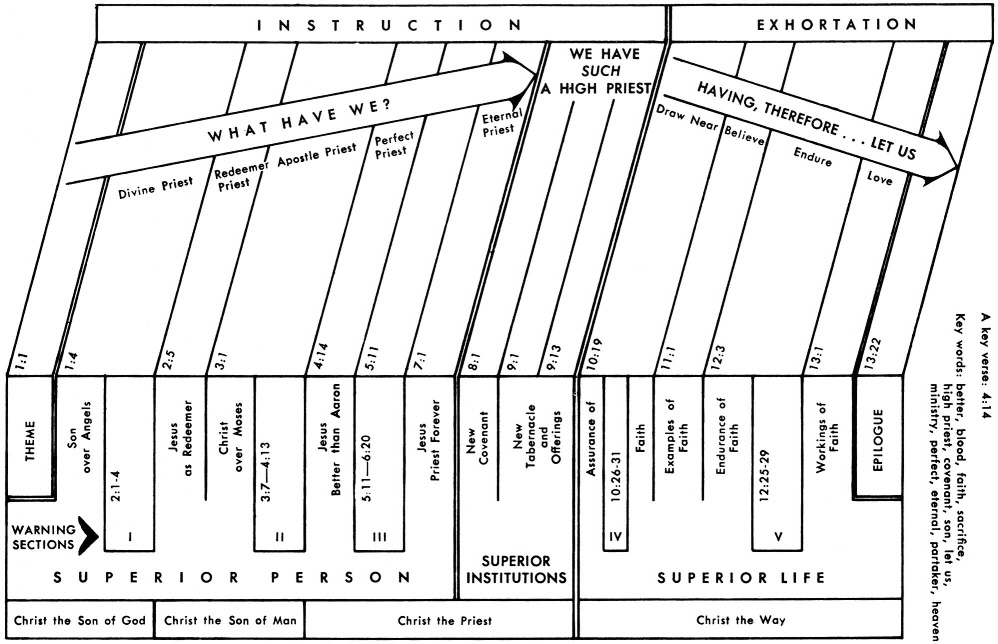
CONSIDER JESUS OUR GREAT HIGH PRIEST
Click chart to enlarge
Charts from Jensen's Survey of the NT - used by permission
Swindoll's Chart, Interesting Pictorial Chart of Hebrews, Another Chart
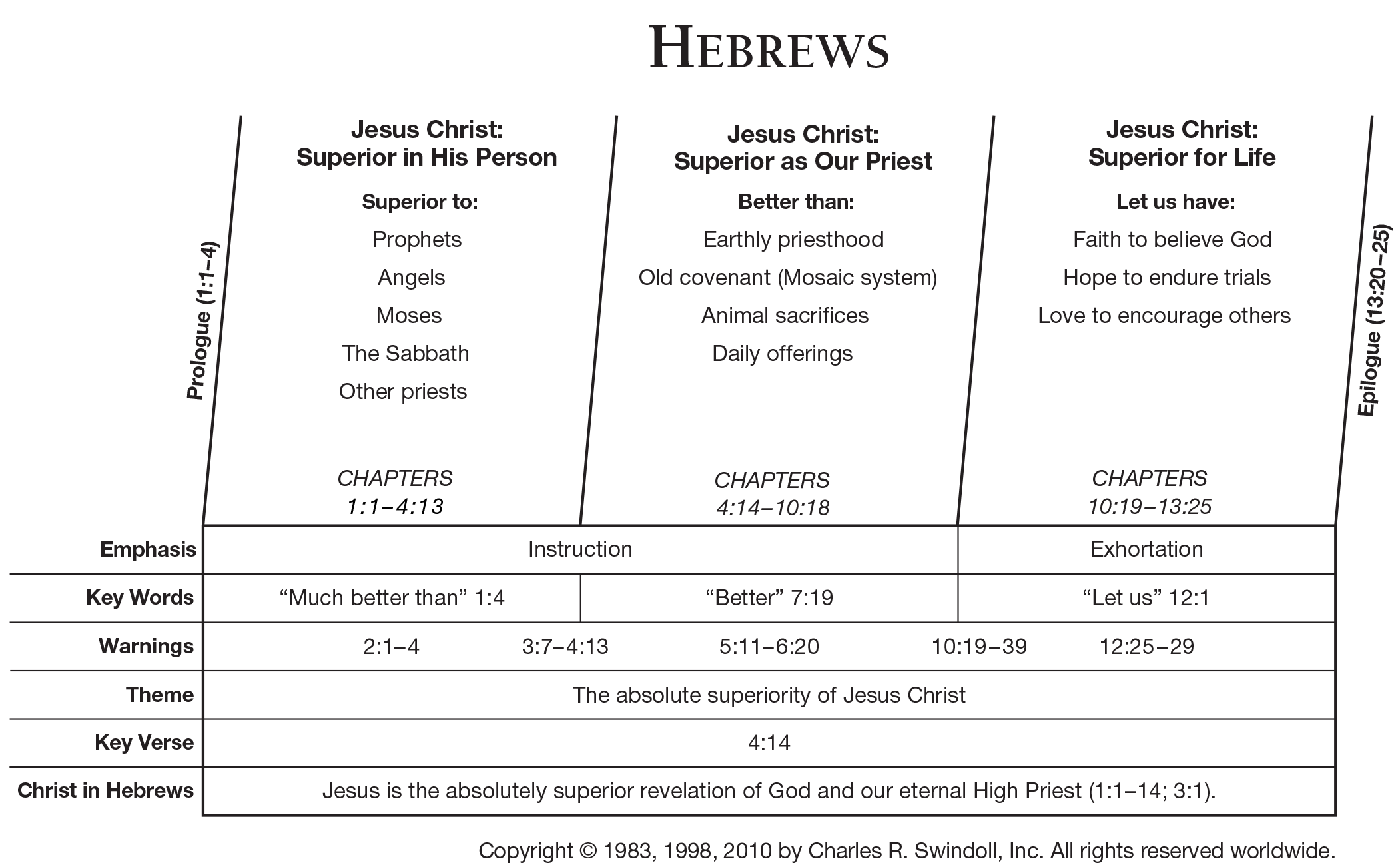
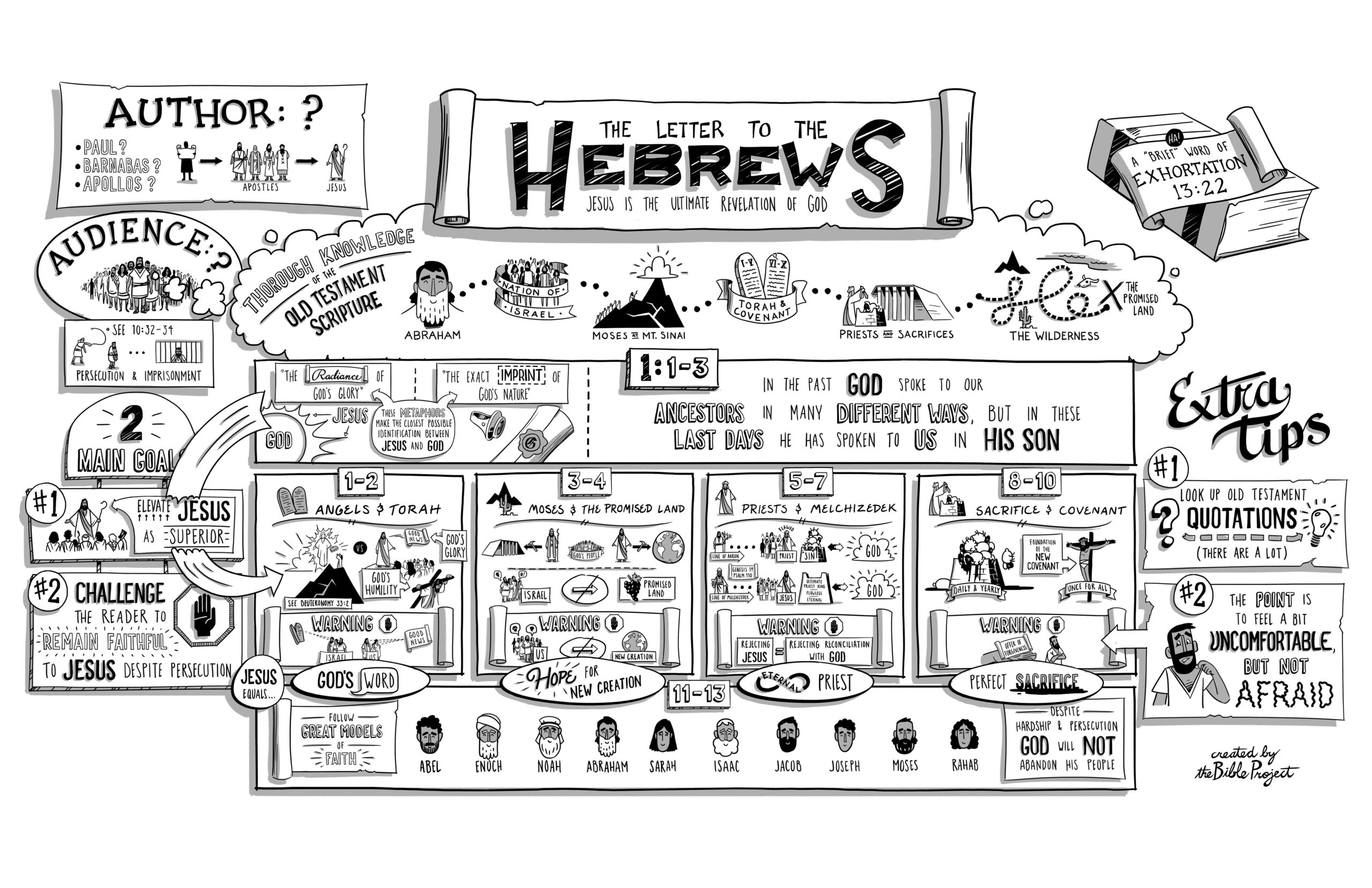
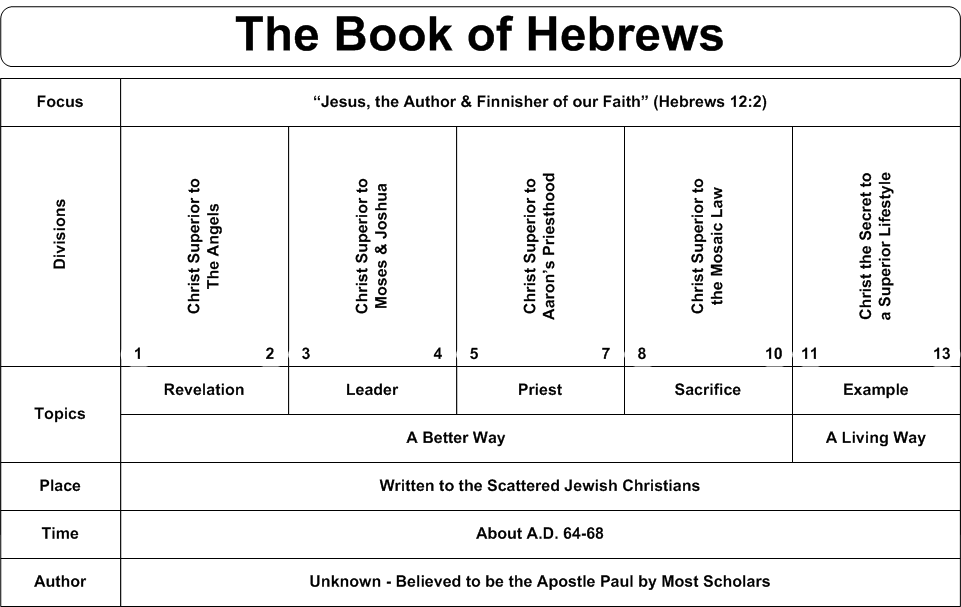
|
The Epistle |
||||
| INSTRUCTION Hebrews 1-10:18 |
EXHORTATION Hebrews 10:19-13:25 |
|||
| REVELATION | RESPONSE | |||
| PRECEPTS | PRACTICE | |||
| DOCTRINE | DUTY | |||
| Superior Person of Christ Hebrews 1:1-4:13 |
Superior Priest in Christ Hebrews 4:14-10:18 |
Superior Life In Christ Hebrews 10:19-13:25 |
||
| BETTER THAN PROPHETS, ANGELS MOSES Hebrews 1:1-4:13 |
BETTER THAN AARON'S PRIESTHOOD Heb 4:14-7:28 |
BETTER THAN THE OLD COVENANT Heb 8:1-13 |
BETTER THAN ANIMAL SACRIFICES Heb 9:1-10:18 |
BETTER LIFE IN CHRIST THAN IN ADAM! |
| MAJESTY OF CHRIST |
MINISTRY OF CHRIST |
MINISTERS FOR CHRIST |
||
|
DATE WRITTEN: |
||||

See ESV Study Bible "Introduction to Hebrews"
(See also MacArthur's Introduction to Hebrews)
Borrow Ryrie Study Bible
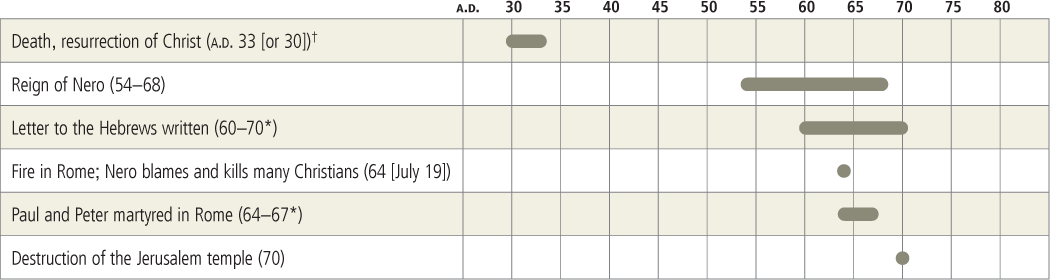
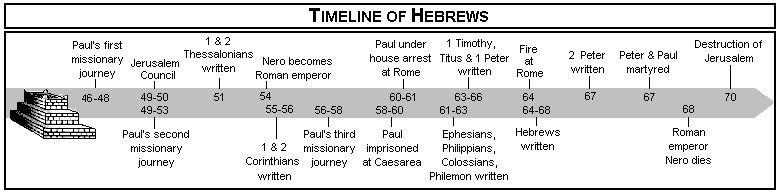
Timeline of Hebrews - ESV Study Bible
Hebrews 5:1 For every high priest taken from among men is appointed on behalf of men in things pertaining to God, in order to offer both gifts and sacrifices for sins (NASB: Lockman)
Greek: Pas gar archiereus ex anthropon lambanomenos (PPPMSN) huper anthropon kathistatai (3SPPI) ta pros ton theon, hina prosphere (3SPAS) dora te kai thusias huper hamartion,
BGT Πᾶς γὰρ ἀρχιερεὺς ἐξ ἀνθρώπων λαμβανόμενος ὑπὲρ ἀνθρώπων καθίσταται τὰ πρὸς τὸν θεόν, ἵνα προσφέρῃ δῶρά τε καὶ θυσίας ὑπὲρ ἁμαρτιῶν,
Amplified: FOR EVERY high priest chosen from among men is appointed to act on behalf of men in things relating to God, to offer both gifts and sacrifices for sins. (Amplified Bible - Lockman)
Barclay: Every high priest who is chosen from among men is appointed on men’s behalf to deal with the things which concern God. His task is to offer gifts and sacrifices for sins, (Westminster Press)
KJV: For every high priest taken from among men is ordained for men in things pertaining to God, that he may offer both gifts and sacrifices for sins:
NKJ For every high priest taken from among men is appointed for men in things pertaining to God, that he may offer both gifts and sacrifices for sins.
NLT: Now a high priest is a man chosen to represent other human beings in their dealings with God. He presents their gifts to God and offers their sacrifices for sins. (NLT - Tyndale House)
Phillips: Note that when a man is chosen as High Priest he is appointed on men's behalf as their representative in the things of God - he offers gifts to God and makes the necessary sacrifices for sins on behalf of his fellow-men. (Phillips: Touchstone)
Wuest: For every high priest, since he is taken from among men, on behalf of men is constituted as such with reference to the things which pertain to God, in order that he may continually be offering both gifts and sacrifices for sins, (Eerdmans)
Young's Literal: For every chief priest -- out of men taken -- in behalf of men is set in things pertaining to God, that he may offer both gifts and sacrifices for sins,
NET For every high priest is taken from among the people and appointed to represent them before God, to offer both gifts and sacrifices for sins.
CSB For every high priest taken from men is appointed in service to God for the people, to offer both gifts and sacrifices for sins.
ESV For every high priest chosen from among men is appointed to act on behalf of men in relation to God, to offer gifts and sacrifices for sins.
NIV Every high priest is selected from among men and is appointed to represent them in matters related to God, to offer gifts and sacrifices for sins.
MIT For every high priest inducted into office from humanity has been appointed to serve on behalf of mankind in matters that pertain to God, that he might offer gifts and sacrifices for sins.
NJB Every high priest is taken from among human beings and is appointed to act on their behalf in relationships with God, to offer gifts and sacrifices for sins;
NRS Every high priest chosen from among mortals is put in charge of things pertaining to God on their behalf, to offer gifts and sacrifices for sins.
RSV For every high priest chosen from among men is appointed to act on behalf of men in relation to God, to offer gifts and sacrifices for sins.
NAB Every high priest is taken from among men and made their representative before God, to offer gifts and sacrifices for sins.
GWN Every chief priest is chosen from humans to represent them in front of God, that is, to offer gifts and sacrifices for sin.
BBE Every high priest who is taken from among men is given his position to take care of the interests of men in those things which have to do with God, so that he may make offerings for sins.
ASV For every high priest, being taken from among men, is appointed for men in things pertaining to God, that he may offer both gifts and sacrifices for sins:
- Every high priest - Heb 10:11; Exodus 28:1-14; 29:1-37; Leviticus 8:2
- is appointed: He 8:3
- of men: He 2:17 Nu 16:46-48 18:1-3
- both gifts: He 8:3 9:9 10:11 11:4 Lev 9:7,15-21
- Hebrews 5 Resources - Multiple Sermons and Commentaries
Related Passages:
Hebrews 10:11 Every priest stands daily ministering and offering time after time the same sacrifices, which can never take away sins;
Leviticus 8:2 “Take Aaron and his sons with him, and the garments and the anointing oil and the bull of the sin offering, and the two rams and the basket of unleavened bread, 3 For every high priest is appointed to offer both gifts and sacrifices; so it is necessary that this high priest also have something to offer.
Hebrews 2:17 Therefore, He had to be made like His brethren in all things, so that He might become a merciful and faithful high priest in things pertaining to God, to make propitiation for the sins of the people.
Hebrews 4:14-16+ Therefore, since we have a great High Priest Who has passed through the heavens, Jesus the Son of God, let us hold fast our confession. 15 For we do not have a high priest who cannot sympathize with our weaknesses, but One who has been tempted in all things as we are, yet without sin. 16 Therefore let us draw near with confidence to the throne of grace, so that we may receive mercy and find grace to help in time of need.
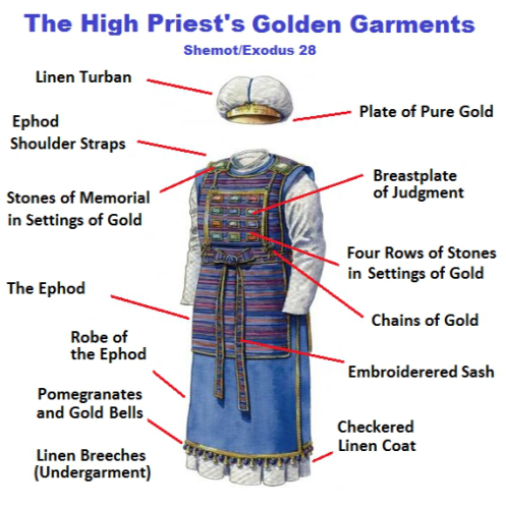
THE PRIESTS' GARMENT
REQUIREMENTS OF
THE JEWISH HIGH PRIEST
Hebrews 5 continues the truths introduced in Hebrews 4:14, reminding us that the chapter division is a human addition and not always the most helpful. The subject of Jesus as our great High Priest flows seamlessly from Hebrews 4:14 through Hebrews 5:10. Here is a simple outline of Hebrews 5
- Hebrews 5:1-4 Describes requirements of the Levitical (Aaronic) Priesthood
- Hebrews 5:5-10 Demonstrates these requirements are satisfied by Jesus
Let's review what the writer has said up to this point in Hebrews about the priesthood:
Hebrews 1:3+ (PRIEST IMPLIED) And He is the radiance of His glory and the exact representation of His nature, and upholds all things by the word of His power. When He had made purification of sins (ROLE OF HIGH PRIEST IN DAY OF ATONEMENT PRE-FIGURING JESUS), He sat down at the right hand of the Majesty on high,
Hebrews 2:17-18+ (REQUIREMENT FOR JESUS TO BE THE HIGH PRIEST) Therefore, He had to be made like His brethren in all things, so that He might become a merciful and faithful high priest in things pertaining to God, to make propitiation for the sins of the people. (AS "HIGH PRIEST" HE OFFERED HIMSELF ON THE CROSS) 18 For since He Himself was tempted in that which He has suffered, He is able to come to the aid of those who are tempted (AS OUR HIGH PRIEST AT THE RIGHT HAND OF GOD HE IS ABLE TO EXPRESS COMPASSION FOR US [cf Heb 5:2] WHEN WE ARE TEMPTED AND WHEN WE FALL).
Hebrews 3:1+ Therefore, holy brethren, partakers of a heavenly calling, consider (katanoeo = "Put your mind down on" = THINK CAREFULLY ABOUT! = aorist imperative see our need to depend on the Holy Spirit to obey) Jesus, the Apostle and High Priest of our confession;
Hebrews 4:14-16+ Therefore, since we have a great High Priest Who has passed through the heavens, Jesus the Son of God, let us hold fast our confession. 15 For we do not have a High Priest who cannot sympathize with our weaknesses, but One who has been tempted in all things as we are, yet without sin. 16 Therefore let us draw near with confidence (THROUGH OUR HIGH PRIEST) to the throne of grace, so that we may receive mercy and find grace to help in time of need.
For (gar) every high priest (archiereus) taken (lambano) from among men is appointed (kathistemi) on behalf of (huper) men in things pertaining to God, in order to (hina) offer (prosphero) both gifts (doron) and sacrifices (thusia) for sins (hamartia)
For (gar) Term of explanation. In the preceding section the writer has given an exhortation to hold fast and draw near because we have a Great High Priest Who is able to sympathize with us. Now in Hebrews 5:1, he says “for" as if to say “Let me explain what a high priest is and does, how Jesus fulfills that role and how He is able to sympathize with our weaknesses.” And so in the next 10 verses the writer gives the explanation.
For (gar) introduces the explanation of the grounds for the encouraging "invitation" of Hebrews 4:16 and in the following chapters the writer proceeds to describe the better priesthood of Jesus (the "for" also further supports the writer's statement in He 4:15 that Jesus is a sinless High Priest, something not true of any Levitical priests). Keep in mind that the Temple was still standing in Jerusalem and no common Jew could enter the "throne of God" (the Holy of holies), except the Jewish High Priest and then only once per year on the Day of Atonement. The invitation in Hebrews 4:16 to draw near with confidence or boldness (the attitude the of the Jewish high priest would have been fear and trepidation on the Day of Atonement) is in the present tense picturing a continual drawing near.
Lenski on for - The ["for"] introduces this entire explanation (Heb 5:1-10) which is an elucidation of Heb 4:14-16, the essential point of which is found in Heb 4:16: as our great High Priest Jesus is able to sympathize with our weaknesses, having been tried and tempted in every way in like manner as we are tried.
Steven Cole adds that "For (He 5:1) points back to He 4:14, 15 to show that our high priest fulfills the requirements of the priesthood. In He 5:1-4, he lists three qualifications for Aaronic priests: their work (He 5:1); their identification with the people (He 5:2, 3); and, their appointment (He 5:4). In He 5:5-10, he shows in reverse order how Jesus fulfills and exceeds these, as a high priest forever according to the order of Melchizedek. (The Kind of Priest You Need Hebrews 5:1-10)
Wuest - Having indicated in Heb 4:14 the identity of the New Testament High Priest, Jesus, the Son of God, having spoken of His fellow-feeling with our infirmities in Heb 4:15, and having exhorted his readers to come to Him in faith to appropriate the salvation which He procured for them by His death on the Cross, the writer now proceeds to explain (for - gar) Him further as a high priest. The Hebrews had not been familiar with the idea of Messiah being High Priest. He had not come from the family of Aaron. His was a priesthood of another order, that of Melchizedek. The Messiah while on earth did not have access to the Jerusalem temple so far as officiating as a priest was concerned. He performed no priestly duties and thus contradicted the whole Jewish conception of the priesthood. The writer feels the need of explaining somewhat further about this new Priest to Whom they were to go for salvation. He says that every (Levitical) priest, since he is taken from among men, is constituted a priest on behalf of men. The point is that in order for a priest to officiate on behalf of men, he must be taken from among men. A priest must partake of the nature of the person for whom he officiates. His work is to minister to men in things that involve man’s relation to God. This he does by offering gifts and sacrifices. (Hebrews Commentary online)
Every (all without exception) high priest (archiereus) taken (lambano) from among men is appointed (kathistemi) on behalf of (huper) men in things pertaining to God, in order to (hina) offer (prosphero) both gifts (doron) and sacrifices (thusia) for sins (hamartia) - Every high priest (archiereus) refers to the Jewish high priests which were all (every high priest) taken (lambano) from among men and specifically all come from the line of Aaron.
Every (all without exception) high priest...is appointed indicates the high priest did not take this honor for himself, but he was taken by God’s appointment (see Ex 28:1-2ff+). Notice the writer focuses not on all the priests in general but specifically on the the one man, the high priest (archiereus), who represented all Israel before God (as seen especially in Lev 16:1-34+ on the annual Day of Atonement). The important points the writer is making is that the high priest (archiereus) must (1) belong to humanity and (2) be appointed by God. And remember what the writer is doing in Hebrews 4:14-10:14 is explaining how Jesus could be designated as the Great High Priest. As we have seen in Hebrews 2:14,17 Jesus clearly was a Man which meets the qualification of the high priest as taken from among men. Appointed (kathistemi) is in the passive voice (divine passive) which indicates the high priest (archiereus) did not take the job himself, but was divinely appointed.
The point is that the High Priest must be a man,
taken from among men, a partaker of our nature.
On behalf of (huper) is a preposition that means "in place of" or "for the benefit of," and in context indicates the Jewish high priests functioned as the representatives of the people before God. In effect the high priest functioned as a mediator, standing between God and the people. In things pertaining to God means the matters relating to God, including especially offering both gifts (doron) and sacrifices (thusia) for sins (hamartia) of the people. God provided the priesthood in Exodus because He knew sinful men needed a representative who could deal with God on their behalf. There is one other aspect of On behalf of (huper) in that it hints at the concept of substitution, i.e., the priest offering sacrifices in place of the people, acknowledging their sins, bearing them symbolically into God’s presence.
In order to (hina) to offer (prosphero) both gifts (doron) and sacrifices (thusia) for sins (hamartia) introduces the purpose of the high priest which was to make offerings and sacrifices for the sins of the people. Some suggest that "the author is thinking principally of the Day of Atonement rite, as is clear from Hebrews 9:7+. This ritual was celebrated to atone for "all the sins of the Israelites" (Lev 16:34+).
Brian Bell notes that "you don’t go before a judge without a lawyer, and you don’t go before God without a priest. 1. Confidence rests in your counselor. The better your attorney the more likely you’ll be to win a favorable verdict. 2. Thus, the better the priest the more likely you’ll be able to win the favor of God. The writer takes the logical step then in showing Christ’s qualifications for this role in Hebrews 5:5-10."
Warren Wiersbe points out that "The very existence of a priesthood and a system of sacrifices gave evidence that man is estranged from God. It was an act of grace on God's part that He instituted the whole Levitical system. Today, that system is fulfilled in the ministry of Jesus Christ. He is both the sacrifice and the High Priest who ministers to God's people on the basis of His once-for-all offering on the cross. (BORROW The Bible Exposition Commentary)
Adrian Rogers - Now you may feel that you don’t need a high priest, but you do. A high priest is a mediator. You see, a priest is someone who can bring God to you and someone who can go to God for you. Now isn’t that what you need? Don’t you need somebody who will bring God and make Him real to you and mediate Him to you? And don’t you need somebody who can plead your cause for you? Well, that is a priest. That is our great high priest, the Lord Jesus.
Kenneth Wuest sets the stage by saying: Having indicated in Heb 4:14 the identity of the New Testament High Priest, Jesus, the Son of God, having spoken of His fellow-feeling with our infirmities in verse 15, and having exhorted his readers to come to Him in faith to appropriate the salvation which He procured for them by His death on the Cross, the writer now proceeds to explain Him further as a high priest. The Hebrews had not been familiar with the idea of Messiah being High Priest. He had not come from the family of Aaron. His was a priesthood of another order, that of Melchizedek. (Hebrews Commentary online)
G. Campbell Morgan reminds us: The value of all this for us is found first in the charge: "Let us hold fast our confession," (Heb 4:14) which means, Let us not be deflected from our confidence in this Priest by any argument within our own soul, or by any suggestion that we need any other mediation. Connected with this is the call, "Let us draw near." (Heb 4:16) There is nothing we need more constantly to remember than the abiding necessity for priestly mediation when we draw near to God. We ever have to come to Him, saying: "Nothing in my hands I bring, Simply to Thy Cross I cling." Our High Priest is in the heavens. Therefore, we may ever draw near to God through Him.
Draper introduces the subject of the priesthood by saying: "This passage sets forth the fact of a disturbed, distorted relationship between God and man. The very idea of a priest indicates that. There would be no need for a priest if there were not a problem in our communication with God. We would not need a spokesman for God, to speak to God for man, if such distortion did not exist. We would not need someone to stand in the gap, to offer sacrifices, to intercede, to offer up prayers. There would be no need for this at all except that something has happened to disrupt, disturb, and distort the relationship between God and man. Man is estranged from God. There is a barrier between man and God."
John MacArthur says "Among the first things a Jew might have asked another person about his religion were, "Who is your high priest? Who mediates between you and God? Who offers the sacrifices to atone for your sins?" A Jew during the time of the early church may well have asked a Christian, "How are your sins going to be pardoned when you have no one offering sacrifices and no one interceding for you? How can you claim that this new covenant supersedes and is superior to the Old Covenant made through Moses when it leaves you without a high priest?" The Christian would have replied, "But we do have a high priest, a perfect High Priest. He has offered sacrifice for our sins. He does not confine Himself to an earthly temple, nor does He have to sacrifice yearly, much less daily. He made one sacrifice that atones for all sins ever committed, from the beginning to the end of time. That is how great a high priest He is and how great His sacrifice was. Not only that, but our High Priest is seated at the right hand of God and continually intercedes for those of us who belong to Him." (See Hebrews Commentary)
J. Vernon McGee expresses it well too when he says "If someone is going to represent me before God, I want to be sure that he is acceptable to God. Is he one who has accreditation? Has he passed his bar examination so he can represent me in heaven? We can pray for one another, but we cannot represent one another in heaven. But because I need somebody to represent me, I am very happy that I have my Great High Priest who represents me before the Father. (BORROW HIS WRITTEN COMMENTARY ON Hebrews 1-7)
H. W. Montefiore says: Our author now turns back to the major doctrinal theme of his Epistle. Starting from the levitical high priesthood, he establishes three necessary qualifications for the office, humanity, compassion and divine appointment; and then he proves that Jesus was high priest by showing that he had these three qualifications. (Borrow A commentary on the Epistle to the Hebrews)
John MacArthur on Hebrews 5:1-4 - These four verses state the three basic qualifications for a Jewish high priest. He was appointed by God, was sympathetic with those to whom he ministered, and offered sacrifices on their behalf. The following six verses show how Jesus Christ fulfills those qualifications. (See Hebrews Commentary - Page 119)
R Kent Hughes points out much the same things - It is these inner qualifications with which our text first deals in verses 1-4 before it goes on to demonstrate in verses 5-10 how Christ, our great high priest, meets and supersedes every qualification--proving He is the priest who will get the stressed-out little church through its stormy seas. As we consider this matter of priestly qualifications, we will do well to keep the image of the Aaronic high priest before us--because Jesus is the fulfillment of everything he symbolized. (See Hebrews : An Anchor for the Soul)
In the time of the Romans, the office of High Priest had become corrupt and in fact was something that would go to the highest bidder. The term of office was also no longer for life, and thus there were often several persons living at one time who had borne the office and still retained the title of "high priest". It was into this religious morass that the writer explains to this Jewish readers the purity of the new order of the priesthood.
The Jewish high priests were ordained for men;
they acted on behalf of men,
and they stood in the place of men.
-- C H Spurgeon
Spurgeon - Notice that the high priests were taken from among men, not from among angels. Hence, our Lord Jesus Christ “is not concerned with angels, but he is concerned with the descendants of Abraham” (Heb 2:16). The Jewish high priests were ordained for men; they acted on behalf of men, and they stood in the place of men. So the Lord Jesus Christ stood in the room, place, and stead of His people, that He might offer to God for them two things—gifts—that is, such offerings as the Jew made when he presented the fine flour, and oil, and other bloodless oblations that were only intended for thanksgiving. Christ offered thanksgiving unto His Father, and that offering was a sweet savor unto God. But besides those gifts, the priests offered sacrifices, and our Lord Jesus Christ did the same, for He was made a sin offering for us, though He Himself knew no sin.
LEVITICAL PRIESTS REPRESENTED
MEN AS MEDIATORS BEFORE GOD
Is appointed (kathistemi) on behalf (huper) of men - KJV has "ordained for men." NIV = "appointed to represent them in matters related to God." NLT = "a man chosen to represent other people in their dealings with God." On behalf of (huper) means for the sake of = marker of a participant who is benefited by an event or on whose behalf an event takes place. Priests formed a bridge between a holy God and utterly depraved and sinful men. This mediatorial function is dramatically illustrated by Aaron acting on behalf of men when God declared that He was going to consume the entire congregation of Israel instantly (Nu 16:45+) because they had grumbled against Moses and Aaron ([Nu 16:41+] the context is Korah's rebellion in Nu 16:1-3+) which resulted in Divine wrath in Nu 16:30-35+. We read of Aaron functioning on behalf of men in Nu 16:46-48+
Moses said to Aaron, “Take your censer and put in it fire from the altar, and lay incense on it; then bring it quickly to the congregation and make atonement for them, for wrath has gone forth from the Lord, the plague has begun!. Then Aaron took it as Moses had spoken, and ran into the midst of the assembly, for behold, the plague had begun among the people. So he put on the incense and made atonement for the people. He took his stand between the dead and the living, so that the plague was checked.
🙏 THOUGHT: Notice how Aaron "took his stand between the dead and the living", with the result being that the "plague was checked". Is this not a shadow of our Great High Priest, Christ Jesus, Who has "taken His stand" on Calvary on our behalf, yea, even between "the dead (the unrepentant thief) and the living (the repentant thief"? Outside of Christ all mankind stands on the edge of reception of the righteous wrath of a Holy God, and the only Hope is the atoning sacrifice of His own body by the Great High Priest Christ Jesus.
Under the Old Testament "economy", even after the covenants with Abraham
and Moses, God was still unapproachable.
Adam Clarke makes the point of why Korah's attempt to usurp the priesthood from Moses was judged so harshly by God (for more on Korah see Study Questions below) - By the awful transactions recorded in this chapter (Nu 16:1-50), we may see how jealous God is of the sole right of appointing the way and means of salvation. Had any priesthood, and any kind of service, no matter how solemn and sincere, been equally available in the sight of Divine justice and mercy, God would not have resented it in so awful a manner the attempts of Korah and his company in their new service. The way of God's own appointment, the agony and death of Christ, is the only way in which souls can be saved. His is the priesthood, and his is the only available sacrifice. All other modes and schemes of salvation are the inventions of men or devils, and will in the end prove ruinous to all those who trust in them. Reader, forget not the Lord who bought thee. Under the Old Testament "economy", even after the covenants with Abraham (unconditional) and Moses (conditional), God was still unapproachable. In the Garden of Eden, when Adam sinned, God drove Adam and Eve out of paradise and thus began man's tragic punishment of no longer having direct access to the Creator’s presence (Ge 3:10,24). In the wilderness, the people were warned not to come too near Mt. Sinai, (Ex 19:16,21-24 Ex 20:18-26) and God's manifest presence. In the Tabernacle and in the Temple God was "hidden" from man in the Holy of holies behind a veil and could be approached only through the high priest (only the high priest having access once per year and even that requiring the shedding of blood - Lev 16:1-34, 6, 11-17)
Steven Cole explains in order to (hina) offer (prosphero) both gifts (doron) and sacrifices (thusia) for sins (hamartia) …
The work of the high priest: As a mediator, he offers gifts and sacrifices for sins on behalf of men in things pertaining to God (He 5:1).
If men are not sinners, separated from a holy God, then there is no need for priests. They were appointed (He 5:4 will show that God appointed them) “on behalf of men in things pertaining to God, in order to offer both gifts and sacrifices for sins.” No Jew was free to enter the Holy of Holies to meet directly with God. Even the high priest could only go in there once a year on the Day of Atonement, and very carefully at that, or God would kill him instantly. Every Jew knew that he desperately needed a mediator between him and God, and the high priest was that God-ordained mediator.
“Gifts and sacrifices” probably here is a general description of all of the designated offerings (Philip Hughes, A Commentary on the Epistle to the Hebrews [Eerdmans], p. 175). The task of making such offerings was reserved for the priests. Israel’s first king, Saul, took it upon himself to offer sacrifices, and for this presumption, God removed the kingdom from Saul’s descendants and gave it to David (1Sa 13:1-14). Later, King Uzziah, who was otherwise a godly king, presumed to take incense and offer it before the Lord. As a result, God struck him instantly with leprosy (2Chr. 26:16-21). The priests alone were designated to make offerings to God on behalf of the people.
Note that these offerings were “for sins.” The entire Jewish sacrificial system, but especially the Day of Atonement, underscored the problem of human sinfulness in the presence of the holy God. Without the appropriate sacrifice, sinners could not approach God or be reconciled to Him. God designed all of this to point ahead to the person and work of Jesus Christ, the Lamb of God, who offered Himself as the perfect and final sacrifice for our sins.
This means that you cannot be reconciled to God until you see your great need as a sinner before His holy presence. It is that awareness of your true condition that causes you to cry out, with the publican in Jesus’ story, “God, be merciful to me, the sinner” (Luke 18:13). The gospel is not, “If you’ve got a few problems, try Jesus. He can help you.” The gospel has to do with our fundamental alienation from God because of our sins, and the gracious provision that God has made in His Son. (The Kind of Priest You Need Hebrews 5:1-10)
Kenneth Wuest on in order to (hina) offer (prosphero) both gifts (doron) and sacrifices (thusia) for sins (hamartia) - The word “gifts” refers to gifts in general, while the word “sacrifices” speaks of blood sacrifices. These are for the sins of the individual. If the priest is to do this efficiently, he must have a genuine compassion for the sinful. This the writer proceeds to bring out in the next verse (Heb 5:2). Messiah is seen here to be superior to Aaron in that He as High Priest is not taken from among men but from among the members of the Godhead. In 1 Peter 1:20+ we see Him foreordained to be the Lamb slain for sacrifice, and in Hebrews 10:7+ He responds to the summons. (Hebrews Commentary online)
Harry Ironside on gifts (doron) and sacrifices (thusia) - The high priest was to present his brethren's gifts and sacrifices for sins. Note the distinction between gifts and sacrifices. On the cross our Lord presented the sacrifice for sins. In Heaven now, He offers our gifts of worship and praise. (Hebrews Commentary)
The primary function of the OT priest was to offer sacrifices for the sins of the people. Sin disturbs the relationship which should exist between man and God and puts up a barrier between them and the sacrifice was meant to restore that relationship and remove that barrier. As discussed later in Hebrews, the Jewish priestly sacrifices only covered the transgressions of the people but could never make the worshipper perfect in conscience because the blood of bulls and goats could never take away sins and provide complete remission and forgiveness. As Harry Ironside alludes to, this efficacious work was carried out by a greater, perfect High Priest, our Lord Jesus Christ.
High priest (749) (archiereus from arche = first in a series, the leader or ruler + hiereus = priest) (Dictionary articles - Easton's; ISBE) refers to the priest that was chief over all the other priests in Israel. This office was established by God through Moses instructions in the Pentateuch. The high priest functioned as the mediator (another article on "Mediator") between Jehovah and Israel performing sacrifices and rituals like other priests, but in addition acting to expiate the sins of the nation on the annual Day of Atonement. (See excellent article on Priest, Priesthood in Baker's Evangelical Dictionary)
The irony is that the high priest Caiaphas was residing over the Sanhedrin during trial of Jesus, the trial which would lead to His death and pave the way for His eternal High Priesthood!
Eerdman's Bible Dictionary explains that "The high priest descended from Eleazar, the son of Aaron. The office was normally hereditary and was conferred upon an individual for life (Nu 25:10-13). The candidate was consecrated in a seven-day ceremony which included investiture with the special clothing of his office as well as anointments and sacrifices (Ex 29:1-37; Lev 8:5-35). The high priest was bound to a higher degree of ritual purity than ordinary Levitical priests. He could have no contact with dead bodies, including those of his parents. Nor could he rend his clothing or allow his hair to grow out as signs of mourning. He could not marry a widow, divorced woman, or harlot, but only an Israelite virgin (Lev. 21:10-15). Any sin committed by the high priest brought guilt upon the entire nation and had to be countered by special sacrifice (Lev 4:1-12). Upon a high priest’s death manslayers were released from the cities of refuge (Nu 35:25, 28, 32). (BORROW Eerdman's Bible Dictionary PAGE 486)
ARCHIEREUS IN HEBREWS -Hebrews 2:17+ Hebrews 3:1+ Hebrews 4:14+ Hebrews 4:15+ Hebrews 5:1+ Hebrews 5:5+ Hebrews 5:10+ Hebrews 6:20+ Hebrews 7:26+ Hebrews 7:27+ Hebrews 7:28+ Hebrews 8:1+ Hebrews 8:3+ Hebrews 9:(+ Hebrews 9:11+ Hebrews 9:25+ Hebrews 13:11+
Archiereus occurs only in the Gospels (Matthew - 25x, Mark 21x, Luke 15x, John 20x, Acts 22x) and Hebrews (17x). The references to the high priests in the Gospels and Acts refers primarily to their bitter opposition to Jesus Who the writer of Hebrews identifies as our everlasting High Priest. Clearly archiereus is a key word in the book of Hebrews, and these 17 verses reveal various characteristics of Jesus role as the great High Priest (some of the uses of high priest obviously do not refer to Jesus but to the Jewish high priests).
Taken (2983) (lambano) means to take or grasp. It can indicate both benevolent and hostile actions, and have as object either people or things; e.g. take a wife, collect taxes, accept a verdict, take a road, and fig. take courage. It is used with a material subject, as when, for example, fear or terror seizes men.
Lambano in Hebrews - Heb. 2:2; Heb. 4:16; Heb. 5:1; Heb. 5:4; Heb. 7:5; Heb. 7:8; Heb. 7:9; Heb. 9:15; Heb. 9:19; Heb. 10:26; Heb. 11:8; Heb. 11:11; Heb. 11:29; Heb. 11:35; Heb. 11:36;
Appointed (2525) (kathistemi from kata = down + histemi = stand) means literally to set down and then to assign to someone a position of authority over others.
Kathistemi - 21v - appoint(1), appointed(4), appoints(1), escorted(1), made(5), makes(1), put...in charge(4), put in charge(3), render(1), set(1). Matt. 24:45; Matt. 24:47; Matt. 25:21; Matt. 25:23; Lk. 12:14; Lk. 12:42; Lk. 12:44; Acts 6:3; Acts 7:10; Acts 7:27; Acts 7:35; Acts 17:15; Rom. 5:19; Titus 1:5; Heb. 2:7; Heb. 5:1; Heb. 7:28; Heb. 8:3; Jas. 3:6; Jas. 4:4; 2 Pet. 1:8
Offer (4374) (prosphero from prós = to, toward + phéro = bring) means to carry or bring something into the presence of someone usually implying a transfer of something to that person carry to, bring (to). Thus prosphero describes an offering, whether of gifts, prayers, or sacrifices.
Repeated exactly in Heb 8:3 (offer both gifts & sacrifices). Prosphero occurs 19x/17v in Hebrews out of a total of 47 uses in NT and is never used in the Pauline epistles! Prosphero has its source in the sacrificial vocabulary of the LXX.
Prosphero - 48x in 45v in NAS - Matt 2:11; 4:24; 5:23f; 8:4, 16; 9:2, 32; 12:22; 14:35; 17:16; 18:24; 19:13; 22:19; 25:20; Mark 1:44; 10:13; Luke 5:14; 12:11; 18:15; 23:14, 36; John 16:2; 19:29; Acts 7:42; 8:18; 21:26; Heb 5:1, 3, 7; 8:3f; 9:7, 9, 14, 25, 28; 10:1f, 8, 11f; 11:4, 17; 12:7. NAS = bringing(2), brought(12), deals(1), get(1), make an offering(1), offer(8), offered(12), offering(4), offers(1), present(2), presented(1), presenting(1)
Gifts (1435) (doron from didomi = to give) means that which is given. The "gifts" offered were for thanksgiving, and the sacrifices were for repentance to seek forgiveness. Note that 5 of 18 NT uses of doron are in Hebrews. Doron is also used to describe the offering box for placing one's gifts or offerings, Luke recording Jesus words regarding a poor widow compared the rich "for they (the rich) all out of their surplus put into the offering; but she out of her poverty put in all that she had to live on." (Lk 21:4) Tradition taught there were 13 offering boxes in Temple and receptacles leading down to the boxes were made in the form of trumpets, so that sound of coins falling into boxes was conspicuous.
Doron - 19x in 17v - Matt 2:11; 5:23f; 8:4; 15:5; 23:18f; Mark 7:11; Luke 21:1, 4; Eph 2:8; Heb 5:1; 8:3-4; 9:9; 11:4; Rev 11:10 NAS = gift(1), gifts(8), given(2), offering(8).
Sacrifices (2378) (thusia from thuo = to sacrifice) means that which is offered as a sacrifice. Webster's = act of offering to a deity something precious! Ponder that thought!
Lev 6:20+ "This is the offering [LXX = doron] which Aaron and his sons are to present to the LORD on the day when he is anointed… " (Comment: The Septuagint (LXX) of Leviticus uses doron more than 40x's referring to offerings.)
Thusia - 15x in 15v in the NAS - Matt 9:13; 12:7; Mark 12:33; Luke 2:24; 13:1; Acts 7:41f; Rom 12:1; 1 Cor 10:18; Eph 5:2; Phil 2:17; 4:18; Heb 5:1; 7:27; 8:3; 9:9, 23, 26; 10:1, 5, 8, 11f, 26; 11:4; 13:15f; 1 Pet 2:5.
OT PASSAGES QUOTED IN HEBREWS 5 - Click for complete list of OT Quotations/Allusions
He 5:5 <> Ps 2:7
He 5:6 <> Ps 110:4
He 5:10 <> Ps 110:4
KEY WORDS IN HEBREWS 5 - Click for complete list of Key Words in Hebrews
Eternal - He 5:9
Sacrifice - He 5:1, 3
Priest - He 5:1, 5, 6, 10
Bruce Wilkinson reminds us of the purpose of this epistle and the importance of this middle section (He 4:14-He 10:18) which unequivocally establishes the greatness of Christ's priesthood…
Many Jewish believers, having stepped out of Judaism into Christianity, wanted to reverse their course in order to escape persecution by their countrymen. The writer of Hebrews exhorts them to “press on” to maturity in Christ (Hebrews 6:1). His appeal is based the superiority of Christ over the Judaic system. Christ is better than the angels, for they worship Him. He is better than Moses, for Moses was created by Him. He is better than the Aaronic priesthood, for His sacrifice was once for all time. He is better than the Law, for He mediates a better covenant. In short, there is more to be gained by suffering for Christ than by reverting to Judaism. Pressing on to maturity produces tested faith, self-discipline, and a visible love seen in good works. (BORROW Wilkinson, B., & Boa, K. 1983. Talk thru the Bible. Page 453)
A W Pink reminds us that "The central design of the Holy Spirit in this Epistle needs to be kept steadily before the mind of the reader: that design was to prove the superiority of Christianity over Judaism. The center and glory of Judaism was the divinely appointed priesthood: what, then, had Christianity to offer at this point? “The unbelieving Jews would be apt to say to their Christian brethren, ‘your new religion is deficient in the very first requisite of a religion—you have no high priest. How are your sins to be pardoned, when you have none to offer expiatory oblations for you? How are your wants to be supplied, when you have none to make intercession for you to God?’ The answer to this cavil is to be found in the apostle’s word ‘We have a High Priest’ Hebrews 4:14,” (Dr. J. Brown). (Hebrews 5)
Ryrie summarizes chapter 5…
The qualifications for high priest are stated in these verses, Aaron serving as the model:
(1) he had to be a man (Hebrews 5:1);
(2) he had to be compassionate (Hebrews 5:2);
(3) he had to be chosen by God (Hebrews 5:4, 5, 6);
(4) he had to learn through suffering (Hebrews 5:7, 8).
The following questions are excerpted from Hebrews Part 2, Lesson 1 study notes because they give the background emphasizing how serious God was about who would be the high priest and that He alone had the right to make that appointment. Tragically Korah did not get the message and he and his whole family paid a dear price...
How serious was God about the priests being the ones He Himself specified?
WE WILL BRIEFLY LOOK AT NUMBERS 16-17 AND KING UZZIAH IN 2 Chronicles 26
Numbers 16:1-50+ summary questions…
Who is the major antagonist in Numbers 16+?
- Korah (Nu 16:1-3+)
What tribe did he belong to?
- Levites (Nu 16:1+ "the son of Levi")
What was his complaint to Moses?
- Felt priesthood belonged to all congregation (Nu 16:3+)
How did Moses respond to their rebellion?
- Fell on face and said the LORD would decide (Nu 16:4-11+)
How did God respond to their rebellion (3 things)?
- Earth swallowed Korah and other rebels and families, (Nu 16:28-34+)
- fire consumed 250 men offering incense (Nu 16:35+)
- plague broke out because congregation accused Moses and Aaron of killing the Lord’s people – How was plague stopped? Aaron took a censer, made atonement for the people, and stood “between the dead and the living,” stopping the plague. STILL 14,700 died (Nu 16:41-45, 46-48, 49+)
ASK AGAIN "HOW SERIOUS WAS GOD ABOUT THE HIGH PRIESTHOOD AND SPECIFICALLY THAT IT WAS THE MAN HE CHOOSE?
- Rhetorical of course - want to make sure they understand the author's intention of showing the superiority of Jesus' priesthood to Aaron's as this was ingrained in Jews from a young age.
WHAT did God do in Numbers 17 to further validate the priesthood of Aaron?
- Took 12 rods from each tribe, wrote names on them and the test would be whose rod would sprout - next day only Aaron’s rod had sprouted. (Nu 17:1-5, 8-9+)
What did God tell Moses to do with that rod? HAVE SOMEONE READ NUMBERS 17:10+
Numbers 17:10+ But the LORD said to Moses, “Put back the rod of Aaron before the testimony (Ark of Covenant) to be kept as a sign against the rebels, that you may put an end to their grumblings against Me, so that they will not die.”
Let’s look at one more example of how serious God was about who could serve as High Priest!
We will look at King Uzziah (a godly king 2Chr 26:1-5+) and READ 2 CHRONICLES 26:16-21+
What is the progression in 2Chr 26:16+?
- strong > proud > acted corruptly > was unfaithful to the LORD his God > entered the temple of the LORD to burn incense
What did it lead him to do?
- Usurp the role of the priest (2Chr 26:16+)
What did it cost him?
- Leprosy and isolation until death (2Chr 26:21+)
AGAIN EMPHASIZE -- HOW SERIOUS WAS GOD ABOUT THE MAN HE CHOOSE AS THE HIGH PRIEST!!!
(Excerpt from Hebrews Part 2, Lesson 1 study notes)
Steven Cole - I would guess that if you were honest, many of you would admit to thinking, “Couldn’t we study something more practical? I’m struggling in my marriage! I’m trying to raise kids in this evil world! I’m wrestling with personal problems! And now we’re going to plunge into six chapters dealing with Jesus as our high priest? Can’t you find something more relevant to preach on?” On this matter, Donald Hagner (BORROW Encountering the Book of Hebrews p. 82) offers a helpful word:
Until one gains an adequate sense of the overwhelming majesty of the thrice-holy God and simultaneously a true sense of one’s sinfulness and unworthiness (as Isaiah did [Is 6:1-5]), one is not in a position to understand or appreciate the importance of priests and their work. Our failure on these two points probably is what makes the idea of priesthood unfamiliar and without apparent significance or meaning. One of the reasons that the Old Testament is indispensable to understanding the New Testament is exactly here, since on the one hand, it provides us with a sense of the sovereignty, majesty, and power of God, and on the other hand, it confronts us with the reality of human failures and needs. In the light of these two points, the importance of sacrifices and priests readily emerges.
This is one of the most important spiritual truths that you can learn: Growth in the Christian life requires gaining a clearer understanding of who God is and who you are, which drives you in desperation to the cross of Jesus Christ. This is why Paul gloried in the cross (Gal 6:14+): he saw God as the one who dwells in unapproachable light, he saw himself as the chief of sinners, and he saw the cross as the place where he found mercy (1Ti 6:16; 1Ti 1:14-16).
This is the point that John Calvin makes so eloquently in the opening chapters of The Institutes of the Christian Religion (ed. by John McNeill [Westminster Press]). His opening sentence is: “Nearly all the wisdom we possess, that is to say, true and sound wisdom, consists of two parts: the knowledge of God and of ourselves.” McNeill comments (1:36, footnote 3), "These decisive words set the limits of Calvin’s theology and condition every subsequent statement." Calvin begins by showing that none of us will seek God until we first become displeased with ourselves as sinners. He also argues (1:37) that… [M]an never achieves a clear knowledge of himself unless he has first looked upon God’s face, and then descends from contemplating him to scrutinize himself. For we always seem to ourselves righteous and upright and wise and holy-this pride is innate in all of us---unless by clear proofs we stand convinced of our own unrighteousness, foulness, folly, and impurity. Moreover, we are not thus convinced if we look merely to ourselves and not also to the Lord, who is the sole standard by which this judgment must be measured. Thus if you want to know the significance of this central theme of the Book of Hebrews, you must ask God for a clearer understanding of His absolute holiness and majesty, and for a deeper insight into your own sinfulness and uncleanness apart from Christ. This will lead you into a deeper appreciation of what Jesus did for you on the cross as the High Priest who entered the holy place, not with the blood of bulls and goats, but with His own blood (He 9:11, 12, 13, 14). And, you will find that a deeper appreciation of God’s holiness, your own sinfulness, and the sufficiency of Christ’s sacrifice is one of the most practical doctrines in the Bible, because it humbles your pride. Pride is at the root of every relational conflict and just about any sin that you can name. (The Kind of Priest You Need Hebrews 5:1-10)
Along that same line of thought regarding the importance of a high view of God (as comes from a study of a "deep doctrinal" book like Hebrews), Puritan writer Thomas Watson advises that…
If you would be preserved from gross, presumptuous sin—get your hearts fired with LOVE to God. Love has great force in it; it is "as strong as death;" it breaks the league between the heart and sin (ED: COMPARE THE PRINCIPLE OF EXPULSIVE POWER OF A NEW AFFECTION). Two things in God cause love.
[1] His glorious BEAUTY. Moses desired to see some glimpse of it. "Lord, show me your glory.
[2] His astonishing LOVE. What a wonder of love was it, to give his Son out of his bosom—and lay such a jewel to pawn for our redemption! The glories of God's beauty, and the magnitude of his love, like two loadstones, draw our love to God; and if we love him, we shall not sin against him. He who loves his friend, will not by any means displease him.
I have read of four men meeting together, who asked one another what it was that kept them from sinning. The first one said, "the fear of hell." The second said, "the joys of heaven." The third said, "the odiousness of sin." The fourth said, "that which keeps me from sin, is love to God. Shall I sin against so loving a God? Shall I abuse His love?" Love to God is the best curbing-bit to keep from sin. "If you love Me, you will keep My commandments." John 14:15 (Lords Prayer or listen to the pithy, practical Mp3 by Watson on the phrase "Deliver us from evil")
Brian Bell on the priestly garments - Now take a look at the High Priests garments (SEE PICTURE ABOVE). They were endowed with immense & spiritual significance. [Exodus 28:1-43+ explains] a) 1st they donned a linen tunic. Over it was placed a robe of blue. Attached to its hem were pomegranates woven from blue, purple, & scarlet yarn, placed intermittently between small golden bells (Ex 28:33-34+) that rang musically (Ex 28:35+). Then a richly woven sash held the robe in place. Next, a beautiful apron-like ephod. On each of its shoulders it bore a large onyx stone, set in gold, with the names of the 12 tribes engraved on them. Over it a breastplate bearing 12 stones representing & inscribed with the 12 tribes of Israel. Lastly, the priest was crowned with a turban of fine linen, bearing a plate of pure gold with the Hebrew inscription HOLY TO THE LORD. (Ex 28:36+) What an impressive sight when the high priest came approaching the Temple, ringing musically with every step. Even more impressive was the profound spiritual significance of him bearing the weight of Israel on his shoulders & over his heart. And of course that scary bulletin-board reminder on his forehead that HE, the High Priest, was HOLY TO THE LORD...the summary of his great task. Jesus is Superior to Aaron in 3 ways: Jesus has...A Greater Appointment ("forever"). A Greater Compassion. A Greater Sacrifice ("cross"). Let no one attempt to go to God but through Jesus, nor expect any favor from God except upon His merits.
🙏 THOUGHT - Exodus 28:29+ says “Aaron shall carry the names of the sons of Israel in the breastpiece of judgment over his heart when he enters the holy place, for a memorial before the LORD continually." Our Greater High Priest carries our names over His heart into the presence of His Father in Heaven! And how often? As a memorial before the LORD continually! How much more assurance could we need to be confident we are one of His children forever? And just the thought of being close to the heart of Jesus our High Priest should give us comfort and should stoke the "low embers of our heart" to flame up in a passionate love for Him! Let it be so Lord as we consider (Heb 3:1+) these great truths. Amen.
Irving Jensen - The main theme of Hebrews may be stated thus: The knowledge and assurance of how great this High Priest Jesus is should lift the drifting believer from spiritual lethargy to vital Christian maturity. Stated another way: The antidote for backsliding is a growing personal knowledge of Jesus (He 2:1, He 2:3). (Jensen's Survey of the New Testament)
Octavius Winslow Devotional on Hebrews 5:1-2 -- Overlook not the fitness of the Lord Jesus to meet all the infirmities of His people. There are two touching and expressive passages bearing on this point. "Himself took our infirmities, and bare our sicknesses." Wondrous view of the Incarnate God! That very infirmity, Christian reader, which now bogs you to the earth, by reason of which you can in no wise lift up yourself- your Savior bore. Is it sin? Is it sorrow? Is it sickness? Is it want? It bowed Him to the dust, and brought the crimson drops to His brow. And is this no consolation? Does it not make your infirmity even pleasant, to remember that Jesus once bore it, and in sympathy bears it still? The other passage is - "We have not an high priest which cannot be touched with the feeling of our infirmities." Touched with my infirmity! What a thought! I reveal my grief to my friend; I discern the emotions of his soul. I mark the trembling lip, the sympathizing look, the moistened eye-my friend is touched with my sorrow. But what is this sympathy-tender, soothing, grateful as it is-to the sympathy with which the great High Priest in heaven enters into my case, is moved with my grief, is touched with the feeling of my infirmity?
Let us learn more tenderly to sympathize with the infirmities of our brethren. "We that are strong ought to bear the infirmities of the weak, and not to please ourselves." Oh for more of this primitive Christianity! The infirmity of a Christian brother should by a heartfelt sympathy become in a measure our own. We ought to bear it. The rule of our conduct towards him should be the rule of our conduct towards our own selves. Who would feel bound or disposed to travel from house to house, proclaiming with trumpet tongue, and with evident satisfaction, his own weaknesses, failings, and infirmities? To God we may confess them, but no divine precept enjoins their confession to man. We unveil them to His eye, and He kindly and graciously veils them from all human eyes. Be this our spirit, and our conduct, towards a weak and erring brother. Let us rather part with our right hand than publish his infirmity to others, and thus wound the Head by an unkind and unholy exposure of the faults and frailties of a member of His body; and by so doing cause the enemies of Christ to blaspheme that worthy name by which we are called.
Honor and glorify the Spirit, who thus so graciously and so kindly sympathizes with our infirmities. Pay to Him divine worship, yield to Him divine homage; and let your unreserved obedience to His commands, your jealous regard for His honor, and your faithful hearkening to the gentle accents of His "still, small voice," manifest how deeply sensible you are of His love, His grace, and His faithfulness, in sympathizing with your sorrows, in supplying your need, and in making your burdens and infirmities all and entirely His own.
Nor let us forget that, so condescending is Jesus, He regards Himself as honored by the confidence which reposes our sorrows upon His heart. The infirmity which we bring to His grace, and the sin which we bring to His atonement, and the trials which we bring to His sympathy, unfold Jesus as He is-and so He is glorified. Consequently, the oftener we come, the more welcome we are, and the more precious does Jesus become.
Before the Face of God - The Work of the Priest
Every high priest is selected from among men and is appointed to represent them in matters related to God, to offer gifts and sacrifices for sins. [Heb 5:1]
If Jesus is our Great High Priest, we can have utter confidence to trust him to lead us through the wilderness of trial and temptation to God’s rest. The high priest appointed under the old covenant was chosen from among the people to represent them to God. Other priests assisted, but the high priest alone was the people’s representative before God and spoke God’s words to them. He maintained God’s house (tabernacle and temple), putting bread and wine on the table, trimming the lamps, and caring for other matters of worship. Thus, he served God as an exemplary model of holiness.
Because of Adam’s sin, no human being was truly fit to perform these services or to represent humanity before God. The Aaronic priesthood, rather, served as a symbol that looked forward to the true Melchizedek Priest who would be worthy.
The sacrifices offered by the high priest can be divided into two groups, gifts and offerings for sin. The sin offerings, with their climax on the Day of Atonement, focused on atonement for sin. The other offerings, including the whole burnt offering and the peace offerings, focused on worship offerings to God.
According to Leviticus 4, the sin sacrifices were offered for sins committed inadvertently, sins committed in a state of confusion, sins of being led astray. The sin offerings did not cover high-handed, premeditated sins; such sins required that the sinner publicly confess the sin and bring a trespass offering. The author of Hebrews will consider the trespass offering later. Here the point is that the high priest could deal gently with those who committed inadvertent sins because he himself was subject to the same kinds of weakness. Indeed, on the Day of Atonement the high priest offered a bull for his own waywardness before offering a goat for the waywardness of the people.
Jesus can deal even more gently with us because, as we saw in meditation 98 (pp. 216–17), he resisted a greater temptation.
Coram Deo Pastors should prepare for worship by confessing their sins before leading the congregation in confession. But whatever the person’s function in the church, the Christian is part of a royal priesthood, and intercedes for others through the Melchizedek Priest Jesus. We lead each other in worship. Do you see your own priestly function? Do you prepare, through confession and praise, for your life’s holy
David Reed Borrow - Mormons Answered Verse by Verse
Hebrews 5:1, 4
Authority is a central issue for Mormons. Having a living “Prophet” and Twelve “Apostles” at the head of their church, and the “restored” Aaronic and Melchizedek Priesthoods, they challenge traditional Christians and ask, “Where do you get your authority?”
The validity of the LDS claims to prophets and priesthoods is examined elsewhere in Mormons Answered Verse by Verse. See the discussions of Genesis 14:18; Psalm 110:4; Amos 3:7; Acts 3:20, 21; Ephesians 4:11; and Hebrews 5:6; 7:1.
But what of the charge that Christians outside the LDS Church lack authority from God? The Bible says, concerning Christ, that “as many as received him, to them gave he power to become the sons of God, even to them that believe on his name” (John 1:12). Such authority was given, not just to a few but to as many as received Christ; therefore, all believers receive authority from God. After warning of false teachers the apostle John writes: “But the anointing which ye have received of him abideth in you, and ye need not that any man teach you: but as the same anointing teacheth you of all things, and is truth, and is no lie, and even as it hath taught you, ye shall abide in him” (1 John 2:27). Individual Christians have a direct relationship with God by virtue of their anointing; they do not depend on a human authority structure over them.
Unlike the old Jewish covenant with its kings and priests, the new covenant mediated by Christ says to the whole Christian congregation: “Ye also, as lively stones, are built up a spiritual house, an holy priesthood, to offer up spiritual sacrifices, acceptable to God by Jesus Christ.… But ye are a chosen generation, a royal priesthood, a holy nation” (1 Peter 2:5, 9). And, “Jesus Christ … hath made us kings and priests unto God and his Father” (Rev. 1:5, 6). Whereas believers under the old covenant waited for the word of God to come to them through a priest or prophet, the new covenant says: “They shall not teach every man his neighbour, and every man his brother, saying, Know the Lord: for all shall know me, from the least to the greatest” (Heb. 8:11, quoting Jer. 31:34).
Rather than set up a powerful hierarchy and authority structure in his church, Jesus Christ left these instructions: “The kings of the Gentiles exercise lordship over them; and they that exercise authority upon them are called benefactors. But ye shall not be so: but he that is greatest among you, let him be as the younger; and he that is chief, as he that doth serve” (Luke 22:25, 26).
Warren Wiersbe - THE RIGHT TO SERVE Scripture: Read Hebrews 5:1-6 (BORROW Pause for power : a 365-day journey through the Scriptures)
When I became pastor of the Calvary Baptist Church in Covington, Kentucky, it was necessary for me to go to the city hall and be bonded. Otherwise, I would not have the authority to perform marriages. I had to show my ordination certificate and prove that I was indeed ministering at the church.
One day I received a frantic phone call from one of our members. Some Christian friends were being married the next day by a relative from Michigan, and they discovered that he was not authorized to perform the ceremony! Could I help them? The visiting pastor could read the ceremony as well as I could, and he knew the couple better than I did; but he lacked the authority to minister.
No man could appoint himself as a priest, let alone high priest. The very existence of a priesthood and a system of sacrifices gave evidence that man is estranged from God. It was an act of grace on God's part that He instituted the whole levitical system. Today, that system is fulfilled in the ministry of Jesus Christ. He is both the sacrifice and the High Priest who ministers to God's people on the basis of His once-for-all offering on the cross.
Applying God's Truth:
1. How was Jesus given "authority to minister" in His role as high priest?
2. What requests do you need to make of Jesus today specifically in regard to His high-priestly duties?
3. What makes Jesus the ideal high priest to represent us before God?
Robert Neighbour - Christ Our High Priest - The Conditions of Christ's Priesthood (Heb. 5:1).
There are three places where faith sees Christ. We see Christ walking among men, we see Christ seated at the right hand of the Father, and we see Christ coming in the clouds of Heaven. Of course, we must recognize that the Christ Whom we see in this threefold vision is the same Christ Who was with the Father throughout all the ages past. He is the Jehovah, Who was, and Who is, and Who is to come. It is the purpose of this lesson to study Christ more particularly in His present office as our Great High Priest. There are many who live almost exclusively around the Cross. They seem never to have gotten on to resurrection ground. They can sing "At the Cross, at the Cross, where I first saw the light," but they know nothing of singing about Christ's priesthood. The women went out to the sepulchre expecting to find a dead and buried Master; but the angel said, "He is not here. He is risen." Let the unsaved go to the Cross that their sins may be washed away, but let us go beyond the Cross to the living, ascended, and seated Lord, that He may supply us with every blessing in the Heavenlies, and fully equip us for every conflict among men on the earth below.
The Conditions of Christ's Priesthood
"For every high priest taken from among: men is ordained for men in things pertaining to God, that he may offer both gifts and sacrifices for sins" (Heb. 5:1).
There are certain things which were necessary before our Lord could take upon Himself the office of High Priest.
1. Christ took upon Him the seed of Abraham. "Forasmuch then as the children are partakers of flesh and blood, He also Himself took part of the same; * * For verily He took not on Him the nature of angels; but He took on Him the seed of Abraham" (Heb. 2:14-16). Christ became the son of Abraham and was made in all points like unto His brethren, that He might become a merciful and faithful High Priest in things pertaining to God, to make propitiation for the sins of His people. Had Jesus Christ not become man, He could not have become priest. "For verily He took not on Him the nature of angels; but He took on Him the seed of Abraham" (Heb. 2:16).
2. Christ was appointed an High Priest. "Wherefore, holy brethren, * * consider the Apostle and High Priest of our confession, Christ Jesus; * * Who was faithful to Him that appointed Him" (Heb. 3:1, 2). The high priests of old were a designated, appointed people. They were a people separated unto the priestly office. Jesus Christ was also appointed or ordained an High Priest. For every high priest taken from among men is ordained of God. So also was "Jesus Christ" ordained an High Priest forever after the order of Melchisedec. After the similitude of Melchisedec, Jesus Christ arose a priest "Who is made, not after the Law of a carnal commandment, but after the power of an endless life." For He testifieth, "Thou art an high priest forever, after the order of Melchisedec." Thus the Lord Jesus Christ is at the right hand of God, our representative, appointed by the Father: Called of God an high priest after the order of Melchisedec" (Heb. 5:10). Surely this One, with an untransferable priesthood, is able to take charge of our affairs and no one needs to fear to commit their all unto Him for safe keeping.
3. Christ was a High Priest in the things pertaining to God. Hebrews 2:17,18: "Wherefore in all things it behoved Him to be made like unto His brethren, that He might be a merciful and faithful High Priest in things pertaining to God, to make reconciliation, for the sins of the people. For in that He Himself hath suffered being tempted, He is able to succour them that are tempted."
In order to fully represent us before God as a merciful and faithful High Priest Jesus Christ was made like unto His brethren.
He now can succor them that are tempted in that He Himself suffered, being tempted. We must remember that the temptations of our Lord were apart from sin. However while He was the impeccable Christ; He was also the Christ Who suffered, and is, therefore, the sympathetic Christ. "For we have not an High Priest which cannot be touched with the feeling of our infirmities; but was in all points tempted like as we are, yet without sin" (Heb. 4:15).
Jesus Christ became a man, and while a man He passed, apart from sin, through much the same experience that we, His brethren, meet every day. He knew what it was to be poor; He knew what it was to suffer hunger and weariness and pain: He knew what is was to be misunderstood and maligned; He knew what it was to be met by the trials of the trivial task and the daily round, therefore He is, in Glory, a High Priest both merciful and faithful in the things pertaining to God. "Let us therefore come boldly unto the throne of grace, that we may obtain mercy, and find grace to help in a time of need" (Heb. 4:16).
Hebrews 5:2 he can deal gently with the ignorant and misguided, since he himself also is beset with weakness (NASB: Lockman)
Greek: metriopathein (PAN) dunamenos (PPPMSN) tois agnoousin (PAPMPD) kai planomenois, (PPPMPD) epei kai autos perikeitai (3SPMI) astheneian,
Amplified: He is able to exercise gentleness and forbearance toward the ignorant and erring, since he himself also is liable to moral weakness and physical infirmity (Amplified Bible - Lockman)
Barclay: in that he himself is able to feel gently to the ignorant and to the wandering because he himself wears the garment of human weakness. (Westminster Press)
KJV: Who can have compassion on the ignorant, and on them that are out of the way; for that he himself also is compassed with infirmity
NLT: And because he is human, he is able to deal gently with the people, though they are ignorant and wayward. For he is subject to the same weaknesses they have. (NLT - Tyndale House)
Phillips: He must be able to deal sympathetically with the ignorant and foolish because he realises that he is himself prone to human weakness. (Phillips: Touchstone)
Wuest: who is able to exercise moderate and tender judgment with respect to those who are ignorant and with respect to those who are being led astray, since also he himself is completely encircled with weakness.
Young's Literal: able to be gentle to those ignorant and going astray, since himself also is compassed with infirmity;
HE CAN DEAL GENTLY WITH THE IGNORANT AND MISGUIDED: metriopathein (PAN) dunamenos (PPPMSN) tois agnoousin (PAPMPD) kai planomenois (PPPMPD):
- He can deal gently - Hebrews 2:18; 4:15
- The ignorant - Numbers 15:22-29; 1Ti 1:13
- Misguided - Hebrews 12:13; Ex 32:8; Judges 2:17; Isaiah 30:11
- Hebrews 5 Resources - Multiple Sermons and Commentaries
Related Passages:
Hebrews 2:18+ (ABLE TO DEAL GENTLY) For since He Himself was tempted in that which He has suffered, He is able to come to the aid of those who are tempted.
1 Timothy 1:13+ even though I was formerly a blasphemer and a persecutor and a violent aggressor. Yet I was shown mercy because I acted ignorantly in unbelief;
SECOND REQUIREMENT OF
HIGH PRIEST - COMPASSION
He can (dunamai) deal deal gently (metriopatheo) with the ignorant (agnoeo) and misguided (planao - NAB, NET = "erring" NRS = "wayward" NIV = "are going astray") - The high priest should be able to continually exercise moderate and tender judgment on sinners. While he should not act indifferently toward sin, but neither should he be harsh with repentant sinners, since he knew from personal experience how prone we are to sin. Unfaithful Israel (like all of us) needed a compassionate priest. The idea of misguided (wayward) implies there was a path in which they had been told to walk (the Torah), but that they had strayed from the path. It does not (but could) describe outright rebellion against God, something we are all prone to because the fallenness of our flesh (Gal 5:17+) and the deceitfulness of sin (Heb 3:13+). The writer's point is that the priest could express compassion because he was also prone to the same sins, possessing the same rebellious flesh.
Brian Bell - The priest was not to pass over the sin of his fellow man w/o any regard at all; however, he was not to allow himself to be caught up in his passion & pity for the sinner but he is rather to have a controlled feeling of sympathy. This is the capacity to moderate one’s feelings to avoid the extremes of cold indifference and uncontrolled sadness. (1) Application - I think this is very important in counseling. (a) Calloused vs. too emotional to give right advice. (b) Also, in raising children. Or, in making decisions. Do you have feelings in the right measure?
Marcus Dods - If the priest is cordially to plead with God for the sinner, he must bridle his natural disgust at the loathsomeness of sensuality, his impatience at the frequently recurring fall, his hopeless alienation from the hypocrite and the superficial, his indignation at any confession he hears from the penitent. (Ed: This is a good work for all of us involved in ministry, which is all of us who belong to Christ!) (The Expositor's Greek Testament)
The one who is taken or appointed to be a high priest is continuously able (present tense) to deal with the ignorance of those for whom he ministers. And yet as we learn later in Hebrews, the animal sacrifices offered by the high priest could never make the worshipper perfect in conscience (He 9:9+, He 10:1+), could not remove consciousness of sins (He 10:2+), could never take away sins (He 10:4+, He 10:11+) and in fact served as a constant reminder of sins year after year (He 10:3). The OT animal sacrifices, while conveying a picture of forgiveness (cp "forgive" in Lev 4:20. 4:26, 4:31, 4:35, 5:10, 5:13, 5:16, 5:18, 6:7, 19:22), could never effect true, genuine, complete forgiveness, for that was a divine miracle made possible only by the blood of Jesus (He 10:18). Prior to Jesus' death on the Cross, the Father "passed over" the sins in the OT, and so in a sense provided OT saints "forgiveness on credit" (see He 9:15+, Ro 3:24+, Ro 3:25+). The point is that there was nothing meritorious per se in the blood of animals.
THOUGHT- When we sin, there is often a tendency to try to make it up to God ("sacrifice"), but as David wrote "The sacrifices of God are a broken spirit; a broken and a contrite heart" He does not despise (Ps 51:16, 17+). What God is always interested in is the heart attitude of the offerer. A corollary thought is that God always inspects the offerer before He receives the offering! What is your attitude when you bring an offering to Him? As Paul wrote in 2Co 9:7+ "Each one must do just as he has purposed in his heart, not grudgingly or under compulsion, for God loves a cheerful giver."
Earlier the writer had alluded to this attribute (able to deal gently) of Christ as our great High Priest writing
"For we do not have a high priest who cannot sympathize with our weaknesses, but One who has been tempted in all things as we are, yet without sin." (Hebrews 4:15+)
This passage reminds one of Paul's command in Galatians 6:1+ "Brethren, even if anyone is caught in any trespass, you who are spiritual, restore (present imperative see our need to depend on the Holy Spirit to obey) such a one in a spirit of gentleness; each one looking to yourself, so that you too will not be tempted."
P E Hughes says: When one is truly aware that he or she is a sinner, and couples this with the interior awareness of human weakness, this person will deal gently with others. Conversely, a harsh, judgmental, unsympathetic spirit is a telltale indication that one has outgrown his sense of weakness and awareness of sin. Many evangelicals fall to this syndrome after humbly coming to Christ at conversion, for their initial experience of sanctification deludes them into imagining they are better than others. Such arrogation, however, actually disqualifies them from spiritual ministry. What a beautiful priestly quality it is to "deal gently" with those falling into sin. How wonderful a priest like this would be.
Hewitt: There should be no lack of feeling on the part of the high priest for those who have fallen into error and sin, nor should he be unduly disturbed, otherwise he may fail to bear gently with them. This feeling of moderation should arise naturally from a knowledge of his own sinful weaknesses .
R. Kent Hughes: There is a remarkable parallel between the chemistry that produces the ability to “deal gently” (awareness of weakness plus sinfulness equals gentleness) and the first three Beatitudes. . . Conversely, a harsh, judgmental, unsympathetic spirit is a telltale indication that one has outgrown his sense of weakness and awareness of sin. Many evangelicals fall to this syndrome after humbly coming to Christ at conversion, for their initial experience of sanctification deludes them into imagining they are better than others. Such arrogation, however, actually disqualifies them from spiritual ministry. (See Hebrews: An Anchor for the Soul)
Spurgeon - When the people of Israel came to them they saw that they were speaking to persons who knew and understood their weaknesses and sorrows, and not to exalted beings who would look down upon them with serene indifference. They felt that they could approach their priest without the awe that creates a freezing distance, as though a yawning crevasse opened between. And when they spoke to their friend, the minister of God, they felt that they could tell him their trials and troubles, for he had felt the same, and therefore was able to console and comfort them. The Lord Jesus has made all His saints to be priests; we offer no sacrifice of blood, but He has made us kings and priests unto God. And we have to deal with men for God; all of us, I mean, not ministers alone, but all of you who are the Lord’s own people. And it ought to be said of all of you who are kings and priests unto God that you are “able to deal gently with those who are ignorant.” But our text concerns our Lord Jesus Christ; so now let me say that I speak not merely of what ought to be, but of what is true of Him. He is a man, brother to every man. He is a man, the friend of all mankind; yes, the friend of His bitterest foe. And he is ever tender toward all the sorrows and the griefs of men. Then he is also a priest in a sense in which you and I are not, a priest above Aaron and all mere earthly priests, the great High Priest in whom all the types unite, and from whom our priesthood is derived.
A W Pink points out: It is very solemn to mark how that the last of them [that is priests] failed, most signally, at this very point. When poor Hannah was "in bitterness of soul," and while she was in prayer, weeping before the Lord, Eli, because her lips moved not, thought that she was drunken, and spoke roughly to her. Thus, instead of sympathizing with her sorrows, instead of making intercession for her, he cruelly misjudged her. (see 1Sa 1:12-19+)
The ignorant refers to so-called sins of ignorance -- both accidental and sudden passion - as opposed to willful, high-handed sins (Nu 15:30+ Lxx = en cheiri huperephanias), sins of presumption (cp David's prayer Ps 19:13+). Those who sinned "willingly" (willfully) had no provision in the Levitical system. Later in Hebrews the writer warns of willful sins…
For if we go on sinning willfully after receiving the knowledge of the truth, there no longer remains a sacrifice for sins, (Heb 10:26+)
Comment: To an extent every sin we commit is willful (this is especially true of believers who have the Law written in our heart and the indwelling Spirit to cause us to walk in God's statutes!) but as Dod says the willful sins the writer is referring to are those "sins which constitute a renunciation of God and for which there is no sacrifice."
Spurgeon - As with the high priest of Israel in the olden time, amongst those who come to our High Priest are many whose fear and distress arise from ignorance. If all the ignorant were to come, we should all come, for we are all ignorant. But there are some who fancy it is otherwise with them. They imagine they know all things, and, professing themselves to be wise, they become fools (Ro 1:22). These do not know their need of the great High Priest. Their folly is proved by their light esteem of Him. But among those who come to our great High Priest in heaven, there are none but those who are ignorant.
Isaiah wrote that "All of us like sheep have gone astray (Hebrew = ta'ah = wander like a nomad, lose one's direction, here in an ethical sense; Lxx = planao), Each of us has turned to his own way; But the LORD has caused the iniquity of us all To fall on Him.
Matthew Henry on misguided "Man in this his degenerate state is of a straying nature, thence compared to a lost sheep; this must be sought and brought back, and guided in the right way, Ps 119:176+/ He is weak, and ready to be imposed upon by the wiles and subtleties of Satan (ED: AND HIS FALLEN FLESH), and of men lying in wait to seduce and mislead."
Atonement for sins of ignorance was required by the Levitical law in order to "sensitize" the consciences of the children of Israel, and to help them understand that sin and defilement might exist even in the absence of blatant, overt, easily recognized sin. They needed to understand that God's perfect, and perfectly holy, vision sees evil when fallen men with darkened understanding see no apparent evil. They needed to comprehend that God's test of what was truly pure was perfection and was far more strict than their evaluation of what was good or evil! Indeed, as the saint grows in grace and the knowledge of our Lord and Savior Jesus Christ, he or she becomes increasing sensitive to the sinfulness of sin.
Moses alludes to sins of ignorance in Numbers writing…
'But when you unwittingly (unintentionally) fail and do not observe all these commandments, which the LORD has spoken to Moses, 23 even all that the LORD has commanded you through Moses, from the day when the LORD gave commandment and onward throughout your generations, 24 then it shall be, if it is done unintentionally, without the knowledge of the congregation, that all the congregation shall offer one bull for a burnt offering, as a soothing aroma to the LORD, with its grain offering, and its libation, according to the ordinance, and one male goat for a sin offering. 25 'Then the priest shall make atonement for all the congregation of the sons of Israel, and they shall be forgiven; for it was an error, and they have brought their offering, an offering by fire to the LORD, and their sin offering before the LORD, for their error. 26 'So all the congregation of the sons of Israel will be forgiven, with the alien who sojourns among them, for it happened to all the people through error. 27 'Also if one person sins unintentionally, then he shall offer a one year old female goat for a sin offering. 28 'And the priest shall make atonement before the LORD for the person who goes astray when he sins unintentionally, making atonement for him that he may be forgiven. 29 'You shall have one law for him who does anything unintentionally, for him who is native among the sons of Israel and for the alien who sojourns among them. (Numbers 15:22-29+)
Spurgeon on misguided - Then there were others who tried the high priest far more even than the ignorant did. They were those who erred from the right path, those who went out of the way, and who continued to do so even after many warnings and much earnest exhortation. The true priest must have patience with people of this sort. To be out of the way is, in the case of all men, their natural state. “All of us have wandered about like sheep; we each have turned to his own way” (Isa 53:6). That is where we are all by nature, and our own way is out of the way. Therefore, Christ can have compassion upon all of us who come to Him; for He has learned to deal with those who are out of the way; and such, literally, are we all.
Note that misguided (planao) is in the passive voice which indicates an outside force or influence (e.g., the unregenerate heart in unbelievers, the power of sin rendered ineffective but unfortunately still latent in believers) is causing the deception that leads one down the wrong path. Misguided (planao) is in present tense indicates the sad truth that men and women are continually being led astray from God, even to the point that they refuse to believe that in the end they will be judged by Him (cf Rev 20:11-15+).
John MacArthur points out: The priest ministered only in behalf of those who sinned in ignorance and thus went astray. In all of the Old Testament economy, there is absolutely no provision made for the unrepentant, deliberate, and defiant lawbreaker. There is none. (See Hebrews Commentary)
ILLUSTRATION OF DEAL GENTLY - Joseph Stowell writes "I can't help but wonder how many of the things that happen to me throughout the course of my life are intended by God to break my proud, self-righteous, and sometimes angry heart, that I might indeed be a man after His own heart, a man who reflects a heart of genuine compassion....We might define compassion as our commitment to activate ourselves as channels of God's love, mercy, and grace in tender, thoughtful, understanding acts of help, deliverance, forgiveness, and restoration toward those in need. Compassion really is God's love, mercy, and grace looking for a place to get busy. Compassion asks, "What can I do to help?" (BORROW Loving those we'd rather hate : developing compassion in an angry world)
If you know of a spot in the life of a friend
(We all have spots concealed, world without end)
Whose touching his heartstrings would play or rend,
Till the shame of its showing no grieving could mend,
It's a pretty good plan to forget it.
If you know of a thing that will darken the joy
Of a man or a woman, a girl or a boy,
That will wipe out a smile or the least way annoy
A fellow, or cause any gladness to cloy,
It's a pretty good plan to forget it.
Can (1410) (dunamai) describes inherent ability to do or accomplish some task.
Deal gently (3356)(metriopatheo from métrios= moderate + pathos = passion) means to be moderate in passion, and so to be gentle in one's attitude toward another; to treat with mildness or meekness. It means to hold one's emotions in restraint. To pity or feel for. Hebrews 5:2 is the only use of this word in all of Scripture (including the Lxx) (it is a Hapax legomenon)
Barclay has an interesting discussion on metriopatheo - The priest must be bound up with men in the bundle of life. In connection with this he used a wonderful word—metriopathein. We have translated it to feel gently; but it is really untranslatable. The Greeks defined a virtue as the mean between two extremes. On either hand there was an extreme into which a man might fall; in between there was the right way. So the Greeks defined metriopatheia (the corresponding noun) as the mean between extravagant grief and utter indifference. It was feeling about men in the right way. W. M. Macgregor defined it as “the mid-course between explosions of anger and lazy indulgence.” Plutarch spoke of that patience which was the child of metriopatheia. He spoke of it as that sympathetic feeling which enable a man to raise up and to save, to spare and to hear. Another Greek blames a man for having no metriopatheia and for therefore refusing to be reconciled with someone who had differed from him. It is a wonderful word. It means the ability to bear with people without getting irritated; it means the ability not to lose one’s temper with people when they are foolish and will not learn and do the same thing over and over again. It describes the attitude to others which does not issue in anger at their fault and which does not condone it, but which to the end of the day spends itself in a gentle yet powerful sympathy which by its very patience directs a man back to the right way. No man can ever deal with his fellow-men unless he has this strong and patient, God-given metriopatheia. (Hebrews 5 Commentary)
Aristotle (384-322 bc) the famed Greek philosopher, who was a pupil of Plato, used this Greek word 3 centuries earlier in the sense of...moderating one’s feelings or passions to avoid excess either of enthusiasm or impassivity.
New American Bible note on metriopatheo = Deal patiently: the Greek word metriopathein occurs only here in the Bible; this term was used by the Stoics to designate the golden mean between excess and defect of passion. Here it means rather the ability to sympathize.
Wuest - The Greek word translated “deal gently” is not the one translated “touched with the feeling of” in Heb 4:15, sumpatheo, which we translated “to have a fellow-feeling for.” The word here is metriopatheo. The reader will observe that the words are the same except for the prefixed additions. Sun means “with” and makes the compound word mean “to suffer with” another person. Metri has the same root as metron which means “measure.” The latter is used to designate an instrument for measuring something. Thus, the compound word means literally “to suffer according to a measured limit.” The word was used originally by the Greeks, of the rational regulation of the natural passions, as opposed to the Stoic word apatheia, which involved the crushing out of the passions. Metriopatheo means to be moderate or tender in judgment toward another’s errors. It speaks of a state of feeling toward the ignorant and the erring which is neither too severe nor too tolerant. The high priest must be careful lest he become irritated at sin and ignorance. He must also take care that he does not become weakly indulgent. The high priest must be able to be moderate and tender toward the ignorant. The word is defined by its historical background. In Numbers 15:22–31 we learn that even sins committed through ignorance of God’s commandments must be atoned for (see also Hebrews 9:7). This was required by the Levitical law as a means of educating the moral perception, also in order to show that sin and defilement might exist unsuspected, that God saw evil where men did not, and that His test of purity was stricter than theirs. (Hebrews Commentary online)
Metriopatheo does not indicate that an earthly high priest is to pass over the sin of his fellow man without any regard at all. On the other hand he is not allow himself to be caught up in his passion and pity for the sinner but he is rather to have a controlled feeling of sympathy. This word metriopatheo stands in opposition to the Stoic word apathes which means “indifferent". Metriopatheo conveys a sense of balance between indifference and sentimental indulgence, taking a "middle course" between apathy and anger. The idea is to excuse as far as possible so as to be ready to pardon but when punishment is required, to administer it with gentleness. The high priest is to be merciful toward those for whom he is mediating, not merely showing compassion, but bearing with each person according to his ignorance, weakness, and circumstances.
Ignorant (50) (agnoeo from a = without + noeo = to perceive, understand) means to be unaware of and here describes those erring or continually committing faults arising from continual (present tense) want of discernment, knowledge, or insight. The idea is that the result and importance of one's conduct as unperceived by the individual carrying out the conduct. Peter used agnoeo to describe the false teachers writing that they "like unreasoning animals, born as creatures of instinct to be captured and killed, reviling where they have no knowledge, will in the destruction of those creatures also be destroyed (2Pe 2:12+; Lev 4:13+; Lev 5:18+).
Misguided (4105) (planao from plane which describes "a wandering" and gives us our English word "planet") means literally made to wander and so to be led astray or made to err from the right way, the highway of truth and holiness. Planao also used in Heb 3:10 (figuratively = "go astray in their hearts" and Heb 11:38 (literally = "wandering"). Jesus use of planao gives us a sense of its meaning "What do you think? If any man has a hundred sheep, and one of them has gone astray, does he not leave the ninety-nine on the mountains and go and search for the one that is straying? (Mt 18:12)
QUESTION - What was the biblical role of the high priest?
ANSWER - The high priest was the supreme religious leader of the Israelites. The office of the high priest was hereditary and was traced from Aaron, the brother of Moses, of the Levite tribe (Exodus 28:1; Numbers 18:7). The high priest had to be “whole” physically (without any physical defects) and holy in his conduct (Leviticus 21:6-8).
Because the high priest held the leadership position, one of his roles was overseeing the responsibilities of all the subordinate priests (2 Chronicles 19:11). Though the high priest could participate in ordinary priestly ministries, only certain functions were given to him. Only the high priest could wear the Urim and the Thummin (engraved dice-like stones used to determine truth or falsity). For this reason, the Hebrew people would go to the high priest in order to know the will of God (Numbers 27:21). An example of this is when Joshua was commissioned by Eleazar, the high priest, to assume some of Moses’ responsibilities (Numbers 27:21). In the New Testament, we find a reference to the high priest having the gift of prophecy (John 11:49-52).
The high priest had to offer a sin offering not only for the sins of the whole congregation, but also for himself (Leviticus 4:3-21). When a high priest died, all those confined to the cities of refuge for accidently causing the death of another person were granted freedom (Numbers 35:28).
The most important duty of the high priest was to conduct the service on the Day of Atonement, the tenth day of the seventh month of every year. Only he was allowed to enter the Most Holy Place behind the veil to stand before God. Having made a sacrifice for himself and for the people, he then brought the blood into the Holy of Holies and sprinkled it on the mercy seat, God’s “throne” (Leviticus 16:14-15). He did this to make atonement for himself and the people for all their sins committed during the year just ended (Exodus 30:10). It is this particular service that is compared to the ministry of Jesus as our High Priest (Hebrews 9:1-28).
In understanding the role of the high priest, we can better comprehend the significance of Christ offering Himself for our sins once for all (Hebrews 9:26; 10:10, 12). Through Christ’s sacrifice for us, we are sanctified and set apart for Him. By entering God’s presence on our behalf, Christ has secured for us an “eternal redemption” (Hebrews 9:12). As Paul has written, “For there is one God, and there is one mediator between God and men, the man Christ Jesus” (1 Timothy 2:5).GotQuestions.org
Related Resources:
SINCE HE HIMSELF ALSO IS BESET WITH WEAKNESS: epei kai autos perikeitai (3SPMI) astheneian:
- Is beset with weakness - Hebrews 7:28; Golden calf debacle = Ex 32:2-5,21-24; Nu 12:1-9; Nu 20:10, 11, 12; Luke 22:32; 2Co 11:30; 2Co 12:5,9,10; Gal 4:13
- Hebrews 5 Resources - Multiple Sermons and Commentaries
Related Passages:
Hebrews 7:28+ For the Law appoints men as high priests who are weak, but the word of the oath, which came after the Law, appoints a Son, made perfect forever.
Matthew 26:41+ “Keep watching (present imperative see our need to depend on the Holy Spirit to obey) and praying (present imperative see our need to depend on the Holy Spirit to obey) that you may not enter into temptation; the spirit is willing, but the flesh is weak.”
THE PRIESTLY
PROBLEM
Since - NLT = "because". This explains why he is or at least should be able to deal gently with other sinners, because he is also a sinner, and thus prone to sins of ignorance or "wandering."
MacDonald rightly says that "while his being human was an advantage in that it identified the priest with the people, his sinful humanity was a disadvantage." (BORROW Believer's Bible Commentary)
He himself also is beset (perikeimai) by weakness (astheneia) - NET = "subject to weakness" Wuest = "since also he himself is completely encircled with weakness." This refers to High Priest whose flesh was as "weak" as the next man (cp Jesus' exhortation to watch and pray because of our flesh - Mt 26:41+) Remember the writer is building his case that Jesus is a BETTER PRIESTHOOD. Beset (perikeimai) is in the present tense describing the weakness of the Levitical high priests as continually surrounded him (cf the idea of besetting sin). I like Richards description of weakness (astheneia) as expressive of "powerlessness. The weak are without strength, incapacitated in some serious way." (BORROW Expository Dictionary)
Wuest - The high priest is able to be moderate and tender in his judgment toward other’s sins, because he himself is compassed with infirmity. The Greek word translated “is compassed” presents a graphic picture here. The word is perikeimai which means literally “to be lying around.” The high priest has infirmity, sinful tendencies, lying around him. That is, he is completely encircled by sin, since he has a sinful nature which if unrepressed, will control his entire being. The same word is used by the writer in Heb 12:1+, where he speaks of the encompassing cloud of witnesses. This is denied in the case of Messiah, which fact makes Him better than Aaron. (Hebrews Commentary)
P. E. Hughes comments that the writer is "speaking of that weakness which is the consequence not so much of human nature as of human depravity. The weakness which results from the fallenness of man explains the need for the Levitical high priest to offer sacrifice for his own sins as well as for those of the people, and this is a weakness in which Christ did not share, for, as we have already seen (He 4:15), He was without sin, and consequently was under no necessity to offer sacrifice for Himself (A Commentary on the Epistle to the Hebrews)
Spurgeon - It was, in the all-wise providence of God, ordained that the sons of Aaron should be men compassed with infirmity that they might compass others with sympathy. Men admire an iron duke for war, but who could bear an iron priest in the hour of trouble? A brazen wall is good for a defense, but we need a breast of flesh and blood for consolation. Give me for a spiritual comforter and guide, not an infallible pontiff, nor a thrice-crowned spiritual lord, but a brother of my own condition, a friend possessed of a nature like my own. Christ was not compassed with sinful infirmity, but He was compassed with sorrowful infirmity. His were true infirmities or weaknesses; there was no evil about Him, but still He had the infirmity of misery, and He had it even to a greater extent than we have. The high priest of old was a man like those for whom he stood as a representative, and our great High Priest is like unto us, though without sin.
In Mt 8:17+ (which is quoted from Isa 53:4+) Christ our Great High Priest needed no sacrifice for sins, instead becoming the Sacrifice on the Cross in order to take away our infirmities (astheneías), thus accomplishing something impossible for the Levitical high priests because of the weakness of their flesh. He is NOT referring to physical healing but the greater need of spiritual healing.
Marcus Dods - The priests, living for the greater part of the year in their own homes, were known to have their weaknesses like other men, and even the high priests were not exempt from the common passions. Their gorgeous robes alone separated them from sinners, but like a garment infirmity clung around them. “How the very sanctity of his office would force on the attention of one who was not a mere puppet priest the contrast between his official and his personal character, as a subject of solemn reflection” (Bruce). (The Expositor's Greek Testament)
Outstanding examples of high priests beset with weakness were Joshua the son of Jehozadak, whose unfitness for the office had to be removed by the cleansing pronouncement of God (Zech. 3:3-9). And we can't forget Aaron himself, whose yielding to the people's demand for a visible symbol of deity is matched only by the inept excuse to Moses: "I said to them, 'Let any who have gold take it off'; so they gave it to me; and I threw it into the fire, and there came out this calf" (Ex. 32:24). Aaron was in no condition to make priestly intercession to God for the people on whom he had brought this great sin; it was Moses who went into the presence of God to make atonement for their sin and procure his pardon for them.
As an aside Puritan writer Thomas Watson has some interesting points regarding the nature of a "besetting sin"…
Take heed of your besetting sin, that which your nature and constitution most incline to. As in the hive there is a master bee—so in the heart there is a master sin. "I kept myself from my iniquity." Ps 18:23. There is some sin that is a special favorite, the darling sin which lies in the bosom—and this bewitches and draws away the heart. O beware of this!
[1] That sin which a man most nourishes, and to which all other sins are subservient—is the sin which is most tended and waited upon. The Pharisees' darling sin was vainglory, all they did was to feed the sin of pride. When they gave alms they sounded a trumpet, that they might admired by others. Matthew 6:2. If a stranger had asked why this trumpet sounded? The answer was, the Pharisees are going to give alms to the poor. Their lamp of charity was filled with the oil of vainglory. Matthew 23:5. All their works they did to be seen by men. Pride was their bosom sin. Oftentimes covetousness is the darling sin; all other sins are committed to maintain this. Why do men equivocate, oppress, defraud, take bribes—but to uphold covetousness?
[2] The sin which a man hates to be reproved—is the darling sin. Herod could not endure to have his incest spoken against; if John the Baptist meddles with that sin, it shall cost him his head.
[3] That sin which has most power over a man, and most easily leads him captive—is the beloved of the soul. There are some sins which a man can better put off and repulse; but there is one sin which he cannot deny—but is overcome by it: this is the bosom sin. The young man in the gospel had a besetting sin which he could not resist, and that was the love of the world; his silver was dearer to him than his Savior. It is a sad thing a man should be so bewitched by a lust—that he will part with the kingdom of heaven to gratify it!
[4] The sin which men use arguments to defend—is the darling sin. To plead for sin, is to be the devil's attorney. If the sin is covetousness, and we vindicate it; if it is rash anger, and we justify it, saying (as Jonah 4:9), "I do well to be angry," this is the besetting sin.
[5] That sin which most troubles a man, and flies in his face in an hour of sickness and distress—is the beloved sin. When Joseph's brethren were distressed, their sin in selling their brother came to remembrance. Gen 45:3. So, when a man is upon his sick-bed, conscience says, "Do not you remember how you have lived in such a sin, though you have been often warned—yet you would not leave it?" Conscience reads a secret lecture upon the darling sin.
[6] The sin which a man is most unwilling to part with—is the darling sin. Jacob could of all his sons, most hardly part with Benjamin. "Joseph is not, and Simeon is not, and you will take Benjamin away." Gen 13:36. So says the sinner, "this and that sin have I parted with; but must Benjamin go? Must I part with this delightful sin? That pierces my heart!" It is the Delilah, the beloved sin. Oh, if sin is such a deadly evil, dare not to indulge any bosom sin, which is the most dangerous of all; and, like a cancer striking to the heart, which is mortal. One darling sin lived in, sets open a gap for Satan to enter. (Lords Prayer or listen to the pithy, practical Mp3 by Watson on the phrase "Deliver us from evil")
Beset (4029) (perikeimai from peri = around + keimai = be laid down) literally means to lie around and thus to be located around some object or area and thus to be around, to surround, to encircle and then to hamper. In Heb 12:1+ perikeimai is used of the great cloud of witnesses "surrounding us." However the KJV does translate the verse " and the sin which doth so easily beset (euperistatos) us." Perikeimai is used by Jesus to describe the fate of those who cause one of the little ones to stumble declaring that "it would be better for him if with a heavy millstone hung around his neck, he had been cast into the sea." (Mark 9:42+) Paul uses perikeimai to describe a chain hung around him, binding him "For this reason therefore (because Paul felt it necessary to appeal to Caesar), I requested to see you and to speak with you, for I am wearing (perikeimai) this chain for the sake of the hope of Israel (The messianic hope, incarnate in Jesus Christ, the fulfiller of OT promises). (Acts 28:20) Beset describes a heavy millstone around one's neck or chains around a prisoner. The priest himself has weakness continually lying around him "like a chain".
Perikeimai - 5v - beset(1), hung(2), surrounding(1), wearing(1). Mk. 9:42; Lk. 17:2; Acts 28:20; Heb. 5:2; Heb. 12:1
Weakness (769) (astheneia from a = without + sthénos = strength, bodily vigor) means literally without strength or bodily vigor, want of strength, lacking strength. Astheneia was used to refer to bodily diseases or ailments (Lk 5:15, 13:11, 12, Jn 5:5, 11:4, 28:9). Figuratively, astheneia refers to the incapacity to do or experience something, an inability to produce results, a state of weakness or limitation (1Co 15:43; 2Co 11:30; 12:5, 9, 10, 13:4; Ro 8:27; Heb 4:15; 5:2; 7:28; 11:34) Paul's use in 1Co 2:3 conveys the sense of weakness in terms of courage. In Hebrews 5:2 the word refers to “moral weakness which makes men capable of sinning.” In other words it speaks of our depraved nature.
Figuratively, as used in Hebrews 5:2, astheneia means "impotence" in the spiritual realm as in Ro 8:3+ ("For what the Law could not do, weak as it was through the flesh"). In Ro 6:19+ Paul describes the “weakness of your flesh” which refers to resident weakness of flesh due to Sin which is ever present in the believer who must continually seek to fight it by learning to rely on the Spirit's enabling power (walking in the Spirit = Gal 5:16+, putting sin to death = Ro 8:13+). In another passage Paul writes that "the Spirit also helps our weakness” (Ro 8:26+).
Astheneia - 24x/23v - ailments(1), diseases(1), ill(1), illness(1), infirmities(1), sickness(3), sicknesses(2), weak(1), weakness(9), weaknesses(4). Matt. 8:17; Lk. 5:15; Lk. 8:2; Lk. 13:11; Lk. 13:12; Jn. 5:5; Jn. 11:4; Acts 28:9; Rom. 6:19; Rom. 8:26; 1 Co. 2:3; 1 Co. 15:43; 2 Co. 11:30; 2 Co. 12:5; 2 Co. 12:9; 2 Co. 12:10; 2 Co. 13:4; Gal. 4:13; 1 Tim. 5:23; Heb. 4:15; Heb. 5:2; Heb. 7:28; Heb. 11:34
QUESTION - What are besetting sins?
ANSWER - Besetting sins are ones that we continually struggle with and have a weakness toward. In the King James Version of the Bible, the word beset is found in Hebrews 12:1: “Wherefore seeing we also are compassed about with so great a cloud of witnesses, let us lay aside every weight, and the sin which doth so easily beset us, and let us run with patience the race that is set before us.” According to the Merriam-Webster Dictionary, besetting sin refers to “a main or constant problem or fault” (m-w.com, accessed 5-11-20). Basically, a besetting sin is one that we constantly struggle with and toward which we are naturally inclined.
Like a trap that easily captures a mouse,
there are some sins that easily ensnare us.
Other translations refer to the sins that “beset” us as “sin that so easily entangles” (NIV) and “sin that just won’t let go” (CEV). The Greek word used in this verse means “easily ensnaring” (euperistatos). Like a trap that easily captures a mouse, there are some sins that easily ensnare us.
Everyone has besetting sins they constantly struggle with, whether it is gossiping, lying, losing one’s temper, or lust. Christians do not automatically become perfect and sinless when we are saved (1 John 1:8); rather, we will continue to struggle against sin for the rest of our lives. We are constantly fighting against our sinful nature, as what the flesh wants conflicts with what the Spirit wants (Galatians 5:17).
The Bible gives examples of people who struggled with besetting sins. Both Abraham and Isaac fell into the same sin multiple times, when they lied about their wives to protect themselves (Genesis 12:10–13; 20:1–2; 26:7–9). In the book of Judges, Samson struggled with lust throughout his life, and it caused him many problems (Judges 14:1–3, 16–17; 16:4–5, 15–17). Similarly, David and Solomon both had a weakness in regard to women, and their lust proved troublesome (2 Samuel 11:2–27; 1 Kings 11:1–4). Besetting sins also affected those in the New Testament: the apostle Peter struggled with the fear of man, such as when he denied knowing Jesus three times (Matthew 26:69–75) and when he sided with the Judaizers in Antioch and was confronted by Paul (Galatians 2:11–14).
Besetting sins do not have to control us. In Christ, we have been set free from our sins and are no longer slaves to sin (John 8:36). We are dead to sin: “I have been crucified with Christ and I no longer live, but Christ lives in me. The life I now live in the body, I live by faith in the Son of God, who loved me and gave himself for me” (Galatians 2:20). As we lay aside “the sin that so easily entangles” (Hebrews 12:1), we should avoid tempting situations and relationships, making “no provision for the flesh” (Romans 13:14, NKJV). We should pray for wisdom and strength to change our habits. We should saturate ourselves in Scripture (Psalm 1:1–2; John 17:17). And when we sin, we should immediately seek God’s wonderful mercy and grace, having this promise: “If we confess our sins, he is faithful and just and will forgive us our sins and purify us from all unrighteousness” (1 John 1:9).GotQuestions.org
Related Resource:
Hebrews 5:3 and because of it he is obligated to offer sacrifices for sins, as for the people, so also for himself. (NASB: Lockman)
Greek: kai di' auten opheilei (3SPAI) kathos peri tou laou houtos kai peri autou prospherein (PAN) peri hamartion.
Amplified: And because of this he is obliged to offer sacrifice for his own sins, as well as for those of the people. (Amplified Bible - Lockman)
Barclay: By reason of this very weakness it is incumbent upon him, just as he makes sacrifice for the people, so to make sacrifice for sins on his own behalf also. (Westminster Press)
KJV: And by reason hereof he ought, as for the people, so also for himself, to offer for sins.
NLT: That is why he has to offer sacrifices, both for their sins and for his own sins. (NLT - Tyndale House)
Phillips: This naturally means that the offering which he makes for sin is made on his own personal behalf as well as on behalf of those whom he represents. (Phillips: Touchstone)
Wuest: And because of this he is under a moral obligation, just as with reference to the people, thus also concerning his own sins, to be offering.
Young's Literal: and because of this infirmity he ought, as for the people, so also for himself to offer for sins;
AND BECAUSE OF IT HE IS OBLIGATED TO OFFER SACRIFICES FOR SINS AS FOR THE PEOPLE SO ALSO FOR HIMSELF: kai di auten opheilei (3SPAI) kathos peri tou laou houtos kai peri autou prospherein (PAN) peri hamartion:
- Heb 7:27; Heb 9:7; Exodus 29:12-19
- Hebrews 5 Resources - Multiple Sermons and Commentaries
Related Passages:
Hebrews 7:26-27+ (A BETTER HIGH PRIEST) For it was fitting for us to have such a High Priest, holy, innocent, undefiled, separated from sinners and exalted above the heavens; 27 Who does not need daily, like those high priests, to offer up sacrifices, first for His own sins and then for the sins of the people, because this He did once for all when He offered up Himself.
THE PRIESTLY OBLIGATION
"CLEAN YOURSELF UP FIRST"
Because of it (the weakness of his flesh) - Because of the infirmity which encompassed the earthly Levitical priest and led to sins both of ignorance and waywardness.
He is obligated (opheilo) to offer (prosphero) sacrifices for sins (hamartia), as for the people, so also for himself - The priest had no alternative, but was morally bound because of the fact that he too was a sinner and in need of God's great mercy. This truth also emphasizes why Jesus is a BETTER High Priest. In Hebrews 7:27 the writer states that Jesus "does not need daily, like those high priests, to offer up sacrifices, first for His own sins and then for the sins of the people, because this He did once for all when He offered up Himself." The writer had already stated in Hebrews 4:15 that "we do not have a high priest who cannot sympathize with our weaknesses, but One who has been tempted in all things as we are, yet without sin." Jesus was a High Priest without sin and stands in marked contrast with the Levitical priesthood made up of sinful men.
This obligation is clearly illustrated in Leviticus 16 describing the Day of Atonement (Yom Kippur)
For himself = “Then Aaron shall offer the bull for the sin offering which is for himself, that he may make atonement for himself and for his household. (Lev 16:6+)
For the people = “Then he shall slaughter the goat of the sin offering which is for the people, and bring its blood inside the veil and do with its blood as he did with the blood of the bull, and sprinkle it on the mercy seat and in front of the mercy seat. (Lev 16:15+).
Mohler: Just as the people were beset with sin, so also was the high priest beset with sin. Therefore, he was obligated to offer up sacrifices for his own sin before he could offer up sacrifices for the sins of the people. His own sin required atonement before he could enter the most holy place. It tarnished him to the point that he could not enter God’s presence and intercede on behalf of the people without first purifying himself through sacrifice.
Kent: God took into account the sins of the high priest by establishing the Day of Atonement ritual in such a way that the high priest made atonement for himself before he did so for the people. Leviticus 16 describes the annual observance. Before killing the goat of the sin offering on behalf of the people and sprinkling its blood within the veil in the holy of holies, he first entered the veil with the blood of a bullock which was a sin offering for himself and his household (Lev. 16:6, 11-4, 17). After caring for his own atonement, the high priest then offered the blood of a goat as a sin offering for the congregation. A second goat was released into the wilderness as the “scape goat,” picturing the removal of the iniquities of Israel (Lev. 16:10, 20-22). The ceremonial observances reminded the priest of his own sinfulness, and thus should have helped him to “deal gently” with his wandering brethren. (BORROW The Epistle to the Hebrews)
Steven Cole - The identification of the high priest with the people: He can sympathize with them, since he is a fellow sinner (Hebrews 5:2, 3). An effective mediator (another article on "Mediator") truly understands the condition of those he represents. The Jewish high priests could understand the problem of sinners because, before they could go into the Holy of Holies to atone for the sins of the people, they had to offer a sacrifice for their own sins (Lev 16:6; He 7:27; He 9:7). An awareness of their own weaknesses enabled the Levitical priests to “deal gently with the ignorant and misguided.” (The Kind of Priest You Need Hebrews 5:1-10)
THOUGHT - How do I respond when someone confesses sin to me? Am I remembering that I am just as prone to wander as they are? If I keep this truth in mind, I will be far more likely to be sympathetic and far less likely to be disgusted or disappointed in the person who confesses! We need to remember that when we point a finger at the other person, there are 4 fingers pointing back at us!
Spurgeon - We know that, being compassed with infirmity and imperfection, the high priests first offered sacrifices on their own account, and then afterwards offered them on behalf of the people. Christ, being pure and holy, needed no sacrifice for Himself; but He did offer a complete, and acceptable, and sufficient sacrifice for us. Do not, therefore, think that He is less sympathetic with us because He had no sins; far from it. Fellowship in sin does not create true sympathy, for sin is a hardening thing. If there are two men who are guilty partners in sin, they never really help each other; they have no true heart of kindness, either of them. But when the time of difficulty comes, each man looks to his own interest. The fact that Christ is free from sin is a circumstance that does not diminish the tenderness of His sympathy with us, but rather increases it. What a comfort this is to us, that we have a High Priest through whom we can come to God who is full of compassion toward us, and who, though He had no sinful infirmity about Him, was subject to the infirmities to which flesh is heir!
The Puritan John Bunyan minced no words when he defined sin as "the dare of God's justice, the rape of His mercy, the jeer of His patience, the slight of His power and the contempt of His love."
A W Tozer adds that "The essence of sin is rebellion against divine authority."
The following quote is from The Holiest of All by Andrew Murray who was associated with the Keswick movement. Andrew Naselli has spoken on the dangers of the higher life movement ("Let go, let God"). D. A. Carson adds a cautionary note writing that "Despite (or perhaps because of) the doctrinal bias toward "higher life" tradition, the book (The Holiest of All) remains a collection of marvelously pious and spiritually-minded gems strung out on a string of abysmal exegesis." So read the following (and any other quotes I use from Andrew Murray) with a healthy Acts 17:11+ Berean mindset!
Have we not, in our faith in the priesthood of Christ, been too much in the habit of looking more at His work than at His heart? Have we not too exclusively put the thought of our sins in the foreground, and not sufficiently realised that our weaknesses, our ignorance and errors--that for these too a special provision has been made in Him who was made like us, and Himself encompassed with weaknesses, that he might be a merciful and faithful High Priest, who can bear gently with the ignorant and erring. Oh, let us take in and avail ourselves to the full of the wondrous message: Jesus could not ascend the throne as Priest, until He had first, in the school of personal experience, learnt to sympathise and to bear gently with the feeblest. And let our weakness and ignorance henceforth, instead of discouraging and keeping us back, be the motive and the plea which lead us to come boldly to Him for help, who and bear gently with the ignorant and erring.....Oh the trouble God has taken to win our poor hearts to trust and confidence. Let us accept the revelation, and have our hearts so filled with the sympathy and gentleness of Jesus, that in every perplexity our first thought shall always be the certainty and the blessedness of His compassion and help.
Obligated (3784) (opheilo) means to owe something to someone. Figuratively, opheilo describes a sense of indebtedness to someone for something. Opheilo in this passage conveys the sense of necessity, of duty or of being under obligation. The idea is that the Levitical high priest was bound by duty to offer sacrifices for himself and the people because they were are sinners. Wuest adds that "opheilo speaks of an obligation that is a necessity imposed either by law and duty, by reason, by the times, or by the nature of the matter under consideration. It is here a moral obligation. It is the moral obligation of the high priest to offer sacrifice for his own sins as well as for those of the people for whom he officiates, since he also is completely encircled with moral weakness (total depravity).
To offer (4374)(prosphero from prós = to, toward, denotes motion toward a place + phéro = bring) means to carry or bring something into the presence of someone usually implying a transfer of something to that person carry to (e.g., bringing the ill and demon possessed to Jesus - Mt 4:24, 8:16, 9:2, 32, 12:22, 14:35, 17:16; bringing money = Mt 18:24, 22:19, 25:20; bringing children to Jesus - Mt 19:13, Mk 10:13, Lk 18:15). Prosphero refers to the bringing of an offering, whether of gifts (doron), prayers (Jesus in Heb 5:7), or sacrifices (Mt 5:23-24, 8:4). Prosphero makes up a major component of the sacrificial vocabulary in the Septuagint (Lxx) (>50x in Leviticus alone! See Lxx uses below) Of course the greatest offering in eternity was Christ's offering of Himself as the sacrifice (Heb 9:14, 25, 28, 10:12) In Heb 12:7 prosphero means to behave towards (deal with) someone is a certain way.
THOUGHT - The first NT use is very apropos as the Magi came to worship the infant Jesus, falling prostrate, worshipping and then presenting Him their gifts (Mt 2:11+ - what a contrast with men bringing Him sour wine in Jn 19:29! The first "offering" at His birth to Him in a Cradle, the last offering at His death, to Him on a Cross! Oh my!.
The first use of prosphero in the Septuagint (Lxx) is of Cain's offering ("If you do well" in English is translated from the Greek as "If you offer correctly"-Septuagint-NETS - Ge 4:7) Prosphero describes Jacob's deceitful offering of savory food to his almost blind father Isaac (Ge 27:31). In Ge 43:26 prosphero describes the brothers bringing him gifts. In Ex 32:6 (Golden calf "detour") Israel hypocritically "brought peace offerings!" (Lxx translates these as a "sacrifice of salvation" - thusia soterion) In the first of over 50 uses in Leviticus we read "Speak to the sons of Israel and say to them, 'When any man of you brings (prosphero) an offering (Lxx = doron) - Jesus used this same combination in His Sermon on the Mount - see Mt 5:23-24-note below) to the LORD, you shall bring your offering of animals from the herd or the flock." (Leviticus 1:2-note)
Wuest - The word “offer” is the translation of prosphero, which means “to carry toward or to.” It is used often in the LXX of the priest bringing the sacrifice to the altar. (Hebrews Commentary online)
TDNT on prosphero in the Secular Literature. This word has such senses as “to bring to,” “to set before” (middle “to take,” “to enjoy”), “to bring,” “to offer,” and (passive) “to encounter.” B. Jewish Hellenistic Literature. 1. In the LXX prosphero is mostly a sacrificial term for bringing offerings, for presenting at the altar, or for sacrificing. 2. Josephus uses the word both in the general sense “to bring” or “to serve” (food or drink) and in the sacrificial sense “to offer.” 3. Philo uses the term for “to bring” and (middle) “to take” (food and drink).
Prosphero - 47x in 45v - NAS Usage: bringing(2), brought(12), deals(1), get(1), make an offering(1), offer(8), offered(12), offering(4), offers(1), present(2), presented(1), presenting(1). The two books with the most uses are Matthew (15x) and Hebrews (20x, especially Hebrews 9 that speaks of the OT offerings) Matt. 2:11; Matt. 4:24; Matt. 5:23; Matt. 5:24; Matt. 8:4; Matt. 8:16; Matt. 9:2; Matt. 9:32; Matt. 12:22; Matt. 14:35; Matt. 17:16; Matt. 19:13; Matt. 22:19; Matt. 25:20; Mk. 1:44; Mk. 2:4; Mk. 10:13; Lk. 5:14; Lk. 18:15; Lk. 23:14; Lk. 23:36; Jn. 16:2; Jn. 19:29; Acts 7:42; Acts 8:18; Acts 21:26; Heb. 5:1; Heb. 5:3; Heb. 5:7; Heb. 8:3; Heb. 8:4; Heb. 9:7; Heb. 9:9; Heb. 9:14; Heb. 9:25; Heb. 9:28; Heb. 10:1; Heb. 10:2; Heb. 10:8; Heb. 10:11; Heb. 10:12; Heb. 11:4; Heb. 11:17; Heb. 12:7.
Below are a few representative uses of prosphero...
Matthew 5:23+ "Therefore if you are presenting your offering (doron) at the altar, and there remember that your brother has something against you, 24 leave your offering there before the altar and go; first be reconciled to your brother, and then come and present your offering (doron).
Matthew 8:4+ And Jesus said to him, "See that you tell no one; but go, show yourself to the priest and present the offering (doron) that Moses commanded, as a testimony to them."
Mark 1:44+ and He said to him, "See that you say nothing to anyone; but go, show yourself to the priest and offer for your cleansing what Moses commanded (see Lev 14:1-32+), as a testimony to them."
Acts 7:42+ "But God turned away and delivered them up to serve the host of heaven; as it is written in the book of the prophets, 'IT WAS NOT TO ME THAT YOU OFFERED VICTIMS AND SACRIFICES FORTY YEARS IN THE WILDERNESS, WAS IT, O HOUSE OF ISRAEL?
Hebrews 5:7 In the days of His flesh, He offered up both prayers and supplications with loud crying and tears to the One able to save Him from death, and He was heard because of His piety.
Hebrews 8:3 For every high priest is appointed to offer both gifts (doron) and sacrifices; so it is necessary that this high priest also have something to offer. 4 Now if He were on earth, He would not be a priest at all, since there are those who offer the gifts (doron) according to the Law;
Hebrews 9:7 but into the second, only the high priest enters once a year, not without taking blood, which he offers for himself and for the sins of the people committed in ignorance. 9 which is a symbol for the present time. Accordingly both gifts (doron) and sacrifices are offered which cannot make the worshiper perfect in conscience.....14 how much more will the blood of Christ, who through the eternal Spirit offered Himself without blemish to God, cleanse your conscience from dead works to serve the living God?..... 25 nor was it that He would offer Himself often, as the high priest enters the holy place year by year with blood that is not his own.......28 so Christ also, having been offered once to bear the sins of many, will appear a second time for salvation without reference to sin, to those who eagerly await Him.
Hebrews 10:1 For the Law, since it has only a shadow of the good things to come and not the very form of things, can never, by the same sacrifices which they offer continually year by year, make perfect those who draw near. 2 Otherwise, would they not have ceased to be offered, because the worshipers, having once been cleansed, would no longer have had consciousness of sins?..... 8 After saying above, "SACRIFICES AND OFFERINGS AND WHOLE BURNT OFFERINGS AND sacrifices FOR SIN YOU HAVE NOT DESIRED, NOR HAVE YOU TAKEN PLEASURE in them" (which are offered according to the Law),..... 11 Every priest stands daily ministering and offering time after time the same sacrifices, which can never take away sins; 12 but He, having offered one sacrifice for sins for all time, SAT DOWN AT THE RIGHT HAND OF GOD,
Hebrews 11:4 By faith Abel offered to God a better sacrifice than Cain, through which he obtained the testimony that he was righteous, God testifying about his gifts, and through faith, though he is dead, he still speaks.....17 By faith Abraham, when he was tested, offered up Isaac, and he who had received the promises was offering up his only begotten son;.....Hebrews 12:7 It is for discipline that you endure; God deals with you as with sons; for what son is there whom his father does not discipline?
Prosphero - 127v in the Septuagint (Lxx) - Gen 4:7; 27:31; 43:26; Ex 29:3; 32:6; 34:26; 36:3, 6; Lev 1:2-3, 5, 13-15-note; Lev 2:1, 4, 8, 11-13-note; Lev 3:6, 9-note; Lev 4:23, 32-note; Lev 6:20-note; Lev 7:3, 8-9, 11-13, 18, 29-30, 33, 38-note; Lev 8:6-note; Lev 9:2, 9, 12-13, 15-17-note; "strange fire" = Lev 10:1, 15-note; Lev 12:6-7-note; Lev 14:23; Lev 16:9; Lev 17:4; Lev 21:6, 8, 17, 21; Lev 22:18, 21, 25; Lev 23:14-16, 20, 37; Lev 27:9, 11 Nu 3:4; 5:9, 15, 25; 6:13, 16, 20; 7:2, 10ff, 18f; 9:7, 13; 15:4, 7, 9, 13; 16:35, 38f; 18:15; 26:61; 28:2, 26; 29:8; 31:50; Deut 23:18; Jdg 3:17f; 5:25; 2Sa 17:29; 1Kgs 3:24; 4:20; 2Kgs 16:15; 1Chr 16:1; 2Chr 29:7; Ezra 6:10, 17; 7:17; 8:35; Job 1:5; Ps 72:10; Pr 6:8; 21:27; Jer 14:12; Ezek 43:23f; 44:7, 15, 27; 46:4; Dan 4:1; 7:13; Amos 5:25;
Sins (266) (hamartia) literally conveys the sense of missing the mark as when hunting with a bow and arrow (in Homer some hundred times of a warrior hurling his spear but missing his foe). Later hamartia came to mean missing or falling short of any goal, standard, or purpose. From a Biblical perspective hamartia describes the missing of the ultimate purpose and person of our lives, that purpose being to please God Who is also the Person the sinner misses! Hamartia is a deviation from God's truth or His moral rectitude (righteousness). It is a deviation from the strait line, marked off by the "plumb line" of God's perfect, pure Word. As someone has well said ultimately sin is man's declaration of independence of God, of the "apostasy" of the creature from his Creator! Sin is what happens when we err (err is from Latin errare = to wander!) which means to wander from the right way, to deviate from the true course or purpose and so to violate an accepted standard of conduct
Hamartia in Hebrews - Heb. 1:3; Heb. 2:17; Heb. 3:13; Heb. 4:15; Heb. 5:1; Heb. 5:3; Heb. 7:27; Heb. 8:12; Heb. 9:26; Heb. 9:28; Heb. 10:2; Heb. 10:3; Heb. 10:4; Heb. 10:6; Heb. 10:8; Heb. 10:11; Heb. 10:12; Heb. 10:17; Heb. 10:18; Heb. 10:26; Heb. 11:25; Heb. 12:1; Heb. 12:4; Heb. 13:11;
Study "way" in Proverbs = Pr 1:15, 31 2:8, 12, 20 1:15 1:31 2:8 2:12 2:20 3:23 4:11 4:14 4:19 5:8 6:23 7:8 7:27 8:2 8:13 8:20 8:22 9:6 10:29 11:5 12:15 12:26 12:28 13:6 13:15 14:8 14:12 15:9 15:10 15:19 16:9 16:17 16:25 16:29 16:31 19:3 20:14 20:24 21:2 21:8 21:16 21:29 22:5 22:6 23:19 25:26 28:10 29:15 29:27 30:19 30:20).