Hebrews 5:2
Hebrews 5:3
Hebrews 5:4
Hebrews 5:5
Hebrews 5:6
Hebrews 5:7
Hebrews 5:8
Hebrews 5:9
Hebrews 5:10
Hebrews 5:11
Hebrews 5:12
Hebrews 5:13
Hebrews 5:14
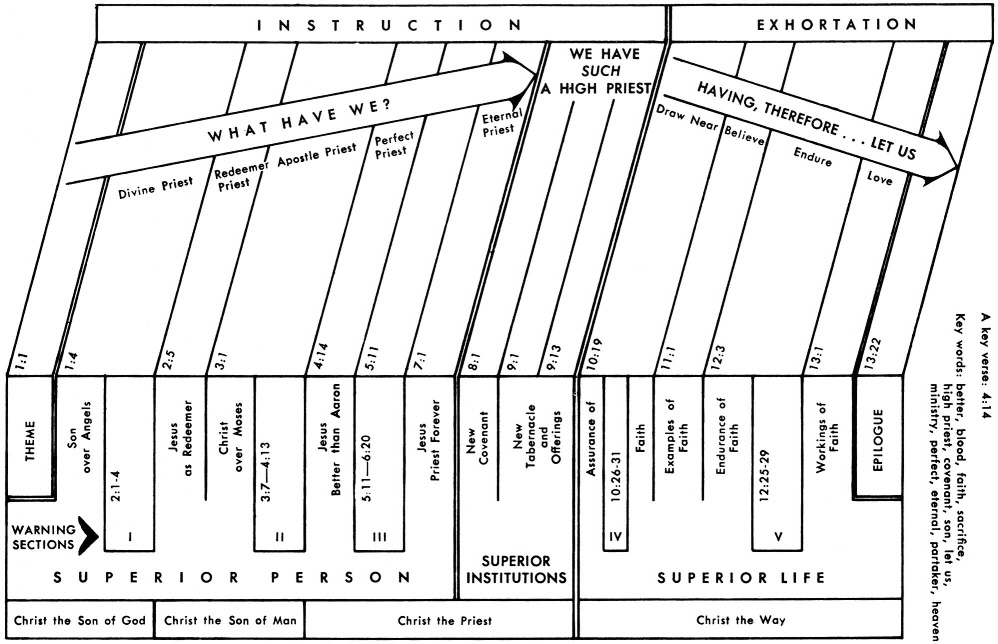
CONSIDER JESUS OUR GREAT HIGH PRIEST
Click chart to enlarge
Charts from Jensen's Survey of the NT - used by permission
Swindoll's Chart, Interesting Pictorial Chart of Hebrews, Another Chart
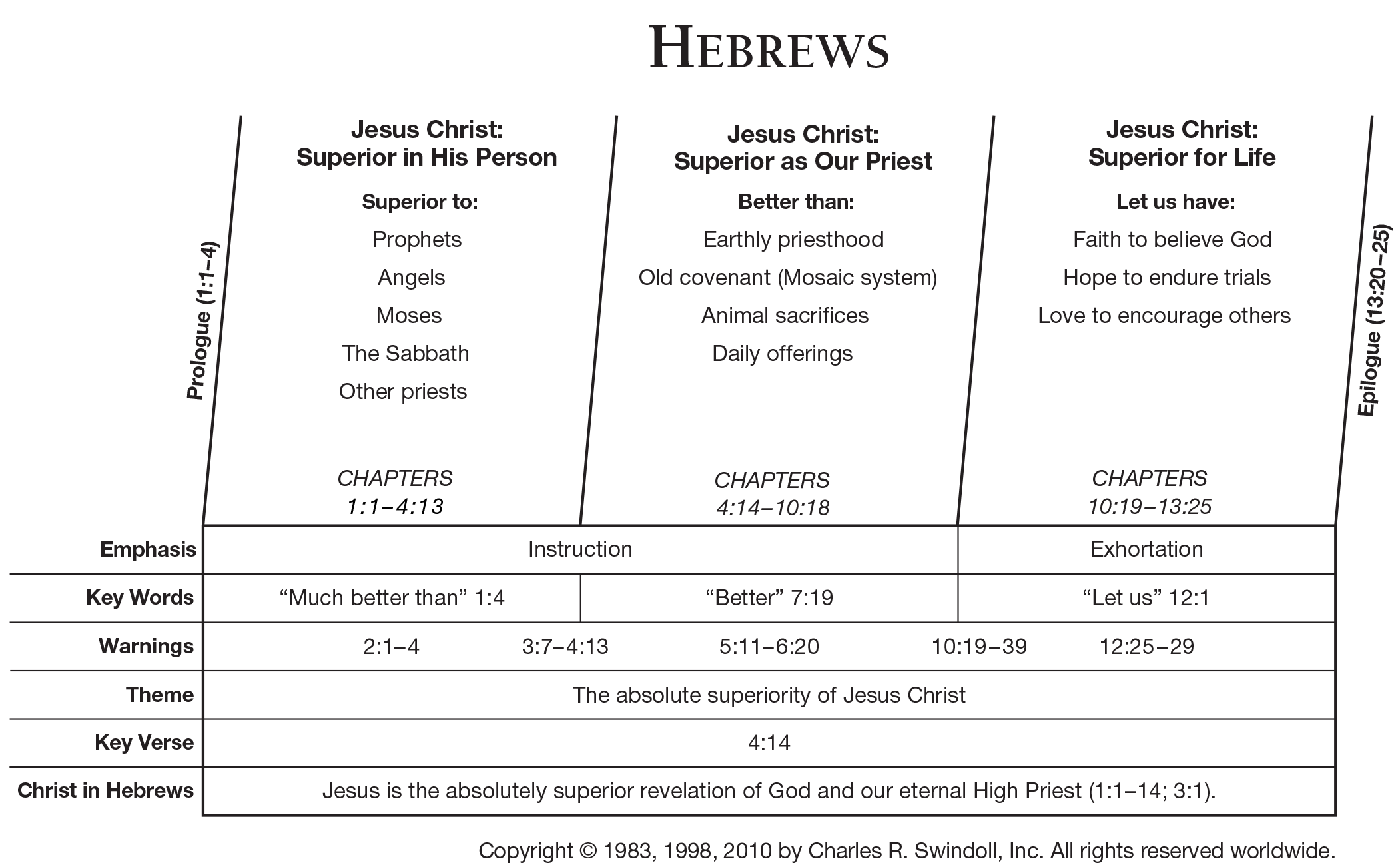
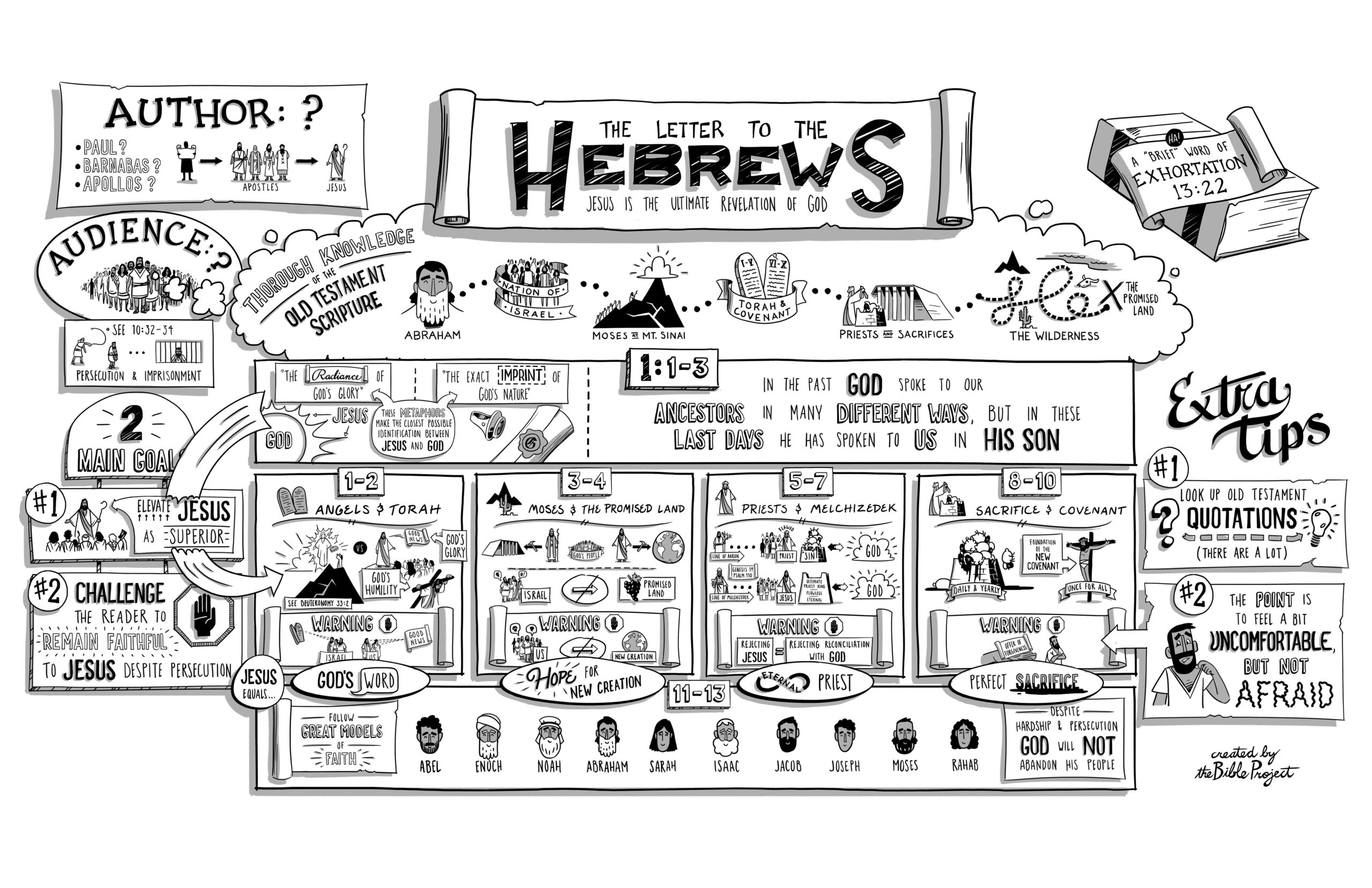
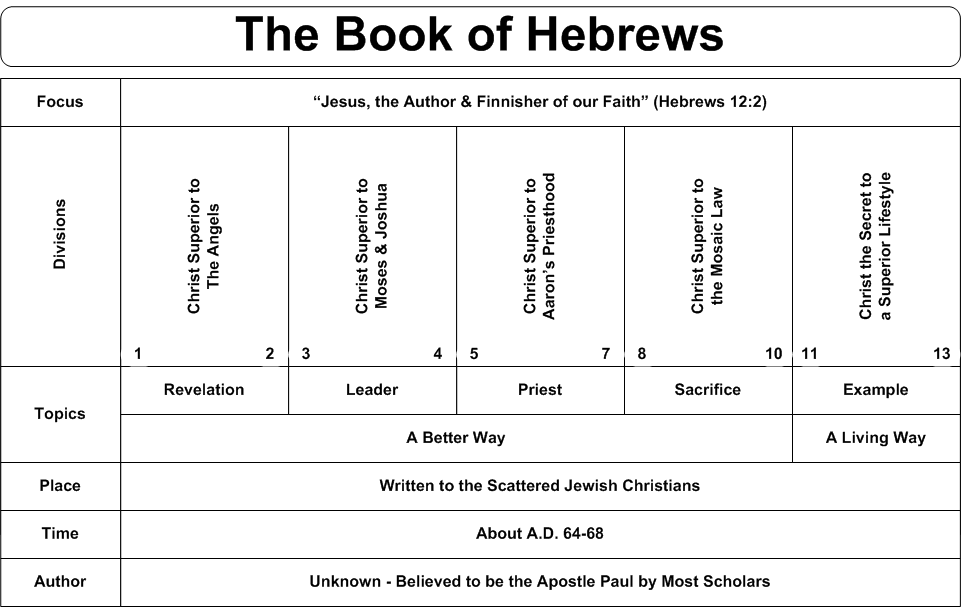
|
The Epistle |
||||
| INSTRUCTION Hebrews 1-10:18 |
EXHORTATION Hebrews 10:19-13:25 |
|||
| REVELATION | RESPONSE | |||
| PRECEPTS | PRACTICE | |||
| DOCTRINE | DUTY | |||
| Superior Person of Christ Hebrews 1:1-4:13 |
Superior Priest in Christ Hebrews 4:14-10:18 |
Superior Life In Christ Hebrews 10:19-13:25 |
||
| BETTER THAN PROPHETS, ANGELS MOSES Hebrews 1:1-4:13 |
BETTER THAN AARON'S PRIESTHOOD Heb 4:14-7:28 |
BETTER THAN THE OLD COVENANT Heb 8:1-13 |
BETTER THAN ANIMAL SACRIFICES Heb 9:1-10:18 |
BETTER LIFE IN CHRIST THAN IN ADAM! |
| MAJESTY OF CHRIST |
MINISTRY OF CHRIST |
MINISTERS FOR CHRIST |
||
|
DATE WRITTEN: |
||||

See ESV Study Bible "Introduction to Hebrews"
(See also MacArthur's Introduction to Hebrews)
Borrow Ryrie Study Bible
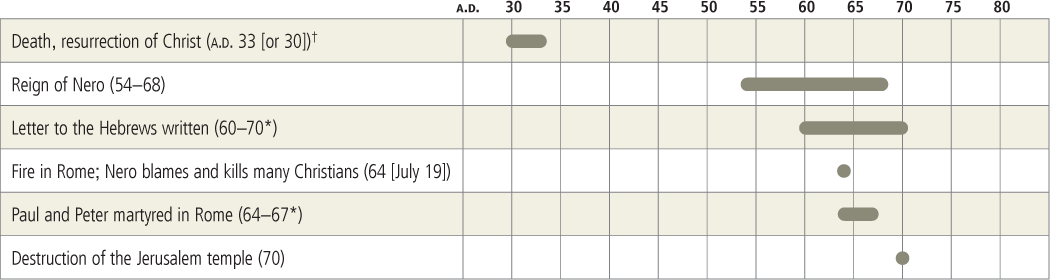
Timeline of Hebrews - ESV Study Bible
Hebrews 5:13 For everyone who partakes only of milk is not accustomed to the word of righteousness, for he is an infant. (NASB: Lockman)
Greek: pas gar o metechon (PAPMSN) galaktos apeiros logou dikaiosunes, nepios gar estin; (3SPAI)
Amplified: For everyone who continues to feed on milk is obviously inexperienced and unskilled in the doctrine of righteousness (of conformity to the divine will in purpose, thought, and action), for he is a mere infant [not able to talk yet]! (Amplified Bible - Lockman)
ASV: For every one that partaketh of milk is without experience of the word of righteousness; for he is a babe.
Barclay: for when anyone is at the stage of participating in milk feeding, he does not really know what Christian righteousness is, for he is only a child. (Westminster Press)
ESV: for everyone who lives on milk is unskilled in the word of righteousness, since he is a child. (ESV)
KJV: For every one that useth milk is unskilful in the word of righteousness: for he is a babe.
NET: For everyone who lives on milk is inexperienced in the message of righteousness, because he is an infant. (NET Bible)
NIV: Anyone who lives on milk, being still an infant, is not acquainted with the teaching about righteousness. (NIV - IBS)
NJB: Truly, no one who is still living on milk can digest the doctrine of saving justice, being still a baby. (NJB)
NLT: And a person who is living on milk isn't very far along in the Christian life and doesn't know much about doing what is right. (NLT - Tyndale House)
TEV: Anyone who has to drink milk is still a child, without any experience in the matter of right and wrong.
TLB: You have been Christians a long time now, and you ought to be teaching others, but instead you have dropped back to the place where you need someone to teach you all over again the very first principles in God's Word. You are like babies who can drink only milk, not old enough for solid food. And when a person is still living on milk it shows he isn't very far along in the Christian life, and doesn't know much about the difference between right and wrong. He is still a baby Christian!
Weymouth: By people who live on milk I mean those who are imperfectly acquainted with the teaching concerning righteousness.
Wuest: For everyone whose sole diet is milk, is inexperienced in a message which is righteous in quality, for he is a [spiritually] immature person.
Young's Literal: for every one who is partaking of milk is unskilled in the word of righteousness -- for he is an infant,
|
FIVE WARNING SECTIONS |
| Take Heed Hebrews 2:1-4 |
| Do Not Miss His Rest Hebrews 3:7-4:13 |
| Beware of Dullness & Apostasy Hebrews 5:11-6:12 (notes) |
| Beware of Willful Sinning Hebrews 10:19-39 (notes) |
| Beware of Refusing Christ Hebrews 12:14-29 (notes) |
Wilmington has another way of looking at the warning passages… The Better Nots
Don’t disregard his Word He 2:1-4
Don’t doubt his Word He 3:12, 13; 4:11
Don’t depart from his Word He 6:4-6
Don’t despise his Word He 10:26-29
Don’t disagree with his Word He 12:25
FOR EVERYONE WHO PARTAKES ONLY OF MILK IS NOT ACCUSTOMED TO THE WORD OF RIGHTEOUSNESS: pas gar o metechon (PAPMSN) galaktos apeiros logou dikaiosunes:
- Ps 119:123; Ro 1:17,18; 10:5,6; 2Co 3:9; 2Ti 3:16
- Hebrews 5 Resources - Multiple Sermons and Commentaries
THE MARK OF SPIRITUAL
INFANCY
For (gar) which Lenski says means "as I need hardly tell you," "as you all know." It is a great discipline to learn to recognize these terms of explanation and when you do, to pause and ponder, asking questions . You can always ask what the author is explaining. Sometimes the answers are easy to discern and other times as here not quite as easy. In Hebrews 5:13, the word for (gar) seems to introduce the reason why relying on milk shows immaturity, or why milk-eaters are spiritually immature and lack skill in the word of righteousness ("solid food").
Dodds on For (gar) - The reference of γὰρ is somewhat obscure. It seems intended to substantiate the last clause of Hebrews 5:12: "Ye cannot receive solid food, for you have no experience of the word of righteousness". But he softens the statement by generalising it.
For everyone (no exceptions) who partakes (metecho) only of milk (gala) is not accustomed (apeiros) to the word of righteousness, for he is an infant. - Partakes (metecho) means to have a share "milk" and present tense indicates it is their habitual practice. In other words they have an exclusive diet of milk, in contrast to adults who drink milk, but not exclusively. The NLT paraphrases it as everyone "who lives on milk." Here in Hebrews 5 milk (gala) speaks of the rudiments of Christian doctrine by which babes in Christ are nourished. Newborn Christians are not ready for solid food, because they are not yet able to "chew" it or to digest it. The writer of Hebrews is saying that the readers however should have reached the point in their maturing process that they need solid spiritual food to assure full spiritual health.
Yes, it is true what the Dairy Council preaches "Milk makes a body good", but the writer is saying milk is for infants and children and is not to be the sole intake of those who are fully grown. If all you are taking in is the "milk" of God's word, the basic rudiments, you must still be a "baby". Such a state is clearly one of the marks of spiritual immaturity.
🙏 THOUGHT - Beloved, may I ask you - are you still on a "milk only" diet spiritually? Are you content with “milk,” or are you pressing on toward “solid food”? Are you still reading devotionals which have a few tidbits of Scripture? Are you reading "Christian books" instead of The Book? Are you primarily listening to tapes rather than your primary Teacher, the Spirit?
Milk is good but filet mignon is much better! Can I encourage you to consider delving into the great adventure of inductive Bible study, whereby you are led to dig deeply into the "solid food" aspects of the Scriptures, learning how to observe the text, how to read in context, how to look for key words, and how to recognize terms of conclusion, contrasts, expressions of time and terms of comparison (such as similes metaphors). Although there are numerous inductive studies, by far the best studies are available at Precept Ministries International (click for a list of their currently available inductive studies - e.g., see Hebrews Inductive Study Part 2; Hebrews - Pt 1 - Chapters 1-4)
R P Martin comments that "The author has expected better things of his readers than they display. They should have made more progress in the Christian life than they have. The author is disturbed by their immaturity. Enough time has transpired in their spiritual lives that by now they should qualify to be teachers. Instead they need instruction. Milk is necessary and adequate for infants. No baby is criticized for taking milk (1Pe 2:2). But when a baby grows into an adult it is absurd to envision it still feeding only on milk. Milk is insufficient for the needs of an adult. With a twist of irony, the author rebukes these believers for such an absurdity: they have had enough time in the faith to be adults feeding on solid food; instead they are still feeding on milk… Solid food… points to the priesthood of Christ, which is likened to the priesthood of Melchizedek (cf. Heb 5:4, 5, 6, 7, 8, 9, 10 with the connective in Heb 5:11) and the instruction of the high-priestly office of Christ that will be provided in Hebrews 7:1-10:18 (Bruce, 108–9; Lane, 138–39). (Borrow Dictionary of the Later New Testament and its Developments Page 736)
Paul uses the metaphor of milk with a similar meaning in 1Corinthians writing "And I, brethren, could not speak to you as to spiritual men, but as to men of flesh, as to infants in Christ. I gave you milk to drink, not solid food; for you were not yet able to receive it. Indeed, even now you are not yet able." (1Cor 3:2) Solid food in this context refers to the hidden wisdom of God, which is imparted by the Spirit to those who possess the mind of Christ (see 1 Cor 2:6, 7; 12-16)
Adrian Rogers on milk - Do you know what milk is? Hey, folks, milk is just predigested food. That’s what milk is. Do you know about all the feeding that some people get is what they get when they come to church? Do you know what a sermon is? It’s predigested food. That is, I take the Word of God, chew on it, assimilate it, digest it, and then give it back to you. And so, that’s about all that some folks get. And, no wonder they’re not growing in the grace and knowledge of our Lord and Savior Jesus Christ. They come to church on Sunday—get five gallons of milk. A baby is not supposed to have five gallons; it’s supposed to get some every day. Well, of course, you can’t swallow five gallons, but you take all you can get. And then, you know, you get burped on the way out by an usher, and that’s it. My dear friend, there is so much more. Here’s what was frustrating to the writer of the book of Hebrews. He said, “Oh, there is so much that I want to tell you.” (Page 139)
Peter uses milk in a different context to symbolize the word of God in general, emphasizes that there is no spiritual growth without intake of the pure milk of the Word…
like newborn babies, long for (aorist imperative) the pure (unadulterated) milk of the word, (why do we need to take in milk?) so that (purpose clause) by it you may grow in respect to salvation (AKA - Progressive Sanctification) (1 Peter 2:2)
Comment: So here milk is used in a positive sense for the Word of God which is desirable as Jesus taught - "But He answered and said, "It is written, 'MAN SHALL NOT LIVE ON BREAD ALONE, BUT ON EVERY WORD THAT PROCEEDS OUT OF THE MOUTH OF GOD.' Mt 4:4.
Not accustomed (apeiros) means that his recipients lacked spiritual skill which is practice-dependent. Milk-only intake leaves a person apeiros, without experience in the deeper truth of the word of righteousness. The idea is they have spiritual ignorance of and/or inability to partake of the "deeper" Biblical doctrines because they did not have enough experience. They could not digest deeper truths, any more than a physical infant can digest a steak. Their spiritual system (analogous to the physical body) had failed to grow sufficiently to enable them to handle these teachings, specifically the profound teaching about the priesthood of Christ and how it related to that of Melchizedek. This latter thought is one reason I think word of righteousness could be the word concerning Melchizedek. A child can get something out of looking at a picture book but nothing out of looking at a textbook. The writer is teaching solid food from the "textbook" of Melchizedek.
INTERPRETATION OF THE
WORD OF RIGHTEOUSNESS
The word (logos) of righteousness (dikaiosune) - There is not a clear consensus on the meaning of this phrase. Some favor this to be the message about the righteousness of Christ which we receive by faith (1Co 1:30, 2Co 5:21; Ro 3:21; Ro 3:22; Php 3:9 Titus 3:5) (equivalent to past tense salvation ~ justification by grace through faith. See Three Tenses of Salvation). Others feel it refers to the righteousness we are now to live out by faith (present tense salvation ~ progressive sanctification ~ becoming holy as He is holy [Lv 11:43-45, 1Pe 1:15, 16], going from glory to glory [2Co 3:18], having our inner man renewed day by day [2Co 4:16], being transformed by the renewing of our mind [Ro 12:2, Ep 4:23, Col 3:10], growing in the grace and knowledge of our Lord and Savior Jesus Christ [2Pe 3:18]).
Montefiore on word of righteousness - The phrase means literally ‘unacquainted with the word of righteousness’. This has been variously interpreted to mean: (a) ‘unacquainted with the righteousness of God revealed in Christ’—a Pauline conception, uncharacteristic of our author; (5) ‘unacquainted with the teaching of righteousness found in scripture as a whole’—a phrase parallel to the previous remark about the oracles of God, but not a particularly appropriate comment about infants; (c) ‘incapable of accurate self-expression’ (construing the phrase ‘the word of justice’ to mean le mot juste); (d) (a variant of the previous interpretation) ‘incapable of understanding normal adult language’, as though the writer should be forced into using baby talk; and finally (e) the meaning accepted here, ‘without experience of moral truth’. This interpretation is adopted partly because the whole of this section is modelled on the writings of Greek ethical philosophers, but primarily because it provides a precise contrast with the condition of grown men as described in the next verse. (Borrow Hebrews page 103)
Peter T O'Brien writes "The person whose only food is spiritual milk is not acquainted with the teaching about righteousness. The expression 'the word of righteousness' is difficult to interpret, and has led to a variety of proposals, including right speech, right ethical teaching, the general teachings of Christianity, theological instructions on Christ as the believer's righteousness, or 'advanced theological instruction that stresses the cost and responsibilities of discipleship'. (Pillar New Testament Commentary – The Letter to the Hebrews)
I think another seldom mentioned, but reasonable consideration for the word of righteousness, especially in context of Hebrews 5:10 ("high priest according to the order of Melchizedek"), the the "word" regarding the priesthood of Melchizedek. After all his name means “king of righteousness.” And the dull hearers were unable to receive this truth (Heb 5:11) which could parallel the word accustomed. In sum, there are several pieces of evidence that make this interpretation at least one worthy considering. Robert Gundry agrees writing "Solid food would consist of “the word of righteousness,” that is, advanced information about Melchizedek, whose very name—as will be noted in Heb 7:2—means in Hebrew “king of righteousness.” (See Commentary on Hebrews)
Warren Wiersbe - Milk is predigested food, and it is specially suited to babies. But only those who have teeth can enjoy meat. The writer defines the "milk" as "the first principles of the oracles of God" (Heb. 5:12). The "meat" of the Word is the teaching about our Lord's ministry now in heaven as our High Priest. The writer wanted to give this "meat" to them, but they were not ready for it. The "milk" of the Word refers to what Jesus Christ did on earth—His birth, life, teaching, death, burial, and resurrection. The "meat" of the Word refers to what Jesus Christ is now doing in heaven. We begin the Christian life on the basis of His finished work on earth. We grow in the Christian life on the basis of His unfinished work in heaven. (Bible Exposition Commentary )
The word of righteousness is felt by some writers to be equivalent to the Gospel of salvation which is received by faith. The gospel is not only the good news about salvation (past tense), but is the good news about salvation present tense (sanctification, progressive sanctification, practical holiness). The gospel that saves us initially then enables us to live a life of righteousness (right behavior before God and before man) instead of unrighteousness (which was the only way we could live before we were saved). Believers so equipped have a responsibility to work out their salvation in fear and trembling (Php 2:12, Php 2:13).
Paul explained that the Gospel (expounded on in the ENTIRE book of Romans, the "Christian's Constitution"!) is the source of revelation about God's righteousness writing that "in it (the Gospel) the righteousness of God is revealed from faith to faith; as it is written, "BUT THE RIGHTEOUS man SHALL LIVE BY FAITH." (Ro 1:17)
Writing to Timothy Paul outlined how a believer is to grow in righteousness declaring that "All Scripture is inspired by God and profitable for teaching, for reproof, for correction, for training in righteousness; that the man of God may be adequate, equipped for every good work." (2Ti 3:16, 17)
Vincent writes that "The genitive of righteousness is combined in NT with way, God, gift, instruments, servants, law, ministration, fruit and fruits, ministers, hope, breastplate, crown, king, preacher. It is a mistake to attempt to give the phrase here a concrete meaning. It signifies simply a word of normally right character… Probably, however, in the foreground of the writer’s thought was the word spoken by the Son (Heb 1:2); the salvation which at first was spoken by the Lord (Heb 2:3)
Simon Kistemaker - I do not think that the phrase teaching about righteousness within the context of figurative language was meant to convey theological truth.
Thomas Lea on word of righteousness - commentators differ in their understanding of the teaching about righteousness. The term may be a general reference to the gospel. It may also take righteousness in the sense of that standing with God which faith in Christ brings (Rom. 3:21-26). The term may also refer to a lifestyle of upright behavior. A teaching which produces righteous behavior may have been intended. It may be best to combine all of these understandings and suggest that the intention was to describe a teaching about Jesus which produced right standing with God and caused upright living in daily behavior. (See Holman New Testament Commentary - Hebrews & James)
Ray Stedman explains word of righteousness this way… They are not acquainted with the teaching about righteousness. Commentators differ as to whether righteousness here refers to conduct (ED: AKA "SANCTIFICATION") or imputed worth (ED: AKA "JUSTITICATION"). Hughes opts for the latter view, describing it as "the teaching about righteousness which is fundamental to the Christian faith, namely, the insistence on Christ as our righteousness (1Co 1:30, 2Co 5:21) as opposed to self-righteousness or works-righteousness (1977:191). Ignorance of having a righteous position in God’s eyes already through faith in Christ has been the cause of much useless laboring to earn righteousness through the centuries. It invariably produces a form of legalism which tries to earn “brownie points” with God to gain his acceptance. The dullness which does not understand the divine program that leads to right conduct manifests its ignorance by being unable to “distinguish good from evil.” But those who, by persistent obedience to the truth (ED: Made possible by the indwelling Spirit), are able to grasp such solid food will give evidence of it in wise and wholesome conduct (ED: HERE STEDMAN IS DESCRIBING PROGRESSIVE SANCTIFICATION). They will identify evil as evil, even when it looks good, and follow good because it is good, even when it looks evil. (Hebrews Commentary - Hebrews 5:11-14)
Steven Cole writes that the word of righteousness refers to the Scriptures in general "which are designed to produce God’s righteousness in those who believe and obey. The author may be referring to the doctrine of imputed righteousness (Ed: past tense salvation = justification = declaration of righteousness by faith), taught in Ge 15:6, and repeated by Paul in Romans 3 & 4. But also, those who are counted righteous by faith in Christ will also progress in practical righteousness, learning what is pleasing to the Lord (Ep 5:10). You may think that righteousness and good and evil are obvious, but that is not so. These things need to be learned through practice and training. (Hebrews 5:11-6:3)
Phil Newton on the word of righteousness - The phrase, the word of righteousness, quite likely has a dual meaning. On one hand it implies the legal aspect of righteousness, that is, the whole truth concerning our justification through faith in Jesus Christ. Most new believers do not understand the full range of implications concerning justification. It is as you grow in the Lord that you come to appreciate and glory in the richness of this truth. You grasp something of what Paul meant when he tells us to "put on the breastplate of righteousness" (Ep 6:14). For in this you realize that Christ is your righteousness; because this is true, then none of the adversary's arrows of condemnation can find a landing spot in your mind. But the "word of righteousness" also refers to the practice of the Christian life (ED: Present tense salvation = progressive sanctification). It is the "impartation of righteousness" as William Gurnall expressed it. It is living out the moral and ethical dimensions of the Christian life. We face moral and ethical demands every day. We experience a range of choices, decisions, and options related to everything from what our eyes will see, what our ears will hear, where our feet will carry us, who we will be involved with, what our minds will dwell on, what kind of careers to pursue, how to spend our resources. When we have become dulled in hearing the Word, then our ability to exercise discernment in these things is dulled. There are obvious things that the Word spells out for us. We know that we are not to murder or steal. But to be able to practice righteousness in all of the other areas that are not clearly spelled out requires having our "senses trained to discern good and evil." That comes through regular nurture and application of the Word of God. If you are skimping on milk, then don't expect to handle solid food. And you might very well be unable to feast on solid food because you are not practicing the word of righteousness regarding what God has already taught you. (Leaving Milk for Meat)
Donald Guthrie on word of righteousness - In the Greek there are no articles and the phrase must be taken to mean, not any specific body of doctrine, but the kind of word (logos) which has the character of righteousness. This would agree with the use of the same term (logos) in He 6:1 where it refers to doctrine. The writer may be thinking of the special use of righteousness (dikaiosune), which describes what is obtained by faith in Christ (ED: Justification - past tense salvation), but could also refer to the more general idea of rightness. These two interpretations are in any case linked, for man can have no adequate idea of right except through the righteousness of Christ. Undoubtedly when men first believe they do not at once gain skill in appreciating this theme, but some such interpretation is an indispensable quest for anyone who desires to be mature. (BORROW Hebrews: An Introduction and Commentary. PAGE 138)
W E Vine feels that "the “solid food” is here called “the word of righteousness,” not only because of the fundamental character of the gospel which brings justification, but especially because it inculcates the truth of practical relationship to God as centered in Christ and carried out in a life expressive of that relationship and thus of the very character of Christ." (Collected writings of W. E. Vine)
KJV Bible Commentary on the word of righteousness - They are unskillful (Greek apeiros), inexperienced in or unacquainted with the word that instructs them in how to live a life of righteousness (Ed: Present tense salvation - progressive sanctification). (ONLINE - KJV Bible Commentary)
Partakes (3348) (metecho from metá = with, denoting association + écho = have) means literally to hold with and so share in the possession of something or have a share of. Metecho means to share in the possession of something, to partake of or to consume food, whether solid or liquid eat, to eat food, to drink (1Co 10:30; figuratively in Heb 5:13), to be included in the membership of a group belong to (Heb 7:13) Another sense is when it has to do with taking hold of something that is not naturally one's own kind. So in Heb 2:14 humans by nature are flesh and blood but Christ was not but "He partook (metecho) of the same." He willingly took hold of something which did not naturally belong to Him, partaking of our nature in order that He might die in our place, and that we might "become partakers (koinonos) of the divine nature"(2 Pe 1:4)
The writer had used metecho in Heb 2:14 in his explanation that Christ willingly took on Himself humanity in order that He might die in our place as our substitute, defeat the devil and death and enable us to take hold of the divine nature which did not belong to us (cf. 2Pe 1:4)
METECHO - 8x in 8v - belongs(1), partake(3), partakes(1), partook(1), share(1), sharing(1). 1 Co. 9:10 = "sharing crops"; 1 Co. 9:12 = " If others share the right over you"; 1 Co. 10:17; 1 Co. 10:21 = "you cannot partake of the table"; 1 Co. 10:30 = " If I partake with thankfulness"; Heb. 2:14 = "He Himself likewise also partook of the same,"; Heb. 5:13 = "everyone who partakes only of milk"; Heb. 7:13 = "belongs to another tribe" Occurs twice in the Septuagint - Prov. 1:18; Prov. 5:17;
Milk (1051) (gala) is literal milk but is used figuratively to refer to the Word of God. In context the writer is referring to a need to move on to deeper truths. He uses milk in this verse to refer to the beginning truths of Christianity. Peter uses milk to refer positively to the Word of God in general (1Pe 2:2) Milk symbolizes the elementary truths of Christianity (the “ABCs” = cf. stoicheion in Heb 5:12). Living only on milk = refusing to grow, staying at a beginner’s level of understanding (1 Cor 3:2; Heb 5:13). Peter balances the metaphor—milk is not bad! Just as infants need pure milk to grow, Christians must crave the pure Word (1 Pet 2:2). The problem is not milk itself, but staying on milk too long. Contrast with Solid Food: Milk = basics; meat/solid food = deeper truths and maturity in Christ. In secular Greek, gála is simply “milk” (cow’s, goat’s, human). Sometimes metaphorically: milk of kindness, milk of wisdom, etc. (See discussion of imagery of milk in Bible)
GALA - 5 VERSES - 1 Co. 3:2; 1 Co. 9:7; Heb. 5:12; Heb. 5:13; 1 Pet. 2:2
Not accustomed (552) (apeiros from a = without + peira = experience, trial related to peiro = perforate, pierce thru to test durability of things or simply to pass through) literally means without test or trial and thus without experience. Denoting lack of knowledge or inability to do something inexperienced in, unskilled in, unacquainted with. Not tested or not successful when tested (tried). Apeiros pertains to the lack of knowledge or capacity to do something - ignorant, unskillful, unacquainted with, inexperienced in. In classical Greek, apeiros is widely used for someone inexperienced in a field—e.g., “inexperienced in war,” “in law,” “in seamanship.” The shade is not merely “ignorant,” but not yet seasoned by practice. It describes a person who lacks experience, is untried, or ignorant
Apeiros is used in the Septuagint (LXX) translation of Numbers 14:23 (LXX) where it refers to “inexperienced youths” who have not yet learned good and evil.
Gilbrant - Apeiros occurs many times in classical literature, usually in one of two very different ways. First, apeiros depicts something as “boundless” or “infinite” (cf. a [1], “un,” + peirar, “end, limit”). For instance, something might break up into “countless” fragments, or something might exist in “countless” number. From this basic meaning it also came to be used in Greek tragedies of a garment in which an individual became “entangled” and thus “without outlet.” A second major classical definition occurs normally as a description of persons. The apeiros person is “without experience” (a [1], “un,” + peira [3846], “trial, test”), “untried,” or “unacquainted” (with something). For example, it is said of an apeiros woman that she “had not known” other men (besides her husband) (Liddell-Scott). (Complete Biblical Library)
Righteousness (1343) (dikaiosune from dikaios = being proper or right in the sense of being fully justified being or in accordance with what God requires) is the quality of being upright. In its simplest sense dikaiosune conveys the idea of conformity to a standard or norm and in Biblical terms the "standard" is God and His perfect, holy character. In this sense righteousness is the opposite of hamartia (sin), which is defined as missing of the mark set by God. Dikaiosune is rightness of character before God and rightness of actions before men. Righteousness of God could be succinctly stated as all that God is, all that He commands, all that He demands, all that He approves, all that He provides through Christ (Click here to read Pastor Ray Pritchard's interesting analysis of righteousness in the Gospel of Matthew).
In Biblical terms righteousness is that which is determined not by man or external standards but only by God and as such is that which is acceptable to God and in keeping with what God is in His holy character. Righteousness is in general use represents conformity to a standard, Thayer adds that righteousness is "the state of him who is such as he ought to be". Righteousness in simple terms is God’s uprightness or standard, without reference to any particular form of its embodiment, to which man is expected to conform.
DIKAIOSUNE IN HEBREWS - Heb. 1:9; Heb. 5:13; Heb. 7:2; Heb. 11:7; Heb. 11:33; Heb. 12:11
OT PASSAGES QUOTED IN HEBREWS 5 - Click for complete list of OT Quotations/Allusions
He 5:5 <> Ps 2:7
He 5:6 <> Ps 110:4
He 5:10 <> Ps 110:4
KEY WORDS IN HEBREWS 5 - Click for complete list of Key Words in Hebrews
Eternal - He 5:9
Sacrifice - He 5:1, 3
Priest - He 5:1, 5, 6, 10
FOR HE IS AN INFANT: nepios gar estin (3SPAI):
- Is 28:9; Mt 11:25; Mark 10:15; Ro 2:20; 1Co 13:11; 14:20; Ep 4:14; 1Pe 2:2
- Hebrews 5 Resources - Multiple Sermons and Commentaries
SPIRITUAL
INFANTS
For (gar) is another use of this strategic (and common) term of explanation - what the author is explaining? He explains why the milk-only believer is unskilled in the word of righteousness: it’s because their spiritual state is still that of an infant.
He is (present tense - continually) an infant (nepios) - He is continually spiritually immature. In other words the person he describes is still in "spiritual diapers" and needs to have their "spiritual food" mashed up or pureed and fed to them by spoon! The writer is saying in Hebrews 5:11-14 that only solid food will effect the desired result of progressing beyond “first principles” (Heb 6:1, 2, 3 ) toward spiritual maturity and moral discernment.
Radmacher says infant "is a description of the spiritually immature. Babies have little discernment or self-discipline. They must be constantly told “no.” Mature believers are able to know right from wrong and to control their sinful appetites. (The Nelson Study Bible: NKJV)
J Vernon McGee notes in the present context the writer says his readers are infants (nepios) because they do not "know the Word of God. I don’t want to step on your toes, my friend, but I’d love to be helpful to you. You cannot grow apart from the Word of God. I don’t care how active you are in the church. You may be an officer. You may be on every committee in the church. You may be a leading deacon or elder. I don’t care who you are, or what you are; if you are not studying the Word of God, and if you don’t know how to handle it, you are a little baby. It is tragic to occupy a church office when you are just a little baby. You ought to come on and grow up. It is tragic that there are people who have been members of the church and have been saved for years, and they are still going around saying, “Goo, goo, goo.” They have nothing to contribute but little baby talk. All they want is to be burped periodically! (See Thru the Bible; Mp3 on Hebrews 5:12-14)
Phil Newton applies this section to each of us asking "Where is your spiritual progress? I'm not asking you to compare yourself to someone else. That can be rather unfair and arbitrary. But I am asking you as a believer, what kind of progress are you making in growing in the grace and knowledge of our Lord Jesus Christ? The shocking reality among most congregations is that the level of living exposes the level of understanding of God's Word. When Christ is not evident in our lives it is likely that our hearing has grown dull for the Word of God. When there is no ongoing passion for Christ then it is because dullness has set in. When we can flounder around with the world and give in to its lure, then by default we admit that we have "come to need milk and not solid food." Such admission is that either our faith is weak and possibly faltering; or that our faith has never gotten off the ground in honestly trusting Jesus Christ as our Mediator before God. (Leaving Milk for Meat)
Steven Cole - If there is spiritual life, there will be spiritual growth of some sort, but growth rates vary. Some become Christians and instantly drop the sins that have plagued their lives for years and never fall back. Others struggle to get rid of those sins for decades. I have a pastor friend who got saved in his early forties. He was a night club entertainer, addicted to alcohol, tobacco, and drugs. He instantly dropped all of those habits and began to follow Christ. But I know others who have struggled with those habits for years after making a profession of faith. They make a break from them, but then keep falling back into them. (Hebrews 5:11-6:3)
You are young only once,
but you can remain immature your entire life!
Someone once said that the travesty of the church in America is that many if not most believers are betweeners -- they are between Egypt and the Promised Land—out of the place of danger, but not yet into the place of rest and rich inheritance. They are between Good Friday and Easter Sunday, saved by the blood but not yet enjoying newness of resurrection life. We all need to ask ourselves are we a betweener? Are we moving toward the "Promised Land" in our spiritual walk? How would one know they are making progress? Have you graduated from spiritual milk to meat? Have you become involved in more serious Bible studies, such as those that utilize the inductive technique (mentioned above)? I can personally attest to the transformative power of this type of study -- I disciple young men and have seen the greatest spiritual growth in those who have truly bought in to this method of Bible study. Unfortunately some of the men I disciple have failed to dig in for themselves and these men as you might expect have shown the least spiritual growth. Sadly as teachers and pastors, although we can "set the table" with the rich fare of God's Word, including deeper truths, we cannot force men and women to eat!
C H Spurgeon - A child is a very beautiful object, an infant is one of the loveliest sights under heaven; but if, after twenty years, your child was still an infant, it would be a dreadful trial to you. We must keep on growing till we come to the stature of men in Christ Jesus. The babe is perfect in its measure, but it is not perfectly perfect. Those limbs must expand; the little hand must get a wider grasp; the trembling feet must become strong pillars for ripening manhood; the man must swell, and grow, and expand, and enlarge, and be consolidated. Now when we are born to God, we have all the parts of the advanced Christian. Faith, hope, love, patience,—they are all there, but they are all little, all in miniature, and they must all grow; and he is of full age whose faith is vigorous, whose love is inflamed, whose patience is constant, whose hope is bright, who has every grace, in full fashion. The full-grown man is stronger than the babe. His sinews are knit; his bones have become more full of solid material; they are no longer soft and cartilaginous, there is more solid matter in them.So with the advanced Christian; he is no longer to be bent about and twisted; his bones are as iron, and his muscles as steel; he moves himself in stately paces, neither does he need any upon whom to lean. He can plough the soil, or reap the corn; deeds that were impossible to infancy are simplicities to the full-grown man. (Strong Meat)
Paul uses nepios to exhort the believers at Ephesus … As a result, we are no longer to be children (nepios), tossed here and there by waves and carried about by every wind of doctrine, by the trickery of men, by craftiness in deceitful scheming; (Ep 4:14) (Question: From this verse, what is the danger of spiritual immaturity? What is the antidote in Ep 4:11,12? What's the fruit of applying this antidote in Ep 4:13?)
Paul uses the related verb in commanding believers to be like infants or babes in one thing -- "Brethren, do not be children in your thinking; yet in evil be babes, (nepiazo in present imperative = be childlike) but in your thinking be mature." (1Cor 14:20) (Question: In this context, can a "babe" be spiritually mature? That's rhetorical -- so we see the vital role that context plays in facilitating accurate Interpretation)
Satan enjoys seeing Christians get a head-knowledge
of victory without a heart-experience
Warren Wiersbe warns us that "Satan enjoys seeing Christians get a head-knowledge of victory without a heart-experience, because this lulls believers into a false security, and Satan finds them an easy prey. It is not the reading of truth, or even the enjoying of truth that brings the blessing. It’s the doing of truth." (Borrow The Strategy of Satan)
John MacArthur - One of the marks of small children is lack of discernment. They have no way of telling what is good or bad for themselves. They judge only by feeling and whim. If something looks attractive, they may try to pick it up, even if it were a poisonous snake. If something looks remotely like food, they try to eat it. A child of three left to select his own diet would never live to four. He would either sweeten or poison himself to death. Some Christians, unfortunately, show little more discernment than this in the spiritual realm. They have been so little exposed to sound doctrine, or so long removed from it, that they judge entirely by appearance and feeling. Consequently, the church is filled with babes, who swallow almost any teaching that is put before them, as long as it is not blatant heresy and the teacher claims to be evangelical. As a body, and as individual Christians, we cannot be steadfast in Christ unless we are "constantly nourished on the words of the faith and of the sound doctrine" (1Ti 4:6). As long as believers are immature, false doctrine is a major danger (cf. Ep 4:11-16). (See The MacArthur Commentary)
Kenneth Wuest addresses the question of whether the term infant (or "babe" in KJV) signifies they are truly born again - The word “babe” (infant) is not the translation of a Greek word meaning an “infant,” such as is used in Luke 2:16, nor from a word translated “child” as in Luke 1:7, which latter word is related to the verb which means “to give birth to,” and therefore speaks of a child in its birth relationship to its parents; but from nepios, which means “immature” as contrasted to “mature.” Paul used this word in contrast to a word which means “mature.” In 1Co 2:6 he says that he speaks wisdom among the perfect, that is, the spiritually mature. But the Corinthian saints were babes in Christ, immature Christians. He speaks of those who are perfect, that is, spiritually mature, in contrast to children (nepios), namely, immature Christians (Eph. 4:13, 14). Here (in Hebrews 5:13) the writer contrasts these Hebrews who are immature so far as their spiritual apprehension is concerned, with those of full age, namely spiritually mature. We must be careful to note that the Greek word “babe” (nepios) in itself carries with it no implication of salvation. The phrase, “babe in Christ,” as used today, refers to a new convert. Paul’s use of nepios in I Corinthians 3:1 is different. There he refers to immature Christians. One can be forty years old in the Faith and still be immature spiritually. Furthermore, the word “babe” (nepios) needed the qualifying phrase “in Christ” to indicate that these Corinthian “babes” were saved. Therefore, the word “babe” in our Hebrew passage cannot be made to show that the person referred to is a saved individual. It has no birth relationship idea about it. The analysis of the book and the context in which the word is found require that we understand it to refer to these unsaved Hebrews who, because of their neglect of New Testament truth and their turning away from it, have again become immature in their spiritual apprehension of the same. (Hebrews Commentary).
Infant (babe) (3516) (nepios from negative nê = no + epo = speak) means one not able to talk, a suckling. In context they are not able to chew "spiritual steak" because they are still on the bottle which limits their intake to "spiritual milk". Nepios does not necessarily indicate that they are "born again" like the "babe in Christ" (1Co 3:1, 2) where Paul was clearly describing immature, "carnal", "fleshly" believers. As alluded to earlier, you may have been genuinely saved and sitting in church for 40 years any yet still be able to only drink "spiritual milk" because of your lack of spiritual growth, in turn related to your failure to progress to the "solid food" of more serious Bible study! If you say that you are too busy for serious Bible study (eg, one that requires 4-5 hours of homework/week) then simply stated -- you are too busy! Now, if you have absolutely no appetite for the Word of God, no desire to read and study the Bible, then you need to seriously consider whether you are a genuine believer (see 2Co 13:5). Note that we are not talking about times when you are living in unconfessed sin which will kill the appetite of a genuine believer, but we are speaking to that person who says they have professed Christ and yet have never experienced a hunger or desire for the Word. Real physical newborn babies always desire milk. Plastic doll babies never desire milk. (see 1Pe 2:2)
Nepios - 15x in 11v in NAS - Mt 11:25; 21:16; Luke 10:21; Rom 2:20; 1 Cor 3:1; 13:11; Gal 4:1, 3; Eph 4:14; 1 Thess 2:7; Heb 5:13. NAS = child(5), childish(1), children(2), immature(1), infant(1), infants(4)
Here is a simple illustration - A new Christian was reading through the Gospels. After she finished, she told a friend she wanted to read a book on church history. When her friend asked why, the woman replied,
"I'm curious. I've been wondering when Christians started to become so unlike Christ." (Which of us is not convicted!)
When you walk with Christ,
you'll be out of step with the world.
The world will try to pressure us
To fit into its mold,
But with God's help we can resist
If to His truth we hold. --Sper
The author assaults his friends with a somewhat silly image of adult babies who are still nursing. Put on your "sanctified imagination" for a moment. If this next Sunday service God were to dress each of those who attended in the garb that most nearly reflected their level of spiritual maturity, what would the assembly resemble? Perhaps we would not even need a separate nursery! Imagine the absurdity of full-grown men and women sitting in the pews in diapers sucking their thumbs and unable to eat solid food! That's the picture with which the writer of Hebrews is rebuking his dull (and in danger) readers!
Remember that if your not growing in Christ-likeness and spiritual maturity, you are not simply maintaining the status quo. There is simply no such thing as a static Christian. We either move forward or fall back. We are either climbing or falling. We are either winning or losing. Static, status quo Christianity is a delusion, a perpetration of the Liar himself! Imagine yourself ("spiritually speaking") on a bicycle right now. Are you pedaling forward? Or are the pedals even moving? If they are not what is about to happen? If you are a cyclist and quit pedaling on a hill you are in trouble! And especially if you are clipped in! I'm an avid cyclist and some of my worst falls have been when I was either not moving forward or just barely moving! Now apply this analogy to your own spiritual life -- are the pedals moving?
Babies Need Weaning - I find few things more delectable than three or four of my wife's freshly baked chocolate-chip cookies, hot from the oven but cool enough to pick up and introduce to my longing taste buds. What really makes this treat complete is a large glass of ice-cold milk. That milk and those cookies are made for each other.
Now, I'm not considered a baby because I still drink milk. But if that's all I took in for nourishment, you would ask, and rightly so, "What's wrong? Shouldn't you have been on solid foods long ago?"
Transfer this scenario to our Christian lives, as the writer did in today's Scripture. There comes a point in our experience when we must move on from the basic salvation truths (Heb. 5:12)--not that we should ever lose our taste for them. Milk is always good and nourishing. We must never lose our appreciation for God's forgiveness and our new life in Christ.
God wants us to learn the Word through study, prayer, meditation, obedience, and testing. We must know spiritual principles so that we can apply them, speak with confidence about our faith, and stand up under adversity.
The milk of the Word will always taste good, but the Bible's solid food makes us strong. How's your diet? —Dennis J. De Haan (Our Daily Bread, Copyright RBC Ministries, Grand Rapids, MI. Reprinted by permission. All rights reserved)
The Bible is a pantry
Where I can always find
The food I need from day to day
For heart and soul and mind.
--Anon.
Spiritual growth requires the meat of God's Word.
God's Word…
has life,
gives life and
nourishes life.
If you received physical nourishment
with the same regularity that you receive spiritual nourishment from God's Word,
what kind of shape would you be in?
Hebrews 5:14 But solid food is for the mature, who because of practice have their senses trained to discern good and evil (NASB: Lockman)
Greek: teleion de estin (3SPAI) e sterea trophe, ton dia ten exin ta aistheteria gegumnasmena (RPPNPA) echonton (PAPMPG) pros diakrisin kalou te kai kakou.
Amplified: But solid food is for full-grown men, for those whose senses and mental faculties are trained by practice to discriminate and distinguish between what is morally good and noble and what is evil and contrary either to divine or human law. (Amplified Bible - Lockman)
ASV: But solid food is for fullgrown men, even those who by reason of use have their senses exercised to discern good and evil.
Barclay: For solid food is for those who have reached maturity, those who, through the development of the right kind of habit, have reached a stage when their perceptions are trained to distinguish between good and evil. (Westminster Press)
ESV: But solid food is for the mature, for those who have their powers of discernment trained by constant practice to distinguish good from evil. (ESV)
KJV: But strong meat belongeth to them that are of full age, even those who by reason of use have their senses exercised to discern both good and evil.
NET: But solid food is for the mature, whose perceptions are trained by practice for discerning both good and evil. (NET Bible)
NIV: But solid food is for the mature, who by constant use have trained themselves to distinguish good from evil. (NIV - IBS)
NJB: Solid food is for adults with minds trained by practice to distinguish between good and bad. (NJB)
NLT: Solid food is for those who are mature, who have trained themselves to recognize the difference between right and wrong and then do what is right. (NLT - Tyndale House)
TEV: Solid food, on the other hand, is for adults, who through practice are able to distinguish between good and evil.
TLB: You will never be able to eat solid spiritual food and understand the deeper things of God's Word until you become better Christians and learn right from wrong by practicing doing right.
Weymouth: Such persons are mere babes. But solid food is for adults—that is, for those who through constant practice have their spiritual faculties
Wuest: But solid food belongs to those who are [spiritually] mature, to those who on account of long usage have their powers of perception exercised to the point where they are able to discriminate between both that which is good in character and that which is evil.
Young's Literal: and of perfect men is the strong food, who because of the use are having the senses exercised, unto the discernment both of good and of evil.
BUT SOLID FOOD IS FOR THE MATURE: he sterea trophe teleion de estin (3SPAI):
- Mature - Mt 5:48; 1Co 2:6; Eph 4:13; Phil 3:15; Jas 3:2
- Hebrews 5 Resources - Multiple Sermons and Commentaries
Related Passages:
Matthew 5:48 Therefore you are to be perfect (teleios), as your heavenly Father is perfect.
Colossians 1:28-29 (PAUL'S GREAT GOAL - MATURE MEN IN CHRIST! THIS SHOULD BE OUR SUMMUM BONUM!) We proclaim Him, admonishing every man and teaching every man with all wisdom, so that we may present every man complete (teleios) in Christ. 29 For this purpose (MEN/WOMEN MATURE IN CHRIST!) also I labor (kopiao - present tense - continually), striving (agonizomai - present tense - continually) (HERE'S THE KEY TO PAUL'S SUCCESS! IT IS...) according to His power, which mightily works (energeo - present tense - continually) within me. (NOTE THE DYNAMIC - 100/100 - SEE "Paradoxical Principle of 100% Dependent and 100% Responsible") (After declaring the glorious truth that Christ was now in them and that He Alone was their Hope = absolute assurance of future good - Col 1:27)
Ephesians 4:13 until we all attain to the unity of the faith, and of the knowledge of the Son of God, to a mature (teleios - full-grown, brought to their intended end) man, to the measure of the stature which belongs to the fullness of Christ.
Philippians 3:15 Let us therefore, as many as are perfect (teleios), have this attitude; and if in anything you have a different attitude, God will reveal that also to you;
FROM MILK TO MEAT:
THE CALL TO GROW UP
But - note the contrast and also note that mature (teleios) is placed first in the Greek text for emphasis… "and of perfect men is the strong food, who because of the use are having the senses exercised, unto the discernment both of good and of evil. (YLT) The contrast is between the "food" taken in and those taking in the respective foods as described in the next paragraph.
Solid (stereos) food (trophe) is for the mature (teleios - full-grown, brought to their intended goal) - Solid (stereos) food (trophe) contrasts with spiritual milk and are deeper Biblical truths that demand disciplined digestion. The mature (teleios) contrast with infants (nepios) and describes those who are no longer spiritual children/infants but those whose spiritual faculties are sharpened through consistent exposure to God’s Word and thus are growing in Christlikeness. Mature (teleios) implies discernment (see below)—knowing how to apply Biblical truth to real life, distinguishing right from wrong, wisdom from folly, etc. Practically, spiritual maturity describes the difference between always needing to be spoon-fed (milk) versus feeding yourself and nourishing others (solid food). Maturity is also intimately linked to progressive sanctification—growing in conformity to Christ (Eph 4:13; Col 1:28) In using the word mature (teleios), the writer is applying terms familiar to normal human development to describe their spiritual development, which is of course of far more value than physical growth (cf physical exercise in 1Ti 4:7-10). The mature (teleios) Christian can handle solid food. The Holy Spirit can guide them into Scripture and from it they can draw wisdom for life. They can grasp doctrine and make decisions. They integrate doctrine and duty.
The writer uses teleios later in Hebrews writing "But when Christ appeared as a high priest of the good things to come, He entered through the greater and more perfect (teleios) tabernacle, not made with hands, that is to say, not of this creation." (Hebrews 9:11)
John MacArthur on the contrast - The contrast here is simple. The one who continues to feed only on God's elementary revelations is not going to grow, not going to have any discernment. A small child will stick almost anything into his mouth, touch anything he can reach, go anywhere he can manage to crawl—with no concept of what is good for him and what is bad, what is helpful and what is dangerous. The mature adult, on the other hand, has developed considerable discernment. He is careful about what he eats, what he does, where he goes. The same principle operates in the spiritual realm. The mature believer has discernment about what is right and wrong, true and false, helpful and harmful, righteous and unrighteous. (See Hebrews Commentary - Page 134)
C H Spurgeon on solid food (KJV = "strong meat") - Milk you may use as you will. You cannot take too much of it; it will not do strong men any very great amount of good, but it will certainly do them no hurt. But the strong meat must always be accompanied by a word of caution when it is placed before the uninstructed and feeble, since such are very apt to do mischief both to themselves and to others with this strong meat. Understand, dear friends, that there is no reference here at all to the age of a person as to human life. The Greek word is “Men that are perfect (teleios)” which signifies spiritual men who have attained to the highest degree of spiritual development. Now this is not the result of years, for there are some gray heads that have no more wisdom than when they first began; and, on the other hand, there are some youthful believers who are worthy to be called fathers (cf 1Jn 2:12-14) in Israel through the progress that they have made in grace. Growth in grace (cf 2Pe 3:18) does not run side by side with growth in years. (Sermon Strong Meat)
Sermons are good, but they are not to be compared with
personal Spirit illuminated Bible study as food for your soul
Sermons are good, but they are not to be compared with personal Spirit illuminated Bible study as food for your soul (real "soul food"). Songs and hymns are excellent, but let us not become "songbook Christians". Men wrote the songs but God wrote the Bible. Mature believers lament the declining popularity of the old hymns (many -- but not all -- of which do contain God's words as well as sound doctrine) as they are slowly being replaced by choruses that are often repetitive and doctrinally shallow (there are exceptions). This gradual drift should be cause for some alarm among mature believers. Why? Well, ask yourself, what is one of the marks of being continually filled with and controlled by the Holy Spirit (Eph 5:18)? Paul answers it is "speaking to one another in psalms and hymns and spiritual songs, singing and making melody with your heart to the Lord." (Eph 5:19 cf Col 3:16. See also Chart comparing Filled with the Spirit and the Word)
A maturing Christian must be a Biblically saturated Christian. If we are to get a deep insight into the holy mysteries of God’s Word, we must lay aside every sin (He 12:1, 1Jn 1:9) and every preconceived notion about His Truth and come simply as children to be taught by the Holy Spirit (1Jn 2:20, 1Jn 2:27). God has purposely hidden His truths from the wise and prudent but He is ready at any time to reveal them to babes. (Mt 11:25, Mt 13:11, Lk 10:21).
John Piper exhorts all pastors "So I say again, the way to save yourself and your hearers (1Ti 4:16) is not to arrest the growth of your people by a meatless diet of “salvation messages.” This had sent the “Hebrews” straight backward toward destruction (Heb 5:11-14). The way to save the saints is to feed them all the Scriptures, for it is the Scriptures “which are able to make you wise for salvation” (2Ti 3:15). (Download Pdf of Brothers, We are Not Professionals : A Plea to Pastors for Radical Ministry.)
Warren Wiersbe writes that "The “milk” of the Word represents the “first principles” of the Christian life, that is, what Jesus Christ did for us when He was on earth. The “meat” of the Word is the teaching about what Jesus is now doing for us in heaven, His ministry as High Priest. How sad it is when Christians neglect God’s Word and stop growing in grace… As we grow in the Word, we learn to use it in daily life. As we apply the Word, we exercise our ‘spiritual senses’ and develop spiritual discernment. It is a characteristic of little children that they lack discernment. A baby will put anything into its mouth. An immature believe will listen to any preacher on the radio or television and not be able to identify whether or not he is true to the Scriptures.” (BORROW With the Word )
As Solomon recorded in Proverbs 2 almost 3 millennia ago…My son, if you will receive my sayings, And treasure my commandments within you,2 Make your ear attentive to wisdom, Incline your heart to understanding;3 For if you cry for discernment, Lift your voice for understanding;4 If you seek her as silver, And search for her as for hidden treasures;5 Then you will discern the fear of the LORD, And discover the knowledge of God.6 For the LORD gives wisdom; From His mouth come knowledge and understanding. (Proverbs 2:1-6)
To avoid being pulled into error
Keep a firm grip on the truth.
Howard Hendricks asks...
• Who are the “mature”? The mature are those who by constant use have trained themselves by taking the Word of God and using it in their lives to distinguish good from evil.
• The highest mark of spiritual maturity is not how much you understand, it is how much you use.
• The opposite of ignorance in the spiritual realm is not knowledge, it is obedience. (BORROW Living by the book)
🙏 THOUGHT - Stop for a moment and do a personal inventory - First, answer the question "How does Hebrews 5:13, 14 teach that we are to evaluate spiritual maturity?" Second, applying these criteria personally ask "Am I spiritually mature (or at least growing in my spiritual maturity)?" Ask God to help you discern "truth from error" so that you don't deceive yourself (cp Jer 17:9). If you conclude that you are lacking the prerequisites for the development of spiritual maturity, then, enabled by God's Spirit, begin your lifelong journey of grace. It will be the best trip you will ever take in your short life on earth! God guarantees it (see 1Ti 4:7, 8)
More like the Master I would live and grow,
More of His love to others I would show;
More self-denial, like His in Galilee,
More like the Master I long to ever be.
—Gabriel
Teleios (teleios) does not connote moral or spiritual perfection or sinlessness (note) as some have taught is possible or attainable by mortal flesh, but rather refers to that a believer who is fully developed, who is being progressively transformed into all he or she was "re-created" to be --- like Christ, conformed to His image. And yet maturity is never an end we attain and then say "Whew! I have finally arrived!" No, instead it is to be our earnest, diligent pursuit, even as the "mature" apostle Paul declared…
10 that I may know Him (Christ), and the power of His resurrection and the fellowship of His sufferings, being conformed to His death;11 in order that I may attain to the resurrection from the dead. 12 Not that I have already obtained it, or have already become perfect (teleioo), but I press on (present tense = his continual practice) in order that I may lay hold of that for which also I was laid hold of by Christ Jesus. 13 Brethren, I do not regard myself as having laid hold of it yet; but one thing I do: forgetting (present tense = his continual practice) what lies behind and reaching forward (present tense = his continual practice) to what lies ahead, 14 I press on (present tense = his continual practice) toward the goal for the prize of the upward call of God in Christ Jesus. 15 Let us therefore, as many as are perfect (teleios) have this attitude (present tense = to be our continual attitude); and if in anything you have a different attitude, God will reveal that also to you; 16 however, let us keep living by that same standard (present tense = to be our continual practice) to which we have attained. (Phil 3:10-16)
Conversion is the miracle of a moment.
Maturing takes a lifetime.
Regarding Christian maturity, Tom Skinner explained that "If you check out the life of Jesus you will discover what made Him perfect. He did not attain a state of perfection by carrying around in His pocket a list of rules and regulations, or by seeking to conform to the cultural mores of His time. He was perfect because He never made a move without His Father." (And because He continually relied on the Holy Spirit -- See discussion of The Holy Spirit-Walking Like Jesus Walked!)
Summary of marks of immaturity (as you read these, ponder the antithesis of each trait and you have a good description of a mature man or woman in Christ - see also Marks of Maturity):
- Dullness toward the Word (Heb. 5:11)
- Inability to teach the Word to others (Heb. 5:12)
- Dependence on only the elementary truths of the Word (Heb. 5:12–13)
- Lack of skill in applying the Word (Heb. 5:14).
Solid (4731) (stereos from histemi = stand) literally means strong, compact, solid or firm (as used to describe a foundation as firm). Stereos is in contrast with that which is soft or liquid solid.
Figuratively, stereos refers to the foundational doctrines of God which are firm (securely or solidly fixed in place) (2Ti 2:19), of faith which is steadfast (not subject to change) (1Pe 5:9).
Solid "food", the equivalent of Biblical ''health'' food which builds strong, solid, healthy believers who can resist when temptation comes, who are steadfast when winds of crooked doctrine blow, and who God uses to lead others to His righteousness.
Food and drink are not uncommon metaphors for Biblical truth (Isaiah 55:1-6, Ps 42:2; 63:1; 143:6, 1Co 10:3; cf. Dt 8:3; Mt 4:4, etc).
2 Timothy 2:19 (note) Nevertheless, the firm foundation of God stands, having this seal, "The Lord knows those who are His," and, "Let everyone who names the name of the Lord abstain from wickedness."
Hebrews 5:12 (note) For though by this time you ought to be teachers, you have need again for someone to teach you the elementary principles of the oracles of God, and you have come to need milk and not solid food.
Hebrews 5:14 (note) But solid food is for the mature, who because of practice have their senses trained to discern good and evil.
1 Peter 5:9 (note) But resist him, firm in your faith, knowing that the same experiences of suffering are being accomplished by your brethren who are in the world.
There are 13 uses of stereos in the Septuagint (LXX) (Ex 37:17, 20; Nu 8:4; Dt 32:13; 1Sa 4:8; Ps 35:10; Is 2:21; 5:28; 17:5; 50:7; 51:1; Je 15:18; 30:14; 31:11)
Food (5160) trophe from trépho = to feed, eat) is most often used literally to refer to nourishment or sustenance. In Hebrews 5:12,14 trophe is used figuratively of food for soul, instruction. Literal Food: Matthew 3:4 – John the Baptist’s “food (trophē) was locusts and wild honey.” Matthew 6:25 – “Do not be anxious about… what you will eat (trophē).” Luke 12:23 – “Life is more than food (trophē).” Acts 27:33–36 – Paul urges the sailors to take “some food (trophē) for your survival.”
TROPHE - 16V - enough*(1), food(13), meals(1), support(1). Matt. 3:4; Matt. 6:25; Matt. 10:10; Matt. 24:45; Lk. 12:23; Jn. 4:8; Acts 2:46; Acts 9:19; Acts 14:17; Acts 27:33; Acts 27:34; Acts 27:36; Acts 27:38; Heb. 5:12; Heb. 5:14; Jas. 2:15
Literal sense: daily meals, what sustains physical life. Broader sense: provision from God, a reminder of dependence on Him. Spiritual lesson: earthly food sustains for a time, but true and lasting nourishment comes only from Christ.
Symbolically, the word is used in common Greek writings in a variety of ways: of one’s livelihood, of nursing and rearing children, of tending animals, etc. Trophē can also denote the place where animals are fed (Liddell-Scott). In classical Greek: trophē = nourishment, rearing, upbringing (sometimes even metaphorical: education or training as “nourishment of the soul”). In the Septuagint (LXX): frequently used for “food” in daily life, sacrifices, or God’s provision (Gen 45:23; Lev 11:39).
In the Septuagint trophē occurs in Gen. 49:27; Jdg. 8:5; 2 Chr. 11:23; Job 36:31; Ps. 65:9; Ps. 104:27; Ps. 111:5; Ps. 136:25; Ps. 145:15; Ps. 146:7; Ps. 147:9; Prov. 6:8; Prov. 30:25. In Job 36:31 Elihu stated that God is the provider of food for the people of the earth. In Psalm 104:27 the Psalmist noted that God provides food for all the animals as well.
Mature (5046)(teleios from telos = an end, a purpose, an aim, a goal) means complete, fully developed, full grown, brought to its end, finished, wanting nothing necessary to completeness, in good working order. Teleios signifies consummate soundness, includes the idea of being whole. Teleios is commonly opposed in classical and Biblical Greek to nepios.
Richards explains that the word teleios places emphasis on… wholeness and completeness. In the biological sense they mean "mature," or "full grown": the person, animal, or plant achieved the potential inherent in its nature. The perfect is the thing or person that is complete, in which nothing that belongs to its essence has been left out. It is perfect because every potential it possesses has been realized. (Borrow Expository Dictionary of Bible Words)
Richards goes on to add that "Maturity should come as a natural process of our being among a group of believers who are functioning properly ("until we come to such unity in our faith and knowledge of God's Son that we will be mature and full grown [teleios] in the Lord, measuring up to the full stature of Christ." NLT, Eph 4:13), as we face trials and persevere ("And let endurance have its perfect [teleios] result, that you may be perfect [teleios] and complete, lacking in nothing." James 1:4. ED NOTE: James is referring to spiritual maturity fulfilled in Christlikeness, which is the goal of endurance and perseverance in trials!), and through the constant exercise of our faculties by applying God's Word to guide our daily choices ("But solid food is for the mature [teleios] , who because of practice have their senses trained to discern good and evil." Heb 5:14). Why is maturity important? Because those who are mature Christians are able to grasp and apply spiritual truths (1Co 2:6), establish right priorities in life (Php 3:15), and stand confident and firm in the will of God (Col 4:12)."(Borrow Expository Dictionary of Bible Words)
William Barclay on mature - A thing is teleios, if it realizes the purpose for which it was planned; a man is perfect if he realizes the purpose for which he was created and sent into the world… For what purpose was man created? The Bible leaves us in no doubt as to that. In the old creation story we find God saying. “Let us make man in our image after our likeness” (Ge 1:26). Man was created to be like God. The characteristic of God is this universal benevolence, this unconquerable goodwill, this constant seeking of the highest good of every man. The great characteristic of God is love to saint and to sinner alike. No matter what men do to him, God seeks nothing but their highest good." (Matthew 5 Commentary)
Friberg summary - complete, perfect; (1) with its chief component as totality, as opposed to partial or limited; (a) of things in full measure, undivided, complete, entire (Ro 12.2); substantivally to. teleion = the finish, completeness (1Co 13.10); comparative teleioteros, tera on = more complete or perfect (Heb 9.11); (b) of persons complete, perfect (Mt 5.48; 19.21); (2) with its chief component being full development as opposed to immaturity; (a) of persons full grown, mature (1Co 14.20); substantivally oi` teleioi = adults, mature persons; used of spiritually mature persons (1Co 2.6); (b) of things fully developed, complete (Jas 1.4; 1Jn 4.18); (3) with its chief component being full preparation or readiness = complete, perfect (Col 1.28; Jas 3.2). In all its meanings teleios carries the component of a purpose that has been achieved. (So think of that in the context of Epaphras' prayer - he is praying with the end desire that each believer grow into and attain the purpose for which he was created and then redeemed! My how we need to pray more fervently for one another, specifically praying for spiritual maturity to be attained, the very purpose for which Paul labored, striving according to God's power [Spirit] Who mightily worked within him! Col 1:29 where Col 1:28 uses teleios to describe Paul's goal for those he was discipling - spiritual maturity!) (BORROW Analytical Lexicon of the Greek New Testament)
TELEIOS - 19X/17V - complete, 2; mature, 4; more perfect, 1; perfect, 12. Matt. 5:48; Matt. 19:21; Rom. 12:2; 1 Co. 2:6; 1 Co. 13:10; 1 Co. 14:20; Eph. 4:13; Phil. 3:15; Col. 1:28; Col. 4:12; Heb. 5:14; Heb. 9:11; Jas. 1:4; Jas. 1:17; Jas. 1:25; Jas. 3:2; 1 Jn. 4:18
Notice in the Septuagint (Lxx) teleios is used several times to describe a heart that is wholly devoted (Heb = shalem). This begs the question beloved "Is my heart teleios? Would God describe me as wholly devoted to Him? Or have become like Solomon, who began "wholly devoted" but ended his race not "wholly devoted?" In 1 Chronicles 25:8 teleios describes a teacher.
PICTORIAL DESCRIPTIONS OF THE WORD OF GOD
1) A Mirror (Jas 1:23, 24, 25).
It reflects the mind, holiness and righteousness of God and exposes the filthiness of men's sin.
2) A Seed (1Pe 1:23, Jas 1:18, Mt 13:18-23)
Once planted in a good heart, it brings forth life, growth, and fruit.
3) Water (Ep 5:25-27, Ps 42:1 Ps 119:9 Pr 25:25 Is 55:10 He 10:22 Re 22:17)
Like water it is cleansing, quenching, and refreshing.
4) A Lamp (Ps 119:105, Pr 6:23, 2Pe 1:10)
Light a lamp it shows us where we are, guides us to where we are to go and keeps us from falling off the path.
5) A Sword (He 4:12, Ep 6:17)
Like a sword it pierces with equal efficacy on sinners, saints, and Satan.
6) A Precious metal - Gold (Ps 19:10, Ps 119:127), Silver (Ps 12:6)
Like gold and silver it is precious, beautiful, and highly valued in God's eyes.
7) Nourishing food - Milk (1Pe 2:2), Meat (He 5:14KJV), Bread (Mt 4:4, Jn 6:51), Honey (Ps 19:10)
Is is nourishing because of the strength it imparts in one's and the growth it produces in one's Christlikeness.
8) A Fire (Jer 20:9, Lk 24:32)
Like a fire it is purifying and consuming and bespeaks judgment.
9) A Hammer (Jer 23:29)
It shatters sinful man's pride and self righteousness.
Related Resource:
- See Inductive Study on the Power of God's Word
I have a companion, a dear, faithful friend,
A union of blessing that never shall end;
Till Jesus returns with His saints from on high
We'll travel together, my Bible and I.
—Anon
(1). Maintaining a Proper Diet: Good food. Solid food. Sound Doctrine. You in your own inductive Bible study begin to mature (1Pe 2:2 - no intake, no growth!). You are in trouble if the pastor is the main source of food no matter how good is his exegesis!
(2). Practice: "Practice makes perfect" is the old saying. We of course will never be perfect in this life but are to practice using our powers of discernment. As we take in truth and obey that truth we progressively become better equipped to distinguish good and evil.
(3). Senses become trained: Our power of discernment becomes sharpened (not judgmental or pharisaical!).
Beware of mistaking mere possession of information
for genuine spiritual maturity.
The measurement of my ministry is
the measurement of your maturity
Adrian Rogers on discernment - Did you know that children don’t have any discernment? They’re so simple. Have you ever noticed that a baby will put anything in his mouth? You can’t let a little baby crawl around on the floor in a public place. He’d just as soon pick up a cigarette butt or a dead roach and pop it in his mouth. He has no discernment. He does not know the difference between good and evil. And, you know, that’s the way immature Christians are. They’ll listen to any preacher on radio or television—they don’t know whether it’s good or whether it’s bad. I’m amazed at the gullibility of some of our own people. I have literally seen people bring to church the Plain Truth Magazine (prior to 1996 it was a cult publication, but now is actually evangelical!) or Jehovah’s Witness literature and say, “Pastor, we’ve got some good literature here. Maybe we could use it in our Sunday school.” They don’t know. They have absolutely no discernment. They don’t know whether it’s good or bad. It’s just religious so they think it’s all right. You see, “their senses [have not been] exercised to discern…good and evil.” (Hebrews 5:14)....
Maturity is not a hundred-yard dash and it’s over;
it is a lifetime marathon.
Did you know the measurement of my ministry is the measurement of your maturity? And, do you know the measure of your maturity is how much more you’re becoming like Jesus every day? If you want to measure the ministry of Adrian Rogers, don’t say, “Well, look at these buildings, or that budget, or these baptisms”—not nickels nor noses, but are you people becoming more like Jesus?..... And, maturity is not something that one day you don’t have and the next day you have; maturity is a lifelong process. That’s the reason when I said to you, if you cease to be better, you cease to be good. Maturity is not a hundred-yard dash and it’s over; it is a lifetime marathon. And, I don’t care who you are, there’s always room for growth.(Page 139)
Aim High - When my daughter and her family were in town for a visit, I had a chance to take my son and two sons-in-law out for a “guy” outing.
We decided that while the ladies were shopping, we would go to a firing range and practice shooting. We rented two pistols and took aim at our targets. While shooting, all four of us discovered that on one of the firearms the sight was set too low. If we aimed using that sight, we hit the bottom of the target. We had to aim high in order to hit anywhere near the bull’s-eye.
Isn’t life a lot like that? If we set our sights too low, we really don’t accomplish all that we can. Sometimes we have to aim high in order to reach a desired goal.
What should be our aim in life? How high should we point our ambitions? Well, since Scripture is our true guide, we will shoot for nothing but spiritual maturity. In fact, in Paul’s farewell to the people of Corinth, he said, “Aim for perfection” (2Co 13:11NIV). And we also have the high aim of these words from the lips of Jesus, “You shall be perfect, just as your Father in heaven is perfect” (Mt 5:48).
Perfection is a lofty target, and we won’t attain it in this life. But if we want to honor God and get close to that high goal, we need to aim high.
O to be like Thee, blessed Redeemer,
This is my constant longing and prayer;
Gladly I’ll forfeit all of earth’s treasures,
Jesus, Thy perfect likeness to wear.
—Chisholm
WHO BECAUSE OF PRACTICE HAVE THEIR SENSES TRAINED TO DISCERN GOOD AND EVIL: ton dia ten hexin ta aisthethria gegumnasmena (RPPNPA) echonton (PAPMPG) pros diakrisin kalou te kai kakou:
- Their senses - Job 6:30; 12:11; 34:3; Psalms 119:103; Song 1:3; 2:3; Matthew 6:22,23; Ephesians 1:18
- Discern - Ge 3:5; 2Sa 14:17; 1Ki 3:9,11; Isaiah 7:15; Ro 14:1; 1Co 2:14-15; Phil 1:9,10; 1Th 5:21-22
- Hebrews 5 Resources - Multiple Sermons and Commentaries
Related Passages:
Philippians 1:9-10 (PARALLEL THOUGHT) And this I pray, that your love may abound still more and more in real knowledge (epignosis) and all discernment (aisthesis), 10 so that you may approve (dokimazo) the things that are excellent, in order to be sincere and blameless until the day of Christ;
1 Thessalonians 5:21-22 But examine (dokimazo - present imperative see our need to depend on the Holy Spirit to obey) everything carefully; hold fast (katecho - - present imperative) to that which is good; 22 abstain ( apechomai - present imperative) from every form of evil.
THE DISCIPLINE OF DISCERNMENT
MATURITY THROUGH PRACTICE
Who because of practice (hexis - habit, exercise) have their senses (aistheterion) trained (gumnazo) to discern (diakrisis) good (kalos) and evil (kakos) - Who refers to the mature (teleios). Because of practice can be rendered because of habit. Practice (hexis) is from the verb echo (to have, hold) and literally means "a having." It conveys the idea of a habit, condition, or state that is developed through repetition. The simple point here is that if one continues to feed only on the "ABC's" (elementary principles), they are not going to grow spiritually and are not going to develop spiritual discernment. The writer takes a familiar Greek philosophical term (hexis) and applies it to the Christian life. Just as repeated physical or moral practice leads to a fixed habit, repeated engagement with God’s Word leads to spiritual maturity. The "fruit" of hexis is the difference between a baby Christian and a seasoned believer. The old saying is "Use or lose it". Failure to nourish and exercise our spiritual faculties of discernment is like a leg that is placed in a cast for months with resultant "disuse atrophy" of the muscles to the point that the person can hardly walk on it when he is first taken out of the cast. Truth practiced and obeyed becomes internalized truth that transforms
Have their senses (aistheterion from aisthesis - perception, discernment) refers to the inward faculties by which the mind and conscience discern spiritual realities, the spiritual faculties of moral perception — the inner capacity to distinguish truth from error, right from wrong. Trained (gumnazo) implies vigorous exercise and discipline. Trained is in the perfect tense indicating a past completed action with ongoing effect and speaks of the permanence of their state of training! It stresses an ongoing, well-established condition, in which one by repeated, disciplined exercises their spiritual faculties, like an athlete strengthening muscles. Use of one's powers of spiritual discernment are to be the practice for those who seek to be mature.
Practically speaking, when you see something in God's Word that says you need to change something in your attitudes or actions, then JUST DO IT (under grace, not Law, enabled by the Spirit not in the "strength" of the flesh! Gal 3:3, Ro 8:13).
🙏 THOUGHT - Just as athletes develop skill by training daily, Christians develop discernment by daily practice of truth. Occasional study won’t sharpen your spiritual senses; consistent obedience and testing of God’s Word will. Immaturity results from neglecting spiritual exercise. Maturity comes from constant practice (cf. 2 Peter 3:18).
To discern (diakrisis) good (kalos) and evil (kakos) - To discern (diakrisis) describes the ability to separate, discriminate, distinguish between things. good (kalos) and evil (kakos) refers to ethical conduct as well as true and false doctrine for both of these areas require discernment. The goal of the training is distinguishing good and evil. Because the readers had been believers for a time, they should have known that to return to Judaism was a bad ("evil") choice—they would not be able to go on to maturity!
Joe Stowell wrote that "Discernment in Scripture is the skill that enables us to differentiate. It is the ability to see issues clearly. We desperately need to cultivate this spiritual skill that will enable us to know right from wrong. We must be prepared to distinguish light from darkness, truth from error, best from better, righteousness from unrighteousness, purity from defilement, and principles from pragmatics. (Borrow Fan the Flame Living Out Your First Love for Christ page 50)
John MacArthur - Spiritual discernment is the ability to distinguish divine truth from error and half-truth (cf. Acts 17:11; 1Ti 4:1-6, 13, 16; 6:20, 21; 2Ti 4:1-5; Titus 1:9) and is essential to the Christian life (1Co 12:10; Ep 4:14-15; He 5:14; 1Jn 4:1; cf. 1Ki 3:9; Pr 2:3; 14:15, 33; 16:21). (See 1 & 2 Thessalonians Commentary)
John MacArthur - A small child will stick almost anything into his mouth, touch anything he can reach, go anywhere he can manage to crawl—with no concept of what is good for him and what is bad, what is helpful and what is dangerous. The mature adult, on the other hand, has developed considerable discernment. He is careful about what he eats, what he does, where he goes. The same principle operates in the spiritual realm. The mature believer has discernment about what is right and wrong, true and false, helpful and harmful, righteous and unrighteous. (See Hebrews Commentary - Page 134)
John Piper alludes to the importance of practice in his list of the four sources of wisdom - 1. Meditation on the Scriptures: Ps 19:7, “The testimony of the Lord is sure, making wise the simple.” 2. Prayer: “If any of you lacks wisdom, let him ask God.” 3. Sound counselors (the book of Proverbs!). 4. The practice of principles in real life experience (Hebrews 5:14). (Walk in Wisdom Toward Those Outside)
Jesus alluded to the importance of obedience in spiritual maturation when He declared "If any man is willing to do His will, he shall know of the teaching, whether it is of God, or whether I speak from Myself." (Jn 7:17) Jesus lays down a basic, vital principle that the first prerequisite to ascertaining God's leading in some matter or the truth about some doctrinal question, is a genuine willingness to believe the truth and obey God's will.
The Bible is like a compass—
it always points the believer in the right direction.
Bob DeWaay on Trained senses (Hebrews 5:14) means the ability to differentiate between good and evil because of having continued in the Word of Christ (John 8:31,32) and become disciples. Many think discernment depends on a "metaphysical impression sensor" that differentiates between the feelings and sensations produced by different spiritual beings. For example, I received a phone call from a person who announced, "I have the gift of discernment." She told a strange tale of demons, angels, human spirits, etc., that would be fit for the pages of a supermarket tabloid. The answer to various problems for individuals and churches was to use her secret, spiritual knowledge to manipulate the spirit world so that things would go God's way. This concept of discernment that makes it out to be a mystical ability to view into the unseen spirit world has many counterparts in the occult, but it is not what Hebrews 5:14 is about. The example of the author of the book of Hebrews was to use Biblical passages to correct error, warn against sin, urge to faith, and differentiate truth from falsehood. One need not enter an altered state of consciousness to exercise this type of discernment. (The Danger of Perpetual Infancy - The Need To Study Scripture)
C H Spurgeon - The soul has senses as well as the body. Men who have had their senses exercised know how to choose between good and evil. Now, what are these senses? Well, there are our spiritual eyes. Travelers who go to Switzerland for the first time soon discover that they have not had their eyes exercised. At a distance, young travelers scarcely know which is mountain and which is cloud. All this is the result of not having the eyes exercised upon such glorious objects. It is just precisely so in spiritual things, unless Christians have their eyes exercised. The man, the eye of whose faith has been tried with bright visions and dark revelations, is qualified to discern between good and evil in those great mysteries that would be too high for unexercised believers. Then there is the ear. We hear it said of some that they have no ear for music. We sometimes hear it said of others that they have an ear for music, and they can tell when people are singing half a note amiss. But there are some who cannot tell one note from another. So is it in spiritual things, “Blessed are the people that know the joyful sound,” but many do not know the difference between the joyful sound and that which is half a note lower. Why, dear friends, when a Christian is well taught, he knows when a note goes too high, and he says—“No, no, no; that jars;” or when it goes too low he says—“No, that is out of tune.” Happy is he whose ear is well tuned to discern both good and evil. Then comes the nose, the intention of which sense is to smell things afar off. True Christians have smelled the fragrance of Christ’s fellowship. “While the king was on his couch, my nard gave its fragrance” (Song 1:12). Advanced Christians know the fragrance of heaven. The spiritual nostril that has been made to perceive the difference between the righteous and the wicked will soon be able to perceive what is true food and what is carrion. Then there is the taste; and this sense needs educating, too. There are many who have no taste spiritually. Give them a cup of mingle-mangle, and if it is only warm they will drink it down and say, “Oh! How delightful!” If you give them a cup, on the other hand, that is full of divine purposes, precious promises, and sure mercies of David; if you will only flavor it with a good style of oratory, they will drink that sweet potion too and relish it. The two things may contradict each other flatly, but these people have no discernment—they have not had their senses exercised. But those of you who have been made to taste the sweets of covenant grace, you, especially, who have eaten his flesh and drunk his blood, and you, too, who have been made to drink the wormwood and the gall till your mouth knows every flavor, from the bitterness of death up to the glory of immortality, you may taste the strong meat without any fear, for your senses are exercised. Lastly, there is the sense of touch. Believers have been made to touch the hem of Jesus’ garment. They have exercised the sense of feeling by joy, by rapture, perhaps by doubt and by fear, and their touch has become so acute, so keen, that, though their eyes were shut, as soon as they touch a doctrine they would know what was of God and what of man. (Sermon Strong Meat)
Discernment speaks of the power to see what is not evident to the average mind (cp 1Co 2:14). It is the power or faculty of the mind, by which it distinguishes one thing from another, as truth from falsehood, virtue from vice, good from evil. Discernment is an act of wisdom or detection marked by an insight into a person’s character or by an event that comes through insight that goes beyond the facts given.
As someone has well said even in a secular sense the errors of youth
often proceed from the want of discernment.
Paul addresses the development of the art of discernment in Ephesians writing "Therefore be careful how you walk, not as unwise men, but as wise, making the most of your time, because the days are evil. So then do not be foolish, but understand what the will of the Lord is. And do not get drunk with wine, for that is dissipation, but be filled with the Spirit (Ep 5:15, 16, Ep 5:17, 18) (Note: All verbs in red are present imperative = commands calling for continual attention)
Remember that error often comes
dressed in the garment of truth.
Joe Stowell writes that "the Pharisees had developed a system of 613 laws, 365 negative commands and 248 positive laws… By the time Christ came it had produced a heartless, cold, and arrogant brand of righteousness. As such, it contained at least ten tragic flaws. (1) New laws continually need to be invented for new situations. (2) Accountability to God is replaced by accountability to men. (3) It reduces a person’s ability to personally discern. (4) It creates a judgmental spirit. (5) The Pharisees confused personal preferences with divine law. (6) It produces inconsistencies. (7) It created a false standard of righteousness. (8) It became a burden to the Jews. (9) It was strictly external. (10) It was rejected by Christ (Borrow Fan the Flame Living Out Your First Love for Christ page 50)
What better way to discern good and evil than to let our mind dwell (by way of application, should be part of our "practice", of our being "trained") on good, on God, on holy, as Paul encouraged the saints at Philippi…
Finally, brethren, whatever is true, whatever is honorable, whatever is right, whatever is pure, whatever is lovely, whatever is of good repute, if there is any excellence and if anything worthy of praise, let your mind dwell (present imperative = command calling for us to continually place our attention) on these things. (Php 4:8)
Dods - “exercised so as to discriminate between good and evil,” i.e., between what is wholesome and what is hurtful in teaching. The child must eat what is given to it; the boy is warned what to eat and what to avoid; as he grows, his senses are exercised by a various experience, so that when he reaches manhood he does not need a nurse or a priest to teach him what is nutritious and what is poisonous. The first evidence of maturity which the writer cites is ability to teach; the second, trained discernment of what is wholesome in doctrine. The one implies the other. Cf. Isaiah 7:16, " (The Expositor's Greek Testament)
O Let us learn from Thy blest Word
Base error to discern,
And by Thy Spirit’s light and help
From Satan’s snares to turn.
--Bosch
Phillip Hughes comments that… Good and evil should not be understood merely in an ethical sense here as signifying good conduct and evil conduct, but more particularly, as the context requires, in a comprehensive theological sense, namely, of good and evil, or true and false, doctrine, which would include moral teaching. The power of discernment is something very necessary in those who are "mature" enough to be "teachers," and something to be expected of those who, like the recipients of this letter, have been members of the Christian church for a number of years. (A Commentary on the Epistle to the Hebrews)
Steven Cole writes that "Bible doctrine is not just to fill your head or help you defend some theological system. It is always intended to make you a more godly person. In his introduction to Calvin’s Institutes ([Westminster Press], p. lii), John McNeill points out that to the modern mind the word “piety” has lost its proper implication and status. But to Calvin, piety was “that reverence joined with love of God which the knowledge of his benefits induces.” “It exists when men ‘recognize that they owe everything to God, that they are nourished by his fatherly care, that he is the Author of their every good.’” Then McNeill quotes A. Mitchell Hunter, who says, “Piety was the keystone of his character. He was a God-possessed soul. Theology was no concern to him as a study in itself; he devoted himself to it as a framework for the support of all that religion meant to him.” McNeill adds, “Since we ‘owe everything to God,’ in Calvin’s pages we are everywhere confronting God, not toying with ideas or balancing opinions about him.” (Keep these comments in mind if you read Dave Hunt’s vitriolic and baseless attacks on Calvin!) So when you study the Bible or theology, always study with an aim to obedience and godly living. We’ve seen that it is possible to be a Christian, but be slow to grow. Also, Christian growth means moving on to deeper levels of understanding. It is directly related to obedience to the truth that we have learned. (Hebrews 5:11-6:3)
William MacDonald adds that "By obeying the light they receive from God’s word, these people are able to form spiritual judgments and save themselves from moral and doctrinal dangers. In this context the particular sense in which the readers are urged to distinguish between good and evil is in relation to Christianity and Judaism. Not that Judaism was evil in itself; the Levitical system was introduced by God Himself. But it was intended to point forward to Christ (Gal 3:23, 24, 25). He is the fulfillment of the ceremonial types and shadows (He 9:23, He 10:1, Col 2:17). Now that Christ has come, it is sinful to return to the pictures of Him. Anything that rivals Christ in the affections and loyalties of men is evil. Spiritually mature believers are able to discern between the inferiority of the Aaronic priesthood and the superiority of Christ’s. (BORROW Believer's Bible Commentary )
Thomas Lea - Christians are able to distinguish between good and evil. The terms good and evil may have both a moral sense and a theological sense. Christians are those who can spot moral evil and avoid it. They can see moral good and attach themselves to it. Christians also can distinguish between true and false doctrine. They will turn aside from the false and faithfully follow the true. Living the Christian life demands the spiritual skills of stamina seen physically in a long-distance runner. Unswerving, relentless applications of Christian truth and practice will equip us for a lifetime of usefulness which will continue into eternity. (See Holman New Testament Commentary - Hebrews & James)
Phil Newton sums up this section noting that…
We train our spiritual faculties to discern good and evil by a regular, ongoing diet of God's Word.
"But solid food is for the mature, who because of practice have their senses trained to discern good and evil."
Notice that two things are involved.
First there is "solid food," what Fuller calls "the strong meat" of God's Word. It is those who are developing in spiritual maturity that can enjoy such food. Babies tend to play in solid food while maturing children and youth enjoy eating it. What is the "solid food"? It is those doctrines that make up the whole of Scripture. Here the writer was speaking of Christ's high priestly ministry-grasping it and delighting in it. In Galatians it might be the wondrous doctrine of justification. In Ephesians it might be getting a handle on the doctrine of election. These things are solid food.
But we make a mistake if we think that solid food is just for knowledge. Yes, we must have knowledge. But right knowledge always leads to practice, so our writer speaks of those
"who because of practice have their senses trained to discern good and evil."
The word "practice" refers to the development of regular habits. These are godly habits of the mind, attitude, thought life, and moral actions. One's "senses" are "trained" or trained by the exercise of the truths of God's Word. Understanding and obeying God's Word develops the believer's capacity to "discern good and evil." In other words, the kind of living that redounds to the glory of God is that which is honed by the study and practice of God's truth.
"The pathway to maturity and to solid Biblical food is not first becoming an intelligent person, but becoming an obedient person" [Piper]. (Leaving Milk for Meat) (Bolding added)
Practice (1838) (hexis from écho = have) describes a habit, whether of body or of mind. It describes a condition of the body or mind acquired through custom, use or practice. It refers to a thoroughly established habit or skill achieved through repetition. The idea is doing something again and again. It refers to a habit of the body or mind, not the process but the result: The condition produced by past exercise and now the habitual or normal condition, disposition or character. Plato referred to a habit of body, especially a good habit. In classical Greek, it often referred to a settled disposition or condition of body or mind. Aristotle used it for a “stable state” formed by repeated action — like a habit. A stable disposition or habit formed through repeated actions (e.g., courage, temperance) In Hebrews 5:14 (only Biblical use) hexis describes a spiritual condition acquired through repeated use of discernment — the ability to distinguish good from evil is not natural but developed through consistent practice in God’s Word.
Hexis refers to a habit of body or mind indicating not the process but the result; the condition, produced by past exercise, is now habitual, the disposition of character
Liddell-Scott (classical Greek): habit, disposition, condition of body or soul; often used by Aristotle in his ethics to describe a stable moral character formed by repeated actions.
Wuest writes that hexis "refers to a habit of the body or mind. It speaks here of the habitual use of the perceptive faculties (senses) which are being vigorously exercised. This results in the ability to discriminate between good and evil, and in this context, good and evil teaching. But these Hebrews had abused their perceptive faculties in rejecting the new light given and turning again to the First Testament (Old Covenant) sacrifices. Light rejected, blinds."
Hexis suggests that spiritual discernment does not come instantly but grows from repeated exposure and obedience to the Word. Just as muscles strengthen through training, the believer’s “spiritual senses” sharpen through continual practice. Discernment is not merely intellectual; it is the Spirit-enabled ability to apply truth to life. Without practice, one remains dull (5:11), undeveloped, and vulnerable to error (cf. Eph. 4:14). : God provides “solid food” for those who persevere in study and obedience, forming a settled habit of godliness.
🙏 THOUGHT- Christian maturity is not accidental but cultivated. Each time we choose obedience over compromise, meditate on Scripture rather than neglect it, or test everything by the truth of God’s Word, we are exercising our spiritual senses. Over time, these repeated choices form a holy habit — a settled state of discernment. Question for each of us (including this writer!) to ponder: Am I training my spiritual senses daily, or am I allowing them to grow dull through neglect? Think of muscles: exercise creates strength not instantly, but through repeated use. Just as an athlete forms habits of skill through training, so a Christian forms habits of discernment through consistent obedience to God’s Word.
HEXIS IN SEPTUAGINT - 1Sa 16:7; Hab. 3:16; Da 1:15; Da 7:28
Bob DeWaay offers some insights on how "practice" is related to modern Christianity…
Practice at anything is hard work. Perhaps this is what causes so much resistance to the Biblical command to become students of Scripture.
Be diligent (NET Bible = Make every effort) ( in the aorist imperative = command to do this now. Don't delay. Do it effectively. ''Do your utmost for His highest'!) to present yourself approved to God as a workman who does not need to be ashamed, handling accurately the word of truth (2Timothy 2:15).
Paul also told Timothy,
Let the elders who rule well be considered worthy of double honor, especially those who work hard at preaching and teaching (1Timothy 5:17).
To become teachers as Hebrews 5:12 says we ought we must first be diligent in study, which is hard work. The call to hard work probably will never be popular in the age of television where everything is done for us and we are passive spectators. Modern Christianity has produced a generation of spiritual consumers, many who are from the "baby boomer" generation whose wants and needs dictate which churches will be successful. This generation is repulsed by the idea of a lifetime of hard work with little recognition or immediate pay off. As consumers we want to be the center of attention and if a waiter or waitress does not attend to our needs now, we make a fuss and move on. This is sadly how many from our modern generation approach church life. We want the church administration to hire professionals to do everything for us, including teaching our children. We want to be comfortable, happy, entertained, never put upon, never made to feel guilty, and certainly never commanded to do anything that would be more work and responsibility. If the author of Hebrews was concerned that his admonitions could not be heard by his first century, Jewish audience, how much more difficult is it for twentieth century, pampered, "baby boomers"?
God's Word is changeless and we will be judged by it even if it seems incompatible with our modern priorities. We must allow God's Word to speak to us and not be content to compare ourselves with others of our own ilk. We could stay babies and never notice it or stand out because we live in a culture of babies. However, what a sad waste of a spiritual life! (See John Piper's - Don't Waste Your Life) Practice is necessary for spiritual sensibility and discernment. The type of practice referenced here is the study of Scripture and its application to the issues of life. Faith and obedience are the envisioned outcomes of this process (Related Resource: Relationship of faith and obedience). (The Danger of Perpetual Infancy - The Need To Study Scripture)
Senses (145) (aistheterion from aisthanomai = apprehend by senses from aio = to perceive; English = “aesthetic”) describes an apprehension by the senses or perception primarily with the external senses. It was a Stoic term for sense organs. As used in this verse figuratively it describes spiritual perception or possession of the capacity to perceive clearly. It is the ability to understand the real nature of something or to have the ability of discernment or of discrimination. It is the ability to make moral decisions using the capacity for spiritual apprehension. It implies a sort of spiritual intuition by which the sensitive Christian can, more or less, automatically discern whether something is right or wrong. However, this sense is developed only by attaining real maturity in the Scriptures.
The related word aisthesis is used by Paul "And this I pray, that your love may abound still more and more in real knowledge and all discernment (aisthesis) (Php 1:9)
Comment: Aisthesis or discernment selects, classifies, and applies what is furnished by knowledge.
The root verb aisthanomai is used in Luke "But they did not understand this statement, and it was concealed from them so that they might not perceive it; and they were afraid to ask Him about this statement. (Luke 9:45)
Trained (1128) (gumnazo from gumnós = "naked" or minimally clothed and descriptive of the common practice of males in the Greco Roman "gymnasia" source of English "gymnasium", "gymnastics") literally means to exercise naked in the palaestra (a school in ancient Greece or Rome for sports). Vine says it means to “to strive with the body stripped i.e., strenuously." Gumnazo means to exercise bodily and described an athlete exercising in the gym. Figuratively gumnazo means to exercise so as to discipline oneself (in the moral or ethical "gym") or to exercise vigorously, in any way, either the body or the mind. It describes the rigorous, strenuous, self-sacrificing training an athlete undergoes.
GUMNAZO - 4V - discipline(1), trained(3). 1 Tim. 4:7; Heb. 5:14; Heb. 12:11; 2 Pet. 2:14
The Jewish historian Josephus uses gymnazo in his description of the Roman soldier writing that ""… their military exercises differ not at all from the real use of their arms, but every soldier is every day exercised (gymnazo), and that with great diligence, as if it were in time of war which is the reason why they bear the fatigue of battles so easily." (Josephus, F. The Works of Josephus. Wars 3.73)
Paul uses gymnazo in his first epistle to Timothy drawing on the athletic metaphor to exhort his young disciple to "have nothing to do with (continually refuse, shun, reject) worldly (profane in contrast to sacred, void of piety, opposite of holy that which is set apart to God) fables (myths) fit only for old women. On the other hand, discipline (gymnazo = present tense calls for rigorous, strenuous, self-sacrificing training like an athlete) yourself for the purpose of godliness (NIV = "train yourself to be godly") for bodily discipline is only of little profit, but godliness is profitable for all things, since it holds promise for the present life and also for the life to come." (1Ti 4:7-8)
Gymnazo is used again in Hebrews where we find the encouraging truth that "All discipline for the moment seems not to be joyful, but sorrowful; yet to those who have been trained (gymnazo) by it, afterwards it yields the peaceful fruit of righteousness. (Heb 12:11)
Kenneth Wuest comments on the use of gymnazo in relation to discipline explaining that "Here (gymnazo) refers to the spiritual exercise which the recipients went through as a result of the persecutions which in the last analysis were the chastening hand of God. That spiritual exercise consisted of the struggles of the soul, the battle between the determination to go back to the (Jewish) temple sacrifices and thus escape the persecutions, or to go on to faith in the High Priest of the New Testament in spite of them. (Word Studies from the Greek)
There is one use of gymnazo in the apocrypha (2 Maccabees 10:15) in which which is used to mean harass, wear out or distress - "Besides this, the Idumeans, who had control of important strongholds, were harassing the Jews; they received those who were banished from Jerusalem, and endeavored to keep up the war."
Discern (1253) (diakrisis from diakrino = distinguish, decide, judge from diá = separation, between + krino = decide, judge) is literally to distinguish between or making a judgment between two things. It describes the ability to evaluate and decide or to clearly discern. In Hebrews 5:14 diakrisis refers not to intellectual quibbling, but to the moral and spiritual ability to evaluate and judge rightly and ultimately to distinguish God's good, and acceptable and perfect will (Ro 12:2b) from error, right from wrong.
Diakrisis is used 2 other times in the NT…
Romans 14:1- Now accept the one who is weak in faith, but not for the purpose of passing judgment (diakrisis) on his opinions.
Comment: Here Diakrisis takes on the sense of engagement in verbal conflict which is the result of differing opinions or viewpoints.
1Cor 12:10+ and to another the effecting of miracles, and to another prophecy, and to another the distinguishing (diakrisis) of spirits, to another various kinds of tongues, and to another the interpretation of tongues.
Diakrisis is used once in the Septuagint - Job 37:16 And he knows the divisions (diakrisis) of the clouds, and the signal overthrows of the ungodly
Good (2570) (kalos) describes that which is inherently excellent or intrinsically good, providing some special or superior benefit. Kalos is good with emphasis on that which is beautiful, handsome, excellent, surpassing, precious, commendable, admirable. In classical Greek use kalos was originally used to describe that which outwardly beautiful.
KALOS IN HEBREWS - Heb. 5:14; Heb. 6:5; Heb. 10:24; Heb. 13:9; Heb. 13:18
Evil (2556) kakos related word = kakia) is a word which basically denotes a lack of something so that it is "bad" or "not as it ought to be. Kakos means not meeting accepted standards of behavior, and thus worthless, bad or inferior. Kakos then speaks of lack of goodness, of a bad nature. (Note there is some repetition in this discussion, but hopefully this repetition will give you a good sense of the different nuances of this word). One of the more frightening uses of kakos (personal opinion) is in the phrase "inventors of evil" (Ro 1:30).
Vine - stands for "whatever is evil in character, base," in distinction (wherever the distinction is observable) from poneros, which indicates "what is evil in influence and effect, malignant." (poneros = akin to ponos, "labor, toil," denotes "evil that causes labor, pain, sorrow, malignant evil") Kakos is the wider term and often covers the meaning of poneros. Kakos is antithetic to kalos, "fair, advisable, good in character," and to agathos, "beneficial, useful, good in act;" hence kakos denotes what is useless, incapable, bad; poneros is essentially antithetic to chrestos, "kind, gracious, serviceable;" hence it denotes what is destructive, injurious, evil. As evidence that poneros and kakos have much in common, though still not interchangeable, each is used of thoughts, cp. Mt 15:19 with Mk 7:21 ; of speech, Mt 5:11 with 1Pe 3:10 ; of actions, 2Ti 4:18 with 1Th 5:15 ; of man, Mt 18:32 with Mt 24:48 .The use of kakos may be broadly divided as follows: (a) of what is morally or ethically "evil," whether of persons, e.g., Matthew 21:41 ; 24:48 ; Philippians 3:2 ; Revelation 2:2 , or qualities, emotions, passions, deeds, e.g., Mark 7:21 ; John 18:23,30 ; Romans 1:30 ; 3:8 ; 7:19,21 ; 13:4 ; 14:20 ; 16:19 ; 1 Corinthians 13:5 ; 2 Corinthians 13:7 ; 1 Thessalonians 5:15 ; 1 Timothy 6:10 ; 2 Timothy 4:14 ; 1 Peter 3:9,12 ; (b) of what is injurious, destructive, baneful, pernicious, e.g., Luke 16:25 ; Acts 16:28 ; 28:5 ; Titus 1:12 ; James 3:8 ; Revelation 16:2 , where kakos and poneros come in that order, "noisome and grievous." (Vine's Expository Dictionary)
See Bible Dictionary discussion of evil - Evil
Bob DeWaay writes that "The word "discern" means "to judge or distinguish between." The immature are more easily deceived. This is why people warn small children not to talk to strangers. They cannot distinguish between a person who is legitimate and one who has bad intentions. Discernment is the ability to make necessary distinctions. According to our verses in Hebrews 5, it comes from the study and application of Scripture… A baby distinguishes few categories. As a child grows, he learns to identify more categories. We consider this good progress and if it is not happening we bring the child for testing to see what is wrong. In order to "discern good and evil" as Hebrews 5:14 exhorts, study and hard work that result in maturity are necessary. Many more Biblically defined categories can then be distinguished. Before the author of Hebrews began his parenthetical exhortation about infancy and maturity, he was showing his readers the difference between the Melchizedek and Aaronic priesthood and their typological ramifications concerning the high priesthood of Jesus the Messiah. He realized that these were more categories that his immature, Christian readers cared to be concerned about. Perpetual infants go so far and stop, having no hunger to learn more about the faith. How many Christians in modern, American, Evangelical churches would attend a lecture on the typological significance of Melchizedek and Aaron with regard to the priestly ministry of our Lord? A few perhaps, but church growth experts warn against emphasizing such things. What we may not realize is that discernment is lacking because we do not care about this and numerous other Biblical issues. This is one reason why cults and charlatan preachers prosper, recruiting many of their followers from our own ranks. The warning of Hebrews 5:11-14 is clear. The need for maturity and discernment is evident. The Holy Spirit inspired this passage and preserved it for us (as with all other Scripture) for "… for teaching, for reproof, for correction, for training in righteousness; that the man of God may be adequate, equipped for every good work" (2Timothy 3:16b,17). The idea that study, Biblical education, and doctrine are superfluous or even harmful is creating a generation of perpetual infants. The author of Hebrews entreats, "let us press on to maturity" (Hebrews 6:1). Pressing on to maturity is God's answer to the problem of perpetual infancy. Hebrews 6 contains a vivid and frightening warning against apostasy. A failure to press on to maturity creates a severe danger to those who do not heed this Biblical call. God will give grace to help us obey the Holy Spirit's call to grow up. If we respond to it, we will be equipped for the work of the ministry and can be sure that God will use us in these perilous times. (The Danger of Perpetual Infancy The Need To Study Scripture)
What was Solomon's primary request of God?…
So give Thy servant an understanding heart to judge Thy people to discern between good and evil. For who is able to judge this great people of Thine?" (1Ki 3:9, God's answer = 1Ki 3:10, 11, 12, 4:29) (Solomon began well but then he Wandered From Wisdom)
Comment: Note that the Bible associates the ability to discern with our "heart (study)" figuratively referring to our "control center" if you will. Partaking of solid food and practicing the truths "ingested" is the recipe for developing a discerning heart. What are you waiting for? Get in the Book (not books about the Book! Col 3:16 = command to make this our daily practice!) so it can get in you and renew you mind (Ep 4:23, cp 2Co 4:16, Col 3:10), clarify your thinking regarding God's will (Ro 12:2) and transform you from glory to glory (2Co 3:18)!
For Study: Here are passages from Proverbs to ponder that use the term discern (in the NAS) - Pr 1:2 2:3 2:5 2:9 7:7 8:5 10:13 14:7 16:21 28:7 (cp Is 27:11, Ezek 44:23, Hos 14:9 Php 1:9, He 4:12KJV). Write down what you discover about Biblical discernment according to Solomon (ask 5W'S & H type questions and remember to check the context) (Eg, What do we have to do?, What is the fruit of discernment? Who is called discerning? How can you tell someone is discerning?, etc, etc) This might make an excellent Sunday School topic.
David also acknowledges our dependence on the Lord for discernment "Who can discern his errors? Acquit me of hidden faults. (Ps 19:12)
The psalmist petitions God…
Teach me good discernment and knowledge, for I believe in Thy commandments. (Ps 119:66)
Comment: This psalm suggest one aspect of the "training" in He 5:14 is pleading with God for discernment. Notice that here as in Heb 5:14, discernment is integrally associated with God's Word ("solid food") and genuine belief in that Word - such a belief will bring forth the fruit of Spirit enable obedience to the Word. It is a divine axiom that knowledge obeyed leads to increasing knowledge of God [Col 1:10 walk worthy > increasing knowledge of God] and His will [Jn 7:17].
Spurgeon adds (full note) - We are not able to judge, for our knowledge is so sadly inaccurate and imperfect; if the Lord teaches us knowledge we shall attain to good judgment, but not otherwise. The Holy Ghost alone can fill us with light, and set the understanding upon a proper balance: let us ardently long for his teachings, since it is most desirable that we should be no longer mere children in knowledge and understanding.
Spurgeon: Say some, “Tell us how to discern truth.” You may judge it by three things: by God, by Christ, and by man; that is, the truth which honors God, the truth which glorifies Christ, and the truth which humbles man.
Spurgeon: A little excess in right may be faulty. It may be wise to look, but foolish to gaze. There is a very thin partition sometimes between that which is commendable and that which is censurable.
Spurgeon: As the good man said to his boy, "My boy, pay as you go." "Suppose I cannot pay, father." "Then, don't go;" so would I say to you, examine your life as you go. If you dare not examine an action, or look at it, then do not do it.
F B Meyer…By reason of use you get keener. I go with the savage through the wilds, and notice that he looks at that bent twig, at that grass brushed down across the path. He starts and says: “A man has been along here.”
I don’t see any trace, I can’t find any footmark; but in that snapped twig, in the impression on that grass the savage, by reason of use, has had his senses exercised to discern where man has gone.
Now, most of us never use our spiritual sense. God has given us a nose to smell with, eyes to see with, hands to feel with, and a tongue to taste with. We are made in three parts—body, soul and spirit. The soul has senses equivalent to those of the body, and the spirit behind that has a third set of senses which an unregenerate man has not commenced to use. But if you are a spiritual man you will use these spiritual senses to discriminate the thoughts as they come to your heart. “By reason of use” you will have your senses exercised to discern both good and evil. (Back to Bethel: Separation from Sin, and Fellowship with God)
John Piper writes that "the key to maturity (and the remedy for dullness of hearing) is not jumping from milk to meat. The key is the way you drink the milk—what you do with the milk of the word. So let me close with three steps in how to grow with milk to maturity.
1. First you drink in the milk. That is, you listen to the milk of the word—the message of God’s promises in the gospel. You read them your self in the Bible and you sit under the preaching and teaching of God’s word. And you give heed. You are earnest and diligent to apply your heart and mind to what is being said. You are not passive and cavalier and indifferent—babes long for milk, and are incredibly focused when they are thirsty.
2. Savor and swallow and digest and be satisfied. This is crucial. If this doesn’t happen, the next stage of discernment will not happen. Here is the miraculous spiritual event of loving what once you hated. You love the taste of the milk: “Taste and see that the Lord is good” (Psalm 34:8). And when the promises of God and the God of the promises are tasted, the milk satisfies. And when it satisfies, it transforms your values and priorities, which leads to Step 3.
3. With a heart satisfied with God now, discern good and evil. There are hundreds of decisions that you must make day in and day out which are not spelled out explicitly in the Bible. What to watch on TV, political positions to take, investment strategies, vocation, insurance, retirement, business tactics, where to live, what to drive, whether to own a gun, how to discipline your children, what to wear, where to volunteer, how much to give, etc. etc. (By This Time You Ought to Be Teachers)
Steven Cole rightly concludes that "There is no neutral in the Christian life. Either you are growing or you’re shrinking. Which is it for you right now? We fool ourselves into thinking that we’re just treading water, but the strong current of the world, the flesh, and the devil carries us backwards if we’re not striving to move ahead. Let me shoot straight: if you’re not making time daily to spend in God’s Word and in prayer, you’re not growing, you’re shrinking! You’re going from eating meat back to the formula and pureed peas. That stuff is great for babies, but it won’t sustain a growing teenager or adult. (Hebrews 5:11-6:3)
Vance Havner has a few pithy barbs regarding discernment in the the modern church…
Nothing is more rare in churches today than discernment. The natural man knows nothing of it, the carnal man is devoid of it. Only the spiritual man has it and we have all too few in that category.
When the nightclub invades the sanctuary it ought not to be difficult for any Bible Christian to discern the time of day.
Consider first, the need of a ministry of edification, a strengthening ministry. When I say "edified," I do not mean that comfortable, cozy feeling that comes over one after hearing a good sermon. Nothing is more disastrous than hearing good things without translating them into practice. Goethe said, "Thought without action is a disease," and many believers are so affected. We are not edified merely by hearing the Word… We are not edified until the Word has been not only appreciated but appropriated; not only heard but heeded; not only adored but obeyed; for it is by reason of use that our senses are exercised to discern good and evil. (Vance Havner Quotations)
One serious malady of the church is infantile paralysis—too many babes who never grow.
The discernment the writer is describing in this passage is not natural but supernatural as emphasized in the little poem by John Oxenham…
Not for one single day
Can I discern my way,
But this I surely know—
He who gives the day
Will show the way,
So I securely go.
Illustration on senses trained to be able to discern…
The American Banking Association once sponsored a two-week training program to help tellers detect counterfeit bills. The program was unique--never during the two-week training did the tellers even look at a counterfeit bill, not did they listen to any lectures concerning the characteristics of counterfeit bills… All they did for two weeks was handle authentic currency, hour after hour and day after day, until they were so familiar with the true that they could not possibly be fooled by the false." Ben Patterson, Waiting (Downers Grove: InterVarsity Press, 1989), p. 153.
Lord, help us from Your blessed Word
All error to discern,
And by Your Spirit's truth and light
From Satan's snares to turn. --H G Bosch
While it is true that we must approach the Word of God with an open mind, we also must recognize that God’s truth provides absolute boundaries for that openness. As G. K. Chesterton has said, “Merely having an open mind is nothing. The object of opening the mind, as of opening the mouth, is to shut it again on something solid.” And the danger for spiritual "infants" is just like the danger with real infants who will put anything in their mouth!
Illustration of a "practice" facilitating discernment (from Haddon Robinson) - A Chinese boy who wanted to learn about jade went to study with a talented old teacher. This gentle man put a piece of the precious stone into his hand and told him to hold it tight. Then he began to talk of philosophy, men, women, the sun and almost everything under it. After an hour he took back the stone and sent the boy home. The procedure was repeated for several weeks. The boy became frustrated. When would he be told about the jade? He was too polite, however, to question the wisdom of his venerable teacher. Then one day, when the old man put a stone into his hands, the boy cried out instinctively, ‘That’s not jade!’“
Ray Stedman asks "How do Christians train themselves to be able to understand the teaching about righteousness? The steps are the same in any age.
(1) Begin with truth you already know but have not been obeying. Does God want you to stop some activity you know to be wrong? Does Scripture exhort you to change your attitude, forgive someone, reach out with help to another? No further light will be given until you begin to obey the light you already have.
(2) Review the promises of God for help from on high to obey his word, for example, Heb 2:18; Heb 4:14, 15, 16; 2Ti 2:7.
(3) Claim those promises for yourself, do whatever you need to do, and count on God’s grace to see you through the consequences.
(4) Follow this procedure whenever you become aware of areas of your life and thinking that need to be changed. This is the constant use which will enable one to grow and to handle the solid food of the teaching about righteousness. (The Spiritual State of the Readers)
JONATHAN EDWARDS' RULES FOR ACQUISITION OF SPIRITUAL KNOWLEDGE
Jonathan Edwards' seven directions for the acquisition of Christian knowledge:
1. Be assiduous in reading the Holy Scriptures.
This is the fountain whence all knowledge in divinity must be derived. Therefore let not this treasure lie by you neglected. Every man of common understanding who can read, may, if he please, become well acquainted with the Scriptures. And what an excellent attainment would this be!
2. Content not yourselves with only a cursory reading, without regarding the sense.
This is an ill way of reading, to which, however, many accustom themselves all their days. When you read, observe what you read. Observe how things come in. Take notice of the drift of the discourse, and compare one scripture with another. For the Scripture, by the harmony of its different parts, casts great light upon itself.—We are expressly directed by Christ, to search the Scriptures, which evidently intends something more than a mere cursory reading. And use means to find out the meaning of the Scripture. When you have it explained in the preaching of the word, take notice of it; and if at any time a scripture that you did not understand be cleared up to your satisfaction, mark it, lay it up, and if possible remember it.
3. Procure, and diligently use, other books which may help you to grow in this knowledge.
There are many excellent books extant, which might greatly forward you in this knowledge, and afford you a very profitable and pleasant entertainment in your leisure hours. There is doubtless a great defect in many, that through a lothness to be at a little expense, they furnish themselves with no more helps of this nature. They have a few books indeed, which now and then on sabbath-days they read; but they have had them so long, and read them so often, that they are weary of them, and it is now become a dull story, a mere task to read them.
4. Improve conversation with others to this end.
How much might persons promote each other’s knowledge in divine things, if they would improve conversation as they might; if men that are ignorant were not ashamed to show their ignorance, and were willing to learn of others; if those that have knowledge would communicate it, without pride and ostentation; and if all were more disposed to enter on such conversation as would be for their mutual edification and instruction.
5. Seek not to grow in knowledge chiefly for the sake of applause, and to enable you to dispute with others; but seek it for the benefit of your souls, and in order to practice.
If applause be your end, you will not be so likely to be led to me knowledge of the truth, but may justly, as often is the case of those who are proud of their knowledge, be led into error to your own perdition. This being; your end, if you should obtain much rational knowledge, it would not be likely to be of any benefit to you, but would puff you up with pride: 1Co 8:1. “Knowledge puffs up.”
6. Seek to God, that He would direct you, and bless you, in this pursuit after knowledge.
This is the apostle’s direction, Jas 1:5. “If any man lack wisdom, let him ask it of God, who giveth to all liberally, and upbraideth not.”
God is the fountain of all divine knowledge: Pr 2:6. “The Lord giveth wisdom: out of his mouth cometh knowledge and understanding.”
Labour to be sensible of your own blindness and ignorance, and your need of the help of God, lest you be led into error, instead of true knowledge: 1Co 3:18. “If any man would be wise, let him become a fool, that he may be wise.”
7. Practise according to what knowledge you have.
This will be the way to know more. The psalmist warmly recommends this way of seeking knowledge in divine truth, from his own experience: Ps 119:100. “I understand more than the ancients, because I keep thy precepts.”
Christ also recommends the same: Jn 7:17. “If any man will do his will, he shall know of the doctrine, whether it be of God, or whether I speak of myself.” (Edwards, J. The Works of Jonathan Edwards - Volume 2, page 162)
Detecting Toxins - San Francisco and New York City are using bluegill fish to check for the presence of toxins in their water supply, which could be a possible target for a terrorist attack. A small number of bluegills are kept in a tank at the bottom of some water treatment plants because the fish are sensitive to chemical imbalances in their environment. When a disturbance is present in the water, the bluegills react against it.
Like these bluegills, Paul wanted the Galatians to beware of and react against any toxic disturbance in the “true gospel” that was being preached. The toxin was defined as the false principle that God grants acceptance to people and considers them righteous on the basis of their obedience to a set of rules (especially circumcision and dietary laws). In short, obedience to the law was needed, apart from faith in Jesus. This false teaching was a toxic disturbance of the truth and the Galatians were told to react strongly against it. Paul said that anyone preaching a gospel that is not based on grace through faith in Christ alone should be accursed (Gal 1:8, 9).
Let’s faithfully study the Scriptures so we can detect the toxins of false teaching and proclaim the truth of God’s wonderful salvation through faith in Jesus. (Our Daily Bread, Copyright RBC Ministries, Grand Rapids, MI. Reprinted by permission. All rights reserved)
Lord, teach us from Your holy Word
All error to discern,
And by Your Spirit’s light help us
From Satan’s snares to turn.
—BoschIf you know the truth,
you can discern what’s false.
CHRISTIANS AND THE FBI: [they] have their senses exercised to discern both good and evil. Hebrews 5:14
When a man is accepted by the FBI, he is given intensive training to prepare him for his responsible position. As part of the program he is taught to watch for counterfeit currency. He is commissioned to make a thorough study, not of the "phonies," but of the genuine bills! This is done so that a fake will be recognized at once because of its contrast with the real thing.
We, as Christians, can learn a lesson from the FBI. While it is helpful to study the cults and to be fully aware of their false and dangerous dogmas, we should also be so well versed in the truth of God's Word that when we encounter that which is not genuine, we can immediately detect it. We must study the Bible and be so familiar with the "real article" that anything which is counterfeit will be perceived almost instinctively.
We are living in a day when many are being led astray into cults and isms because they are not actually aware of what they are getting into. The only way to prevent this is to indoctrinate believers with the truth so that they will discern the false automatically. For example, if a person is really taught the truth of grace, he won't fall for the line of the legalists who inject human works into the matter of obtaining salvation. If an individual is well instructed concerning the truth about the Person of Christ, he won't be led astray by those who proclaim Him to be less than God. If one knows the truth about the second coming of Christ, he won't be swayed by those who distort this blessed hope, and make it mean something other than the personal, bodily return of the Lord Jesus Himself. Let's be like good FBI agents — so familiar with the truth that at a glance we will detect the counterfeit!
The letters FBI, when used in reference to that respected agency of our government, stand for "Federal Bureau of Investigation." We also need FBI Christians — that is, those who have Full Bible Intelligence! -- H G Bosch (Our Daily Bread, Copyright RBC Ministries, Grand Rapids, MI. Reprinted by permission. All rights reserved)
"Try the spirits," Christian,
Test them by the Word,
See if they acknowledge
Christ as living Lord!
—M. E.
Beware! Error often rides to its deadly work
on the back of truth!
—C. H. Spurgeon
ILLUSTRATION - William Scoresby was a British seafaring explorer in the 19th century who responded to God’s call to the ministry. An interest in the workings of navigational compasses stayed with him during his work as a clergyman. His research led to the discovery that all newly built iron ships had their own magnetic influence on compasses. This influence would change at sea for various reasons—leading crews to read the compass incorrectly. Often this led to disaster. The Bible, not man’s erroneous opinions about it, is the ultimate guide for our conscience in navigating life’s changing seas. Beware of wrong readings. The first point of wisdom is to know the truth; the second, to discern what is false.
Discernment - Here is a large, brilliant diamond. You look at the stone, and it pleases you by its wondrous whiteness and luster. You admire it, you praise it very highly. You say, "This stone is without fault of any kind—a most beautiful and precious gem." The lapidary places in your hand a magnifying glass of great power, and bids you look at the centre of the stone. You look. The lapidary inquires what you see, and you reply, "Why, there is a black spot at its very centre! I did not see that without the glass. To the naked eye the stone looked perfectly white—entirely without flaw or fault; and yet now that I look at the stone through the glass, why, I wonder that I could not have seen so great a speck as that!" The lapidary says the naked eye cannot receive it, neither can it know it, because it is microscopically discerned. And nobody arises to contest the reasoning of the lapidary; no man ventures to say to him, "Sir, you have introduced a most painful mystery into human thought and human inquiry." Such people are rather glad that a medium has been supplied by which the most hidden fault can be brought to light. (The People's Bible)
Shrike System - The ancient sport of falconry used trained hawks or falcons in the pursuit of wild game. When the “educated predator” was allowed to fly, however, it often rose too high for human eyes to see. So a hunter often carried a small caged bird called a shrike. By watching the antics of the little bird, the man could always tell where his hawk was, for the shrike instinctively feared the predator and cocked its head to keep it in view.
Christians desperately need an alert perception similar to that of the shrike to detect their spiritual enemy. Our adversary, Satan, “walks about like a roaring lion, seeking whom he may devour” (1Pe 5:8). Our responsibility, according to the apostle Peter, is to be sober and vigilant. In other words, we’re to be always on the alert.
It would be nice if God had giant sirens to warn us of an attack by the devil. But He doesn’t operate that way. Instead, we must read the Bible regularly, meditate on its truths, maintain a prayerful attitude throughout the day, and be filled with the Holy Spirit. Only then will we be sensitive to an imminent assault by the evil one, and be armed by grace to meet it. (Our Daily Bread, Copyright RBC Ministries, Grand Rapids, MI. Reprinted by permission. All rights reserved)
The devil is clever, deceiving us all,
He cunningly causes the strongest to fall;
But we his sly methods are sure to discern
By making God’s warnings our daily concern.
—D. De Haan
One of the tests of leadership is the ability to recognize a problem before it becomes an emergency.
Oranges Or Milk?
Solid food belongs to those who are of full age. —Hebrews 5:14
Read: Hebrews 5:5-14
When I told my young daughter that a 3-month-old baby boy was coming to our house for a visit, she was delighted. With a child’s sense of hospitality, she suggested that we share some of our food with the baby; she thought he might enjoy a juicy orange from the bowl on our kitchen counter. I explained that the baby could drink only milk, but that he might like oranges when he was older.
The Bible uses a similar concept to describe a believer’s need for spiritual food. The basic truths of Scripture are like milk—they help new Christians thrive and grow (1 Peter 2:2-3). In contrast, “Solid food belongs to those who are of full age” (Heb. 5:14). Believers who have had time to digest and understand the basics can move on to investigate other biblical concepts and begin to teach others these truths. The rewards of spiritual maturity are discernment (v.14), godly wisdom (1 Cor. 2:6), and the ability to communicate God’s truth to others (Heb. 5:12).
Like a loving parent, God wants us to grow spiritually. He knows that feeding only on spiritual milk is not in our best interest. He wants us to move on so we can enjoy the taste of solid food. (Our Daily Bread, Copyright RBC Ministries, Grand Rapids, MI. Reprinted by permission. All rights reserved)
Dear Lord, please deepen my understanding of Your Word. Let Your Holy Spirit guide me and enlighten my heart as I pursue Your truth so that I might walk in Your ways.
Spiritual growth occurs when faith is cultivated.
INSIGHT: Today’s passage encourages readers toward maturity in Christ. Far from urging detailed knowledge of difficult Bible passages or in-depth understanding of doctrine, the writer says that “full age” is characterized by something straightforward and practical. It is being able “to discern both good and evil” (v.14).
Word Hunger - I had just completed a night of Bible conference ministry in Kuala Lumpur, Malaysia, and was chatting with some of the people who had attended. At the end of the line was a young man in his twenties. He shared with me that he had been a Christ-follower for only about 4 months, and he was eager to learn more of the teachings of the Bible. I referred him to the RBC Web site with the Discovery Series topics as one possible resource for his personal study.
The next night the young man returned to the conference and shared that he had stayed up until 3:30 reading and processing the biblical truths he discovered in that online resource. With a big smile on his face, he declared that he just couldn’t get enough of God’s Word (1Pe 2:2).
What spiritual hunger! That excited young man is a reminder to us of the wonder of the Bible and its heart-enriching truths. It’s all too easy for us to ignore God’s Book in a world filled with voices screaming for our attention. But only in the Bible can we find God’s wisdom for our struggles, God’s answers for our questions, and God’s truths for our understanding. These truths are worth hungering for. —Bill Crowder (Our Daily Bread, Copyright RBC Ministries, Grand Rapids, MI. Reprinted by permission. All rights reserved)
For Further Study - If you’re interested in digging deeper into the Bible, review the Discovery Series (click here for list). You’ll find more than 200 topics.
Study the Bible to be wise
Believe it to be safe
Practice it to be holy
Poisonous Mushrooms - In January 1997, according to Moira Hodgson in the New York Times, Sam Sebastiani Jr., a member of one of California's most prominent winemaking families, died from eating poisonous mushrooms that he had gathered near his home in Santa Rosa, California.
"The mushroom Mr. Sebastiani is thought to have eaten," writes Hodgson, "was an Amanita phalloides, also known as the death-cap mushroom. It is the cause of 95 percent of lethal mushroom poisoning worldwide and is fatal more than 35 percent of the time; toxins in its cap destroy the victim's liver by rupturing the cells.
"Experts… are warning inexperienced mushroom enthusiasts to leave the picking to trained mycologists, who will not be fooled by poisonous varieties that closely resemble their nonpoisonous cousins."
Roseanne Soloway, a poison control center administrator, says, "A level of presumed expertise is not enough to save your life."
"One of the most sinister aspects of deadly mushroom poisoning," writes Hodgson, "is the delay between ingestion and onset of symptoms. The stronger the poison, the longer it takes to show itself, and by the time a patient is aware of the problem, it may be too late."
Some things you shouldn't attempt to learn by trial and error, for the price of a mistake is far too high. That's the way it is with our beliefs about the meaning of life and our choices about right and wrong. Much is at stake, and the full consequences of our actions may not be seen until it is too late. The only expert you can fully trust is the Bible.
Babies Need Weaning - I find few things more delectable than three or four of my wife's freshly baked chocolate-chip cookies, hot from the oven but cool enough to pick up and introduce to my longing taste buds. What really makes this treat complete is a large glass of ice-cold milk. That milk and those cookies are made for each other.
Now, I'm not considered a baby because I still drink milk. But if that's all I took in for nourishment, you would ask, and rightly so, "What's wrong? Shouldn't you have been on solid foods long ago?"
Transfer this scenario to our Christian lives, as the writer did in today's Scripture. There comes a point in our experience when we must move on from the basic salvation truths (He 5:12)--not that we should ever lose our taste for them. Milk is always good and nourishing. We must never lose our appreciation for God's forgiveness and our new life in Christ.
God wants us to learn the Word through study, prayer, meditation, obedience, and testing. We must know spiritual principles so that we can apply them, speak with confidence about our faith, and stand up under adversity.
The milk of the Word will always taste good, but the Bible's solid food makes us strong. How's your diet? --D J De Haan (Our Daily Bread, Copyright RBC Ministries, Grand Rapids, MI. Reprinted by permission. All rights reserved)
The Bible is a pantry
Where I can always find
The food I need from day to day
For heart and soul and mind. --Anon.
Spiritual growth requires the meat of God's Word.
Grow Up! - When my children were infants, my wife and I gave them milk. As they grew older, we fed them soft food. They looked as happy as the plump babies pictured on the baby-food jars.
Our children are adults now. When they come to visit, my wife fixes them food like steak and potatoes. They've grown up.
Milk and baby food are great for babies. As they mature, however, they should go on to solid food. The same is true about spiritual growth.
Maturing as a Christian can also be compared to becoming a concert pianist. In a sense, you are a pianist from the moment you play your first simple piece. Yet it takes years of practice to play the piano well. You'll never be a concert pianist if you don't advance beyond the easy compositions.
The writer to the Hebrews was concerned about the lack of spiritual growth among his readers. He wrote, "By this time you ought to be teachers." Then he observed, "You have come to need milk and not solid food" (Hebrews 5:12). He urged them to "go on to perfection" in their faith (Hebrews 6:1).
Christians should move on to spiritual maturity. We must feast on the meat of God's Word and put into practice the lessons we have learned. It's the only way to grow up. —Haddon W. Robinson (Our Daily Bread, Copyright RBC Ministries, Grand Rapids, MI. Reprinted by permission. All rights reserved)
More about Jesus let me learn,
More of His holy will discern;
Spirit of God, my teacher be,
Showing the things of Christ to me. --Hewitt
The new birth takes but a moment.
Spiritual maturity takes a lifetime.
Hebrews 5:14 - A Rusty Mind - Leonardo da Vinci’s contributions to art, science, and engineering establish him as one of the great geniuses in history. Whether it be designing a flying machine or painting the Mona Lisa, his mind was alive, observant, and creative. He is credited with making this comment about maintaining mental sharpness: “Iron rusts from disuse; stagnant water loses its purity; … even so does inaction sap the vigor of the mind.”
It is also possible to become stagnant in our Christian life. This is what happened to the recipients of the book of Hebrews. The inspired author saw the symptoms and knew the cure. “Solid food belongs to those who are of full age, that is, those who by reason of use have their senses exercised to discern both good and evil” (Hebrews 5:14).
The word exercised is from the Greek gymnasium and relates to our idea of a disciplined workout. The Christian life is to be one of growing in knowledge so that we learn to choose the right path. And we do that by looking into the Word of God.
Take a fresh look at the Bible and ask God for new insights on how it affects your relationship with Him and with others. Work at staying spiritually fit. - Dennis Fisher (Our Daily Bread, Copyright RBC Ministries, Grand Rapids, MI. Reprinted by permission. All rights reserved)
Search the Scripture’s precious store—
As a miner digs for ore,
Search, and you will surely find
Treasures to enrich your mind. —Anon.
Spiritual growth requires the solid food of God’s Word.
Senses exercised - It is difficult to exaggerate the value of the physical senses. Take, for instance, that of scent. It is the means of exquisite enjoyment, conveying to us the perfume of garden or field; and it secures us against serious perils that lie in wait for our unwary footsteps. By the order of God’s providence, hurtful substances exhale noxious and forbidding odours, by reason of which we are warned from going into their close proximity.
The soul also is endowed with senses. How important a part our spiritual senses may play in the regimen of the inner life! If we are quick to discern good and evil, we may welcome the one and avoid the other with ever-increasing readiness. We may receive the blessing of the one when still afar off, and avoid the curse of the other when only threatening us.
The army which is ill served by its scouts stands a much worse chance than if it were forewarned when an attack was advancing. The foremost ranks of the foe may be over the ramparts, and engaged in the heart of the fortress, before there has been time for preparation. Oh, to detect temptation, when still it is only a thought, a suggestion, a faint shadow on the sky!
We may sharpen our senses by use. When I was in the tea-trade, my sense of touch and taste and smell became acute to discern quite minute differences. We need a similar acuteness in discerning good and evil. May our hearts become most sensitive to all that might lead to temptation, so that we may deal with the tempter in the very earliest suggestions of evil. Lord, make us quick of scent in the fear of the Lord (Is 11:3). (Meyer, F. B. Our Daily Homily)
A nest is good for a robin while it is an egg, but it is bad for a robin when it has got wings. It is a poor place to fly in, but it is a good place to be hatched in. Institutions always dig their own graves if they are good for any thing. In an educatory institution that is good for any thing, men become larger than the institution. —Henry Ward Beecher
It Takes Time for Spiritual Maturity
In their moving book, In His Image (borrow), Dr. Paul Brand and Philip Yancey describe the problems that people who have been blind from birth have when they can suddenly see. Basic notions of space, motion, and shape are incomprehensible at first. It may require up to four weeks of training for these people to learn to distinguish between round, square, and triangular shapes. One patient mistook an apple for a key, a loaf of bread for a hand. Another, grasping for some clue to please her teacher, seized on color. She learned that a match box was yellow; from then on she called every yellow object a match box, whether it was an apple, a banana, or a book jacket.
If it takes time for a newly sighted person to adjust his or her vision, then the same process is possible for those who have suddenly gained their spiritual sight. It takes time for spiritual maturity.
Water, Water Everywhere
One spring our family was driving from Fort Lauderdale to Tampa, Florida. As far as the eye could see, orange trees were loaded with fruit. When we stopped for breakfast, I ordered orange juice with my eggs. "I'm sorry," the waitress said. "I can't bring you orange juice. Our machine is broken."
At first I was dumbfounded. We were surrounded by millions of oranges, and I knew they had oranges in the kitchen—orange slices garnished our plates. What was the problem? No juice? Hardly. We were surrounded by thousands of gallons of juice. The problem was they had become dependent on a machine to get it. Christians are sometimes like that. They may be surrounded by Bibles in their homes, but if something should happen to the Sunday morning preaching service, they would have no nourishment for their souls. The problem is not a lack of spiritual food—but that many Christians haven't grown enough to know how to get it for themselves. —Adapted from Leroy Eims Borrow - The Lost Art of Disciple Making.
PLAYING WITH BOMBS Children will play with virtually anything they get their hands on. It’s no surprise, then, that when Dutch children in the town of Barneveld uncovered an unexploded World War II artillery shell, they played with it. In fact, they had games with it for several months.
That shell was still live and contained high explosives. Thankfully, the deadly plaything did not explode in the Barneveld playground as the children tossed it about. Eventually the authorities learned about the shell, confiscated it, and exploded it in a safe place.
Those who are not yet mature often fail to recognize the danger in what they are doing. For children, the world is a playground, and bombs make great toys.—Craig Brian Larson
"I am hearing a lot of comments form pastors 50 or older who are being rejected by churches because of their age. Many have wisdom that could be of great blessing to a local church, yet they are not given a chance. I heard of a study conducted by Harvard University indicating that people in their fifties and sixties are the most capable leaders; the church needs to rediscover this fact"
I read a funny story about President Abraham Lincoln that shows the relationship between our choices and their effect on who we are. An adviser to Lincoln recommended a particular person for a cabinet position, but Lincoln balked at the suggestion. He said "I don't like the man's face."
"But, sir." said the adviser, "he can't be held responsible for his face."
Lincoln replied, "Every man over forty is responsible for his face."
Who you are and how you think can be read in your face too. When you look in a mirror, if you see a sour expression, you're seeing the outward expression of your attitude.
Nathaniel [Nash] intuitively understood that there was a difference between skepticism and cynicism... Skepticism is about asking questions, being dubious, being wary, not being gullible. Cynicism is about already having the answers—or thinking you do—about a person or an event. The skeptic says: "I don't think that's true; I'm going to check it out." The cynic says: "I know that's not true, it couldn't be. I'm going to slam him." —Thomas L. Friedman
Joe Stowell - THE FIRM FOUNDATION—Hebrews 5:14
Foundations are everything. Whether in buildings or in relationships or in families, the foundation is what secures, stabilizes, and anchors us when the storm clouds gather.
Biblical doctrine is the foundation of the church. Today more than ever we need the sure footing of the truth that checks the drift caused by false thinking and teaching in a deceptive world. Lest, as Paul wrote, we be “tossed back and forth by the waves, and blown here and there by every wind of teaching and by the cunning and craftiness of men in their deceitful scheming” (Ephesians 4:14).
We’ve all heard people say, “The problem with doctrine is that it’s so divisive.” But that’s not the problem with doctrine. That’s the problem with how we have handled doctrine—how we have elevated lesser beliefs to the level of core fundamentals.
Doctrine legitimately divides truth from error. That is a divisive element we desperately need in our culture. Hebrews 5:14 describes spiritually mature believers as those who “have trained themselves to distinguish good from evil.” Good doctrine, well understood and well applied, helps us to differentiate between the deceit that is inherent in this world and the rock-solid realities that form a firm foundation of truth. We must always remember that Satan started the avalanche of sin’s damage when he undercut God’s word in Eve’s heart and mind.
The worst danger is not for those of us who have witnessed the demise of doctrine in our day. It is for the next generation—those who have been called to the practices but have never understood the foundational principles.
According to Christ, the wise man built his life on the solid rock of Christ’s teachings. The foolish man also built a house, but one without a solid foundation. Only one house stood when the floods came (Matthew 7:24–27).
We need lives that are firmly and uncompromisingly planted on the truth that undergirds our faith.
Choose a doctrine about Christ, salvation, the sovereignty of God, the Holy Spirit, or another topic. What specific stability does this doctrine offer you today?
Young Christians are like little rivulets that make a large noise, and have shallow water; old Christians are like deep water that makes little noise, carries a good load, and gives not way. —George Whitefield
There's one thing local churches do that parachurches can never do—mature the saints.
Often people expect pastors to feed sheep the same way you feed lambs, and that's the worst thing you can do. Grown sheep need to be shown the pasture for themselves. —Stuart Briscoe,
A leader is a person with a magnet in his heart and a compass in his head.
I don't think God is interested in our success. He is interested in our maturity. —Fred Smith
God never gives us discernment in order that we may criticize, but that we may intercede.-Oswald Chambers
Maturity is the willingness to bear uncertainty and to carry within one's self unanswered questions.
Maturity is the willingness to bear uncertainty and to carry within one's self unanswered questions.
Secret Code Word
One night as we were packing up after a concert, we sent a young woman to pick up our children from the home they were staying in. Since the children didn't know her, I told her to give our son, Trevor, our secret family code word so he would know she was authorized to pick them up.
A little later I received a phone call. Trevor refused to leave because the woman hadn't given the right word. The mix-up was on my part—I had said the code word was "Dinosaur Monster," which my son informed me was incorrect. "It's Dinosaur!" he said.
"Are you sure? I was certain it was Dinosaur Monster," I replied.
"I'm sure," said Trevor confidently.
"Well, OK, son," I carried on. "You're probably right. But it's OK for you to come back to the church with this lady."
There was silence on the other end of the line. Then Trevor said, "Who is this?"
"It's me, your father, Mickey Moore! Now get in the car and come on!"
"All right," he replied and hung up.
It was an odd feeling to be interrogated by my six-year-old son. He knew the word, and even though he was given words that were very close to the real thing, they weren't true—and he knew the difference.
A mature Christian knows the Word of God and is not easily tossed about "with every wind of doctrine" (Ephesians 4:14). We are to test the spirits by the Word to see if they are true. —Mickey Moore. Christian Reader,
Feeding Ourselves
By this time you ought to be teachers. —Hebrews 5:12
Read: Hebrews 5:12–6:2
The eaglets were hungry, and Mom and Dad seemed to be ignoring them. The oldest of the three decided to solve his hunger problem by gnawing on a twig. Apparently it wasn’t too tasty, because he soon abandoned it.
What intrigued me about this little drama, which was being broadcast by webcam from Norfolk Botanical Garden, was that a big fish lay just behind the eaglets. But they had not yet learned to feed themselves. They still relied on their parents to tear their food in tiny pieces and feed it to them. Within a few weeks, however, the parents will teach the eaglets how to feed themselves—one of their first survival lessons. If the eaglets don’t learn this skill, they will never be able to survive on their own.
The author of Hebrews spoke of a similar problem in the spiritual realm. Certain people in the church were not growing in spiritual maturity. They had not learned to distinguish between good and bad (Heb. 5:14). Like the eaglet, they hadn’t learned the difference between a twig and a fish. They still needed to be fed by someone else when they should have been feeding not only themselves but others as well (v.12).
While receiving spiritual food from preachers and teachers is good, spiritual growth and survival also depend on knowing how to feed ourselves.
You’ve given us Your Spirit, Lord,
To help us grow, mature, and learn,
To teach us from Your written Word,
So truth from error we’ll discern.
—Sper
Spiritual growth requires the solid food of God’s Word.
Joe Stowell - MAKING THE EXCELLENT CHOICE—Hebrews 5:14 NASB
Dealing with difficulty in constructive ways is not an easy assignment. More challenging yet is learning to deal with life when all is well. It is then that we are most prone to forget that we need God and His direction in our lives. So here are six guidelines from Scripture to keep our journey on compass in good times as well as bad.
Love God. What would most clearly demonstrate a total, sweet surrender to God (Matthew 22:34–40)?
Be His temple. What would most accurately reflect the fact that God dwells in me and would best fulfill my responsibility as a priest at the gate, protecting the purity of His dwelling place (1 Corinthians 6:19–20; 1 Peter 2:5)?
Love others. What would be most constructive in meeting the needs of those around me, even if it involves personal sacrifice (Matthew 22:34–40)?
Build the body. What would be of greatest benefit to my brothers and sisters in Christ as I seek to value their welfare and to promote love, joy, peace, righteousness, and their edification within the body of Christ (John 13:34–35; Romans 14:10–15; 1 Corinthians 13:4–8; James 2:8–9)?
Make right choices. What would prove to be the excellent choice as a result of committing my life to true love based on knowledge and insight (Philippians 1:9–11)?
Reach for eternity. What would be most effective in maximizing my impact on eternity (Matthew 5:3–16, 38–48; 6:25–34; Luke 12:13–40; Colossians 1:9–13)?
As life is run through the grid of these standards, discernment and righteousness will be the result. The answers may not be easy, nor will the demands they make always be convenient, but our lives will be better positioned to glorify God and to be used by Him.
Master the list!
Warren Wiersbe - When we judge other people, we must be sure our motives are right, because there is a difference between honest evaluation and negative faultfinding. We are to speak the truth in love (Eph. 4:15) and base what we say on spiritual discernment and not personal prejudice. Paul prayed that the believers in Philippi would have spiritual discernment (Phil. 1:9–10) and commanded the believers at Thessalonica to “test all things; hold fast what is good” (1 Thess. 5:21). Mature Christians are those who “have their senses exercised to discern both good and evil” (Heb. 5:14). I have found it helpful to ask the Lord to arrange the meeting, where and when he wants me to speak to the person. To deal with sensitive matters in the wrong place, at the wrong time, and in the wrong attitude only makes matters worse. He has always guided me.
Adrian Rogers on the Means of Maturity - see page 145 - It takes life. It takes time. It takes nourishment. And, last of all, it takes exercise to grow, to mature. Hebrews 5:14 says, “Strong meat belongeth to them that are of full age, even those who by reason of use have their senses exercised.” (Hebrews 5:14) And, the word here that’s translated “exercise” is the word we get our word gymnasium from. You want to mature? Then you’ve got to stop being a spiritual couch potato. We have too many flabby members of our church—and I’m not talking about physically; I’m talking about spiritually flabby people who come on Sunday, sit, soak, and sour. You have no place of service. You’re not doing anything for Jesus Christ. There’s something that you can do and you ought to do.
Spiritual Senses - Warren Wiersbe Pause for Power: A 365-Day Journey through the Scriptures - Page 83
Read Hebrews 5:11–14
Solid food is for the mature. Hebrews 5:14
Just as our physical bodies have senses, without which we could not function, so our inner “spiritual man” has “spiritual senses.” As we feed on the Word of God, and apply it in daily life, our inner spiritual senses get their exercise and become strong and keen. Paul called this process training ourselves to be godly (1 Tim. 4:7–8).
The ability to discern good and evil is a vital part of Christian maturity. The nation of Israel in Moses’ day lacked this discernment and failed to claim its promised inheritance. The readers of this letter were in danger of making the same mistake. It is impossible to stand still in the Christian life: Either we go forward and claim God’s blessing, or we go backward and wander about aimlessly.
I once heard a preacher say, “Most Christians are ‘betweeners.’ ”
“What do you mean by that?” I asked.
“They are between Egypt and Canaan—out of the place of danger, but not yet into the place of rest and rich inheritance,” he replied. “They are between Good Friday and Easter Sunday—saved by the blood, but not yet enjoying newness of resurrection life.”
Something to Ponder -- In what ways, if any, are you a “betweener”? How can you remedy that?
Warren Wiersbe - Spiritual Exercise Pause for Power: A 365-Day Journey through the Scriptures - Page 45
Read 1 Timothy 4:7–16
For physical training is of some value, but godliness has value for all things, holding promise for both the present life and the life to come. 1 Timothy 4:8
Clergyman and author Phillips Brooks said, “The great purpose of life—the shaping of character by truth.” Godly character and conduct are far more important than golf trophies or home-run records, though it is possible for a person to have both. Paul challenged Timothy to be as devoted to godliness as an athlete is to his sport.
As an athlete must control his body and obey the rules, so a Christian must make his body his servant and not his master (1Cor 9:27). When I see high school football squads and baseball teams going through their calisthenics under the hot summer sun, I am reminded that there are spiritual exercises that I ought to be doing (Heb. 5:14). Prayer, meditation, self-examination, fellowship, service, sacrifice, submission to the will of others, witnessing—all of these can assist me, through the Spirit, to become a more godly person.
Spiritual exercise is not easy; we must “labour and suffer reproach” (1 Tim. 4:10 KJV). A Christian who wants to excel must really work at it, by the grace of God and to the glory of God.
Something to Ponder -- What are some of the ways you labor and strive in your spiritual endeavors?
Jerry Bridges - TRAIN IN THE RIGHT DIRECTION (HEBREWS 5:14) Holiness Day by Day: Transformational Thoughts
Paul exhorted Timothy, “Train yourself for godliness” (1 Timothy 4:7). Though godliness is a broader concept than holiness, holiness is a major part of it, so training ourselves to be godly certainly includes training in holiness.
This training requires exercise. In fact, the King James Version translates this phrase, “Exercise thyself … unto godliness.” How do we exercise ourselves in the spiritual realm? Through the choices we make. When we make wrong choices, we train ourselves in the wrong direction—like the false teachers Peter described, who had “hearts trained in greed” (2 Peter 2:14).
God wants us to train ourselves in the right direction through making right choices. Frankly, this is where the going gets tough. We’ll agree with Scripture’s teaching about some particular sin and even make a commitment of sorts to put it out of our lives. Then the temptation to indulge that sin comes once again, and we’re unwilling to make the tough choice. We would like to be rid of that sin, and even pray to God to take it away, but are we willing to say no to it?
Every day we’re training ourselves in one direction or the other: toward lying or truthfulness; selfishness or unselfishness; anger or forgiveness; impurity or purity; irritability or patience; covetousness or generosity; pride or humility; materialism or simplicity.
Only through making the right choice to obey God’s Word will we break the habits of sin and develop habits of holiness. This is where we desperately need the Holy Spirit’s power to enable us to make the right choices. So cry out to God every day for His help; cry out each time you are confronted with the choice to sin or to obey.
Horatius Bonar - TRUE FOREVER HEBREWS 5:14
OUR SPIRITUAL CONSTITUTION MUST BE braced, not only that we may be strong for work or fight, but that we may be proof against the infection of the times, against the poison which the god of this world, "the prince of the power of the air," has impregnated our atmosphere. For this we need not only the "strong meat" recommended by the apostle (Hebrews 5:12-14) but the keen, fresh mountain air of trial, vicissitude, and hardship - by means of which we shall be made hardy in constitution and robust in frame, impervious to the contagion around, whether that come from ecclesiastical pictorialism or religious liberalism; impregnable against the assaults of Satan the Pharisee or Satan the Sadducee.
They who have slid into creed (they know not how) or been swept into it by the crowd; they to whom the finding of a creed has been a matter of reading, education, or emotion - they possess not the true power of resistance; they carry no disinfecting virtue, no error-repelling power about with them. The epidemics of the age tell sorely upon them, and, even though they may have taken hold of the truth, it becomes evident that the truth has not taken hold of them. In a time of uncertainty, skepticism, speculation, false progress, we need to recognize the full meaning of the apostolic "we know" (1 John 5:19-20), "we believe" (2 Corinthians 4:13), "we are confident" (2 Corinthians 5:6), "we are persuaded" (2 Timothy 1:12). For that which is divine must be true; and that which is revealed must be certain; and that which is thus divinely true and certain must be immortal. Like the results of the exact sciences, it is fixed, not varying with men and ages. That which was true is true and shall be true forever.
It is the more needful to recognize all this, because the ground underneath us has been thoroughly mined and is very largely hollow; a process of skeptical decomposition and disintegration has been going on, the extent of which will soon be manifest when the treacherous crust gives way.
Nancy Leigh DeMoss - Getting into Practice—Hebrews 5:14 The Quiet Place: Daily Devotional Readings - Page 23
I ONCE HAD THE PRIVILEGE of interviewing Joni Eareckson Tada, a dear friend who has lived her entire adult life as a quadriplegic, the result of a teenage diving accident. During the course of our conversation, I asked her, “Joni, how do you maintain such a joyful spirit with all the challenges you deal with on a daily basis?” I admit I was seeking her counsel as much for my own heart as for our radio listeners.
After only the slightest pause, she said, “You know, Nancy, I think I’ve just disciplined myself for so many years to ‘give thanks in all things,’ it’s now simply become my reflex reaction.”
Oh, how that statement penetrated my heart that day! I realized that for years, my own “reflex reaction” to difficult circumstances had been to whine rather than give thanks to God from the outset. Fretting, giving in to discouragement, expressing negative thoughts about pressures and problems—these had too often become my default setting. Perhaps you’d have to admit the same thing. And perhaps that’s why a joyful spirit continues to elude us.
The grateful heart that springs forth in joy is not acquired in a moment; it is the fruit of a thousand choices. It is a godly habit that over time becomes a strong muscle in our spiritual makeup. And though it can do nothing to make us more loved and accepted by God, our gratitude does become a reliable measure for where our hearts truly stand with Him. It shows how well we’re growing in grace.
Look for opportunities today to give thanks when your default would be to murmur or complain. Ask the Lord for grace to keep giving thanks until gratitude becomes your reflex reaction to all of life.
Jerry Bridges - CONDUCT AND CHARACTER (HEBREWS 5:14) Holiness Day by Day: Transformational Thoughts
The relationship between conduct and character is an intimate one. In the form of repeated actions over time, conduct produces character. That’s the teaching of 2 Peter 2:14 and Romans 6:19. But it’s also true that character determines actions. What we do, we become; what we are, we do.
Conduct is always feeding character,
but character is also always feeding conduct.
Conduct is always feeding character, but character is also always feeding conduct. Paul’s experience while shipwrecked on the island of Malta furnishes a good example of this relationship. The islanders built the refugees a fire because of the rain and cold. Luke related in Acts 28 that Paul gathered a pile of brushwood, and, as he put it on the fire, a snake came out of the brushwood and fastened itself on Paul’s hand. Under the adverse circumstances of shipwreck, why would Paul have gone about gathering fuel for a fire built and tended by someone else? Why not just stand by the fire and warm himself? Because it was his character to serve (Acts 20:33–35; 1 Thessalonians 2:7–9). He’d learned well the lesson Jesus taught when He washed His disciples’ feet. Because it was Paul’s character to serve, he gathered the brushwood instinctively.
Because conduct determines character, and character determines conduct, it’s vitally important—extremely necessary—that we practice godliness every day. That’s why Peter said, “Make every effort to supplement your faith with … godliness” (2 Peter 1:5–6). There can be no letup in our pursuit of godly character. Every day that we’re not practicing godliness we’re being conformed to the world of ungodliness around us. Granted, our practice of godliness is imperfect and falls far short of the biblical standard. Nevertheless, let us press on to know Christ and to be like Him.
Tim LaHaye - SOLID SPIRITUAL FOOD
Solid food is for those who are mature. Hebrews 5:14
HAS GOD had you on a diet of milk for too long? Have you been slow to cut your teeth in Christian service or to grow out of childish needs and desires? Have you been a follower of Christ for long enough to know better, yet still find yourself being treated like a baby Christian?
“Solid food is for those who are mature,” says the writer of Hebrews, “who have trained themselves to recognize the difference between right and wrong and then do what is right” (5:14). When we find ourselves on a diet of milk, it is because God knows we are not yet ready for solid food. His desire is to wean us off of baby food and to set real meat and potatoes on our table, but he won’t do so until we choose to grow mature and ready.
A solid diet is made up of things that strengthen our faith and lead others to Jesus. Jobs that take spiritual muscle and knowledge to perform. Responsibilities that are not for the faint of heart or the squeamish. God gives big assignments to those who prove that they can handle the pressure. And with these assignments come great rewards.
But also they bring great temptation. When God sends disciples to work, the enemy is close by, waiting to trip them up. The greater the task, the harder he works to bring them down. The steeper the road, the more stones thrown along the path to make us stumble. That’s why God is careful how he doles out his spiritual steaks and potatoes.
So how do you convince God that you are ready for solid food? You begin by learning to “recognize the difference between right and wrong.” You hone your skills of discernment. You hide God’s Word in your heart until you know instinctively what to do when temptation comes your way. You learn the enemy’s strategy—how he plays on the weakness of his prey, how he lies and cheats and steals, how he hides around the corner to catch us unaware. You learn the difference between God’s will and Satan’s schemes.
And once you know the difference, you “do what is right.” You make a choice not to sin. You stare the enemy down and turn a deaf ear to his lies. You choose God’s will over your own. You remain obedient even to the point of pain and embarrassment. When you develop the strength to chew and digest solid food, God will serve it to you.
Adrian Rogers - The Discernment Test page 139
I’ll tell you one more mark of a baby. There is the dullness test. And, dear friend, there is the dependency test, and there’s the diet test. There’s one more, and it is the discernment test—the discernment test. Look, if you will, in verse 14: “But strong meat belongeth to them that are of full age”—that is, “mature”—“those who by reason of use have their senses exercised to discern both good and evil.” (Hebrews 5:14)
Did you know that children don’t have any discernment? They’re so simple. Have you ever noticed that a baby will put anything in his mouth? You can’t let a little baby crawl around on the floor in a public place. He’d just as soon pick up a cigarette butt or a dead roach and pop it in his mouth. He has no discernment. He does not know the difference between good and evil. And, you know, that’s the way immature Christians are. They’ll listen to any preacher on radio or television—they don’t know whether it’s good or whether it’s bad. I’m amazed at the gullibility of some of our own people. I have literally seen people bring to church the Plain Truth Magazine or Jehovah’s Witness literature and say, “Pastor, we’ve got some good literature here. Maybe we could use it in our Sunday school.” They don’t know. They have absolutely no discernment. They don’t know whether it’s good or bad. It’s just religious so they think it’s all right. You see, “their senses [have not been] exercised to discern … good and evil.” (Hebrews 5:14)
And so, this writer of the book of Hebrews, after he tells this pathetic case of people who have been Christians for years and years and years and years and they’re still big babies, he says in chapter 6:1: “Grow up! Go on to maturity. Press on to perfection.” (Hebrews 6:1) So, we’re talking, first of all, here, about the “must” of maturity.
HEBREWS 5:14 - Have you ever tasted baby food? I have. It's terribly bland. But babies 1.1. have no other choice without teeth. They certainly can't eat a nice, juicy steak!
Sadly, some Christians are content with spiritual baby food. They are happy to go over and over the simple truths of the Scriptures and don't move beyond the basics of the gospel (Hebrews 6:1-2). By not sinking their teeth into deeper truths and more difficult Bible passages, they lack biblical understanding and convictions to make right choices (5:13). They may have been Christians for many years, but their spiri-tual abilities remain underdeveloped. They remain babies.
As children grow physically, they learn to eat solid food that gives them strength and vitality. In the same way, believers need to take on the responsibility to feed themselves on solid spiritual food. To fail to do this is to remain spiritually weak and undernourished.
You can roughly tell the physical age of people by how they look. Their spiritual age is revealed by their ability to distinguish good from evil and by their personal character that's shown day by day.
Is this spiritual discernment evident in your life? Or are you still on spiritual baby food? —CPH
To handle the Word of truth
Takes diligence and care,
So make the time to study it
And then that truth declare.
—Hess
Hebrews 5:14 TODAY IN THE WORD
Well-known devotional author Oswald Chambers has said, ""If you believe in Jesus, you are not to spend all your time in smooth waters just inside the harbor, full of delight but always moored. You have to get out into the great deeps of God and begin to know for yourself, begin to have spiritual discernment...Beware of harking back to what you were once when God wants you to be something you've never been.""
You won't find a better description of the people to whom the book of Hebrews was written. They were like adolescents stuck in kindergarten, or college students struggling with their ABCs. We could shake our heads at these spiritually stunted saints--except when we look in the mirror and realize how often we fail to act on the truth we know.
The writer of Hebrews was in the middle of some important teaching about the priestly ministry of Jesus when he looked up, as it were, and saw that he was losing his class. The Hebrews had become slow spiritual learners. This was not an indictment of their mental abilities, but of their shaky commitment to Christ and their growth in the knowledge of Him.
Spiritual dullness is a serious problem for any believer. But its effects ripple outward from individual Christians to the body of Christ. By the time this letter was written, the author felt these Hebrew believers should have been ready to teach others. Instead, they were in need of teaching so basic that the writer pictured them as infants still on the bottle.
That's a painful assessment, but it fit the Hebrews. There's nothing wrong with ""pure spiritual milk"" (1 Pet. 2:2), the basics of the Christian faith. Peter tells us to crave this truth--but not for the rest of our Christian lives. The purpose of milk is to help babies grow into maturity so that they can eventually digest solid food.
Just in case his readers didn't get the point fully, the writer laid out his challenge explicitly in verses 1-3. In the words of Oswald Chambers, it was time for the Hebrews to leave the ""smooth waters"" of spiritual immaturity and ""get out into the great deeps of God.""
TODAY ALONG THE WAY
This Good Friday, as we remember the suffering of Jesus Christ on our behalf, would be a great day to take a new step of Christian growth.
Maybe you can name an area of your spiritual life where you want to see growth: prayer, stewardship, love, obedience, faith, or patience. One tangible step you can take this weekend is to get out your Bible concordance and see what the Word has to say about your topic. Most important, decide that you will obey the truth as God reveals it to you.
"DIRTY WHITE" FLAMINGOS
But solid food belongeth to them that are of full age. Heb 5:14
The Paralastic magazine relates: "A flamingo struts around on long thin legs like a crane, has a lengthy extended neck like a swan, and possesses unique, rosy-red plumage. You might judge it to be a rather funny looking creature, but actually it is very attractive. Well, some years ago the San Antonio zoo managed to get some of those exotic birds. At first the keepers were very fussy about them, serving them fresh shrimp and dried flies imported all the way from Mexico. As a result of this special, carefully controlled diet, the flamingos remained healthy and looked beautiful in their lovely red feathers. Then the zoo became economical. They cut out the regular fare, and instead fed them a mixture of dog meal and vegetables. But that was a mistake. Soon the flamingos's red feathers faded to a sickly pink, and then turned a dirty white. Realizing their mistake, the zoo keepers put the birds back on their shrimp and Mexican fly diet. It is estimated that within six months the birds' feathers will regain their full red color."
Those San Antonio flamingos reminded me of what happens to a Christian who gets on the wrong "diet." Even as those birds, when improperly fed, developed an abnormal condition and presented a very poor appearance, so too a Christian whose diet consists of "the husks" of this world will quickly lose his spiritual vitality. Failing to partake of the "meat" of God's Word, he becomes "emaciated." With his inner resources thus weakened he easily succumbs to the temptations of the devil, and becomes unattractive in his daily walk. The believer's life, however, should ever be "colorful" and appealing.
What kind of diet are you on? Does it call for a change? If so, let it be one of feasting upon the "meat" of God's Word. Remember the dirty white flamingos, and as a Christian avoid an equally "off-color" testimony!
Let your life speak well of Jesus every day;
Own His right to every service you can pay;
Sinners you can help to win if your life is pure and clean,
And you keep the joy-bells ringing in your heart!
—J. E. Ruark
So feed on the Word and live Christ
that you will be a rebuke to sin wherever you go !
Joe Stowell - LIVING ABOVE IT ALL—James 4:4
To listen to some of us, you would think that those who want to adhere to God’s moral standards are old-fashioned legalists and grossly out of touch! It is more fashionable these days to be “open-minded” and “able to deal with sinful input” than to flee from or speak out against sin. Yet a life that ceases to differentiate between right and wrong is vulnerable to sin. We have forgotten the clear warning of Scripture, “Do not be deceived: God cannot be mocked. A man reaps what he sows” (Galatians 6:7).
God warns us against partnership with moral decadence (Ephesians 5:7). From movies to the Internet, to music and a dozen other seductions, faithful followers must differentiate between what is good and what is evil. That skill is a measure of our maturity (Hebrews 5:14).
Even sensual speech neutralizes our sensitivity to moral purity, contributes to a sensual mind-set, reflects a lack of self-control, seduces people into believing that we’re open to sexual approaches, and robs God of His glory in our speech. Sensual speech tears us down and weakens our resistance to immorality. It does not benefit those who listen. A commitment to words that help others will eliminate sensual speech. Paul tells us that our speech should be “helpful for building others up according to their needs, that it may benefit those who listen” (Ephesians 4:29).
We are children of the light and no longer a part of the darkness (Ephesians 5:8–14). When we revert to old patterns and walk in darkness, we break fellowship with God and violate His will (2 Corinthians 6:14–7:1; 1 John 1:5–7).
What does it take to live out our newness and uniqueness in a sinful, sensual age?
Courage to stand alone when necessary, knowing that He died to purify our hearts. Humility to not think of ourselves more highly than we ought and to remember that we too are sinners, saved by grace. Wisdom to know what is right and what is wrong. Desire to please Him more than ourselves or others. Passion to live a life that is clean for maximum use by Him.
“What would Jesus do?” is a question to ask if you want purity and productivity in life.
Joe Stowell - A DISCERNING HEART—Hebrews 5:14 NASB
I‘d like to have a five-dollar bill for all the times I have heard Christians back away from condemning evil by saying, “I don’t think it’s right to judge others.” Although it is indeed wrong to live with a judgmental, holier-than-thou attitude, it is nevertheless imperative to cultivate a discerning heart.
The ability to clearly discern between right and wrong marks us as mature believers (Hebrews 5:11–14). Discernment is not developed through following external codes but rather is brought about through the discipline of a heart that applies the revealed principles of God’s Word to each life setting. It makes us wise and keeps us pure.
Unfortunately, there are many false standards that destroy discernment. Sincerity is often thought to be the most important thing in determining right from wrong. Love, by many definitions, is considered to be the chief instrument in discernment. But neither love nor sincerity is at the core of wise and pure choices. They function as godly motivators but do not train our hearts in discernment. When I was a student, I answered many test questions very sincerely, thinking I was right—only to find later that I was sincerely wrong. Helping a child tie his shoes every morning may be an expression of love, but ultimately it will hinder him if he becomes the only college freshman in his class who does not know how to tie his shoes. Love can be well meaning but, left to itself, it can lead us astray.
Sincerity and love are valuable to discernment only when they encourage us to do what is truly right. A discerning heart is fine-tuned by making consistently clear and courageous applications of what is true (1 Corinthians 5:8). Love energizes us toward wise and pure choices when it abounds “more and more in knowledge and depth of insight, so that [we] may be able to discern what is best and may be pure and blameless until the day of Christ” (Philippians 1:9–10).
Is your discernment based on what you know to be true or on how you feel about a particular moment or choice?
Full Bible Intelligence
When a new FBI agent is hired he is given intensive training. As part of the program, he is taught to watch for counterfeit money. He makes a thorough study of the genuine bills—not the phonies—so that he can spot the fake currency immediately because of its contrast to the real thing.
The child of God can learn a lesson from this. While it is helpful to study false religions and be fully aware of their dangerous dogmas, we should be so familiar with God's Word that whenever we encounter error, we will spot it at once. Today many are being led astray by cults and isms because they don't recognize how they are being deceived. The only way to prevent this is to indoctrinate believers with the truth so they will be much more discerning. For example, if a person is solidly grounded in the teaching of salvation by grace, he won't swallow the line of the legalists who inject human works into the matter of being saved. If he is well instructed about the person of Christ, he won't accept the error of those who deny the Savior's deity. Knowing the truth of the second coming of Jesus, he'll not be swayed by those who distort the blessed hope, making it something less than the personal, bodily return of the Lord. A thorough knowledge of essential biblical doctrines is the only way to detect their counterfeits!
The letters "FBI" refer to that respected agency of our government, the Federal Bureau of Investigation. We also need FBI Christians—those who have Full Bible Intelligence!
Are You Sensitive to the Little Things?
And do not grieve the Holy Spirit of God, by whom you were sealed for the day of redemption (Ephesians 4:30).
Sensitivity to the prompting of the Holy Spirit, even in little things that seem harmless, marks the mature Christian. While preaching in a small church in Florida, a young evangelist noticed that his gold wristwatch sparkled in the light.
He wrote, "I saw people looking at it. The Lord said to me, `Take it off. It's distracting.' I said, `Lord, I can surely wear a wristwatch that my daddy gave me.' But it was sensitivity that God was teaching me—to be sensitive to the little things. I took it off and . . . never wore it in the pulpit again."
It's not always easy to know when God is speaking, because inner urgings may arise from fear, selfish desire, or Satan. Yet if we learn biblical principles through reading the Word, and if we daily yield ourselves to the Holy Spirit, we will gradually come to recognize His gentle prompting. The writer of Hebrews said that mature believers have had their senses "exercised to discern both good and evil" (Heb 5:14). Whatever exalts Christ over self comes from God, and we can obey with confidence. But whatever is unkind, unloving, and self-seeking grieves the Spirit. When we do something like this, we must confess our disobedience to God at once to restore our fellowship with Him.
"Lord, make me sensitive" is a prayer that should always be on our hearts. —D. J. De Haan (Our Daily Bread, Copyright RBC Ministries, Grand Rapids, MI. Reprinted by permission. All rights reserved)
When we yield ourselves to the Spirit's control,
we do not lose our self-control.
Spurgeon from his sermon Strong Meat
Holy Scripture is to be received, not only as a literal description of facts which really did occur, but as a picture in which grace-taught souls, illuminated by the Holy Spirit, may see portrayed in express characters the great gospel of the living God. Those of you who are well instructed will have found out by this time that Genesis is the History of Dispensations; that in all its types it sets forth, from Adam to Joseph the various dispensations of primeval innocence, man without law, under law, in covenant and many other things. You will have discovered that Exodus is the Book of Redemptions. Here is redemption by blood when the paschal lamb was slain; redemption by power when God broke the armies of Egypt, smiting Pharaoh in the midst of the Red Sea. Leviticus is the Handbook of communion, the Guide to Access, opening to us the way in which God can come to man, and man can go to God. And I am sure the least observant of you must have discovered that Numbers is the Record of Experience, for all those journeyings of the children of Israel to and fro when they lived in the wilderness, sometimes by bitter fountain, and at other times by spreading palms, all describe the constant forward march of the sacred army of God to the Promised Land; while the Books of Joshua and Judges typify the history of the people who have entered into the land of Canaan, who are saved, but who have to fight with their corruptions, who have to fight with the Canaanites that are still in the land, and to drive them out despite their chariots of iron. I believe that every book of Scripture has some special lesson beyond its historical import.
SPIRITUAL DIETETICS - Ian MacPherson
They looked healthier and better nourished. —Dan. 1:15, NEB
The proof of the food is the face. As the Germans neatly say: “Man ist was er isst”—“Man is what he eats.” The four young vegetarians mentioned in the first chapter of Daniel exemplify the truth of this. Offered the rich royal viands of the Babylonian court, they declined the delicacies and begged instead to be given a vegetarian diet. “Give us only vegetables to eat and water to drink; then compare our looks with those of the young men who have lived on the food assigned by the king” (Dan. 1:12–13, NEB). For ten days they fed on this spartan fare and at the end of that time they were fairer and fatter than those who had dined sumptuously from the monarch’s pantry.
Spiritual food has a parallel effect. We look well on it. Are we partaking of it as freely and as frequently as we should? Note that:
There is such a thing as loss of spiritual appetite.
“Lord, I discover an errant laziness in my soul. For when I am to read a chapter in the Bible, before I begin it, I look where it endeth. And if it endeth not on the same side I cannot keep my hands from turning over the leaf, to measure the length thereof on the other side; if it swells to many verses I begin to grudge. Surely my heart is not rightly affected. Were I truly hungry after heavenly food, I would not complain of the meat” (Thomas Fuller).
2. There is such a thing as digestive immaturity.
This is perfectly proper in those of tender years. “As newborn babes, desire the sincere milk of the word, that ye may grow thereby” (1 Peter 2:2). But it is a sign of arrested development in those whose pabulum ought to be more solid and substantial. “I have fed you with milk, and not with meat: for hitherto ye were not able to bear it, neither yet now are ye able” (1 Cor. 3:2). “Ye … are become such as have need of milk. For everyone that useth milk is unskilled in the word of righteousness: for he is a babe” (Heb. 5:12–13).
3. There is such a thing as depraved taste.
It is a poorly palate that craves sauce with its meal. “We remember … the leeks, and the onions and the garlick” (Num. 11:5).
4. There is, thank God, such a thing as a healthy appetite.
“Strong meat belongeth unto them that are of full age” (Heb. 5:14).
There was a Principal one day and the Principal was upset with the Superintendent because he didn’t get a raise. He stormed into the Superintendent’s office and he said, “I’m upset that you didn’t give me a raise, you should be giving me a raise; I’ve been teaching here for twenty-five years” The Superintendent said, “No, that’s not quite how it works” He says, “You’ve actually been teaching here one year, repeated twenty-five times” “In other words, we’ve not seen any progress over the time that you’ve been here”
Wayne Grudem - Scripture affirms that it is able to be understood, but not all at once: growth in understanding is a lifelong process. Clarity is a property of Scripture, not a property of its readers, who vary widely in their understanding.
Stephen Olford – Hebrews 5:14
The Word of God not only nourishes the soul, cleanses the life, and satisfies the mind, but it exercises the senses of the believer to discern good and evil.
Babes are partakers of milk and are inexperienced in the Word of Righteousness (or in right ways). Thus, spiritual babes are seen and found doing things that are contrary to the will of God, without any conscience of offense.
But for those who, by reason of this constant use of it, have become full grown men, there is the exercise of the senses. The implication here is that sense, under the control of the Holy Spirit, becomes a guide in the matters of good and evil, even when there is not definite teaching for or against any particular thing.
Blessed Lord, help me to “discern both good and evil.”
Robert Hawker —Hebrews 5:14.
My soul! of what age art thou in the divine life? It is high time to inquire—high time to know. And the information is not far to attain, if thou dost wish it. A state of full age not only can receive, and relish the strong meat of the gospel, but really desires it, longs for it, and can be satisfied with nothing else. And what is the strong meat of the gospel? Surely the person, the work, the glory, the grace, the love, the every thing that is in Jesus, which belongs to Jesus, and flows from Jesus. And depend upon it, that if thy spiritual senses are so frequently exercised upon Jesus, as to relish this food, to delight in it, yea, to loathe all else, there will be a sweet savour of Jesus in thy whole life and conversation. And in the exact proportion that thou takest a fulness of this spiritual food, so may thine age be estimated. All we hear, all we see, all we read of, or meet with, of Jesus, will be food to the soul. Jesus is as the sweet flower of the field; and faith, like the bee, gathers from it, and brings home, both the golden honey and the wax to the hive, and lives upon it; so that then Christ is in the heart, dwells in the heart (as the apostle terms it) by faith, and is “formed in the heart the hope of glory.” Now, where there is no fulness of age, yea, no age at all, not a babe in Christ, nor even born again, the strong meat of the gospel can neither be received, taken in, nor enjoyed. An unawakened heart is not only incapable of strong meat, but is disgusted at it. Persons of this kind may hear of Jesus, and apparently, for the time, seem pleased. For as all men, when they die, would desire to go to heaven, so a discourse about it may amuse as a subject at a distance. But there is nothing within them with which the subject can incorporate; no digestive powers to receive such strong meat, and consequently no relish. A shower of rain in a dry season may wet the surface, but if it soak not to the root, the plants find no good. My soul! what saith thine experience to these things? Hath the Lord so manifested himself to thee in all his glory, that nothing short of Jesus can satisfy thee? Hast thou found a transforming power accompanying this view of Jesus, that by faith, his glory hath excited thy desires to partake of him? And do the daily hopes which arise from such thoughts and views of thy Lord, so give rest, comfort, and joy to thee, that these refreshments are like “the spiced wine of the pomegranate?” Blessed Redeemer! may I be able to ascertain the real ripeness of my age by testimonies like these; and sure I am in this view and enjoyment of Jesus, I shall find cause to give thanks, yea, unceasing thanks, to “God and the Father, who thus maketh us meet to be partakers of the inheritance with the saints in light.”
No Fast Food In The Bible - I love the sight of cows lying in the field, chewing their cud. But what is cud? And why do they spend so much time chewing it?
Cows first fill their stomachs with grass and other food. Then they settle down for a good long chew. They bring the food back up from their stomachs and rework what they've already eaten, assimilating its goodness and transforming it into rich creamy milk. Time-consuming? Yes. A waste of time? Not if they want to give good milk.
The phrase "chewing the cud" is used to describe the process of meditation. The writer of Psalm 119 obviously did a lot of mental chewing as he read God's Word. No fast food for him! If we follow his example of careful and prayerful Scripture reading, we will:
Be strengthened against sin (Psalm 119:11).
Find delight in learning more about God (Psalm 119:15, 16).
Discover wonderful spiritual truths (Psalm 119:18).
Find wise counsel for daily living (Psalm 119:24).
Meditation is more than reading the Bible and believing it. It's applying Scripture to everyday life.
God's Word is not meant to be fast food. Take time for a good long chew. —Joanie Yoder (Our Daily Bread, Copyright RBC Ministries, Grand Rapids, MI. Reprinted by permission. All rights reserved)
Break Thou the bread of life, dear Lord, to me,
As Thou didst break the loaves beside the sea;
Beyond the sacred page I seek Thee, Lord;
My spirit pants for Thee, O living Word. —Lathbury
To be a healthy Christian,
don't treat the Bible as snack food.
Are You Sensitive to the Little Things? - Sensitivity to the prompting of the Holy Spirit, even in little things that seem harmless, marks the mature Christian. While preaching in a small church in Florida, a young evangelist noticed that his gold wristwatch sparkled in the light.
He wrote, "I saw people looking at it. The Lord said to me, `Take it off. It's distracting.' I said, `Lord, I can surely wear a wristwatch that my daddy gave me.' But it was sensitivity that God was teaching me—to be sensitive to the little things. I took it off and … never wore it in the pulpit again."
It's not always easy to know when God is speaking, because inner urgings may arise from fear, selfish desire, or Satan. Yet if we learn biblical principles through reading the Word, and if we daily yield ourselves to the Holy Spirit, we will gradually come to recognize His gentle prompting. The writer of Hebrews said that mature believers have had their senses "exercised to discern both good and evil" (Heb 5:14). Whatever exalts Christ over self comes from God, and we can obey with confidence. But whatever is unkind, unloving, and self-seeking grieves the Spirit. When we do something like this, we must confess our disobedience to God at once to restore our fellowship with Him.
"Lord, make me sensitive" is a prayer that should always be on our hearts. —D J De Haan (Our Daily Bread, Copyright RBC Ministries, Grand Rapids, MI. Reprinted by permission. All rights reserved)
When we yield ourselves to the Spirit's control,
we do not lose our self-control.
Part of the training to be a US Secret Service agent includes learning to detect counterfeit money. Agents-in-training make a thorough study of the genuine bills--not the phonies--so that they can spot the fake currency immediately because of its contrast to the real thing.
The child of God can learn a lesson from this. While it is helpful to study false religions and be fully aware of their dangerous dogmas, the best defense against such error is to be so familiar with God's Word that whenever we encounter error, we will spot it at once and won't fall for it. Today many are being led astray because they don't recognize how they are being deceived. For example, if a person isn't solidly grounded in the teaching of salvation by grace, he may swallow the line of the legalists who inject human works into the matter of being saved. If he is not well instructed about the person of Christ, he might accept the error of those who deny the Savior's deity. A thorough knowledge of essential biblical doctrines is the only way to detect counterfeits.
Let's be diligent in our study of the Word of God. Then, instead of falling into error, we will stand firmly on the truth. --R W De Haan (Our Daily Bread, Copyright RBC Ministries, Grand Rapids, MI. Reprinted by permission. All rights reserved)
Lord, grant us wisdom to discern
The truth You have made known,
And may we not believe one word
Beyond what You have shown.
--DJD