Hebrews 5:2
Hebrews 5:3
Hebrews 5:4
Hebrews 5:5
Hebrews 5:6
Hebrews 5:7
Hebrews 5:8
Hebrews 5:9
Hebrews 5:10
Hebrews 5:11
Hebrews 5:12
Hebrews 5:13
Hebrews 5:14
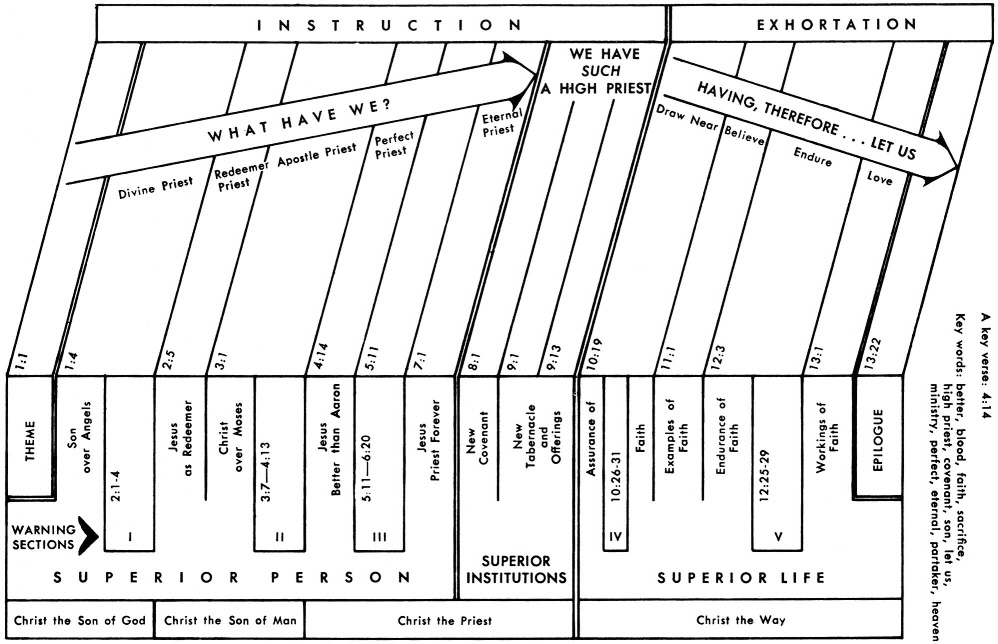
CONSIDER JESUS OUR GREAT HIGH PRIEST
Click chart to enlarge
Charts from Jensen's Survey of the NT - used by permission
Swindoll's Chart, Interesting Pictorial Chart of Hebrews, Another Chart
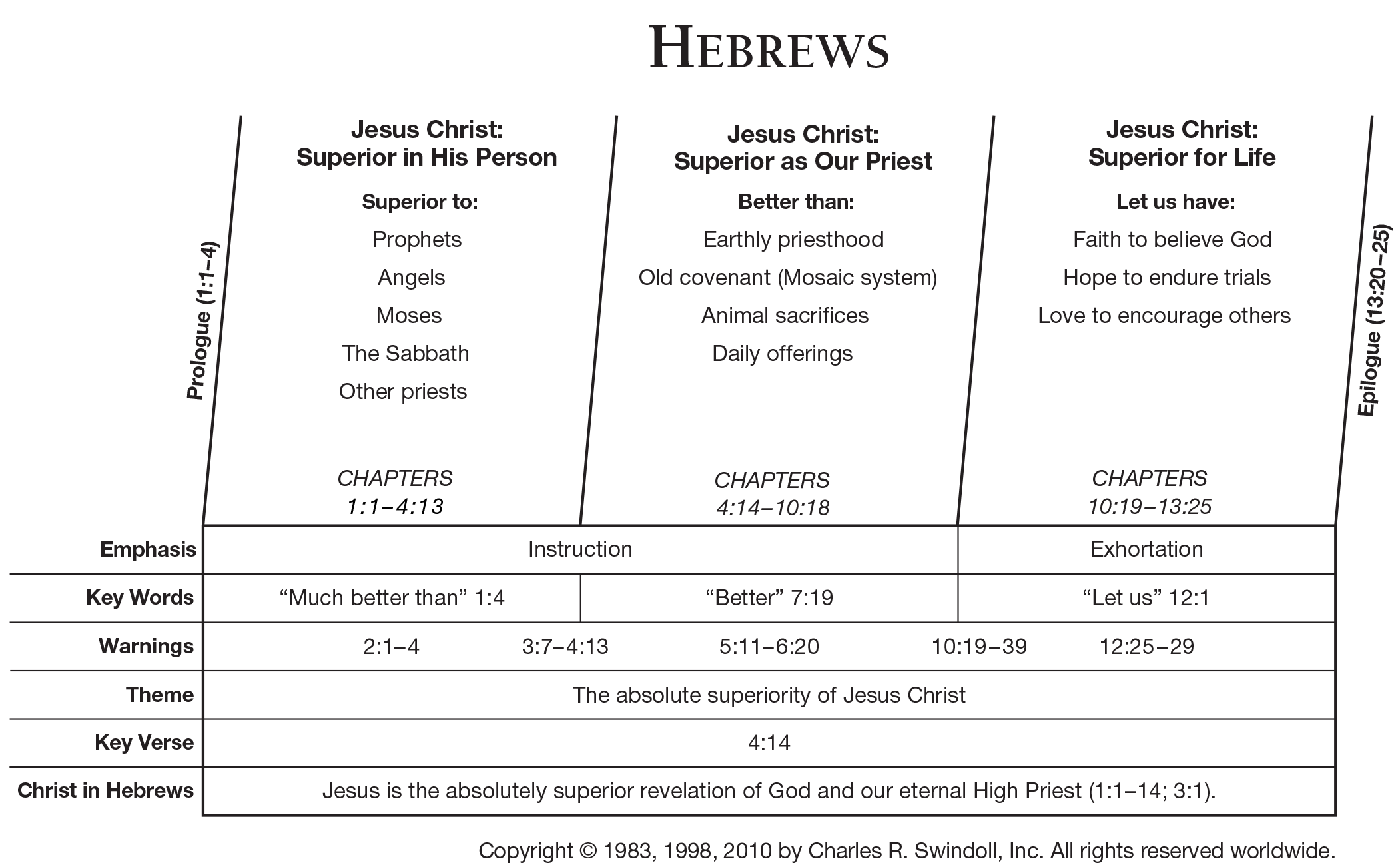
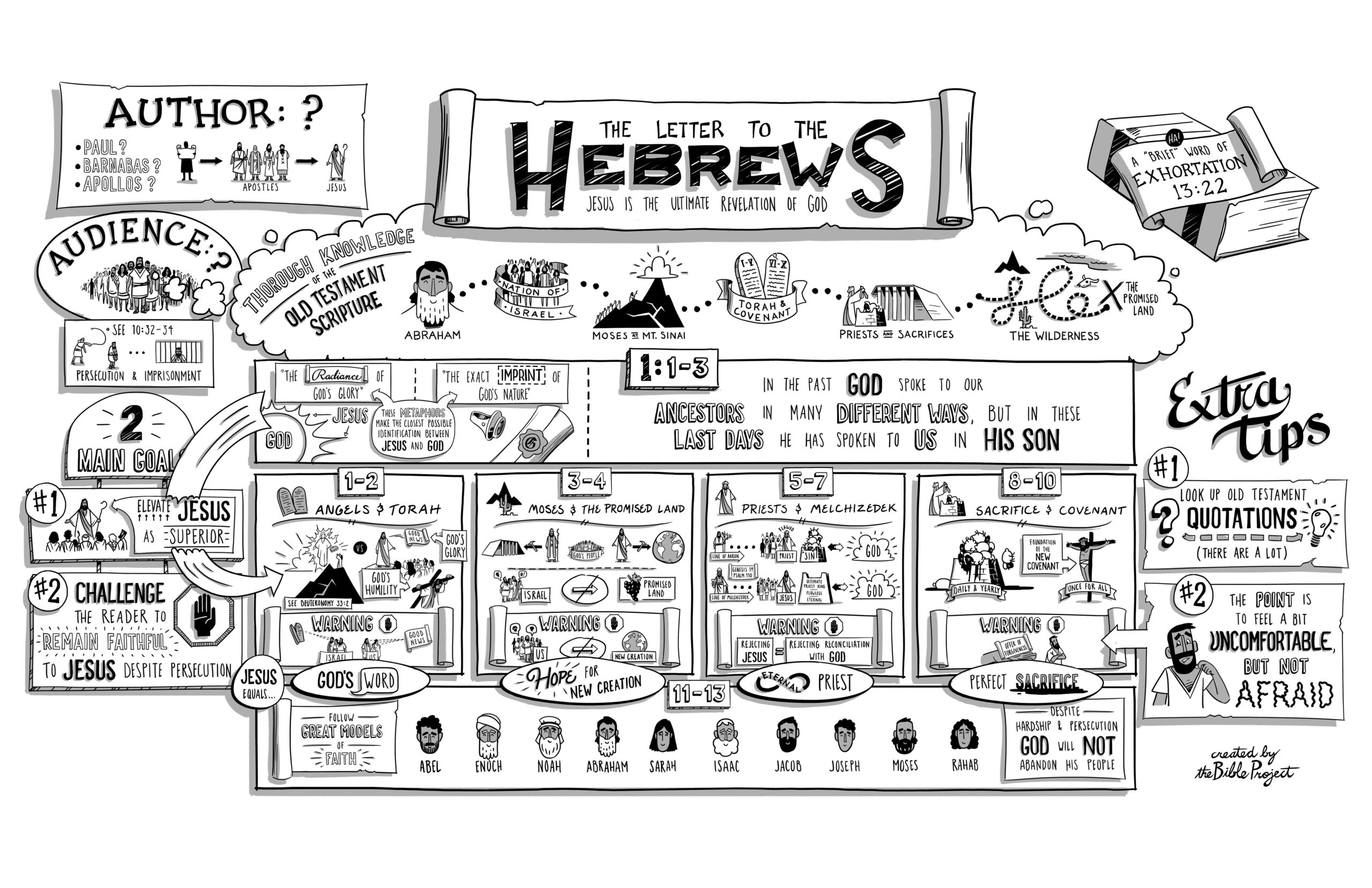
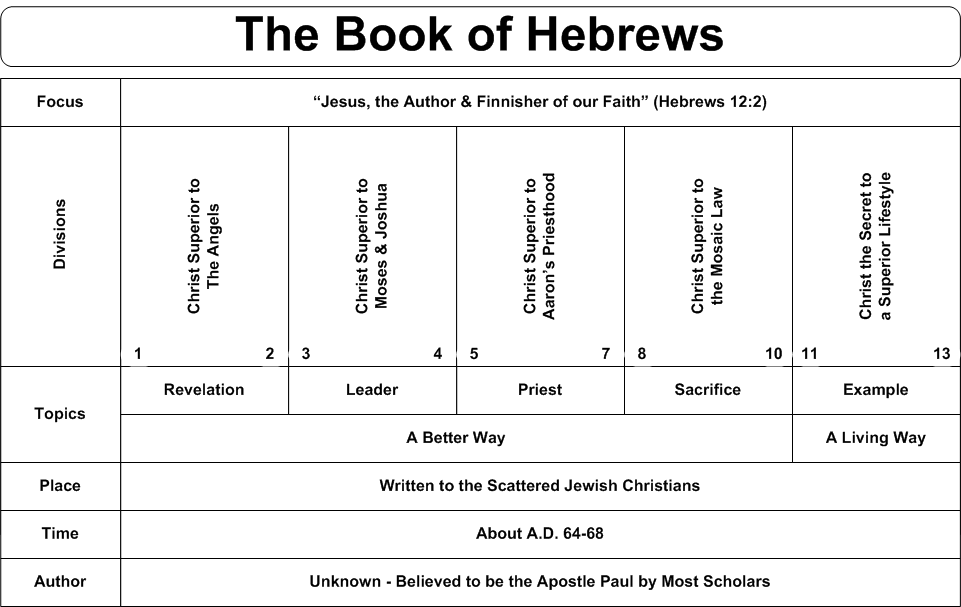
|
The Epistle |
||||
| INSTRUCTION Hebrews 1-10:18 |
EXHORTATION Hebrews 10:19-13:25 |
|||
| Superior Person of Christ Hebrews 1:1-4:13 |
Superior Priest in Christ Hebrews 4:14-10:18 |
Superior Life In Christ Hebrews 10:19-13:25 |
||
| BETTER THAN PERSON Hebrews 1:1-4:13 |
BETTER PRIESTHOOD Heb 4:14-7:28 |
BETTER COVENANT Heb 8:1-13 |
BETTER SACRIFICE Heb 9:1-10:18 |
BETTER LIFE |
| MAJESTY OF CHRIST |
MINISTRY OF CHRIST |
MINISTERS FOR CHRIST |
||
|
DOCTRINE |
DUTY |
|||
|
DATE WRITTEN: |
||||

See ESV Study Bible "Introduction to Hebrews"
(See also MacArthur's Introduction to Hebrews)
Borrow Ryrie Study Bible
| CONSIDER JESUS OUR GREAT HIGH PRIEST |
||||
| INSTRUCTION He 1:1-10:18 |
EXHORTATION He 10:19-13:25 |
|||
| REVELATION He 1:1-10:18 |
RESPONSE He 10:19-13:25 |
|||
| PRECEPTS He 1:1-10:18 |
PRACTICE He 10:19-13:25 |
|||
| DOCTRINE He 1:1-10:18 |
DUTY He 10:19-13:25 |
|||
| SUPERIORITY of CHRIST'S PERSON He 1:1-7:28 |
SUPERIORITY of CHRIST'S PRIESTHOOD He 8:1-10:18 |
SUPERIORITY of the CHRISTIAN'S PRACTICE He 10:19-13:25 |
||
|
MAJESTY |
MINISTRY |
MINISTERS |
||
|
SUPERIORITY |
SUPERIORITY |
SUPERIORITY |
||
|
Christ |
Christ |
Christ |
Christ |
|
|
This chart is adapted in part from Jensen's Survey of the NT and Wilkinson's Talk Thru the Bible |
||||
OT PASSAGES QUOTED IN HEBREWS 5 - Click for complete list of OT Quotations/Allusions
He 5:5 <> Ps 2:7
He 5:6 <> Ps 110:4
He 5:10 <> Ps 110:4
KEY WORDS IN HEBREWS 5 - Click for complete list of Key Words in Hebrews
Eternal - He 5:9
Sacrifice - He 5:1, 3
Priest - He 5:1, 5, 6, 10
Hebrews 5:4 And no one takes the honor to himself, but receives it when he is called by God, even as Aaron was. (NASB: Lockman)
Greek: kai ouch heauto tis lambanei (3SPAI) ten timen, alla kaloumenos (PPPMSN) hupo tou theou, kathosper kai Aaron.
BGT καὶ οὐχ ἑαυτῷ τις λαμβάνει τὴν τιμὴν ἀλλὰ καλούμενος ὑπὸ τοῦ θεοῦ καθώσπερ καὶ Ἀαρών.
Amplified: Besides, one does not appropriate for himself the honor [of being high priest], but he is called by God and receives it of Him, just as Aaron did. (Amplified Bible - Lockman)
Barclay: No one takes this honourable position to himself, but he is called by God to it, just as Aaron was. (Westminster Press)
KJV: And no man taketh this honour unto himself, but he that is called of God, as was Aaron.
NLT: And no one can become a high priest simply because he wants such an honor. He has to be called by God for this work, just as Aaron was. (NLT - Tyndale House)
Phillips: Note also that nobody chooses for himself the honour of being a High Priest, but he is called by God to the work, as was Aaron, the first High Priest in ancient times. (Phillips: Touchstone)
Wuest: And not to himself does one take this honor, but being called by God, even as also Aaron.
Young's Literal: and no one to himself doth take the honour, but he who is called by God, as also Aaron:
NET And no one assumes this honor on his own initiative, but only when called to it by God, as in fact Aaron was.
CSB No one takes this honor on himself; instead, a person is called by God, just as Aaron was.
ESV And no one takes this honor for himself, but only when called by God, just as Aaron was.
NIV No one takes this honor upon himself; he must be called by God, just as Aaron was.
NRS And one does not presume to take this honor, but takes it only when called by God, just as Aaron was.
NJB No one takes this honour on himself; it needs a call from God, as in Aaron's case.
NAB Hebrews 5:4 No one takes this honor upon himself but only when called by God, just as Aaron was.
MIT A person does not seize the honor of the office for himself; on the contrary, he must be called by God as was Aaron.
AND NO ONE TAKES THE HONOR TO HIMSELF: kai ouch heauto tis lambanei (3SPAI) ten timen:
- Ex 28:1; Leviticus 8:2; Nu 3:3; 16:5,7,10,35,40,46, 47, 48; 17:3-11; 18:1, 2, 3, 4, 5; 1Chr 23:13; 2Chr 26:18
- Hebrews 5 Resources - Multiple Sermons and Commentaries
PRIESTHOOD NOT
A VOLUNTEER POSITION!
In this section the writer continues with another critical requirement of the Jewish high priest, indicating that he must be chosen and appointed by God. Sadly by the time of Jesus, the priesthood was totally corrupted, but the writer is referring to the Biblical pattern that should have been followed.
Ryrie summarizes chapter 5…The qualifications for high priest are stated in these verses, Aaron serving as the model: (1) he had to be a man (Hebrews 5:1); (2) he had to be compassionate (Hebrews 5:2); (3) he had to be chosen by God (Hebrews 5:4, 5, 6); (4) he had to learn through suffering (Hebrews 5:7, 8).
And no one takes (lambano) the honor (time) to himself - No one (ouch) indicates absolute negation and continues the discussion specifically of the high priesthood (Heb 5:1) emphasizing that the requirements for who could be a priest in Israel were strictly stipulated in the Scripture and as Pink says, first and foremost, one had to be called by God to that position. Takes or even grasps is a good rendering for no one could simply decide he wanted to be the high priest and then declare himself as such! Absolutely no one could become a high priest simply by claiming to be one.
THOUGHT - How might we apply this truth in our lives today? If you are a believer, you have at least one spiritual gift (1Pe 4:10+, Ro 12:6+) and you are a priest (1Pe 2:9+) of the Most High God. In short, you have a ministry. The question then is have you discovered the ministry He has granted you or have you sought a ministry of your own making. Your answer has eternal ramifications, for unless we abide in the Vine, we can do nothing of eternal value (Jn 15:5). As Paul stated "we are His workmanship, created in Christ Jesus for good works, which God prepared beforehand so that we would walk in them." (Eph 2:10+) Will you walk in the good works pre-prepared in eternity past?
Dear Father, please show every man and woman reading these notes what Your ministry to and through them is and cause them to walk in your way and will in Christ Jesus, that them might bear much fruit (Jn 15:8) for eternity (Jn 15:16). Amen.
A W Pink makes the point that "Considering the strictness of God’s law, and the specified requirements for one entering the priestly office, and more especially seeing that Jesus did not belong to the tribe of Levi, how could He be said to be “Priest?” In meeting this difficulty, the apostle emphasizes the fact that the chief requirement and qualification was a Divine call: “No man takes this honor unto himself, but he that is called of God” (He 5:4): applying that rule the apostle now shows, from Scripture itself, our Lord’s right and title to this office.
Wuest - But the high priest must be divinely called to his office. One who is compassed with infirmity would hesitate to offer sacrifice for sin unless called by God to do so. (Hebrews Commentary online)
Takes (2983) (lambano) conveys the sense of one taking or grasping at a title or position (high priest) without any Biblical mandate.
Lambano in Hebrews - Heb. 2:2; Heb. 4:16; Heb. 5:1; Heb. 5:4; Heb. 7:5; Heb. 7:8; Heb. 7:9; Heb. 9:15; Heb. 9:19; Heb. 10:26; Heb. 11:8; Heb. 11:11; Heb. 11:29; Heb. 11:35; Heb. 11:36
Honor (5092) (time from tío = pay honor, respect) is basically, the worth ascribed to a person or the value ascribed to a thing. It refers to the worth or merit of some object, event, or state. It is a valuing by which the price is fixed, an estimation of the value of a thing. It is an attitude towards person or thing commensurate with its value and in the present context conveys the sense of rank, position or "office". This same Greek word (time) is used by the Jewish Historian Josephus to denote the “office” of high priest (Ant. 3.188–89).
Time in Hebrews - Heb. 2:7; Heb. 2:9; Heb. 3:3; Heb. 5:4
BUT RECEIVES IT WHEN HE IS CALLED BY GOD EVEN AS AARON WAS: alla kaloumenos (PPPMSN) hupo tou theou kathosper kai Aaron:
- Hebrews 5 Resources - Multiple Sermons and Commentaries
Related Passage:
Exodus 28:1+ (THE CALL OF GOD) “Then bring near to yourself Aaron your brother, and his sons with him, from among the sons of Israel, to minister as priest to Me–Aaron, Nadab and Abihu, Eleazar and Ithamar, Aaron’s sons.
Exodus 29:4+ (“Then you shall bring Aaron and his sons to the doorway of the tent of meeting and wash them with water.
Numbers 3:10 “So you shall appoint Aaron and his sons that they may keep their priesthood, but the layman who comes near shall be put to death.”
PRIESTHOOD IS A
DIVINE CALLING
But - Term of contrast. God did not ask for volunteers to be priest. The priesthood was His call! This principle is important for the writer to emphasize to his Hebrew audience since he will show how Jesus did not "volunteer" to be priest but was called by His Father (Heb 5:6).
Receives it when he is called (kaleo) by God, even as Aaron was - Receives is not in the Greek text but is supplied by the translators to lend fluidity to the sentence. The pronoun IT refers to the honor associated with the priesthood. John the Baptist declared "A man can receive nothing, unless it has been given him from heaven. (John 3:27) The office of high priest could not be campaigned for but was given by right of birth to the man chosen by God. It was an honor no man could take to himself.
THOUGHT - There is a practical application of the principle that the priest were divinely chosen, and did not choose themselves to be priests. God still calls His children to their roles in the body of Christ, some to pastor, some to teach, etc. The problem arises (and I have seen this one several times) when an individual sees teaching as an honored position in the church and seeks to teach, but he/she has not been called and equipped by God to be a teacher. In my experience this usually results is problems! Enough said! The best course of action is to seek His face, before you seek your position (teacher or otherwise).
Albert Mohler makes a good point stating that "God’s calling emphasizes the servant nature of the high priest’s role. Even though the high priest held an exalted office, his office was motivated by service and marked by humility." (Exalting Jesus in Hebrews)
Marcus Dods - An additional reason for trusting in the priest is that he has not assumed the office to gratify his own ambition but to serve God’s purpose of restoring men to His fellowship. All genuine priesthood is the carrying out of God’s will. The priest must above all else be obedient, in sympathy with God as well as in sympathy with man. God’s appointment also secures that the suitable qualifications will be found in the priest. (The Expositor's Greek Testament - online)
Spurgeon - Men could not constitute themselves high priests, for the appointment was made by God alone. The high priest was taken from among men that he might be their fellow, and have a fellow-feeling with them. No angel entered into the holy place; no angel wore the white garments; no angel put on the ephod and the breastplate with the precious stones. It was a man ordained of God, who for his brothers pleaded in the presence of the Shekinah.
When he is called - This refers to a call to a particular position and service to God. In the Old Testament this call to the Levitical priesthood was only given to certain men…
Then bring near to yourself Aaron your brother, and his sons with him, from among the sons of Israel, to minister as priest to Me-- Aaron, Nadab and Abihu, Eleazar and Ithamar, Aaron's sons. (Exodus 28:1)
Take Aaron and his sons with him, and the garments and the anointing oil and the bull of the sin offering, and the two rams and the basket of unleavened bread (Leviticus 8:2)
The sons of Amram were Aaron and Moses. And Aaron was set apart to sanctify him as most holy, he and his sons forever, to burn incense before the LORD, to minister to Him and to bless in His name forever. (1Chr 23:13)
Even as Aaron was - This reference to Aaron (a Levi, the first high priest) emphasizes that the priesthood was not a human institution but a divine calling.
There are some tragic examples where men presumed to act as priests who were not priests, such as Korah (Numbers 16+), Saul (1 Samuel 13:8-13+) and King Uzziah who disregarded the fact that no one was to attempt to function as a priest on his own volition. Scripture records that when King Uzziah (OBSERVE THE PROGRESSION - ONE THING I WOULD ADD IS THAT HE IS OLDER WHICH IS A CAUTION FOR ALL US OLDER FOLKS! YOU WILL SEE THAT THE HEART OF THE PROBLEM IS THE PROBLEM OF THE HEART!)…
became strong, his heart was so proud that he acted corruptly, and he was unfaithful to the LORD his God, for he entered the temple of the LORD to burn incense on the altar of incense… 18 And they opposed Uzziah the king and said to him, "It is not for you, Uzziah, to burn incense to the LORD, but for the priests, the sons of Aaron who are consecrated to burn incense. Get out of the sanctuary, for you have been unfaithful, and will have no honor from the LORD God." 19 But Uzziah, with a censer in his hand for burning incense, was enraged; and while he was enraged with the priests, the leprosy broke out on his forehead before the priests in the house of the LORD, beside the altar of incense. (GOD SENT THE JUDGMENT JUST AS HE DID WITH KORAH'S REBELLION) 20 And Azariah the chief priest and all the priests looked at him, and behold, he was leprous on his forehead; and they hurried him out of there, and he himself also hastened to get out because the LORD had smitten him. (2 Chronicles 26:16, 18, 19, 20)
Comment from ISBE on Uzziah's presumptive sin of assuming priestly function: In the earlier part of his career Uzziah had enjoyed and profited by the counsels of Zechariah, a man "who had understanding in the vision of God" (2Ch 26:5), and during the lifetime of this godly monitor "be set himself to seek God." Now it happened to him as with his grandfather Jehoash, who, so long as his preserver Jehoiada lived, acted admirably, but, when he died, behaved like an ingrate, and killed his son (2Ki 12:2; 2Ch 24:2,22). So now that Zechariah was gone, Uzziah's heart was lifted up in pride, and he trespassed against Yahweh. In the great kingdoms of the East, the kings had been in the habit of exercising priestly as well as royal functions. Elated with his prosperity, Uzziah determined to exercise what he may have thought was his royal prerogative in burning incense on the golden altar of the temple. Azariah the high priest, with 80 others, offered stout remonstrance; but the king was only angry, and pressed forward with a censer in his hand, to offer the incense. Ere, however, he could scatter the incense on the coals, and while yet in anger, the white spots of leprosy showed themselves upon his forehead. Smitten in conscience, and thrust forth by the priests, he hastened away, and was a leper ever after (2Ch 26:16-20, 21). Uzziah's public life was now ended. (Uzziah)
Hughes comments…All Israel's priests were to come only through divine appointment (Exodus 28:1-3; cf. Leviticus 8:1ff.; Numbers 16:5; 20:23ff.; 25:10ff.). Attempts to do otherwise met with catastrophic judgment. Korah and his 250 followers were swallowed by the earth because they elevated themselves to the priestly office by burning unauthorized incense (Numbers 16:16-40). Saul lost his reign because he impatiently assumed Samuel's priestly function (1 Samuel 13:8ff.). And Uzziah, wrongly utilizing a priestly censer, broke out with leprosy that lasted until his dying day (2 Chronicles 26:16-21)......The divine appointment of Aaron was confirmed, moreover, at the time of the revolt of Korah, Dathan, and Abiram who accused him of having exalted himself to a position of prominence and whom Moses rebuked with these words: "It is against the Lord that you and all your company have gathered together; what is Aaron that you murmur against him?" (Nu 16:11). Subsequently, the sprouting of Aaron's rod alone among the rods of the leaders convinced the rebellious Israelites that he was indeed the man whom God had chosen and not one who had arrogated the high priesthood to himself (Nu 17:1ff.; cf. Heb. 9:4). (A Commentary on the Epistle to the Hebrews)
Steven Cole…The appointment of the high priest: He does not take it upon himself, but must be called by God (He 5:4).Although in the first century the Jewish high priesthood had degenerated into a political appointment, the author overlooks that and goes back to the original intention. God called Aaron to the office of high priest (Ex 28:1, 2, 3), and he served as the example for all that followed. God’s appointment of Aaron to this office was confirmed during the rebellion of Korah, who accused Moses and Aaron of appointing themselves (Nu 16:1-35). God showed the rebels and all of Israel that He had appointed Moses and Aaron by causing the ground to open up and swallow the rebels and their households. When some in the congregation grumbled at this judgment, a plague broke out and killed over 14,000. That was a sober lesson that no one may dare to approach God in the way of man’s own choosing. The only way to approach God is through the way of God’s choosing, through His ordained mediator. In the Old Testament, that mediator was the high priest. But the fact that all of these priests were themselves sinners pointed to the inadequacy of that old covenant and the need for the perfect high priest, the Lord Jesus Christ (cp He 8:6, 9:15, 12:24). (The Kind of Priest You Need Hebrews 5:1-10)
In the OT a call of God to undeserving men was part of His gracious dealing with sinful mankind. We see examples of God's graciously calling individuals to certain "ministries"…
Abraham
1 Now the LORD said to Abram, "Go forth from your country, And from your relatives And from your father's house, To the land which I will show you; 2 And I will make you a great nation, And I will bless you, And make your name great; And so you shall be a blessing; 3 And I will bless those who bless you, And the one who curses you I will curse. And in you all the families of the earth shall be blessed." (Ge 12:1-3)
Moses
"Therefore, come now, and I will send you to Pharaoh, so that you may bring My people, the sons of Israel, out of Egypt." (Ex 3:10)
Bezaleel
"See, I have called by name Bezalel, the son of Uri, the son of Hur, of the tribe of Judah. 3 "And I have filled him with the Spirit of God in wisdom, in understanding, in knowledge, and in all kinds of craftsmanship, 4 to make artistic designs for work in gold, in silver, and in bronze, 5 and in the cutting of stones for settings, and in the carving of wood, that he may work in all kinds of craftsmanship. (Ex 31:2-5)
Isaiah
Then I heard the voice of the Lord, saying, "Whom shall I send, and who will go for Us?" Then I said, "Here am I. Send me!"9 And He said, "Go, and tell this people: 'Keep on listening, but do not perceive; Keep on looking, but do not understand. (Isaiah 6:8, 9)
Jeremiah
Now the word of the LORD came to me saying, 5 "Before I formed you in the womb I knew you, And before you were born I consecrated you; I have appointed you a prophet to the nations." (Jer 1:4, 5),
Ezekiel
Then He said to me, "Son of man, I am sending you to the sons of Israel, to a rebellious people who have rebelled against Me; they and their fathers have transgressed against Me to this very day. 4 "And I am sending you to them who are stubborn and obstinate children; and you shall say to them, 'Thus says the Lord GOD.' (Ezek 2:3-4)
All New Testament believers have been called into God's priesthood as Peter declared in his first epistle writing that…
you are A CHOSEN RACE, A royal PRIESTHOOD, A HOLY NATION, A PEOPLE FOR God's OWN POSSESSION, that you may proclaim the excellencies of Him who has called you out of darkness into His marvelous light (1Pe 2:9-note) (Note: Do not misinterpret Peter for he is not saying that the NT church replaces Israel in God's prophetic timetable - see discussion of Israel of God)
The question we each to ask is "Am I fulfilling my calling by God to the priesthood of believers?"
Guzik qualifies the believers' priesthood noting that…We can also not take the honor of being our own priest. It is great arrogance to think we can approach God on our own, without a priest; but it is great superstition to think we need any other priest other than Jesus Christ Himself. God has provided a mediator, a priest, and we must avail ourselves of the priest God has provided.
Matthew Poole in his excellent mid-seventeenth century commentary wrote that…A sinner can undertake to manage nothing towards God immediately, or by himself, but with a mediating priest, who must know God’s mind and perform it … The common sense of mankind about it since the fall doth evidence it; no nation being without a religion, a temple, a place of worship, or a priest.
C. H. Spurgeon had the following assessment regarding Matthew Poole's commentary writing that…If I must have only one commentary, and had read Matthew Henry as I have, I do not know but what I should choose Poole. He is a very prudent and judicious commentator… not so pithy and witty by far as Matthew Henry, but he is perhaps more accurate, less a commentator, and more an expositor.
Even as Aaron - see Ex. 28:1; Ex 29:4: Lev. 8:1: Nu 3:10 and especially Nu 16–18.
R Kent Hughes sums up the earthly priesthood - No genuine priest ever arrogated himself to the high priestly office. All were sovereignly chosen. Therefore, a proper priest was filled with deep humility. His work was never a career. It was a divine calling. What an inviting picture the ideal human high priest was. He bore Israel on his shoulders and over his heart. He was crowned with holy intent for all—"HOLINESS TO THE LORD." He kept the bells ringing as he worked at intercession and atonement. He was in solidarity with his people—he was one of them. He was a real link between them and God. He was in such sympathy with them that he always could "deal gently" with them. He was the product of divine selection—free from ego and hubris. He was selected to serve. How appealing this was to the Hebrew mind, and quite frankly to us! The ideal high priest was a man of incomparable attractiveness. (See Hebrews: An Anchor for the Soul)
Called (invite, name, summon) (2564)(kaleo from root kal-, whence English “call” and “clamour”) literally means to speak to another in order to attract their attention or to them bring nearer, either physically or in a personal relationship.
Kaleo in Hebrews - Heb. 2:11; Heb. 3:13; Heb. 5:4; Heb. 9:15; Heb. 11:8; Heb. 11:18
Before the Face of God - The Call of the Priest
No one takes this honor upon himself; he must be called by God, just as Aaron was. [Heb. 5:4]
From among humanity, the high priest was appointed by God. God called Aaron to serve as high priest without consulting the congregation. In the local synagogues, which arose during the Babylonian captivity, however, the people elected their elders and pastors as we do today. Still, the congregation does not appoint the pastor; God does. Thus, when our pastors challenge us about some sin or duty, we must not act as if they answer to us, as if they are our servants. Rather, they must answer to God, for they are his servants.
Hebrews 5:5 says that Christ did not take upon himself the honor and glory of being a high priest, but he was called and appointed by God to that position. The author of Hebrews cites Psalm 2:7 as proof. It is interesting that Psalm 2 deals with God’s appointment of a king, but the author of Hebrews applies it to the appointment of a priest. We discussed Psalm 2:7 when we dealt with Christ’s sonship and kingship in Hebrews 1:5 (see pp. 140–41). Here we are dealing with his priesthood.
The high priest was a king in that he presided over the house of God, over the church, just as the king presided over the land and public government. The high priest wore glorious robes and a crown, as would a king. Indeed, long before there was a king over Israel, there was a high priest over the center of the land, the house of God. Thus, the high priest was the spiritual ruler of Israel. Just as the Davidic kings were the “sons of God” by appointment to rule, so were the Aaronic high priests.
The Aaronic high priest took off his robes of glory and honor when he offered the sin offerings for himself and for the people, then put them back on (Levit. 16:23–24). In the same way, the Messiah was destined for glory and honor, but during his earthly life, he set them aside in order to accomplish our salvation. Now that he has finished the work, he has put on his proper glory. From that position on high he extends help to us.
Coram Deo - Those who are called by God to serve as pastors should feel terrified in their awesome job. God says that they are to be accorded glory and honor, largely because of the great task they have been called to perform. Consider whether you honor and glorify your spiritual leaders in the way the Bible says to do so.
Hebrews 5:5 So also Christ did not glorify Himself so as to become a high priest, but He who said to Him, "YOU ARE MY SON, TODAY I HAVE BEGOTTEN YOU" (NASB: Lockman)
Greek: Houtos kai o Christos ouch heauton edoxasen genethenai (3SAAI) archierea, all' o lalesas (AAPMSN) pros auton, Huios mou ei (2SPAI) su, ego semeron gegenneka (1SRAI) se;
Amplified: So too Christ (the Messiah) did not exalt Himself to be made a high priest, but was appointed and exalted by Him Who said to Him, You are My Son; today I have begotten You; (Amplified Bible - Lockman)
Barclay: So it was not Christ who gave himself the glory of becoming high priest; but it was God who said to him: “You are my beloved Son; today I have begotten you.” (Westminster Press)
KJV: So also Christ glorified not himself to be made an high priest; but he that said unto him, Thou art my Son, to day have I begotten thee.
NLT: That is why Christ did not exalt himself to become High Priest. No, he was chosen by God, who said to him, "You are my Son. Today I have become your Father." (NLT - Tyndale House)
Phillips: Thus we see that the Christ did not choose for himself the glory of being High Priest, but he was honoured by the one who said: 'You are my Son, today I have begotten you'. (Phillips: Touchstone)
Wuest: So also the Messiah did not glorify himself in becoming a high priest, but the One who said to Him, My Son you are, I this day have begotten you.
Young's Literal: so also the Christ did not glorify himself to become chief priest, but He who spake unto him: 'My Son thou art, I to-day have begotten thee;'
SO ALSO CHRIST DID NOT GLORIFY HIMSELF SO AS TO BECOME A HIGH PRIEST: Houtos kai o Christos ouch heauton edoxasen (3SAAI) genethenai (APN) archierea:
- Christ - John 7:18; 8:54
- Hebrews 5 Resources - Multiple Sermons and Commentaries
CHRIST DID NOT
SEEK SELF GLORY
MacArthur writes "Verses 5-10 show how Jesus met all the qualifications for high priest mentioned in verses 1-4, and more."
So (CSB = "in the same way") also - The writer is drawing a clear parallel with the Aaronic (Levitical) priesthood. Even as Aaron (and other Levitical priests) did not exalt themselves to the priesthood, so too Christ did not exalt Himself, but was appointed by His Father to be High Priest (as the writer has already alluded to - He 2:17+, He 3:1+, He 4:14+). What the writer is doing now is introducing the priesthood of Christ, beginning first with a comparison to Aaron. Just as Aaron did not seek the priesthood but was called by God, so too with Jesus Who was called by God, as substantiated with two OT quotes from the Psalms, passages that all Jews recognized as clearly Messianic. (Heb 5:5b and Heb 5:6)
Christ did not glorify Himself so as to become a high priest - The definite article is present before "Christ" so that this reads literally "the Christ" and thus the "Messiah", the "Anointed One" (cp Da 9:25+, Da 9:26+) as translated in the CSB ("the Messiah did not exalt Himself").
Wuest - The writer is careful to let the reader see that it was no personal ambition on Messiah’s part that resulted in His becoming a high priest, but rather the fact that God called Him to that position, and that the call to priesthood was based upon the fact that the Messiah was God’s Son.
Pink makes the point that in using "the Christ", the writer's specific "design was to demonstrate that the promised Messiah, (Hebrew = Mashiach - 04899) the Hope of the fathers (Jer 50:7, Acts 26:6), was to be High Priest forever over the house of God. The “Anointed One” (meaning of "Messiah") signified His unction unto this office.
Marcus Dod makes the point that "The designation, “the Christ,” is introduced, because it might not have seemed so significant a statement if made of “Jesus”. It was not personal ambition that moved Christ. He did not come in His own name, nor did He seek to glorify Himself. See Jn 8:54; 5:31, 43; 17:5 (Hebrews 5 Commentary Online)
The primary ministry of Jesus today is as our forever High Priest Who represents us before God the Father Who chose His Son to be our eternal Priest. If we were first century Jews who had believed in the Messiah, it would be difficult to grasp the truth that Jesus was the Great High Priest. He was not from the line of Aaron. Even when He was in the Temple in Jerusalem, He did not attempt to practice what the Jews would recognize as a priestly ministry. And so we can understand why the writer goes to such great lengths to explain why Jesus would be qualified to be a High Priest. The writer is trying to get his Jewish readers to make what we would call today a "paradigm shift" in their thinking - ultimately a shift from the Old Covenant of law, bondage and death to the New Covenant of grace, freedom and life.
THOUGHT- Dear searching reader, have you made that "paradigm shift"? Even in the time of the Old Covenant the way of salvation was clearly proclaimed and the call of God has always been…"Turn to Me, and be saved, all the ends of the earth; For I am God, and there is no other." (Is 45:22- see How God used this very passage to save Charles Haddon Spurgeon from the guttermost to the uttermost!)
And so Jesus did not glorify Himself. Instead in John Jesus speaks of the One Who gives glory…
John 7:18+ "He who speaks from himself seeks his own glory; but He who is seeking the glory of the One Who sent Him (God the Father), He is true, and there is no unrighteousness in Him.
John 8:54+ Jesus answered, "If I glorify Myself, My glory is nothing; it is My Father who glorifies Me, of Whom you say, 'He is our God';
In fact Jesus exemplified the antithesis of self-glorification in His kenosis or self-emptying…
but emptied Himself, taking the form of a bond-servant, and being made in the likeness of men. (Php 2:7-note, in perfect accord with Mt 23:12, which is the example for all His disciples!)
Glorify (1392)(doxazo) means Christ did not ascribe praise to Himself or esteem Himself by putting Himself into the honorable position of high priest.
Hughes - The sayings of Christ recorded in the Fourth Gospel make it emphatically plain that the glory which the Son sought with intense singleness of purpose was the glory of the Father who had sent him (Jn 7:18; 8:42; 9:4; 10:18, 25, 38; 11:42; 12:28, 44f, 49f; 14:7, 9, 13, 24, 31; 15:8, 23; 16:27f.; 17:1, 4ff.). Indeed, if one thing is stressed throughout the New Testament it is that, in assuming the office of Savior and High Priest, so far was the Son from exalting and glorifying Himself that He accepted it knowing full well that it meant for Him the experience of the darkest depths of humiliation, rejection, agony, and death. His office-bearing was the furthest possible remove from self-glorification. To put it colloquially, there was nothing in it for him—only the certainty of unutterable anguish and alienation and immolation suffered vicariously for our redemption. Yet the cross of Christ is also the glory of Christ. This moment of his solitude and self-sacrifice is also the moment when He is glorified, not indeed self-glorified, but glorified because in Him God is glorified and the divine purpose for the redemption of the world is now accomplished (cf. Jn 12:23; 13:31; Heb. 10:9f.). And the awful glory of His humiliation is followed by the resplendent glory of His exaltation—not, again, self-exaltation—when, raised to the right hand of the Majesty on high, the glory of His triumphant redeemership is, so to speak, added to the glory, which He now resumes, of His eternal sonship (cf. Heb. 1:3; 2:9; 12:2; Acts 3:13; Phil. 2:5-11; Jn. 17:4f., 24).A Commentary On The Epistle To The Hebrews. (A Commentary on the Epistle to the Hebrews)
Spurgeon - Christ was ordained of God from all eternity to stand as the representative of His people before the throne. “The Lord has laid on him the iniquity of us all” (Isa 53:6). He from old eternity was set apart to be the High Priest and the Redeemer of His people. Can you not in this see grounds for resting upon Him? What God appoints it must be safe for us to accept.
Wuest - The writer is careful to let the reader see that it was no personal ambition on Messiah’s part that resulted in His becoming a high priest, but rather the fact that God called Him to that position, and that the call to priesthood was based upon the fact that the Messiah was God’s Son. Bruce says regarding this: “Christ’s priestly vocation ceases to be an accident in history, and becomes an essential characteristic of His position as Son: sonship, Christhood, priestliness, inseparably interwoven.” We have an unfinished sentence which the writer expects the reader to complete. It appears in its entirety in the translation offered. (Hebrews Commentary online)
High priest (749) (archiereus from arche = first in a series, the leader or ruler + hiereus = priest) (Dictionary articles - Easton's; ISBE) refers to the priest that was chief over all the other priests in Israel. This office was established by God through Moses instructions in the Pentateuch. The high priest functioned as the mediator between Jehovah and Israel performing sacrifices and rituals like other priests, but in addition acting to expiate the sins of the nation on the annual Day of Atonement. The references to the high priests in the Gospels and Acts refer primarily to their bitter opposition to Jesus Who the writer of Hebrews identifies as our everlasting High Priest. The irony is that the high priest Caiaphas was residing over the Sanhedrin during trial of Jesus, the trial which would lead to His death and pave the way for His eternal High Priesthood!
BUT HE WHO SAID TO HIM "THOU ART MY SON, TODAY I HAVE BEGOTTEN THEE": all o lalesas (AAPMSN) pros auton Huios mou ei (2SPAI) su ego semeron gegenneka (1SRAI) se:
- Thou art My son - Hebrews 1:5; Ps 2:7; Micah 5:2; John 3:16; Acts 13:33; Romans 8:3
- Hebrews 5 Resources - Multiple Sermons and Commentaries
GOD'S CALL OF HIS SON
TO THE PRIESTHOOD
Having just stated that no man was entitled to appoint himself as high priest but that he became such only by divine call, even Christ did not make Himself High Priest, but God the Father recognized Him as such. The writer's argument is that just as much as Jesus was declared to be the Son of God by God Himself (Psalm 2:7), so also Jesus was declared to be a priest forever according to a different order, not of Levi but of Melchizedek (Psalm 110:4).
MacDonald adds that this quotation demonstrates to the Jewish readers that "Our Priest is the unique Son of God, eternally begotten, begotten in incarnation, and begotten in resurrection (see Acts 13:33)." (BORROW Believer's Bible Commentary)
Kent: Inasmuch as Jesus was of Judah, not of Levi and Aaron, it must be demonstrated that to regard Him as priest is not an illegal intrusion into the priestly office. It needs to be shown that Jesus possessed a call from God to the priesthood. Two passages from the Psalms are cited as proof texts that Christ holds His priesthood by divine appointment . . . the two quotations fully substantiate Christ’s qualifications as a Melchizedek-type priest, showing Him to be recognized by God as king as well as priest. . . His identification as my Son and His establishment as a priest forever are both features that are superior to anything known in the Levitical system. . . God has planned that Messiah should concentrate in Himself the authority of kingly rule, and this will involve also His spiritual ministration as the great high priest. Because He is the Son of God, believes need not fear that abuse of His power will occur, or that either aspect will be ignored. He is presently our high priest in heaven, and when He comes again it will be to reign as King of kings, while continuing His perfect representation of His people to God.
Charles Swindoll - By citing Psalm 2:7 again (see Heb. 1:5), the author reminds us that Jesus is not merely qualified to be a priest, but also to be exalted as the Anointed King. Then, quoting Psalm 110:4, he draws the two offices together, firming up this identification of the Messiah as both King and Priest—a priest in the order of Melchizedek rather than the order of Aaron (Heb. 5:6, 10; see Ge 14:18). Here the difference between Aaron’s earthly priesthood and Jesus’ heavenly priesthood stand in sharp contrast. In the order of Melchizedek, Christ is a “priest forever” (Heb 5:6). With that different priesthood comes a host of other distinctions to be addressed in more detail in Hebrews 7. (See Insights on Hebrews)
Spurgeon - The text is quoted from Psalm 2, and it proves that Christ did not arrogate to Himself any position before God. He is God’s Son, not merely because He calls Himself so, but because the Father says, “You are my Son, today have I begotten you.” He took not this honor upon Himself, but He was “called of God, as was Aaron.”
Phil Newton adds that "None of the angels were declared to be the Son of God. The same is true of the high priests. They were sons of Aaron, the first high priest in the tribe of Levi and father and grandfather of all who followed. Quoting from the second Psalm a passage already quoted in He 1:5, the writer now declares the uniqueness of the sonship of Jesus Christ. In that Psalm the ancient hymnist muses on the nations' rebellion against the Creator as Sovereign. Here he declares that God the Creator has "installed" His King-Jesus Christ the Lord-to rule the nations! How does he identify this King? "YOU ARE MY SON, TODAY I HAVE BEGOTTEN YOU." Even in the face of Neronian persecution these struggling believers could have confidence that God the Son reigns! They did not have to go on in fear but with confidence that His purposes would be accomplished because He reigns over the nations. The emphasis on "You are My Son" points to the Incarnation. He is the eternal Son of God without beginning or end; but He is also the Son born in time-born of woman, embracing a human nature forever. We could think of His reigning over humanity from his lofty heavenly throne without being human. But we could not think of Him serving as our high priest without being one of us. Thus the Incarnation is the declaration of the Son of God becoming a Son of Man, so that as high priest mediating the way for us, we might become sons of God. (Jesus Christ: Qualified as High Priest Hebrews 5:1-10) (Bolding added)
Psalm 2 is a Psalm which is indisputably Messianic as shown by the fact that the NT writers quote from it in references that are clearly speaking of Jesus. The reader is encouraged to listen to or read the exposition of this great psalm by my dear brother in Christ, Tony Garland entitled Why Do the Nations Rage?. The Jewish readers of this exhortational letter ("sermon") to the Hebrews undoubtedly understood Psalm 2 and Psalm 110 (quoted in Hebrews 5:6) as prophecies related to the Messiah, their Hope. And so the writer buttresses his argument by quoting from Psalm 2:7. As you recall, the writer had previously quoted from Psalm 2:7 in He 1:5 (note) using this quotation to establish the fact that Christ was superior to the angels. Now in Hebrews 5 the writer quotes from this same psalm to help him establish that the priesthood of Christ is superior to the Levitical priesthood, for no Levitical priest was ever called the Son of God.
Psalm 2:7 "I will surely tell of the decree of the LORD: He said to Me, 'Thou art My Son, Today I have begotten Thee.
Psalm 2:7+ is also quoted by Paul in Acts 13. Upon Jesus' resurrection God is said to have declared Christ as begotten, Luke recording Paul's quotation from Psalm 2 stating…
that God has fulfilled this promise to our children in that He raised up Jesus, as it is also written in the second Psalm, 'THOU ART MY SON; TODAY I HAVE BEGOTTEN THEE.' (Acts 13:33+)
In the context of Acts 13 Paul relates the prophecy in Psalm 2:7 to Christ's resurrection, rather than His incarnation. Jesus’ resurrection from the dead marks the time at which Jesus could fully assume His role as our great High Priest. In other words, prior to this time (as far as I can discern from the Scriptures) Jesus did not function specifically as the Great High Priest. Note that in Acts, Paul referred to Psalm 2 as the "the second psalm," supporting that the chapter divisions in the book of Psalms are not the product of medieval scholars.
Warren Wiersbe explains the writer's use of the second psalm - The phrase "today have begotten Thee" does not refer to the birth of Christ at Bethlehem, but to His resurrection from the dead. The Son of God was "begotten" into a glorious new life in His resurrection! He ascended to heaven in a glorified body to become our High Priest at the throne of grace. When Aaron was ordained to the priesthood, he offered the sacrifices of animals. But Jesus Christ, to become our High Priest, offered the sacrifice of Himself--and then arose from the dead! (BORROW The Bible Exposition Commentary)
In a parallel passage Paul writes that Jesus…
was declared the Son of God with power by the resurrection from the dead (i.e., the resurrection of Jesus is proof of His deity), according to the Spirit of holiness, Jesus Christ our Lord (Ro 1:4+)
Spurgeon commenting on Psalm 2:7 writes…
This Psalm wears something of a dramatic form, for now another person is introduced as speaking. We have looked into the council chamber of the wicked, and to the throne of God, and now we behold the Anointed (Ed note: the Messiah) declaring His rights of sovereignty, and warning the traitors of their doom.
God has laughed at the counsel and ravings of the wicked, and now Christ, the Anointed, Himself comes forward, as the Risen Redeemer, "declared to be the Son of God with power, according to the spirit of holiness, by the resurrection from the dead." Romans 1:4. Looking into the angry faces of the rebellious kings, the Anointed One seems to say, "If this sufficeth not to make you silent."
I will declare the decree. Now this decree is directly in conflict with the device of man, for its tenor is the establishment of the very dominion against which the nations are raving.
Thou art my Son. Here is a noble proof of the glorious Divinity of our Immanuel. "For unto which of the angels said he at any time, Thou art my Son, this day have I begotten thee?" What a mercy to have a Divine Redeemer in Whom to rest our confidence!
This day have I begotten thee. If this refers to the Godhead of our Lord, let us not attempt to fathom it, for it is a great truth, a truth reverently to be received, but not irreverently to be scanned. It may be added, that if this relates to the Begotten One in his human nature, we must here also rejoice in the mystery, but not attempt to violate its sanctity by intrusive prying into the secrets of the Eternal God. The things which are revealed are enough, without venturing into vain speculations. In attempting to define the Trinity, or unveil the essence of Divinity, many men have lost themselves: here great ships have foundered. What have we to do in such a sea with our frail skiffs?
Octavius Winslow has the following devotional on Hebrews 5:5 -
The Atonement of Christ is of infinite value and efficacy. If Christ were a mere creature, if He claimed no higher dignity than Gabriel, or one of the prophets or apostles, then His atonement, as it regards the satisfaction of Divine justice, the honoring of the law, the pardon of sin, the peace of the conscience, and the salvation of the soul, would possess no intrinsic efficacy whatever. It would be but the atonement of a finite being - a being that possessing no superior merit to those in whose behalf the atonement was made. We state it, then, broadly and unequivocally, that the entire glory, dignity, value, and efficacy of Christ's precious blood which He shed for sin rests entirely upon the Deity of His person. If the Deity of Christ sinks, the atonement of Christ sinks with it; if the one stands, so stands the other. How strong are the words of Paul, addressed to the Ephesian elders: "Take heed therefore unto yourselves, and to all the flock over which the Holy Spirit has made you overseers, to feed the church of God which He has purchased with His own blood." How conclusive is this testimony! The blood that purchased the church was Divine. It was indeed the blood of Christ's humanity-for His human nature alone could suffer, bleed, and die-yet deriving all its glory, value, and efficacy from the union of the human with the Divine nature. It was the blood of the God-man, Jehovah Jesus-no inferior blood could have sufficed. The law which Adam, our federal head, broke, before it could release the sinner from its penalty, demanded a sacrifice infinitely holy, and infinitely great: one equal with the Father-the dignity of whose person would impart infinite merit to His work, and the infinite merit of whose work would fully sustain its honor and its purity. All this was found in the person of Christ. In His complex person He was eminently fitted for the mighty work. As God, He obeyed the precepts and maintained the honor of the law; as man, He bore its curse and endured its penalty. It was the blending as into one these two natures; the bringing together these extremes of being, the finite and the infinite, which shed such resplendent luster on His atonement, which stamped such worth and efficacy on His blood. Dear Reader, treat not this subject lightly, deem it not a useless speculation! It is of the deepest moment. If the blood of Christ possesses not infinite merit, infinite worth, it could never be efficacious in washing away the guilt of sin, or in removing the dread of condemnation. When you come to die, this, of all truths, if you are an experimental believer, will be the most precious and sustaining. In that solemn hour, when the curtain that conceals the future parts, and eternity lets down upon the view the full blaze of its awful realities-in that hour, when all false dependencies will crumble beneath you, and sin's long catalogue passes in review before you-oh, then to know that the Savior on whom you depend is God in your nature-that the blood in which you have washed has in it all the efficacy and value of Deity-this, this will be the alone plank that will buoy up the soul in that awful moment, and at that fearful crisis. Oh precious truth this, for a poor believing soul to rest upon! We wonder not that, fast anchored on this truth, amid circumstances the most appalling, death in view; wearing even its most terrific aspect, the believer in Jesus can survey the scene with composure, and quietly yield his spirit into the hands of Him who redeemed it.
Hebrews 5:6 just as He says also in another passage, "YOU ARE A PRIEST FOREVER ACCORDING TO THE ORDER OF MELCHIZEDEK." (NASB: Lockman)
Greek: kathos kai en hetero legei, (3SPAI) Su hiereus eis ton aiona kata ten taxin Melchisedek.
Amplified: As He says also in another place, You are a Priest [appointed] forever after the order (with the rank) of Melchizedek. (Amplified Bible - Lockman)
Barclay: Just so he says also in another passage: “You are a priest for ever according to the order of Melchizedek.” (Westminster Press)
KJV: As he saith also in another place, Thou art a priest for ever after the order of Melchisedec.
NLT: And in another passage God said to him, "You are a priest forever in the line of Melchizedek." (NLT - Tyndale House)
Phillips: And he says in another passage: 'You are a priest forever according to the order of Melchizedek'. (Phillips: Touchstone)
Wuest: As He says also in another place, You are a priest forever after the order of Melchizedek;
Young's Literal: as also in another place He saith, 'Thou art a priest -- to the age, according to the order of Melchisedek;'
JUST AS HE SAYS ALSO IN ANOTHER PASSAGE: kathos kai en hetero legei (3SPAI):
- Hebrews 5 Resources - Multiple Sermons and Commentaries
QUOTING FROM PSALM 110:4
Just as He says - Clearly the writer of Hebrews states it was the Father speaking in Ps 110:4, a Psalm of David, which the Jews readily accepted as a Messianic psalm. As an aside, passages such as this attest to the fact that God is the Author of the Old Testament.
In another place - The Greek is heteros referring to another but one that is different. To illustrate in Acts 7:18 Luke records that after Joseph's death "another (heteros) king (pharaoh) arose" one of quite a different character.
The Priesthood of our Lord was not according to the Levitical order but was of a completely different character, an order that had been prophesied almost 1000 years earlier in the Messianic Psalm 110:4 which in a sense becomes the main text in the central section of the letter (see He 5:10; 6:20; He 7:1, 2, 3, 11, 15, 17, 21).
Macaulay: Our Lord's priesthood is as firmly and divinely established as His sonship. As the one is made a matter of eternal decree, so the other is confirmed by divine oath.
Wuest - After informing his readers in verse 5 that Messiah’s priesthood was not by self-appointment but by God’s appointment, the writer goes on in this verse to speak of the different and superior order of priesthood into which He was called. He quotes from Psalm 110 where Messiah is prophetically pointed out as a priest after the order of Melchisedec, the distinguishing characteristic of this order of priesthood being that it is an eternal one. (Hebrews Commentary online)
The writer appeals to Psalm 110:4 four other times in Hebrews attesting to its significance in establishing the validity of Jesus' high priesthood…
Hebrews 5:10+ being designated by God as a high priest according to the order of Melchizedek.
Hebrews 6:20+ where Jesus has entered as a forerunner for us, having become a high priest forever according to the order of Melchizedek.
Hebrews 7:17+ For it is witnessed of Him, "THOU ART A PRIEST FOREVER ACCORDING TO THE ORDER OF MELCHIZEDEK."
Hebrews 7:21+ (for they indeed became priests without an oath, but He with an oath through the One who said to Him, "THE LORD HAS SWORN AND WILL NOT CHANGE HIS MIND, 'THOU ART A PRIEST FOREVER'")
Note that the first verse of Ps 110 has already been utilized by the writer (Heb 1:13-note) to defend the fact that Jesus is superior to the angels in having a better position…
The Lord says to my Lord: “Sit at My right hand until I make Your enemies a footstool for Your feet.” (Ps 110:1).
THOU ART A PRIEST FOREVER ACCORDING TO THE ORDER OF MELCHIZEDEK: Su hiereus eis ton aiona kata ten taxin Melchisedek:
- Thou art - Heb 5:10; Heb 6:20; Heb 7:3,15,17,21; Psalm 110:4
- Order of Melchizedek - Genesis 14:18,19
- Hebrews 5 Resources - Multiple Sermons and Commentaries
Related Passages:
Hebrews 7:3 Without father, without mother, without genealogy, having neither beginning of days nor end of life, but made like the Son of God, he remains a priest perpetually.
Hebrews 7:15 And this is clearer still, if another priest arises according to the likeness of Melchizedek,
Hebrews 7:17 For it is attested of Him, “YOU ARE A PRIEST FOREVER ACCORDING TO THE ORDER OF MELCHIZEDEK.”
Hebrews 7:21 (for they indeed became priests without an oath, but He with an oath through the One who said to Him, “THE LORD HAS SWORN AND WILL NOT CHANGE HIS MIND, ‘YOU ARE A PRIEST FOREVER’”);
A NEW PRIESTLY ORDER
DECLARED BY GOD
Thou art a priest forever - God declares His Son is a priest even though He is not from tribe of Levi. God said it so that settles it! He sets the rules and here He does it according to the Scripture because Melchizedek's priesthood antedated the Levitical priesthood. Such a statement would startle the Hebrew readers for such a declaration could never be made of the Levitical priests, all of whom eventually died. There is a greater priesthood than Aaron! The priesthood of Christ is a better priesthood because He lives and mediates forever (cp He 7:3, He 7:23, 24, He 7:28) (See excellent article on Priest, Priesthood in Baker's Evangelical Dictionary of Biblical Theology)
Phillips says: The writer now shows his hand and reminds the Jews of something they had long forgotten: that there was a priesthood which far exceeded that of Aaron and which was in existence long centuries before Aaron ever was born, the priesthood of Melchizedek. God chose Melchizedek to be a priest long before He chose Aaron. In fact, the first mention of the priest in the Bible relates to the priesthood of Melchizedek (Gen 14:18-21). This sudden mention of Melchizedek throws a shaft of light into the whole argument of the letter. It would become immediately apparent to the intelligent Hebrew where the argument was leading.
Phil Newton writes that "We must not miss the emphasis of He 5:6. For the writer stresses that while the Jewish high priests were appointed divinely in the order of Aaron to serve their office, the appointment of Jesus Christ supersedes all of them. His appointment is unique in that he has no claim to the high priesthood humanly speaking since he was from the tribe of Judah, not the tribe of Levi. The high priesthood was not up for grabs or given to the highest bidder. It was a sacred trust of Aaron's sons. But Christ was appointed as the only high priest whose mediatorial work would have eternal value. All of the others were mere shadows of Him who would be appointed by God as Mediator. (Or another article on "Mediator") Without a mediator we have no way to God. We have seen that time after time in analyzing our sinful condition. Only one has been appointed. Only one has been accepted by God: the Son Whom He declared, "a priest forever according to the order of Melchizedek." Here was the predicament facing this first century audience. Some were thinking that they could chart their own course to God. They could divine their own way to eternal life. Much like the multitudes in our own day that think that the rules change or bend for them, they thought that obedient faith in Jesus Christ was not the only way to God. But the only priest whose work is "forever" is Jesus Christ. Therefore, the only one who can break through the barrier of our sinfulness and deliver us in righteousness to the Creator is the One who bore God's judgment for us at the cross. Are you one whose faith in Jesus Christ is slipping and sliding away? There's one anchor for the soul-Jesus Christ. (Jesus Christ: Qualified as High Priest Hebrews 5:1-10) (Bolding and links added)
Spurgeon - Beloved, there is rich comfort for all believers in the fact that Christ is God’s appointed and accepted High Priest. God ordained Him to do what He has done, and is doing, and will do; and therefore it is impossible but that God should accept Him and all His work. When He came into the world the Holy Ghost bore witness to His being the Son of the Highest. At His baptism there came a voice from heaven saying, “You are my beloved Son, in whom I am well pleased” (Matt 3:17; Mark 1:11), and that same voice was thrice heard declaring the same fact. The Father has given further testimony to the mission of Christ, “in that He has raised Him from the dead” (Acts 17:31), and has caused Him to enter into the heavenly places on our behalf. Moreover, He has given Him a pledge that as Melchizedek, being both king and priest, He shall sit at His right hand until He has made His enemies His footstool (Psa 110:1). Our Lord Jesus has been chosen, ordained, and glorified as our “great high priest that has passed into the heavens” (Heb 4:14). This is the groundwork of our comfort in our Lord Jesus.
Wiersbe: Just as the Jewish high priest was appointed by God, so our high priest was appointed by the Father (Psa. 110:4); and He alone is worthy to serve. Never allow anybody to come between you and God, for Christ is the only mediator (1 Tim. 2:5). "The order of Melchizedek" refers to Genesis 14:18-24. Being from the tribe of Judah, Jesus could not serve as priest on earth; but He can serve as priest in heaven. He is there ministering for you today.
Expositor's Bible Commentary note on priest - The author of Hebrews uses it of priests generally (He 7:14; 8:4), of the Levitical priests (He 7:20, etc.), of Melchizedek (He 7:1, 3), and of Christ (He 5:6; 7:11, 15, 17, 21; 10:21). When it is used of Christ, it seems to differ but little from "high priest." It is a powerful way of bringing out certain aspects of Christ's saving work for men. All that a priest does in offering sacrifice for men Christ does. But whereas they do it only symbolically, he really effects atonement. (The Expositors Bible Commentary)
According to the order - Even as the earthly priests were from the Aaronic "order", the lineage of Aaron, this Great High Priest was according to an "order" but one distinct from Aaron.
Order (5010) (taxis from tasso = arrange in order) describes a setting in order, and hence speaks of an order, an arrangement, or a disposition. Taxis was used especially in the description of military troops whose line was unbroken and intact.
Taxis - 9x in 8v in the NAS - Luke 1:8; 1Co 14:40; Col 2:5; Heb 5:6, 10; 6:20; 7:11, 17. NAS = good discipline(1), order(7), orderly manner(1).
Recall the writer discusses three requirements for the priesthood in Hebrews 5…
(1) He was appointed on men’s behalf to deal with the things concerning God and as such functioned as the link between God and man.
(2) The priest must be one with men and must have gone through men’s experiences so that his sympathy would be with them.
(3) No man appoints himself to the priesthood but his appointment is of God. The priesthood is not a coveted office to be taken but a glorious privilege to which one is called. This latter point is applicable to all believers today, for all have been made priests in Christ Jesus. It follows that their specific ministry to and for God should not be one they chose, but one they received from God.
Christ met all requirements for the priesthood except that of descent from Aaron. And yet this seeming deficiency did not disqualify Him, for He was of another priestly order, greater even than that of Aaron and Levi. The psalmist had prophesied of this greater order…
Ps 110:4 The LORD has sworn and will not change His mind, "Thou art a priest forever According to the order of Melchizedek."
Melchizedek is clearly a "key word" in this central section of Hebrews (He 5:6, 10, 6:20, 7:1, 10, 11, 15, 17). And despite his prominent place in this letter Melchizedek was a very mysterious priest/king who met Abraham when he returned from defeating the marauding confederation of kings from the north (see Genesis 14:17, 18, 19). In the Genesis account, he is merely called "king of Salem" (meaning "peace") and "priest of the most high God" (the Hebrew name is El Elyon, "highest God") (El Elyon: Most High God - Sovereign Over All).
Melchizedek was a king, whereas Aaron was not,
and his priesthood was perpetual, whereas Aaron's was temporary.
-- John MacArthur
John MacArthur on Melchizedek - He was a king-priest who lived in the time of Abraham, and whose ancestry is completely unknown. He was king of Salem (the ancient name for Jerusalem) and was a priest of the true God (Gen. 14:18). He lived many centuries before the Aaronic priesthood was established and his priesthood was unending (Heb. 7:3), unlike that of Aaron, which began in the time of Moses and ended in a.d. 70, when the Temple was destroyed. His priesthood, therefore, was superior to Aaron's in two ways. Melchizedek was a king, whereas Aaron was not, and his priesthood was perpetual, whereas Aaron's was temporary. Melchizedek's priesthood, therefore, is a better picture of Christ's than even that of Aaron. (See Hebrews Commentary)
Wiersbe says: The second factor that makes Christ's ordination unique is that He belongs to a different order from the Old Testament priests. They belonged to the order of Aaron; He belongs to the order of Melchizedek. This is a key concept in Hebrews, so we must take time to examine and understand it. Melchizedek is mentioned in only two places in the entire Old Testament, Genesis 14:17-24, and Psalm 110:4. His name means "King of Righteousness," and he was also "King of Salem [peace]." But the fascinating thing about Melchizedek is that he was both a priest and a king! King Uzziah wanted to be both a priest and a king, and God judged him. Only in Jesus Christ and in pre-law Melchizedek were these two offices combined. Jesus Christ is a High Priest on a throne! (BORROW The Bible Exposition Commentary)
Melchizedek is discussed in greater detail in Hebrews 7:1-21 and as Harry Ironside writes "It is enough to point out here that Melchizedek was recognized as priest of the most high God centuries before the Levitical priesthood came into existence. The Levitical priesthood and the legal covenant with which it was connected had their place until the Son, who was to fulfill the Melchizedekian type, should come. (H. A. Ironside Expository Commentary on Hebrews)
Hughes quotes Westcott who says "that Melchizedek "represented a non-Jewish, a universal priesthood," and that "in relation to the priesthood he occupies the position which Abraham occupies in relation to the Covenant." But the immediate purpose of the two quotations given here from the Psalms is to corroborate the doctrine that Christ's high-priestly office was not from Himself but from God. (A Commentary on the Epistle to the Hebrews - excellent resource)
The point is that the priestly work of Jesus Christ would not be limited to the borders of Israel or the race of Abraham's sons, for in the sufficiency of the work of Jesus Christ, "He became to all those who obey Him the source of eternal salvation."
Scofield comments that…
Melchizedek was a suitable type of Christ as High Priest, because:
(1) he was a man (Heb 7:4 1Ti 2:5);
(2) he was a king-priest (Ge 14:18 w Zec 6:12,13);
(3) his name means "my king is righteous" (Isa 11:5), and he was king of Salem (peace cp. Isa 11:6, 7, 8, 9);
(4) he had no recorded "beginning of days" (cp. Jn 1:1) or "end of life" (cp. Ro 6:9; Heb 7:23, 224, 25), nor
(5) was he made a high priest by human appointment (Ps 110:4). But the contrast between the high priesthood of Melchizedek and Aaron is only as to person, "order" (or appointment), and duration. In His work Christ follows the Aaronic pattern, the "shadow" of which Christ was the substance (Heb 8:1-6; 9:1-28).
C H Spurgeon has a lengthy comment on Psalm 110:4 writing that…
We have now reached the heart of the psalm, which is also the very centre and soul of our faith. Our Lord Jesus is a Priest King by the ancient oath of Jehovah: "He glorified not Himself to be made a High Priest," but was ordained there unto from of old, and was called of God a High Priest after the order of Melchizedek.
It must be a solemn and a sure matter which leads the Eternal (God) to swear, and with Him an oath fixes and settles the decree for ever; but in this case, as if to make assurance a thousand times sure, it is added," and will not repent."
It is done, and done for ever and ever; Jesus is sworn in to be the Priest of His people, and He must abide so even to the end, because His commission is sealed by the unchanging oath of the immutable Jehovah. If His priesthood could be revoked, and His authority removed, it would be the end of all hope and life for the people whom He loves; but this sure rock is the basis of our security -- the oath of God establishes our glorious Lord both in His priesthood and in His throne. It is the Lord Who has constituted Him a priest for ever, He has done it by oath, that oath is without repentance, is taking effect now, and will stand throughout all ages: hence our security in Him is placed beyond all question.
The declaration runs in the present tense as being the only time with the Lord, and comprehending all other times. "Thou art," i.e., Thou wast and art and art to come, in all ages a priestly King.
The order of Melchizedek's priesthood was the most ancient and primitive, the most free from ritual and ceremony, the most natural and simple, and at the same time the most honourable. That ancient patriarch was the father of his people, and at the same time ruled and taught them; he swayed both the sceptre and the censer, reigned in righteousness, and offered sacrifice before the Lord. There has never arisen another like to him since his days, for whenever the kings of Judah attempted to seize the sacerdotal office they were driven back to their confusion: God would have no king priest save His son. Melchizedek's office was exceptional -- none preceded or succeeded him; he comes upon the page of history mysteriously; no pedigree is given, no date of birth, or mention of death; he blesses Abraham, receives tithe and vanishes from the scene amid honours which show that he was greater than the founder of the chosen nation. He is seen but once, and that once suffices.
Aaron and his seed came and went; their imperfect sacrifice continued for many generations, because it had no finality in it, and could never make the comers thereunto perfect.
Our Lord Jesus, like Melchizedek, stands forth before us as a Priest of divine ordaining; not made a priest by fleshly birth, as the sons of Aaron: He mentions neither father, mother, nor descent, as His right to the sacred office; He stands upon His personal merits, by Himself alone; as no man came before Him in his work, so none can follow after; His order begins and ends in His own person, and in Himself it is eternal,
"having neither beginning of days nor end of years The King Priest has been here and left his blessing upon the believing, and now he sits in glory in his complete character, stoning for us by the merit of his blood, and exercising all power on our behalf."
"O may we ever hear thy voice
In mercy to us speak,
And in our Priest we will rejoice,
Thou great Melchizedek."
The last verses of this psalm we understand to refer to the future victories of the Priest King. He shall not forever sit in waiting posture, but shall come into the fight to end the weary war by His own victorious presence. He will lead the final charge in person; His own right hand and His holy arm shall get unto Him the victory.
David Reed Borrow - Mormons Answered Verse by Verse
Hebrews 5:6; 7:1
Mormonism teaches that the Church of Jesus Christ of Latter-day Saints contains the restoration of the Melchizedek Priesthood, and that this is one of the proofs that it is the one true religion. But the discussion of Melchizedek and priesthoods in Hebrews chapters 5 through 8 actually points to Jesus Christ, rather than to any modern organization on earth. The writer of Hebrews sums it up by saying: “Now of the things which we have spoken this is the sum: We have such an high priest, who is set on the right hand of the throne of the Majesty in the heavens” (Heb. 8:1).
See also the discussions of Genesis 14:18; Psalm 110:4; Acts 3:20, 21; and Hebrews 5:1, 4.