Hebrews 5:2
Hebrews 5:3
Hebrews 5:4
Hebrews 5:5
Hebrews 5:6
Hebrews 5:7
Hebrews 5:8
Hebrews 5:9
Hebrews 5:10
Hebrews 5:11
Hebrews 5:12
Hebrews 5:13
Hebrews 5:14
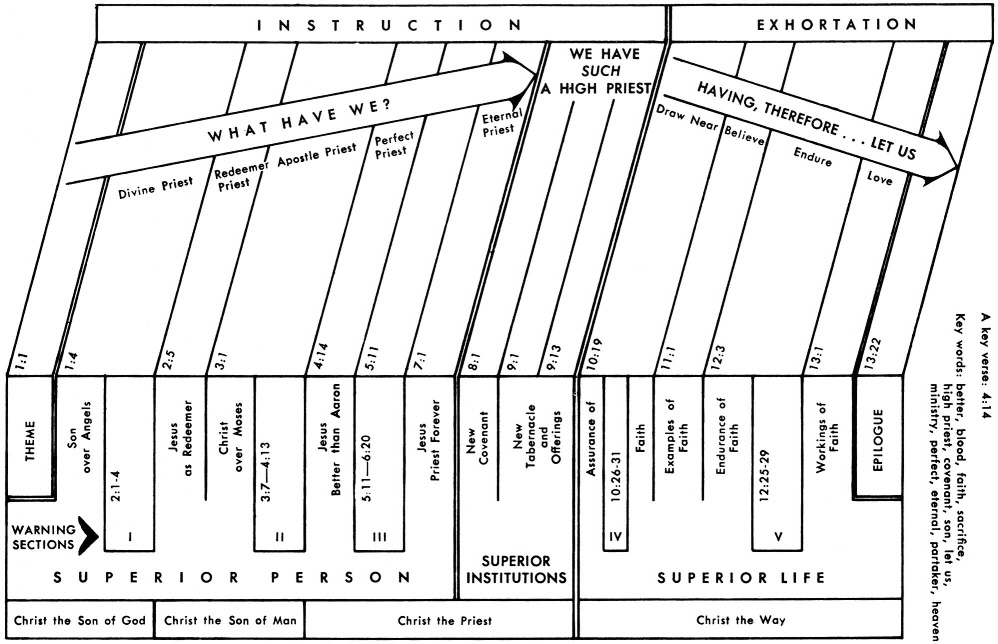
CONSIDER JESUS OUR GREAT HIGH PRIEST
Click chart to enlarge
Charts from Jensen's Survey of the NT - used by permission
Swindoll's Chart, Interesting Pictorial Chart of Hebrews, Another Chart
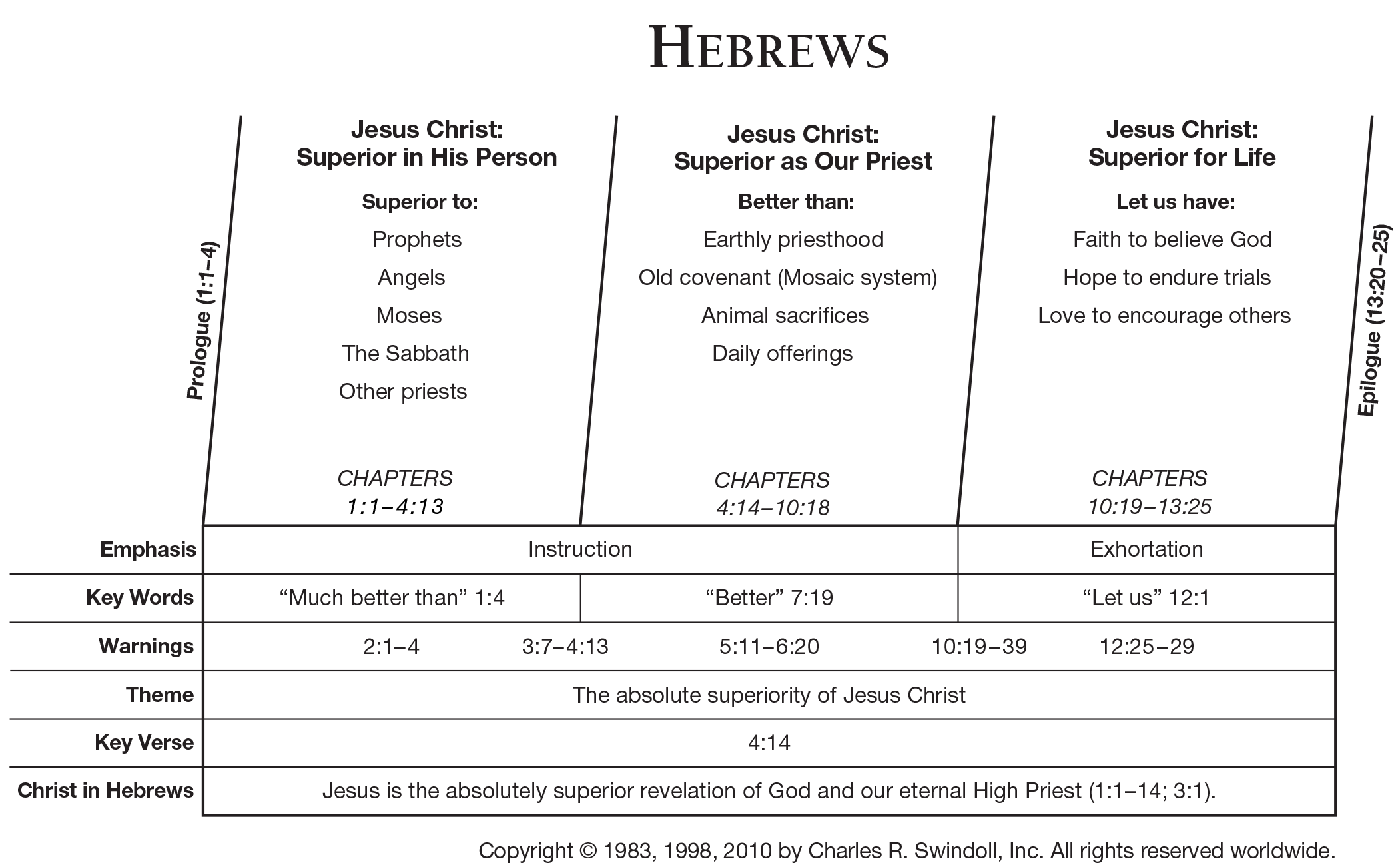

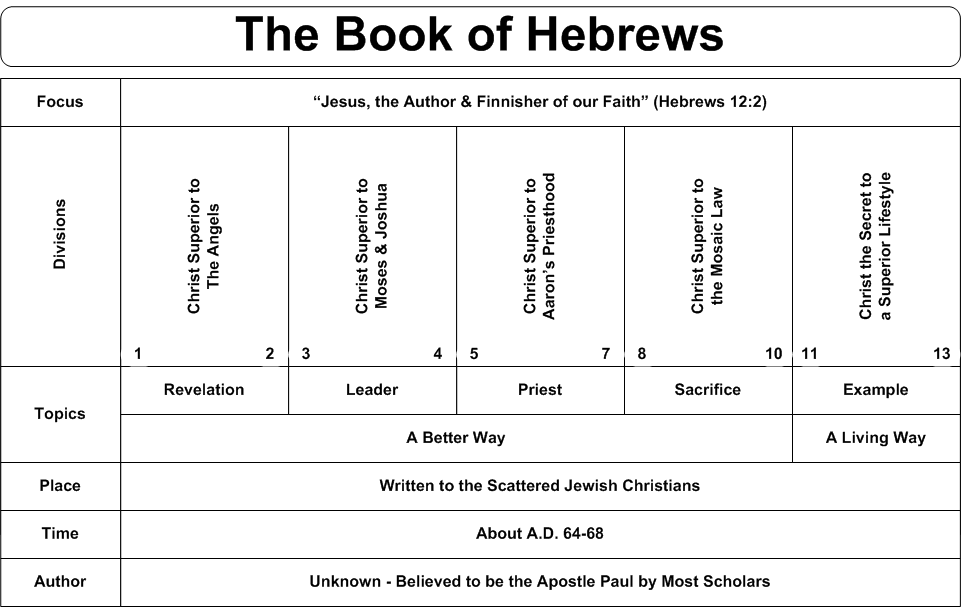
|
The Epistle |
||||
| INSTRUCTION Hebrews 1-10:18 |
EXHORTATION Hebrews 10:19-13:25 |
|||
| Superior Person of Christ Hebrews 1:1-4:13 |
Superior Priest in Christ Hebrews 4:14-10:18 |
Superior Life In Christ Hebrews 10:19-13:25 |
||
| BETTER THAN PERSON Hebrews 1:1-4:13 |
BETTER PRIESTHOOD Heb 4:14-7:28 |
BETTER COVENANT Heb 8:1-13 |
BETTER SACRIFICE Heb 9:1-10:18 |
BETTER LIFE |
| MAJESTY OF CHRIST |
MINISTRY OF CHRIST |
MINISTERS FOR CHRIST |
||
|
DOCTRINE |
DUTY |
|||
|
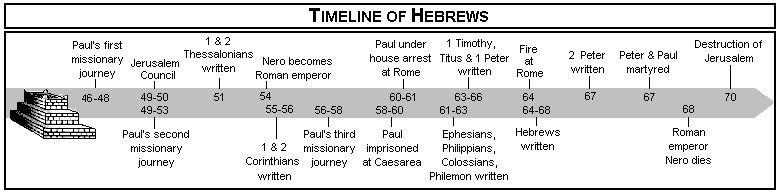
DATE WRITTEN: |
||||

See ESV Study Bible "Introduction to Hebrews"
(See also MacArthur's Introduction to Hebrews)
Borrow Ryrie Study Bible
| CONSIDER JESUS OUR GREAT HIGH PRIEST |
||||
| INSTRUCTION He 1:1-10:18 |
EXHORTATION He 10:19-13:25 |
|||
| REVELATION He 1:1-10:18 |
RESPONSE He 10:19-13:25 |
|||
| PRECEPTS He 1:1-10:18 |
PRACTICE He 10:19-13:25 |
|||
| DOCTRINE He 1:1-10:18 |
DUTY He 10:19-13:25 |
|||
| SUPERIORITY of CHRIST'S PERSON He 1:1-7:28 |
SUPERIORITY of CHRIST'S PRIESTHOOD He 8:1-10:18 |
SUPERIORITY of the CHRISTIAN'S PRACTICE He 10:19-13:25 |
||
|
MAJESTY |
MINISTRY |
MINISTERS |
||
|
SUPERIORITY |
SUPERIORITY |
SUPERIORITY |
||
|
Christ |
Christ |
Christ |
Christ |
|
This chart is adapted in part from Jensen's Survey of the NT and Wilkinson's Talk Thru the Bible |
||||
OT PASSAGES QUOTED IN HEBREWS 5 - Click for complete list of OT Quotations/Allusions
- He 5:5 <> Ps 2:7
- He 5:6 <> Ps 110:4
- He 5:10 <> Ps 110:4
KEY WORDS IN HEBREWS 5 - Click for complete list of Key Words in Hebrews
- Eternal - He 5:9
- Sacrifice - He 5:1, 3
- Priest - He 5:1, 5, 6, 10
Hebrews 5:7 In the days of His flesh, He offered up both prayers and supplications with loud crying and tears to the One able to save Him from death, and He was heard because of His piety. (NASB: Lockman)
Greek: os en tais hemerais tes sarkos autou, deeseis te kai hiketerias pros ton dunamenon (PPPMSA) sozein (PAN) auton ek thanatou meta krauges ischuras kai dakruon prosenegkas (AAPMSN) kai eisakoustheis (APPMSN) apo tes eulabeias,
Amplified: In the days of His flesh [Jesus] offered up definite, special petitions [for that which He not only wanted but needed] and supplications with strong crying and tears to Him Who was [always] able to save Him [out] from death, and He was heard because of His reverence toward God [His godly fear, His piety, in that He shrank from the horrors of separation from the bright presence of the Father] (Amplified Bible - Lockman)
Barclay: In the days when he lived this human life of ours he offered prayers and entreaties to him who was able to bring him safely through death with strong crying and with tears. And when he had been heard because of his reverence, (Westminster Press)
KJV: Who in the days of his flesh, when he had offered up prayers and supplications with strong crying and tears unto him that was able to save him from death, and was heard in that he feared;
NLT: While Jesus was here on earth, he offered prayers and pleadings, with a loud cry and tears, to the one who could deliver him out of death. And God heard his prayers because of his reverence for God. (NLT - Tyndale House)
Phillips: His prayers were heard; he was freed from his shrinking from death but, Son though he was, he had to prove the meaning of obedience through all that he suffered. (Phillips: Touchstone)
Wuest: who in the days of His flesh, offered up special, definite petitions for that which He needed, and supplications, doing this with strong cryings and tears to the One who was able to be saving Him out from within death and was heard on account of His godly fear.
Young's Literal: who in the days of his flesh both prayers and supplications unto Him who was able to save him from death -- with strong crying and tears -- having offered up, and having been heard in respect to that which he feared,
IN THE DAYS OF HIS FLESH HE OFFERED UP BOTH PRAYERS AND SUPPLICATIONS WITH LOUD CRYING AND TEARS: os en tais hemerais tes sarkos autou, deeseis te kai hiketerias pros ton dunamenon (PPPMSA) sozein (PAN) auton ek thanatou meta krauges ischuras kai dakruon prosenegkas (AAPMSN) kai eisakoustheis (APPMSN) apo tes eulabeias:
- In the days of His flesh - Heb 2:14; Jn 1:14; Ro 8:3; Galatians 4:4; 1Ti 3:16; 1Jn 4:3; 2John 1:7
- He offered up both prayers and supplications Ps 22:1-21; 69:1; 88:1; Matthew 26:28-44; Mark 14:32-39; Leviticus 2:2; 4:4-14; John 17:1
- With loud crying Matthew 27:46,50; Mark 15:34,37
- tears Isaiah 53:3,11; John 11:35
- Hebrews 5 Resources - Multiple Sermons and Commentaries
Related Passages:
Hebrews 2:14+ Therefore, since the children share in flesh and blood, He Himself likewise also partook of the same, that through death He might render powerless him who had the power of death, that is, the devil,
Luke 22:41-45+ And He withdrew from them about a stone’s throw, and He knelt down and began to pray, 42 saying, “Father, if You are willing, remove this cup from Me; yet not My will, but Yours be done.” 43 Now an angel from heaven appeared to Him, strengthening Him. 44 And being in agony He was praying very fervently; and His sweat became like drops of blood, falling down upon the ground. 45 When He rose from prayer, He came to the disciples and found them sleeping from sorrow,

THE AGONY OF
CHRIST
In the days of His flesh - The writer again emphasizes the reality of our Lord's humanity and His participation in all the experiences of His people, which makes Him fit for showing compassion on those for whom He mediates. Flesh (sarx) in this context clearly does not refer to the fallen sin nature but signifies Christ's human nature, a nature with all its infirmities to which He was exposed such as hunger, thirst, weariness, labor, sorrow, grief, fear, pain, death itself.
A W Pink - During that time (days of His flesh) Christ was “a man of sorrows,” filled with them, never free from them; “and acquainted with grief,” as a companion that never departed from Him. No doubt there is special reference to the close of those days when His sorrows and trials came to a head. “The ‘days of His flesh’ mean the whole time of His humiliation—that period when He came among men as one of them, but still the Son of God, whose majesty was hid. (Christ Superior to Aaron )
Spurgeon - Our blessed Lord was in such a condition that He pleaded out of weakness with the God who was able to save. When our Lord was compassed with the weakness of flesh He was much in prayer. It would be an interesting exercise for the younger people to note all the times in which the Lord Jesus is said to have prayed. The occasions recorded are very numerous; but these are no doubt merely a few specimens of a far greater number. Jesus was habitually in prayer; He was praying even when His lips did not utter a sound. His heart was always in communion with the Great Father above. This is said to have been the case “in the days of his flesh.” This term is used to distinguish His life on earth from His former estate in glory. From of old the Son of God dwelt with the Father; but He was not then a partaker of human nature, and the eternal ages were not “the days of his flesh.” Then He could not have entered into that intimate sympathy with us that He now exercises since He has been born at Bethlehem and has died at Calvary. “The days of his flesh” intend this mortal life—the days of His weakness, humiliation, labor, and suffering. It is true that He wears our nature in heaven, for He said to His disciples after His resurrection, “Touch me and see; because a ghost does not have flesh and bones, as you see that I have” (Luke 24:39). But yet we should not call the period of His exaltation at the right hand of the Father “the days of his flesh.” He prays still: in fact, He continually makes intercession for the transgressors; but it is in another style from that in which He prayed “in the days of his flesh.” (Sermon Our Sympathizing High Priest)
As Ironside says "He trod the path of faith and took the place of dependence on the Father."
Therefore, since the children share in flesh and blood, He Himself likewise also partook of the same, that through death He might render powerless him who had the power of death, that is, the devil (He 2:14+, cp He 4:15+)
And the Word (see Jn 1:1) became flesh, and dwelt among us, and we saw His glory, glory as of the only begotten from the Father, full of grace and truth. (Jn 1:14+)
For what the Law could not do, weak as it was through the flesh (Why? because the flesh could never keep the Law perfectly, cp Jas 2:10), God did: sending His own Son in the likeness of sinful flesh (Ed: Not "likeness of" - He was not a sinner but was made sin on the Cross to atone for man's sins - 2Cor 5:21. Stated another way - Although in His incarnation Christ became fully man, He took only the outward appearance of sinful flesh, because He was completely without sin. But by coming into the world in human form, He resembled sinful humanity.) and as an offering for sin, He condemned sin in the flesh, (Ro 8:3+)
The writer now explains how in a sense Christ was under training for the priesthood, and thus he proceeds to describe the process of training.
A T Robertson - Here (He 5:7, 8, 9) the author turns to the other requirement of a high priest (human sympathy). Since Jesus was “without sin” (He 4:15) he did not have to offer sacrifices “for himself,” yet in all other points he felt the sympathy of the human high priest, even more so by reason of his victory over sin. (Hebrews 5 Word Pictures)
Hughes makes the point that "throughout this time on earth it was the custom of the incarnate Son to maintain fellowship with and to express his dependence on the Father by means of prayer and supplication (see Mk. 1:35; 6:46; Lk. 5:16; 6:12; Jn. 17:1ff., etc.). (SEE A Commentary on the Epistle to the Hebrews - Page 182)
Just as we live in dependence
upon the Father and His provisions,
so did Jesus Christ.
-- Phil Newton
Phil Newton - Our writer gives us a picture of the humanity of God the Son as He faithfully exercised His divinely appointed office of High Priest. In seeing Christ bearing the emblems of His mediatorial office the struggling believer can find new courage to press on in the face of trials, persecution, and even doubts. Paul reminds us concerning Christ, "Who, although He existed in the form of God, did not regard equality with God a thing to be grasped, but emptied Himself, taking the form of a bond-servant, and being made in the likeness of men" (Phil 2:6, 7). As man Jesus Christ was not less than God. He remained God throughout His earthly pilgrimage. Yet, to use J. B. Phillips translation, "For he, who had always been God by nature, did not cling to his prerogatives as God's equal, but stripped himself of all privilege by consenting to be a slave by nature and being born as mortal man." Jesus Christ lived as a Man-for that is exactly what He was (and is!). Just as we live in dependence upon the Father and His provisions, so did Jesus Christ. That is why the writer is pressing this point, for these struggling believers needed to see that Christ had set the way of obedience before them. They were to be strengthened by looking to Him who "learned obedience from the things which he suffered." Our writer could have said, "In the days of his humanity," in order to soften the effect of Christ being a man. But he chose to use the coarse, earthy sounding term sarx or flesh to emphasize that Jesus Christ's humanity and dependence upon the Father as a man was real. (Jesus Christ: Qualified as High Priest Hebrews 5:1-10)
Steven Cole comments on…The identification of Jesus, our high priest, with us: He prayed and learned obedience through what He suffered (He 5:7-8).These verses elaborate on He 4:15, that Jesus can sympathize with our weaknesses because He has been tempted in all things as we are, yet without sin. Similar to the Levitical priests, Jesus could identify with the weaknesses of the people. But, unlike these priests, He had no sin of His own. “In the days of His flesh” refers to Jesus’ earthly life, but He 5:7 especially points to Jesus’ agony in the Garden of Gethsemane as He wrestled with the imminent prospect of taking our sins upon Himself. Jesus’ intense struggle in the Garden was not just over the thought of the physical agony of crucifixion.Rather, He was struggling with the thought of being separated from the Father as He bore our sin. This was so intense that He literally sweat blood. None of the gospel accounts report Jesus’ “loud crying and tears,” but this information probably came directly from one of the apostles who were present. It shows us that even though Jesus is fully God, and the cross was central to God’s predetermined plan (Acts 2:23; 4:27,28), the actual implementation of that plan was not easy. It was not just playacting a role! Jesus’ suffering in the Garden and on the cross was more intense than we can ever imagine, because we do not know what it was like to be one with the Father from all eternity until that dreadful hour. There is debate about the content of Jesus’ request. If He was asking to be saved from death, in what sense was His prayer heard, since He was not delivered from that awful death? Probably Jesus was asking to be sustained through the agony of bearing our sins, and to be brought through death into resurrection and complete restoration with the Father. The word “piety” (NASB) is better rendered “reverent submission” (NIV). It refers to His reverential submission to the will of the Father when He prayed, “not My will, but Yours be done” (Luke 22:42).(The Kind of Priest You Need Hebrews 5:1-10)
CHRIST'S PRIESTLY
"OFFERING"
He offered (prosphero) up both prayers (deesis) and supplications (hiketería) with loud crying (krauge) and tears (dakruon) - Offered (prosphero) is the same word used for offering sacrifices offered up by the Aaronic priests, but something that was never needed for Himself, but was offered on behalf of others. This surely alludes to the pinnacle of His passion in the Garden of Gethsemane. MacDonald adds that these descriptions "all speak of His career as a dependent Man, living in obedience to God, and sharing all man’s emotions that are not connected with sin." (BORROW Believer's Bible Commentary)
William Lane adds: When the writer states that Jesus "offered (prosphero)" prayers and entreaties, the use of a technical cultic term for offering sacrifice is deliberate. He intends the parallel with the description of the Levitical high priest in v 1 to be recognized. Corresponding to the "gifts and sacrifices" that the high priest offers for sins are the prayers and entreaties offered by Jesus. (See Hebrews 1-8, Volume 47A - Page 119)
Escape from physical death
was not in the writer’s mind.
Wuest - The writer now speaks of the training Messiah received for His work as priest. He also speaks of a prayer Messiah offered during His earthly life to the One who was able to save Him from death. The implication is clear that He prayed to be saved from death. There are two words in Greek which mean “from,” apo which means “from the edge of,” and ek which means “out from within.” The second is used here. The Messiah prayed to be saved out from within death. Had the inspired writer used apo, he would have reported our Lord as praying to be saved from dying a physical death. At no time in His life did He pray that prayer. The cup for Him in Gethsemane included two things, that He was to be made sin, and that the fellowship between Father and Son would be broken. Our Lord fully expected to be raised out from among the dead. Hence there was no need of such a petition. Furthermore, if He had prayed for escape from physical death, His prayer was not answered. And the writer to the Hebrews says that this prayer spoken of in Heb 5:7 was answered, which shows that escape from physical death was not in the writer’s mind. The prayer here was a petition to be saved out from under death. It was a prayer for resurrection, uttered on the Cross. It is believed, and with good reason, that our Lord uttered the entire twenty-second Psalm while hanging on the Cross. It is His own description of what took place there. Ps 22:1–13 speak of His heart sufferings; those due to His abandonment by God in Ps 22:1–6, those due to the fact that mankind spurned Him in Ps 22:7–13. His physical sufferings are described in Ps 22:14–18. His prayer for resurrection is recorded in Ps 22:19–21, and His thanksgiving for answered prayer in Ps 22:22–31. (Hebrews Commentary online)
Marcus Dods - The conjunction ("with… ")… in this verse is for emphasis. These supplications were accompanied “with strong crying and tears,” expressing the intensity of the prayers and so the keenness of the suffering. The “strong crying” is striking. Schöttgen quotes: “There are three kinds of prayers, each loftier than the preceding: prayer, crying, and tears. Prayer is silent, crying with raised voice, tears overcome all things.” (Expositor's Greek Testament Commentary)
Note that our Lord neither was saved from death nor did He ever pray to be saved from such. Furthermore He did He fear death as some teach. His mission as the Son of God was to enter our world and die. And yet what a testimony these tears provide regarding the reality of His manhood!
Ironside recounts that "Three times we read of His weeping. He wept at the grave of Lazarus as He contemplated the awful ravages that death had made, tears of loving sympathy. He wept as He looked upon Jerusalem and His prophetic soul saw the tribulations through which the devoted city must pass. And He wept in Gethsemane's garden as His holy soul shrank from drinking the cup of divine indignation against sin when He would hang on the cross. While the cup could not be averted, nevertheless He was heard because of His piety—that is, because of His godly fear, His reverence for the Father's will. And thus He who is the eternal Son who never knew what subjection meant, became man. As He walked the pilgrim path of suffering and rejection down here, He learned obedience by the things that He suffered. It is not that His will had to be subdued, but that from the moment when He assumed humanity He entered into new experiences. He who had always commanded learned practically what obedience meant. (Ironside Expository Commentary on Hebrews)
How near He comes to you and to me by this praying in an agony,
even to a bloody sweat, with strong crying, and with weeping!
Spurgeon on with crying - This is to prove His infinite sympathy with His people, and how He was compassed with infirmity. Christ prayed. How near He comes to you and to me by this praying in an agony, even to a bloody sweat, with strong crying, and with weeping! Some of you know what that means, but it did, perhaps, seem to you that Christ could not know how to pray just so; yet He did. In the days of His flesh, He not only offered up prayer, but “prayers and supplications”—many of them, of different forms, and in different shapes—and these were accompanied with “strong crying and tears.” Possibly you have sometimes had a dread of death; so had your Lord—not a sinful fear of it, but that natural and perfectly innocent, yet very terrible dread that comes to a greater or less extent upon every living creature when in expectation of death. Jesus also comes very near to us because He was not literally heard and answered. He said, “If it is possible, let this cup pass from me” (Matt 26:39+). But the cup did not pass from Him. The better part of His prayer won the victory, and that was, “Nevertheless, not as I will, but as you will.” You will be heard, too, if that is always the principal clause in your prayers; but you may not be heard by being delivered from the trouble. Even the prayer of faith is not always literally heard. God, sometimes, instead of taking away the sickness or the death, gives us grace that we may profit by the sickness, or that we may triumph in the hour of death. That is better than being literally heard; but even the most believing prayer may not meet with a literal answer. He “was heard as a result of His reverence”; yet He died, and you and I, in praying for ourselves, and praying for our friends, may pray an acceptable prayer, and be heard, yet they may die, or we may die.
A T Robertson - No doubt the writer has in mind other times when Jesus shed tears (John 11:35+; Luke 19:41+), but Gethsemane chiefly. (Hebrews 5 Word Pictures)
The rabbis wrote that "There are three kinds of prayers, each loftier than the preceding-prayer, crying and tears. Prayer is made in silence; crying with raised voice; but tears overcome all things.
Hughes explains why Jesus was in such intense agony writing that "The agony of Christ at Gethsemane was occasioned by something other and deeper than the fear of physical death; for what He faced was not simply a painful death but also judgment—the judgment of a holy God against sin, our sin, which is the experience of the "second death" (Rev. 20:14-note; cf. He 9:27-note), the disintegrating experience of SEPARATION FROM GOD. Hence the terrible cry of dereliction from the cross: "My God, my God, why hast thou forsaken me?" (Mk. 15:34+). In a real but deeply mysterious manner, which no words of man can explain, the incarnate Son as he hung on the cross endured the desolating anguish of being torn away from his Father. He took our sins, the sins of the whole world (1Jn 2:2+), upon himself at Calvary in order that there he might bear our judgment, the Righteous for the unrighteous (1Pe 2:24-note; 1Pe 3:18-note). It was then, on that cross, that "God made him who knew no sin to be sin for our sake, so that in him we might become the righteousness of God" (2Co 5:21+). For this reason the second death has no power over those who by faith are one with Him Who as our Sin-Bearer endured the second death in our place; and for them the first death, which is the death of the body, holds no terror because the bodily resurrection of Jesus is the guarantee that they too will rise to everlasting life (1Co 15:20; 2Co 4:14). The dread with which he approached the cross is explained, as Calvin says, by the fact that in the death that awaited him "he saw the curse of God and the necessity to wrestle with the total sum of human guilt and with the very powers of darkness themselves." The "loud cries and tears" which accompanied Christ's supplication are to be understood, then, in relation to the indescribable darkness of the horror that he, our High Priest, was to pass through as, on the cross, he bore not only the defilement and guilt of the world's sin but also its judgment. At Gethsemane and at Calvary we see him enduring our hell so that we might be set free to enter into his heaven. (See A Commentary on the Epistle to the Hebrews - Page 183) (Bolding added)
Phil Newton describes Jesus' agonizing in Gethsemane this way - All of the purity of his soul would be opened to the pitch-black darkness of human sinfulness. Our lies, lusts, deceitfulness, anger, complaining, cheating accompanied an innumerable host of sins, saturating as a sponge in water upon the spotless bosom of Jesus Christ. Our rebellion against the Law of God and our unbelief in Him as a merciful Redeemer in all of its lurid detail strikes the Son. In His own being He felt the combined weight of the world's sins. That is why we find Him agonizing in the Garden as He fulfilled His high priestly office. He was soon to "appear before God" on our behalf, sprinkling His own blood upon the mercy seat, satisfying the divine cry of "Justice, Justice, Justice!" See Him bearing your sin. See Him agonizing over His separation from the Father. See how He feels the pains of hell upon His own spotless soul. And for whom? For someone who has known the glories of the gospel and is creeping back into the world or retreating to his own devices. Get your eyes off of your own complaints and your own self-pity! Look at Him who "offered up both prayers and supplications with loud crying and tears." What was he doing? As the only sinless man he was expressing the agony of bearing sin; and as the only great high priest he was submitting to the will of the Father. And the Father "heard Him because of His piety." He does not hear us because of our "piety" or godly fear. He hears us because of Jesus Christ! (1Ti 2:5, He 7:25-note) Rather than die in the Garden from the horrid weight of separation from the Father and bearing the weight of our sin, the Father sustained the Son through the trauma of the cross, so that he might declare, "It is finished!" (Jn 19:30-note) His prayers were heard and the answer came as he successfully bore the judgment of God for us (Gal 3:13, 1Pe 2:24, 25-note) at the Cross and then rose from the dead in victory (Acts 4:2, 17:32, 23:6, 24:21, 26:23, Ro 1:4-note, 1Co 15:21, 22, 54, 55 56 57, 1Pe 1:3-note).(Jesus Christ: Qualified as High Priest Hebrews 5:1-10) (Scripture References added)
A. W. Pink - Into what infinite depths of humiliation did the Son of God descend! How unspeakably dreadful was His anguish! What a hideous thing sin must be if such a sacrifice was required for its atonement! How real and terrible a thing is the wrath of God! What love moved Him to suffer so on our behalf! What must be the portion of those who despise and reject such a Saviour! (cp He 10:29-note) (Hebrews 5:5-7 Christ Superior to Aaron)
Flesh (4561)(sarx) in this context clearly does not refer to the fallen sin nature but signifies Christ's human nature not yet glorified, a nature with all its infirmities to which He was exposed such as hunger, thirst, weariness, labor, sorrow, grief, fear, pain, death itself.
Sarx in Hebrews - Heb. 2:14; Heb. 5:7; Heb. 9:10; Heb. 9:13; Heb. 10:20; Heb. 12:9
Offered (4374) (prosphero from prós = to, toward + phéro = bring, bear) means to bear toward, to carry or bring something into the presence of someone usually implying a transfer of something to that person to whom it is carried. It refers to an offering, whether of gifts, prayers, or sacrifices. Prosphero is a key verb in the book of Hebrews which has more than one-third of the NT uses (16x in Hebrews) with all the uses referring to a priestly act. Prosphero is an integral part of the sacrificial vocabulary in Septuagint (LXX) (>50x in Leviticus alone! Lev 1:2-3, 5, 13-15-note; Lev 2:1, 4, 8, 11-13-note; Lev 3:6, 9-note; Lev 4:23, 32-note; Lev 6:20-note; Lev 7:3, 8-9, 11-13, 18, 29-30, 33, 38-note; Lev 8:6-note; Lev 9:2, 9, 12-13, 15-17-note; "strange fire" = Lev 10:1, 15-note; Lev 12:6-7-note; Lev 14:23; Lev 16:9; Lev 17:4; Lev 21:6, 8, 17, 21; Lev 22:18, 21, 25; Lev 23:14-16, 20, 37; Lev 27:9, 11;)
Wuest - The word translated “offered” is prosphero which was used in the Septuagint (Lxx) of the priests bringing a sacrifice to the altars of God. The Levitical priests offered up blood sacrifices (He 9:6, 7-note, He 10:1-note). This Priest after the order of Melchizedek (He 5:10-note) offered up Himself (not just His blood but His body - He 10:10-note) as a blood sacrifice (He 9:14-note, He 9:26-note), but before doing this, brought another offering to God, a heart torn with anguish and suffering, a soul in which the conflict of the ages was raging, a contest in which God the Son was facing the powers of darkness, waging a battle for the lost race, a battle in which He was victor over death, and thus over him who had the power of death, the devil. (Hebrews Commentary online)
Prosphero - 47x in 45v in NAS - Matt 2:11; 4:24; 5:23f; 8:4, 16; 9:2, 32; 12:22; 14:35; 17:16; 18:24; 19:13; 22:19; 25:20; Mark 1:44; 2:4; 10:13; Luke 5:14; 18:15; 23:14, 36; John 16:2; 19:29; Acts 7:42; 8:18; 21:26; Heb 5:1, 3, 7; 8:3, 4; 9:7, 9, 14, 25, 28; 10:1, 2, 8, 11,12; 11:4, 17; 12:7. NAS = bringing(2), brought(12), deals(1), get(1), make an offering(1), offer(8), offered(12), offering(4), offers(1), present(2), presented(1), presenting(1).
Prayers (1162) (deesis) refers to urgent requests or supplications to meet a need and are exclusively addressed to God. Deesis refers to special, definite requests. Deesis in the New Testament always carries the idea of genuine entreaty and supplication before God. It implies a realization of need and a petition for its supply.
Deesis was used by the angel who assured the godly father of John the Baptist, "Do not be afraid (command to stop fearing indicating he already was fearful), Zacharias (means "Jehovah remembers"), for your petition (deesis - specifically their need for God to open his wife's womb) has been heard, and your wife Elizabeth (means "my God is an oath") will bear you a son, and you will give him the name John (means “Jehovah has shown grace”)” (Luke 1:13).
Luke uses deesis again of the disciples of John the Baptist, who were said to “often fast and offer prayers (deesis)" (Luke 5:33).
Deesis was used by Paul of his fervent prayer for the salvation of his fellow Israelites "Brethren, my heart's (deepest, consuming) desire and my prayer prayer (deesis - conveys idea of pleading and entreaty, of persistent petition) to God for them is for their salvation. (Ro 10:1-note).
Wuest - The word “prayers” is the translation of deesis which speaks of special, definite requests. The word comes from deo which means “I want, I need.” Thus, requests of this nature emphasize the fact that the suppliant is in need of the thing asked for. The word “supplications” is the translation of hiketería. (Hebrews Commentary online)
DEESIS - 16V - Lk. 1:13; Lk. 2:37; Lk. 5:33; Rom. 10:1; 2 Co. 1:11; 2 Co. 9:14; Eph. 6:18; Phil. 1:4; Phil. 1:19; Phil. 4:6; 1 Tim. 2:1; 1 Tim. 5:5; 2 Tim. 1:3; Heb. 5:7; Jas. 5:16; 1 Pet. 3:12
Supplications (2428) (hiketería [sole occurrence of this noun in the NT] form hiketes = a suppliant from hiko = to come to one) originally described an olive branch entwined with wood carried by a suppliant. In the Greek culture the suppliant would hold and wave to express their desperate prayer and desire. The idea then came to mean that which is being urgently requested by someone, in this case the God-Man! What a powerful picture of the depth of Christ's humility and the profundity of His prayers! We get a sense of this in Luke's description of our Lord in Gethsemane the night before He went to the cross, praying so intensely that His sweat was like drops of blood. His heart was broken at the prospect of bearing sin.
And being in agony He was praying very fervently; and His sweat became like drops of blood, falling down upon the ground. (Lk 22:44+)
Vincent writes that hiketeria "is properly an adjective, pertaining to or fit for suppliants, with (rhabdous) staves or (elaias) olive-branches understood. The olive-branch bound round with wool was held forth by a suppliant in token of his character as such. (Hebrews 5 Greek Word Studies)
Crying (2906) (krauge from krazo = to croak or cry) is a cry which a man does not choose to utter but is wrung from him in the stress of some tremendous tension or searing pain. Krauge is an onomatopoeic word, imitating the raven’s cry. It describes a crying, screaming, shrieking, shouting, Lat. clamor. The idea is a crying out as with a sharp cry or even a shout, as when one cries out in surprise (Mt 25:6), in support (Acts 23:9), in unrestrained brawling (Eph 4:31). In the present context this word pictures Jesus crying out loudly to God in prayer during His time of trial.
Wuest - This prayer was accompanied with strong cryings and tears. Those at the foot of the Cross must have heard this prayer, the strong cryings of a dying Man, but they could not have seen the tears that coursed down His face, marred and disfigured by the blows of sinners, covered with blood from the crown of thorns, for the darkness covered the land and hid His sufferings from the ribald mob. (Hebrews Commentary online)
Krauge - 6x in 6v in NAS - Matt 25:6; Luke 1:42; Acts 23:9; Eph 4:31; Heb 5:7; Rev 21:4. NAS = clamor(1), crying(2), shout(1), uproar(1), voice(1).
Tears (1144 ) dakruon describes the salty watery fluid from the eyes. Gilbrant - This term has many references in classical and Koine Greek and is found 35 times in the Septuagint to translate the Hebrew word dim‛āh. In the New Testament Paul used this word to describe how he ministered to those he discipled (i.e., “with many tears”; cf. Acts 20:19, 31; 2 Corinthians 2:4). This was in a manner similar to Jesus’ description of the woman who ministered to Him with her “tears” (Luke 7:38, 44). Revelation 7:17 and 21:4 both use words from Isaiah 25:8 to say that God will wipe away “every tear” from His people’s faces." (Complete Biblical Library) Secular use - that which drops like tears, gum, sap, τῆς ἀκάνθης Hdt.2.96.
Dakruon - 10v - tear(2), tears(8) - Lk. 7:38; Lk. 7:44; Acts 20:19; Acts 20:31; 2 Co. 2:4; 2 Tim. 1:4; Heb. 5:7; Heb. 12:17; Rev. 7:17; Rev. 21:4
My God, I Love Thee
My God, I love Thee; not because
I hope for Heav’n thereby,
Nor yet because who love Thee not
May eternally die.Thou, O my Jesus, Thou didst me
Upon the cross embrace;
For me didst bear the nails and spear,
And manifold disgrace.And griefs and torments numberless,
And sweat of agony;
E’en death itself; and all for man
Who was Thine enemy.Then why, O blessèd Jesus Christ
Should I not love Thee well?
Not for the hope of winning Heaven,
Nor of escaping hell.Not with the hope of gaining aught,
Nor seeking a reward,
But as Thyself hast lovèd me,
O everlasting Lord!E’en so I love Thee, and will love,
And in Thy praise will sing,
Solely because Thou art my God,
And my eternal King.
Norman Geisler - HEBREWS 5:7a—Did Christ have flesh only before His resurrection? - (When Critics Ask - page 434)
PROBLEM: Speaking of the “days of His [Jesus’] flesh” as past seems to imply that Jesus did not rise in the flesh and ascend into heaven in the same physical body in which He died. Yet Jesus Himself said that His resurrection body was one of “flesh and bones” (Luke 24:31) and the Apostles’ Creed confesses the “resurrection of the flesh.”
SOLUTION: The phrase “days of His flesh” simply refers to Jesus’ earthly sojourn. It affirms nothing about the nature of the resurrection body. It is clear from many passages that Jesus rose in literal, physical, human flesh (see comments on Luke 24:39; 1 John 4:2–3).
Norman Geisler - HEBREWS 5:7b—Did Christ shrink from death or face it courageously? (When Critics Ask - page 435)
PROBLEM: On the one hand, it would seem that Christ shrunk from death, since He prayed “with vehement cries and tears to Him who was able to save Him from death” (Heb. 5:7). He said, “O My Father, if it is possible, let this cup pass from Me” (Matt. 26:39). On the other hand, we are led to believe that He faced death obediently and boldly, for He “steadfastly set His face to go to Jerusalem” (Luke 9:51), calmly facing His arrest, trial, and crucifixion, and repeatedly assuring His disciples He would rise again (Matt. 12:40–42; John 10:18).
SOLUTION: Christ faced death boldly but not eagerly. He met it willingly but not apathetically. Christ was “obedient to the point of death” (Phil. 2:8). He approached it boldly and bravely, declaring, “I have power to lay it down, and I have power to take it again” (John 10:18). He willingly submitted to the Father, saying, “not as I will, but as You will” (Matt. 26:39).
Christ’s willingness and boldness notwithstanding, He nevertheless felt the full emotional and existential impact of His impending death. He did pray with “vehement cries and tears,” but the writer adds, He “was heard because of His godly fear” (Heb. 5:7). Jesus wished as a man that His cup (death) could pass from Him (Matt. 26:39), but He willed, as the Father willed, that it would take place for the salvation of the world. While His soul was “troubled” about death, He never prayed, “Father, save me from this hour.” He only asked, “shall I say” this? His answer was no, “for this purpose I came to this hour. `Father glorify Your name’ ” (John 12:27–28). He never feared death as such, but banishment from the Father (Matt. 27:46). In fact, by His death Jesus overcame the power and fear of death, defeating the devil (Heb. 2:14).
TO THE ONE ABLE TO SAVE HIM FROM DEATH: pros ton dunamenon (PPPMSA) sozein (PAN) auton ek thanatou:
- to the one able to save him from death Mt 26:52,53; Mk 14:36
- and was heard Heb 13:20; Ps 18:19,20; 22:21,24; 40:1, 2, 3; Ps 69:13, 14, 15, 16; Is 49:8; Jn 11:42; Jn 17:4,5
- Hebrews 5 Resources - Multiple Sermons and Commentaries
THE SON'S LOUD CRIES TO
HIS ABLE FATHER
To the One able (dunamai) to save (sozo) Him from death - "Out of death" Referring to God the Father is (present tense = continuously) able. More literally this reads "save Him out of (Greek preposition "ek" = out of) death". Note it does not say "save Him from dying." The point is that Jesus was not asking to be saved from dying but to be saved out of death or in other words to be saved from remaining in death, a prayer the Father answered with His resurrection. He was not asking to avoid the Cross but to be assured of the resurrection (cf. Ps 16:8-11)
Psalms 16:8-11+ I have set the LORD continually before me; Because He is at my right hand, I will not be shaken. 9 Therefore my heart is glad and my glory rejoices; My flesh also will dwell securely. 10 For You will not abandon my soul to Sheol; Nor will You allow Your Holy One to undergo decay. 11 You will make known to me the path of life; In Your presence is fullness of joy; In Your right hand there are pleasures forever.
Clearly Jesus was not praying to be saved from the cross, for as John records "Now My soul has become troubled; and what shall I say, ‘Father, save Me from this hour’? But for this purpose I came to this hour." (John 12:27+)
As Spurgeon says - The expression is startling; the Savior prayed to be saved. In His direst woe He prayed thoughtfully, and with a clear apprehension of the character of Him to whom He prayed. It is a great help in devotion to pray intelligently, knowing well the character of God to whom you are speaking. Jesus was about to die, and therefore the aspect under which He viewed the great Father was as “the one who was able to save him from death.” This passage may be read in two ways: it may mean that He would be saved from actually dying if it could be done consistently with the glorifying of the Father; or it may mean that He pleaded to be saved out of death, though He actually descended into it. The word may be rendered either from or out of. The Savior viewed the great Father as able to preserve Him in death from the power of death, so that He should triumph on the cross, and also as able to bring Him up again from among the dead. Remember how He said in the psalm: “You will not abandon my soul to Sheol; you will not give your faithful one to see the grave” (Ps 16:10). Jesus had faith in God concerning death, and prayed according to that faith. This brings our blessed Lord very near to us; He prayed in faith even as we do. He believed in the power of God to save Him from death, and even when cast down with fear He did not let go His hold on God. He pleaded just as you and I should plead, impelled by fear and encouraged by faith. (SERMON Our Sympathizing High Priest)
As Jesus reminded Peter (Mt 26:52+) “Or do you think that I cannot appeal to My Father, and He will at once put at My disposal more than twelve legions of angels? (Mt 26:53)
In the Garden of Gethsemane Jesus again testified to the saving ability of His Father "And He was saying, “Abba! Father! All things are possible for You; remove this cup from Me; yet not what I will, but what You will.” (Mk 14:36)
Don't misunderstand what he is saying. Jesus was not hoping to escape the cross because it was for this very purpose that He came to earth. In John's gospel Jesus declared "Now My soul has become troubled; and what shall I say, 'Father, save Me from (Greek = ek = out of - see Wuest's interesting comment above) this hour'? But for this purpose I came to this hour. (John 12:27+)
MacDonald - Christ’s prayer was not that He might be saved from dying; after all, to die for sinners was His very purpose in coming to the world (John 12:27). His prayer was that He might be delivered out of death, that His soul might not be left in Hades. This prayer was answered when God raised Him from the dead. (BORROW Believer's Bible Commentary)
Able (1410) (dunamai) means to be (present tense = continuously) able to, capable of, and strong enough to save Him form death.
Save (4982)(sozo) means the Father could (present tense = continuously) rescue Jesus from Death, the great enemy of mortal men (1Co 15:26, 54, 55, 56, 57). Additional nuances of sozo include to protect, keep alive, preserve life, deliver, heal, be made whole.
AND HE WAS HEARD BECAUSE OF HIS PIETY: kai eisakoustheis apo tes eulabeias:
- Heb 12:28; Matthew 26:37,38; Mark 14:33,34; Luke 22:42, 43, 44; John 12:27,28
- Hebrews 5 Resources - Multiple Sermons and Commentaries
REVERENT PRAYERS
FROM SON TO FATHER
And He was heard because of His piety (eulabeia) --KJV = "was heard in that he feared." NIV = "because of his reverent submission" NET = "Because of His devotion." "Because of His deep reverence for God." He was heard on account of His good acceptance of what He was accomplishing as the High Priest.
Marvin Vincent on heard because of His piety (eulabeia) - The image in the word (eulabeia) is that of a cautious taking hold and careful and respectful handling: hence piety of a devout and circumspect character, as that of Christ, Who in His prayer took account of all things, not only His own desire, but His Father’s will… God was able to save Him from death altogether. He did not do this. He was able to sustain Him under the anguish of death, and to give Him strength to suffer the Father’s will: He was also able to deliver Him from death by resurrection: both these he did. It is not impossible that both these may be combined in the statement He was heard.
THOUGHT- The idea of eulabeia is that of being devoutly submissive. I wonder why my prayers don't seem to be heard so often? Could it be I lack this Philippians 2:5 attitude? It's one thing to pray on your drive to work in the morning. It is another thing to get on your knees in the morning before you go to work! Which situation allows you to be focused and have deep reverence for God? (That's rhetorical of course).
Guzik asks an interesting question - If Jesus asked that the cup be taken away from Him (Luke 22:42), and the cup was not taken away, how can it be said that He was heard? Because His prayer was not to escape His Father’s will, but to accept it - and that prayer was definitely heard.
Spurgeon - To think that it should be said of your Lord that He was heard, even as you, a poor suppliant, are heard. Yet the cup did not pass from Him, neither was the bitterness thereof in the least abated. When we are compelled to bear our thorn in the flesh and receive no other answer than “My grace is sufficient for you” (2 Cor 12:9), let us see our fellowship with Jesus and Jesus’ fellowship with us. (Sermon Our Sympathizing High Priest)
Piety (2124) (eulabeia from eulabes = careful as to the realization of the presence and claims of God, reverencing God, pious, devout from eu = good, well, right + lambano = take hold ~ taking hold well) in the original Greek usage meant caution, circumspection, discretion and then reverence or veneration. The Lxx usage in Joshua conveys the idea of fear, anxiety or dread. The NT uses convey the idea of godly fear, reverence, reverent regard, reverent submission or reverent awe in the presence of God. Eusebeia is a closely related word is similar to eulabeia in reflecting an attitude of one's inner being, but in addition produces an demonstration of that inner attitude in worship.
Wuest - KJV says "He was heard in that He feared." - The word for “feared” (NAS = piety) in the Greek text is not phobos, the ordinary word for fear, but eulabeia. The verb of the same root means “to act cautiously, to beware, to fear.” The picture in the word is that of a cautious taking hold of and a careful and respectful handling. Hence, it speaks of a pious, devout, and circumspect character, who in his prayer, takes into account all things, not only his own desire, but the will of the Father. (Hebrews Commentary online)
Vine writes that eulabeia "signifies, first, “caution”; then, “reverence, godly fear,” Heb. 5:7; 12:28… in general, “apprehension, but especially holy fear,” “that mingled fear and love which, combined, constitute the piety of man toward God; the OT places its emphasis on the fear, the NT… on the love, though there was love in the fear of God’s saints then, as there must be fear in their love now” (Trench, Synonyms) (Vine's Expository Dictionary of Old Testament and New Testament Words)
There are only 2 uses of eulabeia in the NT…
Hebrews 5:7+ In the days of His flesh, He offered up both prayers and supplications with loud crying and tears to the One able to save Him from death, and He was heard because of His piety.
Hebrews 12:28+ Therefore, since we receive a kingdom which cannot be shaken, let us show gratitude, by which we may offer to God an acceptable service with reverence and awe
There are 2 uses in the Septuagint (LXX)…
Joshua 22:24 "But truly we have done this out of concern (eulabeia), for a reason, saying, 'In time to come your sons may say to our sons, "What have you to do with the LORD, the God of Israel?
Proverbs 28:14 How blessed is the man who fears (Hebrew = pachad - be in dread, in awe; LXX = eulabeia) always, But he who hardens his heart will fall into calamity.
OUR BLESSÈD SAVIOR SEVEN TIMES SPOKE
Our blessèd Savior sev’n times spoke
When on the cross our sins He took
And died lest men should perish.
Let us His last and dying words
In our remembrance cherish.
“Father, forgive these men; for, lo,
They truly know not what they do.”
So far His love extended.
Forgive us, Lord, for we, too, have
Through ignorance offended.
Now to the contrite thief He cries:
“Thou, verily, in Paradise
Shall meet Me ere tomorrow.”
Lord, take us to Thy kingdom soon
Who linger here in sorrow.
To weeping Mary, standing by,
“Behold thy Son,” now hear Him cry;
To John, “Behold thy mother.”
Provide, O Lord, for those we leave;
Let each befriend the other.
The Savior’s fourth word was “I thirst.”
O mighty Prince of Life, Thy thirst
For us and our salvation
Is truly great; do help us, then,
That we escape damnation.
The fifth, “My God, My God, O why
Forsake Me?” Hark, the awful cry!
Lord, Thou wast here forsaken
That we might be received on high;
Let this hope not be shaken.
The sixth, when victory was won,
“’Tis finished!” for Thy work was done.
Grant, Lord, that, onward pressing,
We may the work Thou dost impose
Fulfill with Thine own blessing.
The last, as woe and sufferings end,
“O God, My Father, I commend
Into Thy hands My Spirit.”
Be this, dear Lord, my dying wish;
O heavenly Father, hear it.
Whoe’er, by sense of sin oppressed,
Upon these words his thoughts will rest,
He joy and hope obtaineth
And through God’s love and boundless grace
A peaceful conscience gaineth.
O Jesus Christ, Thou Crucified,
Who hast for our offenses died,
Grant that we e’er may ponder
Thy wounds, Thy cross, Thy bitter death,
Both here below and yonder.
C H Spurgeon - Morning and evening - Did this fear (The KJV - "and was heard in that he feared") arise from the infernal suggestion that He was utterly forsaken. There may be sterner trials than this, but surely it is one of the worst to be utterly forsaken?
“See,” said Satan, “thou hast a friend nowhere! Thy Father hath shut up the bowels of His compassion against thee. Not an angel in His courts will stretch out his hand to help thee. All heaven is alienated from Thee; Thou art left alone. See the companions with whom Thou hast taken sweet counsel, what are they worth? Son of Mary, see there Thy brother James, see there Thy loved disciple John, and Thy bold apostle Peter, how the cowards sleep when thou art in Thy sufferings! Lo! Thou hast no friend left in heaven or earth. All hell is against Thee. I have stirred up mine infernal den. I have sent my missives throughout all regions summoning every prince of darkness to set upon Thee this night, and we will spare no arrows, we will use all our infernal might to overwhelm Thee: and what wilt Thou do, Thou solitary one?”
It may be, this was the temptation; we think it was, because the appearance of an angel unto Him strengthening Him removed that fear. He was heard in that He feared; He was no more alone, but heaven was with Him. It may be that this is the reason of His coming three times to His disciples—as Hart puts it—
“Backwards and forwards thrice He ran,
As if He sought some help from man.”
He would see for Himself whether it were really true that all men had forsaken Him; He found them all asleep; but perhaps He gained some faint comfort from the thought that they were sleeping, not from treachery, but from sorrow, the spirit indeed was willing, but the flesh was weak. At any rate, He was heard in that He feared. Jesus was heard in His deepest woe; my soul, thou shalt be heard also. (Spurgeon, C. H.)
Hebrews 5:7-10 Luke 22:39-44;
He humbled himself and became obedient to death–even death on a cross! - Philippians 2:8
TODAY IN THE WORD
Charles Spurgeon, the noted nineteenth-century preacher, once asked, “Is it not a curious thing that, whenever God means to make a man great, He always breaks him in pieces first?”
Hebrews 5 says much the same thing regarding the life of Jesus. He learned obedience through His suffering. We know that Jesus has always been perfect, but in His humanity, Jesus was utterly dependent upon the Father and submitted to Him completely. Having trusted Him to the point of death on the Cross, Jesus became the source of salvation for all who would obey Him (v. 9).
Today’s passage from Hebrews also says that Jesus’ prayers were heard because of His “reverent submission” (v. 7). And in today’s passage from Luke, we see just how fully Jesus submitted to the Father. Truly, Jesus lived out what He taught His disciples to pray: “Your will be done on earth as it is in heaven” (Matt. 6:10).
Yesterday we focused on Jesus’ agony in Gethsemane; today we’ll focus on His obedience. Luke’s account adds some details that aren’t in either Matthew or Mark. First, Luke says that an angel ministered to Jesus, further indicating the intensity of Jesus’ wrestling in prayer. Luke goes on to say that instead of retreating from this battle, Jesus prayed even more earnestly (v. 44). As His anguish increased, Jesus didn’t pull back, but rather turned His entire being toward what God was asking of Him.
We don’t know how long Jesus prayed that night, but it had to have been at least several hours. All three Gospel accounts indicate that Jesus rose from prayer fully resolved to carry out what the Father asked. Both Matthew and Mark record that when He finished praying, Jesus said, “Rise! Let us go! Here comes my betrayer!” (Matt. 26:46; Mark 14:42), purposefully walking toward Judas.
TODAY ALONG THE WAY
The hardest prayer we can pray is “not my will, but Your will.” Learning to submit to God is a lifelong process. It’s easy to think we’re submissive and obedient to God’s will when circumstances are favorable. But when hard times come into our lives and we’re forced to set aside our own dreams and to trust God, it gets much harder. As we contemplate the price that Jesus paid for us on the Cross, He becomes our constant reminder of a will fully submitted to the Father.
Warren Wiersbe - SUPERIOR SYMPATHY Scripture: Read Hebrews 5:7-8 (BORROW Pause for power : a 365-day journey through the Scriptures)
Every Old Testament high priest had to minister to people who were "ignorant and . . . going astray" (v. 2). God made no provision but judgment for the high-handed sins of rebellion. But he did make provision when people sinned through ignorance or weakness. An Old Testament priest could identify with the sinners since he himself was a sinner. In fact, on the Day of Atonement, the high priest had to offer a sacrifice for himself before he could offer one for the nation! (Lev. 16; Heb. 9:7)
You would think that one sinner would have compassion for another sinner, but this is not always the case. Sin makes a person selfish. Sin can blind us to the hurts of others. Sin can harden our hearts and make us judgmental instead of sympathetic. Remember how heartbroken Hannah, who was praying for a son, was accused by high priest Eli of being drunk? (1 Sam. 1:9-18) And when King David was confronted with a story of a rich man's sin, he had no sympathy for him, even though David himself was a worse sinner (2 Sam. 12).
No, it is the spiritually minded person with a clean heart who sympathizes with a sinner and seeks to help him. Because we are so sinful, we have a hard time helping other sinners; but because Jesus is perfect, He is able to meet our needs after we sin.
Applying God's Truth:
1. On a scale of 1 (least) to 10 (most), what would you say is your average level of compassion shown toward the sinful people you come into contact with?
2. What can you learn from Jesus' example of "reverent submission"? Be specific.
3. Is your status as "child of God" something you've begun to take for granted or, like Jesus, do you strive to continue to learn obedience from your sufferings?
Hebrews 5:8 Although He was a Son, He learned obedience from the things which He suffered. (NASB: Lockman)
Greek: kaiper on huios emathen (PAPMSN) aph' on epathen (3SAAI) ten hupakoen (3SAAI) ;
Amplified: Although He was a Son, He learned [active, special] obedience through what He suffered (Amplified Bible - Lockman)
Barclay: although he was a Son, he learned obedience from the sufferings through which he passed. (Westminster Press)
KJV: Though he were a Son, yet learned he obedience by the things which he suffered;
NLT: So even though Jesus was God's Son, he learned obedience from the things he suffered. (NLT - Tyndale House)
Phillips: Son though he was, he had to prove the meaning of obedience through all that he suffered. (Phillips: Touchstone)
Wuest: Though He was Son by nature, yet He learned obedience from the things which He suffered,
Young's Literal: through being a Son, did learn by the things which he suffered -- the obedience,
ALTHOUGH HE WAS A SON HE LEARNED OBEDIENCE FROM THE THINGS WHICH HE SUFFERED: kaiper on (PAPMSN) huios emathen (3SAAI) aph on epathen (3SAAI) ten hupakoen aph on epathen (3SAAI) ten hupakoen:
- Although He was a Son - Hebrews 1:5,8; 3:6
- He learned obedience - He 10:5-9; Isaiah 50:5-6; Matthew 3:15; John 4:34; 6:38; 15:10; Philippians 2:8
- Hebrews 5 Resources - Multiple Sermons and Commentaries
Related Passages:
Hebrews 2:18 For since He Himself was tempted in that which He has suffered, He is able to come to the aid of those who are tempted.
Hebrews 4:15 For we do not have a high priest who cannot sympathize with our weaknesses, but One who has been tempted in all things as we are, yet without sin.
John 4:34 Jesus *said to them, “My food is to do the will of Him who sent Me and to accomplish His work.
John 6:38 “For I have come down from heaven, not to do My own will, but the will of Him who sent Me.
Philippians 2:8 Being found in appearance as a man, He humbled Himself by becoming obedient to the point of death, even death on a cross.
JESUS DID NOT
"GET A PASS"
One might say that Jesus' "training for the priesthood" involved sitting under a "teacher" named suffering. He certainly did not need to suffer in order to correct disobedience because His obedience was perfect. But as Man, He suffered these things that He might be a compassionate High Priest. Jesus suffered by taking on Himself our sins, and in this way He became far more than any human priest. He is able to deal gently with our sins because He is so fully aware of the sense of personal defilement by sin, even though He Himself was sinless (cp He 2:18+, He 4:15+)
Although He was a Son - Was is in the present tense indicating Jesus has always been the Son of God (cp Jn 1:1, 14+)
He learned (manthano) obedience (hupakoe) from the things which He suffered (pascho) - The definite article before "obedience" = "The obedience," with the article, means the well-known complete obedience as distinguished from obedience in general. It describes the particular obedience that was required of Him in the days of His flesh, but the principle is the same...it is in the SCHOOL OF SUFFERING we grow the most in OBEDIENCE. Being fully Man, He had to learn through experiences as a Man. He did not learn to obey. That was not the issue. He was learning what is involved in obedience through suffering and testing--what it costs.
Spurgeon - It is put as if this might have been a case where the rod of the household could have been spared. That there should be suffering for enemies, that there should be sorrow for rebels against God, is natural and proper; but one might have thought that He would have spared His own Son, and that, in His case, there would be no learning of obedience by the things that He suffered. But, according to the text, sonship did not exempt the Lord Jesus Christ from suffering. (The Education of Sons of God)
We never benefit from our trials or sufferings
when we react with rebellion or panic.
Lawrence Richards says: The writer says that Jesus met the dying experiences of life with "reverent submission." Thus He was able to "learn obedience" from the things He suffered (5:7-8). We never benefit from our trials or sufferings when we react with rebellion or panic. God seeks to strengthen us through every experience of life. Meeting life with reverent submission frees us from being overwhelmed, and helps us grow in our own ability to feel with those who are hurt or needy without becoming so "sympathetic" that we are unable to help. (BORROW Bible Teacher's Commentary page 1000)
R Kent Hughes points out: So authentic was Jesus' solidarity with humankind that he "learned obedience from what he suffered and [was] made perfect" (vv. 8, 9). This "does not mean Jesus passed from disobedience to obedience." (EBC) Nor does it mean that he developed from imperfection to perfection. The idea is that He became complete in his human experience. (SEE Hebrews: An Anchor for the Soul)
W Griffith Thomas has rightly said 'This is the difference between innocency and virtue. Innocency is life untested, while virtue is innocency tested and triumphant'. To this Hewitt adds "The Son had always possessed the disposition of obedience, but for Him to possess the virtue of obedience, testing was necessary." (SEE Hebrews: A Devotional Commentary)
Steven Cole comments that… When it says, “Although He was a Son, He learned obedience from the things which He suffered,” it does not mean that He was formerly disobedient. The first phrase is better translated, “Son though He was.” It points to His position as God’s unique Son (He 5:5). Jesus “learned obedience” in the sense that He experienced what obedience means through what He suffered. He was always obedient to the Father’s will, but the proof of obedience is revealed in situations where obedience is not pleasant. Suppose that when my children were younger, I told you, “I have obedient kids. Let me prove it to you: Kids, eat your ice cream.” You would say, “That’s no test of obedience!” The real test would be, “Kids, clean your rooms!” Jesus experienced obedience to the maximum when He went to the cross. The author’s point is that Jesus is our perfect High Priest in that His prayers and obedience through His sufferings show that He can sympathize with us in our sufferings. Therefore, we should obediently persevere in trials through prayer. (The Kind of Priest You Need Hebrews 5:1-10 OR BORROW)
Spurgeon on learned (manthano) obedience (hupakoe) - Is not that a wonderful thing? As man our Savior had to learn. He was of a teachable spirit, and the Lord Himself instructed him. All God’s children go to school, for it is written, “All your children shall be pupils of Yahweh” (Isa 54:13). The lesson is practical—we learn to obey. Our Lord took kindly to this lesson: He did always the things that pleased the Father. This is our time of schooling and discipline, and we are learning to obey, which is the highest and best lesson of all. How near this brings our Lord to us, that He should be a Son and should have to learn! We go to school to Christ and with Christ, and so we feel His fitness to be our compassionate High Priest… Obedience has to be learned experimentally. If a man is to learn a trade thoroughly, he must be apprenticed to it. A soldier, sitting at home and reading books, will not learn the deadly art of war. He must go to the barracks, and the camp, and the field of battle if he is to win victories and become a veteran. The dry land sailor, who never went even in a boat, would not know much about navigation, study hard as he might; he must go to sea to be a sailor. So obedience is a trade to which a man must be apprenticed until he has learned it, for it is not to be known in any other way. Even our blessed Lord could not have fully learned obedience by the observation in others of such an obedience as He had personally to render, for there was no one from whom He could thus learn. (Our Sympathizing High Priest)
Ray Stedman points out: He fully felt the iron bands of sin's enslaving power. He was crushed under a sense of hopelessness, of helpless discouragement, of utter defeat. His eyes filled with tears. His mouth was opened in involuntary, agonized cries. His heart was crushed as in a winepress, so that the blood was literally forced from His veins and his sweat fell to the ground in great, bloody drops. This explains the strange words, Although he was a Son, he learned obedience through what he suffered (Heb. 5:8). He learned what it means to obey God when every cell in His body wanted to disobey, when everything within Him cried out to flee this experience. Yet, knowing this to be the will of God, He obeyed, trusting God to see Him through. He learned what it feels like to hang on when failure makes us want to throw the whole thing over, when we are so defeated, so utterly despairing, so angry with ourselves, so filled with shame, self-loathing and guilt that we want to forget the whole thing. He knows what that is like; He went the whole way; He took the full brunt of it. You and I will never pass through a Gethsemane like He went through. He went the whole distance. (SCROLL TO 5 A Priest Who Understands You)
Spurgeon - He was always obedient, but He had to learn experimentally what obedience meant, and He could not learn it by the things that He did; He had to learn it “from what he suffered.” And I believe that there are some of the most sanctified children of God who have been made so, by His grace, through the things that they have suffered. We may not all suffer alike; we may not all need the same kind of suffering; but I question whether any of us can truly learn obedience except by the things that we suffer. God had one Son without sin, but He never had a son without suffering. We may escape the rod if we are not of the family of God, but the true-born child must not, and would not if he might, avoid that chastisement of which all such are partakers. (Spurgeon's Expositional Comments on Hebrews)
Wayne Grudem explains how Jesus' learned obedience…Apparently as Jesus grew toward maturity He, like all other human children, was able to take on more and more responsibility. The older He became the more demands His father and mother could place on Him in terms of obedience, and the more difficult the tasks that His heavenly Father could assign to Him to carry out in the strength of His human nature. With each increasingly difficult task, even when it involved some suffering (as Heb. 5:8 specifies), Jesus’ human moral ability, His ability to obey under more and more difficult circumstances, increased. We might say that his “moral backbone” was strengthened by more and more difficult exercise. Yet in all this he never once sinned.” (Systematic Theology An Introduction to Biblical Doctrine PDF - SEE PAGE 460)
Wuest - The Authorized Version translates, “Who (Heb 5:7) though He were a Son, yet learned He obedience.” But there is no point in saying “though He were a Son, yet learned He obedience.” All believers are sons of God, and they learn obedience by the things which they suffer. There is no indefinite article in Greek comparable to the indefinite article in English. The absence of the definite article in Greek emphasizes quality or character. The translation should read, “Though He was Son by nature.” The deity of the Messiah is referred to here. The idea is, “Though He was the Son of God, God the Son, Very God of Very God, yet He learned obedience by the things He suffered.” The omniscient God knew what obedience was, but He never experienced it until He became incarnate in human flesh. Before His incarnation, He owed obedience to no one. There was no one greater than He to whom He could have rendered obedience. But now in incarnation, God the Son became obedient to God the Father. He learned experientially what obedience was. It was not that He had to learn to obey, for He said, “I do always those things that please Him” (John 8:29). Vincent says that “He required the special discipline of a severe human experience as a training for His office as a high priest who could be touched with the feeling of human infirmities. He did not need to be disciplined out of any inclination to disobedience; but as Alford puts it, ‘the special course of submission by which He became perfected as our high priest was gone through in time, and was a matter of acquirement and practice.’ This is no more strange than His growth in wisdom (Luke 2:52). Growth in experience was an essential part of His humanity.” (Hebrews Commentary online)
Vincent - Jesus did not have to learn to obey, see Jn 8:29; but he required the special discipline of a severe human experience as a training for his office as a high priest who could be touched with the feeling of human infirmities. He did not need to be disciplined out of any inclination to disobedience; but, as Alford puts it, “the special course of submission by which he became perfected as our high priest was gone through in time, and was a matter of acquirement and practice.” This is no more strange than His growth in wisdom, Lk 2:52. Growth in experience was an essential part of His humanity. (Hebrews 5 Greek Word Studies)
Marcus Dods writes that "it was through painful obedience, not by arrogant ambition he became Priest. The main statement is, He learned obedience and became perfect as Saviour." (Expositor's Greek Testament Commentary)
The prophet Isaiah records these words of the Messiah -
"The Lord GOD has opened My ear; And I was not disobedient, Nor did I turn back. I gave My back to those who strike Me, And My cheeks to those who pluck out the beard; I did not cover My face from humiliation and spitting. (Isaiah 50:5-6)
There is a principle that it is in the school of suffering
where we grow the most in obedience.
THOUGHT - There is a principle that it is in the school of suffering where we grow the most in obedience. We all know only too well that often the best way to learn sympathy is by having suffered what another is suffering. We can read about the pain of starvation and even see pictures on television of starving children in Africa, but we until we have gone hungry for a period, we cannot completely sympathize with the victims of starvation. Since suffering was the lot of the Son of God, we must never despise it as a tool of the Father's instruction in our lives (cf Heb 12:5-11, Ps 119:67, Ps 119:71). If suffering was the lot of our Savior and Lord, His disciples are called to follow in His steps (1Pe 2:21+; cp 1Co 11:1+, 1Jn 2:6+ - see Walking Like Jesus Walked!). Scripture does not teach that a dynamic faith will keep us from all suffering and in fact, more often a strong faith is associated with greater suffering! But do not let this deter you from pressing on toward the goal! The prize is eternally worthwhile! (Phil 3:14)
And so we see in the following passages that God places suffering in an interesting light …
(Paul reminds the believers at Thessalonica that) we sent Timothy, our brother and God's fellow worker in the gospel of Christ, to strengthen and encourage you as to your faith, 3 so that no man may be disturbed by these afflictions; for you yourselves know that we have been destined for this. (1Th 3:2+, 1Th 3:3+)
And after they had preached the gospel to that city and had made many disciples (How did they make disciples?), they returned to Lystra and to Iconium and to Antioch, strengthening the souls of the disciples, encouraging them to continue in the faith, and saying, "Through many tribulations we must enter the kingdom of God." (Acts 14:21,22+)
(Paul encourages the believers in Rome that they are) children, heirs also, heirs of God and fellow heirs with Christ, if indeed we suffer with Him in order that we may also be glorified with Him. For I consider that the sufferings of this present time are not worthy to be compared with the glory that is to be revealed to us. (Ro 8:17+, Ro 8:18+; cp 2Co 4:16, 17, 18+)
Phil Newton asks "What did Jesus do throughout the earthly journey to the cross? He fully obeyed the Father. "Although He was a Son [or 'Son though He was'], He learned obedience from the things which He suffered." Let us come back to our first century audience. The bottom line was that they struggled with following or obeying Jesus Christ. Do you find yourself in the same position? Their faith was being called into question by their hesitation to obey. So the writer turns their attention-and ours-to Jesus Christ. We can rejoice that Jesus Christ obeyed the Father! The Son's obedience was with the full responsibility of being high priest for all the redeemed. We might pay closer attention to our obedience and actions when we have a responsibility because there is a sense of accountability for a right performance. Our eternities rested upon the obedience of Jesus Christ. Without His sinless life and perfect obedience, the Cross was useless. There was no adequate sacrifice if the sacrificial victim was polluted by the very sins that he was seeking to atone for. (Jesus Christ: Qualified as High Priest Hebrews 5:1-10)
When God leads through valleys of trouble,
His omnipotent hand we can trace;
For the trials and sorrows He sends us
Are valuable lessons of grace.
—Anon.
Henry Morris explains the obedience of our Lord this way - What Jesus knew by omniscience (Ed: He was fully God), He "learned" by experience (Ed: He was at the same time Fully Man), thus "being made perfect"--not as God (for as God He was eternally perfect, by definition), but as Man.
As David Guzik says "Jesus did not pass from disobedience to obedience. He learned obedience by actually obeying. Jesus did not learn how to obey; He learned what is involved in obedience. (Hebrews 5)
If the sinless One learned obedience from suffering,
how much more do we, who are sinful,
need the discipline of suffering to learn obedience?
In short, Jesus learned the full meaning of the cost of obedience from the things which He suffered, and God therefore affirmed Him as the completely obedient, perfect High Priest, suitable to be the perfect offering and to be the very one to make that offering! In regard to practical application, we as weak men and women need that "genre" of High Priest weak, One Who knows and understands what we are going through (cp Heb 2:18).
As a modern poet says of the poets “We learned in suffering what we teach in song.”
Those whom God has called to suffer
Know the agony of pain,
Yet when they yield it all to Him,
They find in it great gain.
—Hess
William Barclay make a good point writing that "God speaks to men in many experiences of life, and not least in those which try their hearts and souls. But we can hear his voice only when we accept in reverence what comes to us (Ed: cf James 1:2, 1Th 5:18, Php 4:11,12). If we accept it with resentment, the rebellious cries of our own heart make us deaf to the voice of God.
Steven Cole draws several lessons from this section of Hebrews. For example, on suffering to be expected "God’s love for us does not preclude His taking us through great trials. The Father loved the Son, and yet the cross was His destiny. He loves us, and yet brings us to glory through many sufferings. (The Kind of Priest You Need Hebrews 5:1-10)
We can learn more from sorrow than from laughter.
John Piper - No one ever said that they learned their deepest lessons of life, or had their sweetest encounters with God, on the sunny days. People go deep with God when the drought comes (Don't Waste Your Life).
J Oswald Sanders - One of the strongest evidences of the reality of His humanity was His experience of human suffering. He knew the salty taste of pain. Every nerve of His body was racked with anguish. Though He was God’s Son, He was not exempt from suffering (Hebrews 5:8). His sufferings of body and of spirit have formed the theme of many books. The fact that He was sinless made Him more sensitive to pain than His sinful contemporaries, for the latter deserved pain as a consequence of sin. We read of His being in agony. The events of His death on the cross assure us of His ability to sympathize with human suffering. (SEE The Incomparable Christ - Page 114)
D J DeHaan - Are you hurting? Perhaps a shaping-up process is in progress. Jesus was perfect, yet He had to learn obedience through the things He suffered (Hebrews 5:8). If we keep on trusting Jesus, we'll increasingly take on the image of His loveliness.
Henry Blackaby - God will develop our character in the same way He developed the character of Jesus. He will mold us and shape us through circumstances, and He will allow us to learn obedience through the things that we suffer (see Hebrews 5:8). (SEE Called and Accountable 52-Week Devotional: Discovering Your Place in God's Eternal Purpose)
J I Packer - Holiness is something which Christians have to learn in and through experience. As Jesus learned what obedience requires, costs, and involves through the experience of actually doing His Father’s will, so Christians must, and do, learn holiness from their battles for purity of heart and righteousness of life. Talented youngsters who go to tennis school in order to learn the game soon discover that the heart of the process is not talking about tactics but actually practicing serves and strokes, thus forming new habits and reflexes, so as to iron out weaknesses of style. The routine, which is grueling, is one of doing prescribed things over and over again on the court, against a real opponent, in order to get them really right. Holiness is learned in a similar way. (SEE Rediscovering Holiness: Know the Fullness of Life with God - Page 15)
Billy Graham - Christ—Our Example
He learned obedience by the things which He suffered. HEBREWS 5:8
The main reason Jesus died on the cross was to save us from our sins. But the New Testament also stresses the importance of His suffering as an example for us.
The Greek word for example comes from ancient school life. It refers to something written down by a teacher so it could be followed and copied exactly by a child learning to write. Christ is our copybook. We look to Him as our teacher: His suffering gave us an example to follow, so we can learn how suffering is to be borne.
How did Jesus bear it? By not giving in to despair or doubt. By looking beyond His suffering and seeing the glory that was to come. By remembering that the Father was with Him and would use His suffering for good. We can do the same.
The author of Hebrews wrote, “Consider him who endured such opposition from sinful men, so that you will not grow weary and lose heart” (12:3 NIV). Yes, consider Him. (BORROW Hope for Each Day: Words of Wisdom and Faith PAGE 283)
Jerry Bridges - A SUFFERING LIFE
He learned obedience through what he suffered. HEBREWS 5:8
The suffering of Christ was not limited to the hours He hung on the cross. It actually began at His incarnation when He laid aside His divine glory and assumed a human nature subject to the same physical weaknesses and infirmities we are exposed to.
He was born into a poor family in a nation under the heel of a foreign empire. His first crib was an animal’s feed trough. During His three years of public ministry, His brothers did not believe in Him and on at least one occasion mocked Him (John 7:1–5). He was misunderstood, criticized, and harassed by the Jewish religious leaders. In the words of Isaiah, “He was despised and rejected by men, a man of sorrows, and familiar with suffering” (Isaiah 53:3, NIV).
In Galatians 6:7, Paul stated a universal moral principle: A man reaps what he sows. Sin has consequences, both spiritual and temporal. Jesus, in a sense, reaped what we have sown.11 His entire life was one of suffering obedience and obedient suffering. Of course, His suffering reached its climax on the cross, but even there we see His perfect obedience when he prayed the night before: “My Father, if it is possible, may this cup be taken from me. Yet not as I will, but as you will” (Matthew 26:39, NIV).
Jesus actively obeyed even in His death, when He “offered himself without blemish to God” (Hebrews 9:14), functioning as both high priest and sacrifice. Further, even before His death He said, “I lay down my life for the sheep.… No one takes it from me, but I lay it down of my own accord” (John 10:15, 18). In that sense Jesus obeyed as actively on the cross as He had throughout His life. (BORROW Holiness day by day : transformational thoughts for your spiritual journey PAGE 48)
Dennis and Barbara Rainey - CRUCIBLE
Although He was a Son, He learned obedience from the things which He suffered.HEBREWS 5:8
It’s easy to focus on the struggles in our lives and not recognize what God may be doing. I’ve always thought this historical summary I read from Ted Engstrom, who headed Youth for Christ and World Vision in his fruitful lifetime, was encouraging:
Cripple a man, and you have Sir Walter Scott. Lock him in a prison cell, and you have John Bunyan. Bury him in the snows of Valley Forge, and you have George Washington. Raise him in abject poverty, and you have Abraham Lincoln.
Strike him down with infantile paralysis, and he becomes Franklin Delano Roosevelt. Burn him so severely in a schoolhouse fire that doctors say he’ll never walk again, and you have Glenn Cunningham, who set the world record in 1934 by running a mile in four minutes and six seconds.
Call him a slow learner, retarded, write him off as unable to be educated, and you have Albert Einstein. Have him or her born black in a society filled with racial discrimination, and you have Booker T. Washington, Harriet Tubman, Marian Anderson, George Washington Carver, and Martin Luther King.
We could add many others to that list. People like Corrie ten Boom, Dietrich Bonhoeffer and Aleksandr Solzhenitsyn, whose incarceration in a concentration camp or prison cell became their classroom. Or Joni Eareckson Tada, whose wheelchair has become her platform for amazing ministry. I could tell of others whose names you wouldn’t know, just as you could add names from your own life. Each is proof of what Charles Spurgeon said: “The Lord gets His best soldiers out of the highlands of affliction.”
Could it be that even now—on the front lines of your current ordeal—God is making you more battle-worthy than ever before?
DISCUSS In what ways has God used trials and adversity to make you stronger, wiser and more usable? Or have you allowed hardship to merely harden you into stubbornness and bitterness?
PRAY Ask God to use the “highlands of affliction” in your life to mold you into a good soldier. And ask Him to do the same with your children.
Get Connected for More Information https://www.familylife.com/podcast/familylife-this-week/suffering-and-loss/
(BORROW Moments with you : 365 all-new devotions for couples PAGE 342)
----
More related to the Engstrom quote above --
Make a man the first child to survive in an impoverished Italian family of, and you have Enrico Caruso.
Have a man born to parents who survived a Nazi concentration camp, paralyse him from the waist down when he's four years old, and you have the incomparable violinist Itzhak Perlman.
Call a man a slow learner and mentally challenged, write him off as beyond education, and you have Albert Einstein.
Helen Keller was born blind and deaf, yet she graduated from college with highest honours and impacted the world.
Margaret Thatcher, England's first and only woman Prime Minister, lived upstairs over her father's grocery store. For a while her childhood home had no running water and no indoor plumbing.
Golda Meir, Israel's first and only woman Prime Minister, was a divorced grandmother from Milwaukee (America).
What do these people teach us? That success doesn't depend on our circumstances, but on overcoming our circumstances. And with God on our side we can do it! Paul, one of the world's great overcomers, wrote, 'If God be for us, who can be against us?'
Mud or Stars? - Bob Gass
Although he was a son, he learned obedience from what he suffered. (Hebrews 5:8, NIV)
A young soldier married a woman and brought her to his post in the California desert. From the moment she arrived, she hated it. The temperature was 115 degrees, the sand blew over everything, and her only neighbors lived in an Indian village nearby. But worst of all was the loneliness, with her husband gone much of the time. Finally, she wrote to her mother and said, “I hate it! I’m coming home.” Her mom wrote back these words: “Two men looked through prison bars, one saw mud, the other stars.” She got the message! She decided to “look for the stars.” She began to learn all she could about the desert, the language, the folklore, and the traditions of the Indians. She became so engrossed in it that she finally wrote a best-selling book on the subject. What had changed? Not the desert; not the Indians. No! The key was she changed her attitude and transformed a miserable experience into a highly rewarding one.
Jesus learned obedience from what He suffered. Some of the things you are trying to avoid are the very things that will nurture and shape you into the person God wants you to be. (BORROW Fresh Word for Today: 365 Insights for Daily Living PAGE 58)
Don’t make the mistake of thinking
that God’s only at work when the blessings come!
When the blessings are delayed,
He’s working on your faith, your patience, and you’re character!
BLESSING IS THE REWARD THAT COMES
AFTER YOU LEARN OBEDIENCE
THROUGH THE THINGS YOU SUFFER WHILE YOU’RE WAITING.
HEBREWS 5:8
He learned (3129)(manthano related to the noun mathetes = disciple, literally a learner [but more just than a learner as explained below]! The shut mind is the end of discipleship!) has the basic meaning of directing one’s mind to something and producing an external effect. Manthano refers to teaching, learning, instructing, and discipling. Manthano means to genuinely understand and accept a teaching, to accept it as true and to apply it in one’s life. It was sometimes used of acquiring a life-long habit. So clearly this verb did not signify just acquisition of "head knowledge" (albeit Bible knowledge is a requirement) but included corresponding life change -- which should be true in all discipleship.
THOUGHT - As an aside, who are you discipling? If you have been a believer more than 5-10 years (this is not an absolute number - the point is that you have been a believer for sufficient time to have become proficient in the Scriptures and manifest a reasonable degree of growth in grace and knowledge of Christ 2Pe 3:18+), then you should be actively, intentionally making disciples (I'm not talking about "accountability" groups but about making disciples by inculcating the Word of God [Mt 4:4] and living out the Word, without which NO growth in respect to salvation is possible [1Pe 2:2-note cp Mt 28:20]!) (Mt 28:18, 19, 20 - the actual command [aorist imperative] by Jesus is to "make disciples", 2Ti 2:2-note).
Manthano - 25x/24v - educated(1), find(1), learn(12), learned(9), learning(1), receive instruction(1). Matt. 9:13; Matt. 11:29; Matt. 24:32; Mk. 13:28; Jn. 6:45; Jn. 7:15; Acts 23:27; Rom. 16:17; 1 Co. 4:6; 1 Co. 14:31; 1 Co. 14:35; Gal. 3:2; Eph. 4:20; Phil. 4:9; Phil. 4:11; Col. 1:7; 1 Tim. 2:11; 1 Tim. 5:4; 1 Tim. 5:13; 2 Tim. 3:7; 2 Tim. 3:14; Tit. 3:14; Heb. 5:8; Rev. 14:3
Obedience (5218)(hupakoe from hupó = under + akouo = hear) (see hupakouo) literally means "hearing under", that is, listening from a subordinate position in which compliance with what is said is expected and intended. It means to obey on the basis of having paid attention to. The combination of hupo = under + akuo = hear means literally to "hear under" which conveys picture of listening and submitting to that which is heard which involves a response and/or a change of attitude of the hear, turning from the unsaved attitude of rebelliousness and self will we all naturally exhibit.
Hupakoe - 15x/14v - obedience(13), obedient(1), obey(1). Rom. 1:5; Rom. 5:19; Rom. 6:16; Rom. 15:18; Rom. 16:19; Rom. 16:26; 2 Co. 7:15; 2 Co. 10:5; 2 Co. 10:6; Phlm. 1:21; Heb. 5:8; 1 Pet. 1:2; 1 Pet. 1:14; 1 Pet. 1:22
Suffered (3958)(pascho) means essentially what happens to a person or what they experience. It means to undergo something; to experience a sensation, to experience an impression from an outside source, to undergo an experience (usually difficult) and normally with the implication of physical or psychological suffering. Pascho can refer to experiencing something pleasant, but in most NT contexts it refers to experiencing something trying, distressing or painful.
Pascho in Hebrews - Heb. 2:18; Heb. 5:8; Heb. 9:26; Heb. 13:12
C. H. Mackintosh, commenting on the death of Lazarus (John 11), said
Never interpret God’s love by your circumstances; but always interpret your circumstances by His love (Miscellaneous Writings [Loizeaux Brothers], He 6:17, 18, “Bethany”).
<> Feeling deep emotions during trials is not wrong, but we must submit our emotions to the will of God.
The often-repeated comment, “Emotions aren’t right or wrong; emotions just are” has a grain of truth in it, but a lot of error. The truth is, don’t deny the emotions that you are experiencing. The error is, your emotions may be acceptable in God’s sight, or they may be sinful. Grief in a time of loss is acceptable. Railing at God or being bitter towards Him is sinful. Though God strip us of everything, as He did with Job, we should through our tears say with Job, “The Lord gave and the Lord has taken away. Blessed be the name of the Lord” (Job 1:21).
<> Even as God answered Christ’s prayers for deliverance through death and resurrection, so He sometimes answers our prayers in ways that seem contradictory to our request.
Some say that we are not praying in faith if we pray, “Lord, Your will be done.” They say that we must be bold to ask God for what we want and claim it by faith. It seems, though, that Jesus didn’t understand this principle. He prayed, “Father, if You are willing, remove this cup from Me; yet not My will, but Yours be done” (Luke 22:42). God answered Jesus’ prayer by sustaining Him through the cross and into the resurrection and ascension. He may not answer our requests exactly as we pray. Often “we do not know how to pray as we should, but the Spirit Himself intercedes for us with groanings too deep for words” (Ro 8:26).
You need a high priest because God is infinitely holy and you are a sinner. Jesus Christ is that high priest. Flee to Him for salvation and live daily at the foot of the cross! (Hebrews 5:1-10 The Kind of Priest You Need)
QUESTION - What does it mean that Jesus learned obedience by the things He suffered (Hebrews 5:8)?
ANSWER - Hebrews 5:8–10 says, “Son though he was, [Jesus] learned obedience from what he suffered and, once made perfect, he became the source of eternal salvation for all who obey him and was designated by God to be high priest in the order of Melchizedek.” As with any passage, context is essential for understanding these verses.
The entire epistle explains to the Hebrews their own Scriptures. The writer takes them from what they knew—the Old Testament, especially the Law of Moses—to what they had not known until now, the revelation of how Jesus fulfilled the Old Testament and brought them into a New Covenant with God (Hebrews 8:1–13; 9:15). The context of chapters 4 through 10 explains how the Levitical priesthood and temple are no longer on earth but in heaven (ED: AND ACTUALLY IT IS NO LONGER A LEVITICAL PRIESTHOOD FOR JESUS IS FROM THE TRIBE OF JUDAH) and how Jesus serves as our perfect, final, and eternal high priest.
The immediate context runs from Hebrews 4:14 through Hebrews 5:10 and deals with Jesus’ qualifications to serve as the one and only High Priest in heaven for all people, for all time. Here (and elsewhere in Hebrews) we learn that Jesus was fully divine yet fully human and that He was without sin yet experienced temptation and human weakness. Because of Jesus’ unique nature and experience, He can fully relate to our struggles as He performs the priestly duties required by the Law for the forgiveness of our sins.
Focusing on Hebrews 5:8—an inseparable part of one sentence running for three verses—we have an extremely condensed version of Jesus’ life on earth. He was the infinite Son of God who nevertheless experienced the limits of space and time and life as we do. God could have created a fully grown adult body for Jesus as He did for Adam and rushed Him to the cross, but He didn’t. Instead, Jesus left heaven, entered time (Philippians 2:5–8), and experienced for Himself ordinary human life from birth to adulthood to death. Learning and suffering and death are part of the life experience for all people, and God ensured that His own Son would be no exception. As God, Jesus did not need to learn anything, especially obedience; yet, at His incarnation, Jesus limited Himself to the human experience. He chose the weak position of having to learn and grow (Luke 2:52).
He fully entered the human experience...
He “learned” obedience on earth by experiencing it.
Jesus “learned obedience” not in the sense that He was prone to disobedience and had to bring rebelliousness under control, but in the sense that He fully entered the human experience. As a child, He obeyed His parents (Luke 2:51); as an adult, He obeyed the Law (Matthew 5:17) and fulfilled all righteousness (Matthew 3:15). All His life, Jesus completely fulfilled the Father’s will (John 8:29; 15:10; Hebrews 10:9). He knew what obedience was prior to His incarnation, of course, but He “learned” obedience on earth by experiencing it. In every situation, no matter how difficult, the Son was obedient to the Father: “The Sovereign Lord has opened my ears; I have not been rebellious, I have not turned away. I offered my back to those who beat me” (Isaiah 50:5–6).
As the Son of Man, suffering was required to learn obedience
Jesus learned obedience “from what He suffered.” As the divine Son of God, Jesus did not have to suffer, but as the Son of Man, suffering was required to learn obedience. The Greek word used in Hebrews 5:8 for “suffered” (pascho) usually refers to enduring unpleasant experiences like disease (Mark 5:26) or persecution (Acts 8:1). But it often also implies enduring a challenging process that transforms the sufferer (Romans 5:3; 2 Corinthians 1:3–9). That is the sense in which the word is used in Hebrews 5:8 (see also Hebrews 2:10). Jesus chose to endure an unpleasant, challenging process because it was the will of His Father for His brief time on earth. After that process Jesus had been “made perfect.” It is crucial to note that perfect (teleioo) here means “complete,” as in finishing a full course of training or education—or, in Jesus’ case, He finished an altogether righteous human life and had a complete understanding of human frailty and suffering. It was Christ’s total human obedience, coming through extreme suffering, that qualifies Him to be our eternal High Priest, “now crowned with glory and honor because he suffered death” (Hebrews 2:9).
Perfected,” not morally
but in relation to His ministry as our Savior
Having been “perfected,” not morally but in relation to His ministry as our Savior, Jesus is qualified to be “the source [or author] of eternal salvation for all who obey him” (Hebrews 5:9). Jesus’ high priesthood is not a temporal Levitical priesthood but is everlasting, “in the order of Melchizedek” (verse 10).
The astonishing eternal results of the process Jesus endured are expounded on throughout the Bible but beautifully wrapped up in this passage:
“Now there have been many of those priests, since death prevented them from continuing in office; but because Jesus lives forever, he has a permanent priesthood. Therefore he is able to save completely those who come to God through him, because he always lives to intercede for them. Such a high priest truly meets our need—one who is holy, blameless, pure, set apart from sinners, exalted above the heavens. Unlike the other high priests, he does not need to offer sacrifices day after day, first for his own sins, and then for the sins of the people. He sacrificed for their sins once for all when he offered himself. For the law appoints as high priests men in all their weakness; but the oath, which came after the law, appointed the Son, who has been made perfect forever” (Hebrews 7:23–28). GotQuestions.org
James Stewart - from sermon “Wearing the Thorns as a Crown” (BORROW The Strong Name PAGE 148)
Although he was a son, he learned obedience from what he suffered. —Hebrews 5:8
There is a fifth light that flashes out before us.73 It is the gift that suffering brings to character, the contribution trouble makes to the molding and shaping and beautifying of the soul. Even of Jesus it stands written that “he learned obedience from what he suffered.”
It takes a world with trouble in it to make possible some of the finest qualities of life. You do not need to be an art connoisseur to realize that it is an essential of a good picture that in it there should be shadow as well as light. Now life is like that. If there were no risk and danger in life, where would fortitude and chivalry be? If there were no suffering, would there be compassion? If there were no discipline and hardship, would we ever learn patience and endurance?
It takes a world with trouble in it to satisfy the human demand for a dangerous universe. The passion for adventure haunts the human spirit. There is that in us which craves risk.
It takes a world with trouble in it to train people for their high calling as children of God and to carve on the soul the profile of Christ.
Who are those whose names stand on the dramatic roll-call of the faithful in the Epistle to the Hebrews? Are they people whose days were happy and unclouded and serene? “They were stoned; they were sawed in two; they were put to death by the sword. They went about in sheepskins and goatskins, destitute, persecuted and mistreated.… They wandered in deserts and mountains, and in caves and holes in the ground.” That, declares the New Testament, has been in every age faith’s grim heredity! And it is not from sheltered ways and quiet, sequestered paths; it is from a thousand crosses that the cry ascends—“Hallelujah! For our Lord God Almighty reigns” (Rev. 19:6).
James Stewart - (BORROW The Strong Name PAGE 154)
If some recording angel were to visit all our homes today, and we were asked to name the experiences that have blessed and taught us most, surely that angel’s book would tell of enrichment brought by God’s gifts of love, home, nature, and the beauty of the world; but page after page would tell how trouble, difficulty, bereavement, disappointment—all the things that hurt and leave a mark—had brought blessing by imparting new depth, new insight, to the soul.74 And these words that stand written of God’s firstborn child, Jesus, God himself may be using as he looks on others of his children: “Although he was a son, he learned obedience from what he suffered.”
Isn’t this the great transfiguring discovery, that pain can be creative? You do not just have to bear it negatively; you can use it positively. By the grace of God, you can compel the darkest, bitterest experiences to yield up hidden treasures of sweetness and light. Do not think the trials and troubles are meaningless; one day you are going to look into the face of God and thank him for every sorrow and for every tear you ever shed. The true Christian reaction to suffering and sorrow takes difficulties as a God-given opportunity and regards troubles as a sacred trust and wears the thorns as a crown.
Let this be added—that the loveliest thing of all about the creative attitude toward suffering is that not only do you develop your own character, but you become a source of blessing and of strength to others.
There is nothing on earth more beautiful to see than suffering transmuted into love. To say that the bitter cup can be drunk heroically is no more than every brave man or woman knows already, but to say that one soul’s hurt and suffering can distill out life and strength and healing for others—that is the everlasting miracle.
“Yes,” someone will say, “but how am I to do it? I see now that suffering is not so much a problem to be explained as a challenge to be met, but how am I to meet it?”
The only answer that can ultimately suffice is God incarnate on a cross, facing there the worst that suffering and evil have ever done on the earth. For still he comes to us, this Christ victorious over all the mystery of suffering and evil, and offers to make his triumph ours.
Hebrews 5:7–9 Jesus Learned Obedience? Walter Kaiser - Hard Sayings of the Bible see page 638
When we read Hebrews 5:7–9, we are keenly aware of Jesus’ emotions, his “loud cries and tears,” and we appreciate this look into Jesus’ humanity. But then the passage grates against our sensitivities when we read that Jesus “learned obedience.” Wasn’t Christ already obedient in becoming incarnate? Was there anything that the Son of God had to learn? Can God learn? Can we hold an orthodox view of the divinity of Christ and still accept this Scripture?
The context of this passage is that of the high priesthood of Jesus. Immediately after describing the exalted nature of this call, the author turns to the qualifications of Christ. The main qualification of a true priest is that he must obey God. Jesus was obedient to God. The author then makes it clear that obedience was learned in the context of suffering.
The example of suffering given here appears to be that of Gethsemane; it is the only occasion we know of when Jesus prayed intensely while facing death. The author does not describe a serene Jesus calmly facing the cross, but rather a deeply distressed Jesus wailing out loud prayers to his Father. This in itself shows a genuinely distraught human being, not an individual who minimizes the cross because he knows it will turn out all right. What is interesting, however, is that God saved him from death, not because of the intensity of the prayer, but because of his reverence or piety (what the NIV translates as “reverent submission”3). That is, even in the most intensely trying situation Jesus maintained reverential submission toward God. And his prayers were heard, not in the sense that he did not die, for Hebrews is very aware of the death of Christ, but in the sense that he was “delivered out of death” (an overliteral translation that makes the intended point) or raised from the dead.
This information, then, instructs us about what it means to learn obedience and be made perfect. The obedience Jesus learned was the obedience of suffering. It is one thing to obey when there is no resistance; it is another thing to obey when that very obedience will bring you pain. Before the Incarnation who resisted the Son? Only in his life on earth did he suffer for his obedience. In other words, there are some things that even God can experience only by becoming a human being with all of our human limitations.4 Obedience in the face of suffering is one of them. This in turn brought Jesus to perfection, which has the sense of “maturity” or “fulfillment.” That is, through obedience in the face of intense suffering, Jesus was able to complete or fulfill his mission, namely to become the source or basis of eternal salvation (versus a temporal deliverance) to those who in turn obey him. This completed mission is the basis for his present high priesthood.
This whole passage, then, turns on obedience in the face of suffering. Jesus was the Son, heir of all and exalted above the angels (Heb 1). But as a good Son Jesus submitted to the will of the Father. God’s will for him included intense suffering, and yet he obeyed to the end. The result was that he was eternally delivered from death and so is now a high priest forever. The believers Hebrews is addressing are experiencing suffering, although so far no one has died (Heb 12:4). They, like Jesus, will also obtain eternal salvation by obedience to the end, obedience to Christ.
Thus, Jesus does learn, although it is not a theoretical learning but an experiential learning of what it is to obey in the face of intense suffering. He also experiences a perfecting through this obedience, a perfection in the sense of a completion of his work as Savior, making him in reality what he was by God’s declaration. Any Christology that has a place for genuine humanity must also have a place for such a learning (with “loud cries and tears”) and such a perfection. Furthermore, it is just such a Christ that is worthy of trust when we are ourselves facing suffering.
- See also comment on HEBREWS 2:10 on page 635
C H Spurgeon in Morning and Evening - SUFFERING IS NECESSARY
Our Master’s experience teaches us that suffering is necessary,
and the true-born child of God must not, would not, escape it if he might
Are you Suffering? Be Encouraged - We are told that the Captain of our salvation was made perfect through suffering (He 2:10KJV-note), therefore we who are sinful, and who are far from being perfect, must not wonder if we are called to pass through suffering too. Shall the Head be crowned with thorns, and shall the other members of the body be rocked upon the dainty lap of ease?
Must Christ pass through seas of his Own blood to win the crown, and are we to walk to heaven dry shod in silver slippers? No, our Master’s experience teaches us that suffering is necessary, and the true-born child of God must not, would not, escape it if he might. But there is one very comforting thought in the fact of Christ’s being made perfect through suffering- It is, that He can have complete sympathy with us.
He is not an high priest that cannot be touched with the feeling of our infirmities. In this sympathy of Christ we find a sustaining power. One of the early martyrs said,
I can bear it all, for Jesus suffered, and He suffers in me now; He sympathizes with me, and this makes me strong. (Ed note: Not referring to suffering related to atonement for that transaction was fully completed on the Cross. By virtue of the believer's identification with Christ in the New Covenant, this oneness is such that when are persecuted for Him, He regards it as against Himself - cp Acts 9:5 where the resurrected, glorified Jesus declared to Paul "I am Jesus whom you are persecuting")
Believer, lay hold of this thought in all times of agony. Let the thought of Jesus strengthen you as you follow in His steps (1Pe 2:21-note). Find a sweet support in His sympathy; and remember that, to suffer is an honourable thing—to suffer for Christ is glory (Mt 5:10, 11, 12-notes). The apostles rejoiced that they were counted worthy to do this (Acts 5:41). Just so far as the Lord shall give us grace to suffer for Christ (2Cor 12:9-note), to suffer with Christ, just so far does He honour us.
The jewels of a Christian
are his afflictions.
The regalia of the kings whom God hath anointed are their troubles, their sorrows, and their griefs. Let us not, therefore, shun being honoured. Let us not turn aside from being exalted. Griefs exalt us, and troubles lift us up. “If we suffer, we shall also reign with him (2Ti 2:12-note).”
Are You Being Made Perfect?
Though a Son, He learned obedience through what He suffered.
After He was perfected, He became the source of eternal salvation to all who obey Him.—Hebrews 5:8–9
There is a positive aspect to suffering. We all endure suffering to some degree, but the good news is that through it we can become like Jesus. Are you willing to pay whatever price is necessary in order to become like Christ? There are some things that God can build into your life only through suffering. Even Jesus, the sinless Son of God, was complete only after He had endured the suffering His Father had set before Him. Once He had suffered, He was the complete, mature, and perfect Savior through whom an entire world could find salvation.
If you become bitter over your hardships, you close some parts of your life from God. If you do this, you will never be complete. Some places in your soul can be reached only by suffering. The Spirit of God has important things to teach you, but you can only learn these lessons in the midst of your trials. King Saul was made king without ever enduring hardship, but he never developed the character or maturity to handle God's assignment. David spent years in suffering and heartache. When he finally ascended the throne, he was a man after God's own heart.
Don't resent the suffering God allows in your life. Don't make all your decisions and invest everything you have into avoiding hardship. God did not spare His own Son. How can we expect Him to spare us? Learn obedience even when it hurts! (BORROW Experiencing God Day-by-day PAGE 26)
The Upside Of Sorrow -
Sorrow can be good for the soul.
It can uncover hidden depths in ourselves and in God.
Sorrow causes us to think earnestly about ourselves.
It makes us ponder our motives, our intentions, our interests.
We get to know ourselves as never before.
Sorrow also helps us to see God as we've never seen Him.
Job said, out of his terrible grief, "I have heard of You by the hearing of the ear, but now my eye sees You" (Job 42:5).
Jesus, the perfect man, is described as "a man of sorrows," intimately acquainted with grief (Isaiah 53:3). It is hard to fathom, but even the incarnate Son of God learned and grew through the heartaches He suffered (Hebrews 5:8). As we think about His sorrow and His concern for our sorrow, we gain a better appreciation for what God is trying to accomplish in us through the grief we bear.
Those who don't let sorrow do its work, who deny it, trivialize it,
or try to explain it away, remain shallow and indifferent.
The author of Ecclesiastes wrote, "Sorrow is better than laughter, for by a sad countenance the heart is made better" (Ec 7:3). Those who don't let sorrow do its work, who deny it, trivialize it, or try to explain it away, remain shallow and indifferent. They never understand themselves or others very well. In fact, I think that before God can use us very much, we must first learn to mourn. —David H. Roper (Our Daily Bread, Copyright RBC Ministries, Grand Rapids, MI. Reprinted by permission. All rights reserved)
When God leads through valleys of trouble,
His omnipotent hand we can trace;
For the trials and sorrows He sends us
Are valuable lessons of grace.
—Anon.
We can learn more from sorrow than from laughter.
Getting In Shape - A woman went to a diet center to lose weight. The director took her to a full-length mirror. On it he outlined a figure and told her, "This is what I want you to look like at the end of the program."
Days of intense dieting and exercise followed, and every week the woman would stand in front of the mirror, discouraged because her bulging outline didn't fit the director's ideal. But she kept at it, and finally one day she conformed to the image she longed for.
Putting ourselves next to Christ's perfect character reveals how "out of shape" we are. To be transformed into His image does not mean we attain sinless perfection; it means that we become complete and mature.
God often works through suffering to bring this about (Jas 1:2-note, Jas 1:3, 4-note). Sometimes He uses the painful results of our sins. At other times, our difficulties may not be caused by a specific sin, yet we undergo the painful process of learning to obey our Father's will.
Are you hurting? Perhaps a shaping-up process is in progress. Jesus was perfect, yet He had to learn obedience through the things He suffered (He 5:8).
If you keep on trusting Jesus, you'll increasingly take on the image of His loveliness. —Dennis J. De Haan (Our Daily Bread, Copyright RBC Ministries, Grand Rapids, MI. Reprinted by permission. All rights reserved)
God has a purpose in our heartache,
The Savior always knows what's best;
We learn so many precious lessons
In each sorrow, trial, and test.
-Jarvis
The difficulties of life are to make us better-not bitter.
Hebrews 5:8 Growing Pains
September 26, 2000
Count it all joy when you fall into various trials. —James 1:2
When suffering invades our lives, we often wonder what we’ve done to deserve it. Yet even Jesus, our perfect Savior, suffered during His earthly life. Hebrews 5:8 says that “He learned obedience by the things which He suffered.”
Author James Stalker writes: “Suffering does not always sanctify. It sours some tempers and makes them selfish. But many triumph nobly over their temptation. There are sick-rooms [where] it is a privilege to visit.”
J. Oswald Sanders told about visiting such a place in Australia, where Miss Higgens lived. Constantly in pain, she hadn’t left her room for more than 40 years. Her arms and legs had been amputated to arrest a progressive disease. Determined to live creatively, she named her cottage “Gladwish,” where she gave herself to prayer and spiritual ministry. Using a pen attached to the stump of her arm, she maintained a worldwide correspondence for years and led hundreds to Christ. Her suffering stimulated creativity in her life and service.
If you’re longing to live more creatively, “Count it all joy when you fall into various trials” (James 1:2). Dare to give your hassles and heartaches a more challenging name, such as “growing pains,” with the emphasis on growing! (Reprinted by permission from Our Daily Bread Ministries. Please do not repost the full devotional without their permission.)
Those whom God has called to suffer
Know the agony of pain,
Yet when they yield it all to Him,
They find in it great gain.
—Hess
If you praise God in your trials, your burdens will turn into blessings.
David Jeremiah - LIFE ON PURPOSE
Though He was a Son, yet He learned obedience by the things which He suffered. HEBREWS 5:8
If John 3:16 is the most recognizable verse in the entire Bible, then Romans 8:28 is surely next: “We know that all things work together for good to those who love God, to those who are the called according to His purpose.” Christians love this verse because it says that everything —the good and the bad —that happens in our lives will be used by God for a good purpose.
While that is comforting, Romans 8:28 doesn’t tell us what the good purpose is, but we are told in the next verse: “Whom He foreknew, He also predestined to be conformed to the image of His Son, that He might be the firstborn among many brethren.” God’s purpose is to make us look more like His Son. Our lives follow the same pattern of testing that Jesus followed: “He learned obedience by the things which He suffered” (Hebrews 5:8). Our purpose is to obey God, as Jesus did. As we trust and obey Him, we will begin to look more and more like His Son.
Whether this day is “good” or “bad” in your sight, it has moved you closer to the image of Jesus. (SEE Discovering God: 365 Daily Devotions - Page 5)
J C Philpot's devotional on He 5:8…
Our gracious Lord had to learn obedience to the will of God by a personal experience of suffering, and especially by an implicit submission to his heavenly Father's will. And what was this will? That he should take upon himself the huge debt which his bride had incurred by original and actual transgression; that he should offer himself as a ransom price to discharge and put it away; that he should bear our sins in his own body on the tree, with everything which was involved in being made a curse for us; that he should by death overcome Satan, who had the power of death, and deliver them who all their life, through fear of death, were subject to bondage; and that, whatever sorrows and sufferings should lie in his path, he should bear them all, and learn, in and by them, implicit submission to the will of God. This was the will of God, for he was determined that his law should be magnified, his justice glorified, his infinite purity and holiness revealed and established; and yet, amid all and through all his displeasure against sin, that his infinite wisdom, tender pity, everlasting love, and sovereign grace might shine and reign in the happiness of millions through a glorious eternity. This, also, was the joy that was set before Christ, for which he endured the cross, despising the shame, and is now set down at the right hand of the throne of God. (Daily Portions)
Robert Hawker
Though he were a Son, yet learned he obedience, by the things which he suffered.—Hebrews 5:8.
My soul! behold what a precious verse of scripture is here! How blessedly doth it set forth thy Redeemer! See here what an example Jesus shows to all his people, and how sweetly accommodating is that example to every case and circumstance, into which any of them can be brought! Surely, if any one might have done without going into such a school of suffering, for the purpose of learning, it must have been Jesus; but yet even Jesus would not. And wouldst thou, my soul, after such an illustrious pattern, desire to be excused? Hath not Jesus dignified it, and made it blessed? Oh! the honour of following his steps. There is another beauty in this scripture. The apostle, in a verse or two preceding, took notice of Jesus in his human nature, that he sought not, as such, the High-Priest’s office uncalled. “Christ” (saith he) “glorified not himself, to be made an high-priest, but was called of God, as was Aaron.” And by reading this verse in connection with that, it is as if the apostle had said, “Yea, such was the wonderful condescension of the Son of God, in his divine nature, that, though of the same nature and essence with the Father, yet would he have his human nature trained up in all the exercises of suffering; that, by a fellow-feeling, his people might know how he understood their exercises by his own.” O thou gracious, condescending Lord! surely nothing can soften sorrow like the consciousness that thou hast known it in our nature, for thy people: and nothing can more effectually reconcile all thine afflicted members, humbly and patiently to learn obedience in the school of suffering, since Jesus, though a son, and the son of God, in the eternity of his nature, was pleased, in his human nature, “to learn obedience by the things which he suffered.”
Andrew Murray - The Secret of True Obedience GO TO PAGE 30
Though He was a Son, yet He learned obedience by the things which He suffered. Hebrews 5:8
The secret of true obedience, I believe, is a clear and close personal relationship to God. All our attempts to achieve full obedience will fail until we have access to His abiding fellowship. It is God’s holy presence, consciously abiding with us, that keeps us from disobeying Him. Imperfect obedience is the result of a life that is lacking. To defend our life by arguments and faulty motives will only make us feel the need of a more committed life, one that is entirely under the power of God, in which place obedience becomes natural. A life of broken and spasmodic fellowship with God must be healed to make way for a full and healthy life of obedience. The secret of true obedience, then, is the return to close and continual fellowship with God.
Christ learned obedience. And why was this necessary, you might ask. He needed to learn obedience so that as our great High Priest He might be made perfect. The Word explains that He learned obedience by the things that He suffered, and became the author of eternal salvation to all those who obey Him. Suffering is unnatural to us; it calls for the surrender of our will. Christ learned through suffering to give up His will to the Father at all costs. He became obedient unto death that He might become the author of our salvation. As with Him obedience was necessary to procure our salvation, so is obedience necessary for us to inherit it. Whether in His suffering on earth or in His glory in heaven, whether in himself or in us, the heart of Christ is set upon obedience.
On earth Christ was a learner in the school of obedience; from heaven He teaches it to His disciples on earth. In a world where disobedience reigns and results in death, the restoration of obedience is in Christ’s hands. In His own life and in ours He has undertaken to maintain it. He teaches and works it in us. Think about what—and how—He teaches. How much have we yielded ourselves to be students in His school of obedience? When we think of an ordinary school, the principle elements are the teacher, the textbooks, and the students. Let us look at these in the context of Christ’s school of obedience.
The Teacher
He learned obedience. And now that He teaches it, He does so first and primarily by unfolding the secret of His own obedience to the Father. I said that the power of true obedience is to be found in a clear personal relationship to God. It was so also with our Lord Jesus. Of all His teaching He said, ‘‘For I have not spoken on My own authority; but the Father who sent Me gave Me a command, what I should say and what I should speak. And I know that His command is everlasting life. Therefore, whatever I speak, just as the Father has told Me, so I speak’’ (John 12:49–50). This does not mean that in eternity Christ received God’s commandment as part of the Father’s commission to Him upon entering the world. No, day by day, each moment as He taught and worked, He lived, as man, in continual communication with the Father, and He received the Father’s instructions as needed. Does He not say, ‘‘The Son can do nothing of Himself, but what He sees the Father do; for whatever He does, the Son also does in like manner. . . . For the Father judges no one, but has committed all judgment to the Son, that all should honor the Son just as they honor the Father. He who does not honor the Son does not honor the Father who sent Him’’ (John 5:19, 22–23)? Even the words He spoke were not of himself, but of the Father that sent Him. Everywhere He revealed dependence upon a present fellowship and operation of God, hearing and seeing what God spoke and did and showed.
Our Lord always spoke of His relationship to the Father as the type and the promise of our relationship to Him and to the Father through Him. As it was with Him in relation to His Father on earth, so it is with us—the life of continual obedience is impossible without continual fellowship with the Son. Only when God comes into our lives to a degree and a power that many never consider possible, when His presence as the Eternal and Ever-present One is believed and received just as the Son believed and received it, can there be any hope of a life in which every thought is brought into captivity to the obedience of Christ.
The urgent need to receive our orders and instructions continually from God himself is implied in the words ‘‘Obey My voice, and I will be your God’’ (Jeremiah 7:23). The expression ‘‘obey the commandments’’ is seldom used in Scripture; it is rather ‘‘obey Me,’’ or ‘‘obey, listen to My voice.’’
With an army commander, a schoolteacher, or a father, it is not the code of laws and its rewards or threats—clear and good—that secures true obedience. It is the personal, living influence, awakening love and enthusiasm for the one who issues the instruction. With us it is the joy of hearing the Father’s voice that will fuel the joy and strength of true obedience in the hearer. It is the voice that gives power to obey the Word; the word without the living voice does not avail.
How clearly Israel illustrates this. The people heard the voice of God on Sinai and were afraid. They asked Moses that God not speak to them anymore. They wanted Moses to receive the Word of God and bring it to them. They only thought of the commands. They did not know that the only power to obey is in the presence of God and His voice speaking to us. And so with only Moses and the tablets of stone to speak to them, their whole history is one of disobedience, because they were afraid of direct contact with God. It is the same today. Many Christians find it so much easier to take their teaching from godly men than to wait upon God and receive it from Him. Their faith stands in the wisdom of men and not in the power of God.
Our Lord, who learned obedience by waiting every moment to see and hear the Father, has a great lesson to teach us: It is only when, like Him, with Him, in and through Him, we continually walk with God and hear His voice that we can possibly attempt to offer God the obedience He asks.
From the depths of His own life and experience, Christ teaches us this. Pray earnestly that God might show you the futility of attempting to obey without the same strength that Christ needed. Pray for a willingness to give up everything for the joy of the Father’s presence.
The Textbook
Christ’s direct communication with the Father did not take away His need of the Word. In the divine school of obedience there is only one textbook, whether for the adult or the child. In learning obedience, Christ used the same textbook as we have. And He appealed to the Word not only when He had to teach or to convince others; He needed it and He used it for His own spiritual life and guidance. From the beginning of His public life to its close, He lived by the Word of God. ‘‘It is written’’ was the sword of the Spirit with which He conquered Satan. The Spirit of the Lord God was upon Him; this word of Scripture was the consciousness with which He opened His preaching of the Gospel. That the Scriptures might be fulfilled was the light by which He accepted all suffering, even giving himself over to death. After the Resurrection, He expounded to the disciples from the Scriptures the things concerning himself. In Scripture He had found God’s plan and path marked out for Him. He gave himself to fulfill it. In the use of God’s Word, He received the Father’s continual and direct teaching.
In God’s school of obedience, the Bible is the only textbook. By this we know the disposition in which we are to come to the Bible—with the simple desire to find God’s will concerning us, and to do it. Scripture was not written to increase our knowledge, but to guide our conduct, that as people of God we might be perfect, thoroughly furnished unto all good works. If anyone will do God’s will, he shall know it. Learn from Christ to consider all there is in Scripture of the revelation of God. His love and His counsel are helps to God’s great end: that God’s people might be equipped to do His will as it is done in heaven, and to be restored to the perfect obedience upon which God’s heart is set.
To appropriate the Word in His own life and conduct, to know when each particular portion was applicable, Christ needed and received divine teaching. It is He who speaks in Isaiah: ‘‘He awakens Me morning by morning, He awakens My ear to hear as the learned. The Lord God has opened My ear’’ (50:4–5). Even so does He who learned obedience teach us by giving us the Holy Spirit in our hearts as the Divine Interpreter of the Word. This is the great work of the indwelling Holy Spirit, to impress the Word we read and think upon into our heart and make it quick and powerful so that God’s living Word may work effectively in our will, our mind, our whole being. When this is not understood, the Word has no power to effect obedience.
Let me be very plain about this. We rejoice in the increased attention given to Bible study and in testimonies about the interest awakened and benefits received. But let us not deceive ourselves. We may delight in studying the Bible, we may be enthused about the insights we get from God’s truth; the ideas suggested may make a deep impression on us and awaken the most pleasing emotions, and yet the practical influence for making us holy or humble, loving, patient, and ready either for service or suffering may be very small. One reason for this is that we do not always receive the Word for what it truly is—the Word of the living God, who must himself speak it to us and into us if we are to know its full power. However we study or delight in the letter of the Word, it has no saving or sanctifying power without the Holy Spirit. Human wisdom and human will, however great their efforts, cannot command that power. The Holy Spirit is the power of God. It is only as the Holy Spirit teaches you as you read, only as the Gospel is preached in the power of the Holy Spirit, that you will be given, along with every command, the strength also to obey it.
With man, knowing and willing, doing and performing are different one from the other for lack of power, and sometimes even at odds. But never is this so in the Holy Spirit. He is at the same time the light and the might of God. All He is and does and gives contains the truth and power of God equally. When He shows you God’s command, He always shows it to you as something possible to obey, as a divine gift prepared for you to do.
It is only when Christ, through the Holy Spirit, teaches you to understand and take the Word into your heart that He can really teach you how to obey as He did. Every time you open your Bible, believe that just as surely as you listen to the divine, Spirit-breathed Word, so will our Father, in answer to the prayer of faith and patient waiting, give the Holy Spirit’s living operation in your heart. Let your Bible study be in faith. Do not merely believe the truths or promises you read—this may be in your own power—but believe in the Holy Spirit; in His indwelling; in God’s working in you through Him. Receive the Word into your heart in the quiet faith that He will enable you to love it, yield to it, and keep it. Then our blessed Lord Jesus will make the Book to you what it was to Him when He spoke of the things written concerning Him. All Scripture will become the simple revelation of what God is going to do for you, in you, and through you.
The Student
Our Lord teaches us obedience by unfolding the secret of His learning it—in unceasing dependence on the Father. He teaches us to use the sacred Book, as He used it, as a divine revelation of what God has ordained for us, with the Holy Spirit expounding and enforcing it. If we consider the believer as a student in the school of obedience, we will better understand what Christ requires of us in order to do in us an effective work.
The attitude of a faithful student toward a trusted teacher is one of complete submission and perfect trust while giving as much time and attention as the teacher may require. When we acknowledge that Jesus Christ has a right to this kind of submission and trust, we can hope to experience how wonderfully He can teach us obedience like His own.
The true student of a great musician or artist yields his master wholehearted and unquestioning deference, as well. In practicing the scales or mixing colors, in the careful and patient study of the elements of his art, the student knows that it is wise to comply with and respect the one who has the greater experience and knowledge. It is this kind of surrender to His guidance and implicit yielding to His authority that Christ seeks. When we humbly ask Him to teach us how to obey God in everything, He asks us if we are ready to pay the price: it is to entirely and utterly deny self. It is to give up our will, our life, even unto death. It is to be ready to do whatever He says. The only way to learn to do a thing is to do it. The only way to learn obedience from Christ is to give up our own will and make the doing of His will the desire and delight of our heart. Unless we take the vow of absolute obedience as we enter this class in Christ’s school, it will be impossible to make any real progress.
The true scholar of a great master finds it easy to render him unwavering obedience because he trusts his teacher so implicitly. The student sacrifices his own wisdom to be guided by a higher wisdom. We need this confidence in our Lord Jesus. He came from heaven to learn obedience that He might teach it to us. His obedience is the treasury out of which not only the debt of our past disobedience is paid but also grace for our present obedience is given. In His divine power over our hearts and lives, He invites, He deserves, and He wins our trust and awakens in us a loving response. Just as we have trusted Him as our Savior to atone for our disobedience, let us trust Him as our teacher to lead us out of it and into a life of practical obedience. It is the presence of Christ with us throughout each day that will keep us on the path of true commitment to our task.
The path on which the Son himself learned obedience was long, and we must not wonder why it does not always come easily for us. Nor must we question if it sometimes requires more time at the Master’s feet than most are ready to give. In Christ Jesus obedience has become our birthright. Let us cling to Him who learned the value of obedience and who by it gave us our salvation.
Octavius Winslow has the following devotional on Hebrews 5:8-9 -
The basis or cause of the completeness of Christ's atonement arises from the infinite dignity of His person: His Godhead forms the basis of His perfect work. It was this that gave perfection to His obedience, and virtue to His atonement: it was this that made the blood He shed efficacious in the pardon of sin, and the righteousness He wrought out complete in the justification of the soul. His entire work would have been wanting but for His Godhead. No created Savior could have given full satisfaction to an infinite law, broken by man, and calling aloud for vengeance. Obedience was required in every respect equal in glory and dignity to the law that was violated. The rights of the Divine government must be maintained, the purity of the Divine nature must be guarded, and the honor of the Divine law must be vindicated. To accomplish this, God Himself must become flesh; and to carry this fully out, the incarnate God must die! Oh, depth of wisdom and of grace! Oh, love infinite, love rich, love free! Love
"Not to be thought on, but with tides of joy;
Not to be mentioned, but with shouts of praise."
The pardon of a believer's sins is an entire pardon. It is the full pardon of all his sins. It was no pardon to him if it were not an entire pardon. If it were but a partial blotting out of the thick cloud-if it were but a partial canceling of the bond-if it were but a forgiveness of some sins only, then the gospel were no glad tidings to his soul. The law of God had brought him in guilty of an entire violation. The justice of God demands a satisfaction equal to the enormity of the sins committed, and of the guilt incurred. The Holy Spirit has convinced him of his utter helplessness, his entire bankruptcy. What rapture would kindle in his bosom at the announcement of a partial atonement-of a half Savior-of a part payment of the debt? Not one throb of joyous sensation would it produce. On the contrary, this very mockery of his woe would but deepen the anguish of his spirit. But go to the soul, weary and heavy-laden with sin, mourning over its vileness, its helplessness, and proclaim the Gospel. Tell him that the atonement which Jesus offered on Calvary was a full satisfaction for his sins;-that all his sins were borne and blotted out in that awful moment;-that the bond which Divine justice held against the sinner was fully cancelled by the obedience and sufferings of Christ, and that, appeased and satisfied, God was "ready to pardon." How beautiful will be the feet that convey to him tidings so transporting as this! And are not these statements perfectly accordant with the declarations of God's own word? Let us ascertain. What was the ark symbolical of, alluded to by the apostle, in the ninth chapter of his Epistle to the Hebrews, which contained the manna, Aaron's rod, and the tables of the covenant, over which stood the cherubim of glory shadowing the mercy-seat? What, but the entire covering of sin? For, as the covering of the ark did hide the law and testimony, so did the Lord Jesus Christ hide the sins of His chosen, covenant people-not from the eye of God's omniscience, but from the eye of the law. They stand legally acquitted. So entire was the work of Jesus, so infinite and satisfactory His obedience, the law of God pronounces them acquitted, and can never bring them into condemnation. "There is therefore now no condemnation to those who are in Christ Jesus; who walk not after the flesh, but after the Spirit." "Who is he that condemns? It is Christ that died, yes rather, that is risen again who is even at the right hand of God, who also makes intercession for us."
Spurgeon Sermon Notes on Hebrews 5:8
Heb. 5:8—“Though he were a Son, yet learned he obedience by the things which he suffered.”
It is always consoling to us to behold the footsteps of our Lord.
When we see him tried, we cheerfully submit to the like trial.
When we perceive that in his case an exception to the rule of chastening might have been expected, and yet none was made, we are encouraged to bear our sufferings patiently.
When we see the great Elder Brother put to more rather than less of trial, we are fully drawn to obey the will of God by submission.
I. SONSHIP DOES NOT EXEMPT FROM SUFFERING.
1. Not even Jesus, as a Son, escaped suffering.
He was the Son, peculiarly, and above all others.
He was the honoured and beloved first-born.
He was the faithful and sinless Son.
He was soon to be the glorified Son in an eminent sense.
2. No honour put upon sons of God will exempt them from suffering.
3. No holiness of character, nor completeness of obedience, can exempt the children of God from the school of suffering.
4. No prayer of God’s sons, however earnest, will remove every thorn in the flesh from them.
5. No love in God’s child, however fervent, will prevent his being tried.
The love and wisdom of God ensure the discipline of the house for all the heirs of heaven without a single exception.
II. SUFFERING DOES NOT MAR SONSHIP.
The case of our Lord is set forth as a model for all the sons of God.
1. His poverty did not disprove his Sonship. Luke 2:12.
2. His temptations did not shake his Sonship. Matt. 4:3.
3. His endurance of slander did not jeopardize it. John 10:36.
4. His fear and sorrow did not put it in dispute. Matt. 26:39.
5. His desertion by men did not invalidate it. John 16:32.
6. His being forsaken of God did not alter it. Luke 23:46.
7. His death cast no doubt thereon. Mark 15:39. He rose again, and thus proved his Father’s pleasure in him. John 20:17.
Never was there a truer, or lovelier, or more beloved Son than the sufferers. “A man of sorrows, and acquainted with grief.”
III. OBEDIENCE HAS TO BE LEARNED EVEN BY SONS.
Even he in whom there was no natural depravity, but perfect, inherent purity, had to learn obedience.
1. It must be learned experimentally.
What is to be done and suffered can only be learned in the actual exercise of obedience.
How it is done must be discovered by practice.
The actual doing of it is only possible in trial.
2. It must be learned by suffering.
Not by words from the most instructive of teachers.
Nor by observation of the lives of others.
Nor even by perpetual activity on our own part. This might make us fussy rather than obedient: we must suffer.
3. It must be learned for use in earth and in heaven.
On earth by sympathy with others.
In heaven by perfect praise to God growing out of experience.
IV. SUFFERING HAS A PECULIAR POWER TO TEACH TRUE SONS.
It is a better tutor than all else, because—
1. It touches the man’s self; his bone, his flesh, his heart.
2. It tests his graces, and sweeps away those shams which are not proofs of obedience, but pretences of self-will.
3. It goes to the root, and tests the truth of our new nature. It shows whether repentance, faith, prayer, etc., are mere importations, or home-grown fruits.
4. It tests our endurance, and makes us see how far we are established in the obedience which we think we possess. Can we say, “Though he slay me, yet will I trust in him”?
The anxious question—Am I a son?
The aspiring desire—Let me learn obedience.
The accepted discipline—I submit to suffer.
BLOSSOMINGS OF THE ROD
Corrections are pledges of our adoption, and badges of our sonship. One Son God hath without sin, but none without sorrow. As God corrects none but his own, so all that are his shall be sure to have it; and they shall take it for a favour too. 1 Cor. 11:32.—John Trapp.
I bear my willing witness that I owe more to the fire, and the hammer, and the file, than to anything else in my Lord’s workshop. I sometimes question whether I have ever learned anything except through the rod. When my school-room is darkened, I see most.—C. H. S.
If aught can teach us aught, Affliction’s looks,
Making us look unto ourselves so near,
Teach us to know ourselves beyond all books,
Or all the learned schools that ever were.
This mistress lately pluck’d me by the ear,
And many a golden lesson hath me taught;
Hath made my senses quick, and reason clear,
Reform’d my will, and rectified my thought.
Sir John Davies.
“I never,” said Luther, “knew the meaning of God’s word, until I came into affliction. I have always found it one of my best school-masters.” On another occasion, referring to some spiritual temptation on the morning of the preceding day, he said to a friend (Justin Jonas), “Doctor, I must mark the day; I was yesterday at school.” In one of his works, he most accurately calls affliction “the theology of Christians”—“Theologium Christianorum.” “I have learned more divinity,” said Dr. Rivet, confessing to God of his last days of affliction—“in these ten days that thou art come to visit me, than I did in fifty years before. Thou teachest me after a better manner than all those doctors, in reading whom I spent so much time.”—Charles Bridges.
A minister was recovering from a dangerous illness, when one of his friends addressed him thus, “Sir, though God seems to be bringing you up from the gates of death, yet it will be a long time before you will sufficiently retrieve your strength, and regain vigour enough of mind to preach as usual.” The good man answered: “You are mistaken, my friend: for this six weeks’ illness has taught me more divinity than all my past studies and all my ten years’ ministry put together.”
New Cyclopædia of Anecdote.
Not to be unhappy is unhappiness,
And misery not to have known misery;
For the best way unto discretion is
The way that leads us by adversity;
And men are better showed what is amiss
By the expert finger of calamity
Than they can be with all that fortune brings,
Who never shows them the true face of things.
Samuel Daniel.