Hebrews 6:1
Hebrews 6:2
Hebrews 6:3
Hebrews 6:4
Hebrews 6:5
Hebrews 6:6
Hebrews 6:7
Hebrews 6:8
Hebrews 6:9
Hebrews 6:10
Hebrews 6:11
Hebrews 6:12
Hebrews 6:13
Hebrews 6:14
Hebrews 6:15
Hebrews 6:16
Hebrews 6:17
Hebrews 6:18
Hebrews 6:19
Hebrews 6:20
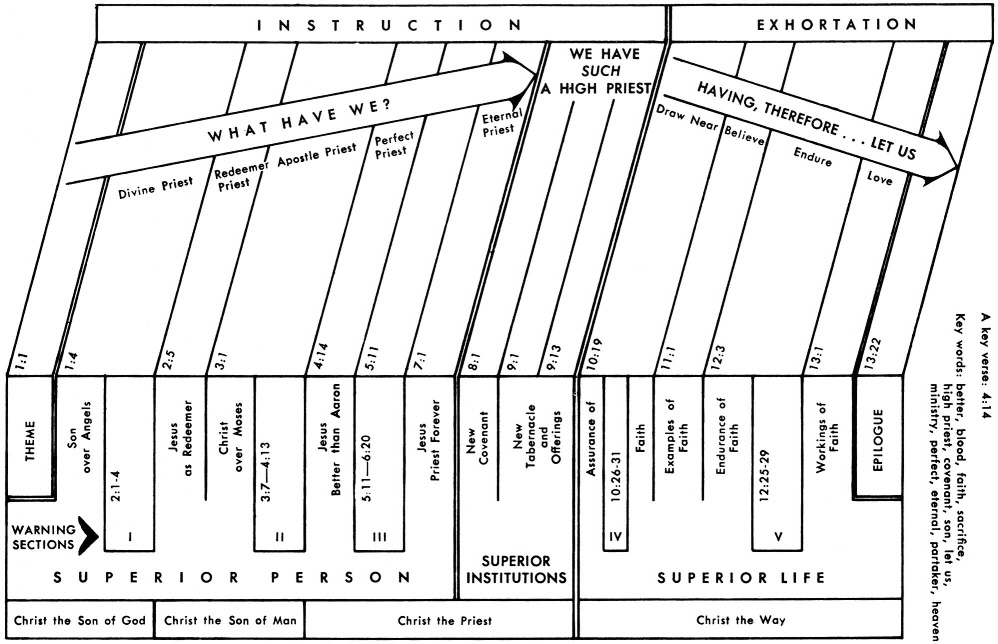
CONSIDER JESUS OUR GREAT HIGH PRIEST
Click chart to enlarge
Charts from Jensen's Survey of the NT - used by permission
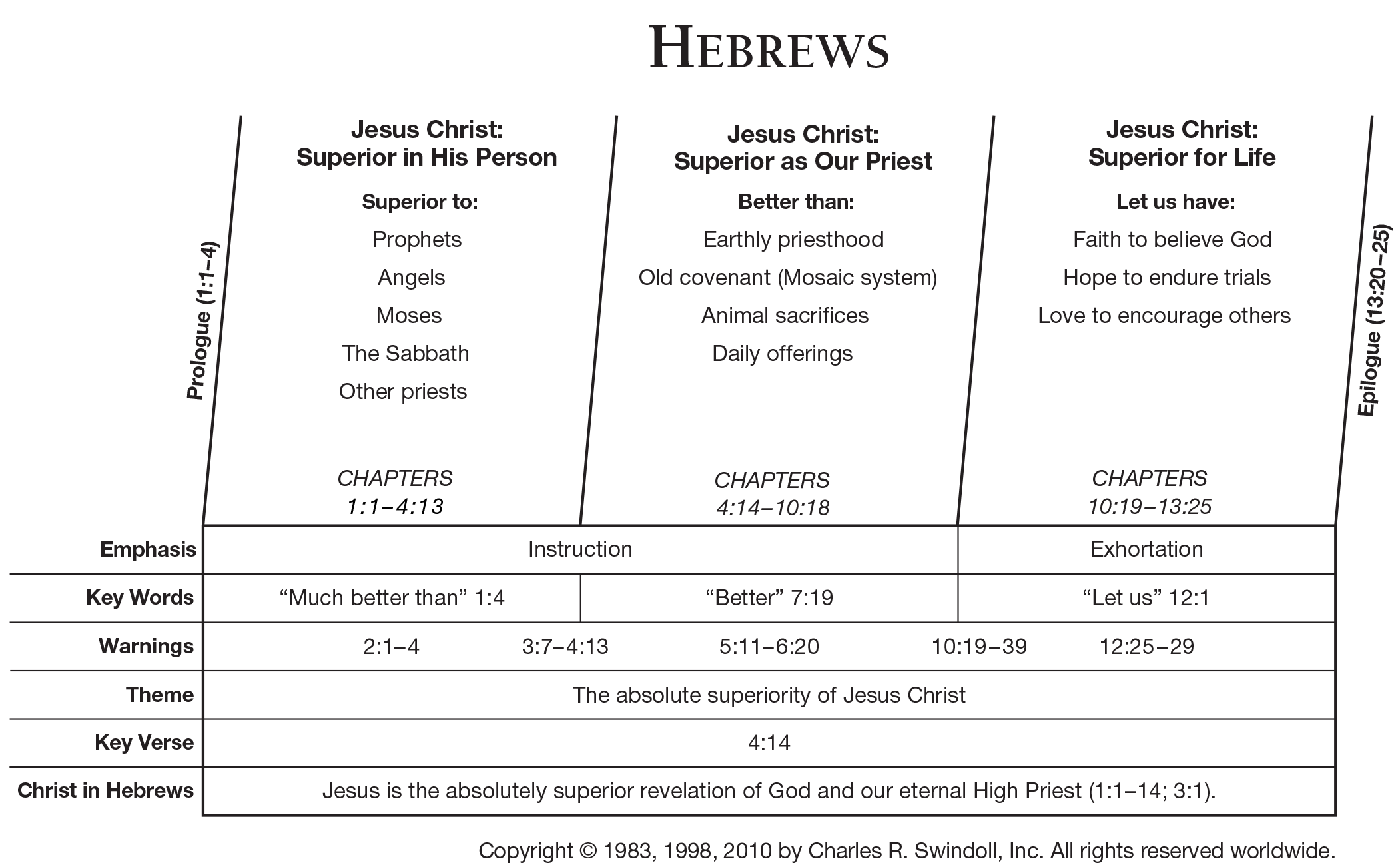
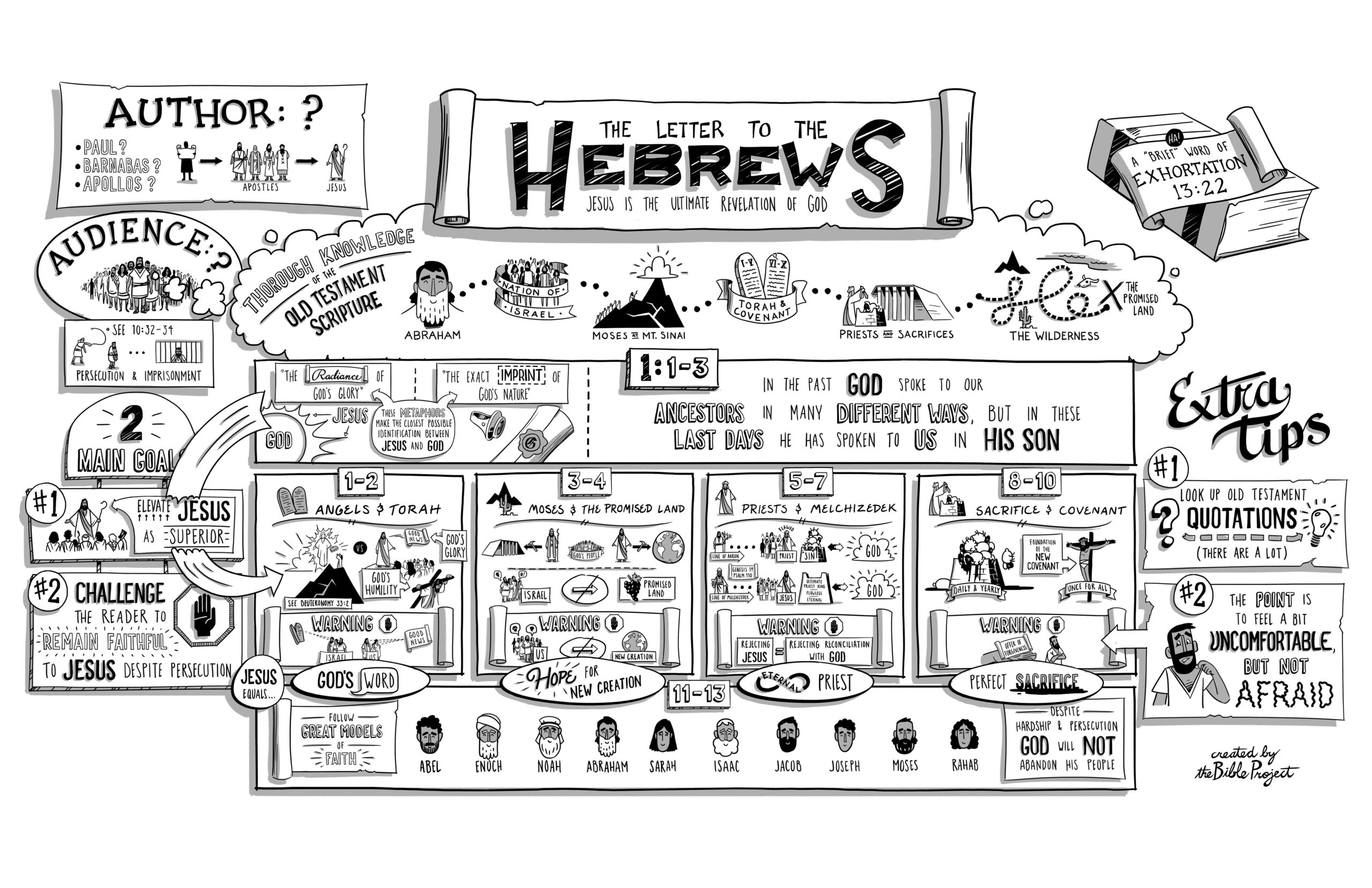
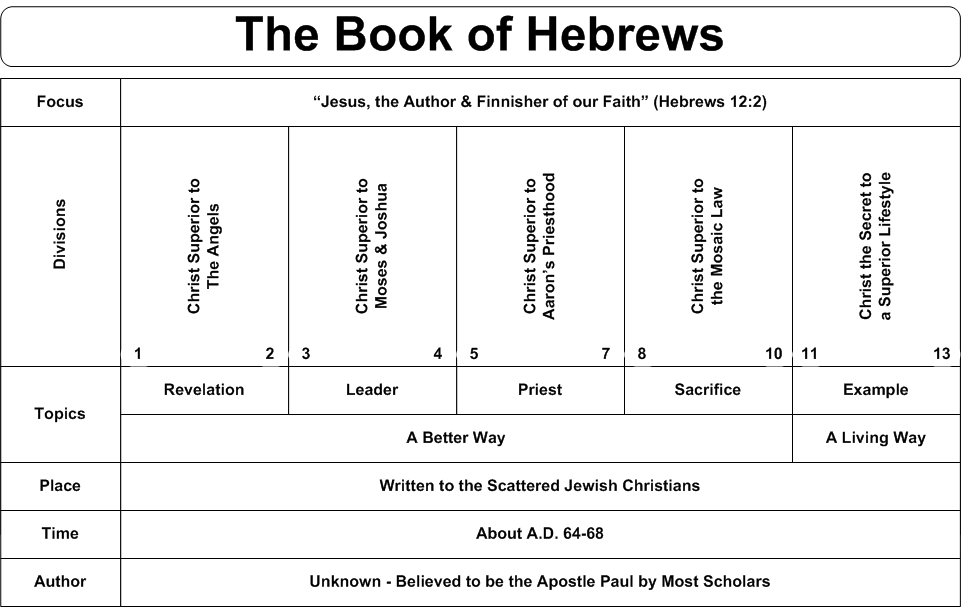
Swindoll's Chart, Interesting Pictorial Chart of Hebrews, Another Chart
|
The Epistle |
||||
| INSTRUCTION Hebrews 1-10:18 |
EXHORTATION Hebrews 10:19-13:25 |
|||
| Superior Person of Christ Hebrews 1:1-4:13 |
Superior Priest in Christ Hebrews 4:14-10:18 |
Superior Life In Christ Hebrews 10:19-13:25 |
||
| BETTER THAN PERSON Hebrews 1:1-4:13 |
BETTER PRIESTHOOD Heb 4:14-7:28 |
BETTER COVENANT Heb 8:1-13 |
BETTER SACRIFICE Heb 9:1-10:18 |
BETTER LIFE |
| MAJESTY OF CHRIST |
MINISTRY OF CHRIST |
MINISTERS FOR CHRIST |
||
|
DOCTRINE |
DUTY |
|||
|
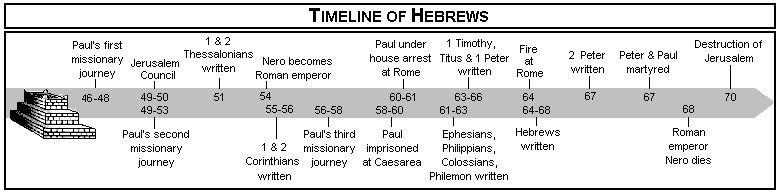
DATE WRITTEN: |
||||

See ESV Study Bible "Introduction to Hebrews"
(See also MacArthur's Introduction to Hebrews)
Borrow Ryrie Study Bible
|
THE FIVE WARNING PASSAGES |
| Heb 2:1-4+ |
| Heb 3:7-4:13+ |
| Heb 5:11-6:12+ |
| Heb 10:26-31+ |
| Heb 12:14-29+ |
Hebrews 6:13 For when God made the promise to Abraham, since He could swear by no one greater, He swore by Himself, (NASB: Lockman)
Greek: To gar Abraam epaggeilamenos (AMPMSN) o theos, epei kat' oudenos eichen (3SIAI) meizonos omosai, (AAN) omosen (3SAAI) kath' heautou,
Amplified: For when God made [His] promise to Abraham, He swore by Himself, since He had no one greater by whom to swear, (Amplified Bible - Lockman)
NLT: For example, there was God's promise to Abraham. Since there was no one greater to swear by, God took an oath in his own name, saying: (NLT - Tyndale House)
Phillips: When God made his promise to Abraham he swore by himself, for there was no one greater by whom he could swear, (Phillips: Touchstone)
Wuest: For when to Abraham God made promise, since He had no one greater by whom to swear, He swore by himself
Young's Literal: For to Abraham God, having made promise, seeing He was able to swear by no greater, did swear by Himself,
- He swore - Heb 6:16, 17, 18. Ge 22:15-18. Ezek 32:13. Ps 105:9, 10. Is 45:23. Je 22:5. 49:13. Micah 7:20. Lk 1:73, 74
- Hebrews 6 Resources - Multiple Sermons and Commentaries
Related Passages:
Isaiah 45:23 “I have sworn by Myself, The word has gone forth from My mouth in righteousness And will not turn back, That to Me every knee will bow, every tongue will swear allegiance.
Jeremiah 22:5 “But if you will not obey these words, I swear by Myself,” declares the LORD, “that this house will become a desolation.”’”
Jeremiah 49:13 “For I have sworn by Myself,” declares the LORD, “that Bozrah will become an object of horror, a reproach, a ruin and a curse; and all its cities will become perpetual ruins.”
Hebrews 2:16+ For assuredly He does not give help to angels, but He gives help to the descendant of Abraham.
Numbers 23:19+ “God is not a man, that He should lie, Nor a son of man, that He should repent; Has He said, and will He not do it? Or has He spoken, and will He not make it good?
Titus 1:2+ in the hope of eternal life, which God, Who cannot lie, promised long ages ago,
DIVINE CONDESCENSION TO MAN'S FRAILTY
REGARDING HIS PROMISE
In Hebrews 6:11–12, the writer exhorts the Hebrews to hold fast to “the full assurance of hope until the end” and not to be sluggish but to imitate the faithful and patient believers who inherit promises. In Hebrews 6:13–20 he then grounds that exhortation in the reliability of God’s promises. He takes Abraham as the prime example. And so he begins the explanation addressing the question of why can you (or why should you) trust God’s promises? His answer in this section is they can trust God's Word of promise to them because God’s word to Abraham was (and is) unshakably sure. Note the remarkable concentration of forensic (legal or used in court for act of judging) language in Hebrews 6:13-18.
For (gar) when God made the promise (epaggello) to Abraham - For or because (gar) is a term of explanation explaining that Abraham becomes the chief example of perseverance in faith. God even swore an oath to strengthen Abraham’s confidence.
Robert Gundry explains that “For” introduces two reasons why the author has just exhorted his audience to diligence for the inheriting of God’s promises: (1) the certainty of God’s keeping the promises, as illustrated in Abraham’s life, and (2) the patience required for the attainment of God’s promises, as illustrated again in Abraham’s life. God promised to favor Abraham by multiplying him through many descendants; and God did, as was more than abundantly evident by New Testament times. (See Commentary on the New Testament)
John MacArthur - In light of the Jewish persecution that these borderline believers would almost certainly face if they became Christians, they are pointed to Abraham. The father of the Jews is also the father of the faithful. He is the perfect illustration of a man of faith who, in the midst of adversity, uncertainty, and seeming impossibility, went all the way with God, totally trusting Him for everything. He went so far as to raise the knife to slay the very son who alone could fulfill God's promise—because God had told him to sacrifice this son. That is how far he trusted God. (See Hebrews Commentary - Page 161)
Spurgeon - For when God made a promise to Abraham The Lord’s transactions with the patriarch Abraham are frequently used in Scripture as types of His dealings with all the heirs of promise. The Lord found him in an idolatrous household, even as He finds all His people far off from Him and strangers to Him. But the Lord separated him by an effectual call, and brought him out from his country and from his father’s house, even as He does unto all His people when He visits them in mercy, and says, “Come out from their midst, and be separate, and do not touch what is unclean” (2 Cor 6:17). The Lord, then, was pleased to give to His servant a very gracious promise, the like of which, only yet more clear and bright, He is pleased to give to every heir of salvation. And after a while, that the patriarch’s faith in the midst of his increasing trials might come to a fullness of strength, the Lord was pleased to make a covenant with him, and to confirm that covenant by sacrifice of blood and by solemn oath.
God is the
ultimate Guarantor.
Since He could swear (omnuo) by no one greater (meizon), He swore (omnuo) by Himself - To swear (omnuo) as normally used by men generally refers to calling on someone greater (deity or something sacred) to guarantee truthfulness (cf Mt 5:34). Swear when applied to God is unique because there is simply no one greater to appeal to. God is the highest court of appeal! No one greater underscores God absolute supremacy—He has no superior or equal to invoke. Keep in mind God did not swear when He initially made the promises to Abraham. Now some twenty-five years after God first made His promises to Abram in Genesis 12:1–3 (see table), He solemnly confirmed them with an oath in Genesis 22:16. In that moment, God invoked His own being, character, and life as the witness to His word. Thus, Abraham’s assurance rested on two unshakable witnesses — God’s promise and God’s oath — echoing the Old Testament requirement of two witnesses in serious matters (Deut 19:15). Stated another way when God wanted to give Abraham (and us) the greatest possible assurance, He bound Himself by His own character, which elevated the reliability of His promise to the highest possible level! God condescends to use human categories (an oath) to give us assurance—even though His simple word is already infallible.
The author of Hebrews is appealing to his Jewish readers on familiar ground. By the first century, Jewish synagogue worship included the reading of the Torah. Genesis 22 (the “Akedah,” the binding of Isaac) was and remains a foundational text. The story of Abraham offering Isaac was highly revered in Jewish tradition, seen as Abraham’s supreme act of obedience. Rabbinic and intertestamental writings often referred to God’s oath to Abraham as proof of His covenant faithfulness. Thus, the Jewish audience of Hebrews would have been very familiar with God confirming His promise to Abraham by an oath.
The Hebrews, some of whom were being tempted to drift, are reminded “If God swore by Himself, your hope is unshakable. You can bank everything on it.”
The Hebrew readers who recognized the truth of the gospel, who had seen miracles performed by the apostles, were still afraid to let go of the familiar old ways and rituals of Judaism. They were hesitant to believe completely in the Messiah. As the writer has exhorted (Heb 6:11+) they needed to remain diligent. And so the writer spurs them on to faith (cp faith comes from hearing and hearing from the Word of Christ - Ro 10:17+) and patience by emphasizing the immutable promise given to their forefather Abraham. Thus the writer addresses both man's part in laying hold of the hope set before him and the Godward side of the unchangeableness of God and His sure promises.
Spurgeon - since he had no one greater to swear by, he swore by himself He then who is a believer is certified by the oath of God that in blessing He will bless him. This is sure to all believers, and sure to me and to you if we are believers. As believers, we flee away from ourselves and the covenant of works to the sure covenant of unchanging grace. And our consolation is strong, because God is true.
We see clearly that the Lord does not desire us to be in an unsettled condition, but would put an end to all uncertainty and questioning. As among men a fact is established when an honest man has sworn to it, so “God, because he wanted to show even more to the heirs of the promise the unchangeableness of his resolve, guaranteed it with an oath” (Heb 6:17). Condescending to the weakness of human faith, He Himself swears to what He declares, and thus gives us a gospel doubly certified by the promise and oath of the everlasting God. Surely angels must have wondered when God lifted His hand to heaven to swear to what He had promised, and must have concluded that thenceforth there would be an end of all strife, because of the confirmation that the Lord thus gave to His covenant.
F B Hole (Biographical Note) writes that…
We need to have a hope which is resting upon a very weld established basis if we are to hold it with full assurance. It is this thought which leads to verses 13-18. Abraham stands before us as a great example not only of faith but of hope also. It was when he had offered up Isaac, as recorded in Genesis 22:1ff, that the promise of blessing was given, which culminated in "the Seed," which is Christ, according to Gal 3:16. That great promise had behind it not only the authority which always accompanies the bare Word of God, but also the added sanction of His solemn Oath.
How beautiful is this glimpse which we have of God, stooping to consider the feebleness and infirmities which mark even the best of His creatures! Here are Abraham and the later heirs of the promises. How easily their faith may waver! How full of uncertainties is the world in which they find themselves! Then God will condescend to their weakness and reinforce His Word by His Oath, saying, "By Myself have I sworn, saith the LORD." (Hebrews Commentary Notes)
Ray Stedman - True faith by nature awakens hope. In Heb 6:11–12, the author urges the Hebrews to learn how to nurture faith and make their hope sure. The role models for this nurturing are the patriarchs, notably Abraham. Abraham’s faith flourished because it fastened upon two facets of God’s dealings with him: God’s promise and his oath. A promise of many descendants was given to Abraham while he was still in Haran, recorded in Genesis 12:1–3. It was repeated when he arrived at Shechem (Gen 12:6–7) and reiterated on several occasions after that. Supported by these renewed promises, Abraham waited for twenty-five years until he was one hundred years old when Isaac was finally born. When Isaac had grown into young manhood, God commanded Abraham to offer Isaac as a sacrifice on Mount Moriah, now called the Temple Mount in Jerusalem. At the last moment, God stopped Abraham’s hand. And after this dramatic act of Abraham’s faith, God renewed his promise of many descendants and confirmed it with an oath (Gen 22:17 quoted in Heb 6:14). (The Promise and Oath of God)
🙏 THOUGHT -This verse teaches that our assurance rests not on our faith’s strength but on God’s unchanging character. When He swears by Himself, He essentially says: “If My promise fails, I cease to be who I am.” That is impossible. Therefore, we can flee to Him with confidence, knowing our hope is secure.
Made a promise (1861)(epaggello from epi = an intensifier of the verb + aggello = to tell, declare) means to proclaim, promise, declare, announce, claim (profess). The NT almost always uses epangelia in the sense of a divine promise. God’s promises (especially concerning salvation and inheritance): Romans 4:20 – Abraham did not waver in unbelief regarding “the promise of God.” Galatians 3:16, 22 – the promise given to Abraham and his seed. Hebrews 6:12, 15 – inheriting the promises through faith and patience. Eternal life / Spirit: 1 John 2:25 – “This is the promise… eternal life.” Acts 2:39 – “the promise is for you and your children,” i.e., the Spirit. Plural form (“the promises”) – the entire body of God’s covenant commitments (Heb 6:12; 2 Cor 1:20).
Here is the corresponding noun Promise (1860) (epaggelia/epangelia from epí = intensifies verbal meaning + aggéllo = to tell, declare) originally referred to an announcement or declaration (especially of a favorable message) but in later Greek came to mean a declaration to do something with the implication of obligation to carry out what is stated (thus a promise or pledge). Epaggelia was primarily a legal term denoting summons, a promise to do or give something, but in the NT speaks primarily of the promises of God.Epaggelia is used in Hebrews 14 times in 13 verses (27.4% of all 51 NT uses) (See notes Hebrews 4:1, Hebrews 6:12, 6:15, 6:17, Hebrews 7:6, Hebrews 8:6, Hebrews 9:15, Hebrews 10:36, Hebrews 11:9, 11:13, 11:17, 11:33, 11:39)
TDNT summarizes this word group epaggello/epaggelia writing that it has the following nuances…a. The first sense is “to indicate,” “declare,” “declaration,” “report.” b. When the state declares something, it becomes an “order.” c. In law we find the senses “accusation” and “delivery of a judgment.” d. We then find the senses “to declare an achievement,” “to show one's mastery,” “to profess a subject.” e. Another sense is “to offer,” “to promise,” “to vow.” As regards promises, tension between word and deed is felt, so that promises are often seen as worthless. f. A special type of promise is the “promise of money,” and in this sense the idea of a “subscription” or “donation” arises (state liturgies, gifts to rulers at their accession, priests promising gifts in support of their candidature). g. In the Hellenistic period we also find a sacral use for the “proclamation” of a festival. Among all the instances, only one example has been found for the promise of a deity. (Borrow Kittel's Theological Dictionary of the New Testament )
Swear (3660) (omnuo) means to affirm the truth of a statement by calling on a divine being to execute sanctions against a person if the statement in question is not true (in the case of a deity taking an oath, his divine being is regarded as validating the statement). In this case God's Own Divine being is regarded as validating the statement.
Omnuo is repeated in this middle section of Hebrews…
Hebrews 3:11 As I swore in My wrath, 'They shall not enter My rest.'"
Hebrews 3:18 And to whom did He swear that they should not enter His rest, but to those who were disobedient?
Hebrews 4:3 For we who have believed enter that rest, just as He has said, "As I swore in My wrath, They shall not enter My rest," although His works were finished from the foundation of the world.
Hebrews 6:13 For when God made the promise to Abraham, since He could swear by no one greater, He swore by Himself,
Hebrews 6:16 For men swear by one greater than themselves, and with them an oath given as confirmation is an end of every dispute.
Hebrews 7:21 (for they indeed became priests without an oath, but He with an oath through the One who said to Him, "The Lord has sworn And will not change His mind, 'Thou art a priest forever' ")
This verb omnuo is in the Septuagint (LXX) of God swearing to keep His covenant to bring Israel into the land (Dt 1:8, 35, 2:14, 4:21, 31, 6:10, 18, 23, 7:8, 12, 13, 8:1, 18, etc > 30x in Deut.)
Examples of God swearing - Genesis 22:16 (when he did not withheld Isaac his only son) Micah 7:20 (Israel was unfaithful and did not "deserve" to receive His promises, but He had sworn to the patriarchs - Abraham, Isaac, Jacob - that He would keep the Abrahamic Covenant - to wit, Israel would be restored to the promised land, a promise yet to be fulfilled in the Millennium); Lk 1:73 (Zechariah father of John the Baptist filled with the Spirit expressed his faith in God's promise to Abraham to keep His covenant) Isaiah 45:23, Jer 22:5, 49:13)
Courtroom Oath Illustration - In human courts, a witness swears on the Bible or by the authority of the court. The logic is: “I am appealing to something higher than myself to guarantee I speak the truth.” God, however, has nothing higher to appeal to — He Himself is the highest authority. So He swore by His own character. Application: If a courtroom oath reassures us of truth, how much more God’s self-sworn oath guarantees His promise.
Child & Parent Assurance - A child asks a parent: “Daddy, are you sure you’ll be at my game?” The father says, “Yes, I promise.” The child presses, “Promise promise?” Out of love, the father strengthens the assurance, not because his first word wasn’t true, but because the child needed extra reassurance. Application: God’s oath is His “Promise Promise” to weak believers who struggle to trust fully.
Bank Guarantee Illustration - Imagine you deposit money in a bank and receive not only a receipt but also the bank president’s personal signature guaranteeing it. The deposit was safe with just the receipt, but the signature gives you double confidence. Application: God gave His promise (safe enough), then added His oath (His personal guarantee).
Anchor and Rock Illustration (ties into Heb 6:19) - A ship lowers anchor onto the seabed. Its security depends entirely on what the anchor grips. If it grips shifting sand, it drags; if it catches on bedrock, it holds. God’s oath is bedrock — no higher, no stronger foundation exists. Application: Our anchor of hope is secure because it holds in God Himself.
King’s Decree Illustration - In ancient times, when a king stamped a decree with his royal seal, no one could revoke it. God, the King of kings, has “sealed” His promise with His own oath. Application: If earthly kings could not be overruled, how much more God’s oath cannot be broken.
The Bible does not disapprove of making oaths. God 'swore by Himself' when He made His covenant with Abraham (Heb. 6:13). In a world of liars, people are often asked to swear to the truthfulness of their words.
James Girdwood - The immutability of God’s character ensures the certainty of his promises, but God did not stop here. Recognizing that humans need something tangible to grasp, God stooped to our level and confirmed his promise by taking an oath. No one forced God to do this, and no one could argue if he simply told us to take him at his word. But in order to show us his commitment to his word and his great love for us, God “swore by himself” to make it easier for us to believe in him.
John MacArthur - JESUS ON VOWS AND OATHS—Mt. 5:33–36 Daily Readings From the Life of Christ, Volume 1 - Page 122
In the regular business of life, people use vows and oaths—at marriage ceremonies, in the courtroom, executive oaths of office. Because human nature is prone to lying and distrust, God has provided for proper use of oaths (cf. Heb. 6:16). In describing who may enter God’s presence, the psalmist says one requirement is that the person be one who “swears to his own hurt and does not change” (Ps. 15:4b; cf. vv. 2–3). Such a person’s word is more important than his or her welfare.
God Himself has issued oaths in the past (Gen. 22:16–17; cf. Pss. 89:3, 49; 110:4; Jer. 11:5; Luke 1:73). He did so to impress upon people the special importance or urgency of a promise. As Hebrews notes, “Since He could swear by no one greater, He swore by Himself” (6:13). Christ often used the expression “truly” or “truly, truly” (e.g., Matt. 5:18, 26; 6:2, 5, 16; John 1:51; 3:3, 5; 5:19, 24). As with the Father’s oaths, the Son’s use of “truly” did not make those statements any more trustworthy than any other pronouncements. The “truly” teachings underscored the importance of certain teachings. Jesus even used an oath before the high priest Caiaphas that He was indeed God’s Son (Matt. 26:63–64).
In view of the special nature of divine oaths, we should “make no oath[s] at all”—in other words, no frivolous ones that would compromise our truthfulness and integrity (cf. Pss. 119:29, 163; 120:2).
Amen.
“Amen! May the Lord, the God of my lord the king, say so.”—He who blesses himself in the land shall bless himself by the God of truth, and he who takes an oath in the land shall swear by the God of truth.
When God made a promise to Abraham, since he had no one greater by whom to swear, he swore by himself. . . . For people swear by something greater than themselves, and in all their disputes an oath is final for confirmation. So when God desired to show more convincingly to the heirs of the promise the unchangeable character of his purpose, he guaranteed it with an oath, so that by two unchangeable things, in which it is impossible for God to lie, we who have fled for refuge might have strong encouragement to hold fast to the hope set before us.—“The words of the Amen, the faithful and true witness.”—For all the promises of God find their Yes in him. That is why it is through him that we utter our Amen to God for his glory.—Blessed be the Lord, the God of Israel, who alone does wondrous things. Blessed be his glorious name forever; . . . Amen and Amen!
Matt. 6:13; 1 Kings 1:36; Isa. 65:16; Heb. 6:13, 16–18; Rev. 3:14; 2 Cor. 1:20; Ps. 72:18–19
(GOD'S FIRST PROMISE TO ABRAM/ABRAHAM) Genesis 12:1-3 Now the LORD said to Abram, “Go forth from your country, And from your relatives And from your father’s house, To the land which I will show you; 2 And I will make you a great nation, And I will bless you, And make your name great; And so you shall be a blessing; 3 And I will bless those who bless you, And the one who curses you I will curse. And in you all the families of the earth will be blessed.”
(GOD RATIFIES THE COVENANT) Genesis 15:1-18 After these things the word of the LORD came to Abram in a vision, saying, “Do not fear, Abram, I am a shield to you; Your reward shall be very great.” 2 Abram said, “O Lord GOD, what will You give me, since I am childless, and the heir of my house is Eliezer of Damascus?” 3 And Abram said, “Since You have given no offspring to me, one born in my house is my heir.” 4 Then behold, the word of the LORD came to him, saying, “This man will not be your heir; but one who will come forth from your own body, he shall be your heir.” 5 And He took him outside and said, “Now look toward the heavens, and count the stars, if you are able to count them.” And He said to him, “So shall your descendants be.” (ABRAHAM DECLARED RIGHTEOUS BY FAITH) 6 Then he believed in the LORD; and He reckoned it to him as righteousness. 7 And He said to him, “I am the LORD who brought you out of Ur of the Chaldeans, to give you this land to possess it.” 8 He said, “O Lord GOD, how may I know that I will possess it?” 9 So He said to him, “Bring Me a three year old heifer, and a three year old female goat, and a three year old ram, and a turtledove, and a young pigeon.” 10 Then he brought all these to Him and cut them in two, and laid each half opposite the other; but he did not cut the birds. 11The birds of prey came down upon the carcasses, and Abram drove them away. 12Now when the sun was going down, a deep sleep fell upon Abram; and behold, terror and great darkness fell upon him. 13 God said to Abram, “Know for certain that your descendants will be strangers in a land that is not theirs, where they will be enslaved and oppressed four hundred years. 14“But I will also judge the nation whom they will serve, and afterward they will come out with many possessions. 15“As for you, you shall go to your fathers in peace; you will be buried at a good old age. 16 “Then in the fourth generation they will return here, for the iniquity of the Amorite is not yet complete.” 17 It came about when the sun had set, that it was very dark, and behold, there appeared a smoking oven and a flaming torch which passed between these pieces. 18 On that day the LORD made a covenant with Abram, saying, “To your descendants I have given this land, From the river of Egypt as far as the great river, the river Euphrates:
(ABRAHAM AGE 99) Genesis 17:1,15-21 Now when Abram was ninety-nine years old, the LORD appeared to Abram and said to him, “I am God Almighty; Walk before Me, and be blameless. .....15 Then God said to Abraham, “As for Sarai your wife, you shall not call her name Sarai, but Sarah shall be her name. 16 “I will bless her, and indeed I will give you a son by her. Then I will bless her, and she shall be a mother of nations; kings of peoples will come from her.” 17 Then Abraham fell on his face and laughed, and said in his heart, “Will a child be born to a man one hundred years old? And will Sarah, who is ninety years old, bear a child?” 18 And Abraham said to God, “Oh that Ishmael might live before You!” 19 But God said, “No, but Sarah your wife will bear you a son, and you shall call his name Isaac; and I will establish My covenant with him for an everlasting covenant for his descendants after him. 20 “As for Ishmael, I have heard you; behold, I will bless him, and will make him fruitful and will multiply him exceedingly. He shall become the father of twelve princes, and I will make him a great nation. 21 “But My covenant I will establish with Isaac, whom Sarah will bear to you at this season next year.”
(ABRAHAM TRIES TO "HELP" GOD) Genesis 21:1-12 Then the LORD took note of Sarah as He had said, and the LORD did for Sarah as He had promised. 2 So Sarah conceived and bore a son to Abraham in his old age, at the appointed time of which God had spoken to him. 3 Abraham called the name of his son who was born to him, whom Sarah bore to him, Isaac. 4Then Abraham circumcised his son Isaac when he was eight days old, as God had commanded him. 5 Now Abraham was one hundred years old when his son Isaac was born to him. 6 Sarah said, “God has made laughter for me; everyone who hears will laugh with me.” 7 And she said, “Who would have said to Abraham that Sarah would nurse children? Yet I have borne him a son in his old age.” 8The child grew and was weaned, and Abraham made a great feast on the day that Isaac was weaned. 9Now Sarah saw the son of Hagar the Egyptian, whom she had borne to Abraham, mocking. 10 Therefore she said to Abraham, “Drive out this maid and her son, for the son of this maid shall not be an heir with my son Isaac.” 11 The matter distressed Abraham greatly because of his son. 12 But God said to Abraham, “Do not be distressed because of the lad and your maid; whatever Sarah tells you, listen to her, for through Isaac your descendants shall be named.
(GOD TESTS ABRAHAM) Genesis 22:1-19 Now it came about after these things, that God tested Abraham, and said to him, “Abraham!” And he said, “Here I am.” 2 He said, “Take now your son, your only son, whom you love, Isaac, and go to the land of Moriah, and offer him there as a burnt offering on one of the mountains of which I will tell you.” 3 So Abraham rose early in the morning and saddled his donkey, and took two of his young men with him and Isaac his son; and he split wood for the burnt offering, and arose and went to the place of which God had told him. 4 On the third day Abraham raised his eyes and saw the place from a distance. 5 Abraham said to his young men, “Stay here with the donkey, and I and the lad will go over there; and we will worship and return to you.” 6 Abraham took the wood of the burnt offering and laid it on Isaac his son, and he took in his hand the fire and the knife. So the two of them walked on together. 7 Isaac spoke to Abraham his father and said, “My father!” And he said, “Here I am, my son.” And he said, “Behold, the fire and the wood, but where is the lamb for the burnt offering?” 8 Abraham said, “God will provide for Himself the lamb for the burnt offering, my son.” So the two of them walked on together. 9 Then they came to the place of which God had told him; and Abraham built the altar there and arranged the wood, and bound his son Isaac and laid him on the altar, on top of the wood. 10 Abraham stretched out his hand and took the knife to slay his son. 11 But the angel of the LORD called to him from heaven and said, “Abraham, Abraham!” And he said, “Here I am.” 12 He said, “Do not stretch out your hand against the lad, and do nothing to him; for now I know that you fear God, since you have not withheld your son, your only son, from Me.” 13 Then Abraham raised his eyes and looked, and behold, behind him a ram caught in the thicket by his horns; and Abraham went and took the ram and offered him up for a burnt offering in the place of his son. 14 Abraham called the name of that place The LORD Will Provide, as it is said to this day, “In the mount of the LORD it will be provided.” 15 Then the angel of the LORD called to Abraham a second time from heaven, 16 and said, “By Myself I have sworn, declares the LORD, because you have done this thing and have not withheld your son, your only son, 17 indeed I will greatly bless you, and I will greatly multiply your seed as the stars of the heavens and as the sand which is on the seashore; and your seed shall possess the gate of their enemies. 18 “In your seed all the nations of the earth shall be blessed, because you have obeyed My voice.” 19 So Abraham returned to his young men, and they arose and went together to Beersheba; and Abraham lived at Beersheba.
Romans 4:17-21 (as it is written, “A FATHER OF MANY NATIONS HAVE I MADE YOU”) in the presence of Him whom he believed, even God, who gives life to the dead and calls into being that which does not exist. 18 In hope against hope he believed, so that he might become a father of many nations according to that which had been spoken, “SO SHALL YOUR DESCENDANTS BE.” 19 Without becoming weak in faith he contemplated his own body, now as good as dead since he was about a hundred years old, and the deadness of Sarah’s womb; 20 yet, with respect to the promise of God, he did not waver in unbelief but grew strong in faith, giving glory to God, 21 and being fully assured that what God had promised, He was able also to perform.Hebrews 11:17-19 By faith Abraham, when he was tested, offered up Isaac, and he who had received the promises was offering up his only begotten son; 18 it was he to whom it was said, “IN ISAAC YOUR DESCENDANTS SHALL BE CALLED.” 19 He considered that God is able to raise people even from the dead, from which he also received him back as a type.
Hebrews 6:14 saying, "I WILL SURELY * BLESS YOU AND I WILL SURELY MULTIPLY YOU." (NASB: Lockman)
Greek: legon (PAPMSN) Ei men eulogon (PAPMSN) eulogeso (1SFAI) se kai plethunon (PAPMSN) plethuno (1SFAI) se
Amplified: Saying, Blessing I certainly will bless you and multiplying I will multiply you. (Amplified Bible - Lockman)
NLT: "I will certainly bless you richly, and I will multiply your descendants into countless millions." (NLT - Tyndale House)
Phillips: and he said: 'Surely blessing I will bless you, and multiplying I will multiply you'. (Phillips: Touchstone)
Wuest: saying, Blessing, I will bless you, and multiplying, I will multiply you
Young's Literal: saying, 'Blessing indeed I will bless thee, and multiplying I will multiply thee'
- Bless you - Ge 22:17. Lk 1:73. Ge 2:16. Ge 17:2
- Multiply you - Ge 48:4. Ex 32:13. Dt 1:10. Ne 9:23
- Hebrews 6 Resources - Multiple Sermons and Commentaries
Related Passages:
Genesis 22:16-17+ and said, “By Myself I have sworn, declares the LORD, because you have done this thing and have not withheld your son, your only son, 17 indeed I will greatly bless you, and I will greatly multiply your seed as the stars of the heavens and as the sand which is on the seashore; and your seed shall possess the gate of their enemies.
A DIVINE OATH TO DOUBLY
BLESS AND MULTIPLY
The writer of Hebrews is encouraging weary, persecuted Jewish believers not to drift or abandon hope. He points to Abraham as the supreme model of patient faith. After years of waiting and severe testing (the offering of Isaac), Abraham received God’s oath of promise (Gen 22:16–17). This oath becomes the anchor for his readers: God’s promises are unchangeable and guaranteed by His own character (see vv. 17–18).
Saying, "I WILL SURELY BLESS (eulogeo eulogeo) YOU AND I WILL SURELY MULTIPLY (plethuno plethuno) YOU. - KJV is more literal picking up the "double blessing" and double multiplication. In Hebrew the repetition of a verb is meant to give force to what is said, to express the certainty and the greatness of what is asserted. So it could be read "Blessing indeed I will bless thee, and multiplying I will multiply thee"
🙏 THOUGHT - Don't miss this - God wants His beloved to have a full assurance of hope until the end and He spares no words to emphasize His commitment to that end. How unworthy we are to be deserving of such lavish grace. This truth should humble us and create profoundly grateful, thankful hearts.
Spurgeon - Surely I will greatly bless you, and I will greatly multiply you His hands are branded with the names of His beloved, and it is not possible that He can forget them. The Lord has a loving memory. He cannot forget His own. Think of words like these—“I remember concerning you the loyal love of your childhood, the love of your betrothal-time” (Jer 2:2); “Israel, you will not be forgotten by me” (Isa 44:21); “For Yahweh your God is a compassionate God; He will not abandon you” (Deut 4:31).
Every blessing that in that covenant was guaranteed to the chosen seed was by the precious blood made eternally secure to that seed. Oh, how I delight to speak about the sureness of that covenant! How the dying David rolled that under his tongue as a sweet morsel! “Yet not so is my house with God”—there was the bitter in his mouth; “for,” said he—and there came in the honey—“he has made an everlasting covenant for me, arranging everything. He has secured all my deliverance” (2 Sam 23:5). And this sureness, mark you, lies in the blood; it is the blood of Christ that makes all things secure, for all the promises of God are indeed and amen in Christ Jesus, to the glory of God by us.
Bless (2127) (eulogeo from eu = good + lógos = word) when used by men toward men it means to speak well of with praise and thanksgiving (English "eulogize"). It means to invoke God’s blessing upon them.
EULOGEO IN HEBREWS - Heb. 6:14; Heb. 7:1; Heb. 7:6; Heb. 7:7; Heb. 11:20; Heb. 11:21
Multiply (4129) (plethuno from plethos = fullness from pletho = to fill) means to be made full, grow, increase or be multiplied. In the active sense it means to cause to increase, to cause to become greater in number, to multiply (increase in number especially greatly)
PLETHUNO - 11V - Matt. 24:12; Acts 6:1; Acts 6:7; Acts 7:17; Acts 9:31; Acts 12:24; 2 Co. 9:10; Heb. 6:14; 1 Pet. 1:2; 2 Pet. 1:2; Jude 1:2
Illustration Ideas
- A double underline in a contract: God underlined His promise twice with blessing and multiplication.
- The stars and sand as a visual picture of God’s overflowing fulfillment.
- A legal oath in court: but instead of swearing on the Bible, God swore by Himself — the highest authority.
- Seeds multiplying: a small seed becoming a vast harvest — a picture of God’s promise of increase.
Spurgeon - BLESSING I WILL BLESS YOU. Hebrews 6:14
The God with whom you and I have to deal is a God who may do as He wills. He is an absolute sovereign, but He never can do anything unless it is right. He has promised to speak with reverence and with bonds and pledges in the person of Jesus Christ, saying, “Surely blessing I will bless you” (Heb. 6:14).
There is a covenant entered into on our behalf between the Lord Jesus and the Father. This covenant, assuredly and certainly, brings unnumbered blessings because God cannot lie. He has given two unalterable pledges so that we may have strong comfort and will never doubt His faithfulness. Beloved, the God of the promises has appointed your future and your inheritance, so you shall stand in it at the end of the days. The God of the promises has appeared to you in Jesus Christ, and He has sworn an oath; therefore, you may rest in the blood of Jesus, which makes the covenant sure.
He has promised never to leave His people. He told Jacob, “I will not leave you” (Gen. 28:15), and He says the same to you. He will never forget to give what He has promised. “I will not leave you until I have done what I have spoken to you.” What blessed words! This divine statement is so rich, so full of the best, that to talk about it is gilding gold or adding whiteness to the lily’s beauty.
Remember this promise, and let the Holy Spirit apply it. The God who does not change has made all the promises in Christ Jesus to the glory of God. Every one of His promises made to believers will stand fast and firm. “For assuredly, I say to you, till heaven and earth pass away, one jot or one tittle will by no means pass from the law till all is fulfilled” (Matt. 5:18).
Hebrews 6:15 And so, having patiently waited, he obtained the promise. (NASB: Lockman)
Greek: kai houtos makrothumesas (AAPMSN) epetuchen (3SAAI) tes epaggelias.
Amplified: And so it was that he [Abraham], having waited long and endured patiently, realized and obtained [in the birth of Isaac as a pledge of what was to come] what God had promised him. (Amplified Bible - Lockman)
NLT: Then Abraham waited patiently, and he received what God had promised. (NLT - Tyndale House)
Phillips: And then Abraham, after patient endurance, found the promise true. (Phillips: Touchstone)
Wuest: and thus, having patiently endured, he obtained the promise.
Young's Literal: and so, having patiently endured, he did obtain the promise;
Paraphrase: After waiting with perseverance, Abraham finally received what God had promised.
Paraphrase: Because he endured patiently and did not give up, Abraham came to experience the fulfillment of God’s promise.
- Heb 6:12. Ge 12:2, 3. Ge 15:2-6. Ge 17:16, 17. Ge 21:2-7. Ex 1:7. Hab 2:2, 3. Ro 4:17-25. Heb 7:6. Ro 4:13 Heb 11:13. Dt 1:10. Lk 1:68, 69. Lk 16:22. Jn 8:56. Ac 7:5
- Hebrews 6 Resources - Multiple Sermons and Commentaries
Related Passages:
Hebrews 6:11-12+ And we desire that each one of you show the same diligence so as to realize the full assurance of hope until the end, 12 so that you will not be sluggish, but imitators of those who through faith and patience inherit the promises.
Hebrews 11:8-12+ By faith Abraham, when he was called, obeyed (FAITH IN ACTION!) by going out to a place which he was to receive for an inheritance; and he went out, not knowing where he was going (WALKING BY FAITH NOT SIGHT - 2Co 5:7+, Heb 11:1+). 9 By faith he lived as an alien in the land of promise, as in a foreign land, dwelling in tents with Isaac and Jacob, fellow heirs of the same promise; (NOTE WHILE ABRAHAM DID ENTER THE LAND HE WAS A SOJOURNER NOT A PERMANENT POSSESSOR. THE PROMISE OF FULL POSSESSION WAS STILL FUTURE.) 10 for he was looking for the city which has foundations, whose architect and builder is God. 11 By faith even Sarah herself received ability to conceive, even beyond the proper time of life, since she considered Him faithful who had promised. 12 Therefore there was born even of one man, and him as good as dead at that, as many descendants AS THE STARS OF HEAVEN IN NUMBER, AND INNUMERABLE AS THE SAND WHICH IS BY THE SEASHORE.
Hebrews 11:39+ And all these (WHICH WOULD INCLUDE ABRAHAM), having gained approval through their faith, did not receive what was promised (ALTHOUGH HE DID RECEIVE THE SON OF PROMISE, ISAAC).
ABRAHAM'S PATIENCE
PROCURES PROMISE
And so (in this way) - This is a connector that points back to or links with God's promise to bless and multiply Abraham in Heb 6:13-14. The writer is summing up Abraham’s story as an example for the readers. The and so introduces the result or consequence of Abraham’s endurance, so because he waited patiently, in this way he obtained the promise. To say it another way, and so signals the outcome -- the promise came to pass after patient waiting. It also highlights Abraham as a model, so that if he received the promise this way, the readers must follow the same path (patient endurance) and they will inherit the promises (Heb 6:12).
Abraham's endurance precedes
the fulfillment of the promise
Having patiently waited (makrothumeo) - This clause emphasizes Abraham's faith and the following (he obtained...) emphasizes God's faithfulness. Abraham is the prototype who the readers were to imitate as described in Heb 6:12+. Abraham received the promised blessing not instantly, but after patiently waiting in faith, setting the pattern for all the readers of Hebrews to endure so as to inherit God’s promises. Abraham waited 25 years between promise (Gen 12:1–3) and fulfillment (Isaac’s birth at age 100, Gen 21:1–3). His faith wasn’t flawless (Hagar/Ishmael episode, Ge 16), but it was persevering. Faith is expressed in waiting. Abraham’s life illustrates that genuine faith perseveres despite delay and trial (cf. Rom 4:18–21). The Hebrews as noted in Heb 6:12 needed the same makrothumia or patient endurance until God’s promises in Christ would be fully realized.
🙏 THOUGHT - “Having patiently waited” reminds us that God’s promises often unfold slowly. Abraham waited 25 years for Isaac. We may grow restless, but God is never late. His promises are certain, and our calling is to endure with steady trust.
And keep in mind that even though Abraham had temporary faith failures, the Spirit highlights his endurance, not his failures. Thus Paul records the example of Abraham's faith writing that "without becoming weak in faith (WHICH ABRAHAM DID ON OCCASION) he contemplated his own body, now as good as dead since he was about a hundred years old, and the deadness of Sarah's womb; yet, with respect to the promise of God, he did not waver in unbelief, but grew strong in faith, giving glory to God, and being fully assured that what He had promised, He was able also to perform. (Ro 4:19-21+)
Wuest - Patiently waited (makrothumeo) refers back to the word patience (makrothumia) in Heb 6:12+. (Hebrews Commentary)
He obtained (epitugchano - attain, experience) the (definite article = the specific) promise (epaggelia - pledge) - While Abraham did not receive the entirety of the divine promise (such as possession of the land, cf Heb 11:13+.), he did obtain his promised son, Isaac (Gen 21:1–3) which marked the beginning of the promised multiplication of descendants. “In fact, Abraham patiently waited—though God in His mercy does not highlight Abraham’s lapse when he sought a child through Hagar. Instead, the focus is on God’s faithfulness and Abraham’s endurance. For twenty-five years Abraham clung to God’s promise of a seed, and at last his precious Isaac was born.
Like a down payment on a house: Abraham received the deposit (Isaac), proving the reality of God’s promise, even though the full inheritance (the land, the heavenly city) was still future. His obtained promise was a foretaste of the greater fulfillment to come.
Richard Phillips - The point is that by persevering in the faith, despite great obstacles, and despite many causes for doubt and unbelief, Abraham received God’s promise. This is the encouragement the writer of Hebrews wants us to hear, using the example of Abraham. We have many reasons to doubt, we are tired of trusting God for the things we do not have, and we are weary of looking to the future. Therefore the writer says, in effect, “Look to this example as encouragement to press onward in faith toward God.” (Hebrews)
Abraham did not personally receive the entire fulfilment of the promise,but only the germ
of that fulfilment.... Isaac, born miraculously, was a partial fulfilment of the promise
Wuest - The word obtained is the translation of epitugchano which means “to light or hit upon a person or thing, to attain to, obtain.” The word here indicates that Abraham did not personally receive the entire fulfilment of the promise, but only the germ of that fulfilment. The promise was that Abraham was to become a great nation, and that the earth was to be blessed through Abraham. Isaac, born miraculously, was a partial fulfilment of the promise, and the Lord Jesus as Saviour and coming Messiah fulfils all that God promised Abraham (Hebrews Commentary)
Spurgeon - he obtained the promise Here was a faithful God and faithful Abraham bound in an immovable covenant. God trusted Abraham, for He said, “I have chosen him, that he will command his children and his household after him that they will keep the way of Yahweh” (Gen 18:19). And Abraham knew his God, and trusted Him without suspicion; and thus there was firm friendship between them.
Grant Osborne adds that "The concluding “Abraham received what was promised” (Heb 6:15) could be taken to clash with Heb 11:13 and Heb 11:39, “They did not receive the things promised,” but that simply means “during their lifetime.” The promises were realized after they died and went to heaven, receiving the inheritance promised (Heb 6:12b). That is the promise to us as well. Earth’s tribulations and trials will continue, but in the final analysis, they are doomed to fail and will be replaced by God’s promised eternal blessings. When we pass through “the valley of the shadow of death” (Ps 23:4KJV), we must keep our eyes fixed on God and his future promises. Abraham is the great example to us that when we persevere in faith, God’s promises will keep us on the straight and narrow, trusting him rather than the fleeting pleasures of this world. (See Hebrews Verse by Verse)
In Hebrews 11 the writer says "All these died in faith, without receiving the promises, but having seen them and having welcomed them from a distance, and having confessed that they were strangers and exiles on the earth. (Heb 11:13+)
And yet the writer says here Abraham obtained the promise, which indeed he did for to this couple well past child bearing age God gave a son, fulfilling that promise to Abraham. And so while Abraham did not personally receive the entire fulfilment of the promises in Genesis 12:1-3, he did receive the precursor of the promises in the birth of his son Isaac. God's promise was also that Abraham was to become a great nation (Ge 12:2, cp Ge 13:16; 15:5; 17:5,6; 18:18; 22:17,18; 24:35; 26:4; 27:29; 28:3,14; Ge 35:11; 46:3; Ex 1:7; 32:10; Nu 14:12; 24:9,10; Deut 26:5; 2Sa 7:9; 1Ki 3:8,9; Mic 7:20; Ro 4:11; Ga 3:7), and that the world would be blessed through Abraham (Ge 12:3, cp Ge 18:18; 22:18; 26:4; 28:14; 30:27,30; 39:5 Ps 72:17 Ac 3:25,26 Ro 4:11 1Co 1:30 Ga 3:8,16,28 Eph 1:3 Col 3:11 Rev 7:9). It would be through Isaac, the partial fulfilment of these promises that would eventually come the complete fulfillment in the Seed (Galatians 3:16+), the Messiah, the Lord Jesus. The literal promise of "the land" (of Israel) is yet to be fulfilled in the Millennium contrary to the teaching by some that God is finished with Israel and the church has now become the heir of God's promises to Israel (see related resource: Study of Galatians 6:16 - Israel of God)
God’s delays are not
God’s denials.
🙏 THOUGHT - Like Abraham, believers often live in the gap between promise and fulfillment. The “waiting” tests, but also refines, our trust. God’s delays are not God’s denials. Abraham waited 25 years for Isaac—reminding us that God’s timetable differs from ours. Endurance leads to inheritance. Just as Abraham obtained Isaac after patient endurance, so we will obtain our promised hope (eternal life, full salvation) if we persevere (Heb 10:35–39). Look forward with confidence. Abraham’s story assures us: the God who swore by Himself (vv. 13–14) will not fail us. Hebrews 6:15 shows that Abraham, by patiently enduring, eventually obtained what God had promised—serving as a model for not just the first century Hebrews but believers of all ages to trust, wait, and persevere until God’s sure promises are fulfilled.
| ABRAHAM'S AGE | PASSAGE | EVENT |
| 75 | Genesis 12:4 | Called by God from Haran |
| 75-86 (Cannot date from Scripture) |
Genesis 15:6 | Abraham Justified by Faith |
| 86 | Genesis 16:16 | Hagar bore Ishmael |
| 99 | Genesis 17:1 | Abraham Circumcised |
| 100 | Genesis 17:17 Genesis 21:5 |
Isaac is born |
Having patiently waited (3114) (makrothumeo from makros = long, distant, far off, large + thumos = temper, passion, emotion or thumoomai = to be furious or burn with intense anger) (See study of related word makrothumia) literally describes prolonged restraint of thumos, of emotion, anger or agitation. It means one's temper is long (as opposed to "short tempered) and does not give way to a short or quick temper toward those who fail. It describes holding out of the mind for a long time before it gives room to action or passion. The picture of this word is that of a person in whom it takes a long time before fuming and breaking into flames! It means to be long-tempered, to patiently endure without giving way to anger or despair. It is used for patient endurance in the face of delay, suffering, or trial. James 5:7–8 – “Be patient (makrothumeō) until the coming of the Lord… like the farmer waits.”
Trench adds that this word refers to one who has the power to avenge himself and yet refrains from exercising this power.
Makrothumeo describes manifesting a state of emotional calm or quietness in the face of provocation, misfortune or unfavorable circumstances. Love never says, “I’ve had enough.” It suffers indefinitely. It is longsuffering and continues in spite of conduct likely to quench it. This continuance often, but not always, shows itself in restraining anger.
Makrothumeo describes especially patience towards people who act unjustly toward us. Another verb meaning to be patient is hupomeno which describes patience under circumstances, although there can be some overlap for circumstances often involve people. In other words the emphasis of makrothumeo is not so much a call to patience with circumstances as to patience with people. The action indicated by both verbs is essential to development of our Christian character, for patience with people is just as important as patience with circumstances. Patience is the righteous standard God expects all believers to conform to no matter what person he places (or allows) into your life or whatever trying circumstance you might face.
NIDNTT has an interesting note on the noun makrothymia…"Positively it expresses persistence, or an unswerving willingness to await events rather than trying to force them. Although perseverance and persistence were familiar to the Stoics, and were, in fact, highly valued by them, makrothymia does not figure in their vocabulary. This was possibly because of the widespread though erroneous belief that its basic idea was one of passive resignation. It must be said that in ancient Greece makrothymia is concerned primarily with the moulding of a man’s own character; it is not a virtue exercised towards one’s fellows. (See 3+ pages on patience online New International Dictionary of NT Theology)
Vine has this note on makrothumeo writing that "Longsuffering is that quality of self-restraint in the fact of provocation which does not hastily retaliate nor promptly punish; it is the opposite of anger and is associated with mercy, and is used of God, Exodus 34:6, LXX; Romans 2:4+; 1 Peter 3:20+. (Collected writings of W. E. Vine)
Richards adds that the word group makrothumeo and makrothumia "focuses our attention on restraint: that capacity for self-control despite circumstances that might arouse the passions or cause agitation. In personal relationships, patience is forbearance. This is not so much a trait as a way of life. We keep on loving or forgiving despite provocation, as illustrated in Jesus' pointed stories in Mt 18." (BORROW Expository Dictionary of Bible Words)
Makrothumeo is used in the first description of love in 1Co 13:4+ Love is patient (makrothumeo) Paul is saying in effect don't give way to a quick burst of temper toward those around you who fail or fall but be considerate toward them, holding off your mind not giving it room to take action or invoke passion. Take a long time before fuming and breaking into flames (in fact don't even start a fire). Ultimately such behaviour is only possible by His Spirit controlling and empowering…it is not grit your teeth and go for it. It's surrendering and letting Christ live thru you doing not what is natural but what is supernatural.
Obtained (2013) (epitugchano from epi = intensifies meaning + tugchano = hit a mark with an arrow; to happen, to attain, to obtain) strictly means to light on, meet up with, find; hence obtain, get, attain, with the genitive of the thing obtained means to acquire or gain what is sought after. To light upon, chance to meet, to obtain, attain one's aim, acquire. To succeed in attaining what one sought after with effort and focus. To hit the mark / strike upon -- From hunting or archery imagery: hitting a target after aiming at it. It carries the nuance of not missing—a successful attainment -- To obtain / to secure / to attain. Often used of receiving something actively sought. In secular Greek, applied to securing goals, favors, or advantages-To succeed in reaching an aim. It connotes both the striving and the successful result.
Gilbrant - The root noun is tuchē meaning “fortune, fate, providence.” Properly the verb means “to hit the mark, be successful,” hence “to light or hit upon, obtain, attain.” The term occurs twice in the Septuagint and generally means being successful in one’s endeavors. It is used in connection with the success of Joseph (Genesis 39:2) and with the deceitful man’s failure to capture his bounty (Proverbs 27:12). The term is used five times in the New Testament. It can be translated “to obtain” (Romans 11:7 twice; Hebrews 6:15), “to receive” (Hebrews 11:33), or “to attain” (James 4:2; see Moulton-Milligan). In all these instances the word suggests the idea of “to secure for one’s own possession.” (Complete Biblical Library)
Epitugchano (5x/4v) Rom. 11:7+; Heb. 6:15; Heb. 11:33+; Jas. 4:2+ Twice in the Septuagint - Gen. 39:2; Prov. 12:27
Promises (1860) (epaggelia/epangelia from epí = upon or intensifier of meaning + aggéllo = tell, declare = to announce with certainty as to what one will do) is a declaration to do something with implication of obligation to carry out what is stated. Epaggelia was a legal term denoting promise to do or give something. It was a legally binding declaration giving one to whom it is made right to expect or claim performance of the specific act. Most often epaggelia is used to describe the promises of God. and provides firm assurance of His future action.
Used in classical and Hellenistic Greek of: Hitting a target. Gaining favor with rulers or gods. Successfully arriving at an outcome after effort.
EPAGGELIA in Hebrews 14X/13V (27.4% of 51 NT uses) Heb. 4:1; Heb. 6:12; Heb. 6:15; Heb. 6:17; Heb. 7:6; Heb. 8:6; Heb. 9:15; Heb. 10:36; Heb. 11:9; Heb. 11:13; Heb. 11:17; Heb. 11:33; Heb. 11:39 (See notes Heb 4:1, 6:12, 6:15, 6:17, 7:6, 8:6, 9:15, 10:36, 11:9, 11:13, 11:17, 11:33, 11:39)
THE FULFILLMENT OF THE PROMISE OF LAND TO ABRAHAM IS YET FUTURE:
In Deuteronomy 30:1-10 God prophesied that although Israel would receive cursings for disobedience, He as the covenant keeping God would be faithful (to His covenant promise made to Abraham) to draw the remnant back to Himself at the end of the Great Tribulation, the time of Jacob's distress…
"So it shall be when all of these things have come upon you, (When? the final fulfillment and culmination of "all" the curses will be during the Great Tribulation) (see also Daniel's Seventieth Week) the blessing and the curse which I have set before you, and you call them to mind in all nations where the LORD your God has banished you, 2 and you return to the LORD your God and obey Him with all your heart (such obedience can only be possible with a "new heart" as a result of their entrance into the New Covenant by grace through faith - see prophecy of this "new heart" in Ezekiel 18:31, 36:26, 27, cp Heb 8:8-12+; +; +; + ) and soul according to all that I command you today, you and your sons, 3 THEN (expression of time) the LORD your God will restore you from captivity, and have compassion on you, and will gather you again from all the peoples where the LORD your God has scattered you. 4 If your outcasts are at the ends of the earth, from there the LORD your God will gather you, and from there He will bring you back. 5 And the LORD your God will bring you into the land which your fathers possessed, and you shall possess it (thus fulfilling the promise to Abraham of the land to his descendants); and He will prosper you and multiply you more than your fathers (see Millennium notes for the conditions during the Millennial Kingdom. See commentary on Zechariah 14). 6 "Moreover the LORD your God will circumcise your heart and the heart of your descendants (spiritual circumcision by grace through faith - see Scriptures on Circumcision - see Ro 11:26-27+), to love the LORD your God with all your heart and with all your soul, in order that you may live.
Bible Knowledge Commentary adds that "God will graciously grant the nation a new will to obey Him in place of their former spiritual insensitivity and stubbornness (ED: CF Zech 12:10+). After returning to the Promised Land with a new heart they will remain committed to the Lord and therefore will experience abundant blessing (live). Loving Him wholeheartedly (cf. Dt 30:16, 20), they would not fall back into apostasy as they had done before. A new heart is an essential feature of the New Covenant (cf. Ezek. 36:24-32), which will not be fulfilled for Israel as a nation until the return of Jesus Christ (cf. Jer. 31:31, 32, 33, 34).(See The Bible Knowledge Commentary)
Streams in the Desert - “And so, after he had patiently endured, he obtained the promise.” (Heb. 6:15.)
ABRAHAM was long tried, but he was richly rewarded. The Lord tried him by delaying to fulfill His promise. Satan tried him by temptation; men tried him by jealousy, distrust, and opposition; Sarah tried him by her peevishness. But he patiently endured. He did not question God’s veracity, nor limit His power, nor doubt His faithfulness, nor grieve His love; but he bowed to Divine Sovereignty, submitted to Infinite Wisdom, and was silent under delays, waiting the Lord’s time. And so, having patiently endured, he obtained the promise.
God’s promises cannot fail of their accomplishment. Patient waiters cannot be disappointed. Believing expectation shall be realized.
Beloved, Abraham’s conduct condemns a hasty spirit, reproves a murmuring one, commends a patient one, and encourages quiet submission to God’s will and way. Remember, Abraham was tried; he patiently waited; he received the promise, and was satisfied. Imitate his example, and you will share the same blessing.—Selected.
The Virtue of Patience
Topics: EXAMPLE, PATIENCE
Bible Verses: Colossians 3:12; Hebrews 6:15
John Selwyn was the son of missionary George Selwyn. Born in New Zealand in 1844, he was educated in England at Trinity College, Cambridge, where he was noted for his boxing skill. He returned to New Zealand following the martyrdom of John Coleridge Patteson, the bishop of Melanesia, he volunteered to take Patteson’s place serving in the remote South Seas Islands.
One day, it became Selwyn’s duty to rebuke one of the islanders for a serious misdeed. The man became angry and struck the missionary on the cheek with his clenched fist. Selwyn could have easily overpowered his assailant. Instead, he folded his arms and meekly turned the other cheek. Surprised by the Selwyn’s behavior, the islander fled into the jungle.
Years later the man came to Selwyn’s successor and asked to be baptized. After determining that his conversion was genuine, the missionary asked the islander how he wanted to be known as a Christian. “John Selwyn,” he replied. “He taught me what Jesus was like.”
We need to be patient in everything we do, even if we do not see the fruit of our work in our lifetime.
Martin Manser - Waiting patiently for the promises
And so after waiting patiently, Abraham received what was promised. (Hebrews 6:15)
What characterizes a good book or film for you? Perhaps it’s a good storyline or a gripping ending. Whatever it is, there will be certain things that mark it out as ‘different’. And that’s how it is with those who are serious about God’s promises. They are somehow ‘different’. There are certain things that characterize their life and the way they approach the promises which ensures that, ultimately, they are never disappointed.
One such character was Simeon. Simeon was looking for the coming of God’s kingdom; but he hadn’t sat around idly waiting for it. He had given himself to what he could do, while waiting patiently for what he couldn’t do anything about. We are told he was ‘righteous and devout … and the Holy Spirit was upon him’ (Luke 2:25). ‘Righteous’ means that he had been obedient to God’s commands, while ‘devout’ means that he had been careful in all his religious duties and the outworking of his faith. Whether in relationship to God or his fellow human beings, Simeon had sought to live in a godly way, with the help of the Holy Spirit; and such living pleases our Father and prepares the way for him to act.
But not only was Simeon righteous, he was also patient. We’re told that ‘he was waiting for the consolation of Israel’ (v. 25). Promises by their very nature demand patience (something none of us find easy!). Promises are God’s assurance that something will happen, even though it isn’t happening yet; and that means—waiting! We don’t know how long Simeon had been waiting, for we aren’t told whether he was old or young; but, whether young or old, he had been giving himself to prayerfully watching and waiting. That’s all you can do with promises at times!
If some of God’s promises to you have not yet been fulfilled, don’t give up on them. Ask God to make you like Simeon, patient and prayerful, until the promise of God is right there in your hands. Remember: with God, a promise is a promise!
So do not throw away your confidence; it will be richly rewarded. You need to persevere so that when you have done the will of God, you will receive what he has promised. (Hebrews 10:35–36)
Trials and Endurance—Heb. 6:15.
Abraham was long tried, but he was richly rewarded. The Lord tried him by delaying to fulfill his promise. Satan tried him by temptations; men tried him by jealousy, distrust, and opposition; Hagar tried him by contemning her mistress; and Sarah tried him by her peevishness. But he patiently endured. He did not question God’s veracity, nor limit his power, nor doubt his faithfulness, nor grieve his love; but he bowed to divine sovereignty, submitted to infinite wisdom, and was silent under delays, waiting the Lord’s time. And so, having patiently endured, he obtained the promise. God’s promises can not fail of their accomplishment. Patient waiters can not be disappointed. Believing expectations shall be realized. Beloved, Abraham’s conduct condemns a hasty spirit, reproves a murmuring one, commends a patient one, and encourages quiet submission to God’s will and way. Remember, Abraham was tried; he patiently waited; he received the promise, and was satisfied. Imitate his example, and you will share the same blessing.
TODAY IN THE WORD
After waiting patiently, Abraham received what was promised. - Hebrews 6:15
The old saying goes, “Good things come to those who wait.” But this waiting is more than a matter of sitting around on our hands, expecting blessings to fall from the sky. One such example is Walt Disney, who was turned down 302 times before he got financing for his dream of creating Disneyland. Rather than sit passively and assume someone would call him offering money, he persisted in seeking the funds he needed.
Today we turn our attention to the fruit of the Spirit called patience. For many of us, patience has a passive connotation, a “wait and see” attitude. But Hebrews clarifies for us just what it means to exercise this fruit of patience.
Our key example is Abraham, who waited patiently for God to fulfill His promises (v. 15). He is set forth as an illustration of someone we should imitate, because through his faith and patience he did see the faithfulness of God (v. 12). This link between faith and patience is critical, because the primary motivation behind our willingness to wait on God is our faith that He will do what He has promised to do.
We see both positive and negative examples of patience in Abraham’s life. God had promised him a son, but as the years passed and no son materialized, Abraham decided to take matters into his own hands. He had a son with Hagar, the maid of his wife Sarah. Abraham’s lack of patience here is tied to his doubt that God would indeed do what He said: give him a son with his wife Sarah, who was barren.
God did fulfill His promise, and Abraham and Sarah had their son, Isaac. Then God told Abraham to offer Isaac as a sacrifice. Abraham obeyed, and we see an example of active patience. Even though he thought he would lose his son Isaac, he patiently believed that God would make a way to fulfill His word (see Gen. 22).
TODAY ALONG THE WAY
To encourage you to persevere, to practice active patience, we recommend that you keep a spiritual journal
Fishermen tend to be incurable optimists. A guy asked his neighbor how the fishing was going. “Better,” he said. “Last week I went out for four hours and didn’t catch a thing. Yesterday, I got the same result in only three hours” (Reader's Digest [8/87], p. 80).
Many confuse optimism and biblical hope. Biblical hope is optimistic, but it differs greatly from worldly optimism or positive thinking. Biblical hope is an optimism based on certainty and truth, not upon a cheery disposition that looks on the bright side. If hope rests on mere fantasy, it is worthless. To be valid, hope must be based on truth and certainty. Since our God is the God of hope (Ro 15:13+), we who represent Him to this hopeless world must be people of hope-not mere optimists, but people filled with hope because of the certainty of God’s promises in Christ.
The author of Hebrews was writing to people who were facing hardship and persecution because of their Christian faith. A few were tempted to abandon Christ and return to Judaism. He is urging them to persevere by putting their focus on the superiority of Jesus Christ and the salvation that He has provided. He is trying to instill in them biblical hope-not just a positive, cheerful disposition-but a steady attitude of joy based on the promises of God, who cannot lie.
He uses a metaphor used only here in the Bible, of an anchor. But instead of going down into the ocean, this anchor goes up into the heavens, behind the veil, where Jesus has entered as a forerunner for us. He has become our high priest forever, according to the order of Melchizedek. Thus he brings his discussion back to where he left off before his lengthy exhortation (Heb 5:10+); in the next chapter he will develop this theme. But here he is saying, The certain hope of our future salvation is an anchor to steady our souls while we wait on God in present storms.
The main reason a ship needs an anchor is to ride out storms so that it is not blown off course or into the rocks or reefs nearby. Even in a safe harbor, a ship needs an anchor so that it will not drift, hit something, and sink. Whether in the storms of life or in the harbor during the calm times of life, we all need an anchor for our souls so that we do not destroy our lives.
Verse 19 begins, “which we have” (Greek text). Some understand the antecedent to be “strong encouragement”; others think that it is “hope.” Still others think that since Jesus Himself is our hope, that He is our anchor. All of these views are somewhat overlapping and complementary. God’s sure promises give us strong encouragement to take hold of the hope set before us. In the final sense, we do not hope in hope itself, but in Christ, and all that is promised in Him. But it seems to me that the anchor is the certain hope of salvation that God has provided in Christ. In the storms of life, if we take hold of the hope of His salvation, we will have the steadiness for our souls that we need to endure.
1. The hope of our future salvation is certain.
The author hammers home the absolute certainty of our salvation. He uses Abraham as an example of one who through faith and patience inherited the promises (Heb 6:12+). He goes back to Genesis 22:16-1 7, where after Abraham displayed his faith in God by his willingness to sacrifice Isaac, God swore by Himself surely to bless Abraham and to multiply his descendants. Then the author applies this to the heirs of the promise, namely, believers in Christ. He gives four reasons why our hope of salvation in Christ is certain:
A. Our hope of future salvation is certain because God’s promises have never failed any that trusted in them.
Abraham is “Exhibit A” of a man who trusted God against all odds and found Him to be faithful. Paul called Abraham “the father of all who believe,” and added, “In hope against hope he believed…” (Ro 4:11, 18+; +).
Abraham’s life is the story of God initiating and promising, with Abraham responding in faith. God appeared to Abraham while he was still named Abram, living in Ur of the Chaldees. He commanded Abram to leave his relatives and that city and go to a place that God would show him (Acts 7:2, 3). Abram’s obedience was not easy. In that day, you didn’t just pack up a U-Haul and head out on the interstate, keeping in touch with the folks back home through frequent emails and phone calls. To move hundreds of miles away meant permanent separation from family and friends. There were unknown hardships to be encountered. Would the people of the new land be hostile or friendly? Could you provide adequately for your family there? What about learning the new language? There weren’t real estate offices to help you get resettled into a new home. Where would you live?
But Abram obeyed. God had promised to multiply Abram, making him the father of a multitude. His name, Abram, meant, “exalted father,” but his wife Sarah was barren. They were getting up in years, but had no children in spite of God’s promise. Can you imagine the encounters he had as he and Sarah moved into Canaan? This 75-year-old man says, “Hello, my name is Abram [exalted father].” The Canaanite responds, “Nice to meet you. How many children do you have?” “None yet.” Right!
But then God added insult to injury. When Abram was 99, the Lord appeared to him, reaffirmed His promise to multiply him exceedingly, and then changed his name to Abraham, meaning “father of a multitude”! He has been waiting for 24 years since God first promised to give him a son. He still has no children, except for Ishmael through Hagar. But now he tells everyone that God has given him a new name, “father of a multitude”! It would be like a bald man named Harry, and God says, “Let’s change your name to Bushy-haired Harry”!
When Abraham died at 175, he had fathered several nations through Ishmael’s descendants and through the sons that he had with Keturah (Gen. 25:1, 2,3, 4, 12, 13,14, 15, 16). But as far as sons through Isaac, Abraham died with twin, 15-year-old grandsons, Esau and Jacob. He owned no real estate in Canaan, except for the cave that he bought to bury Sarah. But he died in faith, “looking for the city which has foundations, whose architect and builder is God” (Heb 11:10+). Though Abraham didn’t see it, history has validated God’s promise, that his descendants, both physically and spiritually (Gal. 3:7), are as many as the stars of heaven, and as innumerable as the sand of the seashore (Heb 11:12+).
The lesson for us is: There has never been anyone who trusted in God’s promises and was finally disappointed. God may delay the visible answers to His promises, because He always answers in his time, not in ours. We may not see the answer until we’re in heaven. But He is utterly trustworthy to keep His Word. If He has promised eternal salvation to the one who has faith in Jesus, you can count on it as absolutely true!
B. Our hope of future salvation is certain because God’s purpose is unchangeable.
The Greek word translated “desiring” (Heb 6:17+) is cognate with the noun “purpose” (same verse), and points to “the deliberate exercise of volition” (G. Abbott-Smith, A Manual Greek Lexicon of the New Testament [Charles Scribner’s Sons], p. 84). It means that God purposed to show the heirs of the promise the unchangeableness of His purpose, which here refers specifically to installing His Son as a high priest forever according to the order of Melchizedek (Hebrews 6:20+). This points to His purpose to be glorified by sending His Son to save a people, “the heirs of the promise,” for His name.
It is inconceivable that the Sovereign God would purpose to send His Son to redeem a people for His glory, but then leave the fulfillment of that purpose up to the so-called “free will” of rebellious sinners who are, to use Charles Wesley’s phrase, “fast bound in sin and nature’s night” (Play the hymn “And Can It Be That I Should Gain?” )! If God had left salvation up to the will of fallen sinners, none would be saved, because there is none who seeks for God (Ro 3:10-18+).
God calls His people here “heirs of the promise.” Heirs do not choose to be heirs. If we could choose to be heirs, we’d all be waiting in line for the fortunes of the Kennedy’s or the Rockefeller’s. Heirs are chosen by the one who owns the estate. It is his prerogative to choose one person and overlook another, because it is his estate and he has the right to dispense it as he chooses.
Yet many today deny that right to Almighty God and say that He must give everyone an equal chance to choose to be His heirs! They stand the biblical doctrine of election on its head, saying that He foresaw that we would choose Him, then He put us on the list! But that view robs God of His sovereignty. His sovereignty means that He chooses the heirs. He chose Abram from everyone else in Ur, and excluded Abram’s immediate family members. He rejected Ishmael and chose Isaac. He rejected Esau and chose Jacob. Such choices are God’s right as the Sovereign Lord. And if you protest,
“That’s not fair,” you need to read Romans 9:11-23+, where Paul anticipates and answers that response by saying, in effect, “How dare you even raise the question that God is unfair! He has mercy on whom He desires, and He hardens whom He desires. And you have no right to answer back to God!”
In Isaiah 46:9-11, God says,
For I am God, and there is no other; I am God, and there is no one like Me, declaring the end from the beginning, and from ancient times things which have not been done, saying, “My purpose will be established, and I will accomplish all My good pleasure”; calling a bird of prey from the east, the man of My purpose from a far country. Truly I have spoken; truly I will bring it to pass. I have planned it, surely I will do it.
In the context, God is talking about raising up the pagan king, Cyrus, to accomplish God’s purpose. God is not bound by the will of proud man to do what He purposes to do. He has purposed to give an elect people to His Son (John 6:37-40), and He will accomplish His purpose! Denying God’s sovereign election makes assurance of salvation shaky. If it’s up to man’s will, “lots of luck!” But if our hope of salvation is based on God’s purpose to the heirs of His promise, then your hope is certain and secure!
C. Our hope of future salvation is certain because God’s person is incapable of lying.
The author states the obvious, “it is impossible for God to lie” (Heb 6:18+). If He lied, He would deny His very nature as the God of truth, whose very word is truth (Isaiah. 65:16; John 14:6; 17:17). If God has said that Jesus has made purification for our sins (Hebrews 1:3+), and that He has entered within the veil as our forerunner as a high priest after the order of Melchizedek (Heb 6:20+), then it is true and we dare not question Him!
We’re all prone to bend the truth when it suits our purposes. We don’t want to look bad, and so we tell “little white lies.” We “overlook” reporting things on our income tax forms that would cost us more in taxes. We withhold the truth when it is to our ad-vantage to keep things under cover. But in spite of our propensity toward compromising the truth, we get offended if anyone challenges the truthfulness of our word, and we would be outraged if they directly called us liars!
But here is the God for whom it is impossible to lie. He has never lied in all of eternity. When we doubt His promises, and especially His promise of salvation to the one who believes in Jesus Christ, we are in effect calling Him a liar! 1 John 5:10 says,
The one who believes in the Son of God has the testimony in himself; the one who does not believe God has made Him a liar, because he has not believed in the testimony that God has given concerning His Son.
Do you believe God’s promise concerning His Son, or are you calling God a liar? Our hope of future salvation is certain because God’s person is incapable of lying.
So the author has hit three hammer blows to show that the hope of our future salvation is certain: God’s promises have never failed; His purpose is unchangeable; and His person is incapable of lying. As if that were not enough, he adds a fourth:
D. Our hope of future salvation is certain because God’s pledge backs up His promise.
God’s bare word should be sufficient, since His word is always true. But when God says it with an oath or pledge, He wants us to know that it is a done deal! To show the heirs of the promise the unchangeableness of His purpose, God “interposed with an oath” (Heb 6:17+). Because of the weakness of our flesh, God condescends to add the oath to His word to give us double assurance.
In Hebrews 6:15+, the author uses a human illustration. When men are having a dispute, and they swear under penalty of perjury to do something, that ends the matter. They must do what they have sworn to do, or they will pay a stiff penalty. But when the God who cannot lie interposes with an oath or pledge, how much more certain is His word! You’ve got two unchangeable things: God’s promise and His oath. These two things make our hope of future salvation both “sure and steadfast” (Heb 6:19).
Why is this so important? What difference does it make in our day to day lives?
2. The hope of our future salvation is an anchor to steady our souls in present trials.
There is a three-fold progression of thought here:
A. Future salvation is secure for all that have taken refuge in Christ.
The author identifies those to whom he is writing, along with himself, as “we who have taken refuge” (Heb 6:18+). He does not specify what they have taken refuge from, but his Hebrew readers would have immediately thought of the cities of refuge in the Old Testament, where the man guilty of manslaughter could flee from the avenger of blood (Num. 35:11, 12). These cities were a spiritual picture of the refuge that God has provided for sinners to flee for protection from the wrath to come.
In Hebrews 6:20+ of our text, the author mentions Jesus as our high priest, within the veil, where God’s holy presence meant instant death to any sinner who dared to go there. Although people’s eyes are blinded so that they do not see their sin and God’s holiness, every sinner needs a refuge from God’s coming judgment. Jesus Christ is the refuge that God has provided. The question is, have you fled to that refuge? Have you trusted in Christ alone to save you from your sins? If your hope is in your good works, you are not saved. Your hope of salvation must be in Christ alone.
B. Having taken refuge in Christ, we now must take hold of the hope of our future salvation.
Our salvation is secure because it rests on the promise and unchangeable purpose of God. It is not our feeble grasp of Him, but His firm hold on us, that secures our hope of heaven. But you may wonder, “Why then does the writer encourage us to take hold of the hope set before us? If it depends totally on God and His unchangeable purpose, why do we have to hope in Him?”
John Piper (Hope Anchored in Heaven) answers this way:
What Christ bought for us when he died was not the freedom from having to hold fast but the enabling power to hold fast. What he bought was not the nullification of our wills as though we didn’t have to hold fast, but the empowering of our wills because we want to hold fast. What he bought was not the canceling of the commandment to hold fast but the fulfillment of the commandment to hold fast.
He goes on to cite Paul’s statement in Philippians 3:12+,
I press on in order that I may lay hold of that for which also I was laid hold of by Christ Jesus.
Christ Jesus had laid hold of Paul by His sovereign grace. As a result, Paul pressed on to lay hold of the hope of all that his salvation promised.
This means that we must battle discouragement by taking hold by faith of God’s promise to save all who take refuge in Christ. God’s promise and His oath are two strong motivating forces to encourage us to grab onto the hope set before us and don’t let go. Then that hope becomes an anchor for our souls.
C. The hope of our future salvation anchors us to wait on God in present storms.
The main reason you need an anchor is to keep from drifting into things that would destroy you, especially during storms. Abraham had his storms as he waited on God. In two different moments of weakness, he thought that powerful men would take his wife from him, which would have nullified God’s promise of a son through her. And so he lied that she was his sister. At another moment of despair, he went in to Sarah’s maid, Hagar, and conceived Ishmael. But in spite of these failures, “in hope against hope, he believed” (Romans 4:18+), until God fulfilled the promise.
We face numerous types of storms that threaten to rob us of hope in Christ. There are storms of false doctrine that can blow us off course (Ephesians 4:14+). We must weather them by holding firmly to the promise of salvation in Christ alone by grace alone through faith alone.
There will be storms of doubt, when we question the Christian faith, or perhaps even the existence of God. We can weather them by coming back to the truth of the resurrection of Jesus, which is the bedrock of the entire faith (1 Corinthians 15:1-19+). If He is not risen, our faith is in vain. But if He is risen, then our future salvation is certain and our hope can rest confidently in Him.
There will be storms of difficult trials, where we wonder why God is allowing them and question whether He loves us. We weather them by remembering that God, who did not spare His own Son, but delivered Him over for us all, has promised to bring us through every conceivable difficulty to ultimate glorification (see notes Romans 8:28-39).
There may be storms of defeat, where we fall into sin and dishonor our Lord and Savior. We can weather even these storms if we realize that our High Priest is praying for us, that our faith may not fail, and that by His grace, we can be restored (Luke 22:32).
Conclusion
I read of a Christian man who made a trip to Russia in 1993. He felt conspicuous walking down the streets of Moscow and could not figure out why. He wanted to blend in, but it was obvious that people knew he was not Russian. He asked the group of Russian educators with whom he was working whether it was his American clothes: jeans and a Chicago Bulls shirt. “No, it’s not your clothes,” they replied.
“What is it, then?” he asked.
They huddled together and talked for several minutes. Then one, speaking for the group, answered politely, “It is your face.”
“My face!” he laughed. “How does my face look different?”
They talked again and then one of the teachers quietly said, “You have hope.” (World Magazine [3/6/99], p. 37.)
As Christians living in a world that Paul describes as “having no hope and without God” (Eph 2:12+), we should stand out as people of hope. The certain hope of our future salvation is the anchor that God has given to us to steady our souls, even in times of storm.
A cheerful older Christian was asked the secret of his triumphant attitude. He said, “I’ve read the last book of the Bible, so I know how the story ends. I’m on the winning side!” We have a high priest within the veil. He has promised to save all who take refuge in Him. Let’s take hold of our certain hope in Jesus!
Discussion Questions
- How can a believer keep trusting in God when He delays answers to prayers for years? Why does God make us wait?
- Why is the doctrine of election essential for having proper assurance of salvation?
- How do we balance the tension between “examine yourself to see if you are in the faith” (2 Cor. 13:5) and “take hold of the hope set before us” (Heb. 6:18)?
- How should we “process” discouragement? What steps should we take to recover our hope in God? (See Psalms 42 & 43.) (Hebrews 6:13-20 An Anchor for Your Soul)