Hebrews 6:1
Hebrews 6:2
Hebrews 6:3
Hebrews 6:4
Hebrews 6:5
Hebrews 6:6
Hebrews 6:7
Hebrews 6:8
Hebrews 6:9
Hebrews 6:10
Hebrews 6:11
Hebrews 6:12
Hebrews 6:13
Hebrews 6:14
Hebrews 6:15
Hebrews 6:16
Hebrews 6:17
Hebrews 6:18
Hebrews 6:19
Hebrews 6:20
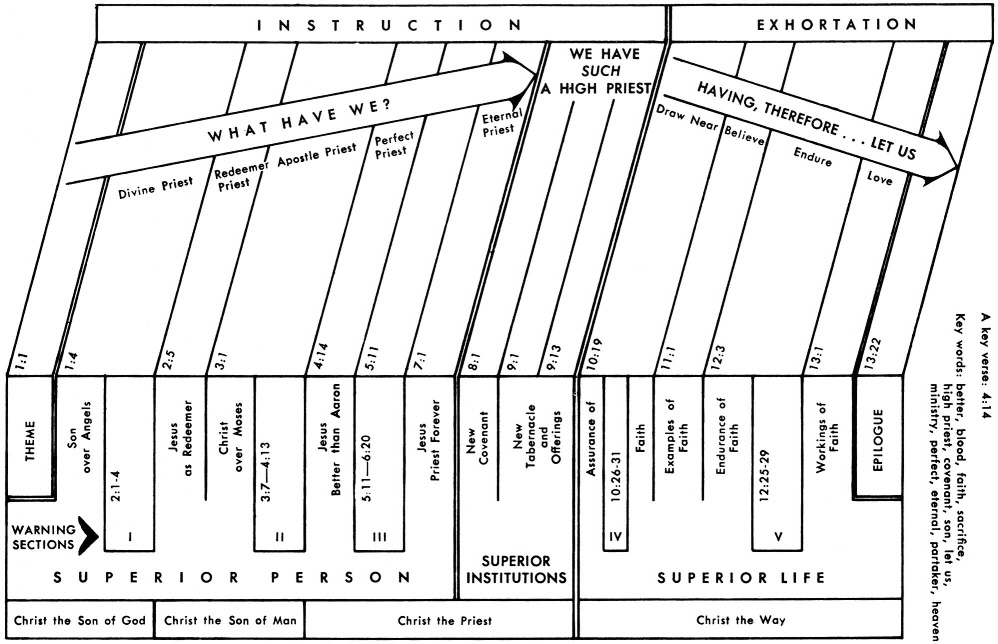
CONSIDER JESUS OUR GREAT HIGH PRIEST
Click chart to enlarge
Charts from Jensen's Survey of the NT - used by permission
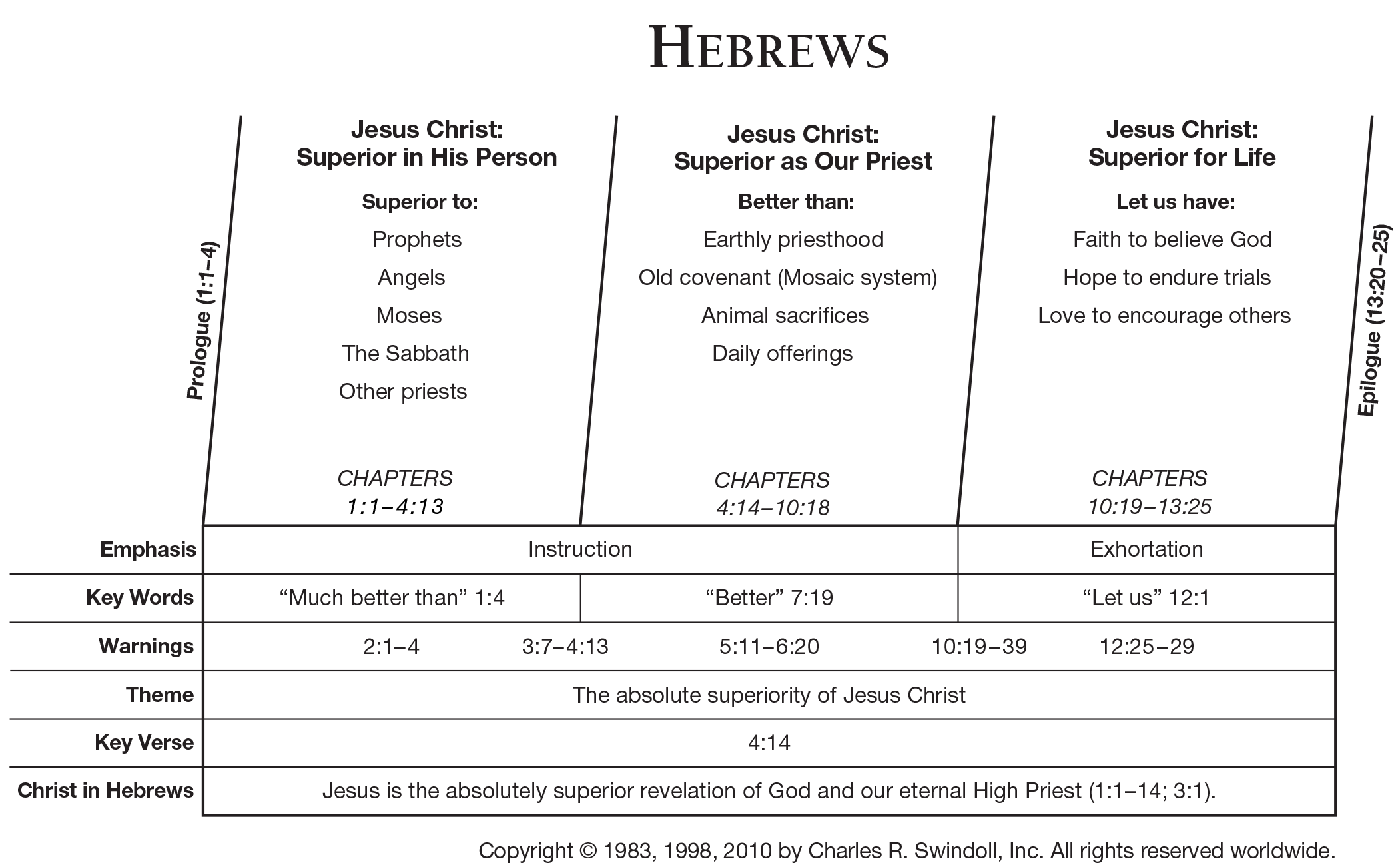
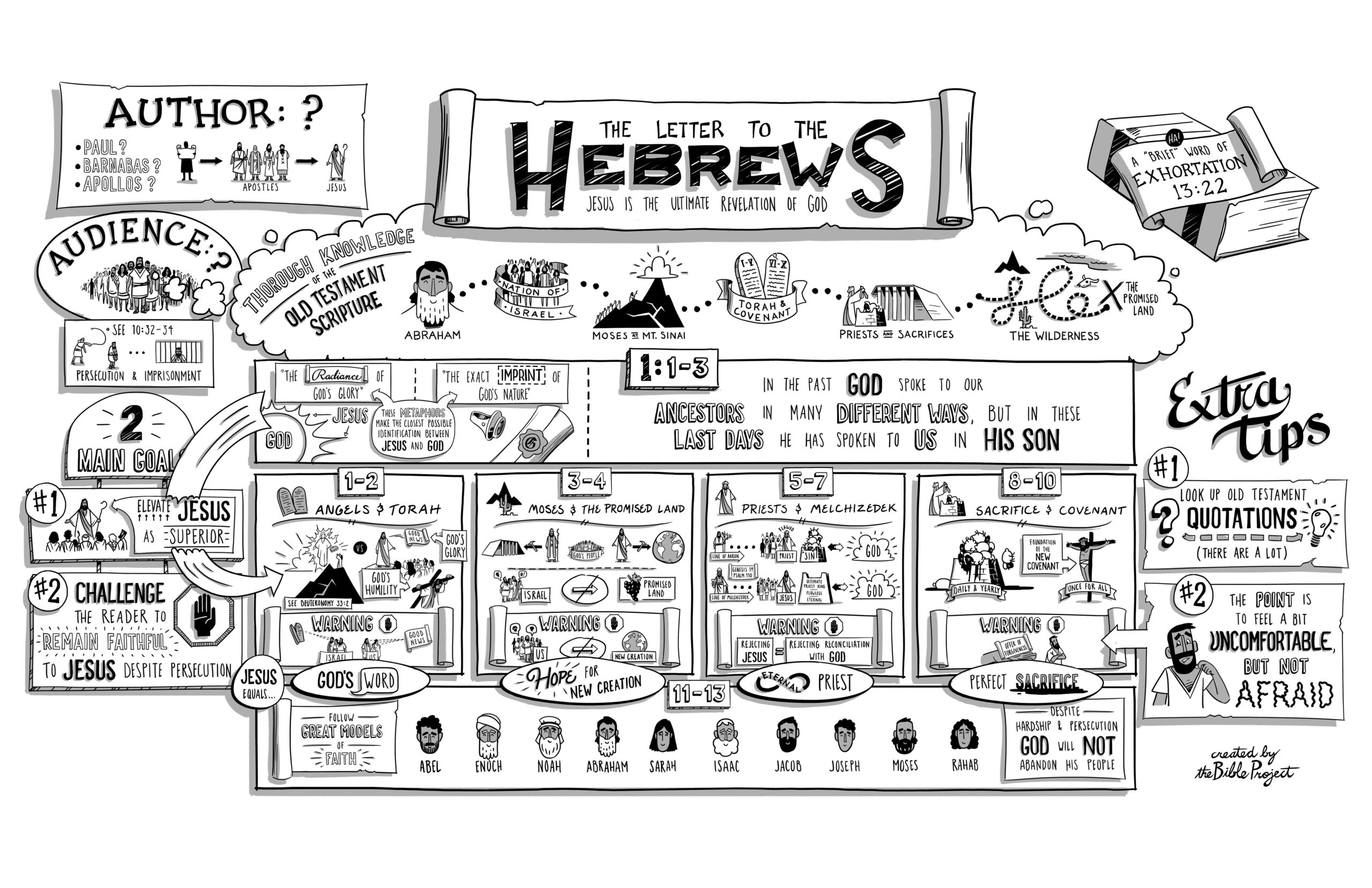
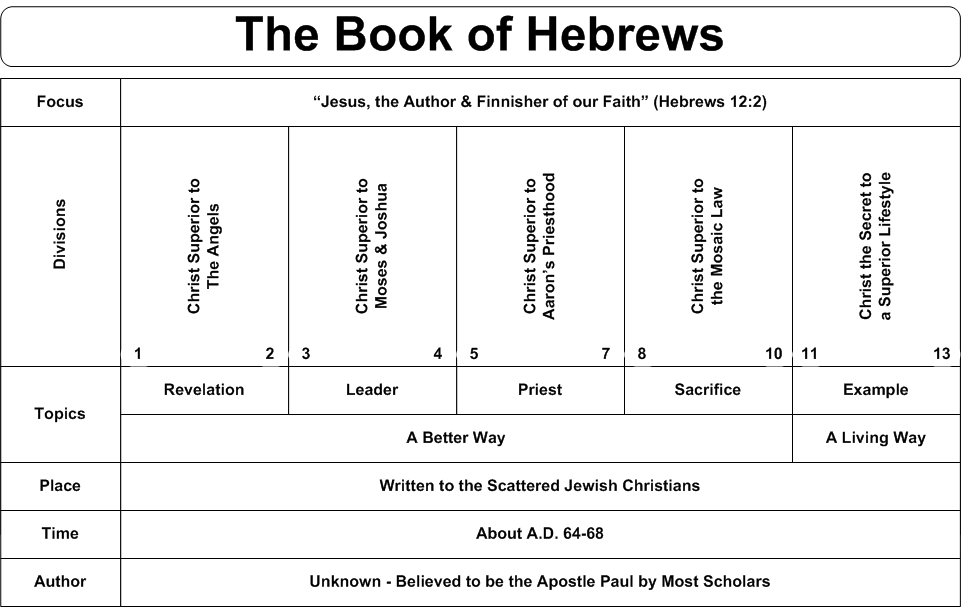
Swindoll's Chart, Interesting Pictorial Chart of Hebrews, Another Chart
|
The Epistle |
||||
| INSTRUCTION Hebrews 1-10:18 |
EXHORTATION Hebrews 10:19-13:25 |
|||
| Superior Person of Christ Hebrews 1:1-4:13 |
Superior Priest in Christ Hebrews 4:14-10:18 |
Superior Life In Christ Hebrews 10:19-13:25 |
||
| BETTER THAN PERSON Hebrews 1:1-4:13 |
BETTER PRIESTHOOD Heb 4:14-7:28 |
BETTER COVENANT Heb 8:1-13 |
BETTER SACRIFICE Heb 9:1-10:18 |
BETTER LIFE |
| MAJESTY OF CHRIST |
MINISTRY OF CHRIST |
MINISTERS FOR CHRIST |
||
|
DOCTRINE |
DUTY |
|||
|
DATE WRITTEN: |
||||

See ESV Study Bible "Introduction to Hebrews"
(See also MacArthur's Introduction to Hebrews)
Borrow Ryrie Study Bible
Hebrews 6:16 For men swear by one greater than themselves, and with them an oath given as confirmation is an end of every dispute. (NASB: Lockman)
Greek: anthropoi gar kata tou meizonos omnuousin, (3PPAI) kai pases autois antilogias peras eis bebaiosin o horkos;
Amplified: Even though we speak this way, yet in your case, beloved, we are now firmly convinced of better things that are near to salvation and accompany it. (Amplified Bible - Lockman)
NLT: When people take an oath, they call on someone greater than themselves to hold them to it. And without any question that oath is binding. (NLT - Tyndale House)
Phillips: Among men it is customary to swear by something greater than themselves. And if a statement is confirmed by an oath, that is the end of all quibbling. (Phillips: Touchstone)
Wuest: For men swear by the greater, and the oath which is for the purpose of confirmation is to them an end of every dispute.
Young's Literal: for men indeed do swear by the greater, and an end of all controversy to them for confirmation is the oath,
Paraphrases:
People swear by someone greater than themselves, and the oath they take settles the matter as final proof.
Men appeal to a higher authority when they swear, and that oath serves to confirm the truth and end all argument.
When humans make an oath, they swear by one greater, and the oath stands as the ultimate confirmation that ends every dispute.
People take oaths in the name of someone greater, and once an oath is sworn, it ends all debate.
Men swear by a higher authority, and the oath becomes the final word, putting an end to every disagreement.
When people swear, they call on someone greater than themselves, and the oath given is considered conclusive and settles any dispute.
Human beings look to a higher power to guarantee their word; once an oath is made, it confirms the truth and closes the discussion.
Since men swear by one greater than themselves, their oath serves as binding confirmation that brings every argument to a close.
- Swear - Heb 6:13. Ge 14:22. 21:23, 24. 24:3. 26:20, 26, 28, 31. Mt 23:20-22
- An oath - Ge 21:30,31 31:53 Ex 22:11 Jos 9:15-20 2Sa 21:2 Eze 17:16-20
- Hebrews 6 Resources - Multiple Sermons and Commentaries
Related Passages:
Hebrews 2:2 For if the word spoken through angels proved unalterable (bebaios root of bebaiosis), and every transgression and disobedience received a just penalty,
Romans 15:8 For I say that Christ has become a servant to the circumcision on behalf of the truth of God to confirm (bebaioo) the promises given to the fathers,
Galatians 3:15 Brethren, I speak in terms of human relations: even though it is only a man’s covenant, yet when it has been ratified, no one sets it aside or adds conditions to it.
Psalm 110:4 The LORD has sworn and will not change His mind, “You are a priest forever According to the order of Melchizedek.”
Hebrews 7:20-21 And inasmuch as it was not without an oath 21 (for they indeed became priests without an oath, but He with an oath through the One who said to Him, “THE LORD HAS SWORN AND WILL NOT CHANGE HIS MIND, ‘YOU ARE A PRIEST FOREVER’”);
COMPARISON WITH THE WAY MEN
CONFIRM THEIR WORD
For (gar) - Always pause to prayerfully ponder and peruse this poignant term of explanation, and you often glean helpful insights from your Teacher the Holy Spirit. You can always ask at least one question "What is the author explaining?" He is explaining the security the readers could have in the divine promise in Hebrews 6:14-15 by using the analogy of oaths between men.
Wuest - The word “oath” is preceded by the definite article in the Greek text. The oath, which is used with a view to confirming something, is the end of all disputes. Thus, the act of God in confirming His promise by an oath, is justified by human practice. The confident hope which God’s oath warrants is justified by the fact that even a human oath puts an end to dispute. (Hebrews Commentary online)
God's oath was not because His word was weak,
but because our faith is weak.
For (gar) men swear (omnuo) by one greater than themselves, and with them an oath (horkos) given as confirmation (bebaiosis) is an end (peras) of every dispute (antilogia) - When men declare an oath (horkos), in effect they call upon a higher authority (a deity, sacred object, or ruler) to validate truthfulness of what they say. For example in the OT, Israelites swore “by the Lord” (Dt 6:13; Jer 12:16). "As (surely as) Yahweh lives” was the supreme oath in Israel. Abraham himself swore by God and made others do the same (Ge 14:22; Ge 21:23f.; Ge 24:3). An oath (horkos) functioned as a guarantee to settle doubts and secure trust. An oath (horkos) is preceded by the definite article (ho = the) so more accurately it reads "the oath". The invoking of the Lord’s name in the oath meant that one was bound under obligation before God to fulfill that word. The oath (horkos) gave confirmation (bebaiosis - see additional note) making what they said firm and secure. In other words, when practiced with integrity, an oath (horkos) between men resulted in the matter standing on firm ground. And if the men heeded the oath (horkos), it would put a stop to further debate because it was binding, (hopefully) removed suspicion and ended the quarrel. In short the oath (horkos) was the final word in human agreements. The writer in a sense arguing from the lesser to the greater, for if human oaths end disputes, how much more God’s oath! And to those Hebrews in his audience who were wavering, on the verge of drifting or falling away, this was meant to undergird their hope which as we saw would energize full assurance (Heb 6:11) and give strong encouragement (Heb 6:18).
By appealing to human oaths the writer demonstrates
that the divine promise is superior to man’s word.
Donald Guthrie - By appealing to human oaths the writer demonstrates that the divine promise is superior to man’s word. The limitation of man’s word lies in the fact that his word is not sufficient in itself. The very need for an oath to back up a statement reflects the character of the one who makes it....Once an oath has been made there can be no change. In this sense it is final for confirmation. It affirms positively what it supports and effectively excludes what it denies. In any disputes (antilogiai) it is conclusive. This binding character of human oaths is used by the writer to transfer his thought par excellence to the inviolability of the divine word. (Borrow Hebrews Commentary)
WHAT are the two purposes of oaths which men make?
- Confirmation = confirm what is said
- Put an end to every dispute, to all arguments.
Grant Osborne adds that "The twofold purpose of all oaths is then made clear: to confirm what is said and put an end to all argument.” With God standing behind the assertion, there is nothing more to be said. When God anchors his covenant promise to Abraham with a divine oath, all possible debate is over, and the confirmation is iron-clad." (See Hebrews Verse by Verse)
God’s promise does not depend on man's faithfulness
but solely His own faithfulness.
This is a glorious truth. When men are involved in strife and they want to make peace and guarantee the peace, they do it by doing two things. They keep the peace and then they swear or take an oath that they will fulfill their promise. And they always swear by someone or something greater than themselves. When they make such an oath, it settles the dispute. Assuming they are men of integrity, they do what they say.
The writer's point is that if a human oath puts an end (peras) of every dispute (antilogia), even more so God’s oath can (or should) remove all doubt in the reader's hearts regarding the fulfillment of what He has promised.
🙏 THOUGHT - Believers often struggle with doubt. Hebrews 6:16–18 shows that God has provided not just a promise, but a confirmed, guaranteed promise. His Word is enough. His Oath is more than enough. Together, they serve to give us “strong encouragement to hold fast to the hope set before us” (Heb 6:18).
David Guzik has a comment regarding practical application of these truths "During this time of patient endurance (ED: AKA "WAITING" LIKE ABRAHAM WAITED), many Christians get attacked. They wonder if they too will obtain the promise. They often wonder “Will God really come through?” After he had patiently endured, he obtained the promise: God came through for Abraham, even sealing His promise with an oath (ED: RECALL THE OATH WAS GIVEN EVEN AFTER BIRTH OF ISAAC WHICH CONFIRMED TO ABRAHAM THAT ISAAC WOULD "BEGIN" THE MULTIPLICATION PROCESS, SO TO SPEAK, WHICH WOULD CULMINATE IN THE SEED OF THE MESSIAH!) In fact, because He could swear by no one greater, He swore by Himself. This oath showed that God’s promises (like His character) are unchanging."
F F Bruce points out that "This insistence on the divine oath in God’s promise to Abraham prepares the readers for the significance of the fact that God’s promise regarding the Melchizedek priesthood was similarly confirmed by an oath: “Yahweh has sworn, and will not change his mind” (Ps. 110:4, cf Heb 7:20-21) The bare word of God is guarantee enough in all conscience, but by confirming it thus he “makes assurance double sure.” (Borrow Hebrews Commentary)
Simon Kistemaker - As the Scriptures reveal, Jewish people resorted quickly to swearing an oath. They might swear by heaven (Matt. 5:34; 23:22; James 5:12), by the earth (Matt. 5:35; James 5:12), by the temple (Matt. 23:16), by Jerusalem (Matt. 5:35), or in the name of the Lord God (Gen. 14:22; Deut. 6:13; 10:20; Judges 21:7; Ruth 1:17; Jer. 12:16). Most of the oaths were sworn in the name of God or that which was associated with God (heaven, the temple, or Jerusalem). That does not mean that the Jew identified God with the objects used as substitutes, but rather that the Jew of Jesus’ day did not take his oaths seriously. Jesus forbade the swearing of an oath (Matt. 5:33–37) because of this sinful practice. He taught that a man’s word must be unquestionably true so that, as a consequence, oaths would no longer be necessary. In a court of law, however, the judge administers an oath in order to uphold the truth. Indeed, “men swear by someone greater than themselves” when they invoke the name of God. They appeal to God because he is the ultimate truth, and thus in case they break the oath they risk divine revenge. In court the truth must be spoken by defendant, plaintiff, and their lawyers.45 The oath, then, settles the truth in any dispute. (Borrow Hebrews Commentary)
He by Himself hath sworn,
I on His OATH depend
-- The God of Abraham Praise
C H Spurgeon - For people swear by what is greater than themselves The Father pledged His honor and His word. He did more; He pledged his oath. He pledged His own word and sacred honor of Godhead that He would be true to His Son, that He should see His seed, and that by the knowledge of Him Christ should “justify many” (Isa 53:11). But there was needed a seal to the covenant, and what was that? Jesus Christ in the fullness of time set the seal to the covenant, to make it valid and secure, by pouring out His life’s blood to make the covenant effectual once for all. If there be an agreement made between two men, the one to sell an estate, and the other to pay for it, the covenant does not hold good until the payment is made. Now, Jesus Christ’s blood was the payment of His part of the covenant; and when He shed it, the covenant stood firm as the everlasting hills, and the throne of God Himself is not more sure than is the covenant of grace. And, mark you, that covenant is not sure merely in its great outlines, but sure also in all its details. Every soul whose name was in that covenant must be saved. Unless God can undeify Himself, every soul that Christ died for He will have. Every soul for which He stood Substitute and Surety He demands to have, and each of those souls He must have, for the covenant stands fast. (Blood of the Testament)
Swear (3660) omnuo means to affirm the truth of a statement by calling on a divine being to execute sanctions against a person if the statement in question is not true (in the case of a deity taking an oath, his divine being is regarded as validating the statement). In this case God's Own Divine being is regarded as validating the statement.
Omnuo is repeated in this middle section of Hebrews…
Hebrews 3:11 As I swore in My wrath, 'They shall not enter My rest.'"
Hebrews 3:18 And to whom did He swear that they should not enter His rest, but to those who were disobedient?
Hebrews 4:3 For we who have believed enter that rest, just as He has said, "As I swore in My wrath, They shall not enter My rest," although His works were finished from the foundation of the world.
Hebrews 6:13 For when God made the promise to Abraham, since He could swear by no one greater, He swore by Himself,
Hebrews 6:16 For men swear by one greater than themselves, and with them an oath given as confirmation is an end of every dispute.
Hebrews 7:21 (for they indeed became priests without an oath, but He with an oath through the One who said to Him, "The Lord has sworn And will not change His mind, 'Thou art a priest forever' ")
This verb omnuo is in the Septuagint (LXX) of God swearing to keep His covenant to bring Israel into the land (Dt 1:8, 35, 2:14, 4:21, 31, 6:10, 18, 23, 7:8, 12, 13, 8:1, 18, etc > 30x in Deut.)
Oath (3727) (horkos from herkos = a fence, an enclosure, that which restrains a person) (See more in depth dictionary discussion of Oath) in simple terms is a solemn statement or claim used to validate a promise. In other words an oath represents a solemn attestation of the truth or inviolability of one’s words. An oath is a solemn pledge to affirm something said as absolutely true. An oath is a definitive and binding confirmation of the spoken word and invalidates any contradiction of the statement made.
HORKOS - 10V - Matt. 5:33; Matt. 14:7; Matt. 14:9; Matt. 26:72; Mk. 6:26; Lk. 1:73; Acts 2:30; Heb. 6:16; Heb. 6:17; Jas. 5:12
Horkos was used to validate a promise or affirm something said as absolutely true. An oath is a solemn promise, often invoking a divine witness, regarding one's future acts or behavior and often included penalties (and stated in the oath) for failure to keep the oath. An oath is a definitive and binding confirmation of the spoken word and invalidates any contradiction of the statement made. Vine adds that Oath refers to "the confirmation of a compact among men, guaranteeing the discharge of liabilities; in their disputes “the oath is final for confirmation.” This is referred to in order to illustrate the greater subject of God’s “oath” to Abraham, confirming His promise."
In the OT it was prescribed that oaths should be taken in Yahweh’s name (Deuteronomy 6:13; 10:20), and lying under oath was condemned as a violation of the Third Commandment (Exodus 20:7; Deuteronomy 5:11; Zechariah 5:3,4)
Vine - Oath refers to "the confirmation of a compact among men, guaranteeing the discharge of liabilities; in their disputes “the oath is final for confirmation.” This is referred to in order to illustrate the greater subject of God’s “oath” to Abraham, confirming His promise."
Noah Webster's 1828 dictionary defines oath as "A solemn affirmation or declaration, made with an appeal to God for the truth of what is affirmed. The appeal to God in an oath, implies that the person imprecates his vengeance and renounces his favor if the declaration is false, or if the declaration is a promise, the person invokes the vengeance of God if he should fail to fulfill it. A false oath is called perjury.
Confirmation (951) bebaiosis from bebaioo = to establish) is strictly a legal technical term for furnishing a guarantee legally valid confirmation; hence, as an action = confirmation, verification, making sure, ratification, confirmation, corroboration. The idea is to cause something to be known as certain, to prove to be true and certain = confirmation, verification. In legal contexts, it meant the act of validating or ratifying a covenant, contract, or testimony. In philosophical contexts, it meant a firm demonstration or proof that ended doubt. Thus, an oath was regarded as giving “legal binding force” — it secured the matter so no further challenge could be raised.
The formula eis (for the purpose of) bebaiosin ("making something certain" "settling something firmly" as in Heb 6:16) was a technical expression that had persisted for centuries and conveyed the idea of a legal guarantee in a transaction. In short eis bebaiosin means “for the purpose of full confirmation,” describing the binding, dispute-ending function of an oath which was the point the writer uses to magnify the absolute certainty of God’s oath regarding His promise.
BEBAIOSIS - Only 2 uses in NT - Heb 6:16, Philippians 1:7 and one in the Septuagint - Lev 25:23
Gilbrant - Classical Greek and Septuagint Usage - Bebaiōsis, related to bebaios (used in Heb 2:2), acquired a figurative sense and was applied in contract and judicial language: “guarantee, trustworthy.” In judicial language bebaios means that which is “valid” and legal. The verb bebaioo means “to make firm, affirm, establish, strengthen, guarantee”; the noun bebaiōsis often appears in documents relating to business or commerce, and in such instances it denotes something as “confirmed, secure, certain.” The word group carries essentially the same meaning in the Septuagint as it does in secular Greek.
The word group functions in the New Testament to speak of something sure, unmovable, such as the promises of God (Romans 4:16; 15:8; Hebrews 6:19), the prophetic word (2 Peter 1:19). As the disciples preached the Word, the Lord confirmed that word with signs following (Mark 16:20). In another sense, Christians will be established in the faith (Colossians 2:7); they will make their calling and election “sure” (2 Peter 1:10). The term bebaiōsis is found twice in the New Testament. In Philippians 1:7 bebaiōsis is linked with apologia and together they serve as an entity. These terms function to reveal in legal terminology two aspects of Paul’s ministry. His ministry included presenting a defense or vindication of the gospel (apologia) as well as confirming or guaranteeing the truth of the gospel. In Hebrews 6:16 bebaiōsis is used in an illustration of how, by appealing to a greater authority, an oath is confirmed between two parties. This act serves as a confirmation that what was promised will come to pass. As Morris states, “It is an authoritative word guaranteed by the highest authority” (Expositor’s Bible Commentary, 12:60). Such an assurance is guaranteed by God that those who patiently endure will receive the fulfillment of the promise of salvation. (Complete Biblical Library)
End (485) (Peras akin to peirar = end, limit) was a technical term for a legal guarantee = confirmation, legal guarantee. End, extremity, limit, boundary.
Gilbrant - From the era of classical Greek through the Septuagint into the Greek New Testament peras denoted an endmost point or extremity. It might be used to indicate a physical “end, limit, boundary,” as when Jesus said of the queen of the South that she came “from the ends of the earth” (Matthew 12:42, RSV; Luke 11:31; cf. Romans 10:18). In a nongeographical sense peras describes an oath as the means whereby an “end” is made to arguments among people (Hebrews 6:16). These four citations are the only occurrences of peras in the New Testament, with the possible exception of a variant reading at Acts 13:33. (Complete Biblical Library)
PERAS - 4V - Matt. 12:42; Lk. 11:31; Rom. 10:18; Heb. 6:16
PERAS IN SEPTUAGINT - Est. 3:13; Job 28:3; Ps. 2:8; Ps. 7:6; Ps. 19:4; Ps. 22:27; Ps. 39:4; Ps. 46:9; Ps. 48:10; Ps. 59:13; Ps. 61:2; Ps. 65:5; Ps. 65:8; Ps. 67:7; Ps. 72:8; Ps. 95:4; Ps. 98:3; Ps. 119:96; Ps. 145:3; Jer. 18:7; Jer. 18:9; Jer. 51:13; Ezek. 7:2; Ezek. 7:3; Ezek. 7:5; Ezek. 7:6; Ezek. 21:25; Ezek. 21:29; Ezek. 30:3; Dan. 4:21; Amos 8:2; Nah. 2:9; Nah. 3:3; Nah. 3:9; Hab. 2:3; Zeph. 3:10;
Dispute (hostility) (485) antilogia from antilego = contradict in turn from anti = against + lego speak) literally a word spoken against or speaking against and so talking back, face to face, in opposition against (a dispute involving opposite opinions). Our English word dispute describes a disagreement, a quarrel, an argument or a verbal controversy. Antilogia can also mean defiance against authority (with special emphasis on verbal defiance -- see examples below of this use in the Septuagint) or rebellion as by Korah in Jude 1:11.
Antilogia describes contradiction or controversy with the added sense that strife is involved. Strife means bitter sometimes violent conflict or dissension. The English word hostility pictures enmity (deep-seated dislike or ill will or a manifestation of such feeling) or antagonism.
ANTILOGIA - 4V - dispute(2), hostility(1), rebellion(1). Heb. 6:16; Heb. 7:7; Heb. 12:3; Jude 1:11
ANTILOGIA IN THE SEPTUAGINT - Exod. 18:16; Num. 20:13; Num. 27:14; Deut. 1:12; Deut. 17:8; Deut. 19:17; Deut. 21:5; Deut. 25:1; Deut. 32:51; Deut. 33:8; 2 Sam. 15:4; Ps. 17:44; Ps. 30:21; Ps. 54:10; Ps. 79:7; Ps. 80:8; Ps. 105:32; Prov. 17:11; Prov. 18:18
Numbers 20:13 Those were the waters of Meribah (Hebrew means place of strife or contention; LXX = antilogia = dispute), because the sons of Israel contended with the LORD, and He proved Himself holy among them.
Deuteronomy 1:12 'How can I alone bear the load and burden of you and your strife (Hebrew = rib = strife, controversy, quarrel; LXX = antilogia)?
The God of Abraham praise,
Who reigns enthroned above;
Ancient of everlasting days,
And God of love.
Jehovah, great I AM,
By earth and heav’n confessed;
I bow and bless Your sacred Name,
Forever blest.
The God of Abraham praise,
At Whose supreme command
From earth I rise, and seek the joys
At His right hand.
I all on earth forsake,
It s wisdom, fame, and pow’r;
And Him my only portion make,
My shield and tow’r.
He by Himself hath sworn,
I on His OATH depend;
I shall, on eagles’ wings upborne,
To heavn’ ascend;
I shall behold His face,
I shall His pow’r adore,
And sing the wonders of His grace
Forever more.
The whole triumphant host
Give thanks to God on high
“Hail, Father, Son, and Holy Ghost!”
They ever cry.
Hail, Abraham’s God, and mine!
I join the heav’nly lays;
All might and majesty are Thine,
And endless praise.
Hebrews 6:17 In the same way God, desiring even more to show to the heirs of the promise the unchangeableness of His purpose, interposed with an oath, (NASB: Lockman)
Greek: en o perissoteron boulomenos (PMPMSN) o theos epideixai (AAN) tois kleronomois tes epaggelias to ametatheton tes boules autou emesiteusen (3SAAI) horko,
Amplified: For God is not unrighteous to forget or overlook your labor and the love which you have shown for His name’s sake in ministering to the needs of the saints (His own consecrated people), as you still do. (Amplified Bible - Lockman) (Amplified Bible - Lockman)
NLT: God also bound himself with an oath, so that those who received the promise could be perfectly sure that he would never change his mind. (NLT - Tyndale House)
Phillips: So in this matter, God, wishing to show beyond doubt that his plan was unchangeable, confirmed it with an oath. (Phillips: Touchstone)
Wuest: In which God, more abundantly desirous of demonstrating to those who are inheritors of the promise the immutability of His counsel, interposed with an oath,
Young's Literal: in which God, more abundantly willing to shew to the heirs of the promise the immutability of his counsel, did interpose by an oath,
PARAPHRASES:
“In the same way, God, wanting to show more clearly to the heirs of the promise the unchangeable nature of His purpose, guaranteed it with an oath.”
“Because God desired to give the heirs of His promise absolute certainty, He confirmed it by swearing an oath.”
“So God, wishing to prove the unalterable character of His plan to the inheritors of the promise, bound Himself with an oath.”
“In order to show the heirs of the promise how unchanging His will is, God confirmed it with an oath.”
“God, in His desire to provide strong assurance to those who would inherit the promise, added the confirmation of an oath.”
“Thus, because God wanted His heirs to be fully persuaded of His unchanging purpose, He interposed with an oath.”
“To demonstrate to the heirs of the promise that His counsel cannot change, God guaranteed it by swearing.”
“Because God wanted to prove beyond all doubt that His promise was unshakable, He confirmed it with an oath.”
- Desiring - 1 Co 12:11. James 1:18. 2 Pe 3:9)
- even more to show Ps 36:8. Song 5:1. Isaiah 55:7. Jn 10:10. 1Pe 1:3
- the heirs - Heb 6:12. Heb 11:7, 9. Ro 8:17. Gal 3:29. Ep 1:11. Ja 2:5. 1Pe 3:7
- of the promise - Ge 17:7. Ac 2:39. Ga 3:17, 29.
- the unchangeableness - Ge 1:9 18. Job 23:13, 14. Ps 33:11. Ps 110:4. Pr 19:21. Is 14:24, 26, 27. Isa 25:1. Isa 46:10, 54:9, 10, 55:11. Jer 33:20, 21, 25, 26. Ro 4:13, 16. Ro 11:29. Jas 1:17.
- of His purpose - Ge 17:7. Ac 2:39. Acts 20:27. Gal 3:17, 29
- interposed - Heb 6:16 Ge 26:28 Ex 22:11 Gal 3:20.
- Oath. He 8:6. Jer 33:20, 21
- Hebrews 6 Resources - Multiple Sermons and Commentaries
Related Passages:
Galatians 3:29 And if you belong to Christ, then you are Abraham’s descendants, heirs (kleronomos) according to promise (epaggelia/epangelia).
Hebrews 1:14 Are they not all ministering spirits, sent out to render service for the sake of those who will inherit salvation?
Romans 4:13 For the promise to Abraham or to his descendants that he would be heirs (kleronomos) of the world was not through the Law, but through the righteousness of faith.
Romans 8:17 and if children, heirs (kleronomos) also, heirs (kleronomos) of God and fellow heirs with Christ, if indeed we suffer with Him so that we may also be glorified with Him.
GOD'S CONDESCENSION
FOR OUR ASSURANCE
Now the writer turns from human oaths in Heb 6:16 to the divine oath by God Himself.
In the same way - The writer builds on Hebrews 6:16’s analogy of human oaths and applies it to God’s oath to Abraham. Just as men confirm disputes with oaths, so also God acted, but in a greater way. So the flow is from the truth that as human oaths confirm things (Heb 6:16) so God, stooping to man's level, gives His own oath not because He needed to, but that He might give believers rock-solid assurance regarding His promise (Heb 6:17).
Wuest says In the same way "refers to the entire previous clause. The idea is “in accordance with this universal custom.” Since the oath has this convincing power among men in Heb 6:16, God disregards the insult implied in man’s doubting His Word, and condescends to human infirmity, confirming His Word by an oath. (Hebrews Commentary online)
Spurgeon - he wanted to show even more Even thus does He reveal Himself to us, unfolding the ancient covenant of grace that He has made with us in Christ Jesus. And He bids us look upon the solemn seal of the Savior’s sacrifice, and of the oath of old that the Lord made unto His Son. As He led His servant a stranger in a strange land, but yet surrounded and enriched with innumerable mercies, even so are we sojourners with Him, as all our fathers were, but yet endowed with boundless favor in the blessings of the right hand of the Most High. (Full sermon Strong Consolation)
God, desiring (boulomai - present tense - continually) even more (perissos) to show (epideiknumi) to the heirs (kleronomos) of the promise (epaggelia/epangelia) the unchangeableness (ametathetos) of His purpose (boule), interposed (mesiteuo) with an oath (horkos) - Desiring (boulomai - present tense - continually) is more likely to express God’s will of decree whereas the verb thelo refers to God's will of desire . Boulomai carries the tone of a preordained, divine decision, somewhat more deliberate than thelo (Lk 22:42). God’s intention is more than an inclination or wish as with thelo but using boulomai conveys a definite resolve. (see note) God was desiring to give proof and demonstrate how committed He was to carry out His promise to the readers (heirs) by giving His oath as surety or guarantee. This is a powerful picture. God Who Himself alone is Judge of all, condescends in a sense to say "I swear to fulfill My promise to you"! This is an incredible truth for finite, created beings to receive from their Creator Who justifiably could have annihilated us all forever! Oh, how deep the canyons of God's mercy to lost sinners such as me.
My worth is not in what I do but in Whose I am.
As an heir, my future is secure.
Donald Guthrie elaborates on heirs (kleronomos) - The ‘heirs’ is a comprehensive term for the true children of Abraham and is not exclusively a reference to the people of Israel. Jesus, when addressing Jews who claimed to be Abraham’s children, said ‘If you were Abraham’s children, you would do what Abraham did’ (John 8:39). The apostle Paul, in writing to the Romans, can refer to ‘those who share the faith of Abraham, for he is the father of us all’ (Rom. 4:16). The heirs of the promise are therefore distinct from the natural descendants. (Borrow Hebrews Commentary)
The adverb even more (perissos) means He is all the more willing and shows His eagerness, not only that He is willing, but that He is “abundantly willing.” To show (epideiknumi) means He desires to demonstrate or prove openly (stronger than simply "show casually"), this verb conveying the sense that God desires to make it clear beyond dispute to the heirs. To the heirs (kleronomos) of the promise (epaggelia/epangelia) is primarily to Abraham's descendants by faith, those who inherit the promises by belief in Christ. As Paul says in Gal 3:29 if you belong to Christ, then you are Abraham’s descendants, heirs (kleronomos) according to promise (epaggelia/epangelia)." All who share Abraham's faith (cf Ge 15:6) are designated beneficiaries of God's unchangeable covenant, an inheritance secured by God's oath and fulfilled in Christ. Here in Heb 6:17, the the promise (epaggelia/epangelia) is specifically to the Abrahamic promise (Ge 22:16–18) of blessing and multiplying, which ultimately unfold in Christ and salvation for the Gentiles (Gal 3:8). Note that the promise belongs to those who receive it by faith and become heirs. One other point about heirs is that knowing they have heirship ties the readers (and us) to the future reality, the certainty of the future inheritance fueling present perseverance.
Spurgeon - to the heirs of the promise Heirs, not according to the power of the flesh, but according to the energy of grace. Ishmael was the heir according to flesh, but he did not obtain the inheritance: “it is not the children by human descent who are children of God” (Rom 9:8). Isaac was born not through his father’s or his mother’s strength, for they were well stricken in years, but he was the child of promise, the fruit of divine visitation. Then this excludes those who are heirs according to their own will, who scoff at the mighty work of grace, and believe that their own free choice has saved them! The Lord said unto Moses, “I will have mercy on whomever I have mercy, and I will have compassion on whomever I have compassion” (Rom 9:15). And Paul adds in Romans 9:16, “It does not depend on the one who wills or on the one who runs, but on God who shows mercy. (Full sermon Strong Consolation)
Philip Hughes - God in his goodness desired to show more convincingly, to underline, as it were, with a double assurance, the unchangeable character of his purpose; and to this end he interposed with an oath. This he did for the sake not only of Abraham but also of all the heirs of the promise, whose line starts with Abraham and continues on through Isaac and the men and women of faith of the old dispensation (as expounded in ch. 11 below), and right on to the present moment, with Christ as the focal point of fulfilment; for the line is the line of faith, and specifically faith in Christ, in whom the promise has its realization (Jn. 8:56; Gal. 3:7–9, 16f.; 2 Cor. 1:20). All who by faith are united to Christ are heirs of the Abrahamic promise. Accordingly, Paul tells the Galatian believers: “If you are Christ’s, then you are Abraham’s offspring, heirs according to promise” (Gal. 3:29). (See A Commentary on the Epistle to the Hebrews - Page 232)
The unchangeableness (ametathetos - see note) of His purpose (boule - see note) describes His plan (boule) as unalterable and immutable. This description gives strong emphasis on God’s purpose (boule) being firmly fixed and incapable of being overturned or revised. This is in contrast to humans who often change plans due to weakness, lack of foresight, or new circumstances. God never does. The word purpose (boule) has a dual meaning conveying both the deliberation of God’s mind and the outworking of His will. For example in the Septuagint, this same word (boule) is used in Ps 33:11 where the psalmist says "The counsel (boule) of the LORD stands forever, The plans (logismos) of His heart from generation to generation." In other words, the writer of Hebrews is stressing not merely God’s thoughts but His sovereignly determined purpose, which He intends to bring to pass. God’s eternal plan, determined in His infinite wisdom, cannot be altered, revoked, or thwarted. It grounds the believer’s assurance because the God who promised is the God who cannot lie and cannot change.
By confirming it with an oath
He ‘makes assurance doubly sure
-- Peter T O'Brien
Interposed (mesiteuo) with an oath (horkos) - God actively (mesiteuo is active voice = His will, by His volitional choice He) intervened or "inserted Himself," as a confirming party, binding His promise with His oath. This picture is God pledging Himself as SURETY or GUARANTEE in regard to His "contracted obligation".
🙏 THOUGHT - In light of the great truths in this verse, we see that our salvation rests not on the frailty of our grip, but on the immutability of His counsel and the certainty of His sworn word. Take a moment and worship the unchangeable God Who has given us the double guarantee of His promise and His oath - listen to Matt Redman's You Never Let Go! Beloved in Christ, your salvation is safe and secure ➡️forever!
Heirs, not according to the power of the flesh,
but according to the energy of grace.
Leon Morris on interposed - Mesiteuo has the idea of "mediate," which often means "interpose," "stand between." But here the idea is rather that of "stand as guarantor." God appears, so to speak, in two characters, the giver of the promise and then its guarantor. "The only possible translation is `to guarantee,' `to vouch for.' In giving the promise, God is as it were one of the parties. But with His oath, and as its Guarantor,... He puts Himself on neutral ground and pledges the fulfillment of the promise" (The Expositor's Bible Commentary)
R Kent Hughes - God did not have to swear by an oath, but he did so as a condescension or accommodation to human weakness. Of course, in choosing to make an oath, he could only choose to swear by himself because there was nothing or no one higher to swear by. To swear by anything lesser would have the effect of making his oath less permanent. (See Hebrews: An Anchor for the Soul)
Wuest on desiring - The word “desiring” is the translation of boulomai which speaks of a desire that is based upon the reasoning faculties as over against thelo, a desire that arises from the emotions. God, facing human infirmities, was minded to do thus and so. (Hebrews Commentary online)
Wuest of (the) promise - The word “promise” (epaggelia/epangelia) is preceded by the definite article (tes = "the") in the Greek text, pointing to a definite, particular promise defined in the context. It is the promise to Abraham and his posterity found in Heb 6:14 (ED: ULTIMATELY THE PROMISE IS THE ABRAHAMIC COVENANT). (Hebrews Commentary online)
Wuest on unchangeableness (immutability) - The word “immutability” is the translation of ametathetos. The word is from metatithemi. Tithemi means “to place,” and meta prefixed refers to a change. Thus, the compound word means “to change place,” thus “to transpose” two things, one of which is put in place of the other. The derived noun metathemenos means “a turncoat.” The Greek letter Alpha prefixed to the word makes it mean the opposite to what it meant originally. That is, God will not change His position as to His promise. Having made the promise, He will stand by it. He is not a turncoat. He will not change His position as to His promise, because that promise rests upon His counsel, and that is ametatheton also, immutable. (Hebrews Commentary online) (Another note on ametathetos - The word belongs to the legal terminology of the time and signifies a ruling or contract incapable of being set aside or annulled. Here it refers to God’s irrevocable purpose as expressed in the promise and confirmed by the oath )
Wuest on His purpose (counsel) - The word “counsel” is the translation of boule, which word is allied to boulomai “to desire, which desire comes from one’s reason.” The Triune God in council convened brought forth this counsel to the effect that the soul might find a sure refuge in the Lord Jesus. This counsel is immutable.
Simon Kistemaker - Once again we read an argument that leads from the lesser to the greater. The Epistle to the Hebrews is replete with examples of this type of argument. Man, by appealing to God, establishes the truth in a particular matter. How much more significant, by comparison, is the oath God himself swears to confirm the certainty of fulfilling his promises to those who have received them. The message that the author of Hebrews conveys is that man can depend on the utter truthfulness of God.....God not only made the promise to believers but also is the guarantor of the promise. God makes the promise of salvation, and at the same time he becomes the intermediary (mesiteuo) Who ensures that the promise is fulfilled. The word intermediary (mesiteuo) implies that there are two other parties: the one who gives the promise and the one who receives it. Between these two parties stands God as guarantor.
If there was ever a hymn apropos for this verse it would be Fanny Crosby's Blessed Assurance...
Blessed assurance, Jesus is mine!
O what a foretaste of glory divine!
Heir of salvation, purchase of God,
Born of His Spirit, washed in His blood.
Desiring (willing, intending) (1014)(boulomai) refers to a settled desire, one born of or springing from reason and not from emotion. To will, to wish, to will deliberately, to intend, to have a purpose, to be minded. Boulomai expresses the idea of the deliberate and specific exercise of volition (an act of making a choice or decision). Stated another way boulomai conveys the sense of more than simply wanting a desire or wish to be fulfilled. It conveys the stronger sense of choosing one thing over another or of preference of one thing before another.
BOULOMAI - 37V- Matt. 1:19; Matt. 11:27; Mk. 15:15; Lk. 10:22; Lk. 22:42; Jn. 18:39; Acts 5:28; Acts 5:33; Acts 12:4; Acts 15:37; Acts 17:20; Acts 18:15; Acts 18:27; Acts 19:30; Acts 22:30; Acts 23:28; Acts 25:20; Acts 25:22; Acts 27:43; Acts 28:18; 1 Co. 12:11; 2 Co. 1:15; 2 Co. 1:17; Phil. 1:12; 1 Tim. 2:8; 1 Tim. 5:14; 1 Tim. 6:9; Tit. 3:8; Phlm. 1:13; Heb. 6:17; Jas. 1:18; Jas. 3:4; Jas. 4:4; 2 Pet. 3:9; 2 Jn. 1:12; 3 Jn. 1:10; Jude 1:5
More (greater) (4053) perissos from peri - around, all-around, over and above) properly means "all around, more than (abundantly). Beyond what is anticipated. Exceeding expectation. Going past the expected limit. Exceeding some number or measure, more than enough, more than is necessary, superadded. Superabundance, extraordinary, profuse, abundant. erissos - primarily, "what is above and over, super-added," hence came to denote "what is superior and advantageous," Romans 3:1 , in a comparison between Jew and Gentile; only here with this meaning. (Vine) Perissos is the root of Paul's word in Eph 3:20 huperekperissou which is one of the numerous compounds of huper- beyond, over and above, of which Paul is fond. Of twenty-eight words compounded with this preposition in the New Testament, Paul alone uses twenty.
PERISSOS - 26V - Matt. 5:37; Matt. 5:47; Matt. 11:9; Matt. 14:5; Matt. 23:14; Mk. 6:51; Mk. 7:36; Mk. 12:33; Mk. 12:40; Lk. 7:26; Lk. 20:47; Jn. 10:10; Rom. 3:1; 1 Co. 12:23; 1 Co. 12:24; 1 Co. 15:10; 2 Co. 1:12; 2 Co. 2:4; 2 Co. 2:7; 2 Co. 7:15; 2 Co. 9:1; 2 Co. 10:8; Gal. 1:14; 1 Thess. 2:17; Heb. 6:17; Heb. 13:19 = "And I urge you all the more to do this, so that I may be restored to you the sooner"
Show (1925) (epideiknumi from epí = upon + deíknumi = show, make known character or significance of something by visual, auditory, gestural, or linguistic means) literally means to cause to be seen, to exhibit (Acts 9:39). Figuratively it means to show to be true, to prove to be true beyond a doubt and so to demonstrate convincingly. In in Luke 17:14 Jesus’ command to the lepers to ‘show themselves to the priests was intended to be “proof” for the priests (cf. Mk 1:44) In Acts 9:36 the idea is to display or show all that Dorcas had done for the disciples. In Hebrews 6:17 the writer continues the forensic or legal terminology in this section and show could be translated “prove” as in Acts 18:28 where Apollos demonstrated “in public debate” that Jesus was the Christ, the Messiah. A related verb (apodeiknumi) is used in Acts 25:7 where we read that the Jews were unable to “prove” their charges against Paul in court.
Epideiknumi - 7X/7V - demonstrating(1), point(1), show(4), showing(1). 3X in the Septuagint - Est 3:13, Pr 12:17, Isa 37:26.
Matthew 16:1 The Pharisees and Sadducees came up, and testing Jesus, they asked Him to show them a sign from heaven.
Comment - They wanted Jesus to “prove” (through a miracle) that He was who He claimed to be. Their request categorized them as sign seekers who would never be given a sign except that of Jonah (Mt 16:4).
Matthew 22:19 “Show Me the coin used for the poll-tax.” And they brought Him a denarius.
Matthew 24:1 Jesus came out from the temple and was going away when His disciples came up to point out the temple buildings to Him.
Luke 17:14 When He saw them, He said to them, “Go and show yourselves to the priests.” And as they were going, they were cleansed.
Acts 9:39 So Peter arose and went with them. When he arrived, they brought him into the upper room; and all the widows stood beside him, weeping and showing all the tunics and garments that Dorcas used to make while she was with them.
Acts 18:28 for he powerfully refuted the Jews in public, demonstrating by the Scriptures that Jesus was the Christ.
Hebrews 6:17 In the same way God, desiring even more to show to the heirs of the promise the unchangeableness of His purpose, interposed with an oath,
Heirs (2818)(Kleronomos from kleros = a lot - lots were cast or drawn to divide property or select a winner or an heir + nemomai = to possess, to distribute among themselves), literally refers to one who obtains or receives a portion by lot. It is one who receives something as a possession or a beneficiary (the person named as in an insurance policy to receive proceeds or benefits). It signifies more than one who inherits and it includes the idea of taking into possession. The New Testament usage of kleronomos applies primarily to the realm of spiritual inheritance.
Inheritance terminology is frequent in Hebrews (see notes Hebrews 1:2, 1:4, 1:14; 6:12, 6:17; 9:15; 11:7, 11:8; 12:17, see Galatians 3:29, see note Romans 8:17)
KLERONOMOS - 15V - Neh. 7:11; Matt. 21:38; Mk. 12:7; Lk. 20:14; Rom. 4:13; Rom. 4:14; Rom. 8:17; Gal. 3:29; Gal. 4:1; Gal. 4:7; Tit. 3:7; Heb. 1:2; Heb. 6:17; Heb. 11:7; Jas. 2:5
Wayne Detzler records a different origin stating that kleronomos "is a combination of two words: kleros (a lot or inheritance) and nomos (law). Thus the word kleronomos indicates the legal distribution of possessions or lots to heirs… In the original Greek culture, possessions were passed on to any person named in one's will. In fact, Greeks often built their fortunes for the purpose of passing them on to favored relatives. The Romans widened the concept to enable the distribution of possessions or wealth among close friends or loyal servants. To the Jews, however, an inheritance was usually reserved for one's children. In fact this was preserved in the Law as the principle to be followed. The Greek Old Testament also used kleros to refer to casting of the lot, as was seen in the use of the Urim and Thummim (Ex. 28:30; Lev 8:8). (See Detzler's 2 page article on HEIR - New Testament Words in Today's Language)
In the Greco-Roman world the word kleronomos was a legal term and was found on ancient inscriptions of Asia Minor to refer to a son after he was succeeded to the inheritance as representative of his father, undertaking all the duties and obligations of his father.
A heir is one who receives or is entitled to receive some endowment or quality from a parent or predecessor
Promise (1860) (epaggelia/epangelia from epí = intensifies verbal meaning + aggéllo = to tell, declare) originally referred to an announcement or declaration (especially of a favorable message) but in later Greek came to mean a declaration to do something with the implication of obligation to carry out what is stated (thus a promise or pledge). Epaggelia was primarily a legal term denoting summons, a promise to do or give something, but in the NT speaks primarily of the promises of God.
EPAGGELIA - 14X/13V (27.4% of all 51 NT uses) Heb. 4:1; Heb. 6:12; Heb. 6:15; Heb. 6:17; Heb. 7:6; Heb. 8:6; Heb. 9:15; Heb. 10:36; Heb. 11:9; Heb. 11:13; Heb. 11:17; Heb. 11:33; Heb. 11:39 (See notes Hebrews 4:1, Hebrews 6:12, 6:15, 6:17, Hebrews 7:6, Hebrews 8:6, Hebrews 9:15, Hebrews 10:36, Hebrews 11:9, 11:13, 11:17, 11:33, 11:39)
TDNT summarizes this word group writing that it has the following nuances - a. The first sense is “to indicate,” “declare,” “declaration,” “report.” b. When the state declares something, it becomes an “order.” c. In law we find the senses “accusation” and “delivery of a judgment.” d. We then find the senses “to declare an achievement,” “to show one's mastery,” “to profess a subject.” e. Another sense is “to offer,” “to promise,” “to vow.” As regards promises, tension between word and deed is felt, so that promises are often seen as worthless. f. A special type of promise is the “promise of money,” and in this sense the idea of a “subscription” or “donation” arises (state liturgies, gifts to rulers at their accession, priests promising gifts in support of their candidature). g. In the Hellenistic period we also find a sacral use for the “proclamation” of a festival. Among all the instances, only one example has been found for the promise of a deity. (BORROW Kittel's Theological Dictionary of the New Testament)
Unchangeableness (276) (ametathetos from a = without, + metatithemi = change condition or place, transfer) literally never changing, not to be transferred. The idea is that which is fixed, unalterable or immutable. This word was used in secular Greek in the context of wills and contracts and signified a stipulation that could not be disregarded or annulled. There is evidence (according to MM) that it was used in a technical sense of the unchangeable character of a will. Once properly made a will was ametathetos unchangeable by anyone but the maker. The writer of Hebrews uses this word (in the only 2 uses in Scripture in Hebrews 6:17 and Hebrews 6:18) with powerful, well known forensic (legal) ramifications (immutability of a legally written will) to add to the force of the encouragement he extended to his readers.
Spoken of God's constitutional will. This Greek word was used in wills and contracts and signified stipulation that could not be annulled. Here the writer conveys the strong certainty of IRREVOCABILITY of God's purpose as expressed in His promise (His Word) and in His oath.
Related Resources:
- Immutability; Unchangeable
- God's attribute - Immutable
Purpose (plan) (1012)(boule) when used of man expresses a decision, a purpose or a plan which is the result of inner deliberation. Boule is that which has been purposed and planned. Boule has in it the ideas of intelligence and deliberation. In other words boule describes the result of deliberate determination which in the present context reflects the product of not just a "mastermind" but God's heart of infinite love.
BOULE - 12V - counsel(1), decision(1), motives(1), plan(4), purpose(5). Lk. 7:30; Lk. 23:51; Acts 2:23; Acts 4:28; Acts 5:38; Acts 13:36; Acts 20:27; Acts 27:12; Acts 27:42; 1 Co. 4:5; Eph. 1:11; Heb. 6:17
NIDNTT says that in secular Greek boule "denotes an intention, a deliberation. It also stands for the result of a deliberation in the sense of a decision of the will, a resolution, a counsel or an edict. So already in Homer (Il. 2, 53) an assembly of men is called a boule, when it became an institutional body (e.g. the Council of the Five Hundred in Athens, Herodotus 5, 72; 9, 5).
Interposed (KJV - Confirmed) (3315)(mesiteuo) is a verb which means to be a mediator between two contending parties. Only found in Heb 6:17.
Wuest - The word “confirmed” is the translation of mesiteuo which means “to act as mediator between litigating or covenanting parties, to accomplish something by interposing between two parties.” A mesites is a sponsor or surety, so mesiteuo comes to signify “to pledge one’s self, to give surety.” God placed Himself between Himself and the inheritors of the promise. Expositor’s quotes Delitzsch as follows: “God descended, as it were, from His own absolute exaltation, in order, so to speak, to look up to Himself after the manner of men and take Himself to witness; and so by a gracious condescension confirm the promise for the sake of the inheritors”; and Davidson, “He mediated or came in between men and Himself, through the oath by Himself.” (Hebrews Commentary online)
C H Spurgeon - Heirs Must Be Sons - Full Sermon Heirs of God
The servant in your house, however diligent, is not your heir; for a servant to claim to be the heir would not be tolerated for a moment in a court of law. The servant may be able truthfully to say, “I have been in my master’s house these many years, neither have I transgressed at any time his commandments; and all that is right for a servant to do, I have done for him from my youth up.” But if he were to go on to ask, “What do I yet lack?” the reply would be, “You lack the one thing that is absolutely essential to heirship, namely, sonship.”
How this truth cuts at the root of all the efforts of those who hope to win heaven by merit, or to obtain the favor of God by their own exertions! To them all, God says what Jesus said to Nicodemus, “You must be born again.” Birth alone can make you children, and you must be children if you are to be heirs. If you remain what you are by nature, you may strive to do what you please. But when you have dressed out the child of nature in its finest garments, it is still only the child of nature, finely dressed, but not the child of God. You must be, by a supernatural birth, allied to the living God, for, if not, all the works that you may perform will not entitle you to the possession of the inheritance of the Most High.
C H Spurgeon - God has with an oath sworn by himself that all the heirs of promise shall be blessed for ever, saying, ‘Surely blessing I will bless thee’. Who among us dare doubt this? Where is the hardy sinner who dares come forward and say, ‘I impugn the oath of God’? Let us blush the deepest scarlet, and scarlet is but white compared with the blush which ought to mantle the cheek of every child of God to think that even God’s children should, in effect, accuse their heavenly Father of perjury. Shame upon us! Forgive us, great God, this deep atrocity; and from this hour may we hold it certain that as thou hast sworn that he that flees for refuge to Christ shall be safe, that as thou hast promised that ‘He that believeth and is baptized shall be saved’, we who have so believed are secure beyond all question. Let us no more doubt our salvation than our existence, and no more think ourselves in jeopardy in the darkest hour than we think God’s throne in jeopardy, or God’s truth itself in peril. O believer, stand to it that the Lord cannot lie. Those words have rung in my ears like a bell—‘impossible for God to lie’; of course it is. Next, ‘things, in which it was impossible for God to lie,’ as if there were some things more impossible than others. Then, ‘immutable things, in which it was impossible for God to lie,’ and then the finale, ‘two immutable things, in which it was impossible for God to lie’. Catch the accumulation of the meaning, the tidal wave of reassuring thought. There is a force about it which is rather excessive than deficient, as though a huge battering ram were brought to crush a fly, or ocean stirred to tempest to waft a feather. Surely we have too much instead of too little evidence for our faith. (Full sermon Strong Consolation)
DOING WHAT HE SAYS HE WILL DO - Hebrews 6:17 NIV, Once-A-Day: Walk with Jesus: 365 Days in the New Testament
“Promises are like pie crusts—they’re made to be broken.” It’s a thought that’s too often true—at least in human circles. But don’t view God’s promises that way. When he speaks, a promise made is as good as a promise kept.
The Old Testament is filled with examples of God keeping his word when others broke theirs. And Hebrews 6 will reassure you of God’s faithfulness to his covenants. They are as sure as the ground you walk on. Charles Spurgeon calls attention to the stability of God’s promises.
WALK WITH CHARLES SPURGEON
“It is a cause of much weakness to many that they do not treat the promises of God as realities. If a friend makes a promise, they regard it as a substantial thing, and look for that which it secures; but the declarations of God are often viewed as words which mean very little.
“This is most dishonoring to the Lord and very injurious to us. Rest assured that the Lord never trifles with words. ‘Does he promise and not fulfill?’ (Numbers 23:19). His engagements are always kept.
“God speaks deliberately, in due order and determination, and we may depend upon it that his words are sure and will be fulfilled as certainly as they are uttered. Can an instance be found in which our God has been false to his Word? The ages cannot produce a single proof that the promise-making Jehovah has run back from that which he has spoken.”
WALK CLOSER TO GOD
Let these verses, one from the Old Testament and one from the New, testify regarding how well God keeps his word: “God is not human, that he should lie” (Numbers 23:19). “For no matter how many promises God has made, they are ‘Yes’ in Christ. And so through him the ‘Amen’ is spoken by us to the glory of God” (2 Corinthians 1:20).
God’s promises. They’re not made to be broken, but made to be kept.
Johnny Hunt - I have three precious grandsons, and I always love it when they are around me. I want to pour only good things into their lives. When they want me, I am there, no questions asked. If they need something, I want to give them the most and best that I can. They love their Poppa, and they know their Poppa loves them. They never have to wonder how much I love them, because I show them every chance I get.
When God does something on our behalf, He doesn’t just do the minimum required. He goes exceedingly, abundantly above and beyond what we can imagine. I have heard it said that just one sacrificial drop of Jesus’ blood would have been enough to pay the full price for every sin ever committed. God made sure that we saw the extent of His love for us. He was determined to show more abundantly His covenant with us through His unchanging Word. He also confirmed that covenant by an oath that involved the sacrifice of His only Son, Jesus. Because of these “two immutable things,” we can know without a doubt that God loves us with an everlasting love and, as we run to Him for refuge, we can confidently lay hold of the hope set before us. (My Daily Devotional Prayer Book)
J D Watson - Promise epaggelia - from Word for the Day
In Classical Greek, the original idea in epaggelia <G1860> was simply to announce something. It was also used in a legal manner to denote a summons or promise to do or give something. Homer, for example, used this word to speak of a public announcement or statement of intent.
A profound change in the word came in NT usage. While in Greek literature it was always men who promised something to the gods and never the other way around, in the NT it’s usually God who makes the promise. In fact, while this word group occurs often, rarely does it speak of promises made by men to God.
How profound that is! An early occurrence of this word is in Luke 24:49, where our Lord speaks of the coming Holy Spirit: “And, behold, I send the promise of my Father upon you: but tarry ye in the city of Jerusalem, until ye be endued with power from on high” (cf. Acts 1:4; 2:33). As we’ve studied previously, Paul also writes of this in Ephesians 1:13: “In whom ye also trusted, after that ye heard the word of truth, the gospel of your salvation: in whom also after that ye believed, ye were sealed with that holy Spirit of promise.” What a promise!
Even before that, Acts 13:23—“Of this man’s seed hath God according to his promise raised unto Israel a Saviour, Jesus”—recounts the promise God made to David in 2 Samuel 7:11–12 of the coming kingdom. Ephesians 6:2–3 remind us of the first of God’s commandments that had a promise attached to it: “Honour thy father and mother … That it may be well with thee, and thou mayest live long on the earth” (cf. Exod. 20:12).
What a blessing it is to know that God will always deliver on His promises (Heb. 6:17; 2 Pet. 3:9)! Our faith (see Feb. 8) is never misplaced when it’s set on His promises.
Bill Bright - Trusting an Unchanging God - Hebrews 6:17
If there is one characteristic that might describe us all, more than any other trait, it would have to be that we are changeable and unpredictable. We are not dependable. How wonderful then to know and serve someone who never changes—who is the same yesterday, today and forever. We can know what to expect from Him in any given situation without fear of a sudden change in behavior, thought or purpose.
A scientist knows there are laws governing the universe and that those laws are inviolate. Thus, when President John F. Kennedy challenged industry to put a man on the moon, a mobilized army of scientists and engineers was able to accomplish the feat within nine years from the drawing board stage. When the assignment was given, no one knew what to do, and yet there were basic laws—dependable, trustworthy laws of the universe—on which they could build. Through much creative planning and thinking, the miracle occurred.
Today, it is commonplace to send men into space. The God of the universe, who established the laws that govern all life, never changes. Our moods and our attitudes and actions vacillate, but God never changes. That is the reason we can absolutely, without question, believe His promises, and in so doing, release His mighty supernatural resources in terms of money, manpower and technology to envelop the entire world of almost five billion people with the most joyful news ever announced.
We are reminded in Hebrews 11:6 that without faith it is impossible to please God. Have you learned how to claim the promises of God by faith? When you do, you will learn how to live supernaturally.
John Piper - DOES GOD REALLY WANT YOU TO BE ENCOURAGED? - Click to Download full devotional Taste and See
On Seizing the Gift of Hope
Meditation on Hebrews 6:17–18
Holidays are dangerous times of discouragement. The expectations for gladness are higher, so realities of sadness are heavier. You’re supposed to be gloomy in February—at least, in Minnesota—so it’s more tolerable then. But Thanksgiving and Christmas—and birthdays and anniversaries and homecomings—are supposed to be festive. Hence, the doubly dangerous threat of discouragement at holidays and celebrations. May I offer some preventative medicine?
When God desired to show more convincingly to the heirs of the promise the unchangeable character of his purpose, he added an oath, so that through two unchangeable things [the promise and the oath], in which it is impossible that God should prove false, we who have fled for refuge might have strong encouragement to seize the hope set before us. (Hebrews 6:17–18, author’s translation, emphasis added)
“God desired to show more convincingly …”
This text assumes that God had already said enough to give us encouragement. But God is not a God of minimums. His aim is not to speak as few encouraging words as possible. He speaks some words to give us hope. Then, being the effusive God he is, he says to himself, “This is good. I like doing this. I think that I shall do this again.” And so he speaks some more words of encouragement.
But not just more. They are better. He moves from simple promises (which are infallible and infinitely trustworthy!) to oaths. And not just any oaths, but the best and highest kind—oaths based on himself. Why? Not because his word is weak. But because we are weak, and he is patient.
He desires to show—prove … demonstrate … point out … represent … display … reveal … drive home—the hopefulness of our future. He really wants us to feel this. He goes the second (and third and fourth) mile to help us feel encouraged. This is what he wants. This is what he really wants. “When God desired to show more convincingly …” He is not coerced. He “desires.”
“… that we might have strong encouragement …”
How encouraged does God want us to feel? Hebrews 6:18 says, “Strong encouragement!” Note the word! He might have said, “great encouragement” or “big encouragement” or “deep encouragement.” They would all be true. But the word is really “strong.” Encouragement that stands against seasonal downers. Preach this to yourself. “God desires me to have strong encouragement!” “God really desires me to have strong encouragement!”
“… to seize the hope set before us …”
There are good times in this life. But let’s face it: The days are evil; our imperfections frustrate us; and we are getting older and moving toward the grave. If in this life only we have hoped in Christ we are of all people most to be pitied (1 Corinthians 15:19). There are good times yet to come in this life. But fewer. And even these are rubbish, compared to the surpassing worth of gaining Christ in death (Philippians 1:21). Even here we can rejoice with joy unspeakable and full of glory. But only because there is a “hope set before us.” Reach out and seize it. God encourages you to. Take it now. Enjoy it now. Be encouraged by it now. Be strongly encouraged. Because your hope is secured with double infiniteness: the promise of God and the oath of God.