Hebrews 6:1
Hebrews 6:2
Hebrews 6:3
Hebrews 6:4
Hebrews 6:5
Hebrews 6:6
Hebrews 6:7
Hebrews 6:8
Hebrews 6:9
Hebrews 6:10
Hebrews 6:11
Hebrews 6:12
Hebrews 6:13
Hebrews 6:14
Hebrews 6:15
Hebrews 6:16
Hebrews 6:17
Hebrews 6:18
Hebrews 6:19
Hebrews 6:20
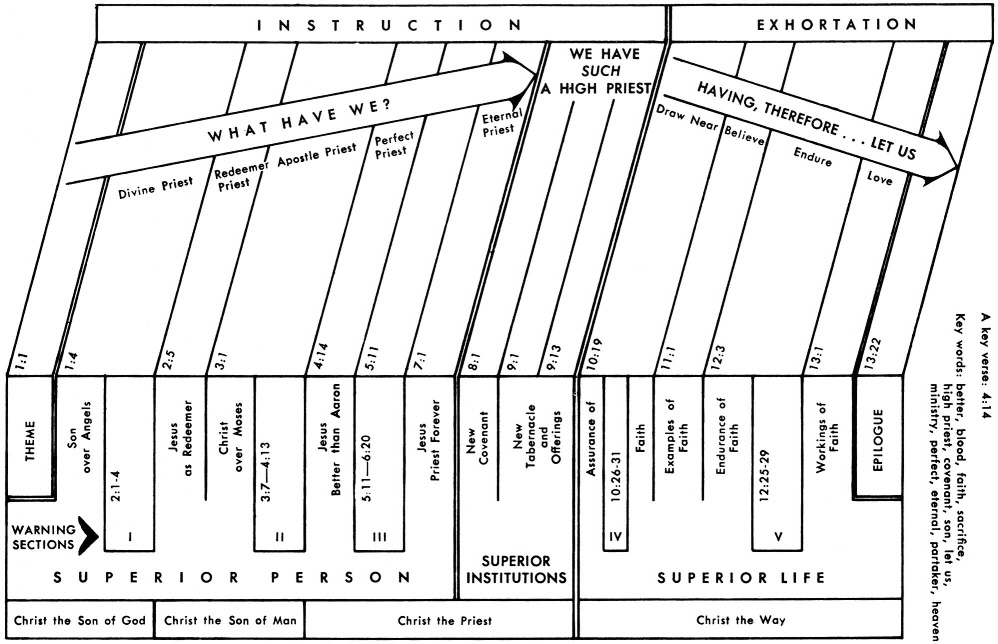
CONSIDER JESUS OUR GREAT HIGH PRIEST
Click chart to enlarge
Charts from Jensen's Survey of the NT - used by permission
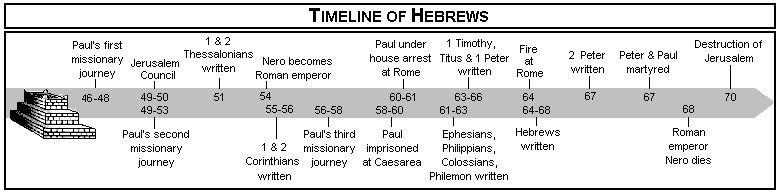
Swindoll's Chart, Interesting Pictorial Chart of Hebrews, Another Chart
|
The Epistle |
||||
| INSTRUCTION Hebrews 1-10:18 |
EXHORTATION Hebrews 10:19-13:25 |
|||
| REVELATION | RESPONSE | |||
| PRECEPTS | PRACTICE | |||
| DOCTRINE | DUTY | |||
| Superior Person of Christ Hebrews 1:1-4:13 |
Superior Priest in Christ Hebrews 4:14-10:18 |
Superior Life In Christ Hebrews 10:19-13:25 |
||
| BETTER THAN PROPHETS, ANGELS MOSES Hebrews 1:1-4:13 |
BETTER THAN AARON'S PRIESTHOOD Heb 4:14-7:28 |
BETTER THAN THE OLD COVENANT Heb 8:1-13 |
BETTER THAN ANIMAL SACRIFICES Heb 9:1-10:18 |
BETTER LIFE IN CHRIST THAN IN ADAM! |
| MAJESTY OF CHRIST |
MINISTRY OF CHRIST |
MINISTERS FOR CHRIST |
||
|
DATE WRITTEN: |
||||

See ESV Study Bible "Introduction to Hebrews"
(See also MacArthur's Introduction to Hebrews)
Borrow Ryrie Study Bible
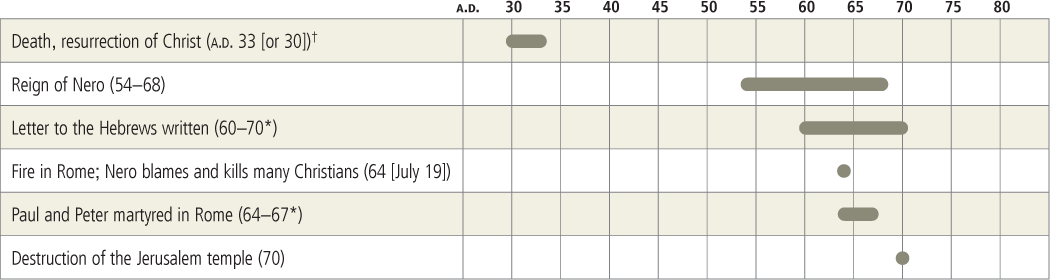
Timeline of Hebrews - ESV Study Bible
Hebrews 6:6 and then have fallen away, it is impossible to renew them again to repentance, since they again crucify to themselves the Son of God and put Him to open shame. (NASB: Lockman)
Greek: kai parapesontas, (AAPMPA) palin anakainizein (PAN) eis metanoian, anastaurountas (PAPMPA) heautois ton huion tou theou kai paradeigmatizontas. (PAPMPA)
BGT καὶ παραπεσόντας, πάλιν ἀνακαινίζειν εἰς μετάνοιαν, ἀνασταυροῦντας ἑαυτοῖς τὸν υἱὸν τοῦ θεοῦ καὶ παραδειγματίζοντας.
Amplified: If they then deviate from the faith and turn away from their allegiance—[it is impossible] to bring them back to repentance, for (because, while, as long as) they nail upon the cross the Son of God afresh [as far as they are concerned] and are holding [Him] up to contempt and shame and public disgrace. (Amplified Bible - Lockman)
Barclay: and who then became apostates, for they are crucifying the Son of God again for themselves and are making a mocking show of him. (Westminster Press)
ESV: if they then fall away, since they are crucifying once again the Son of God to their own harm and holding him up to contempt. (ESV)
KJV: If they shall fall away, to renew them again unto repentance; seeing they crucify to themselves the Son of God afresh, and put him to an open shame.
NKJ if they fall away, to renew them again to repentance, since they crucify again for themselves the Son of God, and put Him to an open shame.
NET: and then have committed apostasy, to renew them again to repentance, since they are crucifying the Son of God for themselves all over again and holding him up to contempt. (NET Bible)
NIV: if they fall away, to be brought back to repentance, because to their loss they are crucifying the Son of God all over again and subjecting him to public disgrace. (NIV - IBS)
NLT: and who then turn away from God. It is impossible to bring such people back to repentance; by rejecting the Son of God, they themselves are nailing him to the cross once again and holding him up to public shame. (NLT - Tyndale House)
Phillips: and who then fall away, it proves impossible to make them repent as they did at first. For they are re-crucifying the Son of God in their own souls, and by their conduct exposing him to shame and contempt. (Phillips: Touchstone)
Wuest: and have fallen away, again to be renewing them to repentance, crucifying to themselves the Son of God and putting Him to an open shame.
Weymouth: it is impossible, I say, to keep bringing them back to a new repentance, for, to their own undoing, they are repeatedly crucifying the Son of God afresh and exposing Him to open shame.
Young's Literal: and having fallen away, again to renew them to reformation, having crucified again to themselves the Son of God, and exposed to public shame.
NET and then have committed apostasy, to renew them again to repentance, since they are crucifying the Son of God for themselves all over again and holding him up to contempt.
CSB and who have fallen away, because, to their own harm, they are recrucifying the Son of God and holding Him up to contempt.
ESV and then have fallen away, to restore them again to repentance, since they are crucifying once again the Son of God to their own harm and holding him up to contempt.
NIV if they fall away, to be brought back to repentance, because to their loss they are crucifying the Son of God all over again and subjecting him to public disgrace.
MIT if they fall away, it becomes impossible to renew them again with repentance, because they by themselves are recrucifying God's son and openly holding him up to contempt.
NJB and yet in spite of this have fallen away -- it is impossible for them to be brought to the freshness of repentance a second time, since they are crucifying the Son of God again for themselves, and making a public exhibition of him.
NRS and then have fallen away, since on their own they are crucifying again the Son of God and are holding him up to contempt.
RSV if they then commit apostasy, since they crucify the Son of God on their own account and hold him up to contempt.
NAB and then have fallen away, to bring them to repentance again, since they are recrucifying the Son of God for themselves and holding him up to contempt.
GWN Yet, they have deserted Christ. They are crucifying the Son of God again and publicly disgracing him. Therefore, they cannot be led a second time to God.
BBE And then let themselves be turned away, it is not possible for their hearts to be made new a second time; because they themselves put the Son of God on the cross again, openly shaming him.
ASV and then fell away, it is impossible to renew them again unto repentance; seeing they crucify to themselves the Son of God afresh, and put him to an open shame.
AND THEN HAVE FALLEN AWAY : kai parapesontas (AAPMPA):
- Hebrews 6 Resources - Multiple Sermons and Commentaries
Related Passages:
Hebrews 3:12,13+ Take care (blepo - present imperative see our need to depend on the Holy Spirit to obey), brethren, lest there should be in any one of you an evil (poneros - active evil), unbelieving (apistia) heart, in falling away (aphistemi [English - "apostasy"]- distance oneself from, withdraw) from (apo - preposition speaks of separation, motion away from) the living God. 13 But encourage (present imperative see our need to depend on the Holy Spirit to obey) one another day after day, as long as it is still called “Today,” lest any one of you be hardened by the deceitfulness of sin (What is the subtle but very real power of sin beloved? Look out!).
Hebrews 3:6+ but Christ was faithful as a Son over His house whose house we are, if we hold fast our confidence and the boast of our hope firm until the end. (shows the importance and value of holding fast)
Hebrews 3:14+ For we have become partakers of Christ, if we hold fast the beginning of our assurance firm until the end; (shows the value of holding fast)
Hebrews 4:14+ Since then (explains why we should hold fast) we have a great high priest who has passed through the heavens, Jesus the Son of God, let us hold fast our confession.
Hebrews 10:23+ Let us hold fast the confession of our hope without wavering, for (explains why we should hold fast) He Who promised is faithful;
FOREVER FALLEN
AWAY
And then (2532) (kai) indicates connection to the prior passage, mostly as a simple continuative, marking the progress of a continued discourse. Kai does not mark the beginning of a conditional statement as is suggested by several translations that begin the sentence with "if". The King James translation, NIV and RSV have chosen to translate this passage beginning with IF but this is not an accurate rendering of the Greek text and is potentially misleading. If you look at the Greek it reads "kai parapesontas" and there is no Greek word of "if." This truth is not "iffy" (so to speak) but is absolutely true!
Have fallen away (parapipto) is placed first in the Greek sentence for emphasis. Contrast the writer's repetitive call for the readers to hold fast (Hebrews 3:6+, Heb 3:14+, Heb 4:14+, Heb 10:23+) From the context of the rest of Hebrews, those who fall away are not genuine believers.
William Hendriksen on have fallen away - A distinction must be made at this point. The author speaks about falling away, not about falling into sin. For example, Judas fell away from Jesus and never returned to him; Peter fell into sin but soon afterward saw the resurrected Jesus. The two concepts (apostasy and backsliding) may never be confused. In Heb 6:6, the author refers to apostasy; he has in mind the person who deliberately and completely abandons the Christian faith. (Falling away “must consist in a total renunciation [italics his] of all the constituent principles and doctrines of Christianity,” writes John Owen) Apostasy does not take place suddenly and unexpectedly. Rather it is part of a gradual process, a decline that leads from unbelief to disobedience to apostasy. And when the falling away from the faith happens, it leads to hardening of the heart and the impossibility of repentance.27 The author, using the example of the Israelites, has shown the process that results in apostasy (Heb 3:18; 4:6, 11). If the Israelites in the days of Moses deliberately disobeyed the law of God and “received its just punishment” (Heb 2:2; and see Heb 10:28), “how much more severely do you think a man deserves to be punished who has trampled the Son of God under foot” (Heb 10:29)?
F F Bruce - The reason why there is no point in laying the foundation over again is now stated: apostasy is irremediable. Once more our author emphasizes that continuance is the test of reality. In these verses he is not questioning the perseverance of the saints; we might say that rather he is insisting that those who persevere are the true saints. But in fact he is stating a practical truth that has verified itself repeatedly in the experience of the church. Those who have shared the covenant privileges of the people of God, and then deliberately renounce them, are the most difficult persons of all to reclaim for the faith. It is indeed impossible to reclaim them, says our author. We know, of course, that nothing of this sort is ultimately impossible for the grace of God, but as a matter of human experience the reclamation of such people is, practically speaking, impossible.35 People are frequently immunized against a disease by being inoculated with a mild form of it, or with a related but milder disease. And in the spiritual realm experience suggests that it is possible to be “immunized” against Christianity by being inoculated with something which, for the time being, looks so like the real thing that it is generally mistaken for it. This is not a question of those who are attached in a formal way to the profession of true religion without ever having experienced its power; it is blessedly possible for such people to have an experience of God’s grace which changes what was once a matter of formal attachment into a matter of inward reality. It is a question of people who see clearly where the truth lies, and perhaps for a period conform to it, but then, for one reason or another, renounce it....Just as the Hebrew spies who returned from their expedition carrying visible tokens of the good land of Canaan nevertheless failed to enter the land because of their unbelief, so those who had come to know the blessings of the new covenant might nevertheless in a spiritual sense turn back in heart to Egypt and so forfeit the saints’ everlasting rest. (Borrow Commentary on Hebrews)
Philip E Hughes - The sin of apostasy, then, is a grim (and far more than a merely hypothetical) possibility for persons who through identification with the people of God have been brought within the sphere of the divine blessing. They may be baptized, as Simon Magus was, occupied in Christian labors, as Demas was, endowed with charismatic gifts, preachers even, healers of the sick and casters out of demons, and privileged to belong to an inner circle of disciples, as Judas was (Mk. 6:12f.; Mt. 10:5ff.), and yet their heart may be far from the One they profess to serve.....Such persons, of their own choice, withdraw themselves from the sphere of redemption and take their stand with those who crucify the Son of God and hold him up to contempt.68 They now show themselves in their true colors. They join the ranks of the mob that yells “Crucify him, crucify him!” and that wickedly derides and insults the suffering Savior; and they do this on their own account, that is, in their own persons and of their own volition: they are not content that others should have scorned him apart from them. (A Commentary on the Epistle to the Hebrews - Page 217)
Leon Morris - “If they fall away” means “fall away from Christianity.” The verb parapiptō is found only here in the NT, and its meaning is clear. The writer is envisaging people who have been numbered among the followers of Christ but now leave that company. Such cannot be brought back to repentance. Notice that he does not say “cannot be forgiven” or “cannot be restored to salvation” or the like. It is repentance that is in mind, and the writer says that it is impossible for these people to repent. ....It is probable that we should take the verb rendered “are crucifying … all over again” (anastaurountas) simply as “crucifying.” Elsewhere it seems always to have this meaning. The author is saying that those who deny Christ in this way are really taking their stand among those who crucified Jesus. In heart and mind they make themselves one with those who put him to death on the cross at Calvary....Some think that the author is speaking about genuine Christians who fall away and that he denies that they may ever come back. This view sets the writer of the epistle in contradiction with other NT writers for whom it is clear that the perseverance of the saints is something that comes from God and not from their own best efforts (e.g., John 6:37; 10:27–29).....A third possibility is that the writer is talking about what looks very much like the real thing but lacks something. The case of Simon Magus springs to mind. He is said to have believed, to have been baptized, and to have continued with Philip (Acts 8:13). Presumably he shared in the laying on of hands and the gift given by it. Yet after all this Peter could say to him, “Your heart is not right before God.… you are full of bitterness and captive to sin” (Acts 8:21–23). The writer is saying that when people have entered into the Christian experience far enough to know what it is all about and have then turned away, then, as far as they themselves are concerned, they are crucifying Christ. In that state they cannot repent. (See The Expositor's Bible Commentary - Abridged Edition: New ...)
James Girdwood - The author of this passage also uses several phrases to describe those who leave Christ. In the first place the word “if” (ED: IN Heb 6:6KJV) and the phrase “because to their loss” are interpretive comments added by the translators (Hebrews 6:6). One could translate this verse, “while they are falling away … and crucifying.” If this is the actual meaning, then the author is not speaking of a single, permanent event but an ongoing condition, continued rejection of Jesus’ sacrifice for their sins on the cross. When this “falling away” takes place, “it is impossible … to be brought back to repentance” (Hebrews 6:4, 6). This statement should cause us to tremble. Those who continue to “crucify” Christ, “subjecting him to public disgrace,” cannot be restored. They have rejected the only means for a right relationship with God. They have refused their only hope. They have suffered the most tragic loss of all, the loss of their very souls. (Book of Hebrews)
R Kent Hughes - The view many, including myself, hold is that those who fall away are not true believers, but rather men and women who only appear so. They are people who have received a thorough exposure to the gospel—for example, the catechized Jewish believers of the preceding verses—and have made an ostensible profession of faith and have been received into the fellowship of God's people. However, at a later point they have abandoned their profession, even becoming opponents of Christ. The reasons I hold to this interpretation are as follows: First, the participation in spiritual realities of those who "fall away," though they have been "enlightened" and "shared" and "tasted" the things of God, parallels the privileged experience of the children of Israel in the wilderness who fell away and died in unbelief....Second, Jesus' parable of the soils teaches us there are people who at the beginning look very much like believers, but they are unregenerate. Not only do they look like Christians, but they have remarkable spiritual experiences before they fall away—just as the seed sown in rocky places "is the man who hears the word and at once receives it with joy" (Matthew 13:20).... Third, I hold this view because it accords with the great Scriptural doctrine of the perseverance of the saints that is so specifically affirmed in God's Holy Word....Fourth, the positive spiritual experiences of those who fall away, described in verses 4-6, are easily within the capacity of the unregenerate, as the successive phrases indicate....How is it possible for one to experience all of this and not be regenerated, we ask? Judas provides the answer. Very likely all the characteristics in our passage were part of his experience, yet there is no way we can imagine him as regenerate, especially since the Lord called him "a devil" (John 6:70), "the son of perdition" (John 17:12, NASB), and one for whom it "would be better... if he had not been born" (Mark 14:21). (See full discussion Hebrews: An Anchor for the Soul)
John Phillips - Although not saved, these people had been fully enlightened to the truth in Christ. It was now a question of choice on their part. Would they go on and become true, born-again believers, or would they draw back and repudiate what they had both seen and heard? The wicked made the wretched choice and turned their backs upon Christ. The writer mentions the unavoidable implication evident in this reaction to the gospel. They fell away (6:6a). The word is used only here in the Greek translation of Ezekiel 14:13 and 15:8 where Israel's apostasy is described. They become apostates. Solemnly, the writer then underlines the unconditional impossibility. It is impossible "to renew them again unto repentance" (6:6b). There is no such thing as being saved and then lost and then saved again. Those who repudiate Christ prove that they never have been saved at all, and they sear their souls so that the initial work of repentance can never again be wrought in their hearts. Like Pharaoh, they harden their hearts beyond the possibility of ever having them softened again. (Borrow Exploring Hebrews: An Expository Commentary)
Life Application Bible Commentary - The passage describes people in our churches who act like and seem to be Christians, but who have not truly believed. When those assumed to be believers turn away, the debate may take place afterward, "Were they originally believers or not?" But people reading these words must heed the warning, not just debate the issue. To the Hebrew Christians, these verses revealed the danger of returning to Judaism and thus committing apostasy. Some apply this verse today to superficial believers who renounce their Christianity, or to unbelievers who come close to salvation and then turn away. Either way, those who reject Christ will not be saved. Christ died once for all who believe. He will not be crucified again. Apart from his cross, there is no other possible way of salvation. The author had already denounced readers for their unwillingness to grow in the faith (6:1-3). Such unwillingness can lead to hardness of heart and to eventually turning away from the faith. (See Hebrews - Page 79)
John gives a parallel description in his first letter writing that…
They went out from us, but they were not really of us; for (term of explanation) if they had been of us, they would have remained with us; but they went out, in order (term of purpose/result) that it might be shown that they all are not (ouk = absolutely not) of us. (1Jn 2:19+)
How is it possible for one to experience all of the spiritual truths outlined in this section and yet not be regenerated? As discussed earlier, Judas Iscariot experienced Jesus Himself, God in the flesh and yet he was never born again. Jesus even called him “devil” (Jn 6:70+), “son of perdition” (Jn 17:12+, and one for whom it “would be better… if he had not been born” (Mk 14:21+). Jesus knew Judas’ condition from the beginning, though Judas fooled the disciples to the last! One is reminded of Jesus' solemn warning in Matthew 7...
“Not everyone who says to Me, ‘Lord, Lord,’ will enter the kingdom of heaven; but he who does (present tense - as your lifestyle) the will (NOT PERFECTION, BUT DIRECTION) of My Father Who is in heaven. 22 “Many (A SAD ADJECTIVE!) will say to Me on that day, ‘Lord, Lord, did we not prophesy in Your name, and in Your name cast out demons, and in Your name perform many miracles?’ (NOTE JESUS DOES NOT DISPUTE THEIR CLAIM TO MIRACULOUS WORKS! COMPARE THIS WITH HEBREWS 6:4-5) 23 “And then I will declare to them, ‘I never (absolutely never) knew (ginosko - speaks of an intimate knowing) you; DEPART (present imperative) FROM ME, YOU WHO PRACTICE (ergazomai = actively work; present tense - as your lifestyle, your direction) LAWLESSNESS.’ (Mt 7:21-23+)
THOUGHT - If you are unsure about your salvation, I would suggest taking some time to slowly read through First John which gives multiple tests to assess assurance. In fact his purpose is clearly stated in 1 John 5:13+ "These things I have written to you who believe in the name of the Son of God, in order that (purpose clause) you may know (not guess) that you have eternal life." Our Father wants each of His precious children to know beyond a shadow of a doubt that they have eternal life, a hope sure, not a hope so! We see this even in the OT in Ps 1:6 "for the LORD knows the way of the righteous, but the way of the wicked will perish." To help you to study First John I have put together questions for each chapter in a "study guide" at the top of each page in my commentary. This study guide consists of the 5W/H questions on each verse (or most of the verses) which allows you to walk through the text verse by verse making observations which answer the questions. You could also use the study guide questions to lead a group through First John. These questions are not inspired and the work is handwritten (so use "as is"!) but the intent is to cause you to focus on what the text says (observation) for the better your observations are on a given text, the more accurate will be your Interpretation which is crucial for correct Application of the text. I would encourage you to do your observations first before looking at my commentary notes. Then you will be able to discern whether my comments are accurate. (See also Evidences of the New Birth)
A sad but excellent illustration of the truth of Hebrews 6 is seen in the Tragic Tale of Charles Templeton (click short article), who for a while was a co-laborer of Billy Graham. Stories like that of Charles Templeton emphasize what the doctrine of perseverance of the saints is real and needs to be taught. And remember perseverance is absolutely not a work of the flesh as if one's holding fast to the end merits salvation. The facts is that the only way one could possibly hold fast to the end is because the Holy Spirit Who indwells them supernaturally enables them to do what they could never do naturally! It follows that one who perseveres to the end is one who has the indwelling Holy Spirit which indicates they are truly saved (cf Ro 8:9+).
Fallen away (3895) (parapipto from pará = to side of or from + pipto = fall) means to fall aside or fall away. It means to to fail to follow through on a commitment. Figuratively it means to commit apostasy, to apostatize or to fall away from adherence to realities and facts of the true faith. This is the only use in the NT. In the papyri parapipto is used mostly with the meaning of become lost (a sense that would be apropos for those souls in Hebrews 6 who sadly are forever lost!)
Gilbrant - parapipto
Classical Greek Classical writers usually used parapiptō in its literal sense “to fall beside” or to convey the idea of “missing, slipping aside,” or “being led away.” At times the term is used of a person making a mistake. In the papyri parapiptō almost always means “become lost” (cf. Moulton-Milligan). Common to all of these is the unintentional nature of the fall or mistake.
Septuagint Usage The Septuagint uses parapiptō nine times, though its presence in 2 Maccabees 10:4 is disputed and should probably not be included. Only in Esther 6:10 does the Septuagint use parapiptō to mean “fail.” All the other uses imply a sinful and willful departure from God. Ezekiel 22:4 uses the term to mean “be guilty.” In the other six (Wisdom of Solomon 6:9; 12:2; Ezekiel 14:13; 15:8; 18:24; 20:27) parapiptō conveys the idea of sinning against God by going astray, acting unfaithfully, or acting treacherously.
New Testament Usage The New Testament uses parapiptō only as an aorist participle in Hebrews 6:6. Here the classical meaning of having fallen or slipped away is combined with the Septuagintal sense of having sinned. The writer of Hebrews was issuing a warning against the real danger of “falling away” from the living God. However, this “falling away” is not the result of inadvertent sin, but of willful sin. Those who commit deliberate acts of apostasy are in effect renouncing Christ and His crucifixion. Those in such a state cannot be brought to repentance as long as they repudiate Christ. (For additional discussion see Bruce, New International Commentary on the New Testament, Hebrews, p.124.) (The Complete Biblical Library Greek-English Dictionary – Pi-Rho)
NIDNTT - see discussion under PIPTO page 608
PARAPIPTO in Septuagint (LXX) - Esther 6:10; Ezek 14:13; 15:8; 18:24; 20:27; 22:4
Ezekiel 20:27 "Yet in this your fathers have blasphemed Me by acting treacherously against (LXX = parapipto) Me."
COMMENT - Note that the "falling away behavior" of Israel as described by Ezekiel had virtually the same impact as did the falling away in Hebrews 6:6; i.e., it resulted in Christ being "put to open shame" which is similar to God being blasphemed in the OT.
IT IS IMPOSSIBLE: adunatos:
- Hebrews 6 Resources - Multiple Sermons and Commentaries
Related Passage:
2 Chronicles 36:14-16+ Furthermore, all the officials of the priests and the people were very unfaithful following all the abominations of the nations; and they defiled the house of the Lord which He had sanctified in Jerusalem. 15 The Lord, the God of their fathers, sent word to them again and again by His messengers, because He had compassion on His people and on His dwelling place; 16 but they continually mocked the messengers of God, despised His words and scoffed at His prophets, until the wrath of the Lord arose against His people, until there was no remedy. (AKA = "IMPOSSIBLE!")
A TRAGIC
IMPOSSIBILITY
F B Hole notes that…
We may well ask if it is possible for anyone to share in this way without being truly converted; and this question may well be specially urgent as regards the third of the five. Can it be possible to be a partaker of the Holy Ghost" without being born again?
The answer to that question is, that it is quite possible. Only a true believer can be indwelt by the Holy Spirit, but all within the circle of Christian profession, whether truly converted or not, partake or share in the benefits of the presence of the Spirit. A man may be enlightened without being saved. He may taste the heavenly gift without receiving it. He may taste the good word of God without digesting it in his inward parts. He may share in "the powers of the world to come." (i.e. miraculous powers) without experiencing the real power of the world to come.
The terrible case of Judas Iscariot furnishes us with an illustration of this very thing. He walked for over three years in the company of the Son of God. What floods of light fell upon his path! What tastes he had of the heavenly gift and of the good Word of God! It could not be said of course that he was a partaker of the Holy Ghost, but he was a partaker of the benefits of the presence of Christ upon earth; and he shared, in common with the other apostles, in those miraculous powers which are here called "the powers of the world to come." He was one of the twelve to whom the Lord gave power over unclean spirits, and of whom it is said, "They cast out many devils and anointed with oil many that were sick, and healed them." (Mark 6:13). Yet the miracle-working Judas was all the while a "son of perdition" and not a saved man at all. He fell away and it proved impossible to renew him unto repentance.
You will notice that the word here, is "impossible" and not "improbable." This one word is quite sufficient to show that there is no support in this scripture for the idea of a true believer falling away and being lost for ever. ALL those who "fall away" in the sense spoken of in this passage are for ever lost. It is not that they may be, but that they must be; and there would not be a single ray of hope for any back-slider, did it refer to such.
It refers then to the sin of apostasy — a sin to which the Jew, who embraced the Christian religion without being really converted, was peculiarly liable. By turning back to his ancient and worn out religion, thereby utterly condemning and disowning the Lord Jesus, he proved himself to be utterly bad and worthless ground. (Hebrews Commentary Notes)
Impossible (102) (adunatos from a = without + dunatós = possible, able, or powerful from dunamai = to be able or have power by virtue of inherent ability and resources. Note the stem duna- or dyna- conveying the basic sense of ability or capability, power, strength, might) means impossible, incapable of being or of occurring, incapable of being done. Adunatos is used twice to convey the idea of one who is impotent, has no strength or lacks capability in functioning adequately, once in a literal sense (Acts 14:8 below = powerless) and once in a spiritual sense (Romans 15:1 = of those who do not "strongly" believe).
Note that adunatos is not present in this verse in the Greek but is found in Hebrews 6:4 where it is place first in the Greek sentence for emphasis. It's as if the author wants to make it blazingly, blatantly clear… "Impossible it is… "! One can hardly miss his point. In regard to man’s moral offense, there is no "permanent cure" effected by the physical blood of animals.
There are 26 uses in the Septuagint (LXX) (Job 5:15, 16; 20:19; 24:4, 6, 22; 29:16; 30:25; 31:16, 20, 34; 34:20; 36:15, 19; Pr 30:18; Joel 3:10) and 10 uses in the NT. Note the obvious concentration of "impossibilities" in the book of Hebrews!
Matthew 19:26+ And looking upon them Jesus said to them, "With men this is impossible, but with God all things are possible."
Mark 10:27+ Looking upon them, Jesus said, "With men it is impossible, but not with God; for all things are possible with God."
Luke 18:27+ But He said, "The things impossible with men are possible with God."
Acts 14:8+ And at Lystra there was sitting a certain man, without strength in his feet, lame from his mother's womb, who had never walked.
Romans 8:3+ For what the Law could not do (adunatos), weak as it was through the flesh, God did: sending His own Son in the likeness of sinful flesh and as an offering for sin, He condemned sin in the flesh (Comment: The truth in Romans parallels that in Hebrews 10, Romans dealing with the Law per se and Hebrews addressing the Levitical sacrificial system. Neither source had the inherent ability to make man right before the Holy God and both point ultimately to the Son, the perfect Sacrifice and the fulfillment of the Law!)
Romans 15:1+ Now we who are strong ought to bear the weaknesses of those without strength and not just please ourselves.
Hebrews 6:4 (ESV) For it is impossible to restore again to repentance those who have once been enlightened, who have tasted the heavenly gift, and have shared in the Holy Spirit, (Note: the NASB places "impossible" in Hebrews 6:6) (Note also that commentators and some translators take adunatos to mean "difficult" but clearly from the other NT uses and specifically the uses in Hebrews this is inappropriate and leads to a thoroughly incorrect interpretation of this stern warning passage.)
Hebrews 6:18+ in order that by two unchangeable things, in which it is impossible for God to lie, we may have strong encouragement, we who have fled for refuge in laying hold of the hope set before us.
Hebrews 10:4+ For it is impossible for the blood of bulls and goats to take away sins.
Hebrews 11:6+ And without faith it is impossible to please Him, for he who comes to God must believe that He is, and that He is a rewarder of those who seek Him.
Some compare this verse with the blasphemy of the Holy Spirit Jesus referred to in Mt 12:31,32. For example, John Calvin espouses this view but still thinks they are believers!
Some translate adunatos (impossible) with the English word “difficult.”, something that is difficult to do if one adheres to normal rules of Biblical interpretation (hermeneutics). Specifically as noted above every other use of adunatos translated impossible! Thus it is clear from these other passages that such a translation is unjustified.
Leon Morris remarks that the writer may be "talking about what looks very much like the real thing but lacks something. The case of Simon Magus springs to mind. He is said to have believed, to have been baptized, and to have continued with Philip (Acts 8:13). Presumably he shared in the laying on of hands and the gift given by it. Yet after all this Peter could say to him, "Your heart is not right before God…you are full of bitterness and captive to sin" (Acts 8:21, 22, 23). The writer is saying that when people have entered into the Christian experience far enough to know what it is all about and have then turned away, then, as far as they themselves are concerned, they are crucifying Christ. In that state they cannot repent. (For a good discussion of the various interpretations, see Kent, in loc.) (SEE The Expositor's Bible Commentary - Abridged Edition or Borrow Expositor's Bible Commentary page 964)
A good illustration of the impossibility of renewing such a person to repentance is found in Hebrews 12 where the writer reminds his Jewish audience (and all of us) of the tragic example of Esau, warning them to…
See to it (keep on the lookout continually) that no one comes short of the grace of God; that no root of bitterness springing up causes trouble, and by it many be defiled (contaminated, polluted, tainted); 16 that there be no immoral or godless person like Esau, who sold his own birthright for a single meal. 17 For you know that even afterwards, when he desired to inherit the blessing, he was rejected, for he found no place for repentance, though he sought for it with tears. (see notes Hebrews 12:15; 16; 17)
The writer is saying that Esau could no longer repent because he had become so hardened (He 3:8, 15, 4:7-see notes Heb 3:8, 3:15, 4:7). Yes, he cried out for things to go better in his life but all the while inside he was refusing to submit to God's terms! Isn't there some of Esau in all of us?… for every time we willfully sin, we reject God's terms, God's sovereign will & good pleasure. Impossible to repent is a terrifying prospect behind all the warnings of Hebrews -- don't drift but take heed and consider Jesus and exhort one another daily and fear unbelief and carelessness. Why? Is anything really at stake? The prospect exists that you and I who believe we are chosen and called and justified might slide into a slow process of indifference (like allowing the "little foxes" in into our garden - Song 2:15) and gradually hardening our hearts so that eventually we fall away, reject Christ and put Him to open shame! We may actually come to the point of no return, because we have been forsaken utterly by God. That is the "impossible" of this verse!
The Effect of Vaccination
As a physician sub-specialized in infectious diseases, I know full well the benefit of vaccinations to prevent infection with various microbial agents. A vaccination immunizes by giving the patient a "very mild case" of the disease (in a manner of speaking). Instead of using live viral agents, the vaccine uses an attenuated virus that is strong enough to stimulate the body's immune system to produce antibodies which in turn will be called upon to protect the body should that individual ever be exposed to the live infectious agent. Vaccination is good in Medicine but bad in Theology! A person who is exposed to the gospel can get just enough of it to be immunized against the real thing. The longer one resists the real thing, the more they become "immunized". The spiritual system so to speak, like their physical immune system, becomes more and more "protected" against the true gospel. Their only hope is to reject what he is holding onto and receive Christ without delay lest he become so hardened, often without even realizing his gradually hardening state, that his opportunity is forever gone.
These "vaccinated" individuals who think they are protected from eternal destruction by a profession of faith without fruit to validate genuine possession are like the vulture who spotted the corpse of a fox on an ice floe lazily moving with the current down the river toward Niagara Falls. The unwary carnivore alights on the ice and begins to eat remains of the carcass. Then he hears the crashing of water, warning of approaching danger, but he reasons that he has wings and need not pay attention to these obvious warnings for he is free to fly away at any time. And then at the last minute he finishes his feast and spreads his wings for lift off, but lo, he is unable to fly away because his talons have become frozen and firmly fixed into ice floe and he is dragged over the falls to destruction!
TO RENEW THEM AGAIN TO REPENTANCE: palin anakainizein (PAN) eis metanoian:
- Renew - Heb 6:4; Ps 51:10; Isaiah 1:28; 2Ti 2:25+
- Hebrews 6 Resources - Multiple Sermons and Commentaries
THE IMPOSSIBILITY OF
REPEAT REPENTANCE
To renew them again (anakainizo) to repentance (metanoia) - The writer seems to express in this section his fear that there may be some among his readers (see Group 2) who profess to be believers in Messiah, perhaps even having witnessed for Him, participated in church, etc (cf Jesus' words in Matthew 7:21+; Mt 7:22+; Mt 7:23+) and yet have never experienced true repentance and salvation. Turning back from the light they have been given, they prove themselves to be enemies of Christ and not a part of the people of God at all!
Note that contrary to what Arminianism teaches, it is the opportunity for receiving salvation, not the salvation itself, that can be lost.
Wuest comments on the translation of the words impossible and renew noting that "The Greek word translated impossible cannot be diluted to mean difficult. The same word is used in Hebrews 6:18; Heb 10:4, and Heb 11:6, where it can only mean “impossible.” Likewise, the word renew must be taken in its full force. Expositor’s Greek Testament says that it means that those who have once experienced a renewal cannot again have a like experience. The person described cannot again be brought to a life-changing repentance. Repentance is a work of the Holy Spirit on the heart of the one who is approaching the act of faith in Christ. It is usually involved in that act, but can also exist separate and apart from it, as is seen in the present instance. These Hebrews had allowed the Holy Spirit to carry them along to the place of repentance. Now should they refuse the proffered faith by which they could lay hold of the High Priest as their Saviour, and return to the abrogated sacrifices of the First Testament, it would be impossible to bring them back to the act of repentance again. And as we have seen, the impossibility would inhere in their own spiritual condition, not in the grace of God. (Hebrews Commentary online)
Wayne Grudem has this note on Hebrews 6:4-6 writing that "the persons who “commit apostasy” have had all sorts of knowledge and conviction of the truth: they have “been enlightened” and have “tasted the heavenly gift”; they have participated in some ways in the work of the Holy Spirit (ED: RECALL JUDAS WENT OUT IN Mt 10:1+ TO CARRY OUT SUPERNATURAL ACTIVITIES THAT SURELY MUST HAVE BEEN ENABLED BY THE HOLY SPIRIT!) and “have tasted the goodness of the word of God and the powers of the age to come,” yet they then willfully turn away from Christ and “hold him up to contempt” (Heb. 6:6). They too have put themselves beyond the reach of God’s ordinary means of bringing people to repentance and faith. Knowing and being convinced of the truth, they willfully reject it. (Systematic Theology: An Introduction to Biblical Doctrine, 1994 = Highly Recommended! scroll down to page 693)(online pdf or here) (See also Grudem's 50 page chapter "Perseverance of the Sains: A Case Study from the Warning Passages of Hebrews" - BORROW Still Sovereign, PAGE 132 online pdf or here)
Steven Cole - Which view best fits with other biblical texts and examples? See Cole's discussion below.
Renew (340) (anakainizo from aná = again or back + kainízo = renew, to produce something new <> kainos= qualitatively new) means to restore. It is found only here in the NT. The verb anakainizō is a compound of kainos “new” and ana “again” and the kind of “newness” in kainos is qualitative rather than temporal. Anakainizo is used in the secular writing Isocrates Areopagiticus 3 meaning to renew,” “to give new life to something already there,” “to restore”. Related word studies: anakainoo and anakainosis
TDNT writes anakainizo means “to bring to conversion again.” The seriousness of the distinctive teaching of Hebrews that there is no second repentance is here shown from the standpoint of the Christian teacher who is speaking. He and his fellow-teachers cannot bring complete apostates to a new beginning which will lead to conversion. The miracle of becoming a "brand new creation" occurs only once. In early Christian writings anakainizo is a common word in connection with regeneration
There are 4 uses of anakainizo in the Septuagint:
Psalm 39:2 I was mute and silent, I refrained even from good, And my sorrow grew worse (Lxx = "My grief was renewed").
Psalm 103:5 Who satisfies your years with good things, So that your youth is renewed like the eagle.
Psalm 104:30 You send forth Your Spirit, they are created; And You renew the face of the ground.
Lamentations 5:21 Restore us to You, O LORD, that we may be restored; Renew our days as of old
Again (3825) (palin) refers to a subsequent point of time involving repetition.
Repentance (3341)(metanoia from meta = after + noéo = to understand) literally means "afterthought" or "to think after" and implies a change of mind. From the NT uses, it is clear that metanoia means however much more than merely a change of one's mind but also includes a complete change of heart attitude, of interest, and of the general direction of one's life. True repentance represents a "conversion" in every sense of the word.
Jesus' teaching supports the inseparable association of repentance and salvation, our Lord declaring…
"I tell you that in the same way, there will be more joy in heaven over one sinner who repents (metanoeo), than over ninety-nine righteous persons who need no repentance (metanoia)." (Luke 15:7+)
It should be stated at the outset that there are some in evangelical circles who teach that all repentance involves is a change of mind. The problem with this definition is that it has nothing to do with one’s attitude toward sin and does not necessarily result in any change in lifestyle. Keeping this "definition" of repentance in mind now read the first NT use of metanoia by John the Baptist as he addresses the most religious people in Israel, who themselves were seeking to flee from the wrath to come (referring to God's ultimate judgment on sin and sinners who refuse to repent)…
Therefore bring forth (aorist imperative = do it and do it now! It can convey a sense of urgency) fruit (karpos - fruit is what people produce that other people see and which indicates their true spiritual condition - see Matthew 7:16, 17, 18, 19, 20ff+) in keeping (axios = the idea is that of having equal weight or worth, and therefore of being appropriate) with repentance." (Mt 3:8+) (Note Jesus began His ministry with exactly the same call in Mt 4:16+)
Was John the Baptist calling for simply a change in thinking or is he calling for a change in thinking that was evidenced by a change in behavior? What does the passage teach? John was issuing a call to repentance that was evidenced by an inner change and an outward act commensurate with and proof of the genuineness of the change (possession and not just profession).
As a corollary, note that the New Testament knows nothing of a gospel that lacks a call to repentance. John and Jesus were both calling Israel to have a radical change in thinking about genuine righteousness and how it was worked out in one's everyday life. The Scribes and Pharisees taught the Jews a distorted, perverted, external type of righteousness, a self-righteousness based on an adherence to manmade rules and regulations (613 of them in fact!), the keeping of which would emphatically not guarantee one's entrance into the Kingdom of Heaven. Jesus presented the Sermon on the Mount to correct this deadly distortion of the Law and the Prophets (the entire Old Testament) by the religious leaders. (See Overview of Matthew 1-7 and commentary on Matthew 5-7 beginning in Matthew 5:1-2).
In summary, the Jews needed to have a change (repentance) in regard to righteousness for as Jesus emphatically declared…
unless your righteousness surpasses that of the scribes and Pharisees, you shall not enter the kingdom of heaven. (Mt 5:20+)
J. R. Miller wrote that genuine repentance "amounts to nothing whatever if it produces only a few tears, a spasm of regret, a little fright. We must leave the sins we repent of and walk in the new, clean ways of holiness."
Marvin Vincent in his note on the verb form (metanoeo) writes that this is…
A word compounded of the preposition meta, after, with; and the verb noeo, to perceive, and to think, as the result of perceiving or observing. In this compound the preposition combines the two meanings of time and change, which may be denoted by after and different; so that the whole compound means to think differently after.
Metanoia (repentance) is therefore, primarily, an after-thought, different from the former thought; then, a change of mind which issues in regret and in change of conduct. These latter ideas, however, have been imported into the word by scriptural usage, and do not lie in it etymologically nor by primary usage.
Repentance, then, has been rightly defined as
Such a virtuous alteration of the mind and purpose as begets a like virtuous change in the life and practice.
Sorrow is not, as is popularly conceived, the primary nor the prominent notion of the word. Paul distinguishes between sorrow and repentance (metanoia), and puts the one as the outcome of the other. “Godly sorrow worketh repentance” (2Cor 7:10). (Vincent, M. R. Word Studies in the New Testament. Vol. 1, Page 3-23) (Bolding added)
Kenneth Wuest (in his discussion of the related verb) adds that "Repent is the translation of metanoeo which in classical Greek meant “to change one’s mind or purpose, to change one’s opinion.” The noun metanoia meant “a change of mind on reflection.” These two words used in classical Greek signified a change of mind regarding anything, but when brought over into the New Testament, their usage is limited to a change of mind in the religious sphere. They refer there to a change of moral thought and reflection which follows moral delinquency. This includes not only the act of changing one’s attitude towards and opinion of sin but also that of forsaking it. Sorrow and contrition with respect to sin, are included in the Bible idea of repentance, but these follow and are consequent upon the sinner’s change of mind with respect to it." (Hebrews Commentary online) (Bolding added)
Thayer writes that metanoia refers "especially (to) the change of mind of those who have begun to abhor their errors and misdeeds, and have determined to enter upon a better course of life, so that it embraces both a recognition of sin and sorrow for it and hearty amendment, the tokens and effects of which are good deeds.
Friberg, et al, define metanoia as "(1) religiously and morally, a change of mind leading to change of behavior repentance, conversion, turning about ; (2) as a change of opinion in respect to one’s acts regret, remorse (a popular Greek usage not found in the NT)" (BORROW Analytical Lexicon of the Greek New Testament)(Bolding added)
Louw and Nida define metanoia as a…
"to change one’s way of life as the result of a complete change of thought and attitude with regard to sin and righteousness… Though in English a focal component of repent is the sorrow or contrition that a person experiences because of sin, the emphasis in metanoeo (verb form) and metanoia seems to be more specifically the total change, both in thought and behavior, with respect to how one should both think and act. Whether the focus is upon attitude or behavior varies somewhat in different contexts." (Louw, J. P., & Nida, E. A. Greek-English Lexicon of the New Testament: Based on Semantic Domains. United Bible societies ) (Bolding added)
Repentance as used by is a change of mind that results in a change of will. It means “a turn about" or deliberate change of mind resulting in a change of direction in thought and behavior. There is a new attitude to God, to men, to life, to self.
One might thus say that repentance is a change of attitude toward sin which leads to a desire to change our behavior accordingly. If the sinner honestly changes his mind about sin, he will turn from it. If he sincerely changes his mind about Jesus Christ, he will turn to Him, trust Him, and be saved. In Paul's parting words to the Ephesian elders he declared…
“how I did not shrink from declaring to you anything that was profitable, and teaching you publicly and from house to house, solemnly testifying to both Jews and Greeks of repentance (metanoia) toward God and faith in our Lord Jesus Christ. (Acts 20:21+)
True repentance is a godly sorrow for sin, an internal repugnance to the ugliness of sin followed by the actual forsaking of it as Paul explained to the Corinthians…
"I now rejoice, not that you were made sorrowful, but that you were made sorrowful to the point of repentance (i.e., their sorrow led them to a change of mind resulting in a change of life); for you were made sorrowful according to the will of God, in order that you might not suffer loss in anything through us. For the sorrow that is according to the will of God (godly sorrow is a grief which comes into a one's life after he or she has committed a sin and which leads to repentance) produces a repentance without regret, leading to salvation; but the sorrow of the world produces death." (2Corinthians 7:9, 10+)
In his respected commentary on 2Corinthians 7:9, 10 Charles Hodge writes that
"Repentance is not merely a change of purpose, but includes a change of heart which leads to a turning from sin with grief and hatred thereof unto God.”
Jamieson, et al, commenting on 2Corinthians 7:9, 10 write that…
Repentance (metanoia) implies a coming to a right mind; “regret” implies merely uneasiness of feeling at the past or present, and is applied even to the remorse of Judas (Mt 27:3); so that, though always accompanying repentance, it is not always accompanied by repentance. “Repentance” removes the impediments in the way of “salvation” (to which “death,” namely, of the soul, is opposed)." (Jamieson, R., Fausset, A. R. & Brown, D. A Commentary, Critical and Explanatory, on the Old and New Testaments)
Do not confuse remorse with repentance. For example
"when Judas, who had betrayed (Jesus), saw that He had been condemned, he felt remorse and returned the thirty pieces of silver to the chief priests and elders" (Matthew 27:3+)
What is the distinction? Repentance involves sorrow for the act of sin, remorse sorrow for its consequences. A repentant person is sorry he sinned, whereas a remorseful person is sorry he got caught.
ILLUSTRATION OF FALL AWAY - R Kent Hughes - (see The Sermon on the Mount: The Message of the Kingdom) Those of us who grew up in the fifties are quite familiar with the name Mickey Cohen because he was the most flamboyant criminal of the day. Perhaps some of us even remember Cohen's becoming a "Christian."
At the height of his career Cohen was persuaded to attend an evangelistic service at which he showed an interest in Christianity. Hearing of this, and realizing what a great influence a converted Mickey Cohen could have for Christ, many prominent Christian leaders began visiting him in an effort to convince him to accept Christ. Late one night, after repeatedly being encouraged to open the door of his life on the basis of Rev. 3:20 ("Behold, I stand at the door and knock; if any one hears My voice and opens the door, I will come in... ," NASB), Cohen did so.
There are "Christian football players, Christian cowboys, Christian politicians;
why not a Christian gangster?"
-- Mickey Cohen
Hopes ran high among his believing acquaintances. But with the passing of time, no one could detect any change in Cohen's life. Finally they confronted him with the fact that being a Christian meant he would have to give up his friends and his profession. The logic of his response was this: there are "Christian football players, Christian cowboys, Christian politicians; why not a Christian gangster?"
Mickey certainly was not one of the Lord's converts! Down-to-earth Dwight Moody gave us an epigram that wears well because every experienced Christian knows that the authenticity of a conversion will be revealed in time and life. As a pastor, I may witness a moving conversion. But the convert's life will reveal the ultimate reality. I have seen spectacular conversions fizzle and even produce enemies of the gospel—apostates. I have seen other conversions, both dramatic and quiet, mature into deep Christian commitment.
There was a famous evangelist name Charles Templeton who professed Christ and later apostasized. Read the true story of The Tragic Tale of Charles Templeton
SINCE THEY AGAIN CRUCIFY TO THEMSELVES THE SON OF GOD AND PUT HIM TO OPEN SHAME: anastaurountas (PAPMPA) heautois ton huion tou Theou kai paradeigmatizontas (PAPMPA):
- Crucify - Heb 10:29; Zechariah 12:10, 11, 12, 13, 14; Matthew 23:31,32; Luke 11:48
- To open shame - Heb 12:2; Mt 27:38, 29, 30-44; Mark 15:29, 30, 31,32; Luke 23:35, 36, 37, 38, 39
- Hebrews 6 Resources - Multiple Sermons and Commentaries
Again crucify (388) (anastauroo from aná = again or up + stauroo = crucify) means to crucify afresh. Crucify conveys a picture of a person making a deliberate, malicious decision to continually spurn Christ, not just to carelessly disregard Him. The voice is active which indicates a personally initiated active betrayal of Christ! This person is in essence in that throng of Jews who screamed to Pilate "Crucify, Crucify". (Jn 19:6, cp Acts 2:23 where "you" = Jews)
F B Hole a Brethren writer, who held strongly to the perseverance of true believers has an interesting note - No true child of God ever apostatizes, though not a few professors of the Christian religion have done so. If an Hebrew threw up his Christian profession and wished to get reinstated in the synagogue and amongst his own people, what would happen? He would find that as the price of re-admission he would have to call down a curse upon Jesus as an impostor. He would have in effect to crucify to himself "the Son of God afresh, and put Him to an open shame." Now to go to such lengths as that is to bring oneself under the governmental judgment of God, just as Pharaoh did in the days of old when God hardened his heart, so that it is impossible to be renewed unto repentance.(Hebrews Commentary Notes)
In the first century, Jews who wanted to return to synagogue life after confessing Jesus as Messiah often had to publicly repudiate Christ. Some rabbinic sources and early church testimony suggest this involved pronouncing a curse (anathema) on Jesus, treating Him as a false Messiah. Thus, returning to Judaism was not neutral — it meant openly shaming Christ (“crucifying Him afresh and putting Him to an open shame,” Heb 6:6).
To themselves - This means that, as far as they were concerned, the Son of God deserved to be crucified. Regardless of what they may have been professing openly and publicly, they now took their stand with the crucifiers. In their hearts they said, “That’s the verdict we give - Crucify Him!” and put Him to open shame again. (He 12:2+)
Note that the NIV has a poor translation rendering it "because to their loss they are crucifying the Son of God".
MacDonald writes that "This signifies a deliberate, malicious spurning of Christ, not just a careless disregard of Him. It indicates a positive betrayal of Him, a joining of forces against Him, and a ridiculing of His Person and work." (Borrow Believer's Bible Commentary)
Stedman agrees writing that "The NIV because to their loss does not translate the Greek heautois (themselves) well. “To themselves” (KJV) or “on their own account” (RSV) is better. That is, they fall away deliberately, unwilling to separate themselves from those who actually condemned Jesus to be crucified. Their hearts are hardened in flint like determination to have things their own rebellious way. (Hebrews 6:4-8 The Danger of Knowledge Without Faith)
Vincent remarks on the pronoun heautois writing that it means "for themselves. So that Christ is no more available for them. They declare that Christ’s crucifixion has not the meaning or the virtue which they formerly attached to it. The Son of God. Marking the enormity of the offence. (Hebrews 6: Word Studies)
Put to open shame (3856) (paradeigmatizo from pará = near, to those in view, visibly, openly, publicly + deigmatízo = exhibit, make a show, cause to suffer public disgrace or shame -- as the Romans did when they exposed their captives and the spoils of the conquered enemies to public view in their triumphal processions) means to put something alongside of a thing by way of commending it to imitation or avoidance. To show to point out. To make an example of and thus to expose to public disgrace. Paradeigmatizo implies exposing to ignominy or infamy, such as was effected in barbarous times by exposing the quarters of the executed criminal, or leaving him hanging in chains. Archilochus, says Plutarch, rendered himself infamous (paradeigmatizo) by writing obscene verses. In other words he put himself to open shame.
Matthew uses the root verb deigmatizo describing Joseph's reaction upon discovering Mary was pregnant…
And Joseph her husband, being a righteous man, and not wanting to disgrace her, desired to put her away secretly. (Mt 1:19 )
The Septuagint (LXX) uses paradeigmatizo in Numbers 25 where Israel was playing the harlot, sacrificing to the idols of the pagans. Moses records that…
the LORD said to Moses, "Take all the leaders of the people and execute them in broad daylight (LXX = paradeigmatizo = setting them forth as an example for the Lord in the face of the sun) before the LORD, so that the fierce anger of the LORD may turn away from Israel. (Nu 25:4)
Some translators (see Amplified above) take the participles "crucify… put to open shame" in a temporal sense rather than a causal sense, and translate the verse something like this…
“it is impossible to bring them back again to repentance while they are crucifying… ”
This translation would result in a change in interpretation (which is why you want to read either the original Greek or use a translation that is literal and closest to the Greek), the idea being that while they are "crucifying" Jesus they cannot repent, but maybe they will come to a point when they cease "crucifying" Him with the implication that then they can repent. Such an interpretation would be desirable if one interpreted Hebrews 6:4, 5 as referring to a born again believers and they did not believe a true believer could lose his salvation. By translating it with the time word while, they leave the door open for the believer who has fallen away. They have a hard time rationalizing a true believer reaching a point in his falling away when he would never be able to repent and would continually (crucify = present tense) for the rest of his life in essence reject (deny) Christ. So they try to "soften" the falling away, suggesting it is only for a period of time, not for the rest of the person's life. This seems to be straining the meaning of the text and softening the severity of the author's strong warning.
To reiterate both verbs crucify and put to open shame are in the present tense which pictures habitual action. Both verbs are also in the active voice indicating that their actions are not accidental but volitional. They are willfully choosing to in effect reject Christ! This is not a one time slip up but reflects a continuing attitude of their heart. So in the case of those falling away, they actively and continually crucify the Messiah and put Him to open shame. How could this possibly be compatible with perseverance described in Hebrews 3:6, 14? What happens to a sinner who experiences a spiritual rebirth under the New Covenant…
"Moreover, I will give you a new heart and put a new spirit within you; and I will remove the heart of stone from your flesh and give you a heart of flesh. And I will put My Spirit within you and cause you to walk in My statutes, and you will be careful to observe My ordinances" (Ezekiel 36:26, 27+)
It is very difficult to imagine a truly born again individual who possesses a brand new heart and spirit (and supernatural motivating "force" - the indwelling Spirit) habitually carrying out these heinous attitudes and "actions" for the remainder of their life…and still believe that they are truly saved! Certainly this is not what Heb 3:6,14 described as a sign of a true believer.
but Christ was faithful as a Son over His house whose house we are, if we hold fast our confidence and the boast of our hope firm until the end. (see note Hebrews 3:6)
For we have become partakers of Christ, if we hold fast the beginning of our assurance firm until the end (see note Hebrews 3:14)
True believers hold fast to the end, not because of their strength but because of the One Who holds them. Holding fast does not earn salvation but proves they are genuinely saved. In fact Jesus clearly states that if one denies Him, He will deny them before the Father. (Mt 10:33; Mk 8:38, Lu 12:9, 2Ti 2:12-note). Yes, Peter denied Christ but it was short lived.
Leon Morris writes that…
There has been much discussion of the significance of this passage. Some think that the author is speaking about genuine Christians who fall away and that he denies that they may ever come back. This view sets the writer of the epistle in contradiction with other NT writers for whom it is clear that the perseverance of the saints is something that comes from God and not from their own best efforts (e.g., John 6:37; 10:27, 28, 29). Others think that the case is purely hypothetical. Because the writer does not say that this has ever happened, they infer that it never could really happen and that to put it this way makes the warning more impressive. But unless the writer is speaking of something that could really happen, it is not a warning about anything. Granted, he does not say that anyone has apostatized in this way, nevertheless, he surely means that someone could, and he does not want his readers to do so. A third possibility is that the writer is talking about what looks very much like the real thing but lacks something. The case of Simon Magus springs to mind (ED: SEE DISCUSSION OF SIMON MAGUS). He is said to have believed, to have been baptized, and to have continued with Philip (Acts 8:13). Presumably he shared in the laying on of hands and the gift given by it. Yet after all this Peter could say to him, "Your heart is not right before God…you are full of bitterness and captive to sin" (Acts 8:21, 21, 22, 23+). The writer is saying that when people have entered into the Christian experience far enough to know what it is all about and have then turned away, then, as far as they themselves are concerned, they are crucifying Christ. In that state they cannot repent. (See The Expositor's Bible Commentary - Abridged Edition or BORROW the abbreviated edition of The Expositor's Bible Commentary page 964)
Wayne Grudem has an excellent summary of Hebrews 6:4-6 writing that…
At this point we may ask what kind of person is described by all of these terms. These are no doubt people who have been affiliated closely with the fellowship of the church. They have had some sorrow for sin (repentance). They have clearly understood the gospel (they have been enlightened). They have come to appreciate the attractiveness of the Christian life and the change that comes about in people’s lives because of becoming a Christian, and they have probably had answers to prayer in their own lives and felt the power of the Holy Spirit at work, perhaps even using some spiritual gifts in the manner of the unbelievers in Matthew 7:22 (note) (they have become “associated with” the work of the Holy Spirit or have become “partakers” of the Holy Spirit and have tasted the heavenly gift and the powers of the age of come). They have been exposed to the true preaching of the Word and have appreciated much of its teachings (they have tasted the goodness of the Word of God).
But then in spite of all this, if they “commit apostasy” and “crucify the Son of God on their own account and hold him up to contempt” (Hebrews 6:6), then they are willfully rejecting all of these blessings and turning decidedly against them. Perhaps all of us have known in our own churches people who (sometimes by their own profession) have long been affiliated with the fellowship of the church but are not themselves born-again Christians. They have thought about the gospel for years and have continued to resist the wooing of the Holy Spirit in their lives, perhaps through an unwillingness to give up lordship of their lives to Jesus and preferring to cling to it themselves.
Now the author tells us that if these people willfully turn away from all of these temporary blessings then it will be impossible to restore them again to any kind of repentance or sorrow for sin. Their hearts will be hardened and their consciences calloused. What more could be done to bring them to salvation? If we tell them Scripture is true they will say that they know it but they have decided to reject it. If we tell them God answers prayer and changes lives they will respond that they know that as well, but they want nothing of it. If we tell them that the Holy Spirit is powerful to work in people’s lives and the gift of eternal life is good beyond description, they will say that they understand that, but they want nothing of it. Their repeated familiarity with the things of God and their experience of many influences of the Holy Spirit has simply served to harden them against conversion.
Now the author of Hebrews knows that there are some in the community to which he writes who are in danger of falling away in just this way (see notes Hebrews 2:3; 3:8, 3:12, 3:14; 3:15; 4:1, 4:7, 4:11; 10:26, 10:29, 10:35,10:36, 10:38; 10:39; Heb 12:3, 15, 16, 17). He wants to warn them that, though they have participated in the fellowship of the church and experienced a number of God’s blessings in their lives, yet if they fall away after all that, there is no salvation for them. This does not imply that he thinks that true Christians could fall away—Hebrews 3:14 (note) implies quite the opposite. But he wants them to gain assurance of salvation through their continuing in faith, and thereby implies that if they fall away it would show that they never were Christ’s people in the first place (see Hebrews 3:6: “We are his house if we hold fast our confidence and pride in our hope”).
Therefore the author wants to give a severe warning to those in danger of slipping away from their Christian profession. He wants to use the strongest language possible to say, “Here is how far a person can come in experiencing temporary blessings and still not really be saved.” He is warning them to watch out, because depending on temporary blessings and experiences is not enough. To do this he talks not of any true change of heart or any good fruit produced, but simply about the temporary blessings and experiences that have come to these persons and have given them some understanding of Christianity. (Bolding added) (See Grudem's topic Those Who Finally Fall Away May Give Many External Signs of Conversion - scroll down to page 693 in the PDF of Systematic Theology online pdf or here)
S Lewis Johnson explains this difficult passage opening with a question…
The question is, "from what have they fallen away?" Then we must ask, "to what have they fallen?" Keep in mind that among Christians there are differences as to the answers of these questions. Some (who hold to perseverance of the saints) believe that such people simply fall away to fruitlessness (ED: BUT DOES THIS STATEMENT MAKE THEOLOGICAL SENSE? HOW CAN YOU PERSEVERE TO THE END AS EVIDENCE OF GENUINE SALVATION AND AT THE SAME TIME FALL IRREVOCABLY AWAY TO THE POINT THAT YOU AGAIN CRUCIFY CHRIST AND PUT HIM TO OPEN SHAME? THAT QUESTION IS RHETORICAL IN MY MIND! PERSEVERANCE AND FULL, FINAL FALLING AWAY ARE POLAR OPPOSITES!), but they are still believing people; thus, interpreting the above-mentioned descriptions that we have been discussing to be true and determinative of the Christian life. Of course the Arminian believes that this "falling away" refers to a believer's loss of salvation.
However, the position that I am setting forth is that these people are indeed falling away into a lost state, yet their fall is not from a state of salvation but from a state of profession of faith. In other words, those that "fall away" were never saved to begin with and their fall from their false profession is an irrevocable fall.
For example, let us reflect again on the meaning of in Hebrews 2:3+: "how will we escape if we neglect so great a salvation?"
What does "neglect so great a salvation mean?" It might mean "to neglect" but yet to remain within the sphere of the saved and thus neglecting the full joy of salvation. We also read of such a "falling away" in Hebrews 3:12+: "take care, brethren, that there not be in any one of you an evil, unbelieving heart that falls away from the living God."
So again the question, "departing from what?" So again it could mean to depart from a full understanding and appreciation of salvation (and so apostatizing from that) but yet still remaining within the family of God.
Unfortunately, these passages do not tell us from what these people have departed. So when we look at these warning passages in this epistle we must look for the passage that tells us from what exactly these people have departed. Chapter 10 gives us such a passage and makes the point that underlines the necessity of interpreting these passages as those dealing with apostasy: "But we are not of those who draw back to perdition (apoleia), but of those who believe to the saving of the soul." (Hebrews 10:39+)
Notice that the text uses the word "perdition." Perdition (apoleia) refers to the loss of salvation. It is possible that this word could refer to something that is not eternal perdition; however, in this context it is impossible to render it anything but eternal perdition. For the very fact that the "drawing back" is unto perdition indicates that the falling away is one unto perdition, that is falling away into a lost state. Thus, this verse brings all of the warning verses of this epistle into harmony with one another.
So in summary, to "fall away" is to fall away from a profession of salvation (not a true state of salvation) and into a state of perdition (lost state).
The Calvinistic Interpretation
(DISCLAIMER: I PERSONALLY AVOID "ISM'S" LIKE CALVINISM. THE SAFEST APPROACH IN MY OPINION IS TO RELY WHOLLY ON THE HOLY WORD ALLOWING THE HOLY SPIRIT TO SPEAK, SOMETHING I REFER TO AS "LITERALISM!" We have already mentioned the various descriptions above from Hebrews 6:4-6 of this class of people. In support of the Calvinistic position, let us examine further things that are said of these individuals and things that are not said regarding them. When you think of a person who possesses eternal life what thoughts comes to mind about such a person? For example, the New Testament speaks of one who possesses eternal life as one who is righteous and justified. Yet, in our passage of study there is no reference to justification. (ED: NOR ANY REFERENCE TO "NEW BIRTH," "REGENERATION," "IN CHRIST," "INDWELT BY THE SPIRIT," ETC) Clearly from chapter 11 of this epistle we see that this author understood well the doctrine of justification for we read,
By faith Noah, being divinely warned of things not yet seen, moved with godly fear, prepared an ark for the saving of his household, by which he condemned the world and became heir of the righteousness which is according to faith. (Hebrews 11:7+)
So the author was well acquainted with the teaching of justification by faith but failed to mention it in our passage of study. Likewise, when thinking of a person who is saved, we think of one who has life, eternal life. Again, in our context of Hebrews 6:4-6 there is no reference to life in the description of these individuals. Yet in Hebrews 10:38+ he writes, "Now the just shall live by faith; But if anyone draws back, My soul has no pleasure in him."
So again our author knows quite well the doctrine of eternal life and justification by faith as he demonstrates by citing Habakkuk 2:4+. But our author never says that these individuals have life—for that would settle the question!
Also, in Hebrews 2 the author previously stated in regard to salvation that believers should not "neglect so great a salvation", yet again he does not say of those in Hebrews 6:4-6 are they are indeed saved. (ED: THIS IS AN IMPORTANT OBSERVATION BY DR JOHNSON. GIVEN THE WRITER HAS DEFINITELY MENTIONED SALVATION BEFORE, IT IS NOTABLE THAT HE DOES NOT STATE THAT THOSE IN Hebrews 6:4-5 ARE SAVED!)
Later on in Hebrews 6:9+ he does state that we are "confident of better things concerning you." (ED: NOTE CAREFULLY THAT THE WRITER HAS SWITCHED PRONOUNS FROM Hebrews 6:1-3 ["us," "we"] IN Hebrews 6:4-6 ["those," "them," "they"] STRONGLY SUGGESTING A DIFFERENT GROUP IS BEING ADDRESSED IN THIS DIFFICULT PASSAGE!) In other words, the things that he is confident of concerning the believers (the "you" of Hebrews 6:9+ - notice he reverts from "those...them...they" back to "you") are better than the things that he has just been describing in verses 4-8. He continues in Hebrews 6:9+ by saying that these better things "accompany salvation" (ED: A WORD HE DID NOT USE IN Hebrews 6:4-6!) and pertain to this group which represents believers. Thus, the people whom the author describes in Hebrews 6:4-6 are not saved individuals for the author has delineated two groups of people as has been pointed out in the "you" of Hebrews 6:9+.
Furthermore, our author mentions nothing of spiritual fruit in relation to those whom he has described in Hebrews 6:4-6. He does not say, "you have tasted the good Word of God and you have ministered to the benefit of the saints." (ED: THIS IS SIGNIFICANT BECAUSE MANY WHO HOLD THAT Hebrews 6:4-6 REFERS TO BELIEVERS EXPLAIN FALLING AWAY SIMPLY AS "FALLING AWAY" FROM REWARDS DESPITE THE FACT THAT THERE IS NO MENTION OF LOSS OF REWARDS IN Hebrews 6:6).
However, when he goes on to describe the Hebrew professing believers of whose salvation he is confident, he says: "For God is not unjust so as to forget your work and the love which you have shown toward His name, in having ministered and in still ministering to the saints. (Hebrews 6:10+)
....they are not saved but are apostates
who have fallen away from their profession of faith.
Thus, all of these examples give indication that the individuals who are described in Hebrews 6:4-6 are individuals who have a great deal of knowledge of the truth (ED: AND EVEN EXPERIENCES WITH THE SUPERNATURAL WORLD EVEN AS JUDAS EXPERIENCED) and of Old Testament elementary principles but have not entered into the experience of the Christian faith. In other words, they are not saved but are apostates who have fallen away from their profession of faith. Yet it seems that the author is sure that the vast majority to whom he is writing are indeed saved, but he is concerned about some. Notice his thoughts the following verses:
But, beloved, we are convinced of better things concerning you, and things that accompany salvation, though we are speaking in this way. 10 For God is not unjust so as to forget your work and the love which you have shown toward His name, in having ministered and in still ministering to the saints. 11 And we desire that each one of you show the same diligence so as to realize the full assurance of hope until the end, (Hebrews 6:9-11+;+)
His concern about some in the fellowship is that they have a great deal of light but apparently are not showing much evidence of spiritual growth. Recall that he has referred to them as "dull of hearing" (Heb. 5:11). Thus, the author is greatly concerned that some of these with all their exposure to knowledge and truth still have not come to a genuine reception of Christ as their own personal Savior. Their state of being "dull of hearing" in regard to God's Word is quite alarming to him for they still have need of someone to teach them when they should in fact be teachers others!
This is a most severe and serious warning
and should be preached to all bodies of believers.
Application Questions - Could it be that this very thing pertains to us? For it is possible that some of you who are reading this study have been believers for quite some time; yet if the author of this epistle were to look at your life would he be able to see clear evidence of your salvation? Or would he be concerned and warn you that it is possible to make a profession and apostatize from it and should you do that there is no possibility of renewal unto repentance. This is a most severe and serious warning and should be preached to all bodies of believers. We should all read this epistle and ask ourselves "am I truly a believer in Christ? (ED: SEE 2Co 13:5+) Are there spiritual fruits that clearly indicate that I belong to the Lord Jesus Christ?"
Furthermore, all the officials of the priests and the people were very unfaithful following all the abominations of the nations; and they defiled the house of the Lord which He had sanctified in Jerusalem. 15 The Lord, the God of their fathers, sent word to them again and again by His messengers, because He had compassion on His people and on His dwelling place; 16 but they continually mocked the messengers of God, despised His words and scoffed at His prophets, until the wrath of the Lord arose against His people, until there was no remedy. (2 Chronicles 36:14-16+)
Notice that last verse which states, "until there was NO remedy." It is possible to so oppose the truth of God that one reaches the stage of "no remedy." In the New Testament we have a similar teaching in which the Lord Jesus Christ says,
Jerusalem, Jerusalem, who kills the prophets and stones those who are sent to her! How often I wanted to gather your children together, the way a hen gathers her chicks under her wings, and you were unwilling. Behold, your house is being left to you desolate! (Matthew 23:37-38+)
Then in Matthew 21:43+ we read,
Therefore I say to you, the kingdom of God will be taken away from you and given to a people, producing the fruit of it.
This is a judicial turning away from the nation by God.
Then Mark 4:11-12+:
And He was saying to them, “To you has been given the mystery of the kingdom of God, but those who are outside get everything in parables, 12 so that while seeing, they may see and not perceive, and while hearing, they may hear and not understand, otherwise they might return and be forgiven.”
A Powerful Illustration: The Alarm Clock - Many years ago, I read an illustration that helped me regarding these things. Howard Guiness tells a story of a business friend of his who bought an alarm clock. For it's morning alarm it sounded a "greeting" three times in rapid succession. It was so alarming that it would wake the whole household and in fact the first morning he leapt out of the bed trembling from its piercing ring. This method of rising was so startling that he decided to muffle the clock so that he could rise on time but avoid a nervous breakdown. The other people in the building were very pleased with this decision as well. So as a result the tone of the alarm clock became more gentle to everyone's satisfaction. Then a week later he came down to breakfast complaining that the miserable thing had gone off only twice out of the three rings and thus he must have it repaired before it let him down altogether. Then after a lapse of about a week or two he complained that it had gone off only once that morning. Then days later he came down for breakfast and said that it has not rung at all. However, the rest of the family heard the clock ring it's thrice a day call from day one to the end. So what had happened? Why had he failed to hear such an obvious noise? Well, the experience is common. The sound waves had struck his ear drums and set things in motion but no stimuli had reached the higher brain centers. (ED: I HAVE HAD A LOUD, HIGH PITCHED TINNITUS IN MY RIGHT EAR FOR OVER 40 YEARS AND FORTUNATELY BY THE GRACE OF GOD MY BRAIN TUNES IT OUT OR I WOULD BE CRAZY BY NOW!) Possibly the nerve fibers were tired of receiving the same reply from the brain cells time after time for when they went to the brain cells the brain cells said "go away." Until finally the man simply did not hear. Yet it is more accurate to describe the process thusly: at first the man would not hear now he could not hear.
This is precisely what we have in the Word of God. If we do not respond to the Word of God, the time will come when we cannot hear. All of us are in danger of falling into this trap.
Mr. Guiness goes on to say that as we get older the clear resounding truth often becomes "muffled by other voices—those of science, psychology, philosophy, politics, skeptical friends, and success. Some of the voices were right in themselves and others wrong. But one and all they were allowed to drown out the eternal voice. For later that voice had become an occasional whisper but it seemed far away and apparently divorced from reality until finally it was lost altogether and was never heard again. The voice had not ceased to sound but the only part of us that could turn in to hear what it said was dead.
Back to Hebrews - So it is possible says our author for individuals to have a great deal of light and then to fall away, never having really grasped eternal salvation and fall away to irremediable loss. So it is impossible to "renew them again unto repentance." In other words, it is impossible to bring them back after they have gone back and that is our author's point. What a serious statement! Why? The latter part of verse 6 gives us the answer: "since they crucify again for themselves the Son of God, and put Him to an open shame." It is possible to render "since" as "while" but do so and not to give reason for the previous statement of the first part of verse 6 is a tasteless interpretation. The word "since" gives the reason for if they fall away, to renew them again to repentance is impossible, because (since) they are crucifying again unto themselves the Son of God and putting him to an open shame. Notice also the present tense which expresses an active continuous hostility to the truths that at one time they professed.
The Sad Example of Harry Emerson Fosdick - There are many such people in the history of the Christian church (See example of Charles Templeton below). The most prominent liberal when I was growing up was Harry Emerson Fosdick. Dr. Fosdick was a well known individual throughout the country. He was a New York preacher and was quite gifted and who denied the facts of the Christian faith. Later on in his life there was report that Dr. Fosdick had repented of his previous beliefs and that he had now become a believer in the Word of God. However, I ran across a statement by him in which he said that he did not change any of his viewpoints and so demonstrated by speaking out against the inspiration of the Scriptures, the Virgin Birth, and the atonement. These statements were made after he supposedly "repented." But here we have an example a man whose life was one, constant, continuous life opposed to the truth of the Word of God. (See Tim Challies' article on Harry Fosdick)
The Illustrations of Hebrews 6:7-8 - Here we have two plots of ground side by side receiving the same amount of rain or blessing. One is productive and the other is not. Thus, the ground that does not bring forth is fit only for burning because it is "close to being cursed" and so are the apostates who are like ground that is totally unproductive. That is why when you go to some parts of the face of this earth where you will never find farmers farming certain parts of this earth. It has been tried and it utterly unproductive to do so. There are plots of ground like this—"bearing only thorns and thistles, it is worthless." This again demonstrates that believers are not in view here for no believer is ever near to being cursed.
Incidentally, the fact that in verse 7 we read of a kind of ministry which is represented by these blessings from above and is likened to the rain that has been extended upon the pieces of ground is a kind of blessing which belongs to both saved and unsaved.
For ground that drinks the rain which often falls on it and brings forth vegetation useful to those for whose sake it is also tilled, receives a blessing from God; (Hebrews 6:7+)
Better Things for Believers
Hebrews 6:9+ But, beloved, we are confident of better things concerning you, yes, things that accompany salvation, though we speak in this manner.
The author seems to be convinced that the vast majority to whom he speaks are not apostates, but he is worried that there might be some. For of course like any good shepherd, he is concerned about each and every individual sheep. So after speaking forth such severe words he affectionately encourages them.
It is so serious for us to be faced with Word of God and the teaching concerning Christ. May God help us not to fall away.
Closing Prayer - Father, we are grateful to Thee for the warnings that are found in this great epistle for we surely need them. Deliver us, Lord, from apostasy. May our faith grow and may our Lord be honored in our lives. We pray in Jesus' name. Amen. (Hebrews 6:1-12 The Thing God Cannot Permit; Hebrews 6:1-12 Peril of Apostasy)
J C Philpot has this analysis of Hebrews 6:6…
David's numbering of the people, in spite of the remonstrances of Joab, was clearly a deliberate sin; and so was Abraham's, in twice denying his wife. The conclusion, therefore, is inevitable, that as the saints sin wilfully, that is, deliberately, the Apostle (Ed: Philpot feels Paul authored the letter, but I think the weight of evidence is against this interpretation.) in Hebrews 6 cannot mean such transgressions as all saints more or less fall into.
My own conviction is that by "willful sinning" the Apostle means willful and deliberate apostasy; and that by falling away (Heb 6:6) he means falling into open apostasy. For he speaks of treading under foot the Son of God, and "counting the blood of the covenant an unholy thing," and "putting the Son of God to open shame."
Now to sin is not "to tread under foot the Son of God," and still less "to count the blood of the covenant an unholy thing;" for when a saint falls into sin, even with his eyes open, when he awakes out of his delusive dream, he longs for nothing so much as to feel the atoning blood of the Saviour applied to his conscience. (Ed: Dear reader, is not this your experience, as you have grieved over your willful disobedience against the Lover of your soul?) Nor in the greatest hardness of his heart does he ever tread under foot the dear Son of God, but shudders at the thought. And the Apostle adds even "wilfully" to apostasy, as Peter openly apostatized, but not wilfully, as Judas did. I acknowledge the words of the Apostle respecting the attainments of apostates are very strong, and that there is much difficulty in many of his expressions.
But I think they all may be explained of such a natural work as counterfeits the operations of the Blessed Spirit. It says, for instance, that they were "once enlightened." Now, this may certainly signify light in the head as distinct from grace in the heart. In the times of the apostles there were gifts of tongues, etc., as pointed out in 1 Cor. 12. Now it seems probable that these outward gifts were bestowed upon characters devoid of grace for the benefit of the Church, and therefore Paul (1 Cor. 13) supposes he may have all these gifts and yet be nothing. I think, therefore, that such expressions as "tasting the heavenly gift," and "being made partakers of the Holy Spirit," refer not to inward regenerating grace, but to such outward gifts as were then common. That they "tasted the good word of God and the powers of the world to come," I think may be explained by their having such an acquaintance with it as amounted to a taste only in the mouth, without an eating, feeding upon, or digesting it. We know there are natural joys in professors (Ed: Have you not had the experience to lead someone to Christ -- or so you thought -- and to watch their joy, and even their tears, only to see them turn away, sometimes even viciously? I have and I know you have.), as well as natural convictions, and the power of Satan working as an angel of light upon a deluded heart is amazing indeed. All this may amount to a taste where there is no real feeding on the flesh of the Son of Man (see John 6:51-54).
You will also observe that faith, hope, and love are not once mentioned as existing in such characters, nor is anything said of repentance, regeneration, godly sorrow, filial fear, contrition, humility, or patience. No, the Apostle compares them to earth that brings forth thorns and briers, and is near unto cursing, while he expressly says that he is persuaded "better things, and things which accompany salvation," of those to whom he was writing, plainly implying that such things as he had previously spoken of did not accompany salvation. These "better things" and "things which accompany salvation" are "love" (see note Hebrews 6:10), manifested by its work and labor; "hope" (see note Hebrews 6:11), as an anchor of the soul, sure and steadfast, entering within the veil (see note Hebrews 6:19); and "faith" (see note Hebrews 6:12), whereby the promises are inherited. These are graces in opposition to gifts. A man may fall from the latter, but not from the former.
Again, if you refer to the connection of Hebrews 10:26 (note), I think it is plain the Apostle refers to apostasy. He says (see note Hebrews 10:23), "Let us hold fast the profession of our faith without wavering;" implying there was a danger of letting go even the profession of faith. And he adds (see note Hebrews 10:25), "Not forsaking the assembling of ourselves together," etc., which it appears many then did, for fear of persecution; and then adds, "For if we sin willfully," etc., connecting the willful sin for willful apostasy with ceasing to hold fast a profession, and forsaking the assemblies of saints. He also adds the pangs of remorse in such (see note Hebrews 10:27), and styles them "adversaries."
Now, to fall into sin, or commit it in a measure willfully, that is, deliberately, is a very different thing from being an adversary of Christ, despising His Gospel (as implied Hebrews 10:28-note), treading under foot the Son of God, counting His blood an unholy thing, and doing despite (literally, treating with insult and contempt) unto the Spirit of grace. The sin of the Corinthian (1Co 5:1) was not so much as named among the Gentiles, and was a complication of adultery and incest. Of course, his taking his father's wife was a deliberate act, and not what is commonly called "a fall." And yet, when he repented after his being put out of the Church, and manifested repentance, he was to be forgiven and comforted (2Cor. 2:6, 7, 8). Peter sinned wilfully when he withdrew himself from the Gentile converts for fear of the Jews (Gal 2:12), and therefore Paul withstood him to the face, and reproved him before them all. "There is," says John, "a sin unto death" (1Jn 5:16). This, I believe, is willful apostasy, or the sin against the Holy Spirit; but he adds, "There is a sin not unto death;" such are the falls and backslidings of saints. (J. C. Philpot. Letters)
Charles Templeton is an example of a man who might fulfill the characteristics -- had "once been enlightened", had "tasted of the heavenly gift", had been made a partaker "of the Holy Spirit", had "tasted the good word of God" and the "power of the age to come."
You may never have heard the name Charles Templeton, but you surely have heard the name Billy Graham. Charles Templeton (1915-2001) first professed faith in 1936 when he “got religion” as he put it, and everything changed. Lured by the news that the Cleveland Colored Quartet would be performing at Toronto’s Parkdale Church of the Nazarene, he attended the service and experienced an emotional "conversion." For the next twenty years, he devoted himself to bringing about the same experience in the lives of others. Along with Oswald J. Smith, as well as several American evangelists and church leaders, he formed Youth for Christ International and led some of the largest weekly Youth for Christ gatherings in North America. From 1944 to 1948, Templeton’s evangelistic rallies packed 2,800 young people into the auditorium of Toronto’s Massey Hall. Each Saturday evening, the audience heard what one reporter referred to as “old-fashioned repent-and-be-saved gospel preaching.” Drawing on traditional evangelical Protestantism, Templeton urged young men and women to confess their sins, accept Christ as their Savior, and, with the Holy Spirit’s help, live a life pleasing to God. Living for Jesus was the ultimate “thrill,” Templeton informed his audiences. He told young men and women that Christ was “the most exciting man who’s ever lived … the most extraordinary man who’s ever lived,” and not just a man, but God Himself.
Templeton on left, Graham on rightIn 1945 Templeton met Billy Graham and the two became friends, rooming and ministering together during a 1946 YFC evangelistic tour in Europe (Click to see the photographs and go to the bottom of the page to see how large the gatherings were). Despite these experiences one of the two men wrote the following about himself...

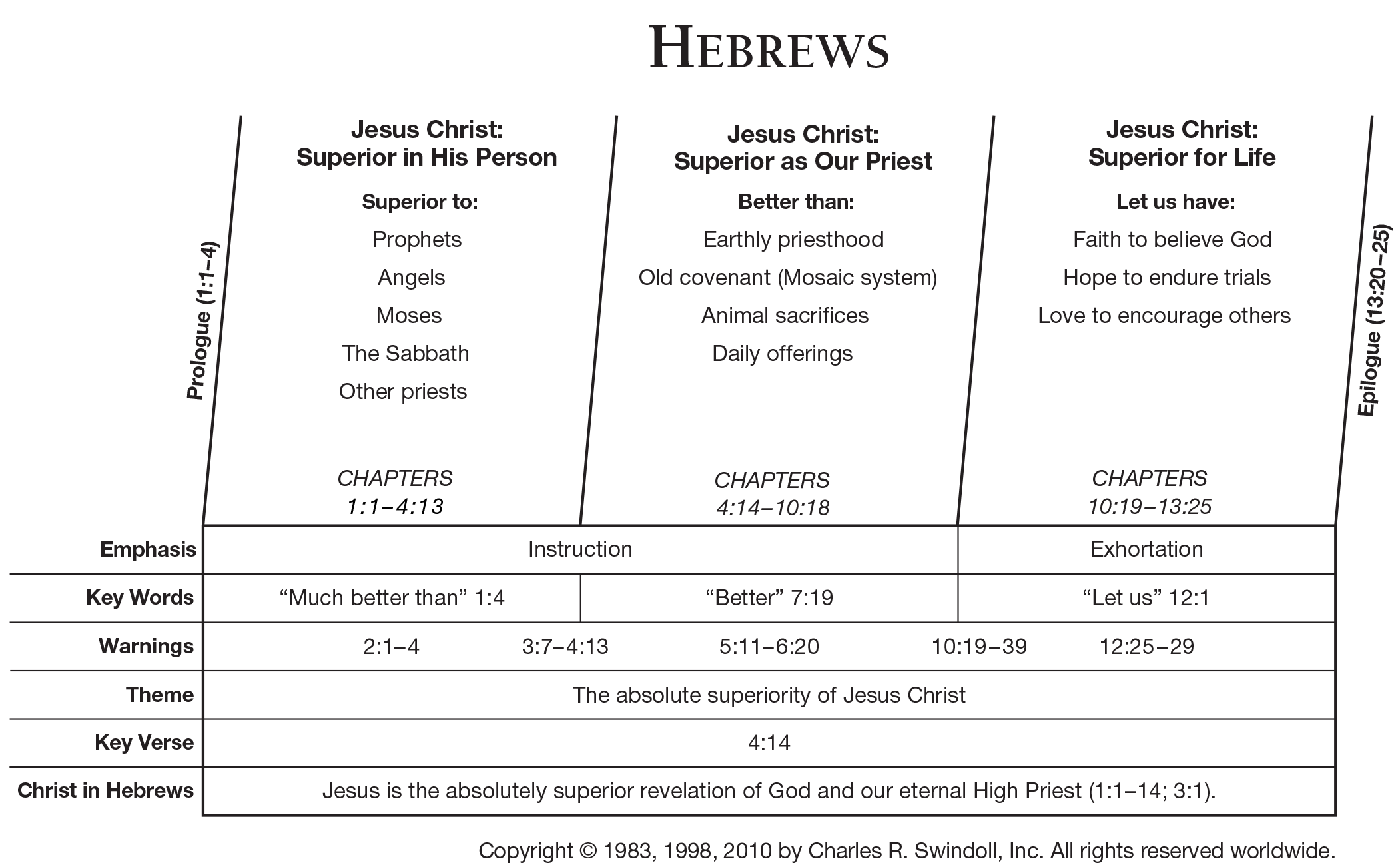

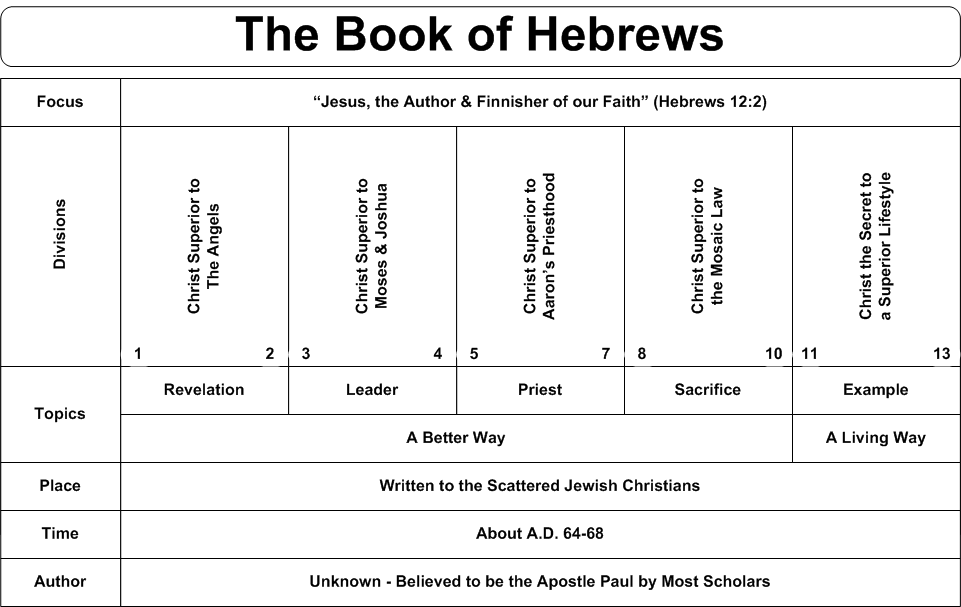
The particular intellectual problem I was wrestling with, for the first time since my conversion as a teenager, was the inspiration and authority of the Scriptures. Seeming contradictions and problems with interpretation defied intellectual solutions, or so I thought. Could the Bible be trusted completely?...
You are probably thinking that was Charles Templeton, but you would be wrong, for it was Billy Graham. And yet within two years after the European tour, in about 1948 Templeton’s life and worldview was beginning to go in a different direction than Graham’s (who obviously had resolved his doubts about the authority of the Scriptures). So instead of Graham, it was Templeton who began to have serious doubts about the Christian faith as he was planning to enter Princeton Theological Seminary. And even after he began to drift from Biblical truth, during the 1950s and ’60s, Templeton preached to crowds of 10,000 to 30,000 nightly. He packed stadiums and thrilled audiences with his proclamation of “the gospel of Christ,” as he believed it to be. And then we "fast forward" to about 1957, when Templeton would publicly declare that he had become an agnostic!
In his 1996 memoir, Farewell to God: My Reasons for Rejecting the Christian Faith, Templeton recounted a conversation with Graham in Montreat prior to entering seminary...
In his 1996 memoir, Farewell to God: My Reasons for Rejecting the Christian Faith (BORROW BOOK) - PAGE 6, Templeton recounted a conversation with Graham in Montreat prior to entering seminary...
All our differences came to a head in a discussion which, better than anything I know, “explains” Billy Graham and his phenomenal success as an evangelist. In the course of our conversation I said, “But, Billy, it’s simply not possible any longer to believe, for instance, the biblical account of creation. The world was not created over a period of days a few thousand years ago; it has evolved over millions of years. It’s not a matter of speculation; it’s a demonstrable fact.”
“I don’t accept that,” Billy said. “And there are reputable scholars who don’t.”
“Who are these scholars?’ I said. “Men in conservative Christian colleges?”
“Most of them, yes,” he said. “But that is not the point. I believe the Genesis account of creation because it’s in the Bible. I’ve discovered something in my ministry: When I take the Bible literally, when I proclaim it as the word of God, my preaching has power. When I stand on the platform and say, ‘God says,’ or ‘The Bible says,’ the Holy Spirit uses me. There are results. Wiser men than you or I have been arguing questions like this for centuries. I don’t have the time or the intellect to examine all sides of the theological dispute, so I’ve decided once for all to stop questioning and accept the Bible as God’s word.”
“But Billy,” I protested, “You cannot do that. You don’t dare stop thinking about the most important question in life. Do it and you begin to die. It’s intellectual suicide.”
“I don’t know about anybody else,” he said, “but I’ve decided that that’s the path for me.”
(Another quote from Farewell to God: My Reasons for Rejecting the Christian Faith - BORROW BOOK - page 232) - "I believe that there is no supreme being with human attributes--no God in the Biblical sense --but that life is the result of timeless evolutionary force (ED: DO NOT MISS THE POTENTIAL DANGER OF BELIEF IN EVOLUTION! DEAR READER WHAT DO YOU BELIEVE, THE LITERAL TRUTH OF THE BIBLE OR UNPROVEN AND UNPROVABLE SCIENTIFIC THEORY? What does the Bible say about Creation vs. evolution?), having reached its present transient state over millions of years....How can one believe the Biblical account of the creation of the world in six days when every eminent physicist agrees that all living species have evolved over millions of years from primitive beginnings. (ED: BUT WHO BEGAN THOSE "PRIMITIVE BEGINNINGS?")....‘I believe that, in common with all living creatures, we die and cease to exist as an entity.’ (page 233) (ED: TODAY TEMPLETON SADLY HAS REALIZED HE WILL EXIST FOREVER IN A PLACE OF ETERNAL PUNISHMENT AND THAT HIS PUNISHMENT WILL BE EVEN GREATER THAN OTHERS BECAUSE OF THE LIGHT THAT HE RECEIVED. cf. Lk 10:13-15+. TEMPLETON BELIEVED THE LIE OF ANNIHILATIONISM - CLICK NOTE)."
And so we have in the life of Charles Templeton, a man who surely experienced all of the attributes described in Hebrews 6:4-5 and yet he fell away from all he had experienced from 1936 to 1948, over 20 years of evangelizing for Christ! And as the writer of Hebrews warns, it is impossible to renew such a one again to repentance.
Some 50 years after Templeton had begun to reject Christ as the Way, the Truth and the Life, investigative reporter Lee Strobel interviewed him for his best selling book The Case for Christ (the writing of which led Strobel to become a believer in Jesus Christ!) published in 2000 and here is Strobel's record of the interchange as Strobel ask Templeton (BORROW - A Case For Christ - see page 304. Or watch the movie (must buy or rent) (Audiobook free) (Free in Espanol)(see picture of the aged Templeton)...
“And how do you assess this Jesus?” It seemed like the next logical question—but I wasn’t ready for the response it would evoke.
Templeton’s body language softened. It was as if he suddenly felt relaxed and comfortable in talking about an old and dear friend. His voice, which at times had displayed such a sharp and insistent edge, now took on a melancholy and reflective tone. His guard seemingly down, he spoke in an unhurried pace, almost nostalgically, carefully choosing his words as he talked about Jesus.
“He was,” Templeton began, “the greatest human being who has ever lived. He was a moral genius. His ethical sense was unique. He was the intrinsically wisest person that I’ve ever encountered in my life or in my readings. His commitment was total and led to his own death, much to the detriment of the world. What could one say about him except that this was a form of greatness?”
I was taken aback. “You sound like you really care about him,” I said.
“Well, yes, he is the most important thing in my life,” came his reply. “I . . . I . . . I . . . ,” he stuttered, searching for the right word, ‘I know it may sound strange, but I have to say . . . I adore him!” . . .
” . . . Everything good I know, everything decent I know, everything pure I know, I learned from Jesus. Yes . . . yes. And tough! Just look at Jesus. He castigated people. He was angry. People don’t think of him that way, but they don’t read the Bible. He had a righteous anger. He cared for the oppressed and exploited. There’s no question that he had the highest moral standard, the least duplicity, the greatest compassion, of any human being in history. There have been many other wonderful people, but Jesus is Jesus….’
“Uh . . . but . . . no,’ he said slowly, ‘he’s the most . . .” He stopped, then started again. “In my view,” he declared, “he is the most important human being who has ever existed.”
That’s when Templeton uttered the words I never expected to hear from him. “And if I may put it this way,” he said as his voice began to crack, ‘I . . . miss . . . him!”
With that tears flooded his eyes. He turned his head and looked downward, raising his left hand to shield his face from me. His shoulders bobbed as he wept. . . .
Templeton fought to compose himself. I could tell it wasn’t like him to lose control in front of a stranger. He sighed deeply and wiped away a tear. After a few more awkward moments, he waved his hand dismissively. Finally, quietly but adamantly, he insisted: “Enough of that.”
And so we see a story of a man who could be a living example of Hebrews 6:4-6 if you accept the interpretation that falling away is a description of a professor but not a possessor of Christ! Templeton was a man who professed Jesus and even spoke of Him affectionately, but not as the sinless Son of God, not as the One Who bore Templeton's sins on Calvary. This has to be one of the saddest, most tragic stories of falling away in the twentieth century!

Related Resources:
- Death of an apostate - relates to Charles Templeton
- Recommended - Dr Wayne Grudem 50 page discussion on "Perseverance of the Sains: A Case Study from the Warning Passages of Hebrews" - BORROW see page 132 in the book Still Sovereign (online pdf or here)
- Evidences of the New Birth
- Counterfeit New Births - What the New Birth is Not!
- What is apostasy and how can I recognize it? Gotquestions.org
- If our salvation is eternally secure, why does the Bible warn so strongly against apostasy?
- The slippery slide of unbelief
- 19th century minister to colleague: Darwin will drag you down
- How can I have assurance of my salvation? Gotquestions.org
- Eternal security - is it biblical? Gotquestions.org
- Is eternal security a “license” to sin? Gotquestions.org
- What does the Bible say about perseverance? | GotQuestions.org
- Perseverance of the Saints - is it biblical? | GotQuestions.org
- What are some Bible verses about perseverance? | GotQuestions.org
- Watch the full movie - A Case for Christ - story of reporter Lee Strobel - only available to buy or rent (Free in Espanol)
- Audiobook (11 hours, 42 minutes) online - A Case for Christ
Pastor Steven Cole has a well reasoned sermon on this section.
We come to what is arguably the most difficult passage in the New Testament to interpret. The problem is that no view, including the one that I hold, is without problems. So you have to decide which set of problems you want to live with. If you wish to advocate a view that is different than mine, I wish you well! I consulted over 35 different commentaries or sermons, and in my judgment, no one is able to answer al of the difficulties that confront us in this text. So we cannot be dogmatic here, but must continue to ask God for understanding in a spirit of submission and obedience to what we do understand.
While there are dozens of views on the various details of the text, there are basically four major views when it comes to the overall interpretation. Two of these views, in my opinion, may be dismissed without much discussion, since they contradict many other Scriptures. The other two views have merit, depending on which problems you wish to live with. I will explain why the view that I hold to makes the most sense to me.
THE FOUR MAJOR VIEWS:
1. The Arminian view: True believers lose their salvation if they fall away from Christ.
Consistent Arminians deny the eternal security of the believer and the perseverance of the saints. These are not completely synonymous doctrines. The doctrine of eternal security teaches “once saved, always saved.” If a person believes in Jesus Christ as Savior, he receives eternal life at that instant and he cannot lose it. The Reformed doctrine of the perseverance of the saints agrees that if a person is truly saved, God will keep him saved unto eternity, be-cause salvation is from the Lord, not from men.
But Reformed theologians draw a distinction between a person’s decision to receive Christ and God actually saving a soul. People can make decisions apart from God’s regenerating power that is able to bring a soul from spiritual death to spiritual life. When a person makes a decision to trust Christ, the question is, did God supernaturally raise that person from death to life? Did God give him a new heart? The Reformed view is that time will tell. As the parable of the sower shows, the stony ground seed and the seed among the thorns looked good for a while, but did not bear fruit to eternal life (Matt. 13:20, 21, 22, 23). In other words, the Reformed view is that there is such a thing as false faith. The false believer seems to be saved for a while, but later reveals his true condition and falls away.
Consistent Arminians, however, teach that salvation depends on man’s will to believe in Christ. Since man does it, man can undo it. Serious sin (Arminians are hard pressed to determine which or how much sin) results in a loss of salvation. They say that Hebrews 6 describes a believer who loses his salvation.
But they have two big problems. First, many biblical texts teach that true believers cannot be lost (John 6:39-40; 10:27, 28, 29, 30; Ro 8:28, 29, 30, 31, 32, 33, 34, 35, 36, 37, 38, 39). Second, if true believers can be lost, then our text teaches that it is impossible for them to regain their salvation. Most Arminians do not want to go there!
2. Non-lordship salvation view: Genuine Christians can deny the faith and yet remain saved, although they lose their rewards in heaven.
Zane Hodges (Bible Knowledge Commentary, Hebrews [SEE CRITIQUE - BE A BEREAN WITH HODGES' COMMENTARY ON HEBREWS AND 1 JOHN]) and the Grace Evangelical Society are the main advocates, along with R. T. Kendall. They hold to a decisional view of salvation and they reduce saving faith to a notional (“mental”) assent that does not include repentance. Once a person believes in Christ, he is eternally secure no matter what his subsequent life is like. He may later become an atheist or he may live in gross sin for the rest of his life. But because he once “believed,” he is eternally secure.
The problems with this view are too numerous to deal with in this message. The biblical books of James and 1 John, and John MacArthur’s Faith Works [BORROW] refute this view. The Bible is clear that a true believer may sin grievously (David & Peter are examples) and yet be restored. But it is also clear that some profess to believe and yet are not truly saved (Balaam, Judas, Simon Magus, 1Co 15:2; 2Co 6:1; 13:5; Titus 1:16-note). “By this we know that we have come to know Him, if we keep His commandments. The one who says, ‘I have come to know Him,’ and does not keep His commandments, is a liar, and the truth is not in him” (1Jn 2:3, 4). A person who falls away and crucifies again the Son of God, putting Him to open shame, who cannot be renewed to repentance, is not a believer who loses his rewards!
3. The hypothetical view: The author is speaking of some-thing that cannot happen, but is using it as a warning to press on.
The impossibility is variously interpreted as either apostasy or getting saved again. Dr. Ryrie explains (and seemingly advocates) this view in the footnote in The Ryrie Study Bible [Moody Press]:
To “fall away” is impossible (since, according to this view, true believers are eternally secure), but the phrase is placed in the sentence to strengthen the warning. It is similar to saying something like this to a class of students: “It is impossible for a student, once enrolled in this course, if he turns the clock back [which cannot be done], to start the course over. There-fore, let all students go on to deeper knowledge.”
This view has the advantage of understanding the phrases in Heb 6:4, 5 to refer to genuine conversion, which they certainly seem to be describing. Charles Spurgeon advocated a version of the hypothetical view (The New Park Street Pulpit [Baker], 2:169-176, “Hebrews 6:4-6 Final Perseverance,” although different than Ryrie’s view), because he could not accept that the phrases in Heb 6:4, 5 describe false believers. He explained that true believers cannot fall away because God keeps them from doing so. But Paul (whom he thinks wrote Hebrews) is arguing that the reason they cannot fall away is because it would negate the efficacy of Christ’s atonement on the cross. Thus restoration would be impossible. Others argue that the hypothetical warning is not against falling away from the faith, but against going back and starting the Christian life all over again (“relaying the foundation,” Heb 6:1, 2, which is impossible).
I reject this view because of two problems. First, it is an utterly confusing way to make the point. Every time I hear the view explained, I think, “Huh? Why would the author explain something in such a convoluted way?”
Second, a hypothetical warning is no warning at all. If it is impossible to do something, you don’t need to warn me not to do it. Spurgeon tries to counter this objection by saying that God uses the warning (“you can never be restored”) to prevent Christians from falling away. He uses the illustration of a deep precipice. God tells His children, “If you fall over this precipice, you’ll be dashed to pieces.” This leads the believer to cry out, “Father, hang onto me so that I don’t fall over!” The warning keeps the believer in holy fear and dependence on God, because he knows that if he were to fall over the edge, there could be no restoration (p. 175).
But his analogy is valid only if the possibility of falling actually exists. If there were an impossibly high fence around the precipice, and no one could ever climb over it, even if he tried, then what need is there to warn someone not to fall over the edge? A hypothetical warning is not really a warning at all. The same thing applies if the warning is against going back and getting saved all over again (which is impossible). Why warn against something that you cannot do? Besides, this variation ignores the serious implications of the term “fall away.” Something more serious than trying to start over in the Christian life is at stake.
4. The false believer view: The author is speaking of those who are associated with the church and its blessings, but are not truly saved.
This view, which I hold to (in spite of the problems), says that the people described in Heb 6:4-5 are in the Hebrew church and appear to be saved. But at some point, usually a crisis, their true colors come through. They repudiate their faith in Christ, go back either to Judaism or to the world, and side with those who crucified the Son of God. In so doing, they put Christ to open shame. In effect, their lives, if not their words, say to people, “I tried faith in Christ, but it didn’t work! It was a sham! I was on the inside, so I know what I am talking about. The Christian faith is worthless!” For such apostates, the author says, “it is impossible to renew them again to repentance.” They have hardened their hearts against the truth that they were exposed to. Although they looked for a while as if they were saved, their lives now show that they never were saved.
There are two major problems with this view. First, the terms in Heb 6:4-5 sound as if they are describing true believers, not false believers. Why would the author pile up all of these terms if he is describing false believers? Second, if they were not truly saved, then what is there to fall away from? How can they be renewed to repentance if they never truly repented in the first place? I admit that these are difficult problems. That’s why I said at the first that no view is problem-free. You have to pick the problems you can live with. Some principles for interpreting these verses that I will now explain help to mitigate these two objections.
HOW DO WE DECIDE WHICH VIEW IS CORRECT?
There are two main factors:
1. Which view best fits with the argument, context, and situation that the Book of Hebrews addresses?
As we’ve seen, the Book of Hebrews was written to a group of Jewish believers in Christ who were tempted under the threat of persecution to return to Judaism. The author is arguing for the superiority of the person and work of Jesus Christ. To abandon Christ for the old Jewish system is to turn from God’s supreme and final provision in His Son to that which is inferior.
In chapters 3 & 4, the author used the negative example of Israel in the wilderness (from Psalm 95) to warn these Hebrew Christians not to fall away because of an evil, unbelieving heart (Heb 3:7, 8, 9, 10, 11,12, 15; 4:3, 4:5, 4:7). He urges them not to fail to enter God’s rest through disobedience and unbelief (Heb 3:18; 4:6, 11). He tells them, “We have become partakers of Christ, if we hold fast the beginning of our assurance firm until the end” (Heb 3:14).
As I pointed out in our study of those chapters, the entire nation had put the blood on their doorposts, which is analogous to saving faith. They all passed through the Red Sea, which is a type of baptism (1Co 10:2). They all ate the same spiritual food and drank water from the rock, which was a type of Christ. They all lived under the illumination and protection of the cloud and the pillar of fire. They all enjoyed these many spiritual benefits, and yet most of them were not genuinely saved. In his wrath, God laid them low in the wilderness and they did not enter His rest. They had the gospel preached to them (Heb 4:2, 6), but it did not profit them because of their unbelief and disobedience.
There are many parallels between Israel’s experience in the wilderness and the terms that the author uses in 6:4-5. They had been “enlightened,” in the sense of being exposed to God’s ways and to the gospel. They had “tasted the heavenly gift,” spiritually in the deliverance from Egypt, and physically in the manna that God provided. Probably in 6:4 “heavenly gift” refers to salvation, or to Christ Himself.
To be “partakers of the Holy Spirit” means to be sharers in the Spirit, probably with reference to the blessings of salvation and the gifts of the Spirit that were manifested in the Hebrew church. Israel in the exodus corporately experienced the miraculous signs of the plagues and the other miracles connected with that momentous time. To taste the “good word of God” refers to His good promises to His people, especially in the gospel. Again, this was a corporate experience of Israel in the wilderness. All of them had tasted God’s good word of promise by coming out of slavery in Egypt. But not all were saved through personal faith.
They also had tasted “the powers of the age to come.” Israel experienced many miracles, both in the deliverance from Egypt and in God’s sustaining them in the wilderness. In the Hebrew church, it refers to the miraculous sign gifts that God gave to confirm the gospel (Heb 2:4). But it’s possible even to perform miracles and yet be lost. Jesus predicted that many on judgment day will say to Him that they had cast out demons and performed miracles in His name, and yet He would say, “I never knew you; depart from Me, you who practice lawlessness” (Mt 7:22-note, Mt 7:23-note).
The analogy that the author uses in 6:7-8 to explain 6:4-6 is a major key to interpreting this text. He talks about ground that drinks in the rain (symbolic of God’s blessings). If it bears a crop, it fulfills its purpose and is blessed by God. But if it yields thorns and thistles, “it is worthless and close to being cursed, and it ends up being burned.” This fits with the story of Israel in the wilderness and the point of his warning in 6:4-6. God poured out His blessings on the nation in the exodus and during their wilderness experience. Their lives should have brought forth the fruit of faith and obedience. Instead, they were faithless and disobedient, threatening on several occasions to return to Egypt.
Some in the Hebrew church were in danger of precisely the same sin. They had participated in a corporate sense in God’s abundant blessings of salvation, but now they were tempted to re-turn to Judaism. But to do that would be to fall away from Christ, and even worse, to join those who had crucified Him! In so doing, they would be crucifying Christ all over again, and putting Him to open shame by agreeing with the unbelieving Jews that He is not their Savior and Messiah. To do that would put them close to being cursed, and if they died in this state of renouncing their faith, they would face the fires of eternal judgment.
Verse 9 reinforces this interpretation, when the author says, “We are convinced of better things concerning you, and things that accompany salvation….” The word “and” is epexegetical, or explanatory. It may be translated, “that is.” “Better things” most likely refers back to the five things mentioned in 6:4-5 (See Wayne Grudem's chapter "Perseverance of the Sains: A Case Study from the Warning Passages of Hebrews" - BORROW Still Sovereign, PAGE 132 (online pdf or here) THIS IS A 50-page treatment of the Hebrews warning passages, the most comprehensive defense of the false believer view that I read). The implication of 6:9 is that the terms in 6:4-5 refer to those who do not possess genuine salvation.
The question remains, “But if they did not possess genuine salvation, why does the author say that it is impossible for them to be renewed to repentance? If they had never repented in the first place, why talk about renewal?” Here we turn to the second factor:
2. Which view best fits with other biblical texts and examples?
There are many other biblical texts that talk about insincere repentance. Balaam seemingly repented when the angel confronted him, but it was not a repentance unto salvation (Nu 22:34; 31:16; compare 2Pe 2:15+; Jude 11). Judas felt remorse for betraying Jesus and even returned the silver, but his “repentance” was not unto salvation (Mt 27:3, 4, 5). Peter condemned the apostates who, “after they have escaped the defilements of the world by the knowledge of the Lord and Savior Jesus Christ, they are again entangled in them and are overcome, the last state has become worse for them than the first. For it would be better for them not to have known the way of righteousness, than having known it, to turn away from the holy commandment handed on to them” (2Pe 2:20+, 2Pe 2:21+).
the author is talking...about false believers who were associated with God’s people
and the blessings of salvation, but who were not truly saved.Thus I believe that both the broad and immediate context of Hebrews, plus other biblical texts and examples about apostasy, support the view that the author is talking here about false believers who were associated with God’s people and the blessings of salvation, but who were not truly saved. To fall away means deliberately to reject and repudiate the substantial light that they have been given about Christ and the gospel. In so doing, repentance becomes impossible-not for God (Mt 19:23, 24, 25, 26), but rather, it is morally impossible because by this deliberate rejection of the truth, they harden their hearts and place themselves beyond repentance. Thus we can sum up the main idea of our text:
Repentance becomes impossible when a person has been
fully exposed to the blessings of God’s people,
but falls away through deliberate unbelief and denial of Christ.Repentance becomes impossible when a person has been fully exposed to the blessings of God’s people, but falls away through deliberate unbelief and denial of Christ. In spite of the difficulties, I believe that this interpretation best fits with the tenor of the warning, the context, and the other biblical warnings and examples of apostasy. Now, some brief…
APPLICATIONS:
1. It is dangerous to traffic in Christian matters, but to reject or disobey the light that God has graciously given to us.
One reason that the author piles up these many terms that sound as if these apostates were converted is to warn us about how far we can go in matters of the faith and yet not be genuinely converted. I remember when I first read Jonathan Edwards’ A Treatise Concerning Religious Affections [Banner of Truth], although I had been a for many years, it caused me to examine my own heart to make sure that I was saved! It also opened my eyes to the fact that many in evangelical churches “profess to know God, but by their deeds they deny Him” (Titus 1:16-note).
2. It is dangerous to profess faith in Christ but to have no evidence of fruit in your life.
God is raining His blessings all around, but each of us needs to ask, “Am I bringing forth thorns and thistles, or fruit unto God?” Read through the lists of the deeds of the flesh and the fruit of the Spirit (Gal 5:19, 20, 21, 22, 23-see notes) and ask, “Which most characterizes my life? Am I progressively denying the deeds of the flesh and growing the fruit of the Spirit?”
3. It is dangerous not to practice frequent repentance.
Repentance isn’t a one-time thing that you do at conversion and then move on. Nor is it simply a change of mind, not of behavior. Turning from sin ought to be a chief identifying mark of the believer. As I’ve said before, in Eastern Europe, unbelievers call evangelicals “repenters.” That’s not a bad label! If you’re in God’s Word daily, it confronts you with ways that you are not pleasing to God. Repentance is the proper response.
4. It is dangerous not to worry about this warning if your heart is callused, or to worry excessively about it if your heart is tender.
Again, one reason that the author uses such strong terms is to shock those whose hearts are becoming callused so that they wake up before it’s too late. This isn’t just a warning to believers to grow up in their faith (although it is that). It’s a warning to those who think that they are believers, but are not, not to fall away into eternal judgment. True believers do not go back to their old way of life. True believers persevere in faith and obedience. We will see the same thing emphasized again in Heb 10:36, where he tells them that they have need of endurance. Believing the best about them, he says, “But we are not of those who shrink back to destruction, but of those who have faith to the preserving of the soul” (Heb 10:39).
In other words, there is only one way for those who have truly believed in Christ as Savior and Lord: to move ahead in faith and obedience, even in the face of trials or persecution. To give up the Christ who sacrificed Himself on the cross and go back to the pleasures of this evil world or to the empty shell of religion is extremely dangerous and possibly spiritually fatal!
If your heart is tender towards God, and you are striving daily against sin, then you should be concerned about this warning, but not excessively concerned. Keep walking with the Lord and He will bring you safely into His heavenly kingdom (2Ti 4:18-note)!
Discussion Questions
1. In light of the context and other Scriptures, which of the four views makes the most sense to you? Why?
2. Where is the balance between examining yourself properly versus excessive introspection (2Co 13:5; 1Co 4:3, 4)?
3. Should we give assurance of salvation to a professing Christian who is not walking with Christ? Why/why not?
4. Explain the difference between “once saved, always saved,” and the doctrine of the perseverance of the saints.
Pastor Steven Cole's sermons (Flagstaff Christian Fellowship) are highly recommended often reading much like a verse by verse commentary - Hebrews 6:4-8 When Repentance Becomes Impossible